
Health expenditure Australia : analysis by sector
|
|
|
- Oscar Johnston
- 9 years ago
- Views:
Transcription
1 Health expenditure Australia : analysis by sector HEALTH AND WELFARE EXPENDITURE SERIES No. 51
2 HEALTH AND WELFARE EXPENDITURE SERIES Number 51 Health expenditure Australia : analysis by sector Australian Institute of Health and Welfare Canberra Cat. no. HWE 60

3 The Australian Institute of Health and Welfare is a major national agency which provides reliable, regular and relevant information and statistics on Australia s health and welfare. The Institute s mission is authoritative information and statistics to promote better health and wellbeing. Australian Institute of Health and Welfare 2014 This product, excluding the AIHW logo, Commonwealth Coat of Arms and any material owned by a third party or protected by a trademark, has been released under a Creative Commons BY 3.0 (CC-BY 3.0) licence. Excluded material owned by third parties may include, for example, design and layout, images obtained under licence from third parties and signatures. We have made all reasonable efforts to identify and label material owned by third parties. You may distribute, remix and build upon this work. However, you must attribute the AIHW as the copyright holder of the work in compliance with our attribution policy available at < The full terms and conditions of this licence are available at < Enquiries relating to copyright should be addressed to the Head of the Media and Strategic Engagement Unit, Australian Institute of Health and Welfare, GPO Box 570, Canberra ACT This publication is part of the Australian Institute of Health and Welfare s <series>. A complete list of the Institute s publications is available from the Institute s website < ISSN ISBN Suggested citation Australian Institute of Health and Welfare Health expenditure Australia : analysis by sector. Health and welfare expenditure series no. 51. Cat. no. HWE 60. Canberra: AIHW. Australian Institute of Health and Welfare Board Chair Dr Andrew Refshauge Director David Kalisch Any enquiries about or comments on this publication should be directed to: Media and Strategic Engagement Unit Australian Institute of Health and Welfare GPO Box 570 Canberra ACT 2601 Tel: (02) [email protected] Published by the Australian Institute of Health and Welfare This publication is printed in accordance with ISO (Environmental Management Systems) and ISO 9001 (Quality Management Systems). The paper is sourced from sustainably managed certified forests. Please note that there is the potential for minor revisions of data in this report. Please check the online version at < for any amendments.
4 Contents Acknowledgments... iv Abbreviations... v Summary... vi 1 Introduction Structure of this report Overview of trends in health expenditure National comparisons Funding comparisons across jurisdictions Hospitals Australian Government funding State and territory government funding Non-government funding Primary health care Australian Government funding State and territory government funding Non-government funding Primary health care by area of expenditure and source of funds Other areas of health expenditure Funding for other health care Components of other health care Capital expenditure Appendix A Source tables Appendix B Technical notes Glossary References List of tables List of figures List of boxes Related publications iii
5 Acknowledgments This report would not have been possible without the valued cooperation and effort of the data providers in the health authorities of the states and territories and the Australian Government. The Australian Institute of Health and Welfare (AIHW) would like to express its appreciation to state and territory and other providers for the timely supply of data and assistance with data validation. The AIHW also wishes to thank the members of the Health Expenditure Advisory Committee who helped to plan this report and provided advice on its content. Rebecca Bennetts, Elizabeth Dernie, Adam Majchrzak-Smith and Adrian Webster collected and analysed the data and wrote this publication. iv
6 Abbreviations ABS AIHW DVA GFC GP HEAC IPD MBS NHA OECD PBS PHIIS PHOFAs RPBS Australian Bureau of Statistics Australian Institute of Health and Welfare Australian Government Department of Veterans Affairs Global Financial Crisis General Practitioner Health Expenditure Advisory Committee Implicit Price Deflator Medicare Benefits Schedule National Health Accounts Organisation for Economic Co-operation and Development Pharmaceutical Benefits Scheme Private Health Insurance Incentives Scheme Public Health Outcome Funding Agreements Repatriation Pharmaceutical Benefits Scheme Symbols nil or rounded down to zero.. not applicable n.e.c. not elsewhere classified v
7 Summary This report extends the analysis presented in Health expenditure Australia to further explore expenditure on particular categories of health goods and services, including hospitals, primary health care, other recurrent health expenditure and capital expenditure. Over the decade from to , expenditure increased in real terms for all areas of expenditure: from $31.0 billion to $53.5 billion for hospitals; from $30.8 billion to $50.6 billion for primary health care; from $16.9 billion to $28.3 billion for other recurrent health expenditure; and from $4.2 billion to $7.9 billion for capital expenditure. did not occur at the same rate for all areas of expenditure. Between and , the share of recurrent expenditure attributed to hospitals increased from 39.4% to 40.6%. The share for primary health care decreased over this time from 39.1% to 37.8%. No clear trend has been evident for expenditure in these areas since In , hospitals comprised 40.4% of recurrent expenditure and primary health care comprised 38.2%. The changing proportions of health expenditure are affected by the sources of funds (i.e. who is paying) and the decisions and agreements made about funding levels. In recent years, the relative share of Australian Government funding directed towards primary health care has increased while the share directed towards hospitals has decreased. Between and , for every $1 the Australian Government spent on hospitals, it spent on average $0.97 on primary health care. In , the Australian Government spent around $1.16 on primary health care for every $1 it provided for hospitals. In contrast, the state and territory governments increased the share of their recurrent expenditure allocated to hospitals from 63.0% to 69.0% over the decade and decreased the share allocated to primary health care from 29.1% to 21.4%. Between and , total growth in state and territory government funding for hospitals ($11.5 billion) was almost double (1.8 times) that of the Australian Government ($6.2 billion) and 2.4 times non-government expenditure growth ($4.8 billion). Expenditure trends also varied between the states and territories. Western Australia had the largest growth in state government funding for hospitals, more than doubling (2.16 times) its expenditure on hospitals between and Average annual growth in Victoria (4.3%) and New South Wales (4.8%) was below the national average of 5.6%. The Northern Territory went from having the lowest Australian Government funding on health per person in ($1,697) to the highest in ($3,379). Western Australia had the slowest growth in Australian Government funding per person. In , Western Australia had the lowest Australian Government expenditure at $2,270 per person ($350 lower than the national average). Per person health expenditure by the Western Australia government was 2.5 times larger in ($2,219) than in ( $891). South Australia, the Northern Territory and the Australian Capital Territory also more than doubled their per person expenditure between and Non-government expenditure was the highest in Victoria in both ($1,550 per person) and ($2,165 per person). In , the Northern Territory was $393 per person below the national average while in it was $596 per person below the national average. vi

8 1 Introduction This report has been produced as a companion to Health expenditure Australia Health expenditure Australia focused on a national overview of health expenditure trends, whereas this report explores expenditure on specific areas of health: hospitals, primary health care, other recurrent expenditure and capital expenditure (see Box 1.1). Box 1.1: Broad areas of health expenditure Hospitals Hospitals expenditure includes recurrent (see Glossary) spending on health goods and services provided by public and private hospitals. It includes services provided to a patient who is receiving admitted patient services or non admitted patient services in a hospital, but excludes dental services, community health services, patient transport services, public health activities and health research undertaken within the hospital. It can include services provided off-site, such as hospital-in-the-home, dialysis or other services. Primary health care Primary health care expenditure includes recurrent expenditure on health goods and services such as medical services, dental services, other health practitioner services, pharmaceuticals and community and public health services. Primary health care services are delivered in numerous settings such as general practices, community health centres, allied health practices (for example, physiotherapy, dietetic and chiropractic practices, tele-health) and under numerous funding arrangements. Other recurrent expenditure Other recurrent expenditure includes recurrent expenditure on health goods and services such as medical specialists services (those non-hospital medical services that have not been classified as primary health care), health research, administration, patient transport services and medical aids and appliances. Capital expenditure Capital expenditure includes expenditure on fixed assets (for example, new buildings and equipment with a useful life that extends beyond 1 year). This does not include changes in inventories. This term is used in this publication to refer to what the Australian Bureau of Statistics (ABS) calls gross fixed capital formation. See Appendix B for more information on the allocation of medical services expenditure to primary health care and other recurrent expenditure. In examining expenditure on these areas over the past decade (from to ), this report analyses trends in the source of funds, such as the Australian Government, state and territory and local governments and non-government sources, which includes private health insurers, out-of-pocket expenses paid by individuals and payments by injury compensation insurers. The main data source for this report is the AIHW's Health expenditure database, which is collated annually using data from a wide range of sources, including: the Australian Government from agencies such as the Department of Health, the Department of Veterans Affairs (DVA) and the ABS Health expenditure Australia : analysis by sector 1
9 State and territory governments through the Government Health Expenditure National Minimum Dataset the Private Health Insurance Administration Council other research collections. The tables and figures in this publication provide expenditure primarily in constant prices. Constant price expenditure adjusts for the effects of inflation using either annually re-weighted chain price indexes produced by the ABS, or implicit price deflators (IPDs) produced by the ABS or AIHW. Because the reference year for both the chain price indexes and the IPDs is , the constant price estimates indicate what expenditure would have been had prices applied in all years. The analysis includes both recurrent and capital expenditure, as appropriate. See Box 1.1 for definitions of each of the broad areas of health expenditure. More information on the data sources used or the methods for developing the AIHW's Health expenditure database can be found in Health expenditure Australia or on the AIHW's website < A data quality statement for the health expenditure database is available at: < 1.1 Structure of this report Chapter 2 presents an overview of current trends in health spending, broken down into spending on hospitals, primary health care, other areas of health spending and capital expenditure. Chapter 3 presents an analysis of hospitals expenditure by source of funds for each state and territory. Chapters 4 and 5 present similar analysis for primary health care and all other areas of health spending, respectively. Appendix A presents all of the source tables for figures in this report. Appendix B presents the technical notes for this report. 2 Health expenditure Australia : analysis by sector

10 2 Overview of trends in health expenditure 2.1 National comparisons Over the decade from to , expenditure increased for all areas, however, the growth rates for each area were different (Figure 2.1). Expenditure ($ million) 60,000 50,000 Hospitals Other recurrent Primary health care Capital expenditure 40,000 30,000 20,000 10, Source: Table A1. Year Figure 2.1: Total expenditure on health, by broad area of expenditure, constant prices, to ($ million) The different growth rates are reflected in the share of expenditure allocated to each sector, with the most variation occurring in hospitals and primary health care. Between and , the share of recurrent expenditure attributed to hospitals increased from 39.4% to 40.6% (Table A1; Figure 2.2 and AIHW 2013b). The share for primary health care decreased over this time from 39.1% to 37.8%. Both, however, have shown no clear trend since then, with hospitals ending the period at 40.4% and primary health care at 38.2% (Table A1 and Figure 2.2). The share of recurrent spending on other areas varied only slightly between and , staying at around 21.5%. Since then, there has been more variation, with a peak in of 22.3% and a drop back to 21.3% in Capital expenditure at the beginning of the reporting period represented 5.0% of total expenditure. At the end of the period it was at its highest proportion, at 5.6%. Health expenditure Australia : analysis by sector 3

11 Proportion (per cent) Hospitals Other recurrent Primary health care Capital expenditure Source: Table A1. Year Figure 2.2: of expenditure on health, by broad area of expenditure, constant prices, to The remainder of this chapter examines, in turn, the funding of health care by the Australian Government, state and territory governments and the non-government sector. The flow of money around the Australian health-care system is complex and is determined by the institutional frameworks in place, both government and non-government. Box 2.1 defines government and non-government funding for the Australian health-care system. Box 2.1: Government and non-government funding of health care The government sector includes the Australian and state and territory governments and, in some jurisdictions, local government. Australian Government funding comprises total expenditure incurred by the Australian Government on its own health programs, including funding provided to the states and territories by way of grants under section 96 of the Constitution. It also includes the 30 40% private health insurance premium rebates. State and territory government funding comprises total expenditure incurred by the state and territory governments on their own health programs. It does not include the funding provided to the states and territories by the Australian Government or other sources. Non-government funding comprises funding from private health insurers, out-of-pocket expenses paid by individuals and payments by injury compensation insurers. 4 Health expenditure Australia : analysis by sector

12 Australian Government funding Between and , for every $1 the Australian Government spent on hospitals, it spent on average $0.97 on primary health care. Since the ratio of Australian Government spending on primary health care compared with hospitals has gradually increased. In , the Australian Government spent around $1.16 on primary health care for every dollar provided to the states and territories for hospitals (Table A2). Between and , Australian Government funding for other areas of health increased from $10.3 billion to $15.9 billion; however the share of funding remained relatively stable at around 28%. In , the share of funding decreased to 27.0% before increasing again to 28.1% in (Table A2 and Figure 2.3). Capital expenditure by the Australian Government increased in real terms from $84 million in to $336 million in For each year across the decade to , less than 1% of Australian Government funding for health was capital expenditure (Table A2). Proportion (per cent) 40 Hospitals Other recurrent Primary health care Source: Table A2. Year Figure 2.3: Australian Government share of recurrent funding, by broad area of expenditure, constant prices, to Australian Government expenditure as a ratio of tax revenue As reported in Health expenditure Australia , the ratio of Australian Government expenditure on health to tax revenue was 22.3% in This ratio steadily declined to 21.2% in (Figure 2.4 and Table A3). A drop in tax revenue following the global financial crisis (GFC) caused the ratio to increase to 25.0% in and to 28.6% in The ratio declined in the next 2 years to 27.5% in and 26.2% in Health expenditure Australia : analysis by sector 5

13 Ratio (per cent) Year Source: Table A3. Figure 2.4: The ratio of health expenditure to tax revenue for the Australian Government, current prices, to State and territory government expenditure The state and territory governments generally increased the share of their recurrent expenditure allocated to hospitals over the period to , while reducing the share spent on primary health care. The hospitals share of recurrent spending increased from 63.0% to 69.0%, while the primary health care share fell from 29.1% to 21.4% over this period (Table A4 and Figure 2.5). The share allocated to other areas (i.e. other than hospitals and primary health care) varied far less than either hospitals or primary health care shares and the trend was less clear. It began the period at 8.0% and ended it at 9.6% but growth was not consistent over time (Table A4 and Figure 2.5). The ratio of capital to total health spending remained relatively stable at around 8% between and However, it increased to 11.9% in and 13.3% in (Table A4). 6 Health expenditure Australia : analysis by sector

14 Proportion (per cent) 70 Hospitals Other recurrent Primary health care Source: Table A4. Year Figure 2.5: State and territory government share of recurrent funding, by broad area of expenditure, constant prices, to State and territory government expenditure as a ratio of tax revenue The ratio of state and territory government expenditure to tax revenue rose from 16.4% in to 17.7% in , before declining to 17.0% in By , this ratio had risen to 20.1%. At the time of the GFC, the ratio rose to 21.2% in before further gradual increases to 24.5% in (Table A5 and Figure 2.6). An analysis of the ratio of state and territory government funding on health to tax revenue is also discussed in Chapter 2 of Health expenditure Australia (AIHW 2013b). Health expenditure Australia : analysis by sector 7

15 Ratio (per cent) Year Source: Table A5. Figure 2.6: The ratio of health expenditure to tax revenue for state and territory governments, current prices, to Non-government funding After increasing between and from 52.4% to 54.5%, the share of non-government spending attributed to primary health care dropped to a low of 50.8% in It ended the period at 51.5% in (Table A6 and Figure 2.7). The share of non-government spending attributed to hospitals fell from 26.3% in to 24.2% in It then stayed at around 25% until , at which point it rose to a high of 27.4%. It ended the period at 27.3% (Table A6 and Figure 2.7). The share of non-government spending attributed to other areas of spending began the period at 21.3% and ended the period at 21.2%; however during that time it varied from a low of 20.9% in to a high of 22.5% in (Table A6 and Figure 2.7). The remainder of non-government spending was for capital expenditure. In , 9.0% of total non-government spending was attributed to capital expenditure. This share increased to a high of 10.1% in and and has since declined to a low of 5.6% in (Table A6). 8 Health expenditure Australia : analysis by sector

16 Proportion (per cent) 60 Hospitals Other recurrent Primary health care Source: Table A6. Year Figure 2.7: Non-government share of recurrent funding, by broad area of expenditure, constant prices, to Funding comparisons across jurisdictions Australian Government funding Australian Government funding per person varies across jurisdictions for a number of reasons including socioeconomic and demographic profiles as well as variable accessibility to health services due to remoteness (AIHW 2013a). The Australian Government also implements specific health policies that can affect the per person expenditure in jurisdictions differently. Australian Government funding has risen in all states and territories over the past decade. In , the estimated Australian Government funding per person on health averaged $2,620, which was $728 more in real terms than in (Table A7 and Figure 2.8). Over the past decade, Australian Government funding grew the fastest in the Northern Territory. The Northern Territory went from having the lowest Australian Government funding per person in ($1,697) to the highest in ($3,379). Western Australia had the slowest growth in Australian Government funding per person, with an average growth rate of 2.2% over the decade, compared with growth of 3.3% nationally. In , Western Australia had the lowest Australian Government funding at $2,270 per person, which was $350 lower than the national average and $315 below the next lowest state (Queensland at $2,585 per person). Health expenditure Australia : analysis by sector 9

17 Per person ($) 3, ,000 2,500 2,000 1,500 1, NSW Vic Qld WA SA Tas ACT NT Australia Source: Table A7. Figure 2.8: Australian Government funding of total health expenditure, per person, constant prices, for each state and territory, to ($) State and territory government funding All state and territory governments increased their health funding over the decade in real terms. This increase in per person state and territory government funding between ($1,022) and ($1,701) was $679 (Table A8 and Figure 2.9). Western Australia had the largest growth in state and territory government health funding. Per person expenditure in Western Australia in ($2,219) was 2.5 times per person expenditure in ($891). South Australia, the Northern Territory and the Australian Capital Territory also more than doubled their per person expenditure between and Health expenditure Australia : analysis by sector

18 Per person ($) 5, ,000 3,000 2,000 1,000 0 NSW Vic Qld WA SA Tas ACT NT Australia Source: Table A8. Figure 2.9: State and territory government funding of total health expenditure, per person, constant prices, for each state and territory, to ($) Non-government funding Non-government funding of total health expenditure per person in was $1,909 nationally, which was $548 more than in (Table A9 and Figure 2.10). Victoria had the highest per person non-government health expenditure in both ($1,550 or $189 above the national average) and ($2,165 or $256 above the average). Non-government expenditure per person in the Northern Territory stayed well below the national average throughout the period and the gap widened over time. In , non-government expenditure in the Northern Territory was $393 per person below the national average. In , it was $596 per person below the average. Health expenditure Australia : analysis by sector 11

19 Per person ($) 2, ,000 1,500 1, NSW Vic Qld WA SA Tas ACT NT Australia Source: Table A9. Figure 2.10: Non-government funding of total health expenditure, per person, constant prices, for each state and territory, to ($) 12 Health expenditure Australia : analysis by sector

20 3 Hospitals All funders increased their expenditure on hospitals between and (Table A10 and Figure 3.1). Total growth in state and territory government funding ($11.5 billion) was almost double (1.8 times) that of the Australian Government ($6.2 billion) and 2.4 times the growth of non-government expenditure ($4.8 billion). Expenditure 30,000 25,000 Australian Government Total non-government State/territory and local governments 20,000 15,000 10,000 5, Source: Table A10. Year Figure 3.1: Total expenditure on hospitals, by source of funding, constant prices, to ($ million) 3.1 Australian Government funding The Australian Government funding for hospitals in was $868 per person Australiawide, which was $182 higher than in (Table A13 and Figure 3.2). The Northern Territory had the largest growth in Australian Government funding for hospitals per person over the decade to at 5.0%, on average, per year. The Northern Territory received the second lowest contribution from the Australian Government for hospitals in at $566 per person ($120 below the national average). In , the Northern Territory received the largest contribution at $920 per person ($52 above the national average). The Australian Capital Territory received the lowest contribution for hospitals per person from the Australian Government in all years except , but experienced the second largest growth over the period. Western Australia experienced the lowest growth in Australian Government funding for hospitals, increasing by 1.18 times compared with a national growth of In , Health expenditure Australia : analysis by sector 13
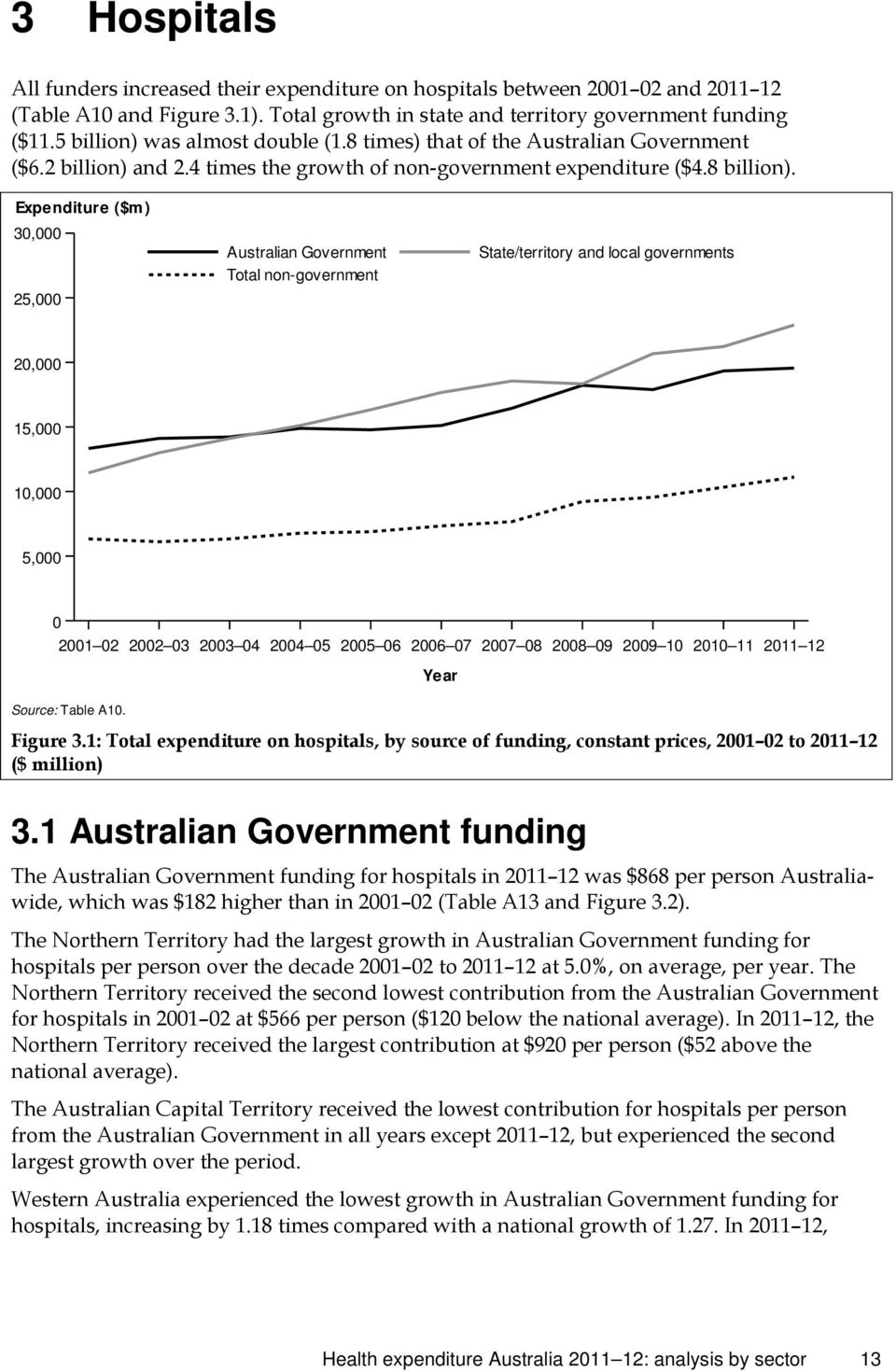
21 Western Australia received the lowest amount of funding per person from the Australian Government of any jurisdiction. Per person ($) 1, NSW Vic Qld WA SA Tas ACT NT Australia Source: Table A13. Figure 3.2: Australian Government funding of hospitals, per person, constant prices, for each state and territory, to ($) Public versus private hospital Australian Government funding The Australian Government provided $13.3 billion of funding for hospitals in , which comprised $10.9 billion (81.7%) for public hospitals and $2.4 billion for private hospitals (18.3%). The share of Australian Government funding provided for public hospitals gradually declined over the next 6 years to 81.1% in In , following the GFC, there was an increase of $1.8 billion in Australian Government funding for public hospitals, which represents an increase in the share it contributed to 82.9%. The injection of funds in has been followed by a more variable funding profile by the Australian Government for public hospitals (Table A16 and Figure 3.3). 14 Health expenditure Australia : analysis by sector
22 Proportion (per cent) Source: Table A16. Year Figure 3.3: of Australian Government funding for public hospitals, constant prices, to State and territory government funding In , the average per person state and territory government funding for public and private hospitals was $1,017, a $429 increase from (Table A17 and Figure 3.4). The Northern Territory and the Australian Capital Territory governments spent relatively higher amounts of money on hospitals per person throughout the decade. In , the Northern Territory had the highest per person state and territory expenditure on hospitals at $1,953, which was $936 higher than the national average. The Australian Capital Territory was the second highest at $1,724, which was $467 more than the next highest, Western Australia. Western Australia had the largest growth in hospital expenditure, more than doubling (2.16 times) its expenditure on hospitals between and Victoria (4.3%) and New South Wales (4.8%) were the only jurisdictions to experience below average annual growth (5.6%) in their expenditure on hospitals over the period. Health expenditure Australia : analysis by sector 15
23 Per person ($) 2,000 1, ,600 1,400 1,200 1, NSW Vic Qld WA SA Tas ACT NT Australia Source: Table A17. Figure 3.4: State and territory government funding of hospitals, per person, constant prices, for each state and territory, to ($) Public versus private hospital state and territory government funding by jurisdiction In , state and territory governments funded $22.4 billion for public hospitals, which represented 97.8% of all state and territory government funding for hospitals (Table A19). This proportion did not change significantly over the previous decade. For most states and territories, funding for public hospitals was close to 100% of hospital funding in and for most of the previous decade (Table A19 and Figure 3.5). Western Australia was an exception to this. Western Australia had the lowest share of state government funding for public hospitals each year between and In , the share of state government funding for public hospitals in Western Australia was 87.5% (Figure 3.5 and Table A19). 16 Health expenditure Australia : analysis by sector
24 Proportion (per cent) NSW Vic Qld WA SA Tas ACT NT Australia Source: Table A19. Figure 3.5: State and territory government funding for public hospitals as a share of state and territory government funding for all hospitals, constant prices, for each state and territory, Non-government funding In , the average per person non-government health expenditure on hospitals was $492, which had grown by $166 per person since (Table A20 and Figure 3.6). The Australian Capital Territory experienced a decline in real terms in non-government funding over the period of $24 per person. Western Australia and the Northern Territory also had relatively low growth in non-government funding on hospitals over the period ($17 and $22, respectively). Queensland had the largest growth, increasing by $249 per person, with growth in New South Wales, Victoria and South Australia of 4.0% or higher each year. Health expenditure Australia : analysis by sector 17
25 Per person ($) NSW Vic Qld WA SA Tas ACT NT Australia Source: Table A20. Figure 3.6: Non-government funding of hospitals, per person, constant prices, for each state and territory, to ($) Public versus private hospital non-government funding by jurisdiction In , non-government funding for public hospitals was $3.6 billion. Across the past decade, the non-government funding for public hospitals as a share of non-government funding for all hospitals, grew from 30.1% in to 32.1% in (Figure 3.7 and Table A22). The share of non-government funding for public hospitals varied across the decade for each state and territory. Queensland had the lowest share of all states and territories in , with just 14.1% of non-government funding for hospitals going to public hospitals. In , this share had more than doubled to 31.6%, to be the third highest behind New South Wales (37.5%) and Victoria (34.9%) (Figure 3.7 and Table A22). In contrast, non-government funding for public hospitals in the Northern Territory was 35.8% of all hospitals funding in , and dropped to 13.7% in (Figure 3.7 and Table A22). 18 Health expenditure Australia : analysis by sector
26 Proportion (per cent) NSW Vic Qld WA SA Tas ACT NT Australia Source: Table A22. Figure 3.7: Non-government funding for public hospitals as a share of non-government funding for all hospitals, constant prices, for each state and territory, to Health expenditure Australia : analysis by sector 19
27 4 Primary health care Primary health care services are delivered in numerous settings such as general practices, community health centres, allied health practices (for example, physiotherapy, dietetic and chiropractic practices and tele-health) and under numerous funding arrangements. In , $50.6 billion was spent on primary health care in Australia, up from $30.8 billion in Over the most recent 5-year period, to , total spending on primary health care grew from $37.7 billion to $50.6 billion. This was largely driven by an increase in Australian Government funding from $15.8 billion to $22.6 billion. This raised the Australian Government share from 41.8% to 44.7% of total primary health care expenditure (Figure 4.1 and Table A25). Individuals out-of-pocket funding, which is a sub-component of total non-government funding, was the other main driver of the increase in primary health care expenditure over the past 5 years. Individual out-of-pocket funding increased from $12.9 billion in to $17.2 billion in (Table A25). The share of funding provided by state and territory governments and other nongovernment sources fell over this period (Table A25). Proportion (per cent) Australian Government Total non-government State/territory and local governments Source: Table A25. Year Figure 4.1: of total expenditure on primary health care, by source of funding, constant prices, to Health expenditure Australia : analysis by sector
28 4.1 Australian Government funding Australian Government funding of primary health care in was $1,005 per person, up from $669 in In , per person funding from the Australian Government was the lowest in Western Australia, at $863 per person and the highest in the Northern Territory at $1,711 per person. In , funding was the highest in Tasmania at $743 per person and the lowest in the Australian Capital Territory, $618 per person (Table A26 and Figure 4.2). in Australian Government funding for primary health care was 4.2% on average over the decade to (Table A26). Per person ($) 1, ,600 1,400 1,200 1, NSW Vic Qld WA SA Tas ACT NT Australia Source: Table A26. Figure 4.2: Australian Government funding of primary health care, per person, constant prices, for each state and territory, to ($) 4.2 State and territory government funding In , on average across Australia, state and territory government funding for primary health care equated to $315 per person. The average annual real growth in funding of primary health care services from state and territory governments increased 1.5% over the decade. The Northern Territory government funded $1,633 per person for primary health care services. These services were mostly for community and public health services. The Victorian government provided $869 million in funding for primary health care services in , which equated to $156 per person (Table A27 and Figure 4.3). Health expenditure Australia : analysis by sector 21
29 Per person ($) 1, ,600 1,400 1,200 1, NSW Vic Qld WA SA Tas ACT NT Australia Source: Table A27. Figure 4.3: State and territory government funding of primary health care, per person, constant prices, for each state and territory, to ($) 4.3 Non-government funding In , non-government funding for primary health care (mostly coming from individuals out-of-pocket payments) was $929 per person, which is an increase from $649 per person in (Table A28 and Figure 4.4). In , non-government funding per person in Victoria was $1,061, the highest of all of the jurisdictions. The lowest level of non-government funding was in the Northern Territory and Queensland at $744 and $815, respectively. For each year across the decade to , Victoria had the highest non-government funding for primary health care. The average annual growth for all jurisdictions over the decade was 3.7% (Table A28 and Figure 4.4). 22 Health expenditure Australia : analysis by sector
30 Per person ($) 1, , NSW Vic Qld WA SA Tas ACT NT Australia Source: Table A28. Figure 4.4: Non-government funding of primary health care, per person, constant prices, for each state and territory, to ($) 4.4 Primary health care by area of expenditure and source of funds Of the $50.6 billion spent on primary health care in , $10.1 billion was the cost of benefit-paid pharmaceuticals, for which the Australian Government provided the majority of the funding ($8.4 billion). Individuals contributed $1.7 billion out of pocket towards the cost of benefit-paid pharmaceuticals. The cost of all other medications (see Glossary), which includes over-the-counter pharmaceuticals, private prescriptions as well as under co-payments pharmaceuticals was $8.7 billion in Almost all of this $8.1 billion, was paid for by individuals through out-of-pocket expenses (Table A29 and Figure 4.5). The cost of medical services provided in the primary health care setting was $9.7 billion in for which the majority of the funding came from the Australian Government ($7.9 billion). The cost for dental services and other health practitioner services in was $8.3 billion and $4.5 billion, respectively. Individuals out-of-pocket payments accounted for 56.8% ($4.7 billion) and 43.1% ($1.9 billion) of the funding for dental services and other health practitioner services, respectively. Community health services cost $7.1 billion in , which was mostly funded through state and territory governments ($5.7 billion). The cost of providing public health services was $2.2 billion, which was mostly funded by the Australian Government ($1.5 billion) and the state and territory governments ($0.7 billion). Health expenditure Australia : analysis by sector 23
31 Expenditure 12,000 10,000 Other non-government Health insurance funds Australian Government total Payments by individuals State/territory and local governments 8,000 6,000 4,000 2,000 0 Medical services Dental services Other health practitioners Community health and other Public health Benefit-paid pharmaceuticals All other medications Area of expenditure Source: Table A29. Figure 4.5: Expenditure on primary health care, by area of expenditure and source of funding, current prices, ($ million) In , medical services attracted the highest share of primary health care funding at 22.9%. This share declined over the decade to 19.1% in (Figure 4.6 and Table A30). The share of funding for all other medications in was 11.6%. Over the decade, the share increased to 17.3% in (Figure 4.6 and Table A30). All other medications includes pharmaceuticals for which no Pharmaceutical Benefits Scheme (PBS) or Repatriation Pharmaceutical Benefits Scheme (RPBS) benefit was paid such as private prescriptions, under copayment prescriptions and over-the-counter medicines. Public health and other health practitioner services attracted the smallest share of primary health care funding, at around 5% and 10%, respectively, across the decade (Figure 4.6 and Table A30). The share of primary health care funding for dental services was 18.1% in This share gradually declined to 15.9% in before rising to 17.2% in In , the share was 16.5% (Figure 4.6 and Table A30). 24 Health expenditure Australia : analysis by sector
32 Proportion (per cent) Medical services Other health practitioners Public health All other medications Dental services Community health and other Benefit-paid pharmaceuticals Source: Table A30. Year Figure 4.6: of total funding for primary health care, by area of expenditure, constant prices, to Health expenditure Australia : analysis by sector 25
33 5 Other areas of health expenditure There are a number of areas of expenditure for which there is recurrent health spending that are not categorised as either hospitals or primary health care. In this report, these areas of expenditure are grouped under other. The areas of expenditure that fall into this category are: patient transport services referred medical services (those non-hospital medical services that have not been classified as primary health care) aids and appliances administration research. 5.1 Funding for other health care The Australian Government is the largest funding source of recurrent expenditure in other areas of health care, mainly due to funding through the Medicare program. In , the Australian Government spent $16.5 billion, or nearly 60% of the total recurrent expenditure, in other areas of health care. Individuals provided the next largest source of funds, with expenditure of $5.2 billion in (Table A31 and Figure 5.1). Average annual growth in all sources of funding have been steadily increasing at around 5.0%, with the exception of the state and territory government funding growth rate, which was 8.2% from to (Table A31). Expenditure 18,000 16,000 14,000 Australian Government Private health insurance Other non-government State/territory and local governments Individuals 12,000 10,000 8,000 6,000 4,000 2, Source: Table A31. Year Figure 5.1: Other health care expenditure, by source of funding, constant prices, to ($ million) 26 Health expenditure Australia : analysis by sector
34 5.2 Components of other health care Over 50% of other health care expenditure is through referred medical services, with an expenditure of $14.2 billion in Research, with an expenditure of $5.0 billion in , was the second highest area of expenditure. Expenditure on research as a proportion of total spending on other health care expenditure increased from 11.0% in to 17.5% in (Table A32 and Figure 5.2). Since , expenditure on administration has been decreasing from $3.3 billion in to $2.4 billion in The proportions for expenditure on the patient transport and aids and appliances have increased from to (from 8.3% to 10.6% and from 11.9% to 13.0%, respectively) (Table A32). Expenditure 15,000 Patient transport services Aids and appliances Research Medical services Administration 12,500 10,000 7,500 5,000 2, Source: Table A32. Year Figure 5.2: Expenditure on other areas of health spending, by area of expenditure, constant prices, to ($ million) Patient transport services Of the total health expenditure on patient transport services of $3.0 billion in , state and territory governments funded $2.1 billion (Table A33 and Figure 5.3). The average annual growth for patient transport expenditure from to has been steady at 7.9%. The state and territory government average annual growth was 10.7% in the same period, which was higher than any other source of patient transport funding (Table A33). Health expenditure Australia : analysis by sector 27
35 Expenditure 2,500 2,000 Australian Government Total non-government State/territory and local 1,500 1, Source: Table A33. Figure 5.3: Total expenditure on patient transport services, by source of funding, constant prices, to ($ million) Referred medical services In , $14.2 billion was spent on medical services that are not provided through the primary health care setting such as those provided by medical specialists (Table A34 and Figure 5.4). The majority of the $14.2 billion was provided the Australian Government ($10.7 billion), with the remainder of the cost funded by individuals through out-of-pocket payments ($2.3 billion) and through private health insurance ($1.2 billion) (Table A34 and Figure 5.4). The growth in funding from all sources was 5.7% in , which was higher than the growth in the 2 previous years (3.1%) and (4.0%). The highest growth in expenditure for referred medical services was in (7.1%), which was almost entirely due to the large increase in funding by the Australian Government in that year. Between and , the Australian Government had 3 years with growth over 6% for referred medical services, which coincides with the introduction of the Medicare Safety Net in After a review of the Medicare Safety Net in 2009, limits on access were introduced (van Gool et al. 2011). This coincides with the lower growth rates in and of 3.6% and 2.2%, respectively (Table A34). 28 Health expenditure Australia : analysis by sector
36 Expenditure 12,000 Australian Government Private health insurance Individuals 10,000 8,000 6,000 4,000 2, Source: Table A34. Year Figure 5.4: Total expenditure on referred medical services, by source of funding, constant prices, to ($ million) Aids and appliances Individuals, through out-of-pocket payments, provide most of the funding for aids and appliances, at nearly 68% of the total expenditure of $3.7 billion in The Australian Government provided $0.6 billion of the total funding for aids and appliances in The Australian Government average annual growth rate from to was 11.6% compared with 5.6% over the same period for out-of-pocket payments by individuals (Table A35 and Figure 5.5). Health expenditure Australia : analysis by sector 29
37 Expenditure 3,000 2,500 Australian Government Other non-government Private health insurance Individuals 2,000 1,500 1, Source: Table A35. Year Figure 5.5: Total expenditure on aids and appliances, by source of funding, constant prices, to ($ million) From to , individuals funding for aids and appliances had the highest increase in Western Australia, with an average annual real growth rate of 7.2% over that period. The Australian Capital Territory, South Australia and New South Wales remained relatively steady, with a small average growth over that period (Table A36). In , Western Australia had the highest per person funding from individuals for aids and appliances, which was nearly double the national average at $208 per person. The Australian Capital Territory had the lowest at $58 per person (Table A36 and Figure 5.6). 30 Health expenditure Australia : analysis by sector
38 Per person ($) NSW Vic Qld WA SA Tas ACT NT Australia Source: Table A36. Figure 5.6: Individuals funding of aids and appliances, per person, constant prices, for each state and territory, to ($) Administration Where possible, administrative costs related to the delivery of particular health goods and services are added to the direct expenditure on those goods and services: that is, administrative costs for delivering a dental service are reported as part of dental services rather than administration. Hence, administration only includes those costs that cannot be allocated to a specific health good and service. In recent years, as more detailed data have become available, a larger share of government health administration costs have been able to be allocated to a specific health good or service, which has reduced the amount of expenditure reported as health administration. Australian Government expenditure in health administration decreased from $1.8 billion in to a low of $0.7 billion in In , it increased to $1.0 billion (Table A37 and Figure 5.7). State and territory government expenditure in health administration has had a trend of decreasing expenditure since In , the state and territory government health administration expenditure was $0.3 billion, which was the lowest in the 10-year period (Table A37 and Figure 5.7). Health expenditure Australia : analysis by sector 31
39 Expenditure 2,000 Australian Government Total non-government State/territory and local governments 1,750 1,500 1,250 1, Source: Table A37. Figure 5.7: Total expenditure on health administration, by source of funding, constant prices, to ($ million) Year Research Research expenditure grew faster in the second half of the decade. The 5-year average annual growth rate for health research expenditure from to of 12.0% was higher than the 5-year growth rate from to of 8.5%. The growth was driven by expenditure in research from both the Australian Government and the state and territory governments. State and territory government health research expenditure growth has slowed since , with expenditure increasing from $783 million in to $798 million in (Table A38 and Figure 5.8). 32 Health expenditure Australia : analysis by sector
40 Expenditure 4,000 Australian Government Total non-government State/territory and local governments 3,000 2,000 1, Source: Table A38. Year Figure 5.8: Total expenditure on health research, by source of funding, constant prices, to ($ million) 5.3 Capital expenditure Capital expenditure on health facilities and investments in was $7.9 billion, or 5.6% of total health expenditure (Tables A1 and A42). The Australian Government s capital funding was mostly by way of grants and subsidies to other levels of government or to non-government organisations. In , the Australian Government contributed $84 million. This has increased to $336 million in (Table A42 and Figure 5.9). In , the state and territory governments contributed $5.1 billion, which was up from $1.7 billion in Capital expenditure by the non-government sector increased steadily from $2.4 billion in to $3.5 billion in It then dropped back to $2.4 billion in Health expenditure Australia : analysis by sector 33
41 Expenditure 5,000 Australian Government Total non-government State/territory and local governments 4,000 3,000 2,000 1, Source: Table A42. Figure 5.9: Capital expenditure, by source of funding, constant prices, to ($ million) Year 34 Health expenditure Australia : analysis by sector
42 Appendix A Source tables Table A1: Total expenditure on health, by broad area of expenditure and share of recurrent health expenditure, constant prices (a), to Hospitals (b) Primary health care (c) Other (d) Total recurrent Capital expenditure Total expenditure Year , , , , ,151 82, , , , , ,501 87, , , , , ,085 90, , , , , ,711 96, , , , , ,125 99, , , , , , , , , , , , , , , , , , , , , , , , , , , , , , , , , , , , ,241 (a) (b) (c) (d) Constant price health expenditure for to is expressed in terms of prices. Includes public hospital services and private hospitals. Includes medications, non-referred medical services, dental services, other health practitioner services, community health and public health. Includes research, aids and appliances, patient transport services, referred medical services and administration. Source: AIHW health expenditure database. Health expenditure Australia : analysis by sector 35
43 Table A2: Australian Government funding of health, by broad area of expenditure and share of Australian Government recurrent health expenditure, constant prices (a), to ($ million) Hospitals (b) Primary health care (c) Other (d) Total recurrent Capital expenditure Total expenditure Year , , , , , , , , , , , , , , , , , , , , , , , , , , , , , , , , , , , , , , , , , , , , , , , , , , , , , , ,983 (a) (b) (c) (d) Constant price health expenditure for to is expressed in terms of prices. Includes public hospital services and private hospitals. Includes medications, non-referred medical services, dental services, other health practitioner services, community health and public health. Includes research, aids and appliances, patient transport services, referred medical services and administration. Source: AIHW health expenditure database. 36 Health expenditure Australia : analysis by sector
44 Table A3: Ratio of Australian Government funding of health expenditure to tax revenue, current prices, to Year Australian Government funding of health expenditure ($ million) Australian Government tax revenue (a) ($ million) Ratio , , , , , , , , , , , , , , , , , , , , , , (a) Taxation revenue is adjusted to take into account the level of government at which revenue is used rather than collected. Sources: AIHW health expenditure database; ABS 2013a. Health expenditure Australia : analysis by sector 37
45 Table A4: State and territory government funding of health, by broad area of expenditure and share of state and territory government recurrent health expenditure, constant prices (a), to Hospitals (b) Primary health care (c) Other (d) Total recurrent Capital expenditure Total expenditure Year , , , , ,697 19, , , , , ,781 22, , , , , ,203 22, , , , , ,750 24, , , , , ,120 25, , , , , ,245 27, , , , , ,075 29, , , , , ,688 30, , , , , ,853 33, , , , , ,204 35, , , , , ,111 38,290 (a) (b) (c) (d) Constant price health expenditure for to is expressed in terms of prices. Includes public hospital services and private hospitals. Includes medications, non-referred medical services, dental services, other health practitioner services, community health and public health. Includes research, aids and appliances, patient transport services, referred medical services and administration. Source: AIHW health expenditure database. 38 Health expenditure Australia : analysis by sector
46 Table A5: Ratio of state and territory government funding of health expenditure to tax revenue, current prices, to Year State and territory government funding of health expenditure ($ million) State and territory government tax revenue (a) ($ million) Ratio ,661 89, ,780 94, , , , , , , , , , , , , , , , , , , (a) Taxation revenue is adjusted to take into account the level of government at which revenue is used rather than collected. Sources: AIHW health expenditure database; ABS 2013a. Health expenditure Australia : analysis by sector 39
47 Table A6: Non-government (a) funding of health, by broad area of expenditure and share of non-government recurrent health expenditure, constant prices (b), to Hospitals (c) Primary health care (d) Other (e) Total recurrent Capital expenditure Total expenditure Year , , , , ,370 26, , , , , ,644 27, , , , , ,786 28, , , , , ,834 30, , , , , ,902 31, , , , , ,366 33, , , , , ,477 34, , , , , ,871 36, , , , , ,093 37, , , , , ,302 41, , , , , ,408 42,968 (a) (b) (c) (d) (e) Non-government funding includes funding from private health insurers, out-of-pocket expenses paid by individuals and payments by injury compensation insurers. Constant price health expenditure for to is expressed in terms of prices. Includes public hospital services and private hospitals. Includes medications, non-referred medical services, dental services, other health practitioner services, community health and public health. Includes research, aids and appliances, patient transport services, referred medical services and administration. Source: AIHW health expenditure database. 40 Health expenditure Australia : analysis by sector
48 Table A7: Australian Government funding of total health expenditure, per person, constant prices (a), for each state and territory, to ($) Year NSW Vic Qld WA SA Tas ACT NT Australia ,927 1,845 1,878 1,826 2,004 1,875 2,088 1,697 1, ,988 1,919 1,923 1,900 2,072 1,933 2,089 1,741 1, ,998 1,951 1,974 1,939 2,092 1,992 2,271 1,902 1, ,117 2,045 2,091 2,033 2,204 2,050 2,302 1,994 2, ,088 2,025 2,074 1,972 2,204 2,052 2,264 2,205 2, ,145 2,099 2,112 2,004 2,247 2,078 2,405 2,321 2, ,342 2,280 2,245 2,145 2,417 2,416 2,580 2,691 2, ,511 2,453 2,358 2,202 2,595 2,553 2,639 2,822 2, ,566 2,450 2,378 2,212 2,641 2,701 2,559 2,923 2, ,589 2,540 2,485 2,262 2,677 2,651 2,667 2,799 2, ,678 2,634 2,585 2,270 2,764 2,621 2,871 3,379 2,620 Average annual growth rate to to to (a) Constant price health expenditure for to is expressed in terms of prices. Sources: AIHW health expenditure database; ABS 2013b. Health expenditure Australia : analysis by sector 41
49 Table A8: State and territory government funding of total health expenditure, per person, constant prices (a), for each state and territory, to ($) Year NSW Vic Qld WA SA Tas ACT NT Australia , ,417 1,417 2,087 1, ,022 1,189 1,113 1,147 1, ,667 2,441 1, , ,078 1,206 1, ,586 2,684 1, ,250 1,024 1,071 1,361 1,449 1,033 1,801 2,770 1, ,289 1,130 1,246 1,339 1,423 1,162 1,911 2,742 1, ,301 1,170 1,442 1,481 1,486 1,290 1,930 2,856 1, ,291 1,135 1,575 1,558 1,642 1,354 1,960 2,965 1, ,268 1,136 1,670 1,594 1,750 1,299 2,182 3,176 1, ,313 1,224 1,866 1,615 1,883 1,328 2,422 3,012 1, ,347 1,295 1,869 1,872 1,920 1,747 2,627 3,812 1, ,400 1,300 2,042 2,219 2,052 1,650 2,888 4,496 1,701 Average annual growth rate to to to (a) Constant price health expenditure for to is expressed in terms of prices. Sources: AIHW health expenditure database; ABS 2013b. 42 Health expenditure Australia : analysis by sector
50 Table A9: Non-government (a) funding of total health expenditure, per person, constant prices (b), for each state and territory, to ($) Year NSW Vic Qld WA SA Tas ACT NT Australia ,305 1,550 1,298 1,397 1,209 1,244 1, , ,354 1,606 1,291 1,389 1,207 1,340 1, , ,434 1,581 1,435 1,492 1,318 1,299 1, , ,475 1,670 1,420 1,608 1,400 1,375 1,698 1,055 1, ,457 1,687 1,424 1,709 1,350 1,567 1,712 1,294 1, ,571 1,743 1,572 1,729 1,407 1,420 1,611 1,150 1, ,626 1,665 1,635 1,771 1,649 1,386 1,471 1,139 1, ,694 1,774 1,685 1,828 1,674 1,493 1,438 1,167 1, ,729 1,897 1,650 1,755 1,490 1,383 1,435 1,117 1, ,833 2,067 1,749 1,922 1,649 1,638 1,633 1,207 1, ,889 2,165 1,796 1,842 1,681 1,929 1,631 1,313 1,909 Average annual growth rate to to to (a) (b) Non-government funding includes funding from private health insurers, out-of-pocket expenses paid by individuals and payments by injury compensation insurers. Constant price health expenditure for to is expressed in terms of prices. Sources: AIHW health expenditure database; ABS 2013b. Health expenditure Australia : analysis by sector 43
51 Table A10: Total expenditure on hospitals, by source of funding and annual growth rates, constant prices (a), to Australian Government State/territory and local Total government Private health insurance Individuals Other non-government Total nongovernment Total Year , , , , , , , , , , , , , , , , , , ,614 6, , , , , , , , , , , , , , , , , , , , , , , , , , , , , , , , , , , , , , , , , , , , , , , , , , , , , , , , , , , , , , Average annual growth rate to to to (a) Constant price health expenditure for to is expressed in terms of prices. Source: AIHW health expenditure database. 44 Health expenditure Australia : analysis by sector
52 Table A11: Total expenditure on public hospitals, by source of funding and annual growth rates, constant prices (a), to Australian Government State/territory and local Total government Private health insurance Individuals Other non-government Total nongovernment Total Year , , , , , , , , , , , , , , , , , , , , , , , , , , , , , , , , , , , , , , , , , , , , , , , , , , , , , , , , , , , , , , , , , , , Average annual growth rate to to to (a) Constant price health expenditure for to is expressed in terms of prices. Source: AIHW health expenditure database. Health expenditure Australia : analysis by sector 45
53 Table A12: Total expenditure on private hospitals, by source of funding and annual growth rates, constant prices (a), to Australian Government State/territory and local Total government Private health insurance Individuals Other non-government Total nongovernment Total Year , , , , , , , , , , , ,942 3, , , , , , , , , , , , , , , , , , , , , , , , , , , , , , , , , , , , , , , , , , , , , , Average annual growth rate to to to (a) Constant price health expenditure for to is expressed in terms of prices. Source: AIHW health expenditure database. 46 Health expenditure Australia : analysis by sector
54 Table A13: Australian Government funding of hospitals, per person, constant prices (a), for each state and territory, to ($) Year NSW Vic Qld WA SA Tas ACT NT Australia Average annual growth rate to to to (a) Constant price health expenditure for to is expressed in terms of prices. Sources: AIHW health expenditure database; ABS 2013b. Health expenditure Australia : analysis by sector 47
55 Table A14: Australian Government funding of public hospitals, per person, constant prices (a), for each state and territory, to ($) Year NSW VIC Qld WA SA Tas ACT NT Australia Average annual growth rates to to to (a) Constant price health expenditure for to is expressed in terms of prices. Source: AIHW health expenditure database. 48 Health expenditure Australia : analysis by sector
56 Table A15: Australian Government funding of private hospitals, per person, constant prices (a), for each state and territory, to ($) Year NSW VIC Qld WA SA Tas ACT NT Australia Average annual growth rates to to to (a) Constant price health expenditure for to is expressed in terms of prices. Source: AIHW health expenditure database. Health expenditure Australia : analysis by sector 49
57 Table A16: Australian Government funding for public and private hospitals, constant prices (a), to Public hospital services Private hospitals Total Year , , , , , , , , , , , , , , , , , , , , , , , , , , , , , , , , , (a) Constant price health expenditure for to is expressed in terms of prices. Source: AIHW health expenditure database. 50 Health expenditure Australia : analysis by sector
58 Table A17: State and territory government funding of hospitals, per person, constant prices (a), for each state and territory, to ($) Year NSW Vic Qld WA SA Tas ACT NT Australia , , , ,151 1, ,260 1, ,328 1, ,424 1, , ,539 1, ,036 1,092 1,024 1,613 1, ,257 1, ,724 1,953 1,017 Average annual growth rate to to to (a) Constant price health expenditure for to is expressed in terms of prices. Sources: AIHW health expenditure database; ABS 2013b. Health expenditure Australia : analysis by sector 51
59 Table A18: State and territory government funding of public hospitals, per person, constant prices (a), for each state and territory, to ($) Year NSW VIC Qld WA SA Tas ACT NT Australia , , , , ,155 1, ,264 1, ,332 1, ,428 1, , ,543 1, ,036 1,091 1,025 1,615 1, ,258 1, ,725 1,956 1,019 Average annual growth rates to to to (a) Constant price health expenditure for to is expressed in terms of prices. Sources: AIHW health expenditure database; ABS 2013b. 52 Health expenditure Australia : analysis by sector
60 Table A19: State and territory government funding for public hospitals and public hospitals share of state and territory government funding for all hospitals, constant prices (a), for each state and territory, to NSW Vic Qld WA SA Tas ACT NT Australia Year , , , , , , , , , , , , , , , , , , , , , , , , , , , , , , , , , , , , , , , , , , , , , , , , , , , , , , , , , , , , , , , , (a) Constant price health expenditure for to is expressed in terms of prices. Source: AIHW health expenditure database. Health expenditure Australia : analysis by sector 53
61 Table A20: Non government (a) funding of hospitals, per person, constant prices (b), for each state and territory, to ($) Year NSW Vic Qld WA SA Tas ACT NT Australia Average annual growth rate to to to (a) (b) Non-government funding includes funding from private health insurers, out-of-pocket expenses paid by individuals and payments by injury compensation insurers. Constant price health expenditure for to is expressed in terms of prices. Sources: AIHW health expenditure database; ABS 2013b. 54 Health expenditure Australia : analysis by sector
62 Table A21: Non government (a) funding of public hospital services, per person, constant prices (b), for each state and territory, to ($) Year NSW VIC Qld WA SA Tas ACT NT Australia Average annual growth rates to to to (a) (b) Non-government funding includes funding from private health insurers, out-of-pocket expenses paid by individuals and payments by injury compensation insurers. Constant price health expenditure for to is expressed in terms of prices. Sources: AIHW health expenditure database; ABS 2013b. Health expenditure Australia : analysis by sector 55
63 Table A22: Non-government (a) funding for public hospitals, and public hospital share of non-government funding for all hospitals, constant prices (b), for each state and territory, to NSW Vic Qld WA SA Tas ACT NT Australia Year , , , , , , , , , , , , , , , , (a) (b) Non-government funding includes funding from private health insurers, out-of-pocket expenses paid by individuals and payments by injury compensation insurers. Constant price health expenditure for to is expressed in terms of prices. Source: AIHW health expenditure database. 56 Health expenditure Australia : analysis by sector
64 Table A23: Private health insurance funding for public and private hospitals, constant prices (a), to ($ million) Public hospital services Private hospitals Total Year Proportion Proportion Proportion , , , , , , , , , , , , , , , , , , , , , , (a) Constant price health expenditure for to is expressed in terms of prices. Source: AIHW health expenditure database. Health expenditure Australia : analysis by sector 57
65 Table A24: Individuals funding for public and private hospitals, constant prices (a), to ($ million) Public hospital services Private hospitals Total Year Proportion Proportion Proportion , , , , , , , , , , (a) Constant price health expenditure for to is expressed in terms of prices. Source: AIHW health expenditure database. 58 Health expenditure Australia : analysis by sector
66 Table A25: Total expenditure on primary health care, by source of funding and share of funding, constant prices (a), to Australian Government State/territory and local Total government Private health insurance Individuals Other nongovernment (b) Total nongovernment Total Year , , , , , , , , , , , , , , , , , , , , , , , , , , , , , , , , , , , , , , , , , , , , , , , , , , , , , , , , , , , , , , , , , , , , , , , , , , , , , , , , , , , , , , , , (a) (b) Constant price health expenditure for to is expressed in terms of prices. Other non-government includes expenditure on health goods and services by workers compensation and compulsory motor vehicle third-party insurers, as well as other sources of income (for example, interest earned) of service providers. Source: AIHW health expenditure database. Health expenditure Australia : analysis by sector 59
67 Table A26: Australian Government funding of primary health care, per person, constant prices (a), for each state and territory, to ($) Year NSW Vic Qld WA SA Tas ACT NT Australia , , , ,000 1, , , ,057 1, , , , ,108 1, ,711 1,005 Average annual growth rate to to to (a) Constant price health expenditure for to is expressed in terms of prices. Sources: AIHW health expenditure database; ABS 2013b. 60 Health expenditure Australia : analysis by sector
68 Table A27: State and territory government funding of primary health care, per person, constant prices (a), for each state and territory, to ($) Year NSW Vic Qld WA SA Tas ACT NT Australia , , , , , , Average annual growth rate to to to (a) Constant price health expenditure for to is expressed in terms of prices. Sources: AIHW health expenditure database; ABS 2013b. Health expenditure Australia : analysis by sector 61
69 Table A28: Non government (a) funding of primary health care, per person, constant prices (b), for each state and territory, to ($) Year NSW Vic Qld WA SA Tas ACT NT Australia , , Average annual growth rate to to to (a) (b) Non-government funding includes funding from private health insurers, out-of-pocket expenses paid by individuals and payments by injury compensation insurers. Constant price health expenditure for to is expressed in terms of prices. Sources: AIHW health expenditure database; ABS 2013b. 62 Health expenditure Australia : analysis by sector
70 Table A29: Total expenditure on primary health care, by area of expenditure and source of funding, current prices, by area of expenditure and source of funds, ($ million) Government Non government Australian Government Area of expenditure DVA Dept of Health and other (a) Premium rebates (b) Total State and local Total Health insurance funds Individuals Other (c) Total Total recurrent expenditure Medical services (non referred) 837 7, ,884 7, ,128 1,768 9,651 Dental services , ,305 1,261 4, ,031 8,336 Other health practitioners 236 1, , , , ,916 4,472 Community health and other (f) 1 1,121 1,122 5,703 6, ,090 Public health 1,503 1, , ,232 Medications 467 8, ,980 8, , ,860 18,839 Benefit paid pharmaceuticals 467 7,963 8,430 8,430 1,665 1,665 10,096 All other medications , ,195 8,744 Total recurrent funding 1,644 20, ,622 7,092 29,715 1,910 17,171 1,825 20,906 50,621 (a) (b) (c) Other comprises other Australian Government expenditure on primary health care that is not funded by the Australian Government Department of Health. Includes the 30 40% rebate on health insurance premiums that can be claimed either directly from the Australian Government through the taxation system or it may involve a reduced premium being charged by the private health insurance fund. Other includes expenditure on health goods and services by workers compensation and compulsory motor vehicle third-party insurers, as well as other sources of income (for example, interest earned) of service providers. Source: AIHW health expenditure database. Health expenditure Australia : analysis by sector 63
71 Table A30: Total funding of primary health care expenditure, constant prices (a), by area of expenditure, and proportion of total health expenditure, to Medical services Dental services Other health practitioners Community health and other Public health Benefit-paid pharmaceuticals All other medications Total recurrent funding Year , , , , , , , , , , , , , , , , , , , , , , , , , , , , , , , , , , , , , , , , , , , , , , , , , , , , , , , , , , , , , , , , , , , , , , , , , , , , , , , , , , , , , , , , (a) Constant price health expenditure for to is expressed in terms of prices. Source: AIHW health expenditure database. 64 Health expenditure Australia : analysis by sector
72 Table A31: Total expenditure on other areas of health spending, by source of funding and annual growth rates, constant prices (a), to Australian Government State/territory and local Total government Private health insurance Individuals Other nongovernment (b) Total nongovernment Total Year , , , , , , , , , , , , , , , , , , , , , , , , , , , , , , , , , , , , , , , , , , , , , , , , , , , , , , , , , , , , , , , , , , , , , , , , , , , , , Average annual growth rate to to to (a) (b) Constant price health expenditure for to is expressed in terms of prices. Other non-government includes expenditure on health goods and services by workers compensation and compulsory motor vehicle third-party insurers, as well as other sources of income (for example, interest earned) of service providers. Source: AIHW health expenditure database. Health expenditure Australia : analysis by sector 65
73 Table A32: Total funding of other health expenditure, by area of expenditure, and proportion of total other health expenditure, constant prices (a), to Patient transport services Referred medical services Aids and appliances Administration Research Total Year Proportion Proportion Proportion Proportion Proportion , , , , , , , , , , , , , , , , , , , , , , , , , , , , , , , , , , , , , , , , , , , , , , , , , , , , , , , , , , , , , , , , , ,256 (a) Constant price health expenditure for to is expressed in terms of prices. Source: AIHW health expenditure database. 66 Health expenditure Australia : analysis by sector
74 Table A33: Total expenditure on patient transport services, by source of funding and annual growth rates, constant prices (a), to Australian Government State/territory and local Total government Private health insurance Individuals Other nongovernment (b) Total nongovernment Total Year , , , , , , , , , , , , , , , , , , , , , , , , , , , , , , Average annual growth rate to to to (a) (b) Constant price health expenditure for to is expressed in terms of prices. Other non-government includes expenditure on health goods and services by workers compensation and compulsory motor vehicle third-party insurers, as well as other sources of income (for example, interest earned) of service providers. Source: AIHW health expenditure database. Health expenditure Australia : analysis by sector 67
75 Table A34: Total expenditure on referred medical services, by source of funding and annual growth rates, constant prices (a), to Australian Government Total government Private health insurance Individuals Total nongovernment Total Year , , , , , , , , , , , , , , , , , , , , , , , , , , , , , , , , , , , , , , , , , , , , , , , , , , , , , , , , , Average annual growth rate to to to (a) Constant price health expenditure for to is expressed in terms of prices. Source: AIHW health expenditure database. 68 Health expenditure Australia : analysis by sector
76 Table A35: Total expenditure on aids and appliances, by source of funding and annual growth rates, constant prices (a), to Australian Government Total government Private health insurance Individuals Other nongovernment (b) Total nongovernment Total Year (c) , , , , , , , , , , , , , , , , , , , , , , , , , , , , , , , , , Average annual growth rate to to to (a) (b) Constant price health expenditure for to is expressed in terms of prices. Other non-government includes expenditure on health goods and services by workers compensation and compulsory motor vehicle third-party insurers, as well as other sources of income (for example, interest earned) of service providers. (c) Includes $50 million state and territory government funding in Source: AIHW health expenditure database. Health expenditure Australia : analysis by sector 69
77 Table A36: Individuals funding of aids and appliances, constant prices (a), per person, for state and territory, to ($) Year NSW Vic Qld WA SA Tas ACT NT Australia Average annual growth rate to to to (a) Constant price health expenditure for to is expressed in terms of prices. Sources: AIHW health expenditure database; ABS 2013b. 70 Health expenditure Australia : analysis by sector
78 Table A37: Total expenditure on health administration, by source of funding and annual growth rates, constant prices (a), to Australian Government State/territory and local Total government Total nongovernment Total Year , , , , , , , , , , , , , , , , , , , , , , , , , , , , , , , , , , Average annual growth rate to to to (a) Constant price health expenditure for to is expressed in terms of prices. Source: AIHW health expenditure database. Health expenditure Australia : analysis by sector 71
79 Table A38: Total expenditure on health research, by source of funding and annual growth rates, constant prices (a), to Australian Government State/territory and local Total government Total non- Government Total Year , , , , , , , , , , , , , , , , , , , , , , , , , , , , , , , , , Average annual growth rate to to to (a) Constant price health expenditure for to is expressed in terms of prices. Source: AIHW health expenditure database. 72 Health expenditure Australia : analysis by sector
80 Table A39: Total funding for pharmaceuticals, per person, constant prices (a), for each state and territory, to ($) Year NSW Vic Qld WA SA Tas ACT NT Australia , (a) Constant price health expenditure for to is expressed in terms of prices. Source: AIHW health expenditure database. Health expenditure Australia : analysis by sector 73
81 Table A40: Medicare funding for primary health care, per person, constant prices (a), for each state and territory, ($) Year NSW Vic Qld WA SA Tas ACT NT Australia (a) Constant price health expenditure for to is expressed in terms of prices. Source: AIHW health expenditure database. Table A41: Medicare funding for other services, per person, constant prices (a), for each state and territory, ($) Year NSW Vic Qld WA SA Tas ACT NT Australia (a) Constant price health expenditure for to is expressed in terms of prices. Source: AIHW health expenditure database. 74 Health expenditure Australia : analysis by sector
82 Table A42: Capital expenditure, by source of funds, constant prices (a), to ($ million) Government Australian Government State and territory governments Non government Total Year ($ million) ($ million) ($ million) ($ million) , , , , , , , , , , , , , , , , , , , , , , , , , , , , , , , , , Average annual growth rate to to to (a) Constant price health expenditure for to is expressed in terms of prices. Source: AIHW health expenditure database. Health expenditure Australia : analysis by sector 75
83 Appendix B Technical notes For this publication, all expenditure that had been reported in Health expenditure Australia (AIHW 2013b) and in the online health expenditure data cubes for years to (available via < has been allocated to 4 broad categories: hospitals primary health care other recurrent capital expenditure. This allocation was based on the areas of expenditure categories historically used in the Health expenditure Australia series. Apart from medical services, all the historically used area of expenditure categories were allocated 100% to one of the above broad categories as shown in Table B1 below. Table B1: Categorisation of areas of expenditure into hospitals, primary health care, other recurrent and capital expenditure Area of expenditure Categorisation Total hospitals Hospitals 100% Public hospital services Hospitals 100% Private hospitals Hospitals 100% Patient transport services Other recurrent 100% Medical services Partly Primary health care and partly Other recurrent Varies (a) Dental services Primary health care 100% Other health practitioners Primary health care 100% Community health and other Primary health care 100% Public health Primary health care 100% Medications Primary health care 100% Benefit-paid pharmaceuticals Primary health care 100% All other medications Primary health care 100% Aids and appliances Other recurrent 100% Administration Other recurrent 100% Research Other recurrent 100% Capital expenditure Capital expenditure 100% Medical expenses tax rebate Excluded n.a. (a) See Table B2. Medical services allocation Medical services expenditure includes expenditure for services provided by, or on behalf of, registered medical practitioners that are funded by the Medicare Benefits Schedule (MBS), DVA, compulsory motor vehicle third-party insurance, workers compensation insurance, 76 Health expenditure Australia : analysis by sector
84 private health insurance funds, Australian Government premium rebates allocated to medical services, Medicare copayments and other out-of-pocket payments. Table B2 shows the allocation of the broad Medicare service categories to either primary health care or to other recurrent expenditure. Table B2: Categorisation of Medicare broad type of service categories (a) to primary health care and other recurrent expenditure, to Medicare broad type of service category Categorisation of total Medicare medical services expenditure in of total medical services expenditure in Non-referred attendances: GP/VRGP attendances Non-referred attendances: enhanced primary care attendances Non-referred attendances: other non-referred attendances Primary health care Primary health care Primary health care Non-referred attendances: practice nurse Primary health care Specialist attendances Other recurrent Obstetrics Other recurrent Anaesthetics Other recurrent Pathology episode initiation Other recurrent Pathology test Other recurrent Diagnostic imaging Other recurrent Operations Other recurrent Assistance at operations Other recurrent Radiotherapy and therapeutic nuclear medicine Other recurrent Other MBS Other recurrent Total (a) Excludes dental, allied health and optometry because these are not medical services. Medical services also include non-mbs medical services, such as the provision of vaccines for overseas travel, as well as some expenditure by the Australian Government under alternative funding arrangements. This expenditure has been allocated to primary health care in this report. Private health insurers generally do not pay out benefits for medical services received through the primary health care setting. Therefore, any private health insurance benefits paid out for medical services (along with the proportion of the private health insurance premium rebate assigned to medical services) have been allocated to other recurrent expenditure rather than to primary health care in this report. Table B3 shows the allocation of expenditure for medical services to primary health care compared with other recurrent expenditure between and Health expenditure Australia : analysis by sector 77
85 Table B3: Total expenditure on medical services, by broad area of expenditure, constant prices (a), to Primary health care Other recurrent Total Year , , , , , , , , , , , , , , , , , , , , , , , , , , , , , , , , , (a) Constant price health expenditure for to is expressed in terms of prices. Source: AIHW health expenditure database. 78 Health expenditure Australia : analysis by sector
86 Glossary admitted patient: A patient who undergoes a hospital s formal admission process to receive treatment and/or care. This treatment and/or care is provided over a period of time and can occur in hospital and/or in the person s home (for hospital-in-the-home patients). aids and appliances: Durable medical goods dispensed to ambulatory patients that are used more than once, for therapeutic purposes, such as glasses, hearing aids, wheelchairs and orthopaedic appliances and prosthetics that are not implanted surgically but are external to the user of the appliance. Excludes prostheses fitted as part of admitted patient care in a hospital. Australian Government health expenditure: Total expenditure actually incurred by the Australian Government on its own health programs. It does not include the funding provided by the Australian Government to the states and territories by way of grants under section 96 of the Constitution. Australian Government health funding: The sum of Australian Government expenditure and section 96 grants to states and territories. This includes the 30 40% private health insurance premium rebates. average annual growth rate: To calculate the average annual growth rate in health expenditure between and , the following formula applies: (($ million in /$ million in )^(1/10) 1)*100. benefit-paid pharmaceuticals: Pharmaceuticals listed in the schedule of the Pharmaceutical Benefits Scheme (PBS) and the Repatriation Pharmaceutical Benefits Scheme (RPBS) for which pharmaceutical benefits have been paid or are payable. Does not include listed pharmaceutical items where the full cost is met from the patient copayment under the PBS or RPBS. capital consumption: The amount of fixed capital used up each year in the provision of health goods and services (sometimes referred to as depreciation). capital expenditure: Expenditure on fixed assets (for example, new buildings and equipment with a useful life that extends beyond 1 year). This does not include changes in inventories. This term is used in this publication to refer to what the ABS calls gross fixed capital formation. See Capital formation. capital formation: Gross fixed capital formation is the value of acquisitions less disposals of new or existing fixed assets. Assets consist of tangible or intangible assets that have come into existence as outputs from processes of production, and that are themselves used repeatedly or continuously in other processes of production over periods of time longer than 1 year. See Australian national accounts: concepts, sources and methods (ABS 2000) for further details. chain price index: An annually re-weighted index providing a close approximation to measures of pure price change. community health services: Non residential health services offered by establishments to patients/clients, in an integrated and coordinated manner in a community setting, or the coordination of health services elsewhere in the community. Such services are provided by, or on behalf of, state and territory governments. Health expenditure Australia : analysis by sector 79
87 Includes, for example: well baby clinics health services provided to particular groups, such as Aboriginal and Torres Strait Islander people, women, youth and migrants, as well as family planning services, alcohol and drug treatment services specialised mental health programs delivered in a community setting. constant prices: Constant price expenditure adjusts current prices for the effects of inflation; that is, it aims to remove the effects of inflation. Constant price estimates for expenditure aggregates have been derived using either annually re-weighted chain price indexes or implicit price deflators (IPDs). The reference year for both the chain price indexes and the IPDs is in this report. Constant price estimates indicate what expenditure would have been had prices applied in all years. Hence, expenditures in different years can be compared on a dollar-for-dollar basis, using this measure of changes in the volume of health goods and services. current prices: The term current prices refers to expenditures reported for a particular year, unadjusted for inflation. Changes in current price expenditures reflect changes in both price and volume. dental services: Services provided by registered dental practitioners, such as: oral and maxillofacial surgery items; orthodontic, pedodontic and periodontic services; cleft lip and palate services; dental assessment and treatment; and other dental items listed in the MBS. health administration: Activities related to the formulation and administration of government and non-government policy in health and in the setting and enforcement of standards for health personnel and for hospitals, clinics, and so forth. Includes the regulation and licensing of providers of health services. It includes only those administrative services that cannot be allocated to a specific health good and service. Those unallocatable services might include, for example: maintaining an office of the Chief Medical Officer; a Departmental liaison officer in the office of the Minister; or a number of other agency-wide items for which it is not possible to derive appropriate or meaningful allocations to particular health programs. health research: Research undertaken at tertiary institutions, in private non-profit organisations and in government facilities that has a health socioeconomic objective. Excludes commercially oriented research funded by private business, the costs of which are assumed to be included in the prices charged for the goods and services (for example, medications that have been developed and/or supported by research activities). hospital services: Services provided to a patient who is receiving admitted patient services or non admitted patient services in a hospital, but excludes dental services, community health services, patient transport services, public health activities and health research undertaken within the hospital. Can include services provided off-site, such as hospital in the home, dialysis or other services. implicit price deflator (IPD): An index obtained using the ratio of current price expenditure to constant price expenditure. 80 Health expenditure Australia : analysis by sector
88 individuals out-of-pocket funding: Payments by individuals where they meet the full cost of a good or service as well as where they share the cost of goods and services with thirdparty payers, such as private health insurance funds or the Australian Government. injury compensation insurers: Workers compensation and compulsory third-party motor vehicle insurers. jurisdictions: State, territory and local governments. local government: A public sector unit where the political authority underlying its function is limited to a local government area or other region within a state or territory, or the functions involve policies that are primarily of concern at the local level. medical durables: Therapeutic devices, such as glasses, hearing aids and wheelchairs that can be used more than once. medical services: Includes services provided by, or on behalf of, registered medical practitioners that are funded by the Medicare Benefits Schedule (MBS), DVA, compulsory motor vehicle third-party insurance, workers compensation insurance, private health insurance funds, Australian Government premium rebates allocated to medical services, Medicare copayments and other out-of-pocket payments. Most medical services in Australia are provided on a fee-for-service basis and attract benefits from the Australian Government under Medicare. These include both private in-hospital medical services and out-of-hospital medical services. They also include non-mbs medical services, such as the provision of vaccines for overseas travel, as well as some expenditure by the Australian Government under alternative funding arrangements. Excludes medical services provided to public admitted patients in public hospitals and medical services provided to public patients at outpatient clinics in public hospitals. medical expenses tax rebate: Applies in regard to a wide range of health expenditures, not just expenses associated with doctors. It cannot be specifically allocated to the various areas of health expenditure. Individuals are able to claim a rebate in respect of that part of their eligible personal health expenses that exceeds a threshold in an income year. For the income year, the tax rebate was 20 cents for each $1 by which a taxpayer s net medical expenses exceeded $2,060 (the threshold). These tax expenditures are a form of funding only. The related expenditures have already been allocated to particular area(s) of health expenditure, but it is not possible to allocate this form of funding to particular health expenditure areas. The Australian Department of the Treasury estimates other tax expenditures in the health area, such as the cost of exempting low-income earners from the Medicare levy. These tax expenditures are not included in the Australian NHA framework. medications: Benefit-paid pharmaceuticals and other medications. non-admitted patient: Patients who receive care from a recognised non-admitted patient service/clinic of a hospital. other health practitioner services: Services provided by health practitioners (other than doctors and dentists). These include chiropractors, optometrists, physiotherapists, speech Health expenditure Australia : analysis by sector 81
89 therapists, audiologists, dieticians, podiatrists, homeopaths, naturopaths, practitioners of Chinese medicine and other forms of traditional medicine. other medications: Pharmaceuticals for which no PBS or RPBS benefit was paid. They include: pharmaceuticals listed in the PBS or RPBS, the total costs of which are equal to, or less than, the statutory patient contribution for the class of patient (under copayment pharmaceuticals) pharmaceuticals dispensed through private prescriptions that do not fulfil the criteria for payment of benefit under the PBS or RPBS over-the-counter medicines including pharmacy-only medicines, aspirin, cough and cold medicines, vitamins and minerals, herbal and other complementary medicines, and a range of medical non-durables, such as condoms, adhesive and non-adhesive bandages. other recurrent health services n.e.c.: Miscellaneous expenditures that could not, at that time, be allocated to the specific health expenditure areas in the matrix. over-the-counter medicines: Therapeutic medicinal preparations that can be purchased from pharmacies and supermarkets. over-the-counter therapeutic medical non-durables: Non-prescription therapeutic goods that tend to be single-use items, such as bandages, elastic stockings, condoms and other mechanical contraceptive devices, from pharmacies or supermarkets. patient transport services: Expenditure by organisations primarily engaged in providing transportation of patients by ground or air, along with health (or medical) care. These services are often provided during a medical emergency but are not restricted to emergencies. The vehicles are equipped with lifesaving equipment operated by medically trained personnel. Includes public ambulance services or flying doctor services, such as Royal Flying Doctor Service and Care Flight. Also includes patient transport programs, such as patient transport vouchers or support programs to assist isolated patients with travel to obtain specialised health care. For onwards, this category includes patient transport expenses that are included in the operating costs of public hospitals. Pharmaceutical Benefits Scheme (PBS): A national, government funded scheme that subsidises the cost of a wide range of pharmaceutical drugs, and that covers all Australians to help them afford standard medications. The Pharmaceutical Benefits Schedule (schedule) lists all the medicinal products available under the PBS and explains the uses for which they can be subsidised. primary health care: Primary health care expenditure includes recurrent expenditure on health goods and services such as medical services, dental services, other health practitioner services, pharmaceuticals and community and public health services. Primary health care services are delivered in numerous settings such as general practices, community health centres, allied health practices (for example, physiotherapy, dietetic and chiropractic practices, and tele-health) and under numerous funding arrangements. Private Health Insurance Incentives Scheme (PHIIS): The PHIIS was introduced on 1 July 1997 to encourage more people to take out private health insurance. It provided a subsidy to low-income earners who did, and a tax penalty to high-income earners who did not. Middle-income earners were not the target of this policy and, as such, were neither eligible for the tax subsidy nor liable to incur a tax penalty, regardless of their private health insurance status. The scheme ended on 31 December Health expenditure Australia : analysis by sector
90 private hospital: A health care provider facility, other than a public hospital, that has been established under state or territory legislation as a hospital or freestanding day procedure unit and authorised to facilitate the provision of hospital services to patients. A private hospital is not defined by whether it is privately owned but by whether it is not a public hospital (as defined below). Private hospital expenditure includes expenditures incurred by a private hospital in providing contracted and/or ad hoc treatments for public patients. private patient: A person admitted to a private hospital, or a person admitted to a public hospital who is treated by a doctor of their own choice and/or who has private ward accommodation. This means that the patient will be charged for medical services, food and accommodation. public health activities: Nine types of activities undertaken or funded by the key jurisdictional health departments that deal with issues related to populations, rather than individuals. These activities comprise: communicable disease control selected health promotion organised immunisation environmental health food standards and hygiene breast cancer, cervical and bowel cancer screening prevention of hazardous and harmful drug use public health research. These activities do not include treatment services. public health services: Services provided and/or funded by governments that are aimed at protecting and promoting the health of the whole population or specified population subgroups and/or preventing illness or injury in the whole population or specified population subgroups. Public health services do not include treatment services. For onwards, public health services also include departmental costs for the following departmental regulators: Therapeutic Goods Administration, Office of Gene Technology Regulator and the National Industrial Chemicals Notification and Assessment Scheme. public hospital: A health-care provider facility that has been established under state or territory legislation as a hospital or as a freestanding day procedure unit. Public hospitals are operated by, or on behalf of, the government of the state or territory in which they are established and are authorised under that state/territory s legislation to provide or facilitate the provision of hospital services to patients. Public hospitals are recognised under the National Health Care Agreements and include some hospitals, such as some denominational hospitals, that are privately owned. Defence force hospitals are not included in the scope of public hospitals. public hospital services: The balance of public hospital expenditure remaining, after community health services, public health services, non-admitted dental services, patient Health expenditure Australia : analysis by sector 83
91 transport services and health research activities that are undertaken by public hospitals have been removed and reallocated to their own expenditure categories. public patient: A patient admitted to a public hospital who is treated by doctors of the hospital s choice and accepts shared ward accommodation if necessary. This means that the patient is not charged. real expenditure: Expenditure that has been adjusted to remove the effects of inflation (for example, expenditure for all years has been compiled using prices). Removing the effects of inflation enables comparisons to be made between expenditures in different years on an equal dollar-for-dollar basis. Changes in real expenditure measure the change in the volume of goods and services produced. rebates of health insurance premiums: Introduced in January 1999, a non means tested rebate on private health insurance premiums replaced the PHIIS subsidy. There are 2 types of rebates of health insurance premiums. The first rebate is where the 30 40% rebate is taken as a reduced premium payable by the individual with private health cover (with the health fund claiming payment from the Australian Government). The second rebate is taken as an income tax rebate, where individuals with private health cover elect to claim the rebate through the tax system at the end of the financial year for the 30 40% rebate, having paid the health funds 100% of their premiums up front. recurrent expenditure: Expenditure incurred by organisations on a recurring basis, for the provision of health goods and services, which does not result in the creation or acquisition of fixed assets (new or second-hand). It consists mainly of expenditure on wages, salaries and supplements, purchases of goods and services and consumption of fixed capital. This excludes capital expenditure. For all years, recurrent expenditure includes capital consumption (depreciation). Repatriation Pharmaceutical Benefits Scheme (RPBS): Provides assistance to eligible veterans (with recognised war- or service-related disabilities) and their dependants for pharmaceuticals listed on the PBS and a supplementary repatriation list, at the same cost as patients entitled to the concessional payment under the PBS. state and territory dental services: School dental programs, community dental services and hospital dental programs funded by state and territory health authorities. therapeutic: relating to the treating or curing of a disease. 84 Health expenditure Australia : analysis by sector
92 References ABS (Australian Bureau of Statistics) Australian national accounts: concepts, sources and methods, ABS cat. no Canberra: ABS. ABS 2013a. Taxation revenue, Australia, ABS cat. no Canberra: ABS. ABS 2013b. Australian demographic statistics, Dec ABS cat. no Canberra: ABS. AIHW (Australian Institute of Health and Welfare) 2013a. Expenditure on health for Aboriginal and Torres Strait Islander people : an analysis by remoteness and disease. Health and welfare expenditure series no. 49. Cat. no. HWE 58. Canberra: AIHW. AIHW 2013b. Health expenditure Australia Health and welfare expenditure series no. 50. Cat. no. HWE 59. Canberra: AIHW. van Gool K, Savage E, Johar M, Knox S, Jones G & Viney R (2011). Extended Medicare Safety Net: review report Sydney: Centre for Health Economics Research and Evaluation, prepared for the Australian Government Department of Health & Ageing. Health expenditure Australia : analysis by sector 85
93 List of tables Table A1: Table A2: Table A3: Table A4: Table A5: Table A6: Table A7: Table A8: Table A9: Table A10: Table A11: Table A12: Total expenditure on health, by broad area of expenditure and share of recurrent health expenditure, constant prices, to Australian Government funding of health, by broad area of expenditure and share of Australian Government recurrent health expenditure, constant prices, to ($ million) Ratio of Australian Government funding of health expenditure to tax revenue, current prices, to State and territory government funding of health, by broad area of expenditure and share of state and territory government recurrent health expenditure, constant prices, to Ratio of state and territory government funding of health expenditure to tax revenue, current prices, to Non-government funding of health, by broad area of expenditure and share of non-government recurrent health expenditure, constant prices, to Australian Government funding of total health expenditure, per person, constant prices, for each state and territory, to ($) State and territory government funding of total health expenditure, per person, constant prices, for each state and territory, to ($) Non-government funding of total health expenditure, per person, constant prices, for each state and territory, to ($) Total expenditure on hospitals, by source of funding and annual growth rates, constant prices, to Total expenditure on public hospitals, by source of funding and annual growth rates, constant prices, to Total expenditure on private hospitals, by source of funding and annual growth rates, constant prices, to Table A13: Australian Government funding of hospitals, per person, constant prices, for each state and territory, to ($) Table A14: Australian Government funding of public hospitals, per person, constant prices, for each state and territory, to ($) Table A15: Australian Government funding of private hospitals, per person, constant prices, for each state and territory, to ($) Table A16: Australian Government funding for public and private hospitals, constant prices, to Table A17: State and territory government funding of hospitals, per person, constant prices, for each state and territory, to ($) Table A18: State and territory government funding of public hospitals, per person, constant prices, for each state and territory, to ($) Table A19: State and territory government funding for public hospitals and public hospitals share of state and territory government funding for all hospitals, constant prices, for each state and territory, to Health expenditure Australia : analysis by sector
94 Table A20: Non government funding of hospitals, per person, constant prices, for each state and territory, to ($) Table A21: Non government funding of public hospital services, per person, constant prices, for each state and territory, to ($) Table A22: Non-government funding for public hospitals, and public hospital share of nongovernment funding for all hospitals, constant prices, for each state and territory, to Table A23: Private health insurance funding for public and private hospitals, constant prices, to ($ million) Table A24: Individuals funding for public and private hospitals, constant prices, to ($ million) Table A25: Total expenditure on primary health care, by source of funding and share of funding, constant prices, to Table A26: Australian Government funding of primary health care, per person, constant prices, for each state and territory, to ($) Table A27: State and territory government funding of primary health care, per person, constant prices, for each state and territory, to ($) Table A28: Non government funding of primary health care, per person, constant prices, for each state and territory, to ($) Table A29: Total expenditure on primary health care, by area of expenditure and source of funding, current prices, by area of expenditure and source of funds, ($ million) Table A30: Total funding of primary health care expenditure, constant prices, by area of expenditure, and proportion of total health expenditure, to Table A31: Total expenditure on other areas of health spending, by source of funding and annual growth rates, constant prices, to Table A32: Total funding of other health expenditure, by area of expenditure, and proportion of total other health expenditure, constant prices, to Table A33: Table A34: Total expenditure on patient transport services, by source of funding and annual growth rates, constant prices, to Total expenditure on referred medical services, by source of funding and annual growth rates, constant prices, to Table A35: Total expenditure on aids and appliances, by source of funding and annual growth rates, constant prices, to Table A36: Individuals funding of aids and appliances, constant prices, per person, for state and territory, to ($) Table A37: Table A38: Table A39: Total expenditure on health administration, by source of funding and annual growth rates, constant prices, to Total expenditure on health research, by source of funding and annual growth rates, constant prices, to Total funding for pharmaceuticals, per person, constant prices, for each state and territory, to ($) Table A40: Medicare funding for primary health care, per person, constant prices, for each state and territory, ($) Health expenditure Australia : analysis by sector 87
95 Table A41: Medicare funding for other services, per person, constant prices, for each state and territory, ($) Table A42: Capital expenditure, by source of funds, constant prices, to ($ million) Table B1: Table B2: Table B3: Categorisation of areas of expenditure into hospitals, primary health care, other recurrent and capital expenditure Categorisation of Medicare broad type of service categories to primary health care and other recurrent expenditure, to Total expenditure on medical services, by broad area of expenditure, constant prices, to Health expenditure Australia : analysis by sector
96 List of figures Figure 2.1: Total expenditure on health, by broad area of expenditure, constant prices, to ($ million)... 3 Figure 2.2: Figure 2.3: Figure 2.4: Figure 2.5: Figure 2.6: Figure 2.7: Figure 2.8: Figure 2.9: of expenditure on health, by broad area of expenditure, constant prices, to Australian Government share of recurrent funding, by broad area of expenditure, constant prices, to The ratio of health expenditure to tax revenue for the Australian Government, current prices, to State and territory government share of recurrent funding, by broad area of expenditure, constant prices, to The ratio of health expenditure to tax revenue for state and territory governments, current prices, to Non-government share of recurrent funding, by broad area of expenditure, constant prices, to Australian Government funding of total health expenditure, per person, constant prices, for each state and territory, to ($) State and territory government funding of total health expenditure, per person, constant prices, for each state and territory, to ($) Figure 2.10: Non-government funding of total health expenditure, per person, constant prices, for each state and territory, to ($) Figure 3.1: Figure 3.2: Figure 3.3: Figure 3.4: Figure 3.5: Figure 3.6: Figure 3.7: Figure 4.1: Figure 4.2: Figure 4.3: Total expenditure on hospitals, by source of funding, constant prices, to ($ million) Australian Government funding of hospitals, per person, constant prices, for each state and territory, to ($) of Australian Government funding for public hospitals, constant prices, to State and territory government funding of hospitals, per person, constant prices, for each state and territory, to ($) State and territory government funding for public hospitals as a share of state and territory government funding for all hospitals, constant prices, for each state and territory, Non-government funding of hospitals, per person, constant prices, for each state and territory, to ($) Non-government funding for public hospitals as a share of non-government funding for all hospitals, constant prices, for each state and territory, to of total expenditure on primary health care, by source of funding, constant prices, to Australian Government funding of primary health care, per person, constant prices, for each state and territory, to ($) State and territory government funding of primary health care, per person, constant prices, for each state and territory, to ($) Health expenditure Australia : analysis by sector 89
97 Figure 4.4: Figure 4.5: Figure 4.6: Figure 5.1: Figure 5.2: Figure 5.3: Figure 5.4: Figure 5.5: Figure 5.6: Figure 5.7: Non-government funding of primary health care, per person, constant prices, for each state and territory, to ($) Expenditure on primary health care, by area of expenditure and source of funding, current prices, ($ million) of total funding for primary health care, by area of expenditure, constant prices, to Other health care expenditure, by source of funding, constant prices, to ($ million) Expenditure on other areas of health spending, by area of expenditure, constant prices, to ($ million) Total expenditure on patient transport services, by source of funding, constant prices, to ($ million) Total expenditure on referred medical services, by source of funding, constant prices, to ($ million) Total expenditure on aids and appliances, by source of funding, constant prices, to ($ million) Individuals funding of aids and appliances, per person, constant prices, for each state and territory, to ($) Total expenditure on health administration, by source of funding, constant prices, to ($ million) Figure 5.8: Total expenditure on health research, by source of funding, constant prices, to ($ million) Figure 5.9: Capital expenditure, by source of funding, constant prices, to ($ million) Health expenditure Australia : analysis by sector
98 List of boxes Box 1.1: Broad areas of health expenditure... 1 Box 2.1: Government and non-government funding of health care... 4 Health expenditure Australia : analysis by sector 91
99 Related publications This report, Health expenditure Australia : analysis by sector, is a companion to Health expenditure Australia Both reports can be downloaded free from the AIHW website < >. The website also includes information on ordering printed copies. The following AIHW publications relating to health expenditure might also be of interest: AIHW Expenditure on health for Aboriginal and Torres Strait Islander people Health and welfare expenditure series no. 48. Cat. no. HWE 57. Canberra: AIHW. AIHW Expenditure on health for Aboriginal and Torres Strait Islander people : an analysis by remoteness and disease. Health and welfare expenditure series no. 49. Cat. no. HWE 58. Canberra: AIHW. 92 Health expenditure Australia : analysis by sector
100 This report extends the analysis presented in Health expenditure Australia to further explore expenditure on particular categories of health goods and services, including hospitals, primary health care, other recurrent health expenditure and capital expenditure. In , a total of $132.4 billion was spent on recurrent health expenditure where 40.4% ($53.5 billion) was spent on hospitals, 38.2% ($50.6 billion) was spent on primary health care and the remaining 21.3% ($28.3 billion) was spent on other areas of health spending. Capital expenditure accounted for a further $7.9 billion bringing the total expenditure on health goods and services in to $140.2 billion.
Health expenditure Australia 2013 14
 Health expenditure Australia 2013 14 Health and welfare expenditure series No. 54 HEALTH AND WELFARE EXPENDITURE SERIES Number 54 Health expenditure Australia 2013 14 Australian Institute of Health and
Health expenditure Australia 2010 11
 Health expenditure Australia 2010 11 HEALTH AND WELFARE EXPENDITURE series No. 47 HEALTH AND WELFARE EXPENDITURE SERIES Number 47 Health expenditure Australia 2010 11 Australian Institute of Health and
Health expenditure Australia 2011 12
 Health expenditure Australia 2011 12 HEALTH AND WELFARE EXPENDITURE SERIES No. 50 HEALTH AND WELFARE EXPENDITURE SERIES NUMBER 50 Health expenditure Australia 2011 12 Australian Institute of Health and
Expenditure on health for Aboriginal and Torres Strait Islander people 2010 11
 Expenditure on health for Aboriginal and Torres Strait Islander people 2010 11 HEALTH AND WELFARE EXPENDITURE SERIES NUMBER 48 Expenditure on health for Aboriginal and Torres Strait Islander people 2010
Health expenditure Australia 2009 10
 HEALTH AND WELFARE EXPENDITURE SERIES Number 46 Health expenditure Australia 2009 10 October 2011 Australian Institute of Health and Welfare Canberra Cat. no. HWE 55 The Australian Institute of Health
Health expenditure Australia 2008 09
 HEALTH AND WELFARE EXPENDITURE SERIES Number 42 Health expenditure Australia 2008 09 December 2010 Australian Institute of Health and Welfare Canberra Cat. no. HWE 51 The Australian Institute of Health
Expenditure on health for Aboriginal and Torres Strait Islander people 2008 09
 HEALTH AND WELFARE EXPENDITURE SERIES Number 44 Expenditure on health for Aboriginal and Torres Strait Islander people 2008 09 June 2011 Australian Institute of Health and Welfare Canberra Cat. no. HWE
Australian Institute of Health and Welfare Canberra Cat. no. IHW 97
 Australian Institute of Health and Welfare Canberra Cat. no. IHW 97 Healthy for Life Aboriginal Community Controlled Health Services Report Card Key findings We have done well in: Increasing the proportion
Nursing and midwifery workforce 2012
 This report outlines the workforce characteristics of nurses and midwives in 2012. Between 2008 and 2012, the number of nurses and midwives employed in nursing or midwifery increased by 7.5%, from 269,909
Oral health and dental care in Australia
 Oral health and dental care in Australia Key facts and figures trends 2014 Oral health and dental care in Australia Key facts and figures trends 2014 Oral health and dental care in Australia: Key facts
2.2 How much does Australia spend on health care?
 2.2 How much does Australia spend on health care? Health expenditure occurs where money is spent on health goods and services. Health expenditure data includes health expenditure by governments as well
Alcohol and other drug treatment services in Australia 2010 11
 Alcohol and other drug treatment services in Australia 2010 11 Report on the National Minimum Data Set DRUG TREATMENT SERIES NO. 18 DRUG TREATMENT SERIES Number 18 Alcohol and other drug treatment services
ISBN 978-1-74249-661-0
 The Australian Institute of Health and Welfare is a major national agency which provides reliable, regular and relevant information and statistics on Australia s health and welfare. The Institute s mission
HEALTH PREFACE. Introduction. Scope of the sector
 HEALTH PREFACE Introduction Government and non-government sectors provide a range of services including general practitioners, hospitals, nursing homes and community health services to support and promote
Comorbidity of mental disorders and physical conditions 2007
 Comorbidity of mental disorders and physical conditions 2007 Comorbidity of mental disorders and physical conditions, 2007 Australian Institute of Health and Welfare Canberra Cat. no. PHE 155 The Australian
Private Health Insurance Australia
 Private Health Insurance Australia Quarterly Statistics September 2014 Contents Snapshot of the industry..... 3 Membership and coverage.... 4 Benefits paid..... 6 Service utilisation... 9 Out-of-pocket
It is designed to accompany the more comprehensive data on Australia s mental health services available online at http://mhsa.aihw.gov.au.
 Mental health services in brief provides an overview of data about the national response of the health and welfare system to the mental health care needs of Australians. It is designed to accompany the
Australia & New Zealand. Return to Work Monitor 2011/12. Heads of Workers Compensation Authorities
 Australia & New Zealand Return to Work Monitor 2011/12 Prepared for Heads of Workers Compensation Authorities July 2012 SUITE 3, 101-103 QUEENS PDE PO BOX 441, CLIFTON HILL, VICTORIA 3068 PHONE +613 9482
Children and young people at risk of social exclusion. Links between homelessness, child protection and juvenile justice DATA LINKAGE SERIES NO.
 Children and young people at risk of social exclusion Links between homelessness, child protection and juvenile justice DATA LINKAGE SERIES NO. 13 DATA LINKAGE SERIES Number 13 Children and young people
Aboriginal and Torres Strait Islander Health Workers / Practitioners in focus
 Aboriginal and Torres Strait Islander Health Workers / Practitioners in focus i Contents Introduction... 1 What is an Aboriginal and Torres Strait Islander Health Worker?... 2 How are Aboriginal and Torres
Child protection Australia 2012 13
 Child protection Australia 2012 13 Child welfare series No. 58 CHILD WELFARE SERIES Number 58 Child protection Australia 2012 13 Australian Institute of Health and Welfare Canberra Cat. no. CWS 49 The
5C R I M I N A L J U S T I C E R E S O U R C E S
 5C R I M I N A L J U S T I C E R E S O U R C E S Justice expenditure According to the Report on Government Services (1998), the total government expenditure on justice in 1996/97 was approximately $5.4
SUBMISSION TO THE SENATE INQUIRY INTO OUT-OF- POCKET COSTS IN AUSTRALIAN HEALTHCARE. Prepared by National Policy Office
 SUBMISSION TO THE SENATE INQUIRY INTO OUT-OF- POCKET COSTS IN AUSTRALIAN HEALTHCARE Prepared by National Policy Office May 2014 COTA Australia Authorised by: Ian Yates AM Chief Executive [email protected]
Statistics. Private Health Insurance Quarterly Statistics. June 2015 (issued 18 August 2015)
 Statistics Private Health Insurance Quarterly Statistics June 2015 (issued 18 August 2015) www.apra.gov.au Australian Prudential Regulation Authority Contents Snapshot of the industry......3 Membership
Private Health Insurance Australia
 Private Health Insurance Australia Quarterly Statistics March 2015 Contents Snapshot of the industry......3 Membership and coverage.... 4 Benefits paid..... 6 Service utilisation... 9 Out-of-pocket payments..
Housing Australia factsheet
 www.shelter.org.au Housing Australia factsheet A quick guide to housing facts and figures Homelessness There were estimated to be 15,237 people experiencing homelessness on Census night in 211. Page 2
Assistance in the private sector. 11 Rent assistance in the private market...28. 12 Home ownership assistance...31
 Assistance in the private sector 11 Rent assistance in the private market...28 12 Home ownership assistance...31 27 11. Rent assistance in the private market Rent assistance to tenants in the private rental
Mesothelioma in Australia: Incidence (1982 to 2013) and Mortality (1997 to 2012)
 Mesothelioma in Australia: Incidence (1982 to 213) and Mortality (1997 to 212) 215 Disclaimer The information provided in this document can only assist you in the most general way. This document does not
Trends in hospitalised injury, Australia. 1999 00 to 2010 11. Sophie Pointer. Injury research and statistics series No. 86
 Trends in hospitalised injury, Australia 1999 to 21 11 Sophie Pointer Injury research and statistics series No. 86 INJURY RESEARCH AND STATISTICS SERIES Number 86 Trends in hospitalised injury, Australia
Pricing, Cost Structures, and Profitability in the Australian Vegetable Industry
 Pricing, Cost Structures, and Profitability in the Australian Vegetable Industry This paper examines some key financial aspects of the Australian vegetable industry as it relates to pricing and costs of
Australian hospital. statistics
 Australian hospital statistics 2012 13 HEALTH SERVICES SERIES Number 54 Australian hospital statistics 2012 13 Australian Institute of Health and Welfare Canberra Cat. no. HSE 145 The Australian Institute
Australian hospital statistics. Emergency department care
 Australian hospital statistics 2013 14 Emergency department care HEALTH SERVICES SERIES Number 58 Australian hospital statistics 2013 14 Emergency department care Australian Institute of Health and Welfare
9 Expenditure on breast cancer
 9 Expenditure on breast cancer Due to the large number of people diagnosed with breast cancer and the high burden of disease related to it, breast cancer is associated with substantial health-care costs.
Child protection Australia
 Child protection Australia 2011 12 CHILD WELFARE SERIES NO. 55 CHILD WELFARE SERIES Number 55 Child protection Australia 2011 12 Australian Institute of Health and Welfare Canberra Cat. no. CWS 43 The
Patterns of employment
 Patterns of employment Nursing is a very broad profession. Nurses perform several roles in many different areas of practice at a variety of different locations (work settings), both in the public and private
Expenditure on education and training in Australia Update and analysis
 MITCHELL POLICY PAPER NO. 08/2015 Expenditure on education and training in Australia Update and analysis AUGUST 2015 Peter Noonan, Gerald Burke, Andrew Wade, Sarah Pilcher About the authors Professor Peter
Health Policy, Administration and Expenditure
 Submission to the Parliament of Australia Senate Community Affairs Committee Enquiry into Health Policy, Administration and Expenditure September 2014 Introduction The Australian Women s Health Network
Economic benefits of closing the gap in Indigenous employment outcomes. Reconciliation Australia
 Economic benefits of closing the gap in Indigenous employment outcomes Reconciliation Australia January 2014 Contents Acronyms... i Glossary... ii Executive Summary... i 1 Introduction... 1 1.1 Methodology...
Report into the Rural, Regional and Remote Areas Lawyers Survey. Prepared by the Law Council of Australia and the Law Institute of Victoria
 Report into the Rural, Regional and Remote Areas Lawyers Survey Prepared by the Law Council of Australia and the Law Institute of Victoria July 2009 Acknowledgements The Law Council is grateful for the
Analysis of Healthcare IT Spending in Australia
 Analysis of Healthcare IT Spending in Australia An Already Sophisticated Market is Driving Innovation by Vendors 9AB9-48 March 2015 Contents Section Slide Number Executive Summary 3 Healthcare Industry
TRAVEL BY AUSTRALIANS
 TRAVEL BY AUSTRALIANS Quarterly results of the National Visitor Survey JUNE 2013 TRAVEL BY AUSTRALIANS Travel by Australians June 2013 Quarterly Results of the National Visitor Survey Image: Sailing,
Feedback on the Inquiry into Serious Injury. Presented to the Road Safety Committee of the Parliament of Victoria. 08 May 2013
 Feedback on the Inquiry into Serious Injury Presented to the Road Safety Committee of the Parliament of Victoria 08 May 2013 About the APA The Australian Physiotherapy Association (APA) is the peak body
Thank you for the opportunity to comment on the terms of reference for the inquiry into the out-ofpocket costs in Australian healthcare.
 9 May 2014 Our ref: 140506-MR MATT Mr Matt Crawshaw Secretary Community Affairs References Committee (Committee) Via email: [email protected] Dear Mr Crawshaw Re: Inquiry into the out-of-pocket
Statistical appendix. A.1 Introduction
 A Statistical appendix A.1 Introduction This appendix contains contextual information to assist the interpretation of the performance indicators presented in the Report. The following four key factors
Health Spending in the Bush
 Health Spending in the Bush An analysis of the geographic distribution of the private health insurance rebate Richard Denniss Introduction September 2003 Shortages of medical services in rural and regional
Commonwealth of Australia 2011 ISBN 978-1-921916-17-5 DIISR 11/052
 Commonwealth of Australia 2011 ISBN 978-1-921916-17-5 DIISR 11/052 This work is copyright. Apart from any use as permitted under the Copyright Act 1968, no part may be reproduced by any process without
Retention of Nursing and Allied Health Professionals in Rural and Remote Australia summary report
 Retention of Nursing and Allied Health Professionals in Rural and Remote Australia summary report March 2014 1 Health Workforce Australia. This work is copyright. It may be reproduced in whole or part
The Australian Government. Department of Health and Ageing. Medicare Benefits Schedule Allied Health Services
 The Australian Government Department of Health and Ageing Medicare Benefits Schedule Allied Health Services 1 November 2007 PART 3 PSYCHOLOGICAL THERAPY SERVICES FOR PATIENTS WITH AN ASSESSED MENTAL DISORDER
COMMINSURE HOME INSURANCE PREMIUM, EXCESS AND DISCOUNT GUIDE.
 COMMINSURE HOME INSURANCE PREMIUM, EXCESS AND DISCOUNT GUIDE. This document provides you with information to help you understand how your total premium has been calculated, discounts that are available
Later edition available
 Child protection Australia 2013 14 Child welfare series No. 61 CHILD WELFARE SERIES Number 61 Child protection Australia 2013 14 Australian Institute of Health and Welfare Canberra Cat. no. CWS 52 The
Employment Outlook for. Electricity, Gas, Water and Waste Services
 Employment Outlook for Electricity, Gas, Water and Waste Contents INTRODUCTION... 3 EMPLOYMENT GROWTH... 4 EMPLOYMENT PROSPECTS... 6 VACANCY TRENDS... 8 WORKFORCE AGEING... 10 EMPLOYMENT BY GENDER AND
Home loan affordability report
 Home loan affordability report Joint Quarterly Survey No. 89. ember Quarter Low affordability challenges Gen X, Y Home loan affordability has taken another beating as the proportion of family income required
Know your rights and responsibilities as a private patient in hospital. Private Patients Hospital Charter
 Know your rights and responsibilities as a private patient in hospital Private Patients Hospital Charter Commonwealth of Australia 2004 ISBN 0 642 82235 2 This work is copyright. Apart from any use as
Housing Affordability Report
 Housing Affordability Report MARCH QUARTER Housing affordability improves on the back of falling interest rates as loan sizes rise and incomes stall The first quarter of showed an improvement in housing
Gambling revenue. 10.1 Gambling revenue and taxation
 Gambling revenue TECHNICAL PAPER 1 The gambling industry is subject to the Australian Government s GST, as well as a wide range of State taxes, license fees and levies. This paper focuses on State Government
Construction induction training - changes to regulations
 Construction induction training - changes to regulations General information for industry The Occupational Safety and Health Regulations (1996) have changed to reflect the national approach to construction
Alcohol and other drug treatment services in Australia 2013 14
 Alcohol and other drug treatment services in Australia 2013 14 DRUG TREATMENT series No. 25 DRUG TREATMENT SERIES Number 25 Alcohol and other drug treatment services in Australia 2013 14 Australian Institute
Housing Affordability Report
 Housing Affordability Report Joint ly Survey No. 94. ch Interest rate increases bite hard The title of the Deposit Power/Real Estate Institute of Australia Home Loan Affordability Report has been changed
AUSTRALIAN PUBLIC LIBRARIES STATISTICAL REPORT 2011-2012
 AUSTRALIAN PUBLIC LIBRARIES STATISTICAL REPORT 2011-2012 Compiled by Regional Access and Public Libraries, State Library of Queensland July 2013 Foreword The National Library and the State and Territory
Surprisingly Australia is a civilized and developed country! We have universal health care (more or less)!
 Surprisingly Australia is a civilized and developed country! We have universal health care (more or less)! s About 21 million people live in a country of 7,692,024 square kilometers So we seem to have
DRAFT SCHOOL TEACHER DEMAND AND SUPPLY PRIMARY AND SECONDARY. prepared by
 SCHOOL TEACHER DEMAND AND SUPPLY PRIMARY AND SECONDARY prepared by National Teacher Supply and Demand Working Party Conference of Education System Chief Executive Officers July 1998 Disclaimer The contents
National Compendium of Medical Costs in Australian Workers Compensation
 National Compendium of Medical Costs in Australian Workers Compensation for the Financial Years 1996-97, 1997-98 and 1998-99 HWCA AUSTRALIA A Publication of the Heads of Workers Compensation Authorities
Estimated company tax, MRRT, carbon tax and royalties expenses for the minerals sector. Report prepared for the Minerals Council of Australia
 Estimated company tax, MRRT, carbon tax and royalties expenses for the minerals sector Report prepared for the Minerals Council of Australia September 2013 Dr John Kunkel Deputy Chief Executive Minerals
ACHPER NSW. PDHPE HSC Enrichment Day 2009. Core 1
 ACHPER NSW PDHPE HSC Enrichment Day 2009 Core 1 Health Priorities in Australia Concept map of syllabus What role do health care facilities & services play in achieving better health for all Australians?
Australian Catholic Schools 2012
 Australian Catholic Schools 2012 Foreword Australian Catholic Schools 2012 is the tenth annual report on enrolment trends in Catholic schools from the NCEC Data Committee. As with previous editions, this
1.17 Life expectancy at birth
 1.17 Life expectancy at birth The life expectancy of Aboriginal and Torres Strait Islander males and females for a given period. Data sources Life expectancy estimates for the years 2005 2007 presented
MESOTHELIOMA IN AUSTRALIA INCIDENCE 1982 TO 2009 MORTALITY 1997 TO 2011
 MESOTHELIOMA IN AUSTRALIA INCIDENCE 1982 TO 29 MORTALITY 1997 TO 211 OCTOBER 213 Safe Work Australia Mesothelioma in Australia Incidence 1982 to 29 Mortality 1997 to 211 OCTOBER 213 Acknowledgement Disclaimer
MESOTHELIOMA IN AUSTRALIA INCIDENCE 1982 TO 2008 MORTALITY 1997 TO 2007
 MESOTHELIOMA IN AUSTRALIA INCIDENCE 1982 TO 28 MORTALITY 1997 TO 27 August 212 Safe Work Australia Mesothelioma in Australia Incidence 1982 to 28 Deaths 1997 to 27 August 212 Acknowledgement Data on the
11 Primary and community health
 11 Primary and community health CONTENTS Indigenous data in the primary and community health chapter 236 Profile of primary and community health 237 Community health services 237 Dental services 237 Size