
NORTHERN UTAH REGULAR CREW STANDARD OPERATING GUIDELINES
|
|
|
- Eugene Baldwin
- 10 years ago
- Views:
Transcription
1 NORTHERN UTAH REGULAR CREW STANDARD OPERATING GUIDELINES UINTA-WASATCH-CACHE NATIONAL FOREST WEST DESERT DISTRICT BLM UTAH DIVISION OF FORESTRY, FIRE, & STATE LANDS

2 Table of Contents 1. General Crew Readiness Day Dispatch Organization.5 5. Transportation.7 6. Conduct Alcohol/Drug Use Equipment 9 2

3 1. GENERAL This Standard Operating Guide has been developed to provide fire managers in Northern Utah with the procedures for deploying the Northern Utah Regulars Interagency Type 2 Initial Attack handcrew for wildland fire, FEMA or other incidents. The state of Utah does not have an agreement in place for reimbursement if the FEMA incident is not declared an emergency by the President of the US. This guide is also to be used to define expectations for all members of the crew. These standards are the basis on which the crew is founded and will be used as a measure of quality. If the Type 2 IA standards are not able to be met, then a Type 2 handcrew could be deployed if agreed upon by the three agency partner Duty Officers. The standards are listed in bullet 4. Organization below. The Northern Utah Regulars will be comprised of 15 firefighters from the Uinta - Wasatch-Cache National Forest (USFS), 3 firefighters from West Desert District BLM (BLM), and 2 firefighters from State of Utah DFFSL or Lone Peak Conservation Center (State). The USFS will provide two ICT5 and two FAL2 qualified personnel. The BLM will provide at least one ICT5 qualified person. If any agency is unable to fill their allotted positions, they will request assistance from the other agencies. The Crew Boss and Crew Boss trainee positions will rotate each time the crew is assembled between the North Zone UWF, South Zone UWF, and the BLM. If either party is unable to fill these positions, they will request assistance from the other parties. Kurt Thiel, UWF NZ AFMO, will be the 2015 Point of Contact for the crew in regards to statusing and deployment of the Northern Utah Regular Crew. Kurt will coordinate with the USFS Forest and Zone Duty Officers, WDD BLM Duty Officer, and the State of Utah State AFMO when implementing this SOG. All members of the Northern Utah Regulars will wear a blue hard hat provided by their local fire management organization. 2. CREW READINESS DAY Once a NUTREG manifest is established, a readiness day will be conducted prior to the crew being available to be dispatched to an assignment. All members of the crew listed on the manifest must be present at the readiness day. One Forest Service or BLM Fire Management Officer/Duty Officer will meet with the crew and give Agency/ Leaders intent and discuss and review the Northern Utah Regular Crew Standard Operating Procedures. The intent of the readiness day: Obtain a Leaders Intent briefing Review the SOP and expectations IQCS qualification status check Equipment list status check Finalize manifest to NUIFC Arrange transportation Overview of Northern Utah Regulars SOG. Medical status check (EMT, Allergic/prescription medication, etc) 3

4 Monetary status check (per diem, personal credit card, check or cash) 3. DISPATCH Northern Utah Interagency Fire Center (NUIFC) will show the crew as available or unavailable as per fire management direction. All requests for the crew will come through NUIFC. When a crew request is received, fire management/duty officers for each of the three participating agencies will be notified. The Crew Boss will provide NUIFC with a completed manifest. Mode of transportation (agency, rental vehicles or bus) will be coordinated with the Crew Boss and Duty Officers. The crew will have a 6 hour mobilization time. NUIFC will send the crew manifest, mode of transportation, and ETA to Great Basin Coordination Center (GBCC). ALL CREW DISPATCHES ARE EXPECTED TO BE A 14 DAY COMMITMENT EXCLUSIVE OF TRAVEL, UNLESS YOU ARE TOLD OTHERWISE BY FIRE MANAGEMENT OFFICER, DUTY OFFICER OR THE CREW BOSS DURING THE READINESS DAY. DO NOT ALLOW YOURSELF TO BE DISPATCHED IF YOU CANNOT COMMIT TO A FULL TOUR! FAILURE TO DO THIS WILL AFFECT YOUR FUTURE AVAILIBILITY FOR THE CREW. 4. ORGANIZATION Crew boss assignments will be rotated between the North and South zones of the UWF and the WDD BLM. If any unit has difficulty filling the crew boss or crew boss (T) positions, they will request help from the other agency/zone. A Type II IA crew will be dispatched at a minimum with: Crew Boss 3-ICT5 3-Agency qualified sawyers (FAL2) 60% of the crewmembers have at least one year of firefighting experience NOTE: FAL2 and ICT5 cannot be the same individual. A Type II crew will be dispatched at a minimum with: Crew Boss 3-FFT1 Duties and Responsibilities The following are the duties and responsibilities for the Crew Boss on the Northern Utah Regulars, but is not intended to be all-inclusive. For more information consult the Wildland Fire Incident Management Field Guide Chapter 3 pg 50 (old Fireline Handbook), Interagency Standards for Fire and Fire Aviation Operations (2015 Red Book), and/or the Incident Response Pocket Guide (IRPG) for reference. REMEMBER A SAFE WORKING ENVIRONMENT and TEAMWORK IS OUR NUMBER ONE PRIORITY 4

5 Promote SAFETY FIRST and treat all individuals with fairness and respect. On Line Duties a) Provide IRPG briefing for all crewmembers for each operational period and prior to arriving at the incident. As a minimum this should include: Nature of work to be accomplished, as well as weather, topography, fuel types and fire behavior. (Situation) Expected duration of shift, chain of command, IC, tactical assignments, strategies and objectives, and contingency plan. (Mission/Execution) Communications and medical plan. (Communications) Other resources, aviation operations, transportation and logistics. Have crew manifests. (Service/Support) Identify hazards and risks, identify mitigation measures and trigger points. (Risk Management) Encourage clarifying questions and crew feedback. Identify any Emergency Medical Technicians (EMT) and discuss proper procedure for handling a medical emergency. b) Organize crew to effectively accomplish specific tasks. c) Assign tasks to squad bosses and/or crew members. d) Explain and/or demonstrate techniques of accomplishing tasks safely and efficiently when crew members are inexperienced. e) Motivate squad bosses and crewmembers to obtain quality and quantity production. f) Provide first aid treatment for any and all injuries and obtain proper documentation for the local and home units. g) Inspect the work area frequently to insure quality control as well as safety. h) Promote teamwork and safety throughout assignment. Off Line duties a) Ensure that safety is always the #1 priority! b) Ensure the crew maintains a high standard of ethics throughout the duration of the incident. Promote positive off line conduct. c) Stress camaraderie and teamwork while on the incident, whether as an assigned or available resource. Continue this attitude through the demobilization process. d) Encourage the crew to remember its assigned status and the need to maintain readiness and mobility while on assignment. 5

6 e) Ensure that all squad leaders and crewmembers are monitoring individual physical condition. f) Ensure all individuals are wearing personal protective equipment (PPE) and that the equipment is safe and usable after each shift, repair or replace as needed. g) Prepare and maintain crew time reports for posting. See to it that all time is faxed to the home unit at the end of each pay period! Make sure all names for the crew are correct. Individual Emergency Firefighter Time Report (OF-288) is properly completed and personal information is accurate. Ensure work hours, hazard pay, night differential, pay classification and rates are properly posted. Notify Finance Section ASAP if AD firefighters are on the crew. AD employees have to fill out ALL necessary forms prior to the assignment. Refer to the Incident Business Management Handbook NFES 2160, h) Supervise crew while in transit. i) Obtain information necessary upon arrival at the incident, and ensure that needs of the crew are available or obtainable. j) Ensure that all work/rest guidelines are adhered to and that proper documentation is in place when ordered to exceed them. 5. TRANSPORTATION 1) Coordination of vehicles will occur between the Crew Boss, Duty Officers, and the Point Of Contact, Kurt Thiel. 2) If a bus is used for crew transport a chase vehicle can accompany the crew bus with POC and incident approval. If flying to the incident, all hazardous materials will be removed from packs prior to getting to the airport. 3) Every crew person will have a current IQCS red card, picture identification, and IRPG. 4) Carpooling to the mobilization area is encouraged to avoid parking problems while gone on the assignment. a) South zone gathering point will be the Pleasant Grove Ranger District. b) North zone gathering point will be Salt Lake Fire Cache. c) BLM gathering point will be Salt Lake Field Office. d) Parking at the Cache will be determined by the Cache Manager or Engineering representative. e) Vehicle keys will be left with the cache manager when vehicles are left at the Cache. 5) All crewmembers will travel in crew shirt pants and fire boots. 6) When eating in public restaurants do not wear Nomex shirts into the facility. Whenever traveling, shower and change clothes if at all possible. 6

7 6. CONDUCT Each member of the Northern Utah Regular crew is a representative of the crew and their agency. You are expected to conduct yourself in a manner that will reflect positively on yourself and the organization. Every member of the crew will be treated with mutual respect. Harassment of any kind will not be tolerated. BE ON TIME. When dispatched to an incident, report to the designated location NO LATER than the specified time. In the event that you are unable to meet the time frame, notify dispatch of the expected length of the delay. Dispatch will notify the crew boss and the receiving incident of the delay. You should be dressed in Nomex pants and fire boots and have IA gear and 2 week pack. The crew assignment will be for 14 days plus travel unless explicitly told otherwise by your fire management officer, duty officer, or the crew boss at the readiness day. It is your responsibility to be prepared for the assignment. Keep personal items such as boots in serviceable condition. Government issued equipment such as pants, shirts, headlamps, batteries, etc. should be traded out as needed at the supply cache on the incident. Do not wait until you are mobilized to do this. If you cannot commit to a full tour do not allow yourself to be dispatched. It is better to turn down the assignment than to jeopardize the entire crew being sent home early. The commitment to and accountability for safety is a joint responsibility of all firefighters, managers, and administrators. Individuals must be responsible for their own performance and accountability. All PPE, water, line gear, saw gas, and equipment needed for the next shift will be procured prior to going off the current shift. Inappropriate or disrespectful behavior to any member of the public, members of the incident organization, or other crewmembers may be grounds for removal from assignment. Crew will line out and go as a group to meals unless exceptions are made by the crew boss. All supplies and equipment checked out from the supply unit will be done through the crew boss or squad boss only. Durable items checked out will be returned prior to demobilization (i.e. hose, tools, backpack pumps, tents, sleeping bags etc.). Consumable items are normally expected to be consumed during incident use. Consumable items returned in unused condition are credited to the incident. Examples are batteries, plastic canteens, cubitainers, forms, MRE s, fusees, medical supplies and petroleum products. 7

8 Accountable items with a purchase price of $5,000 or more or items that are considered sensitive (e.g. handheld radio), will be returned to the incident. All durable equipment and supplies checked out at the home unit caches will be returned in serviceable condition or accompanied with a Supply number (S number) for replacement. Vehicles, camp, and fireline will be kept clean of litter at all times. 7. ALCOHOL/DRUG USE Punishment and consequences for Forest Service employees are taken from USDA Guide for Disciplinary Penalties (DPM 751 for USFS). The Department of Interior Disciplinary action for BLM employees will be derived from the Department of the Interior Departmental Manual Chapter 752: Discipline and Adverse Actions. State of Utah employees will be subject to the Human Resource Policy Manual for State employees. In Fire Camp In Paid Status: No alcohol use is allowed. The consequence for alcohol/drug use in this situation will be determined as per agency policy. In Paid Standby: In this situation firefighters are in paid status, therefore no alcohol/drug use is allowed. The consequence in this situation would be based on agency policy. Unpaid Standby: In this situation a crew is normally on standby for a possible assignment. During unpaid standby the crew still needs to maintain readiness for an assignment. It is NEVER acceptable for a person that is under the influence of alcohol or drugs to go to a fire. If the Crew Boss knows a person is under the influence of alcohol or drugs, it is the Crew Boss responsibility to not allow that person to be dispatched to the fireline. All personal will be fit for duty. The consequence for reporting for duty while under the influence of an illegal drug or alcohol will be based on their agency policy. The decision of the Crew Boss is final. This could affect the availability of the crew. Decisions involving individuals who are under the influence of illegal drugs or alcohol will be reviewed by the home unit. Post Incident The most common situation occurs when the crew has been out for 14 days or it is obvious that the crew is being demobilized to the home unit. The crew is in town and is not in a fire camp. It is important to be sensitive to and recognize local perceptions of the Federal Government. As a group and as an individual, you represent the agency you work for. 8

9 The USDA Guide for Disciplinary Penalties cites as a conduct violation: Off duty conduct which adversely affects the employee s job performance or trust worthiness, or adversely affects the ability of the Agency to accomplish its mission. The penalty for the offense will be determined by agency policy. 8. EQUIPMENT The following is a list of minimum equipment that is to be brought with the individual to the fire assignment. If the individual shows up without the following gear they will need to inform the Crew Boss immediately. If the missing gear is not available prior to the departure of the crew the individual will need to be replaced. It is the responsibility of the individual and their home unit to make sure that each firefighter is equipped with the following gear as per the Interagency Standards for Fire and Fire Aviation Operations, Red Book Chapter 7/8. The Crew Boss will be responsible for the items identified for the crew kit. When the Northern Utah Regulars return from an assignment, equipment rehab coordination will be the responsibility of the Crew Boss. Rehab checklist will be signed off by the cache manager and Crew Boss. The Crew Boss s agency will be responsible for resupply if items are found missing from the crew kit. Personal Protective Equipment 1 - Blue hardhat with chin strap. 1-8 leather boots with Vibram type melt resistant soles. 1 - Nomex aramid trousers. 1 - Yellow aramid Nomex shirt. 1- Pair leather gloves. 1 - Goggles/safety glasses. 1- Fire shelter 1 - Ear plugs/hearing protection. Line Gear (Total of Line Gear must not exceed 20 pounds without water!) 1- Meal Ready to Eat (MRE) 4-1 Qt. Canteens 1- Personal first aid kit. 1- AA headlamp with extra batteries. If IQCS Red Carded as Squad Boss/Firefighter Type 1 or higher you will also want the following in your line gear: 1- Signal mirror 1- Compass 1- Flagging, orange/pink 1- Pen and Paper 1- Weather Instrument 1- GPS unit Personal Gear (Total Personal Gear must not exceed 45 lbs.) Extra Nomex aramid pants Extra yellow Nomex aramid shirt Personal clothes (t-shirts, socks, underwear, jacket, rain poncho, etc.) 9

10 Other personal items (tooth brush, toothpaste, shampoo, soap, medications, shower sandals, etc.). Sleeping pad Money Tent Sleeping bag Crew Equipment 1- Crew kit (see following list) 2- Chain Saws with kits. 10- Pulaski s 2- Shovels 8- Combination Tools 3- Mcleods or Rhino tools 2- MRE cases 5- Cubi-Containers 1- Case of fusees 5- Programmable radio s with extra batteries. Optional Crew Equipment Drip torches 5 gallon safety can 3 rd or 4 th Chainsaw with kit. Backpack pumps Mini Mark pump with appropriate fittings Veri pistol w/rounds and 22 caliber caps Crew Kit 1- Large bag that contains: 1 - Case AA batteries 2 - ea. 10 person first aid kits 2 - ea. Headlamps 1 - Box. of bastard files 5 - Pairs of assorted sized gloves 10 - Plastic garbage bags 4 - ea. water bottles 25 - Ft of parachute cord 5 - Rolls of fiber tape 5 - Rolls of orange flagging 5 - Rolls of hot pink flagging 20 - Pairs of ear plugs 2 - Boxes of chem. lights 2 - ea. belt weather kits 20 - ea. chin straps Aluminum clipboard Field Time Report s, Crew Time Report s, Medical forms, Travel vouchers Cell Phone Crew and Individual evaluation forms 10

11 Calculator, pens and pencils Fireline Handbook-Incident Response Pocket Guide Interagency Business Management Handbook Chainsaws The crew boss is responsible for returning and refurbishing the saws supplied by the NUIFC cache. Additional saws will be supplied by home units. Each chainsaw will have two pair of chaps per saw. Radios Radios will be furnished by crew overhead and will be fully programmable and in good working order. In order to maintain Type 2 status a minimum of 4 programmable multi-channel FM radios will be with the crew at all times. All overhead should be familiar with radio programming and be able to do so without a cloning cable. 11

Advanced Wildland Firefighter Academy Deadline to Apply: April 10, 2012
 Advanced Wildland Firefighter Academy Deadline to Apply: April 10, 2012 The Alaska Advanced Wildland Firefighter Academy is now accepting applications for its 2012 training session May 27-June 10, 2012
How To Train A Wildland Firefighter
 UTAH FIRE SERVICE STANDARDS AND TRAINING COUNCIL Utah Fire and Rescue Academy WILDLAND FF I / II ACCREDITATION EMPHASIS SUPPLEMENT This document encompasses the administrative, training, facility and equipment
PERSONAL PROTECTIVE EQUIPMENT (PPE) a short guide for wildland firefighters
 PERSONAL PROTECTIVE EQUIPMENT (PPE) a short guide for wildland firefighters Fighting fire is not only physically demanding work, but can be physically punishing as well. Fighting fire without exposing
MINIMUM QUALIFICATION STANDARDS
 MINIMUM QUALIFICATION STANDARDS SENIOR FIREFIGHTER (advanced level firefighter with specialized skills and knowledge) OPM Standard Requirements - GS-455/462 Technician Series One year of specialized experience
THIRTYMILE ACCIDENT PREVENTION ACTION PLAN
 United States Department of Agriculture Forest Service THIRTYMILE ACCIDENT PREVENTION ACTION PLAN Preface The attached action plan was developed from the recommendations made by the Accident Review Board.
Alaska Emergency Firefighter Type 2 Crew Management Guide
 Alaska Emergency Firefighter Type 2 Crew Management Guide Revised March 2014 Cooperatively Published By: Alaska Department of Natural Resources Division of Forestry USDI, Bureau of Land Management Alaska
This document provides direction for the Great Basin and supplements the Interagency Incident Business Management Handbook, PMS-902.
 GREAT BASIN COORDINATING GROUP INTERAGENCY INCIDENT BUSINESS MGMT HANDBOOK SUPPLEMENT This document provides direction for the Great Basin and supplements the Interagency Incident Business Management Handbook,
How To Become A Wildland Firefighter
 3rd Annual Mid-South Wildland Fire Academy 18 OCT - 31 OCT Jay, OK Register Online Today chloetafire.com/mswfa Mailing Address: Mid-South Wildland Fire Academy 1050 E. 2nd St, #285 Edmond, OK 73034 Enrollment
Preface. The Leadership Committee of the NWCG Training Working team sponsored this project. Project team members were:
 Preface This workbook is intended to assist in the development and use of Standard Operating Procedures (SOPs) for critical tasks, primarily in an operational environment. An SOP is a guideline that clearly
Wildland Fire Position Descriptions
 Wildland Fire Position Descriptions This document gives brief position descriptions. The career tracks and career timelines are color coded to the Fire Management Career Ladders graphic. Operations Early
Communications Unit Leader All-Hazards (COML) Task Book
 Communications Unit Leader All-Hazards (CML) Task Book Version 03_08 VERFCATN / CERTFCATN F CMPLETED TASK BK FR THE PSTN F Type CML (All-Hazards) FNAL EVALUATR S VERFCATN verify that all tasks have been
COMPENSATION-FOR-INJURY MANAGER (INJR)
 A Publication of the National Wildfire Coordinating Group Sponsored by United States Department of Agriculture United States Department of the Interior NATINAL INTERAGENCY INCIDENT MANAGEMENT SYSTEM TASK
Great Basin Geographic Area Incident Management Team Principles
 Great Basin Geographic Area Incident Management Team rinciples Mission Statement of Incident Management Teams: The mission of the type 1 and type 2 incident management teams in the Great Basin Geographic
Wilderness Survival Merit Badge Information Package
 Wilderness Survival Merit Badge Information Package Revised: August 28, 2009 Although not required for the Eagle Scout rank, many Scouts and Scouters consider the Wilderness Survival Merit Badge to be
Chapter 01 Federal Wildland Fire Management Policy and Guidance Overview
 FEDERAL FIRE PROGRAM POLICY AND GUIDANCE OVERVIEW CHAPTER 0 0 0 Chapter 0 Federal Wildland Fire Management Policy and Guidance Overview Scope The Interagency Standards for Fire and Fire Aviation Operations
PROCUREMENT UNIT LEADER (PROC)
 A Publication of the National Wildfire Coordinating Group Sponsored by United States Department of Agriculture United States Department of the Interior NATINAL INTERAGENCY INCIDENT MANAGEMENT SYSTEM TASK
Women in Wildland Fire Boot Camp 2015
 OUTREACH NOTICE Women in Wildland Fire Boot Camp 2015 Application Deadline: Friday, February 13, 2015 Selected applicants will be notified by February 20, 2015 Have you ever wanted to start a career where
Search and Rescue Ready Pack
 New York Search and Rescue, Inc 91-33 221 Street # 1350 Queens Village, NY 11428-1350 www.newyorksearchandrescue.org Search and Rescue Ready Pack New York Search and Rescue recommends that its members
Chainsaw Training and Certification Program
 I. Purpose and Need Chainsaw Training and Certification Program employees perform a variety of jobs requiring the use of chainsaws. Among these are firefighting, timber stand improvement, road maintenance,
ODOT Emergency Preparedness Committee. Guidelines for Using the Public Works Emergency Response Cooperative Assistance Agreement
 ODOT Emergency Preparedness Committee Guidelines for Using the Public Works Emergency Response Cooperative Assistance Agreement Here are suggested steps for your agency to follow when using the Oregon
FTC AREA TYPE III INCIDENT MANAGEMENT TEAM. INCIDENT COMMUNICATIONS SET-UP GUIDELINES Prepared by: Mark S. Nelson: COML Revision: 2013
 FTC AREA TYPE III INCIDENT MANAGEMENT TEAM INCIDENT COMMUNICATIONS SET-UP GUIDELINES Prepared by: Mark S. Nelson: COML Revision: 2013 FTC Portable Repeater and Phone System Kits are stored in the Garden
THE ENVIRONMENT AND PREDEPLOYMENT: UNIT PREDEPLOYMENT AND LOAD PLAN CONSIDERATIONS
 *GTA 05-08-014 THE ENVIRONMENT AND PREDEPLOYMENT: UNIT PREDEPLOYMENT AND LOAD PLAN CONSIDERATIONS A Soldier s guide to being prepared to deal with environmental concerns before unit deployment. Headquarters,
WILDLAND FIRE ACADEMY
 WILDLAND FIRE ACADEMY Application Packet Spring 2016 PRIORITY DEADLINE: April 25, 2016 (30 spaces available) CLASSES BEGIN: May 9, 2016 Klamath Community College 7390 South 6th St. Klamath Falls OR 97603
Strong leaders are made not born! Make the most of yourself at NYLT
 National Youth Leadership Training is an exciting, action-packed program designed for councils to provide youth with the leadership skills and experience they can use in their home units and in other situations
NWCG Training Curriculum History
 NWCG Training Curriculum History DISPATCH D-105 Entry Level Dispatcher* D-110 Expanded Dispatch Recorder D-111 Entry Level Dispatcher* D-310 Expanded Support Dispatcher 4/92 changed to D-111 in 2/00; reference
INITIAL ATTACK DISPATCH CENTER - COMPLEXITIES
 INITIAL ATTACK DISPATCH CENTER - COMPLEXITIES A dispatch center s complexity is determined by the program complexity of the units supported by that dispatch center. A unit s program complexity is computed
2015 CRAIG INTERAGENCY FIRE MANAGEMENT GROUP (CIFMG) ANNUAL OPERATING PLAN
 2015 CRAIG INTERAGENCY FIRE MANAGEMENT GROUP (CIFMG) ANNUAL OPERATING PLAN Craig Interagency Dispatch Center (CRC) Bureau of Land Management () Northwest District, Including Little Snake (LSD), Kremmling
Family Emergency Plan Template (For families with pets and/or livestock)
 Family Emergency Plan Template (For families with pets and/or livestock) Family Name: Family Phone Numbers: Friends and Neighbors: Local and out of the area contacts for our family: ο ο ο Other emergency
Overview. Family & Passenger: Wear Bright Cloth Brighter is better! That's right, the brighter your clothing the better your chances are of being seen
 Overview Family & Passenger: Wear Bright Cloth Brighter is better! That's right, the brighter your clothing the better your chances are of being seen Personal Matters: Cell Phone use While Driving Yes,
Developing a Prescribed Fire Burn Plan: ELEMENTS & CONSIDERATIONS
 Developing a Prescribed Fire Burn Plan: ELEMENTS & CONSIDERATIONS What s Inside PURPOSE OF A BURN PLAN Goals and Objectives 3 Burn Site Information 3 Site Preparation 3 Prescription 3 Ignition and Holding
Read this carefully!!!
 Our Lady of Hope Church Our Lady of Hope Youth Group MAY 3, 2015 Adult Participants Over 26 Years of Age: Read this carefully!!! If you wish to participate in the Wisconsin Summer Service Trip you MUST
STONY HILL RURAL FIRE DEPARTMENT OPERATING GUIDELINES
 Date: 5-4-2010 Page: 1 of 6 1. Purpose The purpose of this membership group is to give young adults in our community an opportunity to learn about duties, responsibilities, skills, and obligations of a
Forest Service Fire & Aviation Qualification Guide, Chapter 3
 CHAPTER 3 TRAINING DEVELOPMENT, LEADERSHIP TRAINING, REFRESHER TRAINING AND HISTORY Effective Date: February 28, 2011, Updated December 1, 2012 Update Includes: Clarify equivalent courses to RX-310 TFM
Typed Resource Definitions Emergency Medical Services Resources
 Typed Resource Definitions Emergency Medical Services Resources FEMA 508-3 (March 2009) Background Resource Typing Web Site Supersedure Changes The National Mutual Aid and Resource Management Initiative
STANDARD OPERATING GUIDELINES & CONCEPT OF OPERATIONS PLAN
 ORANGE COUNTY TEXAS STANDARD OPERATING GUIDELINES & CONCEPT OF OPERATIONS PLAN ORANGE COUNTY, TEXAS - OFFICE OF EMERGENCY MANAGEMENT 123 South 6 th Street Orange, Texas 77630 Phone: (409) 882-7895 Fax:
NATIONAL INTERAGENCY SUPPORT CACHE SYSTEM OVERVIEW FOR IBM HELPDESK TEAM 5/19/2010
 NATIONAL INTERAGENCY SUPPORT CACHE SYSTEM OVERVIEW FOR IBM HELPDESK TEAM 5/19/2010 Forest Service, Bureau of Land Management and other agency managers require an adequate source of supplies and equipment;
Service Standard 5.1.5 Protective Clothing and Accessories
 Service Standard 5.1.5 Protective Clothing and Accessories Date of Issue 22 September 2010 Version Number 5.0 1. Purpose 1.1 This Service Standard updates version 4.0 1.2 This Service Standard provides
Hurricane Season Disaster Planning Checklist
 Hurricane Season Disaster Planning Checklist Introduction This document is a collection of lessons learned by municipal utilities from the storm season of 2004 and serves as a checklist for future storm
FIRE INVESTIGATOR LEAD EVALUATOR HANDBOOK
 LEAD EVALUATOR HANDBOOK Reference Material needed for this course: NFPA 1033: Standard for Professional Qualifications for fire Investigator, 2009 Edition Jones and Bartlett, Fire Investigator, 3 rd Edition
Cold Weather Camping
 Cold Weather Camping Cold weather camping is defined as "camping in weather where the average daily temperature is below 10 degrees Celsius and conditions are cold, wet or windy." The most important thing
Earl Warren Middle School Discipline Policies 2014-2015
 Earl Warren Middle School Discipline Policies 2014-2015 BEHAVIOR The following is a list of unacceptable behaviors and the possible consequences of each. This list is not all-inclusive and is meant as
COUNTY OF LOS ANGELES FIRE DEPARTMENT CONTEXT TRAINING PROGRAM MULTI-CASUALTY INCIDENT OPERATIONAL PLAN
 3 INTRODUCTION MULTI-CASUALTY INCIDENT OPERATIONAL PLAN It is the intent of this plan to provide a system for managing large number of patients at a Multi-Casualty Incident (MCI). The main focus of the
Chisholm Trail Fire/Rescue First Responder Organization Standard Operating Procedures/Guidelines
 Chisholm Trail Fire/Rescue First Responder Organization Standard Operating Procedures/Guidelines Mission: Respond to emergency requests to provide prehospital care to the sick and injured. Personnel: Shall
Things to Think About
 Why Do People with Thalassemia Need an Emergency Preparedness Checklist? Emergencies and natural disasters are thankfully rare, but they do happen. It s important that all families develop a plan of action
BLM The IIBMH replaces BLM Manual Section 1111.
 ADMINISTRATION CHAPTER 14 Introduction 14 Administration All federal agencies have adopted the National Wildfire Coordinating Group (NWCG) Interagency Incident Business Management Handbook (IIBMH) as the
TASK SHEET FOR THE POSITION OF RESOURCE HELICOPTER MANAGER
 TASK SHEET FOR THE OSITION OF RESOURCE HELICOTER MANAGER February 2011 TASK SHEET ASSIGNED TO: INDIVIDUAL S NAME, DUTY STATION, AND HONE NUMBER TASK SHEET INITIATED BY: OFFICIAL S NAME, DUTY STATION, AND
Chapter 15 Communications
 COMMUNICATIONS CHAPTER 0 0 0 Chapter Communications Policy Agency specific policies for radio communications may be found in: Department of Interior, Department Manual, Radio Communications Handbook (
Distribution Center Procedures
 County of Santa Clara Registrar of Voters November 4, 2014, General Election Distribution Center Procedures Distribution Center Mission Statement The mission of the Distribution Center is to ensure the
FISHLAKE NATIONAL FOREST AND RICHFIELD and FILLMORE BLM FIELD OFFICEs. Training Committee OPERATING PLAN
 FISHLAKE NATIONAL FOREST AND RICHFIELD and FILLMORE BLM FIELD OFFICEs Training Committee OPERATING PLAN 2015 Table of Contents Page I Purpose and Objectives 3 II Roles and Responsibilities 3 1. Training
DEPARTMENT OF DEFENSE COMMERCIAL AIR TRANSPORTATION QUALITY AND SAFETY REQUIREMENTS INTRODUCTION
 DEPARTMENT OF DEFENSE COMMERCIAL AIR TRANSPORTATION QUALITY AND SAFETY REQUIREMENTS INTRODUCTION The Department of Defense (DOD), as a customer of airlift services, expects an air carrier or operator soliciting
FIRE OFFICER I MANIPULATIVE SKILL OBJECTIVES HUMAN RESOURCE MANAGEMENT
 FIRE OFFICER I MANIPULATIVE SKILL OBJECTIVES HUMAN RESOURCE MANAGEMENT 1- Assign tasks or responsibilities to unit members during an emergency operation, so that the instructions are complete, clear, and
STANDARDS FOR INTERAGENCY HOTSHOT CREW OPERATIONS
 STANDARDS FOR INTERAGENCY HOTSHOT CREW OPERATIONS DEPARTMENT OF THE INTERIOR BUREAU OF LAND MANAGEMENT NATIONAL PARK SERVICE BUREAU OF INDIAN AFFAIRS DEPARTMENT OF AGRICULTURE FOREST SERVICE revised 2/14/2011
BUSINESS COLLEGE MOTOR VEHICLE POLICY CHAPTER # 2 Board of Trustees Approval: 08/14/2013 POLICY # 14.01 Page 1 of 1
 BUSINESS CHAPTER # 2 Board of Trustees Approval: 08/14/2013 POLICY # 14.01 Page 1 of 1 I. POLICY Motor vehicles at Salt Lake Community College shall be purchased, operated, maintained and sold in accordance
Household Preparedness Guide
 PreparedBC: Household Preparedness Guide A guide for protecting your family PreparedBC HOUSEHOLD PREPAREDNESS GUIDE Earthquakes, tsunamis, floods and wildfires are just some of the potential hazards in
Chapter 34 Ambulance Operations. DOT Directory Limmer et al., Emergency Care, 11th Edition 2009 by Pearson Education, Inc., Upper Saddle River, NJ
 Chapter 34 Ambulance Operations U.S. Objectives U.S. Objectives are covered and/or supported by the PowerPoint Slide Program and Notes for Emergency Care, 11th Ed. Please see the Chapter 34 correlation
Step 1. Step 2. Go to the website: http://www.nfaonline.dhs.gov
 Step 1 If you are a Firefighter 1, have already taken Wildland S-130/S-190 courses, and can produce certificates, immediately go to Step 4. Otherwise, proceed to step 2. Step 2 Enroll as an online student
Quapaw Area Council Boys Scouts of America May 29 May 31 and June 5 June 7, 2015. National Youth Leadership Training Reynolds Training Center
 The National Youth Leadership Training Program (NYLT) is Boy Scouting s premiere youth leadership development program. It is offered in Councils throughout the country. NYLT is an intensive, fun, hands-on,
Position Description
 Position Description Job Title: Ambulance Strike Team Leader Date: April 2013 Department: Operations & Office of Emergency Management Status: Non-exempt or Exempt Reports To: Ambulance Task Force Leader
Part III. Supporting Documents. Standardized Emergency Management System (SEMS) Glossary of Terms
 Standardized Emergency Management System (SEMS) Glossary of Terms INTRODUCTION The Glossary contains definitions of terms commonly used in the Standardized Emergency Management System (SEMS). The Glossary
Interagency Aviation User Pocket Guide
 United States Department of Agriculture Forest Service United States Department of the Interior Aviation Management Interagency Aviation User Pocket Guide October 2008 NFES 1373 Foreword The object of
A D M I N I S T R A T I V E P O L I C Y
 TITLE: VEHICLE USE POLICY APPROVED: July 1992 REVIEWED: December 2, 2002 April 11, 2006 December 8, 2008 NEXT REVIEW: 2011-2012 RESPONSIBILITY: Director, Campus Operations APPENDICES: CROSS-REFERENCE:
FIRE DEPARTMENT UNIFORMS
 Page 1 of 9 01/08//2015 08/25/2010, 10/21/2009, 04/01/2008, 10/01/2007, Administrative Purpose: To promote an excellent public image, members of the fire department shall wear uniforms and accessories
Pomperaug District Webelos Overnight Woods October 27-28, 2012. Camp Sequassen New Hartford, CT
 Pomperaug District Webelos Overnight Woods October 27-28, 2012 Camp Sequassen New Hartford, CT Greetings all Pomperaug District Webelos and Parents! The 2012 WOW will be at Camp Sequassen in New Hartford,
FIELD MANAGER S COURSE GUIDE APPENDIX A ERRATA SHEETS
 APPENDIX A ERRATA SHEETS NWCG Field Manager s Course Guide ERRATA SHEET #1 Effective Date: October 1, 2001 Changes: The Field Manager s Course Guide (FMCG) has been entirely revised. Specific items to
2013 Cherokee District Spring Camporee
 2013 Cherokee District Spring Camporee Theme: Search and Rescue 2013 Cherokee Spring Camporee April 5-7, 2013 Camp Rainey Mountain, Clayton, GA General Information LOCATION: The 2013 Spring Camporee for
Chapter 12 Firefighter Training and Qualifications
 Chapter 12 Firefighter Training and Qualifications Introduction NWCG) sanctioned firefighters are trained and qualified according to the NWCG and other standards, as outlined below. Policy Firefighters
Health and safety on the job: Your rights and responsibilities
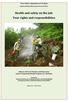 Sí Se: Salud y Seguridad en el Trabajo Health and Safety Education for Forest Workers Health and safety on the job: Your rights and responsibilities Alliance of Forest Workers and Harvesters Labor Occupational
GE Wind Turbine Climbing Rules and Rescue from Height
 GE Wind Turbine Climbing Rules and Rescue from Height Wind Turbine Climbing Rules This material has been prepared from our GE Wind Turbine Climbing Rules and procedure. Image Place Holder Image Place Holder
Automotive and Diesel Lab Safety Guidelines
 Section A: Safety Training All new students shall receive safety training prior to performing lab activities. The training shall include: a. S/P2 Pollution Prevention including relevant EPA regulations,
1.20.2 Definitions. The following definitions are applicable to this OG:
 Blackwood Fire Company Operating Guidelines 1.20 Water Rescue and Recovery Operations 1.20.1 Scope This Operating Guideline (OG) will apply to all incidents (except swimming pools) where victims require
Search & Rescue Merit Badge
 FEMA Course IS-100b Introduction to the Incident Command System for Search & Rescue Merit Badge Visual 1.1 Search & Rescue Merit Badge (requirement #5) Complete the training for ICS-100, Introduction to
UNIFORMS AND EQUIPMENT
 CHAPTER 29 May 15, 2000 UNIFORMS AND EQUIPMENT 29.1 QUARTERMASTER 29.1.1 The Quartermaster is responsible for the distribution of uniforms and equipment in accordance with procedures established by the
Standard Operating Guideline for
 MABAS DIVISION 5 Standard Operating Guideline SUBJECT: Emergency Incident Rehabilitation S.O.G. REHAB 2009 Approved: December 16, 2009 Revised: Standard Operating Guideline for Emergency Incident Rehabilitation
. FLEET MANAGEMENT POLICY
 Fleet Management Overview It is the policy of to safely operate company vehicles in adherence with all applicable laws and regulations. This fleet policy reflects the requirements and standards to effectively
*GTA 05-08-003 HAZARDOUS MATERIAL SPILL RESPONSE PROCEDURES
 *GTA 05-08-003 HAZARDOUS MATERIAL SPILL RESPONSE PROCEDURES This graphic training aid (GTA) provides a vehicle operator with information to respond to a hazardous material (HAZMAT) release or spill that
Welcome! We re glad you re here!
 Welcome! We re glad you re here! Please review the information in this PowerPoint to complete your Observation Checklist on page 11 of the Job Shadow Paperwork. 2/25/2014 Observer Orientation The purpose
For Accepted Students Handbook. Global Program: Atlanta, Georgia
 For Accepted Students Handbook Global Program: Atlanta, Georgia 1 For Accepted Students Congratulations! We are looking forward to your participation in this unique and engaging program. We have compiled
Contractor s Injury Management Toolbox RISK CONTROL
 Contractor s Injury Management Toolbox managing job site accidents and injuries RISK CONTROL Your Role in Workplace Safety As a superintendent or foreman, you play an important role in helping our company
Overview In this meeting we will cover
 Overview In this meeting we will cover What outdoor education is What the program components are How the program works to support MCPS curricular goals Other functions and opportunities provided by outdoor
FIRE SCIENCE Associate of Applied Science and Certificates
 FIRE SCIENCE Associate of Applied Science and Certificates The Associate of Fire Science degree is designed to give students the essential educational and hands-on elements needed for a career in firefighting.