
HierarchyMap: A Novel Approach to Treemap Visualization of Hierarchical Data
|
|
|
- Estella Allen
- 10 years ago
- Views:
Transcription
1 P a g e 77 Vol. 9 Issue 5 (Ver 2.0), January 2010 Global Journal of Computer Science and Technology HierarchyMap: A Novel Approach to Treemap Visualization of Hierarchical Data Abstract- The HierarchyMap describes a novel approach for Treemap Visualization method for representing large volume of hierarchical information on a 2-dimensional space. HierarchyMap algorithm is a new ordered treemap algorithm. Results of the implementation of HierarchyMap treemap algorithm show that it is capable of representing several thousands of hierarchical data on 2-dimensional space on a computer and Portable Device Application (PDA) screens while still maintaining the qualities found in existing treemap algorithms such as readability, low aspect ratio, reduced run time, and reduced number of thin rectangles. The HierarchyMap treemap algorithm is implemented in Java programming language and tested with dataset of Departmental and Faculty systems of Universities, Family trees, Plant and Animal taxonomy structures. Keywords-Treemaps, Aspect ratio, HierarchyMap, Hierarchical data, Tree-like structure, Node. L I. INTRODUCTION arge volume of data we use today are represented in hierarchical structures, such structures in their natural forms includes information about Corporate Organizations, University/Departmental Structures, Family trees, Manuals Directory, Internet Addressing, Library Cataloging, Computer Programs, Animal and Plant Taxonomy, e.t.c. The contents and organization of these structures are easily understood if they are small, but very difficult to understand when the structures become large (Mark Bruls, et al.,2000). These problems lead to the concept of Treemaps (Shneiderman and Johnson, 1991). Treemap describes the notion of turning a tree into a planar space-filling map. It is described as space-filling visualization method capable of representing large hierarchical collections of quantitative data. A treemap works by dividing the display area into a nested sequence of rectangles whose areas correspond to an attribute of the dataset, effectively combining aspects of a Venn diagram and a pie chart (Shneiderman et al., 2002). With Treemaps, large hierarchical structures can be viewed without any difficulty because the Treemap visualization Manuscript received 19 th December st author: Department of Computer and Mathematical Sciences, College of Natural and Applied Sciences, Crawford University, Faith City, Igbesa, Nigeria. (Telephone: [email protected]) 2 nd author: Department of Computer and Information Sciences, School of Natural and Applied Sciences, Covenant University, Ota, Nigeria. (Telephone: [email protected]) Aborisade D. O. And Oyelade O. J method maps hierarchical information into a rectangular 2- dimensional display in a space-filling manner such that 100% of the designated display space is utilized. Interactive control allows users to specify the presentation of both structural (depth bounds, etc.) and content (display properties) information (Shneiderman, 1992). This is in contrast to traditional static methods of displaying hierarchically structured information, which generally makes either poor use of display space or hide vast quantities of information from users. With the Treemap method, sections of the hierarchy containing more important Information can be allocated more display space while ortions of the hierarchy, which are less important to the specific task, can be allocated more space. Although treemaps are originally designed to visualize files on a hard drive (Shneiderman, 1992), it has been applied to a wide variety of areas ranging from financial analysis, business intelligence, money market, stock portfolio to sports reporting ( Wattenberg, 1999). A key ingredient of a treemap is the algorithm used to create the nested rectangles that make up the map. These set of rectangles are referred to as the layout of the treemap. In this work, we developed and implemented a novel HierarchyMap Algorithm. The idea behind this algorithm is to layout information from an hierarchy structures on nested rectangles which we called HierarchyMap Treemap. With this algorithm, every attribute in a hierarchical structure is represented by a rectangular node on the treemap. Each rectangle on the treemap corresponds to an attribute of the dataset. Each of these nodes representing the main attributes of tree-like structures is made to generate the information of sub-nodes of a lower level of the hierarchical structures. This process would continue until all the information in the different levels of the tree hierarchy are displayed one after the other on the same 2-dimensional screen. II. RELATED WORKS GJCST Classifications: D.2.12, I.2.8, E.1, G.4, G.2.2 There are various methods that have been applied to display structure of information, and one of these techniques is the traditional tree diagram where elements are shown as nodes and relations are shown as links from parent to child nodes. More improved techniques have been presented to enhance the efficiency and qualities of such diagram both in 2- dimensional and 3-dimensional space (Furnas, 1986), Knuth, 1973), (Bruggemenn, 1989), and (Card et al.,1991). These techniques have been found to be effective for small trees, but generally ineffective when more than hundreds elements have to be visualized simultaneously. The major reason for this limitation is that node and link diagrams use

2 Global Journal of Computer Science and Technology Vol. 9 Issue 5 (Ver 2.0), January 2010 P a g e 78 the display space inefficiently as depicted in the Figure 1 below: Fig. 1: Tree diagram for representing Hierarchical Data Structure (Mark Bruls et al., 2000) Fig. 2: TreeMap representing the Hierarchical Data Structure in fig. 1 (Mark Bruls et al., 2000) A treemap as shown in Figure 2 above was developed and introduced to solve the problem of this space usage by using the full display space to visualize the contents of the tree (Johnson and Shneidermann, 1991), (B. Shnerdermann, 1992). As illustrated in Figure 2 above, Slice and Dice treemap algorithm splits the display rectangles along horizontal and vertical lines while recursively traversing a hierarchically structured dataset in top down direction (Shneiderman,1992). Slice- and Dice treemap are very effective when size is the most important feature to be displayed. However, this method also has the problem of creating layouts that contain many rectangles with a high aspect ratio. Therefore, many other treemap layout algorithms have been proposed. In order to overcome this limitations. These include Cluster and Squarified treemap algorithms, Cluster treemap uses a simple recursive algorithm that reduces overall aspect ratios (Wattenberg, 1999), while Squarified treemap algorithm presented the layout of the children in one rectangle as a recursive procedure squarify (Bruls et al., 2000). This procedure lays-out the rectangles in horizontal and vertical rows. When a rectangle is processed, a decision is made between two alternatives, either the rectangle is added to the current row, or the current row is fixed and a new row is started in the remaining subrectangle. This decision depends only on whether adding a rectangle to the row will improve the layout of the current row or not. These methods also have their drawbacks; changes in the data set can cause dramatic discontinuous changes in the layout produced by both cluster treemaps and squarified treemaps. This rapid layout changes also cause an unattractive flickering that draws attention away from other aspects of the visualization and makes it hard to find items on the treemap. Another problem with Cluster and Squarified treemap is that, its layouts fail to preserve order of information as it is done with slice and dice treemap. Many ordered treemap algorithms were introduced to address the limitations in slice-and-dice, Cluster, and Squarified treemap algorithms. The motivating factor here is to seek for the creation of layout in which items that are next to each other in a given order are adjacent in the treemap. Ordered treemaps include Pivot by Split Size, Pivot by Middle, Split and Strip treemap algorithm. These ordered treemaps generally change relatively smoothly under dynamic updates and roughly preserve order, produce rectangles with low aspect ratios compared to that of cluster and squarified treemap (Shneiderman et al. 2002). Pivot- by- middle algorithm selects the pivot to the middle item of the list so as to create a balanced layout. With this idea, this algorithm is not sensitive to changes as Pivot by- Split Size. The pivot is taken to be the item (rectangle) with the largest area. Pivot by-split-size selects the pivot that will split the list into approximately equal total areas. These two algorithms create layouts that roughly preserve order and are relatively efficient, but fail to produce layouts with relatively low aspect ratio. Strip algorithm is a modification of the Squarified treemap algorithm. It works by processing input rectangles in order, laying them out in horizontal or vertical strips of varying thickness. It is efficient in that it produces a layout with better readability than the basic ordered treemap algorithm, and reasonable aspect ratios and stability (Shneiderman et al. 2002). III. METHODS A. Development of HierarchyMap Algorithm The algorithm for the HierarchyMap treemap is as follows: Infotree(treedata nodes) T={t1,t2,t3,.., tn} and a 2- D space divided into four equal rectangles. i. If the number of hierarchical items to be displayed is zero (i.e. T=0), then no display. ii. If the number of hierarchical items to be displayed is 1 (i.e T=1), then Set 2-D space to the item. iii. If the number of items is greater than 1, split the rectangular 2-D space into four equal sizes and recursively divides each of the resultant item into fours until all items in the list are exhausted such that ti T1, tj T2, tk T3, tn Tn : ti ti+1 tj tj+1 tk tk+1... tn tn+1. iv. An attribute of each hierarchical item corresponds to an area of each of the nested rectangles is defined as area( R) in such a manner that their areas correspond to the size of the elements of T1, T2 T3, and T4 where area (R1) area (R2) area (R3)..... area (Rn). The algorithm accepts inputs data in hierarchical form. These input items in their hierarchical order are stored, read
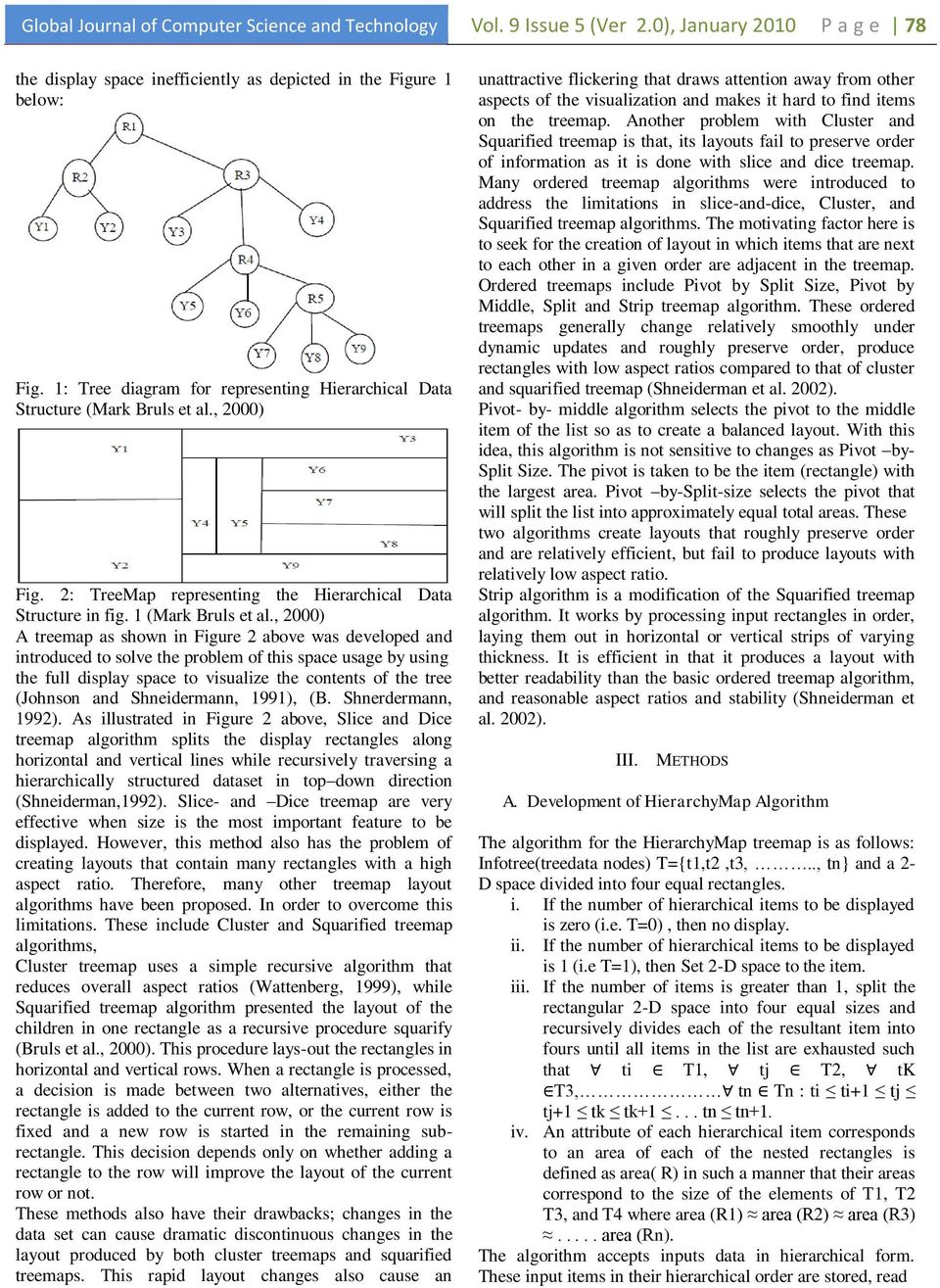
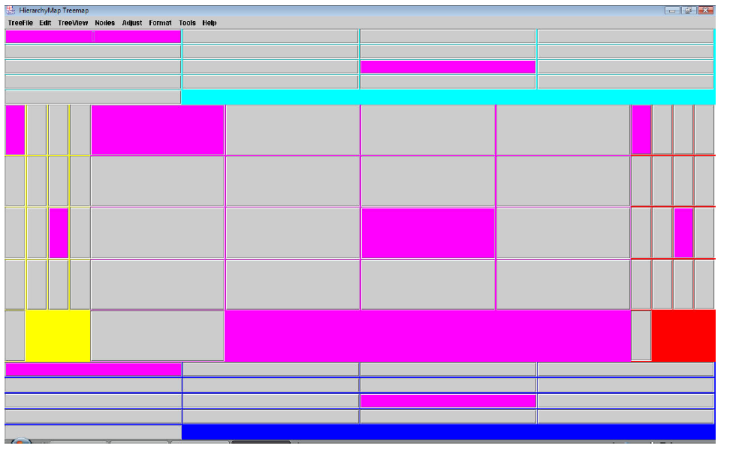
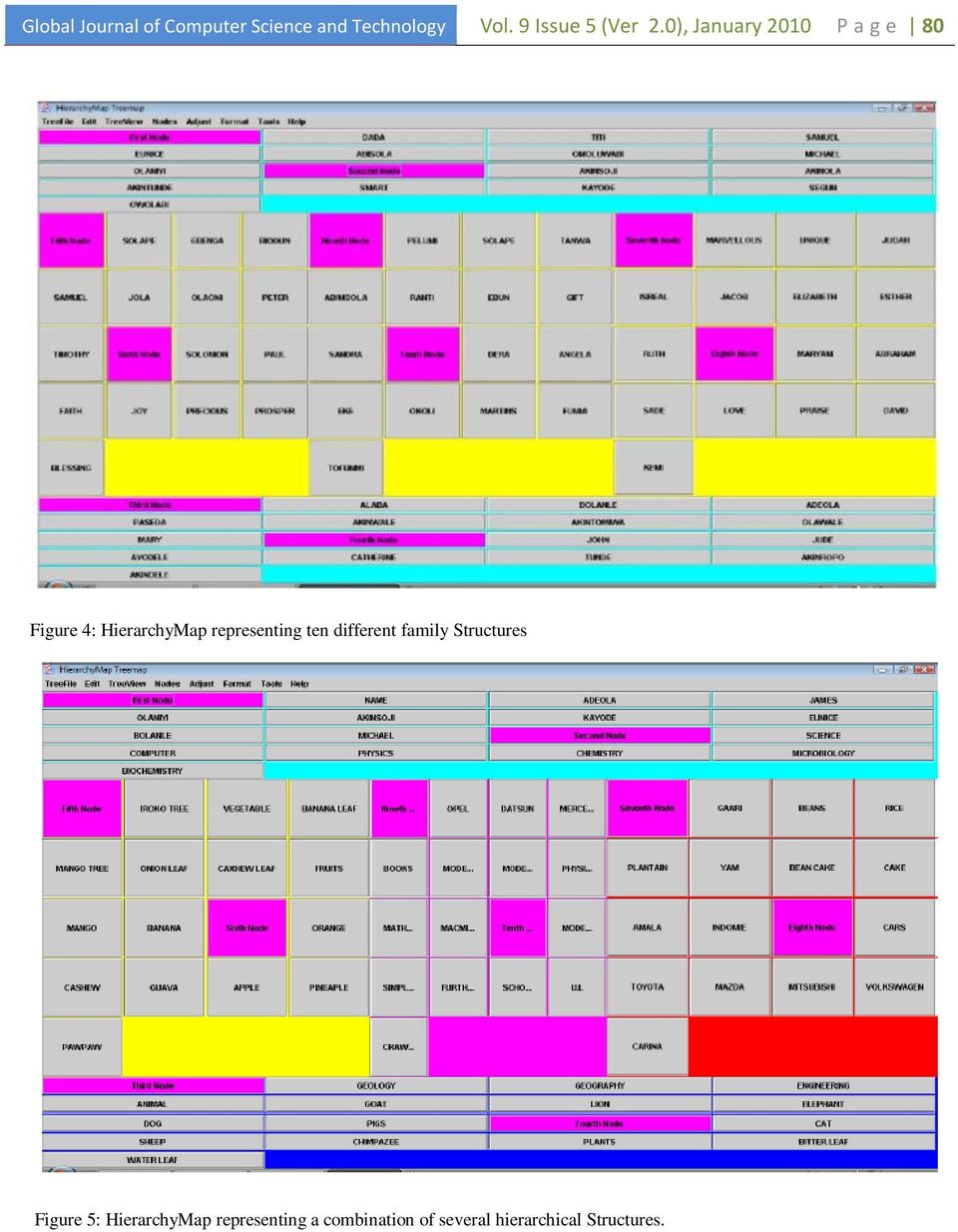
3 P a g e 79 Vol. 9 Issue 5 (Ver 2.0), January 2010 Global Journal of Computer Science and Technology and lay-out on nested rectangles which make up a treemap on the computer screen. The entire 2-dimensional computer screen is divided first into four equal parts, each of the successive parts is then repeatedly divided into four parts in such a way that the resultant rectangles are grouped according to the nodes level to be represented in the entire hierarchical data. This is to ensure that the order of the items to be displayed is maintained. These items are then linked to each of the resultant rectangles that make up the treemap. Each rectangle that represents the node level of tree data can then clicked repeatedly to display the sub-node elements. Every other nodal rectangle on the treemap could be clicked to display their own sub-node elements in a similar manner. In this process, several thousands of items of information could be displayed and viewed in a single space of 2- dimensional treemap. IV. RESULTS AND DISCUSSION HierarchyMap algorithm is tested with a several number of sample data of the information structures such as University system, Family system, and Animal Taxonomy. The results of this implementation are represented in Figures 3,4 and 5 respectively. Figure 3 shows the treemap appearance with no information, Figure 4 shows the treemap representation of ten different families Structure and the adjustment of each of the rectangles to reduce their aspect ratio, improve their readability, reduction of thin rectangles. Finally, Figure 5 shows the HierarchyMap for the combination of several tree structures capable of displaying thousands of information. It also shows the adjustment change of the rectangles to demonstrate its optimum measures of the three treemap metrics (i.e. aspect ratio, readability, ordering and capability for change) as data is updated. The results of this implementation also shows that this HierarchyMap algorithm is similar to other existing treemaps in that, it lays out hierarchical information on nested rectangles, and added further advantage by making it possible to display very large volume of hierarchical information by continuous clicking of node level rectangle, which we have demonstrated in the implementation. Figure 3: HierarchyMap showing nested rectangles without information


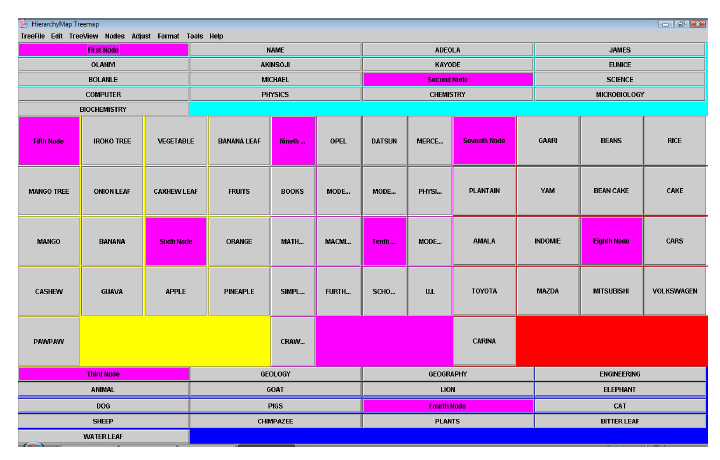
4 Global Journal of Computer Science and Technology Vol. 9 Issue 5 (Ver 2.0), January 2010 P a g e 80 Figure 4: HierarchyMap representing ten different family Structures Figure 5: HierarchyMap representing a combination of several hierarchical Structures.
5 P a g e 81 Vol. 9 Issue 5 (Ver 2.0), January 2010 Global Journal of Computer Science and Technology V. CONCLUSIONS In this work, we developed and implemented a novel treemap called HierarchyMap algorithm, which improved on the limitations of the existing treemap algorithms such as Slice-and-dice, Cluster, Squarified, Strip, etc. and added a new feature, which enable viewing of several thousands of hierarchical information by clicking on any of the nodal rectangles. The result showed that the HierarchyMap treemap algorithm has the capability for adjustment change whenever data are updated; it also improved on readability, preservation of order, low aspect ratio, and reduced number of thin rectangles. The combination of these treemap metrics makes HierarchyMap a promising treemap algorithm for the future. VI. REFERENCES 1) Bruggemann-Klein and D. Wood. Drawing trees nicely with tex. Electronic Publishing, 2(2): , ) Johnson and B. Shneiderman. Treemaps: A spacefilling approach to the Visualization of Hierarchical Information Structures. In Proc. of the 2nd International IEEE Visualization Conference, pages , October ) Shneiderman. Tree visualization with treemaps:a 2-D space-filling approach. ACM Transactions on Graphics, 11(1):92 99, September ) Bruls S., M., Huizing, K., and Van Wijk, J., Squarified treemaps. In Proceedings of the Joint Eurographics and IEEE TCVG Symposium on Visualization (VisSym), ) Bederson, B., Shneiderman, B., and Wattenberg, M Ordered and quantum treemaps: Making effective use of 2D space to display hierarchies. ACM Transactions on Graphics 21, 4, ) D.E. Knuth. Fundamental algorithms. Art of computer programming. Volume 1. Addison-Wesley, Reading, MA, ) G.W. Furnas. Generalized fisheye views. In Proc. of ACM CHI 86, Conference on Human Factors in computing systems, pages 16 23, ) Herman H, Maurer. Data Structures and Programming Techniques. Prentice- All Incorporation ) J. Bingham and S.Sudarsanum. Visualising large hierarchical clusters in Hyperbolic space. Bioinfomatics Chapter 16:pg , Malin Koksal, Visualization of threaded discussions forums on handheld devices, Masters Thesis at NADA, ) Russel Winder and Graham Roberts, Developing Java Software, John Wiley & Sons ) S.K. Card, G.G. Robertson, and J.D. Mackinlay. The information visualizer, an information workspace. In Proc. of ACM CHI 91, Conference on Human Factors in Computing Systems, pages , ) Wattenberg, M Visualizing the stock market. In Extended Abstracts onbhuman Factors in Computing Systems (CHI), ACM Press,

Ordered Treemap Layouts
 Ordered Treemap Layouts Ben Shneiderman Department of Computer Science, Human-Computer Interaction Lab, Insitute for Advanced Computer Studies & Institute for Systems Research University of Maryland [email protected]
Squarified Treemaps. Mark Bruls, Kees Huizing, and Jarke J. van Wijk
 Squarified Treemaps Mark Bruls, Kees Huizing, and Jarke J. van Wijk Eindhoven University of Technology Dept. of Mathematics and Computer Science, P.O. Box 513, 500 MB Eindhoven, The Netherlands emailfkeesh,
Treemaps for Search-Tree Visualization
 Treemaps for Search-Tree Visualization Rémi Coulom July, 2002 Abstract Large Alpha-Beta search trees generated by game-playing programs are hard to represent graphically. This paper describes how treemaps
Agenda. TreeMaps. What is a Treemap? Basics
 Agenda TreeMaps What is a Treemap? Treemap Basics Original Treemap Algorithm (Slice-and-dice layout) Issues for Treemaps Cushion Treemaps Squarified Treemaps Ordered Treemaps Quantum Treemaps Other Treemaps
Hierarchical Data Visualization. Ai Nakatani IAT 814 February 21, 2007
 Hierarchical Data Visualization Ai Nakatani IAT 814 February 21, 2007 Introduction Hierarchical Data Directory structure Genealogy trees Biological taxonomy Business structure Project structure Challenges
Visualizing Large Graphs with Compound-Fisheye Views and Treemaps
 Visualizing Large Graphs with Compound-Fisheye Views and Treemaps James Abello 1, Stephen G. Kobourov 2, and Roman Yusufov 2 1 DIMACS Center Rutgers University {abello}@dimacs.rutgers.edu 2 Department
Hierarchy and Tree Visualization
 Hierarchy and Tree Visualization Definition Hierarchies An ordering of groups in which larger groups encompass sets of smaller groups. Data repository in which cases are related to subcases Hierarchical
Hierarchical Data Visualization
 Hierarchical Data Visualization 1 Hierarchical Data Hierarchical data emphasize the subordinate or membership relations between data items. Organizational Chart Classifications / Taxonomies (Species and
Cascaded Treemaps: Examining the Visibility and Stability of Structure in Treemaps
 Cascaded Treemaps: Examining the Visibility and Stability of Structure in Treemaps Hao Lü and James Fogarty Computer Science & Engineering DUB Group University of Washington { hlv, jfogarty }@cs.washington.edu
Regular TreeMap Layouts for Visual Analysis of Hierarchical Data
 Regular TreeMap Layouts for Visual Analysis of Hierarchical Data Tobias Schreck Daniel Keim Florian Mansmann Databases and Visualization Group University of Konstanz, Germany {schreck,keim,mansmann}@inf.uni-konstanz.de
A Note on Space-Filling Visualizations and Space-Filling Curves
 A Note on Space-Filling Visualizations and Space-Filling Curves Martin Wattenberg, IBM Research ABSTRACT A recent line of treemap research has focused on layout algorithms that optimize properties such
Visualization Techniques in Data Mining
 Tecniche di Apprendimento Automatico per Applicazioni di Data Mining Visualization Techniques in Data Mining Prof. Pier Luca Lanzi Laurea in Ingegneria Informatica Politecnico di Milano Polo di Milano
Space-filling Techniques in Visualizing Output from Computer Based Economic Models
 Space-filling Techniques in Visualizing Output from Computer Based Economic Models Richard Webber a, Ric D. Herbert b and Wei Jiang bc a National ICT Australia Limited, Locked Bag 9013, Alexandria, NSW
7. Hierarchies & Trees Visualizing topological relations
 7. Hierarchies & Trees Visualizing topological relations Vorlesung Informationsvisualisierung Prof. Dr. Andreas Butz, WS 2011/12 Konzept und Basis für n: Thorsten Büring 1 Outline Hierarchical data and
6.3 Treemaps: a space-filling approach to the visualization of hierarchical information structures
 Sparks of Innovation in Human-Computer Interaction, 275 B. Shneiderman, Ed., Ablex Publ., Norwood, NJ (1993) 6.3 Treemaps: a space-filling approach to the visualization of hierarchical information structures
Tree Visualization with Tree-Maps: 2-d Space-Filling Approach
 I THE INTERACTION TECHNIQUE NOTEBOOK I Tree Visualization with Tree-Maps: 2-d Space-Filling Approach Ben Shneiderman University of Maryland Introduction. The traditional approach to representing tree structures
Improvements of Space-Optimized Tree for Visualizing and Manipulating Very Large Hierarchies
 Improvements of Space-Optimized Tree for Visualizing and Manipulating Very Large Hierarchies Quang Vinh Nguyen and Mao Lin Huang Faculty of Information Technology University of Technology, Sydney, Australia
Package treemap. February 15, 2013
 Type Package Title Treemap visualization Version 1.1-1 Date 2012-07-10 Author Martijn Tennekes Package treemap February 15, 2013 Maintainer Martijn Tennekes A treemap is a space-filling
TOP-DOWN DATA ANALYSIS WITH TREEMAPS
 TOP-DOWN DATA ANALYSIS WITH TREEMAPS Martijn Tennekes, Edwin de Jonge Statistics Netherlands (CBS), P.0.Box 4481, 6401 CZ Heerlen, The Netherlands [email protected], [email protected] Keywords: Abstract:
TREE-MAP: A VISUALIZATION TOOL FOR LARGE DATA
 TREE-MAP: A VISUALIZATION TOOL FOR LARGE DATA Mahipal Jadeja DA-IICT Gandhinagar,Gujarat India Tel:+91-9173535506 [email protected] Kesha Shah DA-IICT Gandhinagar,Gujarat India Tel:+91-7405217629
Interaction and Visualization Techniques for Programming
 Interaction and Visualization Techniques for Programming Mikkel Rønne Jakobsen Dept. of Computing, University of Copenhagen Copenhagen, Denmark [email protected] Abstract. Programmers spend much of their
Cushion Treemaps: Visualization of Hierarchical Information
 To be presented at the IEEE Symposium on Information Visualization (INFOVIS 99), San Francisco, October 25-26, 1999 Cushion Treemaps: Visualization of Hierarchical Information Jarke J. van Wijk Huub van
Rendering Hierarchical Data
 Rendering Hierarchical Data Jarke J. van Wijk, Frank van Ham, and Huub van de Wetering Why is my hard disk full? A question no doubt familiar to many readers, and one that has inspired our research for
Interactive Visual Analysis of the NSF Funding Information
 Interactive Visual Analysis of the NSF Funding Information Shixia Liu IBM China Research Lab Nan Cao IBM China Research Lab Hao Lv Shanghai Jiaotong University IBM China Research Lab ABSTRACT This paper
TECHNICAL REPORT. Extending Tree-Maps to Three Dimensions A Comparative Study. Thomas Bladh, David A. Carr, Jeremiah Scholl.
 2004:04 TECHNICAL REPORT Extending Tree-Maps to Three Dimensions A Comparative Study Thomas Bladh, David A. Carr, Jeremiah Scholl Technical Report Department of Computer Science and Electrical Engineering
Cabinet Tree: An Orthogonal Enclosure Approach to Visualizing and Exploring Big Data
 Cabinet Tree: An Orthogonal Enclosure Approach to Visualizing and Exploring Big Data Yalong Yang 1 Kang Zhang 1,2 Quang Vinh Nguyen 3 Jianrong Wang 4 1 School of Computer Software, Tianjin University,
Project Portfolio Earned Value Management Using Treemaps. University of Maryland, College Park, Maryland. 1 Introduction
 Project Portfolio Earned Value Management Using Treemaps John H. Cable, Javier F. Ordonez 1, Gouthami Chintalapani 2 and Catherine Plaisant 2 1 Project Management Program, 2 Human-Computer Interaction
Introduction of Information Visualization and Visual Analytics. Chapter 7. Trees and Graphs Visualization
 Introduction of Information Visualization and Visual Analytics Chapter 7 Trees and Graphs Visualization Overview! Motivation! Trees Visualization! Graphs Visualization 1 Motivation! Often datasets contain
Effective Visualization of File System Access-Control
 Effective Visualization of File System Access-Control Alexander Heitzmann 1, Bernardo Palazzi 1,2,3, Charalampos Papamanthou 1, and Roberto Tamassia 1 1 Brown University, Department of Computer Science,
An example. Visualization? An example. Scientific Visualization. This talk. Information Visualization & Visual Analytics. 30 items, 30 x 3 values
 Information Visualization & Visual Analytics Jack van Wijk Technische Universiteit Eindhoven An example y 30 items, 30 x 3 values I-science for Astronomy, October 13-17, 2008 Lorentz center, Leiden x An
Voronoi Treemaps in D3
 Voronoi Treemaps in D3 Peter Henry University of Washington [email protected] Paul Vines University of Washington [email protected] ABSTRACT Voronoi treemaps are an alternative to traditional rectangular
Cabinet Tree: an orthogonal enclosure approach to visualizing and exploring big data
 Yang et al. Journal of Big Data DOI 10.1186/s40537-015-0022-3 RESEARCH Open Access Cabinet Tree: an orthogonal enclosure approach to visualizing and exploring big data Yalong Yang 2,3, Kang Zhang 4,JianrongWang
Visualizing Changes of Hierarchical Data using Treemaps
 286 IEEE TRANSACTIONS ON VISUALIZATION AND COMPUTER GRAPHICS, VOL. 3, NO. 6, NOVEMBER/DECEMBER 27 Visualizing Changes of Hierarchical Data using Treemaps Ying Tu and Han-Wei Shen Abstract While the treemap
Degree-of-Interest Trees: A Component of an Attention-Reactive User Interface
 Degree-of-Interest Trees: A Component of an Attention-Reactive User Interface Stuart K. Card, David Nation Palo Alto Research Center 3333 Coyote Hill Road Palo Alto, California 94304 USA [email protected],
Graphical representation of the comprehensive patient flow through the Hospital
 Graphical representation of the comprehensive patient flow through the Hospital Emmanuel Chazard, Régis Beuscart, MD, PhD 1 1 Department of Medical Information, EA 2694, University Hospital, Lille, France
Elastic Hierarchies: Combining Treemaps and Node-Link Diagrams
 Elastic Hierarchies: Combining Treemaps and Node-Link Diagrams Shengdong Zhao 1 University of Toronto Michael J. McGuffin 2 University of Toronto Mark H. Chignell 3 University of Toronto Node Link Diagram
Component visualization methods for large legacy software in C/C++
 Annales Mathematicae et Informaticae 44 (2015) pp. 23 33 http://ami.ektf.hu Component visualization methods for large legacy software in C/C++ Máté Cserép a, Dániel Krupp b a Eötvös Loránd University [email protected]
Treemap Presentation as a Corporate Dashboard Larry Day & Richard Dickinson Corporate Performance Measures BNSF Railway
 Paper AD07 Treemap Presentation as a Corporate Dashboard Larry Day & Richard Dickinson Corporate Performance Measures BNSF Railway Treemap data presentation as an exception-based reporting tool for corporate
VISUALIZING HIERARCHICAL DATA. Graham Wills SPSS Inc., http://willsfamily.org/gwills
 VISUALIZING HIERARCHICAL DATA Graham Wills SPSS Inc., http://willsfamily.org/gwills SYNONYMS Hierarchical Graph Layout, Visualizing Trees, Tree Drawing, Information Visualization on Hierarchies; Hierarchical
Evaluating the Effectiveness of Tree Visualization Systems for Knowledge Discovery
 Eurographics/ IEEE-VGTC Symposium on Visualization (2006) Thomas Ertl, Ken Joy, and Beatriz Santos (Editors) Evaluating the Effectiveness of Tree Visualization Systems for Knowledge Discovery Yue Wang
Treemaps with bounded aspect ratio
 technische universiteit eindhoven Department of Mathematics and Computer Science Master s Thesis Treemaps with bounded aspect ratio by Vincent van der Weele Supervisor dr. B. Speckmann Eindhoven, July
TEXT-FILLED STACKED AREA GRAPHS Martin Kraus
 Martin Kraus Text can add a significant amount of detail and value to an information visualization. In particular, it can integrate more of the data that a visualization is based on, and it can also integrate
Voronoi Treemaps for the Visualization of Software Metrics
 Voronoi Treemaps for the Visualization of Software Metrics Michael Balzer University of Konstanz, Germany Oliver Deussen University of Konstanz, Germany Claus Lewerentz Brandenburg University of Technology
The Eyes Have It: A Task by Data Type Taxonomy for Information Visualizations. Ben Shneiderman, 1996
 The Eyes Have It: A Task by Data Type Taxonomy for Information Visualizations Ben Shneiderman, 1996 Background the growth of computing + graphic user interface 1987 scientific visualization 1989 information
3 Information Visualization
 3 Information Visualization 3.1 Motivation and Examples 3.2 Basics of Human Perception 3.3 Principles and Terminology 3.4 Standard Techniques for Visualization 3.5 Further Examples Ludwig-Maximilians-Universität
Porting a TreeMap Library from AWT/Swing to SWT/JFace
 School of Mathematics and Systems Engineering Reports from MSI - Rapporter från MSI Porting a TreeMap Library from AWT/Swing to SWT/JFace Lirim Jusufi October 2009 MSI Report 09069 Växjö University ISSN
Package treemap. October 14, 2015
 Type Package Title Treemap Visualization Version 2.4 Date 2015-10-14 Author Martijn Tennekes Package treemap October 14, 2015 Maintainer Martijn Tennekes A treemap is a space-filling
The ICE-Map Visualization
 The ICE-Map Visualization Kai Eckert [email protected] Technical Report TR-2011-003 Department of Computer Science University of Mannheim, Germany December 7, 2011 Abstract In this paper,
Information Visualization of Attributed Relational Data
 Information Visualization of Attributed Relational Data Mao Lin Huang Department of Computer Systems Faculty of Information Technology University of Technology, Sydney PO Box 123 Broadway, NSW 2007 Australia
NakeDB: Database Schema Visualization
 NAKEDB: DATABASE SCHEMA VISUALIZATION, APRIL 2008 1 NakeDB: Database Schema Visualization Luis Miguel Cortés-Peña, Yi Han, Neil Pradhan, Romain Rigaux Abstract Current database schema visualization tools
Discovering Business Intelligence Using Treemap Visualizations
 1 of 11 4/25/2012 10:41 AM
Visualization methods for patent data
 Visualization methods for patent data Treparel 2013 Dr. Anton Heijs (CTO & Founder) Delft, The Netherlands Introduction Treparel can provide advanced visualizations for patent data. This document describes
Information Visualization Multivariate Data Visualization Krešimir Matković
 Information Visualization Multivariate Data Visualization Krešimir Matković Vienna University of Technology, VRVis Research Center, Vienna Multivariable >3D Data Tables have so many variables that orthogonal
ONLINE FILE SHARING PALANIAPPAN RAMANATHAN. B.E., Annamalai University, India, 2004 A REPORT MASTER OF SCIENCE
 ONLINE FILE SHARING by PALANIAPPAN RAMANATHAN B.E., Annamalai University, India, 2004 A REPORT submitted in partial fulfillment of the requirements for the degree MASTER OF SCIENCE Department of Computing
VisCG: Creating an Eclipse Call Graph Visualization Plug-in. Kenta Hasui, Undergraduate Student at Vassar College Class of 2015
 VisCG: Creating an Eclipse Call Graph Visualization Plug-in Kenta Hasui, Undergraduate Student at Vassar College Class of 2015 Abstract Call graphs are a useful tool for understanding software; however,
Information Visualisation and Visual Analytics for Governance and Policy Modelling
 Information Visualisation and Visual Analytics for Governance and Policy Modelling Jörn Kohlhammer 1, Tobias Ruppert 1, James Davey 1, Florian Mansmann 2, Daniel Keim 2 1 Fraunhofer IGD, Fraunhoferstr.
All Visualizations Documentation
 All Visualizations Documentation All Visualizations Documentation 2 Copyright and Trademarks Licensed Materials - Property of IBM. Copyright IBM Corp. 2013 IBM, the IBM logo, and Cognos are trademarks
VISUALIZATION APPROACH FOR SOFTWARE PROJECTS
 Canadian Journal of Pure and Applied Sciences Vol. 9, No. 2, pp. 3431-3439, June 2015 Online ISSN: 1920-3853; Print ISSN: 1715-9997 Available online at www.cjpas.net VISUALIZATION APPROACH FOR SOFTWARE
BIG DATA VISUALIZATION. Team Impossible Peter Vilim, Sruthi Mayuram Krithivasan, Matt Burrough, and Ismini Lourentzou
 BIG DATA VISUALIZATION Team Impossible Peter Vilim, Sruthi Mayuram Krithivasan, Matt Burrough, and Ismini Lourentzou Let s begin with a story Let s explore Yahoo s data! Dora the Data Explorer has a new
Interactive Exploration of Decision Tree Results
 Interactive Exploration of Decision Tree Results 1 IRISA Campus de Beaulieu F35042 Rennes Cedex, France (email: pnguyenk,[email protected]) 2 INRIA Futurs L.R.I., University Paris-Sud F91405 ORSAY Cedex,
Extend Table Lens for High-Dimensional Data Visualization and Classification Mining
 Extend Table Lens for High-Dimensional Data Visualization and Classification Mining CPSC 533c, Information Visualization Course Project, Term 2 2003 Fengdong Du [email protected] University of British Columbia
Visual Analysis of Network Traffic for Resource Planning, Interactive Monitoring, and Interpretation of Security Threats
 Visual Analysis of Network Traffic for Resource Planning, Interactive Monitoring, and Interpretation of Security Threats Florian Mansmann, Daniel A. Keim, Stephen C. North, Brian Rexroad, and Daniel Sheleheda
Weighted Maps: treemap visualization of geolocated quantitative data
 Weighted Maps: treemap visualization of geolocated quantitative data Mohammad Ghoniem a and Maël Cornil a and Bertjan Broeksema a and Mickaël Stefas a and Benoît Otjacques a a CRP Gabriel Lippmann, 41
ONTOLOGY VISUALIZATION PROTÉGÉ TOOLS A REVIEW
 ONTOLOGY VISUALIZATION PROTÉGÉ TOOLS A REVIEW R. Sivakumar 1 and P.V. Arivoli 2 1 Associate Professor, Department of Computer Science, A.V.V.M. Sri Pushpam College, Bharathidasan University, Trichirappalli,
Visual Data Mining with Pixel-oriented Visualization Techniques
 Visual Data Mining with Pixel-oriented Visualization Techniques Mihael Ankerst The Boeing Company P.O. Box 3707 MC 7L-70, Seattle, WA 98124 [email protected] Abstract Pixel-oriented visualization
Visual Analysis Tool for Bipartite Networks
 Visual Analysis Tool for Bipartite Networks Kazuo Misue Department of Computer Science, University of Tsukuba, 1-1-1 Tennoudai, Tsukuba, 305-8573 Japan [email protected] Abstract. To find hidden features
Improving Testing Efficiency: Agile Test Case Prioritization
 Improving Testing Efficiency: Agile Test Case Prioritization www.sw-benchmarking.org Introduction A remaining challenging area in the field of software management is the release decision, deciding whether
An Adaptable Innovative Visualization For Multiple Levels of Users
 World Applied Sciences Journal 15 (5): 722-727, 2011 ISSN 1818-4952 IDOSI Publications, 2011 An Adaptable Innovative Visualization For Multiple Levels of Users Doris Hooi-Ten Wong and Sureswaran Ramadass
Hyperbolic Tree for Effective Visualization of Large Extensible Data Standards
 Hyperbolic Tree for Effective Visualization of Large Extensible Data Standards Research-in-Progress Yinghua Ma Shanghai Jiaotong University Hongwei Zhu Old Dominion University Guiyang SU Shanghai Jiaotong