
Genomic CDS: an example of a complex ontology for pharmacogenetics and clinical decision support
|
|
|
- Edith Arnold
- 10 years ago
- Views:
Transcription
1 Genomic CDS: an example of a complex ontology for pharmacogenetics and clinical decision support Matthias Samwald 1 1 Medical University of Vienna, Vienna, Austria [email protected] Abstract. Individual genetic data can be used to better predict the efficacy and safety of medications for individual patients. The Genomic Clinical Decision Support (Genomic CDS) ontology aims to utilize advanced Web Ontology Language 2 (OWL 2) reasoning for this task. The important, clear-cut medical use case, the complex axioms in the ontology and the heavy use of qualified cardinality restrictions make the ontology an interesting test object for new OWL 2 reasoners with improved performance. Keywords: OWL, pharmacogenetics, clinical decision support 1 Motivation Different patients can react drastically different to the same type of medication (Fig. 1). The goal of personalized medicine and pharmacogenetics is to predict an individual patient s response by analyzing genetic markers that influence how medications are metabolized or able to bind to their targets. Fig. 1. The efficacy and safety of medications can drastically vary between patients. The goal of pharmacogenetics is to classify patients into subgroup based on genetic markers, to better predict which treatments could help and which could do harm. To produce clinically valid and trustworthy predictions, no errors or ambiguities should arise in the process of inferring a patient s likely response from raw genetic

2 data. Current formalisms, data infrastructures and software applications leave many opportunities for introducing such errors and ambiguities. Ontologies formalized with the Web Ontology Language 2 (OWL 2) could be an excellent choice for tackling this problem, but the complexity and potentially large scale of ontologies in this domain also pose formidable challenges to currently available OWL 2 reasoners. 2 The Genomic CDS ontology The Genomic Clinical Decision Support (Genomic CDS) ontology is an OWL 2 ontology aimed at representing pharmacogenetic knowledge and providing clinical decision support based on pharmacogenetic data. It is being developed by members of the Clinical Pharmacogenomics Task Force, which is part of the Health Care and Life Science Interest Group of the World Wide Web Consortium (W3C). The OWL files of the ontology, as well as demo files containing example patient data can be downloaded from We also created a simplified version of the Genomic CDS ontology, called Genomic CDS light, which does not contain some of the axioms of the full ontology. Both versions of the ontology have ALCQ expressivity. They are characterized by extensive use of qualified cardinality restrictions. The goals of developing the ontology are: Providing a simple and concise formalism for representing pharmacogenetic knowledge, Finding errors and lacking definitions in pharmacogenetic knowledge bases Automatically assigning alleles and phenotypes to patients Matching patients to clinically appropriate pharmacogenetic guidelines and clinical decision support messages In the most common scenario, genetic patient data in OWL format is combined with the axioms of the Genomic CDS ontology, and an OWL reasoner is used to infer matching pharmacogenetic treatment recommendations. Several inference steps are needed to derive matching treatment recommendations from raw data about genetic markers (Fig. 2). The raw data consists of small variants in the genetic code, which in most cases are so-called single nucleotide polymorphisms (SNPs), such as an A instead of a G. Alleles are variants of a gene that are defined by containing sets of such small variants. Phenotypes are referring to the specific effects that certain small variants and alleles can have on the organism, e.g., how quickly a patient metabolizes a specific drug. Clinical guidelines can use small variants, alleles and/or phenotypes to match patients with treatment recommendations The human genome usually contains two copies of each gene (one from the father, one from the mother), with each copy potentially bearing multiple genetic variants. Because of this, the ontologies rely heavily on qualified cardinality restrictions with

3 cardinalities of two, which seems to cause performance issues with most current OWL reasoners. Fig. 2. : Through a series of inference steps, matching pharmacogenetic treatment guidelines are inferred from raw genetic patient data. A simplified example of a rule for inferring an allele (CYP2C9*3) and its single nucleotide polymorphisms (SNPs) from a so-called tagging SNP (a SNP that is necessary and sufficient for inferring the presence of the allele) looks like this in Manchester syntax: Class: 'human with CYP2C9*3' EquivalentTo: has some rs _c SubClassOf: has some 'CYP2C9 *3', (has some rs _c) and (has some rs _a) and (has some rs _c) and (has some rs _a) and (has some rs _agaaatggaa)

4

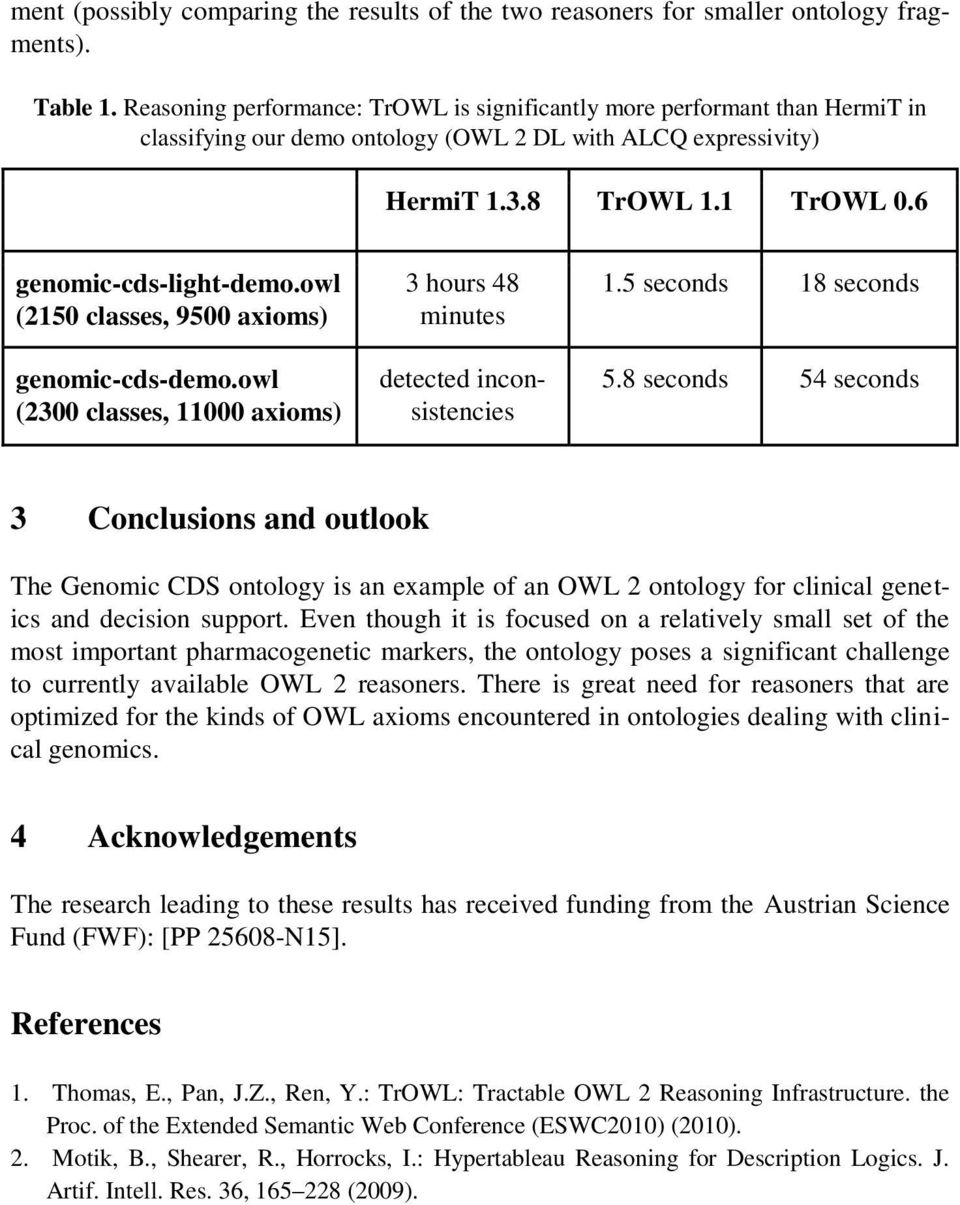
5 An example of an axiom for inferring an adequate clinical decision support message for the anticoagulant drug warfarin (based on a combination of alleles and SNPs according to an official recommendation in the drug label): Class: 'human triggering CDS rule 7' EquivalentTo: (has some 'CYP2C9*1') and (has some 'CYP2C9*3') and (has exactly 2 rs _c) Annotations: label "human triggering CDS rule 7", CDS_message "3-4 mg warfarin per day should be considered as a starting dose range for a patient with this genotype according to the Warfarin drug label (Bristol-Myers Squibb)." We used two OWL 2 reasoners with our ontology: TrOWL 1 [1] and HermiT 2 [2]. We also evaluated other OWL 2 reasoners (Fact++ 3, Pellet 4 ) in early stages of the project, but excluded them from further tests because they did not terminate or crashed even with small, preliminary versions of the ontology we developed. We compared the performance of the two reasoners on a virtual machine running on the Amazon Elastic Cloud Computing (EC2) cloud 5. The machine was of the High-Memory Extra Large Instance type, running Microsoft Windows Server 2008, with 17.1 GB of memory, a 64-bit platform, and two virtual cores with 3.25 EC2 compute units each. The reasoners were run as plugins in the 64 bit version of the Protégé 4.2 ontology editor. The initial heap size for Protégé was bytes (10 GB), and the maximum allowed heap size was 1.5x10 10 bytes (15 GB). The TrOWL reasoner plugins with version 0.6 and 1.1 were each run three times for each ontology, and the mean of the time needed for classification was calculated. The HermiT plugin was run once for each version of the ontology. These preliminary tests showed TrOWL to be significantly more performant than HermiT for classifying the ontologies ( Table 1). However, HermiT was able to identify biologically meaningful inconsistencies present in genomic-cds-demo.owl (but not present in the light version of the ontology). TrOWL did not recognize these inconsistencies, most likely because it only partially covers the OWL 2 DL ruleset. These results show that only TrOWL is performant enough to be used in realistic settings (e.g. for clinical decision support), but that HermiT could serve to test and validate the results from TrOWL during develop

6 ment (possibly comparing the results of the two reasoners for smaller ontology fragments). Table 1. Reasoning performance: TrOWL is significantly more performant than HermiT in classifying our demo ontology (OWL 2 DL with ALCQ expressivity) HermiT TrOWL 1.1 TrOWL 0.6 genomic-cds-light-demo.owl (2150 classes, 9500 axioms) genomic-cds-demo.owl (2300 classes, axioms) 3 hours 48 minutes detected inconsistencies 1.5 seconds 18 seconds 5.8 seconds 54 seconds 3 Conclusions and outlook The Genomic CDS ontology is an example of an OWL 2 ontology for clinical genetics and decision support. Even though it is focused on a relatively small set of the most important pharmacogenetic markers, the ontology poses a significant challenge to currently available OWL 2 reasoners. There is great need for reasoners that are optimized for the kinds of OWL axioms encountered in ontologies dealing with clinical genomics. 4 Acknowledgements The research leading to these results has received funding from the Austrian Science Fund (FWF): [PP N15]. References 1. Thomas, E., Pan, J.Z., Ren, Y.: TrOWL: Tractable OWL 2 Reasoning Infrastructure. the Proc. of the Extended Semantic Web Conference (ESWC2010) (2010). 2. Motik, B., Shearer, R., Horrocks, I.: Hypertableau Reasoning for Description Logics. J. Artif. Intell. Res. 36, (2009).
Integration of genomic data into electronic health records
 Integration of genomic data into electronic health records Daniel Masys, MD Affiliate Professor Biomedical & Health Informatics University of Washington, Seattle Major portion of today s lecture is based
A Pilot Study of the Incidence of Exposure to Drugs for which Preemptive Pharmacogenomic Testing Is Available
 A Pilot Study of the Incidence of Exposure to Drugs for which Preemptive Pharmacogenomic Testing Is Available Richard D. Boyce 1 Kathrin Blagec 2 Matthias Samwald 2 1 Department of Biomedical Informatics,
The Future of the Electronic Health Record. Gerry Higgins, Ph.D., Johns Hopkins
 The Future of the Electronic Health Record Gerry Higgins, Ph.D., Johns Hopkins Topics to be covered Near Term Opportunities: Commercial, Usability, Unification of different applications. OMICS : The patient
How To Use Networked Ontology In E Health
 A practical approach to create ontology networks in e-health: The NeOn take Tomás Pariente Lobo 1, *, Germán Herrero Cárcel 1, 1 A TOS Research and Innovation, ATOS Origin SAE, 28037 Madrid, Spain. Abstract.
Logical and categorical methods in data transformation (TransLoCaTe)
 Logical and categorical methods in data transformation (TransLoCaTe) 1 Introduction to the abbreviated project description This is an abbreviated project description of the TransLoCaTe project, with an
Ontology and automatic code generation on modeling and simulation
 Ontology and automatic code generation on modeling and simulation Youcef Gheraibia Computing Department University Md Messadia Souk Ahras, 41000, Algeria [email protected] Abdelhabib Bourouis
A Primer of Genome Science THIRD
 A Primer of Genome Science THIRD EDITION GREG GIBSON-SPENCER V. MUSE North Carolina State University Sinauer Associates, Inc. Publishers Sunderland, Massachusetts USA Contents Preface xi 1 Genome Projects:
Semantic Stored Procedures Programming Environment and performance analysis
 Semantic Stored Procedures Programming Environment and performance analysis Marjan Efremov 1, Vladimir Zdraveski 2, Petar Ristoski 2, Dimitar Trajanov 2 1 Open Mind Solutions Skopje, bul. Kliment Ohridski
Graph Database Performance: An Oracle Perspective
 Graph Database Performance: An Oracle Perspective Xavier Lopez, Ph.D. Senior Director, Product Management 1 Copyright 2012, Oracle and/or its affiliates. All rights reserved. Program Agenda Broad Perspective
Amazon EC2 XenApp Scalability Analysis
 WHITE PAPER Citrix XenApp Amazon EC2 XenApp Scalability Analysis www.citrix.com Table of Contents Introduction...3 Results Summary...3 Detailed Results...4 Methods of Determining Results...4 Amazon EC2
INTERNATIONAL CONFERENCE ON HARMONISATION OF TECHNICAL REQUIREMENTS FOR REGISTRATION OF PHARMACEUTICALS FOR HUMAN USE E15
 INTERNATIONAL CONFERENCE ON HARMONISATION OF TECHNICAL REQUIREMENTS FOR REGISTRATION OF PHARMACEUTICALS FOR HUMAN USE ICH HARMONISED TRIPARTITE GUIDELINE DEFINITIONS FOR GENOMIC BIOMARKERS, PHARMACOGENOMICS,
Cloud-Based Big Data Analytics in Bioinformatics
 Cloud-Based Big Data Analytics in Bioinformatics Presented By Cephas Mawere Harare Institute of Technology, Zimbabwe 1 Introduction 2 Big Data Analytics Big Data are a collection of data sets so large
Implementation of Pharmacogenomics in Clinical Practice: Barriers and Potential Solutions
 Molecular Pathology : Principles in Clinical Practice Implementation of Pharmacogenomics in Clinical Practice: Barriers and Potential Solutions KT Jerry Yeo, Ph.D. University of Chicago Email: [email protected]
The Semantic Web Rule Language. Martin O Connor Stanford Center for Biomedical Informatics Research, Stanford University
 The Semantic Web Rule Language Martin O Connor Stanford Center for Biomedical Informatics Research, Stanford University Talk Outline Rules and the Semantic Web Basic SWRL Rules SWRL s Semantics SWRLTab:
Integration of Genetic and Familial Data into. Electronic Medical Records and Healthcare Processes
 Integration of Genetic and Familial Data into Electronic Medical Records and Healthcare Processes By Thomas Kmiecik and Dale Sanders February 2, 2009 Introduction Although our health is certainly impacted
FREE computing using Amazon EC2
 FREE computing using Amazon EC2 Seong-Hwan Jun 1 1 Department of Statistics Univ of British Columbia Nov 1st, 2012 / Student seminar Outline Basics of servers Amazon EC2 Setup R on an EC2 instance Stat
Semantic Knowledge Management System. Paripati Lohith Kumar. School of Information Technology
 Semantic Knowledge Management System Paripati Lohith Kumar School of Information Technology Vellore Institute of Technology University, Vellore, India. [email protected] Abstract The scholarly activities
What is Pharmacogenomics? Personalization of Medications for You! Michigan State Medical Assistants Conference May 6, 2006
 What is Pharmacogenomics? Personalization of Medications for You! Michigan State Medical Assistants Conference May 6, 2006 Debra Duquette, MS, CGC Genomics Coordinator Epidemiology Services Division Department
Multilingual and Localization Support for Ontologies
 Multilingual and Localization Support for Ontologies Mauricio Espinoza, Asunción Gómez-Pérez and Elena Montiel-Ponsoda UPM, Laboratorio de Inteligencia Artificial, 28660 Boadilla del Monte, Spain {jespinoza,
Web-Based Genomic Information Integration with Gene Ontology
 Web-Based Genomic Information Integration with Gene Ontology Kai Xu 1 IMAGEN group, National ICT Australia, Sydney, Australia, [email protected] Abstract. Despite the dramatic growth of online genomic
Biomedical Big Data and Precision Medicine
 Biomedical Big Data and Precision Medicine Jie Yang Department of Mathematics, Statistics, and Computer Science University of Illinois at Chicago October 8, 2015 1 Explosion of Biomedical Data 2 Types
PaRFR : Parallel Random Forest Regression on Hadoop for Multivariate Quantitative Trait Loci Mapping. Version 1.0, Oct 2012
 PaRFR : Parallel Random Forest Regression on Hadoop for Multivariate Quantitative Trait Loci Mapping Version 1.0, Oct 2012 This document describes PaRFR, a Java package that implements a parallel random
An Ontology-based e-learning System for Network Security
 An Ontology-based e-learning System for Network Security Yoshihito Takahashi, Tomomi Abiko, Eriko Negishi Sendai National College of Technology [email protected] Goichi Itabashi Graduate School
An example of bioinformatics application on plant breeding projects in Rijk Zwaan
 An example of bioinformatics application on plant breeding projects in Rijk Zwaan Xiangyu Rao 17-08-2012 Introduction of RZ Rijk Zwaan is active worldwide as a vegetable breeding company that focuses on
Regulatory Issues in Genetic Testing and Targeted Drug Development
 Regulatory Issues in Genetic Testing and Targeted Drug Development Janet Woodcock, M.D. Deputy Commissioner for Operations Food and Drug Administration October 12, 2006 Genetic and Genomic Tests are Types
Introduction to genetic testing and pharmacogenomics
 Introduction to genetic testing and pharmacogenomics Cecile Janssens Erasmus University Medical Center Rotterdam, Rotterdam, the Netherlands ([email protected]) Genetic prediction of monogenic diseases
Clinical Implementation of Psychiatric Pharmacogenomic Testing
 Clinical Implementation of Psychiatric Pharmacogenomic Testing David A. Mrazek, M.D., F.R.C.Psych. Mayo Clinic Characterizing and Displaying Genetic Variants for Clinical Action December 2, 2011 Relationships
Secure Semantic Web Service Using SAML
 Secure Semantic Web Service Using SAML JOO-YOUNG LEE and KI-YOUNG MOON Information Security Department Electronics and Telecommunications Research Institute 161 Gajeong-dong, Yuseong-gu, Daejeon KOREA
Enhancing Functionality of EHRs for Genomic Research, Including E- Phenotying, Integrating Genomic Data, Transportable CDS, Privacy Threats
 Enhancing Functionality of EHRs for Genomic Research, Including E- Phenotying, Integrating Genomic Data, Transportable CDS, Privacy Threats Genomic Medicine 8 meeting Alexa McCray Christopher G Chute Rex
treatments) worked by killing cancerous cells using chemo or radiotherapy. While these techniques can
 Shristi Pandey Genomics and Medicine Winter 2011 Prof. Doug Brutlag Chronic Myeloid Leukemia: A look into how genomics is changing the way we treat Cancer. Until the late 1990s, nearly all treatment methods
Integrating Bioinformatics, Medical Sciences and Drug Discovery
 Integrating Bioinformatics, Medical Sciences and Drug Discovery M. Madan Babu Centre for Biotechnology, Anna University, Chennai - 600025 phone: 44-4332179 :: email: [email protected] Bioinformatics
School of Nursing. Presented by Yvette Conley, PhD
 Presented by Yvette Conley, PhD What we will cover during this webcast: Briefly discuss the approaches introduced in the paper: Genome Sequencing Genome Wide Association Studies Epigenomics Gene Expression
Completing Description Logic Knowledge Bases using Formal Concept Analysis
 Completing Description Logic Knowledge Bases using Formal Concept Analysis Franz Baader, 1 Bernhard Ganter, 1 Barış Sertkaya, 1 and Ulrike Sattler 2 1 TU Dresden, Germany and 2 The University of Manchester,
SNOMED-CT. http://www.connectingforhealth.nhs.uk/technical/standards/snomed 4. http://ww.hl7.org 5. http://www.w3.org/2004/owl/ 6
 Is Semantic Web technology ready for Healthcare? Chris Wroe BT Global Services, St Giles House, 1 Drury Lane, London, WC2B 5RS, UK [email protected] Abstract. Healthcare IT systems must manipulate semantically
Semantic Data Management. Xavier Lopez, Ph.D., Director, Spatial & Semantic Technologies
 Semantic Data Management Xavier Lopez, Ph.D., Director, Spatial & Semantic Technologies 1 Enterprise Information Challenge Source: Oracle customer 2 Vision of Semantically Linked Data The Network of Collaborative
CCR Biology - Chapter 7 Practice Test - Summer 2012
 Name: Class: Date: CCR Biology - Chapter 7 Practice Test - Summer 2012 Multiple Choice Identify the choice that best completes the statement or answers the question. 1. A person who has a disorder caused
The Human Genome Project
 The Human Genome Project Brief History of the Human Genome Project Physical Chromosome Maps Genetic (or Linkage) Maps DNA Markers Sequencing and Annotating Genomic DNA What Have We learned from the HGP?
Where We Are. References. Cloud Computing. Levels of Service. Cloud Computing History. Introduction to Data Management CSE 344
 Where We Are Introduction to Data Management CSE 344 Lecture 25: DBMS-as-a-service and NoSQL We learned quite a bit about data management see course calendar Three topics left: DBMS-as-a-service and NoSQL
Application of ontologies for the integration of network monitoring platforms
 Application of ontologies for the integration of network monitoring platforms Jorge E. López de Vergara, Javier Aracil, Jesús Martínez, Alfredo Salvador, José Alberto Hernández Networking Research Group,
SNP Data Integration and Analysis for Drug- Response Biomarker Discovery
 B. Comp Dissertation SNP Data Integration and Analysis for Drug- Response Biomarker Discovery By Chen Jieqi Pauline Department of Computer Science School of Computing National University of Singapore 2008/2009
Email Message Classification user guide
 Email Message Classification user guide Introduction Email message classification tags each email used within the authority with one of three classifications chosen by a user dependant on the content of
What s New in Pathway Studio Web 11.1
 1 1 What s New in Pathway Studio Web 11.1 Elseiver is pleased to announce the release of Pathway Studio Web 11.1 for all database subscriptions (Mammal, Mammal+ChemEffect+DiseaseFx, Plant). This release
FDA - Adverse Event Reporting System (FAERS)
 FDACDER3090 Case Information: Case Type: EXPEDITED (15- DAY) esub: Y HP: Country: AUS Outcomes: OT, (A)NDA/BLA: 014685 / FDA Rcvd Date: 25-Aug-2014 Mfr Rcvd Date: 16-Mar-2012 Mfr Control #: AU-RANBAXY-2012R1-53740
How To Write A Drupal 5.5.2.2 Rdf Plugin For A Site Administrator To Write An Html Oracle Website In A Blog Post In A Flashdrupal.Org Blog Post
 RDFa in Drupal: Bringing Cheese to the Web of Data Stéphane Corlosquet, Richard Cyganiak, Axel Polleres and Stefan Decker Digital Enterprise Research Institute National University of Ireland, Galway Galway,
OWL Ontology Translation for the Semantic Web
 OWL Ontology Translation for the Semantic Web Luís Mota and Luís Botelho We, the Body and the Mind Research Lab ADETTI/ISCTE Av. das Forças Armadas, 1649-026 Lisboa, Portugal [email protected],[email protected]
Global Alliance. Ewan Birney Associate Director EMBL-EBI
 Global Alliance Ewan Birney Associate Director EMBL-EBI Our world is changing Research to Medical Research English as language Lightweight legal Identical/similar systems Open data Publications Grant-funding
Workshop on Establishing a Central Resource of Data from Genome Sequencing Projects
 Report on the Workshop on Establishing a Central Resource of Data from Genome Sequencing Projects Background and Goals of the Workshop June 5 6, 2012 The use of genome sequencing in human research is growing
An Efficient and Scalable Management of Ontology
 An Efficient and Scalable Management of Ontology Myung-Jae Park 1, Jihyun Lee 1, Chun-Hee Lee 1, Jiexi Lin 1, Olivier Serres 2, and Chin-Wan Chung 1 1 Korea Advanced Institute of Science and Technology,
Cloud Computing Solutions for Genomics Across Geographic, Institutional and Economic Barriers
 Cloud Computing Solutions for Genomics Across Geographic, Institutional and Economic Barriers Ntinos Krampis Asst. Professor J. Craig Venter Institute [email protected] http://www.jcvi.org/cms/about/bios/kkrampis/
Annotea and Semantic Web Supported Collaboration
 Annotea and Semantic Web Supported Collaboration Marja-Riitta Koivunen, Ph.D. Annotea project Abstract Like any other technology, the Semantic Web cannot succeed if the applications using it do not serve
Genomics and the EHR. Mark Hoffman, Ph.D. Vice President Research Solutions Cerner Corporation
 Genomics and the EHR Mark Hoffman, Ph.D. Vice President Research Solutions Cerner Corporation Overview EHR from Commercial Perspective What can be done TODAY? What could be done TOMORROW? What are some
SNPbrowser Software v3.5
 Product Bulletin SNP Genotyping SNPbrowser Software v3.5 A Free Software Tool for the Knowledge-Driven Selection of SNP Genotyping Assays Easily visualize SNPs integrated with a physical map, linkage disequilibrium
GenBank, Entrez, & FASTA
 GenBank, Entrez, & FASTA Nucleotide Sequence Databases First generation GenBank is a representative example started as sort of a museum to preserve knowledge of a sequence from first discovery great repositories,
Optimizing Description Logic Subsumption
 Topics in Knowledge Representation and Reasoning Optimizing Description Logic Subsumption Maryam Fazel-Zarandi Company Department of Computer Science University of Toronto Outline Introduction Optimization
Understanding and Supporting Intersubjective Meaning Making in Socio-Technical Systems: A Cognitive Psychology Perspective
 Understanding and Supporting Intersubjective Meaning Making in Socio-Technical Systems: A Cognitive Psychology Perspective Sebastian Dennerlein Institute for Psychology, University of Graz, Universitätsplatz
<is web> Information Systems & Semantic Web University of Koblenz Landau, Germany
 Information Systems University of Koblenz Landau, Germany Semantic Multimedia Management - Multimedia Annotation Tools http://isweb.uni-koblenz.de Multimedia Annotation Different levels of annotations
Ontology-Based Discovery of Workflow Activity Patterns
 Ontology-Based Discovery of Workflow Activity Patterns Diogo R. Ferreira 1, Susana Alves 1, Lucinéia H. Thom 2 1 IST Technical University of Lisbon, Portugal {diogo.ferreira,susana.alves}@ist.utl.pt 2
> Semantic Web Use Cases and Case Studies
 > Semantic Web Use Cases and Case Studies Case Study: Applied Semantic Knowledgebase for Detection of Patients at Risk of Organ Failure through Immune Rejection Robert Stanley 1, Bruce McManus 2, Raymond
Statistical Analysis for Genetic Epidemiology (S.A.G.E.) Version 6.2 Graphical User Interface (GUI) Manual
 Statistical Analysis for Genetic Epidemiology (S.A.G.E.) Version 6.2 Graphical User Interface (GUI) Manual Department of Epidemiology and Biostatistics Wolstein Research Building 2103 Cornell Rd Case Western
14.3 Studying the Human Genome
 14.3 Studying the Human Genome Lesson Objectives Summarize the methods of DNA analysis. State the goals of the Human Genome Project and explain what we have learned so far. Lesson Summary Manipulating
escience and Post-Genome Biomedical Research
 escience and Post-Genome Biomedical Research Thomas L. Casavant, Adam P. DeLuca Departments of Biomedical Engineering, Electrical Engineering and Ophthalmology Coordinated Laboratory for Computational
Operations Guide for the System Center Cloud Services Process Pack
 Operations Guide for the System Center Cloud Services Process Pack Microsoft Corporation Published: May 7, 2012 Author Kathy Vinatieri Applies To System Center Cloud Services Process Pack This document
Outcome Data, Links to Electronic Medical Records. Dan Roden Vanderbilt University
 Outcome Data, Links to Electronic Medical Records Dan Roden Vanderbilt University Coordinating Center Type II Diabetes Case Algorithm * Abnormal lab= Random glucose > 200mg/dl, Fasting glucose > 125 mg/dl,
Core Facility Genomics
 Core Facility Genomics versatile genome or transcriptome analyses based on quantifiable highthroughput data ascertainment 1 Topics Collaboration with Harald Binder and Clemens Kreutz Project: Microarray
DLDB: Extending Relational Databases to Support Semantic Web Queries
 DLDB: Extending Relational Databases to Support Semantic Web Queries Zhengxiang Pan (Lehigh University, USA [email protected]) Jeff Heflin (Lehigh University, USA [email protected]) Abstract: We
Classifying ELH Ontologies in SQL Databases
 Classifying ELH Ontologies in SQL Databases Vincent Delaitre 1 and Yevgeny Kazakov 2 1 École Normale Supérieure de Lyon, Lyon, France [email protected] 2 Oxford University Computing Laboratory,
I. INTRODUCTION NOESIS ONTOLOGIES SEMANTICS AND ANNOTATION
 Noesis: A Semantic Search Engine and Resource Aggregator for Atmospheric Science Sunil Movva, Rahul Ramachandran, Xiang Li, Phani Cherukuri, Sara Graves Information Technology and Systems Center University
JOURNAL OF COMPUTER SCIENCE AND ENGINEERING
 Exploration on Service Matching Methodology Based On Description Logic using Similarity Performance Parameters K.Jayasri Final Year Student IFET College of engineering [email protected] R.Rajmohan
The Protégé OWL Plugin: An Open Development Environment for Semantic Web Applications
 The Protégé OWL Plugin: An Open Development Environment for Semantic Web Applications Holger Knublauch, Ray W. Fergerson, Natalya F. Noy and Mark A. Musen Stanford Medical Informatics, Stanford School
Ampersand and the Semantic Web
 Ampersand and the Semantic Web The Ampersand Conference 2015 Lloyd Rutledge The Semantic Web Billions and billions of data units Triples (subject-predicate-object) of URI s Your data readily integrated
Reduced Risk & Improved Efficacy through Integrated Pharmacogenetics
 August 13, 2014 Reduced Risk & Improved Efficacy through Integrated Pharmacogenetics Allscripts Client Experience 2014 1 Reduced Risk & Improved Efficacy through Integrated Pharmacogenetic Analysis Stone
Privacy and Security Policies for Healthcare Solutions on the Cloud
 Privacy and Security Policies for Healthcare Solutions on the Cloud Karuna P Joshi, PhD University of Maryland, Baltimore County [email protected] Introduction Increasing adoption of technologies such
Focusing on results not data comprehensive data analysis for targeted next generation sequencing
 Focusing on results not data comprehensive data analysis for targeted next generation sequencing Daniel Swan, Jolyon Holdstock, Angela Matchan, Richard Stark, John Shovelton, Duarte Mohla and Simon Hughes
Reputation Network Analysis for Email Filtering
 Reputation Network Analysis for Email Filtering Jennifer Golbeck, James Hendler University of Maryland, College Park MINDSWAP 8400 Baltimore Avenue College Park, MD 20742 {golbeck, hendler}@cs.umd.edu
Semantic Lifting of Unstructured Data Based on NLP Inference of Annotations 1
 Semantic Lifting of Unstructured Data Based on NLP Inference of Annotations 1 Ivo Marinchev Abstract: The paper introduces approach to semantic lifting of unstructured data with the help of natural language