
Application Notes. Performance Management & Enterprise IP Telephony. Introduction. Contents. Managing Enterprise IP Telephony. Series.
|
|
|
- Shawn Washington
- 10 years ago
- Views:
Transcription
1 Application Notes Series Date Nov 2014 Overview Managing Enterprise IP Telephony Voice over IP Performance Management This Application Note describes typical issues that network managers encounter when deploying Enterprise IP Telephony and introduces the standards-based management framework that allows them to detect, address, and resolve these problems. Contents Introduction... 1 Performance Management & Enterprise IP Telephony... 1 VoIP Network Requirements & Pre-Deployment Testing... 3 The VoIP Performance Management Architecture... 4 Common VoIP Performance Metrics... 6 Performance Management Reporting Protocols... 7 Applying the VoIP Performance Management Architecture To Enterprise Networks...9 Problem Resolution, Detection & Diagnosis... 9 Summary References About Telchemy, Incorporated Introduction Voice over IP brings many benefits to the Enterprise, including lower system maintenance costs, improved network integration between branch offices and teleworkers, and the ability to build distributed call centers. Telephony is mission critical for most businesses, and network managers expect their Voice over IP services to deliver same quality, reliability, and availability as traditional phone service. As VoIP is deployed in the Enterprise, it is critical to implement a performance management framework that is sufficient to deal with the many operational problems that arise. Performance Management & Enterprise IP Telephony Calls originating from IP phones are typically carried as internal VoIP traffic to branch offices or teleworkers in their home offices. VoIP traffic is often carried into telecom services as IP traffic, but may be translated back to "plain old telephone service" (POTS) for connection to a legacy analog or digital circuit. IP Telephony is very different from conventional data applications in that call quality is particularly sensitive to IP network impairments. Existing network problems become much more obvious with the deployment of VoIP. For network managers, this means that LANs, access links, Telchemy, Incorporated. All Rights Reserved 1

2 and network equipment will probably need to be upgraded and that more sophisticated management and diagnostic tools are needed when deploying and maintaining VoIP. There are three basic categories of performancerelated problems that can occur in Enterprise IP Telephony: 1. IP Network Problems Jitter Variation in packet transmission time that leads to packets being discarded in VoIP end systems or to increases in delay. Jitter is usually due to network congestion, but it can also be caused by load sharing across transmission routes with differing delays. Packet Loss Packets lost during transmission due to network errors, route changes, link failures, or buffer overflows in switches. Delay Overall packet transmission lag time that leads to two-way conversational difficulty. 2. Equipment Configuration & Signaling Problems VoIP Endpoint Configuration Performance impact based on codec type and packet loss concealment (PLC) algorithm, or jitter buffer configuration. Router and Firewall Configuration Firewalls or incorrectly configured routers block VoIP traffic; routers need to be configured to allow RTP packets through in both directions. SIP Awareness of Firewalls SIPaware firewalls are able to understand SIP signaling and can intelligently handle and modify signaling messages to match media streams, which is important if IP addresses are being NAT'd. Bandwidth Allocation Network may lack sufficient bandwidth to support peak traffic volumes. Main Office Branch Office IP Phones Switch Router IP Network Router IP Phones IP Phone Router Teleworker Figure 1: A typical Enterprise IP telephony network Telchemy, Incorporated. All Rights Reserved

3 3. Analog/TDM Interface Problems Echo Echo commonly occurs at the boundary between the digital network (VoIP or TDM) and analog local loops. This becomes very obvious and annoying with the additional delay introduced by the IP network problems described on the previous page. Signal Level Abnormally high or low voice signal levels, clipping, excessive noise, and echo may occur due to incorrectly configured gateway signal levels. Network architects and managers should address call quality and performance management problems when they plan and deploy their IP networks, but they should be aware that these problems may also occur during normal day-today network operation after deployment. Many VoIP-related problems are transient in nature and can occur anywhere along the network path. For example, a user accessing a file from a server may cause a period of congestion lasting a few seconds. This in turn can cause short-term degradation in call quality for other users on the network. Thus it is essential that network managers use performance management tools that are able to detect and measure these types of network impairments. The transient nature of IP problems also means that they are not easily detected or reproduced. In contrast to traditional POTS, problems are not necessarily associated with specific cables or line cards they can occur randomly due to the collision of several different factors. Network managers could attempt to use packet loss and jitter metrics to estimate call quality; however, these metrics alone do not provide an accurate measurement of user-perceived quality, nor enough diagnostic information to determine the cause of the problem. Network managers use probes and analyzers located at specific network points to help detect and diagnose VoIP performance problems; however, it is not cost effective to place probes on user desktops, in small branch offices or teleworkers homes. VoIP Network Requirements & Pre-Deployment Testing Data applications are not sensitive to realtime transmission problems like jitter, delay or congestion. VoIP performance, however, is very vulnerable to these problems. Before deploying VoIP, network managers need to carefully assess the IP infrastructure that will support the new service. In addition, they should be prepared for increased network traffic and potential congestion once their VoIP network is active. When moving to VoIP, Enterprise network managers and architects should take the following steps to ensure success. Step 1: Assess Inter-Site Connectivity Many problems that affect call quality occur in access links or on limited bandwidth WAN or VPN links. Insufficient bandwidth can result in jitter or delay on inter-site connections, which can may significant problems during and after VoIP deployment. Budget bandwidth usage between sites and verify that routers can prioritize RTP traffic. Step 2: Assess Desktop Connectivity Use a Gigabit (or at least a 100BaseT) Ethernet architecture. Even with the use of Ethernet, problems can still occur. Examine Ethernet switch statistics for evidence of packet errors or excessive collisions and upgrade equipment accordingly. Step 3: Pre-Deployment Performance Testing Before deploying the network, verify network performance using a pre-deployment tool such Telchemy, Incorporated. All Rights Reserved 3
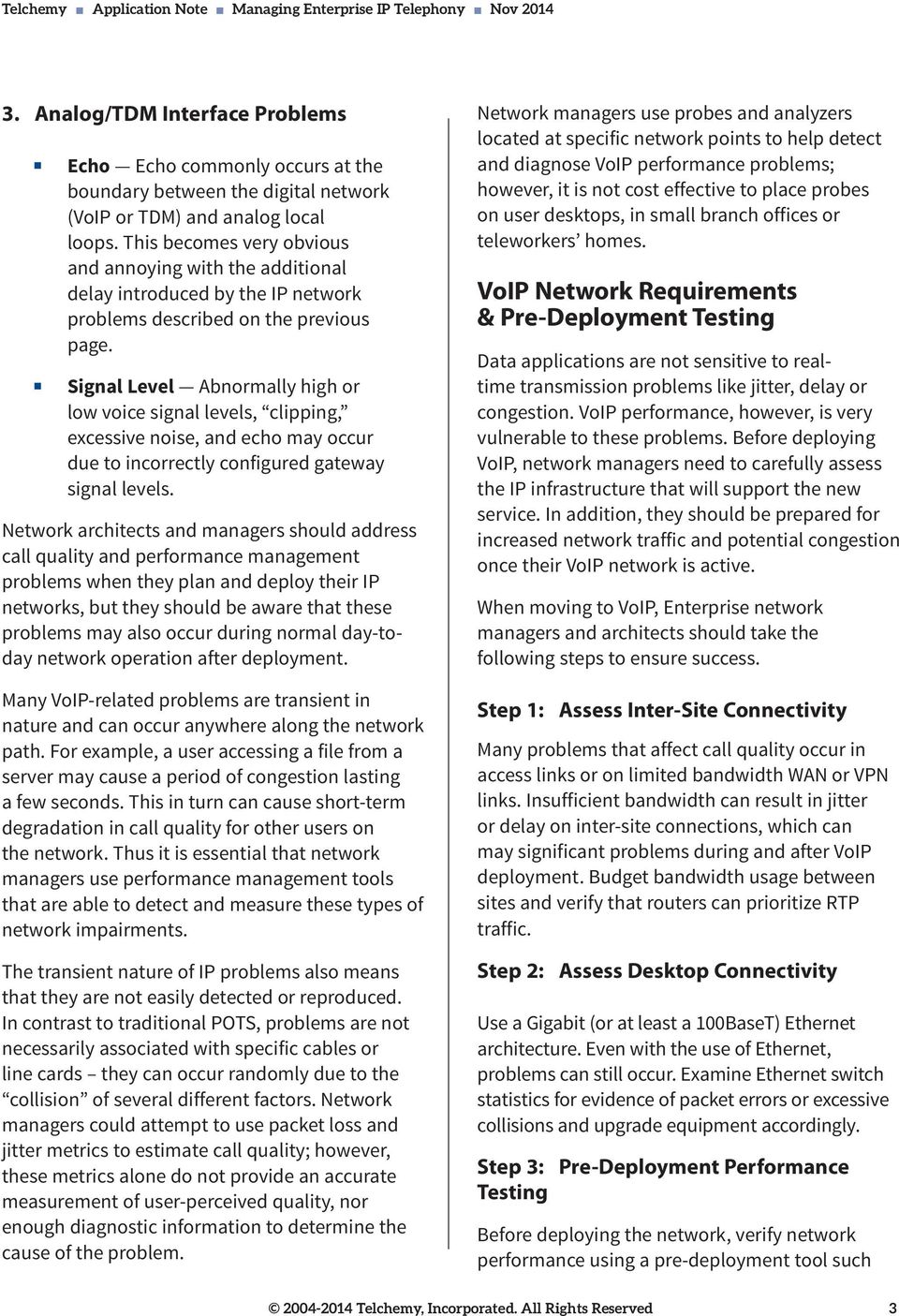
4 as Telchemy's DVQattest to generate a realistic level of simulated traffic. In addition to analyzing performance, these tools can also highlight problems such as firewall configuration and calls with one-way media. Step 4: Pilot Trial After completing the previous three steps, conduct a pilot trial for the network. At this stage, the trial should be successful. Any problems during the pilot trial are normally the result of an incorrectly configured router or other network equipment rather than a network performance problem. Step 5: Deploy Live Network As deployment ramps up, carefully monitor any trends in key VoIP performance parameters, note any call quality degradation and investigate accordingly. Step 6: Maintain VoIP Network Because VoIP networks are constantly changing and evolving (e.g., network configuration, equipment configuration and network traffic), continued monitoring and maintenance of the network is essential to maintain quality voice service after its initial deployment. To deploy and maintain a VoIP network successfully, network managers need a performance management infrastructure in which IP telephony issues and call quality problems can be quickly identified and resolved. VoIP Performance Management Architecture A standards-based framework has emerged within the IP industry for VoIP performance management. It uses a distributed software probe architecture to provide cost-effective, real-time call quality feedback with maximum network coverage. The framework s monitoring functions provide real-time visibility of network performance, detection of transient problems and comprehensive diagnostic data. The framework relies on SIP PUBLISH (RFC 6035) [1] and RTCP XR (RFC 3611) [2] QoE reporting protocols that are able to send data back to network management and call control systems with minimal network traffic overhead. The architecture features lightweight embedded agents in IP phones and gateways, with optional high performance network probes deployed within the core network and at major customer locations to provide in-depth diagnosis when SQmediator performance management system IP phones with embedded VQmon agents SIP PUBLISH (RFC 6035) RTCP XR (RFC 3611) Figure 2: QoE reporting using embedded software agents Telchemy, Incorporated. All Rights Reserved

5 problems are detected. Embedded agents such as Telchemy's VQmon provide quality and performance metrics directly from each user's phone or desktop and are extremely cost effective most IP phone vendors include such agents as a standard feature, at no additional cost. Figure 2 shows a typical scenario in which VQmon performance monitoring agents are embedded into SIP IP phones at each end of a VoIP call. The agents exchange RTCP XR reports with each other, and send SIP PUBLISH reports to a central performance management system, Telchemy's SQmediator. (Following sections provide more detail on these protocols and their supported performance metrics.) Embedded Monitoring Function VQmon technology is a major building block of the VoIP Performance Management Framework. It was the first and is the most widely deployed monitoring function for VoIP performance management today, and formed the basis for the metrics used in the RFC 3611 and RFC 6035 protocols. VQmon s embedded monitoring technology enables network managers to see call quality problems in real time and identify the root cause of problems for both active and completed calls. Key features of VQmon include: Accurate Mean Opinion Scores (MOS) Supports wide range of narrowband, wideband, and ultra-wideband codecs Unique perceptual model that incorporates the effect of transient impairments Small code size and tiny computational load VQmon measures key characteristics of the packetized voice stream and calculates realtime performance data that network managers can use to detect, characterize and report transient problems. The technology provides detailed information on service quality with a low reporting volume (typically one report per endpoint at the end of a call), thus using minimal bandwidth. VQmon is a high performance, standardsbased, non-intrusive call quality monitoring and diagnostic agent that can be integrated directly into VoIP CPE, SLA monitoring systems, probes, SLA Monitor, Protocol Analyzer, or Router IP Network IP Phone or VoIP Gateway CODEC VQmon RTCP XR VQmon VQmon (Mid-Stream Analysis) VQmon/EP (Endpoint Analysis) Figure 3: VQmon s embedded monitoring technology Telchemy, Incorporated. All Rights Reserved 5
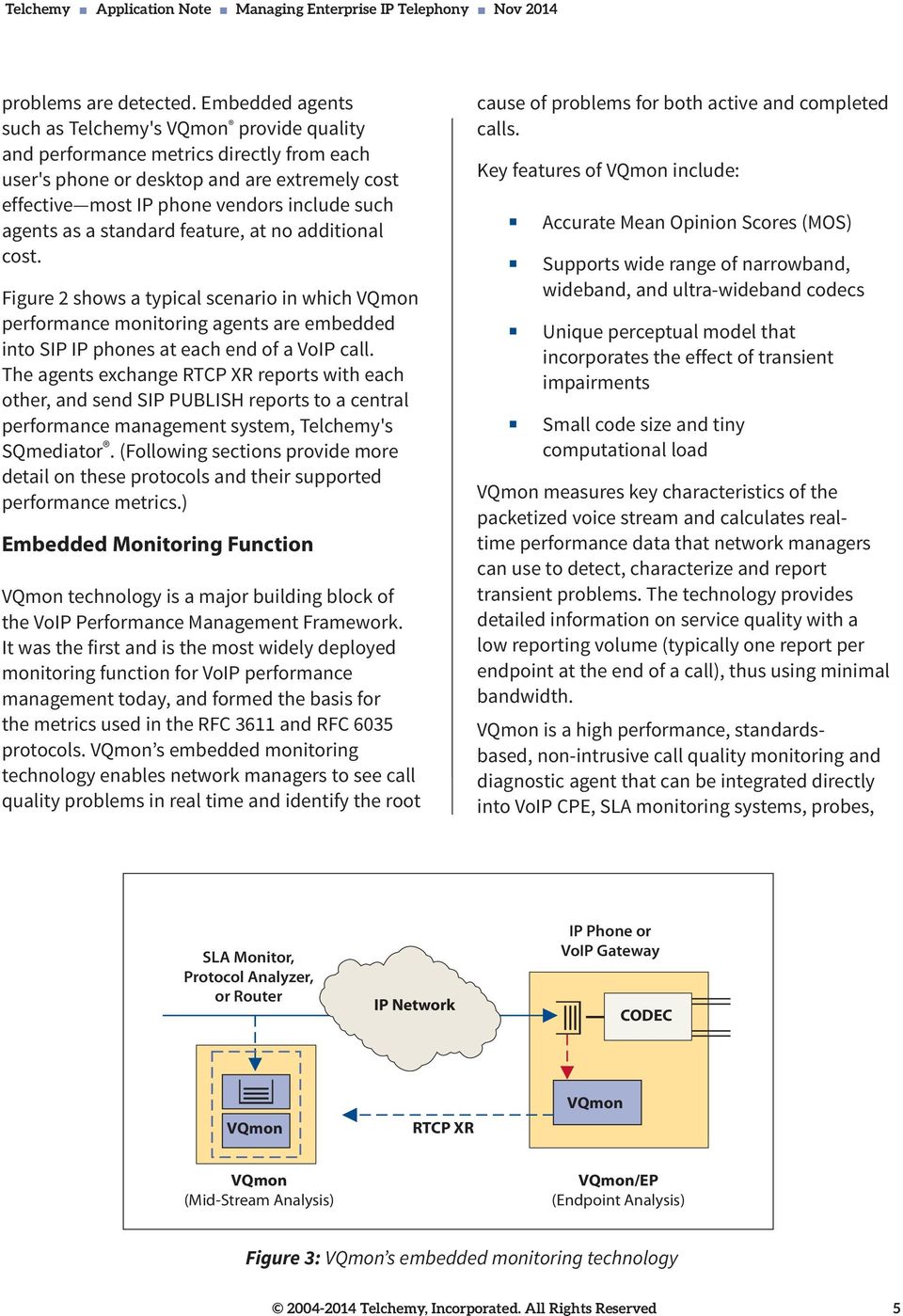
6 routers and generally any system that is on the path taken by the voice packets (Figure 3). VQmon agents are small, highly efficient, and can be integrated into existing equipment without requiring additional CPU or memory, scaling from systems that monitor a single call to those that support hundreds of thousands of calls. VQmon agents produce call quality metrics, including listening and conversational quality scores, for a very wide range of codecs. They also provide detailed information on the severity and distribution of packet loss and discards due to jitter and other essential diagnostic data. Most importantly, VQmon is able to detect transient IP problems and assess their effects on call quality. VQmon is an advanced VoIP perceptual quality estimation algorithm that incorporates support for key international standards including ITU-T P.564 [3], ITU-T G.107 [4], ITU-T G.1020 [5], ETSI TS Annex E [6], IETF RFC 6035 and IETF RFC VQmon incorporates support for time varying IP impairments (typically caused by network congestion) and has been independently shown to provide significantly more accurate and stable metrics than other algorithms such as G.107 (E Model). Two versions of VQmon are available for VoIP performance management: VQmon for midstream performance analysis and VQmon/EP for endpoint analysis. Both produce a rich set of diagnostic data and support the common VoIP performance management metrics. VQmon is modular software that can also provide real-time network data analytics and video performance analysis for adaptive video streaming over HTTP, IPTV and IP Videoconferencing services. SLA Monitors, Analyzers, and Probes: VQmon VQmon is the core VoIP analysis software used in many probes, routers, SLA monitoring systems, and analyzers. VQmon monitors the packet stream, automatically recognizing individual call streams and the types of codec in use. VQmon identifies packets that were lost or will be discarded due to excessive jitter and uses this data to estimate call quality. IP Phone and Gateway Monitoring: VQmon/EP VQmon/EP is widely integrated into IP phones and gateways produced by leading equipment manufacturers, providing accurate call quality scores and supporting diagnostic data. Both VQmon and VQmon/EP use the same quality measurement algorithm, ensuring that call quality metrics are fully consistent. Common VoIP Performance Metrics The VoIP Performance Management Architecture incorporates a common set of VoIP performance metrics supported by multiple QoS reporting protocols; i.e., the same information is available regardless of the protocol used for reporting. These metrics are: Packet Loss Rate percentage of packets lost by the network Packet Discard Rate percentage of packets discarded by the jitter buffer due to late arrival Packet loss and discard metrics help to identify the degree to which a call is being affected by network packet loss or jitter. They also eliminate the need to guess how much effect jitter is having on packet discard rate. Burst Length/Burst Density mean length and density of "burst" periods during which the packet loss/discard rate is high enough to cause audio quality degradation Gap Length/Gap Density mean length and density of "gaps" between bursts, when there is little or no packet loss/discard occurring Telchemy, Incorporated. All Rights Reserved
7 Burst and gap metrics help to identify the extent to which a call is degraded by packet loss and discard, and help to measure the distribution of loss/discard impairments over the course of the call. Transient network congestion is a common problem resulting in a period of high loss/discard lasting for several seconds during which call quality is degraded; these transient call quality problems are reported as bursts. Round-Trip Delay delay occurring between VoIP endpoints End System Delay delay occurring within a VoIP endpoint Round-trip and end system delay metrics help to identify the sources of excessive delay, which can lead to conversational difficulty and greatly intensify the effects of echo. Signal Level Noise Level Echo Level These three metrics enable detection of problems due to excessive variations in signal, noise or echo level occurring at call endpoints. These metrics are essential when managing networks that use secure RTP. Call Quality Metrics QoE scores in either R or MOS scaling R factors and MOS values provide an immediate indication of call quality. If it is apparent (due to low scores) that there is a problem, then other metrics can be used for diagnosis. Jitter Buffer Configuration jitter buffer size and type (fixed vs. adaptive) PLC Algorithm the technique used (if any) to conceal the effects of packet loss on speech quality Jitter buffer and PLC information is used to determine whether poor call quality is due to incorrect configuration of the end system, and to allow mid-stream probes to determine endpoint configuration. Performance Management Reporting Protocols Reporting protocols have been developed for the media path, signaling system, and network management. It is important to note that these approaches are complementary. RTCP Reporting Extensions (RTCP XR) The RTCP XR protocol (RFC 3611) is a media path reporting protocol that exchanges call quality metrics between VoIP endpoints. RTCP XR provides several useful functions: Enables collection of call quality reports by the remote endpoint, e.g., a trunking gateway, or by intermediate probes Provides the ability to pass transparently through firewall routers Supports the diagnosis of echorelated problems Enables mid-stream network probes to obtain analog signal, noise and echo measurements from call endpoints Compatible with the Secure RTP security framework (RFC 3711) QoE reporting using SIP (RFC 6035) RFC 6035 is a widely supported protocol that Telchemy, Incorporated. All Rights Reserved 7
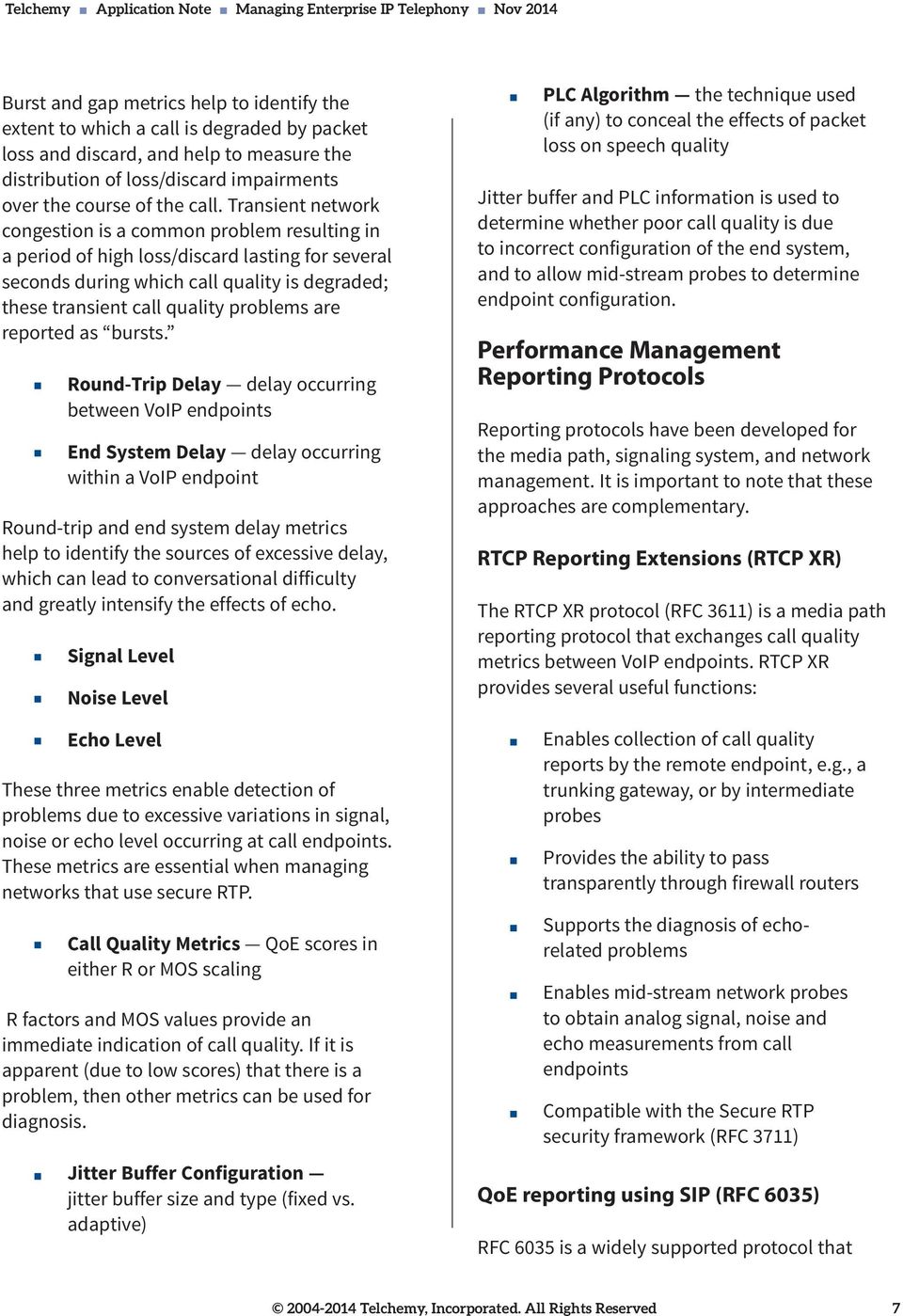
8 Telchemy Application Note allows a SIP phone to send a call quality report at the end of a call to a "collector" such as Telchemy's SQmediator. This report contains metrics that include MOS, R factors, IP packet loss, jitter, burst metrics and other data. RFC 6035 supports end-of-call reporting, interval reporting and alert-based reporting. It is strongly recommended to use end-of-call reporting for day-to-day quality monitoring. Interval reporting can drastically increase the volume of reports being sent and is generally used for testing or diagnostic purposes. RFC 6035 can use either the SIP PUBLISH method or the SUBSCRIBE-NOTIFY method. The PUBLISH PUBLISH sip:[email protected] SIP/2.0 Via: SIP/2.0/UDP pc22.example.org;branch=z9hg4bk3343d7 Max-Forwards: 70 To: <sip:[email protected]> From: Alice <sip:[email protected]>;tag=a3343df32 Call-ID: CSeq: 4331 PUBLISH Allow: INVITE, ACK, CANCEL, OPTIONS, BYE, REFER, SUBSCRIBE, NOTIFY Event: vq-rtcpxr Accept: application/sdp, message/sipfrag Content-Type: application/vq-rtcpxr Content-Length:... Figure 4: Example end-of-call report using SIP PUBLISH (RFC 6035) VQSessionReport: CallTerm CallID: 6dg37f LocalID: Alice <sip:[email protected]> RemoteID: Bill <sip:[email protected]> OrigID: Alice <sip:[email protected]> LocalGroup: example-phone RemoteGroup: example-gateway LocalAddr: IP= PORT=5000 SSRC=1a3b5c7d LocalMAC: 00:1f:5b:cc:21:0f RemoteAddr:IP= PORT=5002 SSRC=0x2468abcd RemoteMAC: 00:26:08:8e:95:02 LocalMetrics: Timestamps:START= T18:23:43Z STOP= T18:26:02Z SessionDesc:PT=18 PD=G729 SR=8000 FD=20 FO=20 FPP=2 PPS=50 FMTP="annexb=no" PLC=3 SSUP=on JitterBuffer:JBA=3 JBR=2 JBN=40 JBM=80 JBX=120 PacketLoss:NLR=5.0 JDR=2.0 BurstGapLoss:BLD=0 BD=0 GLD=2.0 GD=500 GMIN=16 Delay:RTD=200 ESD=140 SOWD=200 IAJ=2 MAJ=10 Signal:SL=-21 NL=-50 RERL=55 QualityEst:RLQ=90 RCQ=85 EXTRI=90 MOSLQ=4.2 MOSCQ=4.3 QoEEstAlg=P.564 RemoteMetrics: Timestamps:START= T18:23:43Z STOP= T18:26:02Z SessionDesc:PT=18 PD=G729 SR=8000 FD=20 FO=20 FPP=2 PPS=50 FMTP="annexb=no" PLC=3 SSUP=on JitterBuffer:JBA=3 JBR=2 JBN=40 JBM=80 JBX=120 PacketLoss:NLR=5.0 JDR=2.0 BurstGapLoss:BLD=0 BD=0 GLD=2.0 GD=500 GMIN=16 Delay:RTD=200 ESD=140 SOWD=200 IAJ=2 MAJ=10 Signal:SL=-21 NL=-45 RERL=55 QualityEst:RLQ=90 RCQ=85 MOSLQ=4.3 MOSCQ=4.2 QoEEstAlg=P.564 DialogID: @alice.example.org;to-tag= ; from-tag=9123dh Telchemy, Incorporated. All Rights Reserved

9 method (see Figure 4) is the most widely used; it allows the IP phone to "publish" the message containing the QoE metrics to the collector. The SUBSCRIBE-NOTIFY method requires the collector to subscribe to each device in order for the device to send QoE metrics in a NOTIFY message. Applying the Performance Management Architecture To Enterprise Networks The VoIP Performance Management Architecture is essential to provide real-time visibility of user perceived quality in an Enterprise network (Figure 5). VQmon is integrated into the IP phones on each user desktop at the main and branch office locations and at teleworkers' homes. During an active call, quality is measured at the IP phone at each call endpoint. During the call, RTCP XR (RFC 3611) messages are exchanged between the IP phones, ensuring that each phone has information about call quality in both directions. At the end of the call, the performance metrics locally measured by VQmon, and those received from the remote endpoint, are formatted into an RFC 6035 message and sent to the VoIP performance management system (e.g. SQmediator). Problem Resolution, Detection & Diagnosis The VoIP Performance Management Framework provides the basis for detecting and diagnosing different types of call quality problems. IP Phones with VQmon Main Office RTCP XR (RFC 3611) Branch Office SIP PUBLISH (RFC 6035) IP Network IP Phones with VQmon IP Phone with VQmon SQmediator Teleworker Figure 5: Performance Management Architecture for Enterprise Networks Telchemy, Incorporated. All Rights Reserved 9

10 Access Link Congestion If the access links to the IP network site have insufficient bandwidth, the jitter level will increase. This will typically cause IP phones to discard a high proportion of packets and can increase the size of the jitter buffer, adding more delay. Bad Ethernet Segment on LAN If Ethernet switches are not configured properly or Ethernet segments are too long, there may be a high rate of packet loss that severely impacts call quality. Acronyms CPE ETSI IETF IP ITU LAN MOS PLC POTS PSTN QoE QoS RFC RTP RTCP RTCP XR SIP SLA TDM VoIP VPN Customer Premises Equipment European Telecommunications Standards Institute Internet Engineering Task Force Internet Protocol International Telecommunications Union Local Area Network Mean Opinion Score Packet Loss Concealment Plain Old Telephone Service Public Switched Telephone Network Quality of Experience Quality of Service Request for Comments Real Time Protocol RTP Control Protocol RTP Control Protocol Extended Reports Session Initiation Protocolt Service Level Agreement Time Division Multiplexer, -ing Voice Over Internet Protocol Virtual Private Network Echo in PSTN If there is a problem on a remote analog loop, the IP phone on a customer site may experience audible echo. Measurement and monitoring tools are especially useful for isolating the specific location where poor quality calls are occuring for example, whether they are affecting all calls in a particular area, or limited to one defective device. Using the example in Figure 5 on the previous page, a network manager could use the VoIP Performance Management Framework and in particular, perceptual call quality scores to determine whether all calls in the branch office are experiencing quality degradation, or if the bad calls are occurring on one particular IP phone. Once the scope of the problem is determined, additional metrics (such as those described in the Common VoIP Performance Metrics section on page 6) can be used to diagnose the root cause. Summary The VoIP Performance Management Architecture provides an ideal solution for quality monitoring and problem diagnosis for Enterprise IP telephony service. Important call quality and diagnostic data is obtained in real time from key points on the packet stream and routed to network management systems. Network managers can obtain a reasonable level of problem diagnosis simply by using data from VoIP call quality reports; however, in-depth problem analysis requires the use of probes and analyzers that support the Performance Management Framework as well as the use of VQmon for call quality analysis. Many of the industry s equipment manufacturers have already implemented elements of the management framework in IP phones, gateways, routers, probes and analyzers Telchemy, Incorporated. All Rights Reserved

11 References [1] IETF RFC 6035: Session Initiation Protocol Event Package for Voice Quality Reporting, November 2010 [2] IETF RFC 3611: RTP Control Protocol Reporting Extensions (RTCP XR), November 2003 [3] ITU-T, Conformance testing for voice over IP transmission quality assessment models," Recommendation P.564 [4] ITU-T, The E-Model, a computational model for use in transmis sion planning, Recommendation G.107 [5] ITU-T, Performance parameter definitions for quality of speech and other voiceband applications utilizing IP networks, Recommendation G.1020 [6] ETSI, Quality of Service (QoS) measurement methodologies, ETSI TS V1.1.1 ( ), November 2000 Telchemy Application Notes Series Voice over IP Performance Management Managing Enterprise IP Telephony Voice Quality Measurement Impact of Delay on VoIP Services Impact of Echo on VoIP Services Data and Fax Modem Performance on VoIP Services Voice Quality Estimation in Wireless & TDM Environments Managing IP Centrex & Hosted PBX Services Managing Cable Telephony Services Managing Wireless LANs and Wi-Fi Services Six Steps to Getting Your Network Ready for Voice over IP Download application About Telchemy, Incorporated Telchemy is the global leader in Voice and Video over IP performance management technology with its VQmon, DVQattest, SQprobe and SQmediator families of service quality monitoring and analysis products. Telchemy has led the use of embedded software probe technology and the application of big data and analytics for VoIP performance management, and is positioned to be a leading provider of voice and video performance monitoring technology for the emerging SDN. Founded in 1999, the company has products deployed worldwide and markets its technology through over 140 leading networking, test and management product companies. Visit Information [email protected] [email protected] Phone TELCHEMY Fax Telchemy Incorporated 2905 Premiere Parkway Suite 280 Duluth, GA USA Telchemy, VQmon, DVQattest, SQprobe, SQmediator and the Telchemy logo are registered trademarks of Telchemy, Incorporated. VQmon contains technology described in seven or more patents and pending patents Telchemy, Incorporated, all rights reserved. 13.Nov Telchemy, Incorporated. All Rights Reserved 11
![564 [4] ITU-T, The E-Model, a computational model for use in transmis sion planning, Recommendation G.](/docs-images/43/10812106/images/page_11.jpg "107 [5] ITU-T, Performance parameter definitions for quality of speech and other voiceband applications utilizing IP networks, Recommendation G.")
Application Notes. Introduction. Contents. Managing IP Centrex & Hosted PBX Services. Series. VoIP Performance Management. Overview.
 Title Series Managing IP Centrex & Hosted PBX Services Date July 2004 VoIP Performance Management Contents Introduction... 1 Quality Management & IP Centrex Service... 2 The New VoIP Performance Management
Application Note. Pre-Deployment and Network Readiness Assessment Is Essential. Types of VoIP Performance Problems. Contents
 Title Six Steps To Getting Your Network Ready For Voice Over IP Date January 2005 Overview This provides enterprise network managers with a six step methodology, including predeployment testing and network
Application Note. Introduction. Definition of Call Quality. Contents. Voice Quality Measurement. Series. Overview
 Application Note Title Series Date Nov 2014 Overview Voice Quality Measurement Voice over IP Performance Management This Application Note describes commonlyused call quality measurement methods, explains
Application Notes. Introduction. Sources of delay. Contents. Impact of Delay in Voice over IP Services VoIP Performance Management.
 Application Notes Title Series Impact of Delay in Voice over IP Services VoIP Performance Management Date January 2006 Overview This application note describes the sources of delay in Voice over IP services,
Delivering reliable VoIP Services
 QoS Tips and Tricks for VoIP Services: Delivering reliable VoIP Services Alan Clark CEO, Telchemy [email protected] 1 Objectives Clear understanding of: typical problems affecting VoIP service
Managing ^ VoIP Quality and Performance
 Unified, Cloud Based, Virtualized, Hosted Managing ^ VoIP Quality and Performance Alan Clark, CEO Telchemy [email protected] 1 Outline VoIP Performance Issues Current state of the art VoIP performance
Application Notes. Contents. Overview. Introduction. Echo in Voice over IP Systems VoIP Performance Management
 Application Notes Title Series Echo in Voice over IP Systems VoIP Performance Management Date January 2006 Overview This application note describes why echo occurs, what effects it has on voice quality,
International Telecommunication Union. Common VoIP Metrics. Alan Clark. CEO, Telchemy
 International Telecommunication Union Common VoIP Metrics Alan Clark CEO, Telchemy Workshop on End-to-End Quality of Service.What is it? How do we get it? Geneva, 1-3 October 2003 Summary ITU-T o Typical
Service Level Agreements for VoIP Alan Clark CEO, Telchemy
 Service Level Agreements for VoIP Alan Clark CEO, Telchemy 1 Agenda VoIP SLAs What s typical Why typical isn t ok Approaches to SLA measurement What to measure The trust problem Final thoughts 2 What is
Tech Note. Introduction. Definition of Call Quality. Contents. Voice Quality Measurement Understanding VoIP Performance. Title Series.
 Tech Note Title Series Voice Quality Measurement Understanding VoIP Performance Date January 2005 Overview This tech note describes commonly-used call quality measurement methods, explains the metrics
SIP Trunking and Voice over IP
 SIP Trunking and Voice over IP Agenda What is SIP Trunking? SIP Signaling How is Voice encoded and transported? What are the Voice over IP Impairments? How is Voice Quality measured? VoIP Technology Confidential
Troubleshooting Common Issues in VoIP
 Troubleshooting Common Issues in VoIP 2014, SolarWinds Worldwide, LLC. All rights reserved. Voice over Internet Protocol (VoIP) Introduction Voice over IP, or VoIP, refers to the delivery of voice and
Quality of Service (QoS) and Quality of Experience (QoE) VoiceCon Fall 2008
 Quality of Service (QoS) and Quality of Experience (QoE) VoiceCon Fall 2008 John Bartlett NetForecast, Inc. [email protected] www.netforecast.com VoIP Deployment Realities VoIP is not just another application
Quality of Service Testing in the VoIP Environment
 Whitepaper Quality of Service Testing in the VoIP Environment Carrying voice traffic over the Internet rather than the traditional public telephone network has revolutionized communications. Initially,
MOS Technology Brief Mean Opinion Score Algorithms for Speech Quality Evaluation
 MOS Technology Brief Mean Opinion Score Algorithms for Speech Quality Evaluation Mean Opinion Score (MOS) is commonly used to rate phone service speech quality, expressed on a scale from 1 to 5, where
12 Quality of Service (QoS)
 Burapha University ก Department of Computer Science 12 Quality of Service (QoS) Quality of Service Best Effort, Integrated Service, Differentiated Service Factors that affect the QoS Ver. 0.1 :, [email protected]
How To: Diagnose Poor VoIP Calls through diagnostics.
 How To: Diagnose Poor VoIP Calls through diagnostics. When problems arise with poor VoIP phone calls, where do you start looking to troubleshoot the issue? This is one of the many challenges of managing
Application Note. IPTV Services. Contents. TVQM Video Quality Metrics Understanding IP Video Performance. Series. Overview. Overview...
 Title Series TVQM Video Quality Metrics Understanding IP Video Performance Date September 2012 (orig. Feb 2008) Overview IPTV, Internet TV, and Video on Demand provide exciting new revenue opportunities
1 There are also private networks including leased-lines, analog PBXs
 Application Notes Title Series Overview Data and Fax modem performance on VoIP services VoIP Performance Management Date November 2005 This application note describes the typical performance issues that
The use of IP networks, namely the LAN and WAN, to carry voice. Voice was originally carried over circuit switched networks
 Voice over IP Introduction VoIP Voice over IP The use of IP networks, namely the LAN and WAN, to carry voice Voice was originally carried over circuit switched networks PSTN (Public Switch Telephone Network)
Fundamentals of VoIP Call Quality Monitoring & Troubleshooting. 2014, SolarWinds Worldwide, LLC. All rights reserved. Follow SolarWinds:
 Fundamentals of VoIP Call Quality Monitoring & Troubleshooting 2014, SolarWinds Worldwide, LLC. All rights reserved. Introduction Voice over IP, or VoIP, refers to the delivery of voice and multimedia
Testing VoIP on MPLS Networks
 Application Note Testing VoIP on MPLS Networks Why does MPLS matter for VoIP? Multi-protocol label switching (MPLS) enables a common IP-based network to be used for all network services and for multiple
An Introduction to VoIP Protocols
 An Introduction to VoIP Protocols www.netqos.com Voice over IP (VoIP) offers the vision of a converged network carrying multiple types of traffic (voice, video, and data, to name a few). To carry out this
Course 4: IP Telephony and VoIP
 Course 4: IP Telephony and VoIP Telecommunications Technical Curriculum Program 3: Voice Knowledge 6/9/2009 1 Telecommunications Technical Curriculum Program 1: General Industry Knowledge Course 1: General
Contents Introduction Why Fax over IP? How Real-time Fax over IP works Implementation with MessagePlus/Open Summary. About this document
 Fax over IP Contents Introduction Why Fax over IP? How Real-time Fax over IP works Implementation with MessagePlus/Open Summary About this document This document describes how Fax over IP works in general
Achieving PSTN Voice Quality in VoIP
 Achieving PSTN Voice Quality in VoIP Voice over Internet Protocol (VoIP) is being widely deployed to offer users low-cost alternatives for long-distance and international telephone calls. However, for
Network Connection Considerations for Microsoft Response Point 1.0 Service Pack 2
 Network Connection Considerations for Microsoft Response Point 1.0 Service Pack 2 Updated: February 2009 Microsoft Response Point is a small-business phone solution that is designed to be easy to use and
ehealth and VoIP Overview
 ehealth and VoIP Overview Voice over IP (VoIP) configurations can be very complex. Your network could contain a variety of devices, applications, and configuration capabilities to support voice traffic.
Requirements of Voice in an IP Internetwork
 Requirements of Voice in an IP Internetwork Real-Time Voice in a Best-Effort IP Internetwork This topic lists problems associated with implementation of real-time voice traffic in a best-effort IP internetwork.
Application Note. IPTV Services. Contents. Title Managing IPTV Performance Series IP Video Performance Management. Overview... 1. IPTV Services...
 Title Managing IPTV Performance Series IP Video Performance Management Date September 2012 (orig. February 2008) Contents Overview... 1 IPTV Services... 1 Factors that Affect the Performance of IPTV...2
Knowledge Is Power: Do what s best for the client.
 Knowledge Is Power: Do what s best for the client. 1. Understanding Voice and Data Differences Even when they are carried on the same network, voice traffic and data traffic cannot be handled the same
Receiving the IP packets Decoding of the packets Digital-to-analog conversion which reproduces the original voice stream
 Article VoIP Introduction Internet telephony refers to communications services voice, fax, SMS, and/or voice-messaging applications that are transported via the internet, rather than the public switched
The Triple Play Analysis Suite - VoIP. Key Features. Standard VoIP Protocol G.711 SIP RTP / RTCP. Ethernet / PPP. XDSL, Metro Ethernet
 The Triple Play Analysis Suite - VoIP Most Voice over IP service providers are facing immense challenges which entail optimum network quality environment when rolling out Triple Play networks. AnaCise
Your new VoIP Network is working great Right? How to Know. April 2012 WHITE PAPER
 Your new VoIP Network is working great Right? How to Know April 2012 Executive Summary This paper discusses the importance of measuring and monitoring the voice quality of VoIP calls traversing the data
QoS in VoIP. Rahul Singhai Parijat Garg
 QoS in VoIP Rahul Singhai Parijat Garg Outline Introduction The VoIP Setting QoS Issues Service Models Techniques for QoS Voice Quality Monitoring Sample solution from industry Conclusion Introduction
Interoperability Test Plan for International Voice services (Release 6) May 2014
 INTERNATIONAL INTERCONNECTION FORUM FOR SERVICES OVER IP (i3 FORUM) Workstream Technical Aspects Workstream Operations Interoperability Test Plan for International Voice services (Release 6) May 2014 Interoperability
Voice over IP Basics for IT Technicians
 Voice over IP Basics for IT Technicians White Paper Executive summary The IP phone is coming or has arrived on desk near you. The IP phone is not a PC, but does have a number of hardware and software elements
CiscoWorks Internetwork Performance Monitor 4.0
 CiscoWorks Internetwork Performance Monitor 4.0 Product Overview The CiscoWorks Internetwork Performance Monitor (IPM) is a network response-time and availability troubleshooting application. Included
Performance Evaluation of VoIP Services using Different CODECs over a UMTS Network
 Performance Evaluation of VoIP Services using Different CODECs over a UMTS Network Jianguo Cao School of Electrical and Computer Engineering RMIT University Melbourne, VIC 3000 Australia Email: [email protected]
How To Set Up An Ip Trunk For A Business
 Charter Business : White paper SIP Trunking: A new voice in communications service WHITE PAPER With the rise of next-generation technology, business customers have more options than ever from providers
Proactive Video Assurance through QoE and QoS Correlation
 A Complete Approach for Quality and Service Assurance W H I T E P A P E R Introduction Video service providers implement new technologies to maximize the quality and diversity of their entertainment program
Indepth Voice over IP and SIP Networking Course
 Introduction SIP is fast becoming the Voice over IP protocol of choice. During this 3-day course delegates will examine SIP technology and architecture and learn how a functioning VoIP service can be established.
VoIP QoS. Version 1.0. September 4, 2006. AdvancedVoIP.com. [email protected] [email protected]. Phone: +1 213 341 1431
 VoIP QoS Version 1.0 September 4, 2006 AdvancedVoIP.com [email protected] [email protected] Phone: +1 213 341 1431 Copyright AdvancedVoIP.com, 1999-2006. All Rights Reserved. No part of this
VoIP Bandwidth Considerations - design decisions
 VoIP Bandwidth Considerations - design decisions When calculating the bandwidth requirements for a VoIP implementation the two main protocols are: a signalling protocol such as SIP, H.323, SCCP, IAX or
SIP A Technology Deep Dive
 SIP A Technology Deep Dive Anshu Prasad Product Line Manager, Mitel June 2010 Laith Zalzalah Director, Mitel NetSolutions What is SIP? Session Initiation Protocol (SIP) is a signaling protocol for establishing
Business case for VoIP Readiness Network Assessment
 Business case for VoIP Readiness Network Assessment Table of contents Overview... 2 Different approaches to pre-deployment assessment:.......... 2 Other considerations for VoIP pre-deployment... 3 The
Configuring Voice Quality Monitoring in AOS
 61200796L1-29.2E September 2010 Configuration Guide Configuring Voice Quality Monitoring in AOS This configuration guide describes the configuration and use of the voice quality monitoring (VQM) feature
VoIP Analysis Fundamentals with Wireshark. Phill Shade (Forensic Engineer Merlion s Keep Consulting)
 VoIP Analysis Fundamentals with Wireshark Phill Shade (Forensic Engineer Merlion s Keep Consulting) 1 Phillip D. Shade (Phill) [email protected] Phillip D. Shade is the founder of Merlion s Keep Consulting,
VoIP / SIP Planning and Disclosure
 VoIP / SIP Planning and Disclosure Voice over internet protocol (VoIP) and session initiation protocol (SIP) technologies are the telecommunication industry s leading commodity due to its cost savings
Voice over IP (VoIP) Basics for IT Technicians
 Voice over IP (VoIP) Basics for IT Technicians VoIP brings a new environment to the network technician that requires expanded knowledge and tools to deploy and troubleshoot IP phones. This paper provides
Evaluating Data Networks for Voice Readiness
 Evaluating Data Networks for Voice Readiness by John Q. Walker and Jeff Hicks NetIQ Corporation Contents Introduction... 2 Determining Readiness... 2 Follow-on Steps... 7 Summary... 7 Our focus is on organizations
Service resiliency and reliability Quality of Experience Modelling requirements A PlanetLab proposal. PDCAT'08 - Dunedin December 1-4, 2008
 PlaNetLab Options from Massey University Richard Harris Presentation Outline Service resiliency and reliability Quality of Experience Modelling requirements A PlanetLab proposal PDCAT'2008 Dunedin 2 (c)
Monitoring and Managing Voice over Internet Protocol (VoIP)
 Network Instruments White Paper Monitoring and Managing Voice over Internet Protocol (VoIP) As with most new technologies, Voice over Internet Protocol (VoIP) brings new challenges along with the benefits.
Clearing the Way for VoIP
 Gen2 Ventures White Paper Clearing the Way for VoIP An Alternative to Expensive WAN Upgrades Executive Overview Enterprises have traditionally maintained separate networks for their voice and data traffic.
Synchronization Essentials of VoIP WHITE PAPER
 Synchronization Essentials of VoIP WHITE PAPER Synchronization Essentials of VoIP Introduction As we accelerate into the New World of VoIP we assume we can leave some of the trappings of wireline telecom
Voice Over IP Performance Assurance
 Voice Over IP Performance Assurance Transforming the WAN into a voice-friendly using Exinda WAN OP 2.0 Integrated Performance Assurance Platform Document version 2.0 Voice over IP Performance Assurance
Convergence Technologies Professional (CTP) Course 1: Data Networking
 Convergence Technologies Professional (CTP) Course 1: Data Networking The Data Networking course teaches you the fundamentals of networking. Through hands-on training, you will learn the vendor-independent
How to choose the right IP gateway for your VoIP migration strategy. Deployment note
 How to choose the right IP gateway for your VoIP migration strategy Deployment note Introduction The purpose of this document is to understand the role a TDM to IP gateway has in providing a migration
Integrate VoIP with your existing network
 Integrate VoIP with your existing network As organisations increasingly recognise and require the benefits voice over Internet Protocol (VoIP) offers, they stop asking "Why?" and start asking "How?". A
Voice over IP (VoIP) for Telephony. Advantages of VoIP Migration for SMBs BLACK BOX. 724-746-5500 blackbox.com
 Voice over IP (VoIP) for Telephony Advantages of VoIP Migration for SMBs BLACK BOX Hybrid PBX VoIP Gateways SIP Phones Headsets 724-746-5500 blackbox.com Table of Contents Introduction...3 About Voice
5. DEPLOYMENT ISSUES Having described the fundamentals of VoIP and underlying IP infrastructure, let s address deployment issues.
 5. DEPLOYMENT ISSUES Having described the fundamentals of VoIP and underlying IP infrastructure, let s address deployment issues. 5.1 LEGACY INTEGRATION In most cases, enterprises own legacy PBX systems,
Combining Voice over IP with Policy-Based Quality of Service
 TechBrief Extreme Networks Introduction Combining Voice over IP with Policy-Based Quality of Service Businesses have traditionally maintained separate voice and data networks. A key reason for this is
Introduction to VoIP Technology
 Lesson 1 Abstract Introduction to VoIP Technology 2012. 01. 06. This first lesson of contains the basic knowledge about the terms and processes concerning the Voice over IP technology. The main goal of
B12 Troubleshooting & Analyzing VoIP
 B12 Troubleshooting & Analyzing VoIP Phillip Sherlock Shade, Senior Forensics / Network Engineer Merlion s Keep Consulting [email protected] Phillip Sherlock Shade (Phill) [email protected] Phillip
How To Understand The Purpose Of A Sip Aware Firewall/Alg (Sip) With An Alg (Sip) And An Algen (S Ip) (Alg) (Siph) (Network) (Ip) (Lib
 NetVanta Unified Communications Technical Note The Purpose of a SIP-Aware Firewall/ALG Introduction This technical note will explore the purpose of a Session Initiation Protocol (SIP)-aware firewall/application
CONNECTING TO LYNC/SKYPE FOR BUSINESS OVER THE INTERNET NETWORK PREP GUIDE
 CONNECTING TO LYNC/SKYPE FOR BUSINESS OVER THE INTERNET NETWORK PREP GUIDE Engineering Version 1.3 June 3, 2015 Table of Contents Foreword... 3 Current Network... 4 Understanding Usage/Personas... 4 Modeling/Personas...
IP Telephony Deployment Models
 CHAPTER 2 Sections in this chapter address the following topics: Single Site, page 2-1 Multisite Implementation with Distributed Call Processing, page 2-3 Design Considerations for Section 508 Conformance,
Goal We want to know. Introduction. What is VoIP? Carrier Grade VoIP. What is Meant by Carrier-Grade? What is Meant by VoIP? Why VoIP?
 Goal We want to know Introduction What is Meant by Carrier-Grade? What is Meant by VoIP? Why VoIP? VoIP Challenges 2 Carrier Grade VoIP Carrier grade Extremely high availability 99.999% reliability (high
EarthLink Business SIP Trunking. NEC SV8300 IP PBX Customer Configuration Guide
 EarthLink Business SIP Trunking NEC SV8300 IP PBX Customer Configuration Guide Publication History First Release: Version 1.0 May 18, 2012 CHANGE HISTORY Version Date Change Details Changed By 1.0 5/18/2012
1. Public Switched Telephone Networks vs. Internet Protocol Networks
 Internet Protocol (IP)/Intelligent Network (IN) Integration Tutorial Definition Internet telephony switches enable voice calls between the public switched telephone network (PSTN) and Internet protocol
Voice over IP is Transforming Business Communications
 White Paper Voice over IP is Transforming Business Communications Voice over IP (VoIP) is changing the world of telecommunications. It entails the transmission of voice calls over data networks that support
ZyXEL V100 Support Notes. ZyXEL V100. (V100 Softphone 1 Runtime License) Support Notes
 ZyXEL V100 (V100 Softphone 1 Runtime License) Support Notes Version 1.00 April 2009 1 Contents Overview 1. Overview of V100 Softphone...3 2. Setting up the V100 Softphone.....4 3. V100 Basic Phone Usage.....7
QoS issues in Voice over IP
 COMP9333 Advance Computer Networks Mini Conference QoS issues in Voice over IP Student ID: 3058224 Student ID: 3043237 Student ID: 3036281 Student ID: 3025715 QoS issues in Voice over IP Abstract: This
Software-Powered VoIP
 Software-Powered VoIP Ali Rohani Anthony Murphy Scott Stubberfield Unified Communications Architecture Core Scenarios UC endpoints QOE Monitoring Archiving CDR AOL Public IM Clouds Yahoo Remote Users MSN
Network Simulation Traffic, Paths and Impairment
 Network Simulation Traffic, Paths and Impairment Summary Network simulation software and hardware appliances can emulate networks and network hardware. Wide Area Network (WAN) emulation, by simulating
Curso de Telefonía IP para el MTC. Sesión 1 Introducción. Mg. Antonio Ocampo Zúñiga
 Curso de Telefonía IP para el MTC Sesión 1 Introducción Mg. Antonio Ocampo Zúñiga Conceptos Generales VoIP Essentials Family of technologies Carries voice calls over an IP network VoIP services convert
SIP Trunking with Microsoft Office Communication Server 2007 R2
 SIP Trunking with Microsoft Office Communication Server 2007 R2 A Dell Technical White Paper By Farrukh Noman Dell Product Group - Enterprise THIS WHITE PAPER IS FOR INFORMATIONAL PURPOSES ONLY, AND MAY
Maintaining Wireline-Grade VoIP QoE in Cable Networks
 Maintaining Wireline-Grade VoIP QoE in Cable Networks Introduction Monitoring and maintaining excellent VoIP service quality poses a number of challenges. VoIP traffic must share broadband networks with
OneSight Voice Quality Assurance
 OneSight Voice Quality Assurance Benefits Proactively determine voice quality issues as well as other service impacting issues before users complain Comprehensively monitor communications systems with
CVOICE Exam Topics Cisco Voice over IP Exam #642-432 7/14/2005
 CVOICE Exam Topics Cisco Voice over IP Exam #642-432 7/14/2005 From the Cisco CVOICE 642-432 Exam Topics Voice over IP Technologies Describe the similarities and differences between PSTN and VoIP including
MINIMUM NETWORK REQUIREMENTS 1. REQUIREMENTS SUMMARY... 1
 Table of Contents 1. REQUIREMENTS SUMMARY... 1 2. REQUIREMENTS DETAIL... 2 2.1 DHCP SERVER... 2 2.2 DNS SERVER... 2 2.3 FIREWALLS... 3 2.4 NETWORK ADDRESS TRANSLATION... 4 2.5 APPLICATION LAYER GATEWAY...
STANDPOINT FOR QUALITY-OF-SERVICE MEASUREMENT
 STANDPOINT FOR QUALITY-OF-SERVICE MEASUREMENT 1. TIMING ACCURACY The accurate multi-point measurements require accurate synchronization of clocks of the measurement devices. If for example time stamps
Is Your Network Ready for VoIP? > White Paper
 > White Paper Tough Questions, Honest Answers For many years, voice over IP (VoIP) has held the promise of enabling the next generation of voice communications within the enterprise. Unfortunately, its
Curso de Telefonía IP para el MTC. Sesión 2 Requerimientos principales. Mg. Antonio Ocampo Zúñiga
 Curso de Telefonía IP para el MTC Sesión 2 Requerimientos principales Mg. Antonio Ocampo Zúñiga Factors Affecting Audio Clarity Fidelity: Audio accuracy or quality Echo: Usually due to impedance mismatch
Comparison of Voice over IP with circuit switching techniques
 Comparison of Voice over IP with circuit switching techniques Author Richard Sinden Richard Sinden 1 of 9 Abstract Voice-over-IP is a growing technology. Companies are beginning to consider commercial
TECHNICAL CHALLENGES OF VoIP BYPASS
 TECHNICAL CHALLENGES OF VoIP BYPASS Presented by Monica Cultrera VP Software Development Bitek International Inc 23 rd TELELCOMMUNICATION CONFERENCE Agenda 1. Defining VoIP What is VoIP? How to establish
Region 10 Videoconference Network (R10VN)
 Region 10 Videoconference Network (R10VN) Network Considerations & Guidelines 1 What Causes A Poor Video Call? There are several factors that can affect a videoconference call. The two biggest culprits
Understanding Latency in IP Telephony
 Understanding Latency in IP Telephony By Alan Percy, Senior Sales Engineer Brooktrout Technology, Inc. 410 First Avenue Needham, MA 02494 Phone: (781) 449-4100 Fax: (781) 449-9009 Internet: www.brooktrout.com
Toll-bypass Long Distance Calling... 1. What Is VOIP?... 2. Immediate Cost Savings... 3. Applications... 3. Business Quality Voice...
 telephony internet access remote access modems Content Toll-bypass Long Distance Calling... 1 What Is VOIP?... 2 That Was Then... This is Now... Immediate Cost Savings... 3 Applications... 3 Office-to-office
Agilent Technologies Performing Pre-VoIP Network Assessments. Application Note 1402
 Agilent Technologies Performing Pre-VoIP Network Assessments Application Note 1402 Issues with VoIP Network Performance Voice is more than just an IP network application. It is a fundamental business and
The Importance of Proactive Network Management in Skype for Business
 July 15 The Importance of Proactive Network Management in Skype for Business Michael F. Finneran How customers should consider Nectar s UC Management Platform components to support Skype for Business deployments
Case in Point. Voice Quality Parameter Tuning
 Case in Point To continue our efforts to help you with your network needs, we will be making several real-world network troubleshooting case studies available to you. The attached case study,, discusses
Voice over IP. Overview. What is VoIP and how it works. Reduction of voice quality. Quality of Service for VoIP
 Voice over IP Andreas Mettis University of Cyprus November 23, 2004 Overview What is VoIP and how it works. Reduction of voice quality. Quality of Service for VoIP 1 VoIP VoIP (voice over IP - that is,
Traffic Characterization and Perceptual Quality Assessment for VoIP at Pakistan Internet Exchange-PIE. M. Amir Mehmood
 Traffic Characterization and Perceptual Quality Assessment for VoIP at Pakistan Internet Exchange-PIE M. Amir Mehmood Outline Background Pakistan Internet Exchange - PIE Motivation Preliminaries Our Work