
INTEGRATED PEST MANAGEMENT MANUAL FOR MINNESOTA APPLE ORCHARDS. A Scouting and Management Guide for Key Apple Pests
|
|
|
- Pierce Adams
- 10 years ago
- Views:
Transcription
1 INTEGRATED PEST MANAGEMENT MANUAL FOR MINNESOTA APPLE ORCHARDS A Scouting and Management Guide for Key Apple Pests Minnesota Department of Agriculture September, 2007

2 Integrated Pest Management Manual for Min ne so ta Apple Orchards, 2nd Edition 2007 Revised and rewritten by Thaddeus McCamant, Northland Community & Technical College, Detroit Lakes, MN. Acknowledgements The 2007 Manual was developed and published by the Minnesota Department of Agriculture. Funding for the revised 2007 Manual is provided through partnership agreements with the Minnesota Fruit and Vegetable Growers Association (MFVGA) and the United States Department of Agriculture Risk Management Agency (RMA). These institutions are equal opportunity providers. The following persons helped review and/or contributed to the 2nd Edition: John Aue, Threshold IPM Services, Richland Center, WI Harry Hoch, Hoch Orchard and Gardens, La Crescent, MN Emily Hoover, University of Minnesota, Horticulture Department, St. Paul, MN John Jacobson, Pine Tree Apple Orchard, White Bear Lake, MN John Luhman, Minnesota Department of Agriculture, St. Paul, MN Jill MacKenzie, formerly University of Minnesota Extension Edited by: Jeanne Ciborowski, Minnesota Department of Agriculture [The following individuals were contributing authors to the 1st Edition: Henry Fadamiro, formerly Minnesota Department of Agriculture and Harry Hoch, Hoch Orchard and Gardens, La Crescent, MN] For additional copies of this manual, contact: Minnesota Department of Agriculture Agricultural Development and Financial Assistance Division 625 Robert Street North St. Paul, MN Phone: In accordance with the Americans with Disablities Act, an alternative form of communication is available upon request. TTY:

3 Table of Contents 1. Introduction Pest Management Concepts and Definitions... 6 Pest Classification Beneficials and Biological Control Integrated Pest Management Cultural Practices Resistant Varieties Economic/Action Thresholds Pesticide Resistance Degree Days and Insect Pest Forecasting Forecasting Disease Infection Periods Biofix 3. Using Pesticides Safely Pest Scouting Equipment Scouting Techniques 5. Calendar of Orchard Events in Minnesota, and Activity and Phenology of Common Pest Insects and Diseases of Apple in Minnesota Biology and Management of Key Pests and Diseases of Apple in Minnesota Apple Maggot Plum Curculio Codling Moth Obliquebanded Leafroller Redbanded Leafroller Spotted Tentiform Leafminer Mites Apple Scab Fire Blight 7. Pest Management Programs for Minnesota Apple Growers High Pesticide/Minimal Monitoring Program Moderate IPM/Reduced Pesticide Program Advanced IPM/Minimal Pesticide Program

4 8. Control of Weeds and Vertebrate Pests Tips for Managing Pests in Organic Apples Pest Control Options Insecticides Fungicides Appendix 1: References and Suggested Readings Appendix 2: Sources of Pest Management Sup plies DISCLAIMER Reference to products in this publication is not intended to be an endorsement to the exclusion of others which may have similar uses. Any person using products listed in this publication assumes full responsibility for their use in accordance with current manufacturer directions. 4

5 1. Introduction APPLES are the most important fruit crop in Minnesota, with an annual harvest of 18 million pounds and an estimated market value between $8 and $9 million (Minnesota Agricultural Statistics Service, 2006). Many new orchards are being planted across the state as new growers take advantage of the combination of increasing demand for local produce and the introduction of good quality, hardy apple cultivars and rootstocks. Apples are susceptible to a wide range of pests. Many diseases and insects native to Europe and Asia have found their way to North America and have become endemic in Midwest orchards. In addition, several insects and diseases native to eastern North America have adopted apple trees as a new host. In the twentieth century, scientists introduced insecticides that eliminated all the insect pests in apple orchards. In a few cases, these broad spectrum insecticides caused unacceptably high environmental damage and were withdrawn from the market. In other cases, the major insect pests developed resistance to the insecticides. New pesticides were developed, and integrated pest management (IPM) emerged as a way that apple growers could achieve adequate pest control with less environmental damage. IPM is a program that coordinates pest management activities with other orchard operations to achieve effective, economical, and long-term solutions to pest problems, in a manner that is least disruptive to the environment. The objective of this publication is to provide guidance and technical support to apple growers interested in adopting integrated pest management specific to the growing conditions in Minnesota and surrounding states. Minnesota has a different climate than other fruit growing districts, with cold winter, short springs, and warm humid summers. This publication incorporates research data collected in Minnesota orchards in the past several years, as well as tested IPM concepts and information from various other states. This manual is intended to be a tool for apple growers to sample, monitor, and manage key insect, mite, and diseases in Minnesota and surrounding states. The manual has been organized into sections that introduce and explain many IPM practices. Chapters 2 and 4 focus on common pest management concepts, pest scouting, and monitoring techniques. Chapter 3 focuses on using pesticides safely. Chapter 5 has a calendar of orchard events in relation to degree days, while the biology and management of some select key orchard pests are discussed in Chapter 6. In Chapter 7, three different pest management programs and options are outlined for Minnesota apple growers. Each program suggests the various pest management practices to be followed by growers during the fruit production season. Chapter 8 focuses on the management of weeds and other orchard pests, while specific pest management tips for organic apple production are given in Chapter 9. Chapter 10 addresses pest control options. In dealing with pesticide information in this manual, our goal is not to endorse a particular product or trade name, but to merely indicate possible options to the grower or user. Because pesticide recommendations change over time, please consult with your farm supply dealer for current labels and application rates. It is our hope that growers, academics, scientists, extension agents, industry representatives, private consultants, and other members of the fruit production community will find this manual useful and informative. 5

6 2. Pest Management Concepts and Definitions Pest Classification Orchard pests can be classified either according to the part of the plant they harm or by the pest s economic importance. Direct pests feed directly on apple fruits, while indirect pests eat leaves, bark, and other parts of the tree. Direct pests include both internal feeders such as codling moth and external pests such as leafrollers. Fruit damaged by direct pests is usually unmarketable. Indirect pests reduce leaf area or kill branches, and can reduce yield or fruit quality if present in large numbers. Indirect pests include spotted tentiform leafminer, dogwood borer, aphids, mites and leafhoppers. Insect pests can also be classified in terms of the seriousness of their infestation. Key pests cause major damage each year unless controlled. Occasional pests become intolerable only irregularly, due to unusual climate conditions. Secondary pests can be tolerated in small numbers and do not need to be controlled every year. Secondary pests can cause crop losses after broad spectrum insecticides kill beneficial insects. Beneficials and Biological Control Most insects, mites, fungi and bacteria living in orchards are either benign or beneficial. Benign organisms neither directly help nor harm trees. Beneficial insects feed on insect pests or aid pollination. Beneficial fungi and bacteria help apple trees absorb nutrients from the soil and protect plants from diseases. Two important groups of beneficials are the predators and parasitoids. Predators (e.g. lady beetles, lacewings, wasps, ants, spiders, and predator mites) attack or kill a pest. Parasitoids are small wasps that lay their eggs in insect eggs, larvae, pupae or nymphs. The parasitoid larvae hatch in the host, feeds on the host, and eventually kill it. An example of a parasitoid wasp is Trichogramma which feeds on codling moth. Some parasitoid wasps can keep secondary pests like leafrollers below threshold levels most years. Some insects do not fit neatly into the categories of beneficial, benign or pest. A few insects are beneficial at one time of year and turn into a pest at another time of year, such as paper wasps and yellow jackets which eat caterpillars in midsummer, but feed on fruit in late summer. Biological control is the manipulation of natural enemy populations and their habitats in order to control a pest population. Many apple growers try to increase the population of predators and parasitioids through introduction, augmentation, or conservation techniques. Introduction is releasing predators that are not native. Augmentation is releasing natural enemies to boost existing populations. Conservation is manipulating habitat and resources to conserve or enhance natural enemy numbers. Beneficials will thrive if growers spray insecticides only when needed, time their sprays accurately, or select pesticides that are least toxic to beneficials. Broad spectrum insecticides have the capability of killing minor pests, secondary pests and beneficials. Many apple growers in Minnesota have recorded an increase in European red mite activity after applications of a pyrethroid insecticide. Pyrethroids are broad spectrum insecticides that kill predator mites. When the predator mites are killed, the surviving European red mite population can increase rapidly. Under an integrated pest management program, broad spectrum insecticides are used sparingly, and secondary pests are carefully monitored and managed to preserve beneficials. 6

7 Integrated Pest Management Integrated pest management (IPM) coordinates the use of pest biology, environmental information, and available technology to prevent unacceptable levels of pest damage by the most economical means, while posing the least possible risk to people and the environment. IPM strategies include pest-resistant varieties, pest scouting, pest forecasting, cultural control, physical control, biological control, and judicious pesticide use. Synthetic pesticides are used in IPM programs along with monitoring, biological control, and organic materials. In an IPM program, synthetic insecticides are applied at times that minimize damage to benign or beneficial organisms. By using multiple control strategies, pests are less likely to develop resistance to one particular strategy. The goal of IPM is to produce high quality fruit in a cost-effective manner without significant adverse effects on the environment. IPM began when growers and scientists realized that many insect problems did not disappear under conventional pest control. Growers who practice IPM don t try to eliminate pests, but try to suppress pest populations to levels that do not cause economic damage. IPM requires knowledge of pests and the coordination of all fruit production components. Growers who want to develop an IPM program may hire an IPM professional as a consultant, or they should develop the following skills and knowledge: Learn to identify insect and disease pests and their associated damage. Know the biology and ecology of key pests in your planting. Know how climate and location influence pest infestation in your orchard. Learn to differentiate between beneficial organisms and pests. Assess the potential of beneficials to control pests. Find accurate information on appropriate pest control options, their use, efficacy, and potential adverse effects. Most of the skills listed above can be acquired through training, short-courses, or from appropriate and relevant publications such as field guides and IPM manuals. Cultural Practices Pest pressure can be reduced through cultural practices. Trees should be pruned so that all parts of the tree are exposed to sunlight during part of the day. Summer pruning increases air circulation and decreases diseases that germinate on wet leaves, such as apple scab and sooty blotch. Dormant pruning opens the trees so that insecticides and fungicides can properly penetrate the canopy and effectively control insects and diseases. Fruit that fall off the tree before harvest are often infected with either apple maggot or codling moth and should be removed from the orchard weekly and fed to livestock or composted. By removing windfalls from orchard, you will decrease the population of apple maggot and other direct insect pests. Figure 1. Poor pruning and no sanitation will increase both apple maggot and apple scab pressure. 7

8 Figure 2. Orchard sanitation. In recent years, many organic and IPM producers have allowed clovers and other flowering plants in their ground covers and orchard borders to grow. By increasing the species diversity of their ground covers, they increase the species diversity of beneficial insects by providing food and shelter. Clovers and other flowers can be planted in grassy strips between rows. Many beneficial insects, such as Trichogramma wasps, need flowering plants such as Queen Ann s lace in order to complete their life cycle. When flowers in the ground cover bloom all season long, beneficial insects have a place to feed, hide, and reproduce. Many orchardists only mow half of their ground covers at a time, so that flowers are blooming in part of their orchard at all times while giving a habitat for beneficial insects. Specific cultural practices for major pests are found in Chapter 6. Resistant Varieties Apple varieties show big differences in their resistance to the major apple diseases: apple scab, fire blight, cedar apple rust, and powdery mildew. Plant breeders have successfully bred several varieties specifically for apple scab and cedar apple rust resistance, and those varieties are mentioned in Chapter 6. The major Minnesota varieties also show a wide range of resistance to common diseases (Table 1). Growers should modify their disease control practices to fit the needs of some varieties. Table 1. Disease Resistance of Common Minnesota Apple Cultivars (Adapted from J. Porkorny and S. Gould). Cultivar Scab Fire Blight Cedar-Apple Rust Powdery Mildew Beacon I S S I Cortland S I I S Fireside I S I -- Haralson I R I R Honeycrisp R R I I Honeygold S S I I Keepsake I I R -- McIntosh S I R I Paulared I S I I State Fair S I I -- Sweet Sixteen I I I -- Wealthy I S S I Zestar! S I I I Chestnut Crab I R I I S = susceptible, I = intermediate, R = resistant 8

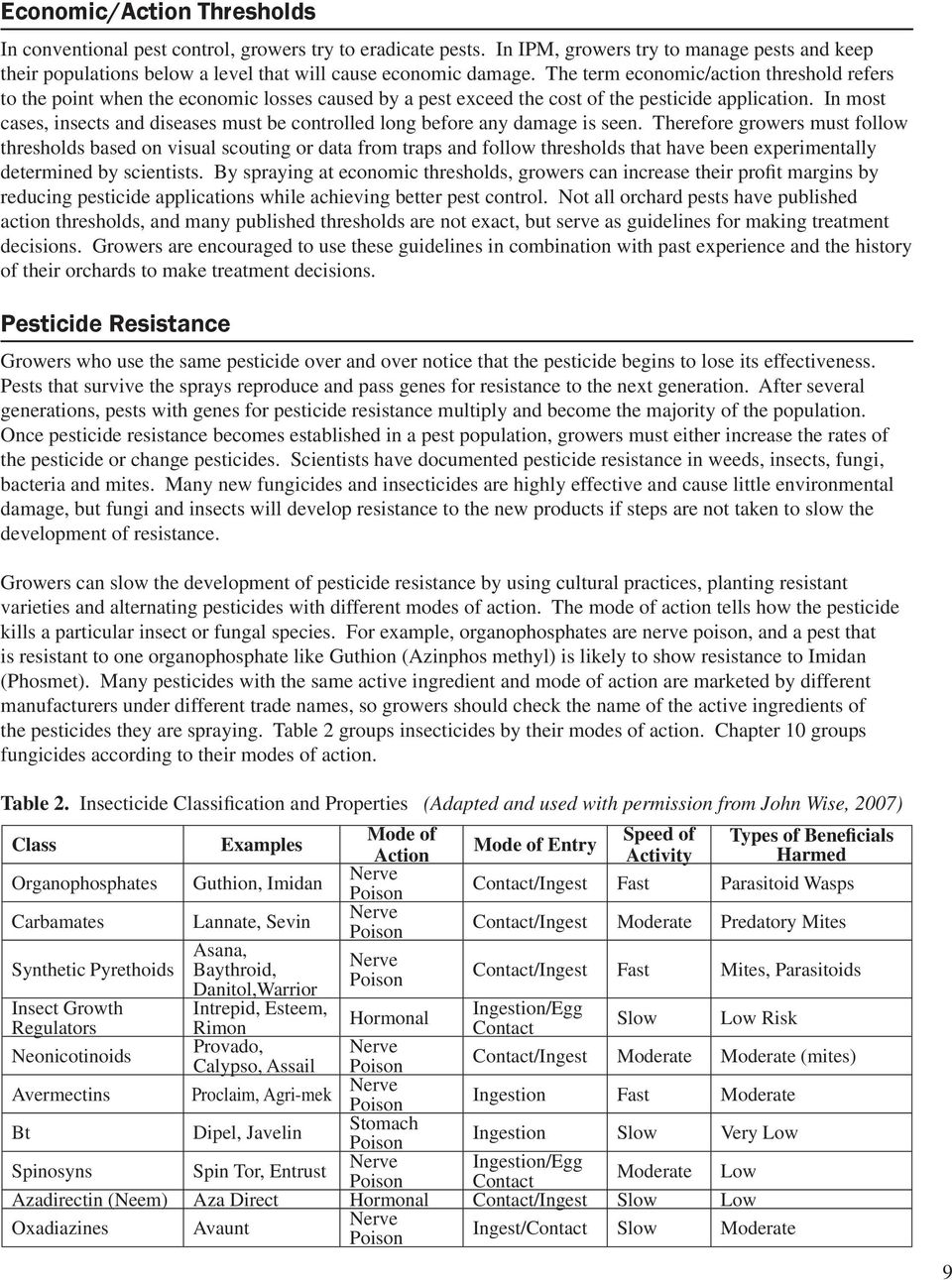
9 Economic/Action Thresholds In conventional pest control, growers try to eradicate pests. In IPM, growers try to manage pests and keep their populations below a level that will cause economic damage. The term economic/action threshold refers to the point when the economic losses caused by a pest exceed the cost of the pesticide application. In most cases, insects and diseases must be controlled long before any damage is seen. Therefore growers must follow thresholds based on visual scouting or data from traps and follow thresholds that have been experimentally determined by scientists. By spraying at economic thresholds, growers can increase their profit margins by reducing pesticide applications while achieving better pest control. Not all orchard pests have published action thresholds, and many published thresholds are not exact, but serve as guidelines for making treatment decisions. Growers are encouraged to use these guidelines in combination with past experience and the history of their orchards to make treatment decisions. Pesticide Resistance Growers who use the same pesticide over and over notice that the pesticide begins to lose its effectiveness. Pests that survive the sprays reproduce and pass genes for resistance to the next generation. After several generations, pests with genes for pesticide resistance multiply and become the majority of the population. Once pesticide resistance becomes established in a pest population, growers must either increase the rates of the pesticide or change pesticides. Scientists have documented pesticide resistance in weeds, insects, fungi, bacteria and mites. Many new fungicides and insecticides are highly effective and cause little environmental damage, but fungi and insects will develop resistance to the new products if steps are not taken to slow the development of resistance. Growers can slow the development of pesticide resistance by using cultural practices, planting resistant varieties and alternating pesticides with different modes of action. The mode of action tells how the pesticide kills a particular insect or fungal species. For example, organophosphates are nerve poison, and a pest that is resistant to one organophosphate like Guthion (Azinphos methyl) is likely to show resistance to Imidan (Phosmet). Many pesticides with the same active ingredient and mode of action are marketed by different manufacturers under different trade names, so growers should check the name of the active ingredients of the pesticides they are spraying. Table 2 groups insecticides by their modes of action. Chapter 10 groups fungicides according to their modes of action. Table 2. Insecticide Classification and Properties (Adapted and used with permission from John Wise, 2007) Mode of Speed of Class Examples Mode of Entry Types of Beneficials Action Activity Harmed Organophosphates Guthion, Imidan Nerve Poison Contact/Ingest Fast Parasitoid Wasps Carbamates Lannate, Sevin Nerve Poison Contact/Ingest Moderate Predatory Mites Synthetic Pyrethoids Asana, Baythroid, Danitol,Warrior Nerve Poison Contact/Ingest Fast Mites, Parasitoids Insect Growth Intrepid, Esteem, Regulators Rimon Hormonal Ingestion/Egg Contact Slow Low Risk Neonicotinoids Provado, Nerve Calypso, Assail Poison Contact/Ingest Moderate Moderate (mites) Avermectins Proclaim, Agri-mek Nerve Poison Ingestion Fast Moderate Bt Dipel, Javelin Stomach Poison Ingestion Slow Very Low Spinosyns Spin Tor, Entrust Nerve Ingestion/Egg Poison Contact Moderate Low Azadirectin (Neem) Aza Direct Hormonal Contact/Ingest Slow Low Oxadiazines Avaunt Nerve Poison Ingest/Contact Slow Moderate 9
10 Degree Days and Insect Pest Forecasting In conventional fruit production, most growers used a calendar or a phenological schedule to time pest control in their plantings. With the calendar method, growers sprayed on a weekly schedule without monitoring fruit or pest development. With the phenological schedule, growers sprayed according to the developmental stage of the tree, such as pink or petal fall. The calendar method is grossly inaccurate, since apples bloom and ripen at different calendar dates each year. The phenological method is more accurate, but insects, weeds, and fungi have different optimum temperatures for growth than do apples and peak at different stages of crop development each year. Insect life cycles are primarily regulated by temperature. The date that insects emerge each spring depends on factors such as soil temperature, daily highs, and overnight lows. The most accurate way to track insect pest maturity and predict when specific pests are most likely to cause economic losses is by calculating degree days. Degree days are a measurement of the cumulative heat for the growing season. Each pest requires a minimum number of heat units (degree days) before they emerge. The degree days for pest emergence of specific pests is explained in Chapters 5 and 6. Growers can calculate degree days by obtaining the high and low temperature from local climate websites ( by using high/low thermometers or computerized weather stations on their own farms. In order to calculate degree-day (DD) accumulations, take the day s maximum temperature (Tmax) and add the day s minimum temperature (Tmin), then divide the result by two and subtract the base temperature. The base temperature is the lowest temperature at which the insect remains active and varies according to pest. An insect active at cool temperatures will have a lower base temperature than one that needs heat to grow and reproduce. To calculate degree days, use the formula: DD = [(Tmax + Tmin)/2] - base temperature. The first part of the formula, (Tmax + Tmin)/2, gives an estimate of the average temperature for the day. The second part of the formula subtracts the base temperature specific to the pest. Example: The lowest and highest temperatures recorded at a farm were 50ºF and 80ºF. The DD accumulation for that day, with a base 50ºF is: DD = [( ) 2] - 50 = = 15 DD This calculation should be done every day, and the degree day totals of each day added together. Portable weather data loggers, such as the one manufactured by Spectrum Technologies Inc. (Fig. 3) automatically calculate accumulated degree-days. This logger has the ability to collect site-specific weather data, including temperature and leaf wetness. The equipment has a long-life battery and can be placed in a part of the orchard similar to the tree canopy. Data accumulated by the logger can be downloaded once or twice per week directly to a computer hard drive. A computer software program automatically calculates degree days and can forecast diseases. 10

11 Forecasting Disease Infection Periods Fungi and bacteria only infect plants when certain temperature and moisture conditions are present. Data loggers such as the instruments shown in Figure 3, tell growers when weather conditions are right for major diseases to develop. Each disease has a specific optimum temperature for infection. Leaf wetness can be measured with special instruments that are about the size of a thick playing card and attached to dataloggers that record data every 10 or 15 minutes. Leaf wetness monitors record wetness from dew, rain, or irrigation. Dataloggers also record temperature at the same time as leaf wetness. More expensive dataloggers record humidity and rainfall in addition to leaf wetness and temperature. The accuracy of leaf wetness monitors should be checked every year, because they can lose their effectiveness. When the data is downloaded into a computer, special programs on the computer tell the grower if an infection period has occurred. Good disease models have been developed for apple scab, sooty blotch and fire blight. By timing fungicide applications to coincide with infection periods, a grower can reduce enough fungicide sprays to cover the cost of the datalogger in one growing season. Figure 3. Weather data logger. Biofix Biofix is the date when a grower can start using temperature to monitor for a pest. For, example, the biofix date for apple maggot is March 1, and the apple maggot flight typically peaks at 1,400 DD (Base 50) after March 1 in Minnesota. The apple maggot flies may emerge at different calendar dates each year, but the 1,400 DD after March 1 is consistent from year to year. For codling moth, biofix is the date when the first continuous flight of five or more moths per trap occurs. After the biofix, there are 200 DD until the larvae hatch and start damaging the fruit. Biofix can help a grower apply insecticides when the insect is most vulnerable to a particular insecticide. Codling moth should be controlled in the egg or early larval stages, and the only way to predict egg hatch is to set a biofix date and count degree days. 11

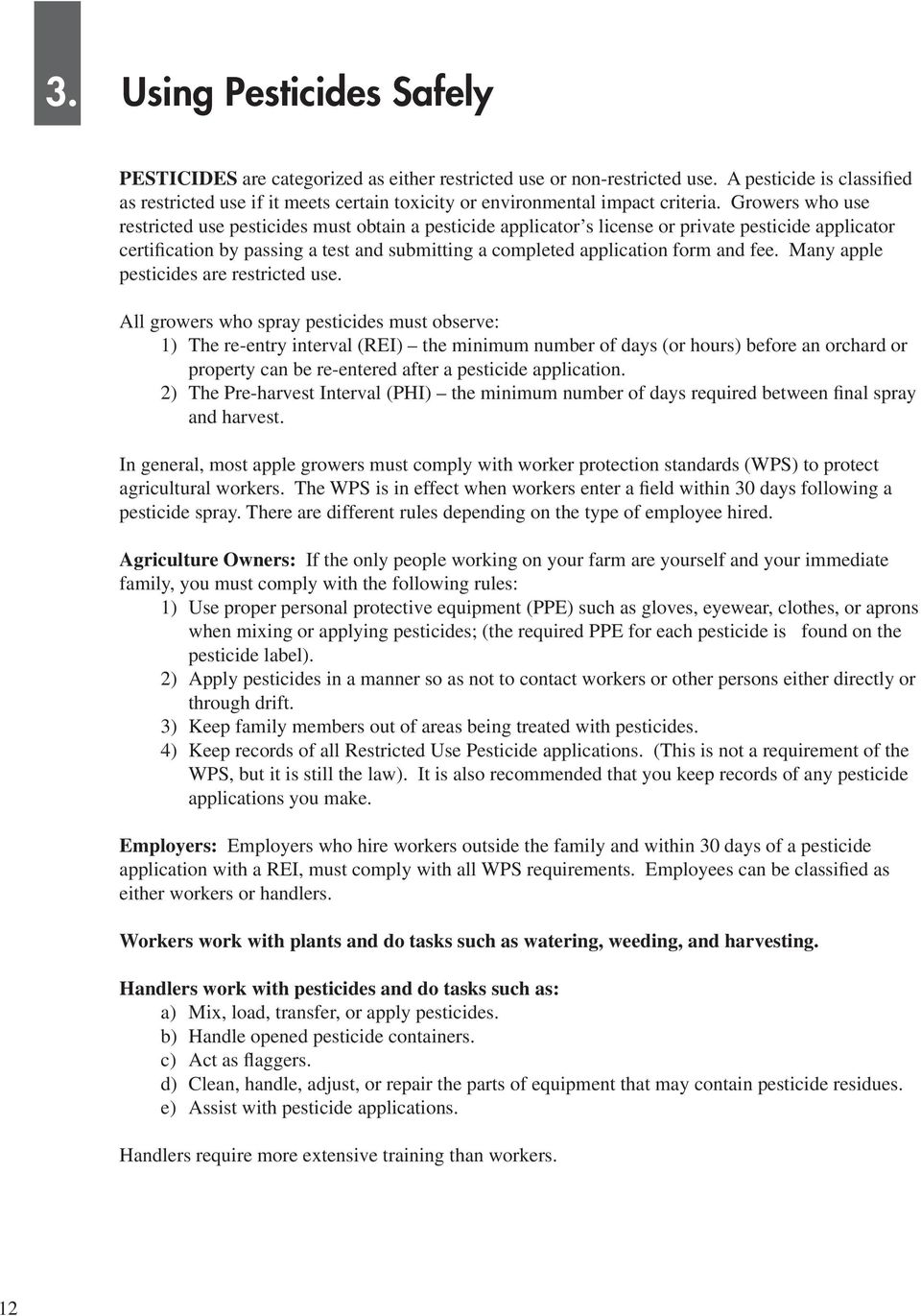
12 3. Using Pesticides Safely PESTICIDES are categorized as either restricted use or non-restricted use. A pesticide is classified as restricted use if it meets certain toxicity or environmental impact criteria. Growers who use restricted use pesticides must obtain a pesticide applicator s license or private pesticide applicator certification by passing a test and submitting a completed application form and fee. Many apple pesticides are restricted use. All growers who spray pesticides must observe: 1) The re-entry interval (REI) the minimum number of days (or hours) before an orchard or property can be re-entered after a pesticide application. 2) The Pre-harvest Interval (PHI) the minimum number of days required between final spray and harvest. In general, most apple growers must comply with worker protection standards (WPS) to protect agricultural workers. The WPS is in effect when workers enter a field within 30 days following a pesticide spray. There are different rules depending on the type of employee hired. Agriculture Owners: If the only people working on your farm are yourself and your immediate family, you must comply with the following rules: 1) Use proper personal protective equipment (PPE) such as gloves, eyewear, clothes, or aprons when mixing or applying pesticides; (the required PPE for each pesticide is found on the pesticide label). 2) Apply pesticides in a manner so as not to contact workers or other persons either directly or through drift. 3) Keep family members out of areas being treated with pesticides. 4) Keep records of all Restricted Use Pesticide applications. (This is not a requirement of the WPS, but it is still the law). It is also recommended that you keep records of any pesticide applications you make. Employers: Employers who hire workers outside the family and within 30 days of a pesticide application with a REI, must comply with all WPS requirements. Employees can be classified as either workers or handlers. Workers work with plants and do tasks such as watering, weeding, and harvesting. Handlers work with pesticides and do tasks such as: a) Mix, load, transfer, or apply pesticides. b) Handle opened pesticide containers. c) Act as flaggers. d) Clean, handle, adjust, or repair the parts of equipment that may contain pesticide residues. e) Assist with pesticide applications. Handlers require more extensive training than workers. 12
13 All employers must do the following in order to comply with the WPS, regardless of whether they hire handlers or workers: 1) Display the following information at a central location. a. Maintain a 30-day pesticide application record. The record should include the location of the field sprayed, product name, EPA registration number, date and time the pesticide was applied and the restricted-entry interval of the pesticide. b. Emergency medical information, which includes the name, telephone number, and address of the nearest emergency medical facility. c. An EPA approved pesticide safety poster. 2) Provide WPS pesticide safety training for new employees. a. Workers must be trained within five days of employment. b. Handlers must be trained immediately. (Minnesota Licensed pesticide applicators are exempt from the training requirement.) c. Workers and handlers must be provided safety training once every five years. 3) Have a decontamination site that contains: a. Water for routine washing and emergency eyeflush. i. Recommended - one gallon per worker. ii.recommended - three gallons per handler. b. Soap and single use towels. c. Decontamination sites should be located within ¼ mile of where employees are working. 4) Provide emergency assistance to any worker or handler who has been injured or poisoned by a pesticide as a result of that employment. Specific for pesticide handlers: a. Have pesticide labels and Material Safety Data Sheet (MSDS) available for handlers to review. b. Provide decontamination supplies at the pesticide mixing and loading area. c. Include an emergency change of clothing (example: coveralls) at all handler decontamination sites. d. Provide at least one pint of emergency eye flush when the pesticide label requires that protective eyewear be worn. e. Provide all required PPE for pesticide handler when mixing, loading, applying pesticides or conducting other handler tasks. f. Provide an area separate from pesticide storage or mixing area for handlers to change and store clothing. Warning Signs All workers need to be notified when a field is to be sprayed, either verbally or by posting the area with EPA approved warning signs. If you spray in the evening with a pesticide that has a 12 hour or less REI, employees do not need to be notified if the REI will have expired by the time the employees return. Spills All pesticide spills must be reported to the Minnesota Department of Agriculture by calling the Minnesota Duty Officer (MDO) at The MDA provides a 24 hour/7 day a week point of contact service for reporting spills. The MDO will forward your call to staff who will provide you with cleanup and disposal guidance. Personal Protective Equipment When mixing pesticides the applicator should use the appropriate clothing and equipment, which is usually listed on the front page of the pesticide label. 13

14 4. Pest Scouting PEST SCOUTING or monitoring enables a grower to determine if pest numbers are large enough to require treatment and to time sprays that coincide with the most susceptible stage of the pest. Scouting involves checking for eggs, larvae, or adults of a given pest on leaves, fruits or flowers, either by visual scouting or by using traps. For effective pest management, pest scouts should know how to correctly identify pests at all life stages and be able to distinguish pests from closely related or look-alike species. For this purpose, growers are encouraged to use this manual hand-inhand with the Field Guide for Identifi cation of Pest Insects, Diseases, and Benefi cial Organisms in Minnesota Apple Orchards. Growers need to record weekly or daily pest scouting data. Accurate records include a map of all the fields, a list of insect pests found in those fields, the numbers of insects recorded on each sampling date, and control measures taken on those fields. In Minnesota, scouting should begin around the green tip stage of apple (early April) and continue until harvest. Equipment The following equipment and tools are necessary for pest scouting: Hand lens (10X or stronger), for small insects, eggs, and mites (Fig. 4). White beating-tray for pests and beneficials on the fruit and foliage (Fig. 5). Sweep net to scout ground cover or capture flying insects (Fig. 6). Traps (pheromone and visual traps) to scout adult insects (Fig. 7). Notebook (or clipboard with data sheet) for record-keeping. A copy of the Field Guide for Identifi cation of Pest Insects, Diseases, and Benefi cial Organisms in Minnesota Apple Orchards to identify specimens. Knife, vials, and plastic bags for insect collection. Proper clothing and footwear. Figure 5. Beating-tray. Figure 4. Hand lens. 14 Figure 6. Sweep net.

15 Figure 7. Pheromone and trap types. Pheromone dispenser (rubber septum) Twist-tie pheromone ropes (inset = single rope) Pherocon VI Delta trap Delta trap liner Pherocon AM (yellow panel trap) Red sphere (ball) trap Ladd trap Circle trap Pyramid trap Grandisoic acid lure 15

16 Scouting Techniques Scouting can be either visual scouting or trapping, depending on the pest or pest stage being scouted. The following are suggested as general guidelines for scouting: Divide an orchard into blocks of no more than acres. The decision of what constitutes a block should be based on the grower s knowledge of the pest pressure history of the orchard. One convenient method of determining the size of a block is that area covered by one tank during spraying. As much as possible, a block should consist of the same or similar varieties and trees of similar age, size, and spacing. For certain pests, the edges require separate scouting, and if possible, need to be treated separately. To scout trees within a block, make a random selection based on a pre-determined selection pattern (e.g. diagonal, V-shaped pattern, etc.). Weekly scouting is sufficient for most pests although daily scouting may be required to detect emergence of certain pests, such as plum curculio. Select a day and time for your weekly visits. Visual Scouting For visual scouting, growers walk through their orchards looking for insects, insect damage, or signs of diseases. Leaves, branch tips, bark, or fruit clusters should be examined closely to determine if insect pests are present. Caterpillars and other large insects can be seen with the naked eye, but a hand lens will be necessary for small specimens like mites and insect eggs. Plum curculios and beneficials can be sampled with beatingtrays. The number of sampling sites per orchard block depends on the pest species being sampled, but as a general rule should not be less than five sites per ten acre block. Trapping Adult flying insects are usually monitored with traps baited with attractants such as pheromones or fruit volatiles, or with visual traps. Pheromones are chemicals released by an insect which influence the behavior of other individuals of the same species. The most common type of pheromones are the sex pheromones released by the female. Male moths follow the scent of the sex pheromone to locate and mate with the female. Traps baited with synthetic pheromones are used to monitor adult flights of moths, such as codling moth, leafrollers, and leafminers. Pheromone lures are specific to each species. Commercially produced pheromone lures have a field life of 4 to 12 weeks. Pheromone traps consist of a cardboard weather-proof trap, a sticky liner, and a pheromone dispenser, like the commonly used Delta Trap (Fig. 7). Inside the trap is a sticky card that can be replaced every month. Dispensers include caps, capsules, fibers or string (Fig. 7) that emit pheromones. Pheromone traps should be inspected weekly, or twice a week when setting a biofix date. Any insects found in the sticky liner should be identified, counted, recorded, and removed. Proper identification is critical to distinguish the target pest from closely related or look-alike species. Pheromone trap catches indicate when most moths will lay eggs, so they can predict when the caterpillars emerge and can be controlled with insecticides. Apple maggots do not use pheromones to attract mates and are monitored with a combination of visual attractants and odors. Various trap types and lures are available for monitoring apple maggot. Traps evaluated in Minnesota include the Pherocon AM yellow panel trap, the red sphere trap, and the Ladd trap, which is a combination of the yellow panel trap and the red sphere (Fig. 7). Apple maggot lures and baits include the ammonium-based baits and the fruit volatile lures. A red sphere trap baited with a fruit volatile blend can accurately monitor apple maggots throughout the season. 16

17 Plum curculio traps either mimic tree trunks or capture the weevils as they climb trees. These traps include the circle trap and pyramid trap (Fig. 7). Plum curculio traps are not as effective as pheromone or apple maggot traps and lose their effectiveness after bloom. Plum curculio traps do not give a reliable indicator of population size. The following are some general guidelines for effective use of traps: Place traps in the field 1-2 weeks before the earliest known emergence date of the target pest. This date may vary from year to year depending on degree day accumulation. The number of traps to use per block depends on the species. For pheromone traps, one trap per ten acre block is a good placement rate. Hang moth pheromone traps at eye-level on the outside of the tree canopy. Place visual traps in unobstructed areas for visibility to insects. When monitoring more than one insect species, place traps at least 50 (15 m) apart. Clean sticky trap surfaces regularly, and replace liners periodically (every four weeks or when they become too dirty). Recoat red sphere and Ladd traps with tanglefoot as necessary. Replace or change pheromone lures and other attractants as necessary, depending upon the published field life of the attractant. Pheromones and other attractants should be stored in the freezer to preserve their shelf life. Pheromones and other attractants are potent chemicals which should be handled with care, preferably using gloves or tweezers. Improper handling may lead to contamination, which may result in false catches. Contamination of clothes or body may attract insects to the grower. Since trap catch is influenced by temperature, rain, and other environmental conditions, always correlate trap catch results with weather information. 17

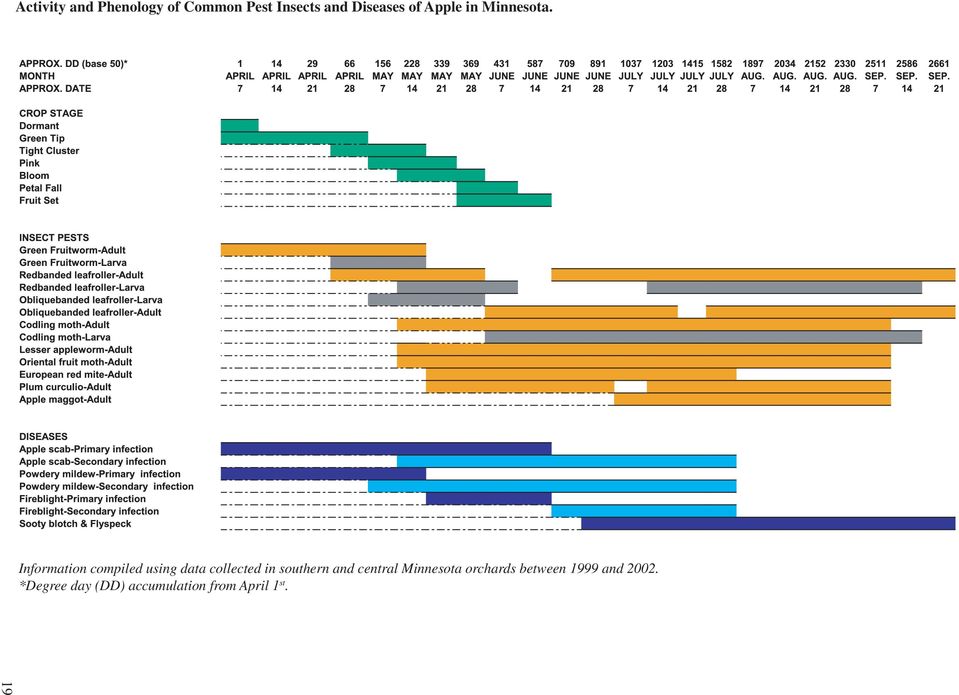
18 5. Calendar of Orchard Events in Minnesota Apple tree phenology Approximate dates Key pest emergence/approx. degree days (base 50 F)* Green tip April 7-24 Green fruitworm adult emergence (25 DD) Tight cluster April Redbanded leafroller 1 st flight (75 DD) Spotted tentiform leafminer 1 st flight (100 DD) Green fruitworm larvae (100 DD) Obliquebanded leafroller overwintered larvae (105 DD) Pink May 1-9 Cankerworm larvae (150 DD) European red mite hatch (160 DD) Bloom May Lesser appleworm 1 st flight (165 DD) Codling moth 1 st flight (180 DD) Redbanded leafroller larvae (185 DD) Petal fall May Plum curculio adult emergence (250 DD) Fruit set June 1-15 Codling moth larvae (425 DD) Obliquebanded leafroller 1 st flight (490 DD) June July 1-30 July August 1-30 Spotted tentiform leafminer 2 nd flight (610 DD) Redbanded leafroller 2 nd flight (780 DD) Apple maggot emergence (900 DD) Plum curculio summer adults (1,250 DD) Codling moth 2 nd flight (1,300 DD) Spotted tentiform leafminer 3 rd flight (1,500 DD) Obliquebanded leafroller 2 nd flight (1,550 DD) Redbanded leafroller 3 rd flight (1,950 DD) Information compiled using data collected in southern Minnesota orchards between 1999 and *Degree day accumulation from April 1 st. 18
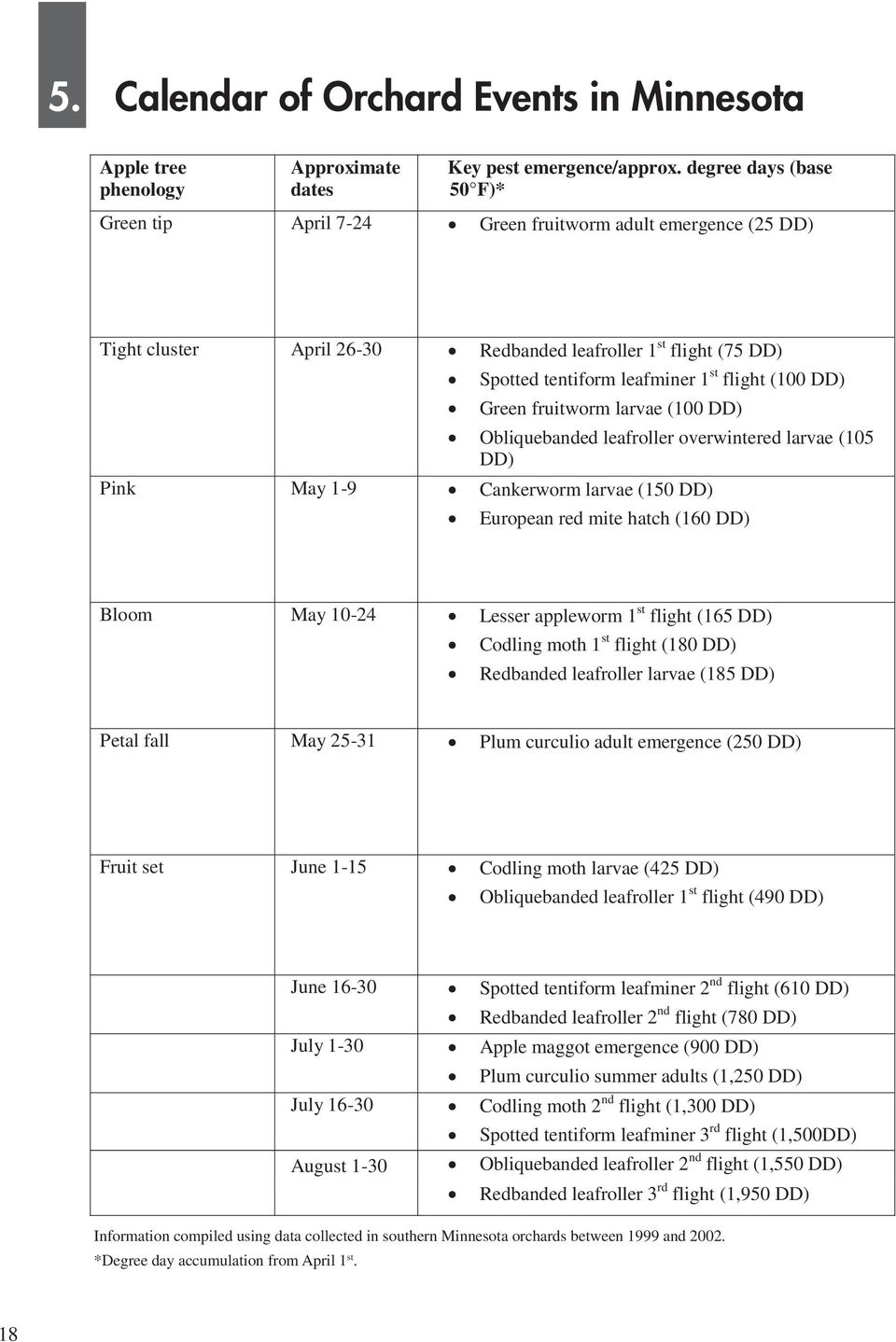
19 Activity and Phenology of Common Pest Insects and Diseases of Apple in Minnesota. Information compiled using data collected in southern and central Minnesota orchards between 1999 and *Degree day (DD) accumulation from April 1 st. 19
20 6. Biology and Management of Key Pests and Diseases of Apple in Minnesota GROWERS who know the biology, ecology, and management strategies for the major pests in their apple orchards will have a good chance of controlling those pests. The pests discussed in this section are apple maggot, plum curculio, codling moth, obliquebanded leafroller, redbanded leafroller, spotted tentiform leafminer, mites, apple scab, and fire blight. Most of the pest monitoring and management models discussed in this manual have been tested in Minnesota by scientists. Our goal is to suggest, to the grower and other users, possible control strategies for each pest, and not to endorse particular techniques or products. Therefore, we have left out specific pesticide information or recommendations in this chapter. Information on pesticide options is given in Chapter 10. A detailed description and identification of each pest is provided in the companion publication, Field Guide for Identifi cation of Pest Insects, Diseases, and Benefi cial Organisms in Minnesota Apple Orchards. Apple Maggot (Rhagoletis pomonella) Apple maggot (AM) is an internal feeder. It is native to the northeastern United States and Canada that reproduces on apples and hawthorns. AM are found throughout Minnesota. Adults are active from July to early September and have one generation per year (Fig. 8). Figure 8. Average weekly capture of apple maggot in Minnesota for several orchards located throughout Minnesota from (Error bars represent standard error of mean.) From: Analysis of insect collection data from Minnesota apple orchards by Harpartap Mann and Emily Hoover, Department of Horticultural Science, University of Minnesota, St. Paul, MN and Jeanne Ciborowski, Minnesota Department of Agriculture, St. Paul, MN. 20

21 Biology AM overwinter as pupae in the soil. In Minnesota, adult flies emerge from the soil from late June through early July after accumulation of about 900 DD (base 50 F,) and the flight peaks at 1,400 DD. When freshly emerged, AM flies are sexually immature and feed mainly on aphid honeydew. After about a week, the newly emerged flies become sexually mature and congregate on the apple fruit and mate. After mating, female AM insert single eggs under the skin of an apple fruit. The eggs hatch into larvae in 2 to 10 days and burrow into the flesh of the fruit. As AM larvae grow inside the apple, they pass through three instars in 20 to 30 days. Infested fruits usually fall to the ground as the apples deteriorate, allowing the maggots to leave the fruit, burrow into the soil, and molt to a fourth instar. This fourth instar quickly molts again into the pupal stage. Damage The spot where the fly inserts the egg forms a dimple or causes the apple to be deformed, even if the egg fails to hatch. The worst damage from apple maggot is caused by larvae tunnelling through the flesh and leaving small brown trails. AM larvae are small and the same color as apple flesh, and thus are difficult to see, but their trails are unmistakable. Infected fruit are often deformed, shrunken, and unmarketable. If an apple has many larvae, the entire flesh turns brown. Bacteria can enter into the damaged fruit, which causes the whole fruit to soften and decay. Management Monitoring: Apple growers can get the best and most efficient control by monitoring the emergence and activity of AM with sticky traps. The different types of traps include red spheres and the Ladd trap. Volatile lures can be placed near the traps and increase the effectiveness of the traps (see Fig. 7). The current recommendation for AM monitoring is to hang three red sphere traps baited with volatile lures per block (5-15 acres) on the outside row facing the most probable direction of AM migration (towards a wooded area or abandoned apple trees). Traps should be checked twice a week during AM emergence in early July and once a week later in the season. Chemical Control: Chemical sprays primarily target the adult AM before egg deposition. Growers should spray insecticides when a threshold of five flies per trap per week is reached. Since most broad spectrum insecticides have a day residual effect, monitoring may be discontinued 7-10 days after a spray. After the insecticide has lost its residual activity, resume monitoring and treat again when you catch a total of 15 flies in three traps per week. Monitor for AM from early July to September. Some AM will be caught in June, but the early flights of flies rarely cause economic losses, because larvae cannot live in the acidic, rapidly growing fruit. Another method of managing AM is to spray the outside rows with an insecticide with good residual activity. AM generally feed in woodlots and fence rows outside of commercial orchards and then fly into the orchards to lay eggs on the developing apples. This continual movement in and out of the orchards makes border sprays effective, except in cases where the pest is endemic to the apple block. Organic Control Options: Small commercial and organic orchards have controlled AM using the trap-out or mass trapping method. The objective of the trap-out method is to place so many red spheres that all incoming flies are trapped and killed. Red spheres should be placed every 15 on the outside perimeter of the orchard. In orchards with high pressure, the spheres should be closer together. Instead of red spheres that must be cleaned, some organic orchardists prefer to put tanglefoot on red apples from the grocery store. Do not put the traps out too early in the summer, or you will only kill harmless flies. A second alternative is putting out red spheres baited with volatile compounds and the OMRI approved insecticide Spinosad. The fly lands on the sphere, consumes some insecticide and flies off to die. Weekly applications of Surround (kaolin clay) discourage AM from entering the orchards and laying eggs. Adult AM are susceptible to several insecticides approved for organic production. (See Chapter 10) 21
22 Plum Curculio (Conotrachelus nenuphar) Plum curculio (PC) is native to Minnesota and has a wide host range that includes many different types of fruit. In apples, PC is both an external and internal pest. PC is a beetle in the family Curculionidae, which includes snout beetles or weevils. Biology Adults overwinter in ground litter or soil either within the orchard or in surrounding wooded lots. Adults emerge when temperatures exceed 60 F and continue to emerge for the next six weeks. PC emergence corresponds to apple bloom. Once in the orchard, PC primarily move by walking. Adults feed on buds, flowers, and young fruit. After petal fall, females begin to lay eggs in the fruit (Fig. 9). The date PC begin depositing their eggs depends on weather. In very warm springs, PC will deposit eggs at petal fall, but in a cool spring they will delay egg laying until small fruit have formed. The larvae may grow inside fruit and emerge as adults in late June or July. These summer adults feed on apples and overwinter in late summer. Only one generation occurs per year in Minnesota. Figure 9. Plum curculio inserting eggs in young Beacon apple. Damage Fruit damage by PC occurs both during feeding and egg-laying activities. Feeding injury by the adults consists of shallow, circular holes. PC cause the most damage during egg laying (Fig. 9), when the adult female PC cuts a small hole in the fruit, deposits her eggs, and covers the hole producing a crescent-shaped slit just below the site where the egg was laid. In apples, the eggs are usually crushed by the growing fruit and rarely hatch. Fruit with oviposition or feeding scars are often dimpled and deformed. Larvae may survive when more than one egg is deposited per fruit. Fruit damage is usually most common in border rows next to sites where adults overwinter. Management Monitoring: PC can be monitored with traps, by tapping branches, or by observing damage to fruit. The most common traps are pyramid and circle traps that capture PC as they try to climb trees (Fig. 7). Traps must be located in close proximity to woods in order to capture immigrating PC. PC traps are inefficient, telling growers if curculios are present, but do not provide an estimate of the population. By tapping branches onto a white plate, a grower can get an estimate of the population, but tapping is ineffective when the population is low. The most efficient means of monitoring PC is by walking through the orchard and observing oviposition scars on the fruit. The best time to monitor PC is on humid evenings with a temperature above 70ºF. 22
23 Chemical Control: Adult PC weevils should be controlled when they begin laying eggs. If a block has a history of PC damage, the block should be sprayed right after the first oviposition scars have been seen after bloom. Subsequent PC movement, feeding, and egg-laying activities are highly dependent on the temperature and weather. A model was developed by researchers at Cornell University (Geneva, New York) to determine how many additional sprays will be necessary to maintain protective chemical residues to prevent subsequent damage throughout the PC egg-laying period. According to the model, 40% of PC egg-laying is finished at 340 DD (base 50 F) after petal fall. After 340 DD, few adult weevils move into and within the orchard. Between the first spray and 340 DD after petal fall, the orchard should be sprayed every 14 days. No additional sprays are needed if 340 DD is reached within 14 days of petal fall treatment. PC are difficult to kill with insecticides and many soft insecticides provide little control. Organic Control Options: Traditionally, PC has been the hardest apple insect pest to control organically if there is a strong resident population. Traps and lures available today are inconsistent and most approved organic pesticides provide very low levels of control. When possible, locate the orchard away from potential habitats for the pest. Kaolin clay (Surround) has proven to be as effective as many insecticides at reducing PC injury when used properly. Surround does not kill PC adults, and they may move to other trees, or they may begin depositing eggs after the Surround washes off the trees. In small orchards, PC populations can be reduced by laying tarps under the trees and shaking or beating the tree branches so that PC adults fall off the branches onto the tarp, where they can be killed by hand. Chickens that scratch under the trees can also control PC in small orchards. Many chickens are needed to control PC, and a large flock of poultry is rarely feasible in orchards greater than a half acre in size. Occasional applications of organic insecticides along the orchard border may keep plum curculio under control in some seasons. 23
24 Codling Moth (Cydia pomonella) Codling moth (CM) larvae are the worms in wormy apples. CM larvae can grow to ¾ long, and are quite noticeable to the unsuspecting consumer. CM was introduced from Eurasia and has a narrow host range that includes apples, crabapples, pears, and English walnuts. CM is established in the major apple producing areas of Minnesota. Figure 10. Average weekly capture of codling moth in Minnesota for several orchards located throughout Minnesota from The economic threshold for codling moths is fi ve per trap per week. (Error bars represent standard error of mean.) From: Analysis of insect collection data from Minnesota apple orchards by Harpartap Mann and Emily Hoover, Department of Horticultural Science, University of Minnesota, St. Paul, MN and Jeanne Ciborowski, Minnesota Department of Agriculture, St. Paul, MN. Biology CM overwinter as full-grown larvae in silken cocoons in sheltered locations such as under tree bark, in ground cover, and sometimes in the soil. The overwintered larvae pupate in mid-spring and the first generation adults begin to fly right after bloom. There are two generations of CM per year in most parts of Minnesota (Fig. 10). The second generation moths start flying at the end of July, and the second generation larvae attack fruit in August and September. CM lay their eggs on leaves or developing fruit. After hatching, the larvae burrow into the fruit. They go through five instars inside the fruit and grow to ½ to ¾ before exiting the fruit. Damage CM larvae feed on apple fruit and seeds. The most common CM damage occurs when the caterpillar burrows into the apple and heads straight to the core, where it eats seeds. As the caterpillar begins burrowing, it leaves frass on the surface. Most CM larvae exit the apple through the calyx, sometimes leaving frass, but occasionally leaving no sign of exiting. When CM begin burrowing into an apple and die, the frass and superficial damage is called a sting. Apples with CM damage are unmarketable, ripen before uninfested apples and often rot on the tree. 24
25 Management Monitoring: Monitoring is essential for efficient codling moth control. CM are easy to monitor with pheromone-baited Delta traps (Fig. 7). Divide the orchard into blocks of approximately five acres. Use one trap per orchard block. Place the trap at eye level on the south side of the tree, 50 to 200 from the edge of the block. Biofix occurs when a sustained catch of five moths per trap per week is reached. Growing degree days (base 50) should be calculated starting at biofix. At 60 DD post-biofix, the moths start laying eggs. At 250 GDD post-biofix, 3% of the larvae have hatched. Growers who monitor and calculate GDD biofix can time control measures specific to the stage of the larvae. Chemical Control: In most apple growing regions throughout the world, insecticide programs revolve around codling moth control. For years, the primary insecticides for controlling CM were the organophosphates azinphos-methyl (Guthion) and phosmet (Imidan), long lasting, broad spectrum insecticides. By 2005, CM in many apple growing regions had become resistant to this class of insecticides. Guthion will be pulled off the market by Several broad spectrum insecticides are still available, such as phosmet (Imidan), but a series of new generation pesticides are now available that are just as effective as Guthion with lower risk to the environment (Table 3). The new generation of insecticides kill the insect at different stages of the life cycle and must be properly timed in order to be effective. Proper timing wasn t as critical with the old broad spectrum organophosphate insecticides, because the insecticides had a long residual activity, could kill all stages of the moth, and killed by both contact and ingestion. The new insecticides Esteem and Rimon kill eggs, and work best if the insecticide is sprayed before the eggs are laid. Therefore, Rimon should be sprayed at 50 DD post-biofix. Both insecticides kill larvae after ingestion. Intrepid works best after the eggs have been laid and before the larvae hatch, or 150 DD postbiofix. Avaunt, Spintor, granulosis virus and Proclaim primarily target the larvae and should be sprayed shortly after hatching, or 250 GDD post-biofix. If an insecticide only kills by ingestion, it must be sprayed before larvae hatch so larvae can eat the insecticide before burrowing into the fruit. Flights last from one month to six weeks, therefore insecticides should be applied so that early emerging and late emerging moths and larvae are killed. Table 3. Insecticidal Activity on Codling Moth (Adapted and used with permission from John Wise, 2007) Compound Life Stage Activity Mode of Exposure Time to Apply (DD post-biofix) Organophosphate Eggs, Larvae, Adults Contact/Ingestion 250 Pyrethroids Eggs, Larvae, Adults Contact/Ingestion 250 Intrepid Eggs, Larvae, Adults Ingestion/Over Egg Contact Sublethal Esteem Eggs, Larvae, Adults Ingestion/Under Egg Contact Sublethal Rimon Eggs, Larvae, Adult Ingestion/Under Egg Contact Sublethal Avaunt Larvae, Adults Ingestion/Contact 250 Spintor Eggs, Larvae Ingestion/Egg Contact 250 Granulosis Virus Larvae Ingestion 250 Neonicotinoids (Assail, Clutch) Eggs, Larvae, Adults Ingestion/Contact 250 Proclaim Eggs, Larvae Ingestion 250 For maximum control, at least two insecticides should be sprayed for each generation of CM. The first spray could be an insecticide that kills eggs, like Rimon. Apply a second spray days after first spray if pheromone traps continue to catch adult moths. The second spray could be an insecticide that targets larvae. 25
26 Organic Control: Several native insects feed on CM in Minnesota, including the egg parasitoid, Trichogramma minutum, and two larval parasitoids, Ascogaster quadridentata and Macrocentrus iridescens. Trichogramma minutum is commercially available for release in orchards, but rarely kills CM in high enough numbers to sufficiently control CM in commercial orchards. Releases of T. minutum must be made during the egg-laying cycle of first and second generation CM females in order to ensure egg parasitism. The granulosis virus causes a fatal disease in CM larvae. The virus is specific to CM, and kills no beneficial insects. Several formulations of granulosis virus are available for CM control. Granulosis virus is sprayed in a manner similar to most insecticides, but at low rates, and it should be applied weekly. When properly used, the virus provides as much control as many synthetic insecticides (as per presentation by Larry Gut, 2007 Apple IPM Short Course, St. Paul, MN). Granulosis virus must be sprayed before the larvae hatch, about 250 DD post-biofix. CM larvae live for several days after ingesting the virus, and will often cause superficial stings before dying. Consistent use of granulosis virus can lower the population of CM in an orchard. Mating disruption can control moths in areas with low pressure and few wild apple trees. In mating disruption, dispensers of synthetic pheromones (Fig. 7) are placed throughout the orchards in such high numbers that the males cannot find and mate with the females. Successful mating disruption programs have been recorded in many parts of the United States and in other parts of the world. For instance, about one-third of Washington State s apple and pear orchards are presently being managed by an area wide mating disruption-based strategy. The dispensers most commonly used in mating disruption are small ropes that must be manually hung in apple branches. Mating disruption has been cost effective in orchards with low pest pressure, and can be used in conjunction with insecticides or granulosis virus. If there are abandoned orchards, backyard trees or wild apple trees nearby, mating disruption will not work, because mated females can fly into the orchard. In commercial apple growing districts, mating disruption is most likely to succeed if all growers in the district are cooperating. Orchards with mating disruption should be constantly monitored with pheromone traps and visual scouting to make sure that males are not finding females, and the dispensers should be strong enough to last all summer. Growers interested in mating disruption should get special training from consultants. 26
27 Obliquebanded Leafroller (Argyrotaenia velutinana) and Redbanded Leafroller (Choristoneura rosaceana) Obliquebanded leafroller (OBLR) and Redbanded leafroller (RBLR) are native pests that have a wide host range, including apple, pear, cherry, plum, peach, rose, raspberry, gooseberry, currant, strawberry, blueberry, and many weeds. Historically, commercial apple growers in North America rarely needed to manage leafrollers in their orchards. Since 1990, there have been a number of leafroller outbreaks. Prior to 1990, broad spectrum insecticides kept leafroller populations below threshold levels. Some growers believe that broad spectrum insecticides also killed leafroller predators, allowing OBLR populations to increase and changing it from a secondary to primary pest. There are two generations of OBLR per year in Minnesota (Fig. 11) and two to three generations per year of RBLR (Fig. 12) Figure 11. Average weekly capture of obliquebanded leafroller in Minnesota for several orchards located throughout Minnesota from (Error bars represent standard error of mean.) From: Analysis of insect collection data from Minnesota apple orchards by Harpartap Mann and Emily Hoover, Department of Horticultural Science, University of Minnesota, St. Paul, MN and Jeanne Ciborowski, Minnesota Department of Agriculture, St. Paul, MN. Biology The smaller RBLR overwinter as pupae in the ground cover. They are one of the first moth pests to emerge in the spring. In Minnesota, the first generation begins around the green-tip or tight cluster stage, around the last week of April or approximately 75 DD (base 50ºF). The adult female lays cream-colored egg masses on tree trunks or leaves. Newly hatched larvae feed on leaves and watersprouts. There are three generations of RBLR per year in Minnesota (Fig. 12). The larger OBLR overwinter as immature larvae in cocoons on tree bark. The overwintered OBLR larvae resume activity early in the spring and can eat the first small leaves that form on the trees. First generation moths start to appear around the end of May (about 490 DD base 50ºF). The females mate and lay green egg masses. Larvae undergo six developmental instars. By the second instar, the larvae begin to roll leaves or attach several leaves together with webbing. The larvae pupate inside the rolled leaves. Development from egg to adult in orchards may take up to six weeks. 27
28 Figure 12. Average weekly capture of redbanded leafroller in Minnesota for several orchards located throughout Minnesota from (Error bars represent standard error of mean.) From: Analysis of insect collection data from Minnesota apple orchards by Harpartap Mann and Emily Hoover, Department of Horticultural Science, University of Minnesota, St. Paul, MN and Jeanne Ciborowski, Minnesota Department of Agriculture, St. Paul, MN. Damage First instar leafrollers primarily feed on young leaves at the tips of the branches. Later instars also feed on fruit. First generation RBLR and OBLR feed on small fruit shortly after petal fall. Some of the damaged fruit falls off the tree during the June drop. Fruit that remain on the trees are deformed and develop a corky layer on their skin. Fruit damaged by first generation leafrollers can be removed by thinning. By late July, larvae of the summer generation can be found on actively growing terminals inside the canopy and on terminal and older leaves near fruit clusters. Second generation leafrollers feed on fruit, either by webbing a leaf to a fruit or by crawling between two apples that are touching and feeding on both apples. RBLR only eat the surface of the apples, while OBLR eat deeper into the fruit. Although leafrollers are external pests, fruit damaged by summer generation leafrollers is unmarketable, and damaged fruit remains on the trees through harvest. Management Monitoring: Pheromone traps are available for monitoring OBLR and RBLR moths. Minnesota populations of OBLR are related to the western strain, and growers should use pheromones developed for the western U.S. Trap catch data tell growers when the leafrollers are flying and mating, but there are no thresholds for leafroller adults in the traps. Having a large host range, leafroller moths may lay their eggs on surrounding trees instead of apple trees. Trap monitoring should be combined with visual scouting in the orchard. Sampling for first generation leafroller larvae and infestation should begin at early petal fall stage. Check five trees, examining 20 bud clusters per tree. On each tree, look for larvae or larval feeding on six clusters on the outside of the tree, six clusters in the center of the tree and eight clusters near the treetop. Treatment is recommended if there are two or more larvae or fresh feeding sites per tree. Pheromone traps should be used to determine when emergence of the summer brood starts; then each week, examine ten fruit clusters and ten terminals in the outside, center, and top of five trees per orchard. A commonly used threshold is when 10% of the fruit and 5% of the terminals have leafrollers. Always inspect rolled leaves to determine the age of the larvae. Insecticides will be most effective on young caterpillars and ineffective on pupae. Degree days for each flight of leafrollers is in Table 4. 28
29 Figure 13. Leafroller damage. Table 4: Degree days (Base 50ºF) for OBLR and RBLR Flights in Minnesota (Larvae typically emerge 200 DD after peak fl ight) 1 st Flight 2 nd Flight 3 rd Flight RBLR 246 (May 12) 1,192 (July 10) 1,994 (Aug 26) OBLR 697 (June 22) 1,966 (Aug 26) Chemical Control: Chemical sprays should be applied shortly after the larvae hatch but before they roll up the leaves. Most of the control materials available for obliquebanded leafroller also control RBLR. Control sprays for leafrollers are typically applied at petal fall and in cover sprays. In addition to the organophosphates, many new and selective options are currently available for the control of leafrollers, including insect growth regulators, Bacillus thuringiensis (Bt) products, and spinosad (Spintor). Leafrollers are more susceptible to Bt insecticides than CM, because the larvae are external feeders and more likely to ingest the insecticides. Table 5 shows the susceptibility of OBLR to codling moth insecticides. Organic Control Options: Organic apple growers can use Bt products and kaolin clay (Surround) to control leafrollers. Pheromone formulations are commercially available for mating disruption of leafrollers. OBLR pheromone dispensers should be applied before the start of the first flight in June. Many organic producers accept some leafroller damage as normal. Table 5. Relative Activity Spectrum for New and Old Apple Insecticides Insecticide CM OBLR PC AM STLM Avaunt Fair Good Good Fair NA Intrepid Good E NA NA Sap feeders Spin Tor Good Good NA Fair Sap feeders Esteem Fair Fair NA NA Sap feeders Rimon E Good NA NA NA Assail E NA E at high rates E at high rates Sap feeders Calypso E NA E at high rates E at high rates Sap feeders Guthion E Good E E Poor Proclaim 1st generation E NA NA NA Warrior Good E E E Adults Danitol Good E E E Adults Surround Poor NA Fair Fair NA NA = no activity, E = excellent 29
30 Spotted Tentiform Leafminer (Phyllonorycter blancardella) Spotted tentiform leafminer (STLM) is a secondary pest that only feeds on leaves. There are three generations of STLM per year in Minnesota. During warm years, a partial fourth generation may occur (Fig. 14). Figure 14. Average weekly capture of spotted tentiform leafminer in Minnesota for several orchards located throughout Minnesota from (Error bars represent standard error of mean.) From: Analysis of insect collection data from Minnesota apple orchards by Harpartap Mann and Emily Hoover, Department of Horticultural Science, University of Minnesota, St. Paul, MN and Jeanne Ciborowski, Minnesota Department of Agriculture, St. Paul, MN. Biology STLM overwinter as pupae inside fallen leaves. In Minnesota, first generation adults begin to emerge around the last week of April (approximately 100 DD base 50 F). Females mate and lay eggs on apple leaves. Egg hatch will occur in days depending on the weather conditions. Larvae undergo five instars before pupating within the leaf. Damage STLM larvae burrow into the leaves and feed on the tissue or sap between the top and bottom of the leaf, creating small mines in the leaves. The first three larval instars feed on the sap from the underside of the leaf. Mines from the younger instars are only visible from the underside of the leaf. The last two larval instars are tissue feeders which eat all the chlorophyll between the tops and bottoms of the leaves. Their feeding gives the mines a tent-like appearance when the green tissue is removed from the mine. By eating chlorophyll, STLM reduce the leaves ability to photosynthesize and supply the fruit with sugars. When there are more than three mines per leaf, the tree can be harmed, especially early in the season. 30
31 Management Monitoring: STLM can be monitored using pheromone traps, red sticky cards, and visual monitoring. Pheromone traps and red sticky cards can tell the grower if the majority of STLM are moths, larvae or pupae, but spray decisions should be conducted using visual monitoring. Examine 50 leaves on 10 trees in the orchard for mines and follow the thresholds in Table 6. Table 6. Spotted Tentiform Leafminer Action Thresholds Generation Treatment Threshold First 0.1 mine per leaf Second 1 mine per leaf Third 5 mines per leaf These thresholds could be raised by 50% if half of the mines show evidence of parasitism. The presence of parasitoids or evidence of parasitism can be determined by visually inspecting the interior of the mines using a 10X hand lens. Look for the presence of a small egg on the immobile body of STLM larvae, the presence or remains of naked pupae, or whitish cocoons. Chemical Control: Many insecticides are currently labeled for STLM control. However, chemical control, if necessary, is only recommended for the first and second generations since injury from the third generation rarely constitutes a serious problem. Insecticide may be sprayed every two to four rows to minimize impact on parasitoids. Broad spectrum insecticides are undesirable since they will reduce the control offered by beneficial insects in the orchard. Organic Control: STLM outbreaks are usually tied to broad spectrum insecticides that reduced the population of parasitoid wasps. By avoiding broad spectrum insecticides, organic orchards rarely have STLM above threshold levels. STLM are kept under control by the parasitoid wasps, Sympiesis marylandensis and Pholetesor ornigis. Together, both parasitoid wasps can potentially parasitize up to 75% of STLM population in an orchard. Many OMRI approved sprays are labeled for STLM. 31
32 Mites The European red mite (Panonychus ulmi), apple rust mite (Aculus schlechtendali), and twospotted spider mite (Tetranychus urticae) are three species of pest mites that can be found in Minnesota orchards. In terms of abundance and potential for economic damage, the European red mite (ERM) is by far the most important of the three species. 120 ERM ARM PM (Z. mali) Average #mites/leaf Figure 15. Seasonal abundance of European red mite (ERM), apple rust mite (ARM), and the predatory mite (PM) (Zetzellia mali), in a Southeastern Minnesota orchard in May 11-Jun 25-Jun 9-Jul 23-Jul 6-Aug 20-Aug 3-Sep Biology European red mite (ERM) overwinter as fertilized eggs on roughened areas of tree bark. These overwintered eggs begin to hatch early around the tight cluster stage of apple and continue until after bloom. Developing ERM pass through three immature stages and take 5 to 15 days to mature, depending on temperature. Mites have five to eight overlapping generations per year in Minnesota. Generally, mite populations decline rapidly in late summer as the population of predatory mites increases (Fig. 15). The apple rust mite (ARM) is the smallest of the three pest mites. Adult females overwinter beneath bud scales and bark of young trees, and emerge in the spring as soon as the buds begin to open. Emerging adults begin to lay eggs shortly, producing several generations per year. Adults found in the orchard in late summer are mostly females seeking overwintering sites. ARM feeding can cause russeting on the fruit. ARM infestation rarely causes economic damage to apples, and treatment is rarely justified. The twospotted spider mite (TSSM) is currently the least abundant of the three pest mites in Minnesota orchards. TSSM overwinter as adult females in protected areas on the ground. The females emerge around tight cluster in the spring, and begin to feed and lay eggs. Eggs are mainly deposited on the underside of leaves. As with the other mites, TSSM populations usually reach a peak in midsummer and are most severe during years of hot and dry weather. At high populations, TSSM spin webs over leaves and twigs, hence the name spider mite. Damage ERM and other mites feed on leaves of apple trees, interfering with photosynthesis and carbohydrate production. Mites pierce the cell walls with bristle-like mouthparts and eat the inside of the cell. During severe infestations, the leaves turn a bronze color. At high levels, mites can reduce photosynthesis enough to reduce fruit yield and quality. ARM can cause russet to form on the fruit. 32
33 Management Varietal susceptibility to pest mites: In 1996 and 1997, studies were conducted to test the susceptibility of several apple varieties to mites. The results show major differences in the susceptibility of Minnesota-grown apple varieties to mites. Of the 11 varieties tested, Haralson was by far the most susceptible variety to ERM, averaging 65 mites/leaf in August 1996 (Table 7). Gala was the least susceptible to ERM with an average of 0.1 mite/leaf in August The most susceptible varieties to ARM were NW Greening, Red Delicious, and Connell Red. Haralson, Jersey Mac, and Red Chief were the most susceptible varieties to TSSM. Table 7. Susceptibility of Some Apple Varieties to European Red Mite Susceptibility High Medium Low Variety Haralson Red Cort, Connell Red, Jersey Mac, Regent, Spartan, Honeycrisp, Red Delicious Gala The goal of mite management is to keep mite numbers below predetermined thresholds, which vary throughout the season (Table 8). The best way to keep pest mites under control throughout the season is to make sure that predator mites are abundant by ensuring a healthy population with judicious pesticide use. Monitoring: Mites are usually sampled by examining apple leaves for motile mites (adults and nymphs). Eggs are not counted. Four leaves are taken from five trees to give a sample size of 20 leaves per block. Start with a random tree, sampling every other tree, collect four middle aged leaves from each quadrant of the tree canopy. Using a hand lens, examine the top and underside of the 20 leaves for motile mites. Because mites are very small, numerous, and difficult to count, researchers at Cornell University recommend counting and recording the number of leaves with mites. If the block is near the threshold for mites, continue sampling. For example, in June, if five of the 20 leaves have mites, take more samples. Apple trees can tolerate higher mite numbers as the season progresses and the thresholds increase through the season. Refer to Cornell University Cooperative Extension Insect and Mite Management (2007) - Mite Sampling Charts at CH06/ for more information on the Cornell mite monitoring program. Note that the program was developed for ERM, but may be used for other mites. Table 8. European Red Mite Action Thresholds* Sampling Date Threshold (mites/leaf) June 2.5 July 5.0 August 7.5 *Developed at Cornell University Chemical Control: In fields with a history of mite infestations, a delayed dormant oil spray can reduce the number of mites in the spring, keeping mite numbers low until predatory mite populations become established. If mite populations get out of control during the growing season, growers can choose from among several different miticides listed in Chapter 10. Current miticides are very effective, and one spray will usually control an outbreak. 33
34 Biological Control: Several predatory mites live in Minnesota apple orchards including Zetzellia mali, Typhlodromus pyri, Typhlodromus occidentalis (western predatory mite), and Amblyseius fallacis. These predatory mites, in addition to other insects such as ladybeetles, spidermite destroyer and six-spotted thrips offer the potential for biological control of pest mites in Minnesota apple orchards. Predatory mites such as Z. mali, T. pyri, and A. fallacis were found at moderate densities in many Minnesota orchards, in particular during July and August. These species should be established and maintained for biological control of mites. Refer to the Field Guide for Identifi cation of Pest Insects, Diseases, and Benefi cial Organisms in Minnesota Apple Orchards for a description of the three predatory mites and how to distinguish them from pest mites. Studies conducted in New York suggest that T. pyri may be a more efficient ERM predator than A. fallacies because it is more winter hardy, uses alternative food sources, and has the tendency to remain in the orchard season-long. T. pyri overwinter as mated adult females on tree bark, crevices, or branches. Overwintered females emerge early in the spring as the buds begin to open. T. pyri has three to four generations per year in Minnesota. If predatory mites are not already present in the orchard, they must be introduced. Predatory mites can also be added to augment resident populations in orchards with few predators. Growers can conserve and encourage resident predatory mite populations in the orchard by carefully timing their insecticide sprays and choosing sprays that are least toxic to predators. Pyrethroids and several broad spectrum organophosphate insecticides are toxic to predatory mites and other beneficials. Early season synthetic pyrethroid sprays are strongly correlated with later mite outbreaks. 34
35 Apple Scab (Venturia inaequalis) Apple scab (AS) is the number one apple disease in Minnesota, requiring many fungicide sprays for control. Apple scab can defoliate unsprayed trees of sensitive varieties while disfiguring the fruit. All of Minnesota s commercial apple varieties have some degree of susceptibility to apple scab. Some are highly susceptible while others are somewhat resistant, but none are field immune, making regular application of fungicides a necessity. Biology Apple scab spores overwinter in fallen leaves that were infected the previous year. In order for the yearly cycle of infection to occur, spores must move from the dead leaves on the ground to new leaves on the trees during a primary infection period in the spring. Apple scab spores on dead leaves begin to mature after the ground thaws and the temperatures increase. After maturing, primary spores are expelled over a four to seven week period starting around the pink stage of apple tree development and ending in June. The developing spores within each spore case do not mature at the same time. If the overwintered leaves on the ground have a film of free moisture, the mature spores are forcefully expelled from the spore cases into the air where they can land on new leaves. Once scab spores land on the surface of the leaves or fruit, spores require a film of water to germinate. In general, the warmer the weather, the less time it takes for that spore to germinate in the film of water and infect the plant tissue. If the film of water dries before the spore germinates it will desiccate and die. The length of time that the plant tissue remains wet is referred to as the wetting period. If the wetting period is long enough for the spores to germinate, the event is referred to as an infection period. Scab is most likely to infect leaves between temperatures of 55 and 77ºF, when leaves only need to be wet for six to eight hours before having an infection period. At warmer or cooler temperatures, the spores need a longer wetting period. A table of temperature and hours of wetness called the Mills Chart can predict whether or not an infection occurred. The longer the infection period, the more severe the potential for apple scab. Any infection of apple scab originating from spores released from last year s leaf litter is referred to as primary scab. Once the primary scab lesions mature on the fruit and foliage, secondary infections can spread from existing lesions on living leaves and fruit to other leaves or fruit without the long wetting period. If untreated, this cycle of sporulation and infection will continue throughout the growing season as long as there is free moisture to allow the spores to germinate. Management The key to controlling apple scab in a commercial orchard is to protect the plant tissue from infection during the primary infection periods during and after bloom. If no lesions appear on the trees after primary spore release is complete, there will be no further need to protect the trees from scab infection. Minnesota apple growers have a unique situation when it comes to controlling apple scab. Our cold winters and deep frost keep the ground cold during bud break. Overwintered spores in the leaf litter mature later in relation to tree development than in other major apple growing regions. Regions with milder winters will usually see primary scab spore release beginning at silver tip, or earlier and continuing well into June. In Minnesota, the primary scab season begins later than in other parts of the Midwest and lasts half as long. Apple scab control recommendations from other apple growing regions will suggest applying protectant fungicides before tree growth starts in the spring. This is not necessary in Minnesota. Squash Mount Spore Evaluation: From 1989 to 1991, the University of Minnesota tested an apple scab IPM program for determining maturity of primary spores. The model required collecting and examining overwintered scab spores. Scab-infested leaves from the previous season were collected and examined weekly. Spore cases from within these leaves were removed, placed on a slide, broken open, and examined. The spores on the slide were then counted and the 35
36 number of mature spores was noted. This process was repeated for each sampling location. A pre-determined threshold of 5% mature spores from the weekly sample signaled the apple grower to begin a protective fungicide program. This weekly squash mount system using the 5% action threshold was tested for three years and proved to be adaptable to our region. The Minnesota Apple Growers Association has continued the squash mount program and shares the results (by recorded weekly phone messages) with its members. After a dozen years of evaluating squash mounts, it appears that mature apple scab primary spores generally begin to appear between green tip and early bloom in Minnesota. A mild winter followed by high temperatures at bud break could produce an early spore release. The only way to be sure that it is time to begin spraying is to follow scab spore maturity. There are also heat degree models that are being used in other apple growing regions. Heat units can be recorded to estimate the spore maturity. Weather data loggers can also be used with computer modeling systems to estimate spore maturity. Unfortunately none of these other models has been fully tested in Minnesota. Apple Scab Resistant Apples: The best way to control apple scab is to plant varieties that are resistant to the pathogen. There are several scab resistant varieties that can be grown in Minnesota (Table 9). They range from very early to very late harvest. A block of trees consisting of only scab resistant varieties could be grown with little or no fungicides, substantially reducing the cost of production. Scab resistant varieties grown for farmers markets or roadside stands could be a successful venture. Unfortunately at this time, there is little or no demand for disease resistant varieties on the wholesale market, making a large commercial planting a risky investment. Table 9. Apples Bred Specifically for Scab Resistance Variety Ripening Time Hardiness (USDA zone) Pristine Early August 5 Jonafree Late September 5 Liberty Late September 4 Freedom October 4 Enterprise Mid-October 4 Reducing Overwintering Spores: In orchards where scab lesions were abundant during harvest, fall management may reduce overwintering inoculum. The numbers of pseudothecia, the spore-containing structures within the leaves, can be reduced by using flail mowing in late autumn to chop up orchard litter. Rotary sweepers can move leaves from under the trees to the grassy strips where they can be chopped by the mower. The chopped leaves break down quickly, destroying the pseudothecia before they can mature. Spraying a 5% urea solution on fallen leaves in the fall can reduce overwintering spores by 40%-80%. 36
37 Full Fungicide Program: Growers who do not have access to spore maturity data should begin fungicide applications during the green tip stage of tree development in Minnesota. If apple scab was a problem the previous year, fungicide application should begin either prior to, or as soon as, mature spores are reported by a squash mount or degreeday prediction. If the orchard was scab free the previous year, wait for the 5% threshold to begin fungicide application. Continue a tight seven to ten day protectant schedule through primary spore release. When spore maturity drops to 5% or below, continue the protection schedule for two more weeks and then evaluate the orchard for any signs of apple scab. If no signs of apple scab are found, fungicide application can stop. After all the spores are expelled from the overwintered spore cases the only source of inoculum is active scab lesions in the orchard or in unsprayed trees bordering the orchard. Table 10. Fungicides Labeled for Apple Scab Group Name Active Ingredient Brand Names Action 1 MBC Fungicides Thiophanate Methyl Topsin M Eradicant 3 Sterol Inhibitors Myclobutanil Fenamirol Triflumizol Nova Rubigan Procure Eradicant 7 Carboxomides Boscalid Pristine Eradicant 9 Anilinopyrimidines Pyrimethanil Cyprodinil 11 Strobilurins Pyraclostrobin, Trifloxystrobin Kresoxim Methyl M3 EBDC Multi-site Metiram, Mancozeb, Maneb M4 Phthalimides Multi-site Scala Vanguard Pristine Flint Sovran Polyram, Dithane Manzate, Mancozeb Protectant Eradicant Protectant Captan Captan Protectant M7 Guanidines Dodine Syllit Eradicant Groups 1, 3, 7, 9 and 11 are single site fungicides, and all have a high risk of developing resistance if fungicides within the same class are alternated. M3, M4 and M7 are multi-site fungicides that have little chance of developing resistance and can be mixed with single site fungicides. Eradicants can stop an infection that has already started. Protectants must be sprayed before an infection period to be effective. 37
38 Reduced Fungicide Programs: Knowledge of apple scab spore maturity is critical in maximizing the efficiency of fungicides. Without knowledge of spore maturity, fungicide applications would have to begin as soon as susceptible tissue emerged in the spring. Whether the grower uses the Minnesota Apple Growers Association program, a private consultant, or follows a degree-day model, it is critical to establish an action threshold for applying fungicides. The two reduced fungicide programs discussed below vary in complexity and degree of management required. Both options are intended to help reduce the amount of fungicide applied and have been successfully used by commercial growers. Note that the reduced fungicide programs are intended for orchards that are well maintained and do not have a history of apple scab problems. If an orchard or a block within an orchard had visible apple scab lesions on the fruit or leaves at harvest the previous year, a full fungicide program should be used for at least one season before implementing a reduced fungicide program. Reduced Fungicide Option 1 Follow spore maturity data. When maturity reaches 5% begin a protective fungicide application program. Note: Growers following squash mount data need not be concerned about spore maturity reports under 5%. The threshold takes into consideration the seven day period for reporting and the time involved in evaluating the samples. For example, if spore maturity was reported at 3% on Monday, it rained on Saturday, 6% maturity was reported on the following Monday, the infection period would have occurred before the weekly 5% threshold was exceeded. The program is based on statistical analysis taking into consideration the weekly reporting and the amount of spores present to make it worth applying fungicides. Continue a protective fungicide application program on a seven to ten day schedule through primary apple scab spore release. When spore maturity drops to 5% or lower, thoroughly evaluate the orchard for apple scab lesions. If no lesions are found, fungicide application can stop. Reduced Fungicide Option 2 This program utilizes infection period monitoring. Infection periods can be monitored by recording temperatures during a wetting period and referring to a Mills Chart. Infection periods can also be recorded with mechanical weather stations that record temperature, humidity, and leaf wetness. There are also computerized weather data loggers that can be used to record infection periods. Follow the development of spore maturity as in Option 1. After spore maturity reaches 5% start recording wetting periods. As soon as possible after the first recorded infection period, apply a fungicide with back-action. Wait one week and apply a fungicide with back-action and add a fungicide with good protectant activity. Continue a protectant schedule through primary spore release. When spore maturity drops to 5% or lower, thoroughly evaluate the orchard for apple scab lesions. If no lesions are found, fungicide application can stop. If there is active apple scab in the orchard, continue monitoring infection periods and apply a fungicide with back-action after each infection. Tank mix with a protectant to slow resistance development. Be sure to follow the label recommendations for post-infection application. This program has the potential to reduce early season fungicide applications in a dry spring. This option may result in one or two fewer fungicide applications in comparison to Option 1. 38
39 Fire Blight (Erwinia amylovora) Fire blight quickly kills apple or pear flowers and branches, and occasionally kills whole trees. Unlike most other apple diseases, fire blight is caused by bacteria instead of a fungus. Unlike fungal diseases, fire blight leaves no visible lesions or spores, only dead leaves and branches. Biology The bacteria that cause fire blight overwinter in infected cankers on branches and stems. The bacteria spread during the spring to uninfected tissue by either rain splashing or by being carried by insects. Bees are the most common means of dispersing the fireblight bacteria. Bees are attracted to the sugary sap oozing from infected cankers, and they carry the bacteria from the canker to flowers. Once in the flowers, the bacteria multiply rapidly and can spread through the nectary into the branch, killing the branch. Summer infections occur when water splashes bacteria from infected onto non-infected parts of each branch. Often, part of the branch dies, leaving an infected canker where the bacteria can overwinter. Like apple scab, fire blight needs a combination of warm weather and rainfall in order to infect apple blossoms (Table 11). There is little or no risk of fire blight during cool weather during bloom. As rainfall and temperature increase, the risk of fire blight increases. Table 11. Fire Blight Risk Assessment During Bloom Maximum Temperature Rainfall < 0.1 Rainfall > 0.1 Daily Risk Rating Under 65ºF None Low 65 to 69ºF Low Moderate 70 to 80ºF Moderate High Over 80ºF High High Damage Between two and three weeks after infection, fire blight kills the blossoms or developing fruitlets. The infection may spread down the branch, killing the branch tips. Summer infections are spread by rainfall. Both blossom and summer infections can kill the entire tree. Fire blight rarely spreads after terminal buds set in July or August. Management Apple varieties and rootstocks vary in their susceptibility to fire blight. Of the Minnesota varieties, Fireside and Paulared are the most susceptible to fire blight. M26, M9 and Mark rootstocks are susceptible. A susceptible variety on a susceptible rootstock is most likely to be killed. Chemical Controls: Antibacterial sprays before and during bloom can prevent fire blight outbreaks. Copper sprays before ½ green can reduce overwintering inoculum in infected cankers. The most effective spray for fire blight is the antibiotic Streptomycin applied between 24 hours before or after an infection period during bloom (Chapter 10). The OMRI approved spray Serenade has been shown to reduce fire blight by 50% if applied prior to infection during bloom. Antibacterial sprays after bloom have few benefits and may contribute to antibiotic resistance. Cultural Controls: Fire blight is most common on young, fast growing shoots. Excess nitrogen and severe pruning encourage prolonged shoot growth and therefore fire blight spread within an infected tree. The growth regulator Apogee provides excellent control of fire blight by reducing excess growth. When infections do occur, cut all branches that have died from fire blight 8-12 below the margin of visible infection. Always try to remove fire blight before the infection spreads into scaffold limbs or the main trunk. When cutting out fire blight, do not prune the branch flush with the next branch, but leave a small stub that can be removed during dormancy. Many growers disinfect their loppers with a bleach solution after pruning an infected tree. Care should be taken when planting trees on new, precocious rootstocks that bloom the year of planting. Newly planted trees bloom after the rest of the orchard, when the temperature is warmer and more conducive for fire blight infections. If a fire blight infection period is predicted, new trees should be sprayed with either streptomycin or Serenade. 39
40 7. Pest Management Programs for Min ne so ta Apple Growers IN THIS SECTION, we propose three different programs to help apple growers deal with their pest problems throughout the growing season. The High Pesticide/Minimal Monitoring Program is for growers who are used to conventional pest control practices and are unprepared to implement significant changes in their apple production practices. The Moderate IPM/Reduced Pesticide Program is for growers who are prepared to consider some new IPM practices in their production. This option enables apple growers to make the transition from conventional pest management practices to IPM based on pest monitoring. The Advanced IPM/Minimal Pesticide Program is for growers who have already begun the transition from conventional practices to IPM, and are interested in using more reduced-risk materials in order to enhance biological pest control. The three programs discussed in this section are guidelines, and not recommendations. Each apple grower should develop customized pest management programs for their orchard blocks. High Pesticide/Minimal Monitoring Program Green Tip (Late April) Start applying protectant fungicides on a seven to ten day schedule. Make one insecticide application for leaf-feeding caterpillars. Apply a miticide or oil if European red mites were a problem the previous year or apply a copper spray if fire blight occurred the previous year. Pink (Early May) Continue fungicide applications on a seven to ten day protectant schedule. Apply an insecticide if leaf-feeding caterpillars are still active. Bloom (Early/Mid-May) Continue fungicide applications on a seven to ten day schedule and spray Streptomycin or Serenade if orchard has a history of fire blight. Do not apply insecticides during bloom or before beehives have been removed. Petal Fall (Mid/Late May) Continue fungicide applications on a seven to ten day schedule. Apply two insecticide applications two weeks apart for control of leafrollers, codling moth, Oriental fruit moth, lesser appleworm, and plum curculio. Early Cover Sprays (Late May to Early July) Continue fungicide applications on a ten day schedule through June. June is generally a low pest pressure period in Minnesota, if the first flight of codling moth has ended. One application of an insecticide with long residual activity in mid-june should control pests. If there is no history of plum curculio pressure in your orchard you can hold off on the June insecticide application until you see leafroller or other pest activity. 40 Summer Cover Sprays (July to September) Evaluate the orchard for presence of apple scab lesions in early July. If no lesions are present discontinue protectant fungicide applications. If apple scab lesions are present continue applying fungicides on a 14-day schedule up to the labeled pre-harvest interval. Use of a fungicide with anti-sporulation properties would be beneficial.
41 Apply a fungicide labeled for control of summer diseases in late July and again in August if precipitation has been above average through July and August. Apply insecticides for control of apple maggot and other summer pests starting July 15 and continuing on a 14-day schedule into late August. A last insecticide application in September for late-maturing apples would offer protection from late-season pests. Regularly inspect for build up of mite populations. This high input system will have the tendency to reduce mite predators and stimulate mite flare-up. Summary of Inputs Per Growing Season Full cover fungicide applications = 9-11 times. Full cover insecticide applications = 7-10 times. Miticide applications = 2-5 times. Insect traps purchased = 0. Summary of Pest Monitoring Events May - Scout for leafroller caterpillars (1 time). June - Scout for leafroller caterpillars (1-2 times). July (weekly) - Evaluate for mites and scab lesions (5 times). August (weekly) - Evaluate for mites (4 times). Estimated total pest monitoring events = times. Table 12. Estimated Input for the High Pesticide/Minimal Monitoring Program in Minnesota Month Week Stage Pests Monitored Using Traps Pests Observed # of Pest Monitoring Events April 4 Pre-pink 1 May 1 Pink LR Bloom Petal fall June LR July 1 AS, MT MT MT MT August 1 MT 1 2 MT MT MT 1 1 Sept * Insecticides Fungicides Miticides Totals per season Abbreviations: LR = leafrollers, MT = mites, AS = apple scab. Numbers less than one denote zone treatments as opposed to full covers. + On a weekly basis observe for signs of leafroller activity such as curled or rolled leaves. If you detect activity then follow sampling procedure for leafrollers and determine if infestation is above threshold. *Growers should expect to apply insecticide every two years. 41
42 Moderate IPM/Reduced Pesticide Program Pre-pink (Late April to Early May) Apply horticultural oil. Time the application as close to pink as possible. Exposed flower petals could be damaged by the oil, remember the later the oil is applied the more pests it will control. A rate of 3-5% oil will smother overwintered European red mite eggs and will reduce populations of all early instar caterpillar and aphids. If apple scab was present on last year s crop, start applying protectant fungicides. If apple scab was under control the previous year, then follow the development of apple scab spore maturity. Begin a protectant fungicide program after the first weekly spore report reaches 5% maturity. Maturity usually reaches 5% in early May, but can occur several weeks earlier or later under different weather conditions. Pink (Early May) Begin a protectant fungicide program when apple scab spore maturity exceeds 5%. Continue the fungicide program on a seven to ten day schedule depending on weather conditions. Apply a miticide if oil wasn t applied and you had high European red mite populations the previous year. Restrict the miticide application to susceptible varieties or areas that had high pressure the previous year. Place monitoring traps for codling moth and spotted tentiform leafminer in the orchard. Evaluate the orchard for leafroller activity. Apply an insecticide if leafroller caterpillars are present. In an average year the delayed oil application will reduce the leafroller population enough to delay additional controls until petal fall. Bloom (Early/Mid-May) Continue fungicide applications on a ten day schedule and apply Streptomycin or Serenade if fire blight is a problem in the orchard. Do not apply insecticides during bloom or before beehives have been removed. Petal Fall (Mid/Late May) Continue fungicide applications on a ten day schedule. Apply an insecticide for control of plum curculio, leafrollers, and other fruit-feeding caterpillars. Monitor for codling moth, if the threshold is exceeded, apply insecticides. Monitor for spotted tentiform leafminer, wait two to three weeks after peak flight to evaluate the number of mines. Refer to Chapter 10 for control options. Early Cover Sprays (Late May to Early July) Continue fungicide applications on a ten day schedule into June. Follow the development of apple scab spore maturity. When the weekly reports drop to 5% mature spores or lower (usually around the first week of June) continue fungicide coverage for one more week then evaluate the orchard for presence of apple scab lesions. If no lesions are present discontinue protectant fungicide applications. If apple scab lesions are present, continue applying fungicides on a 14-day schedule up to the labeled pre-harvest interval. Use of a fungicide with anti-sporulation properties would be beneficial. June is generally a low pest pressure period in Minnesota. If there is history of plum curculio (PC) activity in your orchard, begin monitoring after the residual activity of the petal fall spray has worn out. Monitor the areas bordering woodland or other high-pressure areas at least once each week. As soon as PC activity is observed apply a border spray in the high-pressure areas. Continue to monitor for PC and apply controls until activity ceases. 42
43 Monitor your orchard for leafroller activity each week. Continue to monitor and treat for codling moth. Summer Cover Sprays (July to September) If summer diseases have been a problem in the past, or you have highly susceptible varieties in a block with poor air movement and slow drying conditions, apply a fungicide labeled for control of summer diseases late in July and again in August if late summer precipitation has been above average. If apple scab lesions are present continue applying fungicides on a 14 day schedule up to the labeled pre-harvest interval. Use of a fungicide with anti-sporulation properties would be beneficial. Place three baited apple maggot traps for each orchard block of 5-15 acres in early July (refer to page 21 for management options). Continue to monitor and treat for codling moth. Monitor for leafroller activity. Monitor for mite activity (refer to page 33 to establish an action threshold that works best for your orchard). Check traps for apple maggot and codling moth and visually monitor for leafroller and mite activity on a weekly basis into early September. Summary of Inputs Per Growing Season Full cover fungicide applications = 6-7 times. Full cover insecticide applications = 3-4 times. Miticide applications = 1-2 times. Insect traps purchased per zone (CM, STLM, 3AM) = 5. Summary of Pest Monitoring Events May (1 st week) - Place monitoring traps for codling moth (CM) and spotted tentiform leafminer (STLM); continue weekly monitoring of STLM until end of August and CM until mid September (34 times). May-August (weekly) - Scout for leafroller caterpillars (16 times). Late May-June (weekly) - Monitor for plum curculio activity (6 times). June (third week) - Inspect for apple scab lesions (1 time). July (1 st week) - Place monitoring traps for apple maggot and continue weekly monitoring until mid September (10 times). July-August (weekly) - Evaluate for mites (8 times). Estimated total pest monitoring events per orchard block = 75. Estimated number of orchard visits for pest monitoring =
44 Table 13. Estimated Input for the Moderate IPM Program in Minnesota Month Week Stage Pests Monitored Using Traps Pests Observed # of Pest Monitoring Events April 4 Pre-pink 1 May 1 Pink CM, STLM LR+ 3 2 Bloom CM, STLM LR Petal fall CM, STLM LR+, PC CM, STLM LR+, PC 4 1 June 1 CM, STLM LR+, PC CM, STLM LR+, PC CM, STLM LR+, PC, AS 5 4 CM, STLM LR+, PC 4 July 1 CM, STLM, AM LR+, MT 5 2 CM, STLM, AM LR+, MT 5 3 CM, STLM, AM LR+, MT CM, STLM, AM LR+, MT August 1 CM, STLM, AM LR+, MT 5 0.5* 2 CM, STLM, AM LR+, MT CM, STLM, AM LR+, MT CM, STLM, AM LR+, MT 5 Sept. 1 CM, AM 2 2 CM, AM 2 Totals Per Season Insecticides Fungicides Miticides Abbreviations: CM = codling moth, STLM = spotted tentiform leafminer, AM = apple maggot, LR = leafrollers, PC = plum curculio, MT = mites, AS = apple scab. Numbers less than one denote zone treatments as opposed to full covers. + On a weekly basis observe for signs of leafroller activity such as curled or rolled leaves. If you detect activity then follow sampling procedure for leafrollers and determine if infestation is above threshold. *Growers should expect to apply insecticide every two years. Advanced IPM/Minimal Pesticide Program In this advanced IPM program, fungicide use can be further reduced by integrating disease resistant varieties into the orchard plan. Use of pest and disease forecasting tools such as the Leaf Wetness and Temperature Data Logger are highly recommended for this program. Sampling for apple scab leaf lesions after harvest can also help reduce fungicide use by evaluating the orchard for apple scab spore potential and delaying first sprays if inoculum is low. When possible, remove unsprayed apple and crab apple trees within a half-mile of the orchard. Pre-pink (Late April to Early May) Apply horticultural oil. Time the application as close to pink as possible. Exposed flower petals could be damaged by the oil. Remember that the later the oil is applied the more pests it will control. A rate of 3-5% oil will smother overwintered European red mite eggs and will reduce populations of all early instar caterpillar larvae and aphids. If apple scab was present on last year s crop and spore potential rated high, start applying protectant fungicides. If apple scab was under control the previous year and fall spore assessment was low, follow the development of apple scab spore maturity (refer to page 38). Integrate a weather data monitoring station into your pest control program. After the first weekly spore report reaches 5% maturity, start monitoring potential apple scab infection periods. After the first infection period occurs, apply a fungicide with back-action tank mixed with a protectant. Apply fungicide with back-action 44
45 from a different class seven to ten days later. Continue a protectant fungicide program until spore maturity drops below 5%. The protectant program could be withheld, but in an average year there will be three to five infection periods during primary spore release, each of which would require two applications of a fungicide with back action if the fungicide is applied post infection. In an average year it will be more efficient to apply two more cover sprays with protectants than to spray the higher rate back-to-back applications for each upcoming infection period. Spore maturity usually reaches 5% in mid-may but the first infection period may not occur until a week or two later, potentially saving one or two fungicide applications. Pink (Early May) Begin a protectant fungicide program if apple scab spore maturity exceeds 5%. Continue the fungicide program on a seven to ten day schedule depending on weather conditions. Begin mite counts on blocks with a history of European red mite infestations, and apply a miticide if mites exceed the early season thresholds. Place monitoring traps for codling moth and spotted tentiform leafminer in the orchard. Evaluate the orchard for leafroller activity. Apply a soft insecticide labeled for caterpillars if leafrollers are over the thresholds stated in Chapter 6. In an average year, the delayed oil application will reduce the leafroller population enough to delay additional controls until petal fall. If using mating disruption for codling moth control, place pheromone dispenser in the orchard. Bloom (Early/Mid-May) Follow apple scab spore maturity, if over 5%, monitor infection periods. Do not apply insecticides during bloom or before beehives have been removed. Petal Fall (Mid/Late May) Continue to monitor for codling moth and leafrollers. Use non-toxic alternative control strategies such as biological control, granulosis virus, mating disruption or Surround (kaolin spray). If the threshold is exceeded and insecticides must be applied, select reduced-risk insecticides with minimal effect on beneficial organisms. Continue to monitor for spotted tentiform leafminer. Wait two to three weeks after peak flight to evaluate the number of mines. (refer to Chapter 10 for control options). Start to monitor plum curculio activity twice weekly into June. As soon as plum curculio activity is observed apply a border spray in the high-pressure areas using an insecticide with good residual activity. Early Cover Sprays (Late May to Early July) Continue fungicide applications on a ten day schedule into June. Follow the development of apple scab spore maturity. When the weekly reports drop to 5% mature spores or lower (usually around the first week of June) evaluate the orchard for presence of apple scab lesions. If no lesions are present discontinue protectant fungicide applications. If apple scab lesions are present, continue applying fungicides on a 14-day schedule up to the labeled pre-harvest interval. Use of a fungicide with antisporulation properties would be beneficial. June is generally a low pest pressure period in Minnesota. If there is a history of plum curculio activity in your orchard continue monitoring high-pressure areas twice each week. Continue monitoring for codling moth, spotted tentiform leafminer, and leafrollers. Stay on top of your IPM program for these pests. 45
46 Summer Cover Sprays (July to September) If apple scab lesions are present, continue applying fungicides on a 14-day schedule up to the labeled pre-harvest interval. Use of a fungicide with anti-sporulation properties would be beneficial. The summer diseases sooty blotch and fly speck can become a problem if the orchard is not being sprayed regularly for apple scab. Apply a fungicide labeled for summer diseases in late July to susceptible varieties. If the tree canopy is dense, prune in the summer to increase air circulation. Place baited apple maggot traps in the orchard in early July. When the first flies are caught, ring the orchard with more baited spheres every 15 around the entire perimeter. Check apple maggot traps twice per week and move traps from low-pressure areas to high-pressure areas. If traps appear to become overwhelmed with flies, apply an insecticide border spray with residual activity in the high-pressure area. Continue monitoring for codling moth, spotted tentiform leafminer, and leafrollers. Stay on top of your IPM program for these pests. Also closely monitor the orchard for signs of less common fruit feeding insects such as caterpillars and weevils that rarely feed on apples. Given the right environmental conditions and lack of persistent insecticide residues, minor pests (caterpillars, weevils, etc.) could cause crop losses. By monitoring fruit weekly or biweekly, you should be able to spot the flaring up of a minor fruit pest in time to treat with an insecticide. Continue to monitor for mite activity on a weekly basis into late August. Use biological control strategies (see page 34). If you must spray, select a miticide with minimal effect on predator mites and other beneficials. Summary of Inputs Per Growing Season Full cover fungicide applications = times. Full cover insecticide applications = 3-4 times. Miticide applications = 0-1 times. Insect monitoring traps purchased per zone (CM, STLM, 3AM, PC) = 7. Optional: monitoring traps for leafrollers. Optional: pheromone dispensers (ropes) for mating disruption of CM. Bucket traps for STLM control (if using technique) = 1 per acre. Red sphere traps for AM control = 75 per acre. Temperature and leaf wetness data logger = 1 per orchard. Optional: release of predator mites and beneficial insects. Summary of Pest Monitoring Events May (1 st week) - Place monitoring traps for codling moth (CM) and spotted tentiform leafminer (STLM); continue weekly monitoring of STLM until end of August and CM until mid-september (34 times). May-August (weekly) - Scout for leafroller caterpillars (16 times). Late May-June (twice/week) - Monitor for plum curculio activity (12 times). June (third week) - Inspect for apple scab lesions (1 time). July (1 st week) - Place monitoring traps for apple maggot. Continue to monitor twice a week until end of July, and weekly until mid-september (14 times). July-August (weekly) - Evaluate for mites (8 times). July-mid September (weekly) - Look for other fruit-feeding insects (10 times). Estimated total pest monitoring events per orchard block = 95. Estimated number of orchard visits for pest monitoring =
47 Table 14. Estimated Input for the Advanced IPM Program in Minnesota Month Week Stage Pests Monitored Using Traps Pests Observed # of Pest Monitoring Events April 4 Pre-pink 1 May 1 Pink CM, STLM LR+ 3 2 Bloom CM, STLM LR+ 3 3 Petal fall CM, STLM LR+, PC(x2) CM, STLM LR+, PC(x2) 5 1 June 1 CM, STLM LR+, PC(x2) CM, STLM LR+, PC(x2) 5 3 CM, STLM LR+, PC(x2), AS CM, STLM LR+, PC(x2) 5 July 1 CM, STLM, AM (x2) LR+, MT, FF 7 2 CM, STLM, AM (x2) LR+, MT, FF 7 3 CM, STLM, AM (x2) LR+, MT, FF CM, STLM, AM (x2) LR+, MT, FF August 1 CM, STLM, AM LR+, MT, FF CM, STLM, AM LR+, MT, FF 6 3 CM, STLM, AM LR+, MT, FF CM, STLM, AM LR+, MT, FF Sept. 1 CM, AM FF 3 2 CM, AM FF 3 Insecticides Fungicides Miticides Totals per season Abbreviations: CM = codling moth, STLM = spotted tentiform leafminer, AM = apple maggot, LR = leafrollers, PC = plum curculio, MT = mites, AS = apple scab, FF = other fruit feeding insects, x2 = twice per week. Numbers less than one denote zone treatments as opposed to full covers. +On a weekly basis observe for signs of leafroller activity such as curled or rolled leaves. If you detect activity then follow sampling procedure for leafrollers and determine if infestation is above threshold. 47
48 8. Control of Weeds and Vertebrate Pests Weed Control The amount of weed control a block of apples needs depends on the age of the tree and the rootstock. Old standard trees and the vigorous semi-dwarfs that still dominate the apple acreage in Minnesota are forgiving of poor weed control. In old established orchards, weeds should be controlled to minimize rodent damage before winter and to make harvest easier. Growers should try to control all weeds next to the apple trees on dwarfing rootstocks and during the first few years after planting. In order to fill their space early and reach their production potential, apple trees should grow 2 to 3 in the first two to three years after planting. Weed competition in early summer can dramatically reduce growth on young trees, which causes a corresponding loss in production. During severe weed pressure, apple trees stop all growth, resulting in runted trees that set fruit buds but do not send out new branches. Mulches Organic mulches help control weeds, but require a great deal of time and energy to apply. Mulches also help keep the soil cool, reduce evaporation from the soil, add organic matter to the soil, and eliminate the compaction that occurs when herbicides are used to keep a permanent bare soil strip. Wood chips, bark shavings, or other composted matter all make good mulches for apple trees. Straw can become a habitat for mice and should never be placed near the trunk. Mechanical Weeders There are several types of mechanical in-row cultivators that can be used to remove weeds under the tree. These tools have the advantage of reducing or eliminating herbicide sprays, but they are expensive to purchase and can cause root and trunk damage as well as destroy irrigation lines. Other weeding equipment that can be purchased are steamers and flamers but neither has been used extensively in Minnesota. Herbicides Many apple growers keep a strip of ground 1½ to 2 on either side of the tree row completely free of weeds using herbicides. Herbicide strips require less labor and cost than organic mulches, but are sometimes difficult to maintain. Herbicide strips wider than 4 or 5 may create more problems with erosion and soil compaction than is gained from the reduced competition. Below are the different types of herbicides that can be used to maintain herbicide strips. Contact herbicides alone Contact herbicides like Gramoxone can be used to burn back weeds several times during the growing season. This program allows some weed growth under the tree, usually annual weeds, because the perennials are not allowed to complete their life cycle before the next burn-down. The herbicide-killed weeds act as light mulch keeping the soil covered. Contact herbicides must be sprayed before the weeds get higher than the lower limbs of the trees, otherwise growers must use time consuming hand labor to clear the orchard. Gramoxone has the additional advantage of killing rootsuckers without harming the tree. Gramoxone is very toxic to humans and should be applied very carefully. 48
49 Preemergence herbicides Applying preemergence herbicides to permanent weed-free strips can make a very clean looking orchard. In Minnesota, achieving season long control from one application of a preemergence herbicide is difficult. Heavy soils and regular rainfall usually produce weed escapes by late summer. Unfortunately, a few aggressive broadleaf weeds can fill out and cover the majority of the strip. A summer or fall application of contact herbicides are usually needed to keep the strip clean. Also be aware that the stronger preemergence herbicides may not be labeled for use on trees less than two or three years old. On sandy soils of central Minnesota, some preemergence herbicides could move into the root zone and damage the trees. Fall-applied systemic herbicides Many perennials can be controlled by applying systemic herbicides, like glyphosate, after apple harvest is complete. Perennials and winter annuals translocate carbohydrates from their leaves to their roots in late fall. Fall applications work especially well, because weeds are storing energy in their roots and systemic herbicides applied to the leaves move with the carbohydrates into the roots. Perennials that out-grow herbicide applications during the spring and summer can be eliminated with a fall spray. Fall germinating winter annuals that often escape late summer or early fall herbicides are also caught by applications in late October or early November. The results of fall applications can be seen in the spring when the only plants growing near the trees are from spring germinating seeds. Herbicide strips that were clean going into harvest will often be completely green with weeds by mid-april while strips treated with late fall systemic herbicides will show little growth until well into May. This allows the apple grower time to clean up prunings, fertilize, and apply early pesticides before worrying about spring herbicide application. Glyphosate and other systemic herbicides can also damage young trees. Avoid spraying systemic herbicides on thin bark, root suckers or low branches. Rodents Voles and other types of mice (Fig. 16) primarily hurt apple trees during the winter, and are especially destructive if snow cover lasts several months. Voles make tunnels under the snow, following food sources of dormant vegetation. When the tunnels intersect apple trees, the voles eat apple bark and roots, often girdling the trees. Vole populations can be reduced with low mowing of the orchard floor after harvest. This makes predation of the rodents much easier and reduces their forage and habitat. Fall application of systemic herbicides will also reduce the pressure from mice and voles. Killing the vegetation late in the fall not only reduces the cover but also eliminates the vegetation that the rodents feed on. Grasses, broadleaves, roots and tubers treated with a fall herbicide under the tree canopy will be decomposing, thus pushing the rodents toward the aisles for forage. Figure 16. Mouse damage on Zestar apples. Rabbits nibble low apple branches during periods of high population pressure. Rabbit damage is similar to vole damage, but rabbits always girdle trees above the snow line. In young orchards, rabbits can cause significant damage. Rabbits can be controlled by hunting or chased away by dogs. 49
50 Tree guards also help reduce rodent damage. Wire mesh and perforated plastic spiral guards work well. Unperforated guards that are dark in color or guards that keep the trunks dark and moist can make a good environment for trunk borers and should be avoided. Poisons can help reduce rodent populations but should not be the only practice in rodent control. Mowing and fall herbicide can have as much effect on rodents without the potential of killing non-target animals. If poisons are used they should be applied in bait stations. There are commercial bait stations that can be purchased and there are many inexpensive homemade stations such as PVC pipe, tin cans, or even boards secured to the ground that can be used. Broadcast application of poison is not recommended. Deer Deer are the one single pest that can put an apple grower out of business, and they are the only pests that attack orchards all year long. Deer populations are very high in most of the apple growing regions of the state. Left unprotected, a young orchard can be browsed by deer to the point that the trees will decline and eventually die. In winters with deep snow, deer may move into orchards looking for any plant tissue that they can reach from the ground. Hungry deer will quickly learn that apple tree shoots are edible and will actually group up and stay in the orchards until they have removed all the edible shoots within reach. This may not kill a mature orchard, but it can severely reduce the crop potential. There are several deer control options available to Minnesota apple growers including: repellants, trained dogs, scaring tactics, hunting permits, and fencing. The Minnesota Department of Natural Resources (DNR) has evaluated many of the options available for apple growers. For more information contact your local DNR animal depredation specialist or visit the DNR website: Figure 17. Even under moderate deer pressure, deer will eat all leaves, fruit, and small branches below 4 ft. 50
51 9. Tips for Managing Pests in Organic Apples GROWING organic apples in Minnesota is possible, but not an easy task. The question is, can good quality apples be grown consistently enough and in a high enough volume to make a sustainable profit? Location may be the most important factor in growing organic apples in Minnesota. A successful organic apple orchard needs a location that has low pest pressure and strong demand for organic apples. Planning an organic orchard should involve identifying a good site, developing a market plan, and establishing production goals. Before you start planning your organic orchard you should decide: where your orchard will be located, how you plan to market your fruit (on-farm, farmers markets, stores and co-ops) and what volume you want to produce. Following these steps will give you the best chance of operating a successful organic orchard. Unfortunately, it is all too common for an individual to come across an old attractive orchard that has been neglected, attempt to renovate the orchard and then struggle to sell the fruit. Orchard Site Next to market potential, pest pressure is the key to a good orchard site. Look for a location that is at least five miles away from other commercial orchards. Many of the most destructive apple pests are not native to Minnesota or are specific to apples, so locating away from other orchards will be helpful. Also try to stay away from wooded areas. Wild apples and brambles can harbor disease organisms and insect pests that can easily move into the orchard. Locating the orchard at least 500 yards from woodlots, windbreaks, or even old farmsteads overgrown with brush and trees will help reduce pest pressure. Placing apple orchards on hillsides with good air drainage will both decrease frost injury and improve air circulation so that trees will dry quickly after rainstorms. Disease Control Apple scab and cedar-apple rust are the two most aggressive diseases in organic orchards. The summer diseases sooty blotch and flyspeck can cause problems in a poor site but are superficial, only damaging the skin, and can be washed off. The most efficient way to combat apple scab is to plant resistant varieties (Table 9). Some varieties are resistant to both cedar-apple rust and apple scab while others may only be resistant to scab. Unfortunately, disease resistant varieties do not have as high a market demand as conventional varieties and the University of Minnesota s varieties. If both disease resistant and disease susceptible varieties are grown, the disease susceptible varieties should be clustered together because they will require a different management strategy. Removing all the fallen leaves from the orchard in the fall can reduce apple scab pressure. If removal is not possible, the leaves should be mowed or mulched as thoroughly as possible late in the fall and again in the spring. Apple scab can be treated using organic sulfur products. Lime sulfur has both protectant and post infection characteristics and could be used in place of synthetic fungicides. Refer to the scab management model in Section 5 for control strategies. In a protectant program, shorten spray interval to five to seven days for sulfur products. Cedar-apple rust can be devastating to susceptible varieties. Removing wild red cedar trees within 500 yards of the orchard will eliminate most of the pressure. Cedar-apple rust only survives on red cedars (Juniperus) and does not live on white cedars (Thuja or arborvitae). Under the right conditions, spores can be carried up to a half-mile by the wind. Sulfur sprays timed for primary apple scab should keep rust under control. 51
52 Insect Pests The big three insect pests of Minnesota apple orchards are apple maggot, codling moth, and plum curculio. All three pests are present in high levels in southeastern and central Minnesota. Organic orchards in this geographic area will have to plan for controlling all three pests in most seasons. Codling moth pressure drops north or west of this region, but plum curculio and apple maggot are found across the state. Organic control guidelines for major insect pests can be found under each pest in Chapter 6. For all pests, diligent orchard sanitation is important. Picking up drops on a weekly basis throughout the season will help keep populations from establishing in the orchard. Proper pruning and proper nutrition producing moderate growth will also help trees resist potential pests. Table 15: Organic Materials Review Institute (OMRI) Approved Insecticides Insecticide Common Names Properties Pests Controlled Kaolin Clay Surround Repellent PC, AM Spinosins Spin-Tor, Entrust Insecticide CM, AM, OBLR Abamectin Agri-mek Antibiotic Mites, STLM Bacillus thuringensis (Bt) Dipel, Javelin, Deliver, Biobit HP Stomach poison for caterpillars OBLR, RBLR, some CM control Azadirectin Aza direct, Neemix Insecticide/repellent CM, AM Granulosis Virus Cyd-X, Virosoft, Carpovirusen Causes diseases in codling moth larvae CM 52
53 10. Pest Control Options PESTICIDES are changing rapidly. Many of the older, broad spectrum pesticides are being phased out, and being replaced by new insecticides that cause less environmental damage. Many new insecticides are highly effective, but have many different modes of action, and must be properly timed in order to be effective. Some new insecticides target eggs, while others kill larvae, and some kill adults. Similarly, fungi have different modes of action. The purpose of this section is to summarize and classify pesticides so that apple growers apply the right pesticide at the right time, and learn to alternate pesticides so that insects and fungi do not develop resistance. Insecticide Classes 1. Organochlorines: Endosulfan, Dicofol (Kelthane). Organochlorines are broad spectrum insecticides, and often have low toxicity to humans. Organochlorines have been manufactured and widely sprayed for the past 60 years. Because organochlorines persist in the environment for a long time, many have been phased out. 2. Organophosphates: Azinphos Methyl, Phosmet (Imidan) Lorsban. Organophosphates (OP s) are broad spectrum insecticides that can kill insects at different stages of their life cycle. OP s are less chemically stable than the organochlorines, and do not persist in the environment as long. OP s are related to nerve gas, and many are highly toxic to humans and parasitoid wasps, but have low toxicity to predatory mites. 3. Carbamates: Carbaryl (Sevin), Methomyl (Lannate), Oxamyl (Vydate), Hexythiozox (Savey), Formetenate Hydrochloride (Carzol). Carbamates are broad spectrum insecticides with a similar mode of action to the OP s but less toxic to humans. Several carbamates are systemic, meaning they can be absorbed by the plants. Carbaryl and oxamyl both have plant growth regulator activity and can be used to thin apples. Many carbamates are highly toxic to predatory mites and should be applied carefully. 4. Synthetic Pyrethoids: Esfenvalerate (Asana), Fenpropathrin (Danitol), Permethrin (Ambush, Pounce), Cyhalothrin (Warrior), Cyfluthrin (Baythroid). Pyrethoids are broad spectrum insecticides that have become common in the last 20 years. Like OP s, the pyrethoids kill nerve gaps, and cross resistance between pyrethoids and OP insecticides is common. Pyrethoids are active at very low rates, and most commercially available formulations are sprayed at a rate of less than a pound per acre. Synthetic pyrethoids are highly toxic to predatory mites. 5. Neonicotinoids: Acetamiprid (Assail), Thiacloprid (Calypso), Imdacloprid (Provado), Thiamethoxam (Actara). Neonicitinoids are synthetic derivatives of a toxic compound isolated from tobacco. Neonicitinoids kill the nerve cells of insects, but have a slightly different mode of action than the pyrethroids and OP s and can be alternated with the above insecticides. Neonicitinoids can control aphids, leafminears, leafhoppers, and plum curculio. Some neonicotinoids have local systemic activity. 6. Spinosyns: Spinosad, Entrust. Spinosyns have only been available for the last ten years. Spinosyns are derived from a soil microorganism, and thus are approved for organic production systems. Spinosyn is highly effective at low rates. Although spinosyns are relatively broad spectrum, they do not kill predatory mites. 53
54 7. Insect Growth Regulators: Methoxyfenozide (Intrepid), Tebufemozide (Confirm), Pyriproxyfen (Esteem) Extoxazole (Zeal), Novalurin (Rimon). Insect Growth Regulators (IGR) are new insecticides that prevent insects from maturing or hatching. Most IGR s are relatively easy on beneficial insects and can be alternated with insecticides from other groups. One IGR should not be alternated with another IGR. 8. Oxadiazines: Indoxacarb (Avaunt). The oxadiazines have a unique mode of action, of disrupting communication between nerve cells. Avaunt is relatively broad spectrum, and does not kill predatory mites. In some tests, Avaunt had relatively little activity against codling moth and some leafroller species. 9. Avermectins: Enamectin Benzoate (Proclaim), Abamectin (Agri-Mek), Milbemectin (Mesa). Abamectin is derived from a microorganism. Other avermectins are synthetic analogs of abamectin. Avermectins are stomach and contact poisons that paralyze insects. 10. Azadrachtin: Azadrachtin (Aza-direct). Azadrachtin is a botanical derived from the neem tree that lives in the tropics and is approved for organic production. Azadrachtin is a broad spectrum insecticide that works as a stomach poison and prevents molting. 11. Stomach Poisons: Bacillus Thuringiensis (Bt) sprays (Dipel, Javelin, Deliver, Biobit HP). Bt sprays are derived from bacteria, and are approved for organic production. Most Bt sprays target caterpillars, including leafrollers and leaf miners. The caterpillar eats the Bt, and then the protein crystals dissolve the gut and slowly kill the caterpillar. Bt sprays work best on caterpillars that eat leaves. 12. Oils: Petroleum oils work by suffocating insects. A dormant or delayed dormant spray will kill insects that overwinter either as eggs or pupae in the bark of trees. Used incorrectly, oils will damage the trees, especially if the temperature is too cold (below 50ºF). Oils are highly effective at killing ERM eggs, scale and some leafrollers. Because oils kill physically, rather than chemically, pests are slow to develop resistance to oils. 13. Kaolin Clay: (Surround). Surround controls insects by creating a particle barrier on plant surfaces that irritates and repels them. Rather than kill insects, Surround suppresses a number of insects, including PC and AM. Pesticide Labels All pesticides have a common name and a brand name. The common name is the active ingredient, while the brand name refers to the combination of active ingredients and inert ingredients in the pesticide formulation. Occasionally, the common name and brand name are the same, as with the fungicide Captan. Many times, two or more insecticides have different brand names but have the same active ingredients, especially on older products. For example, the insecticide Permethrin is sold under the names Pounce and Ambush. Rate Per Acre vs. Concentration: (from John Aue, 2006) The fruit spray guides published annually by various University Extension Departments list recommended pesticides for common arthropod pests, disease pathogens, and weed species. The rate information is often given in two columns, the first column listing the recommended rate per 100 gallons of water (this is based on a dilute application volume of 400 gallons of water, as applied to an acre of standard sized apple trees), the second column listing the rate recommended per acre. In most cases, the second column is simply the first column s amount, multiplied by four (400 gals. = 4X100 gals.). Many growers have taken the first column to be the target rate, as they perceive this first number to be the concentration of material needed to effect control. They reason that if this concentration will control the pest or disease on standard trees, than a reduced volume of water, containing the same concentration of material, will control the pest organism on their smaller trees. 54
55 Example: If the concentration given in the fi rst column is 0.75 lbs./100 gals. water, the rate per acre listed in the second column will likely be 3.0 lbs./acre. A grower determines his (her) tree size (often, but not always, using the Tree Row Volume [TRV] method) to be 1/8 that of a standard tree. The grower than applies 50 gallons of water per acre to his orchard 1/8 the 400 gallons needed for standard trees], containing the 0.75 lbs. of material/100 gallons water recommended concentration. Thus, he will actually be applying lbs./acre of the material, instead of the 3.0 lbs./acre recommended. The example above results in an unusually large reduction (approx. 1/9 the recommended rate per acre). With many materials, there is a range of concentrations listed in the first column (e.g lbs./acre); in most instances, the risk-aversive grower will choose to apply the higher concentration. So a more common result might be the grower mixing a concentration of 1.5 lbs./100 gals. water, resulting in a rate per acre of 0.75 lbs., or ¼ of that recommended. Some growers claim they have used these reduced rates for many years without a problem. Others have recently noticed an apparent diminution of effectiveness, for example, more fruit with lesions of the apple scab fungus, or inability to control codling moth or European red mites. 55
56 Insecticides for Apples The following tables are provided only as an aid to growers. Because pesticide labels can change, always check to make sure that the pesticide is currently labeled for use on the particular crop and site before buying and/or using it. Also, before buying and using any pesticide product, read the label carefully. The label is the final authority on how you may legally use any pesticide. The Minnesota Department of Agriculture does not endorse the use of any specific product. Type DTH/ PHI Rate/100 gal Acre Rate Codling Moth Guthion 50WP OP (azinphos-methyl) lb lb Imidan 70WP (phosmet) OP lb lb Proaxis (gamma fl PY cyhalothrin) oz Baythroid (cyflurthrin) PY oz Warrior fl PY 21 (lambda-cyhalothrin) oz Danitol (fenpropathrin) PY oz Asana (esvenvalerate) PY oz oz Lannate LV (methomyl) C pint Assail 70W (acetamiprid) NN oz Assail 30SG NN oz Calypso (thiacloprid) NN fl oz 4-8 fl oz Clutch (clothianidin) NN oz Avaunt (indoxacarb) Ox oz Esteem 35WP (pyriproxyfen) IGR oz Intrepid (methoxyfenozide) IGR fl oz 16 fl oz Confirm (tebufenozide) IGR 14 5 fl oz 20 fl oz Rimon (novaluron) IGR fl oz Proclaim (enamectin fl Av 14 benzoate) oz 4.8 fl oz Entrust* (spinosad) SP fl oz 2-3 fl oz SpinTor (spinosad)* SP fl oz 5-10 fl oz Cyd X* (granulosis virus) 3 fl oz Comments Guthion is slowly being phased out. Imidan and Guthion have similar modes of action and cannot be alternated. Use pheromone traps to time sprays. IGR s are most effective when sprayed before egg hatch (see page 25). Proclaim is only for first generation CM. 56
57 Insecticides for Apples Apple Maggot Guthion 50WP (azinphos-methyl) Type DTH/ PHI OP Imidan 70WP (phosmet) OP 7 Rate/100 gal lb lb Acre Rate lb lb Sevin 80S (carbaryl) C 0.9 lb 3.75 lb Danitol (fenpropathrin) PY oz Asana (esvenvalerate) PY oz oz Baythroid (cyflurthrin) PY oz Warrior (lambda-cyhalothrin) PY fl oz Assail 70W (acetamiprid) NN oz Assail 30SG NN oz Calypso (thiacloprid) NN oz fl Clutch (chlothianidin) NN 7 3 oz Avaunt (Indoxacarb) Ox oz Entrust* (spinosad) SP fl oz 2-3 fl oz SpinTor (spinosad) SP fl oz 5-10 fl oz Aza-Direct (azadrachtin) Plum Curculio Guthion 50WP OP 14 (azinphos-methyl) 0.75 lb lb Imidan (phosmet) OP lb lb Lannate (methomyl) C pt Baythroid (cyflurthrin) PY oz Danitol (fenpropathrin) PY oz Asana XL (esvenvalerate) PY oz oz Ambush/Pounce 25 WP See PY (permethrin) label oz Warrior PY 21 (lambda-cyhalothrin) fl oz Avaunt (indoxacarb) Ox oz Calypso (thiacloprid) NN fl oz 4-6 fl oz Clutch (clothianidin) NN 7 3 oz Actara 25 (thiamethoxam) NN oz Surround (kaolin clay) lb Comments Begin monitoring in late June early July. Pyrethroids and Sevin can kill predatory mites, resulting in ERM mite outbreaks. Predatory mites are more susceptible to insecticides in midsummer. Begin monitoring shortly after bloom. If orchard has OBLR and Codling moth, see Table 5 for insecticides that can control all three pests. 57
58 Insecticides for Apples DTH/ Type PHI Redbanded and Obliquebanded Leafroller Guthion 50 WP (azinphosmethyl) OP 14 Rate/100 gal lb Acre Rate 2-3 lb Imidan 70WP (phosmet) OP lb 2-5 lb Lannate (methomyl) C 14 3 pt Danitol (fenpropathrin) PY oz Asana (esvenvalerate) PY oz oz Warrior (lambda-cyhalothrin) PY fl oz Proaxis (gamma cyhalothin) PY Ambush/Pounce 25 WP (permethrin) PY See label oz Baythroid (cyflurthrin) PY oz Confirm (tebufenozide) IGR oz Intrepid (methoxyfenozide) IGR fl oz 8-16 oz Proclaim (enamectin benzoate) IGR fl oz Spin Tor, Entrust* (spinosad) IGR fl oz 2-6 fl oz Bt Products 0 Varies Comments Monitor first generation leafroller by counting infested leaves. Use pheromone traps to determine when moths will be laying eggs. Time any insecticides shortly after larvae hatch. Cyd X* (granulosis virus) fl oz Spotted Tentiform Leafminer Danitol (fenpropathrin) PY oz STLM can be Asana XL (esvenvalerate) PY oz oz Agri-Mek15 EC (abamectin) AV fl oz fl oz Assail (acetamprid) 30SG PY oz Baythroid (cyflurthrin) PY fl oz Calypso (thiacloprid) NN fl oz 2-4 fl oz Esteem (pyriproxyfen) IGR oz Intrepid (methoxyfenozide) IGR fl oz 8-12 oz Lannate (methomyl) C 14 3 pints Proclaim (enamectin benzoate) AV fl oz Provado (imdacloprid) IGR 2 fl oz 8 fl oz Warrior (lambda-cyhalothrin) PY fl oz Spin Tor, Entrust* (spinosad) fl oz fl oz Aza-Direct (azadrachtin) 0 monitored both by using traps and by counting lesions on leaves. Vydate can cause thinning in apples when sprayed within 30 days of bloom. Vydate, Lannate and pyrethoids can kill predatory mites. 58
59 Insecticides for Apples Type Rate/100 gal Acre Rate Comments European Red Mite Superior Oil NA 2 gal Superior oil at ½ green can Kelthane (dicofol) kill ERM eggs lb lb Only spray oil when Vendex 4L (hexakis) lb temperature is above 50ºF. Agri-Mek 15EC (abamectin) fl fl oz oz Savey 50 WP (hexythiazox) oz Supracide 25 WP (methidathion) NA 4-6 lb Zeal 5 WG (etaxalole) oz Tent Caterpillars Sevin 80S (carbaryl) lb 3.75 lb Eastern tent caterpillar nests Intrepid (methoxyfenozide can be cut and removed from fl oz fl oz orchard. Warrior fl 21 In northern Minnesota, forest (lamda-cyhalothrin) oz tent caterpillars (army worms) Entrust* (spinosad) fl fl oz must be sprayed in years oz when populations peak. Bt products* 0 See label Dogwood borers Lorsban 4E 28 3 lb Aphids (green apple aphid, rosy apple aphid, wooly apple aphid Assail 70W (acetamiprid) fl oz Esteem (pyriproxyfen) oz Provado (imdacloprid) Warrior fl (lamda-cyhalothrin) oz fl oz Calypso (thiacloprid) oz Leafhoppers (white apple leafhopper, potato leafhopper) Actara (thiamethoxam) fl oz Asana (esvenvalerate) fl oz fl oz Agri-Mek (abamectin) fl fl 28 oz oz Ambush/Pounce 25 WP See label oz Danitol (fenpropathrin) oz Aim sprays at trunk in mid to late June. Begin monitoring wooly apple aphid in midsummer. Most organophosphates, pyrethroids and neonicotinoids will control leafhoppers. Special sprays may be necessary in young orchards. Abbreviations: DTH = days to harvest, same as PHI = pre-harvest interval days, REI = Reentry interval Types of Insecticides: OP = organophosphate, PY = pyrethroid, C = carbamate, NN = neonicotinoid, IGR = insect growth regulator, AV = avermectin, SP = spynosin *Insecticide is approved for organic orchards ( 59
60 Fungicide Classes Apple scab has developed resistance to many different fungicides. Recently, many new fungicides and fungicidal classes have been developed which have been very effective at controlling scab and other diseases, but many are at high risk for development of resistance. For apple scab, fungicides can be classified as being a protectant or eradicant. Eradicants, or fungicides with back action, can stop an infection after the disease has started. Protectants must be sprayed before an infection period to prevent disease from developing (Table 10 section on apple scab). As a rule, eradicants are more susceptible to resistance than protectants. A group of scientists have classified fungicides into 43 specific groups or codes based on their mode of action ( Only six of those groups have fungicides labeled for apple growers. In addition to the 43 codes, there are several fungicides that have multiple modes of action (multi-site fungicides). Fungicides with the same numbered code cannot be alternated, or the fungi can develop resistance to both fungicides. Fungal diseases rarely develop resistance to multi-site fungicides like Captan and EBDC s. The numbers used below are the same numbers used by scientists studying resistance. 1. Benzimidazoles: Thiophanate Methyl (Topsin M). Benzimidazoles like Benlate have been used extensively for 40 years. As a result, apple scab and a few other fungi have developed resistance in many parts of the country. Resistance to Benlate and Topsin M is less prevalent in Minnesota as in other apple growing districts. 3. Sterol Inhibitors: Myclobutanil (Nova), Fenarimol (Rubigan), Triflumizole (Procure), Fenbucanozole (Indar). Sterol inhibitors have been widely used for several decades. Initially, they were very effective, but recently have become less effective due to resistance buildup in the apple scab fungus. 9. Anilino-pyrimidines: Cyprodinal (Vangard), Scala. Anilino-pyrimidines prevent protein synthesis in fungi, causing the fungi to die. Vangard and Scala have some back action. 11. Strobilurins: Pyraclostrobin, Kesoxim-methyl (Sovran), Trifloxystrobin (Flint), (Prisitine). Although strobilurins have been available for little more than a decade, some strains of apple scab are already becoming resistant to strobilurins. M1: Copper: Kocide, Copper Count N. There are many types of copper available for apple trees. Copper in various forms is toxic to most types of fungi and bacteria. Since apple trees are also susceptible to copper, do not spray apple trees after green tip. Check label for rates. M2: Sulfur Sulfur and lime sulfur are old fungicides used to control many diseases. There are many formulations of sulfur available. Frequent applications of sulfur can acidify the soil. Sulfur can damage apple trees when applied at high temperatures. There are many forms of sulfur and lime sulfur available, check rates. Never mix sulfur sprays with oil or other insecticides and fungicides. M3: Ethylenebis dithiocarbamates (EBDC): Thiram, Mancozeb, Metiram (Polyram), Ferbam, Ziram. EDBCs are the oldest fungicide class, having been developed in the 1930 s and 1940 s. All are broad spectrum protectant fungicides that can be mixed with eradicant fungicides. M4: Pthalimides (Captan, Captec). Although Captan is the most widely used fungicide in the world, few fungal pathogens have developed resistance to Captan, because it has multiple modes of action. Captec is a liquid form of Captan. M7: Guanidines: Dodine (Syllit). Syllit is the only multi-site fungicide that apple scab has developed resistance. 60
61 Fungicides for Apples DTH/ PHI FRAC code Rate/100 gals Acre Rate Comments Apple Scab Alternate fungicides with Single Site Fungicides different modes of action, especially single site fungicides Nova 40 WP oz oz (Table 10). (myclobutanil) Procure 50 WS oz 8-16 oz Resistance to fungicides (triflumizole) can also be minimized Indar 2F by combining single site fl oz (fenbucanozole) fungicides with multisite Indar 75 WSP oz fungicides or by limiting the number of sprays of a specific Rubigan EC oz 8-12 oz fungicide per growing season. (fenamirol) Some strains of scab are Vangard WG oz 3-5 oz resistant to thiophanate methyl (cyprodinal) and dodine. Sovran 50 W (kresoxim-methyl) oz oz Flint 50 W (trfloxystrobin) oz oz Pristine oz oz Scala (pyrimethanil) fl oz Topsin M (thiophanate methyl) lbs lb Multi-site Fungicides Captan 50 WP 1 M4 4-8 lb Multisite fungicides are only Captec (Captan) 1 M qts 4 qt preventative, and do not work after an infection period. Polyram 80 DF 77 M3 1.0 Lb 6.0 lb Thiram 75 WDG 0 M lb lb Ziram 76 WDG 14 M lb lb Syllit (dodine) 0 M lb 1-2 lb Lime Sulfur* lb *OMRI approved for organic Sulfur* See label production. 61
62 Fungicides for Apples DTH/ PHI Frac code Rate/100 gal Rate/acre Comments Cedar-Apple Rust Nova (myclobutanil) oz 4-6 oz Rubigan (fenarimol) oz 8-12 oz Pristine (pyraclostrobin) oz oz Procure (triflumizole) oz 8-16 oz Sovran (kresoxim methyl) oz oz Thiram 0 M lb Remove all red cedar trees near orchard. Many apple scab sprays also control cedar-apple rust. DTH/PHI Rate/100 gal Rate/acre Comments Fire Blight (pre bloom-bloom) Fire blight sprays Copper Copper Pre bloom See label should be started Sulfate, Copper shortly before Hydroxide, Copper bloom, if orchard Oxychloride has a history of fire blight. Apogee is Streptomycin 17 W lb 2 lb sprayed on young, Apogee Depends on tree vigor/size vigorous trees. Serenade qt/acre Powdery Mildew Topsin M (thiophanate methyl) lbs oz Nova (myclobutanil) oz 4-6 oz Procure oz 8-16 oz Rubigan oz 8-12 oz Flint oz oz Summer Diseases: Sooty Blotch and Fly Speck Flint (triflumizole) oz oz Pristine (pyraclostrobin) oz oz Sovran oz 4-6 oz (kresoxim methyl) Thiram lbs 6 lbs Powdery mildew only attacks specific varieties, primarily during hot, humid weather. Usually controlled with apple scab cover sprays. If there are no scab infection periods in midsummer, a spray specifically for sooty blotch may be needed. Abbreviations: DTH = days to harvest, same as PHI = pre-harvest interval days, REI = reentry interval NOTE: Pesticide labels can change. Always check to make sure that the pesticide is currently labeled for use on the particular crop and site before buying and/or using it. Also, before buying and using any pesticide product, read the label carefully. The label is the fi nal authority on how you may legally use any pesticide. 62
63 Appendix 1: References and Suggested Readings Apple IPM: A Guide for Sampling and Managing Major Apple Pests in New York State A. Agnello, J. Kovach, J. Nyrop, H. Reissig, D. Rosenberger, & W. Wilcox. New York State. Integrated Pest Management Program Publication Field Guide for Identification of Pest Insects, Diseases and Beneficial Organisms in Minnesota Apple Orchards H.Y. Fadamiro. Formerly Minnesota Department of Agriculture. Integrated Pest Management for Apples and Pears M.L. Flint (Technical Editor). University of California Division of Agriculture and Natural Resources Publication Minnesota Apple Growers Survey Minnesota Department of Agriculture (89 pages). Organic and Low-spray Apple Production, Appropriate Technology Transfer for Rural Areas (ATTRA). October Richard Earles, et al. (38 pages). 63
64 Appendix 2: Sources of Pest Management Supplies Traps and Lures Great Lakes IPM Church Road Vestaburg, MI Phone: Toll Free: (traps, lures, and fi eld supplies) IPM Tech, Inc North Vancouver Avenue, Suite 105 Portland, OR Phone: (traps, lures, and fi eld supplies) Ladd Research Company 131 Dorset Lane Williston, VT Toll Free: (Ladd traps for apple maggot) UAP Great Lakes N15721 Schubert Road Galesville, WI Phone: Web site: (traps, lures, chemicals, and fi eld supplies) Trecé Inc C Industrial Street Salinas, CA Phone: Website: (manufacturer of pheromone lures, traps) Beneficial Insects Beneficial Insectary 9664 Tanqueray Court Redding, CA Phone: Toll Free: (green lacewing, Trichogramma wasp) Rincon-Vitova Insectaries, Inc. P.O. Box 1555, 3891 Ventura Avenue Ventura, CA Toll Free: (Trichogramma wasp, other benefi cial insects) Field/General Supplies Applecraft Orchard Supply th Avenue South Minneapolis, MN Phone: BioQuip Products LaSalle Avenue Gardena, CA Phone: Gempler s 100 Countryside Drive P.O. Box 270 Belleville, WI Toll Free: Spectrum Technologies, Inc West Andrew Road Plainfield, IL Phone: Toll Free: (leaf wetness/temperature data loggers, PH meters, etc.) 64
65 ... Notes 65
66 66... Notes
Cloud Mountain Farm Center 6906 Goodwin Rd., Everson, WA 98247 (360)966-5859 voice, (360)966-0921 fax, www.cloudmountainfarmcenter.
 Disease and Pest Management in the Home Orchard Fruit trees have been grown in home orchards for centuries. The goal of many gardeners today is to have fresh fruit from their own trees with a minimum of
Major Insects of Apple, Peach and Pear Trees in the Home Orchard
 Major Insects of Apple, Peach and Pear Trees in the Home Orchard Henry W. Hogmire West Virginia University Tree Fruit Research and Education Center Kearneysville, WV Apple Pests Plum Curculio Beetle (snout
Integrated Pest Management
 Chapter 2 Integrated Pest Management In This Chapter Keywords After learning the information in this chapter, you will be able to: 1. Define Integrated Pest Management (IPM). 2. List and describe the 5
Insect Management Updates for Apples, 2015
 Insect Management Updates for Apples, 2015 Rick Weinzierl University of Illinois [email protected] Regulatory changes, reminders from 2013-14 No Guthion or Endosulfan Use the 2015 Spray Guide!! Exirel
Introduction to Integrated Pest Management. John C. Wise, Ph.D. Michigan State University MSU Trevor Nichols Research Complex
 Introduction to Integrated Pest Management John C. Wise, Ph.D. Michigan State University MSU Trevor Nichols Research Complex What is Integrated Pest Management? Integrated Pest Management (IPM) New concept;
The Alfalfa Weevil in Utah
 Page 1 of 5 The Alfalfa Weevil in Utah Fact Sheet No. 58 January 1989 Edward W. Evans Extension Entomologist Introduction The alfalfa weevil is a major pest throughout Utah. It is a beetle with one generation
LIME SULPHUR INSECTICIDE MITICIDE FUNGICIDE COMMERCIAL DANGER: CORROSIVE TO EYES READ THE LABEL AND ATTACHED BOOKLET BEFORE USING
 datapak group M fungicide LIME SULPHUR INSECTICIDE MITICIDE FUNGICIDE COMMERCIAL DANGER: CORROSIVE TO EYES READ THE LABEL AND ATTACHED BOOKLET BEFORE USING REGISTRATION NO. 16465 PEST CONTROL PRODUCTS
Dormant Season. Of Dormant Oil Spray Apple scab, Pear scab, Powdery mildew. pre-pink, pink, calyx, 1st & 2nd cover spray.
 99/2004 CLEAN CROP(R) LIME SULPHUR Lime Sulphur Insecticide Miticide Fungicide COMMERCIAL CAUTION CORROSIVE READ THE LABEL BEFORE USING REGISTRATION NO. 16465 PEST CONTROL PRODUCTS ACT GUARANTEE: Sulphide
Insect Pests of Pecan. Will Hudson Extension Entomologist
 Insect Pests of Pecan Will Hudson Extension Entomologist How important is nut drop to production? Pecan trees typically lose 75% of the pecans between nut set and shell hardening even when protected from
BENEFITS OF USING IPM
 Edward J. Bechinski and William H. Bohl Potato growers who use IPM consider all available pest control tools. Alternatives to conventional pesticides are the foundation of every IPM plan. Pesticides play
INSECT MANAGEMENT (Roberts & McPherson)
 INSECT MANAGEMENT (Roberts & McPherson) A number of insect pests are capable of severely damaging soybeans. However, it is important to realize that soybeans can withstand considerable insect damage at
Hop Pest Control. H. E. Morrison. jpf^vrsiolnrru; - «ibntoj."' «- '',orto JUN 6 I-JJ3
 Hop Pest Control H. E. Morrison its of jpf^vrsiolnrru; - «th ' s ibntoj."' «- '',orto JUN 6 I-JJ3 Agricultural Experiment Station Oregon State College Corvallis Circular of Information 589 May 1958 Hop
Disease and Insect Management in the Home Orchard
 North Carolina Cooperative Extension Service NC STATE UNIVERSITY Buncombe County Center North Carolina Cooperative Extension 94 Coxe Avenue Asheville, NC 2 NC 8801-3620 (828) 255-5522 FAX (828) 255-5202
What is a pest? How Insects Become Pests. How do insects become pests? Problems with Pesticides. What is most commonly used to control insect pests?
 What is a pest? How Insects Become Pests How do insects become pests? Introduction outside of native range Becomes disease vector Plant or animal (inclu. human) disease vector Host shift in native insect
Upscaling of locally proven IPM technologies for control of pest of economic importance i
 Technology Fact Sheet for Adaptation Upscaling of locally proven IPM technologies for control of pest of economic importance i Technology: Upscaling of locally proven IPM technologies for control of pest
What is Integrated Pest Management?
 SLIDE 1: This is Steve Johnson, University of Maine Cooperative Extension, bringing you information on Integrated Pest Management. It is possible to receive a Maine Board of Pesticides Control recertification
Protecting Backyard Apple Trees from Apple Maggot
 Extension Bulletin 1928 insect answers Protecting Backyard Apple Trees from Apple Maggot Michael R. Bush, Michael Klaus, Arthur Antonelli, and Catherine Daniels Apple Maggot Invades the Pacific Northwest
2:00 p.m. Select Taste of Michigan Promotion for Apples. Melinda Curtis, Melinda Curtis & Assoc. Tom Kalchik, Michigan State University
 Great Lakes Fruit, Vegetable & Farm Market Expo DeVos Place Convention Center Grand Rapids,k MI December 9-11, 2003 2:00 p.m. Select Taste of Michigan Promotion for Apples Melinda Curtis, Melinda Curtis
Pests of Woody Ornamental Plants An Online Resource for IPM Information
 Title: Pests of Woody Ornamental Plants An Online Resource for IPM Information Project Leaders: Shari Romar, Lead Writer; Gary Couch, Technical Advisor, NYS IPM Program; Jody Gangloff-Kaufmann, Project
Integrated Pest Management
 Integrated Pest Management Science and Language Arts Brief Description: This lesson will focus all of the information the students have learned about pests in the other insect lessons in a decision-making
INTEGRATED PEST MANAGEMENT
 C 1 H A P TE R INTEGRATED PEST MANAGEMENT LEARNING OBJECTIVES After completely studying this chapter, you should: Be able to define integrated pest management. Understand the importance of an economic
Integrated Pest Management
 Integrated Pest Management Ecology and Human Impact R. Bruce Chapman Insect Science Ltd Pest organisms When do organisms become pests? When an organism s population exceeds a threshold level, and control
Organic Control Methods of Almond Insect Pest
 Big Tree Organic Field Day Turlock, CA, April 2nd, 2009 Organic Control Methods of Almond Insect Pest David Doll Farm Advisor UCCE Merced County Overview Organic Control Methods of Control of common pests
Tree Integrated Pest Management. Dan Nortman Virginia Cooperative Extension, York County
 Tree Integrated Pest Management Dan Nortman Virginia Cooperative Extension, York County IPM Refresher Definition: The use of a combination of appropriate pest control tactics to reduce pest population
POWERFUL INSECT CONTROL IN GRAPES
 POWERFUL INSECT CONTROL IN GRAPES Powerful Insect Control in Grapes As temperatures warm, damaging insects are on the move. Dow AgroSciences has four insecticides Intrepid, Delegate, Success and Entrust
LOUISIANA RECOMMENDATIONS FOR CONTROL OF PECAN INSECTS IN COMMERCIAL PECAN ORCHARDS: AN ILLUSTRATED GUIDE
 LOUISIANA RECOMMENDATIONS FOR CONTROL OF PECAN INSECTS IN COMMERCIAL PECAN ORCHARDS: AN ILLUSTRATED GUIDE Control of insects is essential for profitable pecan production in Louisiana. Commercial pecan
PEST MANAGEMENT (CSP Enhancements) January 2006 Enhancement Activity Task Sheet
 Reduced risks to ground and surface water quality Lower costs by limiting chemical applications to only when necessary To learn more about Integrated Pest Management go to the following website: http://extension.usu.edu/files/gardpubs/ipm01.pdf
A DISCOVERY REGARDING THE DEATH OF ASH TREES IN THE PLYMOUTH AREA
 A DISCOVERY REGARDING THE DEATH OF ASH TREES IN THE PLYMOUTH AREA As you are probably aware, we have seen a significant amount of dying ash trees in the Plymouth, Canton, Northville area. This prompted
Integrated Pest Management (IPM) Policy
 Integrated Pest Management (IPM) Policy What is Integrated Pest Management (IPM)? Integrated pest management (IPM) is an approach to pest control that utilizes regular monitoring and record keeping to
CALYPSO 480 SC INSECTICIDE
 GROUP 4 INSECTICIDE CALYPSO 480 SC INSECTICIDE SUSPENSION CONCENTRATE For Control of Insects in Pome Fruit COMMERCIAL POTENTIAL SKIN SENSITIZER REGISTRATION NUMBER 28429 PEST CONTROL PRODUCTS ACT GUARANTEE:
Integrated Pest Management (IPM)
 Integrated Pest Management (IPM) in crops and pastures Integrated Pest Management (IPM) means using a combination of biological, cultural and chemical control methods to manage pest problems. The term
Integrated Pest Management: Principles & Practice. Dr. Ana Legrand Connecticut IPM Program University of Connecticut
 Integrated Pest Management: Principles & Practice Dr. Ana Legrand Connecticut IPM Program University of Connecticut Integrated Pest Management IPM is the selection, integration and implementation of pest
OSU Extension Service Master Gardener Program. Organic Pest Control. Weston Miller OSU Extension Service Community and Urban Horticulture faculty
 Organic Pest Control Weston Miller OSU Extension Service Community and Urban Horticulture faculty Audience Question What does the term organic pest control mean to you? Preview of Presentation Organic
Integrated Pest Management. A Brief Guide to Pest Management For Fruit Trees
 Integrated Pest Management A Brief Guide to Pest Management For Fruit Trees 1 Introduction This report is based on a workshop held July 18, 2012 covering the basics of Integrated Pest Management. This
IPM Plan for Campus Landscape
 Created June 2014 IPM Plan for Campus Landscape Statement of Purpose The purpose of this integrated pest management (IPM) plan is to guide the use of environmentally sensitive pest management strategies
CALYPSO 480 SC INSECTICIDE
 20-APR-2007 GROUP 4 INSECTICIDE CALYPSO 480 SC INSECTICIDE SUSPENSION CONCENTRATE For Control of Insects in Pome Fruit COMMERCIAL POTENTIAL SKIN SENSITIZER REGISTRATION NUMBER 28429 PEST CONTROL PRODUCTS
CALYPSO 480 SC INSECTICIDE
 2011-0646 2011-11-18 GROUP 4 INSECTICIDE CALYPSO 480 SC INSECTICIDE SUSPENSION CONCENTRATE For Control of Insects in Pome Fruit COMMERCIAL POTENTIAL SKIN SENSITIZER REGISTRATION NUMBER 28429 PEST CONTROL
Recommended Resources: The following resources may be useful in teaching
 Unit D: Controlling Pests and Diseases in the Orchard Lesson 1: Managing and Controlling Pests of Fruit and Nut Crops Student Learning Objectives: Instruction in this lesson should result in students achieving
Grasshopper and Bean Leaf Beetle
 FS 905 Economic Thresholds in Soybeans Grasshopper and Bean Leaf Beetle Michael A. Catangui, Ph.D. Extension entomologist & assistant professor Plant Science Department South Dakota State University Economic
Introduction to the concepts of IPM
 DEPARTMENT OF PRIMARY INDUSTRY AND FISHERIES Principles of Integrated Pest Management Deanna Chin and Brian Thistleton, Entomology, Diagnostic Services What is a pest? Principles of IPM Introduction to
Integrated Pest Management At Boise State University
 Integrated Pest Management At Boise State University Purpose The purpose of this document is to provide an overview of Boise State University Landscape Service department s philosophy regarding plant health
GARDEN FACTS. When are apples ripe?
 A3743-E GARDEN FACTS U n i v e r s i t y o f W i s c o n s i n E x t e n s i o n When are apples ripe? Teryl R. Roper DIFFERENT APPLE CULTIVARS RIPEN over a long season. In Wisconsin, apples ripen from
12. INSECT PEST AND DISEASE MANAGEMENT
 12. INSECT PEST AND DISEASE MANAGEMENT Conservation farming promotes a diversity of insect life, influences pest populations and also favours many beneficial insects. The beneficial insects which act as
INTEGRATED PEST MANAGEMENT SYSTEM FOR KENNESAW STATE UNIVERSITY
 INTEGRATED PEST MANAGEMENT SYSTEM FOR KENNESAW STATE UNIVERSITY KENNESAW, GEORGIA PREPARED JANUARY 1997 REVISED NOVEMBER 2006 TABLE OF CONTENTS Introduction and Principles of Integrated Pest Management
Wooly Whiteflies (Aleurothrixus floccosus)
 Cooperative Extension Wooly Whiteflies (Aleurothrixus floccosus) The University of Arizona $ College of Agriculture $ Tucson, Arizona 85721 (part of the publication Citrus Arthropod Pest Management in
POLICY REGARDING PEST MANAGEMENT ON CITY PROPERTY
 POLICY REGARDING PEST MANAGEMENT ON CITY PROPERTY 1. The purpose of this policy is to eliminate or reduce pesticide use to the greatest possible extent. The City of Madison agrees with the US EPA that
Integrated Pest Management
 Integrated Pest Management Andrea Veres Junior Technical Officer FAO REU [email protected] Yerevan, Armenia 2013 Why develop IPM? Agriculture was: not sustainable optimized inputs for maximum profit
Chemical versus Biological Control of Sugarcane. By Abid Hussain Matiari Sugar Mills Ltd.
 Chemical versus Biological Control of Sugarcane By Abid Hussain Matiari Sugar Mills Ltd. Sugarcane It is an important cash crop, Pakistan is the fifth largest cane producing country. However, its yield
Custard apple information kit
 information kit Reprint information current in 1998 REPRINT INFORMATION PLEASE READ! For updated information please call 13 25 23 or visit the website www.deedi.qld.gov.au This publication has been reprinted
Section 5.1 Food chains and food webs
 Section 5.1 Food chains and food webs The ultimate source of energy in an ecosystem comes from sunlight This energy is converted to an organic form using photosynthesis which is then passed between organisms
The Basics of Tree Pruning
 The Basics of Tree Pruning By John Ball, Forest Health Specialist and Aaron Kiesz, Urban and Community Forestry Specialist Until the end of the 19 th century, trees were not a common sight in many parts
Care of Mature Backyard Apple Trees
 Education Center and Info Line practical solutions to everyday questions Toll free Info Line 1-877-398-4769 M-F 9 AM - 2 PM Care of Mature Backyard Apple Trees Introduction Backyard apple trees can be
Infestations of the spotted
 Archival copy. For current information, see the OSU Extension Catalog: https://catalog.extension.oregonstate.edu/em8991 A New Pest Attacking Healthy Ripening Fruit in Oregon Spotted wing Drosophila: Drosophila
Unit 4 Lesson 1: A Pest by Any Other Name
 Focus Areas: Pest Control: Biological; Environmental Science, Language Arts Focus Skills: critical thinking, conducting research, observing, graphing, interpreting data Objectives To explore human attitudes
Fertilizer, Weed Control, Grubs, and General Application Questions
 Lawn Care FAQ s Fertilizer, Weed Control, Grubs, and General Application Questions Why do we have so many weeds? Dandelions in particular, weeds in general, do not seem concerned about how long lawn has
Integrated Pest Management (IPM) Learning Objectives. What is Integrated Pest Management (IPM)? After studying this section, you should be able to:
 General Knowledge: Integrated Pest Management (IPM) Integrated Pest Management (IPM) Learning Objectives After studying this section, you should be able to: Define the concept of Integrated Pest Management
University of Hawaii at Manoa, College of Tropical Agriculture and Human Resources
 University of Hawaii at Manoa, College of Tropical Agriculture and Human Resources J. Sugano, J. Uyeda, S. Fukuda, K. Wang, M. Kawate, C. Tamaru, B. Fox, and T. Radovich College of Tropical Agriculture
Insects That Kill Trees. Diane G. Alston Extension Entomologist Utah State University 2004 Professional Tree Care Workshops
 Insects That Kill Trees Diane G. Alston Extension Entomologist Utah State University 2004 Professional Tree Care Workshops Topics Introduction websites, IPM strategies Ips bark beetles Tree borers flatheaded,
Chapter 1: Integrated Pest Management (IPM)
 Chapter 1: Integrated Pest Management (IPM) Introduction Pests are an inevitable problem faced by nursery growers. For the purposes of this document, the term pest refers to insects, diseases, weeds, slugs,
Using Degree Days to Time Treatments for Insect Pests
 Published by Utah State University Extension and Utah Plant Pest Diagnostic Laboratory IPM-05-08 April 2008 Using Degree Days to Time Treatments for Insect Pests Marion S. Murray, IPM Project Leader Insecticides
ALTERNATIVES TO CHLORPYRIFOS AND DIAZINON DORMANT SPRAYS
 ALTERNATIVES TO CHLORPYRIFOS AND DIAZINON DORMANT SPRAYS FRANK G. ZALOM, MICHAEL N. OLIVER, AND DAVID E. HINTON STATEWIDE IPM PROJECT, WATER RESOURCES CENTER, AND ECOTOXICOLOGY PROGRAM UNIVERSITY OF CALIFORNIA,
A REVIEW OF PEST CONTROL IN AVOCADOS
 California Avocado Society 1979 Yearbook 63: 58-65 A REVIEW OF PEST CONTROL IN AVOCADOS C. Don Gustafson Farm Advisor, Cooperative Extension Service, University of California, San Diego County. Introduction
Growing Balaton - Horticultural Considerations
 Growing Balaton - Horticultural Considerations Amy Iezzoni Dept. of Horticulture Michigan State University Jim Nugent District Horticulturist MSU Extension The fruit industry in Michigan has generations
Outline. What is IPM Principles of IPM Methods of Pest Management Economic Principles The Place of Pesticides in IPM
 Improving Control Systems in Thailand for Plant and Plants Products Intended for Export to the European Union co-funded by the European Union and Thai Department of Agriculture Preharvest Use of Pesticides
Advanced Intelligence Report Tree & Shrub Insect Control: Protecting Trees from Emerald Ash Borer
 Advanced Intelligence Report Treating For Emerald Ash Borer With Bayer Advanced Tree and Shrub Insect Control Soil Drench Dr. Bruce Stewart, Bayer Advanced Consumer Products Emerald Ash Borer (EAB) is
Management of Citrus. Beth Grafton-Cardwell. stationed at the Kearney Ag Center Director: Lindcove Research and Extension Center
 Integrated Pest Management of Citrus Beth Grafton-Cardwell 60% Extension & 40% Research Entomologist: UC Riverside, stationed at the Kearney Ag Center Director: Lindcove Research and Extension Center California
Fungal Entomopathogens: An Enigmatic Pest Control Alternative
 Fungal Entomopathogens: An Enigmatic Pest Control Alternative Nicole Rusconi $ and Cerruti R 2 Hooks! $ Student Research Assistant and 1 Associate Professor and Extension Specialist, University of Maryland
Virginia Gardener http://www.hort.vt.edu/envirohort
 The Virginia Gardener http://www.hort.vt.edu/envirohort Name Help Sheets: Things Plants Need There are certain things that every living thing needs in order to live and grow. Just like you, plants need
Idaho Falls School District 91 Effective Date January 25, 2010
 PLN-4 CONTENTS 1. PURPOSE... 2 2. SCOPE AND APPLICABILITY... 2 3. SPIDERS... 2 4. COCKROACH CONTROL... 3 PLN-4 1. PURPOSE It is the policy of Idaho Falls School District #91 to provide a place of education
Pesticides for use on Mangoes
 Pesticides for use on Mangoes Brian Thistleton, DPIFM and Scott Spencer, Landmark Talk Outline Insecticide issues Types Registration Labels Off label use Withholding periods Problems with insecticides
Insect Scouting and Diagnosis. Frank A. Hale, Ph.D. Professor Entomology & Plant Pathology
 Insect Scouting and Diagnosis Frank A. Hale, Ph.D. Professor Entomology & Plant Pathology Understanding the Pests to Manage the Pest Life cycle (what life stages are susceptible to control measures?) What
A Guide To. in the Home Garden
 A Guide To Managing Tree Fruit Pests in the Home Garden Revised June 2015 Introduction This guide provides cultural practices and recommended pesticides to control common diseases and insect pests of fruit
Alaska Industrial, Institutional, Structural, and Health Related Pest Control Supplemental Information. Category Seven
 Alaska Industrial, Institutional, Structural, and Health Related Pest Control Supplemental Information Category Seven In general, applicators who apply pesticides to property other than their own, or act
JEFFERSON COUNTY PUBLIC SCHOOLS (JCPS) PEST CONTROL PLAN
 JEFFERSON COUNTY PUBLIC SCHOOLS (JCPS) PEST CONTROL PLAN Each facility shall implement a pesticide registry program, as required by Kentucky Department of Agriculture 302 KAR 29 29.050 Section 12, JCPS
Rose Diseases and Insects in the Bradenton-Sarasota Area
 Rose Diseases and Insects in the Bradenton-Sarasota Area By: Philip Paul, CR The 10 bad actors in our area are the fungi and pests that some days slow down our enjoyment of our rose gardens. This issue
Technical Guide Yellow Stem Borer (Scirpophaga incertulas)
 Toxicological information Exosex contains 3.2 mg Technical Grade Pheromone per gram of food grade wax powder and poses virtually no hazard to health. Ecotoxicological information Non hazardous to the environment.
Scouting and Thresholds for Blueberry Pests and Diseases
 Scouting and Thresholds for Blueberry Pests and Diseases This field guide is intended to be used as a tool to aid in sampling and decision-making for managing key insect, mite, and disease pests in blueberry
Alaska Forest Pest Control Supplemental Information. Category Twelve
 Alaska Forest Pest Control Supplemental Information Category Twelve In general, applicators who apply pesticides to property other than their own, or act as a pesticide consultant must obtain certification
Black Dotted Brown Moth
 Athens-Clarke County Community Tree Program Black Dotted Brown Moth Athens is experiencing its fourth year of significant infestation by the black dotted brown moth (Cissusa spadix). The caterpillar of
GUARANTEE: Bacillus thuringiensis, subspecies, kurstaki strain HD-1 (16 Billion International Units per kg).
 14-SEP-2001 Biological Insecticide DiPel* WP Wettable Powder COMMERCIAL GUARANTEE: Bacillus thuringiensis, subspecies, kurstaki strain HD-1 (16 Billion International Units per kg). REGISTRATION NO. 11252
KEEP OUT OF REACH OF CHILDREN. DANGER - EYE IRRITANT and SKIN IRRITANT
 GROUP 3 FUNGICIDE FUNGINEX DC Fungicide Emulsifiable Concentrate AGRICULTURAL GUARANTEE: Triforine...190 g/l REGISTRATION NO. 27686 PEST CONTROL PRODUCTS ACT KEEP OUT OF REACH OF CHILDREN READ THE LABEL
honey bee By Henry Touray
 honey bee By Henry Touray Introduction For my project I have chosen to research Bees. I chose to find out about the bee because bees have been in the news lately. Lots of hives have died out and scientists
Control of Insect Pests in Eucalypt Plantations
 Control of Insect Pests in Eucalypt Plantations Number 30 Revised February 2007 By Charlma Phillips, Principal Forest Health Scientist Eucalypts are native to Australia and have evolved in association
Onion & Leek Planting Guide
 Onion & Leek Planting Guide Important Remove plants from box immediately. Do not put in soil or water before planting. Keep cool and dry until you can plant. Follow the instructions inside for best results.
Sample Integrated Pest Management Plan. General Pest Control. Facility Name Address Telephone Number
 Sample Integrated Pest Management Plan General Pest Control Facility Name Address Telephone Number Pests to be Controlled Pest control services which can be performed in the General Pest Control category
Growing apples, pears and plums at home in Ireland
 Growing apples, pears and plums at home in Ireland If you have not yet planted your fruit trees, you have the opportunity to select the exact varieties and rootstocks that you want. Section 1. (For those
Chemical Control of Spotted Wing Drosophila in Berry Crops
 Berry Resources www.fruit.cornell.edu/berry Chemical Control of Spotted Wing Drosophila in Berry Crops Greg Loeb, Cathy Heidenreich, Laura McDermott, Peter Jentsch, Debbie Breth, and Juliet Carroll, Cornell
SAMPLE INTEGRATED PEST MANAGEMENT (IPM) BID SPECIFICATIONS FOR COMMERCIAL PEST CONTROL SERVICES
 1. GENERAL SAMPLE INTEGRATED PEST MANAGEMENT (IPM) BID SPECIFICATIONS FOR COMMERCIAL PEST CONTROL SERVICES Ornamental & Turf & Arborist (Tree Care) Full Service Contract Includes Pesticide Applications
Symptoms Include: Stippled, bronzed or bleached appearance of leaves
 Common Tree Pests & Diseases Of Central Texas Lara Schuman City of Austin Urban Forestry Program Stress and Trees City life can be stressful, and trees feel stress too. Common urban tree issues include:
GENERAL WATERING & CARE GUIDE
 GENERAL WATERING & CARE GUIDE Between 30-60 percent of water applied to lawns and gardens is never absorbed by the plants. Water is often wasted because it is applied too quickly and runs off, evaporates
Christmas Trees Pseudotsuga menziesil (Douglas-fir), Abies grandis (Grand fir), Abies procera
 Christmas Trees Pseudotsuga menziesil (Douglas-fir), Abies grandis (Grand fir), Abies procera (Noble fir) (Pinaceae) Fast Facts: Acres in Washington: 25,000 acres Number of growers: 300 Value of Production
KNOWLEDGE EXPECTATIONS FOR PEST CONTROL ADVISORS: INTEGRATED PEST MANAGEMENT I. ECOLOGICAL PRINCIPLES AS THEY RELATE TO PEST MANAGEMENT
 KNOWLEDGE EXPECTATIONS FOR PEST CONTROL ADVISORS: INTEGRATED PEST MANAGEMENT I. ECOLOGICAL PRINCIPLES AS THEY RELATE TO PEST MANAGEMENT A. Levels Of Ecological Organization natural selection; ecological
Why Fruit Trees Die D. B. Meador, Extension Specialist (retired) University of Illinois
 Why Fruit Trees Die D. B. Meador, Extension Specialist (retired) University of Illinois Occasionally, fruit trees decline and often die. Diseases affecting the leaves, fruit, and twigs of fruit trees usually