
Durable Medical Equipment Table of Contents
|
|
|
- Samantha Bruce
- 10 years ago
- Views:
Transcription
1 Durable Medical Equipment Table of Contents John R. Kasich, Governor John B. McCarthy, Director Ohio Department of Medicaid The Electronic Publishing Unit makes every attempt to publish accurate and current information, however, we disclaim any liability or responsibility for any typographical errors, out of date information and/or other inaccuracies that may appear in this document. To receive notifications of policy updates, go to the ODM List Sign-up site ( and subscribe to the type of communications in which you are interested. notifications are sent as updates are posted to the emanuals site. emanual Contents Medicaid Handbook Transmittal Letters Please send comments to Medicaid Handbook Transmittal Letters Medical Assistance Letters Medical Supplier Services Rules

2 Notice A Durable Medical Equipment (DME) provider handbook is currently not available. Below please find Ohio Administrative Code (OAC) rules regarding DME Services and links to the OAC (found in the Legal Services collection).

3 Medical Assistance Letters

4 MAL 532 Medical Assistance Letter No 532 (June 7, Information Providers Must Know about the National Provider Identifier (NPI) in Order to Get Paid), is maintained in the Ambulatory Surgery Center Services e- book. Click here to view MAL 532, Information Providers Must Know about the National Provider Identifier (NPI) in Order to Get Paid.

5 MAL 522 Medical Assistance Letter No 522 (August 14, Guidance on the Implementation of Employee Education about False Claims Recovery as provided in MAL 516), is maintained in the General Information e- book. Click here to view MAL 522, August, Guidance on the Implementation of Employee Education about False Claims Recovery as provided in MAL 516.

6 MAL 516 Medical Assistance Letter No 516 (November 9, Employee Education About False Claims Recovery), is maintained in the General Information e-book. Click here to view MAL 516, Employee Education About False Claims Recovery.

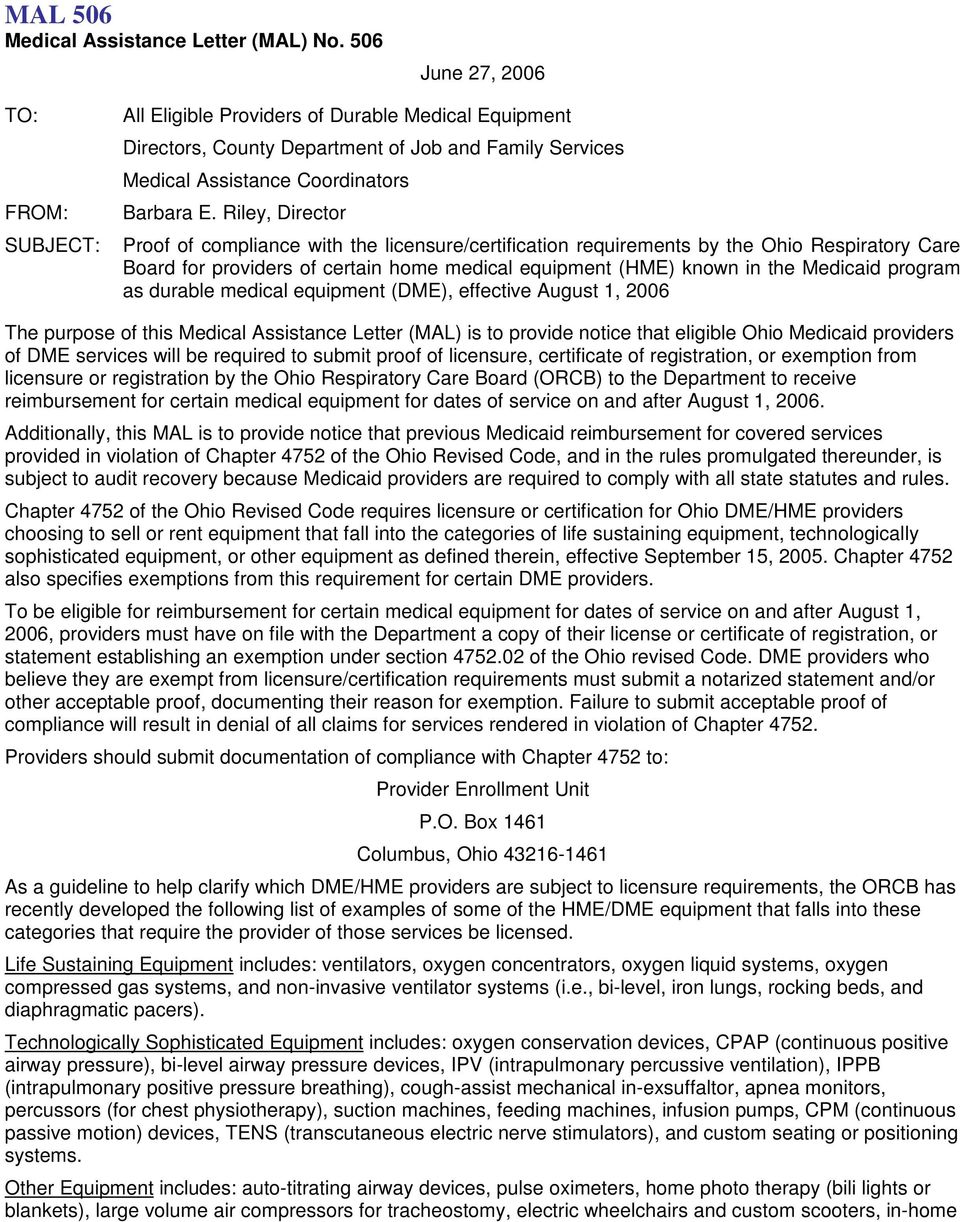
7 MAL 506 Medical Assistance Letter (MAL) No. 506 June 27, 2006 TO: FROM: SUBJECT: All Eligible Providers of Durable Medical Equipment Directors, County Department of Job and Family Services Medical Assistance Coordinators Barbara E. Riley, Director Proof of compliance with the licensure/certification requirements by the Ohio Respiratory Care Board for providers of certain home medical equipment (HME) known in the Medicaid program as durable medical equipment (DME), effective August 1, 2006 The purpose of this Medical Assistance Letter (MAL) is to provide notice that eligible Ohio Medicaid providers of DME services will be required to submit proof of licensure, certificate of registration, or exemption from licensure or registration by the Ohio Respiratory Care Board (ORCB) to the Department to receive reimbursement for certain medical equipment for dates of service on and after August 1, Additionally, this MAL is to provide notice that previous Medicaid reimbursement for covered services provided in violation of Chapter 4752 of the Ohio Revised Code, and in the rules promulgated thereunder, is subject to audit recovery because Medicaid providers are required to comply with all state statutes and rules. Chapter 4752 of the Ohio Revised Code requires licensure or certification for Ohio DME/HME providers choosing to sell or rent equipment that fall into the categories of life sustaining equipment, technologically sophisticated equipment, or other equipment as defined therein, effective September 15, Chapter 4752 also specifies exemptions from this requirement for certain DME providers. To be eligible for reimbursement for certain medical equipment for dates of service on and after August 1, 2006, providers must have on file with the Department a copy of their license or certificate of registration, or statement establishing an exemption under section of the Ohio revised Code. DME providers who believe they are exempt from licensure/certification requirements must submit a notarized statement and/or other acceptable proof, documenting their reason for exemption. Failure to submit acceptable proof of compliance will result in denial of all claims for services rendered in violation of Chapter Providers should submit documentation of compliance with Chapter 4752 to: Provider Enrollment Unit P.O. Box 1461 Columbus, Ohio As a guideline to help clarify which DME/HME providers are subject to licensure requirements, the ORCB has recently developed the following list of examples of some of the HME/DME equipment that falls into these categories that require the provider of those services be licensed. Life Sustaining Equipment includes: ventilators, oxygen concentrators, oxygen liquid systems, oxygen compressed gas systems, and non-invasive ventilator systems (i.e., bi-level, iron lungs, rocking beds, and diaphragmatic pacers). Technologically Sophisticated Equipment includes: oxygen conservation devices, CPAP (continuous positive airway pressure), bi-level airway pressure devices, IPV (intrapulmonary percussive ventilation), IPPB (intrapulmonary positive pressure breathing), cough-assist mechanical in-exsuffaltor, apnea monitors, percussors (for chest physiotherapy), suction machines, feeding machines, infusion pumps, CPM (continuous passive motion) devices, TENS (transcutaneous electric nerve stimulators), and custom seating or positioning systems. Other Equipment includes: auto-titrating airway devices, pulse oximeters, home photo therapy (bili lights or blankets), large volume air compressors for tracheostomy, electric wheelchairs and custom scooters, in-home
8 patient lifts, and individually sized, customized accessories or any items that are an integral part of equipment defined in any of these categories of equipment. A complete list of Medicaid covered DME procedure codes that, if rented or sold, require providers to comply with this licensure is posted at: Providers can contact the ORCB to learn more about the licensure/registration requirement at or by calling DME Question Line and Mailbox In February 2005, ODJFS established a DME Question Line and Mailbox to improve response to provider questions regarding program coverage and limitations. The number for this service is The DME Question Line and Mailbox is not able to answer questions regarding individual consumer eligibility, prior authorization (PA) requests or claims submissions. For such questions, providers should utilize the Interactive Voice Response (IVR) system or call Provider Network Management at The department recommends that providers view forms and the entire text of the DME rules for the Durable Medical Equipment program at: These forms and other department forms can also be accessed at: If you do not have internet access, you may request a paper copy of this MAL including attachments by completing and returning the attached form JFS Questions pertaining to this MAL should be addressed to: Attachment Bureau of Plan Operations Provider Network Management Section P.O. Box 1461 Columbus, Ohio Toll free telephone number Click here to view the Ohio Medicaid DME Procedure Codes Requiring Provider Licensure or Certificate of Registration

9 MAL 471 Medicaid Assistance Letter (MAL 471) November 1, 2004 TO: FROM: SUBJECT: All Providers Billing Hearing Aids Directors, County Department of Job and Family Services Medical Assistance Coordinators Thomas J. Hayes, Director Hearing aid codes and policy The purpose of this MAL is to announce changes from local level Medicaid codes to HIPAA compliant V codes for conventional hearing aids. The Department has crosswalked the local level codes to the V codes for conventional hearing aids and other covered hearing aid service, e.g. batteries, ear molds. A crosswalk from the local level codes to the V codes can be found on the Department's web site at I. Hearing Aid Rule/Policy and Medicaid Maximum II. III. The current hearing aid rule, 5101: of the Administrative Code (effective 1/1/95) is still in effect. In July 2004, the Department proposed a new hearing aid rule that would have expanded coverage to include programmable and digital hearing aids. However, despite repeated rule filings, the proposed rule is not in effect. We encourage you to go to the Department's web site to review the rule in its entirety at The Department will only cover conventional hearing aids as described in section II of this MAL. The Medicaid maximum remains at $ for a monaural hearing aid. Billing for Services That Require Prior Authorization With the exception of ear molds, batteries and minor repairs, all hearing aid services require prior authorization (PA). For all hearing aids and any other hearing service requiring prior authorization (PA), the following instructions have been established to assure appropriate processing of claims containing prior authorized procedure codes for dates of service through December 31, Existing prior authorizations already issued by ODJFS containing old codes will be honored for services rendered for dates of service through December 31, Providers must bill the procedure code(s) contained on the prior authorization approval letter. If these PAs are not utilized for dates of service through December 31, 2004, a new PA request must be submitted with the new HIPAA compliant code(s). New PA requests for a hearing aid (not already submitted to ODJFS) must reflect the appropriate V code. The Department will not process a new PA for a hearing aid billed with the old hearing aid code (A9040) for a PA received on and after November 15, The Department will honor a PA containing the old code as long as the PA is received on or before November 15, To bill for hearing services that do not require PA, simply use the new HIPAA compliant V code for the service, e.g. V5266 for batteries, for dates of service on and after November 1, Please continue to use the local level codes to bill for repair of a hearing aid. The local level codes are Y9041 for a minor repair or Y9042 for a major repair of a hearing aid. The Department will notify providers when the HIPAA compliant codes for repairs are ready for use. Requesting paper updates If a provider does not have access to the internet and wishes to request a paper copy of these updates, please complete the attached JFS form and either mail or fax the form to the address on the form. Questions pertaining to this MAL should be addressed to:

10 Bureau of Plan Operations The Provider Network Management section P.O. Box 1461 Columbus, Ohio In-state toll free telephone number

11 MAL 443A Medical Assistance Letter No. 443A February 7, 2003 TO: FROM: SUBJECT: All Providers of Medical Supplier Services Tom Hayes, Director Changes to the Ohio Medicaid Medical Supplier Program The purpose of this Medical Assistance Letter (MAL) is to set forth the most recent changes to Ohio administrative code (OAC) rule 5101: , "Medicaid Supply List". Changes will be effective on April 1, 2003 unless otherwise specified. Page 6 - Incontinence Garments and Related Supplies: Local level "Y" codes have been deleted and have been replaced with HIPAA compliant "A" codes. Reimbursement for these codes has also been reduced in order to be more consistent with market prices. Page 9, Ostomy Supplies; Page 12, Family Planning Supplies; Page 21, Ventilators, CPAP, Other Respiratory Equipment; Page 23, Monitoring Equipment: New codes added. Deleted codes valid until June 30, Page 13 - Equipment and Supplies for ESRD: Changes to codes, units and limitations for gloves. Upon receiving this MAL, please refer to the websites listed below for detailed information. Please review these rules in their entirety for all changes, updates, additions, and deletions. All previous versions of OAC 5101: and OAC 5101: should be filed as obsolete. These proposed rules can be viewed at: Medical Supply List - Reimbursement - Questions pertaining to this MAL should be addressed to: Bureau of Plan Operations In-state: Provider Network Management Section (option 1) or P.O. Box (option 1) Columbus, OH Out of state: (option 1) It has come to our attention that some providers are inappropriately billing for take home pharmacy services by using J-codes. Ohio Medicaid limits J-code usage only to professionals that are administering the drug to the patient in an office setting. J-codes should not be used by any other provider or in any other setting. Effective immediately, Medicaid providers currently classified as provider type "76" (Durable Medical Supplier) that have a current pharmacy license with a pharmacist dispensing medications, to be used by the patient in their residence, in accordance with Ohio Board of Pharmacy regulations are eligible to apply for a "prescribed drug' category of service. Those who qualify will be considered an "other provider" for purposes of rules and reimbursement, as set forth in OAC 5101:3-9. The effective date of the "prescribed drug" category of service for providers approved by the department may be retroactive, in accordance with OAC 5101: To be eligible, a DME provider must submit a written request for a "prescribed drug" category of service. This request must include and/or identify the following: 1. Ohio Medicaid provider identification number; 2. Copy of the most recent terminal drug distributor license for the provider and any attachments; 3. Copy of the responsible pharmacist's license.

12 The request for the "prescribed drug" category of service and all required documentation should be addressed to: DME Provider Enrollment PO Box 1461 Columbus, OH All medications must be dispensed in accordance with Board of Pharmacy regulations. Upon approval of the "prescribed drug" category of service by the department, pharmacy claims must be processed using the NCPDP standard and submitted to First Health Services for adjudication. The department can not accept pharmacy claims or adjustments. If pharmacy claims are not submitted using the online Point-of-Sale system then paper claims, using a Universal Claim Form, must be submitted to First Health Services at the following address: First Health Services Corp. Ohio Paper Claims Processing Unit PO Box C Richmond, VA Pharmacy billing and claim submission instructions can be found in the provider manual on our website at * Questions on billing procedures should be addressed to First Health Services at *Note: the hardcopy erroneously lists the URL as: however the electronic version has been updated to reflect the correct URL.

13 MAL 438 Medical Assistance Letter No. 438 December 20, 2002 TO: FROM: SUBJECT: ALL PROVIDERS OF MEDICAL SUPPLIER SERVICES DIRECTORS, COUNTY DEPARTMENTS OF JOB AND FAMILY SERVICES DIRECTORS, DISTRICT OFFICES THOMAS J. HAYES, DIRECTOR CHANGES TO APNEA MONITOR RULE Rule 5101: of the Ohio administrative code entitled "Apnea monitors" is being amended as part of the five year rule review. Changes were made to clarify language and remove outdated references. This rule was effective as of December 5, This rule can be viewed at Questions pertaining to this MAL should be addressed to: Bureau of Plan Operations Provider Network Management Section P.O. Box 1461 Columbus, OH In-state: (option 1) or (option 1) Out of state: (option 1)

14 MAL 435 Medical Assistance Letter No. 435 Medical Supplier Services June 25, 2002 TO: FROM: SUBJECT: All Providers of Medical Supplier Services Thomas Hayes, Director Changes to the Ohio Medicaid Durable Medical Equipment and Medical Suppliers Program The purpose of this Medical Assistance Letter (MAL) is to set forth the most recent changes to the Ohio Administrative Code (OAC) Rules identified below. These rules were reviewed, and changes made, as part of the legislatively mandated 5-year rule review process. The effective date for these changes is September 1, OAC 5101: , "Prior Authorization". Changes were made to clarify the requirements for requesting a prior authorized service. This includes indicating quantity requested on the prescription and supplying the same item/service in the same quantity as approved by the department. OAC 5101: , "Reimbursement by Title XVIII (medicare)". This rule was rescinded, as it is duplicative to rule 5101: OAC 5101: , "Repair of Medical Equipment". Changes were made to clarify prescription requirements for repairs. OAC 5101: , "Dialysis Equipment". Changes were made to specify that medicaid should only be billed if medicare has denied for other than lack of medical necessity. Also, suppliers can only bill for these services if the patient is not receiving dialysis under Method I. OAC 5101: , "Blood Glucose Monitors (glucometers)". Changes were made to update the language used to describe the acceptable diagnoses. The specific form for requesting PA on specialized monitors was also changed to the standard PA request form (JFS 03142). A separate rule (OAC 5101: ) is being proposed to clarify that prescriptions for medical supplier services written by Advanced Practice Nurses (APNs) are also covered. Questions pertaining to this MAL should be addressed to: Bureau of Plan Operations Provider Network Management Section P.O. Box 1461 Columbus, OH In State: (option 1) or (614) (option 1) Out of State: (614) (option 1)

15 MAL 405 Medical Assistance Letter No. 405 Medical Supplier Services January 16, 2002 TO: FROM: SUBJECT: All Providers of Medical Supplier Services Thomas Hayes, Director Changes to the Ohio Medicaid Durable Medical Equipment and Medical Suppliers Program The purpose of this Medical Assistance Letter (MAL) is to set forth the most recent changes to Ohio Administrative Code (OAC) Rules: 5101: , "Medical Supply List"; and 5101: , "Covered Orthotic and Prosthetic Services and Associated Limitations". Many new codes that became available for possible implementation will be reviewed in detail at a later date as HIPAA coding is determined. The miscellaneous codes are still available with prior authorization for items that don't have a specific code recognized by the department. Some blood pressure monitor code descriptions have been changed federally to be "for dialysis" (see codes A4660, A4663, A4670). The State would already expect these items to be bundled into the local level dialysis codes (Y2090, Y2091, Y2092) as the note in the supply list states "all supplies and equipment for home dialysis of ESRD patients are to be billed under a single code". The above mentioned "A" codes will currently remain available for non-dialysis recipients, but they will be reviewed again this summer. If, by July 1, 2002, the feds have not changed these descriptions and no new codes have been added for these products for nondialysis patients, then the State will make changes to implement the federal description. Upon receiving this MAL and the accompanying OAC rules, previous versions of the OAC rules should be filed as obsolete. All new codes and description changes are effective January 1, 2002 unless otherwise specified. OAC Rules: A. Medicaid Supply List (Appendix A of OAC Rule 5101: ) The Medicaid Supply List has been updated to include the following changes. Several new codes have replaced older codes. Where applicable on the Medicaid Supply List, the new code or changes to a code has been underlined, and the new code is directly below the discontinued code. Discontinued codes have been crossed out. Please review the attached rule in its entirety, for all the following changes, updates, additions, and deletions: Dressings/Tape/Gauze Page 2 of 27 The following code has been deleted, effective March 31, 2002: A6020 "Collagen based wound dressing, wound cover" The following codes have had a description modification: A6196 "Alginate or other fiber gelling dressing, wound cover, pad size 16 sq. in. or less" A6197 "Alginate or other fiber gelling dressing, wound cover, pad size more than 16 but less than or equal to 48 sq. in." A6198 "Alginate or other fiber gelling dressing, wound cover, pad size more than 48 sq. in." Wound Fillers Page 5 of 27 The following code has had a description modification: A6199 "Alginate or other fiber gelling dressing, wound filler" The following code is now a covered medical supply under Ohio Medicaid: A6010 "Collagen based wound filler, dry form" Urological Supplies Page 6 of 27

16 The following code has been discontinued, effective March 31, 2002: A4329 "External catheter starter set, male/female, includes catheters/urinary collection device, bag/pouch and accessories" The following code has had a description modification: A4358 "Urinary leg/abdominal bag, vinyl, with or without tube with strap" Ostomy Supplies Page 8 of 27 Code A4364 has been modified to read "Adhesive liquid or equal, any type, per oz" Miscellaneous Supplies Page 10 of 27 Code Y9105 "Breast pump, electric" has been discontinued effective March 31, 2002 and has been replaced by code E0603. Code Y9104 "Breast pump, heavy duty electrical (rental only)" has been discontinued effective March 31, 2002 and has been replaced by code E0604. Enteral and Parenteral Nutrition Therapy Only Page 11 of 27 The following codes have been discontinued, effective March 31, 2002: B4084 "Gastrostomy/jejunostomy tubing (foley type only)" B4085 "Gastrostomy tube, silicone with sliding ring" The following code is now a covered medical supply under Ohio Medicaid: B4086 "Gastrostomy/jejunostomy tube; any type/material" Hospital Beds Page 15 of 27 Code E0298 "Hospital bed, heavy-duty, extra wide, with any type side rails, with mattress" has been discontinued effective March 31, 2002 and has been replaced by code K0549. Traction Equipment and Hospital Bed Accessories Page 16 of 27 Code E1810 has been modified to read "Dynamic adjustable knee extension/flexion device; includes soft interface material" Ventilators, CPAP, and Other Respiratory Equipment Page 17 of 27 Code K0184 has been modified to read "Nasal single piece interface, replacement for CPAP nasal application device" Suction Pumps and Suctioning Equipment Page 19 of 27 Code E0600 has been modified to read "Suction pump, home model, portable or stationary, complete" Monitoring Equipment Page 19 of 27 The following code has been discontinued, effective March 31, 2002: E0609 "Blood glucose monitor with special features (voice synthesizer) complete" The following codes are now a covered supply requiring prior authorization: E2100 "Blood glucose monitor with integrated voice synthesizer" E2101 "Blood glucose monitor with integrated lancing/blood sample" Wheelchairs Page 25 of 27 The following codes have been discontinued, effective March 31, 2002: K0008 "Custom manual wheelchair base" K0013 "Custom motorized/power wheelchair base" B. List of Orthotic and Prosthetic Procedures (Appendix A of OAC Rule 5101: ) The List of Orthotic and Prosthetic Procedures has been updated to include the following changes. Several new codes have been added, effective January 1, Other codes have had a change in the description of a previously covered code. Additions to the list have been underlined and deletions have been crossed through.

17 Please read the attached rule in its entirety, for all the following changes, updates, additions, and deletions: Spinal - Cervical Page 1 of 65 The following codes have had a description modification: L0100 "Cranial orthosis helmet with or without soft interface; molded to patient model" L0110 "Cranial orthosis helmet, with or without soft interface; non-molded" Spinal - Lumbar - Sacral Page 3 of 65 Code L0515 has been modified to read "LSO, anterior-posterior control, with rigid or semi-rigid posterior panel; prefab" Thoracic - Hip - Knee - Ankle Page 9 of 65 Code L1510 has been modified to read "THKAO, standing frame with or without tray and accessories" Lower Limb - Ankle - Foot Page 12 of 65 Code L1930 has been modified to read "AFO, plastic or other material, prefab" Code L1940 has been modified to read "AFO, molded to patient model, plastic or other material" Additions to Straight Knee or Offset Knee Joints Page 17 of 65 Code L2415 has been modified to read "Addition to knee lock with integrated release mechanism, each joint" Additions - General Page 20 of 65 Code L2755 has been modified to read "Addition to lower extremity orthosis, high strength, light weight material" Specific Repair Page 33 of 65 Code L4000 has been modified to read "Replace girdle for spinal orthosis" Lower Limb - Endoskeletal Page 36 of 65 Code L5300 has been discontinued, effective March 31, It is being replaced by code L5301. The description has been modified to read "Below knee, molded socket, SACH foot, shin, endoskeletal system" Code L5310 has been discontinued, effective March 31, It is being replaced by code L5311. The description has been modified to read "Knee disarticulation (or through knee), molded socket, external knee joint SACH foot, shin, endoskeletal system" Code L5320 has been discontinued, effective March 31, It is being replaced by code L5321. The description has been modified to read "Above knee, molded socket, open end, SACH foot endoskeletal system, single axis knee" Code L5330 has been discontinued, effective March 31, It is being replaced by code L5331. The description has been modified to read "Hip disarticulation, Canadian type, molded socket, endoskeletal system, hip joint, single axis knee SACH foot" Code L5340 has been discontinued, effective March 31, It is being replaced by code L5341. The description has been modified to read "Hemipelvectomy, Canadian type, molded socket, endoskeletal system, hip joint, single axis knee SACH foot" Additions - Socket Variations Page 40 of 65 The following codes have been discontinued, effective March 31, 2002: L5667 L5669 "Addition to lower extremity, below knee, socket insert, suction suspension, with locking mechanism" "Addition to lower extremity, below knee, socket insert, suction suspension, without locking mechanism"

18 The following codes have had a description modification: L5704 L5705 L5706 L5707 "Custom shaped protective cover, below knee" "Custom shaped protective cover, above knee" "Custom shaped protective cover, knee disarticulation" "Custom shaped protective cover, hip disarticulation" Questions pertaining to this MAL should be addressed to: The Bureau of Plan Operations The Provider Network Management Section P.O. Box 1461 Columbus, OH In State: (614) Out of State:(614)

19 MAL 399 Medical Assistance Letter No. 399 Medical Supplier Services October 18, 2001 TO: FROM: SUBJECT: All Providers of Medical Supplier Services THOMAS J. HAYES, DIRECTOR CHANGES TO THE OHIO MEDICAID OXYGEN RULE The purpose of this Medical Assistance Letter (MAL) is to set forth the most recent changes to Ohio Administrative Code (OAC) Rule 5101: , "Oxygen: Covered Services and Limitations". Upon receiving this MAL and the accompanying OAC rule, previous versions of this rule should be filed as obsolete. The existing rule is being rescinded and is being replaced with the attached rule, effective November 1, Please carefully review the attached rule for changes. Some of the key changes to make note of are the following: Editorial Changes: - The rule has been reorganized to better differentiate sections. - Appendices have been reorganized to clarify different billing situations. Portable Oxygen: - Coverage criteria for portable oxygen has been clarified. (paragraph B) Prior Authorization Requests: - Length of time a prior authorization can be requested for has been extended to a maximum of 24 months, dependent on medical necessity. (paragraph D1) Documentation: - Clarified what constitutes documentation to corroborate a provider request. (paragraph D1) - Changed date requirement of ABG or pulse oximetry reading for initial and re-certifications. (paragraph D2) - Removed time limit for physician signature of certificate of medical necessity. (paragraph D2) - Allowed a documentation of refill amount and delivery information in place of a meter reading when documenting amount of oxygen used. (paragraphs F1 and H1) - Allowed a dated form documenting the pulse oximetry reading in place of a dated print out. (paragraph G4) Coverage Requirements: - Clarified and expanded lab criteria. (paragraph E) Questions pertaining to this MAL should be addressed to: The Bureau of Plan Operations The Provider Network Management Section PO Box 1461 Columbus, OH In State: or (614) Out of State: (614)

20 MAL 392 MEDICAL ASSISTANCE LETTER NO. 392 MEDICAL SUPPLIER SERVICES January 22, 2001 TO: FROM: SUBJECT: All Providers of Medical Supplier Services JACQUELINE ROMER-SENSKY, DIRECTOR CHANGES TO THE OHIO MEDICAID DURABLE MEDICAL EQUIPMENT AND MEDICAL SUPPLIERS PROGRAM The purpose of this Medical Assistance Letter (MAL) is to set forth the most recent changes to Ohio Administrative Code (OAC) Rules: 5101: , "Medicaid Supply List"; and 5101: , "Covered Orthotic and Prosthetic Services and Associated Limitations". Upon receiving this MAL and the accompanying OAC rules, previous versions of the OAC rules should be filed as obsolete. All new codes and description changes are effective January 1, 2001 unless otherwise specified. OAC Rules: A. Medicaid Supply List (Appendix A of OAC Rule 5101: ) The Medicaid Supply List has been updated to include the following changes. Several new codes have replaced older codes. Where applicable on the Medicaid Supply List, the new code or change to a code has been underlined, and the new code is directly below the discontinued code. Discontinued codes have been crossed out. Please review the attached rule in its entirety, for all the following changes, updates, additions, and deletions: Dressings/Tape/Gauze Pages 5-6 of 32 The following codes have had a description modification: A6222 "Gauze, impregnated, other than water, hydrogel or normal saline, pad size 16 sq inches or less, without adhesive border" A6223 "Gauze, impregnated, other than water, hydrogel or normal saline, pad size more than 16 but less than or equal to 48 sq. inches, without adhesive border" A6224 "Gauze, impregnated, other than water, hydrogel or normal saline, pad size more than 48 sq. inches, without adhesive border" The following codes are now a covered medical supply under Ohio Medicaid. A6021 "Collagen dressing, pad size, 16 sq. inches or less, each" A6022 "Collagen dressing, pad size more than 16 sq. inches, but less than or equal to 48 sq. inches, ea" A6023 "Collagen dressing, pad size more than 48 sq. inches, each" A6231 "Gauze, impregnated, hydrogel, for direct wound contact, pad size 16 sq. inches or less, each dressing" A6232 "Gauze, impregnated, hydrogel, for direct wound contact, pad size greater than 16 sq. inches, but less than or equal to 48 sq. inches, each dressing" A6233 "Gauze, impregnated, hydrogel, for direct wound contact, pad size more than 48 sq. inches, each dressing" Prior authorization is required for codes A6021, A6022, and A6023. Diabetic Supplies/Blood Glucose Monitor Supplies Page 8 of 32 Code A4250, "Urine test or reagent strips or tablets", has had a price change. Effective April 1, 2001 the maximum reimbursement will be 0.26 per each.

21 Code A4253, "Blood glucose test, reagent strips for glucose monitor (per 50 strips)", has a change in the maximum units per month. The maximum units per month has been increased to 4 units (1 unit equals a box of 50 strips), effective April 1, Code A4259, "Lancets, per box of 100", has a change in the maximum units per month. The maximum units per month has been increased to 2 units (1 unit equals a box of 100 lancets), effective April 1, Distilled Water/Sterile Saline/Disinfectant Solution Page 9 of 32 Code K0182, "Water, distilled, 1000ml", has been discontinued effective March 31, 2001 and will be replaced by code A7018. Incontinence Garments and Related Supplies Page 9 of 32 Code Y9139, "Incontinence supplies, not otherwise specified", will require Prior authorization, effective April 1, Urological Supplies Pages 9-11 of 32 Code K0280, "Extension drainage tubing, any type or length, with connector/adaptor, for use with urinary leg band or uro", has been discontinued effective March 31, 2001 and has been replaced by code A4331. Code K0281, "Lubricant, individual sterile packet (for sterile cath only)", has been replaced by code A4332 and is a non-covered service by Ohio Medicaid. Code K0407, "Urinary catheter anchoring device, adhesive skin attachment", has been discontinued effective March 31, 2001 and has been replaced by code A4333. Code K0408, "Urinary catheter anchoring device, leg strap", has been discontinued effective March 31, 2001 and has been replaced by code A4334. Code K0409, "Sterile water, irrigation solution, 1000ml", has been discontinued effective March 31, 2001 and has been replaced by code A4319. Code K0410, "Male external catheter, with adhesive coating", has been discontinued effective March 31, 2001 and has been replaced by code A4324. Code K0411, "Male external catheter, with adhesive strip", has been discontinued effective March 31, 2001 and has been replaced by code A4325. Ostomy Supplies Page 11 of 32 The description for code A4364 has been modified to read "Adhesive for facial prosthesis only, liquid, per oz". Miscellaneous Supplies Page 14 of 32 Code 4560, "Pessary", has been discontinued effective March 31, 2001; in its place code A4561, "Pessary, rubber, any type", and code A4562, "Pessary, non-rubber, any type", have been added. Both codes A4561 and A4562 have a maximum quantity of 1 per year and a maximum reimbursement of $ Equipment and Supplies for ESRD Page 14 of 32 Effective April 1, 2001 the following codes no longer require Prior Authorization. Y2090 "Home hemodialysis for ESRD" Y2091 "CAPD home dialysis" Y2092 "CCPD home dialysis" Infusion Pump Equipment (Non-Nutrition) and Accessories Pages of 32 Effective April 1, 2001 the following codes no longer require Prior Authorization unless quantity limits are exceeded. E0781 "Ambulatory infusion pump, w/ administration equipment, worn by patient"
22 E0791 "Parenteral infusion pump, stationary, any (non-nutritional) (including pole)" A4305 "Disposable drug delivery system, flow rate 50ml or more per hour" A4306 "Disposable drug delivery system, flow rate 5ml or less per hour" Infusion Supplies Page 16 of 32 Effective April 1, 2001 the following codes no longer require Prior Authorization unless quantity limits are exceeded. A4222 "Supplies for external drug infusion pump, per bag" Max qty of 60/month. Y9190 "Supplies for external drug infusion pump, per cassette" Max qty of 30/month. B4239 "IV administration set with drainage tubing (not for nutrition)" B4240 "IV administration set with Y-attachment, drainage tubing (not for nutrition)" Heavy Duty Walkers Page 17 of 32 Code K0458, "Heavy duty walker without wheels", has been discontinued effective March 31, 2001 and has been replaced by code E0148. Code K0459, "Heavy duty wheeled walker, each", has been discontinued effective March 31, 2001 and has been replaced by code E0149. Commodes Page 17 of 32 Code K0457, "Extra wide/heavy duty commode chair", has been discontinued effective March 31, 2001 and has been replaced by code E0168. Hospital Beds Page 19 of 32 Code K0456, "Hospital bed, heavy duty, extra wide, w/ any type side rails, w/mattress", has been discontinued effective June 30, 2001 and has been replaced by code E0298. Traction Equipment and Hospital Bed Accessories Page 20 of 32 Code E1810, "Dynamic adjustable knee extension/flexion device", has been added as a covered service. Prior Authorization is not required, there is a limit of 1 per medical event, this is a rental only item and reimburses at a maximum of $75.00 per month. Tracheostomy Care Pages of 32 Code A4623, "Tracheostomy, inner cannula (replacement only)", has been modified to allow a maximum of 30 per month, effective April 1, Code Y9188, "Trachea tube holder (E.G. Dale), other than twill tape, if medically necessary", has been modified to allow a maximum of 15 per month, effective April 1, Ventilators, CPAP, and Other Respiratory Equipment Pages of 32 Code K0183, "Nasal application device, used with CPAP", has had a modification to the maximum allowable reimbursement. Effective April 1, 2001 the amount will be $ Humidifiers/Nebulizers Pages of 32 Code E1375, "Nebulizer, portable, w/small compressor, w/limited flow," has been discontinued effective March 31, Code E0575 has been modified to read "Nebulizer, ultrasonic, large volume (BA-400)" B. List of Orthotic and Prosthetic Procedures (Appendix A of OAC Rule 5101: ) The List of Orthotic and Prosthetic Procedures has been updated to include the following changes. Several new codes have been added, effective January 1, Other codes have had a change in the description of a previously covered code. Additions to the list have been underlined when a code number and capitalized when alpha; deletions have been crossed through. Please read the attached rule, in its entirety, for all the following changes, updates, additions, and deletions: Description Changes
23 The following codes have had a change in their description, from Custom Molded to Prefabricated. Please refer to the attached List of Orthotic and Prosthetic Procedures to determine the modified description in detail. Code Page L L L L L L L L L L L L L Lower Limb Hip-Knee-Ankle-Foot Page 15 of 68 Code L2038 has been modified to read "KAFO, full plastic, with knee joint, multi-axis ankle, molded to patient model, lively orthosis or equal". Upper Limb Elbow Page 30 of 68 Code L3760, "EO with adjustable locking joints, prefabricated", has been added as a new code requiring prior authorization. Upper Limb Wrist-Hand-Finger Pages of 68 Code L3923, "HFO without joints, prefabricated", has been added as a new code requiring prior authorization. Speech Aids Pages of 68 New code K0541, "Speech generating device, digitized speech, prerecorded message less than or equal to 8 minutes", has been added. Prior authorization is required with a maximum reimbursement of $666.00, limited to one per 5 years. New code K0542, "Speech generating device, digitized speech, prerecorded message greater than 8 minutes", has been added. Prior authorization is required with a maximum reimbursement of $594.00, limited to one per 5 years. New code K0543, "Speech generating device, synthesized speech, requiring physical contact for message formulation", has been added. Prior authorization is required with a maximum reimbursement of $ , limited to one per 5 years. New code K0544, "Speech generating device, synthesized speech, permitting multiple methods of message formulation", has been added. Prior authorization is required with a maximum reimbursement of $ , limited to one per 5 years. New code K0545, "Speech generating software program for PC or PDA", has been added and requires prior authorization. It is limited to one per 5 years. New code K0546, "Accessory for speech generating device, mounting system", has been added and requires prior authorization. It is limited to one per 5 years. New code K0547, "Accessory for speech generating device, not otherwise specified", has been added and requires prior authorization. Questions pertaining to this MAL should be addressed to: The Bureau of Plan Operations
24 The Provider Network Management Section P.O. Box 1461 Columbus, OH In State: or (614) Out of State: (614)
25 MAL 385 MEDICAL ASSISTANCE LETTER NO. 385 February 29, 2000 TO: FROM: SUBJECT: All Providers of Medical Supplier Services JACQUELINE ROMER-SENSKY, DIRECTOR CHANGES TO THE OHIO MEDICAID DURABLE MEDICAL EQUIPMENT AND MEDICAL SUPPLIERS PROGRAM The purpose of this Medical Assistance Letter (MAL) is to set forth the most recent changes to Ohio Administrative Code (OAC) Rules: 5101: , "Medicaid Supply List"; 5101: , "Hospital Beds and Pressure-Reducing Support Surfaces"; and 5101: , "Covered Orthotic and Prosthetic Services and Associated Limitations." Also included with this MAL is a new "Billing Instructions" section and a new "Desk Reference" section. Upon receiving this MAL and the accompanying OAC rules, Billing Instructions, and Desk Reference, previous versions of the OAC rules, Billing Instructions, and Desk Reference section should be filed as obsolete. Section I. of this MAL contains the new Desk Reference section. Section II. of this MAL contains the changes to the aforementioned OAC rules. Section III. of this MAL contains the new Billing Instructions. I. Desk Reference: II. ODHS Medicaid Telephone Directory: A listing of customer service phone numbers for different areas of the Ohio Department of Human Services. Forms List: A listing of ODHS forms and other related forms (e.g., claim forms, prior authorization forms, claim adjustment forms). Top 10 Commonly Asked Questions: A listing of the top ten questions commonly asked by Medicaid providers. Included are the most frequently-asked questions and answers pertaining to claims processing and recipient eligibility. OAC Rules: A. Medicaid Supply List (Appendix A of OAC Rule 5101: ) The Medicaid Supply List has been updated to include the following changes. Several new codes have replaced older codes. Where applicable on the Medicaid Supply List, the new code or change to a code has been underlined, and the new code is directly above the discontinued code. Discontinued codes have been crossed out. Please review the attached rule, in its entirety, for all of the following changes, updates, additions, and deletions: Syringes/Needles The description for code A4215 has been modified to include needles for insulin pens. The description now reads "Needles only, sterile, any size, including pen needles." The maximum fee has been increased to $0.25 per needle. Diabetic Supplies/Blood Glucose Monitor Supplies The description for code Y9107 has been modified to include insulin pens. The description now reads, "Insulin injector, manual, including insulin pens." Code A4258, "Spring powered device for lancet," is now a covered medical supply under Ohio Medicaid. Prior authorization is not required. The maximum quantity is one per year and the maximum allowable fee is $13.75 each. Urological Supplies
26 The Medicare indicator for code K0280, "Extension drainage tubing, any type or length, with connector/adaptor, for use with urinary leg bag or uro.," has been updated to reflect that the code is not covered by Medicare. Ostomy Supplies Coding Revision: Codes for Ostomy Supplies have been revised from "K" to "A" series codes. The "A" codes are valid for dates of service on or after January 1, The "K" codes are being discontinued and will not be valid for dates of service after March 31, Prior authorizations issued for "K" codes are valid and will be payable for dates of service through June 30, Providers should begin using "A" codes as soon as possible. Please refer to pages 11 through 13 of the attached Medicaid Supply List for a list of ostomy supplies, the new "A" codes, and the corresponding discontinued "K" codes. Each discontinued "K" code is below the "A" code that has replaced it. Descriptions for the new "A" codes are slightly more descriptive than the "K" codes they are replacing. In addition, the description for code A5126 has been modified to include non-adhesive disks and foam pads. The description now reads, "Adhesive or non-adhesive; disk or foam pad." Ostomy Code Pricing: Prices for the new "A" codes will be the same as the corresponding "K" codes. Equipment and Supplies for ESRD The "Note" which precedes the list of codes for ESRD equipment and supplies has been modified to be more descriptive. It now states: "All supplies and equipment for home dialysis of ESRD recipients are to be billed under a single code. Maximum allowed payment for equipment and supplies combined is $1200/mo for Y2090 and Y2091, and $1500/mo for Y2092." Enteral and Parenteral Nutrition Therapy Only The Medicare indicator for code Y2040, "Gastrostomy button (replacement only...)," has been updated to reflect that the code is not covered by Medicare. Infusion Pump Equipment and Accessories The Medicare indicators for codes E0791, "Parenteral infusion pump, stationary, any," and Y2020, "Syringe infusion pump," have been updated to reflect that the codes are not covered by Medicare. Commodes Prior authorization is no longer required on code K0457, "Extra wide/heavy duty commode chair." The allowable fee is now $ Decubitus Care Equipment The Medicare indicator for code E0191, "Heel or elbow protector," has been updated to reflect that the code is not covered by Medicare. Miscellaneous Respiratory Care Supplies Coding Revision: Codes for Miscellaneous Respiratory Care Supplies have been revised from "K" to "A" series codes. The "A" codes are valid for dates of service on or after January 1, The "K" codes are being discontinued and will not be valid for dates of service after March 31, Providers should begin using "A" codes as soon as possible. Please refer to page 21 of the attached Medicaid Supply List for a list of miscellaneous respiratory care supplies, the new "A"
27 codes, and the corresponding discontinued "K" codes. Each discontinued "K" code is below the "A" code that has replaced it. Descriptions for the new "A" codes are slightly more descriptive than the "K" codes they are replacing. Ventilators, CPAP, and Other Respiratory Equipment Code E0453, "Therapeutic ventilator (IPPV)," has been discontinued effective June 30, 2000, and has been replaced by two codes, K0533 and K0534. E0453 will be payable for dates of service through June 30, Code E0452, "Intermittent assist device with CPAP (APAP)," has been discontinued effective June 30, 2000, and has been replaced by code K0532. E0452 will be payable for dates of service through June 30, The "K" codes are valid for dates of service on or after January 1, Providers should begin using the new "K" codes as soon as possible. Please refer to page 22 of the attached Medicaid Supply List for descriptions and billing information for codes K0533 and K0534, as well as code K0532. Vaporizers/Postural Draining Boards The description for code E0605 has been modified to read, "Vaporizer, room type." The reference to "Hot or cool mist" has been removed. Suction Pumps and Suctioning Supplies Coding Revision: Three codes for suction pumps and suctioning supplies have been revised from "K" to "A" series codes. The "A" codes are valid for dates of service on or after January 1, The "K" codes are being discontinued and will not be valid for dates of service after March 31, Prior authorizations issued for "K" codes are valid and will be payable for dates of service through June 30, Providers should begin using "A" codes as soon as possible. Please refer to page 24 of the attached Medicaid Supply List for a list of suction pumps and suctioning supplies, the new "A" codes, and the corresponding discontinued "K" codes. Each discontinued "K" code is below the "A" code that has replaced it. Wheelchairs-Miscellaneous Accessories The maximum allowable fee for code E1065, "Power attachment (to convert any standard chair to motorized, e.g. Solo)," has been increased to $ Additions and changes to the Medicaid Supply List are effective for dates of service on and after January 1, For codes not requiring prior authorization, codes that have been deleted will not be valid for dates of service after March 31, For codes requiring prior authorization, codes that have been deleted will not be valid for dates of service after June 30, B. Hospital Beds and Pressure Reducing Support Surfaces (OAC Rule 5101: ) The previous version of OAC Rule 5101: , "Hospital Beds," dated March 21, 1996, has been rescinded. It has been replaced with the attached new OAC Rule 5101: , entitled "Hospital Beds and Pressure-Reducing Support Surfaces," which is effective January 1, The new rule includes clarifications of coverage criteria and medical necessity documentation requirements for hospital beds. The rule also includes revised coverage criteria and medical necessity documentation requirements for pressure-reducing support surfaces used in the treatment and management of pressure sores. Documentation requirements have been streamlined and coverage criteria has been updated in the new version of the rule to be consistent with current industry standards for treatment protocols.
28 Code L L L L L L L L L L L L L L L L L L L L L L C. Covered Orthotic and Prosthetic Services and Associated Limitations (OAC Rule 5101: ) Page The "List of Covered Orthotic and Prosthetic Procedures," (Appendix A of OAC Rule 5101: ), has been updated to include the following changes. Fees have been increased for dates of service on or after January 1, Several new codes have been added, effective January 1, Several other codes which have been covered under Ohio Medicaid prior to January 1, 2000, have been added to the list as well. The effective date of those codes is indicated at the end of the description for the code. Additions to the list have been underlined. Please review the attached rule, in its entirety, for all of the following changes, updates, additions, and deletions: Prior Authorization Changes Prior authorization is no longer required for the following codes unless the maximum limit is exceeded. Please refer to the attached List of Covered Orthotic and Prosthetic Procedures for descriptions of these codes. Lower Limb-Hip
29 Code L1690, "Combo, bilateral, lumbo-sacral, hip, femur orthosis," has been added to the list. The effective date of coverage of this code under Ohio Medicaid is January 1, Prior authorization is required and the maximum reimbursement is 1 per medical event. Lower Limb-Knee New code, L1843, "KO, single, upright, thigh and calf, with adjustable flexion and extension joint, medial-lateral and rotation control, custom fitted," has been added to the list. The effective date of coverage of this code under Ohio Medicaid is January 1, Prior authorization is required and the maximum reimbursement is 1 per 2 years. Code L1847, "KO, double upright with adjustable joint with air support cham.," has been added to the list. The effective date of coverage of this code under Ohio Medicaid is January 1, Prior authorization is required and the maximum reimbursement is 1 per 2 years. New code, L1885, "KO, single or double upright, thigh and calf, with functional active resistance controls," has been added to the list. The effective date of coverage of this code under Ohio Medicaid is January 1, Prior authorization is required and the maximum reimbursement is 1 per 2 years. Lower Limb-Hip-Knee-Ankle-Foot (Or Any Combination) New code, L2035, "KAFO, full plastic, static prefabricated, pediatric size" has been added to the list. The effective date of coverage of this code under Ohio Medicaid is January 1, Prior authorization is required and the maximum reimbursement is 1 per 2 years. Code L2039, "KAFO, full plastic, single upright, poly-axial hinge molded to patient model, has been added to the list." The effective date of coverage of this code under Ohio Medicaid is January 1, Prior authorization is required and the maximum reimbursement is 1 per 2 years. Additions-Shoe-Ankle-Shin-Knee The description for code L2275 has been modified to read "Addition to lower extremity, varus/valgus correction, plastic modification, padded/lined." Additions to Straight Knee or Offset Knee Joints Code L2430, "Addition to lower extremity, orthosis, incr. lock at knee joint," has been added to the list. The effective date of coverage of this code under Ohio Medicaid is January 1, Prior authorization is required and the maximum reimbursement is 2 per orthosis. Additions-General Code L2755, "Addition to lower extremity orthosis, carbon graphite lamination," has been added to the list. The effective date of coverage of this code under Ohio Medicaid is January 1, Prior authorization is required and the maximum reimbursement is 4 per year. Orthopedic Footwear New code, L3224, "Orthopedic footwear, woman's shoe, oxford, used as an integral part of a brace (orthosis)" has been added to the list. The effective date of coverage of this code under Ohio Medicaid is January 1, Prior authorization is required and the maximum reimbursement is 1 per foot per year. New code, L3225, "Orthopedic footwear, man's shoe, oxford, used as an integral part of a brace (orthosis)" has been added to the list. The effective date of coverage of this code under Ohio Medicaid is January 1, Prior authorization is required and the maximum reimbursement is 1 per foot per year. Shoe Modification The Medicare indicator for code L3332, "Lift, elevation, inside shoe, tapered up to one-half inch," has been modified to reflect that the code is not covered under Medicare. Upper Limb-Shoulder
30 Code L3675, "SO, vest type abduction restrainer, canvas or equal" has been added to the list. The effective date of coverage of this code under Ohio Medicaid is January 1, Prior authorization is required and the maximum reimbursement is 1 per medical event. Upper Limb-Wrist-Hand-Finger Code L3956, "Add. joint to upper extremity orthosis, any material," has been added to the list. The effective date of coverage of this code under Ohio Medicaid is January 1, Prior authorization is required and the maximum reimbursement is 1 per medical event. Splints Code L4310, "Multi podus or equal orthotic preparatory management system for lower extremities," was discontinued effective March 31, It has been replaced by code L4396. Code L4320, "Addition to AFO, multi podus (or equal) orthotic preparatory management system for lower extremities, flexible foot positioner with soft interface for AFO, with velcro closure, custom fitted," was discontinued effective March 31, It has been replaced by code L4392. New code, L4392, "Replace soft interface material, ankle contracture splint," has been added to the list. The effective date of coverage of this code under Ohio Medicaid is January 1, Prior authorization is required and the maximum reimbursement is 1 per medical event. New code, L4396, "Ankle contracture splint," has been added to the list. The effective date of coverage of this code under Ohio Medicaid is January 1, Prior authorization is required and the maximum reimbursement is 1 per medical event. Additions To Lower Extremity New code, L5617, "Addition to lower extremity, quick change self-aligning unit, above knee or below knee, each," has been added to the list. The effective date of coverage of this code under Ohio Medicaid is January 1, Prior authorization is required and the maximum reimbursement is 1 per 4 years. Endoskeletal New code, L5814, "Addition, endoskeletal knee-shin system, polycentric, hydraulic swing phase control mechanical stance phase lock," has been added to the list. The effective date of coverage of this code under Ohio Medicaid is January 1, Prior authorization is required and the maximum reimbursement is 1 per 4 years. New code, L5826, "Addition, endoskeletal knee-shin system, single axis, hydraulic swing phase control, with miniature high activity frame," has been added to the list. The effective date of coverage of this code under Ohio Medicaid is January 1, Prior authorization is required and the maximum reimbursement is 1 per 4 years. New code, L5845, "Addition, endoskeletal knee-shin system, stance flexion feature, adjustable," has been added to the list. The effective date of coverage of this code under Ohio Medicaid is January 1, Prior authorization is required and the maximum reimbursement is 1 per 4 years. New code, L5846, "Addition, endoskeletal knee-shin system, microprocessor control feature, swing phase only," has been added to the list. The effective date of coverage of this code under Ohio Medicaid is January 1, Prior authorization is required and the maximum reimbursement is 1 per 4 years. New code, L5930, "Addition, endoskeletal system, high activity knee control frame," has been added to the list. The effective date of coverage of this code under Ohio Medicaid is January 1, Prior authorization is required and the maximum reimbursement is 1 per 4 years. Code L5968, "Addition to lower limb prosthesis, multiaxial ankle with swing phase active dorsiflexion feature," has been added to the list. The effective date of coverage of this code under Ohio Medicaid is January 1, Prior authorization is required and the maximum reimbursement is 1 per 2 years.
31 III. Code L5975, "All lower extremity prostheses, combo single axial ankle," has been added to the list. The effective date of coverage of this code under Ohio Medicaid is January 1, Prior authorization is required and the maximum reimbursement is 1 per 2 years. New code, L5981, "All lower extremity prostheses, flex walk system or equal," has been added to the list. The effective date of coverage of this code under Ohio Medicaid is January 1, Prior authorization is required and the maximum reimbursement is 1 per 4 years. New code, L5985, "All lower extremity prostheses, dynamic prosthetic pylon," has been added to the list. The effective date of coverage of this code under Ohio Medicaid is January 1, Prior authorization is required and the maximum reimbursement is 1 per 2 years. New code, L5987, "All lower extremity prostheses, shank foot system with vertical loading," has been added to the list. The effective date of coverage of this code under Ohio Medicaid is January 1, Prior authorization is required and the maximum reimbursement is 1 per 2 years. Code L5988, "Addition to lower limb prosthesis, vertical shock reducing pylon feature," has been added to the list. The effective date of coverage of this code under Ohio Medicaid is January 1, Prior authorization is required and the maximum reimbursement is 1 per 2 years. Additions-Upper Limb Code L6693, "Upper extremity addition, locking elbow, forearm counterbalance," has been added to the list. The effective date of coverage of this code under Ohio Medicaid is January 1, Prior authorization is required and the maximum reimbursement is 1 per 2 years. General-Breast Prostheses Code L8015, "External breast prosthesis garment with form," has been added to the list. The effective date of coverage of this code under Ohio Medicaid is January 1, Prior authorization is required and the maximum reimbursement is 3 per year. Code L8035, "Custom breast prosthesis, molded to patient model," has been added to the list. The effective date of coverage of this code under Ohio Medicaid is January 1, Prior authorization is required and the maximum reimbursement is 1 per 2 years. General-Elastic Supports Code L8195, "Gradient compression stocking waist lng mm," has been added to the list. The effective date of coverage of this code under Ohio Medicaid is January 1, Prior authorization is required and the maximum reimbursement is 6 per year. Prosthetic Socks New code, L8417, "Prosthetic sock/sheath, including a gel cushion liner, below knee or above knee," has been added to the list. The effective date of coverage of this code under Ohio Medicaid is January 1, Prior authorization is required and the maximum reimbursement is 12 per year. The description of code L8435 no longer includes the word "wool." The description for this code now reads, "Prosthetic sock, multi-ply, upper limb, each." Billing Instructions: A new "Billing Instructions" section of the Ohio Medicaid Provider Handbook is being included with this MAL. The Billing Instructions section sent in 1999 with MAL No. 377 should be removed and filed as obsolete and replaced with the attached Billing Instructions section included with this MAL. Questions pertaining to this MAL should be addressed to: The Bureau of Plan Operations The Provider Network Management Section P.O. Box 1461
32 Columbus, Ohio In-state (toll free) or (614) Out of State: (614)
33 Medicaid Handbook Transmittal Letters
34 MHTL (Rule Hearing Aids (Renumbered from 5101: )) Medicaid Handbook Transmittal Letter (MHTL) No TO: FROM: November 18, 2013 Durable Medical Equipment (DME) Providers of Medicaid Services Directors, County Departments of Job and Family Services CEOs, Managed Care Plans John B. McCarthy, Director SUBJECT: Rule Hearing aids (renumbered from 5101: ) Summary The following rule was amended and filed to be effective for dates of service on and after December 1, Rule (renumbered from 5101: ) titled, "Hearing aids," sets forth the coverage and reimbursement provisions for hearing aids. This rule was filed for five-year rule review. The changes to this rule include the following: The establishment of a certificate of medical necessity to be used by providers when requesting prior authorization for hearing aids. Updated language pertaining to hearing test results for adults. Updated language extending the coverage of digital hearing aids to adults. Updated language regarding the warranty for digital hearing aids. Updated language requiring prior authorization for CROS and BiCros hearing aids dispensed to adults. Updated language regarding the return of newly dispensed hearing aids. Updated language extending the coverage of bilateral hearing aids to adults. Access to Rules and Related Material The main ODJFS web page includes links to valuable information about its services and programs; the address is The web page of the Ohio Department of Medicaid may be accessed through the ODJFS main page or directly at ODJFS maintains an "electronic manuals" web page of the department's rules, manuals, transmittal letters, forms, and handbooks. The web address for this "emanuals" web page is From the "emanuals" page, providers may view documents online by following these steps: (1) Select the 'Ohio Health Plans - Provider' collection. (2) Select the appropriate service provider type or handbook. (3) Select the desired document type. (4) Select the desired item from the 'Table of Contents' pull-down menu. Most current Medicaid maximum reimbursement amounts are listed in rule or in Appendix DD to that rule. Providers may view this information by following these steps: (1) Select the 'Ohio Health Plans - Provider' folder. (2) Select 'General Information for Medicaid Providers'. (3) Select 'General Information for Medicaid Providers (Rules)'. (4) Select ' Medicaid Reimbursement' from the 'Table of Contents' pull-down menu and then scroll down to the link to Appendix DD.
35 The Legal/Policy Central - Calendar site, is a quick reference for finding documents that have recently been published. This site also provides a link to a listing of ODM manual transmittal letters, The listing is categorized by letter number and subject, and a link is provided to each easy-print (PDF) document. To receive automatic electronic notification when new Medicaid transmittal letters are published, sign up for the ODJFS subscription service at DME Question Line and Mailbox The Department has established a dedicated Durable Medical Equipment (DME) Question Line and Voice Mailbox to improve response time to provider questions regarding program coverage and limitations. The number for this service is The DME Question Line and Voice Mailbox is not able to answer questions regarding individual consumer eligibility, prior authorization requests to include the initiation or status of a prior authorization, or information regarding previous claims submissions for durable medical equipment.
36 MHTL (OAC Rule, 5101: , Speech generating devices (SGD)) Medicaid Handbook Transmittal Letter (MHTL) No April 13, 2012 TO: FROM: SUBJECT: All Eligible Providers of Durable Medical Equipment Services Directors, County Departments of Job and Family Services Managed Health Care Plans Michael B. Colbert, Director OAC Rule, 5101: , Speech generating devices (SGD) Summary To comply with the requirements of the five-year rule review process, the Department has rescinded existing OAC rule 5101: and adopted a new replacement OAC rule 5101: This action is effective May 1, The new rule provides additional provider clarification in regards to the dispensing of SGD's to Medicaid consumers as well as provide new certificates of medical necessity (CMNs) for use by providers in order to facilitate the request for prior authorization of SGD devices. Rule 5101: , entitled "Speech generating devices (SGDs)", was codified to provide the most current medical necessity criteria for SGD's dispensed to Medicaid consumers. Changes: This rule replaces former rule 5101: , which was rescinded. This rule provides dispensing criteria for SGD's when provided to Medicaid consumers. This rule also introduces new certificates of medical necessity (CMNs) for use by providers in order to request the prior authorization of SGD services and related equipment under the Medicaid program. The new CMNs for SGD services are appendixes to new rule 5101: and are as follows: JFS Certificate of Medical Necessity/Prescription Speech Generating Device (SGD) Initial Certification JFS Certificate of Medical Necessity/Prescription Speech Generating Device (SGD) Recertification JFS Certificate of Medical Necessity/Prescription Speech Generating Device (SGD) Access to Rules and Related Material The main ODJFS web page includes links to valuable information about its services and programs; the address is The web page of the Office of Ohio Health Plans (Medicaid) may be accessed through the ODJFS main page or directly at ODJFS maintains an "electronic manuals" web page of the department's rules, manuals, transmittal letters, forms, and handbooks. The web address for this "emanuals" web page is From the "emanuals" page, providers may view documents online by following these steps: (1) Select the 'Ohio Health Plans - Provider' collection. (2) Select the appropriate service provider type or handbook. (3) Select the desired document type. (4) Select the desired item from the 'Table of Contents' pull-down menu. Most current Medicaid maximum reimbursement amounts are listed in rule 5101: or in Appendix DD to that rule. Providers may view this information by following these steps: (1) Select the 'Ohio Health Plans - Provider' folder. (2) Select 'General Information for Medicaid Providers'. (3) Select 'General Information for Medicaid Providers (Rules)'.
37 (4) Select '5101: Medicaid Reimbursement' from the 'Table of Contents' pull-down menu and then scroll down to the link to Appendix DD. The Legal/Policy Central - Calendar site, is a quick reference for finding documents that have recently been published. This site also provides a link to a listing of ODJFS manual transmittal letters, The listing is categorized by letter number and subject, and a link is provided to each easy-print (PDF) document. To receive automatic electronic notification when new Medicaid transmittal letters are published, sign up for the ODJFS subscription service at DME Question Line and Mailbox: The Department has established a dedicated Durable Medical Equipment (DME) Question Line and Voice Mailbox to improve response time to provider questions regarding program coverage and limitations. The number for this service is The DME Question Line and Voice Mailbox is not able to answer questions regarding individual consumer eligibility, prior authorization requests to include the initiation or status of a prior authorization, or information regarding previous claims submissions for durable medical equipment. Additional Information Questions pertaining to this letter should be addressed to: Ohio Department of Job and Family Services Office of Ohio Health Plans, Bureau of Provider Services P.O. Box 1461 Columbus, OH Telephone (800)
38 MHTL (2012 Regular File Durable Medical Equipment {DME}) Medicaid Handbook Transmittal Letter (MHTL) No March 27, 2012 TO: FROM: SUBJECT: All Eligible Providers of Durable Medical Equipment Services Directors, County Departments of Job and Family Services CEOs, Managed Health Care Plans Michael B. Colbert, Director 2012 Regular File Durable Medical Equipment (DME) Summary Rule 5101: "Covered Orthotic & Prosthetic Services and Associated Limitations" has been amended to adopt the new Healthcare Common Procedure Coding System (HCPCS) 2012 codes. This rule is effective March 29, 2012 and replaces the emergency version of this rule which was effective December 30, Rules "Medicaid Supply List" and "Prior Authorization" were also amended to provide additional provider clarification in regards to the dispensing of medical equipment and supplies provided by the Medicaid program. Rule "Prior Authorization," is being submitted for five-year rule review. Rule 5101: , "Medicaid Supply List," describes and defines general provisions for DME providers who dispense medical equipment to Ohio Medicaid consumers and provides a comprehensive listing of items currently reimbursed by Ohio Medicaid. Changes: Updated the rule body and appendix of this rule to provide additional information regarding coverage indicators in the appendix to this rule. Added to this rule a new Certificate of Medical Necessity (CMN) form for providers to utilize to request prior authorization of medical supplies to be dispensed at quantities which exceed the maximum allowable. Rule 5101: , "Prior Authorization," describes and defines general provisions pertaining to prior authorization for DME providers who dispense medical equipment to Ohio Medicaid consumers. Changes: Updated the rule body of this rule to remove references to an obsolete form in paragraph (A) (1). Added additional provider clarification in paragraph (A) (3). Rule 5101: , "Covered orthotic and prosthetic services and associated limitations," describes and defines general provisions for DME providers who dispense orthotic and prosthetic equipment to Ohio Medicaid consumers and provides a comprehensive listing of items currently reimbursed by Ohio Medicaid. Changes: Updated the appendix to remove deleted HCPCS codes. Access to Rules and Related Material The main ODJFS web page includes links to valuable information about its services and programs; the address is The web page of the Office of Ohio Health Plans (Medicaid) may be accessed through the ODJFS main page or directly at ODJFS maintains an "electronic manuals" web page of the department's rules, manuals, transmittal letters, forms, and handbooks. The web address for this "emanuals" web page is From the "emanuals" page, providers may view documents online by following these steps: (1) Select the 'Ohio Health Plans - Provider' collection. (2) Select the appropriate service provider type or handbook. (3) Select the desired document type. (4) Select the desired item from the 'Table of Contents' pull-down menu.
39 Most current Medicaid maximum reimbursement amounts are listed in rule 5101: or in Appendix DD to that rule. Providers may view this information by following these steps: (1) Select the 'Ohio Health Plans - Provider' folder. (2) Select 'General Information for Medicaid Providers'. (3) Select 'General Information for Medicaid Providers (Rules)'. (4) Select '5101: Medicaid Reimbursement' from the 'Table of Contents' pull-down menu and then scroll down to the link to Appendix DD. The Legal/Policy Central - Calendar site, is a quick reference for finding documents that have recently been published. This site also provides a link to a listing of ODJFS manual transmittal letters, The listing is categorized by letter number and subject, and a link is provided to each easy-print (PDF) document. To receive automatic electronic notification when new Medicaid transmittal letters are published, sign up for the ODJFS subscription service at DME Question Line and Mailbox: The Department has established a dedicated Durable Medical Equipment (DME) Question Line and Voice Mailbox to improve response time to provider questions regarding program coverage and limitations. The number for this service is The DME Question Line and Voice Mailbox is not able to answer questions regarding individual consumer eligibility, prior authorization requests to include the initiation or status of a prior authorization, or information regarding previous claims submissions for durable medical equipment. Additional Information Questions pertaining to this letter should be addressed to: Ohio Department of Job and Family Services Office of Ohio Health Plans, Bureau of Provider Services P.O. Box 1461 Columbus, OH Telephone (800)
40 MHTL (OAC Rules 5101: and 5101: ) Medicaid Handbook Transmittal Letter (MHTL) No TO: FROM: August 26, 2011 Eligible Providers of Durable Medical Equipment Services Chief Executive Officers, Managed Care Plans (MCPs) Directors, County Departments of Job and Family Services Michael B. Colbert, Director SUBJECT: OAC Rules 5101: , Cranial orthotic remolding devices and OAC Rule 5101: , Covered orthotic and prosthetic services and associated limitations Summary The following rules in this transmittal letter rule set forth specific coverage criteria and reimbursement for cranial orthotic devices and cochlear implant batteries and make available the appropriate Healthcare Common Procedure Coding System (HCPCS) for this equipment and related supplies. Rule 5101: , entitled "Cranial orthotic remolding devices," sets forth the medical criteria necessary for the dispensing of a cranial orthotic remolding device. This rule defines the coverage and non-coverage criteria for the acquisition of cranial orthotic remolding devices. In addition, this rule contains provider instructions for submission of claims for the rendering of services to consumers utilizing cranial orthotic remolding devices. Rule 5101: , entitled "Covered orthotic and prosthetic services and associated limitations," sets forth information regarding the orthotic and prosthetic equipment and supplies covered by the Medicaid program. Changes: This rule was amended to include the addition of cochlear implant batteries and cranial orthosis billing codes and related supplies. The codes added to the appendix of this rule are S1040, L7368, L8621, L8622, L8623, and L8624. Code L3230 (Orthopedic footwear) was updated in order to provide additional provider information. Access to Rules and Related Material The main ODJFS web page includes links to valuable information about its services and programs; the address is The web page of the Office of Ohio Health Plans (Medicaid) may be accessed through the ODJFS main page or directly at ODJFS maintains an "electronic manuals" web page of the department's rules, manuals, transmittal letters, forms, and handbooks. The web address for this "emanuals" web page is From the "emanuals" page, providers may view documents online by following these steps: (1) Select the 'Ohio Health Plans - Provider' folder. (2) Select the appropriate service provider type or handbook. (3) Select the desired document type. (4) Select the desired item from the 'Table of Contents' pull-down menu. Most current Medicaid maximum reimbursement amounts are listed in rule 5101: or in Appendix DD to that rule. Providers may view this information by following these steps: (1) Select the 'Ohio Health Plans - Provider' folder. (2) Select 'General Information for Medicaid Providers'. (3) Select 'General Information for Medicaid Providers (Rules)'. (4) Select '5101: Medicaid Reimbursement' from the 'Table of Contents' pull-down menu and then scroll down to the link to Appendix DD.
41 The Legal/Policy Central - Calendar site, is a quick reference for finding documents that have recently been published. This site also provides a link to a listing of ODJFS manual transmittal letters, The listing is categorized by letter number and subject, and a link is provided to each easy-print (PDF) document. To receive automatic electronic notification when new Medicaid transmittal letters are published, sign up for the ODJFS subscription service at DME Question Line and Mailbox: The Department has established a dedicated Durable Medical Equipment (DME) Question Line and Voic box to improve response to provider questions regarding program coverage and limitations. The number for this service is The DME Question Line and Voic box is not able to answer questions regarding individual consumer eligibility, prior authorization requests to include the initiation or status of a prior authorization or information regarding previous claims submissions for durable medical equipment. Additional Information Questions pertaining to this letter should be addressed to: Ohio Department of Job and Family Services Office of Ohio Health Plans, Bureau of Provider Services P.O. Box 1461 Columbus, OH Telephone (800)
42 MHTL (MITS-Related Changes to Rules in OAC Chapter 5101:3-10) Medicaid Handbook Transmittal Letter (MHTL) No TO: FROM: July 28, 2011 Eligible Providers of Durable Medical Equipment Services Chief Executive Officers, Managed Care Plans (MCPs) Directors, County Departments of Job and Family Services Michael B. Colbert, Director SUBJECT: MITS-Related Changes to Rules in OAC Chapter 5101:3-10 Summary The rules addressed in this transmittal letter are being amended for three reasons: (1) to comply with requirements of the five-year review process, (2) to update existing rule language, and (3) to support implementation of the Medicaid Information Technology System (MITS). MITS is Ohio Medicaid's new electronic claims submission interface and is scheduled to become operational on August 2, 2011, which is the effective date of these rules. Rule Changes Rule 5101: , "Eligible providers," establishes provider enrollment criteria for the Ohio Medicaid Durable Medical Equipment (DME) program. Changes: Language has been added to clarify the specific provider types that are eligible for a valid provider agreement with Ohio Medicaid. Rule 5101: , "Oxygen: covered services and limitations," establishes provisions for the supply of oxygen services to Medicaid consumers by providers of DME services. Changes: Terminology has been updated. Coverage of oxygen services furnished by current providers has been clarified. Rule 5101: , "Enteral nutrition," establishes provisions for the supply of enteral products to Medicaid consumers by providers of DME services. Changes: Terminology for providers of enteral services has been updated and clarified. Rule 5101: , "Therapeutic footwear for consumers with diabetes," establishes provisions for the supply of therapeutic footwear to Medicaid consumers by providers of DME services. Changes: Language describing prior authorization submission requirements has been replaced with a reference to the appropriate rule. Terminology for providers of therapeutic footwear has been updated. Rule 5101: , "Ostomy and urological supplies," establishes provisions for the supply of ostomy and urological supplies to Medicaid consumers by providers of DME services. Changes: Terminology for providers of ostomy and urological services has been updated and clarified. Access to Rules and Related Material The main ODJFS web page includes links to valuable information about its services and programs; the address is The web page of the Office of Ohio Health Plans (Medicaid) may be accessed through the ODJFS main page or directly at ODJFS maintains an "electronic manuals" web page of the department's rules, manuals, transmittal letters, forms, and handbooks. The web address for this "emanuals" web page is From the "emanuals" page, providers may view documents online by following these steps: (1) Select the 'Ohio Health Plans - Provider' folder. (2) Select the appropriate service provider type or handbook.
43 (3) Select the desired document type. (4) Select the desired item from the 'Table of Contents' pull-down menu. Most current Medicaid maximum reimbursement amounts are listed in rule 5101: or in Appendix DD to that rule. Providers may view this information by following these steps: (1) Select the 'Ohio Health Plans - Provider' folder. (2) Select 'General Information for Medicaid Providers'. (3) Select 'General Information for Medicaid Providers (Rules)'. (4) Select '5101: Medicaid Reimbursement' from the 'Table of Contents' pull-down menu and then scroll down to the link to Appendix DD. The Legal/Policy Central - Calendar site, is a quick reference for finding documents that have recently been published. This site also provides a link to a listing of ODJFS manual transmittal letters, The listing is categorized by letter number and subject, and a link is provided to each easy-print (PDF) document. To receive automatic electronic notification when new Medicaid transmittal letters are published, sign up for the ODJFS subscription service at DME Question Line and Mailbox: The Department has established a dedicated Durable Medical Equipment (DME) Question Line and Voice Mailbox to improve response to provider questions regarding program coverage and limitations. The number for this service is The DME Question Line and Voice Mailbox is not able to answer questions regarding individual consumer eligibility, prior authorization requests to include the initiation or status of a prior authorization or information regarding previous claims submissions for durable medical equipment. Additional Information Questions pertaining to this letter should be addressed to: Ohio Department of Job and Family Services Office of Ohio Health Plans, Bureau of Provider Services P.O. Box 1461 Columbus, OH Telephone (800)
44 MHTL (OAC Rules 5101: , Medicaid Supply List, 5101: , Covered Orthotic & Prosthetic Services & Associated Limitations) Medicaid Handbook Transmittal Letter (MHTL) No March 28, 2011 TO: FROM: SUBJECT: Eligible Providers of Durable Medical Equipment Services Chief Executive Officers, Managed Care Plans (MCPs) Directors, County Departments of Job and Family Services Michael B. Colbert, Director OAC Rules 5101: , Medicaid Supply List, 5101: , Covered Orthotic & Prosthetic Services & Associated Limitations Summary The following rules in this transmittal letter have been amended to comply with requirements of the five-year rule review process and to adopt the new Healthcare Common Procedure Coding System (HCPCS) 2010 and 2011 codes. These rules are effective March 30, 2011 and replace emergency versions of these rules which were effective December 30, These rules were also amended to provide additional provider clarification in regards to the dispensing of medical equipment and supplies. Rule Changes Rule 5101: , entitled "Medicaid Supply List," sets forth the list of durable medical equipment and supplies covered by the Medicaid program. Changes: This rule was amended to delete obsolete codes and add new codes in accordance with changes made by the American Medical Association (AMA) to the 2010 and 2011 Healthcare Common Procedure Coding System (HCPCS). The rule was modified to reflect the provisions reflected in OAC rules 5101: and 5101: regarding the medical supplier services which are reimbursable directly to the medical supply provider for consumers residing in a nursing facility or intermediate care facility for the mentally retarded. Further clarification is being provided to the change effective on January 1, 2010 which lowered the monthly allowed amount without a prior authorization of incontinence codes T4535 and T4538 for adults age 21 years or older from 300 units per month to 200 units per month. In addition, wheelchair code E2377 is being authorized for separate reimbursement upon initial issue of a wheelchair. This rule was also amended to add clarifying paragraphs to the sections that pertain to urological, ostomy and wound supplies as well as ventilator equipment. This clarification was added to remind providers to review specific program coverage criteria contained in OAC Chapter 5101:3-10 prior to dispensing these items. Clarifying rule language was added to provide stakeholders with additional information regarding the "Max Units" indicator in appendix A. Rule 5101: , entitled "Covered orthotic and prosthetic services and associated limitations," sets forth information regarding the orthotic and prosthetic equipment and supplies covered by the Medicaid program. Changes: This rule was amended to include the deletion of obsolete codes in accordance with changes made by the AMA to the 2010 and 2011 HCPCS coding system. Access to Rules and Related Material The main ODJFS web page includes links to valuable information about its services and programs; the address is The web page of the Office of Ohio Health Plans (Medicaid) may be accessed through the ODJFS main page or directly at ODJFS maintains an "electronic manuals" web page of the department's rules, manuals, transmittal letters, forms, and handbooks. The web address for this "emanuals" web page is
45 From the "emanuals" page, providers may view documents online by following these steps: (1) Select the 'Ohio Health Plans - Provider' folder. (2) Select the appropriate service provider type or handbook. (3) Select the desired document type. (4) Select the desired item from the 'Table of Contents' pull-down menu. Most current Medicaid maximum reimbursement amounts are listed in rule 5101: or in Appendix DD to that rule. Providers may view this information by following these steps: (1) Select the 'Ohio Health Plans - Provider' folder. (2) Select 'General Information for Medicaid Providers'. (3) Select 'General Information for Medicaid Providers (Rules)'. (4) Select '5101: Medicaid Reimbursement' from the 'Table of Contents' pull-down menu and then scroll down to the link to Appendix DD. The Legal/Policy Central - Calendar site, is a quick reference for finding documents that have recently been published. This site also provides a link to a listing of ODJFS manual transmittal letters, The listing is categorized by letter number and subject, and a link is provided to each easy-print (PDF) document. To receive automatic electronic notification when new Medicaid transmittal letters are published, sign up for the ODJFS subscription service at DME Question Line and Mailbox: The Department has established a dedicated Durable Medical Equipment (DME) Question Line and Voice Mailbox to improve response to provider questions regarding program coverage and limitations. The number for this service is The DME Question Line and Voice Mailbox is not able to answer questions regarding individual consumer eligibility, prior authorization requests to include the initiation or status of a prior authorization or information regarding previous claims submissions for durable medical equipment. Additional Information Questions pertaining to this letter should be addressed to: Ohio Department of Job and Family Services Office of Ohio Health Plans, Bureau of Provider Services P.O. Box 1461 Columbus, OH Telephone (800)
46 MHTL (OAC Rules 5101: Wheelchair rentals, 5101: Incontinence garments and related supplies, 5101: Lactation pumps, and 5101: CPM devices) Medicaid Handbook Transmittal Letter (MHTL) No April 21, 2011 TO: FROM: SUBJECT: Eligible Providers of Durable Medical Equipment Services Chief Executive Officers, Managed Care Plans (MCPs) Directors, County Departments of Job and Family Services Michael B. Colbert, Director OAC Rules 5101: Wheelchair rentals, 5101: Incontinence garments and related supplies, 5101: Lactation pumps, and 5101: Continuous passive motion (CPM) devices Summary The following rules in this transmittal letter have been amended to comply with requirements of the five-year rule review process and to provide further clarification of existing criteria for these durable medical equipment (DME) services. The effective date of these rule changes is April 25, Rule Changes Rule 5101: , entitled "Wheelchair rentals," sets forth the program coverage and limitation criteria for wheelchair rental services provided to Medicaid consumers. Changes: This rule was amended to provide further clarification of existing criteria for this service by adding additional rule language to paragraph (C) of this rule. Rule 5101: , entitled "Incontinence garments and related supplies," sets forth the program coverage and limitation criteria for the supply of incontinence garments provided to Medicaid consumers. Changes: This rule was amended to provide further clarification of existing criteria for the dispensing of incontinence garments and related supplies. In addition, a new certificate of medical necessity (CMN) has been codified in this rule. This CMN is used by providers in order to document and, when applicable, request the prior authorization of incontinence products under the Medicaid program. Rule 5101: , entitled "Lactation pumps," sets forth the program coverage and limitation criteria for the supply of these items to Medicaid consumers. Changes: This rule was amended to provide further clarification regarding the coverage criteria necessary for the dispensing of lactation pumps to Medicaid consumers. In addition, a new certificate of medical necessity (CMN) has been codified in this rule. This CMN is used by providers in order to document and, when applicable, request the prior authorization of lactation devices under the Medicaid program. Rule 5101: , entitled "Continuous passive motion (CPM) devices," sets forth the program coverage and limitation criteria for CPM equipment provided to Medicaid consumers. Changes: This rule was amended to provide further clarification of existing criteria for this service by adding additional rule language to paragraphs (C), (D) and (E) of this rule. Access to Rules and Related Material The main ODJFS web page includes links to valuable information about its services and programs; the address is The web page of the Office of Ohio Health Plans (Medicaid) may be accessed through the ODJFS main page or directly at
47 ODJFS maintains an "electronic manuals" web page of the department's rules, manuals, transmittal letters, forms, and handbooks. The web address for this "emanuals" web page is From the "emanuals" page, providers may view documents online by following these steps: (1) Select the 'Ohio Health Plans - Provider' folder. (2) Select the appropriate service provider type or handbook. (3) Select the desired document type. (4) Select the desired item from the 'Table of Contents' pull-down menu. Most current Medicaid maximum reimbursement amounts are listed in rule 5101: or in Appendix DD to that rule. Providers may view this information by following these steps: (1) Select the 'Ohio Health Plans - Provider' folder. (2) Select 'General Information for Medicaid Providers'. (3) Select 'General Information for Medicaid Providers (Rules)'. (4) Select '5101: Medicaid Reimbursement' from the 'Table of Contents' pull-down menu and then scroll down to the link to Appendix DD. The Legal/Policy Central - Calendar site, is a quick reference for finding documents that have recently been published. This site also provides a link to a listing of ODJFS manual transmittal letters, The listing is categorized by letter number and subject, and a link is provided to each easy-print (PDF) document. To receive automatic electronic notification when new Medicaid transmittal letters are published, sign up for the ODJFS subscription service at DME Question Line and Mailbox: The Department has established a dedicated Durable Medical Equipment (DME) Question Line and Voice Mailbox to improve response to provider questions regarding program coverage and limitations. The number for this service is The DME Question Line and Voice Mailbox is not able to answer questions regarding individual consumer eligibility, prior authorization requests to include the initiation or status of a prior authorization or information regarding previous claims submissions for durable medical equipment. Additional Information Questions pertaining to this letter should be addressed to: Ohio Department of Job and Family Services Office of Ohio Health Plans, Bureau of Provider Services P.O. Box 1461 Columbus, OH Telephone (800)
48 MHTL (Reimbursement Changes for Durable Medical Equipment (DME) Codes) Medicaid Handbook Transmittal Letter (MHTL) No January 31, 2011 To: From: Subject: All Eligible Providers of Durable Medical Equipment Services Medicaid Managed Care Plans Directors, County Departments of Job and Family Services Michael B. Colbert, Interim Director Reimbursement Changes for Durable Medical Equipment (DME) Codes Changes effective December 7, 2010 In accordance with changes to Appendix DD of amended OAC rule 5101:3-1-60, effective December 6, 2010, the following Healthcare Common Procedure Coding System (HCPCS) codes are discontinued effective for dates of service on or after December 7, 2010 and no longer available to be utilized for billing Ohio Medicaid: L0210 Thoracic, rib belt L1800 Knee Orthosis L1815 Knee Orthosis L1825 Knee Orthosis L1901 Ankle Orthosis L2770 Addition to lower extremity Orthosis L3700 Elbow Orthosis L3701 Elbow Orthosis L3909 Wrist Orthosis A6200 Composite dressing, pad 16 sq. in. A6201 Composite dressing, pad more than 16 sq. in. A6202 Composite dressing, pad more than 48 sq. in. A6542 Gradient compression stocking, custom E2223 Manual wheelchair accessory, valve Effective for dates of service on or after December 7, 2010 the following Healthcare Common Procedure Coding System (HCPCS) codes are available to be utilized for billing Ohio Medicaid: A4466 Garment, belt, sleeve or other covering, elastic, any type, ea 2 yr., prior authorization not required E2377 Power wheelchair accessory, expandable controller 1/5yrs., prior authorization is required The reimbursement rates for the above codes are notated in Appendix DD of OAC rule 5101: Any necessary changes to the Medicaid supply list OAC rule 5101: and the Orthotics and Prosthetic supply list OAC rule 5101: as a result of these reimbursement changes will be made by the department at a future date. DME Question Line and Mailbox: The Department has established a dedicated Durable Medical Equipment (DME) Question Line and Voice Mailbox to improve response to provider questions regarding program coverage and limitations. The number
49 for this service is The DME Question Line and Voice Mailbox is not able to answer questions regarding individual consumer eligibility, prior authorization requests to include the initiation or status of a prior authorization or information regarding previous claims submissions for durable medical equipment. Web Page: The Ohio Department of Job and Family Services maintains an "electronic manuals" Web page for the department's rules, manuals, letters, forms and handbooks. The URL is To receive electronic notification when new Medicaid transmittal letters are published, subscribe at Questions pertaining to this MHTL should be addressed to: Office of Ohio Health Plans Provider Services Section P.O. Box 1461 Columbus OH
50 MHTL (Changes to Coverage of Prescription Drugs and Certain DME Supplies) Medicaid Handbook Transmittal Letter (MHTL) No January 25, 2010 TO: FROM: SUBJECT: All Eligible Providers of Durable Medical Equipment Services Directors, County Departments of Job and Family Services Douglas E. Lumpkin, Director Changes to Coverage of Prescription Drugs and Certain Durable Medical Equipment (DME) supplies This letter provides information regarding changes to coverage of certain medical supplies for all Ohio Medicaid consumers, including members of Medicaid Managed Care Plans (MCPs). To support these changes, amendments are being made to Ohio Administrative Code (OAC) rule 5101: (Pharmacy Services: Medical Supplies and Durable Medical Equipment) and OAC 5101: (Blood Glucose Monitors [Glucometers] and Supplies) is being rescinded. Changes To Billing of Certain Medical Supplies OAC 5101:3-9-02, entitled " Pharmacy Services: Medical Supplies and Durable Medical Equipment" is being amended to change the way certain medical supplies are billed. Beginning with date of service February 1, 2010, only pharmacy providers will be able to bill for the supplies listed in the table below. These supplies should be billed using the NDC on the package through the pharmacy point-of-sale (POS) claim system, and can no longer be billed on a medical claim (CMS-1500 claim form or 837P EDI claim transaction). Claims that were billed to Medicare Part B or a Medicare Advantage plan as the primary payer are not affected by this change and will continue to be paid when billed on a medical claim. The supplies affected by this change are listed in the table. The Healthcare Common Procedure Coding System (HCPCS) code is listed in the table for reference only. Beginning with date of service February 1, 2010, these supplies will be paid by the NDC number instead of the HCPCS code. HCPCS Code A4206 A4215 A4245 A4250 A4252 A4253 A4256 A4258 Description Syringe with needle, sterile less than or equal to 1 cc Needles only, sterile, any size, including pen needles Alcohol wipes or swabs, box Urine test or reagent strips or tablets (100 tablets or strips) Blood ketone test or reagent strip, each Blood glucose test or reagent strips for home blood glucose monitor, per 50 Normal, low high calibration solutions/chips (pkg) Spring powered device for lancet A4259 Lancets, per box of 100 E0607 E2100 E2101 Home blood glucose monitor complete Blood glucose monitor with voice (PA required) Blood glucose monitor with integrated lancing/blood sample (PA required
51 S5560 S5561 A4614 A4627 Insulin delivery device, reusable pen; 1.5ml size Insulin delivery device, reusable pen; 3ml size Peak Expiratory Flow Rate Meter Spacer, bag, or reservoir, with or without mask, for use with metered dose inhaler In addition to the products listed in the table condoms (male or female) may be billed through the pharmacy POS billing system. For Medicaid fee-for-service consumers, condoms may also be billed by other providers, such as clinics and DME dealers, that are registered with ODJFS to bill medical supplies. For MCP members, check with the MCP for coverage of condoms through provider types other than pharmacies. Limits and reimbursements for these supplies that are billed through the pharmacy billing system are listed in Appendix A of OAC 5101: Amendments are also being made to OAC 5101: (Medicaid Supply List) and 5101: (Medicaid Reimbursement) to remove coverage of these HCPCS codes from the medical benefit under the durable medical equipment (DME) fee for service program effective February 1, DME Question Line and Mailbox: The Department has established a dedicated Durable Medical Equipment (DME) Question Line and Voice Mailbox to improve response to provider questions regarding program coverage and limitations. The number for this service is The DME Question Line and Voice Mailbox is not able to answer questions regarding individual consumer eligibility, prior authorization requests to include the initiation or status of a prior authorization or information regarding previous claims submissions for durable medical equipment. Webpage: The Ohio Department of Job and Family Services maintains an "electronic manuals" web page of the department's rules, manuals, letters, forms, and handbooks. The URL for this "emanuals" page is Providers may view documents online by: (1) Selecting the "Ohio Health Plans - Provider" folder; (2) Selecting the appropriate topic from the document list; and (3) Selecting the desired item from the "Table of Contents" pull-down menu. Most current Medicaid maximum reimbursement rates for services other than pharmacy services and the medical supplies listed in this MHTL are listed in rule 5101: or in Appendix DD to that rule. Providers may view these rates by: (1) Selecting the "Legal Services" folder; (2) Selecting "ODJFS Ohio Administrative Code"; and (3) Selecting "5101: Medicaid Reimbursement" from the "Table of Contents" pull-down menu. The Legal/Policy Central - Calendar site ( is a quick reference for finding documents that have recently been published. This site also provides a link to a listing of ODJFS manual transmittal letters ( The listing is categorized by letter number and subject, and a link is provided to each easy-print (PDF) document. Questions pertaining to this MHTL should be directed to the following: Office of Ohio Health Plans Bureau of Provider Services P.O. Box 1461 Columbus, OH Telephone
52 MHTL (Community Provider Fee Decrease) Medicaid Handbook Transmittal Letter (MHTL) No January 8, 2010 TO: FROM: SUBJECT: All Eligible Durable Medical Equipment Suppliers Directors, County Departments of Job and Family Services Douglas E. Lumpkin, Director Community Provider Fee Decrease This letter provides information regarding the amendment of Ohio Administrative Code (OAC) rules 5101: , 5101: , 5101:3-5-02, 5101:3-5-04, 5101: , 5101: , 5101: and 5101: These rules are being amended to comply with provisions of Amended Substitute House Bill 1 which reduced expenditures to certain community providers by an aggregate amount of three percent effective for dates of service on and after January 1, Total annual savings as a result of these reductions are estimated at approximately $19,736,109. OAC rule 5101:3-1-60, entitled Medicaid Reimbursement, sets forth payment amounts for services provided by a number of different community provider types including: advance practice nurses, ambulance and ambulette providers, ambulatory health care clinics, ambulatory surgery centers, chiropractors, dentists, durable medical equipment suppliers, freestanding laboratories, independent diagnostic testing facilities, occupational therapists, opticians, optometrists, orthotists, physical therapists, physicians, podiatrists, portable x-ray suppliers, psychologists and prosthetists. The payment reductions affecting specific provider types reimbursed through this rule are outlined below. Ambulance and ambulette providers bill and are reimbursed on the basis of Healthcare Common Procedural Coding System (HCPCS) codes. The reimbursement amount for each of the HCPCS codes billed by these providers has been reduced by three percent, resulting in annual savings of approximately $1,098,661. Ambulatory surgery centers bill and are reimbursed on the basis of nine surgical groupings. The reimbursement amount for each of these nine groupings has been reduced by three percent, resulting in annual savings of approximately $82,260. Chiropractors bill and are reimbursed on the basis of Current Procedural Terminology (CPT) codes. The reimbursement amount for each of the CPT codes billed by chiropractors has been reduced by three percent, resulting in annual savings of approximately $16,339. Durable Medical Equipment (DME) suppliers bill and are reimbursed on the basis of HCPCS codes. The reimbursement amount for each of the adult incontinent garment HCPCS codes has been reduced by 10 percent resulting in an annual savings of approximately $1,253,824. The reimbursement amount for each of the HCPCS codes for orthotics and prosthetics has been reduced by three percent, resulting in annual savings of approximately $335,717. Freestanding laboratories bill and are reimbursed on the basis of both CPT and HCPCS codes. The reimbursement amount for each CPT and HCPCS code billed by freestanding laboratories has been reduced by three percent, resulting in annual savings of approximately $569,824. Therapy services including those provided by physical, occupational and speech therapists are billed and reimbursed on the basis of CPT codes. The reimbursement amount for each of the CPT codes billed by these practitioners has been reduced by three percent, resulting in annual savings of approximately $388,099. Vision services provided by opticians, optometrists and physicians are billed and reimbursed on the basis of CPT codes. The reimbursement amount for each of the CPT vision codes billed by these practitioners has been reduced by three percent, resulting in annual savings of approximately $228,490.
53 In addition to the reductions identified above, the maximum amount Medicaid will reimburse for any CPT code (i.e., the ceiling price) has been reduced from 100 to 90 percent of the Medicare price. This reduction affects 606 CPT codes and results in annual savings of approximately $4,430,541. These 606 codes represent 10 percent of the 5,836 CPT codes billable to and reimbursed by Ohio Medicaid. Four hundred forty-five (74 percent) of the 606 codes were surgical codes, 94 (16 percent) were radiology codes, and 67 (11 percent) were medicine codes, of which 37 (55 percent) were cardiovascular in nature. Providers of physician services bill and are reimbursed for the developmental testing of young children using CPT codes. The reimbursement amount for targeted developmental screening codes has been increased by 10 percent, resulting in an annual increase of expenditures of approximately $21,321. Two unrelated changes are being made to the pricing in 5101: at this time to comply with recent findings by the Auditor of State. The reimbursement amount for HCPCS code E0305, bed side rails, is being decreased from $ to $ The reimbursement amount for HCPCS code E2366, wheelchair battery charger, is being increased from $ to $ The impact of these changes on annual expenditures will be negligible. OAC rule 5101: , entitled Anesthesia Conversion Factors, sets forth payment amounts for services provided by anesthesiologists, anesthesia assistants and certified registered nurse anesthetists. These providers bill and are reimbursed on the basis of modifiers and conversion factors applied to CPT codes. The reimbursement rate for each of the conversion factors has been reduced by three percent, resulting in an annual savings of approximately $194,457. OAC rule 5101:3-5-02, entitled Dental Program: Covered Diagnostic Services and Limitations, sets forth the coverage criteria for oral examinations and diagnostic imaging in the dental program. Covered periodic oral examinations for adults age 21 years and older have been reduced from one every one hundred eighty days to one every 365 days, resulting in an annual savings of approximately $200,946. OAC rule 5101:3-5-04, entitled Dental Program: Covered Preventive Services and Limitations, sets forth the coverage criteria for preventive services in the dental program. Covered dental prophylaxis for adults age 21 years and older has been reduced from one every one hundred eighty days to one every 365 days, resulting in an annual savings of approximately $491,720. OAC rule 5101: , entitled Reimbursement for Covered Services, sets forth among other things the manner in which providers may bill and be reimbursed for DME. Some DME items are not reimbursed according to the prices listed in 5101: but are instead reimbursed at the lesser of the provider's usual and customary charge or 75 percent of the list price presented to the department. This reimbursement level has been reduced by three percent, to 72 percent of the list price. When no list price is presented to the department, DME items are reimbursed at the lesser of the provider's usual and customary charge or one hundred fifty percent of the provider's invoice price less any discounts or applicable rebates. This reimbursement level has been reduced by three percent, to one hundred forty-seven per cent of the invoice price. These reductions in the percents paid of list and invoice prices are estimated to result in annual savings of approximately $272,067. OAC rule , entitled Enteral Nutritional Products, sets forth coverage criteria and reimbursement policies for enteral nutrition products. Some enteral nutrition products are not reimbursed according to the prices listed in 5101: but are instead reimbursed at the supplier's average wholesale price minus twenty percent. This figure has been reduced to minus twenty-three percent of the supplier's average wholesale price, resulting in annual savings of approximately $285,921. OAC rule 5101: , entitled Reimbursement: Home Health Services, sets forth payment amounts for home health nursing, home health nursing aide, physical therapy, occupational therapy, and speech-language pathology. Home health service providers bill and are reimbursed on the basis of HCPCS codes. The reimbursement rate for each of these codes has been reduced by three percent, resulting in an annual savings of approximately $5,676,688. OAC rule 5101: , entitled Reimbursement: Private Duty Nursing Services, sets forth payment amounts for private duty nurses. Private duty nurses bill and are reimbursed using a single HCPCS code. The
54 reimbursement amount for this code has been reduced by three percent, resulting in an annual savings of approximately $4,231,876. Web Page: The Ohio Department of Job and Family Services maintains an "electronic manuals" web page of the department's rules, manuals, letters, forms, and handbooks. The URL for this "emanuals" page is Providers may view documents online by: (1) Selecting the "Ohio Health Plans - Provider" folder; (2) Selecting the appropriate service provider type or handbook; (3) Selecting the "Table of Contents"; (4) Selecting the desired document type; (5) Selecting the desired item from the "Table of Contents" pull-down menu. Most current Medicaid maximum reimbursement rates are listed in rule 5101: or in Appendix DD to that rule. Providers may view these rates by: (1) Selecting the "Ohio Health Plans - Provider" folder; (2) Selecting "General Information for Medicaid Providers"; (3) Selecting "General Information for Medicaid Providers (Rules)"; (4) Selecting "5101: Medicaid Reimbursement" from the "Table of Contents" pull-down menu. The Legal/Policy Central - Calendar site ( is a quick reference for finding documents that have recently been published. This site also provides a link to a listing of ODJFS manual transmittal letters ( The listing is categorized by letter number and subject, and a link is provided to each easy-print (PDF) document. To receive electronic notification when new Medicaid transmittal letters are published, subscribe at: Questions: Questions pertaining to this letter should be addressed to: Ohio Department of Job and Family Services Office of Ohio Health Plans, Bureau of Provider Services P.O. Box 1461 Columbus, OH Telephone
55 MHTL (Rules 5101: , 5101: , and 5101: ) Medicaid Handbook Transmittal Letter (MHTL) No TO: FROM: January 5, 2010 All Eligible Providers of Durable Medical Equipment Services Directors, County Departments of Job and Family Services Douglas E. Lumpkin, Director SUBJECT: OAC Rules 5101: , Pneumatic Compression Devices and Accessories, 5101: , Definitions of terms associated with orthotic and prosthetic services and 5101: , Surgical Dressings and Related Supplies Rule Changes Rule changes to be effective January 7, Rule 5101: , entitled Pneumatic Compression Devices and Accessories, specifies coverage and noncoverage criteria for Medicaid supplied pneumatic compression devices. This is a new rule intended to clarify existing program coverage and limitations. Rule 5101: , entitled Definitions of terms associated with orthotic and prosthetic services, specifies definitions of clinical terms associated with the delivery of orthotic and prosthetic services for the Medicaid program. Only minor grammatical changes have been made in the body of this rule. This rule is also being filed to comply with five-year rule review. Rule 5101: , entitled Surgical Dressings and Related Supplies, specifies coverage and non-coverage criteria for Medicaid supplied surgical dressings and associated supplies. This is a new rule intended to clarify existing program coverage and limitations. DME Question Line and Mailbox: The Department has established a dedicated Durable Medical Equipment (DME) Question Line and Voice Mailbox to improve response to provider questions regarding program coverage and limitations. The number for this service is The DME Question Line and Voice Mailbox is not able to answer questions regarding individual consumer eligibility, prior authorization requests to include the initiation or status of a prior authorization or information regarding previous claims submissions for durable medical equipment. Webpage: The Ohio Department of Job and Family Services maintains an "electronic manuals" web page of the department's rules, manuals, letters, forms, and handbooks. The URL for this "emanuals" page is Providers may view documents online by: (1) Selecting the "Ohio Health Plans - Provider" folder; (2) Selecting the appropriate topic from the document list; and (3) Selecting the desired item from the "Table of Contents" pull-down menu. Most current Medicaid maximum reimbursement rates are listed in rule 5101: or in Appendix DD to that rule. Providers may view these rates by: (1) Selecting the "Legal Services" folder; (2) Selecting "ODJFS Ohio Administrative Code"; and (3) Selecting "5101: Medicaid Reimbursement" from the "Table of Contents" pull-down menu. The Legal/Policy Central - Calendar site ( is a quick reference for finding documents that have recently been published. This site also provides a link to a listing of ODJFS manual transmittal letters ( The listing is categorized by letter number and subject, and a link is provided to each easy-print (PDF) document. Questions pertaining to this MHTL should be directed to the following:
56 Office of Ohio Health Plans Bureau of Provider Services P.O. Box 1461 Columbus, OH Telephone
57 MHTL Medicaid Handbook Transmittal Letter (MHTL) No October 30, 2009 TO: FROM: SUBJECT: All Eligible Providers of Durable Medical Equipment Services Directors, County Departments of Job and Family Services Douglas E. Lumpkin, Director OAC Rules 5101: Oxygen: Covered Services and Limitations in an Intermediate Care Facility for the Mentally Retarded (ICF-MR), 5101: Repair of Medical Equipment, 5101: Medicaid Supply List, and 5101: Wheelchairs Rule Changes Rule changes effective August 1, These rules were amended as a result of Amended Substitute House Bill 1 which changed how Medicaid reimburses some services provided to nursing facility (NF) residents. These services, which include oxygen; custom wheelchairs and repair; physical, occupational and speech language pathology/audiology therapy; medical transportation (ambulance and ambulette); and some over-the-counter drugs, were previously provided by, and reimbursed to, fee-for-service providers. Amended Substitute House Bill 1 changed this arrangement by making NFs responsible for providing these services to Medicaid NF residents and by reimbursing NFs for the services through the facility cost report mechanism. Payments for these services are included in the nursing facility per diem. Rule 5101: , entitled Medicaid Supply List, sets forth a listing of medical/surgical supplies, durable medical equipment and supplier services covered by the Ohio Medicaid program. Appendix A to this rule was amended to specify that the coverage of oxygen and wheelchairs under this rule applies only to residents of Intermediate Care Facilities for the Mentally Retarded (ICFs-MR), and not to residents of NFs. This rule was also submitted for five year rule review. Rule 5101: , entitled Repair of Medical Equipment, sets for the coverage criteria for the repair of medical equipment. This rule was amended to set forth that the repair of all wheelchairs in a NF is the responsibility of the NF and reimbursable to the NF through the facility cost report mechanism. This rule was also submitted for five year rule review. Rule 5101: , entitled Oxygen: Covered Services and Limitations in a Long Term Facility (LTCF), sets forth the coverage and reimbursement criteria for oxygen provided to residents of long term care facilities, which includes both ICFs-MR and NFs. This rule was amended to set forth that the provision of oxygen services to residents of a NF is the responsibility of the NF and reimbursable through the facility cost report mechanism. The coverage of, and reimbursement for, oxygen services supplied to residents of an ICF-MR remain unchanged. This rule was also submitted for five year rule review. Rule 5101: , entitled Wheelchairs, sets forth the coverage and reimbursement criteria for wheelchairs. This rule was amended to set forth that the provision of wheelchairs, including all parts, options, accessories and repairs, to residents of a NF is the responsibility of the NF and reimbursable through the facility cost report mechanism. This rule was also submitted for five year rule review. DME Question Line and Mailbox: The Department has established a dedicated Durable Medical Equipment (DME) Question Line and Voice Mailbox to improve response to provider questions regarding program coverage and limitations. The number for this service is The DME Question Line and Voice Mailbox is not able to answer questions regarding individual consumer eligibility, prior authorization requests to include the initiation or status of a prior authorization or information regarding previous claims submissions for durable medical equipment. Webpage:
58 The Ohio Department of Job and Family Services maintains an "electronic manuals" web page of the department's rules, manuals, letters, forms, and handbooks. The URL for this "emanuals" page is Providers may view documents online by: (1) Selecting the "Ohio Health Plans - Provider" folder; (2) Selecting the appropriate service provider type or handbook; (3) Selecting the "Table of Contents"; (4) Selecting the desired document type; (5) Selecting the desired item from the "Table of Contents" pull-down menu. Most current Medicaid maximum reimbursement rates are listed in rule 5101: or in Appendix DD to that rule. Providers may view these rates by: (1) Selecting the "Ohio Health Plans - Provider" folder; (2) Selecting "General Information for Medicaid Providers"; (3) Selecting "General Information for Medicaid Providers (Rules)"; (4) Selecting "5101: Medicaid Reimbursement" from the "Table of Contents" pull-down menu. The Legal/Policy Central - Calendar site ( is a quick reference for finding documents that have recently been published. This site also provides a link to a listing of ODJFS manual transmittal letters ( The listing is categorized by letter number and subject, and a link is provided to each easy-print (PDF) document. To receive electronic notification when new Medicaid transmittal letters are published, subscribe at: Questions: Questions pertaining to this MHTL should be directed to the following: Ohio Department of Job and Family Services Office of Ohio Health Plans, Bureau of Provider Services P.O. Box 1461 Columbus, OH Telephone
59 MHTL Medicaid Handbook Transmittal Letter (MHTL) No August 10, 2009 TO: FROM: SUBJECT: All Eligible Providers of Durable Medical Equipment Services Directors, County Departments of Job and Family Services Douglas E. Lumpkin, Director OAC Rules 5101: , Canes, Crutches and Walkers, 5101: , Ostomy and Urological Supplies and 5101: , Commodes Rule Changes Rule changes to be effective August 17, These rules are new additions to Medicaid for items currently dispensed under the DME program and are intended to clarify existing program coverage and limitations. Rule 5101: , entitled Canes, Crutches and Walkers, specifies coverage and non-coverage criteria for canes, crutches and walkers. Rule 5101: , entitled Ostomy and Urological Supplies, specifies coverage and non-coverage criteria for ostomy and urological supplies. Rule 5101: , entitled Commodes, specifies the coverage and non-coverage criteria for commodes. DME Question Line and Mailbox: The Department has established a dedicated Durable Medical Equipment (DME) Question Line and Voice Mailbox to improve response to provider questions regarding program coverage and limitations. The number for this service is The DME Question Line and Voice Mailbox is not able to answer questions regarding individual consumer eligibility, prior authorization requests to include the initiation or status of a prior authorization or information regarding previous claims submissions for durable medical equipment. Webpage: The Ohio Department of Job and Family Services maintains an "electronic manuals" web page of the department's rules, manuals, letters, forms, and handbooks. The URL for this "emanuals" page is Providers may view documents online by: (1) Selecting the "Ohio Health Plans - Provider" folder; (2) Selecting the appropriate topic from the document list; and (3) Selecting the desired item from the "Table of Contents" pull-down menu. Most current Medicaid maximum reimbursement rates are listed in rule 5101: or in Appendix DD to that rule. Providers may view these rates by: (1) Selecting the "Legal Services" folder; (2) Selecting "ODJFS Ohio Administrative Code"; and (3) Selecting "5101: Medicaid Reimbursement" from the "Table of Contents" pull-down menu. The Legal/Policy Central - Calendar site ( is a quick reference for finding documents that have recently been published. This site also provides a link to a listing of ODJFS manual transmittal letters ( The listing is categorized by letter number and subject, and a link is provided to each easy-print (PDF) document. Questions pertaining to this MHTL should be directed to the following: Office of Ohio Health Plans Bureau of Provider Services
60 P.O. Box 1461 Columbus, OH Telephone
61 MHTL Medicaid Handbook Transmittal Letter (MHTL) No June 30, 2009 TO: FROM: SUBJECT: All Eligible Providers of Durable Medical Equipment Services Directors, County Departments of Job and Family Services Douglas E. Lumpkin, Director OAC Rule 5101: , Medicaid supply list Rule Clarification Rule 5101: , entitled "Medicaid supply list", contains information and program limits regarding the durable medical equipment and supplies covered by the Medicaid program. In response to stakeholder requests for policy clarification pertaining to this rule the Department would like to provide the following guidance pertaining to Appendix A to rule 5101: Since November 2007, Ohio Medicaid has established or corrected automated prepayment edits in its claims processing system for durable medical equipment (DME) items, based on established program limits. These prepayment edits prevent the Medicaid claims processing system from automatically paying claims for units of DME above the maximum allowable unit limits established for each DME item on the Medicaid Supply List (Appendix A to OAC rule 5101: ). For example, if 12 units of a DME supply item with a "10 per month" unit limit are dispensed to a consumer, and the provider submits a properly completed claim to Medicaid requesting payment for 12 individual units of the supply item, the Medicaid claims processing system will pay for 10 units and deny payment for two units. The entire claim will not be denied. Claims for units of DME above the maximum allowable unit limits must be approved through the prior authorization process before payment for such units will be allowed by Medicaid. For DME items with monthly maximum allowable unit limits (e.g., 10 per month, 300 per month, 1 every 3 months), months are measured as calendar months. For example, if 10 units of a DME supply item with a "10 per month" unit limit are dispensed to a consumer on May 30th, the provider would be able to re-dispense up to 10 units of the same supply item to the same consumer on or after June 1st. For DME items with yearly maximum allowable unit limits (e.g., 1 per year, 50 per year, 1 every 4 years), years are measured as rolling years, consisting of 12 calendar months. For example, if a DME item with a "1 per year" unit limit is dispensed to a consumer on May 15th of the current year, the provider would be able to re-dispense the same item to the same consumer on or after May 1st of the next calendar year. All maximum allowable unit limits are per consumer. The implementation of prepayment edits for DME items is an ongoing process. All current and future DME claims are subject to these edits. It is the responsibility of each provider to know and follow program rules and to submit claims only within program limits. Any payments made in error, contrary to program coverage or based on misrepresentation, fraud or abuse are subject to recovery. DME Question Line and Mailbox: The Department has established a dedicated Durable Medical Equipment (DME) Question Line and Voice Mailbox to improve response to provider questions regarding program coverage and limitations. The number for this service is The DME Question Line and Voice Mailbox is not able to answer questions regarding individual consumer eligibility, prior authorization requests to include the initiation or status of a prior authorization or information regarding previous claims submissions for durable medical equipment. Webpage: The Ohio Department of Job and Family Services maintains an "electronic manuals" web page of the department's rules, manuals, letters, forms, and handbooks. The URL for this "emanuals" page is Providers may view documents online by: (1) Selecting the "Ohio Health Plans - Provider" folder; (2) Selecting the appropriate topic from the document list; and
62 (3) Selecting the desired item from the "Table of Contents" pull-down menu. Most current Medicaid maximum reimbursement rates are listed in rule 5101: or in Appendix DD to that rule. Providers may view these rates by: (1) Selecting the "Legal Services" folder; (2) Selecting "ODJFS Ohio Administrative Code"; and (3) Selecting "5101: Medicaid Reimbursement" from the "Table of Contents" The Legal/Policy Central - Calendar site ( is a quick reference for finding documents that have recently been published. This site also provides a link to a listing of ODJFS manual transmittal letters ( The listing is categorized by letter number and subject, and a link is provided to each easy-print (PDF) document. Questions pertaining to this MHTL should be directed to the following: Office of Ohio Health Plans Bureau of Provider Services P.O. Box 1461 Columbus, OH Telephone
63 MHTL Medicaid Handbook Transmittal Letter (MHTL) No April 3, 2009 TO: FROM: SUBJECT: All Eligible Providers of Durable Medical Equipment Services Directors, County Departments of Job and Family Services Douglas E. Lumpkin, Director OAC Rules 5101:3-1-60, Medicaid reimbursement, 5101: , Covered orthotic and prosthetic services, 5101: , Medicaid supply list, 5101: , Transcutaneous electrical nerve stimulators (TENS), 5101: , Repair of medical equipment and 5101: , Hospital beds, pressure-reducing surfaces and accessories Rule Changes Rule changes to be effective April 1, Rule 5101:3-1-60, entitled "Medicaid reimbursement", sets forth the reimbursement policies for all professional providers. Changes included the addition of new codes, deletion of obsolete or discontinued codes, and revision of definitions and current reimbursement amounts for various medical equipment codes. Changes also included the creation of reimbursement amounts for the 2009 codes and discontinuing the reimbursement amounts for codes obsoleted, discontinued or eliminated from program coverage. Some of the coding changes required amendments to existing policy on coverage. The reimbursement amounts for specific durable medical equipment (DME) codes for which the Ohio rate would have been in excess of the comparable medicare rate as of January 1, 2009 were reduced. The average rate reduction over the DME codes is approximately 10 percent, of which five percent is attributable to aligning the medicaid rate with that of medicare and five percent is attributable to a cost-savings initiative. Rule 5101: , entitled "Covered orthotic and prosthetic services and associated limitations", sets forth information regarding the orthotic and prosthetic equipment and supplies covered by the medicaid program. Changes included the addition of new codes, deletion of obsolete codes and revision of definitional codes. Some of the coding changes required amendments to existing policy on coverage. Rule 5101: , entitled "Medicaid supply list", sets forth information regarding the durable medical equipment and supplies covered by the medicaid program. The appendix to this rule was amended to reflect changes in program coverage to include the addition of new codes and the deletion of codes that are being removed from program coverage and to require DME prescribers and providers to comply with federal antikickback regulations. The body of this rule was also amended in order to update and clarify coverage criteria for DME. Rule 5101: entitled "Transcutaneous electrical nerve stimulators (TENS)", sets forth program policy pertaining to the supply of TENS units and was filed for policy amendments to reflect that prior authorization of this equipment will no longer be required for the supply of this equipment. This rule was also amended primarily to make the rule reflective of recent program changes in regards to the program coverage of TENS units. This rule has had additional coverage criteria added to it as well as revisions to the certificate of medical necessity (CMN) JFS (10/2008) Certificate of Medical Necessity/Prescription transcutaneous electrical nerve stimulators (TENS) which will be utilized by providers to document in their records the medical necessity of a TENS unit. Revisions to the rule body of this rule include but are not limited to: A trial period of 30 days before TENS is dispensed, up from 14 days in the current rule. The addition of a limitation that when a TENS unit is used for post-operative pain, reimbursement is limited to 30 days after surgery Requirement that, before TENS is available, other appropriate treatment modalities have been tried and failed. Temporomandibular joint disorder (TMJ) is eliminated as a condition for which a TENS unit is available.
64 Disorders of the sacrum are eliminated as conditions for which a TENS unit is available. Rule changes to be effective April 9, Rule 5101: , entitled "Repair of medical equipment", sets forth information regarding the necessary criteria for a provider to file a reimbursement claim to medicaid for the repair of medical equipment. This rule was amended to revise and clarify program policy regarding the repair of durable medical equipment (DME) to include provisions for repairs resulting from malicious damage. A new certificate of medical necessity (CMN) JFS (4/2009) "Certificate of Medical Necessity/Prescription repair of durable medical equipment (DME)" was added as an appendix to this rule in order to facilitate the prior authorization for the repair of DME in lieu of a written prescription. In addition, the reimbursement rate for the repair of hearing aids was amended to reflect a program increase from the present rate of one hundred and ten per cent of the provider's invoice cost to one hundred and twenty five per cent of the provider's invoice cost. Rule 5101: , entitled "Hospital beds, pressure-reducing surfaces and accessories" specifies coverage and non-coverage criteria for hospital beds, pressure-reducing surfaces and accessories when supplied to a consumer in a private residence. This rule was updated in order to introduce new rule terminology and to codify new certificates of medical necessity (CMNs) as appendices to this rule. JFS (4/2009) Certificate of Medical Necessity/ Prescription "Decubitus Care Equipment (Pressure Reducing Support Surfaces)" was codified for providers of decubitus care equipment to utilize when seeking prior authorization. JFS (4/2009) Certificate of Medical Necessity/Prescription "Hospital Beds" was codified for providers of hospital beds to utilize when seeking prior authorization. DME Question Line and Mailbox: The Department has established a dedicated Durable Medical Equipment (DME) Question Line and Voice Mailbox to improve response to provider questions regarding program coverage and limitations. The number for this service is The DME Question Line and Voice Mailbox is not able to answer questions regarding individual consumer eligibility, prior authorization requests or claims submissions. Webpage: The Ohio Department of Job and Family Services maintains an "electronic manuals" web page of the department's rules, manuals, letters, forms, and handbooks. The URL for this "emanuals" page is Providers may view documents online by: (1) Selecting the "Ohio Health Plans - Provider" folder; (2) Selecting the appropriate topic from the document list; and (3) Selecting the desired item from the "Table of Contents" pull-down menu. Most current Medicaid maximum reimbursement rates are listed in rule 5101: or in Appendix DD to that rule. Providers may view these rates by: (1) Selecting the "Legal Services" folder; (2) Selecting "ODJFS Ohio Administrative Code"; and (3) Selecting "5101: Medicaid Reimbursement" from the "Table of Contents" pull-down menu. The Legal/Policy Central - Calendar site ( is a quick reference for finding documents that have recently been published. This site also provides a link to a listing of ODJFS manual transmittal letters ( The listing is categorized by letter number and subject, and a link is provided to each easy-print (PDF) document. Paper Distribution: Providers will receive one printed copy of this letter and an accompanying JFS 03400, "Ohio Department of Job and Family Services, Service Provider Update Request Form." Providers may request a second printed copy of this letter with all attachments other than the appendix to rule 5101: by completing the JFS
65 03400 and returning it to the Ohio Department of Job and Family Services in accordance with the instructions at the top of the form. Questions pertaining to this MHTL should be directed to the following: Office of Ohio Health Plans Bureau of Provider Services P.O. Box 1461 Columbus, OH Telephone
66 MHTL Medicaid Handbook Transmittal Letter (MHTL) No January 7, 2008 TO: FROM: SUBJECT: Eligible Providers of Durable Medical Equipment Directors, County Departments of Job and Family Services Medical Assistance Coordinators E. Jones-Kelley, Director OAC Rules 5101: , Medicaid supply list, 5101: Covered orthotic and prosthetic services and associated limitations, 5101: Dialysis equipment and 5101: Volume ventilators, positive and negative pressure ventilators, continuous positive airway pressure (CPAP), alternating positive airway pressure (APAP), and intermittent positive pressure ventilation (IPPV) Rule Changes Rule changes to be effective December 16, Rule 5101: , entitled "Medicaid supply list," sets forth the durable medical equipment and supplies covered by the Medicaid program. Changes to the rule include the addition of elastic support supply codes to the appendix in response to stakeholder input that these items are not subject to licensure requirements currently administered by the Ohio Board of Orthotics, Prosthetics and Pedorthics. In addition, updated prior authorization information for both oxygen and nebulizer codes has been added to the appendix of this rule as follows: OXYGEN SERVICES FOR CONSUMERS NOT HAVING DOCUMENTED TYPE I OR TYPE II HYPOXEMIA DO REQUIRE PA. REFER TO OAC RULE 5101: FOR FURTHER DETAILS. EFFECTIVE FOR DATES OF SERVICE AFTER 12/6/07, E0570-(NEBULIZER) IS COVERED WITHOUT PRIOR AUTHORIZATION FOR CONSUMERS WHO HAVE A DOCUMENTED ICD-9 RESPIRATORY SYSTEM DIAGNOSIS (464, 466, OR ). PRIOR AUTHORIZATION IS REQUIRED FOR E0570 FOR CONSUMERS WHO DO NOT HAVE ONE OF THE DIAGNOSES SPECIFIED ABOVE. Rule 5101: , entitled "Covered orthotic and prosthetic services and associated limitations," sets forth the orthotic and prosthetic equipment and supplies covered by the Medicaid program. Changes to the rule include the removal of supply codes for elastic supports from the appendix of this rule. The codes for these items will now be located in the appendix of OAC rule 5101: Rule changes to be effective January, 1, Rule 5101: , entitled "Dialysis equipment," sets forth instruction to providers pertaining to the equipment and supplies necessary for use by the home dialysis consumer. This rule was revised in order to update rule terminology and references. Rule 5101: , entitled "Volume ventilators, positive and negative pressure ventilators, continuous positive airway pressure (CPAP), alternating positive airway pressure (APAP), and intermittent positive pressure ventilation (IPPV)," sets forth instruction to providers pertaining to ventilation services and the supply of DME equipment and supplies currently listed on the Department s medical supply list. This rule was amended to provide enhanced stakeholder guidance for the supply and repair of CPAP, APAP and IPPV equipment for Medicaid consumers. This rule also introduces two new certificates of medical necessity (CMNs) for use in the prior authorization of ventilator services. These forms are as follows: JFS Certificate of Medical Necessity/Prescription Mechanical Ventilators JFS Certificate of Medical Necessity/Prescription IPPV or APAP in lieu of a Volume Ventilator
67 In addition, heated humidifiers will no longer be reimbursed separately when used in conjunction with a ventilator rental as this item is now considered included in the monthly rental payment for the ventilator. Oxygen Services It is not necessary for a provider to complete a new CMN (JFS 01909) for any consumer currently receiving oxygen services who had an existing CMN or prior authorization on file that is less than twelve months old from the initial date of service prior to November 1, Any newly established CMN or re-certifications of an existing CMN for oxygen services starting on or after November 1, 2007 require the oxygen provider to complete and maintain on file CMN form JFS All oxygen CMN's must be renewed once a year thereafter or whenever there is a change in the consumers treatment plan that requires a change in the consumers oxygen prescription. Any oxygen claims for consumers in a LTCF (long term care facility) do not have to be submitted to the Medicare program prior to submission to the Ohio Department of Job and Family Services (ODJFS) for claims processing. DME Question Line and Mailbox The Department has established a dedicated Durable Medical Equipment (DME) Question Line and Voice Mailbox to improve response to provider questions regarding program coverage and limitations. The number for this service is The DME Question Line and Voice Mailbox is not able to answer questions regarding individual consumer eligibility, prior authorization requests or claims submissions. For such questions, providers should utilize the Interactive Voice Response (IVR) system at Webpage Resources for Durable Medical Equipment Providers The Ohio Department of Job and Family Services maintains an "electronic manuals" web page of the department's rules, manuals, letters, forms, and handbooks. The URL for this "emanuals" page is Providers may view documents online by: (1) Selecting the "Ohio Health Plans - Provider" folder; (2) Selecting the appropriate topic from the document list; and (3) Selecting the desired item from the "Table of Contents" pull-down menu. Providers may view current reimbursement rates online by: (1) Selecting the "Legal Services" folder; (2) Selecting "ODJFS Ohio Administrative Code"; and (3) Selecting "5101: Medicaid Reimbursement" from the "Table of Contents" pull-down menu. The Legal/Policy Central - Calendar site ( is a quick reference for finding documents that have recently been published. This site also provides a link to a listing of ODJFS manual transmittal letters ( The listing is categorized by letter number and subject, and a link is provided to each easy-print (PDF) document. Providers will receive one printed copy of this letter and an accompanying JFS 03400, "Ohio Department of Job and Family Services, Service Provider Update Request Form." Providers may request a second printed copy of this letter with all attachments by completing the JFS and returning it to the Ohio Department of Job and Family Services in accordance with the instructions at the top of the form. ODJFS Forms Department forms can be accessed at the following URL: Questions pertaining to this MHTL should be directed to the following: Office of Ohio Health Plans
68 Provider Services Section P.O. Box 1461 Columbus, Ohio Toll free telephone number
69 MHTL Medicaid Handbook Transmittal Letter (MHTL) No TO: FROM: September 14, 2007 All Eligible Providers of Durable Medical Equipment Directors, County Departments of Job and Family Services Medical Assistance Coordinators Helen E. Jones-Kelley, Director SUBJECTS: OAC Rules 5101: , entitled Oxygen: covered services and limitations in a private residence, and 5101: Oxygen: covered services and limitation in a LTCF (long term care facility). New Certificate of Medical Necessity (JFS 01909). Oxygen Coding Changes. Prior Authorization of Covered Oxygen Services in a Private Residence. Rule changes are effective November 1, Rule Changes The purpose of this Medicaid Handbook Transmittal Letter is to provide notice of the rescission and revision to the following oxygen rules and service codes: Rule 5101: , entitled Oxygen: covered services and limitations, which previously set forth the provisions for the supply of oxygen services to Medicaid consumers in personal residences and long term care facilities was rescinded in order to file new rules to address Medicaid's updated coverage criteria for oxygen services. This rule was replaced by new rules 5101: and 5101: Rule 5101: , entitled Oxygen: Covered services and limitations in a private residence, was adopted to address updated coverage criteria for oxygen services. This rule contains the coverage and reimbursement provisions for oxygen services when delivered in a private residence. The rule specifies coverage criteria, medical necessity and prior authorization requirements for consumers. Please note that for the majority of medicaid consumers, prior authorization for oxygen services in a private residence will not be necessary. Prior authorization will be required only for consumers not meeting the clinical criteria for significant hypoxemia as defined in paragraph (B) of this rule. Details are provided for the use of program modifiers and payment for services rendered. This rule also details the use of designated billing codes for oxygen services rendered in a private residence and the changing of the reimbursement methodology for oxygen concentrators. Reimbursement for oxygen concentrators will no longer be based on the monthly utilization of oxygen consumed and will instead be reimbursed based on the monthly possession of an oxygen concentrator regardless of usage. The new codes pertaining to "Trans-Fill" and portable oxygen concentrator technology are also being implemented in this rule. Rule 5101: , entitled Oxygen: covered services and limitation in a LTCF (long term care facility), has been adopted to address updated coverage criteria for oxygen therapy services when delivered in a long term care facility (LTCF). Details are provided for the use of program modifiers and payment for services rendered. This rule also details the use of designated billing codes for oxygen services rendered in a LTCF and the changing of the reimbursement methodology for oxygen concentrators. Reimbursement for oxygen concentrators will no longer be based on the monthly utilization of oxygen consumed and will instead be reimbursed based on the monthly possession of an oxygen concentrator regardless of usage. Certificate of medical necessity (JFS 01909, rev. 6/2005) Rules 5101: and 5101: also introduce a new certificate of medical necessity (JFS 01909, rev. 6/2005) that must be completed in conjunction with the prior authorization request for the coverage of oxygen services for a medicaid consumer and must be maintained on file by providers if prior authorization is
70 not required. This form will standardize documentation of the program criteria necessary to demonstrate medical necessity and will facilitate the processing of prior authorization requests for oxygen services when prior authorization is required. The use of JFS is mandatory for dates of service on or after November 1, Prior Authorization of Covered Oxygen Services in a Private Residence Any existing or pending prior authorization for codes that will no longer be covered for dates of service on or after November 1, 2007 will need to be resubmitted to the Department using the appropriate covered HCPCS codes only if prior authorization is necessary under the new clinical criteria for oxygen services provided as per OAC rule 5101: Existing prior authorizations for oxygen services in a personal residence that no longer require prior authorization under the newly established oxygen rules should be kept in the provider's files. Existing prior authorization numbers for oxygen services in a personal residence will no longer be required for payment for dates of service on or after November 1, Oxygen Coding Changes The Department is providing notification of the following HPCPS coding changes for oxygen services. This notification allows sufficient time for providers to establish revised billing practices for oxygen services. The following HCPCS codes will not be valid for reimbursement for dates of service on or after November 1, 2007: E1353 Oxygen regulator Q0036 Oxygen concentrator, including supplies Q0040 Portable oxygen contents Q0046 Portable oxygen system rental Y2076 Oxygen concentrator, for LTCF residents Y2078 Oxygen contents, gas, for LTCF residents Y2079 Oxygen contents, liquid, for LTCF residents Y2080 Portable oxygen contents, for LTCF residents Y2081 Oxygen, LTCF, CU FT or lbs Y2082 Oxygen, LTCF, CU FT or lbs Y2083 Oxygen, LTCF, CU FT or 0-20 lbs The following HCPCS codes will be valid for reimbursement for dates of service on or after November 1, 2007: E0431 Portable gaseous oxygen system, rental E0434 Portable liquid oxygen system, rental E1390 Oxygen concentrator, single port, LTCF only E1391 Oxygen concentrator, dual port, LTCF only E1390U1 Oxygen concentrator, single port (private residence) E1391U1 Oxygen concentrator, dual port (private residence) E1392 Portable oxygen concentrator K0738 Portable gaseous oxygen system, rental, transfill Providers submitting claims for oxygen services using the inappropriate HCPCS code or modifiers for the location in which the service was provided will be denied as "invalid place of service." Providers not using the U1 modifier for oxygen concentrator services provided in a private residence will be reimbursed at the rate for these codes currently codified in Appendix DD of OAC rule 5101:
71 Providers are responsible to be familiar with the provisions of OAC rules 5101: and 5101: in their entirety prior to submitting any reimbursement claims for dates of service on or after November 1, 2007 to ensure program compliance with newly established criteria for the provision of oxygen services for the feefor-service Medicaid program. DME Question Line and Mailbox The Department has established a dedicated Durable Medical Equipment (DME) Question Line and Voice Mailbox to improve response to provider questions regarding program coverage and limitations. The number for this service is The DME Question Line and Voice Mailbox is not able to answer questions regarding individual consumer eligibility, prior authorization requests or claims submissions. For such questions, providers should utilize the Interactive Voice Response (IVR) system at Webpage Resource for Home and Durable Medical Equipment Providers The Ohio Department of Job and Family Services maintains an "electronic manuals" web page for the department's rules, manuals, and handbooks. The URL is as follows: This transmittal letter, and any attachments, may be viewed as follows: (1) Select "Ohio Health Plans - Provider." (2) Select "Durable Medical Equipment." (3) From the "Table of Contents" dropdown, select the transmittal letter number. Providers will receive one hard copy of this transmittal letter and, if there are attachments, one hard copy of the JFS "Ohio Department of Job and Family Services, Service Provider Update Request Form." If a provider does not have access to the Internet and wishes to request a paper copy of this transmittal letter with all attachments, the provider should complete the attached JFS and return it to the Ohio Department of Job and Family according to the instructions at the top of the form. ODJFS Forms Department forms can be accessed at the following URL: Questions pertaining to this MHTL should be directed to the following: Office of Ohio Health Plans Provider Services Section P.O. Box 1461 Columbus, Ohio Toll free telephone number
72 MHTL Medicaid Handbook Transmittal Letter (MHTL) No August 6, 2007 TO: FROM: SUBJECT: All Eligible Providers of Durable Medical Equipment Directors, County Departments of Job and Family Services Medical Assistance Coordinators Helen E. Jones-Kelley, Director OAC Rule 5101: Medicaid supply list Rule change is effective July 30, 2007 and contains coding changes pertaining to oxygen services that will be effective for dates of service on or after November 1, The purpose of this Medicaid Handbook Transmittal Letter is to provide notice of revision to the following rule: Rule 5101: entitled "Medicaid supply list" was amended primarily to reflect changes in coding due to new and revised codes for the Medicaid oxygen program. The intent of the amendment is not to change what is covered, but to replace several local-level oxygen codes with Health Insurance Portability and Accountability Act of 1996 (HIPAA) compliant Healthcare Common Procedure Coding System (HCPCS) codes and to remove the prior authorization requirements for certain covered medical supplies. In addition, the rule body of this rule is being amended to remind providers of the requirement to be compliant with the Home Medical Equipment (HME) licensure provisions of Chapter 4752 of the Revised Code administered by the Ohio Respiratory Care Board. The following HCPCS codes were removed from the list of medical supplies requiring prior authorization for dates of service on or after July 30, 2007: B4220 Parenteral supply kit, premix, per day B4222 Parenteral supply kit, home mix, per day B4224 Parenteral nutrition administration kit, per day A4376 Ostomy pouch, drainable, with faceplate A4380 Ostomy pouch, urinary, with faceplate A4382 Ostomy pouch, urinary, heavy plastic A4383 Ostomy pouch, urinary, rubber The Department is providing notification of the following HPCPS coding changes for oxygen services. This notification allows sufficient time for providers to establish revised billing practices for oxygen services. The following HCPCS codes will not be valid for reimbursement for dates of service on or after November 1, 2007: E1353 Oxygen regulator Q0036 Oxygen concentrator, including supplies Q0040 Portable oxygen contents Q0046 Portable oxygen system rental Y2076 Oxygen concentrator, for LTCF residents Y2078 Oxygen contents, gas, for LTCF residents Y2079 Oxygen contents, liquid, for LTCF residents Y2080 Portable oxygen contents, for LTCF residents Y2081 Oxygen, LTCF, CU FT or lbs
73 Y2082 Oxygen, LTCF, CU FT or lbs Y2083 Oxygen, LTCF, CU FT or 0-20 lbs Any existing or pending prior authorization requests approved for codes that will no longer be covered for dates of service on or after November 1, 2007 will need to be resubmitted to the Department using the appropriate HCPCS codes for the services provided as per OAC rules 5101: and 5101: The following HCPCS codes will be valid for reimbursement for dates of service on or after November 1, 2007: E0431 Portable gaseous oxygen system, rental E0434 Portable liquid oxygen system, rental E1390 Oxygen concentrator, single port, LTCF only E1391 Oxygen concentrator, dual port, LTCF only E1390U1 Oxygen concentrator, single port (private residence) E1391U1 Oxygen concentrator, dual port (private residence) E1392 Portable oxygen concentrator K0738 Portable gaseous oxygen system, rental, transfill DME Question Line and Mailbox The Department has established a dedicated Durable Medical Equipment (DME) Question Line and Voice Mailbox to improve response to provider questions regarding program coverage and limitations. The number for this service is The DME Question Line and Voice Mailbox is not able to answer questions regarding individual consumer eligibility, prior authorization requests or claims submissions. For such questions, providers should utilize the Interactive Voice Response (IVR) system at Webpage Resource for Home and Durable Medical Equipment Providers The Ohio Department of Job and Family Services maintains an "electronic manuals" web page for the department's rules, manuals, and handbooks. The URL is as follows: This transmittal letter, and any attachments, may be viewed as follows: (1) Select "Ohio Health Plans - Provider." (2) Select "Durable Medical Equipment." (3) From the "Table of Contents" dropdown, select the transmittal letter number. Providers will receive one hard copy of this transmittal letter and, if there are attachments, one hard copy of the JFS "Ohio Department of Job and Family Services, Service Provider Update Request Form." If a provider does not have access to the Internet and wishes to request a paper copy of this transmittal letter with all attachments, the provider should complete the attached JFS and return it to the Ohio Department of Job and Family according to the instructions at the top of the form. ODJFS Forms Department forms can be accessed at the following URL: Questions pertaining to this MHTL should be directed to the following: Office of Ohio Health Plans Provider Services Section P.O. Box 1461 Columbus, Ohio
74 Toll free telephone number
75 MHTL Medicaid Handbook Transmittal Letter (MHTL) No TO: FROM: April 11, 2007 All Eligible Providers of Durable Medical Equipment Directors, County Departments of Job and Family Services Medical Assistance Coordinators Helen E. Jones-Kelley, Director SUBJECT: OAC Rules 5101: Coverage and limitations for medical supplier services, 5101: Advanced practice nurses and medical supplier services, Rule 5101: Prior authorization, 5101: Dialysis equipment, 5101: Transcutaneous electrical nerve stimulators (TENS), 5101: Blood glucose monitors (glucometers) and supplies and 5101: Pulse oximeters, Ohio Respiratory Care Board HME Licensure Update The purpose of this Medicaid Handbook Transmittal Letter is to provide notice of revision to the following rules: The following rules and program changes are effective April 16, Rule 5101: Prior authorization was amended in association with the five-year rule review. This rule specifies that prior authorization is required before the department will allow reimbursement for the rental or purchase of certain durable medical equipment (DME). This rule outlines the information requested on a prior authorization form, additional documentation that must accompany a prior authorization form, and the service limitations of an approved prior authorization request. This rule was amended to: allow the department to consider evidence of malicious damage to, or neglect of, DME when the department evaluates prior authorization requests for replacement DME; require providers to maintain proof of DME delivery documentation on file; add restrictions for DME substitutions; and require providers to submit a fully completed certificate of medical necessity when requesting prior authorization for DME. Until informed otherwise, providers are reminded to continue to submit their seven digit Medicaid provider number (Medicaid legacy number) where indicated on the Prior Authorization form (JFS 03142) and any other paper form, whether or not the National Provider Identifier (NPI) number is also requested. Rule 5101: Coverage and limitations for medical supplier services was amended with minimal rule body changes for the five-year rule review. Provisions allowing the advanced practice nurse (APN) to prescribe medical supplier services were added to this rule. This rule codifies the coverage and limitation criteria necessary for a provider to prescribe medical equipment and supplies through the Ohio Medicaid program. Rule 5101: Advanced practice nurses and medical supplier services was rescinded, with its current rule language being incorporated into rule 5101: That rule set forth the coverage and limitation criteria necessary for an advanced practice nurse to prescribe medical equipment and supplies through the Ohio Medicaid program. Rule 5101: Dialysis equipment was amended with minimal rule body changes in association with the five-year rule review. This rule codifies the current durable medical equipment (DME) policy concerning the coverage criteria for dialysis equipment for dialysis conducted in a consumer's private residence. Rule 5101: Transcutaneous electrical nerve stimulators (TENS) was amended in association with the five-year rule review and to make the rule reflective of recent program changes in the program coverage of TENS units. This rule sets forth the definitions and requirements for eligibility for a TENS unit. This rule has had additional coverage criteria added to it as well as a new certificate of medical necessity "Certificate of Medical Necessity/Prescription Transcutaneous Electrical Nerve Stimulators (TENS)" JFS 03402, to be utilized by providers requesting the prior authorization of TENS services. Billing and dispensing criteria were added to this rule to aid providers in filing claims for these services.
76 Rule 5101: Blood glucose monitors (glucometers) was rescinded in association with the five-year rule review. That rule set forth the coverage criteria for blood glucose monitors. It was replaced with a new version of rule 5101: Rule 5101: Blood glucose monitors (glucometers) and supplies was adopted to replace the currently existing rule 5101: This new rule sets forth the coverage criteria for blood glucose monitors and supplies dispensed to consumers of the Ohio Medicaid program. A newly developed certificate of medical necessity/prescription JFS entitled "Blood Glucose Monitor (Glucometer) and Supplies" was developed to be used for prior authorization by providers dispensing blood glucose monitors with special features, supplies and materials to enable the visually impaired to use blood glucose monitor equipment without assistance. Rule 5101: Pulse oximeters was amended in association with the five-year rule review and to make the rule reflective of recent program changes to the coverage of pulse oximeters. This rule also proposes a new CMN "Certificate of Medical Necessity/Prescription Pulse Oximeter" JFS which would be utilized by providers of pulse oximeters to support prior authorization requests for this type of equipment. The addition of billing and dispensing criteria to this rule will also aid providers in filing claims for these services. The rental period for a pulse oximeter before a consideration of purchase can be made has been changed from nine months to ten months in order to align this rule language with the current reimbursement method for "rent to purchase" items. Updated List of Home Medical Equipment Requiring ORCB Licensure Chapter 4752 of the Ohio Revised Code requires licensure or certification through the Ohio Respiratory Care Board (ORCB) for home medical equipment (HME) providers choosing to sell or rent equipment that falls into specific categories. At its meeting on March 8, 2007, the ORCB approved an updated list of HME procedure codes that require provider licensure or certification. The new codes include power wheelchair seating systems, power wheelchair accessories, bone stimulators, and a portable gaseous oxygen system. A complete list of Medicaid covered HME procedure codes that, if rented or sold, require providers to comply with ORCB licensure is posted at: DME Question Line and Mailbox The Department has established a dedicated Durable Medical Equipment (DME) Question Line and Voice Mailbox to provide answers to provider questions regarding program coverage and limitations. The number for this service is The DME Question Line and Voice Mailbox is not able to answer questions regarding individual consumer eligibility, prior authorization requests or claims submissions. For such questions, providers should utilize the Interactive Voice Response (IVR) system or call Provider Network Management at The Department recommends that providers view forms and the entire text of the DME rules for the Durable Medical Equipment program at: Webpage for Home and Durable Medical Equipment Providers The Department has established a webpage at the department's website to provide pertinent information to HME/DME providers. Information provided at this webpage includes prior authorization (PA) review turnaround time, links to Medicaid fee schedules and rates, and other helpful links and reminders. The Department recommends that providers visit the "Information for Home and Durable Medical Equipment Providers" webpage at: ODJFS Forms Department forms can be accessed at:
77 If you do not have internet access, you may request a paper copy of this MHTL and its attachments by completing and returning the attached form JFS Questions pertaining to this MHTL should be addressed to: Bureau of Plan Operations Provider Services Section P.O. Box 1461 Columbus, Ohio Toll free telephone number
78 MHTL Medicaid Handbook Transmittal Letter (MHTL) No January 30, 2007 TO: FROM: SUBJECT: All Eligible Providers of Durable Medical Equipment All Eligible Providers of Orthotic and Prosthetic Services Directors, County Departments of Job and Family Services Medical Assistance Coordinators Helen E. Jones-Kelley, Director OAC Rules 5101: Medicaid supply list, 5101: Orthopedic shoes and foot orthoses, 5101: Compression garments, and 5101: Covered orthotic and prosthetic services and associated limitations Rules and Program Changes are effective January 1, 2007 (except for OAC Rule 5101: , which is effective January 15, 2007). The purpose of this Medicaid Handbook Transmittal Letter is to provide notice of revision to the following rules: Rule 5101: , entitled Medicaid supply list, sets forth the durable medical equipment and supplies covered by the Medicaid program. Changes to the rule include the replacement of local-level and miscellaneous codes with 2007 HIPAA-compliant codes, addition of new codes, deletion of obsolete codes, and revision of definitional changes. Some of the coding changes require amendments to existing policy on coverage. Rule 5101: , entitled Orthopedic shoes and foot orthoses, sets forth the conditions under which the Ohio Medicaid program will allow provider reimbursement for orthopedic shoes and foot orthoses, including allowable types of orthopedic shoes. Advanced practice nurses are considered valid prescribers (alongside physicians) of medically necessary shoe modifications or additions, subject to limitations specified in Appendix A of OAC Rule 5101: Orthopedic shoes are denied as non-covered if the shoe is put on over a partial foot prosthesis or other lower extremity prosthesis. For children under the age of eight, orthopedic shoes not attached to a brace are covered only for the diagnoses specified in the rule. Rule 5101: , entitled Compression garments, sets forth the conditions under which the Ohio Medicaid program will allow provider reimbursement for compression garments. The rule has been expanded to codify reimbursement criteria for the provision of surgical stockings and compression burn garments. Lymphedema and post-thrombotic syndrome have been added to the list of diagnoses to which coverage of compression garments is limited. Ohio Medicaid allows reimbursement for compression garments equal to or greater than 18 mm Hg. A provider is not eligible for reimbursement for custom-made or custom-fitted garments if the provider does not have a fitter on staff or under contract who is certified to fit custom garments in accordance with industry standards. Providers of custom garments must keep on file documentation subject to review by ODJFS verifying that they have a trained fitter on staff or under contract. In addition to a fully completed prior authorization form, a fully completed and signed form JFS (11/2006), "Certificate of Medical Necessity/Prescription Compression Garments (CMN)" must be submitted for prior authorization before reimbursement for compression garments will be considered. The form JFS is a new CMN form that has been added to OAC Rule 5101: as an appendix. Rule 5101: , entitled Covered orthotic and prosthetic services and associated limitations, sets forth information regarding the orthotic and prosthetic equipment and supplies covered by the Medicaid program. Changes to the rule include the addition of new codes, deletion of obsolete codes and revision of definitional codes with 2007 HIPAA-compliant codes. Some of the coding changes require amendments to existing policy on coverage. DME Question Line and Mailbox
79 The Department has established a dedicated Durable Medical Equipment (DME) Question Line and Voice Mailbox to improve response to provider questions regarding program coverage and limitations. The number for this service is The DME Question Line and Voice Mailbox is not able to answer questions regarding individual consumer eligibility, prior authorization requests or claims submissions. For such questions, providers should utilize the Interactive Voice Response (IVR) system or call Provider Network Management at The Department recommends that providers view forms and the entire text of the DME rules for the Durable Medical Equipment program at: Webpage for Home and Durable Medical Equipment Providers The Department has established a webpage at the Department's website to provide pertinent information to HME/DME providers. Information provided at this webpage includes prior authorization (PA) review turnaround time, links to Medicaid fee schedules and rates, and other helpful links and reminders. The Department recommends that providers visit the "Information for Home and Durable Medical Equipment Providers" webpage at: ODJFS Forms Department forms can be accessed at: If you do not have internet access, you may request a paper copy of this MHTL and its attachments by completing and returning the attached form JFS Attachment Questions pertaining to this MHTL should be addressed to: Bureau of Plan Operations Provider Network Management Section P.O. Box 1461 Columbus, Ohio Toll free telephone number Click here to view the JFS 01905, Certificate of Medical Necessity/Prescription Compression Garments
80 MHTL Medicaid Handbook Transmittal Letter (MHTL) No TO: FROM: October 17, 2006 All Eligible Providers of Durable Medical Equipment Directors, County Department of Job and Family Services Medical Assistance Coordinators Barbara E. Riley, Director SUBJECT: OAC rules 5101: Eligible Providers, 5101: Medicaid Supply List, 5101: Apnea Monitors, 5101: Covered Orthotic and Prosthetic Services and Associated Limitations, 5101: Non-Invasive Bone (Osteogenesis) Stimulators, 5101: External Infusion Pump-Insulin and 5101: Therapeutic Footwear for Consumers with Diabetes. Rules and Program Changes are effective October 15, 2006 The purpose of this Medicaid Handbook Transmittal Letter is to provide notice of revisions to OAC rules 5101: Eligible Providers, 5101: Medicaid Supply List, 5101: Apnea Monitors, 5101: Covered Orthotic and Prosthetic Services and Associated Limitations and new rules 5101: Non- Invasive Bone (Osteogenesis) Stimulators, 5101: External Infusion Pump-Insulin and 5101: Therapeutic Footwear for Consumers with Diabetes. OAC rule 5101: Eligible Providers This rule was reviewed for five year rule review. It was amended to specify licensure requirements of eligible durable medical equipment (DME) providers for reimbursement of certain medical equipment subject to licensure under Ohio Revised Code Chapter 4752 and the rules promulgated there under through the Ohio Respiratory Care Board (ORCB). Eligible DME providers who have a valid provider agreement as provider type (76) "medical equipment supplier" or have an approved category of service (32) "supplies and medical equipment" must submit verification to ODJFS in order for the providers to be eligible for reimbursement. The verification must show that the providers are licensed, registered, or exempt from licensure in order to rent, sell or seek reimbursement for certain equipment subject to licensure or certification in compliance with Ohio Revised Code Chapter 4752 and the rules promulgated thereunder. OAC rule 5101: Medicaid Supply List This rule was amended to reflect changes in coding instructions for DME providers. The intent of the amendments is not to change what is covered, but to change the current use of miscellaneous procedure codes to the American Medical Association (AMA) designated Healthcare Common Procedure Coding System (HCPCS) codes for the DME services being provided. In addition, the coverage of apnea monitors is being transitioned from "rental only" to "rent to purchase" which will result in the transfer of the title of the apnea monitor to the consumer at the end of the rent to purchase period. OAC rule 5101: Apnea Monitors This rule was filed for policy amendments. This rule was amended primarily to assure that the rule is compliant with the Health Insurance Portability and Accountability Act of 1996 (HIPAA) due to the elimination of local level procedure codes for apnea monitor download services and pneumograms. In addition, the portion of this rule involving capped rental reimbursement provisions has been eliminated. Apnea monitors are now covered as a rent to purchase item only. OAC rule 5101: Covered Orthotic & Prosthetic Services & Associated Limitations The changes to the appendix of this rule reflect recent program coverage determinations of Healthcare Common Procedure Coding System (HCPCS) codes administered by the American Medical Association (AMA). This rule was also revised to reinforce the need for providers to comply with the licensure
81 requirements of Ohio Revised Code Chapter 4779 and the rules promulgated there under through the State Board of Orthotics, Prosthetics, and Pedorthics when dispensing orthotic and prosthetic equipment and supplies. OAC rule 5101: Non-Invasive Bone (Osteogenesis) Stimulators This rule was created in response to stakeholder request for specific coverage criteria to be codified in Ohio Administrative Code regarding the use and reimbursement for bone stimulators. This rule defines the coverage and non-coverage criteria for the acquisition of a bone stimulator and provides claim submission instructions for covered bone stimulator services. This rule also implements a new certificate of medical necessity (CMN), JFS (rev. 2/2006) "Certificate of Medical Necessity/Prescription Osteogenesis Bone Stimulators", to be used by providers of bone stimulators for prior authorization requests for this type of equipment. The use of form JFS is mandatory for dates of service on or after December 1, Any requests for bone stimulators that are received and date stamped by ODJFS prior to December 1, 2006 will be processed with the supporting documentation received. OAC rule 5101: External Infusion Pump-Insulin This rule was created in response to stakeholder request for specific coverage criteria to be codified in Ohio Administrative Code regarding the use and reimbursement for infusion pumps. This rule defines the coverage and non-coverage criteria for the acquisition of an infusion pump and provides claim submission instructions for covered infusion pump services. This rule also introduces a new certificate of medical necessity (CMN), JFS (rev. 2/2006) "Certificate of Medical Necessity/Prescription External Infusion Pump", to be used by providers of infusion pumps for prior authorization requests for this type of equipment. The use of form JFS is mandatory for dates of service on or after December 1, Any requests for external infusion pumps that are received and date stamped by ODJFS prior to December 1, 2006 will be processed with the supporting documentation received. OAC rule 5101: Therapeutic Footwear for Consumers with Diabetes This rule was created in response to stakeholder request for specific coverage criteria to be codified in Ohio Administrative Code regarding the use and reimbursement for therapeutic footwear. This rule defines the coverage and non-coverage criteria for the acquisition of therapeutic footwear and provides claim submission instructions for covered therapeutic footwear services. MIC-KEY SETS (B9998) Reimbursement and prior authorization (PA) submissions for mic- key sets (B9998) must be within program limits for use of a miscellaneous HCPCS procedure code. Providers should submit PA requests for the number of medically necessary mic-key kits and extension sets only. The approved PA amount will be based on the typical allowable max of up to 12 units for 12 months. A 12unit/12month authorization will be based on provider invoice for up to 8 extension sets per month and up to 4 mic-key kits per year. The allowable for requests for less than a 12 month period will be determined based on the typical 12 month authorization. Requests for ferrell valves should be submitted on the same PA and the allowable will be based on a monthly basis. Providers should bill the authorized per unit allowable on a monthly basis. PA requests previously returned should be resubmitted with all original PA documents including the PA letter. Providers should indicate that the request is a resubmission. DME Question Line and Mailbox The Department has established a dedicated Durable Medical Equipment (DME) Question Line and Voice Mailbox to improve response to provider questions regarding program coverage and limitations. The number for this service is The DME Question Line and Voice Mailbox is not able to answer questions regarding individual consumer eligibility, prior authorization requests or claims submissions. For such questions, providers should utilize the Interactive Voice Response (IVR) system or call Provider Network Management at The Department recommends that providers view forms and the entire text of the DME rules for the Durable Medical Equipment program at:
82 Department forms can be accessed at: If you do not have internet access, you may request a paper copy of this MHTL and its attachments by completing and returning the attached form JFS Questions pertaining to this MHTL should be addressed to: Bureau of Plan Operations Provider Network Management Section P.O. Box 1461 Columbus, Ohio Toll free telephone number
83 MHTL Medicaid Handbook Transmittal Letter (MHTL) No May 18, 2006 TO: FROM: SUBJECT: All Eligible Providers and Prescribers of Durable Medical Equipment Directors, County Department of Job and Family Services Medical Assistance Coordinators Barbara E. Riley, Director OAC rule 5101: Reimbursement for covered services. Rules and Program Changes are effective July 1, 2006 The purpose of this Medicaid Handbook Transmittal Letter is to provide notice of revisions to OAC rule 5101: Reimbursement for covered services. OAC rule 5101: Reimbursement for covered services. This rule contains the reimbursement provisions for the Medicaid durable medical equipment (DME) program. The changes in this rule include the following: The addition of criteria for a recognized provider to prescribe DME for Medicaid consumers. Updated rule language which reflects changes in criteria for rental items as well as back up equipment for mechanical ventilators. Additional clarification for the billing and reimbursement of rent-to-purchase (R/P) DME items. The addition of criteria necessary for DME providers to document that durable medical equipment and supplies were delivered and received by the Medicaid consumer for whom it was ordered. Introduction of terminology which modifies reimbursement for items without a designated medicaid maximum as set forth in appendix DD of rule 5101: of the Administrative Code. The modification is from the current reimbursement method of seventy five per cent of the average recommended list price to one hundred and fifty per cent of the provider invoice price when the list price is not available. "List price" and "invoice price" have been defined. A definition of "cost effective" DME is also provided. The option to utilize "Capped Rental" (CR) for reimbursement is being eliminated from this rule. All DME equipment listed in rule 5101: of the Administrative Code that is designated "R/P" must have a prior authorization before reimbursement is authorized. Several items previously classified as "R/P" have been re-classified as "PP" (always purchased) in order to reduce the administrative requirements necessary for providers to dispense these products to consumers. The provider will notify the consumer when an item has been purchased on his or her behalf by the Ohio Department of Job and Family Services (ODJFS). Requirement that the provider will keep on file a copy of any specific DME warranty for any items dispensed and will submit a copy of the specific warranty with any prior authorization request for DME repairs. The addition of criteria which mandate that all prescriptions for DME must originate as a result of a personal face to face examination between the prescriber and the consumer. The intention regarding the face to face prescriber examination requirement for DME prescriptions is to clarify that the prescription for DME covered services must be a result of a physical examination and evaluation of the consumer by a prescriber within the prior twelve month period, including associated medical and diagnosis information which supports the medical need for the requested services. ODJFS believes this level of prescriber oversight enhances the quality and continuity of care provided. A separate examination for each subsequent DME item prescribed is not necessary if:the medical justification for the item that is ordered has been previously established by the prescriber through a face to face examination that was conducted within the previous twelve months by the prescriber; or The medical justification for the item is based on the judgment of a prescriber who has reviewed the consumer's medical records of a face to face examination conducted within the previous twelve months by a different prescriber.
84 DME Question Line and Mailbox The Department has established a dedicated DME Question Line and Voice Mailbox to improve response to provider questions regarding program coverage and limitations. The number for this service is The DME Question Line and Voice Mailbox is not able to answer questions regarding individual consumer eligibility, prior authorization requests or claims submissions. For these types of questions, providers should utilize the Interactive Voice Response (IVR) system or call Provider Network Management at The Department recommends that providers review form JFS and the entire text of the DME rules in the Durable Medical Equipment handbook at: Click the link "Ohio Health Plan-Provider" and then the link "Durable Medical Equipment". Department forms can be accessed at: If you do not have internet access, you may request a paper copy of this MHTL and its attachments by completing and returning the attached form JFS Questions pertaining to this MHTL should be addressed to: Bureau of Plan Operations Provider Network Management Section P.O. Box 1461 Columbus, Ohio Toll free telephone number
85 MHTL Medicaid Handbook Transmittal Letter (MHTL) No April 10, 2006 TO: FROM: SUBJECT: All Eligible Providers of Durable Medical Equipment Directors, County Department of Job and Family Services Medical Assistance Coordinators Barbara E. Riley, Director OAC rule 5101: Medicaid reimbursement, OAC rule 5101: Medicaid Supply List, OAC rule 5101: Wheelchairs, OAC rule 5101: Covered Orthotic and Prosthetic Services and Associated Limitations, and OAC rule Continuous passive motion (CPM) devices. Rules and Program Changes are effective April 1, 2006 The purpose of this Medicaid Handbook Transmittal Letter is to provide notice of revisions to the appendices of OAC rules 5101: Medicaid reimbursement, 5101: Medicaid Supply List, 5101: Covered Orthotic and Prosthetic Services and Associated Limitations, as well as, revisions to OAC rule 5101: Wheelchairs, and the creation of new rule 5101: Continuous passive motion (CPM) devices effective for dates of service on or after April 1, OAC rule 5101: Medicaid reimbursement This rule contains the reimbursement provisions and fee schedule for the Medicaid durable medical equipment (DME) program. The appendix of this rule was modified to comply with the Health Insurance Portability and Accountability Act of 1996 (HIPAA). Existing Healthcare Common Procedure Coding System (HCPCS) codes that were deleted by the American Medical Association (AMA) for 2006 were removed from the rule while codes that are new for 2006 were added. HCPCS codes that are being deleted and are being replaced with new equivalent codes for the same product were cross walked to the appropriate new code when possible. The majority of local level DME codes were also removed from the appendix of this rule. The body of this rule was submitted for filing with no changes. In addition, various DME codes were assigned maximum allowable pricing to eliminate the need for these items to be hand priced during the prior authorization process. The payment for any DME item is considered to be "all inclusive" and unless otherwise specified, any installation or support components associated with the item is not eligible for separate reimbursement. Customization of any DME item must be prior authorized using the appropriate HCPCS code when applicable and is not separately reimbursable if no HCPCS code exists for this procedure. OAC rule 5101: Medicaid Supply List This rule details the durable medical equipment and supplies covered by the medicaid program. A change to the rule body includes the redefining of the supply list designation "R/P" from previously defined purchased or rented until purchased to a definition of rent to purchase. Providers of "R/P" items can request during the initial prior authorization (PA) request that the item in question be purchased from the onset based on supporting documentation demonstrating that the consumer will need use of the "R/P" item beyond an initial ten month period. The changes to the rule appendix are to replace local-level and miscellaneous codes with 2006 HIPAAcompliant codes when applicable. Changes include adding new codes (ex. standing frame system and pediatric gait trainers), deleting obsolete codes, and revising definitions for certain medical supplies. Specific items on the supply list have also been reclassified from a previous designation of "R/P" to "PP" which is defined as always purchased. OAC rule 5101: Wheelchairs
86 This rule was amended to replace the local level wheelchair repair code modifier with the HIPAA compliant repair and replacement modifier "RP" to be submitted for wheelchair repairs utilizing procedures code K0108 as contained in OAC rule 5101: Repair of medical equipment. Additionally, several typographical errors were corrected and reference to reimbursement for residents of LTCFs through the cost report was updated to reflect current language and Revised Code reference. OAC rule 5101: Covered orthotic and prosthetic services and associated limitations This rule was amended to implement the 2006 HCPCS codes to maintain consistency with industry standards for medical coding and to comply with federal requirements under the Health Insurance Portability and Accountability Act (HIPPA). This rule sets forth information regarding covered orthotic and prosthetic equipment and supplies. The changes to the rule were intended to replace local-level and miscellaneous codes with the applicable 2006 HIPPA-compliant codes when possible. The rule was amended to add new codes, delete obsolete codes, and update definitional changes. Some of the coding changes require amendments to existing policy on coverage. This rule also introduces new procedure codes for reimbursement of repair services for orthotic and prosthetic equipment. OAC rule 5101: Continuous passive motion (CPM) devices This rule was newly established in response to stakeholder requests for specific coverage criteria regarding the use and reimbursement for continuous passive motion devices (CPM). This rule sets forth the coverage criteria for the use of a CPM device and provides instructions for submission of claims for the rendering of services to consumers utilizing the CPM device. In order to provide consistency, this rule also authorizes a change from current reimbursement methodology for these services at one amount per each medical event to the more universal Centers for Medicare and Medicaid Services (CMS) standard of one amount per day of service up to a maximum of 21 days of service per medical event. USE OF MISCELLANEOUS DME CODES The use of miscellaneous DME codes such as E1399 or K0108 must have prior authorization. The only exception is when these codes are submitted with the "RP" modifier for a minor repair subject to the coverage and limitations in OAC 5101: Repair of medical equipment. Miscellaneous codes are intended for use only for DME items that do not have a valid Healthcare Common Procedure Coding System (HCPCS) code assigned by the American Medical Association (AMA). Miscellaneous codes are not authorized for use to seek higher reimbursement for any DME item listed in Appendix DD of OAC rule 5101: or to seek reimbursement for a code determined by the department to be a non-covered (NC) service. Provider requests for the use of a DME miscellaneous code must be accompanied by documentation detailing why the use of a miscellaneous is necessary in order to render services to a consumer. DME Question Line and Mailbox The Department has established a dedicated Durable Medical Equipment (DME) Question Line and Voice Mailbox to improve response to provider questions regarding program coverage and limitations. The number for this service is The DME Question Line and Voice Mailbox is not able to answer questions regarding individual consumer eligibility, PA requests or claims submissions. For these types of questions, providers should utilize the Interactive Voice Response (IVR) system or call provider network management at The Department recommends that providers review form JFS and the entire text of the DME rules in the Durable Medical Equipment handbook at: Click the link "Ohio Health Plan Providers" (left column) and then the link "Durable Medical Equipment" (right column). Department forms can be accessed at: If you do not have internet access, you may request a paper copy of this MHTL and rules 5101: and 5101: by completing and returning the attached form JFS Questions pertaining to this MHTL should be addressed to:
87 Bureau of Plan Operations Provider Network Management Section P.O. Box 1461 Columbus, Ohio Toll free telephone number
88 MHTL Medicaid Handbook Transmittal Letter (MHTL) No February 15, 2006 TO: FROM: SUBJECT: All Eligible Providers of Durable Medical Equipment Directors, County Department of Job and Family Services Medical Assistance Coordinators Barbara E. Riley, Director OAC rule 5101: Medicaid Reimbursement, emergency effective December 30, 2005 and OAC rule 5101: Repair of Medical Equipment, effective January 13, 2006 The purpose of this Medicaid Handbook Transmittal Letter is to provide notice of revisions to the appendix of rule 5101: Medicaid Reimbursement effective for dates of service on or after January 1, 2006 and rule 5101: Repair of Medical Equipment effective for dates of service on or after January 13, OAC rule 5101: Medicaid Reimbursement, emergency effective December 30,2005 This rule contains the reimbursement provisions and fee schedule for the Medicaid Durable Medical Equipment (DME) program. The appendix of this rule was modified to comply with the Health Insurance Portability and Accountability Act of 1996 (HIPAA). Existing healthcare common procedure coding system (HCPCS) codes that were deleted by the American Medical Association (AMA) for 2006 were removed from the rule while codes that were new for 2006 were added. HCPCS codes that are being deleted and are being replaced with new equivalent codes for the same product were cross walked to the appropriate new code. The DME program coding changes and cross walks are available at the following site under HIPAA compliant codes: OAC rule 5101: Repair of Medical Equipment, effective January 13, 2006 HIPAA compliant DME program repair codes were adopted through the amendment of OAC 5101: Repair of Medical Equipment effective for dates of service on or after January 13, The Repair of medical equipment rule was amended primarily to clarify claims submissions for use of nonspecific HIPAA compliant repair codes requiring the use of the "RP" modifier and to change the frequency of minor hearing aid repairs without prior authorization to one every 120 days. The DME repair program coding and billing changes are contained in the following table: Ohio Medicaid DME Repair Program Coding and Billing Changes Effective January 1, 2006 DME REPAIR CODES 2006 IMPLEMENTATION Code Code PRIOR Through 12/31/05 Y4211 Y4212 N/A As of 1/1/06 L L4205 L L4205 L4205 ITEM DESCRIPTION Repair Ortho device <$120 Repair Ortho device > $120 Repair Ortho device labor per 15 min UNIT 1 S* 1 Y $9 per unit Y7511 L Repair Prosth device 1 S* AUTH STATUS S*
89 Y7512 N/A Y2059 E1350 E1351 E1340 E1340 Y9041 Y9042 Y9051 Y9052 Y2096 Y2097 Y2098 L7520 < $120 L L7520 L7520 E1399 RP +E1340 E1399 RP E1399RP E1340 E1340 V5014** V5014** E1399 RP +E1340 E1399RP + E1340 K0108RP + E1340 K0108RP+ E1340 K0108RP + E1340 Repair Prosth device > $120 Repair Prosth device labor per 15 min DME equipment. NOS (misc) minor repair < $100 DME equipment. NOS (misc) major repair > $100 DME equipment. NOS LTCF major repair >$100 Repair or nonrout service for DME, labor com per 15 min (< $100) Repair or nonrout service for DME, labor com per 15 min (> $100) Hearing aid minor repair <$100 Hearing aid major repair >$100 Adapt com device minor repair < $100 Adapt Com Device major repair > $100 Wheelchair Other accessories (major repair > $100 LTCF) Wheelchair Other accessories (major repair > $100 Personal res) Wheelchair Other accessories (minor repair, $100 Personal res) 1 Y $9 per unit S* 1 S* 1 Y 1 Y $9 per unit S* 1 Y 1 S*@ 1 Y 1 S* 1 Y 1 Y 1 Y 1 S* S* - Prior authorization required if more than 1 per 120 days per consumer. S*@ - Frequency without requiring Prior authorization changed from 365 days to 120 days effective 1/13/06. Y - Prior authorization required.
90 **- Inclusive of material and labor charges. The DME repair program coding and billing changes are also available at the following site under HIPAA compliant codes: For reimbursement of repairs or replacement parts requiring materials and labor, the appropriate repair and labor codes must be submitted together on the same claim for the same date of service. For reimbursement of repairs requiring only the time of a technician use the appropriate labor code. For hearing aid repairs code V5014 is inclusive of repairs, labor and parts replacement and should not be submitted with a labor code. When used for the reimbursement of repairs or replacement parts, codes K0108 and E1399 must be modified with the "RP" modifier in combination with labor code E1340 if labor charges are part of an equipment repair. Repair Prior Authorization (PA) Transition Due to system issues, prior authorization requests received prior to January 1, 2006 and existing prior authorization approvals for DME repairs containing old codes will be honored for dates of service prior to April 1, Providers must bill the code contained on the PA approval. Approved PAs containing old codes not used for dates of service prior to April 1, 2006 will expire and a new PA request must be submitted using new codes. Non- Repair Prior Authorization (PA) Transition Due to HIPAA compliance, with the exception for DME repair codes as previously stated, the Department is no longer able to provide a ninety day transition period for providers to continue to use procedure codes that have been deleted. As a result, approved PAs containing old codes not used for dates of service prior to January 1, 2006 will expire and a new PA request must be submitted using new codes. Approved PAs being resubmitted for a new PA number must contain new codes, amount dispensed and amount remaining including dollar amounts. PAs reviewed after January 1, 2006 must use new codes. Ohio Department of Job and Family Services (ODJFS) HIPPA Website Interested providers can access the latest ODJFS HIPPA information at the following website address: DME Question Line and Mailbox In February 2005, the Department established a Durable Medical Equipment (DME) Question Line and Mailbox to improve response to provider questions regarding program coverage and limitations. The number for this service is The DME Question Line and Mailbox is not able to answer questions regarding individual consumer eligibility, PA requests or claims submissions. For these types of questions, providers should utilize the Interactive Voice Response (IVR) system or call Provider network management at The Department recommends that providers review the entire text of the DME rules in the Durable Medical Equipment handbook at: Click the link "Ohio Health Plan Providers" (left column) and then the link "Durable Medical Equipment" (right column). Department forms can be accessed at:
91 If you do not have internet access, you may request a paper copy of this MHTL and rule 5101: by completing and returning the attached form JFS Questions pertaining to this MHTL should be addressed to: Bureau of Plan Operations Provider Network Management Section P.O. Box 1461 Columbus, Ohio Toll free telephone number
92 MHTL Medicaid Handbook Transmittal Letter (MHTL) No December 29, 2005 TO: FROM: SUBJECT: All Eligible Providers of Durable Medical Equipment Directors, County Department of Job and Family Services Medical Assistance Coordinators Barbara E. Riley, Director OAC rule 5101: Enteral nutritional products Rules and Program Changes are effective January 1, 2006 The purpose of this Medicaid Handbook Transmittal Letter is to provide notice of new rule 5101: Enteral nutritional products effective dates for dates of service on or after January 1, 2006 and new form JFS0197 Certificate of Medical Necessity/Prescription (Rev. 4/2005) (CMN) which accompanies this rule. OAC Rule 5101: Enteral nutritional products Rule 5101: , entitled Enteral nutritional products, was adopted to address requests for a rule that specifies the program criteria necessary for coverage of enteral nutritional products for Medicaid consumers. This rule details a listing of enteral products that are not covered by the Medicaid program. Also provided within this rule are detailed instructions which describe prior authorization, dispensing and reimbursement criteria for enteral nutritional products. JFS Certificate of Medical Necessity/Prescription (Rev. 4/2005) Form JFS was adopted to address requests for one specific required form for prior authorization of Medicaid enteral products. A fully completed form JFS is considered by the Department to be a prescription so the submission of a separate prescriber prescription is no longer necessary as of January 1, 2006 as long as form JFS is utilized in conjunction with the prior authorization request. During the transition to the new CMN, providers and prescribers of enteral products are encouraged to utilize form JFS 0197 to obtain prior authorization for enteral products for dates of service on or after January 1, Use of form JFS 0197 is required as of April 1, DME Question Line and Mailbox In February 2005, the Department established a Durable Medical Equipment (DME) Question Line and Mailbox to improve response to provider questions regarding program coverage and limitations. The number for this service is The DME Question Line and Mailbox is not able to answer questions regarding individual consumer eligibility, PA requests or claims submissions. For these types of questions, providers should utilize the Interactive Voice Response (IVR) system or call Provider network management at The Department recommends that providers review form JFS and the entire text of the DME rules in the Durable Medical Equipment handbook at: Click the link "Ohio Health Plan Providers" (left column) and then the link "Durable Medical Equipment" (right column). Department forms can be accessed at: If you do not have internet access, you may request a paper copy of this MHTL including all attachments by completing and returning the attached form JFS Questions pertaining to this MHTL should be addressed to: Bureau of Plan Operations
93 Provider Network Management Section P.O. Box 1461 Columbus, Ohio Toll free telephone number Attachments JFS Certificate of Medical Necessity/ Prescription Enteral Nutrition Services Click here to view the Certificate of Medical Necessity/ Prescription Enteral Nutrition Services
94 MHTL Medicaid Handbook Transmittal Letter (MHTL) No TO: FROM: October 27, 2005 All Eligible Providers of Durable Medical Equipment Directors, County Department of Job and Family Services Medical Assistance Coordinators Barbara E. Riley, Director SUBJECT: OAC rule 5101: Wheelchair rentals and surgical supply code A4649. The purpose of this Medicaid Handbook Transmittal Letter is to provide notice of the creation of new rule 5101: Wheelchair rentals effective October 27, 2005, and the reactivation of code A4649 Surgical supply; miscellaneous. OAC Rule 5101: Wheelchair rentals Rule 5101: , entitled Wheelchair rentals, was adopted in order to address provider requests for a rule that specifies current maximum reimbursement rates for rental wheelchairs for the Ohio medicaid program. As a supplementary rule to existing rule 5101: entitled Wheelchairs, rule 5101: contains the current Ohio Department of Job and Family Services (ODJFS) reimbursement rates for wheelchair rentals under the Medicaid DME program when submitted for reimbursement with the use of the "RR" modifier. This rule also provides the direction necessary for providers to file claims for rental wheelchairs. DME Code A4649 Surgical supply; miscellaneous Program coverage for code A4649 was inadvertently discontinued effective September This error has been corrected with no loss of coverage during this period. Any providers receiving prior authorization or claim denials when submitting this code during this time period are instructed to resubmit the effected claim or prior authorization as soon as possible so that the proper processing of the claim or prior authorization can be initiated. DME Question Line and Mailbox In February 2005, the department established a DME Question Line and Mailbox to improve response to provider questions regarding program coverage and limitations. The number for this service is The DME Question Line and Mailbox is not able to answer questions regarding individual consumer eligibility, PA requests or claims submissions. For these types of questions, providers should utilize the Interactive Voice Response (IVR) system or call Provider network management at The department recommends that providers view the entire text of the DME rules in the Durable Medical Equipment handbook at: Click the link "Ohio Health Plan Providers" (left column) and then the link "Durable Medical Equipment" (right column). Department forms can be accessed at: If you do not have internet access, you may request a paper copy of this MHTL including all attachments by completing and returning the attached form JFS Questions pertaining to this MHTL should be addressed to: Bureau of Plan Operations Provider Network Management Section P.O. Box 1461
95 Columbus, Ohio Toll free telephone number
96 MHTL Medicaid Handbook Transmittal Letter (MHTL) No September 22, 2005 TO: FROM: SUBJECT: All Eligible Providers of Durable Medical Equipment, including all Eligible Providers of Hearing Aid Services Directors, County Department of Job and Family Services Medical Assistance Coordinators Barbara E. Riley, Director OAC rules 5101: Hearing Aids, 5101: Lactation Pumps, 5101: Medicaid reimbursement and 5101: Covered orthotic and prosthetic services and associated limitations The purpose of this Medicaid Handbook Transmittal Letter is to provide notice that the previous OAC rule 5101: Hearing Aids has been rescinded and replaced by a new version of the rule effective September 1, 2005 and creation of a new OAC rule 5101: Lactation Pumps effective September 1, OAC rules 5101: Medicaid reimbursement and 5101: Covered orthotic and prosthetic services and associated limitations have been updated in conjunction with the expanded hearing aid coverage noted in rule 5101: OAC Rule 5101: Hearing Aids The medicaid rule pertaining to Hearing Aids (OAC 5101: ) requires prior authorization for all hearing aids to be covered and reimbursed. This rule also provides coverage for digital and programmable hearing aids for consumers 20 years or younger providing the medical necessity of the requested hearing aid is established. Consumers 21 years or older are eligible for conventional hearing aids only. Other modifications to this rule include updated standardized hearing evaluations for consumers 20 years or younger as well as the authorization for the billing of a separate dispensing fee by providers fitting a hearing aid for medicaid consumers, effective for dates of service of September 1, 2005 and after. Hearing aid claims and submissions for equipment dispensed after September 1, 2005 will require two separate HCPCS codes for full reimbursement. One HCPCS code will reimburse for the actual hearing aid being dispensed and one HCPCS code will reimburse for the professional services of the provider dispensing the hearing aid. Dispensing fee codes as referenced in this rule and specific hearing aid codes must be submitted together on the same prior authorization request and if approved, must be billed together with the same date of service. ODJFS will pay for only one hearing aid and only one dispensing fee per consumer in a four-year period for a conventional hearing aid or only one hearing aid and one dispensing fee in a five year period for a programmable or digital hearing aid. Providers with existing prior authorizations for hearing aids dispensed prior to September 1, 2005 must submit the code contained on the prior authorization approval letter and will be reimbursed at the current "all inclusive" rate. Providers with existing prior authorizations for hearing aids not dispensed until after September 1, 2005 may resubmit their existing prior authorization forms utilizing the new "separate fee" method consisting of one HCPCS code for the actual hearing aid and one HCPCS code for the dispensing of the hearing aid if they so desire. Providers resubmitting previously approved prior authorizations must note on their resubmission request that the submission has been previously authorized, and that authorization of the new hearing aid codes are being sought. It is recommended that providers include their original prior authorization document with their resubmission in order to facilitate this process. OAC Rule 5101: Lactation Pumps The new medicaid rule pertaining to the medicaid coverage of Lactation pumps (OAC 5101: ) was initiated by ODJFS in response to provider and consumer inquires requesting specific medicaid coverage criteria for these DME items. This rule is effective September 1, 2005.
97 The particular focus of this rule is the rental of hospital grade (HG) pumps and the attachments and services included as part of the rental reimbursement rate currently paid by ODJFS for HG pumps. This rule also provides clarification regarding the purchase of both manual and electric lactation pumps for home use. PA requests submitted must include an official JFS 03142, rev. 02/2003 form completed with sufficient information to support the medical necessity of the consumer for the DME item being requested. OAC Rule 5101: Medicaid reimbursement This rule contains the reimbursement provisions for the medicaid fee for service program. This rule was modified to include the addition of current HCPCS codes as well as updating coverage and pricing methodology for various existing codes within the appendix of this rule. These modifications included but were not limited to the adjustment of various codes in response to an internal audit conducted in order to verify that no existing medicaid codes were presently reimbursing at a higher rate than medicare. The majority of new HCPCS codes which were added to this filing of 5101: are being established as "non covered" codes in order to establish these codes in the Medicaid reimbursement system so that these codes are available for possible use in future versions of this rule. The effective date for this filling of 5101: is September 1, In conjunction with the aforementioned change of OAC rule 5101: Hearing Aids, the following codes are being activated and/or modified in order for providers to utilize them for dispense dates after September 1, 2005 in accordance with the previously mentioned instructions regarding reimbursement for Hearing aids: V5030 V5040 V5050 V5060 V5070 V5080 V5130 V5140 V5150 V5160 V5170 V5180 V5190 V5200 V5210 V5220 V5230 V5240 V5241 V5246 V5247 V5252 V5253 Body-worn hearing aid air Body-worn hearing aid bone Hearing aid monaural in ear Behind ear hearing aid Glasses air conduction Glasses bone conduction In ear binaural hearing aid Behind ear binaur hearing aid Glasses binaural hearing aid Dispensing fee binaural Within ear cros hearing aid Behind ear cros hearing aid Glasses cros hearing aid Cros hearing aid dispens fee In ear bicros hearing aid Behind ear bicros hearing aid Glasses bicros hearing aid Dispensing fee bicros Dispensing fee, monaural Hearing aid, prog, mon, ite Hearing aid, prog, mon, bte Hearing aid, prog, bin,ite Hearing aid, prog, bin, bte
98 V5256 V5257 V5260 V5261 Hearing aid, digit, mon, ite Hearing aid, digit, mon, bte Hearing aid, digit, bin, ite Hearing aid, digit,bin,bte OAC Rule 5101: Covered orthotic and prosthetic services and associated limitations This rule contains the reimbursement provisions such as maximum units allowable and a comprehensive listing of covered devices within the appendix of this rule pertaining to the orthotic and prosthetic fee for service program. The changes in this rule are primarily the addition of HCPCS codes which would cover the addition of digital and programmable hearing aid for children as well as the removal of non covered HCPCS codes from this document. This rule will be effective September 1, DME Question Line and Mailbox In February 2005, the department established a DME Question Line and Mailbox to improve response to provider questions regarding program coverage and limitations. The number for this service is The DME Question Line and Mailbox is not able to answer questions regarding individual consumer eligibility, PA requests or claims submissions. For these types of questions, providers should utilize the Interactive Voice Response (IVR) system or call Provider network management at JFS 03142, rev. 02/2003- Prior Authorization Form The department recommends that providers view this form and the entire text of the DME rules in the Durable Medical Equipment handbook at: Click the link "Ohio Health Plan Providers" (left column) and then the link "Durable Medical Equipment" (right column). Form JFS and other department forms can also be accessed at: If you do not have internet access, you may request a paper copy of this MHTL including all attachments by completing and returning the attached form JFS Questions pertaining to this MHTL should be addressed to: Attachment JFS Prior Authorization Click here to view the Prior Authorization Bureau of Plan Operations Provider Network Management Section P.O. Box 1461 Columbus, Ohio Toll free telephone number
99 MHTL Medicaid Handbook Transmittal Letter (MHTL) No TO: FROM: June 7, 2005 All Eligible Providers of Durable Medical Equipment Directors, County Department of Job and Family Services Medical Assistance Coordinators Barbara E. Riley, Director SUBJECT: WHEELCHAIR CERTIFICATES OF MEDICAL NECESSITY FORMS JFS and The purpose of this Medicaid Handbook Transmittal Letter is to provide notice of the availability of JFS forms and on the Ohio Health Plans and ODJFS websites and to inform providers that these forms will be required for the submission of prior authorization requests received on or after September 1, The Medicaid rule pertaining to wheelchairs (OAC 5101: ) requires prior authorization for wheelchairs to be covered and reimbursed, with the exception of the rental of standard manual, hemi manual and lightweight manual (adult or pediatric) wheelchairs for a period of time not to exceed a maximum of three months. Part of the prior authorization requirement is the submission of a completed "Letter of Medical Necessity for Manual Wheelchairs Without a Custom Seating System" (JFS revised 10/2004) or "Letter of Medical Necessity for Power Wheelchairs and/or Custom Wheelchairs (i.e., any wheelchair with a custom seating system)" (JFS 03411), as appropriate, for the wheelchair being requested. Currently, some providers are substituting customized versions of these forms or alternative forms for their PA submission. PA requests submitted on or after September 1, 2005, must include an official JFS 03411or form completed with sufficient information to support the medical necessity of the consumer for the wheelchair being requested. Providers are encouraged to use these forms before September 1, if they are not already using them. In February 2005, the department established a DME Question Line and Mailbox to improve response to provider questions regarding program coverage and limitations. The number for this service is The DME Question Line and Mailbox is not able to answer questions regarding individual consumer eligibility, PA requests or claims submissions. For these types of questions, providers should utilize the Interactive Voice Response (IVR) system or call Provider network management at The department recommends that providers view these forms and the entire text of the DME rules in the Durable Medical Equipment handbook at: These forms and other department forms can also be accessed at: If you do not have internet access, you may request a paper copy of JFS forms and mentioned in this MHTL by completing and returning the attached form JFS Questions pertaining to this MHTL should be addressed to: Attachment Bureau of Plan Operations Provider Network Management Section P.O. Box 1461 Columbus, Ohio Toll free telephone number JFS Seating/Wheeled Mobility Letter of Medical Necessity Power Wheel Chairs and/or any Custom Wheel Chair
100 Click here to view the Seating/Wheeled Mobility Letter of Medical Necessity Power Wheel Chairs and/or any Custom Wheel Chair JFS Manual Wheel Chairs without Custom Seating Click here to view the Manual Wheel Chairs without Custom Seating
101 MHTL Medicaid Handbook Transmittal Letter (MHTL) No March 23, 2005 TO: FROM: SUBJECT: All Eligible Providers of Durable Medical Equipment Directors, County Department of Job and Family Services Medical Assistance Coordinators Barbara E. Riley, Director Clarification and Update of Durable Medical Equipment and Orthotic and Prosthetic Rules The purpose of this Medicaid Handbook Transmittal Letter is to provide reiteration of the durable medical equipment rule changes effective October 1, 2004 and program updates and HCPCS 2005 coding changes effective December 30, An updated Medical Supply List OAC 5101: was filed on an emergency basis with an effective date of December 30, To comply with state law this rule was then submitted through the regular rule filing process with an effective date of March 28, The only changes between versions of these rules are minor in nature, based on internal and provider feedback, to correct wording and typographical errors in the description of covered procedure codes. There are no changes in coverage or procedure codes. I. Clarification of DME and Orthotic and Prosthetic rules effective October 1, 2004 filing. A. 5101: WHEELCHAIRS This section provides clarifies the department's interpretation of the wheelchair rule revisions effective October 1, 2004 pertaining to completion and submission of the wheelchair evaluation for authorization as contained in paragraphs (E) and (F) of this rule. 1. Prior Authorization evaluation by individual independent from DME provider The wheelchair evaluation and written report must be performed by an individual who is fiscally, administratively and contractually independent from the DME provider and who receives no form of compensation from the billing DME provider. The evaluator must furnish the DME provider with a separately completed evaluation document whether the result of the evaluation is reported on the ODJFS required Letter of Medical Necessity (JFS or JFS 03414) or a separate document. The date of the evaluation must be recorded on the document submitted for PA approval. The purpose and intent of this rule is to assure that the evaluation is conducted independently without direct or indirect incentive or influence by the DME provider including the provision of value added support services. The practice of some DME providers to provide direct or indirect compensation, computer and software or transcription services is in violation of this rule. 2. Evaluation must be performed no longer than 90 days prior to submission of PA request The 90 day limit is from the date the consumer is evaluated for the medical necessity of a wheelchair to the date of submission of the PA request. For a denied PA request that is resubmitted for approval, consideration will be made for the time spent in PA review and the expeditious resubmission of the PA request. Resubmitted PA requests must contain the PA number listed on the previous denial letter. B. 5101: Covered Orthotic and Prosthetic Services and associated limitations and 5101: Compression Hose Gradient Compression and Surgical Stockings Gradient compression stockings listed in OAC rule 5101: (L L8239) must be used only in relation to orthotic or prosthetic devices.
102 Requests for surgical stockings listed in OAC rule 5101: (A A4510) not related to orthotic or prosthetic devices must follow requirements of the Compression Hose rule, OAC 5101: II. Medicaid Supply List Changes Effective December 30, 2004 A. Medicaid Supply List Appendix Changes pertaining to wheelchairs 1. The following changes have been made to the "Max Units" Indicator based on provider input. Bilateral items are now limited "per side", e.g. K0041 Large Size footplate, Limit 1/5 years per side (old limit was 2/5 years). Seat cushion and positioning accessory limits have changed from 1/5 years to 1/2-3 years depending on the procedure code. E1028 Wheelchair mounting hardware and K0108 Other Accessories limits are per item. 2. Selected wheelchair codes have moved between Part I and Part II of the wheelchair section of the supply list appendix. Codes K0093 and K0097 (flat free tire inserts) are now eligible for separate reimbursement at time of initial wheelchair purchase (Part I). Codes K0052 (swing away footrests) and E2366 and E2367 (battery chargers) are now eligible for separate reimbursement only for repair or replacement (Part II) B. Medicaid Supply List Appendix Changes Other Than Wheelchairs 1. Burn Garments Burn garments (codes A6501-A6512) have been removed from the orthotics and prosthetics rule appendix list (5101: ) and added to the medicaid supply list appendix (5101: ). 2. Tape The covered tape codes are A4450 Tape, non-water proof, per 18 square inches; A4452 Tape, waterproof, per 18 square inches; and Y9172 Twill tape, per yard. Until further notice, providers should not submit modifiers with tape codes. 3. Repair Codes The covered repair codes as described in the supply list are Y2059 DME repair minor, personal residence, non-wheelchair; E1350 repair, non-routine service, DME major repair, personal residence, non-wheelchair; E1351 repair, non-routine service, DME major repair, long term care facility (LTCF), non-wheelchair. The appropriate code should be submitted on minor repair claims not requiring PA. Approved PA repair requests will be returned with the appropriate code to be submitted for billing. Always bill the code that appears on the PA approval notification letter. 4. Enteral Nutrition New enteral nutrition codes have been added. All code descriptions now contain the phrase "administered through an enteral feeding tube". The modifier BO should be used for PA requests for oral use of enteral nutrition. Providers should bill the BO modifier only if instructed to do so by the PA approval letter. Physicians must include the number of calories required per day on the certificate of medical necessity (CMN) or prescription. B4102 and B4103 adult/pediatric electrolyte replacement are covered under the pharmacy benefit program as described in chapter 5101:3-9 of the Ohio Administrative Code, not as a DME product. B4150 through B4162 are new covered codes. B4151 and B4156 have been deleted.
103 Prior Authorization Instructions B4104 additive for enteral formula and B4149 blenderized natural foods are not covered. Prior authorization requests must conform with the instructions in rule 5101: A current manufacturer's price list must be included. This requirement includes enteral nutrition products. When a current manufacturer's price list is not available, a copy of the provider's actual invoice may be submitted. Along with the PA request, providers must submit a prescription dated before the first date of service, but not more than sixty days before the first date of service. The requirements for prescriptions are outlined in rule 5101: A number of the DME procedure code changes are to codes requiring prior authorization. Providers should bill DME claims containing prior authorized codes that have been replaced using the following instructions. 1. PAs issued prior to January 1, 2005 containing old codes will be honored for dates of service through March 31, Providers must bill the procedure codes contained on the prior authorization approval letter. 2. If existing PAs are not utilized for the appropriate dates of service, a new PA request must be submitted with the new procedure codes. 3. After January 1, 2005, prior authorizations will be issued using only new codes. An exception to this is for PA requests received after January 1, 2005 for services rendered on dates of service up to and including December 31, These PA requests must contain the old codes in effect on the date of service. Every effort was made to identify HIPAA compliant national level HCPCS codes to replace local level or obsolete codes for existing covered services. If requests for the continuation of local level codes or addition of specific HIPAA compliant codes were not identified or requested during review, they were not considered for coverage. Providers can request program consideration of specific procedure codes by submitting requests to: Office of Ohio Health Plans Bureau of Health Plan Policy c/o DME Program 30 E. Broad Street, 27th Floor Columbus, Ohio The Department recommends that providers view the entire text of the DME rules in the Durable Medical Equipment handbook at: If you do not have internet access, you may request a paper copy of the revised OAC5101: Medical Supply List rule mentioned in this MHTL by completing and returning the attached form JFS Questions pertaining to this MHTL should be addressed to: Bureau of Plan Operations Provider Network Management Section P.O. Box 1461 Columbus, Ohio Toll free telephone number
104 MHTL Medicaid Handbook Transmittal Letter (MHTL) No TO: FROM: September 30, 2004 All Eligible Providers of Durable Medical Equipment Directors, County Department of Job and Family Services Medical Assistance Coordinators Thomas J. Hayes, Director SUBJECT: Update to Durable Medical Equipment Rules effective October 1, 2004 The purpose of this Medicaid Handbook Transmittal Letter is to notify providers of recent durable medical equipment rule changes that are effective October 1, 2004 and is organized by individual rule number and title. In general, the DME rules were revised to clarify program policy, update program terminology and to make necessary revisions to comply with the requirements of the Health Insurance Portability and Accountability Act (HIPAA) of 1996 by implementing HIPAA compliant procedure codes. Specific program changes are covered in each individual rule section of this MHTL. A general exception to the use of HIPAA compliant procedure codes impacting DME providers is the continued use of local level codes for the submission of equipment repair claims. Providers should continue to use the local level repair codes until further notice. Additionally the department has decided to maintain use of a number of local level codes for services requiring Prior Authorization and for certain services which do not have a HIPAA compliant code based on constituent input. A list of these local level codes and crosswalks of local level DME codes to HIPAA compliant codes can be viewed at: The Department recommends that providers view the entire text of these rules in the Durable Medical Equipment handbook at: Please note that the program rules and communications are no longer located at the Dynaweb address. Special Instructions for DME Providers Submitting Claims for Prior Authorized Services Effective for dates of service on or after October 1, 2004 there will be DME procedure code changes. Some of these procedures require prior authorization (PA). Due to the complexity of the DME procedure code crosswalk the following instructions have been established to assure appropriate processing of DME claims containing prior authorized procedure codes for dates of service through December 31, Existing prior authorizations issued prior to October 1, 2004 containing old codes will be honored for services rendered for dates of service through December 31, Providers must bill the procedure codes contained on the prior authorization approval letter. If these PAs are not utilized for dates of service through December 31, 2004, a new PA request must be submitted with the new HIPAA compliant codes. After October 1, 2004, prior authorizations will be issued using only new codes. An exception to this is for PA requests received after October 1, 2004 for services rendered prior to October 1, These PA requests must contain the old codes in effect on the date of service A separate communication with specific instructions for hearing aid prior authorizations will be issued pertaining to program changes effective November 1, Rule 5101: entitled Medicaid Supply List and its corresponding appendix contain information regarding coverage of durable medical equipment and supplies. All updates to this rule were made in the appendix. Extensive procedure code changes have been made to implement HIPAA compliant codes. With few exceptions, all Ohio specific durable medical equipment codes will now be updated to HIPAA compliant
105 codes. The intent of these changes was not to change what is covered, but rather to work toward the elimination of our local-level code as required by HIPAA. Rule 5101: entitled Repair of Medical Equipment has been amended to clarify Department policy and repair coverage and limitation. This rule provides cross reference to the applicable rules regarding repairs or replacement of parts for hearing aids, orthotic and prosthetic devices and wheelchairs. Additionally, the policy for hearing aid repairs has been amended. Major repair of hearing aids has been redefined as a repair for which the combined charges for material and labor exceed one hundred dollars and requires prior authorization. Minor repair of hearing aids has been redefined as a repair for which the combined charges for materials and labor are less than or equal to one hundred dollars and requires prior authorization for more than one minor repair per consumer in any three hundred sixty-five day period. Rule 5101: entitled Wheelchairs has been rescinded and replaced by a new rule of the same rule number and title and contains provisions addressing the coverage of wheelchairs. The new rule contains industry standard definitions describing wheelchairs, clarifies program coverage and limitations, prior authorization requirements and implements HIPAA compliant procedure codes. The definition of adaptive positioning devices was clarified and the term custom seating system replaced the terms custom-molded, individually customized, contoured and adaptive seating systems. The rule requires that a wheelchair evaluation and written report must be performed by an individual who is fiscally, administratively and contractually independent from the DME provider and who receives no form of compensation from the billing DME provider. Rule 5101: entitled Hospital Beds and Pressure-Reducing Support Surfaces and its corresponding appendix contain provisions addressing the coverage of hospital beds and decubitus care. It has been amended to reflect current terminology and to implement HIPAA compliant codes. Rule 5101: entitled Definitions of Terms Associated with Orthotic and Prosthetic Services was amended to update existing orthotic and prosthetic definitions and terminology. Rule 5101: entitled Covered Orthotic and Prosthetic Services and Associated Limitations and its corresponding appendix contains language addressing coverage of orthotic and prosthetic services. The rule was amended with new language detailing coverage for gradient compression stockings and new language detailing coverage for the repair or replacement of parts for orthotic or prosthetic devices. Language detailing the billing of visits provided in a hospital, home, nursing facility and intermediate care facilities for the mentally retarded was deleted. The corresponding appendix to this rule was updated to reflect all covered orthotic and prosthetic codes. Rule 5101: entitled Incontinence Garments and Related Supplies contains provisions addressing the coverage of incontinence supplies. This rule has been amended to clarify the existing rule and make grammatical corrections. Rule entitled Volume Ventilators, Positive and Negative Pressure Ventilators, Continuous Positive Airway Pressure (CPAP), Alternating Positive Airway Pressure (APAP), and Intermittent Positive Pressure Ventilation (IPPV) has been amended to clarify the existing rule and prior authorization requirements. Definitions have been added for invasive and non-invasive mechanical ventilators. Program coverage has been added for E0454, pressure support ventilators with volume control. E0450 ventilators will no longer require prior authorization. Prior authorization timeframes have been changed. Initial prior authorizations may be approved for up to 6 months. Subsequent PAs may be approved for lifetime authorization for rental, capped rental or purchase for consumers with chronic nonreversible respiratory insufficiency and/or failure. Any change in equipment, other than changes to E0450 ventilators requires a new PA. Heated humidifiers may be billed separately under codes S8182 or S8183 and require prior authorization.
106 Secondary or back-up ventilator policies have been broadened to more closely conform to guidelines from the American Association for Respiratory Care. Secondary ventilators may be prior authorized for consumers who require ventilation during regular mobility activities, such as school and outpatient therapy. Sleep therapy (CPAP and APAP) policy was clarified by defining apnea, hypopnea and the apnea-hypopnea index and clarifying the documentation required for PA. Sleep studies may be performed in an attended, facility based sleep study laboratory which is eligible for reimbursement from ODJFS for the study, but not in a home or mobile facility. A DME supplier may not perform the study. The two required studies may be performed consecutively as a split study and titration for oxygen or APAP may be performed during the initial study. Rule 5101: entitled Speech Generating Devices (SGDs) formerly entitled Assistive Communication Devices (ACDs) contains provisions addressing the coverage of speech generating devices and has been revised to reflect current terminology and to implement HIPAA compliant codes. To obtain a copy of the rules and future program updates: If you do not have internet access, you may request a paper copy of the rules by completing and returning the attached form JFS Questions pertaining to this MHTL should be addressed to: Bureau of Plan Operations The Provider Network Management Section P.O. Box 1461 Columbus, Ohio Toll free telephone number
107 Miscellaneous Medicaid Handbook Transmittal Letters
108 MHTL Medicaid Handbook Transmittal Letter (MHTL) No (Rule 5101: Reimbursement for Covered Services), is maintained in the General Information e-book. Click here to view MHTL , Rule 5101: Reimbursement for Covered Services
109 MHTL Medicaid Handbook Transmittal Letter (MHTL) No (New 2010 HCPCS and CPT Codes and Policy Updates), is maintained in the General Information e-book. Click here to view MHTL , New 2010 HCPCS and CPT Codes and Policy Updates
110 MHTL Medicaid Handbook Transmittal Letter (MHTL) No (Discontinuing the Disability Medical Assistance (DMA) Program and the Rescission of Ohio Administrative Code (OAC) Rule 5101: ), is maintained in the General Information e-book. Click here to view MHTL , Discontinuing the Disability Medical Assistance (DMA) Program and the Rescission of Ohio Administrative Code (OAC) Rule 5101:
111 Medical Supplier Services
112 Eligible Providers *Formerly* 5101: MHTL Effective Date: August 2, 2011 Eligible Providers Most Current Prior Effective Date: October 15, 2006 Two groups of providers The following provider types are eligible for reimbursement for medical supplies, durable medical equipment (DME), orthoses, and prostheses: (A) (B) (C) Those providers who have a valid provider agreement, in accordance with eligible provider rules 5101: to 5101: of the Administrative Code, as provider type (76) "medical equipment supplier." All other The following provider types who have a valid provider agreement, in accordance with eligible provider rules 5101: to 5101: of the Administrative Code, and have an may also be approved for the category of service (32) "supplies and medical equipment." (1) Hospital; (2) Physician; (3) Podiatrist; (4) Advanced practice nurses; (5) Clinic; and (6) Pharmacy. Upon the provision of verification to ODJFS the Ohio department of job and family services of licensure, registration, or exemption from licensure, providers identified in paragraphs (A) and (B) of this rule are eligible to rent, sell or seek reimbursement for certain equipment considered by the Ohio respiratory care board to be subject to licensure or registration in compliance with Chapter of the Revised Code or the rules promulgated thereunder. Effective: 08/02/2011 R.C review dates: 09/20/2010 and 08/01/2016 Certification: CERTIFIED ELECTRONICALLY Date: 06/06/2011 Promulgated Under: Statutory Authority: Rule Amplifies: , , , , Prior Effective Dates: 4/7/77, 3/1/84, 5/1/90, 10/15/06
113 Coverage and Limitations for Medical Supplier Services *Formerly* 5101: MHTL Effective Date: April 16, 2007 Coverage and Limitations for Medical Supplier Services Most Current Prior Effective Date: December 10, 1993 (A) (B) Definitions. (1) "Medically necessary services." Those health services which that are necessary for the diagnosis or treatment of disease, illness, or injury and meet accepted standards of medical practice. (2) "Medical supplies." Items whichthat are consumable, disposable, or have a limited life expectancy. Examples are: atomizers and nebulizers, catheters, hypodermic syringes and needles. (3) "Durable medical equipment (DME)." Equipment whichthat can stand repeated use, is primarily and customarily used to serve a medical purpose, is not useful to a person in the absence of illness or injury, and is appropriate for use in the home. Examples are: hospital beds, wheelchairs, and ventilators. (4) "Orthoses." Devices whichthat assist in correcting or strengthening a distorted body part. Examples are: arm braces, leg braces, hearing aids. (5) "Prostheses." Devices whichthat replace all or part of a body organ to prevent or correct physical deformity or malfunction. Examples are: artificial arms, artificial legs. (6) "Medical equipment." Durable medical equipment, orthoses, and prostheses. (7) "Medical supplier services." Any covered medical supply, durable medical equipment, orthosis, prosthesis, or related service provided by an eligible provider to an eligible recipient. (8) "Personal residence." Recipient's place of residence if such residence is not a hospital, nursing facility (NF) or intermediate care facility for the mentally retarded (ICF-MR). (9) "Professional service." Service provided by a physician, home health agency, orthotist, prosthetist, certified therapist, or other health care professional, including supplies furnished as incident to the service and whichthat are commonly either furnished as a part of the service without charge or included in the professional charge. Scope of coverage. The medical supplier services listed as covered in appendix A of to rule 5101: and appendix A ofto rule 5101: of the Administrative Code have been designated as being within the scope of the medicaid program. Any services not included on the list or designated as noncovered, are outside the scope of the program, or are components of other services. For those within the scope of the program, the department will cover the rental and/or purchase of medical supplier services after third party resources have been exhausted pursuant to rule 5101: of the Administrative Code, and when the item requested:
114 (C) (1) Is prescribed by a physician (M.D. or D.O.) or,a doctor of podiatric medicine (D.P.M.), an advanced practice nurse (APN) or an individual who is a certified nurse-midwife, certified nurse practitioner, clinical nurse specialist or a certified nurse anesthetist who is legally authorized under Ohio law to prescribe and/or order the covered medical supplier services; (2) Is determined by the department or its designee to be medically necessary; (3) Is provided to an eligible recipient; (4) Is not a component of a service that is reimbursed by: (a) (b) (c) A DRG payment.; Per diem rate, such as in NFs.; or Any other payment mechanism that is designed to include coverage of the requested item.; (5) Is not incidental to a professional service.; (6) Is not covered under manufacturer or dealer warranty.; (7) Unless otherwise stated, is not duplicative of any similar equipment or service currently in possession of the recipient; (7)(8) Is the most cost-effective alternative whichthat will meet the recipient's need as defined in paragraph (F) (8) of rule 5101: of the Administrative Code; and (8)(9) Is for a recipient who is a resident of a NF or ICF-MR and the item is eligible for direct reimbursement as set forth in appendix A ofto rule 5101: and appendix A ofto rule 5101: of the Administrative Code, and will be used exclusively by the recipient for whom it is requested. Service limitations. (1) Certain devices and equipment are considered presumptively nonmedical in nature and therefore not within the scope of the medicaid fee-for-service program. Devices and equipment presumptively nonmedical include but are not limited to: (a) (b) (c) (d) (e) (f) (g) (h) Environmental control devices (e.g., air cleaners, air conditioners); Comfort and convenience devices (e.g., seat lift chairs, elevators); Physical fitness equipment (e.g., exercycle); First aid or precautionary-type equipment (e.g., preset portable oxygen units, emergency alert systems); Training equipment (e.g., speech teaching machines); Communication aids, except as covered in rule 5101: of the Administrative Code; Educational aids; and Hygiene equipment (e.g., bidets, bed baths). (2) Routine and minor first aid needs, such as band aids, antiseptics, etc., are not a benefit of the program. Likewise, personal hygiene items such as soap, or diapers for children under the age of three are not a benefit of the program. (3) Only standard equipment will be authorized and must be dispensed, unless specific medical information indicates a need, and prior approval has been given, for specialized equipment. (4) Requests for medical supplier services must originate with the recipient, recipient's physician prescriber, family, or caseworker, and must proceed with the recipient's full knowledge and consent. (a) It is not the intent of the medicaid program that large groups of recipients in institutional or group settings be examined for defects or disabilities to determine the need for
115 (b) medical supplier services, whether examinations are performed in facilities of different types or in a provider's office or store. When requests for prior authorization of services, submitted either intermittently or en masse, indicate that group examinations have been made, such requests will be referred to the bureau of surveillance and utilization review.office of research, assessment and accountability. The bureau of surveillance and utilization review willthis office, at its discretion, will do an on-site review of mass requests. Those requests determined to be a part of mass screenings will be denied and returned to providers. (5) Devices and services generally considered by the medical profession, or designated by the federal food and drug administration, as experimental or investigational, are not covered by the program. (6) Equipment, devices, applications, or services are presumed to be not covered until they have been reviewed by the department for medical applications and appropriateness, safety and effectiveness, and have been designated "covered" or "noncovered."in appendix DD to rule 5101: of the Administrative Code. Replaces: 5101: Effective: 04/16/2007 R.C review dates: 08/21/2006 and 04/01/2012 Certification: CERTIFIED ELECTRONICALLY Date: 03/30/2007 Promulgated Under: Statutory Authority: Rule Amplifies: , , Prior Effective Dates: 4/7/77, 12/21/77, 12/30/77, 1/1/80, 3/1/84, 10/1/88, 5/1/90, 12/10/93, 12/12/02
116 Medical Supplies and the Medicaid Supply List *Formerly* 5101: MHTL Effective Date: December 31, 2013 "Medicaid Supply List" Most Current Prior Effective Date: March 29, Appendix A, Medicaid Supply List (A) (B) This rule sets forth in its appendix (the "medicaid supply list") a table of medical/surgical supplies, durable medical equipment, and supplier services. Columns in the table display the following information: (1) "Current code": Alphanumeric healthcare common procedure coding system (HCPCS) codes to be used on claims submitted to the department for medical supplier services. Each code is intended to encompass all trade names of the particular product represented. A "not otherwise specified (NOS)" code should be used only when an item is not adequately represented by a specific code. (2) "Item description": A brief description of the supply or equipment item. (3) "Unit" indicator: The unit of measure (each one, each pair, box of fifty, etc.). (4) "Medicaid" indicator: The medicaid coverage for an item. (a) (b) (c) "Y" indicates that the item is covered by medicaid for all recipients, in accordance with rule of the Administrative Code, and the provider may submit claims directly to the department. "H" indicates that payment may be made only when the item is provided to recipients living in their personal residence. "H*" indicates that payment will not be made if the item is provided to a recipient living in a nursing facility. (5) "Prior auth" indicator: Prior authorization requirements. (a) (b) "Y" indicates that prior authorization by the department is required before payment can be made, in accordance with rule of the Administrative Code. "N" indicates that no prior authorization is required for payment for units up to the maximum number allowable. (6) "Max units" indicator: The greatest quantity of an item for which payment may be made without prior authorization for the time period specified. This quantity has been established as a guideline rather than a definitive amount. If no maximum quantity is indicated, the quantity authorized will be based on medical necessity as determined by the department. (Note: A provider may receive payment without prior authorization for up to thirty-one units per month of an item with an indicator of "one per day.") (7) "RNT/P" indicator: Rental/purchase. (a) (b) (c) "RO" indicates that the item is always rented. "PP" indicates that the item is always purchased. "R/P" indicates that the item is subject to the rent-to-purchase provision set forth in rule of the Administrative Code. In order to be eligible for payment for medical supplier services rendered, a provider must either meet the conditions set forth in Chapter of the Revised Code or be exempt from licensure under Chapter of the Revised Code.
117 (C) (D) (E) (F) (G) Medical supplier services must be prescribed by a prescriber actively involved in managing the recipient's medical care through a comprehensive plan of care that addresses the need for medical supplier services, and the medical necessity of the services must be documented in the recipient's medical record. By signing a prescription, the ordering prescriber attests to the medical necessity of the services. The following documentation must be submitted with all requests for prior authorization: (1) A fully completed form JFS 01913, "Certificate of Medical Necessity/Prescription; General Medical Supplies: Overage" (rev. 11/2011), that is signed and dated no more than thirty days before the first date of service; and (2) Any other document required or requested by the department for certain specific medical supplier services, as detailed in Chapter of the Administrative Code. Requests that exceed the specified maximum for an item but do not otherwise require prior authorization must be submitted to the department for review before payment for the item will be considered. The submitted charge for gauze pads and for items described as "wound fillers/packing" must not exceed the manufacturer's suggested list price for the item. Providers must maintain a detailed record in the recipient's file of all such items that have been dispensed and for which claims have been submitted to medicaid. Providers must apply any rebate or discount to the charge submitted on a claim. A "discount" is a reduction in the amount charged to a buyer for a purchase made either directly or through a wholesaler or a group purchasing organization. Replaces: Effective: R.C review dates: Certification Date Promulgated Under: Statutory Authority: Rule Amplifies: , , , , Prior Effective Dates: 03/01/1984, 12/30/1984, 10/01/1988, 12/01/1989, 05/01/1990, 06/20/1990 (Emer), 09/05/1990, 02/17/1991, 05/25/1991, 12/30/1991, 04/01/1992 (Emer), 07/01/1992, 11/16/1992, 12/31/1992 (Emer), 04/01/1993, 07/08/1993, 12/10/1993, 12/30/1993 (Emer), 03/31/1994, 07/01/1994, 02/01/1995, 12/29/1995 (Emer), 03/21/1996, 12/31/1996 (Emer), 03/31/1997, 08/01/1997, 08/01/1998, 12/31/1998 (Emer), 03/31/1999, 01/04/2000 (Emer), 03/20/2000, 12/29/2000 (Emer), 03/30/2001, 12/31/2001 (Emer), 03/29/2002, 03/24/2003, 10/01/2004, 12/30/2004 (Emer), 03/28/2005, 12/30/2005 (Emer), 03/27/2006, 10/15/2006, 12/29/2006 (Emer), 03/29/2007, 07/30/2007, 12/16/2007, 12/31/2007 (Emer), 03/30/2008, 04/01/2009, 07/31/2009 (Emer), 10/29/2009, 12/31/2009 (Emer), 02/01/2010 (Emer), 03/31/2010, 12/30/2010 (Emer), 03/30/2011, 03/29/2012
118 Pneumatic Compression Devices and Accessories *Formerly* 5101: MHTL Effective Date: January 7, 2010 Pneumatic Compression Devices and Accessories 5101: Appendix A: JFS 02929, Certificate of Medical Necessity/Prescription Pneumatic Compression Devices and Accessories (A) (B) Definitions (1) Lymphedema is the swelling of subcutaneous tissues due to the accumulation of excessive lymph fluid. The accumulation of lymph fluid results from impairment to the normal clearing function of the lymphatic system and/or from an excessive production of lymph. Lymphedema is divided into two broad classes according to etiology. Primary lymphedema is a relatively uncommon, chronic condition which may be due to such causes as Milroy's disease or congenital anomalies. Secondary lymphedema, which is much more common, results from the destruction of or damage to formerly functioning lymphatic channels, such as radical surgical procedures with removal of regional groups of lymph nodes (for example, after radical mastectomy), post-radiation fibrosis, and spread of malignant tumors to regional lymph nodes with lymphatic obstruction, among other causes. (2) Chronic venous insufficiency (CVI) of the lower extremities is a condition caused by abnormalities of the venous wall and valves, leading to obstruction or reflux of blood flow in veins. Signs of CVI include hyperpigmentation, status dermatitis, chronic edema, and venous ulcers. Coverage determination (1) Pneumatic compression devices and accessories are only covered in a private residence for the treatment of lymphedema or the treatment of chronic venous insufficiency with venous stasis ulcers. (2) Pneumatic compression devices and accessories are covered in a private residence for the treatment of lymphedema if the consumer has undergone a four-week trial of conservative therapy and the prescriber determines that there has been no significant improvement or if significant symptoms remain after the trial. The trial of conservative therapy must include use of an appropriate compression bandage system or compression garment, exercise, and elevation of the limb. The compression garment may be prefabricated or custom-fabricated but must provide adequate graduated compression. (3) Pneumatic compression devices and accessories are covered in a private residence for the treatment of CVI of the lower extremities only if the consumer has one or more venous stasis ulcer(s) which have failed to heal after a six month trial of conservative therapy directed by the treating prescriber. The trial of conservative therapy must include a compression bandage system or compression garment, appropriate dressings for the wound, exercise, and elevation of the limb. (4) For either lymphedema or CVI with venous stasis ulcers, pneumatic compression devices are covered only when prescribed by a prescriber and when they are used with appropriate prescriber oversight, i.e., prescriber evaluation of the consumer's condition to determine medical necessity of the device, assuring suitable instruction in the operation of the machine, a treatment plan defining the pressure to be used and the frequency and duration of use, and ongoing monitoring of use and response to treatment. (5) Any prescription for a pneumatic compression device and accessories must be prescribed by a prescriber actively involved in managing the consumer's medical condition as defined in paragraph (A)(2) of rule 5101: of the Administrative Code and who should be treating the consumer under a comprehensive plan of care which addresses the underlying medical need for any equipment and accessories referenced in this rule.
119 (C) (D) (E) Non-coverage determination (1) Pneumatic compression devices and accessories are not separately reimbursable for consumers in Long Term Care Facilities (LTCFs) as this equipment and supplies are included in the facility's per diem payment. (2) Accessories used for pneumatic compression of the chest or trunk will be denied as noncovered. Authorization (1) In addition to a fully completed prior authorization form JFS (rev. 2/2003), a fully completed "Certificate of Medical Necessity/Prescription Pneumatic Compression Devices" form JFS /2009 (appendix A to this rule) signed and dated by the treating prescriber must be obtained by the provider no more than thirty days prior to the first date of service in order to request authorization for any pneumatic compression device and/or accessories and must specify: (a) (b) (c) (d) The consumer's diagnosis and prognosis; The symptoms and objective findings, including measurements which establish the severity of the condition; The reason the device is required, including the treatments which have been tried and failed; and The clinical response to an initial treatment with the device via rental which includes the change in pre-treatment measurements, ability to tolerate the treatment session and prescribed parameters, and the ability of the consumer (or caregiver) to apply the device for continued use in the home. The initial rental period of this device cannot be less than thirty days or more than ninety days before request for purchase is made by the provider. (2) When a pneumatic compression device is covered, a non-segmented device or segmented device without manual control of the pressure in each chamber is generally sufficient to meet the clinical needs of the consumer. (3) A non-segmented compressor with a segmented appliance/sleeve is considered functionally equivalent to a compressor with a segmented appliance/sleeve. Dispensing (1) The following components are considered "inclusive" with any pneumatic compression device payment made by medicaid on behalf of a consumer and cannot be submitted to medicaid for separate payment: (a) (b) (c) (d) Any supporting wires, cables, or attachment kits; Education, training, monitoring, or counseling in support of the consumer's ordered treatment plan; Maintenance, repair, or cleaning charges incurred by the provider during a rental period; and Delivery, set up, or pick up charges associated with the equipment or supplies. (2) The provider of a pneumatic compression device must assure that the consumer (or the consumer's caregiver) is properly instructed on how to use the device and is aware of and understands any emergency procedures regarding the use of the device. The provider must maintain written documentation regarding the consumer's instruction on the use of the device in the consumer's medical record. (3) Upon the dispensing of a pneumatic compression device, the consumer (or the consumer's caregiver) must be supplied by the provider with a twenty-four hour, seven-day-a-week telephone number to be utilized in case of an emergency during the rental period. This telephone number must meet all requirements of the Americans with Disabilities Act of 1990.
120 (F) Reimbursement (1) Pneumatic compression devices and accessories are reimbursed according to the department fee schedule contained in appendix DD to rule 5101: of the Administrative Code or the provider's usual and customary charge, whichever is less. (2) The department does not purchase previously utilized, refurbished or loaner pneumatic compression devices. Effective: 01/07/2010 R.C review dates: 01/01/2015 Certification: CERTIFIED ELECTRONICALLY Date: 12/28/2009 Promulgated Under: Statutory Authority: Rule Amplifies: , ,
121 Reimbursement for Covered Services *Formerly* 5101: MHTL Effective Date: July 1, 2013 Reimbursement for Covered Services Most Current Prior Effective Date: January 1, 2010 (A) Unless otherwise specified, for each claim for reimbursement, providers must keep in their files a legible written or typed prescription, including a diagnosis, signed and dated not more than sixty days prior to the first date of service by the consumer's prescriber. For incontinence garments and related supplies, a legible written or typed prescriber's prescription, signed and dated not more than thirty days prior to the first date of service must be maintained on file by the provider; prescriptions for incontinence garments and related supplies must include all information required in accordance with rule 5101: of the Administrative Code. Medical supply providers are required to keep all records and prescriptions in accordance with rules 5101: and 5101: of the Administrative Code. (1) Providers are required to maintain proof of delivery documentation for durable medical equipment (DME), items or equipmentmedical supplies and orthotics and prosthetics dispensed to consumers. in their files. Accepted criteria for proof of delivery documentation are as follows: (a) (b) (c) (d) Providers, their employees, or anyone else having a financial interest in the delivery of DME, medical supplies or orthotic and prosthetic items are prohibited from signing and accepting an item on behalf of a consumer; and Any person accepting a delivery of DME, medical supplies or orthotic and prosthetic items on behalf of a consumer will note on the delivery slip obtained by the provider his or hertheir relationship to the consumer. in question. The signature of the person accepting a the delivery of DME items should be legible. If the signature of the person accepting the delivery is not legible, the provider/ shipping service will note the name of the person accepting the delivery on the delivery slip; or If the provider utilizes a shipping service or mail order, an example of proof of delivery would include the service's tracking slip, and the supplier's own invoice. If possible, the supplier's records will also include the delivery service's package identification number. for the package sent to the consumer. The shipping service's tracking slip will reference each individual package, the delivery address, the corresponding package identification number given by the shipping service, and the date delivered. If a provider utilizes a shipping service or mail order, thethe provider shall use the shipping date as the date of service on the claim. Providers may also utilize a return postage-paid delivery invoice from the consumer or consumer's designee as a form of proof of delivery. The descriptive information concerning the DME, medical supplies or orthotic and prosthetic item (i.e., the consumer's name, the quantity, detailed description, brand name, and serial number) as well as the required signatures from either the consumer or the consumer's designee willmust be included on this invoice as well; and For those consumers who are residents of a long term care facility (LTCF), providers will obtain legible copies of the necessary documentation from the nursing facility to document proof of delivery or usage by the consumer (e.g., nurse's notes). (2) Prescriptions for DME, medical supplies, orthotics or prosthetics listed at must have originated as a result of a faceto-face encounter between the prescriber and the consumer. This encounter must occur no more than one hundred and eighty days prior to the prescription being written and cannot occur following the date the prescription is written. (3) During the face-to-face encounter, the prescriber must have evaluated the consumer, conducted a needs assessment or actively treated the consumer for the medical condition that supports the
122 (B) (C) need for each covered item of DME, medical supply or orthotics or prosthetics. The face-to-face encounter must be documented in the consumer's medical record. (4) When the face-to-face encounter is conducted by a physician assistant, a clinical nurse specialist or a certified nurse practitioner, it must be documented by a physician signing the pertinent portion of the medical record. (5) A single face- to-face encounter can support the need for multiple covered items as long as it is clearly documented in the medical record that the consumer was evaluated or treated for a condition that supports the need for each covered item. (2)(6) Except as provided in this paragraph, prescriptions for durable medical equipment (DME), and medical suppliesmedical supplies, orthotics or prosthetics not referenced in in paragraph (A)(2) above must originate as a result of a face to faceface-to-face examinationencounter between the prescriber and the consumer. A separate examination for each subsequent DME item prescribed is not necessary if: (a) (b) The prescriber has reviewed the medical record generated from a face to faceface-toface examinationencounter that was conducted within the previous twelve months by the prescriber, and the DME, medical supply or orthotic or prosthetic item or items prescribed are related to the diagnoses that were established in that face to faceface-to-face examinationencounter; or The prescription is written based on the judgment of a prescriber who has reviewed the consumer's medical recordsrecord from a face to faceface-to-face examinationencounter conducted within the previous twelve months by a different prescriber, and the item or items are related to the diagnoses that were established in that face to faceface-to-face examinationencounter. All DME and medical supply prescriptionsprescriptions for a long- term supply of disposable items (i.e., diabetic test strips, e.g., incontinence garments or wound supplies), can be renewed no sooner than ninety days prior to the expiration of the current prescription. DME, or medical supply orthotic or prosthetic and medical supply prescriptions are only valid for a maximum of one year.from the originating date of the prescription. (3) The DME and medical supply prescriber must be fiscally, administratively, and contractually in compliance with applicable federal "Stark II" regulation, 42 C.F.R and federal "Anti- Kickback Safe Harbor" regulation, as it applies to referrals sent to entities with which they or members of their immediate family have a financial relationship for designated health services and as it applies to the medicaid program and medicaid consumers. The reimbursement allowed by the department for medical equipmentdme, medical supplies, orthotics or prosthetics that is rented or purchased includes at a minimum, the following: (1) The manufacturer's and dealer's warranty; and (2) Any costs associated with assembling medical equipmentitems or parts used for the assembly of medical equipmentitems; and (3) Any adjustments and/or modifications required within ninety days of the dispensing date (for purchases) or during the total rental period (for rentals), except those occasioned by major changes in the consumer's condition; and (4) Instruction to the consumer in the safe use of the equipmentitem or items; and (5) Cost of delivery to the consumer's residence and, when appropriate, to the room in which the equipmentitem or items will be used. (6) For further details on specific items, see Chapter 5101:3-10 of the Administrative Code. Unless prior authorization has been obtained for used equipmentdme, all equipmentdme that is purchased must be new at the time of purchase or have been new at the time of rental. for the same
123 (D) (E) (F) consumer. Used equipmentdme, if clearly designated on the prior authorization request form as used, in good working order, and covered by the same warranty as new equipment, may be provided if approved by the department. Reimbursement for used equipmentdme will be the lower of eighty per cent of the medicaid maximum or the billed charge. The modifier code UE must be used when billing for the purchase of used durable medical equipment.dme. Replacement items or parts will only be reimbursed for consumer-owned medical equipmentdme. See rule 5101: of the Administrative Code for details regarding reimbursement for DME repair. of durable medical equipment. Automatic refills of medical supply orders DME, medical supplies or orthotic or prosthetic items are not eligible for reimbursement. Providers of medical supplies shall ascertain the quantity of supplies needed monthly by a consumer and shall not dispense suppliesdme, medical supplies or orthotic or prosthetic items in excess of one month's supply per month for the duration of the prescribed period. No suppliesdme, medical supplies or orthotic or prosthetic shall be billed before they have been provided. to the consumer. Unless otherwise stated, payment for durable medical equipmentdme (including custom wheelchairs, power wheelchairs and all wheelchair parts and accessories), medical supplies, orthoses, and prostheses orthotics or prosthetics is reimbursed utilizing the following criteria: (1) When the item or items in question appear in appendix DD to rule 5101: of the Administrative Code, the provider shall bill the department the provider's usual and customary charge and will receive the lesser of the usual and customary charge or the Medicaid medicaid maximum rate that appears on in this appendix DD to rule 5101: of the Administrative Code; or (2) When the item or items in question do not appear in appendix DD to rule 5101: of the Administrative Code or appear but without a medicaid maximum rate and the provider has submitted a list price for payment, but a list price is presented to the department for reimbursement, the provider shall bill the department the provider's usual and customary charge and will receive the lesser of the usual and customary charge or seventy-two per cent of the list price; or (3) When the item or items in question do not appear in appendix DD to rule 5101: of the Administrative Code or appear but without a medicaid maximum rate and the provider has submitted an invoice price for payment, and there is no list price that is presented to the department for reimbursement, the provider shall bill the department the provider's usual and customary charge and will receive the lesser of the usual and customary charge or one hundred forty-seven per cent of the provider's invoice price less any discounts or rebates applicable at the time of billing but exclusive of any discounts or rebates the provider may receive subsequent to the time of billing; or (4) In circumstances where paragraph (F)(1), (F)(2) and (F)(3) occur concurrently, the department will reimburse the amount determined to be the most cost effective. (4) When paragraph (F)(2) of this rule is otherwise applicable but the department has available the providers invoice price, the department will pay the lesser of the amounts determined under paragraphs (F)(2) and (F)(3) of this rule. (5) The "list price" is defined as the most current price of an item or items that is recommended by the product's manufacturer for retail sale. This price cannot be established nor obscured or deleted by the provider on any documentation supplied to the department for consideration of reimbursement. A provider may set list price for custom products where the provider is both the manufacturer and the provider so long as the list price is equal to or less than comparable manufacturer produced products. This price and documentation Documentation submitted to support this price is subject to approval by the department. (6) The "invoice price" is defined as the price of an item or items delivered by the provider to the consumer that gives details of price, quantity and type of supplies dispensed to the consumer
124 (G) (H) (I) and reflects the provider's net costs in accordance with paragraph (I) of rule 5101: of the Administrative Code. This information cannot be obscured or deleted on any documentation supplied to the department for consideration of reimbursement. This price and documentation Documentation submitted to support this price is subject to approval by the department. (7) Costs of delivery and service calls related to DME, and medical supply items medical supplies, orthotics or prosthetics must beare considered an integral part of the supplier'sprovider's cost of doing business. A charge for these services will not be recognized when billed separately. as a component of any reimbursement rate for services rendered. (8) It is expected that thethe consumer will bemust be supplied with the most cost effective durable medical equipmentdme, medical supply or orthotic or prosthetic that will meet the consumer's meets their clinical needs. as identified and ordered by the prescriber. Cost effective durable medical equipment is defined by the Ohio department of job and family services (ODJFS) to mean that the provider has taken into account all of the consumer's clinical and ambulatory needs in order to identify durable medical equipment that will meet items which meet the consumer's clinical and lifestyle requirements utilizing specific equipment and/or medical supplies that are available at the lowest avalible cost. to ODJFS. (9) A supplier of custom items may be reimbursed when the consumer for whom they were intended expires prior to dispensing under the following conditions: (a) (b) (c) (d) (e) The Healthcare Common Procedure Coding System code used to describe the item indicates it is designed or intended for a specific individual; and The item cannot be modified for use by another individual; and The provider can document measurements of the consumer were taken for fitting prior to the end of life; and The provider can document the consumer's health status at the time the item was requested did not indicate the end of life was imminent; and The provider uses the date the consumer's measurements were taken as the date of service for the item. Duplicate equipment, supplies, or services, or conflicting equipment prescribed for a recipient, consumer are not reimbursable. (1) "Conflicting equipment" is defined as equipment which is contraindicated due to the possession by the consumer of equipment, regardless of payment source, which serves the same or a similar purpose regardless of payment source. Examples would beinclude a wheelchair followed by a power-operated vehicle (or vice versa), or more than one wheelchair. (2) Suppliers are responsible for ascertaining in the preliminary discussion with the consumer and/or attending prescriber, whether there is conflicting equipment. All suppliersproviders are expected to know whether currently requested equipment is contraindicated by equipment supplied by a different supplier.provider. (3) If change in a consumer's condition changes and warrants a change in new or different equipment, the existing equipment must be noted and appropriate medical documentation must be furnished when prior authorization is requested for the new equipment. The department will not reimburse for materials or services covered under the manufacturer's or dealer's warranty. Providers must keep a copy of the equipment specific warranty and the date of purchase in their files. A copy of the equipment specific warranty must be provided upon on the request of the department and must be submitted with any prior authorization request for repairs. Any repair or servicing done on consumer durable medical equipment that is consumer owned must be documented, and kept in the providers file, and be accessible to the Ohio medicaid programprovided to the department upon request. Purchase or rental of durable medical equipment.
125 (J) (K) A current prescriber's prescription must accompany each request for the prior authorization of purchase or rental of durable medical equipment.dme. The department reserves the right to determine whether an item will be rented or purchased. Rental of equipment is valid only as long as medical necessity exists. and is documented. (1) Rental only. Certain durable medical equipmentdme requiring servicing to ensure the health and safety of recipients will be designated as "rental only." Rental only equipment is designated RO in the "Medicaid Supply List", appendix A to rule 5101: of the Administrative Code. The rental payment amount is specified in appendix DD to rule 5101: of the Administrative Code. Unless otherwise specified, no modifier code is used in billing "rental only" items. (2) Routinely purchased items, lump sum purchase. Most items on the "Medicaid Supply List" are categorized as "routinely purchased items" and would ordinarily be purchased and become the property of the consumer. (3) Short- term rental and rent- to- purchase. (a) (b) (c) (c) (d) (d) In some instances the department may determine that short term rental would be more appropriate or cost-effective than purchase of an item. In these instances,the rental of equipmentdme willmay be approved when it is determined to be more cost-effective than purchase. ApprovedThe approved rental period under one prior authorization number shall not exceed six months, unless specified elsewhere in Chapter 5101:3-10 of the Administrative Code. Payment for short- term rental of equipment will be made at ten per cent per month of the maximum amount allowable for a specific item. UseProviders should use the modifier code RR when billing short-term rental. If a prior authorization request is received for a second rental period, the department will make a determination on whether to purchase the item. or items in question, and will note the decision to purchase on the prior authorization form. WhenUpon a decision is made to purchase, the equipment, all prior rental payments will apply toward the purchase price of the item or items in question, and the provider will receive one final payment for the remainder of the itemsitem's maximum allowable amount as specified in appendix DD to rule 5101: of the Administrative Code. The equipment will then be considered purchased and becomes the property of the consumer. The provider will notify the consumer when an item has been purchased on his or hertheir behalf. by ODJFS. The combined total reimbursement for rental and subsequent (within ninety days of the end of the rental service) purchase of a DME item, cannot exceed the medicaid maximum fee. The reimbursement for items purchased within ninety days of the end of a rental period, inclusive of all rental payments and the remaining purchase price, cannot exceed the medicaid maximum amount. Prior authorization is required prior to reimbursment for those DME items designated as R/P in appendix A to rule 5101: of the Administrative Code. Unless otherwise specified, durable medical equipment listed in rule 5101: of the Administrative Code that is designated R/P must have a prior authorization before reimbursement is authorized. For items authorized for monthly rental on a monthly basis, payment will be made through the end of the month in which: the consumer becomes ineligible,; the item is no longer medically necessary; or, the maximum amount allowable is reached. For items authorized for rental on a daily basis, the items are billiable only those days when the consumer is eligible and the item is medically necessary. are billable to the department. All medicare-coveredmedicare-covered services provided to residents of long-term care facilities who are dually eligible for medicare and medicaid eligible must be billed by the supplier directly to
126 (L) (M) (N) medicare. When paidfollowing payment by medicare, medicaid payment will be made by the department as a crossover payment directly to the medical supplier.provider. Reimbursement for a back-up equipment for a medically necessary mechanical ventilator may be allowed upon provision of only when the documentation required in rule 5101: of the Administrative Code. is provided. With the exception of nonmolded helmets and splints, all covered orthotic and prosthetic devices listed in appendix A to rule 5101: of the Administrative Code, provided to eligible consumers who are residents of nursing facilities, may be billedsubmitted for reimbursement direct to ODJFS. when provided to eligible residents of nursing facilities. Nonmolded helmets and splints must be billed to the facility and are reimbursed through the per diem payment in accordance with Chapter 5101:3-3 of the Administrative Code. RT (Right Side) and LT (Left Side) Modifiers Use of either the RT or LT modifiers is required when billing for the codes listed at For items having the same billing code and dispensed bilaterally on the same date of service for the same consumer, both the RT and the LT modifier must be used. Effective: 07/01/2013 R.C review dates: 01/01/2015 Certification: CERTIFIED ELECTRONICALLY Date: 06/21/2013 Promulgated Under: Statutory Authority: , Sect of Am. Sub. H.B. 1 of 128th GA Rule Amplifies: , , , Section of Am. Sub. H.B. 1 of 128th GA Prior Effective Dates: 4/7/77, 12/21/77, 12/30/77, 1/1/80, 3/1/84, 10/1/88, 5/1/90, 6/20/90 (Emer), 9/5/90, 2/17/91, 9/1/98, 7/1/04, 7/1/06, 1/1/10
127 Incontinence Garments and Related Supplies *Formerly* 5101: Incontinence Garments and Related Supplies MHTL Effective Date: April 25, 2011 Most Current Prior Effective Date: October 1, : Appendix A: JFS 02912, Certificate of Medical Necessity/Prescription Incontinence Supplies (A) (B) Incontinence garments and related supplies, including disposable underpads, are covered by the medicaid program under the following conditions: (1) The medicaid consumer is more than thirty-six months of age or more; and (2) The consumer is not a resident of a nursing facility or an intermediate-care facility for the mentally retarded. Coverage of incontinence garments and related supplies to these consumers is provided as part of the per diem payment to the facility already paid to the facility by the department for this consumer's monthly care; and (3) The type of incontinence is: (a) (b) (c) Secondary to disease whichthat results in irreversible loss of control of the urinary bladder and/or anal sphincter; or Secondary to injury of the brain or the spinal cord whichthat results in irreversible loss of control of the urinary bladder and/or anal sphincter; or Attributed to developmental delay or developmental disability. (4) Stress incontinence is considered a type of incontinence, but does not meet the definition of disease or injury as specified in paragraph (A)(3) of this rule. Consumers with stress incontinence that is secondary to other disease or injury causing irreversible loss of control of the urinary bladder and/or anal sphincter may be eligible for incontinence garments and related supplies provided that all requirements of this rule are met. Stress incontinence is considered a type of incontinence, but does not meet the definition of disease or injury as specified in paragraph (A)(3) of this rule. Consumers with stress incontinence that is secondary to other disease or injury causing irreversible loss of control of the urinary bladder and/or anal sphincter may be eligible for incontinence garments and related supplies provided that all other requirements of this rule are met. (B)(C) A prescriptionunless otherwise specified, a fully completed "Certificate of Medical Necessity/Prescription Incontinence Supplies," JFS (appendix A to this rule) that is written, signed with an original signature, and dated by the treating physicianprescriber must be obtained at least every twelve months from the date of the prescriber's attestation signature and kept on file by the provider. Existing prescriptions that are in force prior to the effective date of this rule do not require the use of JFS until the existing prescription is renewed or modified due to medical necessity. The prescriptionjfs must be obtained by the provider prior to the first date of service in the applicable twelve-month period and must specify: (1) The applicable diagnosis of the specific disease or injury causing the incontinence; or (2) The developmental delay or disability, including applicable diagnoses; and (3) The type of incontinence.; and (4) The type of incontinence garments or incontinence supplies being prescribed. (C)(D) A prescriptionjfs that only lists incontinence or incontinence supplies and does not specify the disease or injury that has resulted in the incontinence in accordance with paragraph (B)(C) of this rule does not meet the requirements of this rule.
128 (D)(E) Providers must ascertainverify from the consumer or the consumer's designated caregiver on a monthly basis the required type and number of of incontinence garments and/or related supplies. (1) The providersprovider must maintain on file written documentation of the required type and amount of incontinence garments and/or related supplies requested for each month. The documentation must include the date that the provider ascertainedverified the required type and amount from the consumer or consumer's care giver. The date that the provider ascertainedverified the required type and amount must be prior to but not more than fourteen days prior to the date that the incontinence supplies are dispensed. (2) The type and amount required may be ascertained verbally verified orally or in writing from the consumer or the consumer's designated caregiver. For each month's worth of incontinence garments and supplies, the date of service entered on the medicaid claim (dispensing date) should not be prior to the date that the provider ascertainedverified the type and amount of incontinence supplies required for the month. (3) Documentation of the type and amount of incontinence garments and/or related supplies requested must include the first and last name of the provider's employee that took the request and the first and last name of the consumer, or consumer's care giver, making the request. (4) Documentation of the type and amount of incontinence garments and/or related supplies required by a consumer on a monthly basis must be obtained and on file prior to dispensing the incontinence garments and/or related supplies. Under no circumstances may the amount of the incontinence garments and/or related supplies exceed the amount prescribed by the consumer's prescriber as originally documented on the JFS A new JFS is required when changes in a consumer's medical condition require an increased amount of incontinence garments or related supplies within twelve months of the date of the most recent prior prescriber's attestation signature. (5) Any prescription for incontinence garments and related supplies must be prescribed by a prescriber actively involved in managing the consumer's medical condition as defined in paragraph (A)(2) of rule 5101: of the Administrative Code. This prescriber should be treating the consumer under a comprehensive plan of care that addresses the underlying medical need for any supplies referenced in this rule. (6) Any request for incontinence supplies that exceeds the limitation amounts currently referenced in Appendix A to rule 5101: requires that the provider submit a fully completed JFS as referenced in paragraph (C) of this rule to the department for prior authorization before payment is authorized for the dispensing of these excess supplies. (7) Incontinence garments and related supplies are reimbursed according to the department fee schedule contained in appendix DD to rule 5101: of the Administrative Code or the provider's usual and customary charge, whichever is less. Effective: 04/25/2011 R.C review dates: 01/03/2011 and 04/01/2016 Certification: CERTIFIED ELECTRONICALLY Date: 04/13/2011 Promulgated Under: Statutory Authority: Rule Amplifies: , , Prior Effective Dates: 5/1/90, 9/1/98, 10/1/04
129 Volume Ventilators, Positive and Negative Pressure Ventilators, Continuous Positive Airway Pressure (CPAP), Alternating Positive Airway Pressure (APAP), and Intermittent Positive Pressure Ventilation (IPPV) *Formerly* 5101: Volume Ventilators, Positive and Negative Pressure Ventilators, Continuous Positive Airway Pressure (CPAP), Alternating Positive Airway Pressure (APAP), and Intermittent Positive Pressure Ventilation (IPPV) Effective Date: January 1, 2008 Most Current Prior Effective Date: October 1, : Appendix A: JFS 01902, Certificate of Medical Necessity/Prescription Mechanical Ventilators 5101: Appendix B: JFS 01903, Certificate of Medical Necessity/Prescription IPPV or APAP in Lieu of a Volume Ventilator (A) (B) Any provider billing for ventilatory support services (including volume ventilators, positive and negative pressure ventilators, CPAP, APAP and IPPV) shall have on staff or under contract a licensed respiratory care professional (LRCP) available on a twenty-four-hour basis, seven days a week to provide respiratory care, technical support and clinical ventilator services. Mechanical ventilator services are covered for recipientsconsumers residing in a personal residence, a nursing facility (NF), or an intermediate care facility for the mentally retarded (ICF-MR). The monthly rental fee includes reimbursement for the use of a mechanical ventilator, all service and maintenance, related ventilator supplies and equipment listed in paragraph (B)(6)(a) of this rule, and the LRCP services listed in paragraph (B)(6)(b) of this rule. For a pressure ventilator used as an alternative to a volume ventilator, noninvasive applications are covered when a tracheostomy is not medically necessary. (1) Ventilator definitions (a) (b) "Invasive mechanical ventilator." An invasive application requires the ventilator be interfaced directly with the patient consumer via an artificial airway (e.g., tracheostomy tube). Invasive mechanical ventilators (volume and/or pressure) are life support devices designed specifically for invasive mechanical ventilation applications and must accommodate direct current (DC) backup power supply and include disconnect, high pressure, low pressure and power loss alarms. "Non-invasive mechanical ventilator." Non-invasive mechanical ventilators (volume, or positive or negative pressure) may be used as an alternative to invasive mechanical ventilator services for recipientsconsumers with appropriate medical necessity and when the patient'sconsumer's attending physicianprescriber has deemed a tracheostomy not medically necessary. (2) Mechanical ventilator coverage criteria (a) To be considered for coverage, patientsconsumers must require periodic or continuous mechanical ventilation (volume, or positive or negative pressure). A patientconsumer must demonstrate appropriate medical necessity supporting the need for mechanical ventilatory support as treatment for respiratory insufficiency and/or respiratory failure resulting from one or more of the following conditions: (i) (ii) (iii) (iv) (v) Chronic respiratory failure Spinal cord injury Neuromuscular diseases Chronic pulmonary disorders Other neurological disorders and thoracic restrictive diseases (3) Medical necessity for pressure support ventilator with volume control is the same as above and also includes the following supportive information:
130 (a) (b) Statement from the physician prescriber that the patient consumer has tried unsuccessfully to be managed with a volume ventilator, and Statement from the physician prescriber that the advanced technology offered by this pressure ventilator is required for the safe and appropriate management of the patient.consumer (4) Invasive mechanical ventilator services, with backup rate feature, do not require prior authorization for the first three months of use by any particular consumer. Other ventilator services may be prior authorized for up to six months at the time of initial prior authorization. PatientsConsumers with chronic nonreversible respiratory insufficiency and/or failure may receive lifetime authorization for rental, capped rental or purchase at the discretion of the department. All requests for prior authorization of ventilator services must include a fully completed "Certificate of Medical Necessity/Prescription Mechanical Ventilators" form JFS 01902, rev. 06/2007 (appendix to this rule)"prior Authorization" form JFS and a prescription from a physician who has examined the patient within thirty days prior to the first date of service being requested. The prescription, or an attached certification of medical necessity, must include: (a) (b) (c) (d) (e) (f) (g) (h) Medical history (not required if request is for continuation of services), Diagnosis and degree of impairment, Degree of ventilatory support required (e.g., continuous, nocturnal only), Ventilator settings/parameters including mode and type of ventilator ordered at time of prior authorization request, List of other respiratory equipment in use, Documentation that recipient is being weaned (if applicable), Documentation of initial LRCP services described in (B)(6)(b) of this rule, when performed before prior authorization request, and Documentation (e.g., copy of a recent checksheet) that a LRCP routinely checks or changes ventilator settings in compliance with physician prescriber ordered parameters or protocol (not applicable to initial prior authorization request). (5) Any change in the type of equipment provided, other than invasive mechanical ventilators with backup rate feature used with invasive interface, will require a new prior authorization request with supporting documentation as described in paragraph (B)(4) of this rule. (6) The monthly rental payment for ventilator services includes reimbursement for the following equipment and supplies and respiratory services: (a) (b) Equipment and supplies (i) (ii) (iii) (iv) (v) (vi) (vii) Mechanical ventilator and accessories, including inlet ventilator filters, Humidifier bacteria filters, Humidifier tubing (ventilator to humidifier), Heated humidifiers, Permanent or reusable patientconsumer circuits (disposable patient consumer circuits are billable only to NFs and ICFs-MR), and Related accessory and supply items including tracheostomy flex tubes, and peep valves. All heated humidifiers for use with mechanical ventilators may be billed separately. Licensed respiratory care professional (LRCP) services (i) Home evaluation (prior to discharge), and home equipment set-up.
131 (C) (D) (ii) (iii) (iv) (v) In-home training of the caregiver(s) (e.g. ventilator operation, tracheostomy care, cleaning/sterilization techniques). LRCP visits to include multiple visits in the first week of service and subsequent visits no less frequent than once per month for the first six months, then not less than every sixty days thereafter, at a frequency determined by the LRCP, in consultation with the patient's physician consumer's prescriber, to be appropriate to the patient's consumer'scondition. Routine maintenance as specified by manufacturer or company protocol and in compliance with industry standards. Twenty-four-hour on call respiratory therapist services with two-hour response for emergency visits to include equipment servicing, repair or replacement. (7) Reimbursement for a secondary or back-up mechanical ventilator for a medically necessary mechanical ventilator may be allowed when the recipientconsumer meets the following criteria and only when apropriate appropriatedocumentation is provided: (a) (b) (c) Statement from the physicianprescriber that the recipientconsumer cannot maintain spontaneous ventilation for four or more hours, or Statement from the physicianprescriber that the recipientconsumer requires mechanical ventilation during regular mobility (e.g. attends school or outpatient therapy) as prescribed in their plan of care and needs a second ventilator attached to their wheelchair or mobility device, or Statement from the supervisor of the emergency team(s) responsible for serving the recipient'sconsumer's address that the emergency medical team estimated response time is more than two hours. (8) When ventilators are provided to medicaid eligible residents of a NF or ICF-MR, reimbursement shall not be provided for more than one back-up ventilator per eight primary ventilators present in the same facility. Service and maintenance on patientconsumer-owned ventilators requires prior authorization and may be billed once per month. The prior authorization request and documentation of medical necessity must include a physicianprescriber prescription for mechanical ventilatory support, patientconsumer diagnosis and degree of impairment. Payment will be authorized only when the department determines that the ventilator is medically necessary. Sleep therapy (1) Definitions (a) (b) (c) "Apnea" is the cessation of airflow for at least ten seconds documented on a polysomnogram. "Hypopnea" is an abnormal respiratory event lasting at least ten seconds associated with at least a thirty per cent reduction in thoracoabdominal movement or airflow as compared to baseline, and with at least a four per cent decrease in oxygen saturation. The "apnea-hypopnea index" (AHI) is the average number of episodes of apneas and hypopneas per hour and must be based on a minimum of two hours of recording time without the use of a positive airway pressure device, reported by polysomnogram. The AHI may not be extrapolated or projected. (2) With prior authorization, payment can be made for a continuous positive airway pressure (CPAP) home system. The CPAP system was designed for patients consumers with obstructive sleep apnea. Rental for a six-month period or purchase may be authorized only when a trial period has proven to be beneficial. Documentation will be necessary to substantiate ongoing rental or purchase. (a) A request for prior authorization must contain all of the following information:
132 (b) (i) (ii) (iii) (iv) (v) A statement of medical necessity from the patient's consumer's attending physicianprescriber indicating: (a) Diagnosis of obstructive sleep apnea (OSA). (b) Surgery is a likely alternative. Sleep study reports from both a diagnostic and a titration sleep study (these may be performed as two separate studies or consecutively as a split study) conforming to the following: (a) The sleep studies must be performed in an attended, facility-based sleep study laboratory which is eligible for reimbursement by the department for the study, and not in the home or in a mobile facility. A DME supplier may not perform the study. (b) During at least two hours of recorded sleep for the diagnostic study, (i) The AHI is equal to or greater than fifteen events per hour, or (ii) The AHI is from five to fourteen events per hour with documented symptoms of excessive daytime sleepiness, impaired cognition, mood disorders, insomnia or hypertension, ischemic heart disease, or history of stroke. (c) The titration study of at least three hours duration shows efficacy of the CPAP system by decreasing the number of airway obstructions per hour and (i) Shows a percentage increase in oxygen saturation of at least fifteen per cent (e.g., eighty per cent to ninety-two per cent), or (ii) Shows an increase in oxygen saturation to eighty-nine per cent or greater, or (iii) At the discretion of the department, shows other clinical improvement. (d) If oxygen is needed in addition to CPAP, documentation of effectiveness must be shown by the sleep study. A statement from the prescribing physicianattending prescriber documenting any correctable causes of the patient'sconsumer's sleep apnea which are present, (e.g., alcohol, bedtime sedatives/hypnotics, weight) and whether or not they are being treated or have been abolished. It must be specified if none exist. A statement from the prescribing physicianattending prescriber, indicating whether the patientconsumer is symptomatic or asymptomatic and what impairment(s) secondary to sleep apnea is (are) present. If the patientconsumer is symptomatic, improvement must be documented and significant to be considered for coverage. A statement from the prescribing physicianattending prescriber certifying that the recipient consumer is using the device regularly as prescribed. If any of the information in paragraph (D)(2)(a) of this rule is missing or provided by the supplier instead of the prescribing physicianattending prescriber, prior authorization will be denied. A new request for authorization may be resubmitted with the required information. (3) When determined medically appropriate based on a facility-based sleep study, a bilevel/alternating positive airway pressure (APAP) system may be prior authorized for obstructive sleep apnea when a fully completed Certificate of Medical Necessity/Prescription "IPPV or APAP in lieu of a Volume Ventilator" form JFS 01903, rev. 6/2007 (appendix to this rule) additional documentation is provided that demonstrates: (a) CPAP has been tried and is ineffective.
133 (E) (b) (c) APAP was titrated during the sleep study, or a one-week trial period using a respiratory support system bi-level/apap was effective; and The prescribing physicianattending prescriber certifies in writing the effectiveness of the system and that the patient consumer is using the device regularly as prescribed. If there is discontinuation of the use of any respiratory assist device at any time, the supplier is expected to ascertain this, and stop billing for the equipment and related accessories and supplies. Effective: 01/01/2008 R.C review dates: 10/16/2007 and 01/01/2013 Certification: CERTIFIED ELECTRONICALLY Date: 12/21/2007 Promulgated Under: Statutory Authority: Rule Amplifies: , , Prior Effective Dates: 12/30/91, 7/1/93, 7/1/94, 1/1/95, 8/1/98, 10/1/04
134 Pulse Oximeters *Formerly* 5101: Pulse Oximeters MHTL Effective Date: April 16, 2007 Most Current Prior Effective Date: July 1, : Appendix A: JFS 03401: Certificate of Medical Necessity/Prescription Pulse Oximeter (A) (B) (C) A pulse oximeter is a covered medical equipment item eligible for reimbursement when used in a personal residence as an alternative to hospitalization to manage the care of oxygen dependent pediatric recipients. Home pulse oximetry is covered when used to monitor oxygen saturation in order to determine appropriate supplemental oxygen levels. Home pulse oximetry is not covered for the purpose of qualifying or requalifying a patient for home oxygen. All oximeters approved for coverage must have printing capabilities. (1) All oximeters approved for coverage must have printing capabilities that document an adequate number of sampling hours, per cent of oxygen saturation and an aggregate of the results. (2) The oximeter must be preset, self-sealed and not adjustable by the consumer or anyone in the home. (3) All oximeter printouts must be reliable, legible and maintained in the consumer's medical record. (4) The consumer and/or the consumer's caregiver must be trained in the proper use of the pulse oximeter, the proper recording of measurements, and in whatever action is necessary to reverse a low oxygen saturation level. Documentation of this training must be kept in the provider's files. The following methods of home pulse oximetry services are covered: (1) "Diagnostic monitoring," which is defined as monitoring for periods of up to twenty-four hours in length. Coverage is limited to a maximum of four monitoring periods per month. Prior authorization is required for diagnostic monitoring; or. (2) "Continuous monitoring," which is defined as twenty-four-hour monitoring, seven days a week. Prior authorization is required for rental or purchase of an oximeter for use in continuous monitoring and may be requested for three months at a time when equipment is rented. All prior authorization requests must include a fully completed JFS (rev. 6/2006) "Certificate of Medical Necessity/Prescription Pulse Oximeter"(CMN) (appendix A to this rule) that is signed by an eligible prescriber and dated no more than thirty days prior to the first date of service. "Prior Authorization" form ODHS 3142, a physician prescription which includes certification that the only alternative to home oximeter monitoring is hospitalization, recipient prognosis, and documentation by the provider that the recipient's caregivers have been or will be trained in the appropriate use of the monitoring equipment and that the home environment is conducive to the monitoring. Additionally, the following criteria and documentation requirements must be met to establish medical necessity: (1) Diagnostic monitoring. (a) (b) Diagnostic monitoring may be approved for payment to assess oxygen saturation: (i) (ii) When a recipient consumer is weaning from oxygen and/or prior to weaning; or On a periodic basis for oxygen dependent, clinically unstable recipients consumers. Prior authorization requests must include documentation of one or more of the following:legible oximeter printouts of any prior oximeter monitoring and documentation of the resulting impact on the management of the consumer's care. (i) Risk for critical fluctuations in oxygen saturation; (ii) History of clinical instability;
135 (D) (E) (c) (iii) History of chronically compromised respiratory and/or cardiac function; (iv) History of frequently varying oxygen requirements; (v) History of dependence on mechanical ventilatory support; or (vi) Other risk factors which may compromise recipient's ability to wean. (vii) In addition, oximeter printouts of any prior oximeter monitoring and documentation of the resulting impact on the management of the recipient's care must be provided. Diagnostic monitoring may be considered for authorization when provided to a recipientconsumer in response to a significant clinical event or exacerbation of clinical status whichthat results in a critical change in oxygen saturation or whichthat requires diagnostic monitoring in order to assess oxygen saturation. Since oximeter monitoring under these circumstances must be provided immediately after the clinical event in order to assure timely assessment of oxygen requirements, authorization for payment will only be considered after the service has been provided. (2) Continuous monitoring. Continuous oximeter monitoring in the home may be appropriate in the management of pediatric recipientsconsumers with prolonged oxygen dependency who are at risk of a critical fluctuation in oxygen saturation. Requests for prior authorization of continuous home oximeter monitoring should will include documentation by the managing physicianprescriber that the recipientconsumer is clinically unstable with chronically compromised respiration and frequently varying oxygen requirements, at risk for critical fluctuations in oxygen saturation, and experiencing one or more of the following: (a) (b) (c) (d) (e) (f) Frequent bradycardia; Frequent oxygen desaturation; Chronic lung disease; Ventilator dependent; Poor growth and development and suspect for inadequate oxygenation; or Other risk factors whichthat may result in sudden, critical fluctuations in oxygen saturation (hyperoxia, hypoxia). Rental payments will be made for oximeters used for diagnostic and continuous monitoring. Oximeters will be considered for purchase only when continuous monitoring is authorized for periods in excess of nineten months; subsequent monthly rental payments, less the cost of the probes, will be applied to the purchase price. The monthly rental payment amount includes reimbursement for: (1) Set up and instructions; (2) Maintenance and repair; (3) Emergency service visits or other interim visits; (4) Supplies and accessories (cable, printer/printer tape, carrying case, etc.); and (5) Permanent, reusable, or disposable probes (transducers) and probe wraps or tape. Oximeter probes may be purchased when prior authorized for use in conjunction with continuous monitoring when a monitor is purchased by the Ohio department of job and family services (ODJFS) medicaid and when a monitor is owned by the recipientconsumer, if continuous monitoring has been determined to be medically necessary in accordance with this rule. Oximeter probes must be billed using the code codes established for that purpose and listed in appendix A ofto rule 5101: of the Administrative Code. Effective: 04/16/2007 R.C review dates: 11/16/2006 and 04/01/2012
136 Certification: CERTIFIED ELECTRONICALLY Date: 03/30/2007 Promulgated Under: Statutory Authority: Rule Amplifies: , , Prior Effective Dates: 7/1/93
137 Speech Generating Devices (SGD) *Formerly* 5101: MHTL Effective Date: May 1, 2012 Speech Generating Devices (SGD) Most Current Prior Effective Date October 1, 2004 Appendix: JFS 02924, Certificate of Medical Necessity/Prescription Speech Generating Device (SGD) Initial Certification Appendix: JFS 02925, Certificate of Medical Necessity/Prescription Speech Generating Device (SGD) Recertification Appendix: JFS 02926, Certificate of Medical Necessity/Prescription Speech Generating Device (SGD) Unless otherwise specified, the licensing of persons authorized to conduct a formal evaluation of a consumer's communication and related cognitive and physical abilities for the purpose of dispensing an SGD to a medicaid consumer is administered according to Chapter of the Revised Code. Any provider seeking reimbursement for this service must meet the provisions contained within Chapter of the Revised Code in order to be eligible for reimbursement for services provided. (A) (B) Definitions (1) Speech generating device (SGD): Any electronic aid or device approved for use as an SGD that provides external assistance for communication and is an integral part of a speech-language pathology treatment plan for a consumer with a communication disability who is unable to satisfy his or her basic communication needs. Basic communication needs are defined as a consumer's ability to communicate needs and wants, transfer information, achieve social closeness, and demonstrate social etiquette. (2) Speech: The ability to vocalize by coordinating the muscles controlling the vocal apparatus (lips, tongue, jaw and vocal folds). It is the mechanical aspect of oral communication. (3) Language: Refers to symbolic communication and permits the ability to converse, comprehend, repeat, read, and write. Language ability depends on central processing for either comprehension or formulation for expressing the sounds and symbols of prepositional communication. Difficulty in articulation or vocalization implies a speech disorder, whereas the inability to find words, comprehend, read, or write is indicative of a language disorder. (4) Speech language pathologist (SLP): The SLP is a licensed health professional, educated at the graduate level in the study of human communication, its development and its disorders. The SLP must comply with all applicable federal and state licensing laws. (5) Date of service (DOS): The effective DOS for this rule is defined as the date that the consumer is evaluated by the provider for the use of an SGD device. Coverage determination (1) Before the delivery of the SGD, the consumer must have a documented face-to-face evaluation of his or her communication abilities by an SLP. The SLP performing the consumer evaluation may not be an employee or have a financial relationship with the supplier of the SGD. The formal, written evaluation must include all of the following elements: (a) (b) (c) Current communication impairment, including the type, severity, language skills, and anticipated course of the impairment; An assessment of whether the consumer's daily communication needs could be met using other natural or aided modes of communication; Clinical documentation supporting the assessment that the consumer possesses the linguistic capability to formulate a message independently;
138 (C) (d) (e) (f) (g) (h) (i) (j) (k) (l) (m) (n) (o) Clinical documentation supporting the assessment that the consumer possesses cognitive and physical abilities to effectively use the selected device and any accessories to communicate; A description of the functional communication goals expected to be achieved and treatment options; Rationale for selection of a specific device and any accessories; Demonstration that the consumer possesses a comprehensive treatment plan that includes a training schedule for the selected device; For any subsequent upgrade to a previously issued SGD, information regarding the functional benefit to the consumer of the upgrade compared to the initially provided SGD to include a full device description of the most current SGD being requested; A full disclosure of any SGD equipment that the consumer already possesses to include a statement as to why the current equipment does not currently meet the consumer's needs which is supported by clinical documentation from the consumer's medical record; Documentation supporting the medical necessity of any accessory or add-on equipment, supplies or SGD features being requested; The evaluation must be signed and dated by all parties of the consumer's evaluation team to include professional licensure numbers; The consumer's medical condition is one resulting in a severe expressive speech impairment that is supported by documentation in the consumer's medical record; The consumer's speaking needs cannot be met using natural communication methods; Other forms of speech impairment treatment have been considered and ruled out; and The consumer's speech impairment and communication ability will benefit clinically from the device ordered. (2) A copy of the SLP's written evaluation and recommendation must be forwarded to the consumer's treating prescriber before the device is ordered and kept in the consumer's medical records. (3) Mounting brackets used in association with the installation of the SGD to a consumer's wheelchair can be billed to the department for separate reimbursement using the appropriate billing codes for these devices. Eye control SGD accessory (1) Eye control technology for use with an SGD commonly employs infrared illumination of the pupil or cornea with digital camera tracking integrated into the SGD. (2) Eye control technology for an SGD must only be considered as a last choice after all other methods of operating the SGD device have been evaluated and determined by the evaluating SLP not to meet the consumers needs. The SLP must document on the prior authorization form and in the consumer's medical record that alternative SGD control devices other than eye control were evaluated before requesting eye control technology for a specific SGD device. (3) The consumer must have a specific documented medical necessity that supports the request for an eye control SGD accessory including but not limited to the following: (a) (b) (c) (d) Consumer has a documented history of a brainstem stroke; Consumer has Guillain Barre syndrome; Consumer is in the final stages of amyotrophic lateral sclerosis (ALS); Consumer has a documented occurrence of a severe traumatic brain injury that resulted in the complete loss of head movement.
139 (D) (E) (F) (G) (4) Approval for an eye control SGD accessory for a consumer is based on medical necessity as determined by the department. (5) In order for a request for an eye control SGD accessory to be considered the provider must document that the consumer is able to use an eye control SGD accessory independently and successfully in the environments and situations in which the consumer is using the SGD device. (6) Any SGD eye control accessory associated with the consumer's use of an SGD device will not be reimbursed by the department for an amount greater than five thousand six hundred dollars. (7) The consumer must be provided with the most cost-effective SGD available to meet the medical needs of the consumer. Non-coverage determination (1) Claims for more than one SGD at a time per qualifying consumer will be denied as not medically necessary. (2) Environmental control devices are not separately reimbursable. (3) Any non-medical software, accessory, application or hardware to include internet capabilities used in conjunction or compatible with the SGD are not separately reimbursable without the department's prior authorization. (4) Personal computers and related hardware are not reimbursable unless the system has been adapted for use primarily as an SGD. The documentation supporting this adaptation must be maintained in the provider's records and on the prior authorization form. (5) There will be no separate billing of any interfaces, printers, printer paper, cables, adapters, interconnects, or any other standard component necessary for the accessory to interface with any SGD in conjunction with the initial dispensing of this equipment to the consumer that is nonmedical in nature without the department's prior authorization. (6) Consumer training expenses related to the operation of the SGD are not separately reimbursable. Authorization (1) The following documentation must be submitted for prior authorization (PA) before reimbursement for an initial SGD will be considered: (a) (b) A fully completed and legible JFS "Certificate of Medical Necessity/Prescription Speech Generating Device (SGD) Initial Certification" (appendix A to this rule) that is signed by the applicable licensed providers and dated no more than ninety days before submission for prior authorization; and Any other documentation required or requested by the department. (2) Documentation for the prior authorization of an SGD must be submitted with the appropriate reimbursement codes. Trial use period When recommended by the prescribing SLP, a trial use period must be conducted before the department will consider authorizing the purchase of an SGD. Monthly rental payments, limited to the lower of the provider's usual and customary monthly rental charge, are not to exceed ten per cent of the authorized purchase price of the prescribed SGD, and will be paid during the trial use period. Payments authorized during the trial use period are limited to four monthly payments. Long-term rental may be considered for authorization up to a maximum of ten months. If long-term rental is required, documentation must support why a long-term rental is necessary as an alternative to a trial period and/or purchase. Rental payments require prior authorization in accordance with paragraph (E) of this rule. Authorization for rental of SGDs for a trial use period or long-term rental will be limited to one device per month per consumer. Requesting purchase of an SGD at the end of a trial use period or subsequent to any rental period.
140 (H) (I) The following documentation must be submitted for review by PA before reimbursement for an SGD following a trial use period or subsequent to any rental period: (1) A fully completed and legible JFS "Certificate of Medical Necessity/Prescription Speech Generating Device (SGD) Recertification" (appendix B to this rule). (2) Documentation for the prior authorization of an SGD must be submitted with the appropriate reimbursement codes. (3) Documentation that details any previous rental payments received by the SGD provider made on behalf of the consumer by the department in relation to providing the consumer with an SGD device. (4) Any other documentation required or requested by the department. Repair, upgrade and replacement (1) Repair Medicaid reimbursement for repairs is available for no more than one SGD per recipient as detailed in rule 5101: of the Administrative Code. Repair costs for an SGD not originally covered by the department are to be considered on a case-by-case basis and are approved with a prior authorization. Repairs to consumer-owned SGD equipment that meet or exceed one thousand dollars in a twelve-month period will be deemed to extend the useful life of the consumer-owned SGD by one year from the date of the last repair request. No follow-up requests for a new SGD device in association or in conjunction with a repair request will be considered for a consumer during this extension period. The repair of an SGD (including battery pack replacement) requires prior authorization. The following documentation, including the appropriate reimbursement codes, must be submitted when requesting prior authorization: (a) (b) A fully completed and legible JFS "Certificate of Medical Necessity/Prescription Speech Generating Device (SGD)" (appendix C to this rule); and Any other documentation required or requested by the department. Requests for minor repairs as defined in rule 5101: of the Administrative Code do not require prior authorization. However, the SGD provider must maintain the documentation detailed in this rule in the consumer's medical record in order to document the need for the repair. (2) Replacement or modification of a consumer-owned SGD that was originally covered by the department will be authorized only if it is determined by the department that the current SGD does not meet the recipient's basic communication needs in accordance with this rule, regardless of the age of the current equipment, and the current SGD cannot be repaired or modified to meet basic communication needs due to situations such as a change in a consumer's cognitive, communication or physical status. If the current SGD can be modified or repaired, replacement will only be considered when modification or repair of the current equipment is judged by the department to be more costly than replacement. A request for prior authorization for replacement or modification of a recipient-owned SGD must meet all the requirements specified in paragraphs (H)(1)(a) and (H)(1)(b) of this rule. In addition, a description, model number, and the condition of a recipient's current equipment must be specified on the documentation submitted for prior authorization of additional or replacement equipment. (See rule 5101: of the Administrative Code regarding duplicate and conflicting equipment.) Reimbursement (1) SGDs are reimbursed according to the department fee schedule contained in appendix DD to rule 5101: of the Administrative Code, or the provider's usual and customary charge, whichever is less.
141 (2) Under no circumstances will the department pay more than the amount of the cumulative sum of ten rental payments for any SGD made to a provider by the department on behalf of a medicaid consumer. Ownership of any SGD that has had ten rental payments made to the SGD provider by the department on behalf of a consumer immediately transfers to the consumer upon receipt of the tenth rental payment to the SGD provider by the department. The SGD provider is responsible to notify the consumer that the ownership of the SGD was transferred upon completion of the rental or trial agreement as explained in this rule. (3) Any compensation paid to an SGD provider on a consumer's behalf in association with the dispensing, repair, replacement or modification of an SGD is inclusive of all professional, technical or administrative services required to supply the SGD to the consumer. These costs cannot be billed to the department separately. Replaces: 5101: Effective: 05/01/2012R.C review dates: 05/01/2017 Certification: CERTIFIED ELECTRONICALLY Date: 04/09/2012 Promulgated Under: Statutory Authority: Rule Amplifies: , Prior Effective Dates: 9/10/93, 12/10/93, 12/29/95 (Emer), 3/21/96, 10/1/04
142 Lactation Pumps *Formerly* 5101: MHTL Effective Date: April 25, 2011 Lactation Pumps Most Current Prior Effective Date: August 15, : Appendix A: JFS 01901, Certificate of Medical Necessity/Prescription Lactation Pumps (A) (B) (C) (D) (E) Lactation pumps are covered by the medicaid program under the following conditions: (1) The requested lactation pump is subject to the coverage and limitations for medical supplies as defined in rule 5101: of the Administrative Code. (2) The requested lactation pump is prescribed by a an eligible prescriber physician or advanced practice nurse (APN) involved in the consumer's or infant's care. (3) The lactation pump is deemed medically necessary by the ordering prescriber when one or more of the following conditions exist: (a) (b) (c) (d) (e) The infant is unable to initiate breast feeding due to a medical condition such as prematurity, oral defect, etc.; or Temporary weaning (i.e., direct breast feeding is not possible) due to: (i) (ii) mother/infant separation; or mother is required to take a medication or undergo a diagnostic test that is contraindicated with breast feeding; or Inadequate milk supply; or Engorgement; or Breast infection. (4) In addition to the aforementioned criteria, the lactation pump must have been authorized by a prescriber who is actively involved in managing the consumer's or infant's medical care through a comprehensive plan of care that addresses the medical need for a lactation pump. Prior authorization is not needed for any issuance the purchase of a lactation pump for purchase.providers must keep on file a fully completed JFS 01901, "Certificate of Medical Necessity/Prescription Lactation Pumps" (CMN) (appendix A to this rule) that is signed and dated no more than thirty days prior to the first date of service. This documentation must be available for review at the request of ODJFS. Hospital grade (HG) rental lactation pumps do not require aan initial prior authorization for the first ninety days of the rental period. The rental period is ninety consecutive days. The rental period may be extended beyond the initial ninety day days program rental period with receipt of a prior authorization. Total rental period for a HG lactation pump will not exceed one hundred eighty consecutive days to include the initial rental period. Reimbursement for lactation pumpthe purchase of either an electric or a manual lactation pump will include in the equipment cost at a minimum, a one- year manufacturer's warranty that covers product malfunction, repair or replacement in the purchase price. Prior authorization (PA) requests for extension of the initial HG lactation pump rental period must be compliant with rule 5101: of the Administrative Code. The PA request must include the following documentation: (1) A fully completed and most recent revision of the PA form (JFS 03142, rev. 02/2003), including pertinent information such as quantity requested, manufacturer, style or model number and size.
143 (F) (G) (H) (I) (J) (K) (1) A fully completed JFS 01901, "Certificate of Medical Necessity/Prescription Lactation Pumps" (CMN) (appendix A to this rule) that is signed and dated no more than thirty days prior to the first date of service. (2) A description, including approximate age and ownership, of any similar equipment currently in possession of the recipient and the reason for the new request if similar equipment ownership is established. (3) Documentation to establish medical necessity of the requested item for the extension of the initial HG rental period. (4) Written prescription that is signed by a physician or APN involved in the consumer's care verifying the need for the continued use of a HG lactation pump. This prescription cannot be over thirty days old from the time the PA is requested. (3) Any other documentation as required or requested by ODJFS for certain specific medical supplier services, as detailed in Chapter 5101:3-10 of the Administrative Code. In order for a breast pump an HG lactation pump to be eligible for program reimbursement, the following criteria must also be met: (1) The HG pump must utilize suction and rhythm equivalent to the equipment commonly found in hospital settings. This means it must have an adjustable suction pressure between one hundred mm Hg and two hundred fifty mm Hg and a mechanism to prevent suction beyond two hundred fifty mm Hg. (2) The HG pump must have an adjustable pumping speed capable of reaching fifty- two cycles per minute. (3) The HG pump must be cleaned and serviced as needed between rentals. Rental payments for HG lactation pumps are considered "all inclusive,""bundled," which includes which includes but is not limited to the following components: (1) Set up and instructions as to pump and attachment kit usage and cleaning. (2) Maintenance and repair during rental period. (3) HGAny required attachment kit, which must be new and will become the property of the consumer upon issuance. (4) Applicable cleaning/return service charges, unless the unit is returned excessively dirty, which is defined as the unit requires extensive cleaning before it can be utilized by another consumer, in which case the durable medical equipment (DME) vendor may seek reasonable cleaning charges from the consumer. "All inclusive" HGBundled accessories are the responsibility of the DME vendor provider to provide dispense during the consumersconsumer's initial rental period. No replacements for lost or damaged supplies and or accessories are billable to Ohio medicaid during the rental period. Any lost or damaged supplies and/or accessories are the responsibility of the consumer to replace. Any manual lactation pump that was supplied to a consumer as part of an HGa pump attachment kit cannot be billed to the Ohio medicaid program as a separate item by a DME vendor. Any consumer that acquires a manual lactation pump as part of a vendor supplied HG pump attachment kit cannot purchase an additional manual lactation pump at Ohio medicaid program expense. All DME providers that submit claims to Ohio medicaid for reimbursement of a HG rental lactation pump must keep in the consumersconsumer's medical record documentation to demonstrate that the HGlactation pump was actively being utilized by the consumer during the time frame for which compensation was is sought. The type of documentation that meets this requirement is left to the discretion of the DME vendorprovider. This documentation must be available for review at the request of ODJFS.
144 (L) (M) Inpatient lactation services or those provided to a resident of a long term care facility (LTCF) or an intermediate-care facility for the mentally retarded and/or DME equipment are not covered under this rule and cannot be billed separately. These services are considered a component of the diagnostic related group (DRG ) paymentor facility per diem payment. Lactation pumps are reimbursed at the lesser of the department's fee schedule contained in appendix DD to rule 5101: of the Administrative Code or the provider's usual and customary charge. Effective: 04/25/2011 R.C review dates: 01/03/2011 and 04/01/2016 Certification: CERTIFIED ELECTRONICALLY Date: 04/13/2011 Promulgated Under: Statutory Authority: Rule Amplifies: , , Prior Effective Dates: 9/1/05
145 Enteral Nutritional Products *Formerly* 5101: MHTL Effective Date: August 2, 2011 Enteral Nutritional Products Most Current Prior Effective Date: January 1, : Appendix A: JFS 01907, Certificate of Medical Necessity / Prescription Enteral Nutrition Services (A) Definition "Enteral nutrition" is defined as oral or tube-delivered caloric sustenance products for those medicaid consumers demonstrating a disability or life-threatening disease with significant nutritional problems that cannot be managed by ordinary or blenderized foods. (B) Coverage determination (1) For an enteral nutritional product to be considered for coverage, one of the following criteria must be met: (a) The consumer is unable to swallow food due to a damaged or diseased (non-functioning) oral pathway and must be tube-fed, as determined and documented by a licensed prescriber. (b) The consumer has the ability to swallow, but is unable to meet caloric and nutritional requirements from ordinary foods, including pureed or blenderized foods, to maintain lifesustaining functions, as determined and documented by a licensed prescriber. (C) (2) Consumers with infants and children age five or younger whose children require enteral nutrition products, breast-feeding consumers with an infant one year of age or younger, or post-partum mothers with a child six months of age or younger, must apply to their county women, infant and children (WIC) program for an eligibility evaluation before coverage by the Ohio department of job and family services (ODJFS) will be considered. Non-covered products (1) Enteral nutrition products that are designed to provide meal replacements, or snack alternatives to be eaten within the context of a consumer's individualized meal plan, are not covered. These products include, but are not limited to: (a) (b) (c) (d) (e) (f) (g) (h) Shakes; Meal bars; Snack bars; Supplement thickeners; Cereals; Puddings; Vitamins/ minerals; and Blenderized or pureed foods prepared in a personal residence or long term care facility (LTCF). (2) Enteral nutrition products that are designed as meal replacements, or to be eaten within the context of a consumer's prescribed reduced calorie diet for consumers with diabetes, obesity issues, pre- or post-gastric bypass, or bariatric surgery, are not covered. (3) Enteral nutrition products that are administered in an outpatient provider setting (i.e., a dialysis outpatient clinic or a facility receiving per diem payments from the department) are not separately reimbursable.
146 (D) (E) (F) (4) Adult and pediatric electrolyte replacement is covered under the pharmacy benefit program as described in Chapter 5101:3-9 of the Administrative Code. (5) Any facility receiving per diem reimbursement from the Ohio medicaid program for a consumer's care cannot submit claims to ODJFS for separate reimbursement for enteral nutritional products. Prior authorization (1) The following documentation must be submitted for prior authorization (PA) before reimbursement for enteral nutrition products will be considered: (a) A fully completed form JFS (rev. 3/2008), "Certificate of Medical Necessity for Enteral Nutrition Services/ Prescription" (CMN) (appendix to this rule) that is signed and dated no more than thirty days prior to the first date of service. (2) Prior authorization requests for medicaid consumers who cannot maintain weight must include a current weight history. Providers requesting for a consumer a daily caloric intake of greater than two thousand calories must have "section 9" of form JFS completed prior to requesting a prior authorization. (3) Initial prior authorization requests for enteral nutrition products may be approved for a maximum of twelve months. Subsequent PAs for the same consumer for the same disease state may be approved for a maximum of one yeartwelve months. (4) Consumers having a change in their treatment plan that requires the use of an enteral product that is different than a previously authorized enteral product will require a new certificate of medical necessity before a new enteral product will be authorized. Dispensing (1) Enteral nutrition products shall be dispensed in no greater quantity than one month's supply. (2) Providers may dispense enteral nutrition products' generic equivalents (e.g., vendor branded or private label equivalent) if available, as long as the substituted product is correctly formulated to meet the needs of the consumer and the consumer's prescriber is notified in advance of dispensing. (3) Medicaid providers may not provide a re-supply of enteral nutrition products sooner than one week before a consumer's next scheduled supply dispense date. (4) No dispensing, mailing, or delivery fees are separately reimbursable by the Ohio medicaid program. (5) The consumer will be supplied with the ordered enteral product that is in the most cost effective formulation that the consumer can tolerate. Reimbursement (1) Unless otherwise specified, enteral nutrition products are reimbursed by the Ohio medicaid program consistent with paragraph (F) of rule 5101: of the Administrative Code. (2) For enteral nutrition products that do not have a predesignated medicaid maximum allowable on the Ohio medicaid fee schedule as listed in appendix DD to rule 5101: of the Administrative Code, the Ohio medicaid program will reimburse the supplier's average wholesale price (AWP) minus twenty-three per cent. (3) No more than one month's supply of enteral nutrition products is allowed for one month's prospective billing. (4) For enteral nutrition that is administered orally, the modifier BO must be utilized in conjunction with the appropriate "Healthcare Common Procedure Coding System" (HCPCS) code as defined in rule 5101: of the Administrative Code. This modifier will be authorized for use by the PA department during the initial PA review and documented on the provider's PA letter. Effective: 08/02/2011
147 R.C review dates: 09/20/2010 and 08/01/2016 Certification: CERTIFIED ELECTRONICALLY Date: 06/06/2011 Promulgated Under: Statutory Authority: , Section of Am. Sub. H.B. 1, 128th G.A Rule Amplifies: , , , Section of Am. Sub. H.B. 1, 128th G.A Prior Effective Dates: 1/1/06, 8/18/08, 1/1/10
148 Continuous Passive Motion (CPM) Devices *Formerly* 5101: MHTL Effective Date: April 25, 2011 Continuous Passive Motion (CPM) Devices Most Current Prior Effective Date: April 1, 2006 (A) (B) (C) (D) Definition The continuous passive motion (CPM) device is a treatment modality in which knee joint motion is provided by a machine without causing active contraction of muscle groups. The CPM device allows passive movements to be performed to a knee joint for hours at a time. The knee joint area is secured in the CPM machine, and the machine is programmed to passively flex and extend the knee joint through a pre-selected range of motion and rate of repetition. Movement is slow and controlled, and the patient does not actively exert muscle force to move the knee joint. Coverage determination The CPM device, when initiated during the immediate post-operative period (beginning within fortyeight hours after surgery), will be considered for coverage if the CPM device is to be utilized following total knee replacement or revision of a total knee replacement and is being sought for use in the consumer's personal residence. Non-coverage determination (1) CPM therapy is not covered for joints other than the knee. (2) A CPM device is not separately reimbursable for consumers who are hospitalized or in a long term care facility (LTCF) and must be billed to the facility and included in the cost report. (3) CPM is not covered as a substitute to conventional provider delivered physical therapy. (4) CPM therapy is not appropriate for consumers unable to independently turn the device on and off, or who are not willing to participate in a course of rehabilitation in relation to the medical event prompting the request for CPM therapy. Authorization (1) The use of a CPM device does not require a prior authorization when utilized for a single knee surgery. However, the provider of the CPM device is required to maintain on file a legible written prescription issued by a licensed prescriber that is signed and dated no more than thirty days prior to the first date of service that defines the specific "from" and "to" dates that reflect the actual days the CPM device is to be utilized. (2) The maximum days allowable for the utilization of a CPM device is twenty-one per medical event, per knee. (3) If the consumer has the surgery mentioned in paragraph (B) of this rule on both knees concurrently, the following documentation must be submitted for prior authorization (PA) before reimbursement for services rendered with two machines will be authorized in accordance with the provisions set forth in rule 5101: of the Administrative Code: (a) A fully completed, most current version of PA form (JFS 03142, rev. 02/2003); and (b)(a) A legible written prescription issued by a licensed prescriber that is signed and dated no more than thirty days prior to the first date of service that defines the specific "from" and "to" dates that reflect the actual days the CPM device is to be utilized. Documentation for the prior authorization of a CPM device must be submitted with the appropriate healthcare common procedure coding system (HCPCS) codes as defined in rule 5101: of the Administrative Code for the actual unit and any necessary soft goods supporting the unit present on the same request.
149 (E) (F) (b) Any other documentation as required or requested by ODJFS for certain specific medical supplier services, as detailed in Chapter 5101:3-10 of the Administrative Code. (4) CPM devices must be prescribed by a prescriber actively involved in managing the consumer's medical care through a comprehensive plan of care that addresses the medical need for the CPM device. Dispensing (1) CPMs are expected to be dispensed with one complete set of supporting soft goods per CPM unit dispensed unless the consumer currently owns the supporting soft goods resulting from a previous medical event. Soft goods are defined as including at a minimum, thigh and calf pads, foot bootie pad, thigh straps and hook and loop contact closures constructed of quilted sheepskin or moisture wicking materials. (2) The following components are considered "inclusive""bundled" with any CPM payment made by ODJFS on behalf of a consumer and cannot be submitted to ODJFS for separate payment: (a) (b) (c) (d) Any supporting wires, cables, or attachment kits; CPM Consumer education, training, monitoring, or counseling in support of the consumers ordered therapy; Maintenance, repair, or cleaning charges; or Delivery, set up, or pick up charges. (3) The provider of a CPM device must assure that the consumer or the consumer's caregiver utilizing the device is properly instructed on how to use the device in support of his or her ordered therapy and is aware of and understands any emergency procedures regarding the use of the CPM device. The provider must maintain written documentation in the consumer's medical record regarding the consumer's or the consumer's caregiver's instruction on the use of the CPM device in the consumer's medical record. (4) The prescriber of a CPM device must assure and document in the consumer's medical record that the continued use of the CPM device is resulting in the clinical improvement of the consumer utilizing the device. The use of the CPM device must be discontinued immediately and an alternative therapy method considered if the consumer demonstrates no progressive clinical improvement during the CPM rental period. (5) Upon the dispensing of a CPM device the consumer must be supplied by the supplier The provider of a CPM device must supply the consumer or the consumer's caregiver with a twentyfour hour, seven day a weekseven-day-a-week telephone number to be utilized in case of an emergency situation during the entire rental period of the CPM device. This telephone number must meet all federal Americans with Disabilities Act (ADA) of 1990 requirements. Reimbursement CPM devices and associated soft goods are reimbursed according to the ODJFS fee schedule contained in appendix DD ofto rule 5101: of the Administrative Code, or the providers usual and customary charge, whichever is less. Effective: 04/25/2011 R.C review dates: 01/03/2011 and 04/01/2016 Certification: CERTIFIED ELECTRONICALLY Date: 04/13/2011 Promulgated Under: Statutory Authority: Rule Amplifies: , ,
150 Prior Effective Dates: 4/1/06
151 Non-Invasive Bone (Osteogenesis) Stimulators *Formerly* 5101: MHTL Effective Date: October 15, 2006 Non-Invasive Bone (Osteogenesis) Stimulators 5101: Appendix A - JFS 07134, Certificate of Medical Necessity / Prescription Osteogenesis Bone Stimulators (A) (B) Definition (1) An electrical bone (osteogenesis) spinal or nonspinal stimulator is a device that provides electrical stimulation to augment bone repair. A non-invasive electrical bone stimulator is characterized by an external power source that is attached to a coil or electrodes placed on the skin or on a cast or brace over a fracture or fusion site. (2) An ultrasonic bone (osteogenesis) stimulator is a non-invasive device that emits low intensity, pulsed ultrasound. The ultrasound signal is applied to the skin surface at the fracture location via ultrasound conductive coupling gel in order to stimulate fracture healing. Coverage determination (1) A nonspinal electrical bone stimulator is covered only if any of the following criteria are met: (a) (b) (c) Nonunion of a long bone fracture, defined by radiographic evidence that fracture healing has ceased for three or more months prior to starting treatment with the bone stimulator and documented by a minimum of two sets of radiographs obtained prior to starting treatment with the bone stimulator, separated by a minimum of ninety days, each including multiple views of the fracture site, and with a written interpretation by a physician stating that there has been no clinically significant evidence of fracture healing between the two sets of radiographs; Failed fusion of a joint other than the spine where a minimum of nine months has elapsed since the last surgery; or Congenital pseudarthrosis. (2) A nonspinal electrical bone stimulator will be denied as not medically necessary if none of the criteria listed in paragraph (B)(1) of this rule are met. (3) A spinal electrical bone stimulator is covered only if any of the following criteria are met: (a) (b) (c) Failed spinal fusion where a minimum of nine months has elapsed since the last surgery; The consumer has undergone a multilevel spinal fusion surgery; or The consumer has undergone spinal fusion surgery where there is a history of a previously failed spinal fusion at the same site. (4) A spinal electrical bone stimulator will be denied as not medically necessary if none of the criteria listed in paragraph (B)(3) of this rule are meet. (5) An ultrasonic bone stimulator is covered only if all of the following criteria are met: (a) (b) (c) Nonunion of a long bone fracture documented by a minimum of two sets of radiographs obtained prior to starting treatment with the bone stimulator, separated by a minimum of ninety days, each including multiple views of the fracture site, and with a written interpretation by a physician stating that there has been no clinically significant evidence of fracture healing between the two sets of radiographs; Fracture is not of the skull or vertebrae; and Fracture is not tumor-related.
152 (C) (D) (E) (6) An ultrasonic bone stimulator will be denied as not medically necessary if all of the criteria listed in paragraph (B)(5) of this rule are not met. (7) In order to qualify for the use of any bone stimulator, a consumer that is twenty years of age or younger must meet all of the following criteria in addition to the medical criteria for the applicable bone stimulator prescribed listed in paragraphs (B)(1), (B)(3) and (B)(5) of this rule: (a) (b) (c) There is radiological documentation that skeletal maturity has been attained; The fracture gap is not more than one-half of the diameter of the bone to be treated; and The fracture does not involve a vertebrae. Non-coverage determination (1) Bone (osteogenesis) stimulators are considered noncovered if any of the following contraindications exist: (a) (b) (c) (d) (e) (f) (g) (h) (i) (j) (k) (l) Fracture of short or flat bones or epiphyses; Fracture as a result of cancer; Fractures that need additional reduction or are comminuted; Fractures with post-reduction displacement of greater than fifty per cent; Fractures with internal or external fixation; Fracture gaps greater than one centimeter; Avascularity, vascular insufficiency or other vascular problems (e.g.,thrombophlebitis) or severe osteoporosis; When stimulator is to be used in conjunction with medications that may interfere with or alter bone metabolism and healing; When osteomyelitis, active infections or necrotic bone is present; Paget's disease, renal disease or diabetes; Sensory paralysis; or Synovial pseudoarthritis. (2) Consumers with demand type pacemakers in proximity to the proposed treatment site are not eligible for electric bone stimulators. Prior authorization A fully completed form JFS (rev. 2/2006), "Certificate of Medical Need/Prescription Non-Invasive Bone Growth (Osteogenesis) Stimulator" (CMN) (appendix A to this rule) that is signed and dated no more than thirty days prior to the first date of service must be submitted for prior authorization (PA) before reimbursement for a bone stimulator will be considered. Dispensing (1) The following components are considered "inclusive" with any bone stimulator device payment made by the department on behalf of a consumer and cannot be submitted to the department for separate reimbursement: (a) (b) (c) (d) Any supporting wires, power supply, cables, attachment kits or disposable items such as electrodes, or in the case of the ultrasound stimulator, coupling gel; Stimulator education, training, monitoring, or counseling in support of the consumer's ordered treatment; Maintenance, repair, or cleaning services; or Delivery or set-up services.
153 (F) (2) The provider of the bone stimulator must assure that the consumer utilizing the device is properly instructed on how to use the device in support of the ordered treatment and is aware of and understands any emergency procedures regarding the use of the bone stimulator device. The provider must maintain written documentation regarding the consumer's instruction on the use of the bone stimulator in the consumer's medical record. (3) A bone stimulator may not be used concurrently with any other bone stimulator device on the same fracture site. (4) Upon dispensing of a bone stimulator device, the consumer must be supplied by the provider with a twenty-four hour, seven day a week telephone number to be utilized in case an emergency situation arises concerning the device. This telephone number must meet all federal Americans with Disabilities Act (ADA) of 1990 requirements. Reimbursement Bone stimulator devices are reimbursed according to the department fee schedule contained in appendix DD to rule 5101: of the Administrative Code or the provider's usual and customary charge, whichever is less. Effective Date: 10/15/2006 R.C review dates: 10/01/2011 Certification: Promulgated Under: Statutory Authority: Rule Amplifies: , ,
154 External Insulin Infusion Pump *Formerly* 5101: Effective Date: August 18, 2008 External Insulin Infusion Pump Most Current Prior Effective Date: October 15, : Appendix A - JFS 07136, Certificate of Medical Necessity / Prescription External Infusion Pump (A) Definition A standard portable external insulin infusion pump is a small battery-operated pump about the size of a personal pager, is filled with insulin, and is connected to thin tubing ending in a needle. The needle is inserted into the skin around the abdomen, and supplies a regulated dose of insulin to the user for a day or more at a time. The pump may be carried in a pocket or in a case worn attached to a belt fastened around a consumer's waist. (B) Coverage determination (1) Ohio medicaid covers standard portable external insulin infusion pumps for patients with type 1 diabetes mellitus documented by a C-peptide level less than 0.5 and when all of the following medical necessity criteria are met: (C) (a) (b) (c) (d) The consumer has completed a diabetes education program within the last twenty four months of being prescribed an insulin infusion pump; The consumer has been on a program of multiple daily injections of insulin (i.e., at least three injections per day), with frequent self-adjustments of insulin dose, for at least six months before initiation of the insulin infusion pump; The consumer had documented frequency that is kept in the consumer's medical record of glucose self-testing an average of at least four times per day during the two months before initiation of the insulin infusion pump; The consumer is at high risk for preventable complications of diabetes. Early signs of diabetic complications include mico albuminuria micro-albuminuria and/or documented in the consumer's medical record persistent difficulty in achieving optimal control of blood sugar levels despite good compliance with an intensive multiple injection regimen. (2) In addition to the aforementioned criteria, the consumer needs to meet at least one of the following criteria in order to be eligible for a standard portable external insulin infusion pump: (a) (b) (c) (d) (e) Glycated hemoglobin level (HbA1c) greater than seven per cent; History of recurring hypoglycemia; Wide fluctuations in blood glucose before mealtime; Dawn phenomenon with fasting blood sugars frequently exceeding two hundred mg/dl; or History of severe glycemic excursions. Non-coverage determination (1) Standard portable external insulin infusion pumps are not covered if any of the following contraindications exist: (a) (b) (c) Consumer has non-insulin dependent (NIDDM or IR-NIDDM, Type II) diabetes, even if insulin is taken; Consumer has end-stage complications such as renal failure; Consumer is unable, because of behavioral, psychological problems or functional ability, to technically operate the pump and perform frequent blood glucose monitoring; or
155 (D) (E) (F) (d) Consumer is being prescribed pump therapy to be used for convenience purposes. (2) The department will not cover jet pressure or surgically implanted infusion devices or systems, chronic intermittent intravenous insulin therapy (CIIIT), or pulsatile IV insulin therapy (PIVIT). Prior authorization (1) The following documentation must be submitted for prior authorization (PA) before reimbursement for a standard portable external insulin infusion pump will be considered: A fully completed form JFS (rev. 2/2006 3/2008) "Certificate of Medical Necessity/Prescription External Infusion Pump" (CMN) (appendix to this rule) that is signed and dated no more than thirty days before the first date of service. (2) Prior authorization for a standard portable external insulin infusion pump must include a threemonth trial rental period conducted in which the consumer has undergone a successful trial period with a pump that demonstrates that the consumer is capable of managing the pump and that the desired improvement in metabolic control can be achieved. If a prescriber certification is submitted to the department at the conclusion of a successful trial rental period, the device will be considered for purchase by the department in accordance with paragraph (I)(4) of rule 5101: of the Administrative Code. Dispensing (1) The following components are considered "inclusive" with any portable external infusion insulin pump rental or purchase payment made by the department on behalf of a consumer and cannot be submitted to the department for separate reimbursement: (a) (b) (c) (d) Any supporting wires, power supply, cables, attachment kits, or disposable items associated with the operation of the pump; Pump education, training, monitoring, or counseling in support of the consumer's ordered treatment; Maintenance, repair, or cleaning charges in association with the three-month trial rental period; or Delivery, set-up, or pick-up charges. (2) The provider of the portable external infusion insulin pump must assure that the consumer utilizing the device is properly instructed on how to use the device in support of his or her ordered treatment and is aware of and understands any emergency procedures regarding the use of the pump. The provider must maintain written documentation regarding the consumer's instruction on the use of the pump in the provider's records. (3) The prescriber of the portable external infusion insulin pump must assure and document in the consumer's medical record that the continued use of the device is resulting in the clinical improvement of the consumer utilizing the device. The use of the device must be discontinued immediately and an alternative treatment method considered if the consumer demonstrates no progressive clinical improvement during the rental period of the device. (4) When the department determines that the purchase of a portable external infusion insulin pump is appropriate, the consumer must be provided with a product warranty that covers any required maintenance or repairs for a duration of at least one year and commences on the date the infusion pump was authorized for purchase. Reimbursement (1) Portable external infusion insulin pumps are reimbursed according to the department fee schedule contained in appendix DD to rule 5101: of the Administrative Code or the providers' usual and customary charges, whichever is less. (2) Previously utilized or loaner portable external infusion insulin pumps are not eligible for purchase by the department.
156 Effective: 08/18/2008 R.C review dates: 10/01/2011 Certification: CERTIFIED ELECTRONICALLY Date: 08/04/2008 Promulgated Under: Statutory Authority: Rule Amplifies: , , Prior Effective Dates: 10/15/2006
157 Canes, Crutches and Walkers *Formerly* 5101: MHTL Effective Date: August 17, 2009 (A) (B) (C) Definitions Canes, Crutches and Walkers (1) Mobility-related activities of daily living (MRADL): MRADL's are considered to be activities relating to toileting, feeding, dressing, grooming, and bathing performed in customary locations in the home. (2) Mobility limitation: The consumer is considered to possess a mobility limitation if one of the following criteria is met: (a) (b) (c) Canes and crutches The consumer is prevented from accomplishing MRADL's entirely; or The consumer is placed at a reasonably determined heightened risk of morbity or mortality secondary to the attempts to perform MRADL's; or The consumer is prevented from completing MRADL's within a reasonable time frame. (1) Coverage determination (a) (b) (c) (d) Canes and crutches are covered if all of the following criteria are met: The consumer has a mobility limitation, documented in the consumer's medical record, that significantly impairs his or her ability to participate in one or more MRADL's in the home; and The consumer is able to safely use the cane or crutch; and The functional mobility deficit can be sufficiently resolved by use of a cane or crutch. (2) In addition to the aforementioned criteria, the cane or crutch must have been authorized by a prescriber who is actively involved in managing the consumer's mobility difficulties and should be treating the consumer under a comprehensive plan of care that addresses the consumer's mobility difficulties. Walkers (1) Coverage determination (a) (b) Walkers are covered if all of the following criteria are met: (i) (ii) (iii) (2) Heavy duty walkers (a) (b) The consumer has a mobility limitation, documented in the consumer's medical record, that significantly impairs his or her ability to participate in one or more MRADL's in the home; and The consumer is able to safely use the walker; and The functional mobility deficit can be sufficiently resolved by use of a walker. In addition to the aforementioned criteria, the walker must have been authorized by a prescriber who is actively involved in managing the consumer's mobility difficulties and should be treating the consumer under a comprehensive plan of care that addresses the consumer's mobility difficulties. A heavy duty walker is covered only for consumers who meet the criteria in paragraph (C) of this rule for a standard walker and who weigh more than three hundred pounds. A heavy duty, multiple braking system, variable wheel resistance walker is covered for consumers who meet the criteria in paragraph (C) of this rule for a standard walker, who
158 (D) (E) weigh more than three hundred pounds and who are unable to use a standard walker due to a documented severe neurologic disorder or other condition causing the restricted use of one hand. Obesity, by itself, is not a sufficient reason for this type of walker. (3) Enclosed frame walker In order to justify reimbursement for an enclosed frame walker, providers must document in the consumer's medical record why this type of walker is medically necessary in place of a standard walker. This documentation must contain the original signature of the ordering prescriber that attests to this medical necessity. (4) Trunk support walker In order to justify reimbursement for a walker with trunk support, providers must document in the consumer's medical record why this type of walker is medically necessary in place of a standard walker. This documentation must contain the original signature of the ordering prescriber that attests to this medical necessity. (5) Walker leg extensions Walker leg extensions are covered only for consumers six feet tall or more when standing. Canes, crutches and walker limitations (1) It is the provider's responsibility to assure that the consumer receives the appropriate mobility assistive device consistent with his or her present medical condition and diagnosis and to verify that the consumer has not previously acquired a duplicate mobility assistive device that exceeds the limitations set forth in appendix A to rule 5101: of the Administrative Code from a different provider. (2) Canes, crutches and walkers for consumers residing in long term care facilities are reimbursed through the facility's cost report. Reimbursement Canes, crutches and walkers are reimbursed the lesser of the department's fee schedule contained in appendix DD to rule 5101: of the Administrative Code or the provider's usual and customary charge. Effective: 08/17/2009 R.C review dates: 08/01/2014 Certification: CERTIFIED ELECTRONICALLY Date: 08/03/2009 Promulgated Under: Statutory Authority: Rule Amplifies: , ,
159 Therapeutic Footwear for Consumers with Diabetes *Formerly* 5101: MHTL Effective Date: August 2, 2011 Therapeutic Footwear for Consumers with Diabetes Most Current Prior Effective Date: October 15, 2006 Unless otherwise specified, the licensing of persons authorized to fit or dispense therapeutic footwear for consumers with diabetes is administered and enforced by Chapter of the Revised Code. Any provider seeking reimbursement for therapeutic footwear must meet the provisions contained within this rule when applicable in order to be eligible for reimbursement for services provided. (A) (B) (C) Coverage determination For a consumer to be eligible for therapeutic footwear the following criteria must be met: (1) The consumer has diabetes mellitus ("International Classification of Diseases, Ninth Revision" (ICD-9) diagnosis codes ); and (2) The consumer has one or more of the following conditions: (a) (b) (c) (d) (e) (f) Previous amputation of the other foot, or part of either foot; History of previous foot ulceration of either foot; History of pre-ulcerative calluses on either foot; Peripheral neuropathy with evidence of callus formation of either foot; Foot deformity of either foot; or Poor circulation in either foot; and (3) The certifying prescriber who is managing the consumer's systemic diabetes condition has certified that the indications in paragraphs (A)(1) and (A)(2) of this rule are met and that he or she is treating the consumer under a comprehensive plan of care for his or her diabetes and that the consumer needs therapeutic footwear. Non-coverage determination (1) Items represented by code A5510 refer to inserts that are compression molded to the consumer's foot over time through the heat and pressure generated by wearing a shoe with the insert present. Since these inserts are not considered total contact at the time of dispensing, they do not meet the requirements of the benefit category and will be denied as noncovered. (2) Inserts used in noncovered shoes are noncovered. (3) Deluxe features of diabetic shoes (A5508) are noncovered. (4) Shoes, inserts and/or modifications that are provided to patients who do not meet the coverage criteria are noncovered. Authorization (1) The following documentation must be submitted for prior authorization (PA) before reimbursement for therapeutic footwear will be considered in accordance with the provisions set forth in rule 5101: of the Administrative Code: (a) A fully completed prior authorization request form (JFS 03142, rev. 02/2003); (b)(a) Documentation to establish medical necessity of the requested item or service; and (c)(b) Any other documentation as required or requested by ODJFS for certain specific medical supplier services, as detailed in Chapter 5101:3-10 of the Administrative Code.
160 (D) (E) (2) Documentation for the prior authorization of therapeutic footwear must be submitted with the appropriate healthcare common procedure coding system (HCPCS) codes as defined in rule 5101: of the Administrative Code. Dispensing (1) The particular type of footwear that is necessary must be prescribed by a podiatrist or other qualified prescriber knowledgeable in the fitting of therapeutic footwear. The footwear must be fitted and dispensed by a podiatrist, pedorthist, orthotist, or prosthetist meeting the qualifications specified in Chapter of the Revised Code. Documentation that the provider is authorized to fit and dispense therapeutic footwear pursuant to Chapter of the Revised Code must be kept in the provider's records. (2) The certifying prescriber (i.e., the prescriber who manages the systemic diabetic condition) may not furnish the footwear unless he or she practices in a defined rural area or a defined health professional shortage area. (3) Separate inserts may be covered and dispensed independently of diabetic shoes if the provider of the shoes verifies in writing that the consumer has appropriate footwear into which the insert can be placed. This footwear must meet the industry definition for a depth or custom-molded shoe. (4) A custom molded shoe (A5501) is covered when the consumer has a foot deformity that cannot be accommodated by a depth shoe. The nature and severity of the deformity must be well documented in the provider's records and such records may be requested by the Ohio department of job and family services (ODJFS) for review. If there is insufficient justification for a custom molded shoe but the general coverage criteria are met, reimbursement for services will be based on the allowance for the least costly medically appropriate alternative (A5500). Reimbursement (1) There is no separate reimbursement for the fitting of shoes, inserts or modifications or for the certification of need or prescription of the footwear. (2) Therapeutic footwear is reimbursed according to the ODJFS fee schedule contained in appendix DD to rule 5101: of the Administrative Code, or the provider's usual and customary charge, whichever is less. Effective: 08/02/2011 R.C review dates: 09/20/2010 and 08/01/2016 Certification: CERTIFIED ELECTRONICALLY Date: 06/06/2011 Promulgated Under: Statutory Authority: Rule Amplifies: , , Prior Effective Dates: 10/15/2006
161 Ostomy and Urological Supplies *Formerly* 5101: MHTL Effective Date: August 2, 2011 Ostomy and Urological Supplies Most Current Prior Effective Date: August 17, 2009 (A) (B) Ostomy supplies (1) Coverage determination (a) The quantity of ostomy supplies needed by a consumer is determined primarily by the type of ostomy, its location and construction, and the condition of the skin surface surrounding the stoma. The department recognizes that there will be variation according to individual consumer need and that this need may vary over time. (b) (c) (d) The provider must maintain documentation in the consumer's medical record that clearly supports the medical necessity for ostomy supplies. Ostomy supplies must be prescribed by a prescriber actively involved in managing the consumer's medical care through a comprehensive plan of care that addresses the need for ostomy supplies on a continual basis. This prescription must contain the original signature of the ordering prescriber that attests to this medical necessity and clearly designates the quantity and type of ostomy supplies being prescribed. Any change to a consumer's care plan regarding the quantity or type of ostomy supplies requires a new prescription be obtained by the provider that details the changes to the care plan. The provider must keep any new orders regarding the consumer's ostomy care plan in the consumer's medical record to be available for review by the department upon request. (2) Coverage limitations (a) (b) (c) (d) (e) (f) Urological supplies Provision of ostomy supplies is limited to a one-month supply per calendar month. Consumers are eligible for re-supply on a calendar month basis starting with the initial dispensing date. The provider is responsible for determining the appropriate amount of ostomy supplies on any given month based on consumer need. The stockpiling of ostomy supplies by a consumer is not allowed. Providers are responsible for determining whether additional ostomy supplies have been acquired by the consumer from a different provider during any given month. Ostomy supplies dispensed over and above the stated maximum allowables as listed in appendix A to rule 5101: of the Administrative Code will not be reimbursed without prior authorization. Ostomy supplies for consumers residing in long term care facilities are reimbursed through the facility's cost report. When a liquid barrier is necessary, either liquid or spray or individual wipes or swabs is appropriate. Only a single type is reimbursable by the department at a given time. Consumers with continent stomas may use either a stoma cap, stoma plug, or gauze pads to prevent/manage drainage. Only a single type is reimbursable by the department at any given time. Consumers with urinary ostomies may use either a bag or bottle for drainage at night. Only a single type is reimbursable by the department at any given time. (1) Coverage determination
162 (a) (b) (c) (d) (e) (f) The provider must document in the consumer's medical record the medical necessity for urological supplies. Urological supplies must be prescribed by a prescriber actively involved in managing the consumer's medical care through a comprehensive plan of care that addresses the need for urological supplies on a continual basis. This prescription must contain the original signature of the ordering prescriber that attests to this medical necessity and clearly designates the quantity and type of urological supplies being prescribed. Any change to a consumer's care plan regarding the quantity and type of urological supplies requires that a new prescription be obtained by the provider that details the changes to the care plan. The provider must maintain any new orders regarding the consumer's urological care plan in the consumer's medical record to be available for review by the department upon request. Indwelling catheters (i) (ii) (iii) No more than one catheter per month is covered for routine catheter maintenance. Non-routine catheter changes are covered when documentation substantiates medical necessity, such as for the following indications: (a) (b) (c) (d) Catheter is accidentally removed (e.g., pulled out by consumer); or Malfunction of catheter (e.g., balloon does not stay inflated, hole in catheter); or Catheter is obstructed by encrustation, mucous plug or blood clot; or History of recurrent obstruction or urinary tract infection for which it has been established by the prescriber that an acute event is prevented by a scheduled change frequency of more than once per month. When a specialty indwelling catheter or an all-silicone catheter is used, documentation must be maintained in the consumer's medical record that attests to the medical necessity for that catheter rather than a straight foley type catheter with coating. A three-way indwelling catheter either alone or with other components will be covered based on medical necessity documentation in the consumer's medical record. Catheter insertion tray (i) (ii) One insertion tray will be covered per episode of indwelling catheter insertion. More than one tray per episode will not be reimbursed by the department. One intermittent catheter with insertion supplies will be covered per catheterization episode based on supporting documentation of medical necessity in the consumer's medical record. Urinary drainage collection system (i) (ii) (iii) Coverage is authorized for the routine changes of the urinary collection system based on supporting documentation of medical necessity in the consumer's medical record. Leg bags are covered for consumers who are ambulatory or are chair or wheelchair bound. The use of leg bags for bedridden consumers is not authorized. If there is a catheter change and an additional drainage bag change within a month, the combined utilization for these supplies should be considered by the provider when determining if prior authorization is necessary due to the consumer's medical need to exceed the monthly maximum allowable that is
163 (g) (h) (i) (iv) designated for these supplies in appendix A to rule 5101: of the Administrative Code. Payment will not be made for concurrent use of a vinyl and a latex bag. Intermittent irrigation of indwelling catheters (i) (ii) Supplies for the intermittent irrigation of an indwelling catheter are covered by the department when they are used on an as-needed (non-routine) basis in the presence of acute obstruction of the catheter. Documentation supporting medical necessity must be maintained in the medical record and available for review by the department. Routine intermittent irrigations of a catheter are not reimbursable by the department. Routine irrigations are defined as those performed at predetermined intervals. Covered supplies for non-routine irrigation of a catheter include either an irrigation tray or an irrigation syringe, and sterile water/saline. Syringes, trays, sterile saline or water are not reimbursable by the department when used for routine irrigation. Irrigation solutions containing antibiotics and chemotherapeutic agents and solutions such as acetic acid or hydrogen peroxide used for the treatment or prevention of urinary obstruction are not reimbursable by the department. Continuous irrigation of indwelling catheters (i) (ii) (iii) (iv) Supplies for continuous irrigation of a catheter are covered if there is a history of obstruction of the catheter and the patency of the catheter cannot be maintained by intermittent irrigation in conjunction with medically necessary catheter changes. Supplies used as a result of continuous irrigation being utilized as a primary preventive measure are not reimbursable by the department. Documentation that verifies the medical necessity of catheter irrigation and in particular continuous irrigation as opposed to intermittent irrigation must be maintained in the consumer's medical record. This documentation must indicate the rate of solution administration and the consumer's duration of need. Covered supplies for medically necessary continuous bladder irrigation include a three-way foley catheter, irrigation tubing set, and sterile water/saline. The department does not reimburse for more than one irrigation tubing set per day for continuous catheter irrigation. Irrigation solutions containing antibiotics and chemotherapeutic agents are not reimbursable by the department. Reimbursement claims for irrigating solutions such as acetic acid or hydrogen peroxide should be billed using the appropriate healthcare common procedure coding system (HCPCS) code for sterile water/saline as defined in rule 5101: of the Administrative Code. Continuous irrigation is considered by the department to be a temporary measure. Continuous irrigation for more than two weeks duration requires supporting medical necessity documentation in the consumer's medical record. Intermittent catheterization (i) (ii) Intermittent catheterization is covered by the department when the basic coverage criteria in paragraph (B)(1)(i)(ii) of this rule are met and the consumer or consumer's caregiver can perform the procedure. Documentation supporting the capability of the consumer or consumer's caregiver to perform this procedure must be included in the consumer's medical record. For each episode of covered catheterization, the department will reimburse for one catheter or one sterile catheter kit if the following additional coverage criteria are met: (a) The consumer is immunosuppressed; or
164 (j) (k) (iii) (iv) (v) (b) (c) (d) The consumer has radiologically documented vesico-ureteral reflux while on a program of intermittent catheterization; or The consumer is a spinal-cord injured female with neurogenic bladder who is pregnant (covered for duration of pregnancy only); or The consumer has had distinct, recurrent urinary tract infections, while on a program of sterile intermittent catheterization, two or more times within the twelve months prior to the initiation of using sterile intermittent catheter kits. A consumer is considered to have a urinary tract infection if he or she has a documented urine culture with greater than ten thousand colony forming units of a urinary pathogen and concurrent presence of one or more of the following signs, symptoms or laboratory findings: (a) Fever (oral temperature greater than thirty-eight degrees Celsius or degrees Fahrenheit); or (b) (c) (d) (e) (f) (g) Systemic leukocystosis; or Change in urinary urgency, frequency, or incontinence; or Appearance of new or increase in autonomic dysreflexia (sweating, bradycardia, blood pressure elevation); or Physical signs of prostatitis, epididymitis, orchitis; or Increased muscle spasms; or Pyuria (greater than five white blood cells (WBCs) per high powered field). If the medical necessity of sterile catheterization is not documented in the consumer's medical record, sterile supplies associated with this procedure are not reimbursable by the department. Use of a coude (curved) tip catheter in females is considered to be rarely necessary. When a coude tip catheter is used (for either males or females), there must be documentation of medical necessity in the consumer's medical record for the use of this type of catheter rather than a straight tip catheter. External catheters or urinary collection devices (i) (ii) (iii) (iv) Male external catheters (condom-type) or female external urinary collection devices are covered for consumers who have permanent urinary incontinence when used as an alternative to an indwelling catheter. Male external catheters or female external urinary collection devices will not be reimbursable if the consumer is currently also using an indwelling catheter. Specialty type male external catheters such as those that inflate or that include a faceplate or extended wear catheter systems are covered only when documentation in the consumer's medical record establishes the medical necessity for such a catheter. For female external urinary collection devices, more than one metal cup per week or one pouch per day is not reimbursable. Miscellaneous supplies (i) (ii) Appliance cleaner (A5131) is covered when used to clean the inside of certain urinary collecting appliances (e.g., A5102 or A5112). Reimbursement is not approved for this cleaner unless the consumer is also using one of the specified corresponding appliances. Adhesive catheter anchoring devices and catheter leg straps for indwelling urethral catheters are covered. A catheter/tube anchoring device is covered and separately
165 (C) (2) Coverage limitations (a) (b) (c) Reimbursement reimbursable only when it is used to anchor a covered suprapubic tube or nephrostomy tube. Provision of urological supplies is limited to a one-month supply per calendar month. Consumers are eligible for re-supply on a calendar month basis starting with the initial dispensing date. The provider is responsible for determining the appropriate amount of urological supplies on any given month based on consumer need. The stockpiling of urological supplies by a consumer is not allowed. Providers are responsible for determining whether additional urological supplies have been acquired by the consumer from a different provider during any given month. Urological supplies dispensed over and above the stated maximum allowables as listed in appendix A to rule 5101: of the Administrative Code will be not be reimbursed without prior authorization. Urological supplies for consumers in long term care facilities are reimbursed through the facility's cost report. Ostomy and urological supplies are reimbursed at the lesser of the department's fee schedule contained in appendix DD to rule 5101: of the Administrative Code or the provider's usual and customary charge. Effective: 08/02/2011 R.C review dates: 09/20/2010 and 08/01/2016 Certification: CERTIFIED ELECTRONICALLY Date: 06/06/2011 Promulgated Under: Statutory Authority: Rule Amplifies: , , Prior Effective Dates: 08/17/09
166 Commodes *Formerly* 5101: MHTL Commodes Effective Date: August 17, 2009 (A) (B) (C) Coverage determination (1) The provider must document medical necessity in the consumer's medical record that clearly supports the need for a commode. (2) Commodes must be prescribed by a prescriber actively involved in managing the consumer's medical care through a comprehensive plan of care that addresses the need for a commode. This prescription must contain the original signature of the ordering prescriber that attests to the medical necessity of the commode. (3) A commode is covered when the consumer is physically incapable of utilizing regular toilet facilities and is physically able to use a commode, otherwise a bedpan is indicated. This limitation must be documented in the consumer's medical record and available for review upon request by the department. One or more of the following situations must be present in order for a commode to be justified for reimbursement: (a) (b) (c) The consumer is confined to a single room due to a documented medical condition; or The consumer is confined to one level of the home due to a documented medical condition and there is no toilet on that level; or The consumer is confined to the home due to a documented medical condition and there are not toilet facilities in the home. (4) An extra wide/heavy duty commode chair is covered for consumers who weigh three hundred pounds or more. If a consumer weighs less than three hundred pounds, the consumer's medical record must document the medical necessity of this type of commode chair. (5) A commode chair with detachable arms is covered only if this feature is necessary to facilitate transferring the consumer or if the consumer has a body configuration that requires extra width. The consumer's medical record must document the medical necessity of this type of commode chair. Coverage limitations (1) Providers are responsible, prior to dispensing a commode, to determine whether the consumer previously acquired this item from another provider. (2) Commodes for consumers residing in long term care facilities are reimbursed through the facility's cost report. (3) Providers cannot bill for the concurrent supply of both a commode and a bedpan. Reimbursement Commodes are reimbursed at the lesser of the department's fee schedule contained in appendix DD to rule 5101: of the Administrative Code or the provider's usual and customary charge. Effective: 08/17/2009 R.C review dates: 08/01/2014 Certification: CERTIFIED ELECTRONICALLY Date: 08/03/2009 Promulgated Under: Statutory Authority: Rule Amplifies: , ,
167 Surgical Dressings and Related Supplies *Formerly* 5101: MHTL Effective Date: January 7, 2010 (A) (B) Definitions Surgical Dressings and Related Supplies Unless otherwise specified, the staging of pressure ulcers used in this rule is as follows: (1) Suspected deep tissue injury: Purple or maroon localized area of discolored intact skin or bloodfilled blister due to damage of underlying soft tissue from pressure and/or shear. The area may be preceded by tissue that is painful, firm, mushy, boggy, warmer or cooler as compared to adjacent tissue. (2) Stage I: Intact skin with non-blanchable redness of a localized area usually over a bony prominence. Darkly pigmented skin may not have visible blanching; its color may differ from the surrounding area. (3) Stage II: Partial thickness loss of dermis presenting as a shallow open ulcer with a red pink wound bed, without slough. May also present as an intact or open/ruptured serum-filled blister. (4) Stage III: Full thickness loss. Subcutaneous fat may be visible but bone, tendon or muscle are not exposed. Slough may be present but does not obscure the depth of tissue loss. May include undermining and tunneling. (5) Stage IV: Full thickness tissue loss with exposed bone, tendon or muscle. Slough or eschar may be present on some parts of the wound bed. Often includes undermining and tunneling. (6) Unstageable: Full thickness tissue loss in which the base of the ulcer is covered by slough (yellow, tan, gray, green or brown) and/or eschar (tan, brown or black) in the wound bed. Coverage determination (1) Surgical dressings are covered for as long as medical necessity exists. Dressings over a percutaneous catheter or tube (e.g., intravascular, epidural, nephrostomy, etc.) are covered as long as the catheter or tube remains in place and after removal until the wound heals. (2) Any prescription for surgical dressings and related supplies must be prescribed by a prescriber actively involved in managing the consumer's medical condition as indicated in paragraph (A)(2) of rule 5101: of the Administrative Code. The prescriber should be treating the consumer under a comprehensive plan of care which addresses the underlying medical need for any supplies referenced in this rule. (3) When a wound cover with an adhesive border is being used, no other dressing is needed on top of it and additional tape is usually not required. Reasons for use of additional tape must be documented by the provider. An adhesive border is usually more binding than that obtained with separate taping and is therefore indicated for use with wounds requiring less frequent dressing changes. (4) Use of more than one type of wound filler or more than one type of wound cover in a single wound is rarely medically necessary. The reasons for use of more than one type of wound filler or wound cover must be well documented by the provider. An exception is an alginate or other fiber gelling dressing or a saline, water, or hydrogel impregnated gauze dressing which might need an additional wound cover. (5) It may not be appropriate to use some combinations of a hydrating dressing on the same wound at the same time as an absorptive dressing (e.g., hydrogel and alginate). (6) When used as a secondary dressing, composite dressings, foam and hydrocolloid wound covers, and transparent film are meant to be changed at frequencies less than daily and appropriate clinical judgment must be used to avoid their use with primary dressings which require more frequent dressing changes. When claims are submitted for these dressing for
168 (C) (D) (E) (F) (G) changes greater than once every other day, the quantity in excess of that amount will not be reimbursable by the department for a period not to exceed thirty days during the initial treatment. While a highly exudative wound might require such a combination initially, with continued proper management the wound usually progresses to a point where the appropriate selection of these products results in the less frequent dressing changes which they are designed to allow. An example of an inappropriate combination is the use of a specialty absorptive dressing on top of non-impregnated gauze being used as a primary dressing. (7) Dressing size must be based on and appropriate to the size of the wound. For wound covers, the pad size is usually about two inches greater than the dimensions of the wound. (8) The quantity and type of dressings dispensed at any one time must take into account the current status of the wound(s), the likelihood of change, and the recent use of dressings. (9) Dressing needs may change frequently (e.g.,weekly) in the early phases of wound treatment and/or with heavily draining wounds. Providers are expected to have a mechanism for determining the quantity of dressings that the consumer is actually using and to adjust their provision of dressings accordingly. No more than one month's supply of dressings may be provided at one time. The stockpiling of surgical dressings and related supplies by a consumer is not allowed. (10) Providers are responsible for determining whether additional surgical dressings and related supplies have been acquired by the consumer from a different provider during any given month. Surgical dressings and related supplies dispensed over and above the stated maximum allowables as listed in appendix A to rule 5101: of the Administrative Code will be not be reimbursed without prior authorization. (11) Surgical dressings must be tailored to the specific needs of an individual consumer. When surgical dressings are provided in kits, only those components of the kit that meet the definition of a surgical dressing and are specifically ordered by a prescriber and are medically necessary are covered. Components included in a kit such as scissors and/or tape may not be billed separately to the department. Alginate or other fiber gelling dressing Alginate or other fiber gelling dressing covers are covered for moderately to highly exudative full thickness wounds (e.g., stage III or IV ulcers), and alginate or other fiber gelling dressing fillers for moderately to highly exudative full thickness wound cavities (e.g., state III or IV ulcers). They are not medically necessary on dry wounds or wounds covered with eschar. Usual dressing change is up to once per day. One wound cover sheet of the approximate size of the wound or up to two units of wound filler (one unit equals six inches of alginate or other fiber gelling dressing rope) is usually used at each dressing change. It is usually inappropriate to use alginates or other fiber gelling dressings in combination with hydrogels. Composite dressing Usual composite dressing change is up to three times per week, one wound cover per dressing change. Contact layer dressing Contact layer dressings are used to line the entire wound and are not intended to be changed with each dressing change. Usual dressing change is up to once per week. Foam dressing Foam dressings are covered when used on full thickness wounds (e.g., stage III or IV ulcers) with moderate to heavy exudate. Usual dressing changes for a foam wound cover used as a primary dressing is up to three times per week. When a foam wound cover is used as a secondary dressing for wounds with a very heavy exudate, dressing change may be up to three time per week. Usual dressing change for foam wound fillers is up to once per day. Gauze, non-impregnated dressing
169 (H) (I) (J) (K) (L) (M) (N) (O) (P) Usual non-impregnated gauze dressing change is up to three times per day for a dressing without a border and once per day for a dressing with a border. It is usually not necessary to stack more than two gauze pads on top of each other in any one area. Gauze dressing, impregnated, with other than water, normal saline, hydrogel, or zinc paste Usual dressing change for this type of dressing is up to once per day. Hydrocolloid dressing Hydrocolloid dressings are covered for use on wounds with light to moderate exudate. Usual dressing change for hydrocolloid wound covers or hydrocolloid wound fillers is up to three times per week. Hydrogel dressing Hydrogel dressings are covered when used on full thickness wounds with minimal or no exudate (e.g., stage III or IV ulcers). Hydrogel dressings are not usually medically necessary for stage II ulcers. Documentation must substantiate the medical necessity for use of hydrogel dressing for stage II ulcers (e.g., location of ulcer in sacrococcygeal area). Usual dressing change for hydrogel wound covers without adhesive border or hydrogel wound fillers is up to once per day. Usual dressing change for hydrogel wound covers with adhesive border is up to three times per week. The quantity of hydrogel filler used for each wound must not exceed the amount needed to line the surface of the wound. Additional amounts used to fill a cavity are not medically necessary. Provider documentation must substantiate the medical necessity for this product billed in excess of three units (fluid ounces) per wound in thirty days. Use of more than one type of hydrogel dressing (filler, cover, or impregnated gauze) on the same wound at the same time is not medically necessary. Specialty absorptive dressing Specialty absorptive dressings are covered when used for moderately or highly exudative wounds (e.g., stage III or IV ulcers). Usual specialty absorptive dressing change is up to once per day for a dressing without an adhesive border and up to every other day for a dressing with a border. Transparent film dressing Transparent film dressings are covered when used on open partial thickness wounds with minimal exudate or closed wounds. Usual dressing changes is up to three times per week. Wound filler, not elsewhere classified Usual dressing change is up to once per day. Wound pouch Usual dressing change is up to three time per week. Tape Tape is covered when needed to secure a wound cover, elastic roll gauze or non-elastic roll gauze. Tape is usually not required when a wound cover with an adhesive border is used. The medical necessity for tape in these situations must be documented by the provider. Tape change is determined by the frequency of change of the wound cover. Quantities of tape must reasonably reflect the size of the wound cover being secured. Usual use for wound covers measuring sixteen square inches or less is up to two units per dressing change; for wounds covers measuring sixteen to forty-eight square inches, up to three units per dressing change; for wound covers measuring greater that forty-eight square inches, up to four units per dressing change. Light compression bandage, moderate/high compression bandage, self-adherent bandage, conforming bandage, padding bandage Most compression bandages are reusable. Usual frequency of replacement would be no more than one per week unless they are a part of a multi-layer compression bandage system.
170 (Q) (R) (S) Conforming bandage dressing change is determined by the frequency of change of the selected underlying dressing. Non-coverage determination (1) Surgical dressings are not separately reimbursable for consumers in long term care facilities (LTCFs) as these supplies are included the facility's cost report. (2) Gauze, impregnated, water or normal saline There is no medical necessity for these dressings compared to non-impregnated gauze moistened with bulk saline or sterile water. These dressings are not separately reimbursed by the department. (3) Providers can not bill the department for any surgical dressing or a related supply item past the date of medical necessity. Authorization (1) A fully completed and legible prescription signed by an eligible prescriber must be kept on file by the provider and made available for review upon request by the department and sent to the department for review as a part of a prior authorization request for surgical dressings or supplies. (2) The prescription must specify the type of dressing being prescribed, the size of the dressing being prescribed, the number/amount to be used at one time (if more than one), the frequency of dressing change, and the expected duration of need for the surgical dressings and related supplies. (3) A new prescription is needed if any new dressing is added or if the quantity used of an existing dressing is increased. A new prescription is not needed if the quantity of dressings used is decreased. However, a new prescription is required at least every three months for each dressing being used even if the quantity used has remained the same or decreased. (4) The prescription for the dressing must identify the number of wounds being treated and the reasons for the dressing (e.g., a primary or secondary dressing to cover a surgical or debrided wound, or for wound cleansing). Dressing use or the use of a related supply item must be documented in the provider's records and include the date and source of this information (e.g., prescriber or home care nurse). (5) The prescription must contain clinical information not more than one year old supporting the necessity of the type and quantity of surgical dressings provided and must be maintained in the consumer's medical records. An evaluation of the consumer's wound (s) must be performed at least on a monthly basis by a qualified health care provider unless there is documentation in the consumer's medical record which justifies why an evaluation could not be done within this timeframe and what other monitoring methods were used to evaluate the continuing need for dressings. Evaluation is expected on a more frequent basis (e.g., weekly) if a consumer has a heavily draining or infected wound. The wound evaluation must include the type of each wound (e.g., surgical wound, pressure ulcer, burn, etc.), its location, size (length and width in centimeters) and depth, the amount of drainage, and any other relevant clinical information. This information must be available for review upon department request. Reimbursement Surgical dressings and related supplies are reimbursed at the lesser of the department's fee schedule contained in appendix DD to rule 5101: of the Administrative Code or the provider's usual and customary charge. Effective: 01/07/2010 R.C review dates: 01/01/2015 Certification: CERTIFIED ELECTRONICALLY
171 Date: 12/28/2009 Promulgated Under: Statutory Authority: Rule Amplifies: , ,
172 Cranial Orthotic Remolding Devices *Formerly* 5101: MHTL Effective Date: September 1, 2011 Cranial Orthotic Remolding Devices Any provider seeking reimbursement for this service must meet the provisions contained within Chapter of the Revised Code in order to be eligible for reimbursement for services provided. (A) (B) Definitions (1) A cranial orthotic remolding device is an orthotic helmet that can progressively mold the shape of the cranium. Treatment is typically initiated around five to six months of age and continues for an average of four to six months. (2) Cephalic index is the ratio of the maximum width of the head multiplied by one hundred divided by its maximum length (i.e., in the horizontal plane, or front to back). Coverage determination (1) A cranial orthotic remolding device is covered for treatment of positional (non-synostotic) plagiocephaly only if all of the following criteria are met: (a) (b) (c) Consumer is at least three months of age but not greater than eighteen months of age; and Marked asymmetry has not been substantially improved following conservative therapy of at least two months duration with cranial repositioning therapy and/or physical therapy; and Asymmetry of the cranial base as documented by any of the following: (i) (ii) (iii) Skull Base Asymmetry: At least six millimeter (mm) right/left discrepancy measured subnasally to the tragus, defined as the cartilaginous projection of the auricle at the front of the ear; or Cranial Vault Asymmetry: At least a ten mm right/left discrepancy measured from the frontozygomaticus point (identified by palpation of the suture line above the upper outer corner of the orbit) to the euryon, defined as the most lateral point on the head located in the parietal region; or Asymmetry of the orbitotragial distances, as documented by at least a four mm right/left asymmetry. (2) A cranial orthotic remolding device is covered for treatment of positional (non-synostotic) braciocephaly if the cephallic index is greater than ninety one per cent. (3) A cranial orthotic remolding device is covered for the treatment of positional (non-synostotic) scaphocephaly if the cephallic index is less than seventy five per cent. (4) A cranial orthotic remolding device is covered for treatment of synostotic deformity if all of the following criteria are met: (a) (b) Consumer is between the ages of birth and eighteen months; and Premature closing of the cranial structures is documented by treating prescriber and surgery with post-operative treatment including remolding orthotic helmeting is medically indicated and documented in the consumers medical record. (5) All documentation supporting the above medical criteria must be kept in the provider's file and be available for review at the request of the Ohio department of job and family services (ODJFS). (6) Cranial orthotic remolding devices must be prescribed by a prescriber actively involved in managing the consumer's medical care through a comprehensive plan of care which addresses
173 (C) (D) (E) (F) the need for a cranial orthotic remolding device. This prescription must contain the original signature of the ordering prescriber that attests to medical necessity of this device. Non-coverage determination A cranial orthotic remolding device is non covered for consumers who cannot document an appropriate medical need based on the provisions of this rule. Prior Authorization No prior authorization is necessary for the dispensing of a cranial orthotic remolding device. Dispensing (1) The following components are considered "inclusive" with any payment made by the department for a cranial orthotic remolding device on behalf of a consumer, cannot be submitted to the department for separate reimbursement and must be dispensed and/or maintained by the billing provider: (a) (b) (c) (d) (e) Labor; Orthotic remolding device; Casting, fitting, or measuring fees; Charges for travel; and Charges for shipping and mailing. (2) Providers must document that the consumer's primary care giver is instructed as to the proper use and wear of the cranial orthotic remolding device and documentation of this instruction must be kept in the provider's file. (3) Any dispensed cranial orthotic remolding device must be of a type and fabricated at a facility approved for consumer use as an approved class II medical device by the food and drug administration (FDA). (4) Any provider dispensing and fitting a cranial remolding orthotic device must have the appropriate documentation on file that demonstrates the appropriate training necessary to fit the device properly. (5) Consumers are eligible for only one cranial orthotic remolding device per lifetime. Reimbursement Cranial orthotic remolding devices are reimbursed according to the department fee schedule contained in appendix DD to rule 5101: of the Administrative Code or the providers usual and customary charge, whichever is less. Effective: 09/01/2011 R.C review dates: 09/01/2016 Certification: CERTIFIED ELECTRONICALLY Date: 08/22/2011 Promulgated Under: Statutory Authority: Rule Amplifies: , ,
174 Prior Authorization *Formerly* 5101: MHTL Effective Date: March 29, 2012 Prior Authorization Most Current Prior Effective Date: April 16, 2007 Unless otherwise specified, reimbursement for some medical supplier services is available only upon prior authorization from the Ohio department of job and family services. (See Chapter 5101:3-1 of the Administrative Code for details about prior authorization.) (A) (B) (C) Requests for prior authorization for medical supplier services must include: (1) A legible, fully completed prior authorization form (JFS 03142, rev. 2/2003), including pertinent information such as quantity requested, manufacturer, style or model number, size and warranty period; and for purchase requests, whether the equipment is new or used. Purchase requests also must include aa current manufacturer's price list when the item in question does not have a medicaid maximum rate listed in appendix DD to rule 5101: of the Administrative Code. (2) A description, including approximate age and ownership, of any similar equipment or service currently in possession of the recipient and the reason for the new request. (3) A prescription issued in accordance with Chapter 5101:3-10 of the Administrative Code. The prescription must contain a diagnosis consistent with the medical necessity of the requested item and indicate the quantity requested. Medical supplier services must be prescribed by a prescriber actively involved in managing the consumer's medical care through a comprehensive plan of care which addresses the need for medical supplier services. This prescription must contain the original signature of the ordering prescriber that attests to the medical necessity of these services. (4) As specified in Chapter 5101:3-10 of the Administrative Code, prior authorization requests for certain medical supplier services require the submission of a fully completed certificate of medical necessity (CMN) that has been signed and dated by an eligible prescriber no more than thirty days before the first date of service. Prior authorization requests for medical supplier services submitted without a fully completed and signed certificate of medical necessity as specified in Chapter 5101:3-10 of the Administrative Code will be denied due to lack of required documentation. (5) Other documentation as required or requested by the department for certain specific medical supplier services, as detailed in Chapter 5101:3-10 of the Administrative Code. (6) Any requests for items that exceed the specified maximum allowable indicator referenced in rule 5101: of the Administrative Code and do not otherwise require prior authorization (PA) must be submitted for review by the department before reimbursement for such items will be considered. (7) The following documentation must be submitted with all PA requests for items referenced in paragraph (A)(6) of this rule: (a) (b) A fully completed form JFS "Certificate of Medical Necessity/Prescription General Medical Supplies: Overage" (CMN) (appendix B to rule 5101: of the Administrative Code) that is signed and dated no more than thirty days before the first date of service. Any other documentation as required or requested by the department for certain specific medical supplier services, as detailed in Chapter 5101:3-10 of the Administrative Code. Reevaluation and prior authorization requests must be made at appropriate intervals of not more than twelve months, unless otherwise specified in Chapter 5101:3-10 of the Administrative Code. Providers should not submit the billing claim form with the prior authorization request.
175 (D) (E) (F) (G) (H) For items that require multiple fittings and special construction, the first service date may be used as the dispensing date for prior authorization. However, the invoice/claim form shall not be submitted for payment until the consumer has received the item/service. Providers are required to maintain proof of delivery documentation for durable medical equipment (DME) items dispensed to consumers in their files. Accepted criteria for proof of delivery documentation are detailed in rule 5101: of the Administrative Code. The item or service actually supplied to a recipient must be the item/service in the quantity specifically approved by the department on the "Prior Authorization" (PA) form. Unless otherwise specified, no item/service substitutions are allowed without explicit authorization by the department. Providers using a healthcare common procedure coding system (HCPCS) miscellaneous code on a prior authorization request for a bundled service must itemize all bundled components for which they are requesting reimbursement using the miscellaneous code in question. When a provider is requesting authorization of a service greater than the department established maximum allowable units for that service, a complete history that includes the date and amount of all services provided and billed previously must be included. A detailed explanation must be provided of the medical necessity for the additional services. Requests for authorization of additional services will not be considered without this information. Prior authorization requests for replacement medical equipment will be considered based on medical necessity. However, cases suggesting malicious damage, neglect, culpable irresponsibility, or wrongful disposition of the medical equipment in question will be investigated and prior authorization may be denied where the department determines it is unreasonable to make further program payment under the circumstances presented to the department in support of the equipment replacement request. Providers will provide any information regarding requests for the replacement of medical equipment that the department deems necessary in order to evaluate the replacement request. Effective: 03/29/2012 R.C review dates: 01/13/2012 and 03/01/2017 Certification: CERTIFIED ELECTRONICALLY Date: 03/19/2012 Promulgated Under: Statutory Authority: Rule Amplifies: , , Prior Effective Dates: 4/7/77, 12/21/77, 12/30/77, 1/1/80, 3/1/84, 10/1/87, 5/1/90, 2/17/91, 9/1/02, 4/16/07
176 Repair of Medical Equipment *Formerly* 5101: MHTL Effective Date: December 31, 2013 Repair of Medical Equipment Most Current Prior Effective Date: October 29, 2009 Wheelchair repairs are not directly reimbursable for consumers residing in a nursing facility (NF) as defined in section of the Revised Code. Such repairs are the responsibility of the NF and reimbursed to the NF through the facility per diem. Wheelchair repairs for residents of an intermediate care facility for the mentally retarded (ICF-MR) as defined in section of the Revised Code are covered through direct reimbursement as provided in this rule. The provisions in this rule do not apply to the repair of resident wheelchairs by nursing facilities. (A) Durable medical equipment covered under rule 5101: of the Administrative Code and speech generating devices. (1) Department coverage for repair of medical equipment has been established for major and minor repairs. (a) (b) (c) (d) "Major repairs" are defined as those repairs for which the combined charges for materials and labor exceed one hundred dollars. Prior authorization is required for major repairs to durable medical equipment. Prior authorization requests must include complete itemization of parts and labor. "Minor repairs" are defined as those repairs for which the combined charges for materials and labor are one hundred dollars or less. For a maximum of one repair per recipient per one hundred twenty-day period, prior authorization is not required for minor repairs to durable medical equipment. Prior authorization must be obtained for minor repairs in excess of one per recipient per one hundred twenty-day period and for minor repairs within ninety days after the dispensing date of equipment or prior to the expiration of any applicable warranty. Prior authorization requests must include complete itemization of parts and labor. Providers must submit the appropriate procedure code(s) including modifiers as required for all equipment repair claims submissions and prior authorization requests. For the reimbursement of repairs requiring materials and labor, the appropriate procedure codes must be submitted together on the same claim for the same date of service. (i) (ii) (iii) For the reimbursement of repairs or replacement parts without a specific procedure code, use code E1399 modified with the "RP" RB modifier in combination with labor code E1340 as appropriate. For the reimbursement of repairs requiring only the time of a technician, without a specific labor code, use labor code E1340 K0739. For the reimbursement of repairs or replacement of parts of wheelchairs without a specific procedure code, use code K0108 modified with the "RP" RB modifier in combination with labor code E1340 K0739 as appropriate. All wheelchair and power operated vehicle (POV) repairs must be billed in accordance with rule 5101: of the Administrative Code. (2) Unless otherwise specified, a fully completed "Certificate of Medical Necessity/Prescription Repair of Durable Medical Equipment (DME)," form JFS 01904, (rev. 04/2009), (appendix A to this rule) is required if the item requiring repair: (a) (b) Was not paid for by the department; or, Was originally approved through the department's prior authorization procedure and the repair would substantially change the appearance or function of the item; or,
177 (B) (c) Did not require prior authorization but was paid for by the department and is a major repair. (3) A written prescription is required if the item requiring repair did not require prior authorization but was paid for by the department and is a minor repair. This documentation must be kept in the consumer's medical record. (4) "Labor" is defined as the time required by a technician to repair, refurbish, or provide nonroutine service on medical equipment more than ninety days after the dispensing date of that equipment and after the expiration of any applicable warranty. (5) Requests for prior authorization of repairs (both minor repairs in excess of one per one hundred twenty days and major repairs) must itemize parts and labor separately. Prior-authorized labor will be reimbursed at the lesser of the billed hourly rate or the medicaid maximum rate for labor listed in appendix DD to rule 5101: of the Administrative Code, prorated for periods of less than one hour. (6) Requests for prior authorization of major repairs for durable medical equipment must specify who owns the equipment, the date of purchase or the approximate age of the equipment, and the applicable warranty period. (7) No reimbursement may be made for: (a) (b) (c) (d) Any repairs covered under manufacturer or dealer warranty; or, Repair of rental equipment covered by the rental payment; or, Costs associated with providing temporary replacement equipment due to repair; or, Costs associated with postage, pick-up, delivery and set-up or installation. (8) Reimbursement may be provided for major repair of medical equipment not purchased by the department only if that equipment is determined by the department to be medically necessary, evidence of expiration of warranty is submitted with the "Prior Authorization" request, and the department has not provided reimbursement for repair of duplicate or conflicting equipment in the prior twelve months. (9) The department will not cover new items when simple repairs are all that are necessary. However, providers shall advise the department when, in their professional opinion, replacement of an item would be more cost-effective than repair. (10) Repairs of recipient-owned durable medical equipment, other than wheelchairs, are eligible for direct reimbursement for recipients residing in nursing facilities (NFs) or intermediate care facilities for the mentally retarded (ICFs-MR) may be billed to the department. Repairs of all wheelchairs for consumers residing in a nursing facility (NF) are not directly reimbursable by the department. Such repairs are the responsibility of the NF and reimbursed to the NF through the facility per diem. Repairs of wheelchairs for consumers residing in an intermediate care facility for the mentally retarded (ICF-MR) with the exception of minor wheelchair repairs as specified in rule 5101: of the Administrative Code are directly reimbursable by the department.claims may be submitted to the department for repairs made to durable medical equipment owned by recipients residing in long-term care facilities (LTCFs) except minor wheelchair repairs. (11) No charge for labor will be reimbursed for repair or replacement of items identified by an asterisk in the appendix to rule 5101: of the Administrative Code. (12) Routine maintenance on equipment owned by the recipient is the responsibility of the recipient or the recipient's caretaker. "Routine maintenance" is defined as those things any action described in the equipment owner's manual as routine and necessary to maintain optimum functioning of the equipment, and which do not require a skilled or trained technician to perform. Hearing aids.
178 (C) (D) Effective: (1) "Major repair of hearing aids" is defined as a repair for which the combined charges for materials and labor exceed one hundred dollars. No more than one major repair may be reimbursed in any three hundred sixty-five-day period. Prior authorization is required for major repairs to hearing aids. Payment for a major repair of a hearing aid includes a warranty described in rule 5101: of the Administrative Code to cover all repairs and all related service calls and follow-up during the warranty period. Charges billed to the department shall not exceed: (a) (b) The provider's usual and customary combined charges when the provider performs the repairs; or, One hundred twenty-five per cent of the provider's cost as indicated on the invoice for repair issued to the provider when the provider does not perform the repairs. (2) "Minor repair of hearing aids" is defined as a repair for which the combined charges for materials and labor is equal to or less than the medicaid maximum for a hearing aid repair listed in rule 5101: of the Administrative Code. No more than one minor repair may be reimbursed in any one hundred twenty day period without prior authorization. Charges billed to the department shall not exceed: (a) (b) The provider's usual and customary combined charges when the provider performs the repairs; or, One hundred twenty-five per cent of the provider's cost as indicated on the invoice for repair issued to the provider when the provider does not perform the repairs. (3) The cost of postage, pick-up, or delivery of a hearing aid is considered a cost of doing business and may not be billed separately. (4) Routine maintenance of hearing aids is the responsibility of the recipient or the recipient's caretaker. "Routine maintenance of hearing aids" is defined as those things any action described in the owner's manual as routine and necessary to maintain optimum functioning of the hearing aid, including cleaning and checking. (5) Requests for prior authorization of repairs (both minor repairs in excess of one every one hundred twenty days and major repairs) must specify the nature of the repair, the date of purchase or the approximate age of the equipment, and previous dates of both major and minor repair services. Orthotic and prosthetic devices. (1) In addition to the requirements of paragraphs (A)(2) to (A)(12) of this rule, coverage and claims submission for the repair or replacement of parts for orthotic devices is specifically defined in rule 5101: of the Administrative Code. (2) In addition to the requirements of paragraphs (A)(2) to (A)(12) of this rule, coverage and claims submission for the repair or replacement of parts for prosthetic devices is specifically defined in rule 5101: of the Administrative Code. Prior authorization requests for the repair of medical equipment will be considered based on medical necessity. However, cases suggesting malicious damage, neglect, culpable irresponsibility, or wrongful disposition of the medical equipment in question will be investigated and prior authorization may be denied for the repair when the department determines it is unreasonable to make further program payment under the circumstances presented to the department in support of the equipment repair request. Providers will provide any information regarding requests for the repair of medical equipment that the department deems necessary in order to evaluate the repair request. R.C review dates: 10/15/2013 Certification Date
179 Promulgated Under: Statutory Authority: Rule Amplifies: , , , , Prior Effective Dates: 04/07/1977, 12/21/1977, 01/01/1980, 03/01/1984, 10/01/1988, 05/15/1989, 05/01/1990, 12/10/1993, 01/01/1995, 09/01/2002, 10/01/2004, 01/13/2006, 04/09/2009, 07/31/2009 (Emer), 10/29/2009
180 Apnea Monitors *Formerly* 5101: MHTL Effective Date: October 15, 2006 Apnea Monitors Most Current Prior Effective Date: December 5, 2002 (A) (B) (C) Definitions. (1) "Apnea monitors" are defined as cardiorespiratory monitoring devices capable of providing continuous or periodic two channel monitoring of heart rate and respiratory rate and must meet current food and drug administration guidelines for products in this class. Apnea monitors must have alarming mechanisms to alert care givers caregivers of cardiorespiratory distress or other events which that require immediate intervention and must be capable of recording and storing events (sometimes known as memory monitoring) and of providing event recording downloads or printouts of such data. (2) "Download" is defined as a print out printout of the two channel (or greater) event recordings from a memory monitor. Normally a download contains waveform printouts, event logs, and compliance and utilization information. (3) "Sudden infant death syndrome (SIDS)" is defined as the sudden death of any infant or young child under one year of age that remains unexplained after the performance of a complete postmortem investigation, including an autopsy, an examination of the scene of death, and a review of the case history. (4) "Apparent life threatening event (ALTE)" is defined as an episode that is frightening to the observer and that is characterized by some combination of apnea (central or obstructive), color change (usually cyanotic or pallid but occasionally erythematous), marked changes in muscle tone (usually limpness), choking or gagging. In some cases, the observer fears the infant has died. Terminology such as aborted crib death or near miss SIDS should be abandoned because it implies a possible misleading close association between an ALTE and SIDS. Apnea monitors are reimbursed on a capped rentalrent-to-purchase basis in accordance with rule 5101: of the Administrative Code and require prior authorization for reimbursement in excess of four months. The maximum months of rental which may be reimbursed is limited to, or capped at, twelve months. The monthly medicaid fee includes payment for professional time, event recording (download), and all maintenance and supplies. After the initial four months of rental, additional months of rental may be authorized for patients which meet the criteria in paragraph (D) of this rule. The following criteria must be met for coverage of an apnea monitor: (1) The provider must maintain on file a certificate of medical necessity (CMN) signed by the attending physician documenting at least one or more of the following: (a) (b) (c) (d) (e) (f) (g) (h) One or more apparent life-threatening events (ALTES) requiring mouth-to-mouth resuscitation or vigorous stimulation; or Symptomatic preterm infant (active medical management of apnea of prematurity); or Sibling of one or more sudden infant death syndrome (SIDS) victims; or Infant requires home oxygen therapy or invasive or non-invasive ventilatory support (technology dependent); or Tracheotomized infant (technology dependent); or nfant with abnormal pneumogram at discharge; or Multiple birth SIDS survivor(s); or Infants with severe gastroesophageal reflux with associated apneas; or
181 (D) (i) (j) Infants with severe upper airway abnormalities (e.g., achondroplasia, Pierre-Robin syndrome, etc.); or Infants with other disorders, specified on the CMN, that demonstrate a need for close cardiorespiratory monitoring to facilitate a more timely discharge to home. (2) Requirements for use of home monitoring include but are not limited to the following: (a) (b) (c) (d) (e) Infant cardiopulmonary resuscitation (CPR) training of care giverscaregivers by certified trainers; Education regarding mechanical aspects of monitors; In-hospital experience; Twenty-four hour availability of monitor service staff; and Attestation by the attending physician that the care giverscaregivers are capable of being trained to use the monitor properly. (3) The following diagnoses or conditions alone are not indications for monitoring: (a) (b) (c) (d) (e) (f) (g) (h) (i) (j) Seizure disorders (without life threatening events); Hydrocephalus, uncomplicated; Mental retardation; Irreversible terminal conditions; Congenital heart defects, with or without associated arrhythmias; Distant family history of apnea or SIDS (other than an immediate sibling); History of apnea monitor use with other siblings; History of apnea with other sibling(s); Parental anxiety or family request for a monitor; and Monitoring of blood oxygen saturation. Length of need. Coverage of apnea monitors is generally limited to four months. Apnea monitors should be discontinued as soon as there is no medical indication to support the need for continued home monitoring. If the attending physician recommends continued monitoring beyond the initial four months of rental which are covered without prior authorization, evidence to support the medical need must be submitted with the request for subsequent rental or purchase authorization in accordance with paragraphs (D)(1) to (D)(3) of this rule. Authorization may be granted for up to eight months of rental. (1) Nontechnology dependent infants. Requests for authorization should include: (a) (b) (c) Evidence that there has been clinically significant apnea or bradycardia within two months prior tobefore the date of the prior authorization request. Supportive evidence may include a copy of a recent download noting apneas or bradycardias; documentation of a recent pneumogram noting apneas or bradycardias; documentation of a recent emergency room visit or hospital admission for an ALTE; Download report or download summary information with download report available on request by the department; and Certificate of medical necessity signed by the attending physician stating the need for continued home monitoring. (2) Technology dependent child. Requests for authorization should include: (a) Evidence that the patient is still in need of the high technology products/services. Supportive evidence may include copies of recent clinician follow-up reports noting equipment and services still in use, copies of home nursing agency visits reports noting equipment and services still in use, etc.;
182 (E) (b) (c) Download report or download summary information with download report available on request by the department; and Certificate of medical necessity signed by the attending physician stating the need for continued home monitoring. (3) SIDS sibling. Requests for authorization should include: (a) (b) (c) (d) Capped rental. Same criteria as noted in paragraph (D)(1)(a) of this rule; or Patient is not beyond age of the death of the sibling who died of SIDS; Download report or download summary information with download report available on request by the department; and Certificate of medical necessity signed by the attending physician documenting the need for continued home monitoring. (1) Apnea monitors are designated as capped rental equipment. If medical necessity requires use after twelve months, the rental is capped (no additional rental payments) and supplies may then be billed separately under the appropriate code. Because the apnea monitor rental fee includes payment for all supplies and maintenance, the apnea supply code may not be billed in any month in which the apnea rental code is billed. This includes any month in which the six-month maintenance fee is billed. (2) After twelve monthly rental payments have been made, rental payments will cease. If authorized for reimbursement beyond the twelfth month, at the end of each six-month period following the initial twelve-month rental period the provider may bill a single maintenance service charge to the department, not to exceed the monthly rental fee. The provider retains ownership of the equipment. (3) The billing code modifier CR should be used in billing capped rental items for the initial twelve months. When billing for the maintenance service charge, use the billing code modifier MS. (F)(E) Downloads. Recording monitor downloads are covered for recipients receiving home apnea monitor services as part of any payment for service rendered by the department. Downloads are normally used to determine the presence of continued symptoms (apnea/bradycardia) and document such information. They may also be used to document compliance with home monitoring requirements. Download reports provide appropriate, objective medical information that may aid the physician in deciding to discontinue home monitoring or document the need for continued home monitoring. (1) Recording monitor downloads are covered for recipients receiving home apnea monitor services. Downloads are normally used to determine the presence of continued symptoms (apnea/bradycardia) and document such information. They may also be used to document compliance with home monitoring requirements. Download reports provide appropriate, objective medical information that may aid the physician in deciding to discontinue home monitoring or document the need for continued home monitoring. (a) (b) (c) A maximum of two outpatient recording monitor downloads per recipient per year is reimbursable without prior authorization. Requests for additional downloads require prior authorization and may be approved when determined to be medically necessary. The maximum number of downloads per recipient per year is four. Reimbursement for downloads is limited to one per calendar month. (G)(F) Pneumograms - home. For dates of service beginning on or after April 1, 2006, consumers requiring a pneumogram must seek the care of a qualified licensed prescriber in order to have the pneumogram reimbursed by the department. The order for a pneumogram must be based on the presence of appropriate symptoms or conditions as defined by accepted medical standards. Pneumograms used
183 as screening tests without the presence of appropriate symptoms for conditions are not reimbursable by the department. (1) To qualify for reimbursement, a pneumogram must be ordered and evaluated by a licensed physician. The order must be based on the presence of appropriate symptoms or conditions as defined by accepted medical standards. Pneumograms used as screening tests without the presence of appropriate symptoms or conditions are not reimbursable. (2) The department's reimbursement for an outpatient pneumogram includes the rental of the monitor, the technician time involved, the physician's evaluation of the pneumogram, and a copy of any interpretive reports. (3) A maximum of one outpatient pneumogram per recipient per year is reimbursable without prior authorization. Requests for prior authorization of additional pneumograms may be approved when determined to be medically necessary. Effective: October 15, 2006 R.C review dates: 06/15/2006 Certification: Promulgated Under: Statutory Authority: Rule Amplifies: , , Prior Effective Dates: 3/1/84, 5/1/90, 7/1/97, 10/2/97, 12/5/02
184 Dialysis Equipment *Formerly* 5101: Effective Date: January 1, 2008 Dialysis Equipment Most Current Prior Effective Date: April 16, 2007 (A) (B) Unless otherwise indicated, equipment and all related medical supplies necessary for the home dialysis consumer are covered under the Ohio medicaid program when billed by suppliers/providers, except when the consumer elects to receive dialysis under "Method I," as referenced in rule 5101: : of the Administrative Code. Dialysis equipment and supplies are reimbursed according to the department fee schedule contained in appendix DD to rule 5101: of the Administrative Code. Effective: 01/01/2008 R.C review dates: 04/01/2012 Certification: CERTIFIED ELECTRONICALLY Date: 12/21/2007 Promulgated Under: Statutory Authority: Rule Amplifies: , , Prior Effective Dates: 3/1/84, 9/1/02, 4/16/07
185 Hearing Aids *Formerly * 5101: Hearing Aids MHTL Effective Date: December 1, 2013 Most Current Prior Effective Date: September 1, 2005 (A) (B) Definitions. (1) "Audiologist." A person licensed to practice audiology in Ohio under Chapter of the Revised Code, or who is licensed and practicing in another state and is employed by an eligible Ohio medicaid provider. This individual is authorized to provide hearing screening consistent with the provisions detailed in rule of the Administrative Code and audiologic evaluation consistent with the provisions detailed in division (G) of section of the Revised Code. (2) "Licensed hearing aid dealer/fitter." A person licensed in Ohio under Chapter of the Revised Code, or who is licensed and practicing in another state and is an eligible Ohio medicaid provider. This individual is authorized to provide hearing screening and testing consistent with the provisions detailed in rules and of the Administrative Code. (3) "Programmable." A hearing aid that utilizes analog technology that is controlled by modifying the frequency and output characteristics using a computer. It may contain multiple microphones, multiple memories and multiple channels, and may operate with a remote control. (4) "Digital." A digital hearing aid analyzes incoming sound, transforms it by converting the sound into digital bits and manipulates the frequency and output characteristics of the sound before the sound is amplified. Digital hearing aids are programmed with a computer and contain multiple memories, microphones, and channels. The digital processor permits the hearing aid to change its parameters, to reduce background noise, and/or eliminate manage feedback without adversely affecting the benefits for the user. (5) "Conventional." Conventional hearing aids have a microphone that gathers sound, an amplifier that increases the volume of sound, and a receiver that transmits this amplified sound to the ear. These instruments may have a manual volume control for the user. These devices have screw-set controls mounted onto the hearing aids for the hearing health care professional licensed provider to adjust. Hearing aids of any type must be prior authorized before being eligible for reimbursement by Ohio medicaid. The prior authorization (PA) request must include all of the following documentation: (1) A fully completed and legible JFS "Certificate of Medical Necessity/Prescription Hearing Aids" (appendix A to this rule) signed by the prescriber and dated no more than ninety days before dispensing of the hearing aid. (1) A fully completed, most current version of prior authorization (PA) form (JFS 03142, rev. 02/2003); (2) A description, including approximate age and ownership, of any similar equipment in possession of the consumer and the reason for the new request if similar equipment ownership is established; and (3) A current physician's prescription that verifies the need for a hearing aid by certifying that the provided hearing test results, when interpreted as a set, clearly demonstrate hearing loss and
186 (C) includes a written statement verifying that the performance of a medical examination has indicated that the hearing loss is not due to a temporary, correctable physical condition; e.g., ear infection or impacted wax. The physician's prescription cannot be dated more than six months prior to the date of the PA request. For the purposes of medicaid reimbursement, the exception allowing the opportunity to waive the medical evaluation for a medical referral or medical evaluation for a consumer eighteen years of age or older specified in paragraph (A)(10) of rule of the Administrative Code or paragraph (C)(2) of rule of the Administrative Code cannot be applied to medicaid consumers; (4)(2) Documentation of a hearing evaluation that supports the consumer's need for a hearing aid and includes all of the following components: (a) (b) (c) A hearing test that was performed and signed by a physician specializing in otology or otolaryngology, an audiologist, or a hearing aid fitter; The hearing test report which reflects the specific hearing values resulting from the test; and A written summation of the hearing test results, performed and signed by a physician specializing in otology or otolaryngology, or an audiologist. The individual performing either the hearing test, the written summation of the hearing test results, or both, must provide a legible name and provider type with his or her documentation (i.e., physician, audiologist or hearing aid fitter). This information must accompany the provider signature. The hearing evaluation must not have been performed more than six months prior to the date of the PA request; and (5) Documentation from the physician who is authorizing a digital/programmable hearing aid for a consumer twenty years of age or younger that states the digital/ programmable hearing aid will offer superior performance over a conventional hearing aid for the specific consumer in question. This documentation should also include statements attesting that the particular consumer requires functions that are not found in a conventional hearing aid (i.e., automatic feedback reduction, automatic noise reduction, programmable volume control) and that the digital/programmable hearing aid is necessary for the consumer's success in educational development; and (3) Any other documentation that demonstrates medical necessity. (4) Documentation for the prior authorization of a hearing aid must be submitted to the office with the appropriate healthcare common procedure coding system codes. (6) Dispensing fee codes as referenced in paragraph (M) of this rule and hearing aid codes must be submitted together on the same prior authorization (PA) request and if approved must be billed together with the same date of service. Required hearing evaluation. (1) Hearing tests for consumers twenty-one years or older shall include, at a minimum, all of the following for a basic hearing test: (a) (b) (c) (d) At least four thresholds for air conducted stimuli of five hundred Hz, one thousand Hz, two thousand Hz, and four thousand Hz; Air conducted speech awareness, or speech reception threshold; Most comfortable and uncomfortable listening level; and Bone-conducted pure-tone evaluation, unless the consumer's cognitive abilities do not permit such testing. Hearing test results shall be obtained bilaterally unless the recipient's behavior/condition does not permit bilateral evaluation. If bilateral testing cannot be done, supporting
187 (D) (E) documentation regarding this issue must be provided. All tests shall be performed in an appropriate sound environment in accordance with the standards accepted by the American national standards institute. national standards institute (ANSI S , R2003). (2) Evaluation of results for consumers twenty-one years or older must show a best pure-tone average of thirty-one db HL or greater and in conjunction with the remainder of the hearing evaluation, results that demonstrate the need for a hearing aid. If physical or developmental limitations preclude these evaluation results an explanation and alternative evaluation results must be provided. (2) Hearing test results for consumers aged twenty-one years or older must indicate a best puretone average of thirty-one db HL or greater and, when interpreted in conjunction with the remainder of the hearing test results that constitute a basic hearing test, must demonstrate the need for a hearing aid. If physical or developmental limitations preclude these evaluation results, an explanation and alternative evaluation results must be provided. (3) Hearing tests for consumers age twenty years or younger shall include, at a minimum, all of the following for a basic hearing test: (a) (b) (c) (d) (e) (f) (g) At least four thresholds for air conducted stimuli of five hundred Hz, one thousand Hz, two thousand Hz, and four thousand Hz; Air conducted speech awareness, or speech reception threshold; Most comfortable and uncomfortable listening level; Bone-conducted pure-tone evaluation, unless the consumer's cognitive abilities do not permit such testing; Tympanometry; Acoustic reflex battery; and Otoacoustic emissions testing. Hearing test results shall be obtained bilaterally unless the recipient's behavior/condition does not permit bilateral testing. If bilateral testing cannot be done, supporting documentation regarding this issue must be provided. All tests shall be performed in an appropriate sound environment in accordance with the standards accepted by the (ANSI S , R2003).the standards accepted by the American national standards institute. (4) Hearing test results for consumers aged twenty years or younger must show a best pure-tone average of twenty six db HL or greater and when interpreted in conjunction with the remainder of the hearing test results, that constitute a basic hearing test, must demonstrate the need for a hearing aid. If physical or developmental limitations preclude these evaluation results, an explanation and alternative evaluation results must be provided. Hearing test results for consumers aged twenty years or younger are valid for prior authorization purposes only if the testing was conducted by a provider authorized to perform the complete battery of hearing tests that are listed in paragraph (C)(3) of in this rule as part of their respective scope of practice. The following types of hearing aids are not covered by Ohio medicaid: (1) All types of "in the canal" and "completely in the canal" hearing aids; (2) All types of disposable hearing aids; (3) "Used" or reconditioned hearing aids, which are defined as hearing aids that have been previously utilized by another individual.; and (4) Digital and programmable hearing aids for adults twenty-one years or older. Conventional hearing aids.
188 (F) (1) Adults twenty one years or older are eligible for conventional hearing aids only. (2)(1) Hearing evaluation results referenced in paragraph (C)(1) of this rule must clearly demonstrate the need for a hearing aid. (3)(2) All conventional hearing aids dispensed must be covered by a one-year warranty to include coverage provisions for all parts (except earmolds and batteries), comprehensive loss, damage, and labor. (4)(3) Providers must maintain copies of the manufacturer's cost estimate and the final manufacturer's invoice, including discounts and shipping costs, in the consumer's record and make them available to the Ohio department of job and family services (ODJFS) office upon request. (5)(4) All provisions of this rule apply to conventional hearing aids with the exception of paragraph (F) of this rule. (6)(5) Payment for a conventional hearing aid is the lesser of the medicaid maximum listed in rule 5101: of the Administrative code Code for a conventional aid or the provider's acquisition cost, which consists of the manufacturer's invoice price minus any discounts received by the vendor plus shipping costs. (7)(6) If the manufacturer's final invoice price does not match the cost estimate submitted as part of the prior authorization request for the conventional hearing aid for any reason, the provider must submit a new prior authorization request reflecting the changed price in order to be eligible for reimbursement. (8)(7) Providers must maintain copies of the manufacturer's cost estimate and the final manufacturer's invoice including discounts and shipping costs in the patient's record and make them available to ODJFS the office upon request. Programmable and digital hearing aids. (1) Programmable and digital hearing aids are only eligible for reimbursement if the consumer is twenty years of age or younger and a programmable and digital hearing aid is medically necessary as defined in paragraph (B) of this rule. (2) Hearing evaluation results referenced in paragraph (C)(4) of this rule must clearly demonstrate the need for a hearing aid. (3) All programmable and digital hearing aids dispensed must be covered by a two- yearone-year warranty to include coverage provisions of all parts (except earmolds and batteries), comprehensive loss, damage, and labor. (4) Payment for a digital or programmable hearing aid is the lesser of the medicaid maximum listed in rule 5101: of the Administrative code Code for a programmable or digital aid or the provider's acquisition cost, which consists of the manufacturer's invoice price minus any discounts received by the vendor plus shipping costs. (5) Reimbursement for codes V5256, V5257, V5260 and V5261 for consumers twenty-two years of age or older is the lesser of the amount indicated in appendix DD to rule 5101: of the Administrative Code reduced by fifty per cent or the providers usual and customary charge. (5)(6) If the manufacturer's final invoice price does not match the programmable or digital hearing aid cost estimate submitted as part of the prior authorization request due to any reason, the provider must submit a new prior authorization request reflecting the changed price in order to be eligible for reimbursement. (6)(7) Providers must maintain copies of the manufacturer's cost estimate and the final manufacturer's invoice including discounts and shipping costs in the patient's record and make them available to ODJFS the office upon request. (7)(8) Payment for a programmable or digital hearing aid includes two adjustments per year for the duration of the first-year warranty for comprehensive loss, damage and repair,. and two adjustments per year under a second-year warranty for comprehensive loss, damage and
189 (G) (H) (I) (J) (K) (L) (M) (M) repair. If adjustment is necessary due to documented changes in measured hearing sensitivity or the growth of the ear canal, payment for adjustment will be authorized as a repair if this is the third adjustment during a warranty period for comprehensive loss, damage, and repair. In addition, the repair provisions stated in rule 5101: of the Administrative Code must be met. Binaural hearing aids, "CROS,""CROS" and "BiCROS" hearing aids are not routinely covered by the medicaid program but may be authorized for personsconsumers twenty years of age or younger with special documented needs; e.g., child for whom binaural hearing is necessary for development of speech or with difficulty hearing in adverse or noisy environments. This documentation must be submitted at the time of the original PA request in order to be considered for coverage. "CROS" and "BiCROS" hearing aids for consumers twenty years of age or younger require prior authorization. Hearing aids may be dispensed by a physicianprescriber, a licensed audiologist, or a licensed hearing aid fitter who is enrolled as a durable medical equipment (DME) provider or enrolled as a physicianprescriber or clinic type provider who has also been assigned a DME category of service. All earmolds must be warranted for ninety days. After the warranty period, necessary earmolds or repairs that are within the maximum allowances specified in rule 5101: of the Administrative Code will not require prior authorization. Prior authorization requests for earmolds in excess of the maximum allowed will be considered for special cases when appropriate documentation of medical necessity is provided. Visits to a hospital, home, nursing facility (NF), or intermediate care facility for the mentally retarded (ICF-MR) for the purpose of taking an earmold impression are covered but subject to limitations specified in rule 5101: of the Administrative Code. Each consumerrecipient of a hearing aid shall be scheduled for a recheck to assess the performance and consumer acceptability of the aid within thirty days of receipt of the aid. by the consumer. A copy of the recheck report, countersigned by the consumer or an explanation of why the recheck was not performed, shall be maintained in the provider's file for a period of four years. No claim for payment should be made prior to a recheck or thirty days from the initial fitting of the aid, whichever comes first. When a recheck is performed within thirty days and the hearing aid is deemed unacceptable by both the hearing aid provider and/or the consumer, the cost of the earmold, batteries, and one month's use of the instrument will be borne by the ODJFS.and batteries will be reimbursed by the office. On the rare occasions that this may happen, the original authorization form must be forwarded to ODJFS for cancellation and subsequent issuance the office in order for the provider to receive of a revised authorization reflecting the new cost. If payment has been made on the original authorization, no adjustment to payment will be authorized.the provider must arrange a cost adjustment which reflects the correct amount for the services rendered. Payment for all types of hearing aids includes all of the following: (1) Hearing aid, cleaning kit, earmold insert when required for behind the ear style hearing aids, and a one-month supply of batteries; (2) Shipping and handling; (3) All required warranty costs; and (4) Hearing tests as specified in paragraphs (C)(1) and (C)(3) of this rule. Only providers specified in paragraph (B)(4) of this rule may bill ODJFS the office for hearing tests in conjunction with the fitting and dispensing of any type of hearing aid. Requests for two hearing aids on the same date of service will be reimbursed using binaural reimbursement codes only. Effective for dates of service on and after the effective date of this rule, ODJFS will pay a separate fee for dispensing a hearing aid. These fees can be located in rule 5101: of the Administrative code. ODJFS will reimburse only one dispensing fee code per consumer every four years for a conventional hearing aid or once every five years for a programmable or digital hearing aid.
190 (N) (O) (P) (O) Payment for any hearing aid dispensing fee includes all of the following: (1) Earmold impression(s); (2) Hearing aid selection and fitting(s); (3) Up to three hours of counseling; (4) All visits necessary for the dispensing and fitting of the aid (regardless of place of service); and (5) All service calls and follow-up during the warranty period.;and (6) Charges for travel to dispense the hearing aid. Providers must document that the consumer and/or the consumer's primary care giver have been instructed in the proper use, wear and care of the hearing aid. Documentation of this instruction must be maintained by the provider. Conventional (analog) hearing aids can be replaced every four years. Digital hearing aids can be replaced every five years. Requests for replacements any sooner can be made through the prior authorization process. Replacement requests can be denied in instances of malicious damage, neglect, culpable irresponsibility or wrongful disposition. The office will not be responsible for any replacement charges, including deductibles, upon the loss of a hearing aid still covered under warranty. In general, reimbursement for a hearing aid will be limited to a maximum of one aid in any four-year period for a conventional hearing aid. Reimbursement for a digital or programmable hearing aid will be limited to a maximum of one hearing aid in any five year period. Requests for more frequent replacement for medically necessary reasons will be considered when appropriate documentation is provided. A request for replacement of a hearing aid for non-medical reasons will be considered. However, cases suggesting malicious damage, neglect, culpable irresponsibility, or wrongful disposition of the hearing aid will be investigated and denied where ODJFS determines it is unreasonable to make program payment under the circumstances. If a hearing aid is lost and is still covered by warranty, ODJFS will not cover any deductible or replacement charges not covered by warranty. (P)(Q) A copy of the manufacturer's warranty and any applicable insurance coverage shall be maintained in the provider's file for a period of five years and copies shall be provided to ODJFS the office on request. (Q)(R) No hearing aid will be authorized for replacement until ODJFS the office has received proof that replacement is not covered by the manufacturer's warranty or insurance. A request for prior authorization of a replacement hearing aid outside of the warranty period must meet all the requirements of this rule. No hearing aid will be authorized for replacement if repair or reconditioning would be more cost-effective. (R)(S) A provider may bill ODJFS the office for necessary repair of a hearing aid only if the following conditions exist: (S) (1) The aid had been acquired through ODJFS the office; or (2) ODJFSThe office has determined that the aid, not acquired through the program, is medically necessary; and (3) The repair is not covered by warranty or insurance; and (4) The repair is not associated with routine maintenance or cleaning of the hearing aid; and (4)(5) All of the requirements for repairs listed in rule 5101: of the Administrative Code are met. ODJFS will pay for only one hearing aid code and only one unit per consumer per date of service in a four-year period as discussed in paragraph (O) of this rule for a conventional hearing aid or only one hearing aid code and only one unit per consumer per date of service in a five-year period for a programmable or digital hearing aid.
191 Effective: 12/01/2013 R.C review dates: 08/19/2013 and 12/01/2018 Certification: CERTIFIED ELECTRONICALLY Date: 10/31/2013 Promulgated Under: Statutory Authority: Rule Amplifies: , Prior Effective Dates: 4/7/77, 12/21/77, 12/30/77, 1/1/80, 3/1/84, 5/1/90, 2/1/93, 12/10/93, 1/1/95, 9/1/05
192 Orthopedic Shoes and Foot Orthoses *Formerly* 5101: MHTL Effective Date: January 1, 2007 Orthopedic Shoes and Foot Orthoses Most Current Prior Effective Date: October 1, 1988 (A) (B) (C) (D) Definitions. (1) "Orthopedic shoes" are shoes that are specially constructed to aid in the correction of a deformity of the muscular skeletal structure of the foot; and for the preservation and restoration of the function of the skeletal system of the foot. (2) "Molded shoes" are orthopedic shoes that are directly molded of leather, plastic, or a similar material, to a patient model. (3) "Mismated shoes" are one pair of orthopedic shoes in which one shoe is a whole size and/or width larger than the other. Covered services and limitations. (1) Prior authorization is required before orthopedic shoes will be considered for payment. Prior authorization requests must contain a precise description of the shoe to be dispensed and must include the manufacturer and/or laboratory, style and size of the item. (2) Orthopedic shoes are covered only if the shoe is an integral part of a brace with the following exceptions: molded, mismated, and club foot shoes or shoes for children under the age of eight, diagnosed as having a deformity or condition as listed in paragraph (C) of this rule. (3) Shoe modifications or additions shall be covered if they are medically necessary and are prescribed by a physician (D.P.M., D.O. or M.D.), or an advanced practice nurse (APN) subject to the limitations as specified in appendix A ofto rule 5101: of the Administrative Code. (4) Reimbursement for foot orthoses includes all casting and shall only be billed by the individual who performs the actual casting. (5) For medicaid-eligible recipients age eight and older, a maximum of two pairs of shoes every three hundred sixty-five days shall be considered for payment. (6) For children under the age of eight, to accommodate growth, a maximum of three pairs of shoes every three hundred sixty-five days shall be considered for payment. (7) Depth inlay shoes are covered only if the shoe is an integral part of a brace. Orthopedic shoes, not attached to a brace, for children under the age of eight, will be covered only for the following diagnoses: (1) Talipes equino varus (club foot). (2) Metatarsus adductus. (3) Femoral torsion. (4) Tibial torsion. (5) Vertical talus. (6) Fracture (major bones). (7) Osteochondroses. (8) Post-surgical control. Non-coverage determination. Orthopedic shoes are denied as non-covered if the shoe is put on over a partial foot prosthesis or other lower extremity prosthesis that is attached to the residual limb.
193 Effective: 01/01/2007 R.C review dates: 09/27/2006 and 01/01/2012 Certification: CERTIFIED ELECTRONICALLY Date: 12/18/2006 Promulgated Under: Statutory Authority: Rule Amplifies: , , Prior Effective Dates: 4/7/77, 12/21/77, 12/30/77, 1/1/80, 3/1/84, 10/1/88, 2/17/91, 12/30/93 (Emer), 3/31/94
194 Oxygen Services *Formerly* 5101: MHTL Effective Date: December 31, 2013 Most Current Prior Effective Date: August 2, Appendix A (A) Definitions. Oxygen: Covered Services and Limitations in a Private Residence (1) "Blood gas study" is the measurement of such characteristics of blood as the partial pressure of oxygen (PO2) or oxygen saturation. The term applies either to an arterial blood gas (ABG) study, which is performed on blood from an artery, or to pulse oximetry, which is the noninvasive measurement of hemoglobin oxygen saturation (2) "Group I" and "group II" criteria are sets of clinical indicators used to determine the coverage of oxygen services without prior authorization. (a) (b) Group I criteria. (i) (ii) (iii) If the individual is tested while awake and at rest, the following measures apply: (a) (b) Arterial PO2 of fifty-five mm Hg or less; or Arterial oxygen saturation at or below eighty-eight per cent. If the individual is tested while exercising (ambulating), the following measures apply: (a) (b) Arterial PO2 of fifty-five mm Hg or less during ambulation without oxygen, with documented improvement during ambulation with oxygen; or Arterial oxygen saturation at or below eighty-eight per cent during ambulation without oxygen, with documented improvement during ambulation with oxygen. If the individual is tested while asleep, the following measures apply: (a) (b) (c) (d) Group II criteria. (i) (ii) Arterial PO2 of fifty-five mm Hg or less; Arterial oxygen saturation at or below eighty-eight per cent; A decrease in arterial PO2 of more than ten mm Hg, associated with symptoms of or signs reasonably attributable to hypoxemia; or A decrease in arterial oxygen saturation of more than five per cent, associated with symptoms of or signs reasonably attributable to hypoxemia. Either of the following measures applies: (a) (b) Arterial PO2 of at least fifty-six mm Hg and not more than fifty-nine mm Hg; or Arterial oxygen saturation at or above eighty-nine per cent. In addition, at least one of the following conditions applies: (a) (b) (c) Dependent edema suggestive of congestive heart failure; Pulmonary hypertension or cor pulmonale, determined by measurement of pulmonary artery pressure, gated blood pool scan, echocardiogram, or the presence of P pulmonale on an EKG; or Erythrocythemia with a hematocrit greater than fifty-six per cent.
195 (B) (C) (3) "Transfill unit" is a device that transfers oxygen from a source such as an oxygen concentrator or liquid oxygen canister to portable tanks. Prescribers and suppliers of oxygen services. (1) The following eligible medicaid providers may prescribe oxygen services: (a) (b) (c) An independent physician; An advanced practice nurse with a relevant specialty (e.g., clinical nurse specialist, nurse practitioner); or A physician assistant. (2) The following eligible medicaid providers may render oxygen services: (a) (b) (c) (d) (e) (f) A durable medical equipment (DME) supplier; A pharmacy; An independent physician; An advanced practice nurse with a relevant specialty (e.g., clinical nurse specialist, nurse practitioner); A physician assistant; or An ambulatory health care clinic. (3) The following eligible medicaid providers may receive medicaid payment for submitting a claim for an oxygen service on behalf of a rendering supplier: (a) (b) (c) (d) (e) (f) (g) A DME supplier; A pharmacy; An independent physician; An advanced practice nurse with a relevant specialty (e.g., clinical nurse specialist, nurse practitioner); A physician assistant; An ambulatory health care clinic; or A professional medical group. Certificate of medical necessity. (1) Payment for oxygen services can be made only if an authorized provider certifies on a form, the certificate of medical necessity (CMN), that the services are medically necessary for an individual. For purposes of this rule, the CMN is form JFS 01909, "Certificate of medical necessity/prescription: oxygen services" (rev. 06/2005). A completed CMN must be signed and dated by the prescriber before a claim for a service is submitted. The certification period is limited to a maximum of twelve months after the first date of service for an individual meeting group I criteria and three months after the first date of service for an individual meeting group II criteria. According to the purpose for which a CMN is used, it may be called an initial CMN, a recertifying CMN, or a revised CMN. (2) An initial CMN is used to document certification for new service. (a) An initial CMN must be completed in the following circumstances: (i) The supplier will be rendering oxygen services to an individual for the first time on a fee-for-service basis, even if the individual was using oxygen before gaining medicaid eligibility or oxygen was previously supplied through a medicaid managed care plan;
196 (D) (b) (c) (ii) (iii) Oxygen was previously supplied to the individual on a fee-for-service basis, but a change in the individual's condition has suspended the need for oxygen for at least two full calendar months; or Existing equipment must be replaced because it has reached the end of its expected useful life or has been irreparably damaged, lost, or stolen. If the CMN is needed solely because equipment is being replaced, then neither a prescriber visit nor a new blood gas study is required. (The results and test date of the most recent qualifying blood gas study may be entered on the form.) If the CMN is needed for purposes other than equipment replacement alone, then the individual must be seen and evaluated by a prescriber within a specified period before the date of certification, and a blood gas study is required. (i) (ii) (iii) If the individual started using oxygen while enrolled in a medicaid managed care plan, then the evaluation period is twelve months, and the most recent blood gas study performed while the person was in the managed care plan must be used. If the individual is a hospital inpatient or a resident of a long-term care facility (LTCF), then the evaluation period is thirty days, and the earliest blood gas study performed within forty-eight hours before discharge must be used. Otherwise, the evaluation period is thirty days, and the most recent blood gas study performed within thirty days before the date of certification must be used. (3) A recertifying CMN is used to renew certification. Within ninety days before the end of the existing certification period, the individual must be seen and evaluated by a prescriber, and a blood gas study is required. (The new certification period cannot begin until both the prescriber evaluation and the blood gas study have been completed.) (4) A revised CMN is used to modify an existing certification. No prescriber evaluation is required. (a) (b) Coverage. The most recent blood gas study performed within thirty days before the revision date must be used for the following modifications: (i) (ii) (iii) The prescribed maximum flow rate has changed. If the new rate is greater than four liters per minute (LPM), then a new blood gas study must be performed while the individual is receiving four LPM. The length of need must be extended (if the prescriber has specified a length of need less than lifetime on the most recent CMN). Certification has been given for a portable oxygen delivery system to supplement a stationary system for which certification was previously given. If the most recent qualifying study was performed during sleep, then a new blood gas study must be performed while the individual is awake, either at rest or exercising. No additional blood gas study is required for the following modifications: (i) (ii) There is a new treating practitioner, but the oxygen order is the same. There is a new supplier, and the new supplier does not have the most recent CMN. (1) Payment may be made for the following oxygen services: (a) (b) (c) (d) Stationary gaseous oxygen system (private residence only); Portable gaseous oxygen system (private residence only); Stationary liquid oxygen system (private residence only); Portable liquid oxygen system (private residence only);
197 (E) (e) (f) (g) (h) (i) (j) Oxygen contents, gaseous, including supplies (LTCF only); Oxygen contents, liquid, including supplies (LTCF only); Oxygen concentrator, single delivery port; Oxygen concentrator, dual delivery port; Portable oxygen concentrator (private residence only); and Transfill unit (private residence only). (2) A supplier must furnish the least expensive oxygen delivery system that meets an individual's medical and personal needs. (3) Separate payment for a portable oxygen delivery system may be made in addition to payment for a stationary system only if the following criteria are met: (a) (b) (c) The individual must have a demonstrable need for a separate portable system, either to maintain mobility in a private residence or to accomplish out-of-home activities; The individual's stationary oxygen delivery system cannot be used as a portable delivery system; and The prescribed oxygen flow is four LPM or less. If the prescribed oxygen flow is greater than four LPM, then no separate payment is made for the portable oxygen delivery system. (4) Separate payment will not be made, however, for both a stationary and a portable oxygen concentrator. (5) Prior authorization is not required when a supplier has obtained a properly completed CMN and renders oxygen services to an individual who either meets group I or group II criteria or is a resident of a LTCF. (6) Prior authorization is required when a supplier has obtained a properly completed CMN and renders oxygen services to an individual who meets neither group I nor group II criteria and is not a resident of a LTCF. If approval is given, then the length of the approval period will be based on medical necessity and cannot exceed the timeframe indicated by the prescriber. The request for prior authorization must include a copy of the completed CMN. (7) An oxygen service will be denied as not medically necessary if it is prescribed for any of the following conditions: (a) (b) (c) (d) Payment. Angina pectoris in the absence of hypoxemia; Dyspnea without cor pulmonale or evidence of hypoxemia; Severe peripheral vascular disease that results in clinically evident desaturation in one or more extremity but does not produce systemic hypoxemia; or A terminal illness that does not affect the respiratory system. (1) All appropriate procedure codes and modifiers must be reported on claims. (2) Payment for oxygen services is made on a monthly basis and includes the following related items and services: (a) (b) (c) (d) Setup and instruction on use; Equipment and supplies; Maintenance and repair, including the replacement of any part or attachment (such as tubing, cannula, mask, or filter) that is integral to the oxygen system or the operation of the system; Transportation or delivery charges;
198 (e) (f) (g) Emergency service, including the provision of backup equipment and supplies; Oxygen consumed (when applicable); and Equipment monitoring visits. (3) The maximum fee for an oxygen service is the amount set forth in the appendix to this rule. (a) (b) Replaces: , Effective: R.C review dates: Certification Date Promulgated Under: Statutory Authority: When the prescribed oxygen flow is greater than four LPM, the payment amount is increased by fifty per cent. When the prescribed oxygen flow is greater than four LPM and portable oxygen is also prescribed, the payment amount is increased by fifty per cent. Rule Amplifies: , , , , Prior Effective Dates: 04/07/1977, 12/21/1977, 12/30/1977, 01/01/1980, 03/01/1984, 05/01/1990, 06/20/1990 (Emer), 09/05/1990, 02/17/1991, 05/25/1991, 04/01/1992 (Emer), 07/01/1992, 03/31/1994, 01/01/1995, 08/01/1995, 08/01/1998, 10/11/2001, 11/01/2007, 07/31/2009 (Emer), 10/29/2009, 08/02/2011
199 Compression Garments *Formerly* 5101: MHTL Effective Date: January 15, 2007 Compression Garments Most Current Prior Effective Date: March 31, 1994 Appendix A: JFS 01905, Certificate of Medical Necessity / Prescription Compression Garments (A) (B) (C) (D) Compression garments. (A)(1) Compression garments are specialized garments prescribed for ambulatory persons with diagnoses listed under paragraph (A)(2) of this rule. Compression hosegarments can be obtained through the prior authorization processmust be obtained through prior authorization. Only compression hosegarments equal to or greater than 25mm18mm Hg. will be considered for approval. All prior authorization requests for compression hosegarments must contain the manufacturer and catalogue number. No payment will be made for light-weight hose or support belts. (B)(2) Coverage of compression hosegarments is limited to the following diagnoses:, unless significant medical justification is presented to the department. (C) (a) Lymphedema. (1)(b) Elephantiasis. (2)(c) Milroy's disease. (3)(d) Orthostatic hypotension. (4)(e) Pregnancy with associated symptomatic venous insufficiency. (5)(f) Stasis dermatitis. (6)(g) Stasis ulcers. (7)(h) Symptomatic chronic venous insufficiency (for example, pain, swelling, ulcers, severe varicose veins). (8)(i) Thrombophlebitis. (j) Post-thrombotic syndrome. The number of hose, either single or pairs, which can be approved for each recipient is limited to three per year. Exceptions to this rule are possible only with the presentation of adequate justification. Surgical stockings are specialized stockings covered when ordered by a prescriber to prevent embolisms in the legs of non-ambulatory (e.g., bed-confined) consumers. Surgical stockings are used as a short-term treatment (up to three months) after a surgical event. Surgical stockings must be obtained through prior authorization. If required for treatment during an inpatient hospital stay or outpatient hospital visit, the product will be reimbursed in accordance with Chapter 5101:3-2 of the Administrative Code. Compression burn garments are covered only when they are used to reduce hypertrophic scarring and joint contractures following a burn injury. Compression burn garments must be obtained through prior authorization. Providers fitting and dispensing compression garments, surgical stockings, or compression burn garments that are custom-made or custom-fitted must be certified to do so according to industry standards. A provider will not be eligible for reimbursement for custom-made or custom-fitted garments if the provider does not have a certified fitter on staff or under contract. Providers must keep on file documentation subject to review by ODJFS verifying that they have a trained fitter on staff or under contract.
200 (E) In addition to a fully completed prior authorization form JFS (rev. 2/2003), a fully completed form JFS (11/2006), "Certificate of Medical Necessity/Prescription Compression Garments (CMN)" (appendix A to this rule) that is signed and dated no more than thirty days prior to the first date of service must be submitted for prior authorization before reimbursement for compression garments, surgical stockings, or compression burn garments will be considered. Effective: 01/15/2007 R.C review dates: 09/27/2006 and 01/01/2012 Certification: CERTIFIED ELECTRONICALLY Date: 01/02/2007 Promulgated Under: Statutory Authority: Rule Amplifies: , , Prior Effective Dates: 4/7/77, 12/21/77, 12/30/77, 1/1/80, 3/1/84, 10/1/88
201 Transcutaneous Electrical Nerve Stimulators (TENS) *Formerly* 5101: Effective Date: April 1, 2009 Most Current Prior Effective Date: April 16, 2007 Transcutaneous Electrical Nerve Stimulators (TENS) JFS 03402): Certificate of Medical Necessity/Prescription Transcutaneous Electrical Nerve Stimulator (TENS) (A) (B) RequestsUnless otherwise stated, the dispensing for the initial prior authorization of a TENS unit to a Medicaid consumer must include the following documentation to be kept in the provider's records: (1) A fully completed form JFS (rev. 6/200610/2008) "Certificate of Medical Necessity/Prescription Transcutaneous Electrical Nerve Stimulator (TENS)" (CMN) (appendix A to this rule) that is signed and dated by an eligible prescriber no more than thirty days prior to the first date of service that documents nerve-related chronic intractable pain of at least six months duration. The CMN must specify a complete diagnosis;"chronic intractable pain" in itself is not a sufficient diagnosis to warrant coverage; and (2) Attestation by the prescriber that a nonreimbursablenon-reimbursable trial period of at least fourteen daysthirty days resulted in substantial relief from pain (except for postoperative consumers). When a TENS unit is used specifically for acute post-operative pain, the medical necessity of the TENS unit is limited and reimbursable by the department for thirty days from the day of surgery, and no further reimbursement for this reason is authorized. Only the following conditions are recognized by the Ohio department of job and family services (ODJFS) as being eligible for consideration for the use of a TENS unit due to medical necessity after other appropriate treatment modalities have been tried and have failed. Use of a TENS unit and related services other than for those listed as covered in this rule are not eligible for reimbursement because the medical effectiveness of such therapy has not been established: (1) Herpes zoster with other nervous system complications; (2) Reflex sympathetic dystrophy; (3) Other nerve root and plexus disorders; (4) Mononeuritis of upper limb and mononeuritis multiplex; (5) Mononeuritis of lower limb and unspecified site; (6) Temporomandibular joint disorders; (7)(6) Osteoarthrosis and allied disorders; (8)(7) Spondylosis of unspecified site; (9)(8) Intervertebral disc disorders; (10)(9) Brachial neuritis or radiculitis, not otherwise specified; (11)(10) Spinal stenosis, other than cervical; (12)(11) Lumbago; (13)(12) Sciatica; (14) Disorders of sacrum; (15)(13) Myalgia and myositis, unspecified; (16)(14) Neuralgia, neuritis, and radiculitis, unspecified; or (17)(15) Other postsurgical status when used for acute post-operative pain for thirty days from the day of surgery.
202 (C) (D) (E) (F) (G) (H) (I) (J) The conditions listed in this rule may not be associated with consumers treated with acupuncture, nor may they be associated with any variation of acupuncture techniques. A rental period of thirty days only maywill be authorized for the initial prior authorization requestuse of the TENS unit. An additional period of ninety days minimum may be approvedbilled to the department if the following criteria are met and documentation is kept in the provider's records: (1) All criteria listed in paragraph (A) of this rule, and (2) Documentation of specific reduction in medications;, e.g., muscle relaxants, narcotics, analgesics directly resulting from the use of the TENS unit. TENS units are covered as rental only for a maximum of four months. All rental payments made by ODJFS for the use of a TENS unit by a medicaid consumer are applied to any subsequent purchase requestsof the TENS unit by ODJFS. Payment for rental includes all necessary accessories and supplies, and includes fitting and instructions/education in the proper use of the TENS unit. The provider must have a physical location available to the consumer for the initial face to face fitting and instruction/education efforts. The provider of the TENS unit must assure that the consumer utilizing the device is properly instructed in how to use the device in support of his or her ordered treatment plan and is aware of and understands any emergency procedures regarding the use of the TENS unit. The provider must maintain written documentation regarding the consumer's instruction on the use of the TENS unit in the consumer's medical record. TENS units provided to recipients must have two or four leads with more than one modality and must be covered by a warranty of two years or more when purchased on behalf of a medicaid consumer. Purchases or rentals of used TENS units are not authorized by the department unless the TENS unit was specifically utilized previously by the consumer whom the purchase or rental is being billed for. No sharing of TENS units is allowed by ODJFS. If a TENS unit is ordered for use with four leads, the medical record must document why two leads are insufficient to meet the consumer's needs. A request for prior authorization of a purchase of a TENS unit may be submitted billed to the department minus any previous rental payments received by the provider only after three months rental and must be documented in the provider's records and accompanied by the prescriber's current signed statement of efficacy of TENS treatment, medical necessity of continued treatment, and documentation of the criterion specified in paragraphs (A) and (D)(2) of this rule. Supplies for a TENS unit owned by a consumer must be dispensed and billed on a monthly basis in quantities no greater than actually needed by the recipient as no automatic shipments or stockpiling of these supplies are allowed. No supplies shall be billed before they have been provided to the consumer. Reimbursement for supplies shall be made under a single all-inclusive code, subject to a monthly maximum as specified in appendix DD to rule 5101: of the Administrative Code. TENS supplies may not be billed for any month for which rental payment is requested. Effective: 04/01/2009 R.C review dates: 04/01/2012 Certification: CERTIFIED ELECTRONICALLY Date: 03/20/2009 Promulgated Under: Statutory Authority: Rule Amplifies: , , Prior Effective Dates: 4/7/77, 12/21/77, 12/30/77, 1/1/80, 3/1/84, 5/1/90, 6/20/90 (Emer), 9/5/90, 4/16/2007
203 Wheelchairs *Formerly* 5101: MHTL Wheelchairs Effective Date: December 31, 2013 Most Current Prior Effective Date: October 29, 2009 Wheelchairs, including all parts, options, accessories and repairs, are not directly reimbursable for consumers residing in a nursing facility (NF) as defined in section of the Revised Code. Wheelchairs are the responsibility of the NF and reimbursed to the NF through the facility per diem. Wheelchairs for residents of an intermediate care facility for the mentally retarded (ICF-MR) as defined in section of the Revised Code are covered through direct reimbursement as provided in this rule. The provisions in this rule do not apply to wheelchairs provided to the residents of nursing facilities. (A) Definitions. (1) "Standard wheelchair" is a wheelchair, including a hemi (low-seat) wheelchair, that would generally satisfy the needs of a child or adult;pediatric or adult individual, including hemi (low seat wheelchairs); is constructed to withstand normal daily use; has the dimensions specified in paragraph (A)(6) of this rule; and is equipped with standard seat and back, with wheel locks, with fixed, swingaway or detachable armrests, and with fixed, swingaway or detachable footrests. (a) (b) "Standard manual wheelchair" is a wheelchair that meets the specifications in paragraph (A)(1) and paragraph (A)(3) of this rule. "Standard power wheelchair" is a wheelchair that meets the specifications in paragraph (A)(1) and paragraph (A)(4) of this rule. (2) "Specially constructed (SC) wheelchair/specially sized (SS) wheelchair" is a wheelchair that does not meet the dimensions of the standard wheelchair as described in paragraph (A)(6) of this rule; is equipped, at a minimum, with standard seat and back, with wheel locks, and with fixed, swingaway or detachable armrests, and with fixed, swingaway or detachable footrests; and is constructed to generally satisfy the needs of populations which require special features (e.g., extra-wide, amputee, reclining, lightweight, high strength light lightweight, ultra-lightweight, heavy-duty, and extra heavy-duty wheelchairs). (a) (b) "Specially constructed wheelchair/specially sized manual wheelchair (SCM/SSMwheelchair)" is a wheelchair that meets the specifications in paragraph (A)(2) and paragraph (A)(3) of this rule. "Specially constructed wheelchair/specially sized power wheelchair (SCP/SSPwheelchair)" is a wheelchair that meets the specifications in paragraphs (A)(2) and (A)(4) of this rule. (3) "Manual wheelchair" is a wheelchair that is designed and constructed to be manually operated and meets the requirements of either paragraph (A)(1) or (A)(2) of this rule. The term manual wheelchair includes: (a) (b) Any manual wheelchair that has been (or has been requested to be) converted to a motorized wheelchair with the addition of a power add-on accessory; and Any manual wheelchair that has been (or has been requested to be) revised with a pushrim activated power assist device. (4) "Power wheelchair" is a wheelchair that: (a) (b) Has been originally designed and constructed to be powered by batteries in order to meet the needs of persons physically unable to operate a manual wheelchair; Meets the requirement of either paragraph (A)(1) or paragraph (A)(2) of this rule; and,
204 (B) (c) Is not a manual wheelchair that has been converted to a motorized wheelchair with the addition of a power add-on accessory or has been converted to a push-rim wheelchair with the addition of a push-rim activated power assist device. (5) "Push-rim wheelchair" or a "push-rim activated power assisted wheelchair (PAPAW)" is a wheelchair that has a push-rim activated power assist device added to it. (6) The dimensions for a standard wheelchair are as follows: (a) (b) (c) (d) (e) The weight is greater than thirty-six pounds; The seat height is nineteen inches or greater; The weight capacity is two hundred and fifty pounds or less; For adult wheelchairs;, (i) (ii) The seat width is fifteen inches to nineteen inches; and The seat depth is fifteen inches to nineteen inches; For pediatric wheelchairs, the seat width and/or depth must be fourteen inches or less. (7) "Consumer" is a medicaid-eligible individual. (8) "Custom seating system" is a wheelchair seating system which that is individually made for a patient using constructed from a plaster model of a patient, a computer generated model of the patient (e.g., CAD-CAM technology), or the detailed measurements of the patient an individual to create either: (a) (b) A molded, contoured, or carved (foam or other suitable material) custom-fabricated seating system that is incorporated into the wheelchair base; or, A custom seating system made from multiple pre-fabricated components or a combination of custom fabricated materials and pre-fabricated components which that have been configured and attached to the wheelchair base or incorporated into a wheelchair seat and/or back in such a manner that the wheelchair could not be easily readapted for use by another individual. (9) "Adaptive positioning devices" are components that are attached to a wheelchair to facilitate medically necessary, individual-specific posture control, and functioning and are listed as "adaptive positioning devices" under "Wheelchair Part I or Part II" in appendix A to this rulethe appendix to rule of the Administrative Code. (10) "Personal residence" means the consumer's place of residence, if such residence is not a hospital or long-term care facility. (11) "Long-term care facility (LTCF)" means a nursing facility (NF), which is defined in section of the Revised Code, or an intermediate care facility for the mentally retarded (ICF-MR) individuals with intellectual disabilities (ICF/IID), as which is defined in section of the Revised Code. (12) "Moderate impairment" means the individual has a moderate an impairment of strength and tone which result in an inability that render a person unable to maintain functional or symmetrical postures; and/or flexible scoliosis; and/or flexible kyphosis; and/or dislocated hip with a leg length discrepancy of less than two inches; and/or fixed contractures of the hips/knees that cannot be accommodated by standard components (e.g., footrests, legrests). (13) "Severe impairment" means the individual has a severely abnormal (hyper or hypo) tone that prevents him or her a person from obtaining or maintaining symmetrical postures, or abnormally fixed curvature of the spine. (14) "Custom wheelchair" is any wheelchair with a custom seating system as defined in paragraph (A)(8) of this rule. Prior authorization.
205 (C) (1) Except as set forth in paragraph (C) of this rule, prior authorization pursuant to rule 5101: of the Administrative Code is required for the wheelchair to be covered and reimbursed under medicaid. All requests for authorization for the purchase of a wheelchair must indicate the length of the warranty period and what is covered under the warranty. (2) Wheelchairs will not be authorized for individuals under the age of one year. Only those wheelchairs that are designed to expand to accommodate the growth of an individual will be considered for authorization for growing children who do not fit into an adult sized wheelchair, unless there is a more cost effective, medically necessary alternative appropriate to meet the individual's need. Additional parts required to grow a wheelchair, that are not included with the purchase of the wheelchair, are eligible for reimbursement by the department, if the cost of the additional parts is less than the cost of a new wheelchair. (3) Wheelchairs, wheelchair parts and accessories, and wheelchair modifications that are beneficial primarily in allowing the consumer to perform leisure or recreational activities are not considered medically necessary and will not be authorized. (4) Prior authorization of wheelchairs (inclusive of all parts, options, and/or accessories) shall be limited to the wheelchair which has been determined by the department to provide mobility to an individual who is either non-ambulatory or who can ambulate for only a brief period of ambulationtime, and any self-ambulation and/or assisted ambulation takes considerable physical effort and/or causes considerable physical pain; and who, without the specifically approved wheelchair, would be confined to a sedentary state (i.e., lying or sitting, bed-confined or chair-confined). Any bed-confined or chair-confined individual would be considered confined to a sedentary state. (5) Certain wheelchair parts, accessories, and/or modifications that are distinctly and separately requested from the original wheelchair request require prior authorization. Refer to rule 5101: of the Administrative Code to determine which codes require prior authorization. (6) ODJFS The department may deny prior authorization requests when the required forms have not been fully completed or the required form does not provide sufficient information to establish medical necessity or to determine that the criteria for coverage has been met. (7) Nursing facilities (NFs) are responsible for wheelchairs, including all parts, options, accessories and repairs, for their residents. A prior authorization request received or approved by the department prior to the effective date of this paragraph of this rule for a wheelchair which has already been dispensed or where actual construction of the wheelchair has been initiated by the provider in association with a prescriber's prescription for a wheelchair will be reimbursed directly to the provider by the department. Coverage and payment requests for wheelchairs that do not meet the above criteria are the responsibility of the NF where the consumer resides. ODJFS The department will cover the rental of standard manual, hemi manual and lightweight manual (adult or pediatric) wheelchairs for a period of time not to exceed a maximum of three months without prior authorization. The wheelchair bases eligible for rental are denoted by a double asterisk (**) in the appendix A to rule 5101: of the Administrative Code. For the wheelchair rental to be covered: (1) The wheelchair must be prescribed by a physician; and, (2) The "Letter of Medical Necessity for Manual Wheelchairs without a Custom Seating System" form (JFS 03414, revised 10/2004) must: (a) Be completed with sufficient information to support that the wheelchair is medically necessary to provide mobility to an individual who, without the specific wheelchair, would be confined to a sedentary state (e.g., lying or sitting, bed-confined or chair confined) for all but very brief periods of ambulation and to support confirm that any self-ambulation and/or assisted ambulation takes considerable physical effort and/or causes considerable physical pain;
206 (D) (E) (b) (c) Be signed by the prescribing physician; and, Be maintained on file by the wheelchair provider. (3) Rental wheelchairs are not directly reimbursable by the department for consumers residing in a nursing facility. Such services are the responsibility of the NF and reimbursable through the facility cost report mechanism. LTCFs residents: wheelchair coverage and limitations. (1) Wheelchairs of any type whether manual, power or custom and power operated vehicles (POVs) including all parts, options, and accessories for consumers residing in a nursing facility are not directly reimbursable by the department. Such equipment is the responsibility of the NF and reimbursed to the NF through the facility per diem. (2)(1) Except as provided for under paragraph (D)(3) (2) of this rule, all standard and specially constructed or specially sized manual wheelchairs without custom seating systems and all standard and specially constructed or specially sized power wheelchairs without custom seating systems, which are necessary for the appropriate care of the residents of an ICF-MR a LTCF are the responsibility of the facility. Reimbursement of any wheelchairs described in this paragraph is made by the department to the ICF-MR LTCF through the cost-report mechanism. Except as provided for under paragraph (D)(3) (2) of this rule, eligible providers of DME services may not bill or be reimbursed by the medicaid program for wheelchairs dispensed to residents of the ICF-MR LTCF. (3)(2) Only custom wheelchairs as defined in paragraph (A)(14) of this rule (i.e., those wheelchairs with a custom seating system as defined in paragraph (A)(8) of this rule) and determined by the department to be medically necessary for the resident, in accordance with paragraph (F) of this rule, are eligible for direct payment to the provider. Wheelchairs and wheelchair parts and accessories, prescribed for ICF-MR LTCF residents who do not meet all of the medical necessity criteria listed in paragraph (F) of this rule, are the responsibility of the facility and are reimbursed through the per diem rate calculated under sections to Chapter or of the Revised Code. (a) (b) A standard or specially constructed or specially sized manual wheelchair may be authorized for direct reimbursement to an eligible DME provider for a resident of an ICF- MR a LTCF only if the resident meets the coverage requirements for a custom seating system in accordance with paragraphs (D)(3) (2) and (F) of this rule. A standard or specially constructed or specially sized power wheelchair may be authorized for direct reimbursement to an eligible DME provider for a resident of an ICF- MR a LTCF only if the resident meets the coverage requirements for a custom seating system in accordance with paragraphs (D)(3) (2) and (F) of this rule, and also meets the requirements for power wheelchairs in accordance with paragraph (G) of this rule. (4)(3) Reimbursement of any parts, options and accessories for wheelchairs described in paragraph (D)(2) (1) of this rule is made by the department to the ICF-MR LTCF through the cost-reported mechanism. (5)(4) Parts, options and accessories for the wheelchairs described in paragraph (D)(3) (2) of this rule and meeting the criteria for coverage as set forth in paragraph (D)(3)(2)(a) or (D)(3)(2)(b) are eligible for direct reimbursement to the DME provider. Personal residenciesresidences: Wheelchair coverage and limitations. For a consumer who resides in a personal residence, the following criteria must be met for the authorization of a wheelchair: (1) For a standard manual or specially constructed/specially sized manual wheelchair without a custom seating system to be covered: (a) The consumer must be evaluated by a physician, licensed physical therapist or licensed occupational therapist who is fiscally, administratively and contractually independent from
207 (b) (c) the DME provider and receives no form of compensation (monetary or otherwise) from the billing DME provider. (i) (ii) (iii) The evaluation must be performed no longer not earlier than ninety days prior to the submission of the prior authorization request; The results of the evaluation must support the information submitted on the ODJFS required form (JFS 03414, revised 10/2004); and, A copy of the dated and signed written evaluation must be maintained by the billing provider. The results of the evaluation must be written, signed and dated by the individual who evaluated the consumer as required in paragraph (E)(1)(a) of this rule. If the evaluator personally reported the results of the evaluation on the ODJFS required "Letter of Medical Necessity for Manual Wheelchairs without a Custom Seating System" form (JFS 03414, revised 10/2004) and signed and dated the form, a copy of the form will be considered the written evaluation. The wheelchair must be prescribed by a physician who personally performed the evaluation or who has reviewed and agreed with the results of the evaluation of the qualifying physician, physical therapist or occupational therapist, in accordance with paragraph (E)(1)(a) of this rule. The "Letter of Medical Necessity for Manual Wheelchairs without a Custom Seating System" form (Form JFS 03414, revised 10/2004) must: (i) (ii) Be completed and submitted, based on the results of the evaluation required in paragraph (E)(1)(a) of this rule, and with sufficient information to support that the specific wheelchair is medically necessary to provide mobility to an individual who, without the specifically prescribed wheelchair, would be confined to a sedentary state (e.g., lying or sitting, bed-confined or chair-confined) for all but very brief periods of ambulation and to support confirm that any self-ambulation and/or assisted ambulation takes considerable physical effort and/or causes considerable physical pain; and, Be signed by the prescribing physician. (2) For standard power wheelchairs and specially constructed/sized power wheelchairs without a custom seating system to be covered for consumers who reside in (or who will be residing in) a personal residence: (a) (b) The consumer must meet all the requirements set forth in paragraph (G) of this rule; and, A visit must be performed in the home (i.e., personal residence) and documented in a written report (see part E of the JFS form) by a person qualified to determine that the consumer or the consumer's caregiver(s) has(have) the ability to properly maintain the power wheelchair; there is electricity available and easily accessible to maintain power to the batteries; transportation of this wheelchair is available, as necessary; the consumer's home (place of residence) is accessible by the power wheelchair; and there is sufficient space and storage area for the wheelchair or power operated vehicle (POV) to assure that it is protected from the elements. The written report may be completed in part E of the "Letter of Medical Necessity for Power Wheelchairs and/or Custom Wheelchairs (i.e., with a Custom Seating System)" form (JFS 03411, revised 10/2004). The home will be considered accessible only if the consumer can enter and leave the home by power wheelchair or POV; and, within the home the consumer can enter and leave without assistance the following rooms: living room, kitchen/dining area, the consumer's bedroom (or the room with the consumer's bed), and a bathroom. (i) Except as provided for in paragraph (E)(2)(b)(iii) of this rule, a power wheelchair or POV will not be authorized if all of the conditions set forth in paragraph (E)(2)(b) of this rule are not met.
208 (F) (ii) (iii) A power operated vehicle will not be authorized if the POV is needed only for outside the home or if, because of its size and/or other features, the vehicle is intended primarily for outside use. A power wheelchair or power operated vehicle may still be authorized as long as the written report supports that access to some of the rooms listed in paragraph (E)(2)(b) of this rule are not necessary because special accommodations have been made to meet the consumer's activities of daily living. (3) For any manual wheelchair with a custom seating system to be covered, the criteria set forth in paragraph (F) of this rule must be met. (4) For any power wheelchair with a custom seating system to be covered, the criteria set forth in paragraphs (F) and (G) of this rule must be met. Custom wheelchairs (i.e., wheelchairs with custom seating systems): coverage and limitations. The following criteria and documentation requirements must be met for authorization of a wheelchair with a custom seating system: (1) The consumer must be evaluated by a physician who is licensed and board certified as a physiatrist, an orthopedic surgeon, or a neurologist; or by a licensed physical therapist or a licensed occupational therapist. In an ICF-MR a LTCF, the evaluator also must be fiscally, administratively and contractually independent from the DME provider, and must not receive any form of compensation (monetary or otherwise) from the billing DME provider. (a) (b) (c) The evaluation must be performed no longer not earlier than ninety days prior to the submission of the prior authorization request; The results of the evaluation must support the information submitted on the "Letter of Medical Necessity for Power Wheelchairs and/or Custom Wheelchairs (i.e., with a Custom Seating System)" form (JFS 03411, revised 10/2004); and, A copy of the dated and signed written evaluation must be maintained by the billing provider. The evaluation must be written, signed and dated by the individual who evaluated the consumer as required in paragraph (F)(1) of this rule. If the evaluator personally reported the results of the evaluation on the ODJFS required form (JFS 03411, revised 10/2004) and signed and dated the form, a copy of the form would be considered the written evaluation. (2) The wheelchair must be prescribed by a physician who personally performed the evaluation or who has reviewed and agreed with the results of the evaluation of the qualifying physician, physical therapist or occupational therapist in accordance with paragraph (F)(1) of this rule; and, (3) The "Letter of Medical Necessity for Power Wheelchairs and/or Custom Wheelchairs (i.e., with a Custom Seating System)" form (Form JFS 03411, revised 10/2004)" must: (a) (b) Be completed and submitted based on the results of the evaluation required in paragraph (F)(1) of this rule and with sufficient information to support that the wheelchair is medically necessary to provide mobility to an individual who is either non-ambulatory, or who can ambulate for only very brief periods of ambulation, and any self-ambulation and/or assisted ambulation takes considerable physical effort and/or causes considerable physical pain, and who, without the specifically prescribed wheelchair, would be confined to a sedentary state (e.g., lying or sitting, bed-confined or chair-confined); and with sufficient information to support that the consumer meets the criteria set forth in paragraph (F)(4) of this rule; including information that is consistent with the consumer's reported diagnosis (or diagnoses), medical history, medical records; and current plan of care; and, Be signed by the prescribing physician.
209 (G) (4) To support establish the medical necessity for an individually customized of a custom wheelchair (i.e., a wheelchair with a custom seating system), the following criteria must also be met and documented: (a) (b) (c) (d) The consumer must have a moderate impairment as defined in paragraph (A)(12) of this rule or a severe impairment as defined in paragraph (A)(13) of this rule; The consumer must have: (i) (ii) Moderately to severely abnormal tone that prevents him or her from obtaining or maintaining symmetrical postures, or fixed curvature of the spine, for which a custom seating system is necessary; or, Skeletal and/or physical deformities or abnormalities that require a custom seating system.; The addition of a custom seating system to the wheelchair must create a wheelchair that is made to fit the consumer's body and/or positioning needs so specifically that the wheelchair can only be used by the individual for whom it was designed; and, The consumer's need for prolonged sitting tolerance, postural support to permit functional activities, or pressure reduction cannot be met adequately by a planar type seat, a lap tray, and/or a spinal orthotic. To meet this condition, the documentation must explain why a specialized seat, a lap tray, and/or a spinal orthotic is not adequate for the consumer, and include a statement of the number of hours per day that the patient is expected to be in the wheelchair. If a custom seating system is being prescribed for a consumer who also requires a spinal orthotic, document why both the seating system and the orthotic are medically necessary for the consumer. (5) Equipment prescription. An equipment prescription (see part C of JFS form 03411, revised 10/2004) specifying that the wheelchair and a custom seating system that is medically necessary must be completed. The equipment prescription must be prepared by the same professional that performs the assessment, in conjunction with the prescribing physician, and must be signed by all team members involved in the wheelchair prescription process and by the equipment supplier. Power wheelchairs and power operated vehicles (POVs): coverage and limitations. For a power wheelchair or a power operated vehicle to be covered, all the requirements specified in this paragraph must be met: (1) The consumer must be evaluated by a physician, licensed physical therapist or licensed occupational therapist who is fiscally, administratively or contractually independent from the DME provider and receives no form of compensation (monetary or otherwise) from the DME provider billing for the wheelchair. (a) (b) (c) The evaluation must be performed no longer not earlier than ninety days prior to the submission of the prior authorization request; The results of the evaluation must support the information submitted on the "Letter of Medical Necessity for Power Wheelchairs and/or Custom Wheelchairs (i.e., with a Custom Seating System)" form (JFS 03411, revised 10/2004); and A copy of the dated and signed written evaluation must be maintained by the billing provider. The results of the evaluation must be written, signed and dated by the individual who evaluated the consumer as required in paragraph (G)(1) of this rule. If the evaluator personally reported the results of the evaluation on the required ODJFS form (see JFS 03411, revised 10/2004) and signed and dated the form, a copy of the form will be considered the written evaluation. (2) The wheelchair must be prescribed by a physician who personally performed the evaluation or who has reviewed and agreed with the results of the evaluation performed by the qualifying
210 physician, the physical therapist or occupational therapist in accordance with paragraph (G)(1) of this rule. (3) The "Letter of Medical Necessity for Power Wheelchairs and/or Custom Wheelchairs (i.e., with a Custom Seating System)" form (Form JFS 03411, revised 10/2004) must: (a) (b) (c) Be completed and submitted based on the results of the evaluation required in paragraph (G)(1) of this rule, with sufficient information to support that the wheelchair is medically necessary to provide mobility to an individual who, without the specifically prescribed wheelchair, would be bed-confined or chair-confined; with sufficient information to support that the consumer meets the criteria set forth in paragraph (G)(4) of this rule; and with information that is consistent with the consumer's reported diagnosis (or diagnoses), medical history, medical records, or current plan of care; Include the consumer's diagnosis (or diagnoses) and the estimate of expected hours of use per day; and, Be signed by the prescribing physician. (4) Except as provided for in paragraph (G)(6) of this rule, the following criteria must be met and documented to establish medical necessity: (a) (b) (c) (d) The consumer is totally non-ambulatory and has severe weakness of the upper and lower extremities due to an orthopedic, neurological, or muscular condition; The consumer has no physical ability to operate a manual wheelchair; The consumer has both the physical and mental ability to safely operate a power wheelchair. Provide documentation addressing head control, upper extremity functioning, joy stick control steering, directionality-steering skill, visual/spatial perception, safety, mobility skills in power wheelchair operation; The consumer is dependent upon a power wheelchair for functional activities, or there is a significant delay in the acquisition of independence in functional activities that can be positively impacted by a power wheelchair. Document functional status describing how the power wheelchair will allow the consumer to be independent in mobility and allow substantial improvement in achieving independence in one or more of the following functional activities (include a description of how a power wheelchair will increase the consumer's ability to perform these functional activities): (i) (ii) (iii) (iv) (v) (vi) (vii) (viii) (ix) (x) (xi) (xii) Bathing; Grooming; Toileting/toilet hygiene; Meal preparation; Housekeeping; Laundry; Telephone use; Medication management; Finance management; Transfers; Use and care of equipment; or, Activities for which the power wheelchair facilitates independent functioning while in school or work. (5) When applicable, the following additional criteria must also be met:
211 (H) (I) (J) (a) (b) (c) For consumers residing in a personal residence, a power wheelchair will be covered only if the criteria set forth in paragraphs (E)(2)(b) to (E)(2)(b)(iii) of this rule are met; For consumers residing in an ICF-MR a LTCF, the power wheelchair will be covered only if the criteria set forth in paragraph (F) of this rule are met; and, Power operated vehicles will only be covered only for consumers residing in a personal residence and only if the criteria set forth in paragraphs (E)(2)(b)(i) to (E)(2)(b)(iii) of this rule are met. (6) The department may determine that coverage of a power wheelchair is necessary under the following circumstances: (a) (b) Duplicate equipment. The consumer has severe weakness of the upper and lower extremities due to an orthopedic, neurological, or muscular condition but is not totally non-ambulatory; and meets the criteria set forth in paragraphs (G)(4)(b) to (G)(4)(d) of this rule; and meets the criteria set forth in paragraph (G)(5) of this rule, as applicable; and meets the criteria for limited ambulation as set forth in paragraph (B)(4) of this rule; or, The consumer does not meet the criteria set forth in paragraph (G)(4)(b) of this rule, but has limited ability to operate a manual wheelchair; and the consumer meets the criteria set forth in paragraphs (G)(4)(a), (G)(4)(c), and (G)(4)(d) of this rule; and, as applicable, the consumer meets the criteria set forth in paragraph (G)(5) of this rule. Medicaid reimbursement is not available for the purchase of more than one wheelchair for current use by a consumer; (see paragraph (G) of rule 5101: of the Administrative Code). A wheelchair will not be authorized if the consumer is in possession of a wheelchair or any other equipment, regardless of payer source, which serves the same or similar purpose. Provider responsibility. (1) The cost of any changes or modifications of a specially constructed/specially sized wheelchair, a custom seating system, or adaptive positioning devices purchased by the department, which are found to be necessary within the first ninety days following dispensing, must be borne in full by the provider. (2) Wheelchair authorizations are specific as to manufacturer/make and model, parts, accessories, adaptive positioning devices, modular components, and custom-molded seating. Providers may only bill the department for the specific wheelchair and manufacturer/make and model, parts, accessories, adaptive positioning devices and custom-molded seating that are authorized and subsequently dispensed to the consumer. Repair and replacement. (1) Medicaid reimbursement for repairs is limited to one wheelchair per consumer. Payment for loaner wheelchairs, in addition to reimbursement for repairs, is not covered. Repairs for multiple wheelchairs will not be authorized, regardless of the payer source of the wheelchairs. To be eligible for coverage for repairs, the wheelchair must have been determined by the department to be medically necessary, except as provided for in paragraph (J)(7) of this rule. (See rule 5101: of the Administrative Code regarding reimbursement for repairs.) (2) For residents of NFs and ICFs-MR LTCFs the cost of wheelchair maintenance and minor repairs is reimbursed through the per diem rate calculated under sections to Chapter or of the Revised Code and as specified in rules 5101: and 5101: : of the Administrative Code. (3) For residents of ICFs-MR LTCFs direct medicaid reimbursement for repairs is limited to the following "major repairs" as defined in rule 5101: of the Administrative Code.
212 (a) (b) Major repair of a wheelchair which would be eligible for direct purchase (i.e., only major repairs for custom wheelchairs) in accordance with this rule and is owned by an eligible consumer; and, Major repairs/replacement of custom seating systems purchased by the department. (4) Direct reimbursement is limited to a maximum of one wheelchair in five years per consumer. However, if the consumer's condition changes and warrants new or different equipment within the five-year period, the department may authorize new or replacement equipment. Appropriate medical necessity documentation must be submitted when prior authorization is requested for new or different equipment within the five-year period. (See paragraph (B)(2) of this rule regarding growing wheelchairs.) (5) The replacement of any type of wheelchair, replacement of any custom seating system, or the replacement of adaptive positioning devices will only be prior authorized when medically necessary, regardless of the age of the current equipment, and only when modification or repair of the current equipment is judged to be not cost effective by ODJFSby the department not to be cost-effective. A request for authorization for replacement of a consumer-owned wheelchair must meet all the requirements of this rule for the type of chair being requested. (6) A description, model number, manufacturer serial number, date of purchase, and the condition of a consumer's current equipment must be specified on a request for authorization of additional or replacement equipment. (See paragraph (G) of rule 5101: of the Administrative Code regarding duplicate and conflicting equipment.) (7) A current prescription must be submitted with a request for authorization of a repair when the department did not authorize the purchase of the wheelchair. In this case, a current prescription and documentation of medical necessity must be submitted with the initial request for repair. If the wheelchair is determined to be medically necessary and the repair is authorized, subsequent repairs may be authorized without the submission of a current prescription and documentation of medical necessity. (8) For a consumer who resides in a personal residence, reimbursement may be authorized for the repair of a consumer-owned wheelchair that is not eligible for purchase in accordance with this rule, if it is determined that the wheelchair meets the seating/wheeled mobility needs of the consumer and it would be more cost effective for the department to authorize the repair rather than the replacement of the wheelchair. Authorization for the repair of a wheelchair does not necessarily indicate that the wheelchair would be authorized for purchase. Replacement of any consumer-owned wheelchair will be authorized in accordance with this rule. (9) When requesting prior authorization (PA) for a major wheelchair repair service requiring the replacement/repair of wheelchair parts or accessories on or after the effective date of this rule, the process set forth in this paragraph will apply. (a) (b) (c) Providers must itemize in the request for PA all the parts/accessories in need of repair or replacement using the procedure codes listed in part I or part II of the "Wheelchair" section of the appendix A to rule 5101: of the Administrative Code with the modifier RP RB. If the part does not have a specific procedure code listed in appendix A of this rule, use K0108 modified by the modifier RP RB and provide a description of the part(s). The RP RB modifier attached to a wheelchair procedure code indicates that the item described by the code is to be repaired or replaced as part of the major wheelchair repair service. Providers must itemize in the request for PA the labor services associated with the major wheelchair repair services using the labor code E1340 K0739. The PA request should state the estimated labor time.. Under the prior authorization process, ODJFS the department will continue to issue the repair and labor codes for wheelchair repair services as listed in the appendix A to rule 5101: of the Administrative Code. Both the repair/replacement part(s)
213 (K) Effective: component and the labor component of any major wheelchair repair will be bundled into the all-inclusive major wheelchair repair codes. When deemed appropriate, ODJFS the department may separately authorize any of the codes listed in "Wheelchairs: Part I" of appendix A to this rulethe appendix to rule of the Administrative Code, if no additional labor, parts, or accessories are being requested. (10) Providers must continue to submit claims, and be paid, for both the repair/replacement part(s) and the labor components as an all-inclusive major or minor wheelchair repair service using the wheelchair repair and labor codes specified in the appendix A to rule 5101: of the Administrative Code. The procedure codes/modifiers for claims submitted for major repair services must match the codes issued in the prior authorization approval issued by the department. Valid wheelchair modifiers. (1) The following modifiers are valid for wheelchair services: (a) (b) (b) RR - short term rental; or, RP - repair and/or replacement of part(s) or labor for a major repair. RB - major repair or replacement of part(s). (2) The appropriate modifier, as listed in paragraph (K)(1) of this rule, must be added to the procedure when requesting authorization for payment for wheelchair rentals or major repair services. (3) Codes and modifiers submitted on the claim must match the codes and modifiers issued in the prior authorization approval letter. R.C review dates: 10/15/2013 Certification Date Promulgated Under: Statutory Authority: Rule Amplifies: , , , Prior Effective Dates: 04/07/1977, 12/21/1977, 12/30/1977, 01/01/1980, 03/01/1984, 05/01/1990, 12/30/1991, 07/01/1994, 08/01/1995, 08/01/1997, 04/01/1998, 10/01/2004, 04/01/2006, 07/31/2009 (Emer), 10/29/2009
214 Wheelchair Rentals *Formerly* 5101: Wheelchair Rentals MHTL Effective Date: April 25, 2011 Most Current Prior Effective Date: October 27, 2005 (A) (B) (C) Definition A "Rental Wheelchair" is defined in accordance with paragraph (C) of rule 5101: of the Administrative Code. Billing The procedure necessary for billing the Ohio medicaid program for a wheelchair rental is defined in appendix A ofto rule 5101: of the Administrative Code. Reimbursement (1) The reimbursement rate for wheelchair base codes utilizing the following "Healthcare Common Procedure Coding System" (HCPCS) codes in conjunction with the "RR" modifier are as follows: (a) (b) (c) (d) (e) (f) (g) E1235 reimburses at sixty-five dollars per month. E1236 reimburses at sixty-five dollars per month. E1237 reimburses at sixty-five dollars per month. E1238 reimburses at sixty-five dollars per month. K0001 reimburses at forty-five dollars per month. K0002 reimburses at fifty-five dollars per month. K0003 reimburses at sixty-dollars per month. (2) Ohio medicaidthe department will reimburse submitted claims at the providers provider's usual and customary charge or at the maximums listed in this paragraph, whichever is less. (3) The department will authorize only one rental wheelchair per consumer per month. (4) Wheelchair rental codes are not to be used for temporary replacement equipment due to repair of consumer's primary transportation equipment. (5) Wheelchair rental codes are not to be billed in conjunction with any other wheelchair codes referenced in appendix A to rule 5101: of the Administrative Code. Effective: 04/25/2011 R.C review dates: 01/03/2011 and 04/01/2016 Certification: CERTIFIED ELECTRONICALLY Date: 04/13/2011 Promulgated Under: Statutory Authority: Rule Amplifies: , , Prior Effective Dates: 10/27/05
215 Hospital Beds, Pressure-Reducing Support Surfaces and Accessories *Formerly* 5101: MHTL Effective Date: April 9, 2009 Most Current Prior Effective Date: October 1, 2004 Hospital Beds, Pressure-Reducing Support Surfaces and Accessories 5101: Appendix A - Pressure Sores - Four Stages of Tissue Breakdown Appendix B - JFS 02904: Certificate of Medical Necessity/Prescription Decubitus Care Equipment (Pressure Reducing Support Surfaces) Appendix C - JFS 02910: Certificate of Medical Necessity/Prescription Hospital Beds (A) Hospital beds. GenerallyUnless otherwise stated, coverage of hospital beds will be limited to patients consumers who meet the following criteria. (1) Variable height hospital bed. A "variable height" hospital bed is one with manual height, head and leg elevation adjustments. A request for prior authorization must include accompanying documentation signed by the prescribing physician prescriber which specifies the medical condition, severity and frequency of symptoms and the estimated duration of need and documents that: (a) (b) (c) (d) (2) Semi-electric bed. The patient's consumer's diagnosis/condition (including but not limited to the weight of the patientconsumer) warrants the consistent need for a variable height hospital bed in ways not feasible with an ordinary bed in order to provide elevation in excess of thirty degrees to the consumer due to congestive heart failure, chronic pulmonary disease, or documented problems with aspiration. Pillows or wedges must have been considered and ruled out as elevation of the head or upper body at less than thirty degrees does not require the use of a hospital bed (e.g., a variable height hospital bed is required to position the body in ways not feasible with an ordinary bed), or The patient consumer requires traction equipment which can only be attached to a hospital bed, or The bed is required to assist the patientconsumer with mobility and/or transfers (e.g., to a chair, wheelchair or standing position), or The bed is required to facilitate frequent interventions by a care giver in order to alleviate pain and prevent bed sores (e.g., turning the patient consumer every two hours). A "semi-electric" bed is one with manual height adjustment and with electric head and leg elevation adjustments. A semi-electric hospital bed may be approved with supporting documentation when the patientconsumer meets the general requirements in paragraph (A)(1) of this rule and requires frequent changes in body position and has an immediate need for a change in body positon there is documentation that the specific medical needs of the patient cannot be met in any other way. (3) Total electric bed. A "total electric" bed is one with electric height, head and leg elevation adjustments. Total electric beds and other institutional type beds are not ordinarily covered by the medicaid program. (4) A heavy duty extra wide hospital bed is covered if the consumer meets the general requirements in paragraph (A)(1) of this rule and the consumer's weight is more than three hundred fifty pounds, but does not exceed six hundred pounds.
216 (B) (C) (D) (5) An extra heavy duty hospital bed is covered if the consumer meets the general requirements in paragraph (A)(1) of this rule and the consumer's weight exceeds six hundred pounds. Bed accessories. (1) Trapeze equipment is covered if the consumer needs this device to sit up because of a respiratory condition, to change body position for other medical reasons, or to get in or out of bed. (2) Heavy duty trapeze equipment is covered if the consumer meets the criteria in paragraph (B)(1) of this rule and the consumer's weight is more than two hundred fifty pounds. (3) Side rails are covered when they are required by the consumer's condition and they are an integral part of, or an accessory to, a covered hospital bed. (4) A replacement innerspring mattress or foam rubber mattress is covered for a consumer-owned hospital bed if a consumer's condition requires it. Hospital beds, accessories or support surfaces are not separately reimbursed for consumers in LTCFs (long term care facilities) as this equipment is reimbursed to the specific facility through the facility's cost report. Any prescription for hospital beds, accessories or support surfaces must be prescribed by a prescriber actively involved in managing the consumer's medical condition as defined in paragraph (A) (2) of rule of the Administrative Code and should be treating the consumer under a comprehensive plan of care which addresses the underlying medical need for any equipment referenced in this rule. (B)(E) Pressure-reducing support surfaces. Coverage of pressure-reducing support surfaces is generally limited to those group 1, group 2, and group 3 codes specified on the medicaid supply list found in appendix A of to rule 5101: of the Administrative Code. A support surface must have a group 1, group 2 or group 3 healthcare common procedure coding system (HCPCS) HCPCS code as defined in rule 5101: of the Administrative Code assigned by the medicare statistical analysis durable medical equipment regional carrier (SADMERC) in order to be considered for coverage. Prior authorization is required for all group 2 and group 3 surfaces. Refer to the medicaid supply list found in appendix A of rule 5101: of the Administrative Code, for prior authorization requirements for group 1 surfaces. (1) Group 1. (a) (b) Definition. "Group 1" pressure reducing support surfaces are typically defined as non-powered pressure reducing mattress overlays. These devices are designed to be placed on top of an ordinary hospital bed or home mattress. Group-1 pressure reducing support surfaces may be, but are not limited to, gel or gel-like overlays, air pressure or dry pressure, synthetic sheepskin, or lambswool sheepskin overlays. Group 1 may also include some powered pressure reducing mattress overlay systems (alternating pressure or low air loss), which are not included in group 2 pressure reducing support surfaces. Coverage criteria. A group 1 mattress overlay or mattress is covered if the patient has any of the following apply:limited mobility, i.e., patient cannot independently make changes in body position significant enough to alleviate pressure. For those group 1 surfaces that do not require prior authorization, the provider must maintain on file the physician prescription documenting the patient's mobility limitations. If prior authorization is required, the physician prescription documenting the patient's mobility limitations must be submitted with the prior authorization form (JFS 03142). (i) Consumer is completely immobile, i.e., cannot make changes in body position without assistance, or
217 (ii) (iii) (iv) (2) Group 2. (a) (b) Definition. Consumer has limited mobility, i.e., cannot independently make changes in body position significant enough to alleviate pressure, or Consumer has any stage pressure ulcer on the trunk or pelvis, or The consumer has compromised circulatory status. Any support surface or bed provided by the department will be one in which the consumer does not "bottom out." Bottoming out is the finding that an outstretched hand, placed palm up between the undersurface of the overlay or mattress and the consumer's bony prominence (coccyx or lateral trochanter), can readily palpate the bony prominence. This bottoming out criterion will be tested by the provider with the consumer in the supine position with their head flat, in the supine position and their head slightly elevated (no more than thirty degrees), and in the side-lying position. "Group 2" pressure reducing support surfaces are typically defined as: a powered air floatation bed (low air loss therapy); a powered pressure-reducing air mattress; a nonpowered advanced pressure reducing overlay for a mattress of standard length and width; a powered air overlay for a mattress of standard length and width; or a nonpowered advanced pressure reducing mattress. A "low air loss bed" is defined as a hospital bed with a fully integrated power pressure reducing mattress which has all of the following characteristics: A "low air loss bed" is defined as a hospital bed with a fully integrated power pressure reducing mattress which has all of the following characteristics: (i) (ii) (iii) (iv) (v) An air pump or blower which provides either sequential inflation and deflation of the air cells or a low interface pressure throughout the mattress; Air cells with an inflated Inflated cell height of the air cells through which the air being circulated of is five inches or greater; Height of the air chambers, proximity of the air chambers to one another, frequency of air cycling (for alternating pressure mattresses), and air pressure provide adequate patient lift, reduce pressure and prevent bottoming out; A surface designed to reduce friction and shear; and, Can be placed directly on a hospital bed frame or ordinary bed frame. Coverage criteria. Generally, a group 2 support surface (i.e., an air-floatation bed) for use by an eligible recipientconsumer in a private residence or a long-term care facility (LTCF) may be priorauthorized when the patientconsumer has: (i) (ii) (iii) (iv) (3) Group 3. Pressure sore(s) in stage III or stage IV of tissue breakdown, as defined in appendix A of to this rule, located on the trunk, or Burns of third degree with or without graft sites, or Multiple wounds at stage II, or Had a recent surgical procedure (within sixty days prior to the date of the authorization request) of wound closure involving skin grafts and/or skin flaps. (Note: for the first thirty days following a skin graft and/or a skin flap procedure, an original copy of a physician'sprovider's prescription shall be considered sufficient documentation for medical necessity. Subsequent approvals must meet the requirements of this rule.)
218 (a) (b) Definition. "Group 3" pressure reducing support surfaces are typically defined as air-fluidized beds. An "air-fluidized bed" is a device employing the circulation of filtered air through silicone coated ceramic beads creating the characteristics of fluid. It is utilized for the treatment of a patient who has stage III or stage IV pressure sores. Coverage criteria. A group 3 support surface (i.e., an air-fluidized bed) may be prior authorized when the patient has a stage III wound or a stage IV wound. The department's prior authorization unit will review the request and determine if an alternative support surface, such as a group 2 support surface, may be more appropriate. (C)(F) Pressure reducing support surfaces and hospital beds - medical necessity documentation requirements. The following current (within the last thirty days), signed and dated documentation must be submitted to the department with thea fully completed prior authorizationmedical necessity form: (JFS 03142) for all group 2 and group 3 support surfaces, except for surfaces prescribed for the first thirty days after skin graft/skin flap surgery, as per paragraph (B)(2)(b)(iv) of this rule. Each piece of documentation must be labeled with the resident's name. (1) JFS (4/2009),"Certificate of Medical Necessity/Prescription Decubitus Care Equipment (Pressure Reducing Support Surfaces)" (CMN) appendix B to this rule for all group 2 and group 3 support surfaces except for support surfaces prescribed for the first thirty days after skin graft/skin flap surgery, as per paragraph (E)(2)(b)(iv) of this rule; or (2) JFS (4/2009),"Certificate of Medical Necessity/Prescription Hospital beds" (CMN) appendix C to this rule for all hospital beds. Each additional piece of documentation submitted to the department as an attachment to the CMN must be labeled clearly and legibly with the consumer's name and medicaid identification number. (1)(3) A current physician'sprescriber's prescription or order for the support surface or hospital bed; and. (2)(4) A current physician'sprescriber's prescription or order for treatment of wounds for a support surface; and. (3)(5) The patient'sconsumer's current diagnosis for a support surface or hospital bed; and. (4)(6) The patient'sconsumer's weight history for at least sixty days prior and up to the request for a support surface; and. (5)(7) The patient'sconsumer's current comprehensive nutritional assessment by a licensed/registered dietitian for a support surface; and. (6)(8) Laboratory reports of blood tests, performed within twenty one days prior to submission of the authorization request for a support surface, showing, at a minimum: (a) (b) (c) (d) Serum protein, Serum albumin/prealbumin, Hemoglobin, and Hematocrit. (7)(9) The patient'sa detailed current wound description of the consumer's with a comprehensive current wound descriptions and history describing wound appearance, length, width, depth, and location, prepared by a licensed nursehealth practitioner, and describing wound stage as defined in appendix A of to this rule if applicable for a support surface.
219 (8) Photograph(s) taken of the patient's wound(s), within twenty one days prior to the submission of the authorization request. Each photograph should be labeled as follows: (a) (b) (c) Patient's name; Date the photograph was taken; and, Wound location(s). (9) A statement from the LTCF which specifies the end date of the patient's medicare part A benefits must be submitted for patients who are eligible for medicare. (D)(G) When the medical necessity for the pressure-reducing support surface or hospital bed has been established, the patient'sconsumer's overall health status and any complicating conditions will be considered when authorizing the most appropriate and cost-effective support surface (air-fluidized or low air loss) or hospital bed. (E)(H) For those support surfaces requiring prior authorization, the initial and any subsequent periods of coverage will be authorized at the discretion of the department. (I) Hospital beds, accessories or support surfaces are reimbursed according to the department fee schedule contained in appendix DD to rule 5101: of the Administrative Code or the provider's usual and customary charge, whichever is less. Effective: 04/09/2009 R.C review dates: 01/13/2009 and 04/01/2014 Certification: CERTIFIED ELECTRONICALLY Date: 03/30/2009 Promulgated Under: Statutory Authority: Rule Amplifies: , , Prior Effective Dates: 5/1/90, 2/17/91, 12/30/91, 12/29/95 (Emer), 3/21/96, 1/1/00, 10/1/04
220 Definitions of Terms Associated with Orthotic and Prosthetic Services *Formerly* 5101: MHTL Effective Date: January 7, 2010 Most Current Prior Effective Date: October 1, 2004 Definitions of Terms Associated with Orthotic and Prosthetic Services The following are definitions used in rule 5101: of the Administrative Code. (A) (B) (C) (D) (E) (F) (G) (H) (I) (J) (K) (L) (M) (N) (O) (P) "Base procedure" - The basic procedure which indicates the simplest form of service being provided. "Additions to" - The "add-on" codes are added to the base procedure code if additional and more complicated services are provided. Normally the value assigned to the "add-on" codes does not represent the actual value of the component but only the difference in value between the base component found in the base procedure code and the "add-on" component being substituted. Those codes with asterisks can be billed either as "add-on" or as replacement items. "Molded socket" - In orthotics, this means an impression was taken, modified, and a socket of thermoplastic or other materials was made over the model. This same phrase in prosthetics indicates generally accepted fitting procedures, such as a PTB or quadrilateral socket that have been molded over a modified patient model. "Molded to patientconsumer model" - A plaster cast is taken of the involved portion of the patient's consumer's body from which a positive cast is then developed. This positive mold represents the patient model from which the ultimate appliance is fabricated. "Molded to patient consumer" - Direct molding of plastic or similar material on involved portion of patient'sconsumer's body. This material is ultimately used in the appliance being fabricated. "Direct formed" - Direct molding of plastic or similar material on involved portion of patient'sconsumer's body. This material is ultimately used in the appliance being fabricated. "Nonmolded" - No casting or molding techniques used in the fabrication of the appliance in question. It can be a stock item or made from measurements and/or patterns only. "Premolded" - No casting or molding techniques used in the fabrication of the appliance in question. It can be a stock item or made from measurements and/or patterns only. "Custom fitted" - No casting or molding techniques are used in the fabrication of the appliance in question. It is normally a stock item that is fitted and adjusted to the patient. All custom-fitted items that require prior authorization must include make and model number. "Custom fabricated" - The appliance in question has been made for the patientconsumer from measurements and/or patterns only. "Interface material" - Lining material used in any appliance. It is inserted between the body and the structural support. "Flexible" - Normally refers to surgical garments or corsets made from material, with reinforcing stays and para-spinal spring steels. "Thermoplastic or equal" - The device is fabricated from one of the various forms of thermoplastic materials that are commercially available, or in some instances may even refer to a thermosetting plastic resin approach. "Endoskeletal" - In prosthetics, this implies the modular approach and is all-inclusive of the various manufacturers of endoskeletal components. "Exoskeletal" - The traditional plastic laminated approach to finishing a prosthesis. "Immediate fit" - The application of a prosthesis in the operating or recovery room, and the appropriate cast changes.
221 (Q) (R) (S) (T) "Initial prosthesis" - The application of a plaster direct formed BK or AK prosthesis that was not an immediate fit, and is not intended for extensive use. This is a noncovered service by medicaid. "Preparatory prosthesis" - A device that will allow for extensive gait training for lower limb amputees, and extensive functional training for upper limb amputees. A patient with a preparatory prosthesis need not be in the hospital, but is still undergoing changes to the amputation that preclude the fitting of the definitive prosthesis. Preparatory prostheses for lower limb amputees with the potential to be ambulatory will be considered for coverage by medicaid only when extensive training is medically necessary prior to the fitting of the definitive prosthesis. "Medical event" - A physical occurrence or aberration which necessitates medical intervention requiring the one-time use of an orthosis specific to the diagnosis as prescribed by a physician. "NC" - A noncovered service by medicaid. Effective: 01/07/2010 R.C review dates: 10/14/2009 and 01/01/2015 Certification: CERTIFIED ELECTRONICALLY Date: 12/28/2009 Promulgated Under: Statutory Authority: Rule Amplifies: , , Prior Effective Dates: 4/17/02, 10/1/88, 5/1/90, 10/1/04
222 Covered Orthotic and Prosthetic Services and Associated Limitations *Formerly* 5101: MHTL Effective Date: March 29, 2012 Covered Orthotic and Prosthetic Services and Associated Limitations Most Current Prior Effective Date: September 1, : Appendix A, List of Orthotic and Prosthetic Procedures Unless otherwise specified, any provider seeking reimbursement for orthotic and prosthetic services must meet the provisions contained within Chapter of the Revised Code or be exempt from licensure under section of the Revised Code in order to be eligible for reimbursement for services provided. (A) (B) (C) (D) (E) Medically necessary orthotic and prosthetic services are covered as listed in appendix A to this rule. The allowed reimbursement amount for any orthotic or prosthetic device listed in appendix A to this rule includes, but is not limited to, the following: (1) Labor; (2) Casting, fitting, or measuring fees; (3) Charges for travel; and (4) Charges for shipping and mailing. It is the provider's responsibility to assure that any orthotic or prosthetic device fits properly for three months from the date of dispensing. Any modifications, adjustments, or replacements within the three months are the responsibility of the provider that supplied the item and no additional charge may be made to the department or the consumer. The provision of these services by another provider will not be separately reimbursed. "Unlisted procedure" and "not otherwise specified (NOS)" codes require complete description and itemization of charges when being submitted for prior authorization. Coverage of repair or replacement of parts for orthotic or prosthetic devices. (1) Orthotic devices. (a) (b) (c) (2) Prosthetic devices. (a) (b) Prior authorization is not required for the repair or replacement of minor parts for orthotic devices, which includes the amount for labor, when the repair or replacement of the orthotic device is less than or equal to one hundred twenty dollars with the exception listed in paragraph (F) of this rule. Prior authorization is required for the repair or replacement of major parts for orthotic devices, which includes the amount for labor, when the repair or replacement of the orthotic device is greater than one hundred twenty dollars. To bill for the repair of orthotic devices or the replacement of minor or major parts for orthotic devices, the provider must bill the appropriate code listed in appendix A to this rule. Prior authorization is not required for the repair or replacement of minor parts for prosthetic devices, which includes the amount for labor, when the repair or replacement of the prosthetic device is less than or equal to one hundred twenty dollars. Prior authorization is required for the repair or replacement of major parts for prosthetic devices, which includes the amount for labor, when the repair or replacement of the prosthetic device is greater than one hundred twenty dollars with the exception listed in paragraph (F) of this rule.
223 (F) (G) (H) (c) To bill for the repair of prosthetic devices or the replacement of minor or major parts for prosthetic devices, the provider must bill the appropriate code listed in appendix A to this rule. (3) Prior authorization is required for orthotic and prosthetic device repair or replacement less than or equal to one hundred twenty dollars when the repair or replacement of the orthotic or prosthetic device is in excess of one repair or replacement per consumer per one hundred twenty day period. (4) Coverage and claims submission for the repair or replacement of parts for orthotic and prosthetic devices are subject to the requirements listed in paragraphs (A)(2) to (A)(12) of rule 5101: of the Administrative Code. For those codes listed in appendix A to this rule that are preceded by an asterisk, all costs of repair are included in the reimbursement amount. Preparatory prostheses will be considered for authorization when documentation is provided at the time of submission of the prior authorization. The documentation should include the reason for the amputation, the date of the amputation, and a statement of why the patient will benefit by the application of a preparatory prosthesis prior to the design of the definitive. It is recognized that not every amputee is a candidate for a preparatory prosthesis prior to the fitting of a definitive; however, he or she will be considered where unusual physical changes are anticipated or cardiovascular or other physical conditions require evaluation to determine if a patient will be successful as a user of a definitive prosthetic. Twister (torsion) cables may be approved for only the treatment of children with neuromuscular diseases, and related diagnoses. Requests for torsion cables to treat positional deformities will not be covered by the Ohio department of job and family services (ODJFS) because of anticipated resolution that occurs with maturation. Effective: 03/29/2012 R.C review dates: 03/01/2016 Certification: CERTIFIED ELECTRONICALLY Date: 03/19/2012 Promulgated Under: Statutory Authority: Rule Amplifies: , , Prior Effective Dates: 3/1/84, 12/30/84, 10/1/88, 4/13/89 (Emer), 5/15/89, 5/1/90, 6/20/90 (Emer), 2/17/91, 4/1/92 (Emer), 7/1/92, 12/10/93, 12/30/93 (Emer), 3/31/94, 8/1/95, 12/29/95 (Emer), 3/21/96, 1/4/00 (Emer), 3/20/00, 12/29/00 (Emer), 3/30/01, 12/31/01 (Emer), 3/29/02 10/1/04, 11/1/04 (Emer), 1/16/05, 9/1/05, 12/30/05 (Emer), 3/27/06, 10/15/06, 12/29/06 (Emer), 3/29/07, 12/16/07, 12/31/07 (Emer), 3/30/08, 12/31/08 (Emer), 3/31/09, 12/30/10 (Emer), 3/30/11, 9/1/11, 12/30/11 (Emer)
224 ACTION: Final ENACTED Appendix 5101: DATE: 12/20/2013 3:50 PM Appendix to rule MEDICAL SUPPLIES CURRENT CODE ITEM DESCRIPTION UNIT MEDICAID PRIOR AUTH MAX UNITS RNT/P DRESSINGS/TAPE/GAUZE/BANDAGES A4450 X TAPE, NON-WATERPROOF, PER 18 SQUARE INCHES per 18 sq in H N 200/MO PP A4452 X TAPE, WATERPROOF, PER 18 SQUARE INCHES per 18 sq in H N 200/MO PP A6021 X COLLAGEN DRESSING, LESS THAN 16 SQ IN EACH (1) H Y 10/MO PP A6022 X COLLAGEN DRESSING, MORE THAN 16 SQ IN, LESS THAN OR EACH (1) H Y 10/MO PP EQUAL TO 48 SQ IN A6023 COLLAGEN DRESSING, MORE THAN 48 SQ IN EACH (1) H Y 20/MO PP A6154* WOUND POUCH, FOR SURGICAL WOUND DRAINAGE EACH (1) H N 15/MO PP NOTE: * MAX UNITS INDICATES THE MAXIMUM NUMBER OF UNITS (DRESSINGS) COVERED PER WOUND X Consumer is allowed only one Code per MO per tape and dressing A6196* ALGINATE OR OTHER FIBER GELLING DRESSING, WOUND COVER, EACH (1) H N 30/MO PP PAD SIZE 16 SQ. IN. OR LESS A6197* ALGINATE OR OTHER FIBER GELLING DRESSING, WOUND COVER, EACH (1) H N 30/MO PP PAD SIZE MORE THAN 16 BUT LESS THAN OR EQUAL TO 48 SQ. IN. A6198 ALGINATE OR OTHER FIBER GELLING DRESSING, WOUND COVER, EACH (1) H Y 30/MO PP PAD SIZE MORE THAN 48 SQ. IN. NOTE: * FOR ALGINATE DRESSING CODES A6196 and A6197, THE COMBINED MAXIMUM ALLOWABLE UNITS IS 30 PER MONTH. A6203* COMPOSITE DRESSING, PAD SIZE 16 SQ. IN. OR LESS, WITH ANY EACH (1) H N 12/MO PP SIZE ADHESIVE BORDER A6204* COMPOSITE DRESSING, PAD SIZE MORE THAN 16 BUT LESS THAN EACH (1) H N 12/MO PP OR EQUAL TO 48 SQ. IN., WITH ANY SIZE ADHESIVE BORDER A6205 COMPOSITE DRESSING,PAD SIZE MORE THAN 48 SQ.IN.,WITH ANY EACH (1) H Y 12/MO PP SIZE ADHESIVE BORDER NOTE: * FOR COMPOSITE DRESSING CODES A6203 AND A6204, THE COMBINED MAXIMUM ALLOWABLE UNITS IS 12 PER MONTH. A6206 CONTACT LAYER, 16 SQ. IN. OR LESS EACH (1) H Y 4/MO PP A6207 CONTACT LAYER, MORE THAN 16 BUT LESS THAN OR EQUAL TO 48 EACH (1) H N 4/MO PP SQ. IN. A6208 CONTACT LAYER, MORE THAN 48 SQ. IN. EACH (1) H Y 4/MO PP A6209* FOAM DRESSING, WOUND COVER, PAD SIZE 16 SQ. IN. OR LESS, EACH (1) H N 12/MO PP WITHOUT ADHESIVE BORDER A6210* FOAM DRESSING, WOUND COVER, PAD SIZE MORE THAN 16 BUT EACH (1) H N 12/MO PP LESS THAN OR EQUAL TO 48 SQ. IN., WITHOUT ADHESIVE BORDER A6211* FOAM DRESSING, WOUND COVER, PAD SIZE MORE THAN 48 SQ. EACH (1) H N 12/MO PP IN., WITHOUT ADHESIVE BORDER A6212* FOAM DRESSING, WOUND COVER, PAD SIZE 16 SQ. IN., OR LESS, EACH (1) H N 12/MO PP WITH ANY SIZE ADHESIVE BORDER A6213 FOAM DRESSING, WOUND COVER, PAD SIZE MORE THAN 16 BUT EACH (1) H Y 12/MO PP LESS THAN OR EQUAL TO 48 SQ. IN., WITH ANY SIZE ADHESIVE BORDER A6214* FOAM DRESSING, WOUND COVER, PAD SIZE MORE THAN 48 SQ. EACH (1) H N 12/MO PP IN., WITH ANY SIZE ADHESIVE BORDER NOTE: * FOR FOAM DRESSING CODES A6209, A6210, A6211, A6212 AND A6214, THE COMBINED MAXIMUM ALLOWABLE UNITS IS 12 PER MONTH. A6216* GAUZE, NON-IMPREGNATED, PAD SIZE 16 SQ. IN. OR LESS, EACH (1) H N $50/MO PP WITHOUT ADHESIVE BORDER A6217* GAUZE, NON-IMPREGNATED, PAD SIZE MORE THAN 16 BUT LESS EACH (1) H N $50/MO PP THAN OR EQUAL TO 48 SQ. IN., WITHOUT ADHESIVE BORDER A6218* GAUZE, NON-IMPREGNATED, PAD SIZE MORE THAN 48 SQ. IN., EACH (1) H N $50/MO PP WITHOUT ADHESIVE BORDER A6219* GAUZE, NON-IMPREGNATED, PAD SIZE 16 SQ. IN. OR LESS WITH EACH (1) H N $50/MO PP ANY SIZE ADHESIVE BORDER A6220* GAUZE, NON-IMPREGNATED, PAD SIZE MORE THAN 16 BUT LESS EACH (1) H N $50/MO PP THAN OR EQUAL TO 48 SQ. IN., WITH ANY SIZE ADHESIVE BORDER A6221* GAUZE, NON-IMPREGNATED, PAD SIZE MORE THAN 48 SQ. IN., EACH (1) H N $50/MO PP WITH ANY SIZE ADHESIVE BORDER NOTE: * FOR NON-IMPREGNATED GAUZE CODES A A6221, THE COMBINED MAXIMUM ALLOWABLE PAYMENT IS $50 PER MONTH PER RANGE AND CHARGES ARE NOT TO EXCEED MANUFACTURER'S SUGGESTED LIST PRICE PER UNIT A6222* GAUZE, IMPREGNATED, OTHER THAN WATER, HYDROGEL OR EACH (1) H N 30/MO PP NORMAL SALINE, PAD SIZE 16 SQ. IN. OR LESS, WITHOUT ADHESIVE BORDER A6223* GAUZE, IMPREGNATED, OTHER THAN WATER, HYDROGEL OR EACH (1) H N 30/MO PP NORMAL SALINE, PAD SIZE MORE THAN 16 BUT LESS THAN OR EQUAL TO 48 SQ. IN., WITHOUT ADHESIVE BORDER A6224* GAUZE, IMPREGNATED, OTHER THAN WATER, HYDROGEL OR EACH (1) H N 30/MO PP NORMAL SALINE, PAD SIZE MORE THAN 48 SQ. IN., WITHOUT ADHESIVE BORDER NOTE: * FOR IMPREGNATED GAUZE CODES A A6224, THE COMBINED MAXIMUM ALLOWABLE UNITS IS 30 PER MONTH. A6231* GAUZE, IMPREGNATED, HYDROGEL, 16 SQ IN OR LESS EACH (1) H N 12/MO PP APPENDIX p(108917) pa(201961) d(440998) ra(366151) print date: 12/20/2013 9:10 PM
225 Appendix to rule MEDICAL SUPPLIES CURRENT CODE ITEM DESCRIPTION UNIT MEDICAID PRIOR AUTH MAX UNITS RNT/P A6232* GAUZE, IMPREGNATED, HYDROGEL, MORE THAN 16 BUT LESS EACH (1) H N 12/MO PP THAN OR EQUAL TO 48 SQ IN A6233* GAUZE, IMPREGNATED, HYDROGEL, MORE THAN 48 SQ IN EACH (1) H N 12/MO PP A6234* HYDROCOLLOID DRESSING, WOUND COVER, PAD SIZE 16 SQ. IN. EACH (1) H N 12/MO PP OR LESS, WITHOUT ADHESIVE BORDER A6235* HYDROCOLLOID DRESSING, WOUND COVER, PAD SIZE MORE EACH (1) H N 12/MO PP THAN 16 BUT LESS THAN OR EQUAL TO 48 SQ. IN., WITHOUT ADHESIVE BORDER A6236* HYDROCOLLOID DRESSING, WOUND COVER, PAD SIZE MORE EACH (1) H N 12/MO PP THAN 48 SQ. IN., WITHOUT ADHESIVE BORDER A6237* HYDROCOLLOID DRESSING, WOUND COVER, PAD SIZE 16 SQ. IN. EACH (1) H N 12/MO PP OR LESS, WITH ANY SIZE ADHESIVE BORDER A6238* HYDROCOLLOID DRESSING, WOUND COVER, PAD SIZE MORE EACH (1) H N 12/MO PP THAN 16 BUT LESS THAN OR EQUAL TO 48 SQ. IN., WITH ANY SIZE ADHESIVE BORDER A6239 HYDROCOLLOID DRESSING, WOUND COVER, PAD SIZE MORE EACH (1) H Y 12/MO PP THAN 48 SQ. IN., WITH ANY SIZE ADHESIVE BORDER NOTE: * FOR HYDROCOLLOID CODES A6231- A6238, THE COMBINED MAXIMUM ALLOWABLE UNITS IS 12 PER MONTH. A6242* HYDROGEL DRESSING, WOUND COVER, PAD SIZE 16 SQ. IN. OR EACH (1) H N 30/MO PP LESS, WITHOUT ADHESIVE BORDER A6243* HYDROGEL DRESSING, WOUND COVER, PAD SIZE MORE THAN 16 EACH (1) H N 30/MO PP BUT LESS THAN OR EQUAL TO 48 SQ. IN., WITHOUT ADHESIVE A6244* HYDROGEL DRESSING, WOUND COVER, PAD SIZE MORE THAN 48 EACH (1) H N 30/MO PP SQ. IN., WITHOUT ADHESIVE BORDER A6245* HYDROGEL DRESSING, WOUND COVER, PAD SIZE 16 SQ. IN. OR EACH (1) H N 12/MO PP LESS, WITH ANY SIZE ADHESIVE BORDER A6246* HYDROGEL DRESSING, WOUND COVER, PAD SIZE MORE THAN 16 EACH (1) H N 12/MO PP BUT LESS THAN OR EQUAL TO 48 SQ. IN., WITH ANY SIZE ADHESIVE BORDER A6247* HYDROGEL DRESSING, WOUND COVER, PAD SIZE MORE THAN 48 EACH (1) H N 12/MO PP SQ. IN., WITH ANY SIZE ADHESIVE BORDER NOTE: * FOR HYDROGEL CODES A6242, A6243 AND A6244 THE COMBINED MAXIMUM ALLOWABLE UNITS IS 30 PER MONTH. FOR HYDROGEL CODES A6245, A6246 AND A6247 THE COMBINED MAXIMUM ALLOWABLE UNITS IS 12 PER MONTH A6251* SPECIALTY ABSORPTIVE DRESSING, WOUND COVER, PAD SIZE 16 EACH (1) H N 30/MO PP SQ. IN. OR LESS WITHOUT ADHESIVE BORDER A6252* SPECIALTY ABSORPTIVE DRESSING, WOUND COVER, PAD SIZE EACH (1) H N 30/MO PP MORE THAN 16 BUT LESS THAN OR EQUAL TO 48 SQ. IN., WITHOUT ADHESIVE BORDER A6253* SPECIALTY ABSORPTIVE DRESSING, WOUND COVER, PAD SIZE EACH (1) H N 30/MO PP MORE THAN 48 SQ. IN., WITHOUT ADHESIVE BORDER A6254* SPECIALTY ABSORPTIVE DRESSING, WOUND COVER, PAD SIZE 16 EACH (1) H N 30/MO PP SQ. IN. OR LESS, WITH ANY SIZE ADHESIVE BORDER A6255* SPECIALTY ABSORPTIVE DRESSING, WOUND COVER, PAD SIZE EACH (1) H N 30/MO PP MORE THAN 16 BUT LESS THAN OR EQUAL TO 48 SQ. IN., WITH ANY SIZE ADHESIVE BORDER A6256* SPECIALTY ABSORPTIVE DRESSING, WOUND COVER, PAD SIZE EACH (1) H Y 30/MO PP MORE THAN 48 SQ. IN. WITH ANY SIZE ADHESIVE BORDER NOTE: * FOR ABSORPTIVE DRESSING CODES A A6255, THE COMBINED MAXIMUM ALLOWABLE UNITS IS 30 PER MONTH. A6257* TRANSPARENT FILM, 16 SQ. IN. OR LESS EACH (1) H N 12/MO PP A6258* TRANSPARENT FILM, MORE THAN 16 BUT LESS THAN OR EQUAL EACH (1) H N 12/MO PP TO 48 SQ. IN. A6259* TRANSPARENT FILM, MORE THAN 48 SQ. IN. EACH (1) H N 12/MO PP NOTE: * FOR TRANSPARENT FILM CODES A A6259, THE COMBINED MAXIMUM ALLOWABLE UNITS IS 12 PER MONTH. A6266 GAUZE, IMPREGNATED, OTHER THAN WATER, NORMAL SALINE, OR LINEAR YD. H N 100 YD /MO PP ZINC PASTE, ANY WIDTH A6402* GAUZE, NON-IMPREGNATED, STERILE, PAD SIZE 16 SQ. IN. OR EACH (1) H N $50/MO PP LESS, WITHOUT ADHESIVE BORDER A6403* GAUZE, NON-IMPREGNATED, STERILE, PAD SIZE MORE THAN 16 BUT LESS THAN OR EQUAL TO 48 SQ. IN. WITHOUT ADHESIVE EACH (1) H N $50/MO PP
226 Appendix to rule MEDICAL SUPPLIES CURRENT CODE ITEM DESCRIPTION UNIT MEDICAID PRIOR AUTH MAX UNITS RNT/P A6404* GAUZE, NON-IMPREGNATED, STERILE, PAD SIZE MORE THAN 48 EACH (1) H N $50/MO PP SQ. IN., WITHOUT ADHESIVE BORDER NOTE: * FOR NON-IMPREGNATED GAUZE CODES A A6404, THE COMBINED MAXIMUM ALLOWABLE PAYMENT IS $50 PER MONTH PER RANGE AND CHARGES ARE NOT TO EXCEED MANUFACTURER'S SUGGESTED LIST PRICE A6441 PADDING BANDAGE, NON-ELASTIC, NON-WOVEN/NON-KNITTED, EACH YARD H N 100/MO PP WIDTH GREATER THAN OR EQUAL TO THREE INCHES AND LESS THAN FIVE INCHES, PER YARD A6442* CONFORMING BANDAGE, NON-ELASTIC, KNITTED/WOVEN, NON- EACH YARD H N 150/MO PP STERILE, WIDTH LESS THAN THREE INCHES, PER YARD A6443* CONFORMING BANDAGE, NON-ELASTIC, KNITTED/WOVEN, NON- EACH YARD H N 150/MO PP STERILE, WIDTH GREATER THAN OR EQUAL TO THREE INCHES AND LESS THAN FIVE INCHES, PER YARD A6444* CONFORMING BANDAGE, NON-ELASTIC, KNITTED/WOVEN, NON- EACH YARD H N 150/MO PP STERILE, WIDTH GREATER THAN OR EQUAL TO FIVE INCHES, PER YARD A6445* CONFORMING BANDAGE, NON-ELASTIC, KNITTED/WOVEN, EACH YARD H N 150/MO PP STERILE, WIDTH LESS THAN THREE INCHES, PER YARD A6446* CONFORMING BANDAGE, NON-ELASTIC, KNITTED/WOVEN, EACH YARD H N 150/MO PP STERILE, WIDTH GREATER THAN OR EQUAL TO THREE INCHES AND LESS THAN FIVE INCHES, PER YARD A6447* CONFORMING BANDAGE, NON-ELASTIC, KNITTED/WOVEN, EACH YARD H N 150/MO PP STERILE, WIDTH GREATER THAN OR EQUAL TO FIVE INCHES, PER NOTE: * FOR CONFORMING BANDAGE CODES A6442 THROUGH A6447, THE COMBINED MAXIMUM ALLOWABLE UNITS IS 150 YARDS PER MONTH. A6448 * LIGHT COMPRESSION BANDAGE, ELASTIC, KNITTED/WOVEN, EACH YARD H N 18/3 MOS PP WIDTH LESS THAN THREE INCHES, PER YARD A6449 * LIGHT COMPRESSION BANDAGE, ELASTIC, KNITTED/WOVEN, EACH YARD H N 18/3 MOS PP WIDTH GREATER THAN OR EQUAL TO THREE INCHES AND LESS THAN FIVE INCHES, PER YARD A6450* LIGHT COMPRESSION BANDAGE, ELASTIC, KNITTED/WOVEN, EACH YARD H N 18/3 MOS PP WIDTH GREATER THAN OR EQUAL TO FIVE INCHES, PER YARD A6451* MODERATE COMPRESSION BANDAGE, ELASTIC, KNITTED/WOVEN, EACH YARD H N 18/3 MOS PP LOAD RESISTANCE OF 1.25 TO 1.34 FOOT POUNDS AT 50 PERCENT MAXIMUM STRETCH, WIDTH GREATER THAN OR EQUAL TO THREE INCHES AND LESS THAN FIVE INCHES, PER YARD A6452 * HIGH COMPRESSION BANDAGE, ELASTIC, KNITTED/WOVEN, LOAD EACH YARD H N 18/3 MOS PP RESISTANCE GREATER THAN OR EQUAL TO 1.35 FOOT POUNDS AT 50% MAXIMUM STRETCH, WIDTH GREATER THAN OR EQUAL TO THREE INCHES AND LESS THAN FIVE INCHES, PER YARD A6453 * SELF-ADHERENT BANDAGE, ELASTIC, NON-KNITTED/NON-WOVEN, EACH YARD H N 18/3 MOS PP WIDTH LESS THAN THREE INCHES, PER YARD A6454 * SELF-ADHERENT BANDAGE, ELASTIC, NON-KNITTED/NON-WOVEN, EACH YARD H N 18/3 MOS PP WIDTH GREATER THAN OR EQUAL TO THREE INCHES AND LESS THAN FIVE INCHES, PER YARD A6455 * SELF-ADHERENT BANDAGE, ELASTIC, NON-KNITTED/NON-WOVEN, EACH YARD H N 18/3 MOS PP WIDTH GREATER THAN OR EQUAL TO FIVE INCHES, PER YARD NOTE: FOR COMPRESSION BANDAGE CODES A6448 THROUGH A6455, * THE COMBINED MAXIMUM ALLOWABLE UNITS IS 18 YARDS PER 3 MONTHS. WOUND FILLERS A6010 * COLLAGEN BASED WOUND FILLER, DRY FORM, PER GRAM PER GRAM H N $100/MO PP A6011 * COLLAGEN BASED WOUND FILLER, GEL/PASTE, PER GRAM PER GRAM H N $100/MO PP A6199 * ALGINATE OR OTHER FIBER GELLING DRESSING, WOUND FILLER, PER 6 IN. H N $100/MO PP PER 6 IN. A6215 * FOAM DRESSING, WOUND FILLER,PER GRAM PER GRAM H N $100/MO PP A6240 * HYDROCOLLOID DRESSING, WOUND FILLER, PASTE, PER FLUID PER FLUID H N $100/MO PP OZ. OZ.. A6241 * HYDROCOLLOID DRESSING, WOUND FILLER, DRY FORM, PER PER GRAM H N $100/MO PP A6248 * HYDROGEL DRESSING, WOUND FILLER, GEL, PER FLUID OZ. PER FLUID H N $100/MO PP OZ.. A6261 * WOUND FILLER, NOT ELSEW CLASSIFIED, GEL/PASTE, PER FLUID ONE MONTH H N $100/MO PP A6262 * WOUND FILLER, NOT ELSEWHERE CLASSIFIED, DRY FORM, PER ONE MONTH H N $100/MO PP NOTE: * CHARGES FOR FILLER CODES ARE NOT TO EXCEED MFG. SUGGESTED LIST PRICE. COMBINED MAXIMUM ALLOWABLE PAYMENT FOR FILLER CODES IS $100 PER MONTH. Surgical dressings and related supplies are dispensed in accordance with the provisions of OAC rule 5101: when applicable.
227 Appendix to rule MEDICAL SUPPLIES CURRENT CODE ITEM DESCRIPTION UNIT MEDICAID PRIOR AUTH MAX UNITS RNT/P SYRINGES/NEEDLES A4207 X SYRINGE WITH NEEDLE, STERILE 2 CC EACH (1) H N 100/MO PP A4208 X SYRINGE WITH NEEDLE, STERILE 3 CC EACH (1) H N 100/MO PP A4209 X SYRINGE WITH NEEDLE, STERILE 5CC OR GREATER EACH (1) H N 100/MO PP A4212 NON-CORING (HUBER-TYPE) NEEDLE EACH (1) H N 30/MO PP A4213 SYRINGE W/O NEEDLE, STERILE 20 CC OR GREATER EACH (1) H N 50/YR PP X Consumer is allowed only one Code per MO ALCOHOL/BETADINE A4244 PEROXIDE/ALCOHOL, PER PINT EACH (16 OZ) H N 15/MO PP A4246 X BETADINE, POVIDONE IODINE, OR PHISOHEX SOLUTION, PER PINT EACH (16 OZ) H N 6/MO PP A4247 X BETADINE/POVIDONE IODINE WIPE/SWAB, PER BOX BOX H N 2/MO PP X Consumer is allowed only one Code per applicable Month or Year DISTILLED WATER/STERILE SALINE/DISINFECTANT SOLUTION A4216 STERILE WATER/SALINE, 10 ML EACH VIAL H N 90/MO PP A4217 STERILE WATER/SALINE, 500 ML EACH BTL H N 36/MO PP A7018 WATER, DISTILLED, 1000 ML EACH LTR H N 16/MO PP INCONTINENCE GARMENTS AND RELATED SUPPLIES T4521* ADULT SIZED DISPOSABLE INCONTINENCE PRODUCT, EACH (1) H N 200/MO^ PP BRIEF/DIAPER, SMALL, EACH T4522* ADULT SIZED DISPOSABLE INCONTINENCE PRODUCT, EACH (1) H N 200/MO^ PP BRIEF/DIAPER, MEDIUM, EACH T4523* ADULT SIZED DISPOSABLE INCONTINENCE PRODUCT, EACH (1) H N 200/MO^ PP BRIEF/DIAPER, LARGE, EACH T4524* ADULT SIZED DISPOSABLE INCONTINENCE PRODUCT, EACH (1) H N 200/MO^ PP BRIEF/DIAPER, EXTRA LARGE, EACH T4525* ADULT SIZED DISPOSABLE INCONTINENCE PRODUCT, EACH (1) H N 200/MO^ PP PROTECTIVE UNDERWEAR/PULL-ON, SMALL SIZE, EACH T4526* ADULT SIZED DISPOSABLE INCONTINENCE PRODUCT, EACH (1) H N 200/MO^ PP PROTECTIVE UNDERWEAR/PULL-ON, MEDIUM SIZE, EACH T4527* ADULT SIZED DISPOSABLE INCONTINENCE PRODUCT, EACH (1) H N 200/MO^ PP PROTECTIVE UNDERWEAR/PULL-ON, LARGE SIZE, EACH T4528* ADULT SIZED DISPOSABLE INCONTINENCE PRODUCT, EACH (1) H N 200/MO^ PP PROTECTIVE UNDERWEAR/PULL-ON, EXTRA LARGE SIZE, EACH T4529* PEDIATRIC SIZED DISPOSABLE INCONTINENCE PRODUCT, EACH (1) H N 200/MO^ PP BRIEF/DIAPER, SMALL/MEDIUM SIZE, EACH T4530* PEDIATRIC SIZED DISPOSABLE INCONTINENCE PRODUCT, EACH (1) H N 200/MO^ PP BRIEF/DIAPER, LARGE SIZE, EACH T4531* PEDIATRIC SIZED DISPOSABLE INCONTINENCE PRODUCT, EACH (1) H N 200/MO^ PP PROTECTIVE UNDERWEAR/PULL-ON, SMALL/MEDIUM SIZE, EACH T4532* PEDIATRIC SIZED DISPOSABLE INCONTINENCE PRODUCT, EACH (1) H N 200/MO^ PP PROTECTIVE UNDERWEAR/PULL-ON, LARGE SIZE, EACH T4533* YOUTH SIZED DISPOSABLE INCONTINENCE PRODUCT, EACH (1) H N 200/MO^ PP BRIEF/DIAPER, EACH T4534* YOUTH SIZED DISPOSABLE INCONTINENCE PRODUCT, EACH (1) H N 200/MO^ PP PROTECTIVE UNDERWEAR/PULL-ON, EACH T4535* DISPOSABLE LINER/SHIELD/GUARD/PAD/UNDERGARMENT, FOR EACH (1) H N 200/MO PP INCONTINENCE, EACH T4536 INCONTINENCE PRODUCT, PROTECTIVE UNDERWEAR/PULL-ON, EACH (1) H N 12/YR PP REUSABLE, ANY SIZE, EACH T4537 INCONTINENCE PRODUCT, PROTECTIVE UNDERPAD, REUSABLE, EACH (1) H N 6/YR PP BED SIZE, EACH T4538* DIAPER SERVICE, REUSABLE DIAPER, EACH EACH (1) H N 200/MO PP T4540 INCONTINENCE PRODUCT, PROTECTIVE UNDERPAD, REUSABLE, EACH (1) H N 6/YR PP CHAIR SIZE, EACH ^ Max Units is 300 per month for ages 3 to 20 years old and 200 per month for ages 21 years or older. NOTE: * THE COMBINED MONTHLY ALLOWABLE FOR T4521-T4535 AND T4538 IS 300 UNITS (GARMENTS) FOR AGES 3 TO 20 YEARS OLD AND 200 PER MONTH FOR AGES 21 YEARS OR OLDER. T4541 * INCONTINENCE PRODUCT, DISPOSABLE UNDERPAD, LARGE, EACH EACH (1) H N 300/2 MO PP T4542 * INCONTINENCE PRODUCT, DISPOSABLE UNDERPAD, SMALL SIZE, EACH (1) H N 300/2 MO PP EACH NOTE: * THE COMBINED ALLOWABLE FOR T4541 AND T4542 IS 300 UNITS (PADS) EVERY 2 MONTHS T4543 DISP BARIATIC BRIEF/DIAPER EACH (1) H N 150/MO PP T4539 INCONTINENCE PRODUCT, DIAPER/BRIEF, REUSABLE, ANY SIZE, EACH (1) H N 12/YR PP
228 Appendix to rule MEDICAL SUPPLIES CURRENT CODE ITEM DESCRIPTION UNIT MEDICAID PRIOR AUTH MAX UNITS RNT/P UROLOGICAL SUPPLIES A4310 X FOLEY CATH INSERTION TRAY WITHOUT DRAINAGE BAG, WITHOUT EACH (1) H N 3/MO PP CATHETER A4311 X INSERTION TRAY WITHOUT DRAINAGE BAG, WITH INDWELLING EACH (1) H N 3/MO PP CATHETER, FOLEY TYPE, TWO WAY LATEX WITH COATING (TEFLON, SILICONE, SILICONE ELASTOMER OR HYDROPHILIC, A4312 X INSERTION TRAY WITHOUT DRAINAGE BAG, WITH INDWELLING EACH (1) H N 3/MO PP CATHETER, FOLEY TYPE, TWO WAY, ALL SILICONE A4313 X INSERTION TRAY WITHOUT DRAINAGE BAG, WITH INDWELLING EACH (1) H N 3/MO PP CATHETER, FOLEY TYPE, THREE WAY, FOR CONTINUOUS A4314 X INSERTION TRAY WITH DRAINAGE BAG WITH INDWELLING EACH (1) H N 3/MO PP CATHETER, FOLEY TYPE, TWO-WAY LATEX WITH COATING (TEFLON, SILICONE, SILICONE ELASTOMER OR HYDROPHILIC, A4315 X INSERTION TRAY WITH DRAINAGE BAG WITH INDWELLING EACH (1) H N 3/MO PP CATHETER, FOLEY TYPE, TWO WAY, ALL SILICONE A4316 X INSERTION TRAY WITH DRAINAGE BAG WITH INDWELLING EACH (1) H N 3/MO PP CATHETER, FOLEY TYPE, 3 WAY, FOR CONTINUOUS IRRIGATION A4320 IRRIGATION TRAY WITH BULB OR PISTON SYRINGE EACH (1) H N 30/MO PP A4322 IRRIGATION SYRINGE, WITH BULB OR PISTON EACH (1) H N 30/MO PP A4349 MALE EXTERNAL CATHETER, WITH OR WITHOUT ADHESIVE, EACH (1) H N 60/MO PP DISPOSABLE, EACH X Consumer is allowed only one Code per MO NOTE: USE CODE A4349 IN PLACE OF A4324, A4325, OR A4347 A4326 MALE EXTERNAL CATHETER SPECIALTY TYPE WITH INTEGRAL EACH (1) H N 5/YR PP COLLECTION CHAMBER, EACH A4327 X FEMALE EXTERNAL URINARY COLLECTION DEVICE; METAL CUP EACH (1) H N 2/YR PP A4328 X FEMALE EXTERNAL URINARY COLLECTION DEVICE; POUCH EACH (1) H N 1/MO PP A4330 PERIANAL FECAL COLLECTION POUCH WITH ADHESIVE EACH (1) H N 20/MO PP A4331 EXTENSION DRAINAGE TUBING, ANY TYPE OR LENGTH, WITH EACH (1) H N 2/MO PP CONNECTOR/ADAPTOR, FOR USE WITH URINARY LEG BAG OR UROSTOMY POUCH, EACH A4333 URINARY CATHETER ANCHORING DEVICE, ADHESIVE SKIN EACH (1) H N 12/MO PP ATTACHMENT, EACH A4334 URINARY CATHETER ANCHORING DEVICE, LEG STRAP EACH (1) H N 1/MO PP A4335 INCONTINENCE SUPPLY; MISCELLANEOUS EACH (1) H Y PP A4338 X INDWELLING CATHETER; FOLEY TYPE, 2-WAY LATEX WITH EACH (1) H N 3/MO PP COATING (TEFLON, SILICONE, SILICONE ELASTOMER, OR A4340 X INDWELLING CATHETER; SPECIALTY TYPE; (EG; COUDE, EACH (1) H N 3/MO PP MUSHROOM, WING, ETC) A4344 X INDWELLING CATHETER, FOLEY TYPE, TWO WAY, ALL SILICONE EACH (1) H N 3/MO PP A4346 X INDWELLING CATHETER; FOLEY TYPE, THREE WAY, FOR EACH (1) H N 3/MO PP CONTINUOUS IRRIGATION A4351 X INTERMITTENT URINARY CATHETER, STRAIGHT TIP EACH (1) H N 200/MO PP A4352 X INTERMITTENT URINARY CATHETER; COUDE (CURVED) TIP EACH (1) H N 200/MO PP A4353 * X INTERMITTENT URINARY CATHETER, WITH INSERTION SUPPLIES EACH (1) H N 60/MO PP X Consumer is allowed only one Code per MO NOTE: PAYMENT FOR A4353 INCLUDES LUBRICANT A4354 CATHETER INSERTION TRAY WITH DRAINAGE BAG BUT WITHOUT EACH (1) H N 3/MO PP CATHETER A4355 IRRIGATION TUBING SET 3-WAY INDWELLING FOLEY CATHETER EACH (1) H N 3/MO PP A4356 EXTERNAL URETHRAL CLAMP OR COMPRESSION DEVICE, (NOT TO EACH (1) H N 1/YR PP BE USED FOR CATHETER CLAMP) A4357 BEDSIDE DRAINAGE BAG, DAY OR NIGHT, WITH OR WITHOUT ANTI- EACH (1) H N 2/MO PP REFLUX DEVICE, WITH OR WITHOUT TUBE A4358 URINARY LEG/ABDOMINAL BAG, VINYL, WITH OR WITHOUT TUBE EACH (1) H N 4/MO PP WITH STRAPS A4402 LUBRICANT ( FOR NON-STERILE CATHETERIZATION) EACH OZ. H N 8/MO PP A5102 BEDSIDE DRAINAGE BOTTLE, RIGID OR EXPANDABLE EACH (1) H N 2/YR PP A5105 X URINARY SUSPENSORY; WITH LEG BAG, WITH OR WITHOUT TUBE EACH (1) H N 2/YR PP A5112 X URINARY LEG BAG; LATEX EACH (1) H N 3/YR PP A5113 X LEG STRAP; LATEX, REPLACEMENT ONLY, PER SET (FOR USE EACH (1) H N 4/YR PP WITH URINARY LEG BAG) A5114 X LEG STRAP; FOAM OR FABRIC, REPLACEMENT ONLY, PER SET EACH (1) H N 4/YR PP (FOR USE WITH URINARY LEG BAG) A5131 APPLIANCE CLEANER, INCONTINENCE AND OSTOMY APPLIANCES, EACH (1) H N 1/3 MO PP PER 16 OZ. PINT X Consumer is allowed only one Code per YR, per Leg Bag/Strap Urological supplies are dispensed in accordance with the provisions of OAC rule 5101: when applicable.
229 Appendix to rule MEDICAL SUPPLIES CURRENT CODE ITEM DESCRIPTION UNIT MEDICAID PRIOR AUTH MAX UNITS RNT/P OSTOMY SUPPLIES A4361 OSTOMY, FACE PLATE EACH (1) H N 4/YR PP A4362 X SKIN BARRIER; SOLID, 4 X 4 OR EQUIVALENT; EACH EACH (1) H N 20/MO PP A4364 ADHESIVE FOR FACIAL PROSTHESIS ONLY; LIQUID OR EQUAL, PER EACH OZ. H N 4/2 MO PP OZ. A4367 OSTOMY BELT EACH (1) H N 2/6 MOS PP A4369 X OSTOMY SKIN BARRIER, LIQUID (SPRAY, BRUSH, ETC.) PER OZ. EACH OZ. H N 4/MO PP A4371 X OSTOMY SKIN BARRIER, POWDER, PER OZ EACH OZ. H N 4/MO PP A4372 X OSTOMY SKIN BARRIER, SOLID, 4X4 OR EQUIV. STANDARD WEAR EACH (1) H N 20/MO PP W/ BUILT-IN CONVEXITY A4373 X OSTOMY SKIN BARRIER, WITH FLANGE (SOLID, FLEXIBLE OR EACH (1) H N 20/MO PP ACCORDIAN), WITH BUILT-IN CONVEXITY, ANY SIZE, EACH A4375 X OSTOMY POUCH, DRAINABLE, WITH FACEPLATE ATTACHED, EACH (1) H N 5/MO PP PLASTIC A4376 X OSTOMY POUCH, DRAINABLE, WITH FACEPLATE ATTACHED, EACH (1) H N 5/MO PP A4377 X OSTOMY POUCH, DRAINABLE, FOR USE ON FACEPLATE, PLASTIC EACH (1) H N 10/MO PP A4378 X OSTOMY POUCH, DRAINABLE, FOR USE ON FACEPLATE, RUBBER EACH (1) H N 10/MO PP A4379 X OSTOMY POUCH, URINARY, WITH FACEPLATE ATTACHED, PLASTIC EACH (1) H N 5/MO PP A4380 X OSTOMY POUCH, URINARY, WITH FACEPLATE ATTACHED, RUBBER EACH (1) H N 5/MO PP A4381 X OSTOMY POUCH, URINARY, FOR USE ON FACEPLATE, PLASTIC EACH (1) H N 10/MO PP A4382 X OSTOMY POUCH, URINARY, FOR USE ON FACEPLATE, HEAVY EACH (1) H N 10/MO PP PLASTIC A4383 X OSTOMY POUCH, URINARY, FOR USE ON FACEPLATE, RUBBER EACH (1) H N 10/MO PP A4384 X OSTOMY FACEPLATE EQUIVALENT, SILICONE, RING EACH (1) H N 4/YR PP A4385 X OSTOMY SKIN BARRIER, SOLID 4X4 OR EQUIVALENT, EXTENDED EACH (1) H N 5/MO PP WEAR, WITHOUT BUILT-IN CONVEXITY A4387 X OSTOMY POUCH, CLOSED, WITH STANDARD WEAR BARRIER EACH (1) H N 45/MO PP ATTACHED, WITH BUILT-IN CONVEXITY (1 PIECE) A4388 X OSTOMY POUCH, DRAINABLE, WITH EXTENDED WEAR BARRIER EACH (1) H N 10/MO PP ATTACHED, WITHOUT BUILT-IN CONVEXITY (1 PIECE) A4389 X OSTOMY POUCH, DRAINABLE, WITH BARRIER ATTACHED, WITH EACH (1) H N 20/MO PP BUILT-IN CONVEXITY (1 PIECE), EACH A4390 X OSTOMY POUCH, DRAINABLE, WITH EXTENDED WEAR BARRIER EACH (1) H N 5/MO PP ATTACHED, WITH BUILT-IN CONVEXITY (1 PIECE), EACH A4391 X OSTOMY POUCH, URINARY, WITH EXTENDED WEAR BARRIER EACH (1) H N 10/MO PP ATTACHED, WITHOUT BUILT-IN CONVEXITY (1 PIECE) A4392 X OSTOMY POUCH, URINARY, WITH STANDARD WEAR BARRIER EACH (1) H N 20/MO PP ATTACHED, WITH BUILT-IN CONVEXITY (1 PIECE) A4393 X OSTOMY POUCH, URINARY, WITH EXTENDED WEAR BARRIER EACH (1) H N 5/MO PP ATTACHED, WITH BUILT-IN CONVEXITY (1 PIECE) A4396 OSTOMY BELT WITH PERISTOMAL HERNIA SUPPORT EACH (1) H N 1/3MO PP A4397 X IRRIGATION SUPPLY; SLEEVE EACH (1) H N 10/MO PP A4398 X IRRIGATION SUPPLY; BAG EACH (1) H N 4/YR PP A4399 X IRRIGATION SUPPLY; CONE/CATHETER EACH (1) H N 1/6 MO PP A4400 OSTOMY IRRIGATION SET EACH (1) H N 2/YR PP A4402 LUBRICANT, PER OUNCE EACH OZ. H N 8/MO PP A4404 OSTOMY RING, EACH EACH (1) H N 5/ MO PP A4405 X OSTOMY SKIN BARRIER, NON-PECTIN BASED PASTE EACH OZ. H N 4/MO PP A4406 X OSTOMY SKIN BARRIER, PECTIN BASED PASTE EACH OZ. H N 4/MO PP A4407 X OSTOMY SKIN BARRIER WITH FLANGE (SOLID, FLEXIBLE, OR EACH (1) H N 5/MO PP ACCORDION), EXTENDED WEAR, WITH BUILT-IN CONVEXITY; 4X4 OR SMALLER A4408 X OSTOMY SKIN BARRIER WITH FLANGE (SOLID, FLEXIBLE OR EACH (1) H N 5/MO PP ACCORDION), EXTENDED WEAR, WITH BUILT-IN CONVEXITY; LARGER THAN 4X4 A4409 X OSTOMY SKIN BARRIER, WITH FLANGE (SOLID, FLEXIBLE OR EACH (1) H N 5/MO PP ACCORDION), EXTENDED WEAR WITHOUT BUILT-IN CONVEXITY, 4X4 OR SMALLER A4410 X OSTOMY SKIN BARRIER, WITH FLANGE (SOLID, FLEXIBLE OR EACH (1) H N 5/MO PP ACCORDION), EXTENDED WEAR, WITHOUT BUILT-IN CONVEXITY; LARGER THAN 4X4 A4414 X OSTOMY SKIN BARRIER, WITH FLANGE (SOLID, FLEXIBLE OR EACH (1) H N 20/MO PP ACCORDION, WITHOUT BUILT-IN CONVEXITY; 4X4 OR SMALLER A4415 X OSTOMY SKIN BARRIER, WITH FLANGE (SOLID, FLEXIBLE OR EACH (1) H N 20/MO PP ACCORDION), WITHOUT BUILT-IN CONVEXITY; LARGER THAN 4X4 A4421 OSTOMY SUPPLY; MISCELLANEOUS EACH (1) H Y PP A5051 X OSTOMY POUCH, CLOSED; WITH BARRIER ATTACHED (1 PIECE). EACH (1) H N 45/MO PP A5052 X OSTOMY POUCH, CLOSED; WITHOUT BARRIER ATTACHED (1 EACH (1) H N 45/MO PP A5053 X OSTOMY POUCH, CLOSED; FOR USE ON FACEPLATE EACH (1) H N 45/MO PP A5054 X OSTOMY POUCH, CLOSED FOR USE ON BARRIER W/FLANGE (2 PC) EACH (1) H N 45/MO PP A5055 STOMA CAP EACH (1) H N 30/MO PP A5061 X POUCH, DRAINABLE WITH BARRIER ATTACHED (1 PIECE) EACH (1) H N 30/MO PP A5062 X OSTOMY POUCH, DRAINABLE; WITHOUT BARRIER ATTACHED (1 PIECE), EACH EACH (1) H N 20/MO PP
230 Appendix to rule MEDICAL SUPPLIES CURRENT CODE ITEM DESCRIPTION UNIT MEDICAID PRIOR AUTH MAX UNITS RNT/P A5063 X OSTOMY POUCH, DRAINABLE; FOR USE ON BARRIER WITH EACH (1) H N 10/MO PP FLANGE (2 PIECE SYSTEM) A5071 X OSTOMY POUCH URINARY; WITH BARRIER ATTACHED, (1 PIECE) EACH (1) H N 20/MO PP A5072 X OSTOMY POUCH URINARY; WITHOUT BARRIER ATTACHED (1 EACH (1) H N 20/MO PP A5073 X OSTOMY POUCH URINARY; FOR USE ON BARRIER WITH FLANGE (2 EACH (1) H N 10/MO PP PIECE) A5081 X OSTOMY CONTINENT DEVICE; PLUG FOR CONTINENT STOMA EACH (1) H N 40/MO PP A5082 X OSTOMY CONTINENT DEVICE; CATHETER FOR CONTINENT STOMA EACH (1) H N 1/2 MO PP A5093 OSTOMY ACCESSORY; CONVEX INSERT EACH (1) H N 10/MO PP A5120 X SKIN BARRIER, WIPES OR SWABS, EACH EACH (1) H N 50/MO PP A5121 X OSTOMY SKIN BARRIER; SOLID 6 X 6, OR EQUIVALENT EACH (1) H N 5/MO PP A5122 X OSTOMY SKIN BARRIER; SOLID, 8 X 8 OR EQUIVALENT EACH (1) H N 6/MO PP A5126 ADHESIVE OR NON-ADHESIVE; DISK OR FOAM PAD EACH (1) H N 20/MO PP A5131 APPLIANCE CLEANER, INCONTINENCE AND OSTOMY APPLIANCES, EACH (1) H N 1/3 MO PP PER 16 OZ. X Consumer is allowed only one Code per MO per Ostomy, Urinary Ostomy, Ostomy Faceplate, Skin Barrier and Irrigation Supplies Ostomy supplies are dispensed in accordance with the provisions of OAC rule 5101: when applicable. SURGICAL STOCKINGS AND BURN GARMENTS A4490 X PRESSURE GRADIENT SURGICAL STOCKING, ABOVE KNEE EACH (1) H Y 6/YR PP A4495 X PRESSURE GRADIENT SURGICAL STOCKING, THIGH LENGTH EACH (1) H Y 6/YR PP A4500 X PRESSURE GRADIENT SURGICAL STOCKING, BELOW KNEE EACH (1) H Y 6/YR PP A4510 X PRESSURE GRADIENT SURGICAL STOCKING, FULL LENGTH, EACH (1) H Y 3/YR PP A6501 COMPRESSION BURN GARMENT, BODYSUIT (HEAD TO FOOT), EACH (1) H Y 3/YR PP CUSTOM FABRICATED A6502 COMPRESSION BURN GARMENT, CHIN STRAP, CUSTOM EACH (1) H Y 3/YR PP A6503 COMPRESSION BURN GARMENT, FACIAL HOOD, CUSTOM EACH (1) H Y 3/YR PP FABRICATED A6504 X COMPRESSION BURN GARMENT, GLOVE TO WRIST, CUSTOM EACH (1) H Y 4/YR PP FABRICATED A6505 X COMPRESSION BURN GARMENT, GLOVE TO ELBOW, CUSTOM EACH (1) H Y 4/YR PP FABRICATED A6506 X COMPRESSION BURN GARMENT, GLOVE TO AXILLA, CUSTOM EACH (1) H Y 4/YR PP FABRICATED A6507 X COMPRESSION BURN GARMENT, FOOT TO KNEE LENGTH, EACH (1) H Y 4/YR PP CUSTOM FABRICATED A6508 X COMPRESSION BURN GARMENT, FOOT TO THIGH LENGTH, EACH (1) H Y 4/YR PP CUSTOM FABRICATED A6509 X COMPRESSION BURN GARMENT, UPPER TRUNK TO WAIST EACH (1) H Y 3/YR PP INCLUDING ARM OPENINGS (VEST), CUSTOM FABRICATED A6510 X COMPRESSION BURN GARMENT, TRUNK, INCLUDING ARMS DOWN EACH (1) H Y 3/YR PP TO LEG OPENINGS (LEOTARD), CUSTOM FABRICATED A6511 X COMPRESSION BURN GARMENT, LOWER TRUNK INCLUDING LEG EACH (1) H Y 3/YR PP OPENINGS (PANTY), CUSTOM FABRICATED A6512 COMPRESSION BURN GARMENT, NOT OTHERWISE CLASSIFIED EACH (1) H Y 4/YR PP X Consumer is allowed only one Code per Max Unit per Surgical Stocking, Burn Glove, Foot to Knee/Thigh and Trunk Garment ELASTIC SUPPORTS A4466 X GARMENT, BELT,SLEEVE OR OTHER COVERING, ELASTIC ANY EACH (1) H N 2/YR PP A6530 X COMPRESSION STOCKING BK18-30, EACH EACH (1) H Y 6/YR PP A6531 X COMPRESSION STOCKING BK30-40 EACH (1) H Y 6/YR PP A6532 X COMPRESSION STOCKING BK40-50 EACH (1) H Y 6/YR PP A6533 X GC STOCKING THIGHLNGTH EACH (1) H Y 6/YR PP A6534 X GC STOCKING THIGHLNGTH EACH (1) H Y 6/YR PP A6535 X GC STOCKING THIGHLNGTH EACH (1) H Y 6/YR PP A6536 X GC STOCKING FULL LNGTH EACH (1) H Y 6/YR PP A6537 X GC STOCKING FULL LNGTH EACH (1) H Y 6/YR PP A6538 X GC STOCKING FULL LNGTH EACH (1) H Y 6/YR PP A6539 X GC STOCKING WAISTLNGTH EACH (1) H Y 3/YR PP A6540 X GC STOCKING WAISTLNGTH EACH (1) H Y 3/YR PP A6541 X GC STOCKING WAISTLNGTH EACH (1) H Y 3/YR PP A6549 X G COMPRESSION STOCKING, NOS EACH (1) H Y 6/YR PP S8420 X CUSTOM GRADIENT SLEEVE/GLOVE EACH (1) H Y 4/YR PP S8421 X READY GRADIENT SLEEVE/GLOV EACH (1) H Y 4/YR PP S8422 X CUSTOM GRAD SLEEVE MED EACH (1) H Y 4/YR PP S8423 X CUSTOM GRAD SLEEVE HEAVY EACH (1) H Y 4/YR PP S8424 X READY GRADIENT SLEEVE EACH (1) H Y 4/YR PP S8425 X CUSTOM GRAD GLOVE MED EACH (1) H Y 4/YR PP S8426 X CUSTOME GRAD GLOVE HEAVY EACH (1) H Y 4/YR PP S8427 X READY GRADIENT GLOVE EACH (1) H Y 4/YR PP S8428 X READY GRADIENT GAUNTLET EACH (1) H Y 4/YR PP X Consumer is allowed only one Code per Max Unit per stocking, sleeve, glove or gauntlet
231 Appendix to rule MEDICAL SUPPLIES CURRENT CODE ITEM DESCRIPTION UNIT MEDICAID PRIOR AUTH MAX UNITS RNT/P FAMILY PLANNING SUPPLIES A4266 DIAPHRAGM FOR CONTRACEPTIVE USE EACH (1) H N 1/YR PP A4267 CONTRACEPTIVE SUPPLY, CONDOM, MALE EACH (1) H N 36/MO PP A4268 CONTRACEPTIVE SUPPLY, CONDOM, FEMALE EACH (1) H N 36/MO PP A4269 CONTRACEPTIVE SUPPLY, SPERMICIDE EACH (1) H N 1/MO PP MISCELLANEOUS SUPPLIES A4455 ADHESIVE REMOVER OR SOLVENT (FOR TAPE, CEMENT OR EACH OZ. H N 8/MO PP OTHER ADHESIVE) NOT COVERED FOR USE WITH UROLOGICAL A4458 ENEMA BAG WITH TUBING, REUSABLE EACH (1) H N 1/2 YRS PP A4561 X PESSARY, RUBBER, ANY TYPE EACH (1) H N 1/YR PP A4562 X PESSARY, NON-RUBBER, ANY TYPE EACH (1) H N 1/YR PP A4565 SLINGS EACH (1) H N 2/YR PP A4570 SPLINT EACH (1) H N 1/YR PP A4580 CAST SUPPLIES (E.G. PLASTER), REPAIR ONLY ONE ROLL H N 1/YR PP A4590 CASTING MATERIAL, SPECIAL (E.G. FIBERGLASS), REPAIR ONLY ONE ROLL H N 1/YR PP A4649 SURGICAL SUPPLY, MISCELLANEOUS (DO NOT USE FOR OSTOMY EACH (1) H Y PP SUPPLIES) A4927 GLOVES, NON-STERILE PER 100 H N 2/MO PP A4930 GLOVES, STERILE PER PAIR H N 100 PR /MO PP E0190 POSITIONING CUSHION/PILLOW/WEDGE, ANY SHAPE OR SIZE, EACH (1) H N 1/2 YRS PP INCLUDES ALL COMPONENTS AND ACCESSORIES E0602 X BREAST PUMP, MANUAL, ANY TYPE EACH (1) H N 1/2 YRS PP E0603 X BREAST PUMP, ELECTRIC (AC AND/OR DC), ANY TYPE EACH (1) H N 1/ 5 YRS PP E0604 X BREAST PUMP, HEAVY DUTY, HOSPITAL GRADE, PISTON PER DAY H N 90 DAYS RO OPERATED, PULSATILE VACUUM SUCTION/RELEASE CYCLES, VACUUM REGULATOR, SUPPLIES, TRANSFORMER, ELECTRIC (AC AND/OR DC) (RENTAL ONLY) E0700 SAFETY EQUIPMENT (E.G., BELT, HARNESS OR VEST) EACH (1) H N 2/YR PP E0705 TRANSFER BOARD OR DEVICE, ANY TYPE, EACH EACH (1) H N 1/2 YRS PP E1399 DURABLE MEDICAL EQUIPMENT, MISCELLANEOUS H Y Y9167 SHARPS CONTAINER FOR DISPOSAL, CAPACITY 200 EACH (1) H N 1/2 MO PP K0730 CONTROLLED DOSE INHALATION DRUG DELIVERY SYSTEM EACH (1) H N 1/5 YRS PP X Consumer is allowed only one Code per Max Unit per Pessary and one Breast Pump DECUBITUS CARE EQUIPMENT A4640 X REPLACEMENT PAD FOR USE WITH MEDICALLY NECESSARY EACH (1) H N 1/YR PP ALTERNATING PRESSURE PAD OWNED BY CONSUMER E0181 X PRESSURE PAD, ALTERNATING, WITH PUMP, HEAVY DUTY EACH (1) H N 1/4 YRS PP E0182 PUMP FOR ALTERNATING PRESSURE PAD EACH (1) H N 1/4 YRS PP E0184 X DRY PRESSURE MATTRESS EACH (1) H Y 1/4 YRS PP E0185 X GEL PRESSURE PAD FOR MATTRESS EACH (1) H N 1/2 YRS PP E0186 X AIR PRESSURE MATTRESS EACH (1) H Y 1/2 YRS PP E0187 X WATER PRESSURE MATTRESS (E.G., AQUAPEDIC) EACH (1) H N 1/2 YRS PP E0188 SYNTHETIC SHEEPSKIN PAD, WHEELCHAIR SIZE EACH (1) H N 2/6 MOS PP E0189 LAMBSWOOL/SHEEPSKIN PAD, ANY BED SIZE EACH (1) H N 2/YR PP E0191 HEEL OR ELBOW PROTECTOR EACH (1) H N 4/6 MOS PP E0193 X POWERED FLOTATION BED (LOW AIR LOSS THERAPY) PER DAY H Y 180/YR RO E0194 X AIR FLUIDIZED BED (BEAD BED) PER DAY H Y 180/YR RO E0196 X GEL PRESSURE MATTRESS EACH (1) H Y 1/4YR PP E0197 X AIR PRESSURE PAD FOR MATTRESS EACH (1) H Y 1/4YR PP E0198 X WATER PRESSURE PAD FOR MATTRESS EACH (1) H Y 1/4YR PP E0199 X DRY PRESSURE PAD FOR MATTRESS, STANDARD MATTRESS EACH (1) H N 1/YR PP LENGTH AND WIDTH (E.G., EGG CRATE) E0277 X ALTERNATING PRESSURE MATTRESS EACH (1) H Y 1/4 YRS R/P E0371 X NONPOWER ADVANCED PRESSURE-REDUCING MATTRESS EACH (1) H Y 1/4 YRS R/P E0372 X POWERED AIR OVERLAY FOR MATTRESS, STANDARD MATTRESS EACH (1) H Y 1/4 YRS R/P LENGTH & WIDTH E0373 X NON-POWERED, ADVANCED PRESSURE-REDUCING MATTRESS EACH (1) H Y 1/4 YRS R/P X Consumer is allowed only one Code per Max Unit per Pressure Pad, Bed and Mattress HOSPITAL BEDS E0255 X HOSPITAL BED, VARIABLE HEIGHT, HI-LO, WITH ANY TYPE SIDE EACH (1) H Y 1/8 YRS R/P RAILS, WITH MATTRESS E0256 X HOSPITAL BED, VARIABLE HEIGHT, HI-LO, WITH ANY TYPE SIDE EACH (1) H Y 1/8 YRS R/P RAILS, WITHOUT MATTRESS E0260 X HOSPITAL BED,SEMI ELECTRIC (HEAD & FOOT ADJUSTMENT),WITH EACH (1) H Y 1/8 YRS R/P ANY TYPE SIDE RAILS, WITH MATTRESS E0261 X HOSPITAL BED,SEMI ELECTRIC (HEAD & FOOT ADJUSTMENT),WITH EACH (1) H Y 1/8 YRS R/P ANY TYPE SIDE RAILS, WITHOUT MATTRESS E0271 X MATTRESS, INNERSPRING EACH (1) H Y 1/4 YRS PP E0272 X MATTRESS, FOAM RUBBER EACH (1) H Y 1/4 YRS PP E0275 X BED PAN, STANDARD, METAL OR PLASTIC EACH (1) H N 1/4 YRS PP E0276 X BED PAN, FRACTURE, METAL OR PLASTIC EACH (1) H N 1/4 YRS PP
232 Appendix to rule MEDICAL SUPPLIES CURRENT CODE ITEM DESCRIPTION UNIT MEDICAID PRIOR AUTH MAX UNITS RNT/P E0292 X HOSPITAL BED, VARIABLE HEIGHT, HI-LO, WITHOUT SIDE RAILS, EACH (1) H Y 1/8 YRS R/P WITH MATTRESS E0293 X HOSPITAL BED, VARIABLE HEIGHT, HI-LO, WITHOUT SIDE RAILS, EACH (1) H Y 1/8 YRS R/P WITHOUT MATTRESS E0294 X HOSPITAL BED, SEMI-ELECTRIC (HEAD & FOOT ADJUSTMENTS), EACH (1) H Y 1/8 YRS R/P WITHOUT SIDE RAILS, WITH MATTRESS E0295 X HOSPITAL BED, SEMI-ELECTRIC (HEAD & FOOT ADJUSTMENTS), EACH (1) H Y 1/8 YRS R/P WITHOUT SIDE RAILS, WITHOUT MATTRESS E0301 X HOSPITAL BED, HEAVY DUTY, EXTRA WIDE, WITH WEIGHT EACH (1) H Y 1/8 YRS R/P CAPACITY GREATER THAN 350 POUNDS, BUT LESS THAN OR EQUAL TO 600 POUNDS, WITH ANY TYPE SIDE RAILS, WITHOUT E0302 X HOSPITAL BED, HEAVY DUTY, EXTRA WIDE, WITH WEIGHT EACH (1) H Y 1/8 YRS R/P CAPACITY GREATER THAN 600 POUNDS, WITH ANY TYPE SIDE RAILS, WITHOUT MATTRESS E0303 X HOSPITAL BED, HEAVY DUTY, EXTRA WIDE, WITH WEIGHT EACH (1) H Y 1/8 YRS R/P CAPACITY GREATER THAN 350 POUNDS, BUT LESS THAN OR EQUAL TO 600 POUNDS, WITH ANY TYPE SIDE RAILS, WITH E0304 X HOSPITAL BED, HEAVY DUTY, EXTRA WIDE, WITH WEIGHT EACH (1) H Y 1/8 YRS R/P CAPACITY GREATER THAN 600 POUNDS, WITH ANY TYPE SIDE RAILS, WITH MATTRESS E0328 X HOSPITAL BED, PEDIATRIC, MANUAL, 360 DEGREE SIDE EACH (1) H Y 1/8 YRS R/P ENCLOSURES, TOP OF HEADBOARD, FOOTBOARD AND SIDE RAILS UP TO 24 INCHES ABOVE THE SPRING, INCLUDES MATTRESS E0329 X HOSPITAL BED, PEDIATRIC, ELECTRIC OR SEMI-ELECTRIC, 360 EACH (1) H Y 1/8 YRS R/P DEGREE SIDE ENCLOSURES, TOP OF HEADBOARD, FOOTBOARD AND SIDE RAILS UP TO 24 INCHES ABOVE THE SPRING, INCLUDES X Consumer is allowed only one Code per Max Unit per Bed, Bed Pan and Mattress TRACTION EQUIPMENT & HOSPITAL BED ACCESSORIES E0305 X BED, SIDE RAILS, HALF LENGTH, ATTACHMENT EACH (1) H N 2/8 YRS PP E0310 X BED, SIDE RAILS, FULL LENGTH, ATTACHMENT EACH (1) H N 2/8 YRS PP E0325 URINAL; MALE, JUG TYPE, ANY MATERIAL EACH (1) H N 1/4 YRS PP E0326 URINAL; FEMALE, JUG TYPE, ANY MATERIAL EACH (1) H N 1/4 YRS PP E0840 X TRACTION FRAME ATTACHED TO HEADBOARD, CERVICAL EACH (1) H N 1/8 YRS PP E0850 X TRACTION STAND, FREE STANDING, CERVICAL TRACTION EACH (1) H N 1/8 YRS PP E0860 X TRACTION EQUIPMENT, OVERDOOR, CERVICAL, COMPLETE EACH (1) H N 1/8 YRS PP E0870 X TRACTION FRAME, ATTACHED TO FOOTBOARD, EXTREMITY EACH (1) H N 1/8 YRS PP TRACTION (E.G. BUCK'S) E0880 TRACTION STAND, FREE STANDING, EXTREMITY TRACTION (E.G. EACH (1) H N 1/8 YRS PP BUCK'S) E0890 X TRACTION FRAME, ATTACHED TO FOOTBOARD, PELVIC TRACTION EACH (1) H N 1/8 YRS PP E0900 X TRACTION STAND, FREE STANDING, PELVIC TRACTION (E.G., EACH (1) H N 1/8 YRS PP E0910 X TRAPEZE BAR, BED MOUNTED WITH GRAB BAR EACH (1) H N 1/8 YRS PP E0912 X TRAPEZE BAR, HEAVY DUTY, FREE STANDING EACH (1) H N 1/8 YRS PP E0920 X FRACTURE FRAME, ATTACHED TO BED, INCLUDES WEIGHTS EACH (1) H N 1/8 YRS PP E0930 X FRACTURE FRAME, FREESTANDING, INCLUDES WEIGHTS EACH (1) H N 1/8 YRS PP E0935 PASSIVE MOTION EXRCISE DEVICE, (Total Knee Replacement only) PER H N 21 Days/ MED RO MEDICAL EVENT E0940 X TRAPEZE BAR, FREESTANDING, COMPLETE W/GRAB BAR EACH (1) H N 1/8 YRS PP E0941 GRAVITY ASSISTED TRACTION DEVICE, ANY TYPE EACH (1) H Y 1/YR R/P E0942 CERVICAL HEAD HARNESS/HALTER EACH (1) H N 1/MED EVENT PP E0944 PELVIC BELT/HARNESS/BOOT EACH (1) H N 1/MED EVENT PP E0945 EXTREMITY BELT/HARNESS EACH (1) H N 1/MED EVENT PP E0946 X FRACTURE, FRAME, DUAL WITH CROSS BARS, ATTACHED TO BED EACH (1) H Y 1/MED EVENT R/P (E.G. BALKEN, 4 POSTER) E0947 X FRACTURE FRAME, ATTACHMENTS FOR COMPLEX PELVIC EACH (1) H Y 1/MED EVENT R/P E0948 X FRACTURE FRAME, ATTACHMENTS FOR COMPLEX CERVICAL EACH (1) H Y 1/MED EVENT R/P TRACTION E1820 REPLACEMENT SOFT INTERFACE MATERIAL, DYNAMIC PER H N 1/MED EVENT PP ADJUSTABLE EXTENSION/ FLEXION DEVICE MEDICAL X Consumer is allowed only one Code per Max Unit per side rail, traction frame/stand cervical and pelvic, trapeze bar and fraction frame EQUIPMENT AND SUPPLIES FOR ESRD NOTE: ALL SUPPLIES & EQUIPMENT FOR HOME DIALYSIS OF ESRD RECIPIENTS ARE TO BE BILLED UNDER A SINGLE CODE. MAXIMUM ALLOWED PAYMENT FOR EQUIPMENT AND SUPPLIES COMBINED IS $1200/MO FOR Y2090 AND Y2091, AND $1500/MO FOR Y2092 Y2090 HOME HEMODIALYSIS FOR ESRD 1 MONTH H N 1/MO RO Y2091 CAPD HOME DIALYSIS 1 MONTH H N 1/MO RO Y2092 CCPD HOME DIALYSIS 1 MONTH H N 1/MO RO
233 Appendix to rule MEDICAL SUPPLIES CURRENT CODE ITEM DESCRIPTION UNIT MEDICAID PRIOR AUTH MAX UNITS RNT/P ENTERAL AND PARENTERAL NUTRITION THERAPY (FORMULA, SOLUTION, FEEDING TUBES, SUPPLIES) B4034 X ENTERAL FEEDING SUPPLY KIT; SYRINGE, PER DAY PER DAY H Y 1/DAY PP B4035 X ENTERAL FEEDING SUPPLY KIT; PUMP FED, PER DAY PER DAY H Y 1/DAY PP B4036 X ENTERAL FEEDING SUPPLY KIT; GRAVITY FED (PER DAY, PER DAY H Y 1/DAY PP INCLUDES BAGS/CONTAINERS) B4081 X NASOGASTRIC TUBING WITH STYLET EACH (1) H N 2/MO PP B4082 X NASOGASTRIC TUBING WITHOUT STYLET EACH (1) H N 2/MO PP B4083 STOMACH TUBE, LEVINE TYPE EACH (1) H N 8/MO PP B4087 X GASTROSTOMY/JEJUNOSTOMY TUBE, STANDARD EACH (1) H N 4/YR PP B4088 X GASTROSTOMY/JEJUNOSTOMY TUBE, LOW-PROFILE EACH (1) H N 4/YR PP B4150* ENTERAL FORMULA, NUTRITIONALLY COMPLETE WITH INTACT 100 calories H Y PP NUTRIENTS, INCLUDES PROTEINS, FATS, CARBOHYDRATES, VITAMINS AND MINERALS, MAY INCLUDE FIBER, ADMINISTERED THROUGH AN ENTERAL FEEDING TUBE, 100 CALORIES = 1 UNIT B4152* ENTERAL FORMULA, NUTRITIONALLY COMPLETE, CALORICALLY 100 calories H Y PP DENSE (EQUAL TO OR GREATER THAN 1.5 KCAL/ML) WITH INTACT NUTRIENTS, INCLUDES PROTEINS, FATS,CARBOHYDRATES, VITAMINS AND MINERALS, MAY INCLUDE FIBER, ADMINISTERED THROUGH AN ENTERAL FEEDING TUBE, 100 CALORIES = 1 UNIT B4153* ENTERAL FORMULA, NUTRITIONALLY COMPLETE, HYDROLYZED 100 calories H Y PP PROTEINS (AMINO ACIDS ANDPEPTIDE CHAIN), INCLUDES FATS, CARBOHYDRATES, VITAMINS AND MINERALS, MAY INCLUDE FIBER, ADMINISTERED THROUGH AN ENTERAL FEEDING TUBE, 100 CALORIES = 1UNIT B4154* ENTERAL FORMULA, NUTRITIONALLY COMPLETE, FOR SPECIAL 100 calories H Y PP METABOLIC NEEDS, EXCLUDES INHERITED DISEASE OF METABOLISM, INCLUDES ALTERED COMPOSITION OF PROTEINS,FATS, CARBOHYDRATES, VITAMINS AND/OR MINERALS, MAY INCLUDE FIBER, ADMINISTERED THROUGH AN ENTERAL FEEDING TUBE, 100 CALORIES = 1 UNIT B4155* ENTERAL FORMULA, NUTRITIONALLY INCOMPLETE/MODULAR 100 calories H Y PP NUTRIENTS, INCLUDES SPECIFIC NUTRIENTS, CARBOHYDRATES (E.G. GLUCOSE POLYMERS), PROTEINS/AMINO ACIDS (E.G. GLUTAMINE, ARGININE), FAT (E.G. MEDIUM CHAIN TRIGLYCERIDES) OR COMBINATION, ADMINISTERED THROUGH AN ENTERAL FEEDING TUBE, 100 CALORIES = 1 UNIT B4157* ENTERAL FORMULA, NUTRITIONALLY COMPLETE, FOR SPECIAL 100 calories H Y PP METABOLIC NEEDS FOR INHERITED DISEASE OF METABOLISM, INCLUDES PROTEINS, FATS, CARBOHYDRATES, VITAMINS AND MINERALS, MAY INCLUDE FIBER, ADMINISTERED THROUGH AN ENTERAL FEEDING TUBE, 100 CALORIES = 1 UNIT B4158* ENTERAL FORMULA, FOR PEDIATRICS, NUTRITIONALLY COMPLETE 100 calories H Y PP WITH INTACT NUTRIENTS, INCLUDES PROTEINS, FATS, CARBOHYDRATES, VITAMINS AND MINERALS, MAY INCLUDE FIBER AND/OR IRON, ADMINISTERED THROUGH AN ENTERAL FEEDING TUBE, 100 CALORIES = 1 UNIT B4159* ENTERAL FORMULA, FOR PEDIATRICS, NUTRITIONALLY COMPLETE 100 calories H Y PP SOY BASED WITH INTACT NUTRIENTS, INCLUDES PROTEINS, FATS, CARBOHYDRATES, VITAMINS AND MINERALS, MAY INCLUDE FIBER AND/OR IRON, ADMINISTERED THROUGH AN ENTERAL FEEDING TUBE, 100 CALORIES = 1 UNIT B4160* ENTERAL FORMULA, FOR PEDIATRICS, NUTRITIONALLY COMPLETE 100 calories H Y PP CALORICALLY DENSE (EQUAL TO OR GREATER THAN 0.7 KCAL/ML) WITH INTACT NUTRIENTS, INCLUDES PROTEINS, FATS, CARBOHYDRATES, VITAMINS AND MINERALS, MAY INCLUDE FIBER, ADMINISTERED THROUGH AN ENTERAL FEEDING TUBE, 100 CALORIES = 1 UNIT B4161* ENTERAL FORMULA, FOR PEDIATRICS, HYDROLYZED/AMINO ACIDS 100 calories H Y PP AND PEPTIDE CHAIN PROTEINS, INCLUDES FATS, CARBOHYDRATES, VITAMINS AND MINERALS, MAY INCLUDE FIBER, ADMINISTERED THROUGH AN ENTERAL FEEDING TUBE, 100 B4162* ENTERAL FORMULA, FOR PEDIATRICS, SPECIAL METABOLIC 100 calories H Y PP NEEDS FOR INHERITED DISEASE OF METABOLISM, INCLUDES PROTEINS, FATS, CARBOHYDRATES, VITAMINS AND MINERALS, MAY INCLUDE FIBER, ADMINISTERED THROUGH AN ENTERAL FEEDING TUBE, 100 CALORIES = 1 UNIT NOTE: * FOR ENTERAL NUTRITION ADMINISTERED ORALLY, NOT BY FEEDING TUBE, USE MODIFIER BO WHEN INSTRUCTED TO DO SO BY THE PRIOR AUTHORIZATION DEPARTMENT.
234 Appendix to rule MEDICAL SUPPLIES CURRENT CODE ITEM DESCRIPTION UNIT MEDICAID PRIOR AUTH MAX UNITS RNT/P B4220* X PARENTERAL NUTRITION SUPPLY KIT; PREMIX, COMPLETE - PER PER DAY H N 1/DAY PP B4222* X PARENTERAL NUTRITION SUPPLY KIT; HOMEMIX, COMPLETE - PER PER DAY H N 1/DAY PP DAY B4224* PARENTERAL NUTRITION ADMINISTRATION KIT, PER DAY, PER DAY H N 1/DAY PP X Consumer is allowed only one Code per Max Unit per enteral/parenteral supply kit code per day. Only one Nasogastric code B4081-B4082 per month or Gastro/Jejuno tube B4087-B4088 per year. Nasogastric tubes are not to be billed in conjuction with parenteral codes B4220-B4224 NOTE: * Provider must have on file a current consumer specific order for parenteral products approved by Medicaid in order to bill these codes. ENTERAL AND PARENTERAL NUTRITION PUMPS (INCLUDES POLES) B9000 X ENTERAL NUTRITION INFUSION PUMP - WITHOUT ALARM EACH H Y 1/8 YRS R/P B9002 X ENTERAL NUTRITION INFUSION PUMP - WITH ALARM EACH H Y 1/8 YRS R/P B9004 X PARENTERAL NUTRITION INFUSION PUMP - PORTABLE EACH H Y 1/8 YRS R/P B9006 X PARENTERAL NUTRITION INFUSION PUMP - STATIONARY EACH H Y 1/8 YRS R/P B9998 ENTERAL SUPPLIES, NOT OTHERWISE SPECIFIED H Y PP B9999 PARENTERAL SUPPLIES, NOT OTHERWISE SPECIFIED H Y PP X Consumer is allowed only one Code per Max Unit per enteral/parenteral infusion pump INFUSION PUMP EQUIPMENT (NON-NUTRITION) AND ACCESSORIES A4305 DISPOSABLE DRUG DELIVERY SYSTEM, FLOW RATE 50 ML OR ONE DAY H N 1/DAY PP MORE PER HOUR A4306 DISPOSABLE DRUG DELIVERY SYSTEM, FLOW RATE 5 ML OR LESS ONE DAY H N 1/DAY PP PER HOUR E0776 IV POLE (IF PUMP IS AUTHORIZED, PAYMENT FOR POLE IS EACH (1) H N 1/8 YRS PP INCLUDED IN PUMP RENTAL) E0781 AMBULATORY INFUSION PUMP, SINGLE OR MULTIPLE CHANNELS, ONE DAY H N 1/DAY RO ELECTRIC OR BATTERY OPERATED, WITH ADMINISTRATIVE EQUIPMENT, WORN BY PATIENT E0784 EXTERNAL AMBULATORY INFUSION PUMP, INSULIN EACH (1) H Y 1/8 YRS R/P E0791 PARENTERAL INFUSION PUMP,STATIONARY, SINGLE OR MULTI- CHANNEL (NON-NUTRITION) (INCLUDING POLE) ONE DAY H N 1/DAY RO INFUSION SUPPLIES A4221 SUPPLIES FOR MAINTENANCE OF A DRUG INFUSION CATHETER, 1 SET H N 4/MO PP PER WEEK A4222 INFUSION SUPPLIES FOR EXTERNAL DRUG INFUSION PUMP, PER 1 SET H N 60/MO PP CASSETTE OR BAG (LIST DRUG SEPARATELY) A4223 INFUSION SUPPLIES NOT USED WITH EXTERNAL INFUSION PUMP, 1 SET H N 30/MO PP PER CASSETTE OR BAG (LIST DRUGS SEPARATELY) A4230 X INFUSION SET FOR EXTERNAL INSULIN PUMP, NON NEEDLE 1 SET H N 30/MO PP CANNULA TYPE A4231 X INFUSION SET FOR EXTERNAL INSULIN PUMP, NEEDLE STYLE 1 SET H N 30/MO PP A4232 SYRINGE W/ NEEDLE FOR EXTERNAL INSULIN PUMP, STERILE 3CC EACH (1) H N 30/MO PP A4719 "Y SET" TUBING FOR PERITONEAL DIALYSIS 1 SET H N 30/MO PP K0552 SUPPLIES FOR EXT. DRUG INFUSION PUMP, SYRINGE, CART, EA EACH (1) H N 30/MO PP X Consumer is allowed only one Code per Max Unit per Infusion Set HEAT/COLD APPLICATION A4265 PARAFFIN FOR USE IN MEDICALLY NECESSARY UNIT APPROVED PER POUND H N 2/MO PP BY THE DEPARTMENT, REFILL E0202 PHOTOTHERAPY (BILIRUBIN) LIGHT WITH PHOTOMETER RENTAL H N 1/ LIFETIME RO PERIOD E0210 X ELECTRIC HEAT PAD, STANDARD EACH (1) H N 1/5 YRS PP E0215 X ELECTRIC HEAT PAD, MOIST EACH (1) H N 1/5 YRS PP A9273 HOT WATER BOTTLE, ICE CAP OR COLLAR, HEAT AND/OR COLD EACH (1) H N 1/5 YRS PP WRAP, ANY TYPE E0235 PARAFFIN BATH UNIT, PORTABLE COMPLETE WITH WAX EACH (1) H N 1/5 YRS PP X Consumer is allowed only one Code per Max unit per heat pad
235 Appendix to rule MEDICAL SUPPLIES CURRENT CODE ITEM DESCRIPTION UNIT MEDICAID PRIOR AUTH MAX UNITS RNT/P COMMODES E0163* COMMODE CHAIR, STATIONARY WITH FIXED ARMS EACH (1) H N 1/5 YRS PP E0165* COMMODE CHAIR, STATIONARY WITH DETACHABLE/DROP ARMS EACH (1) H N 1/5 YRS PP E0167 PAIL OR PAN FOR USE WITH COMMODE CHAIR (REPLACEMENT EACH (1) H N 1/YR PP E0168* EXTRA WIDE/HEAVY DUTY COMMODE CHAIR EACH (1) H N 1/5 YRS PP EXTRA WIDE/HEAVY DUTY COMMODE CHAIRS HAVE A WIDTH OF > 23 INCHES AND ARE CAPABLE OF SUPPORTING PATIENTS WEIGHING 300 LBS. OR MORE. EXTRA WIDE/HEAVY DUTY COMMODE CHAIRS ARE ONLY COVERED FOR PATIENTS WEIGHING 300 LBS. OR MORE. PROVIDERS MUST MAINTAIN DOCUMENTATION OF PATIENT'S WEIGHT. NOTE: * REIMBURSEMENT IS LIMITED TO ONE COMMODE CHAIR PER 5 YEAR PERIOD. BATH AND TOILET AIDS E0241 BATHROOM WALL RAIL, STRAIGHT EACH (1) H N 1/5 YRS PP E0243 TOILET RAIL EACH (1) H N 1/5 YRS PP E0244 RAISED TOILET SEAT EACH (1) H N 1/5 YRS PP E0245 TUB STOOL OR BENCH (ANY TYPE) EACH (1) H N 1/5 YRS PP E0246 TRANSFER TUB RAIL ATTACHMENT EACH (1) H N 1/5 YRS PP E0247 X TRANSFER BENCH FOR TUB OR TOILET EACH (1) H N 1/5 YRS PP E0248 X TRANSFER BENCH, HEAVY DUTY, FOR TUB OR TOILET EACH (1) H N 1/5 YRS PP X Consumer is allowed only one Code per Max unit per transfer bench TRACHEOSTOMY CARE A4483 MOISTURE EXCHANGER, DISPOSABLE, FOR USE WITH INVASIVE EACH (1) H N 100/MO PP MECHANICAL VENTILATION A4623 TRACHEOSTOMY, INNER CANNULA (REPLACEMENT ONLY) EACH (1) H N 30 /MO PP A4625 * TRACHEOSTOMY CARE KIT FOR NEW TRACHEOSTOMY (CLEANING EACH (1) H N 30/MO PP STARTER KIT) NOTE: * A4625 COVERED ONLY FOR FIRST TWO WEEKS FOLLOWING OPEN SURGICAL TRACHEOSTOMY A4626 TRACHEOSTOMY CLEANING BRUSH EACH (1) H N 10/MO PP A4629 TRACHEOSTOMY CARE KIT FOR ESTABLISHED TRACHEOSTOMY EACH (1) H N 30/MO PP A7504 FILTER FOR USE IN A TRACHEOSTOMY HEAT AND MOISTURE EACH (1) H N 100 /MO PP EXCHANGE SYSTEM A7505 HOUSING, REUSABLE WITHOUT ADHESIVE, FOR USE IN A HEAT EACH (1) H N 4/MO PP AND MOISTURE EXCHANGE SYSTEM AND/OR WITH A TRACHEOSTOMA VALVE A7506 ADHESIVE DISC FOR USE IN A HEAT AND MOISTURE EXCHANGE EACH (1) H N 100/MO PP SYSTEM AND/OR WITH TRACHEOSTOMA VALVE, ANY TYPE A7507 X FILTER HOLDER AND INTEGRATED FILTER WITHOUT ADHESIVE, EACH (1) H N 100/MO PP FOR USE IN A TRACHEOSTOMA HEAT AND MOISTURE EXCHANGE A7508 HOUSING AND INTEGRATED ADHESIVE, FOR USE IN A EACH (1) H N 100/MO PP TRACHEOSTOMA HEAT AND MOISTURE EXCHANGE SYSTEM AND/OR WITH A TRACHEOSTOMA VALVE A7509 X FILTER HOLDER AND INTEGRATED FILTER HOUSING, AND EACH (1) H N 100/MO PP ADHESIVE, FOR USE AS A TRACHEOSTOMA HEAT AND MOISTURE EXCHANGE SYSTEM A7520 X TRACHEOSTOMY/LARYGECTOMY TUBE, NON-CUFFED, PVC, EACH (1) H N 2/MO PP SILICONE OR EQUAL A7521 X TRACHEOSTOMY/LARYGECTOMY TUBE, CUFFED, PVC, SILICONE EACH (1) H N 2/MO PP OR EQUAL A7522 X TRACHEOSTOMY/LARYNGECTOMY TUBE, STAINLESS STEEL OR EACH (1) H N 2/MO PP EQUAL (STERILIZABLE AND REUSABLE) A7525 TRACHEOSTOMY MASK EACH (1) H N 4/MO PP A7526 * TRACHEOSTOMY TUBE COLLAR/HOLDER EACH (1) H N 15 /MO PP X Consumer is allowed only one Code per Max unit per filter holder and trach tube NOTE: * DO NOT BILL CODE A7526 IN CONJUNCTION WITH TWILL TAPE. ONLY ONE TYPE OF TRACH TIE (TWILL TAPE OR OTHER) IS MEDICALLY NECESSARY MISCELLANEOUS RESPIRATORY CARE SUPPLIES A4616 TUBING, AEROSOL, (PER FOOT) EACH (1 FT.) H N 15/ MO PP A7003 ADMINISTRATION SET, WITH SMALL VOLUME NONFILTERED EACH (1) H N 4/MO PP PNEUMATIC NEBULIZER, DISPOSABLE A7004 SMALL VOLUME NONFILTERED PNEUMATIC NEBULIZER, EACH (1) H N 4/MO PP A7005 ADMINISTRATION SET, WITH SMALL VOLUME NONFILTERED EACH (1) H N 2/YR PP PNEUMATIC NEBULIZER, NON-DISPOSABLE A7006 ADMINISTRATION SET, WITH SMALL VOLUME FILTERED EACH (1) H N 4/MO PP PNEUMATIC NEBULIZER A7007 LARGE VOLUME NEBULIZER, DISPOSABLE, UNFILLED, USED WITH AEROSOL COMPRESSOR EACH (1) H N 4/MO PP
236 Appendix to rule MEDICAL SUPPLIES CURRENT CODE ITEM DESCRIPTION UNIT MEDICAID PRIOR AUTH MAX UNITS RNT/P A7012 WATER COLLECTION DEVICE, USED WITH LARGE VOLUME EACH (1) H N 4/MO PP A7015 AEROSOL MASK, USED WITH DME NEBULIZER EACH (1) H N 4/MO PP E0605 VAPORIZER, ROOM TYPE EACH (1) H N 1/4 YRS PP S8101 HOLDING CHAMBER OR SPACER FOR USE WITH AN INHALER OR NEBULIZER, WITH MASK (SEE A4627 FOR SPACER) EACH (1) H N 1/YR PP VENTILATORS, CPAP, AND OTHER RESPIRATORY EQUIPMENT A4611 BATTERY, HEAVY DUTY; REPLACEMENT FOR PATIENT-OWNED EACH (1) H Y 1/YR PP VENTILATOR A4612 BATTERY CABLES; REPLACEMENT FOR PATIENT-OWNED EACH (1) H Y 1/2 YRS PP A4613 BATTERY CHARGER; REPLACEMENT FOR PATIENT-OWNED EACH (1) H Y 1/3 YRS PP VENTILATOR A4618 BREATHING CIRCUITS, IPPB (FOR CONSUMER-OWNED IPPB ONLY) EACH (1) H Y 4/MO PP A7025 HIGH FREQUENCY CHEST WALL OSCILLATION SYSTEM VEST, EACH (1) H Y 1/ LIFETIME PP ONLY FOR ADDITIONAL FAMILY MEMBER USING EQUIPMENT A7030 FULL FACEMASK INTERFACE, CPAP EACH (1) H N 1/YR PP A7032 REPLACEMENT CUSHION FOR NASAL APPLICATION DEVICE, EACH EACH (1) H N 2/YR PP A7033 REPLACEMENT PILLOWS FOR NASAL APPLICATION DEVICE, PAIR PAIR H N 2/YR PP A7034 NASAL INTERFACE (MASK OR CANNULA TYPE) USED WITH EACH (1) H N 1/YR PP POSITIVE AIRWAY PRESSURE DEVICE, WITH OR WITHOUT HEAD A7035 HEADGEAR USED WITH POSITIVE AIRWAY PRESSURE DEVICE EACH (1) H N 1/YR PP A7036 CHINSTRAP, USED WITH POSITIVE AIRWAY PRESSURE DEVICE EACH (1) H N 2/YR PP A7037 TUBING USED WITH POSITIVE AIRWAY PRESSURE DEVICE EACH (1) H N 1/YR PP A7038 FILTER, DISPOSABLE, USED WITH POSITIVE AIRWAY PRESSURE EACH (1) H N 1/MO PP DEVICE A7039 FILTER, NON-DISPOSABLE, USED WITH POSITIVE AIRWAY EACH (1) H N 4/YR PP PRESSURE DEVICE E0450 VOLUME CONTROL VENTILATOR, WITHOUT PRESSURE SUPPORT PER MONTH Y N (For initial 1/MO RO MODE, MAY INCLUDE PRESSURE CONTROL MODE, USED WITH INVASIVE INTERFACE (E.G., TRACHEOSTOMY TUBE) 3 months only) Y2032 BACK-UP VENTILATOR (UNDER SPECIFIED CONDITIONS) PER MONTH Y Y 1/MO RO E0463 PRESSURE SUPPORT VENTILATOR WITH VOLUME CONTROL EACH (1) Y Y 1/MO RO MODE, MAY INCLUDE PRESSURE CONTROL MODE, USED WITH INVASIVE INTERFACE (E.G. TRACHEOSTOMY TUBE) E0464 PRESSURE SUPPORT VENTILATOR WITH VOLUME CONTROL EACH (1) Y Y 1/MO RO MODE, MAY INCLUDE PRESSURE CONTROL MODE, USED WITH NON-INVASIVE INTERFACE (E.G. MASK) E0457 CHEST SHELL (CUIRASS) EACH (1) H N 1/8 YRS PP E0459 CHEST WRAP EACH (1) H N 1/8 YRS PP E0460 NEGATIVE PRESSURE VENTILATOR; PORTABLE/STATIONARY EACH (1) Y Y 1/MO RO E0470 RESPIRATORY ASSIST DEVICE, BI-LEVEL PRESSURE CAPABILITY, EACH (1) H Y 1/5 YRS R/P WITHOUT BACKUP RATE FEATURE, USED WITH NONINVASIVE INTERFACE, E.G., NASAL OR FACIAL MASK (INTERMITTENT ASSIST DEVICE WITH CONTINUOUS POSITIVE AIRWAY PRESSURE DEVICE-- CPAP) E0471 X RESPIRATORY ASSIST DEVICE, BI-LEVEL PRESSURE CAPABILITY, PER MONTH H Y 1/MO RO WITH BACKUP RATE FEATURE, USED WITH NONINVASIVE INTERFACE, E.G., NASAL OR FACIAL MASK (INTERMITTENT ASSIST DEVICE WITH CONTINUOUS POSITIVE AIRWAY PRESSURE DEVICE-- E0472 X RESPIRATORY ASSIST DEVICE, BI-LEVEL PRESSURE CAPACITY, PER MONTH H Y 1/MO RO WITH BACKUP RATE FEATURE, USED WITH INVASIVE INTERFACE, E.G., TRACHEOSTOMY TUBE (INTERMITTENT ASSIST DEVICE WITH CONTINUOUS POSITIVE AIRWAY PRESSURE DEVICE--CPAP) E0480 PERCUSSOR, ELECTRIC OR PNEUMATIC, HOME MODEL EACH (1) H N 1/3 YRS PP E0481 INTRAPULMONARY PERCUSSIVE VENTILATION SYSTEM AND EACH H Y 1/8 YRS R/P RELATED ACCESSORIES E0482 COUGH STIMULATING DEVICE, ALTERNATING POSITIVE AND EACH (1) H Y 1/8 YRS R/P NEGATIVE AIRWAY PRESSURE E0483* HIGH FREQUENCY CHEST WALL OSCILLATION AIR-PULSE EACH (1) H Y 1/ LIFETIME R/P GENERATOR SYSTEM (INCLUDES HOSES AND VEST) X Consumer is allowed only one Code per Max unit per respiratory assist device NOTE: * HFCWO SYSTEM IS APPROVABLE ONLY FOR PATIENTS WITH A Ventilator supplies and equipment are dispensed in accordance with the DIAGNOSIS OF CYSTIC FIBROSIS AND WHEN OTHER TREATMENTS provisions of OAC rule 5101: when applicable. ARE INEFFECTIVE. E0500 IPPB MACHINE, ALL TYPES, WITH BUILT-IN NEBULIZATION PER MONTH H Y 1/MO RO E0561 X HUMIDIFIER, NON-HEATED, USED WITH POSITIVE AIRWAY EACH (1) H Y 1/4 YRS PP PRESSURE DEVICE E0562 X HUMIDIFIER, HEATED, USED WITH POSITIVE AIRWAY PRESSURE EACH (1) H Y 1/4 YRS PP DEVICE E0601 NASAL CONTINUOUS AIRWAY PRESSURE (CPAP) DEVICE EACH (1) H Y 1/4 YRS R/P X Consumer is allowed only one Code per Max unit per humidifier
237 Appendix to rule MEDICAL SUPPLIES CURRENT CODE ITEM DESCRIPTION UNIT MEDICAID PRIOR AUTH MAX UNITS RNT/P OXYGEN EQUIPMENT A4617 MOUTH PIECE EACH (1) H N 1/2 MO PP A4619 OXYGEN FACE TENT EACH (1) H N 6/MO PP A4620 VARIABLE CONCENTRATION MASK EACH (1) H N 6/MO PP E0455 OXYGEN TENT/CANOPY (REPLACEMENT FOR RECIPIENT- OWNED EQUIPMENT) EACH (1) H N 6/MO PP OXYGEN E0424 STATIONARY COMPRESSED GAS SYSTEM RENTAL, includes contents 1 MO H N ^ 1/MO RO regulator with flow gauge, humidifier, cannula or mask & tubing. E0431 PORTABLE GASEOUS OXYGEN SYSTEM, RENTAL, includes portable 1 MO H N ^ 1/MO RO container, regulator, flowmeter, humidifier, cannula or mask, and tubing E0434 PORTABLE LIQUID OXYGEN SYSTEM, RENTAL, includes portable 1 MO H N ^ 1/MO RO container, regulator, flowmeter, humidifier, cannula or mask, and tubing E0439 STATIONARY LIQUID OXYGEN SYSTEM RENTAL, includes contents, 1 MO H N ^ 1/MO RO use of reservoir, contents indicator, flowmeter, humidifier, nebulizer, cannula or mask, and tubing. E0441 OXYGEN CONTENTS, GASEOUS, INCLUDING SUPPLIES for use with 1 MO H* N 1/MO RO owned gaseous stationary system or when both stationary & portable are owned E0442 OXYGEN CONTENTS, LIQUID, INCLUDES SUPPLIES, for use with 1 MO H* N 1/MO RO owned stationary liquid systems or when both stationary & portable liquid systems are owned E1390 OXYGEN CONCENTRATOR, Singe delivery port 1 MO H* N ^ 1/MO RO E1391 OXYGEN CONCENTRATOR, Dual delivery port 1 MO H* N ^ 1/MO RO E1392 PORTABLE OXYGEN CONCENTRATOR 1 MO H N ^ 1/MO RO K0738 PORTABLE GASEOUS OXYGEN SYSTEM, RENTAL, TRANSFILL 1 MO H N ^ 1/MO RO NOTE: * H* indicates code is was not reimbursable for a consumer residing in a nursing home for dates of service from August 1, 2009 through December 31, ^ OXYGEN SERVICES FOR CONSUMERS NOT HAVING DOCUMENTED TYPE I OR TYPE II HYPOXEMIA DO REQUIRE PA. REFER TO OAC RULE 5101: FOR FURTHER DETAILS. HUMIDIFIERS/NEBULIZERS FOR USE W/OXYGEN IPPB EQUIP & COMPRESSORS E0484 OSCILLATORY POSITIVE EXPIRATORY PRESSURE DEVICE, NON- EACH(1) H N 1/8 YRS PP ELECTRIC, ANY TYPE, EACH E0565 COMPRESSOR, AIR POWER SOURCE FOR EQUIPMENT NOT SELF- EACH (1) H Y 1/4 YRS R/P CONTAINED OR CYLINDER E0570 * NEBULIZER, W/COMPRESSOR, (PULMO-AID) EACH (1) H N 1/5 YRS PP NOTE: * Effective for dates of service after 12/16/07, E0570 is covered without prior authorization for consumers who have a documented ICD-9 Respiratory System diagnosis (464, 466, or ). DIAGNOSIS AND APPLICABLE MEDICATIONS MUST BE LISTED ON THE PHYSICIAN PRESCRIPTION. NEBULIZERS ARE ONLY REIMBURSABLE IN ASSOCIATION WITH A PRESCRIBED MEDICATION. E0575 NEBULIZER, ULTRASONIC, LARGE VOLUME EACH (1) H N 1/4 YRS PP E0580 NEBULIZER, DURABLE, GLASS OR AUTOCLAVABLE PLASTIC, EACH (1) H N 2/1 YR PP BOTTLE TYPE, FOR USE WITH REGULATOR OR FLOWMETER E1372 IMMERSION EXTERNAL HEATER FOR NEBULIZER EACH (1) H N 1/4 YRS PP SUCTION PUMPS AND SUCTIONING SUPPLIES A4624* TRACHEAL SUCTION CATHETER, ANY TYPE OTHER THAN CLOSED EACH (1) H N 150/MO PP SYSTEM, ADULT A4605* TRACHEAL SUCTION CATHETER, CLOSED SYSTEM, EACH EACH (1) H N 10/MO PP NOTE: * BILL ONLY ONE TYPE OF TRACHEAL SUCTION CATHETER (CLOSED OR OTHER, ADULT OR PEDIATRIC) PER MONTH A4628 OROPHARYNGEAL SUCTION CATHETER EACH (1) H N 4/MO PP A7000 CANISTER, DISPOSABLE, USED WITH SUCTION PUMP EACH (1) H N 3/MO PP A7002 TUBING, USED WITH SUCTION PUMP, INCLUDING EACH (1) H N 4/MO PP CONNECTOR/ADAPTOR E0600 SUCTION PUMP, HOME MODEL, PORTABLE OR STATIONARY, COMPLETE EACH (1) H N 1/4 YRS PP MONITORING EQUIPMENT A4556 * ELECTRODES, PER PAIR (E.G., APNEA MONITOR) EACH (1) H N 1/MO PP PAIR A4557 * LEAD WIRES, PER PAIR (E.G. APNEA MONITOR) EACH (1) H N 1/MO PP PAIR A4558 * CONDUCTIVE PASTE OR GEL EACH (1) H N 1/MO PP NOTE: * APNEA MONITOR SUPPLIES ARE NOT REIMBURSIBLE DURING ANY MONTH IN WHICH A RENTAL PAYMENT IS MADE
238 Appendix to rule MEDICAL SUPPLIES CURRENT CODE ITEM DESCRIPTION UNIT MEDICAID PRIOR AUTH MAX UNITS RNT/P A4606 OXYGEN PROBE FOR USE WITH OXIMETER DEVICE, EACH (1) H Y 4/YR PP A4660 * SPHYGMOMANOMETER/BLOOD PRESSURE APPARATUS WITH EACH SET H N 1/8 YRS PP CUFF & STETHOSCOPE A4663 BLOOD PRESSURE CUFF ONLY (REPLACEMENT) EACH (1) H N 1/8 YRS PP A4670 * AUTOMATIC BLOOD PRESSURE MONITOR EACH (1) H N 1/8 YRS PP NOTE: * COVERAGE IS LIMITED TO EITHER CODE A4660 OR A4670. BOTH CODES ARE NOT REIMBURSABLE. E0445 OXIMETER DEVICE FOR MEASURING BLOOD OXYGEN LEVELS NON- EACH (1) H Y 1/5 YRS R/P INVASIVELY. E0618 X APNEA MONITOR WITHOUT RECORDING FEATURE; INCLUDING EACH (1) H Y 1/5 YRS R/P ALARMS, MAINTENANCE, & SUPPLIES E0619 X APNEA MONITOR WITH RECORDING FEATURE; INCLUDING EACH (1) H Y 1/5 YRS R/P ALARMS, MAINTENANCE, SUPPLIES & DOWNLOADS X Consumer is allowed only one Code per Max unit per apnea monitor PNEUMATIC COMPRESSOR AND APPLIANCES (LYMPHEDEMA PUMP) E0650 X PNEUMATIC COMPRESSOR, NONSEGMENTAL, HOME MODEL (LYMPHEDEMA PUMP) E0651 X PNEUMATIC COMPRESSOR, SEGMENTAL HOME MODEL WITHOUT CALIBRATED GRADIENT PRESSURE E0655 NON-SEGMENTAL PNEUMATIC APPLIANCE FOR USE WITH PNEUMATIC COMPRESSOR, HALF ARM E0660 NON-SEGMENTAL PNEUMATIC APPLIANCE FOR USE WITH PNEUMATIC COMPRESSOR, FULL LEG E0665 NON-SEGMENTAL PNEUMATIC APPLIANCE FOR USE WITH PNEUMATIC COMPRESSOR, FULL ARM E0666 NON-SEGMENTAL PNEUMATIC APPLIANCE FOR USE WITH PNEUMATIC COMPRESSOR, HALF LEG E0667 SEGMENTAL PNEUMATIC APPLIANCE FOR USE WITH PNEUMATIC COMPRESSOR, FULL LEG E0668 SEGMENTAL PNEUMATIC APPLIANCE FOR USE WITH PNEUMATIC COMPRESSOR, FULL ARM E0669 SEGMENTAL PNEUMATIC APPLIANCE FOR USE WITH PNEUMATIC COMPRESSOR, HALF LEG X Consumer is allowed only one Code per Max unit per pneumatic compressor EACH (1) H Y 1/5 YRS R/P EACH (1) H Y 1/5 YRS R/P EACH (1) H Y 1/2 YRS PP EACH (1) H Y 1/2 YRS PP EACH (1) H Y 1/2 YRS PP EACH (1) H Y 1/2 YRS PP EACH (1) H Y 1/2 YRS PP EACH (1) H Y 1/2 YRS PP EACH (1) H Y 1/2 YRS PP PATIENT LIFTS E0621* SLING OR SEAT FOR PATIENT LIFT, CANVAS OR NYLON EACH (1) H N 1/2 YRS PP (REPLACEMENT ONLY) NOTE: * COVERED ONLY FOR REPLACEMENT WITH RECIPIENT-OWNED LIFT. E0625 PATIENT LIFT, BATHROOM OR TOILET, NOT OTHERWISE EACH (1) H N 1/6 YRS PP E0630 PATIENT LIFT, HYDRAULIC, WITH SEAT OR SLING, PORTABLE, COMPLETE EACH (1) H N 1/6 YRS PP TENS (All TENS units must include battery charger and battery pack) AND OTHER STIMULATORS A4595* TENS SUPPLIES, FOR 2 OR 4 LEAD (ONLY WHEN CONSUMER ONE MONTH H N 1/MO PP OWNS UNIT) E0720 X TENS UNIT, TWO LEAD, LOCALIZED STIMULATION (INCLUDES EACH (1) H N 1/4 YRS R/P SUPPLIES DURING RENTAL) E0730 X TENS UNIT, FOUR LEAD, LARGE AREA/MULTIPLE NERVE EACH (1) H N 1/4 YRS R/P STIMULATION (INCLUDES SUPPLIES DURING RENTAL) E0747 X OSTEOGENESIS STIMULATOR, NONINVASIVE, OTHER THAN SPINAL EACH (1) H Y 1/8 YRS PP APPLICATIONS E0748 X OSTEOGENESIS STIMULATOR, ELECTRICAL, NON-INVASIVE, EACH (1) H Y 1/8 YRS PP E0760 X OSTEOGENESIS STIM, LOW INTEN U/S NON INVASIS EACH (1) H Y 1/8 YRS PP X Consumer is allowed only one Code per Max unit per tens unit and osteogenesis stimulator NOTE: * TENS SUPPLIES ARE NOT REIMBURSIBLE DURING ANY MONTH IN WHICH A RENTAL PAYMENT IS MADE
239 Appendix to rule MEDICAL SUPPLIES CURRENT CODE ITEM DESCRIPTION UNIT MEDICAID PRIOR AUTH MAX UNITS RNT/P CANES, CRUTCHES, WALKERS E0100 CANE, ALL MATERIALS, ADJUSTABLE OR FIXED, WITH TIP EACH (1) H N 1/3 YRS PP E0105 CANES, QUAD OR TRI PRONGED, ALL MATERIALS, ADJUSTABLE OR EACH (1) H N 1/3 YRS PP FIXED, WITH TIPS E0110* CRUTCHES, FOREARM, ALL MATERIALS, ADJUSTABLE OR FIXED, PAIR (1) H N 1/2 YRS PP WITH TIPS AND HANDGRIPS E0111* CRUTCH, FOREARM, ALL MATERIALS, ADJUSTABLE OR FIXED, EACH (1) H N 1/2 YRS PP WITH TIPS AND HANDGRIPS E0112* CRUTCHES, UNDERARM, WOOD, ADJUSTABLE OR FIXED, WITH PAIR (1) H N 1/2 YRS PP PADS, TIPS AND HANDGRIPS E0113* CRUTCH, UNDERARM, WOOD ADJUSTABLE OR FIXED, WITH PADS, EACH (1) H N 1/2 YRS PP TIPS AND HANDGRIPS E0114* CRUTCHES, UNDERARM, ALUMINUM, ADJUSTABLE OR FIXED, WITH PAIR (1) H N 1/2 YRS PP PADS, TIPS & HANDGRIPS E0116* CRUTCH, UNDERARM, ALUMINUM, ADJUSTABLE OR FIXED WITH EACH (1) H N 1/2 YRS PP PADS, TIPS & HANDGRIPS NOTE: * REIMBURSEMENT IS LIMITED TO ONE PAIR (E0110, E0112, E0114) OR ONE CRUTCH (E0111, E0113, E0116) PER TWO-YEAR PERIOD E0130 X WALKER, RIGID (PICKUP), ADJUSTABLE OR FIXED HEIGHT, WITH EACH (1) H N 1/5 YRS PP TIPS AND HANDGRIPS E0135 X WALKER, FOLDING (PICKUP), ADJUSTABLE OR FIXED HEIGHT, WITH EACH (1) H N 1/5 YRS PP TIPS AND HANDGRIPS E0140 X WALKER WITH TRUNK SUPPORT, ADJUSTABLE OR FIXED HEIGHT, EACH (1) H N 1/5 YRS PP ANY TYPE E0141 X WALKER, RIGID, WHEELED, ADJUSTABLE OR FIXED HEIGHT EACH (1) H N 1/5 YRS PP E0143 X WALKER, FOLDING, WHEELED, ADJUSTABLE OR FIXED HEIGHT EACH (1) H N 1/5 YRS PP E0144 X WALKER, ENCLOSED, FOUR SIDED FRAMED, RIGID OR FOLDING, EACH (1) H N 1/5 YRS PP WHEELED WITH POSTERIOR SEAT A4635 UNDERARM PAD, CRUTCH, REPLACEMENT, EACH EACH (1) H N 2/YR PP A4636 HANDGRIP, REPLACEMENT, CANE, CRUTCH, OR WALKER, EACH EACH (1) H N 4/YR PP A4637 REPLACEMENT TIP, CANE, CRUTCH, WALKER, EACH EACH (1) H N 4/YR PP X Consumer is allowed only one Code per Max unit per walker HEAVY DUTY WALKERS E0147 X WALKER, HEAVY DUTY, MULTIPLE BRAKING SYSTEM, VARIABLE EACH (1) H N 1/5 YRS PP WHEEL RESISTANCE E0148 X WALKER, HEAVY DUTY, WITHOUT WHEELS, RIGID OR FOLDING, EACH (1) H N 1/5 YR PP ANY TYPE, EACH E0149 X WALKER, HEAVY DUTY, WHEELED, RIGID OR FOLDING, ANY TYPE EACH (1) H N 1/5 YR PP A HEAVY DUTY WALKER IS COVERED FOR PATIENTS WHO WEIGH MORE THAN 300 POUNDS. MEDICAL NECESSITY DOCUMENTATION MAINTAINED BY PROVIDERS MUST INCLUDE THE PATIENT'S WEIGHT. X Consumer is allowed only one Code per Max unit per HD walker ACCESSORIES FOR AMBULATION DEVICES (CRUTCHES, WALKERS) E0154 PLATFORM ATTACHMENT, WALKER EACH (1) H N 2/3 YRS PP E0155 WHEEL ATTACHMENT, RIGID PICK-UP WALKER, PAIR PAIR H N 4/3 YRS PP E0156 SEAT ATTACHMENT, WALKER EACH (1) H N 1/3 YRS PP E0157 CRUTCH ATTACHMENT, WALKER EACH (1) H N 2/3 YRS PP E0158 LEG EXTENSIONS FOR WALKER, PER SET OF FOUR SET OF 4 H N 4/3 YRS PP E0159 BRAKE ATTACHMENT FOR WHEELED WALKER, REPLACEMENT, EACH (1) H N 2/5 YRS PP WHEELCHAIRS Notes: Procedures codes that may be eligible for payment at the time of the initial wheelchair purchase: The procedure codes listed under "PART I: Wheelchair Parts and Accessories" that do not require prior authorization are eligible for separate reimbursement at the time of the initial wheelchair purchase if submitted on the claim. The procedure codes listed under "PART I: Wheelchair Parts and Accessories" that require prior authorization are eligible for separate reimbursement at the time of the initial wheelchair purchase if the procedure code was specifically approved by the department. The procedure codes listed under "Part II Wheelchair Repair and Replacement Parts" are never eligible for separate reimbursement at the time of the initial wheelchair purchase. Procedure codes used in requesting PA for repair and replacement parts (see paragraph (J) of Rule 5101: for instructions). Prior authorization of any parts requested under a miscellaneous procedure code will be denied if a recognized procedure code exists for the part in question.
240 Appendix to rule MEDICAL SUPPLIES CURRENT CODE ITEM DESCRIPTION UNIT MEDICAID PRIOR AUTH MAX UNITS RNT/P Part I: Notes: The department will continue to approve all the approved parts under a single local level procedure code for wheelchair repair (See Part IV). Providers must submit the code(s) and modifier(s) approved in the PA approval letter issued by the department for reimbursement of repair or replacement parts. WHEELCHAIR PARTS AND ACCESSORIES The procedure codes listed under "PART I: Wheelchair Parts and Accessories" not requiring PA are eligible for separate reimbursement at the time of the initial wheelchair purchase if submitted on the claim. separately and not already included in the price of the base chair or Power operated vehicle (POV) upon purchase or rental as per OAC rule 5101: The procedure codes listed under "PART I: Wheelchair Parts and Accessories" requiring PA are eligible for separate reimbursement at the time of the initial wheelchair purchase if they are specifically approved during the PA process and are submitted on the claim separately. The Medicaid maximum reimbursement amount for the codes listed under Part I will be used in determining the overall reimbursement of the wheelchair. The approval for the wheelchair will indicate the codes that are to be separately billed to the department. Valid HIPAA compliant codes that are not listed in this Appendix are considered non-covered and are not eligible for reimbursement, even under miscellaneous procedure codes. Arm of Chair E0973 WHEELCHAIR ACCESSORY, ADJUSTABLE HEIGHT, DETACHABLE EACH (1) Y* Y 2/ YR PP ARMREST, COMPLETE ASSEMBLY, EACH K0020 FIXED, ADJUSTABLE HEIGHT ARMREST, PAIR PAIR Y* Y 1/2 YRS PP Positioning Accessories E0955 WHEELCHAIR ACCESSORY, HEADREST, CUSHIONED, EACH (1) Y* Y 1/3 YRS PP PREFABRICATED, INCLUDING FIXED MOUNTING HARDWARE E0956 WHEELCHAIR ACCESSORY (Adductors), LATERAL TRUNK OR HIP EACH (1) Y* Y 2/ 3 YRS PP SUPPORT, PREFABRICATED, INLCUDING FIXED MOUNTING HARDWARE, EACH E0957 WHEELCHAIR ACCESSORY (Abductors), MEDIAL THIGH SUPPORT, EACH (1) Y* Y 2/ 3 YRS PP PREFABRICATED, INCLUDING FIXED MOUNTING HARDWARE E0960 WHEELCHAIR ACCESSORY, SHOULDER HARNESS/STRAPS OR EACH (1) Y* Y 1/3 YRS PP CHEST STRAP, INCLUDING ANY TYPE MOUNTING E0966 MANUAL WHEELCHAIR ACCESSORY, HEADREST EXTENSION, EACH (1) Y* Y 1/3 YRS PP Back of Chair: Reclining, manual or pediatric E1014 RECLINING BACK, ADD TO PEDIATRIC SIZE WHEELCHAIR EACH (1) Y* Y 1/5 YRS PP E1225 MANUAL WHEELCHAIR ACCESSSORY, SEMI-RECLINING BACK EACH (1) Y* Y 1/5 YRS PP (RECLINE GREATER THAN 15 DEGRESS, BUT LESS THAN 80 DEGREES), EACH E1226 MANUAL WHEELCHAIR ACCESSORY, FULLY RECLINING BACK, EACH (1) Y* Y 1/5 YRS PP E0978 WHEELCHAIR ACCESSORY, SAFETY BELT/PELVIC, EACH EACH (1) Y* Y 1/2 YRS PP E0992 MANUAL WHEELCHAIR ACCESSORY, SOLID SEAT INSERT EACH (1) H Y 1/5 YRS PP E2291 PEDIATRIC WHEELCHAIR, BACK PLANAR, INCLUDING FIXED EACH (1) H Y 1/3 YRS PP ATTACHING HARDWARE E2292 PEDIATRIC WHEELCHAIR, SEAT PLANAR, INCLUDING FIXED EACH (1) H Y 1/3 YRS PP ATTACHING HARDWARE E2293 PEDIATRIC WHEELCHAIR, BACK CONTOURED, INCLUDING FIXED EACH (1) Y* Y 1/5 YRS PP ATTACHING HARDWARE E2294 PEDIATRIC WHEELCHAIR, SEAT CONTOURED, INCLUDING FIXED EACH (1) Y* Y 1/5 YRS PP ATTACHING HARDWARE E2295 MANUAL WHEELCHAIR ACCESSORY, FOR PEDIATRIC SIZE EACH (1) Y* Y 1/5 YRS PP WHEELCHAIR, DYNAMIC SEATING E2601 GENERAL USE WHEELCHAIR CUSHION, WIDTH LESS THAN 22 EACH (1) H Y 1/2YRS PP INCHES, ANY DEPTH E2602 GENERAL USE WHEELCHAIR CUSHION, WIDTH, 22 INCHES OR EACH (1) H Y 1/2YRS PP GREATER ANY DEPTH E2603 SKIN PROTECTION WHEELCHAIR SEAT CUSHION, WIDTH LESS EACH (1) H Y 1/2YRS PP THAN 22 INCHES E2604 SKIN PROTECTION WHEELCHAIR SEAT CUSHION, WIDTH 22 EACH (1) H Y 1/2YRS PP INCHES OR GREATER, ANY DEPTH E2605 POSITIONING WHEELCHAIR SEAT CUSHION, WIDTH LESS THAN 22 EACH (1) H Y 1/2YRS PP INCHES, ANY DEPTH E2606 POSITIONING CUSHION WHEELCHAIR SEAT CUSHION, WIDTH 22 EACH (1) H Y 1/2YRS PP INCHES OR GREATER, ANY DEPTH E2607 SKIN PROTECTION AND POSITIONING WHEELCHAIR SEAT CUSHION,WIDTH 22 INCHES, ANY DEPTH EACH (1) H Y 1/2YRS PP
241 Appendix to rule MEDICAL SUPPLIES CURRENT CODE ITEM DESCRIPTION UNIT MEDICAID PRIOR AUTH MAX UNITS RNT/P E2608 SKIN PROTECTION AND POSITIONING SEAT CUSHION, WIDTH 22 EACH (1) H Y 1/2YRS PP INCHES OR GREATER, ANY DEPTH E2609 CUSTOM FABRICATED WHEELCHAIR SEAT CUSHION, ANY SIZE EACH (1) Y* Y 1/5 YRS PP E2610 WHEELCHAIR SEAT CUSHION, POWERED EACH (1) H Y 1/2YRS PP E2611 GENERAL USE WHEELCHAIR BACK CUSHION, WIDTH LESS THAN 22 EACH (1) H Y 1/2YRS PP INCHES, ANY HEIGHT, INCLUDING ANY TYPE MOUNTING E2612 GENERAL USE WHEELCHAIR BACK CUSHION, WIDTH 22 INCHES OR EACH (1) H Y 1/2YRS PP GREATER, ANY HEIGHT, INCLUDING ANY TYPE MOUNTING HARDWARE E2613 POSITIONING WHEELCHAIR BACK CUSHION, POSTERIOR,WIDTH EACH (1) H Y 1/2YRS PP LESS THAN 22 INCHES, ANY HEIGHT, INCLUDING ANY TYPE MOUNTING HARDWARE E2614 POSITIONING WHEELCHAIR BACK CUSHION, POSTERIOR, WIDTH 22 EACH (1) H Y 1/2YRS PP INCHES OR GREATER, ANY HEIGHT, INCLUDING ANY TYPE MOUNTING HARDWARE E2615 POSITIONING WHEELCHAIR BACK CUSHION, POSTERIOR-LATERAL, EACH (1) H Y 1/2YRS PP WIDTH LESS THAN 22 INCHES, ANY HEIGTH, INLCUDING ANY TYPE MOUNTING HARDWARE E2616 POSITIONING WHEELCHAIR BACK CUSHION, POSTERIOR-LATERAL, EACH (1) H Y 1/2YRS PP WIDTH 22 INCHES OR GREATER, ANY HEIGHT, INCLUDING ANY TYPE OF MOUNTING HARDWARE E2617 CUSTOM FABRCATED WHEELCHAIR BACK CUSHION, ANY SIZE, EACH (1) Y* Y 1/5 YRS PP INCLUDING ANY TYPE OF MOUNTING HARDWARE E2620 POSITIONING WHEELCHAIR BACK CUSHION, PLANAR BACK WITH EACH (1) H Y 1/3 YRS PP LATERAL SUPPORTS, WIDTH LESS THAN 22 INCHES, ANY HEIGHT, INCLUDING ANY TYPE MOUNTING HARDWARE E2621 POSITIONING WHEELCHAIR BACK CUSHION, PLANAR BACK WITH EACH (1) H Y 1/3 YRS PP LATERAL SUPPORTS, WIDTH LESS THAN GREATER THAN OR EQUAL TO 22 INCHES, ANY HEIGHT, INCLUDING ANY TYPE MOUNTING HARDWARE E2622 SKIN PROTECTION WHEELCHAIR SEAT CUSHION, ADJUSTABLE, EACH (1) H Y 1/2YRS PP WIDTH LESS THAN 22 INCHES, E2623 SKIN PROTECTION WHEELCHAIR SEAT CUSHION, ADJUSTABLE, EACH (1) H Y 1/2YRS PP WIDTH 22 INCHES OR E2624 SKIN PROTECTION AND POSITIONING WHEELCHAIR SEAT EACH (1) H Y 1/2YRS PP CUSHION, ADJUSTABLE, WIDTH LESS E2625 SKIN PROTECTION AND POSITIONING WHEELCHAIR SEAT CUSHION, ADJUSTABLE, WIDTH 22 EACH (1) H Y 1/2YRS PP Footrest/Legrest E0951 HEEL LOOP/HOLDER, WITH OR WITHOUT ANKLE STRAP, EACH EACH (1) Y* N 2/ YR PP E0952 TOE LOOP/HOLDER, EACH EACH (1) Y* N 4/ YR PP E0990 WHEELCHAIR ACCESSORY, ELEVATING LEGREST, COMPLETE EACH (1) Y* Y 2/5 YRS PP ASSEMBLY, EACH K0037 HIGH MOUNT FLIP-UP FOOTREST EACH (1) Y* Y 2/5 YRS PP K0038 LEG STRAP EACH (1) Y* N 2/ YR PP K0039 LEG STRAP, H STYLE EACH (1) Y* N 2/ YR PP K0040 ADJUSTABLE ANGLE FOOTPLATE EACH (1) Y* Y 2/5 YRS PP K0041 LARGE SIZE (NO. 2) FOOTPLATE EACH (1) Y* Y 2/5 YRS PP K0052 SWING AWAY DETACHABLE FOOT REST, EACH EACH (1) Y* Y 1/5 YRS PER PP SIDE K0053 ELEVATING FOOTRESTS, ARTICULATING (TELESCOPING), EACH EACH (1) Y* Y 2/5 YRS PP E2201 E2202 E2203 E2204 Frames: Non-standard, manual MANUAL WHEELCHAIR ACCESSORY, NONSTANDARD SEAT FRAME, EACH (1) Y* Y 1/5 YRS PP WIDTH GREATER THAN OR EQUAL TO 20 INCHES AND LESS THAN 24 INCHES MANUAL WHEELCHAIR ACCESSORY, NONSTANDARD SEAT FRAME EACH (1) Y* Y 1/5 YRS PP WIDTH, INCHES MANUAL WHEELCHAIR ACCESSORY, NONSTANDARD SEAT FRAME EACH (1) Y* Y 1/5 YRS PP DEPTH, 20 TO LESS THAN 22 INCHES MANUAL WHEELCHAIR ACCESSORY, NONSTANDARD SEAT FRAME EACH (1) Y* Y 1/5 YRS PP DEPTH, 22 TO 25 INCHES E2340 E2341 E2342 E2343 Frames: Non-standard, power POWER WHEELCHAIR ACCESSORY, NONSTANDARD SEAT FRAME WIDTH, 20 THROUGH 23 INCHES POWER WHEELCHAIR ACCESSORY, NONSTANDARD SEAT FRAME WIDTH, 24 THROUGH 27 INCHES POWER WHEELCHAIR ACCESSORY, NONSTANDARD SEAT FRAME DEPTH, 20 OR 21 INCHES POWER WHEELCHAIR ACCESSORY, NONSTANDARD SEAT FRAME DEPTH 22 THROUGH 25 INCHES EACH (1) Y* Y 1/5 YRS PP EACH (1) Y* Y 1/5 YRS PP EACH (1) Y* Y 1/5 YRS PP EACH (1) Y* Y 1/5 YRS PP
242 Appendix to rule MEDICAL SUPPLIES CURRENT CODE ITEM DESCRIPTION UNIT MEDICAID PRIOR AUTH MAX UNITS RNT/P K0056 E0983 E0984 E0986 Seat height SEAT HEIGHT LESS THAN 17 INCHES OR EQUAL TO OR GREATER THAN 21 INCHES FOR HIGH STRENGTH, LIGHTWEIGHT, OR ULTRALIGHTWEIGHT WHEELCHAIR Manual Wheelchair Conversion to Power/ Power Assist Accessories MANUAL WHEELCHAIR ACCESSORY, POWER ADD-ON TO CONVERT MANUAL WHEELCHAIR TO MOTORIZED WHEELCHAIR, JOYSTICK CONTROL. MANUAL WHEELCHAIR ACCESSORY, POWER ADD-ON TO CONVERT MANUAL WHEELCHAIR TO MOTORIZED WHEELCHAIR, TILLER CONTROL MANUAL WHEELCHAIR ACCESSORY, PUSH-RIM ACTIVATED POWER ASSIST, EACH EACH (1) Y* Y 1/5 YRS PP EACH (1) Y* Y 1/5 YRS PP EACH (1) Y* Y 1/5 YRS PP EACH (1) Y* Y 1/5 YRS PP Power Seating System Accessory E1002 WHEELCHAIR ACCESSORY, POWER SEATING SYSTEM, TILT ONLY EACH (1) Y* Y 1/5 YRS PP E1003 WHEELCHAIR ACCESSORY, POWER SEATING SYSTEM, RECLINE EACH (1) Y* Y 1/5 YRS PP ONLY, WITHOUT SHEAR REDUCTION E1004 WHEELCHAIR ACCESSORY, POWER SEATING SYSTEM, RECLINE EACH (1) Y* Y 1/5 YRS PP ONLY, WITH MECHANICAL SHEAR REDUCTION E1005 WHEELCHAIR ACCESSORY, POWER SEATING SYSTEM, RECLINE EACH (1) Y* Y 1/5 YRS PP ONLY, WITH POWER SHEAR REDUCTION E1006 WHEELCHAIR ACCESSORY, POWER SEATING SYSTEM, EACH (1) Y* Y 1/5 YRS PP COMBINATION TILT AND RECLINE, WITHOUT SHEAR REDUCTION E1007 WHEELCHAIR ACCESSORY, POWER SEATING SYSTEM, EACH (1) Y* Y 1/5 YRS PP COMBINATION TILT AND RECLINE, WITH MECHANICAL SHEAR E1008 WHEELCHAIR ACCESSORY, POWER SEATING SYSTEM, EACH (1) Y* Y 1/5 YRS PP COMBINATION TILT AND RECLINE, WITH POWER SHEAR E1009 WHEELCHAIR ACCESSORY, ADDITION TO POWER SEATING EACH (1) Y* Y 1/5 YRS PP SYSTEM, MECHANICALLY LINKED LEG ELEVATION SYSTEM, INCLUDING PUSHROD AND LEG REST, EACH E1010 WHEELCHAIR ACCESSORY, ADDITION TO POWER SEATING SYSTEM, POWER LEG ELEVATION SYSTEM, INLCUDING LEG REST, PER PAIR Y* Y 1/5 YRS PP E0967 Handrims MANUAL WHEELCHAIR ACCESSORY, HAND RIM WITH PROJECTIONS, EACH EACH (1) Y* Y 2/ YR PP Wheels E2211 PNEUMATIC PROPULSION TIRE, ANY SIZE, EACH EACH (1) Y* Y 4/YR PP E2213 PNEUMATIC PROP TIRE INSERT EACH (1) Y* Y 4/5 YRS PP K0065 SPOKE PROTECTORS, EACH EACH (1) Y* Y 4/YR PP Front Casters E2214 PNEUMATIC CASTER TIRE, ANY SIZE, EACH EACH (1) Y* Y 2/5 YRS PP E2217 FOAM FILLED CASTER TIRE, EACH EACH (1) Y* Y 2/5 YRS PP K0073 CASTER PIN LOCK EACH (1) Y* Y 2/5 YRS PP Wheel Lock E0961 MANUAL WHEELCHAIR ACCESSORY, WHEEL LOCK BRAKE EACH Y* Y 2/2 YRS PP EXTENSION (HANDLE), EACH E0974 MANUAL WHEELCHAIR ACCESSORY, ANTI-ROLLBACK DEVICE, EACH Y* Y 2/4 YRS PP Batteries/Chargers for Motorized/Power Wheelchairs (Bill using the indicated code.) E2360 PWR W/C ACCES, 22 NF NON-SEALED LEAD ACID BATTERY EACH (1) Y* N 2/YR PP E2361 PWR W/C ACCES, 22 NF SEALED LEAD ACID BATTERY EACH (1) Y* N 2/YR PP E2362 PWR W/C ACCES, GROUP 24 NON-SEALED LEAD ACID BATTERY EACH (1) Y* N 2/YR PP E2363 PWR W/C ACCES, GROUP 24 SEALED LEAD ACID BATTERY EACH (1) Y* N 2/YR PP E2364 PWR W/C ACCES, U-1 NON-SEALED LEAD ACID BATTERY EACH (1) Y* N 2/YR PP E2365 PWR W/C ACCES, U-1 SEALED LEAD ACID BATTERY EACH (1) Y* N 2/YR PP E2371 PWR W/C ACCES, GR 27 SEALED LEAD ACID BATTERY EACH (1) Y* N 2/YR PP Miscellaneous Accessories E0950 WHEELCHAIR ACCESSORY, TRAY EACH EACH (1) Y* Y 1/5 YRS PP E0958 MANUAL WHEELCHAIR ACCESSORY, ONE ARM DRIVE EACH (1) Y* Y 2/5 YRS PP ATTACHMENT, EACH E0959 MANUAL WHEELCHAIR ACCESSORY, ADAPTER FOR AMPUTEE, EACH (1) Y* N 2 /YR PP E0968 COMMODE SEAT, WHEELCHAIR EACH (1) Y* N 1/5 YRS PP E0971 ANTI-TIPPING DEVICE, WHEELCHAIR EACH (1) Y* Y 2/2 YRS PP E1015 SHOCK ABSORBER FOR MANUAL WHEELCHAIR, EACH EACH (1) Y* Y 2/5 YRS PP E1016 SHOCK ABSORBER FOR POWER WHEELCHAIR, EACH EACH (1) Y* Y 2/5 YRS PP
243 Appendix to rule MEDICAL SUPPLIES CURRENT CODE ITEM DESCRIPTION UNIT MEDICAID PRIOR AUTH MAX UNITS RNT/P E1017 HEAVY DUTY SHOCK ABSORBER FOR HEAVY DUTY OR EXTRA EACH (1) Y* Y 2/5 YRS PP HEAVY DUTY MANUAL WHEELCHAIR, EACH E1018 HEAVY DUTY SHOCK ABSORBER FOR HEAVY DUTY OR EXTRA EACH (1) Y* Y 2/5 YRS PP HEAVY DUTY POWER WHEELCHAIR, EACH E1020 RESIDUAL LIMB SUPPORT SYSTEM FOR WHEELCHAIR EACH (1) Y* Y 2/5 YRS PP E1028* WHEELCHAIR ACCESSORY, MANUAL SWINGAWAY, RETRACTABLE EACH (1) Y* Y 1/5 YRS PP OR REMOVABLE MOUNTING HARDWARE FOR JOYSTICK, OTHER CONTROL INTERFACE OR POSITIONING ACCESSORY E2377 EXPANDABLE CONTROLLER PWC EACH (1) Y* Y 1/5 YRS PP NOTE: * E1028 may be billed once within a five year period for each swingaway positioning accessory approved for replacement of the original or approval to change from fixed to swingaway, retractable or removable E1029* WHEELCHAIR ACCESSORY, VENTILATOR TRAY, FIXED EACH (1) Y* Y 1/5 YRS PP E1030* WHEELCHAIR ACCESSORY, VENTILATOR TRAY, GIMBALED EACH (1) Y* Y 1/5 YRS PP NOTE: * REIMBURSEMENT IS LIMITED TO ONE VENTILATOR TRAY (E1029 OR E1030) PER 5 YEARS E2207 WHEELCHAIR ACCESSORY, CRUTCH AND CANE HOLDER, EACH EACH (1) Y* Y 1/5 YRS PP E2208 WHEELCHAIR ACCESSORY, CYLINDER TANK CARRIER, EACH EACH (1) Y* Y 1/5 YRS PP E2209 WHEELCHAIR ACCESSORY, ARM TROUGH, EACH EACH (1) Y* Y 2/5 YRS PP E2310 POWER WHEELCHAIR ACCESSORY, ELECTRONIC CONNECTION EACH (1) Y* Y 1/5 YRS PP BETWEEN WHEELCHAIR CONTROLLER AND ONE POWER SEATING SYSTEM MOTOR, INLCUDING ALL RELATED ELECTRONICS, INDICATOR FEATURE, MECHANICAL FUNCTION SELECTION SWITCH, AND FIXED MOUNTING HARDWARE E2311 POWER WHEELCHAIR ACCESSORY, ELECTRONIC CONNECTION EACH (1) Y* Y 1/5 YRS PP BETWEEN WHEELCHAIR CONTROLLER AND TWO OR MORE POWER SEATING SYSTEM MOTORS, INLCUDING ALL RELATED ELECTRONICS, INDICATOR FEATURE, MECHANICAL FUNCTION SELECTION SWITCH, AND FIXED MOUNTING HARDWARE E2373 POWER WHEELCHAIR ACCESSORY, HAND OR CHIN CONTROL EACH (1) Y* Y 1/5 YRS PP INTERFACE, MINI-PROPORTIONAL, E2321 POWER WHEELCHAIR ACCESSORY, HAND CONTROL INTERFACE EACH (1) Y* Y 1/5 YRS PP REMOTE JOYSTICK, NONPROPORTIONAL, INCLUDING ALL RELATED ELECTRONCS, MECHNICAL STOP SWITCH, AND FIXED MOUNTING HARDWARE E2322 POWER WHEELCHAIR ACCESSORY,HAND CONTROL INTERFACE, EACH (1) Y* Y 1/5 YRS PP MULTIPLE MECHANICAL SWITCHES, NONPROPORTIONAL, INCLUDING ALL RELATED ELECTRONICS, MECHANICAL STOP SWITCH, AND FIXED MOUNTING HARDWARE E2323 POWER WHEELCHAIR ACCESSORY, SPECIALTY JOYSTICK HANDLE EACH (1) Y* Y 1/5 YRS PP FOR HAND CONTROL INTERFACE, PREFABRICATED E2324 POWER WHEELCAHIR ACCESSORY, CHIN CUP FOR CHIN CONTROL EACH (1) Y* Y 1/5 YRS PP INTERFACE E2325 POWER WHEELCHAIR ACCESSORY, SIP AND PUFF INTERFACE, EACH (1) Y* Y 1/5 YRS PP NONPROPORTIONAL, INLCUDING ALL RELATED ELECTRONICS, MECHANICAL STOP SWITCH, AND MANUAL SWINGAWAY MOUNTING HARDWARE E2326 POWER WHEELCHAIR ACCESSORY, BREATH TUBE KIT FOR SIP EACH (1) Y* Y 2/5 YRS PP AND PUFF E2327 POWER WHEELCHAIR ACCESSORY, HEAD CONTROL INTERFACE, EACH (1) Y* Y 1/5 YRS PP MECHANICAL, PROPORTIONAL, INCLUDING ALL RELATED ELECTRONICS, MECHNICAL DIRECTION CHANGE SWITCH, AND FIXED MOUNTING HARDWARE E2328 POWER WHEELCHAIR ACCESSORY, HEAD CONTROL OR EACH (1) Y* Y 1/5 YRS PP EXTREMITY CONTROL INTERFACE, ELECTRONIC, PROPORTIONAL, INCLUDING ALL RELATED ELECTRONICS AND FIXED MOUNTING E2329 POWER WHEELCHAIR ACCESSORY, HEAD CONTOL INTERFACE, EACH (1) Y* Y 1/5 YRS PP CONTACT SWITCH MECHNISM, NONPROPORTIONAL, INCLUDING ALL RELATED ELECTRONICS, MECHANICAL STOP SWITCH, MECHNICAL DIRECTION CHANGE SWITCH, HEAD ARRAY, AND FIXED MOUNTING HARDWARE E2330 POWER WHEELCHAIR ACCESSORY, HEAD CONTROL INTERFACE, PROXIMITY SWITCH MECHANISM, NOPORPORTIONAL, INCLUDING ALL RELATED ELECTRONICS, MECHANICAL STOP SWITCH, MECHANICAL DIRECTION CHANGE SWITCH, HEAD ARRAY, AND FIXED MOUNTING HARDWARE EACH (1) Y* Y 1/5 YRS PP
244 Appendix to rule MEDICAL SUPPLIES CURRENT CODE ITEM DESCRIPTION UNIT MEDICAID PRIOR AUTH MAX UNITS RNT/P K0105 IV HANGER EACH (1) Y* N 1/5 YRS PP K0108 OTHER ACCESSORIES EACH (1) Y* Y 1/5 YRS PP NOTE: * FOR CODE K0108, EACH DISTINCT & SEPARATE ITEM APPROVED UNDER THE CODE MAY BE REPLACED ONCE PER FIVE YEAR PERIOD. PROVIDERS MUST KEEP DOCUMENTATION WHICH SUPPORTS THE ITEMS BILLED UNDER THESE CODES. NOTE: PART II: NOTE: Y* indicates the item is covered for a ICF-MR LTCF resident only if it is a componentof a custom wheelchair (i.e., wheelchair with a custom seating system) approved by the department. These items are were not coveredfor a NF resident for dates of service from August 1, 2009 through December 31, 2013 as they were the responsibility of the NF and reimbursed to the NF through the facility "per diem" WHEELCHAIR - REPAIR AND REPLACEMENT PARTS The parts and accessories listed below in Part II are covered ONLY for Repair or Replacement. When requesting authorization, itemize the parts by individual code as specified in OAC Rule 5101: Codes contained in Part II of this appendix which are also contained in Appendix DD of rule 5101: shall be reimbursed in accordance with that rule. Arm of Chair E0994 * ARMREST, EACH K0015 * DETACHABLE, NON-ADJUSTABLE HEIGHT ARMREST, EACH K0017 * DETACHABLE, ADJUSTABLE HEIGHT ARMREST, BASE, EACH K0018 * DETACHABLE, ADJUSTABLE HEIGHT ARMREST, UPPER PORTION, EACH K0019 * ARM PAD, EACH Back of Chair E0982 * WHEELCHAIR ACCESS, BACK UPHOLSTERY, REPLACE ONLY, EACH Seat E0981 * WHEELCHAIR ACCESSORY, SEAT UPHOLSTERY, REPLACEMENT ONLY, EACH Back or Seat of Chair E2619 * REPLACEMENT COVER FOR WHEELCHAIR SEAT CUSHION OR BACK CUSHION, EACH Footrest/Legrest E0995 * WHEELCHAIR ACCESSORY, CALF REST/PAD, EACH K0042 * STANDARD SIZE FOOTPLATE, EACH K0043 * FOOTREST, LOWER EXTENSION TUBE, EACH K0044 * FOOTREST, UPPER HANGER BRACKET, EACH K0045 * FOOTREST, COMPLETE ASSEMBLY K0046 * ELEVATING LEGREST, LOWER EXTENSION TUBE, EACH K0047 * ELEVATING LEGREST, UPPER HANGER BRACKET, EACH K0050 * RATCHET ASSEMBLY K0051 * CAM RELEASE ASSEMBLY, FOOTREST OR LEGREST, EACH Handrims Without Projections E2205 * HANDRIM WITHOUT PROJEC, ANY, REPLACE ONLY EACH Rear Wheels E2216 * FOAM FILLED PROPULSION TIRE, EACH E2218 * FOAM PROPULSION TIRE, EACH E2220 * SOLID (RUBBER/PLASTIC) PROPULSION TIRE, ANY SIZE, EACH K0069 * REAR WHEEL ASSEMBLY, COMPLETE, WITH SOLID TIRE, SPOKES OR MOLDED, EACH K0070 * REAR WHEEL ASSEMBLY, COMPLETE, WITH PNEUMATIC TIRE, SPOKES OR MOLDED, EACH E2224 * PROPULSION WHL EXCLUDES TIRE, EACH E2381 * PNEUM DRIVE WHEEL TIRE E2382 * TUBE, PNEUM WHEEL DRIVE TIRE E2383 * INSERT, PNEUM WHEEL DRIVE E2386 * FOAM FILLED DRIVE WHEEL TIRE E2388 * FOAM DRIVE WHEEL TIRE E2390 * SOLID DRIVE WHEEL TIRE E2394 * DRIVE WHEEL EXCLUDES TIRE
245 Appendix to rule MEDICAL SUPPLIES CURRENT CODE ITEM DESCRIPTION UNIT MEDICAID PRIOR AUTH MAX UNITS RNT/P Front Casters E2215 * TUBE FOR PNEUMATIC CASTER TIRE, ANY SIZE, EACH E2219 * FOAM CASTER TIRE ANY SIZE EACH E2221 * SOLID (RUBBER/PLASTIC) CASTER TIRE (REMOVABLE), EACH E2222 * SOLID CASTER INTEGRATED WHL, EACH K0071 * FRONT CASTER ASSEMBLY, COMPLETE, WITH PNEUMATIC TIRE, K0072 * FRONT CASTER ASSEMBLY, COMPLETE, WITH SEMI-PNEUM. TIRE, EACH K0077 * FRONT CASTER ASSEMBLY, COMPLETE, WITH SOLID TIRE, EACH E2225 * CASTER WHEEL EXCLUDES TIRE, EACH E2384 * PNEUMATIC CASTER TIRE E2385 * TUBE, PNEUMATIC CASTER TIRE E2387 * FOAM FILLED CASTER TIRE E2389 * FOAM CASTER TIRE E2391 * SOLID CASTER TIRE E2392 * SOLID CASTER TIRE, INTEGRATE E2395 * CASTER WHEEL EXCLUDES TIRE E2396 * CASTER FORK Wheel Lock E2206 * WHEEL LOCK ASSEMBLY, COMPLETE, EACH E2228 * MANUAL WC ACCESS, WHEEL BRAKING SYS AND LOCK, COMP, EACH Other Miscellaneous Repair and Replacement Parts Codes (Report Only When Requesting Prior Authorization, Not Used for Billing K0098 * DRIVE BELT FOR POWER WHEELCHAIR E2224 * MWC ACC, PROP WHEEL EXCLUDES TIRE, ANY SIZE EACH E2210 * BEARINGS, ANY TYPE, REPLACEMENT ONLY, EACH E2226 * CASTER FORK REPLACEMENT ONLY E2227 * MANUAL WHEELCHAIR ACCESSORY, GEAR RED DRIVE WHEEL, E2374 * HAND/CHIN CTRL STD JOYSTICK E2376 * EXPANDABLE CONTROLLER, REPL E1011 * Wheelchair Modification MODIFICATION TO PEDIATRIC WHEELCHAIR WIDTH ADJUSTMENT PACKAGE (NOT TO BE DISPENSED WITH Wheelchair Battery Chargers E2366 * PWR W/C ACCES, BATT CHARG, SING MODE, FOR USE W/ ONLY ONE BATT TYPE, EACH E2367 * PWR W/C ACCES, BATT CHARG, DUAL MODE, FOR USE W/ EITHER BATT TYP, EACH NOTE: * Do not include any of the parts codes on the Medicaid claim form, they will be denied. Only use these codes when requesting prior authorization. Part III WHEELCHAIRS: GENERAL BASE CODES The following wheelchair base codes denoted with a double asterisk (**) may be billed without prior authorization as rentals for up to three months. When renting each unit represents one month's rental and the codes must be billed with the RR modifier. MANUAL WHEELCHAIR BASES E1161 MANUAL ADULT SIZE WHEELCHAIR, INCLUDES TILT IN SPACE EACH (1) Y* Y 1/5 YRS PP E1231 WHEELCHAIR, PEDIATRIC SIZE, TILT-IN-SPACE, RIGID, EACH (1) Y* Y 1/5 YRS PP ADJUSTABLE, WITH SEATING SYSTEM E1232 WHEELCHAIR, PEDIATRIC SIZE, TILT-IN-SPACE, FOLDING, EACH (1) Y* Y 1/5 YRS PP ADJUSTABLE, WITH SEATING E1233 WHEELCHAIR, PEDIATRIC SIZE, TILT-IN-SPACE, RIGID, WITHOUT EACH (1) Y* Y 1/5 YRS PP SEATING SYSTEM E1234 WHEELCHAIR, PEDIATRIC SIZE, TILT-IN-SPACE, FOLDING, EACH (1) Y* Y 1/5 YRS PP ADJUSTABLE, WITHOUT SEATING SYSTEM E1235 ** WHEELCHAIR, PEDIATRIC SIZE, RIGID, ADJUSTABLE, WITH EACH (1) Y* Y 1/5 YRS R/P SEATING SYSTEM E1236 ** WHEELCHAIR, PEDIATRIC SIZE, FOLDING, ADJUSTABLE, WITH EACH (1) Y* Y 1/5 YRS R/P SEATING SYSTEM E1237 ** WHEELCHAIR, PEDIATRIC SIZE, RIGID, ADJUSTABLE, WITHOUT EACH (1) Y* Y 1/5 YRS R/P SEATING SYSTEM E1238 ** WHEELCHAIR, PEDIATRIC SIZE, FOLDING, ADJUSTABLE, WITHOUT SEATING SYSTEM EACH (1) Y* Y 1/5 YRS R/P
246 Appendix to rule MEDICAL SUPPLIES CURRENT CODE ITEM DESCRIPTION UNIT MEDICAID PRIOR AUTH MAX UNITS RNT/P K0001 ** STANDARD WHEELCHAIR EACH (1) Y* Y 1/5 YRS R/P K0002 ** STANDARD HEMI (LOW SEAT) WHEELCHAIR EACH (1) Y* Y 1/5 YRS R/P K0003 ** LIGHTWEIGHT WHEELCHAIR EACH (1) Y* Y 1/5 YRS R/P K0004 HIGH STRENGTH, LIGHTWEIGHT WHEELCHAIR EACH (1) Y* Y 1/5 YRS PP K0005 ULTRALIGHTWEIGHT WHEELCHAIR EACH (1) Y* Y 1/5 YRS PP K0006 HEAVY DUTY WHEELCHAIR EACH (1) Y* Y 1/5 YRS PP K0007 EXTRA HEAVY DUTY WHEELCHAIR EACH (1) Y* Y 1/5 YRS PP K0009 OTHER MANUAL WHEELCHAIR/BASE EACH (1) Y* Y 1/5 YRS PP POWER WHEELCHAIR BASE K0010 STANDARD-WEIGHT FRAME MOTORIZED/POWER WHEELCHAIR EACH (1) Y* Y 1/5 YRS PP K0011 STANDARD-WEIGHT FRAME MOTORIZED/POWER WHEELCHAIR EACH (1) Y* Y 1/5 YRS PP WITH PROGRAMMABLE CONTROL PARAMETERS FOR SPEED ADJUSTMENT, TREMOR DAMPENING, ACCELERATION CONTROL K0012 LIGHTWEIGHT PORTABLE MOTORIZED/POWER WHEELCHAIR EACH (1) Y* Y 1/5 YRS PP K0014 OTHER MOTORIZED/POWER WHEELCHAIR BASE EACH (1) Y* Y 1/5 YRS PP POWER OPERATED VEHICLE E1230 POWER VEHICLE, 3 WHEEL, NON-HIGHWAY (E.G., SCOOTER) EACH (1) Y* Y 1/5 YRS PP "STANDARD" OR "NO-CHARGE" PARTS AND ACCESSORIES REIMBURSEMENT AUTHORIZED FOR CODES E1161, E1231- E1238 & K K0014 INCLUDES ANY PART OR ACCESSORY LISTED BY THE MANUFACTURER AS "STANDARD" OR "NO CHARGE" CODES FOR PARTS OR ACCESSORIES LISTED AS "STANDARD" OR "NO CHARGE" WILL NOT BE AUTHORIZED IN ADDITION TO ONE OF THE WHEELCHAIR CODES LISTED ABOVE SHORT-TERM RENTAL THE BASE CODES DENOTED WITH A DOUBLE ASTERISK (**) ARE ELIGIBLE FOR SHORT TERM RENTAL FOR UP TO THREE MONTHS. TO BILL FOR SHORT TERM RENTAL BILL THE MOST APPROPRIATE BASE CODE AND MODIFY THE CODE WITH THE "RR" MODIFIER. REPORT ONLY 1 UNIT FOR EACH BASE CODE MODIFIED WITH THE "RR" MODIFIER. EACH MONTH'S RENTAL MUST BE REPORTED ON A SEPARATE LINE ON THE CLAIM AND THE DATE OF SERVICE REPORTED FOR THE LINE MUST REFLECT THE MONTH THAT THE WHEELCHAIR RENTAL OCCURRED. RENT-TO-PURCHASE PURCHASE OF A WHEELCHAIR SUBSEQUENT TO A RENTAL PERIOD WILL REQUIRE PRIOR AUTHORIZATION. PURCHASE SUBSEQUENT TO SHORT TERM RENTAL WILL BE AUTHORIZED UNDER THE APPROPRIATE WHEELCHAIR BASE CODE. ANY RENTAL PERIOD PRIOR TO PURCHASE MUST BE NOTED ON THE AUTHORIZATION REQUEST FOR PURCHASE. PAYMENT FOR RENTAL WILL BE APPLIED TO THE AUTHORIZED PURCHASE PRICE. Part IV WHEELCHAIR REPAIRS See Repair Policy as set forth in Rule 5101: of the Ohio Administrative Code. K0108 * WHEELCHAIR MAJOR REPAIR >$100 ICF-MR EACH (1) Y Y K0108 * WHEELCHAIR MAJOR REPAIR >$100 PERSONAL RESIDENCE EACH (1) Y Y K0108 * WHEELCHAIR MINOR REPAIR<$100 PERSONAL RESIDENCE EACH (1) Y 1/120 DAYS E1340 REPAIR FOR DME, LABOR PER 15 MIN EACH (1) Y* NOTE: For the reimbursement of repairs requiring materials and labor, the appropriate procedure codes must be submitted together on the same claim for the same date of service. WHIRLPOOL EQUIPMENT E1300 WHIRLPOOL, PORTABLE (OVERTUB TYPE) EACH (1) H N 1/8 YRS PP
247 Appendix to rule MEDICAL SUPPLIES CURRENT CODE ITEM DESCRIPTION UNIT MEDICAID PRIOR AUTH MAX UNITS RNT/P REPAIRS AND REPLACEMENT SUPPLIES; Non-wheelchairs See Repair Policy as set forth in Rule 5101: of the Ohio Administrative Code. E1399 * DME EQUIP. NOS MINOR REPAIR<$100 EACH (1) Y 1/120 DAYS E1399 * DME EQUIP. NOS MAJOR REPAIR>$100 EACH (1) Y Y E1399 * DME EQUIP. NOS MAJOR REPAIR>$100, LTCF EACH (1) Y Y E1340 K0739 REPAIR FOR DME, LABOR PER 15 MIN EACH (1) Y NOTE: * RP RB MODIFER MUST BE SUBMITTED WHEN E1399 or K0108 ARE USED FOR A REPAIR CLAIM. PRIOR AUTHORIZATION MUST BE OBTAINED FOR MAJOR REPAIRS (OVER $100) OR MINOR REPAIRS IN EXCESS OF ONE PER RECIPIENT PER ONE HUNDRED TWENTY-DAY PERIOD AND FOR MINOR REPAIRS WITHIN NINETY DAYS AFTER THE DISPENSING DATE OF EQUIPMENT OR PRIOR TO THE EXPIRATION OF ANY WARRANTY. For the reimbursement of repairs requiring materials and labor, the appropriate procedure codes must be submitted together on the same claim for the same date of service STANDING FRAME AND GAIT TRAINERS E0638 STANDING FRAME SYSTEM, ANY SIZE W/WO WHEELS EACH (1) H Y 1/5 YRS PP E8000 X GAIT TRAINER, PED, POST SUPP, INCL ACCES AND COMP EACH (1) H Y 1/5 YRS PP E8001 X GAIT TRAINER, PED, UP SUPP, INCL ACCES AND COMP EACH (1) H Y 1/5 YRS PP E8002 X GAIT TRAINER, PED, ANT SUPP, INCL ACCES AND COMP EACH (1) H Y 1/5 YRS PP NOTE: Codes E8000, E8001 and E8002 will be covered only for consumers under 14 years old. X Consumer is allowed only one Code per Max unit per gait trainer
248 ACTION: Final ENACTED Appendix 5101: DATE: 12/20/2013 3:50 PM APPENDIX p(108917) pa(201961) d(457099) ra(366147) print date: 12/20/2013 9:10 PM
249 ACTION: Final AMENDED Appendix 5101: DATE: 03/19/2012 8:21 AM Page : APPENDIX A Amended 1/1/2012 LIST OF ORTHOTIC AND PROSTHETIC PROCEDURES CODE DESCRIPTION PA MEDICARE MAX. UNITS SPINAL - CERVICAL - L0100-L0209 A8000 Soft protect helmet prefab N N 1 per year A8001 Hard protect helmet prefab N N 1 per year A8002 Soft protect helmet custom N N 1 per medical event A8003 Hard protect helmet custom N N 1 per medical event S1040 Cranial remolding orthosis, peds, custom, rigid N N 1 per Lifetime L0120 Cervical, Flexible, Non-Adjustable Foam Collar N Y 1 per year L0140 Cervical, Semi-Rigid, Adjustable Plastic Collar Y Y 1 per year L0170 Cervical, Collar Semi-Rigid, Molded To Patient Model Y Y 1 per medical event L0172 Cervical, Collar, Semi-Rigid, Thermoplastic Foam, Y Y 1 per year Two Piece L0174 Cervical, Collar, Semi-Rigid, Thermoplastic Foam, Y Y 1 per year Two Piece With Thoracic Extension SPINAL- MULTIPLE POST COLLAR - L0180-L0200 L0180 Cervical, Multiple Post Collar, Occipital/ Y Y 1 per medical Mandibular Supports, Adjustable event L0190 Cervical, Multiple Post Collar, Occipital/ Y Y 1 per medical Mandibular Supports, Adjustable Cervical event Bars (Somi, Guilford, Taylor Types) L0200 Cervical, Multiple Post, Collar, Occipital/ Y Y 1 per medical Mandibular Supports, Adjustable Cervical event Bars, And Thoracic Extension SPINAL - THORACIC - L0210-L0490 A Rib Belt Is A Covered Service Only When Provided In Association With a Rib Fracture L0220 Thoracic, Rib Belt, Custom Fabricated Y Y 1 per year APPENDIX p(90717) pa(158539) d(370583) ra(305012) print date: 03/19/ :28 AM
250 Page : APPENDIX A Amended 1/1/2012 LIST OF ORTHOTIC AND PROSTHETIC PROCEDURES CODE DESCRIPTION PA MEDICARE MAX. UNITS L0450 TLSO, Flexible, Trunk Support, upper thoracic region, Y Y 2 per year with rigid stays or panel(s), prefabricated, includes fitting and adjustment L0452 L0454 TLSO, Flexible, Trunk Support, upper thoracic region, with rigid stays or panel(s), custom fabricated TLSO, flexible, provides trunk support, extends from sacrococcygeal junction to above T-9 vertebra, prefabricated, includes fitting and adjustment Y Y 2 per year Y Y 1 per year L0466 L0468 TLSO, sagittal control, rigid posterior frame and flexible soft anterior apron with straps, closures and padding, prefabricated, includes fitting and adjustment TLSO, sagittal-coronal control, rigid posterior frame and flexible soft anterior apron with straps, closures and padding, prefabricated, includes fitting and adjustment Y Y 1 per 2 years Y Y 1 per 2 years L0470 L0472 L0480 L0482 L0484 L0486 L0488 TLSO, triplanar control, rigid posterior frame and flexible soft anterior apron, extends from sacrococcygeal junction to scapula, prefabricated, including fitting and adjustment TLSO, triplanar control, hyperextension, rigid anterior and lateral frame extends from symphysis pubis to sternal notch, prefabricated, includes fitting and adjustment TLSO, triplanar control, one piece rigid plastic shell without interface liner, custom fabricated TLSO, triplanar control, one piece rigid plastic shell with interface liner, custom fabricated TLSO, triplanar control, two piece rigid plastic shell without interface liner, custom fabricated TLSO, triplanar control, two piece rigid plastic shell with interface liner, custom fabricated TLSO, triplanar control, one piece rigid plastic shell with interface liner, prefabricated, includes fitting and adjustment SPINAL - LUMBAR - SACRAL - L0625-L0640 Y Y 1 per 2 years Y Y 1 per medical event Y Y 1 per medical event Y Y 1 per medical event Y Y 1 per medical event Y Y 1 per medical event Y Y 1 per medical event
251 Page : APPENDIX A Amended 1/1/2012 LIST OF ORTHOTIC AND PROSTHETIC PROCEDURES CODE DESCRIPTION PA MEDICARE MAX. UNITS L0625 LUMBAR SUPPORT, POSTERIOR EXTENDS Y Y 2 per year FROM L-1 L0626 LUMBAR ORTHOSIS, SAGITTAL CONTROL, WITH RIGID POSTERIOR PANEL(S), POSTERIOR Y Y 2 per year L0627 L0628 L0629 L0630 LUMBAR ORTHOSIS, SAGITTAL CONTROL, WITH RIGID POSTERIOR PANEL(S), POSTERIOR LUMBAR-SACRAL ORTHOSIS, FLEXIBLE, PROVIDES LUMBO-SACRAL SUPPORT, POSTERIOR LUMBAR-SACRAL ORTHOSIS, FLEXIBLE, PROVIDES LUMBO-SACRAL SUPPORT, POSTERIOR LUMBAR-SACRAL ORTHOSIS, SAGITTAL CONTROL, WITH RIGID POSTERIOR PANEL(S), Y Y 2 per year Y Y 2 per year Y Y 2 per year Y Y 2 per year L0631 L0632 LUMBAR-SACRAL ORTHOSIS, SAGITTAL CONTROL, WITH RIGID ANTERIOR AND POSTERIOR LUMBAR-SACRAL ORTHOSIS, SAGITTAL CONTROL, WITH RIGID ANTERIOR AND POSTERIOR Y Y 2 per year Y Y 2 per year L0633 L0634 L0635 L0636 LUMBAR-SACRAL ORTHOSIS, SAGITTAL- CORONAL CONTROL, WITH RIGID POSTERIOR LUMBAR-SACRAL ORTHOSIS, SAGITTAL- CORONAL CONTROL, WITH RIGID POSTERIOR LUMBAR-SACRAL ORTHOSIS, SAGITTAL- CORONAL CONTROL, LUMBAR FLEXION, RIGID LUMBAR SACRAL ORTHOSIS, SAGITTAL- CORONAL CONTROL, LUMBAR FLEXION, RIGID Y Y 1 per 2 years Y Y 1 per 2 years Y Y 1 per 2 years Y Y 1 per 2 years L0639 L0640 LUMBAR-SACRAL ORTHOSIS, SAGITTAL- CORONAL CONTROL, RIGID SHELL(S)/PANEL(S), LUMBAR-SACRAL ORTHOSIS, SAGITTAL- CORONAL CONTROL, RIGID SHELL(S)/PANEL(S), Y Y 1 per medical event Y Y 1 per medical event
252 Page : APPENDIX A Amended 1/1/2012 LIST OF ORTHOTIC AND PROSTHETIC PROCEDURES CODE DESCRIPTION PA MEDICARE MAX. UNITS SPINAL - SACROILIAC L0621 SACROILIAC ORTHOSIS, FLEXIBLE, PROVIDES PELVIC-SACRAL SUPPORT, REDUCES MOTION Y Y 2 per year SPINAL - CERVICAL - THORACIC - LUMBAR - SACRAL - ORTHOSIS- L0700-L0999 Anterior-Posterior-Lateral Control L0700 Cervical-Thoracic-Lumbar-Sacral-Orthosis (CTLSO), Y Y 1 per medical Anterior-Posterior Lateral Control, Molded event To Patient Model (Minerva type) L0710 CTLSO, Anterior-Posterior-Lateral Control, MoldedTo Patient Model, W/Interface Material (Minerva Type) Y Y 1 per medical event Halo Procedure L0810 Halo Procedure, Cervical Halo Incorporated Into Y Y 1 per medical Jacket Vest event L0859 ADDITION TO HALO PROCEDURE, MAGNETIC RESONANCE IMAGE COMPATIBLE SYSTEMS, RINGS Additions to Spinal Orthosis Y Y 1 per medical event L0970 TLSO, Corset Front Y Y 1 per 2 years L0972 LSO, Corset Front Y Y 1 per 2 years L0974 TLSO, Full Corset Y Y 1 per 2 years L0976 LSO, Full Corset Y Y 1 per 2 years L0978 Auxiliary Crutch Extension Y Y 1 per 2 years L0980 Peroneal Straps, Pair (Addition Or Replacement) N Y 2 per year L0984 Protective Body Sock, each N Y 6 per year ORTHOTIC DEVICES - SCOLIOSIS PROCEDURES - L01000-L1499 Scoliosis Procedures
253 Page : APPENDIX A Amended 1/1/2012 LIST OF ORTHOTIC AND PROSTHETIC PROCEDURES CODE DESCRIPTION PA MEDICARE MAX. UNITS Note: The orthotic care of scoliosis differs from other orthotic care in that the treatment is more dynamic in nature and utilizes ongoing, continual modification of the orthosis to the patient's changing condition. This coding structure uses the proper names-- or eponyms -- of the procedures because they have historic and universal acceptance in the profession. It should be recognized that variations to the basic procedures described by the founders/developers are accepted in various medical and orthotic practices throughout the country. All procedures include model of patient when indicated. SCOLIOSIS - CERVICAL - THORACIC - LUMBAR - SACRAL (MILWAUKEE) - L1000-L1120 L1000 Cervical-Thoracic-Lumbar-Sacral Orthosis Y Y 1 per 2 years (CTLSO) (Milwaukee), Inclusive Of Furnishing Initial Orthosis, Including Model Correction Pads L1010 Addition To Cervical-Thoracic-Lumbar-Sacral Y Y 1 per 2 years Orthosis (CTLSO) Or Scoliosis Orthosis, Axilla Sling L1020 Addition To CTLSO Or Scoliosis Orthosis, Y Y 1 per 2 years Kyphosis Pads L1025 Addition To CTLSO Or Scoliosis Orthosis, Y Y 1 per 2 years Kyphosic Pad Floating L1030 Addition To CTLSO Or Scoliosis Orthosis, Y Y 1 per 2 years Lumbar Bolster Pad L1040 Addition To CTLSO Or Scoliosis Orthosis, Y Y 1 per 2 years Lumbar Or Lumbar Rib Pad L1050 Addition To CTLSO Or Scoliosis Orthosis, Y Y 1 per 2 years Sternal Pad L1060 Addition To CTLSO Or Scoliosis Orthosis, Y Y 1 per 2 years Thoracic Pad L1070 Addition To CTLSO Or Scoliosis Orthosis, Y Y 1 per 2 years Trapeze Sling
254 Page : APPENDIX A Amended 1/1/2012 LIST OF ORTHOTIC AND PROSTHETIC PROCEDURES CODE DESCRIPTION PA MEDICARE MAX. UNITS L1080 Addition To CTLSO Or Scoliosis Orthosis, Y Y 1 per 2 years Outrigger L1085 Addition To CTLSO Or Scoliosis Orthosis, Y Y 1 per 2 years Outrigger Bilateral W/Vertical Extensions L1090 Addition To CTLSO Or Scoliosis Orthosis Y Y 1 per 2 years Lumbar Sling L1100 Addition To CTLSO Or Scoliosis Orthosis, Y Y 1 per 2 years Ring Flange, Plastic Or Leather L1110 Addition To CTLSO Or Scoliosis Orthosis, Y Y 1 per 2 years Ring Flange, Plastic Or Leather, Molded To Patient Model L1120 Addition To CTLSO Or Scoliosis Orthosis, Y Y 6 per year Cover For Upright, Each THORACIC-LUMBAR-SACRAL (LOW PROFILE) L1200-L1290 L1200 Thoracic-Lumbar-Sacral-Orthosis (TLSO), Y Y 1 per 2 years Inclusive Of Furnishing Initial Orthosis Only L1210 Addition To TLSO Low Profile, Lateral Y Y 1 per 2 years Thoracic Extension L1220 Addition To TLSO, Low Profile, Anterior Y Y 1 per 2 years Thoracic Extension L1230 Addition To TLSO, Low Profile, Milwaukee Y Y 1 per 2 years Type Super Structure L1240 Addition To TLSO, Low Profile, Lumbar Y Y 1 per 2 years Derotation Pad L1250 Addition To TLSO, Low Profile, Anterior Asis Pad Y Y 1 per 2 years L1260 Addition To TLSO, Low Profile, Anterior Y Y 1 per 2 years Thoracic Derotation Pad L1270 Addition To TLSO, Low Profile, Abdominal Pad Y Y 1 per 2 years L1280 Addition To TLSO, Low Profile, Rib Gusset Y Y 1 per 2 years (Elastic), Each
255 Page : APPENDIX A Amended 1/1/2012 LIST OF ORTHOTIC AND PROSTHETIC PROCEDURES CODE DESCRIPTION PA MEDICARE MAX. UNITS L1290 Addition To TLSO, Low Profile, Lateral Y Y 1 per 2 years Trochanteric Pad OTHER SCOLIOSIS PROCEDURES - L1300-L1399 L1300 Other Scoliosis Procedure, Body Jacket Y Y 1 per 2 years Molded To Patient Model L1310 Other Scoliosis Procedure, Post-Operative Y Y 1 per medical Body Jacket event L1499 Unlisted Procedures For Spinal Orthosis- Y Y Must Include Detailed Description THORACIC - HIP - KNEE - ANKLE - L1500-L1599 L1500 Thoracic-Hip-Knee-Ankle Orthosis (THKAO), Y Y 1 per Mobility Frame (Newington, Parapodium Types) lifetime L1510 THKAO, Standing Frame,w/ or w/o tray and accesories Y Y 1/lifetime L1520 THKAO, Swivel Walker Y Y 1/lifetime Note: ORTHOTIC DEVICES - LOWER LIMB - L1600- L2999 The procedures in L1600-L2999 are considered as "Base" or "Basic Procedures" and may be modified by listing procedures from the "Additions Sections" and adding them to the base procedure. LOWER LIMB - HIP - L1600-L1699 Flexible L1600 Hip Orthosis (HO), Abduction Control Of Hip Y Y 1/lifetime Joints, Flexible, Frejka Type With Cover, Prefab L1620 HO, Abduction Control Of Hip Joints, Y Y 1/lifetime Flexible, Pavlik Harness, Prefab L1630 HO, Abduction Control of Hip Joints, N Y 1/lifetime Semi-Flexible, Von Rosen Type L1640 HO, Abduction Control of Hip Joints, Static, Y Y 1/lifetime Pelvic Band Or Spreader Bar, Thigh Cuffs, Custom L1650 HO, Abduction Control of Hip Joints, Static Y Y 1/lifetime
256 Page : APPENDIX A Amended 1/1/2012 LIST OF ORTHOTIC AND PROSTHETIC PROCEDURES CODE DESCRIPTION PA MEDICARE MAX. UNITS Adjustable, Ilfled Type, Prefab L1660 HO, Abduction Control Of Hip Joints, Static, Y Y 1/lifetime Plastic, Prefab L1680 HO, Abduction Control Of Hip Joints, Dynamic, Y Y 1 per medical Pelvic Control, Adjustable Hip Motion Control, event Thigh Cuffs Rancho Hip Action Type, Custom L1685 HO, Abduction Control Of Hip Joints, Y Y 1 per medical Post-Operative Hip Abduction Type, event Custom Fabricated L1686 HO, Abduction Control Of Hip Joints, Y Y 1 per medical Post-Operative Hip Abduction Type, Prefab event L1690 Combo, bilateral, lumbo-sacral, hip, femur orthosis, prefab LOWER LIMB - LEGG PERTHES - L1700-L1799 Y Y 1 per medical L1720 Legg Perthes Orthosis, Trilateral, Tachdijan Type Y Y 1 per medical Custom event L1730 Legg Perthes Orthosis, Scottish Rite Type, Custom Y Y 1 per medical event L1755 Legg Perthes Orthosis, Patten Bottom Type, Custom Y Y 1 per medical event LOWER LIMB - KNEE - L1800-L1899 L1810 KO, Elastic With Joints, Prefab Y Y 2 per year L1820 KO, Elastic With Condyle Pads And Joints, Prefab Y Y 2 per year L1830 KO, Immobilizer, Canvas Longitudinal, Prefab N Y 2 per year L1832 KO, Adjustable Knee Joints, Positional Y Y 1 per 2 years Orthosis, Rigid Support, Prefab L1834 KO, Without Knee Joint, Rigid, Molded Y Y 1 per 2 years To Patient Model L1840 KO, Derotation, Medial-Lateral, Anterior Y Y 1 per 2 years Cruciate Ligament, Custom Fabricated To
257 Page : APPENDIX A Amended 1/1/2012 LIST OF ORTHOTIC AND PROSTHETIC PROCEDURES CODE DESCRIPTION PA MEDICARE MAX. UNITS Patient Model L1843 KO, single, upright, thigh and calf, with adjustable Y Y 1 per 2 years flexion and extension joint, medial-lateral and rotation control, Prefab L1844 KO, Single Upright, Thigh and Calf, With Adjustable Y Y 1 per 2 years Flexion and Extension Joint, Medial-Lateral and Rotation Control, Molded To Patient Model L1845 KO, Double Upright, Thigh And Calf, With Adjustable Y Y 1 per 2 years Flexion And Extension Joint, Medial-Lateral And Rotation Control, Prefab L1846 KO, Double Upright, Thigh & Calf, W/Adjustable Y Y 1 per 2 years Flexion & Extension Joint, Medial-Lateral & Rotation Control, Molded To Patient Model L1847 KO, double upright with adjustable joint with air support cham. Prefab Y Y 1 per 2 years L1850 KO, Swedish Type, Prefab Y Y 1 per 2 years L1860 KO, Modification of Supracondylar Prosthetic Y Y 1 per 2 years Socket, Molded To Patient Model, SK LOWER LIMB - ANKLE - FOOT - L1900-L1999 L1900 Ankle-Foot Orthosis (AFO), Spring Wire, Y Y 1 per 2 years Dorsiflexion Assist, Calf Band, Custom L1902 AFO, Ankle Gauntlet, Prefab N Y 2 per year L1906 AFO, Multiligamentus Ankle Support N Y 1 per medical (Including Ankle Air Cast), Prefab event L1907 AFO, supramalleolar w/straps, custom Y Y 1 per 2 years L1920 AFO, Single Upright With Static Or Adjsutable Stop, Y Y 1 per 2 years Phelps Or Perlstein Type, Custom L1930 AFO, Plastic or other material, Prefab Y Y 1 per 2 years L1940 AFO, Molded To Patient Model, Plastic or other material Y Y 1 per 2 years L1945 AFO, Molded To Patient Model, Plastic, Y Y 1 per 2 years
258 Page : APPENDIX A Amended 1/1/2012 LIST OF ORTHOTIC AND PROSTHETIC PROCEDURES CODE DESCRIPTION PA MEDICARE MAX. UNITS Rigid Anterior Tibial Section, Floor Reaction L1960 AFO, Posterior, Solid Ankle, Molded To Y Y 1 per 2 years Patient Model, Plastic L1970 AFO, Plastic, Molded To Patient Model, Y Y 1 per 2 years With Ankle Joint L1980 AFO, Single Upright, Free Plantar Dorsiflexion, Y Y 1 per 2 years Solid Stirrup, Calf Bank/Cuff, Single Bar, "BK" Orthosis, Custom L1990 AFO, Double Upright, Free Plantar Y Y 1 per 2 years Dorsiflexion, Solid Stirrup, Calf Band/Cuff, Double Bar, "BK" Orthosis, Custom LOWER LIMB - HIP - KNEE - ANKLE - FOOT (OR ANY COMBINATION) L2000-L2199 Note: L2000, L2020 and L2036 are base procedures to be used with any knee joint. L2010 and L2030 are to be used only with no knee joint. L2000 Knee-Ankle-Foot-Orthosis (KAFO), Single Y Y 1 per 2 years Upright, Free Knee, Free Ankle, Solid Stirrup, Thigh & Calf Bands/Cuffs, Single Bar, "AK" Orthosis Custom L2010 KAFO, Single Upright, Free Ankle, Solid Stirrup, Y Y 1 per 2 years Thigh & Calf Bands/Cuffs (Single Bar "AK" Orthosis), Without Knee Joint, Custom L2020 KAFO, Double Upright, Free Knee, Free Ankle, Y Y 1 per 2 years Solid Stirrup, Thigh & Calf Bands/Cuffs, Double Bar, "AK" Orthosis, Custom L2030 KAFO, Double Upright, Free Ankle, Solid Stirrup, Y Y 1 per 2 years Thigh & Calf Bands/Cuffs, Double Bar, "AK" Orthosis, Without Knee Joint, Custom L2034 KNEE ANKLE FOOT ORTHOSIS, FULL PLASTIC, SINGLE UPRIGHT, WITH OR WITHOUT FREE Y Y 1 per 2 years L2035 KAFO, full plastic, static prefabricated, pediatric size Y Y 1 per 2 years L2036 KAFO, Full Plastic, Double Upright, Free Knee, Y Y 1 per 2 years Molded To Patient Model
259 Page : APPENDIX A Amended 1/1/2012 LIST OF ORTHOTIC AND PROSTHETIC PROCEDURES CODE DESCRIPTION PA MEDICARE MAX. UNITS L2037 KAFO, Full Plastic, Single Upright, Free Knee Y Y 1 per 2 years Molded To Patient Model L2038 KAFO, Full Plastic, With Knee Joint, Y Y 1 per 2 years Multi-Axis Ankle, Molded To Patient Model, Lively Orthosis Or Equal Torsion Control L2040 Hip-Knee-Ankle-Foot Orthosis (HKAFO), Torsion Y Y 1 per year Control, Bilateral Rotation Straps, Pelvic Band/Belt, Custom L2050 HKAFO, Torsion Control, Bilateral Torsion Cables, Y Y 1 per year Hip Joint, Straps, Pelvic Band/Belt, Custom L2060 HKAFO, Torsion Control, Bilateral Torsion Cables, Y Y 1 per year Ball Bearing Hip Joint, Pelvic Band/Belt, Custom Fracture Orthoses L2106 AFO, Fracture Orthosis, Tibial Fracture Y Y 1 per medical Cast Orthosis, Thermoplastic Type Casting event Material, Molded To Patient L2108 AFO, Fracture Orthosis, Tibial Fracture Y Y 1 per medical Cast Orthosis, Molded To Patient Model event L2112 AFO, Fracture Orthosis, Tibial Fracture Cast Y Y 1 per medical Orthosis, Soft, Prefab event L2114 AFO, Fracture Orthosis, Tibial Fracture Y Y 1 per medical Orthosis, Semi-Rigid, Prefab event L2116 AFO, Fracture Orthosis, Tibial Fracture Y Y 1 per medical Orthosis, Rigid, Prefab event L2126 KAFO, Fracture Orthosis, Femoral Fracture Cast Orthosis, Thermoplastic Type Casting Material, Molded To Patient Y Y 1 per medical L2128 KAFO, Fracture Orthosis, Femoral Fracture Y Y 1 per medical Cast Orthosis, Molded To Patient Model event L2132 KAFO, Fracture Orthosis, Femoral Fracture Cast Y Y 1 per medical Orthosis, Soft, Prefab event
260 Page : APPENDIX A Amended 1/1/2012 LIST OF ORTHOTIC AND PROSTHETIC PROCEDURES CODE DESCRIPTION PA MEDICARE MAX. UNITS L2134 KAFO, Fracture Orthosis, Femoral Fracture Cast Y Y 1 per medical Orthosis, Semi-Rigid, Prefab L2136 KAFO, Fracture Orthosis, Femoral Fracture Cast Y Y 1 per medical Orthosis, Rigid, Prefab event Additions To Fracture Orthosis L2180 Addition To Lower Extremity Fracture Orthosis, Y Y 1 per medical Plastic Shoe Insert With Ankle Joints event L2182 Addition To Lower Extremity Fracture Y Y 2 per fracture Orthosis, Drop Lock Knee Joint orthosis L2184 Addition To Lower Extremity Fracture Y Y 2 per fracture Orthosis, Limited Motion Knee Joint orthosis L2186 Addition To Lower Extremity Fracture Orthosis, Y Y 2 per fracture Adjustable Motion Knee Joint, Lerman Type orthosis L2188 Addition To Lower Extremity Fracture Y Y 1 per fracture Orthosis, Quadrilateral Brim orthosis L2190 Addition To Lower Extremity Fracture N Y 1 per year Orthosis, Waist Belt L2192 Addition To Lower Extremity Fracture Y Y 1 per fracture Orthosis, Hip Joint, Pelvic Band, Thigh orthosis Flange, And Pelvic Belt ADDITIONS TO LOWER EXTREMITY ORTHOSES - L2200-L2999 L2200 Addition To Lower Extremity, Limited Ankle N Y 2 per year Motion, Each Joint L2210 Addition To Lower Extremity, Dorsiflexion N Y 2 per year Assist, Plantar Flexion Resist, Each Joint L2220 Addition To lower Extremity, Dorsiflexion N Y 2 per year And Plantar Flexion Assist/Resist, Each Joint L2230 Addition To Lower Extremity, Split Flat Y Y 1 per Caliper Stirrups And Plate Attachment orthosis L2240 Addition To Lower Extremity, Round Caliper N Y 1 per year And Plate Attachment L2250 Addition To Lower Extremity, Foot Plate, Y Y 1 per
261 Page : APPENDIX A Amended 1/1/2012 LIST OF ORTHOTIC AND PROSTHETIC PROCEDURES CODE DESCRIPTION PA MEDICARE MAX. UNITS Molded To Patient Model, Stirrup Attachment orthosis L2260 Addition To Lower Extremity, Reinforced Y Y 1 per Solid Stirrup (Scott-Craig Type) orthosis L2265 Addition To Lower Extremity, Long Tongue Y Y 1 per Stirrup orthosis L2270 Addition To Lower Extremity,.Varus/Valgus N Y 2 per year Correction("T")Strap,Padded/Lined Or Malleolus Pad L2275 Addition to lower extremity, varus/valgus correction, Y Y 2 per plastic modification, padded/lined orthosis L2280 Addition To Lower Extremity, Molded Inner Boot Y Y 1 per 3 years L2300 Addition To Lower Extremity, Abduction Bar Y Y 1 per (Bilateral Hip Involvement), Jointed, Adjustable 2 years L2310 Addition To Lower Extremity, Abduction Bar, Y Y 1 per Straight 2 years L2320 Addition To Lower Extremity, Non-Molded Lacer Y Y 1 per orthosis L2330 Addition To Lower Extremity, Lacer Molded To Y Y 1 per Patient Model orthosis L2335 Addition To Lower Extremity, Anterior Swing Band Y Y 1 per orthosis L2340 Addition To Lower Extremity, Pre-Tibial Shell, Y Y 1 per orthosis Molded To Patient Model L2350 Addition To Lower Extremity, Prosthetic Y Y 1 per orthosis Type "BK" Socket, Molded To Patient Model (Used For "PTB" "AFO" Orthoses) L2360 Addition To Lower Extrem., Extended Steel Shank N Y 2 per year L2370 Addition To Lower Extremity, Patten Bottom Y Y 1 per orthosis L2375 Addition To Lower Extremity, Torsion Control, Y Y 2 per Ankle Joint And Half Solid Stirrup orthosis L2380 Addition To Lower Extremity, Torsion Control, Y Y 2 per Straight Knee Joint, Each Joint orthosis L2385 Addition To Lower Extremity, Straight Knee Y Y 2 per
262 Page : APPENDIX A Amended 1/1/2012 LIST OF ORTHOTIC AND PROSTHETIC PROCEDURES CODE DESCRIPTION PA MEDICARE MAX. UNITS Joint, Heavy Duty, Each Joint orthosis L2390 Addition To Lower Extremity, Offset Knee Y Y 2 per Joint, Each Joint orthosis L2395 Addition To Lower Extremity, Offset Knee Y Y 2 per Joint, Heavy Duty, Each Joint orthosis L2397 Addition to Lower Extremity, Orthosis N Y 4 Per Year Suspension Sleeve ADDITIONS TO STRAIGHT KNEE OR OFFSET KNEE JOINTS L2400-L2499 L2405 Addition To Knee Joint, Drop Lock, Each Joint N Y 2 per year L2415 Addition To Knee Lock Y Y 2 per w/ integrated release mechanism, orthosis Each Joint L2425 Addition To Knee Joint, Disc Or Dial Lock Y Y 2 per For Adjustable Knee Flexion, Each Joint orthosis L2430 Addition to lower extremity, orthosis, incr. lock at knee joint Y Y 2 per orthosis L2492 Addition To Knee Joint, Lift Loop For Y Y 1 per Drop Lock Ring orthosis ADDITIONS - THIGH/WEIGHT BEARING - L2500- L2599 L2500 Addition To Lower Extremity, Thigh/Weight Y Y 1 per Bearing, Gluteal/Ischial Weight Bearing, Ring orthosis L2510 Addition To Lower Extremity, Thigh/Weight Y Y 1 per Bearing, Quadrilateral Brim, Molded To orthosis Patient Model L2520 Addition To Lower Extremity, Thigh/Weight Y Y 1 per Bearing, Quadrilateral Brim, Custom Fitted orthosis L2525 Addition To Lower Extremity, Thigh/Weight Y Y 1 per Bearing, Ischial Containment/Narrow M-L Brim orthosis Molded To Patient Model L2526 Addition To Lower Extremity, Thigh/Weight Y Y 1 per Bearing, Ischial Containment/Narrow M-L Brim, orthosis Custom Fitted
263 Page : APPENDIX A Amended 1/1/2012 LIST OF ORTHOTIC AND PROSTHETIC PROCEDURES CODE DESCRIPTION PA MEDICARE MAX. UNITS L2530 Addition To Lower Extremity, Thigh/Weight Y Y 1 per Bearing, Lacer, Non-Molded orthosis L2540 Addition To Lower Extremity, Thigh/Weight Y Y 1 per Bearing, Lacer, Molded To Patient Model orthosis L2550 Addition To Lower Extremity, Thigh/Weight Y Y 1 per Bearing, High Roll Cuff orthosis ADDITIONS - PELVIC AND THORACIC CONTROL - L2570-L2699 L2570 Addition To Lower Extremity, Pelvic Control Hip Y Y 1 per orthosis Joint, Clevis Type Two-Position Joint, Each L2580 Addition To Lower Extremity, Pelvic Control, Y Y 1 per 2 years Pelvic Sling L2600 Addition To Lower Extremity, Pelvic Control, Hip Joint, Clevis Type, Or Thrust Bearing, Free, Each Y Y 1 per orthosis L2610 Addition To Lower Extremity, Pelvic Control, Hip Joint, Clevis Type, Or Thrust Bearing, Lock, Each Y Y 1 per orthosis L2620 Addition To Lower Extremity, Pelvic Control, Hip Joint, Heavy Duty, Each Y Y 1 per orthosis L2622 Addition To Lower Extremity, Pelvic Control, Y Y 1 per orthosis Hip Joint, Adjustable Flexion, Each L2624 Addition To Lower Extremity, Pelvic Control, Y Y 1 per orthosis Hip Joint, Adjustable Flexion, Extension, Abduction Control, Each L2627 Addition To Lower Extremity, Pelvic Control, Y Y 1 set per 2 years Plastic, Molded To Patient Model, Reciprocating Hip Joint And Cables L2628 Addition To Lower Extremity, Pelvic Control, Metal Y Y 1 set per 2 years Frame, Reciprocating Hip Joint And Cables L2630 Addition To Lower Extremity, Pelvic Control, Y Y 1 per orthosis Band And Belt, Unilateral L2640 Addition To Lower Extremity, Pelvic Control, Y Y 1 per 2 years Band And Belt, Bilateral
264 Page : APPENDIX A Amended 1/1/2012 LIST OF ORTHOTIC AND PROSTHETIC PROCEDURES CODE DESCRIPTION PA MEDICARE MAX. UNITS L2650 Addition To Lower Extremity, Pelvic And Y Y 1 per 2 years Thoracic Control, Gluteal Pad, Each L2660 Addition To Lower Extremity, Thoracic Y Y 1 per 2 years Control, Thoracic Band L2680 Addition To Lower Extremity, Thoracic Y Y 1 set per 2 years Control, Lateral Support Uprights ADDITIONS - GENERAL - L2750-L2899 L2755 Addition to lower extremity orthosis, Y Y 4 per year - high strength, light weight material L2760 Addition To Lower Extremity Orthosis, N Y 4 per year Extension, Per Extension, Per Bar (For Lineal Adjustment For Growth) L2785 Addition To Lower Extremity Orthosis N Y 2 per year Drop Lock Retainer, Each L2795 Addition To Lower Extremity Orthosis, N Y 1 per year Knee Control, Full Kneecap L2800 Addition To Lower Extremity Orthosis, Knee Y Y 1 per orthosis Control, Knee Cap, Medial Or Lateral Pull L2810 Addition To Lower Extremity Orthosis, N Y 1 per year Knee Control, Condylar Pad L2820 Addition To Lower Extremity Orthosis, Soft N Y 1 per year Interface For Molded Plastic, Below Knee Section L2830 Addition To Lower Extremity Orthosis, Soft N Y 1 per year Interface For Molded Plastic, Above Knee Section L2840 Addition To Lower Extremity Orthosis, Tibial N Y 3 per year Length Sock, Fracture Or Equal, Each L2850 Addition To Lower Extremity Orthosis, Femoral Y Y 3 per medical Length Sock, Fracture Or Equal, Each event L2999 Unlisted Procedures For Lower Extremity Y Y Orthosis-Must Include Detailed Description FOOT - ORTHOPEDIC SHOES - SHOE MODIFICATIONS - TRANSFERS - L3000-L3649
265 Page : APPENDIX A Amended 1/1/2012 LIST OF ORTHOTIC AND PROSTHETIC PROCEDURES CODE DESCRIPTION PA MEDICARE MAX. UNITS FOOT - L3000-L3199 L3000 Foot, Insert, Removable, Molded To Patient Y Y 1 per foot Model, "UCB" Type, Berkeley Shell, Each per 2 years L3001 Foot, Insert, Removable, Spenco, Each N Y 2 per foot per year L3002 Foot, Insert, Removable, Molded To Patient Y Y 2 per foot Model, Plastazote Or Equal, Each per year L3010 Foot, Insert, Removable, Molded To Patient Y Y 1 per foot Model, Longitudinal Arch Support, Each per 2 years L3020 Foot, Insert, Removable, Molded To Patient Model Y Y 1 per foot Longitudinal/Metatarsal Support, Each per 2 years L3030 Foot, Insert, Removable, Formed To Patient N Y 2 per foot Foot, Plastazote Or Equal, Each per year Arch-Supports, Removable, Premolded L3040 Foot, Arch Support, Removable, Premolded, N Y 2 per foot Longitudinal, Each per year L3050 Foot, Arch Support, Removable, Premolded, N Y 2 per foot Metatarsal, Each per year L3060 Foot, Arch Support, Removable, Premolded, N Y 2 per foot Longitudinal/Metatarsal, Each per year Arch Support, Non-Removable, Attached To Shoe L3100 Hallus-Valgus Night Dynamic Splint, Each N Y 1 per medical event Abduction And Rotation L3140 Foot, Abduction Rotation Bar (Dennis Browne N Y 2 per year Type), Attached To Shoe Including Shoes L3150 Foot, Abduction Rotation Bar (Dennis Browne N Y 2 per year Type), Clamped To Shoe Without Shoes L3160 Foot, Adjustable Shoe-Styled Positioning Y Y 2 per Device orthosis L3170 Foot, Plastic Heel Stabilizer N Y 2 per foot per year
266 Page : APPENDIX A Amended 1/1/2012 LIST OF ORTHOTIC AND PROSTHETIC PROCEDURES CODE DESCRIPTION PA MEDICARE MAX. UNITS ORTHOPEDIC FOOTWEAR - L3200-L3299 DIABETIC SHOES-A5500-A5513 L3201 Orthopedic Shoes, Oxford With Supinator Y N 3 pair Or Pronator, Infant per year L3202 Orthopedic Shoes, Oxford With Supinator Y N 3 pair Or Pronator, Child per year L3203 Orthopedic Shoes, Oxford With Supinator Y N 3 pair Or Pronator, Junior per year L3204 Orthopedic Shoes, Hightop With Supinator Y N 3 pair Or Pronator, Infant per year L3206 Orthopedic Shoes, Hightop With Supinator Y N 3 pair Or Pronator, Child per year L3207 Orthopedic Shoes, Hightop With Supinator Y N 3 pair Or Pronator, Junior per year L3208 Surgical Boot, Each, Infant N N 2 per foot per year L3209 Surgical Boot, Each, Child N N 2 per foot per year L3211 Surgical Boot, Each Junior N N 2 per foot per year L3215 Orthopedic Footwear, Ladies Shoes, Oxford Y N 2 pair per year L3216 Orthopedic Footwear, Ladies Shoes, Depth Inlay Y Y 2 pair per year L3217 Orthopedic Footwear, Ladies Shoes, Hightop, Y Y 2 pair Depth Inlay per year L3219 Orthopedic Footwear, Mens Shoes, Oxford Y N 2 pair L3221 Orthopedic Footwear, Mens Shoes, Depth Inlay Y Y 2 pair per yr L3222 Orthopedic Footwear, Mens Shoes, Hightop Y Y 2 pair Depth Inlay per year L3224 Orthopedic footwear, woman's shoe, oxford, used as an integral part of a brace (orthosis) Y Y 1 per foot per year L3225 Orthopedic footwear, man's shoe, oxford, used as an integral part of a brace (orthosis) Y Y 1 per foot per year
267 Page : APPENDIX A Amended 1/1/2012 LIST OF ORTHOTIC AND PROSTHETIC PROCEDURES CODE DESCRIPTION PA MEDICARE MAX. UNITS L3230 Orthopedic Footwear, Custom Shoes, Depth Inlay Y N 1 per foot per year L3251 Foot, Shoe Molded To Patient Model, Y N 1 per foot Silicone Shoe, Each (FOR DIABETICS USE CODE per year A5501) A5500 For diabetics only, fitting (including follow-up) Y Y 1 per foot cust. prep. and supply of shoe off-the-shelf per year depth-inlay, acc. Mult den insert, per shoe A5501 For diabetics only, fitting (including follow-up) Y Y 1 per foot cust. prep. and supply of shoe molded from cast(s) per year of patient's foot (custom molded shoe), per shoe A5512 For diabetics only, multiple density insert, direct Y Y 1 per foot formed, molded to foot per year A5513 For diabetics only, multiple density insert, custom Y Y 1 per foot molded from model of consumer's foot per year L3252 Foot, Shoe Molded To Patient Model, Y Y 1 per foot Plastazote (Or Similar), Custom Fabricated, Each per year L3253 Foot, Molded Shoe, Plastazote (Or Similar) Y Y 1 per foot Custom Fitted, Each per year L3257 Orthopedic Footwear, Split Size (Mismates) Y N 2 pair per year/adult SHOE MODIFICATION - L3300-L3599 Lifts L3300 Lift, Elevation Heel, Tapered To N Y 2 modification Metatarsals, Per Inch per year L3310 Lift, Elevation, Heel And Sole, Neoprene, N Y 2 modification Per Inch per year L3320 Lift, Elevation, Heel And Sole, Cork, Y Y 2 modification per inch per year L3332 Lift, Elevation, Inside Shoe, Tapered N N 2 modifications Up To One-Half Inch per year L3334 Lift, Elevation, Heel, Per Inch N Y 2 modifications
268 Page : APPENDIX A Amended 1/1/2012 LIST OF ORTHOTIC AND PROSTHETIC PROCEDURES CODE DESCRIPTION PA MEDICARE MAX. UNITS per year Wedges L3340 Heel Wedge, Sach N Y 4 wedges per year L3350 Heel Wedge N Y 4 wedges per year L3360 Sole Wedge, Outside Sole N Y 4 wedges per year L3370 Sole Wedge, Between Sole N Y 4 wedges per year L3380 Clubfoot Wedge N Y 4 wedges per year L3390 Outflare Wedge N Y 4 wedges per year L3400 Metatarsal Bar Wedge, Rocker N Y 4 wedges per year L3410 Metatarsal Bar Wedge, Between Sole N Y 4 wedges per year L3420 Full Sole And Heel Wedge, Between Sole N Y 4 wedges per year Heels L3430 Heel, Counter, Plastic Reinforced N Y 2 heels per year L3440 Heel, Counter, Leather Reinforced N Y 2 heels per year L3455 Heel, New Leather, Standard (Only For N Y 2 heels per Shoes Authorized By The Department) year L3460 Heel, New Rubber, Standard (Only For N Y 2 heels per Shoes Authorized By The Department) year L3465 Heel, Thomas With Wedge N Y 2 heels per year L3470 Heel, Thomas Extended To Ball N Y 2 heels per year
269 Page : APPENDIX A Amended 1/1/2012 LIST OF ORTHOTIC AND PROSTHETIC PROCEDURES CODE DESCRIPTION PA MEDICARE MAX. UNITS L3480 Heel, Pad And Depression For Spur N Y 2 per foot per year Miscellaneous Shoe Additions L3500 Miscellaneous Shoe Addition, Insole, Leather N Y 2 insoles per year L3510 Miscellaneous Shoe Addition, Insole, Rubber N Y 2 insoles per year L3520 Miscellaneous Shoe Addition, Insole, Felt N Y 2 insoles Covered With Leather per year L3530 Miscellaneous Shoe Addition, Sole, Half N Y 2 half soles (Only For Shoes Authorized By The Department) per year L3540 Miscellaneous Shoe Addition, Sole, Full N Y 2 full soles (Only For Shoes Authorized By The Department) per year L3550 Miscellaneous Shoe Addition, Toe Tap, Standard N Y 4 taps per year L3570 Miscellaneous Shoe Addition, Special Y Y 4 per year Extension To Instep (Leather With Eyelets) for adults/ 6 per year L3580 Miscellaneous Shoe Addition, Convert Instep N Y 4 per year To Velcro Closure (Only For Shoes for adults/ Authorized By The Department) 6 per year for children L3595 Miscellaneous Shoe Addition, March Bar N Y 4 bars per year TRANSFERS OR REPLACEMENT - L L3648 L3600 Transfer Of An Orthosis From One Shoe To N Y 2 transfers Another, Caliper Plate Existing per orthosis per year L3610 Transfer Of An Orthosis From One Shoe To N Y 2 transfers Another, Caliper Plate New per orthosis per year L3620 Transfer Of An Orthosis From One Shoe To N Y 2 transfers Another, Solid Stirrup Existing per orthosis per year L3630 Transfer Of An Orthosis From One Shoe To N Y 2 transfers
270 Page : APPENDIX A Amended 1/1/2012 LIST OF ORTHOTIC AND PROSTHETIC PROCEDURES CODE DESCRIPTION PA MEDICARE MAX. UNITS Another, Solid Stirrup New per orthosis per year L3649 Unlisted Procedures For Foot, Orthopedic Y N Shoes, Shoe Modifications And Transfers- Must Include A Detailed Description ORTHOTIC DEVICES - UPPER LIMB - L3650-L3999 Note: Upper Limb The procedures in this section are considered as "base" or "basic procedures," and may be modified by listing procedures from the "additions section," and adding them to the base procedure. A4566 UPPER LIMB - SHOULDER - L3650-L3699 Shoulder Sling or Vest Design, Abduction Restrainer, with or without SWATHE N Y 1 per medical event L3650 Shoulder Orthosis (SO), Figure Of "8" Design For N Y 1 per medical Clavicular Fracture Abduction Restrainer, Prefab event L3674 L3670 L3675 Shoulder Orthosis, Abduction Positioning (Airplane Design), Thoracic Component SO, Acromio/Clavicular (Canvas And Webbing Type) Prefab SO, vest type abduction restrainer, canvas or equal Prefab UPPER LIMB - ELBOW - L3700-L3799 N Y 1 per medical event N Y 1 per medical event Y Y 1 per medical L3710 EO, Elastic W/ Metal Joints Dbl Upright, Prefab Y Y 2 per year Double Upright With Forearm/Arm Cuffs L3720 EO, Double Upright With Forearm/Arm Y Y 1 per 2 years Cuffs, Free Motion, Custom L3730 EO, Double Upright With Stays Forearm/Arm Y Y 1 per 2 years Cuffs, Extension/Flexion Assist, Custom L3740 EO, Double Upright With Forearm/Arm Cuffs, Y Y 1 per 2 years Adjustable Position, Position Lock With Active Control, Custom
271 Page : APPENDIX A Amended 1/1/2012 LIST OF ORTHOTIC AND PROSTHETIC PROCEDURES CODE DESCRIPTION PA MEDICARE MAX. UNITS L3760 Elbow orthosis (EO) with adj position locking, fitting Y Y 1 per 2 years and adjs L3763 Elbow wrist hand ortho (EWHO), rigid Y Y 1 per 2 years L3764 Elbow wrist hand ortho (EWHO), one or more Y Y 1 per 2 years nontorsion joints UPPER LIMB - WRIST - HAND - FINGER - L3800- L3959 L3807 Wrist hand finger orthosis (WHFO), without joint(s),inc, fittings and adjs. Y Y 1 per 2 years L3808 Wrist hand finger orthosis (WHFO), rigid Y Y 1 per 2 years Dynamic Flexor Hinge, Reciprocal Wrist Extension/Flexion, Finger Flexion/Extension L3900 WHFO, Dynamic Flexor Hinge, Reciprocal Y Y 1 per 2 years Wrist Extension/Flexion, Finger Flexion Extension, Wrist Or Finger Driven, Custom L3901 WHFO, Dynamic Flexor Hinge, Reciprocal Y Y 1 per 2 years Wrist Extension/Flexion, Finger Flexion/ Extension, Cable Driven, Custom Other Wrist-Hand-Finger Orthoses L3906 WHFO, Wrist Gauntlet, Molded to Patient Model Y Y 1 per medical event L3908 WHFO, Wrist Extension Control Cock-Up, N Y 1 per 180 days Canvas Or Leather Design, Non-Molded, Prefab L3912 WHFO, Flexion Glove With Elastic Finger Control Prefab N Y 1 per 2 years L3923 HFO Without Joints, Prefab N Y 1 per medical event L3925 FO, proximal (PIP)/(DIP), prefab N Y 1 per medical event L3929 HFO, one or more nontorsion joints, prefab N Y 1 per medical event L3931 WHFO, one or more nontorsion joints, prefab N Y 1 per medical event L3956 Add. joint to upper extremity orthosis, any material Y Y 1 per medical event UPPER LIMB - SHOULDER - ELBOW - WRIST - HAND - L3960-L3979
272 Page : APPENDIX A Amended 1/1/2012 LIST OF ORTHOTIC AND PROSTHETIC PROCEDURES CODE DESCRIPTION PA MEDICARE MAX. UNITS Abduction Postioning L3960 Shoulder-Elbow-Wrist-Hand Orthosis (SEWHO), Y Y 1 per medical event Abduction Positioning, Airplane Design, Prefab L3971 SHOULDER ELBOW WRIST HAND ORTHOSIS, SHOULDER CAP DESIGN, INCLUDES ONE OR MORE UPPER LIMB - FRACTURE ORTHOSES - L3980- L3998 Y Y 1 per 2 years L3980 Upper Extremity Fracture Orthosis, Humeral, Prefab Y Y 1 per medical event L3982 Upper Extremity Fracture Orthosis, Radius/Ulnar Y Y 1 per medical event Prefab L3984 Upper Extremity Fracture Orthosis, Wrist, Prefab Y Y 1 per medical event L3995 Addition To Upper Extremity Orthosis, Sock, Y Y 3 per medical Fracture Or Equal, Each event L3999 Unlisted Procedures For Upper Limb Orthosis- Y Y Must Include Detailed Description SPECIFIC REPAIR - L4000-L4199-THESE CODES INCLUDE PARTS AND LABOR L4000 Replace Girdle For Spinal Orthosis Y Y 1 per 4 years L4010 Replace Trilateral Socket Brim Y Y 1 per lifetime L4020 Replace Quadrilateral Socker Brim, Molded Y Y 1 per 2 years To Patient Model L4030 Replace Quadrilateral Socket Brim, Custom Fitted Y Y 1 per 2 years L4040 Replace Molded Thigh Lacer Y Y 1 per 2 years L4045 Replace Non-Molded Thigh Lacer Y Y 1 per 2 years L4050 Replace Molded Calf Lacer Y Y 1 per 2 years L4055 Replace Non-Molded Calf Lacer Y Y 1 per 2 years L4060 Replace High Roll Cuff Y Y 1 per 2 years
273 Page : APPENDIX A Amended 1/1/2012 LIST OF ORTHOTIC AND PROSTHETIC PROCEDURES CODE DESCRIPTION PA MEDICARE MAX. UNITS L4070 Replace Proximal And Distal Upright For KAFO Y Y 1 per 2 years L4080 Replace Metal Bands KAFO, Proximal Thigh Y Y 1 per 2 years L4090 Replace Metal Bands KAFO-AFO, Calf Or Dist. Thigh Y Y 1 per 2 years L4100 Replace Leather Cuff KAFO, Proximal Thigh Y Y 1 per 2 years L4110 Replace Leather Cuff KAFO-AFO Calf Or Dist. Thigh Y Y 1 per 2 years L4130 Replace Pretibial Shell Y Y 1 per 2 years REPAIRS--Orthotics L4210 Repair Orthotic Device <$120 S N 1 per 120 days L4210 Repair Orthotic Device >$120 Y N L4205 Repair Orthotic Device/ Labor per 15 min. S N Note: For reimbursement of repairs requiring materials and labor, the appropriate procedure codes must be submitted together on the same claim for the same date of service. Prior authorization is required for orthotic and prosthetic device repair or replacement less than or equal to one hundred and twenty dollars when repair or replacement of the orthotic or prosthetic device is in excess of one repair or replacement per consumer per one hundred and twenty day period. SPLINTS L4350 Pneumatic Ankle Control Splint (Aircast or Equal) Y Y 1 per medical event Prefab L4360 Pneumatic Walking Splint (Aircast or Equal), Prefab Y Y 1 per medical event L4370 Pneumatic Full Leg Splint (Aircast or Equal), Prefab Y Y 1 per medical event L4380 Pneumatic Knee Spling (Aircast or Equal), Prefab Y Y 1 per medical event L4386 Walking Boot, non pneumatic, with or without joints Y Y 1 per medical event L4392 Replace soft interface material, splint Static AFO Y Y 1 per medical event
274 Page : APPENDIX A Amended 1/1/2012 LIST OF ORTHOTIC AND PROSTHETIC PROCEDURES CODE DESCRIPTION PA MEDICARE MAX. UNITS L4396 L4631 Static AFO including soft interface material; Adjustable; Prefab Ankle foot orthosis, Walking boot type, Varus/Valgus Correction, Rocker Bottom Y Y 1 per medical event Y Y 1 per medical event PROSTHETIC PROCEDURES LOWER LIMB L5000-L5999 Note: Lower Limb The procedures in this section are considered as "base" or basic" procedures, and may be modified by listing items/procedures or special materials from the "additions" section, and adding them to the base procedure. LOWER LIMB - PARTIAL FOOT - L5000-L5049 L5000 Partial Foot, Shoe Insert With Longitudinal Y Y 1 per 4 years Arch, Toe Filler L5010 Partial Foot, Molded Socket, Ankle Height, Y Y 1 per 4 years With Toe Filler L5020 Partial Foot, Molded Socket, Tibial Tubercle Y Y 1 per 4 years Height, With Toe Filler LOWER LIMB - ANKLE - L5050-L5099 L5050 Ankle, Symes, Molded Socket, Sach Foot Y Y 1 per 4 years L5060 Ankle, Symes, Metal Frame, Molded Leather Socket, Articulated Ankle/Foot LOWER LIMB - BELOW KNEE - L5100-L5149 Y Y 1 per 4 years L5100 Below Knee, Molded Socket, Shin, SACH Foot Y Y 1 per 4 years L5105 Below Knee, Plastic Socket Joints Y Y 1 per 4 years and Thigh Knee Disarticulation (or through knee) molded socket, external knee joints, skin, lacer, Sach Foot LOWER LIMB - KNEE DISARTICULATION - L5150- L5199
275 Page : APPENDIX A Amended 1/1/2012 LIST OF ORTHOTIC AND PROSTHETIC PROCEDURES CODE DESCRIPTION PA MEDICARE MAX. UNITS L5150 Knee Disarticulation (or Through Knee), Molded Y Y 1 per 4 years Socket, External Knee Joints, Shin, SACH Foot L5160 Knee Disarticulation (or Through Knee), Molded Y Y 1 per 4 years Socket, Bent Knee Configuration, External Knee Joints, Shin, SACH Foot LOWER LIMB - ABOVE KNEE - L5200-L5249 L5200 Above Knee, Molded Socket, Single Axis Y Y 1 per 4 years Constant Friction Knee, Shin, SACH Foot L5210 Above Knee, Short Prosthesis, No Knee Joint Y Y 1 per 4 years ("Stubbies"), With Foot Blocks, No Ankle Joints, Each L5220 Above Knee, Short Prosthesis, No Knee Joint Y Y 1 per 4 years ("Stubbies"), With Articulated Ankle/Foot, Dynamically Aligned, Each L5230 Above Knee, For Proximal Femoral Focal Deficiency, Constant Friction Knee, Shin, SACH Foot Y Y 1 per 4 years LOWER LIMB - HIP DISARTICULATION - L5250- L5279 L5250 Hip Disarticulation, Canadian Type, Molded Socket, Y Y 1 per 4 years Hip Joint, Single Axis Constant Friction Knee, Shin, SACH Foot LOWER LIMB - HEMIPELVECTOMY - L5280-L5299 L5280 Hemipelvectomy, Canadian Type, Molded Socket, Y Y 1 per 4 years Hip Joint, Single Axis Constant Friction Knee, Shin, Sach Foot L5301 Below Knee, Molded Socket, SACH Foot, Shin, Y Y 1 per 4 years Endoskeletal System L5311 Knee Disarticulation (or Through Knee), Molded Socket, External knee joint SACH Foot, Shin, Endoskeletal System Y Y 1 per 4 years L5321 Above Knee, Molded Socket, Open End, SACH Y Y 1 per 4 years Foot Endoskeletal System, Single Axis Knee
276 Page : APPENDIX A Amended 1/1/2012 LIST OF ORTHOTIC AND PROSTHETIC PROCEDURES CODE DESCRIPTION PA MEDICARE MAX. UNITS L5331 Hip Disarticulation, Canadian Type, Molded Socket, Y Y 1 per 4 years Endoskeletal System, Hip Joint, Single Axis Knee SACH Foot L5341 Hemipelvectomy, Canadian Type, Molded Socket, Y Y 1 per 4 years Endoskeletal System, Hip Joint, Single Axis Knee SACH Foot IMMEDIATE POST SURGICAL OR EARLY FITTING PROCEDURES L5400-L5499 L5400 Immediate Post Surgical or Early fitting, Y Y 1 per Application of Initial Rigid Dressing, amputation Including Fitting, Alignment, Suspension, and One Cast Change, Below Knee L5410 Immediate Post Surgical or Early Fitting Y Y 1 per Application of Initial Rigid Dressing, amputation Including Fitting, Alignment and Suspension, Below Knee, Each Additional Cast Change and Realignment L5420 Immediate Post Surgical or Early Fitting, Y Y 1 per Application of Initial Rigid Dressing, amputation Including Fitting, Alignment and Suspension and One Cast Change, "AK" or Knee Disarticulation L5430 Immediate Post Surgical or Early Fitting, Y Y 1 per Application of Initial Rigid Dressing, amputation Including Fitting, Alignment and Suspension, "AK" or Knee Disarticulation, Each Additional Cast Change and Realignment PREPARATORY PROSTHESIS - L5510-L5599 L5510 Preparatory, Below Knee "PTB" Type Socket, Y Y Medical Justification "USMC" or Equal Pylon, No Cover, SACH Foot, Plaster Socket, Molded To Model L5535 Preparatory, Below Knee "PTB" Type Socket, Y Y Medical Justification "USMC" or Equal Pylon, No Cover, SACH Foot Prefabricated, Adjustable Open End Socket L5540 Preparatroy, Below Knee "PTB" Type Socket, Y Y Medical Justification "USMC" or Equal Pylon, No Cover, SACH Foot, Laminated Socket, Molded To Model
277 Page : APPENDIX A Amended 1/1/2012 LIST OF ORTHOTIC AND PROSTHETIC PROCEDURES CODE DESCRIPTION PA MEDICARE MAX. UNITS L5560 Preparatory, Above Knee-Knee Disarticulation, Y Y Medical Justification Ischial Level Socket, "USMC" or Equal Pylon, No Cover, SACH Foot, Plaster Socket, Molded To Model L5580 Preparatory, Above Knee-Knee Disarticulation, Y Y Medical Justification Ischial Level Socket, "USMC" or Equal Pylon, No Cover, SACH Foot, Thermoplastic or Equal, Molded To Model L5585 Preparatory, Above Knee-Knee Disarticulation, Y Y Medical Justification Ischial Level Socket, "USMC" or Equal Pylon, No Cover, SACH Foot, Prefabricated Adjustable Open End Socket L5590 Preparatory, Above Knee-Knee Disarticulation, Y Y Medical Justification Ischial Level Socket, "USMC" or Equal Pylon No Cover, SACH Foot, Laminated Socket, Molded To Model L5595 Preparatory, Hip Disarticulation-Hemipelvectomy, Y Y 1 per Pylon, No Cover, SACH Foot, Thermoplastic amputation or Equal, Molded To Patient Model L5600 Preparatory, Hip Disarticulation-Hemipelvectomy, Y Y 1 per Pylon, No Cover, Sach Foot, Laminated amputation Socket, Molded To Patient Model ADDITIONS TO LOWER EXTREMITY - L5600- L5610 Addition To Lower Extremity, Above Knee Y Y 1 per 4 years Hydracadence System L5611 Addition To Lower Extremity, Above Knee-Knee Y Y 1 per 4 years Disarticulation, 4-Bar Linkage, With Friction Swing Phase Control L5613 Addition To Lower Extremity, Above Knee-Knee Y Y 1 per 4 years Disarticulation, 4-Bar Linkage, With Hydraulic Swing Phase Control L5614 Addition to Lower Extremity, above Knee- Y Y 1 per 4 years Knee Disarticulation, 4-Bar Linkage, with Pneumatic Swing Phase Control L5616 Addition To Lower Extremity, Above Knee, Y Y 1 per 4 years
278 Page : APPENDIX A Amended 1/1/2012 LIST OF ORTHOTIC AND PROSTHETIC PROCEDURES CODE DESCRIPTION PA MEDICARE MAX. UNITS Universal Multiplex System, Friction Swing Phase Control L5617 Addition to lower extremity, quick change self-aligning Y Y 1 per 4 years unit, above knee or below knee, each ADDITIONS - TEST SOCKETS - L L5629 L5618 Addition To Lower Extremity, Test Socket, Symes Y Y 1/prep., 2/defin. L5620 Addition To Lower Extremity, Test Socket, Y Y 1/prep., Below Knee 2/defin. L5622 Addition To Lower Extremity, Test Socket, Y Y 1/prep., Knee Disarticulation 2/defin. L5624 Addition To Lower Extremity, Test Socket Y Y 1/prep., Above Knee 2/defin. L5626 Addition To Lower Extremity, Test Socket, Y Y 1/prep., Hip Disarticulation 2/defin. L5628 Addition To Lower Extremity, Test Socket, Y Y 1/prep., Hemipelvectomy 2/defin. L5629 Addition To Lower Extremity, Below Knee Y Y 1 per Acrylic Socket prosthesis ADDITIONS - SOCKET VARIATIONS - L5630-L5653 L5630 Addition To Lower Extremity, Symes Type, Y Y 1 per 4 years Expandable Wall Socket L5631 Addition To Lower Extremity, Above Knee or Y Y 1 per Knee Disarticulation, Acrylic Socket prosthesis L5632 Addition To Lower Extremity, Symes Type, Y Y 1 per 4 years "PTB" Brim Design Socket L5634 Addition To Lower Extremity, Symes Type, Y Y 1 per 4 years Posterior Opening (Canadian) Socket L5636 Addition To Lower Extremity, Symes Type, Y Y 1 per 4 years Medial Opening Socket L5637 Addition To Lower Extremity, Below Knee Y Y 1 per 4 years Total Contact
279 Page : APPENDIX A Amended 1/1/2012 LIST OF ORTHOTIC AND PROSTHETIC PROCEDURES CODE DESCRIPTION PA MEDICARE MAX. UNITS L5638 Addition To Lower Extremity, Below Knee, Y Y 1 per 4 years Leather Socket L5639 Addition To Lower Extremity, Below Knee, Y Y 1 per Wood Socket prosthesis L5640 Addition To Lower Extremity, Knee Y Y 1 per 4 years Disarticulation, Leather Socket L5642 Addition To Lower Extremity, Above Knee, Y Y 1 per 4 years Leather Socket L5643 Addition To Lower Extremity, Hip Disarticulation, Y Y 1 per 4 years Flexible Inner Socket, External Frame L5645 Addition To Lower Extremity, Below Knee, Y Y 1 per 4 years Flexible Inner Socket, External Frame L5646 Addition To Lower Extremity, Below Knee, Y Y 1 per 4 years Air Cushion Socket L5647 Addition To Lower Extremity, Below Knee, Y Y 1 per 4 years Suction Socket L5648 Addition To Lower Extremity, Above Knee, Y Y 1 per 4 years Air Cushion Socket L5649 Addition To Lower Extremity, Ischial Y Y 1 per 4 years Containment/Narrow M-L Socket L5650 Addition To Lower Extremity, Total Contact, Y Y 1 per 4 years Above Knee or Knee Disarticulation Socket L5651 Addition To Lower Extremity, Above Knee, Y Y 1 per 4 years Flexible Inner Socket, External Frame L5652 Addition To Lower Extremity, Suction Suspension, Y Y 1 per 4 years Above Knee or Knee Disarticulation Socket L5653 Addition To Lower Extremity, Knee Y Y 1 per 4 years Disarticulation, Expandable Wall Socket ADDITIONS: SOCKET INSERT AND SUSPENSION L5654 Addition To Lower Extremity, Socket Insert Symes Y Y 1 per year (Kemblo, Pelite, Aliplast, Plastazote or Equal)
280 Page : APPENDIX A Amended 1/1/2012 LIST OF ORTHOTIC AND PROSTHETIC PROCEDURES CODE DESCRIPTION PA MEDICARE MAX. UNITS L5655 Addition To Lower Extremity, Socket Insert, Y Y 1 per year Below Knee (Kemblo, Pelite, Aliplast, Plastazote or Equal) L5656 Addition To Lower Extremity, Socket Insert, Knee Y Y 1 per year Disarticulation (Kemblo, Pelite, Aliplast, Plastazote or Equal) L5658 Addition To Lower Extremity, Socket Insert, Above Y Y 1 per year Knee (Kemblo, Pelite, Aliplast, Plastazote or Equal) L5661 Addition To Lower Extremity, Socket Insert, Y Y 1 per year Multi-Durometer, Symes L5665 Addition To Lower Extremity, Socket Insert, Y Y 1 per year Multi-Durometer, Below Knee L5666 Addition To Lower Extremity, Below Knee, Y Y 1 per year Cuff Suspension L5668 Addition To Lower Extremity, Below Knee, Y Y 1 per year Molded Distal Cushion L5670 Addition To Lower Extremity, Below Knee, Molded Y Y 1 per 4 years Supracondylar Suspension ("PTS" or Similar) L5671 Addition To Lower Extremity, Below/Above Knee suspension locking mechanism Y Y 1 per 4 years L5672 Addition To Lower Extremity, Below Knee, Y Y 1 per 4 years Removable Medial Brim Suspension L5673 Addition to lower extremity; below knee/above knee, custom fabricated from existing mold or prefabricated, socket insert, silicone gel Y Y 2 per year L5676 Additions To Lower Extremity, Below Knee, Y Y 1 per 4 years Knee Joints, Single Axis, Pair L5677 Additions To Lower Extremity, Below Knee, Y Y 1 per 4 years Knee Joints, Polycentric, Pair L5678 Additions To Lower Extremity, Below Knee, Y Y 1 per 2 years Joint Covers, Pair
281 Page : APPENDIX A Amended 1/1/2012 LIST OF ORTHOTIC AND PROSTHETIC PROCEDURES CODE DESCRIPTION PA MEDICARE MAX. UNITS L5679 Addition to lower extremity, below knee/above knee, custom fabricated socket insert for congenital or atypical traumatic amputee, silicone gel, Y Y 2 per year L5680 Addition To Lower Extremity, Below Knee, Y Y 1 per 4 years Thigh Lacer, Non-Molded L5681 Addition to lower extremity, below knee/above knee, custom fabricated socket insert for congenital or atypical traumatic amputee, silicone gel Y Y 1 per year L5682 Addition To Lower Extremity, Below Knee, Y Y 1 per 4 years Thigh Lacer, Gluteal/Ischial, Molded L5683 Addition to lower extremity, below knee/above knee, custom fabricated socket insert for congenital or atypical traumatic amputee, silicone gel Y Y 1 per year L5684 Addition To Lower Extremity, Below Knee,Fork Strap N Y 1 per 2 years L5685 Addition to Lower Extremity, Below Knee, Suspension/Sealing Sleeve, w/wo valve, any material, each N N 6 per year L5686 Addition To Lower Extremity, Below Knee, N Y 1 per 2 years Back Check (Extension Control) L5688 Addition To Lower Extremity, Below Knee, N Y 1 per year Waist Belt, Webbing L5690 Addition To Lower Extremity, Below Knee, N Y 1 per year Waist Belt, Padded And Lined L5692 Addition To Lower Extremity, Above Knee, N Y 1 per year Pelvic Control Belt, Light L5694 Addition To Lower Extremity, Above Knee, Y Y 1 per year Pelvic Control Belt, Padded and Lined L5695 Addition To Lower Extremity, Above Knee, Pelvic Y Y 2 per year Control, Sleeve Suspension, Neoprene or Equal, E h L5696 Addition To Lower Extremity, Above Knee Y Y 1 per 4 years or Knee Disarticulation, Pelvic Joint L5697 Addition To Lower Extremity, Above Knee Y Y 1 per 4 years or Knee Disarticulation, Pelvic Band
282 Page : APPENDIX A Amended 1/1/2012 LIST OF ORTHOTIC AND PROSTHETIC PROCEDURES CODE DESCRIPTION PA MEDICARE MAX. UNITS L5698 Addition To Lower Extremity, Above Knee Y Y 1 per year or Knee Disarticulation, Silesian Bandage L5699 All Lower Extremity Prostheses, Shoulder Harness Y Y 1 per year L5700 Replacement Socket, Below Knee, Molded to Y Y Medical Patient Model Justification L5701 Replacement Socket, Above Knee/Knee, Disartic. Y Y Medical Including Attachment Plate, Molded To Patient Model Justification L5702 Replacement Socket, Hip Disarticulation, Y Y Medical Including Hip Joint, Molded To Patient Model Justification L5704 Custom Shaped Protective Y Y Medical Cover, Below Knee Justification L5705 Custom Shaped Protective Y Y Medical Cover, Above Knee Justification L5706 Custom Shaped Protective Y Y Medical Cover, Knee Disarticulation Justification L5707 Custom Shaped Protective Y Y Medical Cover, Hip Disarticulation Justification EXOSKELETAL - L5710-L5782 L5710 Addition, Exoskeletal Knee-Shin System, Y Y 1 per 4 years Single Axis, Manual Lock L5711 Addition, Exoskeletal Knee-Shin System Single Y Y 1 per 4 years Axis, Manual Lock, Ultra-Light Material L5712 Addition, Exoskeletal Knee-Shin System, Single Y Y 1 per 4 years Axis, Friction Swing and Stance Phase Control (Safety Knee) L5714 Addition, Exoskeletal Knee-Shin System Single Y Y 1 per 4 years Axis, Variable Friction Swing Phase Control L5716 Addition, Exoskeletal Knee-Shin System, Y Y 1 per 4 years Polycentric, Mechanical Stance Phase Lock L5718 Addition, Exoskeletal Knee-Shin System, Y Y 1 per 4 years Polycentric, Friction Swing and Stance Phase Control
283 Page : APPENDIX A Amended 1/1/2012 LIST OF ORTHOTIC AND PROSTHETIC PROCEDURES CODE DESCRIPTION PA MEDICARE MAX. UNITS L5722 Addition, Exoskeletal Knee-Shin System, Single Y Y 1 per 4 years Axis, Pneumatic Swing, Friction Stance Phase Control L5724 Addition, Exoskeletal Knee-Shin System, Single Y Y 1 per 4 years Axis, Fluid Swing Phase Control L5728 Addition, Exoskeletal Knee-Shin System, Single Y Y 1 per 4 years Axis, Fluid Swing and Stance Phase Control COMPONENT MODIFICATION - L L5795 L5785 Addition, Exoskeletal System, Below Knee Ultra- Y Y 1 per 4 years Light Material (Titanium, Carbon Fiber or Equal) L5790 Addition, Exoskeletal System, Above Knee, Ultra- Y Y 1 per 4 years Light Material (Titanium, Carbon Fiber or Equal) L5795 Addition, Exoskeletal System, Hip Y Y 1 per 4 years Disarticulation, Ultra-Light Material (Titanium, Carbon Fiber or Equal) ENDOSKELETAL - L L5810 Addition, Endoskeletal Knee-Shin System, Y Y 1 per 4 years Single Axis, Manual Lock L5811 Addition, Endoskeletal Knee-Shin System, Single Y Y 1 per 4 years Axis, Manual Lock, Ultra-Light Material L5812 Addition, Endoskeletal Knee-Shin System, Single Y Y 1 per 4 years Axis, Friction Swing and Stance Phase Control (Safety Knee) L5814 Addition, endoskeletal knee-shin system, polycentric, hydraulic swing phase control mechanical stance phase lock Y Y 1 per 4 years L5816 Addition Endoskeletal Knee-Shin System, Y Y 1 per 4 years Polycentric, Mechanical Stance Phase Lock L5818 Addition, Endoskeletal Knee-Shin System, Y Y 1 per 4 years Polycentric, Friction Swing and Stance Phase Control L5822 Addition, Endoskeletal Knee-Shin System, Single Y Y 1 per 4 years Axis, Pneumatic Swing, Friction Stance
284 Page : APPENDIX A Amended 1/1/2012 LIST OF ORTHOTIC AND PROSTHETIC PROCEDURES CODE DESCRIPTION PA MEDICARE MAX. UNITS Phase Control L5824 Addition, Endoskeletal Knee-Shin System, Single Y Y 1 per 4 years Axis, Fluid Swing Phase Control L5826 Addition, endoskeletal knee-shin system, single axis hydraulic swing phase control, with miniature high, activity frame Y Y 1 per 4 years L5828 Addition, Endoskeletal Knee-Shin System, Single Y Y 1 per 4 years Axis, Fluid Swing and Stance Phase Control L5830 Addition, Endoskeletal Knee-Shin System, Single Y Y 1 per 4 years Axis, Pneumatic Swing Phase Control L5840 Addition, Endoskeletal Knee-Shin System, Y Y 1 per 4 years Multiaxial, Pneumatic/Swing Phase Control L5845 Addition, endoskeletal knee-shin system, stance Y Y 1 per 4 years flexion feature, adjustable L5850 Addition, Endoskeletal System, Above Knee or Hip Y Y 1 per 4 years Disarticulation, Knee Extension Assist L5855 Addition, Endoskeletal System, Hip Disartic., Y Y 1 per 4 years Mechanical Hip Extension Assist L5857 Addition to Lower Extremity Prosthesis, Endoskeleton Knee-Shin System, Microproc. Control, Swing Phase Only, Includes Sensor(s) Y N 1 per 4 years L5910 Addition Endoskeletal System, Below Knee, Y Y 1 per 4 years Alignable System L5920 Addition, Endoskeletal System, Above Knee or Hip Y Y 1 per 4 years Disarticulation, Alignable System L5925 Addition, Endoskeletal System, Above Knee, Y Y 1 per 4 years Knee Disarticulation, Or Hip Disarticulation, Manual Lock L5930 Addition, endoskeletal system, high activity knee Y Y 1 per 4 years control frame L5940 Addition, Endoskeletal System, Below Knee, Ultra- Y Y 1 per 4 years Light Material (Titanium, Carbon Fiber or Equal)
285 Page : APPENDIX A Amended 1/1/2012 LIST OF ORTHOTIC AND PROSTHETIC PROCEDURES CODE DESCRIPTION PA MEDICARE MAX. UNITS L5950 Addition, Endoskeletal System, Above Knee, Ultra- Y Y 1 per 4 years Light Material (Titanium, Carbon Fiber or Equal) L5960 Addition, Endoskeletal System, Hip Disarticulation Y Y 1 per 4 years Ultra-Light Material (Titanium, Carbon Fiber or Equal) L5961 Addition, Endoskeletal system, Polycentric Hip Joint, Pneumatic or Hydraulic Y Y 1 per 4 years L5962 Addition, Endoskeletal System, Below Knee Y Y 1 per 2 years Flexible Protective Outer Surface Covering System L5964 Addition, Endoskeletal System, Above Knee, Y Y 1 per 2 years Flexible Protective Outer Surface Covering System L5966 Addition, Endoskeletal System, Hip Disartic. Y Y 1 per 2 years Flexible Protective Outer Surface Covering System L5968 Addition to lower limb prosthesis, multiaxial ankle Y Y 1 per 2 years with swing phase active dorsiflexion feature L5970 All Lower Extremity Prostheses, Foot Y Y 1 per 2 years External Keel, SACH Foot L5972 All Lower Extremity Prostheses, Flexible Keel foot Y Y 1 per 2 years (SAFE, STEN, Bock Dynamic or Equal) L5974 All Lower Extremity Prostheses, Foot, Y Y 1 per 2 years Single Axis Ankle/Foot L5875 All lower extremity prostheses, combo single axial Y Y 1 per 2 years ankle L5976 All Lower Extremity Prostheses, Energy Storing Y Y 1 per 2 years Foot (Seattle, Carbon Copy II or Equal) L5978 All Lower Extremity Prostheses, Foot, Multi-Axial Y Y 1 per 2 years Ankle/Foot (Greissinger or Equal) L5979 All Lower, Extremity Prostheses, Multiaxial Y Y 1 per 4 years Ankle\Foot Dynamic Response, One Piece System L5980 All Lower Extremity Flex Foot System Y Y 1 per 4 years L5981 All lower extremity prosthesis, flex walk system or Y Y 1 per 4 years
286 Page : APPENDIX A Amended 1/1/2012 LIST OF ORTHOTIC AND PROSTHETIC PROCEDURES CODE DESCRIPTION PA MEDICARE MAX. UNITS equal L5982 All Exoskeletal Lower Extremity Prostheses, Y Y 1 per 2 years Axial Rotation Unit L5984 All Endoskeletal Lower Extremity Prostheses, Y Y 1 per 2 years Axial Rotation Unit L5985 All endoskeletal lower extremity prostheses, dynamic prosthetic pylon Y Y 1 per 2 years L5986 All Lower Extremity Prostheses, Multi-Axial Y Y 1 per 2 years Rotation Unit (MCP or Equal) L5987 All lower extremity prostheses, shank foot system Y Y 1 per 2 years with vertical loading L5988 Addition to lower limb prosthesis, vertical shock Y Y 1 per 2 years reducing pylon feature L5999 Unlisted Procedures for Lower Extremity Prosthesis Y Y Must Include Detailed Description UPPER LIMB L6000-L7499 Note: The procedures in L6000-L6599 are considered as "base" or "basic" procedures and may be modified by listing procedures from the "additions" section. The base procedures include only standard friction wrist and control cable system unless otherwise specified. UPPER LIMB - PARTIAL HAND - L6000-L6049 L6000 Partial Hand, Robin-Aids, Thumb Remaining Y Y 1 per 4 years (or Equal) L6010 Partial Hand, Robin-Aids, Little and/or Ring Y Y 1 per 4 years Finger Remaining (or Equal) L6020 Partial Hand, Robin-Aids, No Finger Y Y 1 per 4 years Remaining (or Equal) UPPER LIMB - WRIST DISARTICULATION - L6050- L6099 L6050 Wrist Disarticulation, Molded Socket, Flexible Y Y 1 per 4 years Elbow Hinges, Triceps Pad
287 Page : APPENDIX A Amended 1/1/2012 LIST OF ORTHOTIC AND PROSTHETIC PROCEDURES CODE DESCRIPTION PA MEDICARE MAX. UNITS L6055 Wrist Disarticulation, Molded Socket W/Expandable Y Y 1 per 4 years Interface, Flexible, Elbow Hinges, Triceps Pad UPPER LIMB - BELOW ELBOW - L6100-L6199 L6100 Below Elbow, Molded Socket, Flexible Elbow Y Y 1 per 4 years Hinge, Triceps Pad L6110 Below Elbow, Molded Socket (Muenster or Y Y 1 per 4 years Northwestern Suspension Types) L6120 Below Elbow, Molded Double Wall Split Socket, Y Y 1 per 4 years Step-Up Hinges, Half-Cuff L6130 Below Elbow, Molded Double Wall Split Socket, Y Y 1 per 4 years Stump Activated Locking Hinge, Half Cuff UPPER LIMB - ELBOW DISARTICULATION - L6200- L6249 L6200 Elbow Disarticulation, Molded Socket, Outside Y Y 1 per 4 years Locking Hinge, Forearm L6205 Elbow Disarticulation, Molded Socket W/Expandable Y Y 1 per 4 years Interface, Outside Locking Hinges, Forearm UPPER LIMB - ABOVE ELBOW - L6250-L6299 L6250 Above Elbow, Molded Double Wall Socket, Internal Y Y 1 per 4 years Locking Elbow, Forearm UPPER LIMB - SHOULDER DISARTICULATION - L6300-L6349 L6300 Shoulder Disarticulation, Molded Socket, Shoulder Y Y 1 per 4 years Bulkhead, Humeral Section, Internal Locking Elbow, Forearm L6310 Shoulder Disarticulation, Passive Restoration Y Y 1 per 4 years (Complete Prosthesis) L6320 Shoulder Disarticulation, Passive Restoration Y Y 1 per 4 years (Shoulder Cap Only) UPPER LIMB - INTERSCAPULAR THORACIC - L6350-L6399
288 Page : APPENDIX A Amended 1/1/2012 LIST OF ORTHOTIC AND PROSTHETIC PROCEDURES CODE DESCRIPTION PA MEDICARE MAX. UNITS L6350 Interscapular Thoracic, Molded Socket, Shoulder Y Y 1 per 4 years Bulkhead, Humeral Section, Internal Locking Elbow, Forearm L6360 Interscapular Thoracic, Passive Restoration Y Y 1 per 4 years (Complete Prosthesis) L6370 Interscapular Thoracic, Passive Restoration Y Y 1 per 4 years (Shoulder Cap Only) UPPER LIMB - ENDOSKELETAL - BELOW ELBOW - L6400-L6449 L6400 Below Elbow, Molded Socket, Endoskeletal System, Including Soft Prosthetic Tissue Shaping Y Y 1 per 4 years UPPER LIMB - ENDOSKELETAL - ELBOW DISARTICULATION - L6450-L6499 L6450 Elbow Disarticulation, Molded Socket, Y Y 1 per 4 years Endoskeletal System, Including Soft Prosthetic Tissue Shaping UPPER LIMB - ENDOSKELETAL - ABOVE ELBOW - L6500-L6549 L6500 Above Elbow,Molded Socket,Endoskeletal System Y Y 1 per 4 years Including Soft Prosthetic Tissue Shaping UPPER LIMB - ENDOSKELETAL - SHOULDER DISARTICULATION - L6550-L6569 L6550 Shoulder Disarticulation, Molded Socket, Y Y 1 per 4 years Endoskeletal System, Including Soft Prosthetic Tissue Shaping UPPER LIMB - ENDOSKELETAL - INTERSCAPULAR THORACIC - L6570-L6599 L6570 Interscapular Thoracic,Molded Socket,Endoskeletal Y Y 1 per 4 years System, Including Soft Prosthetic Tissue Shaping ADDITIONS - UPPER LIMB - L6600-L6999
289 Page : APPENDIX A Amended 1/1/2012 LIST OF ORTHOTIC AND PROSTHETIC PROCEDURES CODE DESCRIPTION PA MEDICARE MAX. UNITS Note: The following procedures/modifications/components may be added to other base procedures. The items in this section should reflect the additional complexity of each modification procedure, in addition to base procedure, at the time of the original order. L6600 Upper Extremity Additions, Polycentric Hinge, Pair Y Y 1 per 4 years L6605 Upper Extremity Additions, Single Pivot Hinge,Pair Y Y 1 per 4 years L6610 Upper Extremity Additions, Flexible Metal Y Y 1 per 4 years Hinge, Pair L6615 Upper Extremity Addition, Disconnect Locking Y Y 1 per 4 years Wrist Unit L6616 Upper Extremity Addition, Additional Disconnect Y Y 3 per 4 years Insert For Locking Wrist Unit, Each L6620 Upper Extremity Addition, Flexion-Friction Y Y 1 per 4 years Wrist Unit L6623 Upper Extremity Addition, Spring Assisted Y Y 1 per 4 years Rotational Wrist Unit With Latch Release L6625 Upper Extremity Addition, Rotation Wrist Y Y 1 per 4 years Unit With Cable Lock L6628 Upper Extremity Addition, Quick Disconnect Y Y 1 per 4 years Hook Adapter, Otto Bock or Equal L6629 Upper Extremity Addition, Quick Disconnect Y Y 1 per 4 years Lamination Collar With Coupling Piece, Otto Bock Or Equal L6630 Upper Extremity Addition, Stainless Steel, Y Y 1 per 4 years Any Wrist L6632 Upper Extremity Addition, Latex Suspension N Y 6 per year Sleeve, Each L6635 Upper Extremity Addition, Lift Assist Y Y 1 per 4 years For Elbow L6637 Upper Extremity Addition, Nudge Control Y Y 1 per 4 years Elbow Lock L6640 Upper Extremity Additions, Shoulder Y Y 1 per 4 years
290 Page : APPENDIX A Amended 1/1/2012 LIST OF ORTHOTIC AND PROSTHETIC PROCEDURES CODE DESCRIPTION PA MEDICARE MAX. UNITS Abduction Joint, Pair L6641 Upper Extremity Addition, Excursion Y Y 1 per 4 years Amplifier, Pulley Type L6642 Upper Extremity Addition, Excursion Y Y 1 per 4 years Amplifier, Lever Type L6645 Upper Extremity Addition, Shoulder Y Y 1 per 4 years Flexion-Abduction Joint, Each L6650 Upper Extremity Addition, Shoulder Y Y 1 per 4 years Universal Joint, Each L6655 Upper Extremity Addition, Standard Control Y Y 1 per year Cable, Extra L6660 Upper Extremity Addition, Heavy Duty Y Y 1 per year Control Cable L6665 Upper Extremity Addition, Teflon, Or Equal, Y Y 1 per year Cable Lining L6670 Upper Extremity Addition, Hook To Hand, Y Y 1 per year Cable Adapter L6672 Upper Extremity Addition, Harness, Chest Y Y 1 per year Or Shoulder, Saddle Type L6675 Upper Extremity Addition, Harness, Figure Y Y 1 per year Of ("8") Eight Type, For Single Control L6676 Upper Extremity Addition, Harness, Figure Y Y 1 per year Of ("8") Eight Type, For Dual Control L6680 Upper Extremity Addition, Test Socket, Wrist Y Y 2 per Disarticulation Or Below Elbow prosthesis L6682 Upper Extremity Addition, Test Socket, Elbow Y Y 2 per Disarticulation Or Above Elbow prosthesis L6684 Upper Extremity Addition, Test Socket, Shoulder Y Y 2 per Disarticulation Or Interscapular Thoracic prosthesis L6686 Upper Extremity Addition, Suction Socket Y Y 1 per 4 years L6687 Upper Extremity Addition, Frame Type Socket, Y Y 1 per 4 years Below Elbow Or Wrist Disarticulation
291 Page : APPENDIX A Amended 1/1/2012 LIST OF ORTHOTIC AND PROSTHETIC PROCEDURES CODE DESCRIPTION PA MEDICARE MAX. UNITS L6688 Upper Extremity Addition, Frame Type Socket, Y Y 1 per 4 years Above Elbow Or Elbow Disarticulation L6689 Upper Extremity Addition, Frame Type Socket, Y Y 1 per 4 years Shoulder Disarticulation L6690 Upper Extremity Addition, Frame Type Y Y 1 per 4 years Socket, Interscapular-Thoracic L6691 Upper Extremity Addition, Removable Insert, Each Y Y 1 per year L6692 Upper Extremity Addition, Silicone Gel Insert Y Y 1 per 2 years Or Equal, Each L6693 Upper extremity addition, locking elbow, forearm Y Y 1 per 2 years counterbalance TERMINAL DEVICES - L6700-L6899 Hooks L6704 Term dev, sport/rec/work att Y Y 1 per 4 years L6706 Term dev mech hook vol open Y Y 1 per 4 years L6707 Term dev mech hook vol close Y Y 1 per 4 years L6708 Term dev mech hand vol open Y Y 1 per 4 years L6709 Term dev mech hand vol close Y Y 1 per 4 years L6805 Terminal Device, Modifier Wrist Flexion Unit Y Y 1 per 4 years L6810 Terminal Device, Pincher Tool, Otto Bock Or Equal Y Y 1 per 4 years Hands L6890 Terminal Device, Glove For Above Hands, Y Y 2 per year Production Glove HAND RESTORATION - L6900-L6919 L6900 L6905 Hand Restoration (Casts, Shading And Measurements Included), Partial Hand, With Glove, Thumb Or One Finger Remaining Hand Restoration (Casts, Shading And Measurements Included), Partial Hand, With Glove, Multiple Fingers Remaining Y Y 1 per 4 years Y Y 1 per 4 years
292 Page : APPENDIX A Amended 1/1/2012 LIST OF ORTHOTIC AND PROSTHETIC PROCEDURES CODE DESCRIPTION PA MEDICARE MAX. UNITS L6910 L6915 Hand Restoration (Casts, Shading And Measurements Included), Partial Hand, With Glove, No Fingers Remaining Hand Restoration (Shading, And Measurements Included), Replacement Glove For Above EXTERNAL POWER - BATTERY COMPONENTS - L7360-L7498 Y Y 1 per 4 years Y Y 1 per 2 years L7499 Unlisted Procedures For Upper Extremity Y Y Prosthesis-Must Include Detailed Description REPAIRS - L7510-L7520 L7510 Repair Prosthetic Dev, <$120 S N 1 per 120 Days L7510 Repair Prosthetic Dev. >$120 Y N L7520 Repair Posthetic Dev. Labor per 15 min. S N Note: For reimbursement of repairs requiring materials and labor, the appropriate procedure codes must be submitted together on the same claim for the same date of service. Prior authorization is required for orthotic and prosthetic device repair or replacement less than or equal to one hundred and twenty dollars when repair or replacement of the orthotic or prosthetic device is in excess of one repair or replacement per consumer per one hundred and twenty day period. GENERAL - BREAST PROSTHESES - L8000-L8099 L8000 Breast Prosthesis, Mastectomy Bra N Y 2 per year L8010 Breast Prosthesis, Mastectomy Sleeve N N 3 per year L8015 External breast prosthesis garment with form Y Y 3 per year L8020 Breast Prosthesis, Mastectomy Form, Each Y Y 1 per 2 years L8030 Breast Prosthesis, Silicone Or Equal Y Y 1 per 2 years L8035 Custom breast prosthesis, molded to patient model Y Y 1 per 2 years
293 Page : APPENDIX A Amended 1/1/2012 LIST OF ORTHOTIC AND PROSTHETIC PROCEDURES CODE DESCRIPTION PA MEDICARE MAX. UNITS GENERAL - TRUSSES - L8300-L8399 L8300 Truss, Single With Standard Pad Y Y 2 per year L8310 Truss, Double With Standard Pads Y Y 2 per year L8320 Truss, Addition To Standard Pad, Water Pad Y Y 2 per year L8330 Truss, Addition To Standard Pad, Scrotal Pad Y Y 2 per year PROSTHETIC SOCKS - L8400-L8499 L8400 Prosthetic Sheath, Below Knee, Each N Y 12 per year L8410 Prosthetic Sheath, Above Knee, Each N Y 12 per year L8415 Prosthetic Sheath, Upper Limb, Each N Y 12 per year L8417 Prosthetic sock/sheath, including a gel cushion liner, below knee or above knee, each Y Y 12 per year L8420 Prosthetic Sock, Wool, Below Knee, Each N Y 12 per year L8430 Prosthetic Sock, Wool, Above Knee, Each N Y 12 per year L8435 Prosthetic Sock, Multiple Ply, Upper Limb, Each N Y 12 per year L8440 Prosthetic Shrinker, Below Knee, Each N Y 2 per year L8460 Prosthetic Shrinker, Above Knee, Each N Y 2 per year L8465 Prosthetic Shrinker, Upper Limb, Each N Y 2 per year L8470 Stump Sock, Single Ply, Fitting, Below Knee, Each N Y 24 per year L8480 Stump Sock, Single Ply, Fitting, Above Knee, Each N Y 24 per year L8485 Stump Sock, Single Ply, Fitting, N Y 24 per year Upper Limb, Each L8499 Unlisted Procedures For Miscellaneous Prosthetic Y Y Services-Must Include Detailed Description SPEECH AIDS E1340 Repair for DME/ Labor per 15 minutes S N 1 per 120 days *E1399 Adapt com device minor repair <$100 S N 1 per 120 days
294 Page : APPENDIX A Amended 1/1/2012 LIST OF ORTHOTIC AND PROSTHETIC PROCEDURES CODE DESCRIPTION PA MEDICARE MAX. UNITS *E1399 Adapt com device major repair > $100 Y N 1 per 120 days L8500 Artificial Larynx Y Y 1 per 4 years L8501 Tracheostomy Speaking Valve, ea. Set Y Y 1 per 4 months E2500 Speech Gen Device, Digitized Speech, Pre-recorded Y N 1 per 5 years Msg Less Than or Equal to 8 Min E2502 Speech Gen Device, Digitized Speech, Pre-recorded Y N 1 per 5 years Msg, Greater Than 8 Min but less than or equal to 20 min E2504 Speech Gen Device, Digitized Speech, Pre-recorded Y N 1 per 5 years Msg, Greater Than 20 < 40 min E2506 Speech Gen Device, Digitized Speech, Pre-recorded Y N 1 per 5 years Msg, Greater Than 40 min E2508 Speech Gen Device, Sythetized Speech requiring Y N 1 per 5 years message formulation by spelling and acces by physical contact with device E2510 Speech Gen Device, Synthetized Speech permitting Y N 1 per 5 years mulitple methods of message form. & device access E2511 Speech Gen Software for personal computer or Y N 1 per 5 years digital asst. E2512 ACC For Speech Gen Dev, Mounting System Y N 1 per 5 years E2599 ACC For Speech Gen Dev, NOS Y N 1 per 5 years NOTE: * RP MODIFER MUST BE SUBMITTED WHEN E1399 IS USED FOR A REPAIR CLAIM. For reimbursement of repairs requiring materials and labor, the appropriate procedure codes must be submitted together on the same claim for the same date of service. S= Situational, Prior Authorization is not required for the first minor repair within a 120 day period. All major repairs and subsequent mirnor repairs within a 120 period require prior authorization. HEARING AIDS-codes effective for dates of service 9/1/05 and after V5030 Body-worn hearing aid air Y N 1 per 4 years V5040 Body-worn hearing aid bone Y N 1 per 4 years V5050 Hearing aid monaural in ear Y N 1 per 4 years V5060 Behind ear hearing aid Y N 1 per 4 years V5070 Hearing aid, glasses air conduction Y N 1 per 5 years V5080 Hearing aid, glasses bone conduction Y N 1 per 5 years V5130 In ear binaural hearing aid Y N 1 per 4 years
295 Page : APPENDIX A Amended 1/1/2012 LIST OF ORTHOTIC AND PROSTHETIC PROCEDURES CODE DESCRIPTION PA MEDICARE MAX. UNITS V5140 Behind ear binaur hearing aid Y N 1 per 4 years V5150 Glasses binaural hearing aid Y N 1 per 5 years V5160 Dispensing fee, binaural N N 1 per 5 years V5170 Within ear cros hearing aid Y N 1 per 4 years V5180 Behind ear cros hearing aid Y N 1 per 4 years V5190 Glasses cross hearing aid Y N 1 per 5 years V5200 Dispensing fee, Cros hearing aid N N 1 per 5 years V5210 In ear bicros hearing aid Y N 1 per 4 years V5220 Behind ear bicros hearing aid Y N 1 per 4 years V5230 Glasses bicros hearing aid Y N 1 per 5 years V5240 Dispensing fee, Bicros hearing aid N N 1 per 5 years V5241 Dispensing fee, monaural N N 1 per 5 years V5246 Hearing aid, prog, mon, ite Y N 1 per 5 years V5247 Hearing aid, prog, mon, bte Y N 1 per 5 years V5252 Hearing aid, prog, bin, ite Y N 1 per 5 years V5253 Hearing aid, prog, bin, bte Y N 1 per 5 years V5256 Hearing aid, digit, mon, ite Y N 1 per 5 years V5257 Hearing aid, digit, mon, bte Y N 1 per 5 years V5260 Hearing aid, digit, bin, ite Y N 1 per 5 years V5261 Hearing aid, digit, bin, bte Y N 1 per 5 years V5264 Ear mold, insert (initial ear mold is covered as part of hearing aid) N N 4 per year under age 5, over age 5 is 1 per ear per 2 years V5266 Battery for hearing aid device N N 4 per mo. per aid V5267 Hearing aid supplies/ accessories Y N 1 per year HEARING AID repair codes in effect V5014 V5014 Hearing Aid Repair/Modification, Minor (less than or equal to $100 per occurance), Includes Parts, Labor And Postage/Delivery Hearing Aid Repair, Major (greater than $100 per occurance), Includes Parts, Labor And Postage/Delivery S=Situational, Prior Authorization is not required for the first minor repair within a 120 day period. All major repairs and subsequent minor repairs within a 120 day period require prior authorization. S N 1 per 120 days Y N 1 per year REPLACEMENT BATTERIES FOR COCHLEAR IMPLANTS L7368 Lithium ion battery charger Y Y 1 per 5 years L8621 Zinc air battery, replacement, each N Y 25 per month per implant
296 Page : APPENDIX A Amended 1/1/2012 LIST OF ORTHOTIC AND PROSTHETIC PROCEDURES CODE DESCRIPTION PA MEDICARE MAX. UNITS L8622 Alkaline battery,replacement, each N Y 31 per month per implant L8623 Lithium battery, replacement, other than ear level, ea. N Y 2 per year per implant L8624 Lithium battery, replacement, ear level, ea. N Y 2 per year per implant NOTE: L8621 OR L8622 CAN BE REIMBURSED IN CONJUCTION WITH L8624. L8621 OR L8622 CANNOT BE REIMBURSED IN CONJUCTION WITH L8623. L8623 AND L8624 CAN BE REIMBURSED IN CONJUCTION WITH EACH OTHER AS LONG AS L8621 AND/OR L8622 ARE NOT BEING CONCURRENTLY REIMBURSED FOR THE SAME CONSUMER DURING THE SAME BENEFIT PERIOD.
297 Durable Medical Equipment Rule Appendix OAC 5160: Appendix A - Medicaid Supply List OAC 5160: Appendix - Oxygen: Covered Services and Limitations in a Private Residence s OAC 5160: Appendix A - List of Orthotic and Prosthetic Procedures
Procedure Code A4215 22 Insulin pen needles A4230 Infusion set for external insulin pump, non needle cannula type A4231 Infusion set for external
 A4215 22 Insulin pen needles A4230 Infusion set for external insulin pump, non needle cannula type A4231 Infusion set for external insulin pump, needle type A4232 Syringe with needle for external insulin
MAL 565 (Change to Coverage of Prescription Drugs and Certain Supplies) SUBJECT: Changes to Coverage of Prescription Drugs and Certain Supplies
 Medical Assistance Letters MAL 565 (Change to Coverage of Prescription Drugs and Certain Supplies) Medical Assistance Letter (MAL) 565 January 26, 2010 TO: All Eligible Pharmacy Providers Directors, County
DURABLE MEDICAL EQUIPMENT DURABLE MEDICAL EQUIPMENT. DME Coverage, Guidelines and Payment Methods
 DURABLE MEDICAL EQUIPMENT DME Coverage, Guidelines and Payment Methods Durable Medical Equipment (DME) is any equipment that provides therapeutic benefits or enables the beneficiary to perform certain
Corporate Medical Policy Durable Medical Equipment (DME)
 Corporate Medical Policy Durable Medical Equipment (DME) File Name: Origination: Last CAP Review: Next CAP Review: Last Review: durable_medical_equipment_(dme) 1/2000 9/2015 9/2016 9/2015 Description of
BC PALLIATIVE CARE BENEFITS PRESCRIBER GUIDE
 BC PALLIATIVE CARE BENEFITS PRESCRIBER GUIDE VERSION 2.5 OCTOBER 29, 2015 BC PALLIATIVE CARE BENEFITS PRESCRIBER GUIDE CHANGE RECORD DATE VERSION CHANGE DETAILS Dec 1, 2009 1.0 Original version Jun 21,
Medicare Coverage of Durable Medical Equipment and Other Devices. This official government booklet explains the following:
 CENTERS FOR MEDICARE & MEDICAID SERVICES Medicare Coverage of Durable Medical Equipment and Other Devices This official government booklet explains the following: What durable medical equipment is Which
Durable Medical Equipment (DME) and Supplies
 Durable Medical Equipment (DME) and Supplies June 2014 1 Our Mission: Improving health care access and outcomes for the people we serve while demonstrating sound stewardship of financial resources 2 60%
CITY OF COLORADO SPRINGS TAX GUIDE MEDICAL EXEMPTIONS
 CITY OF COLORADO SPRINGS TAX GUIDE MEDICAL EXEMPTIONS The City of Colorado Springs Sales and Use Tax Ordinance contains a medical exemption and definitions that, when combined, provide a variety of exemptions
Medical Supply Coverage Guide Page 1 of 116 last revised:7/22/2015
 Medical Supply Coverage Guide Page 1 of 116 HCPCS code Description of Code Category A4206 A4207 A4208 A4209 A4210 A4211 Syringe with needle, sterile, 1cc or less, each Syringe with needle, sterile, 2cc,
Therapy Services Table of Contents
 Therapy Services Table of Contents John R. Kasich, Governor John B. McCarthy, Director Ohio Department of Medicaid The Electronic Publishing Unit makes every attempt to publish accurate and current information,
Attachment A: 2015 Jurisdiction List for DMEPOS HCPCS Codes
 A0021 - A0999 Ambulance Services Local Carrier A4206 - A4209 Medical, Surgical, and Self- Local Carrier if incident to a physician's Administered Injection Supplies A4210 Needle Free Injection Device DME
REVISED products from the Medicare Learning Network (MLN)
 DEPARTMENT OF HEALTH AND HUMAN SERVICES Centers for Medicare & Medicaid Services REVISED products from the Medicare Learning Network (MLN) The Durable Medical Equipment, Prosthetics, Orthotics, and Supplies
DURABLE MEDICAL EQUIPMENT (DME), INCONTINENT SUPPLY, HEARING AID, AND ORTHOTIC/PROSTHETIC PROVIDER OBLIGATIONS
 DURABLE MEDICAL EQUIPMENT (DME), INCONTINENT SUPPLY, HEARING AID, AND ORTHOTIC/PROSTHETIC PROVIDER OBLIGATIONS CenCal Health contracted providers are obligated to provide our members with medical equipment
A. Guide to Medicare Coverage
 A. Guide to Medicare Coverage Who qualifies for Medicare benefits? Individuals 65 years of age or older Individuals under 65 with permanent kidney failure (beginning three months after dialysis begins),
HUSKY Health Benefits and Prior Authorization Requirements Grid* Medical Equipment, Device and Supplies (MEDS) Effective: January 1, 2012
 Contraceptives Effective 7/1/13: Condoms and spermicide will be covered when dispensed by MEDS providers Not covered Effective 7/1/13: Condoms and spermicide will be covered when dispensed by MEDS providers
Durable Medical Equipment, Orthotics and Prosthetics Multiple Frequency Policy
 Policy Number REIMBURSEMENT POLICY Durable Medical Equipment, Orthotics and Prosthetics Multiple Frequency Policy 2015R0109C Annual Approval Date 7/8/2015 Approved By Payment Policy Oversight Committee
Ontario Disability Support Program - Income Support Directives
 Ontario Disability Support Program - Income Support Directives 9.12 - Mandatory Special Necessities Summary of Legislation The costs of the following items can be covered for members of the benefit unit
Transportation, Fee-for-Service Table of Contents
 Transportation, Fee-for-Service Table of Contents John R. Kasich, Governor John B. McCarthy, Director Ohio Department of Medicaid The Electronic Publishing Unit makes every attempt to publish accurate
Home Medical Equipment (HME) Code Set HME Providers (251) Last Updated January 2011
 Home Medical Equipment (HME) Set HME Providers (251) Last Updated January 2011 A6545 GRADIENT COMPRESSION WRAP, NON-ELASTIC, BELOW KNEE, 30-50 MM HG, EACH A8001 HELMET, PROTECTIVE, HARD, PREFABRICATED,
KX Modifier Policy (Medicare)
 REIMBURSEMENT POLICY Policy Number 2016R7115A KX Modifier Policy (Medicare) Annual Approval Date 3/9/2016 Approved By Payment Policy Oversight Committee IMPORTANT NOTE ABOUT THIS REIMBURSEMENT POLICY You
MEDICAL SUPPLIES AND EQUIPMENT
 Financial Services Sales Tax Division 215 North Mason Street, 2 nd Floor P.O. Box 580 Fort Collins, CO 80522 970.221.6780 970.221.6782 - fax fcgov.com/salestax MEDICAL SUPPLIES AND EQUIPMENT This tax guide
LTC (OPTIONS / AGING WAIVER) - DME SUPPLY LIST FY 16 July 1, 2015 June 30, 2016 TABLE OF CONTENTS
 LTC (OPTIONS / AGING WAIVER) - DME SUPPLY LIST FY 16 July 1, 2015 June 30, 2016 A. List (Non- Consumable Medical Supplies) service alpha - MESN (T2029) TABLE OF CONTENTS -Installation -Grab Bars -Bathing
MEDICAL POLICY No. 91502-R1 INCONTINENCE SUPPLIES FOR MEDICAID MEMBERS
 INCONTINENCE SUPPLIES FOR MEDICAID MEMBERS Effective Date: December 23, 2013 Review Dates: 1/05, 12/05, 12/06, 12/07, 12/08, 12/09, 12/10, 12/11, 12/12, 12/13, 2/15 Date Of Origin: January 19, 2005 Status:
New York. UnitedHealthcare Community Plan Claims System Migration Provider Quick Reference Guide. Complete Claims. Our Claims Process
 Our Claims Process Here are a few steps to ensure you receive prompt payment: 1 Review and copy both sides of the member s ID card. members receive an ID card containing information that helps you process
NURSING 500.105 Effective Date Title: 6/12 SCOPE OF PRACTICE FOR STUDENT NURSES AND NURSING ASSISTANTS
 XXX DAYTONA XXX _OCEANSIDE HEALTH CARE PARTNERS Department: Page 1 of 5 POLICY & PROCEDURE Policy Number NURSING 500.105 Effective Date Title: 6/12 SCOPE OF PRACTICE FOR STUDENT NURSES AND NURSING ASSISTANTS
Coding and Payment Guide for the Physical Therapist. An essential coding, billing, and payment resource for the physical therapist
 Coding and Payment Guide for the Physical Therapist An essential coding, billing, and payment resource for the physical therapist 2014 Contents Introduction...1 Coding Systems... 1 Claim Forms... 3 Contents
Guidelines for Specialized Health Care Procedures (Revision 2004)
 Guidelines for Specialized Health Care Procedures (Revision 2004) Vickie H. Southall, MSN, RN Family, Community, and Mental Health Systems Department School of Nursing University of Virginia for the Virginia
Reimbursement guide. IODOSORB and IODOFLEX are Cadexomer Iodine Dressings which are available in a gel or pad format.
 Reimbursement guide IODOSORB and IODOFLEX are Cadexomer Iodine Dressings which are available in a gel or pad format. IODOSORB and IODOFLEX remove barriers to healing and reduce pain and odor associated
(6) Administrative Bulletins. The Division may issue administrative bulletins to clarify its policy on substantive provisions of 114.3 CMR 22.00.
 114.3 CMR 22.00: DURABLE MEDICAL EQUIPMENT, OXYGEN AND RESPIRATORY THERAPY EQUIPMENT Section 22.01: General Provisions 22.02: General Definitions 22.03: General Provisions 22.04: Reporting Requirements
How To Pay For Health Care In Ontario
 Ontario Works Directives 7.2: Health Benefits Legislative Authority Section 8 and 74(4) of the Act. Sections 55 and 59 of Regulation 134/98. Audit Requirements Adequate documentation is on file to support
Medical Surgical Nursing Skills List
 Medical Surgical Nursing Skills List Read each of the required clinical skills for a Registered Nurse working on a typical acute medical-surgical unit. Write the number that corresponds to the level of
14 Durable Medical Equipment (DME)
 14 14 Durable Medical Equipment (DME) Medicaid authorizes supplies, appliances, and durable medical equipment (DME) to Medicaid recipients of any age living at home. A provider of these benefits must ensure
Medical and Assistive Devices and the GST/HST. Bill Dobson, Industry Specialist Services Susan Eastman, GST/HST Rulings
 Medical and Assistive Devices and the GST/HST Bill Dobson, Industry Specialist Services Susan Eastman, GST/HST Rulings Purpose of Presentation Provide an overview of how the Goods and Services Tax (GST)
The ForwardHealth Durable Medical Equipment (DME) Index and Maximum Fee Schedules
 The ForwardHealth Durable Medical Equipment (DME) Index and Maximum Fee Schedules ForwardHealth utilizes Healthcare Common Procedure Coding System (HCPCS) National Level codes developed by the Centers
Medications or therapeutic solutions may be injected directly into the bloodstream
 Intravenous Therapy Medications or therapeutic solutions may be injected directly into the bloodstream for immediate circulation and use by the body. State practice acts designate which health care professionals
Home medical equipment and supplies In addition to our wide selection of equipment and supplies, we offer expert assistance to help you or your loved
 Home medical equipment and supplies In addition to our wide selection of equipment and supplies, we offer expert assistance to help you or your loved ones find the right products for security, independence
LPN / LVN SKILL CHECKLIST
 LPN / LVN SKILL CHECKLIST Name: When completing this ckecklist, please indicate your level of proficiency in each area according to the scale below. Place a check mark in box which best describes your
SECTION 2. Medical Supplies. Table of Contents
 SECTION 2 Table of Contents 1 MEDICAL SUPPLIES... 3 A. Authority... 3 B. Purpose... 3 C. Child Health Evaluation and Care (CHEC) or Early Periodic Screening, Diagnosis, and Treatment (EPSDT) Coverage...
The Medicare Face-to-Face Rules. for Durable Medical Equipment
 The Medicare Face-to-Face Rules for Durable Medical Equipment 1 The Medicare Face-to-Face Rules for Durable Medical Equipment On October 1, 2013, the Medicare program will require physicians who order
PART II POLICIES AND PROCEDURES FOR DURABLE MEDICAL EQUIPMENT SERVICES GEORGIA DEPARTMENT OF COMMUNITY HEALTH
 PART II POLICIES AND PROCEDURES FOR DURABLE MEDICAL EQUIPMENT SERVICES GEORGIA DEPARTMENT OF COMMUNITY HEALTH October l, 2014 PREFACE This manual contains basic information concerning the Durable Medical
Durable Medical Equipment
 Chapter 4: Durable Medical Equipment Executive Summary Description Kansas Health Policy Authority (KHPA) currently maintains a Durable Medical Equipment Program for Medicaid beneficiaries. Durable Medical
NEW PATIENTINFORMATION INSURANCE INFORMATION PLEASE PROVIDE OUR OFFICE WITH A COPY OF YOUR INSURANCE CARD EMERGENCY CONTACT THIRD PARTY BILLING
 NEW PATIENTINFORMATION Patient : of Birth: Address: City: State: Zip: SSN: Phone #: Work #: INSURANCE INFORMATION PLEASE PROVIDE OUR OFFICE WITH A COPY OF YOUR INSURANCE CARD Primary Insurance: of Insured:
Blue Cross Blue Shield of Michigan
 Medicare Plus Blue Home infusion therapy Applies to: Medicare Plus Blue PPO SM Medicare Plus Blue Group PPO SM X Both Home infusion therapy Home infusion therapy is the continuous, slow administration
Empire BlueCross BlueShield Professional Reimbursement Policy
 Pressional Reimbursement Policy Subject: Bundled Services and Supplies NY Policy: 0008 Effective: 01/01/2014-02/23/2014 Coverage is subject to the terms, conditions, and limitations an individual member
Medavie Blue Cross Seniors Health Program 1-800-565-0065
 BRO-026 10/09 Details of the benefits available through the Medavie Blue Cross Seniors Health Program are outlined in this brochure. Monthly rates vary depending on the coverage you select, and are included
Suppliers are to follow The Health Plan requirements for precertification, as applicable.
 Urological Supplies Adopted from National Government Services website For any item to be covered by The Health Plan, it must: 1. Be eligible for a defined Medicare or Health Plan benefit category 2. Be
NEW YORK STATE MEDICAID PROGRAM DURABLE MEDICAL EQUIPMENT, ORTHOTICS, PROSTHETICS, AND SUPPLIES PROCEDURE CODES AND COVERAGE GUIDELINES
 NEW YORK STATE MEDICAID PROGRAM DURABLE MEDICAL EQUIPMENT, ORTHOTICS, PROSTHETICS, AND SUPPLIES PROCEDURE CODES AND COVERAGE GUIDELINES Table of Contents What s New for the 2015 Manual 3 Version 2? 4.0
Medical, Surgical, and Routine Supplies (including but not limited to 99070)
 Manual: Policy Title: Reimbursement Policy Medical, Surgical, and Routine Supplies (including but not limited to 99070) Section: Administrative Subsection: none Date of Origin: 1/1/2002 Policy Number:
BASIC SKILLS: BLOOD PRESSURE
 Precepted clinical skills checklist Pre Experience (Medical/Surgical, ICU, ED, Telemetry Unit, Or Psychiatry) Student Name Facility THE LIST BELOW INCORPORATES NURSING ASSESSMENTS AND INTERVENTIONS. COMPLETE
DME: Definition... 2 Life Sustaining DME... 3 Oxygen Use Policy... 4 Non-Life Sustaining DME... 7
 DME: Definition... 2 Life Sustaining DME... 3 Oxygen Use Policy... 4 Non-Life Sustaining DME... 7 A Division of Health Care Service Corporation, a Mutual Legal Reserve Company, an Independent Licensee
FYI Sales 68 Medical and Dental Supplies and Equipment
 Colorado Department of Revenue Taxpayer Service Division 10/10 FYI Sales 68 Medical and Dental Supplies and Equipment GENERAL INFORMATION This FYI is for the manufacturers and providers of medical equipment,
REFERRALS CPT CODES COMMENTS
 Gundersen Health Plan (GHP) Procedures & Services Requiring Prior Authorization Benefits and eligibility must be verified with the Health Plan Customer Service. Self-funded and Fully Insured Employer Group
National Association of Boards of Pharmacy (NABP) Durable Medical Equipment, Prosthetics, Orthotics, and Supplies (DMEPOS) Accreditation Program
 National Association of Boards of Pharmacy (NABP) Durable Medical Equipment, Prosthetics, Orthotics, and Supplies (DMEPOS) Accreditation Program Frequently Asked Questions 1. What is the NABP DMEPOS Accreditation
OFFICIAL AIR AMBULANCE, GROUND AMBULANCE, AND FIREFIGHTING AGENCY INVENTORY
 OFFICIAL AIR AMBULANCE, GROUND AMBULANCE, AND FIREFIGHTING AGENCY INVENTORY Pursuant to Health District EMS Regulations Sections 900.100 and 1000.100 any Air Ambulance or Ground Ambulance that is permitted
School-Based Health Services Medicaid Policy Manual. Nursing Services MODULE 2
 School-Based Health Services Medicaid Policy Manual Nursing Services MODULE 2 Administrative Requirements BACKGROUND School-Based Health Services are regulated by the Centers of Medicaid and Medicare Services
Prerequisites: None. Course Description: Studies principles and procedures essential to the basic nursing care of patients.
 Revised: Fall 2015 22TPNE 142 22TNursing Skills II Prerequisites: None Course Description: Studies principles and procedures essential to the basic nursing care of patients. Semester Credits: 3 Lecture
Provider Handbooks. Durable Medical Equipment, Medical Supplies, and Nutritional Products Handbook
 June 2016 Provider Handbooks Durable Medical Equipment, Medical Supplies, and Nutritional Products Handbook The Texas Medicaid & Healthcare Partnership (TMHP) is the claims administrator for Texas Medicaid
Subject: Bundled Services and Supplies
 Blue Cross and Blue Shield of Georgia Inc, and Blue Cross Blue Shield Healthcare Plan of Georgia, Inc. (hereinafter referred to collectively as BCBSGA ) Professional Reimbursement Policy Subject: Bundled
Health Services. Section
 Section 24Texas Medicaid (Title XIX) Home Health Services 24 24.1 Enrollment...................................................... 24-4 24.1.1 Change of Address/Telephone Number............................
DMEPOS Fee Schedule Categories Chapter 5
 Chapter 5 Contents Introduction 1. Inexpensive or Other Routinely Purchased DME (IRP) 2. Items Requiring Frequent and Substantial Servicing 3. Certain Customized Items 4. Other Prosthetic and Orthotic
HCPCS AMERIGEL HYDROGEL DRESSINGS CODING GUIDANCE FOR:
 HCPCS CODING GUIDANCE FOR: AMERIGEL HYDROGEL DRESSINGS FORM 1500 MUST HAVE THE FOLLOWING: APPROPRIATE HCPCS CODE APPROPRIATE A MODIFIER ACCURATE POS = 12 The Centers for Medicare and Medicaid Services
Publication CM-6 March 2013. Black Lung Medical Benefits: Questions and Answers about the Federal Black Lung Program
 Publication CM-6 March 2013 Black Lung Medical Benefits: Questions and Answers about the Federal Black Lung Program U.S. Department of Labor Office of Workers Compensation Programs Black Lung Medical Benefits:
Guide to Delegation for Colorado School Nurses
 School district s responsibility for the student with special health needs All students attending public schools must have access to health care during the school day and for extra curricular school activities,
Corporate Medical Policy
 Corporate Medical Policy File Name: Origination: Last CAP Review: Next CAP Review: Last Review: skilled_nursing_facility_care 02/2008 2/2015 2/2016 2/2015 Description of Procedure or Service A skilled
MEDICAL POLICY No. 91502-R1 INCONTINENCE SUPPLIES FOR MEDICAID MEMBERS
 INCONTINENCE SUPPLIES FOR MEDICAID MEMBERS Effective Date: December 23, 2013 Review Dates: 1/05, 12/05, 12/06, 12/07, 12/08, 12/09, 12/10, 12/11, 12/12, 12/13, 2/15, 2/16 Date Of Origin: January 19, 2005
Oxygen and Oxygen Equipment Coverage and Documentation Checklist
 Medicare Dispensing Order Oxygen and Oxygen Equipment Coverage and Documentation Checklist Oxygen equipment and supplies may be delivered upon receipt of a dispensing. A dispensing order may be verbal
How To Bill Medicaid As An Individual Physician Or Non-Physician Practitioner
 Ohio Department of Job and Family Services Ohio Health Plans Provider Enrollment Application/Time Limited Agreement for Individual Practitioners Submit completed signed application/agreement with required
Medicare Claims Processing Manual Chapter 20 - Durable Medical Equipment, Prosthetics, Orthotics, and Supplies (DMEPOS)
 Medicare Claims Processing Manual Chapter 20 - Durable Medical Equipment, Prosthetics, Orthotics, and Supplies (DMEPOS) Table of Contents (Rev. 3416, 11-23-15) Transmittals for Chapter 20 01 - Foreword
Medical Management Requirements Effective January 1, 2008
 December 1, 2007 Dear Provider and Colleague: Please be advised that effective January 1, 2008, Health Plan will change its Medical Management Policies to include new requirements for prior authorizations
Medicare Drug Coverage Under Part A, Part B, and Part D
 Medicare Drug Coverage Under Part A, Part B, and Part D Medicare Part A and Part B generally do not cover outpatient prescription drugs, most of which are now covered under Part D. This document and the
CONNECTICUT MEDICAID. Summary of Services. Medical Care Administration Department of Social Services
 CONNECTICUT MEDICAID Summary of Services Medical Care Administration Department of Social Services TABLE OF CONTENTS 1. Overview 3 2. Ambulatory Surgery 4 3. Dental Services 4 4. Dialysis Services 5 5.
GROUP HEALTH COOPERATIVE OF SOUTH CENTRAL WISCONSIN OUTLINE OF MEDICARE SELECT POLICY
 GROUP HEALTH COOPERATIVE OF SOUTH CENTRAL WISCONSIN OUTLINE OF MEDICARE SELECT POLICY 2015 MEDICARE SELECT POLICY The Wisconsin Insurance Commissioner has set standards for Select insurance. This policy
Financial Assistance for People with Diabetes in Ontario
 Financial Assistance for People with Diabetes in Ontario There are a number of financial assistance programs available to help offset some of the costs associated with diabetes care. For more information
APPENDIX B: VENDOR DRUG PROGRAM TEXAS MEDICAID PROVIDER PROCEDURES MANUAL: VOL. 1
 APPENDIX B: VENDOR DRUG PROGRAM TEXAS MEDICAID PROVIDER PROCEDURES MANUAL: VOL. 1 AUGUST 2015 TEXAS MEDICAID PROVIDER PROCEDURES MANUAL: VOL. 1 AUGUST 2015 APPENDIX B: VENDOR DRUG PROGRAM Table of Contents
HOSPITAL AND SPECIALTY BEDS
 HOSPITAL AND SPECIALTY BEDS BRIEF COVERAGE STATEMENT A hospital bed is defined as a single bed with a frame in three sections, so that the head or middle or foot can be raised as required. A specialty
PROVIDER POLICIES & PROCEDURES
 PROVIDER POLICIES & PROCEDURES PATIENT LIFT SYSTEMS The purpose of this document is to provide guidance to providers enrolled in the Connecticut Medical Assistance Program (CMAP) on the requirements for
Medicaid Tamper-Resistant Prescription Requirements FAQs for Pharmacists
 Medicaid Tamper-Resistant Prescription Requirements FAQs for Pharmacists On April 1, 2008, all hand-written or computer-generated/printed Medicaid prescriptions were required to have at least one approved
2015 SUMMER STUDENT NURSE EXTERNSHIP PROGRAM SKILLS CHECK LIST
 2015 SUMMER STUDENT NURSE EXTERNSHIP PROGRAM SKILLS CHECK LIST STUDENT NURSE EXTERNNAME SCHOOL OF NURSING STUDENT AGREEMENT: I request the Clinical Skills Check list be released to (hospital/agency). I
CHAPTER 59 MEDICAL SUPPLIER MANUAL
 CHAPTER 59 MEDICAL SUPPLIER MANUAL 1 TABLE OF CONTENTS SUBCHAPTER 1. MEDICAL SUPPLIES AND DURABLE MEDICAL EQUIPMENT 10:59-1.1 Introduction 10:59-1.2 Definitions 10:59-1.3 Requirements for program participation
Comparative Billing Report
 Comparative Billing Report January 17, 2014 CBR #: FAX#: fax name street city state zip Dear Medicare Provider: The Centers for Medicare & Medicaid (CMS) strives to protect the Medicare Trust Fund and
Table of Contents of AASM DME Accreditation Standards
 Table of Contents of AASM DME Accreditation s Facility and Equipment A-1 Address (MANDATORY) p. 3 A-2 DME Supplier Availability p. 3 A-3 Appropriate Equipment (MANDATORY) p. 3 A-4 Materials for DME Equipment
How To Write A Medical Code Of Conduct
 HCPCS Level II Definitions and Guidelines Introduction One of the keys to gaining accurate reimbursement lies in understanding the multiple coding systems that are used to identify services and supplies.
Appendix C. Summary of Medicaid Managed Care Benefit and Program Changes Resulting from the Medicaid Redesign Team and 2011-2012 Budget
 Appendix C Summary of Medicaid Managed Care Benefit and Program Changes Resulting from the Medicaid Redesign Team and 2011-2012 Budget I. Medicaid Managed Care Benefit Changes The following benefit changes
Mail Completed Application and Fee to: WV Board of Respiratory Care, P O Box 40329, Charleston, WV 25364
 Application Fees West Virginia Board of Respiratory Care 106 Dee Drive, Suite 1, Charleston, WV 25311 Phone: (304) 558-1382, Fax: (304) 558-1383 The application fee of $200.00 ($75.00 Student Temporary
Off the shelf orthoses are commonly used to treat conditions such as foot and ankle sprains, minor shoulder injuries and to provide back support.
 Orthotic Bracing: Why and How Orthotic braces, or orthoses, are used to provide support to a weakened body part or joint. While many times they are worn for a short period of time, usually after an injury
Incident To Services
 Policy Number INT04242013RP Approved By Incident To Services UnitedHealthcare Medicare Committee Current Approval Date 11/18/2015 IMPORTANT NOTE ABOUT THIS REIMBURSEMENT POLICY This policy is applicable
MEDICARE. Bidding Results from CMS s Durable Medical Equipment Competitive Bidding Program
 United States Government Accountability Office Report to the Subcommittee on Health, Committee on Ways and Means, House of Representatives November 2014 MEDICARE Bidding Results from CMS s Durable Medical
Medicare Policy Regarding Pressure Reducing Support Surfaces JA1014
 Medicare Policy Regarding Pressure Reducing Support Surfaces JA1014 Note: JA1014 was revised and re-issued in its entirety. Related CR Release Date: N/A Date Job Aid Revised: August 24, 2010 Effective
MEDICAL POLICY I. POLICY POLICY TITLE HOME HEALTH POLICY NUMBER MP-3.002
 Original Issue Date (Created): 7/1/2002 Most Recent Review Date (Revised): 1/27/2015 Effective Date: 6/1/2015 POLICY PRODUCT VARIATIONS DESCRIPTION/BACKGROUND RATIONALE DEFINITIONS BENEFIT VARIATIONS DISCLAIMER
VOCATIONAL NURSE PROGRAM EXPECTED CLINICAL ROTATION PERFORMANCE GUIDELINES
 VN: Objective 01 EXPECTED CLINICAL ROTATION PERFORMANCE GUIDELINES Clinical rotation expected performances are reflected in the clinical objectives. Clinical objectives are posted by instructor at each
HCPCS Coding Information 3M Health Care Products
 Revised February 2015 Coding Information 3M Health Care Products Ostomy Products Professional Skin Care Products Dressings and Bandages Medical Tapes Rehabilitation Products Disclaimer: The reimbursement