
Manual. Teldat GmbH. Manual. Teldat Dime Manager. Copyright Version 1.3.5, 2012 Teldat GmbH
|
|
|
- Marylou Reynolds
- 10 years ago
- Views:
Transcription
1 Manual Manual Copyright Version 1.3.5,

2 Manual Legal Notice Aim and purpose This document describes a software application for the management of Teldat devices. For the latest information and notes on the current software release, please also read our release notes, particularly if you are updating your software to a higher release version. You will find the latest release notes under Liability This manual has been put together with the greatest possible care. However, the information contained in this manual is not a guarantee of the properties of your product. is only liable within the terms of its conditions of sale and supply and accepts no liability for technical inaccuracies and/or omissions. The information in this manual can be changed without notice. You will find additional information and also release notes for Teldat devices under Teldat devices make WAN connections as a possible function of the system configuration. You must monitor the product in order to avoid unwanted charges. accepts no responsibility for data loss, unwanted connection costs and damage caused by unintended operation of the product. Trademarks Teldat trademarks and the Teldat logo, bintec trademarks and the bintec logo, artem trademarks and the artem logo, elmeg trademarks and the elmeg logo are registered trademarks of. Company and product names mentioned are usually trademarks of the companies or manufacturers concerned. Copyright All rights reserved. No part of this manual may be reproduced or further processed in any way without the written consent of. The documentation may not be processed and, in particular, translated without the consent of. Guidelines and standards You will find information on guidelines and standards in the declarations of conformity under How to reach, Südwestpark 94, D Nuremberg, Germany, Phone: , Fax: Internet: Teldat France S.A.S., 6/8 Avenue de la Grande Lande, F Gradignan, France, Phone: , Fax: Internet: 2
3 Table of Contents Table of Contents Chapter 1 Introduction Possible Applications Supported devices System requirements PC System Software Installation Chapter 2 User interface Elements Menu bar Device Explorer Main window Device properties Log and file windows Operation Change window display Select devices Halting and resuming update Filtering Syslog messages Chapter 3 Tasks Discover Search for devices Add devices manually Display devices Search for devices in the background i
4 Table of Contents ii Save search results Load search results Import devices from a file Maintenance Display configuration files Change the path to the configuration files Display firmware files Change path to the firmware files / Update firmware files Services Open TFTP log window Define TFTP settings Start or stop TFTP service Open BOOTP log window Define parameters for a device via BOOTP Start or stop BOOTP service Display BOOTP devices Install Syslog service Uninstall Syslog service Open Dime Syslog log window Start or end Syslog service Receive and display Syslog messages Settings Open log windows for devices Open log windows for Dime Manager Change language Select TELNET Client Display information Display copyright and version Call up help Perform tasks in the main window with the task bar or the shortcut menu Change device parameters and password
5 Table of Contents Configure device via HTTP Configure device securely via HTTPS Configure device via TELNET Update firmware from a file Update firmware from a web server Update firmware from Teldat server Load configuration into a device Save configuration Reboot device Reset default settings Define parameters for a device via BOOTP Log data with trace Log data with trace CAPI Set company information Set password Delete device Accomplish tasks in the device explorer window with the shortcut menu Create new company Edit company Delete company Perform tasks with drag and drop Save configuration with drag and drop Update firmware with drag and drop Load configuration with drag and drop in a single device Load configuration with drag and drop in multiple devices Assigning devices to a company with drag & drop Index iii

6 Table of Contents iv

7 1 Introduction Chapter 1 Introduction The Dime Manager management tool can locate your Teldat devices within the network quickly and easily. The.Net-based application, which is designed for up to 50 devices, offers easy to use functions and a comprehensive overview of devices, their parameters and files. By using SNMP multicast all of the devices in your local network can be located irrespective of their current IP address. A new IP address and password and other parameters can also be assigned. A configuration can then be initiated over HTTP or TELNET. If using HTTP, the Dime Manager automatically logs into the devices on your behalf. System software files and configuration files can be managed individually as required or in logical groups for devices of the same type. 1.1 Possible Applications With the Dime Manager you can even search for your Teldat devices in a private network. The devices are located using SNMP multicast. If multicast is enabled outside of the network boundaries it is also possible to locate devices in adjacent networks. The located devices are displayed in a list. A comprehensive parameter set is shown for each device. The software recognises Dime Manager devices irrespective of whether or not a device has been switched on for the first time is already configured or displays an incorrect configuration. As soon as the devices are displayed, you can manipulate the devices individually or in groups. In particular you can carry out a quick basic configuration call up the Graphical User Interface directly from Dime Manager and configure your device as normal save and load configurations carry out a system software update boot devices directly from Dime Manager or reset devices to the factory default settings. Comprehensive log files make your work easier. Logs are generated for the following actions: When using the Dime Manager itself 1
8 1 Introduction When manipulating the device currently displayed When using TFTP and BOOTP. Tasks that are required frequently, e.g. updating the system software, can be performed by drag and drop. This is particularly useful if you have several devices, for example, as the devices can be updated with a single click. 1.2 Supported devices The Dime Manager program currently supports the following devices: R1200, R1200w, R1200wu, R3000, R3000w, R3400, R3800, R4100, R4300, R1202, R3002, R3502, R3802, R4402, RT1202, RT3002, RT3502, RT4202, RT4402, TR200aw, TR200bw, R230a, R230aw, R232b, R232aw, R232bw, RS120, RS120wu, RS230a, RS230aw, RS232b, RS232bw, W1002, W1002n, W2002, WI1040, WI1040n, WI2040, WI2040n, WI3040m WI1065, WI1065n, WI2065, WI2065n, WI3065, RT Series, R Series, RS Series, RXL Series, hybird 120, hybird 130, hybird 300, hybird System requirements PC For installation, your PC must meet the following system requirements: Operating system Microsoft Windows 7 or Microsoft Windows Vista (32-bit version or 64-bit version) or 2
9 1 Introduction Microsoft Windows XP Service Pack 2 and above (32-bit version) with working Internet access. Internet Explorer Version 7 and above or Mozilla Firefox Version 3.0 and above Installed network card (Ethernet) Installed TCP/IP protocol High colour resolution (more than 256 colours) recommended for correct representation of the graphics. Note You also require Microsoft.Net Framework. If you are using Microsoft Windows 7 or Microsoft Windows Vista,.NET Framework is included in the program setup. If you are using Microsoft Windows XP, the program will check before installing Dime Manager that.net Framework is already installed on your PC. If a suitable version of.net Framework is available, the installation of the Dime Manager program will start immediately. If there is no suitable version of.net Framework available, the latest version will be download from the Internet. Note If you are using Microsoft Windows 7 or Microsoft Windows Vista, TELNET is disabled by default. If you wish to use a TELNET client, you must enable it first System Software The Dime Manager locates all Teldat devices that are equipped with system software or a new system software. 1.4 Installation To install the Dime Manager program, proceed as follows: Type in your browser. The Teldat web page will open. You will find the required Dime Manager file in the download area, in which * contains the version number. Select the file and save it to your computer. 3

10 1 Introduction Unpack the file. (4) Double-click the file. The V1.3.5 window opens. (5) If a suitable version of.net Framework cannot be found on your PC, the program will be downloaded from the Internet. To do this you must accept the license agreement for.net Framework..NET Framework is then downloaded to your PC. Note Due to the large file size, downloading Microsoft.NET Framework from the Internet may take a long time depending on the bandwidth available. 4 (6) The V1.3.5 window opens again. Follow the instructions on the screen. (7) We recommend making the program accessible to all users of the PC. For this, under!" " # leave the default setting $%.
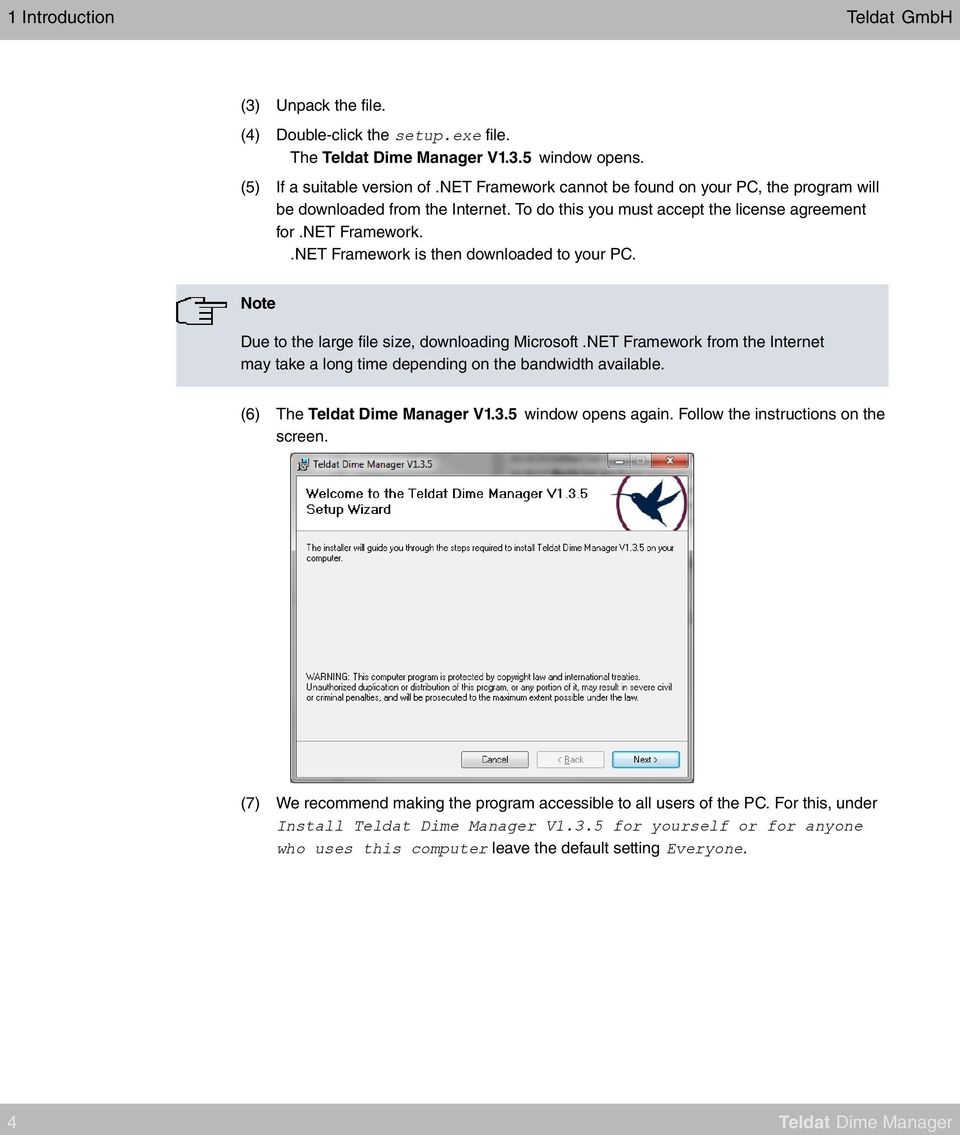
11 1 Introduction (8) Click Next. (9) Follow the instructions on the screen. (10) Exit the installation by clicking Close. The V1.3.5 window closes. (11) If the Windows Security Alert window opens this means that the Windows firewall has blocked some of the functions of the Dime Manager program for security reasons. You will be asked. Click the Unblock button to stop blocking the functions. 5
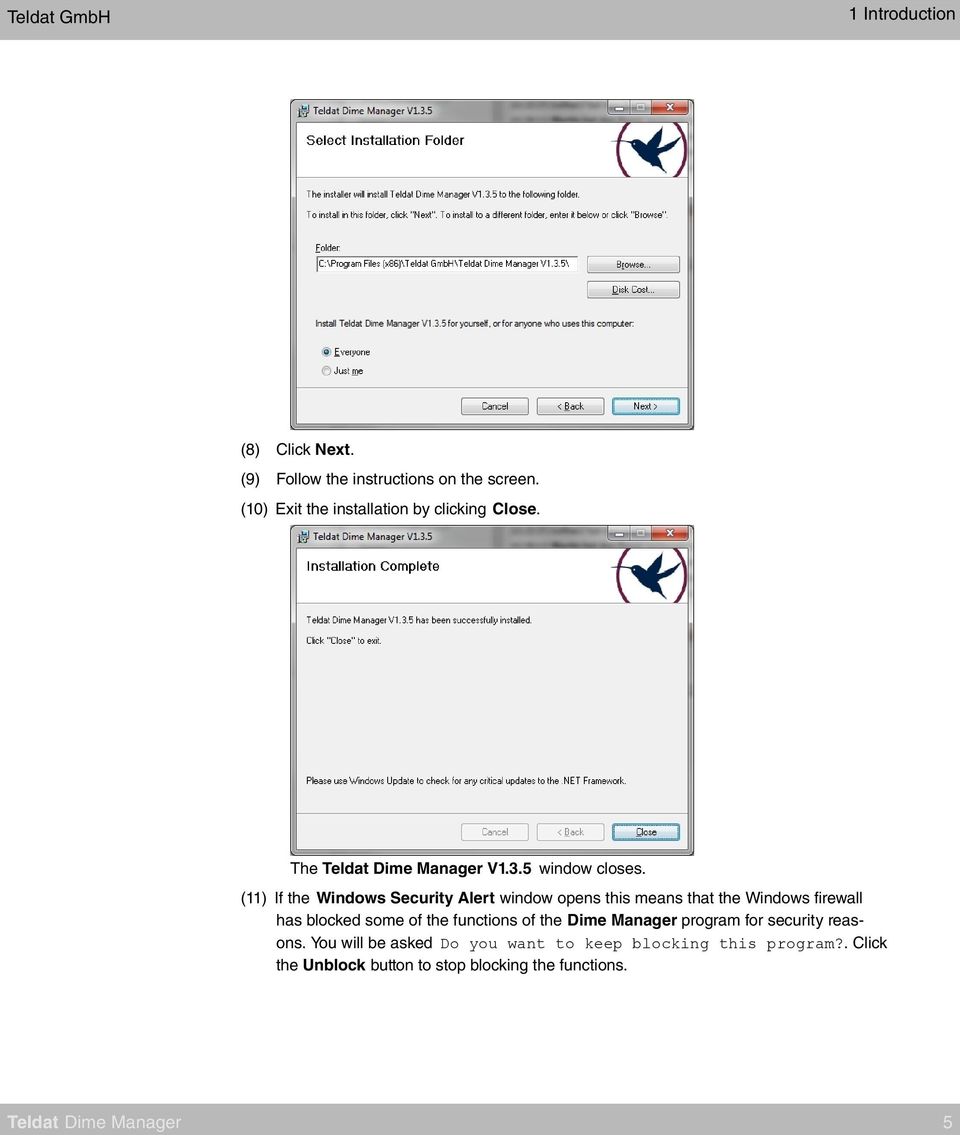
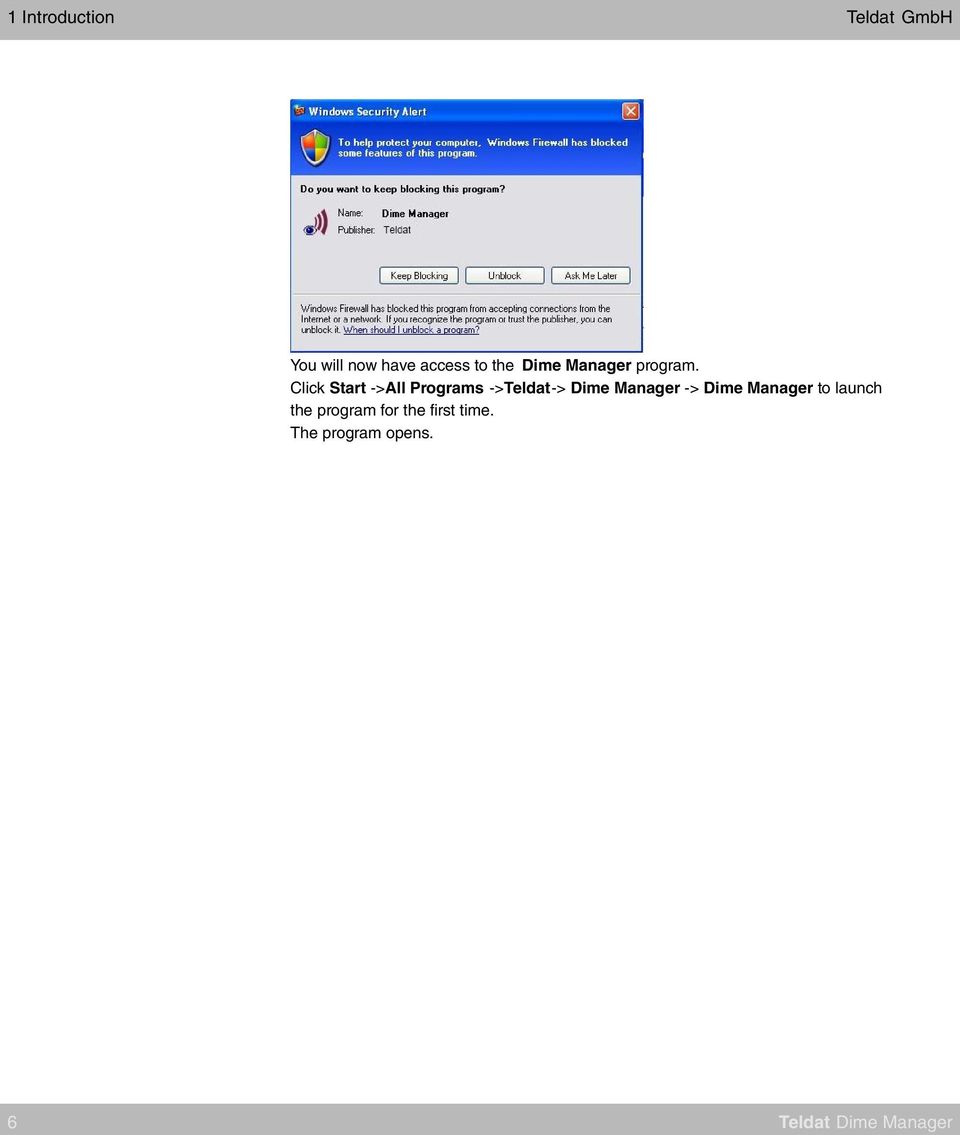
12 1 Introduction You will now have access to the Dime Manager program. Click Start ->All Programs ->Teldat-> Dime Manager -> Dime Manager to launch the program for the first time. The program opens. 6
13 2 User interface Chapter 2 User interface The Dime Manager program has a graphical user interface (GUI) to operate using the mouse. When you launch the program for the first time you will see the default view. The program automatically searches for and displays any bintec and elmeg devices. Fig. 2: Dime Manager 2.1 Elements The Dime Manager program is broken down into five areas in the default view. The menu bar The device explorer The main window with the Devices tab, the task bar and the display field 7
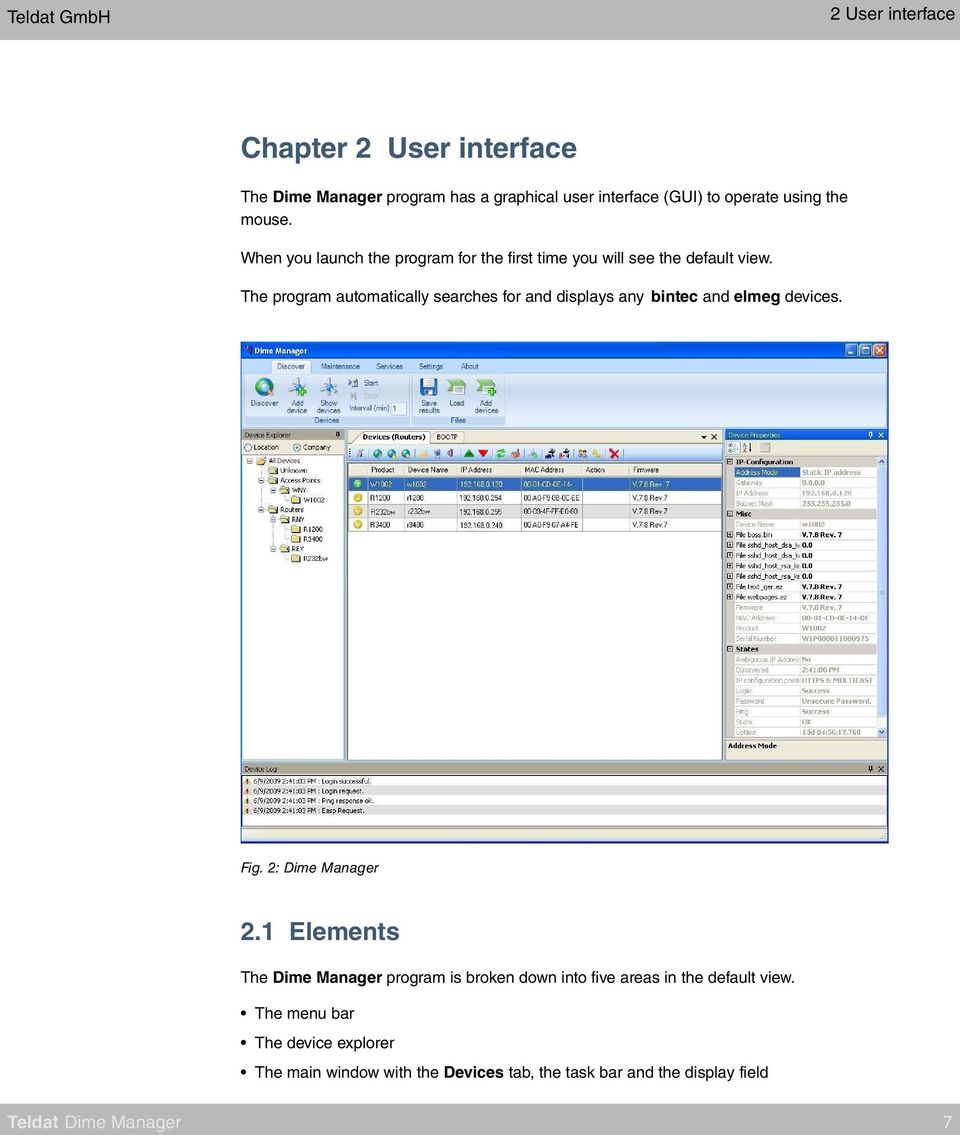
14 2 User interface The device properties The log and file windows. The menu bar and the main window are docked and cannot be moved. The Device Explorer, Device Properties and log and file window can be undocked and moved anywhere on the screen. You can re-dock a freely positioned window. When you end the program, the last used window layout is saved and reloaded and display the next time you start the program Menu bar The menu bar shows the menu options available in Dime Manager. If you click a menu item, you will be shown icons relating to the corresponding sub-menus. Click the same menu item again to hide the icons. Fig. 3: Menu bar Device Explorer The Device Explorer window shows all located devices in a tree structure. You can display devices sorted according to location or company. By default, they'll be sorted according to company. This sorting is useful, for example, if you're administering devices for several companies. You can add folders with company names via the shortcut menu. As long as no folders with company names have been created, all devices are displayed under All devices -> Unknown. Among these, you'll see devices of the same type grouped together in the same folder. As Location, entry into the FCI menu System Management-> Global Settings -> System is used for every device. Alternately, you can enter the Location in the Dime Manager into the main window using the shortcut menu under Set Company Information. 8
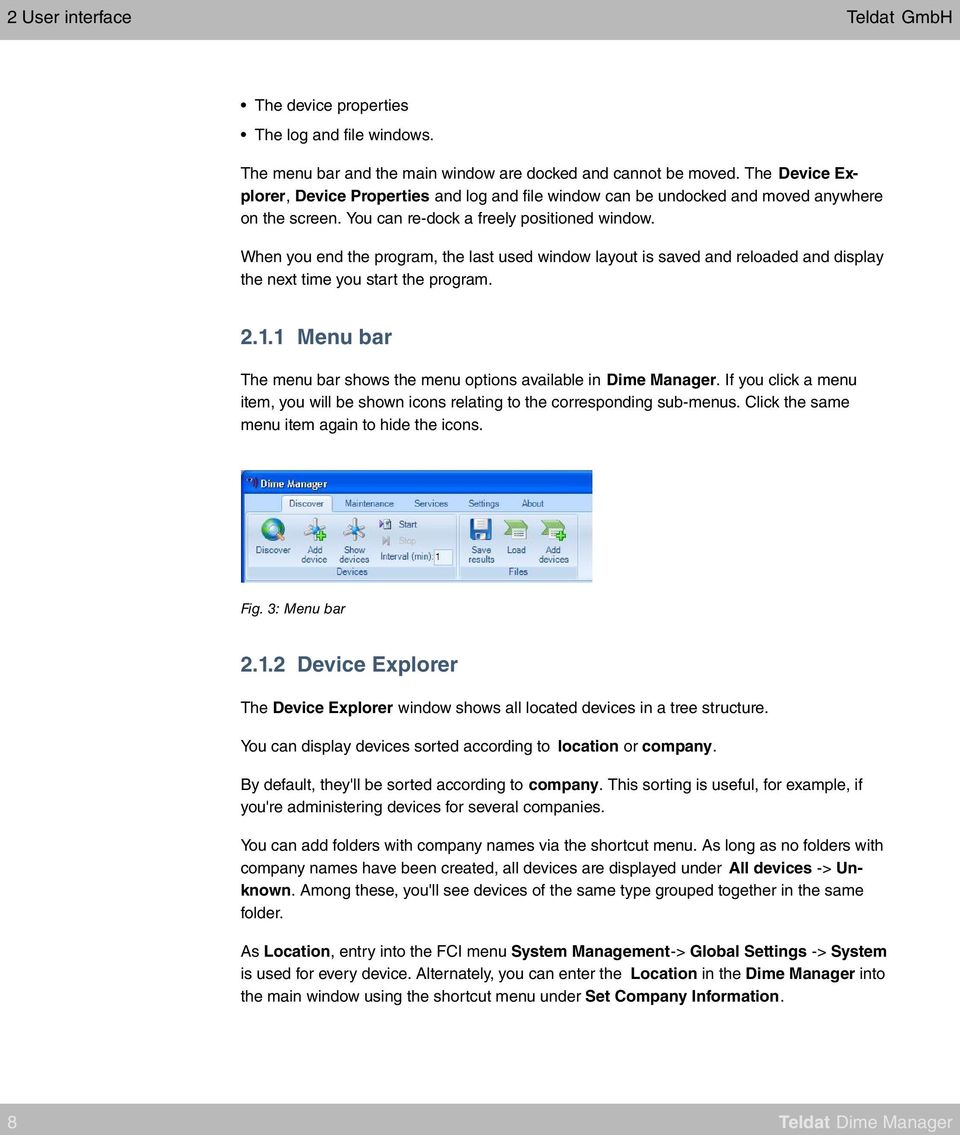
15 2 User interface Note If the location consists of several terms separated by commas, the initial entry is used for sorting in the folder. Devices with the same location are displayed in a common folder. The folder for a location is automatically created as soon as this location is entered for a device in the FCI. Devices for which no location is entered are displayed under All Devices -> Unknown. Fig. 4: Device Explorer You can choose any folder. The devices in this folder are displayed in the main window, i.e. by making a selection in the Device Explorer window you can filter the display in the main window on the Devices record card Shortcut menu device explorer The window Device Explorer provides a shortcut menu if you display devices sorted according to Company, and if a company folder or the folder Unknown is selected under folder All Devices. With this shortcut menu, you can handle folders with company names. In particular, you can: Create a new folder with a company name ( New company) Edit the company information of a folder (Edit company) Delete a folder with company information (Delete company). 9
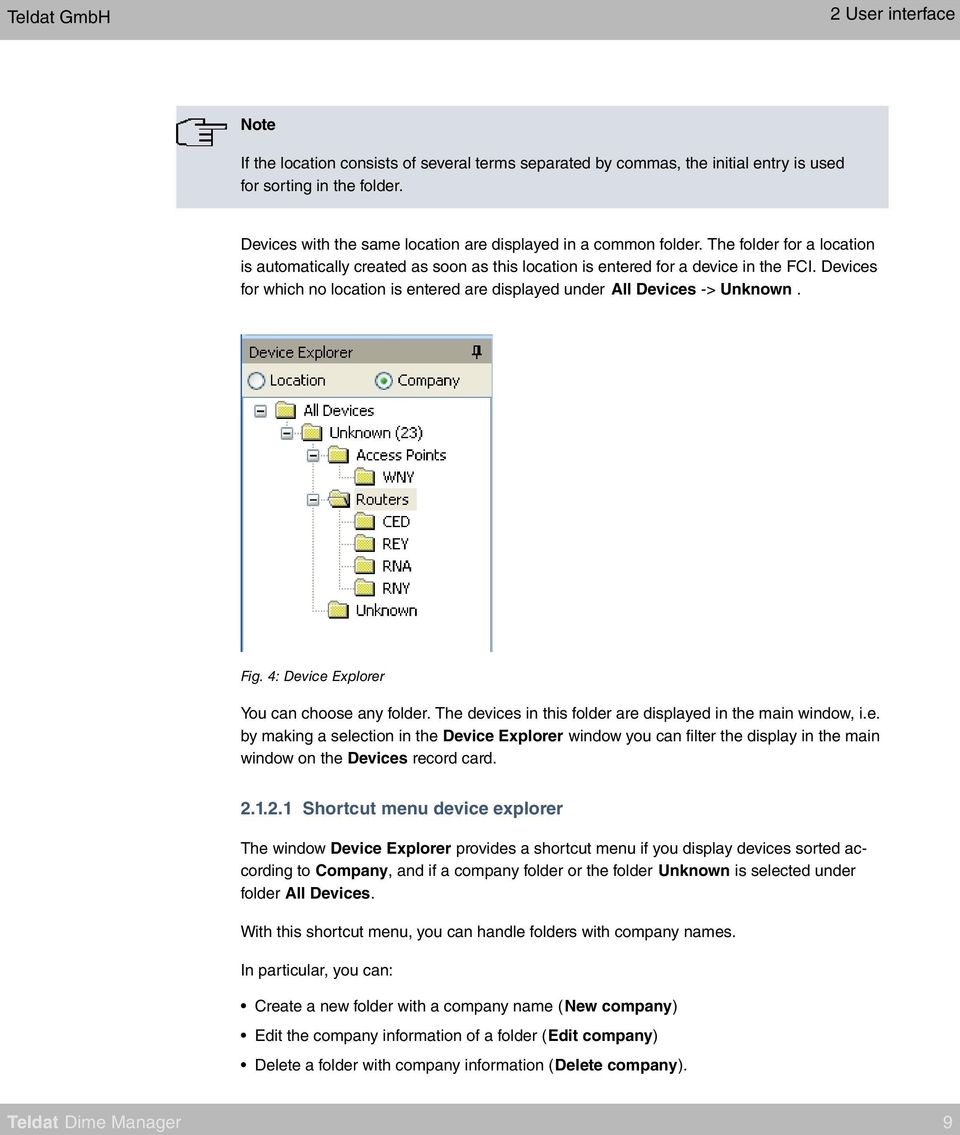
16 2 User interface Main window The main window consists of individual tabs. Each record card consists of a tab with the title of the record card, a task bar and a display field. Fig. 5: Main window Task bar / Shortcut menu The task bar for each record card contains icons for frequently used tasks. Tooltips help you when attributing tasks and icons. You can also perform these tasks via the shortcut menu. Task bar / Content menu on the Devices record card Fig. 6: Task bar In the default view the Devices record card offers the following tasks in the task bar and in the shortcut menu: IP Settings HTTP Configuration HTTPS Configuration secure TELNET Configuration (Setup) Update firmware from file Update firmware from web server Update firmware from Teldat server 10
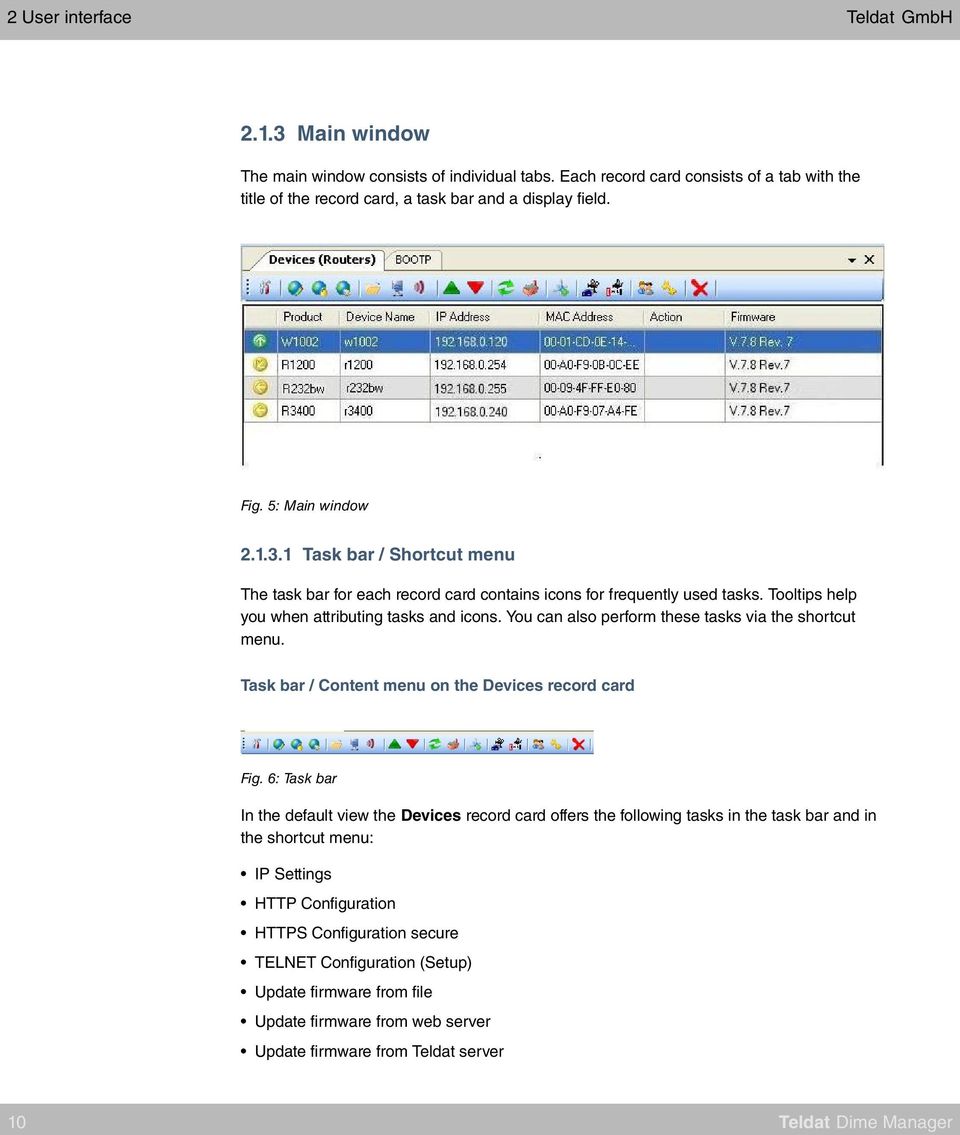
17 2 User interface Upload configuration Download configuration Reboot device Reset device to factory settings Configure BOOTP Trace interfaces Trace CAPI Set company information Set password. Delete Fig. 7: Shortcut menu 11
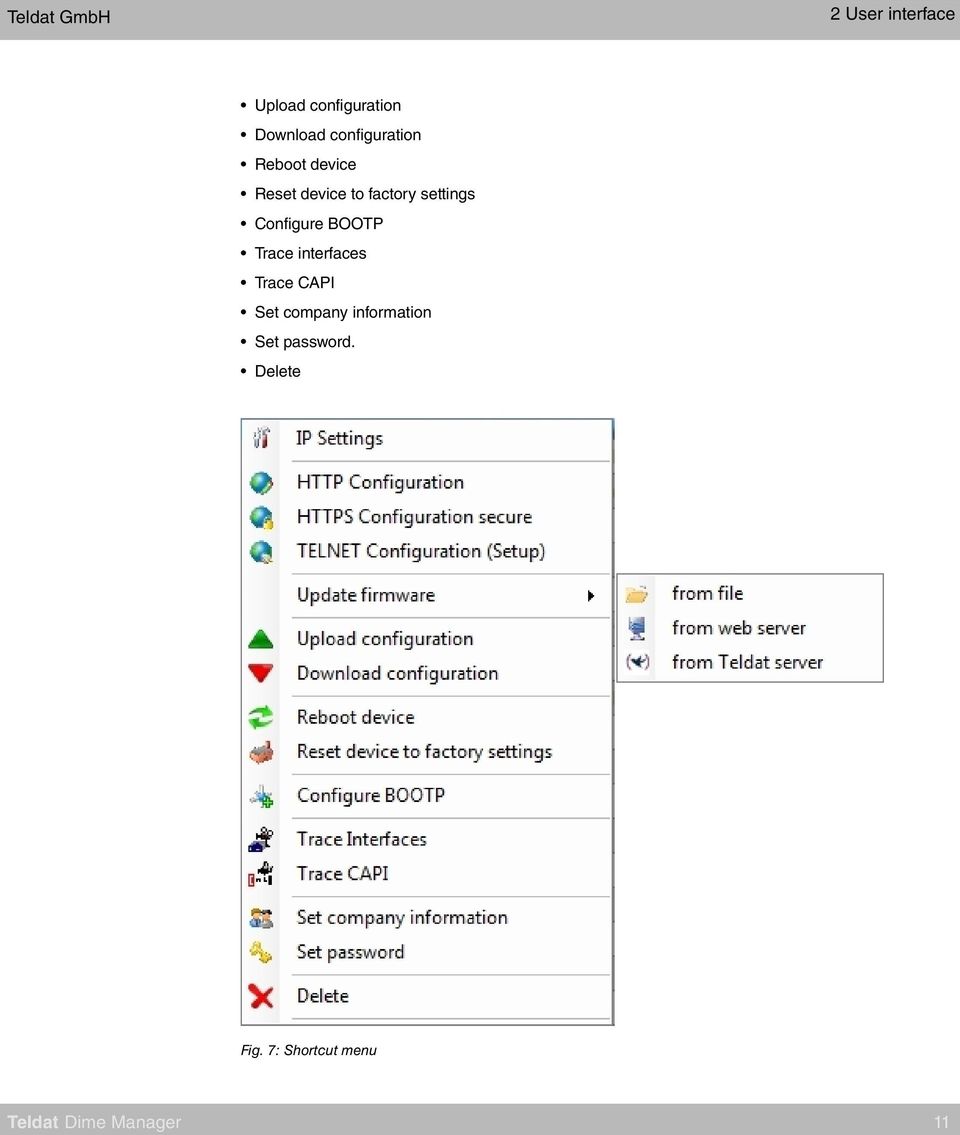
18 2 User interface Information on how to perform tasks using the task bar or the shortcut menu can be found under Perform tasks in the main window with the task bar or the shortcut menu on page Display field The display field is organised in rows and columns. You can sort the values displayed in each column in ascending or descending order. Click the column header to change the sort order. Devices record card In the default view the display field on the Devices record card shows the devices that the Dime Manager has located. Fig. 8: Display field in the main window of the devices record card By selecting a specific folder in the Device Explorer window, you can filter the devices shown, i.e. only display some of the located devices. A row is displayed for each device, which contains a parameter set with selected parameters for this device. If you move the mouse pointer over a row, you can see the device messages for this device in a tooltip. Alternatively, you can view these messages in the Device log log window. Note If not all devices are shown in the main window, it is likely that you have accidentally made a selection in the Device Explorer window. Each row on the Devices record card contains the following information: Status Product 12

19 2 User interface Device name IP address MAC address Action (i.e. the last action carried out on the device) Firmware In the corresponding column you can use the action displayed to check whether or not a transaction is running in the background and if so its current status. The colour of the action displayed indicates the progress of the action. If the action is ongoing, the text appears in black or white depending on the background colour. If the action has been successfully completed, the text appears in green. If the action has failed, the text appears in red. The background colour also serves as a progress bar for the transaction. You can also check all of the actions in the Dime Manager Log window. The following actions can be displayed: Set IP via HTTPS Set IP via Multicast Reboot device Set ex works settings Update configuration Load configuration Update firmware from file Internet update firmware (Url) Internet update firmware (Vendor) BOOTP record card If you have assigned devices using the BOOTP parameter, these devices are displayed on the BOOTP record card. Each row on the BOOTP record card contains the following information: Status Device name IP address MAC address Ignore (i.e. ignore BOOTP queries from this device) BOOTP configuration file (i.e. Transfer target BOOTP configuration file to the device? 13
20 2 User interface The values & or ' can be displayed.) Device status The status of the device is indicated by an icon in the left column of the record card. The colours of the icons have the following meaning: Available status icon colours Colour Meaning Indicates the status "HTTPS login successful". Indicates the status "configured" or "administrable". Indicates the status "Only located" or "Not reachable". The following icons can be displayed: Available status icons Icon Meaning Indicates the status "administered". The login via HTTPS was successful. The device has a new firmware with SNMP Discovery and the option to set IP settings via HTTPS. Note that the device cannot necessarily be reached via Multicast. Indicates the status "administrable, old firmware". The login via HTTPS was successful. The IP address cannot be set via SNMP Multicast or HTTPS because the device contains old firmware. A firmware update is available and a configuration can be loaded and saved. Indicates the status "Password set, no connection". A secure password is set. 14

21 2 User interface Icon Meaning Indicates the status "administrable, incorrect password". The device can be reached via its IP address. Unable to log in due to an incorrect password. Indicates the status "administrable, incorrect IP address". The device has been located via SNMP Multicast, but the device cannot be reached via an IP connection. The status of the password is currently unknown. The IP settings can be modified with the correct password. The device has a new firmware with SNMP Discovery. Indicates the status "located". The device was located with ARTEM Discovery, but it has an old firmware and cannot be reached via an IP address. Indicates the status "not connected" Device properties Detailed information about the device currently selected on the Devices record card is displayed in the Device properties window. 15
22 2 User interface Fig. 9: Device properties In the default view the parameters for each device are broken down into three categories: IP configuration Miscellaneous States Alternatively, you can sort the displayed parameters alphabetically by clicking the Click the icon. icon to return to the category view. Parameters available in the IP configuration field 16 Field Description Address Mode Shows how the device is assigned an IP address.
23 2 User interface Field Description Possible values: ( # ) * : The device has been assigned a static IP address. +,): An IP address is assigned to the device dynamically via DHCP. Gateway Shows the IP address of the gateway. Hostname Displays the hostname of the device. A hostname may be added under Add device. IP Address Shows the IP address of the device. Subnet Mask Displays the netmask of the device. Parameters available in the Miscellaneous field Field Description File xxx Shows the system software files in the device flash depending on the device. For each file you can display the file name, version, date and time the file was created and the file size. Company Name Displays the company name. Device Name Displays the device name. MAC Address Shows the MAC address of the device. Product Shows the product names, e.g. W1200. Serial Number Displays the serial number of the device. Location Displays the location of the device. You may sort your devices according to location. Firmware Displays the version of the system software. Monitoring Displays whether the device is monitored. Check Connection Displays whether the connection is to be checked by a Ping or by HTTPS. Parameters available in the States field Field Description Discovered Shows the time at which the device was last located. IP configuration possible Indicates if an IP configuration of the device can be carried out. Possible values: 17
24 2 User interface Field Description + )( - # : A configuration is possible via HTTPS and Multicast. + )(: A configuration is possible via HTTPS. # : A configuration is possible via Multicast. '. : A configuration is not possible. <Last action on the device> Shows the status of the action indicated on the Devices record card in the Action column by different colours. Login Indicates whether or not login was successful. Possible values: ( ## : Login was successful. / ## : Login was not successful. Ambiguous IP address Indicates if the same IP address is being used by several devices. Possible values: ' : The IP address of the device is not being used by another located device. & : The IP address of the device is being used by several devices. Password Shows the current status of the password. Possible values: / #! : The default password has not been changed. ( #! : The default password has been changed. / : The default password for the device is not known. This password has not been changed. Ping Indicates whether or not the device could be reached via ping. Possible values: ( ## : The device was reached via ping. / ## : The device could not be reached via ping. 18
25 2 User interface Field Description Uptime Displays the time past since the device was rebooted. Status Shows the current status of the device. Possible values: 01: The device is running and has been configured correctly. )! ## : The device could not be reached via ping. 2 ' : An internal error occurred when checking an ID. 3! ## : Login was not successful. % # : The device could not be reached. It is probably switched off. /.! " + )( 4 : The HTTPS request could not be sent to the device. /. " + )( : The HTTPS response from the device could not be read. # # # % : The file format of the data sent was incorrect. / 5! : The error that occurred could not be identified. # #. : A device with a different serial number was located under the IP address. 6 : A request to the device failed. " % 7 # " " + )( 4 8+ )( 9: ;: The server failed to respond to an HTTPS request from the device Log and file windows A log window displays a list with messages. A file window displays the files of a directory. When opening the program for the first time the Dime Manager Log window is displayed. Several log windows and several file windows can be opened at the same time for various purposes. In the default view, you can toggle between these windows using tabs as the log and file windows are hidden automatically. 19
26 2 User interface Fig. 10: Log window The following log and file windows are available: Available windows Window title Function of the window Dime Manager Log Shows messages for the Dime Manager. Devices log Shows the messages for the device currently selected in the Devices window. You can also see the actions currently running (see also Action under Display field on page 12). Alternatively you can see the messages for the device in the tooltip in the Devices window, if you move the mouse pointer over the corresponding row. Firmware Shows the files in the firmware directory. You can change the path to the firmware directory in the Firmware field in the Maintenance -> Configure menu. Configurations Shows the files in the configuration directory. You can change the path to the configuration directory in the Configurations field in the Maintenance -> Configure menu. 20 BOOTP Shows messages if BOOTP is used. TFTP Shows messages if TFTP is used. TRACE Displays the logged data when Trace interfaces or Trace CAPIis launched. Dime Syslog Shows messages if Syslog is used.
27 2 User interface Window title Function of the window Messages are continuously displayed until you halt display by clicking on the icon, or double-clicking on the display area. All messages are collected; no messages are lost, whatever messages are currently being displayed. With display paused, messages saved up to that point can be manipulated. You can filter messages according to message priority, and according to device Context menu Dime Manager Log and Dime Syslog The windows Dime Manager Log and Dime Syslog provide a shortcut menu if the continuously displayed messages are halted, e.g. by double-clicking in the respective window. With this shortcut menu, you can edit the window content. You can, for instance, copy messages in Windows standard tools and save them there. In particular, you can: Select all : Selects the window content and marks it in the window. Copy: Copies the window's marked content into the clipboard. Clear all: Deletes the window's content. 2.2 Operation Change window display In the Dime Manager program you can change the view and content of windows using various icons. The following icons are available: Available icons Icon Meaning Closes the window. Shows which record card is available in the main window. You can toggle between the record cards that are displayed. 21
28 2 User interface Icon Meaning Indicates that the automatic hide function for the window is disabled. The window is displayed permanently. If you click the icon, the display switches to the icon and the window is hidden automatically as soon as it loses focus. Indicates that the automatic hide function for the window is enabled. A tab is displayed and the window is hidden if there is no focus. If you drag the mouse pointer over the tab, the window is shown and you can click the icon to switch to the icon and disable the automatic hide function. These icons are displayed if a window is positioned freely, you click the window title and hold down the mouse button. You can drag the mouse pointer over an icon to show the available docking position of the window. When you release the mouse button, the window is docked in the position currently displayed. Shows the parameters in groups in the Device properties window. Shows the parameters sorted alphabetically in the Device properties window. Ends the currently displayed trace in the Trace window. Continuation is not possible. Pauses display update in the Trace window. Alternately, you can halt display by double-clicking the display area. Resumes display update in the Trace window which had previously been paused by clicking the icon or double-clicking the display area. Deletes the displayed data in the Trace window. 22
29 2 User interface Select devices You can select a row for a device and manipulate it in the main window. However, you can also select several devices (i.e. several rows) at the same time and, for example, update the system software for all selected devices by drag and drop with just a single click Halting and resuming update In the Trace and Dime Syslog windows, you can halt continuous display update and resume it after a pause. If you wish to halt display update, double click in the respective window or click the icon. Display is halted. If you wish to resume display update, click the icon. The display is continuously updated Filtering Syslog messages You can filter the Syslog messages in the Dime Syslog window. Double-click the Dime Syslog window or click the icon. Continuous display update is halted. You can set priority of displayed messages and the device from which they are to proceed. You can combine both filtering options. If you wish to display messages with a specific priority, select the value 3, 3 < or 3 $ in the Log level field. If you wish to display messages from a specific device, select the desired device's IP address in the Device field. (4) If you wish to apply the settings selected above to the messages saved from Syslog's start until display halt, click on the icon. The messages are filtered. A progress bar indicates filtering process progression. At filtering conclusion, the filtered messages are displayed. Note You can copy or cut the filtered data, as well as paste, edit and save these in Windows standard tools. 23
30 Chapter 3.1 Discover In the Discover menu you can carry out all tasks related to searching for and locating a device. You can: Search for devices Add devices manually Display devices Start a search in the background Save the displayed list of located devices in a file Display a saved device list Load additional devices from a file to devices already displayed Search for devices Select Discover -> Discover to search for devices within a network. The Dime Manager searches for devices using SNMP Multicast and displays the located devices. Note Devices in field offices are located if SNMP Multicast is routed, i.e. via a VPN tunnel Add devices manually You can add any devices that are not located via SNMP Multicast manually. Tip If a device has a system software earlier than version 7.8.7, you can add the device manually and then carry out an update to the latest system software (see Update firmware with drag and drop on page 65,Update firmware from a file on page 45,Update firmware from a web server on page 46 orupdate firmware from Teldat server on page 47). 24
31 Select Discover -> Add device to add device manually. The Add Device window opens. In the Hostname field, enter the IP address or URL of the device, and in the Password field, enter the device's password. If you wish to display the password in plain text, enable Show password in clear text. (4) Click OK. The Dime Manager displays the new device Display devices Select Discover -> Show devices to display the main window with the Devices record card and the Device properties window. These windows are displayed automatically in the default view after the initial program start Search for devices in the background If you wish to search for devices using an automatic search in the background, select Discover and define the period of time after which an automatic search should be repeated. For this, enter the required value in minutes in the Interval (min): input field. The default value is one minute. Start the search in the background by selecting Discover -> Start. The Start button is greyed out and the Stop button is highlighted. The Dime Manager repeats the search for devices within the network after the specified interval. The located devices are displayed after each search. If you wish to stop the automatic search, click Stop. 25
32 3.1.5 Save search results Here, you can save a list of devices found. Select Discover -> Save results to save the search results currently displayed. By default the search results are saved under # = = in the % # with a password. The Save device list window opens. This window opens automatically if you end the Dime Manager program. If you wish to protect the search results with a password, leave the default setting < "! and enter the required password in the Password field and in the Confirm password field. If you wish to save the search results without a password, disable < "!. (4) If you wish to change the path and the file name displayed, click the icon. The Save as window opens. Change the path and file name as required and click Save. (5) 26 Click Yes. The device list is saved without status information, but with company information. (Status information is available in the corresponding log files.)
33 3.1.6 Load search results Select Discover -> Load to load previously saved search results. The Open window opens. The last saved file is displayed in the File name field by default. Select the required file and click Open. If you wish to load a file that is protected with a password, open the Load settings with password window. Enter the password and click OK. The file is loaded and its contents is displayed in the Dime Manager. 27
34 3.1.7 Import devices from a file To import devices from a saved XML file, select Discover -> Add devices in the Files field. The Dime Manager can display those devices for which at least one IP address and a password have been saved. All other information is used, but is not relevant for the import. The Open window opens. Select the required file and click Open. If you wish to load a file that is protected with a password, open the Load settings with password window. Enter the password and click OK. The file is loaded and its contents displayed in the Dime Manager in addition to the already displayed devices. 3.2 Maintenance In the Maintenance menu you can prepare maintenance for a device. You can carry out maintenance for any of the devices displayed in the main window on the Devices record card. You perform the actual maintenance in the main window on the Devices record card using the task bar or the shortcut menu (see Perform tasks in the main window with the task bar or the shortcut menu on page 41) or using drag and drop (seeperform tasks with drag and 28
35 drop on page 64). In the Maintenance menu you can Display the window for the configuration files Change the path to the configuration files Display the window for the firmware files Update firmware files Change the path to the firmware files Display configuration files Select Maintenance -> Window in the Configurations area to open the Configurations window. You can display the files that you can use for a configuration. 29
36 3.2.2 Change the path to the configuration files If you wish to change the path to the configuration files that you can see in the Configurations window (see Display configuration files on page 29), select Maintenance -> Configure in the Configurations area. The Enter path to configuration files window opens. Specify in which folder the configuration files should be saved. By default they are saved to # = = =,. If you wish to change the path, click the icon. The Browse for folders window opens. 30 (4) If the required folder already exists, select the folder and click OK. (5) If you wish to create a new folder, select the path under which the new folder is to be created, click Make new folder, enter a name for the folder and click OK. (6) Click OK. The new path to the configuration files is specified.
37 3.2.3 Display firmware files Select Maintenance -> Window in the Firmware area to open the Firmware window. You can display the files that you can use for a firmware update sorted according to device Change path to the firmware files / Update firmware files If you wish to change the path to the firmware files that you can see in the Firmware window (see Display firmware files on page 31) or wish to update the firmware files, select Maintenance -> Configure in the Firmware area. The Firmware information window opens. By default the firmware files are saved to # = = =6!. You can change this path Local firmware folder as required. If you wish to copy the latest firmware files to your local directory, click Update. The firmware files are downloaded from the Internet and copied to your directory. If you wish to search for firmware updates and release notes on the Teldat home page, click the Teldat logo and search for the required files. (4) If you wish to host a proprietary firmware web server, enter the file name and the path in the Server address field. (5) Click OK. 31
38 3.3 Services TFTP, BOOTP and Syslog services are available from the Services menu. TFTP is used to transfer system software or configuration files. With BOOTP a device can be assigned an IP address and other parameters when switched on. Using Syslog, you can display system messages for several devices in the Dime Manager. In the Services menu you can Define the settings for the TFTP service Start and stop the TFTP service Define settings for a device via BOOTP Start and stop the BOOTP service Display the BOOTP record card Install and uninstall the Syslog service Start and stop the Syslog service Receive and display Syslog messages Open a log window for the respective service Open TFTP log window 32 Select Services -> Window in the TFTP area to open the TFTP log window. If you use TFTP, any TFTP messages are displayed in this window.
39 3.3.2 Define TFTP settings Select Services -> Configure in the TFTP area to define the path with which TFTP files can be saved or opened. By default TFTP uses the path # = = =,. You can change this path. Once you have changed the path as required click OK Start or stop TFTP service Select Services -> Start in the TFTP area to start the TFTP service. As soon as the TFTP service is running in the background, the Start button is greyed out and the Stop button is highlighted. If TFTP is already running in the background, select Services -> Stop in the TFTP area to stop the TFTP service. As soon as the TFTP service has stopped, the Start button is highlighted and the Stop button is greyed out. Note Note that TFTP can run independently of the display in the TFTP log window (see Open TFTP log window on page 32) Open BOOTP log window Select Services -> Window in the BOOTP area to open the BOOTP log window. If you use BOOTP, any BOOTP messages are displayed in this window. 33
40 3.3.5 Define parameters for a device via BOOTP Select Services -> Add in the BOOTP area. The BOOTP window opens. Here, you can enter the BOOTP parameters of a selected device. Open the BOOTP configuration menu for a device from the device list by selecting Configure BOOTP, either in the task bar via the button or via the shortcut menu. Change or add parameters as required. If you wish to transfer a configuration file to the device, select the required file. Note Note that the TFTP service must be running to transfer a configuration file (see Start or stop TFTP service on page 33). (4) 34 Click OK.
41 As soon as the device sends a BOOTP request (e.g. when booting), the parameters are transferred to the device. The BOOTP record card is displayed in the main window with the device updated via BOOTP Start or stop BOOTP service Select Services -> Start in the BOOTP field to start the BOOTP service. As soon as the BOOTP service is running, the Start button is greyed out and the Stop button is highlighted. Note Note that BOOTP can run independently of the display in the BOOTP log window (see Open BOOTP log window on page 33). As soon as a device sends a BOOTP request, the BOOTP window opens with the parameters for this device. You can change the parameters as required. Click OK to transfer the parameters to the device. Select Services -> Stop in the BOOTP area to stop the BOOTP service. As soon as the BOOTP service has stopped, the Start button is highlighted and the Stop button is greyed out Display BOOTP devices Select Services -> Show devices in the BOOTParea to show the BOOTP record card in the foreground of the main window, and to display those devices for which the BOOTP parameters are configured Install Syslog service You can have the Dime Manager install the Syslog service. Note You require administrator rights to install or uninstall Syslog service, as well as to start or stop it. 35
42 Note If you're running Windows XP without administrator rights, the administrator must install and launch the Syslog service via Dime Manager. You can also receive Syslog service messages as a user with restricted rights. If you wish to install the Syslog service, select Services -> Configure in the Syslog area. The Syslog service installation window opens. Click the Install Syslog service button. The syslog service is installed; the button text is modified in Uninstall Syslog service. Click OK in the Syslog service installation window. The Syslog service installation window closes; the Syslog service becomes available in the Dime Manager Note At installation, the Syslog service in Windows is included in the list of authorised applications. If you use additional firewall applications on your Windows system, you might have to add the Syslog service at the relevant location Uninstall Syslog service Note You require administrator rights to uninstall or install Syslog service, as well as to stop or start it. 36
43 Select Services -> Configure in the Syslogarea to uninstall the Syslog service. The Syslog service installation window opens. Once the service is installed, you can uninstall it. On the button, the text Uninstall Syslog service appears. Click the Uninstall Syslog service button. The Syslog service is uninstalled; the button text is modified in Install Syslog service. Click OK in the Syslog service installation window. The Syslog service installation window closes; the Syslog service is no longer available in the Dime Manager Open Dime Syslog log window Select Services -> Window in the Syslog area to open the Syslog log window. When you're using Syslog, i.e. when Syslog is running, any Syslog messages received at Port 514 are displayed in this window. Note You see Syslog messages for those devices which have entered the IP address of the PC on which the Dime Manager was installed in the GUI under External Reporting -> Syslog -> New 37
44 Start or end Syslog service Select Services -> Start in the Syslog area to start the Syslog service. As soon as the Syslog service is running in the background, the Start button is greyed out and the Stop button is highlighted. If Syslog is already running in the background, select Services -> Stop in the Syslog area to stop the Syslog service. As soon as the Syslog service has stopped, the Start button is highlighted and the Stop button is greyed out Receive and display Syslog messages Install the Syslog service (see Install Syslog service on page 35). Enter the IP address of the PC on which the Dime Manager is installed into the GUI of the devices whose Syslog messages you wish to receive. For this, in the GUI, go into the menu External Reporting -> Syslog -> New. Open the Syslog log window (see Open Dime Syslog log window on page 37). (4) Start the Syslog service (see Start or end Syslog service on page 38). You see the Syslog messages in the Dime Syslog window. You can pause the display and manipulate the data (see Filtering Syslog messages on page 23). Note As soon as Syslog is started, all messages are continuously saved in the Windows event viewer. You can administer the data with Windows standard tools. Note The size of the Windows events viewer is limited by default to 512 KB, i.e., about 1,000 entries. When the memory is full, the oldest messages are deleted first. If you have administrator rights, you can modify the size of the events viewer. Note The number of messages received by the devices depends on which setting you have selected for the respective device on the GUI in the menu External reporting -> Syslog -> New in the Level field. 38
45 3.4 Settings In the Settings menu you can define basic settings. You can Open the log window for the devices Open the log window for the Dime Manager Change the language for the user interface Change the TELNET client currently selected Open log windows for devices Select Settings -> Devices Log in the Protocols area to open the Device log window for messages from all displayed devices. The Device log log window opens and any messages are displayed Open log windows for Dime Manager Select Settings -> Dime Log in the Protocols area to open the window for Dime Manager messages. The Dime Manager log window opens; any messages are displayed Change language To select a different language from that currently in use, select Settings -> Language. The languages currently available are German and English. Select the desired language. The message! " # appears. Click Yes to enable the selected language setting. 39
46 3.4.4 Select TELNET Client Note If you are using Microsoft Windows 7 or Microsoft Windows Vista, TELNET is disabled by default. If you wish to use a TELNET client, you must enable it first. Select Settings -> TELNET over: in the Configuration area to choose a client other than the currently selected TELNET client. Select the desired TELNET client. The selected TELNET client is used for configurations with the setup tool (see Configure device via TELNET on page 44). 3.5 Display information In the Info menu you can Display information about the Dime Manager Access help files on the Dime Manager Display copyright and version 40 Select About -> About. The About Dime Manager window opens. The copyright and version number are displayed. Click OK to close the window.
47 3.5.2 Call up help Select About -> Help to call up Dime Manager help. The window, featuring the HTML help, opens. 3.6 Perform tasks in the main window with the task bar or the shortcut menu In the default view the Devices record card has a task bar for important tasks. You can also perform these tasks via the shortcut menu. You can select one or more devices and apply the following action to the selected device or selected devices. The following descriptions refer to a single device. Proceed accordingly for multiple devices Change device parameters and password You can change the name and password for a device as well as its IP settings. Select the desired device in the main window on the Devices record card. 41
48 Click the icon or open the shortcut menu by right-clicking and select IP Settings or double-click the device. The IP Settings window opens. Note Note that the IP Settings window only opens if the device has been located with SNMP Discovery or can be reached via HTTPS. Change the settings as required. (4) If you wish to save the configuration on the device so that it will be available after a restart, enable the Save configuration permanently setting. (5) Click Verify to check whether or not the device can be reached at the specified IP address. (6) Click OK to transfer the settings to the selected device and close the window Configure device via HTTP You can configure a device with HTTP using the Graphical User Interface directly from Dime Manager. You do not need to log in, as the Dime Manager will have saved the device password and will take you directly to the selected device. 42 Select the desired device in the main window on the Devices record card. Click the icon or open the shortcut menu by right-clicking and select HTTP Config-
49 uration. The status page for the Graphical User Interface opens. You can now configure the device. If you wish to save the current configuration on the device, click Save configuration in the Graphical User Interface. Refer to Save configuration on page 50 for information on how to save the configuration in the Dime Manager Configure device securely via HTTPS You can configure a device securely with HTTPS using the Graphical User Interface directly from Dime Manager. You do not need to log in, as the Dime Manager will have saved the device password and will take you directly to the selected device. Select the desired device in the main window on the Devices record card. Click the icon or open the shortcut menu by right-clicking and select HTTPS Con- figuration secure. In some cases a warning message may appear and the Secure Connection Failed window may open if a security certificate is not signed. 43
50 If this happens add an exception and download a certificate. Follow the instructions on the screen. (4) If you click the Confirm security exception rule button in the Add security exception rule window, the Graphical User Interface status page opens. You can now configure the device. (5) If you wish to save the current configuration on the device, click Save configuration in the Graphical User Interface. Refer to Save configuration on page 50 for information on how to save the configuration in the Dime Manager Configure device via TELNET Note If you are using Microsoft Windows 7 or Microsoft Windows Vista, TELNET is disabled by default. If you wish to use a TELNET client, you must enable it first. You can configure a device via the Setup Tool directly from Dime Manager. Select the desired device in the main window on the Devices record card. Click the icon or open the shortcut menu by right-clicking and select TELNET Con- figuration (Setup). A TELNET client opens. You can log into the chosen device and configure it. 44
51 If you wish to save the current configuration on the device, select the Save as boot configuration and exit menu option in the Setup Tool. Refer to Save configuration on page 50 for information on how to save the configuration in the Dime Manager Update firmware from a file You can update the firmware of a device using a firmware file, which is saved in your Dime Manager. Select the desired device in the main window on the Devices record card. Click the icon or open the shortcut menu by right-clicking and select Update firm- ware from file. The Select Firmware for <device name> window opens. By default the files are displayed from # = = =6!. You can change this path (see Change path to the firmware files / Update firmware files on page 31). 45
52 Select the required file and click Open. The firmware file is transferred to the device. Whilst the action is running the /! message is displayed in the Devices window in the Action column in black or white depending on the background colour. Once the action is successfully completed, the /! message appears in green. If the action fails, the /! message appears in red. The background colour also serves as a progress bar for the transaction. Note To enable the new firmware, you must restart the device (see Reboot device on page 51 ) Update firmware from a web server You can update the firmware for a device using a web server. Select the desired device in the main window on the Devices record card. Click the icon or open the shortcut menu by right-clicking and select Update firm- ware from web server. 46
53 The Firmware update via Web window opens. Enter the desired web server in the Server field. Note Note that DNS must be enabled on the chosen devices and there must be an Internet connection available from the chosen device to the entered web server. (4) Click Start. The device loads the firmware file from the specified web server. Whilst the action is running the! 8/ ; message is displayed in the Devices window in the Action column in black or white depending on the background colour. Once the action is successfully completed, the! 8/ ; message appears in green. If the action fails, the! 8/ ; message appears in red. The background colour also serves as a progress bar for the transaction. Note To enable the new firmware, you must restart the device (see Reboot device on page 51 ) Update firmware from Teldat server You can update the firmware for a device using the Teldat server. 47
54 Select the desired device in the main window on the Devices record card. Click the icon or open the shortcut menu by right-clicking and select Update firm- ware from Teldat server. The Firmware Update via Web window opens. The Teldat server is preset, although you can change these default settings. Note Note that DNS must be enabled on the chosen devices and there must be an Internet connection available from the chosen device to the entered web server. Click Start. The device loads the firmware file from the Teldat server. Whilst the action is running the! 8 ; message is displayed in the Devices window in the Action column in black or white depending on the background colour. Once the action is successfully completed, the! 8 ; message appears in green. If the action fails, the! 8 ; message appears in red. The background colour also serves as a progress bar for the transaction. Note To enable the new firmware, you must restart the device (see Reboot device on page 51 ). 48
55 3.6.8 Load configuration into a device You can load a configuration into a device. Select the desired device in the main window on the Devices record card. Click the icon or open the shortcut menu by right-clicking and select Update con- figuration. The Please select a configuration file window opens. By default the configuration files are are saved to # = = =,. You can change the path to the configuration files (see Change the path to the configuration files on page 30). Select the required configuration file and click Open. The configuration file is transferred to the device. Whilst the action is running the / # message is displayed in the Devices window in the Action column in black or white depending on the background colour. Once the action is successfully completed, the / # message appears in green. If the action fails, the / # message appears in red. The background colour also serves as a progress bar for the transaction. 49
56 3.6.9 Save configuration You save the current configuration for a device in a file. Select the desired device in the main window on the Devices record card. Click the icon or open the shortcut menu by right-clicking and select Download configuration. The Save Configurations window opens. By default the configuration files are saved to # = = =,. You can change the path to the configuration files (see Change the path to the configuration files on page 30). 50 Select the required directory, enter a name for the configuration file and click Save. The Download Configuration window opens. (4) Check your entries, change them if necessary and click Start. The configuration file is saved. Whilst the action is running the ( % # message is displayed in the Devices window in the Action column in black or white depending on the background colour. Once the action is successfully completed, the ( % # message appears in green. If the action fails, the ( % # message appears in red. The background colour also serves as a progress bar for the transaction.
57 Reboot device You can reboot a device from the Dime Manager. Select the desired device in the main window on the Devices record card. Click the icon or open the shortcut menu by right-clicking and select Reboot device. The Device Reboot window opens. The parameters for the selected device are displayed. Click Start. The device is rebooted. Whilst the action is running the >. % # message is displayed in the Devices window in the Action column in black or white depending on the background colour. Once the action is successfully completed, the >. % # message appears in green. If the action fails, the >. % # message appears in red. The background colour also serves as a progress bar for the transaction Reset default settings You can reset a device to its default settings. The configuration will be lost if you do not save it first (see Save configuration on page 50). Select the desired device in the main window on the Devices record card. Click the icon or open the shortcut menu by right-clicking and select Reset device to factory settings. The Factory Reset window opens. The parameters for the selected device are dis- 51
58 played. Click Start. The device is reset to the default settings. Whilst the action is running the message is displayed in the Devices window in the Action column in black or white depending on the background colour. Once the action is successfully completed, the message appears in green. If the action fails, the message appears in red. The background colour also serves as a progress bar for the transaction Define parameters for a device via BOOTP You can define parameters for a device via BOOTP. Select the desired device in the main window on the Devices record card. Click the icon or open the shortcut menu by right-clicking and select Configure BOOTP. The BOOTP window opens. 52
59 Change or add the displayed parameters as required. (4) If you wish to transfer a configuration file to the device, select the required file. Note Note that the TFTP service must be running to transfer a configuration file (see Start or stop TFTP service on page 33). (5) Click OK. The parameters are transferred to the device as soon as it sends a BOOTP request Log data with trace With trace, you can log all data packages sent and received on a particular device interface. You can display the data packets, or save them in a file. Select the desired device in the main window on the Devices record card. Click the icon or open the shortcut menu by right-clicking and select Trace Inter- faces. The Trace Configuration window opens. 53
60 (To display the logged data, the TRACE window simultaneously opens in the background.) In the Interface selection area of the interface list, select the interface whose data traffic you wish to log. (4) Once you've selected the ISDN interface, determine whether you wish to log the data traffic in the D channel or the B channel. If you've selected B channel, you must additionally provide the number of the desired B channel. (5) In the Trace Mode area, select how you wish to filter the data to receive exclusively the relevant information. Depending on the selected interface, different filter options are available. Keep the setting Filter Trace Port (7000) to drop the data packages on the connection between PC and the selected interface. (6) In the Pcap area, select whether to use a pipe or to generate a Pcap file. If you select Use Named Pipe, a named pipe is used, Wireshark is launched by default and the data are displayed there. If you wish to save the data in a Pcap file, select Save to File and click the icon. The Save as window opens. Name the file and click Save. The window closes, the data is saved in a Pcap file under the assigned name. If you wish to limit the file size, select Trace up to and enter the desired value in KB. (7) 54 In the area Trace file, select whether you wish to save the data in a text file. If you wish to save the data in a text file, select Save to file and click the icon.
61 The Save as window opens. Name the file and click Save. The window closes, the data is saved in a text file under the entered name. If you wish to limit the file size, select Trace up to and enter the desired value in KB. (8) Click Start Trace. Trace is launched. Received data are displayed in the Trace window and optionally saved, depending on the configuration Log data with trace CAPI With Trace CAPI, you can log a device's CAPI communication. For this, the CAPI server must be enabled for the respective device. You can enable the CAPI server in GUI under Local services -> CAPI server -> Options, insofar as the selected device has a CAPI server. In addition, the device should support Bintec Remote CAPI. Select the desired device in the main window on the Devices record card. Click the icon or open the shortcut menu by right-clicking and select Trace CAPI. The CAPI Trace: <device name - IP address> window opens. Keep preset port?@@? or enter an alternate port, if required. (4) Select a mode to set the output format. You can choose between an output with short description and an output with detailed description. In addition, an output in hexadecimal format can be selected, (5) If you wish to display the data on the screen, select the setting Display in window in the Trace file area. (6) If you wish to save the data in a file, select Save to file and click the icon. The Choose Path to store trace output window opens. Enter a file name and click Open. 55
62 The window closes, the data is saved under the entered name. (7) If you wish to limit the file size, enable Trace up to and enter the desired value in KB. (8) Click Start Trace. CAPI Trace is launched. Received data are displayed in the TRACE <IP address: Port> window and optionally saved according to the configuration Set company information You can either specify information for an individual device via the company in which it is used, or you can accomplish this for several devices in a single step. You can use the location or the company as a sorting criterion for your devices. Sorting per company is displayed by default in the Device Explorer window. Select the desired device or devices in the main window on the Devices record card. Click the icon or open the shortcut menu by right-clicking and select Set company information. The Company information window opens. 56
63 If you wish to sort your devices according to company, enter a company name in the New company name field. Note In the New company name field, you can enter several terms separated by commas. To sort devices in the Device Explorer window, the first term is used. (4) If you wish to sort your devices according to location, enter a (new) location in the Location field. Note You can enter and save a location if the corresponding devices is in the administered status (see device status under Display field on page 12 ff). If you wish to save this location in the configuration of the respective device, enable 57
64 Save configuration permanently. Click OK. The entries are used for the respective sorting. Where required, corresponding new folders are created for Location and Company. When saved, company information is stored in the % # file Set password You can re-enter or change your devices' current administrator password. If login with Dime Manager has failed, you can enter the current administrator password here. If login into a device is successful (green symbol), you can set a new password for this device and apply it in the configuration. Note To be able to set a new password for several devices in a single step, these devices must be identified with a green symbol. In the following, you can select one or more devices. These descriptions refer to a single device. Proceed accordingly for multiple devices. If login has been successful, and you wish to set a new password, select the desired device identified with a green symbol in the main window on the Devices record card. Click the symbol or open the shortcut menu by right-clicking and select Set pass- word. The Set new password window opens. 58
65 Enter a new password in the New Password field. (4) If you wish to display the password in plain text, enable Show password in clear text. (5) If you wish to save the password as an administrator password, enable Save configuration permanently. (6) Click OK. The new password is set and saved in the device configuration, where applicable. 59
66 If login has failed and you wish to enter the password, select the desired device identified with a yellow or red symbol in the main window on the Devices record card. Click the symbol or open the shortcut menu by right-clicking and select Set pass- word. The Set password window opens. 60 In the Password field, enter the device's current administrator password. (4) If you wish to display the password in plain text, enable Show password in clear text
67 . (5) Click OK. The current administrator password is set Delete device You can delete a device from the list on the Devices record card. Select the desired device in the main window on the Devices record card. Click the icon or open the shortcut menu by right-clicking and select Delete. The device is deleted from the device list. 3.7 Accomplish tasks in the device explorer window with the shortcut menu In the Device Explorer window, you can quickly and easily accomplish various tasks using the shortcut menu. You can use the company name as a sorting criterium for your devices. This sorting is useful, for example, if you're administering devices for several companies. For this, create the company name as a folder in the Device Explorer window. In particular, in the Device Explorer shortcut menu, you can: Create a new folder with a company name ( New company) Edit the company information in a folder (Edit company) Delete a folder with company information (Delete company). You can assign devices to a folder using drag & drop (see Set company information on page 56), or via the corresponding symbol or the shortcut menu in the main window (see Assigning devices to a company with drag & drop on page 68) Create new company In the Device Explorer window, you can create a new folder with the name of a company. In the Device Explorer window, select sorting by Company. Select a company folder or the Unknown folder and open the shortcut menu by rightclicking. Select New company. The Company Configuration window opens. The Devices field is empty, as no device has yet been assigned to the new folder. 61
68 (4) Enter the desired company name in the Company Name field. (5) If you wish to monitor this company's devices, insure that the Monitor company option is enabled. If this option is not enabled, no request is sent to this company's devices. (6) To check whether this company's devices are accessible, make sure that in the Check connection field the option Ping is enabled. (7) To insure that this company's devices are accessible via HTTPS requests, in the Check connection field enable the HTTPS option. (8) Click on OK Parameters from this window are saved in the % #.xml file. A folder with the entered company name is created in the tree structure in the Device Explorer window under the All Devices folder. You can assign devices to the newly created folder in the main window (see Set company information on page 56). 62
69 3.7.2 Edit company In a folder representing a company, you can edit company information. In the Device Explorer window, select sorting by Company. Select the desired company folder and open the shortcut menu by right-clicking. Select Edit Company. The Company Configuration window opens. Settings for the currently selected folder are displayed. In the Devicesarea, the devices assigned to the company name, i.e. included in the currently selected folder, are displayed. (4) If you wish to modify the company name, enter the new company name in the Company Name field. Note The / 5! folder name is fixed; it cannot be changed. 63
70 (5) If you wish to monitor this company's devices, insure that the Monitor company option is enabled. If this option is not enabled, no request is sent to this company's devices, and the company's name is greyed out in the Device Explorer window. The symbol in the Devices windows changes and is also greyed out. (6) To check whether this company's devices are accessible, make sure that in the Check connection area the option Ping is enabled. (7) To insure that this company's devices are accessible via HTTPS requests, in the Check connection area enable the HTTPS option. (8) Click on OK The folder with the modified name and other modified settings, as the case arises, is displayed in tree structure in the Device Explorer window under the All Devices folder Delete company You can delete a folder with company information. In the Device Explorer window, select sorting by Company. Select the desired company folder, and open the shortcut menu by right-clicking. Select Delete Company. The selected folder is deleted. Devices from this folder are moved to the Unknown folder. 3.8 Perform tasks with drag and drop You can perform various tasks quickly and easily using drag and drop, e.g. Save the configuration in the Dime Manager Update the firmware in devices Update the configuration in devices Save configuration with drag and drop You can save the configuration for a device or several devices with drag and drop in the Dime Manager. 64 Select Maintenance -> Window in the Configurations area to open the Configurations window. Select a device or several devices on the Devices record card. Press and hold the mouse button to drag the device(s) to the Configurations window and then release.
71 The Download Configuration window opens. You can enter a name for the group configuration file in the Filename field. The first group configuration file that you save is assigned the name # A: # by default. Other files are numbered: # A #, # A? # and so on. You can open the cfx files with an editor and view the saved information. (4) Click Start. The configuration of each device is saved in a file and a configuration file is also created for all devices, a so-called group configuration file. In the tooltip for the respective file you can see for which devices the file is suitable. Whilst the action is running the ( % # message is displayed in the Devices menu in the Action column in the row for the respective device in black or white depending on the background colour. Once the action is completed, the ( % # message appears in green. If the action fails, the ( % # message appears in red. The background colour also serves as a progress bar for the transaction. You can open and view configuration files using an editor Update firmware with drag and drop You can update the firmware for one device or several devices with drag and drop. Select Maintenance -> Window in the Firmware area to open the Firmware window. If you wish to update the firmware files, which are saved in the Dime Manager, select Maintenance -> Configure in the Firmware area, carry out the desired settings in the Firmware information window (see Change path to the firmware files / Update firm- 65
72 ware files on page 31) and click OK. The firmware files are updated as required. If you wish to update the firmware for a single device, select the corresponding firmware file in the Firmware window, press and hold the mouse button and drag it to the desired device on the Devices record card. The firmware for the selected device is updated. Whilst the action is running the /! message is displayed in the Devices window in the Action column in black or white depending on the background colour. Once the action is successfully completed, the /! message appears in green. If the action fails, the /! message appears in red. (4) If you wish to update the firmware for several devices of the same type (e.g. R1200), select the desired devices on the Devices record card and a suitable firmware file in the Firmware window. (5) Press and hold the mouse button to drag the selected devices to the Devices record card and then release the mouse button. The firmware for the selected devices is updated. Whilst the action is running the /! message is displayed in the Devices window in the Action column in the row for the corresponding device in black or white depending on the background colour. Once the action is successfully completed, the /! message appears in green. If the action fails, the /! message appears in red. The background colour also serves as a progress bar for the transaction. Note To enable the new firmware, you must restart the device (see Reboot device on page 51) Load configuration with drag and drop in a single device You can load a configuration file with drag and drop in a single device. To do this, you can use one of the configuration files that you have saved previously in the configuration directory (see Save configuration on page 50 or Save configuration with drag and drop on page 64). 66 Select Maintenance -> Window in the Configurations area to open the Configurations window. Select the device into which you wish to load a configuration file in the main window on the Devices record card. Select the configuration file you wish to load into the device in the Configurations
73 window. (4) Press and hold the mouse button to drag the file to the selected device and then release the mouse button. The configuration file is loaded into the selected device. Whilst the action is running the / # message is displayed in the Devices window in the Action column in black or white depending on the background colour. Once the action is successfully completed, the / # message appears in green. If the action fails, the / # message appears in red. The background colour also serves as a progress bar for the transaction Load configuration with drag and drop in multiple devices You can load a configuration file with drag and drop in multiple devices in a single step. To do this, you can use the files that you have saved previously in the configuration directory (see Save configuration on page 50 or Save configuration with drag and drop on page 64 ). For devices of the same type (e.g. R1200) you can use the same configuration file; for devices of different types you can use a group configuration file (see Save configuration with drag and drop on page 64). Select Maintenance -> Window in the Configurations area to open the Configurations window. You can display the available configuration and group configuration files. Select the devices into which you wish to load a configuration file in the main window on the Devices record card. If you wish to load a configuration into devices of the same type, select the configuration file you wish to load into the devices in the Configurations window. (4) If you wish to load a configuration into devices of different types, select the group configuration file you wish to use for the devices in the Configurations window. (5) Press and hold the mouse button to drag the selected file to the selected devices and then release the mouse button. The configuration file is loaded into the selected devices. Whilst the action is running the / # message is displayed in the Devices window in the Action column in the row for the respective device in black or white depending on the background colour. Once the action is successfully completed, the / # message appears in green. If the action fails, the / # message appears in red. The background colour also serves as a progress bar for the transaction. 67
74 3.8.5 Assigning devices to a company with drag & drop You can assign devices to a company with drag & drop. 68 In the the Device Explorer window, select sorting by Company. Insure that the desired company has been created as a folder. If the desired company has not already been created, create it via the shortcut menu in the Device Explorer window (see Create new company on page 61). (4) In the Devices window, select those devices which you wish to assign to this company, i.e. move to the company folder. (5) With the mouse button depressed, drag the selected devices to the desired folder in the Device Explorer window until a plus sign appears. (6) Release the mouse button. The devices are moved to the selected folder.
75 Index Index A Action on the device 12 Add devices manually 24 Assigning devices to a company 68 Assigning devices with drag & drop 68 B BOOTP 32, 52 BOOTP - set parameters 35 BOOTP - window 19 BOOTP parameters 35, 52 BOOTP record card 12 C CAPI 55 Change language 39 Change password 41 Change path to the firmware files 31 Change the path to the configuration files 30 Change window display 21 Company 68 Company information 56, 61, 63, 64 Configuration - GUI - secure 43 Configuration - setup tool 44 Configuration files 29, 30 Configuration files - Change the path 30 Configurations - window 19 Configure device via HTTP 42 Configure device via HTTPS 43 Context menu - Dime Manager Log 21 Context menu - log window 21 Context window - dime Syslog 21 Copyright 40 Create company 61 Create company name as a folder 61 D Default settings 51 Define parameters via BOOTP 35 Define TFTP settings 33 Delete 61 Delete company 64 Delete company information 64 Delete device 61 Delete folder with company information 64 Device Explorer 8, 61 Device Explorer - shortcut menu 9 Device explorer window 61 Device properties 15 Device status 12 Devices - record card 12 Devices log 39, 39, 39 Devices log - window 19 Devices record card 12 Dime Manager log 39, 39, 39 Dime Manager Log - window 19 Dime Syslog - window 19 Dime Syslog log window 37 Discover 24 Display BOOTP devices 35 Display configuration files 29 Display devices 25 Display field 12 Display information 40 Display Syslog messages 38 Dock window 7 Drag and drop 64, 64, 65, 66, 67, 68 E Edit company 63 Edit company information 63 Edit folder with company information 63 Elements 7 End BOOTP service 35 End Syslog service 38 69
76 Index Enter company name 61 Load search results 27, 28 Log data 53, 55 Log window 19 Log window - devices 39 Log window - dime manager 39 F File window 19 Filter 21 Filter display 21 Filter Syslog messages 21 Firmware 46, 47 Firmware - window 19 Firmware files - change the path Firmware files - display 31 Firmware files - update 31 M 31 G General settings 39 Goal and Purpose 1 GUI - configuration 42 GUI configuration 42 H Halt update 21 Help 41 HTTP configuration - GUI 42 HTTPS configuration - GUI 43 I Import devices 28 Import devices from a file 28 Install Syslog service 35 Installation 3 IP configuration (device properties) 15 IP settings 41 L Launch BOOTP service 35 Load configuration 49, 66, 67 Load configuration with drag and drop 66, 67 Load devices 27 Load saved devices 27, Main window 10 Main window - shorcut window 10 Main window - task bar 10 Main window task bar 10 Maintenance 28 Menu bar 8 Miscalleneous (device properties) 15 Modify company information 63 Modify devices parameters 41 N New company 61 New company name 61 O Online Help 41 Open BOOTP log window 33 Open log window 32, 33, 37 Open Syslog log window 37 Open TFTP log window 32 Operation icons 21 Operation, general 21 P Parameters - BOOTP 52 PC system requirements 2 Position window 7 Possible Applications 1 R Reboot 51 Reboot device 51 Receive Syslog messages Resume update 21 38
77 Index S Save configuration 50, 64 Save configuration with drag and drop 64 Save device list 26 Save discovered devices 26 Save search results 26 Search for devices 24 Search for devices in the background 25 Search for folders 30 Secure configuration - GUI 43 Security Alert 3 Select devices 21 Select TELNET Client 40 Services 32 Set company information 56 Set new password 58 Set password 58 Settings - general 39 Shortcut menu - Device Explorer 9 Shortcut menu - Main window 10 Shortcut menu - tasks in the devices list window 61 Shortcut menu - tasks in the main window 41 Software system requirements 2 Start Syslog service 38 Start TFTP service 33 States (device properties) 15 Status - symbol colours 12 Status - symbols 12 Status icon colours 12 Status icons 12 Stop TFTP service 33 Supported devices 2 Syslog 32 Syslog service 35, 35, 36, 36, 38, 38, 38, 38 System Software 3 T Task bar- tasks in the main window 41 Tasks with drag and drop 64 Tasks with the shortcut menu 41, 61 Tasks with the task bar 41 Teldat server 47 TELNET 40 TELNET Client 2, 39 TELNET configuration - Setup 44 TFTP 32 TFTP - window 19 Trace - log data 53 Trace - window 19 Trace CAPI - log data 55 U Uninstall Syslog service 36 Update firmware 65 Update firmware - File 45 Update firmware - Teldat 47 Update firmware - Web server 46 Update firmware with drag and drop 65 User interface 7 V Version 40 W Web server - Firmware 46 Window 7, 19 Window - BOOTP 19 Window - configurations 19, 19 Window - devices log 19 Window - Dime Manager Log 19 Window - dime Syslog 19 Window - firmware 19 Window - TFTP 19 Window - trace 19 Window display icons 21 Windows security alert 3 71
SHARP Digital Signage Software Pro PN-SS05 OPERATION MANUAL
 SHARP Digital Signage Software Pro PN-SS05 Version 4.1 OPERATION MANUAL Contents Introduction... 2 Precautions on Use...2 Trademarks...2 How to Read this Manual...3 Definitions...3 Installing/Launching...
NETWORK PRINT MONITOR User Guide
 NETWORK PRINT MONITOR User Guide Legal Notes Unauthorized reproduction of all or part of this guide is prohibited. The information in this guide is subject to change without notice. We cannot be held liable
PREFACE http://www.okiprintingsolutions.com 07108001 iss.01 -
 Network Guide PREFACE Every effort has been made to ensure that the information in this document is complete, accurate, and up-to-date. The manufacturer assumes no responsibility for the results of errors
Camera Management Tool User Manual
 Network Camera Camera Management Tool User Manual The Operation Guide should be read before using the network camera. ENGLISH Introduction This manual describes how to configure and operate Camera Management
VRC 7900/8900 Avalanche Enabler User s Manual
 VRC 7900/8900 Avalanche Enabler User s Manual WLE-VRC-20030702-02 Revised 7/2/03 ii Copyright 2003 by Wavelink Corporation All rights reserved. Wavelink Corporation 6985 South Union Park Avenue, Suite
User Manual. Onsight Management Suite Version 5.1. Another Innovation by Librestream
 User Manual Onsight Management Suite Version 5.1 Another Innovation by Librestream Doc #: 400075-06 May 2012 Information in this document is subject to change without notice. Reproduction in any manner
Legal Notes. Regarding Trademarks. 2012 KYOCERA Document Solutions Inc.
 Legal Notes Unauthorized reproduction of all or part of this guide is prohibited. The information in this guide is subject to change without notice. We cannot be held liable for any problems arising from
Management Software. Web Browser User s Guide AT-S106. For the AT-GS950/48 Gigabit Ethernet Smart Switch. Version 1.0.0. 613-001339 Rev.
 Management Software AT-S106 Web Browser User s Guide For the AT-GS950/48 Gigabit Ethernet Smart Switch Version 1.0.0 613-001339 Rev. A Copyright 2010 Allied Telesis, Inc. All rights reserved. No part of
Quadro Configuration Console User's Guide. Table of Contents. Table of Contents
 Epygi Technologies Table of Contents Table of Contents About This User s Guide... 3 Introducing the Quadro Configuration Console... 4 Technical Specification... 6 Requirements... 6 System Requirements...
ProSafe Plus Switch Utility
 ProSafe Plus Switch Utility User Guide 350 East Plumeria Drive San Jose, CA 95134 USA September 2010 202-10524-03 v1.0 ProSafe Plus Switch Utility User Guide 2010 NETGEAR, Inc. All rights reserved. No
Sharp Remote Device Manager (SRDM) Server Software Setup Guide
 Sharp Remote Device Manager (SRDM) Server Software Setup Guide This Guide explains how to install the software which is required in order to use Sharp Remote Device Manager (SRDM). SRDM is a web-based
Allworx OfficeSafe Operations Guide Release 6.0
 Allworx OfficeSafe Operations Guide Release 6.0 No part of this publication may be reproduced, stored in a retrieval system, or transmitted, in any form or by any means, electronic, mechanical, photocopy,
Personal Call Manager User Guide. BCM Business Communications Manager
 Personal Call Manager User Guide BCM Business Communications Manager Document Status: Standard Document Version: 04.01 Document Number: NN40010-104 Date: August 2008 Copyright Nortel Networks 2005 2008
Lab 8.4.2 Configuring Access Policies and DMZ Settings
 Lab 8.4.2 Configuring Access Policies and DMZ Settings Objectives Log in to a multi-function device and view security settings. Set up Internet access policies based on IP address and application. Set
XMS Quick Start Guide
 812-0055-002D XMS Quick Start Guide Overview of Quick Start Steps This guide will quickly get you up and running with the Xirrus Management System (XMS). It includes instructions for setting up the XMS
Software Version 5.1 November, 2014. Xerox Device Agent User Guide
 Software Version 5.1 November, 2014 Xerox Device Agent User Guide 2014 Xerox Corporation. All rights reserved. Xerox and Xerox and Design are trademarks of Xerox Corporation in the United States and/or
Network Probe User Guide
 Network Probe User Guide Network Probe User Guide Table of Contents 1. Introduction...1 2. Installation...2 Windows installation...2 Linux installation...3 Mac installation...4 License key...5 Deployment...5
PRINT FLEET MANAGER USER MANUAL
 PRINT FLEET MANAGER USER MANUAL 1 Disclaimer of warranties and limitation of liabilities ( YES ) reserves all rights in the program as delivered. The program or any portion thereof may not be reproduced
Infinity Web Viewer Reference Guide
 Infinity Web Viewer Reference Guide Table of Contents Overview... 1 Security Considerations... 1 System Setup... 1 Infinity Configuration... 1 Workstation Prerequisites... 2 Configuring Internet Security...
4-441-095-12 (1) Network Camera
 4-441-095-12 (1) Network Camera SNC easy IP setup Guide Software Version 1.0 Before operating the unit, please read this manual thoroughly and retain it for future reference. 2012 Sony Corporation Table
Software Version 5.2 June 2015. Xerox Device Agent User Guide
 Software Version 5.2 June 2015 Xerox Device Agent User Guide 2015 Xerox Corporation. All rights reserved. Xerox, Xerox and Design and Phaser are trademarks of Xerox Corporation in the United States and/or
BusinessObjects Enterprise InfoView User's Guide
 BusinessObjects Enterprise InfoView User's Guide BusinessObjects Enterprise XI 3.1 Copyright 2009 SAP BusinessObjects. All rights reserved. SAP BusinessObjects and its logos, BusinessObjects, Crystal Reports,
Avaya Network Configuration Manager User Guide
 Avaya Network Configuration Manager User Guide May 2004 Avaya Network Configuration Manager User Guide Copyright Avaya Inc. 2004 ALL RIGHTS RESERVED The products, specifications, and other technical information
NMS300 Network Management System
 NMS300 Network Management System User Manual June 2013 202-11289-01 350 East Plumeria Drive San Jose, CA 95134 USA Support Thank you for purchasing this NETGEAR product. After installing your device, locate
SQL Server 2008 R2 Express Installation for Windows 7 Professional, Vista Business Edition and XP Professional.
 SQL Server 2008 R2 Express Installation for Windows 7 Professional, Vista Business Edition and XP Professional. 33-40006-001 REV: B PCSC 3541 Challenger Street Torrance, CA 90503 Phone: (310) 303-3600
Juniper NetScreen IPSec Dial Client. Installation Guide for Windows 2000 Windows XP Windows Vista
 Juniper NetScreen IPSec Dial Client Installation Guide for Windows 2000 Windows XP Windows Vista Revision 2.0 NetScreen is a registered trademark of Juniper, Inc. Windows is a registered trademark of Microsoft
ez Agent Administrator s Guide
 ez Agent Administrator s Guide Copyright This document is protected by the United States copyright laws, and is proprietary to Zscaler Inc. Copying, reproducing, integrating, translating, modifying, enhancing,
Working Folder Linkage Setup Guide
 For models listed below, see the respective "Working Foloder Linkage Setup Guide". wfs-mfp-installguide-09_en.pdf - ApeosPort-IV C5570/C4470/C3371/C3370/C2270 - ApeosPort-IV C7780/C6680/C5580 - ApeosPort-IV
OPERATION MANUAL. MV-410RGB Layout Editor. Version 2.1- higher
 OPERATION MANUAL MV-410RGB Layout Editor Version 2.1- higher Table of Contents 1. Setup... 1 1-1. Overview... 1 1-2. System Requirements... 1 1-3. Operation Flow... 1 1-4. Installing MV-410RGB Layout
USER GUIDE. Ethernet Configuration Guide (Lantronix) P/N: 2900-300321 Rev 6
 KRAMER ELECTRONICS LTD. USER GUIDE Ethernet Configuration Guide (Lantronix) P/N: 2900-300321 Rev 6 Contents 1 Connecting to the Kramer Device via the Ethernet Port 1 1.1 Connecting the Ethernet Port Directly
Barracuda Link Balancer Administrator s Guide
 Barracuda Link Balancer Administrator s Guide Version 1.0 Barracuda Networks Inc. 3175 S. Winchester Blvd. Campbell, CA 95008 http://www.barracuda.com Copyright Notice Copyright 2008, Barracuda Networks
USER MANUAL GUIMGR Graphical User Interface Manager for FRM301/FRM401 Media Racks
 USER MANUAL GUIMGR Graphical User Interface Manager for FRM301/FRM401 Media Racks CTC Union Technologies Co., Ltd. Far Eastern Vienna Technology Center (Neihu Technology Park) 8F, No. 60 Zhouzi St. Neihu,
SNMP Manager User s Manual
 SNMP Manager User s Manual Table of Contents 1. Introduction...2 2. SNMP Manager Install, Quick Start and Uninstall...2 2.1. Software Installation...2 2.2. Software Quick Start...2 2.3. Software Uninstall...2
Yamaha Audio Network Monitor User Guide
 Yamaha Audio Network Monitor User Guide Note The software and this document are the exclusive copyrights of Yamaha Corporation. Copying or modifying the software or reproduction of this document, by any
Moxa Device Manager 2.0 User s Guide
 First Edition, March 2009 www.moxa.com/product 2009 Moxa Inc. All rights reserved. Reproduction without permission is prohibited. Moxa Device Manager 2.0 User Guide The software described in this manual
Installation and Operation Manual Portable Device Manager, Windows version
 Installation and Operation Manual version version About this document This document is intended as a guide for installation, maintenance and troubleshooting of Portable Device Manager (PDM) and is relevant
Compuprint 4247 Serial Matrix Printers
 Compuprint 4247 Serial Matrix Printers Remote Printer Management Utility for Serial Matrix Printers MAN10300-00.00 First edition (October 2011) This edition applies to the Compuprint 4247 printers and
Additional Requirements for ARES-G2 / RSA-G2. One Ethernet 10 Base T/100 Base TX network card required for communication with the instrument.
 TA Instruments TRIOS Software Installation Instructions Installation Requirements Your TRIOS Instrument Control software includes all the components necessary to install or update the TRIOS software, as
Setting Up Your FTP Server
 Requirements:! A computer dedicated to FTP server only! Linksys router! TCP/IP internet connection Steps: Getting Started Configure Static IP on the FTP Server Computer: Setting Up Your FTP Server 1. This
NMS300 Network Management System Application
 NMS300 Network Management System Application Quick Start Guide December 2014 202-11288-04 350 East Plumeria Drive San Jose, CA 95134 USA Support Thank you for purchasing this NETGEAR product. After installing
MULTIFUNCTIONAL DIGITAL SYSTEMS. Operator s Manual for AddressBook Viewer
 MULTIFUNCTIONAL DIGITAL SYSTEMS Operator s Manual for AddressBook Viewer 2008, 2009 TOSHIBA TEC CORPORATION All rights reserved Under the copyright laws, this manual cannot be reproduced in any form without
PerleVIEW Device Management System User s Guide
 PerleVIEW Device Management System User s Guide Version 1.2 Part #5500320-12 May 2013 PerleVIEW V1.2 Copyright Statement This document must not be reproduced in any way whatsoever, either printed or electronically,
TFTP Firmware upgrade
 Application Note 301 Revision 3, October 2011 This Application Note describes how to upgrade the firmware of your proconx unit using the TFTP method. Prerequisites File transfer utility (Tftpd32.exe, version
LifeSize Control Installation Guide
 LifeSize Control Installation Guide April 2005 Part Number 132-00001-001, Version 1.0 Copyright Notice Copyright 2005 LifeSize Communications. All rights reserved. LifeSize Communications has made every
How to Remotely Access Hikvision Devices User Manual
 HIKVISION EUROPE B.V. How to Remotely Access Hikvision Devices User Manual (Use to remotely access Hikvision DVR s, NVR s and IP Cameras) Name: Remote Access Publisher: HIKVISION EUROPE B.V. Type: Information
Deployment Guide: Transparent Mode
 Deployment Guide: Transparent Mode March 15, 2007 Deployment and Task Overview Description Follow the tasks in this guide to deploy the appliance as a transparent-firewall device on your network. This
bintec Workshop WAN Partner Configuration Copyright November 8, 2005 Funkwerk Enterprise Communications GmbH Version 0.9
 bintec Workshop WAN Partner Configuration Copyright November 8, 2005 Funkwerk Enterprise Communications GmbH Version 0.9 Purpose Liability Trademarks Copyright Guidelines and standards How to reach Funkwerk
Event Viewer User Guide. Version 1.0
 Event Viewer User Guide Version 1.0 September 2009 Event Viewer User Guide Issue 1.0, released September 2009 Disclaimer Copyright 2009, Grosvenor Technology. All rights reserved. JANUS and the Grosvenor
RealPresence Platform Director
 RealPresence CloudAXIS Suite Administrators Guide Software 1.3.1 GETTING STARTED GUIDE Software 2.0 June 2015 3725-66012-001B RealPresence Platform Director Polycom, Inc. 1 RealPresence Platform Director
ReadyNAS Setup Manual
 ReadyNAS Setup Manual NETGEAR, Inc. 4500 Great America Parkway Santa Clara, CA 95054 USA October 2007 208-10163-01 v1.0 2007 by NETGEAR, Inc. All rights reserved. Trademarks NETGEAR, the NETGEAR logo,
Astaro Security Gateway V8. Remote Access via L2TP over IPSec Configuring ASG and Client
 Astaro Security Gateway V8 Remote Access via L2TP over IPSec Configuring ASG and Client 1. Introduction This guide contains complementary information on the Administration Guide and the Online Help. If
OfficeConnect Internet Firewall 25 Internet Firewall DMZ. QuickStart Guide (3C16770, 3C16771)
 OfficeConnect Internet Firewall 25 Internet Firewall DMZ QuickStart Guide (3C16770, 3C16771) Checking Package Contents Getting Started Thank you for purchasing the OfficeConnect Internet Firewall. The
Trouble Shooting SiteManager to GateManager access
 Trouble Shooting SiteManager to GateManager access If you are unsure if a SiteManager will be able to access the GateManager through the corporate firewall, or you experience connection issues, this document
Kaseya 2. Installation guide. Version 7.0. English
 Kaseya 2 Kaseya Server Setup Installation guide Version 7.0 English September 4, 2014 Agreement The purchase and use of all Software and Services is subject to the Agreement as defined in Kaseya s Click-Accept
Virtual Office Remote Installation Guide
 Virtual Office Remote Installation Guide Table of Contents VIRTUAL OFFICE REMOTE INSTALLATION GUIDE... 3 UNIVERSAL PRINTER CONFIGURATION INSTRUCTIONS... 12 CHANGING DEFAULT PRINTERS ON LOCAL SYSTEM...
Chapter 6 Using Network Monitoring Tools
 Chapter 6 Using Network Monitoring Tools This chapter describes how to use the maintenance features of your Wireless-G Router Model WGR614v9. You can access these features by selecting the items under
VIP-102B IP Solutions Setup Tool Reference Manual
 VIP-102B IP Solutions Setup Tool Reference Manual Table of Contents Overview...5 System Requirements for Managed VoIP Products...6 Term Definitions...7 Main Application Window...8 Legend Description...9
Initial Access and Basic IPv4 Internet Configuration
 Initial Access and Basic IPv4 Internet Configuration This quick start guide provides initial and basic Internet (WAN) configuration information for the ProSafe Wireless-N 8-Port Gigabit VPN Firewall FVS318N
3.5 EXTERNAL NETWORK HDD. User s Manual
 3.5 EXTERNAL NETWORK HDD User s Manual Table of Content Before You Use Key Features H/W Installation Illustration of Product LED Definition NETWORK HDD Assembly Setup the Network HDD Home Disk Utility
SonicWALL SSL VPN 3.5: Virtual Assist
 SonicWALL SSL VPN 3.5: Virtual Assist Document Scope This document describes how to use the SonicWALL Virtual Assist add-on for SonicWALL SSL VPN security appliances. This document contains the following
Ajera 7 Installation Guide
 Ajera 7 Installation Guide Ajera 7 Installation Guide NOTICE This documentation and the Axium software programs may only be used in accordance with the accompanying Axium Software License and Services
InfoPrint 4247 Serial Matrix Printers. Remote Printer Management Utility For InfoPrint Serial Matrix Printers
 InfoPrint 4247 Serial Matrix Printers Remote Printer Management Utility For InfoPrint Serial Matrix Printers Note: Before using this information and the product it supports, read the information in Notices
Docufide Client Installation Guide for Windows
 Docufide Client Installation Guide for Windows This document describes the installation and operation of the Docufide Client application at the sending school installation site. The intended audience is
Magaya Software Installation Guide
 Magaya Software Installation Guide MAGAYA SOFTWARE INSTALLATION GUIDE INTRODUCTION Introduction This installation guide explains the system requirements for installing any Magaya software, the steps to
Barracuda Link Balancer
 Barracuda Networks Technical Documentation Barracuda Link Balancer Administrator s Guide Version 2.2 RECLAIM YOUR NETWORK Copyright Notice Copyright 2004-2011, Barracuda Networks www.barracuda.com v2.2-110503-01-0503
owncloud Configuration and Usage Guide
 owncloud Configuration and Usage Guide This guide will assist you with configuring and using YSUʼs Cloud Data storage solution (owncloud). The setup instructions will include how to navigate the web interface,
Customer Tips. Xerox Network Scanning TWAIN Configuration for the WorkCentre 7328/7335/7345. for the user. Purpose. Background
 Xerox Multifunction Devices Customer Tips dc07cc0432 October 19, 2007 This document applies to these Xerox products: X WC 7328/7335/7345 for the user Xerox Network Scanning TWAIN Configuration for the
Using Cisco UC320W with Windows Small Business Server
 Using Cisco UC320W with Windows Small Business Server This application note explains how to deploy the Cisco UC320W in a Windows Small Business Server environment. Contents This document includes the following
1 You will need the following items to get started:
 QUICKSTART GUIDE 1 Getting Started You will need the following items to get started: A desktop or laptop computer Two ethernet cables (one ethernet cable is shipped with the _ Blocker, and you must provide
RPM Utility Software. User s Manual
 RPM Utility Software User s Manual Table of Contents 1. Introduction...1 2. Installation...2 3. RPM Utility Interface...4 1. Introduction General RPM Utility program is an RPM monitoring, and management
Net Inspector 2015 GETTING STARTED GUIDE. MG-SOFT Corporation. Document published on October 16, 2015. (Document Version: 10.6)
 MG-SOFT Corporation Net Inspector 2015 GETTING STARTED GUIDE (Document Version: 10.6) Document published on October 16, 2015 Copyright 1995-2015 MG-SOFT Corporation Introduction In order to improve the
@ptitude Observer. Installation Manual. Part No. 32170700 Revision G
 Part No. 32170700 Revision G Installation Manual Copyright 2012 by SKF Reliability Systems All rights reserved. Aurorum 30, 977 75 Lulea Sweden Telephone: +46 (0) 31 337 10 00, Fax: +46 (0) 920 134 40
Firewall VPN Router. Quick Installation Guide M73-APO09-380
 Firewall VPN Router Quick Installation Guide M73-APO09-380 Firewall VPN Router Overview The Firewall VPN Router provides three 10/100Mbit Ethernet network interface ports which are the Internal/LAN, External/WAN,
Axel Remote Management
 Axel Remote Management Administration Software for Axel Terminals and Office Servers April 2004 - Ref.: AxRME-5 The reproduction of this material, in part or whole, is strictly prohibited. For additional
Nexans Switch Manager V3 (NexManV3) Version 3.68
 Nexans Switch Manager V3 (NexManV3) Version 3.68 Manual KD598E16 FEATURES o For all Nexans devices with V3.xx firmware o Fast Layer-2 Autodiscovery and simple basic configuration for devices within the
Intel Unite Solution. Standalone User Guide
 Intel Unite Solution Standalone User Guide Legal Disclaimers & Copyrights All information provided here is subject to change without notice. Contact your Intel representative to obtain the latest Intel
Dell Statistica 13.0. Statistica Enterprise Installation Instructions
 Dell Statistica 13.0 2015 Dell Inc. ALL RIGHTS RESERVED. This guide contains proprietary information protected by copyright. The software described in this guide is furnished under a software license or
Connecting the DG-102S VoIP Gateway to your network
 Contents of Package: DG-102S VoIP Station Gateway Power adapter CD-ROM, including User s Manual Quick Install Guide Requirements: RS-232 Console Cable Two RJ-45 CAT-5 Straight-Through Cables For more information
STEP BY STEP IIS, DotNET and SQL-Server Installation for an ARAS Innovator9x Test System
 STEP BY STEP IIS, DotNET and SQL-Server Installation for an ARAS Innovator9x Test System Abstract The intention of this document is to ensure successful installation of 3rd-Party software required for
Xerox Multifunction Devices. Verify Device Settings via the Configuration Report
 Xerox Multifunction Devices Customer Tips March 15, 2007 This document applies to these Xerox products: X WC 4150 X WCP 32/40 X WCP 35/45/55 X WCP 65/75/90 X WCP 165/175 X WCP 232/238 X WCP 245/255 X WCP
Using Avaya Flare Experience for Windows
 Using Avaya Flare Experience for Windows Release 9.0 Issue 02.01 September 2013 Contents Chapter 1: About Flare Experience... 5 About Flare Experience... 5 Main window... 6 Button descriptions... 10 Chapter
User Guide Win7Zilla
 User Guide Win7Zilla Table of contents Section 1: Installation... 3 1.1 System Requirements... 3 1.2 Software Installation... 3 1.3 Uninstalling Win7Zilla software... 3 Section 2: Navigation... 4 2.1 Main
Talk2M ewon Internet Connection How To
 AUG: 003 Rev.: 1.0 How To GPRS Contents: This guide will explain how to set up the Internet connection of your ewon for the Talk2M connection. Table of Contents 1. Hardware and software requirements...
PowerLogic ION Enterprise 5.6
 PowerLogic ION Enterprise 5.6 Power Management Software User Guide April 2007 Notices This section describes the symbols used in this guide. Danger This alerts you to things that may cause serious injury
ACP ThinManager Tech Notes Troubleshooting Guide
 ACP ThinManager Tech Notes Troubleshooting Guide Use the F1 button on any page of a ThinManager wizard to launch Help for that page. Visit www.thinmanager.com/technotes/ to download the manual, manual
Broadband Router ESG-103. User s Guide
 Broadband Router ESG-103 User s Guide FCC Warning This equipment has been tested and found to comply with the limits for Class A & Class B digital device, pursuant to Part 15 of the FCC rules. These limits
ReadyNAS Duo Setup Manual
 ReadyNAS Duo Setup Manual NETGEAR, Inc. 4500 Great America Parkway Santa Clara, CA 95054 USA February 2008 208-10215-01 v1.0 2008 by NETGEAR, Inc. All rights reserved. Trademarks NETGEAR, the NETGEAR logo,
PePWave Surf Series PePWave Surf Indoor Series: Surf 200, AP 200, AP 400
 PePWave Surf Series PePWave Surf Indoor Series: Surf 200, AP 200, AP 400 PePWave Surf Outdoor Series: Surf AP 200/400-X, PolePoint 400-X, Surf 400-DX User Manual Document Rev. 1.2 July 07 COPYRIGHT & TRADEMARKS
CentreWare Internet Services Setup and User Guide. Version 2.0
 CentreWare Internet Services Setup and User Guide Version 2.0 Xerox Corporation Copyright 1999 by Xerox Corporation. All rights reserved. XEROX, The Document Company, the digital X logo, CentreWare, and
Prestige 314 Read Me First
 Prestige 314 Read Me First Console WAN 10M PORT Prestige Rear Panel Connections CONNECTION Use an RS-232 console cable. Use the cable that came with your broadband modem. LAN 10/100M Port Number COMPUTER
SC-T35/SC-T45/SC-T46/SC-T47 ViewSonic Device Manager User Guide
 SC-T35/SC-T45/SC-T46/SC-T47 ViewSonic Device Manager User Guide Copyright and Trademark Statements 2014 ViewSonic Computer Corp. All rights reserved. This document contains proprietary information that
If you have questions or find errors in the guide, please, contact us under the following e-mail address:
 1. Introduction... 2 2. Remote Access via PPTP... 2 2.1. Configuration of the Astaro Security Gateway... 3 2.2. Configuration of the Remote Client...10 2.2.1. Astaro User Portal: Getting Configuration
SyncThru TM Web Admin Service Administrator Manual
 SyncThru TM Web Admin Service Administrator Manual 2007 Samsung Electronics Co., Ltd. All rights reserved. This administrator's guide is provided for information purposes only. All information included
Allworx Installation Course
 VPN Hello and welcome. In the VPN section we will cover the steps for enabling the VPN feature on the Allworx server and how to set up a VPN connection to the Allworx System from your PC. Page 1 VPN The
Legal Notes. Regarding Trademarks. 2013 KYOCERA Document Solutions Inc.
 Legal Notes Unauthorized reproduction of all or part of this guide is prohibited. The information in this guide is subject to change without notice. We cannot be held liable for any problems arising from
Global VPN Client Getting Started Guide
 Global VPN Client Getting Started Guide 1 Notes, Cautions, and Warnings NOTE: A NOTE indicates important information that helps you make better use of your system. CAUTION: A CAUTION indicates potential
HP IMC Firewall Manager
 HP IMC Firewall Manager Configuration Guide Part number: 5998-2267 Document version: 6PW102-20120420 Legal and notice information Copyright 2012 Hewlett-Packard Development Company, L.P. No part of this
Configure thin client settings locally
 This chapter contains information to help you set up your thin client hardware, look and feel, and system settings using the Control Center. Tip While it is not recommended to use dialog boxes for configuring
FortKnox Personal Firewall
 FortKnox Personal Firewall User Manual Document version 1.4 EN ( 15. 9. 2009 ) Copyright (c) 2007-2009 NETGATE Technologies s.r.o. All rights reserved. This product uses compression library zlib Copyright