
REGIONAL OFFICE OF EDUCATION
|
|
|
- Baldric Weaver
- 10 years ago
- Views:
Transcription
1 REGIONAL OFFICE OF EDUCATION CERTIFICATION REQUIREMENTS Updated June 14,

2 Additions to this version: Clarification for Consumer Education ISBE Form 73-91A is used when an ROE copies foreign documents (Transcripts and Foreign Evaluations) Driver Ed changes for 1012 Timeline updated for upcoming changes New secondary endorsement requirements (to begin in 2012) added New 2012 Director of Special Ed added New Principal License dates added 2

3 TABLE OF CONTENTS Page Highly Qualified Rules Certification Timeline Teacher Certification in Illinois Penalty for Failing to Register a Certificate/Lapsed Certificates Steps for Out of State Applicants I General II Completion of an Approved Program III Transcript Evaluation Provisional Certificates Memo on Provisionals & Tests Aug Memo on Provisionals September Test Required for Certification Waivers IV Certification for Persons Who Have Been Convicted of a Crime Previously Denied Certificates or Endorsements V Certification for Individuals Educated in Foreign Countries Memo on issuing foreign educated Type 39 and Paraprofessional VI State Certification Tests VII Transcript Evaluation Application Procedure VIII Adding Endorsements to an Elementary or High School Certificate Reading (Everything you need to know) Foreign Language Endorsement Elementary/Early Childhood Endorsements Middle Grades Endorsement

4 Endorsement Application Procedure IX Requirements for Certification Early Childhood Certificate (Birth-Grade 3) (Repealed) - Elementary Certificate (K-9) (Repealed) - High School Certificate (6-12) (Repealed) - Special Certificate (Repealed) - Supervisory Endorsement (K-12) Acquisition of Subsequent Teaching Certificates (2004) Section Visiting International Teacher Certificate School Service Personnel Certificate Recertification for School Service Personnel School Social Worker Endorsement School Psychologist Endorsement Memo on School Psychologists and Social Worker Interns Guidance/School Counselor Endorsement School Counselor Intern School Nurse Endorsement Standards for Pupil Personnel Services Non-Teaching Speech-Language Pathologists Interim Certification of Speech-Language Pathologist Interns (Type 79) Interim Speech and Language Pathologist Intern (Type 79) Memo (Note: Read Felicia Malloy memorandum) (Memo) New Speech and Language Paraprofessional Approval 4

5 Form (ISBE 73-51) Guidelines for Use of Speech-Language Paraprofessionals Renewal Requirements for Speech-language Pathologists with Type 10 Certificates Contracting for speech-language pathology services Supervisory Endorsement Administrative Certificate Department Head and Dean Requirements General Administrative Endorsement Chief School Business Official Endorsement Superintendent Endorsement Director of Special Education Endorsement Transitional Bilingual Director Regional Vocational System Director Alternative Route to Administrative Certification for National Board Certified Teachers Teacher Leader Endorsement Provisional Certificates Provisional Vocational (Temporary Provisional Vocational) Certificates Section Part-time Provisional Certificates Recertification for Provisional Vocational Certificates Substitute Certificate Issuing Type 39 certificates when no degree is posted Transitional Bilingual Certificate Bilingual/ESL Teacher Approval

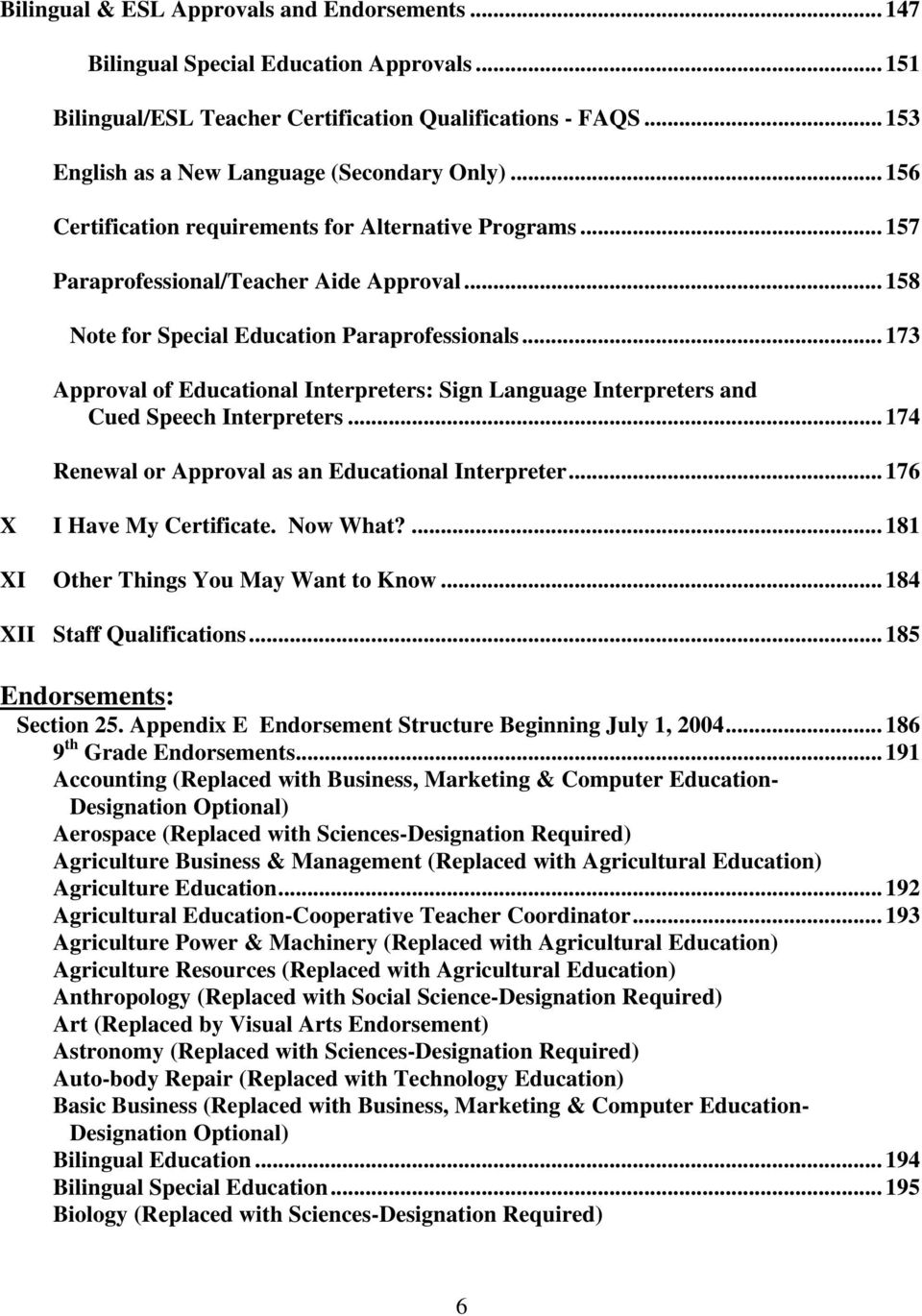
6 Bilingual & ESL Approvals and Endorsements Bilingual Special Education Approvals Bilingual/ESL Teacher Certification Qualifications - FAQS English as a New Language (Secondary Only) Certification requirements for Alternative Programs Paraprofessional/Teacher Aide Approval Note for Special Education Paraprofessionals Approval of Educational Interpreters: Sign Language Interpreters and Cued Speech Interpreters Renewal or Approval as an Educational Interpreter X I Have My Certificate. Now What? XI Other Things You May Want to Know XII Staff Qualifications Endorsements: Section 25. Appendix E Endorsement Structure Beginning July 1, th Grade Endorsements Accounting (Replaced with Business, Marketing & Computer Education- Designation Optional) Aerospace (Replaced with Sciences-Designation Required) Agriculture Business & Management (Replaced with Agricultural Education) Agriculture Education Agricultural Education-Cooperative Teacher Coordinator Agriculture Power & Machinery (Replaced with Agricultural Education) Agriculture Resources (Replaced with Agricultural Education) Anthropology (Replaced with Social Science-Designation Required) Art (Replaced by Visual Arts Endorsement) Astronomy (Replaced with Sciences-Designation Required) Auto-body Repair (Replaced with Technology Education) Basic Business (Replaced with Business, Marketing & Computer Education- Designation Optional) Bilingual Education Bilingual Special Education Biology (Replaced with Sciences-Designation Required) 6
7 Biological Science (Replaced with Sciences-Designation Required) Botany (Replaced with Sciences-Designation Required) Business Computer Programming/Systems (Replaced with Business, Marketing & Computer Education-Designation Optional) Business, Marketing and Management (Replaced with Business, Marketing & Computer Education-Designation Optional) Business, Marketing & Computer Education-Designation Optional Chemistry (Replaced with Sciences-Designation Required) Child and Day Care Services (Replaced with Family & Consumer Sciences- Designation Required) Chinese Language (New as of July 2004) Civics/Political Science (Replaced with Social Science-Designation Required) Computer Applications Computer Science Construction (Replaced with Technology Education) Consumer Economics Consumer Education and Resource Management (Replaced with Family & Consumer Sciences-Designation Required) Czech Language Dance Drafting/Design (Replaced with Technology Education) Drama/Theatre Arts Driver Education Earth Science (Replaced with Sciences-Designation Required) Economics (Replaced with Social Science-Designation Required) Electronics (Replaced with Technology Education) English (Replaced with English Language Arts) English as a New Language English as a Second Language English Language Arts Family and Consumer Sciences - Designation Required Family and Consumer Sciences Teacher Coordinator Fashion and Clothing Services (Replaced with Family & Consumer Sciences Designation Required) Food and Nutrition Services (Replaced with Family & Consumer Sciences- Designation Required) Foreign Languages Foreign Language by Test Only French Language General Science (Replaced with Sciences-Designation Required) General Geography (Replaced with Social Science-Designation Required) Geography (Replaced with Social Science-Designation Required) Geology (Replaced with Sciences-Designation Required) German Language Gifted Education (No longer issued) Graphic Communications (Replaced with Technology Education) 7

8 Greek Language Health Careers (Replaces Health Occupations) Health Careers Teacher Coordinator Health Education Health Occupations (Replaced with Health Careers) Health Occupations Teacher Coordinator Heating, Ventilating and Air Conditioning (Replaced with Technology Education) Hebrew Language History (Replaced with Social Science-Designation Required) Home Economics (Replaced with Family & Consumer Sciences-Designation Required) Home Economics Teacher Coordinator Horticulture (Replaced with Agricultural Education) Industrial Technology (Replaced with Technology Education) Information Processing (Replaced with Business, Marketing & Computer Education-Designation Optional) Information Processing/Secretarial Endorsement (Replaced with Business, Marketing & Computer Education-Designation Optional) Italian Language Interior Furnishings Services (Replaced with Family & Consumer Sciences- Designation Required) Interpersonal, Family Relationships, Parenting (Replaced with Family & Consumer Sciences-Designation Required) Institutional & Home Management Services (Replaced with Family & Consumer Sciences-Designation Required) Japanese Language Journalism (Replaced with English Language Arts) Keyboarding Korean Language Language Arts-English (Replaced with English Language Arts) Latin Language Library Information Specialist Manufacturing (Replaced with Technology Education) Marketing (Replaced with Business, Marketing & Computer Education- Designation Optional) Mathematics Media (Replaced with Library Information Specialist) Medical Assisting (Replaced with Health Careers) Medical Records Technology (Replaced with Health Careers) Music Music Instrumental (Replaced with Music) Music Vocal (Replaced with Music) Nursing (Replaced with Health Careers) Physical Education Physical Geography (Replaced with Sciences-Designation Required) Physical Science (Replaced with Sciences-Designation Required) 8

9 Physics (Replaced with Sciences-Designation Required) Physiology (Replaced with Sciences-Designation Required) Psychology (Replaced with Social Science-Designation Required) Public Service (Replaced with Technology Education) Radiology (Replaced with Health Careers) Reading Reading Specialist Reading Teacher Respiratory Therapy (Replaced with Health Careers) Russian Language Safety and Driver Education Sciences-Designation Required Social Science-Designation Required Social Studies (Replaced with Social Science-Designation Required) Sociology (Replaced with Social Science-Designation Required) Spanish Language Speech (Replaced with English Language Arts) Speech/Theatre (Replaced with Drama/Theatre Arts) Supervisory Endorsement Technology Education Technology Specialist Theatre/Drama Endorsement (Replaced with Drama/Theatre Arts) Transportation (Replaced with Technology Education) U. S. History (Replaced with Social Science-Designation Required) Visual Arts World History (Replaced with Social Science-Designation Required) Zoology (Replaced with Sciences-Designation Required) Vocational Education Levels of Special Education Certification Short-Term Emergency Certification in Special Education Approvals for Special Education: Learning Behavior Specialist I Learning Behavior Specialist II Prevocational Coordinator Approval Teacher Coordinator Approval Supervisor of Special Education Approval (No longer available) Administrator of Special Education Approval (No longer available) Early Childhood Special Education Approval Speech-Language Pathologist Behavior Analyst Services Adaptive P.E. Services Approval XIII Certificates Issued in Illinois

10 XIV Regions and Regional Superintendents XV Directory of Approved Programs XVI States Participating in the Interstate Certification Agreement Alternative Certification - Teachers and Administrators XVII Forms Definitions What Districts Should Know About the New Rules for Certification and Assignment of Staff June 3, Short Term Emergency Certification in Special Education Short Term Authorization for Positions Otherwise Unfilled Certificate Renewal Process Illinois Tests Historical List for Endorsements Specialized Instruction by Noncertificated Personnel (Repealed) Highly Qualified Rules (Jan. 2006) Additional Information for Form REQUEST FOR APPROVAL OF OTHER SPECIAL EDUCATION PERSONNEL (PZZ) Major/Minor Requirements for Middle Grades Teachers Portability of background checks for substitutes and other concurrent employees Previously Qualified Evaluations Return to teaching in subject shortage area Foreign Language Endorsement Guide...468/ Recertification for Type 73 s Recertification of Deans and Supervisors

11 11

12 CERTIFICATION TIMELINE Endorsement requirements have changed in 1958, 1962, 1964, 1971, 1977, 1991, 1997, and 2004 (various dates by endorsement) August 1, 1985 New hires required to have a Criminal Background Check. July 1, Illinois first required tests for Basic Skills and Subject Matter. July 1, Middle Grades Requirements changed July 1, 1999 I believe that Professional Development requirements for teachers began. February Exchange for four year standard Special Education Certificates began. July 1, 2001 Re-exchange for LBS I certificates. Jan. 1, 2002, - Special Education Approvals became 3 years Jan. 1, 2002, - Early Childhood Special Education Approvals changed to new requirements. (prior requirements were : 1. Survey of Exceptional Children. 2. The development of language in young children. 3. Early Childhood Assessment 4. Elementary school curriculum and organization or early childhood curriculum and organization. Jan. 8, New paraprofessionals, hired for Title I, must be Highly Qualified (60 hours) Teachers, hired after the start of the school year, for Title I programs, must be Highly Qualified July 1, 2003 LBS I exam required for LBS I endorsement July 1, 2003 Professional Development begins for Administrative Certificates. All Special Education that apply after July 1, 2003, need the LBS I Test. All teachers who apply after September 30, 2003, need to complete the APT Test. June 1, new requirements for first teacher, and all school service personnel, and administrative certificates become effective. June 30, 2004, - basic skills testing is waived for persons from other states who hold valid certificates comparable to the certificate applied for in Illinois 12
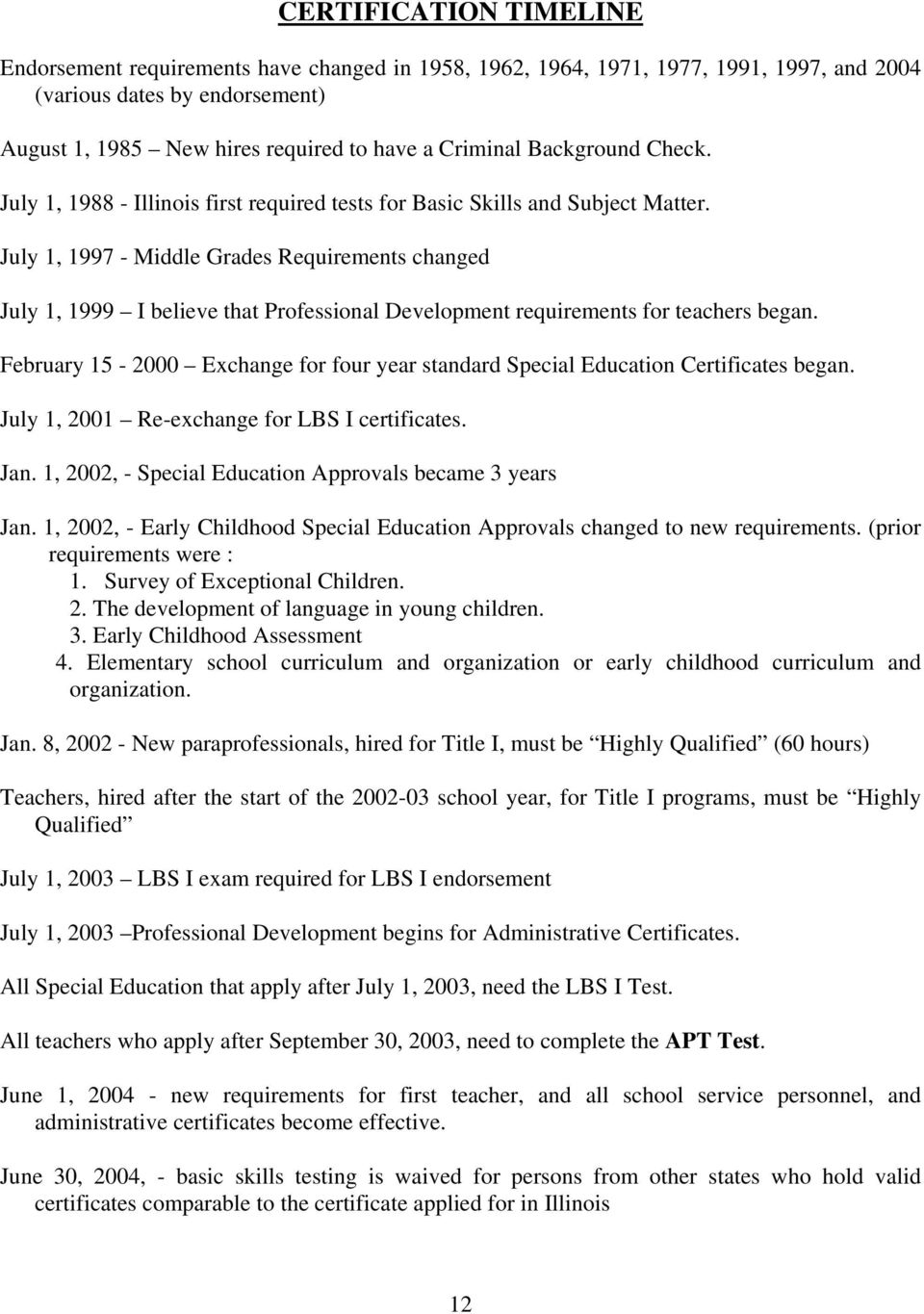
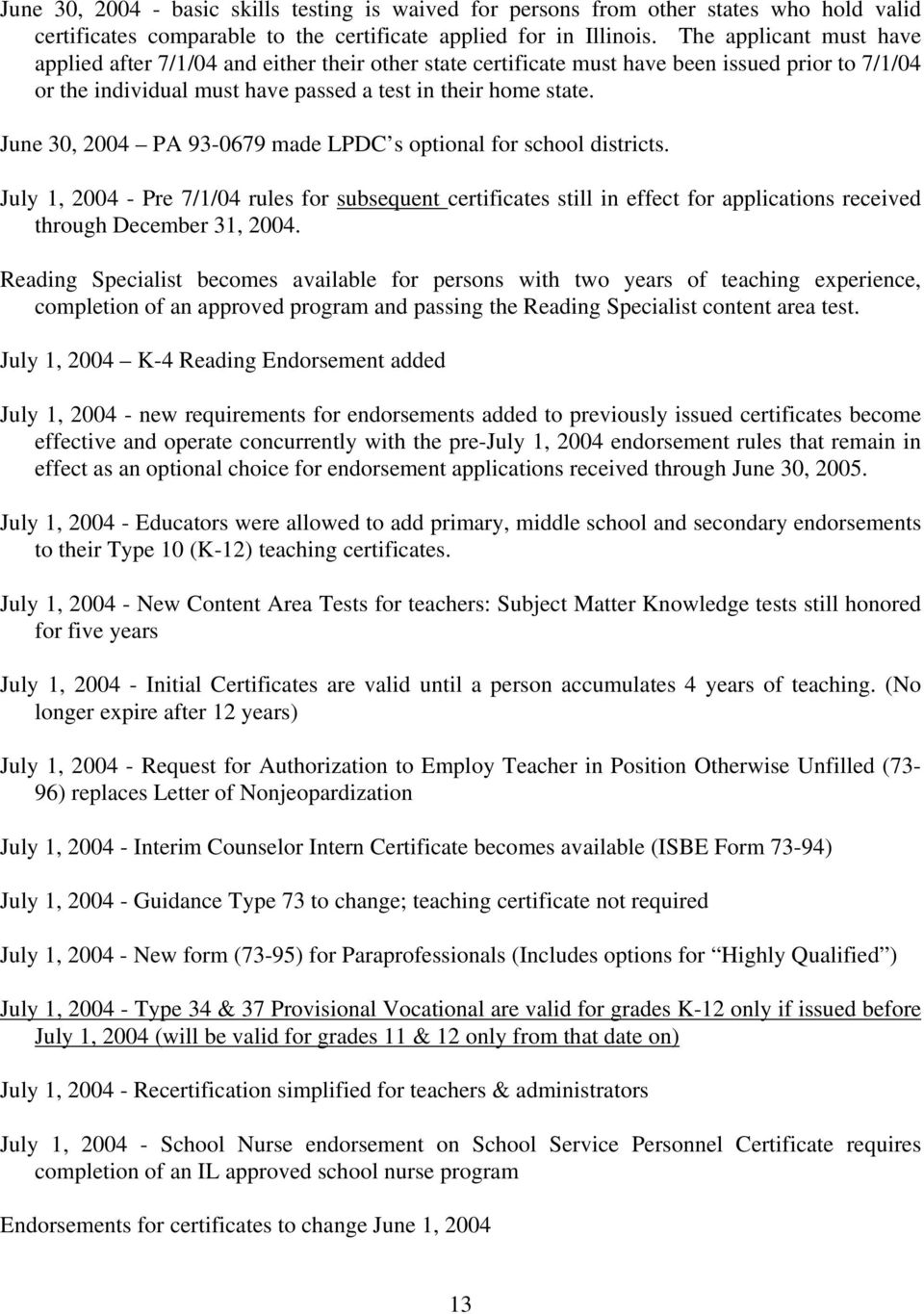
13 June 30, basic skills testing is waived for persons from other states who hold valid certificates comparable to the certificate applied for in Illinois. The applicant must have applied after 7/1/04 and either their other state certificate must have been issued prior to 7/1/04 or the individual must have passed a test in their home state. June 30, 2004 PA made LPDC s optional for school districts. July 1, Pre 7/1/04 rules for subsequent certificates still in effect for applications received through December 31, Reading Specialist becomes available for persons with two years of teaching experience, completion of an approved program and passing the Reading Specialist content area test. July 1, 2004 K-4 Reading Endorsement added July 1, new requirements for endorsements added to previously issued certificates become effective and operate concurrently with the pre-july 1, 2004 endorsement rules that remain in effect as an optional choice for endorsement applications received through June 30, July 1, Educators were allowed to add primary, middle school and secondary endorsements to their Type 10 (K-12) teaching certificates. July 1, New Content Area Tests for teachers: Subject Matter Knowledge tests still honored for five years July 1, Initial Certificates are valid until a person accumulates 4 years of teaching. (No longer expire after 12 years) July 1, Request for Authorization to Employ Teacher in Position Otherwise Unfilled (73-96) replaces Letter of Nonjeopardization July 1, Interim Counselor Intern Certificate becomes available (ISBE Form 73-94) July 1, Guidance Type 73 to change; teaching certificate not required July 1, New form (73-95) for Paraprofessionals (Includes options for Highly Qualified ) July 1, Type 34 & 37 Provisional Vocational are valid for grades K-12 only if issued before July 1, 2004 (will be valid for grades 11 & 12 only from that date on) July 1, Recertification simplified for teachers & administrators July 1, School Nurse endorsement on School Service Personnel Certificate requires completion of an IL approved school nurse program Endorsements for certificates to change June 1,
14 Note: The current endorsements can still be applied for until June 30, 2005 August 12, 2004 Criminal Background checks require fingerprinting for all new hires. October 1, endorsements on first IL certificates require 32 semester hours, or a major identified on the transcript; or 24 semester hours and passing of the content-knowledge test, except special provisions for endorsement for reading, science, social science, foreign languages, middle grades and self contained general education and in subjects where there is no content area test. Subsequent Certificates to change January 1, 2005 June 30, 2005 Begin endorsements for K-3 and K-4 Reading. June 30, last date to remove deficiencies for old 18 hour requirement for endorsement in reading; 7/1/06 all reading teachers will be required to comply with new endorsement requirements. July 1, 2006 Media Specialist changed to Library Information Specialist. Director of Special Education endorsement on administrative certificate to be required July 1, 2005, for such positions. Special Education Paraprofessionals employed before 6/30/05 have until July 1, 2007 to meet the 30 hours requirement and have a letter of approval. All instructional para-professionals hired after 1/8/2002 in special education programs supported by Title I funds must be Highly Qualified. All instructional Special Education Paraprofessionals not paid by Title I Funds need 30 hours beginning July 1, 2005 (new hires) January 1, subsequent certificates may be obtained only by completion of an approved program and recommendation by the institution End of the school year, all existing Title I instructional paraprofessionals must be Highly Qualified All teachers, in core area subjects, must be Highly Qualified by the end of the school year. Reading Teacher Endorsement requirements mandatory July 1, 2006, requiring the reading specialist or reading teacher test, completion of an approved program or 24 hours of reading in the required content areas. July 1, 2006 Middle Grades Library Information Specialist changes to a major or 24 hours and a test. 14

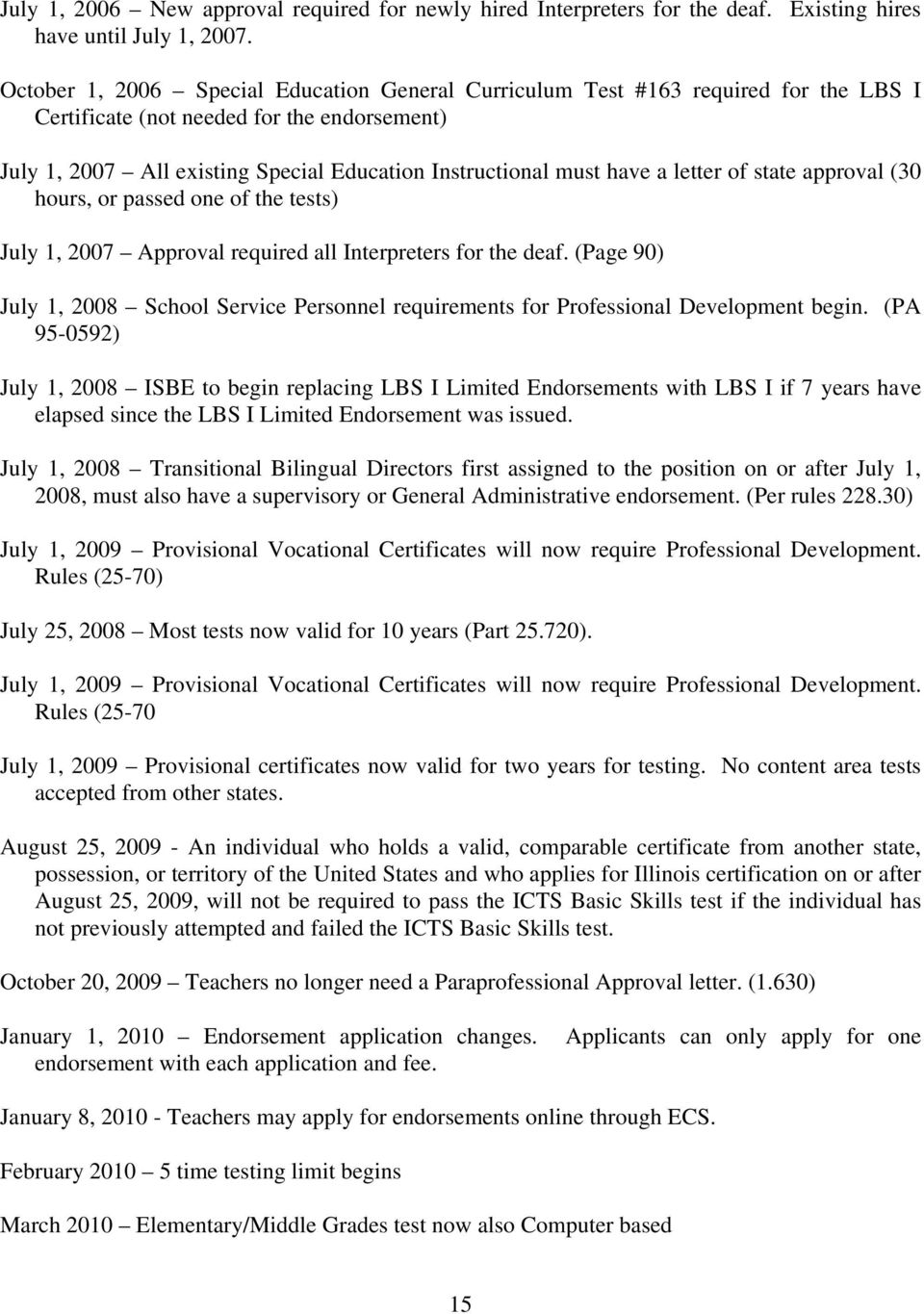
15 July 1, 2006 New approval required for newly hired Interpreters for the deaf. Existing hires have until July 1, October 1, 2006 Special Education General Curriculum Test #163 required for the LBS I Certificate (not needed for the endorsement) July 1, 2007 All existing Special Education Instructional must have a letter of state approval (30 hours, or passed one of the tests) July 1, 2007 Approval required all Interpreters for the deaf. (Page 90) July 1, 2008 School Service Personnel requirements for Professional Development begin. (PA ) July 1, 2008 ISBE to begin replacing LBS I Limited Endorsements with LBS I if 7 years have elapsed since the LBS I Limited Endorsement was issued. July 1, 2008 Transitional Bilingual Directors first assigned to the position on or after July 1, 2008, must also have a supervisory or General Administrative endorsement. (Per rules ) July 1, 2009 Provisional Vocational Certificates will now require Professional Development. Rules (25-70) July 25, 2008 Most tests now valid for 10 years (Part ). July 1, 2009 Provisional Vocational Certificates will now require Professional Development. Rules (25-70 July 1, 2009 Provisional certificates now valid for two years for testing. No content area tests accepted from other states. August 25, An individual who holds a valid, comparable certificate from another state, possession, or territory of the United States and who applies for Illinois certification on or after August 25, 2009, will not be required to pass the ICTS Basic Skills test if the individual has not previously attempted and failed the ICTS Basic Skills test. October 20, 2009 Teachers no longer need a Paraprofessional Approval letter. (1.630) January 1, 2010 Endorsement application changes. Applicants can only apply for one endorsement with each application and fee. January 8, Teachers may apply for endorsements online through ECS. February time testing limit begins March 2010 Elementary/Middle Grades test now also Computer based 15
16 March 8, 2010 ISBE will no longer print new certificates when an endorsement is added. May 2010 Early Childhood test now also Computer based July 1, Transitional Bilingual Directors first assigned to the position before July 1, 2008, must also have a supervisory or General Administrative endorsement. (Per rules ) September 2010 New Basic Skills Passing Scores take effect March 2011 LBS I Test now also Computer bases September 2011 New Assessment of Professional Teaching developed. Now just Early Childhood and K-12. September 2011 New Principal Test developed. February 1, 2012 Driver Education and Safety Endorsement changes. February 1, 2012 New Principal Endorsement begins. February 1, 2012 New Secondary Endorsement Requirements begin (12 hour in Upper Division Level) and no grade below a C. February 1, 2012 All professional education and content-area coursework that forms part of an application for certification, endorsement, or approval that is received on or after February 1, 2012, must have been passed with a grade no lower than C or equivalent in order to be counted towards fulfillment of the applicable requirements. September 2012 New APT Test to be offered as Computer Based. July 2013 Discontinue offering the General Administrative Test. July 2013 General Administrative endorsement ends and Principal Endorsement in only endorsement available. 16

17 Teacher Certification in Illinois To ensure that only highly qualified individuals are licensed for employment in Illinois public schools, applicants for certification must meet requirements specific to the type of certificate they are seeking. This publication includes a description of each type of certificate issued by the state of Illinois and describes the specific requirements for qualifying for each certificate. It also explains how to apply for a certificate. Section I includes a description of each type of certificate issued by the state of Illinois. Section II discusses the approved program and Section III describes the transcript evaluation process. The requirements for each standard certificate are listed in Section IX. Information on the location of approved programs is included in Section XV. A listing of the regional offices of education, the offices through which all applications for certification must be submitted, may be found in Section XIV. Certificates are valid for the time frame listed on the certificate; however, they must be registered at the local Regional Office of Education or at The current fee for this is $5.00 a year. Any certificate not registered in the region in which a teacher is employed will not be valid. If you are currently residing out-of-state, or not currently employed in an Illinois public school district, you must continue to register your certificate at a Regional Office of Education or at Section Lapsed Certificates a) A lapsed certificate, one that has not been registered or renewed for a period of five or more years since expiration of its last registration, shall be reinstated for a one-year period upon payment of all accumulated registration fees. b) The Regional Superintendent shall notify the holder of a reinstated certificate of: 1) The specific time of reinstatement, including beginning and ending dates. 2) The requirement that, in order to renew the certificate at the end of the period of reinstatement, the certificate holder must: A) Have earned, within the six-year period that encompasses the certification year of reinstatement and the five-year period immediately prior to the year of reinstatement, five semester hours of college credit from one or more regionally accredited institutions of higher learning in the field of professional education or in courses related to the holder's contractual teaching duties, or B) Present evidence of holding a valid regular certificate of some other type, whether issued by Illinois or by another state, territory, or possession of the U.S. C) As a reinstated certificate is a reissued certificate, the expiration of all reinstated certificates shall be on June 30 following the date of reinstatement in accordance with Section of the School Code. D) The Regional Superintendent shall stamp the back of a lapsed certificate with the date of reinstatement. E) Standard Certificates issued between July 1, 1929, and July 1, 1951, do not lapse. 17

18 F) When a lapsed certificate that was issued prior to February 15, 2000, has been reinstated and then is to be renewed pursuant to this Section, it shall be exchanged for a comparable standard teaching certificate in accordance with Section and Appendix C of this Part. The certificate-holder shall thereupon become subject to the requirements of Sections 21-2 and of the School Code and Subpart J of this Part regarding continuing professional development. 1) Subsequent renewals of such an individual s certificate(s) shall be contingent upon his or her completion of continuing professional development activities in accordance with the requirements of Subpart J of this Part. 2) College credit earned pursuant to subsection (b)(2)(a) of this Section shall not be used to satisfy any portion of the continuing professional development requirements of Section of the School Code. (Source: Amended at 29 Ill. Reg , effective June 30, 2005) Note: Lapsed certificate holders must register with form (Application for One-Year Reinstatement). Give the teacher a copy of that form to ensure that they understand what penalty is owed. 18
19 STEPS FOR ILLINOIS CERTIFICATION FOR TEACHERS WITH OUT-OF-STATE CERTIFICATES OR COMPLETED AN OUT-OF STATE APPROVED PROGRAM 1. Complete an Application for Certification (ISBE 73-03C) for each teaching certificate that you are seeking and return it to your nearest Regional Office of Education. (Check with that office for the method of payment. You can access a directory of ROE s at * Administrators and School Service Personnel need to use form ISBE 73-03D 2. Each application/certificate requires a $30 fee. Do not forget to sign the application and be sure to answer all of the questions. If you apply for a Standard Teaching Certificate you will need a letter stating that you have at least four years of full time teaching experience (signed by the superintendent or personnel director). 3. Have your college/university fill out a State-Approved Program Verification Form (ISBE 73-05) and mail that form to our State Board of Education. It must have the signature of the certification officer and the college/university seal. This form must be mailed directly to the Illinois State Board of Education. OR You must bring a copy of your currently valid Teaching Certificate (substitute only certificates will not count) to our office so that we may make a copy. Note: ISBE prefers that the applicant submits both of the above. 4. Have an official copy of all of your transcripts sent to our office. Transcripts must have the signature of the registrar and the college/university seal. 5. Only one certificate can be applied for on an application. Each additional certification will need an application and a $30.00 fee. 6. You MUST complete the Illinois Tests in Basic Skills, and your major teaching area unless you have already passed tests for another state (out-of-state applicants also need to submit form ISBE to waive any tests). This form must be mailed directly to the Illinois State Board of Education. Every teacher will also need the Assessment of Professional Teaching for their certificate level. If you have not yet passed these tests and you have a currently valid out-of-state teaching certificate, you may be issued a Provisional Certificate (if you file a request for this on Form ISBE 73-63) and you will have nine months to complete the required Illinois Tests. If you fail to pass the tests within nine months, your certificate will be cancelled. 19

20 NOTE: Provisional certificates expire every June 30 th. Some applicants may want to check the box that asks for issuance after July 1 st to give them the full nine months to complete the required Illinois tests. Testing information may be found at: 7. Administrators need an official letter (signed by the superintendent or personnel administrator) verifying at least two years of teaching experience. 8. Superintendents need a letter to verify at least two years of administrative experience. (All forms may be downloaded at For more information: Website for Certification: 20

21 I. General What kinds of certificates are available in Illinois? Illinois has a two-tiered certification system: initial certificates and standard certificates. Graduates of teacher education programs and individuals applying for Illinois certificates from out-of-state with less than four years of teaching experience will be issued an Initial Certificate. In order to transition to a standard teaching certificate, an individual must teach the equivalent of four full years and complete a professional development component. Once that is completed, the individual must apply for the standard certificate. The Standard Certificate is issued to individuals who have taught for four years and completed the professional development required for making the transition. Out of state applicants who have earned a second tier certificate from the state they are leaving may be issued a standard certificate if that state s certificate requirements are comparable to those of Illinois. How can I obtain a certificate in Illinois? To obtain an Early Childhood, Elementary, Secondary or Special K-12 certificate in Illinois, an individual must complete an approved teacher education program. School Service Personnel and Administrative Certificates require that an approved program be completed. All certificates are, or may, be linked to program titles such as mathematics, reading, guidance, principal, or special education. All certificates are endorsed in specific areas such as: middle school science, early childhood, reading, school psychology. To obtain a substitute, provisional vocational, temporary provisional vocational, or part-time provisional, an applicant must undergo a transcript evaluation process. A transitional bilingual certificate may be obtained by either completing an approved program or through transcript evaluation and the successful completion of the relevant Language Proficiency Test. 21
22 II Completion of an Approved Program (Entitlement) No university or college offers all possible teacher education programs. To determine what programs are offered at each institution, see and click on Approved Programs in Illinois. Upon completion of an approved program, an Application for Certificate ISBE form 73.03c (see must be submitted to obtain the teaching certificate. This process may be completed by one of two methods. If the institution where the approved program was completed is participating with the State Board in issuing certificates, contact the university Certification Officer to complete the steps required in acquiring the certificate. If the university is not participating in the certificate issuing process, the following process must be completed: 1. Complete ISBE form 73.03c Application for Certificate (see ). Submit the form to the university Certification Officer. The Certification Officer will review the application as well as determine that an approved program was completed. If everything is in order, the Certification Officer shall sign the application and affix the university seal and return the form to the applicant. 2. Submit the signed and sealed Application for Certificate along with official transcripts and a $30 fee to the Regional Office of Education (ROE) where employment will take place or near your residence. Check with the ROE to determine the form for payment (money order, cash, or certified check); each ROE has a different policy on fee payment. 3. If the appropriate tests have been passed, the application is complete and is accompanied by original transcripts and the fee in the proper form, the ROE will issue a Temporary Employment Authorization. The Temporary Employment Authorization allows an individual to work while the actual certificate is being printed by the State Board of Education. 4. All certificates must be registered with the Regional Office of Education in the region in which the certificate holder is employed. The charge is $5 per year times the number of years of validity of the certificate. Most Illinois colleges now have their students log onto their ECS account and issue the certificate online (with a credit card). Log onto ECS at Click on Applications Click on Entitlement Certificate Application Click on the blue Apply button 22
23 III Transcript Evaluation Transcript Evaluation Transcript evaluation is available only to persons who either have completed an approved program in another state or who hold another state s certificate comparable to the certificate they seek in Illinois. Applicants submit their application and official transcripts to the Illinois State Board of Education where the staff reviews the application, the applicant s courses and previous teaching experience to determine if the applicant meets minimum requirements for a certificate. All persons applying for subsequent certificates after December 31, 2004, will be required to attend an Illinois college offering an approved program for the certificates they seek. Universities can develop focused programs for these persons by evaluating work previously done by the applicants and require only additional work that will allow the students to meet the standards for the new certificate and subject. Transcript evaluation will continue to be available for certificates that do not require prior training in education, such as substitute certificates, provisional vocational certificates, transitional bilingual certificates, and others. Individuals who wish to obtain a certificate through transcript evaluation must complete an application for the certificate, either the paper 73-03C form or the electronic application on our On-Line Teacher Information System (ECS) at Note: A teacher who has a currently valid Type 09 may apply for a Type 10 in their major endorsed area (32 hours). They do need to have successfully completed the Basic Skills test (#096), the Subject Matter test and the Assessment of Professional Teaching K-12 (104). They may apply on ISBE form 73-03c. 23
24 Provisional Certificates Provisional certificates are issued only on the basis that the applicant has a valid out-of-state certificate or is eligible for that certificate. If the program is not comparable, a provisional Illinois certificate may be requested. It is valid for up to two fiscal years. However, during the first nine months after the provisional certificate was issued, the applicant must remove all testing deficiencies. Provisional Certificates are valid through June 30 th of the year in which they are issued. If the deficiencies have not been removed, another application and fee must be submitted each year. Individuals who successfully complete basic skills and subject matter tests in order to obtain an out-of-state certificate are not required to take them again. The Assessment of Professional Teaching test must be successfully completed within nine months of the issue date of the certificate (see the section on testing for greater detail). Once the testing requirements have been satisfied, an applicant has up to two years to remove any coursework deficiency. If the applicant has less than four years of teaching experience, an initial certificate will be issued. If the applicant has four or more years of teaching experience and holds a second tier certificate from another state which is comparable to Illinois standard certificate, a standard certificate will be issued. If the applicant fails to remove the deficiencies within two years, the provisional certificate will be cancelled and the applicant may not receive another provisional of the same type. Subject matter coursework may be completed at any recognized institution of higher learning. Only nine semester hours of professional education courses may be taken at a community college. (105 ILCS 5/21-10) (from Ch. 122, par ) Sec Provisional certificate. (A) Until July 1, 1972, the State Teacher Certification Board may issue a provisional certificate valid for teaching in elementary, high school or special subject fields subject to 10 the following conditions: A provisional certificate may be issued to a person who 12 presents certified evidence of having earned a bachelor's 13 degree from a recognized institution of higher learning. The 14 academic and professional courses offered as a basis of the 15 provisional certificate shall be courses approved by the State 16 Board of Education in consultation with the State Teacher 17 Certification Board. 18 A certificate earned under this plan may be renewed at the 19 end of each two-year period upon evidence filed with the State 20 Teacher Certification Board that the holder has earned 8 21 semester hours of credit within the period; provided the 22 requirements for the certificate of the same type issued for 23 the teaching position for which the teacher is employed shall 24 be met by the end of the second renewal period. A second 25 provisional certificate shall not be issued. The credits so earned must be approved by the State Board of Education in consultation with the State Teacher Certification Board and must meet the general pattern for a similar type of certificate issued on the basis of credit. No more than 4 semester hours shall be chosen from elective subjects. (B) After July 1, 1972, the State Teacher Certification Board may issue a provisional certificate valid for teaching in early childhood, elementary, high school or special subject fields, or for providing service as school service personnel or for administering schools subject to the 24
25 following conditions: A provisional certificate may be issued to a person who meets the requirements for a regular teaching, school service personnel or administrative certificate in another State and who presents certified evidence of having earned a bachelor's degree from a recognized institution of higher learning. The academic and professional courses offered as a basis of the provisional certificate shall be courses approved by the State Board of Education in consultation with the State Teacher Certification Board. A certificate earned under this plan is valid for a period of 2 years and shall not be renewed. (C) The State Teacher Certification Board may also issue a provisional vocational certificate and a temporary provisional vocational certificate. (1) The requirements for a provisional vocational certificate shall be determined by the State Board of Education in consultation with the State Teacher Certification Board; provided, the following minimum requirements are met: (a) after July 1, 1972, at least 30 semester hours of credit from a recognized institution of higher learning; and (b) after July 1, 1974, at least 60 semester hours of credit from a recognized institution of higher learning. (2) The requirements for a temporary provisional vocational certificate shall be determined by the State Board of Education in consultation with the State Teacher Certification Board; provided, the following minimum requirements are met: (a) after July 1, 1973, at least 4,000 hours of work experience in the skill to be certified for teaching; and (b) after July 1, 1975, at least 8,000 hours of work experience in the skill to be certified for teaching. Any certificate issued under the provisions of this paragraph shall expire on June 30 following the date of issue. Renewals may be granted on a yearly basis, but shall not be granted to any person who does not file with the State Teacher Certification Board a transcript showing at least 3 semester hours of credit earned during the previous year in a recognized institution of learning. No such certificate shall be issued except upon certification by the employing board, subject to the approval of the regional superintendent of schools, that no qualified teacher holding a regular certificate or a provisional vocational certificate is available and that actual circumstances and need require such issuance. The courses or work experience offered as a basis for the issuance of the provisional vocational certificate or the temporary provisional vocational certificate shall be approved by the State Board of Education in consultation with the State Teacher Certification Board. (D) Until July 1, 1972, the State Teacher Certification Board may also issue a provisional foreign language certificate valid for 4 years for teaching the foreign language named therein in all grades of the common schools and shall be issued to persons who have graduated from a recognized institution of higher learning with not fewer than 120 semester hours of credit and who have met other requirements as determined by the State Board of Education in consultation with the State Teacher Certification Board. If the holder of a provisional foreign language certificate is not a citizen of the United States within 6 years of the date of issuance of the original certificate, such certificate shall be suspended by the regional superintendent of schools of the region in which the holder is engaged to teach and shall not be reinstated until the holder is a citizen of the United States. (E) Notwithstanding anything in this Act to the contrary, the State Teacher Certification Board shall issue part-time provisional certificates to eligible individuals who are professionals and craftsmen. The requirements for a part-time provisional teachers certificate shall be determined by the State Board of Education in consultation with the State Teacher Certification Board, provided 25
26 the following minimum requirements are met: 60 semester hours of credit from a recognized institution of higher learning or 4000 hours of work experience in the skill to be certified for teaching. A part-time provisional certificate may be issued for teaching no more than 2 courses of study for grades 6 through 12. A part-time provisional teachers certificate shall be valid for 2 years and may be renewed at the end of each 2 year period. (Source: P.A , eff ; , eff ) 26
27 Date: August 31, 2009 M E M O R A N D U M TO: FROM: SUBJECT: Regional Superintendents, Assistant Regional Superintendents, and Staff Linda Jamali, Administrator Educator Certification Division Changes to Provisional Certificates and Out-of-State Test Waivers per Public Act PA went into effect on August 25, Please use this link to download the legislation: The portion of the legislation pertaining to educator certification makes changes to the length of time a provisional certificate is valid and requires that all out of state applicants take the Illinois content test(s) applicable to their area(s) of endorsement. Changes to TCIS might take some time, so please bear with us as we work to implement these changes. Please note that applications from out-of-state applicants for certificates/endorsements signed by the Regional Office of Education beginning on August 25, 2009, will be affected in the following manner: 1.) All provisional certificates will now be valid for two full fiscal years including testing deficiencies. That means that if an applicant applies for a provisional in February 2010, the certificate will be valid for the remainder of the 2010 fiscal year, and also remain valid for the next two fiscal years expiring on June 30, ) Any provisional certificate issued from this date forward will be cancelled when it expires on June 30. You will no longer have to deal with mid-year cancellations. 3.) All out-of-state applicants are now required to take the applicable Illinois content test(s). This is in addition to the Assessment of Professional Teaching (APT) that is already required of out-of-state applicants. 4.) Any out-of-state applicant with a valid out-of-state certificate will be assumed to have passed a test of basic skills for either certification or for admission to an educator preparation program, and will not have to take the Illinois test of basic skills. However, applicants who previously failed the Illinois test of basic skills will be required to pass the Illinois test. 5.) Any out-of-state applicant who does not present a valid out-of-state certificate but instead presents only a completed SAP form will have to take the test of basic skills. 6.) We will continue to honor the following: If an applicant satisfies all deficiencies (testing and/or coursework) in the first year of validity, he/she will not need to submit a new fee to move to an initial or standard certificate. We will not modify existing deficiency letters unless existing deficiencies are removed and we update the deficiency letter. If an out-of-state applicant has an active deficiency in which the 27
28 content test was waived, such letter will stand. Likewise, if an out-of-state applicant was required to take the test of basic skills, such letter will stand. All applicants who must take the test(s) will have the full two years in which to pass the test(s). Please contact our office if you have additional questions. Thank you so much for your assistance and for all you do on behalf of Illinois educators. 28
29 MEMORANDUM To: Regional Superintendents of Education, Staff Members, and Educators From: Linda Jamali Education Certification Division Date: August 3, 2010 Re: Changes regarding provisional certificates and testing waivers We have reprinted provisional certificates that were valid between August 25 through September 11, The new footers read as follows: - This certificate must be registered with your regional superintendent. - This certificate is non-renewable and is valid until June 30, Those certificates that were cancelled between July 1 and September 11, 2009, have been reinstated and are included in this mailing. Refer to your list of cancelled certificates to identify certificates that have been reinstated. Regarding those who hold provisional certificates and applied on or before August 24 and were offered a test waiver, that waiver will be honored only through the first fiscal year of the certificate. After the first fiscal year ends (on June 30 following the date the certificate was issued) and a new application and fee are required, the applicant will have to meet the new testing requirements; that is, we will exempt them from the Basic Skills test, but they will be required to pass the content area test even if they were previously offered a waiver. As before, those who do not hold a valid, comparable out-of-state certificate must pass all Illinois tests, and those who take the Basic Skills test but fail it must take it and pass it even if they would be otherwise exempted. Please note that registration of provisional certificates now requires $15.00 since they will have to be registered for the remainder of this year and for 2 full additional fiscal years. For those cases in which the end date of a provisional is being extended, you have already collected for the first 2 years, and you will need to collect an additional $5.00 for the 1-year extension. September 2009 Q & A Changes in State Law Regarding Provisional Certificates and Testing Requirements Q A What changes were made in educator certification by the legislation that was passed this summer? PA went into effect on August 25, The two provisions that affect educator certification are (1) an increase in the period of validity of provisional certificates and (2) a change in testing requirements. Use this link to download the legislation: 29
30 or Q A Which provisional certificates will be affected by the increase in period of validity? Any provisional certificate that was valid on July 1, 2009, will be extended by 1 additional year. Any provisional certificate that was cancelled after July 1, 2009, will be reinstated, and a certificate with the new expiration date will be printed and mailed to regional offices or to the applicant directly in the case of City of Chicago residents. The deficiency letter will also be reprinted and mailed separately. Provisional certificates that expired or were cancelled on or before June 30, 2009, are not affected. Q Who is affected by the change in testing requirements? A All individuals who apply on or after August 25, 2009, will be affected even if they were previously issued a provisional certificate and the content test was waived. Under the new law, all educators applying on or after August 25, 2009, who hold a valid, comparable outof-state certificate will be assumed to have taken a test of basic skills and will be exempt from the Illinois Basic Skills test. However, all applicants will be required to take a content area test, and teachers will need to take an Assessment of Professional Teaching (APT) test for the appropriate grade range. As before, applicants who are applying with a State-Approved Program Verification (SAP), form 73-05, but without a valid, comparable out-of-state certificate will be required to take all tests. Also, anyone who takes the Illinois Basic Skills test but fails it must take it again and pass it, even if the individual would otherwise be exempt. Q A How do the changes affect registration of provisional certificates? Educators who previously registered their provisional certificates for 2 years and who have them extended will need to register for an additional year. Newly issued certificates should be registered for 3 years, which includes the remainder of this fiscal year and 2 full additional fiscal years. 30
31 (105 ILCS 5/21-1a) (from Ch. 122, par. 21-1a) Sec. 21-1a. Tests required for certification and teacher preparation. (a) After July 1, 1988, in addition to all other requirements, early childhood, elementary, special, high school, school service personnel, or, except as provided in Section 34-6, administrative certificates shall be issued to persons who have satisfactorily passed a test of basic skills, an assessment of professional teaching, and a test of subject matter knowledge, provided that a person who passed another state's test of basic skills as a condition of certification or of admission to a teacher preparation program shall not be required to pass this State's test of basic skills. The tests of basic skills and subject matter knowledge shall be the tests which from time to time are designated by the State Board of Education in consultation with the State Teacher Certification Board and may be tests prepared by an educational testing organization or tests designed by the State Board of Education in consultation with the State Teacher Certification Board. The areas to be covered by the test of basic skills shall include the basic skills of reading, writing, grammar and mathematics. The test of subject matter knowledge shall assess content knowledge in the specific subject field. The tests shall be designed to be racially neutral to assure that no person in taking the tests is thereby discriminated against on the basis of race, color, national origin or other factors unrelated to the person's ability to perform as a certificated employee. The score required to pass the tests of basic skills and subject matter knowledge shall be fixed by the State Board of Education in consultation with the State Teacher Certification Board. The tests shall be held not fewer than 3 times a year at such time and place as may be designated by the State Board of Education in consultation with the State Teacher Certification Board. (b) Except as provided in Section 34-6, the provisions of subsection (a) of this Section shall apply equally in any school district subject to Article 34, provided that the State Board of Education shall determine which certificates issued under Sections and prior to July 1, 1988 are comparable to any early childhood certificate, elementary school certificate, special certificate, high school certificate, school service personnel certificate or administrative certificate issued under this Article as of July 1, (c) A person who holds an early childhood, elementary, special, high school or school service personnel certificate issued under this Article on or at any time before July 1, 1988, including a person who has been issued any such certificate pursuant to Section or in exchange for a comparable certificate theretofore issued under Section or Section 34-83, shall not be required to take or pass the tests in order to thereafter have such certificate renewed. (d) The State Board of Education in consultation with the State Teacher Certification Board shall conduct a pilot administration of the tests by administering the test to students completing teacher education programs in the school year for the purpose of determining the effect and impact of testing candidates for certification. Beginning with the academic year, a student may not enroll in a teacher preparation program at a recognized teacher training institution until he or she has passed the basic skills test. Beginning on the effective date of this amendatory Act of the 94th General Assembly, prior to completing an approved teacher preparation program, a preservice education candidate must satisfactorily pass the test of subject matter knowledge in the discipline in which he or she will be certified to teach. The teacher preparation program may require passage of the test of 31
32 subject matter knowledge at any time during the program, including prior to student teaching. (e) The rules and regulations developed to implement the required test of basic skills and subject matter knowledge shall include the requirements of subsections (a), (b), and (c) and shall include specific regulations to govern test selection; test validation and determination of a passing score; administration of the tests; frequency of administration; applicant fees; frequency of applicants' taking the tests; the years for which a score is valid; and, waiving certain additional tests for additional certificates to individuals who have satisfactorily passed the test of basic skills and subject matter knowledge as required in subsection (a). The State Board of Education shall provide, by rule, specific policies that assure uniformity in the difficulty level of each form of the basic skills test and each subject matter knowledge test from test-to-test and year-to-year. The State Board of Education shall also set a passing score for the tests. (f) The State Teacher Certification Board may issue a nonrenewable temporary certificate between July 1, 1988 and August 31, 1988 to individuals who have taken the tests of basic skills and subject matter knowledge prescribed by this Section but have not received such test scores by August 31, Such temporary certificates shall expire on December 31, (g) Beginning February 15, 2000, the State Board of Education, in consultation with the State Teacher Certification Board, shall implement and administer a new system of certification for teachers in the State of Illinois. The State Board of Education, in consultation with the State Teacher Certification Board, shall design and implement a system of examinations and various other criteria which shall be required prior to the issuance of Initial Teaching Certificates and Standard Teaching Certificates. These examinations and indicators shall be based on national and State professional teaching standards, as determined by the State Board of Education, in consultation with the State (h) The State Board of Education shall report to the Illinois General Assembly and the Governor with recommendations for further changes and improvements to the teacher certification system no later than July 1, 1999 and on an annual basis until July 1, (Source: P.A , eff ; , eff ) 32
33 Waivers General education requirements may be waived by submitting a completed State Approved Program Verification Form (IBSE 73-05). Student teaching and clinical experiences may be waived if an individual has five years of teaching experience on a valid certificate and has sixteen hours of professional education credit. To qualify for the waiver, an original letter on school letterhead attesting to five years of teaching experience signed by the individual authorized to comment on personnel matters (e.g., superintendent or personnel director). Time Factors Transcript evaluations are valid for three years from the date of the evaluation. If all deficiencies are not removed within that time, a new application and fee is required. Provisional certificates are valid for a maximum of two fiscal years. All testing requirements must be removed within nine months of the issue date of the provisional certificate. If the deficiencies are not removed, the certificate will be canceled. The application fee for provisional certificates will be honored for one fiscal year. If deficiencies, other than testing, are not removed until the second fiscal year, a new application and fee will be required. 33
34 Certification for Persons Who Have Been Convicted of a Crime I was convicted of a crime. Can I still get a certificate? Unless you have been convicted of first degree murder, attempted first degree murder, a Class X felony or certain enumerated narcotics and sex offenses, you may be able to obtain an Illinois certificate. Each application is reviewed on its own merits with attention paid to evidence of good character and rehabilitation in light of the nature of the offense. There are specific rules involved in these cases: 1. At least one year must have elapsed from the termination of sentence or end of probation. 2. You must provide a statement in your own words describing the circumstances of the crime. 3. You must provide a certified copy of the court record of conviction. 4. You must provide original statements attesting to your good character and rehabilitation. These statements must come from employers, civic leaders, college instructors and others in a position to attest to your character and rehabilitation. These documents will be reviewed. A determination of whether to issue a certificate will be made on the basis of the degree to which the evidence of good character and rehabilitation outweighs the offense. You should also note that each school district is required to do a criminal records check on every employee. Note: If sentenced for 1 year or more, check with the State Board. All drug and sexual offense convictions should be checked with I.S.B.E. Application Background Questions The application you complete for the certificate has several questions requiring that you respond yes or no. See the following list. Have you in Illinois or any other state: 1. Ever had a certificate denied, suspended or revoked in Illinois or any other state? 2. Ever been convicted of a felony, or any sex, narcotics or drug offense in Illinois or any other state? 3. Have you failed to file a tax return with the Illinois Department of Revenue, or failed to pay any tax, penalty, or interest owed or any final assessment of same for any tax as required by law administered by that Department that was not subsequently resolved to the Department s satisfaction? 34
35 4. Have you ever been named by a state agency responsible for child welfare as a perpetrator in an indicated report of child abuse or neglect if such report was not reversed after exhaustion of any appeal? 5. Are you in default on an Illinois student loan for which you have failed to establish a satisfactory repayment plan with the Illinois Student Assistance Commission? Individuals who answer in the affirmative to any of these queries must provide a detailed explanation of the situation. These cases will invariably result in some delay in determining the certification status of the applicant. Certificate Denial, Suspension or Revocation Section Certification of Persons with Certificates Previously Denied, Suspended, or Revoked A previous denial of certification or another action against an individual s certificate may indicate that issuance, renewal, or registration of a certificate would also currently be inappropriate. Accordingly, each applicant for the issuance, renewal, or registration of an Illinois certificate or for the addition of another credential (e.g., endorsement, approval, designation), including any credential issued under Subpart G of this Part, shall be required to indicate on the relevant form whether he or she has ever had a certificate denied, suspended or revoked in Illinois or any other state. a) Each individual providing an affirmative response to this question shall be required to submit a copy of the notice issued by the responsible agency in the state where the action occurred that includes: 1) the date of the action; 2) the reasons for the action; 3) any penalties that were imposed; and 4) the ending date of each penalty, if applicable. b) The State Superintendent of Education shall review the information submitted pursuant to subsection (a) of this Section and shall determine whether issuance, renewal, or registration of a certificate or issuance of one or more additional credentials, as applicable, is appropriate in light of the circumstances surrounding the previous denial, suspension, or revocation (including the applicant s age and the background of the applicant at the time of the action), any penalty that was imposed, and any evidence the applicant has provided concerning his or her good character that may mitigate the defect in his or her record. 35
36 (Source: Old Section repealed at 23 Ill. Reg. 7231, effective June 14, 1999; new Section adopted at 34 Ill. Reg. 1582, effective January 12, 2010.) Certification for Persons Who Have Been Convicted of a Crime Section Certification of Persons Who Have Been Convicted of a Crime Pursuant to Section 21-23a of the School Code [105 ILCS 5/21-23a], convictions related to certain offenses lead to revocation of certificates. Further, convictions related to certain other offenses may lead to refusal of certification if they demonstrate individuals not to be of good character as required by Section 21-1 of the School Code [105 ILCS 5/21-1]. Accordingly, each applicant for the issuance, registration, or renewal of an Illinois certificate or for the addition of another credential (e.g., endorsement, approval, designation), including any credential issued under Subpart G of this Part, shall be required to indicate on the relevant form whether he or she has ever been convicted of a felony or of any sex, narcotics, or drug offense in Illinois or any other state. a) Each individual providing an affirmative response to this question shall be ineligible to receive, register, or renew a certificate or to receive an additional credential if the offense was one of those enumerated in Section 21-23a of the School Code or, if the offense was not one of those enumerated, until he or she provides to the State Superintendent of Education: 1) a certified court record of the conviction; 2) evidence that at least one year has elapsed since the end of the sentence for the criminal offense, where sentence includes any period of probation that was imposed either alone or in combination with a period of incarceration; 3) an explanation of the event in his or her own words; and 4) original, signed statements from employers, civic leaders, college instructors, and others clearly indicating that they have knowledge of the conviction but can also attest to the individual s good character and rehabilitation. b) The State Superintendent shall review the information submitted pursuant to subsection (a) of this Section and determine whether certification, certificate registration, certificate renewal, or issuance of one or more additional credentials, as applicable, is appropriate, based on whether the offense was one of those enumerated in Section 21-23a of the School Code and, if not, whether the evidence of good character and rehabilitation provided is convincing when taken together with the gravity of the offense, the individual s age and background at the time of the offense, and any criminal penalty that was imposed 36
37 (Source: Amended at 34 Ill. Reg. 1582, effective January 12, 2010.) Tax Problems Section Certification of Persons with Illinois Tax Noncompliance Pursuant to Section 21-23(a) of the School Code [105 ILCS 5/21-23(a)], the State Board may refuse to issue or may suspend the certificate of any person who fails to file a return, or to pay the tax, penalty or interest shown in a filed return, or to pay any final assessment of tax, penalty or interest, as required by any tax Act administered by the Illinois Department of Revenue, until such time as the requirements of any such tax Act are satisfied. Accordingly, each applicant for the issuance, renewal, or registration of an Illinois certificate or for the addition of another credential (e.g., endorsement, approval, designation), including any credential issued under Subpart G of this Part, shall be required to indicate on the relevant form whether he or she has failed to comply with any of these requirements. a) Each individual providing an affirmative response to this question shall be ineligible to receive, register, or renew a certificate or to receive an additional credential until he or she provides to the State Superintendent of Education either: 1) a tax clearance form issued by the Illinois Department of Revenue, indicating that the individual has remedied the failure; or 2) a statement from the Illinois Department of Revenue, issued on that agency s letterhead, that includes an explanation of the matter, including the relevant tax year, the amount owed, and the status of any disputed amount. b) If an individual provides the tax clearance form referred to in subsection (a)(1) of this Section, he or she shall no longer be ineligible for certification, certificate registration, certificate renewal, or issuance of one or more additional credentials based on the tax matter at issue. If an individual provides a statement under subsection (a)(2) of this Section, the State Superintendent shall review the documentation provided and determine whether issuance, renewal, or registration of a certificate or issuance of one or more additional credentials, as applicable, is appropriate based on whether the individual has made arrangements to remedy the failure that are satisfactory to the Department of Revenue. (Source: Added at 34 Ill. Reg. 1582, effective January 12, 2010.) Child Abuse and Neglect 37
38 Section Certification of Persons Named in Reports of Child Abuse or Neglect Pursuant to Section 21-23(b) of the School Code [105 ILCS 5/21-23(b)], a certificate may be suspended for an appropriate length of time upon evidence that the holder has been named as a perpetrator in an indicated report filed pursuant to the Abused and Neglected Child Reporting Act and upon proof that the holder has caused a child to be an abused child or neglected child as defined in the Act. Accordingly, each applicant for the issuance, registration, or renewal of an Illinois certificate or for the addition of another credential (e.g., endorsement, approval, designation), including any credential issued under Subpart G of this Part, shall be required to indicate on the relevant form whether he or she has been named as a perpetrator by a state agency responsible for child welfare in Illinois or any other state if the report was not reversed after exhaustion of any appeal. a) Each individual providing an affirmative response to this question shall be ineligible to receive, register, or renew a certificate or to receive an additional credential until he or she provides to the State Superintendent of Education: 1) an official copy of the report, including the child s age and sex, the report number assigned by the Department of Children and Family Services or comparable out-of-state agency, the date of the report, and the status of the report ( indicated, unfounded, or other) with supporting documentation for the determination; 2) an explanation of the event in his or her own words, including a detailed explanation of his or her relationship to the child; 3) original, signed statements from employers, civic leaders, college instructors, and others clearly indicating that they have knowledge that the applicant has been found to be a perpetrator of child abuse or neglect but can also attest to the individual s good character and rehabilitation; and 4) an explanation of the status of any request to expunge, amend, or remove the report from the responsible state agency s records. b) The State Superintendent shall review the documentation provided by the applicant pursuant to subsection (a) of this Section and determine whether issuance, renewal, or registration of a certificate or issuance of one or more additional credentials, as applicable, is appropriate based on whether the evidence of good character and rehabilitation provided is convincing when taken together with the gravity of the offense, the individual s age and background at the time of the offense, and any criminal penalty that was imposed (Source: Added at 34 Ill. Reg. 1582, effective January 12, 2010.) Student Loan Defaults 38
39 Section Certification of Persons Who Are in Default on Student Loans Pursuant to Section 21-23(a) of the School Code, a certificate may be suspended for failure to establish satisfactory repayment on an educational loan guaranteed by the Illinois Student Assistance Commission. Accordingly, each applicant for the issuance, registration, or renewal of an Illinois certificate or for the addition of another credential (e.g., endorsement, approval, designation), including any credential issued under Subpart G of this Part, shall be required to indicate on the relevant form whether he or she is in default on an Illinois student loan for which no satisfactory repayment plan has been established with the Commission. Each individual providing an affirmative response to this question shall be ineligible to receive, register, or renew a certificate or to receive an additional credential until he or she provides to the State Superintendent of Education a statement from the Commission, issued on the Commission s letterhead, indicating that the individual has entered into a satisfactory payment plan. Source: Added at 34 Ill. Reg. 1582, effective January 12, 2010.) Child Support Statement Section Certification of Persons Who Are Delinquent in the Payment of Child Support Pursuant to Section of the Illinois Administrative Procedure Act [5 ILCS 100/10-65], each State agency must require an applicant for a license to affirm on the application form, under penalty of perjury, that he or she is not more than 30 days delinquent in complying with a child support order. Accordingly, each applicant for the issuance, renewal, or registration of an Illinois certificate or for the addition of another credential (e.g., endorsement, approval, designation), including any credential issued under Subpart G of this Part, shall be required to make this affirmation on the relevant form. a) Each individual who fails to provide the affirmation required pursuant to this Section shall be ineligible to receive, register, or renew a certificate or to receive an additional credential until he or she provides to the State Superintendent of Education a statement from the Illinois Department of Healthcare and Family Services, issued on that agency s letterhead, indicating the status of the current child support arrangements. b) The State Superintendent shall review the documentation provided by the applicant and determine whether issuance, renewal, or registration of a certificate or issuance of one or more additional credentials, as applicable, is 39
40 appropriate based on whether the individual has remedied the delinquency and made satisfactory arrangements to meet future obligations. (Source: Added at 34 Ill. Reg. 1582, effective January 12, 2010.) 40
41 Applicants who have previously been denied a certificate From: STROHKIRCH CRYSTAL [mailto:[email protected]] Sent: Tuesday, June 08, :45 AM Cc: TOMLINSON LINDA; JAMALI LINDA Subject: Applicants who have previously been denied a certificate Dear Regional Superintendents and Assistant Regional Superintendents: Previously you had been advised to return the application and fee to any applicant who applied for a certificate or approval after already being denied the same. The Illinois State Board of Education (ISBE )is considering rules on this subject. Until such rules are promulgated, please share the following with any applicant who, after having been denied a certificate or approval in the past, submits a new application for a certificate or approval. I would recommend posting this statement in your office as well. NOTICE TO APPLICANTS WHO HAVE PREVIOUSLY BEEN DENIED A CERTIFICATE: If you have previously been denied a certificate, be advised that if you re-apply, ISBE will review a personal statement and letters of reference or recommendation and may require you to submit additional documentation (see Rule ). Your application fee is non-refundable. This is not a guarantee that you will receive a certificate. Your application may be denied and if so, you will be advised of your option to appeal that denial Please let me know if you have any questions concerning this matter. Best wishes for a warm and sunny summer! Linda Jamali Division Administrator Educator Certification 41
42 Certification for Individuals Educated in Foreign Countries Applicants who have received their teacher education in a foreign country must have their transcripts reviewed by one of the private evaluation services listed on our website before we can evaluate their transcripts. These organizations will convert foreign credentials into equivalent American courses and semester credits and determine the equivalence of your credentials to an American degree. By state law, applicants must have a bachelor s degree and 120 semester hours of college credit for any of the professional certificates. A bachelor s degree means the equivalent of a United States bachelor s degree. Many foreign countries grant bachelor s degrees after only fourteen years of elementary, secondary and college education; these degrees are not equivalent to United States degrees. Persons with such backgrounds will need to attend an Illinois college, complete an approved teacher education program and receive another bachelor s degree. If applicants teacher training occurred during their high school experience or at a lower level, they will not be able to be certificated in Illinois unless they attend an Illinois college and complete a state-approved teacher education program. Applicants must use one of the services listed; we will not accept evaluations completed by other sources. The evaluation must be a detailed evaluation, listing each course completed with its semester hours and including a statement of degree equivalence. Applicants may forward copies of the original foreign language documents made from the original and so certified by the regional superintendent, but the original foreign credentials evaluation must be sent to this office. 42
43 Certification for Individuals Educated in Foreign Countries My education was in a foreign country. How does that affect my certification prospects? If you have received your teacher education in a foreign country, you must have your transcripts reviewed by one of the private evaluation services listed at By state law, you must have a bachelor s degree and 120 semester hours of college credit. A bachelor s degree means the equivalent of a United States bachelor s degree. Many foreign countries grant bachelor s degrees after only fourteen years of elementary, secondary and college education; these degrees are not equivalent to United States degrees. Persons with such backgrounds will need to attend an Illinois college, complete an approved teacher education program and receive another bachelor s degree. If your teacher training occurred during your high school experience or at a lower level, you will not be able to be certificated in Illinois unless you attend an Illinois college and complete a state approved teacher education program. You must use one of the services listed at we will not accept evaluations completed by other sources. The evaluation must be a detailed, course-by-course evaluation, as well as a statement of degree equivalence. You must forward both the original foreign language documents and the original foreign credentials evaluation to this office. We will return the documents to you. The services authorized to perform foreign credential reviews are listed at: State law also requires that we issue certificates only to individuals who are either citizens of the United States or foreign nationals who are legally present and authorized for employment by the U. S. Citizenship and Naturalization Services. If you receive a certificate and you are not a citizen, you have ten years from the issue date of the certificate to become a United States citizen. By law, if you fail to become a citizen within the ten-year period, your certificate must be canceled. All non-citizens are required to submit ISBE (Notice of Intent To Become A United States Citizen) with the application. Note: ISBE will keep the official transcript evaluation! Note: If the ROE reviews all of the documents and submits copies then they must complete ISBE 73-91A to verify that the transcript and evaluation were copied from the originals. (Rules ) 43
44 May 6, 2009 MEMORANDUM The following information serves as clarification regarding issuance of substitute certificates (including those with foreign credentials) and assignment of teachers with an early childhood special education approval on a Type 03 or 04 certificate. SUBSTITUTE CERTIFICATES When reviewing a substitute certificate application from an individual who already holds or has held a substitute certificate, you must verify that an official transcript is on file. Do not rely on a transcript image listing in TCIS as this may represent an unofficial or partial transcript rather than a complete, official transcript. You may review an application for a substitute certificate and/or paraprofessional approval from an individual who was born or educated in a country other than the United States and is not a U.S. citizen. You no longer have to send such applications to ISBE for review providing that the applicant has provided the following original documents: An official transcript utilizing one of the foreign credentialing services listed on the ISBE website at and An official transcript from an institution outside of the United States; and A current, valid work authorization card demonstrating that the applicant is legally present and authorized for employment; and, if not a citizen A signed/completed ISBE form Intent to Become a United States Citizen You must make a copy of the official transcripts both foreign and translated and a copy of the work authorization card and send them to ISBE along with the application and ISBE form 73-91A verifying that you viewed the original documents and returned them to the applicant. EARLY CHILDHOOD SPECIAL EDUCATION APPROVAL Please note that the Early Childhood Special Education Approval limits the teacher employed on a Type 04 certificate to teach special education students in pre-school only. Such a teacher may not be assigned to teach special education beyond pre-school. 44
45 State Certification Tests All individuals seeking early childhood, elementary, secondary, special K-12, school service personnel, and administrative certificates must pass the Illinois Certification Testing System basic skills test and appropriate subject matter test. In addition, those seeking early childhood, elementary, secondary or special certificates are required to pass an Assessment of Professional Teaching test before a certificate may be issued. For complete information regarding Illinois Certification Testing System tests, see This website has links to download testing information, study guides, fees, as well as on-line registration. (105 ILCS 5/21-1a) (from Ch. 122, par. 21-1a) Sec. 21-1a. Tests required for certification and teacher preparation. (a) After July 1, 1988, in addition to all other requirements, early childhood, elementary, special, high school, school service personnel, or, except as provided in Section 34-6, administrative certificates shall be issued to persons who have satisfactorily passed a test of basic skills, an assessment of professional teaching, and a test of subject matter knowledge, provided that a person who passed another state's test of basic skills as a condition of certification or of admission to a teacher preparation program shall not be required to pass this State's test of basic skills. The tests of basic skills and subject matter knowledge shall be the tests which from time to time are designated by the State Board of Education in consultation with the State Teacher Certification Board and may be tests prepared by an educational testing organization or tests designed by the State Board of Education in consultation with the State Teacher Certification Board. The areas to be covered by the test of basic skills shall include the basic skills of reading, writing, grammar and mathematics. The test of subject matter knowledge shall assess content knowledge in the specific subject field. The tests shall be designed to be racially neutral to assure that no person in taking the tests is thereby discriminated against on the basis of race, color, national origin or other factors unrelated to the person's ability to perform as a certificated employee. The score required to pass the tests of basic skills and subject matter knowledge shall be fixed by the State Board of Education in consultation with the State Teacher Certification Board. The tests shall be held not fewer than 3 times a year at such time and place as may be designated by the State Board of Education in consultation with the State Teacher Certification Board. (b) Except as provided in Section 34-6, the provisions of subsection (a) of this Section shall apply equally in any school district subject to Article 34, provided that the State Board of Education shall determine which certificates issued under Sections and prior to July 1, 1988 are comparable to any early childhood certificate, elementary school certificate, special certificate, high school certificate, school service personnel certificate or administrative certificate issued under this Article as of July 1, (c) A person who holds an early childhood, elementary, special, high school or school service personnel certificate issued under this Article on or at any time before July 1, 1988, including a person who has been issued any such certificate pursuant to Section or in exchange for a comparable certificate theretofore issued under Section or Section 34-83, shall not be required to take or pass the tests in order to thereafter have such certificate renewed. 45
46 (d) The State Board of Education in consultation with the State Teacher Certification Board shall conduct a pilot administration of the tests by administering the test to students completing teacher education programs in the school year for the purpose of determining the effect and impact of testing candidates for certification. Beginning with the academic year, a student may not enroll in a teacher preparation program at a recognized teacher training institution until he or she has passed the basic skills test. Beginning on the effective date of this amendatory Act of the 94th General Assembly, prior to completing an approved teacher preparation program, a preservice education candidate must satisfactorily pass the test of subject matter knowledge in the discipline in which he or she will be certified to teach. The teacher preparation program may require passage of the test of subject matter knowledge at any time during the program, including prior to student teaching. (e) The rules and regulations developed to implement the required test of basic skills and subject matter knowledge shall include the requirements of subsections (a), (b), and (c) and shall include specific regulations to govern test selection; test validation and determination of a passing score; administration of the tests; frequency of administration; applicant fees; frequency of applicants' taking the tests; the years for which a score is valid; and, waiving certain additional tests for additional certificates to individuals who have satisfactorily passed the test of basic skills and subject matter knowledge as required in subsection (a). The State Board of Education shall provide, by rule, specific policies that assure uniformity in the difficulty level of each form of the basic skills test and each subject matter knowledge test from test-to-test and year-to-year. The State Board of Education shall also set a passing score for the tests. (f) The State Teacher Certification Board may issue a nonrenewable temporary certificate between July 1, 1988 and August 31, 1988 to individuals who have taken the tests of basic skills and subject matter knowledge prescribed by this Section but have not received such test scores by August 31, Such temporary certificates shall expire on December 31, (g) Beginning February 15, 2000, the State Board of Education, in consultation with the State Teacher Certification Board, shall implement and administer a new system of certification for teachers in the State of Illinois. The State Board of Education, in consultation with the State Teacher Certification Board, shall design and implement a system of examinations and various other criteria which shall be required prior to the issuance of Initial Teaching Certificates and Standard Teaching Certificates. These examinations and indicators shall be based on national and State professional teaching standards, as determined by the State Board of Education, in consultation with the State (h) The State Board of Education shall report to the Illinois General Assembly and the Governor with recommendations for further changes and improvements to the teacher certification system no later than July 1, 1999 and on an annual basis until July 1, (Source: P.A , eff ; , eff ) 46
47 Transcript Evaluation Procedure Transcript Evaluation Procedures through Regional Offices of Education (ROE) Early childhood, elementary, secondary, and special certificates may be applied for through transcript evaluation if one of the following criteria is met: 1. You have an Illinois teaching certificate and teaching experience; 2. You have completed an Illinois approved teacher education program comparable to the Illinois certificate you are applying and have not applied for the entitlement certificate or had it issued within three years of completing the program. Your institution will have to complete the State Approved Program Verification Form You hold another state s certificate comparable to the certificate sought in Illinois; 4. You have completed another state s approved teacher education program comparable to the Illinois certificate you are applying for but never had the certificate issued and your institution has completed the State Approved Program Verification Form 73.05; 5. You have completed a comparable teacher education program in a foreign country Provide the following documents to the ROE: 1. A completed Application for Certificate, ISBE form 73.03c 2. A fee of $30; check with your Roe as to the form the payment must be (e.g., money order, cash, certified check) 3. Official transcripts from all colleges/universities attended, which must bear the signature of the registrar and the university seal 4. A completed State Approved Program Verification Form, ISBE A copy of both sides of your out-of-state certificate 6. Original letters from your previous employer(s) attesting to your teaching experience, grade level, length of service, subject matter teaching, etc 7. A completed Request for Issuance of a Provisional Certificate, ISBE The various forms listed above may be secured from the ROE or and click on the appropriate form number 47
48 Adding Endorsements to Teaching Certificates A secondary endorsement will be issued to an applicant who has 1) completed a 32 semester hour major or 2) completed 24 semester hours of credit related to the subject area and passed the applicable content-area test (if a test is available). Middle Grades endorsements are addressed in a separate section. Special provisions apply to those individuals who split special K-12 certificates and are seeking an endorsement for self-contained elementary education. These individuals may qualify for the endorsement on the elementary certificate by completing an approved program in elementary education and passing the elementary/middle grades test. The endorsement may be added to the existing certificate or a new elementary certificate may be issued. However, in the instance of a new certificate issuance, the applicant would be required to pass the basic skills, assessment of professional teaching (unless the applicant had previously passes the APT K12), and elementary/middle grade tests. Special provisions shall also apply to the issuance of endorsements in science and social science. Individuals seeking to add an endorsement in either field must pass the content-area test for the designation sought and either 1) be recommended for the endorsement and designation by an institution with an approved program in the subject area or 2) present evidence of having accumulated 32 semester hours of coursework in the field with at least 12 hours in the designation sought and hours in at least two other areas. The rules for certification are online at Part has most of what is needed for endorsements. 48
49 Section Requirements for Teachers of Middle Grades (5) (b) Beginning July 1, 2004, no individual may be assigned to teach reading, other than reading as part of general classroom instruction provided by that individual, or to serve as a reading specialist unless he or she holds a certificate valid for the grade level or levels of the assignment and: 1) holds the endorsement appropriate to the assignment; or 2) met the requirements of Section or Section of this Part, as applicable to the grade level served, or their predecessor requirements at a time when they were applicable, as confirmed by the employing district s verification of the individual s qualifications; or 3) presents evidence of having completed 24 semester hours of college coursework in reading on or after July 1, 2006, and has not exhausted the three-year period of eligibility available pursuant to 23 Ill. Adm. Code (l); or 4) is assigned pursuant to authorization received under 23 Ill. Adm. Code (Short-Term Authorization for Positions Otherwise Unfilled). Reading Endorsements There are two endorsements for Reading: Reading Teacher and Reading Specialist. The reading teacher endorsement is for the teaching of reading to students. The reading specialist is for assignments of technical assistance and/or professional development to other teachers and may include teaching reading to students. An individual who holds an early childhood, elementary, secondary, or special certificate is eligible to receive the reading teacher endorsement when evidence is provided that the applicant 1) passed the content-area test and is recommended for the endorsement by completing an approved 24 semester hour program in reading or passing the content-area test and completing 24 semester hours in reading including a practicum provided the following areas are addressed: foundations of reading, content-area reading, assessment and diagnosis of reading problems, developmental and remedial reading instruction and support, developmental and remedial materials and resources, and literature appropriate to students across all grade ranges. The reading specialist endorsement requires two years of teaching experience. Any individual who holds an early childhood, elementary, secondary, or special certificate is eligible to receive that endorsement on their existing certificate or on a separate Special K-12 certificate. To qualify for the endorsement, the individual must complete a reading specialist s approved program that includes a practicum and leads to a master s or higher degree, be recommended for the endorsement by the institution offering the program, and passing the content-area test for reading 49
50 specialist. If the individual seeks a separate K-12 certificate, the basic skills and assessment of professional teaching test (APT K-12) must also be passed in addition to the content-area test. Reading - a middle grade and secondary endorsement area. Having passed the applicable content-area test (or test of subject matter knowledge, Reading Teacher Field 177 or Reading Specialist Field 176) and having completed 24 semester hours of graduate or undergraduate coursework in reading, including a practicum, at one or more regionally accredited institutions of higher education, provided that all the following areas were addressed: i) foundations of reading, ii) content-area reading, iii) assessment and diagnosis of reading problems, iv) developmental and remedial reading instruction and support, v) developmental and remedial materials and resources, and vi) literature appropriate to students across all grade ranges; 50
51 Requirements for Reading Teacher/Reading Specialist Endorsement Part (i) of the Illinois Administrative Code established new requirements for teachers of reading by creating two endorsements. Reading Teachers: Responsible for teaching reading to students; any teacher who teaches reading in other than a self contained classroom must have this endorsement or all the requirements for the endorsement effective 7/1/04. Persons who met previous qualifications or who meet the new requirements or held the endorsement prior to 7/1/05 are also qualified to provide technical assistance or professional development. The endorsement can be obtained on an early childhood, elementary, secondary or special certificate. The new secondary level requirements are passing either the reading specialist or reading teacher content area test and completing a minimum of 24 semester hours in reading, including a practicum, in the following six areas: Foundations of reading Content-area reading Assessment and diagnosis of reading problems Developmental and remedial reading instruction and support Developmental and remedial materials and resources Literature appropriate to students across all grade levels Grade Level Requirements for Reading Teacher Endorsement Grade Level Requirement Effective Date Pre-School to Grade 3 18 semester hours selected from five of the six topics above, including a practicum; Available through 6/30/05 Pre-School to The 24 hours described above and the reading teacher examination 7/1/05 Grade 3 Primary K-4 18 semester hours selected from five of the six topics above, including a practicum Available through 6/30/05 Primary K-4 The 24 hours described above and the reading teacher examination 7/1/05 Middle Grades 5-8 Secondary 9-12 Secondary semester hours including a reading practicum selected from five of the six topics above, and the six semester hours of middle grades courses, if not already completed 18 semester hours selected from five of the six topics above, including a practicum Available through 6/30/05 Available until 6/30/05 24 semester hours in the six areas above, including a practicum, and passage of the Reading Specialist or Reading Teacher content area test Required 7/1/05 K-12 Any grade level endorsement from primary through secondary may be added to this certificate by meeting appropriate requirements 7/1/04 Procedure for Applying: This endorsement may be added to a new certificate by recommendation from the institution at the time of issuance through entitlement. It may also be 51
52 added as a subsequent endorsement either by completion of an approved program or through minimum requirements by filing form ISBE 73-52, Endorsement of Issued Certificate with a regional superintendent. Reading teacher endorsements may be granted only within the grade range of the certificate held. Reading Specialist: Eligible to teach reading to students and to provide technical assistance and professional development in reading to other teachers. This endorsement requires completion of an approved program for a Special certificate and also requires two years of teaching experience and a master s degree. A person who completes a K-12 program may obtain a new K-12 certificate for reading specialist or s/he may have it added as an endorsement on an existing Early Childhood, Elementary, Secondary or K-12 certificate. Grade Level Endorsement Requirements for Adding Reading Specialist to Existing Certificate Grade Level Requirement Testing Effective Date Pre-School to Grade 3 Complete approved program Reading Specialist 7/1/04 Primary K-4 Complete approved program Reading Specialist 7/1/04 Middle Grades 5-8 Complete approved program, six hours of Middle Grades courses Reading Specialist 7/1/04 Secondary 9-12 Complete approved program Reading Specialist 7/1/04 K-12 Complete approved program Reading Specialist, APT, where needed, Basic Skills (if needed) 7/1/04 Note: Language arts teachers are not qualified to teach reading unless they meet one of the above sets of requirements. Procedure for Applying: This endorsement may be added to a new certificate by recommendation from the institution at the time of issuance through entitlement. It may also be added as a subsequent endorsement to an existing certificate by completion of an approved program and by filing form ISBE 73-52, Endorsement of Issued Certificate with a regional superintendent. 52
53 (From Sally Vogel, March 9, 2006) Reading Teachers and Reading Coaches (Specialists) Revised March 9, 2006 We have often been asked to clarify: 1) who may serve in each of these capacities in Reading First programs; and 2) how these individuals might be considered highly qualified. 1) Assignment Individuals may be assigned as reading teachers or reading coaches on different bases, because the requirements have changed several times and it is generally the State Board s policy to consider educators once qualified, always qualified. A) For persons first employed prior to September 1, 1978, there were no specific reading requirements to meet, and there were no requirements at all for anyone carrying out the duties of a reading coach or specialist as we are now terming this function. Consequently anyone employed before September 1, 1978, may teach reading at the grade levels of his or her certificate and may serve as a reading specialist (a reading coach in a Reading First program). B) For persons first employed on or after September 1, 1978, whose major assignment was reading, 18 semester hours covering five aspects of reading education have been required. There were still no requirements at all for anyone carrying out the duties of a reading coach or specialist. A person can qualify with these 18 hours either by completing them no later than June 30, 2006, or by applying for an endorsement on that basis by that date and satisfying a deficiency statement within one year after its issuance. Anyone who has completed these hours already or completes them as explained above will be assignable as either a reading teacher or a reading specialist. If an endorsement is issued, it will be reading teacher. Since we are using the term reading specialist for a more comprehensive credential, that endorsement will not be given for the 18 hours. (Note that applications received after June 30, 2006, will be evaluated against the new requirements even if the person has completed the 18 hours prior to that date. That is, such a person continues to be qualified for assignment as a reading teacher but will not receive the endorsement on that basis.) C) For persons who do not qualify based on the 18 semester hours as explained above, service as a reading teacher will require 24 semester hours (as specified in Sections and of ISBE s rules) unless the person is assigned on a Short-Authorization (see Section ). The endorsement requires the test as well. In summary, there have not previously been separate requirements for reading coaches, so persons who met the applicable requirements for teaching reading will be considered also to have met the requirements for this other function. This is the interpretation that ISBE will give to Section 1.745(b)(2) of the rules because the persons we are discussing met the requirements of Section of this Part when they were applicable. 53
54 READING (Historical Record) Prior to September 1, 1978 The requirement was for one course in reading June 30, ) 18 semester hours of reading coursework, including preparation in the following areas: a) Foundation or survey of reading fundamentals including reading in the content areas. (A Reading course is acceptable for meeting this requirement.) b) Testing procedures and diagnosis of reading disabilities c) Diagnostic teaching techniques and materials d) Clinical or laboratory practicum in reading e) Literature appropriate for the age of students included in the program 2) This standard does not apply to those individuals employed prior to September 1, 1978 The current endorsement is either Reading Teacher or Reading Specialist 7/1/2004 Note: Persons who held the required certificate at the time predecessor requirements were in place and who met predecessor requirements at the time they were in effect is still considered qualified in the subject Note: Read the memo from Sally Vogel. Dated March 9, 2006, on the previous page. 54
55 Foreign Language Endorsements An endorsement in a foreign language may be added to an existing certificate when an individual presents evidence of 1) having completed a major of 32 semester hours in a specific language or 2) having completed 20 semester hours in a foreign language and passing the content area test for that language. Section Special Provisions for Endorsement in Foreign Language for Individuals Currently Certified The provisions of this Section shall apply when individuals who hold Illinois certification in one or more fields wish to teach a foreign language but either lack certification appropriate to the grade level of the assignment or have not completed 20 hours of coursework as required to obtain an endorsement in the language (see 23 Ill. Adm. Code 1.730(h)). a) The provisions of this subsection (a) shall apply to each individual who holds a certificate endorsed for a particular language but whose certification does not extend to other grade levels as needed for an available assignment. (Example: A holder of a secondary (6-12) certificate endorsed for French who wishes to teach French in the fourth grade.) 1) An individual to whom this subsection (a) applies may receive an endorsement valid for teaching the specified language at the remaining grade levels by: A) submitting the required application for the endorsement, and B) passing the assessment of professional teaching relevant to the remaining grade levels. 2) With regard to major teaching assignments (i.e., at least 50 percent of the school day) in departmentalized grades 5 through 8, the requirements of 23 Ill. Adm. Code (Minimum Requirements for Teachers of Middle Grades) shall apply to any individual who has not passed an assessment of professional teaching relevant to a certificate other than the early childhood certificate. b) The provisions of this subsection (b) shall apply to each individual who holds an early childhood, elementary, secondary, special K-12, or special preschool age 21 certificate and wishes to teach a language in which he or she has not completed 20 semester hours of coursework. (Example: A holder of a secondary (6-12) certificate endorsed for mathematics who wishes to teach Korean.) 1) In order to qualify under this subsection (b), an individual shall submit an application for an endorsement in the specified language at the grade levels of his or her certificate and shall be required to have passed the test relative to that language as listed in Section of this Part or, if the language is not listed in that Section, another test identified by the State Board of Education. If the language is listed more than once in that Section, the required test shall be the test not listed under Transitional Bilingual Education. (Example: Spanish) 2) An individual who has received an endorsement pursuant to this subsection (b) may receive an endorsement for other grade levels as provided in subsection (a)(1) of this Section. (Source: Amended at 29 Ill. Reg , effective October 3, 2005) Note: An Elementary teacher with a Middle Grades endorsement in a foreign language may receive a Secondary endorsement by passing either the APT 6-12 or APT K-12 test. 55
56 FOREIGN LANGUAGE ENDORSEMENT GUIDE K-3 K-4 K K semester hours or the appropriate test semester hours or the appropriate test 09 (Already hold a foreign language endorsement), and either the APT K-9 or the APT K- 12 test* semester hours or the appropriate test (Already hold a foreign language endorsement), and either the APT K-9 or the APT - K- 12 test* 18 semester hours or the appropriate test (Already hold a foreign language endorsement), and either the APT K-9 or the APT K- 12 test* 18 semester hours or the appropriate test (Already hold a foreign language endorsement), middle grade courses, and either the APT K-9 or the APT K-12 test* 18 semester hours or the appropriate test and the middle grade courses (Already hold a foreign language endorsement), the middle grade courses, and either the APT K-9 or the APT K- 12 test* 18 semester hours or the appropriate test and the middle grade courses (Already hold a foreign language endorsement), middle grade courses, and either the APT K-9 or the APT K-12 test* 18 semester hours or the appropriate test and the middle grade courses 18 semester hours or the appropriate test and the middle grade courses 18 semester hours or the appropriate test and the middle grade courses (Already hold a foreign language endorsement) and either the APT 6-12 or the APT K- 12 test* (Already hold a foreign language endorsement) and either the APT 6-12 or the APT - K- 12 test* 32 semester hours or the appropriate test 32 semester hours or the appropriate test (Already hold a foreign language endorsement) and the APT K-12 test* (Already hold a foreign language endorsement) and the APT K-12 test* (Already hold a foreign language endorsement) and either the APT- K-9 or the APT K- 12 test* 32 semester hours or the appropriate test 56
57 Elementary/Early Childhood Endorsements Self-Contained Endorsement Special provisions shall apply to the addition of endorsements in self-contained general education. An individual who holds a secondary, special K-12, or special preschool age 21 certificate, or an individual who holds an elementary certificate endorsed in some other field by virtue of having split a special or special preschool age 21 certificate, may qualify for the endorsement in selfcontained general education on that certificate only by completing an approved program for the elementary certificate in accordance with Section of this Part and passing the elementary/middle grades test. Fulfillment of these requirements qualifies the individual for an elementary certificate with this endorsement. However, an individual with an early childhood or a secondary certificate may choose whether to receive the elementary certificate or to add the endorsement to his or her existing certificate, thereby restricting his or her capacity for assignment to the grade levels encompassed by that certificate. An individual who elects to receive a separate certificate pursuant to this subsection (g) shall be required to pass the test of basic skills and/or the applicable assessment of professional teaching if passage of one or both of these tests would be required for receipt of a standard certificate as explained in Section of this Part. Reading Endorsements There are two endorsements for reading: reading teacher and reading specialist. The reading teacher endorsement is for the teaching of reading to students. The reading specialist is for assignments of technical assistance and/or professional development to other teachers and may include teaching reading to students. An individual who holds an early childhood, elementary, secondary, or special certificate is eligible to receive the reading teacher endorsement when evidence is provided that the applicant 1) passed the content-area test and is recommended for the endorsement by completing an approved 24 semester hour program in reading or passing the content-area test and completing 24 semester hours in reading including a practicum provided the following areas are addressed: foundations of reading, content-area reading, assessment and diagnosis of reading problems, developmental and remedial reading instruction and support, developmental and remedial materials and resources, and literature appropriate to students across all grade ranges. The reading specialist endorsement requires two years of teaching experience. Any individual who holds an early childhood, elementary, secondary, or special certificate is eligible to receive that endorsement on their existing certificate or on a separate Special K-12 certificate. To qualify for the endorsement, the individual must complete a reading specialist s approved program that includes a practicum and leads to a master s or higher degree, be recommended for the endorsement by the institution offering the program, and passing the content-area test for reading specialist. If the individual seeks a separate K-12 certificate, the basic skills and assessment of professional teaching test (APT K-12) must also be passed in addition to the content-area test. 57
58 Middle Grade Endorsements (Per Section Requirements for Teachers of Middle Grades) The following 36 junior high endorsements are currently placed on Elementary and Secondary certificates. After July 1, 1997, the same endorsements will be possible, but they will be called middle grade endorsements and will be awarded only to applicants who have completed three semester hours of middle grade curriculum, instruction and methods and three semester hours of early adolescent psychology, or their equivalent, in addition to content area requirements. The list of approved Middle Grade Classes is at Only seven of the thirty-six possible Junior High/Middle Grade endorsements have specific course distribution requirements (Noted with X on the list). The requirements for these seven endorsements are described below. All of the other middle grade endorsements require 18 semester hours of coursework in the endorsement area. The requirement for the music endorsement, for example, is simply eighteen hours of music coursework. In the seven areas with specific course distribution requirements, a methods course may be counted as part of the required hours in the field. In all other areas, methods courses may not count towards the required 18 semester hours. Note: People with certificates issued before July 1, 1997, and who were qualified to teach an area then, are still qualified. Any courses taken after that time will only be used under the Middle Grade Endorsements rules. The old rule stated 18 hours for a major area and one course for a minor area (from 1958 and before July 1, 1997, any certificates issued before July 1, 1958, only needed 16 hours for a major area). The major teaching assignment is the subject taught for more time than any other subject. For coursework completed after July 1, 1997, 9 hours are needed to teach a minor area. Forms may be downloaded from: Agricultural Education Language Arts Art X Library Information Specialist X Bilingual Education X Mathematics Biological Science Music Business/Marketing, Management Physical Education Computer Applications Physical Science Computer Science X Reading Teacher Dance X Safety & Drivers Education X English as a Second Language Social Science Family & Consumer Science Speech X Foreign Languages Speech/Theatre General Science X Technology Specialist General Geography Theatre/Drama Health Education Industrial Technology Education 58
59 Bilingual Education - a middle grade or secondary endorsement requiring: a) Credits totaling 18 semester hours distributed among the following course areas: i) Foundations of Bilingual Education, ii) Assessment of Bilingual students, iii) Methods & Materials for Teaching Limited-English-Proficient-Students Bilingual programs, iv) Cross-Cultural Studies for Teaching Limited-English-Proficient-Student v) Methods & Materials for Teaching English as a Second Language b) Successful completion of a language examination in the non-english language to be taught (or English, to be determined according to the medium of instruction taught in the university(s) attended), and c) Bilingual clinical experience totaling 100 clock hours or three months teaching experience in a bilingual program. Bilingual Special Education - a middle grade or secondary endorsement requiring either: a) Elementary or High School Certificate with a Special Education Approval in the Special Education areas of EMH, LD, SED, TMH, or PH, and: i) Successful completion of a language examination in the non-english language of instruction (not required for ESL) ii) Psychological/Educational Assessment of the LEP student with disabilities, iii) Theoretical Foundations of Bilingual/ESL education (including the study of first and second language acquisition), and iv) Methods & Materials for teaching LEP students with disabilities or methods and materials for teaching LEP students, or b) Elementary or High School Certificate with a bilingual education or ESL approval or endorsement, and: i) Methods of Teaching in the special education area requested, ii) Psychological/Educational Assessment of the LEP student with disabilities or Psychological Diagnosis for all types of exceptional children, and iii) Characteristics in the area of special education requested or characteristics of the LEP student with specific disabilities. English as a Second Language - a middle grade or secondary endorsement. Both endorsements require: a) Credits totaling 18 semester hours i) Linguistics, ii) Theoretical Foundations of Teaching ESL, iii) Assessment of the Bilingual Student, iv) Methods and Materials for Teaching ESL, and v) Cross-Cultural Studies for Teaching Limited-English-Proficient Students b) ESL clinical experience equal to 100 clock hours or three months teaching experience with ESL students. 59
60 FOREIGN LANGUAGES ENDORSEMENT An endorsement and a designation for a foreign language may be added to an existing certificate when an individual has completed a major area of concentration in the language, totaling 32 semester hours or as otherwise identified by a regionally accredited institution on the individual s official transcript. OR 20 semester hours in the language and has passing the applicable content-area test (or test of subject matter knowledge) if a test is designated. (Same for after Jan. 1, 2005) Per j AGENCY NOTE: No credit may be allowed for high school language, unless such credit is approved by an institution of higher learning and is noted on the official transcript; in which case 1 semester hour may be allowed for each unit of high school language, not to exceed 4 semester hours. Section Special Provisions for Endorsement in Foreign Language for Individuals Currently Certified The provisions of this Section shall apply when individuals who hold Illinois certification in one or more fields wish to teach a foreign language but either lack certification appropriate to the grade level of the assignment or have not completed 20 hours of coursework as required to obtain an endorsement in the language (see 23 Ill. Adm. Code 1.730(h)). a) The provisions of this subsection (a) shall apply to each individual who holds a certificate endorsed for a particular language but whose certification does not extend to other grade levels as needed for an available assignment. (Example: A holder of a secondary (6-12) certificate endorsed for French who wishes to teach French in the fourth grade.) 1) An individual to whom this subsection (a) applies may receive an endorsement valid for teaching the specified language at the remaining grade levels by: A) submitting the required application for the endorsement, and B) passing the assessment of professional teaching relevant to the remaining grade levels. Note: An Elementary teacher with a Middle Grades endorsement in a foreign language may receive a Secondary endorsement by possessing a 32 hour major or 20 semester hours in the foreign language, passing the content area test and either the APT 6-12 or APT K-12 test. Mathematics - For teachers of mathematics in grades 6 through 8 first employed on or after September 1, 1985, the required 18 semester hours in the field shall include three semester hours in the methods of teaching mathematics in those grades and 15 semester hours to be selected from four of the following areas: Math content for elementary teachers Some of the following course titles would be honored pre-calculus, math content for elementary teachers, mathematical structures Calculus 60
61 Most calculus courses will include calculus in the title. Often you will see a calculus with analytic geometry in its title. Modern algebra/number theory An acceptable modern algebra (abstract algebra) or number theory course will cover such topics as congruencies, groups and group actions, rings, fields, roots of polynomials, divisibility, primes, fundamental theorem of arithmetic, quadratic reciprocity, and Farey sequences. Courses titled algebra, intermediate algebra, or college algebra are usually not acceptable. Geometry Most geometry courses will include geometry in the title of the course. We will honor trigonometry course towards the geometry area. Computer Science An acceptable course in computer science will cover such topics as fundamental principles, concepts, and methods of computing; basic problem solving in computing and programming techniques; fundamental algorithms and data structures; use of computers in solving engineering and scientific problems. Coursework in how to use a computer or using computers in teaching will not meet the requirement for middle school mathematics. Probability and statistics Most courses will include probability or statistics in their title. We will honor statistics courses from any of the following departments: business, social science, psychology, or education. History of math Most courses will include history of math in the title. Note: ISBE will accept a secondary, but not an elementary math methods (unless we get information from the university to verify that it covered through 8 th grade). Media Professional: responsible for both library and audio-visual services to students, teachers and other school personnel. Library Information Specialist On July 1, 2006 Individuals seeking the middle grades endorsement in Library Information Specialist will be required to complete either a major in the content area or they must have 24 semester hours of content and pass the content test for Library Information Specialist. (Part , (K)) University of Utah University of Wisconsin-Whitewater University of Wisconsin System University of Illinois is supposed to also have an online program. NOTE: If a school/district is unable to find a properly certificated individual, read below, sections 4 A & B. Section Basic Standards 61
62 o) Library Media Programs Each school district shall provide a program of library media services for the students in each of its schools. Each district s program shall meet the requirements of this subsection (o). 1) General The program shall include an organized collection of resources that circulate to students and staff in order to supplement classroom instruction, foster reading for pleasure, enhance information literacy, and support research, as appropriate to students of all abilities in the grade levels served. No later than the beginning of the school year, a district that relies solely upon the collection of a local public library shall maintain evidence that students receive instruction, direction, or assistance in locating and using resources that are applicable to these purposes from an individual who is qualified under Section of this Part and who is acting on behalf of the school district. 2) Financial Resources Each district s annual budget shall include an identifiable allocation for resources and supplies for the program, except that a unit district serving fewer than 400 students or an elementary or high school district serving fewer than 200 students may demonstrate that it is meeting its students needs through alternate means that the district has determined are adequate in light of local circumstances. 3) Facilities If there is no single location within a particular attendance center that is specifically devoted to a library media center, such as where classroom collections have been established instead, the district shall ensure that equitable access to library media resources is made available to students in all the grade levels served. If students only access to library media resources is achieved by visiting a location outside their attendance center, the district shall maintain records demonstrating that all students regular schedules include time for this purpose. 4) Staff Nothing in this subsection (o)(4) shall be construed as prohibiting districts or schools from sharing the services of individuals qualified under Section of this Part. No later than the beginning of the school year, each district shall assign responsibility for overall direction of its program of library media services to an employee who holds an elementary, a secondary, a special K-12, a special preschool-age 21, an early childhood, or an administrative certificate. Except as otherwise provided in subsection (o)(4)(a) of this Section, the individual to whom this responsibility is assigned shall meet the requirements of Section of this Part. A) In the event that no employee of the district holds any of the qualifications enumerated in Section of this Part, the individual to whom direction of the program is assigned shall be required to participate annually in professional development consisting of: i) undergraduate or graduate coursework in library science offered by a regionally accredited institution of higher education; or ii) one or more workshops, seminars, conferences, institutes, symposia, or other similar training events that are offered by the Illinois State Library, a regional library system, or another professional librarians organization; or iii) one or more library academies if these are made available by or at the direction of the State Superintendent of Education. 62
63 B) A district that is otherwise unable to fulfill the requirements of this subsection (o)(4) shall ensure that the overall direction of the library media program (e.g., selection and organization of materials, provision of instruction in information and technology literacy, structuring the work of library paraprofessionals) is accomplished with the advice of an individual who is qualified pursuant to Section of this Part. Reading - a middle grade and secondary endorsement area. Having passed the applicable content-area test (or test of subject matter knowledge) and having completed 24 semester hours of graduate or undergraduate coursework in reading, including a practicum, at one or more regionally accredited institutions of higher education, provided that all the following areas were addressed: i) foundations of reading, ii) content-area reading, iii) assessment and diagnosis of reading problems, iv) developmental and remedial reading instruction and support, v) developmental and remedial materials and resources, and vi) literature appropriate to students across all grade ranges; Safety and Driver Education - a middle grade and secondary endorsement area requiring 16 semester hours as follows: a) 3 semester hours in general safety b) 5 semester hours in driver education and advanced traffic safety c) 8 semester hours chosen from two or more of the following areas: i) General safety, including traffic and industrial safety ii) Advanced psychology and sociology iii) First aid and health education iv) Instructional materials (A Safety and Driver Education methods course may be used to fulfill this requirement.) Technology Specialist Requires 24 hours and the test at all levels. 63
64 How do I apply for an endorsement evaluation? Endorsement Application Procedures 1) Complete ISBE form 73-52, Application for Endorsement of Certificate. Be sure to indicate which endorsements you are seeking (maximum of three). You must pay a fee for each certificate that you seek to endorse. 2) File the application with your regional superintendent of schools in the county where you live or plan to teach. Include a non-refundable $30 fee. Check with your Regional Office for the acceptable method of payment. 3) Attach any transcripts for courses you have completed since you were first certificated. As of January 8, 2010, educators may apply for endorsements on the ECS website. 64
65 IX. REQUIREMENTS FOR CERTIFICATION Teaching Certificates: Early Childhood (04), Elementary (03), High School (09), Special (10) Teaching certificate requirements are divided into three categories. The first category is the general education requirements; these are the background requirements, which provide a basis for all certificates. The second category is the professional education requirements; these are requirements normally taught through an education department. The third category is the area of specialization requirements, which are found only on High School and Special certificates; this category of requirements may be considered the major. Teacher s now need to have completed an Approved Program in Illinois (NCATE) or have a currently valid certificate and have completed a comparable program in that state. 65
66 Supervisory Endorsement on the Standard Special Certificate The Standard Special Certificate is valid for teaching and supervising in a special area when the holder files evidence of: (a) possessing a master s degree or higher from a recognized institution of higher learning; (b) possessing eight semester hours of graduate professional education which shall include at least one course primarily and explicitly related to the supervision of personnel and one course primarily and explicitly related to the administration and organization of schools; and (c) at least two years of appropriate teaching experience. Note: Illinois teachers will apply for a subsequent certificate. If they have never completed the Illinois Tests, they will now need to meet that requirement. Application Procedures for Supervisory Endorsement on the Standard Special Certificate Anyone desiring the supervisory endorsement should submit all official documentation through the office of a Regional Superintendent of Schools with an application and payment. Check with the Regional Superintendent s office for method of payment. Note to applicants seeking information on special education requirements: Those who are interested in specific requirements for special education certification or approval should obtain a copy of the Special Education Certification and Approval Requirements and Procedures available from the Division of Professional Preparation upon request. Note: This endorsement may be used for reimbursable programs. Note: Use ISBE Form and apply for the Supervisory Endorsement on NEW CERTIFICATES. Use form (on the bottom of the back side) for existing certificates. This Supervisory Endorsement is valid only for the area(s) listed on the certificate to be endorsed. Note: These same requirements meet the requirements for the Supervisory Endorsement on the School Service Personnel Certificate. Note: A teacher who has a currently valid Type 09 may apply for a Type 10 in their major endorsed area (32 hours). They do need to have successfully completed the Basic Skills test (#096), the Subject Matter test and the Assessment of Professional Teaching K-12 (104). They may apply on ISBE form 73-03c. 66
67 Section Acquisition of Subsequent Teaching Certificates (2004) The provisions of this Section shall apply when an individual who already holds one or more Illinois early childhood, elementary, secondary, or special teaching certificates wishes to receive an additional teaching certificate of one of those types pursuant to Section of the School Code. a) The candidate shall submit his or her official transcripts and evidence of teaching experience to an Illinois institution of higher education operating a program approved pursuant to Subpart C of this Part that prepares candidates for the certificate sought. b) The institution may, at its discretion, compare the coursework and clinical experiences already completed by the applicant to the standards for the certificate sought and, based on this comparison, may identify for the candidate a "focused program" consisting of coursework and experiences that he or she must complete in order to meet those standards. 1) In formulating such a program, the institution shall ensure that the candidate has broad and deep knowledge of the subject matter, develops the knowledge and skills that are needed to work with students in the age and grade ranges encompassed by the certificate sought, and is knowledgeable about pedagogical approaches that are suitable for that age group. 2) The institution may revise an individual s focused program to include additional or fewer components as it may deem appropriate based upon the results of internal performance assessments that form part of the unit assessment system (see Section of this Part) or other assessments that are directly related to the standards for the certificate sought. 3) Each institution shall make available a description of the method to be used by the educational unit in assessing the degree to which the work previously completed by candidates for focused programs has addressed relevant standards and in identifying the coursework and experiences these candidates will be required to complete in order to qualify for subsequent certificates. An institution that uniformly requires all candidates seeking subsequent teaching certificates or subsequent teaching certificates of a particular type under this Section to complete certain coursework or field experiences, or to complete a full program without acknowledgment of prior courses or experiences, shall publish and make available a written statement to this effect, describing those requirements. c) A candidate who completes a focused program shall be considered as having completed the institution s approved program for the certificate sought and shall be eligible to be recommended for certification by entitlement, signifying that the candidate has met all applicable standards. d) The provisions of subsections (a) through (c) of this Section notwithstanding, an individual who holds a valid secondary certificate may receive a special K-12 certificate by submitting an application, along with the required fee and evidence of having passed the test of basic skills and the applicable content-area test and the assessment of professional teaching relevant to the special certificate (see Section of this Part). An endorsement valid for Grades K-12 shall be affixed to the certificate, reflecting the area in which the individual has completed a major area of specialization as provided in Section 25.42(d) of this Part. Additional endorsements may be affixed pursuant to Sections and of this Part. (Source: Amended at 29 Ill. Reg , effective July 28, 2005) 67
68 Section Visiting International Teacher Certificate The procedure and requirements described in this Section shall apply when Illinois school districts conduct formal recruitment programs outside the United States to secure the services of qualified teachers. a) The school district that is seeking to recruit teachers shall enter into a written agreement with the State Board of Education regarding its recruitment program, shall provide such assurances as the State Board may require regarding compliance with applicable procedures, training of representatives, and support for candidates employed under the program, and shall be responsible for preliminary verification that each candidate: 1) holds the equivalent of a bachelor s degree issued in the U.S.; 2) has been prepared as a teacher at the grade level for which he or she will be employed; 3) has adequate content knowledge in the subject matter to be taught; and 4) has an adequate command of the English language. b) A representative of the recruiting school district shall review the equivalence of each candidate s degree to a bachelor s degree earned in the U.S., the concentration of the candidate s coursework in the area of potential teaching assignment, and the grade levels for which the candidate has been prepared, using reports of foreign educational systems furnished by the National Association of Foreign Student Affairs (AFSA) and the American Association of Collegiate Registrars and Admission Officers (AACRAO). c) A representative of the recruiting school district who has been trained by the State Board of Education or its designee in the use of the required instruments shall: 1) administer the Nelson-Denny Reading Assessment to evaluate each candidate s Englishlanguage vocabulary and reading comprehension against a passing score expressed as the grade-level equivalent of 10.7; and 2) administer the Oral Proficiency Interview described in ACTFL Proficiency Guidelines Speaking (1999), published by the American Council on the Teaching of Foreign Languages (ACTFL), 6 Executive Plaza, Yonkers, NY (no later amendments to or editions of these standards are incorporated) and evaluate the candidate s oral Englishlanguage proficiency against a minimum passing score of 2+ (Advanced Plus) on the rating rubric of the ACTFL. d) The recruiting school district shall provide a report to the State Board of Education outlining the district s conclusions regarding each candidate whose eligibility it considers to have been verified. This report shall provide or summarize at least: 1) the information that has led the district to conclude that the individual s degree should be considered the equivalent of a bachelor s degree earned in the U.S.; 2) how the district has identified the grade levels for which the individual has been prepared; 3) the information that has led the district to conclude that the coursework completed by the individual is at least comparable to a major in the field of specialization and that the individual has passed an examination that provides evidence of subject-matter competency; and 4) the scores achieved by the candidate on the Nelson-Denny Reading Assessment and the Oral Proficiency Interview. e) Either the recruiting district or the candidate shall furnish to one of the evaluation services identified in Section (f) of this Part the candidate s university transcript, his or her 68
69 diploma reflecting the degree granted, and his or her results from the comprehensive terminal examination or the periodic formal examinations required by the university where he or she completed teacher preparation, as applicable, along with translations of all these materials into English. f) The recruiting school district shall review and analyze the procedures that exist in the country where recruitment is being conducted for ascertaining individuals criminal history. The district shall provide the State Board of Education with a description of those procedures and shall affirm: 1) that the procedures have, to the district representative s knowledge, been performed with respect to each potential candidate; and 2) that each potential candidate is in good health and of sound moral character; and 3) that no candidate recommended by the district as potentially eligible to teach in Illinois would be disqualified under Section (c) of the School Code. g) Upon receipt of the information and documents identified in subsections (d) and (f) of this Section, confirmation of the individual s eligibility from the evaluation service to which credentials were submitted under subsection (e) of this Section, and an application for the certificate from the individual, accompanied by the fee required by Section of the School Code, the State Board of Education shall issue a Visiting International Teacher Certificate endorsed for the field and grade levels the individual is qualified to teach. He or she shall not be required to pass any test that forms part of the Illinois Certification Testing System (see Subpart I of this Part) in order to qualify for this certificate. An individual may receive an additional endorsement on the Visiting International Teacher Certificate to teach his or her native language even if he or she was not prepared as a teacher of that language, provided that it was the language of instruction in the program completed. h) The Visiting International Teacher Certificate shall be valid for three years, subject to Section of the School Code, and shall not be renewable. The certificate-holder shall pay the fee required by Section of the School Code to register the certificate with the regional superintendent in the region where the teaching will be done. i) A holder of a Visiting International Teacher Certificate shall be permitted to teach in bilingual education programs in the language that was the medium of instruction in his or her teacher preparation program, provided that he or she passes the English Language Proficiency Examination (see Section of this Part) or another test of writing skill in English if identified by the State Board of Education in consultation with the State Teacher Certification Board. (Source: Added at 27 Ill. Reg , effective October 20, 2003) Note: Use form 73-03F (7/03) Visiting International Teacher Certificate 69
70 School Service Personnel Certificates (Type 73) Provisional School Service Personnel Certificates (Type 74) School Service Personnel certificates are endorsed in five categories: School Social Worker, School Psychologist, Guidance, Speech/Language Pathologist, and School Nurse. These endorsements do not qualify the holder to teach, and no one holding only a School Service Personnel certificate may be assigned to teach. The School Service Personnel certificate allows the holder to perform the service for which the certificate is endorsed. Only persons who hold a comparable certificate from another state or who have completed another state s approved program may apply for this certificate through transcript evaluation. All other candidates must complete an Illinois approved program for the service endorsement sought. The following pages describe each endorsement. 70
71 Section 5. The School Code is amended by changing Section as follows: (105 ILCS 5/21-25) (from Ch. 122, par ) Sec School service personnel certificate. (a) For purposes of this Section, "school service personnel" means persons employed and performing appropriate services in an Illinois public or State-operated elementary school, secondary school, or cooperative or joint agreement with a governing body or board of control or a charter school operating in compliance with the Charter Schools Law in a position requiring a school service personnel certificate. Subject to the provisions of Section 21-1a, a school service personnel certificate shall be issued to those applicants of good character, good health, a citizen of the United States and at least 19 years of age who have a Bachelor's degree with not fewer than 120 semester hours from a regionally accredited institution of higher learning and who meets the requirements established by the State Superintendent of Education in consultation with the State Teacher Certification Board. A school service personnel certificate with a school nurse endorsement may be issued to a person who holds a bachelor of science degree from an institution of higher learning accredited by the North Central Association or other comparable regional accrediting association. Persons seeking any other endorsement on the school service personnel certificate shall be recommended for the endorsement by a recognized teacher education institution as having completed a program of preparation approved by the State Superintendent of Education in consultation with the State Teacher Certification Board. (b) Until August 30, 2002, a school service personnel certificate endorsed for school social work may be issued to a student who has completed a school social work program that has not been approved by the State Superintendent of Education, provided that each of the following conditions is met: (1) The program was offered by a recognized, public teacher education institution that first enrolled students in its master's degree program in social work in 1998; (2) The student applying for the school service personnel certificate was enrolled in the institution's master's degree program in social work on or after May 11, 1998; (3) The State Superintendent verifies that the student has completed coursework that is substantially similar to that required in approved school social work programs, including (i) not fewer than 600 clock hours of a supervised internship in a school setting or (ii) if the student has completed part of a supervised internship in a school setting prior to the effective date of this amendatory Act of the 92nd General Assembly and receives the prior approval of the State Superintendent, not fewer than 300 additional clock hours of supervised work in a public school setting under the supervision of a certified school social worker who certifies that the supervised work was completed in a satisfactory manner; and (4) The student has passed a test of basic skills and the test of subject matter knowledge required by Section 21-1a. This subsection (b) does not apply after August 29, (c) A school service personnel certificate shall be endorsed with the area of Service as determined by the State Superintendent of Education in consultation with the State Teacher Certification Board. 71
72 The holder of such certificate shall be entitled to all of the rights and privileges granted holders of a valid teaching certificate, including teacher benefits, compensation and working conditions. When the holder of such certificate has earned a master's degree, including 8 semester hours of graduate professional education from a recognized institution of higher learning, and has at least 2 years of successful school experience while holding such certificate, the certificate may be endorsed for supervision. (d) Persons who have successfully achieved National Board certification through the National Board for Professional Teaching Standards shall be issued a Master School Service Personnel Certificate, valid for 10 years and renewable thereafter every 10 years through compliance with requirements set forth by the State Board of Education, in consultation with the State Teacher Certification Board. However, each holder of a Master School Service Personnel Certificate shall be eligible for a corresponding position in this State in the areas for which he or she holds a Master Certificate without satisfying any other requirements of this Code, except for those requirements pertaining to criminal background checks. (e) School service personnel certificates are renewable every 5 years and may be renewed as provided in this Section. Requests for renewals must be submitted, in a format prescribed by the State Board of Education, to the regional office of education responsible for the school where the holder is employed. Upon completion of at least 80 hours of continuing professional development as provided in this subsection (e), a person who holds a valid school service personnel certificate shall have his or her certificate renewed for a period of 5 years. A person who (i) holds an active license issued by the State as a clinical professional counselor, a professional counselor, a clinical social worker, a social worker, or a speech-language pathologist; (ii) holds national certification as a Nationally Certified School Psychologist from the National School Psychology Certification Board; (iii) is nationally certified as a National Certified School Nurse from the National Board for Certification of School Nurses; (iv) is nationally certified as a National Certified Counselor or National Certified School Counselor from the National Board for Certified Counselors; or (v) holds a Certificate of Clinical Competence from the American Speech-Language-Hearing Association shall be deemed to have satisfied the continuing professional development requirements established by the State Board of Education and the State Teacher Certification Board to renew a school service personnel certificate. School service personnel certificates may be renewed by the State Teacher Certification Board based upon proof of continuing professional development. The State Board of Education shall (i) establish a procedure for renewing school service personnel certificates, which shall include without limitation annual timelines for the renewal process and the components set forth in this Section; (ii) approve or disapprove the providers of continuing professional development activities; and (iii) provide, on a timely basis to all school service personnel certificate holders, regional superintendents of schools, school districts, and others with an interest in continuing professional development, information about the standards and requirements established pursuant to this subsection (e). 72
73 Any school service personnel certificate held by an individual employed and performing services in an Illinois public or State-operated elementary school, secondary school, or cooperative or joint agreement with a governing body or board of control in a certificated school service personnel position or in a charter school in compliance with the Charter Schools Law must be maintained Valid and Active through certificate renewal activities specified in the certificate renewal procedure established pursuant to this Section, provided that a holder of a Valid and Active certificate who is only employed on either a part-time basis or day-to-day basis as a substitute shall pay only the required registration fee to renew his or her certificate and maintain it as Valid and Active. All other school service personnel certificates held may be maintained as Valid and Exempt through the registration process provided for in the certificate renewal procedure established pursuant to Section of this Code. A Valid and Exempt certificate must be immediately activated, through procedures developed by the State Board of Education upon the certificate holder becoming employed and performing services in an Illinois public or State-operated elementary school, secondary school, or cooperative or joint agreement with a governing body or board of control in a certificated school service personnel position or in a charter school operating in compliance with the Charter Schools Law. A holder of a Valid and Exempt certificate may activate his or her certificate through procedures provided for in the certificate renewal procedure established pursuant to this Section. A school service personnel certificate that has been maintained as Valid and Active for the 5 years of the certificate's validity shall be renewed as Valid and Active upon the certificate holder (i) completing the National Board for Professional Teaching Standards process in an area of concentration comparable to the holder's school service personnel certificate of endorsement or (ii) earning 80 continuing professional development units as described in this Section. If, however, the certificate holder has maintained the certificate as Valid and Exempt for a portion of the 5-year period of validity, the number of continuing professional development units needed to renew the certificate as Valid and Active must be proportionately reduced by the amount of time the certificate was Valid and Exempt. If a certificate holder is employed and performs services requiring the holder's school service personnel certificate on a part-time basis for all or a portion of the certificate's 5-year period of validity, the number of continuing professional development units needed to renew the certificate as Valid and Active shall be reduced by 50% for the amount of time the certificate holder has been employed and performing such services on a part-time basis. "Part-time" means less than 50% of the school day or school term. Beginning July 1, 2008, in order to satisfy the requirements for continuing professional development provided for in this Section, each Valid and Active school service personnel certificate holder shall complete professional development activities that address the certificate or those certificates that are required of his or her certificated position, if the certificate holder is employed and performing services in an Illinois public or State operated elementary school, secondary school, or cooperative or joint agreement with a governing body or board of control, or that certificate or those certificates most closely related to his or her teaching position, if the certificate holder is employed in a charter school. Except as otherwise provided in this subsection (e), the certificate holder's activities must address and must reflect the following continuing professional development purposes: 73
74 (1) Advance both the certificate holder's knowledge and skills consistent with the Illinois Standards for the service area in which the certificate is endorsed in order to keep the certificate holder current in that area. (2) Develop the certificate holder's knowledge and skills in areas determined by the State Board of Education to be critical for all school service personnel. (3) Address the knowledge, skills, and goals of the certificate holder's local school improvement plan, if the certificate holder is employed in an Illinois public or Stateoperated elementary school, secondary school, or cooperative or joint agreement with a governing body or board of control. (4) Address the needs of serving students with disabilities, including adapting and modifying clinical or professional practices to meet the needs of students with disabilities and serving such students in the least restrictive environment. The coursework or continuing professional development units ("CPDU") required under this subsection (e) must total 80 CPDUs or the equivalent and must address 3 of the 4 purposes described in items (1) through (4) of this subsection (e). Holders of school service personnel certificates may fulfill this obligation with any combination of semester hours or CPDUs as follows: (A) Collaboration and partnership activities related to improving the school service personnel certificate holder's knowledge and skills, including (i) participating on collaborative planning and professional improvement teams and committees; (ii) peer review and coaching; (iii) mentoring in a formal mentoring program, including service as a consulting teacher participating in a remediation process formulated under Section 24A-5 of this Code; (iv) participating in site-based management or decision-making teams, relevant committees, boards, or task forces directly related to school improvement plans; (v) coordinating community resources in schools, if the project is a specific goal of the school improvement plan; (vi) facilitating parent education programs for a school, school district, or regional office of education directly related to student achievement or school improvement plans; (vii) participating in business, school, or community partnerships directly related to student achievement or school improvement plans; or (viii) supervising a student teacher (student services personnel) or teacher education candidate in clinical supervision, provided that the supervision may be counted only once during the course of 5 years. (B) Coursework from a regionally accredited institution of higher learning related to one of the purposes listed in items (1) through (4) of this subsection (e), which shall apply at the rate of 15 continuing professional development units per semester hour of credit earned during the previous 5-year period when the status of the holder's school service personnel certificate was Valid and Active. Proportionate reductions shall apply when the holder's status was Valid and Active for less than the 5-year period preceding the renewal. (C) Teaching college or university courses in areas relevant to the certificate area being renewed, provided that the teaching may be counted only once during the course of 5 years. (D) Conferences, workshops, institutes, seminars, or symposiums designed to improve the certificate holder's knowledge and skills in the service area and applicable to the purposes listed in items (1) through (4) of this subsection (e). One CPDU shall be 74
75 awarded for each hour of attendance. No one shall receive credit for conferences, workshops, institutes, seminars, or symposiums that are designed for entertainment, promotional, or commercial purposes or that are solely inspirational or motivational. The State Superintendent of Education and regional superintendents of schools are authorized to review the activities and events provided or to be provided under this subdivision (D) and to investigate complaints regarding those activities and events. Either the State Superintendent of Education or a regional superintendent of schools may recommend that the State Board of Education disapprove those activities and events considered to be inconsistent with this subdivision (D). (E) Completing non-university credit directly related to student achievement, school improvement plans, or State priorities. (F) Participating in or presenting at workshops, seminars, conferences, institutes, or symposiums. (G) Training as external reviewers for quality assurance. (H) Training as reviewers of university teacher preparation programs. (I) Other educational experiences related to improving the school service personnel's knowledge and skills as a teacher, including (i) participating in action research and inquiry projects; (ii) traveling related to one's assignment and directly related to school service personnel achievement or school improvement plans and approved by the regional superintendent of schools or his or her designee at least 30 days prior to the travel experience, provided that the traveling shall not include time spent commuting to destinations where the learning experience will occur; (iii) participating in study groups related to student achievement or school improvement plans; (iv) serving on a statewide education-related committee, including without limitation the State Teacher Certification Board, State Board of Education strategic agenda teams, or the State Advisory Council on Education of Children with Disabilities; (v) participating in work/learn programs or internships; or (vi) developing a portfolio of student and teacher work. (J) Professional leadership experiences related to improving the teacher's knowledge and skills as a teacher, including (i) participating in curriculum development or assessment activities at the school, school district, regional office of education, State, or national 1level; (ii) participating in team or department leadership in a school or school district; (iii) participating on external or internal school or school district review teams; (iv) publishing educational articles, columns, or books relevant to the certificate area being renewed; or (v) participating in non-strike-related professional association or labor organization service or activities related to professional development. (Source: P.A , eff ) Section 99. Effective date. This Act takes effect July 1, Effective Date: 7/1/
76 Certification of School Social Workers a) Each candidate for the school service personnel certificate endorsed for school social work shall hold a master s degree in social work with a specialization in school social work awarded by a graduate school of social work accredited by the Council on Social Work Education. b) Each candidate shall have completed an Illinois program approved for the preparation of school social workers pursuant to Subpart C of this Part or a comparable approved program in another state or country or hold a comparable certificate issued by another state or country. c) Each candidate shall have completed both a supervised field experience of at least 400 contact hours, supervised by a field instructor holding a master s or higher degree in social work, and a school social work internship of at least 600 contact hours in a school setting. d) Each candidate shall be required to pass the applicable content-area test, as well as the test of basic skills if its passage would be required for receipt of a standard certificate. e) Nothing in this Section is intended to preclude the issuance of a provisional certificate under Section of the School Code. Social Worker Interns need Form and a PZZ (Form 73-42) If an out-of-state applicant applies without a valid certificate, they are requested to provide documentation for the field experiences. Below is a sample deficiency letter that shows what ISBE is looking for. Please Note: Illinois rules require that applicants for the school social work certificate provide documentation of 600 clock hours of graduate field experience in a K-12 school setting. An additional 400 clock hours of graduate field work is required. The additional 400 clock hours may have occurred in any setting including, but not limited to, a K-12 school setting. Undergraduate field experience is not applicable. All field placements must have been supervised by an individual holding a minimum of a master's degree in social work. Please request that the authorized official from the School of Social Work at the college or university where the school social work program was completed submit documentation of the applicant's preservice graduate field work. The letter must be submitted on official letterhead and bear an original signature. It should document the number of clock hours completed in a K-12 school setting, the number of clock hours completed in a non-school setting (if applicable), and the credentials of the field work supervisor. Applicants who do not have a sufficient number of clock hours in graduate field work may submit evidence of least one school year of full time employment on a valid school social work certificate. Experience on an Illinois provisional school social work certificate or a comparable valid out-ofstate certificate/license may be submitted. Employment on a clinical social work license is not applicable. Under this option the employing school, district or special education cooperative must submit a letter on official stationary bearing an original signature of the authorized administrator or human services director. The letter must include the beginning and ending dates of 76
77 employment, the equivalent number of full days worked, and documentation that applicant was employed on a valid school social work certificate/license. Please send evidence that your field experience was supervised by a field instructor holding a master's or higher degree in social work clock hours deficient for a supervised field experience in social work clock hours deficient for a field experience in a school setting. Note: Please note that beginning November 1, 2007, requests for Approval of Other Special Education Personnel for school psychology and school social work interns that are received by the Regional Office of Education (ROE) within the first 30 days of employment will be backdated by the ISBE Certification Division to the beginning date of employment. The approvals will be valid through September 1 of the following school year. Requests received beyond the first 30 days of employment will be backdated only to the date they were received by the ROE and will also be valid through September 1 of the following school year. School psychology and school social work internship approvals will no longer automatically be dated September 1 of the current school year through September 1 of the following school year. 77
78 Certification of School Psychologists a) Each candidate for the school service personnel certificate endorsed for school psychology shall hold a master s degree in psychology or educational psychology with a specialization in school psychology. b) Except as provided in subsection (d) of this Section, each candidate shall have completed an Illinois program approved for the preparation of school psychologists and accredited by the National Association of School Psychologists or a comparable approved program in another state or country or hold a comparable certificate issued by another state or country. c) Each candidate shall have completed both a supervised field experience of at least 250 hours in a school setting and/or child study center and an internship of at least 1200 contact hours and lasting a full school year under the direction of an intern supervisor. d) An applicant who has completed a program in another state that is not accredited by the National Association of School Psychologists shall be required to enroll in an approved school psychology preparation program. The Illinois institution offering the program shall review the individual s educational background and identify any of the standards set forth at 23 Ill. Adm. Code that the individual s preparation has not addressed. Upon successful completion of the coursework offered by the institution that addresses the identified standards, the applicant shall be eligible to be recommended for certification by entitlement. e) Each candidate shall be required to pass the applicable content-area test, as well as the test of basic skills if its passage would be required for receipt of a standard certificate. f) Nothing in this Section is intended to preclude the issuance of a provisional certificate under Section of the School Code. Psychologist Interns need Form and a PZZ (Form 73-42) Note: Please note that beginning November 1, 2007, requests for Approval of Other Special Education Personnel for school psychology and school social work interns that are received by the Regional Office of Education (ROE) within the first 30 days of employment will be backdated by the ISBE Certification Division to the beginning date of employment. The approvals will be valid through September 1 of the following school year. Requests received beyond the first 30 days of employment will be backdated only to the date they were received by the ROE and will also be valid through September 1 of the following school year. School psychology and school social work internship approvals will no longer automatically be dated September 1 of the current school year through September 1 of the following school year. 78
79 MEMORANDUM DATE: October 26, 2007 TO: Illinois Regional Superintendent s of Schools Illinois State-Approved Directors of Special Education FROM: Linda Jamali, Division Administrator Certification RE: Special Education Internship Approvals Please note that beginning December 1, 2007, requests for Approval of Other Special Education Personnel for school psychology and school social work interns that are received by the Regional Office of Education (ROE) within the first 30 days of employment will be backdated by the ISBE Certification Division to the beginning date of employment. The approvals will be valid through September 1 of the following school year. Requests received beyond the first 30 days of employment will be backdated only to the date they were received by the ROE and will also be valid through September 1 of the following school year. School psychology and school social work internship approvals will no longer automatically be dated September 1 of the current school year through September 1 of the following school year. Every year the ISBE Certification Division receives numerous late requests for internship approvals, some as late as spring of the school year for which approval is sought. The receipt of approval requests late in the school year has jeopardized district and cooperative reimbursement for these positions, particularly in cases for which some vital information, such as a required signature or university seal, is missing. Additionally, as the number of late requests has risen, the Certification Division has been overwhelmed by a large number of rush requests. We believe this change in policy benefits all parties including interns, districts/cooperatives, ROE staff and ISBE staff. We respectfully request your cooperation in this matter. Thank you for all of the hard work you do each and every day on behalf of Illinois students. 79
80 Certification of School Counselors a) Each applicant for the school service personnel certificate endorsed for school counseling shall hold a master s degree awarded by a regionally accredited institution of higher education in school counseling, another counseling or related field (e.g., social work or psychology), or an educational field. b) Each applicant shall have completed an Illinois program approved for the preparation of school counselors or a comparable approved program in another state or country or hold a comparable certificate issued by another state or country. c) Each candidate shall have completed a supervised counseling practicum of at least 100 clock hours that provided interaction with individuals and groups of school age and included at least 40 hours of direct service work. Each applicant shall have completed a structured and supervised internship that is part of an approved program. 1) The internship shall be of a length that is determined by the approved program to be adequate to enable candidates to meet the standards set forth at 23 Ill. Adm. Code but shall entail at least 600 hours and last no less than one semester, during which the candidate shall engage in the performance of various aspects of the counseling role and shall be gradually introduced to the full range of responsibilities associated with that role. However, the internship for an individual with at least two years of teaching experience may, at the discretion of the institution offering the approved program, consist of no fewer than 400 hours. In each case at least 240 hours of the internship shall involve direct service work with individuals and groups of school age. 2) The internship shall occur in a school setting except that, at the discretion of the institution, a maximum of one-third of the hours required may be credited for experiences in other related settings such as hospitals or day care settings that, in the judgment of the institution, expose the candidate to the needs of school-aged children and prepare the candidate to function as a school counselor. 3) An institution may recommend certification of a candidate who was enrolled in an approved program prior to July 1, 2004, and has completed an internship meeting the requirements applicable at the time of his or her enrollment. d) Except as provided in subsections (e) and (f) of this Section, each applicant shall either: 1) hold or be qualified to hold a teaching certificate; or 2) have completed, as part of an approved program, coursework addressing: A) the structure, organization and operation of the educational system, with emphasis on P- 12 schools; B) the growth and development of children and youth, and their implications for counseling in schools; C) the diversity of Illinois students and the laws and programs that have been designed to meet their unique needs; and D) effective management of the classroom and the learning process. e) An applicant who holds another state s certification in school counseling shall not be subject to the requirements of subsection (c) or subsection (d) of this Section if he or she presents evidence of at least two years full-time experience as a school counselor. f) An applicant who has completed an approved school counseling program in another state that includes an internship meeting the requirements of subsection (c) of this Section shall not be subject to the requirements of subsection (d) of this Section. 80
81 g) Each candidate shall be required to pass the applicable content-area test, as well as the test of basic skills if its passage would be required for receipt of a standard certificate. h) An applicant who holds a master s degree in any field other than school counseling, or who holds a bachelor s degree only, shall be required to complete the equivalent of all requirements of an approved school counseling preparation program. The Illinois institution offering the program shall review the individual s educational and experiential background and identify any of the standards set forth at 23 Ill. Adm. Code or other applicable requirements of this Section that the individual s preparation has not addressed. Upon successful completion of the coursework and experiences offered by the institution that address the identified standards, the applicant shall be eligible to be recommended for certification by entitlement. i) Nothing in this Section is intended to preclude the issuance of a provisional certificate under Section of the School Code. Section Certification of School Counselors (2004) 81
82 (105 ILCS 5/ b) Sec b. School counseling services. School counseling services in the public schools may be provided by school counselors as defined in Section a. School counseling services include but are not limited to: (1) educational planning; (2) career development and counseling; (3) college counseling; (4) developing and facilitating anti-violence education or conflict resolution programs, or both; (5) providing crisis intervention programs within the school setting; (6) making appropriate referrals to outside agencies; (7) interpreting achievement, career, and vocational test information; (8) developing individual career plans for all students; (9) providing individual and small group counseling; (10) addressing the developmental needs of students by designing curricula for classroom counseling and guidance; (11) consulting and counseling with parents for the academic, career, and personal success of their children; (12) facilitating school to work transition programs; and (13) supervising school counseling interns enrolled in school counseling programs that meet the standards of the State Board of Education. Nothing in this Section prohibits other qualified professionals, including other certificated school personnel, from providing those services listed in this Section. (Source: P.A , eff ) 82
83 Interim Certification of School Counselor Interns (2004) (Type 78) a) An individual who wishes to participate in an internship enabling him or her to meet the requirements described in Section of this Part may obtain interim certification as a school counselor intern. Each applicant for this certification shall either: 1) have completed, as part of an approved program, all the coursework described in Section (d)(2) of this Part; or 2) hold a master s degree in a field of counseling other than school counseling and be working toward completion of all requirements necessary for certification as a school counselor as described in Section (h) of this Part. (see below) b) Each applicant shall be in good health and of sound moral character and shall be a citizen of the United States or be legally present in the United States and possess legal authorization for employment. c) Each applicant shall submit the required fee along with an application to the State Board of Education and a transcript indicating compliance with subsection (a) of this Section. d) Interim certification as a school counselor intern shall be valid for three years, subject to Section of the School Code, and shall not be renewable. Note: Requires Form ISBE Forms are at: Section Certification of School Counselors (2004) d) Except as provided in subsections (e) and (f) of this Section, each applicant shall either: 1) hold or be qualified to hold a teaching certificate; or 2) have completed, as part of an approved program, coursework addressing: A) the structure, organization and operation of the educational system, with emphasis on P-12 schools; B) the growth and development of children and youth, and their implications for counseling in schools; C) the diversity of Illinois students and the laws and programs that have been designed to meet their unique needs; and D) effective management of the classroom and the learning process.) Section Interim Certification of School Counselor Interns (2004) 83
84 Section Certification of School Nurses (2004) a) Each candidate for the school service personnel certificate endorsed for school nursing shall hold a bachelor s degree. b) Each candidate shall be licensed as a registered professional nurse in Illinois pursuant to the Nursing and Advanced Practice Nursing Act [225 ILCS 65]. c) Each candidate shall have completed an Illinois program approved for the preparation of school nurses pursuant to Subpart C of this Part or a comparable approved program in another state or country or hold a comparable certificate issued by another state or country. d) Each candidate shall have met the requirements of either subsection (d)(1) or subsection (d)(2) of this Section. 1) Completion of an internship that: A) was determined by the approved program to be sufficient in length for the candidate to meet the standards set forth at 23 Ill. Adm. Code , but in no case consisted of fewer than 300 hours of experiences; and B) was supervised by a certified school nurse with at least two full school years of full-time experience as a school nurse and at least one full school year of full-time experience with the current employer. 2) Completion of two years of experience as a school nurse prior to July 1, e) Each candidate shall be required to pass the applicable content-area test (see Section of this Part), as well as the test of basic skills, subject to the provisions of Section of this Part. (See also 23 Ill. Adm. Code ) f) Nothing in this Section is intended to preclude the issuance of a provisional certificate under Section of the School Code. (Source: Amended at 29 Ill. Reg , effective July 28, 2005) 84
85 Section Standards for Pupil Personnel Services a) School psychologists, social workers in schools, and school guidance counselors, and school nurses, except as provided in subsection (c) of this Section, shall hold a Type 10 or Type 73 Certificate with the appropriate endorsement. b) Registered Professional Nurse means any nurse who is licensed to practice professional nursing in Illinois in accord with The Illinois Nursing Act (Ill. Rev. Stat. 1985, ch. 111, par et seq.) and whose license is active and in good standing as determined by the Illinois Department of Registration and Education. c) School Nurse means any registered professional nurse who holds a Type 73 School Service Personnel Certificate with an endorsement in school nursing, or any noncertificated registered professional nurse who was employed in the school district of current employment before July 1, d) School boards that employ school nurses shall be responsible for verifying that each such person holds a valid license and certificate except as provided in subsection (c) of this Section. e) School boards that employ one or more school nurses for the purpose of providing professional nursing services shall develop and keep on file a written job description defining the duties of said school nurse(s). f) Any job description prepared pursuant to subsection (e) of this Section will be accepted by the State Board of Education as complying with Section of The School Code (Ill. Rev. Stat. 1985, ch. 122, par ) if it contains at least: 1) the duty to provide professional nursing services as defined in The Illinois Nursing Act (Ill. Rev. Stat. 1985, ch. 111, par (4)(1)); and 2) at least one or more additional duties as the school board shall select from subsection (g) of this Section. g) Additional duties of the school nurse shall include one or more of the following: 1) screening for deficits in vision, hearing, growth and development, immunization status, and other physical defects (e.g. scoliosis, hernia); 2) identifying student health problems, making referrals for their diagnosis, treatment and remediation, and providing follow-up for each referral; 3) recommending modification of the school programs for a student who requires a change because of a health deficit and developing health care plans when students need special physical health care procedures to be provided at school; 4) establishing a communicable disease prevention and control program; 5) assessing the health status of students and providing health counseling (e.g. on diet, exercise) for students, parents and school staff; 6) administering and monitoring medication and treatment given in school (subject to local policy regarding the administration of medication at school); 7) providing crisis intervention for students and/or staff in the advent of sudden illness or injury; 8) establishing an accident prevention program; 9) acting as liaison between the home, school, community health agencies and the private medical sector; 10) participating in the identification, evaluation and placement of students into special education programs, e.g., as a referring agent, a consultant to parents, teachers, etc., and/or 85
86 as a member of a multidisciplinary team pursuant to the provisions of 23 Ill. Adm. Code 226 (Special Education); 11) collecting and analyzing health-related data (e.g. immunization records, medical records, incidence of specific diseases) and making recommendations based upon these data; 12) maintaining accurate school health records in accord with the Illinois School Student Records Act (Ill. Rev. Stat. 1985, ch. 122, par et seq.) and 23 Ill. Adm. Code 375 (Student Records); 13) carrying out other specified duties which the school nurse is qualified to perform, provided that the school nurse shall not be assigned teaching duties unless the nurse holds the appropriate teaching certificate. h) The duty to provide professional nursing services as defined in "The Illinois Nursing Act" shall not be included among the functions assigned to any school district personnel not covered by the job description required for school nurses. (Source: Amended at 11 Ill. Reg. 3073, effective February 2, 1987.) 86
87 Certification of Non-Teaching Speech-Language Pathologists Certain individuals may qualify for a school service personnel certificate with a non-teaching speech-language pathologist s endorsement, as provided in Section b of the School Code [105 ILCS 5/ b]. a) Each applicant shall hold one of the licenses identified in Section b(b)(1) of the School Code [105 ILCS 5/ b(b)(1)]. b) Each applicant shall hold a master s or doctoral degree earned through completion of a program that meets the requirements of Section b(b)(2) of the School Code [105 ILCS 5/ b(b)(2)]. c) Each applicant shall meet the requirements of Section b(b)(3) of the School Code [105 ILCS 5/ b(b)(3)] by: 1) having completed an Illinois program approved that leads to certification as a speechlanguage pathologist; or 2) having completed a program in another state or country that is comparable to the Illinois programs or holding a comparable certificate issued by another state or country; or 3) having completed an Illinois program of preparation in speech-language pathology that was not approved but was offered by a regionally accredited institution (see also subsection (d) of this Section); or 4) having completed a program in another state or country that is comparable to the Illinois programs (see also subsection (d) of this Section). d) For purposes of subsection (c) of this Section, a comparable out-of-state program is one that leads to qualification as either a teaching or a non-teaching speech-language pathologist, and a comparable out-of-state certificate is one authorizing employment in the public schools in either capacity. e) Prior to submitting an application to the State Board of Education, an applicant who wishes to qualify for the school service personnel certificate based on the requirements of subsection (c)(3) or (c)(4) of this Section and whose professional preparation was completed prior to July 1, 2002, shall submit his or her transcripts and descriptive material for each relevant course completed to an Illinois institution that offers a program of preparation for speech-language pathologists that is approved. 1) Professional personnel of the institution familiar with its approved program shall review the evidence submitted by the applicant and may request such additional information as may be needed in order to determine whether he or she has completed: A) coursework leading to an understanding of the needs of students with various disabilities and an awareness of appropriate procedures for directing learning; and B) a supervised field experience involving diagnostic and therapeutic work with schoolaged children leading to an understanding of the specific problems, methods, and procedures relevant to serving school-aged children. 2) If the individual has completed coursework and field experience fulfilling the requirements of subsection (e)(1) of this Section, the institution shall issue a letter of recommendation for the certificate, which shall be submitted to the State Board of Education along with the individual s application. 3) If the individual lacks required coursework and/or field experience, the institution shall identify the courses and/or practica it offers that the individual must complete in order to 87
88 qualify for the certificate. Upon the individual s successful completion of any such requirements, the institution shall recommend the individual for certification. f) Prior to submitting an application to the State Board of Education, an applicant who wishes to qualify for the school service personnel certificate based on the requirements of subsection (c)(3) or (c)(4) of this Section and whose professional preparation was completed on or after July 1, 2002, shall submit his or her transcripts and descriptive material for each relevant course completed to an Illinois institution that offers a program of preparation for speechlanguage pathologists that is approved. 1) Professional personnel of the institution familiar with its approved program shall analyze the applicant s preparation and may request such additional information as may be needed to determine whether the individual has achieved an understanding of the aspects of practice addressed in the content-area standards for speech-language pathologists (see the policies of the State Board of Education related to certification in special education under the federal court order of February 27, 2001, in the matter of Corey H., et al., v. Board of Education of the City of Chicago, et al.) with respect to: A) planning and intervention; B) the learning environment; C) service delivery; D) professional conduct and ethics; and E) facilitation and advocacy. 2) If the individual s preparation has covered the aspects enumerated in subsection (f)(1) of this Section, the institution shall issue a letter of recommendation for the certificate, which the individual shall submit to the State Board of Education along with his or her application. 3) If the individual s preparation has not covered all the aspects enumerated in subsection (f)(1) of this Section, the institution shall identify the coursework and/or field experience that the applicant must complete in order to do so. Upon the individual s successful completion of any such coursework or field experience, the institution shall issue a letter of recommendation for the certificate. g) Each candidate shall be required to pass the applicable content-area test, as well as the test of basic skills if its passage would be required for receipt of a standard certificate. h) Nothing in this Section is intended to preclude the issuance of a provisional certificate under Section of the School Code. 88
89 Interim Certification of Speech-Language Pathologist Interns (Type 79) An individual who wishes to participate in an internship enabling him or her to complete the supervised, school-based professional experience described in Section b(b)(3) of the School Code may obtain interim certification as a speech-language pathologist intern when he/she has: an Illinois Speech-Language Pathology License OR a current Certificate of Clinical Competence from ASHA & a license from another state and application for Illinois licensure OR a temporary Illinois speech language pathologist license and completion of an approved program AND A master or doctor degree in speech pathology from an ASHA accredited institution a. Each applicant for this certification shall be in good health and of sound moral character and shall be a citizen of the United States or be legally present in the United States and possess legal authorization for employment. b. Each applicant shall submit an application to the State Board of Education along with: 1. the required fee; 2. evidence that he or she meets the above licensing requirements ; and 3. evidence that he or she holds the required advanced degree in conformance with c. Interim certification as a speech-language pathologist intern shall be valid for three years, subject to Section of the School Code, and shall not be renewable. 89
90 Requirements Interim Speech and Language Pathologist Intern (Type 79) (From Felicia Malloy Memorandum January 11, 2007) 1. Master s or doctoral degree in communication disorders/speech pathology from an institution approved by the American Speech Language and Hearing Association (ASHA) 2. An IDPR license OR a temporary IDPR license OR all of the following: valid out-of-state license, valid ASHA Certificate of Clinical Competence and an application for an IDPR license. Application Application for School Service Personnel or Administrative Certificate (ISBE 73-03D) Endorsement Speech-Language Pathology (SLP) grade level of certificate 90
91 Special Teaching Speech and Language Pathology (type 10 or type 03/09 split) (From Felicia Malloy Memorandum January 11, 2007) Requirements 1. Master s or doctoral degree in communication disorders/speech pathology 2. Valid comparable out-of-state certificate OR completion of an approved program 3. Student teaching and clinical experience 4. Passage of certification tests a. Basic Skills b. Speech-Language Pathologist: Teaching #153 c. Assessment of Professional Teaching (APT) K 12 Test #104 d. Special Education General Curriculum Test #163 Application Application for Teaching Certificate (ISBE 73-03C) Endorsement Speech-Language Pathology (SLP) grade level of certificate Non-Teaching Speech and Language Pathology (type 73) Requirements 1. Master s or doctoral degree in communication disorders/speech pathology from an institution approved by the American Speech Language and Hearing Association (ASHA) 2. Valid comparable out-of-state certificate OR completion of an approved program OR an official letter from the chief administrator or designee of a district/private school documenting a minimum of 150 hours of supervised experience with students with disabilities. The official letter must specify how the experience addressed: a. planning and intervention b. the learning environment c. service delivery d. professional conduct and ethics e. facilitation and advocacy 3. An Illinois Department of Financial and Professional Regulations (IDPR) license OR a temporary IDPR license OR all of the following: valid out-of-state license, valid ASHA Certificate of Clinical Competence and an application for an IDPR license. 4. Passage of certification tests a. Basic Skills b. Speech-Language Pathologist: Non-teaching #154 Application Application for School Service Personnel or Administrative Certificate (ISBE 73-03D) Endorsement Speech-Language Pathology (SLP) grade level of certificate Interim Speech and Language Pathologist Intern (Type 79) Requirements 91
92 1. Master s or doctoral degree in communication disorders/speech pathology from an institution approved by the American Speech Language and Hearing Association (ASHA) 2. An IDPR license OR a temporary IDPR license OR all of the following: valid out-of-state license, valid ASHA Certificate of Clinical Competence and an application for an IDPR license. Application Application for School Service Personnel or Administrative Certificate (ISBE 73-03D) Endorsement Speech-Language Pathology (SLP) grade level of certificate Common Questions Question What is the interim SLP intern certificate? Answer The interim SLP intern certificate is a three year nonrenewable certificate. The certificate allows speech pathologists to work in a public school district while completing a supervised work experience with special education students and/or passing the required certification tests. Question Can an applicant apply for more than one speech pathology certificate? Answer Yes. The applicant must meet all requirements for each certificate issued. Question Answer If an applicant holds an interim SLP intern certificate, must he/she apply for a new certificate to move to the standard type 73 certificate? Yes. The interim SLP intern certificate and the type 73 certificate are two separate certificates requiring separate applications/fees. Applicants can apply for both certificates at the same time or apply for the type 73 at a later date. Question Answer If an individual receives the interim SLP intern certificate, does he/she also receive a letter explaining which deficiencies must be removed for the issuance of a type 73 speech pathology certificate? No. As no deficiencies would exist on an issued interim SLS intern certificate, no deficiency letter would be issued. Applicants can review the requirements listed in the Guide to Requirements for Certification, Endorsement, and Assignment of Teachers, School Service Personnel and Administrators at and/or apply for a type 73 speech pathology certificate. Question Answer Are the speech pathology content area tests interchangeable? No. The teaching and non-teaching speech pathologist tests have separate content area tests. Applicants should verify the correct test when registering/taking the content area test. 92
93 MEMORANDUM FROM: Educator Certification Division Illinois State Board of Education TO: Regional Superintendents of Schools State Approved Directors of Special Education Nonpublic Special Education Facilities DATE: April 22, 2008 SUBJECT: New Speech and Language Paraprofessional Approval Form (ISBE 73-51) The Educator Certification Division has created an application form specifically for speech and language paraprofessional approvals. The Request for Approval of a Speech and Language Paraprofessional form ISBE was developed in an attempt to streamline the paraprofessional approval process. The paraprofessional approvals are often disapproved upon initial evaluation due to a lack of required documentation in the approval request. The format of ISBE allows the district/joint agreement/nonpublic facility to supply specific information directly on the approval request form and includes prompts for additional required documentation. The Guidelines for Use of Speech and Language Paraprofessionals remains on the Certification Web site as a technical assistance document for the approval request process and the scope and limitations of the speech and language paraprofessional approvals. The speech and language paraprofessional approval request option has been removed from forms ISBE and ISBE Those forms should still be utilized when requesting approvals for School Nurse Interns, Adapted Physical Education, School Psychologist Intern, and School Social Work Interns. The Request for Approval of a Speech and Language Paraprofessional form ISBE is now available on the Certification Web site and can be utilized immediately for approval requests for the school year. Approval requests for the school year may be submitted no earlier than August 1, It is our hope that the new form is beneficial to districts and joint agreements that must utilize the services of speech and language paraprofessionals. The following information is provided for your convenience. o Form ISBE is located at by accessing Certification Forms in the Quick Links box located on the right side of the Web page. o The Guidelines for Use of Speech and Language Paraprofessionals is located at by accessing: Quick Links, A to Z Index, Speech and Language Paraprofessional Approvals. 93
94 (For Speech Language Paraprofessional Approval use ISBE form 73-51) November 13, 2006 MEMORANDUM TO: FROM: SUBJECT: Directors of Special Education Regional Superintendents of Schools Division of Certification and Professional Preparation Speech Language Paraprofessionals Districts and special education joint agreements that are unable to secure certified speech and language pathologists can request an approval for a speech and language paraprofessional. The approvals are reviewed and approved through the Division of Certification and Professional Preparation. Approvals submitted through the correct process with the required documentation reduce delays in issuing approvals. The information in this memorandum is provided to assist districts and joint agreements in completing the approval process. 1. When requesting a speech and language paraprofessional approval, district/joint agreements should reference the Guidelines for Use of Speech and Language Paraprofessionals, which delineates the application procedures. The guidelines are available on the Division of Certification and Professional Preparation webpage at 2. All speech and language approval requests must be submitted through the local Regional Office of Education. The Regional Superintendent must sign and date speech and language approvals. 3. Approval requests and supporting documentation can not be submitted through the Division of Special Education Services. The Division of Special Education Services does not review or issue speech and language approvals and can not provide any information regarding the status of approvals. 4. Districts/joint agreements must submit documentation verifying comprehensive search efforts for certified speech language pathologists. While paraprofessionals may be employed for more than one year, districts/joint agreements must continue recruitment efforts during the school year and summer. 5. Speech and language approval requests must be submitted no earlier than August 1. Approval requests submitted before August 1 will not be reviewed. Approval requests submitted at the end of a school year for services to be provided during the summer should include a cover letter regarding the summer services. 6. Additional documentation required to address identified deficiencies may be submitted through either the local Regional Office of Education or mailed directly to the Division of Certification and Professional Preparation 100 North First Street Springfield, IL
95 Illinois State Board of Education (ISBE) Guidelines for Use of Speech-Language Paraprofessionals (Per Rules 1.762) PROGRAM IMPLEMENTATION With approval from ISBE, entities may employ a paraprofessional with a bachelor s degree in communication disorders (or its equivalent) and Illinois teaching certification (minimally a Type 39 Substitute Certificate) to assist a certified speech-language pathologist (SLP). The paraprofessional must be referred to as a speech-language paraprofessional in person and in writing. Such a program may be implemented when an entity has exhausted all search efforts for a certified SLP and has been unable to employ such an individual. Any entity that employs a paraprofessional under this program must continue to post the vacancy and actively search for a certified SLP. This program is not to be confused with speech-language pathology assistants licensed by the Illinois Department of Professional Regulation (IDPR). Medicaid provider requirements for receiving reimbursement of speech and language activities state that with approval from ISBE, the paraprofessional may provide services under the supervision of a certified SLP. These services include screening and direct therapy only. (Use Form ISBE to apply) SUPERVISION The supervisor must hold an ISBE certificate endorsed in speech-language pathology as well as a current speech-language pathology license issued by the IDPR. A full-time SLP may supervise a maximum of two paraprofessionals. The supervisor s caseload must be decreased by 15% for each paraprofessional supervised. A minimum total of 10% supervision is required each week (i.e., a minimum of four (4) hours in a fulltime week) and must be documented. Direct, on-site supervision is required no less than 5% of the time per week (i.e., a minimum of two (2) hours in a full-time week) and includes direct observation of the paraprofessional s contact with students. Indirect supervision is required no less than 5% of the time per week and may include demonstration, record review, evaluation of taped sessions, and supervisory conferences. Additional supervision may be necessary depending on the experience of the paraprofessional and the needs of the students. At a minimum, supervision documentation must provide information regarding the quality of the paraprofessional s performance of assigned duties and verification that activities are limited to those specified in the scope of responsibilities delineated in this document. Information obtained during direct supervision may include data relative to (1) agreement (reliability) between the paraprofessional and the supervisor on recording of target behavior, (2) accuracy in implementation of screening and treatment procedures, (3) accuracy in recording data, and (4) ability to interact effectively with the student(s). At no time may a paraprofessional provide direct services when a supervisor cannot be reached by personal contact, phone, pager or some other immediate means. SCOPE OF RESPONSIBILITIES Conducting speech-language screenings (without interpretation) following specified screening protocols developed by the supervisor. Providing speech-language services to students, who, by the specific nature of the therapeutic services required, are not in need of full-time monitoring of performance by a certified SLP. Note: An instructional special education classroom for students with severe communication disorders is not an 95
96 appropriate work assignment for speech-language paraprofessionals. Implementing documented treatment plans or protocols developed by the supervisor. Documenting student performance and progress toward meeting established goals and objectives or benchmarks and reporting the information to the supervisor. Assisting with documentation, material preparation and other duties as directed by the supervisor. Scheduling activities, preparing charts/records/graphs, and performing checks and maintenance of equipment. Acting as an interpreter for non-english speaking students and their family members when competent to do so. ACTIVITIES OUTSIDE THE SCOPE OF RESPONSIBILITIES The paraprofessional may not: Administer or interpret tests or conduct evaluations. Participate in consultations, meetings or conferences without the presence of the supervisor or another designated, certified SLP. Develop, write, or modify IEPs or treatment plans in any way. Work with students without following the IEP or treatment plans prepared by the supervisor or without the required amount of supervision. Sign any document without the co-signature of the supervisor. Disclose clinical or confidential information to anyone not designated by the supervisor. Make referrals to other professionals or other agencies. Represent himself or herself as a speech-language pathologist. NOTE: The specific role of the paraprofessional is determined by the supervisor. The supervisor is 100% responsible for the paraprofessional s activities. When paraprofessionals are responsible for carrying out treatment plans for individual students, parents must be notified in writing of this fact. The approval is under Pilot Speech & Language (Code PSL). It requires an ISBE Form 73-03D. 96
97 Illinois State Board of Education Speech-Language Paraprofessional Continuing Professional Development Worksheet Continuing education is required for individuals who were approved as speech-language paraprofessionals during the prior school year. For each full or partial year of employment, the paraprofessional must document the successful completion of at least one of the following: 1. A 3-semester-hour course in an area related to the field of communication disorders. 2. A 3-semester-hour course that is required for the completion of a master s degree in communication disorders or its equivalent. 3. A minimum of 10 clock hours of inservice training in an area related to communication disorders. 4. A minimum of two state or national conferences in communication disorders. Paraprofessional s Name Social Security Number Employer Employer s Address City, State, Zip Telephone ( ) Fax ( ) Supervising Speech/Language Pathologist s Name \ Social Security Number Supervising Speech/Language Pathologist s Employer CONTINUING PROFESSIONAL DEVELOPMENT DOCUMENTATION A 3-semester-hour course in an area related to the field of communication disorders. Institution where course was completed Course name Course number Date of completion (attach a copy of the final grade report) A 3-semester-hour course that is required for the completion of a master s degree in communication disorders or its equivalent. 97
98 Institution where course was completed Course name Course number Date of completion (attach a copy of the final grade report) A minimum of 10 clock hours of inservice training in an area related to communication disorders. DATE LOCATION TOPIC HOURS PRESENTER(S) A minimum of two state or national conferences in communication disorders. DATE LOCATION TOPIC(S) CONFERENCE I verify that the information on the Speech-Language Paraprofessional Annual Continuing Professional Development Worksheet and all supporting documentation submitted with the worksheet is current and accurate to the best of my knowledge. Signature of paraprofessional applicant Date Signature of supervising speech-language pathologist Date 98
99 Date: June 11, 2002 M E M O R A N D U M TO: Directors of Special Education Regional Superintendents of Schools FROM: Dr. Anthony Sims, Manager Department of Specialized Support SUBJECT: Guidelines for Use of Speech-Language Paraprofessionals In the past, the Illinois State Board of Education (ISBE) has allowed school districts, special education joint agreements and nonpublic schools to request approval for the employment of speech-language pathology assistants when they were unable to secure the employment or services of certified speech-language pathologists. Several changes have been implemented in the ISBE program due to P.A , which became effective June 1, Major changes are delineated below: The program name and title utilized by the individual approved under this program has changed from speech-language pathology assistant to speech-language paraprofessional The certified speech-language pathologist who is responsible for supervising the paraprofessional must hold a current speech-language pathology license issued by the Illinois Department of Professional Regulation (IDPR) in addition to his or her ISBE certificate In addition, P.A establishes a new definition for speech-language pathology assistant and states that no person shall perform the duties of a speech-language pathology assistant without first applying for and receiving a license for that purpose from IDPR. This does not apply to speech-language paraprofessionals with a bachelor s degree approved by ISBE. However, it does apply to individuals who were previously classified as Program Assistant Speech-Language or PA SL. These individuals held the minimum of a high school diploma and functioned as speech aides/support personnel with 100% supervision from a certified speech-language pathologist. Due to the language of the new law (P.A ), entities will no longer be able to employ (or receive personnel reimbursement from ISBE for) individuals under the PA SL program assignment. In order for the employing entity to receive reimbursement, an individual who was formerly classified as a PA SL must become an IDPR-licensed speech-language pathology assistant. Questions regarding the ISBE speech-language paraprofessional program or its guidelines may be directed to Jodi Fleck at (V) or (TTY). Questions regarding the IDPR-licensed speech-language pathology assistant may be directed to IDPR staff at
100 Renewal Requirements for Speech-language Pathologists with Type 10 Certificates SLPs employed on Type 73 School Service Personnel certificates pay registration only until July 1, New requirements take effect ten. Speech-language pathologists (SLPs) employed on Type 10 certificates in public, charter or stateoperated schools, cooperatives or joint agreements who do not hold IDPR or ASHA complete renewal requirements as other Type 10 certificate holders do. To learn more about requirements, visit our website click on "Certification" and then "Experienced Teachers." Speech-language pathologists employed on Type 10 certificates in public, charter or state-operated schools, cooperatives or joint agreements who hold IDPR licenses and/or ASHA certification are affected by legislation implemented June 1, Those who hold valid IDPR licensing are exempt from renewal requirements after the June 1, 2002, implementation date. SLPs issued Type 10 Standard certificates in or school years must complete professional development to cover the timeframe between the implementation of the renewal requirements in February 2000 and the implementing of the legislation exempting them from certificate renewal requirements June 1, Because speechlanguage pathologists hold advanced degrees, they are eligible for the one-third reduction if they use the CPDU/CEU or coursework options. SLPs who have ASHA certification are on a ten-year cycle aligned with the Master Teaching Certificate issued to those with National Board for Professional Teaching Standards certification. Those who hold ASHA are eligible for a two-thirds reduction in the CPDU/CEU and coursework options (40 CPDUs over ten years or the equivalent of 4 CPDUs per year or 2 CPDUs per semester.) The assurance statement is not required until the end of the 10-year cycle; however, the certificate registration may need to be paid when the first five-year cycle is complete. SLPS who have ASHA and IDPR complete the professional development for the or school year at the reduced rate of 4 CPDUs per year or 2 CPDUs per semester and then the IDPR exempts them from the remaining semesters over the ten-year period. Listed below are the CPDUs required on the assurance statement for speech-language pathologists who hold IDPR only, ASHA only or IDPR and ASHA: CPDU/CEU or Equivalent Semester Hours Issued 2002 and after No IDPR or AHSA (5 years) 80 CPDUs IDPR only (5 years) none ASHA only (10 years) 40 CPDUs IDPR and ASHA (10 years) none *Type 73 (four years) 80 CPDU S One-half of the credits must meet Purpose E (special education). 100
101 * Beginning July 1, 2008, Public Act mandates requirements for all Type 73 s. 101
102 (105 ILCS 5/ ) Sec Contracting for speech-language pathology services. (a) For purposes of this Section: "Reasonable efforts" means performing all of the following: (1) placing at least 3 employment advertisements for a speech-language pathologist published in the newspaper of widest distribution within the school district or cooperative; (2) placing one employment listing in the placement bulletin of a college or university that has a speech-language pathology curriculum that is located in the geographic area of the school district or cooperative, if any; and (3) posting the position for speech-language pathologist on the Illinois Association of School Administrators' job placement service for at least 30 days. "Speech-language pathologist" means a person who: (1) holds a master's or doctoral degree with a major emphasis in speech-language pathology from an institution whose course of study was approved or program was accredited by the Council on Academic Accreditation in Audiology and Speech- Language Pathology of the American Speech-Language-Hearing Association or its predecessor; and (2) either (i) has completed a program of study that meets the content-area standards for speech-language pathologists approved by the State Board of Education, in consultation with the State Teacher Certification Board, (ii) has completed a program in another state, territory, or possession of the United States that is comparable to an approved program of study described in item (i), or (iii) holds a certificate issued by another state, territory, or possession of the United States that is comparable to the school service personnel certificate with a speech-language endorsement. If the requirements described in items (i), (ii), or (iii) of this paragraph (2) have not been met, a person must provide evidence that he or she has completed at least 150 clock hours of supervised experience in speech-language pathology with students with disabilities in a school setting, including experience required by federal law or federal court order; however, a person who lacks such experience may obtain interim certification as established by the Illinois State Board of Education, in consultation with the State Teacher Certification Board, and shall participate in school-based professional experience of at least 150 clock hours to meet this requirement. "Speech-language pathology services" means the application of methods and procedures for identifying, measuring, testing, appraising, predicting, and modifying communication development and disorders or disabilities of speech, language, voice, swallowing, and other speech, language, and voice-related disorders for the purpose of counseling, consulting, and rendering services or participating in the planning, directing, or conducting of programs that are designed to modify communicative disorders and conditions in individuals or groups of individuals involving speech, language, voice, and swallowing functions. (b) A school district or a cooperative must make reasonable efforts to employ a speech-language pathologist. While making those reasonable efforts or after unsuccessful reasonable efforts have been made, or both, a school district or cooperative may contract for speech-language pathology services with a speech-language pathologist or an entity that employs speech- 102
103 language pathologists. A speech-language pathologist who provides speech-language pathology services pursuant to a contract must: (1) hold a speech-language pathology license under the Illinois Speech-Language Pathology and Audiology Practice Act or hold or have applied for a temporary license issued under Section 8.1 of that Act; and (2) hold a certificate under this Code with an endorsement in speech-language pathology. (Source: P.A , eff ; , eff ) 103
104 Requirements for the Supervisory Endorsement on the School Service Personnel Certificate The holder of the School Service Personnel Certificate may have the added endorsement for supervision upon presentation of evidence of: A. Possessing a master's degree or higher from a recognized institution of higher learning. B. Possessing eight semester hours of graduate professional education which shall include at least one course related primarily and explicitly to the supervision of personnel and one course primarily and explicitly related to the administration and organization of schools. C. At least two years of appropriate school service personnel experience. Anyone desiring the supervisory endorsement should submit all official documentation through the office of a Regional Superintendent of Schools with an application and a certified check or money order made payable to the State Teacher Certification Board. Note: Use ISBE Form 73-03d and apply for the Supervisory Endorsement on NEW CERTIFICATES. Use form (on the bottom of the back side) for existing certificates. This Supervisory Endorsement is valid only for the area(s) listed on the certificate to be endorsed. 104
105 Administrative Certificates (Type 75) Provisional Administrative Certificates (Type 76) The Administrative Certificate valid for supervising and administering in the common schools may be issued to persons who have graduated from a recognized institution of higher learning with a master's degree and who have been certified by these institutions of higher learning as having completed a program of preparation for one or more of these endorsements. Such programs of academic and professional preparation required for endorsement shall be administered by the institution in accordance with standards set forth by the State Board of Education in consultation with the State Teacher Certification Board. 105
106 Department Head and Dean Requirements Section Requirements for Supervisory and Administrative Staff d) Each head of a general education department or supervisor for a specific subject shall hold either: 1) an administrative certificate with a General Supervisory, General Administrative, or Superintendent s endorsement; or 2) a teaching certificate endorsed for supervision in the area supervised. e) Each supervisory dean shall hold an administrative certificate with a General Supervisory, General Administrative, Director of Special Education s, or Superintendent s endorsement. f) Each dean of students shall hold: 1) an administrative certificate with a General Supervisory, General Administrative, Director of Special Education s, or Superintendent s endorsement; or 2) a teaching certificate (endorsed for supervision if the holder disciplines or suspends students); or 3) a school service personnel certificate endorsed for any field other than school nursing (and for supervision if the holder disciplines or suspends students). (Source: Old Section repealed at 28 Ill. Reg. 8486, effective June 1, 2004; new Section adopted at 31 Ill. Reg. 5116, effective March 16, 2007) June 3, 2008 I m sorry I neglected to inform you in writing out the outcome of the recent discussion. I was authorized by the General Counsel here to let you know that we read our rule as extending only to discipline under of the School Code (see below), meaning that individuals who are called deans of students but do not perform those duties need only a teaching or school service personnel certificate and no supervisory endorsement. We will amend Section at the next available opportunity to clarify that the discipline that is meant is discipline under Section , not every possible form of discipline such as handing out detentions. Thank you so much for bringing this problem to our attention. It is nice to be able to fix something every once in a while! Best regards, Sally Vogl Agency Rules Coordinator (105 ILCS 5/ ) (from Ch. 122, par ) Sec Suspension or expulsion of pupils; school searches. 106
107 (a) To expel pupils guilty of gross disobedience or misconduct, and no action shall lie against them for such expulsion. Expulsion shall take place only after the parents have been requested to appear at a meeting of the board, or with a hearing officer appointed by it, to discuss their child's behavior. Such request shall be made by registered or certified mail and shall state the time, place and purpose of the meeting. The board, or a hearing officer appointed by it, at such meeting shall state the reasons for dismissal and the date on which the expulsion is to become effective. If a hearing officer is appointed by the board he shall report to the board a written summary of the evidence heard at the meeting and the board may take such action thereon as it finds appropriate. (b) To suspend or by regulation to authorize the superintendent of the district or the principal, assistant principal, or dean of students of any school to suspend pupils guilty of gross disobedience or misconduct, or to suspend pupils guilty of gross disobedience or misconduct on the school bus from riding the school bus, and no action shall lie against them for such suspension. The board may by regulation authorize the superintendent of the district or the principal, assistant principal, or dean of students of any school to suspend pupils guilty of such acts for a period not to exceed 10 school days. If a pupil is suspended due to gross disobedience or misconduct on a school bus, the board may suspend the pupil in excess of 10 school days for safety reasons. Any suspension shall be reported immediately to the parents or guardian of such pupil along with a full statement of the reasons for such suspension and a notice of their right to a review, a copy of which shall be given to the school board. Upon request of the parents or guardian the school board or a hearing officer appointed by it shall review such action of the superintendent or principal, assistant principal, or dean of students. At such review the parents or guardian of the pupil may appear and discuss the suspension with the board or its hearing officer. If a hearing officer is appointed by the board he shall report to the board a written summary of the evidence heard at the meeting. After its hearing or upon receipt of the written report of its hearing officer, the board may take such action as it finds appropriate. (c) The Department of Human Services shall be invited to send a representative to consult with the board at such meeting whenever there is evidence that mental illness may be the cause for expulsion or suspension. (d) The board may expel a student for a definite period of time not to exceed 2 calendar years, as determined on a case by case basis. A student who is determined to have brought a weapon to school, any school-sponsored activity or event, or any activity or event which bears a reasonable relationship to school shall be expelled for a period of not less than one year, except that the expulsion period may be modified by the superintendent, and the superintendent's determination may be modified by the board on a case by case basis. For the purpose of this Section, the term "weapon" means (1) possession, use, control, or transfer of any gun, rifle, shotgun, weapon as defined by Section 921 of Title 18, United States Code, firearm as defined in Section 1.1 of the Firearm Owners Identification Act, or use of a weapon as defined in Section 24-1 of the Criminal Code, (2) any other object if used or attempted to be used to cause bodily harm, including but not limited to, knives, brass knuckles, or billy clubs, or (3) "look alikes" of any weapon as defined in this Section. Expulsion or suspension shall be construed in a manner consistent with the Federal Individuals with Disabilities Education Act. A student who is subject to suspension or expulsion as provided in this Section may be eligible for a transfer to an alternative school program in accordance with Article 13A of the School 107
108 Code. The provisions of this subsection (d) apply in all school districts, including special charter districts and districts organized under Article 34. (e) To maintain order and security in the schools, school authorities may inspect and search places and areas such as lockers, desks, parking lots, and other school property and equipment owned or controlled by the school, as well as personal effects left in those places and areas by students, without notice to or the consent of the student, and without a search warrant. As a matter of public policy, the General Assembly finds that students have no reasonable expectation of privacy in these places and areas or in their personal effects left in these places and areas. School authorities may request the assistance of law enforcement officials for the purpose of conducting inspections and searches of lockers, desks, parking lots, and other school property and equipment owned or controlled by the school for illegal drugs, weapons, or other illegal or dangerous substances or materials, including searches conducted through the use of specially trained dogs. If a search conducted in accordance with this Section produces evidence that the student has violated or is violating either the law, local ordinance, or the school's policies or rules, such evidence may be seized by school authorities, and disciplinary action may be taken. School authorities may also turn over such evidence to law enforcement authorities. The provisions of this subsection (e) apply in all school districts, including special charter districts and districts organized under Article 34. (f) Suspension or expulsion may include suspension or expulsion from school and all school activities and a prohibition from being present on school grounds. (g) A school district may adopt a policy providing that if a student is suspended or expelled for any reason from any public or private school in this or any other state, the student must complete the entire term of the suspension or expulsion before being admitted into the school district. This policy may allow placement of the student in an alternative school program established under Article 13A of this Code, if available, for the remainder of the suspension or expulsion. This subsection (g) applies to all school districts, including special charter districts and districts organized under Article 34 of this Code. (Source: P.A , eff ) Note: Sally Vogel explained this to mean that if a Dean of Students does not suspend students, they may be qualified on a Teaching or School Service certificate. If they do suspend students, they need a Type 75 or a Supervisory Endorsement. (July 11, 2008) 108
109 General Administrative Endorsement This endorsement is required for principals, assistant principals, assistant or associate superintendents, and staff filling other similar or related positions. Section General Administrative Endorsement (2004) a) Each candidate for the general administrative endorsement shall hold a master s degree awarded by a regionally accredited institution of higher education that encompasses the coursework in educational administration and supervision required by Section (e)(2) of the School Code [105 ILCS 5/21-7.1(e)(2)]. b) Each candidate shall have completed an Illinois program approved for the preparation of administrators or a comparable approved program in another state or country or hold a comparable certificate issued by another state or country. c) Each candidate shall have two years full-time teaching or school service personnel experience in public schools, schools under the supervision of the Department of Corrections, schools under the administration of the Department of Human Services, or nonpublic schools recognized by the State Board of Education or meeting comparable out-of-state recognition standards (Section (e)(2) of the School Code). d) Each candidate shall be required to pass the applicable content-area test, as well as the test of basic skills if its passage would be required for receipt of a standard certificate. e) Nothing in this Section is intended to preclude the issuance of a provisional certificate under Section of the School Code. 109
110 Chief School Business Official This endorsement is required for chief school business officials. a) Each candidate for the chief school business official s endorsement shall hold a master s degree awarded by a regionally accredited institution of higher education. b) Each candidate, other than a candidate whose master s degree was earned in business administration, finance, or accounting (Section (e)(3) of the School Code [105 ILCS 5/21-7.1(e)(3)]), shall: 1) have completed an Illinois program approved for the preparation of school business officials pursuant to Subpart C of this Part or a comparable approved program in another state or country or hold a comparable certificate issued by another state or; and 2) have two years administrative experience in school business management (Section (e)(3) of the School Code). c) Each candidate shall be required to pass the applicable content-area test, as well as the test of basic skills if its passage would be required for receipt of a standard certificate. d) Nothing in this Section is intended to preclude the issuance of a provisional certificate under Section of the School Code. 110
111 Superintendent This endorsement is required of school district superintendents a) Each candidate for the superintendent s endorsement shall hold a master s degree awarded by a regionally accredited institution of higher education. b) Each candidate shall have completed an Illinois program approved for the preparation of superintendents pursuant to Subpart C of this Part or a comparable approved program in another state or country or hold a comparable certificate issued by another state or country. c) Each candidate shall have at least two years administrative or supervisory experience in schools, on at least a half-time basis, on a general supervisory, general administrative, or allgrade supervisory endorsement on an administrative certificate, or a comparable out-of-state credential. The superintendent s endorsement shall not be issued as an individual s first endorsement on the administrative certificate unless issued on the basis of a comparable outof-state credential. d) Each candidate shall be required to pass the applicable content-area test, as well as the test of basic skills if its passage would be required for receipt of a standard. e) Nothing in this Section is intended to preclude the issuance of a provisional certificate under Section of the School Code. From the Rules Superintendent (2004) (105 ILCS 5/21-7.1) (from Ch. 122, par ) Sec Administrative certificate. (a) After July 1, 1999, an administrative certificate valid for 5 years of supervising and administering in the public common schools (unless changed under subsection (a-5) of this Section) may be issued to persons who have graduated from a regionally accredited institution of higher learning with a master's degree and who have been recommended by a recognized institution of higher learning as having completed a program of preparation for one or more of these endorsements. Such programs of academic and professional preparation required for endorsement shall be administered by the institution in accordance with standards set forth by the State Superintendent of Education in consultation with the State Teacher Certification Board. (a-5) Beginning July 1, 2003, if an administrative certificate holder holds a Standard Teaching Certificate, the validity period of the administrative certificate shall be changed, if necessary, so that the validity period of the administrative certificate coincides with the validity period of the Standard Teaching Certificate. Beginning July 1, 2003, if an administrative certificate holder holds a Master Teaching Certificate, the validity period of the administrative certificate shall be changed so that the validity period of the administrative certificate coincides with the validity period of the Master Teaching Certificate. (b) No administrative certificate shall be issued for the first time after June 30, 1987 and no endorsement provided for by this Section shall be made or affixed to an administrative certificate for the first time after June 30, 1987 unless the person to whom such administrative certificate is to be issued or to whose administrative certificate such endorsement is to be affixed has been required to demonstrate as a part of a program of academic or professional preparation for such certification or endorsement: (i) an understanding of the knowledge called for in establishing productive parent-school relationships and of the procedures fostering the 111
112 involvement which such relationships demand; and (ii) an understanding of the knowledge required for establishing a high quality school climate and promoting good classroom organization and management, including rules of conduct and instructional procedures appropriate to accomplishing the tasks of schooling; and (iii) a demonstration of the knowledge and skills called for in providing instructional leadership. The standards for demonstrating an understanding of such knowledge shall be set forth by the State Board of Education in consultation with the State Teacher Certification Board, and shall be administered by the recognized institutions of higher learning as part of the programs of academic and professional preparation required for certification and endorsement under this Section. As used in this subsection: "establishing productive parent-school relationships" means the ability to maintain effective communication between parents and school personnel, to encourage parental involvement in schooling, and to motivate school personnel to engage parents in encouraging student achievement, including the development of programs and policies which serve to accomplish this purpose; and "establishing a high quality school climate" means the ability to promote academic achievement, to maintain discipline, to recognize substance abuse problems among students and utilize appropriate law enforcement and other community resources to address these problems, to support teachers and students in their education endeavors, to establish learning objectives and to provide instructional leadership, including the development of policies and programs which serve to accomplish this purpose; and "providing instructional leadership" means the ability to effectively evaluate school personnel, to possess general communication and interpersonal skills, and to establish and maintain appropriate classroom learning environments. The provisions of this subsection shall not apply to or affect the initial issuance or making on or before June 30, 1987 of any administrative certificate or endorsement provided for under this Section, nor shall such provisions apply to or affect the renewal after June 30, 1987 of any such certificate or endorsement initially issued or made on or before June 30, (c) Administrative certificates shall be renewed every 5 years with the first renewal being 5 years following the initial receipt of an administrative certificate, unless the validity period for the administrative certificate has been changed under subsection (a-5) of this Section, in which case the certificate shall be renewed at the same time that the Standard or Master Teaching Certificate is renewed. (c-5) Before July 1, 2003, renewal requirements for administrators whose positions require certification shall be based upon evidence of continuing professional education which promotes the following goals: (1) improving administrators' knowledge of instructional practices and administrative procedures; (2) maintaining the basic level of competence required for initial certification; and (3) improving the mastery of skills and knowledge regarding the improvement of teaching performance in clinical settings and assessment of the levels of student performance in their schools. Evidence of continuing professional education must include verification of biennial attendance in a program developed by the Illinois Administrators' Academy and verification of annual participation in a school district approved activity which contributes to continuing professional education. (c-10) Beginning July 1, 2003, except as otherwise provided in subsection (c-15) of this Section, persons holding administrative certificates must follow the certificate renewal procedure set forth in this subsection (c-10), provided that those persons holding administrative certificates on June 30, 2003 who are renewing those certificates on or after July 1, 2003 shall be issued 112
113 new administrative certificates valid for 5 years (unless changed under subsection (a-5) of this Section), which may be renewed thereafter as set forth in this subsection (c-10). A person holding an administrative certificate and employed in a position requiring administrative certification, including a regional superintendent of schools, must satisfy the continuing professional development requirements of this Section to renew his or her administrative certificate. The continuing professional development must include without limitation the following continuing professional development purposes: (1) To improve the administrator's knowledge of instructional practices and administrative procedures in accordance with the Illinois Professional School Leader Standards. (2) To maintain the basic level of competence required for initial certification. (3) To improve the administrator's mastery of skills and knowledge regarding the improvement of teaching performance in clinical settings and assessment of the levels of student performance in the schools. The continuing professional development must include the following in order for the certificate to be renewed: (A) Participation in continuing professional development activities, which must total a minimum of 100 hours of continuing professional development. The participation must consist of a minimum of 5 activities per validity period of the certificate, and the certificate holder must maintain documentation of completion of each activity. (B) Participation every year in an Illinois Administrators' Academy course, which participation must total a minimum of 30 continuing professional development hours during the period of the certificate's validity and which must include completion of applicable required coursework, including completion of a communication, dissemination, or application component, as defined by the State Board of Education. The certificate holder must complete a verification form developed by the State Board of Education and certify that 100 hours of continuing professional development activities and 5 Administrators' Academy courses have been completed. The regional superintendent of schools shall review and validate the verification form for a certificate holder. Based on compliance with all of the requirements for renewal, the regional superintendent of schools shall forward a recommendation for renewal or nonrenewal to the State Superintendent of Education and shall notify the certificate holder of the recommendation. The State Superintendent of Education shall review the recommendation to renew or non-renew and shall notify, in writing, the certificate holder of a decision denying renewal of his or her certificate. Any decision regarding non-renewal of an administrative certificate may be appealed to the State Teacher Certification Board. The State Board of Education, in consultation with the State Teacher Certification Board, shall adopt rules to implement this subsection (c-10). The regional superintendent of schools shall monitor the process for renewal of administrative certificates established in this subsection (c-10). 113
114 (c-15) This subsection (c-15) applies to the first period of an administrative certificate's validity during which the holder becomes subject to the requirements of subsection (c-10) of this Section if the certificate has less than 5 years' validity or has less than 5 years' validity remaining when the certificate holder becomes subject to the requirements of subsection (c-10) of this Section. With respect to this period, the 100 hours of continuing professional development and 5 activities per validity period specified in clause (A) of subsection (c-10) of this Section shall instead be deemed to mean 20 hours of continuing professional development and one activity per year of the certificate's validity or remaining validity and the 30 continuing professional development hours specified in clause (B) of subsection (c-10) of this Section shall instead be deemed to mean completion of at least one course per year of the certificate's validity or remaining validity. Certificate holders who evaluate certified staff must complete a 2-day teacher evaluation course, in addition to the 30 continuing professional development hours. (c-20) The State Board of Education, in consultation with the State Teacher Certification Board, shall develop procedures for implementing this Section and shall administer the renewal of administrative certificates. Failure to submit satisfactory evidence of continuing professional education which contributes to promoting the goals of this Section shall result in a loss of administrative certification. (d) Any limited or life supervisory certificate issued prior to July 1, 1968 shall continue to be valid for all administrative and supervisory positions in the public schools for which it is valid as of that date as long as its holder meets the requirements for registration or renewal as set forth in the statutes or until revoked according to law. (e) The administrative or supervisory positions for which the certificate shall be valid shall be determined by one or more of 3 endorsements: general supervisory, general administrative and superintendent. Subject to the provisions of Section 21-1a, endorsements shall be made under conditions set forth in this Section. The State Board of Education shall, in consultation with the State Teacher Certification Board, adopt rules pursuant to the Illinois Administrative Procedure Act, establishing requirements for obtaining administrative certificates where the minimum administrative or supervisory requirements surpass those set forth in this Section. The State Teacher Certification Board shall file with the State Board of Education a written recommendation when considering additional administrative or supervisory requirements. All additional requirements shall be based upon the requisite knowledge necessary to perform those tasks required by the certificate. The State Board of Education shall in consultation with the State Teacher Certification Board, establish standards within its rules which shall include the academic and professional requirements necessary for certification. These standards shall at a minimum contain, but not be limited to, those used by the State Board of Education in determining whether additional knowledge will be required. Additionally, the State Board of Education shall in consultation with the State Teacher Certification Board, establish provisions within its rules whereby any member of the educational community or the public may file a formal written recommendation or inquiry regarding requirements. (1) Until July 1, 2003, the general supervisory endorsement shall be affixed to the administrative certificate of any holder who has at least 16 semester hours of graduate credit in professional education including 8 semester hours of graduate credit in curriculum 114
115 and research and who has at least 2 years of full-time teaching experience or school service personnel experience in public schools, schools under the supervision of the Department of Corrections, schools under the administration of the Department of Rehabilitation Services, or nonpublic schools meeting the standards established by the State Superintendent of Education or comparable out-of-state recognition standards approved by the State Superintendent of Education. Such endorsement shall be required for supervisors, curriculum directors and for such similar and related positions as determined by the State Superintendent of Education in consultation with the State Teacher Certification Board. (2) The general administrative endorsement shall be affixed to the administrative certificate of any holder who has at least 20 semester hours of graduate credit in educational administration and supervision and who has at least 2 years of full-time teaching experience or school service personnel experience in public schools, schools under the supervision of the Department of Corrections, schools under the administration of the Department of Rehabilitation Services, or nonpublic schools meeting the standards established by the State Superintendent of Education or comparable out-of-state recognition standards approved by the State Superintendent of Education. Such endorsement shall be required for principal, assistant principal, assistant or associate superintendent, junior college dean and for related or similar positions as determined by the State Superintendent of Education in consultation with the State Teacher Certification Board. Notwithstanding any other provisions of this Act, after January 1, 1990 and until January 1, 1991, any teacher employed by a district subject to Article 34 shall be entitled to receive an administrative certificate with a general administrative endorsement affixed thereto if he or she: (i) had at least 3 years of experience as a certified teacher for such district prior to August 1, 1985; (ii) obtained a Master's degree prior to August 1, 1985; (iii) completed at least 20 hours of graduate credit in education courses (including at least 12 hours in educational administration and supervision) prior to September 1, 1987; and (iv) has received a rating of superior for at least each of the last 5 years. Any person who obtains an administrative certificate with a general administrative endorsement affixed thereto under this paragraph shall not be qualified to serve in any administrative position except assistant principal. (3) The chief school business official endorsement shall be affixed to the administrative certificate of any holder who qualifies by having a Master's degree, 2 years of administrative experience in school business management or 2 years of universityapproved practical experience, and a minimum of 20 semester hours of graduate credit in a program established by the State Superintendent of Education in consultation with the State Teacher Certification Board for the preparation of school business administrators. Such endorsement shall also be affixed to the administrative certificate of any holder who qualifies by having a Master's Degree in Business Administration, Finance or Accounting from a regionally accredited institution of higher education. 115
116 After June 30, 1977, such endorsement shall be required for any individual first employed as a chief school business official. (4) The superintendent endorsement shall be affixed to the administrative certificate of any holder who has completed 30 semester hours of graduate credit beyond the master's degree in a program for the preparation of superintendents of schools including 16 semester hours of graduate credit in professional education and who has at least 2 years experience as an administrator or supervisor in the public schools or the State Board of Education or education service regions or in nonpublic schools meeting the standards established by the State Superintendent of Education or comparable out-of-state recognition standards approved by the State Superintendent of Education and holds general supervisory or general administrative endorsement, or who has had 2 years of experience as a supervisor or administrator while holding an all-grade supervisory certificate or a certificate comparable in validity and educational and experience requirements. After June 30, 1968, such endorsement shall be required for a superintendent of schools, except as provided in the second paragraph of this Section and in Section Any person appointed to the position of superintendent between the effective date of this Act and June 30, 1993 in a school district organized pursuant to Article 32 with an enrollment of at least 20,000 pupils shall be exempt from the provisions of this paragraph (4) until June 30, (f) All official interpretations or acts of issuing or denying administrative certificates or endorsements by the State Teacher's Certification Board, State Board of Education or the State Superintendent of Education, from the passage of P.A on November 8, 1979 through September 24, 1981 are hereby declared valid and legal acts in all respects and further that the purported repeal of the provisions of this Section by P.A and P.A is declared null and void. (Source: P.A , eff ) 116
117 Section Director of Special Education This endorsement shall be required for directors and assistant directors of special education beginning July 1, a) Each candidate for the director of special education endorsement shall hold a master s degree awarded by a regionally accredited institution of higher education. b) Each candidate shall: 1) have completed an Illinois program approved for the preparation of directors of special education pursuant to Subpart C of this Part or a comparable approved program in another state or country or hold a comparable certificate issued by another state or country (see Section of this Part); or 2) submit, along with the application for the endorsement and the applicable fee, a copy of a letter of approval as an administrator of special education issued by the State Board of Education at any time; or 3) submit, along with the application for the endorsement and the applicable fee, evidence of holding an administrative certificate, and having completed 30 semester hours of coursework, distributed among all the areas listed in this subsection (b)(3). A) Survey of exceptional children. B) Special methods courses covering at least three areas of disability. C) Educational and psychological diagnosis and remedial techniques. D) Guidance and counseling. E) Supervision of programs for children with disabilities. c) Each candidate shall have two years full-time teaching experience or school service personnel experience in a field other than school nursing in public schools, schools under the supervision of the Department of Corrections, schools under the administration of the Department of Human Services, or nonpublic schools recognized by the State Board of Education or meeting comparable out-of-state recognition standards. d) Each candidate shall be required to pass the applicable content-area test (see Section of this Part), as well as the test of basic skills if its passage would be required for receipt of a subsequent certificate pursuant to Section of this Part. e) Nothing in this Section is intended to preclude the issuance of a provisional certificate under Section of the School Code. (Source: Amended at 30 Ill. Reg. 1835, effective January 26, 2006) Note: This endorsement may only be added on a Type 75 Certificate. Use form IBSE Forms may be downloaded from: The requirements of this subsection (c) shall apply to applications received on or after February 1, Each candidate shall: 1) have completed an Illinois program approved for the preparation of directors of special education pursuant to Subpart C of this Part or a comparable approved program specific to directors of special education in another state or country or hold a comparable certificate issued by another state or country, provided that 117
118 the requirements met by the applicant for the out-of-state program or certificate included completion of at least one course each in: A) special education law; B) special education finance; C) supervision of programs for children with disabilities; and D) cross-categorical special education methods; or 2) submit, along with the application for the endorsement and the applicable fee, a copy of a letter of approval as an administrator of special education issued by the State Board of Education at any time; or 3) submit, along with the application for the endorsement and the applicable fee, evidence of holding an administrative certificate and having completed 30 semester hours of coursework, distributed as specified in this subsection (c)(3). A) at least one course in each of the areas described in subsection (c)(1) of this Section; and B) additional coursework to reach the required total of 30 semester hours, chosen from the areas of: i) curricular adaptations/modifications and assistive technology; ii) facilitation of the least restrictive environment for all students; iii) characteristics of students with disabilities; iv) collaboration with parents and school personnel; v) transition services for students with disabilities; and vi) educational and psychological diagnosis and remedial techniques. d) The requirements of this subsection (d) shall apply to applications received on or before January 31, Later applications shall be subject to the requirements set forth in subsection (e) of this Section. Each candidate shall have two years full-time teaching experience or school service personnel experience in a field other than school nursing in public schools, schools under the supervision of the Department of Corrections, schools under the administration of the Department of Human Services, or nonpublic schools recognized by the State Board of Education or meeting comparable out-of-state recognition standards. e) The requirements of this subsection (e) shall apply to applications received on or after February 1, Each candidate shall have two years full-time experience providing special education services: 1) in the public schools, as a special education teacher, a speech-language pathologist, a school social worker, or a school psychologist; or 2) in a nonpublic school, if the candidate holds the appropriate corresponding Illinois certificate as a special education teacher, a speech-language pathologist, a school social worker, or a school psychologist. f) Each candidate shall be required to pass the applicable content-area test (see Section of this Part), as well as the test of basic skills if its passage would be required for receipt of a subsequent certificate pursuant to Section of this Part. g) Nothing in this Section is intended to preclude the issuance of a provisional certificate under Section of the School Code. (Source: Amended at 34 Ill. Reg. 1582, effective January 12, 2010.) 118
119 Transitional Bilingual Director PART 228 TRANSITIONAL BILINGUAL EDUCATION Section Establishment of Programs c) Administrators Beginning July 1, 2008, each individual newly assigned to administer a program under this Part shall meet the applicable requirements of this subsection (c). Administrators first assigned on or before June 30, 2008, shall be subject to the applicable requirements of this subsection (c) as of July 1, ) Except as provided in subsections (c)(3) and (4) of this Section, any person designated to administer a TBE program must hold a valid administrative certificate or supervisory endorsement issued by the State Board of Education in accordance with applicable provisions of 23 Ill. Adm. Code 25 (Certification) and 23 Ill. Adm. Code 1 (Public Schools Evaluation, Recognition and Supervision) and must hold the bilingual approval or endorsement. 2) Except as provided in subsections (c)(3) and (4) of this Section, any person designated to administer a TPI program must hold a valid administrative certificate or supervisory endorsement issued by the State Board of Education in accordance with applicable provisions of 23 Ill. Adm. Code 25 and 1 and must hold the bilingual or ESL approval or endorsement. 3) A person designated to administer a TBE or TPI program in a district with fewer than 200 TBE/TPI students shall be exempt from the requirement for bilingual or ESL approval or endorsement, provided that he or she annually completes two hours of professional development specifically designed to address the needs of students with limited English proficiency. Documentation for this professional development activity shall be made available to a representative of the State Board of Education upon request. 4) A person who has been assigned to administer a TPI program in a district that experiences such growth in the number of students eligible for bilingual education that a TBE program is required shall become subject to the requirements of subsection (c)(1) of this Section at the beginning of the fourth school year of the TBE program s operation. A person who has been assigned to administer a program under subsection (c)(3) of this Section in a district where the number of students eligible for bilingual education grows beyond 200 shall become subject to the requirements of subsection (c)(2) of this Section at the beginning of the fourth school year in which the eligible population exceeds 200 students. That is, each individual may continue to serve for the first three school years on the credentials that qualified him or her to administer the program previously operated. 119
120 Regional Vocational System Director The following certification and qualification are required for the position of System Director: Type 75 - General Administrative Endorsement Qualified in one of the five occupational areas. (Technology Education, Agriculture Education, Business, Family and Consumer Science, and Health) Possess a minimum of 2,000 hours of employment experience outside of education. (The only place I could find these requirements is in a Memorandum, dated July 6, 1987, titled Regional System Director Requirements. It was signed by James R. Galloway) 120
121 (105 ILCS 5/21-5e) Sec. 21-5e. Alternative Route to Administrative Certification for National Board Certified Teachers. (a) It shall be the policy of the State of Illinois to improve the recruitment and preparation of instructional leaders. (b) On or before July 1, 2007, the State Board of Education, in consultation with the State Teacher Certification Board, shall establish and implement an alternative route to administrative certification for teacher leaders, to be known as the Alternative Route to an Administrative Certificate for National Board Certified Teachers. "Teacher leader" means a certified teacher who has already received National Board certification through the National Board for Professional Teaching Standards and who has a teacher leader endorsement under Section of this Code. Persons who meet the requirements of and successfully complete the program established by this Section shall be issued a standard administrative certificate for serving in schools in this State. The State Board shall approve a course of study that persons must successfully complete in order to satisfy one criterion for issuance of the administrative certificate under this Section. The Alternative Route to an Administrative Certificate for National Board Certified Teachers must include the current content and skills contained in a college's or university's courses and the Illinois Professional School Leader Standards for State certification, with the exception of courses that contain the competency areas and the Illinois Professional School Leader Standards that a candidate has already met through National Board certification or through a teacher leadership master's degree program. (c) The Alternative Route to an Administrative Certificate for National Board Certified Teachers shall be comprised of the following 4 phases: (1) National Board certification and an endorsement in teacher leadership in accordance with Section of this Code; (2) a master's degree in a teacher leader program; (3) 15 hours of coursework in which the candidate must show evidence of meeting competencies for organizational management and development, finance, supervision and evaluation, policy and legal issues, and leadership, as stated in the Illinois Professional School Leader Standards for principals; and (4) a passing score on the Illinois Administrator Assessment. (d) Successful completion of the Alternative Route to an Administrative Certificate for National Board Certified Teachers shall be deemed to satisfy all requirements to receive an administrative certificate established by law. The State Board shall adopt rules that are consistent with this Section and that the State Board deems necessary for the establishment and implementation of the program. (Source: P.A , eff ) 121
122 Section Endorsement in Teacher Leadership Beginning July 1, 2007, endorsement as a teacher leader shall be available to persons who fulfill the requirements of this Section. The teacher leader endorsement shall be an optional, advanced credential and shall not be subject to the provisions of Section of this Part, except that payment of the fee specified in Section [105 ILCS 5/21-12] of the School Code shall be required. a) The teacher leader endorsement shall include a designation identifying the area of the individual s master s degree in teacher leadership, if any, or reflecting the content area in which the individual holds certification from the National Board for Professional Teaching Standards (NBPTS), holds a master s degree, or has completed a major field of specialization and demonstrates the leadership experience called for in subsection (d) of this Section. Additional subject-specific designations may be added to a teacher leader endorsement in accordance with the provisions of subsection (g) of this Section. b) Eligibility of Teachers Each applicant for endorsement as a teacher leader shall hold a standard or master early childhood, elementary, secondary, special K-12, or special preschool-age 21 certificate, including an alternative certificate of one of these types, or an administrative certificate that is valid for teaching. c) Strand of Coursework Only Illinois institutions of higher education that conduct approved teacher preparation programs shall be eligible to offer the specially designed strand of teacher leadership courses discussed in Section of the School Code [105 ILCS 5/21-7.5]. 1) Each institution s strand of coursework shall include a range of graduate level courses addressing subject-specific content knowledge and pedagogy, as well as professional development and curriculum design and implementation. In order to avoid duplicating an individual s prior preparation or experience in these areas, the institution shall select the specific courses from the approved strand that will make up the required program for that individual. 2) In order to receive approval for its proposed strand of coursework, an institution shall submit to the State Superintendent of Education, in a format required by the State Superintendent, a program description that: A) identifies the group of courses that will make up the strand; B) describes the institution s method for selecting coursework and experiences from the approved strand for particular individuals in light of those individuals prior preparation and achievements, in order to ensure that recipients of the teacher leader endorsement are prepared to understand and interpret research in their individual fields, exercise leadership in curriculum development and implementation, and provide professional development to other teachers to assist them in strengthening their teaching practice; and C) indicates how the institution will determine that individuals who complete the teacher leader endorsement program have demonstrated the dispositions necessary to become effective instructional leaders. 3) The institution may be asked to clarify or revise aspects of its proposal as necessary. The State Superintendent of Education shall seek a recommendation from the State Teacher Certification Board regarding approval of the proposal, shall present the recommendation to the State Board of Education, and shall provide a response to the 122
123 institution within 90 days after receipt of the proposal or the last revisions to it. If the State Board of Education disapproves the proposal, the State Superintendent s response shall identify the specific deficiencies upon which disapproval is based. When the State Board has approved a proposal, the institution shall be authorized to recommend individuals who complete its teacher leadership program for the teacher leader endorsement with the individuals original subject-area designations, as well as any additional subject-area designations for which individuals qualify under subsection (g) of this Section. d) Proven Teacher Leader To be considered a proven teacher leader for purposes of this Section, an individual shall provide letters signed by the chief administrators or other designated officials of the employing school districts or nonpublic schools documenting that the individual has no fewer than four semesters experience in service in any of the following capacities, in any combination: 1) department or grade-level chair; 2) mentor or peer coach; 3) member of a school improvement team; or 4) leader of a curriculum development team. e) When an institution recommends an individual for the teacher leader endorsement based on his or her completion of an approved strand of coursework, the recommendation shall signify that the institutional representative has also verified either: 1) that the applicant s name appears on the composite list of teachers who hold certification from the National Board for Professional Teacher Standards (NBPTS) that is posted by the NBPTS; or 2) that an official transcript or, in the case of an individual prepared at an institution outside the United States, a statement from an evaluation service approved under Section of this Part, shows that the applicant holds a master s degree in any field and that the individual has presented evidence that he or she qualifies as a proven teacher leader under subsection (d) of this Section. f) Master s Degree in Teacher Leadership An individual seeking the teacher leader endorsement based on completion of a master s degree program in teacher leadership shall submit an application accompanied by the required fee and an official transcript showing that he or she holds an advanced degree in teacher leadership from an Illinois teacher preparation institution or a comparable degree granted by an out-of-state institution that prepares teachers. g) Additional Designations An individual who earns a teacher leader endorsement in one subject area by meeting the applicable requirements of this Section may add further designations denoting those additional subject areas in which he or she is considered highly qualified pursuant to Appendix D to this Part. For additional designations sought by application to the State Superintendent of Education after issuance of the original teacher leader endorsement, the fee required by Section of the School Code shall apply. (Source: Section repealed at 29 Ill. Reg , effective October 3, 2005; new Section adopted at 31 Ill. Reg , effective July 16, 2007) 123
124 Note: Rules do not specify what job duties this endorsement actually qualifies an educator to perform. Use ISBE Form 73-52A 124
125 Provisional Certificates Applicants who hold another state s valid comparable certificate may be issued a Provisional Early Childhood, Elementary, High School, Special, School Service Personnel or Administrative certificate if an evaluation determines that they do not meet the requirements, including the required state certification examinations, for a Standard or Initial type of certificate. Provisional certificates of these types have a period of validity of two fiscal years and may not be renewed. The first year of all certificates expires on June 30 following the date of issuance. If the deficiencies are not corrected by June 30 th, another $30 fee will be required. You may request that the provisional Certificate be issued Immediately, on July 1 st or August 15 th. Only one Provisional certificate of any type may be issued to an applicant. During the period of validity of the Provisional certificate, the certificate holder may take courses or examinations to remove the deficiencies. Should the holder still have deficiencies following the expiration of the Provisional certificate, the holder may not teach unless the holder holds another type of certificate valid for the grade level and subject area of employment. (105 ILCS 5/21-10) (from Ch. 122, par ) Sec Provisional certificate. (A) Until July 1, 1972, the State Teacher Certification Board may issue a provisional certificate valid for teaching in elementary, high school or special subject fields subject to 10 the following conditions: A provisional certificate may be issued to a person who 12 presents certified evidence of having earned a bachelor's 13 degree from a recognized institution of higher learning. The 14 academic and professional courses offered as a basis of the 15 provisional certificate shall be courses approved by the State 16 Board of Education in consultation with the State Teacher 17 Certification Board. 18 A certificate earned under this plan may be renewed at the 19 end of each two-year period upon evidence filed with the State 20 Teacher Certification Board that the holder has earned 8 21 semester hours of credit within the period; provided the 22 requirements for the certificate of the same type issued for 23 the teaching position for which the teacher is employed shall 24 be met by the end of the second renewal period. A second 25 provisional certificate shall not be issued. The credits so earned must be approved by the State Board of Education in consultation with the State Teacher Certification Board and must meet the general pattern for a similar type of certificate issued on the basis of credit. No more than 4 semester hours shall be chosen from elective subjects. (B) After July 1, 1972, the State Teacher Certification Board may issue a provisional certificate valid for teaching in early childhood, elementary, high school or special subject fields, or for providing service as school service personnel or for administering schools subject to the following conditions: A provisional certificate may be issued to a person who meets the requirements for a regular teaching, school service personnel or administrative certificate in another State and who presents certified evidence of having earned a bachelor's degree from a recognized institution of higher learning. The academic and professional courses offered as a basis of the provisional certificate shall be courses approved by the State Board of Education in consultation with the State Teacher Certification Board. A certificate earned under this plan is valid for a period of 2 years and shall not be renewed. (C) The State Teacher Certification Board may also issue a provisional vocational certificate and a temporary provisional vocational certificate. 125
126 (1) The requirements for a provisional vocational certificate shall be determined by the State Board of Education in consultation with the State Teacher Certification Board; provided, the following minimum requirements are met: (a) after July 1, 1972, at least 30 semester hours of credit from a recognized institution of higher learning; and (b) after July 1, 1974, at least 60 semester hours of credit from a recognized institution of higher learning. (2) The requirements for a temporary provisional vocational certificate shall be determined by the State Board of Education in consultation with the State Teacher Certification Board; provided, the following minimum requirements are met: (a) after July 1, 1973, at least 4,000 hours of work experience in the skill to be certified for teaching; and (b) after July 1, 1975, at least 8,000 hours of work experience in the skill to be certified for teaching. Any certificate issued under the provisions of this paragraph shall expire on June 30 following the date of issue. Renewals may be granted on a yearly basis, but shall not be granted to any person who does not file with the State Teacher Certification Board a transcript showing at least 3 semester hours of credit earned during the previous year in a recognized institution of learning. No such certificate shall be issued except upon certification by the employing board, subject to the approval of the regional superintendent of schools, that no qualified teacher holding a regular certificate or a provisional vocational certificate is available and that actual circumstances and need require such issuance. The courses or work experience offered as a basis for the issuance of the provisional vocational certificate or the temporary provisional vocational certificate shall be approved by the State Board of Education in consultation with the State Teacher Certification Board. (D) Until July 1, 1972, the State Teacher Certification Board may also issue a provisional foreign language certificate valid for 4 years for teaching the foreign language named therein in all grades of the common schools and shall be issued to persons who have graduated from a recognized institution of higher learning with not fewer than 120 semester hours of credit and who have met other requirements as determined by the State Board of Education in consultation with the State Teacher Certification Board. If the holder of a provisional foreign language certificate is not a citizen of the United States within 6 years of the date of issuance of the original certificate, such certificate shall be suspended by the regional superintendent of schools of the region in which the holder is engaged to teach and shall not be reinstated until the holder is a citizen of the United States. (E) Notwithstanding anything in this Act to the contrary, the State Teacher Certification Board shall issue part-time provisional certificates to eligible individuals who are professionals and craftsmen. The requirements for a part-time provisional teachers certificate shall be determined by the State Board of Education in consultation with the State Teacher Certification Board, provided the following minimum requirements are met: 60 semester hours of credit from a recognized institution of higher learning or 4000 hours of work experience in the skill to be certified for teaching. A part-time provisional certificate may be issued for teaching no more than 2 courses of study for grades 6 through 12. A part-time provisional teachers certificate shall be valid for 2 years and may be renewed at the end of each 2 year period. 126
127 (Source: P.A , eff ; , eff ) 127
128 Date: August 31, 2009 M E M O R A N D U M TO: Regional Superintendents, Assistant Regional Superintendents, and Staff FROM: Linda Jamali, Administrator Educator Certification Division SUBJECT: Changes to Provisional Certificates and Out-of-State Test Waivers per Public Act PA went into effect on August 25, Please use this link to download the legislation: The portion of the legislation pertaining to educator certification makes changes to the length of time a provisional certificate is valid and requires that all out of state applicants take the Illinois content test(s) applicable to their area(s) of endorsement. Changes to TCIS might take some time, so please bear with us as we work to implement these changes. Please note that applications from out-of-state applicants for certificates/endorsements signed by the Regional Office of Education beginning on August 25, 2009, will be affected in the following manner: 1. All provisional certificates will now be valid for two full fiscal years including testing deficiencies. That means that if an applicant applies for a provisional in February 2010, the certificate will be valid for the remainder of the 2010 fiscal year, and also remain valid for the next two fiscal years expiring on June 30, Any provisional certificate issued from this date forward will be cancelled when it expires on June 30. You will no longer have to deal with mid-year cancellations. 3. All out-of-state applicants are now required to take the applicable Illinois content test(s). This is in addition to the Assessment of Professional Teaching (APT) that is already required of out-of-state applicants. 4. Any out-of-state applicant with a valid out-of-state certificate will be assumed to have passed a test of basic skills for either certification or for admission to an educator preparation program, and will not have to take the Illinois test of basic skills. However, applicants who previously failed the Illinois test of basic skills will be required to pass the Illinois test. 5. Any out-of-state applicant who does not present a valid out-of-state certificate but instead presents only a completed SAP form will have to take the test of basic skills. 6. We will continue to honor the following: If an applicant satisfies all deficiencies (testing and/or coursework) in the first year of validity, he/she will not need to submit a new fee to move to an initial or standard certificate. We will not modify existing deficiency letters unless existing deficiencies are removed and we update the deficiency letter. If an out-of-state applicant has an active deficiency in which the content test was waived, such letter will stand. Likewise, if an out-of-state applicant was 128
129 required to take the test of basic skills, such letter will stand. All applicants who must take the test(s) will have the full two years in which to pass the test(s). Please contact our office if you have additional questions. Thank you so much for your assistance and for all you do on behalf of Illinois educators. 129
130 Provisional Vocational (Type 35) and Temporary Provisional Vocational (Type 36) Certificates A Provisional Vocational certificate or a Temporary Provisional Vocational certificate may be issued to individuals who have work experience in specific skill areas for which school districts have state-approved reimbursable vocational programs. Applicants who seek either of these certificates must complete the ISBE Form 73-03c, Application for Certificate, indicating the program title for which they are being employed and the employing school district must sign the application form indicating their interest in employing the applicant. In addition, the applicant must attach ISBE Form 73-23, Application for Provisional Vocational Certificate, and forward original letters of experience from employers, or notarized statements if the applicant has been self-employed, outlining the work experience relating to the skill area. The following are the specific requirements for each certificate type: Note: This may only be requested for a Vocationally Reimbursable program. Call or Cindy Nolting to find out about which programs are 217/ Requirements for the Provisional Vocational Certificate 1. Official transcripts showing 60 semester hours of credit from a regionally recognized education institution. 2. Documented evidence of 2,000 hours of work experience in the skill area. Requirements for the Temporary Provisional Vocational Certificate 1. This certificate may be issued only when the employing board certifies to the satisfaction and approval of the Regional Superintendent of Schools that no qualified teacher holding a regular certificate or a Provisional Vocational Certificate is available and that actual circumstances and need require such issuance. This certificate is currently valid for 11 th and 12 th grade courses. 2. Documented evidence of 8,000 hours of work experience in the specific skill area to be taught. 3. This certificate is valid for one year and may be renewed. Renewal requires proof that the holder has completed three semester hours of credit during the previous year. If the area applied for requires a state license (Nursing), please include a copy of the license with the application. Hiring districts can only hire provisional vocational certificate holders if they can not find a certified teacher to teach that subject. Note: New Temporary Provisional Vocational Certificates (Type 36) are valid only for junior and senior level classes. New Provisional Vocational Certificates 130
131 (Type 35) are valid only for grades (23 ILLINOIS ADMINISTRATIVE CODE CH. I, S. 1.APP. A SUBTITLE A SUBCHAPTER a, Section 1.APPENDIX A Professional Staff Certification EMERGENCY) Forms may be downloaded from: Per IAC c (1-3) Rules Part 1 Section 1.APPENDIX A Professional Staff Certification Still Yrs Type Grade Levels Issued Valid 34 Provisional Vocational K-12 Field Endorsed No Provisional Vocational Field Endorsed No Provisional Vocational 7-12 Field Endorsed** Yes Temp. Prov. Vocational Field Endorsed***Yes Temp. Prov. Vocational K-12 Field Endorsed No * If endorsed for teaching, valid for subjects for which the individual is assignable under Section 1.710, 1.720, 1.737, 1.745, or of this Part, or to which the individual is assigned pursuant to authorization received under 23 Ill. Adm. Code (Short-Term Authorization for Positions Otherwise Unfilled). ** Valid in approved, reimbursable programs of career and technical education (CTE), for skill-level instruction in grades 11 and 12 in the field of specialization and for orientation-level instruction in grades 9 and 10 in the field of career and technical education endorsement to which the specialization belongs. Provided that the certificate-holder is employed to teach in any of grades 9 through 12 in the field of specialization, the certificate is also valid for exploratory career and technical education courses in grades 7 and 8 in that field of endorsement. *** Valid only in approved, reimbursable CTE programs for skill-level instruction in grades 11 and 12 in the field of specialization. These certificates are processed through the Career Development and Preparation section. The evaluators for specific areas are listed below. 131
132 Career Development and 217/ Agricultural Education: Industrial Technology: Family and Consumer Sciences: Business, Marketing and Management: Health Occupations: Ron Reische ([email protected]) Steve Parrott ([email protected]) Deb Hopper ([email protected]) Carol Brooks ([email protected]) Annie Tillman ([email protected]) 132
133 Section Part-time Provisional Certificates a) Pursuant to Section of the School Code [105 ILCS 5/21-10], a part-time provisional certificate valid for teaching no more than two courses of study in grades 6-12 shall be issued to professionals and craftsmen who present evidence of meeting one of the following requirements: 1) 60 semester hours of credit from a recognized institution of higher learning, 9 semester hours of which are to be in the skill to be certified for teaching, or 2) 4,000 hours of work experience in the skill to be certified for teaching. b) A skill area shall be certified for teaching if: 1) The skill area is identified by a school district as part of its curriculum, and 2) The skill area evidenced by coursework or experience is one taught to students in grades 6-12 (e.g., a craftsman jeweler may be issued a part-time provisional certificate for teaching a course on jewelry design as part of a 6-12 art program). c) The holder of a part-time provisional certificate may teach no more than two courses of study. d) Pursuant to Section of the School Code, a part-time provisional teacher s certificate shall be valid for 2 years and may be renewed at the end of each 2 year period. Source: Added at 19 Ill. Reg , effective December 11, 1995) Rules Part 1 Section 1.APPENDIX A Professional Staff Certification Still Yrs Type Grade Levels Issued Valid 40 Part-Time Provisional 6-12 Yes
134 Renewal of Provisional Vocational Certificates Effective July 1, 2009, individuals who are employed in positions requiring Provisional Vocational certificates in Illinois public schools are required to complete professional development in order to continue registering their certificates. (If you are not employed in an Illinois public school or employed as a substitute, you only pay the registration fee to renew your certificate.) For more information please visit the 23 Illinois Administrative Code, part rules, for the renewal requirements: The requirements are phased in, meaning that not all certificate holders must fulfill renewal requirement at the same time. If you are employed in an Illinois public school on a Provisional Vocational certificate that was issued on or after July 1, 2009, you must complete renewal requirements by the end of the five-year valid period in order to reregister at the end of that fiveyear validity cycle. If your certificate was issued prior to June 30, 2009, when you next register after July 1, 2009, the certificate will be valid for five years and be renewable contingent on your fulfilling renewal requirements. For example, a person whose registration expires June 30, 2011, will start the five-year validity cycle for renewal July 1, At the end of the five-year period that ends June 30, 2016, the renewal requirements must be met or the certificate cannot be reregistered. Section Provisional Vocational Certificate a) Each applicant for a provisional vocational certificate shall present evidence of having completed 60 semester hours of college coursework from a regionally accredited institution and 2,000 hours of work experience in each area to be taught. The required evidence of this work experience shall be written statements from former supervisors who can be reached for verification or, in cases in which supervisors are no longer available to verify the individual s employment, affidavits by the applicant describing the work experience. b) Each provisional vocational certificate issued on or after July 1, 2009 shall be valid for five years and shall be renewable contingent upon the certificate-holder s fulfillment of the applicable requirements set forth in this Section. c) Each provisional vocational certificate issued on or before June 30, 2009 shall be valid for five years from the date of issue or the date of its most recent registration, whichever is later. When any such certificate is next registered after June 30, 2009, the registration shall be for a five-year period of validity, and renewal of the certificate after that five-year period shall be contingent upon the certificate-holder s fulfillment of the applicable requirements of this Section. d) For purposes of this subsection (d), coursework shall be considered related to education if it leads to teaching, administrative, or school service personnel certification or endorsement or if it relates to the field of an individual s current teaching assignment or any other field of teaching assignment. Each affected certificate-holder shall complete: 1) eight semester hours of undergraduate or graduate-level coursework related to education, of which no fewer than two semester hours must address advancing the certificate-holder s knowledge and skills as a teacher in relation to the Illinois Professional Teaching Standards (see 23 Ill. Adm. Code ) and the content-area standards in his or her area of certification, endorsement, or assignment; or 134
135 2) one hundred twenty continuing professional development units (CPDUs) in accordance with Section of this Part; or 3) any combination of the types of activities described in subsections (a)(1) and (2) of this Section, provided that the total effort represents the equivalent of 120 CPDUs, and provided that one semester hour of college credit shall be considered the equivalent of 15 CPDUs; or 4) an advanced degree from a regionally accredited institution in an education-related field; or 5) all required activities in pursuit of certification or recertification by the National Board for Professional Teaching Standards (NBPTS); or 6) four semester hours of graduate-level coursework on the assessment of one s own performance in relation to the Illinois Professional Teaching Standards; or 7) four semester hours of graduate-level coursework in preparation for meeting the requirements for certification by the National Board for Professional Teaching Standards. e) Each professional development activity used to fulfill the requirements of this Section, other than those identified in subsections (d)(4)-(7) of this Section, shall be required to address one or more of the purposes identified for the renewal of standard and master certificates in Section 21-14(e)(2) of the School Code [105 ILCS 5/21-14(e)(2)]. At least 20 percent of the units required must address the purpose identified in Section 21-14(e)(2)(E) of the School Code. f) CPDUs shall be generated for completion of activities in accordance with provisions of Section of this Part, provided that the activity described in subsection (h) of that Section shall not be used to generate CPDUs for holders of the provisional vocational certificate and references to Section of the School Code [105 ILCS 5/21-14] are not applicable in the case of the provisional vocational certificate. g) The provisions of Sections , , , and of this Part shall apply to the awarding of CPDUs for activities offered by providers, provided that: 1) the references to Section of the School Code are not applicable to the provisional vocational certificate; 2) references to Subpart J of this Part shall be understood as referring to this Section where necessary to the context; and 3) references to continuing education units (CEUs) shall not apply in the case of the provisional vocational certificate. h) Each provisional vocational certificate shall be maintained as valid and active or valid and exempt for each semester of its validity. Periods of exemption and proportionate reductions in the requirements for continuing professional development shall be determined as discussed in Section (a) of this Part. In addition, the number of continuing professional development units needed to renew the certificate shall be reduced by 50 percent for any amount of time during which the certificate-holder has been employed and performing services on a part-time basis, i.e., for less than 50 percent of the school day or school term. i) Credit earned for any activity that is completed (or for which the certificate-holder receives evidence of completion) on or after April 1 of the final year of a certificate s validity, if not claimed with respect to that period of validity, may be carried over and claimed in the subsequent period of validity, provided that the activity in question is relevant to the requirements that apply to that period. j) Each certificate-holder shall: 135
136 1) maintain the required form of evidence of completion for each activity throughout the period of validity that follows the renewal of the certificate based on completion of the activities documented; and 2) present the evidence of completion upon request by the regional superintendent or a representative of the State Board of Education or if required as part of an appeal under Section of this Part. k) Each holder of a provisional vocational certificate shall apply for renewal of that certificate as set forth with respect to standard teaching certificates in Section of this Part, including the submission of a statement of assurance that conforms to the requirements of subsection (b) of that Section, except that: 1) each application for certificate renewal shall be submitted to the regional superintendent of schools, regardless of whether a local professional development committee is in operation in the employing district; and 2) references to standard certificates in that Section shall be understood to apply to provisional vocational certificates as necessary to the context. l) Within 14 days after receiving an application for the renewal of a provisional vocational certificate, the regional superintendent shall forward to the State Teacher Certification Board a recommendation for renewal or nonrenewal on a form prescribed by the State Superintendent of Education. 1) The regional superintendent shall transmit a list identifying all the certificate-holders with respect to whom the regional superintendent is recommending renewal of provisional vocational certificates, along with verification that: A) each certificate-holder has completed professional development or otherwise qualifies for certificate renewal in accordance with this Section; and B) each certificate-holder has submitted the statement of assurance required in accordance with subsection (k) of this Section. 2) If the recommendation is not to renew the certificates held, or if the application indicates the individual is or may be out of compliance with Section of the Illinois Administrative Procedure Act [5 ILCS 100/10-65] with regard to child support payments, the certificateholder s copy shall be sent concurrently by certified mail, return receipt requested. Each recommendation for nonrenewal shall include the regional superintendent s rationale. m) A certificate-holder with respect to whom a regional superintendent has recommended nonrenewal of the provisional vocational certificate may appeal to the State Teacher Certification Board in accordance with the provisions of Section (h) of this Part, except that references to the requirements of Section of the School Code shall not apply in the case of the provisional vocational certificate. n) The State Teacher Certification Board shall review regional superintendents recommendations regarding the renewal of provisional vocational certificates and notify the affected certificateholders in writing as to whether their certificates have been renewed or not renewed. This notification shall take place within 90 days after the State Teacher Certification Board receives regional superintendents recommendations, subject to the right of appeal set forth in this subsection (n). 1) Within 60 days after receipt of an appeal filed by a certificate-holder challenging a regional superintendent s recommendation for nonrenewal, the State Teacher Certification Board shall hold an appeal hearing. The Board shall notify the certificate-holder of the date, time, and place of the hearing. 136
137 2) The certificate-holder shall submit to the State Teacher Certification Board such additional information as the Certification Board determines is necessary to decide the appeal. 3) The State Teacher Certification Board may request that the certificate-holder appear before it. The certificate-holder shall be given at least ten days notice of the date, time, and place of the hearing. 4) In verifying whether the certificate-holder has met the renewal criteria set forth in this Section, the State Teacher Certification Board shall review the recommendation of the regional superintendent of schools and all relevant documentation. o) The State Teacher Certification Board shall notify the certificate-holder in writing, within seven days after completing its review, as to whether the certificate has been renewed. Upon receipt of notification of renewal, the certificate-holder shall pay the applicable registration fee to the regional superintendent. If the decision is not to renew the certificate, the notice to the certificate-holder shall be transmitted by certified mail, return receipt requested, and shall state the reason for the decision. The decision of the State Teacher Certification Board is final and subject to administrative review as set forth in Section of the School Code [105 ILCS 5/21-24]. p) An individual whose certificate is not renewed because of his or her failure to meet the requirements of this Section may apply for a reinstated certificate valid for one year. After the one-year period of validity of the reinstated certificate, the individual shall receive a renewable provisional vocational certificate only if he or she presents evidence of having: 1) completed the balance of the professional development activities that were required for renewal of the certificate previously held; and 2) earned five additional semester hours of credit from a regionally accredited institution of higher learning relevant to the field of certification. q) The provisions of Section (d) of this Part shall apply to the renewal of the provisional vocational certificate. r) An individual who performs services on a provisional vocational certificate and concurrently also on some other type of certificate that is subject to renewal requirements shall be subject to the provisions of Section of this Part. (Source: Amended at 32 Ill. Reg , effective July 25, 2008) 137
138 Substitute Certificate (Type 39) A Substitute Certificate, valid for four fiscal years, may be issued for teaching in all grades of the common schools when no appropriate fully certified teacher is available to teach in a substitute capacity. A person holding a Substitute Certificate may teach only in place of a certified teacher under contract for a maximum of 90 school days in any single district in any single year; the City of Chicago is excluded from this limitation. Applicants may obtain a Temporary Employment Authorization from their Regional Superintendent who will determine if the applicant qualifies for certification. Requirements for this certificate are as follows: 1. The applicant holds a regular certificate; or 2. The applicant holds a bachelor s degree either from an institution accredited by the North Central Association of Schools or from a recognized teacher education institution; or 3. The applicant can provide proof of two years of teaching experience in an elementary or secondary school and 60 semester hours of credit, including six semester hours in professional education from a recognized institution of higher learning. A Substitute Certificate is valid for four years and may not be renewed. Upon its expiration the holder must apply for a new certificate. An individual who holds an Early Childhood, Elementary, High School, or Special certificate may serve as a substitute teacher in all grades (K-12) on the certificate the individual holds. However, they also are limited to teaching only in place of a certified teacher under contract and they are limited to substituting a maximum of 120 school days in any single district in a single year. Note: Substitute Certificates may be used to substitute in Early Childhood, however teaching certificates are limited to grades K-12. Note: ROE s should only apply for substitute certificates (Type 39) if the applicant has a foreign evaluation on their transcript. Submit the original evaluation and personally make a copy of the foreign transcript(s). Place a note on the copy that you copied it from the original. It may be easiest to make this copy before the transcript is submitted to an agency for evaluation. 138
139 The Educator Certification Division has been requested to issue a memo detailing current policy for issuing subsequent substitute certificates and paraprofessional approvals by Regional Offices. Guidelines for Issuing a Substitute Certificate September 2008 Applicant must be a US citizen and have completed all of the following steps: o Checked NO in reply to all the questions on the application, o Signed and dated the statement indicating he or she is not delinquent in child support payments, and o Signed and dated the statement that all the information provided and the credentials submitted are true, complete, and correct. If an applicant is not a US citizen or holds foreign credentials, forward the application and the supporting documents to ISBE, even if prior certificates or approvals have been issued. Also, if the applicant has answered YES to any question, neglected to sign and date the child support statement, or neglected to sign and date the application, forward the application and documents to Springfield. Proof of the applicant s having received a bachelor s degree from a regionally accredited college must be available. Acceptable proof is: o An official transcript from a regionally accredited college or university that was submitted in a sealed envelope, o An official transcript from a regionally accredited college or university previously submitted in a sealed envelope from which the ROE made and kept a copy, or o A leveled teaching certificate previously issued through transcript evaluation by ISBE. To determine if the college or university is regionally accredited, check the US Department of Education website at Regional offices should not issue substitute certificates on the basis of the following: o A teaching certificate issued by entitlement if no official bachelor s degree transcript was presented, o A foreign credential evaluation report, o A master s or higher degree transcript without proof of having a bachelor s degree, or o No proof of degree. If you are in doubt on any of the bulleted items above, the application and supporting documents should be forwarded to ISBE for evaluation. 139
140 TO: Regional Superintendents of Education and ROE staff FROM: Linda Jamali, Division Administrator, Educator Certification DATE: April 16, 2009 RE: Issuing Type 39 certificates when no degree is posted The following message serves as clarification regarding Regional Offices of Education issuing Type 39 substitute certificates to applicants who lack a conferred degree. You may issue a Type 39 certificate only to a non-education major who has completed all degree requirements. The application must be accompanied by a letter on college or university letterhead and signed and sealed by the registrar stating that the applicant has completed all requirements and that a degree will definitely be conferred on a specific date. You may not issue a Type 39 certificate to an education major unless ISBE has established a process for awarding education degrees with the entitling institution of higher education. This includes applicants that have recently completed student teaching. The sign-off process for teacher candidates is more complicated and thus a process must be in place at the institution that will ensure that the candidate has satisfied all requirements for graduation and the institution needs to know that the process has been satisfactorily completed when the institution entitles the candidate. If you would like our assistance with this issue, please send me the names of institutions that provide student teachers to your districts so that a process can be established. We want to work with you to address this issue but please understand that we are mandated to ensure that school personnel are properly certificated. If this is not an issue for your region, you do not need to send any information to our office. 140
141 TRANSITIONAL BILINGUAL CERTIFICATE (Type 29) Note: Bilingual allows you to teach E.S.L. in grades K-6. (105 ILCS 5/14C-8) (from Ch. 122, par. 14C-8) Sec. 14C-8. Teacher certification - Qualifications Issuance of certificates. No person shall be eligible for employment by a school district as a teacher of transitional bilingual education without either (a) holding a valid teaching certificate issued pursuant to Article 21 of this Code and meeting such additional language and course requirements as prescribed by the State Board of Education or (b) meeting the requirements set forth in this Section. The Certification Board shall issue certificates valid for teaching in all grades of the common school in transitional bilingual education programs to any person who presents it with satisfactory evidence that he possesses an adequate speaking and reading ability in a language other than English in which transitional bilingual education is offered and communicative skills in English, and possessed within 5 years previous to his or her applying for a certificate under this Section a valid teaching certificate issued by a foreign country, or by a State or possession or territory of the United States, or other evidence of teaching preparation as may be determined to be sufficient by the Certification Board, or holds a degree from an institution of higher learning in a foreign country which the Certification Board determines to be the equivalent of a bachelor's degree from a recognized institution of higher learning in the United States; provided that any person seeking a certificate under this Section must meet the following additional requirements: (1) Such persons must be in good health; (2) Such persons must be of sound moral character; (3) Such persons must be legally present in the United States and possess legal authorization for employment; (4) Such persons must not be employed to replace any presently employed teacher who otherwise would not be replaced for any reason. Certificates issuable pursuant to this Section shall be issuable only during the 5 years immediately following the effective date of this Act and thereafter for additional periods of one year only upon a determination by the State Board of Education that a school district lacks the number of teachers necessary to comply with the mandatory requirements of Section 14C-3 of this Article for the establishment and maintenance of programs of transitional bilingual education and said certificates issued by the Certification Board shall be valid for a period of 6 years following their date of issuance and shall not be renewed, except that one renewal for a period of two years may be granted if necessary to permit the holder of a certificate issued under this Section to acquire a teaching certificate pursuant to Article 21 of this Code. Such certificates and the persons to whom they are issued shall be exempt from the provisions of Article 21 of this Code except that Sections 21-12, 21-13, 21-16, 21-17, 21-21, 21-22, and shall continue to be applicable to all such certificates. After the effective date of this amendatory Act of 1984, an additional renewal for a period to expire August 31, 1985, may be granted. The State Board of Education shall report to the General Assembly on or before January 31, 1985 its recommendations for the qualification of teachers of bilingual education and for the qualification of teachers of English as a second language. Said qualification program shall take effect no later than August 31,
142 Beginning July 1, 2001, the State Board of Education shall implement a test or tests to assess the speaking, reading, writing, and grammar skills of applicants for a certificate issued under this Section in the English language and in the language of the transitional bilingual education program requested by the applicant and shall establish appropriate fees for these tests. The State Board of Education, in consultation with the Certification Board, shall promulgate rules to implement the required tests, including specific provisions to govern test selection, test validation, determination of a passing score, administration of the test or tests, frequency of administration, applicant fees, identification requirements for test takers, frequency of applicants taking the tests, the years for which a score is valid, waiving tests for individuals who have satisfactorily passed other tests, and the consequences of dishonest conduct in the application for or taking of the tests. If the qualifications of an applicant for a certificate valid for teaching in transitional bilingual education programs in all grades of the common schools do not meet the requirements established for the issuance of that certificate, the Certification Board nevertheless shall issue the applicant a substitute teacher's certificate under Section 21-9 whenever it appears from the face of the application submitted for certification as a teacher of transitional bilingual education and the evidence presented in support thereof that the applicant's qualifications meet the requirements established for the issuance of a certificate under Section 21-9; provided, that if it does not appear from the face of such application and supporting evidence that the applicant is qualified for issuance of a certificate under Section 21-9 the Certification Board shall evaluate the application with reference to the requirements for issuance of certificates under Section 21-9 and shall inform the applicant, at the time it denies the application submitted for certification as a teacher of transitional bilingual education, of the additional qualifications which the applicant must possess in order to meet the requirements established for issuance of (i) a certificate valid for teaching in transitional bilingual education programs in all grades of the common schools and (ii) a substitute teacher's certificate under Section (Source: P.A , eff ; , eff ; , eff ) Note: Foreign applicants do not need to also hold the Type 39 certificate in order to obtain the Type 29. ISBE has issued Type 29 certificates for foreign applicants who do not hold the equivalent of a U.S. B.A. In some countries, individuals holding a degree from an institution of higher learning enables them to teach. They can apply for the Type 29 certificate. Per Jolene Reddy (January 18, 2006) 142
143 BILINGUAL AND E.S.L. TEACHER APPROVAL Teachers in approved bilingual education programs may possess either a Transitional Bilingual Certificate (29) or a valid Illinois teaching certificate and a statement of approval issued by the State Board of Education. Since the bilingual certificate is valid for only six years and may only be renewed for a single two-year period, it is anticipated that current holders will seek to qualify for approval as a bilingual teacher or teacher of English as a Second Language. Approvals will only be issued to applicants who already possess a regular teaching certificate and will be limited to the grade levels or subjects for which the teaching certificate is valid. A. Bilingual Approval Approval as a bilingual teacher may be obtained by first making application through a Regional Office of Education on ISBE Form 73-49, "Request for Approval as a Bilingual or ESL Teacher." A statement of approval will be issued to individuals meeting the following requirements: 1. A valid Illinois teacher certificate. 2. Bilingual clinical experience totaling 100 clock hours or three months teaching experience in bilingual programs. 3. Successful completion of a language examination in the non-english language to be taught. (Register for the appropriate ICTS Language Proficiency test.) 4. Credits totaling 18 semester hours distributed among the following course areas: a) Foundations of Bilingual Education b) Assessment of Bilingual Students c) Methods and Materials for Teaching Limited-English-Proficient Students in Bilingual Programs d) Cross-Cultural Studies for Teaching Limited-English-Proficient Students e) Methods and Materials for Teaching English as a Second Language. (Target Language Proficiency Test Spanish #056) B. English as a Second Language Approval to teach ESL in the context of a state-approved bilingual education program may be obtained by making application through a Regional Office of Education on ISBE Form 73-49, "Request for Approval as a Bilingual or ESL Teacher." The requirements for obtaining this approval are as follows: 1. A valid Illinois teaching certificate. 2. ESL clinical experience equal to 100 clock hours or three months teaching experience with ESL students. 3. Credits totaling 18 semester hours distributed among the following course areas. a) Linguistics b) Theoretical Foundations of Teaching ESL c) Assessment of the Bilingual Student d) Methods and Materials for Teaching ESL e) Cross-Cultural Studies for Teaching Limited-English-Proficient Students 143
144 Individuals who obtain an ESL approval may teach in this capacity only at the grade level for which their regular certificate is valid. Individuals who qualify for bilingual approval, however, may teach ESL in grades K-6, as well as all other subject areas of a bilingual education program in the language for which they have approval. Forms may be downloaded at: 144
145 Illinois State Board of Education March, 2007 Bilingual and ESL Approvals and Endorsements ENL Endorsements Bilingual Special Education Approvals The approvals are tied to the corresponding certificates held and allow the teacher to teach at the grade level of the certificates held. Bilingual Approvals Approval to teach in a bilingual setting may be obtained by making application through a Regional Office of Education on ISBE form 73-49, "Request for Approval as a Bilingual or ESL Teacher/' No fee is required for the approval application. The requirements for obtaining this approval are as follows: 1. Possess an Illinois Elementary, Early Childhood, Secondary, or Special Teaching Certificate. 2. Complete 100 clock hours or 3 months of teaching experience in a bilingual setting. 3. Pass the appropriate target language proficiency test. 4. Complete 18 semester hours of coursework including at least one course in each of the areas listed below: Foundations of Bilingual Education; Assessment of the Bilingual Student; Methods and Materials for Teaching Limited-English-Proficient Students in Bilingual Programs; Cross-cultural Studies for Teaching Limited-English-Proficient Students; and Methods and Materials for Teaching English As A Second Language. (The 3 semester hour elective could be an additional course in one of the above areas, or it could be a bilingual elective offered by the college or university.) English as a Second Language (ESL) Approvals Approval to teach ESL may be obtained by making application through a Regional Office of Education on ISBE form 73-49, "Request for Approval as a Bilingual or ESL Teacher." No fee is required for the approval application. The requirements for - obtaining this approval are as follows: 1. Possess an Illinois Elementary, Early Childhood, Secondary, or Special Teaching Certificate. 2. Complete 100 clock hours or 3 months of teaching experience in an ESL setting. 3. Complete 18 semester hours of coursework including at least one course in each of the areas listed below. Linguistics; 145
146 Theoretical Foundations of Teaching ESL; Assessment of the Bilingual Student; Methods and Materials for Teaching English As A Second Language; and Cross-cultural Studies for Teaching Limited-English-Proficient Students. (The 3 semester hours elective could be an additional course in one of the above areas, or it could be an ESL elective offered by the college or university.) Individuals who obtain an ESL approval may teach in this capacity only at the grade level for which their regular certificate is valid. Individuals who hold an elementary certificate and who qualify for a bilingual approval, however, may teach ESL in grades K-6 as well as all other subject areas of a bilingual education program in the language for which they have approval. Bilingual and ESL Endorsements The core area requirements for the bilingual and ESL endorsements are the same as the requirements for the bilingual and ESL approvals. The one difference, however, is that all middle grade endorsements require the additional six semester hours of coursework in middle grade education. Endorsement grade ranges for these endorsements include K-3 for early childhood certificate holders, primary and middle grade for elementary certificate holders, middle grade and high school for secondary certificate holders, and primary, middle grade, and high school for special certificate holders. In order to apply for a bilingual and/or ESL endorsement, the applicant would need to submit an application through a Regional Office of Education on ISBE form "Application for Endorsement of Issued Certificate." A $30 fee is required with this application. If additional endorsements are awarded, the applicant's certificate will be reprinted to include the additional endorsement areas. English as a New Language (ENL) Endorsement The ENL secondary endorsement requires the applicant to have 24 semester hours of coursework in ENL'and the ENL test(oj)32 semester hours of coursework in ENL. ENL coursework is a combination of ESL and bilingual coursework. No course distribution is required. In order to apply for this endorsement, the applicant would need to submit an application through a Regional Office of Education on ISBE form "Application for Endorsement of Issued Certificate." A $30 fee is required with this application. The applicant may apply for an ENL endorsement and/or an ENL endorsement with a language designation. If the applicant wants an ENL endorsement with a language designation, then the applicant will also need to pass the corresponding target language proficiency or English language proficiency test. Bilingual Special Education Approvals Approval to teach in a Bilingual Special Education setting may be obtained by making application through a Regional Office of Education on ISBE form 73-67, "Request for Bilingual Special Education Approval." No fee is required for the approval application. The bilingual special education approval is designed for individuals with a special education, bilingual, ESL, or school service personnel background. After completing additional coursework, the applicant is then considered to be qualified to teach in a bilingual or ESL special education setting. 146
147 On the application, the applicant needs to indicate the special education area requested and the language or ESL requested. Also, the applicant needs to check one of the areas on the left side of the application which applies to his/her qualification. The requirements are then as follows: 1. The first category is for special education teachers. These teachers either hold a regular special education certificate or a special education approval. NOTE: We also conduct evaluations for individuals who hold a SLI endorsement on a Special Education certificate. The approval coding is linked to the language or ESL because they already have the special education designation on TCIS. Example: The approval coding could be BES for Special Education ESL or BSA for Bilingual Special Education - Spanish, etc. The requirements for this approval include: Successful completion of the language examination in the non-english language of instruction (not required for ESL); Psychological/Education Assessment of the LEP student with disabilities; Theoretical Foundations of Bilingual/ESL Education (including the study of first and second language acquisition); and Methods and Materials for Teaching LEP Students with Disabilities or Methods and Materials for Teaching LEP Students. 2. The second category is for bilingual or ESL teachers who hold a regular Early Childhood, Elementary, Secondary, or Special teaching certificate with the corresponding bilingual or ESL approval. The approval coding would be aligned to the special education area they desire. Example: The approval coding for LBS1 would be BLBS for Bilingual Learning Behavior Specialist I. The requirements for this approval include: LBS1 Methods; Psychological/Educational Assessment of the LEP Student with Disabilities or Psychological Diagnosis for all Types of Exceptional Children; and LBS1 Characteristics or Characteristics of the LEP Student with Specific Disabilities. 3. The third category is for bilingual teachers who hold a Transitional Bilingual Certificate and have at least two years of teaching experience. The approval coding would be aligned to the special education area they desire. Example: The approval coding for LBS1 would be BLBS for Bilingual Learning Behavior Specialist I. The requirements for this group of individuals include both special education and bilingual education coursework. Survey of Exceptional Children; Assessment of the Bilingual Student or Psychological/Educational Assessment of the LEP Student with Disabilities; Theoretical Foundations of Bilingual/ESL Education (including the study of first and second language acquisition); LBS1 Methods; and LBS1 Characteristics or Characteristics of the LEP Student with Disabilities. The fourth category is for school service personnel (guidance, school social worker, or school psychologist) who want the bilingual designation. The approval coding would be aligned to the 147
148 language area requested or ESL. (Example: BPO is Bilingual Special Education - Polish), etc. The requirements for this group of individuals include the following coursework: Successful completion of the language examination in the non-english language of instruction (not required for ESL); and Assessment of the Bilingual Student or Psychological/Education Assessment of the LEP Student with Disabilities. 148
149 Bilingual Special Education Approvals Approval to teach in a Bilingual Special Education setting may be obtained by making application through a Regional Office of Education on ISBE form 73-67, "Request for Bilingual Special Education Approval." No fee is required for the approval application. The bilingual special education approval is designed for individuals with a special education, bilingual, ESL, or school service personnel background. After completing additional coursework, the applicant is then considered to be qualified to teach in a bilingual or ESL special education setting. On the application, the applicant needs to indicate the special education area requested and the language or ESL requested. Also, the applicant needs to check one of the areas on the left side of the application which applies to his/her qualification. The requirements are then as follows: 1. The first category is for special education teachers. These teachers either hold a regular special education certificate or a special education approval. NOTE: We also conduct evaluations for individuals who hold a SLI endorsement on a Special Education certificate. The approval coding is linked to the language or ESL because they already have the special education designation on TCIS. Example: The approval coding could be BES for Special Education ESL or BSA for Bilingual Special Education - Spanish, etc. The requirements for this approval include: Successful completion of the language examination in the non-english language of instruction (not required for ESL); Psychological/Education Assessment of the LEP student with disabilities; Theoretical Foundations of Bilingual/ESL Education (including the study of first and second language acquisition); and Methods and Materials for Teaching LEP Students with Disabilities or Methods and Materials for Teaching LEP Students. 2. The second category is for bilingual or ESL teachers who hold a regular Early Childhood, Elementary, Secondary, or Special teaching certificate with the corresponding bilingual or ESL approval. The approval coding would be aligned to the special education area they desire. Example: The approval coding for LBS1 would be BLBS for Bilingual Learning Behavior Specialist I. The requirements for this approval include: LBS1 Methods; Psychological/Educational Assessment of the LEP Student with Disabilities or Psychological Diagnosis for all Types of Exceptional Children; and LBS1 Characteristics or Characteristics of the LEP Student with Specific Disabilities. 3. The third category is for bilingual teachers who hold a Transitional Bilingual Certificate and have at least two years of teaching experience. The approval coding would be aligned to the special education area they desire. Example: The approval coding for LBS1 would be BLBS for Bilingual Learning Behavior Specialist I. The requirements for this group of individuals include both special education and bilingual education coursework. Survey of Exceptional Children; 149
150 Assessment of the Bilingual Student or Psychological/Educational Assessment of the LEP Student with Disabilities; Theoretical Foundations of Bilingual/ESL Education (including the study of first and second language acquisition); LBS1 Methods; and LBS1 Characteristics or Characteristics of the LEP Student with Disabilities. The fourth category is for school service personnel (guidance, school social worker, or school psychologist) who want the bilingual designation. The approval coding would be aligned to the language area requested or ESL. (Example: BPO is Bilingual Special Education - Polish), etc. The requirements for this group of individuals include the following coursework: Successful completion of the language examination in the non-english language of instruction (not required for ESL); and Assessment of the Bilingual Student or Psychological/Education Assessment of the LEP Student with Disabilities. 150
151 BILINGUAL/ESL TEACHER CERTIFICATION QUALIFICATIONS FAQS 1. Who may teach in Transitional Bilingual Education programs? Teachers with Bilingual Approval, English as a Second Language (ESL) Approval and/or the Transitional Bilingual (Type 29) Certificate. 2. Who qualifies as a Bilingual Teacher? There are two ways to qualify: 1. Those with a regular teaching certificate with a Bilingual Approval or 2. Those with a Transitional Bilingual (Type 29) Certificate. 1. What is the Bilingual Approval? A statement of approval in Bilingual Education, endorsed for the language of instruction by meeting the language proficiency requirement through examination, and is issued upon completion of specific bilingual education coursework. It is attached to a regular teaching certificate (i.e., Early Childhood, Elementary or Secondary). It cannot be attached to a Standard Special Certificate because that certificate is limited to the single subject area of endorsement. It is limited to the regular certificate s grade levels/subject areas for which it is valid. Holders can teach ESL in grades K-6, but not beyond grade 6 without an ESL approval. 1. What are the requirements for the Bilingual Approval? Must have a valid Illinois teaching certificate Successful completion of a language examination in the non-english language to be taught Must have 18 semester hours in the field, distributed among these 5 areas: 1. Foundations of Bilingual Education 2. Assessment of Bilingual Students 3. Methods & Materials for Teaching LEP Students 4. Cross-cultural Studies for Teaching LEP Students 5. Methods & Materials for Teaching ESL, and Must have 100-clock hours of bilingual clinical experience or 3 months of bilingual education teaching. 1. What is the Transitional Bilingual (Type 29) Certificate? 151
152 It is a temporary certificate valid for all grades of the common school (K-12, but also PK when offered as part of the TBE program). Valid for six years, with a one-time two-year extension granted by the ROE if teacher is completing certification coursework. There is no extension beyond 8 years. Individual should work on getting regular certificate for grade level(s)/subject(s) they are teaching and Bilingual Approval. Individuals may teach all subjects ONLY within the bilingual education program. Can teach ESL but only through Grade 6 Can be attached to an Illinois regular teaching certificate. 1. What are the requirements of the Transitional Bilingual (Type 29) Certificate? Legal presence and possession of legal authorization for employment. Proficiency in English and another language - Established one of the following ways: 1. Pass ISBE language proficiency test in English if graduated from teacher training/higher education institution where official language of instruction was another language. 2. Pass ISBE language proficiency test in another language if graduated from teacher training/higher education institution where official language of instruction was English. 3. No examination if graduated from one or more institutions where English and another language were officially used for instruction. Prior certification - any of the following: 1. Have current and valid Illinois teaching certificate. 2. Have had, within 5 years prior to application, a valid certificate or comparable teaching authorization from another state, a U.S. territory or a foreign country. 3. Have a degree from the U.S. or a foreign country equivalent to U.S. Bachelor s. 1. Who qualifies as a Teacher of ESL? There are two ways to qualify: 1. Those with a regular certificate and ESL Approval, and 2. Those with a Standard Special Certificate (Type 10) endorsed for ESL. 3. What is the ESL Approval? A statement of approval in English as a Second Language and issued upon completion of specific coursework in ESL. It is attached to a regular teaching certificate (i.e., Early Childhood, Elementary or Secondary). It is limited to the regular certificate s grade levels/subject areas for which it is valid. 1. What are the requirements for the ESL Approval? 152
153 Must have a valid Illinois teaching certificate Must have 18 semester hours in the field, distributed among these 5 areas: 1. Linguistics 2. Theoretical Foundations of Teaching ESL 3. Assessment of Bilingual Students 4. Methods & Materials for Teaching ESL 5. Cross-cultural Studies for Teaching LEP Students Must have 100-clock hours of bilingual clinical experience or 3 months of bilingual education teaching. 1. What is the Standard Special Certificate Endorsed for ESL? It is a certificate valid for grades K-12 with endorsement in ESL as a major area of concentration (32 semester hours plus 2 hours of methods of teaching ESL). Must have completed the professional education sequence required of all teachers. No current Illinois teacher education programs offer this certificate (they exist in other states). Experienced teachers may obtain it by transcript evaluation. 153
154 ENGLISH AS A NEW LANGUAGE ENDORSEMENT The ENL endorsement (which is a combination of ESL and bilingual coursework) requires either 24 semester hours and the ENL test or 32 semester hours. Also, if the applicant wants an ENL endorsement with a language designation, the applicant would need to complete the appropriate TLP or ELP test. If the applicant already holds a Transitional Bilingual Certificate, their TLP (target language proficiency) or ELP (English language proficiency) requirement would already have been met. 154
155 Alternative Program Certification Requirements (105 ILCS 5/13B-65) Sec. 13B-65. Teacher certification. Teachers with a valid and active elementary, secondary, or special PK-12 Illinois teaching certificate may teach in an alternative learning opportunities program. (Source: P.A , eff ) (105 ILCS 5/13B-20.5) Sec. 13B Eligible activities and services. Alternative learning opportunities programs may include without limitation evening high school, in-school tutoring and mentoring programs, in-school suspension programs, high school completion programs to assist high school dropouts in completing their education, support services, parental involvement programs, and programs to develop, enhance, or extend the transition for students transferring back to the regular school program, an adult education program, or a post-secondary education program. (Source: P.A , eff ) 155
156 PARAPROFESSIONAL/TEACHER AIDE APPROVAL Individuals wishing to be state approved as teacher aides must file ISBE Form with a Regional Office of Education. There is no fee for this service. Individuals must also provide official transcripts showing 30 semester hours of academic credit from an institution recognized for teacher education, or a community college or an institution of higher learning that is regionally recognized or other comparable regional accrediting association or proof of successful completion of the Work Keys portion of the ACT Test, or proof of completion of the ParaPro test from ETS are necessary to meet the state requirements. Individuals wishing to be Highly Qualified (necessary for Title I or federally funded positions) must file ISBE Form with a Regional Office of Education The form must be submitted with a copy of a High School Diploma, high school transcript or evidence of having completed a G.E.D. unless the applicant has an Associates degree or higher. There is no fee for this service. They also need to provide official transcripts showing 60 semester hours of academic credit (or an Associates Degree) from an institution recognized for teacher education, or a community college or an institution of higher learning that is regionally recognized or proof of successful completion of the Work Keys portion of the ACT Test, or proof of completion of the ParaPro test from ETS are necessary to meet the NCLB requirements. The approval will be issued by the Regional Office of Education where the application is filed. Those persons who have been educated in a foreign country must furnish the same documentation as foreign-educated persons seeking a certificate. It is also helpful if such persons include their date of birth with their documentation. People who meet the requirements for the state approved paraprofessional approval may also use the point system (shown on the back of form 73-95) to meet the Highly Qualified definition. New Instructional Paraprofessionals, in Special Education programs, need to meet the 30 hour requirement beginning July 1, Current Special Education Instructional Paraprofessionals need to meet the 30 hour requirement by July 1, There is no school code for a Substitute aide. Anyone who is hired, or volunteers, must have State and/or NCLB approval, as mandated by the position. Section Noncertificated Personnel a) Pursuant to Sections and of the School Code [105 ILCS 5/ and 34-18], school boards may employ nonteaching personnel or use volunteer personnel for nonteaching duties not requiring instructional judgment or evaluation of pupils. b) Paraprofessionals; Teacher Aides 156
157 1) School boards may further utilize volunteer noncertificated personnel or employ noncertificated personnel as paraprofessionals (or teacher aides ) to assist in the instruction of pupils, so long as each noncertificated individual is under the immediate supervision of a teacher who holds a valid certificate and is directly engaged in teaching subject matter or conducting activities (see Sections and of the School Code). To assist in the instruction of pupils, i.e., to serve as a paraprofessional, means to support teachers through interactions with students that will help them master curricular content, such as by tutoring; or to assist with classroom management, such as by organizing instructional materials. 2) Employment as a paraprofessional requires a statement of approval issued by the State Board of Education, in consultation with the State Teacher Certification Board, except that a paraprofessional first employed on or before June 30, 2005, in a program that serves students with disabilities shall be subject to this requirement as of July 1, 2007, and except that an individual who holds any certificate indicative of completion of at least a bachelor s degree, or who holds a provisional vocational certificate, may serve as a paraprofessional without a statement of approval. 3) Each paraprofessional shall be under the direct supervision and control of a fully certificated teacher when assisting with instruction, whether this occurs in classrooms, laboratories, shops, playgrounds, libraries, or other educational settings where instructional judgment requires the supervision of a fully certificated teacher. The certificated teacher shall be responsible for planning the activities to be conducted by the paraprofessional and for evaluating the pupils with whom the paraprofessional works. The certificated teacher shall be continuously aware of the paraprofessional s activities, i.e., the teacher shall be responsible for controlling the paraprofessional s activities and shall be able to modify them at any time. 4) Paraprofessionals shall not be utilized as substitutes for or replacement of certificated teachers, and they shall not have equivalent responsibilities. Certificated teachers shall exercise professional judgment when assigning duties to paraprofessionals and shall retain the responsibility for determining students scholastic activities. 5) Each school district shall: A) submit a list of all paraprofessionals it employs to the State Superintendent of Education with its annual application for recognition; B) maintain a file for each paraprofessional that describes his or her functions and includes his or her statement of approval and evidence that he or she has met the relevant requirements of 23 Ill. Adm. Code ; and 157
158 C) be responsible for ensuring that no individual is employed as a paraprofessional without a statement of approval, except as permitted under subsection (b)(2) of this Section, and that paraprofessionals are assigned only to tasks for which their approval is valid. c) School boards may designate noncertificated persons of good character to serve as supervisors, chaperones or sponsors, either on a voluntary or on a compensated basis, for school activities not connected with the academic program of the schools (see Section a of the School Code [105 ILCS 5/ a]). d) School boards may utilize noncertificated persons, under the direction of a certified teacher, for providing specialized instruction related to a course assigned to the certified teacher on a regular basis, not otherwise readily available in the immediate school environment, in the fields for which they are particularly qualified or skilled (see Section b of the School Code [105 ILCS 5/ b]). e) Noncertificated personnel in special education programs under contract to the local board of education, other than paraprofessionals, shall be governed by 23 Ill. Adm. Code 226 (Special Education). Also, beginning July 1, 2006, educational interpreters for persons who are deaf or hard of hearing shall be approved pursuant to 23 Ill. Adm (Approval of Educational Interpreters). f) In accordance with Section (d) of the School Code [105 ILCS 5/ ( d)], school districts may utilize noncertificated persons who are completing their clinical experiences and/or student teaching. 1) A candidate participating in clinical experiences shall not be required to hold a statement of approval as a paraprofessional if: A) the candidate is engaging in the clinical experience as part of an approved Illinois teacher preparation program in which he or she is enrolled; B) when the candidate assists in instruction, he or she is under the immediate supervision of a teacher who holds a valid certificate and is directly engaged in teaching the subject matter or conducting other learning activities; and C) the cooperating teacher constantly evaluates the candidate's activities and is able to control or modify them. 2) Noncertificated personnel enrolled in a student teaching course at a college or university are not required to be under the constant supervision of a teacher, provided that their activity has the prior approval of the representative of the higher education institution, that teaching plans have been previously discussed with and approved by the supervising teacher, and the teaching is performed in accordance with the requirements of 23 Ill. Adm. Code (Student Teaching) (see Section (d) of the School Code). 158
159 g) In accordance with Section b of the School Code [105 ILCS 5/ b], school districts may, with the prior approval of the responsible regional superintendent of schools, utilize noncertified persons to provide specialized instruction not otherwise readily available in the immediate school environment in the fields for which they are particularly qualified by reason of specialized knowledge or skill. The regional superintendent shall approve an assignment of this type when: 1) the certified teacher under whose direction the instruction will be provided has specified in writing the material to be covered and the amount of time to be allotted for the specialized instruction 2) the district superintendent has identified in writing the selected individual s professional competence or outstanding proficiency in the area of specialization in which instruction is to be provided; 3) the district superintendent has affirmed in writing that a district representative has determined the environment where instruction will be provided, if away from the school, to be safe and appropriate to the age of the students involved; and 4) the district superintendent has described the precise function to be served by the specialized instruction and any compensation to be paid to the selected individual. (Source: Amended at 33 Ill. Reg , effective October 20, 2009) 159
160 Professional Training Points (PTPs) One of the ways in which a paraprofessional candidate can become eligible for approval to work in programs supported by Title I funds (per NCLB requirements) is to earn the State letter of approval though either 30 semester hours of college coursework or completion of a training program approved by ISBE or ICCB AND earn 300 Professional Training Points. The following is a description of the ways in which Professional Training Points can be earned and the required documentation. One (1) year of paraprofessional work experience (public or private) = 30 PTPs (maximum 150 PTPs). -- Evidence is an official letter signed by the chief administrator or other designated official of the employing school or district. College credit beyond the 30 semester-hour state requirement --- One (1) semester hour of college credit at a regionally accredited institution of higher education = 15 PTPs -- Evidence is an official transcript. Completion of the Paraprofessional Test Preparation Curriculum developed by ISBE/ICCB = 15 PTPs. Evidence is a certificate of completion. One (1) hour of professional development related to the paraprofessional s ability to assist in the instruction of reading/language arts, writing, and/or mathematics = 1 PTP. If the training activity occurred before July 1, 2004, evidence is a written description of the activity, which includes the subject, date, location, and name of the provider. If available, provide a program, outline, or provider completion form. Beginning July 1, 2004, evidence is a provider completion form (ISBE Form 77-21) which includes subject, date, and location. If available, provide a program or outline. 160
161 MEMORANDUM TO: Illinois Regional Superintendents of Schools FROM: Linda Tomlinson, Ph.D. Assistant Superintendent of Schools School Support Services for all Schools RE: High School Equivalency for Paraprofessional Approval DATE: May 15, 2008 Beginning immediately applicants applying for a State or State and NCLB paraprofessional letter of approval are no longer required to submit evidence of holding a high school diploma if they hold a two-year, four-year, or higher college degree from a regionally accredited US college/university or from a foreign institution deemed by an approved ISBE foreign credential evaluator to hold the equivalent of regional accreditation. ISBE will accept the degree as evidence that the applicant earned the equivalent of a high school diploma. Two-year applied and two-year associate s degrees are both acceptable. If an applicant has a number of college credits but does not hold a degree as defined above, the individual must provide one of the following documents: A copy of his or her high school diploma or transcript An original letter from the high school or school district signed by the authorized administrator stating the applicant s name and date of graduation An official college or university transcript bearing both the name of the high school and the graduation date A copy of the General Education Development (GED) certificate A copy of a foreign high school diploma or transcript accompanied by a notarized translation Foreign applicants who cannot obtain a copy of a high school diploma or transcript may submit an original signed and notarized statement explaining why the diploma or transcript cannot be obtained. The statement must include the applicant s name and date of birth, the name and address of the high school, and the date of high school graduation. All other paraprofessional requirements remain the same. For a list of the paraprofessional requirements please refer to Requirements For State-Approved Paraprofessional on the Illinois State Board of Education s website at Thank you for working with us on this issue. We hope that this change in policy will serve to reduce red tape. 161
162 MEMORANDUM DATE: July 17, 2007 TO: Regional Superintendents of Education FROM: Linda Jamali, Division Administrator Certification RE: Letters of Paraprofessional Approval This memorandum serves as notification that the Regional Offices of Education are authorized to issue paraprofessional letters of approval through October 1, At that time a team of individuals will be convened to determine if the process has improved or if there is a need to alter the procedure. Please note that Regional Offices of Education are authorized to issue letters of paraprofessional approval for individuals who are U.S. citizens and present domestic credentials only. In no instance should a Regional Office of Education issue a letter of paraprofessional approval to individuals who are not citizens or to those who are citizens but present foreign credentials of any kind. A letter of State Paraprofessional Approval is required for individuals employed in non-title I positions in non-title I schools. The following information must accompany an application if a letter of State Paraprofessional Approval is to be approved: 1. The original signature of the applicant. 2. Evidence of high school graduation such as: a. A legible copy of a high school diploma b. A legible copy of a high school transcript with the graduation date clearly identifiable c. A letter from the high school that provides the date of graduation d. The name of the high school and the date of graduation appearing on an official transcript from a regionally accredited institution of higher education. Any time postsecondary transcripts are submitted as documentation of any credential they must be official copies signed and sealed by the institution. e. Individuals who attended a high school that is now closed must contact the school district or high school that is currently serving that area to obtain documentation of their graduation. Individuals who attended faith-based private schools may contact the dioceses or church currently serving that area for documentation of their high school diploma. f. In extremely rare instances an applicant may not be able to obtain any of the above. Under those circumstances ISBE will accept a notarized statement signed by the applicant that includes birth date, social security number, name of the high school, date of graduation and the steps that were taken to obtain evidence of the diploma and reason why the documentation cannot be obtained 3. An official transcript from a regionally accredited institution that reflects 30 semester hours of college credit at the 100 level, i.e. non-remedial level, or higher. Do not issue approvals for individuals who present unofficial transcripts or transcripts that are from non-accredited institutions. Please refer to the Council for Higher Education Accreditation database to 162
163 determine if an institution is accredited. The web address is: 4. Applicants who do not have 30 semester hours of college credit at the 100 level, i.e. nonremedial level, or higher from a regionally accredited institution of higher education must pass one of the following approved standardized tests: a. The ETS Parapro assessment with a minimum score of 460. Evidence is an original score report. Do not accept an Internet generated report or a copy of the report. A copy of the report may be submitted to ISBE but the ROE must indicate that it was made from an original, or b. The ACT WorkKeys test with acceptable scores of 4 in math and reading, 3 in writing and acceptable in the Instructional Support Inventory. Evidence is an original ACT WorkKeys Proficiency Certificate for Teacher Assistants. Do not accept an Internet generated report or a copy of the certificate. A copy of the certificate may be submitted to ISBE but the ROE must indicate that it was made from an original. 5. Professional training points do not apply toward State level approval. Rigorous local academic assessments do not apply toward State level approval. A letter of State and NCLB Paraprofessional Approval is required for all individuals employed in a Title I school or in a Title I position. The following information must accompany an application if a letter of State and NCLB Paraprofessional Approval is to be approved: 1. The original signature of the applicant 2. Evidence of high school graduation such as: a. A legible copy of a high school diploma b. A legible copy of a high school transcript with the graduation date clearly identifiable c. A letter from the high school that provides the date of graduation d. The name of the high school and the date of graduation appearing on an official transcript from a regionally accredited institution of higher education. Any time postsecondary transcripts are submitted as documentation of any credential they must be official copies signed and sealed by the institution. e. Individuals who attended a high school that is now closed must contact the school district or high school that is currently serving that area to obtain documentation of their graduation. Individuals who attended faith-based private schools may contact the dioceses or church currently serving that area for documentation of their high school diploma. f. In extremely rare instances an applicant may not be able to obtain any of the above. Under those circumstances ISBE will accept a notarized statement signed by the applicant that includes birth date, social security number, name of the high school, date of graduation and the steps that were taken to obtain evidence of the diploma and reason why the documentation cannot be obtained. 3. An official transcript from a regionally accredited institution that reflects 60 semester hours of college credit at the 100 level, i.e. non-remedial level, or higher. Do not issue approvals for individuals who present unofficial transcripts or transcripts that are from non-accredited institutions. Please refer to the Council for Higher Education Accreditation database to determine if an institution is accredited. The web address is: 163
164 4. Applicants who do not have 60 semester hours of college credit at the 100 level, i.e. nonremedial level or higher from a regionally accredited institution of higher education must pass one of the following approved standardized tests: a. The ETS Parapro assessment with a minimum score of 460. Evidence is an original score report. Do not accept an Internet generated report or a copy of the report. A copy of the report may be submitted to ISBE but the ROE must indicate that it was made from an original, or b. The ACT WorkKeys test with acceptable scores of 4 in math and reading, 3 in writing and acceptable in the Instructional Support Inventory. Evidence is an original ACT WorkKeys Proficiency Certificate for Teacher Assistants. Do not accept an Internet generated report or a copy of the certificate. A copy of the certificate may be submitted to ISBE but the ROE must indicate that it was made from an original, or c. Submitting evidence of at least 300 Professional Training Points as follows: i. Paraprofessional work experience (public or private): 1 year = 30 PTPs (maximum 150). Evidence is an official letter signed by the chief administrator or other designated official of the employing school or district that includes employment dates and full time equivalency status. ii. College credit beyond the 30-semester-hour state requirement: 1 semester hour = 15 PTPs. Evidence is an official transcript. iii. ISBE/ICCB Paraprofessional Test Preparation Curriculum training = 15 PTPs. Evidence is a certificate of completion* iv. Professional development activity related to assisting in the instruction of reading/language arts, writing and/or mathematics: 1 hour participation = 1 PTP a) Evidence before July 1, 2004, is a written description of the activity, which includes the subject, date, location, and name of the provider. If available, provide a program, outline, or provider completion form. b) Evidence beginning July 1, 2004, is a provider completion form (ISBE Form 77-21) which includes subject, date, and location. If available, provide a program or outline. d. Evidence that the applicant completed a rigorous local assessment that conforms to federal guidelines. Under this option the applicant must submit ISBE form No other evidence is acceptable. *It should be noted that community colleges no longer offer paraprofessional training courses. However, it is our understanding that community colleges still offer the ETS and WorkKeys tests. To date ISBE has not approved any Paraprofessional Test Preparation Curriculum training. I trust this memorandum will clarify this issue. If your staff still has questions about issuing letters of paraprofessional approval they may phone Debra Heckenkamp from 9:00 to noon on Thursdays. 164
165 Guidelines for Issuing a Paraprofessional Approval September 2008 If you are in doubt about any of the bulleted items below, send the application and supporting documents to ISBE for evaluation. Applicant must be a US citizen and have completed all of the following steps: o Checked NO in reply to all the questions on the application, o Signed and dated the statement indicating he or she is not delinquent in child support payments, and o Signed and dated the statement that all the information provided and the credentials submitted are true, complete, and correct. If the applicant has answered YES to any question, neglected to sign and date the child support statement, or neglected to sign and date the application, forward the application and documents to ISBE. If an applicant is not a US citizen or holds foreign credentials, forward the application and the supporting documents to ISBE, even if prior certificates or approvals have been issued. Applicant must submit proof of holding an associate s degree or higher or of having the required number of semester hours. If he or she does not have a degree, the required number of semester hours from a regionally accredited college are as follows: o 30 semester hours of credit at the college level (not to include remedial coursework) for o state approval 60 semester hours of credit at the college level (not to include remedial coursework) or an associate s degree or higher for the state/nclb level NOTE: College-level courses are typically at the 100 level or higher. However, some institutions number their courses differently. The following are proof of having credit hours or degrees: o o o An official transcript from a regionally accredited college or university that was submitted in a sealed envelope, An official transcript from a regionally accredited college or university previously submitted in a sealed envelope from which the ROE made and kept a copy, or A leveled teaching certificate previously issued through entitlement or transcript evaluation by ISBE. To determine if the college or university is regionally accredited, check the US Department of Education website at The college or university must have been regionally accredited at the time the applicant earned a degree and/or credit. The acceptable regional accrediting bodies are: o Middle States Association of Colleges and Schools, Middle States Commission on Higher Education States served by the Middle States Association of Colleges and Schools Delaware District of Columbia Maryland New Jersey New York Pennsylvania Puerto Rico U.S. Virgin Islands 165
166 Web address: o o o o New England Association of Schools and Colleges, Commission on Institutions of Higher Education States served by the New England Association of Schools and Colleges Connecticut Maine Massachusetts New Hampshire Rhode Island Vermont Web address: New England Association of Schools and Colleges, Commission on Technical and Career Institutions North Central Association of Colleges and Schools, The Higher Learning Commission States served by the North Central Association of Colleges and Schools Arizona Arkansas Colorado Illinois Indiana Iowa Kansas Michigan Minnesota Missouri Nebraska New Mexico North Dakota Ohio Oklahoma South Dakota West Virginia Wisconsin Wyoming Web address: Northwest Commission on Colleges and Universities States served by the Northwest Association of Schools and of Colleges and Universities Alaska Idaho Montana Nevada 166
167 Oregon Utah Washington Web address: o o o Southern Association of Colleges and Schools, Commission on Colleges States served by the Southern Association of Colleges and Schools Alabama Florida Georgia Kentucky Louisiana Mississippi North Carolina South Carolina Tennessee Texas Virginia Web address: Western Association of Schools and Colleges, Accrediting Commission for Community and Junior Colleges Western Association of Schools and Colleges, Accrediting Commission for Senior Colleges and Universities States served by the Western Association of Schools and Colleges California Hawaii the United States territories of Guam and American Samoa the Republic of Palau the Federated States of Micronesia the Commonwealth of the Northern Marianna Islands, and the Republic of the Marshall Islands. Web address: To find out if a college or university is regionally accredited, you may visit the website of the agency responsible for accreditation in that state. Click on the web address of the association to connect. 167
168 Quarter hours must be converted to semester hours. One quarter hour = 2/3 semester hour (see the chart below.) Conversion Chart Sem. Hrs. Qtr. Hrs. 1 2/ / / / / / /3 Applicants for state or state/nclb paraprofessional approval who do not hold a two-year degree or higher must submit evidence of high school graduation. Evidence of high school graduation in the United States is one of the following: o a copy of a high school transcript, o a copy of a high school diploma, o a letter from the high school confirming the graduation date, o a copy of the General Education Development certificate. (Official transcripts of the GED test scores are not acceptable unless they clearly indicate the date a GED was awarded.) Evidence of graduation from a high school outside the United States requires one of the following o o o an original evaluation of foreign credentials report from an ISBE approved foreign credential evaluator accompanied by copies of the foreign documents and documentation from the ROE that the copies were made from original foreign documents (for a list of approved evaluation agencies see or a copy of the foreign diploma or transcript accompanied by a notarized translation and documentation from the ROE that copies of the foreign documents were made from originals, or a notarized statement from the applicant that provides the following information: Name and birth date, Name and address of the high school, Date of graduation, and The reason the transcripts cannot be obtained The applicant s signature PLEASE NOTE: Paraprofessional letters of approval are not district or regional specific. If a paraprofessional letter of approval was issued in another region do not issue a duplicate. If ISBE issued a deficiency statement, do not issue a paraprofessional letter of approval. Send all additional documentation submitted by the applicant to ISBE. 168
169 MEMORANDUM DATE: October 28, 2008 TO: Regional Superintendents of Schools FROM: Linda Jamali, Division Administrator Educator Certification RE: WorkKeys Instruction Support Inventory ACT recently informed us that they would no longer score the Instructional Support Inventory (ISI) or issue certificates to applicants who registered for the WorkKeys tests after August 25, 2008 (see note below). Several months ago this issue was taken to the State Teacher Certification Board. The Board determined that we would continue to accept WorkKeys score reports after ACT discontinued scoring the ISI and issuing certificates. Applicants seeking state and NCLB paraprofessional approval who registered for WorkKeys on or before August 25, 2008, must submit the following documents with their application: Proof of a high school diploma or its equivalent A copy of the WorkKeys certificate Applicants seeking state and NCLB paraprofessional approval who registered for WorkKeys on or after August 26, 2008, must submit the following documents with their application: Proof of a high school diploma or its equivalent A copy of an official WorkKeys score report (We will not accept computer-generated reports printed by the applicant.) Please notify the staff in your office that are responsible for issuing paraprofessional letters of approval of these changes. If you or any of your staff members should have questions about this issue, please contact Debra Stephens from 9:00 a.m. to noon on Thursdays at As always, if you have an emergency, please me at [email protected] and copy Kathy Best at [email protected]. Thank you. Marie McHarry Certification Division Illinois State Board of Education 100 North First Street, E-306 Springfield, Illinois Fax: Note: The official score report is called the WorkKeys Official Skill Report. I have only seen a few so far, but they have test dates and report dates on them. The test date is given in month/year format and the report date is given in month/day/year format. Test dates in month/year format will be an issue for those who took the test in August. For this reason we have decided that we will accept the WorkKeys Official Skill Report from anyone who took the test anytime in August 2008 or afterward. 169
170 Please remember that the scores must be Level 4 or higher for Applied Mathematics and Reading for Information and a Level 3 or higher for Writing/Business Writing. Lower scores cannot be accepted. 170
171 Note for special Education Paraprofessionals Section Personnel Required to be Qualified: k) Noncertified Personnel 1) Each noncertified professional individual employed in a special education class, program, or service, and each individual providing assistance at a work site, shall function under the general direction of a professional staff member. 2) Each program assistant/aide, as well as each nonemployee providing any service in the context of special education, shall function under the direct supervision of a professional staff member. 3) Each district shall provide training experiences appropriate to the nature of their responsibilities to the individuals discussed in subsections (k)(1) and (2) of this Section. Training shall be in lieu of the requirements for noncertified personnel set forth in 23 Ill. Adm. Code 1, Subpart G. 171
172 Approval of Educational Interpreters: Sign Language Interpreters and Cued Speech Interpreters Each educational interpreter in the public schools shall be of good character and be a citizen of the United States or legally present and authorized for employment and be physically fit and freedom from tuberculosis. hold a high school diploma or its recognized equivalent. Beginning July 1, 2006, assignment as an educational interpreter in the public schools shall require a statement of approval from the State Superintendent of Education valid either for sign language interpreting or for cued speech interpreting. Each individual who is required to hold a statement of approval shall submit an application to the State Superintendent, accompanied by the $30 fee required under Section of the School Code and evidence that he or she meets the requirements applicable to the type and level of approval sought. Initial Approval 1) Each applicant shall have: A) completed 30 semester hours of college credit from one or more regionally accredited institutions of higher education; or B) passed the Educational Interpreter Knowledge Assessment (EIKA); or C) passed the written examination administered by the Registry of Interpreters for the Deaf (RID); or D) achieved the score identified as passing by the Illinois State Board of Education on either the ParaPro test or the WorkKeys test. 2) Sign Language Interpreters: Each applicant for initial approval as a sign language interpreter shall have: A) attained a rating of Level 3.0 or above on the Educational Interpreter Performance Assessment (EIPA); or B) received a certificate issued by the RID; or C) scored at the passing level or above on the examination of the American Consortium of Certified Interpreters (ACCI). 3) Cued Speech Interpreters: Each applicant for initial approval as a cued speech interpreter shall have: A) attained a rating of Category 4 or above on the Basic Cued Speech Proficiency Rating administered by Testing, Evaluation and Certification Unit, Inc. (TEC Unit); or B) attained Transliteration Skills Certification from TEC Unit at level 3 or above. Standard Approval 1) Each applicant shall: A) have completed 60 semester hours of college credit from one or more regionally accredited institutions of higher education; or 172
173 B) hold an associate s degree issued by a regionally accredited institution of higher education; or C) have passed one of the examinations required for initial approval 2) Sign Language Interpreters: Each applicant for standard approval as a sign language interpreter shall: A) have attained a rating of Level 3.5 or above on the EIPA; or B) provide evidence that he or she was employed as a sign language interpreter in the Illinois public schools during the school year and holds certification from the RID. 3) Cued Speech Interpreters: Each applicant for standard approval as a cued speech interpreter shall have attained Transliteration Skills Certification at Level 3 or above. Master Approval 1) Each applicant shall have met the requirements for a Standard Approval 2) Sign Language Interpreters: Each applicant for master approval as a sign language interpreter shall have attained a rating of Level 4.5 or above on the EIPA. 3) Cued Speech Interpreters Each applicant for master approval as a cued speech interpreter shall have attained Transliteration Skills Certification at Level 4 or above. Emergency Approval 1) Each applicant shall have completed 10 semester hours of college credit from one or more regionally accredited institutions of higher education. 2) Sign Language Interpreters: Each applicant for approval as a sign language interpreter shall have: A) attained a rating of Level 3.0 or above on the EIPA; or B) received a certificate issued by the RID; or C) scored at the passing level or above on the examination of the ACCI. 3) Cued Speech Interpreters: Each applicant for approval as a cued speech interpreter shall have: A) attained a rating of Category 4 or above on the Basic Cued Speech Proficiency Rating; or B) attained Transliteration Skills Certification at level 3 or above. Validity; Renewal 1) Initial approval shall be valid for four years of interpreting within the eight-year period following its issuance, provided that the approval of an individual who completes four years of interpreting shall continue to be valid through the immediately following June 30. Initial approval shall not be renewable. An individual need not have Initial approval to qualify for standard or master approval. 2) Standard approval shall be valid for five years, with the first year ending on June 30 following the issue date, and shall be renewable upon presentation of evidence that, during the five-year period of the approval s validity, the individual has: A) completed 40 hours of continuing education; or B) completed 25 hours of continuing education and received certification from RID or from ACCI. 3) Master approval shall be valid for ten years, with the first year ending on June 30 following the issue date, and shall be renewable upon presentation of evidence that, during the ten-year period of the approval s validity, the individual has: A) completed 80 hours of continuing education; or 173
174 B) completed 65 hours of continuing education and received certification from RID or from ACCI. 4) Emergency approval shall be valid for two years, with the first year ending on June 30 following the issue date, and shall not be renewable. Continuing Education 1) An individual may accrue hours of continuing education by participating in conferences, workshops, institutes, seminars, symposia, or other, similar training events that: A) are designed to improve the skills and knowledge of interpreters for the deaf; or B) are organized by an entity that is approved pursuant to Section or of Part 25 of the 23 Illinois Administrative Code and address educational concerns. 2) An individual may accrue the required credit for continuing education by completing college coursework that is part of an interpreter training program offered by a regionally accredited institution of higher education or an Illinois community college. One course of at least three semester hours may be used to fulfill 100 percent of the requirement for renewal of standard approval or 50 percent of the requirement for renewal of master approval. Two courses totaling at least six semester hours may be used to fulfill 100 percent of the requirement for renewal of master approval. 3) Holders of approval at the master level only may accrue up to 20 hours of continuing education for mentoring provided to holders of initial or standard approval. 4) Each individual shall be required to accrue at least 60 percent of the required hours of continuing education in activities under (1)(A), (2), or, if applicable, (3) above, in any combination. 5) Evidence of Completion A) Along with his or her statement of approval, each individual who will be required to complete continuing education as a condition of renewal shall be furnished with a log format enabling him or her to record the activities completed. For any activity completed under (1) above, the individual shall present the attendance form provided by the entity organizing the event, except that the organizer s signature on the log form shall suffice in cases where participants receive no other written verification of their attendance. B) As evidence of completion for college coursework, the individual shall present a grade report or official transcript issued by the institution indicating that he or she has passed the course or courses. C) As evidence of completion for mentoring, the individual shall present the signature of an authorized representative of the employing entity on the log format provided, documenting the formal mentoring arrangement and the time spent. Revocation The provisions of revocation of paraprofessional approvals shall apply to the revocation of approval for educational interpreters. Section Approval of Educational Interpreters Each educational interpreter who serves students with hearing impairments in the public schools shall be of good character and shall be a citizen of the United States or legally present and authorized for employment. Each educational interpreter shall be subject to that portion of Section 174
175 24-5 of the School Code that requires physical fitness and freedom from tuberculosis. Each educational interpreter shall hold a high school diploma or its recognized equivalent. Beginning July 1, 2006, each individual newly assigned as an educational interpreter in the public schools shall require a statement of approval from the State Superintendent of Education, which shall be identified as valid either for sign language interpreting or for cued speech interpreting. Interpreters first employed on or before June 30, 2006, shall be subject to this requirement as of July 1, Each individual who is required to hold a statement of approval shall submit an application to the State Superintendent, accompanied by the fee required under Section of the School Code and evidence that he or she meets the requirements applicable to the type and level of approval sought. (ISBE Form to apply for the Approval) a) Initial Approval 1) Each applicant shall have: A) completed 30 semester hours of college credit from one or more regionally accredited institutions of higher education; or B) passed the Educational Interpreter Knowledge Assessment (EIKA); or C) passed the written examination administered by the Registry of Interpreters for the Deaf (RID); or D) achieved the score identified as passing by the Illinois State Board of Education on either of the examinations for paraprofessionals discussed in Section (c)(3) and (4) of this Part. 2) Each applicant for initial approval as a sign language interpreter shall have: A) attained a rating of Level 3.0 or above on the Educational Interpreter Performance Assessment (EIPA); or B) received a certificate issued by the RID; or C) scored at the passing level or above on the examination of the American Consortium of Certified Interpreters (ACCI). 3) Each applicant for initial approval as a cued speech interpreter shall have: A) attained a rating of Category 4 or above on the Basic Cued Speech Proficiency Rating administered by Testing, Evaluation and Certification Unit, Inc. (TEC Unit); or B) attained Transliteration Skills Certification from TEC Unit at level 3 or above. b) Standard Approval 1) Each applicant shall: A) have completed 60 semester hours of college credit from one or more regionally accredited institutions of higher education; or B) hold an associate s degree issued by a regionally accredited institution of higher education; or C) have passed one of the examinations required for initial approval under subsection (a) of this Section. 2) Each applicant for standard approval as a sign language interpreter shall: A) have attained a rating of Level 3.5 or above on the EIPA; or B) provide evidence that he or she was employed as a sign language interpreter in the Illinois public schools during the school year and holds certification from the RID. 175
176 3) Each applicant for standard approval as a cued speech interpreter shall have attained Transliteration Skills Certification at Level 3 or above. c) Master Approval 1) Each applicant shall have met the requirements of subsection (b)(1) of this Section. 2) Each applicant for master approval as a sign language interpreter shall have attained a rating of Level 4.5 or above on the EIPA. 3) Each applicant for master approval as a cued speech interpreter shall have attained Transliteration Skills Certification at Level 4 or above. d) Emergency Approval 1) Each applicant shall have completed 10 semester hours of college credit from one or more regionally accredited institutions of higher education. 2) Each applicant for approval as a sign language interpreter shall have: A) attained a rating of Level 3.0 or above on the EIPA; or B) received a certificate issued by the RID; or C) scored at the passing level or above on the examination of the ACCI. 3) Each applicant for approval as a cued speech interpreter shall have: A) attained a rating of Category 4 or above on the Basic Cued Speech Proficiency Rating; or B) attained Transliteration Skills Certification at level 3 or above. e) Validity; Renewal 1) Initial approval shall be valid for four years of interpreting within the eight-year period following its issuance, provided that the approval of an individual who completes four years of interpreting shall continue to be valid through the immediately following June 30. Initial approval shall not be renewable. However, an individual whose initial approval has expired may receive another initial approval by meeting the requirements of this Section as applicable at the time. An individual need not have held initial approval to qualify for standard or master approval. 2) Standard approval shall be valid for five years, subject to the provisions of Section of the School Code, and shall be renewable upon presentation of evidence that, during the five-year period of the approval s validity, the individual has: A) completed 40 hours of continuing education; or B) completed 25 hours of continuing education and received certification from RID or from ACCI. 3) Master approval shall be valid for ten years, subject to the provisions of Section of the School Code, and shall be renewable upon presentation of evidence that, during the ten-year period of the approval s validity, the individual has: A) completed 80 hours of continuing education; or B) completed 65 hours of continuing education and received certification from RID or from ACCI. 4) Emergency approval shall be valid for two years, subject to the provisions of Section of the School Code, and shall not be renewable. f) Continuing Education 1) An individual may accrue hours of continuing education by participating in conferences, workshops, institutes, seminars, symposia, or other, similar training events that: A) are designed to improve the skills and knowledge of interpreters for the deaf; or 176
177 B) are organized by an entity that is approved pursuant to Section or of this Part and address educational concerns. 2) An individual may accrue the required credit for continuing education by completing college coursework that is part of an interpreter training program offered by a regionally accredited institution of higher education or an Illinois community college. One course of at least three semester hours may be used to fulfill 100 percent of the requirement for renewal of standard approval or 50 percent of the requirement for renewal of master approval. Two courses totaling at least six semester hours may be used to fulfill 100 percent of the requirement for renewal of master approval. 3) Holders of approval at the standard level only may accrue 100 percent of the required credit for continuing education for a given approval period by having taken the EIPA examination during that period and having earned a score of at least ) Holders of approval at the master level only may accrue up to 20 hours of continuing education for mentoring provided to holders of initial or standard approval. 5) Except as provided in subsection (f)(3) of this Section, each individual shall be required to accrue at least 60 percent of the required hours of continuing education in activities under subsection (f)(1)(a), (f)(2), or, if applicable, (f)(4) of this Section, in any combination. 6) Evidence of Completion A) Along with his or her statement of approval, each individual who will be required to complete continuing education as a condition of renewal shall be furnished with a log format enabling him or her to record the activities completed. For any activity completed under subsection (f)(1) of this Section, the individual shall present the attendance form provided by the entity organizing the event, except that the organizer s signature on the log form shall suffice in cases where participants receive no other written verification of their attendance. B) As evidence of completion for college coursework, the individual shall present a grade report or official transcript issued by the institution indicating that he or she has passed the course or courses. C) As evidence of completion for mentoring, the individual shall present the signature of an authorized representative of the employing entity on the log format provided, documenting the formal mentoring arrangement and the time spent. g) Revocation The provisions of Section (e) of this Part shall apply to the revocation of approval for educational interpreters. (Source: Added at 29 Ill. Reg , effective July 28, 2005) ISBE Form to apply for the Approval Use form to log activities for Recertification 177
178 To request a Renewal or Approval as an Educational Interpreter you submit a ISBE 77-35, ISBE and a fee. 178
179 What must I do to keep my certificate valid? X. I Have My Certificate. Now What? You must register it with the Regional Office of Education where you teach or reside. The current fee is $5 for each year of registration. If you do not register it one year, you must pay the fees owed for it the next time you do register. If you do not register it for the validity period of the certificate, your certificate will lapse. Teacher s may now register What can I do to make my lapsed certificate valid? 2) The requirement that, in order to renew the certificate at the end of the period of reinstatement, the certificate holder must: A) Have earned, within the six-year period that encompasses the certification year of reinstatement and the five-year period immediately prior to the year of reinstatement, five semester hours of college credit from one or more regionally accredited institutions of higher learning in the field of professional education or in courses related to the holder's contractual teaching duties, or B) Present evidence of holding a valid regular certificate of some other type, whether issued by Illinois or by another state, territory, or possession of the U.S. C) As a reinstated certificate is a reissued certificate, the expiration of all reinstated certificates shall be on June 30 following the date of reinstatement in accordance with Section of the School Code. D) The Regional Superintendent shall stamp the back of a lapsed certificate with the date of reinstatement. E) Standard Certificates issued between July 1, 1929, and July 1, 1951, do not lapse. F) When a lapsed certificate that was issued prior to February 15, 2000, has been reinstated and then is to be renewed pursuant to this Section, it shall be exchanged for a comparable standard teaching certificate in accordance with Section and Appendix C of this Part. The certificate-holder shall thereupon become subject to the requirements of Sections 21-2 and of the School Code and Subpart J of this Part regarding continuing professional development. 1) Subsequent renewals of such an individual s certificate(s) shall be contingent upon his or her completion of continuing professional development activities in accordance with the requirements of Subpart J of this Part. 2) College credit earned pursuant to subsection (b)(2)(a) of this Section shall not be used to satisfy any portion of the continuing professional development requirements of Section of the School Code. I received a Provisional certificate. How long may I register it, and how do I obtain a Standard certificate? You may reinstate it for one year by paying the fees owed for each year of non-registration. You may register a Provisional certificate, except Provisional Vocational and Temporary Provisional Vocational certificates, for only two years. After that you must qualify for an Initial or 179
180 Standard certificate. To obtain an Initial or Standard certificate, you must remove all of the deficiencies. Remember any testing deficiency must be removed within nine months of the issue date of the certificate or it will be canceled. If you remove the deficiencies after the first fiscal year (June 30 th ), you must submit a new application and pay a new fee. I am looking for a job. Does the State Board of Education participate in hiring people for districts? Beyond issuing certificates that attest to an individual s having met certification requirements, the State Board of Education does not participate in hiring individuals for local school districts. The state s online Job Bank is located at: In addition to holding a valid state certificate and being qualified to teach the subject area are there any other state requirements I must meet to be eligible for employment in a public school? The state does require that districts do a criminal background check of each employee. District officials may not employ persons convicted of certain offenses. My certificate was issued on the basis of a declaration of intent/employment authorization more than ten years ago and I have not yet become a United States citizen. What is my status? State law requires that all persons whose certificates were issued on the basis of a declaration of intent or on the basis of legal presence and authorization for employment have ten years to become citizens following the issuance of the certificate. If you do not become a citizen within the tenyear period, your certificate may be canceled and no other certificate to teach may be issued. Are there any special rules I must follow to renew my administrative certificate? Administrative certificates are valid for five years and must be renewed every five years. They must be registered every year. If you are issued an administrative certificate and if you are employed in an administrative position (in an Illinois Public School), you must participate in Professional Development activities. Contact your Regional Office of Education for the current rules on Administrative Professional Development. This is in addition to annual registration of the administrative certificate with the Regional Superintendent of Schools. If you hold an administrative certificate but you are not employed in an administrative position in an Illinois Public School, you may keep your administrative certificate valid by annually registering it with a Regional Superintendent of Schools. My certificate indicates that it is valid for five years. What does that mean? It means that each time you register it you have extended its period of validity for five years from that date. If you fail to register it for five consecutive years, it lapses. 180
181 What happens to the registration and issuance fees we pay? The fees are deposited in a regional teacher institute fund. These fees are used to support professional development for school personnel in the region. My certificate was issued in one Illinois Regional Office of Education. If I wish to teach in another Illinois region, do I need to get another certificate? No. To make your certificate valid in another region, you need only register your certificate with the Regional Superintendent for that region. You may also register online at: There will be no additional fee for teaching certificates, however Substitute (Type 39) holders must pay a fee in each region in which they choose to register. 181
182 XI. Other Things You May Want to Know I ve lost my certificate. How can I get a replacement? You will need to file ISBE Form 73-71, Certification Update/Duplicate Certificate Request, through your Regional Superintendent s office. You will need to pay any fees owed for years of non-registration, as well as the duplicate fee of $8 per certificate. Forms may be downloaded at: You may also order a duplicate certificate on ECS May administrative certificates be used to teach? Administrative certificates issued before September 4, 1983, were valid for teaching and administration. Individuals who hold administrative certificates issued before that date may teach any subject at any grade level for which they are appropriately prepared as specified in the Staff Qualifications section. What is a special education approval? A special education approval is similar to an endorsement on an elementary or high school certificate in that it requires less preparation than that required for a major, except an approval does not appear on a certificate. Instead, those who qualify for an approval receive a letter of approval after an evaluation has determined that they meet the requirements. To receive a special education approval in Learning Behavior Specialist I Limited (Mental Retardation (M.R.), Social and Emotional Disorders (S.E.D.), Learning Disabilities (L.D.) or Physically Handicapped (P.H.) you must first hold either an Early Childhood, Elementary, Special K-12 or High School certificate and apply for the endorsement in the area of approval and be able to show that you minimally have four required courses: survey of exceptional children; methods for teaching the area of approval; characteristics of children in the area of the approval; and psychological assessment for all areas of special education. Special Education Approvals issued after Jan. 1, 2002, are valid for three years. These approvals are non-renewable. Teacher s with Special Education Approval, and who successfully complete the LBS I Test, qualify for the LBS I Endorsement. This is a permanent endorsement and is valid as long as the certificate is valid. For more information about special education, see the Special Education Certification and Approval Requirements and Procedures. 182
183 I. Requirements for Elementary Teachers XII. Staff Qualifications Elementary teachers must hold a valid certificate for the grade level assigned. For teachers first assigned an elementary position on or after September 1, 1978, the teacher in a self-contained classroom must have a course in each basic instructional area taught, except teachers assigned to departmentalized grades 5-8 must meet the requirements for teaching in the Middle Grades as specified below. Elementary teachers assigned to self-contained classes must have a course in each subject taught. Requirements for Middle Grade Teachers, Prior To July 1, 1997 The requirements for teachers to teach in the middle grades changed on July 1, Individuals who met the previous requirements will continue to be eligible for assignment in a middle grade position after that date. The current requirements for teaching in the middle grades call for 18 semester hours of credit in the subject matter area of a teaching assignment (e.g., language arts, mathematics, general science, social science, music). In some cases, the 18 semester hours requires a specific distribution of coursework. These areas are included in the following section on secondary level teaching requirements. In most cases, the 18 semester hours has no distribution requirement in the subject area. Where a teacher is assigned to deliver instruction in two areas (e.g., language arts and social science, or mathematics and science), the teacher shall meet the 18 semester hours in one area and have no fewer than 5 semester hours in the other instructional area. Endorsements issued showing completion of these requirements are indicated on the certificate under the heading of Upper Elementary/Junior High. Requirements for Middle Grade Teachers After July 1, 1997 After July 1, 1997, the requirements for teaching at the middle grades will still call for 18 semester hours of credit in the subject matter area of major teaching assignment (e.g., language arts, mathematics, general science, social science, music). In some cases, the 18 semester hours requires a specific distribution of coursework. These areas are included in the following section on secondary level teaching requirements. In most cases the 18 semester hours has no distribution requirement in the subject area. Where a teacher is assigned to deliver instruction in two areas (e.g., language arts and social science, or mathematics and science), the teacher shall meet the 18 semester hours in one area and have 9 semester hours of coursework in the other instructional area. The middle grade teacher must also complete 3 semester hours of coursework in middle school philosophy, curriculum and instructional methods, and 3 semester hours of coursework in educational psychology focusing on the developmental characteristics of early adolescents and the role of the middle grade teacher in assessment, coordination and referral of students to health and social services. Endorsements issued to show completion of these requirements will be listed on the certificate as Middle Grade and will not be available until July 1,
184 Section 25.Appendix E Endorsement Structure Beginning July 1, 2004 Section of this Part explains the applicability of designations where shown as required in the following table. An asterisk next to the name of an endorsement or designation indicates that there is no content-area test for that credential. The relevant provisions of Section (e) of this Part shall apply in those cases. Endorsements Available as of July 1, 2004 Designations Endorsements Previously Issued Fundamental Learning Areas English Language Arts None English Journalism Language Arts Speech Reading Teacher None Reading Reading Specialist None Reading Mathematics None Mathematics Sciences Designation Required Biology Chemistry Earth and Space Science Environmental Science Physics Biological Science Botany Physiology Zoology Chemistry Aerospace Astronomy Earth Science Geology Physical Geography Biological Science Physical Science General Science Physics 184
185 Endorsements Available as of July 1, 2004 Social Sciences Designation Required Designations Economics Geography History Political Science Psychology Sociology and Anthropology Endorsements Previously Issued Economics Geography History U.S. History World History Political Science Psychology Anthropology Sociology Physical Education None Physical Education Health Education None Health Education Dance None Dance Drama/Theatre Arts None Theatre and Drama Music None Music Instrumental Music Vocal Music Visual Arts None Art Foreign Languages Designation Required Chinese French German Hebrew Italian Japanese Korean Latin Russian Spanish None French German Hebrew Italian None None Latin Russian Spanish 185
186 Endorsements Available as of July 1, 2004 Designations Endorsements Previously Issued Additional Teaching Fields Agricultural Education None Agricultural Business and Management Agriculture Agricultural Power and Machinery Horticulture Agricultural Resources Business, Marketing, and Computer Education Designation Optional Family and Consumer Sciences Designation Required Business Computer Programming* Apparel and Textiles* Living Environments* Nutrition, Wellness, and Hospitality* Accounting Basic Business Business Computer Programming Business/Marketing/Management Information Processing Information Processing/Secretarial Marketing Child and Day Care Services Consumer Education and Resource Management Fashion and Clothing Services Food and Nutrition Services Home Economics Institutional and Home Management Services Interior Furnishings Services/Living Environments Interpersonal, Family Relationships, Parenting 186
187 Endorsements Available as of July 1, 2004 Health Careers Designations None, but licensure in a specific occupation is required Endorsements Previously Issued Health Occupations Technology Education None Industrial Technology Education Construction Electronics Graphic Communications Transportation Manufacturing Industrial Technology Public Service Drafting/Design Autobody Repair Heating, Ventilation, and Air Conditioning Technology Specialist None Computer Technology Instructional Technology Library Information Specialist None Media Safety and Driver Education* None Safety and Driver Education English as a New Language (ENL) Designation Optional Bilingual Education (language-specific) Bilingual Education English as a Second Language Middle-Level Subject-specific Middle-Grades Elementary Self-Contained General Elementary Education None Self-Contained General Education 187
188 Endorsements Available as of July 1, 2004 Designations Endorsements Previously Issued Early Childhood Early Childhood None Early Childhood Early Childhood Special Education None Administrative Chief School Business Official Director of Special Education General Administrative Superintendent Chief School Business Official Director of Special Education General Administrative Superintendent School Service Personnel School Counselor School Nurse School Psychologist School Social Worker Non-Teaching Speech- Language Pathologist Supervisory None; see Sections 21-4 and of the School Code and Section of this Part. Guidance School Nurse School Psychologist School Social Worker Non-Teaching Speech- Language Pathologist Supervisory 188
189 9 th GRADE ENDORSEMENTS This is a new endorsement available on already issued elementary certificates. These endorsements, which are valid for teaching ninth grade only, can be issued through transcript evaluation using for (Application for Endorsement of Issued Certificate). These endorsements are not available through entitlement. The requirements for ninth grade endorsements are the same as those for all senior high endorsements. For most subject areas, the individual must have a major area (32 semester hours) of coursework, OR 24 semester hours of coursework and the test. Areas such as the science and social sciences, reading, driver education and technology specialist have a different set of requirements which the applicant must meet. Use the Endorsement Application (ISBE 73-52) and mark section III on the front, then mark the appropriate sections on the back. 189
190 AGRICULTURAL EDUCATION ENDORSEMENT Addition of Endorsements to Previously Issued Certificates For applications received on or after July 1, 2005, an endorsement will be issued to each applicant who: A) has completed a major area of concentration, totaling 32 semester hours or as otherwise identified by a regionally accredited institution on the individual s official transcript; or B) presents evidence of having accumulated 24 semester hours of college credit demonstrably related to the subject area, either as a subset of an approved program at an Illinois institution or from one or more regionally accredited institutions of higher education, and has passed the applicable content-area test (or test of subject matter knowledge). (Tests were first offered July 2004). For applications received on or after February 1, 2012, an endorsement will be issued for any subject in which the individual: A) meets the requirements of subsection (e), (g), (h), (i), (j), (k), (m), or (n) of this Section; or B) has accumulated 24 semester hours of college credit demonstrably related to the subject area, either as a subset of an approved program at an Illinois institution or from one or more regionally accredited institutions of higher education, with at least 12 semester hours at the upper-division or graduate level, as defined by the institution offering the coursework, and has passed the applicable content-area test. All professional education and content-area coursework that forms part of an application for certification, endorsement, or approval that is received on or after February 1, 2012, must have been passed with a grade no lower than C or equivalent in order to be counted towards fulfillment of the applicable requirements. Note: As of July 1, 1997, the middle grade teacher must also complete 3 semester hours of coursework in middle school philosophy, curriculum and instructional methods, and 3 semester hours of coursework in educational psychology focusing on the developmental characteristics of early adolescents and the role of the middle grade teacher in assessment, coordination and referral of students to health and social services. Use form to add endorsements. Forms may be downloaded from: Note: This is now known as the Agriculture Endorsement. Any teacher who successfully completes 24 semester hours in this area and passes the Agriculture Education Test (Beginning July 2004) will be endorsed to teach all Agriculture areas at the High School level (Replaces Agriculture, Agriculture Business and Management, Agricultural Power and Management, Horticulture, Agricultural Resources). (Per Section Endorsing Teaching Certificates) 190
191 AGRICULTURAL EDUCATION - COOPERATIVE TEACHER COORDINATOR A secondary endorsement area within the larger area of Agricultural Education. Endorsement requires 24 semester in the specialty area, to include: a) A vocational/occupational education methods course. b) 6 semester hours in the area of organization and administration of cooperative education c) 2,000 hours of employment experience in the occupational specialty. Use form to add endorsements. Forms may be downloaded from: 191
192 BILINGUAL EDUCATION ENDORSEMENT A middle grade or secondary endorsement requiring: a) Credits totaling 18 semester hours distributed among the following course areas: i) Foundations of Bilingual Education, ii) Assessment of Bilingual students, iii) Methods & Materials for Teaching Limited-English-Proficient-Students Bilingual programs, iv) Cross-Cultural Studies for Teaching Limited-English-Proficient-Students, v) Methods & Materials for Teaching English as a Second Language b) Successful completion of a language examination in the non-english language to be taught (or English, to be determined according to the medium of instruction taught in the university(s) attended), and c) Bilingual clinical experience totaling 100 clock hours or three months teaching experience in a bilingual program. Note: As of July 1, 1997, the middle grade teacher must also complete 3 semester hours of coursework in middle school philosophy, curriculum and instructional methods, and 3 semester hours of coursework in educational psychology focusing on the developmental characteristics of early adolescents and the role of the middle grade teacher in assessment, coordination and referral of students to health and social services. Use form to add endorsements. Forms may be downloaded from: 192
193 BILINGUAL SPECIAL EDUCATION ENDORSEMENT These requirements are in effect through June 30, The new requirement, which may be applied for now, is a 32 hour major or 24 hours and successful completion of the relevant test (tests were first offered July 2004). A middle grade or secondary endorsement requiring either: a) Elementary or High School Certificate with a Special Education Approval in the Special Education areas of M.R., L.D., S.E.D., T.M.H., or P.H., and: i) Successful completion of a language examination in the non-english language of instruction (not required for E.S.L.) ii) Psychological/Educational Assessment of the L.E.P. student with disabilities, iii) Theoretical Foundations of Bilingual/E.S.L. education (including the study of first and second language acquisition), and iv) Methods & Materials for teaching L.E.P. students with disabilities or methods and materials for teaching L.E.P. students, or b) Elementary or High School Certificate with a bilingual education or ESL approval or endorsement, and: i) Methods of Teaching in the special education area requested, ii) Psychological/Educational Assessment of the L.E.P. student with disabilities or Psychological Diagnosis for all types of exceptional children, and iii) Characteristics in the area of special education requested or characteristics of the L.E.P. student with specific disabilities. Note: As of July 1, 1997, the middle grade teacher must also complete 3 semester hours of coursework in middle school philosophy, curriculum and instructional methods, and 3 semester hours of coursework in educational psychology focusing on the developmental characteristics of early adolescents and the role of the middle grade teacher in assessment, coordination and referral of students to health and social services. Use form to add endorsements. Forms may be downloaded from: 193
194 BUSINESS, MARKETING, AND COMPUTER EDUCATION ENDORSEMENT (This endorsement replaces the ACCOUNTING, BASIC BUSINESS, BUSINESS COMPUTER PROGRAMMING, BUSINESS/MARKETING MANAGEMENT, INFORMATION PROCESSING, INFORMATION PROCESSING/SECRETARIAL, and MARKETING endorsements as of July 1, 2004) Addition of Endorsements to Previously Issued Certificates For applications received on or after July 1, 2005, an endorsement will be issued to each applicant who: A) has completed a major area of concentration, totaling 32 semester hours or as otherwise identified by a regionally accredited institution on the individual s official transcript; or B) presents evidence of having accumulated 24 semester hours of college credit demonstrably related to the subject area, either as a subset of an approved program at an Illinois institution or from one or more regionally accredited institutions of higher education, and has passed the applicable content-area test (or test of subject matter knowledge). (Tests were first offered July 2004). For applications received on or after February 1, 2012, an endorsement will be issued for any subject in which the individual: A) meets the requirements of subsection (e), (g), (h), (i), (j), (k), (m), or (n) of this Section; or B) has accumulated 24 semester hours of college credit demonstrably related to the subject area, either as a subset of an approved program at an Illinois institution or from one or more regionally accredited institutions of higher education, with at least 12 semester hours at the upper-division or graduate level, as defined by the institution offering the coursework, and has passed the applicable content-area test. All professional education and content-area coursework that forms part of an application for certification, endorsement, or approval that is received on or after February 1, 2012, must have been passed with a grade no lower than C or equivalent in order to be counted towards fulfillment of the applicable requirements. (Per Section Endorsing Teaching Certificates) The following coursework is appropriate for a business, marketing and computer education endorsement: Business, business math, accounting, business communication. Business law, economics, marketing, finance, business management, business computer programming, international business, entrepreneurship, consumer economics, business computer applications, and methods of teaching business subjects. Coursework should be distributed across the standards for business, marketing, and computer education. 194
195 CHINESE LANGUAGE ENDORSEMENT This is a new Foreign Language Endorsement, as of July 1, A secondary endorsement area within the larger area of Foreign Languages. An endorsement and a designation for a foreign language may be added to an existing certificate when an individual has completed a major area of concentration in the language, totaling 32 semester hours or as otherwise identified by a regionally accredited institution on the individual s official transcript. OR Endorsement requires 20 semester hours in Chinese and has passing the applicable content-area test (or test of subject matter knowledge). Tests are offered for both Cantonese and Mandarin. Note: As of July 1, 1997, the middle grade teacher must also complete 3 semester hours of coursework in middle school philosophy, curriculum and instructional methods, and 3 semester hours of coursework in educational psychology focusing on the developmental characteristics of early adolescents and the role of the middle grade teacher in assessment, coordination and referral of students to health and social services. Use form to add endorsements. Forms may be downloaded from: Section Special Provisions for Endorsement in Foreign Language for Individuals Currently Certified The provisions of this Section shall apply when individuals who hold Illinois certification in one or more fields wish to teach a foreign language but either lack certification appropriate to the grade level of the assignment or have not completed 20 hours of coursework as required to obtain an endorsement in the language (see 23 Ill. Adm. Code 1.730(h)). a) The provisions of this subsection (a) shall apply to each individual who holds a certificate endorsed for a particular language but whose certification does not extend to other grade levels as needed for an available assignment. (Example: A holder of a secondary (6-12) certificate endorsed for French who wishes to teach French in the fourth grade.) 1) An individual to whom this subsection (a) applies may receive an endorsement valid for teaching the specified language at the remaining grade levels by: A) submitting the required application for the endorsement, and B) passing the assessment of professional teaching relevant to the remaining grade levels. Note: An Elementary teacher with a Middle Grades endorsement in a foreign language may receive a Secondary endorsement by possessing a 32 hour major or 20 semester hours in the foreign language, passing the content area test and either the APT 6-12 or APT K-12 test. 195
196 COMPUTER APPLICATIONS ENDORSEMENT A middle grade and secondary endorsement area. The secondary endorsement requires 32 semester hours in Computer Applications. There is currently no test for this area, so the only requirements is 32 semester hours in Computer Applications (for the Secondary Level). Note: As of July 1, 1997, the middle grade teacher must also complete 3 semester hours of coursework in middle school philosophy, curriculum and instructional methods, and 3 semester hours of coursework in educational psychology focusing on the developmental characteristics of early adolescents and the role of the middle grade teacher in assessment, coordination and referral of students to health and social services. Use form to add endorsements. Forms may be downloaded from: 196
197 COMPUTER SCIENCE ENDORSEMENT Addition of Endorsements to Previously Issued Certificates For applications received on or after July 1, 2005, an endorsement will be issued to each applicant who: A) has completed a major area of concentration, totaling 32 semester hours or as otherwise identified by a regionally accredited institution on the individual s official transcript; or B) presents evidence of having accumulated 24 semester hours of college credit demonstrably related to the subject area, either as a subset of an approved program at an Illinois institution or from one or more regionally accredited institutions of higher education, and has passed the applicable content-area test (or test of subject matter knowledge). (Tests were first offered July 2004). For applications received on or after February 1, 2012, an endorsement will be issued for any subject in which the individual: A) meets the requirements of subsection (e), (g), (h), (i), (j), (k), (m), or (n) of this Section; or B) has accumulated 24 semester hours of college credit demonstrably related to the subject area, either as a subset of an approved program at an Illinois institution or from one or more regionally accredited institutions of higher education, with at least 12 semester hours at the upper-division or graduate level, as defined by the institution offering the coursework, and has passed the applicable content-area test. All professional education and content-area coursework that forms part of an application for certification, endorsement, or approval that is received on or after February 1, 2012, must have been passed with a grade no lower than C or equivalent in order to be counted towards fulfillment of the applicable requirements. All courses should be in the Computer Science Department. Others need catalog descriptions for approval. Note: As of July 1, 1997, the middle grade teacher must also complete 3 semester hours of coursework in middle school philosophy, curriculum and instructional methods, and 3 semester hours of coursework in educational psychology focusing on the developmental characteristics of early adolescents and the role of the middle grade teacher in assessment, coordination and referral of students to health and social services. Use form to add endorsements. Forms may be downloaded from: 197
198 CONSUMER ECONOMICS/CONSUMER EDUCATION QUALIFICATION The instructor must be qualified since this is not an issued endorsement. This course is usually taught within the Social Studies, Business or Home Economics departments. The teacher must be qualified in the area in which it is being taught and have at least three semester hours in consumer education courses. Section Basic Standards k) Consumer Education and Protection 1) A program in consumer education shall include at least the topics required by Section of the School Code [105 ILCS 5/ ]. 2) The superintendent of each unit or high school district shall maintain evidence showing that each student has received adequate instruction in consumer education or has demonstrated proficiency by passing the Consumer Education Proficiency Test as required by law (see Section of the School Code [105 ILCS 5/ ]) prior to the completion of the 12th grade. Consumer education may be included in course content of other courses, or it may be taught as a separate required course. 3) The minimal time allocation shall not be less than nine weeks or the equivalent for grades 9-12 and shall include installment purchasing, budgeting, comparison of prices and an understanding of the roles of consumers interacting with agriculture, business, trade unions, and government in formulating and achieving the goals of the mixed free enterprise system. 4) Teachers instructing in consumer education courses shall hold certification valid for the grade levels taught and have completed at least three semester hours in consumer education courses. Use form to add endorsements. Forms may be downloaded from: Consumer education Including but not necessarily limited to (i) understanding the basic concepts of financial literacy, including installment purchasing (including credit scoring, managing credit debt, and completing a loan application), budgeting, savings and investing, banking (including balancing a checkbook, opening a deposit account, and the use of interest rates), understanding simple contracts, State and federal income taxes, personal insurance policies, the comparison of prices, and homeownership (including the basic process of obtaining a mortgage and the concepts of fixed and adjustable rate mortgages, subprime loans, and predatory lending), and (ii) understanding the roles of consumers interacting with agriculture, business, labor unions and government in formulating and achieving the goals of the mixed free enterprise system. (from 105 ILCS 5/ ) 198
199 CZECH LANGUAGE ENDORSEMENT A secondary endorsement area within the larger area of Foreign Languages. An endorsement and a designation for a foreign language may be added to an existing certificate when an individual has completed a major area of concentration in the language, totaling 32 semester hours or as otherwise identified by a regionally accredited institution on the individual s official transcript. OR Endorsement prior to July 1997 requires 20 semester hours of coursework in the language and has passing the applicable content-area test (or test of subject matter knowledge) if a test is designated. (Same for after Jan. 1, 2005) Note: As of July 1, 1997, the middle grade teacher must also complete 3 semester hours of coursework in middle school philosophy, curriculum and instructional methods, and 3 semester hours of coursework in educational psychology focusing on the developmental characteristics of early adolescents and the role of the middle grade teacher in assessment, coordination and referral of students to health and social services. Use form to add endorsements. Forms may be downloaded from: Section Special Provisions for Endorsement in Foreign Language for Individuals Currently Certified The provisions of this Section shall apply when individuals who hold Illinois certification in one or more fields wish to teach a foreign language but either lack certification appropriate to the grade level of the assignment or have not completed 20 hours of coursework as required to obtain an endorsement in the language (see 23 Ill. Adm. Code 1.730(h)). a) The provisions of this subsection (a) shall apply to each individual who holds a certificate endorsed for a particular language but whose certification does not extend to other grade levels as needed for an available assignment. (Example: A holder of a secondary (6-12) certificate endorsed for French who wishes to teach French in the fourth grade.) 1) An individual to whom this subsection (a) applies may receive an endorsement valid for teaching the specified language at the remaining grade levels by: A) submitting the required application for the endorsement, and B) passing the assessment of professional teaching relevant to the remaining grade levels. Note: An Elementary teacher with a Middle Grades endorsement in a foreign language may receive a Secondary endorsement by possessing a 32 hour major or 20 semester hours in the foreign language, passing the content area test and either the APT 6-12 or APT K-12 test. 199
200 DANCE ENDORSEMENT Addition of Endorsements to Previously Issued Certificates For applications received on or after July 1, 2005, an endorsement will be issued to each applicant who: A) has completed a major area of concentration, totaling 32 semester hours or as otherwise identified by a regionally accredited institution on the individual s official transcript; or B) presents evidence of having accumulated 24 semester hours of college credit demonstrably related to the subject area, either as a subset of an approved program at an Illinois institution or from one or more regionally accredited institutions of higher education, and has passed the applicable content-area test (or test of subject matter knowledge). (Tests were first offered July 2004). For applications received on or after February 1, 2012, an endorsement will be issued for any subject in which the individual: A) meets the requirements of subsection (e), (g), (h), (i), (j), (k), (m), or (n) of this Section; or B) has accumulated 24 semester hours of college credit demonstrably related to the subject area, either as a subset of an approved program at an Illinois institution or from one or more regionally accredited institutions of higher education, with at least 12 semester hours at the upper-division or graduate level, as defined by the institution offering the coursework, and has passed the applicable content-area test. All professional education and content-area coursework that forms part of an application for certification, endorsement, or approval that is received on or after February 1, 2012, must have been passed with a grade no lower than C or equivalent in order to be counted towards fulfillment of the applicable requirements. Use form to add endorsements. Forms may be downloaded from: (Per Section Endorsing Teaching Certificates) 200
201 DRAMA/THEATRE ARTS ENDORSEMENT (This endorsement replaces the Theatre and Drama Endorsement as of July 1, 2004) Addition of Endorsements to Previously Issued Certificates For applications received on or after July 1, 2005, an endorsement will be issued to each applicant who: A) has completed a major area of concentration, totaling 32 semester hours or as otherwise identified by a regionally accredited institution on the individual s official transcript; or B) presents evidence of having accumulated 24 semester hours of college credit demonstrably related to the subject area, either as a subset of an approved program at an Illinois institution or from one or more regionally accredited institutions of higher education, and has passed the applicable content-area test (or test of subject matter knowledge). (Tests were first offered July 2004). For applications received on or after February 1, 2012, an endorsement will be issued for any subject in which the individual: A) meets the requirements of subsection (e), (g), (h), (i), (j), (k), (m), or (n) of this Section; or B) has accumulated 24 semester hours of college credit demonstrably related to the subject area, either as a subset of an approved program at an Illinois institution or from one or more regionally accredited institutions of higher education, with at least 12 semester hours at the upper-division or graduate level, as defined by the institution offering the coursework, and has passed the applicable content-area test. All professional education and content-area coursework that forms part of an application for certification, endorsement, or approval that is received on or after February 1, 2012, must have been passed with a grade no lower than C or equivalent in order to be counted towards fulfillment of the applicable requirements. (Per Section Endorsing Teaching Certificates) The following coursework is appropriate for a Drama/Theatre Arts endorsement: Drama, theatre, acting, play production, stage design, stage makeup, voice and movement techniques, directing, story-making and playwriting, dramatic literature (contemporary and historic). Coursework should be distributed across the standards for drama/theatre arts. 201
202 ENGLISH AS A NEW LANGUAGE ENDORSEMENT The ENL endorsement (which is a combination of ESL and bilingual coursework) requires either 24 semester hours and the ENL test or 32 semester hours. Also, if the applicant wants an ENL endorsement with a language designation, the applicant would need to complete the appropriate TLP or ELP test. If the applicant already holds a Transitional Bilingual Certificate, their TLP (target language proficiency) or ELP (English language proficiency) requirement would already have been met. 202
203 ENGLISH AS A SECOND LANGUAGE ENDORSEMENT These requirements are remain in effect for the Approval. A middle grade or secondary endorsement. Both endorsements require: a) Credits totaling 18 semester hours i) Linguistics, ii) Theoretical Foundations of Teaching ESL, iii) Assessment of the Bilingual Student, iv) Methods and Materials for Teaching ESL, and v) Cross-Cultural Studies for Teaching Limited-English-Proficient Students b) ESL clinical experience equal to 100 clock hours or three months teaching experience with ESL students. Note: As of July 1, 1997, the middle grade teacher must also complete 3 semester hours of coursework in middle school philosophy, curriculum and instructional methods, and 3 semester hours of coursework in educational psychology focusing on the developmental characteristics of early adolescents and the role of the middle grade teacher in assessment, coordination and referral of students to health and social services. E.S.L. Approval (see Bilingual/ESL Approval) allows a teacher to teach ESL at the grade levels of their certificate. Approval as a bilingual teacher may be obtained by first making application through a Regional Office of Education on ISBE Form 73-49, "Request for Approval as a Bilingual or ESL Teacher." A statement of approval will be issued to individuals meeting the following requirements: Use form to add endorsements. Forms may be downloaded from: 203
204 ENGLISH LANGUAGE ARTS ENDORSEMENT (This endorsement replaces the ENGLISH, JOURNALISM, LANGUAGE ARTS and SPEECH Endorsements as of July 1, 2004) Addition of Endorsements to Previously Issued Certificates For applications received on or after July 1, 2005, an endorsement will be issued to each applicant who: A) has completed a major area of concentration, totaling 32 semester hours or as otherwise identified by a regionally accredited institution on the individual s official transcript; or B) presents evidence of having accumulated 24 semester hours of college credit demonstrably related to the subject area, either as a subset of an approved program at an Illinois institution or from one or more regionally accredited institutions of higher education, and has passed the applicable content-area test (or test of subject matter knowledge). (Tests were first offered July 2004). For applications received on or after February 1, 2012, an endorsement will be issued for any subject in which the individual: A) meets the requirements of subsection (e), (g), (h), (i), (j), (k), (m), or (n) of this Section; or B) has accumulated 24 semester hours of college credit demonstrably related to the subject area, either as a subset of an approved program at an Illinois institution or from one or more regionally accredited institutions of higher education, with at least 12 semester hours at the upper-division or graduate level, as defined by the institution offering the coursework, and has passed the applicable content-area test. All professional education and content-area coursework that forms part of an application for certification, endorsement, or approval that is received on or after February 1, 2012, must have been passed with a grade no lower than C or equivalent in order to be counted towards fulfillment of the applicable requirements. (Per Section Endorsing Teaching Certificates) The following coursework is appropriate for an English Language Arts endorsement: Composition and rhetoric including grammar, language components (semantics, syntax, phonemes, morphemes), literary forms, (poetry, fiction, drama, etc), American and British literature, speech, journalism, proofreading and editing, and reading including methods, materials, diagnostic courses, and practicums. Coursework should be distributed across the standards for English Language Arts. 204
205 FAMILY AND CONSUMER SCIENCE ENDORSEMENT Addition of Endorsements to Previously Issued Certificates For applications received on or after July 1, 2005, an endorsement will be issued to each applicant who: A) has completed a major area of concentration, totaling 32 semester hours or as otherwise identified by a regionally accredited institution on the individual s official transcript; or B) presents evidence of having accumulated 24 semester hours of college credit demonstrably related to the subject area, either as a subset of an approved program at an Illinois institution or from one or more regionally accredited institutions of higher education, and has passed the applicable content-area test (or test of subject matter knowledge). (Tests were first offered July 2004). For applications received on or after February 1, 2012, an endorsement will be issued for any subject in which the individual: A) meets the requirements of subsection (e), (g), (h), (i), (j), (k), (m), or (n) of this Section; or B) has accumulated 24 semester hours of college credit demonstrably related to the subject area, either as a subset of an approved program at an Illinois institution or from one or more regionally accredited institutions of higher education, with at least 12 semester hours at the upper-division or graduate level, as defined by the institution offering the coursework, and has passed the applicable content-area test. All professional education and content-area coursework that forms part of an application for certification, endorsement, or approval that is received on or after February 1, 2012, must have been passed with a grade no lower than C or equivalent in order to be counted towards fulfillment of the applicable requirements. Use form to add endorsements. Forms may be downloaded from: Note: Having the Family & Consumer Sciences endorsement (FACS-Designation) allows a teacher to teach every area in Family & Consumer Sciences. The older endorsements were limited to the area(s) listed. Per ISBE Certification. (Per Section Endorsing Teaching Certificates) The following coursework is appropriate for a Family and Consumer Science endorsement: Home economics, consumer education, household management and budgeting, family relationships, parenting, human and child development, family conflict resolution, nutrition, foods and food handling, clothing and apparel, sewing, clothing design and construction, textiles, housing, interior design, furnishings, and hospitality. Coursework should be distributed across the standards for Family and Consumer Science. 205
206 FAMILY AND CONSUMER SCIENCE TEACHER COORDINATOR Requires the Family and Consumer Sciences Endorsement and six semester hours in the area of organization and administration of cooperative education and 2,000 hours of employment experience in the occupational specialty. 206
207 FOREIGN LANGUAGES ENDORSEMENT Minimum Requirements for Secondary Teachers and Specified Subject-Area Teachers for Foreign Language An endorsement and a designation for a foreign language may be added to an existing certificate when an individual has completed a major area of concentration in the language, totaling 32 semester hours or as otherwise identified by a regionally accredited institution on the individual s official transcript. OR 20 semester hours in the language and has passing the applicable content-area test (or test of subject matter knowledge) if a test is designated. (Same for after Jan. 1, 2005) Per j AGENCY NOTE: No credit may be allowed for high school language, unless such credit is approved by an institution of higher learning and is noted on the official transcript; in which case 1 semester hour may be allowed for each unit of high school language, not to exceed 4 semester hours. Note: As of July 1, 1997, the middle grade teacher must also complete 3 semester hours of coursework in middle school philosophy, curriculum and instructional methods, and 3 semester hours of coursework in educational psychology focusing on the developmental characteristics of early adolescents and the role of the middle grade teacher in assessment, coordination and referral of students to health and social services. Use form to add endorsements. Forms may be downloaded from: Section Special Provisions for Endorsement in Foreign Language for Individuals Currently Certified The provisions of this Section shall apply when individuals who hold Illinois certification in one or more fields wish to teach a foreign language but either lack certification appropriate to the grade level of the assignment or have not completed 20 hours of coursework as required to obtain an endorsement in the language (see 23 Ill. Adm. Code 1.730(h)). a) The provisions of this subsection (a) shall apply to each individual who holds a certificate endorsed for a particular language but whose certification does not extend to other grade levels as needed for an available assignment. (Example: A holder of a secondary (6-12) certificate endorsed for French who wishes to teach French in the fourth grade.) 1) An individual to whom this subsection (a) applies may receive an endorsement valid for teaching the specified language at the remaining grade levels by: A) submitting the required application for the endorsement, and B) passing the assessment of professional teaching relevant to the remaining grade levels. 207
208 Note: An Elementary teacher with a Middle Grades endorsement in a foreign language may receive a Secondary endorsement by possessing a 32 hour major or 20 semester hours in the foreign language, passing the content area test and either the APT 6-12 or APT K-12 test. 208
209 FOREIGN LANGUAGE ENDORSEMENT GUIDE K-3 K-4 K K semester hours or the appropriate test semester hours or the appropriate test 09 (Already hold a foreign language endorsement), and either the APT K-9 or the APT K- 12 test* semester hours or the appropriate test (Already hold a foreign language endorsement), and either the APT K-9 or the APT - K- 12 test* 18 semester hours or the appropriate test (Already hold a foreign language endorsement), and either the APT K-9 or the APT K- 12 test* 18 semester hours or the appropriate test (Already hold a foreign language endorsement), middle grade courses, and either the APT K-9 or the APT K-12 test* 18 semester hours or the appropriate test and the middle grade courses (Already hold a foreign language endorsement), the middle grade courses, and either the APT K-9 or the APT K- 12 test* 18 semester hours or the appropriate test and the middle grade courses (Already hold a foreign language endorsement), middle grade courses, and either the APT K-9 or the APT K-12 test* 18 semester hours or the appropriate test and the middle grade courses 18 semester hours or the appropriate test and the middle grade courses 18 semester hours or the appropriate test and the middle grade courses (Already hold a foreign language endorsement) and either the APT 6-12 or the APT K- 12 test* (Already hold a foreign language endorsement) and either the APT 6-12 or the APT - K- 12 test* 32 semester hours or the appropriate test 32 semester hours or the appropriate test (Already hold a foreign language endorsement) and the APT K-12 test* (Already hold a foreign language endorsement) and the APT K-12 test* (Already hold a foreign language endorsement) and either the APT- K-9 or the APT K- 12 test* 32 semester hours or the appropriate test 209
210 Section Special Provisions for Endorsement in Foreign Language for Individuals Currently Certified The provisions of this Section shall apply when individuals who hold Illinois certification in one or more fields wish to teach a foreign language but either lack certification appropriate to the grade level of the assignment or have not completed 20 hours of coursework as required to obtain an endorsement in the language (see 23 Ill. Adm. Code 1.730(h)). a) The provisions of this subsection (a) shall apply to each individual who holds a certificate endorsed for a particular language but whose certification does not extend to other grade levels as needed for an available assignment. (Example: A holder of a secondary (6-12) certificate endorsed for French who wishes to teach French in the fourth grade.) 1) An individual to whom this subsection (a) applies may receive an endorsement valid for teaching the specified language at the remaining grade levels, provided that he or she applies for the endorsement on or before December 31, ) Beginning January 1, 2004, an individual to whom this subsection (a) applies may receive an endorsement valid for teaching the specified language at the remaining grade levels by: A) submitting the required application for the endorsement, and B) passing the assessment of professional teaching relevant to the remaining grade levels. 3) With regard to major teaching assignments (i.e., at least 50 percent of the school day) in departmentalized grades 5 through 8, the requirements of 23 Ill. Adm. Code (Minimum Requirements for Teachers of Middle Grades) shall apply to any individual who has not passed an assessment of professional teaching relevant to a certificate other than the early childhood certificate. b) The provisions of this subsection (b) shall apply to each individual who holds an elementary, secondary, special K-12, or special preschool age 21 certificate and wishes to teach a language in which he or she has not completed 20 semester hours of coursework. (Example: A holder of a secondary (6-12) certificate endorsed for mathematics who wishes to teach Korean.) 1) In order to qualify under this subsection (b), an individual shall submit an application for an endorsement in the specified language at the grade levels of his or her certificate and shall be required to have passed the test relative to that language as listed in Section of this Part or, if the language is not listed in that Section, another test identified by the State Board of Education. If the language is listed more than once in that Section, the required test shall be the test not listed under Transitional Bilingual Education. (Example: Spanish). 2) An individual who has received an endorsement pursuant to this subsection (b) may receive an endorsement for other grade levels as provided in subsection (a)(1) or (a)(2) of this Section. (Source: Added at 26 Ill. Reg , effective July 19, 2002) 210
211 FRENCH LANGUAGE ENDORSEMENT A secondary endorsement area within the larger area of Foreign Languages. An endorsement and a designation for a foreign language may be added to an existing certificate when an individual has completed a major area of concentration in the language, totaling 32 semester hours or as otherwise identified by a regionally accredited institution on the individual s official transcript. OR Endorsement prior to July 1997 requires 20 semester hours in French and has passing the applicable content-area test (or test of subject matter knowledge). (Same for after Jan. 1, 2005) Note: As of July 1, 1997, the middle grade teacher must also complete 3 semester hours of coursework in middle school philosophy, curriculum and instructional methods, and 3 semester hours of coursework in educational psychology focusing on the developmental characteristics of early adolescents and the role of the middle grade teacher in assessment, coordination and referral of students to health and social services. Use form to add endorsements. Forms may be downloaded from: Section Special Provisions for Endorsement in Foreign Language for Individuals Currently Certified The provisions of this Section shall apply when individuals who hold Illinois certification in one or more fields wish to teach a foreign language but either lack certification appropriate to the grade level of the assignment or have not completed 20 hours of coursework as required to obtain an endorsement in the language (see 23 Ill. Adm. Code 1.730(h)). a) The provisions of this subsection (a) shall apply to each individual who holds a certificate endorsed for a particular language but whose certification does not extend to other grade levels as needed for an available assignment. (Example: A holder of a secondary (6-12) certificate endorsed for French who wishes to teach French in the fourth grade.) 1) An individual to whom this subsection (a) applies may receive an endorsement valid for teaching the specified language at the remaining grade levels by: A) submitting the required application for the endorsement, and B) passing the assessment of professional teaching relevant to the remaining grade levels. Note: An Elementary teacher with a Middle Grades endorsement in a foreign language may receive a Secondary endorsement by possessing a 32 hour major or 20 semester hours in the foreign language, passing the content area test and either the APT 6-12 or APT K-12 test. 211
212 GERMAN LANGUAGE ENDORSEMENT A secondary endorsement area within the larger area of Foreign Languages. An endorsement and a designation for a foreign language may be added to an existing certificate when an individual has completed a major area of concentration in the language, totaling 32 semester hours or as otherwise identified by a regionally accredited institution on the individual s official transcript. OR Endorsement prior to July 1997 requires 20 semester hours in German and has passing the applicable content-area test (or test of subject matter knowledge). (Same for after Jan. 1, 2005) Note: As of July 1, 1997, the middle grade teacher must also complete 3 semester hours of coursework in middle school philosophy, curriculum and instructional methods, and 3 semester hours of coursework in educational psychology focusing on the developmental characteristics of early adolescents and the role of the middle grade teacher in assessment, coordination and referral of students to health and social services. Use form to add endorsements. Forms may be downloaded from: Section Special Provisions for Endorsement in Foreign Language for Individuals Currently Certified The provisions of this Section shall apply when individuals who hold Illinois certification in one or more fields wish to teach a foreign language but either lack certification appropriate to the grade level of the assignment or have not completed 20 hours of coursework as required to obtain an endorsement in the language (see 23 Ill. Adm. Code 1.730(h)). a) The provisions of this subsection (a) shall apply to each individual who holds a certificate endorsed for a particular language but whose certification does not extend to other grade levels as needed for an available assignment. (Example: A holder of a secondary (6-12) certificate endorsed for French who wishes to teach French in the fourth grade.) 1) An individual to whom this subsection (a) applies may receive an endorsement valid for teaching the specified language at the remaining grade levels by: A) submitting the required application for the endorsement, and B) passing the assessment of professional teaching relevant to the remaining grade levels. Note: An Elementary teacher with a Middle Grades endorsement in a foreign language may receive a Secondary endorsement by possessing a 32 hour major or 20 semester hours in the foreign language, passing the content area test and either the APT 6-12 or APT K-12 test. 212
213 GIFTED (Not currently issued!) Section Required Qualifications As a means of demonstrating that he or she understands the characteristics and educational needs of children and is able to differentiate the curriculum and apply instructional methods to meet the needs of the children as required by Section 14A-30(16) of the School Code [105 ILCS 14A- 30(16)], and subject to the provisions of Section (a)(6) of this Part, each teacher who is assigned to provide instruction in a program funded pursuant to this Part shall have completed, or shall be required to complete: a) Nine semester hours of college credit from a regionally accredited institution of higher education and demonstrably related to the education of gifted and talented students; or b) Both the State and national assessment instruments, namely: 1) the self-assessment developed by the Illinois Association for Gifted Children (IAGC) (which shall be based on the Professional Teaching Standards for Educators Working with Gifted/Talented Learners (2002), published by IAGC and posted at no later editions of or revisions to these standards are incorporated) with a rating of experienced or expert ; and 2) the PRAXIS examination for gifted education (Test Code 0357, Educational Testing Service, Rosedale Road, Princeton, New Jersey (2006)); or c) Six semester hours of college credit from a regionally accredited institution of higher education and demonstrably related to the education of gifted and talented students and any one of the following additional choices: 1) the self-assessment referred to in subsection (b)(1) of this Section; or 2) the PRAXIS examination referred to in subsection (b)(2) of this Section; or 3) the Gifted Education Institute offered by the State Board of Education in cooperation with IAGC; or 4) two years of experience teaching in, coordinating, or directing a program for gifted students; or 5) participation in no fewer than two state or national conferences on gifted education, such as those offered by IAGC or the National Association for Gifted Children (NAGC); or 6) professional development activities demonstrably related to the education of gifted and talented students that are sufficient to generate 30 continuing professional development units (CPDUs), as defined and quantified in the rules for certificate renewal (see 23 Ill. Adm. Code ); or d) Three semester hours of college credit from a regionally accredited institution of higher education and demonstrably related to the education of gifted and talented students and any two of the additional choices listed in subsections (c)(1) through (6) of this Section; or e) The Gifted Education Institute referred to in subsection (c)(3) of this Section and any two of the additional choices listed in subsection (c) of this Section. SOURCE: Adopted at 31 Ill. Reg. 2449, effective January 16,
214 GREEK LANGUAGE ENDORSEMENT A secondary endorsement area within the larger area of Foreign Languages. An endorsement and a designation for a foreign language may be added to an existing certificate when an individual has completed a major area of concentration in the language, totaling 32 semester hours or as otherwise identified by a regionally accredited institution on the individual s official transcript. OR Endorsement prior to July 1997 requires 20 semester hours of coursework in the language and has passing the applicable content-area test (or test of subject matter knowledge) if a test is designated. (Same for after Jan. 1, 2005) Note: As of July 1, 1997, the middle grade teacher must also complete 3 semester hours of coursework in middle school philosophy, curriculum and instructional methods, and 3 semester hours of coursework in educational psychology focusing on the developmental characteristics of early adolescents and the role of the middle grade teacher in assessment, coordination and referral of students to health and social services. Use form to add endorsements. Forms may be downloaded from: Section Special Provisions for Endorsement in Foreign Language for Individuals Currently Certified The provisions of this Section shall apply when individuals who hold Illinois certification in one or more fields wish to teach a foreign language but either lack certification appropriate to the grade level of the assignment or have not completed 20 hours of coursework as required to obtain an endorsement in the language (see 23 Ill. Adm. Code 1.730(h)). a) The provisions of this subsection (a) shall apply to each individual who holds a certificate endorsed for a particular language but whose certification does not extend to other grade levels as needed for an available assignment. (Example: A holder of a secondary (6-12) certificate endorsed for French who wishes to teach French in the fourth grade.) 1) An individual to whom this subsection (a) applies may receive an endorsement valid for teaching the specified language at the remaining grade levels by: A) submitting the required application for the endorsement, and B) passing the assessment of professional teaching relevant to the remaining grade levels. Note: An Elementary teacher with a Middle Grades endorsement in a foreign language may receive a Secondary endorsement by possessing a 32 hour major or 20 semester hours in the foreign language, passing the content area test and either the APT 6-12 or APT K-12 test. 214
215 HEALTH CAREERS ENDORSEMENT (This endorsement replaces the HEALTH OCCUPATIONS Endorsement as of July 1, 2004) Addition of Endorsements to Previously Issued Certificates For applications received on or after July 1, 2005, an endorsement will be issued to each applicant who: A) has completed a major area of concentration, totaling 32 semester hours or as otherwise identified by a regionally accredited institution on the individual s official transcript; or B) presents evidence of having accumulated 24 semester hours of college credit demonstrably related to the subject area, either as a subset of an approved program at an Illinois institution or from one or more regionally accredited institutions of higher education, and has passed the applicable content-area test (or test of subject matter knowledge). (Tests were first offered July 2004). For applications received on or after February 1, 2012, an endorsement will be issued for any subject in which the individual: A) meets the requirements of subsection (e), (g), (h), (i), (j), (k), (m), or (n) of this Section; or B) has accumulated 24 semester hours of college credit demonstrably related to the subject area, either as a subset of an approved program at an Illinois institution or from one or more regionally accredited institutions of higher education, with at least 12 semester hours at the upper-division or graduate level, as defined by the institution offering the coursework, and has passed the applicable content-area test. All professional education and content-area coursework that forms part of an application for certification, endorsement, or approval that is received on or after February 1, 2012, must have been passed with a grade no lower than C or equivalent in order to be counted towards fulfillment of the applicable requirements. Note: As of July 1, 1997, the middle grade teacher must also complete 3 semester hours of coursework in middle school philosophy, curriculum and instructional methods, and 3 semester hours of coursework in educational psychology focusing on the developmental characteristics of early adolescents and the role of the middle grade teacher in assessment, coordination and referral of students to health and social services. Use form to add endorsements. Forms may be downloaded from: (Per Section Endorsing Teaching Certificates) 215
216 HEALTH CAREERS TEACHER COORDINATOR Requires the Health Careers Endorsement and six semester hours in the area of organization and administration of cooperative education and 2,000 hours of employment experience in the occupational specialty. Note: As of July 1, 1997, the middle grade teacher must also complete 3 semester hours of coursework in middle school philosophy, curriculum and instructional methods, and 3 semester hours of coursework in educational psychology focusing on the developmental characteristics of early adolescents and the role of the middle grade teacher in assessment, coordination and referral of students to health and social services. 216
217 HEALTH EDUCATION ENDORSEMENT Addition of Endorsements to Previously Issued Certificates For applications received on or after July 1, 2005, an endorsement will be issued to each applicant who: A) has completed a major area of concentration, totaling 32 semester hours or as otherwise identified by a regionally accredited institution on the individual s official transcript; or B) presents evidence of having accumulated 24 semester hours of college credit demonstrably related to the subject area, either as a subset of an approved program at an Illinois institution or from one or more regionally accredited institutions of higher education, and has passed the applicable content-area test (or test of subject matter knowledge). (Tests were first offered July 2004). For applications received on or after February 1, 2012, an endorsement will be issued for any subject in which the individual: A) meets the requirements of subsection (e), (g), (h), (i), (j), (k), (m), or (n) of this Section; or B) has accumulated 24 semester hours of college credit demonstrably related to the subject area, either as a subset of an approved program at an Illinois institution or from one or more regionally accredited institutions of higher education, with at least 12 semester hours at the upper-division or graduate level, as defined by the institution offering the coursework, and has passed the applicable content-area test. All professional education and content-area coursework that forms part of an application for certification, endorsement, or approval that is received on or after February 1, 2012, must have been passed with a grade no lower than C or equivalent in order to be counted towards fulfillment of the applicable requirements. Note: As of July 1, 1997, the middle grade teacher must also complete 3 semester hours of coursework in middle school philosophy, curriculum and instructional methods, and 3 semester hours of coursework in educational psychology focusing on the developmental characteristics of early adolescents and the role of the middle grade teacher in assessment, coordination and referral of students to health and social services. Use form to add endorsements. Forms may be downloaded from: (Per Section Endorsing Teaching Certificates) Note: One ROE reported that ISBE will count the Science test for Health Education. The following coursework is appropriate for a Health Education endorsement: Theories and concepts of health, school health programs, community health, health curriculum, disease prevention, sex education and sexually transmitted diseases, drug and chemical use and 217
218 abuse, mental and emotional health, family relationships, environmental health, nutrition, consumer health, safety and injury control, and personal health. Coursework should be distributed across the standards for Health Education. 218
219 HEBREW LANGUAGE ENDORSEMENT A secondary endorsement area within the larger area of Foreign Languages. An endorsement and a designation for a foreign language may be added to an existing certificate when an individual has completed a major area of concentration in the language, totaling 32 semester hours or as otherwise identified by a regionally accredited institution on the individual s official transcript. OR Endorsement prior to July 1997 requires 20 semester hours of coursework in the language and has passing the applicable content-area test (or test of subject matter knowledge). (Same for after Jan. 1, 2005) Note: As of July 1, 1997, the middle grade teacher must also complete 3 semester hours of coursework in middle school philosophy, curriculum and instructional methods, and 3 semester hours of coursework in educational psychology focusing on the developmental characteristics of early adolescents and the role of the middle grade teacher in assessment, coordination and referral of students to health and social services. Use form to add endorsements. Forms may be downloaded from: Section Special Provisions for Endorsement in Foreign Language for Individuals Currently Certified The provisions of this Section shall apply when individuals who hold Illinois certification in one or more fields wish to teach a foreign language but either lack certification appropriate to the grade level of the assignment or have not completed 20 hours of coursework as required to obtain an endorsement in the language (see 23 Ill. Adm. Code 1.730(h)). a) The provisions of this subsection (a) shall apply to each individual who holds a certificate endorsed for a particular language but whose certification does not extend to other grade levels as needed for an available assignment. (Example: A holder of a secondary (6-12) certificate endorsed for French who wishes to teach French in the fourth grade.) 1) An individual to whom this subsection (a) applies may receive an endorsement valid for teaching the specified language at the remaining grade levels by: A) submitting the required application for the endorsement, and B) passing the assessment of professional teaching relevant to the remaining grade levels. Note: An Elementary teacher with a Middle Grades endorsement in a foreign language may receive a Secondary endorsement by possessing a 32 hour major or 20 semester hours in the foreign language, passing the content area test and either the APT 6-12 or APT K-12 test. 219
220 ITALIAN LANGUAGE ENDORSEMENT A secondary endorsement area within the larger area of Foreign Languages. An endorsement and a designation for a foreign language may be added to an existing certificate when an individual has completed a major area of concentration in the language, totaling 32 semester hours or as otherwise identified by a regionally accredited institution on the individual s official transcript. OR Endorsement prior to July 1997 requires 20 semester hours of coursework in the language and has passing the applicable content-area test (or test of subject matter knowledge). (Same for after Jan. 1, 2005) Note: As of July 1, 1997, the middle grade teacher must also complete 3 semester hours of coursework in middle school philosophy, curriculum and instructional methods, and 3 semester hours of coursework in educational psychology focusing on the developmental characteristics of early adolescents and the role of the middle grade teacher in assessment, coordination and referral of students to health and social services. Use form to add endorsements. Forms may be downloaded from: Section Special Provisions for Endorsement in Foreign Language for Individuals Currently Certified The provisions of this Section shall apply when individuals who hold Illinois certification in one or more fields wish to teach a foreign language but either lack certification appropriate to the grade level of the assignment or have not completed 20 hours of coursework as required to obtain an endorsement in the language (see 23 Ill. Adm. Code 1.730(h)). a) The provisions of this subsection (a) shall apply to each individual who holds a certificate endorsed for a particular language but whose certification does not extend to other grade levels as needed for an available assignment. (Example: A holder of a secondary (6-12) certificate endorsed for French who wishes to teach French in the fourth grade.) 1) An individual to whom this subsection (a) applies may receive an endorsement valid for teaching the specified language at the remaining grade levels by: A) submitting the required application for the endorsement, and B) passing the assessment of professional teaching relevant to the remaining grade levels. Note: An Elementary teacher with a Middle Grades endorsement in a foreign language may receive a Secondary endorsement by possessing a 32 hour major or 20 semester hours in the foreign language, passing the content area test and either the APT 6-12 or APT K-12 test. 220
221 JAPANESE LANGUAGE ENDORSEMENT This is a new Foreign Language Endorsement, as of July 1, A secondary endorsement area within the larger area of Foreign Languages. An endorsement and a designation for a foreign language may be added to an existing certificate when an individual has completed a major area of concentration in the language, totaling 32 semester hours or as otherwise identified by a regionally accredited institution on the individual s official transcript. OR Endorsement requires 20 semester hours in Japanese and has passing the applicable content-area test (or test of subject matter knowledge). Note: As of July 1, 1997, the middle grade teacher must also complete 3 semester hours of coursework in middle school philosophy, curriculum and instructional methods, and 3 semester hours of coursework in educational psychology focusing on the developmental characteristics of early adolescents and the role of the middle grade teacher in assessment, coordination and referral of students to health and social services. Use form to add endorsements. Forms may be downloaded from: Section Special Provisions for Endorsement in Foreign Language for Individuals Currently Certified The provisions of this Section shall apply when individuals who hold Illinois certification in one or more fields wish to teach a foreign language but either lack certification appropriate to the grade level of the assignment or have not completed 20 hours of coursework as required to obtain an endorsement in the language (see 23 Ill. Adm. Code 1.730(h)). a) The provisions of this subsection (a) shall apply to each individual who holds a certificate endorsed for a particular language but whose certification does not extend to other grade levels as needed for an available assignment. (Example: A holder of a secondary (6-12) certificate endorsed for French who wishes to teach French in the fourth grade.) 1) An individual to whom this subsection (a) applies may receive an endorsement valid for teaching the specified language at the remaining grade levels by: A) submitting the required application for the endorsement, and B) passing the assessment of professional teaching relevant to the remaining grade levels. Note: An Elementary teacher with a Middle Grades endorsement in a foreign language may receive a Secondary endorsement by possessing a 32 hour major or 20 semester hours in the foreign language, passing the content area test and either the APT 6-12 or APT K-12 test. 221
222 KEYBOARDING ENDORSEMENT Keyboarding or typing is not listed as an endorsement area. The applicant must also be qualified in the department in which keyboarding or typing is taught. Use form to add endorsements. Forms may be downloaded from: 222
223 KOREAN LANGUAGE ENDORSEMENT This is a new Foreign Language Endorsement, as of July 1, A secondary endorsement area within the larger area of Foreign Languages. An endorsement and a designation for a foreign language may be added to an existing certificate when an individual has completed a major area of concentration in the language, totaling 32 semester hours or as otherwise identified by a regionally accredited institution on the individual s official transcript. OR Endorsement requires 20 semester hours in Korean and has passing the applicable content-area test (or test of subject matter knowledge). Note: As of July 1, 1997, the middle grade teacher must also complete 3 semester hours of coursework in middle school philosophy, curriculum and instructional methods, and 3 semester hours of coursework in educational psychology focusing on the developmental characteristics of early adolescents and the role of the middle grade teacher in assessment, coordination and referral of students to health and social services. Use form to add endorsements. Forms may be downloaded from: Section Special Provisions for Endorsement in Foreign Language for Individuals Currently Certified The provisions of this Section shall apply when individuals who hold Illinois certification in one or more fields wish to teach a foreign language but either lack certification appropriate to the grade level of the assignment or have not completed 20 hours of coursework as required to obtain an endorsement in the language (see 23 Ill. Adm. Code 1.730(h)). a) The provisions of this subsection (a) shall apply to each individual who holds a certificate endorsed for a particular language but whose certification does not extend to other grade levels as needed for an available assignment. (Example: A holder of a secondary (6-12) certificate endorsed for French who wishes to teach French in the fourth grade.) 1) An individual to whom this subsection (a) applies may receive an endorsement valid for teaching the specified language at the remaining grade levels by: A) submitting the required application for the endorsement, and B) passing the assessment of professional teaching relevant to the remaining grade levels. Note: An Elementary teacher with a Middle Grades endorsement in a foreign language may receive a Secondary endorsement by possessing a 32 hour major or 20 semester hours in the foreign language, passing the content area test and either the APT 6-12 or APT K-12 test. 223
224 LATIN LANGUAGE ENDORSEMENT A secondary endorsement area within the larger area of Foreign Languages. An endorsement and a designation for a foreign language may be added to an existing certificate when an individual has completed a major area of concentration in the language, totaling 32 semester hours or as otherwise identified by a regionally accredited institution on the individual s official transcript. OR Endorsement prior to July 1997 requires 20 semester hours of coursework in the language and has passing the applicable content-area test (or test of subject matter knowledge) if a test is designated. (Same for after Jan. 1, 2005) Note: As of July 1, 1997, the middle grade teacher must also complete 3 semester hours of coursework in middle school philosophy, curriculum and instructional methods, and 3 semester hours of coursework in educational psychology focusing on the developmental characteristics of early adolescents and the role of the middle grade teacher in assessment, coordination and referral of students to health and social services. Use form to add endorsements. Forms may be downloaded from: Section Special Provisions for Endorsement in Foreign Language for Individuals Currently Certified The provisions of this Section shall apply when individuals who hold Illinois certification in one or more fields wish to teach a foreign language but either lack certification appropriate to the grade level of the assignment or have not completed 20 hours of coursework as required to obtain an endorsement in the language (see 23 Ill. Adm. Code 1.730(h)). a) The provisions of this subsection (a) shall apply to each individual who holds a certificate endorsed for a particular language but whose certification does not extend to other grade levels as needed for an available assignment. (Example: A holder of a secondary (6-12) certificate endorsed for French who wishes to teach French in the fourth grade.) 1) An individual to whom this subsection (a) applies may receive an endorsement valid for teaching the specified language at the remaining grade levels by: A) submitting the required application for the endorsement, and B) passing the assessment of professional teaching relevant to the remaining grade levels. Note: An Elementary teacher with a Middle Grades endorsement in a foreign language may receive a Secondary endorsement by possessing a 32 hour major or 20 semester hours in the foreign language, passing the content area test and either the APT 6-12 or APT K-12 test. 224
225 LIBRARY INFORMATION SPECIALIST ENDORSEMENT (This replaced the Media Endorsement on July 1, 2006) These requirements are in effect until July 1, 2006 Preparation of Persons Providing Media Services 1) Media Professional: responsible for both library and audio-visual services to students, teachers and other school personnel. Appropriate teacher certificate. Work in the field: 18 semester hours in library sciencemedia; professional preparation (at four-year college and/or graduate levels) in administration, organization (cataloging and classification), reference, and selection of materials (elementary and/or secondary levels). This endorsement is valid for the grade levels on the certificate endorsed. Note: Media will change to Library Information Specialist on July 1, All applications received after that date must meet those requirements. Addition of Endorsements to Previously Issued Certificates For applications received on or after July 1, 2006, an endorsement will be issued to each applicant who: A) has completed a major area of concentration, totaling 32 semester hours or as otherwise identified by a regionally accredited institution on the individual s official transcript; or B) presents evidence of having accumulated 24 semester hours of college credit demonstrably related to the subject area, either as a subset of an approved program at an Illinois institution or from one or more regionally accredited institutions of higher education, and has passed the applicable content-area test (or test of subject matter knowledge). (Tests were first offered July 2004). For applications received on or after February 1, 2012, an endorsement will be issued for any subject in which the individual: A) meets the requirements of subsection (e), (g), (h), (i), (j), (k), (m), or (n) of this Section; or B) has accumulated 24 semester hours of college credit demonstrably related to the subject area, either as a subset of an approved program at an Illinois institution or from one or more regionally accredited institutions of higher education, with at least 12 semester hours at the upper-division or graduate level, as defined by the institution offering the coursework, and has passed the applicable content-area test. All professional education and content-area coursework that forms part of an application for certification, endorsement, or approval that is received on or after February 1, 2012, must have been passed with a grade no lower than C or equivalent in order to be counted towards fulfillment of the applicable requirements. This endorsement is valid for the grade levels on the certificate endorsed. 225
226 University of Utah University of Wisconsin-Whitewater University of Wisconsin System University of Illinois is supposed to also have an online program. (Per Section Endorsing Teaching Certificates) The following coursework is appropriate for a Library Information Specialist endorsement: Library administration, reference, cataloging and classification, research and accessing information resources, and selection of library materials appropriate to the population to be served. Electives include instructional media, online searching, developing educational software, media services and production, professional and ethical issues, and use and management of learning technology systems. Coursework should be distributed across the standards for Library Information Science. NOTE: If a school/district is unable to find a properly certificated individual, read below, sections 4 A & B. Section Basic Standards o) Library Media Programs Each school district shall provide a program of library media services for the students in each of its schools. Each district s program shall meet the requirements of this subsection (o). 1) General The program shall include an organized collection of resources that circulate to students and staff in order to supplement classroom instruction, foster reading for pleasure, enhance information literacy, and support research, as appropriate to students of all abilities in the grade levels served. No later than the beginning of the school year, a district that relies solely upon the collection of a local public library shall maintain evidence that students receive instruction, direction, or assistance in locating and using resources that are applicable to these purposes from an individual who is qualified under Section of this Part and who is acting on behalf of the school district. 2) Financial Resources Each district s annual budget shall include an identifiable allocation for resources and supplies for the program, except that a unit district serving fewer than 400 students or an elementary or high school district serving fewer than 200 students may demonstrate that it is meeting its students needs through alternate means that the district has determined are adequate in light of local circumstances. 3) Facilities If there is no single location within a particular attendance center that is specifically devoted to a library media center, such as where classroom collections have been established instead, the district shall ensure that equitable access to library media resources is made available to students in all the grade levels served. If students only access to library media resources is achieved by visiting a location outside their attendance center, 226
227 the district shall maintain records demonstrating that all students regular schedules include time for this purpose. 4) Staff Nothing in this subsection (o)(4) shall be construed as prohibiting districts or schools from sharing the services of individuals qualified under Section of this Part. No later than the beginning of the school year, each district shall assign responsibility for overall direction of its program of library media services to an employee who holds an elementary, a secondary, a special K-12, a special preschool-age 21, an early childhood, or an administrative certificate. Except as otherwise provided in subsection (o)(4)(a) of this Section, the individual to whom this responsibility is assigned shall meet the requirements of Section of this Part. A) In the event that no employee of the district holds any of the qualifications enumerated in Section of this Part, the individual to whom direction of the program is assigned shall be required to participate annually in professional development consisting of: i) undergraduate or graduate coursework in library science offered by a regionally accredited institution of higher education; or ii) one or more workshops, seminars, conferences, institutes, symposia, or other similar training events that are offered by the Illinois State Library, a regional library system, or another professional librarians organization; or iii) one or more library academies if these are made available by or at the direction of the State Superintendent of Education. B) A district that is otherwise unable to fulfill the requirements of this subsection (o)(4) shall ensure that the overall direction of the library media program (e.g., selection and organization of materials, provision of instruction in information and technology literacy, structuring the work of library paraprofessionals) is accomplished with the advice of an individual who is qualified pursuant to Section of this Part. 227
228 MATHEMATICS ENDORSEMENT Addition of Endorsements to Previously Issued Certificates For applications received on or after July 1, 2005, an endorsement will be issued to each applicant who: A) has completed a major area of concentration, totaling 32 semester hours or as otherwise identified by a regionally accredited institution on the individual s official transcript; or B) presents evidence of having accumulated 24 semester hours of college credit demonstrably related to the subject area, either as a subset of an approved program at an Illinois institution or from one or more regionally accredited institutions of higher education, and has passed the applicable content-area test (or test of subject matter knowledge). (Tests were first offered July 2004). For applications received on or after February 1, 2012, an endorsement will be issued for any subject in which the individual: A) meets the requirements of subsection (e), (g), (h), (i), (j), (k), (m), or (n) of this Section; or B) has accumulated 24 semester hours of college credit demonstrably related to the subject area, either as a subset of an approved program at an Illinois institution or from one or more regionally accredited institutions of higher education, with at least 12 semester hours at the upper-division or graduate level, as defined by the institution offering the coursework, and has passed the applicable content-area test. All professional education and content-area coursework that forms part of an application for certification, endorsement, or approval that is received on or after February 1, 2012, must have been passed with a grade no lower than C or equivalent in order to be counted towards fulfillment of the applicable requirements. Note: As of July 1, 1997, the middle grade teacher must also complete 3 semester hours of coursework in middle school philosophy, curriculum and instructional methods, and 3 semester hours of coursework in educational psychology focusing on the developmental characteristics of early adolescents and the role of the middle grade teacher in assessment, coordination and referral of students to health and social services. Middle Grades Mathematics Endorsement - For teachers of mathematics in grades 6 through 8 (if added to a secondary certificate) first employed on or after September 1, 1985, the required 18 semester hours in the field shall include three semester hours in the methods of teaching mathematics in those grades and 15 semester hours to be selected from four of the following areas: i) Math content courses for elementary teachers ii) Calculus iii) Modern algebra or number theory iv) Geometry v) Computer science vi) Probability and statistics vii) History of mathematics 228
229 Note: ISBE will look for credits earned for the level of the certificate. Elementary Mathematics methods classes might not be counted. Use form to add endorsements. Forms may be downloaded from: (Per Section Endorsing Teaching Certificates) The following coursework is appropriate for a Mathematics endorsement: High school mathematics methods, Euclidean and non-euclidean geometry, trigonometry, college algebra, finite mathematics, calculus, computer science, (mathematical aspects), differential equations, abstract algebra, linear algebra, discrete structures, statistics, history of mathematics, and upper level courses such as Fournier analysis, applied matrix theory, and regressive analysis. Coursework should be distributed across the standards for Mathematics. 229
230 MUSIC ENDORSEMENT Addition of Endorsements to Previously Issued Certificates For applications received on or after July 1, 2005, an endorsement will be issued to each applicant who: A) has completed a major area of concentration, totaling 32 semester hours or as otherwise identified by a regionally accredited institution on the individual s official transcript; or B) presents evidence of having accumulated 24 semester hours of college credit demonstrably related to the subject area, either as a subset of an approved program at an Illinois institution or from one or more regionally accredited institutions of higher education, and has passed the applicable content-area test (or test of subject matter knowledge). (Tests were first offered July 2004). For applications received on or after February 1, 2012, an endorsement will be issued for any subject in which the individual: A) meets the requirements of subsection (e), (g), (h), (i), (j), (k), (m), or (n) of this Section; or B) has accumulated 24 semester hours of college credit demonstrably related to the subject area, either as a subset of an approved program at an Illinois institution or from one or more regionally accredited institutions of higher education, with at least 12 semester hours at the upper-division or graduate level, as defined by the institution offering the coursework, and has passed the applicable content-area test. All professional education and content-area coursework that forms part of an application for certification, endorsement, or approval that is received on or after February 1, 2012, must have been passed with a grade no lower than C or equivalent in order to be counted towards fulfillment of the applicable requirements. Note: As of July 1, 1997, the middle grade teacher must also complete 3 semester hours of coursework in middle school philosophy, curriculum and instructional methods, and 3 semester hours of coursework in educational psychology focusing on the developmental characteristics of early adolescents and the role of the middle grade teacher in assessment, coordination and referral of students to health and social services. Use form to add endorsements. Forms may be downloaded from: Note: This will be known as the Music Endorsement as of July 1, 2004 and beginning July 1, 2005, it will replace the above endorsement. Any teacher who successfully completes 24 semester hours in this area and passes the Music Designation Test (Beginning July 2004) will be endorsed to teach all Music areas at the High School level. (Per Section Endorsing Teaching Certificates) 230
231 PHYSICAL EDUCATION ENDORSEMENT Addition of Endorsements to Previously Issued Certificates For applications received on or after July 1, 2005, an endorsement will be issued to each applicant who: A) has completed a major area of concentration, totaling 32 semester hours or as otherwise identified by a regionally accredited institution on the individual s official transcript; or B) presents evidence of having accumulated 24 semester hours of college credit demonstrably related to the subject area, either as a subset of an approved program at an Illinois institution or from one or more regionally accredited institutions of higher education, and has passed the applicable content-area test (or test of subject matter knowledge). (Tests were first offered July 2004). For applications received on or after February 1, 2012, an endorsement will be issued for any subject in which the individual: A) meets the requirements of subsection (e), (g), (h), (i), (j), (k), (m), or (n) of this Section; or B) has accumulated 24 semester hours of college credit demonstrably related to the subject area, either as a subset of an approved program at an Illinois institution or from one or more regionally accredited institutions of higher education, with at least 12 semester hours at the upper-division or graduate level, as defined by the institution offering the coursework, and has passed the applicable content-area test. All professional education and content-area coursework that forms part of an application for certification, endorsement, or approval that is received on or after February 1, 2012, must have been passed with a grade no lower than C or equivalent in order to be counted towards fulfillment of the applicable requirements. Note: As of July 1, 1997, the middle grade teacher must also complete 3 semester hours of coursework in middle school philosophy, curriculum and instructional methods, and 3 semester hours of coursework in educational psychology focusing on the developmental characteristics of early adolescents and the role of the middle grade teacher in assessment, coordination and referral of students to health and social services. Use form to add endorsements. Forms may be downloaded from: (Per Section Endorsing Teaching Certificates) The following coursework is appropriate for a Physical Education endorsement: Health-related fitness, rhythm and dance, individual and team sports, human anatomy and physiology, exercise physiology, kinesiology, biomechanics, motor learning/behavior and development, physical education curriculum design, physical education for special populations, and physical education methods, assessment, and evaluation. 231
232 Coursework should be distributed across the standards for Physical Education. 232
233 READING ENDORSEMENT These requirements are in effect through June 30, You must apply for the endorsement by June 30,2005 or the new requirements must be met. Those teachers who apply by June 30 th will have one additional year to meet these current requirements. A middle grade and secondary endorsement area. To teach in grades 5-8, the middle grades requirements must also be met (unless the teacher was qualified prior to July 1, 1997). Having passed the applicable content-area test (or test of subject matter knowledge) and having completed 24 semester hours of graduate or undergraduate coursework in reading, including a practicum, at one or more regionally accredited institutions of higher education, provided that all the following areas were addressed: i) foundations of reading, ii) content-area reading, iii) assessment and diagnosis of reading problems, iv) developmental and remedial reading instruction and support, v) developmental and remedial materials and resources, and vi) literature appropriate to students across all grade ranges; Note: As of July 1, 1997, the middle grade teacher must also complete 3 semester hours of coursework in middle school philosophy, curriculum and instructional methods, and 3 semester hours of coursework in educational psychology focusing on the developmental characteristics of early adolescents and the role of the middle grade teacher in assessment, coordination and referral of students to health and social services. All K-4 Reading Specialists, i.e., those teachers whose major teaching assignment is reading, must have 24 hours of reading and meet the core requirements listed above. Use form to add endorsements. Forms may be downloaded from: 233
234 READING SPECIALIST ENDORSEMENT Reading Specialist The reading specialist s endorsement shall require two years of teaching experience. An individual who holds an Illinois early childhood, elementary, secondary, or special certificate shall be eligible to receive this endorsement on that certificate or on a separate special K-12 certificate when he or she presents evidence of having completed the required teaching experience and: A) having completed a K-12 reading specialist s program approved pursuant to Subpart C of this Part that includes a practicum and leads to the issuance of a master s or higher degree; and B) having been recommended for the endorsement by the institution offering the program; and C) having passed the content-area test for reading specialist. An individual who elects to receive a separate special K-12 certificate pursuant to subsection (i)(2) of this Section shall be required to pass the test of basic skills and/or the applicable assessment of professional teaching if passage of one or both of these tests would be required for receipt of a subsequent certificate as explained in Section of this Part. Section Endorsing Teaching Certificates (2004) i) Special provisions shall apply to the issuance of endorsements for reading teachers and reading specialists. A reading teacher is one whose assignment involves teaching reading to students, while a reading specialist is one whose assignment involves the provision of technical assistance and/or professional development to other teachers and may also include teaching reading to students. 2) Reading Specialist The reading specialist s endorsement shall require two years of teaching experience. An individual who holds an Illinois early childhood, elementary, secondary, or special certificate shall be eligible to receive this endorsement on that certificate or on a separate special K-12 certificate when he or she presents evidence of having completed the required teaching experience and: A) having completed a K-12 reading specialist s program approved pursuant to Subpart C of this Part that includes a practicum and leads to the issuance of a master s or higher degree; and B) having been recommended for the endorsement by the institution offering the program; and C) having passed the content-area test for reading specialist. 3) An individual who elects to receive a separate special K-12 certificate pursuant to subsection (i)(2) of this Section shall be required to pass the test of basic skills and/or the applicable assessment of professional teaching if passage of one or both of these tests would be required for receipt of a subsequent certificate as explained in Section of this Part. 234
235 READING TEACHER ENDORSEMENT These requirements are in effect through June 30, A middle grade and secondary endorsement area. To teach in grades 5-12, the middle grades requirements must also be met (unless the teacher was qualified prior to July 1, 1997). Both endorsements require 18 semester hours of reading coursework, including preparation in the following areas: a) Foundation or survey of reading fundamentals including reading in the content areas. (A Reading methods course is acceptable for meeting this requirement.) b) Testing procedures and diagnosis of reading disabilities c) Diagnostic teaching techniques and materials d) Clinical or laboratory practicum in reading (May not be waived by substitute teaching, must be a course for academic credit.) e) Literature appropriate for the age of students included in the program Note: Teacher s who meet the basic 18 hours can add the Reading Endorsement for grades K-4. The new requirement will be in effect for endorsements applied for beginning July 1, Having passed the Reading Teacher content-area test (offered first in July 2004) and having completed 24 semester hours of graduate or undergraduate coursework in reading, including a practicum, at one or more regionally accredited institutions of higher education, provided that all the following areas were addressed: i) foundations of reading, ii) content-area reading, iii) assessment and diagnosis of reading problems, iv) developmental and remedial reading instruction and support, v) developmental and remedial materials and resources, and vi) literature appropriate to students across all grade ranges; Note: They can take either the reading teacher or reading specialist test. 235
236 RUSSIAN LANGUAGE ENDORSEMENT A secondary endorsement area within the larger area of Foreign Languages. An endorsement and a designation for a foreign language may be added to an existing certificate when an individual has completed a major area of concentration in the language, totaling 32 semester hours or as otherwise identified by a regionally accredited institution on the individual s official transcript. OR Endorsement prior to July 1997 requires 20 semester hours of coursework in the language and has passing the applicable content-area test (or test of subject matter knowledge). (Same for after Jan. 1, 2005) Note: As of July 1, 1997, the middle grade teacher must also complete 3 semester hours of coursework in middle school philosophy, curriculum and instructional methods, and 3 semester hours of coursework in educational psychology focusing on the developmental characteristics of early adolescents and the role of the middle grade teacher in assessment, coordination and referral of students to health and social services. Use form to add endorsements. Forms may be downloaded from: Section Special Provisions for Endorsement in Foreign Language for Individuals Currently Certified The provisions of this Section shall apply when individuals who hold Illinois certification in one or more fields wish to teach a foreign language but either lack certification appropriate to the grade level of the assignment or have not completed 20 hours of coursework as required to obtain an endorsement in the language (see 23 Ill. Adm. Code 1.730(h)). a) The provisions of this subsection (a) shall apply to each individual who holds a certificate endorsed for a particular language but whose certification does not extend to other grade levels as needed for an available assignment. (Example: A holder of a secondary (6-12) certificate endorsed for French who wishes to teach French in the fourth grade.) 1) An individual to whom this subsection (a) applies may receive an endorsement valid for teaching the specified language at the remaining grade levels by: A) submitting the required application for the endorsement, and B) passing the assessment of professional teaching relevant to the remaining grade levels. Note: An Elementary teacher with a Middle Grades endorsement in a foreign language may receive a Secondary endorsement by possessing a 32 hour major or 20 semester hours in the foreign language, passing the content area test and either the APT 6-12 or APT K-12 test. 236
237 SAFETY AND DRIVER EDUCATION ENDORSEMENT Safety and Driver Education (Grades 9 through 12) 16 semester hours in the field, including preparation as follows: 1) 3 semester hours in general safety 2) 5 semester hours in driver education and advanced traffic safety 3) 8 semester hours chosen from two or more of the following areas: A) General safety, including traffic and industrial safety B) Advanced psychology and sociology C) First aid and health education D) Instructional materials 4) Teachers assigned to either simulation or multiple-car programs shall have preparation in the use of these methods which shall consist of a minimum of 1 semester hour or its equivalent in each area. Beginning with applications received on or after February 1, 2012, an endorsement in safety and driver education shall be issued when the applicant provides evidence of having completed 24 semester hours of college credit in the field, with at least 12 semester hours at the upper-division or graduate level, as defined by the institution offering the coursework, distributed as follows: 1) 3 semester hours in injury prevention or safety; 2) 12 semester hours in driver education that include: A) driving task analysis (introduction to driver education); B) teaching driver education in the classroom; C) teaching the laboratory portion of the driver education course, including: i) on-street teaching under the supervision of a qualified driver education teacher; ii) the equivalent of at least one semester hour s preparation in and use of driving simulation; iii) the equivalent of at least one semester hour s preparation in and use of multiple-car programs; and D) advanced driver education and emergency evasive driving; 3) 3 semester hours in first aid and cardiopulmonary resuscitation; and 4) 6 semester hours chosen in any combination from: A) the use of technology in instruction; B) safety issues related to alcohol and other drugs; C) driver education for students with disabilities; and D) any other safety-related area. Note: As of July 1, 1997, the middle grade teacher must also complete 3 semester hours of coursework in middle school philosophy, curriculum and instructional methods, and 3 semester hours of coursework in educational psychology focusing on the developmental characteristics of early adolescents and the role of the middle grade teacher in assessment, coordination and referral of students to health and social services. Use form to add endorsements. Forms may be downloaded from: 237
238 Programs were offered at: Northern Illinois University Frank Gruber Eastern Illinois University Rob Bates University of Northern Iowa Greenville College Minot State NOTE: (From Bob Gound) I just talked with Lisa Willhoit at ISBE. She said that if a Driver Education teacher is convicted of a DUI, he/she may not teach Driver Education for three (3) years. She said that if the district that I am working with wants additional information or wants to ask questions, they can call her or Debbie Fleck at the Secretary of State's Office. ( (b) 3) (Per Section Endorsing Teaching Certificates) 238
239 SCIENCES-DESIGNATION REQUIRED ENDORSEMENT (This endorsement replaces the BIOLOGICAL SCIENCE, BOTANY, PHYSIOLOGY, ZOOLOGY, CHEMISTRY, AEROSPACE, ASTRONOMY, EARTH SCIENCE, GEOLOGY, PHYSICAL GEOGRAPHY, BIOLOGY, PHYSICAL SCIENCE, GENERAL SCIENCE and PHYSICS ENDORSEMENTS as of July 1, 2004) Section Endorsing Teaching Certificates (2004) h) Special provisions shall apply to the issuance of endorsements in the sciences and social sciences. 1) An individual seeking to add an endorsement and a designation in either of these fields who does not already hold that endorsement with one of its other available designations shall be required to pass the content-area test for the designation sought and either: A) be recommended for the endorsement and the designation by an institution with an approved program in the subject area based on having completed coursework sufficient to address the applicable content-area standards; or B) present evidence of having accumulated 32 semester hours of college coursework in the field, from one or more regionally accredited institutions, that meets the following requirements: i) at least 12 semester hours of credit must have been earned in the subject area of the designation sought; and ii) some portion of the coursework completed must have addressed at least two additional designations within the field. 2) The requirement stated in subsection (h)(1) of this Section shall apply whenever an individual seeks to add his or her first endorsement in one of these fields. 3) An individual may receive a subsequent designation in the same field if he or she has: A) passed the applicable content-area test; or B) completed a major in the content area of the designation. 4) An individual who holds an endorsement in the sciences or social sciences under the structure that was in effect prior to July 1, 2004, may receive an endorsement and a designation in that field under the new structure by passing the content-area test for the designation sought. He or she may then qualify for additional designations in the field pursuant to subsection (h)(3) of this Section. Any teacher who completes 32 semester hours in the Science area and passes the Science Designation test (first offered in July 2004) may teach all of the above listed areas below Advanced Placement or Honors Levels. The teacher may teach the tested area (and any area in which they have a 32 hour major) at the honors or advanced placement level. Note: Any teacher who completes 32 semester hours in the Social Science area and passes the Social Science Designation test (first offered in July 2004) may teach all of the above listed areas below Advanced Placement or Honors Levels. The teacher may teach the tested area (and any area in which they have a 32 hour major) at the honors or advanced placement or honors level. 239
240 An individual who holds an endorsement in the sciences or social sciences under the structure that was in effect prior to July 1, 2004, may receive an endorsement and a designation in that field under the new structure by passing the content-area test for the designation sought and, effective with applications received on or after February 1, 2012, completing 12 semester hours of coursework in the subject area of the designation. He or she may then qualify for additional designations in the field pursuant to subsection (h)(3) of this Section. Use form to add endorsements. Forms may be downloaded from: (Per Section Endorsing Teaching Certificates) Endorsements Available as of July 1, 2004 Sciences Designation Required Biology Designations Chemistry Earth and Space Science Environmental Science Physics Endorsements Previously Issued Biological Science Botany Physiology Zoology Chemistry Aerospace Astronomy Earth Science Geology Physical Geography Biological Science Physical Science General Science Physics The following coursework is appropriate for an Earth and Space Science endorsement: Earth science, physical geography, mineralogy, geology, oceanography, meteorology, weather, climate, cosmology, and astronomy. Coursework should be distributed across the standards for Earth and Space Science. 240
241 SOCIAL SCIENCES-DESIGNATION REQUIRED ENDORSEMENT (This endorsement replaces the ECONOMICS, GEOGRAPHY, HISTORY, U.S. HISTORY, WORLD HISTROY, CIVICS/POLICICAL SCIENCE, PSYCHOLOGY, ANTHROPOLOGY and SOCIOLOGY ENDORSEMENTS as of July 1, 2004) Section Endorsing Teaching Certificates (2004) h) Special provisions shall apply to the issuance of endorsements in the sciences and social sciences. 1) An individual seeking to add an endorsement and a designation in either of these fields who does not already hold that endorsement with one of its other available designations shall be required to pass the content-area test for the designation sought and either: A) be recommended for the endorsement and the designation by an institution with an approved program in the subject area based on having completed coursework sufficient to address the applicable content-area standards; or B) present evidence of having accumulated 32 semester hours of college coursework in the field, from one or more regionally accredited institutions, that meets the following requirements: i) at least 12 semester hours of credit must have been earned in the subject area of the designation sought; and ii) some portion of the coursework completed must have addressed at least two additional designations within the field. 2) The requirement stated in subsection (h)(1) of this Section shall apply whenever an individual seeks to add his or her first endorsement in one of these fields. 3) An individual may receive a subsequent designation in the same field if he or she has: A) passed the applicable content-area test; or B) completed a major in the content area of the designation. 4) An individual who holds an endorsement in the sciences or social sciences under the structure that was in effect prior to July 1, 2004, may receive an endorsement and a designation in that field under the new structure by passing the content-area test for the designation sought. He or she may then qualify for additional designations in the field pursuant to subsection (h)(3) of this Section. Note: Any teacher who completes 32 semester hours in the Social Science area and passes the Social Science Designation test (first offered in July 2004) may teach all of the above listed areas below Advanced Placement or Honors Levels. The teacher may teach the tested area (and any area in which they have a 32 hour major) at the honors or advanced placement or honors level. An individual who holds an endorsement in the sciences or social sciences under the structure that was in effect prior to July 1, 2004, may receive an endorsement and a designation in that field under the new structure by passing the content-area test for the designation sought and, effective with applications received on or after February 1, 2012, completing 12 semester 241
242 hours of coursework in the subject area of the designation. He or she may then qualify for additional designations in the field pursuant to subsection (h)(3) of this Section. Use form to add endorsements. Forms may be downloaded from: (Per Section Endorsing Teaching Certificates) Endorsements Available as of July 1, 2004 Designations Endorsements Previously Issued Social Sciences Designation Required Economics Geography History Political Science Psychology Sociology and Anthropology Economics Geography History U.S. History World History Political Science Psychology Anthropology Sociology 242
243 SPANISH LANGUAGE ENDORSEMENT A secondary endorsement area within the larger area of Foreign Languages. An endorsement and a designation for a foreign language may be added to an existing certificate when an individual has completed a major area of concentration in the language, totaling 32 semester hours or as otherwise identified by a regionally accredited institution on the individual s official transcript. OR Endorsement prior to July 1, 1997 requires 20 semester hours in Spanish and has passing the applicable content-area test (or test of subject matter knowledge). (Same for after Jan. 1, 2005) Note: As of July 1, 1997, the middle grade teacher must also complete 3 semester hours of coursework in middle school philosophy, curriculum and instructional methods, and 3 semester hours of coursework in educational psychology focusing on the developmental characteristics of early adolescents and the role of the middle grade teacher in assessment, coordination and referral of students to health and social services. Use form to add endorsements. Forms may be downloaded from: Section Special Provisions for Endorsement in Foreign Language for Individuals Currently Certified The provisions of this Section shall apply when individuals who hold Illinois certification in one or more fields wish to teach a foreign language but either lack certification appropriate to the grade level of the assignment or have not completed 20 hours of coursework as required to obtain an endorsement in the language (see 23 Ill. Adm. Code 1.730(h)). a) The provisions of this subsection (a) shall apply to each individual who holds a certificate endorsed for a particular language but whose certification does not extend to other grade levels as needed for an available assignment. (Example: A holder of a secondary (6-12) certificate endorsed for French who wishes to teach French in the fourth grade.) 1) An individual to whom this subsection (a) applies may receive an endorsement valid for teaching the specified language at the remaining grade levels by: A) submitting the required application for the endorsement, and B) passing the assessment of professional teaching relevant to the remaining grade levels. Note: An Elementary teacher with a Middle Grades endorsement in a foreign language may receive a Secondary endorsement by possessing a 32 hour major or 20 semester hours in the foreign language, passing the content area test and either the APT 6-12 or APT K-12 test. 243
244 Supervisory Endorsement The Standard Special Certificate (Type 10) is valid for teaching and supervising in a special area when the holder files evidence of: (d) possessing a master s degree or higher from a recognized institution of higher learning; (e) possessing eight semester hours of graduate professional education which shall include at least one course primarily and explicitly related to the supervision of personnel and one course primarily and explicitly related to the administration and organization of schools; and (f) at least two years of appropriate teaching experience. Application Procedures for Supervisory Endorsement on the Standard Special Certificate Anyone desiring the supervisory endorsement should submit all official documentation through the office of a Regional Superintendent of Schools with an application and payment. Check with the Regional Superintendent s office for method of payment. Note to applicants seeking information on special education requirements: Those who are interested in specific requirements for special education certification or approval should obtain a copy of the Special Education Certification and Approval Requirements and Procedures available from the Division of Professional Preparation upon request. Note: Use ISBE Form and apply for the Supervisory Endorsement on NEW CERTIFICATES. Use ISBE Form (on the bottom of the back side) for existing certificates. This Supervisory Endorsement is valid only for the area listed on the certificate to be endorsed. Note: These same requirements meet the requirements for the Supervisory Endorsement on the School Service Personnel Certificate. Note: A teacher who has a currently valid Type 09 may apply for a Type 10 in their major endorsed area (32 hours). They do need to have successfully completed the Basic Skills test (#096), the Subject Matter test and the Assessment of Professional Teaching K-12 (104). They may apply on ISBE form 73-03c. 244
245 TECHNOLOGY EDUCATION ENDORSEMENT (This endorsement replaces the INDUSTRIAL TECHNOLOGY EDUCATION, CONSTRUCTION, ELECTRONICS, GRAPHIC COMMUNICATIONS, TRANSPORTATION, MANUFACTORING, PUBLIC SERVICE, DRAFTING/DESIGN, AUTOBODY REPAIR, and HEATING, VENTILATION AND AIR CONDITIONING ENDORSEMENTS as of July 1, 2004) Addition of Endorsements to Previously Issued Certificates For applications received on or after July 1, 2005, an endorsement will be issued to each applicant who: A) has completed a major area of concentration, totaling 32 semester hours or as otherwise identified by a regionally accredited institution on the individual s official transcript; or B) presents evidence of having accumulated 24 semester hours of college credit demonstrably related to the subject area, either as a subset of an approved program at an Illinois institution or from one or more regionally accredited institutions of higher education, and has passed the applicable content-area test (or test of subject matter knowledge). (Tests were first offered July 2004) For applications received on or after February 1, 2012, an endorsement will be issued for any subject in which the individual: A) meets the requirements of subsection (e), (g), (h), (i), (j), (k), (m), or (n) of this Section; or B) has accumulated 24 semester hours of college credit demonstrably related to the subject area, either as a subset of an approved program at an Illinois institution or from one or more regionally accredited institutions of higher education, with at least 12 semester hours at the upper-division or graduate level, as defined by the institution offering the coursework, and has passed the applicable content-area test. All professional education and content-area coursework that forms part of an application for certification, endorsement, or approval that is received on or after February 1, 2012, must have been passed with a grade no lower than C or equivalent in order to be counted towards fulfillment of the applicable requirements. Any teacher who completes 24 semester hours in the Technology Education area and passes the Technology Education test (first offered in July 2004) may teach all of the above listed areas. (Per Section Endorsing Teaching Certificates) 245
246 TECHNOLOGY SPECIALIST (This endorsement is for COMPUTER RELATED, we still have the COMPUTER SCIENCE ENDORSEMENT) An additional endorsement for technology specialist shall be issued only upon presentation of evidence that the applicant has completed at least 24 semester hours of college coursework demonstrably related to the subject area at one or more regionally accredited institutions of higher education and has passed the relevant content-area test. This endorsement is available to all grade levels. For applications received on or after February 1, 2012, an endorsement will be issued for any subject in which the individual: A) meets the requirements of subsection (e), (g), (h), (i), (j), (k), (m), or (n) of this Section; or B) has accumulated 24 semester hours of college credit demonstrably related to the subject area, either as a subset of an approved program at an Illinois institution or from one or more regionally accredited institutions of higher education, with at least 12 semester hours at the upper-division or graduate level, as defined by the institution offering the coursework, and has passed the applicable content-area test. All professional education and content-area coursework that forms part of an application for certification, endorsement, or approval that is received on or after February 1, 2012, must have been passed with a grade no lower than C or equivalent in order to be counted towards fulfillment of the applicable requirements. (Per Section Endorsing Teaching Certificates) The following coursework is appropriate for a Technology Specialist endorsement: Technology infrastructure, systems analysis and design, curriculum design with computers, long distance learning, networking including servers and routers, managing TCP/IP networks, administration of technological equipment, hardware configuration and maintenance, computer operating systems, database management, Web page construction and maintenance, legal implications for technology, and selection, design, and maintenance software. Coursework should be distributed across the standards for Technology Specialist. 246
247 VISUAL ARTS ENDORSEMENT (This replaces the ART Endorsement as of July 1, 2004) Addition of Endorsements to Previously Issued Certificates For applications received on or after July 1, 2005, an endorsement will be issued to each applicant who: A) has completed a major area of concentration, totaling 32 semester hours or as otherwise identified by a regionally accredited institution on the individual s official transcript; or B) presents evidence of having accumulated 24 semester hours of college credit demonstrably related to the subject area, either as a subset of an approved program at an Illinois institution or from one or more regionally accredited institutions of higher education, and has passed the applicable content-area test (or test of subject matter knowledge). (Tests were first offered July 2004). For applications received on or after February 1, 2012, an endorsement will be issued for any subject in which the individual: A) meets the requirements of subsection (e), (g), (h), (i), (j), (k), (m), or (n) of this Section; or B) has accumulated 24 semester hours of college credit demonstrably related to the subject area, either as a subset of an approved program at an Illinois institution or from one or more regionally accredited institutions of higher education, with at least 12 semester hours at the upper-division or graduate level, as defined by the institution offering the coursework, and has passed the applicable content-area test. All professional education and content-area coursework that forms part of an application for certification, endorsement, or approval that is received on or after February 1, 2012, must have been passed with a grade no lower than C or equivalent in order to be counted towards fulfillment of the applicable requirements. (Per Section Endorsing Teaching Certificates) 247
248 VOCATIONAL EDUCATION TEACHERS (REIMBURSABLE TRAINING PROGRAMS) The requirements for instructional personnel to teach in reimbursable programs in Agricultural Education; Business, Marketing and Management; Health Occupations; Home Economics Occupations; and Industrial Technology Education are: 1) Instructors must meet the certification standards in one of the above occupational areas and possess a valid teaching certificate. 2) Instructors teaching preparation-level courses must have a minimum of 2,000 hours of work experience in the specific endorsement area to be taught. If an instructor teaches in more than one endorsement area, the 2,000 hours shall be distributed among endorsement areas being taught, with a minimum of 250 hours work experience in each endorsement area. Records must be kept by the employing institution to substantiate this experience. Such records may include written statements from supervisors at places of employment who can be reached for verification of the documentation submitted, or, in cases where supervisors are no longer available to verify the employment, affidavits by applicants' instructors stating the facts concerning the work experience in question. 3) A district may employ an individual who does not have 2,000 hours of employment experience in the occupational specialty to be taught, provided that the employment experience requirement will be met within four (4) years from the date of employment by either 2,000 hours of employment experience in the occupational specialty to be taught or a combination of work experience and directed occupational experience. A directed occupational experience means a combination of work experience and a university creditgenerating course specifically designed to supervise the work experience equal to one-half of the required 2,000 hours or participation in a work experience with supervision similar to that provided through a university course setting provided by a local agency administrator equal to one-half of the required 2,000 hours. Options chosen pursuant to this subsection must be described in detail in the Regional Education for Employment Plan and will be approved if: a) The work experience is a paid employment experience; and b) The work experience is outside of the education or teaching profession. 4) Cooperative Teacher Coordinator (Note: THIS ENDORSEMENT IS NO LONGER ISSUED, CONTACT SECONDARY EDUCATION DIVISION FOR INFORMATION) If the teacher is reimbursable through secondary Education, they can be approved through the Regional Office of Education as a coordinator. a) The requirements for teacher-coordinators of specialized cooperative education in Agricultural Education; Business, Marketing and Management; Health Occupations; Home Economics Occupations; and Industrial Technology Education include: i) Twenty-four (24) semester hours in the specialty area, which shall include a methods course, six (6) semester hours in the area of organization and administration of cooperative education; and ii) A minimum of 2,000 hours of employment experience in the occupational specialty to be taught; or iii) Completion of a directed occupational experience in the appropriate specialized area, equivalent to the 2,000-hour employment requirement; or 248
249 iv) Completion of a combination of employment experience and directed occupational experience equivalent to the 2,000-hour employment experience requirement within four (4) years from the date of initial employment as a coordinator. b) Options chosen pursuant to subsections (4)(a)(iii) and (iv) shall be described in detail in the district's Regional Education for Employment Plan and will be approved if: i) The work experience is a paid employment experience; and ii) The work experience is outside of the education or teaching profession. 5) Special Vocational Teacher Coordinator In schools with cooperative courses to serve students with special needs, such as the Work Experience and Career Exploration Program, Early School Leaver Program, and vocationally reimbursed Special Education Cooperative Education, the coordinator shall meet the requirements for specialized cooperative occupational education coordinators as shown in subsection (4), except that the twenty-four (24) semester hours in the occupational specialty area shall be waived. The coordinator shall possess six (6) semester hours in the area of organization and administration of cooperative education. This is the same as the Prevocational Coordinator that was issued until Southern Illinois University usually offers the two courses at Joliet during the summer months. 6) Interrelated Cooperative Occupational Teacher Coordinator and Cooperative Work Training (CWT) Teacher Coordinator Coordinators of interrelated cooperative education and cooperative work training shall meet certification standards in at least one of the specialty areas listed in subsection (4)(a) and shall meet the requirements for a Cooperative Teacher Coordinator. 7) Compliance with Legal, Governmental and Professional Requirements For those occupations in which employment or preparation is regulated by law or licensure, compliance with those laws is required. Note: As of July 1, 1997, the middle grade teacher must also complete 3 semester hours of coursework in middle school philosophy, curriculum and instructional methods, and 3 semester hours of coursework in educational psychology focusing on the developmental characteristics of early adolescents and the role of the middle grade teacher in assessment, coordination and referral of students to health and social services. Section Minimum Requirements for Secondary Teachers and Specified Subject Area Teachers in Grades Six (6) and Above through June 30, 2004 v) Vocational Education (Reimbursable Training Programs, Grades 9 through 12) All instructional personnel and coordinators shall hold a valid teaching certificate. The requirements set forth in this subsection (v) shall remain in force through June 30, Thereafter, the requirements set forth in Section 1.735(f) of this Part shall take effect. 1) Instructional Personnel--The requirements for instructional personnel in reimbursable programs in the five areas of Industrial-Oriented, Applied Biological and Agricultural, Home Economics, Health Occupations, and Business, Marketing and Management are: 249
250 A) A minimum of 2,000 hours of employment experiences in the occupational specialty to be taught. B) The district may employ an individual who does not meet the provisions of subsection (v) (1) (A) of this Section, providing the employment experience requirement will be met within four years from the date of employment by: 2,000 hours of employment experience in the occupational specialty to be taught or a combination of work experience and directed occupational experience. Options exercised under this subsection (v)(1)(b) must be submitted in detail in the district's One and Five Year Plan for occupational education and are subject to approval. C) For those occupations in which employment or preparation is regulated by law or licensure, compliance with those laws is mandated. 2) Cooperative Teacher Coordinator Professional competencies for specialized cooperative occupational education: A) Occupational Education Teacher-coordinators of specialized cooperative education in any one of the following areas: i) Agriculture and Agri-Business ii) Business and Office iii) Distributive Education iv) Health Occupations v) Home Economics and Related Occupations vi) Industrial Oriented Occupations Cooperative Work Training B) To be approved, an individual shall possess 16 semester hours in the field, which shall include a methods course in the occupational specialized area; in addition, 6 semester hours in the area of organization and administration of cooperative occupational education, coordination in techniques, and individualized instructional methodology. In addition, the coordinator shall possess a minimum of: 2,000 hours of employment experience in the occupational specialty to be taught, or complete a directed occupational experience in the appropriate specialized area, equivalent to the 2,000 hour employment requirement, or complete a combination of employment experience and directed occupational experience equivalent to the 2,000 hour employment experience requirement within four years from date of initial employment as a coordinator. The latter two of these three options shall be submitted in detail in the district's One and Five Year Plan for occupational education and are subject to approval. 3) Special Needs Cooperative Teacher Coordinator In schools with cooperative courses to serve students with special needs, such as Work Experience and Career Exploration Program, the coordinator shall meet the requirements for specialized cooperative occupational education coordinators as shown in subsection (v)(2) of this Section (except that the 16 semester hours in occupational education shall be waived). 4) Interrelated Cooperative Occupational Teacher Coordinator Coordinators of interrelated cooperative education shall meet certification standards in at least one of the occupation areas listed in subsection (v)(2)(a) and meet the requirement of subsection (v)(2) of this Section. 5) Compliance with Legal, Governmental and Professional Requirements 250
251 For those occupations in which employment or preparation is regulated by law or licensure, compliance with those laws is required. 6) The requirements of subsection (v) are not applicable to personnel employed prior to September 1,
252 LEVELS OF SPECIAL EDUCATION CERTIFICATION Short Term Emergency (Type 12) (Not Highly Qualified for Special Education) The Exceptional Child and at least one of the other areas required under 23 Ill. Adm. Code (b). Diagnosis of, and the characteristics of children with, all the disabilities encompassed by the LBS I credential, Methods appropriate for teaching children with all the disabilities encompassed by the LBS I credential, Psychological diagnosis for children with all types of disabilities. Note: Valid for three years and nonrenewable. The applicant needs a signature from the university and the employing district. Use form at APPROVAL (Not Highly Qualified for Special Education) An individual who holds an early childhood, special, elementary, high school, or transitional bilingual certificate shall receive approval to teach in a special education area listed in subsection (a) of this Section if he or she has successfully completed college-level coursework addressing each of the following areas: 1) Survey of exceptional children; 2) Characteristics of special education students; 3) Methods of teaching special education students; and 4) Psychological diagnosis for children with all types of disabilities. (From of Final Transition rules) Use application form Note: Approvals issued Jan. 1, 2002, or later, expire in three years. If the individual passes the LBS I Test (155) and submits ISBE 73.52, they may have the LBS I Endorsement added to their current Early Childhood, Elementary, Secondary, or Special K-12 certificate. ENDORSEMENT (Highly Qualified for Special Education) If an individual with an approval passes the LBS I (Learning Behavior Specialist I #155) test, they may apply for the LBS I Endorsement. Endorsements are valid for the same levels as the certificate. (From of Final Transition rules) CERTIFICATION (Highly Qualified for Special Education) 32 hour major, with at least one area, and pass Basic Skills, Assessment of Professional Teaching K-12, and LBS I (Learning Behavior Specialist I #155) test. (Beginning Oct. 1, 2006, the Special Education General Curriculum test #163 is also be required) Note: Beginning Jan. 1, 2005, Applicants must complete an Approved Program. Transcript evaluation will no longer be available at ISBE. Early Childhood Special Education Approval. 1. Special Education Methods for the young child. 2. Early Childhood Special Education assessment 3. Child, Family and Community relationships 4. Development of language Use ISBE Form
253 Short-Term Emergency Certification in Special Education (ISBE Form 73-86) (A recent policy decision at ISBE reads: An application for short term emergency must be submitted after August 1st, but before October 1st each year.) May 2008 Section (Final Transition Rules) Beginning January 1, 2002, no further authorizations to assign individuals to special education teaching positions shall be issued pursuant to 23 Ill. Adm. Code As of that date, the provisions of this Section shall apply instead to school districts, special education cooperatives and joint agreements, regional superintendents of schools, and nonpublic special education facilities approved by the State Board of Education pursuant to 23 Ill. Adm. Code 401 (Nonpublic Special Education Facilities). a) An individual who wishes to receive short-term emergency certification shall: 1) hold an Illinois elementary, secondary, early childhood, special, or transitional bilingual certificate (which need not be valid for the grade level(s) to be taught under temporary emergency certification as otherwise required by Appendix A to 23 Ill. Adm. Code 1, Public Schools Evaluation, Recognition and Supervision); 2) present evidence of having completed college-level coursework encompassing a survey of exceptional children as well as any one of the three other areas required pursuant to 23 Ill. Adm. Code (b); and 3) submit the required fee along with an application to the State Board of Education, on a form supplied by the Board, that: A) includes a plan for the individual s acquisition of an unlimited LBS I approval by completing a supervised clinical experience that qualifies for college credit, as well as coursework covering i) diagnosis of, and the characteristics of children with, all the disabilities encompassed by the LBS I credential, ii) methods appropriate for teaching children with all the disabilities encompassed by the LBS I credential, and (All disabilities is meant to cover Multi-categorical classes or classes from both sides of LBS I (LD & SED one side, MR & PH the other side) iii) adaptations or modifications of the general curriculum to meet the needs of students with the disabilities encompassed by the LBS I credential; and B) describes the supervision the individual will receive from an individual certified or approved to provide such supervision pursuant to 23 Ill. Adm. Code 226 (Special Education). b) Each applicant s plan shall be validated by an authorized representative of the college or university that operates the approved teacher preparation program under whose auspices the applicant will complete necessary coursework. c) Each applicant s plan shall be validated by an authorized representative of the employing entity. In addition to verifying that the required supervision will be provided, this representative shall verify that the employing entity has been unable to secure the services of an individual who is appropriately certified or approved for the teaching position in question and shall describe the entity s recruitment efforts in this regard. 253
254 d) Approval of an individual s application shall be specific to the teaching assignment and employer described therein but shall be transferrable to a new employer, provided that the conditions of subsection (c) of this Section are met by the new employer. e) Upon approval of an application by the State Superintendent of Education, the individual shall have three years, beginning with the next academic term, in which to complete the coursework described in subsection (a)(3)(a) of this Section and receive unlimited LBS I approval under 23 Ill. Adm. Code This three-year period shall not include intervals during which any of the following circumstances apply: 1) serious illness or the onset or exacerbation of a disability; 2) care of an immediate family member during serious illness or disability; 3) destruction of the certificate-holder s dwelling; or 4) other circumstances that cause the time the individual could otherwise devote to acquiring additional credentials to be taken up with other responsibilities that cannot be avoided without serious financial hardship or other family disruption (e.g., death of a spouse that results in the need to take a second job or assume operation of a business). f) An individual who experiences any of the circumstances discussed in subsection (e) of this Section may submit information to the State Superintendent of Education describing the situation. This information shall be accompanied by relevant evidence such as a physician s statement, insurance claim, or other applicable documentation of the facts. The State Superintendent shall issue a response indicating the period of time for which the three-year deadline shall toll, which shall take into account the relationship of the academic term to the individual s circumstances. g) Short-term emergency certification shall not be renewed. 1) An individual who does not obtain the unlimited LBS I approval within the time allotted shall not be assigned to a special education teaching position. 2) An individual who does obtain the unlimited LBS I approval shall thereupon become subject to the provisions of Section of this Part. Note: This certificate allows teachers to work with students Pre-K to age 21. Note: Short Term Emergency Certificates may not be applied for in May, June or July for positions that begin in September (Question) A teacher with an 04 (Early Childhood) qualifies for a Type 12 (Short Term Emergency). Does this allow her to work with students in grades K-12? It looks like it should, since no grade levels are stated on the certificate. (Answer) No, it allows her to work with kids pre-school to age 21. Per Bob Bingham 254
255 SPECIAL EDUCATION APPROVALS LBS I Approval/Endorsement Approvals in Special Education will be limited to the grade level of the teaching certificate which the individual possesses. To apply for an approval, an applicant must complete ISBE Form and apply for an Approval or Endorsement in LBS I on an 03, 04, 09, 10 or 29. Current Approvals are valid for three years only and do not qualify a teacher as Highly Qualified. The difference between an Approval and an Endorsement is an Endorsement requires a passing score on the LBS I test. 1. Survey of exceptional children 2. Characteristics course in Multi-categorical disabilities 3. A methods course in Multi-categorical disabilities 4. Psychological diagnosis for all types of exceptional children Note: Learning Behavior Specialist I Limited Approvals are also available. A teacher would then need # 1 and # 4 from the above and both a Characteristics and a Methods course for a specific disability (L.D., M.R., etc). Note: Use Endorsement form IBSE ISBE will issue approval letter when applicable. Student teaching and field experiences are not needed for this approval. For instance, a new Elementary Education teacher, who has these four requirements, can qualify for this approval. (per Carolyn Hargrove, ISBE) Forms may be downloaded from: (Per Section Special Provisions for the LBS I Endorsement, Section Special Provisions for the LBS I Approval, Section Special Education Teaching Approval) 255
256 Learning Behavior Specialist II In Part for the Standards for Certification in Special Education - LBSII The rules verify that an individual must hold one of the following certificates to achieve the LBS II certificates through entitlement: LBSI Pre K-Age 21 certificate, or Deaf and Hard of Hearing certificate, or Blind and Visually impaired certificate, or Speech Language Pathology teaching certificate (type 10 or 03/09 but not the type 73 SLP) Section Standards for the Learning Behavior Specialist II (LBS II) The Learning Behavior Specialist II ( LBS II ) is an optional, advanced credential that shall be available beginning January 1, 2003, to holders of standard or master certificates endorsed in any of the areas addressed by Sections through of this Part. To qualify as an LBS II, an individual shall be required to meet the standards for one or more of the areas of specialization delineated in Sections through of this Part by completing an approved program. a) Beginning July 31, 2002, a teacher preparation program or course of study leading to the issuance of a credential in any of these areas shall be approved only if the content of that program or course of study includes material that will enable candidates to meet the applicable standards set forth in Sections through of this Part. b) Some Learning Behavior Specialist II endorsements relate to meeting the needs of students with specified disabilities. However, no such endorsement shall prohibit a certificateholder from providing services to students outside the area of specialization encompassed by that endorsement. 256
257 Vocational Coordinator Approval An individual assigned as a vocational coordinator shall be required to hold approval for this position, which shall be granted provided that the individual submits an application demonstrating that he or she: 1) has two years teaching experience; 2) holds either a special preschool-age 21 certificate or a high school certificate; and 3) has completed at least 16 semester hours of college coursework, which shall at least include each of the areas identified in subsections (c)(3)(a) through (D) and may include one or more of the areas identified in subsections (c)(3)(e) through (I) of this Section: A) Survey of the exceptional child; B) Characteristics of the mentally retarded student; C) Characteristics of the socially and/or emotionally maladjusted student; D) Vocational programming for students with disabilities; E) Characteristics of other exceptionalities; F) Methods course in special education; G) Guidance and counseling; H) Educational and psychological diagnosis; I) Vocational and technical education. (Section Personnel Required to be Qualified) Vocational programming for the handicapped Western Illinois University SPED 418/518 Northern Illinois University TLSE Transition Planning and Vocational Programming for Students with Disabilities Eastern Illinois University SPE 3700 Chicago State SPED 315 U of I at Champaign Urbana also offers a course. Use form IBSE (2 copies). Forms may be downloaded from: 257
258 Teacher Coordinator Approval The requirements for Teacher Coordinator Approval are as follows: 1. Standard Special Certificate in the area of exceptionality taught or Standard Secondary Certificate and approval in special education 2. Required course a) Vocational programming for the handicapped 3. Minimum of one course a) Guidance and Counseling b) Vocational and technical education c) Credit for one year cumulative work experience outside of education Use form IBSE (2 copies). Forms may be downloaded from: 258
259 Early Childhood Special Education Approval All individuals teaching in an early childhood special education reimbursable program shall hold a Standard Special Certificate in special education or an Early Childhood Certificate. In addition, all early childhood special education staff shall have all four of the following courses: 1. Special Education Methods for the young child. 2. Early childhood Special Education assessment 3. Child, Family and Community relationships (ECH 522 Family and Community Phoenix Online) 4. Development of language Note: Must use ISBE Form This approval may be granted on a Type 10, Type 04, or Split Type 10 (Type 03 and Type 09 LBSI) that has the LBS I endorsement. Forms may be downloaded from: Note: The Early Childhood Special Education Approval is valid for Pre K only. (From Transition Rules, Part (e) Effective July 1, 2001 A holder of an LBS I endorsement on the special preschool-age 21 certificate shall not serve students in early childhood special education programs unless he or she has also acquired an early childhood special education approval pursuant to Section (f) of the State Board s rules for Special Education. From 226 Final Transition Rules f) Beginning January 1, 2002, the State Board shall issue early childhood special education approval to an individual who holds either an early childhood certificate or a special preschool-age 21 certificate with an LBS I endorsement, provided that the individual makes application for such approval on a form supplied by the State Board demonstrating that he or she has successfully completed coursework in all the following areas: 259
260 Speech-Language Pathologist Approval This Approval is for OSL (other Special Education Personnel). It allows a district to employ and receive personnel reimbursement for an individual who holds an Illinois license in speechlanguage pathology through the Illinois Department of Professional Regulation (IDPR), but does not hold a Type 10 teaching certificate endorsed in speech-language pathology. The approval is valid for two years. You need: Request for Approval of Other Special Education Personnel, ISBE form A copy of the individual s license from the IDPR. An assurance that no individual certified with a Type 10 in the area of speech-language impairment is available. The documentation that substantiates the assurance must detail the district s comprehensive search efforts. A description of the individuals work assignment (number and type of students). A description of the technical assistance that will be provided to the individual through inservice, professional development, etc. 260
261 Behavior Analyst Services (From the State Superintendent Bulletin June 11, 2007) PA went into effect January 1, 2007, to allow school districts and special education cooperatives to claim special education reimbursement for the services of a behavior analyst when the services are provided in accordance with a student s IEP. The Behavior Analyst falls under Other Professional Personnel as delineated in Illinois Administrative Code 23 Part (j)(3). Thus, behavior analysts are professional personnel of whom no ISBE license, certificate or approval is required but who can obtain a credential from another professionally recognized credentialing body. Examples of other professions that fall into this category include physical and occupational therapists. To qualify for reimbursement, a behavior analyst must hold a certificate from the national Behavior Analyst Certification Board ( The employing school district or special education cooperative is responsible for maintaining documentation that these individuals are properly credentialed. Reimbursement procedures are the same as those that are in place for all other professions that fall under Illinois Administrative Code 23 Part (j)(3). For additional information about the reimbursement process, please contact Sharon Conrath at [email protected] or at For additional information on Special Education Personnel Reimbursement, please contact Judy Conboy at [email protected] or at
262 Adaptive P.E. Services Approval ISBE does not currently have an endorsement for Adaptive P.E. ISBE will approve either a Physical Education teacher or an LBS I for Adaptive P.E. Use form and make sure that the teacher is certified at the level of the students served. Note: I do not find this in rules, but this is past practice. 262
263 Certificates Issued in Illinois Appendix B 263
264 Regions and Regional Superintendents 264
265 DIRECTORY OF APPROVED PROGRAMS 265
266 XVI States Participating in the Interstate Certification Agreement 266
267 ALTERNATIVE CERTIFICATION - TEACHERS AND ADMINISTRATORS 267
268 XVII. Forms 268
269 SUBPART A: DEFINITIONS (This section has been deleted from the rules but it may be useful for transcript evaluations) Section Definition of Terms Used in This Part American Government: The study of the process of control and administration of public policy in the United States, focusing especially on the origins, structure and interactions of the nation's political institutions. Coursework must explicitly include study of the United States Constitution and the federal government system. American History: The study of the peoples, cultures and events which have contributed to the development of the United States. Coursework must include a chronological account of the origins and development of the United States with emphasis on the contributions of different cultures and political systems. Anthropology: The study of the distribution, origin, classification and relationships of humanity. Coursework includes archaeology, physical anthropology and socio-cultural anthropology. Biological Science: The study of the structure, function, growth, origin, evolution and distribution of living organisms, including coursework in biology, botany, and zoology. Communication Skills: The study of the theory and practice of exchanging thoughts, messages and information with others in both oral and written form, including the principles governing oral and written discourse and skills in oral and written expression in English. Coursework includes the areas of rhetoric, speech communication, and composition. Consumer education Including but not necessarily limited to installment purchasing, budgeting, comparison of prices and an understanding of the roles of consumers interacting with agriculture, business, labor unions and government in formulating and achieving the goals of the mixed free enterprise system. Oral Communication: Coursework includes Public Speaking, Forensics, Oral Reading, Discussion Principles, Parliamentary Law, Oral Interpretation. Written Communication: Coursework includes Exposition, Creative Writing, Composition, Technical Writing, Business Communication. Cultural Geography: 269
270 The study of humanity's relationship with the environment and the effects of geography on human social systems. Coursework includes ethnogeography, human migration, resource management and policy, geopolitical systems, organization of inter- and intra-urban systems. Economics: The study of the science of production, distribution and consumption of goods and services. Coursework includes macro-economics, micro-economics and econometrics. Endorsement: The written notation entered upon the face of a teaching certificate designating the specific subjects which an individual is qualified to teach. English: The study of the word formation, syntax and semantics of the English language, focusing primarily and explicitly on its historical development and including a systematic description and analysis of English. Coursework includes English grammar, literature, and composition. Fine Arts: The study of artistic expression in the areas of art, dance, music, and theatre. Coursework includes history, theory and studio. Foreign Language: The study of a language other than English. Coursework includes composition, conversation, culture, literature and laboratory. Health: The study of the dynamic interaction and interdependence among an individual's physical wellbeing, mental and emotional reactions, and the social setting in which the individual exists. Coursework includes personal health, mental and emotional health, prevention and control of disease, nutrition, substance use and abuse, accident prevention and safety, community health, environmental health, and family life education. History: The study of systematic written or visual accounts of events affecting nations, institutions, or peoples. Coursework includes ancient, medieval and modern history. Humanities: The study of subjects concerned with humans and their culture, including history, literature, philosophy, religion, and the visual, musical and theatrical arts. Coursework includes the history, analysis and understanding of imaginative art forms and the study of languages. Language Arts: Reading, oral and written expression, grammar, spelling, handwriting, literature for children, and other literature as is commonly found in the courses of study in the elementary schools will be accepted. 270
271 Linguistics: The study of the nature and structure of human language. Coursework includes phonology, phonetics, morphology, syntax, dialectology, language typology, semantics, psycholinguistics, and sociolinguistics. Literature: The study of imaginative or creative writing in prose or verse, especially of traditionally recognized artistic value, including coursework devoted primarily and explicitly to study of literary texts. Mathematics: The study of numbers, their form, arrangement and associated relationships, with coursework focusing on the history, structure, and philosophy of mathematics, as well as mathematics topics such as symbolic logic; axiomatics; discrete mathematics; set and number theory; linear and abstract algebra; plane, solid and analytic geometry; calculus; analysis; probability and statistics; and topology. Coursework for individuals seeking Early Childhood or Elementary certification should primarily and explicitly focus on the study of number systems (whole, integer, rational and real), intuitive geometry, measurement, probability and statistics, and elementary concepts of calculator and computer usage in mathematics. Non-Western or Third-World Culture: The study of social, political and cultural development in Third-World cultures. Coursework includes the study of the people and cultures of Asia, Africa, and Central and South America. Philosophy: The study of systematization or organization, and criticism of knowledge. Coursework includes the general categories of aesthetics, epistemology, ethics, logic, metaphysics, religion and numerous subcategories. Physical Education: Health-related fitness, rhythm and dance, individual and team sports, human anatomy and physiology, exercise physiology, kinesiology, biomechanics, motor learning/behavior and development, physical education curriculum design, physical education for special populations, and physical education methods, assessment, and evaluation Physical Development: The study of the psychomotor domain with emphasis on the potential and limitations of mind and body. Coursework includes maintenance of physical health and physical fitness, motor skill acquisition, and injury prevention and control. Physical Science: The study of the history, philosophy and methodologies used to describe the physical universe, including coursework in astronomy, chemistry, earth science, physics, geology and physical geography. Political Science: 271
272 The study of the structure and processes of political systems, including the development of public policy. Coursework includes political systems, governmental structures, public law, public administration and political culture. Psychology: The study of mental processes and animal and human behavior. Coursework includes the areas of individual and group psychology. Semester Hour: The basis for calculating college work shall be the semester hour, which is one recitation or lecture period not less than fifty minutes in length, or an equivalent laboratory period, each week, for at least sixteen weeks. Social Science: The study of human achievement, including the development, history and character of social, cultural and political organizations, and of methodologies used to describe and interpret these areas. Social Science includes coursework in the areas of anthropology, cultural and political geography, economics, political science, sociology, and psychology. Sociology: The study of the development, structure, function and interaction of human groups. Coursework includes social organizations, social psychology, crime, delinquency and deviancy, population and human ecology, social inequalities, social movements. (Source: Amended at 12 Ill. Reg , effective September 23, 1988) 272
273 273
274 274
275 275
276 WHAT DISTRICTS SHOULD KNOW ABOUT THE NEW RULES FOR CERTIFICATION AND ASSIGNMENT OF STAFF June 3, 2004 Changes to the rules in Part 25 and Part 1 went into effect on June 1, 2004 and must be observed by local school districts in relation to employment and assignment of staff. The following information is designed to highlight some of the most relevant requirements; please keep in mind that it is a summary and should not be considered as providing all relevant details. Additional information will be available on the web and through later communications to districts. Note: To the extent that the new rules conflict with any other statements made on the website, the reader should understand that the rules are the most recent and the only official statement of requirements. Relevant portions of the website will be updated on an ongoing basis to reflect the final content of these rules. ASSIGNMENT OF TEACHING STAFF Criteria for Assignment of Staff Beginning July 1, 2004, school districts may assign teachers to a given grade level and subject if they hold certification appropriate to that grade level and meet one of the following criteria. Option 1 - Hold state endorsement specific to the subject area Option 2 - Met previous requirements for endorsement (e.g., required number, character and distribution of coursework) at the time when they were in effect, but do not hold endorsement ( once-qualified, always qualified ) Option 3 - Meet new minimum coursework requirements for the subject area - no distribution required. This option is available for maximum of three years per teacher in that subject. Option 4 - Receive short-term authorization for positions otherwise unfilled requires that teacher have at least 9 semester hours in subject area and provide statement of intent to become qualified This option available for maximum of three years per teacher. Option 1 Qualified through Endorsement Endorsements held by a teacher may be viewed on ECS New endorsement requirements apply in some areas see below. Option 2 Qualified but not Endorsed Districts may continue to assign teachers to teach subjects for which the teacher does not hold an endorsement but for which, through local, regional or state review of transcripts, he or she has been identified as meeting the coursework requirements (including distribution of specific courses) then in effect. 276
277 This practice is commonly known as once-qualified, always qualified and it reflects the fact that until now, teachers have not been required to obtain a formal endorsement if they otherwise met the requirements and were therefore eligible for assignment. Districts will be expected to be able to verify that such teachers are qualified based on the requirements in effect at the time the coursework was completed. Verification could be based on letters or statements from the State Board of Education or a Regional Superintendent, or through the teacher s transcripts. Option 3 Eligible for Assignment NOTE: This option is not available for special education teachers, elementary teachers who are first assigned to an elementary general classroom after July 1, 2004, or bilingual teachers. Special education teachers must hold one of the acceptable credentials (Special Pre-K through 21 certificate, other certificate with special education endorsement, special education approval, or short-term emergency certificate in special education). An elementary general education classroom first assigned after July 1, 2004 must hold self-contained general elementary endorsement (see Section 1.710). Bilingual teachers must hold a Transitional Bilingual certificate, a bilingual endorsement or a bilingual approval. Other teachers who hold the minimum number of semester hours required for a given subject may be assigned to teach that course for a maximum of three years. The coursework need not meet previously applicable distribution requirements but must be demonstrably related to the subject area. (See Section 1.737) The new minimum requirements are identified in Section (reading teachers); Section (middle grades); Section (secondary); and Section (library information specialists): Reading Teacher 18 semester hours through July 1, 2005; 24 thereafter. Middle Grades same as prior to July 1, 2004 no new or additional requirements or minimums Secondary foreign language 20 semester hours; safety and driver education 16 semester hours; all other subjects 24 semester hours Library Information Specialist 18 semester hours. A teacher may be assigned under this provision for a maximum of three years while obtaining the relevant endorsement. Under new rules, the endorsement can be obtained through completion of a major in the subject or completion of the minimum semester hours of relevant coursework plus passage of the relevant content-area test. Thus, a teacher who meets the minimum coursework requirements implicit in this option could obtain the endorsement, and also become highly qualified in that subject area, simply by passing the relevant test. Option 4 Short-term Authorization 277
278 This option is described in Section of the revised rules it replaces the practice of letters of non-jeopardization. School districts may receive ISBE authorization to employ a specific individual who does not qualify under any of the above options for a vacant position when the district is unable to recruit a fully qualified candidate. NOTE: this does not apply to a special education teaching position. The teacher the district proposes to assign to such a position must meet certain criteria (including having at least 9 semester hours of coursework in the subject area and enrollment in coursework that will enable him or her to become fully qualified) in order for the district to receive authorization. The district must also provide assurance that the teacher will receive mentoring and professional development support during the period of short-term authorization. ISBE form 73-96, available on the ISBE website, must be used to apply for this authorization. Short-term authorization is valid only for the identified teacher in that assignment and in that district; it may not be transferred to another district. Short-term authorization is valid for a maximum of three years. Highly Qualified Status Teachers who qualify for assignment under Option 1, 2, or 3 may meet the Illinois criteria for being highly qualified (per NCLB) by having passed an appropriate subject matter test, having completed a major in the area, or holding an advanced degree or NBPTS certification in the area. Alternatively, they may be considered highly qualified as a veteran teacher under the Illinois HOUSSE. (See separate document) CERTIFICATION REQUIREMENTS First Teaching Certificates: Elementary, Secondary, Special, Early Childhood The requirements for an individual s first teaching certificate have not changed. The candidate must Hold a bachelor s degree Complete an approved program, or hold a comparable certificate from another state Complete course relating to the exceptional child and the learning disabled child. Have a 32 semester hour major or a major identified on the transcript by the university Have pre-student teaching clinical experiences Complete student teaching Pass Illinois tests Subsequent Illinois Teaching Certificates 278
279 The candidate must go to an Illinois institution with an approved program, complete the coursework and experiences specified by the institution, and pass the tests. These individuals will be recommended for entitlement by the institution. Teacher preparation institutions may modify the program requirements for individuals seeking a subsequent teaching certificate. If they choose to do this, the institution will review the candidate s education and experience in relation to the approved program requirements for that certificate and design a focused program to fill in the gaps. Institutions are expected to publish information about the procedures and cost of such reviews as well as any requirements that they will maintain for all focused program students, regardless of their background. Certificates will no longer be available through transcript-review, except for out-of-state candidates. SPECIFIC SUBJECT AREA ENDORSEMENTS AND REQUIREMENTS New Endorsement Structure The new rules provide a new structure for endorsements. A chart showing the old and new endorsements is provided in Appendix E to Part 25 and is also provided at the end of this document. Endorsements issued under the system used prior to July 1, 2004 will continue to be valid only for the specific subjects covered. An individual who wishes to teach other subjects in the same field must apply for the relevant new endorsement and meet the applicable requirements of Section With the exceptions shown below, endorsements under the new system can be obtained by completing a certification program in the area (i.e., first endorsement on a first certificate, such as secondary math), or (for additional endorsements) by completing a major in the subject or earning 24 semester hours directly related to the subject area and passing the relevant content-area test. Science and Social Science Under the new system, candidates for endorsement in the sciences or social sciences must obtain an endorsement for the general area or field and a specific subject area designation e.g., science-biology or social science-history. The requirements for the new science and social science endorsements under the new system are provided in the rules, Part 25, Section (h). Individuals who hold a new endorsement and designation in these fields may teach any subject in that field (e.g., the teacher with a social science-history endorsement and designation may also teach sociology, geography, etc.) The only exception to such an assignment is if the subject to be taught is an Advanced Placement class or an honors class as defined by the district. In that case, the teacher must hold a designation specific to that subject area (i.e., to teach honors or AP physics, the teacher must hold a science-physics endorsement/designation). 279
280 A teacher who holds an old endorsement in one of these fields may broaden his or her eligibility for assignment by taking one of the new science or social science tests. Upon passage of that test, the teacher will be issued a new endorsement with a designation based on the test taken; this would then allow him or her to teach any subject in that field, except for AP and honors classes. Special Note -- To accommodate teacher-candidates at differing stages of preparation, until July 1, 2006 Illinois institutions have the option of recommending endorsement under the old or new system. A newly certified teacher with an old science or social science endorsements will be eligible to teach only that subject unless he or she takes the new test to become more broadly eligible, as described above. Reading No individual may be assigned to teach reading, other than reading as part of general classroom instruction or reading instruction in departmentalized 5-8, or to serve as a reading specialist unless he or she meets the requirements of Section The new endorsement structure provides endorsements for Reading Teachers and Reading Specialists. Individuals with either endorsement may work with students; the Reading Specialist also works with curriculum, professional development, research, and consultation with other teachers. Through June 30, 2005, a Reading Teacher endorsement may be earned by completing the current semester hour and distribution requirements. No test is required. This endorsement will be valid for assignment into the future. Applications for the Reading Teacher endorsement under current requirements will be accepted through June 30, 2005; however, no deficiency statements in this area will issued or honored after that date (June 30, 2005). Beginning July 1, 2005, a Reading Teacher endorsement will be based on 24 semester hours of relevant coursework (see Part 25, Section (i)(1)) and passage of the Reading Teacher content-area test. The Reading Teacher endorsement may be placed on any certificate the teacher holds or subsequently earns. Beginning July 1, 2004, the Reading Specialist endorsement will be based on completion of an approved program, which includes a practicum, completion of two years of teaching experience and passage of the relevant tests (see Part 25, Section (i)(2)). Beginning July 1, 2004, individuals working in a Reading Specialist role must hold this endorsement. Elementary Grades Beginning July 1, 2004, a general elementary education endorsement will require completion of a full or focused certification/endorsement program and passage of all relevant tests. Beginning July 1, 2004, assignment of personnel to teach general elementary 280
281 Middle Grades Bilingual education may be made on the basis of Options 1, 2 or 4 discussed at the beginning of this document (also see Section 1.710). The requirements for teaching in the middle grades were not changed by these amendments. ALL EXISTING REQUIREMENTS FOR TEACHING IN THE MIDDLE GRADES REMAIN IN EFFECT. See Part 1, Section The State Teacher Certification Board has asked that a plan to address middle grade credentials be submitted in September The requirements for bilingual teachers are found in Section and Section There have been no changes to these requirements. Library Information Specialists (Section 1.755) Beginning July 1, 2004, no individual may be assigned to provide library or audiovisual services unless he or she holds a certificate valid for the grade level and OTHER ENDORSEMENTS Counselors Holds an endorsement for Library Information Specialist, OR Holds a comparable previously issued endorsement such as Media or Library Science, OR Was previously qualified via local verification (option 2 above), OR Meets option 3 above, via 18 semester hours of coursework; OR Is assigned pursuant to short-term authorization (option 4 above). The law and new rules allow individuals to become certified as school counselors even though they do not hold or are not eligible for a teaching certificate. However, to be assigned as a school counselor and provide identified school guidance services, the individual must hold a Type 73 certificate with a School Counselor endorsement or the previously issued Guidance endorsement. Candidates may be certified/endorsed by virtue of university entitlement or, for outof-state candidates, through review of credentials. The new requirements are in Part 25, Section The new rules provide for a School Counselor Intern certificate that will allow the holder to work as a counselor in a school district, either full or part-time, and be paid for that work. (This is similar to school social work and psychology except that no reimbursement is available.) 281
282 The requirements for the School Counselor Intern certificate are identified in Section and the application for the certificate (ISBE 73-94) is available on the ISBE website. The internship certificate is not required if the counselor intern is not being paid for his or her internship responsibilities. However, it will be issued to other qualified individuals if requested. PARAPROFESSIONALS State Approval These requirements replace the requirements for teacher aides; however, all previously-issued teacher aide approvals remain valid. All individuals who wish to work as a paraprofessional providing instructional support must have a letter of approval from the State Board of Education. Paraprofessionals first employed on or before June 30, 2005 to provide instructional support in special education programs or for special education students (previously exempt from state approval) must now meet the state approval requirements by July 1, State approval may be given based on the following criteria: 30 semester hours of college credit at a regionally accredited institution of higher education; OR completion of a training program for paraprofessionals approved by ISBE or the Illinois Community College Board; OR passage of the ParaPro test offered by the Educational Testing Service with at least the score identified by ISBE in consultation with the State Teacher Certification Board; OR passage of the Work Keys test offered by ACT with at least the score identified by ISBE ISBE in consultation with the State Teacher Certification Board, plus verification of performance assessment. The application for state approval as a paraprofessional (ISBE 73-95) will be available on the ISBE website. NCLB Qualifications Individuals working as paraprofessionals in programs funded by Title I or in Title I school-wide program (including special education programs) must meet one of the following options: Obtain an associate s degree or higher; OR Two years of study at an institution of higher education; in Illinois that means at least 60 semester hours of college coursework; OR Passage of either the ParaPro or Work Keys tests; OR 282
283 Possession of a statement of approval from ISBE based on at least 30 semester hours of college coursework or completion of a special program (as described above) plus 300 Professional Training Points. This option is described in Section d)(2)(B) and an application form for state approval is available on the ISBE website. 283
284 Section Short-Term Emergency Certification in Special Education Beginning January 1, 2002, no further authorizations to assign individuals to special education teaching positions shall be issued pursuant to 23 Ill. Adm. Code As of that date, the provisions of this Section shall apply instead to school districts, special education cooperatives and joint agreements, regional superintendents of schools, and nonpublic special education facilities approved by the State Board of Education pursuant to 23 Ill. Adm. Code 401 (Nonpublic Special Education Facilities). a) An individual who wishes to receive short-term emergency certification shall: 1) hold an Illinois elementary, secondary, early childhood, special, or transitional bilingual certificate (which need not be valid for the grade level(s) to be taught under temporary emergency certification as otherwise required by Appendix A to 23 Ill. Adm. Code 1, Public Schools Evaluation, Recognition and Supervision); 2) present evidence of having completed college-level coursework encompassing a survey of exceptional children as well as any one of the three other areas required pursuant to 23 Ill. Adm. Code (b); and 3) submit the required fee along with an application to the State Board of Education, on a form supplied by the Board, that: A) includes a plan for the individual s acquisition of an unlimited LBS I approval by completing a supervised clinical experience that qualifies for college credit, as well as coursework covering i) diagnosis of, and the characteristics of children with, all the disabilities encompassed by the LBS I credential, ii) methods appropriate for teaching children with all the disabilities encompassed by the LBS I credential, and iii) adaptations or modifications of the general curriculum to meet the needs of students with the disabilities encompassed by the LBS I credential; and B) describes the supervision the individual will receive from an individual certified or approved to provide such supervision pursuant to 23 Ill. Adm. Code 226 (Special Education). b) Each applicant s plan shall be validated by an authorized representative of the college or university that operates the approved teacher preparation program under whose auspices the applicant will complete necessary coursework. c) Each applicant s plan shall be validated by an authorized representative of the employing entity. In addition to verifying that the required supervision will be provided, this representative shall verify that the employing entity has been unable to secure the services of an individual who is appropriately certified or approved for the teaching position in question and shall describe the entity s recruitment efforts in this regard. d) Approval of an individual s application shall be specific to the teaching assignment and employer described therein but shall be transferrable to a new employer, provided that the conditions of subsection (c) of this Section are met by the new employer. e) Upon approval of an application by the State Superintendent of Education, the individual shall have three years, beginning with the next academic term, in which to complete the coursework described in subsection (a)(3)(a) of this Section and receive unlimited LBS I approval under 284
285 23 Ill. Adm. Code This three-year period shall not include intervals during which any of the following circumstances apply: 1) serious illness or the onset or exacerbation of a disability; 2) care of an immediate family member during serious illness or disability; 3) destruction of the certificate-holder s dwelling; or 4) other circumstances that cause the time the individual could otherwise devote to acquiring additional credentials to be taken up with other responsibilities that cannot be avoided without serious financial hardship or other family disruption (e.g., death of a spouse that results in the need to take a second job or assume operation of a business). f) An individual who experiences any of the circumstances discussed in subsection (e) of this Section may submit information to the State Superintendent of Education describing the situation. This information shall be accompanied by relevant evidence such as a physician s statement, insurance claim, or other applicable documentation of the facts. The State Superintendent shall issue a response indicating the period of time for which the three-year deadline shall toll, which shall take into account the relationship of the academic term to the individual s circumstances. g) Short-term emergency certification shall not be renewed. 1) An individual who does not obtain the unlimited LBS I approval within the time allotted shall not be assigned to a special education teaching position. 2) An individual who does obtain the unlimited LBS I approval shall thereupon become subject to the provisions of Section of this Part. (Source: Added at 25 Ill. Reg. effective ) 285
286 Section Short-Term Authorization for Positions Otherwise Unfilled (Requires ISBE form 73-96) Subject to the provisions of this Section, a school district, cooperative, or joint agreement may receive short-term approval to employ an individual who does not hold the qualifications required for a vacant teaching position, other than a special education teaching position, when the employing entity has been unable to recruit a fully qualified candidate for that position. a) The employing entity shall file with the regional superintendent: 1) a description of the vacant position, including the subject area and the grade level; 2) evidence of inability to fill the position with a fully qualified individual, including a list of the candidates who applied, a list of those who were interviewed, and the reason each was not interviewed or was not selected, as applicable; 3) a statement that the employing entity has not honorably discharged anyone in the past year who was fully qualified for the position; 4) the name and Social Security number of the individual the entity wishes to employ for the position, as well as a list of the certificate number(s) and type(s) held by that individual; 5) a written assurance that the district will provide the teacher to be employed with mentoring and high-quality professional development each year in the subject area to be taught; 6) a written assurance from an institution of higher education that operates a program approved pursuant to Subpart C of this Part that leads to certification in the subject area to be taught that the individual who will be employed is enrolled in courses that are designed to meet the standards applicable to that subject area; and 7) a statement of intent, signed and dated by the individual who will be employed, stipulating that he or she will complete all requirements for an endorsement in the subject to be taught (see Section of this Part) within three school years after the issuance of authorization under this Section. b) Short-term authorization pursuant to this Section shall be issued only when the individual identified by the employing entity: 1) holds an initial, standard, or master certificate that is valid for the grade level of the proposed assignment; 2) has successfully completed at least nine semester hours of college coursework in the subject area to be taught; and 3) has filed the statement of intent called for in subsection (a)(7) of this Section. c) When the requirements of this Section have been met, the State Superintendent of Education shall issue to the employing entity a letter granting short-term authorization for the named individual to teach in the specific position for which the application was made. 1) Such a letter shall constitute an authorization to the employing entity and not a credential issued to the individual. As such it shall not be transferable to any other individual, employing entity, or teaching assignment. 2) Each employing entity that receives an authorization pursuant to this Section shall maintain the State Superintendent s letter on file and make it available for inspection by representatives of the State Board of Education upon request. 286
287 d) Short-term teaching authorization issued pursuant to this Section shall be issued with respect to a specific school year and shall expire on June 30 of the third school year following the date of issuance. e) After the end of the validity of authorization received under this Section, the individual shall not be eligible to teach in the subject area for which approval was granted unless he or she has received an endorsement for that subject. Use Form
288 Recertification (105 ILCS 5/21-14) (from Ch. 122, par ) Sec Registration and renewal of certificates. (a) A limited four-year certificate or a certificate issued after July 1, 1955, shall be renewable at its expiration or within 60 days thereafter by the county superintendent of schools having supervision and control over the school where the teacher is teaching upon certified evidence of meeting the requirements for renewal as required by this Act and prescribed by the State Board of Education in consultation with the State Teacher Certification Board. An elementary supervisory certificate shall not be renewed at the end of the first four-year period covered by the certificate unless the holder thereof has filed certified evidence with the State Teacher Certification Board that he has a master's degree or that he has earned 8 semester hours of credit in the field of educational administration and supervision in a recognized institution of higher learning. The holder shall continue to earn 8 semester hours of credit each four-year period until such time as he has earned a master's degree. All certificates not renewed or registered as herein provided shall lapse after a period of 5 years from the expiration of the last year of registration. Such certificates may be reinstated for a one year period upon payment of all accumulated registration fees. Such reinstated certificates shall only be renewed: (1) by earning 5 semester hours of credit in a recognized institution of higher learning in the field of professional education or in courses related to the holder's contractual teaching duties; or (2) by presenting evidence of holding a valid regular certificate of some other type. Any certificate may be voluntarily surrendered by the certificate holder. A voluntarily surrendered certificate shall be treated as a revoked certificate. (b) When those teaching certificates issued before February 15, 2000 are renewed for the first time after February 15, 2000, all such teaching certificates shall be exchanged for Standard Teaching Certificates as provided in subsection (c) of Section All Initial and Standard Teaching Certificates, including those issued to persons who previously held teaching certificates issued before February 15, 2000, shall be renewable under the conditions set forth in this subsection (b). Initial Teaching Certificates are valid for 4 years of teaching, as provided in subsection (b) of Section 21-2 of this Code, and are renewable every 4 years until the person completes 4 years of teaching. If the holder of an Initial Certificate has completed 4 years of teaching but has not completed the requirements set forth in paragraph (2) of subsection (c) of Section 21-2 of this Code, then the Initial Certificate may be reinstated for one year, during which the requirements must be met. A holder of an Initial Certificate who has not completed 4 years of teaching may continuously register the certificate for additional 4-year periods without penalty. Initial Certificates that are not registered shall lapse consistent with subsection (a) of this Section and may be reinstated only in accordance with subsection (a). Standard Teaching Certificates are renewable every 5 years as provided in subsection (c) of Section 21-2 and subsection (c) of this Section. For purposes of this Section, "teaching" is defined as employment and performance of services in an Illinois public or State-operated elementary school, secondary school, or 288
289 cooperative or joint agreement with a governing body or board of control, in a certificated teaching position, or a charter school operating in compliance with the Charter Schools Law. (c) In compliance with subsection (c) of Section 21-2 of this Code, which provides that a Standard Teaching Certificate may be renewed by the State Teacher Certification Board based upon proof of continuing professional development, the State Board of Education and the State Teacher Certification Board shall jointly: (1) establish a procedure for renewing Standard Teaching Certificates, which shall include but not be limited to annual timelines for the renewal process and the components set forth in subsections (d) through (k) of this Section; (2) establish the standards for certificate renewal; (3) approve or disapprove the providers of continuing professional development activities; (4) determine the maximum credit for each category of continuing professional development activities, based upon recommendations submitted by a continuing professional development activity task force, which shall consist of 6 staff members from the State Board of Education, appointed by the State Superintendent of Education, and 6 teacher representatives, 3 of whom are selected by the Illinois Education Association and 3 of whom are selected by the Illinois Federation of Teachers; (5) designate the type and amount of documentation required to show that continuing professional development activities have been completed; and (6) provide, on a timely basis to all Illinois teachers, certificate holders, regional superintendents of schools, school districts, and others with an interest in continuing professional development, information about the standards and requirements established pursuant to this subsection (c). (d) Any Standard Teaching Certificate held by an individual employed and performing services in an Illinois public or State-operated elementary school, secondary school, or cooperative or joint agreement with a governing body or board of control in a certificated teaching position or a charter school in compliance with the Charter Schools Law must be maintained Valid and Active through certificate renewal activities specified in the certificate renewal procedure established pursuant to subsection (c) of this Section, provided that a holder of a Valid and Active certificate who is only employed on either a part-time basis or day-to-day basis as a substitute teacher shall pay only the required registration fee to renew his or her certificate and maintain it as Valid and Active. All other Standard Teaching Certificates held may be maintained as Valid and Exempt through the registration process provided for in the certificate renewal procedure established pursuant to subsection (c) of this Section. A Valid and Exempt certificate must be immediately activated, through procedures developed jointly by the State Board of Education and the State Teacher Certification Board, upon the certificate holder becoming employed and performing services in an Illinois public or State-operated elementary school, secondary school, or cooperative or joint agreement with a governing body or board of control in a certificated teaching position or a charter school operating in compliance with the Charter Schools Law. A holder of a Valid and Exempt certificate may activate his or her certificate through procedures provided for in the certificate renewal procedure established pursuant to subsection (c) of this Section. (e)(1) A Standard Teaching Certificate that has been maintained as Valid and Active for the 5 years of the certificate's validity shall be renewed as Valid and Active upon the certificate holder: (i) completing an advanced degree from an approved institution in an educationrelated field; (ii) completing at least 8 semester hours of coursework as described in 289
290 subdivision (B) of paragraph (3) of this subsection (e); (iii) earning at least 24 continuing education units as described in subdivision (C) of paragraph (3) of this subsection (e); (iv) completing the National Board for Professional Teaching Standards process as described in subdivision (D) of paragraph (3) of this subsection (e); or (v) earning 120 continuing professional development units ("CPDU") as described in subdivision (E) of paragraph (3) of this subsection (e). The maximum continuing professional development units for each continuing professional development activity identified in subdivisions (F) through (J) of paragraph (3) of this subsection (e) shall be jointly determined by the State Board of Education and the State Teacher Certification Board. If, however, the certificate holder has maintained the certificate as Valid and Exempt for a portion of the 5-year period of validity, the number of continuing professional development units needed to renew the certificate as Valid and Active shall be proportionately reduced by the amount of time the certificate was Valid and Exempt. Furthermore, if a certificate holder is employed and performs teaching services on a part-time basis for all or a portion of the certificate's 5-year period of validity, the number of continuing professional development units needed to renew the certificate as Valid and Active shall be reduced by 50% for the amount of time the certificate holder has been employed and performed teaching services on a part-time basis. Part-time shall be defined as less than 50% of the school day or school term. Notwithstanding any other requirements to the contrary, if a Standard Teaching Certificate has been maintained as Valid and Active for the 5 years of the certificate's validity and the certificate holder has completed his or her certificate renewal plan before July 1, 2002, the certificate shall be renewed as Valid and Active. (2) Beginning July 1, 2004, in order to satisfy the requirements for continuing professional development provided for in subsection (c) of Section 21-2 of this Code, each Valid and Active Standard Teaching Certificate holder shall complete professional development activities that address the certificate or those certificates that are required of his or her certificated teaching position, if the certificate holder is employed and performing services in an Illinois public or State-operated elementary school, secondary school, or cooperative or joint agreement with a governing body or board of control, or that certificate or those certificates most closely related to his or her teaching position, if the certificate holder is employed in a charter school. Except as otherwise provided in this subsection (e), the certificate holder's activities must address purposes (A), (B), (C), or (D) and must may reflect purpose (E) of the following continuing professional development purposes: (A) Advance both the certificate holder's knowledge and skills as a teacher consistent with the Illinois Professional Teaching Standards and the Illinois Content Area Standards in the certificate holder's areas of certification, endorsement, or teaching assignment in order to keep the certificate holder current in those areas. (B) Develop the certificate holder's knowledge and skills in areas determined to be critical for all Illinois teachers, as defined by the State Board of Education, known as "State priorities". (C) Address the knowledge, skills, and goals of the certificate holder's local school improvement plan, if the teacher is employed in an Illinois public or State-operated elementary school, secondary school, or cooperative or joint agreement with a governing body or board of control. 290
291 (D) Expand the certificate holder's knowledge and skills in an additional teaching field or toward the acquisition of another teaching certificate, endorsement, or relevant education degree. (E) Address the needs of serving students with disabilities, including adapting and modifying the general curriculum related to the Illinois Learning Standards to meet the needs of students with disabilities and serving such students in the least restrictive environment. Teachers who hold certificates endorsed for special education must devote at least 50% of their continuing professional development activities to this purpose. Teachers holding other certificates must devote at least 20% of their activities to this purpose. A speech-language pathologist or audiologist who is licensed under the Illinois Speech- Language Pathology and Audiology Practice Act and who has met the continuing education requirements of that Act and the rules promulgated under that Act shall be deemed to have satisfied the continuing professional development requirements established by the State Board of Education and the Teacher Certification Board to renew a Standard Certificate. (3) Continuing professional development activities included in a certificate renewal plan may include, but are not limited to, the following activities: (A) completion of an advanced degree from an approved institution in an education-related field; (B) at least 8 semester hours of coursework in an approved education-related program, of which at least 2 semester hours relate to the continuing professional development purpose set forth in purpose (A) of paragraph (2) of this subsection (e), completion of which means no other continuing professional development activities are required; (C) continuing education units that satisfy the continuing professional development purposes set forth in paragraph (2) of this subsection (e), with each continuing education unit equal to 5 clock hours, provided that a plan that includes at least 24 continuing education units (or 120 clock/contact hours) need not include any other continuing professional development activities; (D) completion of the National Board for of Professional Teaching Standards ("NBPTS") process for certification or recertification, completion of which means no other continuing professional development activities are required; (E) completion of 120 continuing professional development units that satisfy the continuing professional development purposes set forth in paragraph (2) of this subsection (e) and may include without limitation the activities identified in subdivisions (F) through (J) of this paragraph (3); (F) collaboration and partnership activities related to improving the teacher's knowledge and skills as a teacher, including the following: (i) participating on collaborative planning and professional improvement teams and committees; (ii) peer review and coaching; (iii) mentoring in a formal mentoring program, including service as a consulting teacher participating in a remediation process formulated under Section 24A-5 of this Code; 291
292 (iv) participating in site-based management or decision making teams, relevant committees, boards, or task forces directly related to school improvement plans; (v) coordinating community resources in schools, if the project is a specific goal of the school improvement plan; (vi) facilitating parent education programs for a school, school district, or regional office of education directly related to student achievement or school improvement plans; (vii) participating in business, school, or community partnerships directly related to student achievement or school improvement plans; or (viii) supervising a student teacher or teacher education candidate in clinical supervision, provided that the supervision may only be counted once during the course of 5 years; (G) college or university coursework related to improving the teacher's knowledge and skills as a teacher as follows: (i) completing undergraduate or graduate credit earned from a regionally accredited institution in coursework relevant to the certificate area being renewed, including coursework that incorporates induction activities and development of a portfolio of both student and teacher work that provides experience in reflective practices, provided the coursework meets Illinois Professional Teaching Standards or Illinois Content Area Standards and supports the essential characteristics of quality professional development; or (ii) teaching college or university courses in areas relevant to the certificate area being renewed, provided that the teaching may only be counted once during the course of 5 years; (H) conferences, workshops, institutes, seminars, and symposiums related to improving the teacher's knowledge and skills as a teacher, subject to disapproval of the activity or event by the State Teacher Certification Board acting jointly with the State Board of Education, including the following: (i) completing non-university credit directly related to student achievement, school improvement plans, or State priorities; (ii) participating in or presenting at workshops, seminars, conferences, institutes, and symposiums; (iii) training as external reviewers for Quality Assurance; or (iv) training as reviewers of university teacher preparation programs. ; A teacher, however, may not receive credit for conferences, workshops, institutes, seminars, or symposiums that are designed for entertainment, promotional, or commercial purposes or that are solely inspirational or motivational. The State Superintendent of Education and regional superintendents of schools are authorized to review the activities and events provided or to be provided under this subdivision (H) and to investigate complaints regarding those activities and events, and either the State Superintendent of Education or a regional superintendent of schools may recommend that the State Teacher Certification Board and the State Board of Education jointly disapprove those activities and events considered to be inconsistent with this subdivision (H); 292
293 (I) other educational experiences related to improving the teacher's knowledge and skills as a teacher, including the following: (i) participating in action research and inquiry projects; (ii) observing programs or teaching in schools, related businesses, or industry that is systematic, purposeful, and relevant to certificate renewal; (iii) traveling related to one's ones teaching assignment, directly related to student achievement or school improvement plans and approved by the regional superintendent of schools or his or her designee at least 30 days prior to the travel experience, provided that the traveling shall not include time spent commuting to destinations where the learning experience will occur; (iv) participating in study groups related to student achievement or school improvement plans; (v) serving on a statewide education-related committee, including but not limited to the State Teacher Certification Board, State Board of Education strategic agenda teams, or the State Advisory Council on Education of Children with Disabilities; (vi) participating in work/learn programs or internships; or (vii) developing a portfolio of student and teacher work; (J) professional leadership experiences related to improving the teacher's knowledge and skills as a teacher, including the following: (i) participating in curriculum development or assessment activities at the school, school district, regional office of education, State, or national level; (ii) participating in team or department leadership in a school or school district; (iii) participating on external or internal school or school district review teams; (iv) publishing educational articles, columns, or books relevant to the certificate area being renewed; or (v) participating in non-strike related professional association or labor organization service or activities related to professional development;. (K) receipt of a subsequent Illinois certificate or endorsement pursuant to this Article; or (L) completion of requirements for meeting the Illinois criteria for becoming "highly qualified" (for purposes of the No Child Left Behind Act of 2001, Public Law ) in an additional teaching area. (M) Successful completion of 4 semester hours of graduate-level coursework on the assessment of one's own performance in relation to the Illinois Teaching Standards, as described in clause (B) of paragraph (2) of subsection (c) of Section 21-2 of this Code. (N) Successful completion of a minimum of 4 semester hours of graduate-level coursework addressing preparation to meet the requirements for certification by the National Board for Professional Teaching Standards, as described in clause (C) of paragraph (2) of subsection (c) of Section 21-2 of this Code. (4) A person must complete the requirements of this subsection (e) before the expiration of his or her Standard Teaching Certificate and must submit assurance to the regional superintendent of schools or, if applicable, a local professional development committee authorized by the regional superintendent to submit recommendations to him or her for this purpose. The statement of assurance shall contain a list of the activities completed, the provider offering each activity, the number of credits earned for each activity, and the purposes to which each activity is attributed. The certificate holder shall maintain the 293
294 evidence of completion of each activity for at least one certificate renewal cycle. The certificate holder shall affirm under penalty of perjury that he or she has completed the activities listed and will maintain the required evidence of completion. The State Board of Education or the regional superintendent of schools for each region shall conduct random audits of assurance statements and supporting documentation. (5) (Blank). (6) (Blank). (f) Notwithstanding any other provisions of this Code, a school district is authorized to enter into an agreement with the exclusive bargaining representative, if any, to form a local professional development committee (LPDC). The membership and terms of members of the LPDC may be determined by the agreement. Provisions regarding LPDCs contained in a collective bargaining agreement in existence on the effective date of this amendatory Act of the 93rd General Assembly between a school district and the exclusive bargaining representative shall remain in full force and effect for the term of the agreement, unless terminated by mutual agreement. The LPDC shall make recommendations to the regional superintendent of schools on renewal of teaching certificates. The regional superintendent of schools for each region shall perform the following functions: (1) review recommendations for certificate renewal, if any, received from LPDCs; (2) (blank); (3) (blank); (4) (blank); (5) determine whether certificate holders have met the requirements for certificate renewal and notify certificate holders if the decision is not to renew the certificate; (6) provide a certificate holder with the opportunity to appeal a recommendation made by a LPDC, if any, not to renew the certificate to the regional professional development review committee; (7) issue and forward recommendations for renewal or nonrenewal of certificate holders' Standard Teaching Certificates to the State Teacher Certification Board; and (8) (blank). (g)(1) Each regional superintendent of schools shall review and concur or nonconcur with each recommendation for renewal or nonrenewal of a Standard Teaching Certificate he or she receives from a local professional development committee, if any, or, if a certificate holder appeals the recommendation to the regional professional development review committee, the recommendation for renewal or nonrenewal he or she receives from a regional professional development review committee and, within 14 days of receipt of the recommendation, shall provide the State Teacher Certification Board with verification of the following, if applicable: (A) the certificate holder has satisfactorily completed professional development and continuing education activities set forth in paragraph (3) of subsection (e) of this Section; (B) the certificate holder has submitted the statement of assurance required under paragraph (4) of subsection (e) of this Section, and this statement has been attached to the application for renewal; (C) the local professional development committee, if any, has recommended the renewal of the certificate holder's Standard Teaching Certificate and forwarded the recommendation to the regional superintendent of schools; 294
295 (D) the certificate holder has appealed his or her local professional development committee's recommendation of nonrenewal, if any, to the regional professional development review committee and the result of that appeal; (E) the regional superintendent of schools has concurred or nonconcurred with the local professional development committee's or regional professional development review committee's recommendation, if any, to renew or nonrenew the certificate holder's Standard Teaching Certificate and made a recommendation to that effect; and (F) the established registration fee for the Standard Teaching Certificate has been paid. If the notice required by this subsection (g) includes a recommendation of certificate nonrenewal, then, at the same time the regional superintendent of schools provides the State Teacher Certification Board with the notice, he or she shall also notify the certificate holder in writing, by certified mail, return receipt requested, that this notice has been provided to the State Teacher Certification Board. (2) Each certificate holder shall have the right to appeal his or her local professional development committee's recommendation of nonrenewal, if any, to the regional professional development review committee, within 14 days of receipt of notice that the recommendation has been sent to the regional superintendent of schools. Each regional superintendent of schools shall establish a regional professional development review committee or committees for the purpose of advising the regional superintendent of schools, upon request, and handling certificate holder appeals. This committee shall consist of at least 4 classroom teachers, one non-administrative certificated educational employee, 2 administrators, and one at-large member who shall be either (i) a parent, (ii) a member of the business community, (iii) a community member, or (iv) an administrator, with preference given to an individual chosen from among those persons listed in items (i), (ii), and (iii) in order to secure representation of an interest not already represented on the committee. The teacher and non-administrative certificated educational employee members of the review committee shall be selected by their exclusive representative, if any, and the administrators and at-large member shall be selected by the regional superintendent of schools. A regional superintendent of schools may add additional members to the committee, provided that the same proportion of teachers to administrators and at-large members on the committee is maintained. Any additional teacher and non-administrative certificated educational employee members shall be selected by their exclusive representative, if any. Vacancies in positions on a regional professional development review committee shall be filled in the same manner as the original selections. Committee members shall serve staggered 3-year terms. All individuals selected to serve on regional professional development review committees must be known to demonstrate the best practices in teaching or their respective field of practice. (h)(1) The State Teacher Certification Board shall review the regional superintendent of schools' recommendations to renew or nonrenew Standard Teaching Certificates and notify certificate holders in writing whether their certificates have been renewed or nonrenewed within 90 days of receipt of the recommendations, unless a certificate holder has appealed a regional superintendent of schools' recommendation of nonrenewal, as provided in paragraph (2) of this subsection (h). The State Teacher Certification Board shall verify that 295
296 the certificate holder has met the renewal criteria set forth in paragraph (1) of subsection (g) of this Section. (2) Each certificate holder shall have the right to appeal a regional superintendent of school's recommendation to nonrenew his or her Standard Teaching Certificate to the State Teacher Certification Board, within 14 days of receipt of notice that the decision has been sent to the State Teacher Certification Board, which shall hold an appeal hearing within 60 days of receipt of the appeal. When such an appeal is taken, the certificate holder's Standard Teaching Certificate shall continue to be valid until the appeal is finally determined. The State Teacher Certification Board shall review the regional superintendent of school's recommendation, the regional professional development review committee's recommendation, if any, and the local professional development committee's recommendation, if any, and all relevant documentation to verify whether the certificate holder has met the renewal criteria set forth in paragraph (1) of subsection (g) of this Section. The State Teacher Certification Board may request that the certificate holder appear before it. All actions taken by the State Teacher Certification Board shall require a quorum and be by a simple majority of those present and voting. A record of all votes shall be maintained. The State Teacher Certification Board shall notify the certificate holder in writing, within 7 days of completing the review, whether his or her Standard Teaching Certificate has been renewed or nonrenewed, provided that if the State Teacher Certification Board determines to nonrenew a certificate, the written notice provided to the certificate holder shall be by certified mail, return receipt requested. All certificate renewal or nonrenewal decisions of the State Teacher Certification Board are final and subject to administrative review, as set forth in Section of this Code. (i) Holders of Master Teaching Certificates shall meet the same requirements and follow the same procedures as holders of Standard Teaching Certificates, except that their renewal cycle shall be as set forth in subsection (d) of Section 21-2 of this Code and their renewal requirements shall be subject to paragraph (8) of subsection (c) of Section 21-2 of this Code. A holder of a teaching certificate endorsed as a speech-language pathologist who has been granted the Certificate of Clinical Competence by the American Speech-Language Hearing Association may renew his or her Standard Teaching Certificate pursuant to the 10-year renewal cycle set forth in subsection (d) of Section 21-2 of this Code. (j) Holders of Valid and Exempt Standard and Master Teaching Certificates who are not employed and performing services in an Illinois public or State-operated elementary school, secondary school, or cooperative or joint agreement with a governing body or board of control, in a certificated teaching position, may voluntarily activate their certificates through the regional superintendent of schools of the regional office of education for the geographic area where their teaching is done. These certificate holders shall follow the same renewal criteria and procedures as all other Standard and Master Teaching Certificate holders, except that their continuing professional development activities need not reflect or address the knowledge, skills, and goals of a local school improvement plan. (k) (Blank). (l) (Blank). (m) The changes made to this Section by this amendatory Act of the 93rd General Assembly that affect renewal of Standard and Master Certificates shall apply to those persons who hold 296
297 Standard or Master Certificates on or after the effective date of this amendatory Act of the 93rd General Assembly and shall be given effect upon renewal of those certificates. (Source: P.A , eff ; , eff ; 93-81, eff ) (105 ILCS 5/21-25) (from Ch. 122, par ) Sec School service personnel certificate. (a) For purposes of this Section, "school service personnel" means persons employed and performing appropriate services in an Illinois public or State-operated elementary school, secondary school, or cooperative or joint agreement with a governing body or board of control or a charter school operating in compliance with the Charter Schools Law in a position requiring a school service personnel certificate. Subject to the provisions of Section 21-1a, a school service personnel certificate shall be issued to those applicants of good character, good health, a citizen of the United States and at least 19 years of age who have a Bachelor's degree with not fewer than 120 semester hours from a regionally accredited institution of higher learning and who meets the requirements established by the State Superintendent of Education in consultation with the State Teacher Certification Board. A school service personnel certificate with a school nurse endorsement may be issued to a person who holds a bachelor of science degree from an institution of higher learning accredited by the North Central Association or other comparable regional accrediting association. Persons seeking any other endorsement on the school service personnel certificate shall be recommended for the endorsement by a recognized teacher education institution as having completed a program of preparation approved by the State Superintendent of Education in consultation with the State Teacher Certification Board. (b) Until August 30, 2002, a school service personnel certificate endorsed for school social work may be issued to a student who has completed a school social work program that has not been approved by the State Superintendent of Education, provided that each of the following conditions is met: (1) The program was offered by a recognized, public teacher education institution that first enrolled students in its master's degree program in social work in 1998; (2) The student applying for the school service personnel certificate was enrolled in the institution's master's degree program in social work on or after May 11, 1998; (3) The State Superintendent verifies that the student has completed coursework that is substantially similar to that required in approved school social work programs, including (i) not fewer than 600 clock hours of a supervised internship in a school setting or (ii) if the student has completed part of a supervised internship in a school setting prior to the effective date of this amendatory Act of the 92nd General Assembly and receives the prior approval of the State Superintendent, not fewer than 300 additional clock hours of supervised work in a public school setting under the supervision of a certified school social worker who certifies that the supervised work was completed in a satisfactory manner; and (4) The student has passed a test of basic skills and the test of subject matter knowledge required by Section 21-1a. This subsection (b) does not apply after August 29,
298 (c) A school service personnel certificate shall be endorsed with the area of Service as determined by the State Superintendent of Education in consultation with the State Teacher Certification Board. The holder of such certificate shall be entitled to all of the rights and privileges granted holders of a valid teaching certificate, including teacher benefits, compensation and working conditions. When the holder of such certificate has earned a master's degree, including 8 semester hours of graduate professional education from a recognized institution of higher learning, and has at least 2 years of successful school experience while holding such certificate, the certificate may be endorsed for supervision. (d) Persons who have successfully achieved National Board certification through the National Board for Professional Teaching Standards shall be issued a Master School Service Personnel Certificate, valid for 10 years and renewable thereafter every 10 years through compliance with requirements set forth by the State Board of Education, in consultation with the State Teacher Certification Board. However, each holder of a Master School Service Personnel Certificate shall be eligible for a corresponding position in this State in the areas for which he or she holds a Master Certificate without satisfying any other requirements of this Code, except for those requirements pertaining to criminal background checks. (e) School service personnel certificates are renewable every 5 years and may be renewed as provided in this Section. Requests for renewals must be submitted, in a format prescribed by the State Board of Education, to the regional office of education responsible for the school where the holder is employed. Upon completion of at least 80 hours of continuing professional development as provided in this subsection (e), a person who holds a valid school service personnel certificate shall have his or her certificate renewed for a period of 5 years. A person who (i) holds an active license issued by the State as a clinical professional counselor, a professional counselor, a clinical social worker, a social worker, or a speech-language pathologist; (ii) holds national certification as a Nationally Certified School Psychologist from the National School Psychology Certification Board; (iii) is nationally certified as a National Certified School Nurse from the National Board for Certification of School Nurses; (iv) is nationally certified as a National Certified Counselor or National Certified School Counselor from the National Board for Certified Counselors; or (v) holds a Certificate of Clinical Competence from the American Speech-Language-Hearing Association shall be deemed to have satisfied the continuing professional development requirements established by the State Board of Education and the State Teacher Certification Board to renew a school service personnel certificate. School service personnel certificates may be renewed by the State Teacher Certification Board based upon proof of continuing professional development. The State Board of Education shall (i) establish a procedure for renewing school service personnel certificates, which shall include without limitation annual timelines for the renewal process and the components set forth in this Section; (ii) approve or disapprove the providers of continuing professional development activities; and (iii) provide, on a timely basis to all school service personnel certificate holders, regional superintendents of schools, school districts, and others with an interest in continuing 298
299 professional development, information about the standards and requirements established pursuant to this subsection (e). Any school service personnel certificate held by an individual employed and performing services in an Illinois public or State-operated elementary school, secondary school, or cooperative or joint agreement with a governing body or board of control in a certificated school service personnel position or in a charter school in compliance with the Charter Schools Law must be maintained Valid and Active through certificate renewal activities specified in the certificate renewal procedure established pursuant to this Section, provided that a holder of a Valid and Active certificate who is only employed on either a part-time basis or day-to-day basis as a substitute shall pay only the required registration fee to renew his or her certificate and maintain it as Valid and Active. All other school service personnel certificates held may be maintained as Valid and Exempt through the registration process provided for in the certificate renewal procedure established pursuant to Section of this Code. A Valid and Exempt certificate must be immediately activated, through procedures developed by the State Board of Education upon the certificate holder becoming employed and performing services in an Illinois public or State-operated elementary school, secondary school, or cooperative or joint agreement with a governing body or board of control in a certificated school service personnel position or in a charter school operating in compliance with the Charter Schools Law. A holder of a Valid and Exempt certificate may activate his or her certificate through procedures provided for in the certificate renewal procedure established pursuant to this Section. A school service personnel certificate that has been maintained as Valid and Active for the 5 years of the certificate's validity shall be renewed as Valid and Active upon the certificate holder (i) completing the National Board for Professional Teaching Standards process in an area of concentration comparable to the holder's school service personnel certificate of endorsement or (ii) earning 80 continuing professional development units as described in this Section. If, however, the certificate holder has maintained the certificate as Valid and Exempt for a portion of the 5-year period of validity, the number of continuing professional development units needed to renew the certificate as Valid and Active must be proportionately reduced by the amount of time the certificate was Valid and Exempt. If a certificate holder is employed and performs services requiring the holder's school service personnel certificate on a part-time basis for all or a portion of the certificate's 5-year period of validity, the number of continuing professional development units needed to renew the certificate as Valid and Active shall be reduced by 50% for the amount of time the certificate holder has been employed and performing such services on a part-time basis. "Part-time" means less than 50% of the school day or school term. Beginning July 1, 2008, in order to satisfy the requirements for continuing professional development provided for in this Section, each Valid and Active school service personnel certificate holder shall complete professional development activities that address the certificate or those certificates that are required of his or her certificated position, if the certificate holder is employed and performing services in an Illinois public or State operated elementary school, secondary school, or cooperative or joint agreement with a governing body or board of control, or that certificate or those certificates most closely related to his or her teaching position, if the certificate holder is employed in a charter school. Except as otherwise provided in this 299
300 subsection (e), the certificate holder's activities must address and must reflect the following continuing professional development purposes: (1) Advance both the certificate holder's knowledge and skills consistent with the Illinois Standards for the service area in which the certificate is endorsed in order to keep the certificate holder current in that area. (2) Develop the certificate holder's knowledge and skills in areas determined by the State Board of Education to be critical for all school service personnel. (3) Address the knowledge, skills, and goals of the certificate holder's local school improvement plan, if the certificate holder is employed in an Illinois public or Stateoperated elementary school, secondary school, or cooperative or joint agreement with a governing body or board of control. (4) Address the needs of serving students with disabilities, including adapting and modifying clinical or professional practices to meet the needs of students with disabilities and serving such students in the least restrictive environment. The coursework or continuing professional development units ("CPDU") required under this subsection (e) must total 80 CPDUs or the equivalent and must address 3 of the 4 purposes described in items (1) through (4) of this subsection (e). Holders of school service personnel certificates may fulfill this obligation with any combination of semester hours or CPDUs as follows: (A) Collaboration and partnership activities related to improving the school service personnel certificate holder's knowledge and skills, including (i) participating on collaborative planning and professional improvement teams and committees; (ii) peer review and coaching; (iii) mentoring in a formal mentoring program, including service as a consulting teacher participating in a remediation process formulated under Section 24A-5 of this Code; (iv) participating in site-based management or decision-making teams, relevant committees, boards, or task forces directly related to school improvement plans; (v) coordinating community resources in schools, if the project is a specific goal of the school improvement plan; (vi) facilitating parent education programs for a school, school district, or regional office of education directly related to student achievement or school improvement plans; (vii) participating in business, school, or community partnerships directly related to student achievement or school improvement plans; or (viii) supervising a student teacher (student services personnel) or teacher education candidate in clinical supervision, provided that the supervision may be counted only once during the course of 5 years. (B) Coursework from a regionally accredited institution of higher learning related to one of the purposes listed in items (1) through (4) of this subsection (e), which shall apply at the rate of 15 continuing professional development units per semester hour of credit earned during the previous 5-year period when the status of the holder's school service personnel certificate was Valid and Active. Proportionate reductions shall apply when the holder's status was Valid and Active for less than the 5-year period preceding the renewal. (C) Teaching college or university courses in areas relevant to the certificate area being renewed, provided that the teaching may be counted only once during the course of 5 years. 300
301 (D) Conferences, workshops, institutes, seminars, or symposiums designed to improve the certificate holder's knowledge and skills in the service area and applicable to the purposes listed in items (1) through (4) of this subsection (e). One CPDU shall be awarded for each hour of attendance. No one shall receive credit for conferences, workshops, institutes, seminars, or symposiums that are designed for entertainment, promotional, or commercial purposes or that are solely inspirational or motivational. The State Superintendent of Education and regional superintendents of schools are authorized to review the activities and events provided or to be provided under this subdivision (D) and to investigate complaints regarding those activities and events. Either the State Superintendent of Education or a regional superintendent of schools may recommend that the State Board of Education disapprove those activities and events considered to be inconsistent with this subdivision (D). (E) Completing non-university credit directly related to student achievement, school improvement plans, or State priorities. (F) Participating in or presenting at workshops, seminars, conferences, institutes, or symposiums. (G) Training as external reviewers for quality assurance. (H) Training as reviewers of university teacher preparation programs. (I) Other educational experiences related to improving the school service personnel's knowledge and skills as a teacher, including (i) participating in action research and inquiry projects; (ii) traveling related to one's assignment and directly related to school service personnel achievement or school improvement plans and approved by the regional superintendent of schools or his or her designee at least 30 days prior to the travel experience, provided that the traveling shall not include time spent commuting to destinations where the learning experience will occur; (iii) participating in study groups related to student achievement or school improvement plans; (iv) serving on a statewide education-related committee, including without limitation the State Teacher Certification Board, State Board of Education strategic agenda teams, or the State Advisory Council on Education of Children with Disabilities; (v) participating in work/learn programs or internships; or (vi) developing a portfolio of student and teacher work. (J) Professional leadership experiences related to improving the teacher's knowledge and skills as a teacher, including (i) participating in curriculum development or assessment activities at the school, school district, regional office of education, State, or national level; (ii) participating in team or department leadership in a school or school district; (iii) participating on external or internal school or school district review teams; (iv) publishing educational articles, columns, or books relevant to the certificate area being renewed; or (v) participating in non-strike-related professional association or labor organization service or activities related to professional development. (Source: P.A , eff ) 301
302 Illinois Tests Sent: Tuesday, September 23, :18 AM From: Linda Jamali Division Administrator RE: 10-year validity of Illinois teacher certification tests Section (e) of the Illinois Administrative Code was amended in August to allow ISBE to honor Illinois certification tests for a period of 10 years rather than 5 years. A test is accepted if the certificate fee process date is within 10 years of the date the test was taken and passed. TCIS has now been updated with this change. The 10-year validity period applies only to those tests that are currently accepted for certification. It does not apply to categorical special education tests (for example, Educable Mentally Handicapped or Social/Emotional Disorders) or single-subject science and social science tests (for example, Physics or History). The registration bulletin on the Illinois Certification Testing System (ICTS) website has also now been updated to reflect the change from 5 years to 10 years for validity of test scores. In addition, applicants may now request duplicate score reports for tests taken within the past 10 years. Previously, they were only able to request duplicate score reports for tests taken within the last 5 years. Information is available in the bulletin at Please call during ROE phone hours if you have additional questions. Basic Skills (#096) Assessment of Professional Teaching: Early Childhood (Birth to Grade 3) (#101) Assessment of Professional Teaching: Elementary (K-9) (#102) Assessment of Professional Teaching: Secondary (6-12) (#103) Assessment of Professional Teaching: Special (K-12) (#104) Agricultural Education (Field 170) Business, Marketing, and Computer Education (Field 171) Chief School Business Official (Field 185) Dance (Field 140) Director of Special Education (Field 180) Drama/Theatre Arts (Field 141) Early Childhood Education (Field 107) Early Childhood Special Education (Field 152) Elementary/Middle Grades (Field 110) English as a New Language (Field 125) English Language Arts (Field 111) Family and Consumer Sciences (Field 172) Foreign Language: Chinese (Cantonese) (136) 302
303 Foreign Language: Chinese (Mandarin) (126) Foreign Language: French (127) Foreign Language: German (128) Foreign Language: Hebrew (129) Foreign Language: Italian (130) Foreign Language: Japanese (131) Foreign Language: Korean (132) Foreign Language: Latin (133) Foreign Language: Russian (134) Foreign Language: Spanish (135) Health Careers (Field 173) Health Education (Field 142) Language Proficiency Tests Learning Behavior Specialist I (Field 155) Learning Behavior Specialist II: Behavior Intervention Specialist (Field 156) Learning Behavior Specialist II: Bilingual Special Education Specialist (Field 157) Learning Behavior Specialist II: Curriculum Adaptation Specialist (Field 158) Learning Behavior Specialist II: Deaf-Blind Specialist (Field 159) Learning Behavior Specialist II: Multiple Disabilities Specialist (Field 160) Learning Behavior Specialist II: Technology Specialist (Field 161) Learning Behavior Specialist II: Transition Specialist (Field 162) Library Information Specialist (Field 175) Mathematics (Field 115) Music (Field 143) Physical Education (Field 144) Principal (Field 186) Reading Specialist (Field 176) Reading Teacher (Field 177) Science: Biology (Field 105) Science: Chemistry (Field 106) Science: Earth and Space Science (Field 108) Science: Environmental Science (Field 112) Science: Physics (Field 116) Social Science: Economics (Field 109) Social Science: Geography (Field 113) Social Science: History (Field 114) Social Science: Political Science (Field 117) Social Science: Psychology (Field 118) Social Science: Sociology and Anthropology (Field 121) Special Education General Curriculum Test (Field 163) Speech-Language Pathologist: Nonteaching (Field 154) Speech-Language Pathologist: Teaching (Field 153) Superintendent (Field 187) Teacher of Students Who Are Blind or Visually Impaired (Field 150) Teacher of Students Who Are Deaf or Hard of Hearing (Field 151) 303
304 Technology Education (Field 174) Technology Specialist (Field 178) Visual Arts (Field 145) SCHOOL SERVICE PERSONNEL Guidance (015) School Nurse (018) School Psychology (016) School Social Work (017) 304
305 Historical Document INDEX Requirements for Elementary Teachers... Junior High School Requirements... Middle Grades Requirements... Assignment to Middle Grades... Requirements for Teaching Subjects at the Secondary Level July 1, Requirements for Endorsement 7/1/ Agricultural Education... Art... Biological Science... Business, Marketing, and Management... Family and Consumer Science... Foreign Languages... General Science... Health Education... Health Occupations... Industrial Technology Education... Journalism... Language Arts-English... Mathematics... Media... Music... Physical Education... Physical Science... Psychology... Reading... Safety and Driver Education... Social Science... Speech... TCIS Allows ROE s to List Subject Qualifications For many years regional offices have been assessing teachers' qualifications for assignment. These determinations have been one of the missing elements of a complete picture of teacher records. In a further update of TCIS, we have now added a feature to permit regional offices to add qualifications for assignment of 305
306 teachers. These will not be printed on certificates but will show up on ECS when districts need to see if a teacher can be placed into a position. These qualifications are not an indication that the teacher is highly qualified for the position. Instructions The following guidelines should be used: 1. The teacher has to hold an IL certificate valid for the grade level and assignment 2. The issue date of the IL certificate will determine the oldest applicable rules that can be used: in other words the requirements had to be in effect at the time the certificate was issued. 3. The teacher must have met all the requirements at the time the set of rules being applied was in effect. 4. If, when the teacher completed all the courses that would qualify him/her for the position, the rules changed, the teacher would have to meet the new set of requirements. Example: Certificate obtained 1988 The last course taken to qualify for junior high school endorsement was completed fall of 1997 Middle grades courses came into effect July 1997 Therefore, the person must meet the middle grades requirement to be qualified. 5. Professional education courses (curriculum, methods, content reading, etc.) can be applied to a subject only if the rules explicitly demand the completion of such a course. 6. When you have completed your determination, you can add (only) the qualification to TCIS; any errors or deletions would have to be corrected by ISBE. 306
307 REQUIREMENTS FOR ELEMENTARY TEACHERS 1958 Self Contained Classroom Teachers: Must hold a valid elementary certificate /30/2004 Elementary teachers must hold a valid certificate for the grade level assigned. For teachers first assigned as elementary position on or after September 1, 1978, the teacher in a self-contained classroom must have a course in each basic instructional area taught. 7/1/2004-Present Each elementary teacher shall hold a valid certificate for the grade level or levels to be taught. Self Contained General Education Endorsement a) The endorsement for self-contained general education shall be issued when an individual whose application is received on or before June 30, 2005, demonstrates that he or she has completed the coursework listed below and passed the test of subject matter knowledge or content-area test and, if he or she has not already passed the test of Basic Skills and received a certificate based on it, that test as well. For applications received on or after July 1, 2005, persons seeking this endorsement will be required to complete an approved elementary education program and pass the required examinations. 1) Language Arts 2) Mathematics 3) Science 4) Social Science 5) Physical Education 6) Health 7) Fine Arts 8) General Elementary Teaching Methods 9) Elementary Reading Teaching Methods b) Beginning July 1, 2004, no teacher may be assigned to teach self-contained general education at the elementary level unless he or she holds a certificate valid for the grade level or levels taught and: 1) holds the applicable endorsement; or 2) met the requirements of this Section or their predecessor requirements at a time when they were applicable, as confirmed by the employing district's 307
308 verification of the individual's qualifications; or 3) is assigned pursuant to authorization received under 23 Il. Adm. Code (Short-Term Authorization for Positions Otherwise Unfilled). 308
309 Junior High School Requirements (Grades 7-9) 1958 Junior High School: Sixteen (16) semester hours in each subject taught semester hours in the area of major teaching assignment, including at least 5 semester hours in each course where subject matter areas are divided into two or more specific courses. When a school is departmentalized in part, the requirement only applies to the departmentalized teachers semester hours in the subject matter area of major teaching assignment (e.g., language arts, mathematics, general science, social science, music). Where a teacher is assigned to deliver instruction in two areas (e.g., English and social science or mathematics and science), the teacher shall meet the requirements of this subsection for the major area and have no fewer than 5 semester hours in the minor instructional area. The major teaching assignment is the subject taught for more time than any other subject. After July 1, 1997 After July 1, 1997, the same endorsements will be possible, but they will be called middle grade endorsements and will be awarded only to applicants who have completed three semester hours of middle grade curriculum, instruction and methods and three semester hours of early adolescent psychology, or their equivalent, in addition to content area requirements. 309
310 Middle Grades Requirements 1997-Present Junior High School Endorsements Prior to July 1, 1997 Requirements for teachers to teach in the middle grades changed on July 1, Individuals who were certificated prior to that date and who met the requirements for teaching at the junior high school level will continue to be eligible for assignment in a middle grade position in the subjects for which they met qualifications. Endorsements showing completion of these requirements are indicated on the certificate under the heading of "Upper Elementary/Junior High." 310
311 Mathematics 1958 Junior High School: Sixteen (16) semester hours in each subject taught semester hours in the area of major teaching assignment, including at least 5 semester hours in each course where subject matter areas are divided into two or more specific courses. When a school is departmentalized in part, the requirement only applies to the departmentalized teachers. From September 1, 1985 to June 30, 1997 Mathematics - a middle grade and secondary endorsement area. The middle grade endorsement requires: a) 3 semester hours in the methods of teaching mathematics in grades 6-8 b) 15 semester hours from four of the following areas: i) Math content courses for elementary teachers ii) Calculus iii) Modern algebra or number theory iv) Geometry v) Computer science vi) Probability and statistics vii) History of mathematics Requirements for Middle Grade Teachers After July 1, 1997 After July 1, 1997, the requirements for teaching at the middle grades are 18 semester hours of credit in the subject matter area of major teaching assignment (e.g., language arts, mathematics, general science, social science, music); in some cases, the 18 semester hours requires a specific distribution of coursework. These areas with elementary course distributions are included in the following section on secondary level teaching requirements. In most cases the 18 semester hours has no distribution requirement in the subject area. Where a teacher is assigned to deliver instruction in two areas (e.g., language arts and social science, or mathematics and science), the teacher shall meet the 18 semester hours in the major area and have 9 semester hours of coursework in the minor instructional area. The middle grade teacher must also complete 3 semester hours of coursework in middle school philosophy, curriculum and instructional methods for designing and teaching developmentally appropriate programs in the middle grades, including 311
312 content area reading instruction, and 3 semester hours of coursework in educational psychology focusing on the developmental characteristics of early adolescents and the role of the middle grade teacher in assessment, coordination and referral of students to health and social services. These courses must be completed at senior level institutions. Please contact your university s education department for appropriate courses to meet these requirements. It is agency policy: That persons with upper level elementary/junior high endorsements or qualifications before July 1, 1997, qualify to teach the same areas in middle grades without meeting new middle grades course requirements That persons meeting requirements for teaching in a new area after July 1, 1997, must meet the requirements for middle grades, including persons completing qualifications for minor assignments after July 1, 1007, when 9 semester hours and the middle grades courses are required. Requirements for Endorsement at Middle Grade Level July 1, 2004 Endorsement Requirements: 18 semester hours in content coursework, plus the six semester hours of middle grades courses described above. The following subjects have a distribution of coursework requirement as described: Middle Grades Mathematics 7/1/2006 For teachers of mathematics in grades 6 through 8 first employed on or after September 1, 1985, the required 18 semester hours in the field shall include three semester hours in the methods of teaching mathematics in those grades and 15 semester hours to be selected from four of the following areas: A) Math content courses for elementary teachers; B) Calculus; C) Modern algebra or number theory; D) Geometry; E) Computer science; F) Probability and statistics; G) History of mathematics, Middle Grades Reading 7/1/2006 For major assignments in reading in any of departmentalized grades 5 through 8: A) Persons first employed on or after September 1, 1978, but before July 1, 2004, are required to have completed the 18 semester hours described below 312
313 a) Foundation or survey of reading fundamentals including reading in the content areas. b) Testing procedures and diagnosis of reading disabilities c) Diagnostic teaching techniques and materials d) Clinical or laboratory practicum in reading e) Literature appropriate for the ages of students included in the program and B) Persons first employed on or after July 1, 2004, shall be required to have completed 18 semesters hours in the field that include a practicum and address at least five of the six topics below a) foundations of reading b) content-area reading c) assessment and diagnosis of reading problems d) developmental and remedial reading instruction and support e) developmental and remedial materials and resources, and f) literature appropriate to students across all grade ranges Middle Grades Media 7/1/04 Persons first employed on or after September 1, 1978, as media professionals or library information specialists serving any of grades 5 through 8 are required to have completed 18 semester hours in the field that address administration, organization (cataloging and classification), reference, and s selection of materials. No individual who has completed only nine semester hours in the field may serve in this capacity. 313
314 Assignment to Middle Grades Section Requirements for Teachers of Middle Grades (5) (b) Beginning July 1, 2004, no individual may be assigned to teach in departmentalized grades 5 through 8 unless he or she holds a certificate that is valid for the grade level or levels to be taught and: 1) holds a middle-grades endorsement applicable to the subject area; or 2) meets the relevant requirements of this Section; or 3) met the requirements of this Section or their predecessor requirements at a time when they were applicable, as confirmed by the employing district's verification of the individual's qualifications; or 4) is assigned pursuant to Short-Term Authorization for Positions Otherwise Unfilled. 314
315 Requirements for Teaching Subjects at the Secondary Level July 1, 2004 Minimum Requirements for Assignment at the Secondary Level A) Beginning July 1, 2004, no teacher may be assigned to teach a particular subject in any of grades 9 through 12 unless he or she holds a certificate that is valid for the grade level or levels to be taught and: 1) holds the applicable endorsement for the subject area (and, in the case of the provisional vocational certificate, has also completed the work experience required, or 2) met the predecessor requirements listed below, at a time when they were applicable to that assignment, as confirmed by the employing district s verification of the individual s qualifications; or 3) meets the minimum requirements for that assignment identified in B) and has not exhausted the three-year period of eligibility or 4) meets the requirements for Reading Teacher or Reading Specialist or met the requirements in place prior to July 1, 2004 when they were in effect, or 5) is assigned pursuant to Short-Term Authorization for Positions Otherwise Unfilled B) Beginning July 1, 2004, the provisions of this section shall replace those provisions of the subject area sections that follow as one basis upon which school districts and other entities may assign individuals to teach specific subjects. The qualifications identified in this subsection B) are not the same as those for the respective endorsements, nor are they intended to match the requirements for identification as a highly qualified teacher is any particular subject area. Each individual who has not met the relevant endorsement requirements in place as of 7/1/04 or who has not met previous requirements at a time when those requirements were in effect shall be subject to the requirement for acquiring an endorsement in the respective field within three years after the date of assignment, in accordance with 23 Ill. Adm. Code (1). 1) For agriculture education; visual or drama/theatre arts; business, marketing, and computer education; dance; English language arts; health education; health careers; family and consumer sciences; technology education; mathematics; music; physical education; biology; chemistry; earth and space science; environmental science; physics; economics; geography; history; political science; psychology; sociology and anthropology: 24 semester hours in the field. 2) For foreign language: 20 semester hours in the language (unless 23 Ill. Adm. Code or applies). 315
316 3) For safety and driver education: 16 semester hours in the field. 4) For assignments in reading, the requirements of Section of this part shall apply. 316
317 Requirements for Endorsement 7/1/2004 A) The following requirements apply to all secondary level endorsements on applications for endorsement received July 1, 2004, and later except self contained general education, reading teacher, reading specialist, social science designations, science designations, foreign languages, and safety and driver education. 1) The applicant may have a major indicated on the transcript in the content area OR 2) The applicant may have accumulated 32 semester hours in the content area OR 3) The applicant may have accumulated 24 hours in the content area and must pass the relevant content area or subject matter knowledge examination B) The following endorsements are granted according to the options in A but they also have designations that may be added when the applicant has either completed an approved program for the endorsement and designation and is recommended by the university, or the applicant has 9 semester hours in the designation, or the applicant has one year of teaching experience in the designation: 1) Business, Marketing and Computer Education: Optional designation in Business Computer Programming 2) Family and Consumer Science: Required Designation in either Apparel and Textiles or Living Environments or Nutrition, Wellness and Hospitality C) Self-Contained General Education Endorsement Effective 7/1/04 this endorsement may be attached to an elementary, secondary, or special certificate when the applicant has 1) Completed an approved teacher education program for the endorsement and 2) Has passed the relevant examinations, including the elementary/middle grades content area examination. D) Reading Teacher This endorsement is required of anyone who teaches reading, excluding a self contained classroom teacher, and may be added to the early childhood, elementary, secondary or special certificate 317
318 1) Requirements 7/1/06 for Primary (K-4) and Secondary (9-12) Reading Teachers a) Completed a reading teacher endorsement program, including a practicum of at least 24 hours and passed the required content area test or b) Passed the required content area test and accumulated 24 hours of reading content courses, including a practicum, in all of the following areas: Foundations of Reading Content-area Reading Assessment and diagnosis of reading problems Developmental and remedial reading instruction and support Developmental and remedial materials and resources Literature appropriate to students across all grade ranges 2) Requirements for Middle Grades Reading Teachers 18 hours of reading courses, including a practicum, selected from 5 of 6 topics in D-1-b. above, and completion of the six hours of required middle grades courses. E) Reading Specialist This endorsement is required of persons who are assigned to teach reading and who also provide technical assistance or professional development to adults. It is also available as an added endorsement to persons with early childhood, elementary, secondary, and special certificate. The requirements are 1) Completion of an approved Reading Specialist certification program that includes a practicum with recommendation from the university and 2) Passing the Reading Specialist content area reading test and any other relevant test. F) Foreign Languages: teachers of foreign languages may obtain a designation in a language if they 1) Complete an approved program in the language and pass the required content area examination OR 2) Complete 20 semester hours of credits in the foreign language of designation and pass the required content area examination OR 3) Demonstrate their ability in the foreign language by a) Having a bachelor s or higher degree from an institution where the language of instruction is the designation sought and passing the English language proficiency examination, or having an additional degree from an 318
319 institution where the English language was the language of instruction OR b) Passing a required content area examination in the language of designation or if no content area examination exists, then a language examination determined by the State Board of Education. 4) A person holding a certificate endorsed for a language at one grade level may extend it to another grade level by applying for the endorsement and passing the required Assessment of Professional Teaching required for the new grade level of the endorsement. G) Endorsements in Sciences: The holder of an endorsement in any designation of the sciences under the new rules is authorized to teach all sciences at the secondary level and may also teach the science of the designation at either the advanced placement level or the honors level, as determined by the district. Designations are given in Chemistry, Physics, Biology, Environmental Science and Earth and Space Sciences. The requirements are: 1) 32 semester hours of science content 2) 12 semester hours in the area of the designation 3) at least some credit in two other science designations 4) passing the content area test in the designation 5) Alternatively, the teacher may complete an approved program in the designation and pass the content area test for the designation. 6) Persons with endorsements earned under the previous structure in the sciences may obtain a designation by passing the content test for the designation; persons with designations may obtain additional designations by passing the new content test or by demonstrating they have completed a major in the designation. H) Endorsements in Social Sciences: The holder of an endorsement in any designation of the social sciences under the new rules is authorized to teach all social sciences at the secondary level and may also teach the designation at either the advanced placement level or the honors level, as determined by the district. Designations are given in Sociology & Anthropology, Psychology, Economics, Political Science, History and Geography. The requirements are: semester hours of social science content semester hours in the area of the designation 319
320 3. at least some credit in two other social science designations 4. passing the content area test in the designation 5. Alternatively, the teacher may complete an approved program in the designation and pass the content area test for the designation. Persons with endorsements earned under the previous structure in the social sciences may obtain a designation by passing the content test for the designation; persons with designations may obtain additional designations b y passing the new content test or by demonstrating they have completed a major in the designation Predecessor Requirements for Endorsement and Assignment at the Secondary Level The following requirements were for assignment and for endorsement for teachers in grades 9-12 until June 30, A teacher must meet the listed requirements for each subject taught, regardless if it is a major or minor assignment. They may be used as a reference for persons who had the certificate and all the coursework required to meet the requirement while the requirement was in effect. 320
321 AGRICULTURAL EDUCATION 1958 Sixteen semester hours in the field including a minimum of eight semester hours of work in each subject taught Twenty four semester hours in the field, including work in: 1) Soils 2) Animal Husbandry 3) Agricultural economics 4) Rural sociology 5) Horticulture 6) Forestry If special courses are taught in this field, a minimum of eight semester hours is required in each course taught semester hours in the field, including work in some of the following areas, plus preparation in the specific courses taught: 1) Agriculture Science 2) Agriculture engineering 3) Agriculture fundamentals 4) Agriculture electricity and construction 5) Horticulture 6) Agriculture power and machinery 7) Agriculture supply service 8) Agriculture occupations If special courses are taught in this field, a minimum of eight semester hours is required in each course taught hours in the field, including appropriate distribution in the following areas, plus preparation in the specific course taught. 1) Agriculture Production 2) Agriculture Mechanics 3) Agriculture Supplies and Services and Products 321
322 10 4) Horticulture 5) Agriculture Resources and Forestry If special courses are taught in this field, a minimum of eight semester hours is required in each course taught June 30, ) 24 semester hours, to include: a) A vocational/occupational education methods course at the upper-division level. b) Twelve (12) semester hours, including at least one course in each of the following areas: i) Agricultural Exploration/Orientation-agricultural careers, supervised occupational experience programs, adult education in agriculture, agricultural leadership; ii) Agricultural Entrepreneurship-agricultural merchandising, agricultural business procedures, agricultural economics, computer applications in agriculture; iii) Agricultural Natural Sciences-animal science, plant science, soil science; iv) Agricultural Physical Science/Mechanization-servicing small engines, surveying, electrical wiring, building agricultural structures. c) A minimum of one concentration (9 semester hours in addition to the 12 semester hours listed in subsection (1)(b)) in one of the following endorsement areas: i) Agricultural Business and Management-agricultural commodity and product marketing; financing agricultural businesses; agricultural business management; computerization in agriculture; producing, processing, promoting and selling agricultural products. ii) Agricultural Power and Machinery-gasoline and diesel power units, field machinery, electric motors and controls, hydraulic systems, power transmission systems. iii) Horticulture-floriculture, vegetable and fruit production, landscaping and turf management, nursery and greenhouse operation and management. iv) Agricultural Resources-agricultural conservation, recreation management, forestry production and management, game and wildlife management. 2) To provide instruction at the preparation level, teachers must hold an endorsement that corresponds to their area of instruction. 3) In vocational education reimbursable programs, instructors teaching preparation-level courses must have a total of 2,000 hours of work experience 322
323 in the specific endorsement area being taught. If an instructor teaches in more than one endorsement area, the 2,000 hours shall be distributed among endorsement areas being taught, with a minimum of 250 hours work experience in each endorsement area. Records must be kept by the employing institution to substantiate this experience. Such records may include written statements from supervisors at places of employment who can be reached for verification of the documentation submitted, or, in cases where supervisors are no longer available to verify the employment, affidavits by applicants instructors stating the facts concerning the work experience in question. Current Requirement July 1, 2004 Agriculture Education The endorsement in Agricultural Education qualifies the teacher to teach all subjects in the Content Area of Agriculture at the secondary level. Note: Persons who held the required certificate and who met any of the predecessor requirements at the time they were in effect are still considered qualified in the subject. 323
324 12 ART 1958 Sixteen (16) semester hours in the field including the appropriate distribution in: painting and drawing two and three-dimensional design history and appreciation of art semester hours in the field including the appropriate distribution in: painting, drawing and printmaking pottery and sculpture constructional design art education history and appreciation of art June 30, semester hours in the field including the appropriate distribution in: painting, drawing and printmaking sketching, lettering, jewelry, design, silkscreen pottery and sculpture constructional design art education history and appreciation of art. Current Requirement July 1, 2004, Visual Arts The holder of an endorsement in Visual Arts is qualified to teach all art. Note: Persons who held the required certificate and who met any of the predecessor requirements at the time they were in effect are still considered qualified in the subject. 324
325 12 BIOLOGICAL SCIENCE 1958 Sixteen (16) semester hours in the field with the following minimum preparation in each subject: Botany eight (8) semester hours Zoology eight (8) semester hours Physiology eight (8) semester hours Teachers of biology must have at least eight (8) semester hours of preparation in both botany and zoology which includes at least one five semester hour laboratory course in botany and one five semester hour laboratory course in zoology or 10 semester hours of laboratory work in biology June 30, 2004 Minimum Requirements for Secondary Teachers and Specified Subject-Area Teachers for Science, Biological 24 semester hours in the field, including the semester hours indicated in the subject to be taught: 1) Biology 8 semester hours in botany including 5 semester hours in laboratory work, 8 semester hours in zoology including 5 semester hours in laboratory work. AGENCY NOTE: 10 semester hours laboratory work in biology satisfies the laboratory requirement. 2) Botany 8 semester hours including 5 semester hours in laboratory work. 3) Physiology 8 semester hours 4) Zoology 8 semester hours in zoology including 5 semester hours in laboratory work. Current Requirement July 1, 2004 Science-(Designation) The endorsement in science with a designation qualifies the teacher to teach all science subjects at the secondary level and to teach honors and advanced placement classes in the designation area.. Note: Persons who held the required certificate and who met any of the predecessor requirements at the time they were in effect is still considered qualified in the subject. 325
326 BUSINESS, MARKETING, AND MANAGEMENT Business Education Sixteen (16) semester hours in the field which may include a methods course and with the following minimum qualifications for the subject matter areas or courses taught: 1) A minimum of six semester hours in each of the following Typewriting (six hours in sequential courses or completion of the advanced course in this sequence) Shorthand and Transcription (six hours in sequential courses or completion of the advanced course in this sequence) Bookkeeping (six hours in accounting) Record Keeping (six hours in accounting) 2) A minimum of two courses in each of the following: Business Law Salesmanship (from at least two of the following: salesmanship, retailing, marketing, store management, advertising) 3) A minimum of two courses in each of the following: Office Machines Office Practice (plus qualifications for teaching bookkeeping and typewriting or office machines) Secretarial Practice (plus qualifications for teaching shorthand and typewriting) Business Arithmetic (or six hours in accounting) 4) A minimum or four courses in the basic business area (general business) distributed in at least four of the following: Accounting and Business Mathematics Business English Business Law Consumer education Economics Introduction to Business Marketing Advertising and salesmanship Methods of teaching basic business 1962 Twenty semester hours in the field which may include a methods course, and with the following minimum qualifications for the subject areas or courses taught: 326
327 14 1) Typewriting, six hours in sequential courses or completion of the advanced course in this sequence. 2) Shorthand and transcription, six hours in sequential courses or completion of the advanced course in this sequence. 3) Bookkeeping, record keeping, accounting, six hours in accounting 4) Business law, two courses 5) Salesmanship, two courses selected from salesmanship, retailing, marketing, store management, advertising. 6) Office machines, one course 7) Office practice, one course in office practice plus qualifications for teaching bookkeeping, typewriting and office machines. 8) Secretarial practice, one course plus qualifications for teaching shorthand and typewriting 9) Business arithmetic, one course, or six hours in accounting 10) General business, four courses distributed in at least four of the following: accounting or business arithmetic, business English, business law, consumer education, economics, introduction to business, marketing, advertising or salesmanship, methods of teaching basic business Twenty (20) semester hours in the field which may include a methods course and with the following minimum qualifications for the subject matter areas or courses taught: 1. Typewriting: (6 semester hours or a statement of equivalency from the institution granting the degree) 2. Shorthand and transcription: 6 semester hours or the completion of the terminal course in the shorthand-transcription sequence. 3. Bookkeeping or recordkeeping: 6 semester hours in accounting 4. Business Law: 5 semester hours 5. Salesmanship: 5 semester hours covering at least two of the following: salesmanship, retailing, marketing, store management or advertising 6. Business arithmetic; 2 semester hours in business arithmetic, business mathematics, or 6 semester hours in accounting 7. Office practice, secretarial practice, clerical practice or office machines:2 semester hours in course work which includes the operation of the office machines taught in the secondary schools course, and qualifications for teaching whichever of the following is a part of the course: typewriting, shorthand, bookkeeping (see 1, 2, 3, above) 327
328 8. Basic business, elementary business training, junior business training, and general business: 10 semester hours distributed in at least 4 of the following areas; accounting and business mathematics, business English, business law, consumer education, economics, introduction to business, marketing, advertising, salesmanship, or methods of teaching basic business 9. Business English: Qualifications for teaching typewriting, and 2 semester hours in business English, business correspondence, business communications, or business writing 10. Business economics: 8 semester hours in the areas of economics finance, management, or marketing including at least one course in principles of economics (Requirements were identical to 1964 except added the area of Data Processing) Data Processing: 2 college courses or the equivalent (a qualified mathematics teacher teaching a course in data processing will need the same requirement) semester hours in the field which may include a specialized methods course and with the following minimum qualifications for the subject matter areas or courses taught: 1. Typewriting: (6 semester hours or a statement of equivalency from the institution granting the degree) 2. Shorthand and transcription: 6 semester hours or the completion of the terminal course in the shorthand-transcription sequence. 3. Bookkeeping, accounting, recordkeeping: 6 semester hours in accounting 4. Business Law: 3 semester hours 5. Distributive subjects; i.e., marketing, retailing, distributive education: 5 semester hours covering at least two of the following: sales, retailing, marketing or advertising. 6. Business arithmetic; 2 semester hours in business arithmetic, business mathematics, or 6 semester hours in accounting 7. Office practice, secretarial practice, clerical practice or office machines: 2 semester hours in course work which includes the operation of the office machines taught in the secondary schools course, and qualifications for teaching whichever of the following is a part of the course: typewriting, shorthand, bookkeeping (see 1, 2, 3, above) 328
329 8. Basic business, elementary business training, junior business training, and general business: 3 semester hours of consumer education 3 semester hours of economics and at least 4 semester hours in any two of the following areas: business law, introduction to business marketing, management, or a methods of teaching basic business. 9. Business English: 2 semester hours in business English, business correspondence, business communications, or business writing 10. Business economics: 8 semester hours in the areas of economics finance, financial management, or marketing including at least one course in principles of economics. 11. Data Processing: 5 semester hours in data processing or the equivalent June 30, ) Twenty-four (24) semester hours, to include: a) A vocational/occupational education methods course at the upper-division level. b) Twelve (12) semester hours, including at least one course in each of the following areas: i) Business Exploration/Orientation-business management, survey of business, business and its environment, business principles; ii) Business Computer Applications-microcomputer applications, data processing, management information systems, introduction to data processing/computers; iii) Business Communications-business English, business communications, business report writing, business correspondence; iv) Business Mathematics-quantitative methods of business, finance, mathematics for business, statistics or one (1) year of college mathematics. c) A minimum of one concentration (9 semester hours in addition to the 12 semester hours listed in subsection (1) (b)) in one of the following endorsement areas: i) Accounting-accounting, financial accounting, managerial accounting, or finance, with one course in the upper division; ii) Basic Business-economics, survey of business, business law, entrepreneurship, consumer education or upper-division course(s) in management and/or marketing; 329
330 iii) Information Processing-microcomputer applications, introduction to computers including the terminal course in the word processing and/or typewriting sequence, and one upper-division course in office administration/information management; iv) Information Processing/Secretarial-microcomputer applications, introduction to computers including one upper-division course in office administration/information management, the terminal course in the word processing and/or typewriting sequence and the terminal course in a shorthand system; v) Business Computer Programming/Systems-business computer programming, microcomputer applications, systems analysis including one upper-division management information system (MIS) systems analysis or business computer programming course; or vi) Marketing-upper-division courses in advertising, sales, retailing, marketing, wholesaling, consumer behavior, entrepreneurship. 2) Business, Marketing and Management teachers who hold a Business, Marketing and Management endorsement may teach an orientation/exploratory composite course which addresses a variety of subject areas in Business, Marketing and Management Occupations. To provide instruction in a specific subject, teachers must hold the endorsement that corresponds to the area of instruction, as identified in subsection (1)(c). 3) In vocational education reimbursable programs, instructors teaching preparation-level courses must have a total of 2,000 hours of work experience in the specific endorsement area being taught. If an instructor teaches in more than one endorsement area, the 2,000 hours shall be distributed among endorsement areas being taught, with a minimum of 250 hours work experience in each endorsement area. Records must be kept by the employing institution to substantiate this experience. Such records may include written statements from supervisors at places of employment who can be reached for verification of the documentation submitted, or, in cases where supervisors are no longer available to verify the employment, affidavits by applicants' instructors stating the facts concerning the work experience in question. Current Requirement July 1, 2004 Business, Marketing and Computer Education The endorsement in Business, Marketing and Computer Education qualifies the teacher to teach all business subjects at the secondary level. 330
331 Note: Persons who held the required certificate and who met any of the predecessor requirements at the time they were in effect is still considered qualified in the subject. 331
332 FAMILY AND CONSUMER SCIENCE Home Economics semester hours in the field semester hours in the field, including work in 1. foods and nutrition 2. clothing and textiles 3. home management, and 4. home and family life. If special courses are taught in this field a minimum of eight semester hours is required in each course taught semester hours in the field, including work in some of the following areas, plus preparation in the specific teaching areas. 1. General homemaking 2. Family living 3. Child development 4. Foods and nutrition 5. Textiles and clothing 6. Home mechanics 7. Home furnishings 8. Homemaking occupations To teach a special course in any of the above areas, a minimum of eight semester hours is required in the area to be taught semester hours in the field, including work in some of the following areas, plus preparation in the specific teaching areas. 1. Human development (includes prenatal, child, adolescent, and adult development and care. 2. Interpersonal and family relationships 3. Consumer education and home management 4. Nutrition and food 5. Housing, home furnishings, and equipment 332
333 6. Clothing and textiles To teach a special course in any of the above areas, a minimum of eight semester hours is required in the area to be taught June 30, 2004 Minimum Requirements for Secondary Teachers and Specified Subject-Area Teachers for Family and Consumer Science 1) Twenty-four (24) semester hours, to include: a) A vocational/occupational education methods course at the upper-division level. b) Twelve (12) semester hours, to include one course in four of the six following areas: i) Human Development, Child Development-human, prenatal, child, adolescent growth and development and care, adult care, gerontology, administration of child care programs, instructional activities and materials for preschoolers; ii) Interpersonal and Family Relationships and Parenting-interpersonal and family relationships, family life, adult living, family dynamics, parenting, human relationships; iii) Consumer and Resource Management-family finance, consumer education, consumer economics, consumer management, resource management, home management; iv) Housing, Interior Furnishings, Living Environments-home furnishings, interior design, household equipment, basic design, living environments, housing; v) Food and Nutrition, Food Service, Hospitality-foods and nutrition, food preparation, quantity food preparation, food sanitation, hospitality management, food management, therapeutic nutrition; vi) Clothing, Textiles, Fashion-clothing selection, clothing construction, costume design, history of fashion, apparel merchandising, textiles selection. c) A minimum of one concentration (9 semester hours in addition to the 12 hours listed in subsection (1)(b)) in the endorsement areas ofi) Child and Day Care Services-9 semester hours, to include 6 from subsection (1)(b)(i) and 3 from subsection (1)(b)(ii); ii) Food and Nutrition Services-9 semester hours from subsection (1)(b)(v); iii) Fashion and Clothing Services-9 semester hours from subsection 333
334 (1)(b)(vi); iv) Interior Furnishings Services/Living Environments-9 semester hours, to include 6 from subsection (1)(b)(iv) and 3 from subsections (1)(b)(iii) and/or (vi); v) Institutional and Home Management Services-9 semester hours, including one course from four of the areas listed in subsections (1)(b)(i)- (v); vi) Consumer education and resource management-9 semester hours, to include 6 from subsection (1)(b)(iii) and the remaining from subsection (1)(b), (ii), (iv), (v), or (vi); or vii) Interpersonal, Family Relationships, Parenting-9 semester hours, to include 6 from subsection (1)(b)(ii) and 3 from subsection (1)(b)(i). 2. Home Economics teachers who hold a Home Economics endorsement may teach an orientation/exploratory composite course which addresses a variety of subject areas in Home Economics Occupations. To provide instruction in a specific subject, teachers must hold the endorsement that corresponds to the area of instruction, as identified in subsection (1)(c). 3) In vocational education reimbursable programs, instructors teaching preparation-level courses must have a total of 2,000 hours of work experience in the specific endorsement area being taught. If an instructor teaches in more than one endorsement area, the 2,000 hours shall be distributed among endorsement areas being taught, with a minimum of 250 hours work experience in each endorsement area. Records must be kept by the employing institution to substantiate this experience. Such records may include written statements from supervisors at places of employment who can be reached for verification of the documentation submitted, or, in cases where supervisors are no longer available to verify the employment, affidavits by applicants' instructors stating the facts concerning the work experience in question. Current Requirement July 1, 2004 Family & Consumer Sciences (Designation) The endorsement in Family & Consumer Sciences qualifies the teacher to teach all subjects in the field at the secondary level. Note: Persons who held the required certificate and who met any of the predecessor requirements at the time they were in effect is still considered qualified in the subject. 334
335 FOREIGN LANGUAGES Semester hours in the particular language taught. Credit may be allowed to the extent of four (4) semester hours for each unit of language earned in high school (not to exceed a total of six semester hours) provided the high school preparation in the language has been followed in college by a sufficient number of courses in the language in sequence to and not a duplication of previous training in the language to make a total of sixteen semester hours. After September 1, 1961, no credit will be allowed for units of language earned in high school unless such credit is approved by a higher institution and is noted on the official transcript June 30, 2004 Minimum Requirements for Secondary Teachers and Specified Subject-Area Teachers for Foreign Language 20 semester hours in the language AGENCY NOTE: No credit may be allowed for high school language, unless such credit is approved by an institution of higher learning and is noted on the official transcript; in which case 1 semester hour may be allowed for each unit of high school language, not to exceed 4 semester hours. Current Requirement July 1, 2004 Foreign Language-(Designation) The endorsement in Foreign Language-(Designation) qualifies the teacher to teach the language of endorsement at the secondary level. Note: Persons who held the required certificate and who met any of the predecessor requirements at the time they were in effect is still considered qualified in the subject
336 GENERAL SCIENCE 1958 Sixteen (16) semester hours in the field including a minimum of six (6) to ten (10) semester hours of preparation in physical science and six (6) to ten (10) semester hours in biological science June 30, 2004 Minimum Requirements for Secondary Teachers and Specified Subject-Area Teachers for Science, General 24 semester hours in the field, including the semester hours indicated in the subject to be taught: Science, General-24 semester hours in the field including: 1) Physical science-8 semester hours 2) Biological science-8 semester hours Current Requirement July 1, 2004 Science-(Designation) The endorsement in science with a designation qualifies the teacher to teach all science subjects at the secondary level and to teach honors and advanced placement classes in the designation area. Note: Persons who held the required certificate and who met any of the predecessor requirements at the time they were in effect is still considered qualified in the subject. 336
337 HEALTH EDUCATION Note: If evaluating for health count the nutrition, hygiene, food planning and marriage and family classes even though they were not in the health department. Per Sharon Battles, March 2006 Sixteen semester hours in the field Twenty semester hours including work in School health education Basic health sciences and Applied health sciences Twenty semester hours in the field including one course from each of the following areas to total hours: 1. Advanced concepts of health 2. Programs in school health 3. Programs in community health 4. Curriculum development and evaluation in health education And One course from at least three of the following areas to total 6-10 semester hours: 1. The growing and developing organism 2. Ecological relationships 3. Disease control 4. Human sexuality and family life 5. Food practices and eating patterns 6. Consumer health sources and resources 7. Safety 8. Mood-modifying substances 9. Personal health practices 10. Mental/emotional health June 30, 2004 Minimum Requirements for Secondary Teachers and Specified Subject-Area Teachers for Health Education 337
338 1) 24 semester hours in the field. 2) Required Health Education Core Component--One course from each of the following areas for a total of semester hours: a) Theories and concepts of health (anatomy and physiology may not be counted in meeting this requirement.) b) Programs in school health c) Programs in community health d) Curriculum development and evaluation in health education 3) Additional health education content--at least 10 semester hours distributed as follows: a) At least one course in human sexuality or sex education b) At least one course in drug/chemical use and abuse c) At least two courses chosen from the following list of electives: i) Mental/emotional health ii) Environmental health iii) Disease prevention and control iv) Nutrition and dietary patterns v) Consumer health vi) Safety and injury control vii) Personal and health practices Current Endorsement is Health Education 7/1/04 The current endorsement allows the teacher to teach health education at the secondary level. Note: Persons who held the required certificate at the time predecessor requirements were in place and who met predecessor requirements at the time they were in effect is still considered qualified in the subject
339 HEALTH OCCUPATIONS semester hours in a health occupations specialty (e.g., medical laboratory, nursing, radiologic technology, inhalation therapy) Graduation from an approved technical-level program in a specific health field with a minimum of 2,000 hours of post-graduate practical work experience in the health specialty in which trained and certified, licensed or registered in the health occupations specialty /30/2004 Minimum Requirements for Secondary Teachers and Specified Subject-Area Teachers for Health Occupations Twenty-four (24) semester hours, to include: 1) A vocational/occupational education methods course at the upper-division level. 2) Twelve (12) semester hours, including at least one course in each of the following areas: a) Introduction to Health Occupations-introduction to various health professions, education requirements, licensure/registration/certification, career mobility, job market, technologies and other information; b) Principles and Philosophies of Vocational Education-nature and purpose of vocational, occupational and career education, their relationships and differences, and the place of each in preparing for the world of work; c) Occupational Analysis and Curriculum Development-upper-division course in a systems approach to curriculum development and instruction methods utilized in vocational and occupational education, includes analyzing operations and jobs, specifying objectives, and developing curriculum; d) Occupational Internship-upper-division course(s) of experiential activities which are based upon required occupational skills and knowledge and are related to health occupations. 3) Endorsement a) In addition to the 12 semester hours listed in subsection (2), licensure, registration or certification is required in one health occupations specialty, e.g., respiratory therapy, radiology, medical records technology, medical assisting, nursing or other health occupation. 339
340 b) In vocational education reimbursable programs, instructors teaching preparation-level courses must have a total of 2,000 hours of work experience in the specific endorsement area being taught. If an instructor teaches in more than one endorsement area, the 2,000 hours shall be distributed among endorsement areas being taught, with a minimum of 250 hours work experience in each endorsement area. Records must be kept by the employing institution to substantiate this experience. Such records may include written statements from supervisors at places of employment who can be reached for verification of the documentation submitted, or, in cases where supervisors are no longer available to verify the employment, affidavits by applicants' instructors stating the facts concerning the work experience in question. Current Endorsement is Health Careers 7/1/04 The current endorsement requires the teacher to have licensure in one of the health career specialty areas. Note: Persons who held the required certificate at the time predecessor requirements were in place and who met predecessor requirements at the time they were in effect is still considered qualified in the subject. 340
341 Industrial Technology Education semester hours in the field with the following minimum preparation for teaching each subject. 1) Woodworking 2. Metal working 3. Electricity 4. Graphic arts 5. Drawing 6. Auto Mechanics In addition to preparation in the subject field, teachers of woodworking, metal working and general shop must have four semester hours of preparation in mechanical drawing. General shop teachers must have preparation or acceptable practical experience in each unit taught For teaching in a unit shop or a general shop, 24 semester hours in the field, including work in each shop subject to be taught. Unit shop teachers must have 8 semester hours in the subject taught. Vocational teachers who are approved to teach a specific trade or industrial subject and have experience in shop skills and knowledge of their trade may teach the same subject in the field of industrial arts without college preparatory courses in the subject. All other requirements for teaching industrial arts must be met semester hours in the field including work in each shop subject to be taught. To teach a shop unit, the teacher shall have 8 semester hours in the subject taught /30/2004 Minimum Requirements for Secondary Teachers and Specified Subject-Area Teachers for Industrial Technology Education 1) Twenty-four (24) semester hours, to include: a) A vocational/occupational education methods course at the upper-division level. b) Twelve (12) semester hours of laboratory-based courses in industrial technology, including at least one course in each of the following content
342 areas: i) Communication Technology-design and drafting, broadcasting, computers in communication, photography, graphic arts, telecommunications; ii) Production Technology-managing the enterprise, materials and processes, research and development, producing, marketing, servicing in the manufacturing/construction enterprise; iii) Transportation Technology-material handling conveyors, space transportation, atmospheric transportation, marine transportation, terrestrial transportation; iv) Energy Utilization Technology-energy conversion, solar resources, wind and water resources, fossil fuels, nuclear energy resources, energy conservation. c) A minimum of one concentration (9 semester hours of laboratory-based courses in addition to the 12 semester hours listed in subsection (1)(b)) in one of the following endorsement areas: i) Construction-carpentry, building maintenance, residential and commercial, electricity, painting, plumbing, cement and brick masonry, drywall application and roofing; ii) Electronics-computer repair, radio and television repair, small appliance repair, electrical and electronic instrument repair, electromedical equipment repair, communication equipment installation and repair; iii) Graphic Communications-press operation, composition and typesetting, commercial art, lithographic press operation, platemaking, photography, printing camera operation; iv) Transportation-small gasoline engine repair, aircraft mechanical systems repair, automobile engine repair, diesel engine repair, automobile and truck mechanical systems repair, motor vehicle repair; v) Manufacturing-machine tool operation, tool and die making, sheet metal fabrication, welding and metal fabrication, production cabinet making, plastics-forming and fabrication, machinery maintenance, automated manufacturing equipment set-up and maintenance, numerical control machine operation, computer numerical control machine operation; vi) Industrial Technology-mechanical systems, hydraulic systems, pneumatic systems, thermal systems, electrical systems, communication systems, transportation systems, production systems, energy and power utilization; vii) Public Service-fire-fighting technology, police science, criminal justice technology, security services; 342
343 viii) Drafting/Design-architectural drafting, mechanical drafting, civil drafting, computer-aided drafting and design, geometric construction, industrial design; ix) Autobody Repair-frame inspection and alignment, body and fender repair, glass installation, vinyl top repair, automotive painting; or x) Heating, Ventilation and Air Conditioning-installation and repair of heating, air conditioning and ventilation systems; installation and repair of refrigeration and air conditioning systems. 2) To provide instruction at the preparation level, teachers must hold an endorsement that corresponds to their area of instruction. 3) In vocational educational reimbursable programs, instructors teaching preparation level courses must have a total of 2,000 hours of work experience in each endorsement area being taught. If an instructor teaches in more than one endorsement area, the 2,000 hours shall be distributed among endorsement areas being taught, with a minimum of 250 hours work experience in each endorsement area. Records must be kept by the employing institution to substantiate this experience. Such records may include written statements from supervisors at places of employment who can be reached for verification of the documentation submitted, or, in cases where supervisors are no longer available to verify the employment, affidavits by applicants' instructors stating the facts concerning the work experience in question Current Endorsement is Technology Education 7/1/04 The endorsement in technology education allows the holder to teach all subjects in this field.. Note: Persons who held the required certificate at the time predecessor requirements were in place and who met predecessor requirements at the time they were in effect is still considered qualified in the subject
344 JOURNALISM 1958 Sixteen (16) semester hours in the field including preparation in publication and reporting, printing and publishing, and copy reading /30/2004 Minimum Requirements for Secondary Teachers and Specified Subject-Area Teachers for Journalism 8 semester hours in journalism and 16 semester hours in English, or 18 semester hours in journalism and 6 semester hours in rhetoric and composition. Current Endorsement English Language Arts 7/1/05 This new endorsement now authorizes the holder of the endorsement to teach Journalism and all other Language Arts subjects. Note: Persons who held the required certificate at the time predecessor requirements were in place and who met predecessor requirements at the time they were in effect is still considered qualified in the subject 344
345 LANGUAGE ARTS-ENGLISH 1958 Sixteen (16) semester hours in the field including preparation in rhetoric, composition, English literature and American literature. Teachers of business English shall have at least sixteen (16) semester hours of preparation in the field of commerce in addition to the above specified preparation in the field of English /30/2004 Minimum Requirements for Secondary Teachers and Specified Subject-Area Teachers for Language Arts/English 24 semester hours in the field including 6 semester hours in rhetoric and composition and not more than 8 semester hours in speech and journalism. To teach grammar, American Literature, English Literature, reading or dramatics, the English teacher must have one course in the subject. Current Endorsement English Language Arts 7/1/05 The endorsement now authorizes the holder of the endorsement to teach all subjects in the field of Language Arts. Note: Persons who held the required certificate at the time predecessor requirements were in place and who met predecessor requirements at the time they were in effect is still considered qualified in the subject 345
346 28 MATHEMATICS 1958 Sixteen (16) semester hours in the field. Credit may be allowed to the extent of two (2) semester hours for each half unit of mathematics earned in high school above the elementary courses in general mathematics, algebra, and plane geometry not to exceed a total of six (6) semester hours. Duplicate credit for a high school course repeated in college is not acceptable. After September 1, 1961, no credit will be allowed for high school mathematics unless such credit is approved by a higher institution and is noted on the official transcript. 9/1/ semester hours in the field. NOTE: No credit may be allowed for high school mathematics unless such credit is approved by an institution of higher learning, and it is noted on the official transcript; in this case 1 semester hour may be allowed for each unit of high school mathematics, not to exceed 4 semester hours. 9/1/ June 30, semester hours in the field, including: 1) In grades 9-12 a) minimum of 8 semester hours from calculus b) 3 semester hours of coursework in the teaching of secondary school mathematics and c) 14 semester hours to be selected from four of the following areas: i) Computer Science ii) Linear Algebra iii) Modern Algebra iv) Geometry v) Applied Mathematics vi) Probability and Statistics vii) History of Mathematics 2) In grades semester hours in the field, including: a) 3 semester hours in the methods of teaching mathematics in grades 6-8. b) 15 semester hours to be selected from four of the following areas: i) Math content courses for elementary teachers ii) Calculus iii) Modern algebra or number theory 346
347 iv) Geometry v) Computer science vi) Probability and statistics vii) History of mathematics These requirements are not applicable to personnel employed prior to September 1, 1985 Current endorsement is Mathematics 7/1/2004 The new endorsement allows the holder to teach all mathematics subjects. Note: Persons who held the required certificate at the time predecessor requirements were in place and who met predecessor requirements at the time they were in effect is still considered qualified in the subject 347
348 MEDIA 1962 Coordinator of Instructional Materials: 20semester hours in the field, including 12 semester hours in library science; 3 semester hours in organization and administration; and 5 semester hours in audio-visual and related areas. Librarian: 16 semester hours in library science, including 3 semester hours in organization and administration. Audio-visual Director: 6 semester hours, or 2 courses in audio-visual education Coordinator of Instructional Materials: 20semester hours in the field, including 12 semester hours in library science; 3 semester hours in organization and administration; and 5 semester hours in audio-visual and related areas. Librarian: 16 semester hours in library science, including 3 semester hours in organization and administration. Audio-visual Coordinator: 6 semester hours, or 2 courses in audio-visual services Instructional Materials Specialist. 32 semester hours of library and audiovisual services 1971 Instructional Materials Specialist. 24 semester hours with at least 9 in audiovisual and 15 in library science, including training in administration, organization, selection, production and communications. School Librarian: 18 semester hours in library science, including organization and administration, cataloging and classification, reference and materials Audio-visual Coordinator: 9 semester hours in audio-visual services Media (Instructional Materials) Specialist. 32 semester hours media (instructional materials, library science, audiovisual) including training in administration, organization, selection, production, and communications. 348
349 School Library Specialist. 32 semester hours in library science. Audio Visual Specialist. 32 semester hours in audiovisual education June 30, ) Media Professional: responsible for both library and audio-visual services to students, teachers and other school personnel. Appropriate teacher certificate. Work in the field: 18 semester hours in library science-media; professional preparation (at four-year college and/or graduate levels) in administration, organization (cataloging and classification), reference, and selection of materials (elementary and/or secondary levels). 2) Media Specialist: responsible for both library and audio-visual services to students, teachers and other school personnel. Standard Special Certificate (K-12) with Library Science-Media (instructional materials) Teaching Endorsement. Work in field: 32 semester hours in media (instructional materials, library science, audio-visual) including professional preparation (at four-year college and/or graduate levels) in administration, organization (cataloging and classification), reference and selection of materials for both elementary and secondary levels, production and communications. 3) Media Supervisor or Director: works with teachers and supervises other media professionals and specialists. Supervisory or Standard Special Supervisory Endorsement, or the General Supervisory Endorsement (Administrative Certificate) with specialization in media. 4) These standards do not apply to those individuals employed prior to September 1, Current endorsement is Library Information Specialist 7/1/2004 Note: Persons who held the required certificate at the time predecessor requirements were in place and who met predecessor requirements at the time they were in effect is still considered qualified in the subject 349
350 MUSIC 1958 Sixteen (16) semester hours in the field with the following minimum preparation in each subject: Music Appreciation-four (4) semester hours Theory and Harmony-six (6) semester hours History of Music- four (4) semester hours (A composite course requires minimum preparation in the field of music and the amount of preparation specified in each branch of music included in the course.) Band or orchestra must include a minimum of three (3) semester hours in instrumental methods and conducting and ten (10) semester hours in appropriate applied music courses. Preparation for chorus must include at least ten (10) semester hours in voice semester hours in the field, including work in each of the following: 1) Applied music 2) Music theory 3) Conducting 4) History of music 5) Methods and materials for general public school music /30/2004 Minimum Requirements for Secondary Teachers and Specified Subject-Area Teachers for Music 1) Vocal 24 Semester hours in the field, including: a) Applied vocal music b) Music theory c) Conducting d) History of music e) Methods and materials for general school vocal music 2) Music/Instrumental 24 semester hours in the field, including: a) Applied instrumental music b) Music theory c) Conducting d) Methods and materials for general school instrumental music 350
351 e) History of music Current endorsement is Music 7/1/2004 The new endorsement allows the holder to teach all music courses. Note: Persons who held the required certificate at the time predecessor requirements were in place and who met predecessor requirements at the time they were in effect is still considered qualified in the subject 351
352 PHYSCIAL EDUCATION 1958 Sixteen semester hours in the field Twenty semester hours in the field including work in each of the following: 1. Team Sports 2. Individual activities 3. Rhythms 4. Body mechanics and basic exercises 5. Organization and administration 6. Health education 1977 Twenty semester hours in the field including work in each of the following: A. 5 semester hours from at least two of these areas: 1. Anatomy 2. Physiology 3. Kinesiology 4. Physiology of exercise B. One course from each of the three areas listed below to total 5 semester hours 1. Dance and/or rhythmic activities 2. Individual-dual activities 3. Team sports C. 10 semester hours to be selected from at least three of the four areas listed below 1. Instructional methods for physical education 2. Curriculum design for physical education 3. Physical education for the atypical child 4. Physical education for the elementary school (required for elementary school) This standard does not apply to those individuals employed prior to September 1, June 30, 2004 Physical Education (Grades 9 through 12)
353 1) 24 semester hours in the field 2) Knowledge and skill acquisition. At least one course in each of the following, for a total of at least 6 semester hours: a) Health-related fitness (e.g., conditioning, aerobic fitness exercise, stress management) b) Rhythm and dance c) Individual sports/activities d) Team sports 3) Scientific foundations At least 9 semester hours distributed as follows: a) 3 semester hours earned in at least one of the following: i) Human anatomy ii) Human physiology b) 6 semester hours from at least two of the following areas: i) Exercise physiology ii) Kinesiology or biomechanics iii) Motor learning, motor behavior, or motor development c) Curriculum and instruction--at least one course in each of the following, all of which must explicitly include an emphasis on both regular and special populations: i) Curriculum design in physical education ii) Instructional strategies/methodology in physical education iii) Assessment/evaluation of physical education (learning assessment and program evaluation) The current endorsement is Physical Education 7/1/2004 Note: Persons who held the required certificate at the time predecessor requirements were in place and who met predecessor requirements at the time they were in effect is still considered qualified in the subject 353
354 PHYSICAL SCIENCE 1958 Sixteen (16) semester hours in the field with the following minimum preparation in each subject: Astronomy five (5) semester hours Chemistry ten (10) semester hours Geology eight (8) semester hours Physiography five (5) semester hours Physics Ten (10) semester hours It is recommended that a teacher of astronomy, chemistry, or physics have minimum preparation as a teacher of mathematics June 30, semester hours in the field including the semester hours indicated in the subject to be taught. Astronomy five (5) semester hours Chemistry ten (10) semester hours Geology eight (8) semester hours Physiography five (5) semester hours Physics ten (10) semester hours Aerospace - ten (10) semester hours Earth Science - eight (8) semester hours (Earth science, physical geography, mineralogy, geology, oceanography, meteorology, weather, climate, cosmology, and astronomy.) Note: In astronomy, geology, and earth science, it is recommended that field experiences be included as part of the hourly requirements. In addition, it is recommended that a teacher of astronomy, chemistry, or physics have the minimum preparation required of a mathematics teacher. Current Requirement 7/1/2004 Science (Designation) The endorsement in science with a designation qualifies the teacher to teach all science subjects at the secondary level and to teach honors and advanced placement classes in the designation area(s). 354
355 Note: Persons who held the required certificate at the time predecessor requirements were in place and who met predecessor requirements at the time they were in effect is still considered qualified in the subject 355
356 PSYCHOLOGY 20 semester hours in the field June 30, 2004 Note: Psychology courses may be included in the 24 semester hours required for endorsement in Social Science. Current endorsement is Social Science (Designation) 7/1/2004 Any Social Science endorsement with a designation will permit the holder to teach all subjects of social science 9-12 and the designation authorizes the teacher to teach that subject at the honors level or advanced placement level. Note: Persons who held the required certificate at the time predecessor requirements were in place and who met predecessor requirements at the time they were in effect is still considered qualified in the subject 356
357 READING Prior to September 1, 1978 The requirement was for one course in reading June 30, ) 18 semester hours of reading coursework, including preparation in the following areas: a) Foundation or survey of reading fundamentals including reading in the content areas. (A Reading course is acceptable for meeting this requirement.) b) Testing procedures and diagnosis of reading disabilities c) Diagnostic teaching techniques and materials d) Clinical or laboratory practicum in reading e) Literature appropriate for the age of students included in the program 2) This standard does not apply to those individuals employed prior to September 1, 1978 The current endorsement is either Reading Teacher or Reading Specialist 7/1/2006 Note: Persons who held the required certificate at the time predecessor requirements were in place and who met predecessor requirements at the time they were in effect is still considered qualified in the subject 357
358 SAFETY AND DRIVER EDUCATION 16 semester hours in the field, including preparation as follows: 1) 3 semester hours in general safety 2) 5 semester hours in driver education and advanced traffic safety 3) 8 semester hours chosen from two or more of the following areas: a) General safety, including traffic and industrial safety b) Advanced psychology and sociology c) First aid and health education d) Instructional materials 4) Teachers assigned to either simulation or multiple-car programs shall have preparation in the use of these methods which shall consist of a minimum of 1 semester hour or its equivalent in each area. 358
359 34 SOCIAL SCIENCE semester hours in the field, including the semester hours indicated in each subject to be taught. 1) United States History-8 semester hours 2) Civics, Political Science-8 semester hours 3) Economics-8 semester hours 4) Geography-8 semester hours 5) Sociology-8 semester hours 6) World History-8 semester hours in World History, 5 semester hours in U.S. History 7) Anthropology-5 semester hours NOTE: A teacher of any history course is expected to have completed at least 16 semester hours of preparation in the field of history June 30, semester hours in the field, including the semester hours indicated in each subject to be taught. 1) United States History-8 semester hours 2) Civics, Political Science-8 semester hours 3) Economics-8 semester hours 4) Geography-8 semester hours 5) Sociology-8 semester hours 6) European History-8 semester hours 7) World History-8 semester hours in European History and 5 semester hours in American History NOTE: A teacher of any history course shall have completed at least 16 semester hours of preparation in the field of history. Current Endorsement is Social Science-(Designation) 7/1/04 Any Social Science endorsement with designation will permit the holder to teach all subjects of social science 9-12 and the designation authorizes the teacher to teach that subject at the honors level or advanced placement level. Note: Persons who held the required certificate at the time predecessor requirements were in place and who met predecessor requirements at the time they were in effect is still considered qualified in the subject 359
360 SPEECH 1958 Sixteen (16) semester hours in the field including a minimum of six (6) semester hours of rhetoric and composition semester hours in speech and 16 semester hours in English or 18 semester hours in speech and 6 semester hours in rhetoric and composition /30/2004 Minimum Requirements for Secondary Teachers and Specified Subject-Area Teachers for Speech 1) 8 semester hours in speech selected from at least three of the following four areas: public speaking, interpersonal communication, oral interpretation, and group discussion and 16 semester hours in English; or 2) 18 semester hours in speech, selected from the four areas listed above, and 6 semester hours in rhetoric and composition Current Endorsement English Language Arts 7/1/04 This new endorsement now authorizes the holder of the endorsement to teach speech. Note: Persons who held the required certificate at the time predecessor requirements were in place and who met predecessor requirements at the time they were in effect is still considered qualified in the subject 360
361 Section Specialized Instruction by Noncertificated Personnel REPEALED January 12,
362 Section 25. APPENDIX D Criteria for Identification of Teachers as Highly Qualified in Various Circumstances Introduction and General Principles Pursuant to the federal No Child Left Behind Act of 2001 (NCLB), teachers with primary responsibility for instructing students in the core academic subject areas (science, the arts, reading or language arts, English, history, civics and government, economics, geography, foreign language, and mathematics) are required to be highly qualified for those assignments. The criteria set forth in this Appendix D are those that will be used in Illinois to make this determination. Further, fulfillment of the applicable requirements set forth in this Appendix D may serve as the basis for acquisition of the standard teaching certificate after four years of teaching experience (see Section (g) of this Part) or as the basis for renewal of the standard or master teaching certificate (see Section (e) of this Part). A teacher s qualifications do not make him or her highly qualified in the absolute sense. Rather, the question is whether a teacher is highly qualified with respect to his or her areas of assignment. A teacher who collaborates or consults with another teacher does not have primary responsibility and is not required to be highly qualified in the core academic subject area; each teacher who does have primary responsibility for a core academic subject area must be. There are differences between the criteria for being considered highly qualified and some of the Illinois requirements for various assignments (see Subpart G of 23 Ill. Adm. Code 1, Public Schools Evaluation, Recognition and Supervision). The highly qualified status of a given individual with respect to an assignment shall not relieve any entity that is required to employ certified staff of the obligation to observe the applicable Illinois requirements for that assignment. In establishing requirements for being considered highly qualified, NCLB and the Individuals with Disabilities Education Improvement Act (also referred to as IDEA 2004 ) distinguish between veteran teachers and those who are new to the profession. In addition to the specific requirements set forth for being considered highly qualified for particular assignments, veteran teachers can be considered highly qualified based on an additional set of criteria, the High Objective Uniform 362
363 State Standard of Evaluation (HOUSSE). For the purposes of this Appendix D, each individual shall become a veteran teacher when he or she has accrued at least one full year s teaching experience. The HOUSSE criteria may then be applied in determining whether the individual can be considered highly qualified for assignments in core subjects. A degree of flexibility has been afforded for teachers in programs supported by Title I funds who are employed in rural schools, which are defined as schools in districts that are eligible to participate in the Small Rural School Achievement (SRSA) program (for a list, see the website of the U.S. Department of Education at A district may take advantage of this flexibility if it provides high-quality professional development that increases the teachers' content knowledge in the additional subjects they teach and provides mentoring or a program of intensive supervision that consists of structured guidance and regular, ongoing support so that teachers become highly qualified in the additional core academic subjects they teach. A teacher in this situation who was first employed on or before August 1, 2005, who teaches multiple core academic subjects, and who is highly qualified in one of those subjects will be considered highly qualified in the other subjects taught through the end of the school year, after which time he or she will be subject to the requirements for the additional core academic subjects taught and may use the HOUSSE criteria as applicable. A teacher in this situation who was first employed after August 1, 2005, who teaches multiple core academic subjects, and who is highly qualified in one of those subjects will be considered highly qualified in the other subjects taught for a period of three years after the date of first employment, after which time he or she will be subject to the requirements for the additional core academic subjects taught and may use the HOUSSE criteria as applicable. Point values for many of the activities described as part of the HOUSSE criteria are consistent with Section of this Part, which defines continuing professional development activities, available amounts of credit, and required evidence of completion in the context of certificate renewal. In the material that follows, the term primary grades or primary level refers to kindergarten and Grades 1-5. The middle grades are Grades 6-8. The secondary level consists of Grades
364 Further, references to a particular type of certificate (e.g., elementary) should be understood to mean a certificate of that type that is also valid for the subjects taught by virtue of the certificate-holder s subject-specific qualifications. These references include provisional, initial, standard, and master certificates of each type where applicable. However, a master certificate that is endorsed for the subject area of assignment is, in and of itself, a basis for the holder s being considered highly qualified for that assignment, other than at the primary level, where passage of a test is required of teachers who are new to the profession. That is (except in the case of assignments at the primary level), an individual who holds a relevant master certificate shall be considered highly qualified without reference to any additional requirements stated for the assignment to which the master certificate applies. An elementary certificate is a Type 03 certificate established under Section 21-3 of the School Code [105 ILCS 5/21-3]. An early childhood certificate is a Type 04 certificate established under Section of the School Code [105 ILCS 5/21-2.1]. A secondary certificate is a Type 09 certificate established under Section 21-5 of the School Code [105 ILCS 5/21-5]. Either a special K-12 (subjectspecific) certificate or a special preschool age 21 certificate is a Type 10 certificate established under Section 21-4 of the School Code [105 ILCS 5/21-4]. A transitional bilingual certificate is a Type 29 certificate established under Section 14C-8 of the School Code [105 ILCS 5/14C-8]. A short-term emergency certificate in special education is a Type 12 certificate established under the policies of the State Board of Education that were the subject of the federal court order of August 15, 2001, in the matter of Corey H., et al., v. Board of Education of the City of Chicago, et al. General Education Kindergarten and Grades 1-5 A teacher who has primary responsibility for teaching content in core academic subjects will be considered highly qualified if he or she: a) holds an elementary or a special K-12 certificate with an endorsement for selfcontained general elementary education and has passed the Elementary/Middle Grades test; or b) holds an elementary or a special K-12 certificate valid for the subjects taught and has passed the content-area test applicable to that endorsement; or c) holds an early childhood certificate that is valid for the primary grades and has passed the Early Childhood test (applicable only through Grade 3); or 364
365 d) holds an elementary, an early childhood, or a special K-12 certificate valid for the subjects taught and qualifies with 100 points under the Illinois HOUSSE, if applicable. Middle Grades (6-8) A teacher who has primary responsibility for teaching content in core academic subjects, whether in a self-contained or a departmentalized setting, will be considered highly qualified if he or she holds an elementary, a special K-12, or a secondary certificate valid for the subjects taught and: a) has passed the Elementary/Middle Grades test; or b) for each core subject area of teaching responsibility: 1) has passed the content-area test specific to the subject taught, or 2) has completed a major or coursework equivalent to a major, or 3) holds a master s or higher degree in a field directly related to the area of assignment, or 4) holds certification from the National Board for Professional Teaching Standards (NBPTS) or an Illinois master certificate, or 5) qualifies with 100 points under the Illinois HOUSSE, if applicable. Secondary Grades (9-12) A teacher who has primary responsibility for teaching content in core academic subjects will be considered highly qualified if he or she holds a secondary, a special K-12, or, for Grade 9 only, an elementary certificate valid for the subjects taught and, for each core subject area of teaching responsibility: a) has passed the relevant content-area test; or b) has completed a major or coursework equivalent to a major; or c) holds a master s or higher degree in a field directly related to the area of assignment; or d) holds NBPTS certification or an Illinois master certificate; or e) qualifies with 100 points under the Illinois HOUSSE, if applicable. Bilingual Education Requirements specific to English as a Second Language (ESL) (or English as a New Language (ENL)) are stated separately (see below). Kindergarten and Grades 1-5 A teacher who has primary responsibility for teaching content in core academic subjects, other than ESL or ENL, in a program of bilingual education will be considered highly qualified if he or she: 365
366 a) holds an endorsement or approval for bilingual education or a transitional bilingual certificate and: 1) holds an elementary or special K-12 certificate with an endorsement for self-contained general elementary education and has passed the Elementary/Middle Grades test, or 2) holds an elementary or a special K-12 certificate valid for the subject taught and has passed the content-area test applicable to that subject, or 3) through Grade 3 only, holds an early childhood certificate that is valid for the primary grades and has passed the Early Childhood test, or 4) holds an elementary or special K-12 certificate with an endorsement for self-contained general elementary education, or an elementary or a special K-12 certificate valid for the subjects taught, or, through Grade 3 only, an early childhood certificate valid for the primary grades and qualifies with 100 points under the Illinois HOUSSE, if applicable; or b) holds a transitional bilingual certificate and: 1) has passed the content-area test applicable to the subject taught, and 2) is continuously enrolled in an approved teacher preparation program applicable to the grade levels served, and 3) is participating in an induction/mentoring program that conforms to the definition found in the regulations implementing the federal No Child Left Behind Act of 2001 at 34 CFR (a)(2)(ii)(A) (2005), and 4) has not exhausted the three-year period permitted under NCLB for attaining full certification. Middle Grades (6-8) A teacher who has primary responsibility for teaching content in core academic subjects, other than ESL or ENL, whether in a self-contained or a departmentalized setting, will be considered highly qualified if he or she: a) holds an endorsement or approval for bilingual education or a transitional bilingual certificate and: 1) holds an elementary or a special K-12, or a secondary certificate valid for the subjects taught; and 2) for each core subject area of teaching responsibility: A) has passed either the Elementary/Middle Grades test or the content-area test specific to the subject taught, or B) has completed a major or coursework equivalent to a major, or C) holds a master s or higher degree in a field directly related to the area of assignment, or 366
367 D) holds NBPTS certification or an Illinois master certificate, or E) qualifies with 100 points under the Illinois HOUSSE, if applicable; or b) holds a transitional bilingual certificate and: 1) has passed the content-area test applicable to the subject taught, and 2) is continuously enrolled in an approved teacher preparation program applicable to the grade levels served, and 3) is participating in an induction/mentoring program that conforms to the definition found in the regulations implementing the federal No Child Left Behind Act of 2001 at 34 CFR (a)(2)(ii)(A) (2005), and 4) has not exhausted the three-year period permitted under NCLB for attaining full certification. Secondary Grades (9-12) A teacher who has primary responsibility for teaching content in core academic subjects, other than ESL or ENL, will be considered highly qualified if he or she: a) holds an endorsement or approval for bilingual education or a transitional bilingual certificate and: 1) holds a secondary, a special K-12, or, for Grade 9 only, an elementary certificate valid for the subjects taught, and 2) for each core subject area of teaching assignment: A) has passed the relevant content-area test, or B) has completed a major or coursework equivalent to a major, or C) holds a master s or higher degree in a field directly related to the area of assignment, or D) holds NBPTS certification or an Illinois master certificate, or E) qualifies with 100 points under the Illinois HOUSSE, if applicable; or b) holds a transitional bilingual certificate and: 1) has passed the content-area test applicable to the subject taught, and 2) is continuously enrolled in an approved teacher preparation program applicable to the grade levels served, and 3) is participating in an induction/mentoring program that conforms to the definition found in the regulations implementing the federal No Child Left Behind Act of 2001 at 34 CFR (a)(2)(ii)(A) (2005), and 4) has not exhausted the three-year period permitted under NCLB for attaining full certification. English as a Second Language (ESL) or English as a New Language (ENL) A course with either of these titles is, by definition, a course in English (see 23 Ill. Adm. Code 228). 367
368 Kindergarten and Grades 1-5 A teacher who has primary responsibility for teaching ESL or ENL will be considered highly qualified if he or she: a) holds an elementary or a special K-12 certificate with approval for bilingual education, ESL, or ENL or a special K-12 certificate endorsed for bilingual education, ESL, or ENL and: 1) has passed the Elementary/Middle Grades test or the content-area test for ENL or English Language Arts, or 2) qualifies with 100 points under the Illinois HOUSSE, if applicable; or b) through Grade 3 only, holds an early childhood certificate valid for the primary grades with approval for bilingual education, ESL, or ENL, and: 1) has passed the Early Childhood test, or 2) qualifies with 100 points under the Illinois HOUSSE, if applicable; or c) holds a transitional bilingual certificate and: 1) has passed the content-area test applicable to the subject taught, and 2) is continuously enrolled in an approved teacher preparation program applicable to the grade levels served, and 3) is participating in an induction/mentoring program that conforms to the definition found in the regulations implementing the federal No Child Left Behind Act of 2001 at 34 CFR (a)(2)(ii)(A) (2005), and 4) has not exhausted the three-year period permitted under NCLB for attaining full certification. Middle Grades (6-8) A teacher who has primary responsibility for teaching ESL or ENL will be considered highly qualified if he or she: a) holds an elementary, a special K-12, or a secondary certificate with approval for ESL or ENL (or, for Grades 5 and 6 only, with approval for bilingual education), or holds a special K-12 certificate endorsed for ESL or ENL, and: 1) has passed the Elementary/Middle Grades test or the content-area test for either ENL or English Language Arts, or 2) has completed a major or coursework equivalent to a major in English language arts or the teaching of English as a new language, or 3) holds a master s or higher degree in English language arts or the teaching of English as a new language, or 4) holds NBPTS certification or an Illinois master certificate in English language arts or the teaching of English as a new language, or 5) qualifies with 100 points under the Illinois HOUSSE, if applicable; or 368
369 b) for Grade 6 only, holds a transitional bilingual certificate and: 1) has passed the content-area test applicable to the subject taught, and 2) is continuously enrolled in an approved teacher preparation program applicable to the grade levels served, and 3) is participating in an induction/mentoring program that conforms to the definition found in the regulations implementing the federal No Child Left Behind Act of 2001 at 34 CFR (a)(2)(ii)(A) (2005), and 4) has not exhausted the three-year period permitted under NCLB for attaining full certification. Secondary Grades (9-12) A teacher who has primary responsibility for teaching ESL or ENL will be considered highly qualified if he or she holds a secondary, a special K-12, or, for Grade 9 only, an elementary certificate with approval for ESL or ENL, or holds a special K-12 certificate endorsed for ESL or ENL, and: a) has passed the content-area test for either ENL or English Language Arts, or b) has completed a major or coursework equivalent to a major in English language arts or the teaching of English as a new language, or c) holds a master s or higher degree in English language arts or the teaching of English as a new language, or d) holds NBPTS certification or an Illinois master certificate in English language arts or the teaching of English as a new language, or e) qualifies with 100 points under the Illinois HOUSSE, if applicable. Special Education A special education teacher who is new to the profession, who is considered highly qualified in language arts, mathematics, or science, and who teaches two or more subjects shall be considered highly qualified in all subjects taught for two years after the date of first employment. Once this two-year period has elapsed, the teacher shall be required to meet the criteria for being considered highly qualified in the core subject area of assignment. However, it should be noted that a teacher in this situation will be treated as a veteran teacher after attaining one year s teaching experience, as is the case for any other teacher. That is, the teacher has two years before he or she will be required to meet the criteria in every subject taught but will have access to points under the Illinois HOUSSE after one year s experience. A special education teacher who has completed an Illinois approved preparation program in special education after June 30, 2002, and has also passed the assessment 369
370 of professional teaching shall be considered highly qualified in language arts, by virtue of the subject-area competence cumulatively evidenced by the individual s: completion of coursework addressing the General Curricular Standards for Special Education teachers set forth at 23 Ill. Adm. Code , as well as the Common Core of Standards for All Special Educators (see the policies of the State Board of Education relative to certification in special education that are in effect pursuant to a federal court order of February 27, 2001, in the matter of Corey H. et al., v. Board of Education of the City of Chicago et al.), which encompass numerous relevant knowledge and performance indicators; passage of the test of basic skills covering reading, writing, grammar, and mathematics; and passage of the assessment of professional teaching, one of whose major components is the Language Arts Standards for All Illinois Teachers (see 23 Ill. Adm. Code 24). Kindergarten and Grades 1-5 A teacher who has primary responsibility for teaching content in core academic subjects will be considered highly qualified if he or she: a) holds either an elementary or a special preschool-age 21 certificate endorsed for the student population served and has passed the Elementary/Middle Grades test; or b) holds either an elementary or a special K-12 certificate valid for the subject taught and endorsed for the student population served, and has passed the content-area test applicable to the subject taught; or c) through Grade 3 only, holds an early childhood certificate that is valid for the primary grades and for early childhood special education, or holds a special preschool-age 21 certificate endorsed for the student population served, and has passed the Early Childhood test or the Early Childhood Special Education test; or d) holds an elementary or a special preschool-age 21 certificate endorsed for the student population served, or an early childhood certificate that is valid for the primary grades, and qualifies with 100 points under the Illinois HOUSSE, if applicable. Middle Grades (6-8) A teacher who has primary responsibility for teaching content in core academic subjects will be considered highly qualified if he or she holds a special preschoolage 21 certificate endorsed for the student population served, or holds an elementary, secondary, or special K-12 certificate that is valid for the grade levels of the 370
371 assignment and the subjects taught and endorsed for the student population served; and, for each core subject area taught: a) has passed either the Elementary/Middle Grades test or the content-area test specific to the subject taught; or b) has completed a major or coursework equivalent to a major; or c) holds a master s or higher degree in a field directly related to the area of assignment; or d) holds NBPTS certification or an Illinois master certificate; or e) qualifies with 100 points under the Illinois HOUSSE, if applicable. Middle-Grades Teachers Providing Instruction at the Primary Level A teacher who provides instruction at the primary level to students of middle-grade age whose performance is assessed against alternate achievement standards will be considered highly qualified if he or she meets the criteria for either new or veteran special education teachers at either the primary or the middle-grade level, whether the teacher is a veteran or new to the profession. Secondary Grades (9-12) A teacher who has primary responsibility for teaching content in core academic subjects will be considered highly qualified if he or she holds a special preschoolage 21 certificate endorsed for the student population served or an elementary, secondary, or special K-12 certificate, as applicable to the grade levels of the assignment and endorsed for the student population served; and, for each core subject area taught: a) has passed the content-area test specific to the subject taught; or b) has completed a major or coursework equivalent to a major; or c) holds a master s or higher degree in a field directly related to the area of assignment; or d) holds NBPTS certification or an Illinois master certificate; or e) qualifies with 100 points under the Illinois HOUSSE, if applicable. Secondary Teachers Providing Instruction at the Primary or Middle-Grades Level A teacher who provides instruction at the primary level or the middle-grades level to students of secondary school age whose performance is assessed against alternate achievement standards will be considered highly qualified if he or she meets the criteria for either new or veteran special education teachers at either the secondary level or the level at which instruction is provided, whether the teacher is a veteran or new to the profession. 371
372 Points Available Under the Illinois HOUSSE The activities listed in this Appendix D shall be eligible for counting by teachers in general education, bilingual education, and special education. In the case of special education, a given activity, other than teaching experience, may be counted only if it relates to the core academic subject taught rather than special education as the area of assignment. a) Teaching experience in the subject area of assignment: 12.5 points per semester, up to a maximum of 50 points. (Special education teachers may count teaching experience in special education as experience in each core academic subject taught.) b) Completion of college coursework in the core academic subject area of assignment: 5 points per semester hour. c) Possession of NBPTS certification or an Illinois master certificate applicable to the area of assignment: 100 points for a general education teacher in grades below 6 or a special education teacher. d) Completion of the required content-area coursework within the context of completing an Illinois approved preparation program in elementary education or an approved out-of-state elementary education preparation program offered by an institution that was accredited by NCATE at the time: 75 points for a teacher in a self-contained general education classroom through Grade 8. Completion of the required content-area coursework within the context of completing an Illinois approved early childhood education preparation program or an approved out-ofstate early childhood preparation program offered by an institution that was accredited by NCATE at the time: 75 points for a teacher in a self-contained general education classroom through Grade 3. (This coursework may not also be counted for points under subsection (b).) e) Participation in conference sessions, workshops, institutes, seminars, symposia, or other similar training events that are directly related to the area of teaching assignment: 1 point per full hour of participation. f) Presenting at conference sessions, workshops, institutes, seminars, symposia, or other similar training events: 8 or 3 points, in accordance with Section (k) of this Part. g) Work experience (non-teaching) directly related to the area of teaching assignment (e.g., experience in a chemical laboratory on the part of an individual teaching chemistry): 10 points per year of experience, up to a maximum of 50 points. h) Supervising a student teacher in the subject area of assignment: 10 points per student teacher, applicable to all subjects. 372
373 i) Peer review or peer coaching that meets the requirements of Section (b) of this Part: 5, 8, 9, or 11 points per semester, in accordance with Section (b)(2) of this Part. j) Mentoring a new teacher in the subject area of assignment, provided that the mentoring arrangement conforms to the requirements of Section (c)(1)(A) of this Part: 9 or 11 points per semester, in accordance with Section (c)(2)(A) of this Part. k) Participation in site-based management or decision-making teams, relevant committees, boards, or task forces directly related to school improvement plans and focused on the core academic subject of assignment: 8 or 11 points per semester, in accordance with Section (d) of this Part. (May be counted only once per subject area.) l) Teaching a college course in accordance with Section (j) of this Part that is directly related to the subject area of assignment: 20 points. m) Participating in action research and inquiry projects that meet the requirements of Section (n) of this Part and are directly related to the subject area of assignment: 8 or 11 points per semester, in accordance with Section (n)(2) of this Part. n) Approved travel related to the area of teaching assignment and meeting the requirements of Section (p) of this Part: 12 or 15 points per year, in accordance with Section (p)(2) of this Part. o) Participation in a study group directly related to the area of teaching assignment: 6 or 8 points per semester, in accordance with Section (q) of this Part. p) Participation in an internship directly related to the area of teaching assignment that meets the requirements of Section (s) of this Part: points in relation to contact hours per semester, as set forth in Section (s)(2) of this Part. q) Participation in curriculum development or assessment activities that meet the requirements of Section (u) of this Part and are directly related to the subject area of assignment: 8 or 11 points per semester, in accordance with Section (u)(2) of this Part. r) Publication of educational articles, columns, or books that are directly related to the subject area of assignment: points in accordance with Section (x)(2) of this Part. s) Teacher-to-teacher consultation that includes activities such as observation, meetings, and exchange of information (whether face to face or via communications technology) and that relates to topics such as materials, curriculum, evidence-based practices, and techniques and strategies aligned to 373
374 the State Goals for Learning (see 23 Ill. Adm. Code 1, Appendix D): 1 point per hour of interaction with a teacher who is highly qualified in the relevant core academic subject area, up to a maximum of 50 points. t) Possession of NBPTS certification or an Illinois master teaching certificate in an area other than in the area of assignment: 15 points. u) Possession of an Illinois standard teaching certificate in an area other than in the area of assignment: 10 points. v) Completion of a major or an approved program in special education with at least 15 points in each core academic subject taught: 75 points for a special education teacher who teaches two or more academic subjects exclusively to children with disabilities in the primary or middle grades. Special Circumstances Teachers in Charter Schools A teacher who is employed in a charter school and who has primary responsibility for teaching content in any of the core academic subjects will be considered highly qualified if he or she either: a) holds a certificate applicable to the assignment and meets the other criteria applicable to the assignment, as outlined elsewhere in this Appendix D; or b) holds a bachelor s degree, has passed the relevant content-area test in each core subject area of teaching responsibility, and meets the other requirements of Section 27A-10(c) of the School Code [105 ILCS 5/27A-10(c)]. Teachers Who Hold Alternative Certificates A teacher who holds an alternative certificate (see Sections 21-5b and 21-5c of the School Code [105 ILCS 5/21-5b and 21-5c]) that was attained through completion of an approved Illinois program and who has primary responsibility for teaching content in the core academic subject for which the certificate was issued will be considered highly qualified because he or she has passed the applicable content-area test. For an assignment in any additional core subject area (in the secondary or middle grades), a teacher with an alternative secondary certificate will be considered highly qualified if he or she has passed the relevant content-area test, has completed a major or coursework equivalent to a major in that subject, holds a master s or higher degree in a field directly related to the subject, or holds a master certificate in the subject. Resident Teachers 374
375 A teacher who holds a resident teacher certificate (see Sections and of the School Code [105 ILCS 5/ and ]) and who has primary responsibility for teaching content in any of the core academic subjects will be considered highly qualified if he or she has passed the relevant content-area test for each core subject area of teaching assignment, which may include the Elementary/Middle Grades test if applicable to the grade level of the assignment, or, for assignments other than in the elementary grades, has completed a major or coursework equivalent to a major in that subject, holds a master s or higher degree in a field directly related to the subject, or holds a master certificate in the subject. Visiting International Teachers A teacher who holds a visiting international teacher certificate (see Section of this Part) will be considered highly qualified based upon having passed a test of subject matter knowledge relevant to the subject taught as required under subsection (d)(3) of that Section, provided that the certificate held is valid for the grade level or levels of his or her teaching assignment. Vocational (Career and Technical) Education Teachers A teacher in a vocational education program who has primary responsibility for teaching content for which students receive credit in a core academic subject (e.g., a teacher of an agricultural education course whose students receive credit in science) will be considered highly qualified only if he or she meets the requirements stated in this Appendix D as relevant to general education assignments at the grade level in question. (Source: Amended at 30 Ill. Reg. 2766, effective February 21, 2006) Note: Teachers in rural schools who are "highly qualified" in at least one subject will also have a period of time (either two or three years) during which they can be considered "highly qualified" in all the core subjects taught. A school may be deemed "rural" according to several parameters, one of which is being part of a district with a total of fewer than 600 students in average daily attendance. A district may also be considered "rural" based on population density under 10 persons per square mile. The most recent guidance from the U.S. Department of Education includes a web site listing all eligible districts and estimates that approximately one-third of the districts in the country will qualify. 375
376 Special education teachers who are new to the profession and who are "highly qualified" in one core academic subject will be considered "highly qualified" in the other subjects taught for two years after the date of first employment. Due to the breadth of the academic standards that now apply to special education teachers, those who have completed approved Illinois programs since June 30, 2002, will all be considered "highly qualified" in language arts and will thus be able to take advantage of this new flexibility. 376
377 Additional Information for Form REQUEST FOR APPROVAL OF OTHER SPECIAL EDUCATION PERSONNEL (PZZ) The only required documentation, beyond the certificate, is an official district letter describing the: 1) job duties, 2) pupils served (including range of disabilities anticipated), 3) percent of time with special education, and 4) related experience and back ground of the teacher. 377
378 Section Requirements for Teachers of Middle Grades a) The requirements of this Section apply to teachers first employed after September 1, 1973, in departmentalized grades 5 through 8 ("middle-grade teachers"). Teachers first employed in grades 5 through 8 prior to September 1, 1973, or employed in non-departmentalized grades 5 through 8, are subject to the requirements of Section of this Part. To qualify as a middle-grade teacher, the teacher must have either completed the coursework identified in subsection (a)(1) of this Section prior to July 1, 1997, or completed the coursework identified in subsection (a)(2) of this Section. The major teaching assignment is the subject taught for more time than any other subject. In mathematics and reading, and for library information specialists, there is specific coursework that must be included among the 18 semester hours to be earned; see subsections (a)(3), (4), and (5) of this Section. Further, new requirements for reading and library information specialists will apply to persons who apply for these endorsements on or after July 1, 2006, as well as to other persons who have not completed the 18-hour requirements prior to that date. See subsections (a)(4) and (5) of this Section. 1) 18 semester hours in the subject matter area of major teaching assignment (e.g., language arts, mathematics, general science, social science, music), unless the subject taught is a foreign language and Section of the State Board s rules for Certification (23 Ill. Adm. Code 25) applies. Where a teacher is assigned to deliver instruction in two or more areas (e.g., English and social science or mathematics and science), the teacher shall meet the requirements of this subsection (a)(1) for the major teaching assignment and have no fewer than 5 semester hours in each other subject taught. 2) 18 semester hours in the subject matter area of major teaching assignment (e.g., language arts, mathematics, general science, social science, music), unless the subject taught is a foreign language and Section of the State Board s rules for Certification applies. Where a middle-grade teacher is assigned to deliver instruction in two or more areas (e.g., English and social science or mathematics and science), the teacher shall meet the requirements of this subsection (a)(2) for the major teaching assignment and have no fewer than 9 semester hours in each other subject taught. In addition: A) 3 semester hours of coursework, approved by the college of education or other institutional unit governing teacher education, that includes middlegrade philosophy, middle-grade curriculum and instruction, and instructional methods for designing and teaching developmentally appropriate programs (i.e., addressing the cognitive, emotional and 378
379 physical development of each child) in the middle grades, including content area (e.g., science, social sciences) reading instruction. B) 3 semester hours of coursework, approved by the college of education or other institutional unit governing teacher education, that includes educational psychology focusing on the developmental characteristics of early adolescents, the nature and needs of early adolescents, and the role of the middle-grade teacher in assessment, coordination and referral of students to health and social services. 3) For teachers of mathematics in grades 6 through 8 first employed on or after September 1, 1985, the required 18 semester hours in the field shall include three semester hours in the methods of teaching mathematics in those grades and 15 semester hours to be selected from four of the following areas: A) Math content courses for elementary teachers; B) Calculus; C) Modern algebra or number theory; D) Geometry; E) Computer science; F) Probability and statistics; G) History of mathematics. 4) For major assignments in reading in any of departmentalized grades 5 through 8: A) persons first employed on or after September 1, 1978, but before July 1, 2004, are required to have completed the 18 semester hours described in Section of this Part; B) persons first employed on or after July 1, 2004, shall be required to have completed either the 18 semester hours described in Section of this Part or 18 semester hours in the field that include a practicum and address at least five of the six topics listed at 23 Ill. Adm. Code (i), provided that: i) the individual completes all the required coursework on or before June 30, 2006; or ii) the individual applies for the reading endorsement on or before June 30, 2006, and completes any coursework identified on a related deficiency statement no later than one year after the date of that statement; and C) new requirements for an endorsement in this field apply to persons who have not met the requirements of either subsection (a)(4)(a) or (B) of this Section; see also 23 Ill. Adm. Code (i) and Section of this Part. 379
380 5) Persons first employed on or after September 1, 1978, as media professionals or library information specialists serving any of grades 5 through 8 are required to have completed 18 semester hours in the field that address administration, organization (cataloging and classification), reference, and selection of materials, provided that the individual completes all the required coursework on or before June 30, 2006, or has applied for the endorsement on or before June 30, 2006, and completes any coursework identified on a related deficiency statement no later than one year after the date of that statement. New requirements for an endorsement in this field apply to persons who have not qualified on the basis of 18 semester hours; see also 23 Ill. Adm. Code and Section of this Part. The provisions of subsection (a)(2) of this Section notwithstanding, no individual who has completed only nine semester hours in the field may serve in this capacity unless assigned pursuant to 23 Ill. Adm. Code b) Beginning July 1, 2004, no individual may be assigned to teach in departmentalized grades 5 through 8 unless he or she holds a certificate that is valid for the grade level or levels to be taught and: 1) holds a middle-grades endorsement applicable to the subject area; or 2) meets the relevant requirements of this Section; or 3) met the requirements of this Section or their predecessor requirements at a time when they were applicable, as confirmed by the employing district s verification of the individual s qualifications; or 4) is assigned pursuant to Section 1.745(b)(3) or 1.755(c) of this Part; or 5) is assigned pursuant to authorization received under 23 Ill. Adm. Code (Short-Term Authorization for Positions Otherwise Unfilled). c) A school district may also assign certain other teachers to departmentalized positions in any of Grades 5 through 8 for the school year and thereafter as described in this subsection (c). 1) A teacher who was employed in the district during the school year immediately preceding the year when the instructional format in that teacher s school is changed to a departmentalized configuration and who was appropriately certified for his or her position but does not meet the requirements of subsection (b) of this Section may be assigned to a departmentalized position in any of Grades 5 through 8 (or any of Grades 6 through 8 for the holder of a secondary certificate) for a period not to exceed three school years, provided that he or she has already completed at least nine semester hours of coursework in the subject of the major teaching assignment. If specific coursework is required for the major teaching assignment under 380
381 subsection (a) of this Section, the teacher shall have completed nine semester hours that will count toward an endorsement in that subject. 2) The school district shall notify the responsible regional superintendent of schools of all assignments made pursuant to this subsection (c) no more than 30 days after they occur. Further, the school district shall maintain on file for each teacher assigned in accordance with this subsection (c) a plan that: 381
382 A) includes a statement of intent signed by the individual, stipulating that he or she will complete all requirements for the middle-grades endorsement in the subject of his or her major teaching assignment; B) provides a list of the coursework and experiences that the individual will complete in order to qualify; and C) identifies the institution of higher education where the individual will complete the requirements. 3) No individual may be assigned for more than three school years without attaining the relevant endorsement, and no individual may be assigned for a third school year unless he or she has completed the six semester hours required under subsection (a)(2) of this Section. 4) If an individual is assigned to deliver instruction in two or more subjects, he or she shall have completed no fewer than nine semester hours in each subject. If subsection (a) of this Section requires specific coursework for any of the subjects taught, the teacher shall have completed nine semester hours that will count toward an endorsement in that subject. d) New Requirements Applicable in 2012 All coursework that forms part of an application for a middle-grades endorsement received on or after February 1, 2012, or that is used in determining the eligibility of an individual to be first assigned to teach a particular subject in the middle grades on or after that date, must have been passed with a grade no lower than C or equivalent in order to be counted towards fulfillment of the applicable requirements. (Source: Amended at 33 Ill. Reg , effective October 20, 2009) 382
383 Portability of background checks for substitutes and other concurrent employees Public Act (PA) , the Less Red Tape bill included an amendment to Section [105 ILCS 5/ ] and Section 5/ [105 ILCS 5/ ].of the School Code. A link to the Public Act follows. This amendment applies only to substitutes, concurrent part-time employees and educational support personnel concurrently employed by more than one district and seeking employment in another district outside of the educational service region in which they are currently employed. For these individuals, a regional superintendent may now share the results of the individual s background check with other regional superintendents or with a school board. Prior to P.A , regional superintendents were permitted to share this information only with districts within his or her educational service region. Many substitutes and other part-time or educational support employees are employed by multiple districts, often in different educational service regions and this led to the prospective employee submitting to numerous background checks. Now, for a substitute, concurrent part-time employee and educational support personnel concurrently employed by more than one district, upon request that a regional superintendent take his or her fingerprints for a background check, the school board or regional superintendent may instead request a copy of the individual s background check from another regional superintendent in an educational service region in which the individual is currently employed. Thus, the background checks for these individuals are now portable across educational service region boundaries. A regional superintendent or a school board may still require a new background check at their discretion. School boards are encouraged to review this new law to see whether policies regarding background checks for these individuals should be revised. The full text of PA can be viewed at Effective date. This Act takes effect July 1,
384 Hints for Qualification Evaluations Rule: A person who met previous requirements for a subject at a time when the requirements were in effect, is still qualified and may be assigned to the subject. Note: Meeting requirements includes both explicit coursework and holding the certificate valid for the grade level/assignment. 1. Find when the teacher first got his/her certificate for the grade level of the qualification (look for exchanged certificates on the system). This is the earliest date the teacher could have qualified, or ask the teacher in what year he/she met the requirements for the subject (it cannot be prior to the date the certificate was received). 2. Find the requirements that relate to the subject and then find the specific version that was in effect at the time the teacher had a certificate, and when he/she met the requirements. 3. Arrange the transcripts from the oldest courses taken to the most recent and begin the evaluation with the oldest. 4. Evaluate the credentials by completing the cover sheet for the person. 5. Write in the appropriate courses that match a requirement on the line provided for each requirement in the set. a. The department is the usual indicator of where the content should, in general, be placed. i. Example, a math department normally offers math courses and they would not be placed in science or some other subject, unless the teacher can provide evidence the same course was cross listed in the other department. ii. Courses in curriculum and instruction or education are not normally applied as content, either by colleges or by us, unless the subject is one usually offered in those departments, such as reading. b. The certification division does apply one methods course to the total hours required that is explicitly related to the broad area, and at the appropriate grade/age level, in cases where the requirement does not explicitly mandate a methods course. 6. Write in the semester hours (be careful to make sure the college is on semesters; in the old days more colleges offered quarter courses than one sees now) granted for the course (a D grade with credit listed is acceptable) a. To convert quarter hours to semester hours, multiply the quarter hours by 2/3. (1 QH=2/3 SH; 2= 1 1/3 SH; 3=2; 4=2 2/3; 5=3 1/3) 384
385 b. Be careful not to count a repeated course twice. c. Be careful not to count courses twice that are transferred from one institution s transcript to another; in most cases it is best to use the transcript where the original courses were completed since frequently not all courses are accepted by another institution. 7. Next to the semester hours write in parentheses the course number: English 331 for 3 hours would appear 3 (331) 8. Do the same for each course that you find relates to the subject. 9. Add up the total hours and determine if the person has the total hours and any distribution of courses required at the time all courses were completed. a. If a teacher has all the requirements and/or total hours, except one (or more), that will make the teacher qualified and you find another course(s) that will put him/her over the top, but the course was completed when a successor requirement set is in effect, then the person is not qualified and you must re-evaluate the person under the successor set of requirements. 10. If the person qualifies, add the qualification to the TCIS system following the instructions in the document. 11. Forward the completed worksheet for the subject you reviewed, the transcripts and the cover sheet to the Certification Division for addition to the teacher s file. 385
386 Qualification Evaluation Forms Illinois State Board of Education February 2007 This document provides subject area requirements in a format showing the historic changes that occurred in rules for each requirement. Each requirement set has lines where the courses the teacher completed in the subject may be written, along with the credits for each course. Teachers completing requirements for a subject area after 7/1/04 must meet the current requirements and they must have the endorsement listed on their certificates or they may not be assigned to the subject. Until 7/1/04 individuals who met requirements for a subject could choose to obtain the endorsement or they could be assigned to the subject if the district determined after reviewing the transcripts they had met the qualifications for the assignment. Persons who met requirements at a time when they were in effect may still be assigned to teach such subjects without obtaining the current endorsement. **Denotes a subject area that is a core academic area according to NCLB requirements. It is important to note that meeting NCLB requirements does not relieve the district or the teacher from the requirements of the Illinois Administrative Code for teaching any subject The results of this evaluation should be added to the TCIS system so that teachers will have a central listing of their qualifications. Such qualifications will not be printed on certificates, but administrators and teachers may see them on the Educator Certification System (ECS). Directions for evaluating elementary and secondary teachers for requirements: A. Completing the Qualification Evaluation Forms The subjects listed in this document indicate requirements for teaching at the secondary level. Secondary assignments may be divided into a broad field with sub-sets of subjects included in the broad field. 1) Junior High School/Middle Grades qualifications are broad field titles of subjects and require 18 semester hours of content courses, but usually do not require any specific distribution; 2) Where broad field subjects are divided into narrow fields, these are the secondary 386
387 level assignments and a teacher is qualified only when the teacher i. first has met the minimum number of hours required in the broad field and indicated at the beginning of the subject requirements and ii. Met the specific requirements for the narrow field. 3) Where broad fields have no subdivisions, the broad field is also the secondary assignment, and the hours required at the secondary level are indicated at the beginning of each broad topic. 4) Find a set of requirements that matches the year the teacher held the certificate and became qualified in the subject and print them from the web site or copy them from this printed version. If a person failed to fully meet the requirements in existence and later takes courses under a new set of requirements, the individual must meet the requirement in effect at the time the last course was complete. 5) For each college content course completed that meets a requirement in the subject, write on the appropriate subject line, the credits and course numbers in the manner indicated at the beginning of each subject requirement set 6) At the end of each version of requirement there is a place to indicate whether the teacher qualifies at the grade level where the teacher is assigned. 7) When a broad field of requirements is subdivided into narrower endorsements for secondary level, you can indicate in which of those fields the teacher has qualified by circling the number at the end of the set corresponding to the number of the endorsement where qualifications have been met. 8) The agency will apply a single methods course dealing with teaching the subject in question; for instance, teaching language arts could be applied to the requirements for language arts. 9) A major is as listed on the transcript of a university where a degree has been obtained or it can be a constructed major of 32 semester hours of aggregated work in the subject. 10) All credits required are listed in semester hours; if an institution is on quarter hours, multiply the quarter hours by 2/3 to determine the equivalent semester hours. 11) Generally, the department in which the course is offered will determine the subject where a course is placed. Courses that are cross listed in more than one department may be applied to requirements in subjects appropriate to each. 387
388 Adding an Endorsement Qualification to TCIS TCIS has been enhanced to allow the entry of Endorsement Qualifications. An Endorsement Qualification is not an endorsement and will not be printed on certificates. An Endorsement Qualification will be the method of entering data on TCIS to indicate that an educator met previous assignment qualifications, but does not hold the endorsement. It supports the Once Qualified, Always Qualified policy ISBE. The target audience for this data is veteran teachers who met qualifications to teach subjects prior to the issuance of endorsements and testing. A good example is John Smith, a 25-year veteran high school math teacher. He holds a standard-level, type 09 secondary teaching certificate with no endorsements. He received his original secondary teaching certificate in 1980 and his district, through transcript evaluation, determined that he had met the 20 semester hours of math courses necessary to qualify him to teach secondary math in This data will be used throughout the state for two functions. The first is to allow district administrators to verify on ECS that the educator is qualified to be assigned to teach this subject even though he does not hold the endorsement. The second reason this data is being captured is to aide in NCLB Highly Qualified under HOUSSE. Accumulating 100 HOUSSE points is another way veteran teachers can become highly qualified without passing a subject matter test or holding a major in the subject area. If we have this data in TCIS we will be able to automatically award these points. These points are one piece of the HOUSSE formula. To determine whether or not an educator met the requirements, review the appropriate section of this document for the specific subject qualification, place appropriate courses in the worksheet and make your determination according to the requirements in place at the time the person completed them. To add an Endorsement Qualification to TCIS open the Application Entry Screen and enter the SSN# of the educator. Click on the Other Approvals Tab. Click on the <Add> Button under the Qualifications frame. 388
389 Select the appropriate Endorsement. Select the appropriate Grade Level keeping in mind to only select Middle Grades if the educator completed the 2 middle grades courses. Next, enter the Date Qualified. This is the date that they would have qualified; for example, the date they completed the last course where the requirements were completed. You may not know the exact date since most transcripts list Spring, Summer, Fall semester and the year. If this is the case use 06/01/ for Spring, 08/31/ for Summer, and 12/31/ for Fall or some date that is close to the completion of the coursework. Finally, click the <OK> button. Read the statement presented and click the <Yes> Button. 389
390 You will now see that the Endorsement Qualification has been added to TCIS along with the user id and ROE number of the person who added the data to TCIS. In the very near future you will also see them displayed on the Active Teacher Reports (which are generally used in compliance visits) and online on ECS. Under no circumstances will these Endorsement Qualifications be printed on certificates. If the educator wants an endorsement listed on his certificate he will have to apply for the endorsement and meet the current requirements. Summary 1 Click on Open on the menu bar at the top. 2 Click on Application Entry in the drop down list. 3 Click on the tab marked Other Approvals ; you will see Qualifications on the box at the right half. 4 Click on Add in the lower right corner of the Qualifications box. A box will 390
391 open called Create Qualification 5 Click on Type and select from the drop down box or type in the alpha code that is correct for the qualification you wish to add taken from the worksheet you have completed. 6 Click on Grade Level and pick middle grades, junior high school or senior high school according to the grade level of the qualification for which the teacher qualifies. 7 In Qualification Date enter the approximate date that the teacher met the requirement. 8 Check your work and if it is accurate, click on OK; if changes are necessary, make them in the appropriate fields and click on OK 9 Read the statement and click the appropriate response. 391
392 Directions: Forward one copy of this sheet and the relevant completed subject worksheet and documentation to the Certification Division for addition to the teacher s records. Maintain one copy in your files, if you wish. Coversheet for Qualifications Evaluation for Teacher Under Pre-7/1/04 Rules Teacher Name: Last Maiden First SSN/IEIN Qualification Subject: Date Qualification Completed University Transcripts: ROE: Qualification Evaluation Completed by: 392
393 INDEX Requirements for Elementary Teachers... Junior High/Middle Grades... Requirements for Teaching Subjects at the Secondary Level... Agricultural Education... Art... Biological Science... Business, Marketing, and Management... Family and Consumer Science... Foreign Languages... General Science... Health Education... Health Occupations... Industrial Technology Education... Journalism... Language Arts-English... Mathematics... Media... Music... Physical Education... Physical Science... Psychology... Reading... Safety and Driver Education... Social Science... Speech
394 Requirements for Elementary Teachers 1958 Self Contained Classroom Teachers: Must hold a valid elementary certificate 1977-Present Elementary teachers must hold a valid certificate for the grade level assigned. For teachers first assigned an elementary position on or after September 1, 1978, the teacher in a self-contained classroom must have a course in each basic instructional area taught Junior High School 1958 Junior High School: Sixteen (16) semester hours in each subject taught semester hours in the area of major teaching assignment, including at least 5 semester hours in each course where subject matter areas are divided into two or more specific courses. When a school is departmentalized in part, the requirement only applies to the departmentalized teachers. Middle Grades semester hours in the subject matter area of major teaching assignment (e.g., language arts, mathematics, general science, social science, music). Where a teacher is assigned to deliver instruction in two areas (e.g., English and social science or mathematics and science), the teacher shall meet the requirements of this subsection for one area and have no fewer than 5 semester hours in the other instructional area. Agency Note: (1) The five semester hour requirement can be fulfilled with one course in the subject. (2) If a person teaches in two assignments comprising equal parts of the day or if a person teaches in more than two subjects, such that no subject comprises 50% or more of a day, then the district must designate one of the assignments as being the major assignment 1997-Present 394
395 Junior High School Requirements Prior to July 1, 1997 Requirements for teachers to teach in the middle grades changed on July 1, Individuals who were certificated prior to that date and who met the requirements for teaching at the junior high school level will continue to be eligible for assignment in a middle grade position in the subjects for which they met qualifications. Endorsements issued showing completion of these requirements are indicated on the certificate under the heading of Upper Elementary/Junior High. Requirements for Middle Grade Teachers After July 1, 1997 After July 1, 1997, the requirements for teaching at the middle grades are 18 semester hours of credit in the subject matter area of major teaching assignment (e.g., language arts, mathematics, general science, social science, music); in some cases, the 18 semester hours requires a specific distribution of coursework. These areas with elementary course distributions are included in the following section on secondary level teaching requirements. In most cases the 18 semester hours has no distribution requirement in the subject area. Where a teacher is assigned to deliver instruction in two areas (e.g., language arts and social science, or mathematics and science), the teacher shall meet the 18 semester hours in one area and have 9 semester hours of coursework in the other instructional area. The middle grade teacher must also complete 3 semester hours of coursework in middle school philosophy, curriculum and instructional methods for designing and teaching developmentally appropriate programs in the middle grades, including content area reading instruction, and 3 semester hours of coursework in educational psychology focusing on the developmental characteristics of early adolescents and the role of the middle grade teacher in assessment, coordination and referral of students to health and social services. These courses must be completed at senior level institutions. Note: a list of Illinois courses meeting these requirements can be found on our website at You can use this area to show if a person has met the middle grades courses: Middle School Philosophy, etc. Middle School Educational Psychology, etc. 395
396 It is Agency policy: that persons with upper elementary/junior high school endorsements or qualifications before July 1, 1997, qualify to teach the same areas in middle grades without meeting new middle grades course requirements that persons meeting requirements for teaching in a new area after July 1, 1997, must meet the requirements for middle grades, including persons completing qualifications for minor assignments after July 1, 1997, when 9 semester hours and the middle grades courses are required 396
397 Requirements for Teaching Subjects at the Secondary Level The following requirements are for teachers in grades A teacher at this level must meet the listed requirements for each subject taught, regardless if it is a major or minor assignment. 397
398 AGRICULTURAL EDUCATION (AGED) Minimum Requirements for Secondary Teachers and Specified Subject-Area Teachers for Agricultural Education Record courses on the lines provided in the following sequence: Sem. Credits (Course#) 1958 Sixteen semester hours in the field including a minimum of eight semester hours of work in each subject taught. Courses: Total Semester Credits Meets: JR. High Middle Grades Senior High Major None 1962 Twenty four semester hours in the field, including work in the following areas (qualification in any of the areas requires 8 semester hours in the area) (1) soils and crops; (SOCR) (2) animal husbandry (AH) (3) agricultural economics; (AGEC) (4) rural sociology; (RUSO) (5) horticulture; (HOR) (6) forestry. (FOR) Electives: Total Semester Credits If special courses are taught in this field, a minimum of eight semester hours is required in each course taught Meets: JR. High Middle Grades Senior High (Circle endorsement number(s): Major None semester hours in the field, including work in some of the following areas, plus preparation in the specific courses taught (8 semester hours is required in any of the following for qualification): 1. Agriculture Science (ASCI) 398
399 2. Agriculture engineering (AGEN) 3. Agriculture fundamentals (AG) 4. Agriculture electricity and construction (AGEL) 5. Horticulture (HO) 6. Agriculture power and machinery (APM) 7. Agriculture supply service (ASS) 8. Agriculture occupations Electives: Total Semester Credits If special courses are taught in this field, a minimum of eight semester hours is required in each course taught (senior high school endorsement areas) Meets: JR. High Middle Grades Senior High (Circle endorsement number(s): ) Major None hours in the field, including an appropriate distribution in the following areas, plus preparation in the specific course taught (8 semester hours required for each qualification subject). 1. Agricultural Production (AGPR) 2. Agricultural Mechanics (AGME) 3. Agricultural Supplies and Services and Products (ASSP) 4. Horticulture (HOR) 5. Agricultural Resources and Forestry (AGRF) Electives: Total Semester Credits If special courses are taught in this field, a minimum of eight semester hours is required in each course taught (senior high school endorsement areas) Meets: JR. High Middle Grades Senior High (Circle endorsement number(s): ) Major None /30/2004 1) Twenty-four (24) semester hours, to include a) A vocational/occupational education methods course at the upper-division 399
400 level b) Twelve (12) semester hours, including at least one course in each of the following areas i) Agricultural Exploration/Orientation-agricultural careers, supervised occupational experience programs, adult education in agriculture, agricultural leadership ii) Agricultural Entrepreneurship-agricultural merchandising, agricultural business procedures, agricultural economics, computer applications in agriculture iii) Agricultural Natural Sciences-animal science, plant science, soil science iv) Agricultural Physical Science/Mechanization-servicing small engines, surveying, electrical wiring, building agricultural structures c) A minimum of one concentration (9 semester hours in addition to the 12 semester hours listed in subsection (1)(b)) in one of the following endorsement areas: i) Agricultural Business and Management-agricultural commodity and product marketing; financing agricultural businesses; agricultural business management; computerization in agriculture; producing, processing, promoting and selling agricultural products (ABM) ii) Agricultural Power and Machinery-gasoline and diesel power units, field machinery, electric motors and controls, hydraulic systems, power transmission systems (APM) iii) Horticulture-floriculture, vegetable and fruit production, landscaping and turf management, nursery and greenhouse operation and management (HOR) iv) Agricultural Resources-agricultural conservation, recreation management, forestry production and management, game and wildlife management (RES) Electives Total Semester Credits 2) To provide instruction at the preparation level, teachers must hold an endorsement that corresponds to their area of instruction. 3) In vocational education reimbursable programs, instructors teaching 400
401 preparation-level courses must have a total of 2,000 hours of work experience in the specific endorsement area being taught. If an instructor teaches in more than one endorsement area, the 2,000 hours shall be distributed among endorsement areas being taught, with a minimum of 250 hours work experience in each endorsement area. Records must be kept by the employing institution to substantiate this experience. Such records may include written statements from supervisors at places of employment who can be reached for verification of the documentation submitted, or, in cases where supervisors are no longer available to verify the employment, affidavits by applicants' instructors stating the facts concerning the work experience in question. Meets: JR. High Middle Grades Senior High (Circle endorsement number(s): ) Major None 7/1/2004-Present New Rules effective July 1, 2004, changed the requirements for endorsing new certificates and for adding new endorsements to previously issued certificates. Secondary-Level Endorsement Requirements Agricultural Education: A major in the content area indicated on the transcript or 32 semester hours in the content area; OR 24 semester hours in content courses completed at one or more institutions and passing the relevant content area test. If a person seeks an endorsement in a subject where there is no content test, the default requirement is a major or 32 semester hours of content 401
402 Art** (ART) Note: Appropriate Distribution has no practical application except to indicate that the courses must be in more than one of the sub topics. Record courses on the lines provided in the following sequence: Sem. Credits (Course# ) 1958 Sixteen (16) semester hours in the field including an appropriate distribution in painting and drawing, two and three-dimensional design, crafts, and history and appreciation of art. Electives: Total Semester Credits Meets: JR. High Middle Grades Senior High Major None semester hours in the field, including an appropriate distribution in 1) Painting, Drawing, and Printmaking 2) Pottery and Sculpture 3) Constructional Design 4) Art Education 5) History and Appreciation of Art Electives: Total Semester Credits Meets: JR. High Middle Grades Senior High Major None /30/ semester hours in the field, including an appropriate distribution in: 1) Painting, drawing, printmaking 2) Sketching, lettering, jewelry, design, silkscreen 402
403 3) Pottery and sculpture 4) Constructional design 5) Art education 6) History and appreciation of art Electives Total Semester Credits Meets: JR. High Middle Grades Senior High Major None 7/1/2004-Present New Rules effective July 1, 2004, changed the requirements for endorsing new certificates and for adding new endorsements to previously issued certificates. Secondary-Level Endorsement Requirements Visual Arts A major in the content area indicated on the transcript or 32 semester hours in the content area; OR 24 semester hours in content courses completed at one or more institutions and passing the relevant content area test. If a person seeks an endorsement in a subject where there is no content test, the default requirement is a major or 32 semester hours of content 403
404 BIOLOGICAL SCIENCE** (BISC) 1958 (Note 1: It is necessary to find 16 semester hours in the field when considering a specific endorsement subject [ie, zoology]; a teacher who had only 12 hours of biology in total that included 8 hours of zoology could not be endorsed in zoology. We do not require the laboratory courses.) (Note 2: Courses in medicine or dentistry do not apply to biological science) Record courses on the lines provided in the following sequence: Sem. Credits (Course#) Sixteen (16) semester hours in the field with the following minimum preparation in each subject (endorsement area): (1) Botany eight (8) semester hours (BO) (2) Zoology eight (8) semester hours (ZOO) (3) Physiology eight (8) semester hours (PHGY) Electives Total Semester Credits Teachers of biology must have at least eight (8) semester hours of preparation in both botany and zoology which includes at least one five semester hour laboratory course in botany and one five semester hour laboratory course in zoology or 10 semester hours of laboratory work in biology. Meets: JR. High Middle Grades Senior High (Circle endorsement number(s): 1 2 3) Major None /30/2004 Minimum Requirements for Secondary Teachers and Specified Subject- Area Teachers for Science, Biological 404
405 (Note: It is necessary to find 24 semester hours in the field when considering a specific endorsement subject [ie, zoology]; a teacher who had only 20 hours of biology in total that included 8 hours of zoology could not be endorsed/qualified in zoology. We do not require the laboratory courses.) 24 semester hours in the field, including the semester hours indicated in the subject to be taught (Senior high school endorsement): 1) Biology (BI) 8 semester hours in botany including 5 semester hours in laboratory work, 8 semester hours in zoology including 5 semester hours in laboratory work. AGENCY NOTE: 10 semester hours laboratory work in biology satisfies the laboratory requirement. 2) Botany 8 semester hours including 5 semester hours in laboratory work. (BO) 3) Physiology 8 semester hours (PHGY) 4) Zoology 8 semester hours in zoology including 5 semester hours in laboratory work (ZOO) Electives: Total Semester Credits Meets: JR. High Middle Grades Senior High Major None (Circle endorsement number(s): ) 7/1/2004-Present Endorsement: Science Designations: Biology, Chemistry, Earth and Space, Environmental, Physics Note: the endorsement structure now in place authorizes a person with an endorsement in science to teach all science and the designation allows the person to teach that subject in advanced placement or honors courses. Applicants seeking a first Science designation Applicants seeking a first designation must 405
406 complete an approved Illinois program and pass the content area examination for the designation or must have 32 semester hours in science with at least 12 semester hours in the designation and some work covering at least two other designations in the field and pass the content area examination for the designation. Applicants who already have a designation in science Applicants who have a previous designation in science may obtain an additional designation in science by either Passing the content area examination for the designation or Having 32 semester hours in the designation. Applicants with an endorsement before 7/1/04 in science seeking a designation Applicants who have an endorsement under the pre-july, 2004, requirements in the field of science may obtain a designation by passing the new content area test for the designation. They may then obtain subsequent designations as indicated in the preceding paragraph. 406
407 BUSINESS, MARKETING, AND MANAGEMENT (BMM) Business Education Sixteen (16) semester hours in the field which may include a methods course, and with the following minimum qualifications for the subject matter areas or courses taught: Record courses on the lines provided in the following sequence: Sem. Credits (Course# ) (NOTE: This requirement set requires every business education teacher to have 16 semester hours minimum; a qualification in any of the specific subjects below requires (a) the 16 total hours and (b) the specific requirements for each subject indicated) 1. A minimum of six semester hours in each of the following qualification areas: A) Typewriting (six hours in sequential courses or completion of the advanced course in this sequence) (TY) B) Shorthand and Transcription (six hours in sequential courses or completion of the advanced course in this sequence) (SH) C) Bookkeeping (six hours in accounting) (BOOK) D) Record Keeping (six hours in accounting) (REKE) 2. A minimum of two courses in each of the following qualification areas: A) Business Law (BULA) B) Salesmanship (from at least two of the following: salesmanship, retailing, marketing, store management, advertising) (SALE) 3 A minimum of one course in each of the following qualification areas: A) Office Machines (OFMA) 407
408 B) Office Practice (plus qualifications for teaching bookkeeping and typewriting or office machines) (OFPR) C) Secretarial Practice (plus qualifications for teaching shorthand and typewriting) (SPRA) D) Business Arithmetic (or six hours in accounting) (BUAR) 4. Minimum of four courses in the basic business area (general business) distributed in at least four of the following: (BABU) Accounting and Business mathematics Business English Business law Consumer education Economics Introduction to Business Marketing Advertising and salesmanship Methods of teaching basic business Electives: Total Semester Credits Meets: JR. High Middle Grades Senior High Major None (Circle qualification number(s): 1 A B C D 2 A B 3 A B C D Twenty (20) semester hours in the field which may include a methods course, and with the following minimum qualifications for the subject matter areas or courses taught: 1 Typewriting, six hours in sequential courses or completion of the advanced course in this sequence (TY) 2 Shorthand and transcription, six hours in sequential courses or completion of the advanced course in this sequence. (SH) 408
409 3 Bookkeeping, record keeping, accounting, six hours in accounting (ACBO) 4 Business law, two courses (BULA) 5 Salesmanship, two courses selected from salesmanship, retailing, marketing, store management, advertising (SALE) 6 Office machines, one course (OFMA) 7 Office practice, one course in office practice plus qualifications for teaching bookkeeping, typewriting and office machines. (OFPR) 8 Secretarial practice, one course plus qualifications for teaching shorthand and typewriting (SEP) 9 Business arithmetic, one course, or six hours in accounting (BUAR) 10 General business, four courses distributed in at least four of the following: accounting or business arithmetic, business English, business law, consumer education, economics, introduction to business, marketing, advertising or salesmanship, methods of teaching basic business. (GEBU) Electives Total Semester Credits Meets: JR. High Middle Grades Senior High Circle qualification number(s): ) Major None 1964 Twenty (20) semester hours in the field which may include a methods course,, and with the following minimum qualifications for the qualification taught: 409
410 1 Typewriting: 6 semester hours or a statement of equivalency from the institution granting the degree (TY) 2 Shorthand and transcription: 6 semester hours or the completion of the terminal course in the shorthand-transcription sequence. (SH) 3 Bookkeeping or recordkeeping: 6 semester hours in accounting (BOOK) 4 Business Law: 5 semester hours (BULA) 5 Salesmanship: 5 semester hours covering at least two of the following: salesmanship, retailing, marketing, store management or advertising (SALE) 6 Business arithmetic; 2 semester hours in business arithmetic, business mathematics, or 6 semester hours in accounting (BUAR) 7 Office practice, secretarial practice, clerical practice or office machines:2 semester hours in course work which includes the operation of the office machines taught in the secondary schools course, and qualifications for teaching whichever of the following is a part of the course: typewriting, shorthand, bookkeeping (see 1, 2, 3, above) (OFPR) 8 Basic business, elementary business training, junior business training, and general business: 10 semester hours distributed in at least 4 of the following areas; accounting and business mathematics, business English, business law, consumer education, economics, introduction to business, marketing, advertising, salesmanship, or methods of teaching basic business (BABU) 9 Business English: Qualifications for teaching typewriting, and 2 semester hours in business English, business correspondence, business communications, or 410
411 business writing (BUEN) 10 Business economics: 8 semester hours in the areas of economics finance, management, or marketing including at least one course in principles of economics. (BUEC) Electives: Total Semester Credits Meets: JR. High Middle Grades Senior High Major None (Circle endorsement number(s): ) 1971 (Requirements were identical to 1964 except added the area of Data Processing) Data Processing: 2 college courses or the equivalent (a qualified mathematics teacher teaching a course in data processing will need the same requirement) (DAPR) Meets: JR. High Middle Grades Senior High Major None semester hours in the field which shall include a specialized methods course, and with the following minimum qualifications for the endorsement areas or courses taught: Methods course: 1. Typewriting: 6 semester hours or a statement of equivalency from the institution granting the degree (TY) 2. Shorthand and transcription: 6 semester hours or the completion of the terminal course in the shorthand-transcription sequence. (SH) 3. Bookkeeping, accounting, recordkeeping: 6 semester hours in accounting and a course in data processing, or a statement of equivalency from the institution granting the degree. (ACBO) 411
412 4. Business Law: 3 semester hours (BULA) 5. Distributive subjects; i.e., marketing, retailing, distributive education: 5 semester hours covering at least two of the following: sales, retailing, marketing or advertising (DIED) 6. Business arithmetic; 2 semester hours in business arithmetic, business mathematics, or 6 semester hours in accounting (BUAR) 7. Office practice, secretarial practice, clerical practice or office machines:2 semester hours in course work which includes the operation of the office machines taught in the secondary schools course, and qualifications for teaching whichever of the following is a part of the course: typewriting, shorthand, bookkeeping (see 1, 2, 3, above) 8. Basic business, elementary business training, junior business training, and general business: (BABU) 3 semester hours of consumer education; 3 semester hours of economics and at least 4 semester hours in any two of the following areas, business law,, introduction to business marketing, management, or a methods of teaching basic business 9. Business English: 2 semester hours in business English, business correspondence, business communications, or business writing (BUEN) 10. Business economics: 8 semester hours in the area of economics finance, financial management, or marketing including at least one course in principles of economics. (BUEC) 412
413 11. Data Processing: 5 semester hours in data processing or the equivalent (DAPR) Electives: Total Meets: JR. High Middle Grades Senior High Major None (Circle endorsement number(s): ) /30/2004 Minimum Requirements for Secondary Teachers and Specified Subject-Area Teachers for Business, Marketing and Management 1) Twenty-four (24) semester hours, to include: a) A vocational/occupational education methods course at the upper-division level. b) Twelve (12) semester hours, including at least one course in each of the following areas: i) Business Exploration/Orientation-business management, survey of business, business and its environment, business principles; ii) Business Computer Applications-microcomputer applications, data processing, management information systems, introduction to data processing/computers; iii) Business Communications-business English, business communications, business report writing, business correspondence; iv) Business Mathematics-quantitative methods of business, finance, mathematics for business, statistics or one (1) year of college mathematics. c) A minimum of one concentration (9 semester hours in addition to the 12 semester hours listed in subsection (1)(b)) in one of the following qualification areas: i) Accounting-accounting, financial accounting, managerial accounting, or finance, with one course in the upper division; (ACC) ii) Basic Business-economics, survey of business, business law, entrepreneurship, consumer education or upper-division course(s) in management and/or marketing; (BABU) iii) Information Processing-microcomputer applications, introduction to computers including the terminal course in the word processing and/or typewriting sequence, and one upper-division course in office 413
414 administration/information management; (INPR) iv) Information Processing/Secretarial-microcomputer applications, introduction to computers including one upper-division course in office administration/information management, the terminal course in the word processing and/or typewriting sequence and the terminal course in a shorthand system; (IPR) v) Business Computer Programming/Systems-business computer programming, microcomputer applications, systems analysis including one upper-division management information system (MIS) systems analysis or business computer programming course; (BCPS) Note: For the Business Computer Programming designation, course work in the following areas is appropriate: business computer programming, operating systems, computer networking, and database management. vi) Marketing-upper-division courses in advertising, sales, retailing, marketing, wholesaling, consumer behavior, entrepreneurship. (MAR) Electives: Total: 2) Business, Marketing and Management teachers who hold a Business, Marketing and Management endorsement may teach an orientation/exploratory composite course which addresses a variety of subject areas in Business, Marketing and Management Occupations. To provide instruction in a specific subject, teachers must hold the endorsement that corresponds to the area of instruction, as identified in subsection (1)(c). 3) In vocational education reimbursable programs, instructors teaching preparationlevel courses must have a total of 2,000 hours of work experience in the specific endorsement area being taught. If an instructor teaches in more than one endorsement area, the 2,000 hours shall be distributed among endorsement areas being taught, with a minimum of 250 hours work experience in each endorsement area. Records must be kept by the employing institution to substantiate this experience. Such records may include written statements from supervisors at places of employment who can be reached for verification of the documentation submitted, or, in cases where supervisors are no longer available to verify the 414
415 employment, affidavits by applicants' instructors stating the facts concerning the work experience in question. Meets: JR. High Middle Grades Senior High Circle endorsement number(s): ) Major None 7/1/2004-Present New Rules effective July 1, 2004, changed the requirements for endorsing new certificates and for adding new endorsements to previously issued certificates. Secondary-Level Endorsement Requirements Business, Marketing & Computer Education A major in the content area indicated on the transcript or 32 semester hours in the content area; OR 24 semester hours in content courses completed at one or more institutions and passing the relevant content area test. If a person seeks an endorsement in a subject where there is no content test, the default requirement is a major or 32 semester hours of content. Optional Designations Optional Designation in Business Computer Programming can be obtained by. Being recommended for the endorsement and designation by a university with an approved program in the subject area Having 9 semester hours in the designation Having a year's experience teaching in the subject on a valid certificate. 415
416 FAMILY AND CONSUMER SCIENCE (FACS) Record courses on the lines provided in the following sequence: Sem. Credits (Course#) Home Economics-1958 Sixteen semester hours in the field. Total Meets: JR. High Middle Grades Senior High Major None 1962 Twenty four semester hours in the field, including 8 semester hours in each endorsement area. (1) foods and nutrition; (FONU) (2) clothing and textiles (CLTE) (3) home management; (HMGT) (4) home and family life (HFL). Electives Total If special courses are taught in this field a minimum of eight semester hours is required in each course taught.(for above endorsement areas) Meets: JR. High Middle Grades Senior High Major None (Circle endorsement number(s): ) semester hours in the field, including work in some of the following areas, plus preparation totaling 8 semester hours in each endorsement area. 1 General homemaking (HMKG) 2 Family living (FALI) 3 Child development (CHDE) 416
417 4 Foods and nutrition (FONU) 5 Textiles and clothing (TECL) 6 Home mechanics (HOME) 7 Home furnishings (HOFU) 8 Homemaking occupation Electives: Total To teach a special course in any one of the above areas, 8 semester hours are required in the area to be taught. Meets: JR. High Middle Grades Senior High (Circle endorsement number(s): ) Major None semester hours in the field, including work in some of the following areas, plus 8 semester hours in the specific endorsement areas. 1. Human development (includes prenatal, child, adolescent and adult development and care) (HUDE) 2. Interpersonal and family relationships (IFR) 3. Consumer education and home management (CEHM) 417
418 4. Nutrition and food (FONU) 5. Housing, home furnishings, and equipment (HHFE) 6. Clothing and textiles (CLTE) Electives: Total To teach a special course in any one of the above areas, 8 semester hours are required in the area to be taught. Meets: JR. High Middle Grades Senior High (Circle endorsement number(s): ) Major None /30/2004 Minimum Requirements for Secondary Teachers and Specified Subject-Area Teachers for Family and Consumer Science 1) Twenty-four (24) semester hours, to include: a) A vocational/occupational education methods course at the upper-division level. b) Twelve (12) semester hours, to include one course in four of the six following areas: i) Human Development, Child Development-human, prenatal, child, adolescent growth and development and care, adult care, gerontology, administration of child care programs, instructional activities and materials for preschoolers; ii) Interpersonal and Family Relationships and Parenting-interpersonal and family relationships, family life, adult living, family dynamics, parenting, human relationships; iii) Consumer and Resource Management-family finance, consumer education, consumer economics, consumer management, resource management, home management; iv) Housing, Interior Furnishings, Living Environments-home furnishings, 418
419 interior design, household equipment, basic design, living environments, housing; v) Food and Nutrition, Food Service, Hospitality-foods and nutrition, food preparation, quantity food preparation, food sanitation, hospitality management, food management, therapeutic nutrition; vi) Clothing, Textiles, Fashion-clothing selection, clothing construction, costume design, history of fashion, apparel merchandising, textiles selection. c) A minimum of one concentration (9 semester hours in addition to the 12 hours listed in subsection (1)(b)) in the endorsement areas ofi) Child and Day Care Services-9 semester hours, to include 6 from subsection (1)(b)(i) and 3 from subsection (1)(b)(ii); (CDC) ii) Food and Nutrition Services-9 semester hours from subsection (1)(b)(v); (FN) iii) Fashion and Clothing Services-9 semester hours from subsection (1)(b)(vi); (FC) iv) Interior Furnishings Services/Living Environments-9 semester hours, to include 6 from subsection (1)(b)(iv) and 3 from subsections (1)(b)(iii) and/or (vi); (IFLE) v) Institutional and Home Management Services-9 semester hours, including one course from four of the areas listed in subsections (1)(b)(i) - (v); (IHMS) vi) Consumer Education and Resource Management-9 semester hours, to include 6 from subsection (1)(b)(iii) and the remainder from subsection (1)(b)(i), (ii), (iv), (v), or (vi); or (CERM) vi) Interpersonal, Family Relationships, Parenting-9 semester hours, to include 6 from subsection (1)(b)(ii) and 3 from subsection (1)(b)(i)vii. (IFRP) Electives: Total 2) Home Economics teachers who hold a Home Economics endorsement may teach an orientation/exploratory composite course which addresses a variety of subject areas in Home Economics Occupations. To provide instruction in a specific subject, teachers must hold the endorsement that corresponds to the area of 419
420 instruction, as identified in subsection (1)(c). 3) In vocational education reimbursable programs, instructors teaching preparationlevel courses must have a total of 2,000 hours of work experience in the specific endorsement area being taught. If an instructor teaches in more than one endorsement area, the 2,000 hours shall be distributed among endorsement areas being taught, with a minimum of 250 hours work experience in each endorsement area. Records must be kept by the employing institution to substantiate this experience. Such records may include written statements from supervisors at places of employment who can be reached for verification of the documentation submitted, or, in cases where supervisors are no longer available to verify the employment, affidavits by applicants' instructors stating the facts concerning the work experience in question Meets: JR. High Middle Grades Senior High Major None (Circle endorsement number(s): ) 7/1/2004-Present New Rules effective July 1, 2004, changed the requirements for endorsing new certificates and for adding new endorsements to previously issued certificates. Secondary-Level Endorsement Requirements: Family & Consumer Science with Required Designation Apparel & Textiles Living Environments Nutrition, Wellness, and Hospitality A major in the content area indicated on the transcript or 32 semester hours in the content area; OR 24 semester hours in content courses completed at one or more institutions and passing the relevant content area test. If a person seeks an endorsement in a subject where there is no content test, the default requirement is a major or 32 semester hours of content. Required: One designation from above. Designations can be obtained by Being recommended for the endorsement and designation by a university with an approved program in the subject area Having 9 semester hours in the designation Having a year's experience teaching in the subject on a valid certificate. Health Careers: No designation is offered but the applicant must have licensure in the career specialty sought. 420
421 FOREIGN LANGUAGES** Record courses on the lines provided in the following sequence: Sem. Credits (Course#) 1958 Sixteen (16) semester hours in the particular language taught. Credit may be allowed to the extent of four (4) semester hours for each unit of language earned in high school (not to exceed a total of six semester hours) provided the high school preparation in the language has been followed in college by a sufficient number of courses in the language in sequence to and not a duplication of previous training in the language to make a total of sixteen semester hours. After September 1,1961, no credit will be allowed for units of language earned in high school unless such credit is approved by a higher institution and is noted on the official transcript. Credits Language: Meets: JR. High Middle Grades Senior High Major None /30/2004 Minimum Requirements for Secondary Teachers and Specified Subject-Area Teachers for Foreign Language 20 semester hours in the language AGENCY NOTE: No credit may be allowed for high school language, unless such credit is approved by an institution of higher learning and is noted on the official transcript; in which case 1 semester hour may be allowed for each unit of high school language, not to exceed 4 semester hours. Language: Meets: JR. High Middle Grades Senior High Major None 7/1/2004-Present Requirements for Secondary Level Endorsement in a Foreign Language 421
422 1. An endorsement in a foreign language can be obtained by 2. Completing a major in the foreign language as identified on a transcript, or one that consists of 32 semester hours of credit in a specific language obtained from regionally accredited institutions OR 3. Completing 20 semester hours of a language and passing the relevant content-area examination OR 4. Persons who already hold an endorsement in a foreign language may add endorsements in the same language at additional grade levels to their certificate by applying for the endorsement and passing the appropriate Assessment of Professional Teaching corresponding to the additional grade level. 5. Persons who have less than the 20 semester hours of content in a language but who hold an early childhood, elementary, special or secondary certificate can obtain an endorsement by passing the content-area test in the specific language, or, if there is no content-area test provided by ISBE, the appropriate language proficiency test listed under transitional bilingual education. If there is no test in either of these categories, ISBE will determine the appropriate test. 6. Special Provisions for Endorsement in a Foreign Language for Persons Trained as Teachers in Foreign Countries Applicants trained as teachers in foreign countries may obtain an endorsement in a foreign language when they qualify for Illinois certification; they must also pass the content-area test in the specific language, or, if there is no content-area test provided by ISBE, the appropriate language proficiency test listed under transitional bilingual education examinations or, if no test is listed, a test determined by ISBE. The language proficiency test required will be either in English or the foreign language sought or both. 7. If the language of instruction used throughout the institution where the individuals earned their degrees is English, the applicants will need to take the test in the foreign language. 8. If the language of instruction used throughout the institution where the individuals earned their degrees is the foreign language, the applicants will need to take the English language proficiency test. 9. If the language of instruction used throughout the institution where the individuals earned their degrees is neither English nor the language endorsement sought, the applicant will need to take the language proficiency tests in both English and the foreign language 422
423 GENERAL SCIENCE** (GESC) 1958 Note: the junior high school requirement, whether 1958 or 1977, will include at least one course in each science type, biological and physical. This requirement also applies to persons obtaining a middle grades endorsement after July Record courses on the lines provided in the following sequence: Sem. Credits (Course# ) Sixteen (16) semester hours in the field including A minimum of six (6) to ten (10) semester hours of preparation in physical science and Six (6) to ten (10) semester hours in biological science. Total Meets: JR. High Middle Grades Senior High Major None /30/2004 Minimum Requirements for Secondary Teachers and Specified Subject-Area Teachers for Science, General 24 semester hours in the field, including the semester hours indicated in the subject to be taught: Science, General-24 semester hours in the field including: 1) Physical science-8 semester hours 2) Biological science-8 semester hours Total Hours Meets: JR. High Middle Grades Senior High Major None 7/1/2004-Present Endorsement: Science Designations: Biology, Chemistry, Earth and Space, Environmental, Physics 423
424 Note: the endorsement structure now in place authorizes a person with an endorsement in science to teach all science and the designation allows the person to teach that subject in advanced placement or honors courses. Applicants seeking a first Science designation Applicants seeking a first designation must complete an approved Illinois program and pass the content area examination for the designation or must have 32 semester hours in science with at least 12 semester hours in the designation and some work covering at least two other designations in the field and pass the content area examination for the designation. Applicants who already have a designation in science Applicants who have a previous designation in science may obtain an additional designation in science by either Passing the content area examination for the designation or Having 32 semester hours in the designation. Applicants with an endorsement before 7/1/04 in science seeking a designation Applicants who have an endorsement under the pre-july, 2004, requirements in the field of science may obtain a designation by passing the new content area test for the designation. They may then obtain subsequent designations as indicated in the preceding paragraph. 424
425 HEALTH EDUCATION (HEED) Note: Qualification in physical education does not equate to qualification in health; each has its own requirements and the content is not interchangeable. Record courses on the lines provided in the following sequence: Sem. Credits (Course# ) 1958 Sixteen semester hours in the field. Total Meets: JR. High Middle Grades Senior High Major None 1962 Twenty semester hours including work in School health education, Basic health sciences and Applied health sciences. Electives Total Meets: JR. High Middle Grades Senior High Major None semester hours in the field including one course from each of the following areas to total semester hours: 1 Advanced concepts of health 2 Programs in school health 3 Programs in community health 4 curriculum development and evaluation in health education Sub Total (10-14 required) And One course from at least three of the following areas to total 6-10 semester hours: 1 The growing and developing organism 2 Ecololgical relationships 3 Disease control 425
426 4 Human sexuality and family life 5 Food practices and eating patterns 6 Consumer health sources and resources 7 Safety 8 Mood-modifying substances 9 Personal health practices 10 Mental/emotional health Sub Total (6-10 required) Electives Total Hours in Health Meets: JR. High Middle Grades Senior High Major None /30/2004 Minimum Requirements for Secondary Teachers and Specified Subject-Area Teachers for Health Education Health Education (Grades 9 through 12) 1) 24 semester hours in the field. 2) Required Health Education Core Component--One course from each of the following areas for a total of semester hours: a) Theories and concepts of health (anatomy and physiology may not be counted in meeting this requirement.) b) Programs in school health c) Programs in community health d) Curriculum development and evaluation in health education Sub Total (10-14 required) 3) Additional health education content--at least 10 semester hours distributed as follows: a) At least one course in human sexuality or sex education b) At least one course in drug/chemical use and abuse c) At least two courses chosen from the following list of electives: i) Mental/emotional health ii) Environmental health iii) Disease prevention and control iv) Nutrition and dietary patterns v) Consumer health vi) Safety and injury control 426
427 vii) Personal and health practices Sub Total Total Credits Meets: JR. High Middle Grades Senior High Major None 7/1/2004-Present New Rules effective July 1, 2004, changed the requirements for endorsing new certificates and for adding new endorsements to previously issued certificates. Secondary-Level Endorsement Requirements Health Education A major in the content area indicated on the transcript or 32 semester hours in the content area; OR 24 semester hours in content courses completed at one or more institutions and passing the relevant content area test. If a person seeks an endorsement in a subject where there is no content test, the default requirement is a major or 32 semester hours of content. 427
428 HEALTH OCCUPATIONS semester hours in a health occupations specialty (e.g., medical laboratory, nursing, radiologic technology, inhalation therapy) Record courses on the lines provided in the following sequence: Sem. Credits ( Course# ) Graduation from an approved technical-level program in a specific health field with a minimum of 2,000 hours of post-graduate practical work experience in the health specialty in which trained and certified, licensed or registered in the health occupations specialty. Hours (attach letters from employers verifying work experience) Specialty(attach license, certificate or registration copy Meets: JR. High Middle Grades Senior High Major None /30/2004 Minimum Requirements for Secondary Teachers and Specified Subject-Area Teachers for Health Occupations Twenty-four (24) semester hours, to include: 1) A vocational/occupational education methods course at the upper-division level. 2) Twelve (12) semester hours, including at least one course in each of the following areas: a) Introduction to Health Occupations-introduction to various health professions, education requirements, licensure/registration/certification, career mobility, job market, technologies and other information; b) Principles and Philosophies of Vocational Education-nature and purpose of vocational, occupational and career education, their relationships and differences, and the place of each in preparing for the world of work; c) Occupational Analysis and Curriculum Development-upper-division course in a systems approach to curriculum development and instruction methods utilized in vocational and occupational education, includes analyzing operations and jobs, specifying objectives, and developing curriculum; d) Occupational Internship-upper-division course(s) of experiential activities which are based upon required occupational skills and knowledge and are related to health occupations. 428
429 Sub Total Electives Total Credits: 3) Endorsement a) In addition to the 12 semester hours listed in subsection (2), licensure, registration or certification is required in one health occupations specialty, e.g., respiratory therapy, radiology, medical records technology, medical assisting, nursing or other health occupation. Licensure Held: b) In vocational education reimbursable programs, instructors teaching preparation-level courses must have a total of 2,000 hours of work experience in the specific endorsement area being taught. If an instructor teaches in more than one endorsement area, the 2,000 hours shall be distributed among endorsement areas being taught, with a minimum of 250 hours work experience in each endorsement area. Records must be kept by the employing institution to substantiate this experience. Such records may include written statements from supervisors at places of employment who can be reached for verification of the documentation submitted, or, in cases where supervisors are no longer available to verify the employment, affidavits by applicants instructors stating the facts concerning the work experience in question. Meets: JR. High Middle Grades Senior High Major None 7/1/2004-Present New Rules effective July 1, 2004, changed the requirements for endorsing new certificates and for adding new endorsements to previously issued certificates. Secondary-Level Endorsement Requirements Health Careers (Occupation Licensure Required A major in the content area indicated on the transcript or 32 semester hours in the content area; OR 24 semester hours in content courses completed at one or more institutions and passing the relevant content area test. If a person seeks an endorsement in a subject where there is no content test, the default requirement is a major or 32 semester hours of content. 429
430 INDUSTRIAL TECHNOLOGY EDUCATION (ITE) Industrial Arts semester hours in the field with the following minimum preparation for teaching each subject: Record courses on the lines provided in the following sequence: Sem. Credits (Course#) 1. Woodworking (8) (WO) 2. Metal working (8) (MET) 3. Electricity (8) (ELY) 4. Graphic arts (8) (GRAR) 5. Drawing (8) (DRAW) 6. Auto Mechanics (8) (AUME) Electives Total Credits In addition to preparation in the subject field, teachers of woodworking, metal working and general shop must have four semester hours of preparation in mechanical drawing. General shop teachers must have preparation or acceptable practical experience in each unit taught. Meets: JR. High Middle Grades Senior High (Circle endorsement number(s): ) Major None 1962 For teaching in a unit shop or a general shop, 24 semester hours in the field, including work in each shop subject to be taught. Unit shop teachers must have 8 semester hours in the subject taught. Shop Subject: Courses Electives Total Credits Vocational teachers who are approved to teach a specific trade or industrial subject 430
431 and have experience in shop skills and knowledge of their trade may teach the same subject in the field of industrial arts without college preparatory courses in the subject. All other requirements for teaching industrial arts must be met. Meets: JR. High Middle Grades Senior High Major None semester hours in the field including work in each shop subject to be taught. To teach a shop unit, the teacher shall have 8 semester hours in the subject taught. Shop Subject Courses Total Credits Meets: JR. High Middle Grades Senior High Major None /30/2004 Minimum Requirements for Secondary Teachers and Specified Subject-Area Teachers for Industrial Technology Education 1) Twenty-four (24) semester hours, to include: a) A vocational/occupational education methods course at the upper-division level. b) Twelve (12) semester hours of laboratory-based courses in industrial technology, including at least one course in each of the following content areas: i) Communication Technology-design and drafting, broadcasting, computers in communication, photography, graphic arts, telecommunications; ii) Production Technology-managing the enterprise, materials and processes, research and development, producing, marketing, servicing in the manufacturing/construction enterprise; iii) Transportation Technology-material handling conveyors, space transportation, atmospheric transportation, marine transportation, terrestrial transportation; iv) Energy Utilization Technology-energy conversion, solar resources, wind and water resources, fossil fuels, nuclear energy resources, energy conservation. Sub Total c) A minimum of one concentration (9 semester hours of laboratory-based courses in addition to the 12 semester hours listed in subsection (1)(b)) in one of the following endorsement areas: i) Construction-carpentry, building maintenance, residential and commercial, electricity, painting, plumbing, cement and brick masonry, drywall application 431
432 and roofing; (CON) ii) Electronics-computer repair, radio and television repair, small appliance repair, electrical and electronic instrument repair, electromedical equipment repair, communication equipment installation and repair; (ELY) iii) Graphic Communications-press operation, composition and typesetting, commercial art, lithographic press operation, platemaking, photography, printing camera operation; (GRCO) iv) Transportation-small gasoline engine repair, aircraft mechanical systems repair, automobile engine repair, diesel engine repair, automobile and truck mechanical systems repair, motor vehicle repair; (TR) v) Manufacturing-machine tool operation, tool and die making, sheet metal fabrication, welding and metal fabrication, production cabinet making, plastics-forming and fabrication, machinery maintenance, automated manufacturing equipment set-up and maintenance, numerical control machine operation, computer numerical control machine operation; (MANU) vi) Industrial Technology-mechanical systems, hydraulic systems, pneumatic systems, thermal systems, electrical systems, communication systems, transportation systems, production systems, energy and power utilization; (ITEC) vii) Public Service-fire-fighting technology, police science, criminal justice technology, security services; (PUSE) viii) Drafting/Design-architectural drafting, mechanical drafting, civil drafting, computer-aided drafting and design, geometric construction, industrial design; (DRDE) ix) Autobody Repair-frame inspection and alignment, body and fender repair, glass installation, vinyl top repair, automotive painting; (AURE) x) Heating, Ventilation and Air Conditioning-installation and repair of heating, air conditioning and ventilation systems; installation and repair of refrigeration and air conditioning systems. (HVAC) Electives Sub Total Total Credits 432
433 2) To provide instruction at the preparation level, teachers must hold an endorsement that corresponds to their area of instruction. 3) In vocational education reimbursable programs, instructors teaching preparation-level courses must have a total of 2,000 hours of work experience in each specific endorsement area being taught. If an instructor teaches in more than one endorsement area, the 2,000 hours shall be distributed among endorsement areas being taught, with a minimum of 250 hours work experience in each endorsement area. Records must be kept by the employing institution to substantiate this experience. Such records may include written statements from supervisors at places of employment who can be reached for verification of the documentation submitted, or, in cases where supervisors are no longer available to verify the employment, affidavits by applicants' instructors stating the facts concerning the work experience in question Meets: JR. High Middle Grades Senior High (Circle endorsement number(s): ) Major None 7/1/2004-Present New Rules effective July 1, 2004, changed the requirements for endorsing new certificates and for adding new endorsements to previously issued certificates. Secondary-Level Endorsement Requirements Technology Education A major in the content area indicated on the transcript or 32 semester hours in the content area; OR 24 semester hours in content courses completed at one or more institutions and passing the relevant content area test. If a person seeks an endorsement in a subject where there is no content test, the default requirement is a major or 32 semester hours of content. 433
434 A subset of English/Language Arts** JOURNALISM ** (JO) Record courses on the lines provided in the following sequence: Sem. Credits (Course#) 1958 Sixteen (16) semester hours in the field including preparation in publication and reporting, printing and publishing, and copy reading Total Credits Meets: JR. High Middle Grades Senior High Major None /30/2004 Minimum Requirements for Secondary Teachers and Specified Subject-Area Teachers for Journalism 8 semester hours in journalism and 16 semester hours in English, or 18 semester hours in journalism and 6 semester hours in rhetoric and composition. Journalism English Rhetoric/Composition Meets: JR. High Middle Grades Senior High Major None 7/1/2004-Present New Rules effective July 1, 2004, changed the requirements for endorsing new certificates and for adding new endorsements to previously issued certificates. Secondary-Level Endorsement Requirements English/Language Arts (Note: A person who possesses the new endorsement is qualified to teach Journalism and all other subjects included under English/Language Arts) A major in the content area indicated on the transcript or 32 semester hours in the content area; 434
435 OR 24 semester hours in content courses completed at one or more institutions and passing the relevant content area test. If a person seeks an endorsement in a subject where there is no content test, the default requirement is a major or 32 semester hours of content. 435
436 LANGUAGE ARTS-ENGLISH** (LA) Record courses on the lines provided in the following sequence: Sem. Credits (Course#) 1958 Sixteen (16) semester hours in the field including preparation in rhetoric, composition, English literature and American literature. Teachers of business English shall have at least sixteen (16) semester hours of preparation in the field of commerce in addition to the above specified preparation in the field of English. Total Credits Meets: JR. High Middle Grades Senior High Major None /30/2004 Minimum Requirements for Secondary Teachers and Specified Subject-Area Teachers for Language Arts/English 24 semester hours in the field including 6 semester hours in rhetoric and composition and not more than 8 semester hours in speech and journalism. To teach grammar, American Literature, English Literature, reading or dramatics, the English teacher must have one course in the subject. Electives Total Credits Meets: JR. High Middle Grades Senior High Major None 7/1/2004-Present New Rules effective July 1, 2004, changed the requirements for endorsing new certificates and for adding new endorsements to previously issued certificates. Secondary-Level Endorsement Requirements English/Language Arts (Note: A person who possesses the new endorsement is qualified to teach Journalism 436
437 and all other subjects included under English/Language Arts) A major in the content area indicated on the transcript or 32 semester hours in the content area; OR 24 semester hours in content courses completed at one or more institutions and passing the relevant content area test. If a person seeks an endorsement in a subject where there is no content test, the default requirement is a major or 32 semester hours of content. 437
438 MATHEMATICS** (MATH) Record courses on the lines provided in the following sequence: Sem. Credits (Course# ) 1958 Sixteen (16) semester hours in the field. Credit may be allowed to the extent of two (2) semester hours for each half unit of mathematics earned in high school above the elementary courses in general mathematics, algebra, and plane geometry not to exceed a total of six (6) semester hours. Duplicate credit for a high school course repeated in college is not acceptable. After September 1, 1961, no credit will be allowed for high school mathematics unless such credit is approved by a higher institution and is noted on the official transcript. Total Credits Meets: JR. High Middle Grades Senior High Major None 9/1/ semester hours in the field. NOTE: No credit may be allowed for high school mathematics unless such credit is approved by an institution of higher learning, and it is noted on the official transcript; in this case 1 semester hour may be allowed for each unit of high school mathematics, not to exceed 4 semester hours. Total Credits Meets: JR. High Middle Grades Senior High Major None 9/1/85-6/30/2004 Minimum Requirements for Secondary Teachers and Specified Subject-Area Teachers for Mathematics 1) In grades semester hours in the field, including: a) minimum of 8 semester hours from calculus, b) 3 semester hours of coursework in the teaching of secondary school mathematics; and c) 14 semester hours of work from at least four of the following areas i) Computer Science ii) Linear Algebra iii) Modern Algebra iv) Geometry v) Applied Mathematics vi) Probability and Statistics 438
439 vii) History of Mathematics Total Credits Meets: Senior High Major None 2) In grades semester hours in the field including: a) 3 semester hours in the methods of teaching mathematics in grades 6-8 (those with the 9-12 methods course need not take another methods course for 6-8). b) 15 semester hours to be selected from four of the following areas: i) Math content courses for elementary teachers ii) Calculus iii) Modern algebra or number theory iv) Geometry v) Computer science vi) Probability and statistics vii) History of mathematics Electives Total Credits 2) These requirements are not applicable to personnel employed prior to September 1, 1985 Meets: JR. High Middle Grades Major None 7/1/2004-Present New Rules effective July 1, 2004, changed the requirements for endorsing new certificates and for adding new endorsements to previously issued certificates. Secondary-Level Endorsement Requirements Mathematics. (Note: The requirements for teaching middle grades mathematics are the same as listed in the previous set [ ]) A major in the content area indicated on the transcript or 32 semester hours in the content area; OR 24 semester hours in content courses completed at one or more institutions and passing the relevant content area test. 439
440 If a person seeks an endorsement in a subject where there is no content test, the default requirement is a major or 32 semester hours of content. 440
441 MEDIA (MED) The following requirements for media related areas apply at all grade levels; the teacher must hold a valid certificate for the grade level, elementary or secondary. Record courses on the lines provided in the following sequence: Sem. Credits (Course# ) 1962 Coordinator of Instructional Materials: 20semester hours in the field, including 12 semester hours in library science; semester hours in organization and administration; and semester hours in audio-visual and related areas. Total Credits Librarian: 16 semester hours in library science, including 3 semester hours in organization and administration. Total Credits Audio-visual Director: 6 semester hours, or 2 courses in audio-visual education. Total Credits: 1964 Coordinator of Instructional Materials: 20semester hours in the field, including 12 semester hours in library science; 3 semester hours in organization and administration; and 5 semester hours in audio-visual and related areas. Total Credits Librarian: 16 semester hours in library science, including 3 semester hours in organization and administration. Total Credits Audio-visual Coordinator: 6 semester hours, or 2 courses in audio-visual services 441
442 Total Credits Instructional Materials Specialist. 32 semester hours of library and audiovisual services Total Credits 1971 Instructional Media Specialist: 24 semester hours with at least 9 in audiovisual and 15 in library science, including training in administration, organization, selection, production and communications Total Credits School Librarian: 18 semester hours in library science, including organization and administration, cataloging and classification, reference, and materials Total Credits Audiovisual Coordinator: 9 semester hours in audiovisual education Total Credits Media (instructional materials) specialist: 32 semester hours in media (instructional materials, library science, audiovisual) including training in administration, organization, selection, production, and communications Total Credits School library specialist: 32 semester hours in library science Total Credits Audiovisual specialist: 32 semester hours in audiovisual education Total Credits /30/2006 Preparation of Persons Providing Media Services 1) Media Professional: responsible for both library and audio-visual services to students, teachers and other school personnel. Appropriate teacher certificate. Work in the field: 18 semester hours in library science-media; professional preparation (at four-year college and/or graduate levels) in administration, organization (cataloging and classification), 442
443 reference, and selection of materials (elementary and/or secondary levels). NOTE: We accept courses at the undergraduate level to meet this requirement. administration, organization (cataloging and classification) reference and selection of materials for both elementary and secondary levels, production and communications. 2) Media Specialist: responsible for both library and audio-visual services to students, teachers and other school personnel. Standard Special Certificate with Library Science-Media (instructional materials) Teaching Endorsement. Work in field: 32 semester hours in media (instructional materials, library science, audio-visual) including professional preparation (at four-year college and/or graduate levels) in: administration, organization (cataloging and classification, reference and selection of materials for both elementary and secondary levels, production and communications. 3) Media Supervisor or Director: works with teachers and supervises other professionals and specialists. media Supervisory or Standard Special Supervisory Endorsement, or the General Supervisory Endorsement (Administrative Certificate) with specialization in media. 4) These standards do not apply to those individuals employed prior to September 1, /1/2006-Present Library Information Specialist On July 1, 2006 Individuals seeking the secondary level endorsement in Library Information Specialist will be required to complete either a major in the content area or they must have 24 semester hours of content and pass the content test for Library Information Specialist. 443
444 MUSIC** (MUS) Record courses on the lines provided in the following sequence: Sem. Credits (Course# ) 1958 Sixteen (16) semester hours in the field with the following minimum preparation in each subject: 1) Music Appreciation-four (4) semester hours 2) Theory and Harmony-six (6) semester hours 3) History of Music- four (4) semester hours 4) Band/Orchestra: 3 semester hours in instrumental methods and conducting 10 semester hours in applied music 5) Chorus must include at least 10 semester hours in voice. Total Credits (A composite course requires minimum preparation in the field of music and the amount of preparation specified in each branch of music included in the course.) Meets: JR. High Middle Grades Senior High Major None (Circle endorsement number(s): ) semester hours in the field, including work in each of the following: 1) Applied music 2) Music theory 3) Conducting 4) History of music 5) Methods and materials for general public school music Total Meets: JR. High Middle Grades Senior High Major None /30/2004 Minimum Requirements for Secondary Teachers and Specified Subject-Area Teachers for Music 1) Vocal (MUSV) 24 Semester hours in the field, including: a) Applied vocal music 444
445 b) Music theory c) Conducting d) History of music e) Methods and materials for general school vocal music Total Credits Meets: JR. High Middle Grades Senior High Major None 2) Music/Instrumental (MUSI) 24 semester hours in the field, including: a) Applied instrumental music b) Music theory c) Conducting d) Methods and materials for general school instrumental music e) History of music Total Credits Meets: JR. High Middle Grades Senior High Major None 7/1/2004-Present New Rules effective July 1, 2004, changed the requirements for endorsing new certificates and for adding new endorsements to previously issued certificates. Secondary-Level Endorsement Requirements Music: A major in the content area indicated on the transcript or 32 semester hours in the content area; OR 24 semester hours in content courses completed at one or more institutions and passing the relevant content area test. If a person seeks an endorsement in a subject where there is no content test, the default requirement is a major or 32 semester hours of content 445
446 PHYSICAL EDUCATION (PE) Note: Qualification in health does not equate to qualification in physical education; each subject has its own requirements that are not interchangeable. Record courses on the lines provided in the following sequence: Sem. Credits (Course# ) Sixteen semester hours in the field. Total Credits Twenty semester hours in the field including work in each of the following: 1 Team Sports 2 Individual activities 3 Rhythms 4 Body mechanics and basic exercises 5 Organization and administration of physical education classes 6 Health education Total Credits 1977 Twenty semester hours in the field including the following: A. 5 semester hours from at least two of these areas: 1 Anatomy 2 Physiology 3 Kinesiology 4 Physiology of Exercise Sub total B. One course from each of the three areas below to total 5 semester hours 1 Dance and/or rhythmic activities 2 Individual-dual activities 3 Team sports Sub total C. 10 semester hours to be selected from at least three of the four areas listed below 446
447 1 Instructional methods for physical education 2 Curriculum design for physical education 3 Physical education for the atypical child 4 Physical education for the elementary school (required for elementary school) Sub total Electives Total Credits This standard does not apply to those individuals employed prior to September 1, 1978 Meets: JR. High Middle Grades Senior High Major None /30/04 Minimum Requirements for Secondary Teachers and Specified Subject-Area Teachers for Physical Education Physical Education (Grades 9 through 12) 1) 24 semester hours in the field 2) Knowledge and skill acquisition. At least one course in each of the following, for a total of at least 6 semester hours: a) Health-related fitness (e.g., conditioning, aerobic fitness exercise, stress management) b) Rhythm and dance c) Individual sports/activities d) Team sports Sub Total 3) Scientific foundations At least 9 semester hours distributed as follows: a) 3 semester hours earned in at least one of the following: i) Human anatomy ii) Human physiology Sub Total b) 6 semester hours from at least two of the following areas: i) Exercise physiology ii) Kinesiology or biomechanics iii) Motor learning, motor behavior, or motor development Sub Total 447
448 c) Curriculum and instruction--at least one course in each of the following, all of which must explicitly include an emphasis on both regular and special populations: i) Curriculum design in physical education ii) Instructional strategies/methodology in physical education iii) Assessment/evaluation of physical education (learning assessment and program evaluation) Total Credits Meets: JR. High Middle Grades Senior High Major None 7/1/2004-Present New Rules effective July 1, 2004, changed the requirements for endorsing new certificates and for adding new endorsements to previously issued certificates. Secondary-Level Endorsement Requirements Physical Education: A major in the content area indicated on the transcript or 32 semester hours in the content area; OR 24 semester hours in content courses completed at one or more institutions and passing the relevant content area test. If a person seeks an endorsement in a subject where there is no content test, the default requirement is a major or 32 semester hours of content 448
449 PHYSICAL SCIENCE** (PHSC) Record courses on the lines provided in the following sequence: Sem. Credits (Course# ) 1958 Sixteen (16) semester hours in the field with the following minimum preparation in each subject: 1) Astronomy five (5) semester hours (ASMY) 2) Chemistry ten (10) semester hours (CH) 3) Geology eight (8) semester hours (GEOL) 4) Physiography five (5) semester hours (PHGE) 5) Physics ten (10) semester hours (PHYS) Electives Total Credits Meets: JR. High Middle Grades Senior High Major None (Circle endorsement number(s): ) It is recommended that a teacher of astronomy, chemistry, or physics have minimum preparation as a teacher of mathematics /30/04 Minimum Requirements for Secondary Teachers and Specified Subject-Area Teachers for Science, Physical Note: We do not require the laboratory courses. 24 semester hours in the field, including the semester hours indicated in the subject to be taught: 1) Astronomy-5 semester hours (ASMY) 2) Chemistry-10 semester hours including 4 semester hours in laboratory work\ (CH) 3) Geology-8 semester hours (GEOL) 4) Physics-10 semester hours including 4 semester hours in laboratory work (PHYS) 5) Physiography-5 semester hours (PHGE) 6) Aerospace-5 semester hours (AE) 7) Earth science-8 semester hours (EASC) 449
450 (Earth science, physical geography, mineralogy, geology, oceanography, meteorology, weather, climate, cosmology, and astronomy.) Electives: Total Credits AGENCY NOTE: In astronomy, geology, and earth science, it is recommended that field experiences be included as part of the hourly requirements. In addition, it is recommended that a teacher of astronomy, chemistry, or physics have the minimum preparation required of a mathematics teacher. Meets: JR. High Middle Grades Senior High Major None (Circle endorsement number(s): ) 7/1/2004-Present Endorsement Science Designations: Biology, Chemistry, Earth and Space, Environmental, Physics Note: the endorsement structure now in place authorizes a person with an endorsement in science to teach all science and the designation allows the person to teach that subject in advanced placement or honors courses. Applicants seeking a first Science designation Applicants seeking a first designation must complete an approved Illinois program and pass the content area examination for the designation or must have 32 semester hours in science with at least 12 semester hours in the designation and some work covering at least two other designations in the field and pass the content area examination for the designation. Applicants who already have a designation in science Applicants who have a previous designation in science may obtain an additional designation in science by either Passing the content area examination for the designation or Having 32 semester hours in the designation. Applicants with an endorsement before 7/1/04 in science seeking a designation Applicants who have an endorsement under the pre-july, 2004, requirements in the field of science may obtain a designation by passing the new content area test for the 450
451 designation. They may then obtain subsequent designations as indicated in the preceding paragraph. 451
452 PSYCHOLOGY (PS) /30/2004 Record courses on the lines provided in the following sequence: Sem. Credits (Course# ) Minimum Requirements for Secondary Teachers and Specified Subject-Area Teachers for Psychology 20 semester hours in the field Agency Note: Psychology courses may be included in the 24 semester hours required for endorsement in Social Science. 7/1/2004-Present Endorsement Social Science Designation: Psychology Note: the endorsement structure now in place authorizes a person with an endorsement in social science to teach all social science and the designation allows the person to teach that subject in advanced placement or honors courses. Applicants seeking a first social science designation Applicants seeking a first designation must complete an approved Illinois program and pass the content area examination for the designation or must have 32 semester hours in social science with at least 12 semester hours in the designation and some work covering at least two other designations in the field and pass the content area examination for the designation. Applicants who already have a designation in social science Applicants who have a previous designation in social science may obtain an additional designation in social science by either Passing the content area examination for the designation or Having 32 semester hours in the designation. Applicants with an endorsement before 7/1/04 in social science seeking a designation Applicants who have an endorsement under the pre-july, 2004, requirements in the field of social science may obtain a designation by passing the new content area test 452
453 for the designation. They may then obtain subsequent designations as indicated in the preceding paragraph. 453
454 READING** (READ) Record courses on the lines provided in the following sequence: Sem. Credits (Course# ) Prior to September 1, 1978 The requirement was for one course in reading /30/2006 Required of all K-12 Reading Specialists, i.e., those teachers whose major teaching assignment is reading. Note: The 18 hour reading endorsement is required when a person teaches reading at any grade level for 50% or more of his/her assignment. 1) 18 semester hours of graduate/undergraduate level work in the field, including preparation in the following areas: a) Foundation or survey of reading fundamentals including reading in the content areas. b) Testing procedures and diagnosis of reading disabilities. c) Diagnostic teaching techniques and materials. d) Clinical or laboratory practicum in reading. e) Literature appropriate for the age of students included in the program. Total Credits 3) This standard does not apply to those individuals employed prior to September 1, Meets: JR. High Middle Grades Senior High Major None 7/1/2006-Present Requirements for Secondary Level Endorsement in Reading Teacher The Reading Teacher endorsement is the minimum requirement for anyone assigned to teach reading who is not teaching reading as part of general classroom instruction. Teachers who have the endorsement by June 30, 2006, or meet the endorsement requirements in place through June 30, 2006, are also qualified to provide technical assistance to other teachers and to provide professional development to teachers. Requirements: Pass either the Reading Teacher or Reading Specialist exam and 454
455 Complete at least 24 semester hours of coursework, including a practicum, through an approved reading teacher program and be recommended for the endorsement by the university OR Pass the Reading Teacher or Reading specialist exam and complete 24 hours of credit in reading, including a practicum, distributed through the following areas: Foundations of reading, Content-Area Reading, Assessment and diagnosis of reading problems, Developmental and remedial reading instruction and support, Developmental and remedial materials and resources, and Literature appropriate to students in all grade levels Requirements for Endorsement in Reading Specialist The reading specialist endorsement on the Special certificate is available to persons who complete an approved reading specialist program, who have a master's or higher degree, who pass the reading specialist content-area examination and who pass any other applicable examinations required for certification. This endorsement requires two years of teaching experience. It may also be issued as an endorsement on an existing Early Childhood, Elementary, Special or Secondary certificate for service at the grade level of the certificate. Except as noted under the reading teacher requirements, the reading specialist is the only person authorized to teach reading and to provide technical assistance or professional development to teachers. All persons who were previously issued special certificates in reading were given the new Reading Specialist endorsement. 455
456 SAFETY AND DRIVER EDUCATION (SDE) Record courses on the lines provided in the following sequence: Sem. Credits (Course# ) Minimum Requirements for Secondary Teachers and Specified Subject-Area Teachers for Safety and Driver Education 16 semester hours in the field, including preparation as follows: 1) 3 semester hours in general safety 2) 5 semester hours in driver education and advanced traffic safety 3) 8 semester hours chosen from two or more of the following areas a) General safety, including traffic and industrial safety b) Advanced psychology and sociology c) First aid and health education d) Instructional materials Total Credits 4) Teachers assigned to either simulation or multiple-car programs shall have preparation in the use of these methods which shall consist of a minimum of 1 semester hour or its equivalent in each area. Meets: JR. High Middle Grades Senior High Major None 456
457 SOCIAL SCIENCE (SOSC) Record courses on the lines provided in the following sequence: Sem. Credits (Course# ) Note: Courses designed to train a person in city management or in law and similar or related professions do not apply to social science. Psychology courses may be counted toward this requirement as well as toward the psychology requirement Sixteen (16) semester hours of preparation including the following minimum preparation in each subject: 1)**Civics-political science eight (8) semester hours (CPS) 2)**Economics eight (8) semester hours (EC) 3) Sociology eight (8) semester hours (SO) 4)**Geography eight (8) semester hours (GEOG) 5)**American history eight (8) semester hours (AMHI) 6)**European history eight (8) semester hours (EUHI) 7)**World history-- eight (8) semester hours in European history and five (5) in American history (WOHI) A teacher of any history course is expected to have completed at least sixteen (16) semester hours of preparation in the field of history Electives Total Credits Meets: JR. High Middle Grades Senior High Major None (Circle endorsement number(s): ) /30/2004 Minimum Requirements for Secondary Teachers and Specified Subject-Area Teachers for Social Science. 24 semester hours in the field, including the semester hours indicated in each subject to be taught. 1) **United States History-8 semester hours (USHI) 2)**Civics, Political Science-8 semester hours CPS) 3)**Economics-8 semester hours 457
458 (EC) 4) **Geography-8 semester hours (GEOG) 5) Sociology-8 semester hours (SO) 6)**World History-8 semester hours in World History, 5 semester hours in U.S. History (WOHI) 7) Anthropology-5 semester hours (AN) AGENCY NOTE: Every history teacher shall have 16 semester hours in history. Electives Total Credits Meets: JR. High Middle Grades Senior High Major None (Circle endorsement number(s): ) 7/1/2004-Present Endorsement Social Science Designations: History, Geography, Economics, Political Science, Sociology & Anthropology, Psychology Note: the endorsement structure now in place authorizes a person with an endorsement in social science to teach all social science and the designation allows the person to teach that subject in advanced placement or honors courses. Applicants seeking a first social science designation Applicants seeking a first designation must complete an approved Illinois program and pass the content area examination for the designation or must have 32 semester hours in social science with at least 12 semester hours in the designation and some work covering at least two other designations in the field and pass the content area examination for the designation. Applicants who already have a designation in social science Applicants who have a previous designation in social science may obtain an additional designation in social science by either Passing the content area examination for the designation or 458
459 Having 32 semester hours in the designation. Applicants with an endorsement before 7/1/04 in social science seeking a designation Applicants who have an endorsement under the pre-july, 2004, requirements in the field of social science may obtain a designation by passing the new content area test for the designation. They may then obtain subsequent designations as indicated in the preceding paragraph. 459
460 SPEECH** A Subset of English/Language Arts (SP) Record courses on the lines provided in the following sequence: Sem. Credits (Course# ) 1958 Sixteen (16) semester hours in the field including a minimum of six (6) semester hours of rhetoric and composition. Meets: JR. High Middle Grades Senior High Major None semester hours in speech and 16 semester hours in English or 18 semester hours in speech and 6 semester hours in rhetoric and composition. Speech English Rhetoric/Comp Meets: JR. High Middle Grades Senior High Major None /30/04 Minimum Requirements for Secondary Teachers and Specified Subject-Area Teachers for Speech 1) 8 semester hours in speech selected from at least three of the following four areas: public speaking, interpersonal communication, oral interpretation group discussion and 16 semester hours in English; or 2) 18 semester hours in speech, selected from the four areas listed above, and 6 semester hours in rhetoric and composition Meets: JR. High Middle Grades Senior High Major None 7/1/2004-Present New Rules effective July 1, 2004, changed the requirements for endorsing new certificates and for adding new endorsements to previously issued certificates. 460
461 Secondary-Level Endorsement Requirements English/Language Arts (Note: A person who possesses the new endorsement is qualified to teach Speech and all other subjects included under English/Language Arts) A major in the content area indicated on the transcript or 32 semester hours in the content area; OR 24 semester hours in content courses completed at one or more institutions and passing the relevant content area test. If a person seeks an endorsement in a subject where there is no content test, the default requirement is a major or 32 semester hours of content. 461
462 (40 ILCS 5/ ) Sec Return to teaching in subject shortage area. (a) As used in this Section, "eligible employment" means employment beginning on or after July 1, 2003 and ending no later than June 30, 2013, in a subject shortage area at a qualified school, in a position requiring certification under the law governing the certification of teachers. As used in this Section, "qualified school" means a public elementary or secondary school that meets all of the following requirements: (1) At the time of hiring a retired teacher under this Section, the school is experiencing a shortage of teachers in the subject shortage area for which the teacher is hired. (2) The school district to which the school belongs has complied with the requirements of subsection (e), and the regional superintendent has certified that compliance to the System. (3) If the school district to which the school belongs provides group health benefits for its teachers generally, substantially similar health benefits are made available for teachers participating in the program under this Section, without any limitations based on preexisting conditions. (b) An annuitant receiving a retirement annuity under this Article (other than a disability retirement annuity) may engage in eligible employment at a qualified school without impairing his or her retirement status or retirement annuity, subject to the following conditions: (1) the eligible employment does not begin within the school year during which service was terminated; (2) the annuitant has not received any early retirement incentive under Section , , or ; (3) if the annuitant retired before age 60 and with less than 34 years of service, the eligible employment does not begin within the year following the effective date of the retirement annuity; (4) if the annuitant retired at age 60 or above or with 34 or more years of service, the eligible employment does not begin within the 90 days following the effective date of the retirement annuity; and (5) before the eligible employment begins, the employer notifies the System in writing of the annuitant's desire to participate in the program established under this Section. (c) An annuitant engaged in eligible employment in accordance with subsection (b) shall be deemed a participant in the program established under this Section for so long as he or she remains employed in eligible employment. (d) A participant in the program established under this Section continues to be a retirement annuitant, rather than an active teacher, for all of the purposes of this Code, but shall be deemed an active teacher for other purposes, such as inclusion in a collective bargaining unit, eligibility for group health benefits, and compliance with the laws governing the employment, regulation, certification, treatment, and conduct of teachers. With respect to an annuitant's eligible employment under this Section, neither employee nor employer contributions shall be made to the System and no additional service credit shall be earned. Eligible employment does not affect the annuitant's final average salary or the amount of the retirement annuity. (e) Before hiring a teacher under this Section, the school district to which the school belongs must do the following: 462
463 (1) If the school district to which the school belongs has honorably dismissed, within the calendar year preceding the beginning of the school term for which it seeks to employ a retired teacher under the program established in this Section, any teachers who are legally qualified to hold positions in the subject shortage area and have not yet begun to receive their retirement annuities under this Article, the vacant positions must first be tendered to those teachers. (2) For a period of at least 90 days during the 6 months preceding the beginning of either the fall or spring term for which it seeks to employ a retired teacher under the program established in this Section, the school district must, on an ongoing basis, both (i) advertise its vacancies in the subject shortage area in a newspaper of general circulation in the area in which the school is located and in employment bulletins published by college and university placement offices located near the school; and (ii) search for teachers legally qualified to fill those vacancies through the Illinois Education Job Bank. The school district must submit documentation of its compliance with this subsection to the regional superintendent. Upon receiving satisfactory documentation from the school district, the regional superintendent shall certify the district's compliance with this subsection to the System. (f) This Section applies without regard to whether the annuitant was in service on or after the effective date of this amendatory Act of the 93rd General Assembly. (Source: P.A , eff ; , eff ) 463
464 FOREIGN LANGUAGE ENDORSEMENT GUIDE K-3 K-4 K K semester hours or the appropriate test semester hours or the appropriate test 09 (Already hold a foreign language endorsement), and either the APT K-9 or the APT K- 12 test* semester hours or the appropriate test (Already hold a foreign language endorsement), and either the APT K-9 or the APT - K- 12 test* 18 semester hours or the appropriate test (Already hold a foreign language endorsement), and either the APT K-9 or the APT K- 12 test* 18 semester hours or the appropriate test (Already hold a foreign language endorsement), middle grade courses, and either the APT K-9 or the APT K-12 test* 18 semester hours or the appropriate test and the middle grade courses (Already hold a foreign language endorsement), the middle grade courses, and either the APT K-9 or the APT K- 12 test* 18 semester hours or the appropriate test and the middle grade courses (Already hold a foreign language endorsement), middle grade courses, and either the APT K-9 or the APT K-12 test* 18 semester hours or the appropriate test and the middle grade courses 18 semester hours or the appropriate test and the middle grade courses 18 semester hours or the appropriate test and the middle grade courses (Already hold a foreign language endorsement) and either the APT 6-12 or the APT K- 12 test* (Already hold a foreign language endorsement) and either the APT 6-12 or the APT - K- 12 test* 32 semester hours or the appropriate test 32 semester hours or the appropriate test (Already hold a foreign language endorsement) and the APT K-12 test* (Already hold a foreign language endorsement) and the APT K-12 test* (Already hold a foreign language endorsement) and either the APT- K-9 or the APT K- 12 test* 32 semester hours or the appropriate test 464
465 Recertification for Type 73's Renewing in 2009 Renewing in 2010 Renewing in 2011 Renewing in 2012 Renewing in 2013 & beyond Licensed by the State as a clinical Exempt Exempt Exempt Exempt Exempt Professional Counselor Licensed by the State as a Exempt Exempt Exempt Exempt Exempt Professional Counselor Licensed by the State as a Clinical Exempt Exempt Exempt Exempt Exempt Social Worker Licensed by the State as a Social Exempt Exempt Exempt Exempt Exempt Worker Licensed by the State as a Speech Exempt Exempt Exempt Exempt Exempt Language Pathologist Certification as a Nationally Certified Exempt Exempt Exempt Exempt Exempt School Psychologist from the National School Psychology Certification Board Nationally Certified School Nurse Exempt Exempt Exempt Exempt Exempt from the National Board for Certification of School Nurses Nationally Certified as a National Exempt Exempt Exempt Exempt Exempt Certified Counselor or National Certified School Counselor from the National Board for Certified Counselors Holds a certificate of Clinical Exempt Exempt Exempt Exempt Exempt Competence from the American Speech-Language-Hearing Association None of the Above 16 CPDU's 32 CPDU's 48 CPDU's 64 CPDU's 80 CPDU's Begins July 1, 2008
466 Except as otherwise provided in this subsection (e), the certificate holder's activities must address and must reflect the following continuing professional development purposes: (1) Advance both the certificate holder's knowledge and skills consistent with the Illinois Standards for the service area in which the certificate is endorsed in order to keep the certificate holder current in that area. (2) Develop the certificate holder's knowledge and skills in areas determined by the State Board of Education to be critical for all school service personnel. (3) Address the knowledge, skills, and goals of the certificate holder's local school improvement plan, if the certificate holder is employed in an Illinois public or State-operated elementary school, secondary school, or cooperative or joint agreement with a governing body or board of control. (4) Address the needs of serving students with disabilities, including adapting and modifying clinical or professional practices to meet the needs of students with disabilities and serving such students in the least restrictive environment. The coursework or continuing professional development units ("CPDU") required under this subsection (e) must total 80 CPDUs or the equivalent and must address 3 of the 4 purposes described in items (1) through (4) of this subsection (e). Log onto the ECS website at Then click on the Professional Development and Renewal tab. Then click on Professional Development Activity. Then click Enter/Review Professional Development. On the next screen they select the correct cycle and then click Enter/Review Professional Development. (Section Renewal of the School Service Personnel Certificate) 2
467 RECERTIFICATION OF DEANS AND SUPERVISORS (This was copied from a Patrick Murphy June 3, 2008) Dear Regional Superintendent, Assistant Regional Superintendent, and ROE Certification Staff, This message is meant to provide more information about professional development required for deans and supervisors to renew their certificate(s). The Certification Division has been receiving a number of inquiries about specific deans and supervisors in relation to what they must complete in order to renew their certificate(s). This issue can be complex because people serving in some of these positions consider themselves to be in an administrator position even though they only hold a teaching certificate with a supervisory endorsement. Currently, school districts are instructed to report a person serving as a dean as a Supervisory Dean or a Student Dean on the Teacher Service Record. In order to be employed as a Supervisory Dean, a person must hold an administrative Type 75 certificate with a General Administrative or General Supervisory endorsement. In order to be employed as a Student Dean, a person must hold any teaching certificate. This means persons employed as a Supervisory Dean in an Illinois public school must complete the administrative certificate renewal process and persons employed as a Student Dean must complete the teacher certificate renewal process. Currently, school districts are instructed to report a person serving as a supervisor as a Staff Supervisor or a Program Supervisor on the Teacher Service Record. In order to be employed as a Staff Supervisor, a person must hold an administrative Type 75 certificate with a Superintendent, General Administrative, or General Supervisory endorsement OR a teaching certificate with the appropriate subject/supervising endorsement. In order to be employed as a Program Supervisor, a person must hold an administrative Type 75 certificate with a Superintendent, General Administrative, or General Supervisory endorsement OR a teaching certificate with the appropriate subject/supervising endorsement. This means persons employed as a Staff Supervisor or Program Supervisor in an Illinois public school can complete either the administrative certificate renewal or the teacher certificate renewal process if they hold both certificates. (Please note 3
468 that TCIS is programmed to indicate they must complete the administrative certificate renewal process, but that can easily be changed by entering an exemption for the administrative certificate). If the supervisor only holds one type of certificate, he or she must complete the process associated with that type of certificate. Feel free to share this information with your local school districts where appropriate. Thank you for your help with this issue. Dennis Williams Division Administrator Certification & Professional Development 4
469 Priority Rushes Verify that there is an application on file, and that the evaluation has not expired. Verify that the individual has a valid, comparable certificate from another state and has requested a provisional certificate. Verify that the priority rush request is for the same type of certificate for which the person applied. Make sure we have bachelor s transcripts on file for any teaching certificate, as well as the transcripts for the education program completed. For endorsement evaluations, make sure the individual has completed the test if required for the endorsement. Make sure the applicant has not requested more than the allowed number of endorsements per application. Make sure that the endorsements requested are within the grade range of the certificate (except for foreign languages.) If the applicant is not a US citizen, make sure that proof of legal presence and employment eligibility, as well as the has been submitted. We need a SAP or an out of state certificate to begin the evaluation. However, we cannot issue a provisional certificate or consider a test waiver unless a valid certificate is on file. A letter verifying program completion and recommendation for a certificate will be used as a SAP. This letter will not be used as a certificate from another state. If you have questions regarding any of this information, please call our office or your ROE certification liaison. 5
TITLE 23: EDUCATION AND CULTURAL RESOURCES SUBTITLE A: EDUCATION CHAPTER I: STATE BOARD OF EDUCATION SUBCHAPTER b: PERSONNEL
 ISBE 23 ILLINOIS ADMINISTRATIVE CODE 25 TITLE 23: EDUCATION AND CULTURAL RESOURCES : EDUCATION CHAPTER I: STATE BOARD OF EDUCATION : PERSONNEL Section 25.10 Accredited Institution PART 25 EDUCATOR LICENSURE
Illinois Educator Licensure Frequently Asked Questions
 Illinois Educator Licensure Frequently Asked Questions Click a topic below (ctrl + click) to be taken to a list of questions relating to that topic. You may then select your question from the list to see
Frequently Asked Questions
 Frequently Asked Questions Click a topic below to be taken to a list of questions relating to that topic. You may then select your question from the list to see the corresponding answer. TOPICS o The Exchange
Certificates Become Licenses By June 1, 2013
 Certificates Become Licenses By June 1, 2013 Parts of the Act effective immediately August 26, 2012 (SB 1799 signed into law) Other effective dates: January 1, 2012 February 1, 2012 July 1, 2012 Most
The Illinois Teacher Preparation Program (1)
 TITLE 23: EDUCATION AND CULTURAL RESOURCES SUBTITLE A: EDUCATION CHAPTER I: SUBCHAPTER b: PERSONNEL PART 25 CERTIFICATION SUBPART A: DEFINITIONS Section 25.10 Definition of Terms Used in This Part SUBPART
TENNESSEE STATE BOARD OF EDUCATION EDUCATOR LICENSURE 5.502
 Educator Licensure Policy The purpose of educator licensure is to ensure that individuals who serve in Tennessee classrooms and schools meet minimum standards. In order to earn, advance or renew a license
This section incorporates requirements found in Section 21-13 of the School Code. Preparation and Licensure Board
 5/21B-5 Licensure Powers of the State Board of Education This section incorporates the provisions of Sections 21-0.01 (certification powers and duties of ISBE) and 21-1c (exclusive certification authority)
Illinois Licensure Requirements and Content Endorsement Requirements July 1, 2013
 Illinois Licensure Requirements and Content Endorsement Requirements July 1, 2013 (Revised September 23, 2013) Licensure Requirements: Pages 2-4 Content Endorsement Requirements: Pages 5-13 Illinois Educator
05-071 MAINE STATE BOARD OF EDUCATION Chapter 115: CERTIFICATION, AUTHORIZATION, AND APPROVAL OF EDUCATION PERSONNEL
 05-071 MAINE STATE BOARD OF EDUCATION Chapter 115: CERTIFICATION, AUTHORIZATION, AND APPROVAL OF EDUCATION PERSONNEL SUMMARY: This rule contains the requirements for certification, authorization, and approval
05-071 MAINE STATE BOARD OF EDUCATION Chapter 115: CERTIFICATION, AUTHORIZATION, AND APPROVAL OF EDUCATION PERSONNEL
 05-071 MAINE STATE BOARD OF EDUCATION Chapter 115: CERTIFICATION, AUTHORIZATION, AND APPROVAL OF EDUCATION PERSONNEL SUMMARY: This rule contains the requirements for certification, authorization, and approval
The Alabama Model for Identifying Highly Qualified Teachers Revised 2006. REVISED 2010 for Teachers of Reading (Effective August 1, 2010)
 Revised The Alabama Model for Identifying Highly Qualified Teachers Revised 2006 REVISED 2010 for Teachers of Reading (Effective August 1, 2010) REVISED and Effective January 30, 2015 Teachers of Students
of Arizona s Certification Process
 The s&a s of Arizona s Certification Process Published by the Arizona Education Association s uality Teaching & Learning Center Revised August 2006 Arizona s Professional Teaching Standards 1. The teacher
GENERAL APPLICATION FOR CERTIFICATE PART I: PERSONAL INFORMATION (Print all information in blue ink and in uppercase letters.)
 REV. 12/12 C.G.S. 10-145 C.G.S. 10-145d, P.A. 03-168 CONNECTICUT STATE DEPARTMENT OF EDUCATION Bureau of Educator Standards and Certification P.O. Box 150471 Room 243 Hartford, CT 06115-0471 www.ct.gov/sde
Early Childhood; Elementary/Middle Grades; Special K-12; and Teacher Leader Endorsements
 Early Childhood; Elementary/Middle Grades; Special K-12; and Teacher Leader Endorsements 1 FALL 2013 ILLINOIS STATE BOARD OF EDUCATION LICENSURE OFFICER TRAINING WEBINAR 3 Early Childhood Endorsement Completion
GENERAL APPLICATION FOR PENNSYLVANIA CERTIFICATE FORM PDE 338 G (Refer to instructions included with this 2 page form)
 GENERAL APPLICATION FOR PENNSYLVANIA CERTIFICATE FORM PDE 338 G (Refer to instructions included with this 2 page form) PDE USE ONLY CONTROL NO. APPLICANTS: Please note the following information in regard
REGULATIONS AND STANDARDS FOR KANSAS EDUCATORS
 REGULATIONS AND STANDARDS FOR KANSAS EDUCATORS Teacher Licensure and Accreditation Kansas State Department of Education 2014-2015 900 SW Jackson Street Suite 106 Topeka, KS 66612-1212 785-296-2288 www.ksde.org
School Service Personnel (Type 73) Certificate Renewal
 School Service Personnel (Type 73) Certificate Renewal Implemented July 2008 1 Renewal of School Service Personnel Certificates Renewal Requirements... 1 Professional Development Options... 1 Options and
Frequently Asked Questions about Educator Licensure in Ohio
 Frequently Asked Questions about Educator Licensure in Ohio Initial Licensure for Ohio Educators How do I earn an initial educator's license, or add a teaching area to my current certificate or license?
Certificates in Pennsylvania Types and Codes
 Certificates in Pennsylvania Types and Codes Candidates for certification in Pennsylvania must identify the certificate type and subject area for which they plan to apply before entering the online application
Illinois Criteria for Meeting the NCLB Requirements for Highly Qualified Teachers
 Illinois Criteria for Meeting the NCLB Requirements for Highly Qualified Teachers Illinois State Board of Education ADOPTED June 17, 2003 1 Illinois Criteria for Meeting the NCLB Requirements for Highly
GENERAL APPLICATION FOR PENNSYLVANIA CERTIFICATE FORM PDE 338 G (Refer to instructions included with this two page form)
 GENERAL APPLICATION FOR PENNSYLVANIA CERTIFICATE FORM PDE 338 G (Refer to instructions included with this two page form) PDE USE ONLY CONTROL NO. APPLICANTS: Please note the following information in regard
GENERAL APPLICATION FOR CERTIFICATE PART I: PERSONAL INFORMATION (Print all information in dark ink and in uppercase letters.)
 REV. 4/03 C.G.S. 10-145 C.G.S. 10-145d, P.A. 03-168 CONNECTICUT STATE DEPARTMENT OF EDUCATION Bureau of Educator Preparation and Certification P.O. Box 150471 Room 243 Hartford, CT 06115-0471 www.state.ct.us/sde
THE STATE OFFICE TYPES OF CERTIFICATES AVAILABLE
 THE STATE OFFICE Michigan law requires that a person employed in an elementary or secondary school with instructional responsibilities shall hold a certificate, permit or vocational/authorization valid
No Child Left Behind Statute. Requirements for Meeting the Definition of a Highly Qualified Teacher
 No Child Left Behind Requirements for Meeting the Definition of a Highly Qualified Teacher Title II, Part A Teacher and Principal Training and Recruiting fund Statute II-A www.ed.gov/legislation/esea02/pg20.html
Application Instructions
 Application Instructions Table of Contents Overview... 1 Before You Begin Your First-Time License Application... 1 General License Requirements Verification of State-Approved Program... 3 Official Transcripts...
CERTIFICATION HANDBOOK. An Employee Guide to Certification and Renewal
 CERTIFICATION HANDBOOK An Employee Guide to Certification and Renewal Human Resources Revised 4/1/2014 TABLE OF CONTENTS Staff Development Policy.... 2 Certificate Types 3 Certification and Renewal Requirements
GENERAL APPLICATION FOR PENNSYLVANIA CERTIFICATE FORM PDE 338 G (Refer to instructions included with this two page form)
 GENERAL APPLICATION FOR PENNSYLVANIA CERTIFICATE FORM PDE 338 G (Refer to instructions included with this two page form) PDE USE ONLY CONTROL NO. APPLICANTS: Please note the following information in regard
SOUTH CAROLINA EDUCATOR LICENSURE MANUAL
 SOUTH CAROLINA EDUCATOR LICENSURE MANUAL DIVISION OF SCHOOL EFFECTIVENESS OFFICE OF EDUCATOR SERVICES SOUTH CAROLINA DEPARTMENT OF EDUCATION Molly M. Spearman State Superintendent of Education Updated
Licensure Regulations for School Personnel Effective September 21, 2007
 Licensure Regulations for School Personnel Effective September 21, 2007 State Board of Education 8VAC20-22-10 et. seq. Virginia Department of Education Division of Teacher Education and Licensure P.O.
Title 20-A: EDUCATION
 Title 20-A: EDUCATION Chapter 502: CERTIFICATION OF EDUCATIONAL PERSONNEL Table of Contents Part 6. TEACHERS... Section 13011. GENERAL AUTHORIZATION OF STATE BOARD... 3 Section 13012. PROVISIONAL TEACHER
RULE 24 EFFECTIVE DATE MAY 7, 2012 (REVISED) NEBRASKA DEPARTMENT OF EDUCATION REGULATIONS FOR CERTIFICATE ENDORSEMENTS
 NEBRASKA DEPARTMENT OF EDUCATION RULE 24 REGULATIONS FOR CERTIFICATE ENDORSEMENTS TITLE 92, NEBRASKA ADMINISTRATIVE CODE, EFFECTIVE DATE MAY 7, 2012 (REVISED) State of Nebraska Department of Education
EDUCATOR LICENSURE CHAPTER 0520-02-03 RULES OF THE STATE BOARD OF EDUCATION CHAPTER 0520-02-03 EDUCATOR LICENSURE TABLE OF CONTENTS
 RULES OF THE STATE BOARD OF EDUCATION CHAPTER 0520-02-03 EDUCATOR LICENSURE TABLE OF CONTENTS 0520-02-03-.01 General Information and Regulations 0520-02-03-.07 Other Special Cases 0520-02-03-.02 Teacher
ARTICLE 15. SCHOOL SETTINGS AND LICENSE CONTENT AREAS
 ARTICLE 15. SCHOOL SETTINGS AND LICENSE CONTENT AREAS Rule 1. Elementary 511 IAC 15-1-1 Elementary school setting -4; IC 20-28-5-3 Sec. 1. (a) An applicant is eligible for the elementary school setting
REQUEST FOR AN ENDORSEMENT TO A WASHINGTON TEACHING CERTIFICATE
 REQUEST F AN ENDSEMENT A WASHINGN TEACHING CERTIFICATE Only COMPLETE applications will be accepted for processing by the Office of Superintendent of Public Instruction. It is your responsibility to collect
RHODE ISLAND REQUIREMENTS FOR THE SECONDARY TEACHING CERTIFICATE
 RHODE ISLAND REQUIREMENTS FOR THE SECONDARY TEACHING CERTIFICATE The Secondary Teaching Certificate is valid for teaching a special content area in grades seven through twelve in a junior/senior high school.
Teacher Service Record (TSR) System Updates For the 2006-2007 School Year
 Teacher Service Record (TSR) System Updates For the 2006-2007 School Year General Federal law requires every state to accurately report on the highly qualified status of teachers assigned to core academic
APPENDIX A ADVANCED DEGREE STIPENDS PROCEDURES FOR IN-FIELD INCENTIVES
 APPENDIX A ADVANCED DEGREE STIPENDS PROCEDURES FOR IN-FIELD INCENTIVES It is agreed that the purpose of the in-field provisions of the contract is to enhance the quality of education for students in Broward
California Commission on Teacher Credentialing Implementation of Senate Bill 1209 Summary of Coded Correspondence 06-0026, 06-0027, 06-0028
 California Commission on Teacher Credentialing Implementation of Senate Bill 1209 Summary of Coded Correspondence 06-0026, 06-0027, 06-0028 ***Effective January 1, 2007*** Professional Growth Requirements
All Illinois certificates will automatically transition to. a licensure system on July 1, 2013
 All Illinois certificates will automatically transition to All applying, registering, and renewing will be done ONLINE ONLY, including the paying of fees. a licensure system on July 1, 2013 ECS ELIS Educator
APPLICATION FOR A PROVISIONAL (SPECIAL EDUCATION) VIRGINIA LICENSE
 APPLICATION FOR A PROVISIONAL (SPECIAL EDUCATION) VIRGINIA LICENSE PLEASE NOTE: THIS APPLICATION MUST BE SUBMITTED BY A VIRGINIA PUBLIC SCHOOL OR ACCREDITED NONPUBLIC SCHOOL. Thank you for your interest
NCLB and the Highly Qualified Teacher
 October 2008 NCLB the Highly Qualified Teacher GENERAL 1. Who must meet the highly qualified teacher requirements? All teachers who teach core academic subjects (provide direct instruction, i.e. are the
Certification Information Session. Obtaining a Florida Educator s Certificate
 Certification Information Session Obtaining a Florida Educator s Certificate Session Goal To provide information on how to become a certified teacher in Florida. First Think about the subject you would
7-2-613. Endorsements A. An endorsement shall be automatically renewed with the certificate on which it is posted. B. Except as noted, all
 7-2-613. Endorsements A. An endorsement shall be automatically renewed with the certificate on which it is posted. B. Except as noted, all endorsements are subject to the general certification provisions
Understanding the Illinois NCLB Requirements
 Understanding the Illinois NCLB Requirements 1 Federal Requirements The federal NCLB (No Child Left Behind) Act took effect in FY03 NCLB law requires all teachers in Title I programs or receiving Title
Educator Licensure Policy Tennessee Department of Education Operating Procedures (5.502a): Endorsement Flexibility and Additional Endorsements
 Educator Licensure Policy Tennessee Department of Education Operating Procedures (5.502a): Endorsement Flexibility for Districts and Schools Endorsement Flexibility and Additional Endorsements Districts
Identifying Highly Qualified Teachers Pursuant to the No Child Left Behind Act of 2001. Kentucky s Education Professional Standards Board
 Identifying Highly Qualified Teachers Pursuant to the No Child Left Behind Act of 2001 Kentucky s Education Professional Standards Board Revised October 1, 2009 (Note: Future revisions may be necessary
Alabama State Department of Education Educator Certification Section. Existing Approaches with NO Changes Proposed
 In addition to the requirements listed for each certification approach all applicants must also complete the background clearance process, verify their citizenship or national status, and submit an application
Checklist for the Professional Service License Application (out-of-state)
 Checklist for the Professional Service License Application (out-of-state) Before you mail this application, be certain that you have completed the following: I have enclosed official transcripts showing
ASSOCIATE IN ARTS DEGREE GENERAL EDUCATION 2010-2011
 ASSOCIATE IN ARTS DEGREE GENERAL EDUCATION 2010-2011 Revised 2.23.11 Graduation from Santa Monica College with the Associate in Arts degree is granted upon successful completion of a program of study of
Renewal Instructions
 Renewal Instructions Table of Contents Overview... 1 BEGIN YOUR RENEWAL APPLICATION... 1 MINNESOTA TEACHER LICENSURE EXAMINATIONS (MTLE)... 2 HUMAN RELATIONS... 3 MANDATORY REQUIREMENTS FOR THE RENEWAL
TENNESSEE PLAN FOR IMPLEMENTING THE TEACHER AND PARAPROFESSIONAL QUALITY PROVISIONS OF THE NO CHILD LEFT BEHIND ACT OF 2001
 TENNESSEE PLAN FOR IMPLEMENTING THE TEACHER AND PARAPROFESSIONAL QUALITY PROVISIONS OF THE NO CHILD LEFT BEHIND ACT OF 2001 TENNESSEE STATE DEPARTMENT OF EDUCATION LANA C. SEIVERS COMMISSIONER AUGUST 18,
APPLICATION FOR A VIRGINIA PROVISIONAL (SPECIAL EDUCATION) LICENSE
 APPLICATION FOR A VIRGINIA PROVISIONAL (SPECIAL EDUCATION) LICENSE Please refer to the Licensure Regulations for School Personnel on the s Web site to review requirements for this license (http://www.doe.virginia.gov/teaching/licensure/index.shtml).
SUBCHAPTER 9. ADDITIONAL STANDARDS FOR SECONDARY SCHOOLS PART 7 - STANDARD IV: CURRICULUM, INSTRUCTION, ASSESSMENT AND CLIMATE
 TITLE 210. STATE DEPARTMENT OF EDUCATION CHAPTER 35. STANDARDS FOR ACCREDITATION OF ELEMENTARY, MIDDLE LEVEL, SECONDARY, AND CAREER AND TECHNOLOGY SCHOOLS SUBCHAPTER 9. ADDITIONAL STANDARDS FOR SECONDARY
IMPORTANT PLEASE READ CAREFULLY!
 Name Social Security # School Position (subject and grade level) IMPORTANT PLEASE READ CAREFULLY! I have received Osceola District Schools Certification Handbook to use as a resource for questions I may
APPLICATION FOR A VIRGINIA LICENSE
 Virginia Department of Education P. O. Box 2120 Richmond, Virginia 23218-2120 APPLICATION FOR A VIRGINIA LICENSE (Application for a teaching license, collegiate professional license, postgraduate professional
APPLICATION FOR A PROVISIONAL (SPECIAL EDUCATION) VIRGINIA LICENSE
 APPLICATION FOR A PROVISIONAL (SPECIAL EDUCATION) VIRGINIA LICENSE PLEASE NOTE: THIS APPLICATION MUST BE SUBMITTED BY A VIRGINIA PUBLIC SCHOOL DIVISION OR VIRGINIA ACCREDITED NONPUBLIC SCHOOL. Thank you
TEACHER CERTIFICATION STATE OF MICHIGAN
 TEACHER CERTIFICATION STATE OF MICHIGAN In order to teach professionally in the State of Michigan, individuals must be certified and approved by the State Department of Education. Provisional certificates
THE APPLICANT IS RESPONSIBLE FOR KNOWING WHETHER THEY ARE ELIGIBLE FOR LICENSURE BASED ON NEW MEXICO RULES.
 ONLY COMPLETE APPLICATION PACKETS ARE ACCEPTED. PLEASE BE SURE TO READ THE NEXT PAGE OF THIS APPLICATION. THE APPLICANT IS RESPONSIBLE FOR KNOWING WHETHER THEY ARE ELIGIBLE FOR LICENSURE BASED ON NEW MEXICO
SOUTH CAROLINA EDUCATOR CERTIFICATION MANUAL
 SOUTH CAROLINA EDUCATOR CERTIFICATION MANUAL DIVISION OF SCHOOL EFFECTIVENESS OFFICE OF EDUCATOR CERTIFICATION, RECRUITMENT AND PREPARATION SOUTH CAROLINA DEPARTMENT OF EDUCATION Mick Zais State Superintendent
Sec. 1. The following definitions in this section apply throughout this title:
 TITLE 511 INDIANA STATE BOARD OF EDUCATION ARTICLE 10.1 TEACHER TRAINING AND LICENSING Rule 1. Definitions 511 IAC 10.1-1-1 Definitions Sec. 1. The following definitions in this section apply throughout
How To Get A Teaching Certificate In Michigan
 FREQUENTLY ASKED QUESTIONS MICHIGAN DEPARTMENT OF EDUCATION Office of Professional Preparation Services April 2005 Table of Contents New Certification In-State Applicant...1 New Certification Out -of-state
Frequently Asked Questions about Licensure
 Frequently Asked Questions about Licensure Submitting an Application Packet for Licensure Administrators Teachers Instructional Support Providers Support Providers (coaches, educational assistants, substitutes,
(e) Creditable Year of Experience a year of experience that meets the requirements of this rule.
 Code: GBA(5) 160-5-2-.05 EXPERIENCE FOR SALARY PURPOSES. (1) DEFINITIONS. (a) Career, Technical, and Agricultural Education (CTAE) program of study featuring concentrations developed to provide students
2014-2015. Educator Requirements for Highly Qualified
 2014-2015 Educator Requirements for Highly Qualified Effective Teachers and Leaders Unit Eric Brooks, Director (602) 364-1842 John Huppenthal, Superintendent of Public Instruction 1 Administrator Section
Certification Information for Certificated Personnel
 Certification Information for Certificated Personnel Updated November, 2015 Carroll County Public Schools 125 North Court St Westminster, MD 21157 Phone 410-751-3000 Introduction Purpose of Booklet This
LA Department of Education Approved Colleges/Universities Offering Add-On Endorsement Courses for Teachers
 Endorsement areas are permanent authorizations added to an existing Louisiana teaching certificate. For specific requirements (e.g., courses, Praxis exams, degree, type of certificate, etc.) go to www.teachlouisiana.net,
National Board for Professional Teaching Standards Certification Incentive Program
 Certificated Personnel BP 4112.2(a) CERTIFICATION The Superintendent or designee shall ensure that persons employed in positions requiring certification qualifications have the appropriate credential or
Instructional Advanced Degree Salary Supplement Pay Information http://www.flsenate.gov/session/bill/2011/0736/billtext/er/pdf
 Instructional Advanced Degree Salary Supplement Pay Information http://www.flsenate.gov/session/bill/2011/0736/billtext/er/pdf The 2011 SB 736 Student Success Act addresses salary supplements for advanced
TEACHER ASSIGNMENT CHART
 TEACHER ASSIGNMENT CHART TABLE OF CONTENTS PART I REQUIREMENTS FOR ASSIGNMENT OF TEACHERS PREKINDERGARTEN-GRADE 6 GRADES 6-8 ELECTIVES, DISCIPLINARY COURSES, LOCAL CREDIT COURSES, AND INNOVATIVE COURSES,
ARKANSAS DEPARTMENT OF EDUCATION RULES GOVERNING EDUCATOR LICENSURE TABLE OF CONTENTS
 Agency # 005.16 ARKANSAS DEPARTMENT OF EDUCATION RULES GOVERNING EDUCATOR LICENSURE TABLE OF CONTENTS 1.0 Regulatory Authority and Purpose....................... 2 2.0 Definitions.........................................
SAN DIEGO COMMUNITY COLLEGE DISTRICT CONTINUING EDUCATION CENTERS ADDITIONAL FACULTY SERVICE AREA (FSA) APPLICATION FORM
 SAN DIEGO COMMUNITY COLLEGE DISTRICT CONTINUING EDUCATION CENTERS ADDITIONAL FACULTY SERVICE AREA (FSA) APPLICATION FORM INSTRUCTIONS: Please refer to the list of minimum qualification requirements below
8VAC20-22-20. Administering the Regulations.
 Virginia Administrative Code Title 8. Education Agency 20. State Board of Education Chapter 22. Licensure Regulations for School Personnel 8VAC20-22-20. Administering the Regulations. Part II. Administering
Section 4 GRADUATION AND DEGREE REqUIREMENTS
 Section 4 GRADUATION and DEGREE Requirements 42 Catalog Rights marin.edu Catalog Rights The catalog sets forth graduation requirements for achieving an associate degree, and these requirements may change
One (1) semester hour in teaching SWD
 Renewal of a Florida Professional Certificate Requirements for Applications Received On or After July 1, 2014 Section 1012.585, Florida Statues, and Chapter 6A-4.0051, Florida Administrative Code The Florida
Educator Licensure Testing Requirements (as of July 1, 2015) for candidates seeking initial licensure in a subject area.
 Educator Licensure Testing Requirements (as of July 1, 2015) for cidates seeking initial licensure in a subject area. Initial Licensure tests qualifying scores listed in the following charts are subject
ATTACHMENT 3 REQUIREMENTS FOR PROFESSIONAL AND ASSOCIATE LEVEL EARLY INTERVENTION CREDENTIALING AND ENROLLMENT TO BILL
 ATTACHMENT 3 REQUIREMENTS FOR PROFESSIONAL AND ASSOCIATE LEVEL EARLY INTERVENTION CREDENTIALING AND ENROLLMENT TO BILL Please monitor the EI website at www.dhs.state.il.us/ei for changes to Credentialing
1. Who must complete the Highly Qualified Teacher Identification Form?
 General Form Instructions (A E) 1. Who must complete the Highly Qualified Teacher Identification Form? All active teachers working in elementary schools who teach core academic content areas. This includes
MINNESOTA TEACHER LICENSURE TESTING INFORMATION
 MINNESOTA TEACHER LICENSURE TESTING INFORMATION Minnesota Teacher Licensure Examinations (http://www.mtle.nesinc.com/) Which tests are required in Minnesota? Beginning September 1, 2010 Minnesota s testing
161.048 Alternative certification program -- Purpose -- Options -- Testing and eligibility requirements -- Salary schedule. (1) The General Assembly
 161.048 Alternative certification program -- Purpose -- Options -- Testing and eligibility requirements -- Salary schedule. (1) The General Assembly hereby finds that: (a) 1. There are persons who have
9/13/2011. Shortage of Speech-Language Pathologists???!!! SLP Credential Requirements for Schools. SLP Credential Requirements for Everywhere Else
 Shortage of Speech-Language Pathologists???!!! This might help Sue Ireland, Eisenhower Special Ed Co-op Christy Strole, Kankakee School District IAASE September 2011 SLP Credential Requirements for Schools
ASSOCIATE DEGREE General Education 2013-2014
 ASSOCIATE DEGREE General Education 2013-2014 Graduation from Santa Monica College with an Associate degree is granted upon successful completion of a program of study of a minimum of 60 semester units