
WWVB Time Signal Broadcast: An Enhanced Broadcast Format and Multi-Mode Receiver
|
|
|
- Spencer Alexander
- 10 years ago
- Views:
Transcription
1 ACCEPTED FROM OPEN CALL WWVB Time Signal Broadcast: An Enhanced Broadcast Format and Multi-Mode Receiver Yingsi Liang, Oren Eliezer, Dinesh Rajan, and John Lowe Yingsi Liang and Dinesh Rajan are with Southern Methodist University. Oren Eliezer is with Ever- Set Technologies. John Lowe is with National Institute of Standards and Technology. ABSTRACT WWVB is a broadcast station, operated by the National Institute of Standards and Technology, which has been broadcasting time information to radio-controlled clocks (RCC) throughout the continental US since 965. The transmitted information includes the year (excluding the century), day, hour, minute, and notifications for leap seconds and for daylight saving time (DST) transitions. By receiving this information from WWVB, RCCs can acquire and maintain accurate timing and automatically adjust for DST transitions and leap seconds. The legacy amplitude modulation (AM)-based broadcast format, introduced in the 960s, while allowing for a simple implementation of a receiver with the technology of that era, exhibits low efficiency. Consequently, RCCs based on it often fail to receive reliably, particularly in locations that are distant from the station, such as on the East Coast. To improve the station s coverage, an enhanced broadcast format, based on the addition of phase modulation (PM), was deployed in 202. This article presents an overview of this new broadcast format and its enhanced features, including its modulation scheme, information encoding, channel coding, and transmission modes. These features enable more reliable receiver performance and greater time-keeping accuracy at reduced power consumption. Additionally, various challenges and considerations associated with the design of receivers for the new broadcast format are presented. WWVB AND THE LEGACY AM/PWM-BASED BROADCAST FORMAT WWVB is a time-signal broadcast station located near Fort Collins, Colorado, operated by the National Institute of Standards and Technology (NIST). WWVB continuously broadcasts digitally represented time information that is derived from an accurate atomic-clock signal source. The time information in the broadcast includes the date and time, as well as notifications related to upcoming daylight saving time (DST) transitions and leap seconds []. The broadcast may also carry short messages, such as emergency alerts. WWVB transmits in the Low-Frequency (LF) band at 60 khz with an effective radiated power of 70 kw, allowing propagation to great distances, particularly during the night, when the conditions of the ionosphere are favorable. Millions of radio-controlled clocks (RCCs) throughout North America, commonly known as atomic clocks, periodically synchronize to the station for accurate time-keeping. The legacy WWVB broadcast format, developed in the 960s, was designed to enable low-cost envelope detectionbased receivers, similar to those that were widely used for AM audio broadcasting reception. The amount of information transmitted by WWVB is less than 50 bits each minute at a bit rate of bit per second, occupying a bandwidth of a few hertz [2]. WWVB transmits 24 hours a day and every frame aligns with the start of a minute, enabling the seconds to be extracted based on the frame boundaries. Figure shows the simulated coverage area of the WWVB legacy broadcast at night, during which time the reduced absorption in the ionosphere allows for optimal propagation. The simulated coverage area assumes that a RCC will receive successfully if the field intensity exceeds 00mV/m. This assumption is valid for a typical commercial RCC having a ferrite-rod antenna that is oriented correctly towards Fort Collins [3]. It does not account for possible interference experienced in the receiver or for additional propagation (shielding) losses that may be experienced indoors. However, these assumptions are often invalid. First, the receiver s antenna is likely to be oriented randomly, potentially at an orientation for which it experiences a low gain in the direction of the broadcast. Second, man-made noise and radio-frequency interference are likely to be present and dominate the receiver performance. Third, the signal may experience shielding losses, representing a major challenge, particularly in large buildings. Consequently, many RCCs, based on the legacy broadcast format, experience reception failures despite being located within the coverage area shown in Fig.. This unreliability has /4/$ IEEE IEEE Communications Magazine May 204

2 impeded the use of RCC solutions in many applications, such as digital cameras and microwave ovens [4]. The legacy WWVB broadcast uses pulsewidth modulation (PWM) in which the binary symbols 0 and are represented by different full-power durations, as shown in Fig. 2a [3]. Full-power transmission refers to the portion using maximum transmission power, and the amplitude in full-power duration is normalized to in Fig. 2a. The suppressed duration refers to the portion having a transmission power suppressed to 7 db with respect to the full power. The corresponding constellation diagram is shown in Fig. 2b, where F is the normalized waveform of in AM, and F 0 is the orthogonal basis function that is derived using the Gram- Schmidt orthogonalization process to span the two-dimensional signal space. While the normalization ensures the maximum transmission power is, the Euclidean distance between the legacy 0 and signals is only 0.52, implying that this modulation scheme is inefficient. The data representation in the legacy format is also inefficient, as it is based on binary coded decimal (BCD) representations for each decimal digit. Due to these inefficiencies in the legacy broadcast format, and to overcome the reception challenges mentioned above, NIST decided to develop a new broadcast format that would allow for reliable and cost-effective reception throughout the continental United States. Several other countries operate radio timesignal stations similar to WWVB (e.g., DCF-77 in Germany, MSF in England and JJY in Japan) [5 7]. These transmitters operate in the range 40 to 80 khz, with the same bit rate and frame length as WWVB. Although these stations use modulation schemes similar to that of the legacy WWVB format to represent the time information, the signal broadcast from DCF-77 also includes portions that are phase-modulated by a higher-rate pseudo-random sequence. This higher-rate PM component allows time-keeping equipment to achieve higher accuracy while being robust to interference [5]. THE NEW PM-BASED WWVB BROADCAST FORMAT AND ITS FEATURES Figure. Simulated coverage area for the legacy WWVB broadcast at 0800 UTC (Coordinated Universal Time) in October, where the shaded area is the day-night boundary. The simulated coverage assumes the use of a properly oriented antenna and the absence of interference and shielding losses. These three assumptions are often invalid in indoor applications. NIST officially commenced transmission of the new phase-modulation (PM)-based broadcast format on October 29, 202, while maintaining the AM/PWM based modulation of the legacy format. The phase modulation added to the broadcast was designed such that it would not affect the operation and performance of existing commercial RCCs whose operation is based on envelope detection, thus maintaining backward compatibility. Reception equipment based on carrier locking, either for synchronous AM detection of the time information or for extraction of the carrier as a frequency reference source, may be adapted to operate on the phasemodulated signal by employing techniques such as squaring or a Costas loop. The PM scheme uses antipodal binary phaseshift keying (BPSK), in which a binary 0 is represented by maintaining the carrier phase, and a binary is represented by inverting the carrier (i.e., 80 phase shift). Figure 3a shows the four possible baseband waveforms for the various combinations of AM and PM-based information symbols. As seen in Fig. 3b, the corresponding minimum Euclidean distance in PM (d ) is about three times greater than that of the legacy format (d), resulting in a performance gain of 20 log db, when assuming that both schemes are received in an optimal coherent receiver. It should be noted, however, that typical legacy receivers are based on envelope detection, such that the difference is greater than 0 db. Further, the inherently higher immunity of a BPSK receiver to interference, and particularly to an on-frequency non-modulated continuous waveform, allows the PM-based receiver to withstand higher levels of interference than those that may be tolerated in a legacy envelope-detector receiver [3]. In addition to its improved modulation scheme, the new broadcast format also offers more efficient data representation. The minute, hour, day and year fields are all combined into one 26-bit field that represents the number of minutes that have elapsed since the beginning of the year A 5-bit parity word, derived from a Hamming (3,26) linear-block code for error correction and detection, is added, totaling 3 bits for the time representation. This number of bits is, coincidently, identical to that used for the time and date representation in the legacy format as well, but without the level of protection offered by the new scheme. This Hamming code is capable of correcting one erroneous bit and detecting up to two bit errors, and thus increases the robustness of the reception. The decoding operations performed in the receiver, involving a syndrome calculation, as well as the conversion of the minute counter into the actual date and IEEE Communications Magazine May 204 2

3 0 Marker t t t (a) φ d = φ (b) 0.80 Figure 2. Waveforms and Euclidean distance for AM-based legacy broadcast format: a) baseband waveforms of the WWVB legacy broadcast format; b) signal space representation of the legacy broadcast format. AM "" PM "" AM "0" PM "" - - AM "0" PM "0" t.00 AM "0" PM "" φ 0 (a) 0 d =.60 (b) AM "" PM "0" AM "" PM "" AM "" PM "0" Figure 3. Waveform and Euclidean distance comparison of legacy (AM) and PM-based signals: a) baseband waveform of the WWVB transmitted signals; and b) Signal space representation of the legacy and PM-based modulations t AM "0" PM "0" d = 0.52 φ time, are relatively simple operations in a modern implementation. The new format also eliminates the astronomical time error information (UT), which consumes seven bits in the legacy format and is not of much use in RCCs, as well as the leap-year indication bit, which is redundant when the year is known. The new broadcast format supports the following transmission modes, having different code rates, to accommodate various ranges of receiver signal-to-noise ratio (SNR): Normal mode, which has the same frame duration of one minute and bit rate of bit/s as in the legacy format, includes information similar to that of a legacy AM frame, as shown in Fig. 4. Message mode, which also has the same frame length and bit rate as the legacy AMbased format, contains no time information, but can convey other types of information, such as emergency alerts and control commands. Fast mode, which has a much faster bit rate and shorter frame duration than the Normal mode, requires a shorter reception time and lower processing energy, while including all the information of Normal mode. Medium mode, which targets receivers that experience very low SNR by using frames of 6 minute duration every half hour, conveys only the time and DST state. Long mode, which is designed to accommodate reception under even lower SNR conditions than the Medium mode, uses 7 minute frames that are transmitted once a day. The time of day information can be derived from the frame s timing, and two separate dedicated Long frames, broadcast 22 IEEE Communications Magazine May 204

4 Bit index AM M Minute R Minute M R R Hour R Hour M R R Day PM Sync word Time and Date Figure 4. Frame structure of AM (Amplitude Modulation) and PM (Phase Modulation) in Normal mode, where M denotes marker, R denotes reserved, D+L denotes DST state and leap second, LY denotes leap year, and LS denotes leap second. at designated times of day, represent the DST state and date, respectively. The following subsections provide additional details for these transmission modes. THE NORMAL MODE The new frame structure, shown in Fig. 4, is designed to improve the robustness of information recovery and reduce the overall energy consumption associated with reception. The markers in the legacy frame, denoted by M in Fig. 4, are used only for frame synchronization in legacy receivers. Due to their lower energy content, these were not assigned information bits in the new PM-based frame. The leap-second notification and DST current state are merged into a 5- bit codeword in the new format, denoted by D+L. The schedule for the next DST transition is represented by a 6-bit codeword in the DST Next field of the new format. 30 M R Different Receiver Operations Enabled There are three receiver operations for RCCs whose reception is based on the Normal frame. First, when a radio-controlled clock is new or reset, it will perform acquisition to synchronize with WWVB and obtain the current time, date, and additional information in the frame. Subsequently, after successful acquisition, the device periodically performs tracking to compensate for the time drift in its internal oscillator. A common commercial RCC may have to compensate for up to a few seconds of time drift, if its periodic tracking operations are performed once a day. Note that the propagation delay in the continental US is less than 5 ms [8], and hence the time drift is dominated by the frequency error of the RCC s crystal rather than the geographic location of the receiver. The tracking operation is based on the reception of the synchronization word (or sync word), from which the correct timing is derived, and does not include reception of information. A third operation, notification reception, is used to obtain information regarding the schedule for the next DST transition and the possible implementation of a leap second. The different receiver operating modes are compared in Table, wherein the time and date information includes minute, hour, date, and DST state, FS timing represents frame and symbol timing, and t m represents the maximal time drift to be compensated. Most legacy RCCs perform acquisition daily, requiring that at least one full 60-second frame be received successfully each time. By contrast, the tracking operation offers energy consumption reductions due to its shorter operation duration, as well as greater chances of being successful [9]. The notification-reception operation involves the extraction of fewer information bits from the received signal, when compared to the acquisition operation, and is done when the timing (i.e., minute boundaries) is known. Sync Word for Synchronization The new broadcast format uses a 3-bit sync word with good auto-correlation properties to enable robust FS synchronization at the receiver. The last PM bit in each frame, coinciding with the marker at second 59 of the legacy frame, is fixed at zero and may be considered an additional bit in the sync word, extending the sync word to 4 bits. Since the duration of this word is shorter than a quarter of the frame, and its approximate timing is known when the RCC is tracking (rather than acquiring), the duration and energy consumption of the tracking operation are correspondingly lower. Although the sync word is also used in the acquisition operation, to determine the start time of the frame, the sync word design was based primarily on performance metrics associated with the tracking operation. The reasons for this are: Tracking is the most frequent operation in the RCCs The false synchronization probability in acquisition can be reduced by leveraging the channel-coding schemes employed in the data in order to verify the validity of the various fields in the frame. The bits in the sync word may have three different levels of energy, depending on whether they are accompanying a 0, or marker bit in the legacy format. Therefore, if a traditional synchronization sequence were chosen, such as the Barker code, it may not have exhibited its known auto-correlation properties, thus resulting in inferior performance. Hence, the sync word was designed to maximize the reliability of the tracking operation by treating the sync word as a waveform rather than a sequence of bits. Emphasis on Daylight Saving Time DST is observed throughout most of the US, and automatically adjusting the time when DST transitions occur is considered one of the most significant benefits of RCCs. Hence, in the new broadcast format, a new 6-bit field was introduced, DST Next, consuming 0 percent of the entire 60-second frame, intended primarily to convey the schedule for the next DST transition. Additionally, a 5-bit field conveys both the cur- 25 R Day Bit index AM Day R R UTI M UTI R Year M Year R LY LS DST M PM Time and Date R Time and Date D+L R D+L DST Next 0 Most legacy RCCs perform acquisition daily, requiring that at least one full 60- second frame be received successfully each time. By contrast, the tracking operation offers energy consumption reductions due to its shorter operation duration, as well as greater chances of being successful. IEEE Communications Magazine May

5 RX operation Frequency of operation A-priori knowledge Purpose Reception duration Information to be recovered Acquisition When batteries are replaced None Acquire time information 2 min FS timing, time and date, DST state Tracking Daily Approximate time Compensate for time drift 4 s + t m FS timing Notification Reception Twice a year Approximate time Obtain DST schedule and LS notification Table. Comparison of the different receiver operations in Normal mode. min + t m FS timing, DST schedule and LS notification rent DST state and a leap second notification for the end of the current month. There are four possible DST states: DST in effect for more than a day (i.e., within summer time); DST not in effect for more than a day (i.e., within winter time); DST starting today; or DST ending today []. There are three possible leap-second notifications: no leap second this month, or a positive or negative leap second to occur at the end of this month []. Leap seconds are usually not scheduled for at least ten months in a year, and DST is in effect for about 2/3 of the year. Therefore, to increase the overall probability of successful decoding, given the unequal probabilities for the different codewords, the codeword representing DST in effect for more than a day and no leap second was chosen to have the largest minimum distance (d min ) in the codebook. Over the last decade, the implementation of leap seconds has been discussed internationally and it has been suggested that leap seconds be abolished altogether [0]. The 5-bit error correction code was therefore designed such that if leap seconds are eventually abolished, it will become a systematic block code, with the most commonly used codewords for DST (summertime and wintertime) having the maximum d min. The 6-bit DST Next field in Fig. 4 informs the RCCs of the next DST transition well ahead of time, eliminating the criticality of decoding the DST-state field daily. There are 24 possible upcoming DST transition schedules for both the beginning and the end of the DST period. When transitioning into DST (in March or April), an advance notification of about seven months is provided for the ending of the DST period (to occur in October or November), whereas at the end of a DST period, an advance notification of about five months is provided for the beginning of next year s DST period. The 24 combinations represented by the 6-bit codewords cover eight different Sundays and three different times for implementing the transition: a.m., 2 a.m., or 3 a.m. []. Additional codewords serve to represent possibilities such as a DST transition occurring outside of those 24 possibilities []. As with the 5-bit codeword for the DST state and leap second notification, the most probable DST transition schedules were chosen to have the greatest d min. ADDITIONAL TRANSMISSION MODES Due to the diverse locations and environments where receivers may operate, different transmission modes were designed to accommodate the wide range of receiver SNRs and impulse noise scenarios. The Fast mode, which has not yet been deployed, will allow high SNR users to have shorter reception duration and thus minimizes energy consumption. A Fast frame is transmitted at a bit rate of 00 bit/sec during the suppressed duration of a marker bit, and can therefore be transmitted simultaneously with a frame from any other mode. The Fast mode may also be considered an effective solution against impulse noise, assuming that the reception of a Fast frame, having a duration of less than one second, occurs at an instance in which sufficiently high SNR is experienced. While the Fast mode is intended for RCCs having higher SNRs, the Medium mode is targeted at RCCs that are affected by noise, interference and/or shielding losses to the extent that they cannot operate in Normal mode. In the Medium mode, a 06 bit sync word is used for frame synchronization, surrounded by two mirrored 27-bit PN sequences that are chosen from a set of 24 PN sequences of length 27 bits, representing the current minute, hour and DST state. The Medium frame is transmitted twice every hour at minute 0 and 40 []. The Long mode, which has not yet been deployed, is intended for receivers that do not have sufficient SNR to operate in Medium mode. In Long mode, a 023-bit PN sequence truncated to 020 bits, is broadcast at a designated time of day. After a certain time gap, a second truncated 023-bit PN sequence is broadcast, chosen from a set of two truncated 023-bit PN sequences, to indicate the current DST state. There are also Long frames dedicated to represent the date, which are broadcast at designated times of day. The Long frames are transmitted after midnight in the Continental US for two reasons: The propagation conditions are better during the night The probability of a RCC performing initial acquisition at such time would be low, thus minimizing the population of RCCs that would be deprived of the opportunity to acquire based on the Normal frames, which are overridden by the Long sequences. Table 2 provides an overview of the various transmission modes, where CNR refers to Carrier-to-Noise Ratio in a bandwidth of Hz. The effective SNR is about 2 db lower on average than the CNR due to the coexisting AM/PWM in the transmitted BPSK symbols. The minimum 24 IEEE Communications Magazine May 204

6 TX modes Bit rate Information represented Fast Normal 00 b/s b/s Table 2. Comparison of the different transmission modes. receiver CNR is defined for reliable recovery of 00 percent of the frame s content, such that the probability of an error in a recovered frame is about 0 4. Existing RCC receivers based on the legacy format require a minimum receiver CNR of about 28 db, for which their probability for erroneous recovery is unspecified and is likely higher than 0 4. Hence, receivers based on the new broadcast format have a performance advantage in the range of 8 to 4 db. The performance advantage in Normal mode has been shown in simulations [], reception trials and lab testing [9]. RECEIVER DESIGN CHALLENGES There are several unique design considerations for WWVB receivers when compared to conventional communication systems. First, consecutive data frames are highly correlated and, therefore, repeated reception may be employed to ensure reliability. Second, the receiver SNR can vary significantly depending on the reception time, location and interference level, requiring that the receivers be designed to accommodate a wide range of SNR. Third, the broadcast s bit rate is very low, resulting in relatively large frequency offsets that may be experienced during coherent demodulation. Finally, energy consumption must be minimized for battery-operated devices. MULTIPLE RECEPTIONS FOR INCREASED ROBUSTNESS Time, date, DST state, DST schedule, LS notification Time, date, DST state, DST schedule, LS notification In traditional data communication systems, repeated transmission/reception can result in an undesired decrease in throughput. In contrast, in the WWVB broadcast, apart from the infrequent changes in the DST and LS fields, consecutive frames are strongly correlated, such that successfully decoding one frame is equivalent to recovering data from other frames. Therefore, multiple reception attempts can be made to increase reception robustness without loss of information. The only penalty associated with repeated reception is increased energy consumption and a possible delay in obtaining the result. Except during acquisition, this delay is not noticed by the user, since the devices are mostly Frame duration Frequency of occurrence Minimum RX CNR 630 ms Every 0 s 30 db min Every 60 s 0 db Message b/s Message min Infrequent 0 db Medium b/s Minute, hour, and DST state 6 min Every half hour 3 db Long b/s Time, DST state, and date (in separate frames) 7 min Every 24 hours 3 db in tracking mode, in which their timekeeping continues even without time-drift correction. Developing a reliable metric for reception quality is essential to determine the need for a second reception attempt. Estimated CNR/SNR is an example of such metric. The syndromes in acquisition operations, derived from the errorcorrecting codes employed in the data, can also indicate the reception quality, as long as the number of errors does not exceed the detection capability of the channel code. RECEIVING AT THE DIFFERENT TX MODES The receiver can operate over a wide range of SNR values and leverage the multiple different modes provided by the enhanced broadcast. Therefore, a reliable quality measure and decision strategy are required to determine which transmission mode would guarantee robust reception for a particular RCC under specific SNR conditions, while also considering response time and energy consumption. While lower SNRs generally require the use of lower code rates, as offered by the Medium or Long modes, interference of impulsive nature may be effectively addressed by the Fast mode, where the entire frame may be received in less than one second, allowing for greater chances of it not being impacted. Note that since reception conditions may vary, a device forced to acquire using the Medium mode, for example (possibly during daytime reception and in the presence of interference), may perform periodic tracking based on the Normal or even Fast modes at night, when the received signal is stronger and the interference levels may be lower. COMPENSATING FOR TIME-VARYING FREQUENCY OFFSETSINTHE COHERENT RECEIVER Although the 60 khz carrier generated by the station is accurate, the low-cost crystals used in most RCCs result in a time-varying frequency offset between the transmitter and receiver. Major factors that affect the frequency accuracy of a crystal include temperature, crystal aging, and retrace [2]. The relative frequency tolerance of crystals in commonly used clocks and watches is up to 20 ppm, which translates into Existing RCC receivers based on the legacy format require a minimum receiver CNR of about 28 db, for which their probability for erroneous recovery is unspecified and is likely higher than 0 4. Hence, receivers based on the new broadcast format have a performance advantage in the range of 8 to 4 db. IEEE Communications Magazine May

7 The new broadcast format is backward compatible, such that legacy envelopedetection based receivers are not impacted by its introduction. Various transmission modes are supported, having different bit rates and code rates, to accommodate a wide range of SNRs..2 Hz for a 60 khz local oscillator for frequency down-conversion. Depending on the frequency error, the phase error accumulated throughout the coherent demodulation of a symbol may be intolerable due to the long symbol period for most transmission modes. Therefore, the frequency offset must be compensated during synchronization and data recovery. Further, since the reception time period is on the order of minutes, certain environmental changes (such as temperature) may occur during that period of time, which can affect the crystal frequency. In an experiment performed in an air-conditioned lab, where the temperature fluctuations are much smaller than those in outdoor environments, the frequency fluctuations were on the order of 0.0 Hz within a minute. In Long mode, where the timing and information recovery is made based on a 7-minute sequence, frequency fluctuations of such magnitude can be detrimental. Therefore, the corresponding demodulation scheme must take into account the non-negligible time-varying frequency offset within the sequence. One possible approach is Post Detection Integration (PDI), in which coherent integration is performed within each segment of a sequence, and non-coherent integration is used to combine the partial results from different segments [3]. REDUCING RECEIVER ENERGY CONSUMPTION In some RCC applications, such as battery-operated clocks and watches, the energy consumption of the RCC receivers might represent a great part of the energy consumed by the entire device. By properly utilizing different reception operations, energy consumption may be minimized: The acquisition operation should be performed only once throughout a battery lifetime, unless the maximal time drift t m becomes greater than ±30 s, which may occur only if the device has not performed successful tracking operations in a long period. The DST transition notification field may change as frequently as twice a year, and leap seconds are usually scheduled only in June and December. Therefore, by combining the efforts of receiving these two fields into one reception, the frequency of the notification reception operation may be reduced to only twice a year: in June, at which time the schedule for the end of the DST period may be received, and in December, at which time the beginning of the next DST period may be received. In both instances, a leap-second notification for that month may be received. The tracking operation can be performed daily or once every few days, while considering the tradeoff between the frequency of tracking and the maximal time drift, which corresponds to the maximum possible time drift experienced in the RCC since the last tracking operation. Since a particular crystal would be characterized by a relatively stable error over a fixed period of time, a cognitive receiver, after estimating the error based on WWVB reception, could adjust the time drift without receiving WWVB as frequently, and the resulting t m can be narrowed. In such case the amount of residual time drift would mainly depend on the temperature stability in which the device is placed. Tracking should be performed during nighttime, preferably at 0700 or 0800 UTC (Coordinated Universal Time), for four reasons:. The signal strength is stronger during nighttime in locations that are distant from the station; 2.Human activity is at a much lower level at night, leading to lower levels of interference; 3. All the AM bits are 0 (longer duration of high power), resulting in higher overall signal energy; 4. The transmission of Long frames and Medium frames avoids whole hours. SUMMARY The new enhanced WWVB broadcast, based on BPSK, offers much improved performance for RCCs when compared to the legacy broadcast, allowing receivers to recover time and timing information reliably from signals that are orders of magnitude weaker, or to operate in the presence of interference that may be orders of magnitude stronger than what can be tolerated by the legacy receivers. The performance superiority of the new broadcast has been demonstrated in multiple locations throughout North America with EverSet receivers that were designed to receive it [9]. The new broadcast format is backward compatible, such that legacy envelopedetection based receivers are not impacted by its introduction. Various transmission modes are supported, having different bit rates and code rates, to accommodate a wide range of SNRs. In order to reduce receiver energy consumption and enhance reliability, the new broadcast format also enables different receiver operations, such as tracking, allowing a receiver to perform timing adjustments based on a robust and energy-efficient data-aided synchronization operation. Data representation was made more efficient and reliable in the new format by employing compact data encoding and error control coding. The new broadcast format allows new RCCs to deliver higher reliability and accuracy, and enables many new applications to be based on the WWVB broadcast. Several consumer market products are underway based on EverSet receivers, and it is anticipated that the use of this enhanced broadcast will greatly exceed that of its predecessor. ACKNOWLEDGMENT The work presented here was partially supported by the National Institute of Standards and Technology through government grants SB340SE0700 and SB34CN00095 and by the National Science Foundation under grant # EEC to the American Society for Engineering Education. Prof. Waleed Khalil from The Ohio State University is acknowledged for initiating the research in 200 and for taking part in its early stages. Carl Kugel from the U.S. Navy SPAWAR Systems Center is acknowledged for the simulation results for the broadcast s coverage and for the discussions related to propagation. 26 IEEE Communications Magazine May 204

8 REFERENCES [] J. Lowe, Enhanced WWVB Broadcast Format, 203; [2] P. Hansen and D. Gish, WWVB Baseline Measurements: Summary, Findings, and Recommendations, U.S. Navy, Tech. Rep. Feb., 995. [3] J. Lowe et al., New Improved System for WWVB Broadcast, Proc. Annual PTTI Meeting, 20. [4] J. Burrus, New NIST Time Code to Boost Reception for Radio-Controlled Clocks, Tech Beat, 203, available: [5] Physikalisch-Technische Bundesanstalt (PTB) Braunschweig, Time and Standard Frequency Station DCF77 (Germany), 984; dcf77.html. [6] Japan Standard Time Group, The Method of Emitting Standard Time and Frequency Signal Emission, available: [7] NPL Time & Frequency Services, MSF 60 khz Time and Date Code, 2007, MSF_Time_Date_Code.pdf. [8] M. A. Lombardi, NIST Time and Frequency Services, Special Publication 432, 2002, pml/div688/grp40/wwvb.cfm. [9] Y. Liang et al., A New Broadcast Format and Receiver Architecture for Radio Controlled Clocks, Proc. IEEE MWSCAS, Columbus, OH, 203. [0] M. Kuhn, Efforts to Abolish Leap Seconds, available: [] Y. Liang et al., Receiver Design of Radio-Controlled Clocks Based on the New WWVB Broadcast Format, IEEE Trans. Wireless Commun., Submitted. [2] H. Zhou et al., Frequency Accuracy and Stability Dependencies of Crystal Oscillators, Carleton University, Systems and Computer Engineering, Technical Report SCE-08-2, Nov [3] G. Corazza and R. Pedone, Generalized and Average Likelihood Ratio Testing for Post Detection Integration, IEEE Trans. Commun., vol. 55, no., 2007, pp BIOGRAPHIES YINGSI LIANG ([email protected]) received her B.E. degree in communication engineering from South China Normal University, Guangzhou, in 2008, and her M.S. and Ph.D. degrees in electrical engineering from Southern Methodist University, Dallas, Texas, in 200 and 204, respectively. Her research has resulted in major contributions to the design of the enhanced WWVB broadcast, which the National Institute of Standards and Technology (NIST) deployed in 202, as well as to the development of the EverSet receiver technology for this broadcast. Her research interests include wireline and wireless communication systems, synchronization, channel coding, interference mitigation, and digital signal processing. OREN ELIEZER ([email protected]) received his Bachelor s and Master s degrees in electrical engineering from Tel- Aviv University, Israel, in 988 and 996, respectively, and his Ph.D. degree in microelectronics from the University of Texas at Dallas in He served in The Israel Defense Forces from 988 to 994, where he specialized in wireless communications, and after his military service cofounded Butterfly VLSI Ltd and served as the company s chief engineer. Following Butterfly s acquisition by Texas Instruments (TI) in 999, he was relocated to Dallas in 2002, where he took part in the development of TI s Digital RF Processor (DRP ) technology and was elected a Senior Member of Technical Staff. Since 2009 he has been serving as chief technology officer for Xtendwave (now EverSet Technologies), where he has led the development of the enhanced WWVB broadcast and the EverSet receiver technology for it. He serves on advisory boards for academia and on the steering committees of several IEEE conferences, and was awarded the IEEE Circuits and Systems award for outstanding voluntary work in his region in 200. He has authored and coauthored over 50 papers and over 30 issued patents, and has given over 40 invited talks and seminars related to communication systems, digital transceiver architectures, interference mitigation, built-in testing, and builtin calibration and compensation in wireless transceiver integrated circuits. DINESH RAJAN ([email protected]) received his B.Tech degree from the Indian Institute of Technology (IIT), Madras in electrical engineering. He was also awarded M.S and Ph.D degrees from Rice University, Houston, Texas, both in the areas of electrical and computer engineering. He is currently Department Chair of and a professor in the Electrical Engineering Department at Southern Methodist University. His current research interests include communications theory, wireless networks, information theory, and computational imaging. He received a National Science Foundation CAREER award in 2006 for his work on applying information theory to the design of mobile wireless networks. JOHN LOWE ([email protected]) received a B.S. degree in electrical engineering from the University of Missouri, Kansas City in 982 and an M.S. in electrical engineering from the University of Colorado in 984. Since 985 he has been with the Time and Frequency Division of the National Institute of Standards and Technology (NIST) in Boulder, Colorado. His first position was in the Atomic Standards Group, where he took part in building the National Frequency Reference (NIST 7), for which he was awarded the Department of Commerce s Gold Medal. In 995 he was assigned to the Time and Frequency Services Group, which he now leads. He is also the Broadcast Manager for NIST s radio stations WWV, WWVH, and WWVB in Colorado and Hawaii, and oversees their operation, maintenance, and enhancements. IEEE Communications Magazine May
![[4] J. Burrus, New NIST Time Code to Boost Reception for Radio-Controlled Clocks, Tech Beat, 203, available: http://www.nist.gov/pml/div688/wwvb-03053.cfm.](/docs-images/54/10454770/images/page_8.jpg "[5] Physikalisch-Technische Bundesanstalt (PTB) Braunschweig, Time and Standard Frequency Station DCF77 (Germany), 984; http://www.eecis.udel.edu/~mills/ntp/ dcf77.html.")
HANDBOOK. Measuring System DESIGN EDITORS PETER H. SYDENHAM RICHARD THORN ARTICLE OFFPRINT
 HANDBOOK OF Measuring System DESIGN EDITORS PETER H. SYDENHAM RICHARD THORN ARTICLE OFFPRINT 200: Calibrations and Standards in Time Measurement Michael A. Lombardi National Institute of Standards and
HD Radio FM Transmission System Specifications Rev. F August 24, 2011
 HD Radio FM Transmission System Specifications Rev. F August 24, 2011 SY_SSS_1026s TRADEMARKS HD Radio and the HD, HD Radio, and Arc logos are proprietary trademarks of ibiquity Digital Corporation. ibiquity,
RF Measurements Using a Modular Digitizer
 RF Measurements Using a Modular Digitizer Modern modular digitizers, like the Spectrum M4i series PCIe digitizers, offer greater bandwidth and higher resolution at any given bandwidth than ever before.
TIME AND FREQUENCY BROADCAST WITH DCF77
 TIME AND FREQUENCY BROADCAST WITH DCF77 D. Piester, A. Bauch, J. Becker, and A. Hoppmann Physikalisch-Technische Bundesanstalt (PTB) Bundesallee 100, 38116 Braunschweig, Germany [email protected] Abstract
Digital Modulation. David Tipper. Department of Information Science and Telecommunications University of Pittsburgh. Typical Communication System
 Digital Modulation David Tipper Associate Professor Department of Information Science and Telecommunications University of Pittsburgh http://www.tele.pitt.edu/tipper.html Typical Communication System Source
Implementation of Digital Signal Processing: Some Background on GFSK Modulation
 Implementation of Digital Signal Processing: Some Background on GFSK Modulation Sabih H. Gerez University of Twente, Department of Electrical Engineering [email protected] Version 4 (February 7, 2013)
Non-Data Aided Carrier Offset Compensation for SDR Implementation
 Non-Data Aided Carrier Offset Compensation for SDR Implementation Anders Riis Jensen 1, Niels Terp Kjeldgaard Jørgensen 1 Kim Laugesen 1, Yannick Le Moullec 1,2 1 Department of Electronic Systems, 2 Center
Improved user experiences are possible with enhanced FM radio data system (RDS) reception
 Improved user experiences are possible with enhanced FM radio data system (RDS) reception Aravind Ganesan, Senior Systems Engineer, and Jaiganesh Balakrishnan, Senior Member of Technical Staff, Wireless
Department of Electrical and Computer Engineering Ben-Gurion University of the Negev. LAB 1 - Introduction to USRP
 Department of Electrical and Computer Engineering Ben-Gurion University of the Negev LAB 1 - Introduction to USRP - 1-1 Introduction In this lab you will use software reconfigurable RF hardware from National
Electronic Communications Committee (ECC) within the European Conference of Postal and Telecommunications Administrations (CEPT)
 Page 1 Electronic Communications Committee (ECC) within the European Conference of Postal and Telecommunications Administrations (CEPT) ECC RECOMMENDATION (06)01 Bandwidth measurements using FFT techniques
RECOMMENDATION ITU-R F.1113. (Question ITU-R 157/9) b) that systems using this mode of propagation are already in service for burst data transmission,
 Rec. ITU-R F.1113 1 RECOMMENDATION ITU-R F.1113 RADIO SYSTEMS EMPLOYING METEOR-BURST PROPAGATION (Question ITU-R 157/9) (1994) Rec. ITU-R F.1113 The ITU Radiocommunication Assembly, considering a) that
CDMA TECHNOLOGY. Brief Working of CDMA
 CDMA TECHNOLOGY History of CDMA The Cellular Challenge The world's first cellular networks were introduced in the early 1980s, using analog radio transmission technologies such as AMPS (Advanced Mobile
A survey on Spectrum Management in Cognitive Radio Networks
 A survey on Spectrum Management in Cognitive Radio Networks Ian F. Akyildiz, Won-Yeol Lee, Mehmet C. Vuran, Shantidev Mohanty Georgia Institute of Technology Communications Magazine, vol 46, April 2008,
Voice services over Adaptive Multi-user Orthogonal Sub channels An Insight
 TEC Voice services over Adaptive Multi-user Orthogonal Sub channels An Insight HP 4/15/2013 A powerful software upgrade leverages quaternary modulation and MIMO techniques to improve network efficiency
RECOMMENDATION ITU-R M.1082-1*, **
 Rec. ITU-R M.1082-1 1 RECOMMENDATION ITU-R M.1082-1*, ** INTERNATIONAL MARITIME MF/HF RADIOTELEPHONE SYSTEM WITH AUTOMATIC FACILITIES BASED ON DIGITAL SELECTIVE CALLING SIGNALLING FORMAT Rec. ITU-R M.1082-1
PHASE ESTIMATION ALGORITHM FOR FREQUENCY HOPPED BINARY PSK AND DPSK WAVEFORMS WITH SMALL NUMBER OF REFERENCE SYMBOLS
 PHASE ESTIMATION ALGORITHM FOR FREQUENCY HOPPED BINARY PSK AND DPSK WAVEFORMS WITH SMALL NUM OF REFERENCE SYMBOLS Benjamin R. Wiederholt The MITRE Corporation Bedford, MA and Mario A. Blanco The MITRE
Revision of Lecture Eighteen
 Revision of Lecture Eighteen Previous lecture has discussed equalisation using Viterbi algorithm: Note similarity with channel decoding using maximum likelihood sequence estimation principle It also discusses
Log-Likelihood Ratio-based Relay Selection Algorithm in Wireless Network
 Recent Advances in Electrical Engineering and Electronic Devices Log-Likelihood Ratio-based Relay Selection Algorithm in Wireless Network Ahmed El-Mahdy and Ahmed Walid Faculty of Information Engineering
Frequency Hopping Spread Spectrum (FHSS) vs. Direct Sequence Spread Spectrum (DSSS) in Broadband Wireless Access (BWA) and Wireless LAN (WLAN)
 FHSS vs. DSSS page 1 of 16 Frequency Hopping Spread Spectrum (FHSS) vs. Direct Sequence Spread Spectrum (DSSS) in Broadband Wireless Access (BWA) and Wireless LAN (WLAN) by Sorin M. SCHWARTZ Scope In 1997
NIST Time and Frequency Services
 NIST Special Publication 432, 2002 Edition NIST Time and Frequency Services Michael A. Lombardi NIST Special Publication 432 (Minor text revisions made in April 2003) NIST Time and Frequency Services
Implementing Digital Wireless Systems. And an FCC update
 Implementing Digital Wireless Systems And an FCC update Spectrum Repacking Here We Go Again: The FCC is reallocating 600 MHz Frequencies for Wireless Mics 30-45 MHz (8-m HF) 174-250 MHz (VHF) 450-960 MHz
Contents 1 Introduction 1 2 Background 2 2.1 WWVB Time Code : : : : : : : : : : : : : : : : : : : : : : : : : : : : : : : : 2 2.2 Friedman Interpolato
 Low-cost Real-time Decoding of Broadcast Time and Frequency Standard Amey Deosthali and Srikanth Gummadi Department of Electrical and Computer Engineering The University of Texas, Austin, TX 78712-1084
AN1200.04. Application Note: FCC Regulations for ISM Band Devices: 902-928 MHz. FCC Regulations for ISM Band Devices: 902-928 MHz
 AN1200.04 Application Note: FCC Regulations for ISM Band Devices: Copyright Semtech 2006 1 of 15 www.semtech.com 1 Table of Contents 1 Table of Contents...2 1.1 Index of Figures...2 1.2 Index of Tables...2
Attenuation (amplitude of the wave loses strength thereby the signal power) Refraction Reflection Shadowing Scattering Diffraction
 Wireless Physical Layer Q1. Is it possible to transmit a digital signal, e.g., coded as square wave as used inside a computer, using radio transmission without any loss? Why? It is not possible to transmit
INTERNATIONAL TELECOMMUNICATION UNION $!4! #/--5.)#!4)/. /6%2 4(% 4%,%0(/.%.%47/2+
 INTERNATIONAL TELECOMMUNICATION UNION )454 6 TER TELECOMMUNICATION STANDARDIZATION SECTOR OF ITU $!4! #/--5.)#!4)/. /6%2 4(% 4%,%(/.%.%47/2+ ")43 %2 3%#/.$ -/$%- 34!.$!2$):%$ &/2 53% ). 4(% '%.%2!, 37)4#(%$
PCM Encoding and Decoding:
 PCM Encoding and Decoding: Aim: Introduction to PCM encoding and decoding. Introduction: PCM Encoding: The input to the PCM ENCODER module is an analog message. This must be constrained to a defined bandwidth
Radio Transmission Performance of EPCglobal Gen-2 RFID System
 Radio Transmission Performance of EPCglobal Gen-2 RFID System Manar Mohaisen, HeeSeok Yoon, and KyungHi Chang The Graduate School of Information Technology & Telecommunications INHA University Incheon,
October 1, 2015. (Press release) Nippon Telegraph and Telephone Corporation
 (Press release) October 1, 2015 Nippon Telegraph and Telephone Corporation High-density simultaneous compensation of distortion in wavelength-multiplexed signals using a time-reversal operation: World
Atomic Alarm Clock Instruction Manual
 Atomic Alarm Clock Instruction Manual Introduction: Congratulations on purchasing the Atomic Alarm Clock with WWVB Radio controlled time, calendar, 12/24 hours display, time zone with US map, indoor temperature
QAM Demodulation. Performance Conclusion. o o o o o. (Nyquist shaping, Clock & Carrier Recovery, AGC, Adaptive Equaliser) o o. Wireless Communications
 0 QAM Demodulation o o o o o Application area What is QAM? What are QAM Demodulation Functions? General block diagram of QAM demodulator Explanation of the main function (Nyquist shaping, Clock & Carrier
LoRa FAQs. www.semtech.com 1 of 4 Semtech. Semtech Corporation LoRa FAQ
 LoRa FAQs 1.) What is LoRa Modulation? LoRa (Long Range) is a modulation technique that provides significantly longer range than competing technologies. The modulation is based on spread-spectrum techniques
Telephony Solution for Local Multi-Point Distribution Service
 Telephony Solution for Local Multi-Point Distribution Service Derek Lam Computer Systems Laboratory Aly F. Elrefaie, Lynn Plouse, Yee-Hsiang Chang Video Communications Division HPL-97-165 December, 1997
Module 5. Broadcast Communication Networks. Version 2 CSE IIT, Kharagpur
 Module 5 Broadcast Communication Networks Lesson 9 Cellular Telephone Networks Specific Instructional Objectives At the end of this lesson, the student will be able to: Explain the operation of Cellular
Demonstration of a Software Defined Radio Platform for dynamic spectrum allocation.
 Demonstration of a Software Defined Radio Platform for dynamic spectrum allocation. Livia Ruiz Centre for Telecommunications Value-Chain Research Institute of Microelectronic and Wireless Systems, NUI
How To Understand And Understand The Power Of A Cdma/Ds System
 CDMA Technology : Pr. Dr. W. Skupin www.htwg-konstanz.de Pr. S. Flament www.greyc.fr/user/99 On line Course on CDMA Technology CDMA Technology : Introduction to Spread Spectrum Technology CDMA / DS : Principle
The Effect of Network Cabling on Bit Error Rate Performance. By Paul Kish NORDX/CDT
 The Effect of Network Cabling on Bit Error Rate Performance By Paul Kish NORDX/CDT Table of Contents Introduction... 2 Probability of Causing Errors... 3 Noise Sources Contributing to Errors... 4 Bit Error
A Performance Study of Wireless Broadband Access (WiMAX)
 A Performance Study of Wireless Broadband Access (WiMAX) Maan A. S. Al-Adwany Department of Computer & Information Engineering, College of Electronics Engineering University of Mosul Mosul, Iraq [email protected]
APPLICATION NOTE. RF System Architecture Considerations ATAN0014. Description
 APPLICATION NOTE RF System Architecture Considerations ATAN0014 Description Highly integrated and advanced radio designs available today, such as the Atmel ATA5830 transceiver and Atmel ATA5780 receiver,
ISSCC 2003 / SESSION 4 / CLOCK RECOVERY AND BACKPLANE TRANSCEIVERS / PAPER 4.7
 ISSCC 2003 / SESSION 4 / CLOCK RECOVERY AND BACKPLANE TRANSCEIVERS / PAPER 4.7 4.7 A 2.7 Gb/s CDMA-Interconnect Transceiver Chip Set with Multi-Level Signal Data Recovery for Re-configurable VLSI Systems
Computer Time Synchronization
 Michael Lombardi Time and Frequency Division National Institute of Standards and Technology Computer Time Synchronization The personal computer revolution that began in the 1970's created a huge new group
Timing Errors and Jitter
 Timing Errors and Jitter Background Mike Story In a sampled (digital) system, samples have to be accurate in level and time. The digital system uses the two bits of information the signal was this big
HUAWEI Enterprise AP Series 802.11ac Brochure
 Enterprise AP Series 802.11ac Brochure 01 Enterprise AP Series 802.11ac Brochure 1 Overview Release of 802.11ac standards has driven wireless technologies to the era of GE Wi-Fi. Enterprise Wi-Fi networks
2.0 System Description
 2.0 System Description The wireless alarm system consists of two or more alarm units within a specified range of one another. Each alarm unit employs a radio transceiver, allowing it to communicate with
Design and Certification of ASH Radio Systems for Japan
 Design and Certification of ASH Radio Systems for Japan RFM s second-generation ASH radio hybrids are being used in a wide variety of applications in Japan, operating under the Japanese BIJAKU radio regulations.
Data Transmission. Data Communications Model. CSE 3461 / 5461: Computer Networking & Internet Technologies. Presentation B
 CSE 3461 / 5461: Computer Networking & Internet Technologies Data Transmission Presentation B Kannan Srinivasan 08/30/2012 Data Communications Model Figure 1.2 Studying Assignment: 3.1-3.4, 4.1 Presentation
Protocolo IEEE 802.15.4. Sergio Scaglia SASE 2012 - Agosto 2012
 Protocolo IEEE 802.15.4 SASE 2012 - Agosto 2012 IEEE 802.15.4 standard Agenda Physical Layer for Wireless Overview MAC Layer for Wireless - Overview IEEE 802.15.4 Protocol Overview Hardware implementation
Maximizing Range and Battery Life in Low-Cost Wireless Networks
 Maximizing Range and Battery Life in Low-Cost Wireless Networks The proliferation of cost-effective wireless technology has led to the rise of entirely new types of networks across a wide range of applications
CDMA Performance under Fading Channel
 CDMA Performance under Fading Channel Ashwini Dyahadray 05307901 Under the guidance of: Prof Girish P Saraph Department of Electrical Engineering Overview Wireless channel fading characteristics Large
Voice---is analog in character and moves in the form of waves. 3-important wave-characteristics:
 Voice Transmission --Basic Concepts-- Voice---is analog in character and moves in the form of waves. 3-important wave-characteristics: Amplitude Frequency Phase Voice Digitization in the POTS Traditional
Cooperative Techniques in LTE- Advanced Networks. Md Shamsul Alam
 Cooperative Techniques in LTE- Advanced Networks Md Shamsul Alam Person-to-person communications Rich voice Video telephony, video conferencing SMS/MMS Content delivery Mobile TV High quality video streaming
Lecture 3: Signaling and Clock Recovery. CSE 123: Computer Networks Stefan Savage
 Lecture 3: Signaling and Clock Recovery CSE 123: Computer Networks Stefan Savage Last time Protocols and layering Application Presentation Session Transport Network Datalink Physical Application Transport
MODULATION Systems (part 1)
 Technologies and Services on Digital Broadcasting (8) MODULATION Systems (part ) "Technologies and Services of Digital Broadcasting" (in Japanese, ISBN4-339-62-2) is published by CORONA publishing co.,
Analysis of Immunity by RF Wireless Communication Signals
 64 PIERS Proceedings, Guangzhou, China, August 25 28, 2014 Analysis of Immunity by RF Wireless Communication Signals Hongsik Keum 1, Jungyu Yang 2, and Heung-Gyoon Ryu 3 1 EletroMagneticwave Technology
Algorithms for Interference Sensing in Optical CDMA Networks
 Algorithms for Interference Sensing in Optical CDMA Networks Purushotham Kamath, Joseph D. Touch and Joseph A. Bannister {pkamath, touch, joseph}@isi.edu Information Sciences Institute, University of Southern
What s The Difference Between Bit Rate And Baud Rate?
 What s The Difference Between Bit Rate And Baud Rate? Apr. 27, 2012 Lou Frenzel Electronic Design Serial-data speed is usually stated in terms of bit rate. However, another oftquoted measure of speed is
How To Understand The Theory Of Time Division Duplexing
 Multiple Access Techniques Dr. Francis LAU Dr. Francis CM Lau, Associate Professor, EIE, PolyU Content Introduction Frequency Division Multiple Access Time Division Multiple Access Code Division Multiple
Time Synchronization of Computer in secure manner while using Teleclock & NTP Services
 Time Synchronization of Computer in secure manner while using Teleclock & NTP Services Shilpa 1 and Parveen Sharma 2 1 Research Scholar Shri Krishan Institute of Engineering & Technology, Kurukshetra University,
INTRODUCTION TO COMMUNICATION SYSTEMS AND TRANSMISSION MEDIA
 COMM.ENG INTRODUCTION TO COMMUNICATION SYSTEMS AND TRANSMISSION MEDIA 9/6/2014 LECTURES 1 Objectives To give a background on Communication system components and channels (media) A distinction between analogue
TIME SIGNALS. Their maximum departure from the Universal Time UT1 is thus 0.9 second.
 100 TIME SIGNALS The time signal emissions reported here follow the UTC system, in accordance with the Recommendation 460-4 of the Radiocommunication Bureau (RB) of the International Telecommunication
How To Make A Multi-User Communication Efficient
 Multiple Access Techniques PROF. MICHAEL TSAI 2011/12/8 Multiple Access Scheme Allow many users to share simultaneously a finite amount of radio spectrum Need to be done without severe degradation of the
Computer Time Synchronization
 Michael Lombardi Time and Frequency Division NIST email: [email protected] Computer Time Synchronization The personal computer revolution that began in the 1970's created a huge new group of time
CS263: Wireless Communications and Sensor Networks
 CS263: Wireless Communications and Sensor Networks Matt Welsh Lecture 4: Medium Access Control October 5, 2004 2004 Matt Welsh Harvard University 1 Today's Lecture Medium Access Control Schemes: FDMA TDMA
R&D White Paper WHP 049. Digital Radio Mondiale: finding the right transmission mode for tropical broadcasting
 R&D White Paper WHP 049 September 2002 Digital Radio Mondiale: finding the right transmission mode for tropical broadcasting A. Giefer Research & Development BRITISH BROADCASTING CORPORATION BBC Research
SURVEY OF LTE AND LTE ADVANCED SYSTEM
 IMPACT: International Journal of Research in Engineering & Technology (IMPACT: IJRET) ISSN(E): 2321-8843; ISSN(P): 2347-4599 Vol. 2, Issue 5, May 2014, 1-6 Impact Journals SURVEY OF LTE AND LTE ADVANCED
RF SYSTEM DESIGN OF TRANSCEIVERS FOR WIRELESS COMMUNICATIONS
 RF SYSTEM DESIGN OF TRANSCEIVERS FOR WIRELESS COMMUNICATIONS Qizheng Gu Nokia Mobile Phones, Inc. 4y Springer Contents Preface xiii Chapter 1. Introduction 1 1.1. Wireless Systems 1 1.1.1. Mobile Communications
Multipath fading in wireless sensor mote
 Multipath fading in wireless sensor mote Vaishali M.Tech (VLSI), IMSEC, Ghaziabad/MTU, Noida Abstract: In this paper we study about the new technology as to transfer the data with the help of smart device,
How To Know If You Are Safe To Use An Antenna (Wired) Or Wireless (Wireless)
 1 2 The range of RF spans 3 KHz (3000 Hz) to 300 GHz (300 million Hz) Frequencies of RF devices range from the low frequency AM broadcasts (80 MHz) to higher frequency mobile phones (1900 MHz) smart meters
APPLICATION NOTE GaGe CompuScope 14200-based Lightning Monitoring System
 APPLICATION NOTE GaGe CompuScope 14200-based Lightning Monitoring System Challenge A customer needed to upgrade an older data acquisition unit for a real-time lightning monitoring system. Unlike many lightning
Antennas & Propagation. CS 6710 Spring 2010 Rajmohan Rajaraman
 Antennas & Propagation CS 6710 Spring 2010 Rajmohan Rajaraman Introduction An antenna is an electrical conductor or system of conductors o Transmission - radiates electromagnetic energy into space o Reception
LTE PHY Fundamentals Roger Piqueras Jover
 LTE PHY Fundamentals Roger Piqueras Jover DL Physical Channels - DL-SCH: The DownLink Shared CHannel is a channel used to transport down-link user data or Radio Resource Control (RRC) messages, as well
How To Use A Sound Card With A Subsonic Sound Card
 !"## $#!%!"# &"#' ( "#' )*! #+ #,# "##!$ -+./0 1" 1! 2"# # -&1!"#" (2345-&1 #$6.7 -&89$## ' 6! #* #!"#" +" 1##6$ "#+# #-& :1# # $ #$#;1)+#1#+
Lecture 1. Introduction to Wireless Communications 1
 896960 Introduction to Algorithmic Wireless Communications Lecture 1. Introduction to Wireless Communications 1 David Amzallag 2 May 25, 2008 Introduction to cellular telephone systems. How a cellular
Duobinary Modulation For Optical Systems
 Introduction Duobinary Modulation For Optical Systems Hari Shanar Inphi Corporation Optical systems by and large use NRZ modulation. While NRZ modulation is suitable for long haul systems in which the
INTERNATIONAL TELECOMMUNICATION UNION DATA COMMUNICATION OVER THE TELEPHONE NETWORK
 INTERNATIONAL TELEOMMUNIATION UNION ITT V.7 THE INTERNATIONAL TELEGRAPH AN TELEPHONE ONSULTATIVE OMMITTEE ATA OMMUNIATION OVER THE TELEPHONE NETWORK A 2-WIRE MOEM FOR FASIMILE APPLIATIONS WITH RATES UP
How To Encode Data From A Signal To A Signal (Wired) To A Bitcode (Wired Or Coaxial)
 Physical Layer Part 2 Data Encoding Techniques Networks: Data Encoding 1 Analog and Digital Transmissions Figure 2-23.The use of both analog and digital transmissions for a computer to computer call. Conversion
Talking Atomic Alarm Clock Instructions
 1 Talking Atomic Alarm Clock Instructions S1 (Talking+Snooze+Back Light) S2 (Alarm Time + Alarm Hour) S4 (Alarm Volume + OFF) S3 (Alarm ON/OFF + Alarm Minute) S5 (Wave, Manual Signal Reception) S8 (DST
DS1307ZN. 64 x 8 Serial Real-Time Clock
 DS137 64 x 8 Serial Real-Time Clock www.maxim-ic.com FEATURES Real-time clock (RTC) counts seconds, minutes, hours, date of the month, month, day of the week, and year with leap-year compensation valid
Environmental Effects On Phase Coherent Underwater Acoustic Communications: A Perspective From Several Experimental Measurements
 Environmental Effects On Phase Coherent Underwater Acoustic Communications: A Perspective From Several Experimental Measurements T. C. Yang, Naval Research Lab., Washington DC 20375 Abstract. This paper
GENERAL INFORMATION ON GNSS AUGMENTATION SYSTEMS
 GENERAL INFORMATION ON GNSS AUGMENTATION SYSTEMS 1. INTRODUCTION Navigation technologies with precision approach and landing systems, for civilian and military purposes, enable aircrafts to perform their
Introduction to FM-Stereo-RDS Modulation
 Introduction to FM-Stereo-RDS Modulation Ge, Liang Tan, EK Kelly, Joe Verigy, China Verigy, Singapore Verigy US 1. Introduction Frequency modulation (FM) has a long history of its application and is widely
1 Multi-channel frequency division multiplex frequency modulation (FDM-FM) emissions
 Rec. ITU-R SM.853-1 1 RECOMMENDATION ITU-R SM.853-1 NECESSARY BANDWIDTH (Question ITU-R 77/1) Rec. ITU-R SM.853-1 (1992-1997) The ITU Radiocommunication Assembly, considering a) that the concept of necessary
COMPATIBILITY AND SHARING ANALYSIS BETWEEN DVB T AND RADIO MICROPHONES IN BANDS IV AND V
 European Radiocommunications Committee (ERC) within the European Conference of Postal and Telecommunications Administrations (CEPT) COMPATIBILITY AND SHARING ANALYSIS BETWEEN DVB T AND RADIO MICROPHONES
Lezione 6 Communications Blockset
 Corso di Tecniche CAD per le Telecomunicazioni A.A. 2007-2008 Lezione 6 Communications Blockset Ing. Marco GALEAZZI 1 What Is Communications Blockset? Communications Blockset extends Simulink with a comprehensive
LVDS Technology Solves Typical EMI Problems Associated with Cell Phone Cameras and Displays
 AN-5059 Fairchild Semiconductor Application Note May 2005 Revised May 2005 LVDS Technology Solves Typical EMI Problems Associated with Cell Phone Cameras and Displays Differential technologies such as
Atomic Alarm Clock model 13131W2
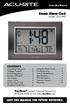 Instruction Manual Atomic Alarm Clock model 13131W2 CONTENTS Unpacking Instructions... 2 Package Contents... 2 Product Registration... 2 Features & Benefits... 3 Clock Setup... 4 Atomic Clock... 5 Set
Propsim enabled Aerospace, Satellite and Airborne Radio System Testing
 www.anite.com Propsim enabled Aerospace, Satellite and Airborne Radio System Testing Anite is now part of Keysight Technologies Realistic and repeatable real-time radio channel emulation solutions for
EECC694 - Shaaban. Transmission Channel
 The Physical Layer: Data Transmission Basics Encode data as energy at the data (information) source and transmit the encoded energy using transmitter hardware: Possible Energy Forms: Electrical, light,
Introduction to Receivers
 Introduction to Receivers Purpose: translate RF signals to baseband Shift frequency Amplify Filter Demodulate Why is this a challenge? Interference (selectivity, images and distortion) Large dynamic range
PART 5D TECHNICAL AND OPERATING CHARACTERISTICS OF MOBILE-SATELLITE SERVICES RECOMMENDATION ITU-R M.1188
 Rec. ITU-R M.1188 1 PART 5D TECHNICAL AND OPERATING CHARACTERISTICS OF MOBILE-SATELLITE SERVICES Rec. ITU-R M.1188 RECOMMENDATION ITU-R M.1188 IMPACT OF PROPAGATION ON THE DESIGN OF NON-GSO MOBILE-SATELLITE
Time. Choose a location 6 feet or more from electronics such as cordless phones, wireless gaming systems, televisions,
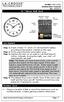 Model: 404-1220 Instruction Manual DC: 050614 20 Atomic Wall Clock Mountain Central DST Indicator Pacific Eastern Manual Set Button Battery Compartment 1- C Alkaline Get Started Step 1: Insert 1 fresh
T = 1 f. Phase. Measure of relative position in time within a single period of a signal For a periodic signal f(t), phase is fractional part t p
 Data Transmission Concepts and terminology Transmission terminology Transmission from transmitter to receiver goes over some transmission medium using electromagnetic waves Guided media. Waves are guided
RADIO FREQUENCY INTERFERENCE AND CAPACITY REDUCTION IN DSL
 RADIO FREQUENCY INTERFERENCE AND CAPACITY REDUCTION IN DSL Padmabala Venugopal, Michael J. Carter*, Scott A. Valcourt, InterOperability Laboratory, Technology Drive Suite, University of New Hampshire,
INTERNATIONAL TELECOMMUNICATION UNION
 INTERNATIONAL TELECOMMUNICATION UNION )454 6 TELECOMMUNICATION STANDARDIZATION SECTOR OF ITU $!4! #/--5.)#!4)/. /6%2 4(% 4%,%0(/.%.%47/2+ ")43 0%2 3%#/.$ $50,%8 -/$%- 34!.$!2$):%$ &/2 53% ). 4(% '%.%2!,
DAB Digital Radio Broadcasting. Dr. Campanella Michele
 DAB Digital Radio Broadcasting Dr. Campanella Michele Intel Telecomponents Via degli Ulivi n. 3 Zona Ind. 74020 Montemesola (TA) Italy Phone +39 0995664328 Fax +39 0995932061 Email:[email protected]
CDMA Network Planning
 CDMA Network Planning by AWE Communications GmbH www.awe-com.com Contents Motivation Overview Network Planning Module Air Interface Cell Load Interference Network Simulation Simulation Results by AWE Communications
Demystifying Wireless for Real-World Measurement Applications
 Proceedings of the IMAC-XXVIII February 1 4, 2010, Jacksonville, Florida USA 2010 Society for Experimental Mechanics Inc. Demystifying Wireless for Real-World Measurement Applications Kurt Veggeberg, Business,
Ultra Wideband Signal Impact on IEEE802.11b Network Performance
 Ultra Wideband Signal Impact on IEEE802.11b Network Performance Matti Hämäläinen 1, Jani Saloranta 1, Juha-Pekka Mäkelä 1, Tero Patana 2, Ian Oppermann 1 1 Centre for Wireless Communications (CWC), University