
World Digital Media Trends. Shaping the Future of the Newspaper
|
|
|
- Joy Parrish
- 10 years ago
- Views:
Transcription
1 Shaping the Future of the Newspaper ANALYSING STRATEGIC DEVELOPMENTS AND OPPORTUNITIES IN THE PRESS INDUSTRY SPECIAL REPORT SEPTEMBER 21 WAN-IFRA 21 World Digital Media Trends Digital media usage and revenues are growing in double- and tripledigits worldwide, presenting a staggering amount of opportunities for newspaper companies All the strategy reports are available to WAN-IFRA members and subscribers at the SFN Web site
2 Shaping the Future of the Newspaper A WORLD ASSOCIATION OF NEWSPAPERS AND NEWS PUBLISHERS PROJECT, SUPPORTED BY WORLD LEADING BUSINESS PARTNERS THE LEADING SUPPLIER OF SOLUTIONS AND SERVICES FOR DIGITAL, ADVERTISING, CONTENT MANAGEMENT AND SUBSCRIPTION APPLICATIONS. A LEADING COMPANY FOR NEWSPAPER PRODUCTION SYSTEMS THE LEADING NORWEGIAN TELECOMMUNICATIONS, IT AND MEDIA GROUP A WORLD LEADING PRODUCER OF NEWSPRINT AND MAGAZINE PAPER, WITH 18 PAPER MILLS AROUND THE WORLD WORLD ASSOCIATION OF NEWSPAPERS AND NEWS PUBLISHERS, 21

3 VOLUME 6 REPORT N 2 WORLD DIGITAL MEDIA TRENDS TABLE OF CONTENTS Executive Summary 1 Global Entertainment and Media Market 13 Global Advertising 17 Advertising: Print Newspapers vs. the Internet 2 Internet Market 2 Video Games 41 Social Media 4 Appendix 47 2 Media Usage Trends Digital Hot Spots 6 General Media Usage Trends 7 Online Usage and User Profiles 6 Broadband and Wireless 84 Online Video 86 Search 89 Advertising 9 Smartphone Applications 96 Social Networking and Content Sharing 98 Video Games 113 Online Gaming 11 3 Mobile Trends 119 Telecom 119 Mobile Usage and User Profiles 122 Mobile Internet 13 Mobile Internet Access Spending 143 Content Development for Mobile Devices 1 4 Impact on the Newspaper Industry 19 Newspaper Industry Overview 19 News Sources and News Consumption 168 Printed Newspapers vs. Newspaper Websites 176 Paid News Websites 178 Conclusion 18 WDMT Research Content Partners 189 3
4 SEPTEMBER 21 SHAPING THE FUTURE OF THE NEWSPAPER 4

5 VOLUME 6 REPORT N 2 WORLD DIGITAL MEDIA TRENDS Executive Summary Digital media and advertising have continued to grow despite a global economic downturn that has stunted or reversed growth across media industries since 28. In fact, they are forecast to continue their expansions well into 214, according to research firm PricewaterhouseCoopers LLP and Wilkofsky Gruen & Associates. As technologies evolve and digital sectors advance, new media platforms are gaining market share while traditional media see limited growth or decreasing shares overall. Newspapers around the world are charged with mapping out both the media mix best suited for their readership, as well as revenue streams and monetization possibilities that fit their needs best. Publishers are learning that challenges and solutions are no longer the same at every newspaper, and are digging into demographic and geographic data that can best inform and help them tailor plans for the future to the unique needs and wants of their readers. The World Association of Newspapers and News Publishers World Digital Media Trends 21 partnered with 66 research companies to piece together the world s media and advertising landscapes, as well as media usage trends on different platforms and a look at how those trends impact the newspaper industry. As technology accelerates change, publishers today are tasked with making good decisions quickly, and this report aims to better inform those decisions. The overall entertainment and media market worldwide was valued at US$1.17 trillion in 2, and grew to more than $1.32 trillion in 29, according to data from PwC and W&G. It is expected to exceed $1.69 trillion in 214, as detailed in Chapter 1. In 2, newspaper publishing was the leading segment, with a 1.2 percent share, or $179 billion market value. Next came business-tobusiness publishing, with a 13 percent share, or $13 billion value. Television advertising and TV subscription and license fees also accounted for about 12 percent each, or $146 and $142 billion, respectively. However, in 214, a shakeup in the market share ranking among segments is expected. Internet access, including wired and mobile, is forecast to reach 2.4 percent, or $31 billion
6 SEPTEMBER 21 SHAPING THE FUTURE OF THE NEWSPAPER value, up from only 11.7 percent, or $137 billion, in 2. TV subscription and license fees will come in second place, with 1 percent, or $28 billion. TV advertising is expected to follow, with 11.4 percent, or $196 billion. change Global Entertainment and Media Market by Segment, US$ millions 1,8, 1,6, 1,4, 1,2, 1,, 8, 6, 4, 2, Internet access: wired and mobile Internet advertising: wired and mobile TV subscriptions and license fees TV advertising Recorded music Filmed entertainment Video games Consumer magazine publishing Newspaper publishing Radio Out-of-home advertising Consumer and educational book publishing Business-to-business publishing Total 1,69,298 31,9 1,36,74 1,174, ,43 13,843 28,13 137,82 66, ,88 19,29 19, ,17 16,271 17,31 79,717 87,38 86,76 78,6 8,168 73,97 69,48 179,419 16, ,317 4,487 44,212 1,36 12,467 18,16 118,833 13, ,31 16, CAGR Source: PricewaterhouseCoopers LLP, Wilkofsky Gruen Associates WAN-IFRA 21 Digital Migration of Entertainment and Marketing Spending Worldwide, 28 vs. 213 Non-digital Digital 21 Non-digital 69 Digital 31 Source: PricewaterhouseCoopers LLP, Wilkofsky Gruen Associates WAN-IFRA 21 6

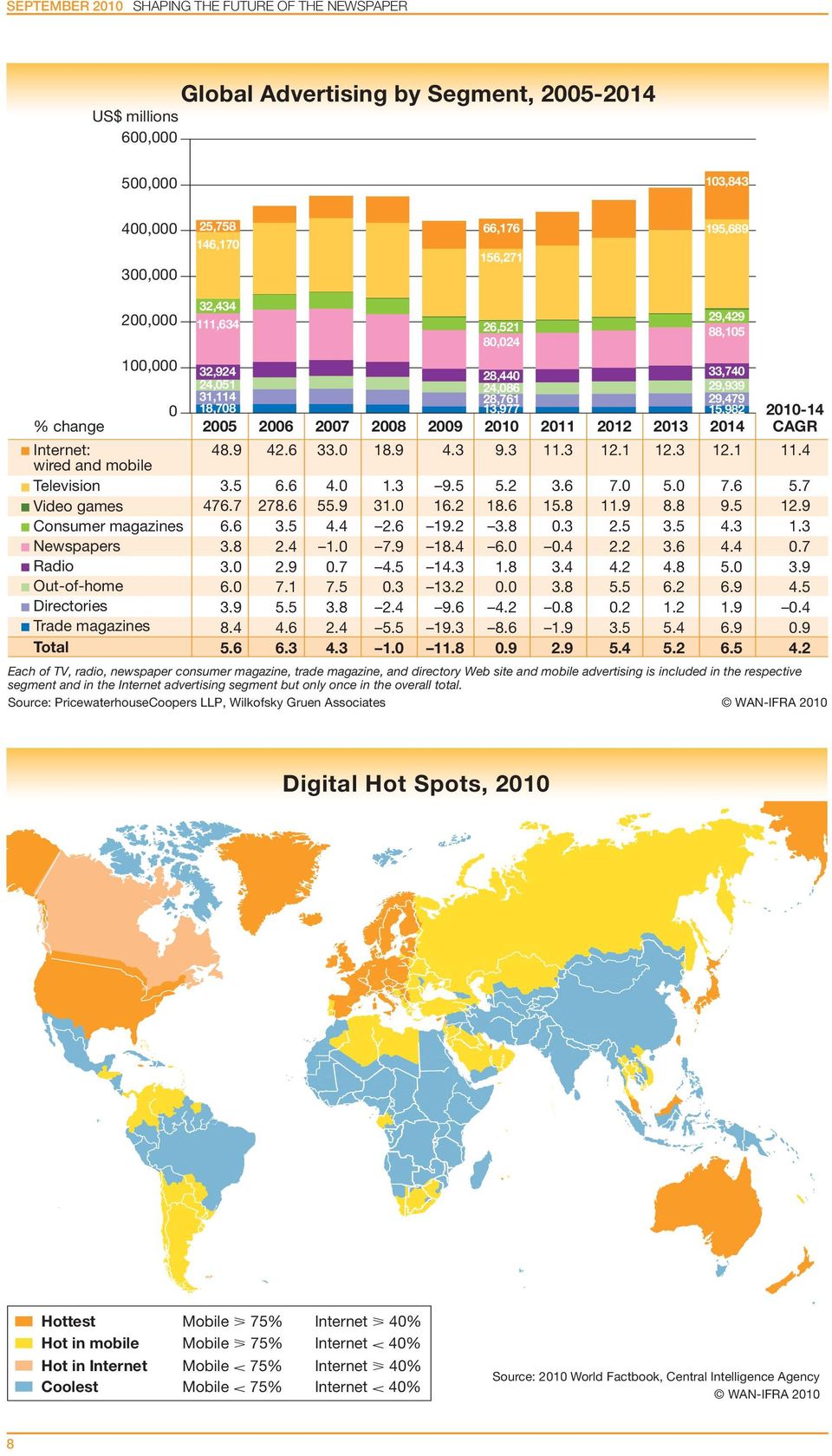
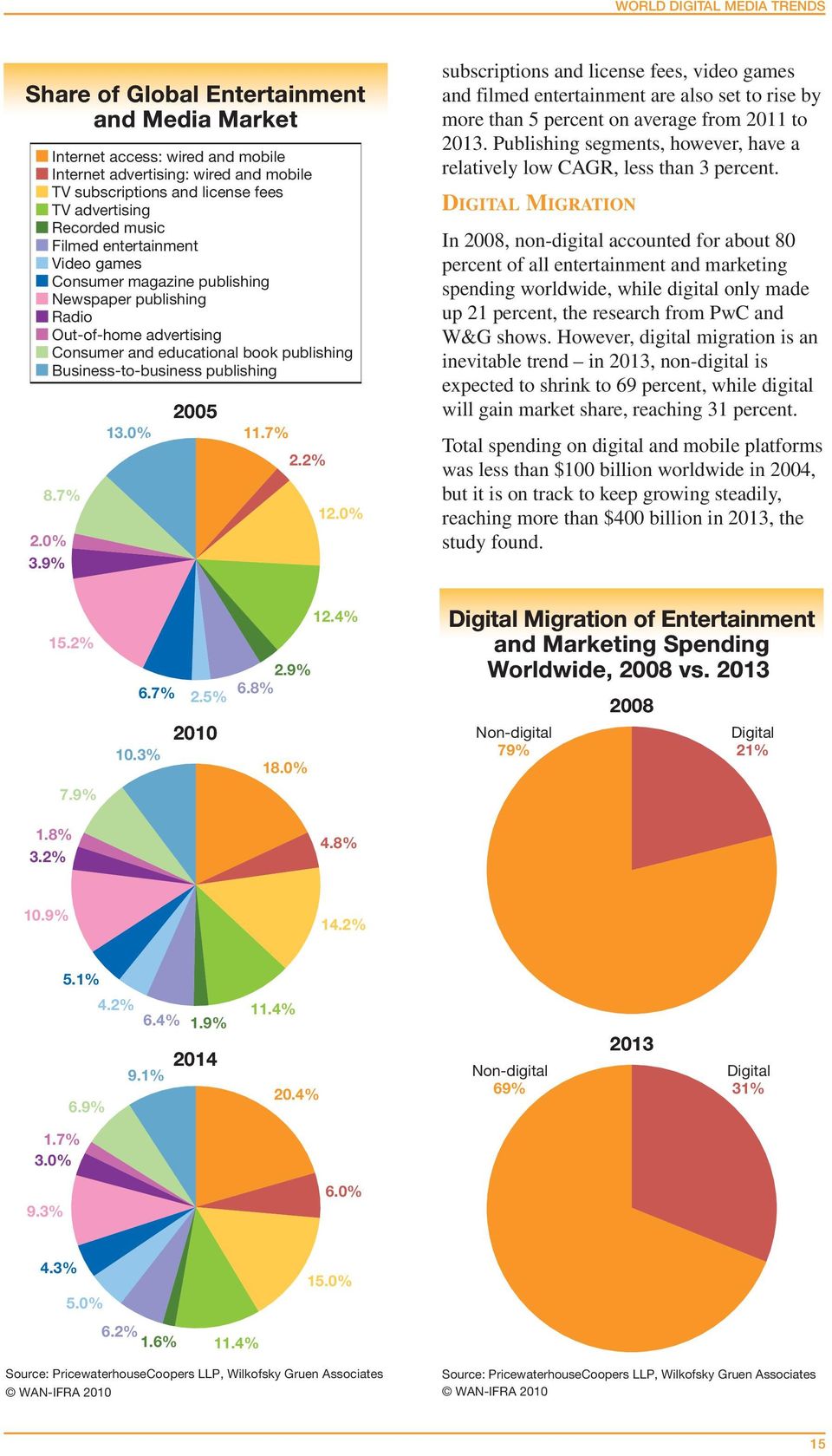
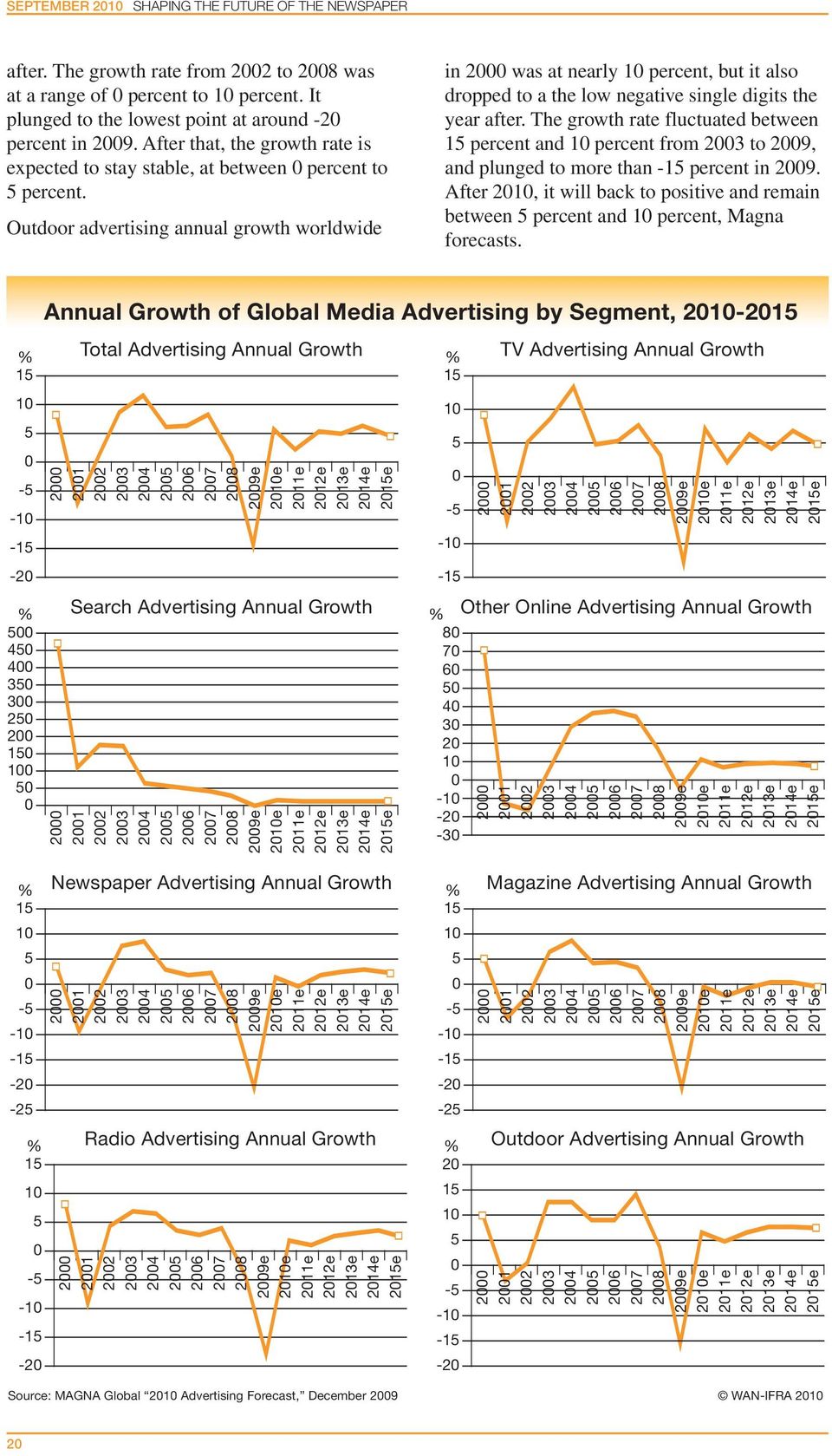
7 VOLUME 6 REPORT N 2 WORLD DIGITAL MEDIA TRENDS Share of Global Entertainment and Media Market Internet access: wired and mobile Internet advertising: wired and mobile TV subscriptions and license fees TV advertising Recorded music Filmed entertainment Video games Consumer magazine publishing Newspaper publishing Radio Out-of-home advertising Consumer and educational book publishing Business-to-business publishing Source: PricewaterhouseCoopers LLP, Wilkofsky Gruen Associates WAN-IFRA 21 In 28, non-digital accounted for about 8 percent of all entertainment and marketing spending worldwide, while digital only made up 21 percent, PwC and W&G found. However, digital migration is an inevitable trend in 213, non-digital is expected to shrink to 69 percent, while digital will gain market share, reaching 31 percent. Advertising has been a slippery slope in the years leading up to 21. According to PwC and W&G, global advertising totalled US$418 billion in 2, and reached its highest point at $464 billion in 27. Then it declined to $4 billion in 29. The advertising market is expected to bounce back after 21. With a CAGR of 4.2 percent from 21 to 214, it is forecast to reach about $498 billion in 214. In 2, the global advertising market was dominated by television and newspapers, which accounted for 3 percent and 26 percent, or $146 billion and $112 billion, respectively. The research shows that TV will remain on top in 214, with a 37 percent share, or $196 billion. However, the Internet, including wired and mobile, will surpass print newspapers and claim the number two spot, up from 6.1 percent, or just $2.8 billion in 2, to about 2 percent, or $13.8 billion in 214. Newspapers are expected to decline to 16.7 percent, or $88 billion. The only other segment expected to see an increase in advertising share is video games, up from a very niche share of $173 million in 2, to. percent, or $2.8 billion, in 214. The media economy s shift from scarcity to surfeit has created a new media ecosystem of consumers in control instead of media companies in control of media usage patterns. As media channels proliferate, media users gravitate toward more refined and specific media preferences in usage. By understanding the media usage patterns, media companies can create content at the right time, in the right format, for a variety of targeted audiences. The Shaping the Future of the Newspaper project has aggregated dozens of data sets to show trends in usage patterns of a variety of target groups in various regions of the world. The data show how consumers use media across channels, during different times of day, depending on life stages and other demographic data, as detailed in Chapter 2. 7

8 SEPTEMBER 21 SHAPING THE FUTURE OF THE NEWSPAPER US$ millions 6, Global Advertising by Segment, 2-214, 13,843 4, 3, 2,78 66, ,17 16,271 19,689 2, 1, 32,924 28,44 33,74 24,1 24,86 29,939 31,114 28,761 29,479 18,78 13,977 1,982 change Internet: wired and mobile Television Video games Consumer magazines Newspapers Radio Out-of-home Directories Trade magazines Total 32, ,634 26,21 8,24 29,429 88, CAGR Each of TV, radio, newspaper consumer magazine, trade magazine, and directory Web site and mobile advertising is included in the respective segment and in the Internet advertising segment but only once in the overall total. Source: PricewaterhouseCoopers LLP, Wilkofsky Gruen Associates WAN-IFRA 21 Digital Hot Spots, 21 Hottest Mobile 7 Internet 4 Hot in mobile Mobile 7 Internet < 4 Hot in Internet Mobile < 7 Internet 4 Coolest Mobile < 7 Internet < 4 Source: 21 World Factbook, Central Intelligence Agency WAN-IFRA 21 8
9 VOLUME 6 REPORT N 2 WORLD DIGITAL MEDIA TRENDS Share of Global Advertising Internet: wired and mobile Television Video games Consumer magazines Newspapers Radio Out-of-home Directories Trade magazines The World Association of Newspapers and News Publishers (WAN-IFRA) conducts Digital Hot Spots research each year to better understand which countries show promise in mobile and Internet access, which is a key indicator for showing possible usage growth, and therefore, revenue potential. By indexing key digital media categories, WDMT has found the most digital countries in the world include those in Western, Central and Northern Europe, the United States, South Korea, Japan, Taiwan, Australia and New Zealand. From 2 to 29, Internet usage grew by 4 percent, according to Internet World Stats. While the United States represented about two-thirds of Internet usage a decade ago, U.S. Internet usage only represents one-third of Asia s use in Emerging regions represent the most impressive Internet usage growth from 2 to 29, including Africa (1,81 percent), the Middle East (1,67 percent), Latin America/ Caribbean (93 percent) and Asia (69 percent). The number of Internet users stands at 1.8 billion in 29, according to Internet World Stats, with Asia leading the pack at million, followed by Europe at 42.8 million, North America at 29.6 million and Latin America/Caribbean at million. Internet penetration as a percentage of population is led by the most established market, North America, with 76.2 percent, followed by Oceania/Australia at 6.8 percent, Europe at 3. percent, Latin America at 31.9 percent and Asia at 2.1 percent. Mobile is growing rapidly around the world, and as its penetration level rises, Internet access also grows, enabling more people to access content via their mobiles around the world. As more people have access to online content, publishers are increasingly tailoring their offerings to mobile platforms, developing apps, new advertising offerings and more Source: PricewaterhouseCoopers LLP, Wilkofsky Gruen Associates WAN-IFRA 21 The year of mobile media is said to be 21: the year mobile users access a critical mass of content on media company mobile sites and applications, and the year that some media companies are projected to make a healthy start to revenue-making with advertising and subscriptions. Mobile usership trends worldwide illuminate clear opportunities for newspaper companies including developing 9
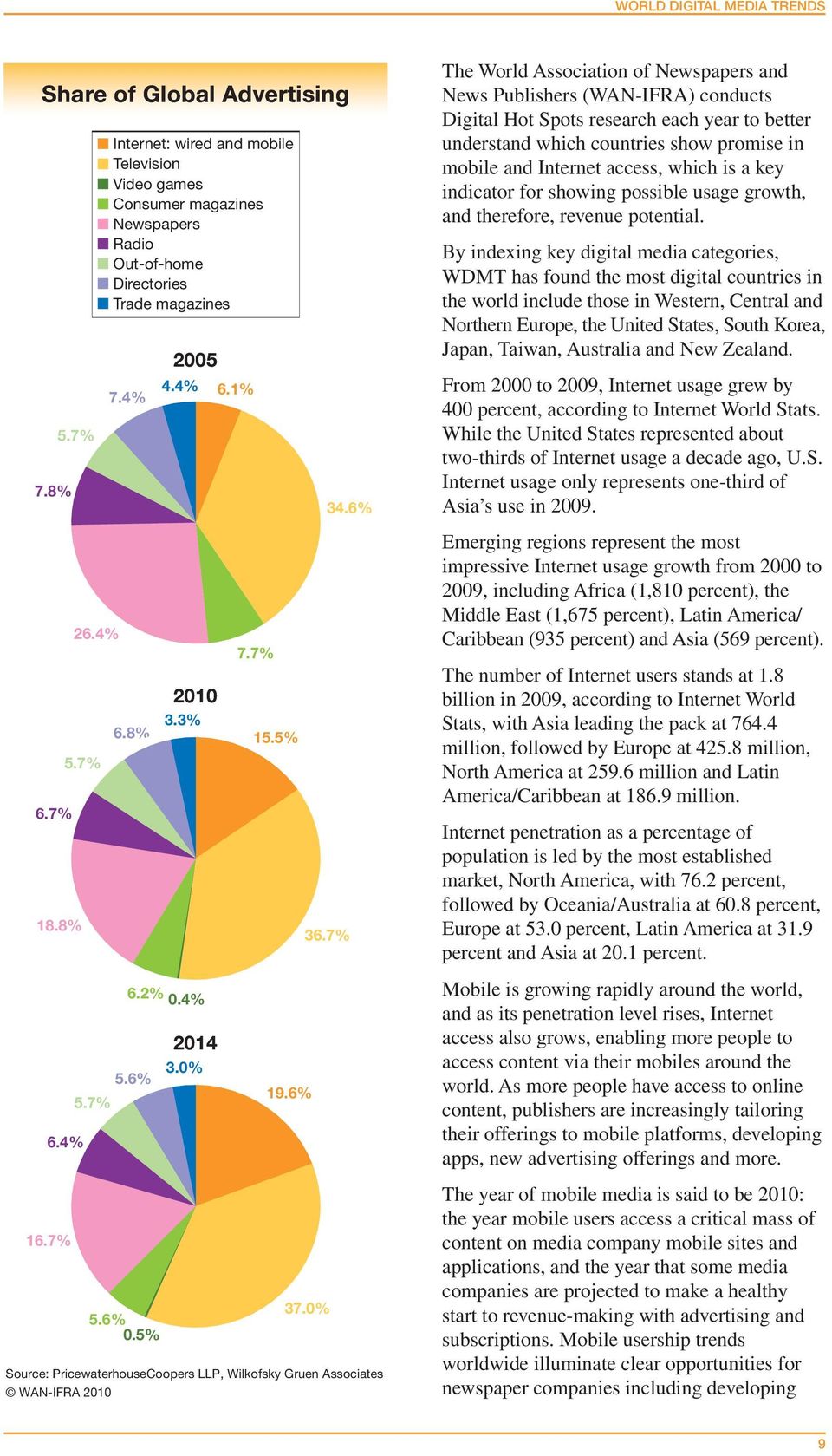
10 SEPTEMBER 21 SHAPING THE FUTURE OF THE NEWSPAPER Increase in Internet Users Worldwide, ( of total population) Japan United States Russia Germany France Worldwide Canada Source: Internet World Stats, Q2 27 and 28 WAN-IFRA 21 content for smartphones, including text, photos, video and social networking, as detailed in Chapter 3. The global telecom services market has grown from 81 billion to 997 billion from 2 to 28, according to research firm IDATE. Mobile services include search, , weather, news, photos, sports, maps and other non-data download services. The most dramatic surges in telecom services are in the Asia Pacific region, particularly in China and India, as well as in Latin America, Africa and the Middle East. During the same time period, the more established markets of North America and Europe have grown slightly in global telecom services. Global Telecom Services Market by Region, 2-28 Region/Country North America Europe France Germany Italy Spain United Kingdom Asia/Pacific China India Japan Latin America Africa/Middle East Total Source: IDATE WAN-IFRA 21 The largest growth has occurred in Africa and the Middle East, growing 44.9 percent. This is followed by growth in India, at 44.4 percent; Latin America, 3.1 percent; and China, 2.8 percent. Established markets, including Japan, Germany, France, and North America, remained stable. According to emarketer, mobile subscriptions have reached 4.6 billion worldwide, with a projected.7 billion subscriptions by 214. Meanwhile,mobile Internet users are pegged at million at the end of 29, with a projected tripled growth by 214, in which billion people are expected to use the mobile Internet. Mobile social networking users, meanwhile, are expected to grow fivefold from 29 to 214, from million to 76.1 million. This means 3.1 percent of mobile phone subscribers in 29 used social networking on their mobiles, growing to 13.3 percent, and expanding from 28 percent of mobile Internet users to 4 percent by 214. Mobile is another important platform for which publishers must develop strong offerings. Already, hundreds of newspapers around the world publish text as well as video content on mobile phones through mobile Web and smartphone applications. Newspaper companies are redistributing their content via apps on smartphones such as iphones and Blackberries, and are monetizing content by deploying search, text and display advertising. Currently, major news titles like The New York Times and USA Today have relied on advertising and sponsorships to monetize mobile apps, and have built substantial subscription lists through free downloads. 1
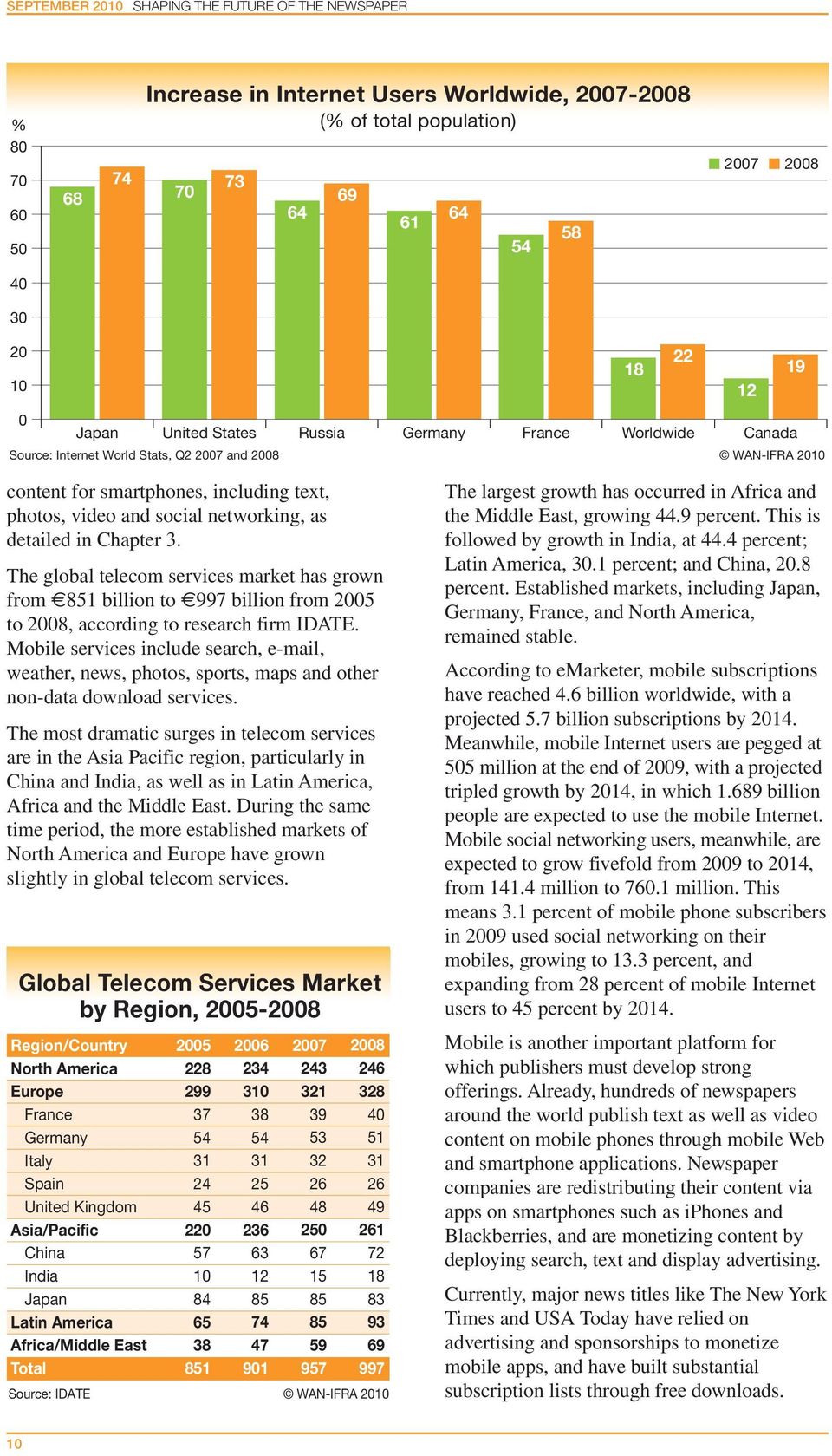
11 VOLUME 6 REPORT N 2 WORLD DIGITAL MEDIA TRENDS Mobile Phones Subscribers, Internet Users and Social Network Users Worldwide, Millions 1,8 1,6 1,4 1,2 1, Mobile phone subscibers (in millions) Mobile Internet users Mobile social network users Mobile social network users of mobile phone subscribers Mobile social network users of mobile Internet users , , , ,. 4,6, 4,9.,2.,4.,6.,7. Source: emarketer, November 29, and Internetional Telecommunication Union (ITU) October 6, 29 WAN-IFRA Meanwhile, a handful of media companies are charging for their smartphone apps, such as CNN (US$1.99), the Guardian (US$3.99) and Drudge Report (US$.99). With hundreds of thousands of smartphone apps on the market, and thousands of news and information apps, an app should be differentiated from the competition, relevant and compelling in order to be salable. As digital grows, the global print newspaper publishing market's growth has slowed, due to downturns in many western countries, despite large growth spurts in many developing countries. As the North American market shrinks, the region including Europe, the Middle East and Africa has taken over as the world's largest market, and is expected to hold that position, while the Asia Pacific region is growing into the second spot and Latin America sees continued growth, as detailed in Chapter 4. In 2, the worldwide newspaper publishing US$ millions 2, 18, 16, 14, 12, 1, 8, 6, 4, 2, 179,419 67,78 111,634 Global Newspaper Publishing Market by Component, ,317 69,293 8,24 16,633 72,28 88,1 change CAGR Circulation Total advertising Total Source: PricewaterhouseCoopers LLP, Wilkofsky Gruen Associates WAN-IFRA 21 11
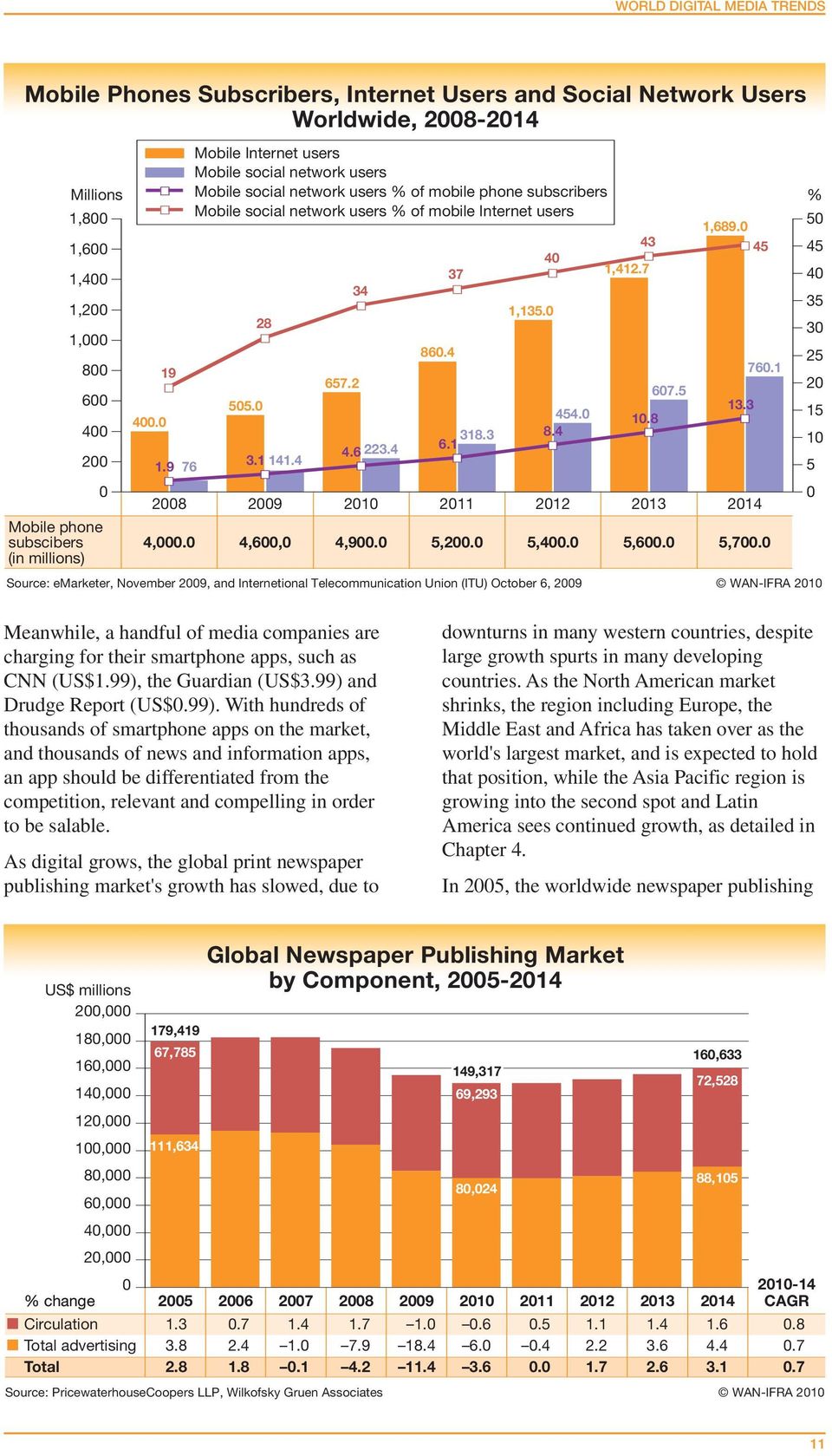
12 SEPTEMBER 21 SHAPING THE FUTURE OF THE NEWSPAPER market reached $179.4 billion, according to PwC and W&G. The numbers for 29 are projected to have dropped 11.4 percent, to $14.9 billion. The decline is expected to taper off, falling 3.6 percent by the end of 21, and then stabilising in 211. Growth is projected to pick up again in 212, at 1.7 percent overall, and 3 percent overall in 213. In 214, total growth is expected to reach 3.1 percent. For most of the Internet's relatively short lifespan, the economics of online journalism have said that the more page views an article received, the better. However, as the value of online advertising decreases, experts agree that this strategy will likely lead to failure, endangering important news that may be overlooked because it won't drive enough traffic, and causing online ad values to continue eroding. As the value of page views decreases, news publishers around the world are continuing to experiment with different types of online paid content models, from making some content paid, to putting all content behind a paywall. The basics of an online paid content business model are based on both attracting enough paying customers while also attracting highyield advertisements to that very dedicated audience. Some publishers, such as MediaNews Group and Financial Times Ltd, use a metered paywall, which allows occasional readers, such as those drawn in by search results, to continue to read articles for free. Regular readers who access the site often, and read many articles, are monitored, and forced to pay a fee once they reach a certain threshold. Another paywall example is a partial paywall, which gives away certain content for free, and puts other content behind a paywall. In the case of financial newspapers, value is derived by top financial news that can't be found on other websites, for example. In the case of community newspapers, value is derived by local information that can't be found elsewhere. Those who have adopted a partial paywall include the Nikkei, Le Monde and Axel Springer. Other publications, including The Times and The Sunday Times, owned by News International, have chosen a full paywall, which means all their online content must be paid for. WAN-IFRA wishes to thank a long list of esteemed global and country specific research organisations that have shared their data for the purposes of this compilation. WAN-IFRA hopes this collection provides the reader with a clearer picture of the globe's digital landscape, by analysing the context of the data, and the opportunities the trends may represent. A list of contributing research houses and their corresponding websites can be found in this book s appendix. Web addresses have been provided so readers can access a wealth of data that goes well beyond the published charts in WDMT. This publication is a work in progress. As years go on, we will continue to illuminate the emergence of many more digital channel frontiers. We rely on the sources of data and the generosity of research houses in order to act on our commitment to bring the widest array of information to our publisher colleagues. To contribute research to this compilation, please contact Martha Stone, director of WAN- IFRA's Shaping the Future of the Newspaper project, at [email protected]. 12

13 VOLUME 6 REPORT N 2 WORLD DIGITAL MEDIA TRENDS 1. Global Entertainment and Media Market The overall entertainment and media market worldwide was valued at US$1.17 trillion in 2, and grew to more than $1.32 trillion in 29, according to research from PricewaterhouseCoopers LLP and Wilkofsky Gruen & Associates. It is expected to exceed $1.69 trillion in 214. In 2, newspaper publishing was the leading segment, with a 1.2 percent share, or $179 billion market value. Next came business-tobusiness publishing, with a 13 percent share, or $13 billion value. Television advertising and TV subscription and license fees also accounted for about 12 percent each, or $146 and $142 billion, respectively. However, in 214, a shakeup in the market share ranking among segments is expected. Internet access, including wired and mobile, is forecast to reach 2.4 percent, or a $31 billion value, up from only 11.7 percent, or $137 billion, in 2. TV subscription and license fees will come in second place, with 1 percent, or $28 billion. TV advertising is expected to follow, with 11.4 percent, or $196 billion. Newspaper and business-to-business publishing, which were the top two leaders in 2, will lose their advantage to 9.3 percent and 9.1 percent, or $16 and $16 billion market value, according to the research. Other segments worth observing are Internet advertising, including wired and mobile, as well as video games, which are expected to grow from 2.2 percent and 2. percent, to 6 percent and percent, respectively. From 29 to 21, the worldwide economy was tough, with the CAGR of seven segments going down. The overall CAGR of was also in a decline, at about -2 percent. According to PwC and W&G, the economy seems to revive in the period of 211 to 213, with the CAGR of all the segments expected to be positive, except that of recorded music. The CAGR of total entertainment and marketing spending worldwide is anticipated to be at about 6 percent. The biggest gainers in the period are expected to be Internet advertising and Internet access, up more than 12 percent. Television 13
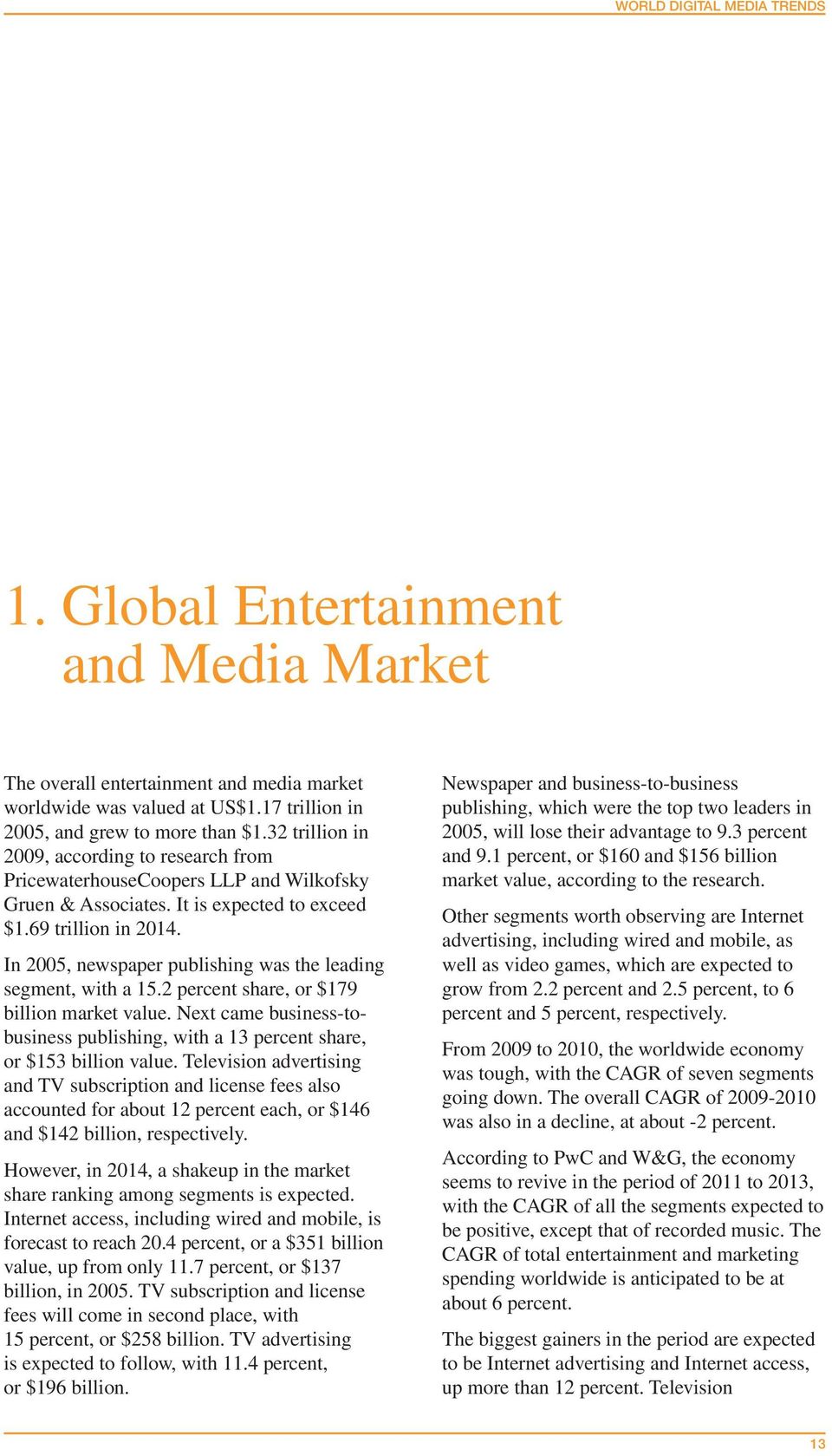
14 SEPTEMBER 21 SHAPING THE FUTURE OF THE NEWSPAPER change Global Entertainment and Media Market by Segment, US$ millions 1,8, 1,6, 1,4, 1,2, 1,, 8, 6, 4, 2, Internet access: wired and mobile Internet advertising: wired and mobile TV subscriptions and license fees TV advertising Recorded music Filmed entertainment Video games Consumer magazine publishing Newspaper publishing Radio Out-of-home advertising Consumer and educational book publishing Business-to-business publishing Total 1,69,298 31,9 1,36,74 1,174, ,43 13,843 28,13 137,82 66, ,88 19,29 19, ,17 16,271 17,31 79,717 87,38 86,76 78,6 8,168 73,97 69,48 179,419 16, ,317 4,487 44,212 1,36 12,467 18,16 118,833 13, ,31 16, CAGR Source: PricewaterhouseCoopers LLP, Wilkofsky Gruen Associates WAN-IFRA Growth of Entertainment and Marketing Spending Worldwide by Segment, vs Internet access Internet advertising TV subscription and license fees TV advertising Recorded music Filmed entertainment Video games Consumer magazine publishing Newspaper publishing Radio and out-of-home Consumer and educational book publishing Business-to-business publishing Total Source: PricewaterhouseCoopers LLP, Wilkofsky Gruen Associates WAN-IFRA 21 14

15 VOLUME 6 REPORT N 2 WORLD DIGITAL MEDIA TRENDS Share of Global Entertainment and Media Market Internet access: wired and mobile Internet advertising: wired and mobile TV subscriptions and license fees TV advertising Recorded music Filmed entertainment Video games Consumer magazine publishing Newspaper publishing Radio Out-of-home advertising Consumer and educational book publishing Business-to-business publishing subscriptions and license fees, video games and filmed entertainment are also set to rise by more than percent on average from 211 to 213. Publishing segments, however, have a relatively low CAGR, less than 3 percent. DIGITAL MIGRATION In 28, non-digital accounted for about 8 percent of all entertainment and marketing spending worldwide, while digital only made up 21 percent, the research from PwC and W&G shows. However, digital migration is an inevitable trend in 213, non-digital is expected to shrink to 69 percent, while digital will gain market share, reaching 31 percent. Total spending on digital and mobile platforms was less than $1 billion worldwide in 24, but it is on track to keep growing steadily, reaching more than $4 billion in 213, the study found Digital Migration of Entertainment and Marketing Spending Worldwide, 28 vs. 213 Non-digital Digital Non-digital Digital Source: PricewaterhouseCoopers LLP, Wilkofsky Gruen Associates WAN-IFRA 21 Source: PricewaterhouseCoopers LLP, Wilkofsky Gruen Associates WAN-IFRA 21 1
16 SEPTEMBER 21 SHAPING THE FUTURE OF THE NEWSPAPER US$ millions 8, 7, 6,, 4, 3, 2, 1, Growth of Consumer Spending on Digital/Mobile Platforms Worldwide, Other consumer/end-user/access spending Total spending on digital/mobile platforms Digital/mobile spending comprises wired broadband, mobile broadband access, online and wireless video games, video-on-demand, mobile TV, digital downloads of movies, online movie rental subscriptions, Internet music, mobile music and electronic books. Source: PricewaterhouseCoopers LLP, Wilkofsky Gruen Associates WAN-IFRA 21 Media Channels Likely to Benefit/Suffer from Budget Shifts Away from Other Media in 29 Benefit Suffer from budget shifts Internet 9 TV 4 Direct mail PR Point-of-sale activities Radio Outdoor advertising TV National daily newspapers Local daily newspapers Outdoor advertising National daily newspapers Direct mail Local daily newspapers Radio Point-of-sale activities PR Internet Note: Study conducted between February 28 and February 29 across the entire client base (marketing decision makers) of Digitas and Perfomics. Source: Digitas, 2nd Digital Investment Barometer, March 29 WAN-IFRA 21 Other spending totalled more than $6 billion in 24, but then stayed almost stagnant in the following years. It is expected to grow a little, but total no more than $8 billion in 213. Budget shifts among media are common now. According to a Digitas study conducted in February 28 and February 29, the Internet is the most likely sector to benefit from budget shifts from other media, with nearly 6 percent of respondents saying so, followed by direct mail and public relations. Meanwhile, the media most likely to suffer from budget shifts include TV, outdoor advertising, national daily newspapers, direct mail, local daily newspapers and radio, each with more than 3 percent of respondents saying so. 16

17 VOLUME 6 REPORT N 2 WORLD DIGITAL MEDIA TRENDS US$ millions 6, Global Advertising by Segment, 2-214, 13,843 4, 3, 2,78 66, ,17 16,271 19,689 2, 1, 32,924 28,44 33,74 24,1 24,86 29,939 31,114 28,761 29,479 18,78 13,977 1,982 change Internet: wired and mobile Television Video games Consumer magazines Newspapers Radio Out-of-home Directories Trade magazines Total Global Advertising 32, ,634 Advertising has been on the decline in the years leading up to 21. According to PricewaterhouseCoopers LLC and Wilkofsky Gruen & Associates, global advertising totalled US$418 billion in 2, and reached its highest point at $464 billion in 27. Then it declined to $4 billion in ,21 8,24 29,429 88, CAGR Each of TV, radio, newspaper consumer magazine, trade magazine, and directory Web site and mobile advertising is included in the respective segment and in the Internet advertising segment but only once in the overall total. Source: PricewaterhouseCoopers LLP, Wilkofsky Gruen Associates WAN-IFRA 21 US$ millions 8, 6, 4, 2, 1, 8, 6, 4, 2, Digital newspapers Digital consumer magazines The advertising market is expected to bounce back after 21. With a CAGR of 4.2 percent from 21 to 214, it is forecast to reach about $498 billion in 214. In 2, the global advertising market was dominated by television and newspapers, which accounted for 3 percent and 26 percent, or $146 billion and $112 billion, respectively. Advertising Targeted to New Consumer Behaviours, Digital directories Digital trade magazines Wired Internet Mobile Video games Source: PricewaterhouseCoopers LLP, Wilkofsky Gruen Associates WAN-IFRA 21 17

18 SEPTEMBER 21 SHAPING THE FUTURE OF THE NEWSPAPER Share of Global Advertising Internet: wired and mobile Television Video games Consumer magazines Newspapers Radio Out-of-home Directories Trade magazines Source: PricewaterhouseCoopers LLP, Wilkofsky Gruen Associates WAN-IFRA 21 of total ad dollars Ad Share Growth by Modern Media, Mobile (F) Broadcast TV Web Cable TV Source: Borrell Associates, Inc. WAN-IFRA 21 The research shows that TV will remain on top in 214, with a 37 percent share, or $196 billion. However, Internet, including wired and mobile, will surpass newspapers and become number two, up from 6.1 percent, or just $2.8 billion in 2, to about 2 percent, or $13.8 billion in 214. Newspapers are expected to lose share, declining to 16.7 percent, or $88 billion. The only other segment expected to see an increase in advertising share is video games, up from a very niche share of $173 million in 2, to. percent, or $2.8 billion, in 214. Wired Internet advertising is on the top of all ads targeted to new consumer behaviours in 24, which totalled about $2 billion that year, according to PwC and W&G. Digital newspaper advertising came next, with less than $2 billion, while others were still all very small sectors at that time. In 213, wired Internet advertising is set to reach nearly $8 billion, while mobile ads will account for about $9 billion, and digital newspaper ads about $8 billion. Digital directory ads will exceed $6 billion, the study states. According to Borrell Associates, Inc., in 29, the growth of broadcast television advertising outpaced others, at more than 6 percent, while the Web, cable TV, and mobile ads all grew less than 2 percent. In 214, however, the growth of mobile advertising is expected to skyrocket to nearly 1 percent, outperforming others. Broadcast TV's ad share is also forecast to increase, at around 11 percent that year, while Web s 18
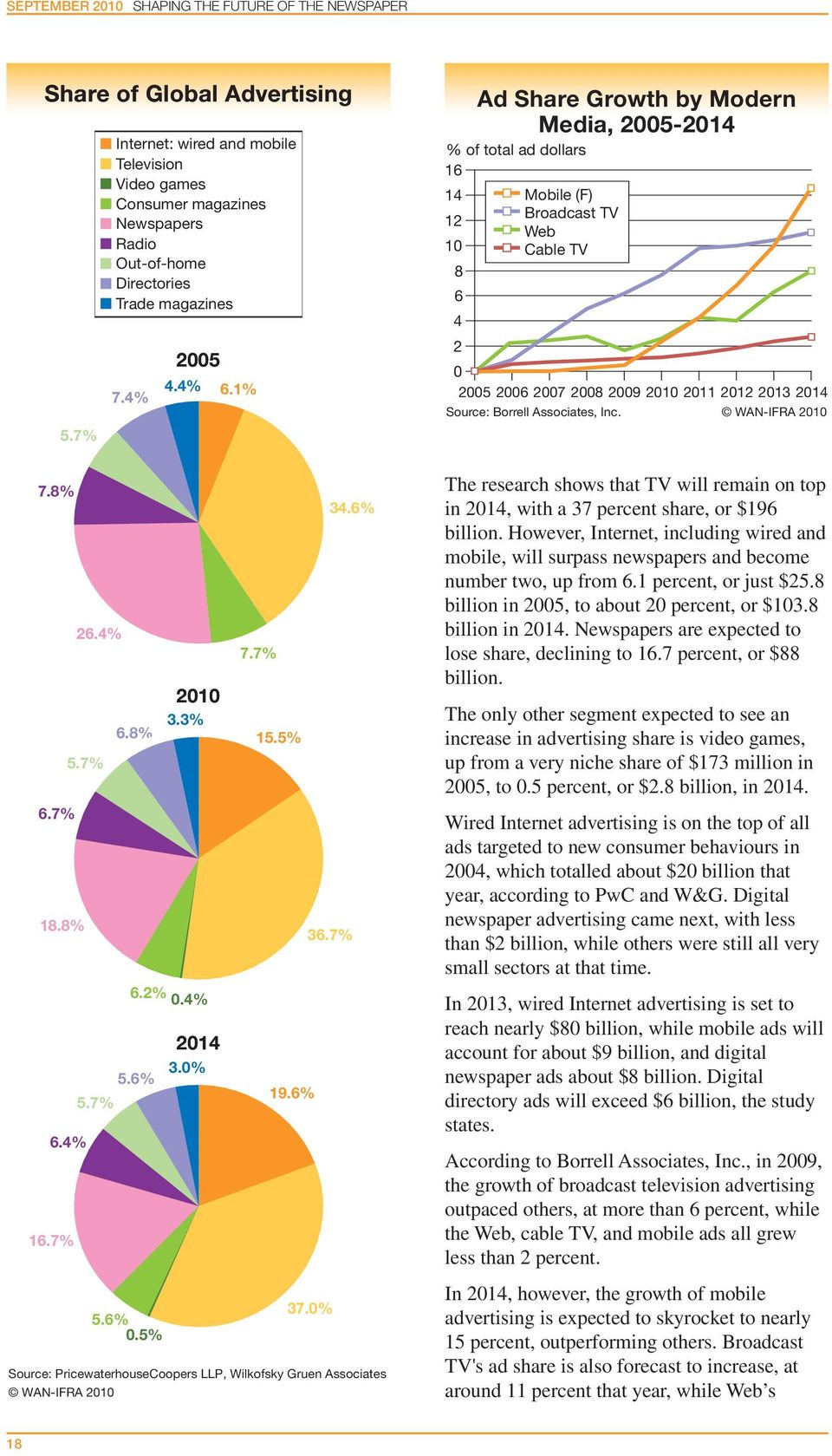
19 VOLUME 6 REPORT N 2 WORLD DIGITAL MEDIA TRENDS 14 CAGR of Global Media Supplier Advertising Revenues, Television Search Other Total online Newspapers Magazines Radio Outdoor online media Source: MAGNA Global 21 Advertising Forecast, December 29 WAN-IFRA 21 growth of 8 percent and cable TV's growth of 3 percent are also expected. According to research firm Magna Global, search and total online are the top two leaders in terms of the compound annual growth rate of global media supplier advertising revenues from 21 to 21. The CAGR of search is 12.1 percent, and that of total online is 1. percent. Other online media sectors combined follows with 8.8 percent CAGR, while outdoor and TV also report 6.7 percent and percent CAGR, respectively. Radio and newspapers have the relatively low CAGR, at 2. percent and 1.9 percent, respectively. Magazines are the only media reporting negative CAGR, at -.6 percent. Total advertising annual growth worldwide exceeded more than 1 percent in 23 and 24, after a sharp dip to more than - percent in 21. The growth was down again in 29, at about -1 percent, but is expected to bounce back to positive figures after 21, and will remain at the range between percent and 1 percent from 212 to 21, according to Magna. TV advertising annual growth worldwide dropped to more than - percent in 21, but reached a peak of around 1 percent in 23. It marked a nearly 1 percent growth in 27, and then plunged to nearly -1 percent in 29. After 21, it is expected to return to positive growth, fluctuating between percent and 1 percent. Search advertising and other online advertising emerged in the beginning of the 2s, and started high at more than 4 percent annual growth and 7 percent, respectively. Other online advertising annual growth, impacted by the Internet bubble, was at negative growth in 21 and 22, at more than -1 percent, according to Magna. It bounced back and remained at more than 3 percent from 24 to 27, and then dropped again in 29. After 21, its annual growth rate is expected to fluctuate at around 1 percent. Search advertising s annual growth began to slow down after 23. After 21, it will stay steadily at around 1 percent, the research states. Newspaper advertising worldwide had about a percent annual growth in 2, but dropped to nearly -1 percent in 21. Its growth rate was back to positive from 22 to 27, and then plunged to more than -2 percent in 29. It will be steadily back to positive figures after 212, at less than percent, Magna predicts. Magazine advertising grew at about percent in 2, and the growth rate dropped to - percent in 21. In 23 and 27, it was back to around percent to 1 percent. The growth rate then plunged to a low of around -2 percent in 29. After 21, it fluctuated at around 2 percent and -2 percent, according to Magna. Radio advertising's annual growth worldwide was about 1 percent in 2, and like other platforms, fell to nearly -1 percent in the year 19
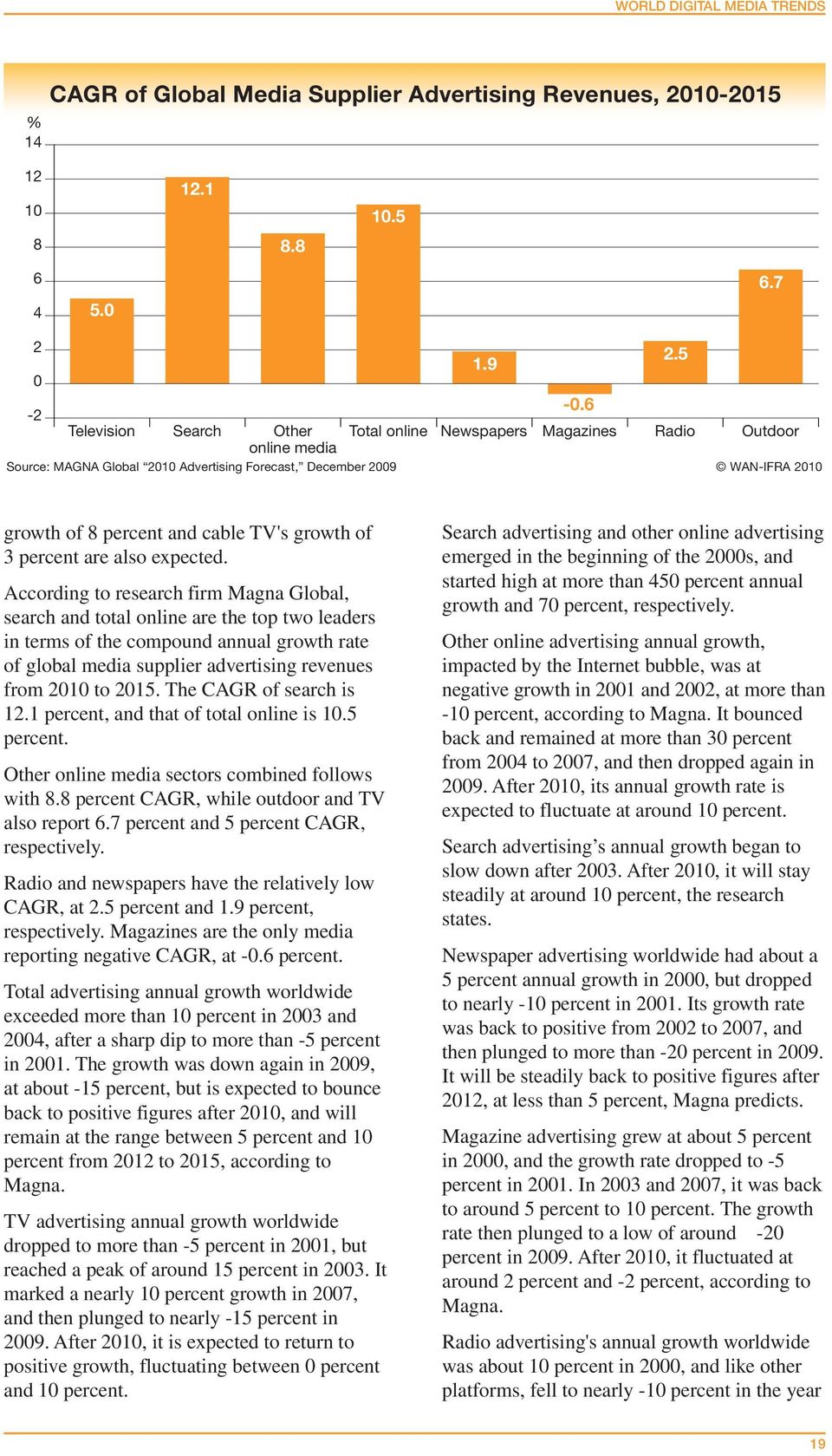
20 SEPTEMBER 21 SHAPING THE FUTURE OF THE NEWSPAPER after. The growth rate from 22 to 28 was at a range of percent to 1 percent. It plunged to the lowest point at around -2 percent in 29. After that, the growth rate is expected to stay stable, at between percent to percent. Outdoor advertising annual growth worldwide in 2 was at nearly 1 percent, but it also dropped to a the low negative single digits the year after. The growth rate fluctuated between 1 percent and 1 percent from 23 to 29, and plunged to more than -1 percent in 29. After 21, it will back to positive and remain between percent and 1 percent, Magna forecasts Annual Growth of Global Media Advertising by Segment, Total Advertising Annual Growth e 21e 211e 212e 213e 214e 21e Search Advertising Annual Growth e 21e 211e 212e 213e 214e 21e TV Advertising Annual Growth e 21e 211e 212e e 21e 211e 212e 213e 214e 21e Other Online Advertising Annual Growth 213e 214e 21e Newspaper Advertising Annual Growth e 21e 211e 212e e 21e 211e 212e 213e 214e 21e Radio Advertising Annual Growth 213e 214e 21e Magazine Advertising Annual Growth e 21e 211e 212e e 21e 211e 212e 213e 214e 21e Outdoor Advertising Annual Growth 213e 214e 21e Source: MAGNA Global 21 Advertising Forecast, December 29 WAN-IFRA 21 2
21 VOLUME 6 REPORT N 2 WORLD DIGITAL MEDIA TRENDS ASIA The advertising market in the Asia Pacific region totalled $88.6 billion in 2, and reached $9.4 billion in 29, according to PwC and W&G. It is expected to grow at a rate of 6.6 percent from 21 each year and reach $131.1 billion in 214. Television was the top contributor in 2, valued at $33.9 billion, followed by newspapers with $23.9 billion. In 214, TV advertising is expected to remain as number one, with $49.2 billion. Internet advertising will outperform newspaper and claim the second spot, with $29.8 billion. Newspaper advertising will total $27.3 billion, the research predicts. The fastest growers from 21 to 214 go to video games and the Internet, with a CAGR of 1.8 percent and 14.3 percent, respectively. EUROPE, THE MIDDLE EAST AND AFRICA The advertising market in countries in Europe, the Middle East and Africa totalled $119 billion in 2, and surpassed $123.1 billion in 29, according to PwC and W&G. In 214, the market is expected to grow to $147.9 billion, with a CAGR of 3.7 percent. TV and newspaper advertising altogether accounted for more than half of the ad market in EMEA countries in 2, with $37.3 billion and $33. billion, respectively. In 214, TV is expected to still be the leader, with $47.4 billion, while Internet will jump to second place, with $36.2 billion, and newspapers will take the third spot, with $31.1 billion. Video games and Internet are the two segments with the highest CAGR, which are both over 12 percent. LATIN AMERICA Advertising in Latin America was valued at $13 billion in 2, and went up to $19.1 billion in 29. PwC and W&G research shows it will continue to grow after 21, at a yearly rate of 7.7 percent, reaching $27.6 billion in 214. Television dominated the ad market in 2, with $6.8 billion in advertising. It is expected to keep its edge in 214, reaching $1.3 billion. Newspaper advertising is in the second spot over the years, increasing from $2. billion in 2 to $4.6 billion in 214. Internet and video games are the two outperformers from 21 to 214, growing at more than 14 percent each year to $1.7 billion and $47 million in 214, the research concludes. US$ millions 14, 12, Advertising by Segment, Asia Pacific, ,763 1, 8, 6, 4, 17,272,929 33,919 36,12,66 4,32 23,86 23,7 49,226,33 27,28 2, 6,379 4,277 4,94 11,412 8,412 8,69,222 4,836,266 change Internet: wired and mobile Television Video games Consumer magazines Newspapers Radio Out-of-home Directories Trade magazines Total CAGR Source: PricewaterhouseCoopers LLP, Wilkofsky Gruen Associates WAN-IFRA 21 21
22 SEPTEMBER 21 SHAPING THE FUTURE OF THE NEWSPAPER US$ millions 18, 16, 14, 12, 1, 8, 6, 4, 6,847 6,24 6,939 2, 8,287 8,161 9,3 9,641 8,912 8,844,13 4,82,728 change Internet: wired and mobile Television Video games Consumer magazines Newspapers Radio Out-of-home Directories Trade magazines Total Advertising by Segment, EMEA, ,61 37,21 12,281 33, ,6 11,24 28,347 31, CAGR Source: PricewaterhouseCoopers LLP, Wilkofsky Gruen Associates WAN-IFRA 21 22,29 39,439 36,247 47,417 US$ millions 3, 6,78 1, 1,8 1,323 4,8, 98 3,6 2,49 1, , ,19 1, ,8 change Internet: wired and mobile Television Video games Consumer magazines Newspapers Radio Out-of-home Directories Trade magazines Total Advertising by Segment, Latin America, , 2, 1, 12,93 2, ,28 27,67 1, CAGR _ Source: PricewaterhouseCoopers LLP, Wilkofsky Gruen Associates WAN-IFRA 21 1,346 22
23 VOLUME 6 REPORT N 2 WORLD DIGITAL MEDIA TRENDS NORTH AMERICA In North America, the ad market was valued at $197.9 billion in 2, and dropped to $168 billion in 29. PwC and W&G report that it will bounce back to $191 billion in 214, with a 2.6 percent CAGR from 21 to 214. In 2, TV ads totalled $68.2 billion, more than any other segment, and will likely grow to $83.7 billion in 214. Newspaper ads, which in 2 were ranked second, will recess from $1.8 billion to $2 billion in 214. Video game is the biggest gainer, from $11 million in 2 to $1. billion in 214. The CAGR from 21 to 214 is anticipated to total 11.7 percent. The Internet also has a relatively high CAGR, calculated at about 8 percent. It increased from $13 billion in 2 to an expected $36.1 billion in 214. UNITED STATES According to Borrell Associates, in 29, U.S. direct mail ad spending reached $39.4 billion, while online ads totalled $3.2 billion, and broadcast TV accounted for $34. billion. U.S. newspaper ad spending in 29 totalled $31.1 billion, while other print added up to $2.2 billion. Radio ad accounted for $16.4 billion, and cable $14.4 billion. Advertising spending on directories was $9.9 billion, and out-of-home ads made up $6.3 billion. Telemarketing ad spending in the country was valued at $2.2 billion, while cinema was $1.8 U.S. Total Ad Spending by Medium, 29 Direct mail Online Broadcast TV Newspapers Other print Radio Cable Directories Out of home Telemarketing Cinema Mobile $ billions Source: Borrell Associates, Inc. WAN-IFRA 21 Advertising by Segment, North America, US$ millions ,34 68,242 2,942 69,62 36,129 83,7 1 1,813 11,342 2,114 2,99 2,984 16,44 18,628 6,62 6,121 7,46 1,71 14,11 14,311 11,328 7,69 8,488 change Internet: wired and mobile Television Video games Consumer magazines Newspapers Radio Out-of-home Directories Trade magazines Total 13,62 1, CAGR Source: PricewaterhouseCoopers LLP, Wilkofsky Gruen Associates WAN-IFRA 21 23
24 SEPTEMBER 21 SHAPING THE FUTURE OF THE NEWSPAPER Ad Expenditures by Media Quarterly Trends, U.S. US$ millions 4, 4, 3, 3, 2, 2, 1, 1,, Q2 7 Q3 7 Q4 7 Q1 8 Q2 8 Q3 8 Q4 8 Q1 9 Q2 9 Other Newspapers Magazines Internet TV Source: Nielsen Monitor Plus WAN-IFRA 21 billion. Mobile ad spending was still in an early stage, only accounting for $1.7 billion. In the second quarter of 29, television accounted for more than 6 percent of overall U.S. ad expenditures, or more than $2.3 billion, according to Nielsen Monitor Plus. Magazines contributed 13 percent, or $4.3 billion, while newspapers' share was 9 percent, or about $2.9 billion. Internet ads accounted for $2.2 billion, making it 7 percent of total ad expenditures. Data from Nielsen Monitor Plus also showed that U.S. TV advertising fluctuated between $18 billion and $2 billion between the second quarter of 27 and that of 29, but continued to be a leader in the category. Magazine ads came next, followed by newspapers. Internet accounted for about $2. billion in each quarter. According to the study, The State of the News Media 21, released by the U.S.-based Pew Project for Excellence in Journalism, cable was the only medium to see a positive change in ad revenue from 28 to 29. However, that change was small, at less than 1 percent. Online was down nearly percent, while network dropped more than 6 percent from 28 to 29. Audio and magazines were down almost 2 percent, while local TV plunged nearly 2 percent. The biggest decrease went to newspapers, with a decline of more than 2 percent. According to Veronis Suhler Stevenson, 46 percent of the U.S. advertising and marketing came from traditional marketing in 22, while 47 percent was from traditional advertising. Alternative interactive channels, however, only accounted for 7 percent. growth Ad Expenditures by Media U.S., Q2 29 ($ millions) TV $2,32 63 Change in Ad Revenue by Medium, U.S., 28 to 29 Cable Internet $2,169 7 Magazines $4, Newspapers $2,936 9 Local TV Other $2,1 8 Source: Nielsen Monitor Plus WAN-IFRA 21 Online Network Audio Magazines Newspapers Source: The State of News Media 21, the Pew Research Center's Project for Excellence in Journalism; Cable: SNL Kagan; Online: emarketer; Network:TNS Intelligence; Audio: Radio Advertising Bureau; Magazines: Publishers Information Bureau and is for ad pages sold, not revenue; Newspapers: estimate derived b by Rick Edmonds of the Poynter Institute based on data provided by the National Newspaper Association; Local TV: Television Bureau of Advertising WAN-IFRA 21 24
25 VOLUME 6 REPORT N 2 WORLD DIGITAL MEDIA TRENDS In 27, alternative interactive channels stole some of traditional advertising's share, which accounted for 41 percent, to 13 percent. Traditional marketing remained intact at 46 percent. In 212, alternative interactive channels are expected to account for 27 percent, while traditional advertising will shrink to 32 percent, and traditional marketing 42 percent, VSS reported U.S. Advertising and Marketing Share, Traditional advertising Traditional marketing Alternative interactive channels e Source: Veronis Suhler 29 WAN-IFRA 21 Advertising: Print Newspapers vs. the Internet According to PricewaterhouseCoopers LLC and Wilkofsky Gruen Associates Inc., global Internet advertising spending, including wired and mobile, totalled US$2.8 billion, or 6.1 percent of total advertising spending in 2. In the same year, newspaper advertising spending reached $111.6 billion, making it more than 26 percent of total ad spending. In 29, Internet ad spending worldwide increased by more than double, to $6.6 billion, with a market share of up to 14.4 percent. Newspaper ad spending, however, recessed to $8.2 billion, or a 2.2 percent share. The market share Internet ads have is expected to surpass that of newspaper ads in 214, at 19.6 percent and 16.7 percent, respectively. Internet ad spending in that year will exceed $13.8 billion, while newspaper ad spending will account for $88.1 billion, according to data from PwC and W&G. Internet Market In 2, the global Internet access spending market totalled US$137.6 billion, and rose to $228 billion in 29. With a 9 percent CAGR from 21 to 214, it is expected to reach $31 billion in 214. Total wired Internet access spending was $112 billion in 2, with nearly $7 billion from broadband, and the rest, $37 billion, from dialup. In 29, dial-up shrunk to $23.8 billion, and broadband almost doubled to $14.7 billion, making the total wired Internet access market $169. billion. Broadband spending will increase with a 9.7 percent CAGR from 21 to 214 and surpass $231.1 billion in 214, while dial-up will Global Advertising Spending and Market Share: Internet and Newspapers, US$ millions Internet: Wired and Mobile Advertising Spending Newspaper Advertising Spending 14, Internet: Wired and Mobile Market Share Newspaper Market Share 3 12, 1, 8, 6, 4, 2, ,36 111, , ,37 13, ,1 92, ,24 79,7 81,422 84,377 88, , ,642 66, , , , , , Source: PricewaterhouseCoopers LLP, Wilkofsky Gruen Associates WAN-IFRA 21 2
26 SEPTEMBER 21 SHAPING THE FUTURE OF THE NEWSPAPER continue dropping with a more than -16 percent CAGR, to merely $9.6 billion in 214. Overall wired Internet access spending will reach $24.7 billion in 214, with a CAGR of 7.3 percent. Mobile access, however, only accounted for $2.6 billion in 2, but increased to $8.6 billion in 29. Its CAGR is 13. percent, which will lift it up from $66.4 billion in 21 to more than $11.3 billion in 214. In 2, broadband made up 4.4 percent of the overall spending, while dial-up accounted for another 27 percent. Mobile only accounted for less than 2 percent. But in 214, dial-up is projected to shrink severely, ending up with just a 2.7 percent share, while broadband will continue to gain what dial-up loses, and mobile is expected to continue to grow. In 2, the global Internet access spending market was dominated by Asia Pacific and US$ millions 4, 3, 3, 2, 2, 1, 1,, Global Internet Access Market: Wired and Mobile, by Component, ,82 37,64 74, ,43 2,833 16,244 66,376 31,9 9, ,14 11,38 2,622 change CAGR Dial-up Broadband Total wired Internet access Mobile access Total Source: PricewaterhouseCoopers LLP, Wilkofsky Gruen Associates WAN-IFRA 21 US$ millions 4, 3, 3, 2, 2, 1, 1,, Global Internet Access Market: Wired and Mobile, by Region, ,82 29,38 47,19 7,22 247,43 49,499 87,212 99,788 31,9 69, ,78 126,172 3,8 1,94 2,919 change CAGR North America EMEA Asia Pacific Latin America Total Source: PricewaterhouseCoopers LLP, Wilkofsky Gruen Associates WAN-IFRA 21 26
27 VOLUME 6 REPORT N 2 WORLD DIGITAL MEDIA TRENDS Share of Global Internet Access Market: Wired and Mobile, by Component Dial-Up Broadband Mobile Access Share of Global Internet Access Market: Wired and Mobile, by Region North America EMEA Asia Pacific Latin America Source: PricewaterhouseCoopers LLP, Wilkofsky Gruen Associates WAN-IFRA 21 Source: PricewaterhouseCoopers LLP, Wilkofsky Gruen Associates WAN-IFRA 21 27
28 SEPTEMBER 21 SHAPING THE FUTURE OF THE NEWSPAPER EMEA, each accounting for $7.2 billion and $47.2 billion, respectively. These two regions contributed over 41 percent and nearly 3 percent of the total spending, respectively. North America, accounting for $29.3 billion, made up a 21.4 percent share, while the $3.8 billion of the spending in Latin America made up merely 2.8 percent. In 214, Asia Pacific will lose its leading place, to 3.9 percent, or $126.2 billion, while EMEA will take the lead with more than 38 percent, or $134.6 billion. Internet access pending in North America will reach $69.4 billion in 214, making it 19.8 percent share. Latin America will have its spending up to $2.9 billion, or a 6 percent share. INTERNET ADS According to consulting and research firm IDATE, worldwide Internet users totalled million in 2, and exceeded 1 billion in 28. The number will reach nearly 1.7 billion in 212. Online ad revenues worldwide totalled 14.7 billion in 2, and surpassed 3.6 billion in 28. It is expect to grow from 29 to 212 with a CAGR of 19.6 percent and reach 8.8 billion in 212. Online ad revenue accounted for.1 percent of overall global media ad revenues in 2, or 2.4 percent of overall marketing revenues worldwide. The percentage is going up throughout the years, to 1.6 percent of overall media ad revenues, or 7.1 percent of total Online Ad Revenue vs. Media Ad Revenue vs. Marketing Revenue Worldwide, CAGR Internet users (millions) ,7.7 1, ,27.3 1,43.8 1,67.3 Online ad revenues ( millions) 14,721 19,823 2,368 3,616 34,33 4,136 48,136 8, Total media ad revenues ( millions) 287,44 38,44 33,194 31,91 373,96 397, , ,3 2.7 Total marketing revenues ( millions) 619,83 661, , ,23 771,41 821,3 82,79 834,48 Share of media ad revenues Share of total marketing revenues Online ad revenues growth Media ad revenues growth Marketing revenues growth Source: IDATE WAN-IFRA 21 Online Ad Revenue by Format, Worldwide, Display ( millions) Search marketing and assimilated ( millions) Other ( millions) millions Display () Search marketing and assimilated () Other () 6, 6 6, , 46 3,96 31, , 36 2,47 4, , ,,62 2, , ,79 14, 2, 17 4,282 21, ,132 3,28 7,86 1, ,,44 9,93 11,499 12,278 14, ,896 7, Source: IDATE WAN-IFRA 21 28
29 VOLUME 6 REPORT N 2 WORLD DIGITAL MEDIA TRENDS marketing revenues in 212, according to IDATE. Online ad revenues worldwide have continued to grow strongly since 2, each year increasing in at least double digits, compared to the only single-digit growth of media ad revenues as well as marketing revenues. In 2, online display ads worldwide totalled.9 billion, or 4 percent of total online ad revenue. Search marketing and assimilated, however, accounted for. billion, or 38 percent, while others made up 3.3 billion, or 22 percent. In 212, there will be some changes in the ranking of the share among formats search marketing and assimilated will rise to 31.3 billion, making it 3 percent of overall online ad revenues. Display will grow to 21.2 billion, but its share will drop to 36 percent. Other will reach 6.3 billion, or 11 percent. According to Magna, Internet advertising worldwide will total $61.4 billion in 21, with $27.2 billion from North America, $2 billion from EMEA countries, and $12.2 billion from the Asia Pacific region. In 21, total spending will reach $12.8 billion, with $4.2 billion from North America, $32 billion from EMEA, $21.7 billion from Asia Pacific, and $16.3 billion from the emerging market. U.S. tops other countries with most spending, at $2.7 billion in 21. The amount will increase to $42.7 billion in 21. Japan follows in second place at $6.3 billion in 21, and will reach $8 billion in 21. The online ad market worldwide, according to IDATE, totalled 14.7 billion in 2. In the same year, the online ad market in 27 European countries reached 3.2 billion, while the U.S. market was valued at 7. billion. In 212, the global online ad market will approach 9 billion, with 16.7 billion from 27 European countries, and 2.7 billion from the United States. According to a survey of senior marketing executives worldwide, conducted by Ad Media Partner in January 29, more than seven out of 1 respondents said they would increase their 29 spending on word-of-mouth/social media marketing, search marketing, mobile marketing and behavioural/contextual marketing. Internet Advertising, by Country, 21 vs. 21 North America EMEA APAC Emerging Markets Latin America 27, , , , , , ,31.9 1,96.4 3,774. 4,237.3 $ millions 1, 2, 3, 4,, (in $ millions) United States Japan China Germany United Kingdom France Australia Canada Brazil Russia Spain South Korea Italy Netherlands Sweden Norway Argentina Poland Gulf countries* Denmark Turkey Belgium Austria South Africa Finland Switzerland Taiwan India Czech Republic Hungary Ireland New Zealand Mexico Portugal Colombia Greece Hong Kong Romania Egypt Morocco Indonesia Ukraine Slovakia Singapore Thailand Malaysia Slovenia Philippines Chile Serbia Puerto Rico Kazakhstan Bulgaria Croatia Peru Lebanon Estonia Costa Rica Latvia Lithuania Panama Uruguay Ecuador 21 2,693. 6,329. 2,2.4 4,66.1, , ,71.1 1,.1 1, , , , ,23. 7,76.8 7,39. 6, ,16.2 2, , , , ,86.3 1,9.1 1,48. 1,32.1 1, Note: Gobal total: $61 billion (21), $13 billion (21). US: $26 billion (21), $43 billion (21) * Gulf countries include Kuwait, Bahrain, Saudi Arabia, Qatar, United Arab Emirates, Oman Source: MAGNA Global Forecast Model 2-21 WAN-IFRA 21 29
30 SEPTEMBER 21 SHAPING THE FUTURE OF THE NEWSPAPER 7 6 Online Ad Market: Worldwide, Europe and U.S., countries include: Austria, Belgium, Bulgaria, Cyprus, the Czech Republic, Denmark, Estonia, Finland, France, Germany, Greece, Hungary, Italy, Latvia, Lithuania, Luxembourg, Malta, the Netherlands, Poland, Portugal, Republic of Ireland, Romania, Slovakia, Slovenia, Spain, Sweden, and the United Kingdom. Source: IDATE WAN-IFRA Change in Online Marketing Spending Worldwide, 29 Base: Senior marketing executives worldwide Increase Flat Decrease Word-of-mouth/social media marketing Search marketing Mobile marketing Behavioural/contextual marketing Lead generation CRM/analytics Video advertising marketing Online gaming/in-game advertising Online media buying/planning Affiliate marketing Web development Market research Display advertising Source: Ad Media Partners, 29 Merger and Acquisition Prospects for Advertising, Marketing Services and Interactive Firms, January 28, 29 WAN-IFRA 21 More than half of the respondents said they would add more spending on lead generation, CRM/analytics, video advertising, marketing and online gaming/in-game advertising. In 29, less than three out of 1 respondents said they would increase spending on market research and display advertising. ASIA PACIFIC The Internet advertising market in the Asia Pacific region totalled $.9 billion in 2, and grew almost three-fold to more than $1.2 billion in 29. It is expected to grow from $17.3 billion in 21 to $29.8 billion in 214, with its CAGR reaching 14.3 percent, according to PwC and W&G. Display, classified and other accounted for $3.8 billion in 2, and reached $7.4 billion in 29, while search totalled $1.9 billion in 2 and reached $6.3 billion in 29. These two components will grow with a CAGR of 11 percent and 16 percent, respectively, and reach $12. billion and $13.3 billion in 214, respectively. Mobile advertising, however, made up only 3
31 VOLUME 6 REPORT N 2 WORLD DIGITAL MEDIA TRENDS Internet Advertising Market: Wired and Mobile Asia Pacific, US$ millions Internet advertising market Wired Mobile 3. Growth Wired Mobile Total 1 3, ,74 2, ,472 22, , , ,41 1, , , , , ,72 1, Note: Wired advertising includes search, display, classified and other. Source: PricewaterhouseCoopers LLP, Wilkofsky Gruen Associates WAN-IFRA 21 $227 million in 2, and increased to $1.4 billion in 29. It will reach nearly $3.9 billion in 214, with a 212 to 214 CAGR of 22.4 percent. EUROPE, THE MIDDLE EAST AND AFRICA The online ad market in EMEA countries totalled $6.6 billion in 2, and jumped to more than $19.8 billion in 29. It will then grow at a 12.8 percent rate annually from 21 to 214 and reach $36.2 billion in 214, PwC and W&G forecast. Display, classified and other accounted for $3.7 billion in 2, while search totalled $2.8 billion. These two components increased to $9.6 billion and $9.9 billion in 29. With a 21 and 214 CAGR of 1. percent and 13. percent, respectively, they are expected to increase to $1.8 billion by the end of 21 and $18. billion in 214. Mobile advertising only accounted for a sliver of the overall advertising pie, at just $21 million in 2. It then skyrocketed more than 18-fold to $39 million in 29. It will exceed $1.9 billion in 214, with a CAGR of 12.8 percent, the research firms expect. LATIN AMERICA The online ad market in Latin America has been relatively smaller compared to other regions. In 2, it totalled only $234 million, but grew at double digits annually and reached $814 million in 29. The market is expected to grow at a CAGR of 1.9 percent from 21 to 214, and exceed $1.7 billion in 214, PwC and W&G research notes. US$ millions Internet Advertising Market: Wired and Mobile EMEA, , Internet advertising market Wired Mobile Growth 3, Wired Mobile Total 1, , , 1,4 1,32 3, , , ,3 2, ,1 1 19, , ,46 1, , , 1, , Note: Wired advertising includes search, display, classified and other. Source: PricewaterhouseCoopers LLP, Wilkofsky Gruen Associates WAN-IFRA 21 31
32 SEPTEMBER 21 SHAPING THE FUTURE OF THE NEWSPAPER US$ millions Internet Advertising Market: Wired and Mobile Latin America, , , Internet advertising market Wired Mobile 1,71 1,4 16 Growth Wired Mobile Total 38 1,389 1,2 14 1, , , Note: Wired advertising includes search, display, classified and other. Source: PricewaterhouseCoopers LLP, Wilkofsky Gruen Associates WAN-IFRA 21 Search accounted for $124 million and display, classified and other totalled $11 million in 2. They increased quickly, to $49 million and $318 million in 29, respectively. These two components are expected to reach $93 million by the end of 21 and $636 million in 214, with a 21 and 214 CAGR of 13.8 percent and 13.9 percent, respectively. Mobile advertising did not exist in 2, and emerged as only $1 million in 27. However, it has been growing by double digits, sometimes even triple digits, each year. It is expected to reach $133 million in 214, with a 21 to 214 CAGR of 8.8 percent. NORTH AMERICA In North America, the total Internet ad market was $13 billion in 2, and rose to $24.6 billion in 29. It is anticipated to reach $36.1 billion in 214, with a CAGR of 7.9 percent. Display, classified and other accounted for $7.7 billion in 2, while search contributed $.3 billion. They hit $12.8 billion and $11.3 billion in 29, respectively. With a 21 to 214 CAGR of 6.1 percent and 8.6 percent, respectively, these two components are forecast to reach $17.2 billion and $17.1 billion in 214. Mobile advertising first emerged in 26 at just $9 million, but skyrocketed to $44 million in 29. In 214 the sector is prognosticated to reach $1.6 billion, with a CAGR of 3.7 percent. According to UK marketing information services company WARC, the Internet s share of total ad expenditure is particularly high in US$ millions 4, 3, 3, 2, 2, 1, 1,, 13, Internet Advertising Market: Wired and Mobile North America, Internet advertising market Growth 9 17, , Wired Mobile Wired Mobile Total 1, , ,2 24,21 2, , ,48 31, ,696 34, Note: Wired advertising includes search, display, classified and other. Source: PricewaterhouseCoopers LLP, Wilkofsky Gruen Associates WAN-IFRA
33 VOLUME 6 REPORT N 2 WORLD DIGITAL MEDIA TRENDS the UK, Sweden and the Netherlands. In 26, the percentage was 14.4 percent, 13.3 percent and 13.8 percent in the three countries mentioned above, respectively. 2 Internet s Share of Total Advertising Expenditure 26 to UK 19.4 France Germany Italy USA Canada Japan Poland Spain Netherlands 4.2 Sweden Ireland Note: Total ad spend excludes direct mail. Data prior to 26 not available due to comparability issues; 26 Poland data not directly comparable with 27/8. Source: WARC WAN-IFRA 21 In 28, it grew to 23.2 percent, 19.4 percent and 18.4 percent. The percentage also surpassed 1 percent in France and Germany in 28. In 26, the Internet s share in Spain, Poland and Ireland lagged behind, at less than percent. However, it increased quickly in Spain and Poland, and reached 9.1 percent and 11 percent, respectively, in 28. The share in Ireland, however, was still stagnant and reached only 1.3 percent in 28. UNITED STATES The U.S. online population reached 23.8 million in 2, and is anticipated to reach 233 million in 212, consulting and research firm IDATE reported. Online ad revenues in the United States accounted for 7. billion in 2, or 6.6 percent of overall media ad revenues,or 3 percent of total marketing revenues. Online Ad Revenue vs. Media Ad Revenue vs. Marketing Revenue U.S., CAGR Internet users (millions) Online ad revenues ( millions) 7,12 9,31 11,1 12,641 13,273 14,733 17,238 2,7 16. Total media ad revenues ( millions) 113,4 118,89 121, ,269 19,88 112,339 11,47 119, Total marketing revenues ( millions) 22,84 262, ,11 272, 268, , ,1 22,84 Share of media ad revenues Share of total marketing revenues Online ad revenues growth Media ad revenues growth Marketing revenues growth Source: IDATE WAN-IFRA 21 millions 2, Online Ad Revenue by Format, U.S., Display ( millions) Search marketing and assimilated ( millions) Other ( millions) Display () Search marketing and assimilated () Other () , ,312 2, , , ,97 2,93 2,62 2 8,274 1, ,371 7,219 2,788 2, ,28 4,72, , 3,726 7,69 3, 6,33 1 3,791 4,171 4,247 4,862 2,479 2, Source: IDATE WAN-IFRA 21 33
34 SEPTEMBER 21 SHAPING THE FUTURE OF THE NEWSPAPER U.S. Advertising Spending Shift from Offline to Online, 28 vs Online $37 billion Online 16 $4.3 billion Offline 86 $228.6 billion Offline 84 $213.6 billion Source: Economics of Search Marketing, Borrell Associates Inc., 29 WAN-IFRA U.S. Online Display and Search Advertising Spending Share and Growth, U.S. Online Advertising Spending, Online ad spending US$ billion change Search advertising spending share Search advertising spending growth Display advertising spending share Display advertising spending growth Source: emarketer, December 29 WAN-IFRA Note: Search advertising includes paid listings, contextual text links and paid inclusion. Display advertising includes banner ads only, not rich media and video. Source: emarketer, April 29 WAN-IFRA 21 Online ad revenues, with a 16 percent CAGR, will grow to 2.7 billion in 212. It will then make up 17.3 percent of overall media ad revenues in that year, or 8.2 percent of overall marketing revenues. U.S. online display ad revenues totalled 2. billion in 2, or 33 percent of overall online ad revenues that year. Search marketing and assimilated accounted for 3 billion, or a 4 percent share, while others made up 2 billion, or 27 percent. In 212, IDATE research shows search marketing and assimilated will increase to more than 9.7 billion, making it 47 percent of overall online ad revenues. Display will account for 7.7 billion, or 37 percent. According to Borrell Associates, 86 percent of U.S. ad spending in 28 was offline, which equaled $228.6 billion, while online ad spending made up 14 percent, or $37 billion. In 213, offline ad spending is predicted to shrink to $213.6 billion, or 84 percent, while online ads total $4.3 billion, or 16 percent. According to emarketer, online ad spending in the United States totalled $23.4 billion in 28, but dropped 4.6 percent to $22.4 billion in 29. Ad spending is expected to be back to growth after 21, growing by. percent and reaching $23.6 billion in 21. It is anticipated to total $34 billion in 214. According to emarketer, in 28, search accounted for 4 percent of overall U.S. online ad spending, while display made up 2.8 percent. 34
35 VOLUME 6 REPORT N 2 WORLD DIGITAL MEDIA TRENDS In 213, search will account for 49.3 percent and display 14.9 percent. From 28 to 213, search ad increases have, and are expected to continue, growing at a double digit rate annually. Display ads, meanwhile, have growth rate fluctuates from - percent to 1 percent. According to emarketer, overall U.S. online ad spending totalled $23.4 billion in 28, while $7.6 billion was for branding objectives, and $1.8 billion was for direct response objectives. In 213, total ad spending is calculated to reach $37.2 billion; $12.8 billion of which is contributed by ads with branding objectives, and $24.4 billion by these with direct response objectives. Among all the branding objective ads, display accounted for the majority, or more than $4.8 billion in 28, and rich media came next with $1.6 billion. In 213, display ads are expected to achieve $. billion, while video ads will increase to nearly $4.1 billion. Among all the direct response objective ads, in 28, search was on the top with more than $1. billion, while classified came next with $3.2 billion. In 213, search is expected to remain on the top with over $18.3 billion, while classified will recess to $3 billion, and lead generation will total $2.6 billion. Video and search ads are the two expected to see the most growth in the period from 28 to 213, at an annual rate of at least double U.S. Online Advertising Spending, Branding vs. Direct Responses, US$ millions 14, 12, 1, 8, 6, 4, 2, 2, 1, 1,, Branding US$ millions Direct Response 2, Display ads Growth () Spending Video Growth () Spending Rich media Growth () Spending Sponsorships Growth () Spending Branding total Growth () Spending Search Growth () Spending Classifieds Growth () Spending Lead generation Growth () Spending Growth () Spending Direct response total Growth () Spending Grand Total growth $23,448 $24, $26,8 $29,7 $33,7 $37, , Source: emarketer, April 29 WAN-IFRA 21 3
36 SEPTEMBER 21 SHAPING THE FUTURE OF THE NEWSPAPER digits. Video ads have, and are expected to continue having, growth ranging from 3 percent to 13 percent. According to PwC and the IAB, in the second quarter of 29, U.S. online ad revenue reached $.4 billion. Compared to the previous quarter, it was down.7 percent, or $36 million. If compared to the same period one year ago, it was down.4 percent, or $313 million, from $.7 billion. To examine the quarterly trends since 2, U.S. online ad revenue started at less than $2 billion in the first quarter of 2, and experienced a slight downturn of around $1. billion in 22. The revenue hit a record high at more than $6 billion in the last quarter of 28, but dropped again to less than $. billion in the first half of 29, according to PwC and the IAB. To divide by ad format, search leads among all online ads in the United States over the years, IAB research showed. In 24, it accounted for about 4 percent of overall Internet ad revenue, and the percentage increased and exceeded 4 percent after 28. Display ads made up a little less than a 2 percent share in 24, and the share fluctuated a little through the first half of 29. Classifieds accounted for about 2 percent in 24, but the share continued to decline after 26. In the first half of 29, it held at about 1 percent. US$ millions 6, Quarterly Online Ad Revenue, U.S., 2-2Q 29 $8,87 $7,134 $6,1 $7,267 $9,626 $12,42 $16,879 $21,26 $23,448 HY $1,9, 4, 3, 2, 1, Q1Q2Q3Q4 Q1Q2Q3Q4 Q1Q2Q3Q4 Q1Q2Q3Q4 Q1Q2Q3Q4 Q1Q2Q3Q4 Q1Q2Q3Q4 Q1Q2Q3Q4 Q1Q2Q3Q4 Q1Q Source: PricewaterhouseCoopers and Interactive Advertising Bureau (IAB), IAB Internet Advertising Revenue Report: 29 Second-Quarter and First Six-Month Highlights WAN-IFRA U.S. Online Ad Revenue Share by Format: 24 Half-year 29 FY 24 FY 2 FY 26 FY 27 FY 28 HY 29 Search Display banners Classifieds Rich media and digital video Lead generation Sponsorships Source: PricewaterhouseCoopers and Interactive Advertising Bureau (IAB), IAB Internet Advertising Revenue Report: 29 Second-Quarter and First Six-Month Highlights WAN-IFRA 21 36
37 VOLUME 6 REPORT N 2 WORLD DIGITAL MEDIA TRENDS Rich media and lead generation accounted for between and 1 percent after 27, while sponsorship lost shares and only had less than 3 percent after 28. $ millions 7, 6,, 4, 3, 2, 1, $ millions 7, 6,, 4, 3, 2, 1, U.S. Online Ad Revenue 28 Q2 vs. 29 Q2,74 -.4, Q2 29 Q2 29 Q1 vs. 29 Q2, , Q1 29 Q2 Source: PricewaterhouseCoopers and Interactive Advertising Bureau (IAB), IAB Internet Advertising Revenue Report: 29 Second-Quarter and First Six-Month Highlights WAN-IFRA 21 EUROPE In Europe, search ads accounted for 4.4 billion in 27, beating other online ad formats. Display ads totalled 3.2 billion, while classified made up 2.8 billion and e- mail.2 million. In 28, search was up 26 percent to.6 billion, still on the top. Display increased 1.1 percent to 3.8 billion, while classifieds rose 17.4 percent to 3.3 billion, according to PwC and IAB Europe. In the 27 member countries of the European Union, online users totalled million in 2, and are expected to increase to 37. million in 212, according to IDATE estimates, based on data from Internet World Stats, comscore, Zenith Optimedia, emarketer, UDA, IREP, IAB, Analysys International and Dentsu. Net online ad revenue totalled 3.2 billion in 2. It is expected to skyrocket by more than fivefold to reach 16.6 billion in 212. Online ad revenues accounted for only 3.8 percent of the overall ad market, but it is forecast to gain quickly, reaching 14. percent in 212. Online ad revenues are growing steadily at double digits from 2 to 212, even outgrowing the overall ad market, which has an annual growth rate of between -1 percent to 8 percent, the research shows. Online Advertising Market, European Union (27 Countries), millions 14, 12, 1, 8, 6, 4, 2, Web users (millions) 82,482 Overall ad market ( millions) Net online ad revenue ( millions) , , ,88 Online advertising s share in the overall ad market Growth rate of the online ad market Growth rate of the overall ad market 96,3 1, ,969 11, ,171 4,78 6,696 8,63 1,2 11,62 13,691 16, countries include: Austria, Belgium, Bulgaria, Cyprus, the Czech Republic, Denmark, Estonia, Finland, France, Germany, Greece, Hungary, Italy, Latvia, Lithuania, Luxembourg, Malta, the Netherlands, Poland, Portugal, Republic of Ireland, Romania, Slovakia, Slovenia, Spain, Sweden, and the United Kingdom. Source: IDATE estimates, based on data from Internet World Stats, comscore, Zenith Optimedia, emarketer, UDA, IREP, IAB, Analysys International and Dentsu WAN-IFRA
38 SEPTEMBER 21 SHAPING THE FUTURE OF THE NEWSPAPER Online Advertising Market, Largest European Countries, largest European countries include the United Kingdom, Germany, France, Spain and Italy millions 9, 8, 7, 6,, 4, 3, 2, 1, Web users (millions) Net online ad revenue ( millions) Overall ad market ( millions) Online advertising s share in the overall ad market Growth rate of the online ad market Growth rate of the overall ad market 8,47 6,36 62,44 61,12 61,639 63,112 64, , ,847 2,41 3,62,29 6,8 8,12 9,3 1, Source: IDATE estimates, based on data from Internet World Stats, comscore, Zenith Optimedia, emarketer, UDA, IREP, IAB, Analysys International and Dentsu WAN-IFRA billions change* Online Advertising Revenues in Europe, by Format, 27 & Search Display Classifieds * Percent change based on unrounded figures WAN-IFRA 21 Source: PricewaterhouseCoopers (PwC)/Interactive Advertising Bureau Europe (IAB Europe), IAB Europe AdEx 28 as cited in press release, June 1, 29 UK Online Advertising Spending millions Millions change, 2 4, , 4,32 2 3,88 3,3 3,38 3,4 3, , 1 1, Source: emarketer, June 29 WAN-IFRA In the top five largest European countries, including France, Germany, Italy, Spain and the United Kingdom, the online population in 2 was 14.1 million. That number is expected to surpass 21 million in 212. Net online ad revenues totalled 2.4 billion in 2, and will jump to more than 12.8 billion in 212. Online only made up 4.1 percent in 2, but the percentage will reach nearly 2 percent in 212, according to IDATE estimates, based on data from Internet World Stats, comscore, Zenith Optimedia, emarketer, UDA, IREP, IAB, Analysys International and Dentsu. The online ad market is expected to continue its double-digit growth rate throughout the rest of the 2 to 212 period, much faster than the overall ad market s, which ranges from -2 percent to 4 percent. In the United Kingdom, online ad spending totalled 3.4 billion in 28, and is expected to reach 4.7 billion in 213. Its annual growth rate fluctuates from 19.1 percent to.9 percent, according to emarketer. CHINA In China, online users totalled 13 million in 2, and are projected to reach 47 million in 212, according to IDATE estimates, based on data from Internet World Stats, comscore, Zenith Optimedia, emarketer, UDA, IREP, IAB, Analysys International and Dentsu. 38
39 VOLUME 6 REPORT N 2 WORLD DIGITAL MEDIA TRENDS millions Web users (millions) Online Advertising Market in China, Overall ad market ( millions) Net online ad revenue ( millions) Online advertising s share in the overall ad market Growth rate of the online ad market Growth rate of the overall ad market 1,39 17, ,72 13, , , , , ,9 2,771 1,99 1,432 1, Source: IDATE estimates, based on data from Internet World Stats, comscore, Zenith Optimedia, emarketer, UDA, IREP, IAB, Analysys International and Dentsu WAN-IFRA Net online ad revenue was 382 million in 2, and as online user numbers rise, so too will ad revenue, expected to grow more than tenfold, to 3.9 billion in 212. In 2, online ads only accounted for.1 percent of the overall ad market, but the number is forecast jump to 21 percent in 212. The growth rate of the online ad market in China ranges from 3 percent to 46 percent in 2 and 212, according to the research. The overall ad market's growth rate, although relatively lower than that of online, still outperforms other countries, ranging from 8 percent to 21 percent. JAPAN Online users in Japan totalled 78.1 million in 2, and by 212, those user numbers are expected to reach 11.7 million, according to IDATE estimates, based on data from Internet World Stats, comscore, Zenith Optimedia, millions 3, 3, 2, 2, 1, 1,, Web users (millions) 27,4 Online Advertising Market in Japan, Overall ad market ( millions) Net online ad revenue ( millions) ,77 27,913 26,796 Online advertising s share in the overall ad market Growth rate of the online ad market Growth rate of the overall ad market 2,188 2,692 26,14 27, ,677 2,24 2,673 3,83 3,832 4,483,1 3, Source: IDATE estimates, based on data from Internet World Stats, comscore, Zenith Optimedia, emarketer, UDA, IREP, IAB, Analysys International and Dentsu WAN-IFRA
40 SEPTEMBER 21 SHAPING THE FUTURE OF THE NEWSPAPER emarketer, UDA, IREP, IAB, Analysys International and Dentsu. Net online ad revenue accounted for 1.7 billion in 2, and is expected to expand to.2 billion in 212. In 2, online ads made up 6.1 percent of the overall online ad market. These ads are anticipated to increase to 19 percent in 212. The online ad market generally grows yearly at double digits from 2 to 212, except for in 29, when it grew at a 9 percent rate. The overall ad market is seeing a relatively slower growth rate, ranging from -6 percent to 3. percent. SEARCH ADVERTISING According to Magna s forecasts, search advertising will total $29.9 billion by the end of 21, $13 billion of which is from North America, and nearly $1 billion from EMEA countries. In 21, the total is expected to hit $3.3 billion, with $22.3 billion from North America, more than $16.7 billion from EMEA countries, and about $12 billion from countries in the Asia Pacific. Search ad spending is at its highest in the United States, at $12. billion in 21 and $21.3 billion expected in 21. The United Kingdom ranks second in 21, at $3.2 billion. But in 21, China is anticipated to pass the United Kingdom and claim the second spot, at $4.8 billion. ONLINE VIDEO In 27, online video ad spending in the United States accounted for only $324 million, but it steadily grew at a rate of at least 43 percent and is on track to exceeded $1. billion by the end of 21. According to emarketer, it will continue growing annually at double digit rates, reaching $4 billion in 213. According to emarketer, in 28, $.21 was spent on online video per hour viewed in the United States, compared to $.14 on television per hour viewed. The spending on online video per hour viewed shrunk in 21, when on average $.13 was spent on online video per hour viewed, compared to $.12 on TV per hour viewed. Search Advertising, by Country, 21 vs. 21 North America EMEA APAC Emerging Markets Latin America (in $ millions) United States China United Kingdom Germany Japan Australia Brazil France South Korea Russia Canada Spain Italy Netherlands Argentina Sweden Norway Turkey Gulf countries* Poland Finland Denmark Belgium Austria Switzerland South Africa India Taiwan Ireland Portugal Hungary Mexico Indonesia Hong Kong New Zealand Egypt Greece Colombia Thailand Ukraine Morocco Malaysia Czech Republic Romania Singapore Chile Slovenia Slovakia Philippines Serbia Kazakhstan Peru Croatia Puerto Rico Costa Rica Bulgaria Lebanon Lithuania Latvia Uruguay Estonia Panama Ecuador 13,4.8 22,274. 9, ,73.4, , ,4.8 9, , ,278.1 $ millions, 1, 1, 2, 2, 21 12, , , ,34.6 2, , , , , , ,818. 1,43.1 1,6.9 1,41.1 1, Note: Gobal total: $3 billion (21), $3 billion (21). US: $12 billion (21), $21 billion (21) * Gulf countries include Kuwait, Bahrain, Saudi Arabia, Qatar, United Arab Emirates, Oman Source: MAGNA Global Forecast Model 2-21 WAN-IFRA 21 4
41 VOLUME 6 REPORT N 2 WORLD DIGITAL MEDIA TRENDS U.S. Online Video Advertising Spending and Growth, US$ millions Ad spending change 4, , 3, 4, , 3,134 2, 8 2, , , 4 1, 43. 1, , Note: Includes in-stream (such as preroll and overlays), in-banner and in-text (ads delivered when users mouse over relevant words) Source: emarketer, December 29 WAN-IFRA 21 US$ Average U.S. Advertising Spending per Hour Viewed for TV vs. Online Video, Online Video Note: TV hours viewed include timeshifted TV, primarily on a DVR; TV ad spending includes broadcast networks, cable, spot, syndication and local TV Source: emarketer, August 29 WAN-IFRA 21 TV Video Games The global video game market totalled US$29.4 billion in 2, and surpassed $2. billion in 29. It grows every year at a pace of 1.6 percent from 21 to 214, and is expected to exceed $86.7 billion in 214, according to PricewaterhouseCoopers LLC and Wilkofsky Gruen Associates. In 2, console games accounted for the majority worldwide, with more than $18 billion, while PC games accounted for $4. billion, and online games and wireless games made up $3.9 billion and $2.6 billion, respectively. From 21 to 214, online games and wireless games are expected to be the fastest growers, with CAGRs of more than 21 percent and 12 percent, respectively. At these growth rates, they will exceed $3. billion and $13 billion in 214, respectively. Console games are forecast to grow at a yearly pace of. percent from 21 to 214, and reach $36.7 billion in 214. PC games, however, will recess to $3. billion in 214, according to the research from PwC and W&G. Video game advertising only accounted for $173 million worldwide in 2. However, it skyrocketed to $1.6 billion in 29 and continues to grow, expected to reach $2.8 billion in 214, with a nearly 13 percent CAGR. US$ millions 9, 8, 7, 6,, 4, 3, 2, 1, Global Video Game Market by Component, , ,229 8,168 6,32 83,911 change CAGR Advertising Total end-user spending Total Source: PricewaterhouseCoopers LLP, Wilkofsky Gruen Associates WAN-IFRA 21 1,843 86,76 2,84 41
42 SEPTEMBER 21 SHAPING THE FUTURE OF THE NEWSPAPER US$ millions 9, 8, 7, 6,, Global Video Game Market by Region, ,168 16,317 86,76 2,71 22,93 4, 18,123 41,337 3, 29,42 8,986 2, 1,433 22,474 1, 9, ,24 1,76 change CAGR North America EMEA Asia Pacific Latin America Total Source: PricewaterhouseCoopers LLP, Wilkofsky Gruen Associates WAN-IFRA 21 In 2, the EMEA region was the biggest contributor to the worldwide video game market, with more than $1 billion, while the Asia Pacific region and North America brought in $9.4 billion and $9 billion, respectively. In 214, however, the Asia Pacific region is expected to jump to the top with a contribution of more than $41 billion. EMEA countries are set to follow with $22.9 billion, followed by North America, with $2.7 billion. ASIA PACIFIC In Asia Pacific countries, the video game market reached $9.4 billion in 2, and increased by more than double to over $19.4 billion in 29. It is expected to increase by more than double again to $41.3 billion in 214, with a 16.3 percent CAGR from 21 to 214, according to PwC and W&G. In 2, console/handheld games dominated the video game market in the Asia Pacific, at US$ millions 4, 4, 3, 3, 2, 2, 1, 1,, 9, ,418 Video Game Market by Component Asia Pacific, , ,199 41, ,86 change CAGR Advertising Total end-user spending Total Source: PricewaterhouseCoopers LLP, Wilkofsky Gruen Associates WAN-IFRA 21 42
43 VOLUME 6 REPORT N 2 WORLD DIGITAL MEDIA TRENDS $.1 billion, while online games and wireless games only accounted for less than $2 billion each. However, online games are growing quickly, at double digit rates each year, and are on track to reach $22.9 billion in 214, with a CAGR of 27.3 percent. Wireless games are expected to increase from $4.6 billion in 29 to $8.9 billion in 214, with a CAGR of 14.1 percent. Console/handheld games, meanwhile, will reach $8. billion in 214, with a CAGR of 4.3 percent, research predicts. PC games will likely remain as a smaller portion, from $98 million in 2 to $82 million in 214, with a CAGR of -1.4 percent. Video game advertising was only valued at $18 million in 2, but skyrocketed to $227 million in 29. It is expected to grow at a 1.8 percent CAGR from 21 to 214, to reach $472 million. EUROPE, THE MIDDLE EAST & AFRICA In EMEA countries, the video game market totalled $1.4 billion in 2, and increased to $16.8 billion in 29. It is expected to exceed $22.9 billion in 214, with a 6.4 percent CAGR from 21 to 214. In EMEA, console/handheld games was a market leader in 2 and will continue to keep its leadership from $6.4 billion in 2 to more than $12.9 billion in 214, with a.4 percent CAGR from 21 to 214. Online games totalled $1 billion in 2, and rose to $2.8 billion in 29. It will grow to nearly $4.9 billion in 214, with a CAGR of 11.9 percent. Wireless games also increased from $97 million in 2, to $1. billion in 29, and is expected to reach $2.3 billion in 214, with a CAGR of 9. percent. PC games accounted for $2.3 billion in 2, but started declining in28. In 214, it will total $1.98 billion, with its CAGR of -2 percent. Video game advertising only made up $38 million in 2, but will boost more than tenfold to $426 million in 29. It will keep on increasing to $82 million in 214, with a CAGR of 13. percent. LATIN AMERICA The video game market in Latin America totalled $47 million in 2, and rose to $1.13 billion in 29. It will grow to $1.8 billion in 214, with a 9.3 percent CAGR from 21 to 214, according to PwC and W&G. Console/handheld games own the lion s share in the EMEA market, with a value of $36 million in 2, and $67 million in 29. It is anticipated to reach $863 million in 214, with a 7.3 percent CAGR from 21 to 214. Wireless games and PC games accounted for about $9 million each in 2, expected to grow to $61 million and $13 million in US$ millions 2, 2, 1, Video Game Market by Component EMEA, , ,614 22, ,11 1, 1, ,39, change CAGR Advertising Total end-user spending Total Source: PricewaterhouseCoopers LLP, Wilkofsky Gruen Associates WAN-IFRA 21 43
44 SEPTEMBER 21 SHAPING THE FUTURE OF THE NEWSPAPER US$ millions 2, 1,8 1,6 1,4 1,2 1, Video Game Market by Component Latin America, , ,226 1,76 47 change , CAGR Advertising Total end-user spending Total Source: PricewaterhouseCoopers LLP, Wilkofsky Gruen Associates WAN-IFRA , with a CAGR of 11.9 percent and 3.3 percent, respectively. Online games were only niche in 2, accounting for $3 million. However, they increased quickly, to $61 million in 21, and are expected to grow at a 19.7 percent CAGR from 21 to 214 and reach $1 million in 214. Video game advertising totalled just $2 million in 2, but prospered to $24 million in 29. The category is expected to hit $47 million in 214 with a CAGR of 14.4 percent. NORTH AMERICA In North America, the video game market was valued at $9 billion in 2, and reached $1.1 billion in 29. It is forecast to increase at a yearly pace of 6. percent from 21, and exceed $2.7 billion in 214. Console/handheld games totalled $6.4 billion in 2, and grew to $1.7 billion in 29. In 214, research shows they will account for $14.4 billion, still positioning themselves as market leaders. The CAGR is 6.1 percent. US$ millions 2, Video Game Market by Component North America, , 1, 16,317 1,31 1,286 2,71 1,24 19,186 1, 8, ,871, change CAGR Advertising Total end-user spending Total Source: PricewaterhouseCoopers LLP, Wilkofsky Gruen Associates WAN-IFRA 21 44
45 VOLUME 6 REPORT N 2 WORLD DIGITAL MEDIA TRENDS Online games and PC games each contributed around $1 billion in 2. With a CAGR of 7.7 percent and -3.1 percent, respectively, they are expected to account for $3 billion and $41 million in 214. Wireless games totalled $42 million in 2, but reached $918 million in 29. They are on track to rise to $1.3 billion in 214, with a CAGR of 7.1 percent. Video game advertising was valued $11 million in 2, but grew to $877 million in 29. It will increase each year by 11.7 percent beginning in 21 and reach $1. billion in 214, the research states. Social Media Social media has emerged as one of the most popular activities on the Web and mobile around the world, and continues to grow in double and triple digits (Chapter 2). Where consumption occurs, revenues will follow. According to Seoul Financial Times and IDATE, global advertising revenue in the social networking sector is on track to grow steadily from 26 to 211, from US$48 million to $3.8 billion. U.S. social networks would claim the lion s share of the revenues, expected to fetch $2.1 billion of the world s $3.24 billion in social networking advertising dollars in 21, and $2.36 billion of the world s $3.8 billion in 211. When broken down by two of the top social networks, Facebook and MySpace, emarketer projects that Facebook ad spending will grow 34 percent in the United States and 6 percent outside the United States from 29 to 21, from $33 million to $4 million in the United States and from $1 million to $1 million outside the United States. Meanwhile, MySpace advertising revenues will shrink 21 percent from 29 to 21, as its usership contracts (Chapter 2). Ad spend on MySpace will drop from $46 million in 29 to $36 million in 21 in the United States, and will remain stable at $2 million outside the United States. In another emarketer report, U.S. online social networking ad spending is projected to grow from $1.2 billion in 28 to $1.4 billion in 211, with a great surge of spending expected between 21 and 211 of 13.2 percent. 3, 2, 2, 1, 1, Advertising Spending on Social Networks, Worldwide vs. U.S., US$ millions 4, World 3, ,22 92 U.S. 2,1 1,43 2,66 1,81 3,24 2,8 3,79 2, Source: Seoul Financial Times & IDATE estimates WAN-IFRA 21 $ millions According to Piper Jaffray and emarketer, U.S. paid social networking site revenues, including advertising, sponsorships and other revenues, is projected to grow from $2 million in 28 to $1.4 billion in 213, with double-digit increases expected for each year. While emarketer predicts a steep decline in MySpace ad spending in the United States this year, punctuated by double-digit drops in usage, the social networking site saw its most U.S. Non-U.S. Worldwide $ millions Online Ad Spending on MySpace and Facebook, 29 vs change 4 34 MySpace Facebook U.S. Non-U.S. Worldwide Source: emarketer, December 29 WAN-IFRA
46 SEPTEMBER 21 SHAPING THE FUTURE OF THE NEWSPAPER U.S. Online Social Network Advertising Spending, US$ millions Spending 1,6 of total online ad spending.1 1,4. 1,2 1,29 1,39. 1,17 1, 1, Total online ad spending $23,448 $24, $26,8 $29,7 of change Source: emarketer, July 29 WAN-IFRA 21 successful years in 28 and 29, earning $8 million and $49 million, respectively. Meanwhile, Facebook and other social networking destinations and applications commenced their growth spurts in 28, and according to similar studies, have overtaken MySpace for the lead in ad spend in America. Compared with display advertising and other online advertising spending, social networking advertising is percent or less of overall spend from 28 to 211 in the United States, according to emarketer. emarketer breaks down advertising spending on social networking sites in the United States with the lion s share going to MySpace, with $ million in 27 to $63 million in 29, followed by other social networking sites with $26 million in 27 to $36 million in 29. Facebook fetched $14 million in 27 and $23 million in 29. Widgets and US$ millions Revenues change 1, , ,4 1, ,211 1, , U.S. Paid Social Networking Site Revenues, Source: Piper Jaffray, Pay to Play: Paid Internet Services, July 13, 29 WAN-IFRA 21 applications have grown almost fivefold in the same period, from $1 million to $7 million. Borrell Associates, a U.S.-based research firm specialising in local media revenues, ranked more than 1 social media sites in America based on overall and local revenues. Borrell ranks MySpace at the top of the list for revenues among social networks in America, with an estimated $2 million total, including $133.7 million in local social networking revenues in 29. Meanwhile, hi, Flickr, Facebook and Twitter rounded out the Top list, estimated to earn between $43.6 million and $288.1 million in social media revenues in 29. Facebook takes the No. 1 spot in local revenues on social media, with a 74 percent share of $31.1 million, followed by MySpace, with a 26.6 percent share of $2 million. Breakdown of Advertising Spend on Social Networking Sites U.S., US$ millions 1,4 1,2 1, U.S. Online Social Network Advertising Spending, by Venue 28 & 29 US$ millions 1,4 1,2 1, Widgets and applications Other destination social networks Facebook MySpace Widgets and applications Other destination social networks Facebook MySpace () of total 4 (49.8) (6.1) Source: emarketer WAN-IFRA (28.9) 34 (3.3) 21 (17.9) 23 (2.2) 8 (49.8) 49 (43.4) Source: emarketer, May 29 WAN-IFRA
47 VOLUME 6 REPORT N 2 WORLD DIGITAL MEDIA TRENDS U.S. Social Networking Advertising Spending, 29 Projections (in US$ millions) Social network MySpace hi Flickr Facebook Twitter Adult FriendFinder Tagged.com LinkedIn Netlog Orkut Badoo Fotolog Bebo imeem Sonico.com Last.fm Yelp, Inc. Xanga Classmates.com myyearbook Flixster Tumblr Buzznet Gaia Online Black Planet MyLife.com Plaxo Vox OkCupid WAYN Stickam Plurk Mocospace Bigadda Care2 Goodreads Geni.com CafeMom Livemocha Tribe.net MOG Habbo Fubar Filmaffinity Friends Reunited MyHeritage CouchSurfing Vampirefreaks Experience Project LibraryThing Reverbnation Description General General Photo sharing General General Adult-only dating General Business General General General Photo blogging General Music General Music Business Blogging School, college, work, military General Movies General Music and pop-culture Anime and games African Americans General Aggregator Blogging Dating Travelers Video and chat Micro-blogging Mobile community Indian Green living and social activism Books Genealogy Mothers Language learning General Music General Adult-only dating Movies and TV series School, college, work, military Genealogy Travelers Gothic and industrial subculture Life experiences Books Music/bands Estimated users (millions) N/A N/A N/A 1. N/A N/A N/A N/A N/A N/A N/A N/A.4.3 Projected 9 Local Ad $ $49.1 $4.1 $ $34.27 $ $18.82 $ $12.82 $11.72 $8.14 $8.47 $8.679 $6.36 $4.486 $4.244 $3.229 $2.78 $2.2 $2.68 $2.333 $1.81 $1.62 $1.613 $1.36 $.933 $.91 $.77 $.819 $.72 $.29 $.48 $.484 $.466 $.47 $.384 $.376 $.36 $.347 $.296 $.332 $.334 $.31 $.317 $.292 $.272 $.2 $.244 $.189 $.18 $.183 Projected 9 Total Ad $2.37 $ $ $31.69 $ $ $ $ $19.94 $98.6 $ $86.44 $ $64.66 $ $3.82 $28.42 $ $22.49 $ $2.47 $14.21 $14.94 $13.9 $8.87 $8.3 $7.771 $7.82 $6.964 $6.117 $.3 $4.84 $4.322 $4.18 $3.997 $3.481 $3.194 $3.17 $3.63 $3.23 $2.962 $2.96 $2.74 $2.638 $2.9 $2.417 $2.186 $2.79 $1.914 $1.61 $1.33 Local Ad Share Total Rank Local Rank Note: Widget and applet revenue is not included here. emarketer's projection for these in 29 is $7 million. Source: emarketer, Websiteoutlook.com, Hoovers, Borrell Associates Inc. WAN-IFRA 21 47
48 SEPTEMBER 21 SHAPING THE FUTURE OF THE NEWSPAPER U.S. Social Networking Advertising Spending, 29 Projections (in US$ millions) Social network Zoo.gr Gather.com Ravelry SocialGo Kiwibox Fetlife Travbuddy.com Anobii Elftown italki Travellerspoint Eons.com Shelfari Faceparty GamerDNA Ryze Bahu Amie Street Taltopia Open Diary SocialVibe CozyCot Muxlim Disaboom Yammer Indaba Music DeviantArt Broadcaster.com Faces.com Athlinks Wis.dm Playboy U Kaioo dol2day itsmy Out everywhere Frindster Xt3 Talkbiznow Soundpedia Cake Financial Avatars United WebBiographies Wasabi Passportstamp Espinthebottle Epernicus lifeknot Gossipreport.com 18 Others Total Description Greeks General Knitting and crochet Social network builder General Bdsm Travelers Books Fantasy and sci-fi Language learning Travelers Baby boomers Books General Computer and video games Business General Music Artists/musicians/creative people Blogging Charity Women Muslims Disabilities Office colleagues Music Art Video sharing, Web cam chat Teens Running, swimming Q&A College students General-non-profit Politics Mobile community Gay/lesbian General Catholics Business Music Investing Online games Genealogy General Travelers Teen networking Research scientists Hobbies Gossip Various 118 Estimated users (millions).9..3 N/A N/A N/A.2. N/A N/A N/A N/A N/A N/A N/A.1.1 N/A N/A 9. N/A N/A N/A N/A N/A N/A N/A N/A N/A.1 N/A N/A N/A Projected 9 Local Ad $.161 $.13 $.141 $.129 $.123 $.123 $.11 $.14 $.92 $.8 $.94 $.76 $.79 $.76 $.69 $.69 $.69 $.41 $.43 $.37 $.37 $.34 $.31 $.3 $.23 $.22 $.2 $.19 $.17 $.14 $.12 $.1 $.11 $.1 $.9 $.8 $.8 $.6 $. $.6 $.6 $. $. $.4 $.3 $.3 $.3 $.3 $.3 $.21 $ Projected 9 Total Ad $1.391 $1.286 $1.198 $1.138 $1.114 $1.29 $.949 $.94 $.941 $.868 $.84 $.776 $.712 $.662 $.61 $.94 $.71 $.41 $.38 $.381 $.32 $.3 $.273 $.23 $.191 $.182 $.177 $.173 $.1 $.12 $.18 $.1 $.96 $.87 $.8 $.7 $.64 $.8 $. $.4 $.3 $.47 $.43 $.38 $.3 $.29 $.28 $.23 $.23 $.191 $3, Local Ad Share Total Rank N/A Local Rank N/A Note: Widget and applet revenue is not included here. emarketer's projection for these in 29 is $7 million. Source: emarketer, Websiteoutlook.com, Hoovers, Borrell Associates Inc. WAN-IFRA 21 48
49 VOLUME 6 REPORT N 2 WORLD DIGITAL MEDIA TRENDS Global Advertising Expenditure by Country, US$ million at current prices Canada,491,919 6,128 6,48 6,8 6,739 7,177 7,89 United States 112,38 12, ,93 16, , ,76 12, ,487 North America 117,29 126, ,63 163,12 13,826 16,49 19,49 169,76 Austria 1,96 2,184 2,26 2,774 2,799 2,726 2,84 2,96 Belgium 1,91 2,243 2,4 2,666 2,82 2,847 3,16 3,412 Denmark 2,86 2,19 2,117 2,21 2,166 2,32 2,31 2,162 Finland 1,282 1,424 1,27 1,6 1,6 1,42 1,8 1,684 France 11,34 12,283 13,2 13,77 12,94 12,69 12,97 13,63 Germany 24,499 2,73 27,9 29,269 27,38 24,66 23,392 23,69 Ireland ,139 1,281 1,1 1,7 2,41 Italy 8,26 9,14 1,242 11,764 11,379 11,6 11,49 12,214 Netherlands 4,438 4,939,264,67,439,294,,21 Norway 1,81 1,93 2,92 2,31 2,291 2,373 2,72 3,78 Portugal 888 1,6 1,274 1,42 1,331 1,214 1,241 1,328 Spain,692 6,3 7,387 8,11 7,843 7,784 8, 8,846 Sweden 2,11 2,387 2,461 2,817 2,9 2,41 2,411 2,3 Switzerland 3,146 3,32 3,691 4,2 3,81 3,37 3,32 2,99 United Kingdom 1,38 16,876 17,99 19,64 18,744 18,791 19,339 21,133 Western Europe 8,19 92,774 1,424 19,226 13,772 1,373 11,129 16,734 Belarus 39 Bosnia & Herzegovina Bulgaria Croatia Czech Republic 86 1,12 1,417 1,6 1,922 1,899 2,46 2,262 Estonia Georgia Greece 1,43 1,782 1,89 2,228 2,313 2,9 2,742 3,1 Hungary , 1,33 1, 1,8 2,12 2,72 Latvia Lithuania Moldova Poland 1,413 2,7 2,832 3,224 3,978 4,16 4,629,16 Romania Russia 1,4 1, ,336 2,21 2,89 3,91 Serbia 32 4 Slovakia ,17 Slovenia Turkey , ,291 Ukraine Central & Eastern Europe 7,8 9,332 9,949 11,87 13,6 1,976 18,732 22,86 Australia,1,924 6,18 6,76 6,278 6,44 7,44 7,91 China 3,84 4,428 4,94,714 6,17 7,46 9,328 1,42 Hong Kong 2,62 2,711 3,9 1,34 1,621 1,841 1,832 2,292 India 1, 963 1,78 1,282 1,471 1,86 1,988 2,46 Indonesia ,136 1,488 Japan 43,79 42,38 41,26 44,366 43,68 4,66 4,627 42,27 Malaysia ,4 1,122 1,38 New Zealand ,1 1,62 1,64 1,119 1,263 1,417 Pakistan Philippines 96 1,22 1,177 1,381 1,7 1,747 2,122 2,47 Singapore ,6 1,89 1,192 1,248 1,437 South Korea 4,48 3,29 4,434 6,178 6,11 7,78 6,964 6,978 Taiwan 1,62 2, 1,882 1,896 2,1 2,74 2,269 1,82 Thailand 1,331 1,34 1,391 1,49 1,72 1,977 2,277 2,64 Vietnam Asia Pacific 68,267 66,361 68,94 74,366 74,663 7,22 79, 8,398 Argentina 3,478 3,6 3,233 2,67 2, ,1 Brazil 6,616 6,417 4,29,36 3,968 3,313 3,68 4,63 Chile Colombia 972 1,111 1,24 1,31 1,7 1, ,26 Costa Rica Ecuador Mexico 2,23 2,662 2,9 3,449 3,62 3,447 3,17 3,347 Panama Peru Puerto Rico 1,263 1,372 1,63 1,638 1,81 1,831 1,86 1,911 Uruguay Venezuela Latin America 16,92 17,382 1,147 16,4 1,231 12,333 12,788 14,39 Armenia Azerbaijan Bahrain Egypt Israel 1,94 1,73 1,182 1,3 1,2 1, 9 98 Kazakhstan Kuwait Lebanon Oman Pan Arab ,84 1,443 1,82 Qatar Saudi Arabia South Africa ,7 1,168 1,394 1,81 1,88 United Arab Emirates Uzbekistan 2 2 Middle East & Africa 3,68 3,389 3,68 4,174 4,42,127,867 7,163 Total 298,86 31,9 343, ,189 36,72 36, 377,2 4,346 Source: ZenithOptimedia, Advertising Expenditure Forecasts, December 29 WAN-IFRA 21 49
50 SEPTEMBER 21 SHAPING THE FUTURE OF THE NEWSPAPER Global Advertising Expenditure by Country, US$ million at current prices Canada 8,2 8,637 9,1 9,4 8,67 8,869 9,16 9,3 United States 166,23 173, ,63 17, ,31 144,48 146,64 1,879 North America 174,2 182,72 186,78 179,763 16,973 13,277 1,814 16,383 Austria 3,124 3,3 3,624 3,848 3,694 3,763 3,842 3,91 Belgium 3,6 4,24 4,9 4,641 4,13 4,446 4,74 4,728 Denmark 2,33 2,683 2,84 2,77 2,476 2,11 2,72 2,632 Finland 1,742 1,812 1,92 2,61 1,79 1,61 1,637 1,676 France 13,87 14,474 14,928 14,946 13,33 13,746 14,194 14,8 Germany 24,79 26,44 27,628 27,4 24,82 24,49 2,164 26,7 Ireland 2,146 2,467 2,713 2,72 2,218 2,237 2,48 2,616 Italy 12,9 12,64 13,42 12,684 1,93 1,94 11,36 11,741 Netherlands,123,346,61,9 4,71 4,77 4,628 4,79 Norway 3,717 4,1 2,32 2,44 2,221 2,177 2,187 2,241 Portugal 1,341 1,327 1,37 1,39 1,183 1,199 1,24 1,344 Spain 9,664 1,489 11,494 1,246 8,22 8,17 8,7 9,187 Sweden 2,77 3,133 3,368 3,493 2,961 3,193 3,333 3,43 Switzerland 3,191 3, 3,864 4,2 3,864 3,878 3,97 4,39 United Kingdom 21,789 22,14 23,4 22,81 19,794 19,43 19,611 19,94 Western Europe 111,61 118,8 123,6 121,22 16,924 16,344 19, ,98 Belarus Bosnia & Herzegovina Bulgaria Croatia ,11 1,136 1,1 1,222 1,298 1,424 Czech Republic 2, 2,941 3,97 3,467 3,433 3,473 3,642 3,867 Estonia Georgia Greece 3,23 3,493 3,947 3,821 3,23 2,89 2,742 2,742 Hungary ,63 1, ,28 1,63 1,116 Latvia Lithuania Moldova Poland 2,182 2,442 2,912 3,218 2,96 2,936 3,131 3,38 Romania Russia,3 6,64 8,949 1,736 6,281 6,739 7,4 8,681 Serbia ,276 1,378 1,398 1,48 1, 1,679 Slovakia 1,441 1,721 2,1 2,3 1,973 1,977 2,24 2,471 Slovenia ,2 Turkey 1,687 1,9 2,39 2,49 1,941 2,7 2,278 2,61 Ukraine , Central & Eastern Europe 21,22 2,328 31,272 3,166 27,28 28,18 3,393 33,266 Australia 8,472 8,831 9,832 1,177 9,636 9,866 1,27 1,34 China 12,134 14,9 16,642 18,89 2,291 22,411 24,744 27,11 Hong Kong 2,2 2,849 3,168 3,284 2,81 2,94 2,9 3,43 India 2,84 3,434 4,13 4,914,133,67 6,31 7,8 Indonesia 1,724 2,32 2,417 2,873 3,11 3,363 3,831 4,364 Japan 4,911 46,419 46,763 44,947 41,163 39,837 39,897 4,79 Malaysia 1,46 1,47 1,696 1,93 1,944 2,11 2,226 2,3 New Zealand 1,29 1,19 1,97 1,78 1,748 1,84 1,918 1,932 Pakistan Philippines 3,22 3,32 3,74 3,981 4,7,4 6,37 7,127 Singapore 1,317 1,371 1,413 1,497 1,381 1,413 1,443 1,471 South Korea 7,27 7,824 8,4 8, 7,12 7,967 8,22 8,963 Taiwan 1,62 1,633 1,96 1,33 1,368 1,29 1,2 1,269 Thailand 2,792 2,89 2,968 2,886 2,744 2,84 2,99 2,987 Vietnam Asia Pacific 93,21 98,74 14,92 17,332 13,96 17, ,644 12,43 Argentina 1,271 1,4 1,817 2,147 2,419 2,741 2,883 2,99 Brazil 6,18 7,784 9,742 11,63 11,679 13,62 13,836 1,27 Chile ,3 1,23 1,46 1,62 Colombia 2,2 2,914 3,277 3,832 3,883 3,94 4,61 4,176 Costa Rica Ecuador ,4 1,32 1,66 Mexico 3,74 4,244 4,992,428,2,683 6,361 7,131 Panama Peru Puerto Rico 1,824 1,768 1,749 1,841 1,426 1,44 1,484 1,491 Uruguay Venezuela ,113 1,224 1,322 1,441 1,2 Latin America 18,92 21,473 2,11 28,933 28,94 31,331 33,312 3,616 Armenia Azerbaijan Bahrain Egypt Israel 1,7 1,1 1,89 1,12 1,7 1,8 1,12 1,172 Kazakhstan ,27 1,4 1,16 1,67 1,837 Kuwait Lebanon Oman Pan Arab 1,986 2,64 3,668 4,8 3,997 4,238 4,78 4,63 Qatar Saudi Arabia ,72 1, ,93 1,131 South Africa 2,314 2,963 3,71 4,29 3,42 3,699 4,24,14 United Arab Emirates 973 1,234 1,479 2,13 1,37 1,294 1,47 1,438 Uzbekistan Middle East & Africa 8,87 11,78 13,849 17,26 14,68 1,614 17,88 18,437 Total 427,766 46,77 484, , , ,622 49,23 481,14 Source: ZenithOptimedia, Advertising Expenditure Forecasts, December 29 WAN-IFRA 21
51 VOLUME 6 REPORT N 2 WORLD DIGITAL MEDIA TRENDS Global Internet Advertising Expenditure by Country, US$ million at current prices Canada United States 96 1,92 4,6 6, 6,6 7,2 7,78 8,688 North America 91 1,943 4,62 6,13 6,691 7,41 7,98 9,3 Austria 1 32 Belgium Denmark Finland France Germany Ireland Italy Netherlands Norway Portugal Spain Sweden Switzerland United Kingdom ,298 Western Europe ,337 1,24 1,424 2,46 3,39 Belarus Bosnia & Herzegovina Bulgaria 2 Croatia Czech Republic Estonia Georgia Greece Hungary 14 Latvia Lithuania 2 Moldova Poland Romania 1 2 Russia Serbia Slovakia Slovenia Turkey Ukraine Central & Eastern Europe.3 4, Australia China Hong Kong India Indonesia Japan ,14 1,7 Malaysia New Zealand 6 11 Pakistan Philippines Singapore South Korea Taiwan Thailand Vietnam.3.3 Asia Pacific ,292 1,98 2,949 Argentina Brazil 77 Chile 6 6 Colombia Costa Rica Ecuador Mexico Panama Peru Puerto Rico Uruguay Venezuela Latin America Armenia Azerbaijan Bahrain Egypt Israel Kazakhstan Kuwait Lebanon Oman Pan Arab Qatar Saudi Arabia South Africa United Arab Emirates Uzbekistan Middle East & Africa Total 1,6 2,2,48 8,291 8,96 1,197 12,41 1,66 Source: ZenithOptimedia, Advertising Expenditure Forecasts, December 29 WAN-IFRA 21 1
52 SEPTEMBER 21 SHAPING THE FUTURE OF THE NEWSPAPER Global Internet Advertising Expenditure by Country, US$ million at current prices Canada ,163 1,2 1,62 1,87 2,11 2,38 United States 9,992 11,86 14,13 17,823 2,338 23,424 26,9 31,4 North America 1,18 11,929 1,676 19,32 21,991 2,281 29,6 33,43 Austria Belgium Denmark Finland France 898 1,22 1,694 2,17 2,24 2,477 2,76 3,81 Germany 1,218 2,196 3,66 3,67 3,7 3,777 4,92 4,44 Ireland Italy Netherlands Norway Portugal Spain ,41 1,249 1,97 Sweden Switzerland United Kingdom 2,12 3,17 4,43,277,289,39,31,69 Western Europe,9 9,39 12,6 1,263 1,618 16,333 17,767 19,321 Belarus Bosnia & Herzegovina Bulgaria Croatia Czech Republic Estonia Georgia Greece Hungary Latvia Lithuania Moldova Poland Romania Russia Serbia Slovakia Slovenia Turkey Ukraine Central & Eastern Europe ,322 1,394 1,98 1,872 2,2 Australia ,129 1,43 1,97 1,748 1,888 2,2 China 86 1,1 1,79 2,726 3,271 4,89,12 6,94 Hong Kong India Indonesia Japan 3,64 4,669,88 6,76 7,324 7,91 8,724 9,9 Malaysia New Zealand Pakistan Philippines Singapore South Korea ,11 1,2 1,236 1,397 1,36 1,69 Taiwan Thailand Vietnam Asia Pacific,2 7,62 1,312 12,684 14,142 1,949 18,28 2,827 Argentina Brazil Chile Colombia Costa Rica Ecuador Mexico Panama Peru Puerto Rico Uruguay Venezuela Latin America ,11 1,28 Armenia Azerbaijan Bahrain Egypt Israel Kazakhstan Kuwait Lebanon Oman Pan Arab Qatar Saudi Arabia South Africa United Arab Emirates Uzbekistan Middle East & Africa Total 22,1 29,686 4,11 49,383 4,7 6,3 68,4 77,11 Source: ZenithOptimedia, Advertising Expenditure Forecasts, December 29 WAN-IFRA 21 2
53 VOLUME 6 REPORT N 2 WORLD DIGITAL MEDIA TRENDS Global Share of Ad Expenditure: Internet, Canada United States North America Austria. 1.1 Belgium Denmark Finland France Germany Ireland Italy Netherlands Norway Portugal Spain Sweden Switzerland United Kingdom Western Europe Belarus.9 Bosnia & Herzegovina Bulgaria.6 Croatia Czech Republic Estonia Georgia Greece Hungary.6 Latvia Lithuania.6 Moldova Poland Romania.3.7 Russia Serbia Slovakia Slovenia 1. Turkey Ukraine Central & Eastern Europe Australia China Hong Kong India Indonesia Japan Malaysia New Zealand..8 Pakistan Philippines Singapore South Korea Taiwan Thailand Vietnam.1.1 Asia Pacific Argentina Brazil Chile.9.9 Colombia Costa Rica Ecuador Mexico Panama Peru Puerto Rico Uruguay Venezuela Latin America Armenia Azerbaijan Bahrain Egypt Israel Kazakhstan Kuwait Lebanon Oman Pan Arab Qatar Saudi Arabia South Africa United Arab Emirates Uzbekistan Middle East & Africa Total Source: ZenithOptimedia, Advertising Expenditure Forecasts, December 29 WAN-IFRA 21 3
54 SEPTEMBER 21 SHAPING THE FUTURE OF THE NEWSPAPER Global Share of Ad Expenditure: Internet, Canada United States North America Austria Belgium Denmark Finland France Germany Ireland Italy Netherlands Norway Portugal Spain Sweden Switzerland United Kingdom Western Europe Belarus Bosnia & Herzegovina Bulgaria Croatia Czech Republic Estonia Georgia Greece Hungary Latvia Lithuania Moldova Poland Romania Russia Serbia Slovakia Slovenia Turkey Ukraine Central & Eastern Europe Australia China Hong Kong India Indonesia Japan Malaysia New Zealand Pakistan Philippines Singapore South Korea Taiwan Thailand Vietnam Asia Pacific Argentina Brazil Chile Colombia Costa Rica Ecuador Mexico Panama Peru Puerto Rico Uruguay Venezuela Latin America Armenia Azerbaijan Bahrain Egypt Israel Kazakhstan Kuwait Lebanon Oman Pan Arab Qatar Saudi Arabia South Africa United Arab Emirates Uzbekistan Middle East & Africa Total Source: ZenithOptimedia, Advertising Expenditure Forecasts, December 29 WAN-IFRA 21 4
55 VOLUME 6 REPORT N 2 WORLD DIGITAL MEDIA TRENDS 2. Media Usage Trends Only a half-century ago, newspaper, television and radio were king. These media were monopolies for advertising and for readers, viewers and listeners. Now, the media customer is king. Like a fingerprint, each individual has his or her set of personalised media usage patterns. Each person may consume television, Internet, newspapers, magazines, radio, billboards, mobile, social media and more during different time intervals depending on their habits or their schedules. The 21 st century media consumer demands content when they want it and on the channel of their choice, depending on which media is handy or appropriate at the time. Digitalisation has enabled multiple media on a variety of channels, such as video, audio or social media on the Internet and mobile. Now World Cup football games, for example, can be viewed on television, as well as mobile, gaming consoles and the Internet, as the consumer wishes. The media economy s shift from scarcity to surfeit has created a new media ecosystem of consumers in control instead of media companies in control of media usage patterns. As media channels proliferate, media users gravitate toward more refined and specific media preferences in usage. By understanding the media usage patterns, media companies can create content at the right time, in the right format, for a variety of targeted audiences. The Shaping the Future of the Newspaper project has aggregated dozens of data sets to show trends in usage patterns of a variety of target groups in various regions of the world. The data show how consumers use media across channels, during different times of day, depending on life stages and other demographic data. The following chapter aims to show media usage patterns to illustrate to media strategists how to package media for individual 21 st century media users. Hot usage trends around the world include social networking online and increasingly on mobile, video online and on mobile, and smartphone application sales. These major trends inform media companies to invest in the development of social networking, video and smartphone app content and monetization.
56 SEPTEMBER 21 SHAPING THE FUTURE OF THE NEWSPAPER Digital Hot Spots The World Association of Newspapers and News Publishers conducts Digital Hot Spots research to better understand which countries show promise in mobile and Internet access, which is a key indicator for showing possible usage growth, and therefore, revenue potential. The World Digital Media Trends Hot Spots index ranks countries based on mobile and Internet penetration, dividing this data into four categories: Hottest: Areas with the highest rankings. Mobile penetration in these regions is higher than or equal to 7 percent, and Internet penetration is higher than or equal to 4 percent. Hot in mobile: Areas with high rankings in mobile penetration, but not Internet. Mobile penetration in these regions is higher than or equal to 7 percent, but online penetration is lower than 4 percent. Hot in Internet: Areas with high rankings in online penetration but not in mobile. Mobile penetration in these regions is lower than 7 percent, while Internet penetration is higher than or equal to 4 percent. Coolest: Areas with the lowest rankings in both categories. Mobile penetration in these regions is lower than 7 percent and Internet penetration is lower than 4 percent. By indexing key digital media categories, WDMT has found the most digital countries in the world include those in Western, Central and Northern Europe, the United States, South Korea, Japan, Taiwan, Australia and New Zealand. In the East Asia Pacific area, Brunei, Japan, South Korea, Taiwan, Hong Kong, Macau, Malaysia and Singapore all belong to the hottest spots. Thailand and Vietnam are hot in mobile, while other countries, including China and Indonesia, are still the coolest. In other parts of Asia, Bahrain and Qatar are the only two hottest countries, while Israel, Kazakhstan, Kuwait, Maldives, Oman, Russia, Saudi Arabia, Turkey, and the United Arab Emirates are hot in mobile, and Lebanon is hot in Internet. Digital Hot Spots, 21 Hottest Mobile 7 Internet 4 Hot in mobile Mobile 7 Internet < 4 Hot in Internet Mobile < 7 Internet 4 Coolest Mobile < 7 Internet < 4 Source: 21 World Factbook, Central Intelligence Agency WAN-IFRA 21 6
57 VOLUME 6 REPORT N 2 WORLD DIGITAL MEDIA TRENDS All Western, Northern and Central European countries are in the hottest spots. In the Americas, the United States belongs to the hottest spots while Canada is hot in Internet. Argentina, Aruba, the Bahamas, Barbados, Chile, Colombia, Dominica, Ecuador, El Salvador, Guatemala, Honduras, Panama, Paraguay, Puerto Rico, Suriname, Uruguay and Venezuela, are all hot in mobile. In Africa, most of the countries are still the coolest, except for Algeria, Gabon, Jordan, Libya, Mauritius, Seychelles, South Africa and Tunisia, which are hot in mobile. General Media Usage Trends BIGresearch, based in the United States, conducts a variety of media usage studies each year. The research themes run the gamut from individual media consumed, time of day, in conjunction with other media and other activities, and frequency of use for each media. Contrary to popular belief, the combined use of media channels around the world has increased, while the usage of many traditional channels have decreased and redistributed across a host of long tail media. In the United States, simultaneous media use is on the rise, according to BIGresearch, which has conducted studies on multiple media multitasking since 23. The most recent BIGresearch Simultaneous Media Usage survey was conducted in December 29, which showed similar patterns as in previous years that 43 percent of users surveyed regularly watch television when they go online, and about one-quarter regularly watch television when either reading the newspaper (2.9 percent) or a magazine (21. percent). Meanwhile, 27 percent of radio listeners regularly engage in other activities, and 31. percent of respondents go online regularly while watching TV. The media usage study underscores the fact that it is much easier to engage in passive media together with other media. Respondents reported they regularly consume TV while already engaged in going online, reading the paper, reading magazines, reading the mail and using their mobile phones, as the No. 1 choice. However, media that require active When using media, which other activities do you also engage in? (Check all that apply) Eat Do housework Cook Do laundry Drive/commute Talk on phone Do personal care Make grocery list Exercise/play sports Work/job Do a hobby/craft Use text messaging on cell phone Entertain Shop Care for children Do yardwork Study Work on car Other Base: U.S. respondents surveyed between Oct. 1 and Dec. 28, 29 Source: BIGresearch, Simultaneous Media Usage (SIMM 1) Study, Dec. 29 WAN-IFRA 21 7
58 SEPTEMBER 21 SHAPING THE FUTURE OF THE NEWSPAPER Simultaneous Media Usage by Activity, U.S., Dec When you go online, do you simultaneously on a regular basis? watch TV 26. engage in other activities read the mail listen to the radio read read the magazines newspaper 1 1 When you read the newspaper, do you simultaneously on a regular basis? 2.9 watch TV 14.4 listen to the radio 1.8 go online 9.7 engage in other activities 2 When you read magazines, do you simultaneously on a regular basis? 3 When you listen to the radio, do you simultaneously on a regular basis? watch TV listen to the radio engage in other activities go online engage in other activities go read online the newspaper read the mail read magazines watch TV When you watch TV, do you simultaneously on a regular basis? 31. go online 21.2 engage in other activities read the mail 13 read the newspaper read magazines listen to the radio When you use your cell phone, do you simultaneously on a regular basis? watch TV go online engage in other activities listen to the radio read read the magazines read the mail newspaper When you read the mail, do you simultaneously on a regular basis? 22.7 watch TV 13.8 listen to the radio 12.3 go online 1.8 engage in other activities Base: 23,373 U.S. respondents surveyed between Oct. 1 and Dec. 28, 29 Source: BIGresearch, Simultaneous Media Usage (SIMM 1) Study, Dec. 29 WAN-IFRA 21 8
59 VOLUME 6 REPORT N 2 WORLD DIGITAL MEDIA TRENDS When you use media simultaneously, do you pay attention to one media more than the other(s) equally to each media Dec. 8 Dec don't simultaneously use media Base: 23,373 U.S. respondents surveyed between Oct. 1 and Dec. 28, 29, and 19,32 U.S. respondents surveyed between Oct. 16 and Dec. 1, 28. Source: BIGresearch, Simultaneous Media Usage (SIMM 1) Study, Dec. 29, and BIGresearch, Simultaneous Media Usage (SIMM 13) Study, Dec. 28. WAN-IFRA 21 engagement, such as newspapers and magazines, were more difficult to multitask with, perhaps because text-based media requires a higher level of attention. These findings dovetail with the results of other studies that focus on advertising engagement that show a more intense interactivity with printed advertisements compared with broadcast or digital based advertisements. Advertisers and ad agencies around the world are demanding more engagement with media and advertising moving forward. In a highly competitive advertising environment, media companies are seeking ways to prove to advertisers that their media are ideal environments for advertising. BIGresearch asked respondents who multitask with more than one media at a time if they pay attention to one media more than another. More than half of the respondents in 29 (2.6 percent) and 28 (1.1 percent) said they paid more attention to one of the media they are consuming, and about 3 percent reported they paid attention to both media equally. About 16 percent said they don t multitask media. The respondents that do media multitask reported they do more than just simultaneously use media. They also multitask doing a variety of everyday activities, including eating (6.2 percent), housework ( percent), cooking (64.2 percent), laundry (3.8 percent), driving (46. percent) and talking on the phone (4.4 percent). Media consumers responding to the BIGresearch survey were asked to chronicle their media behaviours by timing across the space of a weekday and a weekend day. During weekdays, much media activity spikes after work hours, particularly prime time television at home about three-quarters of the respondents said they watched TV during that time. On an average weekday,* during which hours do you... (Check all that apply) 8 Listen to the radio? Listen to Web radio? Surf the Internet? Read magazines? Read the mail? Blog? Listen to satellite radio? (XM, Sirius) Watch TV? Read/send ? Read the newspaper? Instant message? Play video games? a.m. - 1 a.m. 1 a.m. - noon Noon - 4:3 p.m. - 7:3 p.m p.m. - 1 a.m. 1 a.m. - 6 a.m. 4:3 p.m. 7:3 p.m. 11 p.m. * Monday-Friday Base: 23,373 U.S. respondents surveyed between Oct. 1 and Dec. 28, 29 Source: BIGresearch, Simultaneous Media Usage (SIMM 1) Study, Dec. 29 WAN-IFRA 21 9
60 SEPTEMBER 21 SHAPING THE FUTURE OF THE NEWSPAPER On an average weekend day,* during which hours do you... (Check all that apply) Listen to the radio? Listen to Web radio? Surf the Internet? Read magazines? Read the mail? Blog? Listen to satellite radio? (XM, Sirius) Watch TV? Read/send ? Read the newspaper? Instant message? Play video games? a.m. - 1 a.m. 1 a.m. - 3 p.m. 3 p.m. - 7 p.m. 7 p.m. - midnight Midnight - 6 a.m. * Saturday and Sunday Base: 23,373 U.S. respondents surveyed between Oct. 1 and Dec. 28, 29 Source: BIGresearch, Simultaneous Media Usage (SIMM 1) Study, Dec. 29 WAN-IFRA 21 Conversely, reading the newspaper and listening to the radio peaks at the beginning of the day. About half of the respondents listen to radio, and about one quarter report reading the paper between 6 a.m. and 1 a.m. Reading and sending s and surfing the Internet build throughout the day, peaking after work hours, and dropping off precipitously in the late evening. On weekends, BIGresearch survey respondents report late evening and night time television watching as the No. 1 media activity, with 7 percent of respondents using the media for this Daily Media Consumption of a Typical U.S. Teenager TV 3 hours 2 minutes DVD 8 minutes DVD 17 minutes Console gaming 2 minutes PC 2 minutes including application software Internet 23 minutes Online video if they watched, watched 6 minutes PC games 1 in 1 played, today Mobile voice 6 minutes Text messages 96 sent or received Mobile video if they watched, watched 13 minutes Mobile Web 1 in 3 used Video on an MP3 player 6 minutes Audio-only MP3 player 1 in 2 used Newspaper 1 in 4 read Movie theatre went once in the past weeks Source: How Teens Use Media, The Nielsen Company, June 29 WAN-IFRA 21 purpose. Following the same pattern are Internet users and ers, who report 4 percent and 39 percent usage, respectively, during evening hours on the weekend. Comparing usage of media on weekends and weekdays, watching TV remains the most popular media, and usage has grown from 28 and 29, according to BIGresearch. Reading and sending and surfing the Teens Daily Activities, U.S. Send text messages daily Call on cell phone daily Talk on landline daily Spend time with friends in person daily outside of school Send messages via social network(s) daily IM daily Send daily Source: Pew Internet and American Life Project, Gaming and Civic Engagement Survey of Teens/Parents, Nov Feb. 28 N=1,12 and margin of error is +/-3, based on all teens ages WAN-IFRA 21 6
61 VOLUME 6 REPORT N 2 WORLD DIGITAL MEDIA TRENDS Listen to the radio Listen to the radio Listen to satellite radio Listen to satellite radio Media Reach: Weekly vs. Weekday vs. Weekend U.S., Dec. 28 vs. Dec. 29 (Check all that apply) Listen to Web radio Listen to Web radio Watch TV Watch TV Surf the Internet Surf the Internet Internet also continue to rank high for weekly use. Growing quickly from 28 to 29 were satellite radio, Web radio, instant messaging, blogging and video gaming. The survey also gauged the degree to which emerging media are taking hold among users. It probed whether users regularly, occasionally or never use blogs, mobile phones, instant messaging, iphones, mp3 players, PDAs, satellite radio, texting, video-watching, phototaking and video recording on mobile phones, digital video recording, video gaming, video online and Web radio. The most popular activities among emerging media are mobile phone use (63 percent), December 29 Read/ send December 28 Read/ send Weekly reach Weekday reach Weekend reach Read Read magazines the newspaper Read Read magazines the newspaper Read the mail Read the mail Instant message Instant message Blog Blog Play video games Weekly reach Weekday reach Weekend reach Play video games Base: 23,373 U.S. respondents surveyed between Oct. 1 and Dec. 28, 29, and 19,32 U.S. respondents surveyed between Oct. 16 and Dec. 1, 28. Source: BIGresearch, Simultaneous Media Usage (SIMM 1) Study, Dec. 29, and BIGresearch, Simultaneous Media Usage (SIMM 13) Study, Dec. 28. WAN-IFRA 21 instant messaging online (21.2 percent), mp3 players (2.8 percent), text messaging on cell phones (32.1 percent), digital video recording (28. percent) and video gaming (19.8 percent), reporting they regularly engage in the activity. Each age category demonstrates unique media usage characteristics. The Digital Natives, those young people who grew up knowing digital media from the time they could hold a computer mouse in their hand, continue to innovate media usage habits. According to Nielsen s How Teens Use Media, teens spend an average of three hours and 2 minutes watching television, 2 61
62 SEPTEMBER 21 SHAPING THE FUTURE OF THE NEWSPAPER Do you use or do any of the following? (Regularly = routinely, as a set pattern; Occasionally = no set pattern, as mood suits) Blogs Regularly Occasionally Never Mobile phone Regularly Occasionally Never Instant messaging online Regularly Occasionally Never iphone Regularly Occasionally Never ipod/mp3 player Regularly Occasionally Never PDA Regularly Occasionally Never Satellite radio (XM, Sirius) Take picture/video on mobile phone Regularly Occasionally Never Regularly Occasionally Never Base: 23,373 U.S. respondents surveyed between Oct. 1 and Dec. 28, 29 Source: BIGresearch, Simultaneous Media Usage (SIMM 1) Study, Dec. 29 WAN-IFRA 21 62
63 VOLUME 6 REPORT N 2 WORLD DIGITAL MEDIA TRENDS Do you use or do any of the following? (Regularly = routinely, as a set pattern; Occasionally = no set pattern, as mood suits) Text messaging on mobile phone Regularly Occasionally Never TiVo/DVR/Replay TV Regularly Occasionally Never Video gaming Regularly Occasionally Never Watch video/tv on mobile phone Regularly Occasionally Never Watch video/tv online Regularly Occasionally Never Web radio Regularly Occasionally Never Base: 23,373 U.S. respondents surveyed between Oct. 1 and Dec. 28, 29 Source: BIGresearch, Simultaneous Media Usage (SIMM 1) Study, Dec. 29 WAN-IFRA 21 minutes of console gaming, 2 minutes on a PC including applications, 23 minutes on the Internet and 17 minutes with a DVD every day, in addition to a variety of other media for much shorter periods of time. According to the Pew Internet & American Life Project, text messaging is the most popular communications-related media activity, with 38 percent of teens saying they text daily, followed by cell phone calls (36 percent), landline calls (32 percent), spending time with friends in person outside of school (29 percent) and sending messages on social networks (26 percent). Younger teens are more likely to use portable gaming devices than mobile phones, according to Pew. As the age of the teen rises, so, too, does the propensity for mobile phone use, and the decline of use of portable gaming devices. BIGresearch asked respondents which device they use for downloading content, such as 63
64 SEPTEMBER 21 SHAPING THE FUTURE OF THE NEWSPAPER Ownership of Portable Gaming Devices vs. Mobile Phones Among Teens, U.S Have portable gaming device Have cell phone Age Source: Pew Internet and American Life Project, Gaming and Civic Engagement Survey of Teens/Parents, Nov Feb. 28 N=1,12 and margin of error is +/-3, based on all teens ages WAN-IFRA Which device(s) do you download to? (Check all that apply) Mac Other MP3 Player 17.8 Cell Phone 24.1 ipod 48.4 PC Base: 23,373 U.S. respondents surveyed between Oct. 1 and Dec. 28, 29. Source: BIGresearch, Simultaneous Media Usage (SIMM 1) Study, Dec. 29 WAN-IFRA 21 music, videos, photos, text and other documents. The PC by far was the device of choice, with 48 percent of respondents saying they download content on their personal computers (not including Apple Inc.-made Macs), while ipods (24.1 percent), cell phones (17.8 percent), MP3 players (14.1 percent) and Macs (.4 percent) followed. Pew asked survey takers if they could rate a variety of technological and social changes as a change for the better, a change for the worse, or a change that hasn t made a difference. Respondents overwhelmingly rated cell phones (69 percent), and the Internet (6 percent) as changes for the better in American society. Respondents rated reality TV shows, (63 percent), cable news talk and Opinions of Technological Changes, U.S., 29 Change for the better Hasn t made much difference Don t know Change for the worse Cell phones The Internet BlackBerrys/iPhones Online shopping News & entertainment choices Social networking sites Cable news talk & opinion shows Internet blogs Reality TV shows Source: Pew, Internet, Cell Phones Are Changes for the Better, December 21, 29 WAN-IFRA 21 64
65 VOLUME 6 REPORT N 2 WORLD DIGITAL MEDIA TRENDS opinion shows (3 percent) and Internet blogs (21 percent) as the media-related changes for the worse in society. According to Pew, in 26 and 27, teenagers overwhelmingly shared content online more than their adult counterparts. However, adults are starting to catch up in sharing content as of Pew s 29 survey. Thirty-eight percent of teens 12-to 17-years-old, compared to 3 percent of adults 18 and older, shared content in 29. Previously, 29 percent of teens did so in 26 and 21 percent of adults did so in 27. Cisco probed survey respondents to determine their media preferences by asking about their media consumer spending priorities. Respondents said they would drop mobile data (64 percent), landline phone (47 percent), mobile voice (36 percent), pay TV (28 percent) and broadband (2 percent). Meanwhile, Percentage of Online Users who Share Content Online, U.S Teens Adults Source: The Pew Research Center s Internet & American Life Project, Social Media & Mobile Internet Use Among Teens and Young Adults. WAN-IFRA 21 Consumer Spending Priorities If you had to reduce your monthly household expenditure, which of the following services would you cut first? Mobile data Would drop last or second to last Would drop first or second Landline phone Mobile voice Pay TV Broadband Base: U.S. broadband consumers Source: CISCO IBSG, 29 WAN-IFRA 21 broadband rated highest to drop last or secondto-last (1 percent), while pay TV (43 percent), mobile voice (46 percent), landline phone (36 percent) and mobile data (24 percent) followed. Online Usage and User Profiles The Internet has become one of the most popular mediums in fewer than two decades, with more than one billion users, or about onesixth of the world s population. However, the usage patterns around the world are vastly different, and are changing rapidly. While North America had been the stronghold for the Internet population for over a decade, in the past few years, has been surpassed by Asia and Europe. More established Internet markets such as North America, Australasia and Western Europe tend to exhibit more sophisticated usage patterns of multimedia interactivity and e-commerce and other broadband activities, while emerging markets usage tends to be dominated by communications activities, such as instant messaging, social networking, ing and voice-over Internet protocol communications, such as Skype. INTERNET, BROADBAND AND WIRELESS HOUSEHOLD USERS AND PENETRATION In the Asia Pacific region, the number of broadband households grew from million to more than 172 million in 29, and are expected to exceed 318 million in 214. The Compound Annual Growth Rate from 21 to 214 is about 13 percent. In terms of the penetration, broadband reached only 1 percent of total households in the Asia Pacific region in 2, but the figure boosted to 2.6 percent in 29 and will reach 3.6 percent in 214, according to research from PricewaterhouseCoopers and Wilkofsky Gruen Associates. Dial-up households in the Asia Pacific region totalled million in 2, and reached 13 million in 28. The number has been in a decline since then and is expected to drop down to 66.9 million in 214, with a CAGR of percent from 21 to 214. Dial-up household penetration was 1.9 percent in 2, and increased to 1.8 percent in 28. However, it is expected to drop to only 7. percent in
66 SEPTEMBER 21 SHAPING THE FUTURE OF THE NEWSPAPER Also in the region, there were million Internet households in 2, and the number has continued growing since then, reaching million in 29. It is expected to rise to million in 214. Internet household penetration was only 21 percent, but grew to 3.4 percent in 29. In 214, it is expected to jump to 43 percent, according to PwC and W&G. In Europe, the Middle East and Africa, the number of broadband households totalled 8.6 million in 2, and grew by more than double to million in 29. The number will continue to grow, to million in 214, Millions Broadband, Dial-up and Internet Households and Penetration Asia Pacific, Broadband households Broadband household penetration Broadband Millions Millions Internet households Internet household penetration Dial-up Internet Dial-up households Dial-up household penetration Source: PricewaterhouseCoopers LLP, Wilkofsky Gruen Associates WAN-IFRA
67 VOLUME 6 REPORT N 2 WORLD DIGITAL MEDIA TRENDS with a CAGR of more than 1 percent from 21 to 214, PwC and W&G data forecast. Of all households in Europe, the Middle East and Africa, 18.4 percent had broadband in 2. The percentage increased to 44.7 percent in 29, and is expected to reach 69. percent in 214. Dial-up households totalled million in 2, but have decreased every year since then. In 29, there were only million households with dial-up left. In 214, the number is expected to remain at about 19.6 million. The penetration of dial-up in households in EMEA countries was 19.7 percent, but Broadband Millions Broadband, Dial-up and Internet Households and Penetration EMEA, Broadband households Broadband household penetration Dial-up Millions Dial-up households Dial-up household penetration Internet Millions Internet households Internet household penetration Source: PricewaterhouseCoopers LLP, Wilkofsky Gruen Associates WAN-IFRA
68 SEPTEMBER 21 SHAPING THE FUTURE OF THE NEWSPAPER shrunk to 1.2 percent in 29, and is expected to drop to less than 6 percent in 214. The total number of households with Internet in EMEA countries totalled million in 2, and increased to million in 29. The number is expected to continue growing, to reach million in 214. Internet household penetration was 38.1 percent in 2, and reached almost percent in 29. In 214, more than three out of four households will be Internet equipped, the PwC and W&G research shows. In Latin America, there were 6.2 million broadband households in 2. The number Broadband Millions Broadband. Dial-up and Internet Households and Penetration Latin America Broadband households Broadband household penetration Internet households Internet household penetration 27.6 Dial-up Millions Internet Dial-up households Dial-up household penetration Millions Source: PricewaterhouseCoopers LLP, Wilkofsky Gruen Associates WAN-IFRA
69 VOLUME 6 REPORT N 2 WORLD DIGITAL MEDIA TRENDS increased by more than four-fold to 27.6 million in 29. In 214, it is expected to reach 61. percent, with an impressing CAGR of 17.2 percent from 21 to 214. The reach of broadband in households in 2 was only 6.7 percent, but grew to 26.1 percent in 29. In 214, the number is anticipated to reach 3.3 percent, according to PwC and W&G. Dial-up households, however, totalled 14.8 million in 2. The number was up a little to 1 million in 29, but is expected to shrink steadily as broadband grows. In 214, the number will only be 7.13 million. The dial-up household penetration was 14.4 Broadband, Dial-up and Internet Households and Penetration North America, Millions 14 Broadband Broadband households Broadband household penetration Millions 4 Dial-up Dial-up households Dial-up household penetration Millions Internet Internet households 14 Internet household penetration Source: Canadian Radio-television and Telecommunications Commission, Federal Communication Commission, PricewaterhouseCoopers LLP, Wilkofsky Gruen Associates WAN-IFRA
70 SEPTEMBER 21 SHAPING THE FUTURE OF THE NEWSPAPER percent in 2, and 14.2 percent in 29. In 214, however, it is expected to drop to only 6.2 percent. The total number of households with Internet in Latin America totalled 2.6 million in 2, and reached 42.6 million in 29. In 214, the number will exceed 68 million, PwC and W&G forecast. Internet household penetration was 21.1 percent in 2, and jumped to 4.3 percent in 29. In 214, it is expected to grow to nearly 6 percent. In North America, there were 4.13 households in 2 using broadband. The number climbed to 8.2 million in 29. In 214, it is expected to reach million. Broadband penetration was 3.8 percent in 2. In 29, it grew to almost 6 percent. In 214, more than nine out of 1 households will likely be reached by broadband, according to research from PwC and W&G, as well as data from the Canadian Radio-television and Telecommunications Commission and the U.S. Federal Communications Commission. Dial-up households, however, totalled 4 million in 2, but dropped to 22.6 million in 29. In 214, the number is expected to diminish to only 2.6 million, with a CAGR of -3.1 percent. In 2, more than 3 percent of households in North America were penetrated by dial-up service, but in 29, the number was down to only 17 percent. In 214, it is expected to diminish to less than 2 percent. In North America, the Internet was available in 8 million households in 2, and 17.8 million in 29. The number is expected to go up to nearly 13 million in 214, according to PwC. Internet penetration was 67. percent in 2, and grew to 82.1 percent in 29. In 214, it is anticipated to reach 93.6 percent. ONLINE USERS The penetration of Internet users, by country, is led by the Netherlands (88 percent), Norway (86 percent), Denmark (8 percent), the United Kingdom (82 percent), Finland (82 percent), Sweden (82 percent), New Zealand (82 percent), South Korea (81 percent), Switzerland (79 percent), Germany (77 percent), the United States (76 percent), Japan (7 percent) and Canada (7 percent), according to MAGNA Research in 21. Mobile teledensity, or the percentage of mobile phone subscribers exceeding the Global Online Population Internet users ages 1+ accessing the Internet from a home or work computer, Millions 1,2 1, May 2 to May ,122 May May 6 May 7 May 8 May 9 Source: comscore WAN-IFRA 21 World Internet Users by Region 1,668,87,48 Internet users worldwide as of June 3, 29 Latin America & Caribbean 1. North America 1.1 Africa 3.9 Europe 24.1 Middle East Oceania Asia 42.2 Source: Internet World Stats ( Miniwatts Marketing Group WAN-IFRA 21 number of people in each country, is led by Estonia (26 percent), followed by Hong Kong (19 percent), Gulf countries (17 percent), Italy (16 percent), Lithuania (18 percent), Germany (16 percent), Panama (16 percent), Russia (13 percent), Austria (12 percent), Bulgaria (12 percent), Greece, (11 percent), the Czech Republic (11 percent), Singapore (146 percent), Portugal (14 percent) and Finland (144 percent). According to emarketer, mobile subscriptions have reached 4.6 billion worldwide in 29, with a projected.7 billion subscriptions by 214. Meanwhile, mobile Internet users are pegged at million at the end of 29, with a projected tripled growth by 214 of billion people using the mobile Internet. 7
71 VOLUME 6 REPORT N 2 WORLD DIGITAL MEDIA TRENDS Percentage of Internet Users by Country, 21 Netherlands Norway Denmark United Kingdom Finland Sweden New Zealand South Korea Switzerland Germany United States Japan Canada France Australia Singapore Austria Taiwan Belgium Hong Kong Czech Rep. Ireland Estonia Malaysia Spain Latvia Italy Portugal Hungary Croatia Slovenia Lithunia Turkey Slovakia Chile Poland Argentina Greece Uruguay Lebanon Bosnia Colombia Gulf Countries* Puerto Rico Morocco Bulgaria Brazil Russia Costa Rica Thailand Serbia Venezuela Ukraine Romania China Philippines Peru Mexico Egypt Panama Syria Kazakhstan Azerbaijan Ecuador Indonesia South Africa India Mobile Teledensity, Teledensity: A common way to look at the proliferation of mobile services is to take the number of subscription units in a market, divided by known population totals in a market. Although many have subscriptions to multiple carriers, the relative measures are illustrative in explaining which markets are robust and which are not with respect to their mobile usage. * Gulf countries include Kuwait, Bahrain, Saudi Arabia, Qatar, United Arab Emirates, Oman Source: MAGNA Global 21 Advertising Forecast, December 29 WAN-IFRA 21 Mobile social networking users, meanwhile, are expected to grow fivefold from 29 to 214, from million to 76.1 million. This means 3.1 percent of mobile phone subscribers in 29 used social networking on their mobiles, growing to 13.3 percent, and expanding from 28 percent of mobile Internet users to 4 percent by 214. From 2 to 29, Internet usage grew by 4 percent, according to Internet World Stats. While the United States represented about two-thirds of Internet usage a decade ago, U.S. Internet usage only represents one-third of Asia s use in 29. Emerging regions represent the most impressive Internet usage growth from 2 to 29, including Africa (1,81 percent), the Middle East (1,67 percent), Latin America/ Caribbean (93 percent) and Asia (69 percent). The number of Internet users stands at 1.8 billion, according to Internet World Stats, with Asia leading the pack at million, followed by Europe at 42.8 million, North America at 29.6 million and Latin America/ Caribbean at million. Internet penetration as a percentage of population is led by the most established market, North America, with 76.2 percent, followed by Oceania/Australia at 6.8 percent, Europe at 3. percent, Latin America at 31.9 percent and Asia at 2.1 percent. Specifically in North America, emarketer reports that the number of Internet users in Canada in 28 was 22.6 million, or 68.1 percent of the population. That number is Internet Users and Penetration in North America, by Country, Millions Canada U.S. Canada of population U.S. of population Note: An Internet user is a person of any age who uses the Internet from any location at least once per month Source: emarketer, February 29 WAN-IFRA 21 71
72 SEPTEMBER 21 SHAPING THE FUTURE OF THE NEWSPAPER Mobile Phones Subscribers, Internet Users and Social Network Users Worldwide, Millions 1,8 1,6 1,4 1,2 1, Mobile phone subscibers (in millions) Mobile Internet users Mobile social network users Mobile social network users of mobile phone subscribers Mobile social network users of mobile Internet users , , , ,. 4,6, 4,9.,2.,4.,6.,7. Source: emarketer, November 29, and Internetional Telecommunication Union (ITU) October 6, 29 WAN-IFRA Increase in Internet Users Worldwide, ( of total population) Japan United States Russia Germany France Worldwide Canada Source: Internet World Stats, Q2 27 and 28 WAN-IFRA 21 expected to reach 2.9 million, or 74.9 percent of the population in 213. In the United States, the study reports that Internet users numbered million, or 63.4 percent of the population, in 28; it is projected to be million in 213, or 69.2 percent. According to the Pew Internet and American Life Project conducted in late 29, about three-quarters of American men and women are Internet users. The Pew study examined the demographics of Internet users in America, and found that 76 percent of whites, 7 percent of blacks and 64 percent of Hispanics in America are Internet users. The study showed that the younger people are, the more likely they are to be Internet users. Ninety-three percent of those between ages 12 and 29 were Internet users, while 81 percent of those ages 3 to 49 used the Internet. That number continues to drop with age: 7 percent of those ages to 64 use the Internet, while 38 percent of those 6+ do so. The study also tracked the percentage of adult Internet users in the United States from 199 onward it has grown from about 1 percent in 199 to almost 8 percent in 29. Wealth and education also were predictors of Internet use. Ninety-four percent of those with 72
73 VOLUME 6 REPORT N 2 WORLD DIGITAL MEDIA TRENDS Demographics of Internet Users, U.S. Adults Total Men Women Race/Ethnicity White Black Hispanic (English and Spanish-speaking) Age Income < $3, $3,-$49,999 $,-$74,999 $7,+ Education < High school High school Some college College+ Comunity type Urban Suburban Rural of Internet users Source: The Pew Research Center s Internet & American Life Project, Nov. 3 - Dec. 27, 29 Tracking Survey. N=2,28 adults, 18 and older, including 6 cell phone interviews. Interviews were conducted in English and Spanish. Margin of error is ± 2 WAN-IFRA Teens U.S. Internet Users, by Age Group Young adults incomes of more US$7, were Internet users, while among those with incomes of less than $3,, only 6 percent were Internet users. Meanwhile, 94 percent of those with more than a college education were Internet users, while only 39 percent of those with less than a high school diploma were Internet users. Ethnicity plays a role in frequency of use for teens ages 12 to 17 in the United States. According to the Pew study, white teens are more likely to use the Internet several times per day (39 percent) compared to black teens (33 percent) and Hispanic teens (26 percent). Hispanic (21 percent) and black teens (17 percent) were more likely to access the Internet three to five days a week, compared to white teens (12 percent). 81 Adults Adults Adults 6+ Source: The Pew Research Center s Internet & American Life Project, Social Media & Mobile Internet Use Among Teens and Young Adults. Teens (12-17) data from September 29; Adults (18+) data from December 29 WAN-IFRA 21 of adults Mar. 9 Mar. 96 Mar. 97 Mar. 98 U.S. Internet Users, Mar. 99 Mar. Mar. 1 Mar. 2 Source: Survey by The Pew Research Center s Internet & American Life Project and the Pew Research Center for The People & The Press WAN-IFRA 21 Mar. 3 Mar. 4 Mar. Mar. 6 Mar. 7 Mar. 8 Mar. 9 73
74 SEPTEMBER 21 SHAPING THE FUTURE OF THE NEWSPAPER Change in Internet Usage by Age, U.S., 2-29 December 29 Teens All adults and older Adults Adults Adults Adults 6 and older Source: The Pew Research Center s Internet & American Life Project, Social Media & Mobile Internet Use Among Teens and Young Adults. WAN-IFRA Frequency of Teen Internet Usage by Ethnicity, U.S. 3 White Black Hispanic (English-speaking) Several times a day About once a day days a week days a week Every few Less often weeks Note: Percentages are for teen Internet users ages 12-17, September 29 WAN-IFRA 21 Source: The Pew Research Center s Internet & American Life Project, Social Media & Mobile Internet Use Among Teens and Young Adults. UK Internet Users and Penetration, Millions Millions change Note: An Internet user is a person of any age who uses the Internet from any location at least once per month Source: emarketer, February 29 WAN-IFRA 21 In the United Kingdom, the Internet user population and penetration will steadily grow from 38.1 million, or a 62.6 percent penetration in 28, to 43.7 million, or a 7.7 percent penetration in 213, according to emarketer. The share of time spent using a variety of online tools has been shifting over the past years. Between 28 and 29, according to comscore, the amount of time spent using instant messaging, such as Google Chat or America Online's Instant Messenger, grew from 13.3 percent to 1. percent globally. Meanwhile, conversational media, such as Facebook and MySpace grew from a 1.7 percent to an 11.7 percent share; entertainment, such as movies, grew from
75 VOLUME 6 REPORT N 2 WORLD DIGITAL MEDIA TRENDS Worldwide Share of Time Online May 28 vs. May 29 Instant messaging Conversational media Entertainment Games Search/ 2.6 Navigation 3.3 Retail News/ 2.4 Information 2.4 Community Sports Source: comscore WAN-IFRA 21 percent to 9. percent; and search grew from 2.6 percent to 3. percent. Remaining stable were access of news and information sites (2.4 percent), gaming (4.4 percent), community or special interest blogging sites (up from 1.8 percent to 1.9 percent), and sports (up from 1.2 percent to 1.3 percent). On the decline were , from a 9.1 percent share to an 8.3 percent time share, and retail, from 3.9 percent to 2. percent. TIME SPENT May 8 May 9 comscore also reports that the role of portals changed from 2 to 29. Around the world, portals share of time online has declined from 37 percent to 32 percent, presumably due to the proliferation of more targeted and relevant websites over time. The decline is most pronounced in the most established Internet markets in North America, where portals have lost some favourability from 44 percent in 2 to 26 percent in 29. Meanwhile, in Europe, portal usage has dipped from 29 percent to 28 percent in terms of share of minutes spent. In the Middle East and Africa, portals' share dropped from 4 percent to 47 percent. Meanwhile, share of minutes spent on portals in Latin America and the Asia Pacific is on the rise, from 39 percent to 4 percent, and from 16 percent to 32 percent, respectively. Morgan Stanley also reports on the amount of time spent on a variety of popular websites, including Yahoo, MSN, Google, YouTube and Facebook. From 26 to 29, the increase of global share Facebook and YouTube have has been staggering, underscoring the surge in social networking and video time spent by users on the Internet. When the global share of minutes for Google sites, including YouTube, plus social networks, such as Facebook, are combined, the share of time increased 1 percentage points from January 27 to July 29. While Internet usage statistics tell the story about overarching patterns, breaking down Internet time spent by activity and ages gives Share of Online Time Spent on Portals, May 2 vs. May 29 May May World North America Asia Pacific Europe Middle East Latin America Source: comscore and Africa WAN-IFRA 21 7
76 SEPTEMBER 21 SHAPING THE FUTURE OF THE NEWSPAPER Share of Global Online Time Spent, June 26 August 29 share of global minutes 16 Facebook.com YouTube.com Google.com MSN.com Yahoo.com Jun. 6 Sep. 6 Dec. 6 Mar. 7 Jun. 7 Sep. 7 Dec. 7 Mar. 8 Jun. 8 Sep. 8 Dec. 8 Mar. 9 Jun. 9 Source: Morgan Stanley WAN-IFRA 21 Share of Total Minutes, Worldwide Audience Google, YouTube and social networks have increased their shares of duration by more than 1 points since January 27 Jan. 9 Jul Jan Jul Jan. 8 1 Jul Oct. 6 Dec. 6 Feb. 7 Apr. 7 Jun. 7 Aug. 7 Google sites + social networks Social networks Google sites Oct. 7 Dec. 7 Source: comscore MobiLens WAN-IFRA 21 Feb. 8 Apr. 8 Jun. 8 Aug. 8 Oct. 8 Dec. 8 Feb. 9 Apr. 9 Jun insight into a kaleidoscope of rich and deep knowledge about how the Internet is being consumed. Online Time Spent per Activity, by Age News & information Communities & message boards Shopping Technology Social media & messaging Entertainment Source: Building Great Brands in the Digital Age, The Nielsen Company, September 29 WAN-IFRA 21 According to Nielsen, the most conspicuous consumers of social media and entertainment are young, between the ages of 12 and 24, 76
77 VOLUME 6 REPORT N 2 WORLD DIGITAL MEDIA TRENDS Internet Activity Index: Reach Mar. 9 Apr. 9 May. 9 Jun. 9 Jul. 9 Aug. 9 Sep. 9 Oct. 9 Nov. 9 Dec. 9 Jan. 1 Feb. 1 Mar. 1 Search Content Community Communications Commerce Note: Excludes.gov and.edu websites, as well as pornographic domains. Source: OPA and Nielsen Online WAN-IFRA 21 Millions Mar Apr. 9 May. 9 Internet Activity Index: Unique Visitors Jun. 9 Jul. 9 Aug. 9 Sep. 9 Oct. 9 Nov. 9 Dec. 9 Jan. 1 Feb Mar. 1 Search Content Community Communications Commerce Note: Excludes.gov and.edu websites, as well as pornographic domains. Source: OPA and Nielsen Online WAN-IFRA 21 of Internet users Online Activities, U.S. 62 Watch video on sharing site (April 9) 46 Use social networking site (April 9) 19 Download a podcast (May 8) 11 Use Twitter/ share updates (April 9) Source: The Pew Research Center s Internet & American Life Project surveys, March 26 - April 29, 29. Based on all adult Internet users N=1,687, and the margin of error is +/-3 Data on podcast downloading comes from a Pew Internet & American Life Project survey conducted from April 8 May 11, 28, based on all adult Internet users. N=1,13, with a margin of error of +/-3 WAN-IFRA 21 while news/information, /messaging and communities/message board users tend to be 3 plus. The most engaged shoppers are in the middle range of age, from 2 to 64, according to the study. The Online Publishers Association each month tracks Commerce, Communications, Community, Content and Search usage trends in the United States. From March 29 to March 21, the most dramatic change in reach was with community, which includes social media and interactive communication domains, rising from 66.1 percent in April 29 to 7.7 percent in March 21. Other categories remained relatively stable, with communications including and instant messaging declining slightly from 8.6 percent to 83.4 percent from March 29 to
78 SEPTEMBER 21 SHAPING THE FUTURE OF THE NEWSPAPER Internet Activity Index: Total Time Spent Online Millions of hours 4, 3,74 3,812 3,62 3,671 3,77 3,86 3,49 3,8 3, 3,194 3,424 3, 2, 2,723 2,67 2, Search Content Community Communications Commerce 2, 1, 1, Mar. 9 Apr. 9 May. 9 Jun. 9 Jul. 9 Aug. 9 Sep. 9 Oct. 9 Nov. 9 Dec. 9 Jan. 1 Feb. 1 Mar. 1 Note: Excludes.gov and.edu websites, as well as pornographic domains. Source: OPA and Nielsen Online WAN-IFRA 21 Billions Internet Activity Index: Page Views Mar. 9 Apr. 9 May. 9 Jun. 9 Jul. 9 Aug. 9 Sep. 9 Oct. 9 Nov. 9 Dec Jan Feb Mar. 1 Search Content Community Communications Commerce Note: Excludes.gov and.edu websites, as well as pornographic domains. Source: OPA and Nielsen Online WAN-IFRA 21 Pages per person 2, 2, 1, 1, Internet Activity Index: Pages Per Person Search Content Community Communications Commerce Mar. 9 Apr. 9 May Jun. 9 Jul. 9 Aug. 9 Sep. 9 Oct. 9 Nov. 9 Dec Jan Feb Mar. 1 Note: Excludes.gov and.edu websites, as well as pornographic domains. Source: OPA and Nielsen Online WAN-IFRA 21 By far, the content category fetched the most significant amount of time spent consuming news and information, representing almost half of all categories of activities on the Web. Content consumption grew from 1.1 billion to almost 1.3 billion hours per month from March 29 to 21. Content remained unchanged in reach, but grew in terms of 78
79 VOLUME 6 REPORT N 2 WORLD DIGITAL MEDIA TRENDS 1 8 Internet Activity Index: Share of Time Spent Online Search Content Community Communications Commerce Mar. 9 Apr. 9 May. 9 Jun. 9 Jul. 9 Aug. 9 Sep. 9 Oct. 9 Nov. 9 Dec. 9 Jan. 1 Feb. 1 Mar Notes: Excludes.gov and.edu websites, as well as pornographic domains. Percentage change indicates the percentage increase or decrease from the previous month s value (June 29 change not shown due to introduction of Nielsen's NetView RDD//Online data). Share of Time data based on total time values. Source: OPA and Nielsen Online WAN-IFRA 21 unique visitors, from 17. million to 184 million. Meanwhile, content share of time declined during that period, from 41. percent to 37. percent of time spent, as community time share skyrocketed from 12.8 to 27.3 percent of time spent. This signals the opportunity for media companies to invest in developing social media and community sites that are the backdrop for audience expansion, higher page views, greater engagement and ultimately, potential for higher revenues because of the bespoke expansion. Pew reports that video watching far outranks other popular online activities in the United States, including social networking, downloading a podcast and using Twitter. Pew s Internet & American Life Project reports that 62 percent of the respondents said they have watched a video online, while 46 percent say they use social networking sites, 19 percent say they download podcasts and 11 percent say they use Twitter. The average time spent online in the United States was about 29 hours and 1 minutes, for January to March 29, according to Nielsen. Average Monthly Time Spent on the Internet, by Age, U.S., Q1 29 (hh:mm:ss) 29:1: 31:37: 42:3: 39:27: 3:49: 28:34: 11:32: 14:19: :21: Total Source: The Nielsen Company WAN-IFRA 21 79
80 SEPTEMBER 21 SHAPING THE FUTURE OF THE NEWSPAPER Average Monthly Time Spent on the Internet and Applications, March 29 43::1 (hh:mm:ss) 27:4:28 24:4:42 24:7:3 21:12:1 2:48: 18:1:2 18:4:2 17::26 Brazil Australia U.S. Spain France Italy China UK Germany Base: Online users between ages 12 and 17 Source: The Nielsen Company WAN-IFRA 21 1 Top Web Brands by Reach, March 29 Base: Teens between ages 12 and Google Yahoo! YouTube Google MSN/Windows YouTube Google MSN/Windows YouTube Google MSN/Windows YouTube Google MSN/Windows YouTube Google YouTube AOL Media Google MSN/Windows YouTube Google MSN/Windows Orkut Google MSN/Windows Fox Interactive U.S. UK Italy France Spain Germany China Brazil Australia Source: The Nielsen Company WAN-IFRA 21 However, the 3-to 44-year-old age group spent an average of 42 hours and 3 minutes, while the younger age group, 2-to 11-yearolds, spent about five hours and 21 minutes, while 12-to 17-year-olds spent 11 hours and 32 minutes. When broken down by country, the 12-to 17- year-olds in Brazil by far spend more time than their counterparts in Australia, North America, Europe and beyond. Brazilian youth spent 43 hours and minutes on average during March 29, while Australian youth spent 27 hours and 4 minutes; American youth spent 24 hours and 4 minutes; and Spanish youth spent 24 hours and 7 minutes. PLATFORMS AND ACTIVITIES The most popular sites for Brazilian youth were Google, followed by MSN and social media website Orkut. Google was the No. 1 website for all youth surveyed in the United States, United Kingdom, Italy, France, Spain, Germany, China, Brazil and Australia. YouTube, MSN and AOL also were popular sites among youth in these countries. Nielsen also studies how media consumers use a variety of platforms, including TV, Internet 8
81 VOLUME 6 REPORT N 2 WORLD DIGITAL MEDIA TRENDS Overall Usage Number, Users Age 2 or Above, U.S. (in ) 2Q9 Watching TV 284,396 in the home Watching 82,297 timeshifted TV Using the 191,3 Internet Watching video 133,962 on the Internet Using a 233,722 mobile phone Mobile 1,267 subscribers watching video on a mobile phone 1Q9 284,74 79,33 163,11 131,12 23,436 13,419 2Q8 281,746 62,24 19, , ,61 9,4 difference YOY Source: The Shifting Media Landscape: Integrated Measurement in a Multi-Screen World, The Nielsen Company, Nov. 29 WAN-IFRA and mobile. Between second quarter 28 and 29, mobile video viewing has grown 7 percent among subscribers, from nine million users to 1.3 million users in the United States. Meanwhile, for time-shifted television using digital video recording devices, viewing has grown 32.2 percent, while watching television in the home has remained stable, growing only.9 percent. Internet reach has grown 19.4 percent, while using the mobile phone has grown only. percent. Of all of video-related activities, watching TV at home far surpasses time-shifting TV, Internet video and mobile video, with watching TV representing 141 hours per month per user, compared with seven hours and 16 minutes for time-shifted TV, and three hours and 1 minutes for video on mobile. BIGresearch s Simultaneous Media research corroborates other research about multiple media multitasking, and the strong link between TV and Internet usage. Nielsen corroborates these findings, reporting that 6.9 percent of American users age 2 or above multitask with TV and Internet at least once per month, estimating that more than 128 million users do so for an average of two hours and 39 minutes. BIGresearch reports specific activities American users perform while online, including shopping (41. percent); weather (36.7 percent); movie reviews (3 percent), viewing photos from friends (28.9 percent), Monthly Time Spent, Users Age 2 or Above, U.S. (Hours:Minutes) 2Q9 Watching TV 141:3 in the home Watching 7:16 timeshifted TV Using the 26:1 Internet Watching video 3:11 on the Internet Mobile 3:1 subscribers watching video on a mobile phone 1Q9 2Q8 13:27 139: 8:13 29:1 3: 3:37 6: 26:29 2:12 3:37 difference (2Q8 to 2Q9) Absolute difference (2Q8 to 2Q9) 2:2 1:11 :14 :9 :22 Note: TV viewing patterns in the U.S. tend to be seasonal, with TV usage higher in the winter months and lower in the summer months leading to a decline in quarter usage, yet increasing from 2Q 8 to 2Q 9. Source: The Shifting Media Landscape: Integrated Measurement in a Multi-Screen World, The Nielsen Company, Nov. 29 WAN-IFRA 21 Persons Aged 2+ Who Watch TV and Use the Internet Simultaneously at Least Once Per Month, U.S., June 29 Age 2+ of persons using TV/Internet simultaneously 6.9 Estimated number of persons using 128,47 TV/Internet simultaneously () Time spent simultaneously using 2:39 TV/Internet per person in hours:minutes Average of TV time panelists spent 2.7 also using the Internet Average of Internet time panelists spent 27.9 also using TV Source: The Shifting Media Landscape: Integrated Measurement in a Multi-Screen World, The Nielsen Company, Nov. 29 WAN-IFRA 21 video games (26 percent), sports news and scores (2.7 percent) and watch TV shows (23.3 percent). The teenage audience is elusive, and newspaper companies are keen to know where teens engage in content in order to plan new product development for websites. Common Sense Media and The Benenson Strategy Group reports that American teens polled visit social networking sites more than sites with streaming video, online gaming sites, teen chat sites, homework help and sports sites. Twenty-two percent of the teen respondents said they visited social networking sites like Facebook and Myspace more than 1 81
82 SEPTEMBER 21 SHAPING THE FUTURE OF THE NEWSPAPER times per day, while 1 percent reported they visit more than once per day. Meanwhile, 13 percent said they visited streaming video sites more than 1 times per day, and 33 percent said they visited more than once per day. Twelve percent said they went to gaming sites more than 1 times per day, and 3 percent reported more than once per day. As digital devices proliferate and have the ability to display multiple media content, many users choose the right device at the right time for their needs and according to their convenience. Pew s Internet & American Life project in 29 reported that teens between the ages of 12 and 17 access the Web via desktop or laptop (93 percent), mobile phone (27 percent), game console (24 percent) and portable gaming device (19 percent). comscore reports average time spent online for users in the Asia Pacific region as 16.9 hours per Which of the following online activities do you regularly do for fun and entertainment while online? (Check all that apply) Shopping 41. Weather 36.7 Movie reviews/schedules View photos from friends Video games Sports news & scores Watch TV programmes IM/chat Research/find hobby ideas Visit video sharing sites (YouTube, etc.) TV reviews/schedules Celebrity gossip Online auctions Music news Locate old friends/classmates Adult entertainment Share stories with friends Stock market/business news Horoscopes/astrology Fantasy sports Other Gambling Genealogy research Get advice from friends Online dating Virtual world (Second Life, Virtual MTV, etc.) Base: 23,373 U.S. respondents surveyed between Oct. 1 and Dec. 28, 29. Source: BIGresearch, Simultaneous Media Usage (SIMM 1) Study, Dec. 29 WAN-IFRA 21 82
83 VOLUME 6 REPORT N 2 WORLD DIGITAL MEDIA TRENDS How Often Teens Visit Different Websites, U.S. (N=1,13) More than once daily More than 1 times a day Social networking sites 33 Sites with streaming TV or video Online gaming sites Source: Common Sense Media and The Benenson Strategy Group. The Benenson Strategy Group conducted a total of 2,1 nationally representative online interviews with students and parents between May 28, 29 and June, 29. WAN-IFRA Websites that host teen chat rooms Websites for homework or report help Sport Websites Average Time Online Asia Pacific, August 29 Hours per visitor Asia Pacific South Korea Hong Kong Singapore Vietnam Australia Japan Taiwan Philippines Indonesia New Zealand China Malaysia India Source: comscore Media Metrix WAN-IFRA Teens Using a Device to Go Online, U.S., September Desktop or laptop Cell phone Game console 19 Portable gaming device Base: Teens Source: The Pew Research Center s Internet & American Life Project, Social Media & Mobile Internet Use Among Teens and Young Adults. WAN-IFRA 21 visitor in August 29. The list was led by users in South Korea, with 3.6 hours, followed by Hong Kong, 2.6 hours; Singapore 21.4 hours; Vietnam, 19.9 hours; Australia, 19.6 hours; Japan, 19.2 hours; and Taiwan, 18.1 hours. POPULAR WEBSITES Alexa reports that from 2 to 21, the topranking websites have changed considerably, with only Yahoo, Google and MSN on the top 1 list from five years prior. Google took the No. 1 ranking from Yahoo, which has dropped to No. 4. Meanwhile, relative newcomers Facebook, YouTube, Windows Live, Wikipedia, Blogger, Baidu and QQ are among the most popular sites on the Web. Nielsen categorises the top 1 global websites differently from Alexa, by organising the list Global Website Traffic Rankings, 2 vs. 21 February 2 Rank Website yahoo.com msn.com google.com ebay.com amazon.com microsoft.com myspace.com google.co.uk aol.com go.com 21 (February) Rank website google.com facebook.com youtube.com yahoo.com windows.live wikipedia.org blogger. com baidu.com msn.com qq.com New New New New New New New Note: Traffic rank is based on three months of aggregated historical traffic data from Alexa Toolbar users and is a combined measure of page views/users (geometric mean of the two quantities averaged over time). Source: Alexa WAN-IFRA 21 83
84 SEPTEMBER 21 SHAPING THE FUTURE OF THE NEWSPAPER Top 1 Global Web Parent Companies, Home & Work December 29 Rank Parent Google Microsoft Yahoo! Facebook Ebay Wikimedia Foundation Amazon AOL LLC News Corp. Online Interactivecorp Unique Audience () 33,81 31,49 228,711 26, , , , ,36 12,316 11,131 Active reach () Time per person (h:mm:ss) 2:38: 3:1:38 2:12:36 :7:17 1:41:31 :16:1 :32:11 2:21:3 :9:17 :11:36 Source: Nielsen NetView WAN-IFRA 21 Top 1 U.S. Web Parent Companies, Home & Work December 29 Rank Parent Unique Audience () Google 1,683 Microsoft 13,876 Yahoo! 13,229 Facebook 19,9 AOL LLC 88,347 News Corp. 8,12 Online Amazon 74,428 Interactivecorp 71,64 ebay 67,979 Apple Computer 63,82 Active reach () Time per person (h:mm:ss) 2:21:3 2:3:1 2:6:27 6:24:17 2:2:9 1:18:1 :3:26 :1:44 1:23:31 1:27:4 Source: Nielsen NetView WAN-IFRA 21 by parent companies, some of which have a dozen or more websites included in the grouping. Google remains in the No. 1 position, and in this group, includes YouTube. Microsoft, which includes Bing and MSN, takes the No. 2 spot, followed by Yahoo! sites, Facebook, Ebay, Wikipedia, Amazon, AOL, News Corp. Online (including MySpace) and Interactive Corp. The top 1 list represents between 27.3 percent and 83.9 percent of active reach on the Internet in December 29, according to Nielsen. In the United States, Google, Microsoft, Yahoo and Facebook remain in the top four spots, but Amazon and Apple Inc. were added to the top 1 list in 29. Broadband and Wireless The proliferation of broadband around the world has enabled to expansion of multimedia usage, particularly video, gaming and interactive content. The Pew Internet & American Life project studies the demographics of home broadband users in the United States and reports that 6 percent of Americans have home broadband access in December 29, up from only about percent in 2. Whites were more likely (63 percent) to have broadband than blacks (2 percent) or Hispanics (47 percent). Youth, who are between ages 18 and 29, were more likely to have broadband connectivity (76 percent) than those between ages 3 and 49 (67 percent) or between ages and 64 (6 percent). Wealthy people were more likely to have broadband than not. Forty-two percent of those with incomes of less than US$3, per year had Home Broadband Users, U.S. of home broadband users Adults Total 6 Men 61 Women 8 Race/Ethnicity White 63 Black 2 Hispanic (English and Spanish-speaking) 47 Age Income < $3, 42 $3,-$49, $,-$74, $7,+ 83 Education < High school 24 High school 46 Some college 73 College+ 83 Comunity type Urban 61 Suburban 64 Rural 47 Source: The Pew Research Center s Internet & American Life Project, Nov. 3 - Dec. 27, 29 Tracking Survey. N=2,28 adults, 18 and older, including 6 cell phone interviews. Interviews were conducted in English and Spanish. Margin of error is ± 2 WAN-IFRA 21 84
85 VOLUME 6 REPORT N 2 WORLD DIGITAL MEDIA TRENDS of adults Dec. Jun. 1 Dec. 1 Jun. 2 Broadband Penetration, U.S., Dec. 2 Jun. 3 Dec. 3 Jun. 4 Dec. 4 Source: Survey by The Pew Research Center s Internet & American Life Project and the Pew Research Center for The People & The Press WAN. IFRA 21 Jun. Dec. Jun. 6 Dec. 6 Jun. 7 Dec. 7 Jun. 8 Dec. 8 Jun. 9 Dec. 9 6 Internet vs. Home Broadband Adoption, U.S., of U.S. adults 8 Have home broadband 7 Use the Internet Nov. Feb. Jun. Jan. Apr. Aug. Feb. Sep. Dec. May. Aug. Nov. Dec. Apr. Sep. Dec Source: The Pew Research Center s Internet & American Life Project, Social Media & Mobile Internet Use Among Teens and Young Adults. WAN-IFRA 21 broadband, while 83 percent of those with incomes of $7, had broadband. The more educated people are, the more likely they are to have broadband connectivity compared to those who are less educated. Eighty-three percent of those who had education beyond college used broadband connections, while only 24 percent of those with less than a high school education did so. Meanwhile, access to the Internet via mobile phone is a fast-growing media usage phenomenon, with percent of the Pew respondents either accessing the Internet via mobiles or wireless laptops. Like broadbandconnected users, the higher concentration of users are young, with 8 percent of those 18-to 29-years-old accessing the Internet wirelessly. However, non-whites are more likely to access the Internet wirelessly. Sixty-two percent of Hispanics and 9 percent of blacks access wirelessly, compared to 2 percent of whites. Income and education continue to be a driver of wireless access, with 76 percent of those with an income of $7, or more accessing compared to 46 percent of those with under $3, annual income. Sixty-nine percent of those with a post-baccalaureate degree access wirelessly, while 41 percent of those with less than a high school education do so. Broken down by age and wireless device, 8
86 SEPTEMBER 21 SHAPING THE FUTURE OF THE NEWSPAPER young adults between 18 and 29 are more likely ( percent) to access the Internet by laptop or mobile than those 3 years and older (34 percent and 3 percent, respectively). Adults Total Wireless Internet Users, U.S. Men Women Race/Ethnicity White Black Hispanic (English and Spanish-speaking) Age Yearly household income < $3, $3,-$49,999 $,-$74,999 $7,+ Education < High school High school Some college College+ Comunity type Urban Suburban Rural Source: The Pew Research Center s Internet & American Life Project, Nov. 3 - Dec. 27, 29 Tracking Survey. N=2,28 adults, 18 and older, including 6 cell phone interviews. Interviews were conducted in English and Spanish. Margin of error is ± 2 WAN-IFRA Online Video Online video usage is a fast-growing phenomenon and a huge opportunity for media companies for investment in video development and publishing. According to the Pew Internet & American Life project, video watching online is growing across all age groups in America from 26 to 29, with young adults reporting the heaviest usage of 9 percent, compared with those 3 to 39 (67 percent); to 64 (41 percent) and 6 plus (27 percent). The video usage pattern has grown considerably for all ages from 26, on a proportionate basis. According to Nielsen, the top 1 most visited video brands for home and work in the United States is led by YouTube with a 1-to-1 margin, followed by Hulu, Yahoo!, Turner, MSN, Fox, Megavideo, Blinkx, Nickelodeon Kids and ESPN. Online Video Usage by Age, U.S Source: The Pew Research Center s Internet & America Life Project surveys, March 26 - April 29, 29. Based on all adult Internet users N=1,687, and the margin of error is +/-3 WAN-IFRA 21 6 Going Online Wirelessly, by Age, U.S. Young adults Adults 3+ All adults By laptop By cell/handheld By another device Source: The Pew Research Center s Internet & American Life Project, September 29 Tracking Survey, Aug Sep. 14, 29 N=2,23 adults, 18 and older. Interviews were conducted in English and Spanish, Margin of error is +/-2. WAN-IFRA
87 VOLUME 6 REPORT N 2 WORLD DIGITAL MEDIA TRENDS Rank Top 1 U.S. Online Video Brands, Home & Work December 29 Brand YouTube Hulu Yahoo! Turner Sports and entertainment digital network MSN Windowslive Bing Fox Interactive Media Megavideo Blinkx Nickelodeon Kids and family network ESPN Digital Network Total Stream () 6,427, ,88 243, , ,23 12, ,4 18,44 17,1 11,86 Unique Viewers () 1,92 13,638 27,33,78 13,4 1,914 3,389 61,688 8,47 Source: Nielsen VideoCensus WAN-IFRA 21 U.S. Online Video Viewers and Penetration, Millions Online video viewers of Internet users of population Note: Individuals who download or stream at least once per month Source: emarketer, July 29 WAN-IFRA 21 Total Online Video Unique Viewers U.S. June 28 vs. June ,183, 17,137, June 28 June 29 Reach of online video June of total online pop. of total U.S. pop Source: comscore Video Metrix WAN-IFRA 21 of Internet users Usage of Online Video Sharing Sites, U.S., Ever watched a video on sharing site Watched a video on sharing site yesterday Dec. 6 Dec. 7 May. 8 Apr. 9 Source: The Pew Research Center s Internet & American Life Project, Social Media & Mobile Internet Use Among Teens and Young Adults. WAN-IFRA 21 Percentage of Online Population Streaming Videos, May United Canada France Germany United States Kingdom Source: comscore WAN-IFRA 21 The number of online video viewers and penetration in the United States is expected to grow significantly from now until 213, according to emarketer. The number of online video viewers was 13 million in 28, and is expected to grow to 188 million by 213, from 7 percent to 8 percent of all online users, and from 44 percent to 9 percent of the population. Pew reports that the percentage of Internet users in the United States watching videos on video sharing sites doubled between 26 and 29, from 32 percent to 63 percent of those who have ever watched video. The percentage of those watching an online video yesterday, more than doubled from 8 percent in 26 to 19 percent in 29. Online video usage has grown for all age groups in the United States, according to Pew, with young adults representing most of the video watching, but with all age groups video
88 SEPTEMBER 21 SHAPING THE FUTURE OF THE NEWSPAPER usage growing at approximately the same pace. comscore reports that online video now reaches almost half of the U.S. population, growing from 71.7 percent in 28 to 81 percent in 29. The average number of videos per viewer has increased from 79 in June 28 to 124 in June 29, according to comscore. When comparing online video users in the United States, Canada, France, Germany and the United Kingdom, a range of 78 percent to 86 percent of the online population streams video, comscore reported. comscore reported that 29 was an inflection year for online video usage in the United States. From January to December 29, video views grew 124 percent, from 14.8 billion to 33.2 billion of views. While YouTube is by far the most popular video website, comscore reports that non- YouTube video viewings combined handily outnumber YouTube viewings. From January Top Site Categories for Online Video Consumption, by Unique Audience U.S., May 29 () 12, 1, 8, 6, 1,397 4, 3,44 2, 1,86 1,3 1,292 Videos/ Community Music Kids, Broadcast movies member games, media pages toys sites Base: U.S. online video users between ages 12 and 17 Source: The Nielsen Company WAN-IFRA 21 Billions of views 3 January U.S. Online Video Growth December b 39 4.b b 124 Source: comscore WAN-IFRA 21 Monthly Time Spent on Online Video, by Age, U.S., May 29 (hh:mm:ss) 1:48:43 3::7 :3:8 4:44:13 3:3:33 2::33 1:13: Source: The Nielsen Company WAN-IFRA 21 Video Outside YouTube is Growing, 29 Billions Video viewed at all other sites YouTube video viewed YouTube share Jan. 9 Feb. 9 Mar. 9 Apr. 9 Jun. 9 Jul. 9 Aug. 9 Sep. 9 Oct. 9 Nov. 9 Dec. 9 Source: comscore WAN-IFRA
89 VOLUME 6 REPORT N 2 WORLD DIGITAL MEDIA TRENDS 29 to December 29, YouTube s share has declined from about 43 percent to 4 percent. According to Nielsen, the time spent watching videos during May 29 ranges from almost six hours by those 18-to 24-years-old, to one hour and 13 minutes by those 6 and over. Those who are ages 2 to 34 and 3 to 44 also are conspicuous consumers of videos online, and watch videos for 4 hours 44 minutes and 3 hours 3 minutes, respectively. The most popular videos watched are movies, with 1.4 million unique users between 12 and 17 in May 29, followed by community videos at 3. million users, music videos at 1.9 million users, kids and games videos at 1. million users, and broadcast media videos at 1.3 million users. Search Search is still the No. 1 way to surface information on the Web, and Nielsen reports that Google search is the No. 1 search provider in the United States, with a 67.3 percent share of searches, followed by Yahoo! with 14.4 percent, MSN with 9.9 percent, AOL with 2. percent and Ask.com with 1.7 percent Google sites U.S. Search Market, June 29 Search penetration 73 Microsoft sites + Yahoo! Sites (combined) 7 Share of searches The recently announces partnership between Microsoft and Yahoo! creates a more formidable competitor to Google in the U.S. search marketplace. To gain market share, the combined entity focuses on increasing use of the combined engine among its current users. Source: comscore WAN-IFRA Yahoo! Sites Microsoft sites Google sites Microsoft sites + Yahoo! Sites (combined) Dec. 8 Dec. 9 Change Google Yahoo Bing/MSN Which search engine do you use most often? Mozilla AOL Ask Jeeves Safari Dogpile Swag Bucks GoodSearch Comcast AT&T Other No Preference Base: 23,373 U.S. respondents surveyed between Oct. 1 and Dec. 28, 29, and 19,32 U.S. respondents surveyed between Oct. 16 and Dec. 1, 28. Source: BIGresearch, Simultaneous Media Usage (SIMM 1) Study, Dec. 29, and BIGresearch, Simultaneous Media Usage (SIMM 13) Study, Dec. 28. WAN-IFRA
90 SEPTEMBER 21 SHAPING THE FUTURE OF THE NEWSPAPER Top 1 U.S. Search Providers, Home & Work, December 29 Rank Provider Searches () All search 9,94,76 Google Search 6,697,223 Yahoo! Search 1,434,866 MSN/ 986,247 Windows Live/ Bing Search AOL Search 247,421 Ask.com Search 168,674 My Web Search Search 99,474 Comcast Search,32 Nextag Search 41,393 Bizrate Search 31,612 Yellow Pages Search 27,914 Share of searches () Source: Nielsen MegaView Search WAN-IFRA 21 With Google as the incumbent, both Yahoo and Microsoft are attempting to steal share away by combining forces. With Bing s initial efforts gaining ground, penetration for the top 3 search engines are 84 percent for Google, 73 percent for Microsoft and Yahoo combined, 7 percent for Yahoo and 41 percent for Microsoft sites, while the share of searches is still dominated by Google with 6 percent, and 28 percent for Microsoft and Yahoo combined, according to comscore in June 29. Meanwhile, BIGresearch asked American Internet searchers to report which search engine they used. According to respondents self-reporting, Google has seen a. percent growth from December 28 to December 29, from 2.6 to 8.1 percent saying they use Google most often, and a decline for Yahoo in the same period, from 1.3 to 13.6 percent reporting they use Yahoo more often. Advertising Consumer trust is a cornerstone of success in advertising across media. Trust drives media usage patterns, which in turn drives brand awareness and purchase decisions through advertisements. While newspaper advertising has always rated high in consumer trust, digital media such as Internet and mobile fetches low marks in trust. According to emarketer, by far the No. 1 advertisement most trusted by respondents around the world is recommendations from people they know. Ninety-two percent of all respondents said they most trust recommendations, while 96 percent of those under 2 years old do so. In distant second place were consumer opinions posted online about products and services. Seventy-two Advertising Tactics/Media Trusted by Internet Users in North America, by Age, April 29 Recommendations from people I know Consumer opinions posted online Editorial content such as a newspaper article Brand websites s I signed up for Ads in newspapers Brand sponsorships Ads in magazines Ads on TV Ads on radio Ads before movies Billboards and outdoor advertising Ads served on search engine results Online video ads Online banner ads Text ads on a mobile phone Source: Nielsen Online, Nielsen Global Online Consumer Survey, July 29 WAN-IFRA <2 Total
91 VOLUME 6 REPORT N 2 WORLD DIGITAL MEDIA TRENDS What Role do the Following Types of Advertisements Play, UK ( of respondents) Newspaper ads TV ads Radio ads Sponsored links Internet banners and pop-ups Entertaining Annoying Informative, inspiring confidence Source: 26 and 29 McKinsey Media and Entertainment News Survey WAN-IFRA 21 percent of respondents overall, and 66 percent of those under 2-years-old trust consumer opinions online. Seventy percent of all respondents and 81 percent of those under 2 trust editorial content such as a newspaper article, while 69 percent overall and 82 percent under 2 trust brand websites. Sixty-seven percent overall and percent under 2 trust subscribed e- mails. Traditional media advertising gets high marks for trust overall, particularly newspapers, while TV, radio and magazines score high among those under 2. Sixty-six percent overall and 68 percent under 2 trust ads in newspapers, while 61 percent overall and 7 percent under 2 trust advertising on television. Meanwhile, online video ads, banner ads and mobile phone ads all get low marks, with between 18 percent and 3 percent trusting ads on these media channels. In the United Kingdom, advertising in newspapers ranks highest in being informative, inspiring confidence and lacking annoyance levels of other media, according to McKinsey media and entertainment news surveys in 29. Meanwhile, Internet banners, pop-ups and sponsored links were found to be the most annoying to respondents, garnering 88 percent and 69 percent response rates, respectively. Radio ads (6 percent) and TV ads ( percent) also were rated significantly more annoying than newspaper ads (38 percent). Newspaper ads rates dramatically more informative and inspiring confidence (66 percent) than other media. TV ads came in a distant second with 44 percent of the respondents saying TV ads are informative and inspire confidence, while respondents rated radio (3 percent), sponsored links (2 percent) and Internet banners and pop-ups (12 percent) lowest in that category. TV ads were rated the most entertaining with 29 percent of the respondents saying so, while radio ads garnered 12 percent, newspaper ads grabbed 7 percent, sponsored links received percent and Internet banners got 4 percent of the respondents admiration for entertainment value on these media. MOBILE ADS Mobile phone advertising messages appear to be unpopular, according to multiple studies published in the past few years. One such study, BIGresearch, a study of more than 23, Americans, showed that 61.8 percent of the respondents did not like receiving text ads, and.9 percent said advertising should need their permission before sending them an ad to their mobile. Media Consumption vs. Ad Spend, U.S., 29 TV Newspapers Radio Magazines of time households spend by media of ad spending by media Online Source: GCA Savvian, Wall Street research, 21 WAN-IFRA 21 91
92 SEPTEMBER 21 SHAPING THE FUTURE OF THE NEWSPAPER How do you feel about receiving advertising messages on your mobile phone? (Check all that apply). I don't like receiving text ads Advertisers should need my permission before sending me an ad I don't like receiving text voic ads I don't like receiving video ads I think they are an invasion of privacy I pay per text and feel cheated to find out I have paid to see an ad I don't have a mobile phone They're OK as long as I get content in return I like receiving text ads They can be helpful in making purchase decisions I like receiving text voic ads I like receiving video ads Base: 23,373 U.S. respondents surveyed between Oct. 1 and Dec. 28, 29. Source: BIGresearch, Simultaneous Media Usage (SIMM 1) Study, Dec. 29 WAN-IFRA Influence of Coupons: Mobile Phone vs. Online, U.S. Coupons on mobile phone Online coupons No Influence Great Influence Base: 23,373 U.S. respondents surveyed between Oct. 1 and Dec. 28, 29 Source: BIGresearch, Simultaneous Media Usage (SIMM 1) Study, Dec. 29 WAN-IFRA 21 Respondents also did not like receiving text voic ads ( percent) and video ads (4.6 percent) on their mobile. Only a handful of respondents liked getting mobile phone ads, including 4.9 percent who said they are ok as long as they would get content in return. Of the respondents, 4.3 percent liked text ads, 3.8 percent said they can be helpful in making purchase decisions and 3.1 percent and 2.9 percent said they like voic ads and video ads, respectively. BIGresearch also asked respondents if there was an influence of coupons on mobile phones versus online coupons. Most (73.3 percent) said they were not influenced by mobile phone coupons, while 16.7 percent said they were. Meanwhile, 21.1 percent said they were greatly influenced by online coupons, while 3. percent said they were greatly influenced by mobile phone coupons. According to the Interactive Advertising Bureau, there is a disproportionate level of 92
93 VOLUME 6 REPORT N 2 WORLD DIGITAL MEDIA TRENDS advertising spend compared to the media consumption level per household in the United States. The IAB, which represents the online advertising industry, shows that while online represents almost 3 percent of the time spent on media in America, it gets only about 1 percent of the ad spend, while newspapers that get about 1 percent of the usage pattern, garner almost 3 percent of the ad spend. Television, meanwhile, gets about 43 percent of the ad spend, and garners less than 38 percent of the household time spent on media. ADS ACROSS MEDIA According to the Newspaper Association of America s America s Consumer Insights survey conducted by MORI Research in 29, Americans rely most on newspapers for their shopping, planning and purchase decisions ( percent) compared to direct mail (28 percent), television (38 percent), magazines (28 percent), promotions (26 percent), radio (18 percent), search engine (18 percent), Web ad displays (1 percent) and Yellow Pages (14 percent). Advertising displays in stores also ranked high, at 3 percent of the respondents. When broken down by age groups, newspapers skewed older, while direct mail, television, magazines, promotions, radio, Internet and other media skewed younger in the propensity to use these media for shopping, planning and purchase decisions. When respondents were asked which media were used most when they wanted to check ads, newspapers ranked highest overall, with 41 percent, while Internet (21 percent), advertising in the mail (14 percent), television (8 percent) and catalogs (6 percent) followed. Among those ages 18 to 34, Internet ranked Media Used in Past 7 Days for Shopping and Purchase Decisions, U.S. () Any listed (net) Newspapers Advertising displays in stores Direct mail, ads in the mail Television Magazines Store or product information that comes in Radio Advertising that appears when you use a search engine Ad displays on general interest websites (Yahoo!, MSN, etc.) Yellow pages book Billboards Ads on social networking sites (Facebook, MySpace, etc.) Advertising shown on video games Ads appearing on a handheld device screen (mobile phone or smartphone) Net online (search, display, social networking, handhelds, games, ) Total Men Women Base: Total adults Source: How America Uses Advertising, MORI Research and Newspaper Association of America, 29 WAN-IFRA () Newspapers Internet Ads in the mail Television Catalogs Medium Used Most for Checking Ads, by Age, U.S. Total Men Women Base: Total adults Source: How America Uses Advertising, MORI Research and Newspaper Association of America, 29 WAN-IFRA
94 SEPTEMBER 21 SHAPING THE FUTURE OF THE NEWSPAPER Lack sufficient experience with digital/ online media Concerns Related to Managing Digital Marketing Marketers Agencies Media Companies 81 Do not have adequate senior level support for digital 73 Challenged to attract enough digital talent Source: Interactive Advertising Bureau s Marketing & Media Ecosystem 21 Survey and Booz & Company Analysis WAN-IFRA View digital as too resource intensive relative to revenues 67 Need to upgrade their supply chain capabilities View labour spent on integrated campaigns as not commensurate with revenues highest, with 39 percent, followed by newspapers with 22 percent. For those 3 and older, newspapers ranked at least 23 percentage points higher than any other media. The adoption of digital media by advertising agencies and marketers must go hand-inhand with adoption by consumers in order to truly engage consumers in the mediums of their choice. According to a study by the Interactive Advertising Bureau, agencies and marketers in particular are struggling with digital marketing management and other challenges in moving advertising and marketing campaigns into the 21 st century. The inability to progress thwarts media companies efforts to instill innovation into their ranks and their campaigns. Eighty-one percent of marketers report they do not have adequate senior level support for digital marketing, while 9 percent say they lack sufficient experience with digital and online media. Meanwhile, 73 percent of agencies say they are challenged to attract enough digital talent to their organisations, and 47 percent view digital as too resource intensive relative to revenues. Media companies, including newspaper companies, also are struggling to keep up, with 67 percent saying they need to upgrade their supply chain capabilities, and half say they view labour spent on integrated campaigns as not commensurate with revenues. AD BUDGETS Engagement is the buzzword for 21 and beyond in the eyes of advertisers and agencies. According to the IAB in the United States, the channels that will draw the most new advertising dollars will be the interactive digital media, with 88 percent of marketers During the next 12 months, how much of your marketing budget do you see shifting from traditional direct marketing (direct mail/telemarketing) to digital/interactive/social channels? > Base: 1,68 professionals worldwide WAN-IFRA 21 Source: Alterian Annual Survey 29, conducted from Oct. 1 to Dec. 3, 29, online on the Alterian website and offline in conference and exhibition in San Diego, Boston, U.S. and London, UK. 94
95 VOLUME 6 REPORT N 2 WORLD DIGITAL MEDIA TRENDS Marketer s Interested in Two-way Media The channels that will garner the most new ad dollars by 21 will be digital media (with 88 percent of marketers planning to increase their spendng), mobile media (2 percent), public relations (41 percent) and events (3 poercent). Two-way media One-way media Digital media Mobile media Public relations Events Direct mail Television Print Out of home* Radio Decrease spending Increase spending respondents -1-1 * The marketing industry s term for advertising in public places: billboards, kiosks, transit stations, and so on. Source: Marketing & Media Ecosystem 21 Survey and Booz & Company Analysis WAN-IFRA 21 Social shopping websites Online Marketing Options during 29 Holiday Season Blogs/RSS feeds Word of mouth/viral Affiliate & loyalty SEM (paid) SEO (organic) Twitter Facebook, MySpace Increase Keep the same Decrease Won t use Q: For the 29 Holiday season, please indicate for each of the following online marketing options whether you plan to increase, decrease or keep at the same level that you have used to date (Jan. to Oct.) in 29. Source: UBS, Shop.org Pre-Holiday Consumer & Retailer Results eholiday 29 WAN-IFRA 21 planning to increase ad spend, mobile media (2 percent), public relations (41 percent) and events (3 percent). Meanwhile, traditional media such as television and print, will see the biggest decreases in spending this year, according to the report. In a Newspaper Association of America survey of marketers in the United States, 63 percent said between five percent and 3 percent of the budget would shift in the next 12 months from traditional direct marketing to digital, interactive and social channels, while 21 percent saw more than 3 percent shift over from traditional to digital channels. Survey takers also reported they would shift their marketing dollars to digital channels. Sixty-six percent said they would shift to social media marketing, while 7 percent said they would engage more users on websites, and 6 percent said they would do more In which new marketing techniques are you currently investing or plan to invest? Customer analysis and reporting 6 Individual marketing Multi-channel campaign management Engaging individuals on the website 7 Social media monitoring/ listening tools 36 Social media marketing 66 Base: 1,68 professionals worldwide Source: Alterian Annual Survey 29, conducted from Oct 1 to Dec 3, 29, online on the Alterian website and offline in conference and exhibition in San Diego, Boston, U.S. and London, UK. WAN-IFRA 21 9
96 SEPTEMBER 21 SHAPING THE FUTURE OF THE NEWSPAPER customer analysis and marketing and percent would do more targeted marketing. Ofcom s UBS 29 holiday season marketing survey showed that those surveyed will increase their social networking marketing in particular on Twitter and Facebook, followed by marketing via , search engine optimisation (SEO), social shopping websites, blogs, viral, affiliate and SEM marketing. Smartphone Applications Apple Inc. is the king of smartphone applications, owning more than 99 percent of the market with its Apple iphone Applications Store sales estimated at 2. billion apps sold in 29, and more than 4. billion for 21 according to Gartner Group. The app sales represent US$4.2 billion and $6.8 billion in revenue for 29 and 21, respectively. While most media companies do not charge for their smartphone apps, the handful of companies that do charge, Mobile App Sales and Revenue (in US$ bilions) App sales App revenue estimated estimated Source: Gartner WAN-IFRA 21 particularly in the United States and United Kingdom, are making millions of dollars from revenues from the sale of apps, of which they receive about 7 percent back from Apple. Gartner, a global consulting and research company, also provides a long-range projection for 213 at 21.6 billion apps sold and US$29. billion in revenue earned, underscoring a dramatic surge in app sales worldwide, and an opportunity for media companies to develop and charge for smartphone apps now and for the future. The smartphone app market is growing quickly. Already Gartner's figures are out of date, as Apple has already announced 3 billion downloads earlier this year. Meanwhile, an estimated more than 2 million downloads from other platforms, including Android, Microsoft, Palm and RIM (Blackberry) are recently launched and are gaining momentum worldwide. Mobile games continue to be the No. 1 app category, followed by mobile shopping, social networking, utilities, productivity tools and more, according to Gartner. Another key change with mobile apps is monetization through advertising, as well as app subscriptions. Apple estimates more than 1, apps are available in the App Store, which are downloadable on the more than million iphones, ipod Touches or ipads. More than 12, developers are signed up for Apple s developer s programme. Apple takes 3 percent of every app sold through the App Store. According to emarketer, the Apple App Store is available in 77 countries, while Android serves 16 countries, including eight countries Availability Profile of Smartphone Manufacturer/OS-Based App Stores, 29 Launch date Number of apps Download access Minimum price for paid apps Payment options Apple App Store 77 countries July 28 3,+ Via hanset or desktop $.99 Billed to itunes; Paypal optional Android Market 16 countries (free) 8 countries (paid) October 28 3,2+ Via hanset only $.99 Google Checkout required Blackberry App World Canada, UK, U.S. April 29 1,+ Via handset; select apps purchased online $2.99 PayPal required Note: Prices in US$ dollars Source: emarketer, Company reports, May 29 WAN-IFRA 29 96
97 VOLUME 6 REPORT N 2 WORLD DIGITAL MEDIA TRENDS Top App Genres, U.S., Three Month Average Ending September 29 U.S., N=32,811 2,, 2,, P2P communication Location 1,, 1,,,, Games IM Maps Weather Social networking News Search Support information Traffic reports Source: comscore MobiLens WAN-IFRA 21 Top Installed iphone/ipod Apps, U.S., October 29 App Name Facebook Tap Tap Revenge 2. Google Earth Paper Toss Backgrounds Touch Hockey FS (FREE) PAC-MALite Flashlight Shazam My Space Mobile Reach Publisher Name Facebook Tapulous Google BackfliStudios Style Media FlipSideInc. Namc Network America Inc. JohHaneSoftware Shazam Entertainment Ltd. MySpace.com Genre Social Networking Games Travel Games Entertainment Games Games Utilities Music Social Networking Price Free Free Free Free Free Free Free Free Free Free Source: comscore WAN-IFRA 21 Unique users 2,, Top Application Genres, Five EU Countries Three month average ending Nov. 29 2,, 1,, 1,,,, Downloaded games Maps Instant Weather Social Search News Photo/ message networking video sharing Sport information EU (UK, Germany, France, Spain and Italy) : N=67,913 Source: comscore MobiLens WAN-IFRA 21 where paid apps are available. RIM s Blackberry App World is available only in the United States, United Kingdom and Canada. According to the study, released in mid-29, Apple has far more apps to purchase, compared to RIM and Android, and price points vary, with RIM charging three times the average price for Android and Apple. Games, followed distantly by , instant messaging, maps and weather, were the most 97
98 SEPTEMBER 21 SHAPING THE FUTURE OF THE NEWSPAPER Top Mobile App Genres U.S., three month average ending May 29 Business directories Financial account access Financial news Movie info Restaurant info Sports info Entertainment news Traffic News Search engines Weather Maps Note: U.S.: N=3,2. * Excluding Social Networking and Games Source: comscore MobiLens WAN-IFRA 21 downloaded apps in the United States, followed by social networking, news, search, sports and traffic, according to comscore. Most of the popular apps can fit loosely under two main categories: location, and to a more popular degree, person-to-person communications. The 1 most popular iphone/ipod Touch apps are free, and include Facebook with a 33 percent reach, followed by four games and a variety of other utility apps. The most popular games included Tap Tap Revenge 2. (22 percent), Paper Toss (19 percent), Touch Hockey FS (19 percent), PAC-MANLite (16 percent). Google Earth was the second most installed app, with 2 percent reach. In the EU, including the United Kingdom, Germany, France, Spain and Italy, downloadable games are the top apps, followed distantly by maps, instant messaging, , weather, social networking, search, news, photo and video sharing, and sports information, according to comscore in November 29. When excluding blockbuster categories of games and social networks, maps and weather take top app download positions, garnering 29.7 percent and 37.2 percent penetration in the United States, respectively. Meanwhile, search engines, news and traffic are the next most popular, reaching 24.3 percent, 18.1 percent and 17.8 percent, respectively, according to comscore. Social Networking and Content Sharing Social networks combined worldwide reach is almost 7 percent of the online audience, and rank as one of the most popular destinations on the Web. Social networking sites also attracted visitors for record number of visits per month, and for some of the longest periods of time on average than other categories. In mid-29, more than 77 million people worldwide visited social networking sites, on an average of 2 times per month, spending a total of four hours each month, according to comscore. Facebook attracts the lion s share of visitors, with 37 million, while others trail far behind, including MySpace (123 million), Hi (9 million), Orkut ( million) and Twitter (2 million). Of advertising and marketing spend in the United States, social media spending in 29 hit US$1.14 billion, of which Facebook attracts about 2 percent. The amount of adspend for social media is expected to grow significantly in the coming years. Forty-five percent of all chief marketing officers in the United States spent ad dollars on social networking sites in 29, and 77 percent of CMOs around the world said they will increase their spending on social media sites in the future, according to Ofcom. Social Networking Statistics More than 77 million people worldwide visited a social networking site in July 29, increasing 18 percent from the previous year Facebook: 37 million MySpace: 123 million Hi: 9 million Orkut: million Twitter: million Social networking sites reach nearly 7 percent of the total global online audience, ranking as one of the most popular destinations on the Web Social networkers visited the category an average of 2 times during a month and spend a total of 4 hours on social networking sites Source: comscore WAN-IFRA 21 98
99 VOLUME 6 REPORT N 2 WORLD DIGITAL MEDIA TRENDS Social Media Overview Social Media U.S. spending 29: US$1.14 billion, of which Facebook takes 2 Social Networks: 4 of all U.S. chief marketing officers spent advertising dollars in social network sites 77 of worldwide marketing officers Source: emarketer, Oct. 29 WAN-IFRA 21 Growth of Social Networking Sites, Worldwide December 27-December 29 Hours 7: 6: : 4: 3: 2: 1: : Million Time per person (hh:mm:ss) 2:1:27 3:3:4 Unique audience :3: Dec. 27 Dec. 28 Dec ,928, 242,39, 37,428, Dec. 27 Dec. 28 Dec. 29 Source: The Nielsen Company WAN-IFRA 21 Both unique audience and time per person on social networking sites has grown exponentially from 27 to 29, according to Nielsen. Global traffic to SNS has grown from 21.9 million in 27 to 37.4 million in 29, while time per person per month has grown from two hours and 1 minutes to five hours and 3 minutes from 27 to 29. Time spent on social media sites varies around the world. The most conspicuous users of social media sites are from the United States, United Kingdom, Australia and Italy, according to Nielsen, clocking more than six hours during December 29. Meanwhile, those from Japan and Switzerland spend the least amount of time, with two hours and minutes, and three hours and 4 minutes, respectively, spent on social media sites. Residents of several other countries were included in the study, notably Spain, with five hours and 31 minutes, Brazil with four hours and 33 minutes, Germany with four hours and Age Distribution Across Social Networking Sites, U.S Source: Google Ad Planner. Study: Age of Social Network Users, Feb. 21 WAN-IFRA 21 will increase their spending in social media Unique Audience and Average Time Spent on Social Media Sites Unique audience () 16, 142,2 14, 12, 1, 8, 6, 4, 2, 6:9:13 United States 2::21 4:33:1 6:7:4 December 29 4:11:4 4:4:39 :3: 6::7 Average time spent (hh:mm:ss) 8:24: 6:2:28 3:4:34 7:12: 6:: 4:48: 3:36: 46,8 2:24: 31,34 29,129 28,7 26,786 1:12: 19,46 18,26 2,41 9,89 Japan Brazil United Germany France Spain Italy Australia Switzerland Kingdom Source: The Nielsen Company WAN-IFRA 21 99
100 SEPTEMBER 21 SHAPING THE FUTURE OF THE NEWSPAPER Age Distribution on Social Networking Sites, U.S Bebo MySpace Xanga Friendster Hi Tagged LiveJournal Last.fm Reddit Ning Facebook FriendFeed Digg StumbleUpon Twitter Slashdot Delicious LinkedIn Classmates.com Source: Google Ad Planner. Study: Age of Social Network Users, Feb. 21 WAN-IFRA minutes and France with four hours and four minutes spent on the sites. Middle age is the most popular age range for social network users, particularly those ages 3 to 44, with 2 percent of the group using social networks in the United States, flanked by ages 2 to 44 (18 percent) and 4 to 4 (19 percent). Youth ages to 17 are represented by 1 percent of the age group, followed by those to 64, represented by 1 percent of the age group. The Newspaper Association of America also studied age distribution on social networking sites in the United States, and broke down the percentages by specific social networking sites, including MySpace, Facebook, Bebo and Twitter. Bebo, followed by MySpace, by far skewed the youngest, while LinkedIn, Classmates.com and Delicious ranked with the highest percentages of older people. Ning, Facebook and Digg tend toward an even distribution of age groups, according to the NAA study. The average age for Bebo, the youngest skewing site, is 28.4 years old, followed by MySpace at 31.8 and Xanga at The oldest skewing sites are Delicious at 41.3, LinkedIn at 44.3 and Classmates.com at 44.9 years old. The NAA also studied predominate gender usage of social networking sites in the United States. Slashdot by far skews male, followed by Reddit and Digg, while Classmates, MySpace and Bebo skew female. Nielsen reports that Facebook usage in the United States has surged from 27 to 29, while former pack leader MySpace, owned by News Corporation, has declined during the U.S. Adult Online Social Network Users, Millions Millions of adult Internet users Note: Age 18+; use at least monthly Source: emarketer, February 29 WAN-IFRA 21 1
101 VOLUME 6 REPORT N 2 WORLD DIGITAL MEDIA TRENDS Estimate Average Age on Social Networking Sites, U.S. Bebo MySpace Xanga Friendster Hi Tagged LiveJournal Last.fm Reddit Ning Facebook FriendFeed Digg StumbleUpon Twitter Slashdot Delicious LinkedIn Classmates.com Age Source: Google Ad Planner. Study: Age of Social Network Users, Feb. 21 WAN-IFRA 21 Males vs. Females on Social Networking Sites, U.S. Slashdot Male Female Reddit Digg Last.fm Delicious LinkedIn StumbleUpon FriendFeed Friendster LiveJournal Hi Facebook Imeem Twitter Ning Xanga Classmates.com MySpace Bebo Google Ad Planner. Study: Age of Social Network Users, Nov. 29 WAN-IFRA 21 same period. Meanwhile, Twitter, launched in 28, has grown tremendously, but attracts a fraction of Facebook s visitors. emarketer projects a surge in adult social networking users from 28 to 213 in the United States, from 62 million people, or 4 percent of adults in 28, to 92.9 million or 2 percent of adults in 213. The demographic makeup of Facebook and MySpace is shifting over time. In the United States, Facebook is skewing older and MySpace is becoming younger, according to 11
102 SEPTEMBER 21 SHAPING THE FUTURE OF THE NEWSPAPER comscore. From July 28 to 29, Facebook grew its 2 to 34 and 3 to 49 year old segments by a total of eight percentage points, while MySpace grew its 12 to 24 year old segment by a total of 6.6 percentage points. The percentage of social network website users on mobile is growing around the world. In the EU, including the United Kingdom, France, Italy, Spain and Germany, Facebook use on mobile represents between 1 percent Visitors () 12, 1, Top Social Media Sites, U.S., December 29 Dec. 27 Dec. 28 Dec. 29 8, 6, 4, 2, Facebook Myspace Twitter Classmates LinkedIn Source: The Nielsen Company WAN-IFRA Percent of U.S. Unique Visitors to Facebook and MySpace, by Age Facebook July 8 July 9 Ages + Ages 3-49 Ages 2-34 Ages MySpace July 8 July 9 Source: comscore WAN-IFRA 21 Unique users 3,, PC Mobile of Facebook users via mobile 2 3,, ,, 17 2,, 1,, 1,,,, Facebook Usage: PC vs. Mobile, Three Month Average Ending November United Kingdom France Italy Spain Germany Note: EU (UK, Germany, France, Spain and Italy) : N=67,913 Source: comscore MobiLens + Media Metrix WAN-IFRA
103 VOLUME 6 REPORT N 2 WORLD DIGITAL MEDIA TRENDS and 28 percent compared to use of Facebook on a personal computer, according to comscore. The most conspicuous consumers of Facebook on mobile are those from the United Kingdom at 22 percent, while the smallest percentage of mobile Facebook users are in France (11 percent) and Germany (1 percent). Pew Internet & American Life project reports that 73 percent of total teen population in the United states use social networking sites, with percent between ages 12 and 13, and 82 percent of those 14 to 17 doing so. Pew also has gauged the enthusiasm level for social networking sites among different age groups and has determined that the young are far more enthusiastic about their involvement. Pew reports that 73 percent of those 12 to 17 and 72 percent of those 18 to 29 are enthusiastic about social networking sites, while only 4 percent of those 3 and older report being enthusiastic about social networking. Pew reports that among the three top social networking sites in the United States, a variety of age groups have profiles on each site, and that some sites tend to skew toward young or older age categories. Among those ages 18 to 29, 71 percent have a Facebook profile, while 66 percent have a MySpace account and 7 percent have a LinkedIn profile. Among those ages 3 and older, 7 percent have a Facebook account, while 36 percent are on Myspace and 19 percent are on LinkedIn. Teen-agers activities on social networking sites have morphed over time, according to Pew. Between 26 and 29, American teens SNS activities such as sending group Respondents Enthusiastic about Social Networking Sites, by Age, U.S., September Teens Young adults Adults Source: The Pew Research Center s Internet & American Life Project, Social Media & Mobile Internet Use Among Teens and Young Adults. WAN-IFRA Percentage of Online Teens on Social Networking Sites U.S., September Total teens Ages Ages Source: The Pew Research Center s Internet & American Life Project, Social Media & Mobile Internet Use Among Teens and Young Adults. WAN-IFRA Where Adult Social Networking Users Have Profiles U.S., September 29 Facebook MySpace LinkedIn Young adults Adults 3+ All adults 18+ Source: The Pew Research Center s Internet & America Life Project, Social Media & Mobile Internet Use Among Teens and Young Adults. WAN-IFRA
104 SEPTEMBER 21 SHAPING THE FUTURE OF THE NEWSPAPER Teens Activities on Social Networking Sites, U.S., 26, 27 and 29 Percentage of teen social networkers who have done the following activities Send group messages Post comments to a friend s blog Send private messages Comment on a friend s picture Send IMs or text messages through the site Comment on a friend s page or wall Source: The Pew Research Center s Internet & American Life Project, Social Media & Mobile Internet Use Among Teens and Young Adults. WAN-IFRA 21 2, 1, 1,, Social Networking Penetration, Asia Pacific, August 29 () 2, Total Internet users Social networking users 1 21, ,379 China ,921 2,2 Hong Kong 3,432 22, ,14,74 67, ,276 28,978 16,632 9,4 6,344 4,263,924 2,6962,8 11,932 7,6,62 2,947 India Indonesia Japan Malaysia Philippines Singapore South Korea 7 63 Taiwan 2 Vietnam Note: *Home and work users, 1+ on personal computers Source: comscore Media Metrix WAN-IFRA messages, posting comments to a friend s blog and sending private messages have declined, while the incidence of commenting on a friend s picture, sending instant messages or commenting on a friend s post or on their wall have remained stable. Pew started to collect data on new activities such as joining groups and using mobile phone to access SNS in 29. Thirty-seven percent and 2 percent of the respondents, respectively, have done so. Penetration of social networking in Asia Pacific continues to grow. In August 29, China had more than 1 million social networking users, or almost half its Internet users, while India had a higher penetration of 63 percent of its 3.4 million Internet users accessing social networking sites, according to comscore. The highest penetration of social networking sites in Asia is in the Philippines, with 87 percent penetration of 4. million Internet users, followed by Indonesia with 84 percent penetration of 6 million Internet users and 77 percent penetration in Singapore of 2.7 million users. TWITTER The fast-growing microblogging website Twitter grew by 1,318 percent globally between 28 and 29. The largest growth in unique visitors has occurred between the ages of 4 and 4 years old (1,88 percent), followed by the plus age group, which grew by 1,16 percent. Among youth, the largest segment of Twitter users is girls ages 14 to 17, of which 13 14
105 VOLUME 6 REPORT N 2 WORLD DIGITAL MEDIA TRENDS Millions Worldwide Unique Twitter Users, by Age, May 28 vs. May Ages 1-24 Ages 2-34 Ages 3-44 Ages 4-4 Ages May 8 May Source: comscore WAN-IFRA Percentage of Online Teens Using Twitter, U.S., September 29 Base: Online teens 8 All teens Boys Girls Boys Girls Source: The Pew Research Center s Internet & American Life Project, Social Media & Mobile Internet Use Among Teens and Young Adults. WAN-IFRA 21 Twitter or other Status-Updating Site Users, by Age, U.S., September Base: Online adults All adults Source: The Pew Research Center s Internet & American Life Project, Social Media & Mobile Internet Use Among Teens and Young Adults. WAN-IFRA 21 () 6,, Worldwide Number of Unique Visitors to Twitter United States 1.6 million UVs 4, 3, 2, 18.7 million UVs 1, Jul 8 Aug 8 Sep 8 Oct 8 Nov 8 Dec 8 Jan 9 Feb 9 Mar 9 Apr 9 May 9 Jun 9 Jul 9 Source: comscore World Metrix WAN-IFRA 21 1
106 SEPTEMBER 21 SHAPING THE FUTURE OF THE NEWSPAPER Twitter Users, by Demographic, U.S of U.S. adults Sex Men 17 Women 21 All online adults 19 Race/Ethnicity White 19 Black 26 Hispanic (English and Spanish-speaking) 18 Age Education < High school 18 High school 17 Some college 21 College+ 21 Income < $3, 22 $3,-$49, $,-$74,999 2 $7,+ 2 Source: Pew Internet & American Life Project Survey, Aug Sept. 14, 29. Interviews were conducted in both English and Spanish, on landline and cell phones. N=1,698 and margin of error is +/-3 based on adult Internet users. WAN-IFRA 21 percent use the social networking site. Comparatively, seven percent of boys ages 14 to 17 use Twitter, while among those aged 12 and 13, four percent of boys and five percent of girls use the site. According to Pew, America s young adults ages 18 to 24, are the most rabid users of Social Networking and Twitter Use, U.S., of Internet users SNS Twitter Aug. 8 Nov. 8 Dec. 8 Apr. 9 Sep. 9 Source: Pew Internet & American Life Project Survey, 28-29, Twitter and Status Updating, Fall 29 WAN-IFRA 21 Twitter, with 37 percent using the site or other status-updating sites, followed by those 2 to 29 (2 percent), 3 to 39 (22 percent), to 64 (9 percent) and 6 plus (4 percent). From July 28 to July 29, the number of those using Twitter worldwide has grown from virtually nothing to 1.6 million unique visitors globally, and to 18.7 million in the United States, according to comscore. Pew has broken down Twitter users by demographics in the United States, showing that an average of 19 percent of adults used Twitter in 29, led by those in younger age groups, African Americans, those with higher education and slightly higher household incomes. From 28 to 29, Twitter has grown from 6 percent of the U.S. population to 19 percent, while social networking sites in general have grown in use from 29 percent to 47 percent of Internet users, according to Pew. () 4, 4, 3, 3, 2, 2, 1, 1, Number of U.S. Unique Visitors to Twitter, by Age Ages Ages Ages 2-34 Ages 3-44 Ages 4-4 Ages -64 Ages 6+ Jul 8 Aug 8 Sep 8 Oct 8 Nov 8 Dec 8 Jan 9 Feb 9 Mar 9 Apr 9 May 9 Jun 9 Jul 9 Source: comscore Media Metrix WAN-IFRA 21 16
107 VOLUME 6 REPORT N 2 WORLD DIGITAL MEDIA TRENDS The number of young adults flocking to Twitter compared to older adults is considerable. Between December 28 and September 29, the penetration of those Twitter users in the United States, ages 18 to 24 has doubled, from 19 percent to 37 percent, while those between 2 and 34 using Twitter grew from 2 percent to 31 percent. comscore s research about Americans using Twitter shows a similar story, with 2 to 34 years olds and 3 to 44 year olds as the dominant users, followed by those age ranges from 18 to 24, 4 to 4 and 12 to Twitter or other Status-Updating Site Usage by Age, U.S., Base: Online users Dec. 8 Sep Source: The Pew Research Center s Internet & American Life Project surveys, Nov Dec. 2, 28, and Aug Sept. 14, 29 WAN-IFRA 21 POPULAR SOCIAL NETWORKING SITES The Newspaper Association of America broke down the market share of social networking sites in the United States between September 28 and 29 and found a 1,17 percent surge in Twitter use, a 194 percent increase in Facebook usage, and a percent decline in MySpace usage. As of September 29, comscore reports that social networking sites reach about percent of the Internet population in Asia Pacific region, with 64.3 million average daily visitors, 41,7 total minutes per day, 1,61 pages viewed, 11.6 average minutes per visit and 13.6 average visits per visitor. The most popular social networking sites in Asia Pacific are by far Facebook (14 percent), followed by Baidu Space (1. percent), 6 (6.6 percent), QQ (6.3 percent) and IIAONEI (.8 percent). Market Share of U.S. Internet Visits to Top Social Networking Websites September 28 Source: Experian Hitwise WAN-IFRA August September 29 Year-over-year percent change Facebook 194 MySpace - Tagged 47 Twitter 1,17 myyearbook -4 Top Social Networking Sites Asia Pacific, August 29 Country China India Japan South Korea Taiwan Hong Kong New Zealand Singapore Australia Indonesia Malaysia Philippines Vietnam Social network Baidu Space Orkut MIXI.JP CyWorld Wretch.cc Facebook Facebook Facebook Facebook Facebook Facebook Friendster Facebook Reach Regional social networks Facebook Source: comscore WAN-IFRA 21 When broken down by countriy, social network usage is dominated by Facebook in many countries in the Asia Pacific, except China, where Baidu Space attracts a 24 percent reach; in India, where Orkut pulls 43 percent of the Internet audience; in Japan, where MIXI reaches 17 percent; in South Korea, where CyWorld pulls 48 percent; and in Taiwan, where Wretch attracts 8 percent. Website traffic translates into advertising dollars. While Google has for more than a decade driven traffic to newspaper websites around the world, social networks are now driving significantly more traffic than search engines, according to McKinsey. USA Today, 17
108 SEPTEMBER 21 SHAPING THE FUTURE OF THE NEWSPAPER Media Top Social Networking Sites in Asia Pacific, September 29 Total audience Social networking FACEBOOK.COM Baidu Space 6.COM QQ COM Alumni XIAONEI.COM Orkut QQ.COM Mini World Windows Live Profile KAIXIN1.COM CyWorld 1.COM HI.COM MySpace Sites FRIENDSTER.COM MIXI.JP KAIXIN.COM Betawave Social Sites TWITTER.COM MULTIPLY.COM WRETCH.CC Total unique visitors () 47,313 28,39 6,87 49,171 3,96 29,43 27,221 24,63 21,2 2,273 18, 17,68 19,93 16,11 1,188 14,96 11,729 11,66 8,789 8,716 8,693 8,644 Reach () Average daily visitors () 167,662 64,266 13,36 4,142 2,319 4,64,276 4,271 1,424 1,392 4,6 3,29 1,961 2,3 1,6 1,991 2,816 1,37 1, ,819 Total minutes (MM) 42,9 41,7 9, ,62 2, ,11 2,84 1,46 2, ,26 1,89 1, Total pages viewed (MM) 77,49 1,61 13, ,29 7,939 8, ,96 13,3 2,16 3,36 2,7 4,667 2,89 3, ,36 Total visits () 17,669,118 3,21,646 1,4,329 13,648 13,29 24, , ,24 47,276,24 261, ,768 92, ,399 8,811 14,63 18,36 64,94 3,8 37,243 24,2 116,793 Average minutes per visit Source: comscore Media Metrix WAN-IFRA Average visits per visitor Referral Traffic: Social Networks vs. Google, Nov. 29 USA Today Etsy People ESPN itunes CNN Yahoo! Gap Social networks Google Source: Compete s Data WAN-IFRA 21 for example, received 3 percent of its traffic from social networks and 6 percent of its traffic from Google in November 29. Meanwhile, People magazine received 23 percent of its referral traffic from social networks and 11 percent from Google. HOW COMPANIES CAN UTILISE SOCIAL MEDIA Social media is being used by media companies as a tool for business, according to a study by the Interactive Advertising Bureau. Of those media business respondents, 69 percent have used social media to attend webinars or listen to podcasts, while 62.2 percent read user ratings and reviews for business products and services. Sixty-two percent visit company or product profile pages on social network sites, while percent visit company blogs. The study also delved into the most popular business social media initiatives among media companies. The No. 1 initiative was to maintain a company related account or profile on social media sites (7 percent), followed by monitoring company related mentions on social media sites (6 percent). Participants also maintain one or more company blogs (6 percent) and participate in micro-blogging such as Twitter (6 percent). The IAB also studied the success metrics for those companies involved with social media. Website traffic (61 percent), engagement with prospects (3 percent), and brand awareness 18
109 VOLUME 6 REPORT N 2 WORLD DIGITAL MEDIA TRENDS Most Popular Social Media Resources for Business Information Attend webinars or listen to podcasts Read user ratings and reviews for business products or services Visit company or product profile pages on social media sites Visit company blogs Conduct searches for information on social media sites Participate online business communities or forums Read or download business-related content on third party content sharing sites Ask questions on Q&A sites (e.g. Yahoo! Answers, LinkedIn, forums, etc.) Subscribe to RSS feeds or business-related news or information sites Use Twitter to find or request business-related information Participate in discussions on third party sites Save business-related links on social bookmarking sites (e.g. Digg, Delicious, StumbleUpon or other) of participants using social media as a business information resource Question : Do you currently use one of the following social media resources to help you get the information and resources you need to do your job? Please check all that apply. Source: Business.com, Inc., 29 Business Social Media Benchmarking Study (N=2,393) WAN-IFRA Most Popular Business Social Media Initiatives Maintain company-related account(s) or profiles on social media sites Monitor company-related mentions on social media sites Maintain one or more company blogs Participate in micro-blogging (e.g. Twitter) Monitor and/or support user ratings & reviews Monitor competitor mentions on social media sites Participate in discussions on third party sites Advertise on social media sites Manage an online community for customers or prospects Participate in Q & A sites (e.g. Yahoo! Answers, LinkedIn, forums, etc.) Upload content (e.g. whitepapers, specs, video) to 3rd party content sharing sites Recruit employees via social media Produce webinars or podcasts Use social bookmarking sites (e.g. Digg, Delicious, StumbleUpon or other) of companies involved with social media Question : Is your company currently planning, developing or running one of the following social media initiatives? Source: Business.com, Inc., 29 Business Social Media Benchmarking Study (N=1,6) WAN-IFRA 21 19
110 SEPTEMBER 21 SHAPING THE FUTURE OF THE NEWSPAPER Social Media Success Metrics Web site traffic Engagement with prospects Brand awareness Engagement with customers Revenue Brand reputation Prospect lead volume Prospect lead quality Useful product feedback Other 3 of companies involved with social media Question: How does your company currently judge the success media initiatives? (Check all that apply) Source: Business.com, Inc., 29 Business Social Media Benchmarking Study (N=1,647) WAN-IFRA 21 (4 percent) were considered among the activities to contribute to social media success. Other success metrics include engagement with customers ( percent), revenue (42 percent) and brand reputation (42 percent), according to the study. The most popular social media sites on which IAB survey respondent companies maintain profiles include Facebook (8 percent), Twitter (6 percent), LinkedIn (39 percent) and YouTube (3 percent) Top Social Media Sites on Which Companies Maintain Profiles Facebook Twitter LinkedIn groups LinkedIn companies YouTube MySpace FriendFeed Plurk Other Question: On which of the following social media sites does your company currently maintain one or more company accounts or profiles? (Check all that apply) Source: Business.com, Inc., 29 Business Social Media Benchmarking Study (N=1,197) WAN-IFRA Net Promoter Score for Business Profiles on Select Sites The Net Promoter Score, or NPS, is a simple and popular metric used to benchmark customer loyalty. NPS is based on the fundamental perspective that every company s cutomers can be divided into three categories: Promoters, Passives and Detractors. By asking a simple question How likely is it that you would recommend [Company X] to a friend or colleague? you can track these groups and get a clear measure of your company s performance through its customer s eyes. Customers respond on a -to-1 point rating scale and are ctegorised as follows: Promoters (score 9-1) are loyal enthusiasts who will keep buying and refer others, fueling growth. Passives (score 7-8) are satisfied but unenthusiastic customers who are vulnerable to competitive offerings. Detractors (score -6) are unhappy customers who can damage your brand and impede growth through negative word-of-mouth. LinkedIn companies Facebook YouTube LinkedIn groups Twitter FriendFeed MySpace n=4 n=89 n=383 n=427 n=97 n=6 n=221 Question: A friend or colleague asks your opinion about setting-up business profiles on social media sites. How likely are you to recommend the following? (=Extremely unlikely to recommend, 1=Extremely likely to recommend) Source: Business.com, Inc., 29 Business Social Media Benchmarking Study WAN-IFRA How prepared do you feel you are to take advantage of the new techniques that digital and social media represent as part of your overall marketing/customer engagement strategy? 34 3 Not prepared Minimally prepared Prepared Very enough prepared Extremely prepared Base: 1,68 professionals worldwide WAN-IFRA 21 Source: Alterian Annual Survey 29, conducted from Oct 1 to Dec 3, 29, online on the Alterian website and offline in conference and exhibition in San Diego, Boston, U.S. and London, UK
111 VOLUME 6 REPORT N 2 WORLD DIGITAL MEDIA TRENDS How would you rank the importance of social media (such as social networking sites, user-generated content, blogs, etc.) to the overall marketing mix? Critical for success 4 Increasingly important The Net Promoter Score is the measure of the degree to which customers will recommend a business s product or service to others. IAB survey respondents were asked to rate social networking sites on whether they would recommend them to others for publishing their business profiles. LinkedIn Companies ranked highest, with a 4 percent Net Promoter score, while Facebook and YouTube tied with a 3 percent score, followed by LinkedIn Groups and Twitter tying with a 31 percent score. FriendFeed and MySpace received negative scores of -17 percent and -3 percent, respectively. The Newspaper Association of America 23 Interesting but not essential 4 Passing phase Not at all important Base: 1,68 professionals worldwide WAN-IFRA 21 Source: Alterian Annual Survey 29, conducted from Oct 1 to Dec 3, 29, online on the Alterian website and offline in conference and exhibition in San Diego, Boston, U.S. and London, UK. surveyed media executives and asked to what degree they felt prepared to take advantage of social media as a marketing and customer engagement strategy. Thirty-five percent of the respondents said they were prepared enough, while 34 percent said they were minimally prepared. Nineteen percent said they were extremely prepared, while percent said they were not prepared. The NAA also explored which social media was implemented by the respondents companies from 27 to 29. The highest growth rate among social media activities was social networking, growing from 27 percent to 8 percent of use among the respondents. Blogging also grew in usage from 19 percent to 4 percent, while Twitter, new on the list for 29, was used by 2 percent of the respondent companies. Meanwhile, several social media activities declined in use from 27 to 29 among the respondents. Message boards, online video, wikis and podcasting declined during the three-year survey period. By 29, only 9 percent of the respondents did not employ any social media in their media portfolios. For those companies that do not include social media in their portfolios, the NAA asked f they plan to do so. In 29, 44 percent said they would engage in blogging, 36 percent reported they would start online video publishing, 32 would launch message and bulletin boards, 27 percent would start podcasting and integrate with Twitter and 1 percent would launch wikis in the future. very familiar Social networking How familiar are you with the following social media? Message/ bulletin boards Blogging Online video Podcasting Wikis Twitter Base: fast-growing private U.S. companies WAN-IFRA 21 Source: Social Media in the 29 Inc. : New Tools & New Trends, Nora Ganim Barnes, Ph.D. and Eric Mattson, Center for Marketing Research at the University of Massachusetts Dartmouth
112 SEPTEMBER 21 SHAPING THE FUTURE OF THE NEWSPAPER Which of the following types of social media does your company currently use? U.S., Message/ bulletin boards Social networking 24 4 Online video Blogging Wikis Podcasting Twitter Don't use any Base: fast-growing private U.S. companies WAN-IFRA 21 Source: Social Media in the 29 Inc. : New Tools & New Trends, Nora Ganim Barnes, Ph.D. and Eric Mattson, Center for Marketing Research at the University of Massachusetts Dartmouth 9 yes If you re not currently using social media, do you plan to? Wikis Blogging Social networking Online video Podcasting Message/ bulletin boards Twitter Base: fast-growing private U.S. companies WAN-IFRA 21 Source: Social Media in the 29 Inc. : New Tools & New Trends, Nora Ganim Barnes, Ph.D. and Eric Mattson, Center for Marketing Research at the University of Massachusetts Dartmouth 27 yes If you have been using social media, have they been successful? Wikis Blogging Social networking Online video Podcasting Message/ bulletin boards Twitter Base: fast-growing private U.S. companies WAN-IFRA 21 Source: Social Media in the 29 Inc. : New Tools & New Trends, Nora Ganim Barnes, Ph.D. and Eric Mattson, Center for Marketing Research at the University of Massachusetts Dartmouth 112
113 VOLUME 6 REPORT N 2 WORLD DIGITAL MEDIA TRENDS How important do you think these kinds of social media technologies are for your business/marketing strategy? yes Very important 4 34 Somewhat important Somewhat unimportant Very unimportant Don't know Base: fast-growing private U.S. companies WAN-IFRA 21 Source: Social Media in the 29 Inc. : New Tools & New Trends, Nora Ganim Barnes, Ph.D. and Eric Mattson, Center for Marketing Research at the University of Massachusetts Dartmouth For those media companies engaged in social media, most have reported a high rate of success. In 29, 92 percent of the respondents reported success with wikis, while 91 percent said they were successful with message and bulletin boards. Among the other social media with which media companies reported success include podcasting (89 percent), blogging (88 percent), social networking and video (87 percent) and Twitter (82 percent). Most respondents reported that social media technologies are important to their business strategy. In 29, 43 percent said social media was very important and 36 percent said it was somewhat important for their business strategy going forward. Meanwhile, 17 percent reported it was somewhat unimportant, and 4 percent said it was very unimportant. BLOGGING Adult Bloggers U.S., 27 and 29 Base: Online adults Young adults Adults Source: The Pew Research Center s Internet & American Life Project, Social Media & Mobile Internet Use Among Teens and Young Adults. WAN-IFRA According to the Pew Internet & American Life project, blogging is declining in importance for young adults ages 18 to 29, and increasing for adults over age 3. In 27, 24 percent of young adults and 7 percent of adults over age 3 blogged, while in 29, 1 percent of young adults and 11 percent of older adults blogged in America. Video Games Video games are an ever-expanding platform among young and, increasingly, middle-aged populations. Video gaming devices, both consoles and portables, now serve usage purposes well beyond gaming, including Internet and access. Some news companies are integrating gaming into their news coverage and advertising sales portfolios, playing on the growing fever of gaming adoption around the world. In the United States, Nintendo Wii has seen the steepest surge in home usage, from 17.9 percent to 27.7 percent from December 28 to 29. Sony Playstation has seen a 4.8 percent increase on its latest console, PlayStation 3, while it experienced a 1.3 percent decline in PlayStation 2, and a 4.9 percent increase in the original PlayStation, from 28.9 percent to 33.8 percent adoption. The ongoing Pew Internet & American Life project studies video gaming adoption in the United States, and found that 8 percent of teens ages 12 to 17, 9 percent of young adults ages 18 to 29, and 1 percent of adults ages 3 113
114 SEPTEMBER 21 SHAPING THE FUTURE OF THE NEWSPAPER 4 Dec. 8 Dec. 9 Change Which of the following video game platforms are currently used in your home? (Check all that apply) GameBoy Advance/SP GameBoy Other GameCube N-Gage Nintendo DS Nintendo Wii 4.9 PlayStation PC PlayStation PlayStation Sony PSP Base: 23,373 U.S. respondents surveyed between Oct. 1 and Dec. 28, 29, and 19,32 U.S. respondents surveyed between Oct. 16 and Dec. 1, 28. Source: BIGresearch, Simultaneous Media Usage (SIMM 1) Study, Dec. 29, and BIGresearch, Simultaneous Media Usage (SIMM 13) Study, Dec. 28. WAN-IFRA Xbox Xbox None Other Ownership of a Game Console or Portable Gaming Device by Age, U.S., September Teens Young adults Adults 3-49 Adults -64 Adults 6+ All adults Source: The Pew Research Center s Internet & American Life Project, Social Media & Mobile Internet Use Among Teens and Young Adults. WAN-IFRA 21 2 Game console Portable gaming device Video Game Console and Handheld Usage in the Past 3 Days Among Teens 1-2, Console video game system 41 Source: The Nielsen Company WAN-IFRA Handheld video game system Total North America Europe Latin America Asia Pacific 114
115 VOLUME 6 REPORT N 2 WORLD DIGITAL MEDIA TRENDS to 49 owns a game console, 1 percent of teens own a portable gaming device, while 22 percent of young adults and 3 percent of adults do so. Nielsen studies console and handheld gaming usage, and reported that 48 percent of those ages 1 to 2 in North America used a console gaming device and 22 percent used a handheld video system in the past 3 days in 28. Meanwhile, the consumption pattern is similar in Europe, with 41 percent of the respondents using a console and 19 percent use a handheld gaming system in the past 3 days in 28. Video usage patterns in Latin America and Asia Pacific drop off precipitously after Europe and North America. Twenty percent of the teen Latin American respondents used a video game console and 3 percent used a handheld, while 7 percent from Latin America used a console and 8 percent used a handheld during that period. Online Gaming The gaming market is no longer the privilege of console games, thanks to the growing popularity of online games, according to a recent survey conducted by Blockdot, a firm specialized at Interactive Entertainment and Advergaming technologies. The study, conducted in the spring of 21 for the third consecutive years, targeting game players on online gaming site Kewlbox.com. The study found that on average, online game engagement can last from five to 4 minutes per user session. Traditional board games are still one of the most popular gaming genres 88 percent of females and 8 percent of males said they had a positive intent to play these games. Among female players, puzzle games remain extremely popular, while action-puzzle games gain popularity for both genders. A dramatic shift in gaming preferences since 28 goes to first-person shooter games. They were once very popular among males, but dropped 2 percent in positive intent to play; there is now a 7 percent increase in negative intent. Fifty-four percent of female players said they play a particular game more than five times on average, while 43 percent play it between two to five times. Only 3 percent said they play the game just once. Forty-three percent of male players, however, said they play the game for more than five times, while half of them play it between two and five times, and 7 percent said they only play it once. Although multi-player games are gaining attention, more than nine out of 1 respondents still prefer single-player game play. Less than three out of 1 respondents, either female or male, like to play multi-player games. When sitting down to play games on computers, 47 percent of female, and 1 percent of male, plan to play an individual How many times do you play online games? Female 3 1 time 2-3 times 4- times More than times Male Base: Kewlbox.com Users Source: 21 Annual Game Survey, conducted by Blockdot WAN-IFRA
116 SEPTEMBER 21 SHAPING THE FUTURE OF THE NEWSPAPER How do you like to play games? (Check all that apply) Female Single player to try and beat the game, my best score, or beat the computer (turn-based game play) Multi-player competitive play against other players Single player to try and beat the game, my best score, or beat the computer (turn-based game play) Male Multi-player competitive play against other players Base: Kewlbox.com Users Source: 21 Annual Game Survey, conducted by Blockdot WAN-IFRA When you sit down to play a game on your computer, do you? (Check all that apply) Female Plan to play an individual game Plan to play several different games Plan to play an individual game Male 1 49 Plan to play several different games Base: Kewlbox.com Users Source: 21 Annual Game Survey, conducted by Blockdot WAN-IFRA 21 Female Where do you play games? (Check all that apply) Male At home At work At home At work Base: Kewlbox.com Users Source: 21 Annual Game Survey, conducted by Blockdot WAN-IFRA 21 game only, while 3 percent of female, and 49 percent of male, plan to play several. Most players still choose to play games at home 97 percent of females and 91 percent of males play games at home, while only 1 percent of females and 2 percent of males do so at work. Many of the online games are free, due to sponsorships by companies. The study found that more than seven out of 1 respondents (76 percent of females and 77 percent of males) have a positive opinion of the companies that sponsor and provide these games for people to play. Eighteen percent of women and
117 VOLUME 6 REPORT N 2 WORLD DIGITAL MEDIA TRENDS Do you have a positive opinion of companies that sponsor and provide these games for people to play online for free? Female Male Positive Not certain Negative Positive Not certain Negative Base: Kewlbox.com Users Source: 21 Annual Game Survey, conducted by Blockdot WAN-IFRA 21 Are you more willing to buy products from brands with games? Female Positive Not certain Negative Male Positive Not certain Negative Base: Kewlbox.com Users Source: 21 Annual Game Survey, conducted by Blockdot WAN-IFRA 21 Female Global Scoreboards scoreboards to see to see how you how you compare compare to your against friends the world What functionality do you expect from a game? (Check all that apply) 21 Chat 2 46 Virtual Ability trophies to rank or games achievements or give feedback Global Scoreboards scoreboards to see to see how you how you compare compare to your against friends the world Male 14 Chat Virtual Ability trophies to rank or games achievements or give feedback Base: Kewlbox.com Users Source: 21 Annual Game Survey, conducted by Blockdot WAN-IFRA percent of men are not certain, while only 7 percent of female players and 9 percent of male players have a negative opinion of these companies. Over half of the responding online game players have interests buying products from brands with games 7 percent of females and 64 percent of males said so. Thirty-one percent of women and 22 percent of men are not certain about it, while 13 percent of respondents, either female or male, are not willing to buy products from brands with games. The study also found that for female players, 117
118 SEPTEMBER 21 SHAPING THE FUTURE OF THE NEWSPAPER the functions of virtual trophies or achievements, as well as the ability to rank games or give feedback are most expected, while men expect virtual trophies or achievements, and global scoreboards to see how they compare against the world, according to Blockdot. The function of chat is least important only 21 percent of females and 14 percent of males expect it. 118
119 VOLUME 6 REPORT N 2 WORLD DIGITAL MEDIA TRENDS 3. Mobile Trends As mobile penetration grows around the world, so too does every other aspect of the mobile platform, especially mobile Internet, which leads to development of content, applications, advertising and more. The year of mobile media is said to be 21: the year mobile users access a critical mass of content on media company mobile sites and applications, and the year that some media companies are projected to make a healthy start to revenue-making with advertising and subscriptions. Mobile usership trends worldwide illuminate clear opportunities for newspaper companies; they include developing content for smartphones, including text, photos, video and social networking. Telecom The global telecom services market has grown from 81 billion in 2, to 997 billion in 28, according to IDATE. Mobile services include search, , weather, news, photos, sports, maps and other non-data download services. The most dramatic surges in telecom services are in the Asia Pacific region, particularly in China and India, as well as in Latin America, Africa and the Middle East. During the same time period, the more established markets of North America and Europe have grown slightly in global telecom services. Global Telecom Services Market by Region, 2-28 Region/Country North America Europe France Germany Italy Spain United Kingdom Asia/Pacific China India Japan Latin America Africa/Middle East Total Source: IDATE WAN-IFRA
120 SEPTEMBER 21 SHAPING THE FUTURE OF THE NEWSPAPER The largest growth has occurred in Africa and the Middle East, growing 44.9 percent. This is followed by growth in India, 44.4 percent; Latin America, 3.1 percent; and China, 2.8 billions 1,2 1, Breakdown of the Global Telecom Services Market by Segment, 2-28 Data and Internet Mobile services Fixed telephony Source: IDATE WAN-IFRA 21 US$ billions 1,2 1, 7 2 Global Wireless Service Revenues, e ,2 1,7 1,86 1, e Source: Ovum 28, Bain Analysis WAN-IFRA 21 CAGR 27-13e Data 14 Voice 3 percent. Established markets, including Japan, Germany, France, and North America, remained stable. Mobile services continue to outpace data and Internet and fixed telephony revenues around the world, according to IDATE. According to the Newspaper Association of America and Bain & Company, global wireless data services revenues growth is outpacing voice revenues growth almost five to one. From 27 to 213, wireless data services revenue is projected to grow 14 percent, while wireless voice revenues are projected to grow 3 percent, to a total of US$1.11 billion. According to Morgan Stanley, voice revenue for mobile continues to decline in both Western Europe and the United States, while data revenue and SMS revenue continue to climb steadily. From 27 to 212, data revenue is projected to grow from 1 percent to 31 percent in the United States, and from 8 percent to 21 percent in Western Europe, while SMS revenue is expected to grow from 6 percent to 8 percent in the United States, and to nudge down from 1 percent to 9 percent in Western Europe during the same time period. Meanwhile, voice revenue is projected to decline 27.4 percent in the United States, and 14.6 percent in Western Europe from 27 to 212. Mobile search advertising is expected to surge in the United States by 213, according to comscore. Search advertising is expected to fetch a 73 percent share, compared with 9 percent for SMS advertising and 18 percent for display advertising for a total of $3.1 billion. Voice/Data/SMS Revenue Share, U.S. vs. Western Europe, e SMS revenue Data revenue U.S Voice revenue Western Europe e 21e 211e 212e e 21e 211e 212e Note: Western Europe revenue share based on top five markets (UK, France, Germany, Italy, and Spain) Source: Company data, Morgan Stanley Research estimates WAN-IFRA 21 12
121 VOLUME 6 REPORT N 2 WORLD DIGITAL MEDIA TRENDS In 28, SMS advertising represented a 63 percent share, while search was at 24 percent and display was 13 percent of total mobile advertising revenues of $16 million Mobile as a Proportion of Total Fixed and Mobile Revenues 23 vs UK France Germany Italy USA Canada Japan Poland Spain Netherlands Sweden Ireland Source: IDATE/industry data/ofcom WAN-IFRA 21 When comparing mobile and fixed line revenues around the world, mobile surpassed fixed line revenues in all cases from 23 to 28, with Japan and Poland leading in mobile revenues in 28 with percent and percent, respectively, according to Ofcom. Ofcom also compares revenue by phone service type: broadband, mobile and fixed line, and examines these trends in Brazil, Russia, India, China and the United Kingdom from 2 to 28. Mobile revenues have surpassed all other forms of phone services by 28, with China making double that of any other country surveyed, with 36.6 million, compared to the United Kingdom in the second spot, making 1.4 million. Meanwhile, broadband service has grown tremendously in the countries surveyed:.8 percent in Brazil, 72 percent in Russia, 89.2 $ billions U.S. Mobile Advertising Revenue, by Type 28 total market: $16 million SMS Search Display 213 total market: $3.1 billion 73 US$ 6,, 4, 3, 2, U.S. Wireless Market Data Revenues Source: Kelsey Group WAN-IFRA 21 1, e Source: Chetan Sharma Consulting 21 WAN-IFRA 21 6,, Revenue by Service Type: Broadband vs. Mobile vs. Fixed 2-28 Fixed Mobile Broadband 4, 3, 2, 1, Brazil Russia India China UK Source: IDATE/national regulators/oecd/operators/ofcom WAN-IFRA
122 SEPTEMBER 21 SHAPING THE FUTURE OF THE NEWSPAPER US$ 6 U.S. Wireless Market: Voice vs. Data APRU, Q3 4 Q4 Q1 Q2 Q3 Q4 6 Q1 6 Q2 6 Q3 6 Q4 7 Q1 Voice ARPU Data ARPU Source: Chetan Sharma Consulting 21 WAN-IFRA 21 7 Q2 7 Q3 7 Q4 8 Q1 8 Q2 8 Q3 8 Q4 9 Q1 9 Q2 9 Q3 9 Q4 percent in India, 1.2 percent in China and 33.3 percent in the UK, from 2 to 28. In the same time period, fixed lines have remained stable in Brazil, the United Kingdom and Russia, and have seen declines in India and China. Mobile data revenues have surged more than tenfold in the United States, from US$4 million in 24 to a projected $2 million this year. Data average revenues per user overtook voice ARPU on mobile in the United States in mid-28, according to Ofcom. Mobile Usage and User Profiles According to IDATE, the number of mobile customers worldwide has grown from 2.16 billion in 2 to a projected.2 billion in 212, with the number of Chinese customers far surpassing any other country, with an estimated 91 million customers in 212. The Asia Pacific region on the whole will grow from 82 million to 2.4 billion customers from 2 to 212. Following China in growth are India, expanding tenfold from 76 million to 74 million, and Japan, from 9 million to 126 million, in the six-year period. Meanwhile the No. 2 continent, Europe, will expand its customer base from 692 million to 1.4 billion, led by Russia, Germany, Italy and the United Kingdom. For the Europe, Middle East and African region and Latin America, extraordinary growth is being seen from 188 million to 71 million for EMEA, and from 232 million to 7 million for Latin America. Brazil leads Latin American Millions 6,, 4, 3, 2, 1, Mobile Customers, Worldwide, 2-212, ,223 1,36 3, , , , ,927 2, , , , North America Europe Asia Pacific Latin America Africa and Middle East Source: IDATE WAN-IFRA
123 VOLUME 6 REPORT N 2 WORLD DIGITAL MEDIA TRENDS Mobile Subscriptions and Penetration Worldwide, by Region, 2-28 Subscriptions (millions) North Asia Latin Middle East Millions Penetration () America Europe Pacific America and Africa Total 4, , , , , , , , , Source: IDATE WAN-IFRA 21 countries, more than doubling its subscriber base from 87 million to 197 million. North American mobile customers expanded from 22 million to 38 million during the same time frame. According to IDATE and ENTER, the number of mobile subscriptions and percentage of penetration varied considerably across the globe from 2 to 28. In Asia/Pacific, with the largest number of subscriptions, has among the weakest penetration, or 4.3 percent in 28, close to the Middle East/Africa, with a 44.8 percent penetration. Meanwhile, Europe boasts the second largest number of mobile subscriptions, but with a 16.6 percent penetration, the largest in the world. North America and Latin America round out the global mobile picture, with 87.1 percent and 76.3 percent penetration, respectively. The top three mobile markets are the United States, India and China. The latter are emerging markets, and show rocket-like growth patterns from 24 to 29, while the United States is growing steadily, according to Chetan Sharma Consulting. Mobile vs. Internet Penetration by Age Group, U.S. Gen Y (18-24) Gen X (2-44) Younger boomers (4-4) Older boomers (-64) Mobile phone penetration Source: InsightExpress, June 29; Pew, June 27 WAN-IFRA 21 Internet penetration Millions Mobile Subscriber Growth in Top 3 Markets, Q1 24 Q4 29 Q1 4 Q2 4 China Q3 4 Q4 4 Q1 U.S. Q2 Q3 India Q4 Q1 6 Q2 6 Q3 6 Q4 6 Source: Chetan Sharma Consulting, 21 WAN IFRA 21 Q1 7 Q2 7 Q3 7 Q4 7 Q1 8 Q2 8 Q3 8 Q4 8 Q1 9 Q2 9 Q3 9 Q
124 SEPTEMBER 21 SHAPING THE FUTURE OF THE NEWSPAPER Mobile phone penetration in the United States has equaled or exceeded Internet penetration among a variety of key demographic groups, particularly among those ages 4 to 4 and to 64, where mobile phone penetration is 84 percent and 79 percent, respectively, and where Internet penetration is 6 percent for both. Comparatively, those ages 18 to 24, and 2 to 44, have similar penetrations in mobile and Internet. In Mexico, mobile phone penetration has more than doubled, from 23 to 28, from 29.1 percent to 7.3 percent, according to the Comisión Federal de Telecommunicaciones. Unlimited data plans and smartphone adoption are credited with the growth of mobile media data usage, including mobile internet. According to comscore, mobile media usage has grown from 26 percent to 3 percent from Mobile Phone Penetration in Mexico, of population Source: Comisión Federal de Telecomunicaciones (COFETEL) with company reports, Telefonía Móvil, March 19, 29 WAN-IFRA to 29 in the United States, and from 26 percent to 28 percent in the EU, including the United Kingdom, Germany, France, Italy and Spain. Mobile usage patterns in the EU and in the United States differ considerably. During the three-month period ending in November 29, among the 228 million EU users, 8 percent used SMS, 27 percent used mobile media and 1 percent used just voice. Meanwhile, American mobile users consumed each segment almost equally, and used SMS almost half as much as Europeans, and voice twice as much. comscore studied the demographics of mobile media activities including gender, age and degree to which each mobile activity was done in both the United States and the top five countries in Europe. In the United States, mobile media was the most popular activity, particularly for those who are male, and average the age of 32. and news/info via a mobile browser also were popular, skewing over 32 and male. Those who listened to music, purchased a game and used a social network on their mobile tended to be younger than 3 years old. In Europe, the comscore study uncovered similar findings. Some of the most popular activities were using mobile media, listening to music and playing games, with the median age hovering around 32-years-old. Social networking skewed younger, while use of an unlimited data plan, and ringback services skewed older. 4 Mobile Media Trend, EU Countries vs. U.S. Nov. 26 Nov. 29, Mobile media users (mobile browsers, application users and content downloaders) EU Countries United States Nov 6 Nov 7 Nov 8 Nov 9 Nov 6 Nov 7 Nov 8 Nov 9 Note: EU: N=67,913, U.S.: N=32,37. Five EU countries are: France, Germany, Italy, Spain, United Kingdom Source: comscore MobiLens WAN-IFRA
125 VOLUME 6 REPORT N 2 WORLD DIGITAL MEDIA TRENDS Mobile Market Segments: EU Countries vs. U.S. Three month average ending Nov. 29 EU Market Segments 228 Million Voice only 14 Mobile media users 2 Voice only 34 U.S. Market Segments 234 Million Mobile media users 3 SMS (not mobile media) 61 SMS (not mobile media) Note: EU: N=67,913, U.S.: N=32,37 Five EU countries are: France, Germany, Italy, Spain, United Kingdom 31 Source: comscore MobiLens WAN-IFRA 21 Jupiter Research also shed light on adoption of various mobile services, including SMS, Internet browsing, MMS, music, video, games, and instant messaging from 27 to 213 in Western Europe. By far, SMS is the No. 1 activity, reaching the level of mass market, according to Jupiter, while other activities, such as browsing, MMS, music, video, instant messaging and games have reach the critical mass stage, ranging from 2 percent to percent of the market by 213. Smartphone usage across the United States is constant, but with spikes on Tuesday and Wednesday, while during the day, the most popular times are during the work days from 8 a.m. to p.m. Monday through Friday with more than. million subscribers. Weekend daytimes and weekday evenings from p.m. to 11 p.m. tie for second place, with almost five million users each. According to comscore, texting was by far the most popular mobile phone activity during the three months ending September 29 in the United States, done by 9. percent of users, female Demographics of Mobile Media Activities U.S., Three Month Average Ending September 29 U.S., N=32,811 Made own ringtone Listened to music Purchased ringtone Social networking Purchased game Ringback tone Played game Mobile media News/info via browser Higher on chart = more female Farther to right = older Size of bubbles = # of users News/info via App Unlimited data plan Source: comscore MobiLens Median age WAN-IFRA 21 12
126 SEPTEMBER 21 SHAPING THE FUTURE OF THE NEWSPAPER Mobile Services Adoption, Western Europe, Mass market 4 2 Critical mass SMS Browsing/Internet MMS Music Video/TV Games IM Source: JupiterResearch European Mobile Forecast, July 28 WAN-IFRA 21 Ranking Mobile Activities, U.S., Three Month Average Ending May 29 Activity Total market Sent text message to another phone Took photos Used network services for photos/videos Sent photo directly to another phone Received an SMS ad Changed to native ringtone Played games Set graphics with camera Changed to native graphics News or info via browser Transferred photo to PC Used Captured video News or info via SMS Instant message Made own ringtone Listened to music on mobile phone News or info via app Uploaded video to computer Listened to music transferred from PC Note: U.S. N=3,2 Source: comscore WAN-IFRA 21 and increasing 21 percent from the same period in 28. The second most popular activity was taking photos with the mobile phone, done by 4.1 percent of users, growing 1.8 percent compared to the previous year. Among the succeeding activities are using # Users 233,, 138,94,169 1,89,843 73,914,83 67,861,46 8,918,66 7,23,7,369,263,18,472 1,986,263 47,719,26 46,348,71 42,294,361 4,914,93 32,918,1 31,84,4 3,266,148 28,23,239 24,1,366 22,148,994 21,236,48 Users Year-on-year change network services for photos and videos (31.7 percent); sending photos to another phone (29.1 percent); receiving an SMS ad (2.3 percent); changing to native ringtone (24. percent); playing games (23.8 percent); and setting graphics with camera (23.7 percent). 126
127 VOLUME 6 REPORT N 2 WORLD DIGITAL MEDIA TRENDS Mobile Usage, by Day of Week and by Day Part, U.S. Three Month Average Ending March 29 Subscribers Segment by day of week 4,6, 4,4, 4,464,26 4,2, 4,, 4,1,723 4,219,376 4,291,464 4,162,219 4,167,212 3,8, 3,87,36 3,6, 3,4, Subscribers 6,, Sunday Monday Tuesday Wednesday Thursday Friday Saturday Segment by day part,,,23,428 4,967,32 4,921,88 4,, 3,, 2,, 1,, 2,232,17 2,939,96 Early morning (M-F, 6 a.m. - 8 a.m. ) Daytime (M-F, 8 a.m. - p.m. ) Evening (M-F, p.m p.m. ) Late night (M-F 11 p.m. - 6 a.m. ) Weekends (Sat-Sun, all day) Source: comscore Mobil Metrix WAN-IFRA 21 Texting Internet Video Applications Games Weekly Usage of Mobile Features by Age Group, U.S Source: InsightExpress Digital Consumer Portrait, June 29 WAN-IFRA yrs 2-44 yrs 4-4 yrs -64 yrs Among the fastest growing activities are access to news and information. Accessing news or info via a mobile browser is done by 2. percent of users, and grew 42.3 percent from the previous year; news or info via SMS is done by 14.1 percent of the users, and grew 84. percent; and news or info via app is done by 1. percent, and grew 111 percent. The Interactive Advertising Bureau reports that texting is by far an activity done mostly by the young, with 83 percent of those 18-to 24- years-old texting weekly during June 29, while 6 percent of those ages 2 to 44, 2 percent of those 4 to 4, and 33 percent of those to 64 did so. Meanwhile, 23 percent of those 2-to 44- years-old are conspicuous consumers of Internet, while 19 percent of those ages 18 to 24 are. The 2-to 44-year-olds outpace other 127
128 SEPTEMBER 21 SHAPING THE FUTURE OF THE NEWSPAPER Mobile Media Usage among U.S. Teen Users 13-17, Q1 29 Text messaging MMS Pre-installed game Ringtone downloads Instant message Mobile Internet Screensavers download Picture download Game download Software download Text alert Video messaging Content upload Music download Mobile video Online game Streaming audio Location-based service VoIP Source: The Nielsen Company WAN-IFRA 21 6 Mobile Internet Penetration among Teens 13-17, Q China U.S. Russia UK France Spain Italy Australia Germany Brazil India Source: The Nielsen Company WAN-IFRA 21 age groups on video, applications and games consumption, using these features weekly 1 percent, 14 percent and 21 percent, respectively. China, the United States and Russia claim the top spots for highest penetrations of teen mobile users from ages 13 to 17 during the first quarter of 29, with percent, 37 percent and 3 percent, respectively, according to Nielsen. Text messaging is by far the most popular activity among teens, performed by 83 percent of teens in the United States. Following texting are MMS (6 percent), pre-installed games (4 percent), ringtone downloads (43 percent), instant messaging (4 percent), mobile Internet (37 percent), screen saver downloads (33 percent), picture downloads (32 percent), game downloads (29 percent), software downloads (29 percent), text alerts (29 percent) and (28 percent). 128
129 VOLUME 6 REPORT N 2 WORLD DIGITAL MEDIA TRENDS Monthly ARPU (US$) Average Revenue per Mobile Subscriber, U.S., 2-28 Voice -4 per year Data +4 per year Total Mobile data already represents 2 of ARPU Source: Company reports, CISCO IBSG, 29 WAN-IFRA 21 Mobile data revenue is growing at a rate of 4 percent per year, and represented about 2 percent of average revenue per user in the United States in 28. Meanwhile, the traditional moneymaker, voice revenue, is shrinking at a rate of 4 percent per year, according to OECD and CISCO. While 7 percent of mobile users have the Internet, only 33 percent use the capability, and only 14 percent see their mobile phone as their link to the Internet while traveling, according to CISCO. The strong growth of the mobile market in the United States is enabled by a variety of forces, including 3G device sales, unlimited data plans and smartphone sales from September 28 to September 29. 3G device sales have grown Global Mobile Data Traffic, by Type, e Tetabyte per month 2,, 2,, ,, 64 1,, e CAGR Total 131 Data 112 P2P 11 Video 14 Voice 112, e 21e 211e 212e 213e Source: Cisco Visual Networking Index Mobile Data Traffic Forecast, , February 29 WAN-IFRA Market Penetration: Smartphones, 3G, and Unlimited Data Plan, U.S. U.S., N=32,811 3G device owners Unlimited data plan subscribers Smartphone owners Sep 8 Oct 8 Nov 8 Dec 8 Jan 9 Feb 9 Mar 9 Apr 9 May 9 Jun 9 Jul 9 Aug 9 Sep 9 Source: comscore MobiLens WAN-IFRA
130 SEPTEMBER 21 SHAPING THE FUTURE OF THE NEWSPAPER Mobile Data Access Is not Equal to Use, U.S. Most consumers are addressable Some consumers are exploring Few see mobile as essential data link 7 have an Internet browser on their mobile phone 33 use their mobile phone to access the Internet 14 mobile phone is their on-the-go link to the Internet Results based on panel of U.S. broadband & mobile phone users Source: CISCO IBSG, 29 WAN-IFRA 21 4 percent, while unlimited data plans have grown 2 percent and smartphone sales have expanded 1 percent, according to comscore. Global mobile data traffic, measured by terabytes of data per month, are project to skyrocket 131 percent from 28 to 213, according to Morgan Stanley. Leading the growing volume of data usage is video, which will represent 64 percent of the traffic by data volume, and is projected to grow 14 percent. Other forms of data, including voice, peer-topeer and standard data represent the remaining data, all expected to grow in the triple digits during the six year period. from 7.8 per month to 6.9 in the United Kingdom, from 6.7 to.4 in France, from 8.6 to 4.2 in Germany,. to in Spain, from 14.6 to 14.4 in Japan, from 9.9 to 7.8 in South Korea. ARPU is expected to increase from 7.1 to 8 in the United States and from 4. to 4.7 in Italy. The number of active mobile Internet users is projected to grow steadily in Japan, South Korea, the United States and particularly across Europe, according to IDATE. From 27 to 212, mobile Internet consumption will surge in Europe and the United States, and grow slowly in established mobile Internet countries in Asia. Three Types of Mobile Internet Users, U.S. Everyday users Use mobile phone for Internet access every day 11 of broadband consumers Weekly mobile Internet time spend: 2 hours+ 32 Infrequent users Use mobile phone for Internet access 1 to 3 days a month 12 of broadband consumers Weekly mobile Internet time spend: 12 minutes 39 Mobile Internet According to IDATE, the average revenue per user for mobile Internet is projected to go down in most countries from 27 to 212, Sometime 29 mobile users Use phone for Internet access 1 to 6 days a week 1 of broadband consumers Weekly mobile Internet time spend: 7 minutes Source: CISCO IBSG, 29 WAN-IFRA 21 Mobile Internet APRU (Excluding Laptop Access), /month 16 Japan U.S. South Korea France Germany Spain UK Italy Source: IDATE WAN-IFRA 21 13
131 VOLUME 6 REPORT N 2 WORLD DIGITAL MEDIA TRENDS Active Mobile Internet Users, Millions 18 Japan South Korea U.S. Europe Source: IDATE WAN-IFRA 21 CISCO has profiled mobile Internet users in the United States into three categories: everyday users (32 percent), infrequent users (4 percent) and sometime users (29 percent). Everyday users are characterised by using the Internet access every day, spending more than two hours weekly on mobile Internet. Eleven percent are broadband consumers. Infrequent users access the mobile Internet one to three days per month, spending 12 minutes per week there. Twelve percent are broadband consumers. Sometime users access the Internet one to six days per week, and spend 7 minutes a week on mobile Internet. Ten percent are broadband consumers. comscore analysed mobile Internet usage patterns of specific activities including news and info via mobile browser, news and info via application, social networking and in the United States. Social networking and news and info via application are growing comparatively quicker, with 14 percent and 86 percent year-over-year growth from September 28 to September 29, Mobile Internet Market Penetration: Apps and Browsing market Apps and browsing (no social networking) May 8 May 9 Social networking Three month average ending March 28 vs. three month average ending March 29 Source: comscore WAN-IFRA 21 market 2 2 News and info via browser Social networking Mobile Internet Trends, U.S. Three month average ending Sept. 29 News and info via application (work or personal) YoY YoY Sep 8 Oct 8 Nov 8 Dec 8 Jan 9 Feb 9 Mar 9 Apr 9 May 9 Jun 9 Jul 9 Aug 9 Sep 9 U.S., N=32,811 Source: comscore MobiLens WAN-IFRA
132 SEPTEMBER 21 SHAPING THE FUTURE OF THE NEWSPAPER market News and info via browser Social networking Mobile Internet Trends, Europe Three month average ending Nov. 29 News and info via application (work or personal) Nov 8 Dec 8 Jan 9 Feb 9 Mar 9 Apr 9 May 9 Jun 9 Jul 9 Aug 9 Sep 9 Oct 9 Nov 9 Europe, N=67,913 Source: comscore MobiLens WAN-IFRA 21 respectively. Meanwhile, and news and info via mobile browser have higher usage, each with more than 22 percent of the market. European and American mobile Internet usage patterns are similar, according to comscore. In Europe, social networking and news and info applications usage has grown 16 percent and 64 percent, respectively, from November 28 to November 29, while news and info via mobile browsers and have grown 29 percent and 33 percent, respectively, but continue to dominate the mobile Internet market share. According comscore, social networking is driving growth of the mobile Internet, with the global mobile social networking audience growing 122 percent from March 28 to March 29, compared to the modest growth of 28 percent growth for apps and browsing, but no social networking. According to Nielsen, mobile Internet penetration in 28 and 29 ranged from 2.2 percent to 18.2 percent in the major media markets in the world, led by the United States (18.2 percent), United Kingdom (16.9 percent), Canada (16 percent), France (13. percent), Italy (13.2 percent), Spain (12.4 percent) and Russia (11.9 percent). CISCO reports that the top three barriers to first-time use of mobile Internet in the United States are lack of need (6 percent), cost (4 percent) and lack or urgency (34 percent). Roughly 1 percent of the American market used mobile Internet in United States 16.9 United Kingdom 16. Mobile Internet Penetration Note: Mobile Internet penetration among mobile subscribers: U.S., February 29; EU, Q1 29; Canada Q4 28; BRIC Q1 28 Source: The Nielsen Company, The Global Online Media Landscape, April 29 WAN-IFRA Canada France Italy Spain Russia Germany China Brazil India
133 VOLUME 6 REPORT N 2 WORLD DIGITAL MEDIA TRENDS Barriers to First-Time Mobile Internet Use, U.S. Why don t you use the mobile Internet? No need 6 consumers (nearly two-thirds) are mass market+ Too expensive 4 No time sensitivity 34 Awkward to type 13 Poor phone data capability 13 Data speed, website latency 11 Lack of knowledge 11 Poor website format 6 Don't trust mobile security Difficult to search Most Only 1 of mass market+ segment has used mobile Internet 7 of everyday mobile Internet users are tech-savvy Top 3 Barriers 1. Lack of need 2. Cost 3. Lack of urgency Base: Mobile Internet non-users/ U.S. broadband consumers Source: CISCO IBSG, 29 WAN-IFRA 21 Barriers to Increased Mobile Internet Usage, U.S. Infrequent users Everyday users Cost 37 8 No time sensitive Website latency Website format No need 23 Awkward/type & scroll Difficult to search Security concern Top 3 Barriers 1. Cost 2. Lack of urgency 3. Website latency Top 3 Barriers 1. Website format 2. Website latency 3. Lack of urgency Base: Mobile Internet non-users/u.s. broadband consumers Source: CISCO IBSG, 29 WAN-IFRA 21 When combining and comparing infrequent and everyday mobile Internet users in the survey, the barriers to usage vary, according to CISCO. Infrequent users cite cost (37 percent), lack of urgency (36 percent) and website latency (34 percent) as barriers to use, while everyday users cite website format (28 percent), website latency (2 percent) and lack of urgency (2 percent) as barriers to increased use. While cost is an issue for infrequent users, it is not for everyday users (8 percent). While onefourth of infrequent users report no need for mobile Internet, only percent of everyday users do so. The CISCO study shows news and information is the No. 1 activity for mobile Internet users in the United States in 29 (4 percent), U.S. Mobile Internet Users and Penetration, (millions and of mobile phone subscribers) Note: users who access the Internet from a mobile browser or an installed application at least once per month; excludes SMS, MMS and IM; as of December for each year. Source: emarketer, June 29 WAN-IFRA
134 SEPTEMBER 21 SHAPING THE FUTURE OF THE NEWSPAPER Mobile Internet Activities Base: U.S. mobile Internet users News and information Get directions/map Search: specific question IM Location (e.g. find a gas station) Browse without a destination Search: product purchase Social networking Games Online banking Search: humour Look for video entertainment Make travel plans More consumers use mobile Internet for IM than for locationbased services Source: CISCO IBSG, 29 WAN-IFRA 21 Customer Characteristics, U.S. Customer characteristics Average brandband consumer < 34 years old 39 Income $66.7K Gender M=49 Tech-Savvy 32 (early adopter or early majority) Time-constrained: 9 value time over money Employed 6 (full- or part-time) At least half of 23 mobile phone calls are work related Monthly mobile $72. phone bill Have an unlimited 21 data plan for mobile phone Mobile video subscription Monthly cable/ $68.36 satellite bill* DVR adoption 38 Premium movie 26 channel adoption Infrequent users 44 $66.7K M= $ $ Everyday users 67 $79.7K M= $ $ *Spend among subscribers Source: CISCO IBSG, 29 WAN-IFRA 21 followed by mapping/directions (2 percent), search (36 percent), instant messaging (29 percent), location services (26 percent), Internet browsing (2 percent) product purchase search (23 percent), social networking (23 percent) and games (23 percent). emarketer projects that the number of mobile Internet users will climb from 9. million, or 22 percent in 28, to million, or 43. percent, in 213 in the United States. Mobile users would be described as those using a mobile browser or installed application at least once per month. Everyday users of the mobile Internet in the United States tend to be younger than 34- years-old (67 percent), male (6 percent), tech savvy (82 percent), use their mobile phone for work-related calls (4 percent) and make an average salary of US$79,7. Infrequent users and average mobile phone users tend to be older, more female, earn less money, are less tech-savvy, are less time constrained and use their mobile phones less for work. Both infrequent mobile Internet users (68 percent) and average mobile phone users (6 percent) are less likely to be employed than everyday mobile Internet users (79 percent). Daily mobile Internet users spend $24 more than the average consumer and $1 more than the infrequent mobile Internet user. Seventyone percent of everyday users have an unlimited data plan, while only 37 percent of infrequent users and 21 percent of average users do. Everyday mobile Internet users also tend to be conspicuous consumers of digital media, including video services for the mobile phone (24 percent), digital video recorder How often do you search on a mobile device/cell phone? Regularly Occasionally Never Base: 23,373 U.S. respondents surveyed between Oct. 1 and Dec. 28, 29. Source: BIGresearch, Simultaneous Media Usage (SIMM 1) Study, Dec. 29 WAN-IFRA
135 VOLUME 6 REPORT N 2 WORLD DIGITAL MEDIA TRENDS Market On-demand video Broadcast TV Mobile Video Trends, U.S. Transferred directly from PC Transferred from another phone Aug 8 Sep 8 Oct 8 Nov 8 Dec 8 Jan 9 Feb 9 Mar 9 Apr 9 May 9 Note: U.S.: N=39,241 Source: comscore MobiLens WAN-IFRA 21 adopters (61 percent) and premium movie channel adopters (1 percent), compared with their infrequent or average mobile user counterparts. BIGresearch reports that of the 23,373 U.S. respondents to their Simultaneous Media Usage study in 29, 9.6 percent regularly search on their mobile device, while 21.7 percent do so occasionally and 68.7 percent never search on their mobile. Video viewed on mobile phones is a small market in the United States. According to comscore, on-demand video was the most popular form of video consumed on mobiles, by between 1. percent and 2 percent of the U.S. market, between August 28 and May 29. Meanwhile, video transferred directly from a PC comes in second, followed by broadcast TV and video transferred from another phone, which draws only 1 percent or less of the market. MOBILE DEVICES A multitude of devices are high-speed Internet-enabled. Morgan Stanley projects a proliferation of these devices, particularly smartphones, basic mobile phones, notebook PCs and wireless multimedia gaming players from 28 to 213. Worldwide High-Speed Wireless Internet-Enabled Device Shipments Millions 1,2 Wireless pocketable devices Portable Internet devices Portable Internet devices 3G-enabled smartphones Wireless multimedia players 3G-enabled feature/basic phones Notebook PCs Netbooks Internet tablets Embedded/other devices Home appliances Gaming consoles 1, Total ,114 1,39 1,3 Source: Morgan Stanley, The Mobile Internet Report, December 1, 29 WAN-IFRA 21 13
136 SEPTEMBER 21 SHAPING THE FUTURE OF THE NEWSPAPER Smartphone Sales Share Worldwide, 29 & 213 of total mobile phone sales Mobile Phone and Smartphone Shipment Growth Worldwide Source: Informa Telecoms & Media, Mobile Operating Systems: The impact of open source and importance of user experience, as cited in press release, March 2, 29 WAN-IFRA 21 Standard mobile phones Smartphones Total mobile phones Source: International Data Corporation (IDC), Worldwide Quarterly Mobile Phone Tracker as cited in press release, March 12, 29 WAN-IFRA 21 Morgan Stanley estimates that 1. billion highspeed wireless Internet-enabled devices will ship in 213, led by 66 million smartphones, 334 million 3G basic phones, 247 million notebook PCs and 7 million wireless multimedia players by in 213, with smartphones and notebook PCs seeing the sharpest rise in shipments. According to Informa Telecoms & Media, global smartphone sales will expand from a 14 percent market share in 29 to 38 percent in 213. IDC projects smartphone and standard mobile phone shipments will rebound in 21, after losing ground in 29. Smartphone shipments have risen 21.9 percent in 28 and 3.4 percent in 29. They are expected to rise 22.2 percent by the end of 21, while standard mobile phone shipments rose 2.1 percent in 28, declined 1 percent in 29 and are expected to grow 7.4 percent this year. Smartphone users consume the vast majority of global mobile data, followed by wireless modems that can power access to the Internet on laptops and netbooks, for example. Morgan Stanley projects that the number of global users of smartphones and wireless modems will expand by 29 percent compounded annual growth rate from 28 to 213, led by the noniphone user market growing 23 percent, the iphone market growing 3 percent and wireless modem users growing percent CAGR during the five year period. Wireless modem users by far consume more data (1,mb/month), compared to iphones users (2 mb/month) and other smartphone users (2 mb/month). Millions 1,2 1, Global Wireless Modem/iPhone/Other Smartphone Users e e CAGR , e CAGR Wireless modem users iphone users 3 Other 23 smartphone users e 21e 211e 212e 213e Source: Wireless modem forecast per Ovum, iphone user forecast per Katy Huberty, Morgan Stanley Research WAN-IFRA
137 VOLUME 6 REPORT N 2 WORLD DIGITAL MEDIA TRENDS Global Mobile Broadband Device Users: Blackberry vs. iphone Millions Blackberry Millions iphone e 29e e 29e Source: CSFB European Telecom Outlook, Needham & Company, Forrester Research, Jupiter Research, company information, and literature search WAN-IFRA 21 Most Common Smartphone Feature Used by Owners Worldwide, May-June 29 Internet Camera MP3 player Wi-Fi GPS Bluetooth USB connectivity Picture messaging Games (pre-existing) Video recording of respondents 11 Source: Crowd Science, Smartphone Usage and Brand Study, June 16, 29 WAN-IFRA Mobile Phone Ownership: Teens vs. Adults, U.S., Estimated iphone Ownership Brazil 4, France 1 million Mexico 24, Portugal <, 6 4 Spain U.S. Source: Mobext, Aug. 29 WAN-IFRA , 8 million, plus 3. million ipod touches with wifi Adults 18+ Teens Source: Pew Internet and American Life Project, Teens and Mobile Phones Over the Past Five Years: Pew Internet Looks Back, August 29 WAN-IFRA 21 Two studies show the fast acceleration of mobile broadband devices. The Blackberry user market worldwide grew from 8 million in 27 to an estimated 27 million in 29, according to information from Jupiter Research, Forrester Research, CSFB European Telecom Outlook and Needham & Company. Meanwhile, Forrester research estimates global iphone sales at 4 million in 29, up from 1 million in 28 and million in 27. The most common features of smartphones, according to global users in May and June 29, are Internet (8 percent), camera (74 percent), (73 percent), mp3 player ( percent), wi-fi (46 percent), GPS (4 percent), Bluetooth (37 percent) and USB connectivity (37 percent), according to Crowd Science. Mobext estimates that iphones in 29 were most prevalent in the United States (eight million plus 3. million itouches with wi-fi), France (one million), Spain (4,), Brazil (4,), Mexico (24,), and Portugal (less than,). According to comscore, the most popular content consumed by iphone users and all 137
138 SEPTEMBER 21 SHAPING THE FUTURE OF THE NEWSPAPER Accessed news/info via browser Mobile Content Accessed by Users of Mobile Phones, iphones and Other Smartphones, UK Accessed Listened to mobile music iphone users Smartphone users* Mobile phone users Accessed news/info via downloaded application Accessed weather Used Web search Accessed social networking site * Not including iphones Note: based on three-month average for the period ending January 29; ages 13+ Source: comscore Mobile, March 26, 29 WAN-IFRA 21 Mobile Phone Ownership: Teens U.S., smartphone users in the United Kingdom is access to news via mobile browser (79.7 percent and 48 percent, respectively) in January 29. By comparison,.6 percent of iphone users and 22.1 percent of all smartphone users accessed news and information by downloaded applications. was accessed by 7.4 percent of iphone users and by 3.4 percent of all smartphone users, while listening to mobile music was consumed by 6.6 percent of iphone users and 4. percent of all smartphone users during the same period. By comparison, a fraction of all mobile phone users did any of these activities. The number of teens owning mobile phones is catching up to adult ownership in the United States, according to Pew Internet & American Age Source: Pew Internet and American Life Project, Teens and Mobile Phones Over the Past Five Years: Pew Internet Looks Back, August 29 WAN-IFRA Demographics of Teen Mobile Phone Users, U.S. All teens Sex Male Female Age Race/Ethnicity White Black Hispanic Internet user Yes No Income < $3, $3,-$49,999 $,-$74,999 $7,+ of teens Source: Pew Internet and American Life Project, Gaming and Civic Engagement Survey of Teens/Parents, Nov Feb. 28 N=1,12 and margin of error is +/-3, based on all teens ages WAN-IFRA 21 Life Project. Mobile phone penetration has expanded from 6 percent to 77 percent among adults from 24 to 28, and from 4 percent to 71 percent for teens during the same time period. Further, older teens are more likely to own mobile phones than younger teens. Teens ages 1, 16 and 17 have the highest penetrations of 138
139 VOLUME 6 REPORT N 2 WORLD DIGITAL MEDIA TRENDS How Teens Communicate: Mobile vs. Landline vs. In-Person, U.S. Talk daily on mobile phone Talk daily on landline Talk daily face-to-face outside of school Age Source: Pew Internet and American Life Project, Gaming and Civic Engagement Survey of Teens/Parents, Nov. 27 Feb. 28 N=1,12 and margin of error is +/-3, based on all teens ages WAN-IFRA Cell Phone Ownership, Ages 12-17, U.S., Nov. 4 Nov. 6 Nov. 7 Feb. 8 Sep. 9 Source: The Pew Research Center s Internet & American Life Project, Social Media & Mobile Internet Use Among Teens and Young Adults. WAN-IFRA 21 Mobile Phone Ownership: Young Adults vs. All Adults U.S., Young adults All adults 18+ Nov. Jan. Apr. Sep. Dec. Apr. Apr. Sep. Dec Source: The Pew Research Center s Internet & American Life Project, Social Media & Mobile Internet Use Among Teens and Young Adults. WAN-IFRA mobile ownership, with 79, 8 and 84 percent penetration, respectively, in 28. About 7 percent of male teens and 72 percent of female teens own a mobile phone in the United States, according to Pew. Broken down by race, 73 percent of whites, 64 percent of blacks and 71 percent of Hispanic teens own a mobile. Teens from higher income families are more likely to be mobile users. Young adults ages 18 to 29 are the most likely age group to own a mobile phone in the United States, according to Pew, with 93 percent owning a mobile in December 29. Comparatively, 83 percent of all adults 18+ owned a mobile during the same month. 3G 3G, or 3rd Generation mobile phone standards, enables high-speed transmission of multimedia data, including mobile TV and video. IDATE projects the expansion of 3G networks across Europe to reach an exponentially growing customer base. The number of 3G customers in Europe s 27 countries is projected to grow from 4.3 million in 2 to million in 212. Leading with the most significant growth of 3G customers are Poland (,291.2 percent), the Netherlands (342 percent), Germany (32. percent), France (31 percent), Spain (141.8 percent), the United Kingdom ( percent) and Italy (48.81 percent). According to IDATE, only one in five mobile handsets sold in 28 worldwide were 3G compatible. However, that penetration is projected to grow to more than 3 percent or more than 4 million handsets by 211, while the more powerful 3. mobile standard is expected to become 1 percent of the world Installed Phone Base: 3G vs. non-3g, U.S. Non-3G phone owners 3G phone owners Source: comscore MobiLens WAN-IFRA
140 SEPTEMBER 21 SHAPING THE FUTURE OF THE NEWSPAPER () 3, 3, 2, 2, 1, 1,, 3G Customers in Seven EU Countries, France Germany Italy Netherlands Poland Spain United Kingdom Source: IDATE WAN-IFRA 21 Million units G and 3.G Handset Sales Forecasts, Worldwide, G mobile terminal 3.G mobile terminal 3G on the total market 3.G on the total market Source: IDATE WAN-IFRA Millions Global 3G and Wireless Modem Users, e e CAGR 1 23 South and Central America Africa Middle East Eastern Europe North America Western Europe Asia-Pacific 28 29e 21e 211e 212e 213e Source: Ovum WAN-IFRA 21 market by 211, or more than 2 million handsets. Asia Pacific and Western Europe claim the lion s share of 3G and wireless modem users, followed by North America and Eastern Europe. Morgan 14
141 VOLUME 6 REPORT N 2 WORLD DIGITAL MEDIA TRENDS Stanley projects that global 3G and wireless modem users will expand almost tenfold from 23 million in 28 to 23 million by 213. The number of 3G and non-3g users in the United States should be equal by 212, according to comscore s projections. 3G phone owners have expanded to more than 4 percent in 21, while non-3g phone owners have declined sharply since the introduction of 3G in 2 to less than 6 percent. MOBILE SOCIAL NETWORKING AND MOBILE VIDEO Major social networks are experiencing tripledigit growth from mobile phone access from January 29 to January 21 in the United States from those 13-years-old and older, according to comscore MobiLens. Facebook on mobile traffic grew from million to 2.14 million users, or 112 percent, while Twitter mobile traffic expanded from 1.1 million to 4.7 million users, or 347 percent. Meanwhile, MySpace declined 7 percent, from Number of Mobile Subscribers Accessing Facebook, MySpace, and Twitter via Mobile Browser U.S., three month average ending Jan. 21 vs. Jan. 29 () Facebook.com Myspace.com Twitter.com Jan 9 11,874 12,338 1,1 Jan 1 2,137 11,439 4,7 change Note: U.S. age 13+ Source: comscore MobiLens WAN-IFRA 21 Top 1 Mobile Video Categories, U.S., Q2 29 Rank Categories Unique Audience () All categories 1,267 Comedy 6,87 Music,296 Weather,248 Sports 4,731 Movie trailers 4,498 User-generated 4,29 video content News and finance 4,141 Animated 3,734 Entertainment news 3,79 Drama 3,248 Share of mobile video viewers () Source: The Nielsen Company, Q2 29 Mobile Video Report WAN-IFRA Top 1 Mobile Video Channels, U.S., Q2 29 Rank Channels YouTube FOX The Weather Channel ABC Comedy Central CBS MTV NBC ESPN E! Unique Audience () 4,96 4,742 4,1 4,2 4,242 4,18 3,684 3,328 3,31 3,7 The Nielsen Company, Q2 29 Mobile Video Report WAN-IFRA million to million users. Comedy, music, weather, sports and movie trailers top the list of video categories accessed by American mobile phone users, according to Nielsen. Comedy videos reached 43.1 percent of video viewers in the second quarter of 29, or 6.9 million viewers, followed by music (34.7 percent) or.3 million viewers, weather (34.4 percent) or.2 million viewers, sports (31 percent) or 4.73 million viewers, and movie trailers (29. percent) or 4. million viewers. News and finance ranked No. 7, reaching 27.1 percent of the audience, or 4.14 million viewers. The top mobile video channels in the United States, as of quarter two of 29, are YouTube, Fox, the Weather Channel, ABC and Comedy Central, all garnering about one-third of the mobile video-viewing audience, according to Nielsen. OTHER PORTABLE DEVICES Share of mobile video viewers () Teens and young adults represent the largest age groups of ipod and mp3 players in the United States, according to Pew Internet & American Life Project. Teens ages 12 to 17 (79 percent) and young adults ages 18 to 29 (67 percent) outpace those 3 to 39 ( percent), to 64 (28 percent) and 6+ (8 percent) as mp3 owners. Laptop computers have overtaken desktop models as the computer of choice for adults under 3 in the United States, according to Pew. Sixty-six percent of those ages 18 to 29 own a laptop computer, while 3 percent own a desktop model. Comparatively, of those 3-141
142 SEPTEMBER 21 SHAPING THE FUTURE OF THE NEWSPAPER ipod or mp3 Player Ownership by Age, U.S., September Teens Young adults Adults 3-49 to 49-years-old and -to 64-years-old, 2 percent and 4 percent own a laptop, respectively, while 67 percent and 63 percent own a desktop model, respectively. Youth tend to own more mobile phones than the older generations. Of those 18 to 29, 93 percent own a mobile phone, while 89 percent of those 3 to 49, and 82 percent of those to 64, do so. Household income is a determinant 28 Adults Adults All adults 18+ Source: The Pew Research Center s Internet & American Life Project, Social Media & Mobile Internet Use Among Teens and Young Adults. WAN-IFRA 21 Mobile/BlackBerry, Desktop, and Laptop Ownership, by Demographic, U.S. of adults with a mobile or BlackBerry All adults 83 Sex Male 86 Female 79 Age Race/Ethnicity White 82 Black 84 Hispanic 84 Income < $3, 7 $3,-$49,999 8 $,-$74, $7,+ 94 of adults with a desktop computer of adults with a laptop computer Source: The Pew Research Center s Internet & American Life Project, November 3-December 27, 29 Tracking Survey N=2,28 adults, 18 and older. Interviews were conducted in English and Spanish, Margin of error is ±2 WAN-IFRA Ownership of mp3 Player by Age, U.S., of teens (12-17) with mp3 players of adults (18+) with mp3 players Feb. Apr. Nov. Dec. Feb. Apr. Sep Source: Pew Internet surveys WAN-IFRA 21 of whether or not people own computers and mobile phones. Three quarters of those with household incomes of US$7, or more have a computer, and 92 percent own a mobile phone, while between 3 percent and 43 percent of those households with incomes of under $3, own a computer, and 7 percent own a mobile phone. While ownership of mp3 players such as ipods are expanding over time for teens in the United States, from 1 percent to 79 percent from November 26 to September 29, the device is experiencing a decline among adults 18 and older. While ownership of mp3 players rose from 11 percent in February 2 to 4 percent in April 29, ownership dipped to 43 percent in September 29. United States United Kingdom France Canada Germany Australia Japan Italy Source: AdMob Network, November 29 WAN-IFRA iphone and ipod Touch User Distribution 79 China Netherlands Other 142
143 VOLUME 6 REPORT N 2 WORLD DIGITAL MEDIA TRENDS The United States represents percent of the world market for the iphone and ipod Touch, followed by the United Kingdom (8 percent), France (6 percent), Canada and Germany (4 percent each) in November 29, according to AdMob Network. The fastest growing Apple product markets are Japan, France, Australia, China, Germany, Italy, the Netherlands, United Kingdom, Canada and the United States, all with triple-digit growth rates during 29. iphone and ipod touch User Growth January-November 29 Top 1 Apple Markets Japan France Australia China Germany Italy Netherlands United Kingdom Canada United States Source: AdMob Network WAN-IFRA 21 Top Planned Uses of Apple ipad Question: From the list of possible uses, please tell us which you re most interested in using on the ipad (check no more than three) Surfing the Internet Checking Reading ebooks Reading magazines/ newspapers/ periodicals Watching video Source: RBC Capital Markets / ChangeWave: 3,2 respondents, taken Feb. 1 Feb. 1, 21 WAN-IFRA According to RBC Capital Markets/ChangeWave, reading magazines and newspapers are among the top five planned activities for using the ipad. Among those Americans asked in early 21 how they would use the ipad, 68 percent said they would surf the Internet, 44 percent would check , 37 percent would read ebooks, 28 percent would read newspapers, magazines and periodicals, and 24 percent would watch video. Mobile Internet Access Spending Mobile Internet access spending in Asia Pacific countries accounted for only $3 billion in 23, and $9 billion in 24, with all of these coming from early adopters, including Japan, Australia, South Korea, Hong Kong, Singapore, and Taiwan, according to research from PricewaterhouseCoopers and Bain & Company. In 27, the total spending reached $27 billion, with about $3 billion coming from threshold countries, which have lower adoption rates but will catch up quickly, including China, India, Indonesia, Malaysia, Thailand and the Philippines. From 28 to 212, the overall spending is expected to grow at a CAGR rate of 11 percent; threshold countries will have a higher annual growth rate of 34 percent, compared to the 4 percent of early adopters countries. The overall mobile Internet access spending is expected to reach $49 billion in 212. In Western Europe, mobile Internet access spending was worth $2 billion, and it increased to $1 billion in 27, with the majority coming from Germany, the United Kingdom, Italy, France and Spain. In 212, overall spending is forecast to achieve $2 billion, with about $2 billion contributed from the top five countries. The overall CAGR from 28 to 212 is 1 percent. Before 26, mobile Internet access spending in Central and Eastern Europe only accounted for less than $1 billion. It reached $4 billion in 27, with more than 8 percent coming from Russia. In 212, total spending will reach $11 billion, and the majority, or more than $8 billion, will still come from Russia, and about $1 billion from Poland. 143
144 SEPTEMBER 21 SHAPING THE FUTURE OF THE NEWSPAPER US$ billions Mobile Internet Access Spending, Asia Pacific, Forecast Total Threshold Countries Early Adopters CAGR Note: Early adopters include Japan, Australia, South Korea, Hong Kong, Singapore, and Taiwan, with high Mobile Internet penetration rates and frequent service use. Threshold countries include China, India, Indonesia, Malaysia, Thailand and the Philippines, which have lower adoption rates, but are expected to catch up quickly. Other 17 nations, such as North Korea or Nepal, will need more time to develop a sound mobile Internet environment. Source: PricewaterhouseCoopers, Bain Analysis WAN-IFRA 21 US$ billions Mobile Internet Access Spending, Western Europe, Forecast CAGR Total 1 Spain 14 France 16 Italy 13 UK 16 Germany 13 Source: PricewaterhouseCoopers, Bain Analysis WAN-IFRA 21 US$ billions Mobile Internet Access Spending, Central and Eastern Europe Forecast CAGR Total 21 Hungary 3 Czech Rep. 21 Romania 31 Poland 29 Russia 19 Source: PricewaterhouseCoopers, Bain Analysis WAN-IFRA
145 VOLUME 6 REPORT N 2 WORLD DIGITAL MEDIA TRENDS US$ billions Mobile Internet Access Spending, Latin America, Forecast CAGR Total 86 Chile 77 Venezuela 79 Colombia 78 Argentina 79 Mexico 87 Brazil 91 Source: PricewaterhouseCoopers, Bain Analysis WAN-IFRA 21 The overall CAGR projected from 28 to 212 is 21 percent. Romania, Hungary and Poland will outperform others with the 31 percent, 3 percent, and 29 percent CAGR, respectively. Russia s CAGR from 28 to 212 is 19 percent. Mobile Internet access spending in Latin America was only niche before 27, accounting for less than $.1 billion. In 212, according to PwC and Bain, it is forecast to reach $1.7 billion, with about $.7 billion from Brazil, and more than $.3 billion from Mexico. Compared to other regions, Latin America has a relatively high CAGR from 28 to 212, at 86 percent. Among all these countries, Brazil and Mexico have the highest CAGR, at 91 percent and 87 percent, respectively. According to the study U.S. Internet The End of the Beginning, released by Bernstein Research, worldwide mobile advertising spending accounted for just $2.7 billion in 27, or merely 6 percent of overall digital advertising. However, it increased to $6.8 billion in 29, or 1 percent of the overall total digital advertising. In 212, mobile ad spending worldwide is expected to reach $17 billion, making it 18 percent of total digital ad spending worldwide. According to the 29 data from Chetan Sharma Consulting, Japan stands out compared to other countries, with more than $2 average wireless data APRU as well as data as about 4 percent of total mobile revenues. Many Western European countries like the Worldwide Mobile Advertising Spending US$ millions Mobile advertising of total digital advertising United Kingdom, Austria, Switzerland, Norway and Ireland, as well as the United States, have an average wireless data APRU of more than $1, and data as over 2 percent of total mobile revenues. Some Asian countries, such as Singapore and New Zealand, as well as European countries, including Germany, Portugal, Italy, Belgium, the Netherlands and the Czech Republic, have an average wireless data APRU of between $ and $1, and data as between 2 percent to 4 percent of total mobile revenues. Sweden, Denmark, France, Finland, Spain, Greece, South Korea and Canada all have an average wireless data APRU of between $ and $1, but data at between 1 percent and 2 percent of total mobile revenues. Although some other Asian countries, including the Philippines, Indonesia, Hong Source: U.S. Internet The End of the Beginning, Bernstein Research, May 28 WAN-IFRA 21 14
146 SEPTEMBER 21 SHAPING THE FUTURE OF THE NEWSPAPER Position Map: Data as of Total Revenues vs. Average Wireless Data APRU, by Country Data as of total revenues (average across carriers in the country) 4 2 Philippines ($2.1-4) Indonesia Singapore China UK Hong Kong New Zealand Germany U.S. Austria Italy Ireland Portugal Belgium Switzerland Czech Malaysia Rep. Netherlands Norway Sweden South Korea Denmark Mexico France Finland Canada Russia Israel Greece Spain Turkey Thailand Japan 1 Brazil India Source: Chetan Sharma Consulting, 29 WAN-IFRA 21 Asia Europe Americas $ $1 $2 Average wireless data ARPU (US$) for carriers in a country Kong, China and Malaysia, have an average wireless data APRU of less than $, their data revenues accounted for more than 2 percent of total mobile revenues. In the Philippines, the percentage is even as high as 4 percent. In Mexico, Israel, Russia, Turkey and Thailand, the average wireless data APRU is less than $, and data makes up between 1 percent and 2 percent of total mobile revenues. Brazil and India, however, lag behind in terms of both average wireless data APRU and data as a percentage of total revenues. UNITED STATES According to emarketer, U.S. mobile ad spending, including display, search and messaging-based advertising, totalled US$32 million in 28, and exceeded $93 million in 21. In 213, it is expected to surpass $1. billion. To break down as national versus local, back in 2, U.S. mobile national ads accounted for $138 million, while local was only niche, according to the 29 third quarter data from Borrell Associates. In 214, national mobile ad spending is forecast to exceed $. billion, while local mobile ads will surpass $4.7 billion. To break down by format, in 28, SMS accounted for $1 million, making it 63 percent of total U.S. mobile ad revenues in that year. Search totalled $39 million and display made up $21 million, each contributing 24 percent and 13 percent, respectively, according to data from the Kelsey Group and emarketer. In 213, search is expected to outperform the other two formats with a great lead, reaching $2.27 billion, or 73 percent of total mobile ad US$ millions 1,6 1,4 1,2 1, U.S. Mobile Advertising Spending, ,14 1, Note: Includes display, search and messaging-based advertising Source: emarketer, September 29 WAN-IFRA
147 VOLUME 6 REPORT N 2 WORLD DIGITAL MEDIA TRENDS US$ millions 6,, 4, 3, U.S. Mobile Advertising Spending, National Local,74 3,9 3,17 3,84 2,42,44 4,742 2, 1,678 1, , f 211f 212f 213f 214f f = forecast Source: Borrell Associates Inc., Q3 29 WAN-IFRA 21 1,629 revenues in the United States. Display will grow to $67 million, or 18 percent. SMS, although it will increase to $27 million, is only expected to account for 9 percent. U.S. total mobile ad spending grows at double digits annually from 29 to 213, ranging from 3 percent to 43 percent. Display and search increase with higher rate ranging from 4 percent to 6 percent, and 44 percent to 72 percent. Messaging, however, has a relatively lower rate ranging from 12 percent to 2 percent from 29 to 213, according to emarketer. According to Borrell Associates data for U.S. ad spending directed to mobile devices, the total amount of ad spending was projected to reach $2.9 billion in 29, and then to exceed $3.48 billion in 21, up 34.2 percent in just a year. New York was the leading designated media market with the highest amount in 29, at $183.2 million. It is forecasted to increase 46.2 percent to $267.8 million by the end of 21. Los Angeles followed with more than $ million in ad spending directed to mobile devices in 29, and the figure is forecast to jump 18 percent to $144.7 million in 21. Other DMAs on the top list include Chicago, Philadelphia, and Dallas-Ft. Worth. Compared to the $28.6 billion spent on online marketing in the United States in 26, including both advertising and promotional spending, mobile marketing spending only totalled $8 million, according to Borrell Associates. In 21, total online marketing spending in the country is expected to exceed $4 billion, while mobile marketing spending reaches $9 billion. In 214, U.S. online marketing spending is estimated reach $8 billion, while mobile marketing spending exceeds $6 billion U.S. Mobile Advertising Growth, by Format, Display Search Messaging Total Source: emarketer, September 29 WAN-IFRA 21 U.S. Online Marketing and Mobile Marketing Spending US$ billions 9 8 Total online marketing Mobile marketing Source: Borrell Associates, Inc., Q4 29 WAN-IFRA
148 SEPTEMBER 21 SHAPING THE FUTURE OF THE NEWSPAPER U.S. Advertising Spending Directed to Mobile Devices, 29 Projections vs. 21 Forecasts (in $ millions) Rank DMA Abilene-Sweetwater, Texas Alaska - No DMA Albany, Georgia Albany-Schenectady-Troy, New York Albuquerque-Santa Fe, New Mexico Alexandria, Louisiana Alpena, Michigan Amarillo, Texas Anchorage, Alaska Atlanta, Georgia Augusta, Georgia Austin, Texas Bakersfield, California Baltimore, Maryland Bangor, Maine Baton Rouge, Louisiana Beaumont-Port Arthur, Texas Bend, Oregon Billings, Montana Biloxi-Gulfport, Mississippi Binghamton, New York Birmingham (Anniston & Tuscaloosa), Alabama Bluefield-Beckley-Oak Hill, West Virginia Boise, Idaho Boston, Massachusetts (Manchester, New Hampshire) Bowling Green, Kentucky Buffalo, New York Burlington, Vermont Plattsburg, New York Butte-Bozeman, Montana Casper-Riverton, Wyoming Cedar Rapids-Waterloo-Iowa City & Dubuque, Iowa Champaign & Springfield-Decatur, Illinois Charleston, South Carolina Charleston-Huntington, West Virginia Charlotte, North Carolina Charlottesville, Virginia Chattanooga, Tennessee Cheyenne, Wyoming Scottsbluff, Nebraska Chicago, Illinois Chico-Redding, California Cincinnati, Ohio Clarksburg-Weston, West Virginia Cleveland-Akron (Canton), Ohio Colorado Springs-Pueblo, Colorado Columbia, South Carolina Columbia-Jefferson City, Missouri Columbus, Georgia Columbus, Ohio Columbus-Tupelo-West Point, Mississippi Corpus Christi, Texas Dallas-Ft. Worth, Texas Davenport, Iowa Rock Island-Moline, Illinois Dayton, Ohio 29 Mobile device ad spending projection $2.7 $.8 $2.62 $19.9 $13.7 $2.86 $.37 $3.23 $4.4 $6.28 $.2 $13.7 $3.8 $27.71 $1.8 $7.6 $2.79 $1. $2.39 $2.6 $2.1 $11.93 $1.89 $.8 $8.16 $1.4 $12.49 $7.7 $1.4 $.98 $9.1 $7.96 $.12 $8.4 $24.2 $1.63 $6.83 $1.29 $93.48 $2. $23.26 $1.91 $33.99 $6.12 $8.3 $4.9 $4.17 $2.28 $3.9 $3.8 $64.18 $7.29 $ Mobile device ad spending projection $.48 $1.48 $3. $24.18 $14.6 $2.88 $.4 $4.24 $7.18 $83.92 $.73 $13.8 $3.99 $44.47 $2.18 $9.62 $3. $1.1 $3.2 $2.86 $3.31 $12.23 $1.89 $.4 $89.1 $1.38 $16.6 $8.16 $1.81 $.99 $12.93 $9.4 $.76 $9. $31.49 $1.64 $7.23 $1.31 $19.14 $2.78 $33.9 $2.48 $41.41 $6.2 $8.68 $4.8 $4.1 $34.36 $3.11 $3.84 $99.88 $7.77 $ Percent change (.1) (1.6) (1.7) Growth index to U.S. average () () () Source: Borrell Associates Inc., Q3 29 WAN-IFRA
149 VOLUME 6 REPORT N 2 WORLD DIGITAL MEDIA TRENDS U.S. Advertising Spending Directed to Mobile Devices, 29 Projections vs. 21 Forecasts (in $ millions) Rank DMA Denver, Colorado Des Moines-Ames, Iowa Detroit, Michigan Dothan, Alabama Duluth, Minnesota Superior, Wisconsin El Paso, Texas (Las Cruces, New Mexico) Elmira (Corning), New York Erie, Pennsylvania Eugene, Oregon Eureka, California Evansville, Indiana Fairbanks, Alaska Fargo-Valley City, North Dakota Flint-Saginaw-Bay City, Michigan Fresno-Visalia, California Ft. Myers-Naples, Florida Ft. Smith-Fayetteville-Springdale-Rogers, Arkansas Ft. Wayne, Indiana Gainesville, Florida Glendive, Montana Grand Junction-Montrose, Colorado Grand Rapids-Kalamazoo-Battle Creek, Michigan Great Falls, Montana Green Bay-Appleton, Wisconsin Greensboro-High Point-Winston Salem, North Carolina Greenville-New Bern-Washington, North Carolina Greenville-Spartanburg, South Carolina Asheville, North Carolina Anderson, South Carolina Greenwood-Greenville, Mississippi Harlingen-Weslaco-Brownsville-McAllen, Texas Harrisburg-Lancaster-Lebanon-York, Pennsylvania Harrisonburg, Virginia Hartford & New Haven, Connecticut Hattiesburg-Laurel, Mississippi Helena, Montana Honolulu, Hawaii Houston, Texas Huntsville-Decatur (Florence), Alabama Idaho Falls-Pocatello, Idaho Indianapolis, Indiana Jackson, Mississippi Jackson, Tennessee Jacksonville, Florida Johnstown-Altoona, Pennsylvania Jonesboro, Arkansas Joplin, Missouri Pittsburg, Kansas Juneau, Alaska Kansas City, Missouri Knoxville, Tennessee La Crosse-Eau Claire, Wisconsin Lafayette, Indiana Lafayette, Louisiana Lake Charles, Louisiana Lansing, Michigan 29 Mobile device ad spending projection $42.38 $1.3 $44.73 $1.83 $3.71 $6.83 $1.6 $2.92 $4.21 $.66 $6.4 $1.4 $6.17 $8.84 $9.38 $7.48 $8.11 $6.8 $2.6 $.24 $1.31 $17.8 $1.7 $11.18 $16.8 $4.66 $14.3 $1.14 $3.7 $18.8 $1.97 $23.13 $1.79 $.92 $9.9 $42.19 $9.3 $2.36 $26.44 $7.14 $2.4 $12.83 $.34 $1.2 $2.7 $.84 $22.27 $1.6 $9.43 $2.6 $3.82 $1.98 $.7 21 Mobile device ad spending projection $6.6 $3.41 $62.4 $2.2 $3.97 $9. $1.82 $3.36 $4.6 $.8 $6.37 $1.41 $7.41 $9.46 $9.12 $7.78 $12.77 $8. $4.97 $1.2 $1.39 $27.96 $1.14 $1.11 $21.16 $.13 $14.29 $1.63 $3.86 $3.17 $2.3 $29.19 $1.9 $1.2 $12.21 $48.66 $11.3 $2.38 $33.48 $7.91 $2.8 $14.16 $6.96 $1.87 $3.38 $1.2 $26.9 $11.17 $16.33 $8.1 $4.1 $2.2 $ Percent change (2.8) (.) (.2) Growth index to U.S. average (8) , (1) (1) Source: Borrell Associates Inc., Q3 29 WAN-IFRA
150 SEPTEMBER 21 SHAPING THE FUTURE OF THE NEWSPAPER U.S. Advertising Spending Directed to Mobile Devices, 29 Projections vs. 21 Forecasts (in $ millions) Rank DMA Laredo, Texas Las Vegas, Nevada Lexington, Kentucky Lima, Ohio Lincoln & Hastings-Kearney, Nebraska Little Rock-Pine Bluff, Arkansas Los Angeles, California Louisville, Kentucky Lubbock, Texas Macon, Georgia Madison, Wisconsin Mankato, Minnesota Marquette, Michigan Medford-Klamath Falls, Oregon Memphis, Tennessee Meridian, Mississippi Miami-Ft. Lauderdale, Florida Milwaukee, Wisconsin Minneapolis-St. Paul, Minnesota Minot-Bismarck-Dickinson, North Dakota Missoula, Montana Mobile, Alabama Pensacola (Ft. Walton Beach), Florida Monroe, Louisiana El Dorado, Arkansas Monterey-Salinas, California Montgomery (Selma), Alabama Myrtle Beach-Florence, South Carolina Nashville, Tennessee New Orleans, Louisiana New York, New York Norfolk-Portsmouth-Newport News, Virginia North Platte, Nebraska Odessa-Midland, Texas Oklahoma City, Oklahoma Omaha, Nebraska Orlando-Daytona Beach-Melbourne, Florida Ottumwala-Kirksville, Missouri Paducah, Kentucky Cape Girardeau, Missouri Harrisburg, Illinois Palm Springs, California Panama City, Florida Parkersburg, West Virginia Peoria-Bloomington, Illinois Philadelphia, Pennsylvania Phoenix (Prescott), Arizona Pittsburgh, Pennsylvania Portland, Oregon Portland-Auburn, Maine Presque Isle, Maine Providence, Rhode Island New Bedford, Massachusetts Quincy, Illinois Hannibal, Missouri Keokuk, Iowa Raleigh-Durham (Fayetteville), North Carolina Rapid City, South Dakota Reno, Nevada Richmond-Petersburg, Virginia 29 Mobile device ad spending projection $1.27 $13.9 $9.17 $1.1 $6.3 $1.99 $ $14.49 $3.8 $4. $1. $1.7 $1.48 $2.22 $18.98 $1.19 $28.43 $23.16 $2.1 $3.18 $1.78 $1.76 $3.4 $4.11 $4. $4.6 $18.82 $13.39 $183.2 $21.9 $.2 $2.1 $1.31 $14.61 $2.7 $1.2 $.8 $.24 $2.2 $1.1 $.7 $8. $32.6 $22.3 $22. $9.9 $.38 $13.22 $1.93 $22.79 $1.4 $4.4 $ Mobile device ad spending projection $1.37 $13.33 $9.2 $1.17 $7.79 $11.11 $144.7 $19.4 $3. $4. $13.11 $1.79 $1.86 $2.2 $21.39 $1.22 $31.98 $32.11 $84.47 $3.44 $1.8 $13.4 $3. $4.74 $4.77 $.4 $19.93 $19.6 $ $29.27 $.44 $2.41 $1.8 $27.33 $29.31 $1.63 $6.49 $.31 $2.22 $1.3 $7.32 $13.27 $43.16 $28.83 $23.2 $9.61 $.49 $1.24 $2.39 $23. $1.79 $6.73 $ Percent change 7.6 (2.) (1.) (1.2) Growth index to U.S. average 22 (6) (4) (3) Source: Borrell Associates Inc., Q3 29 WAN-IFRA 21 1
151 VOLUME 6 REPORT N 2 WORLD DIGITAL MEDIA TRENDS U.S. Advertising Spending Directed to Mobile Devices, 29 Projections vs. 21 Forecasts (in $ millions) Rank DMA 29 Mobile device ad spending projection Roanoke-Lynchburg, Virginia $9.82 Rochester, Minnesota Mason City, Iowa Austin, Minnesota $3.4 Rochester, New York $8.18 Rockford, Illinois $3.88 Sacramento-Stockton-Modesto, California $2.34 Salisbury, Maryland $2.4 Salt Lake City, Utah $23.23 San Angelo, Texas $.91 San Antonio, Texas $17.88 San Diego, California $22.34 San Francisco-Oakland-San Jose, California $64. Santa Barbara-Santa Maria-San Luis Obispo, California $4.44 Savannah, Georgia $.1 Seattle-Tacoma, Washington $41.88 Sherman, Texas Ada, Oklahoma $1.66 Shreveport, Louisiana $6.31 Sioux City, Iowa $3.34 Sioux Falls (Mitchell), South Dakota $7.99 South Bend-Elkhart, Indiana $8.99 Spokane, Washington $6.41 Springfield, Missouri $8.24 Springfield-Holyoke, Massachusetts $4.3 St. Joseph, Missouri $1.31 St. Louis, Missouri $34.17 Syracuse, New York $7.73 Tallahassee, Florida Thomasville, Georgia $7.19 Tampa-St. Petersburg (Sarasota), Florida $32.4 Terre Haute, Indiana $3.1 Toledo, Ohio $1.34 Topeka, Kansas $4.18 Traverse City-Cadillac, Michigan $3.8 Tri-Cities, Tennessee-Virginia $4.88 Tuscon (Sierra Vista), Arizona $7.71 Tulsa, Oklahoma $1.8 Twin Falls, Idaho $1.1 Tyler-Longview (Lufkin & Nacogdoches), Texas $.1 Utica, New York $2.31 Victoria, Texas $.61 Waco-Temple-Bryan, Texas $.3 Washington, DC (Hagerstown, Maryland) $96.4 Watertown, New York $1.4 Wausau-Rhinelander, Wisconsin $.34 West Palm Beach-Fort Pierce, Florida $13.38 Wheeling, West Virginia Steubenville, Ohio $2.81 Wichita Falls, Texas & Lawton, Oklahoma $4.69 Wichita-Hutchinson, Kansas $8.94 Wilkes Barre-Scranton, Pennsylvania $11.3 Wilmington, North Carolina $3.6 Yakima-Pasco-Richland-Kennewick, Washington $4.11 Youngstown, Ohio $4.28 Yuma, Arizona El Centro, California $1.99 Zanesville, Ohio $.61 DMA Totals $2, Mobile device ad spending projection $1.29 $3.89 $8.88 $4.68 $2.24 $2.89 $31.84 $1.28 $2.8 $24.84 $96.44 $4.72 $6.18 $.91 $2.7 $6.6 $4.2 $9.49 $11.6 $6.7 $8.93 $4.6 $1.7 $43.46 $7.84 $7.37 $4.77 $3.31 $12.79 $4.99 $4.8 $4.93 $8.2 $11.33 $1.79 $6.26 $.96 $.81 $.73 $29.9 $2.6 $.88 $1.78 $2.96 $6. $9.4 $11.93 $3.96 $4.47 $4.7 $2.42 $.8 $3, Percent change (.4) Growth index to U.S. average (1) Source: Borrell Associates Inc., Q3 29 WAN-IFRA 21 11
152 SEPTEMBER 21 SHAPING THE FUTURE OF THE NEWSPAPER MOBILE INTERNET The mobile Internet advertising market in the Asia Pacific region accounted for $227 million in 2. However, in 29, it accelerated nearly seven-fold to $1.4 billion. With a 22.4 percent CAGR from 21 to 214, the market will reach $3.8 billion in 214, PwC and W&G estimate. In 2, the mobile Internet ad market in EMEA countries totalled $21 million, with $2 million from Western Europe and $1 million from Central and Eastern Europe. In 29, the market was up to $39 million, with $324 million from Western Europe, $8 million from Central and Eastern Europe and the rest from the Middle East and Africa. The market is expected to reach $1.9 billion in 214, with a CAGR of 37.7 percent. The Middle East and Africa are expected to grow faster than the other two areas, with 69.7 percent expected for its CAGR, to $183 million in 214. Central and Eastern Europe will reach $289 million in 214, with a CAGR of 37.9 percent. Western Europe, however, is forecast increase to $1. billion, with a CAGR of 3. percent. The overall mobile Internet ad market in North America totalled $9 million in 26, and grew to $44 million in 29. With a 3.7 percent CAGR from 21 to 214, it is set to increase to nearly $1.7 billion in 214. The North American market is dominated by the United States, which contributed $ million in 26, while Canada only brought in $4 million that year. With a CAGR of 3.2 percent and 36.3 percent, respectively, the markets in the United States and Canada will reach $1. billion and $146 million, respectively. US$ millions 4, 3, Mobile Internet Advertising Market, Asia Pacific, ,87 3, 3,74 2, 2,472 2, 2,37 1, 1,6 1,41 1, 1, Source: PricewaterhouseCoopers LLP, Wilkofsky Gruen Associates WAN-IFRA 21 Mobile Internet Advertising Market, EMEA, US$ millions 2, 1,8 Middle East/Africa total 183 1,6 Central and Eastern Europe total Western Europe total 289 1, ,48 1, , 1, Source: PricewaterhouseCoopers LLP, Wilkofsky Gruen Associates WAN-IFRA 21 12
153 VOLUME 6 REPORT N 2 WORLD DIGITAL MEDIA TRENDS Mobile Internet Advertising Market, North America, US$ millions 2, Canada 1,8 United States 1,6 1,4 1,2 1, Source: PricewaterhouseCoopers LLP, Wilkofsky Gruen Associates WAN-IFRA , , , millions 2, 2, Mobile Internet Ad Market, Japan South Korea U.S. Europe 1, 1, Source: IDATE WAN-IFRA 21 Mobile Internet APRU (Excluding Laptop Access), /month 16 Japan U.S. South Korea France Germany Spain UK Italy Source: IDATE WAN-IFRA 21 13
154 SEPTEMBER 21 SHAPING THE FUTURE OF THE NEWSPAPER According to IDATE, Japan is the mobile advertising leader from 27 to 212. In 27, the mobile ad market in Japan reached nearly million, while South Korea, Europe and the United States only accounted for less than 1 million each. In 21, the Japanese market is expected to exceed 1. billion, while U.S. and European markets will each surpass million. In 212, the market in Japan will increase to nearly 2. billion, while U.S. and European markets each total around 1. billion, and that of South Korea approach million, IDATE research shows. In terms of mobile Internet APRU (average revenue per user), which excludes laptop access, Japan is also the leader. In 27, the monthly APRU in Japan reached 14.6, while South Korea and Germany followed with 9.9 and 8.6, respectively. In 212, Japan will likely keep its leadership position, with 14.4, while the United States is on track to jump to the number two spot, with 8, and South Korea will follow with 7.8, according to IDATE. MOBILE TV The mobile TV subscription market in North America totalled US$18 million in 26, all from the United States that year. In 213, it will reach $82 million, with $81 million from the United States and $42 million from Canada. Its CAGR is 9. percent. From 211 to 213, the market in Canada is expected to grow strongly, with at triple digits annually. In EMEA countries, the mobile TV market accounted for $42 million in 26. In that year, Western Europe was the only area to Mobile TV Subscription Market in North America, US$ millions Canada United States Source: PricewaterhouseCoopers LLP, Wilkofsky Gruen Associates WAN-IFRA 21 US$ millions 1,6 1,4 Middle East/Africa Central and Eastern Europe 1,2 Western Europe 1, Mobile TV Market in EMEA, , Source: Cable Radio-television and Telecommunications Commission, PricewaterhouseCoopers LLP, Wilkofsky Gruen Associates WAN-IFRA 21 Mobile TV market in Asia Pacific, US$ millions 1,8 1,6 1,727 1,4 1,2 1, 1, Source: PricewaterhouseCoopers LLP, Wilkofsky Gruen Associates WAN-IFRA 21 Mobile TV Market in Latin America, US$ millions contribute, while nothing came from Central or Eastern Europe, the Middle East or Africa. In 213, the market is expected to increase to more than $1.4 billion, with a 29 to 213 CAGR of 47. percent. Western Europe is expected to contribute $1.2 billion, while $173 million is expected from Central and Eastern Europe and only $22 million from the Middle East and Africa Source: PricewaterhouseCoopers LLP, Wilkofsky Gruen Associates WAN-IFRA 21 14
155 VOLUME 6 REPORT N 2 WORLD DIGITAL MEDIA TRENDS The mobile TV market in the Asia Pacific region totalled $3 million in 26, and is on track to grow with a 49.7 percent CAGR from 29 to 213 to $1.7 billion in 213, according to PwC. In 26, the mobile TV market in Latin America was at just $1 million. However, it is expected to reach $17 million in 213, with a CAGR of more than 18 percent. Content Development for Mobile Devices Mobile holds a world of promise for the newspaper industry from a variety of perspectives: content, distribution and revenues. Already, hundreds of newspapers around the world publish text as well as video content on mobile phones through mobile Web and smartphone applications. Newspaper companies are redistributing their content via apps on smartphones such as iphones and Blackberries, and are monetizing content by deploying search, text and display advertising. Mobile applications are one of the fastest growing forms of content on digital platforms, growing by triple digits each year (Chapter 2). This underscores opportunities for newspaper companies to create paid downloads and paid subscriptions, instead of free downloads. Currently, major news titles like The New York Times and USA Today have relied on advertising and sponsorships to monetize mobile apps, and have built substantial subscription lists through free downloads. What does Mobile Mean for Newspapers? Content creation device Monetization tool Distribution channel Source: Jan Rezab s presentation at the 2 th World Newspaper Advertising Conference WAN-IFRA 21 iphone Apps: Free vs. Paid Free Apps NYTimes MSNBC USA TODAY NPR News Yahoo! ABC News AP Mobile CBS News Huffington Post Hawaii News Now Paid Apps CNN Mobile FOX News - Radio Pro Drudge Report Television Gossip Junkie SpaceGeek NASA The Guardian Cannabis News Pulse News Reader Honolulu News Pro BBC News Mobile Al Jazeera English Live Source: Jan Rezab s presentation at the 2 th World Newspaper Advertising Conference WAN-IFRA 29 Type of Mobile Applications Downloaded by U.S. Mobile Phone Users* December 28-February 29 of respondents Games Local directory applications Music applications Chat/instant messaging Social networking applications Video player applications None of these Not sure Note: n=497, * Users who have downloaded mobile applications Source: Skype survey conducted by Zogby International, provided to emarketer, March 17, 29 WAN-IFRA 21 1
156 SEPTEMBER 21 SHAPING THE FUTURE OF THE NEWSPAPER App Store Developers and Monthly Revenues Percentage of app developers Source: Jan Rezab s presentation at the 2 th World Newspaper Advertising Conference WAN-IFRA 29 Meanwhile, a handful of media companies are charging for their smartphone apps, such as CNN (US$1.99), the Guardian ($3.99) and Drudge Report ($.99). With hundreds of thousands of smartphone apps on the market, and thousands of news and information apps, an app should be differentiated from the competition, relevant and compelling in order to be salable. Of the smartphone developers who publish on the Apple App Store, one third earned less than $2 per month, and half earned less than $1, per month. Tiny percentages of developers earned more than $1, per month, according to Ofcom. IPHONES AND APPS Developers total monthly revenues Earned less than $2 Earned less than $1, $1,1 $, $,1 $1, $1,1 $2, $2,1 $2,, The iphone has stolen the show in the mobile platform arena, and content creators across media looking for new revenue streams and new ways to reach audiences are creating applications for the device daily. An integral strategy to the future of newspapers, iphone apps parlay into the e-reader platform, specifically the ipad. In fact, 1 percent of people surveyed said they are seriously considering buying an ipad over the next three months a slightly higher number than those considering buying an Amazon Kindle, according to a March 21 report by comscore. And consumers who own an iphone or ipod Touch are more than twice as willing to pay for newspaper and magazine subscriptions formatted for e-readers, stated comscore's study, Apple ipad and E-Reader Consumer Attitudes, Behaviors and Purchase Intent. The tablet and e-reader market is developing at a breakneck pace right now, and Apple s entry into the market is sure to accelerate mainstream consumer adoption, Serge Matta, comscore executive vice president, stated when the report was released. These devices have the potential to be incredibly disruptive to the way consumers currently access digital content. While only time will tell exactly how consumer behavior will change, our research suggests that not only will a variety of markets be impacted by the introduction of these devices but also that there are substantial opportunities for those in the digital content ecosystem. In April 21, Morgan Stanley analysts predicted that mobile Web use will outgrow stationary browsing by 21. Two industry factors that account for this trend is the presence of improved mobile devices and the accessibility of better network coverage. And like the comscore study, the analysts also found that mobile users are now more likely to pay for content. 16
157 VOLUME 6 REPORT N 2 WORLD DIGITAL MEDIA TRENDS El Mundo Spain El Mundo, owned by Italian publisher RCS Mediagroup, launched its paid news app, El Mundo en Orbyt, in early March 21. Less than three months later, the app had more than 1, subscribers. The app costs per month, or.6 a day, and is available on both the iphone and ipad. El Mundo's website, the most visited Spanishlanguage news site in the world, is free and contains shorter versions of print articles. Orbyt offers something the website doesn't, giving users full access to the print edition of the daily, as well as other services, such as archives, popup video reports, access to regional editions and supplements, commenting, special offers and the opportunity to communicate with the newsroom. The Guardian England In the first three months after its launch in December 29, the Guardian's iphone app was downloaded more than 1, times, topping the charts for paid-for apps. In fact, in just the first 48 hours after launching the app, the Guardian made 2, (before deducting Apple's 3 percent commission). The 2.39 app gives users access to news, commenting, podcasts and photo galleries, all available either online or offline. To support its app, the Guardian created a page on its website with tutorials and information, including a video, a gallery of features, frequently asked questions, and a section for user comments. The Guardian provides users with a page of information to support its app on its website, at guardian.co.uk/iphone. Rotherham Advertiser England iphone applications aren't just for large national dailies. The Rotherham Advertiser, owned by the Garnett Dickinson group, announced the launch of its first app in June 21. The weekly's free app zeroes in on what 17
158 SEPTEMBER 21 SHAPING THE FUTURE OF THE NEWSPAPER differentiates it from all other publications: its vast knowledge and position within the community. In other words, extremely local news. The app focuses on the newspaper's births, marriages and deaths section, and allows users to search for all types of announcements from the last two months, and keep their favourites. When users find someone they know, they can leave a comment or upload photos from their mobile. They can also share announcements with friends through , Facebook and Twitter. RIA Novosti Russia In July 21, RIA Novosti launched iphone applications in English and French, seeking to expand its reach outside its Russian-language audience. RIA Novosti wants to be closer to its customers all over the world. First we released an iphone app that allows users to access the agency's news in Russian. Now we're releasing versions in English and French while developing interfaces for new iphone apps in two more languages. We are planning to expand our presence in the global media market in cooperation with the world's leading media brands, Sergei Lysakov, the agency's deputy marketing director, announced in July. Both apps are free, and allows users to read news, watch videos and view photos, store news items and forward news via . Content is grouped by section, such as Politics, Culture, Economy, Sports and International News, and users can refresh the newswire manually, or set it to automatically refresh when content is updated. 18
159 VOLUME 6 REPORT N 2 WORLD DIGITAL MEDIA TRENDS 4. Impact on the Newspaper Industry The global newspaper publishing market's growth has slowed the result of downturns in many western countries combined with large growth spurts in many developing countries. As the North American market shrinks, the region including Europe, the Middle East and Africa has taken over as the world's largest market, and is expected to hold that position, while the Asia Pacific region grows into the second spot and Latin America sees continued growth. Newspaper Industry Overview The global newspaper publishing industry is fuelled by two main revenue streams: advertising and circulation. In 2, the worldwide newspaper publishing market reached US$ billion. The largest share of that total, $ billion, came from North America, followed by $ billion from Europe, the Middle East and Africa. Meanwhile, $ billion came from the Asia Pacific region, and $4.17 billion came from Latin America, according to the annual Global Media & Entertainment Outlook report, from the London-based PricewaterhouseCoopers LLP and New Yorkbased consultancy firm Wilkofsky Gruen Associates. The total amount increased in 26, despite the slowing or wavering of growth within all but one region, Latin America. North America was the first region to see a decline, dropping. percent in 26, and 6. percent in 27. EMEA countries saw a slowing of growth from 2 to 26, but in 27 saw a slight rise before a downturn of -1.8 percent in 28. In the Asia Pacific, growth held steady at 3.1 percent from 2 to 27. The biggest gainer was Latin America, which increased by 8.8 percent in 2, 9.3 percent in 26, and 11.7 percent in 27. Globally, growth from 2 to 28 also wound down. In 26, EMEA took the top spot as the largest publishing market, reaching $ billion, compared to $62.91 billion in North America. In 28, the Asia Pacific region took the second spot, at $2.874 billion, pushing North America to third place, at $.999 billion. 19
160 SEPTEMBER 21 SHAPING THE FUTURE OF THE NEWSPAPER US$ millions 2, 18, 16, 14, 12, 1, 8, 6, 4, 179, Global Newspaper Publishing Market by Region, , , , change CAGR North America EMEA Asia Pacific Latin America Total Source: PricewaterhouseCoopers LLP, Wilkofsky Gruen Associates WAN-IFRA In 214, EMEA is projected to be the largest market, at $61.9 billion, while the Asia Pacific is expected to be the second largest ($6.931 billion), with North America in third ($34.29 billion) and Latin America in fourth ($7.7 billion). Overall, EMEA and North America are the only regions expected to be smaller markets in 214 than they were in 2. The numbers for 29 are projected to have dropped 11.4 percent, to $ billion, caused mostly by a 23.2 percent drop in North America. In 29, all regions saw losses except for Latin America, which saw growth of. percent. The decline is expected to taper off, falling 3.6 percent by the end of 21, and then stabilising in 211, according to experts from PwC and W&G. In 21, North America and EMEA are expected to see shrinkage in revenues, while only North America is expected to see its publishing market shrink in 211 and 212. Growth is projected to pick back up in 212, at 1.7 percent overall, and 3 percent overall in Global Newspaper Publishing Market by Component, US$ millions 2, 18, 179,419 67,78 16,633 16, 149,317 72,28 14, 69,293 12, 1, 111,634 8, 8,24 88,1 6, 4, 2, change CAGR Circulation Total advertising Total Source: PricewaterhouseCoopers LLP, Wilkofsky Gruen Associates WAN-IFRA 21 16
161 VOLUME 6 REPORT N 2 WORLD DIGITAL MEDIA TRENDS 213, when all regions are expected to once again see growth. In 214, total growth is expected to reach 3.1 percent. As reflected in the previous chart, the global newspaper publishing market's circulation and advertising sectors saw growth in 2 and 26, then drops each year from 27 through 21 and expected growth beginning again in 212, according to PwC and W&G. In 2, the combined circulation and advertising totals saw the greatest increase in the period 2-29, up 2.8 percent, to $ billion. Of that total, circulation was up 1.3 percent ($67.78 billion) and total advertising was up 3.8 percent ($ billion). Within advertising as a whole, digital advertising was up 91 percent ($2.944 billion) and print advertising was up 2. percent ($18.69 billion). Its largest fall, a projected loss of 11.4 percent in 29, saw numbers drop to $ billion total. As reflected in global markets, advertising lost the most that year, dropping 18.4 percent, to $8.1 billion. Circulation was down just 1 percent, to $ percent, the report from PwC and W&G shows. By 214, circulation and advertising combined are on track to grow by 3.1 percent from the year before, reaching $88.1 billion in advertising, and $72.28 billion for circulation. The total expected for 213 is $ billion, expected to be the second year the global market eases past its totals in 29. ADVERTISING MARKETS When it comes to newspaper advertising, the United States takes a lead over other countries for both 21 and figures projected for 21, according to MAGNA Global Forecast Model Advertising in the United States for 21 is well ahead of 21 and 21 figures for all other countries; however, estimated numbers for 21 are US$18.3 billion, less than the $22.3 billion expected by the end of 21. Other countries in the top five are China, Germany, the United Kingdom and Japan. Of all the top five countries, China, in second place, is the only country expected to see higher numbers in 21 ($13.6 billion) than in 21 ($6.8 billion). Newspaper advertising revenue in India is expected to nearly double between 21 to Newspaper Advertising, by Country, 21 vs. 21 EMEA APAC Emerging Markets North America Latin America $ millions 1, 2, 3, 4, ($ millions) United States China Germany United Kingdom Japan India France Gulf countries* Argentina Australia Indonesia Canada Italy Spain South Africa Brazil South Korea Switzerland Norway Austria Malaysia Sweden Netherlands Thailand Singapore Russia Turkey Finland Egypt Ireland Hong Kong Belgium New Zealand Taiwan Poland Colombia Chile Greece Puerto Rico Czech Republic Morocco Ecuador Denmark Mexico Costa Rica Hungary Peru Panama Uruguay Philippines Portugal Ukraine Slovakia Slovenia Serbia Croatia Lebanon Estonia Romania Lithuania Kazakhstan Bulgaria Latvia 31394,1 3164,4 272, 29914, 1774, 2863, ,1 227,2 21 3, , 21 2,693. 6,87.7 8, , ,92. 1, ,994. 1, , ,192. 1,916. 1,88.4 1, ,7.6 1, , , ,638. 7,348. 3,81. 3,3.4 3,24. 2, ,76. 2, ,8.8 2,17.4 1, ,76.3 1,36.2 1,38.6 1, ,13.7 1,72.4 1,39.4 1, Note: Global total: 21:$79 billion; 21: $87 billion. US: 21: $22 billion; 21: $18 billion * Gulf countries include Kuwait, Bahrain, Saudi Arabia, Qatar, United Arab Emirates, Oman Source: MAGNA Global Forecast Model 2-21 WAN-IFRA
162 SEPTEMBER 21 SHAPING THE FUTURE OF THE NEWSPAPER US$ millions 6,, 4, Newspaper Publishing Market by Component Asia Pacific, ,842,831 24,987 27,774 6,931 29,646 3, 2, 23,8 23,7 27,28 1, change CAGR Circulation Advertising Total Source: PricewaterhouseCoopers LLP, Wilkofsky Gruen Associates WAN-IFRA 21 21, from $1.6 billion to $3.2 billion. This type of dramatic growth is also expected in Argentina and Indonesia. In France, Australia, Canada, Italy, and Spain, advertising is expected to either be unchanged from 21, or slightly less. Growth in newspaper advertising from 21 to 21 is also expected in South Africa, Brazil, Norway, Malaysia, Thailand, Singapore, Russia and Turkey, MAGNA's forecast projects. In the Asia Pacific region, advertising and circulation continued to grow from 2 through 28, from a combined $ billion to $2.874 billion. In 29, however, the global economic downturn hit home, and the market dropped by 3.8 percent, to $.84 billion. By the end of 21, that slowdown is only expected to stabilise, and from 211 to 214, the market is expected to begin growing, achieving a projected $6.931 billion in 213, according to PricewaterhouseCoopers and Wilkofsky Gruen Associates. The total compounded annual growth rate in circulation and advertising from 21 to 214 is expected to be 2.3 percent, due to a 3.1 percent growth in total advertising (11.4 percent growth from digital, and 2.7 percent from print) and 1. percent increase in circulation. US$ millions 7, 6,, 4, Newspaper Publishing Market by Component EMEA, ,792 29,312 7,828 29,481 61,9 3,79 3, 2, 33,48 28,347 31,141 1, change CAGR Circulation Total advertising Total Source: PricewaterhouseCoopers LLP, Wilkofsky Gruen Associates WAN-IFRA
163 VOLUME 6 REPORT N 2 WORLD DIGITAL MEDIA TRENDS US$ millions 8, 7, 6,, 4, 3, 2, 1, Newspaper Publishing Market by Component Latin America, ,17 2,27 2,49 6,94 2,88 3,6 7,7 2,927 4,8 change CAGR Circulation Total advertising Total Source: PricewaterhouseCoopers LLP, Wilkofsky Gruen Associates WAN-IFRA 21 The newspaper publishing market's circulation and advertising numbers in Europe, the Middle East and Africa mirrored trends in other individual markets and the global market from 2 to 29, according to figures from PwC and W&G. Advertising and circulation in the region grew from 2, at $ billion, through 27, reaching $ billion. However, compared with the Asia Pacific region, the downturn was more visible sooner, in 28, when the market dropped 1.8 percent. The decline in 29 is projected to be more severe, at 9.2 percent, dropping to $9.8 billion, and by the end of 21, it is expected to decline another 2 percent. However, in 211, numbers are expected to begin rising again, and continue increasing through 214, when the market is expected to reach $61.9 billion. The CAGR from 29 to 213 is expected to total -1.6 percent, due to a 3.3 percent loss in the total advertising market. A small growth of.4 percent in circulation will not be enough to offset advertising losses. The Latin American newspaper publishing market, based on circulation and advertising, increased yearly from 2 through 29, from $4.17 billion to a projected $.88 billion. However, as witnessed in markets elsewhere, growth was replaced by losses in 21, PwC and W&G found. In 27, total growth of 11.7 percent, due to a 1.3 percent increase in circulation and 12.7 percent increase in advertising, was replaced by growth of just. percent in 29, due to a 1.6 percent growth in circulation, and.3 percent advertising loss. Overall, other than the expected.3 percent advertising loss expected for 29, due to a.9 percent loss in print ads, Latin America is the only region to not see negative growth. In 21, when other regions are still struggling, Latin America is expected to see a growth of 4 percent, trending upward through 214, when total advertising and circulation are projected to reach $7. billion on advertising growth of 8.1 percent and circulation growth of 3.3 percent. Overall, from 21 to 214, Latin America has the highest CAGR of any market, at.1 percent, due to a 2.9 percent growth in circulation and 6.6 percent growth in advertising. Not surprisingly, North America was by far the hardest hit market in the economic downturn. Recovery is also not expected to be nearly as quick as in other markets, figures from PwC and W&G show. For North America, growth has been limited to 1.7 percent in 2 and estimates for 213 and 214, at 1.6 percent and 2.4 percent, respectively. In 26, the market saw its first losses, a total of. percent, on declines of 1.4 percent in circulation and.3 percent in 163
164 SEPTEMBER 21 SHAPING THE FUTURE OF THE NEWSPAPER US$ millions 7, 6,, 4, 3, 2, Newspaper Publishing Market by Component North America, ,268 11,49 1,89 34,64 34,29 9,4 9,196 2,114 2,99 1, change CAGR Circulation Total advertising Total Source: PricewaterhouseCoopers LLP, Wilkofsky Gruen Associates WAN-IFRA 21 advertising. By 27, total losses had increased to 6. percent, and then continued their free fall into 28 and 29, at total losses of 13.4 percent and 23.2 percent, respectively. Although circulation has declined each year, and is expected to continue its slowing decline until 213; the overall losses were mainly due to drops in the advertising market. In 26, the ad market saw a small decline of.3 percent. This decline grew each year, dropping 7.6 percent in 27, 1.9 percent in 28 and an expected 27. percent in 29. In just five years, the advertising market dropped from $1.89 billion to $ billion. The slowdown in ad market losses is expected begin recovering in 21, totalling percent by the end of that year, and -4. percent in 211. Growth is not expected to return to the ad market until 213, the first year overall growth is expected since 2, when it is expected to reach 2.1 percent, followed by 3.1 percent in 214. However, in 214, the total market is expected to total $34.29 billion, made up of $2.99 billion in advertising and $9.196 billion in circulation even lower than in 29, when overall losses were at their greatest. From 21 to 214, total CAGR is projected at -2.6 percent, mainly due to the -2.9 percent CAGR in advertising, but not helped by the percent CAGR in circulation. Looking back further, daily newspaper print advertising revenue in the United States rose from 198 through 2, when it peaked and fell sharply, from nearly percent of overall revenue, to just under 4 percent, according to data from the Pew Research Center's Project for Excellence in Journalism's report The State of News Media 21, the Newspaper Association of America's Business Analysis Research Department and expert Rick Edmonds, of the Poynter Institute. Following 21, print ad revenues, comprised of retail, classifieds and national ads, began making a slow climb, but barely made it over 4 percent when in 2 a downward slump US$ billions Daily Newspaper Advertising Revenue, U.S., 198 to 29 Print total Retail Classified National * * First three quarters of 29 + fourth quarter estimate by Rick Edmonds Source: The State of News Media 21, the Pew Research Center s Project for Excellence in Journalism; Newspaper Association of America, Business Analysis and Research Department WAN-IFRA
165 VOLUME 6 REPORT N 2 WORLD DIGITAL MEDIA TRENDS Breakdown of Daily Newspaper Print Ad Revenue, U.S., 23 to 29 US$ millions, 4, 4, Classified National Retail 3, 3, 2, 2, 1, 1,, (first 3Qs) Source: The State of News Media 21, the Pew Research Center s Project for Excellence in Journalism; Business Analysis and Research, Newspaper Association of America WAN-IFRA 21 began. Revenues fell sharply through 29, when they hit the same level 2 percent as they had been at in 198. As mirrored in the previous graph, U.S. daily newspaper print ad revenues made a small climb from 23 until 2, when they began dropping again, from more than $4 billion, to under $2 billion in 29. Every part of print ad revenue classifieds, national and retail ads were cut in half or more in just four years, according to Pew and the NAA. As newspaper print advertising in the United States did a backward slide, so did the circulation of more than half of the country's top 2 dailies in just a year, data from the Audit Bureau of Circulations shows. From March 31, 29, until March 31, 21, 19 dailies saw a downturn in total paid circulation, while just six saw an increase and four changed their publishing plan, causing year-on-year data to be incomparable. The San Francisco Chronicle saw the largest drop in paid circulation, from 312,118 in 29, to 241,33 in 21. National daily USA Today, which had the biggest circulation in 29, lost 13.8 percent over the one-year period, State NY DC NY CA DC NY NY CA IL TX PA AZ NY CO MN FL IL OH OR WA TX MI CA CA NJ Average Daily Circulation at the Top 2 U.S. Daily Newspapers 29 vs. 21 Newspapers Wall Street Journal USA Today New York Times Los Angeles Times Washington Post New York Daily News New York Post San Jose Mercury News (1) Chicago Tribune Houston Chronicle Philadelphia Inquirer (1) Arizona Republic Newsday Denver Post (1) Star Tribune St. Petersburg Times Chicago Sun-Times Cleveland Plain Dealer Oregonian Seattle Times (1) Dallas Morning News Detroit Free Press (2) San Diego Union-Tribune San Francisco Chronicle Newark Star-Ledger Frequency AVG M (M-F) AVG M (M-F) AVG M (M-F) AVG M (M-F) AVG M (M-F) AVG M (M-F) AVG M (M-F) AVG M (M-F)(1/1/1 to 3/31/1) AVG M (M-F) AVG M (M-F) AVG M (M-F) AVG M (M-F) AVG M (M-F) AVG M (M-F) AVG M (M-F) AVG M (M-F) AVG M (M-F) AVG M (M-F) AVG M (M-F) AVG M (M-F) AVG M (M-F) AVG M (M-F) AVG M (M-F) AVG M (M-F) AVG M (M-F) Total paid circulation As of 3/31/9 2,82,189 2,113,72 1,39,32 723,181 66,383 62,89 8,14 N/A 1,22 42,138 N/A 389,71 368,19 N/A 32, ,93 312, ,63 268,12 N/A 331,97 29, ,23 312, ,82 As of 3/31/1 2,92,23 1,826,622 91,63 616,66 78,482 3,9 2,4 16,71 42,14 366,78 36,189 31,27 334,89 333,67 29, , ,83 267, ,6 263,468 26,69 22,17 249,63 241,33 236,17 Percent Change N/A N/A N/A N/A Red indicates audited figures (1) Denotes change in publishing plan; year-over-year data not comparable (2) Five-day average reflects a reduced home-delivery schedule Source: Audit Bureau of Circulations WAN-IFRA 21 16
166 SEPTEMBER 21 SHAPING THE FUTURE OF THE NEWSPAPER Global Share of Ad Expenditure: Newspapers, Canada United States North America Austria Belgium Denmark Finland France Germany Ireland Italy Netherlands Norway Portugal Spain Sweden Switzerland United Kingdom Western Europe Belarus Bosnia & Herzegovina Bulgaria Croatia Czech Republic Estonia Georgia Greece Hungary Latvia Lithuania Moldova Poland Romania Russia Serbia Slovakia Slovenia Turkey Ukraine Central & Eastern Europe Australia China Hong Kong India Indonesia Japan Malaysia New Zealand Pakistan Philippines Singapore South Korea Taiwan Thailand Vietnam Asia Pacific Argentina Brazil Chile Colombia Costa Rica Ecuador Mexico Panama Peru Puerto Rico Uruguay Venezuela Latin America Armenia Azerbaijan Bahrain Egypt Israel Kazakhstan Kuwait Lebanon Oman Pan Arab Qatar Saudi Arabia South Africa United Arab Emirates Uzbekistan Middle East & Africa Total Source: ZenithOptimedia, Advertising Expenditure Forecasts, December 29 WAN-IFRA
167 VOLUME 6 REPORT N 2 WORLD DIGITAL MEDIA TRENDS Global Share of Ad Expenditure: Newspapers, Canada United States North America Austria Belgium Denmark Finland France Germany Ireland Italy Netherlands Norway Portugal Spain Sweden Switzerland United Kingdom Western Europe Belarus Bosnia & Herzegovina Bulgaria Croatia Czech Republic Estonia Georgia.7 Greece Hungary Latvia Lithuania Moldova Poland Romania Russia Serbia Slovakia Slovenia Turkey Ukraine Central & Eastern Europe Australia China Hong Kong India Indonesia Japan Malaysia New Zealand Pakistan Philippines Singapore South Korea Taiwan Thailand Vietnam Asia Pacific Argentina Brazil Chile Colombia Costa Rica Ecuador Mexico Panama Peru Puerto Rico Uruguay Venezuela Latin America Armenia Azerbaijan Bahrain Egypt Israel Kazakhstan Kuwait Lebanon Oman Pan Arab Qatar Saudi Arabia South Africa United Arab Emirates Uzbekistan Middle East & Africa Total Source: ZenithOptimedia, Advertising Expenditure Forecasts, December 29 WAN-IFRA
168 SEPTEMBER 21 SHAPING THE FUTURE OF THE NEWSPAPER Global Newspaper Advertising Expenditure by Country, US$ millions at current prices Canada 2,19 2,23 2,276 2,419 2,344 2,32 2,37 2,447 United States 39,79 41,341 43,697 48,7 4,778 4,32 46,227 48,38 North America 41,238 43,71 4,973 1,119 48,122 47,673 48,97,98 Austria ,6 1,42 1, 1,44 1,17 Belgium Denmark 1,91 1,139 1,73 1,9 1, Finland France 1,722 2,27 2,382 2,641 2,42 2,264 2,191 2,249 Germany 11,13 11,672 11,923 12,729 11,37 1,23 9,34 9,763 Ireland ,67 1,31 Italy 1,83 2,27 2,314 2,662 2,499 2,327 2,31 2,32 Netherlands 2,111 2,373 2,474 2,66 2,4 2,344 2,186 2,111 Norway , 1,1 1,232 1,424 Portugal Spain 1,924 2,94 2,24 2,477 2,334 2,242 2,19 2,319 Sweden 1,263 1,34 1,328 1,417 1,263 1,173 1,179 1,191 Switzerland 1,78 1,778 1,96 2,78 1,98 1,718 1,2 1,47 United Kingdom 6,124 6,636 7,47 7,899 7,718 7,73 7,663 8,44 Western Europe 31,943 34,437 36,471 39,949 37,311 3,324 34,71 3,78 Belarus Bosnia & Herzegovina Bulgaria Croatia Czech Republic Estonia Georgia Greece Hungary Latvia Lithuania Moldova Poland Romania Russia Serbia 12 2 Slovakia Slovenia Turkey Ukraine Central & Eastern Europe 1,628 1,86 1,81 2,12 2,9 2,439 2,96 3,67 Australia 2,34 2,26 2,79 2,818 2,627 2, 2,78 3,1 China 1,393 1,2 1,616 2,18 2,27 2,712 3,497 3,32 Hong Kong , ,4 India ,84 Indonesia Japan 12,22 11,44 11,16 12,68 11,694 1,39 1,19 1,216 Malaysia New Zealand Pakistan Philippines Singapore South Korea 2,67 2,8 2,638 3,78 3,3 3,372 3,366 3,43 Taiwan Thailand Vietnam Asia Pacific 22,1 21,197 22,276 24,272 24,39 23, 24,837 2,61 Argentina 1,46 1,81 1, Brazil 1, 1, , Chile Colombia Costa Rica Ecuador Mexico Panama Peru Puerto Rico Uruguay Venezuela Latin America 4,674 4,761 3,828 3,62 3,466 2,632 2,682 2,961 Armenia Azerbaijan 2 2 Bahrain 66 9 Egypt Israel Kazakhstan Kuwait Lebanon Oman Pan Arab Qatar Saudi Arabia South Africa United Arab Emirates Uzbekistan Middle East & Africa 1,4 1,48 1,69 1,84 1,689 2,33 2,211 2,676 Total 13,399 17, , , ,71 113,6 116,3 121,6 Source: ZenithOptimedia, Advertising Expenditure Forecasts, December 29 WAN-IFRA
169 VOLUME 6 REPORT N 2 WORLD DIGITAL MEDIA TRENDS Global Newspaper Advertising Expenditure by Country, US$ millions at current prices Canada 2,492 2,47 2,47 2,333 1,866 1,777 1,72 1,682 United States,237 1,493 49,948 43,94 32,966 29,339 27,286 2,376 North America 2,729 3,962 2,3 46,287 34,832 31,116 29,6 27,8 Austria 1,22 1,291 1,426 1,489 1,44 1,44 1,471 1,49 Belgium 867 1,283 1,32 1,299 1,274 1,247 1,233 1,218 Denmark 1,71 1,169 1,164 1, Finland ,11 1, France 2,284 2,37 2,249 2,242 2,62 2,4 2,76 2,18 Germany 9,836 9,994 1,1 9,89 9,264 9,92 9,11 9,284 Ireland 1,322 1,2 1,84 1,8 1,268 1,274 1,41 1,471 Italy 2,376 2,382 2,461 2,268 1,844 1,742 1,781 1,81 Netherlands 2,97 2,17 2,242 2,17 1,819 1,726 1,716 1,726 Norway 1,614 1,744 1,37 1,37 1,111 1,6 1,24 1,14 Portugal Spain 2,44 2,622 2,773 2,28 1,66 1,62 1,622 1,6 Sweden 1,29 1,348 1,383 1,338 1,81 1,212 1,249 1,288 Switzerland 1,68 1,226 1,37 1,39 1,217 1,21 1,233 1,242 United Kingdom 7,727 7,397 7,371 6,486,4 4,892 4,823 4,77 Western Europe 36,22 37,6 37,84 3,696 3,83 3,14 3,324 3,62 Belarus Bosnia & Herzegovina Bulgaria Croatia Czech Republic Estonia Georgia 1 Greece Hungary Latvia Lithuania Moldova Poland Romania Russia Serbia Slovakia Slovenia Turkey Ukraine Central & Eastern Europe 2,7 3,18 3,362 3,3 2,73 2,674 2,731 2,89 Australia 3,179 3,123 3,419 3,44 3,212 3,148 3,179 3,21 China 3,68 4,498 4,637 4,931 4,833 4,688 4,43 4,186 Hong Kong 94 1,124 1,19 1, ,29 1,7 India 1,226 1,437 1,734 2,92 2,367 2,64 2,92 3,28 Indonesia ,66 1,14 1,3 1,482 Japan 1,4 9,661 9,14 8,7 6,394,762,427,2 Malaysia ,14 1,6 1,118 New Zealand Pakistan Philippines Singapore South Korea 3,14 3,18 3,467 3,126 2,67 2,79 2,92 2,96 Taiwan Thailand Vietnam Asia Pacific 26,114 26,982 27,943 27,328 24,71 24,42 24,6 24,737 Argentina Brazil 1,87 1,244 1,631 1,894 1,83 2,67 2,171 2,34 Chile Colombia Costa Rica Ecuador Mexico Panama Peru Puerto Rico Uruguay Venezuela Latin America 3,47 3,923 4,47,233,84,394,663,962 Armenia,4,9,29,49,,,6,6 Azerbaijan Bahrain Egypt Israel Kazakhstan Kuwait Lebanon Oman Pan Arab Qatar Saudi Arabia South Africa United Arab Emirates ,139 1, ,16 1,2 Uzbekistan Middle East & Africa 3,11 3,82 4,228,293 3,873 4,173 4,476 4,68 Total 124, ,974 13, ,194 12,37 97,9 96,76 9,93 Source: ZenithOptimedia, Advertising Expenditure Forecasts, December 29 WAN-IFRA
170 SEPTEMBER 21 SHAPING THE FUTURE OF THE NEWSPAPER Total U.S. Daily Newspaper Circulation, 199 to 28 Sunday Total weekday Weekday morning Weekday evenning Source: The State of News Media 21, the Pew Research Center s Project for Excellence in Journalism; Editor & Publisher Yearbook data; 28 based on E&P estimates WAN-IFRA bringing it to the second-most circulated U.S. daily in 21, behind the Wall Street Journal, which saw a. percent increase over that year, bringing it to 2,92,23 in 21. The WSJ's rival, The New York Times, saw a 8.47 percent loss over the period. The Times' paid circulation spiralled to 87,969 copies, from more than a million in 29 to 91,63 in 21. Three other New York dailies in the top 2, the New York Daily News the New York Post and Newsday, also lost paid circulation, by 11.2 percent,.94 percent and 9.7 percent, respectively. In Chicago, both the city's top dailies saw circulation declines, the Chicago Sun-Times faring worse, at , while the Chicago Tribune was at in the year-long period. In Texas, the smallest newspaper, circulationwise, in the top 2, also lost the most paid circulation, down 71,248, or percent, year-on-year. The Houston Chronicle lost percent, or 8,6. The only other state with more than one newspaper in the top 2 was California, with four papers. Three of the dailies, the Los Angeles Times, San Diego Union-Tribune and San Francisco Chronicle, all lost paid circulation, at percent, -4.4 percent, and percent, respectively. The fourth daily, the San Jose Mercury News, changed its publishing plan between March 31, 29, and March 31, 21, making its year-on-year data not comparable, according to ABC figures. Prior to 29, weekday evening, total weekday and Sunday newspaper circulation also began a downward slide, from 199 to 28, according to Editor & Publisher Yearbook data. Overall, weekday morning papers were the only set to see growth, increasing from just over 4 million in circulation in 199, to nearly million in 24, after which weekday morning papers also followed the downward trend. Weekday evening newspapers, making up the minority of overall circulation, saw a steadier decline from 199 through 28. News Sources and News Consumption In 29, television was the biggest source of local news in the United States, with 64 percent of adults 18-years-old and over saying they used the medium to get local coverage, according to a survey detailed in the Pew Sources for National and Local News, U.S., 29 Television Internet Newspapers Radio National/ International News Local News Base: 1,6 adults above the age of 18 WAN-IFRA 21 Source: Pew, Public Evaluations of the News Media: , September 12, Sources for National and International News U.S., Television Newspaper Internet of respondents Source: Pew, Public Evaluations of the News Media: , September 12, 29 WAN-IFRA
171 VOLUME 6 REPORT N 2 WORLD DIGITAL MEDIA TRENDS Sources for National and International News, and Local News, by Age Group, U.S., N Radio Internet Newspapers Television Total Main Source for National and International News Main Source for Local News Total , Source: Pew, Public Evaluations of the News Media: , September 12, 29 WAN-IFRA 21 report Public Evaluations of the News Media: Following TV was newspapers, at 41 percent, then radio, at 18 percent, and then Internet, at 17 percent. Although the Internet took last place for local news, it was in second place for national and international news consumption, at 42 percent, following television's 71 percent, according to the report. Newspapers were in third place, at 33 percent, followed by radio, at 21 percent. Overall, from 1999 through 29, television has continued to be the main source for national and international news in the United States, although it is slowly decreasing, from 82 percent in 1999, to 71 percent in 29, Pew found in its survey. Forty percent fewer people got their national and international news from printed newspapers than TV in 1999, and although those numbers went up slightly, in 21 through 2, they also began declining, dropping to 33 percent in 29. The Internet, meanwhile, has continued a steady upward climb, from just 6 percent in 1999, to 42 percent in 29 almost 1 percentage points more than newspapers. Newspapers continue to be a top source for local news, even among young audiences, the Pew survey found. Forty-one percent of all adults age 18 and over get local news from newspapers, while 64 percent get local news from television, and just 17 percent and 18 percent get local coverage from Internet and radio, respectively. Not surprisingly, newspaper usage increases with age, but throughout all age groups, television is in first place and newspapers are in second place. For national and international news, more people watch television, at 71 percent, and use the Internet, at 42 percent. Newspapers are used more than radio in every age group except for those ages 3 to 49, according to the report. Television is more important to U.S. audiences than newspapers, according to the Pew report Public Evaluations of the News Media: However, local newspapers seem to be more important to them than large national newspapers. Local television news is most important, with 82 percent of respondents saying that it would be an important loss if it went out of business. Network television evening news and cable news are almost even, at 76 percent and 7 percent saying so, respectively. If the Following News Outlets Go out of Business, It would Be U.S., Local TV news Network TV evening news Important loss Cable news Not so important Local Large newspapers national newspapers Source: Pew, Public Evaluations of the News Media: , September 12, 29 WAN-IFRA
172 SEPTEMBER 21 SHAPING THE FUTURE OF THE NEWSPAPER Percentage of Online Teens who Get News about Current Events and Politics Online U.S., September 29 Base: Online Users All online teens Younger teens Older teens White Black Hispanic (English-speaking) Source: The Pew Research Center s Internet & American Life Project, Social Media & Mobile Internet Use Among Teens and Young Adults. WAN-IFRA 21 Local newspapers are at just one percentage point less, with 74 percent saying it would be an important loss if they went out of business; 68 percent said so for large national newspapers. Although print readership may be down, young readers' consumption of news is up. Overall, 62 percent of U.S. teens ages 12 to 17 who use the Internet access news about current events and politics online, according to the Pew Research Center's Internet & American Life Project, Social Media & Mobile Internet Use Among Teens and Young Adults, published in September 29. Forty-nine percent of teens ages 12 and 13 access news online, and that number grows with age, as 68 percent of teens ages 14 to 17 do so. Teens who identified themselves as white consumed current events and political news online the most, at 66 percent. Fifty-nine percent of teens identifying themselves as Hispanic do so, while 44 percent of black teens access news online. A majority of U.S. news consumers, 9 percent, get news both online and offline, while 38 percent say they get their news offline only. Just 2 percent say they get news online-only, and 1 percent say they don't access news on a typical day. A majority of online adults 72 percent get general news online, while slightly less ( percent) access political news and information online, according to Pew's survey. Wireless and home broadband users are the most likely to access news online, at 79 percent, compared with wired Internet users, at 6 percent, and non-broadband users, at percent. They are also more likely to access news and information about politics, at 73 percent, compared to 8 percent of Internet users that are plugged in, and 49 percent of users that don't have broadband. Those who go online daily are more likely to access the news online, at 81 percent, and also more likely to get political news online, at 7 percent. This is compared to the 9 percent to use the Internet weekly to get general news Daily News Consumption, U.S. Both online and offline 9 Don t get news on a typical day 1 Online only 2 Offline only 38 Source: PRC-Internet & American Life Project and PRC-Project for Excellence in Journalism Online News Survey, Dec. 28, 29 Jan. 19, 21. N=1,891. Margin of error is +/- 2 percentage points. WAN-IFRA 21 Getting General and Political News Online, U.S., September 29 Base: Online Users All online adults Wireless Internet users Tethered Internet users Home broadband users Non-broadband users Those who go online Daily Weekly Less often Get general news online* Get news and information about politics online** Source: *Pew Internet & American Life Project, March 26-April 19, 29 N=1,687 and the margin of error is +/-3, based on adult Internet users age 18 and older. Interviews were conducted in English. **Pew Internet & American Life Project, November 3- December 27, 29. N=1,676 and the margin of error is +/-3, based on adult Internet users age 18 and older. Interviews were conducted in English and Spanish. WAN-IFRA
173 VOLUME 6 REPORT N 2 WORLD DIGITAL MEDIA TRENDS online, and 3 percent who go online less often. However, weekly and less often Internet users do seem to make the most of their Internet time, accessing news and information about politics online at 61 percent and 41 percent, respectively more than they access general news. ONLINE CONNECTIONS AND NEWS ON- THE-GO Mobile phone users under age are more likely to use their phones to access all types of news, information and updates, according to a Pew Research Center online news survey for its American Life Project and Project for Excellence in Journalism. Weather is the most-accessed type of news for all ages, at 26 percent overall, 3 percent for mobile users under age, and 11 percent for users age and above. News and information about current events is the second-most popular, at 2 percent overall, and downloading an application to access these types of information is in third place, at 18 percent overall. Having news alerts sent to the phone via text of is least popular, at 11 percent overall. In the same survey, Pew found the median age of wireless Internet users in the United States to be 38, while the median age of news on-thego consumers is slightly younger, at age 34. Ages 3 to 49 is the biggest category for both wireless and news on-the-go, at 42 percent and 4 percent, respectively. Wireless and News On-the-go Populations, U.S. Age Median age Sex Male Female Employment Full-time Part-time Retired Other Marital status Married Never married Other Parent Have children Education < HS degree High school grad College grad Income < $3, $3,-$49,999 $,-$74,999 $7,+ all adults wireless Internet users Source: PRC-Internet & American Life Project and PRC-Project for Excellence in Journalism Online News Survey, Dec. 28, 29 Jan. 19, 21. N=2,29. Margin of error is +/- 2 percentage points. WAN-IFRA on-the-go news consumers News on the Go with Handheld Devices, U.S. Check weather report Go online for news and information about current events Download an app to access news, weather, sports or other information on phone Check sports scores or get sports updates Get traffic information Get financial information or updates Get news alerts sent to your phone by text or Get any of these types of news on-the-go All mobile phone users Mobile users under Mobile users Note: Platforms options were: Local newspapers, national newspapers, local TV news, radio, and the Internet. WAN-IFRA 21 Source: PRC-Internet & American Life Project and PRC-Project for Excellence in Journalism Online News Survey, Dec. 28, 29 Jan. 19, 21. N=1,891. Margin of error is +/- 2. percentage points. 173
174 SEPTEMBER 21 SHAPING THE FUTURE OF THE NEWSPAPER Features that Appeal to On-the-go News Consumers, U.S. Links to related material Multimedia content Being a portal site or news aggregator Being able to easily share content with others Being able to customise the news you get Interactive material Opportunities to comment on stories Being able to follow the site on social networking sites who say feature is important On-the-go online news consumers Other online consumers Source: PRC-Internet & American Life Project and PRC-Project for Excellence in Journalism Online News Survey, Dec. 28, 29 Jan. 19, 21. N=1,82. Margin of error is +/- 3 percentage points. WAN-IFRA 21 Men are also bigger consumers in both categories, as are people who are married and employed full-time. However, high school graduates not college graduates are the biggest consumers of wireless Internet and using news on-the-go, at 6 percent and 9 percent, respectively. This is compared to college graduates, at 38 percent and 37 percent, and those with less than a high school education, at 7 percent and percent. The largest group of consumers for on-the-go news are those who make the least money less than US$3, at 33 percent, not those in median income levels, or the highest income levels. Wireless Internet users in the highest income category, $7,+, at 32 percent, makes up the largest portion, while the next highest is the lowest income category, at 22 percent. Once again, those in median income levels are also the smallest portions In every category, on-the-go news consumers found features that enable them to be more connected to and share online content more appealing than online consumers that do not access news on-the-go, according to the Pew Research Center's online survey conducted by its American Life Project and Project for Excellence in Journalism. On-the-go news consumers are more interested in links to related material, multimedia content, portals/aggregators, content sharing, customised news, interactive material, commenting and following a site via social networking than other online consumers. They are most interested in links to related material, and least interested in following the site on social networking sites. As features' appeal to on-the-go news consumers' fell, so did the appeal for those features with other online consumers, with the exception of opportunities to comment on stories. Online consumers were more interested in this than interactive material, while on-the-go news consumers were more interested in interactive material than commenting, the survey found. NEWS SITE FEATURES AND USER PROFILES Overall, among all online news users in the United States, links to related material is the most important feature of a news site, at 22 percent. Being a portal is second, at 19 percent, and being able to easily share news with others is third, at 11 percent. Most Important Feature of a News Site, All U.S. Online News Users Which feature is most important? Links to related material Being a portal Easily share news with others Customise the news Multimedia content Opportunities to comment Interactive material Able to follow organisation on social networking site All online news users () Source: PRC-Internet & American Life Project and PRC-Project for Excellence in Journalism Online News Survey, Dec. 28, 29 Jan. 19, 21. N=1,891. Margin of error is +/- 3 percentage points WAN-IFRA 21 As with the previous chart, customising the news and multi-media content were also ranked in the middle, at 1 percent and nine percent, respectively. Opportunities to comment, interactive material and following an organisation on a social network were also ranked in the bottom three features at percent, percent and 3 percent, respectively. Most U.S. online news users are between ages 3 to 49, while most Internet users who don't 174
175 VOLUME 6 REPORT N 2 WORLD DIGITAL MEDIA TRENDS Online News User Profile, U.S. () Online news users Age Median age 4 Education < HS degree 6 High school grad 8 College grad 36 Income < $3, 24 $3,-$49, $,-$74,999 1 $7,+ 29 Race/Ethnicity White 71 Black 9 Hispanic (English-speaking) 12 Home Internet Connection Broadband 84 Premium broadband 34 Dial-up 6 Wireless Internet user 69 Other Internet users Total other adults Source: PRC-Internet & American Life Project and PRC-Project for Excellence in Journalism Online News Survey, Dec. 28, 29 Jan. 19, 21. N=2,29. Margin of error is +/- 2 percentage points. WAN-IFRA 21 access news are over age, according to Pew's survey. The median age of online news users is 4, while the median age of other Internet users is. High school graduates are also the biggest consumers of online content, with 8 percent accessing news, and 8 percent accessing non-news content, the survey found. Those in the lowest income bracket, less than $3, annually, are top users of online news, at 24 percent, second only to the 29 percent in the $7,+ bracket. For non-news content, those in the lowest income bracket are also some of the biggest consumers, tied at 26 percent with the next income level up, $3, to $49,999. A majority of online consumers identified themselves as being white, with 71 percent accessing news online, and 72 percent accessing other online content. More black online users consume non-news content than news content, at 19 percent and 9 percent, respectively. Hispanic online consumers access online news more than non-news content, at 12 percent and 6 percent, respectively. Consumers connected to broadband in their homes are more likely to access news online, at 84 percent, and are also more likely to access non-news content, at 48 percent. Wireless Internet users also were top online news users, at 69 percent. As mirrored in the handheld device category earlier in this chapter, weather is the main topic U.S. Internet users access when online, at 81 percent, the Pew survey found. National events was next, at 73 percent, followed by health/medicine (66 percent), business/finance/economy news (64 percent), international news (62 percent), science and technology (6 percent), state news (8 percent), sports (2 percent), local community news (1 percent), arts and culture (49 percent), celebrity and entertainment news (47 percent) and traffic information (32 percent). Percentage of Internet Users who Get News and Information Online, by Topic, U.S. The weather National events Health or medicine Business, finance or the economy International events Science and technology Developments in your state Sports Developments in your local community Arts and culture Celebrities or entertainment Traffic None 1-3 topics (light news users) 4-8 topics (medium news users) 9-12 topics (heavy news users) Source: PRC-Internet & American Life Project and PRC-Project for Excellence in Journalism Online News Survey, Dec. 28, 29 Jan. 19, 21. N=2,29. Margin of error is +/- 3 percentage points. WAN-IFRA
176 SEPTEMBER 21 SHAPING THE FUTURE OF THE NEWSPAPER Minutes Minutes Spent per Day on News Consumption, UK, 26 vs. 29 Self-reported estimated: Average of self-reported time spent on news consumption in the previous week Total Source: 26 and 29 McKinsey Media and Entertainment News Survey WAN-IFRA Heavy news users are the majority of online news users, at 4 percent, viewing nine to 12 topics. Medium news users is slightly less, at 39 percent, with those users accessing news on four to eight topics. Light news users (one to three topics) and users who access no news are the smallest groups, at 1 percent and 6 percent, respectively. In the United Kingdom, online users between ages 2 to 34 spent the most time consuming news, at 77 percent, up 37 percent from 26, according to the 26 and 29 McKinsey Media and Entertainment News Survey. In 26, the age group spending the most time consuming news online were those ages to 64, at 73 percent. In 29, that age group was the only one to decrease, dropping to the fourth spot, at 7 percent. Overall, minutes spent per day consuming news was up by 2 percent from 26 (6 percent) to 29 (72 percent). Like the United States, television continues to be the most used platform for news in the United Kingdom, the McKinsey survey found. However, unlike websites and daily newspapers, it did not grow from 26 to 29, with the exception of the 4-to 4- year-olds group, which increased by 3 percent. Meanwhile, websites increased in each age group, and daily newspapers increased in all but one age group (-to 64-year-olds) which stayed the same. Magazines and Sunday newspapers increased for age categories 2 to 34 and 3 to 44. For 4-to 4-year-olds, Sunday newspapers increased from 29 to 26, while magazines Percentage of Age Group Interested in Given News Sources UK, 26 vs years old 2-34 years old 3-44 years old 4-4 years old -64 years old Television Websites Daily newspapers Radio Magazines Sunday newspapers Source: 26 and 29 McKinsey Media and Entertainment News Survey WAN-IFRA
177 VOLUME 6 REPORT N 2 WORLD DIGITAL MEDIA TRENDS growth Percentage Change in Audiences, U.S., 28 to 29 Cable Online Network Local Magazines TV Newspapers Source: The State of News Media 21, the Pew Research Center s Project for Excellence in Journalism; Arbitron; Audit Bureau of Circulations; comscore Media Metrix; Nielsen Media Research WAN-IFRA 21 stayed the same. Both magazines and Sunday newspapers decreased for the youngest and oldest age categories, and radio decreased in all categories. Unlike the United Kingdom, newspapers, magazines, local television and network television lost audiences overall from 28 to 29, according to research from Arbitron, the Audit Bureau of Circulations, comscore Media Metrix and Nielsen Media Research, featured the Pew Research Center's The State of the News Media 21 report. Print newspaper audiences lost the most, at more than 1 percent, while magazines and local television lost between percent and 1 percent. Network television lost less than percent. The only two categories that saw growth from 28 to 29 were cable television and online audiences, which both grew nearly 1 percent. In 28, overall daily newspaper readership and Sunday newspaper readership for U.S. adults 18-years-old and older was at 4 percent and percent, respectively, according to a Nielsen report featuring data from Scarborough Research. The report found that readership of any daily newspaper was at 29 percent for persons age 18 to 2, and Sunday newspaper readership was at 34 percent for those 18 to 2. For individual newspapers, 2 percent of all U.S. adults read The New York Times, USA Today and the Wall Street Journal, and 3 percent read the Sunday New York Times. PRINT-PLUS Because audiences consume news across platforms, spending on print plus another category yields an increase in sales, according to research by BrandScience for the Outdoor Advertising Association in the United Kingdom, released in September 29. Spending on print plus out-of-home without production costs saw the highest sales, at 6.23, followed by print plus out-of-home with production costs, at.73. Print-only was in third, at 4.28, following TV plus out-ofhome, at 3.7. Television-only, with or without production costs, were the lowest, at 1.12 and 1.31, respectively, followed by online-only, at Newspaper Readership, Ages 18-2, U.S., P18+ P Any daily newspaper New York Times USA Today Wall Street Journal Any Sunday newspaper Source: Scarborough Research WAN-IFRA Sunday New York Times 177
178 SEPTEMBER 21 SHAPING THE FUTURE OF THE NEWSPAPER Print is Great, but Print-Plus is Even Better! Increase in sales for every pound spent on Print + out-of-home (without production cost) Print + out-of-home (with production cost) Print only TV + out-of-home (without production cost) Source: Research by BrandScience for the Outdoor Advertising Association, UK, September 29 WAN-IFRA TV only (without production cost) 1.12 TV only (with production cost) 2.23 Online only Printed Newspapers vs. Newspaper Websites In Australia, newspapers and their websites help audiences form their views on issues such as finance, the economy and security issues, while the Internet in general is used by more people to help inform them on topics such as education, family, health and exercise, according to Celsius Research from February 29, featured in The Newspaper Works. Newspapers and their websites are used by audiences ages 14 to 29 to learn about the economy 49 percent of the time, compared to the Internet, at 34 percent. National security is also a topic newspapers are also more trusted Usage of Newspaper Platforms Throughout a Typical Weekday, Australia Printed newspapers Newspapers websites Before 9 a.m. - 9 a.m. Midday Midday 3 p.m. - 3 p.m.- p.m. - 8 p.m. - p.m. 8 p.m. Midnight Source: The Newspaper Works/Celsius Research, Feb. 29 WAN-IFRA Media Influence on Issues of Importance Australians Ages Newspapers and their websites Internet 44 1 Economy Employment Employment issues Finance super tax National security Education training Family needs Health and exercise Q: Please indicate the media which best helps you form your views on each topic/issue. Source: The Newspaper Works/Celsius Research, Feb. 29 WAN-IFRA
179 VOLUME 6 REPORT N 2 WORLD DIGITAL MEDIA TRENDS Reasons for Newspaper Use: Print vs. Websites, Australia Base: Daily dual newspaper users, ages Printed newspapers Up-to-date coverage To expand my knowledge In-depth coverage In-brief coverage Analysis and opinion Reader comment and opinion For a new perspective Source: The Newspaper Works/Celsius Research, Feb. 29 WAN-IFRA 21 sources for, at 41 percent, compared to 27 percent for the Internet in general. Topics that can be covered on community sites and through other users' advice, such as education training, family needs and health and exercise, are accessed more on the Internet in general. Health and exercise is the topic that sees the largest gap, with 44 percent of audiences searching the Internet for information, while 29 percent turn to newspapers and their websites Newspapers websites Print newspapers are used more than their websites in the early morning, but when Australians get to work at 9 a.m., the usage of print drops, while website usage increases, according to Celsius and Newspaper Works. Usage of both print and online dips in the afternoon, picks up in the evening after work, and then falls again from 8 p.m. until midnight. Readers access print newspapers and their websites not only at different times, but also for different reasons. The Internet and print each have their strengths and weaknesses, and Australian audiences that use both platforms understand this. Up-to-date coverage is accessed by these dual users, ages 14 to 69, on newspaper websites more than print, at 78 percent versus 64 percent, Celsius Research and The Newspaper Works found. However, in all other categories, print edged out website usage. These dual audiences said print is better than online for expanding knowledge (6 percent vs. 46 percent), indepth coverage (47 percent vs. 39 percent), inbrief coverage (44 percent vs. 42 percent), analysis and opinion (36 percent vs. 24 percent), reader comment and opinion (28 percent vs. 22 percent) and giving a new perspective (28 percent vs. 2 percent). The idea that print could surpass online in all but one category may surprise many. Celsius Research and The Newspaper Works delved deeper into the subject, asking those users to describe various ways in which they use Views On Why Newspapers and their Websites are Needed, Australia Base: Daily dual newspaper users, ages Reading is more relaxing Spend more time in a single sitting Take time out for myself when I use Take my time to browse the news Concentrate on content when I use Find version easiest to navigate Unexpectedly find topics of interest Use on multiple occasions throughout the day Get a quick fix of news and info Use for short periods, but more frequently Printed newspapers Newspapers websites Source: The Newspaper Works/Celsius Research, Feb. 29 WAN-IFRA
180 SEPTEMBER 21 SHAPING THE FUTURE OF THE NEWSPAPER Accessing News Topics: Print vs. Online, Australia Base: Daily dual newspaper users, ages Prefer printed newspaper Prefer newspaper website Motoring/automotive Eating/drinking/dining Home/property/real estate Sport Health & well being Art & entertainment Finance Business Employment/careers Holiday/travel Electronics/technology Celebrities/gossip Q: For each topic, please use the scale below to indicate whether you tend to read about it more in the printed version, or more in the website version. If you read about it in both equally, you can select the mid point. Source: The Newspaper Works/Celsius Research, Feb. 29 WAN-IFRA 21 newspapers and newspaper websites, and then scale those statements to indicate whether they thought they applied more to print, or more to websites. According to the readers, print newspapers are more relaxing to read (7 percent), and when they read print, more respondents (between percent and 7 percent) said they can take time out for themselves, take their time browsing the news and concentrate on content when they use it. Generally, regarding the ease of navigation, two-thirds of respondents vote for online, versus one-third for printed newspapers. Features that are more prominent in newspaper websites than print include unexpectedly finding topics of interest, using it multiple times throughout the day, getting just a quick fix of news and information, and using them for shorter periods, but more frequently, the report found. By topic, Australians prefer print for reading about motoring/automotive, eating/drinking/dining, home/property/real estate, sports, health and wellbeing, arts and entertainment, finance, business and employment/careers, according to Celsius Research and The Newspaper Works. Holiday/travel is equally preferred in print and on the newspaper's website. The only topics audiences prefer to access on a newspaper's website, rather than in print, are electronics/technology and celebrities/gossip. Paid News Websites For most of the Internet's relatively short lifespan, the economics of online journalism have said that the more page views an article received, the better. However, as the value of online advertising decreases, experts agree that this strategy will likely lead to failure, endangering important news that may be overlooked because it won't drive enough traffic, and causing online ad values to continue eroding. As the value of page views decreases, news publishers around the world are continuing to experiment with different types of online paid content models, from making some content paid, to putting all content behind a paywall. The basics of an online paid content business model are based on both attracting enough paying customers while also attracting highyield advertisements to that very dedicated audience. As of 21, there are different types of paywalls, and variations of each. The following are some examples. METERED PAYWALLS A metered paywall allows occasional readers, such as those drawn in by search results, to continue to read articles for free. Regular readers who access the site often, and read many articles, are monitored, and forced to pay a fee once they reach a certain threshold. 18
181 VOLUME 6 REPORT N 2 WORLD DIGITAL MEDIA TRENDS MediaNews Group United States In November 29, Denver-based MediaNews Group announced it would begin charging for content online, and in May 21, two of its newspapers adopted a metered model. The Daily Record in York, Pennsylvania and the Enterprise-Record in Chico, California, began charging users who access more than 2 premium articles per month. Print subscriptions were also made to include access to the website. Premium content includes some columns and investigative reporting, and most content has remained free. And as MediaNews Group puts more metered paywalls up at its other more than titles, including The Denver Post and San Jose Mercury News, subscribers will be able to access all premium content across the company's titles. Financial Times England The Financial Times occupies a coveted position in the publishing market, counting businesses as a large portion of its circulation, rather than individuals. It is also a top provider of global financial news, putting it in the position of creating content those businesses are very willing to pay for. The FT began charging readers for access to its Web content in 22, and eight years later is the envy of many online publishers. For its metered approach, the FT allows users to register for free in order to read up to 1 articles for every 3 days, and users who come to the site through a search engine are generally not turned away. Subscribers of the standard edition pay US$4.2 per week (or $21.98 per month), and get access to all online news content, as well as archives, breaking news, FT comment & analysis, a five-year FT archive, FT special reports and FT columnists. Premium subscribers pay $6.2 per week ($31.98 per month) and also receive full access to Lex, plus the mobile news reader, e-paper access, the FT Newsmine and the exclusive newsletter from FT Editor Lionel Barber. To add the print edition it costs a total of $7.6 per week, or $39.8 per month. PARTIAL PAYWALL A partial paywall is a paywall that gives away certain content for free, and puts other content behind a paywall. In the case of financial newspapers, value is derived by top financial news that can't be found elsewhere, for example. In the case of community newspapers, value is derived by local information that can't be found elsewhere. So, the Wall Street Journal will put top financial news that is important to businesses, traders and others in that audience group behind a paywall, because people will pay for it. Meanwhile, it will leave general news outside the paywall. A local newspaper, such as Boston's Telegram and Gazette, will allow access to general news as well, but put local sports news or obituaries behind a paywall. The Nikkei Japan The largest business newspaper in Japan, The Nikkei, put up a paywall on its new website in April, charging readers for some content, but not all. The newspaper also imposed a policy restricting links to its articles and its homepage. For articles behind its paywall, the Nikkei allows readers to view the first sentence, followed by a notice that the full article is for registered users. It then gives readers a link to sign up for a free or pay plan. A month's subscription to Nikkei's online edition costs 4, yen, less than the cost of a one-month print edition, which costs 4,
182 SEPTEMBER 21 SHAPING THE FUTURE OF THE NEWSPAPER yen. The Nikkei allows readers to click on the headline of an article that is behind the paywall, denoted by a plus sign after the headline. Readers are allowed to read the first sentence of the article, and then asked to become registered users. The Nikkei has taken the added step of restricting linking to ensure its paywall is not breached and to prevent the linking of its content from inappropriate sites, The New York Times reported in April. Sites that wish to link to the Nikkei's homepage can contact the newspaper for permission. The paper has also disabled the right-click feature that usually brings up a menu including ''copy link address. The paper's link policy states: We may seek damages for any violations of these rules. Le Monde France In late March 21, Le Monde began offering a package encompassing all media on which the newspaper has offerings. By implementing the paywall, articles from its print edition, previously available online for free, were made available only to subscribers. The move to put some content behind a paywall was part of Le Monde's overall effort to create a global brand in which different platforms, paper and digital, are not competing, but complementary, Eric Fotterino, CEO of Le Monde, said at the time. As content in the print version went behind a paywall online, the print editorial team began to also create Web-only content. The publication's lowest priced subscription service costs 6 per month, which gives users access to all the newspaper's online content, as well as archives, optional newsletters and the site's newswires. The largest package is called the Premium Edition, which costs 1 per month or 149 per year. It includes a print subscription, access to all content on LeMonde.fr, access to the paid iphone app, the Le Monde ipad app and the PDF version of Le Monde. Axel Springer Germany Axel Springer put up paywalls at two of its German newspapers, the Berliner Morgenpost and the Hamburger Abendblatt, in early February 21. Monthly access to all content on morgenpost.de now costs 4.9, while a premium monthly subscription to abendblatt.de is 7.9. Access to national news on Abendblatt.de is free, but it costs extra for content specific to the Hamburg region. The online archives in both regional newspapers are also behind the paywall. Content behind a paywall on morgenpost.de is denoted by a key icon next to the headline, while on abendblatt.de, paid content is denoted by a euro icon next to the headline. Readers can click on the headlines, and see a photo or first several lines of text before they are forced to login with their accounts, or asked to pay. Subscriptions for both are renewed every month; when the month has elapsed, the user is able to extend the subscription on a monthly basis. 182
183 VOLUME 6 REPORT N 2 WORLD DIGITAL MEDIA TRENDS FULL PAYWALL The Times and Sunday Times England The Times and Sunday Times, owned by News International, News Corp's British subsidiary, began charging for all online content July 2, 21. Both sites charge 1 for a daily subscription or 2 for a weekly subscription. In May, the websites were separated (they previously had been under one domain) and began asking readers to register as a step toward locking the doors on its paywall. In that time, traffic to The Times website dropped, and it lost market share, from 4.37 percent to 1.81 percent; however, rival sites weren't benefiting, Experian Hitwise reported at the time. This may be because Google is the top traffic driver to UK newspaper websites, contributing almost 4 million unique visitors in April 21, according to data compiled by the Newspaper Marketing agency. Because so many visitors come to UK newspaper websites through Google, rather than registering, most users just go back and find the same information elsewhere, to avoid the hassle of registering for a site they only came upon through search results. This piece of information could provide insight for publishers, when they decide which content to make subscription-only, and which to give all visitors for free. The real test for news websites that go behind a full paywall is whether enough paying readers will be found to support enough highyield ads. By the second half of July, the Times had lost 66 percent of its online traffic since introducing compulsory registration and a paywall. Compared to February, it lost almost 9 percent of its online readership, according to data from Experian Hitwise. This figure was predicted by the Sunday Times. According to British journalist and media expert Dan Sabbagh, as of July 19, at least 1, people registered for The Times and Sunday Times websites during their free trial periods. After the paywall was closed, 1, agreed to pay for content. In addition, 12, people purchased The Times's separate ipad application. As of the publication of this report, it is still unclear if the revenue brought in from paying readers is more than the site's advertising revenues before separating the sites, implementing registration and then implementing the paywalls. Tablets & E-readers Numerous e-readers, tablets and other similarly-styled gadgets have emerged on the market over the past several years. One of the firsts was Amazon's Kindle, followed by a slew of other names, such as Barnes & Noble's Nook, Skiff (bought by Rupert Murdoch's News Corp. from Hearst in June 21), the iliad, from IRex Technologies, Sony's e-reader, the Eee Reader by Taiwanese electronics firm Asus, China Mobile and Taiwan's HTC's Ophone, Plastic Logic's e-reader, and more. Then came Apple's ipad. While previous e-readers had black and white screens, the ipad had colour, a touch screen, connection to the Internet, and more. It made headlines before it had even been revealed to the public, and just 8 days after going on sale in the United States, it announced sales hit three million, emerging as the first tablet computer to appeal to mainstream consumers. Like the iphone, content creators have been creating apps for the ipad since it emerged on the market in some cases before it was on the market. Publishers have found that whether they charge for the app, or find lucrative sponsorships, the e-reader platform is integral to their futures. It combines the ability to present all forms of media to all people, from 3-year-old children to 1 year old men, Rupert Murdoch said in June. ipad competitors are sure to emerge in the future, and the publishers that already have e- reader strategies and apps in place will be ready. 183
184 SEPTEMBER 21 SHAPING THE FUTURE OF THE NEWSPAPER IPAD NEWSPAPER APPS Metro England The United Kingdom's largest national daily launched a free ipad application in July 21, with functionalities that help users plan events and entertainment for the week, while also providing all the news from the free daily in a digital format. Prior to the app's launch, car maker Renault was in talks to be the first sponsor, with a fivefigure sponsorship deal. Downloading an ipad edition for a free newspaper may seem odd at first, but it helps Londoners cut back on waste from free print dailies, and allows for interactivity as well. The Times of London England The Times of London released its ipad edition at the end of May 21, and within three days had sold, copies, for 9.99 per month each. The application aims to make the most of the ipad's interactivity, including graphics, photos and exclusive video. Users download for a 3-day subscription, and can buy again for the same price after each 3- day period. The app offers specially designed Monday to Saturday editions of The Times. The Sunday Times is not included, but can be accessed by registering at its website, hesundaytimes.co.uk. The Financial Times England In May 21, The Financial Times revealed details about its ipad app, then in its beta phase. The app was launched for free, and on July 31 became subscription-only, as is its website and iphone application. However, installation of the app is free, under a sponsorship, the first of which was luxury watch manufacturer Hublot. No advertising appears within the app, other than the exclusive sponsor. Like its website, registered users can read up to 1 articles for free each month, after which they can subscribe for a two-tier subscription offer that includes a premium package for 26 per year or a standard package for 171 per year. From an advertising perspective, the app takes a cautious approach by limiting ad space, not wanting to overwhelm paying customers. The FT ipad app is something philosophically of the newspaper, with the idea of a browse and the idea of being able to read from one end to the other of the product, Steve Pinches, online product manager of the FT, told Journalism.co.uk. Users can horizontally scroll across the ipad screen and navigate by flat-top scrolling across, rather than drilling down content. In June, during the 21 Apple Design Awards, the application was reported to have been downloaded 1, times in its first three weeks, and won the Best ipad App. 184
185 VOLUME 6 REPORT N 2 WORLD DIGITAL MEDIA TRENDS Conclusion The global media market continues to grow each year, and as new channels develop and mature, the ways in which people access and share news and information also grows. But in 21, growth isn't just a steadily increasing line on a graph. As the combined result of a difficult economy and advances in digital technologies shake up traditional business structures and revenue streams, growth for different media sectors has changed courses, with media expected to grow from US$1.32 trillion in 29 to $1.69 trillion in 214, according to PricewaterhouseCoopers LLP and Wilkofsky Gruen & Associates. The ways in which to measure growth are also changing. Bottom lines of revenues, profits, circulation, readership and audience are no longer enough. As social media and mobile become more of an intrinsic part of everyday life, new ways to measure and explicate both reach and the value of that reach are becoming more nuanced, yet giving more depth of understanding of audiences than ever before. Thanks to growing Internet access, including both wired and mobile, an expected the market share of Internet access is expected to reach 2.4 percent by 214, data from PwC and W&G shows. That's almost double what it was in 2, 11.7 percent, Chapter 1 notes. As outside forces change and create information channels, segment shares are also changing. In 2, newspaper publishing was the leading segment, with a 1.2 percent global market share. In 214, that market share is expected to decline to 9.3 percent, putting newspapers in fourth place. However, as newspapers are no longer just in print, and continue to grow on digital platforms, they will also be part of the overall digital share in 214 as well, just as other traditional platforms are also adding new digital dimensions to their offerings. Growth within digital is skyrocketing. In 28, non-digital made up 8 percent of all entertainment and marketing spending globally, while digital made up 21 percent. But inevitably, digital is continuing to shape the media landscape in new ways. By 213, digital is expected to reach a market share of 31 percent, pushing non-digital's share to 69 percent. 18
186 SEPTEMBER 21 SHAPING THE FUTURE OF THE NEWSPAPER As traditional platforms like newspapers, television and radio shrink,while digital grows, the media customer is gaining more power, Chapter 2 points out. In fact, as of 21, the World Digital Media Trends Hot Spots index shows that most countries around the world are either hot in Internet penetration or mobile penetration, or both. The only cooler spots include part of Asia, such as China and Indonesia, and much of Africa. In less than 2 years, the Internet has become one of the most popular mediums, with more than one billion users, or a total of about onesixth of the world's population. However, as some areas are hotter in mobile, while others are hotter in Internet, and still others are hot in both, usage patterns in different regions and countries vary. And, despite the fact that many countries are still cool in both mobile and Internet, these trends are changing, and penetration is growing. In Europe, the Middle East and Africa, for example, the number of households with broadband grew by more than double from 2 to 29, reaching million. PricewaterhouseCoopers forecasts continued growth into 214, reaching million, with a CAGR of more than 1 percent from 21 to 214. Although North America has had the world's largest Internet population for more than 1 years, in just the past few years, Asia and Europe have surpassed it. And while usage of multimedia and e-commerce are common in more established Internet markets, communication is the top activity for emerging markets. Internet usage around the world grew by 4 percent from 2 to 29, according to Internet World Stats. And while the United States made up two-thirds of the world's usage just 1 years ago, by 29, it represented just one-third of Asia's use. Emerging markets show the most astonishing growth in Internet usage from 2 to 29: Africa (1,81 percent), the Middle East (1,67 percent), Latin America/Caribbean (93 percent) and Asia (69 percent). As Chapter 4 details, mobile holds much promise when it comes to the newspaper industry's future, as it offers possibilities for content, distribution and revenues. Newspapers are sending their content out on mobile platforms around the world, reaching readers in new ways, and developing applications and speciality offerings to cater to mobile readers, all while monetizing that content through advertising, sponsorships and app fees. Mobile apps are one of the fastest growing forms of content on digital platforms, growing by triple digits yearly. Charging for content online is also a growing trend. As the value of online advertising continues to decline overall, experts agree that an ad-supported model only is not sustainable, and so publishers are increasingly experimenting with different types of paid models. Attracting enough paying customers while also attracting high-yield ads to serve to that dedicated audience is a balancing act, and publishers are trying out models they think will work best for them, from making only a small amount of content paid, to putting all content behind a paywall. As Chapter 3 shows, newspapers around the world are finding paid models that work for them. For some, it's a metered paywall, in which occasional readers, who find content through search results, can read a certain number of articles for free in a set period. Regular readers, who access the site often, are asked to pay a fee once they reach a certain threshold. One example that stands out is the Financial Times, which many newspapers look to as an example of this type of model. It began charging in 22, and allows users to register for free in order to read up to 1 articles for every 3 days, and users who come to the site through a search engine are generally not turned away. Another paid model is the partial paywall, which gives away certain content for free, and puts other content behind a paywall. This model has been championed by the Wall Street Journal, and years later, newspapers like France's Le Monde and German newspaper publisher Axel Springer. The full paywall is being tested by News International's The Times and The Sunday Times websites, which began charging for all online content on July 2, 21. Both sites charge 1 for a daily subscription or 2 for a weekly subscription. Meanwhile, as publishers aim to generate 186
187 VOLUME 6 REPORT N 2 WORLD DIGITAL MEDIA TRENDS more revenue online, they are also looking at e-readers as another platform important now, and increasingly important in the future, Chapter 3 notes. The launch of the ipad in the spring of 21 lit a fire under publishers to begin developing apps and e-reader-friendly content. Because the ipad features Internet connectivity and a colour screen, newspapers are developing apps that make the most of the gadget's functionalities, in order to serve a growing number of users accessing content on e- readers. 187
188 SEPTEMBER 21 SHAPING THE FUTURE OF THE NEWSPAPER 188
189 VOLUME 6 REPORT N 2 WORLD DIGITAL MEDIA TRENDS WDMT research content partners 1 Audit Bureau of Circulations ( 2 AdMedia Partners ( 3 AdMob Network ( 4 Alexa ( Alterian ( 6 Arbitron ( 7 Bain & Company ( 8 Benenson Strategy Group ( 9 Bernstein Research ( 1 BIGresearch ( 11 Blockdot ( 12 Booz & Company ( 13 Borrell Associates, Inc. ( 14 Canadian Radio-television and Telecommunications Commission ( 1 Celsius Research ( 16 Chetan Sharma Consulting ( 17 CIA the World Factbook ( world-factbook/) 18 CISCO ( 19 Comisión Federal de Telecomunicaciones ( 2 Common Sense Media ( 21 Compete, Inc ( 22 comscore ( 23 emarketer ( 24 Experian Hitwise ( 2 Federal Communication Commission ( 26 Forrester Research ( 27 Gartner ( 28 Google Ad Planner ( 29 Hoovers ( 3 IAB ( 31 IDATE ( 32 Informa Telecom & Media ( 33 InsightExpress ( 34 International Data Corporation (IDC) ( 3 International Telecommunication Union ( 36 Journalism.org The State of the News Media 21 ( 37 Juniper Research ( 38 Magna Global ( 39 Media Management Center ( 4 Mobext ( 41 Morgan Stanley ( 42 MORI Research ( 43 Needham & Company ( 44 Newspaper Association of America ( 4 Newspaper Works ( 46 OECD ( 47 Ofcom ( 48 Ovum ( 49 Radio Advertising Bureau ( Pew Internet and American Life Project ( 1 Pew Research Center ( 2 Pew Research Center for the People & the Press ( 3 Piper Jaffray ( 4 Poynter Institute ( PricewaterhouseCoopers ( 6 Readership Institute ( 7 SNL Kagan ( 8 Technorati ( 9 Television Bureau of Advertising ( 6 The Center for Marketing Research at the University of Massachusetts Dartmouth ( 61 The Kelsey Group ( 62 The Nielsen Company ( 63 Wilkofsky Gruen Associates ( 64 World Advertising Research Center ( 6 ZenithOptimedia ( 66 Zogby International ( 189
190 SEPTEMBER 21 SHAPING THE FUTURE OF THE NEWSPAPER 19
191 THE PUBLISHER World Association of Newspapers and News Publishers 7 rue Geoffroy St-Hilaire 7 Paris, France Tel.: Fax: [email protected] WAN-IFRA CEO Christoph Riess SFN DIRECTOR Martha L Stone [email protected] WDMT PROJECT MANAGER SFN BUSINESS ANALYST Erina Lin SFN EDITORIAL MANAGER Leah McBride Mensching PAGE AND GRAPHICS DESIGNER Marianne Audouard World Association of Newspapers and News Publishers WAN-IFRA September 21 The contents of this report may be used in whole or part by publishers in the execution of their business. Use of any part of the content or intellectual property herein for the purpose of representation or consulting requires prior written consent of the author. Any reproduction requires prior consent of WAN-FRA.
192 SPECIAL REPORT SEPTEMBER 21 WAN-IFRA Shaping the Future of the Newspaper ANALYSING STRATEGIC DEVELOPMENTS AND OPPORTUNITIES IN THE PRESS INDUSTRY A World Association of Newspapers and News Publishers project supported by four strategic business partners
Global Media Report. Global Industry Overview
 Global Media Report 203 Global Industry Overview McKinsey & Company Global Media Report 203 McKinsey & Company s Global Media and Entertainment Practice Never before has an integrated view across the media
We represent news media industry in! 120 countries! Based in Paris, France, and! Frankfurt, Germany, with! subsidiaries in Singapore and India!
 We represent news media industry in! 120 countries! Based in Paris, France, and! Frankfurt, Germany, with! subsidiaries in Singapore and India! We represent more than! 18,000 "publications! 15,000 "online
The collaborative future: reshaping for consumer relevance and engagement
 www.pwc.com/pt The collaborative future: reshaping for consumer relevance and engagement Lisbon, 30 September 2011 Global entertainment & media outlook Marcel Fenez Global Leader, Entertainment & Media
PwC Global Media Outlook 2013-2017
 PwC Global Media Outlook 2013-2017 www.pwc.com/outlook Consumer/end-user & advertising spending 5 year historical & 5 year forecast data 50 countries 13 segments Business-to-business Consumer and educational
Global entertainment and media outlook 2014-2018 Seizing the initiative
 www.pwc.com/outlook Global entertainment and media outlook 2014-2018 Seizing the initiative The industry segments Internet and video games continue to outperform the other sectors. Global growth in aggregate
TABLE OF CONTENTS. Germany Overview 24 Spain Overview 27 Portugal Overview 30 The Netherlands Overview 32 Czech Republic Overview 34 About WSI 35
 TABLE OF CONTENTS Executive Summary 2 United Kingdom Internet Usage 3 Total Advertising 4 Digital Advertising 5 Display Advertising 7 Search and Social 8 Social Media 9 Mobile Marketing 11 Europe Total
INSIGHTS FROM OPERA MEDIAWORKS
 INSIGHTS FROM OPERA MEDIAWORKS 9 of the top AD AGE GLOBAL ADVERTISERS OVER 800M UNIQUE USERS OVER 18,000 SITES AND APPLICATIONS Year closes out with Apple No. 1 for revenue, Android leading in traffic
www.pwc.com/outlook growth in digital segments while traditional media remain resilient
 www.pwc.com/outlook Indiastrong growth in digital segments while traditional media remain resilient Over the five years to 2018, the 11.6% CAGR rise projected for total entertainment and media spending
Alternative Media Research Series II: Alternative Advertising & Marketing Outlook 2006. Executive Summary
 Alternative Media Research Series II: Alternative Advertising & Marketing Outlook 2006 Executive Summary June 2006 Table of Contents 1. Definitions: Alternative Media vs. Traditional Media. 5-11 2. Executive
TABLE OF CONTENTS. Source of all statistics:
 TABLE OF CONTENTS Executive Summary 2 Mobile Phone Users 3 Mobile Web Browsing 4 New Media Channels 5 Importance of Mobile 6 Advertising Spending 7 Location-Based Services 9 Location-Based Ads 10 Mobile
INSIGHTS FROM OPERA MEDIAWORKS
 INSIGHTS FROM OPERA MEDIAWORKS The first mobile ad platform built for brands, delivering breakthrough marketing at scale 90% of the top AD AGE GLOBAL ADVERTISERS 850 million+ UNIQUE USERS Over 18,000 SITES
The Asian media landscape is turning digital
 The Asian media landscape is turning digital How can marketers maximise their opportunities? Copyright 2012 The Nielsen Company. i The Asian media landscape is turning digital. How can marketers maximise
Carat forecasts growth of 5.0% for 2012 and 5.3% in 2013 with digital advertising overtaking newspapers sooner than expected
 23 August 2012 Carat forecasts growth of 5.0% for 2012 and 5.3% in 2013 with digital advertising overtaking newspapers sooner than expected Carat, the world s leading independent media communications agency,
Point Topic s Broadband Operators and Tariffs
 1 Point Topic s Broadband Operators and Tariffs Broadband tariff benchmarks: Q2 2013 July 2013 Point Topic Ltd 73 Farringdon Road London EC1M 3JQ, UK Tel. +44 (0) 20 3301 3303 Email [email protected]
FUTURE OF ADVERTISING SPEND
 Future of Advertising Spend: How Has It Evolved, and How Will It Continue to Evolve? The advertising landscape continues to evolve, with new mediums, shifting spend and agency consolidation creating a
The International Communications Market 2014. 6 Telecoms and networks
 The International Communications Market 24 6 Telecoms and networks 227 Contents 6. Key market developments in telecoms and networks 23 6.. Overview 23 6..2 Introduction 23 6..3 Next generation access
Point Topic s Broadband Operators and Tariffs
 1 Point Topic s Broadband Operators and Tariffs Broadband tariff benchmarks: Q1 2013 May 2013 Point Topic Ltd 73 Farringdon Road London EC1M 3JQ, UK Tel. +44 (0) 20 3301 3305 Email [email protected]
Mobile Marketing: Key Trends
 The Mobile Media Authority The Mobile Market Authority Mobile Marketing: Key Trends The Mobile Media Authority Trusted intelligence for a mobile world Evan Neufeld VP + Sr. Analyst M:Metrics, Inc 2007
Table of Contents. 2010 Brightcove, Inc. and TubeMogul, Inc Page 2
 Table of Contents Table of Contents... 2 Background... 3 Methodology... 3 Key Findings... 4 Platform Usage... 6 Video Stream Trend Data... 6 Player Loads Q1 2010... 8 Video Uploads Q1 2010... 10 Engagement,
WORLDWIDE RETAIL ECOMMERCE SALES: EMARKETER S UPDATED ESTIMATES AND FORECAST THROUGH 2019
 WORLDWIDE RETAIL ECOMMERCE SALES: EMARKETER S UPDATED ESTIMATES AND FORECAST THROUGH 2019 Worldwide retail sales including in-store and internet purchases will surpass $22 trillion in 2015, up 5.6% from
State of Mobile Commerce Growing like a weed
 State of Mobile Commerce Growing like a weed Q1 2015 Executive Summary Mobile commerce is growing like a weed. Mobile is 29% of ecommerce transactions in the US and 34% globally. By the end of 2015, mobile
Communications Industry Spending & Consumption Trends
 Communications Industry Spending & Consumption Trends John Suhler 2 Overview of VSS Verticals that comprise the VSS Communications Industry Communications Industry Verticals Information Professional Information
State of Mobile Commerce. Q1 2015
 State of Mobile Commerce. Q1 2015 MARCH 2015 Executive Summary Mobile commerce is growing like a weed. Mobile is now 29% of ecommerce transactions in the US and 34% globally. Mobile shopping trends ecommerce
Source of all statistics:
 Source of all statistics: Internet Usage Internet Users in Brazil Has Increased Steadily There has been a steady rise in the online population in Brazil over the past few years In 2009, 64.8 million people
SEMICONDUCTOR INDUSTRY ASSOCIATION FACTBOOK
 SEMICONDUCTOR INDUSTRY ASSOCIATION FACTBOOK The data included in the 2014 SIA Factbook helps demonstrate the strength and promise of the U.S. semiconductor industry and why it is critical for policymakers
WORLD. Geographic Trend Report for GMAT Examinees
 2011 WORLD Geographic Trend Report for GMAT Examinees WORLD Geographic Trend Report for GMAT Examinees The World Geographic Trend Report for GMAT Examinees identifies mobility trends among GMAT examinees
Highlight. 21 October 2015. OTT Services A Digital Turning Point of the TV Industry
 OTT Services A Digital Turning Point of the TV Industry Highlight 21 October 2015 The widespread availability of high-speed internet in developed countries like the US, the UK, and Korea has given rise
Major trends and challenges in an industry full of passion
 The Sports Market Major trends and challenges in an industry full of passion The sports industry today is a wide-reaching business that spans the field of play from the food and memorabilia stands at the
Media Trends: Q4 Report
 Media Trends: Q4 Report By Marketing Mechanics DECEMBER 2014 Media Trends Q4 2014 1 Introduction Marketing Mechanics are pleased to present Q4 Media Trends Report of 2014. Our research is based on insights
The State of Mobile Advertising Q2 2012
 Q2 2012 Executive summary In our first edition of the State of Mobile Advertising report, we take an in-depth look at the monetization of mobile advertising from four perspectives within the ad delivery
Global Media Report. Global Industry Overview
 Global Media Report 204 Global Industry Overview McKinsey & Company Global Media Report 204 In today s rapidly changing media landscape, a comprehensive view of the industry of current trends across sectors
A Nielsen Report Global Trust in Advertising and Brand Messages. April 2012
 A Nielsen Report Global Trust in Advertising and Brand Messages April 2012 CONSUMER TRUST IN EARNED ADVERTISING GROWS IN IMPORTANCE Earned media sources remain most credible Trust in traditional paid advertising
Insights from Opera The world s leading mobile ad platform
 The State of Mobile Advertising Q3 2012 Insights from Opera The world s leading mobile ad platform 10,000 + 40 BILLION + sites & applications ad impressions per month Publishers include $400 MILLION +
Salesforce Advertising Index
 Salesforce Advertising Index Annual Report 2015 Table of Contents Introduction Executive Summary Facebook Trends Instagram Trends Twitter Trends LinkedIn Trends Credits & Appendix 1 2 3 10 11 12 13 Introduction
Key highlights Entertainment & Media Outlook in Italy 2015-2019
 www.pwc.com/it/mediaoutlook Key highlights Entertainment & Media Outlook in Italy 2015-2019 Filmed entertainment Italy s total filmed entertainment revenue will rise at 1.0bn 4.1% 1.3bn Global total filmed
The Smart Meter Revolution_
 The Smart Meter Revolution_ Towards a Smarter Future m2m 1 00 - Contents Contents_ 01_ Introduction - By Rob Searle, Smart Metering Industry Lead at Telefónica Digital 02_ Market dissemination 03_ Installed
INSIGHTS FROM OPERA MEDIAWORKS
 Q3 2014 INSIGHTS FROM OPERA MEDIAWORKS 9 of the top OVER 800M OVER 17,500 AD AGE GLOBAL ADVERTISERS UNIQUE USERS SITES AND APPLICATIONS Advertisers include... Publishers include... HIGHLIGHTS FOR THE THIRD
Entertainment & Media. Global Entertainment and Media Outlook: 2007 2011*
 Entertainment & Media Global Entertainment and Media Outlook: 2007 2011* Entertainment & Media Global Entertainment and Media Outlook: 2007 2011* Forecasts and economic analyses of 14 industry segments
Statistics dossier. Pay TV worldwide - Statista Dossier 2013
 Statistics dossier Table of Contents Chapter - Global overview 5 Global pay TV revenue from 2011 to 2017 6 Global pay TV advertising spending from 2000 to 2016 7 Number of pay TV subscribers worldwide
Direct Mail & Catalogues
 Direct Mail & Catalogues The Transformation of Print-Based Direct Marketing October 2014 Sponsored by: CONTENTS Introduction 3 Direct Mail in North America 4 Direct Mail in Europe 8 Catalogues 12 2 Direct
Executive Summary. The annual global Digital Influence Index takes a look not. only at what consumers are doing online but also whom
 2 Executive Summary The annual global Digital Influence Index takes a look not only at what consumers are doing online but also whom they re interacting with, the transactions they re completing, the technologies
Mobile Advertising Market Analysis, Outlook, and Forecasts 2014-2019
 Brochure More information from http://www.researchandmarkets.com/reports/2911387/ Mobile Advertising Market Analysis, Outlook, and Forecasts 2014-2019 Description: Mobile advertising has evolved beyond
State of the Satellite Industry Report
 State of the Satellite Industry Report June 2012 Sponsored by the Prepared by Futron Corporation SIA Member Companies as of June 2012 2 Study Overview Based on year-end 2011 annual statistics from key
2010 Brightcove, Inc. and TubeMogul, Inc Page 2
 Background... 3 Methodology... 3 Key Findings... 4 Online Video Streams... 4 Engagement... 5 Discovery... 5 Distribution & Engagement... 6 Special Feature: Brand Marketers & On-Site Video Initiatives...
The Evolution of Online Travel. Angelo Rossini Euromonitor International
 The Evolution of Online Travel Angelo Rossini Euromonitor International THE ONLINE TRAVEL REVOLUTION THE INTERNET BECOMES MOBILE GEOSOCIAL NETWORKS AND SOLOMO TOWARDS A NEW BUSINESS MODEL EMERGING TRENDS
ADVERTISING AND PUBLIC RELATIONS IN CHINA. Ying Fan
 ADVERTISING AND PUBLIC RELATIONS IN CHINA Ying Fan Published as a part of Chapter 12 Communicating with 1.3 billion people in China, Handbook of Corporate Communication and Public Relations: Pure and Applied
Consumer Credit Worldwide at year end 2012
 Consumer Credit Worldwide at year end 2012 Introduction For the fifth consecutive year, Crédit Agricole Consumer Finance has published the Consumer Credit Overview, its yearly report on the international
www.pwc.com Measuring the effectiveness of online advertising ACA webinar April 15, 2011
 www.pwc.com Measuring the effectiveness of online advertising ACA webinar April 15, 2011 Agenda 1. Introductions 2. Background Online Advertising & Measuring Effectiveness 3. Market Context Rapidly Changing
THE WORLD IN 2010. The rise of 3G 5 3G 2G 4
 THE WORLD IN 21 The rise of 3G 5 3G 2G 4 Billions of mobile cellular 3 2 1 25 26 27 28 29 21 Notes: The map shows countries that are offering 2G/3G services commercially. Estimate - By the end of 21, there
The U.S. Hotel Advertising Marketplace: Industry Sizing and Trends 2015
 PhoCusWright White Paper The U.S. Hotel Advertising Marketplace: Industry Sizing and Trends 2015 Sponsored by Written and Researched by Tom Powell aviano sans berling FUTURA PMS-377 PMS-2617 PMS-444 669933
VoIP Statistics Market Analysis
 VoIP Statistics Market Analysis Q1 2013 June 2013 Point Topic Ltd 73 Farringdon Road London EC1M 3JQ, UK Tel. +44 (0) 20 3301 3303 Email [email protected] 2 Contents 1 Introduction 3 2 Global
Investec India Digital Media & E-Commerce Building momentum in a rapidly evolving market
 Investec India Digital Media & E-Commerce Building momentum in a rapidly evolving market Why India? Demographic Headwinds all point towards colossal growth By 2030, India will be the 3 rd largest economy
E1/T1 Transceivers (LIU/Framer) - Global Strategic Business Report
 Brochure More information from http://www.researchandmarkets.com/reports/2769232/ E1/T1 Transceivers (LIU/Framer) - Global Strategic Business Report Description: This report analyzes the worldwide markets
Contact details: Bill Daddi Daddi Brand Communications Inc, Phone: 646-370-1341 917-620-3717 Email: [email protected]
 Press Information Contact details: Bill Daddi Daddi Brand Communications Inc, Phone: 646-370-1341 917-620-3717 Email: [email protected] Kantar Media Reports U.S. Advertising Expenditures Increased 6.4
2011 Private Equity Forum
 Marketing Services M&A Update presented by Tolman Geffs and Scott Peters, Co-Presidents The Jordan, Edmiston Group, Inc. September 22, 2011 Media and Marketing M&A M&A volume and value steady in 2011 After
Trends in online advertising and content Strategies for online newspapers Executive coaching: Digital Training Academy
 Building stronger digital teams Trends in online advertising and content Strategies for online newspapers Executive coaching: Digital Training Academy Danny Meadows-Klue Chief Executive Digital Training
Mobile Advertising! Marketplace Report 2012 Q4
 Mobile Advertising! Marketplace Report 2012 Q4 About the report The Mobile Advertising: Marketplace Report provides market data from real-time bidded auctions for mobile ad impressions, aggregated from
State of Mobile Commerce
 State of Mobile Commerce Leading mobile retailers dominate and the gap is growing Netherlands - Q4 2015 State of Mobile Commerce Q4 Highlights Criteo s analysis of shopping data from Q4 2015 demonstrates
Technology FOUR KEY TRENDS IN THE GLOBAL SMARTPHONE MARKET
 FOUR KEY TRENDS IN THE GLOBAL SMARTPHONE MARKET 1.2 billion smartphones were sold globally in 2014, and in the first quarter of 2015, smartphone unit demand was up +7% on the same period of last year.
The Future of Legacy Media
 Collaborative Workshops in India, 2014 The Future of Legacy Media Looking Back to See into the Future Hello, I m Zella Bracy Business development, Tru Measure (a McClatchy company) Digital revenue manager
I. 07 Business Overview. II. FPTV Market Trend. III. Strategy & Vision
 Nov 28, 2007 I. 07 Business Overview II. FPTV Market Trend III. Strategy & Vision Business Structure Corporate Technology Operations Corporate Executive Staff Digital Media Business Telecom. Network Business
AN OVERVIEW OF MOBILE MARKETING IN INDIA
 ABSTRACT AN OVERVIEW OF MOBILE MARKETING IN INDIA SHREEKUMAR MENON*; DR.THANKHAM GHULE** *Assistant Professor, Smt. MMK College, Bandra. **Principal, M.D College, Parel. Mobile phone is an important modern
TV2U INVESTOR ROADSHOW PRESENTATION
 GLOBAL TECHNOLOGY ENABLER FOR THE MONETISATION AND DISTRIBUTION OF VIDEO CONTENT 1 TV2U INVESTOR ROADSHOW PRESENTATION OCTOBER 2015 Australia United Kingdom Hong Kong Malaysia Indonesia TV2U INTRODUCTION
Cisco Visual Networking Index: Global Mobile Data Traffic Forecast Update, 2009-2014
 Cisco Visual Networking Index: Global Mobile Data Traffic Forecast Update, 2009-2014 February 9, 2010 The Cisco Visual Networking Index (VNI) Global Mobile Data Traffic Forecast Update is part of the comprehensive
Studies on Market and Technologies for IMT in the Next Decade CJK-IMT Working Group
 Studies on Market and Technologies for IMT in the Next Decade CJK-IMT Working Group Dr. LEE, HyeonWoo ([email protected]) ITU-R Working Party 5D Workshop IMT for the Next Decade March 21 st 2011, Bangkok
Table of Contents. Letter from the Publisher... Error! Bookmark not defined. Methodology... Error! Bookmark not defined.
 About This Report Who in marketing and advertising doesn t want to take full advantage of the wide range of opportunities offered by emerging alternative media, but at the same time feels overwhelmed at
NORTH AMERICA ERICSSON MOBILITY REPORT APPENDIX JUNE
 NORTH AMERICA ERICSSON MOBILITY REPORT APPENDIX JUNE 215 MARKET OVERVIEW Key figures: North America 214 22 CAGR 214 22 Mobile subscriptions (million) 38 48 4% Smartphone subscriptions (million) 25 37 5%
How To Understand The Internet In Latamandorama
 Living With The Internet A Latin American Study On What s Driving Web Behavior Agenda Project Objective & Methodology Executive Summary Evolution of the Internet Latin America Online Behavior Latin America
TABLE OF CONTENTS. Source of all statistics:
 TABLE OF CONTENTS Executive Summary 2 Internet Usage 3 Mobile Internet 6 Advertising Spend 7 Internet Advertising 8 Display Advertising 9 Online Videos 10 Social Media 12 About WSI 14 Source of all statistics:
GLOBAL TRUST IN ADVERTISING AND BRAND MESSAGES
 GLOBAL TRUST IN ADVERTISING AND BRAND MESSAGES SEPTEMBER 2013 Copyright 2013 The Nielsen Company 1 BELIEVABILITY IS KEY IN ADVERTISING EFFECTIVENESS RECOMMENDATIONS FROM FRIENDS AND FAMILY REMAIN MOST
Trust in Advertising and Brand Messages
 Nielsen Featured Insights Delivering consumer clarity April 2012 www.nielsen.com Trust in Advertising and Brand Messages Irish Consumer Trust in Earned Media Sources most credible Editorial content still
Smaato s Global Trends in Mobile Programmatic 1H 2015
 Smaato s Global Trends in Mobile Programmatic 1H 2015 This report is a thorough examination of the billions upon billions of mobile ad impressions served on Smaato s platform during the first half of the
Global Animation Industry: Strategies Trends & Opportunities
 Global Animation Industry: Strategies Trends & Opportunities Phone: +44 20 8123 2220 Fax: +44 207 900 3970 [email protected] Global Animation Industry: Strategies Trends & Opportunities Date:
GLOBAL MOBILE PAYMENT METHODS: FIRST HALF 2015
 PUBLICATION DATE: AUGUST 2015 PAGE 2 GENERAL INFORMATION I PAGE 3 KEY FINDINGS I PAGE 4-8 TABLE OF CONTENTS I PAGE 9 REPORT-SPECIFIC SAMPLE CHARTS I PAGE 10 METHODOLOGY I PAGE 11 RELATED REPORTS I PAGE
Global Marketing Automation Software Market Marketing Automation Evolves into a True Cross-Channel Marketing Suite
 Global Marketing Automation Software Market Marketing Automation Evolves into a True Cross-Channel Marketing Suite April 2015 Contents Section Slide Number Executive Summary 3 Market Overview 10 Total
The Zendesk Benchmark Q2 2013
 The Zendesk Benchmark Q IN FOCUS: CUSTOMER SELF-SERVICE zendesk.com The Zendesk Benchmark Q/ Table of Contents Global Customer Satisfaction Summary Page Background on Zendesk Benckmark Customer Satisfaction
World Broadband Statistics
 World Broadband Statistics Q1 2013 June 2013 Point Topic Ltd 73 Farringdon Road London EC1M 3JQ, UK Tel. +44 (0) 20 3301 3303 Email [email protected] 2 Contents 1 Introduction 3 2 Global and
BrightRoll Insights: Mobile Video Advertising Strengthens TV Media Investments
 BrightRoll Insights: Mobile Video Advertising Strengthens TV Media Investments Executive Summary While TV remains a trusted mass market media with the broadest reach, video consumption on mobile devices
INDIA IN TOP THREE COUNTRIES WORLDWIDE FOR GLOBAL BROADBAND GROWTH
 INDIA IN TOP THREE COUNTRIES WORLDWIDE FOR GLOBAL BROADBAND GROWTH Broadband Forum predicts top ten position is coming close 24 March 2011, New Delhi, India India s phenomenal growth in broadband in 2010
Market comparison: sales and distribution of travel insurance and the growth of bancassurance
 Market comparison: sales and distribution of travel insurance and the growth of bancassurance Simon Tottman 20th June 2012 Finaccord Ltd., 2012 Web: www.finaccord.com, E-mail: [email protected] 1 Introduction
Smartphone Market - Search Traffic KPIs and Application Trends
 Smartphones and Application Trends and Opportunities Trends and Analysis Gabe Ingalls Contents Search Traffic KPIs Traffic Smartphone terms have received 61% more traffic in 2010 than during the same period
US Business Services 2015
 US Business Services 2015 Executive Summary CMR Market Research May 2015 Reproduction without permission 1 The contents of this report represent CMR s analysis of the information available to the public
State of the Satellite Industry Report June 2013
 State of the Satellite Industry Report June 2013 Sponsored by the Prepared by The Satellite Industry Association: 18 Years as the Voice of the U.S. Satellite Industry SIA MEMBER COMPANIES 2 Study Overview
Cisco Visual Networking Index: Forecast and Methodology, 2014 2019
 White Paper Cisco Visual Networking Index: Forecast and Methodology, May 27, 2015 This forecast is part of the Cisco Visual Networking Index (Cisco VNI ), an ongoing initiative to track and forecast the
IPA Global Publishing Statistics. Rüdiger Wischenbart
 IPA Global Publishing Statistics Rüdiger Wischenbart 1 International Publishers Association The 20 Largest Publishing Markets A list of the 20 largest publishing markets therefore highlights complex dynamics
What is Driving Rapid Growth in the Australian Mobile Advertising Market?
 What is Driving Rapid Growth in the Australian Mobile Advertising Market? Author: Phil Harpur Published: 10 Dec 2013 Key Takeaway The Australian mobile advertising market grew very strongly during 2013
Key Words: Internet marketing, social media marketing, mobile advertising
 Internet Marketing Professor, College of Business, San Francisco State University (William Perttula interviewed by Theodor Valentin Purc rea) The trend toward internet marketing has been going on since
CARAT PREDICTS DIGITAL SPEND TO REACH MORE THAN 25% OF TOTAL ADVERTISING SPEND IN 2016, FUELLED BY UPSURGE IN MOBILE ADVERTISING SPENDING IN 2015
 24 March 2015 CARAT PREDICTS DIGITAL SPEND TO REACH MORE THAN 25% OF TOTAL ADVERTISING SPEND IN 2016, FUELLED BY UPSURGE IN MOBILE ADVERTISING SPENDING IN 2015 - All Regions Achieved Positive Growth in
EUROPE ERICSSON MOBILITY REPORT APPENDIX JUNE
 EUROPE ERICSSON MOBILITY REPORT APPENDIX JUNE 2015 MARKET OVERVIEW Key figures: Europe 2014 2020 CAGR 2014 2020 Mobile subscriptions (million) 1,125 1,270 2% Smartphone subscriptions (million) 450 830
Best of the Best Benchmark. Adobe Digital Index APAC 2015
 Best of the Best Benchmark Adobe Digital Index APAC 2015 ADOBE DIGITAL INDEX Best of the Best Benchmark (APAC) This report covers the performance of companies in Asia Pacific region, including Japan (APAC).
Asia Pacific Email Benchmark Study
 Asia Pacific Email Benchmark Study January March 2014 Gain insights to inform your cross-channel marketing strategy. Leverage a personalised analysis and get ahead of the pack.. Contents Q1 2014 Executive
Cisco Visual Networking Index: Forecast and Methodology, 2011 2016
 White Paper Cisco Visual Networking Index: Forecast and Methodology, May 30, 2012 This forecast is part of the Cisco Visual Networking Index (VNI), an ongoing initiative to track and forecast the impact