
ECON 305 Tutorial 7 (Week 9)
|
|
|
- Geoffrey Payne
- 10 years ago
- Views:
Transcription
1 H. K. Chen (SFU) ECON 305 Tutorial 7 (Week 9) July 2,3, / 24 ECON 305 Tutorial 7 (Week 9) Questions for today: Ch.9 Problems 15, 7, 11, 12 MC113 Tutorial slides will be posted Thursday after 10:30am, on
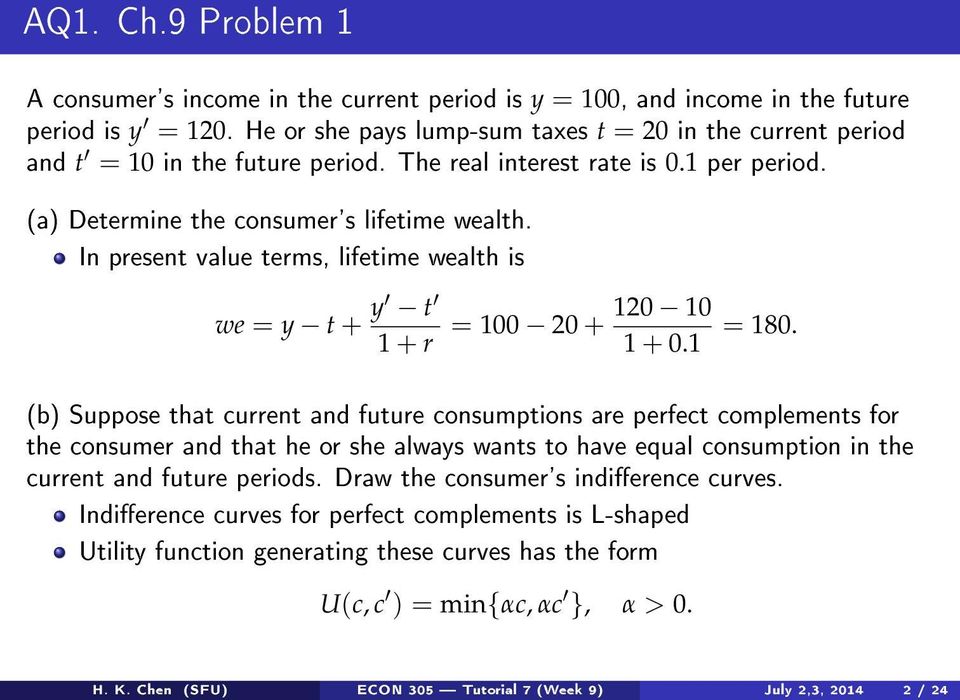
2 AQ1. Ch.9 Problem 1 A consumer's income in the current period is y = 100, and income in the future period is y = 120. He or she pays lump-sum taxes t = 20 in the current period and t = 10 in the future period. The real interest rate is 0.1 per period. (a) Determine the consumer's lifetime wealth. In present value terms, lifetime wealth is we = y t + y t = = 180. (b) Suppose that current and future consumptions are perfect complements for the consumer and that he or she always wants to have equal consumption in the current and future periods. Draw the consumer's indierence curves. Indierence curves for perfect complements is L-shaped Utility function generating these curves has the form U(c, c ) = min{αc, αc }, α > 0. H. K. Chen (SFU) ECON 305 Tutorial 7 (Week 9) July 2,3, / 24
3 H. K. Chen (SFU) ECON 305 Tutorial 7 (Week 9) July 2,3, / 24 AQ1. Ch.9 Problem 1 c c = c E 1 E 2 U 2 U AQ1 (c) AQ1 (d) AQ1 (e) 220 c
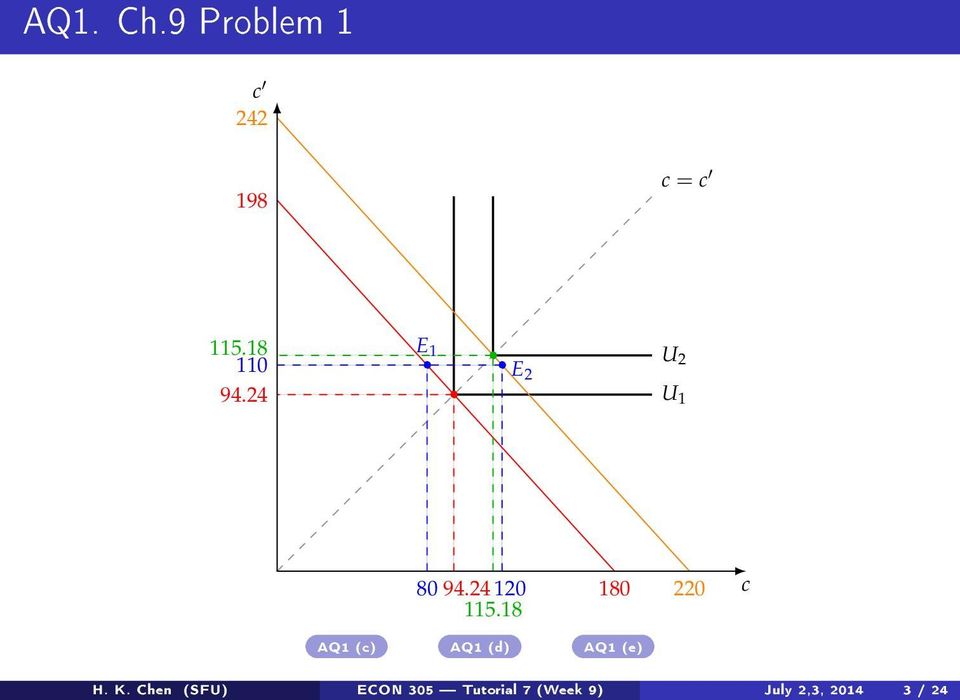
4 H. K. Chen (SFU) ECON 305 Tutorial 7 (Week 9) July 2,3, / 24 AQ1. Ch.9 Problem 1 (c) Determine what the consumer's optimal current-period and future-period consumptions are, and what optimal saving is, and show this in a diagram with the consumer's budget constraint and indierence curves. Is the consumer a lender or a borrower? Draw Intertemporal budget constraint: we = c + () 1 c c = 0.91(180 c). (1) Given the utility function, optimality occurs when Solving (1) and (2) for c, c, we get c = c = c = c. (2) Saving in current period is s = y t c = Therefore the consumer is a borrower.

5 H. K. Chen (SFU) ECON 305 Tutorial 7 (Week 9) July 2,3, / 24 AQ1. Ch.9 Problem 1 (d) Now suppose that instead of y = 100, the consumer has y = 140. Again, determine optimal consumption in the current and future periods and optimal saving, and show this in a diagram. Is the consumer a lender or a borrower? Present value wealth is now we = = 220. Optimality condition (c = c ) and budget constraint (c = 0.91(220 c)) together imply c = c = , s = The consumer now is a lender. Draw (e) Explain the dierences in your results between parts (c) and (d). Consumer switches from borrower in (c) to lender in (d) due to a suciently large increase in the current period income.

6 H. K. Chen (SFU) ECON 305 Tutorial 7 (Week 9) July 2,3, / 24 AQ2. Ch.9 Problem 2 An employer oers his or her employee the option of shifting x units of income from next year to this year. That is, the option is to reduce income next year by x units and increase income this year by x units. (a) Would the employee take this option (use a diagram)? Suppose t = t = 0. Initial lifetime wealth is Lifetime wealth after the shift is we 0 = y + () 1 y. we 1 = y + x + () 1 (y x) = y + () 1 y ( + x 1 () 1 ) } {{ } } {{ } =we 0 >0 if r > 0 we 1 > we 0 whenever r > 0, and so the employee should take the option, provided that interest rate is positive.
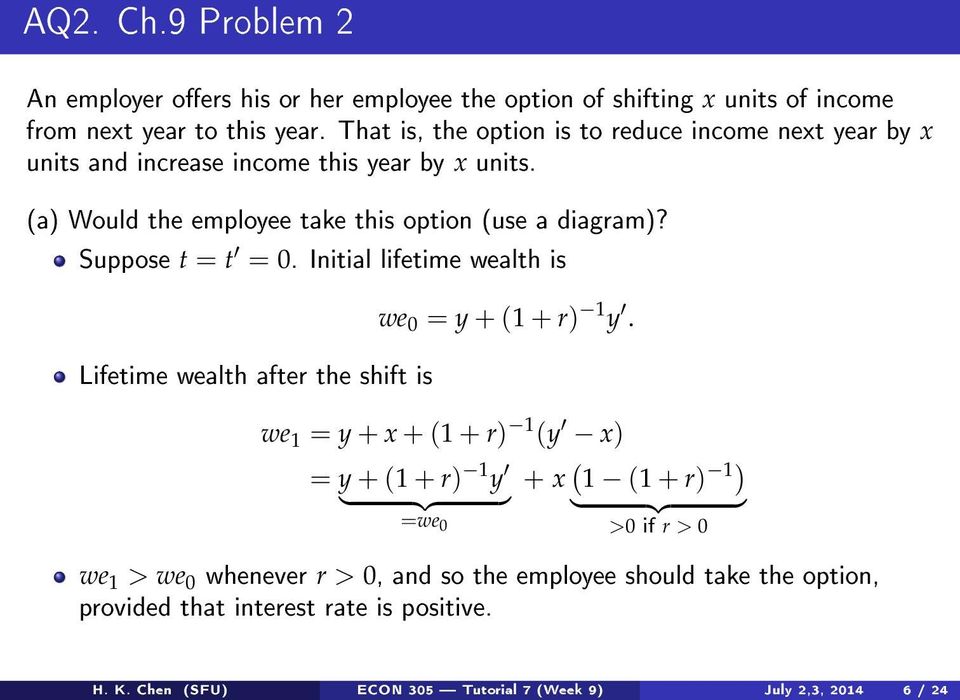
7 H. K. Chen (SFU) ECON 305 Tutorial 7 (Week 9) July 2,3, / 24 AQ2. Ch.9 Problem 2 c ()we 1 ()we 0 slope = () y y x y y + x we 0 we 1 c

8 AQ2. Ch.9 Problem 2 (b) Determine, using a diagram, how this shift in income will aect consumption this year and next year and saving this year. Explain your results. The shift in income creates a pure income eect (shifts budget constraint outwards in a parallel fashion). Thus, both c, c will increase. Saving will increase: c = y + ()s Since c increases while y decreases, s must increase for the equality to hold. H. K. Chen (SFU) ECON 305 Tutorial 7 (Week 9) July 2,3, / 24
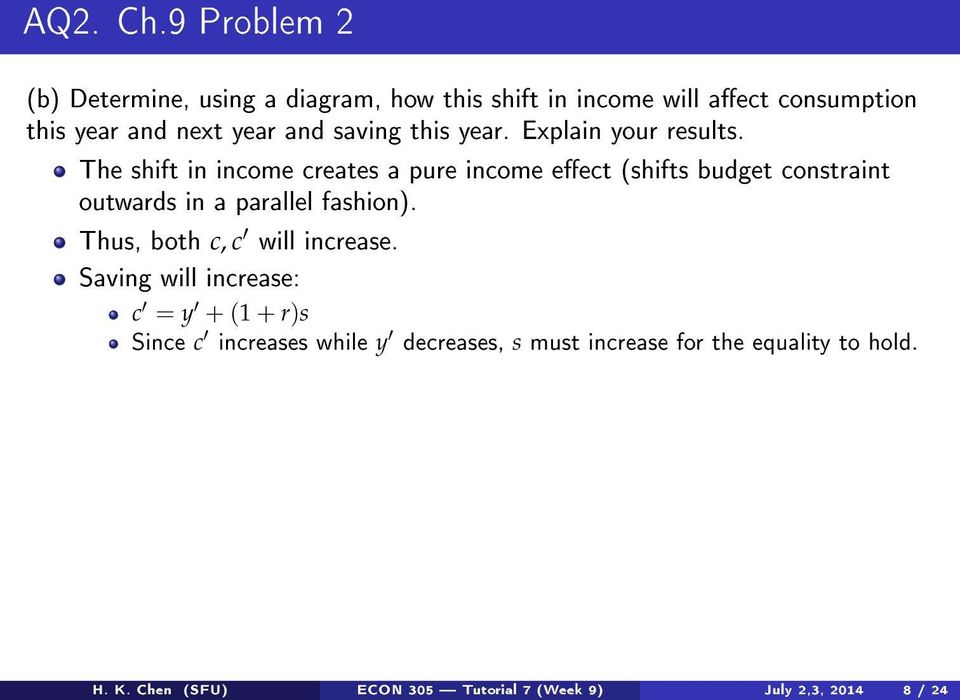
9 AQ3. Ch.9 Problem 3 Consider the following eects of an increase in taxes for a consumer. (a) The consumer's taxes increase by t in the current period. How does this aect current consumption, future consumption, and current saving? c ()we 0 An increase in tax causes budget constraint to shift inwards. ()we 1 Consumption in both periods will drop. Saving also goes down: y E 1 E 0 Consumption smoothing implies that c will decrease by an amount less than t Recall s = y t c y t ywe 1 we 0 c H. K. Chen (SFU) ECON 305 Tutorial 7 (Week 9) July 2,3, / 24
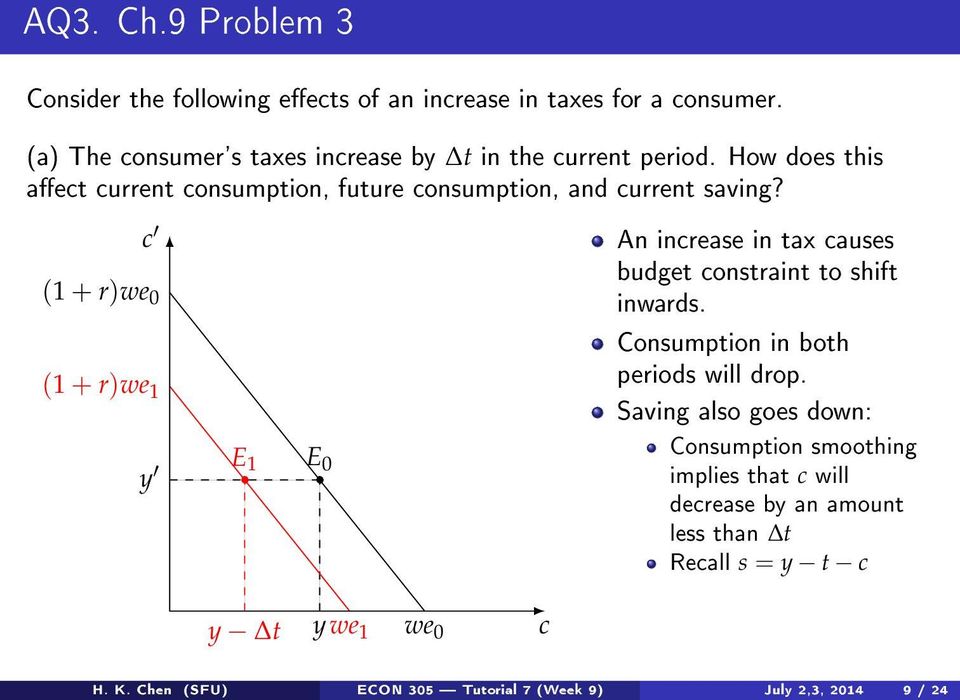
10 H. K. Chen (SFU) ECON 305 Tutorial 7 (Week 9) July 2,3, / 24 AQ3. Ch.9 Problem 3 (b) The consumer's taxes increase permanently, increasing by t in the current and future periods. Using a diagram, determine how this aects current consumption, future consumption, and current saving. Explain the dierences between your results here and in part (a). c ()we 0 A permanent increase in tax shifts budget constraint inwards. Consumption in both periods will drop. Saving is ambiguous. y E 0 y t E 2 y t y we 0 c
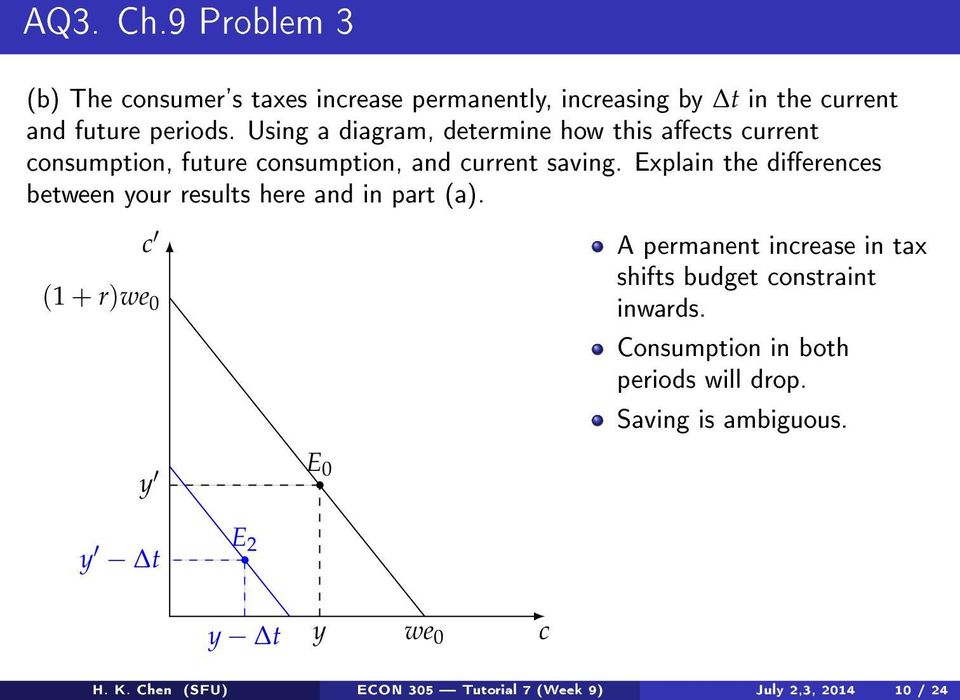
11 H. K. Chen (SFU) ECON 305 Tutorial 7 (Week 9) July 2,3, / 24 AQ4. Ch.9 Problem 4 Suppose that the government introduces a tax on interest earnings. That is, borrowers face a real interest rate of r before and after the tax is introduced, but lenders receive an interest rate of (1 x)r on their savings, where x is the tax rate. Therefore, we are looking at the eect of having x increase from zero to some value greater than zero, with r assumed to remain constant. (a) Show the eects of the increase in the tax rate on the consumer's lifetime budget constraint. c ()we slope = () (1 + (1 x)r)y + y slope = (1 + (1 x)r) E y Tax on interest income causes lender's budget constraint to pivot down around initial endowment. Budget constraint for borrowers doesn't change. y we c
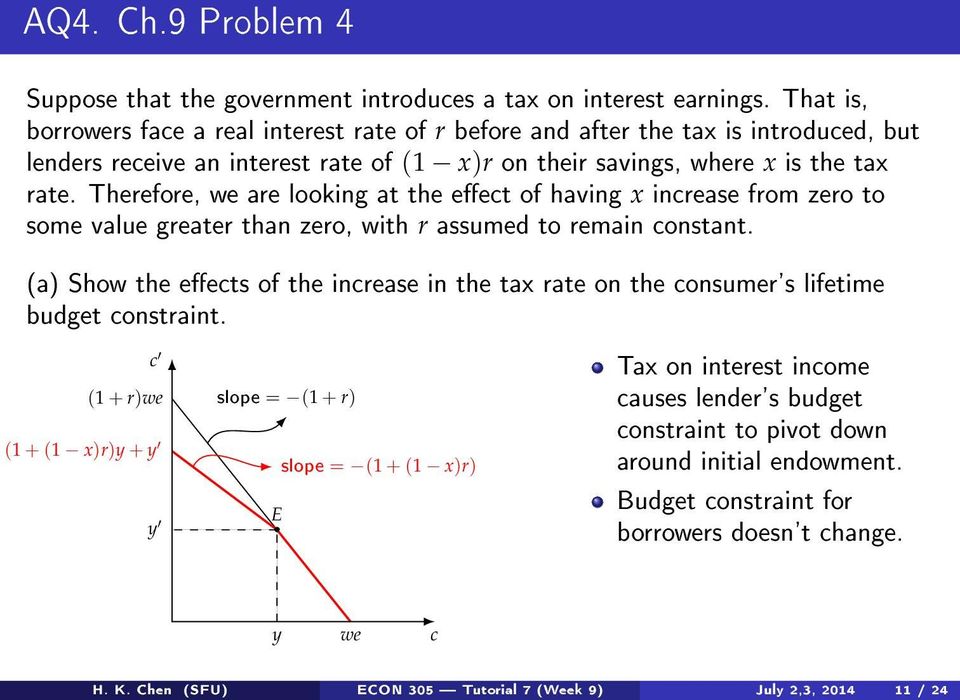
12 AQ4. Ch.9 Problem 4 (b) How does the increase in the tax rate aect the optimal choice of consumption (in the current and future periods) and saving for the consumer? Show how income and substitution eects matter for your answer, and show how it matters whether the consumer is initially a borrower or a lender. c ()we (1 + (1 x)r)y + y y C A B E y we c Consumer is unaected if initially a borrower. If initially a lender, and post-policy consumption bundle is at point C, then there will be substitution eect (A B) and income eect (B C). c decreases as a result, but eect on c (hence s) is ambiguous and depends on shape of utility H. K. Chen (SFU) ECON 305 Tutorial 7 (Week 9) July 2,3, / 24

13 H. K. Chen (SFU) ECON 305 Tutorial 7 (Week 9) July 2,3, / 24 AQ5. Ch.9 Problem 5 A consumer's income in the current and future periods are y and y, respectively. He pays taxes t and t in the two periods. The consumer can borrow and lend at the real interest rate r. This consumer faces a constraint on how much he can borrow. That is, the consumer cannot borrow more than x, where x < we y + t, with we denoting lifetime wealth. Use diagrams to determine the eects on the consumer's current consumption, future consumption, and savings of a change in x, and explain your results. c ()we y t E x y t B we we y + t c Saving is unaected. There is a borrowing constraint B. Budget line becomes vertical at B. If borrowing constraint is binding, IC touches budget constraint at the kink. If borrowing constraint not binding, the usual tangency condition applies.

14 H. K. Chen (SFU) ECON 305 Tutorial 7 (Week 9) July 2,3, / 24 AQ6. Ch.9 Problem 7 Suppose that all consumers are identical, and also assume that the real interest rate r is xed. Suppose that the government wants to collect a given amount of tax revenue R, in present value terms. Assume that the government has two options: (i) a proportional tax of s per unit of savings, in that the tax collected per consumer is s(y c); (ii) a proportional tax u on consumption in the current and future periods, so that the present value of the toal tax collected per consumer is uc + 1+r uc. Note that the tax rate s could be positive or negative. For example if consumers borrow, then s would need to be less than zero for the government to collect tax revenue. Show that option (ii) is preferable to option (i) if the government wishes to make consumers as well o as possible, and explain why this is so. [Hint: Show that the consumption bundle that consumers choose under option (i) could have been chosen under option (ii), but was not.] The hint suggests us to appeal to the weak axiom of revealed preference (WARP).

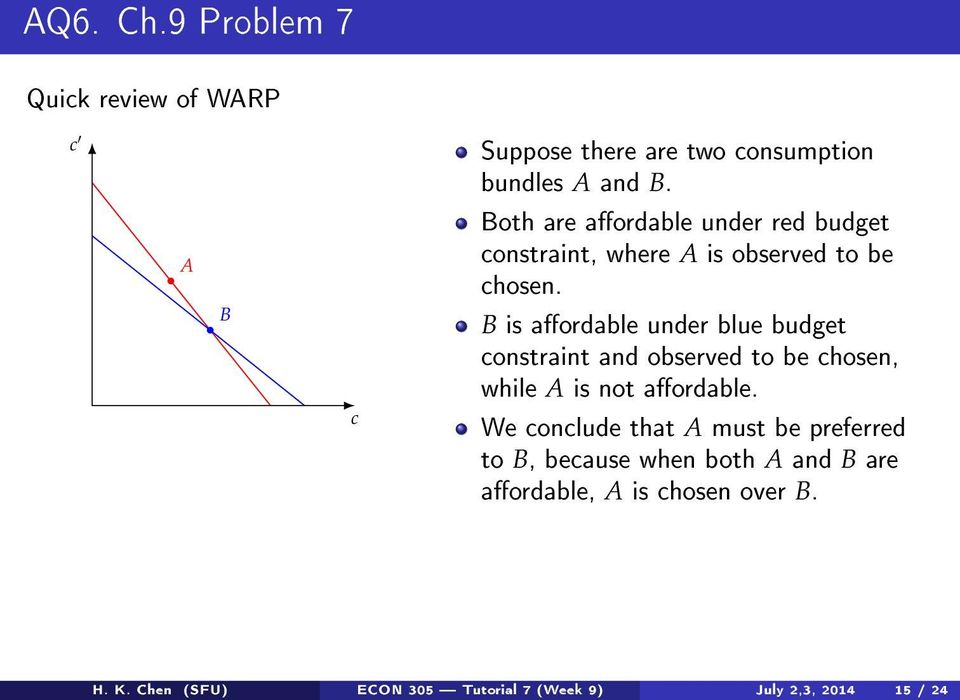
15 H. K. Chen (SFU) ECON 305 Tutorial 7 (Week 9) July 2,3, / 24 AQ6. Ch.9 Problem 7 Quick review of WARP c Suppose there are two consumption bundles A and B. A B c Both are aordable under red budget constraint, where A is observed to be chosen. B is aordable under blue budget constraint and observed to be chosen, while A is not aordable. We conclude that A must be preferred to B, because when both A and B are aordable, A is chosen over B.
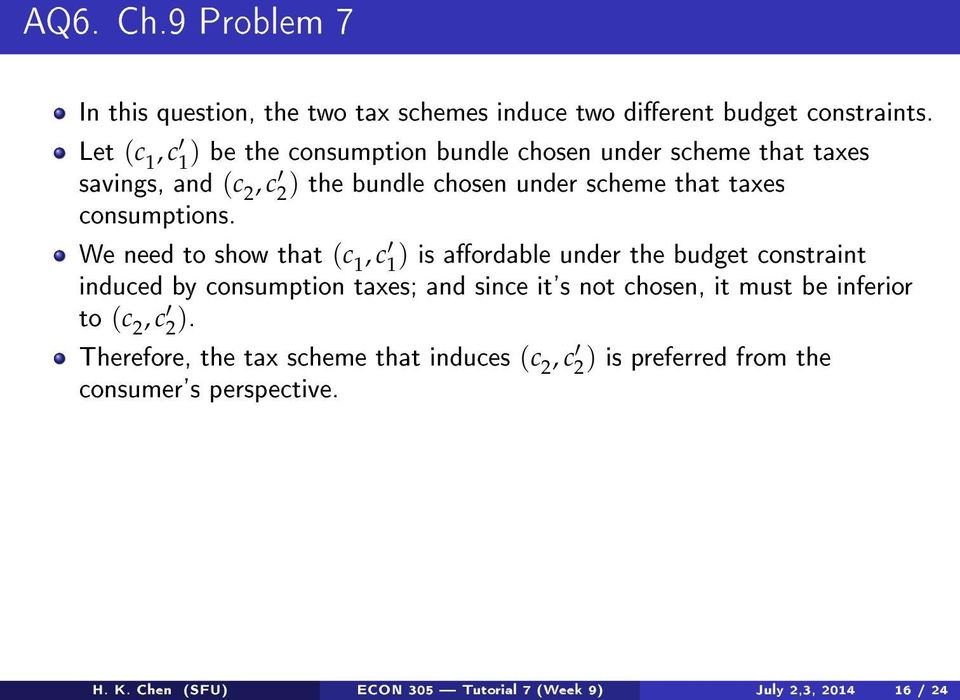
16 H. K. Chen (SFU) ECON 305 Tutorial 7 (Week 9) July 2,3, / 24 AQ6. Ch.9 Problem 7 In this question, the two tax schemes induce two dierent budget constraints. Let (c 1, c 1 ) be the consumption bundle chosen under scheme that taxes savings, and (c 2, c 2 ) the bundle chosen under scheme that taxes consumptions. We need to show that (c 1, c 1 ) is aordable under the budget constraint induced by consumption taxes; and since it's not chosen, it must be inferior to (c 2, c 2 ). Therefore, the tax scheme that induces (c 2, c 2 ) is preferred from the consumer's perspective.
17 H. K. Chen (SFU) ECON 305 Tutorial 7 (Week 9) July 2,3, / 24 AQ6. Ch.9 Problem 7 Budget constraint under savings tax is c 1 + c 1 = y + y s(y c 1). (1) Budget constraint under consumption taxes is ( (1 + u) c 2 + c 2 ( ) u c 2 + c 2 (2) ) = y + y. (3) c 2 + c 2 = y + y Since tax revenue is the same under both schemes, ( ) R = s(y c 1 ) = u c 2 + c 2. (4)

18 H. K. Chen (SFU) ECON 305 Tutorial 7 (Week 9) July 2,3, / 24 AQ6. Ch.9 Problem 7 From (4), it follows that ( ) 1 ( u = R c 2 + c u = R + c c 2 r )( c 2 + c 2 eq. (2) & (4) ======= = (y + )(y y + y R Evaluate (c 1, c 1 ) in budget constraint under consumption tax (3): ( ) (1 + u) c 1 + c 1 y + y (y + y ) ) 1 ( (y + y R c 1 + c 1 ) = y + y ) 1 ) 1
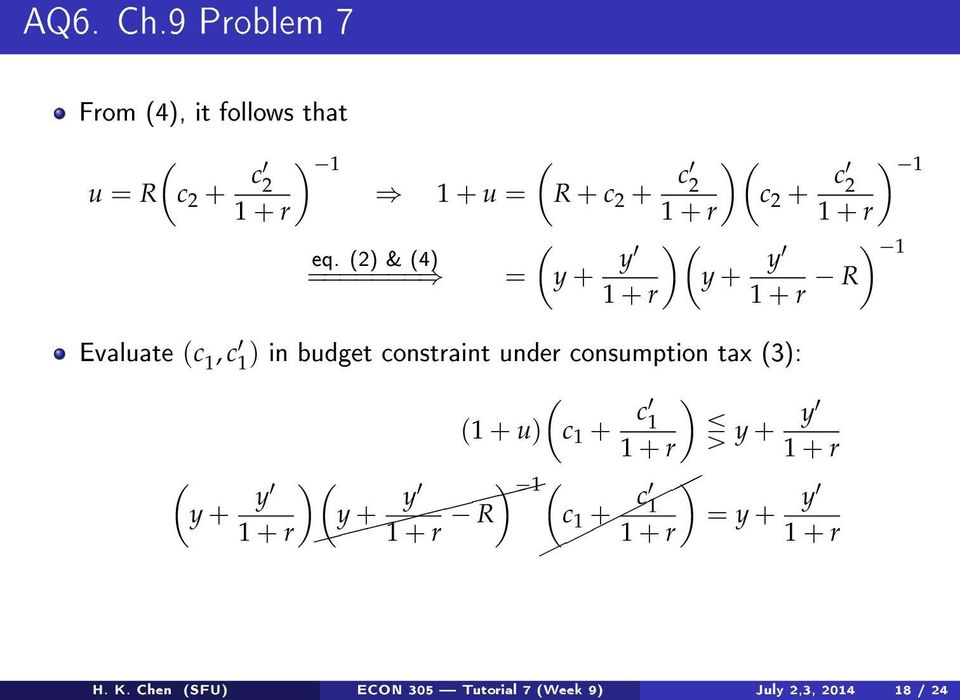
19 AQ6. Ch.9 Problem 7 Therefore, (c 1, c 1 ) is exactly aordable under the consumption taxes scheme. But (c 2, c 2 ) is chosen over (c 1, c 1 ). We thus conclude that consumption taxes is preferred to tax on savings. Despite the mathematics, the intuition is simple: Tax on savings changes the slope of the budget line, thus creating income and substitution eects. The consumption taxes in this question are equivalent to a lump-sum tax, which creates a pure income eect, and hence lead to no distortion in consumer's behavior. H. K. Chen (SFU) ECON 305 Tutorial 7 (Week 9) July 2,3, / 24

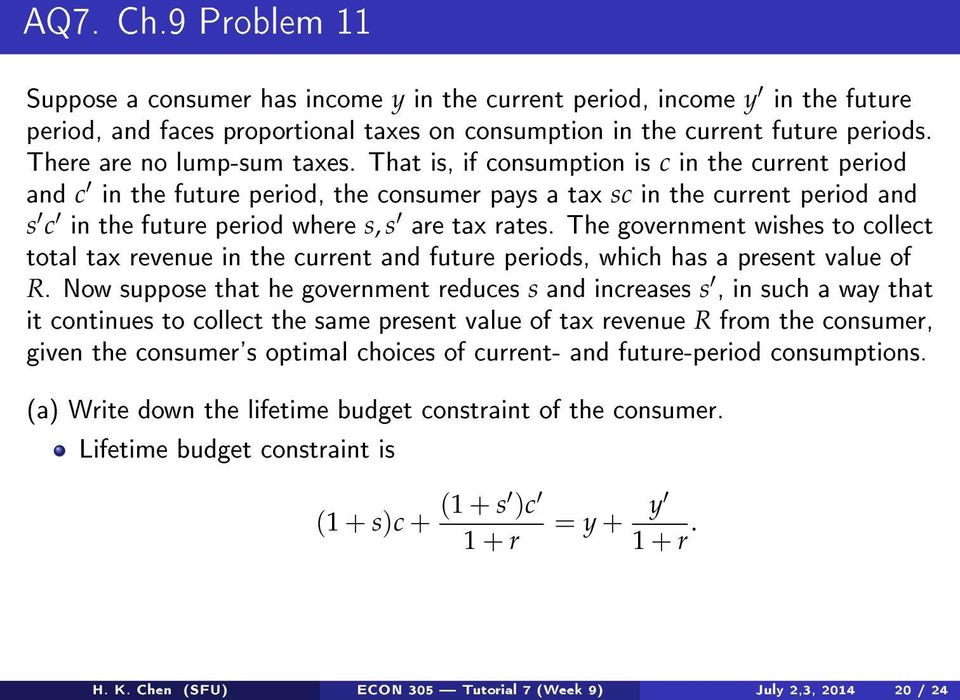
20 H. K. Chen (SFU) ECON 305 Tutorial 7 (Week 9) July 2,3, / 24 AQ7. Ch.9 Problem 11 Suppose a consumer has income y in the current period, income y in the future period, and faces proportional taxes on consumption in the current future periods. There are no lump-sum taxes. That is, if consumption is c in the current period and c in the future period, the consumer pays a tax sc in the current period and s c in the future period where s, s are tax rates. The government wishes to collect total tax revenue in the current and future periods, which has a present value of R. Now suppose that he government reduces s and increases s, in such a way that it continues to collect the same present value of tax revenue R from the consumer, given the consumer's optimal choices of current- and future-period consumptions. (a) Write down the lifetime budget constraint of the consumer. Lifetime budget constraint is (1 + s)c + (1 + s )c = y + y.
21 H. K. Chen (SFU) ECON 305 Tutorial 7 (Week 9) July 2,3, / 24 AQ7. Ch.9 Problem 11 (b) Show that lifetime wealth is the same for the consumer, before and after the change in tax rates. Lifetime wealth is y + () 1 y, which is independent of s, s. (c) What eect, if any, does the change in tax rates have on the consumer's choice of current and future consumptions, and on savings? Does Ricardian equivalence hold here? Explain why or why not. The change will in general aect consumption and saving decisions. From the budget constraint, relative price of consumption is ()(1 + s)/(1 + s ), (1 + s)c + (1 + s )c = y + y. Changes in s, s alters the slope of the budget line, thus creating distortions in consumer's decisions. So Ricardian equivalence does not hold here.
22 H. K. Chen (SFU) ECON 305 Tutorial 7 (Week 9) July 2,3, / 24 AQ8. Ch.9 Problem 12 Suppose in our two-period model of the economy that the government, instead of borrowing in the current period, runs a government loan program. That is, loans are made to consumers at the market real interest rate r, with the aggregate quantity of loans made in the current period denoted by L. Government loans are nanced by lump-sum taxes on consumers in the current period, and we assume that government spending is zero in the current and future periods. In the future period, when the government loans are repaid by consumers, the government rebates this amount as lump-sum transfers (negative taxes) to consumers. (a) Write down the government's current-period budget constraint and its future-period budget constraint. Current period: T = L; future period: T = ()L. (b) Determine the present-value budget constraint of the government. PV budget constraint: L + ( L) = T + T
23 H. K. Chen (SFU) ECON 305 Tutorial 7 (Week 9) July 2,3, / 24 AQ8. Ch.9 Problem 12 (c) Write down the lifetime budget constraint of a consumer. Consumer's budget constraint: c + c = (y + l t) + ( y ()l t ) where the lower case l, t, t are loan and taxes for an individual consumer. (d) Show that the size of the government loan program (i.e., the quantity L) has no eect on current consumption or future consumption for each individual consumer and that there is no eect on the equilibrium real interest rate. Explain this result. Loan size does not change the PV of taxes, and does not aect interest rate. Therefore, no change in consumptions.
24 H. K. Chen (SFU) ECON 305 Tutorial 7 (Week 9) July 2,3, / 24 MC113 MC solutions: 15: B C C D A 610: A B B B C 1113: B B A
Intermediate Microeconomics (22014)
 Intermediate Microeconomics (22014) I. Consumer Instructor: Marc Teignier-Baqué First Semester, 2011 Outline Part I. Consumer 1. umer 1.1 Budget Constraints 1.2 Preferences 1.3 Utility Function 1.4 1.5
Problem Set #3 Answer Key
 Problem Set #3 Answer Key Economics 305: Macroeconomic Theory Spring 2007 1 Chapter 4, Problem #2 a) To specify an indifference curve, we hold utility constant at ū. Next, rearrange in the form: C = ū
The Time Value of Money
 The Time Value of Money This handout is an overview of the basic tools and concepts needed for this corporate nance course. Proofs and explanations are given in order to facilitate your understanding and
Noah Williams Economics 312. University of Wisconsin Spring 2013. Midterm Examination Solutions
 Noah Williams Economics 31 Department of Economics Macroeconomics University of Wisconsin Spring 013 Midterm Examination Solutions Instructions: This is a 75 minute examination worth 100 total points.
Notes on indifference curve analysis of the choice between leisure and labor, and the deadweight loss of taxation. Jon Bakija
 Notes on indifference curve analysis of the choice between leisure and labor, and the deadweight loss of taxation Jon Bakija This example shows how to use a budget constraint and indifference curve diagram
17. If a good is normal, then the Engel curve A. Slopes upward B. Slopes downward C. Is vertical D. Is horizontal
 Sample Exam 1 1. Suppose that when the price of hot dogs is $2 per package, there is a demand for 10,000 bags of hot dog buns. When the price of hot dogs is $3 per package, the demand for hot dog buns
Problem Set #5-Key. Economics 305-Intermediate Microeconomic Theory
 Problem Set #5-Key Sonoma State University Economics 305-Intermediate Microeconomic Theory Dr Cuellar (1) Suppose that you are paying your for your own education and that your college tuition is $200 per
. In this case the leakage effect of tax increases is mitigated because some of the reduction in disposable income would have otherwise been saved.
 Chapter 4 Review Questions. Explain how an increase in government spending and an equal increase in lump sum taxes can generate an increase in equilibrium output. Under what conditions will a balanced
Lecture 1: The intertemporal approach to the current account
 Lecture 1: The intertemporal approach to the current account Open economy macroeconomics, Fall 2006 Ida Wolden Bache August 22, 2006 Intertemporal trade and the current account What determines when countries
1. Briefly explain what an indifference curve is and how it can be graphically derived.
 Chapter 2: Consumer Choice Short Answer Questions 1. Briefly explain what an indifference curve is and how it can be graphically derived. Answer: An indifference curve shows the set of consumption bundles
Chapter 21: The Discounted Utility Model
 Chapter 21: The Discounted Utility Model 21.1: Introduction This is an important chapter in that it introduces, and explores the implications of, an empirically relevant utility function representing intertemporal
AK 4 SLUTSKY COMPENSATION
 AK 4 SLUTSKY COMPENSATION ECON 210 A. JOSEPH GUSE (1) (a) First calculate the demand at the original price p b = 2 b(p b,m) = 1000 20 5p b b 0 = b(2) = 40 In general m c = m+(p 1 b p0 b )b 0. If the price
How To Find Out How To Balance The Two-Country Economy
 A Two-Period Model of the Current Account Obstfeld and Rogo, Chapter 1 1 Small Open Endowment Economy 1.1 Consumption Optimization problem maximize U i 1 = u c i 1 + u c i 2 < 1 subject to the budget constraint
Chapter 4 Inflation and Interest Rates in the Consumption-Savings Framework
 Chapter 4 Inflation and Interest Rates in the Consumption-Savings Framework The lifetime budget constraint (LBC) from the two-period consumption-savings model is a useful vehicle for introducing and analyzing
the transmission channels of monetary policy the fragility of the nancial system the existence of nancial cycles
 1 The macroeconomic consequences of nancial imperfections the transmission channels of monetary policy the fragility of the nancial system the existence of nancial cycles the real eects of nancial intermediation
Common sense, and the model that we have used, suggest that an increase in p means a decrease in demand, but this is not the only possibility.
 Lecture 6: Income and Substitution E ects c 2009 Je rey A. Miron Outline 1. Introduction 2. The Substitution E ect 3. The Income E ect 4. The Sign of the Substitution E ect 5. The Total Change in Demand
Slutsky Equation. M. Utku Ünver Micro Theory. Boston College. M. Utku Ünver Micro Theory (BC) Slutsky Equation 1 / 15
 Slutsky Equation M. Utku Ünver Micro Theory Boston College M. Utku Ünver Micro Theory (BC) Slutsky Equation 1 / 15 Effects of a Price Change: What happens when the price of a commodity decreases? 1 The
Chapter 13 Real Business Cycle Theory
 Chapter 13 Real Business Cycle Theory Real Business Cycle (RBC) Theory is the other dominant strand of thought in modern macroeconomics. For the most part, RBC theory has held much less sway amongst policy-makers
Lecture Note 7: Revealed Preference and Consumer Welfare
 Lecture Note 7: Revealed Preference and Consumer Welfare David Autor, Massachusetts Institute of Technology 14.03/14.003 Microeconomic Theory and Public Policy, Fall 2010 1 1 Revealed Preference and Consumer
Lesson 1. Net Present Value. Prof. Beatriz de Blas
 Lesson 1. Net Present Value Prof. Beatriz de Blas April 2006 1. Net Present Value 1 1. Introduction When deciding to invest or not, a rm or an individual has to decide what to do with the money today.
The Real Business Cycle model
 The Real Business Cycle model Spring 2013 1 Historical introduction Modern business cycle theory really got started with Great Depression Keynes: The General Theory of Employment, Interest and Money Keynesian
CHAPTER 3 CONSUMER BEHAVIOR
 CHAPTER 3 CONSUMER BEHAVIOR EXERCISES 2. Draw the indifference curves for the following individuals preferences for two goods: hamburgers and beer. a. Al likes beer but hates hamburgers. He always prefers
This paper is not to be removed from the Examination Halls
 This paper is not to be removed from the Examination Halls UNIVERSITY OF LONDON EC2065 ZA BSc degrees and Diplomas for Graduates in Economics, Management, Finance and the Social Sciences, the Diplomas
MULTIPLE CHOICE. Choose the one alternative that best completes the statement or answers the question.
 MULTIPLE CHOICE. Choose the one alternative that best completes the statement or answers the question. 1) The law of demand states that, other things remaining the same, the lower the price of a good,
ECON 20310 Elements of Economic Analysis IV. Problem Set 1
 ECON 20310 Elements of Economic Analysis IV Problem Set 1 Due Thursday, October 11, 2012, in class 1 A Robinson Crusoe Economy Robinson Crusoe lives on an island by himself. He generates utility from leisure
Chapter 4 The Theory of Individual Behavior
 Managerial Economics & Business Strategy Chapter 4 The Theory of Individual Behavior McGraw-Hill/Irwin Copyright 2010 by the McGraw-Hill Companies, Inc. All rights reserved. Overview I. Consumer Behavior
3. George W. Bush is the current U.S. President. This is an example of a: A. Normative statement B. Positive statement
 Econ 3144 Fall 2006 Test 1 Dr. Rupp Name Sign Pledge I have neither given nor received aid on this exam Multiple Choice Questions (3 points each) 1. What you give up to obtain an item is called your A.
Utility Maximization
 Utility Maimization Given the consumer's income, M, and prices, p and p y, the consumer's problem is to choose the a ordable bundle that maimizes her utility. The feasible set (budget set): total ependiture
Preferences. M. Utku Ünver Micro Theory. Boston College. M. Utku Ünver Micro Theory (BC) Preferences 1 / 20
 Preferences M. Utku Ünver Micro Theory Boston College M. Utku Ünver Micro Theory (BC) Preferences 1 / 20 Preference Relations Given any two consumption bundles x = (x 1, x 2 ) and y = (y 1, y 2 ), the
Chapter 4 Consumption, Saving, and Investment
 Chapter 4 Consumption, Saving, and Investment Multiple Choice Questions 1. Desired national saving equals (a) Y C d G. (b) C d + I d + G. (c) I d + G. (d) Y I d G. 2. With no inflation and a nominal interest
Managerial Economics Prof. Trupti Mishra S.J.M. School of Management Indian Institute of Technology, Bombay. Lecture - 13 Consumer Behaviour (Contd )
 (Refer Slide Time: 00:28) Managerial Economics Prof. Trupti Mishra S.J.M. School of Management Indian Institute of Technology, Bombay Lecture - 13 Consumer Behaviour (Contd ) We will continue our discussion
Outline. Not assigned problems Chapter 11. Q10 Go Chapter 11. Q14 Go Chapter 11. Q20 Go Chapter 11. Q22 Go Chapter 11. Q26 Go
 Outline Not assigned problems Chapter 11. Q10 Go Chapter 11. Q14 Go Chapter 11. Q20 Go Chapter 11. Q22 Go Chapter 11. Q26 Go Assignment problems: Chapter 11. Q4 Go Chapter 11. Q8 Go Chapter 11. Q12 Go
Chapter 4. Specific Factors and Income Distribution
 Chapter 4 Specific Factors and Income Distribution Introduction So far we learned that countries are overall better off under free trade. If trade is so good for the economy, why is there such opposition?
Theory of Demand. ECON 212 Lecture 7. Tianyi Wang. Winter 2013. Queen s Univerisity. Tianyi Wang (Queen s Univerisity) Lecture 7 Winter 2013 1 / 46
 Theory of Demand ECON 212 Lecture 7 Tianyi Wang Queen s Univerisity Winter 2013 Tianyi Wang (Queen s Univerisity) Lecture 7 Winter 2013 1 / 46 Intro Note: Quiz 1 can be picked up at Distribution Center.
Money and Public Finance
 Money and Public Finance By Mr. Letlet August 1 In this anxious market environment, people lose their rationality with some even spreading false information to create trading opportunities. The tales about
Figure 4-1 Price Quantity Quantity Per Pair Demanded Supplied $ 2 18 3 $ 4 14 4 $ 6 10 5 $ 8 6 6 $10 2 8
 Econ 101 Summer 2005 In-class Assignment 2 & HW3 MULTIPLE CHOICE 1. A government-imposed price ceiling set below the market's equilibrium price for a good will produce an excess supply of the good. a.
Agenda. The IS LM Model, Part 2. The Demand for Money. The Demand for Money. The Demand for Money. Asset Market Equilibrium.
 Agenda The IS LM Model, Part 2 Asset Market Equilibrium The LM Curve 13-1 13-2 The demand for money is the quantity of money people want to hold in their portfolios. The demand for money depends on expected
Economics 100A. Final Exam
 Name form number 1 Economics 100A Final Exam Fill in the bubbles on your scantron with your id number (starting from the left side of the box), your name, and the form type. Students who do this successfully
Universidad de Montevideo Macroeconomia II. The Ramsey-Cass-Koopmans Model
 Universidad de Montevideo Macroeconomia II Danilo R. Trupkin Class Notes (very preliminar) The Ramsey-Cass-Koopmans Model 1 Introduction One shortcoming of the Solow model is that the saving rate is exogenous
12.1 Introduction. 12.2 The MP Curve: Monetary Policy and the Interest Rates 1/24/2013. Monetary Policy and the Phillips Curve
 Chapter 12 Monetary Policy and the Phillips Curve By Charles I. Jones Media Slides Created By Dave Brown Penn State University The short-run model summary: Through the MP curve the nominal interest rate
Chapter 6 Supply of Labor to the Economy: The Decision to Work
 Chapter 6 Supply of Labor to the Economy: The Decision to Work Beyond introducing some descriptive material on labor force trends in this century, the primary purpose of Chapter 6 is to present an analysis
Money. 1 What is money? Spring 2013. 3 functions of money: Store of value Unit of account Medium of exchange
 Money Spring 2013 1 What is money? 3 functions of money: Store of value Unit of account Medium of exchange Whether something is money is not always so clear: Physical bills and coins Balances on checking
Money and Capital in an OLG Model
 Money and Capital in an OLG Model D. Andolfatto June 2011 Environment Time is discrete and the horizon is infinite ( =1 2 ) At the beginning of time, there is an initial old population that lives (participates)
I d ( r; MPK f, τ) Y < C d +I d +G
 1. Use the IS-LM model to determine the effects of each of the following on the general equilibrium values of the real wage, employment, output, the real interest rate, consumption, investment, and the
Capital Structure II
 Capital Structure II Introduction In the previous lecture we introduced the subject of capital gearing. Gearing occurs when a company is financed partly through fixed return finance (e.g. loans, loan stock
Name. Final Exam, Economics 210A, December 2011 Here are some remarks to help you with answering the questions.
 Name Final Exam, Economics 210A, December 2011 Here are some remarks to help you with answering the questions. Question 1. A firm has a production function F (x 1, x 2 ) = ( x 1 + x 2 ) 2. It is a price
Suppose you are a seller with cost 13 who must pay a sales tax of 15. What is the lowest price you can sell at and not lose money?
 Experiment 3 Suppose that sellers pay a tax of 15. If a seller with cost 5 sells to a buyer with value 45 at a price of 25, the seller earns a profit of and the buyer earns a profit of. Suppose you are
The Specific-Factors Model: HO Model in the Short Run
 The Specific-Factors Model: HO Model in the Short Run Rahul Giri Contact Address: Centro de Investigacion Economica, Instituto Tecnologico Autonomo de Mexico (ITAM). E-mail: [email protected] In this
Prices versus Exams as Strategic Instruments for Competing Universities
 Prices versus Exams as Strategic Instruments for Competing Universities Elena Del Rey and Laura Romero October 004 Abstract In this paper we investigate the optimal choice of prices and/or exams by universities
The level of price and inflation Real GDP: the values of goods and services measured using a constant set of prices
 Chapter 2: Key Macroeconomics Variables ECON2 (Spring 20) 2 & 4.3.20 (Tutorial ) National income accounting Gross domestic product (GDP): The market value of all final goods and services produced within
Econ 116 Mid-Term Exam
 Econ 116 Mid-Term Exam Part 1 1. True. Large holdings of excess capital and labor are indeed bad news for future investment and employment demand. This is because if firms increase their output, they will
Consumption and Savings Decisions: A Two-Period Setting
 Consumption and Savings Decisions: A Two-Period Setting Dynamic Macroeconomic Analysis Universidad Autonóma de Madrid Fall 2012 Dynamic Macroeconomic Analysis (UAM) Consumption and Savings Fall 2012 1
Utility. M. Utku Ünver Micro Theory. M. Utku Ünver Micro Theory Utility 1 / 15
 Utility M. Utku Ünver Micro Theory M. Utku Ünver Micro Theory Utility 1 / 15 Utility Function The preferences are the fundamental description useful for analyzing choice and utility is simply a way of
(a) Using an MPC of.5, the impact of $100 spent the government will be as follows: 1 100 100 2 50 150 3 25 175 4 12.5 187.5 5 6.25 193.
 S5 Solutions 24 points Chapter 2: Fiscal policy. If the marginal propensity to save is.5, how large is the multiplier? If the marginal propensity to save doubles to., what happens to the multiplier? With
Class Notes, Econ 8801 Lump Sum Taxes are Awesome
 Class Notes, Econ 8801 Lump Sum Taxes are Awesome Larry E. Jones 1 Exchange Economies with Taxes and Spending 1.1 Basics 1) Assume that there are n goods which can be consumed in any non-negative amounts;
Week 3: Demand Theory and Welfare Analysis
 Week 3: Demand Theory and Welfare Analysis 1. Suppose the price of good increases so that the optimal chosen bundle changes from B 1 to B 2. If we think of good y as a numeraire good so that p y =1, then
Table of Contents MICRO ECONOMICS
 economicsentrance.weebly.com Basic Exercises Micro Economics AKG 09 Table of Contents MICRO ECONOMICS Budget Constraint... 4 Practice problems... 4 Answers... 4 Supply and Demand... 7 Practice Problems...
Employment and Pricing of Inputs
 Employment and Pricing of Inputs Previously we studied the factors that determine the output and price of goods. In chapters 16 and 17, we will focus on the factors that determine the employment level
Lecture notes for Choice Under Uncertainty
 Lecture notes for Choice Under Uncertainty 1. Introduction In this lecture we examine the theory of decision-making under uncertainty and its application to the demand for insurance. The undergraduate
Module 7: Debt Contracts & Credit Rationing
 Module 7: Debt Contracts & Credit ationing Information Economics (Ec 515) George Georgiadis Two Applications of the principal-agent model to credit markets An entrepreneur (E - borrower) has a project.
Market for cream: P 1 P 2 D 1 D 2 Q 2 Q 1. Individual firm: W Market for labor: W, S MRP w 1 w 2 D 1 D 1 D 2 D 2
 Factor Markets Problem 1 (APT 93, P2) Two goods, coffee and cream, are complements. Due to a natural disaster in Brazil that drastically reduces the supply of coffee in the world market the price of coffee
Introduction to Economics, ECON 100:11 & 13 Multiplier Model
 Introduction to Economics, ECON 1:11 & 13 We will now rationalize the shape of the aggregate demand curve, based on the identity we have used previously, AE=C+I+G+(X-IM). We will in the process develop
ECON 3312 Macroeconomics Exam 3 Fall 2014. Name MULTIPLE CHOICE. Choose the one alternative that best completes the statement or answers the question.
 ECON 3312 Macroeconomics Exam 3 Fall 2014 Name MULTIPLE CHOICE. Choose the one alternative that best completes the statement or answers the question. 1) Everything else held constant, an increase in net
4 THE MARKET FORCES OF SUPPLY AND DEMAND
 4 THE MARKET FORCES OF SUPPLY AND DEMAND IN THIS CHAPTER YOU WILL Learn what a competitive market is Examine what determines the demand for a good in a competitive market Chapter Overview Examine what
REVIEW OF MICROECONOMICS
 ECO 352 Spring 2010 Precepts Weeks 1, 2 Feb. 1, 8 REVIEW OF MICROECONOMICS Concepts to be reviewed Budget constraint: graphical and algebraic representation Preferences, indifference curves. Utility function
Long-Run Average Cost. Econ 410: Micro Theory. Long-Run Average Cost. Long-Run Average Cost. Economies of Scale & Scope Minimizing Cost Mathematically
 Slide 1 Slide 3 Econ 410: Micro Theory & Scope Minimizing Cost Mathematically Friday, November 9 th, 2007 Cost But, at some point, average costs for a firm will tend to increase. Why? Factory space and
Intertemporal approach to current account: small open economy
 Intertemporal approach to current account: small open economy Ester Faia Johann Wolfgang Goethe Universität Frankfurt a.m. March 2009 ster Faia (Johann Wolfgang Goethe Universität Intertemporal Frankfurt
Our development of economic theory has two main parts, consumers and producers. We will start with the consumers.
 Lecture 1: Budget Constraints c 2008 Je rey A. Miron Outline 1. Introduction 2. Two Goods are Often Enough 3. Properties of the Budget Set 4. How the Budget Line Changes 5. The Numeraire 6. Taxes, Subsidies,
Q D = 100 - (5)(5) = 75 Q S = 50 + (5)(5) = 75.
 4. The rent control agency of New York City has found that aggregate demand is Q D = 100-5P. Quantity is measured in tens of thousands of apartments. Price, the average monthly rental rate, is measured
1. Various shocks on a small open economy
 Problem Set 3 Econ 122a: Fall 2013 Prof. Nordhaus and Staff Due: In class, Wednesday, September 25 Problem Set 3 Solutions Sebastian is responsible for this answer sheet. If you have any questions about
Lecture 2. Marginal Functions, Average Functions, Elasticity, the Marginal Principle, and Constrained Optimization
 Lecture 2. Marginal Functions, Average Functions, Elasticity, the Marginal Principle, and Constrained Optimization 2.1. Introduction Suppose that an economic relationship can be described by a real-valued
Practice Problem Set 2 (ANSWERS)
 Economics 370 Professor H.J. Schuetze Practice Problem Set 2 (ANSWERS) 1. See the figure below, where the initial budget constraint is given by ACE. After the new legislation is passed, the budget constraint
Principles of Economics: Micro: Exam #2: Chapters 1-10 Page 1 of 9
 Principles of Economics: Micro: Exam #2: Chapters 1-10 Page 1 of 9 print name on the line above as your signature INSTRUCTIONS: 1. This Exam #2 must be completed within the allocated time (i.e., between
ECON 3240 Session 3. Instructor: Dr. David K. Lee
 ECON 3240 Session 3 Instructor: Dr. David K. Lee Department of Economics York University Topic: Labor Supply and Public Policy: Readings: Ch 3 Please read the related topics from other microeconomics textbooks
International Trade Policy ECON 4633 Prof. Javier Reyes. Test #1
 International Trade Policy ECON 4633 Prof. Javier Reyes Test #1 Instructions Out of the following 10 questions you must answer only 8. You are free to choose questions from different sections. Section
MERSİN UNIVERSITY FACULTY OF ECONOMICS AND ADMINISTRATIVE SCİENCES DEPARTMENT OF ECONOMICS MICROECONOMICS MIDTERM EXAM DATE 18.11.
 MERSİN UNIVERSITY FACULTY OF ECONOMICS AND ADMINISTRATIVE SCİENCES DEPARTMENT OF ECONOMICS MICROECONOMICS MIDTERM EXAM DATE 18.11.2011 TİIE 12:30 STUDENT NAME AND NUMBER MULTIPLE CHOICE. Choose the one
6. Budget Deficits and Fiscal Policy
 Prof. Dr. Thomas Steger Advanced Macroeconomics II Lecture SS 2012 6. Budget Deficits and Fiscal Policy Introduction Ricardian equivalence Distorting taxes Debt crises Introduction (1) Ricardian equivalence
Chapter 6 Competitive Markets
 Chapter 6 Competitive Markets After reading Chapter 6, COMPETITIVE MARKETS, you should be able to: List and explain the characteristics of Perfect Competition and Monopolistic Competition Explain why a
Dynamics of Small Open Economies
 Dynamics of Small Open Economies Lecture 2, ECON 4330 Tord Krogh January 22, 2013 Tord Krogh () ECON 4330 January 22, 2013 1 / 68 Last lecture The models we have looked at so far are characterized by:
Understanding the Slutsky Decomposition: Substitution & Income Effect
 Understanding the Slutsky Decomposition: Substitution & Income Effect age 1 lacement of the Final Bundle when p : Substitute or Complement Goods? egion A egion B egion C BC 2 S When p, BC rotates inwards
Prot Maximization and Cost Minimization
 Simon Fraser University Prof. Karaivanov Department of Economics Econ 0 COST MINIMIZATION Prot Maximization and Cost Minimization Remember that the rm's problem is maximizing prots by choosing the optimal
Chapter 12. Aggregate Expenditure and Output in the Short Run
 Chapter 12. Aggregate Expenditure and Output in the Short Run Instructor: JINKOOK LEE Department of Economics / Texas A&M University ECON 203 502 Principles of Macroeconomics Aggregate Expenditure (AE)
China's Social Security Pension System and its Reform
 China's Pension Reform China's Social Security Pension System and its Reform Kaiji Chen University of Oslo March 27, 2007 1 China's Pension Reform Why should we care about China's social security system
Labor Demand The Labor Market
 Labor Demand The Labor Market 1. Labor demand 2. Labor supply Assumptions Hold capital stock fixed (for now) Workers are all alike. We are going to ignore differences in worker s aptitudes, skills, ambition
Moral Hazard. Itay Goldstein. Wharton School, University of Pennsylvania
 Moral Hazard Itay Goldstein Wharton School, University of Pennsylvania 1 Principal-Agent Problem Basic problem in corporate finance: separation of ownership and control: o The owners of the firm are typically
Economics 2020a / HBS 4010 / HKS API-111 FALL 2010 Solutions to Practice Problems for Lectures 1 to 4
 Economics 00a / HBS 4010 / HKS API-111 FALL 010 Solutions to Practice Problems for Lectures 1 to 4 1.1. Quantity Discounts and the Budget Constraint (a) The only distinction between the budget line with
Supply and Demand. A market is a group of buyers and sellers of a particular good or service.
 Supply and Demand A market is a group of buyers and sellers of a particular good or service. The definition of the good is a matter of judgement: Should different locations entail different goods (and
The Basics of Interest Theory
 Contents Preface 3 The Basics of Interest Theory 9 1 The Meaning of Interest................................... 10 2 Accumulation and Amount Functions............................ 14 3 Effective Interest
An increase in the number of students attending college. shifts to the left. An increase in the wage rate of refinery workers.
 1. Which of the following would shift the demand curve for new textbooks to the right? a. A fall in the price of paper used in publishing texts. b. A fall in the price of equivalent used text books. c.
(First 6 problems from Caves, Frankel and Jones, 1990)
 Professor Robert Staiger Economics 39F Problem Set 1 (First 6 problems from Caves, Frankel and Jones, 1990) 1. With reference to the home country s trade triangle illustrated in Figure 2.3, suppose that
How To Understand The Relationship Between A Country And The Rest Of The World
 Lecture 1: current account - measurement and theory What is international finance (as opposed to international trade)? International trade: microeconomic approach (many goods and factors). How cross country
Chapter 3 Demand and supply
 Chapter 3 emand and supply emand is the amount of a product that consumers are willing and able to purchase at any given price. It is assumed that this is effective demand, i.e. it is backed by money and
Midterm I. 1 Multiple-choice Questions (30 points) Economics 110 Spring 2005 Tanya Rosenblat. Name: Section:
 Economics 110 Spring 2005 Tanya Rosenblat Name: Section: Before you proceed, write down your name and section number above. Please read all questions carefully. You will get full credit only if you provide
POTENTIAL OUTPUT and LONG RUN AGGREGATE SUPPLY
 POTENTIAL OUTPUT and LONG RUN AGGREGATE SUPPLY Aggregate Supply represents the ability of an economy to produce goods and services. In the Long-run this ability to produce is based on the level of production
CHAPTER 7: AGGREGATE DEMAND AND AGGREGATE SUPPLY
 CHAPTER 7: AGGREGATE DEMAND AND AGGREGATE SUPPLY Learning goals of this chapter: What forces bring persistent and rapid expansion of real GDP? What causes inflation? Why do we have business cycles? How