
Vantage Report. User s Guide. Version /2006 Edition 1
|
|
|
- Clara Copeland
- 10 years ago
- Views:
Transcription
1 Vantage Report User s Guide Version /2006 Edition 1

2

3 About This User's Guide About This User's Guide Intended Audience This manual is intended for people who want to configure the Vantage Report using the web configurator. You should have at least a basic knowledge of TCP/IP networking concepts and topology. Related Documentation Included CD Refer to the included CD for support documents. Quick Start Guide The Quick Start Guide is designed to help you get up and running right away. Vantage Report Online Help Embedded web help for descriptions of individual screens and supplementary information. ZyXEL Glossary and Web Site Please refer to for an online glossary of networking terms and additional support documentation. User Guide Feedback Help us help you. Send all User Guide-related comments, questions or suggestions for improvement to the following address, or use instead. Thank you! The Technical Writing Team, ZyXEL Communications Corp., 6 Innovation Road II, Science-Based Industrial Park, Hsinchu, 300, Taiwan. [email protected] Vantage Report User s Guide 3
4 Document Conventions Document Conventions Warnings and Notes These are how warnings and notes are shown in this User s Guide. Warnings tell you about things that could harm you or your device. Notes tell you other important information (for example, other things you may need to configure or helpful tips) or recommendations. Syntax Conventions The version number on the title page is the version of Vantage Report that is documented in this User s Guide. Enter means for you to type one or more characters and press the carriage return. Select or Choose means for you to use one of the predefined choices. The choices of a menu item are in Bold Arial font. Mouse action sequences are denoted using a right angle bracket (>). For example, click Traffic > WEB > Top Hosts means first click Traffic, then click WEB and finally click Top Hosts. Icons Used in Figures Figures in this User s Guide may use the following generic icons. Computer Server Networking Device This product is recyclable. Dispose of it properly. 4 Vantage Report User s Guide

5 Document Conventions Vantage Report User s Guide 5

6 Document Conventions 6 Vantage Report User s Guide

7 Contents Overview Contents Overview Introduction Introducing Vantage Report The Vantage Report Server The Web Configurator Monitor and Traffic Monitor Traffic VPN Network Attack and Security Policy Network Attack Security Policy Event, Log Viewer and Schedule Report Event Log Viewer Schedule Report System and Troubleshooting System Troubleshooting Appendices and Index Vantage Report User s Guide 7
8 Contents Overview 8 Vantage Report User s Guide

9 Table of Contents Table of Contents About This User's Guide...3 Document Conventions...4 Contents Overview...7 Table of Contents...9 List of Figures List of Tables Part I: Introduction Chapter 1 Introducing Vantage Report Introduction Versions Chapter 2 The Vantage Report Server Starting and Stopping the Vantage Report Server in the Vantage Report Server Time in the Vantage Report Server ZyXEL Device Configuration and Source Data Chapter 3 The Web Configurator Web Configurator Requirements Web Configurator Access Title Bar Device Window Function Window Report Window Device Information Screen Monitors and Statistical Reports View Logs Dashboard Dashboard Vantage Report User s Guide 9
10 Table of Contents Part II: Monitor and Traffic Chapter 4 Monitor Bandwidth Monitor Service Monitor Attack Monitor Intrusion Monitor Anti-Virus Monitor Anti-Spam Monitor Chapter 5 Traffic Bandwidth Bandwidth Summary Bandwidth Summary Drill-Down Bandwidth Top Protocols Bandwidth Top Protocols Drill-Down Top Bandwidth Hosts Top Bandwidth Hosts Drill-Down Top Bandwidth Users Top Bandwidth Users Drill-Down Top Bandwidth Destinations Top Bandwidth Destinations Drill-Down Web Traffic Top Web Sites Top Web Sites Drill-Down Top Web Hosts Top Web Hosts Drill-Down Top Web Users Top Web Users Drill-Down FTP Traffic Top FTP Sites Top FTP Sites Drill-Down Top FTP Hosts Top FTP Hosts Drill-Down Top FTP Users Top FTP Users Drill-Down Mail Traffic Top Mail Sites Top Mail Sites Drill-Down Top Mail Hosts Top Mail Hosts Drill-Down Vantage Report User s Guide

11 Table of Contents Top Mail Users Top Mail Users Drill-Down Other Traffic Platform Selection Service Settings Top Destinations of Other Traffic Top Destinations of Other Traffic Drill-Down Top Sources of Other Traffic Top Sources of Other Traffic Drill-Down Top Other Traffic Users Top Users of Other Traffic Drill-Down Chapter 6 VPN VPN Site-to-Site VPN Link Status VPN Traffic Monitor Top VPN Peer Gateways Top VPN Peer Gateways Drill-Down Top VPN Sites Top VPN Sites Drill-Down Top VPN Tunnels Top VPN Tunnels Drill-Down Top VPN Protocols Top VPN Protocols Drill-Down Top VPN Hosts Top VPN Hosts Drill-Down Top VPN Users Top VPN Users Drill-Down Top VPN Destinations Top VPN Destinations Drill-Down VPN Remote Access VPN Total Users and Traffic VPN User Status Top VPN Protocols Top VPN Protocols Drill-Down Top VPN Destinations Top VPN Destinations Drill-Down Xauth VPN Successful Login VPN Failed Login Vantage Report User s Guide 11

12 Table of Contents Part III: Network Attack and Security Policy Chapter 7 Network Attack Attack Attack Summary Attack Summary Drill-Down Top Attacks Top Attacks Drill-Down Top Attack Sources Top Attack Sources Drill-Down Attack Types Attack Types Drill-Down Intrusion Intrusion Summary Intrusion Summary Drill-Down Top Intrusion Signatures Top Intrusion Signatures Drill-Down Top Intrusion Sources Top Intrusion Sources Drill-Down Top Intrusion Destinations Top Intrusion Destinations Drill-Down Intrusion Severities Intrusion Severities Drill-Down AntiVirus Virus Summary Virus Summary Drill-Down Top Viruses Top Viruses Drill-Down Top Virus Sources Top Virus Sources Drill-Down Top Virus Destinations Top Virus Destinations Drill-Down AntiSpam Spam Summary Spam Summary Drill-Down Top Spam Senders Top Spam Sources Spam Scores Chapter 8 Security Policy Firewall Access Control Vantage Report User s Guide

13 Table of Contents Top Users Blocked Top Packets Blocked Application Access Control Top Applications Blocked Top Users Blocked Top Applications Allowed Blocked Web Accesses Web Block Summary Web Block Summary Drill-Down Top Blocked Web Sites Top Blocked Web Sites Drill-Down Top Blocked Web Hosts Top Blocked Web Hosts Drill-Down Top Blocked Web Users Top Blocked Web Users Drill-Down Blocked Web Categories Blocked Web Categories Drill-Down Allowed Web Accesses Web Allowed Summary Web Allowed Summary Drill-Down Top Allowed Web Sites Top Allowed Web Sites Drill-Down Top Allowed Web Hosts Top Allowed Web Hosts Drill-Down Top Allowed Web Users Top Allowed Web Users Drill-Down Part IV: Event, Log Viewer and Schedule Report Chapter 9 Event Successful Logins Failed Logins Top Sessions Per Host Top Sessions Per User Chapter 10 Log Viewer Log Viewer Chapter 11 Schedule Report Vantage Report User s Guide 13

14 Table of Contents 11.1 Scheduled Report Summary Screen Customize Daily Report Screen Customize Weekly Report Screen Customize Overtime Report Screen Template List Template Add/Edit Part V: System and Troubleshooting Chapter 12 System General Configuration Screen Configuring for Hostname Reverse Server Configuration Screen User Management Screens User Management Summary Screen Add/Edit User Account Screen Data Maintenance Screens Data Backup and Data Restore Screen Device List Export and Device List Import Screen Upgrade Screen Registration Screens Registration Summary Screen Registration Screen Log Receiver Screens Log Receiver By Day Screen Log Receiver By Day > By Device Screen Log Receiver By Day > By Device > By Category Screen Log Receiver By Device Screen Log Receiver By Device > By Category Screen About Screen Chapter 13 Troubleshooting Part VI: Appendices and Index Appendix A Product Specifications Appendix B Setting up Your Computer s IP Address Appendix C ZyNOS Log Descriptions Vantage Report User s Guide
15 Table of Contents 13.1 Syslog Logs Appendix D ZyWALL 1050 Log Descriptions Appendix E Open Software Announcements Appendix F Legal Information Appendix G Customer Support Index Vantage Report User s Guide 15
16 Table of Contents 16 Vantage Report User s Guide

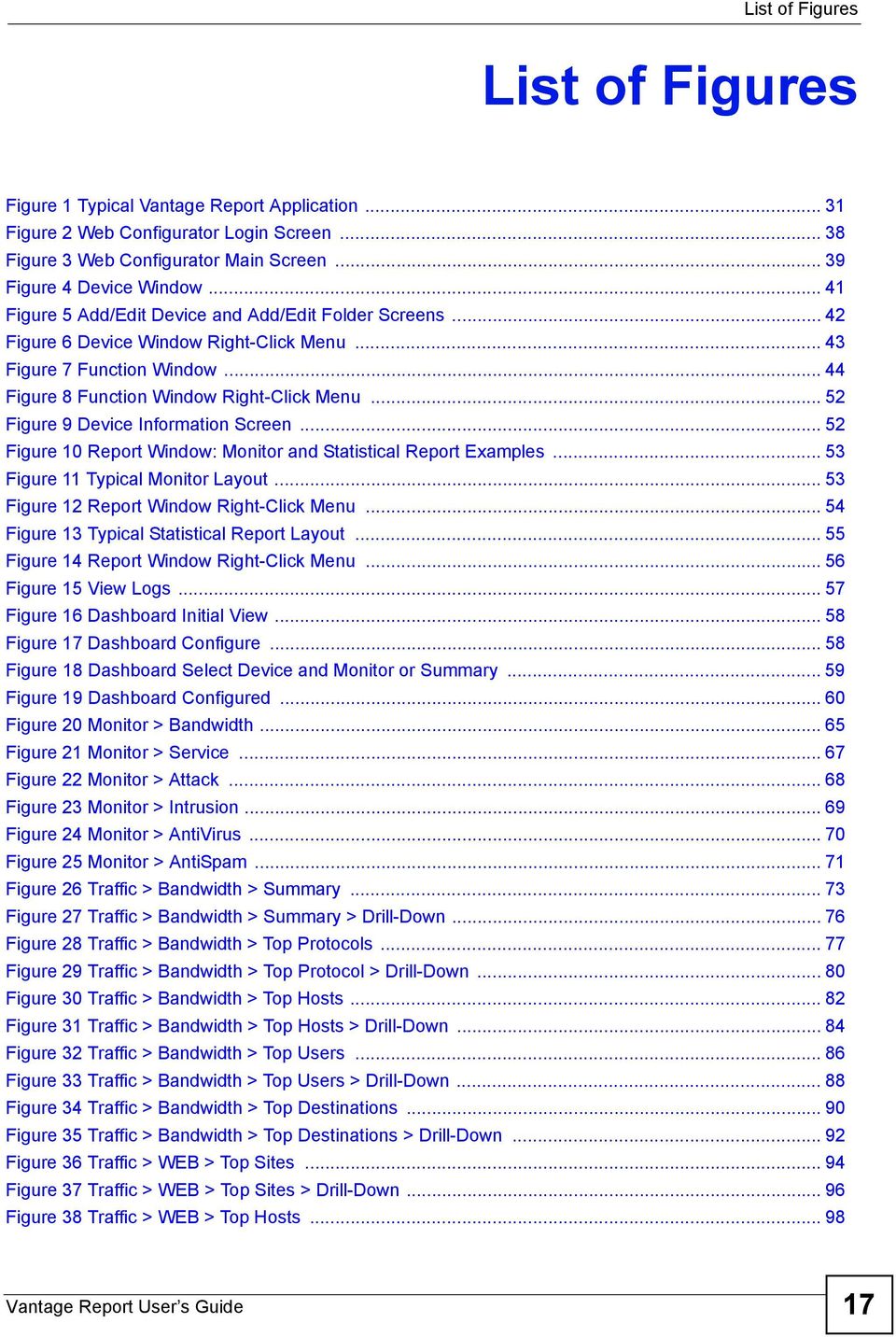
17 List of Figures List of Figures Figure 1 Typical Vantage Report Application Figure 2 Web Configurator Login Screen Figure 3 Web Configurator Main Screen Figure 4 Device Window Figure 5 Add/Edit Device and Add/Edit Folder Screens Figure 6 Device Window Right-Click Menu Figure 7 Function Window Figure 8 Function Window Right-Click Menu Figure 9 Device Information Screen Figure 10 Report Window: Monitor and Statistical Report Examples Figure 11 Typical Monitor Layout Figure 12 Report Window Right-Click Menu Figure 13 Typical Statistical Report Layout Figure 14 Report Window Right-Click Menu Figure 15 View Logs Figure 16 Dashboard Initial View Figure 17 Dashboard Configure Figure 18 Dashboard Select Device and Monitor or Summary Figure 19 Dashboard Configured Figure 20 Monitor > Bandwidth Figure 21 Monitor > Service Figure 22 Monitor > Attack Figure 23 Monitor > Intrusion Figure 24 Monitor > AntiVirus Figure 25 Monitor > AntiSpam Figure 26 Traffic > Bandwidth > Summary Figure 27 Traffic > Bandwidth > Summary > Drill-Down Figure 28 Traffic > Bandwidth > Top Protocols Figure 29 Traffic > Bandwidth > Top Protocol > Drill-Down Figure 30 Traffic > Bandwidth > Top Hosts Figure 31 Traffic > Bandwidth > Top Hosts > Drill-Down Figure 32 Traffic > Bandwidth > Top Users Figure 33 Traffic > Bandwidth > Top Users > Drill-Down Figure 34 Traffic > Bandwidth > Top Destinations Figure 35 Traffic > Bandwidth > Top Destinations > Drill-Down Figure 36 Traffic > WEB > Top Sites Figure 37 Traffic > WEB > Top Sites > Drill-Down Figure 38 Traffic > WEB > Top Hosts Vantage Report User s Guide 17
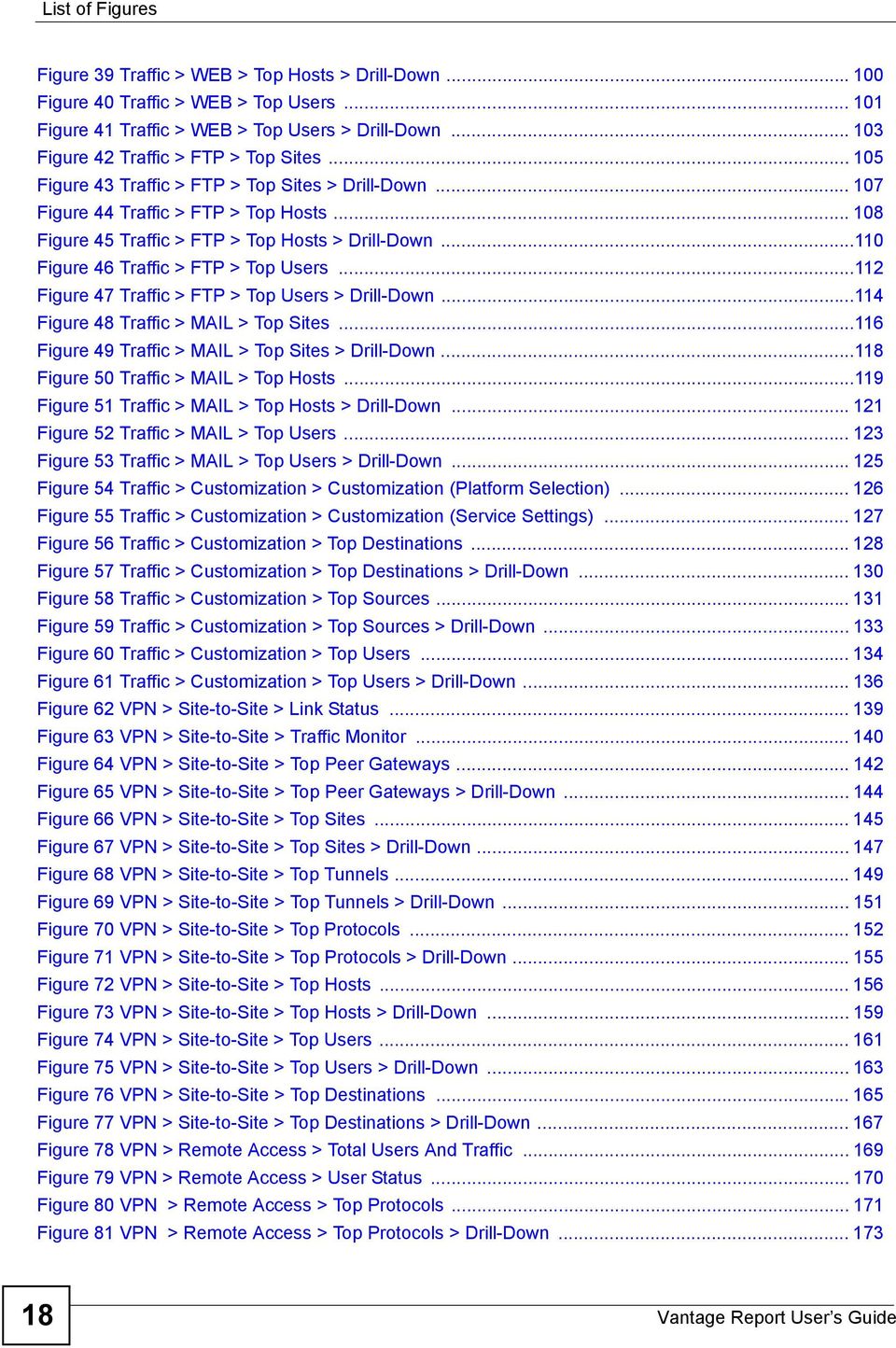
18 List of Figures Figure 39 Traffic > WEB > Top Hosts > Drill-Down Figure 40 Traffic > WEB > Top Users Figure 41 Traffic > WEB > Top Users > Drill-Down Figure 42 Traffic > FTP > Top Sites Figure 43 Traffic > FTP > Top Sites > Drill-Down Figure 44 Traffic > FTP > Top Hosts Figure 45 Traffic > FTP > Top Hosts > Drill-Down Figure 46 Traffic > FTP > Top Users Figure 47 Traffic > FTP > Top Users > Drill-Down Figure 48 Traffic > MAIL > Top Sites Figure 49 Traffic > MAIL > Top Sites > Drill-Down Figure 50 Traffic > MAIL > Top Hosts Figure 51 Traffic > MAIL > Top Hosts > Drill-Down Figure 52 Traffic > MAIL > Top Users Figure 53 Traffic > MAIL > Top Users > Drill-Down Figure 54 Traffic > Customization > Customization (Platform Selection) Figure 55 Traffic > Customization > Customization (Service Settings) Figure 56 Traffic > Customization > Top Destinations Figure 57 Traffic > Customization > Top Destinations > Drill-Down Figure 58 Traffic > Customization > Top Sources Figure 59 Traffic > Customization > Top Sources > Drill-Down Figure 60 Traffic > Customization > Top Users Figure 61 Traffic > Customization > Top Users > Drill-Down Figure 62 VPN > Site-to-Site > Link Status Figure 63 VPN > Site-to-Site > Traffic Monitor Figure 64 VPN > Site-to-Site > Top Peer Gateways Figure 65 VPN > Site-to-Site > Top Peer Gateways > Drill-Down Figure 66 VPN > Site-to-Site > Top Sites Figure 67 VPN > Site-to-Site > Top Sites > Drill-Down Figure 68 VPN > Site-to-Site > Top Tunnels Figure 69 VPN > Site-to-Site > Top Tunnels > Drill-Down Figure 70 VPN > Site-to-Site > Top Protocols Figure 71 VPN > Site-to-Site > Top Protocols > Drill-Down Figure 72 VPN > Site-to-Site > Top Hosts Figure 73 VPN > Site-to-Site > Top Hosts > Drill-Down Figure 74 VPN > Site-to-Site > Top Users Figure 75 VPN > Site-to-Site > Top Users > Drill-Down Figure 76 VPN > Site-to-Site > Top Destinations Figure 77 VPN > Site-to-Site > Top Destinations > Drill-Down Figure 78 VPN > Remote Access > Total Users And Traffic Figure 79 VPN > Remote Access > User Status Figure 80 VPN > Remote Access > Top Protocols Figure 81 VPN > Remote Access > Top Protocols > Drill-Down Vantage Report User s Guide
19 List of Figures Figure 82 VPN > Remote Access > Top Destinations Figure 83 VPN > Remote Access > Top Destinations > Drill-Down Figure 84 VPN > Xauth> Successful Login Figure 85 VPN > Xauth> Failed Login Figure 86 Network Attack > Attack > Summary Figure 87 Network Attack > Attack > Summary > Drill-Down Figure 88 Network Attack > Attack > Top Attacks Figure 89 Network Attack > Attack > Top Attacks > Drill-Down Figure 90 Network Attack > Attack > Top Sources Figure 91 Network Attack > Attack > Top Sources > Drill-Down Figure 92 Network Attack > Attack > By Type Figure 93 Network Attack > Attack > By Type > Drill-Down Figure 94 Network Attack > Intrusion > Summary Figure 95 Network Attack > Intrusion > Summary > Drill-Down Figure 96 Network Attack > Intrusion > Top Intrusions Figure 97 Network Attack > Intrusion > Top Intrusions > Drill-Down Figure 98 Network Attack > Intrusion > Top Sources Figure 99 Network Attack > Intrusion > Top Sources > Drill-Down Figure 100 Intrusion > Top Destinations Figure 101 Network Attack > Intrusion > Top Destinations > Drill-Down Figure 102 Network Attack > Intrusion > By Severity Figure 103 Network Attack > Intrusion > By Severity > Drill-Down Figure 104 Network Attack > AntiVirus > Summary Figure 105 Network Attack > AntiVirus > Summary > Drill-Down Figure 106 Network Attack > AntiVirus > Top Viruses Figure 107 Network Attack > AntiVirus > Top Viruses > Drill-Down Figure 108 Network Attack > AntiVirus > Top Sources Figure 109 Network Attack > AntiVirus > Top Sources > Drill-Down Figure 110 Network Attack > AntiVirus > Top Destinations Figure 111 Network Attack > AntiVirus > Top Destinations > Drill-Down Figure 112 Network Attack > AntiSpam > Summary Figure 113 Network Attack > AntiSpam > Summary > Drill-Down Figure 114 Network Attack > AntiSpam > Top Senders Figure 115 Network Attack > AntiSpam > Top Sources Figure 116 Network Attack > AntiSpam > By Score Figure 117 Security Policy > Firewall Access Control > Top Users Blocked Figure 118 Security Policy > Firewall Access Control > Top Packets Blocked Figure 119 Security Policy > Application Access Control > Top Applications Blocked Figure 120 Security Policy > Application Access Control > Top Users Blocked Figure 121 Security Policy > Application Access Control > Top Applications Allowed Figure 122 Security Policy > WEB Blocked > Summary Figure 123 Security Policy > WEB Blocked > Summary > Drill-Down Figure 124 Security Policy > WEB Blocked > Top Sites Vantage Report User s Guide 19

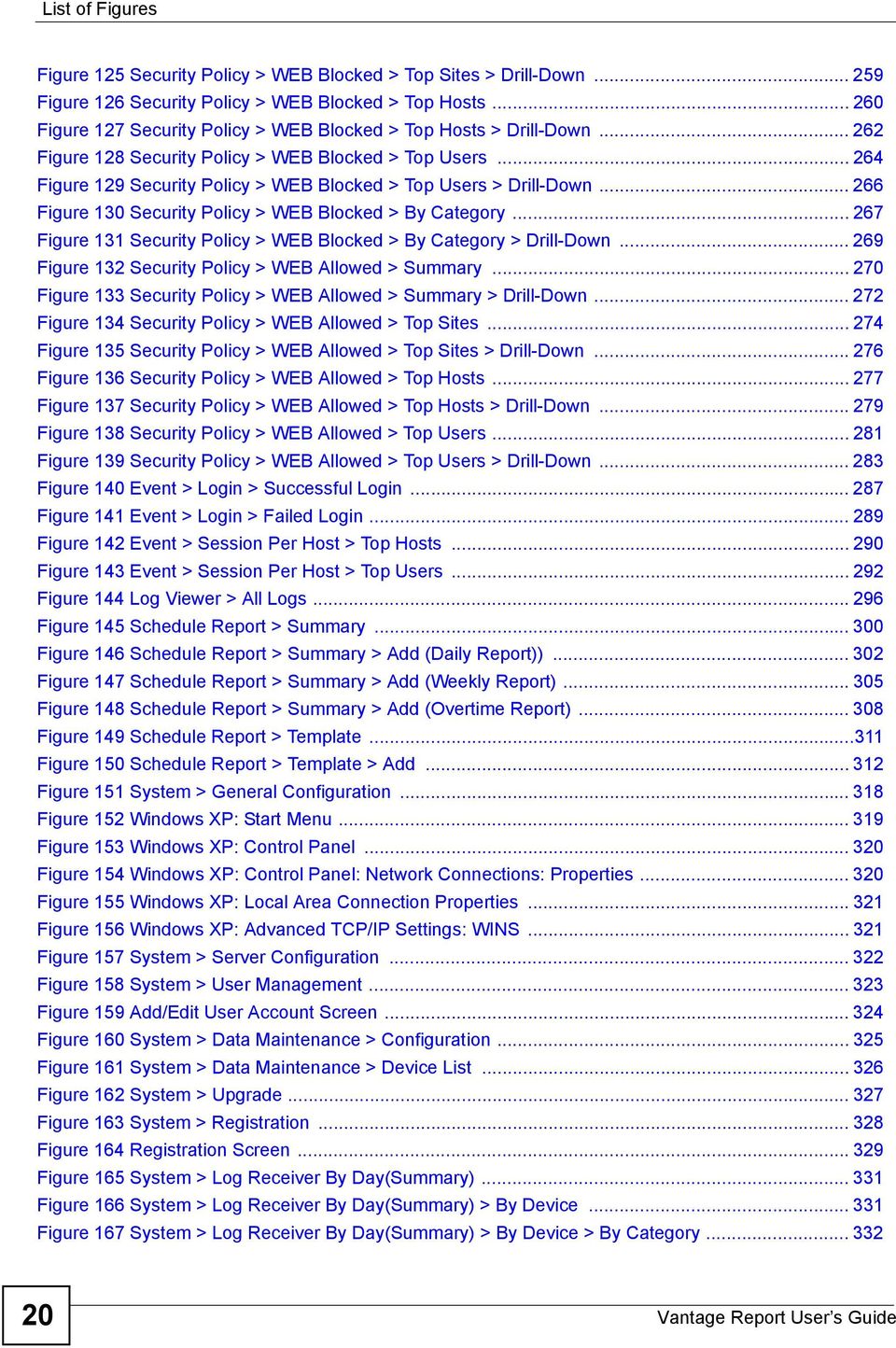
20 List of Figures Figure 125 Security Policy > WEB Blocked > Top Sites > Drill-Down Figure 126 Security Policy > WEB Blocked > Top Hosts Figure 127 Security Policy > WEB Blocked > Top Hosts > Drill-Down Figure 128 Security Policy > WEB Blocked > Top Users Figure 129 Security Policy > WEB Blocked > Top Users > Drill-Down Figure 130 Security Policy > WEB Blocked > By Category Figure 131 Security Policy > WEB Blocked > By Category > Drill-Down Figure 132 Security Policy > WEB Allowed > Summary Figure 133 Security Policy > WEB Allowed > Summary > Drill-Down Figure 134 Security Policy > WEB Allowed > Top Sites Figure 135 Security Policy > WEB Allowed > Top Sites > Drill-Down Figure 136 Security Policy > WEB Allowed > Top Hosts Figure 137 Security Policy > WEB Allowed > Top Hosts > Drill-Down Figure 138 Security Policy > WEB Allowed > Top Users Figure 139 Security Policy > WEB Allowed > Top Users > Drill-Down Figure 140 Event > Login > Successful Login Figure 141 Event > Login > Failed Login Figure 142 Event > Session Per Host > Top Hosts Figure 143 Event > Session Per Host > Top Users Figure 144 Log Viewer > All Logs Figure 145 Schedule Report > Summary Figure 146 Schedule Report > Summary > Add (Daily Report)) Figure 147 Schedule Report > Summary > Add (Weekly Report) Figure 148 Schedule Report > Summary > Add (Overtime Report) Figure 149 Schedule Report > Template Figure 150 Schedule Report > Template > Add Figure 151 System > General Configuration Figure 152 Windows XP: Start Menu Figure 153 Windows XP: Control Panel Figure 154 Windows XP: Control Panel: Network Connections: Properties Figure 155 Windows XP: Local Area Connection Properties Figure 156 Windows XP: Advanced TCP/IP Settings: WINS Figure 157 System > Server Configuration Figure 158 System > User Management Figure 159 Add/Edit User Account Screen Figure 160 System > Data Maintenance > Configuration Figure 161 System > Data Maintenance > Device List Figure 162 System > Upgrade Figure 163 System > Registration Figure 164 Registration Screen Figure 165 System > Log Receiver By Day(Summary) Figure 166 System > Log Receiver By Day(Summary) > By Device Figure 167 System > Log Receiver By Day(Summary) > By Device > By Category Vantage Report User s Guide
21 List of Figures Figure 168 System > Log Receiver By Device) Figure 169 System > Log Receiver By Device > By Category Figure 170 System > About Figure 171 Windows XP: Start Menu Figure 172 Windows XP: Control Panel Figure 173 Windows XP: Control Panel: Network Connections: Properties Figure 174 Windows XP: Local Area Connection Properties Figure 175 Windows XP: Advanced TCP/IP Settings Figure 176 Windows XP: Internet Protocol (TCP/IP) Properties Vantage Report User s Guide 21
22 List of Figures 22 Vantage Report User s Guide
23 List of Tables List of Tables Table 1 Differences Between Basic Version and Full Version Table 2 Processing Times by Menu Item Table 3 ZyNOS-based ZyXEL Device Configuration Requirements by Menu Item Table 4 ZyWALL 1050 Configuration Requirements by Menu Item Table 5 Title Bar Table 6 Device Window Table 7 Add/Edit Device and Add/Edit Folder Screen Fields Table 8 Function Window Table 9 Function differences for Basic and Full Versions...51 Table 10 Device Information Screen Fields Table 11 Typical Monitor Features Table 12 Typical Statistical Report Features Table 13 View Logs Table 14 Dashboard Table 15 Monitor > Bandwidth Table 16 Monitor > Service Table 17 Monitor > Attack Table 18 Monitor > Intrusion Table 19 Monitor > AntiVirus Table 20 Monitor > AntiSpam Table 21 Traffic > Bandwidth > Summary Table 22 Traffic > Bandwidth > Summary > Drill-Down Table 23 Traffic > Bandwidth > Top Protocols Table 24 Traffic > Bandwidth > Top Protocol > Drill-Down Table 25 Traffic > Bandwidth > Top Hosts Table 26 Traffic > Bandwidth > Top Hosts > Drill-Down...85 Table 27 Traffic > Bandwidth > Top Users Table 28 Traffic > Bandwidth > Top Users > Drill-Down Table 29 Traffic > Bandwidth > Top Destinations Table 30 Traffic > Bandwidth > Top Destinations > Drill-Down Table 31 Traffic > WEB > Top Sites Table 32 Traffic > WEB > Top Sites > Drill-Down Table 33 Traffic > WEB > Top Hosts Table 34 Traffic > WEB > Top Hosts > Drill-Down Table 35 Traffic > WEB > Top Users Table 36 Traffic > WEB > Top Users > Drill-Down Table 37 Traffic > FTP > Top Sites Table 38 Traffic > FTP > Top Sites > Drill-Down Vantage Report User s Guide 23
24 List of Tables Table 39 Traffic > FTP > Top Hosts Table 40 Traffic > FTP > Top Hosts > Drill-Down Table 41 Traffic > FTP > Top Users Table 42 Traffic > FTP > Top Hosts > Drill-Down Table 43 Traffic > MAIL > Top Sites Table 44 Traffic > MAIL > Top Sites > Drill-Down Table 45 Traffic > MAIL > Top Hosts Table 46 Traffic > MAIL > Top Hosts > Drill-Down Table 47 Traffic > MAIL > Top Users Table 48 Traffic > MAIL > Top Users > Drill-Down Table 49 Service > Customization > Customization (Service Settings) Table 50 Traffic > Customization > Top Destinations Table 51 Traffic > Customization > Top Destinations > Drill-Down Table 52 Traffic > Customization > Top Sources Table 53 Traffic > Customization > Top Sources > Drill-Down Table 54 Traffic > Customization > Top Users Table 55 Traffic > Customization > Top Users > Drill-Down Table 56 VPN > Site-to-Site > Link Status Table 57 VPN > Site-to-Site > Traffic Monitor Table 58 VPN > Site-to-Site > Top Peer Gateways Table 59 VPN > Site-to-Site > Top Peer Gateways > Drill-Down Table 60 VPN > Site-to-Site > Top Sites Table 61 VPN > Site-to-Site > Top Sites > Drill-Down Table 62 VPN > Site-to-Site > Top Tunnels Table 63 VPN > Site-to-Site > Top Tunnels > Drill-Down Table 64 VPN > Site-to-Site > Top Protocols Table 65 VPN > Site-to-Site > Top Protocols > Drill-Down Table 66 VPN > Site-to-Site > Top Hosts Table 67 VPN > Site-to-Site > Top Hosts > Drill-Down Table 68 VPN > Site-to-Site > Top Users Table 69 VPN > Site-to-Site > Top Users > Drill-Down Table 70 VPN > Site-to-Site > Top Destinations Table 71 VPN > Site-to-Site > Top Destinations > Drill-Down Table 72 VPN > Remote Access > Total Users And Traffic Table 73 VPN > Remote Access > User Status Table 74 VPN > Remote Access > Top Protocols Table 75 VPN > Remote Access > Top Protocols > Drill-Down Table 76 VPN > Remote Access > Top Destinations Table 77 VPN > Remote Access > Top Destinations > Drill-Down Table 78 VPN > Xauth> Successful Login Table 79 VPN > Xauth> Failed Login Table 80 Network Attack > Attack > Summary Table 81 Network Attack > Attack > Summary > Drill-Down Vantage Report User s Guide
25 List of Tables Table 82 Network Attack > Attack > Top Attacks Table 83 Network Attack > Attack > Top Attacks > Drill-Down Table 84 Network Attack > Attack > Top Sources Table 85 Network Attack > Attack > Top Sources > Drill-Down Table 86 Network Attack > Attack > By Type Table 87 Network Attack > Attack > By Type > Drill-Down Table 88 Network Attack > Intrusion > Summary Table 89 Network Attack > Intrusion > Summary > Drill-Down Table 90 Network Attack > Intrusion > Top Intrusions Table 91 Network Attack > Intrusion > Top Intrusions > Drill-Down Table 92 Network Attack > Intrusion > Top Sources Table 93 Network Attack > Intrusion > Top Sources > Drill-Down Table 94 Intrusion > Top Destinations Table 95 Network Attack > Intrusion > Top Destinations > Drill-Down Table 96 Network Attack > Intrusion > By Severity Table 97 Network Attack > Intrusion > By Severity > Drill-Down Table 98 Network Attack > AntiVirus > Summary Table 99 Network Attack > AntiVirus > Summary > Drill-Down Table 100 Network Attack > AntiVirus > Top Viruses Table 101 Network Attack > AntiVirus > Top Viruses > Drill-Down Table 102 Network Attack > AntiVirus > Top Sources Table 103 Network Attack > AntiVirus > Top Sources > Drill-Down Table 104 Network Attack > AntiVirus > Top Destinations Table 105 Network Attack > AntiVirus > Top Destinations > Drill-Down Table 106 Network Attack > AntiSpam > Summary Table 107 Network Attack > AntiSpam > Summary > Drill-Down Table 108 Network Attack > AntiSpam > Top Senders Table 109 Network Attack > AntiSpam > Top Sources Table 110 Network Attack > AntiSpam > By Score Table 111 Security Policy > Firewall Access Control > Top Users Blocked Table 112 Security Policy > Firewall Access Control > Top Packets Blocked Table 113 Security Policy > Application Access Control > Top Applications Blocked Table 114 Security Policy > Application Access Control > Top Applications Blocked Table 115 Security Policy > Application Access Control > Top Applications Allowed Table 116 Security Policy > WEB Blocked > Summary Table 117 Security Policy > WEB Blocked > Summary > Drill-Down Table 118 Security Policy > WEB Blocked > Top Sites Table 119 Security Policy > WEB Blocked > Top Sites > Drill-Down Table 120 Security Policy > WEB Blocked > Top Hosts Table 121 Security Policy > WEB Blocked > Top Hosts > Drill-Down Table 122 Security Policy > WEB Blocked > Top Users Table 123 Security Policy > WEB Blocked > Top Users > Drill-Down Table 124 Security Policy > WEB Blocked > By Category Vantage Report User s Guide 25
26 List of Tables Table 125 Security Policy > WEB Blocked > By Category > Drill-Down Table 126 Security Policy > WEB Allowed > Summary Table 127 Security Policy > WEB Allowed > Summary > Drill-Down Table 128 Security Policy > WEB Allowed > Top Sites Table 129 Security Policy > WEB Allowed > Top Sites > Drill-Down Table 130 Security Policy > WEB Allowed > Top Hosts Table 131 Security Policy > WEB Allowed > Top Hosts > Drill-Down Table 132 Security Policy > WEB Allowed > Top Users Table 133 Security Policy > WEB Allowed > Top Users > Drill-Down Table 134 Event > Login > Successful Login Table 135 Event > Device Login > Failed Login Table 136 Event > Session Per Host > Top Hosts Table 137 Event > Session Per Host > Top Users Table 138 Log Viewer > All Logs Table 139 Schedule Report > Summary Table 140 Schedule Report > Summary > Add (Daily Report) Table 141 Schedule Report > Summary > Add (Weekly Report) Table 142 Schedule Report > Summary > Add (Overtime Report) Table 143 Schedule Report > Template Table 144 Schedule Report > Template > Add Table 145 System > General Configuration Table 146 System > Server Configuration Table 147 System > User Management Table 148 Add/Edit User Account Screen Table 149 System > Data Maintenance > Configuration Table 150 System > Data Maintenance > Device List Table 151 System > Upgrade Table 152 Information for Using an Existing MyZyXEL.com Account Table 153 Information for Upgrading the Version or Number of Devices Table 154 System > Registration Table 155 Registration Screen Table 156 System > Log Receiver By Day(Summary) Table 157 System > Log Receiver By Day(Summary) > By Device Table 158 System > Log Receiver By Day(Summary) > By Device > By Category Table 159 System > Log Receiver By Device Table 160 System > Log Receiver By Device > By Category Table 161 Troubleshooting Table 162 Web Configurator Specifications Table 163 System Notifications Specifications Table 164 Feature Specifications Table 165 Key Features Table 166 VRPT 3.0 Device and Feature Support Table 167 System Maintenance Logs Vantage Report User s Guide
27 List of Tables Table 168 System Error Logs Table 169 Access Control Logs Table 170 TCP Reset Logs Table 171 Packet Filter Logs Table 172 ICMP Logs Table 173 CDR Logs Table 174 PPP Logs Table 175 UPnP Logs Table 176 Content Filtering Logs Table 177 Attack Logs Table 178 Remote Management Logs Table 179 Wireless Logs Table 180 IPSec Logs Table 181 IKE Logs Table 182 PKI Logs Table X Logs Table 184 ACL Setting Notes Table 185 ICMP Notes Table 186 IDP Logs Table 187 AV Logs Table 188 AS Logs Table 189 AS Directions for Multiple WAN Devices Table 190 AS Directions for Single WAN Devices Table 191 Syslog Logs Table 192 RFC-2408 ISAKMP Payload Types Table 193 Content Filter Logs Table 194 Forward Web Site Logs Table 195 Blocked Web Site Logs Table 196 User Logs Table 197 myzyxel.com Logs Table 198 IDP Logs Table 199 Application Patrol Logs Table 200 IKE Logs Table 201 IPSec Logs Table 202 Firewall Logs Table 203 Sessions Limit Logs Table 204 Policy Route Logs Table 205 Built-in Services Logs Table 206 System Logs Table 207 Connectivity Check Logs Table 208 Device HA Logs Table 209 Routing Protocol Logs Table 210 NAT Logs Vantage Report User s Guide 27
28 List of Tables Table 211 PKI Logs Table 212 Interface Logs Table 213 Account Logs Table 214 Port Grouping Logs Table 215 Force Authentication Logs Table 216 File Manager Logs Vantage Report User s Guide
29 PART I Introduction Introducing Vantage Report (31) The Vantage Report Server (33) The Web Configurator (37) 29
30 30
31 CHAPTER 1 Introducing Vantage Report Please see the Quick Start Guide for Vantage Report setup requirements, installation, and access. This chapter introduces Vantage Report. See Appendix A on page 339 for a list of key features. 1.1 Introduction Vantage Report is a cost-effective, browser-based global management solution that allows an administrator from any location to easily manage, monitor and gather statistics on ZyXEL devices located worldwide.with Vantage Report, you can monitor network access, enhance security, and anticipate future bandwidth needs. A typical application is illustrated in Figure 1. Figure 1 Typical Vantage Report Application A B C In this example, you use the web configurator (A) to set up the Vantage Report server (B). You also configure the ZyXEL devices (C) to send their logs and traffic statistics to the Vantage Report Server. The Vantage Report server collects this information. Then, you can monitor the whole network look at historical reports about network performance and events examine device logs The Vantage Report server can also send statistical reports to you by Versions There are two versions of Vantage Report, the basic version and the full version. When you install Vantage Report, you get the basic version. The full version requires a license key, which you usually have to purchase. Vantage Report User s Guide 31
32 Chapter 1 Introducing Vantage Report This User s Guide discusses the features in the full version. The following table shows some of the differences between the basic and full version. Table 1 Differences Between Basic Version and Full Version FEATURE BASIC FULL Number of supported devices 1 up to 100 Supported formats for scheduled reports PDF PDF, HTML Drill-down reports 1 layer 2 layers Reverse DNS lookup no yes Reverse Hostname lookup no yes Web usage by category no yes AntiVirus no yes AntiSpam no yes Dashboard no yes Number of scheduled reports per device Customizable scheduled report templates no yes Schedule Report Format PDF PDF, HTML Reports for the ZyWALL 1050 no yes There is also a free trial of the full version. The trial version is the same as the full version except that it only supports one device. You can get the trial version by registering Vantage Report. See Section 12.6 on page 327 for more information 32 Vantage Report User s Guide
33 CHAPTER 2 The Vantage Report Server This chapter explains several characteristics of the Vantage Report server. 2.1 Starting and Stopping the Vantage Report Server Make sure the port Vantage Report uses for web services is not used by other applications, especially web servers. The Vantage Report server runs as a service on the Vantage Report server. By default, this service starts automatically when you log in to the Vantage Report server. You can use the services management screen to start, stop, or configure this service. To open this screen, 1 In Windows 2000, click Start > Settings > Control Panel > Administrative Tools > Services. The Services screen opens. 2 Right-click on Vantage Report. A menu appears. 3 Select Start or Stop to start or stop the Vantage Report service. Select Properties to configure the service. Vantage Report User s Guide 33
34 Chapter 2 The Vantage Report Server 2.2 in the Vantage Report Server Before the Vantage Report server can send to anyone, you have to configure the SMTP mail server. See Section 12.2 on page 322 for more information. The Vantage Report server can use to send information in several situations. In some situations, it sends to the address that is associated with a specific user (see Section 12.3 on page 323). In other situations, it sends to any valid address. scheduled report - The Vantage Report server can send one or more statistical reports regularly or one-time to any valid address. See Chapter 11 on page 299 for more information. system notifications - When certain system parameters cross a threshold (minimum or maximum) value, the Vantage Report server sends to the Vantage Report administrator (the address associated with the root account). Some of these messages are warnings; in some situations, however, the Vantage Report server starts or stops receive logs. See Appendix A on page 339 for a list of parameters and threshold values. One of the threshold values can be configured. See Section 12.1 on page 317. forgotten password - A user clicks Forget Password? in the Login screen. In this case, the Vantage Report server sends the account information to the address associated with the specified user name. See Section 3.2 on page 37 for an example of the Login screen. test message - The Vantage Report administrator tests the SMTP mail server settings. The Vantage Report server sends an message to the address associated with the root account. See Section 12.2 on page 322 for more information. 2.3 Time in the Vantage Report Server In Vantage Report, clock time is the time the Vantage Report server receives information (log entries or traffic statistics) from the ZyXEL devices, not the time the device puts in the entry. As soon as the Vantage Report server receives information, it replaces device times with the current time in the Vantage Report server. The Vantage Report server processes log entries and traffic statistics before the information is available in any screen (including log viewers). For performance reasons, the Vantage Report server does not process this information right away. Instead, the processing time depends on the way the information is used in Vantage Report. See the following table for processing times for each menu item. Table 2 Processing Times by Menu Item MENU ITEM TIME (MIN) Monitor 5 34 Vantage Report User s Guide
35 Chapter 2 The Vantage Report Server Table 2 Processing Times by Menu Item MENU ITEM Traffic, Network Attack, Security Policy, Authentication 5 Log Viewer > All Logs 5 TIME (MIN) 2.4 ZyXEL Device Configuration and Source Data The following table identifies the configuration required in ZyXEL devices for each screen in Vantage Report. Table 3 ZyNOS-based ZyXEL Device Configuration Requirements by Menu Item MENU ITEM(S) SOURCE DATA LOG SETTINGS* ADDITIONAL Monitor > Bandwidth traffic statistics Monitor > Service traffic statistics Monitor > Attack log entries Attack -- Monitor > Intrusion log entries IDP IDP > Signature Monitor > AntiVirus log entries Anti-Virus Anti-Virus > General Monitor > AntiSpam log entries Anti-Spam -- Traffic traffic statistics VPN log entries IPSec -- Network Attack > Attack log entries Attack -- Network Attack > Intrusion log entries IDP IDP > Signature Network Attack > AntiVirus log entries Anti-Virus Anti-Virus > General Network Attack > AntiSpam log entries Anti-Spam -- Security Policy > Firewall log entries Access Control -- Access Control Security Policy > Application N/A N/A N/A Access Control Security Policy > WEB Blocked log entries Blocked Web Sites -- Security Policy > WEB Allowed log entries Forward Web Sites -- Event > Login log entries System Maintenance -- Event > Session Per Host log entries Access Control -- Log Viewer > All Logs log entries ** ** * - The names of categories may be different for different devices. Use the category that is appropriate for each device. ** - The log viewers display whatever log entries the ZyXEL devices record, including log entries that may not be used in other reports. Vantage Report User s Guide 35
36 Chapter 2 The Vantage Report Server Table 4 ZyWALL 1050 Configuration Requirements by Menu Item MENU ITEM(S) SOURCE DATA LOG SETTINGS* ADDITIONAL Monitor > Bandwidth traffic statistics Monitor > Service traffic statistics Monitor > Attack log entries IDP -- Monitor > Intrusion log entries IDP IDP > Signature Monitor > AntiVirus N/A N/A N/A Monitor > AntiSpam N/A N/A N/A Traffic traffic statistics log entries -- User VPN log entries IPSec, User -- Network Attack > Attack log entries IDP -- Network Attack > Intrusion log entries IDP IDP > Signature Network Attack > AntiVirus N/A N/A N/A Network Attack > AntiSpam N/A N/A N/A Security Policy > Firewall log entries Firewall -- Access Control Security Policy > Application log entries Application Patrol -- Access Control Security Policy > WEB Blocked log entries Blocked web sites -- Security Policy > WEB Allowed log entries Forward web sites -- Event > Login log entries User -- Event > Session Per Host log entries Sessions Limit, User -- Log Viewer > All Logs log entries ** ** -- * - The names of categories may be different for different devices. Use the category that is appropriate for each device. *** - The log viewers display whatever log entries the ZyXEL devices record, including log entries that may not be used in other reports. Source Data - Some screens use log entries; some screens use traffic statistics. Some ZyXEL devices do not track traffic statistics. If Vantage Report does not get one of these, the screens are empty. See the Quick Start Guide for detailed instructions. Log Settings - If ZyXEL devices do not record some categories of log entries, Vantage Report does not have any information to display either. For example, if you want to look at VPN traffic for a particular device, the device has to record log entries for IPSec. For most devices, go to the Logs > Log Settings screen, and select the appropriate categories. You may also use the command-line interface. Additional - In some cases, it is possible to control what log entries are recorded in even more detail. For example, in some ZyXEL devices, it is possible to control what attack types are logged. For most devices, go to the screen indicated to select the appropriate log entries. You may also use the command-line interface. 36 Vantage Report User s Guide
37 CHAPTER 3 The Web Configurator This chapter provides the minimum requirements to use the web configurator, describes how to access the web configurator, and explains each part of the main screen in the web configurator. 3.1 Web Configurator Requirements The web configurator is a browser-based interface that you can use to set up, manage, and use Vantage Report. You can run it on the Vantage Report server or on a different computer. Your web browser should meet the following requirements: Internet Explorer 6.0 or later, Firefox 1.07 or later (local or remote) JavaScript enabled Macromedia Flash Player 7 or later Recommended screen resolution: 1024 x 768 pixels 3.2 Web Configurator Access To access the web configurator, follow these steps: 1 Make sure Vantage Report is installed and running properly. (See the Quick Start Guide.) 2 Open a browser window, and go to where a.b.c.d is the IP address of the Vantage Report server. If you open the web configurator on the same computer on which you installed Vantage Report, enter localhost. xxxxx is the port number you entered during installation. For example, you might enter or vrpt. In either case, the web configurator Login screen displays. Vantage Report User s Guide 37
38 Chapter 3 The Web Configurator Figure 2 Web Configurator Login Screen If you forget your password, enter your user name, and click Forget Password?. Vantage Report sends your password to the address (if any) for your User Name. See Section 2.2 on page 34 for more information about in Vantage Report and Section 12.3 on page 323 for more information about SMTP configuration. 3 Enter the User Name (default: root) and Password (default: root). See Section 12.3 on page 323 to change the password. 4 Click the Login button. The main screen in Vantage Report appears. 38 Vantage Report User s Guide
39 Chapter 3 The Web Configurator Figure 3 Web Configurator Main Screen A B C D The main screen is divided into four parts: the title bar (A), the device window (B), the function window (C), and the report window (D). The title bar provides some icons that are useful anytime. The device window displays and organizes the ZyXEL devices that can provide information to Vantage Report. The function window lists the reports you can generate and organizes these reports into categories. Last, the report window shows the selected report for the selected device(s). For security reasons, Vantage Report automatically times out after fifteen minutes of inactivity. Log in again if this happens. The rest of this section discusses each part of the main screen in more detail. Vantage Report User s Guide 39
40 Chapter 3 The Web Configurator 3.3 Title Bar The title bar has three icons. These icons are explained in the table below. Table 5 Title Bar ICON DESCRIPTION The help icon opens the help page for the current screen in Vantage Report. The about icon opens a screen with the version of Vantage Report. The logout icon logs you out of Vantage Report. 3.4 Device Window Use the device window to select which device(s) you want to include in a report, add devices to Vantage Report, and remove devices from Vantage Report. You have to add the device to the device window if you want Vantage Report to store log or traffic information from this device. If the Vantage Report server receives logs or traffic information from a device that is not in this list, it discards the logs. In the device window, you can also look at basic information about each device, edit the information about the device, and search for devices in Vantage Report using this information. This chapter explains how to do these things. The device window is located on the left side of the main screen in the web configurator. Figure 4 shows an example. 40 Vantage Report User s Guide
41 Chapter 3 The Web Configurator Figure 4 Device Window Each numbered section above is described in the following table. Table 6 Device Window 4 SECTION DESCRIPTION 1 To add a device to Vantage Report, right click on root, and select Add Device. The Add Device screen appears in the device window. (See Figure 5.) To add a folder to Vantage Report, right click on root, and select Add Folder. The Add Folder screen appears in the device window. (See Figure 5.) 2 To update the device window, click the Refresh button. Vantage Report User s Guide 41
42 Chapter 3 The Web Configurator Table 6 Device Window SECTION DESCRIPTION 3 To move a device in the device window tree right-click on the device, and select Cut it. Then right-click the destination folder and select Paste to. To select which device is included in a report click on the device. To look at the basic information about a device, click on the device. The Device Information screen appears in the report window. (See Figure 5.) To edit the basic information about a device, right-click on the device, and select Edit Device. The Edit Device screen appears in the device window. (See Figure 5.) To edit the basic information about a folder, right-click on the folder, and select Edit Folder. The Edit Folder screen appears in the device window. (See Figure 5.) To remove a device from Vantage Report, right-click on the device, and select Delete Device. Vantage Report confirms you want to delete it before doing so. To remove a folder from Vantage Report, right-click on the folder, and select Delete Folder. Vantage Report confirms you want to delete it before doing so. 4 To search for a device, type any part of the name, MAC address, or note in the SEARCH field, and click the magnifying glass. If a match is found, Vantage Report highlights the device in the device window, but the report window does not change. If a match is not found, you get a message. You can click the magnifying glass again to look for another match. When you add a device to Vantage Report, you can specify the name, MAC address, type, and any notes for the device. When you click on the device, this information is displayed in the report window (see Section on page 52). When you edit a device, however, you can only edit the name and the notes. If you want to update the MAC address or device type, you have to delete the current device and add it again. These screens are discussed in more detail together in Figure 5 on page 42. Figure 5 Add/Edit Device and Add/Edit Folder Screens 42 Vantage Report User s Guide
43 Chapter 3 The Web Configurator Each field is explained in the following table. Table 7 Add/Edit Device and Add/Edit Folder Screen Fields LABEL Name MAC Type Note Add Save DESCRIPTION Enter the name of the device or folder you want to add to Vantage Report. The device name can consist of alphanumeric characters, underscores(_), periods(.), or dashes(-), and it must be 1-28 characters long. This name is used to refer to the device (or folder) in Vantage Report, and it has to be different than other device (or folder) names in Vantage Report. You can use the system name of a device as the name for that device. This field is not available in the Edit Device screen. Enter the LAN MAC address of the device you want to add. For the ZyWALL 1050, use the first (lowest) LAN MAC address. Once you add the device, you cannot change the MAC address anymore. This field is not available in the Edit Device screen. Select the model type of the device you want to add. Choices are: ZyWALL, Prestige, IDP 10, and ZyWALL Not all reports (and fields in reports) are available with all models. See Table 166 on page 340 for a list of which items Vantage Report supports with various firmware versions of various devices. Enter any additional notes you want to make for the device or folder here. This field is available in the Add Device screen. Click this to add the device to Vantage Report. It takes time before Vantage Report displays information received from this device. This field is available in the Edit Device screen. Click this to save your changes to Vantage Report. You can also right-click in the device window. If you do not right-click on a device or folder, the following menu appears. If you right-click on a device or folder, you can see the following menu items at the end of the menu. Figure 6 Device Window Right-Click Menu Click About Macromedia Flash Player 8... to get information about the current version of Flash. 3.5 Function Window Use the function window to select which monitor, statistical report, or screen you want to open. You have to select a device before you can open a monitor or statistical report. These screens are organized into menus. Click on each top-level menu item to look at the second-level menu items. If a small triangle appears on the right side next to the menu item, then click on the second-level menu item to look at the third-level menu items. Otherwise, click on the monitor, statistical report, or screen you want to open. This is demonstrated in Figure 7 Vantage Report User s Guide 43
44 Chapter 3 The Web Configurator Figure 7 Function Window You can only open one second-level and one third-level menu at one time. If you open another one, the first one automatically closes. Table 8 expands the function window and introduces each monitor, statistical report, and screen. In addition, it also indicates if you can drill down into each statistical report. Not every report (or fields in a report) is available with every model of device and firmware version. See Table 166 on page 340 for a list of which items Vantage Report supports with various firmware versions of various devices. Table 8 Function Window LEVEL 1/2 LEVEL 3 FUNCTION Dashboard Monitor Bandwidth Service Attack Intrusion AntiVirus AntiSpam The dashboard gives a quick top level summary of activity across devices. The dashboard is available with the full version of Vantage Report. Use monitors to check the status of ZyXEL devices. Use this report to monitor the total amount of traffic handled by the selected device. Use this report to monitor the amount of traffic generated by web, FTP, mail, or VPN services in the selected device. Use this report to monitor the number of Denial-of-Service (DoS) attacks detected by the selected device s firewall. Use this report to monitor the number of intrusions detected by the selected device s IDP feature. Use this report to monitor the number of virus occurrences prevented by the selected device. Use this report to monitor the number of spam messages stopped by the selected device. 44 Vantage Report User s Guide
45 Chapter 3 The Web Configurator Table 8 Function Window LEVEL 1/2 LEVEL 3 FUNCTION Traffic Use these reports to look at how much traffic was handled by ZyXEL devices or who used the most bandwidth in a ZyXEL device. You can also look at traffic in various directions. Bandwidth Summary Use this report to look at the amount of traffic handled by the selected device by time interval. You can also use this report to look at the top services in a specific time interval. Top Protocol Top Hosts Top Users Top Destinations Use this report to look at the top services generating traffic through the selected device. You can also use this report to look at the top sources of traffic for any top service. Use this report to look at the top sources of traffic in the selected device. You can also use this report to look at the top services for any top source. Use this report to look at the top users generating traffic through the selected device. You can also use this report to look at the top services used by any top bandwidth user. Use this report to look at the top destinations of traffic in the selected device. You can also use this report to look at the services that were used the most to access the top destination IP addresses. WEB Top Sites Use this report to look at the top destinations of web traffic. You can also use this report to look at the top sources of web traffic for any top destination. Top Hosts Top Users Use this report to look at the top sources of web traffic. You can also use this report to look at the top destinations of web traffic for any top source. Use this report to look at the top sources of web traffic by user. You can also use this report to look at the top destinations of web traffic for any top user. FTP Top Sites Use this report to look at the top destinations of FTP traffic. You can also use this report to look at the top sources of FTP traffic for any top destination. Top Hosts Top Users Use this report to look at the top sources of FTP traffic. You can also use this report to look at the top destinations of FTP traffic for any top source. Use this report to look at the top sources of FTP traffic by user. You can also use this report to look at the top destinations of FTP traffic for any top user. MAIL Top Sites Use this report to look at the top destinations of mail traffic. You can also use this report to look at the top sources of mail traffic for any top destination. Top Hosts Top Users Use this report to look at the top sources of mail traffic. You can also use this report to look at the top destinations of mail traffic for any top source. Use this report to look at the top sources of mail traffic by user. You can also use this report to look at the top destinations of mail traffic for any top user. Vantage Report User s Guide 45
46 Chapter 3 The Web Configurator Table 8 Function Window LEVEL 1/2 LEVEL 3 FUNCTION VPN Customization Customization Use the Service Settings screen to add, edit, or remove services whose traffic you can view in the other Service > Customization reports. Top Destinations Top Sources Top Users Use this report to look at the top destinations of traffic for other services. You can also use this report to look at the top sources of traffic for other services for any top destination. Use this report to look at the top sources of traffic for other services. You can also use this report to look at the top destinations of traffic for other services for any top source. Use this report to look at the top sources of traffic for other services. You can also use this report to look at the top destinations of other services traffic for any top user. The service is selected in the main report. Use these reports to look at the top sources and destinations of traffic in VPN tunnels. Site-to-Site Link Status Use this report to see which of the device s VPN tunnels are connected. Remote Access Traffic Monitor Top Peer Gateways Top Sites Top Tunnels Top Protocols Top Hosts Top Users Top Destinations Total Users & Traffic User Status Top Protocols Top Destinations Use this report to monitor the total amount of traffic handled by a device s VPN tunnels. Use this report to look at the top destinations of VPN traffic. You can also use this report to look at the top sources of VPN traffic for any top destination. Use this report to look at the peer IPSec routers with the most VPN traffic. You can also use this report to look at the top sources of VPN traffic for any top destination. Use this report to look at the VPN tunnels with the most VPN traffic. You can also use this report to look at the top senders or receivers of VPN traffic for a top VPN tunnel. Use this report to look at the top services generating VPN traffic through the selected device. You can also use this report to look at the top senders or receivers of any top service through VPN. Use this report to look at the top sources of VPN traffic. You can also use this report to look at the top destinations of VPN traffic for any top source. Use this report to look at the users that send or receive the most VPN traffic. You can also use this report to look at the services sent through VPN from or to a top user. Use this report to see to where the device sent the most VPN traffic. You can also use this report to look at the services sent through VPN from or to a top destination. Use this report to monitor the total number of remote access users connected to the device and the amount of traffic the device handled for the dynamic VPN tunnels. Use this report to see which of the device s remote access users are connected. Use this report to display which services the remote access users used the most. You can also use this report to look at the top remote access senders or receivers of any top service. Use this report to look at the destinations with the most remote access VPN traffic. You can also use this report to look at the remote access hosts that sent the most traffic to the selected top destination. 46 Vantage Report User s Guide
47 Chapter 3 The Web Configurator Table 8 Function Window LEVEL 1/2 LEVEL 3 FUNCTION Xauth Successful Login Use this report to monitor the total number of users that have successfully logged in to use one of the device s VPN tunnels. Network Attack Failed Login Use this report to monitor the total number of users that have made unsuccessful attempts to log in to use one of the device s VPN tunnels. Use these reports to look at Denial-of-Service (DoS) attacks that were detected by the ZyXEL device s firewall. Attack Summary Use this report to look at the number of DoS attacks by time interval. You can also use this report to look at the top categories of DoS attacks in a specific time interval. Intrusion Top Attacks Top Sources By Category By Type Summary Top Intrusions Top Sources Top Destinations By Severity Use this report to look at the top kinds of DoS attacks by number of attacks. You can also use this report to look at the top categories of DoS attacks for any top source. Use this report to look at the top sources of DoS attacks by number of attacks. You can also use this report to look at the top categories of DoS attacks for any top source. Use this report to look at the top categories of DoS attacks by number of attacks. You can also use this report to look at the top sources of DoS attacks for any top category. Use this report to look at the top categories of DoS attacks by number of attacks. You can also use this report to look at the top sources of DoS attacks for any top category. Use these reports to look at intrusion signatures, types of intrusions, severity of intrusions, and the top sources and destinations of intrusions that are logged on the selected ZyXEL device. Use this report to look at the number of intrusions by time interval. You can also use this report to look at the top intrusion signatures in a specific time interval. Use this report to look at the top intrusion signatures by number of intrusions. You can also use this report to look at the top sources of intrusions for any top signature. Use this report to look at the top sources of intrusions by number of intrusions. You can also use this report to look at the top intrusion signatures for any top source. Use this report to look at the top destinations of intrusions by number of intrusions. You can also use this report to look at the top intrusion signatures for any top destination. Use this report to look at the top severities (significance) of intrusions by number of intrusions. The levels of severity, in decreasing order of significance, are Emergency (system is unusable), Alert (immediate action is required), Critical, Error, Warning, Notice, Informational, and Debug. You can also use this report to look at the top intrusion signatures for any severity. Vantage Report User s Guide 47
48 Chapter 3 The Web Configurator Table 8 Function Window LEVEL 1/2 LEVEL 3 FUNCTION AntiVirus AntiSpam Security Policy Firewall Access Control Application Access Control Summary Top Viruses Top Sources Top Destination Summary Top Senders Top Sources By Score Top Users Blocked Top Packets Blocked Top Applications Blocked Top Users Blocked Top Applications Allowed Use these reports to look at viruses that were detected by the ZyXEL device s anti-virus feature. Use this report to look at the number of virus occurrences by time interval. You can also use this report to look at the top viruses in a specific time interval. Use this report to look at the top viruses by number of occurrences. You can also use this report to look at the top sources of any top virus. Use this report to look at the top sources of virus occurrences by number of occurrences. You can also use this report to look at the top viruses for any top source. Use this report to look at the top destinations of virus occurrences by number of occurrences. You can also use this report to look at the top viruses for any top destination. Use these reports to look at spam messages that were detected by the ZyXEL device s anti-spam feature. You can also look at the top senders and sources of spam messages. Use this report to look at the number of spam messages by time interval. You can also use this report to look at the top combinations of senders and first SMTP servers to which the spam was sent in a specific time interval. Use this report to look at the top combinations of senders and first SMTP servers to which the spam was sent by number of messages. Use this report to look at the top sources (last mail relay) of spam messages by number of messages. Use this report to look at the top scores calculated for spam messages by number of messages. Use these reports to look at the top sources and destinations of traffic that is forwarded or blocked based on each device s content filtering settings. You can also look at the amount of traffic forwarded or blocked by time interval. Use this report to look at the users from which the device blocked the most traffic. Use this report to look at the firewall rule that blocked the most packets. Use this report to look at the applications for which the device blocked the most connections. Use this report to look at the users for which the device blocked the most connections. Use this report to look at the applications for which the device allowed the most connections. 48 Vantage Report User s Guide
49 Chapter 3 The Web Configurator Table 8 Function Window LEVEL 1/2 LEVEL 3 FUNCTION Event WEB Blocked Summary Use this report to look at the number of attempts to access blocked web sites by time interval. You can also use this report to look at the top sources of attempts to access blocked web sites in a specific time interval. Top Sites Top Hosts Top Users By Category Use this report to look at the top destinations in attempts to access blocked web sites by number of attempts. You can also use this report to look at the top sources of attempts to access blocked web sites for any top destination. Use this report to look at the top sources of attempts to access blocked web sites by number of attempts. You can also use this report to look at the top destinations in attempts to access blocked web sites for any top source. Use this report to look at the users for which the device blocked the most web site access attempts. You can also look at the top destinations for any user for which the device blocked the most web site access attempts. Use this report to look at the top categories of destinations in attempts to access blocked web sites by number of attempts. You can also use this report to look at the top destinations in attempts to access blocked web sites for any top category. WEB Allowed Summary Use this report to look at the number of attempts to access allowed web sites by time interval. You can also use this report to look at the top sources of attempts to access allowed web sites in a specific time interval. Login Session Per Host Log Viewer All Logs Schedule Report Summary Top Sites Top Hosts Top Users Successful Login Failed Login Top Hosts Top Users Use this report to look at the top destinations of attempts to access allowed web sites by number of attempts. You can also use this report to look at the top sources of attempts to access allowed web sites for any top destination. Use this report to look at the top sources of attempts to access allowed web sites by number of attempts. You can also use this report to look at the top destinations in attempts to access allowed web sites for any top source. Use this report to look at the top users for which the device forwarded web traffic. You can also use this report to look at the top destinations for any top source of forwarded web traffic. Use these screens to look at who successfully logged into the ZyXEL device (for management or monitoring purposes) or who tried to log in but failed. Use this screen to look at who successfully logged into the ZyXEL device (for management or monitoring purposes). Use this screen to look at who tried to log in into the ZyXEL device (for management or monitoring purposes) but failed. A device can limit a user s maximum number of NAT sessions. Use these screens to see who has exceeded the maximum number of NAT sessions the most often. Use this screen to see which hosts have most frequently gone over the maximum number of NAT sessions per host. Use this screen to see which users have most frequently gone over the maximum number of NAT sessions per host. Use these screens to look at log entries for the selected ZyXEL device. Use these log viewer screens to look at all the log entries for the selected ZyXEL device. Use these screens to set up and maintain daily, weekly, and overtime (onetime) reports that Vantage Report sends by . Vantage Report User s Guide 49
50 Chapter 3 The Web Configurator Table 8 Function Window LEVEL 1/2 LEVEL 3 FUNCTION Template System General Configuration Server Configuration User Management Data Maintenance Upgrade Registration Log Receiver About Configuration Device List By Day(Summary) By Device Use these screens to add and edit report templates. The root account can use all of the following screens. Other users can use the About screen and some features in User Management. Use this screen to maintain global reporting settings, such as how many days of logs to keep and default chart type. Use this screen to set up the SMTP mail server that Vantage Report uses for notifications and scheduled reports. The root account can use these screens to view, add, edit, or remove Vantage Report users. Other users can only use these screens to look at and edit their user settings, including their password. You can use this screen to backup or restore the settings in the General Configuration, Server Configuration, and User Management screens. (The format is XML.) You can use this screen to export the current device window to an XML file, or you can add devices stored in XML format to Vantage Report. Use this screen to install new releases of Vantage Report. Do not use this screen to upgrade to the full version. Use this screen to get the trial version, upgrade to the full version, or increase the number of devices Vantage Report supports. Use this screen to look at the total number of logs that Vantage Report received by day. You can also use this screen to look at the total number of logs that Vantage Report received from each device on a particular day. You can also use this screen to look at the number of logs in each category that Vantage Report received from an individual device on a particular day. Use this screen to look at the number of logs in each category that Vantage Report received from an individual device over a selected range of days. You can also use this screen to look at the number of logs in each category that Vantage Report received from an individual device over a selected range of days. Use this screen to get the current release and copyright for Vantage Report. The following table lists the differences in the functions for the basic and full versions. 50 Vantage Report User s Guide
51 Chapter 3 The Web Configurator Table 9 Function differences for Basic and Full Versions FEATURE BASIC FULL NOTES Bandwidth Report by Direction ALL Incoming Outgoing ALL LAN-WAN LAN-DMZ LAN-LAN WAN-WAN WAN-DMZ WAN-LAN DMZ-WAN DMZ-DMZ DMZ-LAN Traffic > Bandwidth Yes Yes Bandwidth monitor is available for basic version. Traffic > WEB Yes Yes Traffic > FTP Yes Yes Traffic > MAIL Yes Yes Traffic > Customization Yes Yes VPN > Site to Site > Top Peer Gateways Yes Yes VPN > Site to Site > Top Hosts Yes Yes VPN others No Yes Network Attack >Attack Yes Yes Network Attack > Intrusion (Report for IDP10) Yes Yes Available for 2.00(XA0) and later. Network Attack > Intrusion (Report for ZyWALL series and the ZyWALL 1050) No Yes Available for 4.00 and later if ZyWALL series. Available for 1.01 and later for the ZyWALL Network Attack >AntiVirus No Yes Available for 4.00 and later. Network Attack >AntiSpam No Yes Available for 4.00 and later. Security Policy >Firewall Access Control No Yes Security Policy > Application Access No Yes Control Security Policy > WEB Blocked > By No Yes Category Security Policy > WEB Blocked Others Yes Yes Security Policy > WEB Allowed Report Yes Yes Event > Login Yes Yes Event > Session Per Host No Yes You can also right-click in the function window. The following menu appears. Vantage Report User s Guide 51
52 Chapter 3 The Web Configurator Figure 8 Function Window Right-Click Menu Click About Macromedia Flash Player 8... to get information about the current version of Flash. 3.6 Report Window The report window displays the monitor, statistical report, or screen that you select in the device window and the function window Device Information Screen When you first click on a device in the device window, the information you configured for the device display in the report window. See Section 3.4 on page 40 for how to add and edit device information. Figure 9 Device Information Screen Each field is explained in the following table. Table 10 Device Information Screen Fields LABEL Device Path Device MAC Device Type Device Note DESCRIPTION You can create multiple layers of folders for devices. This field displays the name used to refer to the device in Vantage Report and the folders that the device is in. For example, if the device path is folder1/folder2/myzw5, folder1 is in the root folder, folder2 is in folder1 and myzw5 is the name of the device and it is in folder2. This is the LAN MAC address of the device. For the ZyWALL 1050, this is the first (lowest) LAN MAC address. This is the model type of the device. It can be ZyWALL, Prestige, IDP 10, and ZyWALL Not all reports (and fields in reports) are available with all models. See Table 166 on page 340 for a list of which items Vantage Report supports with various firmware versions of various devices. This is any additional notes you added for the device Monitors and Statistical Reports The layout in the report window is similar for all monitors. Similarly, the layout is similar for all statistical reports. For other screens, the layout is different for each one. Typical examples of monitors and statistical reports are shown in Figure Vantage Report User s Guide
53 Chapter 3 The Web Configurator Figure 10 Report Window: Monitor and Statistical Report Examples monitor statistical report Monitor Layout A typical monitor is shown in Figure 4. Figure 11 Typical Monitor Layout Vantage Report User s Guide 53
54 Chapter 3 The Web Configurator Each numbered section above is described in the following table. Table 11 Typical Monitor Features SECTION DESCRIPTION 1 Device Name, MAC: These fields are the same ones you entered when you added the device. (See Section 3.4 on page 40.) 2 Print icon: Click this icon to print the current screen. 3 This field shows the menu items you selected to open this monitor. 4 This field displays the title of the monitor. 5 Start Time: the time of the earliest traffic information in the graph End Time: the time of the latest traffic information in the graph. Next Refresh Time: This field displays how much time remains until Vantage Report automatically updates the screen. You can also update the screen immediately by clicking the menu item again. This time is not the same as the processing time that is discussed in Section 2.3 on page The graph shows how the status changes over time. The X-axis (horizontal) is time. See Section 2.3 on page 34 for more information about clock time in Vantage Report. The Y- axis (vertical) depends on the type of monitor you select. In Figure 11, the Y-axis is the number of attacks the device has detected during one-minute intervals. See Section 2.4 on page 35 for more information about the source data used by the monitor. You can also right-click on monitors. In some places, you see the standard browser menu. In other places (especially on graphs), the following menu appears. Figure 12 Report Window Right-Click Menu Click Settings... if you want to change the Flash settings on the Vantage Report server. In most cases, this is unnecessary. Click About Macromedia Flash Player 8... to get information about the current version of Flash Statistical Report Layout A typical statistical report is shown in Figure Vantage Report User s Guide
55 Chapter 3 The Web Configurator Figure 13 Typical Statistical Report Layout Each numbered section above is described in the following table. Table 12 Typical Statistical Report Features SECTION DESCRIPTION 1 Device Name, MAC: These fields are the same ones you entered when you added the device. (See Figure 5 on page 42.) 2 Print icon: Click this icon to print the current screen. 3 This field shows the menu items you selected to open this statistical report. 4 This field displays the title of the statistical report. The title includes the date(s) you specified in section 5. Vantage Report User s Guide 55
56 Chapter 3 The Web Configurator Table 12 Typical Statistical Report Features SECTION DESCRIPTION 5 Last Days, Settings: Use one of these fields to specify what historical information is included in the report. Select how many days, ending (and including) today, in the Last Days drop-down list. Click Settings, and select a specific Start Date and End Date. The date range can be up to 30 days long, but you cannot include days that are older than Store Log Days in System > General Configuration. See Section 12.1 on page 317. When you change any of these fields, the report updates automatically. The Last Days field returns to zero, regardless of your selection. This way, you can refresh the report by selecting Last Days again. You can see the current date range in the title (section 4). Both the Last Days and Settings fields reset to the default values when you click a menu item in the function window (including the menu item for the same report). They do not reset when you open or close drill-down reports. These fields are not available in drill-down reports because these reports use the same historical information as the main report. See Section 2.3 on page 34 for more information about time in these screens. 6 The graph displays the specified report visually. Click the pie view or the bar view icon. You can specify the Default Chart Type in System > General Configuration. See Section 12.1 on page 317. Move your mouse over a slice in the pie chart or a bar in the bar chart to display its identification. Click on a slice in the pie chart to move it away from the pie chart a little. See Section 2.4 on page 35 for more information about the source data used by the statistical report. 7 In the table, Click on a link to drill down into the report. The current report is replaced by a detailed report for the selected record. The detailed report uses the same historical information you select in #5. If DNS Reverse is enabled in System > General Configuration, the table displays the domain name, if identifiable, with IP addresses (for example, ). See Section 12.1 on page 317. Some reports provide extra information (for example, number of traffic events) in the table. See each report for more information. Click a view logs icon to display the logs related to the individual record. See See Section 2.4 on page 35 for more information about the source data used by the statistical report. You can also right-click on statistical reports. In some places, you see the standard browser menu. In other places (especially on graphs), the following menu appears. Figure 14 Report Window Right-Click Menu Click Settings... if you want to change the Flash settings on the Vantage Report server. In most cases, this is unnecessary. Click About Macromedia Flash Player 8... to get information about the current version of Flash View Logs The View Logs screen displays the logs related to an individual record in a statistical report. See Appendix C on page 351 and Appendix D on page 375 for information on the logs. 56 Vantage Report User s Guide
57 Chapter 3 The Web Configurator Figure 15 View Logs Each field is described in the following table. Table 13 View Logs Time Source:Port Destination:Port Category Message Total Count Total Page First.. Last Go This field displays the time the Vantage Report server received the log entry, not the time the log entry was generated. This field displays the source IP address and port (if any) of the event that generated the entry. This field displays the destination IP address and port (if any) of the event that generated the entry. This field displays the type of log entry. This field displays the reason the log entry was generated. This field displays how many log entries there are for the specified search criteria. This field displays how many screens it takes to display all the log entries. Click First, Last, or a specific page number to look at the records on that page. Some choices are not available, depending on the number of pages. Enter the page number you want to see, and click Go. 3.7 Dashboard The dashboard gives a quick top level summary of activity across devices. You get to preconfigure a list of reports or monitors you want Vantage Report to display first when you log in. The dashboard is available with the full version of Vantage Report. Vantage Report User s Guide 57
58 Chapter 3 The Web Configurator The dashboard looks like this before you configure it. Figure 16 Dashboard Initial View The following screen appears after you click the here link. Figure 17 Dashboard Configure 58 Vantage Report User s Guide
59 Chapter 3 The Web Configurator Select devices and then the monitor or summary to display for each. You can select the same device in more that one section of the dashboard. Not every ZyXEL device supports every report. Only select a monitor or summary that the device supports. Figure 18 Dashboard Select Device and Monitor or Summary 3.8 Dashboard The dashboard looks as follows when you finish configuring it. Click a report or monitor for more details on any of your pre-selected devices and reports. The dashboard is available with the full version of Vantage Report. Vantage Report User s Guide 59
60 Chapter 3 The Web Configurator Figure 19 Dashboard Configured 60 Vantage Report User s Guide
61 Chapter 3 The Web Configurator The following table describes the dashboard icons. See the other sections in this user s guide for details on the monitors and summaries. Table 14 Dashboard ICON DESCRIPTION The setting icon returns you to the dashboard configuration screen. The print icon prints the dashboard screen. The view detail icon zooms in on the monitor or summary to show you the details. Vantage Report User s Guide 61
62 Chapter 3 The Web Configurator 62 Vantage Report User s Guide
63 PART II Monitor and Traffic Monitor (65) Traffic (73) VPN (139) 63
64 64
65 CHAPTER 4 Monitor Use monitors to check the status of ZyXEL devices. See Section 2.3 on page 34 for a related discussion about time. 4.1 Bandwidth Monitor Use this report to monitor the total amount of traffic handled by the selected device. Click Monitor > Bandwidth to open this screen. Figure 20 Monitor > Bandwidth Each field is described in the following table. Table 15 Monitor > Bandwidth title Type This field displays the title of the monitor. Select Port to view bandwidth usage by physical interface. Select Interface to view bandwidth usage by logical interface. This field is not available with all models. Vantage Report User s Guide 65
66 Chapter 4 Monitor Table 15 Monitor > Bandwidth Port Interface Direction Start Time End Time Next Refresh Time graph This field displays when you select Port in the Type field. Select the physical interface for which you want to view bandwidth usage. This field is not available with all models. This field displays when you select Interface in the Type field. Select the logical interface for which you want to view bandwidth usage. This field is not available with all models. Select for which direction of traffic, you want to view bandwidth usage. Bi-dir - all traffic, regardless of direction Rx - all traffic received on the device Tx - all traffic sent from the device This field is not available with all models. This field displays the clock time (in 24-hour format) of the earliest traffic statistics in the graph. This field displays the clock time (in 24-hour format) of the latest traffic statistics in the graph. This field displays how much time remains until Vantage Report automatically updates the screen. You can also update the screen immediately by clicking the menu item again. This time is not the same as the processing time. The graph shows how the status changes over time. Y-axis (vertical): how much traffic is handled by the device each minute X-axis (horizontal): clock time, minutes only. These minutes represent clock times between the Start Time and End Time. 4.2 Service Monitor Use this report to monitor the amount of traffic generated by web, FTP, mail, or VPN services in the selected device. Click Monitor > Service to open this screen. 66 Vantage Report User s Guide
67 Chapter 4 Monitor Figure 21 Monitor > Service Each field is described in the following table. Table 16 Monitor > Service title Service Type Start Time End Time Next Refresh Time graph This field displays the title of the monitor. It does not include the service you select in the Service Type field. Select the service whose traffic you want to look at. Choices are: WEB - Look at the amount of traffic generated by HTTP/HTTPS services. FTP - Look at the amount of traffic generated by FTP services. MAIL - Look at the amount of traffic generated by POP3/SMTP services. VPN - Look at the amount of traffic generated by IPSec/VPN services. This field displays the clock time (in 24-hour format) of the earliest traffic statistics in the graph. This field displays the clock time (in 24-hour format) of the latest traffic statistics in the graph. This field displays how much time remains until Vantage Report automatically updates the screen. You can also update the screen immediately by clicking the menu item again. This time is not the same as the processing time. The graph shows how the status changes over time. Y-axis (vertical): how much traffic from the selected service is handled by the device each minute X-axis (horizontal): clock time, minutes only. These minutes represent clock times between the Start Time and End Time. Vantage Report User s Guide 67
68 Chapter 4 Monitor 4.3 Attack Monitor Use this report to monitor the number of Denial-of-Service (DoS) attacks detected by the selected device s firewall. Click Monitor > Attack to open this screen. Figure 22 Monitor > Attack Each field is described in the following table. Table 17 Monitor > Attack title Start Time End Time Next Refresh Time graph This field displays the title of the monitor. This field displays the clock time (in 24-hour format) of the earliest traffic statistics in the graph. This field displays the clock time (in 24-hour format) of the latest traffic statistics in the graph. This field displays how much time remains until Vantage Report automatically updates the screen. You can also update the screen immediately by clicking the menu item again. This time is not the same as the processing time. The graph shows how the status changes over time. Y-axis (vertical): the number of Denial-of-Service (DoS) attacks detected by the selected device s firewall each minute. X-axis (horizontal): clock time, minutes only. These minutes represent clock times between the Start Time and End Time. 4.4 Intrusion Monitor Use this report to monitor the number of intrusions detected by the selected device s IDP feature. 68 Vantage Report User s Guide
69 Chapter 4 Monitor Click Monitor > Intrusion to open this screen. Figure 23 Monitor > Intrusion Each field is described in the following table. Table 18 Monitor > Intrusion title Start Time End Time Next Refresh Time graph This field displays the title of the monitor. This field displays the clock time (in 24-hour format) of the earliest traffic statistics in the graph. This field displays the clock time (in 24-hour format) of the latest traffic statistics in the graph. This field displays how much time remains until Vantage Report automatically updates the screen. You can also update the screen immediately by clicking the menu item again. This time is not the same as the processing time. The graph shows how the status changes over time. Y-axis (vertical): the number of intrusions detected by the selected device s IDP feature each minute. X-axis (horizontal): clock time, minutes only. These minutes represent clock times between the Start Time and End Time. 4.5 Anti-Virus Monitor Use this report to monitor the number of virus occurrences prevented by the selected device. Click Monitor > AntiVirus to open this screen. Vantage Report User s Guide 69
70 Chapter 4 Monitor Figure 24 Monitor > AntiVirus Each field is described in the following table. Table 19 Monitor > AntiVirus title Start Time End Time Next Refresh Time graph This field displays the title of the monitor. This field displays the clock time (in 24-hour format) of the earliest traffic statistics in the graph. This field displays the clock time (in 24-hour format) of the latest traffic statistics in the graph. This field displays how much time remains until Vantage Report automatically updates the screen. You can also update the screen immediately by clicking the menu item again. This time is not the same as the processing time. The graph shows how the status changes over time. Y-axis (vertical): the number of virus occurrences prevented by the selected device each minute. X-axis (horizontal): clock time, minutes only. These minutes represent clock times between the Start Time and End Time. 4.6 Anti-Spam Monitor Use this report to monitor the number of spam messages stopped by the selected device. Click Monitor > AntiSpam to open this screen. 70 Vantage Report User s Guide
71 Chapter 4 Monitor Figure 25 Monitor > AntiSpam Each field is described in the following table. Table 20 Monitor > AntiSpam title Start Time End Time Next Refresh Time graph This field displays the title of the monitor. This field displays the clock time (in 24-hour format) of the earliest traffic statistics in the graph. This field displays the clock time (in 24-hour format) of the latest traffic statistics in the graph. This field displays how much time remains until Vantage Report automatically updates the screen. You can also update the screen immediately by clicking the menu item again. This time is not the same as the processing time. The graph shows how the status changes over time. Y-axis (vertical): the number of spam messages stopped by the selected device each minute. X-axis (horizontal): clock time, minutes only. These minutes represent clock times between the Start Time and End Time. Vantage Report User s Guide 71
72 Chapter 4 Monitor 72 Vantage Report User s Guide
73 CHAPTER 5 Traffic Use these reports to look at the top sources and destinations of traffic for web, FTP, POP3/ SMTP, and other protocols. 5.1 Bandwidth Use these reports to look at how much traffic was handled by ZyXEL devices, who used the most bandwidth in a ZyXEL device, and which protocols were used. You can also look at traffic in various directions Bandwidth Summary Use this report to look at the amount of traffic handled by the selected device by time interval. Click Traffic > Bandwidth > Summary to open this screen. Figure 26 Traffic > Bandwidth > Summary Vantage Report User s Guide 73
74 Chapter 5 Traffic Each field is described in the following table. Table 21 Traffic > Bandwidth > Summary title Interface Direction Last... Days Settings This field displays the title of the statistical report. The title includes the date(s) you specified in the Last Days or Settings fields. Select the logical interface for which you want to view bandwidth usage. This field is not available with all models. Select which kind of traffic, by direction, you want to look at. Bi-dir - all traffic, regardless of direction Rx - all traffic received on the device Tx - all traffic sent from the device For models where no Interface field displays, there are options for traffic going to and from specific device interfaces. In addition, the following options may appear. All - all traffic, regardless of direction INBOUND - all traffic routed from the WAN OUTBOUND - all traffic routed to the WAN Use this field or Settings to specify what historical information is included in the report. Select how many days, ending (and including) today, you want to include. When you change this field, the report updates automatically. This field returns to zero, so you can refresh the report by selecting it again. You can see the current date range in the title. This field resets to its default value when you click a menu item in the function window (including the menu item for the same report). It does not reset when you open or close drill-down reports. Use these fields or Last... Days to specify what historical information is included in the report. Click the settings icon. The Report Display Settings screen appears. graph Select a specific Start Date and End Date. The date range can be up to 30 days long, but you cannot include days that are older than Store Log Days in System > General Configuration. Click Apply to update the report immediately, or click Cancel to close this screen without any changes. The Interface and Direction fields are the same as in the main screen. These fields reset to their default values when you click a menu item in the function window (including the menu item for the same report). It does not reset when you open or close drill-down reports. The graph displays the information in the table visually. Click the pie view or the bar view icon. You can specify the Default Chart Type in System > General Configuration. Move your mouse over a slice in the pie chart or a bar in the bar chart to display its identification. Click on a slice in the pie chart to move it away from the pie chart a little. 74 Vantage Report User s Guide
75 Chapter 5 Traffic Table 21 Traffic > Bandwidth > Summary Hour (Day) Color Sessions This field displays each time interval in chronological order. If you select one day of historical information or less (in the Last... Days or Settings field) and it is in the last seven days (today is day one), the time interval is hours (in 24-hour format). Otherwise, the time interval is days. Click on a time interval to look at the top services by amount of traffic in the selected time interval. The Bandwidth Summary Drill-Down report appears. This field displays what color represents each record (time interval) in the graph. This field displays the number of traffic events in each interval. % of Sessions This field displays what percentage each record s number of traffic events makes out of the total number of traffic events that match the settings you displayed in this report. MBytes Transferred % of MBytes Transferred View Logs Total This field displays how much traffic (in megabytes) the device handled in each time interval. This field displays what percentage each record s amount of traffic makes out of the total amount of traffic that matches the settings you displayed in this report. Click this icon to see the logs that go with the record. This entry displays the totals for the records above Bandwidth Summary Drill-Down Use this report to look at the top services in a specific time interval. Click on a specific time interval in Traffic > Bandwidth > Summary to open this screen. Vantage Report User s Guide 75
76 Chapter 5 Traffic Figure 27 Traffic > Bandwidth > Summary > Drill-Down Each field is described in the following table. Table 22 Traffic > Bandwidth > Summary > Drill-Down title graph Protocol Color Sessions This field displays the title of the drill-down report. The title includes the date(s) you specified in the Last Days or Settings fields. It does not include the Direction you select. The graph displays the information in the table visually. Click the pie view or the bar view icon. You can specify the Default Chart Type in System > General Configuration. Move your mouse over a slice in the pie chart or a bar in the bar chart to display its identification. Click on a slice in the pie chart to move it away from the pie chart a little. This field displays the top services in the selected time interval, sorted by the amount of traffic attributed to each one. These services may be different than the ones you manage in the Service Settings screen. This field displays what color represents each service in the graph. This field displays the number of traffic events for each service in the selected time interval. % of Sessions This field displays what percentage each service s number of traffic events makes out of the time interval s total number of traffic events. 76 Vantage Report User s Guide
77 Chapter 5 Traffic Table 22 Traffic > Bandwidth > Summary > Drill-Down MBytes Transferred % of MBytes Transferred View Logs Total Back This field displays how much traffic (in megabytes) the device handled for each service in the selected time interval. This field displays what percentage of the time interval s total traffic belonged to each service. Click this icon to see the logs that go with the record. This entry displays the totals for the services above. If the number of services in the selected time interval is greater than the maximum number of records displayed in this table, this total might be a little lower than the total in the main report. Click this to return to the main report Bandwidth Top Protocols Use this report to look at the top services generating traffic through the selected device. Click Traffic > Bandwidth > Top Protocols to open this screen. Figure 28 Traffic > Bandwidth > Top Protocols Vantage Report User s Guide 77
78 Chapter 5 Traffic Each field is described in the following table. Table 23 Traffic > Bandwidth > Top Protocols title Interface Direction Last... Days Settings This field displays the title of the statistical report. The title includes the date(s) you specified in the Last Days or Settings fields. It does not include the Direction you select. Select the logical interface for which you want to view bandwidth usage. This field is not available with all models. Select which kind of traffic, by direction, you want to look at. Bi-dir - all traffic, regardless of direction Rx - all traffic received on the device Tx - all traffic sent from the device For models where no Interface field displays, there are options for traffic going to and from specific device interfaces. In addition, the following options may appear. All - all traffic, regardless of direction INBOUND - all traffic routed from the WAN OUTBOUND - all traffic routed to the WAN Use this field or Settings to specify what historical information is included in the report. Select how many days, ending (and including) today, you want to include. When you change this field, the report updates automatically. This field returns to zero, so you can refresh the report by selecting it again. You can see the current date range in the title. This field resets to its default value when you click a menu item in the function window (including the menu item for the same report). It does not reset when you open or close drill-down reports. Use these fields or Last... Days to specify what historical information is included in the report. Click the settings icon. The Report Display Settings screen appears. The Interface and Direction fields are the same as in the main screen. Select a specific Start Date and End Date. The date range can be up to 30 days long, but you cannot include days that are older than Store Log Days in System > General Configuration. Click Apply to update the report immediately, or click Cancel to close this screen without any changes. Select MBytes Transferred to sort the records by the amount of traffic. Select Sessions to sort by the number of sessions. TopN: select the number of records that you want to display. For example, select 10 to display the first 10 records. These fields reset to the default values when you click a menu item in the function window (including the menu item for the same report). It does not reset when you open or close drill-down reports. 78 Vantage Report User s Guide
79 Chapter 5 Traffic Table 23 Traffic > Bandwidth > Top Protocols graph Protocol Color Sessions The graph displays the information in the table visually. Click the pie view or the bar view icon. You can specify the Default Chart Type in System > General Configuration. Move your mouse over a slice in the pie chart or a bar in the bar chart to display its identification. Click on a slice in the pie chart to move it away from the pie chart a little. This field displays the top services generating traffic through the selected device, sorted by the amount of traffic for each one. If the number of services is less than the maximum number of records displayed in this table, every service is displayed. These services may be different than the ones you manage in the Service Settings screen. Click on a service to look at the top sources of traffic for the selected service. The Bandwidth Top Protocols Drill-Down report appears. This field displays what color represents each service in the graph. This field displays the number of traffic events for each service. % of Sessions This field displays what percentage each service s number of traffic events makes out of the total number of traffic events that match the settings you displayed in this report. MBytes Transferred % of MBytes Transferred View Logs Total This field displays how much traffic (in megabytes) each service generated through the selected device. This field displays what percentage each record s amount of traffic makes out of the total amount of traffic that matches the settings you displayed in this report. Click this icon to see the logs that go with the record. This entry displays the totals for the services above Bandwidth Top Protocols Drill-Down Use this report to look at the top sources of traffic for any top service. Click on a specific service in Traffic > Bandwidth > Top Protocols to open this screen. Vantage Report User s Guide 79
80 Chapter 5 Traffic Figure 29 Traffic > Bandwidth > Top Protocol > Drill-Down Each field is described in the following table. Table 24 Traffic > Bandwidth > Top Protocol > Drill-Down title graph Host Color Sessions This field displays the title of the drill-down report. The title includes the date(s) you specified in the Last Days or Settings fields. It does not include the Direction you select. The graph displays the information in the table visually. Click the pie view or the bar view icon. You can specify the Default Chart Type in System > General Configuration. Move your mouse over a slice in the pie chart or a bar in the bar chart to display its identification. Click on a slice in the pie chart to move it away from the pie chart a little. This field displays the top sources of traffic for the selected service, sorted by the amount of traffic generated by each one. Each source is identified by its IP address. If Hostname Reverse is enabled in System > General Configuration, the table displays the host name, if identifiable, with the IP address. This field displays what color represents each source in the graph. This field displays the number of traffic events each source generated using the selected service. 80 Vantage Report User s Guide
81 Chapter 5 Traffic Table 24 Traffic > Bandwidth > Top Protocol > Drill-Down % of Sessions This field displays what percentage of the selected service s total number of traffic events came from each source. MBytes Transferred % of MBytes Transferred View Logs Total Back This field displays how much traffic (in megabytes) each source generated using the selected service. This field displays what percentage of the selected service s total traffic came from each source. Click this icon to see the logs that go with the record. This entry displays the totals for the sources above. If the number of sources generating traffic using the selected service is greater than the maximum number of records displayed in this table, this total might be a little lower than the total in the main report. Click this to return to the main report Top Bandwidth Hosts Use this report to look at the top sources of traffic in the selected device. Click Traffic > Bandwidth > Top Hosts to open this screen. Vantage Report User s Guide 81
82 Chapter 5 Traffic Figure 30 Traffic > Bandwidth > Top Hosts Each field is described in the following table. Table 25 Traffic > Bandwidth > Top Hosts title Interface Direction This field displays the title of the statistical report. The title includes the date(s) you specified in the Last Days or Settings fields. It does not include the Direction you select. Select the logical interface for which you want to view bandwidth usage. This field is not available with all models. Select which kind of traffic, by direction, you want to look at. Bi-dir - all traffic, regardless of direction Rx - all traffic received on the device Tx - all traffic sent from the device For models where no Interface field displays, there are options for traffic going to and from specific device interfaces. In addition, the following options may appear. All - all traffic, regardless of direction INBOUND - all traffic routed from the WAN OUTBOUND - all traffic routed to the WAN 82 Vantage Report User s Guide
83 Chapter 5 Traffic Table 25 Traffic > Bandwidth > Top Hosts Last... Days Settings Use this field or Settings to specify what historical information is included in the report. Select how many days, ending (and including) today, you want to include. When you change this field, the report updates automatically. This field returns to zero, so you can refresh the report by selecting it again. You can see the current date range in the title. This field resets to its default value when you click a menu item in the function window (including the menu item for the same report). It does not reset when you open or close drill-down reports. Use these fields or Last... Days to specify what historical information is included in the report. Click the settings icon. The Report Display Settings screen appears. graph Host Color Sessions Select a specific Start Date and End Date. The date range can be up to 30 days long, but you cannot include days that are older than Store Log Days in System > General Configuration. Click Apply to update the report immediately, or click Cancel to close this screen without any changes. The Interface and Direction fields are the same as in the main screen. Select MBytes Transferred to sort the records by the amount of traffic. Select Sessions to sort by the number of sessions. TopN: select the number of records that you want to display. For example, select 10 to display the first 10 records. These fields reset to the default values when you click a menu item in the function window (including the menu item for the same report). It does not reset when you open or close drill-down reports. The graph displays the information in the table visually. Click the pie view or the bar view icon. You can specify the Default Chart Type in System > General Configuration. Move your mouse over a slice in the pie chart or a bar in the bar chart to display its identification. Click on a slice in the pie chart to move it away from the pie chart a little. This field displays the top sources of traffic in the selected device, sorted by the amount of traffic for each one. If the number of sources is less than the maximum number of records displayed in this table, every source is displayed. Each source is identified by its IP address. If Hostname Reverse is enabled in System > General Configuration, the table displays the host name, if identifiable, with the IP address. Click on a source to look at the top services by amount of traffic for the selected source. The Bandwidth Top Hosts Drill-Down report appears. This field displays what color represents each source in the graph. This field displays the number of traffic events for each source. Vantage Report User s Guide 83
84 Chapter 5 Traffic Table 25 Traffic > Bandwidth > Top Hosts % of Sessions This field displays what percentage each source s number of traffic events makes out of the total number of traffic events that match the settings you displayed in this report. MBytes Transferred % of MBytes Transferred View Logs Total This field displays how much traffic (in megabytes) each source generated through the selected device. This field displays what percentage each record s amount of traffic makes out of the total amount of traffic that matches the settings you displayed in this report. Click this icon to see the logs that go with the record. This entry displays the totals for the sources above Top Bandwidth Hosts Drill-Down Use this report to look at the top services used by any top source. Click on a specific source in Traffic > Bandwidth > Top Hosts to open this screen. Figure 31 Traffic > Bandwidth > Top Hosts > Drill-Down 84 Vantage Report User s Guide
85 Chapter 5 Traffic Each field is described in the following table. Table 26 Traffic > Bandwidth > Top Hosts > Drill-Down title graph Protocol Color Sessions This field displays the title of the drill-down report. The title includes the date(s) you specified in the Last Days or Settings fields. It does not include the Direction you select. The graph displays the information in the table visually. Click the pie view or the bar view icon. You can specify the Default Chart Type in System > General Configuration. Move your mouse over a slice in the pie chart or a bar in the bar chart to display its identification. Click on a slice in the pie chart to move it away from the pie chart a little. This field displays the top services used by the selected source, sorted by the amount of traffic attributed to each one. These services may be different than the ones you manage in the Service Settings screen. This field displays what color represents each service in the graph. This field displays the number of traffic events the selected source generated using each service. % of Sessions This field displays what percentage of the selected source s total number of traffic events belong to each service. MBytes Transferred % of MBytes Transferred View Logs Total Back This field displays how much traffic (in megabytes) the selected source generated using each service. This field displays what percentage of the selected source s total traffic belongs to each service. Click this icon to see the logs that go with the record. This entry displays the totals for the services above. If the number of services used by the selected source is greater than the maximum number of records displayed in this table, this total might be a little lower than the total in the main report. Click this to return to the main report Top Bandwidth Users Use this report to look at the selected device s logged-in users with the most traffic. Click Traffic > Bandwidth > Top Users to open this screen. Vantage Report User s Guide 85
86 Chapter 5 Traffic Figure 32 Traffic > Bandwidth > Top Users Each field is described in the following table. Table 27 Traffic > Bandwidth > Top Users title Interface Direction Last... Days This field displays the title of the statistical report. The title includes the date(s) you specified in the Last Days or Settings fields. It does not include the Direction you select. Select the logical interface for which you want to view bandwidth usage. Select which kind of traffic, by direction, you want to look at. Bi-dir - all traffic, regardless of direction Rx - all traffic received on the device Tx - all traffic sent from the device Use this field or Settings to specify what historical information is included in the report. Select how many days, ending (and including) today, you want to include. When you change this field, the report updates automatically. This field returns to zero, so you can refresh the report by selecting it again. You can see the current date range in the title. This field resets to its default value when you click a menu item in the function window (including the menu item for the same report). It does not reset when you open or close drill-down reports. 86 Vantage Report User s Guide
87 Chapter 5 Traffic Table 27 Traffic > Bandwidth > Top Users Settings Use these fields to specify what historical information is included in the report. Click the settings icon. The Report Display Settings screen appears. graph User Color Sessions Select a specific Start Date and End Date. The date range can be up to 30 days long, but you cannot include days that are older than Store Log Days in System > General Configuration. Click Apply to update the report immediately, or click Cancel to close this screen without any changes. The Interface and Direction fields are the same as in the main screen. Select MBytes Transferred to sort the records by the amount of traffic. Select Sessions to sort by the number of sessions. TopN: select the number of records that you want to display. For example, select 10 to display the first 10 records. These fields reset to the default values when you click a menu item in the function window (including the menu item for the same report). It does not reset when you open or close drill-down reports. The graph displays the information in the table visually. Click the pie view or the bar view icon. You can specify the Default Chart Type in System > General Configuration. Move your mouse over a slice in the pie chart or a bar in the bar chart to display its identification. Click on a slice in the pie chart to move it away from the pie chart a little. This field displays the users with the most traffic in the selected device, sorted by the amount of traffic for each one. If the number of users is less than the maximum number of records displayed in this table, every user is displayed. Each user is identified by user name. Click a user name to look at the top services by amount of traffic for the selected user. The Bandwidth Top Users Drill-Down report appears. This field displays what color represents each user in the graph. This field displays the number of traffic events for each user. % of Sessions This field displays what percentage each user s number of traffic events makes out of the total number of traffic events that match the settings you displayed in this report. MBytes Transferred % of MBytes Transferred View Logs Total This field displays how much traffic (in megabytes) each user generated through the selected device. This field displays what percentage each user s amount of traffic makes out of the total amount of traffic that matches the settings you displayed in this report. Click this icon to see the logs that go with the record. This entry displays the totals for the users above. Vantage Report User s Guide 87
88 Chapter 5 Traffic Top Bandwidth Users Drill-Down Use this report to look at the top services used by any top bandwidth user. Click on a specific user in Traffic > Bandwidth > Top Users to open this screen. Figure 33 Traffic > Bandwidth > Top Users > Drill-Down Each field is described in the following table. Table 28 Traffic > Bandwidth > Top Users > Drill-Down title graph Protocol Color This field displays the title of the drill-down report. The title includes the date(s) you specified in the Last Days or Settings fields. I The graph displays the information in the table visually. Click the pie view or the bar view icon. You can specify the Default Chart Type in System > General Configuration. Move your mouse over a slice in the pie chart or a bar in the bar chart to display its identification. Click on a slice in the pie chart to move it away from the pie chart a little. This field displays the top services used by the selected user, sorted by the amount of traffic attributed to each one. These services may be different than the ones you manage in the Service Settings screen. This field displays what color represents each service in the graph. 88 Vantage Report User s Guide
89 Chapter 5 Traffic Table 28 Traffic > Bandwidth > Top Users > Drill-Down Sessions This field displays the number of traffic events the selected user generated using each service. % of Sessions This field displays what percentage of the selected user s total number of traffic events was generated using each service. MBytes Transferred % of MBytes Transferred View Logs Total Back This field displays how much traffic (in megabytes) the selected user generated using each service. This field displays what percentage of the selected user s total traffic belonged to each service. Click this icon to see the logs that go with the record. This entry displays the totals for the services above. If the number of services used by the selected user is greater than the maximum number of records displayed in this table, this total might be a little lower than the total in the main report. Click this to return to the main report Top Bandwidth Destinations Use this report to look at the destination IP addresses to which the selected device sent the most traffic. Click Traffic > Bandwidth > Top Destinations to open this screen. Vantage Report User s Guide 89
90 Chapter 5 Traffic Figure 34 Traffic > Bandwidth > Top Destinations Each field is described in the following table. Table 29 Traffic > Bandwidth > Top Destinations title Interface Direction This field displays the title of the statistical report. The title includes the date(s) you specified in the Last Days or Settings fields. Select the logical interface for which you want to view bandwidth usage. This field is not available with all models. Select which kind of traffic, by direction, you want to look at. Bi-dir - all traffic, regardless of direction Rx - all traffic received on the device Tx - all traffic sent from the device For models where no Interface field displays, there are options for traffic going to and from specific device interfaces. In addition, the following options may appear. All - all traffic, regardless of direction INBOUND - all traffic routed from the WAN OUTBOUND - all traffic routed to the WAN 90 Vantage Report User s Guide
91 Chapter 5 Traffic Table 29 Traffic > Bandwidth > Top Destinations Last... Days Settings Use this field or Settings to specify what historical information is included in the report. Select how many days, ending (and including) today, you want to include. When you change this field, the report updates automatically. This field returns to zero, so you can refresh the report by selecting it again. You can see the current date range in the title. This field resets to its default value when you click a menu item in the function window (including the menu item for the same report). It does not reset when you open or close drill-down reports. Use these fields to specify what historical information is included in the report. Click the settings icon. The Report Display Settings screen appears. graph Destination Color Sessions Select a specific Start Date and End Date. The date range can be up to 30 days long, but you cannot include days older than Store Log Days in System > General Configuration. Click Apply to update the report immediately, or click Cancel to close this screen without any changes. The Interface and Direction fields are the same as in the main screen. Select MBytes Transferred to sort the records by the amount of traffic. Select Sessions to sort by the number of sessions. TopN: select the number of records that you want to display. For example, select 10 to display the first 10 records. These fields reset to the default values when you click a menu item in the function window (including the menu item for the same report). It does not reset when you open or close drill-down reports. The graph displays the information in the table visually. Click the pie view or the bar view icon. You can specify the Default Chart Type in System > General Configuration. Move your mouse over a slice in the pie chart or a bar in the bar chart to display its identification. Click on a slice in the pie chart to move it away from the pie chart a little. This field displays the destinations to which the selected device sent the most traffic, sorted by the amount of traffic for each one. If the number of destinations is less than the maximum number of records displayed in this table, every destination is displayed. Each destination is identified by its IP address. If DNS Reverse is enabled in System > General Configuration, the table displays the domain name, if identifiable, with the IP address (for example, ). Click on a destination to look at the top sources of web traffic for the selected destination. The Top Destinations Drill-Down report appears. This field displays what color represents each destination in the graph. This field displays the number of traffic events for each destination. Vantage Report User s Guide 91
92 Chapter 5 Traffic Table 29 Traffic > Bandwidth > Top Destinations % of Sessions This field displays what percentage each destination s number of traffic events makes out of the total number of traffic events that match the settings you displayed in this report. MBytes Transferred % of MBytes Transferred View Logs Total This field displays how much traffic (in megabytes) the selected device handled for each destination. This field displays what percentage of the traffic went to each destination out of the total amount of traffic that matches the settings you displayed in this report. Click this icon to see the logs that go with the record. This entry displays the totals for the users above Top Bandwidth Destinations Drill-Down Use this report to look at the services that were used the most (on the selected device) to access the top destination IP addresses. Click on the link in an entry in Traffic > Bandwidth > Top Destinations to open this screen. Figure 35 Traffic > Bandwidth > Top Destinations > Drill-Down 92 Vantage Report User s Guide
93 Chapter 5 Traffic Each field is described in the following table. Table 30 Traffic > Bandwidth > Top Destinations > Drill-Down title graph Host Color Sessions This field displays the title of the drill-down report. The title includes the date(s) you specified in the Last Days or Settings fields. The graph displays the information in the table visually. Click the pie view or the bar view icon. You can specify the Default Chart Type in System > General Configuration. Move your mouse over a slice in the pie chart or a bar in the bar chart to display its identification. Click on a slice in the pie chart to move it away from the pie chart a little. This field displays the top sources that sent traffic to the selected destination, sorted by the amount of traffic attributed to each one. Each source is identified by its IP address. If Hostname Reverse is enabled in System > General Configuration, the table displays the host name, if identifiable, with the IP address. This field displays what color represents each source in the graph. This field displays the number of traffic events from each source to the selected destination. % of Sessions This field displays what percentage of the selected destination s total number of traffic events was sent from each source. MBytes Transferred % of MBytes Transferred View Logs Total Back This field displays how much traffic (in megabytes) there was for the selected destination from each source. This field displays what percentage of a destination s traffic came from each source. Click this icon to see the logs that go with the record. This entry displays the totals for the services above. If the number of services used by the selected user is greater than the maximum number of records displayed in this table, this total might be a little lower than the total in the main report. Click this to return to the main report. 5.2 Web Traffic Use this report to look at the top destinations and sources of web traffic Top Web Sites Use this report to look at the top destinations of web traffic. Click Traffic > WEB > Top Sites to open this screen. Vantage Report User s Guide 93
94 Chapter 5 Traffic Figure 36 Traffic > WEB > Top Sites Each field is described in the following table. Table 31 Traffic > WEB > Top Sites title Last... Days This field displays the title of the statistical report. The title includes the date(s) you specified in the Last Days or Settings fields. Use this field or Settings to specify what historical information is included in the report. Select how many days, ending (and including) today, you want to include. When you change this field, the report updates automatically. This field returns to zero, so you can refresh the report by selecting it again. You can see the current date range in the title. This field resets to its default value when you click a menu item in the function window (including the menu item for the same report). It does not reset when you open or close drill-down reports. 94 Vantage Report User s Guide
95 Chapter 5 Traffic Table 31 Traffic > WEB > Top Sites Settings Use these fields to specify what historical information is included in the report. Click the settings icon. The Report Display Settings screen appears. graph Site Color Sessions Select a specific Start Date and End Date. The date range can be up to 30 days long, but you cannot include days that are older than Store Log Days in System > General Configuration. Click Apply to update the report immediately, or click Cancel to close this screen without any changes. Select MBytes Transferred to sort the records by the amount of traffic. Select Sessions to sort by the number of sessions. TopN: select the number of records that you want to display. For example, select 10 to display the first 10 records. These fields reset to the default values when you click a menu item in the function window (including the menu item for the same report). It does not reset when you open or close drill-down reports. The graph displays the information in the table visually. Click the pie view or the bar view icon. You can specify the Default Chart Type in System > General Configuration. Move your mouse over a slice in the pie chart or a bar in the bar chart to display its identification. Click on a slice in the pie chart to move it away from the pie chart a little. This field displays the top destinations of web traffic in the selected device, sorted by the amount of traffic for each one. If the number of destinations is less than the maximum number of records displayed in this table, every destination is displayed. Each destination is identified by its IP address. If DNS Reverse is enabled in System > General Configuration, the table displays the domain name, if identifiable, with the IP address (for example, ). Click on a destination to look at the top sources of web traffic for the selected destination. The Top Web Sites Drill-Down report appears. This field displays what color represents each destination in the graph. This field displays the number of traffic events for each destination. % of Sessions This field displays what percentage each destination s number of traffic events makes out of the total number of traffic events that match the settings you displayed in this report. MBytes Transferred % of MBytes Transferred View Logs Total This field displays how much traffic (in megabytes) the device handled for each destination. This field displays what percentage of the traffic went to each destination out of the total amount of traffic that matches the settings you displayed in this report. Click this icon to see the logs that go with the record. This entry displays the totals for the destinations above. Vantage Report User s Guide 95
96 Chapter 5 Traffic Top Web Sites Drill-Down Use this report to look at the top sources of web traffic for any top destination. Click on a specific destination in Traffic > WEB > Top Sites to open this screen. Figure 37 Traffic > WEB > Top Sites > Drill-Down Each field is described in the following table. Table 32 Traffic > WEB > Top Sites > Drill-Down title graph Host This field displays the title of the drill-down report. The title includes the date(s) you specified in the Last Days or Settings fields. The graph displays the information in the table visually. Click the pie view or the bar view icon. You can specify the Default Chart Type in System > General Configuration. Move your mouse over a slice in the pie chart or a bar in the bar chart to display its identification. Click on a slice in the pie chart to move it away from the pie chart a little. This field displays the top sources of web traffic to the selected destination, sorted by the amount of traffic attributed to each one. Each source is identified by its IP address. If Hostname Reverse is enabled in System > General Configuration, the table displays the host name, if identifiable, with the IP address. 96 Vantage Report User s Guide
97 Chapter 5 Traffic Table 32 Traffic > WEB > Top Sites > Drill-Down Color Sessions This field displays what color represents each source in the graph. This field displays the number of traffic events from each source to the selected destination. % of Sessions This field displays what percentage of the selected destination s total number of traffic events was sent from each source. MBytes Transferred % of MBytes Transferred Total View Logs Back This field displays how much traffic (in megabytes) was generated from each source to the selected destination. This field displays what percentage of the selected destination s traffic was generated from each source. This entry displays the totals for the sources above. If the number of sources of web traffic to the selected destination is greater than the maximum number of records displayed in this table, this total might be a little lower than the total in the main report. Click this icon to see the logs that go with the record. Click this to return to the main report Top Web Hosts Use this report to look at the top sources of web traffic. Click Traffic > WEB > Top Hosts to open this screen. Vantage Report User s Guide 97
98 Chapter 5 Traffic Figure 38 Traffic > WEB > Top Hosts Each field is described in the following table. Table 33 Traffic > WEB > Top Hosts title Last... Days This field displays the title of the statistical report. The title includes the date(s) you specified in the Last Days or Settings fields. Use this field or Settings to specify what historical information is included in the report. Select how many days, ending (and including) today, you want to include. When you change this field, the report updates automatically. This field returns to zero, so you can refresh the report by selecting it again. You can see the current date range in the title. This field resets to its default value when you click a menu item in the function window (including the menu item for the same report). It does not reset when you open or close drill-down reports. 98 Vantage Report User s Guide
99 Chapter 5 Traffic Table 33 Traffic > WEB > Top Hosts Settings Use these fields to specify what historical information is included in the report. Click the settings icon. The Report Display Settings screen appears. graph Host Color Sessions Select a specific Start Date and End Date. The date range can be up to 30 days long, but you cannot include days that are older than Store Log Days in System > General Configuration. Click Apply to update the report immediately, or click Cancel to close this screen without any changes. Select MBytes Transferred to sort the records by the amount of traffic. Select Sessions to sort by the number of sessions. TopN: select the number of records that you want to display. For example, select 10 to display the first 10 records. These fields reset to the default values when you click a menu item in the function window (including the menu item for the same report). It does not reset when you open or close drill-down reports. The graph displays the information in the table visually. Click the pie view or the bar view icon. You can specify the Default Chart Type in System > General Configuration. Move your mouse over a slice in the pie chart or a bar in the bar chart to display its identification. Click on a slice in the pie chart to move it away from the pie chart a little. This field displays the top sources of web traffic in the selected device, sorted by the amount of traffic for each one. If the number of sources is less than the maximum number of records displayed in this table, every source is displayed. Each source is identified by its IP address. If Hostname Reverse is enabled in System > General Configuration, the table displays the host name, if identifiable, with the IP address. Click on a source to look at the top destinations of web traffic for the selected source. The Top Web Hosts Drill-Down report appears. This field displays what color represents each source in the graph. This field displays the number of web traffic events for each source. % of Sessions This field displays what percentage each source s number of traffic events makes out of the total number of web traffic events that match the settings you displayed in this report. MBytes Transferred % of MBytes Transferred View Logs Total This field displays how much traffic (in megabytes) the device handled for each source. This field displays what percentage each source s traffic makes out of the total traffic that matches the settings you displayed in this report. Click this icon to see the logs that go with the record. This entry displays the totals for the sources above Top Web Hosts Drill-Down Use this report to look at the top destinations of web traffic for any top source. Vantage Report User s Guide 99
100 Chapter 5 Traffic Click on a specific source in Traffic > WEB > Top Hosts to open this screen. Figure 39 Traffic > WEB > Top Hosts > Drill-Down Each field is described in the following table. Table 34 Traffic > WEB > Top Hosts > Drill-Down title graph Site Color Sessions This field displays the title of the drill-down report. The title includes the date(s) you specified in the Last Days or Settings fields. The graph displays the information in the table visually. Click the pie view or the bar view icon. You can specify the Default Chart Type in System > General Configuration. Move your mouse over a slice in the pie chart or a bar in the bar chart to display its identification. Click on a slice in the pie chart to move it away from the pie chart a little. This field displays the top destinations of web traffic from the selected source, sorted by the amount of traffic attributed to each one. Each destination is identified by its IP address. If DNS Reverse is enabled in System > General Configuration, the table displays the domain name, if identifiable, with the IP address (for example, ). This field displays what color represents each destination in the graph. This field displays the number of traffic events from the selected source to each destination. % of Sessions This field displays what percentage of the selected source s total number of traffic events was sent to each destination. MBytes Transferred This field displays how much traffic (in megabytes) was generated from the selected source to each destination. 100 Vantage Report User s Guide
101 Chapter 5 Traffic Table 34 Traffic > WEB > Top Hosts > Drill-Down % of MBytes Transferred Total View Logs Back This field displays what percentage of the selected source s traffic was sent to each destination. This entry displays the totals for the destinations above. If the number of destinations of web traffic from the selected source is greater than the maximum number of records displayed in this table, this total might be a little lower than the total in the main report. Click this icon to see the logs that go with the record. Click this to return to the main report Top Web Users Use this report to look at the users that send the most web traffic. Click Traffic > WEB > Top Users to open this screen. Figure 40 Traffic > WEB > Top Users Vantage Report User s Guide 101
102 Chapter 5 Traffic Each field is described in the following table. Table 35 Traffic > WEB > Top Users title Last... Days Settings This field displays the title of the statistical report. The title includes the date(s) you specified in the Last Days or Settings fields. Use this field or Settings to specify what historical information is included in the report. Select how many days, ending (and including) today, you want to include. When you change this field, the report updates automatically. This field returns to zero, so you can refresh the report by selecting it again. You can see the current date range in the title. This field resets to its default value when you click a menu item in the function window (including the menu item for the same report). It does not reset when you open or close drill-down reports. Use these fields to specify what historical information is included in the report. Click the settings icon. The Report Display Settings screen appears. graph User Color Sessions Select a specific Start Date and End Date. The date range can be up to 30 days long, but you cannot include days that are older than Store Log Days in System > General Configuration. Click Apply to update the report immediately, or click Cancel to close this screen without any changes. Select MBytes Transferred to sort the records by the amount of traffic. Select Sessions to sort by the number of sessions. TopN: select the number of records that you want to display. For example, select 10 to display the first 10 records. These fields reset to the default values when you click a menu item in the function window (including the menu item for the same report). It does not reset when you open or close drill-down reports. The graph displays the information in the table visually. Click the pie view or the bar view icon. You can specify the Default Chart Type in System > General Configuration. Move your mouse over a slice in the pie chart or a bar in the bar chart to display its identification. Click on a slice in the pie chart to move it away from the pie chart a little. This field displays the users that send the most web traffic in the selected device, sorted by the amount of traffic for each one. If the number of users is less than the maximum number of records displayed in this table, every user is displayed. Each user is identified by user name. Click on a user name to look at the top destinations of web traffic for the selected source. The Top Web Users Drill- Down report appears. This field displays what color represents each user in the graph. This field displays the number of traffic events for each user. % of Sessions This field displays what percentage each user s number of traffic events makes out of the total number of traffic events that match the settings you displayed in this report. 102 Vantage Report User s Guide
103 Chapter 5 Traffic Table 35 Traffic > WEB > Top Users MBytes Transferred % of MBytes Transferred View Logs Total This field displays how much traffic (in megabytes) the device handled for each user. This field displays what percentage each user s traffic makes out of the total traffic that matches the settings you displayed in this report. Click this icon to see the logs that go with the record. This entry displays the totals for the sources above Top Web Users Drill-Down Use this report to look at the top destinations of web traffic for any top user. Click on a specific source in Traffic > WEB > Top Users to open this screen. Figure 41 Traffic > WEB > Top Users > Drill-Down Vantage Report User s Guide 103
104 Chapter 5 Traffic Each field is described in the following table. Table 36 Traffic > WEB > Top Users > Drill-Down title graph Site Color Sessions This field displays the title of the drill-down report. The title includes the date(s) you specified in the Last Days or Settings fields. The graph displays the information in the table visually. Click the pie view or the bar view icon. You can specify the Default Chart Type in System > General Configuration. Move your mouse over a slice in the pie chart or a bar in the bar chart to display its identification. Click on a slice in the pie chart to move it away from the pie chart a little. This field displays the top destinations of web traffic from the selected user, sorted by the amount of traffic attributed to each one. Each destination is identified by its IP address. If DNS Reverse is enabled in System > General Configuration, the table displays the domain name, if identifiable, with the IP address (for example, ). This field displays what color represents each destination in the graph. This field displays the number of traffic events from the selected user to each destination. % of Sessions This field displays what percentage of the selected user s total number of traffic events went to each destination. MBytes Transferred % of MBytes Transferred Total View Logs Back This field displays how much traffic (in megabytes) was generated from the selected user to each destination. This field displays what percentage of the selected user s total traffic was sent to each destination. This entry displays the totals for the destinations above. If the number of destinations of traffic from the selected source is greater than the maximum number of records displayed in this table, this total might be a little lower than the total in the main report. Click this icon to see the logs that go with the record. Click this to return to the main report. 5.3 FTP Traffic Use this report to look at the top destinations and sources of FTP traffic Top FTP Sites Use this report to look at the top destinations of FTP traffic. Click Traffic > FTP > Top Sites to open this screen. 104 Vantage Report User s Guide
105 Chapter 5 Traffic Figure 42 Traffic > FTP > Top Sites Each field is described in the following table. Table 37 Traffic > FTP > Top Sites title Last... Days This field displays the title of the statistical report. The title includes the date(s) you specified in the Last Days or Settings fields. Use this field or Settings to specify what historical information is included in the report. Select how many days, ending (and including) today, you want to include. When you change this field, the report updates automatically. This field returns to zero, so you can refresh the report by selecting it again. You can see the current date range in the title. This field resets to its default value when you click a menu item in the function window (including the menu item for the same report). It does not reset when you open or close drill-down reports. Vantage Report User s Guide 105
106 Chapter 5 Traffic Table 37 Traffic > FTP > Top Sites Settings Use these fields to specify what historical information is included in the report. Click the settings icon. The Report Display Settings screen appears. graph Site Color Sessions Select a specific Start Date and End Date. The date range can be up to 30 days long, but you cannot include days that are older than Store Log Days in System > General Configuration. Click Apply to update the report immediately, or click Cancel to close this screen without any changes. Select MBytes Transferred to sort the records by the amount of traffic. Select Sessions to sort by the number of sessions. TopN: select the number of records that you want to display. For example, select 10 to display the first 10 records. These fields reset to the default values when you click a menu item in the function window (including the menu item for the same report). It does not reset when you open or close drill-down reports. The graph displays the information in the table visually. Click the pie view or the bar view icon. You can specify the Default Chart Type in System > General Configuration. Move your mouse over a slice in the pie chart or a bar in the bar chart to display its identification. Click on a slice in the pie chart to move it away from the pie chart a little. This field displays the top destinations of FTP traffic in the selected device, sorted by the amount of traffic for each one. If the number of destinations is less than the maximum number of records displayed in this table, every destination is displayed. Each destination is identified by its IP address. If DNS Reverse is enabled in System > General Configuration, the table displays the domain name, if identifiable, with the IP address (for example, ). Click on a destination to look at the top sources of FTP traffic for the selected destination. The Top FTP Sites Drill-Down report appears. This field displays what color represents each destination in the graph. This field displays the number of traffic events for each destination. % of Sessions This field displays what percentage each destination s number of traffic events makes out of the total number of traffic events that match the settings you displayed in this report. MBytes Transferred % of MBytes Transferred View Logs Total This field displays how much traffic (in megabytes) the device handled for each destination. This field displays what percentage each destination s traffic makes out of the total traffic that matches the settings you displayed in this report. Click this icon to see the logs that go with the record. This entry displays the totals for the destinations above. 106 Vantage Report User s Guide
107 Chapter 5 Traffic Top FTP Sites Drill-Down Use this report to look at the top sources of FTP traffic for any top destination. Click on a specific destination in Traffic > FTP > Top Sites to open this screen. Figure 43 Traffic > FTP > Top Sites > Drill-Down Each field is described in the following table. Table 38 Traffic > FTP > Top Sites > Drill-Down title graph Host Color Sessions This field displays the title of the drill-down report. The title includes the date(s) you specified in the Last Days or Settings fields. The graph displays the information in the table visually. Click the pie view or the bar view icon. You can specify the Default Chart Type in System > General Configuration. Move your mouse over a slice in the pie chart or a bar in the bar chart to display its identification. Click on a slice in the pie chart to move it away from the pie chart a little. This field displays the top sources of FTP traffic to the selected destination, sorted by the amount of traffic attributed to each one. Each source is identified by its IP address. If Hostname Reverse is enabled in System > General Configuration, the table displays the host name, if identifiable, with the IP address. This field displays what color represents each source in the graph. This field displays the number of traffic events from each source to the selected destination. Vantage Report User s Guide 107
108 Chapter 5 Traffic Table 38 Traffic > FTP > Top Sites > Drill-Down % of Sessions This field displays what percentage of the selected destination s total number of traffic events came from each source. MBytes Transferred % of MBytes Transferred Total View Logs Back This field displays how much traffic (in megabytes) was generated from each source to the selected destination. This field displays what percentage of the selected destination s FTP traffic came from each source. This entry displays the totals for the sources above. If the number of sources of traffic to the selected destination is greater than the maximum number of records displayed in this table, this total might be a little lower than the total in the main report. Click this icon to see the logs that go with the record. Click this to return to the main report Top FTP Hosts Use this report to look at the top sources of FTP traffic. Click Traffic > FTP > Top Hosts to open this screen. Figure 44 Traffic > FTP > Top Hosts 108 Vantage Report User s Guide
109 Chapter 5 Traffic Each field is described in the following table. Table 39 Traffic > FTP > Top Hosts title Last... Days Settings This field displays the title of the statistical report. The title includes the date(s) you specified in the Last Days or Settings fields. Use this field or Settings to specify what historical information is included in the report. Select how many days, ending (and including) today, you want to include. When you change this field, the report updates automatically. This field returns to zero, so you can refresh the report by selecting it again. You can see the current date range in the title. This field resets to its default value when you click a menu item in the function window (including the menu item for the same report). It does not reset when you open or close drill-down reports. Use these fields to specify what historical information is included in the report. Click the settings icon. The Report Display Settings screen appears. graph Host Color Sessions Select a specific Start Date and End Date. The date range can be up to 30 days long, but you cannot include days that are older than Store Log Days in System > General Configuration. Click Apply to update the report immediately, or click Cancel to close this screen without any changes. Select MBytes Transferred to sort the records by the amount of traffic. Select Sessions to sort by the number of sessions. TopN: select the number of records that you want to display. For example, select 10 to display the first 10 records. These fields reset to the default values when you click a menu item in the function window (including the menu item for the same report). It does not reset when you open or close drill-down reports. The graph displays the information in the table visually. Click the pie view or the bar view icon. You can specify the Default Chart Type in System > General Configuration. Move your mouse over a slice in the pie chart or a bar in the bar chart to display its identification. Click on a slice in the pie chart to move it away from the pie chart a little. This field displays the top sources of FTP traffic in the selected device, sorted by the amount of traffic for each one. If the number of sources is less than the maximum number of records displayed in this table, every source is displayed. Each source is identified by its IP address. If Hostname Reverse is enabled in System > General Configuration, the table displays the host name, if identifiable, with the IP address. Click on a source to look at the top destinations of FTP traffic for the selected source. The Top FTP Hosts Drill-Down report appears. This field displays what color represents each source in the graph. This field displays the number of traffic events for each source. % of Sessions This field displays what percentage each source s number of traffic events makes out of the total number of traffic events that match the settings you displayed in this report. Vantage Report User s Guide 109
110 Chapter 5 Traffic Table 39 Traffic > FTP > Top Hosts MBytes Transferred % of MBytes Transferred View Logs Total This field displays how much traffic (in megabytes) the device handled for each source. This field displays what percentage each source s traffic makes out of the total traffic that matches the settings you displayed in this report. Click this icon to see the logs that go with the record. This entry displays the totals for the sources above Top FTP Hosts Drill-Down Use this report to look at the top destinations of FTP traffic for any top source. Click on a specific source in Traffic > FTP > Top Hosts to open this screen. Figure 45 Traffic > FTP > Top Hosts > Drill-Down 110 Vantage Report User s Guide
111 Chapter 5 Traffic Each field is described in the following table. Table 40 Traffic > FTP > Top Hosts > Drill-Down title graph Site Color Sessions This field displays the title of the drill-down report. The title includes the date(s) you specified in the Last Days or Settings fields. The graph displays the information in the table visually. Click the pie view or the bar view icon. You can specify the Default Chart Type in System > General Configuration. Move your mouse over a slice in the pie chart or a bar in the bar chart to display its identification. Click on a slice in the pie chart to move it away from the pie chart a little. This field displays the top destinations of FTP traffic from the selected source, sorted by the amount of traffic attributed to each one. Each destination is identified by its IP address. If DNS Reverse is enabled in System > General Configuration, the table displays the domain name, if identifiable, with the IP address (for example, ). This field displays what color represents each destination in the graph. This field displays the number of traffic events from the selected source to each destination. % of Sessions This field displays what percentage of the selected source s total number of traffic events went to each destination. MBytes Transferred % of MBytes Transferred Total View Logs Back This field displays how much traffic (in megabytes) was generated from the selected source to each destination. This field displays what percentage of the selected source s traffic was sent to each destination. This entry displays the totals for the destinations above. If the number of destinations of traffic from the selected source is greater than the maximum number of records displayed in this table, this total might be a little lower than the total in the main report. Click this icon to see the logs that go with the record. Click this to return to the main report Top FTP Users Use this report to look at the users that send the most FTP traffic. Click Traffic > FTP > Top Users to open this screen. Vantage Report User s Guide 111
112 Chapter 5 Traffic Figure 46 Traffic > FTP > Top Users Each field is described in the following table. Table 41 Traffic > FTP > Top Users title Last... Days This field displays the title of the statistical report. The title includes the date(s) you specified in the Last Days or Settings fields. Use this field or Settings to specify what historical information is included in the report. Select how many days, ending (and including) today, you want to include. When you change this field, the report updates automatically. This field returns to zero, so you can refresh the report by selecting it again. You can see the current date range in the title. This field resets to its default value when you click a menu item in the function window (including the menu item for the same report). It does not reset when you open or close drill-down reports. 112 Vantage Report User s Guide
113 Chapter 5 Traffic Table 41 Traffic > FTP > Top Users Settings Use these fields to specify what historical information is included in the report. Click the settings icon. The Report Display Settings screen appears. graph User Color Sessions Select a specific Start Date and End Date. The date range can be up to 30 days long, but you cannot include days that are older than Store Log Days in System > General Configuration. Click Apply to update the report immediately, or click Cancel to close this screen without any changes. Select MBytes Transferred to sort the records by the amount of traffic. Select Sessions to sort by the number of sessions. TopN: select the number of records that you want to display. For example, select 10 to display the first 10 records. These fields reset to the default values when you click a menu item in the function window (including the menu item for the same report). It does not reset when you open or close drill-down reports. The graph displays the information in the table visually. Click the pie view or the bar view icon. You can specify the Default Chart Type in System > General Configuration. Move your mouse over a slice in the pie chart or a bar in the bar chart to display its identification. Click on a slice in the pie chart to move it away from the pie chart a little. This field displays the users that sent the most FTP traffic in the selected device, sorted by the amount of traffic for each one. If the number of users is less than the maximum number of records displayed in this table, every user is displayed. Each user is identified by user name. Click a user name to look at the top destinations of FTP traffic for the selected user. The Top FTP Users Drill- Down report appears. This field displays what color represents each user in the graph. This field displays the number of traffic events for each user. % of Sessions This field displays what percentage each user s number of traffic events makes out of the total number of traffic events that match the settings you displayed in this report. MBytes Transferred % of MBytes Transferred View Logs Total This field displays how much traffic (in megabytes) the device handled for each user. This field displays what percentage each user s traffic makes out of the total traffic that matches the settings you displayed in this report. Click this icon to see the logs that go with the record. This entry displays the totals for the sources above Top FTP Users Drill-Down Use this report to look at the top destinations of FTP traffic for any top user. Click on a specific source in Traffic > FTP > Top Users to open this screen. Vantage Report User s Guide 113
114 Chapter 5 Traffic Figure 47 Traffic > FTP > Top Users > Drill-Down Each field is described in the following table. Table 42 Traffic > FTP > Top Hosts > Drill-Down title graph Site Color Sessions This field displays the title of the drill-down report. The title includes the date(s) you specified in the Last Days or Settings fields. The graph displays the information in the table visually. Click the pie view or the bar view icon. You can specify the Default Chart Type in System > General Configuration. Move your mouse over a slice in the pie chart or a bar in the bar chart to display its identification. Click on a slice in the pie chart to move it away from the pie chart a little. This field displays the top destinations of FTP traffic from the selected user, sorted by the amount of traffic attributed to each one. Each destination is identified by its IP address. If DNS Reverse is enabled in System > General Configuration, the table displays the domain name, if identifiable, with the IP address (for example, ). This field displays what color represents each destination in the graph. This field displays the number of traffic events from the selected user to each destination. % of Sessions This field displays what percentage of the selected user s total number of traffic events went to each destination. 114 Vantage Report User s Guide
115 Chapter 5 Traffic Table 42 Traffic > FTP > Top Hosts > Drill-Down MBytes Transferred % of MBytes Transferred Total View Logs Back This field displays how much traffic (in megabytes) was generated from the selected user to each destination. This field displays what percentage of the selected user s total traffic was sent to each destination. This entry displays the totals for the destinations above. If the number of destinations of traffic from the selected user is greater than the maximum number of records displayed in this table, this total might be a little lower than the total in the main report. Click this icon to see the logs that go with the record. Click this to return to the main report. 5.4 Mail Traffic Use this report to look at the top destinations and sources of mail traffic Top Mail Sites Use this report to look at the top destinations and sources of mail traffic. Click Traffic > MAIL > Top Sites to open this screen. Vantage Report User s Guide 115
116 Chapter 5 Traffic Figure 48 Traffic > MAIL > Top Sites Each field is described in the following table. Table 43 Traffic > MAIL > Top Sites title Last... Days This field displays the title of the statistical report. The title includes the date(s) you specified in the Last Days or Settings fields. Use this field or Settings to specify what historical information is included in the report. Select how many days, ending (and including) today, you want to include. When you change this field, the report updates automatically. This field returns to zero, so you can refresh the report by selecting it again. You can see the current date range in the title. This field resets to its default value when you click a menu item in the function window (including the menu item for the same report). It does not reset when you open or close drill-down reports. 116 Vantage Report User s Guide
117 Chapter 5 Traffic Table 43 Traffic > MAIL > Top Sites Settings Use these fields to specify what historical information is included in the report. Click the settings icon. The Report Display Settings screen appears. graph Site Color Sessions Select a specific Start Date and End Date. The date range can be up to 30 days long, but you cannot include days that are older than Store Log Days in System > General Configuration. Click Apply to update the report immediately, or click Cancel to close this screen without any changes. Select MBytes Transferred to sort the records by the amount of traffic. Select Sessions to sort by the number of sessions. TopN: select the number of records that you want to display. For example, select 10 to display the first 10 records. These fields reset to the default values when you click a menu item in the function window (including the menu item for the same report). It does not reset when you open or close drill-down reports. The graph displays the information in the table visually. Click the pie view or the bar view icon. You can specify the Default Chart Type in System > General Configuration. Move your mouse over a slice in the pie chart or a bar in the bar chart to display its identification. Click on a slice in the pie chart to move it away from the pie chart a little. This field displays the top destinations of mail traffic in the selected device, sorted by the amount of traffic for each one. If the number of destinations is less than the maximum number of records displayed in this table, every destination is displayed. Each destination is identified by its IP address. If DNS Reverse is enabled in System > General Configuration, the table displays the domain name, if identifiable, with the IP address (for example, ). Click on a destination to look at the top sources of mail traffic for the selected destination. The Top Mail Sites Drill-Down report appears. This field displays what color represents each destination in the graph. This field displays the number of traffic events for each destination. % of Sessions This field displays what percentage each destination s number of traffic events makes out of the total number of traffic events that match the settings you displayed in this report. MBytes Transferred % of MBytes Transferred View Logs Total This field displays how much traffic (in megabytes) the device handled for each destination. This field displays what percentage each destination s traffic makes out of the total traffic that matches the settings you displayed in this report. Click this icon to see the logs that go with the record. This entry displays the totals for the destinations above. Vantage Report User s Guide 117
118 Chapter 5 Traffic Top Mail Sites Drill-Down Use this report to look at the top sources of mail traffic for any top destination. Click on a specific destination in Traffic > MAIL > Top Sites to open this screen. Figure 49 Traffic > MAIL > Top Sites > Drill-Down Each field is described in the following table. Table 44 Traffic > MAIL > Top Sites > Drill-Down title graph Host Color Sessions This field displays the title of the drill-down report. The title includes the date(s) you specified in the Last Days or Settings fields. The graph displays the information in the table visually. Click the pie view or the bar view icon. You can specify the Default Chart Type in System > General Configuration. Move your mouse over a slice in the pie chart or a bar in the bar chart to display its identification. Click on a slice in the pie chart to move it away from the pie chart a little. This field displays the top sources of mail traffic to the selected destination, sorted by the amount of traffic attributed to each one. Each source is identified by its IP address. If Hostname Reverse is enabled in System > General Configuration, the table displays the host name, if identifiable, with the IP address. This field displays what color represents each source in the graph. This field displays the number of traffic events from each source to the selected destination. 118 Vantage Report User s Guide
119 Chapter 5 Traffic Table 44 Traffic > MAIL > Top Sites > Drill-Down % of Sessions This field displays what percentage of the selected destination s total number of traffic events came from each source. MBytes Transferred % of MBytes Transferred Total View Logs Back This field displays how much traffic (in megabytes) came from each source to the selected destination. This field displays what percentage of the selected destination s mail traffic came from each source. This entry displays the totals for the sources above. If the number of sources of traffic to the selected destination is greater than the maximum number of records displayed in this table, this total might be a little lower than the total in the main report. Click this icon to see the logs that go with the record. Click this to return to the main report Top Mail Hosts Use this report to look at the top sources of mail traffic. Click Traffic > MAIL > Top Hosts to open this screen. Figure 50 Traffic > MAIL > Top Hosts Vantage Report User s Guide 119
120 Chapter 5 Traffic Each field is described in the following table. Table 45 Traffic > MAIL > Top Hosts title Last... Days Settings This field displays the title of the statistical report. The title includes the date(s) you specified in the Last Days or Settings fields. Use this field or Settings to specify what historical information is included in the report. Select how many days, ending (and including) today, you want to include. When you change this field, the report updates automatically. This field returns to zero, so you can refresh the report by selecting it again. You can see the current date range in the title. This field resets to its default value when you click a menu item in the function window (including the menu item for the same report). It does not reset when you open or close drill-down reports. Use these fields to specify what historical information is included in the report. Click the settings icon. The Report Display Settings screen appears. graph Host Color Sessions Select a specific Start Date and End Date. The date range can be up to 30 days long, but you cannot include days that are older than Store Log Days in System > General Configuration. Click Apply to update the report immediately, or click Cancel to close this screen without any changes. Select MBytes Transferred to sort the records by the amount of traffic. Select Sessions to sort by the number of sessions. TopN: select the number of records that you want to display. For example, select 10 to display the first 10 records. These fields reset to the default values when you click a menu item in the function window (including the menu item for the same report). It does not reset when you open or close drill-down reports. The graph displays the information in the table visually. Click the pie view or the bar view icon. You can specify the Default Chart Type in System > General Configuration. Move your mouse over a slice in the pie chart or a bar in the bar chart to display its identification. Click on a slice in the pie chart to move it away from the pie chart a little. This field displays the top sources of mail traffic in the selected device, sorted by the amount of traffic for each one. If the number of sources is less than the maximum number of records displayed in this table, every source is displayed. Each source is identified by its IP address. If Hostname Reverse is enabled in System > General Configuration, the table displays the host name, if identifiable, with the IP address. Click on a source to look at the top destinations of mail traffic for the selected source. The Top Mail Hosts Drill-Down report appears. This field displays what color represents each source in the graph. This field displays the number of traffic events for each source. % of Sessions This field displays what percentage each source s number of traffic events makes out of the total number of traffic events that match the settings you displayed in this report. 120 Vantage Report User s Guide
121 Chapter 5 Traffic Table 45 Traffic > MAIL > Top Hosts MBytes Transferred % of MBytes Transferred View Logs Total This field displays how much traffic (in megabytes) the device handled for each source. This field displays what percentage each source s traffic makes out of the total traffic that matches the settings you displayed in this report. Click this icon to see the logs that go with the record. This entry displays the totals for the sources above Top Mail Hosts Drill-Down Use this report to look at the top destinations of mail traffic for any top source. Click on a specific source in Traffic > MAIL > Top Hosts to open this screen. Figure 51 Traffic > MAIL > Top Hosts > Drill-Down Vantage Report User s Guide 121
122 Chapter 5 Traffic Each field is described in the following table. Table 46 Traffic > MAIL > Top Hosts > Drill-Down title graph Site Color Sessions This field displays the title of the drill-down report. The title includes the date(s) you specified in the Last Days or Settings fields. The graph displays the information in the table visually. Click the pie view or the bar view icon. You can specify the Default Chart Type in System > General Configuration. Move your mouse over a slice in the pie chart or a bar in the bar chart to display its identification. Click on a slice in the pie chart to move it away from the pie chart a little. This field displays the top destinations of mail traffic from the selected source, sorted by the amount of traffic attributed to each one. Each destination is identified by its IP address. If DNS Reverse is enabled in System > General Configuration, the table displays the domain name, if identifiable, with the IP address (for example, ). This field displays what color represents each destination in the graph. This field displays the number of traffic events from the selected source to each destination. % of Sessions This field displays what percentage of the selected source s total number of traffic events went to each destination. MBytes Transferred % of MBytes Transferred Total View Logs Back This field displays how much traffic (in megabytes) was generated from the selected source to each destination. This field displays what percentage of the selected source s total traffic was sent to each destination. This entry displays the totals for the destinations above. If the number of destinations of traffic from the selected source is greater than the maximum number of records displayed in this table, this total might be a little lower than the total in the main report. Click this icon to see the logs that go with the record. Click this to return to the main report Top Mail Users Use this report to look at the users that send the most mail traffic. Click Traffic > MAIL > Top Users to open this screen. 122 Vantage Report User s Guide
123 Chapter 5 Traffic Figure 52 Traffic > MAIL > Top Users Each field is described in the following table. Table 47 Traffic > MAIL > Top Users title Last... Days This field displays the title of the statistical report. The title includes the date(s) you specified in the Last Days or Settings fields. Use this field or Settings to specify what historical information is included in the report. Select how many days, ending (and including) today, you want to include. When you change this field, the report updates automatically. This field returns to zero, so you can refresh the report by selecting it again. You can see the current date range in the title. This field resets to its default value when you click a menu item in the function window (including the menu item for the same report). It does not reset when you open or close drill-down reports. Vantage Report User s Guide 123
124 Chapter 5 Traffic Table 47 Traffic > MAIL > Top Users Settings Use these fields to specify what historical information is included in the report. Click the settings icon. The Report Display Settings screen appears. graph User Color Sessions Select a specific Start Date and End Date. The date range can be up to 30 days long, but you cannot include days that are older than Store Log Days in System > General Configuration. Click Apply to update the report immediately, or click Cancel to close this screen without any changes. Select MBytes Transferred to sort the records by the amount of traffic. Select Sessions to sort by the number of sessions. TopN: select the number of records that you want to display. For example, select 10 to display the first 10 records. These fields reset to the default values when you click a menu item in the function window (including the menu item for the same report). It does not reset when you open or close drill-down reports. The graph displays the information in the table visually. Click the pie view or the bar view icon. You can specify the Default Chart Type in System > General Configuration. Move your mouse over a slice in the pie chart or a bar in the bar chart to display its identification. Click on a slice in the pie chart to move it away from the pie chart a little. This field displays the users that send the most mail traffic in the selected device, sorted by the amount of traffic for each one. If the number of users is less than the maximum number of records displayed in this table, every user is displayed. Each user is identified by user name. Click on a user name to look at the top destinations of mail traffic for the selected source. The Top Mail Users Drill- Down report appears. This field displays what color represents each user in the graph. This field displays the number of traffic events for each user. % of Sessions This field displays what percentage each user s number of traffic events makes out of the total number of traffic events that match the settings you displayed in this report. MBytes Transferred % of MBytes Transferred View Logs Total This field displays how much traffic (in megabytes) the device handled for each user. This field displays what percentage each user s traffic makes out of the total traffic that matches the settings you displayed in this report. Click this icon to see the logs that go with the record. This entry displays the totals for the sources above Top Mail Users Drill-Down Use this report to look at the top destinations of mail traffic for any top user. Click on a specific source in Traffic > MAIL > Top Users to open this screen. 124 Vantage Report User s Guide
125 Chapter 5 Traffic Figure 53 Traffic > MAIL > Top Users > Drill-Down Each field is described in the following table. Table 48 Traffic > MAIL > Top Users > Drill-Down title graph Site Color Sessions This field displays the title of the drill-down report. The title includes the date(s) you specified in the Last Days or Settings fields. The graph displays the information in the table visually. Click the pie view or the bar view icon. You can specify the Default Chart Type in System > General Configuration. Move your mouse over a slice in the pie chart or a bar in the bar chart to display its identification. Click on a slice in the pie chart to move it away from the pie chart a little. This field displays the top destinations of mail traffic from the selected user, sorted by the amount of traffic attributed to each one. Each destination is identified by its IP address. If DNS Reverse is enabled in System > General Configuration, the table displays the domain name, if identifiable, with the IP address (for example, ). This field displays what color represents each destination in the graph. This field displays the number of traffic events from the selected user to each destination. % of Sessions This field displays what percentage of the selected user s total number of traffic events went to each destination. Vantage Report User s Guide 125
126 Chapter 5 Traffic Table 48 Traffic > MAIL > Top Users > Drill-Down MBytes Transferred % of MBytes Transferred Total View Logs Back This field displays how much traffic (in megabytes) was generated from the selected user to each destination. This field displays what percentage of the selected user s total traffic was sent to each destination. This entry displays the totals for the destinations above. If the number of destinations of traffic from the selected source is greater than the maximum number of records displayed in this table, this total might be a little lower than the total in the main report. Click this icon to see the logs that go with the record. Click this to return to the main report. 5.5 Other Traffic Use these reports to look at the top sources and destinations of any kind of traffic Platform Selection Click Traffic > Customization > Customization to open the Platform Selection screen. Figure 54 Traffic > Customization > Customization (Platform Selection) Use this screen to select the ZyXEL firmware platform that the device uses. Then click Next Service Settings The following screen displays after you select the ZyXEL firmware platform. Use this screen to add, edit, or remove services that you can view in Other Traffic reports. These services appear in the Customized Services drop-down box. You can use services that are pre-defined in Vantage Report, or you can create new services. If you create new services, you have to specify the protocol and port number(s) for the service. 126 Vantage Report User s Guide
127 Chapter 5 Traffic Figure 55 Traffic > Customization > Customization (Service Settings) Each field is described in the following table. Table 49 Service > Customization > Customization (Service Settings) Add a Known Service Add a Customized Service Name Port Range Protocol Customized Service Add Delete Use this drop-down box to add a service to the Customized Service drop-down box. Select a pre-defined service from the drop-down list box, and click the Add button; or Select [Customized Service], fill in the Add a Customized Service section, and click the Add button. This drop-down box does not include web, mail, or FTP services. Use this section to create new TCP/UDP services that are not in the pre-defined list. You cannot edit pre-defined services. Enter a name to identify the new customized service. It does not have to be unique. This name is used when the service is displayed in the Customized Service drop-down box. Enter a port range (start port to end port, in ascending order) that is not already in use to define your service. Use the same start and end port if the service is only defined by one port. Select the protocol used by the service. Choices are tcp, udp and tcp/udp. This list box lists all the services that appear in the Customized Service dropdown box. You can use this list box to remove services from the drop-down box or to edit services you create. To remove a service from the Customized Service drop-down box, click on the service in this list box, and click the Delete button. To edit any service you created, click on the service in the list box, edit the settings in the Add a Customized Service section, and click the Apply button. Click this button to add the pre-defined service (in the Add a Known Service drop-down box) or new service (in the Add a Customized Service section) the Customized Service drop-down box. Click this button to remove the selected service (in the Customized Service list box) from the Customized Service drop-down box. If you delete a service you created, you have to create the service again later, if you need it Top Destinations of Other Traffic Use this report to look at the top destinations of other services traffic. Vantage Report User s Guide 127
128 Chapter 5 Traffic Click Traffic > Customization > Top Destinations to open this screen. Figure 56 Traffic > Customization > Top Destinations Each field is described in the following table. Table 50 Traffic > Customization > Top Destinations title Customized Service Last... Days This field displays the title of the statistical report. The title includes the date(s) you specified in the Last Days or Settings fields. Select the service whose traffic you want to view. You can add, edit, or remove the services in this drop-down list in the Service Settings screen. Use this field or Settings to specify what historical information is included in the report. Select how many days, ending (and including) today, you want to include. When you change this field, the report updates automatically. This field returns to zero, so you can refresh the report by selecting it again. You can see the current date range in the title. This field resets to its default value when you click a menu item in the function window (including the menu item for the same report). It does not reset when you open or close drill-down reports. 128 Vantage Report User s Guide
129 Chapter 5 Traffic Table 50 Traffic > Customization > Top Destinations Settings Use these fields to specify what historical information is included in the report. Click the settings icon. The Report Display Settings screen appears. graph Destination Color Sessions Select a specific Start Date and End Date. The date range can be up to 30 days long, but you cannot include days that are older than Store Log Days in System > General Configuration. Click Apply to update the report immediately, or click Cancel to close this screen without any changes. Select MBytes Transferred to sort the records by the amount of traffic. Select Sessions to sort by the number of sessions. TopN: select the number of records that you want to display. For example, select 10 to display the first 10 records. These fields reset to the default values when you click a menu item in the function window (including the menu item for the same report). It does not reset when you open or close drill-down reports. The graph displays the information in the table visually. Click the pie view or the bar view icon. You can specify the Default Chart Type in System > General Configuration. Move your mouse over a slice in the pie chart or a bar in the bar chart to display its identification. Click on a slice in the pie chart to move it away from the pie chart a little. This field displays the top destinations of the selected service s traffic in the selected device, sorted by the amount of traffic for each one. If the number of destinations is less than the maximum number of records displayed in this table, every destination is displayed. Each destination is identified by its IP address. Click on a destination to look at the top sources of the selected service s traffic for the selected destination. The Top Destinations for Other Services Drill-Down report appears. This field displays what color represents each destination in the graph. This field displays the number of traffic events for each destination. % of Sessions This field displays what percentage each destination s number of traffic events makes out of the total number of traffic events that match the settings you displayed in this report. MBytes Transferred % of MBytes Transferred View Logs Total This field displays how much traffic (in megabytes) the device handled for each destination. This field displays what percentage each destination s traffic makes out of the total traffic that matches the settings you displayed in this report. Click this icon to see the logs that go with the record. This entry displays the totals for the destinations above Top Destinations of Other Traffic Drill-Down Use this report to look at the top sources of other services traffic for any top destination. The service is selected in the main report. Vantage Report User s Guide 129
130 Chapter 5 Traffic Click on a specific destination in Traffic > Customization > Top Destinations to open this screen. Figure 57 Traffic > Customization > Top Destinations > Drill-Down Each field is described in the following table. Table 51 Traffic > Customization > Top Destinations > Drill-Down title graph Source Color Sessions This field displays the title of the drill-down report. The title includes the date(s) you specified in the Last Days or Settings fields. The graph displays the information in the table visually. Click the pie view or the bar view icon. You can specify the Default Chart Type in System > General Configuration. Move your mouse over a slice in the pie chart or a bar in the bar chart to display its identification. Click on a slice in the pie chart to move it away from the pie chart a little. This field displays the top senders of the selected service s traffic to the selected destination, sorted by the amount of traffic attributed to each one. Each source is identified by its IP address. If Hostname Reverse is enabled in System > General Configuration, the table displays the host name, if identifiable, with the IP address. This field displays what color represents each source in the graph. This field displays the number of traffic events from each source to the selected destination. % of Sessions This field displays what percentage each source s number of traffic events makes out of the total number of traffic events for the selected destination. MBytes Transferred % of MBytes Transferred This field displays how much traffic (in megabytes) was sent from each source to the selected destination. This field displays what percentage of the selected destination s traffic came from each source. 130 Vantage Report User s Guide
131 Chapter 5 Traffic Table 51 Traffic > Customization > Top Destinations > Drill-Down View Logs Total Back Click this icon to see the logs that go with the record. This entry displays the totals for the sources above. If the number of sources of traffic to the selected destination is greater than the maximum number of records displayed in this table, this total might be a little lower than the total in the main report. Click this to return to the main report Top Sources of Other Traffic Use this report to look at the top sources of other services traffic. Click Traffic > Customization > Top Sources to open this screen. Figure 58 Traffic > Customization > Top Sources Each field is described in the following table. Table 52 Traffic > Customization > Top Sources title Customized Service This field displays the title of the statistical report. The title includes the date(s) you specified in the Last Days or Settings fields. Select the service whose traffic you want to view. You can add, edit, or remove the services in this drop-down list in the Service Settings screen. Vantage Report User s Guide 131
132 Chapter 5 Traffic Table 52 Traffic > Customization > Top Sources Last... Days Settings Use this field or Settings to specify what historical information is included in the report. Select how many days, ending (and including) today, you want to include. When you change this field, the report updates automatically. This field returns to zero, so you can refresh the report by selecting it again. You can see the current date range in the title. This field resets to its default value when you click a menu item in the function window (including the menu item for the same report). It does not reset when you open or close drill-down reports. Use these fields to specify what historical information is included in the report. Click the settings icon. The Report Display Settings screen appears. graph Source Color Sessions Select a specific Start Date and End Date. The date range can be up to 30 days long, but you cannot include days that are older than Store Log Days in System > General Configuration. Click Apply to update the report immediately, or click Cancel to close this screen without any changes. Select MBytes Transferred to sort the records by the amount of traffic. Select Sessions to sort by the number of sessions. TopN: select the number of records that you want to display. For example, select 10 to display the first 10 records. These fields reset to the default values when you click a menu item in the function window (including the menu item for the same report). It does not reset when you open or close drill-down reports. The graph displays the information in the table visually. Click the pie view or the bar view icon. You can specify the Default Chart Type in System > General Configuration. Move your mouse over a slice in the pie chart or a bar in the bar chart to display its identification. Click on a slice in the pie chart to move it away from the pie chart a little. This field displays the top senders of the selected service s traffic in the selected device, sorted by the amount of traffic for each one. If the number of sources is less than the maximum number of records displayed in this table, every source is displayed. Each source is identified by its IP address. If Hostname Reverse is enabled in System > General Configuration, the table displays the host name, if identifiable, with the IP address. Click on a source to look at the top destinations of the selected service s traffic for the selected source. The Top Sources for Other Services Drill-Down report appears. This field displays what color represents each source in the graph. This field displays the number of traffic events for each source. % of Sessions This field displays what percentage each source s number of traffic events makes out of the total number of traffic events that match the settings you displayed in this report. 132 Vantage Report User s Guide
133 Chapter 5 Traffic Table 52 Traffic > Customization > Top Sources MBytes Transferred % of MBytes Transferred View Logs Total This field displays how much traffic (in megabytes) the device handled for each source. This field displays what percentage each source s traffic makes out of the total traffic that matches the settings you displayed in this report. Click this icon to see the logs that go with the record. This entry displays the totals for the sources above Top Sources of Other Traffic Drill-Down Use this report to look at the top destinations of other services traffic for any top source. The service is selected in the main report. Click on a specific source in Traffic > Customization > Top Sources to open this screen. Figure 59 Traffic > Customization > Top Sources > Drill-Down Each field is described in the following table. Table 53 Traffic > Customization > Top Sources > Drill-Down title graph This field displays the title of the drill-down report. The title includes the date(s) you specified in the Last Days or Settings fields. The graph displays the information in the table visually. Click the pie view or the bar view icon. You can specify the Default Chart Type in System > General Configuration. Move your mouse over a slice in the pie chart or a bar in the bar chart to display its identification. Click on a slice in the pie chart to move it away from the pie chart a little. Vantage Report User s Guide 133
134 Chapter 5 Traffic Table 53 Traffic > Customization > Top Sources > Drill-Down Destination Color Sessions This field displays the top destinations of the selected service s traffic from the selected source, sorted by the amount of traffic attributed to each one. Each destination is identified by its IP address. This field displays what color represents each destination in the graph. This field displays the number of traffic events from the selected source to each destination. % of Sessions This field displays what percentage each destination s number of traffic events makes out of the total number of traffic events for the selected source. MBytes Transferred % of MBytes Transferred Total View Logs Back This field displays how much traffic (in megabytes) was generated from the selected source to each destination. This field displays what percentage of the selected source s traffic using the selected service was sent to each destination. This entry displays the totals for the destinations above. If the number of destinations of traffic from the selected source is greater than the maximum number of records displayed in this table, this total might be a little lower than the total in the main report. Click this icon to see the logs that go with the record. Click this to return to the main report Top Other Traffic Users Use this report to look at the users that send the most other services traffic. Click Traffic > Customization > Top Users to open this screen. Figure 60 Traffic > Customization > Top Users 134 Vantage Report User s Guide
135 Chapter 5 Traffic Each field is described in the following table. Table 54 Traffic > Customization > Top Users title Customized Service Last... Days Settings This field displays the title of the statistical report. The title includes the date(s) you specified in the Last Days or Settings fields. Select the service whose traffic you want to view. You can add, edit, or remove the services in this drop-down list in the Service Settings screen. Use this field or Settings to specify what historical information is included in the report. Select how many days, ending (and including) today, you want to include. When you change this field, the report updates automatically. This field returns to zero, so you can refresh the report by selecting it again. You can see the current date range in the title. This field resets to its default value when you click a menu item in the function window (including the menu item for the same report). It does not reset when you open or close drill-down reports. Use these fields to specify what historical information is included in the report. Click the settings icon. The Report Display Settings screen appears. graph User Color Sessions Select a specific Start Date and End Date. The date range can be up to 30 days long, but you cannot include days that are older than Store Log Days in System > General Configuration. Click Apply to update the report immediately, or click Cancel to close this screen without any changes. Select MBytes Transferred to sort the records by the amount of traffic. Select Sessions to sort by the number of sessions. TopN: select the number of records that you want to display. For example, select 10 to display the first 10 records. These fields reset to the default values when you click a menu item in the function window (including the menu item for the same report). It does not reset when you open or close drill-down reports. The graph displays the information in the table visually. Click the pie view or the bar view icon. You can specify the Default Chart Type in System > General Configuration. Move your mouse over a slice in the pie chart or a bar in the bar chart to display its identification. Click on a slice in the pie chart to move it away from the pie chart a little. This field displays the users that sent the most of the selected service s traffic in the selected device, sorted by the amount of traffic for each one. If the number of users is less than the maximum number of records displayed in this table, every user is displayed. Each user is identified by user name. Click on a user name to look at the top destinations of the selected service s traffic for the selected source. The Top Users for Other Services Drill-Down report appears. This field displays what color represents each user in the graph. This field displays the number of traffic events for each user. Vantage Report User s Guide 135
136 Chapter 5 Traffic Table 54 Traffic > Customization > Top Users % of Sessions This field displays what percentage each user s number of traffic events makes out of the total number of traffic events for the time range of the report. MBytes Transferred % of MBytes Transferred View Logs Total This field displays how much traffic (in megabytes) the device handled for each user. This field displays what percentage each user s amount of traffic makes out of the total amount of traffic that matches the settings you displayed in this report. Click this icon to see the logs that go with the record. This entry displays the totals for the sources above Top Users of Other Traffic Drill-Down Use this report to look at the top destinations of other services traffic for any top user. The service is selected in the main report. Click on a specific user in Traffic > Customization > Top Users to open this screen. Figure 61 Traffic > Customization > Top Users > Drill-Down 136 Vantage Report User s Guide
137 Chapter 5 Traffic Each field is described in the following table. Table 55 Traffic > Customization > Top Users > Drill-Down title graph Site Color Sessions This field displays the title of the drill-down report. The title includes the date(s) you specified in the Last Days or Settings fields. The graph displays the information in the table visually. Click the pie view or the bar view icon. You can specify the Default Chart Type in System > General Configuration. Move your mouse over a slice in the pie chart or a bar in the bar chart to display its identification. Click on a slice in the pie chart to move it away from the pie chart a little. This field displays the top destinations of the selected service s traffic from the selected user, sorted by the amount of traffic attributed to each one. Each destination is identified by its IP address. If DNS Reverse is enabled in System > General Configuration, the table displays the domain name, if identifiable, with the IP address (for example, ). This field displays what color represents each destination in the graph. This field displays the number of traffic events from the selected user to each destination. % of Sessions This field displays what percentage of the selected user s total number of traffic events went to each destination. MBytes Transferred % of MBytes Transferred Total View Logs Back This field displays how much traffic (in megabytes) was generated from the selected user to each destination. This field displays what percentage of the selected user s mail traffic was sent to each destination. This entry displays the totals for the destinations above. If the number of destinations of traffic from the selected source is greater than the maximum number of records displayed in this table, this total might be a little lower than the total in the main report. Click this icon to see the logs that go with the record. Click this to return to the main report. Vantage Report User s Guide 137
138 Chapter 5 Traffic 138 Vantage Report User s Guide
139 CHAPTER 6 VPN 6.1 VPN Site-to-Site Use these reports to look at the top sources and destinations of traffic in VPN tunnels. Site-tosite refers to static VPN tunnels between two IPSec devices. Each end must be identified by an IP address, domain name or dynamic domain name. More detailed site-to-site VPN analysis is also available for devices using the ZLD firmware platform (like the ZyWALL 1050). To look at VPN usage reports, each ZyXEL device must record forwarded IPSec VPN traffic in its log. See the User s Guide for each ZyXEL device for more information. In most devices, go to Logs > Log Settings, and make sure IPSec is enabled VPN Link Status Use this report to see which of the device s VPN tunnels are connected. Click VPN > Site-to-Site > Link Status to open this screen. Figure 62 VPN > Site-to-Site > Link Status Vantage Report User s Guide 139
140 Chapter 6 VPN Each field is described in the following table. Table 56 VPN > Site-to-Site > Link Status Site Tunnel Total This column displays the names of peer IPSec routers. Each IPSec router is identified by the name of the phase 1 IKE SA (also known as the gateway policy). A site s status icon is green when all of the configured VPN tunnels between the device and the peer IPSec router are connected. A site s status icon is yellow when some of the configured VPN tunnels between the device and the peer IPSec router are connected. A site s status icon is red when none of the configured VPN tunnels between the device and the peer IPSec router are connected. This column displays the names of the device s VPN tunnels. A tunnel s status icon is green when the VPN tunnel is connected. A tunnel s status icon is red when the VPN tunnel is not connected. This entry displays the total number of sites on each page of the report VPN Traffic Monitor Use this report to monitor the total amount of traffic handled by a device s VPN tunnels. Click VPN > Site-to-Site > Traffic Monitor to open this screen. Figure 63 VPN > Site-to-Site > Traffic Monitor 140 Vantage Report User s Guide
141 Chapter 6 VPN Each field is described in the following table. Table 57 VPN > Site-to-Site > Traffic Monitor Site Tunnel Direction Start Time End Time Next Refresh Time graph Select a peer IPSec router. Select a VPN tunnel. Select All to display the total traffic for the device s VPN tunnels with the selected site. Select for which direction of traffic, you want to view bandwidth usage. Both - all traffic sent or received through the VPN tunnels. Incoming - all traffic the device received through the VPN tunnels. Outgoing - all traffic sent through the VPN tunnels. This field displays the clock time (in 24-hour format) of the earliest traffic statistics in the graph. This field displays the clock time (in 24-hour format) of the latest traffic statistics in the graph. This field displays how much time remains until Vantage Report automatically updates the screen. You can also update the screen immediately by clicking the menu item again. This time is not the same as the processing time. The graph shows how the status changes over time. Y-axis (vertical): how much traffic is handled by the device each minute X-axis (horizontal): clock time, minutes only. These minutes represent clock times between the Start Time and End Time Top VPN Peer Gateways Use this report to look at the top destinations of VPN traffic. The device must be a ZyNOS based ZyWALL in order to view this report. Click VPN > Site-to-Site > Top Peer Gateways to open this screen. Vantage Report User s Guide 141
142 Chapter 6 VPN Figure 64 VPN > Site-to-Site > Top Peer Gateways Each field is described in the following table. Table 58 VPN > Site-to-Site > Top Peer Gateways title Last... Days This field displays the title of the statistical report. The title includes the date(s) you specified in the Last Days or Settings fields. Use this field or Settings to specify what historical information is included in the report. Select how many days, ending (and including) today, you want to include. When you change this field, the report updates automatically. This field returns to zero, so you can refresh the report by selecting it again. You can see the current date range in the title. This field resets to its default value when you click a menu item in the function window (including the menu item for the same report). It does not reset when you open or close drill-down reports. 142 Vantage Report User s Guide
143 Chapter 6 VPN Table 58 VPN > Site-to-Site > Top Peer Gateways Settings Use these fields to specify what historical information is included in the report. Click the settings icon. The Report Display Settings screen appears. graph Peer Gateway Color Sessions Select a specific Start Date and End Date. The date range can be up to 30 days long, but you cannot include days that are older than Store Log Days in System > General Configuration. Click Apply to update the report immediately, or click Cancel to close this screen without any changes. Select MBytes Transferred to sort the records by the amount of traffic. Select Sessions to sort by the number of sessions. TopN: select the number of records that you want to display. For example, select 10 to display the first 10 records. These fields reset to the default values when you click a menu item in the function window (including the menu item for the same report). It does not reset when you open or close drill-down reports. The graph displays the information in the table visually. Click the pie view or the bar view icon. You can specify the Default Chart Type in System > General Configuration. Move your mouse over a slice in the pie chart or a bar in the bar chart to display its identification. Click on a slice in the pie chart to move it away from the pie chart a little. This field displays the top destinations of VPN traffic in the selected device, sorted by the amount of traffic for each one. If the number of destinations is less than the maximum number of records displayed in this table, every destination is displayed. Each destination is identified by the IP address of the remote gateway. Click on a destination to look at the top sources of VPN traffic for the selected destination. The Top VPN Peer Gateways Drill-Down report appears. This field displays what color represents each destination in the graph. This field displays the number of traffic events for each destination. % of Sessions This field displays what percentage each destination s number of traffic events makes out of the total number of traffic events that match the settings you displayed in this report. MBytes Transferred % of MBytes Transferred View Logs Total This field displays how much traffic (in megabytes) the device handled for each destination. This field displays what percentage of VPN traffic the device handled for each destination. Click this icon to see the logs that go with the record. This entry displays the totals for the destinations above Top VPN Peer Gateways Drill-Down Use this report to look at the top sources of VPN traffic for any top destination. Vantage Report User s Guide 143
144 Chapter 6 VPN Click on a specific destination in VPN > Site-to-Site > Top Peer Gateways to open this screen. Figure 65 VPN > Site-to-Site > Top Peer Gateways > Drill-Down Each field is described in the following table. Table 59 VPN > Site-to-Site > Top Peer Gateways > Drill-Down title graph Host Color This field displays the title of the drill-down report. The title includes the date(s) you specified in the Last Days or Settings fields. The graph displays the information in the table visually. Click the pie view or the bar view icon. You can specify the Default Chart Type in System > General Configuration. Move your mouse over a slice in the pie chart or a bar in the bar chart to display its identification. Click on a slice in the pie chart to move it away from the pie chart a little. This field displays the top sources of VPN traffic to the selected destination, sorted by the amount of traffic attributed to each one. Each source is identified by its IP address. If Hostname Reverse is enabled in System > General Configuration, the table displays the host name, if identifiable, with the IP address. This field displays what color represents each source in the graph. 144 Vantage Report User s Guide
145 Chapter 6 VPN Table 59 VPN > Site-to-Site > Top Peer Gateways > Drill-Down Sessions This field displays the number of traffic events from each source to the selected destination. % of Sessions This field displays what percentage each source s number of traffic events makes out of the total number of traffic events for the selected destination. MBytes Transferred % of MBytes Transferred View Logs Total Back This field displays how much traffic (in megabytes) was generated from each source to the selected destination. This field displays what percentage of the selected destination s VPN traffic was generated from each source. Click this icon to see the logs that go with the record. This entry displays the totals for the sources above. If the number of sources of traffic to the selected destination is greater than the maximum number of records displayed in this table, this total might be a little lower than the total in the main report. Click this to return to the main report Top VPN Sites Use this report to look at the peer IPSec routers with the most VPN traffic. Click VPN > Site-to-Site > Top Sites to open this screen. Figure 66 VPN > Site-to-Site > Top Sites Vantage Report User s Guide 145
146 Chapter 6 VPN Each field is described in the following table. Table 60 VPN > Site-to-Site > Top Sites title Last... Days Settings This field displays the title of the statistical report. The title includes the date(s) you specified in the Last Days or Settings fields. Use this field or Settings to specify what historical information is included in the report. Select how many days, ending (and including) today, you want to include. When you change this field, the report updates automatically. This field returns to zero, so you can refresh the report by selecting it again. You can see the current date range in the title. This field resets to its default value when you click a menu item in the function window (including the menu item for the same report). It does not reset when you open or close drill-down reports. Use these fields to specify what historical information is included in the report. Click the settings icon. The Report Display Settings screen appears. graph Site Color Sessions Select a specific Start Date and End Date. The date range can be up to 30 days long, but you cannot include days that are older than Store Log Days in System > General Configuration. Click Apply to update the report immediately, or click Cancel to close this screen without any changes. Select MBytes Transferred to sort the records by the amount of traffic. Select Sessions to sort by the number of sessions. TopN: select the number of records that you want to display. For example, select 10 to display the first 10 records. These fields reset to the default values when you click a menu item in the function window (including the menu item for the same report). It does not reset when you open or close drill-down reports. The graph displays the information in the table visually. Click the pie view or the bar view icon. You can specify the Default Chart Type in System > General Configuration. Move your mouse over a slice in the pie chart or a bar in the bar chart to display its identification. Click on a slice in the pie chart to move it away from the pie chart a little. This field displays the peer IPSec routers with the most VPN traffic, sorted by the amount of traffic for each one. If the number of peer IPSec routers is less than the maximum number of records displayed in this table, every peer IPSec router is displayed. Each peer IPSec router is identified by the name of the phase 1 IKE SA (also known as the gateway policy). Click on a name to look at the top sources of VPN traffic for the selected site. The Top VPN Sites Drill-Down report appears. This field displays what color represents each site in the graph. This field displays the number of traffic events for each site. % of Sessions This field displays what percentage each site s number of traffic events makes out of the total number of traffic events that match the settings you displayed in this report. 146 Vantage Report User s Guide
147 Chapter 6 VPN Table 60 VPN > Site-to-Site > Top Sites MBytes Transferred % of MBytes Transferred View Logs Total This field displays how much traffic (in megabytes) the device handled for each site. This field displays what percentage of VPN traffic the device handled for each site. Click this icon to see the logs that go with the record. This entry displays the totals for the destinations above Top VPN Sites Drill-Down Use this report to look at the top sources of VPN traffic for any top destination. Click on a specific destination in VPN > Site-to-Site > Top Sites to open this screen. Figure 67 VPN > Site-to-Site > Top Sites > Drill-Down Vantage Report User s Guide 147
148 Chapter 6 VPN Each field is described in the following table. Table 61 VPN > Site-to-Site > Top Sites > Drill-Down title graph Host Color Sessions This field displays the title of the drill-down report. The title includes the date(s) you specified in the Last Days or Settings fields. The graph displays the information in the table visually. Click the pie view or the bar view icon. You can specify the Default Chart Type in System > General Configuration. Move your mouse over a slice in the pie chart or a bar in the bar chart to display its identification. Click on a slice in the pie chart to move it away from the pie chart a little. This field displays the top sources of VPN traffic to the selected destination, sorted by the amount of traffic attributed to each one. Each source is identified by its IP address. If Hostname Reverse is enabled in System > General Configuration, the table displays the host name, if identifiable, with the IP address. This field displays what color represents each source in the graph. This field displays the number of traffic events from each source to the selected destination. % of Sessions This field displays what percentage each source s number of traffic events makes out of the total number of traffic events for the selected destination. MBytes Transferred % of MBytes Transferred View Logs Total Back This field displays how much traffic (in megabytes) was generated from each source to the selected destination. This field displays what percentage of the selected destination s VPN traffic was generated from each source. Click this icon to see the logs that go with the record. This entry displays the totals for the sources above. If the number of sources of traffic to the selected destination is greater than the maximum number of records displayed in this table, this total might be a little lower than the total in the main report. Click this to return to the main report Top VPN Tunnels Use this report to look at the VPN tunnels with the most VPN traffic. Click VPN > Site-to-Site > Top Tunnels to open this screen. 148 Vantage Report User s Guide
149 Chapter 6 VPN Figure 68 VPN > Site-to-Site > Top Tunnels Each field is described in the following table. Table 62 VPN > Site-to-Site > Top Tunnels title Site Direction Last... Days This field displays the title of the statistical report. The title includes the date(s) you specified in the Last Days or Settings fields. Select a peer IPSec router. Select All to display the device s VPN tunnels with the most traffic, regardless of which peer IPSec router they use. Select for which direction of traffic, you want to view bandwidth usage. Both - all traffic sent or received through the VPN tunnels. Incoming - all traffic the device received through the VPN tunnels. Outgoing - all traffic sent through the VPN tunnels. Use this field or Settings to specify what historical information is included in the report. Select how many days, ending (and including) today, you want to include. When you change this field, the report updates automatically. This field returns to zero, so you can refresh the report by selecting it again. You can see the current date range in the title. This field resets to its default value when you click a menu item in the function window (including the menu item for the same report). It does not reset when you open or close drill-down reports. Vantage Report User s Guide 149
150 Chapter 6 VPN Table 62 VPN > Site-to-Site > Top Tunnels Settings Use these fields to specify what historical information is included in the report. Click the settings icon. The Report Display Settings screen appears. graph Tunnel Color Sessions Select a specific Start Date and End Date. The date range can be up to 30 days long, but you cannot include days that are older than Store Log Days in System > General Configuration. Click Apply to update the report immediately, or click Cancel to close this screen without any changes. The Site and Direction fields are the same as in the main screen. Select MBytes Transferred to sort the records by the amount of traffic. Select Sessions to sort by the number of sessions. TopN: select the number of records that you want to display. For example, select 10 to display the first 10 records. These fields reset to the default values when you click a menu item in the function window (including the menu item for the same report). It does not reset when you open or close drill-down reports. The graph displays the information in the table visually. Click the pie view or the bar view icon. You can specify the Default Chart Type in System > General Configuration. Move your mouse over a slice in the pie chart or a bar in the bar chart to display its identification. Click on a slice in the pie chart to move it away from the pie chart a little. This field displays the phase 2 IPSec tunnels with the most VPN traffic, sorted by the amount of traffic for each one. If the number of tunnels is less than the maximum number of records displayed in this table, every tunnel is displayed. Each tunnel is identified by the name of the phase 2 IPSec SA (also known as the network policy). Click on a name to look at the top sources of VPN traffic for the selected tunnel. The Top VPN Tunnels Drill-Down report appears. This field displays what color represents each tunnel in the graph. This field displays the number of traffic events for each tunnel. % of Sessions This field displays what percentage each tunnel s number of traffic events makes out of the total number of traffic events that match the settings you displayed in this report. MBytes Transferred % of MBytes Transferred View Logs Total This field displays how much traffic (in megabytes) the device handled for each tunnel. This field displays what percentage of VPN traffic the device handled for each tunnel. Click this icon to see the logs that go with the record. This entry displays the totals for the destinations above. 150 Vantage Report User s Guide
151 Chapter 6 VPN Top VPN Tunnels Drill-Down Use this report to look at the top senders or receivers of VPN traffic for a top VPN tunnel. Click on a specific destination in VPN > Site-to-Site > Top Tunnels to open this screen. Figure 69 VPN > Site-to-Site > Top Tunnels > Drill-Down Each field is described in the following table. Table 63 VPN > Site-to-Site > Top Tunnels > Drill-Down title graph Host Color This field displays the title of the drill-down report. The title includes the date(s) you specified in the Last Days or Settings fields. The graph displays the information in the table visually. Click the pie view or the bar view icon. You can specify the Default Chart Type in System > General Configuration. Move your mouse over a slice in the pie chart or a bar in the bar chart to display its identification. Click on a slice in the pie chart to move it away from the pie chart a little. This field displays the top senders or receivers of VPN traffic for the selected VPN tunnel, sorted by the amount of traffic attributed to each one. Each source is identified by its IP address. If Hostname Reverse is enabled in System > General Configuration, the table displays the host name, if identifiable, with the IP address. This field displays what color represents each host in the graph. Vantage Report User s Guide 151
152 Chapter 6 VPN Table 63 VPN > Site-to-Site > Top Tunnels > Drill-Down Sessions This field displays the number of traffic events from each host to the selected VPN tunnel. % of Sessions This field displays what percentage each host s number of traffic events makes out of the total number of traffic events for the selected VPN tunnel. MBytes Transferred % of MBytes Transferred View Logs Total Back This field displays how much traffic (in megabytes) went through the VPN tunnel for each host. This field displays what percentage of the selected VPN tunnel s traffic was for each host. Click this icon to see the logs that go with the record. This entry displays the totals for the hosts above. If the number of hosts of traffic to the selected destination is greater than the maximum number of records displayed in this table, this total might be a little lower than the total in the main report. Click this to return to the main report Top VPN Protocols Use this report to look at the top services generating VPN traffic through the selected device. Click VPN > Site-to-Site > Top Protocols to open this screen. Figure 70 VPN > Site-to-Site > Top Protocols 152 Vantage Report User s Guide
153 Chapter 6 VPN Each field is described in the following table. Table 64 VPN > Site-to-Site > Top Protocols title Site Tunnel Direction Last... Days Settings This field displays the title of the statistical report. The title includes the date(s) you specified in the Last Days or Settings fields. Select a peer IPSec router. Select All to display the device s VPN tunnels with the most traffic, regardless of which peer IPSec router they use. Select a VPN tunnel. Select All to display the total traffic for the device s VPN tunnels with the selected site (or all sites). Select for which direction of traffic, you want to view bandwidth usage. Both - all traffic sent or received through the VPN tunnels. Incoming - all traffic the device received through the VPN tunnels. Outgoing - all traffic sent through the VPN tunnels. Use this field or Settings to specify what historical information is included in the report. Select how many days, ending (and including) today, you want to include. When you change this field, the report updates automatically. This field returns to zero, so you can refresh the report by selecting it again. You can see the current date range in the title. This field resets to its default value when you click a menu item in the function window (including the menu item for the same report). It does not reset when you open or close drill-down reports. Use these fields to specify what historical information is included in the report. Click the settings icon. The Report Display Settings screen appears. Select a specific Start Date and End Date. The date range can be up to 30 days long, but you cannot include days that are older than Store Log Days in System > General Configuration. Click Apply to update the report immediately, or click Cancel to close this screen without any changes. The Site, Tunnel and Direction fields are the same as in the main screen. Select MBytes Transferred to sort the records by the amount of traffic. Select Sessions to sort by the number of sessions. TopN: select the number of records that you want to display. For example, select 10 to display the first 10 records. These fields reset to the default values when you click a menu item in the function window (including the menu item for the same report). It does not reset when you open or close drill-down reports. Vantage Report User s Guide 153
154 Chapter 6 VPN Table 64 VPN > Site-to-Site > Top Protocols graph Protocol Color Sessions The graph displays the information in the table visually. Click the pie view or the bar view icon. You can specify the Default Chart Type in System > General Configuration. Move your mouse over a slice in the pie chart or a bar in the bar chart to display its identification. Click on a slice in the pie chart to move it away from the pie chart a little. This field displays the services most used by VPN traffic in the selected device, sorted by the amount of traffic for each one. If the number of protocols is less than the maximum number of records displayed in this table, every protocol is displayed. Each protocol is identified by its name. Click on a protocol to look at the top senders or receivers of the service through VPN. The Top VPN Protocols Drill- Down report appears. This field displays what color represents each protocol in the graph. This field displays the number of traffic events for each protocol. % of Sessions This field displays what percentage each protocol s number of traffic events makes out of the total number of traffic events that match the settings you displayed in this report. MBytes Transferred % of MBytes Transferred View Logs Total This field displays how much traffic (in megabytes) the device handled for each protocol. This field displays what percentage of VPN traffic the device handled for each protocol. Click this icon to see the logs that go with the record. This entry displays the totals for the protocols above Top VPN Protocols Drill-Down Use this report to look at the top senders or receivers of any top service through VPN. Click on a specific service in VPN > Site-to-Site > Top Protocols to open this screen. 154 Vantage Report User s Guide
155 Chapter 6 VPN Figure 71 VPN > Site-to-Site > Top Protocols > Drill-Down Each field is described in the following table. Table 65 VPN > Site-to-Site > Top Protocols > Drill-Down title graph Host Color Sessions This field displays the title of the drill-down report. The title includes the date(s) you specified in the Last Days or Settings fields. The graph displays the information in the table visually. Click the pie view or the bar view icon. You can specify the Default Chart Type in System > General Configuration. Move your mouse over a slice in the pie chart or a bar in the bar chart to display its identification. Click on a slice in the pie chart to move it away from the pie chart a little. This field displays the top senders or receivers of VPN traffic using the selected service, sorted by the amount of traffic attributed to each one. Each source is identified by its IP address. If Hostname Reverse is enabled in System > General Configuration, the table displays the host name, if identifiable, with the IP address. This field displays what color represents each host in the graph. This field displays the number of traffic events for each host. % of Sessions This field displays what percentage each host s number of traffic events makes out of the total number of traffic events for the selected VPN traffic. MBytes Transferred This field displays how much traffic (in megabytes) went through VPN for each host. Vantage Report User s Guide 155
156 Chapter 6 VPN Table 65 VPN > Site-to-Site > Top Protocols > Drill-Down % of MBytes Transferred View Logs Total Back This field displays what percentage of the selected VPN traffic was for each host. Click this icon to see the logs that go with the record. This entry displays the totals for the hosts above. If the number of hosts of traffic to the selected destination is greater than the maximum number of records displayed in this table, this total might be a little lower than the total in the main report. Click this to return to the main report Top VPN Hosts Use this report to look at the top senders or receivers of VPN traffic. Click VPN > Site-to-Site > Top Hosts to open this screen. Figure 72 VPN > Site-to-Site > Top Hosts 156 Vantage Report User s Guide
157 Chapter 6 VPN Each field is described in the following table. Table 66 VPN > Site-to-Site > Top Hosts title Site Tunnel Direction Last... Days This field displays the title of the statistical report. The title includes the date(s) you specified in the Last Days or Settings fields. Select a peer IPSec router. Select All to display the device s VPN tunnels with the most traffic, regardless of which peer IPSec router they use. This field is not available with all models. Select a VPN tunnel. Select All to display the total traffic for the device s VPN tunnels with the selected site (or all sites). This field is not available with all models. Select for which direction of traffic, you want to view bandwidth usage. This field is not available with all models. Both - all traffic sent or received through the VPN tunnels. Incoming - all traffic the device received through the VPN tunnels. Outgoing - all traffic sent through the VPN tunnels. Use this field or Settings to specify what historical information is included in the report. Select how many days, ending (and including) today, you want to include. When you change this field, the report updates automatically. This field returns to zero, so you can refresh the report by selecting it again. You can see the current date range in the title. This field resets to its default value when you click a menu item in the function window (including the menu item for the same report). It does not reset when you open or close drill-down reports. Vantage Report User s Guide 157
158 Chapter 6 VPN Table 66 VPN > Site-to-Site > Top Hosts Settings Use these fields to specify what historical information is included in the report. Click the settings icon. The Report Display Settings screen appears. graph Host Color Sessions Select a specific Start Date and End Date. The date range can be up to 30 days long, but you cannot include days that are older than Store Log Days in System > General Configuration. Click Apply to update the report immediately, or click Cancel to close this screen without any changes. The Site, Tunnel and Direction fields are the same as in the main screen. Select MBytes Transferred to sort the records by the amount of traffic. Select Sessions to sort by the number of sessions. TopN: select the number of records that you want to display. For example, select 10 to display the first 10 records. These fields reset to the default values when you click a menu item in the function window (including the menu item for the same report). It does not reset when you open or close drill-down reports. The graph displays the information in the table visually. Click the pie view or the bar view icon. You can specify the Default Chart Type in System > General Configuration. Move your mouse over a slice in the pie chart or a bar in the bar chart to display its identification. Click on a slice in the pie chart to move it away from the pie chart a little. This field displays the top senders or receivers of VPN traffic in the selected device, sorted by the amount of traffic for each one. If the number of hosts is less than the maximum number of records displayed in this table, every host is displayed. Each source is identified by its IP address. If Hostname Reverse is enabled in System > General Configuration, the table displays the host name, if identifiable, with the IP address. Click on a host to look at the top destinations of VPN traffic for the selected host. The Top VPN Hosts Drill-Down report appears. This field displays what color represents each host in the graph. This field displays the number of traffic events for each host. % of Sessions This field displays what percentage each host s number of traffic events makes out of the total number of traffic events that match the settings you displayed in this report. MBytes Transferred % of MBytes Transferred This field displays how much traffic (in megabytes) the device handled for each host. This field displays what percentage of VPN traffic the device handled for each host. 158 Vantage Report User s Guide
159 Chapter 6 VPN Table 66 VPN > Site-to-Site > Top Hosts View Logs Click this icon to see the logs that go with the record. Total This entry displays the totals for the hosts above Top VPN Hosts Drill-Down Use this report to look at the services sent through VPN from a top sender or to a top receiver. Click on a specific source in VPN > Site-to-Site > Top Hosts to open this screen. Figure 73 VPN > Site-to-Site > Top Hosts > Drill-Down Each field is described in the following table. Table 67 VPN > Site-to-Site > Top Hosts > Drill-Down title graph This field displays the title of the drill-down report. The title includes the date(s) you specified in the Last Days or Settings fields. The graph displays the information in the table visually. Click the pie view or the bar view icon. You can specify the Default Chart Type in System > General Configuration. Move your mouse over a slice in the pie chart or a bar in the bar chart to display its identification. Click on a slice in the pie chart to move it away from the pie chart a little. Vantage Report User s Guide 159
160 Chapter 6 VPN Table 67 VPN > Site-to-Site > Top Hosts > Drill-Down Protocol Color Sessions This field displays the top services of VPN traffic from the selected host, sorted by the amount of traffic attributed to each one. Each service is identified by its IP address. This field displays what color represents each protocol in the graph. This field displays the number of traffic events of each protocol. % of Sessions This field displays what percentage each protocol s number of traffic events makes out of the total number of traffic events for the selected VPN traffic. MBytes Transferred % of MBytes Transferred View Logs Total Back This field displays how much traffic (in megabytes) was handled through the VPN tunnels for each protocol. This field displays what percentage of the selected VPN traffic belonged to each protocol. Click this icon to see the logs that go with the record. This entry displays the totals for the protocols above. If the number of protocols of the selected VPN traffic is greater than the maximum number of records displayed in this table, this total might be a little lower than the total in the main report. Click this to return to the main report Top VPN Users Use this report to look at the users that send or receive the most VPN traffic. Click VPN > Site-to-Site > Top Users to open this screen. 160 Vantage Report User s Guide
161 Chapter 6 VPN Figure 74 VPN > Site-to-Site > Top Users Each field is described in the following table. Table 68 VPN > Site-to-Site > Top Users title Site Tunnel Direction This field displays the title of the statistical report. The title includes the date(s) you specified in the Last Days or Settings fields. Select a peer IPSec router. Select All to display the device s VPN tunnels with the most traffic, regardless of which peer IPSec router they use. Select a VPN tunnel. Select All to display the total traffic for the device s VPN tunnels with the selected site (or all sites). Select for which direction of traffic, you want to view bandwidth usage. Both - all traffic sent or received through the VPN tunnels. Incoming - all traffic the device received through the VPN tunnels. Outgoing - all traffic sent through the VPN tunnels. Vantage Report User s Guide 161
162 Chapter 6 VPN Table 68 VPN > Site-to-Site > Top Users Last... Days Settings Use this field or Settings to specify what historical information is included in the report. Select how many days, ending (and including) today, you want to include. When you change this field, the report updates automatically. This field returns to zero, so you can refresh the report by selecting it again. You can see the current date range in the title. This field resets to its default value when you click a menu item in the function window (including the menu item for the same report). It does not reset when you open or close drill-down reports. Use these fields to specify what historical information is included in the report. Click the settings icon. The Report Display Settings screen appears. graph User Color Sessions Select a specific Start Date and End Date. The date range can be up to 30 days long, but you cannot include days that are older than Store Log Days in System > General Configuration. Click Apply to update the report immediately, or click Cancel to close this screen without any changes. The Site, Tunnel and Direction fields are the same as in the main screen. Select MBytes Transferred to sort the records by the amount of traffic. Select Sessions to sort by the number of sessions. TopN: select the number of records that you want to display. For example, select 10 to display the first 10 records. These fields reset to the default values when you click a menu item in the function window (including the menu item for the same report). It does not reset when you open or close drill-down reports. The graph displays the information in the table visually. Click the pie view or the bar view icon. You can specify the Default Chart Type in System > General Configuration. Move your mouse over a slice in the pie chart or a bar in the bar chart to display its identification. Click on a slice in the pie chart to move it away from the pie chart a little. This field displays the top senders or receivers of VPN traffic in the selected device, sorted by the amount of traffic for each one. If the number of users is less than the maximum number of records displayed in this table, every user is displayed. Each user is identified by user name. Click on a user to look at the top destinations of VPN traffic for the selected user. The Top VPN Users Drill- Down report appears. This field displays what color represents each user in the graph. This field displays the number of traffic events for each user. 162 Vantage Report User s Guide
163 Chapter 6 VPN Table 68 VPN > Site-to-Site > Top Users % of Sessions This field displays what percentage each user s number of traffic events makes out of the total number of traffic events that match the settings you displayed in this report. MBytes Transferred % of MBytes Transferred View Logs Total This field displays how much traffic (in megabytes) the device handled for each user. This field displays what percentage of VPN traffic the device handled for each user. Click this icon to see the logs that go with the record. This entry displays the totals for the users above Top VPN Users Drill-Down Use this report to look at the services sent through VPN from or to a top user. Click on a specific source in VPN > Site-to-Site > Top Users to open this screen. Figure 75 VPN > Site-to-Site > Top Users > Drill-Down Vantage Report User s Guide 163
164 Chapter 6 VPN Each field is described in the following table. Table 69 VPN > Site-to-Site > Top Users > Drill-Down title graph Protocol Color Sessions This field displays the title of the drill-down report. The title includes the date(s) you specified in the Last Days or Settings fields. The graph displays the information in the table visually. Click the pie view or the bar view icon. You can specify the Default Chart Type in System > General Configuration. Move your mouse over a slice in the pie chart or a bar in the bar chart to display its identification. Click on a slice in the pie chart to move it away from the pie chart a little. This field displays the top services of VPN traffic from the selected user, sorted by the amount of traffic attributed to each one. Each service is identified by its IP address. This field displays what color represents each protocol in the graph. This field displays the number of traffic events of each protocol. % of Sessions This field displays what percentage each protocol s number of traffic events makes out of the total number of traffic events for the selected VPN traffic. MBytes Transferred % of MBytes Transferred View Logs Total Back This field displays how much traffic (in megabytes) was handled through the VPN tunnels for each protocol. This field displays what percentage of the selected VPN traffic belonged to each protocol. Click this icon to see the logs that go with the record. This entry displays the totals for the protocols above. If the number of protocols of the selected VPN traffic is greater than the maximum number of records displayed in this table, this total might be a little lower than the total in the main report. Click this to return to the main report Top VPN Destinations Use this report to look at the destinations with the most VPN traffic. Click VPN > Site-to-Site > Top Destinations to open this screen. 164 Vantage Report User s Guide
165 Chapter 6 VPN Figure 76 VPN > Site-to-Site > Top Destinations Each field is described in the following table. Table 70 VPN > Site-to-Site > Top Destinations title Site Tunnel Direction This field displays the title of the statistical report. The title includes the date(s) you specified in the Last Days or Settings fields. Select a peer IPSec router. Select All to display the device s VPN tunnels with the most traffic, regardless of which peer IPSec router they use. Select a VPN tunnel. Select All to display the total traffic for the device s VPN tunnels with the selected site (or all sites). Select for which direction of traffic, you want to view bandwidth usage. Both - all traffic sent or received through the VPN tunnels. Incoming - all traffic the device received through the VPN tunnels. Outgoing - all traffic sent through the VPN tunnels. Vantage Report User s Guide 165
166 Chapter 6 VPN Table 70 VPN > Site-to-Site > Top Destinations Last... Days Settings Use this field or Settings to specify what historical information is included in the report. Select how many days, ending (and including) today, you want to include. When you change this field, the report updates automatically. This field returns to zero, so you can refresh the report by selecting it again. You can see the current date range in the title. This field resets to its default value when you click a menu item in the function window (including the menu item for the same report). It does not reset when you open or close drill-down reports. Use these fields to specify what historical information is included in the report. Click the settings icon. The Report Display Settings screen appears. graph Destination Color Sessions Select a specific Start Date and End Date. The date range can be up to 30 days long, but you cannot include days that are older than Store Log Days in System > General Configuration. Click Apply to update the report immediately, or click Cancel to close this screen without any changes. The Site, Tunnel and Direction fields are the same as in the main screen. Select MBytes Transferred to sort the records by the amount of traffic. Select Sessions to sort by the number of sessions. TopN: select the number of records that you want to display. For example, select 10 to display the first 10 records. These fields reset to the default values when you click a menu item in the function window (including the menu item for the same report). It does not reset when you open or close drill-down reports. The graph displays the information in the table visually. Click the pie view or the bar view icon. You can specify the Default Chart Type in System > General Configuration. Move your mouse over a slice in the pie chart or a bar in the bar chart to display its identification. Click on a slice in the pie chart to move it away from the pie chart a little. This field displays the IP addresses to which the selected device sent the most VPN traffic, sorted by the amount of traffic for each one. If the number of destinations is less than the maximum number of records displayed in this table, every destination is displayed. Each destination is identified by its IP address. Click on a destination to look at the top destinations of VPN traffic for the selected destination. The Top VPN Destinations Drill-Down report appears. This field displays what color represents each destination in the graph. This field displays the number of traffic events for each destination. 166 Vantage Report User s Guide
167 Chapter 6 VPN Table 70 VPN > Site-to-Site > Top Destinations % of Sessions This field displays what percentage each destination s number of traffic events makes out of the total number of traffic events that match the settings you displayed in this report. MBytes Transferred % of MBytes Transferred View Logs Total This field displays how much traffic (in megabytes) the device handled for each destination. This field displays what percentage of VPN traffic the device handled for each destination. Click this icon to see the logs that go with the record. This entry displays the totals for the destinations above Top VPN Destinations Drill-Down Use this report to look at the services sent through VPN from or to a top destination. Click on a specific destination in VPN > Site-to-Site > Top Destinations to open this screen. Figure 77 VPN > Site-to-Site > Top Destinations > Drill-Down Vantage Report User s Guide 167
168 Chapter 6 VPN Each field is described in the following table. Table 71 VPN > Site-to-Site > Top Destinations > Drill-Down title graph Protocol Color Sessions This field displays the title of the drill-down report. The title includes the date(s) you specified in the Last Days or Settings fields. The graph displays the information in the table visually. Click the pie view or the bar view icon. You can specify the Default Chart Type in System > General Configuration. Move your mouse over a slice in the pie chart or a bar in the bar chart to display its identification. Click on a slice in the pie chart to move it away from the pie chart a little. This field displays the top services of VPN traffic from the selected destination, sorted by the amount of traffic attributed to each one. Each service is identified by its IP address. This field displays what color represents each protocol in the graph. This field displays the number of traffic events of each protocol. % of Sessions This field displays what percentage each protocol s number of traffic events makes out of the total number of traffic events for the selected VPN traffic. MBytes Transferred % of MBytes Transferred View Logs Total Back This field displays how much traffic (in megabytes) was handled through the VPN tunnels for each protocol. This field displays what percentage of the selected VPN traffic belonged to each protocol. Click this icon to see the logs that go with the record. This entry displays the totals for the protocols above. If the number of protocols of the selected VPN traffic is greater than the maximum number of records displayed in this table, this total might be a little lower than the total in the main report. Click this to return to the main report. 6.2 VPN Remote Access VPN tunnels with the remote gateway set as any are called dynamic tunnels (only the remote device can initiate a dynamic VPN tunnel). Devices can use xauth to authenticate remote users (by username and password) when they try to initiate a dynamic VPN tunnel. The VPN remote access screens display statistics for remote users that use dynamic VPN tunnels and have been authenticated by xauth VPN Total Users and Traffic Use this report to monitor the total number of remote access users connected to the device and the amount of traffic the device handled for the dynamic VPN tunnels. Click VPN > Remote Access > Total Users And Traffic to open this screen. 168 Vantage Report User s Guide
169 Chapter 6 VPN Figure 78 VPN > Remote Access > Total Users And Traffic Each field is described in the following table. Table 72 VPN > Remote Access > Total Users And Traffic Start Time This field displays the clock time (in 24-hour format) of the earliest traffic statistics in the graph. End Time Next Refresh Time graph This field displays the clock time (in 24-hour format) of the latest traffic statistics in the graph. This field displays how much time remains until Vantage Report automatically updates the screen. You can also update the screen immediately by clicking the menu item again. This time is not the same as the processing time. The graph shows how the status changes over time. Y-axis (vertical): the amount of traffic or number of users handled by the device each minute. Green represents the amount of traffic and red represents the number of users. If you allow dynamic VPN tunnels without using xauth, you can see the amount of traffic, but the users are not counted. X-axis (horizontal): clock time, minutes only. These minutes represent clock times between the Start Time and End Time VPN User Status Use this report to see which of the device s remote access users are connected. Click VPN > Remote Access > User Status to open this screen. Vantage Report User s Guide 169
170 Chapter 6 VPN Figure 79 VPN > Remote Access > User Status Each field is described in the following table. Table 73 VPN > Remote Access > User Status User Status User Name Time Total Select Online to display the list of users that are using a remote access connection to the device. Select Offline to display the list of users that are not currently using a remote access connection to the device. Select All to display the all of the configured remote access users for the device, regardless of whether or not they are connected. This field displays the top remote access senders or receivers of VPN traffic in the selected device. Click the title of this column to sort the list of users in alphabetical or reversealphabetical order. If the number of users is less than the maximum number of records displayed in this table, every user is displayed. Each user is identified by user name. This column displays when the remote access user last logged in. The current length (duration) of the login displays if the remote access user is still logged in. The log out time displays if the remote access user has already logged out. Click the title of this column to sort the list of users in chronological or reversechronological order. This entry displays the total number of sites on each page of the report Top VPN Protocols Use this report to display which services the remote access users used the most. Click VPN > Remote Access > Top Protocols to open this screen. 170 Vantage Report User s Guide
171 Chapter 6 VPN Figure 80 VPN > Remote Access > Top Protocols Each field is described in the following table. Table 74 VPN > Remote Access > Top Protocols title User Direction Last... Days This field displays the title of the statistical report. The title includes the date(s) you specified in the Last Days or Settings fields. Select a remote access user. Select All to display the protocols with the most traffic sent through the remote access VPN tunnels. Select for which direction of traffic, you want to view statistics. Both - all traffic sent or received through the VPN tunnels. Incoming - all traffic the device received through the VPN tunnels. Outgoing - all traffic sent through the VPN tunnels. Use this field or Settings to specify what historical information is included in the report. Select how many days, ending (and including) today, you want to include. When you change this field, the report updates automatically. This field returns to zero, so you can refresh the report by selecting it again. You can see the current date range in the title. This field resets to its default value when you click a menu item in the function window (including the menu item for the same report). It does not reset when you open or close drill-down reports. Vantage Report User s Guide 171
172 Chapter 6 VPN Table 74 VPN > Remote Access > Top Protocols Settings Use these fields to specify what historical information is included in the report. Click the settings icon. The Report Display Settings screen appears. graph Protocol Color Sessions Select a specific Start Date and End Date. The date range can be up to 30 days long, but you cannot include days that are older than Store Log Days in System > General Configuration. Click Apply to update the report immediately, or click Cancel to close this screen without any changes. The User and Direction fields are the same as in the main screen. Select MBytes Transferred to sort the records by the amount of traffic. Select Sessions to sort by the number of sessions. TopN: select the number of records that you want to display. For example, select 10 to display the first 10 records. These fields reset to the default values when you click a menu item in the function window (including the menu item for the same report). It does not reset when you open or close drill-down reports. The graph displays the information in the table visually. Click the pie view or the bar view icon. You can specify the Default Chart Type in System > General Configuration. Move your mouse over a slice in the pie chart or a bar in the bar chart to display its identification. Click on a slice in the pie chart to move it away from the pie chart a little. This field displays the services most used by remote access VPN traffic in the selected device, sorted by the amount of traffic for each one. If the number of protocols is less than the maximum number of records displayed in this table, every protocol is displayed. Each protocol is identified by its name. Click on a protocol to look at the top senders or receivers of the service through VPN. The Top VPN Protocols Drill- Down report appears. This field displays what color represents each protocol in the graph. This field displays the number of traffic events for each protocol. % of Sessions This field displays what percentage each protocol s number of traffic events makes out of the total number of traffic events that match the settings you displayed in this report. MBytes Transferred % of MBytes Transferred View Logs Total This field displays how much traffic (in megabytes) the device handled for each protocol. This field displays what percentage of VPN traffic the device handled for each protocol. Click this icon to see the logs that go with the record. This entry displays the totals for the sources above. 172 Vantage Report User s Guide
173 Chapter 6 VPN Top VPN Protocols Drill-Down Use this report to look at the top remote access senders or receivers of any top service. Click on a specific service in VPN > Remote Access > Top Protocols to open this screen. Figure 81 VPN > Remote Access > Top Protocols > Drill-Down Each field is described in the following table. Table 75 VPN > Remote Access > Top Protocols > Drill-Down title graph Host Color This field displays the title of the drill-down report. The title includes the date(s) you specified in the Last Days or Settings fields. The graph displays the information in the table visually. Click the pie view or the bar view icon. You can specify the Default Chart Type in System > General Configuration. Move your mouse over a slice in the pie chart or a bar in the bar chart to display its identification. Click on a slice in the pie chart to move it away from the pie chart a little. This field displays the top senders or receivers of VPN traffic using the selected service, sorted by the amount of traffic attributed to each one. Each source is identified by its IP address. If Hostname Reverse is enabled in System > General Configuration, the table displays the host name, if identifiable, with the IP address. This field displays what color represents each host in the graph. Vantage Report User s Guide 173
174 Chapter 6 VPN Table 75 VPN > Remote Access > Top Protocols > Drill-Down Sessions This field displays the number of traffic events for each host. % of Sessions This field displays what percentage each host s number of traffic events makes out of the total number of traffic events for the selected VPN traffic. MBytes Transferred % of MBytes Transferred View Logs Total Back This field displays how much traffic (in megabytes) went through VPN for each host. This field displays what percentage of the selected VPN traffic was for each host. Click this icon to see the logs that go with the record. This entry displays the totals for the hosts above. If the number of hosts of traffic to the selected destination is greater than the maximum number of records displayed in this table, this total might be a little lower than the total in the main report. Click this to return to the main report Top VPN Destinations Use this report to look at the destinations with the most remote access VPN traffic. Click VPN > Remote Access > Top Destinations to open this screen. 174 Vantage Report User s Guide
175 Chapter 6 VPN Figure 82 VPN > Remote Access > Top Destinations Each field is described in the following table. Table 76 VPN > Remote Access > Top Destinations title User Direction Last... Days This field displays the title of the statistical report. The title includes the date(s) you specified in the Last Days or Settings fields. Select a remote access user. Select All to display the destinations with the most traffic sent through the remote access VPN tunnels. Select for which direction of traffic, you want to view statistics. Both - all traffic sent or received through the VPN tunnels. Incoming - all traffic the device received through the VPN tunnels. Outgoing - all traffic sent through the VPN tunnels. Use this field or Settings to specify what historical information is included in the report. Select how many days, ending (and including) today, you want to include. When you change this field, the report updates automatically. This field returns to zero, so you can refresh the report by selecting it again. You can see the current date range in the title. This field resets to its default value when you click a menu item in the function window (including the menu item for the same report). It does not reset when you open or close drill-down reports. Vantage Report User s Guide 175
176 Chapter 6 VPN Table 76 VPN > Remote Access > Top Destinations Settings Use these fields to specify what historical information is included in the report. Click the settings icon. The Report Display Settings screen appears. graph Destination Color Sessions Select a specific Start Date and End Date. The date range can be up to 30 days long, but you cannot include days that are older than Store Log Days in System > General Configuration. Click Apply to update the report immediately, or click Cancel to close this screen without any changes. The User and Direction fields are the same as in the main screen. Select MBytes Transferred to sort the records by the amount of traffic. Select Sessions to sort by the number of sessions. TopN: select the number of records that you want to display. For example, select 10 to display the first 10 records. These fields reset to the default values when you click a menu item in the function window (including the menu item for the same report). It does not reset when you open or close drill-down reports. The graph displays the information in the table visually. Click the pie view or the bar view icon. You can specify the Default Chart Type in System > General Configuration. Move your mouse over a slice in the pie chart or a bar in the bar chart to display its identification. Click on a slice in the pie chart to move it away from the pie chart a little. This field displays the IP addresses to which the selected device sent the most remote access VPN traffic, sorted by the amount of traffic for each one. If the number of destinations is less than the maximum number of records displayed in this table, every destination is displayed. Each destination is identified by its IP address. Click on a destination to look at the top destinations of VPN traffic for the selected destination. The Top VPN Destinations Drill-Down report appears. This field displays what color represents each destination in the graph. This field displays the number of traffic events for each destination. % of Sessions This field displays what percentage each destination s number of traffic events makes out of the total number of traffic events that match the settings you displayed in this report. MBytes Transferred % of MBytes Transferred View Logs Total This field displays how much traffic (in megabytes) the device handled for each destination. This field displays what percentage of VPN traffic the device handled for each destination. Click this icon to see the logs that go with the record. This entry displays the totals for the destinations above. 176 Vantage Report User s Guide
177 Chapter 6 VPN Top VPN Destinations Drill-Down Use this report to look at the remote access hosts that sent the most traffic to the selected top destination. Click on a specific destination in VPN > Remote Access > Top Destinations to open this screen. Figure 83 VPN > Remote Access > Top Destinations > Drill-Down Each field is described in the following table. Table 77 VPN > Remote Access > Top Destinations > Drill-Down title graph This field displays the title of the drill-down report. The title includes the date(s) you specified in the Last Days or Settings fields. The graph displays the information in the table visually. Click the pie view or the bar view icon. You can specify the Default Chart Type in System > General Configuration. Move your mouse over a slice in the pie chart or a bar in the bar chart to display its identification. Click on a slice in the pie chart to move it away from the pie chart a little. Vantage Report User s Guide 177
178 Chapter 6 VPN Table 77 VPN > Remote Access > Top Destinations > Drill-Down Host Color Sessions This field displays the top sources that sent remote access VPN traffic to the selected destination, sorted by the amount of traffic attributed to each one. Each source is identified by its IP address. If Hostname Reverse is enabled in System > General Configuration, the table displays the host name, if identifiable, with the IP address. This field displays what color represents each host in the graph. This field displays the number of traffic events of each host. % of Sessions This field displays what percentage each host s number of traffic events makes out of the total number of traffic events for the selected VPN traffic. MBytes Transferred % of MBytes Transferred View Logs Total Back This field displays how much traffic (in megabytes) was handled through the VPN tunnels for each host. This field displays what percentage of the selected VPN traffic belonged to each host. Click this icon to see the logs that go with the record. This entry displays the totals for the hosts above. If the number of hosts of the selected remote access VPN traffic is greater than the maximum number of records displayed in this table, this total might be a little lower than the total in the main report. Click this to return to the main report. 6.3 Xauth Devices can use xauth to authenticate remote users (by username and password) when they try to initiate a dynamic VPN tunnel. Use these screens to display records of successful and unsuccessful logins to the device s VPN tunnels VPN Successful Login Use this report to monitor the total number of users that have successfully logged in to use one of the device s VPN tunnels. Click VPN > Xauth > Successful Login to open this screen. 178 Vantage Report User s Guide
179 Chapter 6 VPN Figure 84 VPN > Xauth> Successful Login Each field is described in the following table. Table 78 VPN > Xauth> Successful Login title Last... Days Settings This field displays the title of the statistical report. The title includes the date(s) you specified in the Last Days or Settings fields. Use this field or Settings to specify what historical information is included in the report. Select how many days, ending (and including) today, you want to include. When you change this field, the report updates automatically. This field returns to zero, so you can refresh the report by selecting it again. You can see the current date range in the title. This field resets to its default value when you click a menu item in the function window (including the menu item for the same report). It does not reset when you open or close drill-down reports. Use these fields to specify what historical information is included in the report. Click the settings icon. The Report Display Settings screen appears. Time Login User Source IP Total Select a specific Start Date and End Date. The date range can be up to 30 days long, but you cannot include days that are older than Store Log Days in System > General Configuration. Click Apply to update the report immediately, or click Cancel to close this screen without any changes. This column displays when the user last logged in. The entries are sorted in chronological order. This field displays the user name of a user that logged into one of the device s VPN tunnels. Each user is identified by user name. This is the IP address from which the user logged into one of the device s VPN tunnels. This entry displays the total number of users on the current page of the report. If you want to see a different page of the report, type the number of the page in the field. Vantage Report User s Guide 179
180 Chapter 6 VPN VPN Failed Login Use this report to monitor the total number of users that have made unsuccessful attempts to log in to use one of the device s VPN tunnels. Click VPN > Xauth> Failed Login to open this screen. Figure 85 VPN > Xauth> Failed Login Each field is described in the following table. Table 79 VPN > Xauth> Failed Login title Last... Days Settings This field displays the title of the statistical report. The title includes the date(s) you specified in the Last Days or Settings fields. Use this field or Settings to specify what historical information is included in the report. Select how many days, ending (and including) today, you want to include. When you change this field, the report updates automatically. This field returns to zero, so you can refresh the report by selecting it again. You can see the current date range in the title. This field resets to its default value when you click a menu item in the function window (including the menu item for the same report). It does not reset when you open or close drill-down reports. Use these fields to specify what historical information is included in the report. Click the settings icon. The Report Display Settings screen appears. Time Login User Select a specific Start Date and End Date. The date range can be up to 30 days long, but you cannot include days that are older than Store Log Days in System > General Configuration. Click Apply to update the report immediately, or click Cancel to close this screen without any changes. This column displays when the user last failed to log in. The entries are sorted in chronological order. This field displays the user name of a user that failed to log into one of the device s VPN tunnels. Each user is identified by user name. 180 Vantage Report User s Guide
181 Chapter 6 VPN Table 79 VPN > Xauth> Failed Login Source IP Total This is the IP address from which the user attempted to log into one of the device s VPN tunnels. This entry displays the total number of users on the current page of the report. If you want to see a different page of the report, type the number of the page in the field. Vantage Report User s Guide 181
182 Chapter 6 VPN 182 Vantage Report User s Guide
183 PART III Network Attack and Security Policy Network Attack (185) Security Policy (243) 183
184 184
185 CHAPTER 7 Network Attack Use these reports to look at Denial-of-Service (DoS) attacks that were detected by the ZyXEL device s firewall. 7.1 Attack Use this report to look at the number of DoS attacks by time interval, top sources and by category Attack Summary Use this report to look at the number of DoS attacks by time interval. To look at attack reports, each ZyXEL device must record DoS attacks in its log. See the User s Guide for each ZyXEL device for more information. In most devices, go to Logs > Log Settings, and make sure Attacks is enabled. Click Network Attack > Attack > Summary to open this screen. Vantage Report User s Guide 185
186 Chapter 7 Network Attack Figure 86 Network Attack > Attack > Summary Each field is described in the following table. Table 80 Network Attack > Attack > Summary title Last... Days Settings This field displays the title of the statistical report. The title includes the date(s) you specified in the Last Days or Settings fields. Use this field or Settings to specify what historical information is included in the report. Select how many days, ending (and including) today, you want to include. When you change this field, the report updates automatically. This field returns to zero, so you can refresh the report by selecting it again. You can see the current date range in the title. This field resets to its default value when you click a menu item in the function window (including the menu item for the same report). It does not reset when you open or close drill-down reports. Use these fields to specify what historical information is included in the report. Click the settings icon. The Report Display Settings screen appears. Select a specific Start Date and End Date. The date range can be up to 30 days long, but you cannot include days that are older than Store Log Days in System > General Configuration. Click Apply to update the report immediately, or click Cancel to close this screen without any changes. 186 Vantage Report User s Guide
187 Chapter 7 Network Attack Table 80 Network Attack > Attack > Summary graph Hour (Day) Color Attacks The graph displays the information in the table visually. Click the pie view or the bar view icon. You can specify the Default Chart Type in System > General Configuration. Move your mouse over a slice in the pie chart or a bar in the bar chart to display its identification. Click on a slice in the pie chart to move it away from the pie chart a little. This field displays each time interval in chronological order. If you select one day of historical information or less (in the Last... Days or Settings field) and it is in the last seven days (today is day one), the time interval is hours (in 24-hour format). Otherwise, the time interval is days. Click on a time interval to look at the top categories of attacks in the selected time interval. The Attack Summary Drill-Down report appears. This field displays what color represents each time interval in the graph. This field displays the number of DoS attacks in the selected time interval. % of Attacks This field displays what percentage of all DoS attacks was handled in each time interval. View Logs Total Click this icon to see the logs that go with the record. This entry displays the totals for the time intervals above Attack Summary Drill-Down Use this report to look at the top categories of DoS attacks in a specific time interval. Click on a specific time interval in Network Attack > Attack > Summary to open this screen. Vantage Report User s Guide 187
188 Chapter 7 Network Attack Figure 87 Network Attack > Attack > Summary > Drill-Down Each field is described in the following table. Table 81 Network Attack > Attack > Summary > Drill-Down title graph Attack Color Attacks This field displays the title of the drill-down report. The title includes the date(s) you specified in the Last Days or Settings fields. The graph displays the information in the table visually. Click the pie view or the bar view icon. You can specify the Default Chart Type in System > General Configuration. Move your mouse over a slice in the pie chart or a bar in the bar chart to display its identification. Click on a slice in the pie chart to move it away from the pie chart a little. This field displays the top categories of DoS attacks in the selected time interval, sorted by the number of attacks by each one. This field displays what color represents each category in the graph. This field displays how many DoS attacks by each category occurred in the selected time interval. % of Attacks This field displays what percentage of all DoS attacks in the selected time interval comes from each category. View Logs Click this icon to see the logs that go with the record. 188 Vantage Report User s Guide
189 Chapter 7 Network Attack Table 81 Network Attack > Attack > Summary > Drill-Down Total Back This entry displays the totals for the categories above. If the number of categories in the selected time interval is greater than the maximum number of records displayed in this table, this total might be a little lower than the total in the main report. Click this to return to the main report Top Attacks Use this report to look at the top kinds of DoS attacks by number of attacks. To look at attack reports, each ZyXEL device must record DoS attacks in its log. See the User s Guide for each ZyXEL device for more information. In most devices, go to Logs > Log Settings, and make sure Attacks is enabled. Click Network Attack > Attack > Top Attacks to open this screen. Vantage Report User s Guide 189
190 Chapter 7 Network Attack Figure 88 Network Attack > Attack > Top Attacks Each field is described in the following table. Table 82 Network Attack > Attack > Top Attacks title Last... Days This field displays the title of the statistical report. The title includes the date(s) you specified in the Last Days or Settings fields. Use this field or Settings to specify what historical information is included in the report. Select how many days, ending (and including) today, you want to include. When you change this field, the report updates automatically. This field returns to zero, so you can refresh the report by selecting it again. You can see the current date range in the title. This field resets to its default value when you click a menu item in the function window (including the menu item for the same report). It does not reset when you open or close drill-down reports. 190 Vantage Report User s Guide
191 Chapter 7 Network Attack Table 82 Network Attack > Attack > Top Attacks Settings Use these fields to specify what historical information is included in the report. Click the settings icon. The Report Display Settings screen appears. graph Attack Color Attacks Select a specific Start Date and End Date. The date range can be up to 30 days long, but you cannot include days that are older than Store Log Days in System > General Configuration. Click Apply to update the report immediately, or click Cancel to close this screen without any changes. TopN: select the number of records that you want to display. For example, select 10 to display the first 10 records. These fields reset to the default values when you click a menu item in the function window (including the menu item for the same report). It does not reset when you open or close drill-down reports. The graph displays the information in the table visually. Click the pie view or the bar view icon. You can specify the Default Chart Type in System > General Configuration. Move your mouse over a slice in the pie chart or a bar in the bar chart to display its identification. Click on a slice in the pie chart to move it away from the pie chart a little. This field displays the top categories of DoS attacks in the selected time interval, sorted by the number of attacks by each one. This field displays what color represents each category in the graph. This field displays how many DoS attacks from each category occurred in the selected time interval. % of Attacks This field displays what percentage of all DoS attacks in the selected time interval comes from each category. View Logs Total Click this icon to see the logs that go with the record. This entry displays the totals for the categories above. If the number of categories in the selected time interval is greater than the maximum number of records displayed in this table, this total might be a little lower than the total in the main report Top Attacks Drill-Down Use this report to look at the top categories of DoS attacks for any top source. Click on a specific source in Network Attack > Attack > Top Attacks to open this screen. Vantage Report User s Guide 191
192 Chapter 7 Network Attack Figure 89 Network Attack > Attack > Top Attacks > Drill-Down Each field is described in the following table. Table 83 Network Attack > Attack > Top Attacks > Drill-Down title graph Source Color Attacks This field displays the title of the drill-down report. The title includes the date(s) you specified in the Last Days or Settings fields. The graph displays the information in the table visually. Click the pie view or the bar view icon. You can specify the Default Chart Type in System > General Configuration. Move your mouse over a slice in the pie chart or a bar in the bar chart to display its identification. Click on a slice in the pie chart to move it away from the pie chart a little. This field displays the top senders of the selected category of DoS attacks. This field displays what color represents each source in the graph. This field displays the number of DoS attacks in the selected category that came from each source. % of Attacks This field displays what percentage of all DoS attacks in the selected category came from each source. View Logs Click this icon to see the logs that go with the record. 192 Vantage Report User s Guide
193 Chapter 7 Network Attack Table 83 Network Attack > Attack > Top Attacks > Drill-Down Total Back This entry displays the totals for the sources above. If the number of sources of the selected category of DoS attacks is greater than the maximum number of records displayed in this table, this total might be a little lower than the total in the main report. Click this to return to the main report Top Attack Sources Use this report to look at the top sources of DoS attacks by number of attacks. To look at attack reports, each ZyXEL device must record DoS attacks in its log. See the User s Guide for each ZyXEL device for more information. In most devices, go to Logs > Log Settings, and make sure Attacks is enabled. Click Network Attack > Attack > Top Sources to open this screen. Vantage Report User s Guide 193
194 Chapter 7 Network Attack Figure 90 Network Attack > Attack > Top Sources Each field is described in the following table. Table 84 Network Attack > Attack > Top Sources title Last... Days This field displays the title of the statistical report. The title includes the date(s) you specified in the Last Days or Settings fields. Use this field or Settings to specify what historical information is included in the report. Select how many days, ending (and including) today, you want to include. When you change this field, the report updates automatically. This field returns to zero, so you can refresh the report by selecting it again. You can see the current date range in the title. This field resets to its default value when you click a menu item in the function window (including the menu item for the same report). It does not reset when you open or close drill-down reports. 194 Vantage Report User s Guide
195 Chapter 7 Network Attack Table 84 Network Attack > Attack > Top Sources Settings Use these fields to specify what historical information is included in the report. Click the settings icon. The Report Display Settings screen appears. graph Source Color Attacks Select a specific Start Date and End Date. The date range can be up to 30 days long, but you cannot include days that are older than Store Log Days in System > General Configuration. Click Apply to update the report immediately, or click Cancel to close this screen without any changes. TopN: select the number of records that you want to display. For example, select 10 to display the first 10 records. These fields reset to the default values when you click a menu item in the function window (including the menu item for the same report). It does not reset when you open or close drill-down reports. The graph displays the information in the table visually. Click the pie view or the bar view icon. You can specify the Default Chart Type in System > General Configuration. Move your mouse over a slice in the pie chart or a bar in the bar chart to display its identification. Click on a slice in the pie chart to move it away from the pie chart a little. This field displays the top sources of DoS attacks in the selected device, sorted by the number of attacks by each one. If the number of sources is less than the maximum number of records displayed in this table, every source is displayed. Each source is identified by its IP address. If DNS Reverse is enabled in System > General Configuration, the table displays the domain name, if identifiable, with the IP address (for example, ). Click on a source to look at the top categories of DoS attacks by the selected source. The Top Attack Sources Drill-Down report appears. This field displays what color represents each source in the graph. This field displays the number of DoS attacks by each source. % of Attacks This field displays what percentage of all DoS attacks was made by each source. View Logs Total Click this icon to see the logs that go with the record. This entry displays the totals for the sources above Top Attack Sources Drill-Down Use this report to look at the top categories of DoS attacks for any top source. Click on a specific source in Network Attack > Attack > Top Sources to open this screen. Vantage Report User s Guide 195
196 Chapter 7 Network Attack Figure 91 Network Attack > Attack > Top Sources > Drill-Down Each field is described in the following table. Table 85 Network Attack > Attack > Top Sources > Drill-Down title graph Attack Color Attacks This field displays the title of the drill-down report. The title includes the date(s) you specified in the Last Days or Settings fields. The graph displays the information in the table visually. Click the pie view or the bar view icon. You can specify the Default Chart Type in System > General Configuration. Move your mouse over a slice in the pie chart or a bar in the bar chart to display its identification. Click on a slice in the pie chart to move it away from the pie chart a little. This field displays the top categories of DoS attacks from the selected source, sorted by the number of attacks by each one. This field displays what color represents each category in the graph. This field displays the number of DoS attacks from each category that occurred from the selected source. % of Attacks This field displays what percentage of all DoS attacks from the selected source comes from each category. View Logs Click this icon to see the logs that go with the record. 196 Vantage Report User s Guide
197 Chapter 7 Network Attack Table 85 Network Attack > Attack > Top Sources > Drill-Down Total Back This entry displays the totals for the categories above. If the number of categories of DoS attacks from the selected source is greater than the maximum number of records displayed in this table, this total might be a little lower than the total in the main report. Click this to return to the main report Attack Types Use this report to look at the categories of DoS attacks by number of attacks. To look at attack reports, each ZyXEL device must record DoS attacks in its log. See the User s Guide for each ZyXEL device for more information. In most devices, go to Logs > Log Settings, and make sure Attacks is enabled. Click Network Attack > Attack > By Type to open this screen. Figure 92 Network Attack > Attack > By Type Vantage Report User s Guide 197
198 Chapter 7 Network Attack Each field is described in the following table. Table 86 Network Attack > Attack > By Type title Last... Days Settings This field displays the title of the statistical report. The title includes the date(s) you specified in the Last Days or Settings fields. Use this field or Settings to specify what historical information is included in the report. Select how many days, ending (and including) today, you want to include. When you change this field, the report updates automatically. This field returns to zero, so you can refresh the report by selecting it again. You can see the current date range in the title. This field resets to its default value when you click a menu item in the function window (including the menu item for the same report). It does not reset when you open or close drill-down reports. Use these fields to specify what historical information is included in the report. Click the settings icon. The Report Display Settings screen appears. graph Type Color Attacks Select a specific Start Date and End Date. The date range can be up to 30 days long, but you cannot include days that are older than Store Log Days in System > General Configuration. Click Apply to update the report immediately, or click Cancel to close this screen without any changes. The graph displays the information in the table visually. Click the pie view or the bar view icon. You can specify the Default Chart Type in System > General Configuration. Move your mouse over a slice in the pie chart or a bar in the bar chart to display its identification. Click on a slice in the pie chart to move it away from the pie chart a little. This field displays the categories of DoS attacks in the selected device, sorted by the number of attacks by each one. Click on a category to look at the DoS attacks in the selected category. The Top Attack Types Drill-Down report appears. This field displays what color represents each category in the graph. This field displays how many DoS attacks from each category the device stopped. % of Attacks This field displays what percentage of all DoS attacks come from each category. View Logs Total Click this icon to see the logs that go with the record. This entry displays the totals for the categories above Attack Types Drill-Down Use this report to look at the sources of DoS attacks for any top category. Click on a specific category in Network Attack > Attack > By Type to open this screen. 198 Vantage Report User s Guide
199 Chapter 7 Network Attack Figure 93 Network Attack > Attack > By Type > Drill-Down Each field is described in the following table. Table 87 Network Attack > Attack > By Type > Drill-Down title graph Attack Color Attacks This field displays the title of the drill-down report. The title includes the date(s) you specified in the Last Days or Settings fields. The graph displays the information in the table visually. Click the pie view or the bar view icon. You can specify the Default Chart Type in System > General Configuration. Move your mouse over a slice in the pie chart or a bar in the bar chart to display its identification. Click on a slice in the pie chart to move it away from the pie chart a little. This field displays the DoS attacks in the selected category, sorted by the number of each. Each source is identified by its IP address. This field displays what color represents each attack in the graph. This field displays the number of each DoS attack type. % of Attacks This field displays what percentage of all DoS attacks in the selected category belonged to each type. View Logs Total Back Click this icon to see the logs that go with the record. This entry displays the totals for the attacks above. Click this to return to the main report. Vantage Report User s Guide 199
200 Chapter 7 Network Attack 7.2 Intrusion Use these reports to look at intrusion signatures, types of intrusions, severity of intrusions, and the top sources and destinations of intrusions that are logged on the selected ZyXEL device. Intrusions are caused by malicious or suspicious packets sent with the intent of causing harm, illegally accessing resources or interrupting service. They are detected by the selected device s IDP feature Intrusion Summary Use this report to look at the number of intrusions by time interval. To look at intrusion reports, each ZyXEL device must record intrusions in its log. See the User s Guide for each ZyXEL device for more information. In most devices, go to Logs > Log Settings, and make sure IDP is enabled. Then, go to IDP > Signature, and make sure the ZyXEL device logs each Attack Type you want to see in Vantage Report. Click Network Attack > Intrusion > Summary to open this screen. Figure 94 Network Attack > Intrusion > Summary 200 Vantage Report User s Guide
201 Chapter 7 Network Attack Each field is described in the following table. Table 88 Network Attack > Intrusion > Summary title Last... Days Settings This field displays the title of the statistical report. The title includes the date(s) you specified in the Last Days or Settings fields. Use this field or Settings to specify what historical information is included in the report. Select how many days, ending (and including) today, you want to include. When you change this field, the report updates automatically. This field returns to zero, so you can refresh the report by selecting it again. You can see the current date range in the title. This field resets to its default value when you click a menu item in the function window (including the menu item for the same report). It does not reset when you open or close drill-down reports. Use these fields to specify what historical information is included in the report. Click the settings icon. The Report Display Settings screen appears. graph Hour (Day) Color Intrusions Select a specific Start Date and End Date. The date range can be up to 30 days long, but you cannot include days that are older than Store Log Days in System > General Configuration. Click Apply to update the report immediately, or click Cancel to close this screen without any changes. The graph displays the information in the table visually. Click the pie view or the bar view icon. You can specify the Default Chart Type in System > General Configuration. Move your mouse over a slice in the pie chart or a bar in the bar chart to display its identification. Click on a slice in the pie chart to move it away from the pie chart a little. This field displays each time interval in chronological order. If you select one day of historical information or less (in the Last... Days or Settings field) and it is in the last seven days (today is day one), the time interval is hours (in 24-hour format). Otherwise, the time interval is days. Click on a time interval to look at the intrusion signatures in the selected time interval. The Intrusion Summary Drill-Down report appears. This field displays what color represents each time interval in the graph. This field displays the number of intrusions in the selected time interval. % of Intrusions This field displays what percentage of all intrusions was made in each time interval. View Logs Total Click this icon to see the logs that go with the record. This entry displays the totals for the time intervals above Intrusion Summary Drill-Down Use this report to look at the intrusion signatures in a specific time interval. Click on a specific time interval in Network Attack > Intrusion > Summary to open this screen. Vantage Report User s Guide 201
202 Chapter 7 Network Attack Figure 95 Network Attack > Intrusion > Summary > Drill-Down Each field is described in the following table. Table 89 Network Attack > Intrusion > Summary > Drill-Down title graph Intrusion Signature Color Severity Type Intrusions This field displays the title of the drill-down report. The title includes the date(s) you specified in the Last Days or Settings fields. The graph displays the information in the table visually. Click the pie view or the bar view icon. You can specify the Default Chart Type in System > General Configuration. Move your mouse over a slice in the pie chart or a bar in the bar chart to display its identification. Click on a slice in the pie chart to move it away from the pie chart a little. This field displays the categories of intrusions in the selected time interval, sorted by the number of attempts by each one. This field displays what color represents each intrusion signature in the graph. This field displays the severity of each intrusion signature. This field displays what kind of intrusion each intrusion signature is. This corresponds to IDP > Signature > Attack Type in most ZyXEL devices. This field displays how many intrusions occurred in the selected time interval. % of Intrusions This field displays what percentage of all intrusions in the selected time interval was made by each intrusion signature. View Logs Click this icon to see the logs that go with the record. 202 Vantage Report User s Guide
203 Chapter 7 Network Attack Table 89 Network Attack > Intrusion > Summary > Drill-Down Total This entry displays the totals for the intrusion signatures above. Back Click this to return to the main report Top Intrusion Signatures Use this report to look at the top intrusion signatures by number of intrusions. To look at intrusion reports, each ZyXEL device must record intrusions in its log. See the User s Guide for each ZyXEL device for more information. In most devices, go to Logs > Log Settings, and make sure IDP is enabled. Then, go to IDP > Signature, and make sure the ZyXEL device logs each Attack Type you want to see in Vantage Report. Click Network Attack > Intrusion > Top Intrusions to open this screen. Figure 96 Network Attack > Intrusion > Top Intrusions Vantage Report User s Guide 203
204 Chapter 7 Network Attack Each field is described in the following table. Table 90 Network Attack > Intrusion > Top Intrusions title Last... Days Settings This field displays the title of the statistical report. The title includes the date(s) you specified in the Last Days or Settings fields. Use this field or Settings to specify what historical information is included in the report. Select how many days, ending (and including) today, you want to include. When you change this field, the report updates automatically. This field returns to zero, so you can refresh the report by selecting it again. You can see the current date range in the title. This field resets to its default value when you click a menu item in the function window (including the menu item for the same report). It does not reset when you open or close drill-down reports. Use these fields to specify what historical information is included in the report. Click the settings icon. The Report Display Settings screen appears. graph Intrusion Signature Color Severity Type Intrusions Select a specific Start Date and End Date. The date range can be up to 30 days long, but you cannot include days that are older than Store Log Days in System > General Configuration. Click Apply to update the report immediately, or click Cancel to close this screen without any changes. TopN: select the number of records that you want to display. For example, select 10 to display the first 10 records. These fields reset to the default values when you click a menu item in the function window (including the menu item for the same report). It does not reset when you open or close drill-down reports. The graph displays the information in the table visually. Click the pie view or the bar view icon. You can specify the Default Chart Type in System > General Configuration. Move your mouse over a slice in the pie chart or a bar in the bar chart to display its identification. Click on a slice in the pie chart to move it away from the pie chart a little. This field displays the top intrusion signatures in the selected device, sorted by the number of intrusions by each one. Click on an intrusion signature to look at the top sources for the selected signature. The Top Intrusion Signatures Drill-Down report appears. This field displays what color represents each intrusion signature in the graph. This field displays the severity of each intrusion signature. This field displays what kind of intrusion each intrusion signature is. This corresponds to IDP > Signature > Attack Type in most ZyXEL devices. This field displays the number of intrusions by each intrusion signature. % of Intrusions This field displays what percentage of all intrusions was made by each intrusion signature. View Logs Total Click this icon to see the logs that go with the record. This entry displays the totals for the intrusion signatures above. 204 Vantage Report User s Guide
205 Chapter 7 Network Attack Top Intrusion Signatures Drill-Down Use this report to look at the top sources of intrusions for any top signature. Click on a specific intrusion signature in Network Attack > Intrusion > Top Intrusions to open this screen. Figure 97 Network Attack > Intrusion > Top Intrusions > Drill-Down Each field is described in the following table. Table 91 Network Attack > Intrusion > Top Intrusions > Drill-Down title graph Source This field displays the title of the drill-down report. The title includes the date(s) you specified in the Last Days or Settings fields. The graph displays the information in the table visually. Click the pie view or the bar view icon. You can specify the Default Chart Type in System > General Configuration. Move your mouse over a slice in the pie chart or a bar in the bar chart to display its identification. Click on a slice in the pie chart to move it away from the pie chart a little. This field displays the top sources of the selected intrusion signature, sorted by the number of intrusions by each one. If the number of sources is less than the maximum number of records displayed in this table, every source is displayed. Each source is identified by its IP address. If DNS Reverse is enabled in System > General Configuration, the table displays the domain name, if identifiable, with the IP address (for example, ). Vantage Report User s Guide 205
206 Chapter 7 Network Attack Table 91 Network Attack > Intrusion > Top Intrusions > Drill-Down Color Intrusions This field displays what color represents each source in the graph. This field displays the number of intrusions by each source. % of Intrusions This field displays what percentage of all intrusions using the selected intrusion signature was made by each source. View Logs Total Back Click this icon to see the logs that go with the record. This entry displays the totals for the sources above. If the number of sources of the selected intrusion signature is greater than the maximum number of records displayed in this table, this total might be a little lower than the total in the main report. Click this to return to the main report Top Intrusion Sources Use this report to look at the top sources of intrusions by number of intrusions. To look at intrusion reports, each ZyXEL device must record intrusions in its log. See the User s Guide for each ZyXEL device for more information. In most devices, go to Logs > Log Settings, and make sure IDP is enabled. Then, go to IDP > Signature, and make sure the ZyXEL device logs each Attack Type you want to see in Vantage Report. Click Network Attack > Intrusion > Top Sources to open this screen. 206 Vantage Report User s Guide
207 Chapter 7 Network Attack Figure 98 Network Attack > Intrusion > Top Sources Each field is described in the following table. Table 92 Network Attack > Intrusion > Top Sources title Last... Days This field displays the title of the statistical report. The title includes the date(s) you specified in the Last Days or Settings fields. Use this field or Settings to specify what historical information is included in the report. Select how many days, ending (and including) today, you want to include. When you change this field, the report updates automatically. This field returns to zero, so you can refresh the report by selecting it again. You can see the current date range in the title. This field resets to its default value when you click a menu item in the function window (including the menu item for the same report). It does not reset when you open or close drill-down reports. Vantage Report User s Guide 207
208 Chapter 7 Network Attack Table 92 Network Attack > Intrusion > Top Sources Settings Use these fields to specify what historical information is included in the report. Click the settings icon. The Report Display Settings screen appears. graph Source Color Intrusions Select a specific Start Date and End Date. The date range can be up to 30 days long, but you cannot include days that are older than Store Log Days in System > General Configuration. Click Apply to update the report immediately, or click Cancel to close this screen without any changes. TopN: select the number of records that you want to display. For example, select 10 to display the first 10 records. These fields reset to the default values when you click a menu item in the function window (including the menu item for the same report). It does not reset when you open or close drill-down reports. The graph displays the information in the table visually. Click the pie view or the bar view icon. You can specify the Default Chart Type in System > General Configuration. Move your mouse over a slice in the pie chart or a bar in the bar chart to display its identification. Click on a slice in the pie chart to move it away from the pie chart a little. This field displays the top sources of intrusions in the selected device, sorted by the number of intrusions by each one. If the number of sources is less than the maximum number of records displayed in this table, every source is displayed. Each source is identified by its IP address. If DNS Reverse is enabled in System > General Configuration, the table displays the domain name, if identifiable, with the IP address (for example, ). Click on a source to look at the top intrusion signatures for the selected source. The Top Intrusion Sources Drill-Down report appears. This field displays what color represents each source in the graph. This field displays the number of intrusions by each source. % of Intrusions This field displays what percentage of all intrusions was made by each source. View Logs Total Click this icon to see the logs that go with the record. This entry displays the totals for the sources above Top Intrusion Sources Drill-Down Use this report to look at the top intrusion signatures for any top source. Click on a specific source in Network Attack > Intrusion > Top Sources to open this screen. 208 Vantage Report User s Guide
209 Chapter 7 Network Attack Figure 99 Network Attack > Intrusion > Top Sources > Drill-Down Each field is described in the following table. Table 93 Network Attack > Intrusion > Top Sources > Drill-Down title graph Intrusion Signature Color Severity Type Intrusions This field displays the title of the drill-down report. The title includes the date(s) you specified in the Last Days or Settings fields. The graph displays the information in the table visually. Click the pie view or the bar view icon. You can specify the Default Chart Type in System > General Configuration. Move your mouse over a slice in the pie chart or a bar in the bar chart to display its identification. Click on a slice in the pie chart to move it away from the pie chart a little. This field displays the top intrusion signatures from the selected source, sorted by the number of intrusions by each one. This field displays what color represents each intrusion signature in the graph. This field displays the severity of each intrusion signature. This field displays what kind of intrusion each intrusion signature is. This corresponds to IDP > Signature > Attack Type in most ZyXEL devices. This field displays the number of intrusions by the selected source using each intrusion signature. % of Intrusions This field displays what percentage of all intrusions by the selected source was made by each intrusion signature. View Logs Click this icon to see the logs that go with the record. Vantage Report User s Guide 209
210 Chapter 7 Network Attack Table 93 Network Attack > Intrusion > Top Sources > Drill-Down Total Back This entry displays the totals for the intrusion signatures above. If the number of intrusion signatures from the selected source is greater than the maximum number of records displayed in this table, this total might be a little lower than the total in the main report. Click this to return to the main report Top Intrusion Destinations Use this report to look at the top destinations of intrusions by number of intrusions. To look at intrusion reports, each ZyXEL device must record intrusions in its log. See the User s Guide for each ZyXEL device for more information. In most devices, go to Logs > Log Settings, and make sure IDP is enabled. Then, go to IDP > Signature, and make sure the ZyXEL device logs each Attack Type you want to see in Vantage Report. Click Network Attack > Intrusion > Top Destinations to open this screen. Figure 100 Intrusion > Top Destinations 210 Vantage Report User s Guide
211 Chapter 7 Network Attack Each field is described in the following table. Table 94 Intrusion > Top Destinations title Last... Days Settings This field displays the title of the statistical report. The title includes the date(s) you specified in the Last Days or Settings fields. Use this field or Settings to specify what historical information is included in the report. Select how many days, ending (and including) today, you want to include. When you change this field, the report updates automatically. This field returns to zero, so you can refresh the report by selecting it again. You can see the current date range in the title. This field resets to its default value when you click a menu item in the function window (including the menu item for the same report). It does not reset when you open or close drill-down reports. Use these fields to specify what historical information is included in the report. Click the settings icon. The Report Display Settings screen appears. graph Destination Color Intrusions Select a specific Start Date and End Date. The date range can be up to 30 days long, but you cannot include days that are older than Store Log Days in System > General Configuration. Click Apply to update the report immediately, or click Cancel to close this screen without any changes. TopN: select the number of records that you want to display. For example, select 10 to display the first 10 records. These fields reset to the default values when you click a menu item in the function window (including the menu item for the same report). It does not reset when you open or close drill-down reports. The graph displays the information in the table visually. Click the pie view or the bar view icon. You can specify the Default Chart Type in System > General Configuration. Move your mouse over a slice in the pie chart or a bar in the bar chart to display its identification. Click on a slice in the pie chart to move it away from the pie chart a little. This field displays the top destinations of intrusions in the selected device, sorted by the number of intrusions destined for each one. If the number of destinations is less than the maximum number of records displayed in this table, every destination is displayed. Each destination is identified by its IP address. If DNS Reverse is enabled in System > General Configuration, the table displays the domain name, if identifiable, with the IP address (for example, ). Click on a destination to look at the top intrusion signatures for the selected destination. The Top Intrusion Destinations Drill-Down report appears. This field displays what color represents each destination in the graph. This field displays the number of intrusions sent to each destination. % of Intrusions This field displays what percentage of all intrusions that were sent to each destination. View Logs Total Click this icon to see the logs that go with the record. This entry displays the totals for the destinations above. Vantage Report User s Guide 211
212 Chapter 7 Network Attack Top Intrusion Destinations Drill-Down Use this report to look at the top intrusion signatures for any top destination. Click on a specific destination in Network Attack > Intrusion > Top Destinations to open this screen. Figure 101 Network Attack > Intrusion > Top Destinations > Drill-Down Each field is described in the following table. Table 95 Network Attack > Intrusion > Top Destinations > Drill-Down title graph Intrusion Signature Color Severity Type This field displays the title of the drill-down report. The title includes the date(s) you specified in the Last Days or Settings fields. The graph displays the information in the table visually. Click the pie view or the bar view icon. You can specify the Default Chart Type in System > General Configuration. Move your mouse over a slice in the pie chart or a bar in the bar chart to display its identification. Click on a slice in the pie chart to move it away from the pie chart a little. This field displays the top intrusion signatures sent to the selected destination, sorted by the number of intrusions at each one. This field displays what color represents each intrusion signature in the graph. This field displays the severity of each intrusion signature. This field displays what kind of intrusion each intrusion signature is. This corresponds to IDP > Signature > Attack Type in most ZyXEL devices. 212 Vantage Report User s Guide
213 Chapter 7 Network Attack Table 95 Network Attack > Intrusion > Top Destinations > Drill-Down Intrusions This field displays the number of intrusions of each intrusion signature sent to the selected destination. % of Intrusions This field displays what percentage of all intrusions sent to the selected destination belong to each intrusion signature. View Logs Total Back Click this icon to see the logs that go with the record. This entry displays the totals for the intrusion signatures above. If the number of intrusion signatures sent to the selected destination is greater than the maximum number of records displayed in this table, this total might be a little lower than the total in the main report. Click this to return to the main report Intrusion Severities Use this report to look at the severity (significance) of intrusions by number of intrusions. The levels of severity, in decreasing order of significance, are Emergency (system is unusable), Alert (immediate action is required), Critical, Error, Warning, Notice, Informational, and Debug. To look at intrusion reports, each ZyXEL device must record intrusions in its log. See the User s Guide for each ZyXEL device for more information. In most devices, go to Logs > Log Settings, and make sure IDP is enabled. Then, go to IDP > Signature, and make sure the ZyXEL device logs each Attack Type you want to see in Vantage Report. Click Network Attack > Intrusion > By Severity to open this screen. Vantage Report User s Guide 213
214 Chapter 7 Network Attack Figure 102 Network Attack > Intrusion > By Severity Each field is described in the following table. Table 96 Network Attack > Intrusion > By Severity title Last... Days Settings This field displays the title of the statistical report. The title includes the date(s) you specified in the Last Days or Settings fields. Use this field or Settings to specify what historical information is included in the report. Select how many days, ending (and including) today, you want to include. When you change this field, the report updates automatically. This field returns to zero, so you can refresh the report by selecting it again. You can see the current date range in the title. This field resets to its default value when you click a menu item in the function window (including the menu item for the same report). It does not reset when you open or close drill-down reports. Use these fields to specify what historical information is included in the report. Click the settings icon. The Report Display Settings screen appears. Select a specific Start Date and End Date. The date range can be up to 30 days long, but you cannot include days that are older than Store Log Days in System > General Configuration. Click Apply to update the report immediately, or click Cancel to close this screen without any changes. 214 Vantage Report User s Guide
215 Chapter 7 Network Attack Table 96 Network Attack > Intrusion > By Severity graph Severity Color Intrusions The graph displays the information in the table visually. Click the pie view or the bar view icon. You can specify the Default Chart Type in System > General Configuration. Move your mouse over a slice in the pie chart or a bar in the bar chart to display its identification. Click on a slice in the pie chart to move it away from the pie chart a little. This field displays the severity of intrusions in the selected device, sorted by the number of intrusions of each level. Click on a severity to look at the intrusion signatures for the selected severity. The Intrusion Severities Drill-Down report appears. This field displays what color represents each level of severity in the graph. This field displays the number of intrusions of each level of severity. % of Intrusions This field displays what percentage of all intrusions are at each level of severity. View Logs Total Click this icon to see the logs that go with the record. This entry displays the totals for the severities above Intrusion Severities Drill-Down Use this report to look at the intrusion signatures for any severity. Click on a specific severity in Network Attack > Intrusion > By Severity to open this screen. Vantage Report User s Guide 215
216 Chapter 7 Network Attack Figure 103 Network Attack > Intrusion > By Severity > Drill-Down Each field is described in the following table. Table 97 Network Attack > Intrusion > By Severity > Drill-Down title graph Intrusion Signature Color Severity Type Intrusions This field displays the title of the drill-down report. The title includes the date(s) you specified in the Last Days or Settings fields. The graph displays the information in the table visually. Click the pie view or the bar view icon. You can specify the Default Chart Type in System > General Configuration. Move your mouse over a slice in the pie chart or a bar in the bar chart to display its identification. Click on a slice in the pie chart to move it away from the pie chart a little. This field displays the intrusion signatures of the selected severity, sorted by the number of intrusions by each one. This field displays what color represents each intrusion signature in the graph. This field displays the severity of each intrusion signature. This field displays what kind of intrusion each intrusion signature is. This corresponds to IDP > Signature > Attack Type in most ZyXEL devices. This field displays the number of intrusions of the selected severity using each intrusion signature. % of Intrusions This field displays what percentage of all intrusions of the selected severity was made by each intrusion signature. View Logs Click this icon to see the logs that go with the record. 216 Vantage Report User s Guide
217 Chapter 7 Network Attack Table 97 Network Attack > Intrusion > By Severity > Drill-Down Total This entry displays the totals for the intrusion signatures above. Back Click this to return to the main report. 7.3 AntiVirus Use these reports to look at viruses that were detected by the ZyXEL device s anti-virus feature Virus Summary Use this report to look at the number of virus occurrences by time interval. To look at anti-virus reports, each ZyXEL device must record anti-virus messages in its log. See the User s Guide for each ZyXEL device for more information. In most devices, go to Logs > Log Settings, and make sure Anti- Virus is enabled. Then, go to Anti-Virus > General. ZyXEL devices can log viruses based on the Service the virus was using. Make sure the ZyXEL device logs viruses you want to include in Vantage Report. Click Network Attack > AntiVirus > Summary to open this screen. Figure 104 Network Attack > AntiVirus > Summary Vantage Report User s Guide 217
218 Chapter 7 Network Attack Each field is described in the following table. Table 98 Network Attack > AntiVirus > Summary title Last... Days Settings This field displays the title of the statistical report. The title includes the date(s) you specified in the Last Days or Settings fields. Use this field or Settings to specify what historical information is included in the report. Select how many days, ending (and including) today, you want to include. When you change this field, the report updates automatically. This field returns to zero, so you can refresh the report by selecting it again. You can see the current date range in the title. This field resets to its default value when you click a menu item in the function window (including the menu item for the same report). It does not reset when you open or close drill-down reports. Use these fields to specify what historical information is included in the report. Click the settings icon. The Report Display Settings screen appears. graph Hour (Day) Color Occurrences Select a specific Start Date and End Date. The date range can be up to 30 days long, but you cannot include days that are older than Store Log Days in System > General Configuration. Click Apply to update the report immediately, or click Cancel to close this screen without any changes. The graph displays the information in the table visually. Click the pie view or the bar view icon. You can specify the Default Chart Type in System > General Configuration. Move your mouse over a slice in the pie chart or a bar in the bar chart to display its identification. Click on a slice in the pie chart to move it away from the pie chart a little. This field displays each time interval in chronological order. If you select one day of historical information or less (in the Last... Days or Settings field) and it is in the last seven days (today is day one), the time interval is hours (in 24-hour format). Otherwise, the time interval is days. Click on a time interval to look at the viruses in the selected time interval. The Virus Summary Drill-Down report appears. This field displays what color represents each time interval in the graph. This field displays the number of occurrences in the selected time interval. % of Occurrences This field displays what percentage of all occurrences was made in each time interval. View Logs Total Click this icon to see the logs that go with the record. This entry displays the totals for the time intervals above Virus Summary Drill-Down Use this report to look at the viruses in a specific time interval. Click on a specific time interval in Network Attack > AntiVirus > Summary to open this screen. 218 Vantage Report User s Guide
219 Chapter 7 Network Attack Figure 105 Network Attack > AntiVirus > Summary > Drill-Down Each field is described in the following table. Table 99 Network Attack > AntiVirus > Summary > Drill-Down title graph Virus Blocked Color Occurrences This field displays the title of the drill-down report. The title includes the date(s) you specified in the Last Days or Settings fields. The graph displays the information in the table visually. Click the pie view or the bar view icon. You can specify the Default Chart Type in System > General Configuration. Move your mouse over a slice in the pie chart or a bar in the bar chart to display its identification. Click on a slice in the pie chart to move it away from the pie chart a little. This field displays the viruses stopped in the selected time interval, sorted by the number of occurrences of each one. This field displays what color represents each virus in the graph. This field displays the number of occurrences of each virus in the selected time interval. % of Occurrences This field displays what percentage of all occurrences in the selected time interval was made by each virus. View Logs Click this icon to see the logs that go with the record. Vantage Report User s Guide 219
220 Chapter 7 Network Attack Table 99 Network Attack > AntiVirus > Summary > Drill-Down Total Back This entry displays the totals for the viruses above. If the number of viruses in the selected time interval is greater than the maximum number of records displayed in this table, this total might be a little lower than the total in the main report. Click this to return to the main report Top Viruses Use this report to look at the top viruses by number of occurrences. To look at anti-virus reports, each ZyXEL device must record anti-virus messages in its log. See the User s Guide for each ZyXEL device for more information. In most devices, go to Logs > Log Settings, and make sure Anti- Virus is enabled. Then, go to Anti-Virus > General. ZyXEL devices can log viruses based on the Service the virus was using. Make sure the ZyXEL device logs viruses you want to include in Vantage Report. Click Network Attack > AntiVirus > Top Viruses to open this screen. 220 Vantage Report User s Guide
221 Chapter 7 Network Attack Figure 106 Network Attack > AntiVirus > Top Viruses Each field is described in the following table. Table 100 Network Attack > AntiVirus > Top Viruses title Last... Days This field displays the title of the statistical report. The title includes the date(s) you specified in the Last Days or Settings fields. Use this field or Settings to specify what historical information is included in the report. Select how many days, ending (and including) today, you want to include. When you change this field, the report updates automatically. This field returns to zero, so you can refresh the report by selecting it again. You can see the current date range in the title. This field resets to its default value when you click a menu item in the function window (including the menu item for the same report). It does not reset when you open or close drill-down reports. Vantage Report User s Guide 221
222 Chapter 7 Network Attack Table 100 Network Attack > AntiVirus > Top Viruses Settings Use these fields to specify what historical information is included in the report. Click the settings icon. The Report Display Settings screen appears. graph Virus Blocked Color Occurrences Select a specific Start Date and End Date. The date range can be up to 30 days long, but you cannot include days that are older than Store Log Days in System > General Configuration. Click Apply to update the report immediately, or click Cancel to close this screen without any changes. TopN: select the number of records that you want to display. For example, select 10 to display the first 10 records. These fields reset to the default values when you click a menu item in the function window (including the menu item for the same report). It does not reset when you open or close drill-down reports. The graph displays the information in the table visually. Click the pie view or the bar view icon. You can specify the Default Chart Type in System > General Configuration. Move your mouse over a slice in the pie chart or a bar in the bar chart to display its identification. Click on a slice in the pie chart to move it away from the pie chart a little. This field displays the top viruses stopped in the selected device, sorted by the number of occurrences by each one. Click on a virus to look at the top sources for the selected virus. The Top Viruses Drill-Down report appears. This field displays what color represents each virus in the graph. This field displays the number of occurrences of each virus. % of Occurrences This field displays what percentage each virus s occurrences made out of all the detected virus occurrences. View Logs Total Click this icon to see the logs that go with the record. This entry displays the totals for the viruses above Top Viruses Drill-Down Use this report to look at the top sources of any top virus. Click on a specific virus in Network Attack > AntiVirus > Top Viruses to open this screen. 222 Vantage Report User s Guide
223 Chapter 7 Network Attack Figure 107 Network Attack > AntiVirus > Top Viruses > Drill-Down Each field is described in the following table. Table 101 Network Attack > AntiVirus > Top Viruses > Drill-Down title graph Source Color Occurrences This field displays the title of the drill-down report. The title includes the date(s) you specified in the Last Days or Settings fields. The graph displays the information in the table visually. Click the pie view or the bar view icon. You can specify the Default Chart Type in System > General Configuration. Move your mouse over a slice in the pie chart or a bar in the bar chart to display its identification. Click on a slice in the pie chart to move it away from the pie chart a little. This field displays the top sources of the selected virus, sorted by the number of occurrences by each one. If the number of sources is less than the maximum number of records displayed in this table, every source is displayed. Each source is identified by its IP address. If DNS Reverse is enabled in System > General Configuration, the table displays the domain name, if identifiable, with the IP address (for example, ). This field displays what color represents each source in the graph. This field displays the number of occurrences of the selected virus from each source. Vantage Report User s Guide 223
224 Chapter 7 Network Attack Table 101 Network Attack > AntiVirus > Top Viruses > Drill-Down % of Occurrences This field displays what percentage of all occurrences of the selected virus comes from each source. View Logs Total Back Click this icon to see the logs that go with the record. This entry displays the totals for the sources above. If the number of sources of the selected virus of the selected virus is greater than the maximum number of records displayed in this table, this total might be a little lower than the total in the main report. Click this to return to the main report Top Virus Sources Use this report to look at the top sources of virus occurrences by number of occurrences. To look at anti-virus reports, each ZyXEL device must record anti-virus messages in its log. See the User s Guide for each ZyXEL device for more information. In most devices, go to Logs > Log Settings, and make sure Anti- Virus is enabled. Then, go to Anti-Virus > General. ZyXEL devices can log viruses based on the Service the virus was using. Make sure the ZyXEL device logs viruses you want to include in Vantage Report. Click Network Attack > AntiVirus > Top Sources to open this screen. 224 Vantage Report User s Guide
225 Chapter 7 Network Attack Figure 108 Network Attack > AntiVirus > Top Sources Each field is described in the following table. Table 102 Network Attack > AntiVirus > Top Sources title Last... Days This field displays the title of the statistical report. The title includes the date(s) you specified in the Last Days or Settings fields. Use this field or Settings to specify what historical information is included in the report. Select how many days, ending (and including) today, you want to include. When you change this field, the report updates automatically. This field returns to zero, so you can refresh the report by selecting it again. You can see the current date range in the title. This field resets to its default value when you click a menu item in the function window (including the menu item for the same report). It does not reset when you open or close drill-down reports. Vantage Report User s Guide 225
226 Chapter 7 Network Attack Table 102 Network Attack > AntiVirus > Top Sources Settings Use these fields to specify what historical information is included in the report. Click the settings icon. The Report Display Settings screen appears. graph Source Color Occurrences Select a specific Start Date and End Date. The date range can be up to 30 days long, but you cannot include days that are older than Store Log Days in System > General Configuration. Click Apply to update the report immediately, or click Cancel to close this screen without any changes. TopN: select the number of records that you want to display. For example, select 10 to display the first 10 records. These fields reset to the default values when you click a menu item in the function window (including the menu item for the same report). It does not reset when you open or close drill-down reports. The graph displays the information in the table visually. Click the pie view or the bar view icon. You can specify the Default Chart Type in System > General Configuration. Move your mouse over a slice in the pie chart or a bar in the bar chart to display its identification. Click on a slice in the pie chart to move it away from the pie chart a little. This field displays the top sources of viruses stopped in the selected device, sorted by the number of occurrences from each one. If the number of sources is less than the maximum number of records displayed in this table, every source is displayed. Each source is identified by its IP address. If DNS Reverse is enabled in System > General Configuration, the table displays the domain name, if identifiable, with the IP address (for example, ). Click on a source to look at the top viruses for the selected source. The Top Virus Sources Drill-Down report appears. This field displays what color represents each source in the graph. This field displays the number of occurrences from each source. % of Occurrences This field displays what percentage of all occurrences comes from each source. View Logs Total Click this icon to see the logs that go with the record. This entry displays the totals for the sources above Top Virus Sources Drill-Down Use this report to look at the top viruses for any top source. Click on a specific source in Network Attack > AntiVirus > Top Sources to open this screen. 226 Vantage Report User s Guide
227 Chapter 7 Network Attack Figure 109 Network Attack > AntiVirus > Top Sources > Drill-Down Each field is described in the following table. Table 103 Network Attack > AntiVirus > Top Sources > Drill-Down title graph Virus Blocked Color Occurrences This field displays the title of the drill-down report. The title includes the date(s) you specified in the Last Days or Settings fields. The graph displays the information in the table visually. Click the pie view or the bar view icon. You can specify the Default Chart Type in System > General Configuration. Move your mouse over a slice in the pie chart or a bar in the bar chart to display its identification. Click on a slice in the pie chart to move it away from the pie chart a little. This field displays the top viruses stopped from the selected source, sorted by the number of occurrences by each one. This field displays what color represents each virus in the graph. This field displays the number of occurrences from the selected source by each virus. % of Occurrences This field displays what percentage of all occurrences from the selected source was made by each virus. View Logs Click this icon to see the logs that go with the record. Vantage Report User s Guide 227
228 Chapter 7 Network Attack Table 103 Network Attack > AntiVirus > Top Sources > Drill-Down Total Back This entry displays the totals for the viruses above. If the number of viruses from the selected source is greater than the maximum number of records displayed in this table, this total might be a little lower than the total in the main report. Click this to return to the main report Top Virus Destinations Use this report to look at the top destinations of virus occurrences by number of occurrences. To look at anti-virus reports, each ZyXEL device must record anti-virus messages in its log. See the User s Guide for each ZyXEL device for more information. In most devices, go to Logs > Log Settings, and make sure Anti- Virus is enabled. Then, go to Anti-Virus > General. ZyXEL devices can log viruses based on the Service the virus was using. Make sure the ZyXEL device logs viruses you want to include in Vantage Report. Click Network Attack > AntiVirus > Top Destinations to open this screen. 228 Vantage Report User s Guide
229 Chapter 7 Network Attack Figure 110 Network Attack > AntiVirus > Top Destinations Each field is described in the following table. Table 104 Network Attack > AntiVirus > Top Destinations title Last... Days This field displays the title of the statistical report. The title includes the date(s) you specified in the Last Days or Settings fields. Use this field or Settings to specify what historical information is included in the report. Select how many days, ending (and including) today, you want to include. When you change this field, the report updates automatically. This field returns to zero, so you can refresh the report by selecting it again. You can see the current date range in the title. This field resets to its default value when you click a menu item in the function window (including the menu item for the same report). Vantage Report User s Guide 229
230 Chapter 7 Network Attack Table 104 Network Attack > AntiVirus > Top Destinations Settings Use these fields to specify what historical information is included in the report. Click the settings icon. The Report Display Settings screen appears. graph Destination Color Occurrences Select a specific Start Date and End Date. The date range can be up to 30 days long, but you cannot include days that are older than Store Log Days in System > General Configuration. Click Apply to update the report immediately, or click Cancel to close this screen without any changes. TopN: select the number of records that you want to display. For example, select 10 to display the first 10 records. These fields reset to the default values when you click a menu item in the function window (including the menu item for the same report). It does not reset when you open or close drill-down reports. The graph displays the information in the table visually. Click the pie view or the bar view icon. You can specify the Default Chart Type in System > General Configuration. Move your mouse over a slice in the pie chart or a bar in the bar chart to display its identification. Click on a slice in the pie chart to move it away from the pie chart a little. This field displays the top destinations of viruses blocked in the selected device, sorted by the number of occurrences at each one. If the number of destinations is less than the maximum number of records displayed in this table, every destination is displayed. Each destination is identified by its IP address. This field displays what color represents each destination in the graph. This field displays the number of occurrences at each destination if the selected device had not blocked the virus. % of Occurrences This field displays what percentage of all occurrences were going to each destination. View Logs Total Click this icon to see the logs that go with the record. This entry displays the totals for the destinations above Top Virus Destinations Drill-Down Use this report to look at the top viruses for any top destination. Click on a specific destination in Network Attack > AntiVirus > Top Destinations to open this screen. 230 Vantage Report User s Guide
231 Chapter 7 Network Attack Figure 111 Network Attack > AntiVirus > Top Destinations > Drill-Down Each field is described in the following table. Table 105 Network Attack > AntiVirus > Top Destinations > Drill-Down title graph Virus Blocked Color Occurrences This field displays the title of the drill-down report. The title includes the date(s) you specified in the Last Days or Settings fields. The graph displays the information in the table visually. Click the pie view or the bar view icon. You can specify the Default Chart Type in System > General Configuration. Move your mouse over a slice in the pie chart or a bar in the bar chart to display its identification. Click on a slice in the pie chart to move it away from the pie chart a little. This field displays the top viruses stopped from going to the selected destination, sorted by the number of occurrences by each one. This field displays what color represents each virus in the graph. This field displays the number of times each virus was sent to the selected destination. % of Occurrences This field displays what percentage each virus made of the viruses sent to the selected destination. View Logs Click this icon to see the logs that go with the record. Vantage Report User s Guide 231
232 Chapter 7 Network Attack Table 105 Network Attack > AntiVirus > Top Destinations > Drill-Down Total Back This entry displays the totals for the viruses above. If the number of viruses sent to the selected destination is greater than the maximum number of records displayed in this table, this total might be a little lower than the total in the main report. Click this to return to the main report. 7.4 AntiSpam Use these reports to look at spam messages that were detected by the ZyXEL device s antispam feature. You can also look at the top senders and sources of spam messages Spam Summary Use this report to look at the number of spam messages by time interval. To look at anti-spam reports, each ZyXEL device must record anti-spam messages in its log. See the User s Guide for each ZyXEL device for more information. In most devices, go to Logs > Log Settings, and make sure Anti- Spam is enabled. Click Network Attack > AntiSpam > Summary to open this screen. 232 Vantage Report User s Guide
233 Chapter 7 Network Attack Figure 112 Network Attack > AntiSpam > Summary Each field is described in the following table. Table 106 Network Attack > AntiSpam > Summary title Last... Days Settings This field displays the title of the statistical report. The title includes the date(s) you specified in the Last Days or Settings fields. Use this field or Settings to specify what historical information is included in the report. Select how many days, ending (and including) today, you want to include. When you change this field, the report updates automatically. This field returns to zero, so you can refresh the report by selecting it again. You can see the current date range in the title. This field resets to its default value when you click a menu item in the function window (including the menu item for the same report). It does not reset when you open or close drill-down reports. Use these fields to specify what historical information is included in the report. Click the settings icon. The Report Display Settings screen appears. Select a specific Start Date and End Date. The date range can be up to 30 days long, but you cannot include days that are older than Store Log Days in System > General Configuration. Click Apply to update the report immediately, or click Cancel to close this screen without any changes. Vantage Report User s Guide 233
234 Chapter 7 Network Attack Table 106 Network Attack > AntiSpam > Summary graph Hour (Day) Color Spams The graph displays the information in the table visually. Click the pie view or the bar view icon. You can specify the Default Chart Type in System > General Configuration. Move your mouse over a slice in the pie chart or a bar in the bar chart to display its identification. Click on a slice in the pie chart to move it away from the pie chart a little. This field displays each time interval in chronological order. If you select one day of historical information or less (in the Last... Days or Settings field) and it is in the last seven days (today is day one), the time interval is hours (in 24-hour format). Otherwise, the time interval is days. Click on a time interval to look at the top spam messages in the selected time interval. The Spam Summary Drill-Down report appears. This field displays what color represents each time interval in the graph. This field displays the number of spam messages in the selected time interval. % of Spams This field displays what percentage of all spam messages was made in each time interval. View Logs Total Click this icon to see the logs that go with the record. This entry displays the totals for the time intervals above Spam Summary Drill-Down Use this report to look at the top combinations of senders of spam messages and the first SMTP server to which the sender sends spam in a specific time interval. For example, if a sender sends spam through two SMTP servers, there are two entries for the sender, one with each SMTP server. Click on a specific time interval in Network Attack > AntiSpam > Summary to open this screen. 234 Vantage Report User s Guide
235 Chapter 7 Network Attack Figure 113 Network Attack > AntiSpam > Summary > Drill-Down Each field is described in the following table. Table 107 Network Attack > AntiSpam > Summary > Drill-Down title graph Sender - First Mail Relay Color Spams This field displays the title of the drill-down report. The title includes the date(s) you specified in the Last Days or Settings fields. The graph displays the information in the table visually. Click the pie view or the bar view icon. You can specify the Default Chart Type in System > General Configuration. Move your mouse over a slice in the pie chart or a bar in the bar chart to display its identification. Click on a slice in the pie chart to move it away from the pie chart a little. This field displays the top combinations of senders of spam and the first SMTP server to which spam is sent in the selected time interval, sorted by the number of spam messages sent for each combination. Each sender is identified by its address. Each SMTP server is identified by its IP address. If DNS Reverse is enabled in System > General Configuration, the table displays the domain name, if identifiable, with the IP address (for example, ). This field displays what color represents each sender in the graph. This field displays how many spam messages each sender sent. Vantage Report User s Guide 235
236 Chapter 7 Network Attack Table 107 Network Attack > AntiSpam > Summary > Drill-Down % of Spams This field displays what percentage of all spam messages in the selected time interval was sent by each sender. View Logs Total Back Click this icon to see the logs that go with the record. This entry displays the totals for the senders above. If the number of senders in the selected time interval is greater than the maximum number of records displayed in this table, this total might be a little lower than the total in the main report. Click this to return to the main report Top Spam Senders Use this report to look at the top combinations of senders of spam messages and the first SMTP server to which the sender sends spam. For example, if a sender sends spam through two SMTP servers, there are two entries for the sender, one with each SMTP server. To look at anti-spam reports, each ZyXEL device must record anti-spam messages in its log. See the User s Guide for each ZyXEL device for more information. In most devices, go to Logs > Log Settings, and make sure Anti- Spam is enabled. Click Network Attack > AntiSpam > Top Senders to open this screen. 236 Vantage Report User s Guide
237 Chapter 7 Network Attack Figure 114 Network Attack > AntiSpam > Top Senders Each field is described in the following table. Table 108 Network Attack > AntiSpam > Top Senders title Last... Days This field displays the title of the statistical report. The title includes the date(s) you specified in the Last Days or Settings fields. Use this field or Settings to specify what historical information is included in the report. Select how many days, ending (and including) today, you want to include. When you change this field, the report updates automatically. This field returns to zero, so you can refresh the report by selecting it again. You can see the current date range in the title. This field resets to its default value when you click a menu item in the function window (including the menu item for the same report). Vantage Report User s Guide 237
238 Chapter 7 Network Attack Table 108 Network Attack > AntiSpam > Top Senders Settings Use these fields to specify what historical information is included in the report. Click the settings icon. The Report Display Settings screen appears. graph Sender - First Mail Relay Color Spams Select a specific Start Date and End Date. The date range can be up to 30 days long, but you cannot include days that are older than Store Log Days in System > General Configuration. Click Apply to update the report immediately, or click Cancel to close this screen without any changes. TopN: select the number of records that you want to display. For example, select 10 to display the first 10 records. These fields reset to the default values when you click a menu item in the function window (including the menu item for the same report). It does not reset when you open or close drill-down reports. The graph displays the information in the table visually. Click the pie view or the bar view icon. You can specify the Default Chart Type in System > General Configuration. Move your mouse over a slice in the pie chart or a bar in the bar chart to display its identification. Click on a slice in the pie chart to move it away from the pie chart a little. This field displays the top combinations of senders of spam and the first SMTP server to which the spam was sent, sorted by the number of spam messages sent for each combination. Each sender is identified by its address. Each SMTP server is identified by its IP address. If DNS Reverse is enabled in System > General Configuration, the table displays the domain name, if identifiable, with the IP address (for example, ). This field displays what color represents each sender in the graph. This field displays how many spam messages each sender sent. % of Spams This field displays what percentage of all spam messages was sent by each sender. View Logs Total Click this icon to see the logs that go with the record. This entry displays the totals for the senders above Top Spam Sources Use this report to look at the top sources of spam messages by number of messages. To look at anti-spam reports, each ZyXEL device must record anti-spam messages in its log. See the User s Guide for each ZyXEL device for more information. In most devices, go to Logs > Log Settings, and make sure Anti- Spam is enabled. 238 Vantage Report User s Guide
239 Chapter 7 Network Attack Click Network Attack > AntiSpam > Top Sources to open this screen. Figure 115 Network Attack > AntiSpam > Top Sources Each field is described in the following table. Table 109 Network Attack > AntiSpam > Top Sources title Last... Days This field displays the title of the statistical report. The title includes the date(s) you specified in the Last Days or Settings fields. Use this field or Settings to specify what historical information is included in the report. Select how many days, ending (and including) today, you want to include. When you change this field, the report updates automatically. This field returns to zero, so you can refresh the report by selecting it again. You can see the current date range in the title. This field resets to its default value when you click a menu item in the function window (including the menu item for the same report). Vantage Report User s Guide 239
240 Chapter 7 Network Attack Table 109 Network Attack > AntiSpam > Top Sources Settings Use these fields to specify what historical information is included in the report. Click the settings icon. The Report Display Settings screen appears. graph Source (Last Mail Relay) Color Spams Select a specific Start Date and End Date. The date range can be up to 30 days long, but you cannot include days that are older than Store Log Days in System > General Configuration. Click Apply to update the report immediately, or click Cancel to close this screen without any changes. TopN: select the number of records that you want to display. For example, select 10 to display the first 10 records. These fields reset to the default values when you click a menu item in the function window (including the menu item for the same report). It does not reset when you open or close drill-down reports. The graph displays the information in the table visually. Click the pie view or the bar view icon. You can specify the Default Chart Type in System > General Configuration. Move your mouse over a slice in the pie chart or a bar in the bar chart to display its identification. Click on a slice in the pie chart to move it away from the pie chart a little. This field displays the top SMTP servers that sent spam to the selected device, sorted by the number of spam messages from each one. If the number of sources is less than the maximum number of records displayed in this table, every source is displayed. Each SMTP server is identified by its IP address. If DNS Reverse is enabled in System > General Configuration, the table displays the domain name, if identifiable, with the IP address (for example, ). This field displays what color represents each source in the graph. This field displays the number of spam messages from each source. % of Spams This field displays what percentage of all spam messages came from each source. View Logs Total Click this icon to see the logs that go with the record. This entry displays the totals for the sources above Spam Scores Use this report to look at the scores calculated for spam messages by number of messages. To look at anti-spam reports, each ZyXEL device must record anti-spam messages in its log. See the User s Guide for each ZyXEL device for more information. In most devices, go to Logs > Log Settings, and make sure Anti- Spam is enabled. 240 Vantage Report User s Guide
241 Chapter 7 Network Attack Click Network Attack > AntiSpam > By Score to open this screen. Figure 116 Network Attack > AntiSpam > By Score Each field is described in the following table. Table 110 Network Attack > AntiSpam > By Score title Last... Days Settings This field displays the title of the statistical report. The title includes the date(s) you specified in the Last Days or Settings fields. Use this field or Settings to specify what historical information is included in the report. Select how many days, ending (and including) today, you want to include. When you change this field, the report updates automatically. This field returns to zero, so you can refresh the report by selecting it again. You can see the current date range in the title. This field resets to its default value when you click a menu item in the function window (including the menu item for the same report). Use these fields to specify what historical information is included in the report. Click the settings icon. The Report Display Settings screen appears. Select a specific Start Date and End Date. The date range can be up to 30 days long, but you cannot include days that are older than Store Log Days in System > General Configuration. Click Apply to update the report immediately, or click Cancel to close this screen without any changes. Vantage Report User s Guide 241
242 Chapter 7 Network Attack Table 110 Network Attack > AntiSpam > By Score graph Score Color Spams The graph displays the information in the table visually. Click the pie view or the bar view icon. You can specify the Default Chart Type in System > General Configuration. Move your mouse over a slice in the pie chart or a bar in the bar chart to display its identification. Click on a slice in the pie chart to move it away from the pie chart a little. This field displays the scores calculated for spam messages by the selected device, sorted by the number of spam messages from each score. If the number of scores is less than the maximum number of records displayed in this table, every score is displayed. This field displays what color represents each score in the graph. This field displays the number of spam messages with each score. % of Spams This field displays what percentage of all spam messages had each score. View Logs Total Click this icon to see the logs that go with the record. This entry displays the totals for the scores above. 242 Vantage Report User s Guide
243 CHAPTER 8 Security Policy Use these screens to look at what users and traffic were allowed or blocked by the device s firewall, application patrol and content filtering policies. 8.1 Firewall Access Control These screens display which users and packets were blocked based on the firewall configuration Top Users Blocked Use this report to look at the users from which the device blocked the most traffic. To look at firewall access control reports, each ZyXEL device must record blocked packets and users in its log. See the User s Guide for each ZyXEL device for more information. In most devices, go to Logs > Log Settings, and make sure Access Control is enabled. Click Security Policy > Firewall Access Control > Top Users Blocked to open this screen. Vantage Report User s Guide 243
244 Chapter 8 Security Policy Figure 117 Security Policy > Firewall Access Control > Top Users Blocked Each field is described in the following table. Table 111 Security Policy > Firewall Access Control > Top Users Blocked title Last... Days This field displays the title of the statistical report. The title includes the date(s) you specified in the Last Days or Settings fields. It does not include the Direction you select. Use this field or Settings to specify what historical information is included in the report. Select how many days, ending (and including) today, you want to include. When you change this field, the report updates automatically. This field returns to zero, so you can refresh the report by selecting it again. You can see the current date range in the title. This field resets to its default value when you click a menu item in the function window (including the menu item for the same report). It does not reset when you open or close drill-down reports. 244 Vantage Report User s Guide
245 Chapter 8 Security Policy Table 111 Security Policy > Firewall Access Control > Top Users Blocked Settings Use these fields to specify what historical information is included in the report. Click the settings icon. The Report Display Settings screen appears. graph User Color Packets Select a specific Start Date and End Date. The date range can be up to 30 days long, but you cannot include days that are older than Store Log Days in System > General Configuration. Click Apply to update the report immediately, or click Cancel to close this screen without any changes. TopN: select the number of records that you want to display. For example, select 10 to display the first 10 records. These fields reset to the default values when you click a menu item in the function window (including the menu item for the same report). It does not reset when you open or close drill-down reports. The graph displays the information in the table visually. Click the pie view or the bar view icon. You can specify the Default Chart Type in System > General Configuration. Move your mouse over a slice in the pie chart or a bar in the bar chart to display its identification. Click on a slice in the pie chart to move it away from the pie chart a little. This field displays the users from which the selected device blocked the most traffic, sorted by the amount of traffic for each one. If the number of users is less than the maximum number of records displayed in this table, every user is displayed. Each user is identified by user name. This field displays what color represents each user in the graph. This field displays the number of packets the device blocked from each user. % of Packets This field displays what percentage each user s number of blocked packets makes out of the total number of blocked packets that match the settings you displayed in this report. View Logs Total Click this icon to see the logs that go with the record. This entry displays the totals for the users above Top Packets Blocked Use this report to look at the firewall rule that blocked the most packets. To look at firewall access control reports, each ZyXEL device must record blocked packets and users in its log. See the User s Guide for each ZyXEL device for more information. In most devices, go to Logs > Log Settings, and make sure Access Control is enabled. Vantage Report User s Guide 245
246 Chapter 8 Security Policy Click Security Policy > Firewall Access Control > Top Packets Blocked to open this screen. Figure 118 Security Policy > Firewall Access Control > Top Packets Blocked Each field is described in the following table. Table 112 Security Policy > Firewall Access Control > Top Packets Blocked title Last... Days This field displays the title of the statistical report. The title includes the date(s) you specified in the Last Days or Settings fields. It does not include the Direction you select. Use this field or Settings to specify what historical information is included in the report. Select how many days, ending (and including) today, you want to include. When you change this field, the report updates automatically. This field returns to zero, so you can refresh the report by selecting it again. You can see the current date range in the title. This field resets to its default value when you click a menu item in the function window (including the menu item for the same report). It does not reset when you open or close drill-down reports. 246 Vantage Report User s Guide
247 Chapter 8 Security Policy Table 112 Security Policy > Firewall Access Control > Top Packets Blocked Settings Use these fields to specify what historical information is included in the report. Click the settings icon. The Report Display Settings screen appears. graph Firewall Rule Color Packets Select a specific Start Date and End Date. The date range can be up to 30 days long, but you cannot include days that are older than Store Log Days in System > General Configuration. Click Apply to update the report immediately, or click Cancel to close this screen without any changes. TopN: select the number of records that you want to display. For example, select 10 to display the first 10 records. These fields reset to the default values when you click a menu item in the function window (including the menu item for the same report). It does not reset when you open or close drill-down reports. The graph displays the information in the table visually. Click the pie view or the bar view icon. You can specify the Default Chart Type in System > General Configuration. Move your mouse over a slice in the pie chart or a bar in the bar chart to display its identification. Click on a slice in the pie chart to move it away from the pie chart a little. This field displays the name of the firewall rule on the selected device that blocked packets, sorted by the number of packets for each one. Each firewall rule is identified by priority in the firewall rule list and the traffic direction to which it applies. This field displays what color represents each firewall rule in the graph. This field displays the number of packets the firewall rule blocked from each user. % of Packets This field displays what percentage each firewall rule s number of blocked packets makes out of the total number of blocked packets that match the settings you displayed in this report. View Logs Total Click this icon to see the logs that go with the record. This entry displays the totals for the firewall rules above. 8.2 Application Access Control Use these screens to display the most-often blocked applications Top Applications Blocked Use this report to look at the applications for which the device blocked the most connections. Vantage Report User s Guide 247
248 Chapter 8 Security Policy To look at application access control reports, each ZyXEL device must record allowed applications and blocked applications and users in its log. See the User s Guide for each ZyXEL device for more information. In most devices, go to Logs > Log Settings, and make sure Application Patrol is enabled. Click Security Policy > Application Access Control > Top Applications Blocked to open this screen. Figure 119 Security Policy > Application Access Control > Top Applications Blocked Each field is described in the following table. Table 113 Security Policy > Application Access Control > Top Applications Blocked title Last... Days This field displays the title of the statistical report. The title includes the date(s) you specified in the Last Days or Settings fields. It does not include the Direction you select. Use this field or Settings to specify what historical information is included in the report. Select how many days, ending (and including) today, you want to include. When you change this field, the report updates automatically. This field returns to zero, so you can refresh the report by selecting it again. You can see the current date range in the title. This field resets to its default value when you click a menu item in the function window (including the menu item for the same report). It does not reset when you open or close drill-down reports. 248 Vantage Report User s Guide
249 Chapter 8 Security Policy Table 113 Security Policy > Application Access Control > Top Applications Blocked Settings Use these fields to specify what historical information is included in the report. Click the settings icon. The Report Display Settings screen appears. graph Application Color Connections Select a specific Start Date and End Date. The date range can be up to 30 days long, but you cannot include days that are older than Store Log Days in System > General Configuration. Click Apply to update the report immediately, or click Cancel to close this screen without any changes. TopN: select the number of records that you want to display. For example, select 10 to display the first 10 records. These fields reset to the default values when you click a menu item in the function window (including the menu item for the same report). It does not reset when you open or close drill-down reports. The graph displays the information in the table visually. Click the pie view or the bar view icon. You can specify the Default Chart Type in System > General Configuration. Move your mouse over a slice in the pie chart or a bar in the bar chart to display its identification. Click on a slice in the pie chart to move it away from the pie chart a little. This field displays the name of the application for which the selected device blocked the most traffic, sorted by the amount of traffic for each one. If the number of applications is less than the maximum number of records displayed in this table, every application is displayed. This field displays what color represents each application in the graph. This field displays the number of traffic events the device blocked for each application. % of Connections This field displays what percentage each application s number of blocked connections makes out of the total number of blocked connections that match the settings you displayed in this report. View Logs Total Click this icon to see the logs that go with the record. This entry displays the totals for the applications above Top Users Blocked Use this report to look at the users for which the device blocked the most connections. To look at security policy reports, each ZyXEL device must record users blocked by the application patrol in its log. See the User s Guide for each ZyXEL device for more information. In most devices, go to Logs > Log Settings, and make sure Application Patrol is enabled. Vantage Report User s Guide 249
250 Chapter 8 Security Policy Click Security Policy > Application Access Control > Top Users Blocked to open this screen. Figure 120 Security Policy > Application Access Control > Top Users Blocked Each field is described in the following table. Table 114 Security Policy > Application Access Control > Top Applications Blocked title Last... Days This field displays the title of the statistical report. The title includes the date(s) you specified in the Last Days or Settings fields. It does not include the Direction you select. Use this field or Settings to specify what historical information is included in the report. Select how many days, ending (and including) today, you want to include. When you change this field, the report updates automatically. This field returns to zero, so you can refresh the report by selecting it again. You can see the current date range in the title. This field resets to its default value when you click a menu item in the function window (including the menu item for the same report). It does not reset when you open or close drill-down reports. 250 Vantage Report User s Guide
251 Chapter 8 Security Policy Table 114 Security Policy > Application Access Control > Top Applications Blocked Settings Use these fields to specify what historical information is included in the report. Click the settings icon. The Report Display Settings screen appears. graph User Color Connections Select a specific Start Date and End Date. The date range can be up to 30 days long, but you cannot include days that are older than Store Log Days in System > General Configuration. Click Apply to update the report immediately, or click Cancel to close this screen without any changes. TopN: select the number of records that you want to display. For example, select 10 to display the first 10 records. These fields reset to the default values when you click a menu item in the function window (including the menu item for the same report). It does not reset when you open or close drill-down reports. The graph displays the information in the table visually. Click the pie view or the bar view icon. You can specify the Default Chart Type in System > General Configuration. Move your mouse over a slice in the pie chart or a bar in the bar chart to display its identification. Click on a slice in the pie chart to move it away from the pie chart a little. This field displays the users from which the selected device s application patrol blocked the most traffic, sorted by the amount of traffic for each one. If the number of users is less than the maximum number of records displayed in this table, every user is displayed. Each user is identified by user name. This field displays what color represents each user in the graph. This field displays the number of traffic events the device blocked for each user. % of Connections This field displays what percentage each user s number of blocked connections makes out of the total number of blocked connections that match the settings you displayed in this report. View Logs Total Click this icon to see the logs that go with the record. This entry displays the totals for the users above Top Applications Allowed Use this report to look at the applications for which the device allowed the most connections. To look at security policy reports, each ZyXEL device must record forwarded applications in its log. See the User s Guide for each ZyXEL device for more information. In most devices, go to Logs > Log Settings, and make sure Application Patrol is enabled. Vantage Report User s Guide 251
252 Chapter 8 Security Policy Click Security Policy > Application Access Control > Top Applications Allowed to open this screen. Figure 121 Security Policy > Application Access Control > Top Applications Allowed Each field is described in the following table. Table 115 Security Policy > Application Access Control > Top Applications Allowed title Last... Days This field displays the title of the statistical report. The title includes the date(s) you specified in the Last Days or Settings fields. It does not include the Direction you select. Use this field or Settings to specify what historical information is included in the report. Select how many days, ending (and including) today, you want to include. When you change this field, the report updates automatically. This field returns to zero, so you can refresh the report by selecting it again. You can see the current date range in the title. This field resets to its default value when you click a menu item in the function window (including the menu item for the same report). It does not reset when you open or close drill-down reports. 252 Vantage Report User s Guide
253 Chapter 8 Security Policy Table 115 Security Policy > Application Access Control > Top Applications Allowed Settings Use these fields to specify what historical information is included in the report. Click the settings icon. The Report Display Settings screen appears. graph Application Color Connections Select a specific Start Date and End Date. The date range can be up to 30 days long, but you cannot include days that are older than Store Log Days in System > General Configuration. Click Apply to update the report immediately, or click Cancel to close this screen without any changes. TopN: select the number of records that you want to display. For example, select 10 to display the first 10 records. These fields reset to the default values when you click a menu item in the function window (including the menu item for the same report). It does not reset when you open or close drill-down reports. The graph displays the information in the table visually. Click the pie view or the bar view icon. You can specify the Default Chart Type in System > General Configuration. Move your mouse over a slice in the pie chart or a bar in the bar chart to display its identification. Click on a slice in the pie chart to move it away from the pie chart a little. This field displays the name of the application for which the selected device permitted connections, sorted by the number of connections for each one. This field displays what color represents each application in the graph. This field displays the number of connections the application patrol allowed for each application. % of Connections This field displays what percentage each application s number of allowed connections makes out of the total number of allowed connections that match the settings you displayed in this report. View Logs Total Click this icon to see the logs that go with the record. This entry displays the totals for the application rules above. 8.3 Blocked Web Accesses Use this report to look at the number of attempts to access blocked web sites by time interval as well as top blocked sites and hosts. Vantage Report User s Guide 253
254 Chapter 8 Security Policy Web Block Summary To look at security policy reports, each ZyXEL device must record forwarded web packets and blocked web packets in its log. See the User s Guide for each ZyXEL device for more information. In most devices, go to Logs > Log Settings, and make sure Allow Web Sites and Block Web Sites are enabled. Click Security Policy > WEB Blocked > Summary to open this screen. Figure 122 Security Policy > WEB Blocked > Summary Each field is described in the following table. Table 116 Security Policy > WEB Blocked > Summary title Last... Days This field displays the title of the statistical report. The title includes the date(s) you specified in the Last Days or Settings fields. Use this field or Settings to specify what historical information is included in the report. Select how many days, ending (and including) today, you want to include. When you change this field, the report updates automatically. This field returns to zero, so you can refresh the report by selecting it again. You can see the current date range in the title. This field resets to its default value when you click a menu item in the function window (including the menu item for the same report). It does not reset when you open or close drill-down reports. 254 Vantage Report User s Guide
255 Chapter 8 Security Policy Table 116 Security Policy > WEB Blocked > Summary Settings Use these fields to specify what historical information is included in the report. Click the settings icon. The Report Display Settings screen appears. graph Hour (Day) Color Attempts Select a specific Start Date and End Date. The date range can be up to 30 days long, but you cannot include days that are older than Store Log Days in System > General Configuration. Click Apply to update the report immediately, or click Cancel to close this screen without any changes. The graph displays the information in the table visually. Click the pie view or the bar view icon. You can specify the Default Chart Type in System > General Configuration. Move your mouse over a slice in the pie chart or a bar in the bar chart to display its identification. Click on a slice in the pie chart to move it away from the pie chart a little. This field displays each time interval in chronological order. If you select one day of historical information or less (in the Last... Days or Settings field) and it is in the last seven days (today is day one), the time interval is hours (in 24-hour format). Otherwise, the time interval is days. Click on a time interval to look at the top sources of attempts to access blocked web sites in the selected time interval. The Web Block Summary Drill-Down report appears. This field displays what color represents each time interval in the graph. This field displays the number of attempts by each source to access blocked web sites in the selected time interval. % of Attempts This field displays what percentage of all blocked web access attempts was handled in each time interval. View Logs Total Click this icon to see the logs that go with the record. This entry displays the totals for the time intervals above Web Block Summary Drill-Down Use this report to look at the top sources of attempts to access blocked web sites in a specific time interval. Click on a specific time interval in Security Policy > WEB Blocked > Summary to open this screen. Vantage Report User s Guide 255
256 Chapter 8 Security Policy Figure 123 Security Policy > WEB Blocked > Summary > Drill-Down Each field is described in the following table. Table 117 Security Policy > WEB Blocked > Summary > Drill-Down title graph Host Color Attempts This field displays the title of the drill-down report. The title includes the date(s) you specified in the Last Days or Settings fields. The graph displays the information in the table visually. Click the pie view or the bar view icon. You can specify the Default Chart Type in System > General Configuration. Move your mouse over a slice in the pie chart or a bar in the bar chart to display its identification. Click on a slice in the pie chart to move it away from the pie chart a little. This field displays the top sources of attempts to access blocked web sites in the selected time interval, sorted by the number of attempts by each one. Each source is identified by its IP address. If Hostname Reverse is enabled in System > General Configuration, the table displays the host name, if identifiable, with the IP address. This field displays what color represents each host in the graph. This field displays the number of web access attempts the device blocked from each host. % of Attempts This field displays what percentage of all blocked web access attempts in the selected time interval was attributed to each host. View Logs Total Back Click this icon to see the logs that go with the record. This entry displays the totals for the sources above. If the number of sources in the selected time interval is greater than the maximum number of records displayed in this table, this total might be a little lower than the total in the main report. Click this to return to the main report. 256 Vantage Report User s Guide
257 Chapter 8 Security Policy Top Blocked Web Sites Use this report to look at the top destinations of blocked web traffic. To look at security policy reports, each ZyXEL device must record blocked web packets and blocked web packets in its log. See the User s Guide for each ZyXEL device for more information. In most devices, go to Logs > Log Settings, and make sure Allow Web Sites and Block Web Sites are enabled. Click Security Policy > WEB Blocked > Top Sites to open this screen. Figure 124 Security Policy > WEB Blocked > Top Sites Vantage Report User s Guide 257
258 Chapter 8 Security Policy Each field is described in the following table. Table 118 Security Policy > WEB Blocked > Top Sites title Last... Days Settings This field displays the title of the statistical report. The title includes the date(s) you specified in the Last Days or Settings fields. Use this field or Settings to specify what historical information is included in the report. Select how many days, ending (and including) today, you want to include. When you change this field, the report updates automatically. This field returns to zero, so you can refresh the report by selecting it again. You can see the current date range in the title. This field resets to its default value when you click a menu item in the function window (including the menu item for the same report). It does not reset when you open or close drill-down reports. Use these fields to specify what historical information is included in the report. Click the settings icon. The Report Display Settings screen appears. graph Site Color Attempts Select a specific Start Date and End Date. The date range can be up to 30 days long, but you cannot include days that are older than Store Log Days in System > General Configuration. Click Apply to update the report immediately, or click Cancel to close this screen without any changes. TopN: select the number of records that you want to display. For example, select 10 to display the first 10 records. These fields reset to the default values when you click a menu item in the function window (including the menu item for the same report). It does not reset when you open or close drill-down reports. The graph displays the information in the table visually. Click the pie view or the bar view icon. You can specify the Default Chart Type in System > General Configuration. Move your mouse over a slice in the pie chart or a bar in the bar chart to display its identification. Click on a slice in the pie chart to move it away from the pie chart a little. This field displays the top destinations of blocked web traffic in the selected device, sorted by the number of attempts for each one. If the number of destinations is less than the maximum number of records displayed in this table, every destination is displayed. Each destination is identified by its domain name. Click on a destination to look at the top sources of blocked web traffic for the selected destination. The Top Blocked Web Sites Drill-Down report appears. This field displays what color represents each destination in the graph. This field displays how much traffic (in megabytes) the device handled for each destination. % of Attempts This field displays what percentage of all attempts to access blocked web sites was made to each destination. View Logs Total Click this icon to see the logs that go with the record. This entry displays the totals for the destinations above. 258 Vantage Report User s Guide
259 Chapter 8 Security Policy Top Blocked Web Sites Drill-Down Use this report to look at the top sources for any top destination of blocked web traffic. Click on a specific destination in Security Policy > WEB Blocked > Top Sites to open this screen. Figure 125 Security Policy > WEB Blocked > Top Sites > Drill-Down Each field is described in the following table. Table 119 Security Policy > WEB Blocked > Top Sites > Drill-Down title graph Host Color Attempts This field displays the title of the drill-down report. The title includes the date(s) you specified in the Last Days or Settings fields. The graph displays the information in the table visually. Click the pie view or the bar view icon. You can specify the Default Chart Type in System > General Configuration. Move your mouse over a slice in the pie chart or a bar in the bar chart to display its identification. Click on a slice in the pie chart to move it away from the pie chart a little. This field displays the top sources of blocked web traffic to the selected destination, sorted by the number of attempts attributed to each one. Each source is identified by its IP address. If Hostname Reverse is enabled in System > General Configuration, the table displays the host name, if identifiable, with the IP address. This field displays what color represents each source in the graph. This field displays the number of attempts from each source to the selected destination. % of Attempts This field displays what percentage of all attempts to access blocked web sites was made by each source to the selected destination. Vantage Report User s Guide 259
260 Chapter 8 Security Policy Table 119 Security Policy > WEB Blocked > Top Sites > Drill-Down View Logs Total Back Click this icon to see the logs that go with the record. This entry displays the totals for the sources above. If the number of sources of attempts to the selected destination is greater than the maximum number of records displayed in this table, this total might be a little lower than the total in the main report. Click this to return to the main report Top Blocked Web Hosts Use this report to look at the top sources of blocked web traffic. To look at security policy reports, each ZyXEL device must record forwarded web packets and blocked web packets in its log. See the User s Guide for each ZyXEL device for more information. In most devices, go to Logs > Log Settings, and make sure Allow Web Sites and Block Web Sites are enabled. Click Security Policy > WEB Blocked > Top Hosts to open this screen. Figure 126 Security Policy > WEB Blocked > Top Hosts 260 Vantage Report User s Guide
261 Chapter 8 Security Policy Each field is described in the following table. Table 120 Security Policy > WEB Blocked > Top Hosts title Last... Days Settings This field displays the title of the statistical report. The title includes the date(s) you specified in the Last Days or Settings fields. Use this field or Settings to specify what historical information is included in the report. Select how many days, ending (and including) today, you want to include. When you change this field, the report updates automatically. This field returns to zero, so you can refresh the report by selecting it again. You can see the current date range in the title. This field resets to its default value when you click a menu item in the function window (including the menu item for the same report). It does not reset when you open or close drill-down reports. Use these fields to specify what historical information is included in the report. Click the settings icon. The Report Display Settings screen appears. graph Host Color Attempts Select a specific Start Date and End Date. The date range can be up to 30 days long, but you cannot include days that are older than Store Log Days in System > General Configuration. Click Apply to update the report immediately, or click Cancel to close this screen without any changes. TopN: select the number of records that you want to display. For example, select 10 to display the first 10 records. These fields reset to the default values when you click a menu item in the function window (including the menu item for the same report). It does not reset when you open or close drill-down reports. The graph displays the information in the table visually. Click the pie view or the bar view icon. You can specify the Default Chart Type in System > General Configuration. Move your mouse over a slice in the pie chart or a bar in the bar chart to display its identification. Click on a slice in the pie chart to move it away from the pie chart a little. This field displays the top sources of blocked web traffic in the selected device, sorted by the number of attempts for each one. If the number of sources is less than the maximum number of records displayed in this table, every source is displayed. Each source is identified by its IP address. If Hostname Reverse is enabled in System > General Configuration, the table displays the host name, if identifiable, with the IP address. Click on a source to look at the top destinations of blocked web traffic for the selected source. The Top Blocked Web Hosts Drill-Down report appears. This field displays what color represents each source in the graph. This field displays the number of web site access attempts the device blocked from each source. % of Attempts This field displays what percentage of all attempts to access blocked web sites was made from each source. View Logs Total Click this icon to see the logs that go with the record. This entry displays the totals for the sources above. Vantage Report User s Guide 261
262 Chapter 8 Security Policy Top Blocked Web Hosts Drill-Down Use this report to look at the top destinations for any top source of blocked web traffic. Click on a specific source in Security Policy > WEB Blocked > Top Hosts to open this screen. Figure 127 Security Policy > WEB Blocked > Top Hosts > Drill-Down Each field is described in the following table. Table 121 Security Policy > WEB Blocked > Top Hosts > Drill-Down title graph Site This field displays the title of the drill-down report. The title includes the date(s) you specified in the Last Days or Settings fields. The graph displays the information in the table visually. Click the pie view or the bar view icon. You can specify the Default Chart Type in System > General Configuration. Move your mouse over a slice in the pie chart or a bar in the bar chart to display its identification. Click on a slice in the pie chart to move it away from the pie chart a little. This field displays the top destinations of blocked web traffic from the selected source, sorted by the number of attempts attributed to each one. Each destination is identified by its domain name. 262 Vantage Report User s Guide
263 Chapter 8 Security Policy Table 121 Security Policy > WEB Blocked > Top Hosts > Drill-Down Color Attempts This field displays what color represents each destination in the graph. This field displays the number of attempts from the selected source to each destination. % of Attempts This field displays what percentage of all attempts to access blocked web sites was made by the selected source to each destination. View Logs Total Back Click this icon to see the logs that go with the record. This entry displays the totals for the destinations above. If the number of destinations of attempts from the selected source is greater than the maximum number of records displayed in this table, this total might be a little lower than the total in the main report. Click this to return to the main report Top Blocked Web Users Use this report to look at the users for which the device blocked the most web site access attempts. To look at security policy Web blocked reports, each ZyXEL device must record forwarded web packets and blocked web packets in its log. See the User s Guide for each ZyXEL device for more information. In most devices, go to Logs > Log Settings, and make sure Allow Web Sites and Block Web Sites are enabled. Click Security Policy > WEB Blocked > Top Users to open this screen. Vantage Report User s Guide 263
264 Chapter 8 Security Policy Figure 128 Security Policy > WEB Blocked > Top Users Each field is described in the following table. Table 122 Security Policy > WEB Blocked > Top Users title Last... Days This field displays the title of the statistical report. The title includes the date(s) you specified in the Last Days or Settings fields. Use this field or Settings to specify what historical information is included in the report. Select how many days, ending (and including) today, you want to include. When you change this field, the report updates automatically. This field returns to zero, so you can refresh the report by selecting it again. You can see the current date range in the title. This field resets to its default value when you click a menu item in the function window (including the menu item for the same report). It does not reset when you open or close drill-down reports. 264 Vantage Report User s Guide
265 Chapter 8 Security Policy Table 122 Security Policy > WEB Blocked > Top Users Settings Use these fields to specify what historical information is included in the report. Click the settings icon. The Report Display Settings screen appears. graph User Color Attempts Select a specific Start Date and End Date. The date range can be up to 30 days long, but you cannot include days that are older than Store Log Days in System > General Configuration. Click Apply to update the report immediately, or click Cancel to close this screen without any changes. TopN: select the number of records that you want to display. For example, select 10 to display the first 10 records. These fields reset to the default values when you click a menu item in the function window (including the menu item for the same report). It does not reset when you open or close drill-down reports. The graph displays the information in the table visually. Click the pie view or the bar view icon. You can specify the Default Chart Type in System > General Configuration. Move your mouse over a slice in the pie chart or a bar in the bar chart to display its identification. Click on a slice in the pie chart to move it away from the pie chart a little. This field displays the top users for which the device blocked the most web site access attempts, sorted by the number of attempts for each one. If the number of users is less than the maximum number of records displayed in this table, every user is displayed. Each user is identified by user name. Click on a user name to look at the top destinations of web traffic for the selected source. The Top Blocked Web Users Drill-Down report appears. This field displays what color represents each user in the graph. This field displays the number of web access attempts the device blocked from each user. % of Attempts This field displays what percentage the user had of all blocked attempts to access web sites. View Logs Total Click this icon to see the logs that go with the record. This entry displays the totals for the sources above Top Blocked Web Users Drill-Down Use this report to look at the top destinations for any user for which the device blocked the most web site access attempts. Click on a specific source in Security Policy > WEB Blocked > Top Users to open this screen. Vantage Report User s Guide 265
266 Chapter 8 Security Policy Figure 129 Security Policy > WEB Blocked > Top Users > Drill-Down Each field is described in the following table. Table 123 Security Policy > WEB Blocked > Top Users > Drill-Down title graph Site Color Attempts This field displays the title of the drill-down report. The title includes the date(s) you specified in the Last Days or Settings fields. The graph displays the information in the table visually. Click the pie view or the bar view icon. You can specify the Default Chart Type in System > General Configuration. Move your mouse over a slice in the pie chart or a bar in the bar chart to display its identification. Click on a slice in the pie chart to move it away from the pie chart a little. This field displays the top destinations of blocked web traffic from the selected user, sorted by the number of attempts attributed to each one. Each destination is identified by its domain name. This field displays what color represents each destination in the graph. This field displays the number of attempts from the selected source to each destination. % of Attempts This field displays what percentage of all attempts to access blocked web sites was made by the selected source to each destination. View Logs Total Back Click this icon to see the logs that go with the record. This entry displays the totals for the destinations above. If the number of destinations of attempts from the selected source is greater than the maximum number of records displayed in this table, this total might be a little lower than the total in the main report. Click this to return to the main report. 266 Vantage Report User s Guide
267 Chapter 8 Security Policy Blocked Web Categories Use this report to look at the categories of blocked web traffic. To look at security policy reports, each ZyXEL device must record forwarded web packets and blocked web packets in its log. See the User s Guide for each ZyXEL device for more information. In most devices, go to Logs > Log Settings, and make sure Allow Web Sites and Block Web Sites are enabled. Click Security Policy > WEB Blocked > By Category to open this screen. Figure 130 Security Policy > WEB Blocked > By Category Vantage Report User s Guide 267
268 Chapter 8 Security Policy Each field is described in the following table. Table 124 Security Policy > WEB Blocked > By Category title Last... Days Settings This field displays the title of the statistical report. The title includes the date(s) you specified in the Last Days or Settings fields. Use this field or Settings to specify what historical information is included in the report. Select how many days, ending (and including) today, you want to include. When you change this field, the report updates automatically. This field returns to zero, so you can refresh the report by selecting it again. You can see the current date range in the title. This field resets to its default value when you click a menu item in the function window (including the menu item for the same report). It does not reset when you open or close drill-down reports. Use these fields to specify what historical information is included in the report. Click the settings icon. The Report Display Settings screen appears. graph Category Color Attempts Select a specific Start Date and End Date. The date range can be up to 30 days long, but you cannot include days that are older than Store Log Days in System > General Configuration. Click Apply to update the report immediately, or click Cancel to close this screen without any changes. The graph displays the information in the table visually. Click the pie view or the bar view icon. You can specify the Default Chart Type in System > General Configuration. Move your mouse over a slice in the pie chart or a bar in the bar chart to display its identification. Click on a slice in the pie chart to move it away from the pie chart a little. This field displays the categories of blocked web traffic in the selected device, sorted by the number of attempts for each one. Click on a source to look at the destinations of blocked web traffic for the selected category. The Blocked Web Categories Drill-Down report appears. This field displays what color represents each category in the graph. This field displays the number of attempts to access allowed web sites in each category. % of Attempts This field displays what percentage of all attempts to access blocked web sites belong to each category. View Logs Total Click this icon to see the logs that go with the record. This entry displays the totals for the categories above Blocked Web Categories Drill-Down Use this report to look at the destinations for any category of blocked web traffic. Click on a specific category in Security Policy > WEB Blocked > By Category to open this screen. 268 Vantage Report User s Guide
269 Chapter 8 Security Policy Figure 131 Security Policy > WEB Blocked > By Category > Drill-Down Each field is described in the following table. Table 125 Security Policy > WEB Blocked > By Category > Drill-Down title graph Site Color Attempts This field displays the title of the drill-down report. The title includes the date(s) you specified in the Last Days or Settings fields. The graph displays the information in the table visually. Click the pie view or the bar view icon. You can specify the Default Chart Type in System > General Configuration. Move your mouse over a slice in the pie chart or a bar in the bar chart to display its identification. Click on a slice in the pie chart to move it away from the pie chart a little. This field displays the destinations of blocked web traffic that belongs to the selected category, sorted by the number of attempts to each one. Each destination is identified by its domain name. This field displays what color represents each destination in the graph. This field displays the number of attempts to each destination in the selected category. % of Attempts This field displays what percentage of all attempts to access blocked web sites in the selected category went to each destination. View Logs Total Back Click this icon to see the logs that go with the record. This entry displays the totals for the destinations above. Click this to return to the main report. Vantage Report User s Guide 269
270 Chapter 8 Security Policy 8.4 Allowed Web Accesses Use this report to look at the number of attempts to access allowed web sites by time interval as well as top allowed sites and hosts Web Allowed Summary Use this report to look at the number of attempts to access allowed web sites by time interval. To look at security policy reports, each ZyXEL device must record forwarded web packets and blocked web packets in its log. See the User s Guide for each ZyXEL device for more information. In most devices, go to Logs > Log Settings, and make sure Allow Web Sites and Block Web Sites are enabled. Click Security Policy > WEB Allowed > Summary to open this screen. Figure 132 Security Policy > WEB Allowed > Summary 270 Vantage Report User s Guide
271 Chapter 8 Security Policy Each field is described in the following table. Table 126 Security Policy > WEB Allowed > Summary title Last... Days Settings This field displays the title of the statistical report. The title includes the date(s) you specified in the Last Days or Settings fields. Use this field or Settings to specify what historical information is included in the report. Select how many days, ending (and including) today, you want to include. When you change this field, the report updates automatically. This field returns to zero, so you can refresh the report by selecting it again. You can see the current date range in the title. This field resets to its default value when you click a menu item in the function window (including the menu item for the same report). It does not reset when you open or close drill-down reports. Use these fields to specify what historical information is included in the report. Click the settings icon. The Report Display Settings screen appears. graph Hour (Day) Color Attempts Select a specific Start Date and End Date. The date range can be up to 30 days long, but you cannot include days that are older than Store Log Days in System > General Configuration. Click Apply to update the report immediately, or click Cancel to close this screen without any changes. The graph displays the information in the table visually. Click the pie view or the bar view icon. You can specify the Default Chart Type in System > General Configuration. Move your mouse over a slice in the pie chart or a bar in the bar chart to display its identification. Click on a slice in the pie chart to move it away from the pie chart a little. This field displays each time interval in chronological order. If you select one day of historical information or less (in the Last... Days or Settings field) and it is in the last seven days (today is day one), the time interval is hours (in 24-hour format). Otherwise, the time interval is days. Click on a time interval to look at the top sources of attempts to access allowed web sites in the selected time interval. The Web Allowed Summary Drill- Down report appears. This field displays what color represents each time interval in the graph. This field displays the number of attempts to access allowed web sites in each time interval. % of Attempts This field displays the percentage of all attempts in each time interval. View Logs Total Click this icon to see the logs that go with the record. This entry displays the totals for the time intervals above Web Allowed Summary Drill-Down Use this report to look at the top sources of attempts to access allowed web sites in a specific time interval. Vantage Report User s Guide 271
272 Chapter 8 Security Policy Click on a specific time interval in Security Policy > WEB Allowed > Summary to open this screen. Figure 133 Security Policy > WEB Allowed > Summary > Drill-Down Each field is described in the following table. Table 127 Security Policy > WEB Allowed > Summary > Drill-Down title graph Host Color Attempts This field displays the title of the drill-down report. The title includes the date(s) you specified in the Last Days or Settings fields. The graph displays the information in the table visually. Click the pie view or the bar view icon. You can specify the Default Chart Type in System > General Configuration. Move your mouse over a slice in the pie chart or a bar in the bar chart to display its identification. Click on a slice in the pie chart to move it away from the pie chart a little. This field displays the top sources of attempts to access allowed web sites in the selected time interval, sorted by the number of attempts by each one. Each source is identified by its IP address. If Hostname Reverse is enabled in System > General Configuration, the table displays the host name, if identifiable, with the IP address. This field displays what color represents each source in the graph. This field displays the number of attempts by each source to access allowed web sites in the selected time interval. % of Attempts This field displays the percentage of all attempts in the selected time interval attributed to each source. View Logs Click this icon to see the logs that go with the record. 272 Vantage Report User s Guide
273 Chapter 8 Security Policy Table 127 Security Policy > WEB Allowed > Summary > Drill-Down Total Back This entry displays the totals for the sources above. If the number of sources in the selected time interval is greater than the maximum number of records displayed in this table, this total might be a little lower than the total in the main report. Click this to return to the main report Top Allowed Web Sites Use this report to look at the top destinations of forwarded web traffic. To look at security policy reports, each ZyXEL device must record forwarded web packets and blocked web packets in its log. See the User s Guide for each ZyXEL device for more information. In most devices, go to Logs > Log Settings, and make sure Allow Web Sites and Block Web Sites are enabled. Click Security Policy > WEB Allowed > Top Sites to open this screen. Vantage Report User s Guide 273
274 Chapter 8 Security Policy Figure 134 Security Policy > WEB Allowed > Top Sites Each field is described in the following table. Table 128 Security Policy > WEB Allowed > Top Sites title Last... Days This field displays the title of the statistical report. The title includes the date(s) you specified in the Last Days or Settings fields. Use this field or Settings to specify what historical information is included in the report. Select how many days, ending (and including) today, you want to include. When you change this field, the report updates automatically. This field returns to zero, so you can refresh the report by selecting it again. You can see the current date range in the title. This field resets to its default value when you click a menu item in the function window (including the menu item for the same report). It does not reset when you open or close drill-down reports. 274 Vantage Report User s Guide
275 Chapter 8 Security Policy Table 128 Security Policy > WEB Allowed > Top Sites Settings Use these fields to specify what historical information is included in the report. Click the settings icon. The Report Display Settings screen appears. graph Site Color Attempts Select a specific Start Date and End Date. The date range can be up to 30 days long, but you cannot include days that are older than Store Log Days in System > General Configuration. Click Apply to update the report immediately, or click Cancel to close this screen without any changes. TopN: select the number of records that you want to display. For example, select 10 to display the first 10 records. These fields reset to the default values when you click a menu item in the function window (including the menu item for the same report). It does not reset when you open or close drill-down reports. The graph displays the information in the table visually. Click the pie view or the bar view icon. You can specify the Default Chart Type in System > General Configuration. Move your mouse over a slice in the pie chart or a bar in the bar chart to display its identification. Click on a slice in the pie chart to move it away from the pie chart a little. This field displays the top destinations of forwarded web traffic in the selected device, sorted by the number of attempts for each one. If the number of destinations is less than the maximum number of records displayed in this table, every destination is displayed. Each destination is identified by its domain name. Click on a destination to look at the top sources of forwarded web traffic for the selected destination. The Top Forwarded Web Sites Drill-Down report appears. This field displays what color represents each destination in the graph. This field displays the number of attempts for each destination. % of Attempts This field displays what percentage of all attempts to access allowed web sites was made to each destination. View Logs Total Click this icon to see the logs that go with the record. This entry displays the totals for the destinations above Top Allowed Web Sites Drill-Down Use this report to look at the top sources for any top destination of forwarded web traffic. Click on a specific destination in Security Policy > WEB Allowed > Top Sites to open this screen. Vantage Report User s Guide 275
276 Chapter 8 Security Policy Figure 135 Security Policy > WEB Allowed > Top Sites > Drill-Down Each field is described in the following table. Table 129 Security Policy > WEB Allowed > Top Sites > Drill-Down title graph Host Color Attempts This field displays the title of the drill-down report. The title includes the date(s) you specified in the Last Days or Settings fields. The graph displays the information in the table visually. Click the pie view or the bar view icon. You can specify the Default Chart Type in System > General Configuration. Move your mouse over a slice in the pie chart or a bar in the bar chart to display its identification. Click on a slice in the pie chart to move it away from the pie chart a little. This field displays the top sources of forwarded web traffic to the selected destination, sorted by the number of attempts attributed to each one. Each source is identified by its IP address. If Hostname Reverse is enabled in System > General Configuration, the table displays the host name, if identifiable, with the IP address. This field displays what color represents each source in the graph. This field displays the number of attempts from each source to the selected destination. % of Attempts This field displays what percentage of all attempts to access allowed web sites was made by each source to the selected destination. View Logs Total Back Click this icon to see the logs that go with the record. This entry displays the totals for the sources above. If the number of sources of attempts to the selected destination is greater than the maximum number of records displayed in this table, this total might be a little lower than the total in the main report. Click this to return to the main report. 276 Vantage Report User s Guide
277 Chapter 8 Security Policy Top Allowed Web Hosts Use this report to look at the top sources of forwarded web traffic. To look at security policy reports, each ZyXEL device must record forwarded web packets and blocked web packets in its log. See the User s Guide for each ZyXEL device for more information. In most devices, go to Logs > Log Settings, and make sure Allow Web Sites and Block Web Sites are enabled. Click Security Policy > WEB Allowed > Top Hosts to open this screen. Figure 136 Security Policy > WEB Allowed > Top Hosts Vantage Report User s Guide 277
278 Chapter 8 Security Policy Each field is described in the following table. Table 130 Security Policy > WEB Allowed > Top Hosts title Last... Days Settings This field displays the title of the statistical report. The title includes the date(s) you specified in the Last Days or Settings fields. Use this field or Settings to specify what historical information is included in the report. Select how many days, ending (and including) today, you want to include. When you change this field, the report updates automatically. This field returns to zero, so you can refresh the report by selecting it again. You can see the current date range in the title. This field resets to its default value when you click a menu item in the function window (including the menu item for the same report). It does not reset when you open or close drill-down reports. Use these fields to specify what historical information is included in the report. Click the settings icon. The Report Display Settings screen appears. graph Host Color Attempts Select a specific Start Date and End Date. The date range can be up to 30 days long, but you cannot include days that are older than Store Log Days in System > General Configuration. Click Apply to update the report immediately, or click Cancel to close this screen without any changes. TopN: select the number of records that you want to display. For example, select 10 to display the first 10 records. These fields reset to the default values when you click a menu item in the function window (including the menu item for the same report). It does not reset when you open or close drill-down reports. The graph displays the information in the table visually. Click the pie view or the bar view icon. You can specify the Default Chart Type in System > General Configuration. Move your mouse over a slice in the pie chart or a bar in the bar chart to display its identification. Click on a slice in the pie chart to move it away from the pie chart a little. This field displays the top sources of forwarded web traffic in the selected device, sorted by the number of attempts for each one. If the number of sources is less than the maximum number of records displayed in this table, every source is displayed. Each source is identified by its IP address. If Hostname Reverse is enabled in System > General Configuration, the table displays the host name, if identifiable, with the IP address. Click on a source to look at the top destinations of forwarded web traffic for the selected source. The Top Forwarded Web Hosts Drill-Down report appears. This field displays what color represents each source in the graph. This field displays how times the device allowed each source to access web sites. % of Attempts This field displays what percentage of all attempts to access allowed web sites was made from each sources. View Logs Total Click this icon to see the logs that go with the record. This entry displays the totals for the sources above. 278 Vantage Report User s Guide
279 Chapter 8 Security Policy Top Allowed Web Hosts Drill-Down Use this report to look at the top destinations for any top source of forwarded web traffic. Click on a specific source in Security Policy > WEB Allowed > Top Hosts to open this screen. Figure 137 Security Policy > WEB Allowed > Top Hosts > Drill-Down Each field is described in the following table. Table 131 Security Policy > WEB Allowed > Top Hosts > Drill-Down title graph Site Color This field displays the title of the drill-down report. The title includes the date(s) you specified in the Last Days or Settings fields. The graph displays the information in the table visually. Click the pie view or the bar view icon. You can specify the Default Chart Type in System > General Configuration. Move your mouse over a slice in the pie chart or a bar in the bar chart to display its identification. Click on a slice in the pie chart to move it away from the pie chart a little. This field displays the top destinations of forwarded web traffic from the selected source, sorted by the number of attempts attributed to each one. Each destination is identified by its domain name. This field displays what color represents each destination in the graph. Vantage Report User s Guide 279
280 Chapter 8 Security Policy Table 131 Security Policy > WEB Allowed > Top Hosts > Drill-Down Attempts This field displays the number of attempts from the selected source to each destination. % of Attempts This field displays what percentage of all attempts to access allowed web sites was made by the selected source to each destination. View Logs Total Back Click this icon to see the logs that go with the record. This entry displays the totals for the destinations above. If the number of destinations of attempts from the selected source is greater than the maximum number of records displayed in this table, this total might be a little lower than the total in the main report. Click this to return to the main report Top Allowed Web Users Use this report to look at the top users for which the device forwarded web traffic. To look at security policy reports, each ZyXEL device must record forwarded web packets and blocked web packets in its log. See the User s Guide for each ZyXEL device for more information. In most devices, go to Logs > Log Settings, and make sure Allow Web Sites and Block Web Sites are enabled. Click Security Policy > WEB Allowed > Top Users to open this screen. 280 Vantage Report User s Guide
281 Chapter 8 Security Policy Figure 138 Security Policy > WEB Allowed > Top Users Each field is described in the following table. Table 132 Security Policy > WEB Allowed > Top Users title Last... Days This field displays the title of the statistical report. The title includes the date(s) you specified in the Last Days or Settings fields. Use this field or Settings to specify what historical information is included in the report. Select how many days, ending (and including) today, you want to include. When you change this field, the report updates automatically. This field returns to zero, so you can refresh the report by selecting it again. You can see the current date range in the title. This field resets to its default value when you click a menu item in the function window (including the menu item for the same report). It does not reset when you open or close drill-down reports. Vantage Report User s Guide 281
282 Chapter 8 Security Policy Table 132 Security Policy > WEB Allowed > Top Users Settings Use these fields to specify what historical information is included in the report. Click the settings icon. The Report Display Settings screen appears. graph User Color Attempts Select a specific Start Date and End Date. The date range can be up to 30 days long, but you cannot include days that are older than Store Log Days in System > General Configuration. Click Apply to update the report immediately, or click Cancel to close this screen without any changes. TopN: select the number of records that you want to display. For example, select 10 to display the first 10 records. These fields reset to the default values when you click a menu item in the function window (including the menu item for the same report). It does not reset when you open or close drill-down reports. The graph displays the information in the table visually. Click the pie view or the bar view icon. You can specify the Default Chart Type in System > General Configuration. Move your mouse over a slice in the pie chart or a bar in the bar chart to display its identification. Click on a slice in the pie chart to move it away from the pie chart a little. This field displays the users for which the device forwarded web traffic, sorted by the number of attempts for each one. If the number of users is less than the maximum number of records displayed in this table, every user is displayed. Each user is identified by user name. Click on a user name to look at the top destinations of forwarded web traffic for the selected user. The Top Allowed Web Users Drill-Down report appears. This field displays what color represents each source in the graph. This field displays how many times the device allowed each user to access web sites. % of Attempts This field displays what percentage of all attempts to access allowed web sites was made by each user. View Logs Total Click this icon to see the logs that go with the record. This entry displays the totals for the sources above Top Allowed Web Users Drill-Down Use this report to look at the top destinations for any top source of forwarded web traffic. Click on a specific source in Security Policy > WEB Allowed > Top Users to open this screen. 282 Vantage Report User s Guide
283 Chapter 8 Security Policy Figure 139 Security Policy > WEB Allowed > Top Users > Drill-Down Each field is described in the following table. Table 133 Security Policy > WEB Allowed > Top Users > Drill-Down title graph Site Color Attempts This field displays the title of the drill-down report. The title includes the date(s) you specified in the Last Days or Settings fields. The graph displays the information in the table visually. Click the pie view or the bar view icon. You can specify the Default Chart Type in System > General Configuration. Move your mouse over a slice in the pie chart or a bar in the bar chart to display its identification. Click on a slice in the pie chart to move it away from the pie chart a little. This field displays the top destinations of forwarded web traffic from the selected user, sorted by the number of attempts attributed to each one. Each destination is identified by its domain name. This field displays what color represents each destination in the graph. This field displays the number of attempts from the selected user to each destination. % of Attempts This field displays what percentage of all attempts to access allowed web sites was made by the selected user to each destination. View Logs Click this icon to see the logs that go with the record. Vantage Report User s Guide 283
284 Chapter 8 Security Policy Table 133 Security Policy > WEB Allowed > Top Users > Drill-Down Total Back This entry displays the totals for the destinations above. If the number of destinations of attempts from the selected user is greater than the maximum number of records displayed in this table, this total might be a little lower than the total in the main report. Click this to return to the main report. 284 Vantage Report User s Guide
285 PART IV Event, Log Viewer and Schedule Report Event (287) Log Viewer (295) Schedule Report (299) 285
286 286
287 CHAPTER 9 Event Use these screens to look at who successfully logged into the ZyXEL device or who tried to log in but failed. 9.1 Successful Logins Use this screen to look at who successfully logged into the ZyXEL device. See Section 2.4 on page 35 for more information about the source data used by the report. To use the authentication screens, each ZyXEL device must record authentication successes and failures in its log. See the User s Guide for each ZyXEL device for more information. In most devices, go to Logs > Log Settings, and make sure System Maintenance is enabled. Click Event > Login > Successful Login to open the Successful Login screen. Figure 140 Event > Login > Successful Login Vantage Report User s Guide 287
288 Chapter 9 Event Each field is described in the following table. Table 134 Event > Login > Successful Login title Login Type Last... Days Settings This field displays the title of the statistical report. The title includes the date(s) you specified in the Last Days or Settings fields. Select Device Login to display a list of successful management logins to the ZyXEL device. Select UserAware Login to display a list of successful user logins to the ZyXEL device (to use the ZyXEL device s features such as Internet access or VPN tunnels). This field is not available with all models. Select how many more days of information, ending with current information today, you want to look at. Select 0 or 1 if you only want to look at today s information. Click this if you want to specify the select any Start Date and End Date. The Report Display Settings screen appears. Time Login User Login Type Source IP Total Count Total Page First.. Last Go Select a specific Start Date and End Date. The date range can be up to 30 days long, but you cannot include days that are older than Store Log Days in System > General Configuration. Click Apply to update the report immediately, or click Cancel to close this screen without any changes. The Login Type field is the same as in the main screen. These fields reset to the default values when you click a menu item in the function window (including the menu item for the same report). It does not reset when you open or close drill-down reports. This field displays the time the Vantage Report server received the log entry from the ZyXEL device, not the time the user logged into the device. This field displays who logged into the selected device. This field displays what type of connection the user used to log into the device. This field displays the IP address of the computer the user used to log into the selected device. This field displays how many records there are for the specified search criteria. This field displays how many screens it takes to display all the records. Click First, Last, or a specific page number to look at the records on that page. Some choices are not available, depending on the number of pages.s Enter the page number you want to see, and click Go. 9.2 Failed Logins Use this screen to look at who tried to log in into the ZyXEL device (for management or monitoring purposes) but failed. See Section 2.4 on page 35 for more information about the source data used by the report. 288 Vantage Report User s Guide
289 Chapter 9 Event To use the authentication screens, each ZyXEL device must record authentication successes and failures in its log. See the User s Guide for each ZyXEL device for more information. In most devices, go to Logs > Log Settings, and make sure System Maintenance is enabled. Click Event > Login > Failed Login to open the Failed Login screen. Figure 141 Event > Login > Failed Login Each field is described in the following table. Table 135 Event > Device Login > Failed Login title Last... Days Settings Time Login User Login Type Source IP Total Count Total Page First.. Last Go This field displays the title of the statistical report. The title includes the date(s) you specified in the Last Days or Settings fields. Select how many more days of information, ending with current information today, you want to look at. Select 0 or 1 if you only want to look at today s information. Click this if you want to specify the select any Start Date and End Date. The Report Display Settings screen appears. This field displays the time the Vantage Report server received the log entry from the ZyXEL device, not the time the user tried unsuccessfully to log into the device. This field displays who tried unsuccessfully to log into the selected device. This field displays what type of connection the user unsuccessfully tried to use to log into the device. This field displays the IP address of the computer the user used to try to log into the selected device. This field displays how many records there are for the specified search criteria. This field displays how many screens it takes to display all the records. Click First, Last, or a specific page number to look at the records on that page. Some choices are not available, depending on the number of pages.s Enter the page number you want to see, and click Go. Vantage Report User s Guide 289
290 Chapter 9 Event 9.3 Top Sessions Per Host Use this screen to see which hosts have most frequently gone over the maximum number of NAT sessions per host. To use this screen, the ZyXEL device must record instances of hosts exceeding the maximum number of NAT sessions in its log. See the User s Guide for each ZyXEL device for more information. In most devices, go to Logs > Log Settings, and make sure System Maintenance is enabled. Click Event > Session Per Host > Top Hosts to open this screen. Figure 142 Event > Session Per Host > Top Hosts 290 Vantage Report User s Guide
291 Chapter 9 Event Each field is described in the following table. Table 136 Event > Session Per Host > Top Hosts title Last... Days Settings This field displays the title of the statistical report. The title includes the date(s) you specified in the Last Days or Settings fields. Use this field or Settings to specify what historical information is included in the report. Select how many days, ending (and including) today, you want to include. When you change this field, the report updates automatically. This field returns to zero, so you can refresh the report by selecting it again. You can see the current date range in the title. This field resets to its default value when you click a menu item in the function window (including the menu item for the same report). It does not reset when you open or close drill-down reports. Use these fields to specify what historical information is included in the report. Click the settings icon. The Report Display Settings screen appears. graph Host Color Occurrences Select a specific Start Date and End Date. The date range can be up to 30 days long, but you cannot include days that are older than Store Log Days in System > General Configuration. Click Apply to update the report immediately, or click Cancel to close this screen without any changes. TopN: select the number of records that you want to display. For example, select 10 to display the first 10 records. These fields reset to the default values when you click a menu item in the function window (including the menu item for the same report). It does not reset when you open or close drill-down reports. The graph displays the information in the table visually. Click the pie view or the bar view icon. You can specify the Default Chart Type in System > General Configuration. Move your mouse over a slice in the pie chart or a bar in the bar chart to display its identification. Click on a slice in the pie chart to move it away from the pie chart a little. This field displays the top sources that have gone over the selected device s maximum number of NAT sessions per host, sorted by the number of occurrences for each one. If the number of sources is less than the maximum number of records displayed in this table, every source is displayed. Each source is identified by its IP address. If Hostname Reverse is enabled in System > General Configuration, the table displays the host name, if identifiable, with the IP address. This field displays what color represents each source in the graph. This field displays the number of times each source has gone over the selected device s maximum number of NAT sessions per host. % of Occurrences This field displays what percentage each source s number of times it has exceeded the selected device s maximum number of NAT sessions per host makes out of the total number of times that it has occurred within the settings you displayed in this report. View Logs Total Click this icon to see the logs that go with the record. This entry displays the totals for the sources above. Vantage Report User s Guide 291
292 Chapter 9 Event 9.4 Top Sessions Per User Use this screen to see which users have most frequently gone over the maximum number of NAT sessions per host. To use this screen, the ZyXEL device must record instances of users exceeding the maximum number of NAT sessions in its log. See the User s Guide for each ZyXEL device for more information. In most devices, go to Logs > Log Settings, and make sure System Maintenance is enabled. Click Event > Session Per Host > Top Users to open this screen. Figure 143 Event > Session Per Host > Top Users 292 Vantage Report User s Guide
293 Chapter 9 Event Each field is described in the following table. Table 137 Event > Session Per Host > Top Users title Last... Days Settings This field displays the title of the statistical report. The title includes the date(s) you specified in the Last Days or Settings fields. Use this field or Settings to specify what historical information is included in the report. Select how many days, ending (and including) today, you want to include. When you change this field, the report updates automatically. This field returns to zero, so you can refresh the report by selecting it again. You can see the current date range in the title. This field resets to its default value when you click a menu item in the function window (including the menu item for the same report). It does not reset when you open or close drill-down reports. Use these fields to specify what historical information is included in the report. Click the settings icon. The Report Display Settings screen appears. graph User Color Occurrences Select a specific Start Date and End Date. The date range can be up to 30 days long, but you cannot include days that are older than Store Log Days in System > General Configuration. Click Apply to update the report immediately, or click Cancel to close this screen without any changes. TopN: select the number of records that you want to display. For example, select 10 to display the first 10 records. These fields reset to the default values when you click a menu item in the function window (including the menu item for the same report). It does not reset when you open or close drill-down reports. The graph displays the information in the table visually. Click the pie view or the bar view icon. You can specify the Default Chart Type in System > General Configuration. Move your mouse over a slice in the pie chart or a bar in the bar chart to display its identification. Click on a slice in the pie chart to move it away from the pie chart a little. This field displays the top users that have gone over the selected device s maximum number of NAT sessions per host, sorted by the number of occurrences for each one. If the number of users is less than the maximum number of records displayed in this table, every user is displayed. Each user is identified by user name. This field displays what color represents each user in the graph. This field displays the number of times each user has gone over the selected device s maximum number of NAT sessions per host. % of Occurrences This field displays what percentage each user s number of times it has exceeded the selected device s maximum number of NAT sessions per host makes out of the total number of times that it has occurred within the settings you displayed in this report. View Logs Total Click this icon to see the logs that go with the record. This entry displays the totals for the users above. Vantage Report User s Guide 293
294 Chapter 9 Event 294 Vantage Report User s Guide
295 CHAPTER 10 Log Viewer Use these screens to look at all log entries for the selected ZyXEL device Log Viewer Use this screen to view logs that the devices send to Vantage Report. Click Log Viewer > All Logs to look at all log entries. The screen is shown next. See Section 2.3 on page 34 for more information about update frequencies for log entries. See Section 2.4 on page 35 for more information about the source data used by the report. Vantage Report consolidates log entries. See Appendix A on page 339 for Vantage Report s internal log consolidation frequency. See Appendix C on page 351 and Appendix D on page 375 for information on the logs. Vantage Report User s Guide 295
296 Chapter 10 Log Viewer Figure 144 Log Viewer > All Logs The fields in the first three rows (and Search and Reset) appear when you open the report. The fields in the next three rows (above Search and Reset) appear if you do not select All Categories in the Category field and select Advanced Search. The table of log entries appears after you click Search, even if there are no log entries for your search criteria. Each field is described in the following table. Table 138 Log Viewer > All Logs Day Start Time End Time Days Start Date End Date Select this if you want to look at log entries from one day or part of one day. Enter the time of the earliest log entries you want to see, if you select Day. Enter the time of the latest log entries you want to see, if you select Day. Select this if you want to look at log entries from more than one day. This field is enabled and required if you select Days. Enter the date of the earliest log entries you want to see. You can also click the Calendar icon to specify the date. This field is enabled and required if you select Days. Enter the date of the latest log entries you want to see. You cannot enter a date earlier than Start Date. You can also click the Calendar icon to specify the date. 296 Vantage Report User s Guide
297 Chapter 10 Log Viewer Table 138 Log Viewer > All Logs Category Advanced Search Source IP Services Destination IP Protocol Keyword Port Search Reset Time Source:Port Destination:Port Category Message Total Count Total Page First.. Last Go This field depends on the model of the selected ZyXEL device. Select what type of log entries you want to see. You can also select All Categories. This field is disabled if Category is All Categories. Select this if you want to use other search criteria to look at log entries. Enter the source IP address in the event that generated the log entry. Select the service whose log entries you want to see. If you select [Custom Service], you have to specify the Protocol and Port too. Enter the destination IP address in the event that generated the log entry. This field is enabled if Services is [Custom Service]. Select the protocol whose log entries you want to see. Enter part or all of any value you want to look for in the Message field. You can use any printable ASCII character. The search is not case-sensitive. This field is enabled if Services is [Custom Service]. Select the destination port number whose log entries you want to see. Click this to display the log entries based on the current search criteria. Click this to set the search criteria to the values they had the last time you clicked Search. If you have not clicked Search yet, the search criteria return to their default values. This field displays the time the Vantage Report server received the log entry, not the time the log entry was generated. This field displays the source IP address and port (if any) of the event that generated the entry. This field displays the destination IP address and port (if any) of the event that generated the entry. This field displays the type of log entry. This field displays the reason the log entry was generated. This field displays how many log entries there are for the specified search criteria. This field displays how many screens it takes to display all the log entries. Click First, Last, or a specific page number to look at the records on that page. Some choices are not available, depending on the number of pages. Enter the page number you want to see, and click Go. Vantage Report User s Guide 297
298 Chapter 10 Log Viewer 298 Vantage Report User s Guide
299 CHAPTER 11 Schedule Report Use the summary screens to set up and maintain daily, weekly, and one-time reports that Vantage Report sends by . See Section 2.2 on page 34 for more information about e- mail in Vantage Report. Use the template screens to add and edit report templates Scheduled Report Summary Screen To send scheduled reports by , you have to enter the SMTP mail server settings. See Section 12.2 on page 322 for more information. Scheduled reports are limited by the amount of log and traffic information stored in Vantage Report. For example, if Vantage Report saves three days of information, weekly reports only consist of information from these three days, not seven days. See Section 12.1 on page 317 for more information. This feature can send messages with very large attachments (2+ MB). Some SMTP mail servers might not accept such large messages. In this case, there is a way to send messages without the attachments. See the Attached Files option in any of the Customize... Report screens for more information. If you do not have Vantage Report send the attachments you can still view the reports. The Vantage Report server backs up all scheduled reports in the <vrpt_home>\vrpt\data\scheduler folder. Click Schedule Report > Summary to open the Schedule Report Summary screen. This screen lists the existing scheduled reports. Use the Add buttons to create new reports. Vantage Report User s Guide 299
300 Chapter 11 Schedule Report Figure 145 Schedule Report > Summary Each field is described in the following table. Table 139 Schedule Report > Summary Add (Daily Report) Add (Weekly Report) Add (Overtime Report) Summary of Scheduled Reports Click this to generate and send one or more statistical reports daily. Each report comes from the previous day s information. The Customize Scheduled Report screen appears. Click this to generate and send one or more statistical reports weekly. Each report comes from the previous week s information. The Customize Scheduled Report screen appears. Click this to generate and send one or more statistical reports once, using information from a specified number of days. The Customize Scheduled Report screen appears. # Select this check box, and click Delete to delete the scheduled report. Index To Address Subject Report Time Task Type Total Count Total Page Click it to edit the scheduled report next to it. The Customize Scheduled Report screen appears. Otherwise, this field is a sequential value, and it is not associated with a specific scheduled report. For example, if you delete a scheduled report, the remaining scheduled reports are re-numbered. This field displays the first address to which the scheduled report is sent. If there are more, this field displays a couple of punctuation marks at the end. This field displays the subject line in the message Vantage Report sends. This field displays how often and when Vantage Report starts generating the scheduled report. It might take over an hour to finish a scheduled report, if there are a lot of reports and a lot of log entries and traffic statistics. It is recommended that you vary the times for your reports. This field displays what type of scheduled report this is. This field displays how many scheduled reports there are. This field displays how many screens it takes to display all the scheduled reports. 300 Vantage Report User s Guide
301 Chapter 11 Schedule Report Table 139 Schedule Report > Summary First.. Last Go Click First, Last, or a specific page number to look at the scheduled reports on that page. Some choices are not available, depending on the number of pages.s Enter the page number you want to see, and click Go Customize Daily Report Screen To send scheduled reports by , you have to enter the SMTP mail server settings. See Section 12.2 on page 322 for more information. Scheduled reports are limited by the amount of log and traffic information stored in Vantage Report. For example, if Vantage Report saves three days of information, weekly reports only consist of information from these three days, not seven days. See Section 12.1 on page 317 for more information. This feature can send messages with very large attachments (2+ MB). Some SMTP mail servers might not accept such large messages. In this case, there is a way to send messages without the attachments. See the Attached Files option in any of the Customize... Report screens for more information. If you do not have Vantage Report send the attachments you can still view the reports. The Vantage Report server backs up all scheduled reports in the <vrpt_home>\vrpt\data\scheduler folder. To access this screen, click Add (Daily Report) in the Schedule Report > Summary screen. Vantage Report User s Guide 301
302 Chapter 11 Schedule Report Figure 146 Schedule Report > Summary > Add (Daily Report)) 302 Vantage Report User s Guide
303 Chapter 11 Schedule Report Each field is described in the following table. Table 140 Schedule Report > Summary > Add (Daily Report) Destination Address Subject Body Enter the address(es) to which Vantage Report sends the selected report(s). Use a comma to separate each address. Do not put a space after the comma. You can enter as many valid addresses as you want. Vantage Report provides an auto-complete feature in this field. As you type, you can see a list of values for this field in other scheduled reports next to the mouse. You can click on one to avoid typing the rest of the value. Enter the subject line in the message Vantage Report sends. The subject must be 1-50 printable ASCII characters. Vantage Report provides an auto-complete feature in this field. As you type, you can see a list of values for this field in other scheduled reports next to the mouse. You can click on one to avoid typing the rest of the value. Enter the text you want to appear in the main body of the message Vantage Report sends. The body must be printable ASCII characters long. Vantage Report User s Guide 303
304 Chapter 11 Schedule Report Table 140 Schedule Report > Summary > Add (Daily Report) Attached Files Save Directory Report Type Apply Template Include All Data in a Single Report Report Time Report List Apply Reset Cancel Select this if you want Vantage Report to send the selected report(s) as attachment(s). Vantage Report also saves the selected report(s) on the Vantage Report server. If you do not select this, Vantage Report only saves the selected report(s) on the Vantage Report server. These report(s) are stored in data\schedule in the Vantage Report installation directory. This field is read-only. Vantage Report saves a copy of the selected report(s) on the Vantage Report server. This field displays where the copy is. Select the format(s) of the selected report(s). HTML format looks like the statistical reports you can see online. Select the check box and a template if you want to use a customized report format. This field is enabled for if you selected PDF format. Select this if you want to combine all the selected report(s) into one file. Select the hour to start generating the report. Vantage Report sends the report after it finishes generating it. The report generation time depends on the amount of information in the report. Having Vantage Report generate too many reports at the same time can affect performance. It is recommended that you vary the times for your reports. Select which report(s) you want to generate and send in the message. For some reports, you can select additional options. All the bandwidth reports use the same direction setting. Use the Select All check box at the bottom to select every report. Click this to save your settings and close the screen. Click this to change the settings in this screen to the last-saved values. Click this to close the screen without saving any changes Customize Weekly Report Screen To send scheduled reports by , you have to enter the SMTP mail server settings. See Section 12.2 on page 322 for more information. Scheduled reports are limited by the amount of log and traffic information stored in Vantage Report. For example, if Vantage Report saves three days of information, weekly reports only consist of information from these three days, not seven days. See Section 12.1 on page 317 for more information. This feature can send messages with very large attachments (2+ MB). Some SMTP mail servers might not accept such large messages. In this case, there is a way to send messages without the attachments. See the Attached Files option in any of the Customize... Report screens for more information. If you do not have Vantage Report send the attachments you can still view the reports. The Vantage Report server backs up all scheduled reports in the <vrpt_home>\vrpt\data\scheduler folder. 304 Vantage Report User s Guide
305 Chapter 11 Schedule Report Figure 147 Schedule Report > Summary > Add (Weekly Report) Vantage Report User s Guide 305
306 Chapter 11 Schedule Report Each field is described in the following table. Table 141 Schedule Report > Summary > Add (Weekly Report) Destination Address Subject Body Enter the address(es) to which Vantage Report sends the selected report(s). Use a comma to separate each address. Do not put a space after the comma. You can enter as many valid addresses as you want. Vantage Report provides an auto-complete feature in this field. As you type, you can see a list of values for this field in other scheduled reports next to the mouse. You can click on one to avoid typing the rest of the value. Enter the subject line in the message Vantage Report sends. The subject must be 1-50 printable ASCII characters. Vantage Report provides an auto-complete feature in this field. As you type, you can see a list of values for this field in other scheduled reports next to the mouse. You can click on one to avoid typing the rest of the value. Enter the text you want to appear in the main body of the message Vantage Report sends. The body must be printable ASCII characters long. 306 Vantage Report User s Guide
307 Chapter 11 Schedule Report Table 141 Schedule Report > Summary > Add (Weekly Report) Attached Files Save Directory Report Type Apply Template Include All Data in a Single Report Day to Submit Report List Apply Reset Cancel Select this if you want Vantage Report to send the selected report(s) as attachment(s). Vantage Report also saves the selected report(s) on the Vantage Report server. If you do not select this, Vantage Report only saves the selected report(s) on the Vantage Report server. This field is read-only. Vantage Report saves a copy of the selected report(s) on the Vantage Report server. This field displays where the copy is. Select the format(s) of the selected report(s). HTML format looks like the statistical reports you can see online. Select the check box and a template if you want to use a customized report format. This field is enabled for if you selected PDF format. Select this if you want to combine all the selected report(s) into one file. Select the day of the week to generate and send the selected report(s). Select which report(s) you want to generate and send in the message. For some reports, you can select additional options. All the bandwidth reports use the same direction setting. Use the Select All check box at the bottom to select every report. Click this to save your settings and close the screen. Click this to change the settings in this screen to the last-saved values. Click this to close the screen without saving any changes Customize Overtime Report Screen To send scheduled reports by , you have to enter the SMTP mail server settings. See Section 12.2 on page 322 for more information. Scheduled reports are limited by the amount of log and traffic information stored in Vantage Report. For example, if Vantage Report saves three days of information, weekly reports only consist of information from these three days, not seven days. See Section 12.1 on page 317 for more information. This feature can send messages with very large attachments (2+ MB). Some SMTP mail servers might not accept such large messages. In this case, there is a way to send messages without the attachments. See the Attached Files option in any of the Customize... Report screens for more information. If you do not have Vantage Report send the attachments you can still view the reports. The Vantage Report server backs up all scheduled reports in the <vrpt_home>\vrpt\data\scheduler folder. Vantage Report User s Guide 307
308 Chapter 11 Schedule Report Figure 148 Schedule Report > Summary > Add (Overtime Report) 308 Vantage Report User s Guide
309 Chapter 11 Schedule Report Each field is described in the following table. Table 142 Schedule Report > Summary > Add (Overtime Report) Destination Address Subject Enter the address(es) to which Vantage Report sends the selected report(s). Use a comma to separate each address. Do not put a space after the comma. You can enter as many valid addresses as you want. Vantage Report provides an auto-complete feature in this field. As you type, you can see a list of values for this field in other scheduled reports next to the mouse. You can click on one to avoid typing the rest of the value. Enter the subject line in the message Vantage Report sends. The subject must be 1-50 printable ASCII characters. Vantage Report provides an auto-complete feature in this field. As you type, you can see a list of values for this field in other scheduled reports next to the mouse. You can click on one to avoid typing the rest of the value. Vantage Report User s Guide 309
310 Chapter 11 Schedule Report Table 142 Schedule Report > Summary > Add (Overtime Report) Body Attached Files Save Directory Report Type Apply Template Include All Data in a Single Report Start Date End Date Start Time End Time Report List Apply Reset Cancel Enter the text you want to appear in the main body of the message Vantage Report sends. The body must be printable ASCII characters long. Select this if you want Vantage Report to send the selected report(s) as attachment(s). Vantage Report also saves the selected report(s) on the Vantage Report server. If you do not select this, Vantage Report only saves the selected report(s) on the Vantage Report server. This field is read-only. Vantage Report saves a copy of the selected report(s) on the Vantage Report server. This field displays where the copy is. Select the format(s) of the selected report(s). HTML format looks like the statistical reports you can see online. Select the check box and a template if you want to use a customized report format. This field is enabled for if you selected PDF format. Select this if you want to combine all the selected report(s) into one file. Select the day to start collecting information for the selected report(s). Select the day to stop collecting information for the selected report(s). Select the hour to start collecting information for the selected report(s). Vantage Report starts collecting information at the beginning of this hour. Select the hour to stop collecting information for the selected report(s). Vantage Report stops collecting information at the end of this hour and generates the report. Vantage Report sends the report after it finishes generating it. The report generation time depends on the amount of information in the report. Having Vantage Report generate too many reports at the same time can affect performance. Select which report(s) you want to generate and send in the message. For some reports, you can select additional options. All the bandwidth reports use the same direction setting. Use the Select All check box at the bottom to select every report. Click this to save your settings and close the screen. Click this to change the settings in this screen to the last-saved values. Click this to close the screen without saving any changes Template List Click Schedule Report > Template to open the Schedule Report Template List screen. This screen lists the existing report templates. 310 Vantage Report User s Guide
311 Chapter 11 Schedule Report Figure 149 Schedule Report > Template Each field is described in the following table. Table 143 Schedule Report > Template # Select this check box, and click Delete to delete the report template. Index Template Name Template Title Sample Report Total Count Total Page First.. Last Go Add Delete This is the number of this template in the list. This field is a sequential value, and it is not associated with a specific scheduled report. For example, if you delete a scheduled report, the remaining scheduled reports are re-numbered. This is the name that identifies the template inside Vantage Report. Click it to edit the template. This field displays the title that appears at the top of the reports generated using this template. Click the Download button to save a sample file using the report template to your computer. This field displays how many report templates there are. This field displays how many screens it takes to display all the scheduled reports. Click First, Last, or a specific page number to look at the scheduled reports on that page. Some choices are not available, depending on the number of pages.s Enter the page number you want to see, and click Go. Click this to go to another screen to create a new report template. Select the check box next to a template and click delete to remove the report template Template Add/Edit To access this screen, click Add in the Schedule Report > Template screen. This screen lists the existing report templates. Vantage Report User s Guide 311
312 Chapter 11 Schedule Report Figure 150 Schedule Report > Template > Add Each field is described in the following table. Table 144 Schedule Report > Template > Add Template View PDF Template HTML Template Template Configuration This section of the screen displays a sample of the report layout. Click this button to view a sample of a report in PDF format. Click this button to view a sample of a report in HTML format. Use this section of the screen to configure the template s name and the report title and upload a logo to display on the reports. Template Name Enter a name to identify the template inside Vantage Report. Numbers (0-9), letters (a-za-z), periods (.) and the underscore (_) are allowed. Spaces are not allowed. The name must start with a number or letter. Use up to 28 characters. 312 Vantage Report User s Guide
313 Chapter 11 Schedule Report Table 144 Schedule Report > Template > Add Template Title Template Logo Browse... Apply Cancel Enter the title that you want to appear at the top of the reports generated using this template. Use up to 50 ASCII characters. Spaces are allowed. Type the location of the file that you want to display as the logo in the report or click Browse... to find it. Click Browse... to find the file you want to upload. Remember that you must decompress compressed (.zip) files before you can upload them. The template logo file must be.gif or.jpg. Click this to save your settings and close the screen. Click this to close the screen without saving any changes. Vantage Report User s Guide 313
314 Chapter 11 Schedule Report 314 Vantage Report User s Guide
315 PART V System and Troubleshooting System (317) Troubleshooting (335) 315
316 316
317 CHAPTER 12 System The root account can use the system screens to Maintain global reporting settings, such as how many days of logs to keep and default chart type Maintain mail server settings Add, remove, or edit users who can access Vantage Report Backup the current configuration and restore a different configuration Export the current device window to XML and import devices from XML Upgrade to a new software release of Vantage Report Register Vantage Report. You have to register Vantage Report if you want to get the trial version, upgrade to the full version, or increase the number of devices Vantage Report supports. Monitor the number of logs received by time or by device. Get basic information about Vantage Report Other users can use the system screens to Edit their user account settings, including the password Get basic information about Vantage Report 12.1 General Configuration Screen Only the root account can open this screen. Use this screen to maintain global reporting settings, such as how many days of logs to keep and default chart type. Click System > General Configuration to open the General Configuration screen. Vantage Report User s Guide 317
318 Chapter 12 System Figure 151 System > General Configuration Each field is described in the following table. Table 145 System > General Configuration Stored Log Days Default Chart Type DNS Reverse Hostname Reverse Low Free Disk Mark Apply Reset Enter the number of days that Vantage Report should keep logs and traffic information. Vantage Report automatically deletes logs and traffic information that are older than this. You cannot generate statistical reports or look at logs for information older than this. This affects scheduled reports too because they can only use whatever information is stored in Vantage Report. If you want scheduled reports to have a complete set of information, you should set this field accordingly. When Vantage Report deletes data older than the time specified in this field, the raw data (raw logs) is exported as a CSV file (.csv) and compressed into a.zip file. These.zip files are stored in <Vantage Report installation directory>\data\backup\csv. Select the default chart type in statistical report screens. Select Enable if you want Vantage Report to do reverse DNS lookups in statistical reports. It has no effect in Log Viewer. In reverse DNS lookups, Vantage Report looks for the domain name associated with IP addresses that it displays. If Vantage Report finds the domain name, it displays the domain name and the IP address in the field. If it does not find the domain name, it only displays the IP address. This feature might increase the amount of time it takes to display statistical reports, however. Select Enable if you want Vantage Report to display the host names for local computers instead of IP addresses. It has no effect in Log Viewer. In hostname reverse lookups, Vantage Report looks for the host name associated with local IP addresses that it displays. If Vantage Report finds the host name, it displays the host name and the IP address in the field. If it does not find the host name, it only displays the IP address. This feature might increase the amount of time it takes to display statistical reports, however. You also need to configure the host computers and ZyXEL device (see Section on page 318). When the amount of available disk space falls below this number of gigabytes, Vantage Report sends a notification to the address (if any) for the root user account. Click this to save your settings and close the screen. Click this to change the settings in this screen to the last-saved values Configuring for Hostname Reverse Besides enabling hostname Do the following to allow the hostname reverse function to work. Turn on hostname reverse in Vantage Report. 318 Vantage Report User s Guide
319 Chapter 12 System Enable the default NetBIOS setting in the host computers. Configure any software firewalls installed on the host computers to allow NetBIOS packets from the Vantage server. Set the ZyXEL device to allow NetBIOS traffic between interfaces. You need to configure both the individual interface screens (like LAN, WAN, DMZ) and the firewall to allow NetBIOS packets from the Vantage server Enabling the Default NetBIOS Setting in Host Computers The following procedure gives an example of how to enable the default NetBIOS settings in host computers using Windows 2000, NT or XP. 1 For Windows XP, click start, Control Panel. In Windows 2000/NT, click Start, Settings, Control Panel. Figure 152 Windows XP: Start Menu 2 For Windows XP, click Network Connections. For Windows 2000/NT, click Network and Dial-up Connections. Vantage Report User s Guide 319
320 Chapter 12 System Figure 153 Windows XP: Control Panel 3 Right-click Local Area Connection and then click Properties. Figure 154 Windows XP: Control Panel: Network Connections: Properties 4 Select Internet Protocol (TCP/IP) (under the General tab in Win XP) and click Properties. 320 Vantage Report User s Guide
321 Chapter 12 System Figure 155 Windows XP: Local Area Connection Properties 5 The Internet Protocol TCP/IP Properties window opens (the General tab in Windows XP). Click WINS. Figure 156 Windows XP: Advanced TCP/IP Settings: WINS 6 Select the Default NetBIOS setting and click OK. Vantage Report User s Guide 321
322 Chapter 12 System 7 Click OK to close the Local Area Connection Properties window. 8 Turn on your ZyXEL device and restart your computer (if prompted) Server Configuration Screen Only the root account can open this screen. Use the Server Configuration screen to set up mail server and web server configuration for Vantage Report. See Section 2.2 on page 34 for more information. Click System > Server Configuration to open the Server Configuration screen. Figure 157 System > Server Configuration Each field is described in the following table. Table 146 System > Server Configuration Mail Server Configuration SMTP IP Address or Domain Name User Name Password Sender Receiver s Use this part of the screen to set up the SMTP mail server that Vantage Report uses for notifications and scheduled reports. Enter the IP address or domain name of the SMTP mail server on which Vantage Report has an account to send messages. Enter the user name for the Vantage Report account. If the user name is not required, leave this field blank. Enter the password for the Vantage Report account. If the password is not required, leave this field blank. Enter the complete address for the Vantage Report account. Enter the address you want to be the receiver when Vantage Report sends . This is the address to which Vantage Report appears to be sent. 322 Vantage Report User s Guide
323 Chapter 12 System Table 146 System > Server Configuration Send Test to Administrator Note: You should click Apply before you click Test. Click this to send a test message from the Vantage Report account to the e- mail address, if any, for the root user account. Web Server Configuration Web Server Port Apply Reset Use this part of the screen to configure the port number Vantage Report uses for web services. Enter the port number you want Vantage Report to use for web services. Make sure this port number does not conflict with other services in your network. Click this to save your settings and close the screen. Click this to change the settings in this screen to the last-saved values User Management Screens The root account can use these screens to view, add, edit, or remove Vantage Report users. Other users can only use these screens to look at and edit their user settings, including their password. The screens are the same except where noted below User Management Summary Screen Click System > User Management to open the User Management summary screen. Figure 158 System > User Management Other (non-root) users can only see their account in this screen. Each field is described in the following table. Table 147 System > User Management Index User Name Select the check box next to a user account, and click Delete to remove the account. This does not apply to the root account since you cannot delete it. This field displays the user name used to log in. You can also click this to edit the account settings. The Add/Edit User Account screen appears. This field displays the address associated with the user account. This address is used for notifications (root only) and forgotten passwords. Vantage Report User s Guide 323
324 Chapter 12 System Table 147 System > User Management Description Status Add Delete This field displays the description for the user account. This field displays whether or not the user is logged in to Vantage Report. off line - this user is not currently logged in on line - this user is currently logged in Click this to create a new user account. The Add/Edit User Account screen appears. Click this to delete the user accounts that are selected in Index field. If a user is currently logged in, the user is kicked out of the system the next time the session accesses the Vantage Report server Add/Edit User Account Screen To access this screen, click System > User Management, and click a user name to edit it or click the Add button to create a new account. Figure 159 Add/Edit User Account Screen Each field is described in the following table. Table 148 Add/Edit User Account Screen User Name Password Confirm If you are editing an existing account, this field is read-only. It displays the user name used to log in. If you are creating a new account, enter the user name for the new account. The user name must be 1-28 alphanumeric characters or underscores(_) long, and it must begin with a letter or underscore. If you are editing an existing account, this field displays the same number of asterisks, regardless of the current password. You can change the password. If you are creating a new account or changing the password of an existing account, enter the password for the new account. The password must be 4-30 alphanumeric characters or underscores(_) long. Type the password again to verify it, if you are creating a new account or changing the password of an existing account. Enter the address associated with the user account. This address is used for notifications (root only) and forgotten passwords. 324 Vantage Report User s Guide
325 Chapter 12 System Table 148 Add/Edit User Account Screen Description Enter the description for the user account. Apply Click this to save your settings and close the screen. Reset Click this to change the settings in this screen to the last-saved values. Cancel Click this to close the screen without saving any changes Data Maintenance Screens Only the root account can open these screens. Use the data maintenance screens to backup the current configuration, restore a different configuration, export the device window, or import a different device window Data Backup and Data Restore Screen Only the root account can open this screen. You can use this screen to backup or restore the settings in the General Configuration, Server Configuration, and User Management screens. The backup format is XML. You cannot backup or restore the logs, traffic information, or other settings. To access this screen, click System > Data Maintenance > Configuration. Figure 160 System > Data Maintenance > Configuration Vantage Report User s Guide 325
326 Chapter 12 System Each field is described in the following table. Table 149 System > Data Maintenance > Configuration Backup File Name / Browse Restore Reset Click this to look at or save the current settings in the General Configuration, Server Configuration, and User Management screens. Vantage Report saves the current settings in XML format. Enter the XML file name that contains the settings you want to restore. You can also click Browse. Click this to load the settings in the specified file name. Click this to clear the fields in this screen Device List Export and Device List Import Screen Only the root account can open this screen. You can use this screen to export the current device window to an XML file, or you can add devices stored in XML format to Vantage Report. To access this screen, click System > Data Maintenance > Device List. Figure 161 System > Data Maintenance > Device List Each field is described in the following table. Table 150 System > Data Maintenance > Device List Export File Name / Browse Import Reset Click this to look at or save the current device window in XML format. Enter the XML file name that contains the devices you want to add. You can also click Browse. Click this to add the devices in the specified file name. You cannot add any of the devices in the XML file if the total number of devices (current device window + devices in XML file) is more than your license allows. Click this to clear the fields in this screen. 326 Vantage Report User s Guide
327 Chapter 12 System 12.5 Upgrade Screen Only the root account can open this screen. Before you use this screen, read the documentation for the new release to make sure you understand the upgrade process. Use this screen to install new releases of Vantage Report. Do not use this screen to upgrade to the full version. To access this screen, click System > Upgrade. Figure 162 System > Upgrade Each field is described in the following table. Table 151 System > Upgrade Package Path / Browse Apply Reset Enter the path to the release of Vantage Report that you want to install. You can also click Browse. Click this to install the selected release. Follow the prompts. Click this to clear the fields in this screen Registration Screens Only the root account can open these screens. Use these screens to get the trial version of Vantage Report (if you have not installed it before); upgrade to the full version of Vantage Report; or increase the number of devices in Vantage Report. Vantage Report User s Guide 327
328 Chapter 12 System Vantage Report uses myzyxel.com for registration and activation. You have to use the registration screens to log into myzyxel.com. You cannot log in to myzyxel.com separately to register or activate Vantage Report. The following information may be required for registration. Table 152 Information for Using an Existing MyZyXEL.com Account If you want to use an existing myzyxel.com account, you need your... myzyxel.com user name myzyxel.com password Table 153 Information for Upgrading the Version or Number of Devices If you want to upgrade to the full version or increase the number of devices, you need your... license key (icard for the upgrade or increase) Registration Summary Screen To access this screen, click System > Registration. Figure 163 System > Registration The fields in this screen depend on what version (basic or full) of Vantage Report you have and whether or not you have used the registration screens to log into myzyxel.com. All the fields are described in the following table. Table 154 System > Registration The first field displays the current release and current version. Account on myzyxel.com Authentication Code (AC) Trial Rest Days This field appears if you have used the registration screens to log into myzyxel.com before. It displays the user name of your myzyxel.com account. This field displays the authentication code for Vantage Report. You have to enter this number in myzyxel.com if you log in to myzyxel.com directly. This field displays if you have the trial version. This field displays the number of remaining days you can use the trial version. When this time is over, Vantage Report reverts to the basic version. 328 Vantage Report User s Guide
329 Chapter 12 System Table 154 System > Registration Supported Maximum Nodes License Allowed Nodes Used Nodes Refresh Trial Upgrade This field appears if you have the full version. It displays the maximum number of devices Vantage Report can currently support, regardless of the number of licenses you purchase. You can never increase the number of devices in Vantage Report higher than this value, regardless of how many licenses you have. In other words, this is the maximum value of License Allowed Nodes. This field appears if you have the full version. It displays the number of devices you can add in Vantage Report based on your current license(s). This field appears if you have the full version. It displays the number of devices you currently have added in Vantage Report. Click this to update the information in this screen. This field appears if you have the basic version and if you have not installed the trial version yet. Click this to get the trial version of Vantage Report. The Registration screen appears. Click this to upgrade to the full version of Vantage Report or to increase the number of devices in Vantage Report. If you cannot upgrade Vantage Report further (in other words, if you can already add the maximum number of devices in Vantage Report), an error message is displayed. Otherwise, the Registration screen appears Registration Screen The Vantage Report server must be connected to the Internet to use this screen. To access this screen, click Trial or Upgrade in System > Registration. Figure 164 Registration Screen Vantage Report User s Guide 329
330 Chapter 12 System Some fields do not appear if you have already used this screen to log into myzyxel.com, if you have a myzyxel.com account, or if you are getting the trial version.the fields are described in the following table. Table 155 Registration Screen License Key This field appears if you are upgrading to the full version or increasing the number of devices. Enter the license key on the icard. New myzyxel.com account Existing myzyxel.com account User Name Password Confirm Password Address Country Upgrade Cancel Select this if you want Vantage Report to create a new myzyxel.com account for you. Select this if you want to use an existing myzyxel.com account. If you are creating a new myzyxel.com account, enter the user name that you would like to use. Your user name must be 6-20 alphanumeric characters or underscores(_) long. If you are using an existing myzyxel.com account, enter the user name for that account. If you are creating a new myzyxel.com account, enter the password that you would like to use. Your password must be 6-20 alphanumeric characters or underscores(_) long. If you are using an existing myzyxel.com account, enter the password for that account. This field appears if you are creating a new myzyxel.com account. Retype your password. This field appears if you are creating a new myzyxel.com account. Enter the address where you would like to be notified about your new myzyxel.com account. This field appears if you are creating a new myzyxel.com account. Select the country where you work. Click this to get the trial version, upgrade to the full version, or increase the number of devices in Vantage Report. Click this to return to the Registration summary screen without registering Log Receiver Screens Only the root account can open these screens. Use these screens to monitor the log receiver by time or by device Log Receiver By Day Screen Use this screen to look at the total number of logs that Vantage Report received by day. It also displays how many logs Vantage Report processed per second (on average). 330 Vantage Report User s Guide
331 Chapter 12 System To access this screen, click System > Log Receiver > By Day(Summary). Figure 165 System > Log Receiver By Day(Summary) All the fields are described in the following table. Table 156 System > Log Receiver By Day(Summary) Time Log Number Average Processing Speed (Logs/sec) This field displays the day for which the logs were collected. Click the date to go to a screen that lists how many logs were received from each device on that day. This field displays how many logs were received on each day. This field displays the average number of logs the Vantage Report server processed per second on each day Log Receiver By Day > By Device Screen Use this screen to look at the total number of logs that Vantage Report received from each device on a particular day. Click on the link in an entry in System > Log Receiver > By Day(Summary) to access this screen. Figure 166 System > Log Receiver By Day(Summary) > By Device All the fields are described in the following table. Table 157 System > Log Receiver By Day(Summary) > By Device title Device This field displays the title of the drill-down report. The title includes the date you clicked in the summary screen. This field displays the MAC addresses of the devices that sent logs on the day you clicked. Click a device s MAC address to see details about the categories of logs that the device sent to Vantage Report on the selected day. Vantage Report User s Guide 331
332 Chapter 12 System Table 157 System > Log Receiver By Day(Summary) > By Device Log Number This field displays how many logs were received from each device on the day you clicked. % of Log Number This field displays what percent of the day s total logs came from each device Log Receiver By Day > By Device > By Category Screen Use this screen to look at the number of logs in each category that Vantage Report received from an individual device on a particular day. Click on the link in an entry in System > Log Receiver > By Day(Summary) > By Device to access this screen. Figure 167 System > Log Receiver By Day(Summary) > By Device > By Category All the fields are described in the following table. Table 158 System > Log Receiver By Day(Summary) > By Device > By Category title Category Log Number This field displays the title of the drill-down report. The title includes the date you clicked in the summary screen and the MAC address of the device that you clicked in the previous screen. This field displays the types of logs that the device sent to Vantage Report MAC during the selected day. This field displays how many of the device s logs belonged to each category. % of Log Number This field displays what percent of the day s total logs came from each category Log Receiver By Device Screen Use this screen to look at the number of logs that Vantage Report received from each device over a selected range of days. To access this screen, click System > Log Receiver > By Device. 332 Vantage Report User s Guide
333 Chapter 12 System Figure 168 System > Log Receiver By Device) All the fields are described in the following table. Table 159 System > Log Receiver By Device title Last... Days Settings This field displays the title of the statistical report. The title includes the date(s) you specified in the Last Days or Settings fields. Use this field or Settings to specify what historical information is included in the report. Select how many days, ending (and including) today, you want to include. When you change this field, the report updates automatically. This field returns to zero, so you can refresh the report by selecting it again. You can see the current date range in the title. This field resets to its default value when you click a menu item in the function window (including the menu item for the same report). It does not reset when you open or close drill-down reports. Use these fields to specify what historical information is included in the report. Click the settings icon. The Report Display Settings screen appears. Device Log Number Select a specific Start Date and End Date. The date range can be up to 30 days long, but you cannot include days that are older than Store Log Days in System > General Configuration. Click Apply to update the report immediately, or click Cancel to close this screen without any changes. This field displays the MAC addresses of the devices that sent logs on the days you selected. They are sorted by the number of logs from each. Click a device s MAC address to see details about the categories of logs that the device sent to Vantage Report on the selected days. This field displays how many logs Vantage Report received from each device. % of Log Number This field displays what percent of the selected time period s total logs came from each category Log Receiver By Device > By Category Screen Use this screen to look at the number of logs in each category that Vantage Report received from an individual device over a selected range of days. To access this screen, click the link in an entry in the System > Log Receiver > By Device screen. Vantage Report User s Guide 333
334 Chapter 12 System Figure 169 System > Log Receiver By Device > By Category All the fields are described in the following table. Table 160 System > Log Receiver By Device > By Category title Category Log Number This field displays the title of the drill-down report. The title includes the dates you specified in the summary screen and the MAC address of the device that you selected. This field displays the types of logs that the device sent to Vantage Report MAC during the selected day. This field displays how many logs Vantage Report received from the device during the selected time period. % of Log Number This field displays what percent of the device s logs came from each category About Screen Use this screen to get the current release and copyright for Vantage Report. Figure 170 System > About 334 Vantage Report User s Guide
335 CHAPTER 13 Troubleshooting Table 161 Troubleshooting PROBLEM There is no information in any report for my device. There is information in some reports, but there is no information in others. CORRECTIVE ACTION If you just added the device, wait. See Table 2 on page 34 for the amount of time it takes for information to appear in each report. Look for the device s MAC address in vrpt\log\logrecord.log in the Vantage Report installation directory. This file keeps track of all the log entries received by the syslog server in Vantage Report, including log entries for devices that are not set up in Vantage Report. If the MAC address is in the file, Vantage Report is receiving information from the device. Wait. If the Attribute is Unregistered, however, the MAC address is not set up correctly in Vantage Report. See section 3.4. If the MAC address is not in the file, Vantage Report is not receiving information from the device. Make sure you have configured the ZyXEL devices correctly. See section 2.4. Check the amount of available disk space on the Vantage Report server. If it is less than the value in Appendix A on page 339, the Vantage Report server stops receiving log entries. Make sure your ZyXEL devices support Vantage Report. Check the release notes for the current firmware version. Check the connections between the ZyXEL devices and Vantage Report server. If the problem continues, contact your local vendor. Make sure your ZyXEL devices support these reports. Check the release notes for the current firmware version. Make sure you have configured the ZyXEL devices correctly. See section 2.4. Make sure there are log entries or traffic statistics for the report dates you selected. For example, if there were no attacks yesterday, yesterday s attack report is empty. If the problem continues, contact your local vendor. Vantage Report User s Guide 335
336 Chapter 13 Troubleshooting 336 Vantage Report User s Guide
337 PART VI Appendices and Index This part contains the following chapters. Product Specifications (339) Setting up Your Computer s IP Address (345) ZyNOS Log Descriptions (351) Open Software Announcements (417) Legal Information (447) Customer Support (449) Index (453) 337
338 338
339 APPENDIX A Product Specifications All values are accurate at the time of writing. See Table 2 on page 34 for specifications about the time it takes the Vantage Report server to process information from ZyXEL devices. Table 162 Web Configurator Specifications FEATURE URL Default User Name SPECIFICATION Report server IP}:8080/vrpt (web configurator on same machine as server) root Default Password root MySQL port number 3316 Table 163 System Notifications Specifications FEATURE SPECIFICATION Maximum number of logs for each device 15,000,000 Warning: Maximum number of logs for each device 10,000,000 Minimum amount of free disk space required to run Vantage Report 800 MB Warning: Minimum amount of free disk space required to run Vantage Report Per Low free disk Mark. Table 164 Feature Specifications FEATURE Maximum Number of Entries in the Table at the Bottom of Each Statistical Report Log Consolidation Frequency SPECIFICATION 30 4 minutes Table 165 Key Features FEATURE Executive Dashboard Customizable Reports DESCRIPTION Get a quick top level summary of activity across devices. You can also easily drill-down to get more details on any area of interest. Select which reports or monitors you want Vantage Report to display first when you login. Display company logos, record information and edit report titles to match customer accounts. Vantage Report User s Guide 339
340 Appendix A Product Specifications Table 165 Key Features (continued) FEATURE Device Monitors and Logs Real-time Syslog Viewer Statistical Reports Drill-Down Reports Report Formats Reverse DNS Lookup Reverse Hostname Lookup Scheduled Reports Registration, Activation, and Upgrades System Service Administration File Management and Data Maintenance DESCRIPTION Monitor the status of all your ZyXEL devices in one application. You can also look at the logs for all your ZyXEL devices in Vantage Report. In normal operation, this information should be no older than five minutes, worst-case. As soon as events are shown in the monitors and reports, you can see the log details in the log viewer. Generate reports for historical analysis. These reports include bandwidth usage, service usage, VPN usage, web filter (blocked sites), attack, intrusion, anti-virus, anti-spam, and authentication reports. (Some reports are not available for every ZyXEL device.) In most statistical reports, look at more details for clearer understanding and better decisions. For example, when you look at the top web sites, you can look at which users are accessing each one. Generate statistical reports in PDF or HTML format. Where possible, see domain names, instead of IP addresses, in statistical reports. Where possible, see host names, instead of IP addresses, in statistical reports. Set up regular times to generate and statistical reports. Register and activate on myzyxel.com through Vantage Report. This makes getting the trial version and upgrading simpler. Run and manage Vantage Report as a system service. Create separate accounts for network administrators and device administrators. These accounts do not give access to administration screens for Vantage Report. Backup Vantage Report configurations, including various statistical "snapshots," and restore them later. The following table lists which features Vantage Report supports with various firmware versions of various devices. Table 166 VRPT 3.0 Device and Feature Support Monitor Traffic MENU ITEM 3.62 ZYWALL 2 / 10W 3.63 / 3.64 / 3.65 ZYWALL 5 / 35 / 70 ZYWALL P- IDP 4.00 ZYWALL 5 / 35 / ZYWALL P-662 P IDP 10 Bandwidth N / A Y Y Y N / A Y Service N / A Y Y Y N / A Y Attack Y Y Y Y Y N / A Intrusion N / A N / A Y Y N / A Y AntiVirus N / A N / A Y N / A N / A N / A AntiSpam N / A N / A Y N / A N / A N / A Bandwidth 340 Vantage Report User s Guide
341 Appendix A Product Specifications Table 166 VRPT 3.0 Device and Feature Support VPN MENU ITEM WEB FTP MAIL Customizat ion Site to Site Remote Access 3.62 ZYWALL 2 / 10W 3.63 / 3.64 / 3.65 ZYWALL 5 / 35 / 70 ZYWALL P- IDP 4.00 ZYWALL 5 / 35 / ZYWALL P-662 P-652 Summary N / A Y Y Y N / A Y Top Protocols N / A Y Y Y N / A Y Top Hosts N / A Y Y Y N / A Y Top Users N / A N / A N / A Y N / A N / A Top Destinations N / A Y Y Y N / A Y Top Sites N / A Y Y Y N / A Y Top Hosts N / A Y Y Y N / A Y Top Users N / A N / A N / A Y N / A Y Top Sites N / A Y Y Y N / A Y Top Hosts N / A Y Y Y N / A Y Top Users N / A N / A N / A Y N / A Y Top Sites N / A Y Y Y N / A Y Top Hosts N / A Y Y Y N / A Y Top Users N / A N / A N / A Y N / A Y Top Sites N / A Y Y Y N / A Y Top Hosts N / A Y Y Y N / A Y Top Users N / A N / A N / A Y N / A Y 2.00 IDP 10 Link Status N / A N / A N / A Y N / A N / A Traffic Monitor N / A N / A N / A Y N / A N / A Top Peer Gateways N / A Y Y N / A N / A N / A Top Sites N / A N / A N / A Y N / A N / A Top Tunnels N / A N / A N / A Y N / A N / A Top Hosts N / A Y Y Y N / A N / A Top Users N / A N / A N / A Y N / A N / A Top Destinations N / A N / A N / A Y N / A N / A Vantage Report User s Guide 341
342 Appendix A Product Specifications Table 166 VRPT 3.0 Device and Feature Support Network Attack Security Policy MENU ITEM Xauth Attack Intrusion AntiVirus AntiSpam 3.62 ZYWALL 2 / 10W 3.63 / 3.64 / 3.65 ZYWALL 5 / 35 / 70 ZYWALL P- IDP 4.00 ZYWALL 5 / 35 / ZYWALL P-662 P-652 Total Users & N / A N / A N / A Y N / A N / A Traffic User Status N / A N / A N / A Y N / A N / A Top Protocols N / A N / A N / A Y N / A N / A Top Destinations N / A N / A N / A Y N / A N / A Successful Y Y Y Y N / A N / A Login Failed Login Y Y Y Y N / A N / A Summary Y Y Y Y Y N / A Top Attacks Y Y Y Y Y N / A Top Sources Y Y Y Y Y N / A By Type N / A N / A N / A N / A N / A N / A Summary N / A N / A Y Y N / A Y Top Intrusions N / A N / A Y Y N / A Y Top Sources N / A N / A Y Y N / A Y Top N / A N / A Y Y N / A Y Destinations By Severity N / A N / A Y Y N / A Y 2.00 IDP 10 Summary N / A N / A Y N / A N / A N / A Top Viruses N / A N / A Y N / A N / A N / A Top Sources N / A N / A Y N / A N / A N / A Top Destinations N / A N / A Y N / A N / A N / A Summary N / A N / A Y N / A N / A N / A Top Senders N / A N / A Y N / A N / A N / A Top Sources N / A N / A Y N / A N / A N / A 342 Vantage Report User s Guide
343 Appendix A Product Specifications Table 166 VRPT 3.0 Device and Feature Support Event MENU ITEM Firewall Access Control Application Access Control Web Blocked Web Allowed Login Sessions Per Host Top Users Blocked Top Packets Blocked Top Applications Blocked Top Users Blocked Top Applications Allowed 3.62 ZYWALL 2 / 10W 3.63 / 3.64 / 3.65 ZYWALL 5 / 35 / 70 ZYWALL P- IDP 4.00 ZYWALL 5 / 35 / ZYWALL P-662 P IDP 10 N / A N / A N / A Y N / A N / A Y Y Y Y N / A N / A N / A N / A N / A Y N / A N / A N / A N / A N / A Y N / A N / A N / A N / A N / A Y N / A N / A Summary Y Y Y Y N / A N / A Top Sites Y Y Y Y N / A N / A Top Hosts Y Y Y Y N / A N / A Top Users N / A N / A N / A Y N / A N / A By Category Y Y Y Y N / A N / A Summary Y Y Y Y N / A N / A Top Sites Y Y Y Y N / A N / A Top Hosts Y Y Y Y N / A N / A Top Users N / A N / A N / A Y N / A N / A Successful Y Y Y Y N / A N / A Login Failed Login Y Y Y Y N / A N / A Top Hosts Y Y Y Y N / A N / A Top Users N / A N / A N / A Y N / A N / A Vantage Report User s Guide 343
344 Appendix A Product Specifications Table 166 VRPT 3.0 Device and Feature Support Log Viewer MENU ITEM 3.62 ZYWALL 2 / 10W 3.63 / 3.64 / 3.65 ZYWALL 5 / 35 / 70 ZYWALL P- IDP 4.00 ZYWALL 5 / 35 / ZYWALL P-662 P-652 All Logs Y Y Y Y Y Y 2.00 IDP Vantage Report User s Guide
345 APPENDIX B Setting up Your Computer s IP Address All computers must have a 10M or 100M Ethernet adapter card and TCP/IP installed. Windows 95/98/ME/NT/2000/XP, Macintosh OS 7 and later operating systems and all versions of UNIX/LINUX include the software components you need to install and use TCP/ IP on your computer. Windows 3.1 requires the purchase of a third-party TCP/IP application package. TCP/IP should already be installed on computers using Windows NT/2000/XP, Macintosh OS 7 and later operating systems. After the appropriate TCP/IP components are installed, configure the TCP/IP settings in order to "communicate" with your network. If you manually assign IP information instead of using dynamic assignment, make sure that your computers have IP addresses that place them in the same subnet as the Prestige s LAN port. Windows 2000/NT/XP 1 For Windows XP, click start, Control Panel. In Windows 2000/NT, click Start, Settings, Control Panel. Vantage Report User s Guide 345
346 Appendix B Setting up Your Computer s IP Address Figure 171 Windows XP: Start Menu 2 For Windows XP, click Network Connections. For Windows 2000/NT, click Network and Dial-up Connections. Figure 172 Windows XP: Control Panel 3 Right-click Local Area Connection and then click Properties. 346 Vantage Report User s Guide
347 Appendix B Setting up Your Computer s IP Address Figure 173 Windows XP: Control Panel: Network Connections: Properties 4 Select Internet Protocol (TCP/IP) (under the General tab in Win XP) and click Properties. Figure 174 Windows XP: Local Area Connection Properties 5 The Internet Protocol TCP/IP Properties window opens (the General tab in Windows XP). If you have a dynamic IP address click Obtain an IP address automatically. If you have a static IP address click Use the following IP Address and fill in the IP address, Subnet mask, and Default gateway fields. Click Advanced. Vantage Report User s Guide 347
348 Appendix B Setting up Your Computer s IP Address Figure 175 Windows XP: Advanced TCP/IP Settings 6 If you do not know your gateway's IP address, remove any previously installed gateways in the IP Settings tab and click OK. Do one or more of the following if you want to configure additional IP addresses: In the IP Settings tab, in IP addresses, click Add. In TCP/IP Address, type an IP address in IP address and a subnet mask in Subnet mask, and then click Add. Repeat the above two steps for each IP address you want to add. Configure additional default gateways in the IP Settings tab by clicking Add in Default gateways. In TCP/IP Gateway Address, type the IP address of the default gateway in Gateway. To manually configure a default metric (the number of transmission hops), clear the Automatic metric check box and type a metric in Metric. Click Add. Repeat the previous three steps for each default gateway you want to add. Click OK when finished. 7 In the Internet Protocol TCP/IP Properties window (the General tab in Windows XP): Click Obtain DNS server address automatically if you do not know your DNS server IP address(es). If you know your DNS server IP address(es), click Use the following DNS server addresses, and type them in the Preferred DNS server and Alternate DNS server fields. 348 Vantage Report User s Guide
349 Appendix B Setting up Your Computer s IP Address If you have previously configured DNS servers, click Advanced and then the DNS tab to order them. Figure 176 Windows XP: Internet Protocol (TCP/IP) Properties 8 Click OK to close the Internet Protocol (TCP/IP) Properties window. 9 Click OK to close the Local Area Connection Properties window. 10 Turn on your ZyXEL device and restart your computer (if prompted). Verifying Settings 1 Click Start, All Programs, Accessories and then Command Prompt. 2 In the Command Prompt window, type "ipconfig" and then press [ENTER]. You can also open Network Connections, right-click a network connection, click Status and then click the Support tab. Vantage Report User s Guide 349
350 Appendix B Setting up Your Computer s IP Address 350 Vantage Report User s Guide
351 APPENDIX C ZyNOS Log Descriptions This appendix provides descriptions of example log messages for ZyNOS-based devices. Log messages vary by device. Table 167 System Maintenance Logs LOG MESSAGE DESCRIPTION Time calibration is successful Time calibration failed WAN interface gets IP: %s DHCP client IP expired DHCP server assigns %s Successful SMT login SMT login failed Successful WEB login WEB login failed Successful TELNET login TELNET login failed Successful FTP login FTP login failed NAT Session Table is Full! The router has adjusted its time based on information from the time server. The router failed to get information from the time server. A WAN interface got a new IP address from the DHCP, PPPoE, PPTP or dial-up server. A DHCP client's IP address has expired. The DHCP server assigned an IP address to a client. Someone has logged on to the router's SMT interface. Someone has failed to log on to the router's SMT interface. Someone has logged on to the router's web configurator interface. Someone has failed to log on to the router's web configurator interface. Someone has logged on to the router via telnet. Someone has failed to log on to the router via telnet. Someone has logged on to the router via FTP. Someone has failed to log on to the router via FTP. The maximum number of NAT session table entries has been exceeded and the table is full. Starting Connectivity Monitor Starting Connectivity Monitor. Time initialized by Daytime The router got the time and date from the Daytime server. Server Time initialized by Time The router got the time and date from the time server. server Time initialized by NTP The router got the time and date from the NTP server. server Connect to Daytime server The router was not able to connect to the Daytime server. fail Connect to Time server fail The router was not able to connect to the Time server. Vantage Report User s Guide 351
352 Appendix C ZyNOS Log Descriptions Table 167 System Maintenance Logs (continued) LOG MESSAGE DESCRIPTION Connect to NTP server fail Too large ICMP packet has been dropped SMT Session Begin SMT Session End Configuration Change: PC = 0x%x, Task ID = 0x%x Successful SSH login SSH login failed Successful HTTPS login HTTPS login failed DNS server %s was not responding to last 32 consecutive queries DDNS update IP:%s (host %d) successfully SMTP successfully myzyxel.com registration successful Trial service registration successful Service upgrade successful Service refresh successful. Content Filter trial service activation successfully Anti-Spam trial service activation successfully IDP/Anti-Virus trial service activation successfully The router was not able to connect to the NTP server. The router dropped an ICMP packet that was too large. An SMT management session has started. An SMT management session has ended. The router is saving configuration changes. Someone has logged on to the router s SSH server. Someone has failed to log on to the router s SSH server. Someone has logged on to the router's web configurator interface using HTTPS protocol. Someone has failed to log on to the router's web configurator interface using HTTPS protocol. The specified DNS server did not respond to the last 32 consecutive queries. The device updated the IP address of the specified DDNS host name. The device sent an . Registration of the device with myzyxel.com was successful. Registration for a trial service was successful. Registration for a service upgrade was successful. The device successfully refreshed service information from myzyxel.com. The content filtering trial service was successfully activated for this device. The anti-spam trial service was successfully activated for this device. The IDP and anti-virus trial service was successfully activated for this device. %s The myzyxel.com service registration failed due to the error listed. If you are unable to register for services at myzyxel.com, the error message displayed in this log may be useful when contacting customer support. 352 Vantage Report User s Guide
353 Appendix C ZyNOS Log Descriptions Table 168 System Error Logs LOG MESSAGE DESCRIPTION %s exceeds the max. number of session per host! setnetbiosfilter: calloc error readnetbiosfilter: calloc error WAN connection is down. Dial Backup starts Dial Backup ends DHCP Server cannot assign the static IP %S (out of range). The DHCP static IP %s is conflict. SMTP fail (%s) SMTP authentication fail (%s) This attempt to create a NAT session exceeds the maximum number of NAT session table entries allowed to be created per host. The router failed to allocate memory for the NetBIOS filter settings. The router failed to allocate memory for the NetBIOS filter settings. A WAN connection is down. You cannot access the network through this interface. Dial backup started working. Dial backup stopped working. The LAN subnet, LAN alias 1, or LAN alias 2 was changed and the specified static DHCP IP addresses are no longer valid. The static DHCP IP address conflicts with another host. The device failed to send an (error message included). The device failed to authenticate with the SMTP server (error message included). %s The device will send a Gratuitous ARP to detect the IP collision. If the collision happens, there will be a log in centralized log. Table 169 Access Control Logs LOG MESSAGE Firewall default policy: [ TCP UDP IGMP ESP GRE OSPF ] <Packet Direction> Firewall rule [NOT] match:[ TCP UDP IGMP ESP GRE OSPF ] <Packet Direction>, <rule:%d> Triangle route packet forwarded: [ TCP UDP IGMP ESP GRE OSPF ] Packet without a NAT table entry blocked: [ TCP UDP IGMP ESP GRE OSPF ] Router sent blocked web site message: TCP Exceed maximum sessions per host (%d). DESCRIPTION Attempted TCP/UDP/IGMP/ESP/GRE/OSPF access matched the default policy and was blocked or forwarded according to the default policy s setting. Attempted TCP/UDP/IGMP/ESP/GRE/OSPF access matched (or did not match) a configured firewall rule (denoted by its number) and was blocked or forwarded according to the rule. The firewall allowed a triangle route session to pass through. The router blocked a packet that didn't have a corresponding NAT table entry. The router sent a message to notify a user that the router blocked access to a web site that the user requested. The device blocked a session because the host's connections exceeded the maximum sessions per host. Vantage Report User s Guide 353
354 Appendix C ZyNOS Log Descriptions Table 169 Access Control Logs (continued) LOG MESSAGE Firewall allowed a packet that matched a NAT session: [ TCP UDP ] Firewall matches a dynamic ACL rule of an ALG session Maximum number of dynamic ACL rules exceeded. Dynamic ACL rule, listening port : %d, peer port : %d already exists. DESCRIPTION A packet from the WAN (TCP or UDP) matched a cone NAT session and the device forwarded it to the LAN. The firewall allowed access for a packet that matched a dynamic ACL rule of an ALG session. Table 170 TCP Reset Logs LOG MESSAGE Under SYN flood attack, sent TCP RST Exceed TCP MAX incomplete, sent TCP RST Peer TCP state out of order, sent TCP RST Firewall session time out, sent TCP RST Exceed MAX incomplete, sent TCP RST Access block, sent TCP RST DESCRIPTION The router sent a TCP reset packet when a host was under a SYN flood attack (the TCP incomplete count is per destination host.) The router sent a TCP reset packet when the number of TCP incomplete connections exceeded the user configured threshold. (the TCP incomplete count is per destination host.) Note: Refer to TCP Maximum Incomplete in the Firewall Attack Alerts screen. The router sent a TCP reset packet when a TCP connection state was out of order.note: The firewall refers to RFC793 Figure 6 to check the TCP state. The router sent a TCP reset packet when a dynamic firewall session timed out. The default timeout values are as follows: ICMP idle timeout: 3 minutes UDP idle timeout: 3 minutes TCP connection (three way handshaking) timeout: 270 seconds TCP FIN-wait timeout: 2 MSL (Maximum Segment Lifetime set in the TCP header). TCP idle (established) timeout (s): 150 minutes TCP reset timeout: 10 seconds The router sent a TCP reset packet when the number of incomplete connections (TCP and UDP) exceeded the userconfigured threshold. (Incomplete count is for all TCP and UDP connections through the firewall.)note: When the number of incomplete connections (TCP + UDP) > Maximum Incomplete High, the router sends TCP RST packets for TCP connections and destroys TOS (firewall dynamic sessions) until incomplete connections < Maximum Incomplete Low. The router sends a TCP RST packet and generates this log if you turn on the firewall TCP reset mechanism (via CI command: "sys firewall tcprst"). 354 Vantage Report User s Guide
355 Appendix C ZyNOS Log Descriptions Table 171 Packet Filter Logs LOG MESSAGE [ TCP UDP ICMP IGMP Generic ] packet filter matched (set: %d, rule: %d) DESCRIPTION Attempted access matched a configured filter rule (denoted by its set and rule number) and was blocked or forwarded according to the rule. For type and code details, see Table 185 on page 366. Table 172 ICMP Logs LOG MESSAGE Firewall default policy: ICMP <Packet Direction>, <type:%d>, <code:%d> Firewall rule [NOT] match: ICMP <Packet Direction>, <rule:%d>, <type:%d>, <code:%d> Triangle route packet forwarded: ICMP Packet without a NAT table entry blocked: ICMP Unsupported/out-of-order ICMP: ICMP Router reply ICMP packet: ICMP DESCRIPTION ICMP access matched the default policy and was blocked or forwarded according to the user's setting. ICMP access matched (or didn t match) a firewall rule (denoted by its number) and was blocked or forwarded according to the rule. The firewall allowed a triangle route session to pass through. The router blocked a packet that didn t have a corresponding NAT table entry. The firewall does not support this kind of ICMP packets or the ICMP packets are out of order. The router sent an ICMP reply packet to the sender. Table 173 CDR Logs LOG MESSAGE board %d line %d channel %d, call %d, %s C01 Outgoing Call dev=%x ch=%x %s board %d line %d channel %d, call %d, %s C02 OutCall Connected %d %s board %d line %d channel %d, call %d, %s C02 Call Terminated DESCRIPTION The router received the setup requirements for a call. call is the reference (count) number of the call. dev is the device type (3 is for dial-up, 6 is for PPPoE, 10 is for PPTP). "channel" or ch is the call channel ID. For example,"board 0 line 0 channel 0, call 3, C01 Outgoing Call dev=6 ch=0 "Means the router has dialed to the PPPoE server 3 times. The PPPoE, PPTP or dial-up call is connected. The PPPoE, PPTP or dial-up call was disconnected. Vantage Report User s Guide 355
356 Appendix C ZyNOS Log Descriptions Table 174 PPP Logs LOG MESSAGE ppp:lcp Starting ppp:lcp Opening ppp:chap Opening ppp:ipcp Starting ppp:ipcp Opening ppp:lcp Closing ppp:ipcp Closing DESCRIPTION The PPP connection s Link Control Protocol stage has started. The PPP connection s Link Control Protocol stage is opening. The PPP connection s Challenge Handshake Authentication Protocol stage is opening. The PPP connection s Internet Protocol Control Protocol stage is starting. The PPP connection s Internet Protocol Control Protocol stage is opening. The PPP connection s Link Control Protocol stage is closing. The PPP connection s Internet Protocol Control Protocol stage is closing. Table 175 UPnP Logs LOG MESSAGE UPnP pass through Firewall DESCRIPTION UPnP packets can pass through the firewall. Table 176 Content Filtering Logs LOG MESSAGE DESCRIPTION %s: Keyword blocking %s: Not in trusted web list %s: Forbidden Web site %s: Contains ActiveX %s: Contains Java applet %s: Contains cookie %s: Proxy mode detected The content of a requested web page matched a user defined keyword. The web site is not in a trusted domain, and the router blocks all traffic except trusted domain sites. The web site is in the forbidden web site list. The web site contains ActiveX. The web site contains a Java applet. The web site contains a cookie. The router detected proxy mode in the packet. %s The content filter server responded that the web site is in the blocked category list, but it did not return the category type. %s: %s The content filter server responded that the web site is in the blocked category list, and returned the category type. %s(cache hit) The system detected that the web site is in the blocked list from the local cache, but does not know the category type. %s :%s(cache hit) The system detected that the web site is in blocked list from the local cache, and knows the category type. %s: Trusted Web site The web site is in a trusted domain. 356 Vantage Report User s Guide
357 Appendix C ZyNOS Log Descriptions Table 176 Content Filtering Logs (continued) LOG MESSAGE DESCRIPTION %s When the content filter is not on according to the time schedule or you didn't select the "Block Matched Web Site check box, the system forwards the web content. Waiting content filter server timeout DNS resolving failed Creating socket failed Connecting to content filter server fail License key is invalid The external content filtering server did not respond within the timeout period. The Vantage Report cannot get the IP address of the external content filtering via DNS query. The Vantage Report cannot issue a query because TCP/IP socket creation failed, port:port number. The connection to the external content filtering server failed. The external content filtering license key is invalid. For type and code details, see Table 185 on page 366. Table 177 Attack Logs LOG MESSAGE attack [ TCP UDP IGMP ESP GRE OSPF ] attack ICMP (type:%d, code:%d) land [ TCP UDP IGMP ESP GRE OSPF ] land ICMP (type:%d, code:%d) ip spoofing - WAN [ TCP UDP IGMP ESP GRE OSPF ] ip spoofing - WAN ICMP (type:%d, code:%d) icmp echo : ICMP (type:%d, code:%d) syn flood TCP ports scan TCP teardrop TCP teardrop UDP teardrop ICMP (type:%d, code:%d) illegal command TCP NetBIOS TCP ip spoofing - no routing entry [ TCP UDP IGMP ESP GRE OSPF ] DESCRIPTION The firewall detected a TCP/UDP/IGMP/ESP/GRE/OSPF attack. The firewall detected an ICMP attack. The firewall detected a TCP/UDP/IGMP/ESP/GRE/OSPF land attack. The firewall detected an ICMP land attack. The firewall detected an IP spoofing attack on the WAN port. The firewall detected an ICMP IP spoofing attack on the WAN port. The firewall detected an ICMP echo attack. The firewall detected a TCP syn flood attack. The firewall detected a TCP port scan attack. The firewall detected a TCP teardrop attack. The firewall detected an UDP teardrop attack. The firewall detected an ICMP teardrop attack. The firewall detected a TCP illegal command attack. The firewall detected a TCP NetBIOS attack. The firewall classified a packet with no source routing entry as an IP spoofing attack. Vantage Report User s Guide 357
358 Appendix C ZyNOS Log Descriptions Table 177 Attack Logs (continued) LOG MESSAGE ip spoofing - no routing entry ICMP (type:%d, code:%d) vulnerability ICMP (type:%d, code:%d) traceroute ICMP (type:%d, code:%d) ports scan UDP Firewall sent TCP packet in response to DoS attack TCP ICMP Source Quench ICMP ICMP Time Exceed ICMP ICMP Destination Unreachable ICMP ping of death. ICMP smurf ICMP IP address in FTP port command is different from the client IP address. It maybe a bounce attack. Fragment packet size is smaller than the MTU size of output interface. DESCRIPTION The firewall classified an ICMP packet with no source routing entry as an IP spoofing attack. The firewall detected an ICMP vulnerability attack. The firewall detected an ICMP traceroute attack. The firewall detected a UDP port scan attack. The firewall sent TCP packet in response to a DoS attack The firewall detected an ICMP Source Quench attack. The firewall detected an ICMP Time Exceed attack. The firewall detected an ICMP Destination Unreachable attack. The firewall detected an ICMP ping of death attack. The firewall detected an ICMP smurf attack. The IP address in an FTP port command is different from the client IP address. It may be a bounce attack. The fragment packet size is smaller than the MTU size of output interface. Table 178 Remote Management Logs LOG MESSAGE Remote Management: FTP denied Remote Management: TELNET denied Remote Management: HTTP or UPnP denied Remote Management: WWW denied Remote Management: HTTPS denied Remote Management: SSH denied Remote Management: ICMP Ping response denied DESCRIPTION Attempted use of FTP service was blocked according to remote management settings. Attempted use of TELNET service was blocked according to remote management settings. Attempted use of HTTP or UPnP service was blocked according to remote management settings. Attempted use of WWW service was blocked according to remote management settings. Attempted use of HTTPS service was blocked according to remote management settings. Attempted use of SSH service was blocked according to remote management settings. Attempted use of ICMP service was blocked according to remote management settings. 358 Vantage Report User s Guide
359 Appendix C ZyNOS Log Descriptions Table 178 Remote Management Logs LOG MESSAGE Remote Management: SNMP denied Remote Management: DNS denied DESCRIPTION Attempted use of SNMP service was blocked according to remote management settings. Attempted use of DNS service was blocked according to remote management settings. Table 179 Wireless Logs LOG MESSAGE WLAN MAC Filter Fail WLAN MAC Filter Success WLAN STA Association WLAN STA Association List Full WLAN STA Association Again DESCRIPTION The MAC filter blocked a wireless station from connecting to the device. The MAC filter allowed a wireless station to connect to the device. A wireless station associated with the device. The maximum number of associated wireless clients has been reached. The SSID and time of association were updated for an wireless station that was already associated. Table 180 IPSec Logs LOG MESSAGE Discard REPLAY packet Inbound packet authentication failed Receive IPSec packet, but no corresponding tunnel exists Rule <%d> idle time out, disconnect WAN IP changed to <IP> Inbound packet decryption failed Cannot find outbound SA for rule <%d> Rule [%s] sends an echo request to peer DESCRIPTION The router received and discarded a packet with an incorrect sequence number. The router received a packet that has been altered. A third party may have altered or tampered with the packet. The router dropped an inbound packet for which SPI could not find a corresponding phase 2 SA. The router dropped a connection that had outbound traffic and no inbound traffic for a certain time period. You can use the "ipsec timer chk_conn" CI command to set the time period. The default value is 2 minutes. The router dropped all connections with the MyIP configured as when the WAN IP address changed. Please check the algorithm configuration. A packet matches a rule, but there is no phase 2 SA for outbound traffic. The device sent a ping packet to check the specified VPN tunnel's connectivity. Vantage Report User s Guide 359
360 Appendix C ZyNOS Log Descriptions Table 180 IPSec Logs (continued) LOG MESSAGE Rule [%s] receives an echo reply from peer Delete all tunnels DESCRIPTION The device received a ping response when checking the specified VPN tunnel's connectivity. The device disconnected all IPSec tunnels. Table 181 IKE Logs LOG MESSAGE DESCRIPTION Active connection allowed exceeded Start Phase 2: Quick Mode Verifying Remote ID failed: Verifying Local ID failed: IKE Packet Retransmit Failed to send IKE Packet Too many errors! Deleting SA Phase 1 IKE SA process done Duplicate requests with the same cookie The IKE process for a new connection failed because the limit of simultaneous phase 2 SAs has been reached. Phase 2 Quick Mode has started. The connection failed during IKE phase 2 because the router and the peer s Local/Remote Addresses don t match. The connection failed during IKE phase 2 because the router and the peer s Local/Remote Addresses don t match. The router retransmitted the last packet sent because there was no response from the peer. An Ethernet error stopped the router from sending IKE packets. An SA was deleted because there were too many errors. The phase 1 IKE SA process has been completed. The router received multiple requests from the same peer while still processing the first IKE packet from the peer. IKE Negotiation is in process The router has already started negotiating with the peer for the connection, but the IKE process has not finished yet. No proposal chosen Local / remote IPs of incoming request conflict with rule <%d> Cannot resolve Secure Gateway Addr for rule <%d> Peer ID: <peer id> <My remote type> -<My local type> vs. My Remote <My remote> - <My remote> vs. My Local <My local>-<my local> Send <packet> Phase 1 or phase 2 parameters don t match. Please check all protocols / settings. Ex. One device being configured for 3DES and the other being configured for DES causes the connection to fail. The security gateway is set to and the router used the peer s Local Address as the router s Remote Address. This information conflicted with static rule #d; thus the connection is not allowed. The router couldn t resolve the IP address from the domain name that was used for the secure gateway address. The displayed ID information did not match between the two ends of the connection. The displayed ID information did not match between the two ends of the connection. The displayed ID information did not match between the two ends of the connection. A packet was sent. 360 Vantage Report User s Guide
361 Appendix C ZyNOS Log Descriptions Table 181 IKE Logs (continued) LOG MESSAGE Recv <packet> Recv <Main or Aggressive> Mode request from <IP> Send <Main or Aggressive> Mode request to <IP> Invalid IP <Peer local> / <Peer local> Remote IP <Remote IP> / <Remote IP> conflicts Phase 1 ID type mismatch Phase 1 ID content mismatch No known phase 1 ID type found ID type mismatch. Local / Peer: <Local ID type/peer ID type> ID content mismatch Configured Peer ID Content: <Configured Peer ID Content> Incoming ID Content: <Incoming Peer ID Content> Unsupported local ID Type: <%d> Build Phase 1 ID Adjust TCP MSS to %d Rule <%d> input idle time out, disconnect XAUTH succeed! Username: <Username> XAUTH fail! Username: <Username> XAUTH succeed! Remote user: <Username> XAUTH fail! Remote user: <Username> XAUTH succeed! My name: <Username> DESCRIPTION IKE uses ISAKMP to transmit data. Each ISAKMP packet contains many different types of payloads. All of them show in the LOG. Refer to RFC2408 ISAKMP for a list of all ISAKMP payload types. The router received an IKE negotiation request from the peer address specified. The router started negotiation with the peer. The peer s Local IP Address is invalid. The security gateway is set to and the router used the peer s Local Address as the router s Remote Address. This information conflicted with static rule #d; thus the connection is not allowed. This router s "Peer ID Type" is different from the peer IPSec router's "Local ID Type". This router s "Peer ID Content" is different from the peer IPSec router's "Local ID Content". The router could not find a known phase 1 ID in the connection attempt. The phase 1 ID types do not match. The phase 1 ID contents do not match. The phase 1 ID contents do not match and the configured "Peer ID Content" is displayed. The phase 1 ID contents do not match and the incoming packet's ID content is displayed. The phase 1 ID type is not supported by the router. The router has started to build the phase 1 ID. The router automatically changed the TCP Maximum Segment Size value after establishing a tunnel. The tunnel for the listed rule was dropped because there was no inbound traffic within the idle timeout period. The router used extended authentication to authenticate the listed username. The router was not able to use extended authentication to authenticate the listed username. The router used extended authentication to authenticate the listed remote username. The router was not able to use extended authentication to authenticate the listed remote username. The router used extended authentication to authenticate the listed username. Vantage Report User s Guide 361
362 Appendix C ZyNOS Log Descriptions Table 181 IKE Logs (continued) LOG MESSAGE DESCRIPTION XAUTH fail! My name: <Username> Rule[%d] Phase 1 negotiation mode mismatch Rule [%d] Phase 1 encryption algorithm mismatch Rule [%d] Phase 1 authentication algorithm mismatch Rule [%d] Phase 1 authentication method mismatch Rule [%d] Phase 1 key group mismatch Rule [%d] Phase 2 protocol mismatch Rule [%d] Phase 2 encryption algorithm mismatch Rule [%d] Phase 2 authentication algorithm mismatch Rule [%d] Phase 2 encapsulation mismatch Rule [%d]> Phase 2 pfs mismatch The router was not able to use extended authentication to authenticate the listed username. The listed rule s IKE phase 1 negotiation mode did not match between the router and the peer. The listed rule s IKE phase 1 encryption algorithm did not match between the router and the peer. The listed rule s IKE phase 1 authentication algorithm did not match between the router and the peer. The listed rule s IKE phase 1 authentication method did not match between the router and the peer. The listed rule s IKE phase 1 key group did not match between the router and the peer. The listed rule s IKE phase 2 protocol did not match between the router and the peer. The listed rule s IKE phase 2 encryption algorithm did not match between the router and the peer. The listed rule s IKE phase 2 authentication algorithm did not match between the router and the peer. The listed rule s IKE phase 2 encapsulation did not match between the router and the peer. The listed rule s IKE phase 2 perfect forward secret (PFS) setting did not match between the router and the peer. Rule [%d] Phase 1 ID mismatch The listed rule s IKE phase 1 ID did not match between the router and the peer. Rule [%d] Phase 1 hash mismatch Rule [%d] Phase 1 preshared key mismatch Rule [%d] Tunnel built successfully Rule [%d] Peer's public key not found Rule [%d] Verify peer's signature failed The listed rule s IKE phase 1 hash did not match between the router and the peer. The listed rule s IKE phase 1 pre-shared key did not match between the router and the peer. The listed rule s IPSec tunnel has been built successfully. The listed rule s IKE phase 1 peer s public key was not found. The listed rule s IKE phase 1verification of the peer s signature failed. Rule [%d] Sending IKE request IKE sent an IKE request for the listed rule. Rule [%d] Receiving IKE IKE received an IKE request for the listed rule. request Swap rule to rule [%d] Rule [%d] Phase 1 key length mismatch Rule [%d] phase 1 mismatch The router changed to using the listed rule. The listed rule s IKE phase 1 key length (with the AES encryption algorithm) did not match between the router and the peer. The listed rule s IKE phase 1 did not match between the router and the peer. 362 Vantage Report User s Guide
363 Appendix C ZyNOS Log Descriptions Table 181 IKE Logs (continued) LOG MESSAGE Rule [%d] phase 2 mismatch Rule [%d] Phase 2 key length mismatch Remote Gateway Addr in rule [%s] is changed to %s" New My Vantage Report Addr in rule [%s] is changed to %s Remote Gateway Addr has changed, tunnel [%s] will be deleted My Vantage Report Addr has changed, tunnel [%s] will be deleted DESCRIPTION The listed rule s IKE phase 2 did not match between the router and the peer. The listed rule s IKE phase 2 key lengths (with the AES encryption algorithm) did not match between the router and the peer. The IP address for the domain name of the peer gateway in the listed rule changed to the listed IP address. The IP address for the domain name of the Vantage Report in the listed rule changed to the listed IP address. The listed tunnel will be deleted because the remote gateway s IP address changed. The listed tunnel will be deleted because the Vantage Report s IP address changed. Table 182 PKI Logs LOG MESSAGE Enrollment successful Enrollment failed Failed to resolve <SCEP CA server url> Enrollment successful Enrollment failed Failed to resolve <CMP CA server url> Rcvd ca cert: <subject name> Rcvd user cert: <subject name> Rcvd CRL <size>: <issuer name> Rcvd ARL <size>: <issuer name> DESCRIPTION The SCEP online certificate enrollment was successful. The Destination field records the certification authority server IP address and port. The SCEP online certificate enrollment failed. The Destination field records the certification authority server s IP address and port. The SCEP online certificate enrollment failed because the certification authority server s address cannot be resolved. The CMP online certificate enrollment was successful. The Destination field records the certification authority server s IP address and port. The CMP online certificate enrollment failed. The Destination field records the certification authority server s IP address and port. The CMP online certificate enrollment failed because the certification authority server s IP address cannot be resolved. The router received a certification authority certificate, with subject name as recorded, from the LDAP server whose IP address and port are recorded in the Source field. The router received a user certificate, with subject name as recorded, from the LDAP server whose IP address and port are recorded in the Source field. The router received a CRL (Certificate Revocation List), with size and issuer name as recorded, from the LDAP server whose IP address and port are recorded in the Source field. The router received an ARL (Authority Revocation List), with size and issuer name as recorded, from the LDAP server whose address and port are recorded in the Source field. Vantage Report User s Guide 363
364 Appendix C ZyNOS Log Descriptions Table 182 PKI Logs (continued) LOG MESSAGE Failed to decode the received ca cert Failed to decode the received user cert Failed to decode the received CRL Failed to decode the received ARL Rcvd data <size> too large! Max size allowed: <max size> Cert trusted: <subject name> Due to <reason codes>, cert not trusted: <subject name> DESCRIPTION The router received a corrupted certification authority certificate from the LDAP server whose address and port are recorded in the Source field. The router received a corrupted user certificate from the LDAP server whose address and port are recorded in the Source field. The router received a corrupted CRL (Certificate Revocation List) from the LDAP server whose address and port are recorded in the Source field. The router received a corrupted ARL (Authority Revocation List) from the LDAP server whose address and port are recorded in the Source field. The router received directory data that was too large (the size is listed) from the LDAP server whose address and port are recorded in the Source field. The maximum size of directory data that the router allows is also recorded. The router has verified the path of the certificate with the listed subject name. Due to the reasons listed, the certificate with the listed subject name has not passed the path verification. The recorded reason codes are only approximate reasons for not trusting the certificate. Please see Table 183 on page 364 for the corresponding descriptions of the codes. CODE DESCRIPTION 1 Algorithm mismatch between the certificate and the search constraints. 2 Key usage mismatch between the certificate and the search constraints. 3 Certificate was not valid in the time interval. 4 (Not used) 5 Certificate is not valid. 6 Certificate signature was not verified correctly. 7 Certificate was revoked by a CRL. 8 Certificate was not added to the cache. 9 Certificate decoding failed. 10 Certificate was not found (anywhere). 11 Certificate chain looped (did not find trusted root). 12 Certificate contains critical extension that was not handled. 13 Certificate issuer was not valid (CA specific information missing). 14 (Not used) 15 CRL is too old. 16 CRL is not valid. 17 CRL signature was not verified correctly. 18 CRL was not found (anywhere). 364 Vantage Report User s Guide
365 Appendix C ZyNOS Log Descriptions CODE DESCRIPTION 19 CRL was not added to the cache. 20 CRL decoding failed. 21 CRL is not currently valid, but in the future. 22 CRL contains duplicate serial numbers. 23 Time interval is not continuous. 24 Time information not available. 25 Database method failed due to timeout. 26 Database method failed. 27 Path was not verified. 28 Maximum path length reached. Table X Logs LOG MESSAGE Local User Database accepts user. Local User Database reports user credential error. Local User Database does not find user`s credential. RADIUS accepts user. RADIUS rejects user. Pls check RADIUS Server. Local User Database does not support authentication method. User logout because of session timeout expired. User logout because of user deassociation. User logout because of no authentication response from user. User logout because of idle timeout expired. User logout because of user request. Local User Database does not support authentication mothed. No response from RADIUS. Pls check RADIUS Server. DESCRIPTION A user was authenticated by the local user database. A user was not authenticated by the local user database because of an incorrect user password. A user was not authenticated by the local user database because the user is not listed in the local user database. A user was authenticated by the RADIUS Server. A user was not authenticated by the RADIUS Server. Please check the RADIUS Server. The local user database only supports the EAP-MD5 method. A user tried to use another authentication method and was not authenticated. The router logged out a user whose session expired. The router logged out a user who ended the session. The router logged out a user from which there was no authentication response. The router logged out a user whose idle timeout period expired. A user logged out. A user tried to use an authentication method that the local user database does not support (it only supports EAP- MD5). There is no response message from the RADIUS server, please check the RADIUS server. Vantage Report User s Guide 365
366 Appendix C ZyNOS Log Descriptions Table X Logs (continued) LOG MESSAGE Use Local User Database to authenticate user. Use RADIUS to authenticate user. No Server to authenticate user. Local User Database does not find user`s credential. DESCRIPTION The local user database is operating as the authentication server. The RADIUS server is operating as the authentication server. There is no authentication server to authenticate a user. A user was not authenticated by the local user database because the user is not listed in the local user database. Table 184 ACL Setting Notes PACKET DIRECTION DIRECTION DESCRIPTION (L to W) LAN to WAN ACL set for packets traveling from the LAN to the WAN. (W to L) WAN to LAN ACL set for packets traveling from the WAN to the LAN. (D to L) DMZ to LAN ACL set for packets traveling from the DMZ to the LAN. (D to W) DMZ to WAN ACL set for packets traveling from the DMZ to the WAN. (W to D) WAN to DMZ ACL set for packets traveling from the WAN to the DMZ. (L to D) LAN to DMZ ACL set for packets traveling from the LAN to the DMZ. (L to L/ZW) LAN to LAN/ Vantage Report (W to W/ZW) WAN to WAN/ Vantage Report (D to D/ZW) DMZ to DMZ/ Vantage Report ACL set for packets traveling from the LAN to the LAN or the Vantage Report. ACL set for packets traveling from the WAN to the WAN or the Vantage Report. ACL set for packets traveling from the DMZ to the DM or the Vantage Report. (L to WL) LAN to WLAN ACL set for packets traveling from the LAN to the WLAN. (WL to L) WLAN to LAN ACL set for packets traveling from the WLAN to the LAN. (W to WL) WAN to WLAN ACL set for packets traveling from the WAN to the WLAN. (WL to W) WLAN to WAN ACL set for packets traveling from the WLAN to the WAN. (D to WL) DMZ to WLAN ACL set for packets traveling from the DMZ to the WLAN. (WL to D) WLAN to DMZ ACL set for packets traveling from the WLAN to the DMZ. (WL to WL) WLAN to WLAN/ Vantage Report ACL set for packets traveling from the WLAN to the WLAN or the Vantage Report. Table 185 ICMP Notes TYPE CODE DESCRIPTION 0 Echo Reply 0 Echo reply message 3 Destination Unreachable 366 Vantage Report User s Guide
367 Appendix C ZyNOS Log Descriptions Table 185 ICMP Notes (continued) TYPE CODE DESCRIPTION 0 Net unreachable 1 Host unreachable 2 Protocol unreachable 3 Port unreachable 4 A packet that needed fragmentation was dropped because it was set to Don't Fragment (DF) 5 Source route failed 4 Source Quench 0 A gateway may discard internet datagrams if it does not have the buffer space needed to queue the datagrams for output to the next network on the route to the destination network. 5 Redirect 0 Redirect datagrams for the Network 1 Redirect datagrams for the Host 2 Redirect datagrams for the Type of Service and Network 3 Redirect datagrams for the Type of Service and Host 8 Echo 0 Echo message 11 Time Exceeded 0 Time to live exceeded in transit 1 Fragment reassembly time exceeded 12 Parameter Problem 0 Pointer indicates the error 13 Timestamp 0 Timestamp request message 14 Timestamp Reply 0 Timestamp reply message 15 Information Request 0 Information request message 16 Information Reply 0 Information reply message Vantage Report User s Guide 367
368 Appendix C ZyNOS Log Descriptions Table 186 IDP Logs LOG MESSAGE The buffer size is too small! The format of the user config file is incorrect! The system is doing signature update now, please wait! No data! IDP %s! Can not find the signature, please update the signature! Failed in signature update - %s! Check signature version - %s. Signature update OK - New signature version: <Signature version> Release Date: <Release date>! The turbo card is not ready, please insert the card and reboot! DESCRIPTION The buffer for holding IDP information such as the signature file version was too small to hold any more information. There was a format error in the configuration backup file that someone attempted to load into the system. The device is updating the signature file. The system could not find any IDP signatures that matched a search. The device detected an intrusion event in a connection. The format of %s is ID followed by the IDP ID signature number and the IDP signature name. For example, ID:10001,Window Ping. The device does not have a signature file loaded. The device failed to update the signature file through the Internet. %s describes the reason for the error. You may need to provide the error message when contacting customer support if you are repeatedly unable to download the signature file from the update server. The device attempted to check for the latest available signature version. %s gives details. Either the check was unsuccessful due to the server being busy or the device is already using the latest available firmware. The device updated the signature file successfully. The signature file s version and release date are included. The turbo card is not installed. Table 187 AV Logs LOG MESSAGE HTTP Virus infected - %s! FTPDATA Virus infected - %s! DESCRIPTION The device detected a virus in an HTTP connection. The format of %s is ID Virus ID number, virus name, filename. For example, ID:30001,CIH.Win95,/game.exe. The device detected a virus in a FTPDATA connection. The format of %s is ID Virus ID number, virus name, filename. For example, ID:30001,CIH.Win95,/game.exe. 368 Vantage Report User s Guide
369 Appendix C ZyNOS Log Descriptions Table 187 AV Logs (continued) LOG MESSAGE SMTP Virus infected - %s! POP3 Virus infected - %s! HTTP Bypass - %s! FTPDATA Bypass - %s! SMTP Bypass - %s! POP3 Bypass - %s! Can not find the signature, please update the signature! Failed in signature update - %s! Check signature version - %s. Update the signature file successfully. The turbo card is not ready, please insert the card and reboot! The system is doing signature update now, please wait! HTTP Block. The session is over maximun ZIP sessions - %s! FTPDATA Block. The session is over maximun ZIP sessions - %s! SMTP Block. The session is over maximun ZIP sessions - %s! DESCRIPTION The device detected a virus in a SMTP connection. The format of %s is ID Virus ID number, virus name, filename. For example, ID:30001,CIH.Win95,/game.exe. The device detected a virus in a POP3 connection. The format of %s is ID Virus ID number, virus name, filename. For example, ID:30001,CIH.Win95,/game.exe. The device bypassed the scanning of files in HTTP connections. %s is the filename. For example, game.zip. The device bypassed the scanning of files in FTP data connections. %s is the filename. For example, game.zip. The device bypassed the scanning of files in SMTP connections. %s is the filename. For example, game.zip. The device bypassed the scanning of files in POP3 connections. %s is the filename. For example, game.zip. The device does not have a signature file loaded. The device failed to update the signature file through the Internet. %s describes the reason for the error. You may need to provide the error message when contacting customer support if you are repeatedly unable to download the signature file from the update server. The device attempted to check for the latest available signature version. %s gives details. Either the check was unsuccessful due to the server being busy or the device is already using the latest available firmware. The device updated the signature file successfully. The turbo card is not installed. The device is updating the signature file. The system blocked scanning files in HTTP connections. The format of %s is %FILENAME%. For example, game.zip." The system blocked scanning files in FTPDATA connections. The format of %s is %FILENAME%. For example, game.zip." The system blocked scanning files in SMTP connections. The format of %s is %FILENAME%. For example, game.zip." Vantage Report User s Guide 369
370 Appendix C ZyNOS Log Descriptions Table 187 AV Logs (continued) LOG MESSAGE POP3 Block. The session is over maximun ZIP sessions - %s! Zip file unsupported - %s! DESCRIPTION The system blocked scanning files in POP3 connections. The format of %s is %FILENAME%. For example, game.zip." The system destroyed unsupported zip files. Table 188 AS Logs LOG MESSAGE DESCRIPTION Mail is in the Black List - Mail From:% _ADDRESS% Subject:%MAIL_SUBJECT%!%MAIL_DIRECTIO N% Mail score is higher than threshold - Spam Score:%d Mail From:% _ADDRESS% Subject:%MAIL_SUBJECT%!%MAIL_DIRECTIO N% Exceed maximum mail sessions (%d).%mail_direction% Remove rating server [%Rating Server IP Address%] from server list!%mail_direction% "This is a phishing mail - Spam Score:%d Mail From:% _ADDRESS% Subject:%MAIL_SUBJECT%!"%MAIL_DIRECTI ON% Invalid parameter for AsEngine! Mail Parser buffer is overflow!%mail_direction% Initialized the link list for IP list failed - rule:%d, ret_code:%d Initialized the link list for list failed - rule:%d, ret_code:%d Initialized the link list for MIME list failed - rule:%d, ret_code:%d Initialized the link list for subject list failed - rule:%d, ret_code:%d Convert the string to the PCRE pattern failed - ret_code:%d Compile the string for PCRE failed - rule:%d An with the listed source and subject matched an anti-spam blacklist entry. The spam score (listed) for the with the listed source and subject was higher than or equal to the spam score threshold. The number of concurrent mail sessions went over the limit (%d). The listed server IP address has been removed from the list of anti-spam external database servers. The spam score (listed) for the with the listed source and subject was higher than the spam score threshold. The anti-spam external database identified the as a phishing mail. There was an internal AS system error. This type of error causes the device to restart. There were too many characters in a single line of an header that the device was attempting to parse. The runtime structure cannot be initialized correctly. The runtime structure cannot be initialized correctly. The runtime structure cannot be initialized correctly. The runtime structure cannot be initialized correctly. Convert the string to regular expression failed. Compile the regular expression by PCRE library failed. 370 Vantage Report User s Guide
371 Appendix C ZyNOS Log Descriptions Table 188 AS Logs (continued) LOG MESSAGE Load the anti-spam fixed runtime settings failed - ret_code:%d Load the anti-spam variable runtime settings failed - rule:%d, ret_code:%d AS checking bypassed as a mail header line exceeds 1024 characters!%mail_direction% DESCRIPTION Load the anti-spam fixed runtime settings failed. Load the anti-spam variable runtime settings failed. AS checking bypassed as a mail header line exceeds 1024 characters. See Table 189 AS Directions for Multiple WAN Devices FROM\TO LAN WAN1 DMZ WAN2 WLAN LAN (L to L) (L to W1) (L to D) (L to W2) (L to WL) WAN1 (W1 to L) (W1 to W1) (W1 to D) (W1 to W2) (W1 to WL) DMZ (D to L) (D to W1) (D to D) (D to W2) (D to WL) WAN2 (W2 to L) (W2 to W1) (W2 to D) (W2 to W2) (W2 to WL) WLAN (WL to L) (WL to W1) (WL to D) (WL to W2) (WL to WL) Table 190 AS Directions for Single WAN Devices FROM\TO LAN WAN DMZ WLAN LAN (L to L) (L to W) (L to D) (L to WL) WAN (W to L) (W to W) (W to D) (W to WL) DMZ (D to L) (D to W) (D to D) (D to WL) WLAN (WL to L) (WL to W) (WL to D) (WL to WL) Vantage Report User s Guide 371
372 Appendix C ZyNOS Log Descriptions 13.1 Syslog Logs There are two types of syslog: event logs and traffic logs. The device generates an event log when a system event occurs, for example, when a user logs in or the device is under attack. The device generates a traffic log when a "session" is terminated. A traffic log summarizes the session's type, when it started and stopped the amount of traffic that was sent and received and so on. An external log analyzer can reconstruct and analyze the traffic flowing through the device after collecting the traffic logs. Table 191 Syslog Logs LOG MESSAGE Event Log: <Facility*8 + Severity>Mon dd hr:mm:ss hostname src="<srcip:srcport>" dst="<dstip:dstport>" msg="<msg>" note="<note>" devid="<mac address>" cat="<category>" Traffic Log: <Facility*8 + Severity>Mon dd hr:mm:ss hostname src="<srcip:srcport>" dst="<dstip:dstport>" msg="traffic Log" note="traffic Log" devid="<mac address>" cat="traffic Log" duration=seconds sent=sentbytes rcvd=receivebytes dir="<from:to>" protoid=ipprotocolid proto="servicename" trans="ipsec/normal" Event Log: <Facility*8 + Severity>Mon dd hr:mm:ss hostname src="<srcip:srcport>" dst="<dstip:dstport>" ob="<0 1>" ob_mac="<mac address>" msg="<msg>" note="<note>" devid="<mac address>" cat="<category>" Event Log: <Facility*8 + Severity>Mon dd hr:mm:ss hostname src="<srcip:srcport>" dst="<dstip:dstport>" ob="0 1" ob_mac="<mac address>" msg="<msg>" note="<note>" devid="<mac address>" cat="anti Virus" encode="< uu b64 >" DESCRIPTION This message is sent by the system ("RAS" displays as the system name if you haven t configured one) when the router generates a syslog. The facility is defined in the web MAIN MENU, LOGS, Log Settings page. The severity is the log s syslog class. The definition of messages and notes are defined in the other log tables. The devid is the MAC address of the router s LAN port. The cat is the same as the category in the router s logs. This message is sent by the device when the connection (session) is closed. The facility is defined in the Log Settings screen. The severity is the traffic log type. The message and note always display "Traffic Log". The "proto" field lists the service name. The "dir" field lists the incoming and outgoing interfaces ("LAN:LAN", "LAN:WAN", "LAN:DMZ", "LAN:DEV" for example). This message is sent by the device ("RAS" displays as the system name if you haven t configured one) at the time when this syslog is generated. The facility is defined in the web MAIN MENU, LOGS, Log Settings page. The severity is the log s syslog class. The definition of messages and notes are defined in the other log tables. OB is the Out Break flag and the mac address of the Out Break PC. This message is sent by the device ("RAS" displays as the system name if you haven t configured one) at the time when this syslog is generated. The facility is defined in the web MAIN MENU, LOGS, Log Settings page. The severity is the log s syslog class. The "encode" message indicates the mail attachments encoding method. The definition of messages and notes are defined in the Anti-Virus log descriptions. 372 Vantage Report User s Guide
373 Appendix C ZyNOS Log Descriptions Table 191 Syslog Logs (continued) LOG MESSAGE Event Log: <Facility*8 + Severity>Mon dd hr:mm:ss hostname src="<srcip:srcport>" dst="<dstip:dstport>" ob="<0 1>" ob_mac="<mac address>" msg="<msg>" note="<note>" devid="<mac address>" cat="idp" class="<idp class>" sid="<idp sid> act="<idp action>" count="1" Event Log: <Facility*8 + Severity>Mon dd hr:mm:ss hostname src="<srcip:srcport>" dst="<dstip:dstport>" ob="<0 1>" ob_mac="<mac address>" msg="<msg>" note="<note>" devid="<mac address>" cat="anti Spam" 1stReIP="<IP>" Event Log: <Facility*8 + Severity>Mon dd hr:mm:ss hostname src="<srcip:srcport>" dst="<dstip:dstport>" ob="<0 1>" ob_mac="<mac address>" msg="<msg>" note="<note>" devid="<mac address>" cat="idp" class="<idp class>" act="<idp action>" sid="<idp sid> count="1" DESCRIPTION This message is sent by the device ("RAS" displays as the system name if you haven t configured one) at the time when this syslog is generated. The facility is defined in the web MAIN MENU, LOGS, Log Settings page. The severity is the log s syslog class. The definition of messages and notes are defined in the IDP log descriptions. This message is sent by the device ("RAS" displays as the system name if you haven t configured one) at the time when this syslog is generated. The facility is defined in the web MAIN MENU, LOGS, Log Settings page. The severity is the log s syslog class. 1stReIP is the IP address of the first mail relay server. The definition of messages and notes are defined in the Anti-Spam log descriptions. This message is sent by the "RAS" at the time when this syslog is generated. The facility is defined in the web MAIN MENU, LOGS, Log Settings page. The severity is the centralized log type. The definition of messages and notes are defined in the IDP categories. The following table shows RFC-2408 ISAKMP payload types that the log displays. Please refer to the RFC for detailed information on each type. Table 192 RFC-2408 ISAKMP Payload Types LOG DISPLAY SA PROP TRANS KE ID CER CER_REQ HASH SIG NONCE PAYLOAD TYPE Security Association Proposal Transform Key Exchange Identification Certificate Certificate Request Hash Signature Nonce Vantage Report User s Guide 373
374 Appendix C ZyNOS Log Descriptions Table 192 RFC-2408 ISAKMP Payload Types (continued) LOG DISPLAY NOTFY DEL VID PAYLOAD TYPE Notification Delete Vendor ID 374 Vantage Report User s Guide
375 APPENDIX D ZyWALL 1050 Log Descriptions This appendix provides descriptions of example log messages for the ZyWALL Table 193 Content Filter Logs LOG MESSAGE Content filter has been enabled Content filter has been disabled DESCRIPTION An administrator turned the content filter on. An administrator turned the content filter off. Table 194 Forward Web Site Logs LOG MESSAGE DESCRIPTION %s: Trusted Web site The device allowed access to a web site in a trusted domain. %s: website host %s The device allowed access to a web site. The content filtering service is registered and activated or the service is not activated in a profile, this is a web site that is not blocked according to a profile and the default policy is not set to block. %s: website host %s: Service is not registered The device allowed access to a web site. The content filtering service is unregistered and the default policy is not set to block. %s: website host Table 195 Blocked Web Site Logs LOG MESSAGE DESCRIPTION %s :%s The rating server responded that the web site is in a specified category and access was blocked according to a content filter profile. 1st %s: website host 2nd %s: website category %s: Unrated The rating server responded that the web site cannot be categorized and access was blocked according to a content filter profile. %s: website host Vantage Report User s Guide 375
376 Appendix D ZyWALL 1050 Log Descriptions Table 195 Blocked Web Site Logs (continued) LOG MESSAGE %s: Service is unavailable %s: %s(cache hit) %s: Not in trusted web list %s: Contains ActiveX %s: Contains Java applet %s: Contains cookie %s: Proxy mode is detected %s: Forbidden Web site %s: Keyword blocking %s: Blocking by default policy DESCRIPTION Content filter rating service is temporarily unavailable and access to the web site was blocked due to: 1. Can't resolve rating server IP (No DNS) 2. Invalid service license 4. Rating service is restarting 5. Can t connect to rating server 6. Query failed 7. Query timeout 8. Too many queries 9. Unknown reason %s: website host The web site's category exists in the device s local cache and access was blocked according to a content filter profile. 1st %s: website host 2nd %s: website category The web site is not a trusted host/domain, and the device blocks all traffic except for trusted web sites. %s: website host The web site contains ActiveX and access was blocked according to a profile. %s: website host The web site contains Java applet and access was blocked according to a profile. %s: website host The web site contains a cookie and access was blocked according to a profile. %s: website host The system detected a proxy connection and blocked access according to a profile. %s: website host The web site is in forbidden web site list. %s: website host The web content matched a user defined keyword. %s: website host No content filter policy is applied and access was blocked since the default action is block. %s: website host 376 Vantage Report User s Guide
377 Appendix D ZyWALL 1050 Log Descriptions Table 196 User Logs LOG MESSAGE %s %s has logged in from %s %s %s has logged out from %s %s %s from %s has been logged out (re-auth timeout) %s %s from %s has been logged out (lease timeout) %s %s from %s has been logged out (idle timeout) Console is put into lockout Address %u.%u.%u.%u is put into lockout Login attempt is made on a lockout address from %s Failed %s login attempt (reach the maximum number of user) Failed %s login attempt (reach the maximum number of simultaneous logon) DESCRIPTION The specified user signed in. 1st %s: Administrator Limited-Admin User Ext-User Guest 2nd %s: username 3rd %s: service name (HTTP/HTTPS, FTP, telnet, SSH, console) NOTE field: %s means username. The specified user signed out. 1st %s: Administrator Limited-Admin User Ext-User Guest 2nd %s: username 3rd %s: service name (HTTP/HTTPS, FTP, telnet, SSH, console) NOTE field: %s means username. The specified user was signed out by the device due to a reauthentication timeout. 1st %s: Administrator Limited-Admin User Ext-User Guest 2nd %s: username 3rd %s: service name (HTTP/HTTPS, FTP, telnet, SSH, console) NOTE field: %s means username. The specified user was signed out by the device due to a lease timeout. 1st %s: Administrator Limited-Admin User Ext-User Guest 2nd %s: username 3rd %s: service name (HTTP/HTTPS, FTP, telnet, SSH, console) NOTE field: %s means username. The specified user was signed out by the device due to an idle timeout. 1st %s: Administrator Limited-Admin User Ext-User Guest 2nd %s: username 3rd %s: service name (HTTP/HTTPS, FTP, telnet, SSH, console) NOTE field: %s means username. Too many failed login attempts were made on the console port so the device is blocking login attempts on the console port. Too many failed login attempts were made from an IP address so the device is blocking login attempts from that IP address. %u.%u.%u.%u: the source address of the user s login attempt A login attempt came from an IP address that the device has locked out. %u.%u.%u.%u: the source address of the user s login attempt The device blocked a login because the maximum login capacity has already been reached. %s: service name The device blocked a login because the maximum simultaneous login capacity for the administrator or access account has already been reached. %s: service name Vantage Report User s Guide 377
378 Appendix D ZyWALL 1050 Log Descriptions Table 197 myzyxel.com Logs LOG MESSAGE Send registration message to MyZyXEL.com server has failed. Get server response has failed. Timeout for get server response. User has existed. User does not exist. Internal server error. Device registration has failed:%s. Device registration has succeeded. Registration has failed. Because of lack must fields. %s:trial service activation has failed:%s. %s:trial service activation has succeeded. Trial service activation has failed. Because of lack must fields. Standard service activation has failed:%s. Standard service activation has succeeded. Standard service activation has failed. Because of lack must fields. DESCRIPTION The device was not able to send a registration message to MyZyXEL.com. The device sent packets to the MyZyXEL.com server, but did not receive a response. The root cause may be that the connection is abnormal. zysh need to catch MyZyXEL.com agent's return code, this log will be shown when timeout. The user name already exists in MyZyXEL.com's database. So the user can't use it for device registration and needs to specify another one. The user name does not yet exist in MyZyXEL.com's database. So the user can use it for device registration. MyZyXEL.com's database had an error when checking the user name. Device registration failed, an error message returned by the MyZyXEL.com server will be appended to this log. %s: error message returned by the myzyxel.com server The device registered successfully with the myzyxel.com server. The device received an incomplete response from the myzyxel.com server and it caused a parsing error for the device. Trail service activation failed for the specified service, an error message returned by the MyZyXEL.com server will be appended to this log. 1st %s: service name 2nd %s: error message returned by the myzyxel.com server Trail service was activated successfully for the specified service. %s: service name The device received an incomplete response from the myzyxel.com server and it caused a parsing error for the device. Standard service activation failed, this log will append an error message returned by the MyZyXEL.com server. %s: error message returned by the myzyxel.com server Standard service activation has succeeded. The device received an incomplete response from the myzyxel.com server and it caused a parsing error for the device. 378 Vantage Report User s Guide
379 Appendix D ZyWALL 1050 Log Descriptions Table 197 myzyxel.com Logs (continued) LOG MESSAGE Service expiration check has failed:%s. Service expiration check has succeeded. Service expiration check has failed. Because of lack must fields. Server setting error. Resolve server IP has failed. Verify server's certificate has failed. Connect to MyZyXEL.com server has failed. Do account check. Do device register. Do trial service activation. Do standard service activation. Do expiration check. Build query message has failed. Parse receive message has failed. Resolve server IP has failed. Update stop. Verify server's certificate has failed. Update stop. Send download request to update server has failed. Get server response has failed. Timeout for get server response. Send update request to update server has failed. DESCRIPTION The service expiration day check failed, this log will append an error message returned by the MyZyXEL.com server. %s: error message returned by myzyxel.com server The service expiration day check was successful. The device received an incomplete response from the myzyxel.com server and it caused a parsing error for the device. The device could not retrieve the myzyxel.com server's IP address or FQDN from local. The device could not resolve the myzyxel.com server's FQDN to an IP address through gethostbyname(). The device could not process an HTTPS connection because it could not verify the myzyxel.com server's certificate. The device could not connect to the MyZyXEL.com server. The device started to check whether or not the user name in MyZyXEL.com's database. The device started device registration. The device started trail service activation. The device started standard service activation. The device started the service expiration day check. Some information was missing in the packets that the device sent to the MyZyXEL.com server. The device cannot parse the response returned by the MyZyXEL.com server. Maybe some required fields are missing. The update has stopped because the device couldn t resolve the myzyxel.com server's FQDN to an IP address through gethostbyname(). The device could not process an HTTPS connection because it could not verify the myzyxel.com server's certificate. The update has stopped. The device s attempt to send a download message to the update server failed. The device sent packets to the MyZyXEL.com server, but did not receive a response. The root cause may be that the connection is abnormal. zysh need to catch MyZyXEL.com agent's return code, this log will be shown when timeout. The device could not send an update message to the update server. Vantage Report User s Guide 379
380 Appendix D ZyWALL 1050 Log Descriptions Table 197 myzyxel.com Logs (continued) LOG MESSAGE Update has failed. Because of lack must fields. Update server is busy now. File download after %d seconds. Device has latest file. No need to update. Device has latest signature file; no need to update Connect to update server has failed. Wrong format for packets received. Server setting error. Update stop. Build query message failed. Starting signature update. Signature download has succeeded. Signature update has succeeded. Signature update has failed:%s. Signature download has failed. Signature update has failed. Do %d retry. Resolve server IP has failed. Connect to MyZyXEL.com server has failed. Build query message has failed. Verify server's certificate has failed. Get server response has failed. DESCRIPTION The device received an incomplete response from the update server and it caused a parsing error for the device. The update server was busy so the device will wait for the specified number of seconds and send the download request to the update server again. The device already has the latest version of the file so no update is needed. The device already has the latest version of the signature file so no update is needed. The device cannot connect to the update server. The device cannot parse the response returned by the server. Maybe some required fields are missing. The device could not resolve the update server's FQDN to an IP address through gethostbyname(). The update process stopped. Some information was missing in the packets that the device sent to the server. The device started an IDP signature update. The device successfully downloaded a signature file. The device successfully downloaded and applied an IDP signature file. The signature update signature failed, an error message returned by the update server will be appended to this log. %s: error message returned by update server The device still can't download the IDP signature after 3 retries. The IDP signature update failed, so the device will process 3 retries. %d: retry times (1~3) The device could not resolve the myzyxel.com server's FQDN to an IP address through gethostbyname(). The device could not connect to the MyZyXEL.com server. Some information was missing in the packets that the device sent to the server. The device could not process an HTTPS connection because it could not verify the server's certificate. The device sent packets to the server, but did not receive a response. The root cause may be that the connection is abnormal. 380 Vantage Report User s Guide
381 Appendix D ZyWALL 1050 Log Descriptions Table 197 myzyxel.com Logs (continued) LOG MESSAGE Expiration daily-check has failed:%s. Do expiration dailycheck has failed. Because of lack must fields. Server setting error. Do expiration dailycheck has failed. Do expiration dailycheck has succeeded. Expiration daily-check will trigger PPP interface. Do selfcheck. System bootup. Do exipration dailycheck. After register. Do expiration daily-check immediately. Time is up. Do exipration dailycheck. Read MyZyXEL.com storage has failed. Open /proc/mrd has failed. IDP service has expired. Content-Filter service has expired. Unknown TLS/SSL version: %d. Load trusted root certificates has failed. Certificate has expired. Self signed certificate. DESCRIPTION The daily check for service expiration failed, an error message returned by the MyZyXEL.com server will be appended to this log. %s: error message returned by myzyxel.com server The device received an incomplete response to the daily service expiration check and the packets caused a parsing error for the device. The device could not retrieve the server's IP address or FQDN from local. The daily check for service expiration failed. The daily check for service expiration was successful. Before the device sends an expiration day check packet, it needs to check whether or not it will trigger a PPP connection. The device processes a service expiration day check immediately after it starts up. The device processes a service expiration day check immediately after device registration. The processes a service expiration day check every 24 hrs. Read data from EEPROM has failed. This error message is shown when getting MAC address. The IDP service period has expired. The device can find this through either a service expiration day check via MyZyXEL.com server or by the device s own count. The content filtering service period has expired. The device can find this through either a service expiration day check via MyZyXEL.com server or by the device s own count. The device only supports SSLv3 protocol. %d: SSL version assigned by client. The device needs to load the trusted root certificate before the device can verify a server's certificate. This log displays if the device failed to load it. Verification of a server s certificate failed because it has expired. Verification of a server s certificate failed because it is self-signed. Vantage Report User s Guide 381
382 Appendix D ZyWALL 1050 Log Descriptions Table 197 myzyxel.com Logs (continued) LOG MESSAGE Self signed certificate in certificate chain. Verify peer certificates has succeeded. Certification verification failed: Depth: %d, Error Number(%d):%s. Certificate issuer name:%s. The wrong format for HTTP header. Timeout for get server response. Download file size is wrong. Parse HTTP header has failed. DESCRIPTION Verification of a server s certificate failed because there is a self-signed certificate in the server s certificate chain. The device verified a server s certificate while processing an HTTPS connection. Verification of a server s certificate failed while processing an HTTPS connection. This log identifies the reason for the failure. 1st %d: certificate chain level 2nd %d: error number %s: error message Verification of the specified certificate failed because the device could not get the certificate s issuer name. %s is the certificate name. The header format of a packet returned by a server is wrong. After the device sent packets to a server, the device did not receive any response from the server. The root cause may be a network delay issue. The file size downloaded for AS is not identical with content-length Device can't parse the HTTP header in a response returned by a server. Maybe some HTTP headers are missing. Table 198 IDP Logs LOG MESSAGE System internal error. Detect IDP engine status failed. System internal error. Enable IDP failed. System internal error.disable IDP failed. Enable IDP succeeded. Disable IDP succeeded. Enable IDP engine failed. Disable IDP engine failed. Enable IDP engine succeeded. Disable IDP engine succeeded. DESCRIPTION System internal error. Get IDP engine activation flag failed. Enable IDP engine activation flag failed. Disable IDP engine activation flag failed. Enable IDP engine succeeded. Disable IDP engine succeeded. Insert IDP engine failed. Remove IDP engine failed. Insert IDP engine succeeded. Remove IDP engine succeeded. 382 Vantage Report User s Guide
383 Appendix D ZyWALL 1050 Log Descriptions Table 198 IDP Logs (continued) LOG MESSAGE IDP service is not registered. Packet Inspection feature will not be activated. IDP service trial license is expired. Packet Inspection feature will not be activated. IDP service standard license is expired. Update signature failed. IDP service standard license is not registered. Update signature failed. IDP service trial license is expired. Update signature failed. IDP service trial license is not registered. Update signature failed. Custom signature add error: sid <sid>, <error_message>. Custom signature import error: line <line>, sid <sid>, <error_message>. Custom signature replace error: line <line>, sid <sid>, <error_message>. Custom signature edit error: sid <sid>, <error_message>. Custom signature more than <num>. Replacement custom signature number is <num>. Custom signature more than <num>. Remaining custom signature number is <num. Adding custom signature number is <num>. DESCRIPTION IDP service is not registered. IDP service packet inspection feature and signature update will both be deactivated. IDP service trial license is expired. IDP service packet inspection feature and signature update will both be deactivated. IDP service standard license is expired. IDP signature cannot update. IDP service standard license is not registered. IDP signature cannot update. IDP service trial license is expired. IDP signature cannot update. IDP service trial license is expired. IDP signature cannot update. Custom signature adding failed. Error sid and message will be shown. Custom signature importing failed. Error line number of file, sid and message will be shown Custom signature replacing failed. Error line number of file, sid and message will be shown Custom signature editing failed. Error sid and message will be shown. Custom signature replacement failed. Display maximum rule number and replacement rule number. Custom signature adding failed. Display maximum rule number, remaining rule number and adding rule number. Vantage Report User s Guide 383
384 Appendix D ZyWALL 1050 Log Descriptions Table 198 IDP Logs (continued) LOG MESSAGE Get custom signature number error. Add custom signature error: signature <sid> is over length. Edit custom signature error: signature <sid> is over length. IDP off-line update failed. File damaged. IDP signature update failed. File crashed. IDP signature update failed. File damaged. IDP signature update failed. File update failed. IDP signature update failed. Can not update last update time. IDP signature update failed. Can not update synchronized file. IDP signature update successful. Signature version: <version>. System internal error. Create IDP debug directory failed System internal error. Create IDP statistics entry failed. System internal error. Out of memory. IDP activation unchanged. System internal error. Create IDP proc failed. IDP activation failed. [type=<type>] <message>, Action: <action>, Severity: <severity> Program DFA failed. IDP sigature update failed. Fail to create temporary directory DESCRIPTION Get custom rule number failed. Custom signature adding failed. Rule content length is too long. Custom signature editing failed. Rule content length is too long. IDP signature off-line update failed. Signature file maybe corrupt. IDP signature update failed. Decrypt signature file failed. IDP signature update failed. Decompress signature file failed. IDP signature update failed. Update signature file filed. IDP signature update failed. Update last update time failed. IDP signature update failed. Rebuild IDP DHA synchronized file failed. IDP signature update successful. System internal error. Create IDP debug directory failed. System internal error. Create IDP statistics entry failed. System internal error. System is out of memory. IDP activation unchanged. System internal error. Create IDP proc failed. IDP activation failed. IDP triggered event log. <type> = {sig(<id>) scan-detection(<attack>) flood-detection(<attack>) http-inspection(<attack>) tcpdecoder(<attack>) udp-decoder(<attack>) icmp-decoder(<attack>) }, <attack> = attack type. <severity> = {very low low medium high severe} IDP program DFA to hardware search engine failed. IDP signature update failed. Create /tmp/sig directory failed 384 Vantage Report User s Guide
385 Appendix D ZyWALL 1050 Log Descriptions Table 198 IDP Logs (continued) LOG MESSAGE IDP sigature update failed. Fail to extract temporary file. IDP signature update failed. Invalid IDP config file. IDP signature update failed. Invalid signature content. System internal error. Create IDP traffic anomaly entry failed. Query signature version failed. Can not get signature version. DESCRIPTION IDP signature update failed. Extract signature package to /tmp/sig failed. IDP signature update failed. Sig_check_update check failed. IDP signature update failed. Sigquery check signature content failed. System internal error. Create IDP traffic anomaly entry failed. Unable to get signature version from new signature package download from update server Unable to get signature version from new signature package download from update server Table 199 Application Patrol Logs LOG MESSAGE System fatal error: System fatal error: System fatal error: System fatal error: System fatal error: System fatal error: System fatal error: System fatal error: System fatal error: System fatal error: System fatal error: DESCRIPTION Application patrol zysh initialization failed. Protocol file import error. Application patrol zysh initialization failed. Shared memory failed. Application patrol zyio failed. Fail to do zyio operation. Application patrol kernel error. Fail to communicate with kernel module. Application patrol configuration group error. Fail to retrieve use group from use object. Application patrol daemon (process) shared memory key generating fail. Error generating application patrol semaphore key. Warning application patrol resources ran out! New configuration of affected rule [ %s:%d ] is discarded. Application patrol daemon (process) out of share memory address pool. Application patrol daemon (process) ran out of pre-allocated share memory. Application patrol daemon (process) failed to lock shared memory. Vantage Report User s Guide 385
386 Appendix D ZyWALL 1050 Log Descriptions Table 199 Application Patrol Logs (continued) LOG MESSAGE System fatal error: System fatal error: System fatal error: System fatal error: System fatal error: System fatal error: System fatal error: System fatal error: System fatal error: System fatal error: System fatal error: System fatal error: System fatal error: System fatal error: System fatal error: System fatal error: System fatal error: System fatal error: System fatal error: System fatal error: Activate App. Patrol has succeeded. No '%s' protocol. Service %s has been activated. DESCRIPTION Application patrol daemon (process) failed to unlock shared memory. Error generating application patrol semaphore key. Application patrol daemon (process) fails to create share memory. Error opening /dev/l7_action device. Error when do ioctl L7_ACTION_IOCTL_ADDR_USAGE. Error when do ioctl L7_ACTION_IOCTL_ADDR_USAGE. Error when do ioctl L7_ACTION_IOCTL_PROTO_ADDR_NUMS. Fail to user lib user_profile to retrieve current login user. Fail to user lib user_profile to retrieve current login user. Fail to user lib user_profile to retrieve current login user. Fail to user lib user_profile to retrieve current login user. Fail to retrieve user event from uamd. Application patrol daemon (process) shared memory generate failed. Fail to get share memory. Fail to get attach memory. Application patrol daemon receive restart signal. Application patrol daemon signal handler failed. Application patrol daemon initialization failed. Application patrol daemon startup failed. Application patrol daemon stop. Activate application patrol has succeeded. The protocol %s does not exist. %s: Protocol Name Protocol %s is active. %s: Protocol Name 386 Vantage Report User s Guide
387 Appendix D ZyWALL 1050 Log Descriptions Table 199 Application Patrol Logs (continued) LOG MESSAGE Deactivate App Patrol has succeeded. Initialize App. Patrol has succeeded. App Patrol Name=%s Type=%s %s=%d Protocol=%s Action=%s App Patrol resources ran out. User %s is unrestricted by rule [ %s:%d ]. 1st %s: User Name, 2nd %s: Protocol Name, 1% %d: Rule Index DESCRIPTION Deactivation of application patrol has succeeded. Initialization application patrol has succeeded. Packets logging. 1st %s: Protocol Name, 2nd %s: Category Name, 3rd %s: Default Rule or Exception Rule, 1st %d: Rule Index, 4th %s: TCP or UDP, 5th %s: Action. The application patrol daemon (process) resource pool is full, current login user %s is unrestricted by rule %d of protocol %s. 1st %s: User Name, 1st %d: Rule Index, 2nd %s: Protocol Name. Table 200 IKE Logs LOG MESSAGE DESCRIPTION %s:%s has not announced DPD capability [COOKIE] Invalid cookie, no sa found [DPD] No response from "%s:%s using existing Phase-1 SA in %u seconds. Trying with Phase-1 rekey. [HASH] : Tunnel [%s] Phase 1 hash mismatch [HASH] : Tunnel [%s] Phase 2 hash mismatch" [ID] : Invalid ID information [ID] : Tunnel [%s] Local IP mismatch [ID] : Tunnel [%s] My IP mismatch [ID] : Tunnel [%s] Phase 1 ID mismatch [ID] : Tunnel [%s] Phase 2 Local ID mismatch %s:%s is the peer IP:Port. Peer has not announced capability. Cannot find SA according to the cookie. %s:%s is the peer IP:Port. %u is the retry time. Dead Peer Detection (DPD) detected no response from peer. %s is the tunnel name. When negotiating Phase-1, the exchange hash did not match. %s is the tunnel name. When negotiating Phase-2, the calculated quick mode authentication hash did not match. ID payload is not valid (in Phase-1 is local/peer ID, in Phase-2 is local/ remote policy). %s is the tunnel name. When negotiating Phase-1, the local tunnel IP did not match the My IP in VPN gateway. %s is the tunnel name. When negotiating Phase-1 and selecting matched proposal, My IP Address could not be resolved. %s is the tunnel name. When negotiating Phase-1, the peer ID did not match. %s is the tunnel name. When negotiating Phase-2 and checking IPsec SAs or the ID is IPv6 ID. Vantage Report User s Guide 387
388 Appendix D ZyWALL 1050 Log Descriptions Table 200 IKE Logs (continued) LOG MESSAGE DESCRIPTION [ID] : Tunnel [%s] Phase 2 Remote ID mismatch [ID] : Tunnel [%s] Remote IP mismatch [SA] : Malformed IPSec SA proposal [SA] : No proposal chosen [SA] : Tunnel [%s] Phase 1 authentication algorithm mismatch [SA] : Tunnel [%s] Phase 1 authentication method mismatch [SA] : Tunnel [%s] Phase 1 encryption algorithm mismatch [SA] : Tunnel [%s] Phase 1 invalid protocol [SA] : Tunnel [%s] Phase 1 invalid transform [SA] : Tunnel [%s] Phase 1 key group mismatch [SA] : Tunnel [%s] Phase 1 negotiation mode mismatch [SA] : Tunnel [%s] Phase 2 authentication algorithm mismatch [SA] : Tunnel [%s] Phase 2 encapsulation mismatch [SA] : Tunnel [%s] Phase 2 encryption algorithm mismatch [SA] : Tunnel [%s] Phase 2 pfs mismatch [SA] : Tunnel [%s] Phase 2 pfs unsupported: %d [SA] : Tunnel [%s] Phase 2 SA encapsulation mismatch %s is the tunnel name. When negotiating Phase-2 and checking IPsec SAs or the ID is IPv6 ID. %s is the tunnel name. When negotiating Phase-1, the peer tunnel IP did not match the secure gateway address in VPN gateway. When selecting a matched proposal, some protocol was given more than once. When selecting a matched proposal in phase-1 or phase-2, so proposal was selected. %s is the tunnel name. When negotiating Phase-1, the authentication algorithm did not match. %s is the tunnel name. When negotiating Phase-1, the authentication method did not match. %s is the tunnel name. When negotiating Phase-1, the encryption algorithm did not match. %s is the tunnel name. When negotiating Phase-1, the packet was not a ISKAMP packet in the protocol field. %s is the tunnel name. When negotiating Phase-1, the transform ID was invalid. %s is the tunnel name. When negotiating Phase-1, the DH group of the attribute list `attrs' did not match the security policy. %s is the tunnel name. When negotiating Phase-1, the negotiation mode did not match. %s is the tunnel name. When negotiating Phase-2, the authentication algorithm did not match. %s is the tunnel name. When negotiating Phase-2, the encapsulation did not match. %s is the tunnel name. When negotiating Phase-2, the encryption algorithm did not match. %s is the tunnel name. When negotiating Phase-2, the PFS specified did not match. %s is the tunnel name. When negotiating Phase-2, this device does not support the PFS specified. %s is the tunnel name. When negotiating Phase-2, the SA encapsulation did not match. 388 Vantage Report User s Guide
389 Appendix D ZyWALL 1050 Log Descriptions Table 200 IKE Logs (continued) LOG MESSAGE DESCRIPTION [SA] : Tunnel [%s] Phase 2 SA protocol mismatch [SA] : Tunnel [%s] SA sequence size mismatch [XCHG] exchange type is not IP, AGGR, or INFO Cannot resolve My IP Addr %s for Tunnel [%s] Cannot resolve Secure Gateway Addr %s for Tunnel [%s] Could not dial dynamic tunnel "%s" Could not dial incomplete tunnel "%s" Could not dial manual key tunnel "%s" DPD response with invalid ID DPD response with no active request IKE Packet Retransmit Phase 1 IKE SA process done Recv Main Mode request from [%s] Recv Aggressive Mode request from [%s] Recv DPD request from "%s:%s" Recv DPD response from "%s:%s" Recv:[SA]%s[KE]%s[ID]% s[cert]%s[cr]%s[hash]% s[sig]%s[nonce]%s[del] %s[vid]%s[attr]%s Send Main Mode request to [%s] Send Aggressive Mode request to [%s] Send DPD request to "%s:%s" %s is the tunnel name. When negotiating Phase-2, the SA protocol did not match. %s is the tunnel name. When negotiating Phase-2, the SA sequence size did not match. This device is the responder and this is the initiator s first packet, but exchange type is not IP, AGGR, or INFO and the packet is ignored. 1st %s is my ip address. 2nd %s is the tunnel name. When selecting a matched proposal in phase-1, the engine could not get My-IP address. 1st %s is my ip address. 2nd %s is the tunnel name; When selecting a matched proposal in phase-1, the engine could not get the correct secure gateway address. %s is the tunnel name. The tunnel is a dynamic tunnel and the device cannot dial it. %s is the tunnel name. The tunnel setting is not complete. %s is the tunnel name. The manual key tunnel cannot be dialed. When receiving a DPD response with invalid ID ignored. When receiving a DPD response with no active query. When retransmitting the IKE packets. When Phase 1 negotiation is complete. %s is the remote name; When receiving a request to enter Main mode. %s is the remote name; When receiving a request to enter Aggressive mode. %s:%s is peer IP:Port. The device received a Dead Peer Detection request. %s:%s is peer IP:Port. The device received a Dead Peer Detection response. This is a combined message for incoming IKE packets. %s is the remote name. The device sent a request to enter Main Mode. %s is the remote name. The device sent a request to enter Aggressive Mode. %s:%s is peer IP:Port. The device sent a Dead Peer Detection request to the peer. Vantage Report User s Guide 389
390 Appendix D ZyWALL 1050 Log Descriptions Table 200 IKE Logs (continued) LOG MESSAGE DESCRIPTION Send DPD response to "%s:%s" Send:[ID]%s[SA]%s[KE]% s[id]%s[cert]%s[cr]%s[ HASH]%s[SIG]%s[NONCE]% s[del]%s[vid]%s[attr]% s[ Start Phase 2: Quick Mode The cookie pair is : 0x%08x%08x / 0x%08x%08x The IPSec tunnel "%s" is already established Tunnel [%s] built successfully Tunnel [%s] Phase 1 pre-shared key mismatch Tunnel [%s] Recving IKE request Tunnel [%s] Sending IKE request Tunnel [%s] IKE Negotiation is in process VPN gateway %s was disabled VPN gateway %s was enabled XAUTH fail! My name: %s XAUTH fail! Remote user: %s XAUTH succeed! My name: %s XAUTH succeed! Remote user: %s Dynamic Tunnel [%s:%s:0x%x:%s] built successfully Dynamic Tunnel [%s:%s:0x%x:0x%x:%s] rekeyed successfully Tunnel [%s:%s:0x%x:%s] built successfully %s:%s is peer IP:Port. The device sent a DPD response sent to the peer. This is a combined message for outgoing IKE packets. Indicates the beginning of phase 2 using quick mode. Indicates the initiator/responder cookie pair. %s is the tunnel name. When dialing a tunnel, the tunnel is already dialed. %s is the tunnel name. The phase-2 tunnel negotiation is complete. %s is the tunnel name. When negotiating phase-1, the pre-shared key did not match. %s is the tunnel name. The device received an IKE request. %s is the tunnel name. The device sent an IKE request. %s is the tunnel name. When IKE request is already sent but still attempting to dial a tunnel. %s is the gateway name. An administrator disabled the VPN gateway. %s is the gateway name. An administrator enabled the VPN gateway. %s is the my xauth name. This indicates that my name is invalid. %s is the remote xauth name. This indicates that a remote user s name is invalid. %s is the my xauth name. This indicates that my name is valid. %s is the remote xauth name. This indicate that a remote user s name is valid The variables represent the phase 1 name, tunnel name, SPI and the xauth name (optional). The phase-2 tunnel negotiation is complete. The variables represent the phase 1 name, tunnel name, old SPI, new SPI and the xauth name (optional). The tunnel was rekeyed successfully. The variables represent the phase 1 name, tunnel name, SPI and the xauth name (optional). The phase-2 tunnel negotiation is complete. 390 Vantage Report User s Guide
391 Appendix D ZyWALL 1050 Log Descriptions Table 200 IKE Logs (continued) LOG MESSAGE Tunnel [%s:%s:0x%x:0x%x:%s] rekeyed successfully Tunnel [%s:%s] Phase 1 pre-shared key mismatch Tunnel [%s:%s] Recving IKE request Tunnel [%s:%s] Sending IKE request Tunnel [%s:0x%x] is disconnected Tunnel [%s] rekeyed successfully DESCRIPTION The variables represent the phase 1 name, tunnel name, old SPI, new SPI and the xauth name (optional). The tunnel was rekeyed successfully. The variables represent the phase 1 name and tunnel name. When negotiating phase-1, the pre-shared keys did not match. The variables represent the phase 1 name and tunnel name. The device received an IKE request. The variables represent the phase 1 name and tunnel name. The device sent an IKE request. The variables represent the tunnel name and the SPI of a tunnel that was disconnected. %s is the tunnel name. The tunnel was rekeyed successfully. Table 201 IPSec Logs LOG MESSAGE Corrupt packet, Inbound transform operation fail Encapsulated packet too big with length Get inbound transform fail Get outbound transform fail Inbound transform operation fail Outbound transform operation fail Packet too big with Fragment Off SPI:0x%x SEQ:0x%x Execute transform step fail, ret=%d SPI:0x%x SEQ:0x%x No rule found, Dropping packet SPI:0x%x SEQ:0x%x Packet Anti-Replay detected DESCRIPTION The device received corrupt IPsec packets and could not process them. An outgoing packet needed to be transformed but was longer than When performing inbound processing for incoming IPSEC packets and ICMPs related to them, the engine cannot obtain the transform context. When outgoing packet need to be transformed, the engine cannot obtain the transform context. After encryption or hardware accelerated processing, HWAccel dropped packet (resource shortage, corrupt packet, invalid MAC, and so on). After encryption or hardware accelerated processing, Hwaccel dropped packet (e.g., resource overflow, corrupt packet, and so on). An outgoing packet needed to be transformed, but the fragment flag was off and the packet was too big. The variables represent the SPI, sequence number and the error number. When trying to perform transforming, the engine returned an error. The variables represent the SPI and the sequence number. The packet did not match the tunnel policy and was dropped. The variables represent the SPI and the sequence number. The device received a packet again (that it had already received). Vantage Report User s Guide 391
392 Appendix D ZyWALL 1050 Log Descriptions Table 201 IPSec Logs (continued) LOG MESSAGE VPN connection %s was disabled. VPN connection %s was enabled. DESCRIPTION %s is the VPN connection name. An administrator disabled the VPN connection. %s is the VPN connection name. An administrator enabled the VPN connection. Table 202 Firewall Logs LOG MESSAGE priority:%lu, from %s to %s, service %s, %s %s:%d: in %s(): Firewall has been %s. Firewall rule %d has been moved to %d. Firewall rule %d has been deleted. Firewall rules have been flushed. Firewall rule %d was %s. Firewall %s %s rule %d was %s. Firewall %s %s rule %d has been moved to %d. Firewall %s %s rule %d has been deleted. Firewall %s %s rules have been flushed. abnormal TCP flag attack detected invalid state detected The Asymmetrical Route has been enabled. The Asymmetrical Route has been disabled. DESCRIPTION 1st variable is the global index of rule, 2nd is the from zone, 3rd is the to zone, 4th is the service name, 5th is ACCEPT/DROP/ REJECT. Firewall is dead, trace to %s is which file, %d is which line, %s is which function %s is enabled/disabled 1st %d is the old global index of rule, 2nd %d is the new global index of rule %d is the global index of rule Firewall rules were flushed %d is the global index of rule, %s is appended/inserted/modified 1st %s is from zone, 2nd %s is to zone, %d is the index of the rule 3rd %s is appended/inserted/modified 1st %s is from zone, 2nd %s is to zone, 1st %d is the old index of the rule 2nd %d is the new index of the rule 1st %s is from zone, 2nd %s is to zone, %d is the index of the rule 1st %s is from zone, 2nd %s is to zone Abnormal TCP flag attack detected Invalid state detected Asymmetrical route has been turned on. Asymmetrical Route has been turned off. 392 Vantage Report User s Guide
393 Appendix D ZyWALL 1050 Log Descriptions Table 203 Sessions Limit Logs LOG MESSAGE Maximum sessions per host (%d) was exceeded. DESCRIPTION %d is maximum sessions per host. Table 204 Policy Route Logs LOG MESSAGE DESCRIPTION Cann't open bwm_entries Cann't open link_down Cannot get handle from UAM, user-aware PR is disabled mblock: allocate memory failed! pt: allocate memory failed! To send message to policy route daemon failed! The policy route %d allocates memory fail! The policy route %d uses empty user group! The policy route %d uses empty source address group! The policy route %d uses empty destination address group! The policy route %d uses empty service group Policy-route rule %d was inserted. Policy-route rule %d was appended. Policy-route rule %d was modified. Policy routing can't activate BWM feature. Policy routing can't detect link up/down status. User-aware policy routing is disabled due to some reason. Allocating policy routing rule fails: insufficient memory. Allocating policy routing rule fails: insufficient memory. Failed to send control message to policy routing manager. Allocating policy routing rule fails: insufficient memory. %d: the policy route rule number Use an empty object group. %d: the policy route rule number Use an empty object group. %d: the policy route rule number Use an empty object group. %d: the policy route rule number Use an empty object group. %d: the policy route rule number Rules is inserted into system. %d: the policy route rule number Rules is appended into system. %d: the policy route rule number Rule is modified. %d: the policy route rule number Vantage Report User s Guide 393
394 Appendix D ZyWALL 1050 Log Descriptions Table 204 Policy Route Logs (continued) LOG MESSAGE Policy-route rule %d was moved to %d. Policy-route rule %d was deleted. Policy-route rules were flushed. DESCRIPTION Rule is moved. 1st %d: the original policy route rule number 2nd %d: the new policy route rule number Rule is deleted. %d: the policy route rule number Policy routing rules are cleared. Table 205 Built-in Services Logs LOG MESSAGE DESCRIPTION User on %u.%u.%u.%u has been denied access from %s HTTPS certificate:%s does not exist. HTTPS service will not work. HTTPS port has been changed to port %s. HTTPS port has been changed to default port. HTTP port has changed to port %s. HTTP port has changed to default port. SSH port has been changed to port %s. SSH port has been changed to default port. SSH certificate:%s does not exist. SSH service will not work. SSH certificate:%s format is wrong. SSH service will not work. TELNET port has been changed to port %s. TELNET port has been changed to default port. HTTP/HTTPS/TELNET/SSH/FTP/SNMP access to the device was denied. %u.%u.%u.%u is IP address %s is HTTP/HTTPS/SSH/SNMP/FTP/TELNET An administrator assigned a nonexistent certificate to HTTPS. %s is certificate name assigned by user An administrator changed the port number for HTTPS. %s is port number An administrator changed the port number for HTTPS back to the default (443). An administrator changed the port number for HTTP. %s is port number assigned by user An administrator changed the port number for HTTP back to the default (80). An administrator changed the port number for SSH. %s is port number assigned by user An administrator changed the port number for SSH back to the default (22). An administrator assigned a nonexistent certificate to SSH. %s is certificate name assigned by user After an administrator assigns a certificate for SSH, the device needs to convert it to a key used for SSH. %s is certificate name assigned by user An administrator changed the port number for TELNET. %s is port number assigned by user An administrator changed the port number for TELNET back to the default (23). 394 Vantage Report User s Guide
395 Appendix D ZyWALL 1050 Log Descriptions Table 205 Built-in Services Logs (continued) LOG MESSAGE FTP certificate:%s does not exist. FTP port has been changed to port %s. FTP port has been changed to default port. SNMP port has been changed to port %s. SNMP port has been changed to default port. Console baud has been changed to %s. Console baud has been reset to %d. DHCP Server on Interface %s will not work due to Device HA status is Stand-By DHCP Server on Interface %s will be reapplied due to Device HA status is Active DHCP's DNS option:%s has changed. Set timezone to %s. Set timezone to default. Enable daylight saving. Disable daylight saving. DNS access control rules have been reached the maximum number. DNS access control rule %u of DNS has been appended. DESCRIPTION An administrator assigned a nonexistent certificate to FTP. %s is certificate name assigned by user An administrator changed the port number for FTP. %s is port number assigned by user An administrator changed the port number for FTP back to the default (21). An administrator changed the port number for SNMP. %s is port number assigned by user An administrator changed the port number for SNMP back to the default (161). An administrator changed the console port baud rate. %s is baud rate assigned by user An administrator changed the console port baud rate back to the default (115200). %d is default baud rate If interface is stand-by mode for device HA, DHCP server can't be run. Otherwise it has conflict with the interface in master mode. %s is interface name When an interface has become the HA master, the DHCP server needs to start operating. %s is interface name DHCP pool's DNS option support from WAN interface. If this interface is unlink/disconnect or link/connect, this log will be shown. %s is interface name. The DNS option of DHCP pool has retrieved from it An administrator changed the time zone. %s is time zone value An administrator changed the time zone back to the default (0). An administrator turned on daylight saving. An administrator turned off daylight saving. An administrator tried to add more than the maximum number of DNS access control rules (64). An administrator added a new rule. %u is rule number Vantage Report User s Guide 395
396 Appendix D ZyWALL 1050 Log Descriptions Table 205 Built-in Services Logs (continued) LOG MESSAGE DNS access control rule %u has been inserted. DNS access control rule %u has been appended DNS access control rule %u has been modified DNS access control rule %u has been deleted. DNS access control rule %u has been moved to %d. The default record of Zone Forwarder have reached the maximum number of 128 DNS servers. Interface %s ping check is successful. Zone Forwarder adds DNS servers in records. Interface %s ping check is failed. Zone Forwarder removes DNS servers in records. Interface %s ping check is disabled. Zone Forwarder adds DNS servers in records. Wizard apply DNS server failed. Wizard adds DNS server %s failed because DNS zone setting has conflictd. Wizard adds DNS server %s failed because Zone Forwarder numbers have reached the maximum number of 32. Access control rules of %s have reached the maximum number of %u DESCRIPTION An administrator inserted a new rule. %u is rule number An administrator appended a new rule. %u is rule number An administrator modified the rule %u. %u is rule number An administrator removed the rule %u. %u is rule number An administrator moved the rule %u to index %d. %u is previous index %d variable is current index The default record DNS servers is more than 128. Ping check ok, add DNS servers in bind. %s is interface name Ping check failed, remove DNS servers from bind. %s is interface name Ping check disabled, add DNS servers in bind. %s is interface name Wizard apply DNS server failed. Wizard apply DNS server failed because DNS zone conflicted. %s is the IP address of the DNS server Wizard apply DNS server fail because the device already has the maximum number of DNS records configured. %s is IP address of the DNS server. The maximum number of allowable rules has been reached. %s is HTTP/HTTPS/SSH/SNMP/FTP/TELNET. %u is the maximum number of access control rules. 396 Vantage Report User s Guide
397 Appendix D ZyWALL 1050 Log Descriptions Table 205 Built-in Services Logs (continued) LOG MESSAGE DESCRIPTION Access control rule %u of %s was appended. Access control rule %u of %s was inserted. Access control rule %u of %s was modified. Access control rule %u of %s was deleted. Access control rule %d of %s was moved to %d. SNMP trap can not be sent successfully A new built-in service access control rule was appended. %u is the index of the access control rule. %s is HTTP/HTTPS/SSH/SNMP/FTP/TELNET. An access control rule was inserted successfully. %u is the index of the access control rule. %s is HTTP/HTTPS/SSH/SNMP/FTP/TELNET. An access control rule was modified successfully. %u is the index of the access control rule. %s is HTTP/HTTPS/SSH/SNMP/FTP/TELNET. An access control rule was removed successfully. %u is the index of the access control rule. %s is HTTP/HTTPS/SSH/SNMP/FTP/TELNET. An access control rule was moved successfully. 1st %d is the previous index. %s is HTTP/HTTPS/SSH/SNMP/FTP/TELNET. 2nd %d is current previous index. Cannot send a SNMP trap to a remote host due to network error Table 206 System Logs LOG MESSAGE DESCRIPTION Port %d is up!! When LINK is up, %d is the port number. Port %d is down!! When LINK is down, %d is the port number. %s is dead at %s A daemon (process) is gone (was killed by the operating system). 1st %s: Daemon Name, 2nd %s: date+time %s process count is incorrect at %s %s becomes Zombie at %s DHCP Server executed with cautious mode enabled DHCP Server executed with cautious mode disabled The count of the listed process is incorrect. 1st %s: Daemon Name, 2nd %s: date+time A process is present but not functioning. 1st %s: Daemon Name, 2nd %s: date+time When memory usage exceed threshold-max, memory usage reaches %d%% :mem-threshold-max. When disk usage exceeds threshold-max, %s: Partition name file system usage reaches %d%%: disk-threshold-max. When memory usage drops below threshold-min, System Memory usage drops below the threshold of %d%%: mem-threshold-min. When disk usage drops below threshold-min, %s: partition_name file system drops below the threshold of %d%%: disk-threshold-min. DHCP Server executed with cautious mode enabled. DHCP Server executed with cautious mode disabled. Vantage Report User s Guide 397
398 Appendix D ZyWALL 1050 Log Descriptions Table 206 System Logs (continued) LOG MESSAGE DESCRIPTION Received packet is not an ARP response packet Receive an ARP response Receive ARP response from %s (%s) The request IP is: %s, sent from %s Received ARP response NOT for the request IP address Receive an ARP response from the client issuing the DHCP request Receive an ARP response from an unknown client In total, received %d arp response packets for the requested IP address Clear arp cache successfully. Client MAC address is not an Ehernet address DHCP request received via interface %s (%s:%s), src_mac: %s with requested IP: %s IP confliction is detected. Send back DHCP-NAK. Clear ARP cache done NTP update successful, current time is %s NTP update failed Device is rebooted by administrator! Insufficient memory. Connect to dyndns server has failed. A packet was received but it is not an ARP response packet. The device received an ARP response. The device received an ARP response from the listed source. The device accepted a request. The device received an ARP response that is NOT for the requested IP address. The device received an ARP response from the client issuing the DHCP request. The device received an ARP response from an unknown client. The device received the specified total number of ARP response packets for the requested IP address. The ARP cache was cleared successfully. A client MAC address is not an Ethernet address. The device received a DHCP request through the specified interface. IP conflict was detected. Send back DHCP-NAK. Clear ARP cache done. The device successfully synchronized with a NTP time server. %s is the time format. The device was not able to synchronize with the NTP time server successfully. An administrator restarted the device. Cannot allocate system memory. Cannot connect to members.dyndns.org to update DDNS. 398 Vantage Report User s Guide
399 Appendix D ZyWALL 1050 Log Descriptions Table 206 System Logs (continued) LOG MESSAGE Update the profile %s has failed because of strange server response. Update the profile %s has succeeded because the IP address of FQDN %s was not changed. Update the profile %s has succeeded. Update the profile %s has failed because the FQDN %s is invalid. Update the profile %s has failed because the FQDN %s is malformed. Update the profile %s has failed because the FQDN %s is not under your control. Update the profile %s has failed because the FQDN %s was blocked for abuse. Update the profile %s has failed because of authentication fail. Update the profile %s has failed because of invalid system parameters. Update the profile %s has failed because the FQDN %s was blocked. Update the profile %s has failed because too many or too few hosts found. Update the profile %s has failed because of dyndns internal error Update the profile %s has failed because the feature requested is only available to donators. Update the profile %s has failed because of error response. DESCRIPTION Update profile failed because the response was strange, %s is the profile name. Update profile succeeded, because the IP address of profile is unchanged, %s is the profile name. Update profile succeeded, %s is the profile name. Update profile failed because FQDN for the profile is invalid for DynDNS, 1st %s is the profile name, 2nd %s is the FQDN of the profile. The FQDN format is malformed for DynDNS server, 1st %s is the profile name, 2nd %s is the FQDN of the profile. The owner of this FQDN is not the user, 1st %s is the profile name, 2nd %s is the FQDN of the profile. The FQDN is blocked by DynDNS, 1st %s is the profile name, 2nd %s is the FQDN of the profile. Try to update profile, but failed, because of authentication fail, %s is the profile name. Some system parameters are invalid to update FQDN, %s is the profile name. The FQDN is blocked by DynDNS, 1st %s is the profile name, 2nd %s is the FQDN of the profile. %s is the profile name. Update profile failed because of a dynsdns internal error, %s is the profile name. Update profile failed because the feature requested is only available to donators, %s is the profile name. Update profile failed because the response is incorrect, %s is the profile name. Vantage Report User s Guide 399
400 Appendix D ZyWALL 1050 Log Descriptions Table 206 System Logs (continued) LOG MESSAGE DESCRIPTION Update the profile %s has failed because %s. Update the profile %s has failed because of unknown error. Update the profile %s has failed because Username was empty. Update the profile %s has failed because Password was empty. Update the profile %s has failed because Domain name was empty. Update the profile %s has failed because Custom IP was empty. Update the profile %s has failed because WAN interface was empty. The profile %s has been paused because the VRRP status of WAN interface was standby. Update the profile %s has failed because WAN interface was linkdown. Update the profile %s has failed because WAN interface was not connected. Update the profile %s has failed because IP address of WAN interface was empty. Update the profile %s has failed because ping-check of WAN interface has failed. The profile %s has been paused because the HA interface of VRRP status was standby. Update the profile %s has failed because HA interface was linkdown. Update profile failed, and show the response message, 1st %s is the profile name, 2nd %s is the reason. Update profile failed because unknown error. Sometimes, the force authentication will result in this error, 1st %s is the profile name. DDNS profile needs username, %s is the profile name. DDNS profile needs password, %s is the profile name. DDNS profile needs domain name, %s is the profile name. The DDNS profile's IP select type is custom, and a custom IP was not defined, %s is the profile name. If the DDNS profile's IP select type is iface, it needs a WAN iface, %s is the profile name. The profile is paused by device-ha, because the VRRP status of that iface is standby, %s is the profile name. DDNS profile cannot be updated for WAN IP because WAN iface is link-down, %s is the profile name. DDNS profile cannot be updated for WAN IP because WAN iface is PPP and not connected, %s is the profile name. DDNS profile cannot be updated because the IP of WAN iface is , 1st %s is the profile name. DDNS profile cannot be updated because the ping-check for WAN iface failed, %s is the profile name. The profile is paused by Device-HA, because the VRRP status of that HA iface is standby, %s is the profile name. DDNS profile cannot be updated for HA IP address because HA iface is link-down, %s is the profile name. 400 Vantage Report User s Guide
401 Appendix D ZyWALL 1050 Log Descriptions Table 206 System Logs (continued) LOG MESSAGE Update the profile %s has failed because the HA interface was not connected. Update the profile %s has failed because IP address of HA interface was empty. Update the profile %s has failed because ping-check of HA interface has failed. DDNS has been disabled by Device-HA. DDNS has been enabled by Device-HA. Disable DDNS has succeeded. Enable DDNS has succeeded. DDNS profile %s has been renamed as %s. DDNS profile %s has been deleted. DDNS Initialization has failed. All DDNS profiles are deleted DESCRIPTION DDNS profile cannot be updated for HA IP address because HA iface is PPP and not connected, %s is the profile name. DDNS profile cannot be updated because the IP address of HA iface is , %s is the profile name. DDNS profile cannot be updated because the fail of ping-check for HA iface, %s is the profile name DDNS is disabled by Device-HA, because all VRRP groups are standby. DDNS is enabled by Device-HA, because one of VRRP groups is active. Disable DDNS. Enable DDNS. Rename DDNS profile, 1st %s is the original profile name, 2nd %s is the new profile name. Delete DDNS profile, %s is the profile name, Initialize DDNS failed, All DDNS profiles have been removed. Table 207 Connectivity Check Logs LOG MESSAGE Cann't open link_up2 Can not open %s.pid Can not open %s.arg The connectivity-check is activate for %s interface The connectivity-check is fail for %s interface DESCRIPTION Can not recover routing status which is link-down. Can not open connectivity check process ID file. %s: interface name Can not open configuration file for connectivity check process. %s: interface name The link status of interface is still activate after check of connectivity check process. %s: interface name The link status of interface is fail after check of connectivity check process. %s: interface name Vantage Report User s Guide 401
402 Appendix D ZyWALL 1050 Log Descriptions Table 207 Connectivity Check Logs (continued) LOG MESSAGE Can't get gateway IP of %s interface Can't alloc memory Can't load %s module Can't handle 'isalive' function of %s module Create socket error Can't get IP address of %s interface Can't get flags of %s interface Can't get remote address of %s interface Can't get NETMASK address of %s interface Can't get BROADCAST address of %s interface Can't use MULTICAST IP for destination The destination is invalid, because destination IP is broadcast IP Can't get MAC address of %s interface! To send ARP REQUEST error! The %s routing status seted to DEAD by connectivity-check The %s routing status seted ACTIVATE by connectivity-check DESCRIPTION The connectivity check process can't get the gateway IP address for the specified interface. %s: interface name The connectivity check process can't get memory from OS. The connectivity check process can't load module for check link-status. %s: the connectivity module, currently only ICMP available. The connectivity check process can't execute 'isalive' function from module for check link-status. %s: the connectivity module, currently only ICMP available. The connectivity check process can't get socket to send packet. The connectivity check process can't get IP address of interface. %s: interface name. The connectivity check process can't get interface configuration. %s: interface name The connectivity check process can't get remote address of PPP interface %s: interface name The connectivity check process can't get netmask address of interface. %s: interface name The connectivity check process can't get broadcast address of interface %s: interface name The connectivity check process can't use multicast address to check link-status. The connectivity check process can't use broadcast address to check link-status. The connectivity check process can't get MAC address of interface. %s: interface name The connectivity check process can't send ARP request packet. The interface routing can't forward packet. %s: interface name The interface routing can forward packet. %s: interface name 402 Vantage Report User s Guide
403 Appendix D ZyWALL 1050 Log Descriptions Table 208 Device HA Logs LOG MESSAGE DESCRIPTION Device HA VRRP Group %s has been added. Device HA VRRP group %s has been modified. Device HA VRRP group %s has been deleted. Device HA VRRP interface %s for VRRP Group %s has changed. Device HA syncing from %s starts. %s has no file to sync, Skip syncing it for %s. Master configuration is the same with Backup. Skip updating it. %s file not existed, Skip syncing it for %s Master firmware version can not be recognized. Stop syncing from Master. Device HA Sync has failed when syncing %s for %s due to bad \"Sync Password\". Device HA Sync has failed when syncing %s for %s due to bad \"Sync From\" or \"Sync Port\". Device HA Sync has failed when syncing %s for %s. Sync Failed: Cannot connect to Master when syncing %s for %s. An VRRP group has been created, %s: the name of VRRP group. An VRRP group has been modified, %s: the name of VRRP group. An VRRP group has been deleted, %s: the name of VRRP group. Configuration of an interface that belonged to a VRRP group has been changed, 1st %s: VRRP interface name, 2ed %s: %s: the name of VRRP group. Device HA Syncing from Master starts when user click "Sync Now" using Auto Sync, %s: The IP of FQDN of Master. There is no file to be synchronized from the Master when syncing a object (AV/AS/IDP/Certificate/System Configuration), But in fact, there should be something in the Master for the device to synchronize with, 1st %s: The syncing object, 2ed %s: The feature name for the syncing object. The System Startup configuration file synchronized from the Master is the same with the one in the Backup, so the configuration does not have to be updated. There is no file to be synchronized from the Master when syncing a object (AV/AS/IDP/Certificate/System Configuration), But in fact, there should be something in the Master for the device to synchronize with, 1st %s: The syncing object, 2ed %s: The feature name for the syncing object. Synchronizing stopped because the firmware version file was not found in the Master. A Backup device only synchronizes from the Master if the firmware versions are the same between the Master and the Backup. The synchronization password was incorrect when attempting to synchronize a certain object (AV/AS/IDP/Certificate/System Configuration). 1st %s: The object to be synchronized, 2ed %s: The feature name for the object to be synchronized. The Sync From IP address or Sync Port may be incorrect when synchronizing a certain object (AV/AS/IDP/Certificate/System Configuration). Synchronization failed when synchronizing a certain object (AV/AS/ IDP/Certificate/System Configuration) due to an unknown reason, 1st %s: The object to be synchronized, 2ed %s: The feature name for the object to be synchronized. Synchronization failed because the Backup could not connect to the Master. The object to be synchronized, 2ed %s: The feature name for the object to be synchronized. Vantage Report User s Guide 403
404 Appendix D ZyWALL 1050 Log Descriptions Table 208 Device HA Logs (continued) LOG MESSAGE Backup firmware version can not be recognized. Stop syncing from Master. Sync failed: Remote Firmware Version Unknown Master firmware version should be the same with Backup. Update %s for %s has failed. Update %s for %s has failed: %s. Device HA has skipped syncing %s since %s is %s. Device HA authentication type for VRRP group %s maybe wrong. Device HA authenticaton string of text for VRRP group %s maybe wrong. Device HA authentication string of AH for VRRP group %s maybe wrong. Retrying to update %s for %s. Retry: %d. Recovring to Backup original state for %s has failed. Recovering to Backup original state for %s has succeeded. One of VRRP groups has became avtive. Device HA Sync has aborted from Master %s. DESCRIPTION The firmware version on the Backup cannot be resolved to check if it is the same as on the Master. A Backup device only synchronizes from the Master if the Master and the Backup have the same firmware versions. The firmware version on the Master cannot be resolved to check if it is the same as on the Master. A Backup device only synchronizes from the Master if the Master and the Backup have the same firmware versions. The Backup and Master have different firmware versions. A Backup device only synchronizes from the Master if the Master and the Backup have the same firmware versions. Updating a certain object failed when updating (AS/AV/IDP/Certificate/ System Configuration). 1st %s: The object to be synchronized, 2ed %s: The feature name for the object to be synchronized. Updating a certain object failed when updating (AS/AV/IDP/Certificate/ System Configuration) due to some reason. 1st %s: The object to be synchronized, 2ed %s: The feature name for the object to be synchronized. A certain service has no license or the license is expired, so it was not synchronized from the Master. 1st %s: The object to be synchronized, 2ed %s: The feature name for the object to be synchronized, 3rd %s: unlicensed or license expired. A VRRP group s Authentication Type (Md5 or IPSec AH) configuration may not match between the Backup and the Master. %s: The name of the VRRP group. A VRRP group s Simple String (Md5) configuration may not match between the Backup and the Master. %s: The name of the VRRP group. A VRRP group s AH String (IPSec AH) configuration may not match between the Backup and the Master. %s: The name of the VRRP group. An update failed. Retrying to update the failed object again. 1st %s: The object to be synchronized, 2ed %s: The feature name for the object to be synchronized, %d: the retry count. An update failed. The device will try to recover the failed update feature to the original state before Device HA synchronizes the specified object. Recovery succeeded when an update for the specified object failed. %s: IP or FQDN of Master 404 Vantage Report User s Guide
405 Appendix D ZyWALL 1050 Log Descriptions Table 208 Device HA Logs (continued) LOG MESSAGE DESCRIPTION Master configuration file does not exist. Skip updating ZySH Startup Configuration. System internal error: %s. Skip updating %s. Master configuration file is empty. Skip updating ZySH Startup Configuration. Device HA Sync has failed when syncing %s for %s due to transnission timeout. 1st %s: error string, 2ed %s: the syncing object 1st %s: the syncing object, 2ed %s: the feature name for the syncing object Table 209 Routing Protocol Logs LOG MESSAGE RIP on interface %s has been stopped because Device-HA binds this interface. RIP on all interfaces have been stopped Invalid RIP md5 authentication Invalid RIP text authentication. RIP on interface %s has been activated. RIP direction on interface %s has been changed to In-Only. RIP direction on interface %s has been changed to Out-Only. RIP authentication mode has been changed to %s. RIP text authentication key has been changed. RIP md5 authentication id and key have been changed. DESCRIPTION Device-HA is currently running on the interface %s, so all the local service have to be stopped including RIP. %s: Interface Name Got the CLI command 'no router rip' to shut down RIP on all interfaces RIP md5 authentication has been set without setting md5 authentication id and key first RIP text authentication has been set without setting authentication key first RIP on interface %s has been activated. %s: Interface Name RIP direction on interface %s has been changed to In-Only. %s: Interface Name RIP direction on interface %s has been changed to Out-Only. %s: Interface Name RIP authentication mode has been changed to text or md5. RIP text authentication key has been changed. RIP md5 authentication id and key have been changed. Vantage Report User s Guide 405
406 Appendix D ZyWALL 1050 Log Descriptions Table 209 Routing Protocol Logs (continued) LOG MESSAGE RIP global version has been changed to %s. RIP redistribute OSPF routes has been enabled. RIP redistribute static routes has been enabled. RIP on interface %s has been deactivated. RIP direction on interface %s has been changed to BiDir. RIP authentication has benn disabled. RIP text authentication key has been deleted. RIP md5 authentication id and key have been deleted. RIP global version has been deleted. RIP redistribute OSPF routes has been disabled. RIP redistribute static routes has been disabled. RIP v2-broadcast on interface %s has been enabled. RIP send-version on interface %s has been changed to %s. RIP receive-version on interface %s has been changed to %s. RIP send-version on interface %s has been reset to current global version %s. RIP receive-version on interface %s has been reset to current global version %s. DESCRIPTION RIP global version has been changed to version 1 or 2. RIP redistribute OSPF routes has been enabled. RIP redistribute static routes has been enabled. RIP on interface %s has been deactivated. %s: Interface Name RIP direction on interface %s has been changed to BiDir. %s: Interface Name RIP text or md5 authentication has been disabled. RIP text authentication key has been deleted. RIP md5 authentication id and key have been deleted. RIP global version has been deleted. RIP redistribute OSPF routes has been disabled. RIP redistribute static routes has been disabled. RIP v2-broadcast on interface %s has been enabled. %s: Interface Name. RIP send-version on interface %s has been changed to version 1 or 2 or both 1 2. %s: Interface Name. RIP receive-version on interface %s has been changed to version 1 or 2 or both nd%s: Interface Name. RIP send-version on interface %s has been reset to current global version %s. 1st %s: Interface Name, 2nd %s: RIP Version RIP receive-version on interface %s has been reset to current global version %s. 1st %s: Interface Name, 2nd %s: RIP 406 Vantage Report User s Guide
407 Appendix D ZyWALL 1050 Log Descriptions Table 209 Routing Protocol Logs (continued) LOG MESSAGE RIP v2-broadcast on interface %s has been disabled. OSPF on interface %s has been stopped because Device-HA binds this interface. Area %s cannot be removed. This area is in use. Invalid OSPF %s authentication of area %s. Invalid OSPF virtuallink %d md5 authentication of area %s. Invalid OSPF virtuallink %s text authentication of area %s. Invalid OSPF virtuallink %s authentication of area %s. Invalid OSPF md5 authentication on interface %s. Invalid OSPF text authentication on interface %s. Interface %s does not belong to any OSPF area. Invalid OSPF authentication of area %s on interface %s. DESCRIPTION RIP v2-broadcast on interface %s has been disabled. %s: Interface Name Device-HA is currently running on the interface %s, so all the local service have to be stopped including OSPF. %s: Interface Name One or more interfaces are still using this area, so area %s cannot be removed. %s: OSPF Area OSPF md5 or text authentication has been set without setting md5 authentication id and key, or text authentication key first. Virtual-link %s md5 authentication has been set without setting md5 authentication id and key first. %s: Virtual-Link ID Virtual-link %s text authentication has been set without setting text authentication key first. %s: Virtual-Link ID Virtual-link %s authentication has been set to same-as-area but the area has invalid authentication configuration. %s: Virtual-Link ID Invalid OSPF md5 authentication is set on interface %s. %s: Interface Name Invalid OSPF text authentication is set on interface %s. %s: Interface Name Interface %s has been set OSPF authentication same-as-area, however the interface does not belong to any OSPF area. %s: Interface Name Interface %s has been set OSPF authentication same-as-area, however the area has invalid text authentication configuration. %s: Interface Name Table 210 NAT Logs LOG MESSAGE The NAT range is full %s FTP ALG has succeeded. DESCRIPTION The NAT mapping table is full. The FTP Application Layer Gateway (ALG) has been turned on or off. %s: Enable or Disable Vantage Report User s Guide 407
408 Appendix D ZyWALL 1050 Log Descriptions Table 210 NAT Logs (continued) LOG MESSAGE DESCRIPTION Extra signal port of FTP ALG has been modified. Signal port of FTP ALG has been modified. %s H.323 ALG has succeeded. Extra signal port of H.323 ALG has been modified. Signal port of H.323 ALG has been modified. %s SIP ALG has succeeded. Extra signal port of SIP ALG has been modified. Signal port of SIP ALG has been modified. Register SIP ALG extra port=%d failed. Register SIP ALG signal port=%d failed. Register H.323 ALG extra port=%d failed. Register H.323 ALG signal port=%d failed. Register FTP ALG extra port=%d failed. Register FTP ALG signal port=%d failed. Extra FTP ALG port has been changed. Default FTP ALG port has been changed. The H.323 ALG has been turned on or off. %s: Enable or Disable Extra H.323 ALG port has been changed. Default H.323 ALG port has been changed. The SIP ALG has been turned on or off. %s: Enable or Disable Extra SIP ALG port has been changed. Default SIP ALG port has been changed. SIP ALG apply additional signal port failed. %d: Port number SIP ALG apply signal port failed. %d: Port number H323 ALG apply additional signal port failed. %d: Port number H323 ALG apply signal port failed. %d: Port number FTP ALG apply additional signal port failed. %d: Port number FTP ALG apply signal port failed. %d: Port number Table 211 PKI Logs LOG MESSAGE Generate X509certifiate "%s" successfully Generate X509 certifiate "%s" failed, errno %d DESCRIPTION The router created an X509 format certificate with the specified name. The router was not able to create an X509 format certificate with the specified name. See Table 214 on page 410 for details about the error number. 408 Vantage Report User s Guide
409 Appendix D ZyWALL 1050 Log Descriptions Table 211 PKI Logs (continued) LOG MESSAGE Generate certifiate request "%s" successfully Generate certifiate request "%s" failed, errno %d Generate PKCS#12 certificate "%s" successfully Generate PKCS#12 certificate "%s" failed, errno %d Prepare to import "%s" into "My Certificate" Prepare to import "%s" into Trusted Certificate" CMP enrollment "%s" successfully, CA "%s", URL "%s" CMP enrollment "%s" failed, CA "%s", URL "%s" SCEP enrollment "%s" successfully, CA "%s", URL "%s" SCEP enrollment "%s" failed, CA "%s", URL "%s" Import X509 certificate "%s" into My Certificate successfully Import X509 certificate "%s" into Trusted Certificate successfully Import PKCS#12 certificate "%s" into "My Certificate" successfully Import PKCS#7 certificate "%s" into "My Certificate" successfully DESCRIPTION The router created a certificate request with the specified name. The router was not able to create a certificate request with the specified name. See Table 214 on page 410 for details about the error number. The router created a PKCS#12 format certificate with the specified name. The router was not able to create anpkcs#12 format certificate with the specified name. See Table 214 on page 410 for details about the error number. %s is the name of a certificate request. %s is the name of a certificate request. The device used CMP to enroll a certificate. 1st %s is a request name, 2nd %s is the CA name, 3rd %s is the URL. The device was unable to use CMP to enroll a certificate. 1st %s is a request name, 2nd %s is the CA name, 3rd %s is the URL The device used SCEP to enroll a certificate. 1st %s is a request name, 2nd %s is the CA name, 3rd %s is the URL. The device was unable to use SCEP to enroll a certificate. 1st %s is a request name, 2nd %s is the CA name, 3rd %s is the URL The device imported a x509 format certificate into My Certificates. %s is the certificate request name. The device imported a x509 format certificate into Trusted Certificates. %s is the certificate request name. The device imported a PKCS#12 format certificate into My Certificates. %s is the certificate request name. The device imported a PKCS#7 format certificate into My Certificates. %s is the certificate request name. Vantage Report User s Guide 409
410 Appendix D ZyWALL 1050 Log Descriptions Table 211 PKI Logs (continued) LOG MESSAGE Import PKCS#7 certificate "%s" into "Trusted Certificate" successfully Decode imported certificate "%s" failed Export PKCS#12 certificate "%s" from "My Certificate" successfully Export PKCS#12 certificate "%s" from "My Certificate" failed Export X509 certificate "%s" from "My Certificate" failed Export X509 certificate "%s" from "Trusted Certificate" failed Export X509 certificate "%s" from "My Certificate" successfully Export X509 certificate "%s" from "Trusted Certificate" successfully Export X509 certificate "%s" from "My Certificate" failed Import PKCS#12 certificate "%s" with incorrect password Cert trusted: %s Due to %d, cert not trusted: %s DESCRIPTION The device imported a PKCS#7 format certificate into Trusted Certificates. %s is the certificate request name. The device was not able to decode an imported certificate. %s is certificate the request name The device exported a PKCS#12 format certificate from My Certificates. %s is the certificate request name. The device was not able to export a PKCS#12 format certificate from My Certificates. %s is the certificate request name. The device was not able to export a x509 format certificate from My Certificates. %s is the certificate request name. The device was not able to export a x509 format certificate from Trusted Certificates. %s is the certificate request name. The device exported a x509 format certificate from My Certificates. %s is the certificate request name. The device exported a x509 format certificate from Trusted Certificates. %s is the certificate request name. The device was not able to export a x509 format certificate from My Certificates. %s is the certificate request name. An administrator used the wrong password when trying to import a PKCS#12 format certificate. %s is the certificate name. %s is the subject. %d is an error number (see Table 214 on page 410), %s is the certificate subject. CODE DESCRIPTION 1 Algorithm mismatch between the certificate and the search constraints. 2 Key usage mismatch between the certificate and the search constraints. 410 Vantage Report User s Guide
411 Appendix D ZyWALL 1050 Log Descriptions CODE DESCRIPTION 3 Certificate was not valid in the time interval. 4 (Not used) 5 Certificate is not valid. 6 Certificate signature was not verified correctly. 7 Certificate was revoked by a CRL. 8 Certificate was not added to the cache. 9 Certificate decoding failed. 10 Certificate was not found (anywhere). 11 Certificate chain looped (did not find trusted root). 12 Certificate contains critical extension that was not handled. 13 Certificate issuer was not valid (CA specific information missing). 14 (Not used) 15 CRL is too old. 16 CRL is not valid. 17 CRL signature was not verified correctly. 18 CRL was not found (anywhere). 19 CRL was not added to the cache. 20 CRL decoding failed. 21 CRL is not currently valid, but in the future. 22 CRL contains duplicate serial numbers. 23 Time interval is not continuous. 24 Time information not available. 25 Database method failed due to timeout. 26 Database method failed. 27 Path was not verified. 28 Maximum path length reached. Table 212 Interface Logs LOG MESSAGE Interface %s has been deleted. AUX Interface dialing failed. This AUX interface is not enabled. AUX Interface disconnecting failed. This AUX interface is not enabled. DESCRIPTION An administrator deleted an interface. %s is the interface name. A user tried to dial the AUX interface, but the AUX interface is not enabled. The AUX interface is not enabled and a user tried to use the disconnect aux command. Vantage Report User s Guide 411
412 Appendix D ZyWALL 1050 Log Descriptions Table 212 Interface Logs (continued) LOG MESSAGE DESCRIPTION Please type phone number of interface AUX first then dial again. Please type phone number of Interface AUX first then disconnect again. Interface %s will reapply because Device HA become active status. Interface %s will reapply because Device HA is not running. Interface %s will stop connect because Device HA become standby status. Create interface %s has been failed. Base interface %s is disabled. Interface %s is disabled now. Interface %s has been changed. Interface %s has been added. Interface %s is enabled. Interface %s is disabled. %s MTU > (%s MTU - 8), %s may not work correctly. (%s MTU - 8) < %s MTU, %s may not work correctly. Interface %s links down. Default route will not apply until interface %s links up. A user tried to dial the AUX interface, but the AUX interface does not have a phone number set. The AUX interface does not have a phone number set and a user tried to use the disconnect aux command. Device-ha became active and is using a PPP base interface, the PPP interface must reapply, %s is the interface name. Device-ha was deleted and free PPP base interface, PPP interface must reapply, %s is the interface name. When device-ha is stand-by and use PPP base interface, PPP interface connection will stop, %s: interface name. When PPP can't running fail, %s: interface name. When user disable ethernet, vlan or bridge interface and this interface is base interface of PPP or virtual interface. PPP and virtual will disable too. 1st %s is interface name, 2nd %s is interface. An administrator changed an interface s configuration. %s: interface name. An administrator added a new interface. %s: interface name. An administrator enabled an interface. %s: interface name. An administrator disabled an interface. %s: interface name. An administrator configured a PPP interface, PPP interface MTU > (base interface MTU - 8), PPP interface may not run correctly because PPP packets will be fragmented by base interface ans peer will not receive correct PPP packets. 1st %s: PPP interface name, 2nd %s: ethernet interface name. An administrator configured ethernet, vlan or bridge and this interface is base interface of PPP interface. PPP interface MTU > (base interface MTU - 8), PPP interface may not run correctly because PPP packets will be fragmented by base interface and peer will not receive correct PPP packets.1st %s: Ethernet interface name, 2nd %s: PPP interface name. An administrator set a static gateway in interface but this interface is link down. At this time the configuration will be saved but route will not take effect until the link becomes up.1st %s: interface name, 2nd %s: interface name. 412 Vantage Report User s Guide
413 Appendix D ZyWALL 1050 Log Descriptions Table 212 Interface Logs (continued) LOG MESSAGE DESCRIPTION name=%s,status=%s,txpk ts=%u, RxPkts=%u,Colli.=%u,Tx B/s=%u, RxB/s=%u,UpTime=%s name=%s,status=%s,txpk ts=%u, RxPkts=%u,Colli.=%u,Tx B/s=%u, RxB/s=%u Interface %s start dailing. Interface %s connect failed: Connect to server failed. Interface %s connection terminated. Interface %s connection terminated: idle timeout. Interface %s connect failed: MS-CHAPv2 mutual authentication failed. Interface %s connect failed: MS-CHAP authentication failed. Interface %s connect failed: CHAP authentication failed. Interface %s is connected. Interface %s is disconnected. Interface %s connect failed: Peer not responding. Interface %s connect failed: PAP authentication failed. Interface %s connect failed: Connect timeout. Interface %s create failed because has no member. Port statistics log. This log will be sent to the VRPT server. 1st %s: physical port name, 2nd %s: physical port status, 1st %u: physical port Tx packets, 2nd %u: physical port Rx packets, 3rd %u: physical port packets collisions, 4th %u: physical port Tx Bytes/s, 5th %u: physical port Rx Bytes/s, 3rd %s: physical port up time. Interface statistics log. This log will be sent to the VRPT server. 1st %s: interface name, 2nd %s: interface status, 1st %u variable: interface Tx packets, 2nd %u variable: interface Rx packets, 3rd %u: interface packets collisions, 4th %u: interface Tx Bytes/s, 5th %u: interface Rx Bytes/s. A PPP or aux interface started dailing to a server. %s: interface name. A PPTP interface failed to connect to the PPTP server. %s: interface name. A PPP or AUX connection will terminate. %s: interface name. An idle PPP or AUX connection timed out.1%s: interface name. MS-CHAPv2 authentication failed (the server must support ms- CHAPv2 and verify that the authentication failed, this does not include cases where the servers does not support MS-CHAPv2). %s: interface name. MS-CHAP authentication failed (the server must support MS-CHAP and verify that the authentication failed, this does not include cases where the server does not support MS-CHAP). %s: interface name. CHAP authentication failed (the server must support CHAP and verify that the authentication failed, this does not include cases where the server does not support CHAP). CHAP: interface name. A PPP or AUX interface connected successfully. %s: interface name. A PPP or AUX interface disconnected successfully. %s: interface name. The interface s connection will be terminated because the server did not send any LCP packets. %s: interface name. PAP authentication failed (the server must support PAP and verify verify that the authentication failed, this does not include cases where the server does not support PAP). %s: PPP interface name. A PPPOE connection timed out due to a lack of response from the PPPOE server. %s: PPP interface name. A bridge interface has no member. %s: bridge interface name. Vantage Report User s Guide 413
414 Appendix D ZyWALL 1050 Log Descriptions Table 213 Account Logs LOG MESSAGE Account %s %s has been deleted. Account %s %s has been changed. Account %s %s has been added. DESCRIPTION A user deleted an ISP account profile. 1st %s: profile type, 2nd %se: profile name. A user changed an ISP account profile s options. 1st %s: profile type, 2nd %s: profile name. A user added a new ISP account profile. 1st %s: profile type, 2nd %s: profile name. Table 214 Port Grouping Logs LOG MESSAGE Interface %s links up because of changing Port Group. Enable DHCP client. Interface %s links down because of changing Port Group. Disable DHCP client. Port Group on %s is changed. Renew DHCP client. Port Grouping %s has been changed. DESCRIPTION An administrator used port-grouping to assign a port to a representative Interface and this representative interface is set to DHCP client and only has one member. In this case the DHCP client will be enabled. %s: interface name. An administrator used port-grouping to assign a port to a representative interface and this representative interface is set to DHCP client and has no members in its group. In this case the DHCP client will be disabled. %s: interface name. An administrator used port-grouping to assign a port to a representative interface and this representative interface is set to DHCP client and has more than one member in its group. In this case the DHCP client will renew. %s: interface name. An administrator configured port-grouping, %s: interface name. Table 215 Force Authentication Logs LOG MESSAGE Force User Authentication will be enabled due to http server is enabled. Force User Authentication will be disabled due to http server is disabled. Force User Authentication may not work properly! DESCRIPTION Force user authentication will be turned on because HTTP server was turned on. Force user authentication will be turned off because HTTP server was turned off. 414 Vantage Report User s Guide
415 Appendix D ZyWALL 1050 Log Descriptions Table 216 File Manager Logs LOG MESSAGE ERROR:#%s, %s WARNING:#%s, %s ERROR:#%s, %s WARNING:#%s, %s Resetting system... System resetted. Now apply %s.. Running %s... DESCRIPTION Apply configuration failed, this log will be what CLI command is and what error message is. 1st %s is CLI command. 2nd %s is error message when apply CLI command. Apply configuration failed, this log will be what CLI command is and what warning message is. 1st %s is CLI command. 2nd %s is warning message when apply CLI command. Run script failed, this log will be what wrong CLI command is and what error message is. 1st %s is CLI command. 2nd %s is error message when apply CLI command. Run script failed, this log will be what wrong CLI command is and what warning message is. 1st %s is CLI command. 2nd %s is warning message when apply CLI command. Before apply configuration file. After the system reset, it started to apply the configuration file. %s is configuration file name. An administrator ran the listed shell script. %s is script file name. Vantage Report User s Guide 415
416 Appendix D ZyWALL 1050 Log Descriptions 416 Vantage Report User s Guide
417 APPENDIX E Open Software Announcements Notice Information herein is subject to change without notice. Companies, names, and data used in examples herein are fictitious unless otherwise noted. No part may be reproduced or transmitted in any form or by any means, electronic or mechanical, for any purpose, except the express written permission of ZyXEL Communications Corporation. This Product includes MySQL and Anomic under GNU GENERAL PUBLIC LICENSE GNU GENERAL PUBLIC LICENSE Version 2, June 1991 Copyright (C) 1989, 1991 Free Software Foundation, Inc. 59 Temple Place - Suite 330, Boston, MA , USA Everyone is permitted to copy and distribute verbatim copies of this license document, but changing it is not allowed. Preamble The licenses for most software are designed to take away your freedom to share and change it. By contrast, the GNU General Public License is intended to guarantee your freedom to share and change free software--to make sure the software is free for all its users. This General Public License applies to most of the Free Software Foundation's software and to any other program whose authors commit to using it.(some other Free Software Foundation software is covered by the GNU Library General Public License instead.) You can apply it to your programs, too. When we speak of free software, we are referring to freedom, not price. Our General Public Licenses are designed to make sure that you have the freedom to distribute copies of free software (and charge for this service if you wish), that you receive source code or can get it if you want it, that you can change the software or use pieces of it in new free programs; and that you know you can do these things. To protect your rights, we need to make restrictions that forbid anyone to deny you these rights or to ask you to surrender the rights. These restrictions translate to certain responsibilities for you if you distribute copies of the software, or if you modify it. Vantage Report User s Guide 417
418 Appendix E Open Software Announcements For example, if you distribute copies of such a program, whether gratis or for a fee, you must give the recipients all the rights that you have. You must make sure that they, too, receive or can get the source code. And you must show them these terms so they know their rights. We protect your rights with two steps: (1) copyright the software, and (2) offer you this license which gives you legal permission to copy, distribute and/or modify the software. Also, for each author's protection and ours, we want to make certain that everyone understands that there is no warranty for this free software. If the software is modified by someone else and passed on, we want its recipients to know that what they have is not the original, so that any problems introduced by others will not reflect on the original authors' reputations. Finally, any free program is threatened constantly by software patents. We wish to avoid the danger that redistributors of a free program will individually obtain patent licenses, in effect making the program proprietary. To prevent this, we have made it clear that any patent must be licensed for everyone's free use or not licensed at all. The precise terms and conditions for copying, distribution and modification follow. GNU GENERAL PUBLIC LICENSE TERMS AND CONDITIONS FOR COPYING, DISTRIBUTION AND MODIFICATION 0.This License applies to any program or other work which contains a notice placed by the copyright holder saying it may be distributed under the terms of this General Public License. The "Program", below, refers to any such program or work, and a "work based on the program" means either the Program or any derivative work under copyright law: that is to say, a work containing the Program or a portion of it, either verbatim or with modifications and/or translated into another language. (Hereinafter, translation is included without limitation in the term "modification".) Each licensee is addressed as "you". Activities other than copying, distribution and modification are not covered by this License; they are outside its scope. The act of running the Program is not restricted, and the output from the Program is covered only if its contents constitute a work based on the Program independent of having been made by running the Program). Whether that is true depends on what the Program does. 1.You may copy and distribute verbatim copies of the Program's source code as you receive it, in any medium, provided that you conspicuously and appropriately publish on each copy an appropriate copyright notice and disclaimer of warranty; keep intact all the notices that refer to this License and to the absence of any warranty; and give any other recipients of the Program a copy of this License along with the Program. You may charge a fee for the physical act of transferring a copy, and you may at your option offer warranty protection in exchange for a fee. 418 Vantage Report User s Guide
419 Appendix E Open Software Announcements 2.You may modify your copy or copies of the Program or any portion of it, thus forming a work based on the Program, and copy and distribute such modifications or work under the terms of Section 1 above, provided that you also meet all of these conditions: a. You must cause the modified files to carry prominent notices stating that you changed the files and the date of any change. b. You must cause any work that you distribute or publish, that in whole or in part contains or is derived from the Program or any part thereof, to be licensed as a whole at no charge to all third parties under the terms of this License. c. If the modified program normally reads commands interactively when run, you must cause it, when started running for such interactive use in the most ordinary way, to print or display an announcement including an appropriate copyright notice and a notice that there is no warranty (or else, saying that you provide a warranty) and that users may redistribute the program under these conditions, and telling the user how to view a copy of this License. (Exception: if the Program itself is interactive but does not normally print such an announcement, your work based on the Program is not required to print an announcement.) These requirements apply to the modified work as a whole. If identifiable sections of that work are not derived from the Program, and can be reasonably considered independent and separate works in themselves, then this License, and its terms, do not apply to those sections when you distribute them as separate works. But when you distribute the same sections as part of a whole which is a work based on the Program, the distribution of the whole must be on the terms of this License, whose permissions for other licensees extend to the entire whole, and thus to each and every part regardless of who wrote it. Thus, it is not the intent of this section to claim rights or contest your rights to work written entirely by you; rather, the intent is to exercise the right to control the distribution of derivative or collective works based on the Program. In addition, mere aggregation of another work not based on the Program with the Program (or with a work based on the Program) on a volume of a storage or distribution medium does not bring the other work under the scope of this License. 3. You may copy and distribute the Program (or a work based on it, under Section 2) in object code or executable form under the terms of Sections 1 and 2 above provided that you also do one of the following: a.accompany it with the complete corresponding machine-readable source code, which must be distributed under the terms of Sections 1 and 2 above on a medium customarily used for software interchange; or, Vantage Report User s Guide 419
420 Appendix E Open Software Announcements b.accompany it with a written offer, valid for at least three years, to give any third-party, for a charge no more than your cost of physically performing source distribution, a complete machine-readable copy of the corresponding source code, to be distributed under the terms of Sections 1 and 2 above on a medium customarily used for software interchange; or, c. Accompany it with the information you received as to the offer to distribute corresponding source code. (This alternative is allowed only for noncommercial distribution and only if you received the program in object code or executable form with such an offer, in accord with Subsection b above.) The source code for a work means the preferred form of the work for making modifications to it. For an executable work, complete source code means all the source code for all modules it contains, plus any associated interface definition files, plus the scripts used to control compilation and installation of the executable. However, as a special exception, the source code distributed need not include anything that is normally distributed (in either source or binary form) with the major components (compiler, kernel, and so on) of the operating system on which the executable runs, unless that component itself accompanies the executable. If distribution of executable or object code is made by offering access to copy from a designated place, then offering equivalent access to copy the source code from the same place counts as distribution of the source code, even though third parties are not compelled to copy the source along with the object code. 4. You may not copy, modify, sublicense, or distribute the Program except as expressly provided under this License. Any attempt otherwise to copy, modify, sublicense or distribute the Program is void, and will automatically terminate your rights under this License. However, parties who have received copies, or rights, from you under this License will not have their licenses terminated so long as such parties remain in full compliance. 5. You are not required to accept this License, since you have not signed it. However, nothing else grants you permission to modify or distribute the Program or its derivative works. These actions are prohibited by law if you do not accept this License. Therefore, by modifying or distributing t he Program (or any work based on the Program), you indicate your acceptance of this License to do so, and all its terms and conditions for copying, distributing or modifying the Program or works based on it. 6. Each time you redistribute the Program (or any work based on the Program), the recipient automatically receives a license from the original licensor to copy, distribute or modify the Program subject to these terms and conditions. You may not impose any further restrictions on the recipients' exercise of the rights granted herein. You are not responsible for enforcing compliance by third parties to this License. 420 Vantage Report User s Guide
421 Appendix E Open Software Announcements 7. If, as a consequence of a court judgment or allegation of patent infringement or for any other reason (not limited to patent issues), conditions are imposed on you (whether by court order, agreement or otherwise) that contradict the conditions of this License, they do not excuse you from the conditions of this License. If you cannot distribute so as to satisfy simultaneously your obligations under this License and any other pertinent obligations, then as a consequence you may not distribute the Program at all. For example, if a patent license would not permit royalty-free redistribution of the Program by all those who receive copies directly or indirectly through you, then the only way you could satisfy both it and this License would be to refrain entirely from distribution of the Program. If any portion of this section is held invalid or unenforceable under any particular circumstance, the balance of the section is intended to apply and the section as a whole is intended to apply in other circumstances. It is not the purpose of this section to induce you to infringe any patents or other property right claims or to contest validity of any such claims; this section has the sole purpose of protecting the integrity of the free software distribution system, which is implemented by public license practices. Many people have made generous contributions to the wide range of software distributed through that system in reliance on consistent application of that system; it is up to the author/donor to decide if he or she is willing to distribute software through any other system and a licensee cannot impose that choice. This section is intended to make thoroughly clear what is believed to be a consequence of the rest of this License. 8. If the distribution and/or use of the Program is restricted in certain countries either by patents or by copyrighted interfaces, the original copyright holder who places the Program under this License may add an explicit geographical distribution limitation excluding those countries, so t hat distribution is permitted only in or among countries not thus excluded. In such case, this License incorporates the limitation as if written in the body of this License. 9. The Free Software Foundation may publish revised and/or new versions of the General Public License from time to time. Such new versions will be similar in spirit to the present version, but may differ in detail to address new problems or concerns. Each version is given a distinguishing version number. If the Program specifies a version number of this License which applies to it and "any later version", you have the option of following the terms and conditions either of that version or of any later version published by the Free Software Foundation. If the Program does not specify a version number of this License, you may choose any version ever published by the Free Software Foundation. Vantage Report User s Guide 421
422 Appendix E Open Software Announcements 10. If you wish to incorporate parts of the Program into other free programs whose distribution conditions are different, write to the author to ask for permission. For software which is copyrighted by the Free Software Foundation, write to the Free Software Foundation; we sometimes make exceptions for this. Our decision will be guided by the two goals of preserving the free status of all derivatives of our free software and of promoting the sharing and reuse of software generally. NO WARRANTY 11. BECAUSE THE PROGRAM IS LICENSED FREE OF CHARGE, THERE IS NO WARRANTY FOR THE PROGRAM, TO THE EXTENT PERMITTED BY APPLICABLE LAW. EXCEPT WHEN OTHERWISE STATED IN WRITING THE COPYRIGHT HOLDERS AND/OR OTHER PARTIES PROVIDE THE PROGRAM "AS IS" WITHOUT WARRANTY OF ANY KIND, EITHER EXPRESSED OR IMPLIED, INCLUDING, BUT NOT LIMITED TO, THE IMPLIED WARRANTIES OF MERCHANTABILITY AND FITNESS FOR A PARTICULAR PURPOSE. THE ENTIRE RISK AS TO THE QUALITY AND PERFORMANCE OF THE PROGRAM IS WITH YOU. SHOULD THE PROGRAM PROVE DEFECTIVE, YOU ASSUME THE COST OF ALL NECESSARY SERVICING, REPAIR OR CORRECTION. 12. IN NO EVENT UNLESS REQUIRED BY APPLICABLE LAW OR AGREED TO IN WRITING WILL ANY COPYRIGHT HOLDER, OR ANY OTHER PARTY WHO MAY MODIFY AND/OR REDISTRIBUTE THE PROGRAM AS PERMITTED ABOVE, BE LIABLE TO YOU FOR DAMAGES, INCLUDING ANY GENERAL, SPECIAL, INCIDENTAL OR CONSEQUENTIAL DAMAGES ARISING OUT OF THE USE OR INABILITY TO USE THE PROGRAM (INCLUDING BUT NOT LIMITED TO LOSS OF DATA OR DATA BEING RENDERED INACCURATE OR LOSSES SUSTAINED BY YOU OR THIRD PARTIES OR A FAILURE OF THE PROGRAM TO OPERATE WITH ANY OTHER PROGRAMS), EVEN IF SUCH HOLDER OR OTHER PARTY HAS BEEN ADVISED OF THE POSSIBILITY OF SUCH DAMAGES. END OF TERMS AND CONDITIONS How to Apply These Terms to Your New Programs If you develop a new program, and you want it to be of the greatest possible use to the public, the best way to achieve this is to make it free software which everyone can redistribute and change under these terms. To do so, attach the following notices to the program. It is safest to attach them to the start of each source file to most effectively convey the exclusion of warranty; and each file should have at least the "copyright" line and a pointer to where the full notice is found. ONE LINE TO GIVE THE PROGRAM'S NAME AND A BRIEF IDEA OF WHAT IT DOES. Copyright (C) YYYY NAME OF AUTHOR 422 Vantage Report User s Guide
423 Appendix E Open Software Announcements This program is free software; you can redistribute it and/or modify it under the terms of the GNU General Public License as published by the Free Software Foundation; either version 2 of the License, or (at your option) any later version. This program is distributed in the hope that it will be useful, but WITHOUT ANY WARRANTY; without even the implied warranty of MERCHANTABILITY or FITNESS FOR A PARTICULAR PURPOSE. See the GNU General Public License for more details. You should have received a copy of the GNU General Public License along with this program; if not, write to the Free Software Foundation, Inc., 59 Temple Place - Suite 330, Boston, MA , USA. Also add information on how to contact you by electronic and paper mail. If the program is interactive, make it output a short notice like this when it starts in an interactive mode: Gnomovision version 69, Copyright (C) 19YY NAME OF AUTHOR Gnomovision comes with ABSOLUTELY NO WARRANTY; for details type `show w'. This is free software, and you are welcome to redistribute it under certain conditions; type `show c' for details. The hypothetical commands `show w' and `show c' should show the appropriate parts of the General Public License. Of course, the commands you use may be called something other than `show w' and `show c'; they could even be mouse-clicks or menu items--whatever suits your program. You should also get your employer (if you work as a programmer) or your school, if any, to sign a "copyright disclaimer" for the program, if necessary. Here is a sample; alter the names: Yoyodyne, Inc., hereby disclaims all copyright interest in the program `Gnomovision' (which makes passes at compilers) written by James Hacker. SIGNATURE OF TY COON, 1 April 1989 Ty Coon, President of Vice This General Public License does not permit incorporating your program into proprietary programs. If your program is a subroutine library, you may consider it more useful to permit linking proprietary Vantage Report User s Guide 423
424 Appendix E Open Software Announcements applications with the library. If this is what you want to do, use the GNU Library General Public License instead of this License. This product includes Hibemate and Ifreechart under GNU LESSER GENERAL PUBLIC LICENSE GNU LESSER GENERAL PUBLIC LICENSE Version 2.1, February 1999 Copyright (C) 1991, 1999 Free Software Foundation, Inc. 59 Temple Place, Suite 330, Boston, MA USA Everyone is permitted to copy and distribute verbatim copies of this license document, but changing it is not allowed. [This is the first released version of the Lesser GPL. It also counts as the successor of the GNU Library Public License, version 2, hence the version number 2.1.] Preamble The licenses for most software are designed to take away your freedom to share and change it. By contrast, the GNU General Public Licenses are intended to guarantee your freedom to share and change free software--to make sure the software is free for all its users. This license, the Lesser General Public License, applies to some specially designated software packages--typically libraries--of the Free Software Foundation and other authors who decide to use it. You can use it too, but we suggest you first think carefully about whether this license or the ordinary General Public License is the better strategy to use in any particular case, based on the explanations below. When we speak of free software, we are referring to freedom of use, not price. Our General Public Licenses are designed to make sure that you have the freedom to distribute copies of free software (and charge for this service if you wish); that you receive source code or can get it if you want it; that you can change the software and use pieces of it in new free programs; and that you are informed that you can do these things. To protect your rights, we need to make restrictions that forbid distributors to deny you these rights or to ask you to surrender these rights. These restrictions translate to certain responsibilities for you if you distribute copies of the library or if you modify it. For example, if you distribute copies of the library, whether gratis or for a fee, you must give the recipients all the rights that we gave you. You must make sure that they, too, receive or can get the source code. If you link other code with the library, you must provide complete object files to the recipients, so that they can relink them with the library after making changes to the library and recompiling it. And you must show them these terms so they know their rights. 424 Vantage Report User s Guide
425 Appendix E Open Software Announcements We protect your rights with a two-step method: (1) we copyright the library, and (2) we offer you this license, which gives you legal permission to copy, distribute and/or modify the library. To protect each distributor, we want to make it very clear that there is no warranty for the free library. Also, if the library is modified by someone else and passed on, the recipients should know that what they have is not the original version, so that the original author's reputation will not be affected by problems that might be introduced by others. Finally, software patents pose a constant threat to the existence of any free program. We wish to make sure that a company cannot effectively restrict the users of a free program by obtaining a restrictive license from a patent holder. Therefore, we insist that any patent license obtained for a version of the library must be consistent with the full freedom of use specified in this license. Most GNU software, including some libraries, is covered by the ordinary GNU General Public License. This license, the GNU Lesser General Public License, applies to certain designated libraries, and is quite different from the ordinary General Public License. We use this license for certain libraries in order to permit linking those libraries into non-free programs. When a program is linked with a library, whether statically or using a shared library, the combination of the two is legally speaking a combined work, a derivative of the original library. The ordinary General Public License therefore permits such linking only if the entire combination fits its criteria of freedom. The Lesser General Public License permits more lax criteria for linking other code with the library. We call this license the "Lesser" General Public License because it does Less to protect the user's freedom than the ordinary General Public License. It also provides other free software developers Less of an advantage over competing non-free programs. These disadvantages are the reason we use the ordinary General Public License for many libraries. However, the Lesser license provides advantages in certain special circumstances. For example, on rare occasions, there may be a special need to encourage the widest possible use of a certain library, so that it becomes a de-facto standard. To achieve this, non-free programs must be allowed to use the library. A more frequent case is that a free library does the same job as widely used non-free libraries. In this case, there is little to gain by limiting the free library to free software only, so we use the Lesser General Public License. In other cases, permission to use a particular library in non-free programs enables a greater number of people to use a large body of free software. For example, permission to use the GNU C Library in non-free programs enables many more people to use the whole GNU operating system, as well as its variant, the GNU/Linux operating system. Vantage Report User s Guide 425
426 Appendix E Open Software Announcements Although the Lesser General Public License is Less protective of the users' freedom, it does ensure that the user of a program that is linked with the Library has the freedom and the wherewithal to run that program using a modified version of the Library. The precise terms and conditions for copying, distribution and modification follow. Pay close attention to the difference between a "work based on the library" and a "work that uses the library". The former contains code derived from the library, whereas the latter must be combined with the library in order to run. GNU LESSER GENERAL PUBLIC LICENSE TERMS AND CONDITIONS FOR COPYING, DISTRIBUTION AND MODIFICATION 0. This License Agreement applies to any software library or other program which contains a notice placed by the copyright holder or other authorized party saying it may be distributed under the terms of this Lesser General Public License (also called "this License"). Each licensee is addressed as "you". A "library" means a collection of software functions and/or data prepared so as to be conveniently linked with application programs (which use some of those functions and data) to form executables. The "Library", below, refers to any such software library or work which has been distributed under these terms. A "work based on the Library" means either the Library or any derivative work under copyright law: that is to say, a work containing the Library or a portion of it, either verbatim or with modifications and/or translated straightforwardly into another language. (Hereinafter, translation is included without limitation in the term "modification".) "Source code" for a work means the preferred form of the work for making modifications to it. For a library, complete source code means all the source code for all modules it contains, plus any associated interface definition files, plus the scripts used to control compilation and installation of the library. Activities other than copying, distribution and modification are not covered by this License; they are outside its scope. The act of running a program using the Library is not restricted, and output from such a program is covered only if its contents constitute a work based on the Library (independent of the use of the Library in a tool for writing it). Whether that is true depends on what the Library does and what the program that uses the Library does. 426 Vantage Report User s Guide
427 Appendix E Open Software Announcements 1. You may copy and distribute verbatim copies of the Library's complete source code as you receive it, in any medium, provided that you conspicuously and appropriately publish on each copy an appropriate copyright notice and disclaimer of warranty; keep intact all the notices that refer to this License and to the absence of any warranty; and distribute a copy of this License along with the Library. You may charge a fee for the physical act of transferring a copy, and you may at your option offer warranty protection in exchange for a fee. 2. You may modify your copy or copies of the Library or any portion of it, thus forming a work based on the Library, and copy and distribute such modifications or work under the terms of Section 1 above, provided that you also meet all of these conditions: a) The modified work must itself be a software library. b) You must cause the files modified to carry prominent notices stating that you changed the files and the date of any change. c) You must cause the whole of the work to be licensed at no charge to all third parties under the terms of this License. d) If a facility in the modified Library refers to a function or a table of data to be supplied by an application program that uses the facility, other than as an argument passed when the facility is invoked, then you must make a good faith effort to ensure that, in the event an application does not supply such function or table, the facility still operates, and performs whatever part of its purpose remains meaningful. (For example, a function in a library to compute square roots has a purpose that is entirely well-defined independent of the application. Therefore, Subsection 2d requires that any application-supplied function or table used by this function must be optional: if the application does not supply it, the square root function must still compute square roots.) These requirements apply to the modified work as a whole. If identifiable sections of that work are not derived from the Library, and can be reasonably considered independent and separate works in themselves, then this License, and its terms, do not apply to those sections when you distribute them as separate works. But when you distribute the same sections as part of a whole which is a work based on the Library, the distribution of the whole must be on the terms of this License, whose permissions for other licensees extend to the entire whole, and thus to each and every part regardless of who wrote it. Vantage Report User s Guide 427
428 Appendix E Open Software Announcements Thus, it is not the intent of this section to claim rights or contest your rights to work written entirely by you; rather, the intent is to exercise the right to control the distribution of derivative or collective works based on the Library. In addition, mere aggregation of another work not based on the Library with the Library (or with a work based on the Library) on a volume of a storage or distribution medium does not bring the other work under the scope of this License. 3. You may opt to apply the terms of the ordinary GNU General Public License instead of this License to a given copy of the Library. To do this, you must alter all the notices that refer to this License, so that they refer to the ordinary GNU General Public License, version 2, instead of to this License. (If a newer version than version 2 of the ordinary GNU General Public License has appeared, then you can specify that version instead if you wish.) Do not make any other change in these notices. Once this change is made in a given copy, it is irreversible for that copy, so the ordinary GNU General Public License applies to all subsequent copies and derivative works made from that copy. This option is useful when you wish to copy part of the code of the Library into a program that is not a library. 4. You may copy and distribute the Library (or a portion or derivative of it, under Section 2) in object code or executable form under the terms of Sections 1 and 2 above provided that you accompany it with the complete corresponding machine-readable source code, which must be distributed under the terms of Sections 1 and 2 above on a medium customarily used for software interchange. If distribution of object code is made by offering access to copy from a designated place, then offering equivalent access to copy the source code from the same place satisfies the requirement to distribute the source code, even though third parties are not compelled to copy the source along with the object code. 5. A program that contains no derivative of any portion of the Library, but is designed to work with the Library by being compiled or linked with it, is called a "work that uses the Library". Such a work, in isolation, is not a derivative work of the Library, and therefore falls outside the scope of this License. However, linking a "work that uses the Library" with the Library creates an executable that is a derivative of the Library (because it contains portions of the Library), rather than a "work that uses the library". The executable is therefore covered by this License. Section 6 states terms for distribution of such executables. 428 Vantage Report User s Guide
429 Appendix E Open Software Announcements When a "work that uses the Library" uses material from a header file that is part of the Library, the object code for the work may be a derivative work of the Library even though the source code is not. Whether this is true is especially significant if the work can be linked without the Library, or if the work is itself a library. The threshold for this to be true is not precisely defined by law. If such an object file uses only numerical parameters, data structure layouts and accessors, and small macros and small inline functions (ten lines or less in length), then the use of the object file is unrestricted, regardless of whether it is legally a derivative work. (Executables containing this object code plus portions of the Library will still fall under Section 6.) Otherwise, if the work is a derivative of the Library, you may distribute the object code for the work under the terms of Section 6. Any executables containing that work also fall under Section 6, whether or not they are linked directly with the Library itself. 6. As an exception to the Sections above, you may also combine or link a "work that uses the Library" with the Library to produce a work containing portions of the Library, and distribute that work under terms of your choice, provided that the terms permit modification of the work for the customer's own use and reverse engineering for debugging such modifications. You must give prominent notice with each copy of the work that the Library is used in it and that the Library and its use are covered by this License. You must supply a copy of this License. If the work during execution displays copyright notices, you must include the copyright notice for the Library among them, as well as a reference directing the user to the copy of this License. Also, you must do one of these things: a) Accompany the work with the complete corresponding machine-readable source code for the Library including whatever changes were used in the work (which must be distributed under Sections 1 and 2 above); and, if the work is an executable linked with the Library, with the complete machine-readable "work that uses the Library", as object code and/or source code, so that the user can modify the Library and then relink to produce a modified executable containing the modified Library. (It is understood that the user who changes the contents of definitions files in the Library will not necessarily be able to recompile the application to use the modified definitions.) b) Use a suitable shared library mechanism for linking with the Library. A suitable mechanism is one that (1) uses at run time a copy of the library already present on the user's computer system, rather than copying library functions into the executable, and (2) will operate properly with a modified version of the library, if the user installs one, as long as the modified version is interface-compatible with the version that the work was made with. Vantage Report User s Guide 429
430 Appendix E Open Software Announcements c) Accompany the work with a written offer, valid for at least three years, to give the same user the materials specified in Subsection 6a, above, for a charge no more than the cost of performing this distribution. d) If distribution of the work is made by offering access to copy from a designated place, offer equivalent access to copy the above specified materials from the same place. e) Verify that the user has already received a copy of these materials or that you have already sent this user a copy. For an executable, the required form of the "work that uses the Library" must include any data and utility programs needed for reproducing the executable from it. However, as a special exception, the materials to be distributed need not include anything that is normally distributed (in either source or binary form) with the major components (compiler, kernel, and so on) of the operating system on which the executable runs, unless that component itself accompanies the executable. It may happen that this requirement contradicts the license restrictions of other proprietary libraries that do not normally accompany the operating system. Such a contradiction means you cannot use both them and the Library together in an executable that you distribute. 7. You may place library facilities that are a work based on the Library side-by-side in a single library together with other library facilities not covered by this License, and distribute such a combined library, provided that the separate distribution of the work based on the Library and of the other library facilities is otherwise permitted, and provided that you do these two things: a) Accompany the combined library with a copy of the same work based on the Library, uncombined with any other library facilities. This must be distributed under the terms of the Sections above. b) Give prominent notice with the combined library of the fact that part of it is a work based on the Library, and explaining where to find the accompanying uncombined form of the same work. 8. You may not copy, modify, sublicense, link with, or distribute the Library except as expressly provided under this License. Any attempt otherwise to copy, modify, sublicense, link with, or distribute the Library is void, and will automatically terminate your rights under this License. However, parties who have received copies, or rights, from you under this License will not have their licenses terminated so long as such parties remain in full compliance. 430 Vantage Report User s Guide
431 Appendix E Open Software Announcements 9. You are not required to accept this License, since you have not signed it. However, nothing else grants you permission to modify or distribute the Library or its derivative works. These actions are prohibited by law if you do not accept this License. Therefore, by modifying or distributing the Library (or any work based on the Library), you indicate your acceptance of this License to do so, and all its terms and conditions for copying, distributing or modifying the Library or works based on it. 10. Each time you redistribute the Library (or any work based on the Library), the recipient automatically receives a license from the original licensor to copy, distribute, link with or modify the Library subject to these terms and conditions. You may not impose any further restrictions on the recipients' exercise of the rights granted herein. You are not responsible for enforcing compliance by third parties with this License. 11. If, as a consequence of a court judgment or allegation of patent infringement or for any other reason (not limited to patent issues), conditions are imposed on you (whether by court order, agreement or otherwise) that contradict the conditions of this License, they do not excuse you from the conditions of this License. If you cannot distribute so as to satisfy simultaneously your obligations under this License and any other pertinent obligations, then as a consequence you may not distribute the Library at all. For example, if a patent license would not permit royalty-free redistribution of the Library by all those who receive copies directly or indirectly through you, then the only way you could satisfy both it and this License would be to refrain entirely from distribution of the Library. If any portion of this section is held invalid or unenforceable under any particular circumstance, the balance of the section is intended to apply, and the section as a whole is intended to apply in other circumstances. It is not the purpose of this section to induce you to infringe any patents or other property right claims or to contest validity of any such claims; this section has the sole purpose of protecting the integrity of the free software distribution system which is implemented by public license practices. Many people have made generous contributions to the wide range of software distributed through that system in reliance on consistent application of that system; it is up to the author/donor to decide if he or she is willing to distribute software through any other system and a licensee cannot impose that choice. This section is intended to make thoroughly clear what is believed to be a consequence of the rest of this License. 12. If the distribution and/or use of the Library is restricted in certain countries either by patents or by copyrighted interfaces, the original copyright holder who places the Library under this License may add an explicit geographical distribution limitation excluding those countries, so that distribution is permitted only in or among countries not thus excluded. In such case, this License incorporates the limitation as if written in the body of this License. Vantage Report User s Guide 431
432 Appendix E Open Software Announcements 13. The Free Software Foundation may publish revised and/or new versions of the Lesser General Public License from time to time. Such new versions will be similar in spirit to the present version, but may differ in detail to address new problems or concerns. Each version is given a distinguishing version number. If the Library specifies a version number of this License which applies to it and "any later version", you have the option of following the terms and conditions either of that version or of any later version published by the Free Software Foundation. If the Library does not specify a license version number, you may choose any version ever published by the Free Software Foundation. 14. If you wish to incorporate parts of the Library into other free programs whose distribution conditions are incompatible with these, write to the author to ask for permission. For software which is copyrighted by the Free Software Foundation, write to the Free Software Foundation; we sometimes make exceptions for this. Our decision will be guided by the two goals of preserving the free status of all derivatives of our free software and of promoting the sharing and reuse of software generally. NO WARRANTY 15. BECAUSE THE LIBRARY IS LICENSED FREE OF CHARGE, THERE IS NO WARRANTY FOR THE LIBRARY, TO THE EXTENT PERMITTED BY APPLICABLE LAW.EXCEPT WHEN OTHERWISE STATED IN WRITING THE COPYRIGHT HOLDERS AND/OROTHER PARTIES PROVIDE THE LIBRARY "AS IS" WITHOUT WARRANTY OF ANY KIND, EITHER EXPRESSED OR IMPLIED, INCLUDING, BUT NOT LIMITED TO, THE IMPLIED WARRANTIES OF MERCHANTABILITY AND FITNESS FOR A PARTICULAR PURPOSE. THE ENTIRE RISK AS TO THE QUALITY AND PERFORMANCE OF THE LIBRARY IS WITH YOU. SHOULD THE LIBRARY PROVE DEFECTIVE, YOU ASSUME THE COST OF ALL NECESSARY SERVICING, REPAIR OR CORRECTION. 16. IN NO EVENT UNLESS REQUIRED BY APPLICABLE LAW OR AGREED TO IN WRITING WILL ANY COPYRIGHT HOLDER, OR ANY OTHER PARTY WHO MAY MODIFY AND/OR REDISTRIBUTE THE LIBRARY AS PERMITTED ABOVE, BE LIABLE TO YOU FOR DAMAGES, INCLUDING ANY GENERAL, SPECIAL, INCIDENTAL OR CONSEQUENTIAL DAMAGES ARISING OUT OF THE USE OR INABILITY TO USE THE LIBRARY (INCLUDING BUT NOT LIMITED TO LOSS OF DATA OR DATA BEING RENDERED INACCURATE OR LOSSES SUSTAINED BY YOU OR THIRD PARTIES OR A FAILURE OF THE LIBRARY TO OPERATE WITH ANY OTHER SOFTWARE), EVEN IF SUCH HOLDER OR OTHER PARTY HAS BEEN ADVISED OF THE POSSIBILITY OF SUCH DAMAGES. END OF TERMS AND CONDITIONS How to Apply These Terms to Your New Libraries 432 Vantage Report User s Guide
433 Appendix E Open Software Announcements If you develop a new library, and you want it to be of the greatest possible use to the public, we recommend making it free software that everyone can redistribute and change. You can do so by permitting redistribution under these terms (or, alternatively, under the terms of the ordinary General Public License). To apply these terms, attach the following notices to the library. It is safest to attach them to the start of each source file to most effectively convey the exclusion of warranty; and each file should have at least the "copyright" line and a pointer to where the full notice is found. one line to give the library's name and a brief idea of what it does. Copyright (C) year name of author This library is free software; you can redistribute it and/or modify it under the terms of the GNU Lesser General Public License as published by the Free Software Foundation; either version 2.1 of the License, or (at your option) any later version. This library is distributed in the hope that it will be useful, but WITHOUT ANY WARRANTY; without even the implied warranty of MERCHANTABILITY or FITNESS FOR A PARTICULAR PURPOSE. See the GNU Lesser General Public License for more details. You should have received a copy of the GNU Lesser General Public License along with this library; if not, write to the Free Software Foundation, Inc., 59 Temple Place, Suite 330, Boston, MA USA Also add information on how to contact you by electronic and paper mail. You should also get your employer (if you work as a programmer) or your school, if any, to sign a "copyright disclaimer" for the library, if necessary. Here is a sample; alter the names: Yoyodyne, Inc., hereby disclaims all copyright interest in the library `Frob' (a library for tweaking knobs) written by James Random Hacker. <signature of Ty Coon, 1 April 1990 Ty Coon, President of Vice That's all there is to it! This Product includes JDK under Binary Code License of Sun Microsystems, Inc. Vantage Report User s Guide 433
434 Appendix E Open Software Announcements Sun Microsystems, Inc. Binary Code License Agreement for the JAVA 2 PLATFORM STANDARD EDITION DEVELOPMENT KIT 5.0 SUN MICROSYSTEMS, INC. ("SUN") IS WILLING TO LICENSE THE SOFTWARE IDENTIFIED BELOW TO YOU ONLY UPON THE CONDITION THAT YOU ACCEPT ALL OF THE TERMS CONTAINED IN THIS BINARY CODE LICENSE AGREEMENT AND SUPPLEMENTAL LICENSE TERMS (COLLECTIVELY "AGREEMENT"). PLEASE READ THE AGREEMENT CAREFULLY. BY DOWNLOADING OR INSTALLING THIS SOFTWARE, YOU ACCEPT THE TERMS OF THE AGREEMENT. INDICATE ACCEPTANCE BY SELECTING THE "ACCEPT" BUTTON AT THE BOTTOM OF THE AGREEMENT. IF YOU ARE NOT WILLING TO BE BOUND BY ALL THE TERMS, SELECT THE "DECLINE" BUTTON AT THE BOTTOM OF THE AGREEMENT AND THE DOWNLOAD OR INSTALL PROCESS WILL NOT CONTINUE. 1. DEFINITIONS. "Software" means the identified above in binary form, any other machine readable materials (including, but not limited to, libraries, source files, header files, and data files), any updates or error corrections provided by Sun, and any user manuals, programming guides and other documentation provided to you by Sun under this Agreement. "Programs" mean Java applets and applications intended to run on the Java 2 Platform Standard Edition (J2SE platform) platform on Java-enabled general purpose desktop computers and servers. 2. LICENSE TO USE. Subject to the terms and conditions of this Agreement, including, but not limited to the Java Technology Restrictions of the Supplemental License Terms, Sun grants you a non-exclusive, non-transferable, limited license without license fees to reproduce and use internally Software complete and unmodified for the sole purpose of running Programs. Additional licenses for developers and/or publishers are granted in the Supplemental License Terms. 3. RESTRICTIONS. Software is confidential and copyrighted. Title to Software and all associated intellectual property rights is retained by Sun and/or its licensors. Unless enforcement is prohibited by applicable law, you may not modify, decompile, or reverse engineer Software. You acknowledge that Licensed Software is not designed or intended for use in the design, construction, operation or maintenance of any nuclear facility. Sun Microsystems, Inc. disclaims any express or implied warranty of fitness for such uses. No right, title or interest in or to any trademark, service mark, logo or trade name of Sun or its licensors is granted under this Agreement. Additional restrictions for developers and/or publishers licenses are set forth in the Supplemental License Terms. 4. LIMITED WARRANTY. Sun warrants to you that for a period of ninety (90) days from the date of purchase, as evidenced by a copy of the receipt, the media on which Software is furnished (if any) will be free of defects in materials and workmanship under normal use. Except for the foregoing, Software is provided "AS IS". Your exclusive remedy and Sun's 434 Vantage Report User s Guide
435 Appendix E Open Software Announcements entire liability under this limited warranty will be at Sun's option to replace Software media or refund the fee paid for Software. Any implied warranties on the Software are limited to 90 days. Some states do not allow limitations on duration of an implied warranty, so the above may not apply to you. This limited warranty gives you specific legal rights. You may have others, which vary from state to state. 5. DISCLAIMER OF WARRANTY. UNLESS SPECIFIED IN THIS AGREEMENT, ALL EXPRESS OR IMPLIED CONDITIONS, REPRESENTATIONS AND WARRANTIES, INCLUDING ANY IMPLIED WARRANTY OF MERCHANTABILITY, FITNESS FOR A PARTICULAR PURPOSE OR NON-INFRINGEMENT ARE DISCLAIMED, EXCEPT TO THE EXTENT THAT THESE DISCLAIMERS ARE HELD TO BE LEGALLY INVALID. 6. LIMITATION OF LIABILITY. TO THE EXTENT NOT PROHIBITED BY LAW, IN NO EVENT WILL SUN OR ITS LICENSORS BE LIABLE FOR ANY LOST REVENUE, PROFIT OR DATA, OR FOR SPECIAL, INDIRECT, CONSEQUENTIAL, INCIDENTAL OR PUNITIVE DAMAGES, HOWEVER CAUSED REGARDLESS OF THE THEORY OF LIABILITY, ARISING OUT OF OR RELATED TO THE USE OF OR INABILITY TO USE SOFTWARE, EVEN IF SUN HAS BEEN ADVISED OF THE POSSIBILITY OF SUCH DAMAGES. In no event will Sun's liability to you, whether in contract, tort (including negligence), or otherwise, exceed the amount paid by you for Software under this Agreement. The foregoing limitations will apply even if the above stated warranty fails of its essential purpose. Some states do not allow the exclusion of incidental or consequential damages, so some of the terms above may not be applicable to you. 7. TERMINATION. This Agreement is effective until terminated. You may terminate this Agreement at any time by destroying all copies of Software. This Agreement will terminate immediately without notice from Sun if you fail to comply with any provision of this Agreement. Either party may terminate this Agreement immediately should any Software become, or in either party's opinion be likely to become, the subject of a claim of infringement of any intellectual property right. Upon Termination, you must destroy all copies of Software. 8. EXPORT REGULATIONS. All Software and technical data delivered under this Agreement are subject to US export control laws and may be subject to export or import regulations in other countries. You agree to comply strictly with all such laws and regulations and acknowledge that you have the responsibility to obtain such licenses to export, re-export, or import as may be required after delivery to you. 9. TRADEMARKS AND LOGOS. You acknowledge and agree as between you and Sun that Sun owns the SUN, SOLARIS, JAVA, JINI, FORTE, and iplanet trademarks and all SUN, SOLARIS, JAVA, JINI, FORTE, and iplanet-related trademarks, service marks, logos and other brand designations ("Sun Marks"), and you agree to comply with the Sun Trademark and Logo Usage Requirements currently located at Any use you make of the Sun Marks inures to Sun's benefit. Vantage Report User s Guide 435
436 Appendix E Open Software Announcements 10. U.S. GOVERNMENT RESTRICTED RIGHTS. If Software is being acquired by or on behalf of the U.S. Government or by a U.S. Government prime contractor or subcontractor (at any tier), then the Government's rights in Software and accompanying documentation will be only as set forth in this Agreement; this is in accordance with 48 CFR through (for Department of Defense (DOD) acquisitions) and with 48 CFR and (for non-dod acquisitions). 11. GOVERNING LAW. Any action related to this Agreement will be governed by California law and controlling U.S. federal law. No choice of law rules of any jurisdiction will apply. 12. SEVERABILITY. If any provision of this Agreement is held to be unenforceable, this Agreement will remain in effect with the provision omitted, unless omission would frustrate the intent of the parties, in which case this Agreement will immediately terminate. 13. INTEGRATION. This Agreement is the entire agreement between you and Sun relating to its subject matter. It supersedes all prior or contemporaneous oral or written communications, proposals, representations and warranties and prevails over any conflicting or additional terms of any quote, order, acknowledgment, or other communication between the parties relating to its subject matter during the term of this Agreement. No modification of this Agreement will be binding, unless in writing and signed by an authorized representative of each party. SUPPLEMENTAL LICENSE TERMS These Supplemental License Terms add to or modify the terms of the Binary Code License Agreement. Capitalized terms not defined in these Supplemental Terms shall have the same meanings ascribed to them in the Binary Code License Agreement. These Supplemental Terms shall supersede any inconsistent or conflicting terms in the Binary Code License Agreement, or in any license contained within the Software. A. Software Internal Use and Development License Grant. Subject to the terms and conditions of this Agreement and restrictions and exceptions set forth in the Software "README" file, including, but not limited to the Java Technology Restrictions of these Supplemental Terms, Sun grants you a non-exclusive, non-transferable, limited license without fees to reproduce internally and use internally the Software complete and unmodified for the purpose of designing, developing, and testing your Programs. B. License to Distribute Software. Subject to the terms and conditions of this Agreement and restrictions and exceptions set forth in the Software README file, including, but not limited to the Java Technology Restrictions of these Supplemental Terms, Sun grants you a nonexclusive, non-transferable, limited license without fees to reproduce and distribute the Software, provided that (i) you distribute the Software complete and unmodified and only bundled as part of, and for the sole purpose of running, your Programs, (ii) the Programs add significant and primary functionality to the Software, (iii) you do not distribute additional 436 Vantage Report User s Guide
437 Appendix E Open Software Announcements software intended to replace any component(s) of the Software, (iv) you do not remove or alter any proprietary legends or notices contained in the Software, (v) you only distribute the Software subject to a license agreement that protects Sun's interests consistent with the terms contained in this Agreement, and (vi) you agree to defend and indemnify Sun and its licensors from and against any damages, costs, liabilities, settlement amounts and/or expenses (including attorneys' fees) incurred in connection with any claim, lawsuit or action by any third party that arises or results from the use or distribution of any and all Programs and/or Software. C. License to Distribute Redistributables. Subject to the terms and conditions of this Agreement and restrictions and exceptions set forth in the Software README file, including but not limited to the Java Technology Restrictions of these Supplemental Terms, Sun grants you a non-exclusive, non-transferable, limited license without fees to reproduce and distribute those files specifically identified as redistributable in the Software "README" file ("Redistributables") provided that: (i) you distribute the Redistributables complete and unmodified, and only bundled as part of Programs, (ii) the Programs add significant and primary functionality to the Redistributables, (iii) you do not distribute additional software intended to supersede any component(s) of the Redistributables (unless otherwise specified in the applicable README file), (iv) you do not remove or alter any proprietary legends or notices contained in or on the Redistributables, (v) you only distribute the Redistributables pursuant to a license agreement that protects Sun's interests consistent with the terms contained in the Agreement, (vi) you agree to defend and indemnify Sun and its licensors from and against any damages, costs, liabilities, settlement amounts and/or expenses (including attorneys' fees) incurred in connection with any claim, lawsuit or action by any third party that arises or results from the use or distribution of any and all Programs and/or Software. D. Java Technology Restrictions. You may not create, modify, or change the behavior of, or authorize your licensees to create, modify, or change the behavior of, classes, interfaces, or subpackages that are in any way identified as "java", "javax", "sun" or similar convention as specified by Sun in any naming convention designation. E. Distribution by Publishers. This section pertains to your distribution of the Software with your printed book or magazine (as those terms are commonly used in the industry) relating to Java technology ("Publication"). Subject to and conditioned upon your compliance with the restrictions and obligations contained in the Agreement, in addition to the license granted in Paragraph 1 above, Sun hereby grants to you a non-exclusive, nontransferable limited right to reproduce complete and unmodified copies of the Software on electronic media (the "Media") for the sole purpose of inclusion and distribution with your Publication(s), subject to the following terms: (i) You may not distribute the Software on a stand-alone basis; it must be distributed with your Publication(s); (ii) You are responsible for downloading the Software from the applicable Sun web site; (iii) You must refer to the Software as JavaTM 2 Platform Standard Edition Development Kit 5.0; (iv) The Software must be reproduced in its entirety and without any modification whatsoever (including, without limitation, the Binary Code License and Supplemental License Terms accompanying the Software and proprietary rights notices contained in the Software); (v) The Media label shall include the following information: Copyright 2004, Sun Microsystems, Inc. All rights reserved. Use is subject to license terms. Sun, Sun Microsystems, the Sun logo, Solaris, Java, the Java Coffee Cup logo, Vantage Report User s Guide 437
438 Appendix E Open Software Announcements J2SE, and all trademarks and logos based on Java are trademarks or registered trademarks of Sun Microsystems, Inc. in the U.S. and other countries. This information must be placed on the Media label in such a manner as to only apply to the Sun Software; (vi) You must clearly identify the Software as Sun's product on the Media holder or Media label, and you may not state or imply that Sun is responsible for any third-party software contained on the Media; (vii) You may not include any third party software on the Media which is intended to be a replacement or substitute for the Software; (viii) You shall indemnify Sun for all damages arising from your failure to comply with the requirements of this Agreement. In addition, you shall defend, at your expense, any and all claims brought against Sun by third parties, and shall pay all damages awarded by a court of competent jurisdiction, or such settlement amount negotiated by you, arising out of or in connection with your use, reproduction or distribution of the Software and/or the Publication. Your obligation to provide indemnification under this section shall arise provided that Sun: (i) provides you prompt notice of the claim; (ii) gives you sole control of the defense and settlement of the claim; (iii) provides you, at your expense, with all available information, assistance and authority to defend; and (iv) has not compromised or settled such claim without your prior written consent; and (ix) You shall provide Sun with a written notice for each Publication; such notice shall include the following information: (1) title of Publication, (2) author(s), (3) date of Publication, and (4) ISBN or ISSN numbers. Such notice shall be sent to Sun Microsystems, Inc., 4150 Network Circle, M/ S USCA12-110, Santa Clara, California 95054, U.S.A., Attention: Contracts Administration. F. Source Code. Software may contain source code that, unless expressly licensed for other purposes, is provided solely for reference purposes pursuant to the terms of this Agreement. Source code may not be redistributed unless expressly provided for in this Agreement. G. Third Party Code. Additional copyright notices and license terms applicable to portions of the Software are set forth in the THIRDPARTYLICENSEREADME.txt file. In addition to any terms and conditions of any third party opensource/freeware license identified in the THIRDPARTYLICENSEREADME.txt file, the disclaimer of warranty and limitation of liability provisions in paragraphs 5 and 6 of the Binary Code License Agreement shall apply to all Software in this distribution. For inquiries please contact: Sun Microsystems, Inc., 4150 Network Circle, Santa Clara, California 95054, U.S.A. (LFI#141623/Form ID#011801) This Product includes Quartz All source code, binaries, documentation and other files distributed with Quartz Enterprise Job Scheduler are subject to the following license terms, and are held under the following copyright, unless otherwise noted within the individual files. Copyright James House (c) Vantage Report User s Guide
439 Appendix E Open Software Announcements All rights reserved. Redistribution and use in source and binary forms, with or without modification, are permitted provided that the following conditions are met: * 1. Redistributions of source code must retain the above copyright notice, this list of conditions and the following disclaimer. * 2. Redistributions in binary form must reproduce the above copyright notice, this list of conditions and the following disclaimer in the documentation and/or other materials provided with the distribution. THIS SOFTWARE IS PROVIDED BY THE AUTHOR AND CONTRIBUTORS ``AS IS'' AND ANY EXPRESS OR IMPLIED WARRANTIES, INCLUDING, BUT NOT LIMITED TO, THE IMPLIED WARRANTIES OF MERCHANTABILITY AND FITNESS FOR A PARTICULAR PURPOSE ARE DISCLAIMED. IN NO EVENT SHALL THE AUTHOR OR ONTRIBUTORS BE LIABLE FOR ANY DIRECT, INDIRECT, INCIDENTAL, SPECIAL, EXEMPLARY, OR CONSEQUENTIAL DAMAGES (INCLUDING, BUT NOT LIMITED TO, PROCUREMENT OF SUBSTITUTE GOODS OR SERVICES; LOSS OF USE, DATA, OR PROFITS; OR BUSINESS INTERRUPTION) HOWEVER CAUSED AND ON ANY THEORY OF LIABILITY, WHETHER IN CONTRACT, STRICT LIABILITY, OR TORT (INCLUDING NEGLIGENCE OR OTHERWISE) ARISING IN ANY WAY OUT OF THE USE OF THIS SOFTWARE, EVEN IF ADVISED OF THE POSSIBILITY OF SUCH DAMAGE. This product uses and includes within its distribution, software developed by the Apache Software Foundation ( This Product includes Stuts and Tomcat under Apache License Apache License Version 2.0, January TERMS AND CONDITIONS FOR USE, REPRODUCTION, AND DISTRIBUTION 1. Definitions. "License" shall mean the terms and conditions for use, reproduction, and distribution as defined by Sections 1 through 9 of this document. "Licensor" shall mean the copyright owner or entity authorized by the copyright owner that is granting the License. Vantage Report User s Guide 439
440 Appendix E Open Software Announcements "Legal Entity" shall mean the union of the acting entity and all other entities that control, are controlled by, or are under common control with that entity. For the purposes of this definition, "control" means (i) the power, direct or indirect, to cause the direction or management of such entity, whether by contract or otherwise, or (ii) ownership of fifty percent (50%) or more of the outstanding shares, or (iii) beneficial ownership of such entity. "You" (or "Your") shall mean an individual or Legal Entity exercising permissions granted by this License. "Source" form shall mean the preferred form for making modifications, including but not limited to software source code, documentation source, and configuration files. "Object" form shall mean any form resulting from mechanical transformation or translation of a Source form, including but not limited to compiled object code, generated documentation, and conversions to other media types. "Work" shall mean the work of authorship, whether in Source or Object form, made available under the License, as indicated by a copyright notice that is included in or attached to the work (an example is provided in the Appendix below). "Derivative Works" shall mean any work, whether in Source or Object form, that is based on (or derived from) the Work and for which the editorial revisions, annotations, elaborations, or other modifications represent, as a whole, an original work of authorship. For the purposes of this License, Derivative Works shall not include works that remain separable from, or merely link (or bind by name) to the interfaces of, the Work and Derivative Works thereof. "Contribution" shall mean any work of authorship, including the original version of the Work and any modifications or additions to that Work or Derivative Works thereof, that is intentionally submitted to Licensor for inclusion in the Work by the copyright owner or by an individual or Legal Entity authorized to submit on behalf of the copyright owner. For the purposes of this definition, "submitted" means any form of electronic, verbal, or written communication sent to the Licensor or its representatives, including but not limited to communication on electronic mailing lists, source code control systems, and issue tracking systems that are managed by, or on behalf of, the Licensor for the purpose of discussing and improving the Work, but excluding communication that is conspicuously marked or otherwise designated in writing by the copyright owner as "Not a Contribution." "Contributor" shall mean Licensor and any individual or Legal Entity on behalf of whom a Contribution has been received by Licensor and subsequently incorporated within the Work. 440 Vantage Report User s Guide
441 Appendix E Open Software Announcements 2. Grant of Copyright License. Subject to the terms and conditions of this License, each Contributor hereby grants to You a perpetual, worldwide, non-exclusive, no-charge, royaltyfree, irrevocable copyright license to reproduce, prepare Derivative Works of, publicly display, publicly perform, sublicense, and distribute the Work and such Derivative Works in Source or Object form. 3. Grant of Patent License. Subject to the terms and conditions of this License, each Contributor hereby grants to You a perpetual, worldwide, non-exclusive, no-charge, royaltyfree, irrevocable (except as stated in this section) patent license to make, have made, use, offer to sell, sell, import, and otherwise transfer the Work, where such license applies only to those patent claims licensable by such Contributor that are necessarily infringed by their Contribution(s) alone or by combination of their Contribution(s) with the Work to which such Contribution(s) was submitted. If You institute patent litigation against any entity (including a cross-claim or counterclaim in a lawsuit) alleging that the Work or a Contribution incorporated within the Work constitutes direct or contributory patent infringement, then any patent licenses granted to You under this License for that Work shall terminate as of the date such litigation is filed. 4. Redistribution. You may reproduce and distribute copies of the Work or Derivative Works thereof in any medium, with or without modifications, and in Source or Object form, provided that You meet the following conditions: (a) You must give any other recipients of the Work or Derivative Works a copy of this License; and (b) You must cause any modified files to carry prominent notices stating that You changed the files; and (c) You must retain, in the Source form of any Derivative Works that You distribute, all copyright, patent, trademark, and attribution notices from the Source form of the Work, excluding those notices that do not pertain to any part of the Derivative Works; and (d) If the Work includes a "NOTICE" text file as part of its distribution, then any Derivative Works that You distribute must include a readable copy of the attribution notices contained within such NOTICE file, excluding those notices that do not pertain to any part of the Derivative Works, in at least one of the following places: within a NOTICE text file distributed as part of the Derivative Works; within the Source form or documentation, if provided along with the Derivative Works; or, within a display generated by the Derivative Works, if and wherever such third-party notices normally appear. The contents of the NOTICE file are for informational purposes only and do not modify the License. You may add Your own attribution notices within Derivative Works that You distribute, alongside or as an addendum to the NOTICE text from the Work, provided that such additional attribution notices cannot be construed as modifying the License. You may add Your own copyright Vantage Report User s Guide 441
442 Appendix E Open Software Announcements statement to Your modifications and may provide additional or different license terms and conditions for use, reproduction, or distribution of Your modifications, or for any such Derivative Works as a whole, provided Your use, reproduction, and distribution of the Work otherwise complies with the conditions stated in this License. 5. Submission of Contributions. Unless You explicitly state otherwise, any Contribution intentionally submitted for inclusion in the Work by You to the Licensor shall be under the terms and conditions of this License, without any additional terms or conditions. Notwithstanding the above, nothing herein shall supersede or modify the terms of any separate license agreement you may have executed with Licensor regarding such Contributions. 6. Trademarks. This License does not grant permission to use the trade names, trademarks, service marks, or product names of the Licensor, except as required for reasonable and customary use in describing the origin of the Work and reproducing the content of the NOTICE file. 7. Disclaimer of Warranty. Unless required by applicable law or agreed to in writing, Licensor provides the Work (and each Contributor provides its Contributions) on an "AS IS" BASIS, WITHOUT WARRANTIES OR CONDITIONS OF ANY KIND, either express or implied, including, without limitation, any warranties or conditions of TITLE, NON- INFRINGEMENT, MERCHANTABILITY, or FITNESS FOR A PARTICULAR PURPOSE. You are solely responsible for determining the appropriateness of using or redistributing the Work and assume any risks associated with Your exercise of permissions under this License. 8. Limitation of Liability. In no event and under no legal theory, whether in tort (including negligence), contract, or otherwise, unless required by applicable law (such as deliberate and grossly negligent acts) or agreed to in writing, shall any Contributor be liable to You for damages, including any direct, indirect, special, incidental, or consequential damages of any character arising as a result of this License or out of the use or inability to use the Work (including but not limited to damages for loss of goodwill, work stoppage, computer failure or malfunction, or any and all other commercial damages or losses), even if such Contributor has been advised of the possibility of such damages. 9. Accepting Warranty or Additional Liability. While redistributing the Work or Derivative Works thereof, You may choose to offer, and charge a fee for, acceptance of support, warranty, indemnity, or other liability obligations and/or rights consistent with this License. However, in accepting such obligations, You may act only on Your own behalf and on Your sole responsibility, not on behalf of any other Contributor, and only if You agree to indemnify, defend, and hold each Contributor harmless for any liability incurred by, or claims asserted against, such Contributor by reason of your accepting any such warranty or additional liability. 442 Vantage Report User s Guide
443 Appendix E Open Software Announcements NOTE: Some components of the Vantage VRPT 2.3 incorporate source code covered under the GPL, LGPL, Sun Microsystems, Inc. Binary Code License, Quarz License and Apache License. To obtain the source code covered under those Licenses, please contact ZyXEL Communications Corporation at: ZyXEL Technical Support. This source code is free to download at End-User License Agreement for Vantage VRPT 2.3 WARNING: ZyXEL Communications Corp. IS WILLING TO LICENSE THE ENCLOSED SOFTWARE TO YOU ONLY UPON THE CONDITION THAT YOU ACCEPT ALL OF THE TERMS CONTAINED IN THIS LICENSE AGREEMENT. PLEASE READ THE TERMS CAREFULLY BEFORE COMPLETING THE INSTALLATION PROCESS AS INSTALLING THE SOFTWARE WILL INDICATE YOUR ASSENT TO THEM. IF YOU DO NOT AGREE TO THESE TERMS, THEN ZyXEL, INC. IS UNWILLING TO LICENSE THE SOFTWARE TO YOU, IN WHICH EVENT YOU SHOULD RETURN THE UNINSTALLED SOFTWARE AND PACKAGING TO THE PLACE FROM WHICH IT WAS ACQUIRED, AND YOUR MONEY WILL BE REFUNDED. 1.Grant of License for Personal Use ZyXEL Communications Corp. ("ZyXEL") grants you a non-exclusive, non-sublicense, nontransferable license to use the program with which this license is distributed (the "Software"), including any documentation files accompanying the Software ("Documentation"), for internal business use only, for up to the number of users specified in sales order and invoice. You have the right to make one backup copy of the Software and Documentation solely for archival, back-up or disaster recovery purposes. You shall not exceed the scope of the license granted hereunder. Any rights not expressly granted by ZyXEL to you are reserved by ZyXEL, and all implied licenses are disclaimed. 2.Ownership You have no ownership rights in the Software. Rather, you have a license to use the Software as long as this License Agreement remains in full force and effect. Ownership of the Software, Documentation and all intellectual property rights therein shall remain at all times with ZyXEL. Any other use of the Software by any other entity is strictly forbidden and is a violation of this License Agreement. 3.Copyright The Software and Documentation contain material that is protected by United States Copyright Law and trade secret law, and by international treaty provisions. All rights not granted to you herein are expressly reserved by ZyXEL. You may not remove any proprietary notice of ZyXEL or any of its licensors from any copy of the Software or Documentation. Vantage Report User s Guide 443
444 Appendix E Open Software Announcements 4.Restrictions You may not publish, display, disclose, sell, rent, lease, modify, store, loan, distribute, or create derivative works of the Software, or any part thereof. You may not assign, sublicense, convey or otherwise transfer, pledge as security or otherwise encumber the rights and licenses granted hereunder with respect to the Software. You may not copy, reverse engineer, decompile, reverse compile, translate, adapt, or disassemble the Software, or any part thereof, nor shall you attempt to create the source code from the object code for the Software. You may not market, co-brand, private label or otherwise permit third parties to link to the Software, or any part thereof. You may not use the Software, or any part thereof, in the operation of a service bureau or for the benefit of any other person or entity. You may not cause, assist or permit any third party to do any of the foregoing. 5.Confidentiality You acknowledge that the Software contains proprietary trade secrets of ZyXEL and you hereby agree to maintain the confidentiality of the Software using at least as great a degree of care as you use to maintain the confidentiality of your own most confidential information. You agree to reasonably communicate the terms and conditions of this License Agreement to those persons employed by you who come into contact with the Software, and to use reasonable best efforts to ensure their compliance with such terms and conditions, including, without limitation, not knowingly permitting such persons to use any portion of the Software for the purpose of deriving the source code of the Software. 6.No Warranty THE SOFTWARE IS PROVIDED "AS IS." TO THE MAXIMUM EXTENT PERMITTED BY LAW, ZyXEL DISCLAIMS ALL WARRANTIES OF ANY KIND, EITHER EXPRESSED OR IMPLIED, INCLUDING, WITHOUT LIMITATION, IMPLIED WARRANTIES OF MERCHANTABILITY AND FITNESS FOR A PARTICULAR PURPOSE. ZyXEL DOES NOT WARRANT THAT THE FUNCTIONS CONTAINED IN THE SOFTWARE WILL MEET ANY REQUIREMENTS OR NEEDS YOU MAY HAVE, OR THAT THE SOFTWARE WILL OPERATE ERROR FREE, OR IN AN UNINTERUPTED FASHION, OR THAT ANY DEFECTS OR ERRORS IN THE SOFTWARE WILL BE CORRECTED, OR THAT THE SOFTWARE IS COMPATIBLE WITH ANY PARTICULAR PLATFORM. SOME JURISDICTIONS DO NOT ALLOW THE WAIVER OR EXCLUSION OF IMPLIED WARRANTIES SO THEY MAY NOT APPLY TO YOU. IF THIS EXCLUSION IS HELD TO BE UNENFORCEABLE BY A COURT OF COMPETENT JURISDICTION, THEN ALL EXPRESS AND IMPLIED WARRANTIES SHALL BE LIMITED IN DURATION TO A PERIOD OF THIRTY (30) DAYS FROM THE DATE OF PURCHASE OF THE SOFTWARE, AND NO WARRANTIES SHALL APPLY AFTER THAT PERIOD. 7.Limitation of Liability IN NO EVENT WILL ZyXEL BE LIABLE TO YOU OR ANY THIRD PARTY FOR ANY INCIDENTAL OR CONSEQUENTIAL DAMAGES (INCLUDING, WITHOUT LIMITATION, INDIRECT, SPECIAL, PUNITIVE, OR EXEMPLARY DAMAGES FOR LOSS OF BUSINESS, LOSS OF PROFITS, BUSINESS INTERRUPTION, OR LOSS OF BUSINESS INFORMATION) ARISING OUT OF THE USE OF OR INABILITY TO USE 444 Vantage Report User s Guide
445 Appendix E Open Software Announcements THE PROGRAM, OR FOR ANY CLAIM BY ANY OTHER PARTY, EVEN IF ZyXEL HAS BEEN ADVISED OF THE POSSIBILITY OF SUCH DAMAGES. ZyXEL'S AGGREGATE LIABILITY WITH RESPECT TO ITS OBLIGATIONS UNDER THIS AGREEMENT OR OTHERWISE WITH RESPECT TO THE SOFTWARE AND DOCUMENTATION OR OTHERWISE SHALL BE EQUAL TO THE PURCHASE PRICE, BUT SHALL IN NO EVENT EXCEED $1,000. BECAUSE SOME STATES/COUNTRIES DO NOT ALLOW THE EXCLUSION OR LIMITATION OF LIABILITY FOR CONSEQUENTIAL OR INCIDENTAL DAMAGES, THE ABOVE LIMITATION MAY NOT APPLY TO YOU. 8.Export Restrictions THIS LICENSE AGREEMENT IS EXPRESSLY MADE SUBJECT TO ANY APPLICABLE LAWS, REGULATIONS, ORDERS, OR OTHER RESTRICTIONS ON THE EXPORT OF THE SOFTWARE OR INFORMATION ABOUT SUCH SOFTWARE WHICH MAY BE IMPOSED FROM TIME TO TIME. YOU SHALL NOT EXPORT THE SOFTWARE, DOCUMENTATION OR INFORMATION ABOUT THE SOFTWARE AND DOCUMENTATION WITHOUT COMPLYING WITH SUCH LAWS, REGULATIONS, ORDERS, OR OTHER RESTRICTIONS. YOU AGREE TO INDEMNIFY ZyXEL AGAINST ALL CLAIMS, LOSSES, DAMAGES, LIABILITIES, COSTS AND EXPENSES, INCLUDING REASONABLE ATTORNEYS' FEES, TO THE EXTENT SUCH CLAIMS ARISE OUT OF ANY BREACH OF THIS SECTION 8. 9.Audit Rights ZyXEL SHALL HAVE THE RIGHT, AT ITS OWN EXPENSE, UPON REASONABLE PRIOR NOTICE, TO PERIODICALLY INSPECT AND AUDIT YOUR RECORDS TO ENSURE YOUR COMPLIANCE WITH THE TERMS AND CONDITIONS OF THIS LICENSE AGREEMENT. 10.Termination This License Agreement is effective until it is terminated. You may terminate this License Agreement at any time by destroying or returning to ZyXEL all copies of the Software and Documentation in your possession or under your control. ZyXEL may terminate this License Agreement for any reason, including, but not limited to, if ZyXEL finds that you have violated any of the terms of this License Agreement. Upon notification of termination, you agree to destroy or return to ZyXEL all copies of the Software and Documentation and to certify in writing that all known copies, including backup copies, have been destroyed. All provisions relating to confidentiality, proprietary rights, and non-disclosure shall survive the termination of this Software License Agreement. 12.General This License Agreement shall be construed, interpreted and governed by the laws of Republic of China without regard to conflicts of laws provisions thereof. The exclusive forum for any disputes arising out of or relating to this License Agreement shall be an appropriate court or Commercial Arbitration Association sitting in ROC, Taiwan. This License Agreement shall constitute the entire Agreement between the parties hereto. This License Agreement, the rights Vantage Report User s Guide 445
446 Appendix E Open Software Announcements granted hereunder, the Software and Documentation shall not be assigned by you without the prior written consent of ZyXEL. Any waiver or modification of this License Agreement shall only be effective if it is in writing and signed by both parties hereto. If any part of this License Agreement is found invalid or unenforceable by a court of competent jurisdiction, the remainder of this License Agreement shall be interpreted so as to reasonably effect the intention of the parties. 446 Vantage Report User s Guide
447 APPENDIX F Legal Information Copyright Copyright 2006 by ZyXEL Communications Corporation. The contents of this publication may not be reproduced in any part or as a whole, transcribed, stored in a retrieval system, translated into any language, or transmitted in any form or by any means, electronic, mechanical, magnetic, optical, chemical, photocopying, manual, or otherwise, without the prior written permission of ZyXEL Communications Corporation. Published by ZyXEL Communications Corporation. All rights reserved. Refer also to the Open Software Announcements on page 417. Disclaimer ZyXEL does not assume any liability arising out of the application or use of any products, or software described herein. Neither does it convey any license under its patent rights nor the patent rights of others. ZyXEL further reserves the right to make changes in any products described herein without notice. This publication is subject to change without notice. Trademarks ZyNOS (ZyXEL Network Operating System) is a registered trademark of ZyXEL Communications, Inc. Other trademarks mentioned in this publication are used for identification purposes only and may be properties of their respective owners. ZyXEL Limited Warranty ZyXEL warrants that (a) the Vantage software (henceforth called the SOFTWARE) will perform substantially in accordance with the accompanying written materials for a period of ninety (90) days from the date of receipt, and (b) any Support Services provided by ZyXEL shall be substantially as described in applicable written materials provided to you by ZyXEL, and ZyXEL support engineers will make commercially reasonable efforts to solve any problem issues. To the extent allowed by applicable law, implied warranties on the SOFTWARE, if any, are limited to ninety (90) days. Vantage Report User s Guide 447
448 Appendix F Legal Information CUSTOMER REMEDIES. ZyXEL's and its suppliers' entire liability and your exclusive remedy shall be, at ZyXEL's option, either (a) return of the price paid, if any, or (b) repair or replacement of the SOFTWARE that does not meet ZyXEL's Limited Warranty and which is returned to ZyXEL with a copy of your receipt. This Limited Warranty is void if failure of the SOFTWARE has resulted from accident, abuse, or misapplication. Any replacement SOFTWARE will be warranted for the remainder of the original warranty period or thirty (30) days, whichever is longer. Outside Taiwan, neither these remedies nor any product support services offered by ZyXEL are available without proof of purchase from an authorized international source. NO OTHER WARRANTIES To the maximum extent permitted by applicable law, ZyXEL and its suppliers disclaim all other warranties and conditions, either express or implied, including, but not limited to, implied warranties of merchantability, fitness for a particular purpose, title, and noninfringement, with regard to the SOFTWARE, and the provision of or failure to provide Support Services. This limited warranty gives you specific legal rights. You may have others, which vary from state/jurisdiction to state/jurisdiction. Please read the license screen in the installation wizard. You must accept the terms of the license in order to install Vantage. Register your product online to receive notices of firmware upgrades and information at for global products, or at for North American products. 448 Vantage Report User s Guide
449 APPENDIX G Customer Support Please have the following information ready when you contact customer support. Required Information Product model and serial number. Warranty Information. Date that you received your device. Brief description of the problem and the steps you took to solve it. Corporate Headquarters (Worldwide) Support [email protected] Sales [email protected] Telephone: Fax: Web Site: FTP Site: ftp.zyxel.com, ftp.europe.zyxel.com Regular Mail: ZyXEL Communications Corp., 6 Innovation Road II, Science Park, Hsinchu 300, Taiwan Costa Rica Support [email protected] Sales [email protected] Telephone: Fax: Web Site: FTP Site: ftp.zyxel.co.cr Regular Mail: ZyXEL Costa Rica, Plaza Roble Escazú, Etapa El Patio, Tercer Piso, San José, Costa Rica Czech Republic [email protected] Telephone: Fax: Web Site: Regular Mail: ZyXEL Communications, Czech s.r.o., Modranská 621, Praha 4 - Modrany, Ceská Republika Vantage Report User s Guide 449
450 Appendix G Customer Support Denmark Support [email protected] Sales [email protected] Telephone: Fax: Web Site: Regular Mail: ZyXEL Communications A/S, Columbusvej, 2860 Soeborg, Denmark Finland Support [email protected] Sales [email protected] Telephone: Fax: Web Site: Regular Mail: ZyXEL Communications Oy, Malminkaari 10, Helsinki, Finland France [email protected] Telephone: Fax: Web Site: Regular Mail: ZyXEL France, 1 rue des Vergers, Bat. 1 / C, Limonest, France Germany Support [email protected] Sales [email protected] Telephone: Fax: Web Site: Regular Mail: ZyXEL Deutschland GmbH., Adenauerstr. 20/A2 D-52146, Wuerselen, Germany Hungary Support [email protected] Sales [email protected] Telephone: Fax: Web Site: Regular Mail: ZyXEL Hungary, 48, Zoldlomb Str., H-1025, Budapest, Hungary Kazakhstan Support: Sales [email protected] 450 Vantage Report User s Guide
451 Appendix G Customer Support Telephone: Fax: Web Site: Regular Mail: ZyXEL Kazakhstan, 43, Dostyk ave.,office 414, Dostyk Business Centre, , Almaty, Republic of Kazakhstan North America Support [email protected] Sales [email protected] Telephone: , Fax: Web Site: FTP Site: ftp.us.zyxel.com Regular Mail: ZyXEL Communications Inc., 1130 N. Miller St., Anaheim, CA , U.S.A. Norway Support [email protected] Sales [email protected] Telephone: Fax: Web Site: Regular Mail: ZyXEL Communications A/S, Nils Hansens vei 13, 0667 Oslo, Norway Poland [email protected] Telephone: +48 (22) Fax: +48 (22) Web Site: Regular Mail: ZyXEL Communications, ul. Okrzei 1A, Warszawa, Poland Russia Support: Sales [email protected] Telephone: Fax: Web Site: Regular Mail: ZyXEL Russia, Ostrovityanova 37a Str., Moscow, , Russia Spain Support [email protected] Sales [email protected] Telephone: Fax: Vantage Report User s Guide 451
452 Appendix G Customer Support Web Site: Regular Mail: ZyXEL Communications, Arte, 21 5ª planta, Madrid, Spain Sweden Support [email protected] Sales [email protected] Telephone: Fax: Web Site: Regular Mail: ZyXEL Communications A/S, Sjöporten 4, Göteborg, Sweden Ukraine Support [email protected] Sales [email protected] Telephone: Fax: Web Site: Regular Mail: ZyXEL Ukraine, 13, Pimonenko Str., Kiev, 04050, Ukraine United Kingdom Support [email protected] Sales [email protected] Telephone: , (UK only) Fax: Web Site: FTP Site: ftp.zyxel.co.uk Regular Mail: ZyXEL Communications UK, Ltd.,11 The Courtyard, Eastern Road, Bracknell, Berkshire, RG12 2XB, United Kingdom (UK) + is the (prefix) number you dial to make an international telephone call. 452 Vantage Report User s Guide
453 Index Index A about icon 40 Add Device screen 42 additional ZyXEL device configuration 36 allowed web access 35, 270 anti-spam monitors 70 source data 35, 36 statistical reports 232 ZyXEL device configuration 35, 36 anti-virus monitors 69 source data 35, 36 statistical reports 217 ZyXEL device configuration 35, 36 attacks monitors 68 source data 35, 36 statistical reports 185 ZyXEL device configuration 35, 36 authentication failed login 288 source data 35, 36 successful login 287 ZyXEL device configuration 35, 36 authentication code 328 B bandwidth monitors 65 source data 35, 36 ZyXEL device configuration 35, 36 bandwidth. See device traffic. basic version 31 C clock time 34 configuration backup general 317 restore 325 screens 317 SMTP mail server 322 users 323 contact information 449 copyright 447 customer support 449 customized report templates 310 customized service field where configured 126 where used 128, 131, 135 customized service traffic. See other service traffic. D dashboard 57 data backup 325 data restore 325 Device Information screen 52 device list export 326 import 326 device traffic direction in statistical reports 74 statistical reports 73 device window 39 export 326 import 326 refresh 41 right-click 43 devices 340 DNS reverse. See reverse DNS. drill-down 56, 340 E Edit Device screen forget password 34 low free disk mark 318 scheduled reports 34 SMTP settings 34, 322 Vantage Report User s Guide 453
454 Index F system notification 34 test SMTP mail server 34, 323 failed login 288 source data 35, 36 ZyXEL device configuration 35, 36 features 340 firmware platform 126 versions 340 folder add 41 edit folder information 42 remove 42 forget password 34, 38 FTP monitors 67 FTP traffic statistical reports 104 full version 31 function window 39, 43 list of screens 44 right-click 51 H help icon 40 hostname reverse 318 HTTP/HTTPS. See web traffic. I icard 328 idle timeout 39 intrusions monitors 68 source data 35, 36 statistical reports 200 ZyXEL device configuration 35, 36 IPSec VPN traffic. See VPN traffic. L license key 328 list of screens 44 log entries 31, 295 how used 36 log settings requirements 36 log viewer regular log entries. See regular log viewer. Login screen 37 logout icon 40 low free disk mark 318 M MAC 43, 52 mail traffic monitors 67 statistical reports 115 main screen 38 parts of 39 monitors 340 anti-spam 70 anti-virus 69 attacks 68 bandwidth 65 end time 54 FTP 67 graph 54 intrusions 68 mail traffic 67 next refresh time 54 printing 54 processing time 34 right-click 54 service traffic 66 source data 35, 36 start time 54 typical layout 53 VPN traffic 67 web traffic 67 ZyXEL device configuration 35, 36 myzyxel.com 328 N network attacks 185 number of devices currently allowed 329 currently used Vantage Report User s Guide
455 Index O increase allowed 327 maximum allowed 329 other service traffic configure customized service field 126 statistical reports 127 P password default value 38 platform 126 POP3/SMTP traffic. See mail traffic. port number 33 print icon 61 printing monitors 54 statistical reports 55 processing time 34 Q Quick Start Guide 31 R registration 340 authentication code 328 icard 328 license key 328 myzyxel.com 328 regular log viewer processing time 35 source data 35, 36 ZyXEL device configuration 35, 36 related documentation 3 report templates 310 report window 39, 52 typical layouts 52 reverse DNS 56, 318, 340 reverse hostname 340 S scheduled reports 34, 318, 340 daily 301 generation time 300 one-time 307 overtime 307 requirements 299 store log days 299, 301, 304, 307 summary 299 templates 310 weekly 304 security timeout 39 service traffic monitors 66 setting icon 61 SMTP mail server 34 test 34, 323 software release upgrade 327 source data 35 how used in screens 36 log entries 36 traffic statistics 36 spam. See anti-spam. statistical reports 340 anti-spam 232 anti-virus 217 attacks 185 dates 55 default chart type 56, 318 device traffic 73 end date 56 FTP traffic 104 graph 56 graph type 56 intrusions 200 last X days 56 mail traffic 115 mouse over 56 other service traffic 127 printing 55 processing time 35 right-click 56 settings 56 start date 56 table 56 title 55 typical layout 54 VPN traffic 139 web allowed 270 web blocked 253 web traffic 93 store log days 318 effects of 56 scheduled reports 299, 301, 304, 307, 318 Vantage Report User s Guide 455
456 Index setting 318 successful login 287 source data 35, 36 ZyXEL device configuration 35, 36 syntax conventions 4 system notification 34 low free disk mark setting 318 T templates 310 time 34 clock time 34 processing time 34 title bar 39, 40 top level summary 57 traffic statistics how used 36 in typical application 31 trial version 32 typical application 31 U upgrade software release 327 versions 327 user name default value 38 users add 324 change password 324 edit 324 list 323 on line vs off line 324 password 324 screens 323 V Vantage Report license key 328 typical application 31 users. See users. Vantage Report server 31, 33 as service 33, 340 clock time in 34 configuration. See configuration. in 34 port number 33 processing time 34 source data 35 starting 33 stopping 33 time in 34 Vantage Report users. See users. versions 31 basic 31 differences 32 full 31, 327 trial 32, 327, 328 upgrade 327 view detail icon 61 view logs icon 56 virus. See anti-virus. VPN traffic monitors 67 source data 35, 36 statistical reports 139 ZyXEL device configuration 35, 36 W web allowed source data 35 statistical reports 270 ZyXEL device configuration 35 web block source data 35, 36 ZyXEL device configuration 35, 36 web blocked statistical reports 253 web configurator 37 default password 38 default user name 38 in typical application 31 minimum requirements 37 starting 37 timeout 39 URL 37 web forward source data 36 ZyXEL device configuration 36 web traffic monitors 67 statistical reports Vantage Report User s Guide
457 Index Z ZLD 126 ZyNOS 126 ZyWALL , 340 ZyXEL device add 41, 42, 326 configuration 35 device type setting 43, 52 edit basic information 42 feature support 340 import 326 in typical application 31 MAC setting 43, 52 move 42 remove 42 search for 42 select 42 source data. See source data. view basic information 42 Vantage Report User s Guide 457
458 Index 458 Vantage Report User s Guide
Vantage Report. Support Notes. Version 3.0 Oct. 2006
 Vantage Report Support Notes Version 3.0 Oct. 2006 INDEX Application Notes...1 General Application Notes...1 How to enable customized Web Server port VRPT?...1 Adding Device to Device Tree of VRPT...2
Vantage Report 3.1 Support Notes
 Vantage Report 3.1 Support Notes Jul 2007 Vantage Report 3.1... 1 Support Notes... 1 1 Application Notes... 4 1.1 Server Configuration...4 1.1.1 VRPT Registration & Activation with MyZyXEL.com...4 1.1.2
Vantage Report. Support Notes. Version 2.3 Feb. 2006
 Vantage Report Support Notes Version 2.3 Feb. 2006 INDEX Application Notes...1 General Application Notes...1 How to enable customized Web Server port when installing VRPT?...1 Adding Device to Device Tree
ZyWALL SSL 10. User s Guide. Integrated SSL-VPN Appliance. www.zyxel.com. Version 2.00 12/2008 Edition 1
 ZyWALL SSL 10 Integrated SSL-VPN Appliance User s Guide Version 2.00 12/2008 Edition 1 www.zyxel.com About This User's Guide About This User's Guide Intended Audience This manual is intended for people
This chapter describes how to set up and manage VPN service in Mac OS X Server.
 6 Working with VPN Service 6 This chapter describes how to set up and manage VPN service in Mac OS X Server. By configuring a Virtual Private Network (VPN) on your server you can give users a more secure
Chapter 4 Managing Your Network
 Chapter 4 Managing Your Network This chapter describes how to perform network management tasks with your ADSL2+ Modem Wireless Router. Backing Up, Restoring, or Erasing Your Settings The configuration
Chapter 9 Monitoring System Performance
 Chapter 9 Monitoring System Performance This chapter describes the full set of system monitoring features of your ProSafe Dual WAN Gigabit Firewall with SSL & IPsec VPN. You can be alerted to important
Vantage Report. Quick Start Guide
 Vantage Report Quick Start Guide Version 2.2 7/2005 Overview Vantage Report is an application that collects and analyzes logs sent by ZyXEL devices to the Vantage Report syslog server. See the User s Guide
Vantage CNM. Support Note. Centralized Network Management. Version 3.0 10/2007
 Vantage CNM Centralized Network Management Support Note Version 3.0 10/2007 1 Application Notes... 6 1.1 General Knowledge on Setting Up CNM Server... 6 1.1.1 Server Configuration... 6 1.1.1.1 CNM Server
NETASQ MIGRATING FROM V8 TO V9
 UTM Firewall version 9 NETASQ MIGRATING FROM V8 TO V9 Document version: 1.1 Reference: naentno_migration-v8-to-v9 INTRODUCTION 3 Upgrading on a production site... 3 Compatibility... 3 Requirements... 4
Funkwerk UTM Release Notes (english)
 Funkwerk UTM Release Notes (english) General Hints Please create a backup of your UTM system's configuration (Maintenance > Configuration > Manual Backup) before you start to install the software update.
Multi-Homing Gateway. User s Manual
 Multi-Homing Gateway User s Manual Contents System 5 Admin Setting Date/Time Multiple Subnet Hack Alert Route Table DHCP DNS Proxy Dynamic DNS Language Permitted IPs Logout Software Update 8 12 21 22 33
F-SECURE MESSAGING SECURITY GATEWAY
 F-SECURE MESSAGING SECURITY GATEWAY DEFAULT SETUP GUIDE This guide describes how to set up and configure the F-Secure Messaging Security Gateway appliance in a basic e-mail server environment. AN EXAMPLE
Darstellung Unterschied ZyNOS Firmware Version 4.02 => 4.03
 Darstellung Unterschied ZyNOS Firmware Version 4.02 => 4.03 1 - ZyWALL Firmware v4.03 Enhancement (1) - Content Filter Support for Multiple Policies : : November 14, 2007 2 - ZyWALL Firmware v4.03 Enhancement
1 You will need the following items to get started:
 QUICKSTART GUIDE 1 Getting Started You will need the following items to get started: A desktop or laptop computer Two ethernet cables (one ethernet cable is shipped with the _ Blocker, and you must provide
Prestige 202H Plus. Quick Start Guide. ISDN Internet Access Router. Version 3.40 12/2004
 Prestige 202H Plus ISDN Internet Access Router Quick Start Guide Version 3.40 12/2004 Table of Contents 1 Introducing the Prestige...3 2 Hardware Installation...4 2.1 Rear Panel...4 2.2 The Front Panel
NBG420N. User s Guide. Wireless N Router. www.zyxel.com DEFAULT LOGIN. Version 3.60 3/2008 Edition 1. Password 1234
 NBG420N Wireless N Router User s Guide Version 3.60 3/2008 Edition 1 DEFAULT LOGIN IP Address http://192.168.1.1 Password 1234 www.zyxel.com About This User's Guide About This User's Guide Intended Audience
your Gateway Windows network installationguide 802.11b wireless series Router model WBR-100 Configuring Installing
 your Gateway Windows network installationguide 802.11b wireless series Router model WBR-100 Installing Configuring Contents 1 Introduction...................................................... 1 Features...........................................................
SonicWALL PCI 1.1 Implementation Guide
 Compliance SonicWALL PCI 1.1 Implementation Guide A PCI Implementation Guide for SonicWALL SonicOS Standard In conjunction with ControlCase, LLC (PCI Council Approved Auditor) SonicWall SonicOS Standard
FortKnox Personal Firewall
 FortKnox Personal Firewall User Manual Document version 1.4 EN ( 15. 9. 2009 ) Copyright (c) 2007-2009 NETGATE Technologies s.r.o. All rights reserved. This product uses compression library zlib Copyright
vcloud Director User's Guide
 vcloud Director 5.5 This document supports the version of each product listed and supports all subsequent versions until the document is replaced by a new edition. To check for more recent editions of
NMS300 Network Management System
 NMS300 Network Management System User Manual June 2013 202-11289-01 350 East Plumeria Drive San Jose, CA 95134 USA Support Thank you for purchasing this NETGEAR product. After installing your device, locate
UIP1868P User Interface Guide
 UIP1868P User Interface Guide (Firmware version 0.13.4 and later) V1.1 Monday, July 8, 2005 Table of Contents Opening the UIP1868P's Configuration Utility... 3 Connecting to Your Broadband Modem... 4 Setting
Appendix A: Configuring Firewalls for a VPN Server Running Windows Server 2003
 http://technet.microsoft.com/en-us/library/cc757501(ws.10).aspx Appendix A: Configuring Firewalls for a VPN Server Running Windows Server 2003 Updated: October 7, 2005 Applies To: Windows Server 2003 with
Chapter 6 Using Network Monitoring Tools
 Chapter 6 Using Network Monitoring Tools This chapter describes how to use the maintenance features of your Wireless-G Router Model WGR614v9. You can access these features by selecting the items under
Chapter 6 Virtual Private Networking Using SSL Connections
 Chapter 6 Virtual Private Networking Using SSL Connections The FVS336G ProSafe Dual WAN Gigabit Firewall with SSL & IPsec VPN provides a hardwarebased SSL VPN solution designed specifically to provide
ZyWALL SSL 10. Integrated SSL-VPN Appliance. Support Notes. Revision 2.0 April. 2007
 ZyWALL SSL 10 Integrated SSL-VPN Appliance Support Notes Revision 2.0 April. 2007 1 INDEX 1. Deployment... 4 1.1 DMZ Zone...4 1.1.1 Deploy ZYWALL SSL 10 in DMZ zone... 4 1.2 NAT Mode... 20 1.2.1 Deploy
Analyzer 7.1 Administrator s Guide
 Analyzer 7.1 Administrator s Guide 1 Notes, Cautions, and Warnings NOTE: A NOTE indicates important information that helps you make better use of your system. CAUTION: A CAUTION indicates potential damage
Setting Up Scan to SMB on TaskALFA series MFP s.
 Setting Up Scan to SMB on TaskALFA series MFP s. There are three steps necessary to set up a new Scan to SMB function button on the TaskALFA series color MFP. 1. A folder must be created on the PC and
HP A-IMC Firewall Manager
 HP A-IMC Firewall Manager Configuration Guide Part number: 5998-2267 Document version: 6PW101-20110805 Legal and notice information Copyright 2011 Hewlett-Packard Development Company, L.P. No part of this
VPN Configuration Guide SonicWALL with SonicWALL Simple Client Provisioning
 VPN Configuration Guide SonicWALL with SonicWALL Simple Client Provisioning SonicOS Enhanced 2010 equinux AG and equinux USA, Inc. All rights reserved. Under copyright law, this manual may not be copied,
Monitoring Remote Access VPN Services
 CHAPTER 5 A remote access service (RAS) VPN secures connections for remote users, such as mobile users or telecommuters. RAS VPN monitoring provides all of the most important indicators of cluster, concentrator,
TW100-BRF114 Firewall Router. User's Guide. Cable/DSL Internet Access. 4-Port Switching Hub
 TW100-BRF114 Firewall Router Cable/DSL Internet Access 4-Port Switching Hub User's Guide Table of Contents CHAPTER 1 INTRODUCTION...1 TW100-BRF114 Features...1 Package Contents...3 Physical Details...
NovaBACKUP. Storage Server. NovaStor / May 2011
 NovaBACKUP Storage Server NovaStor / May 2011 2011 NovaStor, all rights reserved. All trademarks are the property of their respective owners. Features and specifications are subject to change without notice.
ZyWALL 5. Internet Security Appliance. Quick Start Guide Version 3.62 (XD.0) May 2004
 ZyWALL 5 Internet Security Appliance Quick Start Guide Version 3.62 (XD.0) May 2004 Introducing the ZyWALL The ZyWALL 5 is the ideal secure gateway for all data passing between the Internet and the LAN.
Ajera 7 Installation Guide
 Ajera 7 Installation Guide Ajera 7 Installation Guide NOTICE This documentation and the Axium software programs may only be used in accordance with the accompanying Axium Software License and Services
How To Check If Your Router Is Working Properly On A Nr854T Router (Wnr854) On A Pc Or Mac) On Your Computer Or Ipad (Netbook) On An Ipad Or Ipa (Networking
 Chapter 7 Using Network Monitoring Tools This chapter describes how to use the maintenance features of your RangeMax NEXT Wireless Router WNR854T. These features can be found by clicking on the Maintenance
Multi-Homing Security Gateway
 Multi-Homing Security Gateway MH-5000 Quick Installation Guide 1 Before You Begin It s best to use a computer with an Ethernet adapter for configuring the MH-5000. The default IP address for the MH-5000
Broadband Router ALL1294B
 Broadband Router ALL1294B Broadband Internet Access 4-Port Switching Hub User's Guide Table of Contents CHAPTER 1 INTRODUCTION... 1 Broadband Router Features... 1 Package Contents... 3 Physical Details...
ZyWALL 35. Support Notes. Security Appliance. Version 4.03 Sep. 2007
 ZyWALL 35 Security Appliance Support Notes Version 4.03 Sep. 2007 INDEX Application Notes...12 Seamless Incorporation into your network...12 Using Transparent (Bridge Mode) Firewall...12 Internet Connection...17
Copyright 2012 Trend Micro Incorporated. All rights reserved.
 Trend Micro Incorporated reserves the right to make changes to this document and to the products described herein without notice. Before installing and using the software, please review the readme files,
ZyWALL 5. Support Notes. Security Appliance. Version 4.01 Jun. 2006
 ZyWALL 5 Security Appliance Support Notes Version 4.01 Jun. 2006 INDEX Application Notes...12 Seamless Incorporation into your network...12 Using Transparent (Bridge Mode) Firewall...12 Internet Connection...17
TW100-BRV204 VPN Firewall Router
 TW100-BRV204 VPN Firewall Router Cable/DSL Internet Access 4-Port Switching Hub User's Guide Table of Contents CHAPTER 1 INTRODUCTION... 1 TW100-BRV204 Features... 1 Package Contents... 3 Physical Details...
User Manual. Onsight Management Suite Version 5.1. Another Innovation by Librestream
 User Manual Onsight Management Suite Version 5.1 Another Innovation by Librestream Doc #: 400075-06 May 2012 Information in this document is subject to change without notice. Reproduction in any manner
Chapter 6 Using Network Monitoring Tools
 Chapter 6 Using Network Monitoring Tools This chapter describes how to use the maintenance features of your RangeMax Wireless-N Gigabit Router WNR3500. You can access these features by selecting the items
How To Configure A Kiwi Ip Address On A Gbk (Networking) To Be A Static Ip Address (Network) On A Ip Address From A Ipad (Netware) On An Ipad Or Ipad 2 (
 UAG715 Support Note Revision 1.00 August, 2012 Written by CSO Scenario 1 - Trunk Interface (Dual WAN) Application Scenario The Internet has become an integral part of our lives; therefore, a smooth Internet
Analyzer 7.2 Administrator s Guide
 Analyzer 7.2 Administrator s Guide 1 Notes, Cautions, and Warnings NOTE: A NOTE indicates important information that helps you make better use of your system. CAUTION: A CAUTION indicates potential damage
Firewall VPN Router. Quick Installation Guide M73-APO09-380
 Firewall VPN Router Quick Installation Guide M73-APO09-380 Firewall VPN Router Overview The Firewall VPN Router provides three 10/100Mbit Ethernet network interface ports which are the Internal/LAN, External/WAN,
Protecting the Home Network (Firewall)
 Protecting the Home Network (Firewall) Basic Tab Setup Tab DHCP Tab Advanced Tab Options Tab Port Forwarding Tab Port Triggers Tab DMZ Host Tab Firewall Tab Event Log Tab Status Tab Software Tab Connection
How To Check If Your Router Is Working Properly
 Chapter 6 Using Network Monitoring Tools This chapter describes how to use the maintenance features of your RangeMax Dual Band Wireless-N Router WNDR3300. You can access these features by selecting the
How to setup PPTP VPN connection with DI-804HV or DI-808HV using Windows PPTP client
 How to setup PPTP VPN connection with DI-804HV or DI-808HV using Windows PPTP client Make sure your DI-804HV or DI-808HV is running firmware ver.1.40 August 12 or later. You can check firmware version
Multi-Homing Dual WAN Firewall Router
 Multi-Homing Dual WAN Firewall Router Quick Installation Guide M73-APO09-400 Multi-Homing Dual WAN Firewall Router Overview The Multi-Homing Dual WAN Firewall Router provides three 10/100Mbit Ethernet
LevelOne. User Manual. FBR-1430 VPN Broadband Router, 1W 4L V1.0
 LevelOne FBR-1430 VPN Broadband Router, 1W 4L User Manual V1.0 Table of Contents CHAPTER 1 INTRODUCTION... 1 VPN BROADBAND ROUTER FEATURES... 1 Internet Access Features... 1 Advanced Internet Functions...
Barracuda Link Balancer
 Barracuda Networks Technical Documentation Barracuda Link Balancer Administrator s Guide Version 2.2 RECLAIM YOUR NETWORK Copyright Notice Copyright 2004-2011, Barracuda Networks www.barracuda.com v2.2-110503-01-0503
Chapter 8 Router and Network Management
 Chapter 8 Router and Network Management This chapter describes how to use the network management features of your ProSafe Dual WAN Gigabit Firewall with SSL & IPsec VPN. These features can be found by
EXPLORER. TFT Filter CONFIGURATION
 EXPLORER TFT Filter Configuration Page 1 of 9 EXPLORER TFT Filter CONFIGURATION Thrane & Thrane Author: HenrikMøller Rev. PA4 Page 1 6/15/2006 EXPLORER TFT Filter Configuration Page 2 of 9 1 Table of Content
Sophos for Microsoft SharePoint startup guide
 Sophos for Microsoft SharePoint startup guide Product version: 2.0 Document date: March 2011 Contents 1 About this guide...3 2 About Sophos for Microsoft SharePoint...3 3 System requirements...3 4 Planning
Chapter 3 LAN Configuration
 Chapter 3 LAN Configuration This chapter describes how to configure the advanced LAN features of your ProSafe Dual WAN Gigabit Firewall with SSL & IPsec VPN. This chapter contains the following sections
How To Balance Out The Power Of The Usg On A Network On A Pc Or Mac Mac 2.5 (For A Mac 2) On A 2G Network On An Ipnet 2.2 (For An Ipro) On An Un
 ZyWALL USG 20/20W/50 ZLD 2.21 Support Notes Revision 1.00 August, 2010 Written by CSO Table of Contents Scenario 1 Connecting your USG to the Internet... 4 1.1 Application Scenario... 4 1.2 Configuration
VPN Configuration Guide SonicWALL with SonicWALL Simple Client Provisioning
 VPN Configuration Guide SonicWALL with SonicWALL Simple Client Provisioning SonicOS Enhanced equinux AG and equinux USA, Inc. 2008 equinux USA, Inc. All rights reserved. Under the copyright laws, this
NBG6815. User s Guide. AC2200 MU-MIMO Dual-Band Wireless Gigabit Router. Quick Start Guide. Default Login Details. Version 1.00 Edition 1, 02/2016
 NBG6815 AC2200 MU-MIMO Dual-Band Wireless Gigabit Router Version 1.00 Edition 1, 02/2016 Quick Start Guide User s Guide Default Login Details LAN IP http://192.168.1.1 Address (Router Mode) www.zyxel.comhttp://192.168.1.2
If you have questions or find errors in the guide, please, contact us under the following e-mail address:
 1. Introduction... 2 2. Remote Access via PPTP... 2 2.1. Configuration of the Astaro Security Gateway... 3 2.2. Configuration of the Remote Client...10 2.2.1. Astaro User Portal: Getting Configuration
PLA4231. User s Guide. Quick Start Guide. 500 Mbps Powerline Wireless N Extender. Default Login Details. Version 1.00 Edition 1, 12/2012
 PLA4231 500 Mbps Powerline Wireless N Extender Version 1.00 Edition 1, 12/2012 Quick Start Guide User s Guide Default Login Details LAN IP Address http://192.168.1.2 Password 1234 www.zyxel.com Copyright
Windows XP VPN Client Example
 Windows XP VPN Client Example Technote LCTN0007 Proxicast, LLC 312 Sunnyfield Drive Suite 200 Glenshaw, PA 15116 1-877-77PROXI 1-877-777-7694 1-412-213-2477 Fax: 1-412-492-9386 E-Mail: [email protected]
ZyWALL 5. Support Notes. Internet Security Appliance. Version 4.02 Dec. 2006
 ZyWALL 5 Internet Security Appliance Support Notes Version 4.02 Dec. 2006 INDEX Application Notes...12 Seamless Incorporation into your network...12 Using Transparent (Bridge Mode) Firewall...12 Internet
Barracuda Link Balancer Administrator s Guide
 Barracuda Link Balancer Administrator s Guide Version 1.0 Barracuda Networks Inc. 3175 S. Winchester Blvd. Campbell, CA 95008 http://www.barracuda.com Copyright Notice Copyright 2008, Barracuda Networks
Global VPN Client Getting Started Guide
 Global VPN Client Getting Started Guide 1 Notes, Cautions, and Warnings NOTE: A NOTE indicates important information that helps you make better use of your system. CAUTION: A CAUTION indicates potential
How To Industrial Networking
 How To Industrial Networking Prepared by: Matt Crites Product: Date: April 2014 Any RAM or SN 6xxx series router Legacy firmware 3.14/4.14 or lower Subject: This document provides a step by step procedure
CREATING AN IKE IPSEC TUNNEL BETWEEN AN INTERNET SECURITY ROUTER AND A WINDOWS 2000/XP PC
 CREATING AN IKE IPSEC TUNNEL BETWEEN AN INTERNET SECURITY ROUTER AND A WINDOWS 2000/XP PC 1 Introduction Release date: 11/12/2003 This application note details the steps for creating an IKE IPSec VPN tunnel
BlackArmor NAS 110 User Guide
 BlackArmor NAS 110 User Guide BlackArmor NAS 110 User Guide 2010 Seagate Technology LLC. All rights reserved. Seagate, Seagate Technology, the Wave logo, and FreeAgent are trademarks or registered trademarks
TANDBERG MANAGEMENT SUITE 10.0
 TANDBERG MANAGEMENT SUITE 10.0 Installation Manual Getting Started D12786 Rev.16 This document is not to be reproduced in whole or in part without permission in writing from: Contents INTRODUCTION 3 REQUIREMENTS
Vantage Report. Support Notes. Centralized Logging & Reporting Analyzer. Version 2.2 June. 2005
 Vantage Report Centralized Logging & Reporting Analyzer Support Notes Version 2.2 June. 2005 INDEX FAQ...3 Product FAQ...3 What is Vantage Report (VRPT)?...3 Which operating systems are supported by VRPT
NETWORK PRINT MONITOR User Guide
 NETWORK PRINT MONITOR User Guide Legal Notes Unauthorized reproduction of all or part of this guide is prohibited. The information in this guide is subject to change without notice. We cannot be held liable
Chapter 8 Monitoring and Logging
 Chapter 8 Monitoring and Logging This chapter describes the SSL VPN Concentrator status information, logging, alerting and reporting features. It describes: SSL VPN Concentrator Status Active Users Event
Astaro Security Gateway V8. Remote Access via L2TP over IPSec Configuring ASG and Client
 Astaro Security Gateway V8 Remote Access via L2TP over IPSec Configuring ASG and Client 1. Introduction This guide contains complementary information on the Administration Guide and the Online Help. If
Integrate Check Point Firewall
 Integrate Check Point Firewall EventTracker Enterprise Publication Date: Oct.26, 2015 EventTracker 8815 Centre Park Drive Columbia MD 21045 www.eventtracker.com Abstract The purpose of this document is
AusCERT Remote Monitoring Service (ARMS) User Guide for AusCERT Members
 AusCERT Remote Monitoring Service (ARMS) User Guide for AusCERT Members Last updated: 27/06/2014 Contents 1 Introduction... 2 1.1 What is ARMS?... 2 1.2 Glossary Terms... 2 2 Setting up your ARMS configuration
Broadband Phone Gateway BPG510 Technical Users Guide
 Broadband Phone Gateway BPG510 Technical Users Guide (Firmware version 0.14.1 and later) Revision 1.0 2006, 8x8 Inc. Table of Contents About your Broadband Phone Gateway (BPG510)... 4 Opening the BPG510's
HP IMC Firewall Manager
 HP IMC Firewall Manager Configuration Guide Part number: 5998-2267 Document version: 6PW102-20120420 Legal and notice information Copyright 2012 Hewlett-Packard Development Company, L.P. No part of this
VPN Quick Configuration Guide. Astaro Security Gateway V8
 VPN Quick Configuration Guide Astaro Security Gateway V8 2010 equinux AG and equinux USA, Inc. All rights reserved. Under copyright law, this configuration guide may not be copied, in whole or in part,
ReadyNAS Setup Manual
 ReadyNAS Setup Manual NETGEAR, Inc. 4500 Great America Parkway Santa Clara, CA 95054 USA October 2007 208-10163-01 v1.0 2007 by NETGEAR, Inc. All rights reserved. Trademarks NETGEAR, the NETGEAR logo,
CARL : Cyberoam Aggregated Reporting and Logging :: User Guide. Table Of Contents INTRODUCTION... 4
 Table Of Contents INTRODUCTION... 4 About Cyberoam Aggregated Reporting and Logging... 5 INSTALLATION AND SETUP... 6 System Requirements... 6 Prerequisites... 8 Installing and Uninstalling... 10 Starting
Chapter 6 Configuring the SSL VPN Tunnel Client and Port Forwarding
 Chapter 6 Configuring the SSL VPN Tunnel Client and Port Forwarding This chapter describes the configuration for the SSL VPN Tunnel Client and for Port Forwarding. When a remote user accesses the SSL VPN
ZyXEL ZyWALL P1 firmware V3.64
 TheGreenBow IPSec VPN Client Configuration Guide ZyXEL ZyWALL P1 firmware V3.64 WebSite: Contact: http://www.thegreenbow.com [email protected] IPSec VPN Router Configuration Property of TheGreenBow
Setting Up Your FTP Server
 Requirements:! A computer dedicated to FTP server only! Linksys router! TCP/IP internet connection Steps: Getting Started Configure Static IP on the FTP Server Computer: Setting Up Your FTP Server 1. This
Table of Contents. Introduction
 viii Table of Contents Introduction xvii Chapter 1 All About the Cisco Certified Security Professional 3 How This Book Can Help You Pass the CCSP Cisco Secure VPN Exam 5 Overview of CCSP Certification
NBG6816. User s Guide. Quick Start Guide. Simultaneous Dual-Band Wireless AC2350 Ultra HD Media Router. Default Login Details
 NBG6816 Simultaneous Dual-Band Wireless AC2350 Ultra HD Media Router Version 1.00 Edition 1, 03/2015 Quick Start Guide User s Guide Default Login Details LAN IP http://192.168.1.1 Address (Router Mode)
McAfee.com Personal Firewall
 McAfee.com Personal Firewall 1 Table of Contents Table of Contents...2 Installing Personal Firewall...3 Configuring Personal Firewall and Completing the Installation...3 Configuring Personal Firewall...
http://docs.trendmicro.com
 Trend Micro Incorporated reserves the right to make changes to this document and to the products described herein without notice. Before installing and using the product, please review the readme files,
A Division of Cisco Systems, Inc. 10/100 16-Port VPN Router. User Guide WIRED RV016. Model No.
 A Division of Cisco Systems, Inc. 10/100 16-Port VPN Router WIRED User Guide Model No. RV016 Copyright and Trademarks Linksys is a registered trademark or trademark of Cisco Systems, Inc. and/or its affiliates
Citrix Access Gateway Plug-in for Windows User Guide
 Citrix Access Gateway Plug-in for Windows User Guide Access Gateway 9.2, Enterprise Edition Copyright and Trademark Notice Use of the product documented in this guide is subject to your prior acceptance
RoboMail Mass Mail Software
 RoboMail Mass Mail Software RoboMail is a comprehensive mass mail software, which has a built-in e-mail server to send out e-mail without using ISP's server. You can prepare personalized e-mail easily.
Step-by-Step Setup Guide Wireless File Transmitter FTP Mode
 EOS Step-by-Step Setup Guide Wireless File Transmitter FTP Mode Ad Hoc Setup Windows XP 2012 Canon U.S.A., Inc. All Rights Reserved. Reproduction in whole or in part without permission is prohibited. 1
BR-6104K / BR-6104KP Fast Ethernet Broadband Router User s Manual
 BR-6104K / BR-6104KP Fast Ethernet Broadband Router User s Manual 1 Introduction... 4 Features... 4 Minimum Requirements... 4 Package Content... 4 Note... 4 Get to know the Broadband Router... 4 Back Panel...
Liebert Nform Infrastructure Monitoring Software. User Manual - Version 4
 Liebert Nform Infrastructure Monitoring Software User Manual - Version 4 TABLE OF CONTENTS 1.0 ABOUT LIEBERT NFORM................................................1 1.1 How Do You Contact Emerson Network
Apliware firewall. TheGreenBow IPSec VPN Client. Configuration Guide. http://www.thegreenbow.com [email protected]
 TheGreenBow IPSec VPN Client Configuration Guide Apliware firewall WebSite: Contact: http://www.thegreenbow.com [email protected] Table of contents 1 Introduction... 0 1.1 Goal of this document...
Configuring SSL VPN on the Cisco ISA500 Security Appliance
 Application Note Configuring SSL VPN on the Cisco ISA500 Security Appliance This application note describes how to configure SSL VPN on the Cisco ISA500 security appliance. This document includes these
How To Set Up An Ipa Ez On A Pc Or Mac Or Macbook Or Ipa Or Ipamorade
 Iomega EZ Media and Backup Center User Guide Table of Contents Setting up Your Device... 1 Setup Overview... 1 Set up My Iomega StorCenter If It's Not Discovered... 2 Discovering with Iomega Storage Manager...
VPN Configuration Guide WatchGuard Fireware XTM
 VPN Configuration Guide WatchGuard Fireware XTM Firebox X Edge Core e-series Firebox X Edge Core e-series Firebox X Edge Peak e-series XTM 8 Series XTM 10 Series 2010 equinux AG and equinux USA, Inc. All