
Filter. SurfControl Filter 5.0 for SMTP Getting Started Guide. The World s #1 Web & Filtering Company
|
|
|
- Everett Quinn
- 10 years ago
- Views:
Transcription
1 Filter SurfControl Filter 5.0 for SMTP Getting Started Guide The World s #1 Web & Filtering Company
2 CONTENTS CONTENTS INTRODUCTION About This Document...2 Product Overview...2 What s New in Version How SurfControl Filter Works...5 BEFORE YOU BEGIN System Requirements...8 Minimum Requirements...8 Other Requirements...11 Installation Decisions...12 Location of Filter on the Network...13 Database Size and Location...13 Load Balancing Methods...14 Server Size...15 INSTALLATION In This Chapter...18 Running the Setup Wizard Filter Components...20 Typical Installation...21 Custom Installation - Administration Client...27 Custom Installation - Report Central...31 CONFIGURATION WIZARD In This Chapter...36 Running the Configuration Wizard...37 Next Steps...46 Launching Filter...46 Launching Report Central...46 Upgrading from a Previous Release...47 DEPLOYMENT In This Chapter...50 Deployment Options...51 Deployment Option 1: Filter Installed on the Mail Server...51 Deployment Option 2: Simple Dedicated Server...53 Deployment Option 3: In a DMZ...55 Deployment Option 4: A Protected Network...57 Deployment Option 5: Multiple Sites...59 SurfControl Filter for SMTP 5.0 Getting Started Guide ii
3 CONTENTS iii Getting Started Guide SurfControl Filter for SMTP 5.0

4 Chapter 1 Introduction About This Document page 2 Product Overview page 2 What s New in Version 5.0 page 3 How SurfControl Filter Works page 5
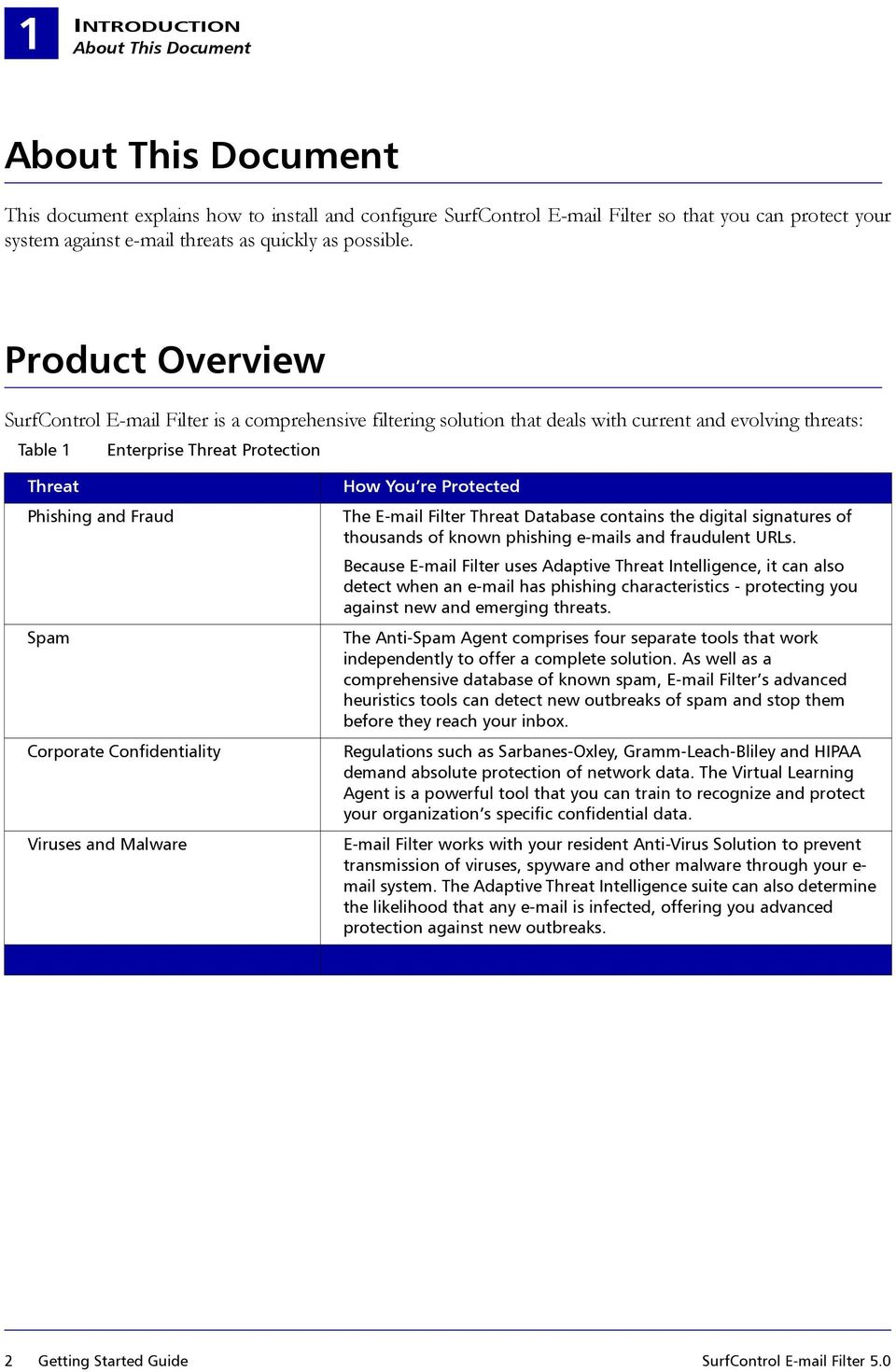
5 1 INTRODUCTION About This Document About This Document This document explains how to install and configure SurfControl Filter so that you can protect your system against threats as quickly as possible. Product Overview SurfControl Filter is a comprehensive filtering solution that deals with current and evolving threats: Table 1 Enterprise Threat Protection Threat Phishing and Fraud Spam Corporate Confidentiality Viruses and Malware How You re Protected The Filter Threat Database contains the digital signatures of thousands of known phishing s and fraudulent URLs. Because Filter uses Adaptive Threat Intelligence, it can also detect when an has phishing characteristics - protecting you against new and emerging threats. The Anti-Spam Agent comprises four separate tools that work independently to offer a complete solution. As well as a comprehensive database of known spam, Filter s advanced heuristics tools can detect new outbreaks of spam and stop them before they reach your inbox. Regulations such as Sarbanes-Oxley, Gramm-Leach-Bliley and HIPAA demand absolute protection of network data. The Virtual Learning Agent is a powerful tool that you can train to recognize and protect your organization s specific confidential data. Filter works with your resident Anti-Virus Solution to prevent transmission of viruses, spyware and other malware through your e- mail system. The Adaptive Threat Intelligence suite can also determine the likelihood that any is infected, offering you advanced protection against new outbreaks. 2 Getting Started Guide SurfControl Filter 5.0
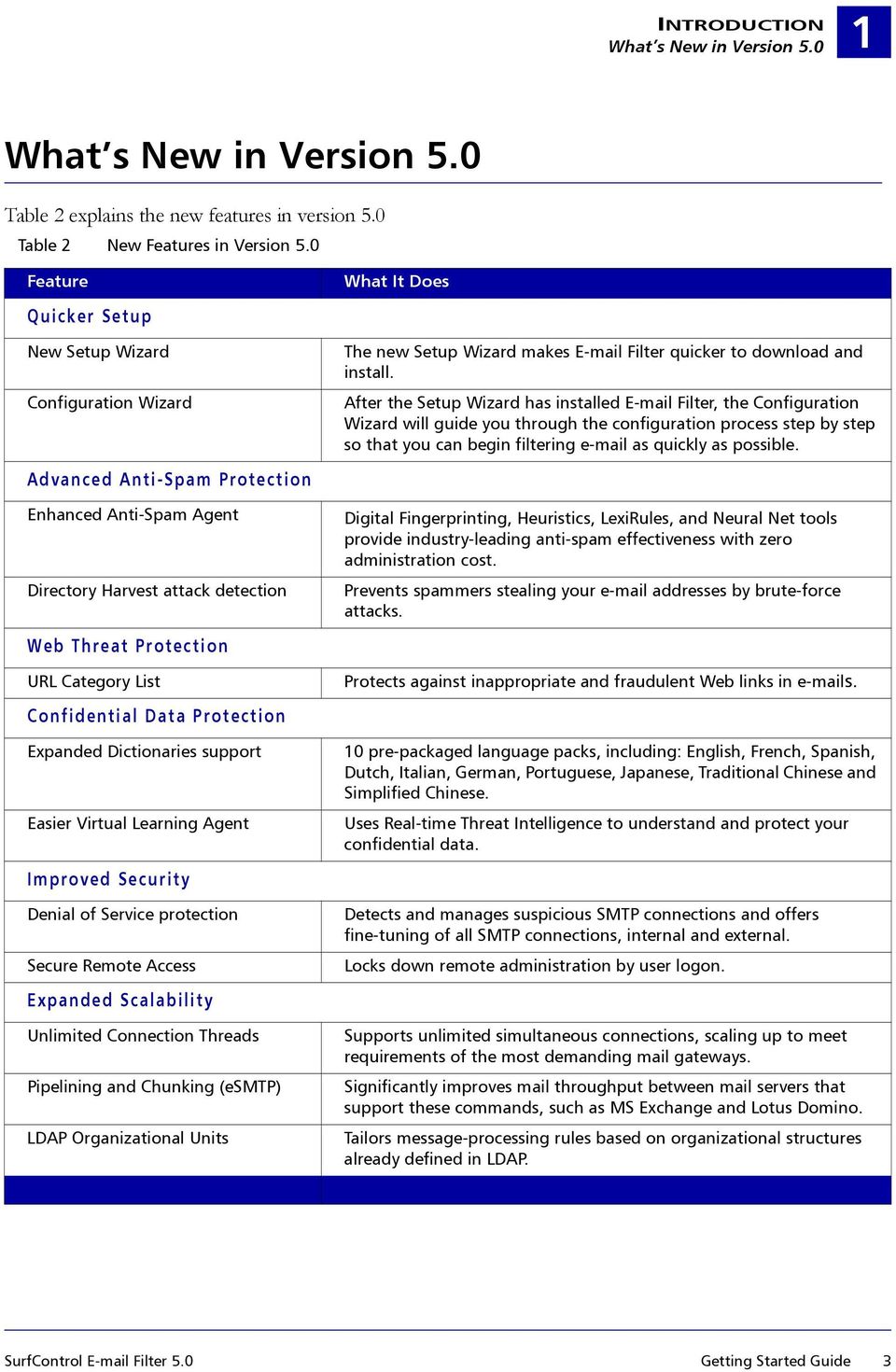
6 INTRODUCTION What s New in Version What s New in Version 5.0 Table 2 explains the new features in version 5.0 Table 2 New Features in Version 5.0 Feature Quicker Setup New Setup Wizard Configuration Wizard Advanced Anti-Spam Protection Enhanced Anti-Spam Agent Directory Harvest attack detection Web Threat Protection URL Category List Confidential Data Protection Expanded Dictionaries support Easier Virtual Learning Agent Improved Security Denial of Service protection Secure Remote Access Expanded Scalability Unlimited Connection Threads Pipelining and Chunking (esmtp) LDAP Organizational Units What It Does The new Setup Wizard makes Filter quicker to download and install. After the Setup Wizard has installed Filter, the Configuration Wizard will guide you through the configuration process step by step so that you can begin filtering as quickly as possible. Digital Fingerprinting, Heuristics, LexiRules, and Neural Net tools provide industry-leading anti-spam effectiveness with zero administration cost. Prevents spammers stealing your addresses by brute-force attacks. Protects against inappropriate and fraudulent Web links in s. 10 pre-packaged language packs, including: English, French, Spanish, Dutch, Italian, German, Portuguese, Japanese, Traditional Chinese and Simplified Chinese. Uses Real-time Threat Intelligence to understand and protect your confidential data. Detects and manages suspicious SMTP connections and offers fine-tuning of all SMTP connections, internal and external. Locks down remote administration by user logon. Supports unlimited simultaneous connections, scaling up to meet requirements of the most demanding mail gateways. Significantly improves mail throughput between mail servers that support these commands, such as MS Exchange and Lotus Domino. Tailors message-processing rules based on organizational structures already defined in LDAP. SurfControl Filter 5.0 Getting Started Guide 3
7 1 INTRODUCTION What s New in Version 5.0 Table 2 New Features in Version 5.0 Feature Easier Administration Grouping of Rules Expanded Filtering in Rules Redesigned Server Configuration notifications of failed events Report Central Single Management Console What It Does Organizes your rules by the type of threats being managed. The default rule set includes anti-spam, network security, and other useful groupings. Supports inbound/outbound Who functionality, filtering of PDF, TNEF, and RTF, and supports Office 2003 and Web Archive formats. Offers a more powerful way to configure any server and view settings by service. Instant awareness that any scheduled event has not been successful. Provides web-based reporting of filtering activity, with ability to lock down reporting access by user. Allows easy administrative access to each SurfControl server within the organization, providing a single portal view of multiple SurfControl & Web Filter deployments. 4 Getting Started Guide SurfControl Filter 5.0

8 INTRODUCTION How SurfControl Filter Works 1 How SurfControl Filter Works Figure 1 explains how Filter processes messages: Figure 1 How SurfControl Filter Works SurfControl Filter 5.0 Getting Started Guide 5

9 1 INTRODUCTION How SurfControl Filter Works SurfControl Filter s functionality is managed by four software services: Receive Service Rules Service Send Service Administration Service The services fit together like this Figure 2 Filter Services During the installation and configuration process you will: Install the services to your server or servers. Install the SQL databases Specify where the queue folders will be located. 6 Getting Started Guide SurfControl Filter 5.0

10 Chapter 2 Before You Begin System Requirements page 8 Minimum Requirements page 8 Other Requirements page 11 Installation Decisions page 12 Location of Filter on the Network page 13 Database Size and Location page 13 Load Balancing Methods page 14 Server Size page 15

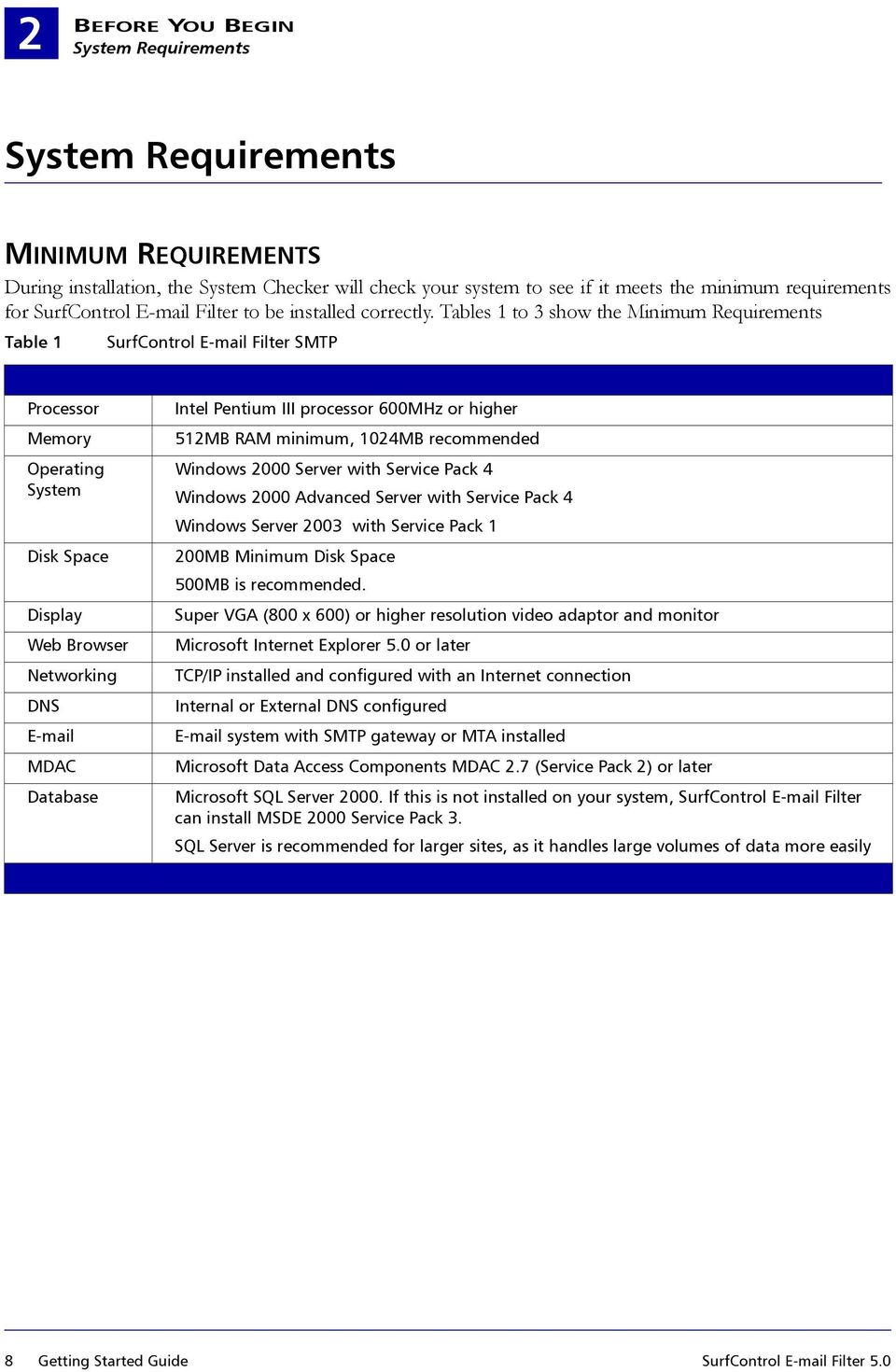
11 2 BEFORE YOU BEGIN System Requirements System Requirements MINIMUM REQUIREMENTS During installation, the System Checker will check your system to see if it meets the minimum requirements for SurfControl Filter to be installed correctly. Tables 1 to 3 show the Minimum Requirements Table 1 SurfControl Filter SMTP Processor Memory Operating System Disk Space Display Web Browser Networking DNS MDAC Database Intel Pentium III processor 600MHz or higher 512MB RAM minimum, 1024MB recommended Windows 2000 Server with Service Pack 4 Windows 2000 Advanced Server with Service Pack 4 Windows Server 2003 with Service Pack 1 200MB Minimum Disk Space 500MB is recommended. Super VGA (800 x 600) or higher resolution video adaptor and monitor Microsoft Internet Explorer 5.0 or later TCP/IP installed and configured with an Internet connection Internal or External DNS configured system with SMTP gateway or MTA installed Microsoft Data Access Components MDAC 2.7 (Service Pack 2) or later Microsoft SQL Server If this is not installed on your system, SurfControl Filter can install MSDE 2000 Service Pack 3. SQL Server is recommended for larger sites, as it handles large volumes of data more easily 8 Getting Started Guide SurfControl Filter 5.0
12 BEFORE YOU BEGIN System Requirements 2 Table 2 SurfControl Filter for SMTP Admin Client Processor Operating System Display Web Browser MDAC Intel Pentium III processor 600MHz or higher. Windows 2000 Server with Service Pack 4 Windows 2000 Advanced Server with Service Pack 4 Windows Server 2003 with Service Pack 1 Windows 2000 Professional with Service Pack 4 Windows XP Super VGA (800 x 600) or higher resolution video adaptor and monitor. Microsoft Internet Explorer 5.0 or later. Microsoft Data Access Components MDAC 2.7 (Service Pack 2) or later. SurfControl Filter 5.0 Getting Started Guide 9

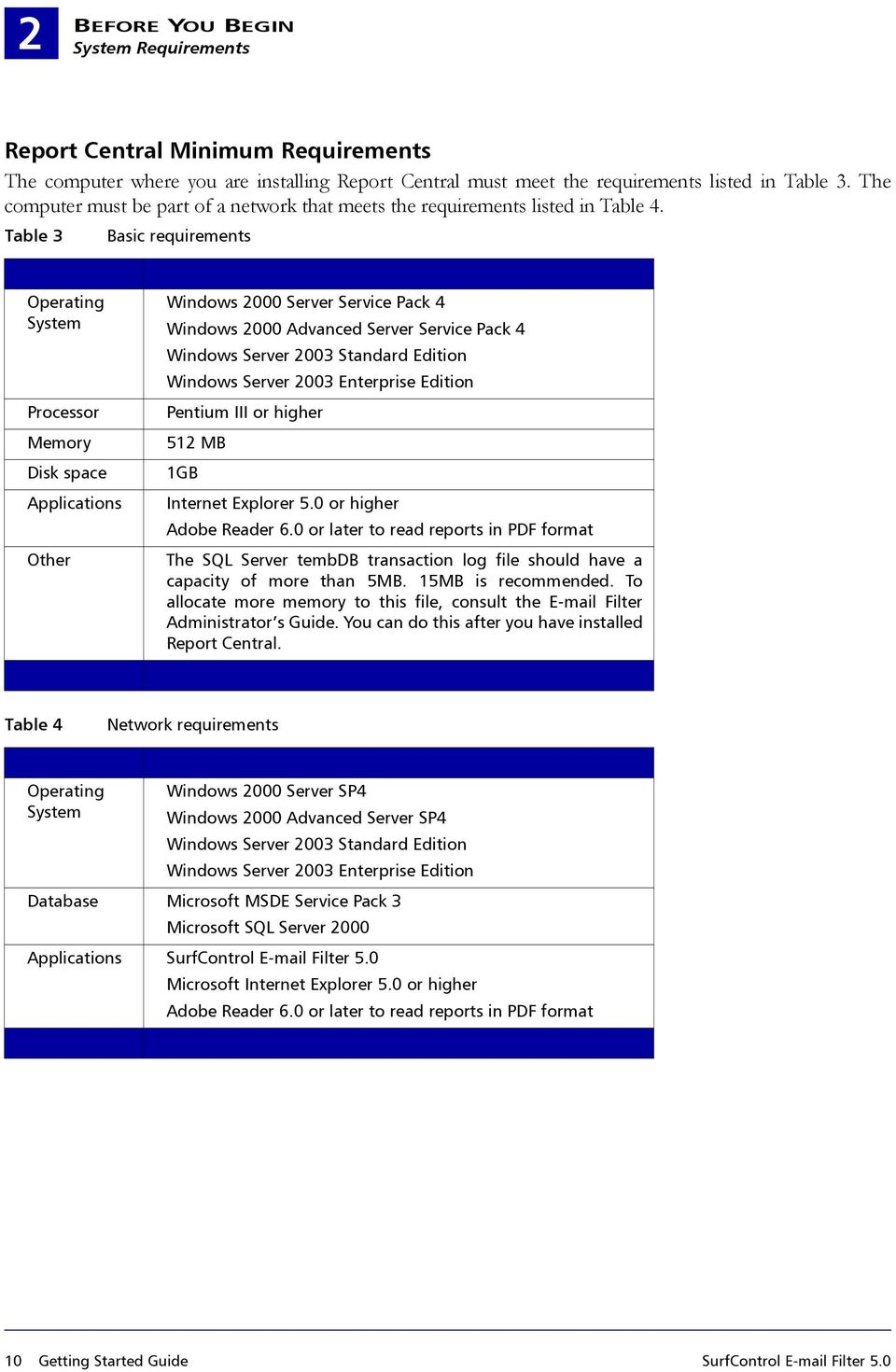
13 2 BEFORE YOU BEGIN System Requirements Report Central Minimum Requirements The computer where you are installing Report Central must meet the requirements listed in Table 3. The computer must be part of a network that meets the requirements listed in Table 4. Table 3 Basic requirements Operating System Processor Memory Disk space Applications Other Windows 2000 Server Service Pack 4 Windows 2000 Advanced Server Service Pack 4 Windows Server 2003 Standard Edition Windows Server 2003 Enterprise Edition Pentium III or higher 512 MB 1GB Internet Explorer 5.0 or higher Adobe Reader 6.0 or later to read reports in PDF format The SQL Server tembdb transaction log file should have a capacity of more than 5MB. 15MB is recommended. To allocate more memory to this file, consult the Filter Administrator s Guide. You can do this after you have installed Report Central. Table 4 Network requirements Operating Windows 2000 Server SP4 System Windows 2000 Advanced Server SP4 Windows Server 2003 Standard Edition Windows Server 2003 Enterprise Edition Database Microsoft MSDE Service Pack 3 Microsoft SQL Server 2000 Applications SurfControl Filter 5.0 Microsoft Internet Explorer 5.0 or higher Adobe Reader 6.0 or later to read reports in PDF format 10 Getting Started Guide SurfControl Filter 5.0
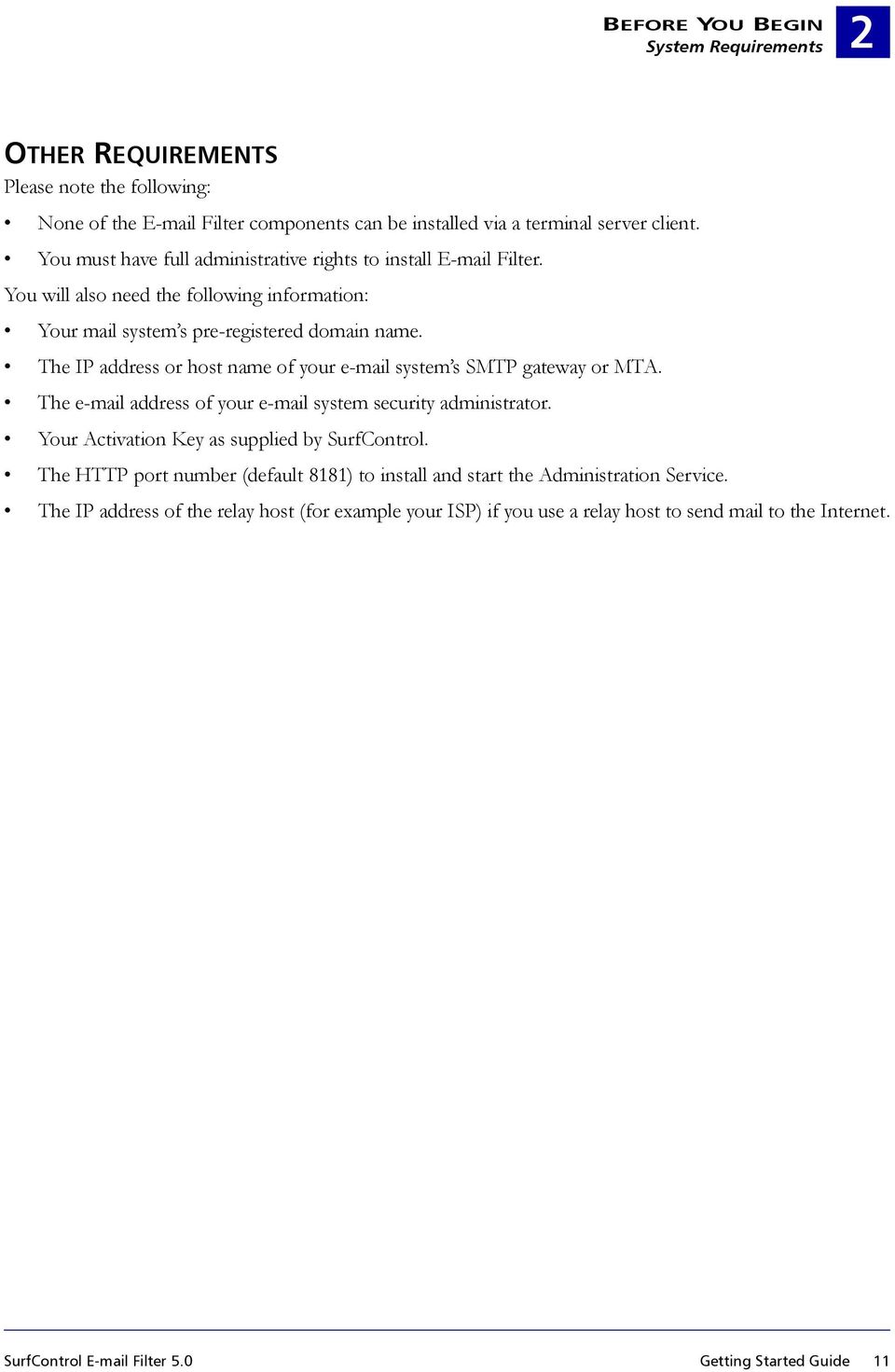
14 BEFORE YOU BEGIN System Requirements 2 OTHER REQUIREMENTS Please note the following: None of the Filter components can be installed via a terminal server client. You must have full administrative rights to install Filter. You will also need the following information: Your mail system s pre-registered domain name. The IP address or host name of your system s SMTP gateway or MTA. The address of your system security administrator. Your Activation Key as supplied by SurfControl. The HTTP port number (default 8181) to install and start the Administration Service. The IP address of the relay host (for example your ISP) if you use a relay host to send mail to the Internet. SurfControl Filter 5.0 Getting Started Guide 11
15 2 BEFORE YOU BEGIN Installation Decisions Installation Decisions Before you begin installing SurfControl Filter you need to make decisions about the following: Location of SurfControl Filter on your network. Database size and location. Load balancing method. 12 Getting Started Guide SurfControl Filter 5.0

16 BEFORE YOU BEGIN Installation Decisions 2 LOCATION OF FILTER ON THE NETWORK Before you install Filter on your network, consider Whether you will install Filter on the mail server / MTA or on a dedicated server. Whether the mail server uses MX records for domain name resolution, or whether the mail server passes this task to a relay host. Where the Filter server will be located in relation to your firewall or DMZ. Chapter 5 describes a range of deployment options for different sized enterprises. DATABASE SIZE AND LOCATION SurfControl Filter stores all configuration data and filtering policies in a SQL database called STEMConfig. All logging data is stored in a SQL database called STEMLog. SQL Server vs. MSDE MSDE, included with the SurfControl Filter download, is the run-time version of SQL. MSDE databases have a 2 GB size limit and few management tools, but it is an effective database for small environments. Although you can install a SQL database onto the SurfControl server, SurfControl recommends that large environments install a fully licensed version of SQL onto a separate, dedicated server. Dedicated vs. Centralized If your network requires multiple SurfControl servers, you have two database options: dedicated or centralized. A dedicated database stores data for a single SurfControl server in a single database; a centralized database stores the data for multiple SurfControl servers in a single database. Many customers choose to use the centralized database option, which provides the advantages of centralized policy management and message administration, plus the ability to run reports from a single repository. However, the size of a centralized database grows in direct relation to the number of SurfControl servers that write to it. Depending on the size of your environment and the number of s that pass through your network, a centralized database can require additional administration. In this case, you may choose to use a dedicated database for each SurfControl server. Database Size The size of the database depends on the number of s your organization receives per day, and the length of time you plan to retain the logged data for message administration and reporting purposes. To size your database appropriately, SurfControl estimates that each generates approximately 1KB of log data stored in the database. (This calculation can also be helpful when determining whether MSDE is sufficient for your environment.) No matter where you store the SurfControl Filter data, make sure the server has as much RAM as the anticipated size of the database (for example, a one GB database requires one GB of RAM. (This is in accordance with Microsoft s recommendations for optimal performance.) SurfControl Filter 5.0 Getting Started Guide 13
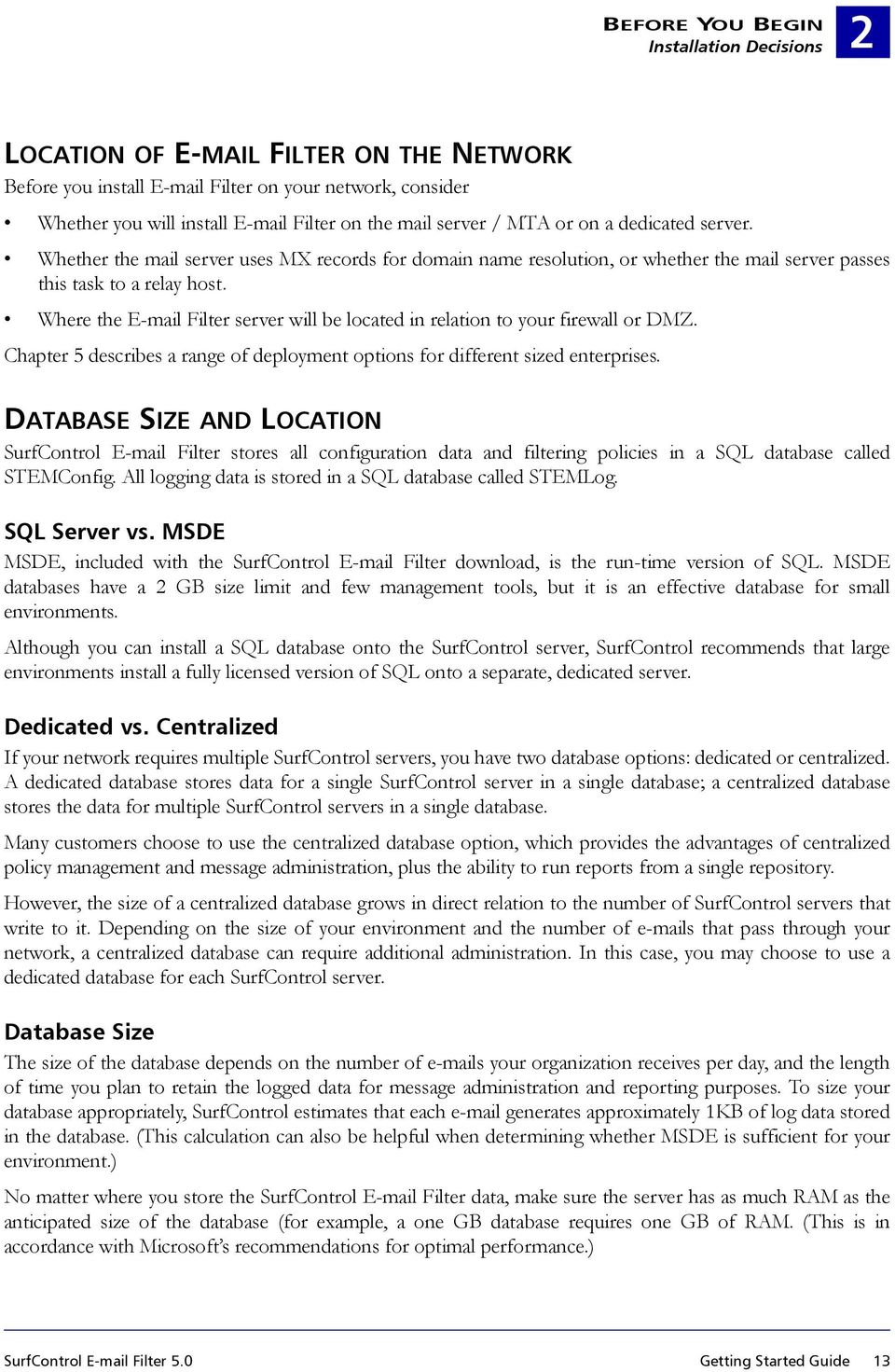
17 2 BEFORE YOU BEGIN Installation Decisions LOAD BALANCING METHODS You can load balance SurfControl Filter using MX records. On the DNS server hosting your domain, create an MX record for each primary SurfControl server using the same MX preference, while giving the failover server a higher number (which gives it a lower preference). Table 5 provides an example of MX preference assignments for load-balancing and failover using MX records. Figure 1 further shows this method. Table 5 MX Records for Load Balancing. Mail Exchanger IP Address MX Preference Site A mx1.sitea.com mx2.sitea.com mx3.sitea.com mx4.sitea.com Site B mx1.siteb.com mx2.siteb.com mx3.siteb.com mx4.siteb.com Figure 1 Using MX records for load balancing. 14 Getting Started Guide SurfControl Filter 5.0
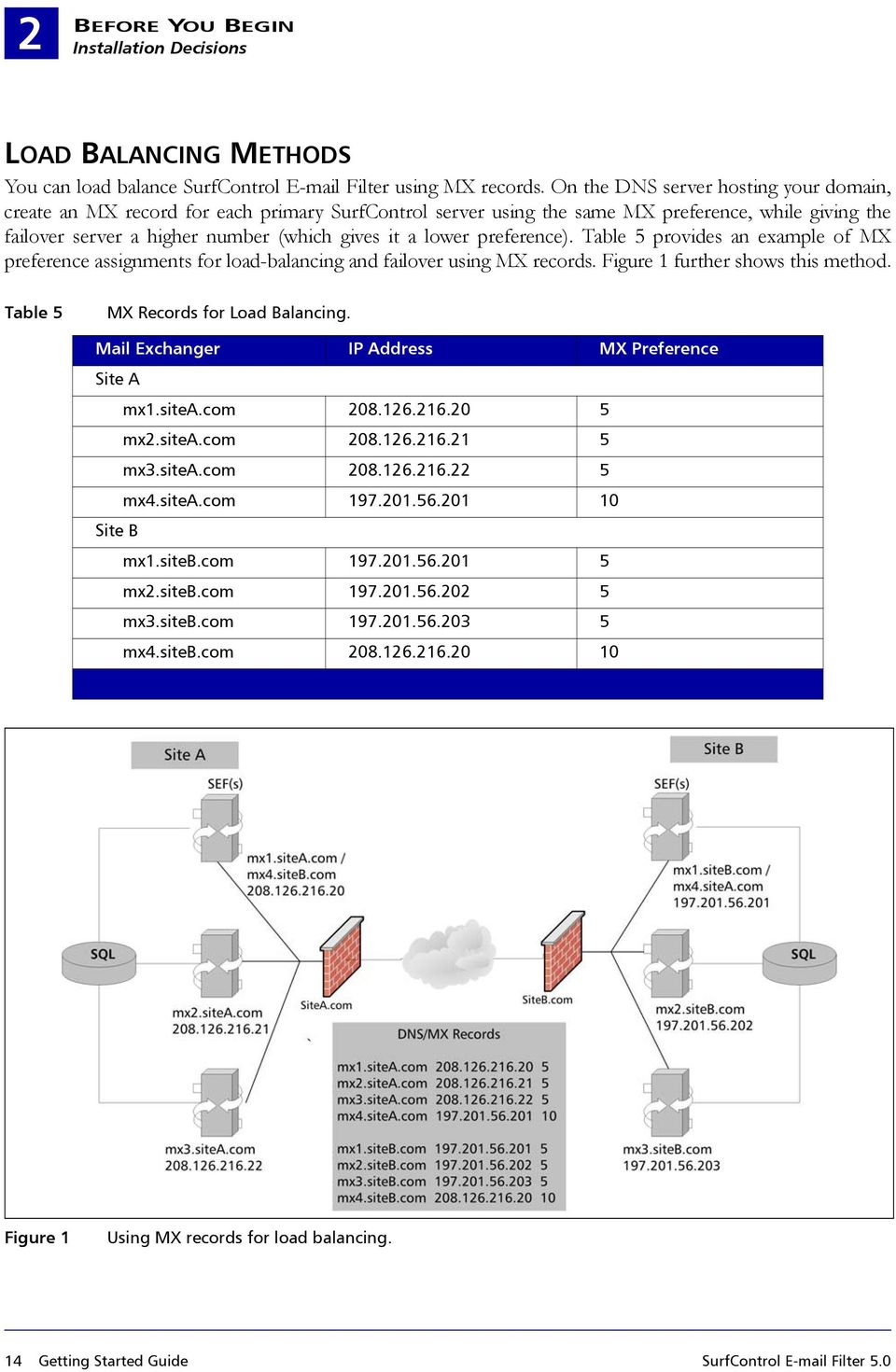
18 BEFORE YOU BEGIN Installation Decisions 2 In Figure 1, sent to sitea.com round-robins between mail exchangers 1, 2, and 3, because each SurfControl server has the same MX preference of 5. (A lower MX preference number means that it has a higher priority -- 5 having a higher priority than 10.) The same thing happens for s sent to siteb.com. If site A is down (e.g., with a network failure), the sending mail server will route to the fourth (failover) MX record, which is the address of a server in a different physical location. For the described failover to work properly, SurfControl servers in site A are configured to accept messages for site B, and SurfControl servers in site B are configured to accept messages for site A. The failover servers also have static routes configured so that SurfControl knows where to route the s. In addition to load balancing and failover using MX records, there are also sophisticated load balancing switches that can be used for these purposes. These switches offer a variety of load balancing algorithms, in addition to round-robin delivery, which provide efficient load distribution and timely failover. Although this is not a required component for a SurfControl implementation, the use of load balancing switches may improve the overall efficiency of your SMTP infrastructure. SERVER SIZE Table 2 shows SurfControl s server recommendations, depending on how many s per hour your organization typically handles. Table 6 Server Recommendations. s Per Hour Server Recommendations < 10K s PIII 1Ghz + 1 GB RAM. < 25K s Dual Xeon 2GB RAM. <40K s Quad Xeon, 2GB RAM, 3 or more HDDs (10,000 + RPM) for processing. < 120K s 3-Quad Xeon, 2GB RAM, 3 or more HDDs (10,000 + RPM) for processing. < 240K s 6-Quad Xeon, 2GB RAM, 3 or more HDDs (10,000 + RPM) for processing. Actual processing speeds are dependent on several factors: number of rules processing threads, number of enabled rules, size of s, and complexity of the s (e.g., attachments, embedded files, etc.). SurfControl Filter 5.0 Getting Started Guide 15

19 2 BEFORE YOU BEGIN Installation Decisions Partitioning the Server You can optimize Filter s performance by installing onto a server capable of fast disk I/O and configured to support multiple HDDs. Figure 2 shows the optimal HDD and partitioning configuration for SurfControl. Because SurfControl frequently reads from and writes to disk as it processes , SurfControl recommends that you have a server capable of fast disk I/O. Figure 2 shows a server with five SCSI HDDs. Two of the HDDs are in a RAID1 configuration and are divided into three partitions: a partition for the operating system, a partition for the page file, and a partition for the SurfControl application. The other three HDDs each have a single partition and are capable of fast disk I/O. The first drive contains the In folder where SurfControl stores the received s. The second drive contains the Work folder. SurfControl retrieves s from the In folder and moves them to the Work folder, where the s are processed against the configured rule set. SurfControl then moves the to a quarantine folder for review or to the Out folder for delivery. The third drive contains the Out folder where SurfControl relays processed messages to the intended recipient. Figure 2 Partitioning the SurfControl server. Now turn to the next chapter to begin the installation process. 16 Getting Started Guide SurfControl Filter 5.0

20 Chapter 3 Installation In This Chapter page 18 Running the Setup Wizard page 19 Filter Components page 20 Typical Installation page 21 Custom Installation - Administration Client page 27 Custom Installation - Report Central page 31

21 3 INSTALLATION In This Chapter In This Chapter Once you have made the installation decisions discussed in the previous chapter, you are ready to begin installing SurfControl Filter. There are two stages to complete before SurfControl Filter can begin filtering The Setup Wizard will install the files on your computer. The Configuration Wizard will guide you through the basic configuration process and download the latest Threat Databases. The Configuration Wizard will begin automatically once the Setup Wizard is finished. This chapter explains how to install the Filter files on your computer using the Setup Wizard. 18 Getting Started Guide SurfControl Filter 5.0
22 INSTALLATION Running the Setup Wizard 3 Running the Setup Wizard There are two ways to install SurfControl Filter: Typical Installation A typical installation will install all the SurfControl Filter Core Components. If you run a typical installation, everything that SurfControl Filter needs to begin filtering will be installed on the same server. Custom Installation You can select which filter components you want to install. This is useful if you want to access the Filter server from a remote location. Figure 1 shows the Monitor installed as an Administration Client on the administrator s workstation, which enables the administrator to view traffic passing through the Filter server in real time. Figure 1 Using the Administration Client for remote access You can also use the custom installation to install Report Central. SurfControl Filter 5.0 Getting Started Guide 19
23 3 INSTALLATION Running the Setup Wizard FILTER COMPONENTS Table 1 describes the Filter Components. Table 1 Filter Components Component Description Server Components Filter services Manages the processing of . See Filter Services on page 6. Scheduler Schedules the updating of the Threat Management Database and other management tasks. Administration client Manages communication between the components. Administration Clients Report Central Monitor Rules Administrator Message Administrator Creates reports on use in your organization. Displays the progress of s through Filter in real time. Displays and manages the rules you set up to enforce your organization s Acceptable Use Policy. Displays information about s that have triggered rules, and enables you to act on them. If you install the Server Components, the Administration Clients are also installed automatically. You can install the Administration Clients without the Server Components and specify the remote location of the Server Components so that the Administration Clients can connect to them. 20 Getting Started Guide SurfControl Filter 5.0
24 INSTALLATION Running the Setup Wizard 3 TYPICAL INSTALLATION A typical installation will install all of the Filter components on your computer. Follow Procedure 1. Procedure 1: Typical Installation Step Action 1 Double click the setup.exe icon to start the Setup Wizard. 2 Specify where you want the Setup Wizard to copy the SurfControl installation files. Click Next to continue. 3 The Welcome page will display. Click Next to continue. 4 You will be asked to agree to the SurfControl License Agreement. Select I accept the terms of the license agreement and click Next. SurfControl Filter 5.0 Getting Started Guide 21
25 3 INSTALLATION Running the Setup Wizard Procedure 1: Typical Installation Step Action 5 You will be asked to accept the GNU public license agreement. Select I accept the terms of the license agreement and click Next. 6 You will be asked to select a Setup Type. Choose Typical. Click Next. 7 You will see that the core components are selected by default. By default, Report Central is also selected. You need Report Central to create reports on use in your organization. You cannot deselect any of the core components but you can choose not to install Report Central. To change which core components are installed, click Back to return to step 6, and select a Custom installation. 22 Getting Started Guide SurfControl Filter 5.0
26 INSTALLATION Running the Setup Wizard 3 Procedure 1: Typical Installation Step Action 8 The System Checker will check that your computer meets the recommended requirements. If your computer meets the minimum requirements but not the recommended requirements, the system checker will display a warning, but you can continue the installation process. If your computer does not have MDAC the Setup Wizard will install it automatically when you click Next. If your computer does not meet the minimum requirements you will be asked to abort the installation. To continue installing, click Next. If you plan to create the Filter databases on the local computer, proceed to step 9. If you plan to create the Filter databases on a remote computer, proceed to step 15. Creating local Filter databases 9 The Setup Wizard will check whether a valid SQL Server is installed on your computer: If a SQL Server is present, you can use it to create the Filter databases on the local computer. See step 10. If SQL Server is not present, you can install MSDE and use it to create the Filter databases on the local computer. See steps To create the databases on an existing SQL Server, select Create SurfControl Filter databases on this computer. Click Next. Proceed to step 17 SurfControl Filter 5.0 Getting Started Guide 23
27 3 INSTALLATION Running the Setup Wizard Procedure 1: Typical Installation Step Action 11 To install MSDE select Install MSDE and create SurfControl Filter databases on this computer. 12 Specify the location of the MSDE database. By default this is C:\Program files\microsoft SQL Server Click Browse to change the path. Click Next to proceed. 13 Specify a password for the SQL Server administrator account SA Enter a password for the SA account, then enter it again to confirm. Click Next 24 Getting Started Guide SurfControl Filter 5.0
28 INSTALLATION Running the Setup Wizard 3 Procedure 1: Typical Installation Step Action 14 When the MSDE setup program has finished, you will be asked to restart your computer. When the computer has restarted the Setup Wizard will resume where it left off. Select Create SurfControl Filter databases on this computer and click Next. Creating the Filter databases on a Remote SQL Server 15 Select Create SurfControl Filter databases on another computer. 16 Specify the server name of the SQL Server where you want to install the Filter databases. Choose how the SurfControl Filter server will connect to the SQL Server: Windows NT Authentication SQL Authentication Enter a user name and password to log into the SQL Server. Click Next. SurfControl Filter 5.0 Getting Started Guide 25
29 3 INSTALLATION Running the Setup Wizard Procedure 1: Typical Installation Step Action 17 The summary screen will now display, showing the options you have chosen. To proceed with the installation, click Next. Click Back to amend your settings. 18 When the installation is complete, you will see the final screen of the Setup Wizard. Click Finish. Once you have finished installing SurfControl Filter the Configuration Wizard will begin immediately. See Configuration Wizard on page Getting Started Guide SurfControl Filter 5.0
30 INSTALLATION Running the Setup Wizard 3 CUSTOM INSTALLATION - ADMINISTRATION CLIENT Procedure 2 describes how to use a Custom Installation to install the Administration Client components of your choice. See Filter Components on page 20 for a description of each component. Procedure 2: Installing the Administration Client Step Action 1 Double click the setup.exe icon to start the Setup Wizard. 2 Specify where you want the Setup Wizard to copy the SurfControl installation files. Click Next to continue. 3 The Welcome page will display. Click Next to continue. 4 You will be asked to agree to the SurfControl License Agreement. Select I accept the terms of the license agreement and click Next. SurfControl Filter 5.0 Getting Started Guide 27
31 3 INSTALLATION Running the Setup Wizard Procedure 2: Installing the Administration Client Step Action 5 You will be asked to accept the GNU public license agreement. Select I accept the terms of the license agreement and click Next. 6 Select the Custom setup type. 7 Select the components you want to install. Note: You can install the Filter Client without the Filter Server, but you cannot install the Filter Server without the Filter Client. 28 Getting Started Guide SurfControl Filter 5.0
32 INSTALLATION Running the Setup Wizard 3 Procedure 2: Installing the Administration Client Step Action 8 The System Checker will check that your computer meets the recommended requirements. If your computer meets the minimum requirements but not the recommended requirements, the system checker will display a warning, but you can continue the installation process. If your computer does not have MDAC the Setup Wizard will install it automatically when you click Next. If your computer does not meet the minimum requirements you will be asked to abort the installation. To continue installing, click Next. 9 Specify the location of the Filter server. Enter: The server name or IP address of the computer where the Filter Server Component is installed. The port number that the Filter client will use to communicate with the server. A user name and password that the Filter client will use to log in to the Filter Server. Click Next to continue 10 The summary screen will show the installation choices you have made. Click Next to proceed. SurfControl Filter 5.0 Getting Started Guide 29
33 3 INSTALLATION Running the Setup Wizard Procedure 2: Installing the Administration Client Step Action 11 The Installation Complete screen will display. Click Next to launch SurfControl Filter. If you selected to install Report Central, the Report Central installation process will now begin. 30 Getting Started Guide SurfControl Filter 5.0
34 INSTALLATION Running the Setup Wizard 3 CUSTOM INSTALLATION - REPORT CENTRAL If you install Report Central as part of a full installation, the Setup Wizard will install all the files you need automatically. If you install Report Central as part of a custom installation, you will need to follow further steps in the setup wizard that are specific to Report Central. Procedure 3: Installing Report Central Step Action 1 If you have already installed any Filter Components, you will be asked whether you want to Install Report Central v1.5 Uninstall SurfControl Filter Select Install Report Central v1.5 and click Next. 2 If you are installing Report Central without any SurfControl Filter components, select Custom from the Setup Type screen. Click Next to continue. 3 You will see the Report Central welcome screen. Click Next to continue. SurfControl Filter 5.0 Getting Started Guide 31
35 3 INSTALLATION Running the Setup Wizard Procedure 3: Installing Report Central Step Action 4 You will be asked to agree to the SurfControl License Agreement. Select I accept the terms of the license agreement and click Next. 5 Specify the folder where you want to install Report Central. Click Next to continue. 6 Select the server where the SurfControl Filter logging database is installed. 7 Specify how Report Central will authenticate itself to the Filter logging database. Choose one of the following: Windows Authentication SQL Authentication Enter the user name and password of an account to log into the SQL Server. Click Next to continue. 32 Getting Started Guide SurfControl Filter 5.0
36 INSTALLATION Running the Setup Wizard 3 Procedure 3: Installing Report Central Step Action 8 Create a username and password for the Report Central administrator account. When you run Report Central for the first time, you will need this account to log in. 9 Select the database that Report Central will connect to. Report Central will use this database to generate reports. If you want to choose a database later, leave the Database field blank. Click Next to continue. 10 The Setup Wizard is now ready to begin installing. Click Install to continue. SurfControl Filter 5.0 Getting Started Guide 33
37 3 INSTALLATION Running the Setup Wizard Procedure 3: Installing Report Central Step Action 11 When the Setup Wizard has finished copying the files, you will see the Installation Complete screen. Click Finish to launch Report Central. 34 Getting Started Guide SurfControl Filter 5.0
38 Chapter 4 Configuration Wizard In This Chapter page 36 Running the Configuration Wizard page 37 Next Steps page 46 Launching Filter page 46 Launching Report Central page 46 Upgrading from a Previous Release page 47
39 4 CONFIGURATION WIZARD In This Chapter In This Chapter This chapter explains how to use the Configuration Wizard to set up SurfControl Filter and begin filtering . Once you have finished installing Filter the Configuration Wizard will begin immediately. It will guide you through a basic configuration process that will protect your primary domain against common threats. Once the Configuration Wizard has finished, Filter will be up and running, and you can fine-tune the configuration to suit your needs. The Configuration Wizard has four stages. Your Organization System Details Mail Routing Filtering Options 36 Getting Started Guide SurfControl Filter 5.0
40 CONFIGURATION WIZARD Running the Configuration Wizard 4 Running the Configuration Wizard The Configuration Wizard will launch automatically after you finish the installation process. Follow Procedure 1: Procedure 1: Configuration Wizard Step Action 1 As soon as you have finished installing SurfControl Filter, the Configuration Wizard will launch. Your Organization 2 Enter your contact information to register with SurfControl. (Sheet 1 of 9) SurfControl Filter 5.0 Getting Started Guide 37
41 4 CONFIGURATION WIZARD Running the Configuration Wizard Procedure 1: Configuration Wizard (Continued) Step Action 3 If you are evaluating Filter, select I am evaluating SurfControl Filter. If you have purchased SurfControl Filter, select I have purchased a license and enter your license key. 4 If you have entered a license key, you will be asked if you have license keys for any of the Adaptive Threat Intelligence components. If you have license keys, enter them here. System Information 5 The System Details introduction screen will display. Click Next. (Sheet 2 of 9) 38 Getting Started Guide SurfControl Filter 5.0
42 CONFIGURATION WIZARD Running the Configuration Wizard 4 Procedure 1: Configuration Wizard (Continued) Step Action 6 Enter the following: User name and password of a Windows user account with administrative privileges. Filter will use this account to log its services on to Windows. The domain or machine name of the server where the Windows user account is defined. Click Next to continue. 7 If you have not yet installed Report Central, you can opt to install it now. Alternatively, if you want have installed Report Central on another server and want to use it for reporting on activity, enter the machine name and port number of the server where Report Central is running. Note: If you are running SurfControl Report Central for Web Filter on the remote server, you need to install Report Central for Filter there as well. 8 If you installed Report Central during the Installation process, or if you opted to install Report Central in step 7, create a username and password for the Report Central administrator account. When you run Report Central for the first time, you will need this account to log in. (Sheet 3 of 9) SurfControl Filter 5.0 Getting Started Guide 39
43 4 CONFIGURATION WIZARD Running the Configuration Wizard Procedure 1: Configuration Wizard (Continued) Step Action Mail Routing 9 The Mail Routing introduction will display. Click Next. 10 Specify the SMTP port that SurfControl Filter will use to receive inbound . This is usually port 25. The Configuration Wizard will check that the port you specify is available. If it is being used, either disable the service using it, or choose another port. (Sheet 4 of 9) 40 Getting Started Guide SurfControl Filter 5.0
44 CONFIGURATION WIZARD Running the Configuration Wizard 4 Procedure 1: Configuration Wizard (Continued) Step Action 11 Enter the following information about your primary local domain: Local domain name The domain for which you want to filter e- mail. If you have more than one domain in your organization, you can add others once Filter is up and running. Postmaster address The address of the postmaster for your primary local domain. Name or IP address of mail server The machine name or IP address of your mail server. Mail Server SMTP Port The port that the Filter server will use to communicate with the domain s mail server. To test the connectivity between the Filter server and the mail server, click Test. 12 Specify how you want Filter to route outbound mail. Filter can route in two ways: By sending it directly to the internet. Filter will perform a DNS lookup to resolve the address. By sending it to another mail server. The mail server will handle domain name resolution and any further routing. Select how you want outbound messages to be routed. If you want to route outbound mail via a mail server, fill in the fields as follows: Host Name or IP Enter the host name or IP address of the mail server to which you want to forward e- mails. Port Enter the port that SurfControl Filter will use to communicate with the mail server. Once Filter is up and running you can add further mail servers. (Sheet 5 of 9) SurfControl Filter 5.0 Getting Started Guide 41
45 4 CONFIGURATION WIZARD Running the Configuration Wizard Procedure 1: Configuration Wizard (Continued) Step Action 13 The Filtering Options introduction screen will display. Click Next. 14 SurfControl Filter has a set of standard rules so that you can begin filtering as soon as possible. Select which rule groups you want to activate. You can choose one or all of the following: Spam Filtering rules. Virus protection rules. Network security rules. When you have chosen which rule groups to activate, click Next. 15 Specify where the queue folders that hold isolated will be located. The Configuration Wizard will automatically select the drive with the most disk space as the default. Click Next. (Sheet 6 of 9) 42 Getting Started Guide SurfControl Filter 5.0
46 CONFIGURATION WIZARD Running the Configuration Wizard 4 Procedure 1: Configuration Wizard (Continued) Step Action 16 If messages build up in the Isolate queues it can impair Filter s performance. You can automatically delete each from the Virus or Spam queues once it has been held there for a set number of days. You can delete: s over 7 days old from the Virus queue. s over 14 days old from the Spam queue. Once Filter is up and running you can set up automatic management for other queues, and change the number of days after which s are deleted. 17 activity is recorded in the STEMLog database. If this database becomes too large, it can slow down the processing and delivery of . To maintain efficiency, you should schedule regular database updates. Select Purge database once a month to set up a regular database purge. Once Filter is up and running, you can use the Scheduler to specify when database purges take place. 18 Filter can send notifications via to your domain s systems administrator to notify them of system events. Enter the address of a system administrator for your protected domain who you want to be notified of system events. Click Next. (Sheet 7 of 9) SurfControl Filter 5.0 Getting Started Guide 43
47 4 CONFIGURATION WIZARD Running the Configuration Wizard Procedure 1: Configuration Wizard (Continued) Step Action 19 The Configuration Wizard is now ready to complete the configuration tasks. Click Start to begin configuring. 20 The Configuration Wizard will work through the list of tasks. When a task is complete it will be marked with a green check. If there is a problem with the configuration process, you will see a red exclamation point next to the task. If this happens the Back button will become enabled so that you can amend your settings if necessary. 21 SurfControl strongly recommends that you exclude the Filter work folder and its subfolders from scanning by your resident antivirus solution. Click Check folders to check that the correct folders are excluded from anti-virus scanning. The Configuration Wizard uses the Eicar test pattern to test the response of your anti-virus software. The Eicar test pattern is not a virus and will not damage your system in any way. Click Next to continue. (Sheet 8 of 9) 44 Getting Started Guide SurfControl Filter 5.0
48 CONFIGURATION WIZARD Running the Configuration Wizard 4 Procedure 1: Configuration Wizard (Continued) Step Action 22 The Configuration Wizard is now complete. The Monitor will launch automatically. Use the Server Configuration Console to fine-tune your configuration to suit your needs. (Sheet 9 of 9) SurfControl Filter 5.0 Getting Started Guide 45
49 4 CONFIGURATION WIZARD Next Steps Next Steps SurfControl Filter is now protecting your primary domain using the standard rules you specified. You now need to launch Filter and fine-tune the configuration settings. You can: Add other protected domains: if you have an additional domain, it will not receive any until you add it to the protected domains list in the Server Configuration Console. Change the timing of scheduled events: use the Scheduler to change how frequently database purges and other events take place. Create additional rules: use the Rules Administrator to create, amend and group rules to suit your Acceptable Use Policy. Consult the Administrator s Guide for more information. LAUNCHING FILTER When the Configuration Wizard is finished, the Monitor will start automatically. At other times, you can launch Filter from the Start menu. Now consult the Filter Administrator s Guide for more information. LAUNCHING REPORT CENTRAL From the Start menu, select Programs > Filter 5.0 Reports. Log in using the Admin account that you created when you were installing and configuring Report Central. Consult the Filter Administrator s Guide for more information about Report Central. 46 Getting Started Guide SurfControl Filter 5.0
50 CONFIGURATION WIZARD Next Steps 4 UPGRADING FROM A PREVIOUS RELEASE If you have upgraded from a previous release of Filter, your existing rule set will be preserved. The standard rules shipped with Version 5.0 will be saved to the root of the SurfControl Filter folder. To import the new rules, follow Procedure 2: Procedure 2: Upgrading the Rule Set Step Action Action 1 Launch the Rules Administrator 2 From the File menu, select Import Rules... The Open dialog will display. 3 Select Default.rul and click Open. A list of rules in the file will display 4 Select the ones you want and click Import to transfer them into the Rules Administrator. 5 You will see the rules you selected in the Rules Administrator. Imported rules are initially disabled. Check the boxes of the rules you want to enable. 6 If any of the imported rules, need to be re-configured, the Rules Wizard will start when you enable them. Skipping this configuration may cause the rule to behave incorrectly. SurfControl Filter 5.0 Getting Started Guide 47
51 4 CONFIGURATION WIZARD Next Steps Dictionary Upgrades When you upgrade to version 5.0, the new dictionaries are automatically installed. However, only new words are added to your existing dictionaries, so any dictionary scores you have changed or words you have added will be preserved. Retraining the Virtual Learning Agent When you have installed version 5.0 you will also need to re-train the Virtual Learning Agent. For instructions on how to do this, consult the Administrator s Guide. 48 Getting Started Guide SurfControl Filter 5.0
52 Chapter 5 Deployment In This Chapter page 50 Deployment Options page 51
53 5 DEPLOYMENT In This Chapter In This Chapter This chapter offers five sample deployment options for enterprises of differing size and complexity: Table 1 Deployment Options Option Description Find out more 1 Filter installed on the mail server page 51 2 Simple dedicated server page 53 3 In a DMZ page 55 4 On the protected network page 57 5 Multiple site installation page Getting Started Guide SurfControl Filter 5.0
54 DEPLOYMENT Deployment Options 5 Deployment Options DEPLOYMENT OPTION 1: FILTER INSTALLED ON THE MAIL SERVER SurfControl recommends that you install Filter on a dedicated server for optimum performance. However, in small environments where cost is a consideration, you can install SurfControl Filter on a Windows-based mail server. This deployment is not recommended for large environments. In this scenario, SurfControl Filter is installed on the mail server. The Filter server accepts traffic from the firewall on port 25. It filters the and relays it to itself on port 26. The mail server then delivers the to the users. Figure 1 Installing Filter on a Windows-based mail server SurfControl Filter 5.0 Getting Started Guide 51
55 5 DEPLOYMENT Deployment Options To perform this installation, follow Procedure 1: Procedure 1: Installing Filter on the Mail Server Step Action 1 On the mail server, run the SurfControl Filter Setup Wizard, selecting typical install. See Typical Installation on page When you have finished installing the product, the Configuration Wizard will run. It will ask you to enter: The IP address of your mail server: enter the IP or machine name of the mail server where Filter is installed. The SMTP Port of the mail server: change the port number from 25 to a different number, e.g Configure your firewall to accept internal SMTP connections only from the SurfControl Filter server. 4 Configure the inbound port 25 tunnel on your firewall to the SurfControl Filter server. POP3 Clients using External Mail Servers 5 If you have any POP3 clients that use external mail servers, set their SMTP host to be the SurfControl Filter server. Some POP configurations require that the mail server is placed in the DMZ or Packet Switching Network, SurfControl do not recommend this because of the data security risk. 52 Getting Started Guide SurfControl Filter 5.0
56 DEPLOYMENT Deployment Options 5 DEPLOYMENT OPTION 2: SIMPLE DEDICATED SERVER This deployment is a simple, low cost solution, suitable for a small to medium sized environment. All Filter components (including the SQL database) are installed on a single server. Filter is filtering all inbound and outbound SMTP traffic. Figure 2 Simple installation for small and medium sized environments. Inbound travels from the Internet to Filter for filtering. Filter then routes the to the next host, which is typically the SMTP service or the daemon of the internal mail server. Outbound flows from the SMTP service/daemon of the internal mail server to Filter for filtering. Filter uses available DNS to resolve MX records and route the SMTP traffic. SurfControl Filter 5.0 Getting Started Guide 53
57 5 DEPLOYMENT Deployment Options Follow Procedure 2 Procedure 2: Single Server Installation Step Action 1 Run the SurfControl Filter Setup Wizard on the server where you want to install SurfControl Filter, selecting Typical Installation. Make sure that the SurfControl Filter databases are installed on the same server. 2 After you have finished the Setup Wizard, the Configuration Wizard will run. It will ask you to enter: The IP address of your mail server: enter the IP or machine name of the mail server where Filter is installed. The SMTP Port of the mail server: this should be the default port The Configuration Wizard will ask if you want to route outbound s directly to the Internet. If the answer is yes, you will also need to configure your firewall to allow the Filter server to access the Internet directly. Make sure both port 25 and port 53 are allowed and support SMTP and DNS requests. 54 Getting Started Guide SurfControl Filter 5.0
58 DEPLOYMENT Deployment Options 5 DEPLOYMENT OPTION 3: IN A DMZ Many large organizations deploy SurfControl Filter in the DMZ, as shown in Figure 3 Figure 3 SurfControl Filter in a DMZ. Figure 3 shows SurfControl Filter installed on hardened servers in the DMZ. In this scenario, the Filter servers receive SMTP traffic for the organization, filter the accordingly, then route it to the next host, which is typically a mail server, gateway, or bridgehead on the protected network.. Many deployment scenarios include two or more SurfControl servers, with no single point of failure. In these scenarios, load balancing is typically achieved using DNS MX records with the same preference. There are several different ways that SurfControl routes SMTP traffic in this type of deployment: SurfControl filters both inbound and outbound traffic. In this configuration, Filter Server 2 or Filter Server 2 receives inbound SMTP traffic, depending on the MX record. It then statically delivers all allowed messages to the internal mail server. When the mail server receives outbound , it routes the to either Filter Server 1 or Filter Server 2 for outbound DNS name resolution and delivery. Filter Server 1 primarily filters inbound traffic; Filter Server 2 primarily filters outbound traffic. In this configuration, the Filter Server 1 acts as a back-up for outbound traffic (based on internal configuration). Filter Server 2 acts as a back-up for inbound traffic (based on higher MX preference). SurfControl Filter 5.0 Getting Started Guide 55
59 5 DEPLOYMENT Deployment Options Filter Server 1 and 2 for inbound filtering only. In this configuration, load balance Filter using MX records. Outbound mail is completely separate and can be routed through additional SurfControl servers, or through any existing outbound mail gateways. This configuration is typically used when there is a high requirement to filter inbound (e.g. spam), but little or no requirement to filter outbound . SQL Placement In Figure 3, the SQL Server is placed inside the protected network. Firewall rules permit Filter Server 1 and Filter Server 2 to communicate with the SQL Server over port Both Filter servers share a single SQL database for policy management and logging, allowing Filter to be managed as a single entity. Alternatively, you could install SQL or MSDE directly onto each SurfControl server, though policy management and message administration would not be centralized with this configuration. However, you can easily export policies from one SurfControl server and import them to any other SurfControl servers. This configuration is commonly used when SurfControl s main objective is to discard spam, and you have no need for centralized reporting. Security Considerations Because of its placement in a DMZ, install SurfControl Filter onto a hardened Windows 2000 or Windows 2003 server, following Microsoft's OS hardening recommendations for a stand-alone server. SurfControl servers are stand-alone servers (not part of a domain or AD) and use local accounts for services. When communicating with the SQL database, SurfControl uses SQL authentication. To implement this deployment option, follow Procedure 3 Procedure 3: Deploying SurfControl Filter in the DMZ Step Action 1 Configure the external firewall to allow the following ports: Port 53 to accept Filter s DNS requests. Port 25 to allow SMTP traffic. Port 80 to allow Threat Database updates from the Internet. 2 Configure the internal firewall to allow the following ports: Port 25 to allow traffic from the mail server. Port 8181 (or the alternative port of your choosing) for the administration service and remote access. Port 1443 if you want Filter to connect to a remote SQL database using SQL authentication. Port 389 if you want Filter to perform LDAP lookups for user and group information. 3 Run typical installations on SurfControl Filter Servers 1 and 2. See Typical Installation on page 21 For both installations, choose a remote SQL Server. Enter the name of the SQL Server when prompted. 56 Getting Started Guide SurfControl Filter 5.0
60 DEPLOYMENT Deployment Options 5 DEPLOYMENT OPTION 4: A PROTECTED NETWORK Depending on your environment, there can be specific advantages to installing SurfControl Filter on your protected network, such as enabling Filter to interact with existing user directories and filter outbound . Figure 4 depicts this deployment, where an organization s is routed to a mail relay or anti-virus gateway and then routed to Filter servers on the protected network for additional filtering. Figure 4 SurfControl Filter on the protected network. This example includes an optional load balancing switch to help distribute the SMTP traffic evenly across the Filter servers. These servers share a centralized policy database and log database. The Filter servers deliver any allowed messages to the next host. SurfControl Filter 5.0 Getting Started Guide 57
61 5 DEPLOYMENT Deployment Options As with installing in the DMZ, there are numerous ways that SMTP traffic is routed in this type of deployment: The gateway in the DMZ receives inbound and routes the to SEF1 or SEF2 using a load balancer. SurfControl servers filter the content according to policy, then route any allowed s to the next internal mail host. Mail servers route outbound mail to SEF1 or SEF2 for filtering. SEF1 or SEF2 can either resolve DNS to route outbound traffic, or route messages to the DMZ for any additional filtering and delivery. For inbound traffic, designate one (or more) SurfControl servers to primarily filter inbound . For outbound traffic, designate one (or more) SurfControl servers to primarily filter outbound . When receiving an increased volume of traffic, the load balancing hardware/software dynamically utilizes any other available resources. In addition, you can use the load balancer to dynamically route outbound to SurfControl depending on server availability, or other load balancing algorithms specific to the device. Inbound is the same as above. Outbound SMTP traffic can bypass SurfControl. Internal mail servers may route mail directly to the Internet, or relay to the mail server/av gateway for outbound delivery. SQL Placement The database can be installed on a separate server or server cluster, on one of the SurfControl servers, or on each of the SurfControl servers. Once again, server requirements depend entirely on message volume and reporting requirements. To implement this deployment option, follow Procedure 4 Procedure 4: Deploying Filter on a Protected Network Step Action 1 Configure the external firewall to allow the following ports: Port 53 to accept Filter s DNS requests. Port 25 to allow SMTP traffic. Port 80 to allow Threat Database updates from the Internet. 2 Configure the internal firewall to allow the following ports: Port 25 to allow traffic from the mail server. Port 8181 (or the alternative port of your choosing) for the administration service and remote access. Port 1443 if you want Filter to connect to a remote SQL database using SQL authentication. Port 389 if you want Filter to perform LDAP lookups for user and group information. 3 Run typical installations on SurfControl Filter Servers 1 and 2. See Typical Installation on page 21 For both installations, choose a remote SQL Server. Enter the name of the SQL Server when prompted. 58 Getting Started Guide SurfControl Filter 5.0
62 DEPLOYMENT Deployment Options 5 DEPLOYMENT OPTION 5: MULTIPLE SITES Some larger organizations may have more than one geographic location with multiple Filter servers on each site. If one site is unavailable or is seeing an increased volume of traffic, you can route overflow to a different site for processing. You can accomplish this with MX records of different preferences, as shown in Figure 5:. Figure 5 SurfControl Filter at multiple sites. In Figure 5, intended for Site A is primarily delivered to the SurfControl servers physically residing at Site A. However, in the unlikely event that Site A is unavailable, messages intended for Site A will be delivered to Site B, because of the failover configuration (specified by the lower MX preference). Filter servers at both sites need to have static routes that identify where to route intended for both Site A and Site B. SurfControl Filter 5.0 Getting Started Guide 59
63 5 DEPLOYMENT Deployment Options To implement this deployment option, follow Procedure 5. Procedure 5: Deploying Filter Across Multiple Sites Step Action 1 On each site, allow the following ports on the firewall: Port 53 to accept Filter s DNS requests. Port 25 to allow SMTP traffic. Port 80 to allow Threat Database updates from the Internet. 2 On each site, complete a full SurfControl Filter install on the Filter servers. Configuring static routes 1 On the Filter server in site A, launch the Monitor. 2 From the File menu select Server configuration. 3 In the left hand pane, select Send Service > Routing. 4 You will see that the mail server for your primary domain has already been added in the right hand pane. 5 Click Add The Domain Route Properties dialog will display. 6 In the Domain Name for Static Route field, enter the name of the domain where the mail servers on site B are located. 7 In the Route Host for this Domain field, enter the IP address of one mail server on Site B. 8 In the IP Port to use for this SMTP Host, enter the port that the Filter Server will use to communicate with the mail server. This is usually port Repeat steps 5 8 until you have added all the mail servers on Site B. 10 Now configure the static routes for Site B, specifying mail servers on Site A. For more detailed information about the Server Configuration Console and Routing, read the Filter Administrator s Guide. 60 Getting Started Guide SurfControl Filter 5.0
Installing GFI MailSecurity
 Installing GFI MailSecurity Introduction This chapter explains how to install and configure GFI MailSecurity. You can install GFI MailSecurity directly on your mail server or you can choose to install
Web Filter. SurfControl Web Filter 5.0 Installation Guide. www.surfcontrol.com. The World s #1 Web & E-mail Filtering Company
 Web Filter SurfControl Web Filter 5.0 Installation Guide www.surfcontrol.com The World s #1 Web & E-mail Filtering Company NOTICES NOTICES Copyright 2005 SurfControl plc. All rights reserved. No part
Installing GFI MailSecurity
 Installing GFI MailSecurity Introduction This chapter explains how to install and configure GFI MailSecurity. You can install GFI MailSecurity directly on your mail server or you can choose to install
TANDBERG MANAGEMENT SUITE 10.0
 TANDBERG MANAGEMENT SUITE 10.0 Installation Manual Getting Started D12786 Rev.16 This document is not to be reproduced in whole or in part without permission in writing from: Contents INTRODUCTION 3 REQUIREMENTS
Best Practices & Deployment SurfControl Mobile Filter v 5.0.2.60
 Best Practices & Deployment SurfControl Mobile Filter v 5.0.2.60 rev2.1, January 2006 Pre-Installation Guide Notice 2006 SurfControl. All rights reserved. SurfControl, SurfControl E-mail Filter, SurfControl
E-mail Filter. SurfControl E-mail Filter 5.0 for SMTP Administrator's Guide. www.surfcontrol.com. The World s #1 Web & E-mail Filtering Company
 E-mail Filter SurfControl E-mail Filter 5.0 for SMTP Administrator's Guide www.surfcontrol.com The World s #1 Web & E-mail Filtering Company CONTENTS NOTICES... I Notices...ii Comments on this Guide?...ii
GFI Product Manual. Getting Started Guide
 GFI Product Manual Getting Started Guide http://www.gfi.com [email protected] The information and content in this document is provided for informational purposes only and is provided "as is" with no warranty
Installing GFI MailEssentials
 Installing GFI MailEssentials Introduction to installing GFI MailEssentials This chapter shows you how to install and configure GFI MailEssentials. GFI MailEssentials can be installed in two ways: Installation
Installing GFI MailEssentials
 Installing GFI MailEssentials Introduction to installing GFI MailEssentials This chapter explains the procedure on how to install and configure GFI MailEssentials. GFI MailEssentials can be installed in
Sophos for Microsoft SharePoint startup guide
 Sophos for Microsoft SharePoint startup guide Product version: 2.0 Document date: March 2011 Contents 1 About this guide...3 2 About Sophos for Microsoft SharePoint...3 3 System requirements...3 4 Planning
Websense Email Security Transition Guide
 Websense Email Security Transition Guide Websense Email Security Gateway v7.6 2011, Websense Inc. All rights reserved. 10240 Sorrento Valley Rd., San Diego, CA 92121, USA R140611760 Published August 2011
Installation Guide for Pulse on Windows Server 2008R2
 MadCap Software Installation Guide for Pulse on Windows Server 2008R2 Pulse Copyright 2014 MadCap Software. All rights reserved. Information in this document is subject to change without notice. The software
Installation Guide for Pulse on Windows Server 2012
 MadCap Software Installation Guide for Pulse on Windows Server 2012 Pulse Copyright 2014 MadCap Software. All rights reserved. Information in this document is subject to change without notice. The software
Kaseya Server Instal ation User Guide June 6, 2008
 Kaseya Server Installation User Guide June 6, 2008 About Kaseya Kaseya is a global provider of IT automation software for IT Solution Providers and Public and Private Sector IT organizations. Kaseya's
Configuration Information
 This chapter describes some basic Email Security Gateway configuration settings, some of which can be set in the first-time Configuration Wizard. Other topics covered include Email Security interface navigation,
Installing GFI FAXmaker
 Installing GFI FAXmaker System Requirements Before you install GFI FAXmaker, please ensure that the following requirements are met. GFI FAXmaker FAX Server: A Windows 2000, 2003, 2008 server or Windows
Symantec Mail Security for Domino
 Getting Started Symantec Mail Security for Domino About Symantec Mail Security for Domino Symantec Mail Security for Domino is a complete, customizable, and scalable solution that scans Lotus Notes database
E-MAIL AND SERVER SECURITY
 E-MAIL AND SERVER SECURITY DEPLOYMENT GUIDE 1 E-MAIL AND SERVER SECURITY Deployment Guide 2 CONTENTS 1. Overview 3 1.1 How the product works 3 1.2 Product contents 4 2. Deployment scenarios 5 2.1 Stand-alone
E-MAIL AND SERVER SECURITY
 E-MAIL AND SERVER SECURITY DEPLOYMENT GUIDE 1 E-MAIL AND SERVER SECURITY Deployment Guide 2 CONTENTS 1. Overview 3 2. Deployment scenarios 5 2.1 Stand-alone server 5 2.2 Deploying the product with F-Secure
System Administration Training Guide. S100 Installation and Site Management
 System Administration Training Guide S100 Installation and Site Management Table of contents System Requirements for Acumatica ERP 4.2... 5 Learning Objects:... 5 Web Browser... 5 Server Software... 5
Configuration Information
 Configuration Information Email Security Gateway Version 7.7 This chapter describes some basic Email Security Gateway configuration settings, some of which can be set in the first-time Configuration Wizard.
Pearl Echo Installation Checklist
 Pearl Echo Installation Checklist Use this checklist to enter critical installation and setup information that will be required to install Pearl Echo in your network. For detailed deployment instructions
Core Protection for Virtual Machines 1
 Core Protection for Virtual Machines 1 Comprehensive Threat Protection for Virtual Environments. Installation Guide e Endpoint Security Trend Micro Incorporated reserves the right to make changes to this
escan SBS 2008 Installation Guide
 escan SBS 2008 Installation Guide Following things are required before starting the installation 1. On SBS 2008 server make sure you deinstall One Care before proceeding with installation of escan. 2.
Deploying Layered Email Security. What is Layered Email Security?
 Deploying Layered Email Security This paper is intended for users of Websense Email Security who want to add Websense Hosted Email Security to deploy a layered email security solution. In this paper: Review
F-Secure Messaging Security Gateway. Deployment Guide
 F-Secure Messaging Security Gateway Deployment Guide TOC F-Secure Messaging Security Gateway Contents Chapter 1: Deploying F-Secure Messaging Security Gateway...3 1.1 The typical product deployment model...4
Remote Management System
 RMS Copyright and Distribution Notice November 2009 Copyright 2009 ARTROMICK International, Inc. ALL RIGHTS RESERVED. Published 2009. Printed in the United States of America WARNING: ANY UNAUTHORIZED
Enterprise Manager. Version 6.2. Installation Guide
 Enterprise Manager Version 6.2 Installation Guide Enterprise Manager 6.2 Installation Guide Document Number 680-028-014 Revision Date Description A August 2012 Initial release to support version 6.2.1
KASPERSKY LAB. Kaspersky Administration Kit version 6.0. Administrator s manual
 KASPERSKY LAB Kaspersky Administration Kit version 6.0 Administrator s manual KASPERSKY ADMINISTRATION KIT VERSION 6.0 Administrator s manual Kaspersky Lab Visit our website: http://www.kaspersky.com/
MailEnable Installation Guide
 MailEnable Installation Guide MailEnable Messaging Services for Microsoft Windows 2000/2003/2008 Installation Guide for: MailEnable Standard Edition MailEnable Professional Edition MailEnable Enterprise
Getting started. Symantec AntiVirus Corporate Edition. About Symantec AntiVirus. How to get started
 Getting started Symantec AntiVirus Corporate Edition Copyright 2004 Symantec Corporation. All rights reserved. Printed in the U.S.A. 03/04 10223881 Symantec and the Symantec logo are U.S. registered trademarks
Getting started. Symantec AntiVirus Corporate Edition 8.1 for Workstations and Network Servers
 Getting started Symantec AntiVirus Corporate Edition 8.1 for Workstations and Network Servers Copyright 2003 Symantec Corporation. All rights reserved. Printed in the U.S.A. 03/03 Symantec and the Symantec
Kaspersky Lab Mobile Device Management Deployment Guide
 Kaspersky Lab Mobile Device Management Deployment Guide Introduction With the release of Kaspersky Security Center 10.0 a new functionality has been implemented which allows centralized management of mobile
Getting started. Symantec AntiVirus Business Pack. About Symantec AntiVirus. Where to find information
 Getting started Symantec AntiVirus Business Pack Copyright 2004 Symantec Corporation. All rights reserved. Printed in the U.S.A. 03/04 Symantec and the Symantec logo are U.S. registered trademarks of Symantec
NSi Mobile Installation Guide. Version 6.2
 NSi Mobile Installation Guide Version 6.2 Revision History Version Date 1.0 October 2, 2012 2.0 September 18, 2013 2 CONTENTS TABLE OF CONTENTS PREFACE... 5 Purpose of this Document... 5 Version Compatibility...
Pre-Installation Checks Installation Creating Users and Quick Setup Usage Examples and Settings Appendix
 Standard Setup Guide 1 2 3 4 5 Pre-Installation Checks Installation Creating Users and Quick Setup Usage Examples and Settings Appendix Read this manual carefully before you use this product and keep it
Getting Started. Symantec Client Security. About Symantec Client Security. How to get started
 Getting Started Symantec Client Security About Security Security provides scalable, cross-platform firewall, intrusion prevention, and antivirus protection for workstations and antivirus protection for
Historian SQL Server 2012 Installation Guide
 Historian SQL Server 2012 EIO0000001701 04-10-2013 Historian SQL Server 2012 Installation Guide 04-10-2013 EIO0000001701.00 www.schneider-electric.com The information provided in this documentation contains
F-Secure Client Security. Administrator's Guide
 F-Secure Client Security Administrator's Guide F-Secure Client Security TOC 3 Contents Chapter 1: Introduction...9 System requirements...10 Policy Manager Server...10 Policy Manager Console...10 Main
Implementing MDaemon as an Email Security Gateway to Exchange Server
 Implementing MDaemon as an Email Security Gateway to Exchange Server Introduction MDaemon is widely deployed as a very effective antispam/antivirus gateway to Exchange. For optimum performance, we recommend
ManageEngine IT360. Professional Edition Installation Guide. [[email protected]]
![ManageEngine IT360. Professional Edition Installation Guide. [ims-eval@manageengine.com]](/thumbs/20/454087.jpg "ManageEngine IT360. Professional Edition Installation Guide. [ims-eval@manageengine.com]") ManageEngine IT360 (Division of ZOHO Corporation) ) www.manageengine.com/it360 ManageEngine IT360 Professional Edition Installation Guide [[email protected]] [This document is a guideline for installing
ManageEngine IT360 (Division of ZOHO Corporation) ) www.manageengine.com/it360 ManageEngine IT360 Professional Edition Installation Guide [[email protected]] [This document is a guideline for installing
Migrating MSDE to Microsoft SQL 2008 R2 Express
 How To Updated: 11/11/2011 2011 Shelby Systems, Inc. All Rights Reserved Other brand and product names are trademarks or registered trademarks of the respective holders. If you are still on MSDE 2000,
Sharp Remote Device Manager (SRDM) Server Software Setup Guide
 Sharp Remote Device Manager (SRDM) Server Software Setup Guide This Guide explains how to install the software which is required in order to use Sharp Remote Device Manager (SRDM). SRDM is a web-based
Installing Policy Patrol on a separate machine
 Policy Patrol 3.0 technical documentation July 23, 2004 Installing Policy Patrol on a separate machine If you have Microsoft Exchange Server 2000 or 2003 it is recommended to install Policy Patrol on the
System Compatibility. Enhancements. Operating Systems. Hardware Requirements. Email Security
 Email Security SonicWALL Email Security 7.0 for Microsoft Small Business Server System Compatibility SonicWALL Email Security 7.0 Software is supported on systems with the following: Operating Systems
intertrax Suite resource MGR Web
 intertrax Suite resource MGR Web Resource Management Installation Guide Version 4 2012 Copyright 2003-2012 by Salamander Technologies, Inc. Protected by US Patents 5,573,278; 5,596,652; 5,793,882; 6,761,312;
About This Manual. 2 About This Manual
 Ver.4.1 Important This System Guide applies to RadiNET Pro Ver. 4.1. Please read this System Guide and the User s Manual on the RadiNET Pro CD-ROM carefully to familiarize yourself with safe and effective
Charter Business Desktop Security Administrator's Guide
 Charter Business Desktop Security Administrator's Guide Table of Contents Chapter 1: Introduction... 4 Chapter 2: Getting Started... 5 Creating a new user... 6 Recovering and changing your password...
with the ArchiveSync Add-On Evaluator s Guide 2015 Software Pursuits, Inc.
 with the ArchiveSync Add-On Evaluator s Guide 2015 Table of Contents Introduction... 2 System Requirements... 2 Contact Information... 3 Required Add-Ons for ArchiveSync in Real-Time... 3 Communications
MFPConnect Monitoring. Monitoring with IPCheck Server Monitor. Integration Manual Version 2.05.00 Edition 1
 MFPConnect Monitoring Monitoring with IPCheck Server Monitor Integration Manual Version 2.05.00 Edition 1 TABLE OF CONTENTS 1. INTRODUCTION...3 2. REQUIREMENTS...4 3. RESTRICTIONS...5 4. INSTALLATION...6
Installing GFI MailEssentials
 Installing GFI MailEssentials Introduction to installing GFI MailEssentials This chapter shows you how to install and configure GFI MailEssentials. GFI MailEssentials can be installed in two ways: Installation
VERITAS Backup Exec TM 10.0 for Windows Servers
 VERITAS Backup Exec TM 10.0 for Windows Servers Quick Installation Guide N134418 July 2004 Disclaimer The information contained in this publication is subject to change without notice. VERITAS Software
NetWrix USB Blocker. Version 3.6 Administrator Guide
 NetWrix USB Blocker Version 3.6 Administrator Guide Table of Contents 1. Introduction...3 1.1. What is NetWrix USB Blocker?...3 1.2. Product Architecture...3 2. Licensing...4 3. Operation Guide...5 3.1.
Deployment Guide. For the latest version of this document please go to: http://www.exchangedefender.com/documentation.php
 Deployment Guide For the latest version of this document please go to: http://www.exchangedefender.com/documentation.php ExchangeDefender Introduction The purpose of this guide is to familiarize you with
Copyright 2011 Sophos Ltd. Copyright strictly reserved. These materials are not to be reproduced, either in whole or in part, without permissions.
 PureMessage for Microsoft Exchange protects Microsoft Exchange servers and Windows gateways against email borne threats such as from spam, phishing, viruses, spyware. In addition, it controls information
eprism Email Security Appliance 6.0 Release Notes What's New in 6.0
 eprism Email Security Appliance 6.0 Release Notes St. Bernard is pleased to announce the release of version 6.0 of the eprism Email Security Appliance. This release adds several new features while considerably
Release Notes for Websense Email Security v7.2
 Release Notes for Websense Email Security v7.2 Websense Email Security version 7.2 is a feature release that includes support for Windows Server 2008 as well as support for Microsoft SQL Server 2008. Version
PureMessage for Microsoft Exchange startup guide
 PureMessage for Microsoft Exchange startup guide Product version: 3.1 Document date: May 2010 Contents 1 About this guide...3 2 Planning your PureMessage deployment...4 3 Installing PureMessage...6 4 Starting
LifeSize Control Installation Guide
 LifeSize Control Installation Guide April 2005 Part Number 132-00001-001, Version 1.0 Copyright Notice Copyright 2005 LifeSize Communications. All rights reserved. LifeSize Communications has made every
http://docs.trendmicro.com
 Trend Micro Incorporated reserves the right to make changes to this document and to the products described herein without notice. Before installing and using the product, please review the readme files,
ilaw Installation Procedure
 ilaw Installation Procedure This guide will provide a reference for a full installation of ilaw Case Management Software. Contents ilaw Overview How ilaw works Installing ilaw Server on a PC Installing
Trend ScanMail. for Microsoft Exchange. Quick Start Guide
 Trend ScanMail for Microsoft Exchange Quick Start Guide Trend ScanMail for Microsoft Exchange ScanMail for Exchange This Quick Start Guide provides a step-by-step guide to installing ScanMail for Exchange,
Virtual Appliance Setup Guide
 Virtual Appliance Setup Guide 2015 Bomgar Corporation. All rights reserved worldwide. BOMGAR and the BOMGAR logo are trademarks of Bomgar Corporation; other trademarks shown are the property of their respective
Synchronizer Installation
 Synchronizer Installation Synchronizer Installation Synchronizer Installation This document provides instructions for installing Synchronizer. Synchronizer performs all the administrative tasks for XenClient
XenClient Enterprise Synchronizer Installation Guide
 XenClient Enterprise Synchronizer Installation Guide Version 5.1.0 March 26, 2014 Table of Contents About this Guide...3 Hardware, Software and Browser Requirements...3 BIOS Settings...4 Adding Hyper-V
Core Protection Suite
 Core Protection Suite Admin Guide Spam Soap, Inc. 3193 Red Hill Avenue Costa Mesa, CA 92626 United States p.866.spam.out f.949.203.6425 e. [email protected] www.spamsoap.com Contents EMAIL PROTECTION OVERVIEW...3
Installing Policy Patrol with Lotus Domino
 Policy Patrol 9 technical documentation May 21, 2013 If you have Lotus Domino R5/6/7/8/9 Mail Server, you must install Policy Patrol on a separate Windows 2003/2008/2012 machine and forward your mails
Out n About! for Outlook Electronic In/Out Status Board. Administrators Guide. Version 3.x
 Out n About! for Outlook Electronic In/Out Status Board Administrators Guide Version 3.x Contents Introduction... 1 Welcome... 1 Administration... 1 System Design... 1 Installation... 3 System Requirements...
F-Secure Anti-Virus for Windows Servers. Administrator's Guide
 F-Secure Anti-Virus for Windows Servers Administrator's Guide F-Secure Anti-Virus for Windows Servers TOC 3 Contents Chapter 1: Introduction...5 Product license...6 Disclaimer...6 Installation...7 System
Pro Bundle Evaluator s Guide. 2015 Software Pursuits, Inc.
 Pro Bundle Evaluator s Guide 2015 Table of Contents Introduction... 2 System Requirements... 2 Contact Information... 3 About the Communications Agent Add-On... 3 Other SureSync Add-Ons... 4 File Locking
Table of Contents. Introduction...9. Installation...17. Program Tour...31. The Program Components...10 Main Program Features...11
 2011 AdRem Software, Inc. This document is written by AdRem Software and represents the views and opinions of AdRem Software regarding its content, as of the date the document was issued. The information
McAfee Total Protection Service Installation Guide
 McAfee Total Protection Service Installation Guide COPYRIGHT Copyright 2009 McAfee, Inc. All Rights Reserved. No part of this publication may be reproduced, transmitted, transcribed, stored in a retrieval
How To Set Up Safetica Insight 9 (Safetica) For A Safetrica Management Service (Sms) For An Ipad Or Ipad (Smb) (Sbc) (For A Safetaica) (
 SAFETICA INSIGHT INSTALLATION MANUAL SAFETICA INSIGHT INSTALLATION MANUAL for Safetica Insight version 6.1.2 Author: Safetica Technologies s.r.o. Safetica Insight was developed by Safetica Technologies
F-Secure Internet Gatekeeper Virtual Appliance
 F-Secure Internet Gatekeeper Virtual Appliance F-Secure Internet Gatekeeper Virtual Appliance TOC 2 Contents Chapter 1: Welcome to F-Secure Internet Gatekeeper Virtual Appliance.3 Chapter 2: Deployment...4
Server Software Installation Guide
 Server Software Installation Guide This guide provides information on...... The architecture model for GO!Enterprise MDM system setup... Hardware and supporting software requirements for GO!Enterprise
1 You will need the following items to get started:
 QUICKSTART GUIDE 1 Getting Started You will need the following items to get started: A desktop or laptop computer Two ethernet cables (one ethernet cable is shipped with the _ Blocker, and you must provide
Server Installation Manual 4.4.1
 Server Installation Manual 4.4.1 1. Product Information Product: BackupAgent Server Version: 4.4.1 2. Introduction BackupAgent Server has several features. The application is a web application and offers:
GFI Product Manual. Web security, monitoring and Internet access control. Administrator Guide
 GFI Product Manual Web security, monitoring and Internet access control Administrator Guide The information and content in this document is provided for informational purposes only and is provided "as
HP Client Automation Standard Fast Track guide
 HP Client Automation Standard Fast Track guide Background Client Automation Version This document is designed to be used as a fast track guide to installing and configuring Hewlett Packard Client Automation
FedEx Ship Manager Software. Installation Guide
 FedEx Ship Manager Software Installation Guide Before you start Check here to see that your PC has what it needs to run FedEx Ship Manager Software: Minimum System and Hardware Requirements Intel Pentium
Crystal Reports Installation Guide
 Crystal Reports Installation Guide Version XI Infor Global Solutions, Inc. Copyright 2006 Infor IP Holdings C.V. and/or its affiliates or licensors. All rights reserved. The Infor word and design marks
Lotus Notes 6.x Client Installation Guide for Windows. Information Technology Services. CSULB
 The goal of this document This document was created by the Information Technology Services department to assist the Lotus Notes Coordinators in the successful installation of Lotus Notes release 6 (R6)
AVG 8.5 Anti-Virus Network Edition
 AVG 8.5 Anti-Virus Network Edition User Manual Document revision 85.2 (23. 4. 2009) Copyright AVG Technologies CZ, s.r.o. All rights reserved. All other trademarks are the property of their respective
Novell ZENworks Asset Management 7.5
 Novell ZENworks Asset Management 7.5 w w w. n o v e l l. c o m October 2006 INSTALLATION GUIDE Table Of Contents 1. Installation Overview... 1 If you are upgrading... 1 Installation Choices... 1 ZENworks
DOCSVAULT Document Management System for everyone
 Installation Guide DOCSVAULT Document Management System for everyone 9 v Desktop and Web Client v On Premises Solution v Intelligent Data Capture v Email Automation v Workflow & Record Retention Installing
Symantec Hosted Mail Security Getting Started Guide
 Symantec Hosted Mail Security Getting Started Guide Redirecting Your MX Record You have successfully activated your domain within the Symantec Hosted Mail Security Console. In order to begin the filtration
Email Services Deployment. Administrator Guide
 Email Services Deployment Administrator Guide Email Services Deployment Guide Documentation version: 1.0 Legal Notice Legal Notice Copyright 2013 Symantec Corporation. All rights reserved. Symantec, the
Spector 360 Deployment Guide. Version 7
 Spector 360 Deployment Guide Version 7 December 11, 2009 Table of Contents Deployment Guide...1 Spector 360 DeploymentGuide... 1 Installing Spector 360... 3 Installing Spector 360 Servers (Details)...
Getting Started Guide
 GFI MailArchiver for Exchange Getting Started Guide By GFI Software Ltd. http://www.gfi.com Email: [email protected] Information in this document is subject to change without notice. Companies, names, and
GFI Product Manual. Version 6.0. Getting Started Guide
 GFI Product Manual Version 6.0 Getting Started Guide The information and content in this document is provided for informational purposes only and is provided "as is" with no warranty of any kind, either
SysPatrol - Server Security Monitor
 SysPatrol Server Security Monitor User Manual Version 2.2 Sep 2013 www.flexense.com www.syspatrol.com 1 Product Overview SysPatrol is a server security monitoring solution allowing one to monitor one or
8.7. NET SatisFAXtion Email Gateway Installation Guide. For NET SatisFAXtion 8.7. Contents
 NET SatisFAXtion Email Gateway Installation Guide For NET SatisFAXtion 8.7 Contents Install Microsoft Virtual SMTP Server 2 XP and 2003 2 2008 and 2008 R2 2 Windows 7 2 Upgrade Path 2 Configure Microsoft
Kaseya 2. Installation guide. Version 7.0. English
 Kaseya 2 Kaseya Server Setup Installation guide Version 7.0 English September 4, 2014 Agreement The purchase and use of all Software and Services is subject to the Agreement as defined in Kaseya s Click-Accept
GFI FAXmaker 14.3 for Exchange/Lotus/SMTP. Manual. By GFI Software Ltd
 GFI FAXmaker 14.3 for Exchange/Lotus/SMTP Manual By GFI Software Ltd http://www.gfi.com Email: [email protected] Information in this document is subject to change without notice. Companies, names, and data
ProSystem fx Workpaper Manager. Installation Guide
 ProSystem fx Workpaper Manager Installation Guide July 2014 Copyright 2014, CCH INCORPORATED, a part of Wolters Kluwer. All Rights Reserved. Material in this publication may not be reproduced or transmitted,
Attix5 Pro Storage Platform
 Attix5 Pro Storage Platform V6.0 User Manual Cover for Microsoft Windows Your guide to configuring the Attix5 Pro Storage Platform. SERVER EDITION V6.0 for MICROSOFT WINDOWS Copyright Notice and Proprietary
Getting started. Symantec AntiVirus Corporate Edition. About Symantec AntiVirus. How to get started
 Getting started Corporate Edition Copyright 2005 Corporation. All rights reserved. Printed in the U.S.A. 03/05 PN: 10362873 and the logo are U.S. registered trademarks of Corporation. is a trademark of
Keystone 600N5 SERVER and STAND-ALONE INSTALLATION INSTRUCTIONS
 The following instructions are required for installation of Best Access System s Keystone 600N5 (KS600N) network key control software for the server side. Please see the system requirements on the Keystone
Step-by-Step Guide to Setup Instant Messaging (IM) Workspace Datasheet
 Step-by-Step Guide to Setup Instant Messaging (IM) Workspace Datasheet CONTENTS Installation System requirements SQL Server setup Setting up user accounts Authentication mode Account options Import from