
Fuzzy logic-based approach to building damage risk assessment considering the social and economic value
|
|
|
- Ralph Green
- 10 years ago
- Views:
Transcription
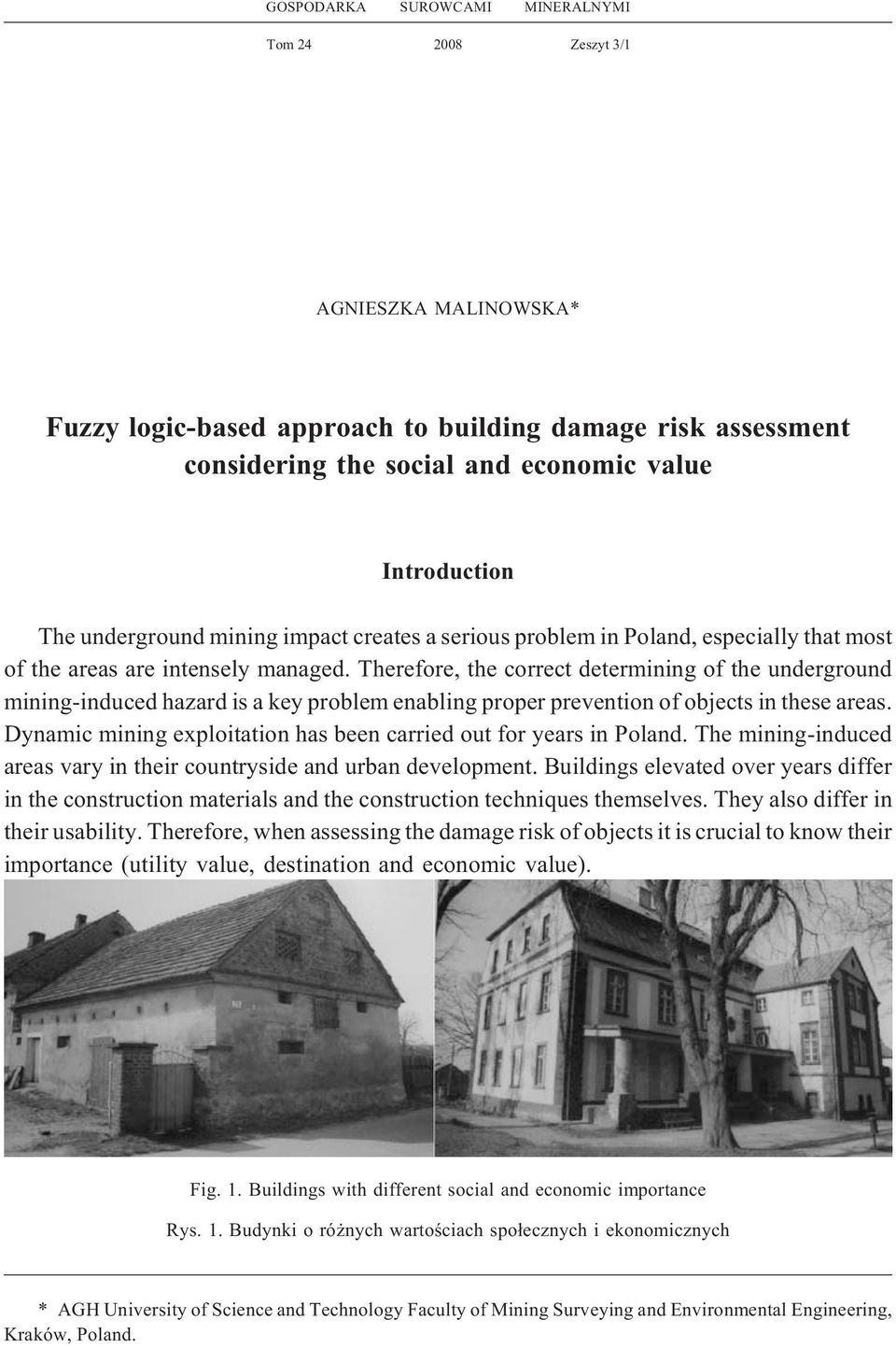
1 GOSPODARKA SUROWCAMI MINERALNYMI Tom Zeszyt 3/1 AGNIESZKA MALINOWSKA* Fuzzy logic-based approach to building damage risk assessment considering the social and economic value Introduction The underground mining impact creates a serious problem in Poland, especially that most of the areas are intensely managed. Therefore, the correct determining of the underground mining-induced hazard is a key problem enabling proper prevention of objects in these areas. Dynamic mining exploitation has been carried out for years in Poland. The mining-induced areas vary in their countryside and urban development. Buildings elevated over years differ in the construction materials and the construction techniques themselves. They also differ in their usability. Therefore, when assessing the damage risk of objects it is crucial to know their importance (utility value, destination and economic value). Fig. 1. Buildings with different social and economic importance Rys. 1. Budynki o ró nych wartoœciach spo³ecznych i ekonomicznych * AGH University of Science and Technology Faculty of Mining Surveying and Environmental Engineering, Kraków, Poland.
2 76 Three methods of accounting for the importance of surface objects when assessing their underground mining-induced damage hazard are presented and compared in the paper. The presently applied in Poland method of assessing damage hazard of buildings without accounting for the object importance is introduced in Chapter 1.1. A concept of three novel solutions employing the object importance factor is discussed in the three successive Chapters. All these methods correspond with the currently applied classic method. The extended point method (Chapter 1.2) is very close to the presently applied typical point method. The two other approaches, based on fuzzy logic (Chapters 1.3 and 1.4) are the author s alternative for damage risk assessment with a point method. The fuzzy inference block construed in these methods enables continuous interpretation of surface objects. A practical example of evaluation of damage risk of two buildings of similar strength and different importance, which created good bases for comparing these three methods, is presented in Chapter Evaluation of strength of objects construed in Poland 1.1. Classic evaluation of building damage risk The point method is most frequently applied for assessing building damage risk in the mining areas applied in Poland [7]. With this expert method the cubature strength of household objects can be approximated. This method makes use of such parameters as: foundation type, shape of the object, existing protection, technical wearing, construction elements; this created basis for determining the number of points corresponding to the influence of a given property on the strength of the object. The ultimate strength value is determined by summing up points characteristic of a given property. The average sum of the points ranges 20 to 70. The higher is the number of points, the less resistant is the object to the mining impact. It should be stressed that the surface hazard with continuous deformations generated by underground exploitation is characterized by deformation factors, i.e.: subsidence w, tilt T, horizontal strain. These factors are predicted with the use of the Knothe method, which enables obtaining more reliable terrain deformation results. It should be emphasized that the strength of surface objects is characterized by a sum of points, being a result of construction properties; on the other hand, the hazard is described by horizontal strain, expressed in mm/m. For employing these two diverse characteristics together, the points describing the strength of objects have been categorized according to admissible horizontal strain, which a given building can bear. The final value of the building damage risk is determined by comparing terrain hazard category and the object strength category. Unfortunately, no guidelines are available, on the basis of which potential damage in a specific object could be defined. One thing is certain: the bigger is the difference between terrain hazard category and the object strength category, the higher is the risk of damage of the object. Legal standards necessitate specifying objects, the strength category of which is
3 lower or equal to the terrain hazard category [8]. According to instruction [3], objects having strength category lower than the terrain category by one or more grades, need protection. In practice, however, all the mines have their own protection rules, not always congruent with the legal regulations. The presented method has been used for mass evaluation of surface objects in most of the Polish mines. However, only approximated values were obtained with this method. Disadvantageously, in this method of building damage risk assessment only one risk factor, i.e. horizontal strain, is accounted for. Moreover, the point evaluation strongly relies on the construction experts opinions and experience. No decision diagram is defined for undertaking measures in the case of possible object hazard situations. In the process of hazard evaluation, one of the crucial factors, i.e. importance of objects has not been accounted for. Only some disadvantages of the presently applied method have been discussed. One of the most common counter arguments is the lack of the building importance factor in the hazard evaluation. It has a significant influence on the cost of repairs and frequency of damages claimed. Therefore, it is necessary to diversify the present approach by, e.g. accounting for importance in the object s strength evaluation. Three approaches to building damage risk evaluation are presented in the following sections. The two last ones are author s proposals Extended point method for surface objects strength evaluation The method presented by an expert team: Gil-Kleczenska, Mika, Soczawa proposed in the ningtees broadening the modified point method by properties accounting for object s destination, usability and existence of construction elements sensitive to the mining impact [1]. This method relies on the point method, which in turn, created preliminary bases for determining object strength. Then the importance of a building is accounted for by increasing or decreasing the total number of points, depending on the properties presented in the following table. Extension of point method [1] Rozwiniêcie metody punktowej TABLE 1 TABELA 1 Factors supplementing the points Buildings where human beings do not stay permanently, which are unheated (e.g., barns, pigsties Buildings where human beings stay temporarily (workshops, storages, garages) Public utility buildings where large groups of children, youth, disabled or ill persons stay permanently or temporarily Buildings having equipment sensitive to mining exploitation Points

4 78 These elements were indicated by experts on the basis of their knowledge and experience. The maximum and minimum number of points by which the total number of points determining the object strength can be increased and decreased is 18 and 12, respectively. Bearing in mind the average range of points for objects in the mining areas (20 to 70), the importance of a building may constitute 25% to 90% of the total strength of an object. With this method the importance factor can be quickly and easily accounted for when assessing the strength of an object. Two importance categories were established. The first one accounts for public utility. The duration of stay of human beings and the functionality of buildings are accounted for in the first of them. The ultimate summaric value of strength here can be diminished by 6 or 12, and increased by 12. The second class enables adding 6 points for the vulnerable construction elements or equipment Fuzzy assessment of building damage risk, accounting for rule-based importance factor A method worked out on the basis of fuzzy inference, accounting for the importance of objects when assessing their strength to mining impact is an author s alternative [2]. Fuzzy systems enable undertaking decisions in uncertain conditions, where no probability knowledge on the errors with which the input data and the final result are burdened is available. The fuzzy inference process consists of a few stages [3, 5, 9]. At the first of them, the so-called fuzzification process, the rigid values of input variables, e.g. terrain hazard characterized by the predicted horizontal strain value and object strength expressed in points, become fuzzy. Their membership in the fuzzy sets, describing input data and object strength, is defined. At the successive stage of inference, basing on the fuzzy input data, there is determined the degree to which the premises, being the basis for meeting conclusions for the specific rules, are met. As a result of the aggregation process, an output membership function is formed. At the last stage of inference (defuzzification process) rigid value characterizing the object hazard are determined. The importance of buildings has been accounted for at the stage of establishing rule bases. The most important element of the fuzzy-logic inference system is a rule base, where all dependences between input and output variables are defined. The buildings have been divided into three importance classes. Three linguistic values were ascribed to the linguistic variable importance: low, medium and high. Among the public utility buildings are houses, buildings having equipment sensitive to mining exploitation, high-value objects. The objects of medium importance are garages, household objects, which are in a good technical condition and which have high utility value. Low importance objects are low utility household objects, in bad technical condition and of low value. A separate rule-base has been construed for each of these classes. For linguistic variables surface structures vulnerability (v) five linguistic values were defined: v = {VL (very low), L (low), M (medium), H (high), VH (very high)} and for surface hazard (h) six linguistic values were determined h = {VL (very low), L (low), M (medium), H (high), VH (very high), EH (extremely high)}.

5 79 Fig. 2. Rule bases for different building importance Rys. 2. Podstawy regu³owe dla ró nych wartoœci budynków For high-importance objects the most restrictive rule base has been established, where assumption was made that a building undergoes a medium risk of damage if the category strength equals to the terrain category (Fig. 2). The rule base for low-importance objects assumes that an object having strength lower than the terrain category by more than 2 may be damaged. Three risk surfaces were generated for three importance classes on the bases of base rules (Fig. 3.). As a result of the presented fuzzy model inference it is possible to determine the damage risk of an object having a specific strength and importance, staying in an area of future Fig. 3. Risk surfaces Rys. 3. P³aszczyzny zagro enia

6 80 horizontal strain. A high variability of importance of the object is disadvantageous, therefore a more continuous approach to the importance factor was undertaken in the next method Building damage risk fuzzy assessment, accounting for importance by output weighing This author s method is based on fuzzy induction. The introduction of weighing output induction value enables more continuously accounting for the building importance. The induction process is analogous to that in the previously presented method. It is also the predicted horizontal strain and building strength, expressed in points, which are input variables. The inference process follows one rule base. The importance of buildings is accounted for by ascribing the relevant output weigh to the building s mining hazard degree. Basing on an extended point method (Chapter 1.2) it was stated that the maximum influence of importance on the final assessment of mining-induced damage risk with continuous deformations should not exceed 30% of the fuzzy-logic value. This signifies that in the case of a very important building, the fuzzy-logic risk of damage can be increased by 30%. On the other hand, when the object has low importance, the risk can be lowered by 30%. 2. Application and comparison of building damage risk assessment methods For comparison s sake, two endangered buildings in an area threatened with the same deformations of 4.5 mm/m (III cat.) were compared. The strength of both buildings was assumed to be very similar, therefore both objects were classified to the 2 category of strength (34 and 36 points, respectively). These objects significantly differ in importance: the first one is a new recreation building, where integration meetings of school children are organized. This object has mining-sensitive construction elements and its market value is very high. The other building is a farm object used for growing animals, without any mining-sensitive construction elements. Its market value is much lower than in the first case Modified point method The strength of the first building was assessed to 36 points, and the second one to 34 points. Accounting for the importance factor in the extended point method (Chapter 1.2), the first object was classified as public utility building where large groups of children, youth, disabled or ill persons stay permanently or temporarily. The second object is object where human beings stay only temporarily; unheated (farm) object. Therefore, to the strength of the first object was increased by 48 (1 category of strength), and the strength of the second object was lowered to 22 (3 category of strength). The comparison of the strength category and the hazard category reveals that the farm object is not threatened, whereas the recreation building is subjected to a higher damage risk.

7 81 Fig. 4. Analysed buildings with different importance Rys. 4. Badane budynki charakteryzuj¹ce siê ró nymi wartoœciami Fig. 5. Buildings damage risk assessment with the use of modified point method Rys. 5. Ocena zagro enia uszkodzeniem budynków przy zastosowaniu zmodyfikowanej metody punktowej

8 Fuzzy-logic inference assessment of building damage risk The building 1 was ascribed to the group of high importance objects, therefore rule based inference was carried out for particularly important objects (Fig. 6). The farm object was classified as low importance building, therefore the inference was based on a less restrictive rule base. Fig. 6. Buildings damage risk assessment with the use of fuzzy-logic inference system Rys. 6. Ocena zagro enia uszkodzeniem budynków przy zastosowaniu systemu interferencji opartego na logice rozmytej The ultimate risk value for the house and for the farm object was 62.4 and 18.4, respectively Fuzzy model assessment with final result weighing The following damage risk values were obtained for the fuzzy inference: building 40.3, farm object 37.6, respectively. These results do not account for the importance of both objects. The weighs for objects were determined on the basis of expert evaluation of objects in view of their destination, usefulness value, finish-off elements and value. The risk value was increased by 25% for the house, and decreased by 15% for the farm object. The ultimate value of risk for these objects was 50.4 and 32.0 for the house and the farm object, respectively (Fig. 7.). The comparison of the results obtained with three methods reveal a disadvantage lying in the fact that the extended point method accounts for the building importance mainly as a result of the usefulness function. Besides the values by which the strength of the object can be increased or decreased (6 and 12) are rigid, and the high discretization of the final result. The approach in which the construction elements sensitivity to mining impact is accounted for, is an interesting alternative. Unfortunately, the building strength cannot be lowered in view of that factor. Moreover, no clearly defined criteria exist, on the basis of which the
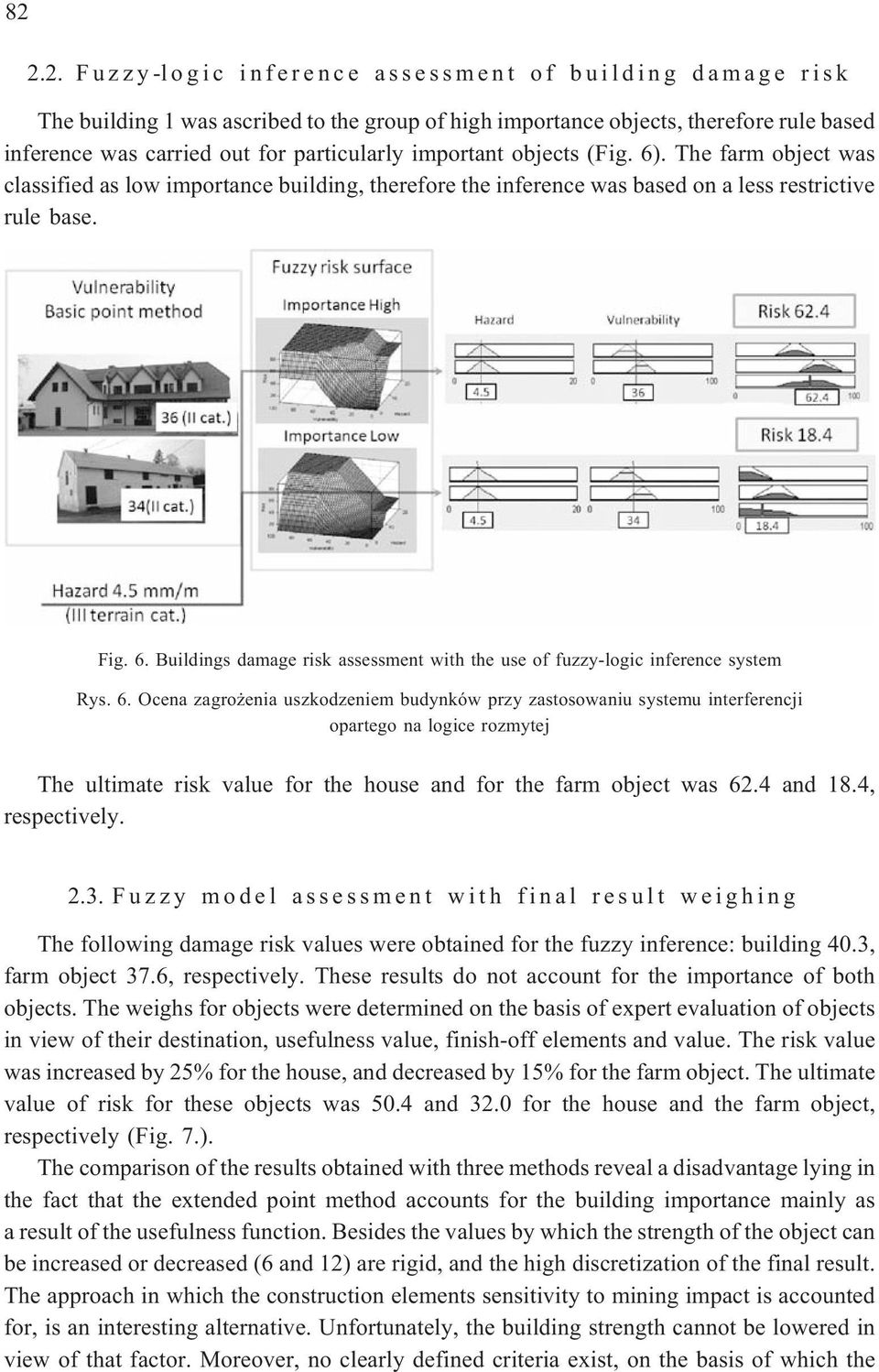
9 83 Fig. 7. Buildings damage risk assessment with the use of fuzzy-logic inference system with final result weighing Rys. 7. Ocena zagro enia uszkodzeniem budynków przy zastosowaniu systemu interferencji opartego na logice rozmytej z ocen¹ koñcowego wyniku object hazard could be defined. It follows from the presented example (Fig. 5) that the hazard assessment result is only the difference between the terrain hazard category and the strength category. There is no definite degree to which a given object is hazarded. Consequently, the basic disadvantage of this method lies in a high discreteness in accounting for the importance of a building and lack of clear criteria thanks to which the hazard can be graded. The fuzzy inference method with a three-class importance classes enables more coherent assessment of building s damage risk caused by continuous deformations. The fuzzy system enabled creating dependences between input variables (strength of the object, terrain deformations), on the basis of which the risk is assessed continuously. The division of importance into three categories enabled making an arbitrary interpretation of importance in view of economic and usability factors. However, the introduction of three classes of importance leads a high discretization of the final result. The damage risk of an important object is at a level of 62.4, whereas the low-importance object has only 18.4 points (Fig. 6). Hence, the fuzzy method with output result weighing is an optimum solution (third of the discussed methods). It enables most continuous accounting for the importance of an object. The results of hazard assessment are burdened with importance; however, accounting for importance factor has not drastically affected the results (Fig. 7). A high impact of the expert on the evaluation of the building importance is a considerable shortcoming of the method. Besides, the importance weight directly modifies the final result of risk assessment. The optimum solution lies in continuous introduction of importance at a level when the strength of the object is specified. This approach is under study within a research project (grant N /2620). The research reporter in this paper has been supported by the Ministry of Science and Higher Education under grant N /2620

10 84 REFERENCES [1] Gil-Kleczenska B., Mika W., Soczawa., 1990 Modified point method of building strength assessment to surface deformation. Materia³y V Konferencji naukowo technicznej: Budownictwo na Terenach Górniczych. Katowice Kamieñ k. Rybnika, maj 1990 (polish). [2] H e j m a n o w s k i R., M a l i n o w s k a A., 2000 A fuzzy logic approach for the building damage assessment on the mining area. XIII International Congress of the International Society for Mine Surveying September [3] Instruction No. 12. Rules of expliotation possibilities asssessment taking into consideration safety of the buildings. Katowice 2000 (polish). [4] K a c p r z y k J., 1986 Fuzzy sets in the systems analysis. PWN, Warszawa (polish). [5] K l i r G.J., Y u a n B., 1995 Fuzzy sets and fuzzy logic theory and applications. Prentice Hall PTR, New Jersey [6] K w i a t e k J., 1998 Building protection on mining areas. Wyd. GIG, Katowice 1998 (polish). [7] Collective work: Rules of substitute building on mining areas. Wydawnictwo Œl¹sk. Katowice 1969 (polish). [8] Law 1994: Geological and mining law. Act 4th february (Dz.U. z 2005 r. Nr 228, poz. 1947) (polish). [9] The MathWorks: METODA OCENY ZAGRO ENIA USZKODZENIEM BUDYNKÓW OPARTA NA LOGICE ROZMYTEJ, Z UWZGLÊDNIENIEM WARTOŒCI SPO ECZNYCH ORAZ EKONOMICZNYCH S³owa kluczowe Ocena zagro enia uszkodzeniem budynku, logika rozmyta, wartoœæ budynku Streszczenie Pewna ocena oddzia³ywania ruchów pod³o a, spowodowanych eksploatacj¹, na konstrukcje budynków stanowi w Polsce znacz¹cy problem. W zwi¹zku z brakiem dok³adnych metod oceny zagro enia uszkodzeniem budynków, kopalnie ponosz¹ wysokie koszta zwi¹zane z napraw¹ oraz zabezpieczaniem budynków. Problem ten wynika z faktu, i optymalne modelowanie potencjalnego uszkodzenia budynków wymaga wykorzystania licznych czynników, które trudno zastosowaæ jest przy tworzeniu modeli prognozowania ze wzglêdu na ich ciê kie do sprecyzowania i niejednoznaczne w³aœciwoœci. Zastosowanie logiki rozmytej pomaga w radzeniu sobie z niepewnoœci¹ i nieprecyzyjnoœci¹ przy podejmowaniu decyzji. Niniejszy artyku³ omawia metodê wykorzystuj¹c¹ system interferencji rozmytej w celu oceny stopnia zagro enia uszkodzeniem konstrukcji, przy uwzglêdnieniu wartoœci spo³ecznej i ekonomicznej budynku. Po zakreœleniu ram teoretycznych, artyku³ przedstawia przyk³ad zastosowania modelu interferencji rozmytej przy ocenie zagro enia uszkodzeniem konstrukcji na terenie jednej z polskich kopalni.

11 85 FUZZY LOGIC-BASED APPROACH TO BUILDING DAMAGE RISK ASSESSMENT CONSIDERING THE SOCIAL AND ECONOMIC VALUE Key words Building damage risk assessment, fuzzy logic, building importance Abstract Reliable assessing of mining-induced ground movement impact on building structures poses significant problem in Poland. Due to the lack of accurate methods of building damage risk assessment, mines bear high costs of building reparation and protection. This problem results from the fact that optimum modeling of potential building damage requires numerous factors which, due to their imprecise and vague characteristics, are difficult to implement into prediction models. With the application of fuzzy logic, dealing with uncertainty and imprecision in decision-making becomes possible. This paper discusses a method that uses a fuzzy inference system to evaluate the degree of structural damage with regard to a building s social and economic value. After summarizing the theoretical framework, the paper provides an example of an application of a fuzzy inference model to structural damage risk assessment in one of the Polish mining areas.

12

Depreciation of fixed assets and efficiency of investment and operation of a mining plant
 GOSPODARKA SUROWCAMI MINERALNYMI Tom 23 2007 Zeszyt 4 TADEUSZ FRANIK* Depreciation of fixed assets and efficiency of investment and operation of a mining plant Key words Mining, hard coal mining, depreciation
Introduction to Fuzzy Control
 Introduction to Fuzzy Control Marcelo Godoy Simoes Colorado School of Mines Engineering Division 1610 Illinois Street Golden, Colorado 80401-1887 USA Abstract In the last few years the applications of
RISK ASSESSMENT BASED UPON FUZZY SET THEORY
 RISK ASSESSMENT BASED UPON FUZZY SET THEORY László POKORÁDI, professor, University of Debrecen [email protected] KEYWORDS: risk management; risk assessment; fuzzy set theory; reliability. Abstract:
EFFICIENT METHOD FOR STORAGE OF LONG CONVEYOR BELTS PASSAGES INSIDE THE BULK CONTAINERS
 TRANSPORT PROBLEMS 2011 PROBLEMY TRANSPORTU Volume 6 Issue 3 Maria ŁUSZCZKIEWICZ-PIĄTEK University of Łódź, Faculty of Mathematics and Computer Science Department of Applied Computer Science Banacha St.
Theoretical consideration in establishing the parameters of longwall panel
 GOSPODARKA SUROWCAMI MINERALNYMI Tom 24 2008 Zeszyt 4/2 MAREK JASZCZUK*, JAN KANIA* Theoretical consideration in establishing the parameters of longwall panel Introduction So far the level of mining production
REFLECTIONS ON THE USE OF BIG DATA FOR STATISTICAL PRODUCTION
 REFLECTIONS ON THE USE OF BIG DATA FOR STATISTICAL PRODUCTION Pilar Rey del Castillo May 2013 Introduction The exploitation of the vast amount of data originated from ICT tools and referring to a big variety
Volume 54 2009 Issue 2 MLCF AN OPTIMISED PROGRAM OF LOW-CYCLE FATIGUE TEST TO DETERMINE MECHANICAL PROPERTIES OF CAST MATERIALS
 A R C H I V E S O F M E T A L L U R G Y A N D M A T E R I A L S Volume 54 2009 Issue 2 M. MAJ,J.PIEKŁO MLCF AN OPTIMISED PROGRAM OF LOW-CYCLE FATIGUE TEST TO DETERMINE MECHANICAL PROPERTIES OF CAST MATERIALS
ANALYSIS OF THE POTENTIALS OF ADAPTING ELEMENTS OF LEAN METHODOLOGY TO THE UNSTABLE CONDITIONS IN THE MINING INDUSTRY
 AGH Journal of Mining and Geoengineering vol. 36 No. 3 2012 Joanna Helman* ANALYSIS OF THE POTENTIALS OF ADAPTING ELEMENTS OF LEAN METHODOLOGY TO THE UNSTABLE CONDITIONS IN THE MINING INDUSTRY 1. Introduction
ASSESSMENT OF THE EFFECTIVENESS OF ERP SYSTEMS BY A FUZZY LOGIC APPROACH
 Journal of Information Technology Management ISSN #1042-1319 A Publication of the Association of Management ASSESSMENT OF THE EFFECTIVENESS OF ERP SYSTEMS BY A FUZZY LOGIC APPROACH ZAHIR ALIMORADI SHAHID
STRUCTURAL REDUNDANCY IN AN OFFSHORE VESSEL DYNAMIC POSITIONING SYSTEM
 3-2007 PROBLEMY EKSPLOATACJI 41 Leszek CHYBOWSKI Zbigniew MATUSZAK Akademia Morska, Szczecin STRUCTURAL REDUNDANCY IN AN OFFSHORE VESSEL DYNAMIC POSITIONING SYSTEM Key words Technical system, dynamic positioning,
SELECTED ASPECTS OF FINANCIAL PLANNING AT MINING COMPANIES** 1. Introduction. Patrycja B k*
 AGH Journal of Mining and Geoengineering vol. 36 No. 3 2012 Patrycja B k* SELECTED ASPECTS OF FINANCIAL PLANNING AT MINING COMPANIES** 1. Introduction Planning represents one of the functions of the management
MARKETING COMMUNICATIONS EFFECTIVENESS IN POLAND LESSONS FROM THE BUSINESS IN INFORMATION SOCIETY
 Mirosława Malinowska University of Economics in Katowice, Poland MARKETING COMMUNICATIONS EFFECTIVENESS IN POLAND LESSONS FROM THE BUSINESS IN INFORMATION SOCIETY Introduction Huge advances in communication
COSTING METHODS FOR SUPPLY CHAIN MANAGEMENT
 COSTING METHODS FOR SUPPLY CHAIN MANAGEMENT Anna Surowiec, PhD AGH University of Science and Technology, Faculty of, Poland Abstract: Today's organizations, operating in an increasingly competitive conditions,
A QUALITY IN RESEARCH INSTITUTES IN CONTEXT OF IMPLEMNTING THE QUALITY MANAGEMENT SYSTEMS
 Agnieszka KLEMBALSKA Industrial Institute of Agricultural Engineering ul. Staroł cka 31, 60-963 Pozna, Poland e-mail: [email protected] A QUALITY IN RESEARCH INSTITUTES IN CONTEXT OF IMPLEMNTING THE
TQM TOOLS IN CRISIS MANAGEMENT
 TQM TOOLS IN CRISIS MANAGEMENT Anna Starosta 1 Grzegorz Zieliński 2 Abstract The current article is concerned with basic aspects connected with improvement of crisis management activities employed by economic
STRENGTH ANALYSIS OF OVERHEAD TRAVELING CRANE WITH USE OF FINITE ELEMENT METHOD
 TRANSPORT PROBLEMS 2014 PROBLEMY TRANSPORTU Volume 9 Issue 1 Tomasz HANISZEWSKI Silesian University of Technology, Faculty of Transport Krasińskiego 8 Street, 40-019 Katowice, Poland Corresponding author.
Classification of Fuzzy Data in Database Management System
 Classification of Fuzzy Data in Database Management System Deval Popat, Hema Sharda, and David Taniar 2 School of Electrical and Computer Engineering, RMIT University, Melbourne, Australia Phone: +6 3
A FUZZY LOGIC APPROACH FOR SALES FORECASTING
 A FUZZY LOGIC APPROACH FOR SALES FORECASTING ABSTRACT Sales forecasting proved to be very important in marketing where managers need to learn from historical data. Many methods have become available for
THE EXTENSION OF SIMULATION AND OPTIMIZATION ON MODEL DYNBALANCE(2-2)
 THE EXTENSION OF SIMULATION AND OPTIMIZATION ON MODEL DYNBALANCE(2-2) Abstract ElŜbieta Kasperska, Damian Słota Institute of Mathematics Silesian University of Technology ul. Kaszubska 23, Gliwice 44-100
Fast Fuzzy Control of Warranty Claims System
 Journal of Information Processing Systems, Vol.6, No.2, June 2010 DOI : 10.3745/JIPS.2010.6.2.209 Fast Fuzzy Control of Warranty Claims System Sang-Hyun Lee*, Sung Eui Cho* and Kyung-li Moon** Abstract
Optimal site selection for heap leaching structures by the analytic hierarchy process (case study: Taft heap leaching structure, Iran)
 GOSPODARKA SUROWCAMI MINERALNYMI Tom 29 2013 Zeszyt 1 DOI 10.2478/gospo-2013-0005 SAEED SOLTANI-MOHAMMADI*, MEHDI AMINI** Optimal site selection for heap leaching structures by the analytic hierarchy process
Financial Risk Identification based on the Balance Sheet Information
 Financial Risk Identification based on the Balance Sheet Information Joanna Błach 1 Abstract The exposure to risk in modern economy is constantly growing. All enterprises have to take up different types
Threat Modeling Using Fuzzy Logic Paradigm
 Issues in Informing Science and Information Technology Volume 4, 2007 Threat Modeling Using Fuzzy Logic Paradigm A. S. Sodiya, S. A. Onashoga, and B. A. Oladunjoye Department of Computer Science, University
DESIGN AND STRUCTURE OF FUZZY LOGIC USING ADAPTIVE ONLINE LEARNING SYSTEMS
 Abstract: Fuzzy logic has rapidly become one of the most successful of today s technologies for developing sophisticated control systems. The reason for which is very simple. Fuzzy logic addresses such
ANDRZEJ RAPACZ IZABELA MICHALSKA-DUDEK. 1. Introduction
 DOI: 10.2478/manment--0065 ISSN 1429-9321 Determinants, Advantages and Threats Resulting from Application of The Relationship Marketing Concept and CRM Technology In Maintaining Customer Loyalty In Travel
Fuzzy Logic Based Revised Defect Rating for Software Lifecycle Performance. Prediction Using GMR
 BIJIT - BVICAM s International Journal of Information Technology Bharati Vidyapeeth s Institute of Computer Applications and Management (BVICAM), New Delhi Fuzzy Logic Based Revised Defect Rating for Software
Investment Spending and Capital Production in Mining
 GOSPODARKA SUROWCAMI MINERALNYMI Tom 28 2012 Zeszyt 4 DOI 10.2478/v10269-012-0035-x TADEUSZ FRANIK* Study on factors influencing the level of capital expenditure spent in mining Introduction The importance
Economical modeling for identification of best drilling choice in sublevel stoping
 GOSPODARKA SUROWCAMI MINERALNYMI Tom 24 2008 Zeszyt 4/2 K. ORAEE*, A.H. BANGIAN**, A. PARHIZKAR*** Economical modeling for identification of best drilling choice in sublevel stoping Introduction Basically
USE OF THE EXPERT METHODS IN COMPUTER BASED MAINTENAN CE SUPPORT OF THE M- 28 AIRCRAFT
 ZESZYTY NAUKOWE AKADEMII MARYNARKI WOJENNEJ SCIENTIFIC JOURNAL OF POLISH NAVAL ACADEMY 2015 (LVI) 2 (201) Piotr Golański 1, Przemysław Mądrzycki 1 DOI: 10.5604/0860889X.1172060 USE OF THE EXPERT METHODS
Application MS Access for Surveying Computations**
 GEOMATICS AND ENVIRONMENTAL ENGINEERING Volume 5 Number 4 2011 Jan Ruchel*, Tomasz Adamczyk* Application MS Access for Surveying Computations** 1. Introduction The computations performed in surveying tasks
:6320$*$1,( '(&<=-,.21680(1&.,&+ = :<.25=<67$1,(0 :,(/2.5<7(5,$/1(- 0(72'< 390 KESRA NERMEND
 KESRA NERMEND W artykule przedstawiono przykady wspomagania decyzji konsumenckich z wykorzystaniem metody PVM. Skupiono si na produktach codziennego uytku, których niskie ceny powoduj, e konsumenci nie
SIMULATION OF EXTRACTION RATE AND SCHEDULING BASED ON GEOLOGICAL AND QUALITY MODELS AS A METHOD OF MINE PLANNING IN MODERN MINING
 Górnictwo i Geoin ynieria Rok 29 Zeszyt 3/2 2005 Krzysztof Olszówka, Filip Orzechowski * SIMULATION OF EXTRACTION RATE AND SCHEDULING BASED ON GEOLOGICAL AND QUALITY MODELS AS A METHOD OF MINE PLANNING
Comparative analysis of risk assessment methods in project IT
 Jacek Winiarski * Comparative analysis of risk assessment methods in project IT Introduction IT projects implementation as described in software development methodologies is usually distributed into several
PRELIMINARY ANALYSIS OF INELASTIC BUCKLING OF THE HEAT EXCHANGER
 JOURNAL OF THEORETICAL AND APPLIED MECHANICS 46, 2, pp. 305-313, Warsaw 2008 PRELIMINARY ANALYSIS OF INELASTIC BUCKLING OF THE HEAT EXCHANGER Agnieszka Chudzik Technical University of Lodz, Division of
Project Management Efficiency A Fuzzy Logic Approach
 Project Management Efficiency A Fuzzy Logic Approach Vinay Kumar Nassa, Sri Krishan Yadav Abstract Fuzzy logic is a relatively new technique for solving engineering control problems. This technique can
INFLUENCE OF DEMAND FORECASTS ACCURACY ON SUPPLY CHAINS DISTRIBUTION SYSTEMS DEPENDABILITY.
 INFLUENCE OF DEMAND FORECASTS ACCURACY ON SUPPLY CHAINS DISTRIBUTION SYSTEMS DEPENDABILITY. Natalia SZOZDA 1, Sylwia WERBIŃSKA-WOJCIECHOWSKA 2 1 Wroclaw University of Economics, Wroclaw, Poland, e-mail:
From Workflow Design Patterns to Logical Specifications
 AUTOMATYKA/ AUTOMATICS 2013 Vol. 17 No. 1 http://dx.doi.org/10.7494/automat.2013.17.1.59 Rados³aw Klimek* From Workflow Design Patterns to Logical Specifications 1. Introduction Formal methods in software
3PORTFOLIO MANAGEMENT APPROACH
 3PORTFOLIO MANAGEMENT APPROACH IN TRADE CREDIT DECISION MAKING Institute of Economic Forecasting Grzegorz MICHALSKI Abstract The basic financial purpose of an enterprise is maximization of its value. Trade
SPATIAL DIVERSIFICATION OF FOREIGN TOURIST TRAFFIC IN POLAND
 INFRASTRUKTURA I EKOLOGIA TERENÓW WIEJSKICH INFRASTRUCTURE AND ECOLOGY OF RURAL AREAS Nr 2/IV/2013, POLSKA AKADEMIA NAUK, Oddział w Krakowie, s. 5 14 Komisja Technicznej Infrastruktury Wsi SPATIAL DIVERSIFICATION
A CONCEPT OF STUDENT RELATIONSHIP MANAGEMENT IN HIGHER EDUCATION
 A CONCEPT OF STUDENT RELATIONSHIP MANAGEMENT IN HIGHER EDUCATION Anna Drapińska, Ph.D. Gdańsk University of Technology Introduction The paper will present a novel marketing concept of relationship management
Potential for increasing oil recovery from Polish oil-fields by applying EOR methods
 GOSPODARKA SUROWCAMI MINERALNYMI Tom 28 2012 Zeszyt 4 DOI 10.2478/v10269-012-0032-0 PAWE WOJNAROWSKI* Potential for increasing oil recovery from Polish oil-fields by applying EOR methods Introduction The
Ministry of Infrastructure Warsaw, 28.05.2008r..
 Ministry of Infrastructure POLISH STATE AID SCHEMES FOR AIR TRANSPORT, INTERMODAL TRANSPORT AND ITS Ministry of Infrastructure Projects of state aid schemes according to Infrastructure & Environment Operational
WYBRANE PROBLEMY OPTYMALIZACJI WODY POD STĘPKĄ W TRANSPORCIE TOWARÓW DROGĄ MORSKĄ
 ZESZYTY NAUKOWE POLITECHNIKI ŚLĄSKIEJ 2013 Seria: TRANSPORT z. 80 Nr kol. 1895 Waldemar UCHACZ 1, Wiesław GALOR 2 WYBRANE PROBLEMY OPTYMALIZACJI WODY POD STĘPKĄ W TRANSPORCIE TOWARÓW DROGĄ MORSKĄ Streszczenie.
Linguistic Preference Modeling: Foundation Models and New Trends. Extended Abstract
 Linguistic Preference Modeling: Foundation Models and New Trends F. Herrera, E. Herrera-Viedma Dept. of Computer Science and Artificial Intelligence University of Granada, 18071 - Granada, Spain e-mail:
PROPORTIONAL FLOW CONTROLLER MODEL IN MATLAB-SIMULINK MODEL PROPORCJONALNEGO REGULATORA PRZEPŁYWU W MATLAB-SIMULINK
 TECHNICAL TRANSACTIONS MECHANICS CZASOPISMO TECHNICZNE MECHANIKA 1-M/2013 MARIUSZ KRAWCZYK* PROPORTIONAL FLOW CONTROLLER MODEL IN MATLAB-SIMULINK MODEL PROPORCJONALNEGO REGULATORA PRZEPŁYWU W MATLAB-SIMULINK
Fuzzy Candlestick Approach to Trade S&P CNX NIFTY 50 Index using Engulfing Patterns
 Fuzzy Candlestick Approach to Trade S&P CNX NIFTY 50 Index using Engulfing Patterns Partha Roy 1, Sanjay Sharma 2 and M. K. Kowar 3 1 Department of Computer Sc. & Engineering 2 Department of Applied Mathematics
1 Uncertainty and Preferences
 In this chapter, we present the theory of consumer preferences on risky outcomes. The theory is then applied to study the demand for insurance. Consider the following story. John wants to mail a package
A Fuzzy System Approach of Feed Rate Determination for CNC Milling
 A Fuzzy System Approach of Determination for CNC Milling Zhibin Miao Department of Mechanical and Electrical Engineering Heilongjiang Institute of Technology Harbin, China e-mail:[email protected]
A R C H I V E S O F M E T A L L U R G Y A N D M A T E R I A L S Volume 52 2007 Issue 3
 A R C H I V E S O F M E T A L L U R G Y A N D M A T E R I A L S Volume 52 2007 Issue 3 Z. JĘDRZYKIEWICZ MODELING AND SIMULATION TESTS ON LIFT VALVES OPERATING IN THE HYDRAULIC SYSTEM OF A PRESSURE CASTING
A Fuzzy Logic Based Approach for Selecting the Software Development Methodologies Based on Factors Affecting the Development Strategies
 Available online www.ejaet.com European Journal of Advances in Engineering and Technology, 2015, 2(7): 70-75 Research Article ISSN: 2394-658X A Fuzzy Logic Based Approach for Selecting the Software Development
Monitoring of the single-point diamond dresser wear
 ARCHIVES OF CIVIL AND MECHANICAL ENGINEERING Vol. V 2005 No. 1 Monitoring of the single-point diamond dresser wear W. HABRAT, A. BATSCH, J. PORZYCKI Rzeszów University of Technology, ul. Wincentego Pola
Coal preparation technology in Poland
 GOSPODARKA SUROWCAMI MINERALNYMI Tom 22 2006 Zeszyt 4 WIES AW S. BLASCHKE*, LIDIA GAWLIK**, STANIS AW A. BLASCHKE*** Coal preparation technology in Poland Key words Coal preparation plant, steam coal,
OUTSOURCING IN THE OPERATION OF FMCG COMPANIES
 330.44:338.2:330.47 OUTSOURCING IN THE OPERATION OF FMCG COMPANIES Dr S AWOMIR JARKA, PhD Warsaw University of Life Sciences (WULS),..,.,,,. In the age of the information technology revolution there is
DESIGN OF GPS-GPRS MODULE FOR LOCALISATION VEHICLES AND CARGO PROJEKT MODUŁU GPS-GPRS DO LOKALIZACJI POJAZDÓW I ŁADUNKÓW
 TRANSPORT PROBLEMS 2007 PROBLEMY TRANSPORTU Tom 2 Zeszyt 1 Piotr NOWAKOWSKI* Silesian University of Technology, Faculty of Transport, Department of Logistics and Mechanical Handling, ul. Krasińskiego 8,
Resource management in the coal mining sector using integrated information systems
 GOSPODARKA SUROWCAMI MINERALNYMI Tom 23 2007 Zeszyt 4 JAN JASIEWICZ*, ROMAN MAGDA**, EDYTA BRZYCHCZY*, STANIS AW G ODZIK*, TADEUSZ WO NY* Resource management in the coal mining sector using integrated
X-Plain Preventing Injuries at Work Through Ergonomics - Cost-Benefit Analysis Reference Summary
 X-Plain Preventing Injuries at Work Through Ergonomics - Cost-Benefit Analysis Reference Summary Introduction Ergonomics is the science of designing a safe, comfortable, and highly productive workplace.
An Analysis of Accidents Caused by Improper Functioning of Machine Control Systems
 International Journal of Occupational Safety ANALYSIS and Ergonomics OF ACCIDENTS (JOSE) CAUSED 2004, Vol. BY CS 10, FAILURE No. 2, 129 136 An Analysis of Accidents Caused by Improper Functioning of Machine
INTEROPERABLE FEATURES CLASSIFICATION TECHNIQUE FOR CLOUD BASED APPLICATION USING FUZZY SYSTEMS
 INTEROPERABLE FEATURES CLASSIFICATION TECHNIQUE FOR CLOUD BASED APPLICATION USING FUZZY SYSTEMS * C. Saravanakumar 1 and C. Arun 2 1 Department of Computer Science and Engineering, Sathyabama University,
Intuitionistic fuzzy load balancing in cloud computing
 8 th Int. Workshop on IFSs, Banská Bystrica, 9 Oct. 2012 Notes on Intuitionistic Fuzzy Sets Vol. 18, 2012, No. 4, 19 25 Intuitionistic fuzzy load balancing in cloud computing Marin Marinov European Polytechnical
DEPENDABILITY STUDY OF THE ERP SYSTEM
 Dependability, ERP system, availability Daniel GĄSKA *, Antoni ŚWIĆ ** DEPENDABILITY STUDY OF THE ERP SYSTEM Abstract The paper present the various aspects of the process of testing of the ERP system s
ON THE INTERPRETATION OF SEISMIC CONE PENETRATION TEST (SCPT) RESULTS
 Studia Geotechnica et Mechanica, Vol. XXXV, No. 4, 213 DOI: 1.2478/sgem-213-33 ON THE INTERPRETATION OF SEISMIC CONE PENETRATION TEST (SCPT) RESULTS IRENA BAGIŃSKA Wrocław University of Technology, Faculty
IMPLEMENTATION OF FUZZY EXPERT COOLING SYSTEM FOR CORE2DUO MICROPROCESSORS AND MAINBOARDS. Computer Education, Konya, 42075, Turkey
 IMPLEMENTATION OF FUZZY EXPERT COOLING SYSTEM FOR CORE2DUO MICROPROCESSORS AND MAINBOARDS Kürşat ZÜHTÜOĞULLARI*,, Novruz ALLAHVERDİ, İsmail SARITAŞ Selcuk University Technical Education Faculty, Department
ECONOMIC QUESTIONS FOR THE MASTER'S EXAM
 ECONOMIC QUESTIONS FOR THE MASTER'S EXAM Introduction 1. What is economics? Discuss the purpose and method of work of economists. Consider observation, induction, deduction and scientific criticism. 2.
Determinants of Office Space Choice
 108 Krzysztof Celka Determinants of Office Space Choice, Journal of International Studies, Vol. 4, No 1, 2011, pp. 108-114. Determinants of Office Space Choice PhD Krzysztof Celka Department of Investment
SINGULAR SPECTRUM ANALYSIS HYBRID FORECASTING METHODS WITH APPLICATION TO AIR TRANSPORT DEMAND
 SINGULAR SPECTRUM ANALYSIS HYBRID FORECASTING METHODS WITH APPLICATION TO AIR TRANSPORT DEMAND K. Adjenughwure, Delft University of Technology, Transport Institute, Ph.D. candidate V. Balopoulos, Democritus
3. Data Analysis, Statistics, and Probability
 3. Data Analysis, Statistics, and Probability Data and probability sense provides students with tools to understand information and uncertainty. Students ask questions and gather and use data to answer
Problems often have a certain amount of uncertainty, possibly due to: Incompleteness of information about the environment,
 Uncertainty Problems often have a certain amount of uncertainty, possibly due to: Incompleteness of information about the environment, E.g., loss of sensory information such as vision Incorrectness in
About the NeuroFuzzy Module of the FuzzyTECH5.5 Software
 About the NeuroFuzzy Module of the FuzzyTECH5.5 Software Ágnes B. Simon, Dániel Biró College of Nyíregyháza, Sóstói út 31, [email protected], [email protected] Abstract: Our online edition of the software
ZESZYTY NAUKOWE UNIWERSYTETU SZCZECIŃSKIEGO NR 639 FINANSE, RYNKI FINANSOWE, UBEZPIECZENIA NR 37 2011
 ZESZYTY NAUKOWE UNIWERSYTETU SZCZECIŃSKIEGO NR 639 FINANSE, RYNKI FINANSOWE, UBEZPIECZENIA NR 37 2011 JACEK JAWORSKI BOOKKEEPING METHODS USED IN THE POLISH SME SECTOR. AN EMPIRICAL ANALYSIS 1 Introduction
Earthquakes. Earthquakes: Big Ideas. Earthquakes
 Earthquakes Earthquakes: Big Ideas Humans cannot eliminate natural hazards but can engage in activities that reduce their impacts by identifying high-risk locations, improving construction methods, and
Leran Wang and Tom Kazmierski {lw04r,tjk}@ecs.soton.ac.uk
 BMAS 2005 VHDL-AMS based genetic optimization of a fuzzy logic controller for automotive active suspension systems Leran Wang and Tom Kazmierski {lw04r,tjk}@ecs.soton.ac.uk Outline Introduction and system
Barricade pressure monitoring in paste backfill
 GOSPODARKA SUROWCAMI MINERALNYMI Tom 24 2008 Zeszyt 4/3 M. YUMLU* Barricade pressure monitoring in paste backfill Introduction Paste backfill was first used in underground mining about 30 years ago in
Improvement of data collection and dissemination by fuzzy logic
 Distr. GENERAL Working Paper 10 April 2013 ENGLISH ONLY UNITED NATIONS ECONOMIC COMMISSION FOR EUROPE (ECE) CONFERENCE OF EUROPEAN STATISTICIANS ORGANISATION FOR ECONOMIC COOPERATION AND DEVELOPMENT (OECD)
Fuzzy Logic Approach for Threat Prioritization in Agile Security Framework using DREAD Model
 www.ijcsi.org 182 Fuzzy Logic Approach for Threat Prioritization in Agile Security Framework using DREAD Model Sonia 1, Archana Singhal 2 and Hema Banati 3 1 Department of Computer Science, University
BARRIERS OF ABSORPTION OF EUROPEAN UNION FUNDS BY INDIVIDUAL FARMERS IN POLAND IN THE AREA OF DISPERSED AGRICULTURE
 151 BARRIERS OF ABSORPTION OF EUROPEAN UNION FUNDS BY INDIVIDUAL FARMERS IN POLAND IN THE AREA OF DISPERSED AGRICULTURE Ryszard Kata, Bogumiła Grzebyk University of Rzeszow Faculty of Economics Poland
R&D Expenditures in Poland. Voivodship Perspective
 Barometr Regionalny Tom 12 nr 2 R&D Expenditures in Poland. Voivodship Perspective Aleksandra Zygmunt Opole University of Technology, Poland Abstract The main purpose of the paper is R&D expenditures analysis
APPLICATION OF PIES AND RECTANGULAR BÉZIER SURFACES TO COMPLEX AND NON-HOMOGENEOUS PROBLEMS OF ELASTICITY WITH BODY FORCES
 TASK QUARTERLY 14 No 4, 363 376 APPLICATION OF PIES AND RECTANGULAR BÉZIER SURFACES TO COMPLEX AND NON-HOMOGENEOUS PROBLEMS OF ELASTICITY WITH BODY FORCES AGNIESZKA BOŁTUĆ AND EUGENIUSZ ZIENIUK Faculty
A Trust-Evaluation Metric for Cloud applications
 A Trust-Evaluation Metric for Cloud applications Mohammed Alhamad, Tharam Dillon, and Elizabeth Chang Abstract Cloud services are becoming popular in terms of distributed technology because they allow