
Reverse engineering Internet Banking
|
|
|
- Lester Griffith
- 10 years ago
- Views:
Transcription
1 Reverse engineering Internet Banking Eduardo Pablo Novella Lorente Institute for Computing and Information Science Digital Security Group Radboud University Nijmegen The Netherlands A thesis supervised by: Erik Poll and Joeri de Ruiter 2013 June

2

3 Abstract This paper presents a security analysis of the online banking system of one of the most important banks of the Netherlands. New security devices have been designed in order to authorize transactions in a handy and userfriendly way. In doing so, it has been attempted to strengthen the online authentication system using hand-held smartcard readers connected by a USB-cable to a PC. These USB-connected smartcard readers are devices with a small display and numeric keyboard with two additional keys in order to accept or deny operations. The customers of Internet banking can perform any operation in a secure way with such devices. In this document we will discuss different USB-connected smartcard readers from several Dutch banks. For ABN-AMRO we will discuss the smartcard reader called the e.dentifier2 made by Gemalto, which we will principally focus on it in more detail, and for ING the reader DigiPass 850, made by VASCO. We will focus on reverse engineering the ABN-AMRO s readers. We will verify that last attack [1] on those devices is not working in the new version of the e.dentifier2 and we will also reverse engineer some additional functionalities,which were not considered in earlier research about ABN-AMRO e.dentifier2 reverse engineering [2], and currently do not seem to be used in ABN-AMRO s internet banking website. These additional functionalities [6] could be used for authentications and transactions in Internet banking in the future.

4 iv

5 Acknowledgements To my family and best friends... Specially for some who will not stay with us anymore. To the best teachers I ever had. For those who tried to motivate students in order to have fun with computers and education. I will name some of them but not all : José Verdoy, Jon Ander Gómez Adriá, Germán Moltó, Alicía Roca, Ismaell Ripoll and Juan Vicente Capella Hernández. To my supervisors Erik Poll and Joeri de Ruiter for their support and for giving me a chance to get to know a bit about bank smartcards. To my English teacher Karin Kessels for giving some corrections in this document. And finally for my Faculties : Radboud Universiteit Nijmegen. Universidad Politécnica de Valencia and

6 ii

7 Contents 1 Introduction Smartcard readers for Internet banking Background Sign What You See (SWYS) The USB Protocol EMV EMV-CAP e.dentifier Connected mode Login Signing transaction Unconnected mode DigiPass Tools USBTrace Wireshark RebelSim & Realterm JavaCard bankcard Firebug Own webpage Operating Systems Ubuntu 10.04LTS 32 bits Windows XP sp3 32 bits iii

8 CONTENTS 4 The improved e.dentifier Background : Old attack How was fixed the vulnerability? : New e.dentifier Reverse engineering of additional functionality Cheat sheet USB commands-responses Traces of USB traffic Javascript and plugin GetMode1Response GetMode2Response Future work 45 7 Conclusion 47 References 49 iv

9 Chapter 1 Introduction 1.1 Smartcard readers for Internet banking Some important banks in the Netherlands are using new security devices in order to strengthen the authentication process with their customers. As usual, any bankcard always requires a PIN code as the essential authentication method in any transaction with the bank. However, banks are establishing new security policies, which try to offer more security in the challenges generated mainly by 3 factors: cardholders interaction, bankcard and own smartcard reader of the bank. In these cases the cardholder can log into the bank, sign payments, send transactions, generate secure codes and so on. Banks are attempting to give cardholders more insight into detail of transactions and involve them more in them. Secondly, we will discuss two versions of ABN-AMRO USB-connected smartcard reader. We will talk about an older version and a newer one of the e.dentifier2. With the older version of e.dentifier2, a new security feature was presented as its main aim: What You Sign Is What You See (WYSWYS). This new signing method lets users can understand what they are signing with their devices in a friendly way. However, this was totally proven false in the paper Design to Fail: A USB-Connected Reader for Online Banking [1], where a design flaw in the protocol was exposed, where an infected PC clearly could give the go-ahead without waiting for the user to press OK. This flaw could allow the computer to choose transaction details and then carry out a bank transfer without confirmation by the end user. After this failure was discovered, readers could not be patched and ABN-AMRO got in touch with their supplier in order 1

10 1. INTRODUCTION to develop a new version of e.dentifier2. Thirdly, we will talk in detail about DigiPass 850, an ING USB-connected smartcard reader made by the vendor VASCO. This smartcard reader seems to be a new version of USB-unconnected DigiPass 800 but now this model can work with USB connection and without. We know that DigiPass 850 was showcased with the Belgian e-id around 2004 and we guess that it is used for inside payments. According to the vendor this device has multiple authentication methods as one-time passwords (OTP) and PKI infrastructure and it is used with its own software called VACMAN. Core objectives of this paper will be to investigate if they fixed the problem with the new version of e.dentifier2 and continue the reverse engineering with readers previously mentioned. Mostly we will focus on the e.dentifier2 where some functions of its plugin are still of unknown use and they will be investigated from a low-level overview in some detail. These functions are known in EMV-CAP specifications [6] as Mode1 and Mode2 and they are used for authentication in transactions although they are secret. Nowadays we do not see these functions interact with the plugin, but they could be activated in the future. We will analyze different protocols used in communications between e.dentifier2, host PC and smartcard with different tools discussed further. 2

11 Chapter 2 Background In order to make the following chapters easier to follow, we will give some background on the EMV and EMV-CAP standards and some details about challenges-responses or one-time passwords. Moreover we will take a look how the USB protocol works. Also we will have a look at step-by-step several operations like login and send transactions using the USB-connected and unconnected mode of the e.dentifier2. This chapter is also offering important information on the main goal of the e.dentifier2, What You Sign Is What You See, which is trying to avoid fraud in e-banking. 2.1 Sign What You See (SWYS) A challenge-response authentication protocol is a security protocol that verifies an identity with a response to a challenge. This challenge is issued by a sender, which usually consists of a totally unpredictable random number, also known as nonce, and from this nonce the receiver must answer with a nonce and something else that shows who he really is. There are lots of different types of challenge-response authentication processes in the real world, but specifically in Internet banking, those nonces are random numbers of 8 digits with ABN-AMRO. If our bank wants us to authenticate, it will send a challenge to us and we will copy this number in the smartcard reader in addition to a PIN code and our smartcard reader will generate a response to this challenge; therefore this number is a proof that we are the cardholders and of course we have the correct PIN code. 3

12 2. BACKGROUND The digital signature is an operation where a transaction is authorized or confirmed; the way to do this is by using these challenges-responses. Digital signatures can be done by cardholders, authorizing payments, or by smartcards giving responses towards the e.dentifier2 in order to verify the right way in the last operation computed by the smartcard. This data is signed using asymmetric cryptography, but they also use symmetric cryptography in order to generate MAC (Message Authentication Code). Those codes are evidence to verify the source of messages. Smartcards and banks know those symmetric keys (usually 3DES keys). The main goal is that the cardholder can control the signing of transactions in a handy way. For that a new feature was included in the e.dentifier2, called by the vendors: What You Sign Is What You See (WYSIWYS), also called Sign What You See (SWYS). This technique tries to prevent Man-in-the-Browser attacks. Those attacks infect web browsers in order to evilly modify transactions in the host. Due to those attacks, USB-connected smartcard readers can be more secure because the smartcard reader displays transaction details that the cardholder can understand and decide if he wants to accept or deny it, so the cardholder does not just see meaningless random numbers. So apparently it would be more difficult to exploit these sorts of attacks with this new USB-connected design. This new system tries to defeat Man-in-the-Browser attacks definitively. 2.2 The USB Protocol In this section we will discuss background information about the USB protocol quickly in order to better understand some later sections. First of all, we can say that USB devices are classified as a hub or a function. Hubs provide additional attachment points, whereas functions provide capabilities to the system. In a USB system we can highlight 3 main parts: USB Host. There only exists one in the system. A USB host has a root hub which offers more ports. A cardholder will be able to connect the e.dentifier2 to any free port of the USB host (PC of the cardholder). USB interconnect. This provides a connection from USB device(s) to USB Host. USB devices (hub or function). A hub simply offers additional ports, and a function offers capabilities to the system. The e.dentifier2 will be a USB device 4

13 2.2 The USB Protocol connected to this hub in order to provide e-banking services to customers of ABN-AMRO. A USB communication is created between these parts creating a data flow. In this communication we can also highlight some parts such as: Endpoints. They are unique addressable points in devices. This endpoints have different characteristics like frecuency, latency, bandwith, number identifier, transfer type and so on. They can be In/Out depending on its direction. In is from the USB device (e.dentifier2) to the USB Host (PC). Out is from USB host to the USB device. Pipes. These are associating endpoints with the USB host. They are the way to communicate USB host and endpoints. Briefly, we can have a look at the four basic transfer types: Control. These lossless transmissions are used for the configurations. Bulk data. Sequential lossless transmissions are used to transfer a large amount of data. Interrupt data. Transmissions need priority over others. Typically, a mouse or pointers. Isochronous data. Transmissions for streaming data. This can have loss but also have priority on the USB bus. The e.dentifier2 is a USB device and a USB host can be the cardholder s computer. The e.dentifier2 will be able to create communications over USB-cable thanks to endpoints, where it will be sent data over pipes in both directions (In/Out). This means e.dentifier2 to PC and vice versa. Mostly in the cases of the USB traffic, which has been eavesdropped in this research, it was bulk data. 5

14 2. BACKGROUND 2.3 EMV EMV stands for Europay, MasterCard and Visa. EMV is the standard used for banking smartcards. In this standard is defined in detail the interaction at the physical, electrical, data and application levels between banking smartcards and terminals (eg. ATMs and point-of-sale terminals). 2.4 EMV-CAP The Chip Authentication Program (CAP) is a specification for using EMV banking smartcards for Internet banking. It started as an initiative of MasterCard, and later for Visa. This specification defines a handheld device, also known as CAP reader or EMV-CAP reader, with a smartcard slot and a numeric keypad capable of displaying between 8 and 12 characters. In EMV-CAP, when the user signs an operation from a EMV-CAP reader, a couple of cryptograms are created as proof of authorization by the smartcard. Those cryptograms are called Application Cryptograms (AC) and we can distinguish the following: ARQC (Authorization Request Cryptogram). This is the response from smartcard against the challenge sent by the e.dentifier2. AAC (Application Authentication Cryptogram). This second cryptogram is a step more in order to correctly complete the transaction. Although EMV is not public it has frequently been reverse engineered [5], specifically the EMV-CAP standard used in the e.dentifier2 is still unknown. Some internal functions are creating a kind of black box with data, which are totally mangled in the output. 2.5 e.dentifier2 In this section we will discuss ABN-AMRO s reader, also known as the e.dentifier2, which is a hand-held smartcard reader that has a small display and numeric keyboard with two additional keys in order to accept or deny operations. This device can work in USB-connected or unconnected mode. However, we will just focus on USB-connected mode in this paper. 6

15 2.5 e.dentifier2 It seems that several versions have been released. For finding out the information which version is running in the device we just keep the key 5 held in the keypad and insert any smartcard. We think that there are only two versions of e.dentifier2 but we do not know how many versions are running nowadays. Specifically in this paper we are working with the two following versions: e.dentifier2 F/W H/W C Dec :39:42. This will be called old version or old e.dentifier2 in this document. e.dentifier2 F/W H/W C Feb :54:39. This will be called new version or the improved e.dentifier2 in this document. The manufacturers of the smartcard reader of ABN-AMRO claim the e.dentifier2 is the most secure sign-what-you-see end-user device ever seen 1. In this document we will discuss this Connected mode In this section we deal with two operations: login and signing transaction. Any transaction can be done if the cardholder is previously logged in. In a login, the e.dentifier2 will reply with a response in order to be able to login to the website. In a transaction, a challenge and response will play a role in the operation on both sides of the communication. Those operations will be outlined in the following point. They were already explained in detail in other research [2] Login The cardholder wants to log into the Internet banking system using e.dentifier2 connected over USB-cable. Hence, these are the main steps: 1. Cardholder plugs his e.dentifier2 into a free USB port in his system. 2. If the driver is not installed then the cardholder installs e.dentifier2 drivers 2 in his system. A plugin is installed in the web browser and other files to recognize the USB-reader in the operativing system Drivers available only for Windows and MacOS systems 7

16 2. BACKGROUND 3. Cardholder inserts bankcard into e.dentifier2. 4. Cardholder visits login ABN-AMROs website. 5. Web browser starts an SSL-TLS session between bank and cardholder PC. 6. Bank website reads the account number from the smartcard using JavaScript program called BECON.js 1. This is also checking if a card is inserted and if the e.dentifier2 is ready. A couple of functions in this Javascript program will be called: CheckConnection() and CheckCard() If everything is right, e.dentifier2 asks the cardholder for PIN code 8. Cardholder types PIN code in the e.dentifier2. 9. E.dentifier2 lets the smartcard verify the PIN code for this account number. 10. If the PIN code is okay, the e.dentifier2 returns a response to the website. 11. The bank verifies if the responses match because it calculates its own response. 12. If the responses match, then the cardholder is logged in Signing transaction The cardholder wants to make a transaction in the Internet banking system using e.dentifier2 connected over USB-cable. Hence, these are the main steps: 1. Cardholder is already logged in. 2. Cardholder wants to make a payment in the website and he orders the transaction in a web form. 3. The JavaScript program, BECON.js, calls to GetResponse(p ssigndata) where the input is data with details of the transaction by the bank. This data is sent to e.dentifier2 over USB traffic. 4. The e.dentifier2 asks the cardholder for PIN code These functions will be commented further in the next chapter. 8

17 2.5 e.dentifier2 5. Cardholder types PIN code in the e.dentifier2. 6. E.dentifier2 lets the smartcard verify the PIN code for this account number. 7. If the PIN code is okay, then the e.dentifier2 shows a text in the display s screen with the amount received by the bank, where the cardholder can be accepted or denied the transaction in the display of the e.dentifier2 pressing OK or C, which means Cancel. 8. If the user presses OK, the e.dentifier2 sends a cryptogram to the smartcard using a challenge-response with SignData, the smartcard also returns a cryptogram that is converted for the e.dentifier2 in a response. This response is sent to the bank as proof of the fact that user want to accept this transaction. 9. The bank can verify if responses match because it calculates its own response. 10. If they are identical, then the payment is carried out Unconnected mode We will also discuss the unconnected mode, but it is not really relevant for this thesis. The cardholder wants to log into the Internet banking system using unconnected e.dentifier2. Hence, these are the main steps: 1. Cardholder visits login ABN-AMROs website. 2. Cardholder inserts card and account number. 3. Web browser starts an SSL-TLS session between bank and cardholder PC. 4. A JavaScript code called BECON.js is checking if card and account number exits and are correct. 5. If everything is right, ABN-AMRO starts a challenge-response, and the website shows a challenge in the web browser. 6. Cardholder inserts bankcard into e.dentifier2 and presses login key. 7. E.dentifier2 asks to the cardholder for PIN code. 9

18 2. BACKGROUND 8. Cardholder types PIN code in the e.dentifier2. 9. E.dentifier2 internally checks PIN code for this account number. 10. If PIN code is okay, e.dentifier2 shows the response number. 11. Cardholder enters this response in the ABN-AMROs website. 12. Cardholder is logged in. 2.6 DigiPass 850 Other banks like ING Direct have also designed USB-connected readers. The company VASCO was responsible for creating these readers for ING. In this paper we started to research the version DigiPass Nowadays these readers are not applied yet in the real life for regular ING customers but they seem to be used for business payments 2. A main aim for ING is also to prevent the PIN code leakage over PC or internet like ABN-AMRO tried when they made its reader. Also it tries to achieve a more user friendly mode, avoiding having to type bank account numbers, challenges and so on. The manufacturer VASCO remarks the use of DIGIPASS: a propietary system of twofactor authentication in the cloud, as new feature of these devices. In this document we have attempted to find out how USB communications work in these devices and how protocols are working on them

19 Chapter 3 Tools In this section we are going to talk about every tool that we used to achieve information about the system. It is very important if we have a big picture about scenario. Therefore let s have a look in the following picture to understand better next discussions: Figure 3.1: Real scenario - Big picture about possible eavesdropping points 3.1 USBTrace This program was easy, comfortable and quick to use because you could watch raw USB traffic in a single packets. After using this program, USB commands findings were very useful to write our own driver to replay USB bulk data over e.dentifier2. We noticed 11

20 3. TOOLS that all packets were multiple of 8. So communication is always multiple of 8 bytes. It was used to eavesdrop USB raw traffic from DigiPass 850 and it was observed multiple of 6 bytes. Due to using other system to interact with the smartcard reader, not many USB commands have been retrieved. This tool was run in a Windows machine. 3.2 Wireshark To sniff USB communications we also use Wireshark. The Operating System and this tool convert the raw USB packets into the network traffic. So it works as a network interface. In addition a special configuration is required if we want to properly intercept USB packets and it is that we need at least libpcap in our machine. It was another overview about USB taffic, with much more information that USBTrace. Fortunately this tool can be launched in console mode (tshark) using filters to automate the research. For instance, some filter like this was used for capturing USB commands: usb.capdata && usb.endpoint number==2 && usb.device address Being 2 the numerical identifier of the endpoint of the e.dentifier2 and the field capdata contains information about the USB traffic. It was used to find out USB commands in a Linux and Windows machine. 3.3 RebelSim & Realterm This hardware interface allowed the passive monitoring of data between the e.dentifier2 and the smartcard. This kit is offered like Scanner tool of APDU commands from GSM/UMTS Simcard for Analysis and it was used with RealTerm software 1. Any smartcard can be exposed to Man-in-the-Middle if we are able to achieve its baud rate. Some previous steps were configured in order to sniff APDU commands. The baud rate was established to 5200, and the RealTerm output was dumped in hexadecimal format

21 3.4 JavaCard bankcard in a text file. [2] Once we got raw APDU buffer and with help of EMV specifications, we were able to discover the applet ID (AID),SELECT operations, GENERATE AC and their payloads and traces. They will be discussed in the next chapter. It was used to find out APDU traffic in a Windows machine. 3.4 JavaCard bankcard The JavaCard smartcards allow applets (Java Applications) to be run securely on smartcards. These smartcards are based on the Java Card Platform specifications developed by Sun Microsystems and they can be programmed using JavaCard API. When a smartcard is inserted in the e.dentifier2, it will try select certain applet ID (AID). This AID is hard-coded in the device and it is first EMV operation together with get ATR 1. ABN-AMRO s AID was found out using RealTerm being able to develop our own applet 2 with identical AID. Some functions were disabled as : PIN verification or Application Transaction Counter (ATC). We used these kind of smartcards: JCOP41 V2.3.1, SmartCard 72 Kbyte EEPROM, Dual Interface [7]. With these smartcards was possible to emulate a real card and it was used to achieve replaying attacks and other functions in the e.dentifier Firebug As we know, the e.dentifier2 is connected over USB cable to host PC. This host PC needs a web browser in order to communicate with the Bank website. This web browser is using a JavaScript file when user s PC is visiting logon Bank website. Through those JavaScripts functions, it will be possible to start a communication. This Javascript code will be responsible to verify bank account number with the bank, if the e.dentifier2 is Proof of concept of an EMV applet simulating an ABN-AMRO card by Joeri de Ruiter [1]. 13
22 3. TOOLS connected, if the connection is correct, version of driver and plugin and so on. We noticed that a HTML embedded object 1 was working as plugin to communicate with the e.dentifier2, this object was responsible to intercept requests and send them to smartcard reader and it sends the response back. It was very useful to use a Javascript debugger to find out some USB instructions and the order of operations. It was used Mozilla Firefox with the Firebug Add-on installed in it. The JavaScript file that was debugged, BECON.js, resides in the Bank website but it is loaded in user s web browser. Further information about these JavaScript functions will be discussed later.(chapter 5) 3.6 Own webpage In order to make reverse engineering of some JavaScript functions was created our own HTML page, which called to JavaScript functions of BECON.js to retrieve information. Our own HTML page was combined with a couple of tools mentioned previously. First of all, we loaded our own HTML page to run these JavaScript functions and we activated these tools : USBTrace eavesdropping the USB commands with the e.dentifier2 and RealTerm sniffing APDU traffic with smartcards. This way makes sure a complete session how the information is being encapsulated with different protocols. As we explained before in the introduction, this web page was created to find out how GetMode1Response and GetMode2Response were internally working. These functions are defined in EMV-CAP standard [6] although their specifications are secret, so we think they are executed to do authentication and signing transactions using cryptograms. With this web page we were able to send our crafted input values and investigate further. Although we were focused on two functions, the rest of functions were also implemented in our own web page. We could observe how every function worked using Firebug, USBTrace and RealTerm at the same time. Further information in the reverse engineering section.(chapter 5) 1 embed id="plugin BECON" hidden="true" type="application/becon-plugin" name="plugin BECON" 14
23 3.7 Operating Systems 3.7 Operating Systems A couple of Virtual Machines were used to manage those tools. We did not choose last Operating Systems due to the fact that we do not need them in order to achieve our goals in reverse engineering. Two Operating Systems well-known are Ubuntu 10.04LTS and the old Windows XP sp Ubuntu 10.04LTS 32 bits It was also important use a Linux system for using Wireshark in mode USB-sniffing. Python code was run in Linux system because it is more comfortable than Windows for these purposes even because libraries to create our own USB driver: liusb and PyUSB were not stable yet in Windows. These libraries were uninstalled and installed manually to get a stable environment. For instance, libusb and PyUSB were updated to the last version avoiding repositories of the Operating System. Moreover libpcap, a library to intercept traffic in the Operating System, was updated to libpcap to manage Wireshark with USB sniffing support Windows XP sp3 32 bits It was very important to use a Windows system for e.dentifier2 s drivers. We know that drivers are only available for MacOS and Windows systems. But thinking of interception of USB traffic with Wireshark, I preferred using Windows because MacOS didn t have any reference at Wireshark Wiki 1. Moreover this machine was also used to realize Man-in-the-Middle between e.dentifier2 and smartcard, in this case the software RealTerm was used with the following hardware: RebelSim APDU scanner.finally a lot of time was spent using Windows so it were installed the libraries PyUSB and libusb-win32 in order to use all in the same machine. So it was able to get the following actions with this machine: Logging and eavesdropping at ABN-AMRO with USB-connected reader with Javacards. In this part, USB traffic and their payloads were analyzed with details. And they
24 3. TOOLS were important to understand some actions with other commands or APDUcommands sent from the smartcard. Replaying USB-traffic with PyUSB. Thanks to a proof of concept written in Python code 1, it was able to attack the main goal of e.dentifier2 [1], SWYS ( Sign What You See ). This proof of concept just worked in the old versions of e.dentifier
25 Chapter 4 The improved e.dentifier2 A important question is now treated : What will it happen with new version of e.dentifier2? How did they fix this big problem? 4.1 Background : Old attack As we explained before in the introduction, the main goal of the design of SWYS protocol( Sign What You See ) in the old e.dentifier2 was principally provide to clients more security in operations. For that, their own reader would be a right solution in order to defeat any kind of Man-in-the-browser or clientside attacks. This protocol was designed wrongly and it was widely reverse engineered [1] finding a critical design error. This flaw was that the e.dentifier2 sent a message to PC informing that the cardholder had pressed OK (Step 7 in the diagram 4.1 SWYS protocol). This is clearly incorrect because an infected PC could press OK itself and inmediately generate a cryptogram (Step 8 in the diagram 4.1 SWYS protocol) accepting the transaction. In this way, the main goal the e.dentifier2 was violated because the cardholder was unable to decide for the transaction. Below we can have a look at SWYS protocol, diagram 4.1, and the critical error is highlighted with bold. The e.dentifier2 never had to communicate the user action of pressing OK. The e.dentifier2 should have been designed to detect when the cardholder was really pressing OK and in this moment, when cardholder pressed OK, then ask to smartcard for a 17
26 4. THE IMPROVED E.DENTIFIER2 cryptogram. In this way would achieve main goal of SWYS protocol protecting to the cardholder of a PC infected with malware. Figure 4.1: SWYS protocol. - Diagram for login and transactions in the old e.dentifier2 [1]. 4.2 How was fixed the vulnerability? : New e.dentifier2 Once that ABN-AMRO watched the severity of this problem, their manufacturer designed a new e.dentifier2 fixing the vulnerability. This new e.dentifier2 has been tested against this attack[1] again. Now, the new e.dentifier2 knows if the user really pressed OK or not. Verifying an internal state into the e.dentifier2 which show if it was pressed by the cardholder. This internal state was not checked in the old version of e.dentifier2. A simple error that was not detected in testings being maybe, the most obvious attack in the SWYS protocol. We do not know if such internal state existed or not anytime in the old e.dentifier2 and it was not used or it was simply forgotten. 18
27 4.2 How was fixed the vulnerability? : New e.dentifier2 This new version asks to PC for generating a cryptogram to start a challengeresponse but the e.dentifier2 is able to recognize if the cardholder pressed OK himself. Actually, the new version aborts any following operation if this internal state does not show that the cardholder signed the transaction with OK. This means, if we observe this patch in the following messages (Steps: 7 and 8 at diagram 4.2), that the e.dentifier is now able to recognize if such internal state has been activated to go ahead with the transaction, otherwise it will always take the default mode to abort a operation: Cancellation (Caldholder pressed OK). This default mode is also activated for a timeout in the e.dentifier2. This timeout will be activated, for instance, if the cardholder forgets his e.dentifier2 with the displayed text in the screen waiting OK/C for the user. Figure 4.2: Attack to SWYS protocol. - Diagram for the attack on the new e.dentifier. 19
28 4. THE IMPROVED E.DENTIFIER2 The following diagram 4.3 could have been a proper design of SWYS protocol in the old e.dentifier to defeat whatever attack of this sort. Unfortunately the new design of patched SWYS protocol was established in the new version after 5 years being vulnerable (As we discussed a couple of versions between ). So far, we have not found more attacks in this protocol, but it should be analyzed further. An improved version of SWYS protocol could have been if the e.dentifier2 does not send a message to PC confirming that the cardholder pressed OK. So, we know the e.dentifier2 has an internal state, which shows if OK was pressed by user or not. Therefore, steps 7,8 in Diagram 4.1 or 4.2 should have completely been disabled. The PC does not need to know if the user pressed OK or not yet. Hence, below we offer a possible improved design of SWYS protocol. Unfortunately, this new design could not be deployed because old e.dentifier2 had to keep working despite vulnerability. Figure 4.3: How SWYS should have been designed. - Diagram of SWYS improved protocol. 20
29 Chapter 5 Reverse engineering of additional functionality In this section we will discuss protocols with a low level overview. We will sum up all USB instructions that we found on the both e.dentifiers. But also we will observe possible traces of USB traffic depending of the kind of EMV card, cardholder s decision to accept or deny transactions, changing input values in transactions in order to investigate what is happening and so on. We will focus on two unknown functions and probably not used nowadays, which were not reverse engineered in the others research [1-2]. This functions were found in JavaScript program resident in ABN-AMRO website as we explained earlier. These functions could be used in order to login and sign transactions. Both functions will be named as GetMode1Response and GetMode2Response. Every function or trace will be discussed below or above of its corresponding table. Some tips will be explained later to understand the following traces of USB traffic. 5.1 Cheat sheet USB commands-responses To be able to follow better this research, a summary of USB commands and responses can be checked along this document anytime. Some USB traffic has not been reverse engineerd yet, although we think that it has not been relevant to understand core aims of protocols. 21
30 5. REVERSE ENGINEERING OF ADDITIONAL FUNCTIONALITY Table 5.1: Cheat sheet of USB commands in the e.dentifier2 The following table lists USB commands sent to the smartcard. Let us realize as just first 4 bytes are constructing the USB command. Some functions were not clear enough to give a description. USBcommand Description E 6C SET LANGUAGE NL(6E6C) E SET LANGUAGE EN(656E) GET ATR SHOW SHIELD IN DISPLAY 02 0B Channel is ready?? Detected after functions SHOW PICTOGRAM : INSERT CARD Card inserted??? Detected in CheckConnection ??UNKNOWN Detected in CheckCard ASK PIN SEND SIGNDATA-DATA-login SEND SIGNDATA-DATA-transaction SEND SIGNDATA-TEXT to display GENERATE CRYPTOGRAM GETMODE2RESPONSE login GETMODE1RESPONSE transaction LAST LOGIN MESSAGE? Guess 22
31 5.1 Cheat sheet USB commands-responses Table 5.2: Cheat sheet of USB responses in the e.dentifier2 The following table lists USB responses from smartcard to e.dentifier2. Let us realize as just first 4 bytes are constructing the USB responses. Also we can watch the payload attached to commands, where it is marked with XX can go different values depending of data. USBresponse Description Communication error II Card inserted Card inserted User pressed OK in ASK PIN User pressed OK in Mode1-Mode2Response XX Successful operation Card inserted? Future work User presses Cancel in ASK PIN,Mode1-Mode Communication error I Unknown Unknown 23
32 5. REVERSE ENGINEERING OF ADDITIONAL FUNCTIONALITY 5.2 Traces of USB traffic In this section we will have a look at USB traffic using the USB-connected e.dentifier2. For those data I have used several bank cards to find out extra information. The following cards were used in order to extract information: RaboBank Card (Netherlands). Type: Maestro. JavaCard. Type: Emulating Maestro of ABN-AMRO. Bankia Card (Spain). Type: VISA Electron. NovaGalicia (Spain). Type: MasterCard. Before the next tables some clarifications about how I have tried to show my research must be explained a bit: Out: PC sends to e.dentifier2. It is called USB-command and we observe that they always start with : 02 XX or In: e.dentifier2 sends to PC. It is usually called USB-response in the tables. Payload: Data will be attached in the commands. Usually and ending with 00 0X where X can be 2,3,4,5. XX : Variable Bytes.?? : It is not sure.... Snipped. Look at payload size to understand that. End: Possibly payloads are ending with this line, that means the end of payload. It could be that second byte in the last 8 bytes of a USB response, that could mean the length of payload s data which are remaining. But this assumption is not sure. Possible changes of bytes depending of Bank card type and company. Normally in bold, and marked with MasterCard, VISA or others. RESPONSE1 or RESPONSE2. We have an if-else condition. Normally when the cardholder presses OK or Cancel. 24
33 5.2 Traces of USB traffic Table 5.3: SHOW LOGO IN DISPLAY and SET LANGUAGE. These USB instructions can be individually each other.although they have been detected for going together mostly of time. SHOW SHIELD IN DISPLAY is displaying the logo of ABN-AMRO, in the screen of the e.dentifier2. In this manner, the language can be set to English(EN) or Dutch(NL) without altering USB responses, which are always fixed for both languages if these two USB commands are sent together. Also the USB command SET LANGUAGE has been seen with other USB command ( SHOW INSERT PICTOGRAM) in the JavaScript function CheckCard() of BECON.js. This USB traffic has been detected trying to do authentication in the ABN-AMRO s website and in the beginning of any operation as login or transaction. USBcommand Description Out: SHOW SHIELDS IN DISPLAY Out: E 6C SET LANGUAGE NL = ascii(6e6c)... or E SET LANGUAGE EN = ascii(65 6E) USBresponse Description In: Response In: Response Filling means that sometimes the command fills XX with 0x20 or 0x00. Depending if it binary data or it is ascii text in order to display in the e.dentifier2. Ex: A example of trace or normal values. 25
34 5. REVERSE ENGINEERING OF ADDITIONAL FUNCTIONALITY Table 5.4: GET ATR (Answer To Reset). This USB command will ask for the ATR to smartcard and this will answer with its ATR. The USB response will contain the ATR between third and eighth byte in the USB response. The ATR has been marked with XX. Also we found some variations in the last response to end the response in the second byte. It has been highlighted with bold showing different kinds of EMV cards. This command was detected along many operations interacting with the driver due to its importance. Any operation with the bank requires this command previously. USBcommand Description Out: GET ATR USBresponse Description 24 bytes (4x8) for ATR (X) In: XX XX XX XX XX XX 3B... In: XX XX XX XX XX XX In: XX XX XX XX XX XX In: XX XX XX XX XX XX Ending Maestro Ending VISA? 26
35 5.2 Traces of USB traffic Table 5.5: Card inserted? This USB traffic is not clear yet. For that, we use an interrogation? in its name. We have shown both responses depending if the card was inserted (RESPONSE1) or not(response2). If the card was not inserted,then we saw that a lack of 8 bytes in the USB response. This lack are the first 8 bytes in the USB RESPONSE1, and the result of that is RESPONSE2. Another variation that we found was the seventh byte of USB response marked with bold in the tables. This byte can change depending of kind of EMV card which is inserted. Actually, we do not know why this byte is changing sometimes. Below we can watch as this value can change without a known pattern. USBcommand Description Out: CARD INSERTED? USBresponse Description RESPONSE1: 2x8 bytes In: Card was inserted! In: E VISA,Maestro,Mastercard Highlighted byte could change:32 (MasterCard) RESPONSE2: 8 bytes In: E No card inserted! 27
36 5. REVERSE ENGINEERING OF ADDITIONAL FUNCTIONALITY Table 5.6: SHOW INSERT CARD PICTOGRAM and SET LANGUAGE These USB commands are very similar to SHOW SHIELD IN DISPLAY and SET LANGUAGE. To read further information about SET LANGUAGE can be looked up at table 5.3. A language is needed for the e.dentifier2 in order to send messages towards the smartcard. If language bytes are set to 00 00, the e.dentifier2 will use Dutch language by default. The difference with this command is the information displayed in the screen of e.dentifier2, this command shows a pictogram asking for a smartcard. Identical response has been observed in this USB traffic. Let us realize that if the smartcard is not inserted, the e.dentifier2 will wait any smartcard to continue. The USB response is only sent after a smartcard has been inserted. USBcommand Description Out: SHOW INSERT CARD PICTOGRAM Out: E 6C SET LANGUAGE: NL (6E 6C)... or E SET LANGUAGE: EN (65 6E) USBresponse Description In: Response Card inserted 1 In: Response Card inserted 2 Table 5.7:??UNKNOWN. Totally unknown for us. This USB command was detected during a login session with ABN-AMRO s website. A couple of bytes have been observed for their variation. The first of them, is the fourth byte of first 8 bytes of USB response (It is highlighted with bold and value 0B). This byte was observed with close values (0B and 0C). The other bytes highlighted mean the length of data in the octet of USB commands. Below we also observe as different measures with VISA, MasterCard and Maestro. The seventh byte could be length of the payload, but this is not sure. USBcommand Description Out: ??UNKNOWN RESPONSE: 3x8 bytes In: B Maestro,VISA,MasterCard can change seventh byte In: XX XX XX XX XX XX In: XX XX XX XX XX XX Maestro XX XX XX XX XX XX MasterCard,VISA 28
37 5.2 Traces of USB traffic Table 5.8: TRANSACTIONS: SEND SIGNDATA-DATA. Send data to e.dentifier2 in a transaction in order to sign. Signed data of transaction will be attached in the payload ( Marked with XX in the table ) of the USB command. This USB command was widely reverse engineered at Arjam Blom s thesis [2]. USBcommand Description Out: SEND SIGNDATA-DATA transaction PAYLOAD:??x 8bytes Usually 4x8bytes. Out: XX XX XX XX XX XX Data to send Out: XX XX XX XX XX XX Data... Out: XX XX XX XX XX XX Data Out: XX XX XX XX XX XX End of data.filling with 0x00 Table 5.9: LOGIN: SEND SIGNDATA-DATA. Send data to e.dentifier2 from PC in login operations. This USB command was widely reverse engineered at Arjam Blom s thesis [2]. Not relevant for the attack [1]. USBcommand Description Out: SEND SIGNDATA-DATA login Table 5.10: ASK PIN Ask for the PIN code of 4 digits to cardholder. The cardholder will enter his PIN code and he will be able to press two options: the key OK (RESPONSE1) or C (RESPONSE2). Both USB responses are showed below. USBcommand Description Out: ASK PIN USBresponse Description In: RESPONSE1: OK In: RESPONSE2: CANCEL 29
38 5. REVERSE ENGINEERING OF ADDITIONAL FUNCTIONALITY Table 5.11: SEND SIGNDATA-TEXT Send text from PC to e.dentifier2 to be signed in it. When a transaction occurs, first it is sent a USB command with data of the transaction(send SIGNDATA-DATA-transaction), and the next instant is sent a USB command with a text to be displayed in the e.dentifier2 (SEND SIGNDATA-TEXT). Now the cardholder can decide if he wants to authorize the transaction, let us remember that now the cardholder is seeing the e.dentifier2 s screen and he can understand the message sent from PC with details of transaction. This step can be checked in more details in the Chapter 4, figures 4.1, 4.2 and 4.3. Then the cardholder could press OK or C. From here, the attack to SWYS protocol [1] started pressing OK instead of the cardholder without waiting for a response from e.dentifier2 towards PC. In this moment, the text disappeared in less than one second and e.dentifier2 and smartcard created a cryptogram authorizing the transaction without the cardholder s participation. This cardholder s decision, the main goal of SWYS, is only vulnerable in some millions of old e.dentifier2. The payload for this USB command is established to 12x8 bytes covering full screen on the e.dentifier2. A possible payload asking for pressing OK can be this: F 4B That means, the key OK is encoded in hexadecimal as 4F 4B. USBcommand Description Out: SEND SIGNDATA-TEXT PAYLOAD: 12x8bytes aprox. Out: XX XX XX XX XX XX Text to be displayed Out: XX XX XX XX XX XX Text to be displayed... Out: XX XX XX XX XX XX Text. Fill 0x20 (Blank space) Out: XX XX XX XX 74 XX End of text 30
39 5.2 Traces of USB traffic Table 5.12: GENERATE AC This USB command will attempt to create a cryptogram (Step 7 in the Figures 4.1,4.2 and 4.3). As we explained earlier in the background chapter, a cryptogram (Application Cryptograms (AC)) can be an : ARQC and AAC (Check Chapter 2 for further information). This command is sent to e.dentifier2, and this will create both cryptograms asking to the smartcard. Those cryptograms are unpredictable because there is a function f which is mangling data and they are proof of confirmation of an operation : transaction or login with the bank. Two responses have been shown bellow to observe the behavior of both e.dentifiers2 (Old and new version). Let us look at the new e.dentifier2 how presses C itself if it detects that the cardholder have not pressed OK yet (Steps 7-8 at Figure 4.2). USBcommand Description Out: GENERATE CRYPTOGRAM USBresponse Description RESPONSE1 with old e.dentifier2 PAYLOAD:??x8bytes In: XX Attack WORKS.The cryptogram will be created In: XX XX XX XX XX XX cryptogram... In: XX XX XX XX XX XX cryptogram In: XX XX XX XX XX XX End of cryptogram: Maestro,VISA 03 MasterCard RESPONSE2 with new e.dentifier2 PAYLOAD: 2x8bytes In: Attack FAILS.The cryptogram won t be created In:
40 5. REVERSE ENGINEERING OF ADDITIONAL FUNCTIONALITY Table 5.13: Possible traces with GENERATE AC. USB traces when the attack [1] works with several EMV Bank cards with old e.dentifier2. Different USB responses have been shown when the attack works, with our emulation of EMV-card ABN-AMRO the attack failed due to some functions that were not implemented on the Javacard. USBcommand Description Out: GENERATE CRYPTOGRAM In: RESPONSE1: attack fails In: D Fake-card ABN In: E RESPONSE2: attack works VISA PAYLOAD: 3x8 bytes In: A 02 EC 2B Spanish VISA electron (Bankia) In: A 03 A4 In: A A 03 A4 End In: B 89 A5 CB Spanish VISA electron (Bankia) In: B A 03 A4 In: A A 03 A4 End In: F RESPONSE3: attack works MasterCard PAYLOAD: 3x8 bytes In: EA B7 Spanish MasterCard (NovaGalicia) In: FE A4 20 In: A4 20 End with 03 In: A RESPONSE4: attack works Maestro PAYLOAD: 5x8bytes In: Maestro (Rabobank) In: B5 04 1C 10 A5 00 In: In: In: FF End In: A RESPONSE5: attack works Maestro In: A1 97 1C 10 A5 00 In: In: In: FF End 32
41 5.3 Javascript and plugin 5.3 Javascript and plugin A costumer of Internet Banking is able to interact with USB-connected e.dentifier2 through of a web browser and a driver installed previously in his computer. Such driver will be responsible to have a conversation between computer and Banking website using this plugin. This driver will be able to sent USB commands to e.dentifier2 to interact with the smartcard. Such smartcard will converse with e.dentifier2 using APDU commands. When a costumer visits the Banking website of ABN-AMRO using his web browser, then a HTML embedded object called PLUGIN BECON will take care of the communication through JavaScript code asking for the device e.dentifier2 every time that costumer performs any operation. This JavaScript program is called BECON.js and many functions were discussed in Arjan Blom s thesis [2]. Some functions were not analyzed in Arjan Blom s thesis [2] due to the fact that they are not used, but however they exist in the JavaScript code. A little background of these functions follows and moreover we can observe a possible output afterwards of JavaScript s function calls. function BECON CheckConnection(); Checks if e.dentifier2 and smartcard are ready to start.moreover it checks if the driver is installed and its version and version of plugin. For instance, below we show a successful response (Status=0) when e.dentifier2 and smartcard are ready to create a communication: Let us observe device, driver and plugin versions in the response as well. We have watched both versions of e.dentifier2, the old one with Device Version=01.02 and the new one with this version: Status=0 StatusDescription=Success Device Version=01.05 Driver Version=01.24 BECON Version=01.04 function BECON CheckCard(); Returns bankaccount and card number of the smartcard if device and card are inserted. 33
42 5. REVERSE ENGINEERING OF ADDITIONAL FUNCTIONALITY For instance, below we show a successful response(status=0) when e.dentifier2 ChecksCard.Let us have a look at CardId PAN where e.dentifier2 returns Bank account number of a JavaCard programmed with this number. Status=0 StatusDescription=Success CardId PAN= F CardId PSN=01 function BECON GetResponse(p ssigndata); Returns a signed cryptogram to e.dentifier2 as response. Further details at Arjan Blom s thesis [2]. In this example, it was inserted as p ssigndata and we obtained the following cryptogram. Status=0 StatusDescription=Success Response= C6D7D61C10A FF0105 function BECON DisplayResult(p imessageid, p slastlogon); It will display last logon on e.dentifier2 s display. Not relevant for this thesis. function BECON Cancel(); Cancels whatever current transaction when caldholder presses cancel button. function BECON GetObject(); Returns the object s reference. function BECON GetLanguage(); Returns two digits with an identifier "nl" for Netherlands or "en" for English language). function BECON GetMode1Response(p schallenge, p icurrency, p samount); Will ask the smartcard to generate a cryptogram using a challenge-response with user s interaction. This function could be used for signing transactions. Further information later. function BECON GetMode2Response(); Will ask the smartcard to generate a cryptogram using a challenge-response but without input parameters,it means 34
43 5.3 Javascript and plugin no user s interaction. This function could be used for login operations. It will use a challenge-response between smartcard-e.dentifier2 and it will be displayed thanks to the plugin and JavaScript. Due to secrecy of the protocols, anything is hidden and there is no public documentation. This concept of Security by obscurity is very common in Internet Banking and surely quite probably what is the main error mostly of times. The following JavaScript functions, which it will be studied along this section, they are of unknown use. In Arjan Blom s thesis [2], these functions were not investigated. They seem to be unused. Although we have not explicitly seen to the driver calls those functions, we have found them out in detail how they are working. The following JavaScript functions [6] to analyze: function BECON GetMode1Response(p schallenge, p icurrency, p samount); function BECON GetMode2Response(); These were tools we used to achieve hidden information: Own HTML webpage + JavaScript e.dentifier2. BECON.js in order to launch functions to RebelSim device in order to eavesdrop APDU command-response. USBTrace in order to intercept USB-commands. First at all, it was found out how long parameters were to avoid input errors with the plugin. Through of unix command strings against the driver we could obtain information about the right length. This was important in order to interact with the plugin to recover right data. Secondly, our own webpage was created in order to call every function of BECON.js and get information about how those functions work.using the RebelSim device in order to achieve a Man-in-the-middle between smartcard and reader and then were able to discover raw APDUs associated to those functions. Finally RebelSim, USBTrace and our own webpage, in this order exactly,were executed to sniff as much traffic as possible. 35
44 5. REVERSE ENGINEERING OF ADDITIONAL FUNCTIONALITY Table 5.14: USB commands and responses for Getmode1-Getmode2Response In the following table we can have a big picture of main USB commands and responses in the e.dentifier2. Both functions share USB responses when the cardholder accepts/denies transactions or do an authentication with bank for login operations. Below, we can observe USB traffic that we will use later. USBcommand Description Out: GetMode1Response + 32 bytes of payload Out: Getmode2Response USBresponse Description In: User presses Cancel In: User presses OK In: Communication error In: R 0 R 1 R 2 R 3 R 4 R 5 R 6 R Response=R 0 R 1 R 2 R 3 R 4 R 5 R 6 R GetMode1Response In this section, we have reverse engineered the JavaScript function GetMode1Response. This function is used in USB-unconnected mode, also called as 5.Securecode, but it has also been developed for Internet Banking. Nowadays this function seems unused in USB-connected mode. This function is used to authorize payments using challengeresponse authentication protocol. This function has a header such as: BECON GetMode1Response(p schallenge, p icurrency, p samount) To understand better this function, it has been marked with numbers in the diagram to follow with next steps explained below: 1. The web browser sends to cardholder s PC a challenge, currency and amount following this order in this header: BECON GetMode1Response(p schallenge, p icurrency, p samount). Web browser will check out input parameters before sending to PC. Some values have to be between those lengths: Amount: 12 digits and it must be among [ , ,99] 36
45 5.3 Javascript and plugin Figure 5.1: GetMode1Response diagram. - It could be used as signing transaction. Currency : 4 digits. It was observed that the currency icon was displayed on the screen with different values depending on the currency code according to the EMV specifications: EMV code: 0978 to use e Euros. EMV code: 0826 to use Pounds sterling. EMV code: 0840 to use $ Dollars. Challenge: 8 numeric digits. 2. The PC sends a USB command with 32 bytes of payload. Some curious findings were the following: If the currency was not matched with EMV specifications, a value of was taken by default. The last byte of payload is the same that is in the amount : z 10 z 11 (Two last bytes in the step 2 Fig.5.1). 1 The codes assigned for transactions where no currency is involved 37
46 5. REVERSE ENGINEERING OF ADDITIONAL FUNCTIONALITY A message will be displayed in the screen with details of the transaction and cardholder will be able to decide if he wants to accept or deny the payment. In this example, we assume that user presses OK. 3. The cardholder enters his PIN code and presses OK. The e.dentifier2 tries to verify if the PIN code is right. 4. If the PIN code matches, smartcard returns OK. 5. The e.dentifier2 starts to generate a cryptogram with input parameters of USB command payload such as: GENERATE AC f(x,y,z). 6. The smartcard returns a ARQC (Authorization ReQuest Cryptogram). 7. The e.dentifier2 sends GENERATE AC f(x) in order to achieve a confirmation in the transaction. 8. The smartcard returns an AAC (Application Authentication Cryptogram) as confirmation towards e.dentifier2. 9. The e.dentifier2 calculates a response with cryptograms appling a bitfilter [3,4] and it returns a USB response that takes a confirmation (User pressed OK ) and 4 bytes with 8 numeric digits as response to challenge. 10. PC received this response over USB response, and now PC sends through of driver a response to Web browser. And two parameters explaining if operation was right or something was wrong. A status 0 means successful. Note that in Figure 5.1, 5.3 there is no communication back to PC saying that the user pressed OK. Let us remember in Chapter The new e.dentifier2, that in the attack [1] the e.dentifier2 notified a message back to PC. 38

47 5.3 Javascript and plugin Figure 5.2: BECON GetMode1Response - Challenge with maximal allowed amount sent to e.dentifier2 (Step 2 in the diagram of GetMode1Response, this picture was exactly taken before user pressed OK) GetMode2Response In this section we are going to reverse engineer another unused function in the JavaScript code called BECON.js. The difference with GetMode1Response is that this function has no input parameters, so this function could be used to login with ABN-AMRO s website generating a signed response. Moreover, we can note a difference in USB commands because are always fixed. Therefore its APDU payload is empty (The digits are always fixed in both functions). However, now the cardholder has not to sign any transaction, he just needs to enter his PIN code and achieve a response in order to get authentication with the bank. Once PIN code is verified, two cryptograms will be generated for the smartcard. Then e.dentifier2 will calculate a response with those cryptograms. 1. The web browser uses JavaScript code to call GetMode2Response. This sends it to PC. 2. The PC sends a USB command using e.dentifie2 s driver. The e.dentifier2, when receives this USB command, asks for PIN code in the display. 39
48 5. REVERSE ENGINEERING OF ADDITIONAL FUNCTIONALITY Table 5.15: BECON GetMode1Response ( , 5555, ) In the following table we have sent a wrong currency, directly the code 0999 is assigned when currency is not involved. As challenge, we sent 4 bytes with a value of and an amount of 6 bytes We already explained as last byte of amount was repeated at the final of payload (It is undercored in the table bellow as well). We observe in APDU commands, GENERATE AC, as challenge-amount-currency are sent to calculate ARQC in the smartcard. Also we have seen in order to calculate AAC, it is only sent the challenge. We do not know how response is generated, it must be researched with different bit filters. Some bit filters [3,4] have been checked without success. To apply these filters, we have used ATC (Application Transaction counter, which has not been shown in this table) and both cryptograms: ARQC and AAC. Javascript Input USB command APDU command: Generate AC 80AE80002B AE (generate ARQC) Challenge= F Currency= F Amount= AE00001D AE (generate AAC) F 2A A Javascript Output USB response APDU response: ARQC and AAC 00C000002B (response) Status=0 User presses OK 9F2608 5BAA4E31F8F56A (ARQC) StatusDescription=Success F1012 1C10A FF Response= Response 00C000002B (response) F2608 4EFD77D8F7438B1 (AAC) 9F1012 1C FF 40
49 5.3 Javascript and plugin Table 5.16: BECON GetMode1Response( , 0978, ) In the following table we have sent euros as Currency using its EMV code (0978). As challenge, we sent 4 bytes with a value of and an amount of 6 bytes In this example, we can also have a look to last byte of the amount because is repeated at the end of the payload ( underscored ). This example is very similar to table Read more specifications there. Javascript Input USB command APDU command: Generate AC 80AE80002B AE (generate ARQC) Challenge= F Currency= F Amount= AE00001D AE (generate AAC) F 2A A Javascript Output USB response APDU response: ARQC and AAC 00C000002B (response) Status=0 User presses OK 9F F E2762 (ARQC) StatusDescription=Success F1012 1C10A FF Response= Response 00C000002B (response) F2608 8B4BD52036AECD3F (AAC) 9F1012 1C FF 41
50 5. REVERSE ENGINEERING OF ADDITIONAL FUNCTIONALITY Table 5.17: Log of USB-communication during GetMode1Response method Executing BECON GetMode1Response( , 0978, ) During this trace the language was not set and it was possible to observe as 2 language s bytes remained empty. We observed that language by default is Dutch in this case. We sent e as currency (0978) and different values to easily detect challenge s and amount s bytes. GetMode1Response as usual. Moreover you can note the two USB commands previous to USBcommand Description Out: SHOW PICTOGRAM Out: SET LANGUAGE Out: SET LANGUAGE USBresponse Description In: Card s inserted In: Card s inserted USBcommand Description Out: GetMode1Response + 32 byte Payload Out: F Challenge:1 byte= 66 Out: F Challenge:3 bytes = Out: Amount:6 bytes Out: F 2A Currency e:2 bytes USBresponse1 OK Description In: User presses OK In: Response Out: GET ATR In: B APDU 3B F In: F Out: USBresponse2 CANCEL Description In: User presses Cancel In: Sometimes is not in trace In: Sometimes is not in trace Out: GET ATR In: B APDU 3B F In: F Out:
51 5.3 Javascript and plugin 3. The e.dentifier2 lets smartcard verify PIN code. 4. The smartcard returns OK is the PIN code is correct. 5. The e.dentifier2 asks for ARQC sending GENERATE AC APDU command. 6. The smartcard generates and returns ARQC. 7. The e.dentifier2 asks for AAC sending GENERATE AC APDU command. 8. The smartcard generates and returns AAC. 9. The e.dentifier2 replies to PC sending two USB responses, first with OK and then with the response. In this point the e.dentifier2 calculates the response from cryptograms. 10. PC sends the response to web browser using the plugin and driver. And two parameters explaining if operation was right or something was wrong. A status 0 means successful. Figure 5.3: GetMode2Response diagram. - It could be used as login. 43
52 5. REVERSE ENGINEERING OF ADDITIONAL FUNCTIONALITY Table 5.18: BECON GetMode2Response() The following table is showing how GetMode2Response is working. This function could be used as login in order to generate a signed response. Javascript Input USB command APDU command: Generate AC 80AE80002B AE (generate ARQC) AE00001D AE (generate AAC) A Javascript Output USB response APDU response: ARQC and AAC 00C000002B (response) Status=0 User presses OK 9F E8EC705522AE (ARQC) StatusDescription=Success F1012 1C10A FF Response= Response 00C000002B (response) F2608 1D CE420A5 (AAC) 9F1012 1C FF 44
53 Chapter 6 Future work In this chapter, we will discuss some points which could be not researched given the time. They could be useful for future students who want to research the e.dentifier2 or whatever EMV-CAP smartcard reader. Actually, we encourage to start with DigiPass 850, an EMV-CAP smartcard reader of ING Direct. Also it would be interesting to find out if more versions of e.dentifier2 are being used nowadays. A list of possible suggestions : For the EMV-CAP smartcard reader of ING: Detect baud rate for DigiPass 850. Find out USB traffic. We attached a web link for login. Unfortunately, I did not have an ING account to try get information about it. We observed 6 bytes USB commands in attempts with this weblink and using USBTrace. It was attempted to get login in this weblink, but we did not get a special CD with additional information to achieve our web browser interacts with DigiPass 850. Investigate more versions of VASCO vendor. They could use similar systems and protocols. For the e.dentifier2: Some USB commands are still unknown. They are highlighted with?? in this thesis. 45
54 6. FUTURE WORK Try to figure out how the function f(x,y,z) in GetMode1Response is returning the response from cryptograms. This can be done tweaking more values as Currency,Amount and Challenge and trying out more bit filters [3,4]. The same for GetMode2Response in the response. Some bit filters were attempted but they went wrong to calculating the response. 46
55 Chapter 7 Conclusion In this chapter we will discuss questions so far unanswered in this document. A big question is if ABN-AMRO was able to properly implement SWYS in the new e.dentifier2. This question includes more subquestions than we can talk about in this chapter. The main goal of the e.dentifier2 was and is: manage a handy and secure way to authorize transactions for customers. This way, also known as SWYS by ABN- AMRO, seems to be safer than the old e.dentifier2. Nevertheless, this does not mean that SWYS is completely reliable. In this document, we have compared both versions of e.dentifier2. The new version is not vulnerable to last attack [1]. New vectors of malware could appear in the new version in the future. In this thesis, we also looked at unused functionalities in the USB-connected mode. The JavaScript function GetMode1Response(Challenge, Amount,Currency) does not have the problem of sending a message to the PC when the user has pressed OK. In the function to authorize transactions, GetMode1Response, the SWYS protocol appears to have been correctly implemented. This means that the user is asked to authorize a transaction that can be understandable for him. This transaction is shown in the screen of the e.dentifier2 and the user can press OK, however now this message is not leaked towards the PC as happened in the SIGN-DATA-TEXT (Only old e.dentifier2). The e.dentifier2 waits for the user response in the smartcard reader, after asking for a PIN and immediately after starts to generate a couple of cryptograms with GENERATE AC in order to get a response. 47
56 7. CONCLUSION Some questions are still without an answer: Why does this function not have this flaw while the other does? If they are doing more or less same operations. Why was not it used in USB-connected mode if it was much more secure? Possibly ABN-AMRO did not pick GetMode1Response due to the website being able to give more information on the screen of the smartcard readers using (SIGN-DATA-TEXT). Why is this function only available in USB-unconnected mode smartcard readers? These questions are still a mystery and they are out side of our scope. Nevertheless, they are still open further discussion. 48
57 References [1] Arjan Blom, Gerhard de Koning Gans, Erik Poll, Joeri de Ruiter, and Roel Verdult. Designed to Fail: A USB-Connected Reader for Online Banking. 17th Nordic Conference in Secure IT. Karlskrona, Sweden.Octobre 31, [2] Arjan Blom. Supervisor: Erik Poll.Master thesis. ABN-AMRO e-dentifier2 reverse engineering. Digital Security Group. Institute for Computing and Information Science. Radboud University Nijmegen, December 19, [3] Michael Schouwenaar. Dutch EMV-cards and Internet Banking. Digital Security Group. Institute for Computing and Information Science Radboud University Nijmegen. [4] Saar Drimer, Steven J. Murdoch, and Ross Anderson. Optimised to Fail: Card Readers for Online Banking. Computer Laboratory, University of Cambridge, UK. [5] Daniele Bianco, Adam Laurie, Andrea Barisani, Zac Franklen. Chip and PIN is definitely broken. Credit Card skimming and PIN harvesting in an EMV. InversePath and ApertureLabs [6] Wikipedia. Chip Authentication Program. http: // en. wikipedia. org/ wiki/ Chip_ Authentication_ Program# Operating_ principle. [7] Erik Poll, Joeri de Ruiter and Lejla Batina. Website of Hardware Security subject. Digital Security Group. Institute for Computing and Information Science. Radboud University Nijmegen. http: // www. cs. ru. nl/ ~ erikpoll/ hw/ index. html. [8] Joeri de Ruiter. Smart cards en EMV. Guest lecture for the Bachelor course Security at Utrecht University. May 11,
Formal models of bank cards for free
 Formal models of bank cards for free Fides Aarts, Joeri de Ruiter and Erik Poll Digital Security, Radboud University Nijmegen Introduction Active learning on bank cards Learn state machines of implementations
Designed to Fail: A USB-Connected Reader for Online Banking
 Designed to Fail: A USB-Connected Reader for Online Banking Arjan Blom 1, Gerhard de Koning Gans 2, Erik Poll 2, Joeri de Ruiter 2, and Roel Verdult 2 1 Flatstones, The Netherlands. [email protected]
Joeri de Ruiter Sicco Verwer
 Automated reverse engineering of security protocols Learning to fuzz, fuzzing to learn Fides Aarts Erik Poll Joeri de Ruiter Sicco Verwer Radboud University Nijmegen Fuzzing 1. Plain fuzzing, with long
Formal analysis of EMV
 Formal analysis of EMV Erik Poll Joeri de Ruiter Digital Security group, Radboud University Nijmegen Overview The EMV standard Known issues with EMV Formalisation of the EMV standard in F# Formal analysis
The SmartLogic Tool: Analysing and Testing Smart Card Protocols
 The SmartLogic Tool: Analysing and Testing Smart Card Protocols Gerhard de Koning Gans, Joeri de Ruiter Digital Security, Radboud University Nijmegen The SmartLogic Tool A tool to analyse, emulate and
Shakambaree Technologies Pvt. Ltd.
 Welcome to Support Express by Shakambaree Technologies Pvt. Ltd. Introduction: This document is our sincere effort to put in some regular issues faced by a Digital Signature and USB Token user doing on
Online banking and man in the browser attacks, survey of the belgian situation. 2 A man in the browser attack based on the signature of a transaction
 Online banking and man in the browser attacks, survey of the belgian situation Jérôme ossogne Olivier Markowitch Université Libre de Bruxelles Fac. Sciences, ept. Computer Sciences Boulevard du Triomphe
EMV (Chip-and-PIN) Protocol
 EMV (Chip-and-PIN) Protocol Märt Bakhoff December 15, 2014 Abstract The objective of this report is to observe and describe a real world online transaction made between a debit card issued by an Estonian
Make a folder named Lab3. We will be using Unix redirection commands to create several output files in that folder.
 CMSC 355 Lab 3 : Penetration Testing Tools Due: September 31, 2010 In the previous lab, we used some basic system administration tools to figure out which programs where running on a system and which files
Introducing the Adafruit Bluefruit LE Sniffer
 Introducing the Adafruit Bluefruit LE Sniffer Created by Kevin Townsend Last updated on 2015-06-25 08:40:07 AM EDT Guide Contents Guide Contents Introduction FTDI Driver Requirements Using the Sniffer
E.dentifier2. Use of the e.dentifier2 connected to your PC requires the installation of software
 Use of the e.dentifier2 connected to your PC requires the installation of software For all the benefits and possible usage go to www.abnamro.nl E.dentifier2 E.dentifier2: speed and convenience The e.dentifier2
Client Server Registration Protocol
 Client Server Registration Protocol The Client-Server protocol involves these following steps: 1. Login 2. Discovery phase User (Alice or Bob) has K s Server (S) has hash[pw A ].The passwords hashes are
Contents. Identity Assurance (Scott Rea Dartmouth College) IdM Workshop, Brisbane Australia, August 19, 2008
 Identity Assurance (Scott Rea Dartmouth College) IdM Workshop, Brisbane Australia, August 19, 2008 Contents Authentication and Identity Assurance The Identity Assurance continuum Plain Password Authentication
Introducing etoken. What is etoken?
 Introducing etoken Nirit Bear September 2002 What is etoken? Small & portable reader-less Smartcard Standard USB connectivity Logical and physical protection Tamper evident (vs. tamper proof) Water resistant
Extending EMV payment smart cards with biometric on-card verification
 Extending EMV payment smart cards with biometric on-card verification Olaf Henniger 1 and Dimitar Nikolov 2 1 Fraunhofer Institute for Computer Graphics Research IGD Fraunhoferstr. 5, D-64283 Darmstadt,
Presentation Rundown. Introduction Product Overview Product Features Product Value Product Applications Question and Answer
 www.acs.com.hk Presentation Rundown Introduction Product Overview Product Features Product Value Product Applications Question and Answer Introduction As technology becomes more and more sophisticated,
Getting started with the e.dentifier2
 Getting started with the e.dentifier2 You can use the e.dentifier2 to log onto Access Online with or without the included USB cable. The differences between these methods are explained below. At the end
STABLE & SECURE BANK lab writeup. Page 1 of 21
 STABLE & SECURE BANK lab writeup 1 of 21 Penetrating an imaginary bank through real present-date security vulnerabilities PENTESTIT, a Russian Information Security company has launched its new, eighth
Check Point FDE integration with Digipass Key devices
 INTEGRATION GUIDE Check Point FDE integration with Digipass Key devices 1 VASCO Data Security Disclaimer Disclaimer of Warranties and Limitation of Liabilities All information contained in this document
Smart Card APDU Analysis
 Smart Card APDU Analysis Black Hat Briefings 2008 Las Vegas Ivan "e1" Buetler [email protected] Compass Security AG - Switzerland Compass Security AG Glärnischstrasse 7 Postfach 1628 CH-8640 Rapperswil
Apache Server Implementation Guide
 Apache Server Implementation Guide 340 March Road Suite 600 Kanata, Ontario, Canada K2K 2E4 Tel: +1-613-599-2441 Fax: +1-613-599-2442 International Voice: +1-613-599-2441 North America Toll Free: 1-800-307-7042
That Point of Sale is a PoS
 SESSION ID: HTA-W02 That Point of Sale is a PoS Charles Henderson Vice President Managed Security Testing Trustwave @angus_tx David Byrne Senior Security Associate Bishop Fox Agenda POS Architecture Breach
Entrust IdentityGuard
 +1-888-437-9783 [email protected] IdentiSys.com Distributed by: Entrust IdentityGuard is an award-winning software-based authentication enterprises and governments. The solution serves as an organization's
Information Supplement: Requirement 6.6 Code Reviews and Application Firewalls Clarified
 Standard: Data Security Standard (DSS) Requirement: 6.6 Date: February 2008 Information Supplement: Requirement 6.6 Code Reviews and Application Firewalls Clarified Release date: 2008-04-15 General PCI
CONTACTLESS PAYMENTS. Joeri de Ruiter. University of Birmingham. (some slides borrowed from Tom Chothia)
 CONTACTLESS PAYMENTS Joeri de Ruiter University of Birmingham (some slides borrowed from Tom Chothia) Overview EMV Protocol Attacks EMV-Contactless Protocols Attacks Demo Stopping relay attacks What is
How To Protect A Web Application From Attack From A Trusted Environment
 Standard: Version: Date: Requirement: Author: PCI Data Security Standard (PCI DSS) 1.2 October 2008 6.6 PCI Security Standards Council Information Supplement: Application Reviews and Web Application Firewalls
Rabo Cash Management. Installation Guide. Guide content
 Installation Guide Rabo Cash Management The Rabo Financial Logistics Portal (RFLP) offers an integrated solution for liquidity and risk management and simplifies financial logistic processes. The Rabo
TrustKey Tool User Manual
 TrustKey Tool User Manual 1 Table of Contents 1 Introduction... 5 2 TrustKey Product...6 2.1 TrustKey Tool... 6 2.2 TrustKey function modules...7 2.3 TrustKey using environment...7 3 TrustKey Tool Installation...
Credit Card Security
 Credit Card Security Created 16 Apr 2014 Revised 16 Apr 2014 Reviewed 16 Apr 2014 Purpose This policy is intended to ensure customer personal information, particularly credit card information and primary
A Guide to EMV. Version 1.0 May 2011. Copyright 2011 EMVCo, LLC. All rights reserved.
 A Guide to EMV Version 1.0 May 2011 Objective Provide an overview of the EMV specifications and processes What is EMV? Why EMV? Position EMV in the context of the wider payments industry Define the role
SecureDoc Disk Encryption Cryptographic Engine
 SecureDoc Disk Encryption Cryptographic Engine FIPS 140-2 Non-Proprietary Security Policy Abstract: This document specifies Security Policy enforced by SecureDoc Cryptographic Engine compliant with the
Fireware XTM v11.6.8 is a maintenance release for XTM 21, XTM 22, and XTM 23 wired and wireless devices.
 Fireware XTM v11.6.8 Release Notes Supported Devices Fireware XTM OS Build WatchGuard System Manager Build XTM 21, 22, and 23 XTM 21-W, 22-W, and 23-W 451352 N/A WatchGuard recommends you use WSM v11.9.x
Figure 1. Wireshark Menu Bar
 Packet Capture In this article, we shall cover the basic working of a sniffer, to capture packets for analyzing the traffic. If an analyst does not have working skills of a packet sniffer to a certain
Network Probe User Guide
 Network Probe User Guide Network Probe User Guide Table of Contents 1. Introduction...1 2. Installation...2 Windows installation...2 Linux installation...3 Mac installation...4 License key...5 Deployment...5
2015-11-02. Electronic Payments Part 1
 Electronic Payments Part Card transactions Card-Present Smart Cards Card-Not-Present SET 3D Secure Untraceable E-Cash Micropayments Payword Electronic Lottery Tickets Peppercoin Bitcoin EITN4 - Advanced
White Paper. Java Security. What You Need to Know, and How to Protect Yourself. 800.266.7798 www.inductiveautomation.com
 White Paper Java Security What You Need to Know, and How to Protect Yourself Java Security: What You Need to Know, and How to Protect Yourself Ignition HMI, SCADA and MES software by Inductive Automation
Identikey Server Getting Started Guide 3.1
 Identikey Server Getting Started Guide 3.1 Disclaimer of Warranties and Limitations of Liabilities Disclaimer of Warranties and Limitations of Liabilities The Product is provided on an 'as is' basis, without
Using etoken for SSL Web Authentication. SSL V3.0 Overview
 Using etoken for SSL Web Authentication Lesson 12 April 2004 etoken Certification Course SSL V3.0 Overview Secure Sockets Layer protocol, version 3.0 Provides communication privacy over the internet. Prevents
Network Licensing. White Paper 0-15Apr014ks(WP02_Network) Network Licensing with the CRYPTO-BOX. White Paper
 WP2 Subject: with the CRYPTO-BOX Version: Smarx OS PPK 5.90 and higher 0-15Apr014ks(WP02_Network).odt Last Update: 28 April 2014 Target Operating Systems: Windows 8/7/Vista (32 & 64 bit), XP, Linux, OS
Managed Services PKI 60-day Trial Quick Start Guide
 Entrust Managed Services PKI Managed Services PKI 60-day Trial Quick Start Guide Document issue: 3.0 Date of issue: Nov 2011 Copyright 2011 Entrust. All rights reserved. Entrust is a trademark or a registered
User Manual Internet Banking Sundries
 This manual of ABN AMRO Internet Banking describes how to find and export transactions, how to maintain the address book, how to solve error messages after log on and error messages concerning the e-dentifier
Dashlane Security Whitepaper
 Dashlane Security Whitepaper November 2014 Protection of User Data in Dashlane Protection of User Data in Dashlane relies on 3 separate secrets: The User Master Password Never stored locally nor remotely.
IBM Remote Lab Platform Citrix Setup Guide
 Citrix Setup Guide Version 1.8.2 Trademarks IBM is a registered trademark of International Business Machines Corporation. The following are trademarks of International Business Machines Corporation in
Networks and Security Lab. Network Forensics
 Networks and Security Lab Network Forensics Network Forensics - continued We start off from the previous week s exercises and analyze each trace file in detail. Tools needed: Wireshark and your favorite
Chapter 3 Safeguarding Your Network
 Chapter 3 Safeguarding Your Network The RangeMax NEXT Wireless Router WNR834B provides highly effective security features which are covered in detail in this chapter. This chapter includes: Choosing Appropriate
IDENTIKEY Server Product Guide 3.0 3.1
 IDENTIKEY Server Product Guide 3.0 3.1 Disclaimer of Warranties and Limitations of Liabilities Disclaimer of Warranties and Limitations of Liabilities The Product is provided on an 'as is' basis, without
SY0-201. system so that an unauthorized individual can take over an authorized session, or to disrupt service to authorized users.
 system so that an unauthorized individual can take over an authorized session, or to disrupt service to authorized users. From a high-level standpoint, attacks on computer systems and networks can be grouped
A Research Study on Packet Sniffing Tool TCPDUMP
 A Research Study on Packet Sniffing Tool TCPDUMP ANSHUL GUPTA SURESH GYAN VIHAR UNIVERSITY, INDIA ABSTRACT Packet sniffer is a technique of monitoring every packet that crosses the network. By using this
Digital Signature (PKI) Help Guide
 Digital Signature (PKI) Help Guide CONTENTS SECTION-1 System Requirements page 2 SECTION-2 PKI Installation page - 3 SECTION-3 Procedure for Log-in using PKI etoken page - 7 1 SECTION-1 Systems Requirements
QR-CODE BASED NON-REPUDIATION TRANSACTION VERIFICATION SYSTEM
 QR-CODE BASED NON-REPUDIATION TRANSACTION VERIFICATION SYSTEM Jakub Nantl 1 1 Silesian University in Opava, School of Business Administration in Karvina, Univerzitní nám. 1934/3, 733 40 Karviná Email:
GFI White Paper PCI-DSS compliance and GFI Software products
 White Paper PCI-DSS compliance and Software products The Payment Card Industry Data Standard () compliance is a set of specific security standards developed by the payment brands* to help promote the adoption
Packet Capture. Document Scope. SonicOS Enhanced Packet Capture
 Packet Capture Document Scope This solutions document describes how to configure and use the packet capture feature in SonicOS Enhanced. This document contains the following sections: Feature Overview
Yubico YubiHSM Monitor
 Yubico YubiHSM Monitor Test utility for the YubiHSM Document Version: 1.1 May 24, 2012 Introduction Disclaimer Yubico is the leading provider of simple, open online identity protection. The company s flagship
EMV-TT. Now available on Android. White Paper by
 EMV-TT A virtualised payment system with the following benefits: MNO and TSM independence Full EMV terminal and backend compliance Scheme agnostic (MasterCard and VISA supported) Supports transactions
Chapter 7 Troubleshooting
 Chapter 7 Troubleshooting This chapter provides troubleshooting tips and information for your ProSafe VPN Firewall 200. After each problem description, instructions are provided to help you diagnose and
Digipass Plug-In for IAS troubleshooting guide. Creation date: 15/03/2007 Last Review: 24/09/2007 Revision number: 3
 Digipass Plug-In for IAS troubleshooting guide. Creation date: 15/03/2007 Last Review: 24/09/2007 Revision number: 3 Document type: Whitepaper Security status: EXTERNAL Summary This document explains how
2. From a control perspective, the PRIMARY objective of classifying information assets is to:
 MIS5206 Week 13 Your Name Date 1. When conducting a penetration test of an organization's internal network, which of the following approaches would BEST enable the conductor of the test to remain undetected
SafeGuard Enterprise Web Helpdesk. Product version: 6 Document date: February 2012
 SafeGuard Enterprise Web Helpdesk Product version: 6 Document date: February 2012 Contents 1 SafeGuard web-based Challenge/Response...3 2 Installation...5 3 Authentication...8 4 Select the Web Helpdesk
How CA Arcot Solutions Protect Against Internet Threats
 TECHNOLOGY BRIEF How CA Arcot Solutions Protect Against Internet Threats How CA Arcot Solutions Protect Against Internet Threats we can table of contents executive summary 3 SECTION 1: CA ArcotID Security
YubiKey Authentication Module Design Guideline
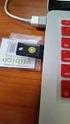 YubiKey Authentication Module Design Guideline Yubico Application Note Version 1.0 May 7, 2012 Introduction Disclaimer Yubico is the leading provider of simple, open online identity protection. The company
GoldKey Software. User s Manual. Revision 7.12. WideBand Corporation www.goldkey.com. Copyright 2007-2014 WideBand Corporation. All Rights Reserved.
 GoldKey Software User s Manual Revision 7.12 WideBand Corporation www.goldkey.com 1 Table of Contents GoldKey Installation and Quick Start... 5 Initial Personalization... 5 Creating a Primary Secure Drive...
Securing Card-Not-Present Transactions through EMV Authentication. Matthew Carter and Brienne Douglas December 18, 2015
 Securing Card-Not-Present Transactions through EMV Authentication Matthew Carter and Brienne Douglas December 18, 2015 Outline Problem Card-Not-Present (CNP) vs. PayPal EMV Technology EMV CNP Experiment
INTEGRATION GUIDE. DIGIPASS Authentication for Office 365 using IDENTIKEY Authentication Server with Basic Web Filter
 INTEGRATION GUIDE DIGIPASS Authentication for Office 365 using IDENTIKEY Authentication Server with Basic Web Filter Disclaimer Disclaimer of Warranties and Limitation of Liabilities All information contained
CSE331: Introduction to Networks and Security. Lecture 32 Fall 2004
 CSE331: Introduction to Networks and Security Lecture 32 Fall 2004 Hackers / Intruders External attacks Typical hacker Exploits carried out remotely Does not have an account on the remote machine Insider
DIGIPASS KEY series and smart card series for Juniper SSL VPN Authentication
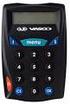 DIGIPASS KEY series and smart card series for Juniper SSL VPN Authentication Certificate Based 2010 Integration VASCO Data Security. Guideline All rights reserved. Page 1 of 31 Disclaimer Disclaimer of
Sharp Remote Device Manager (SRDM) Server Software Setup Guide
 Sharp Remote Device Manager (SRDM) Server Software Setup Guide This Guide explains how to install the software which is required in order to use Sharp Remote Device Manager (SRDM). SRDM is a web-based
SafeGuard Enterprise Web Helpdesk. Product version: 6.1
 SafeGuard Enterprise Web Helpdesk Product version: 6.1 Document date: February 2014 Contents 1 SafeGuard web-based Challenge/Response...3 2 Scope of Web Helpdesk...4 3 Installation...5 4 Allow Web Helpdesk
NATIONAL BANK s MasterCard SecureCode / Verified by VISA Service - Questions and Answers
 Learn more about MasterCard SecureCode / Verified by VISA service of NATIONAL BANK. You can use the links below to jump to specific topics, or scroll down the page to read the full list of questions and
What is Web Security? Motivation
 [email protected] http://www.brucker.ch/ Information Security ETH Zürich Zürich, Switzerland Information Security Fundamentals March 23, 2004 The End Users View The Server Providers View What is Web
Firewalls and Software Updates
 Firewalls and Software Updates License This work by Z. Cliffe Schreuders at Leeds Metropolitan University is licensed under a Creative Commons Attribution-ShareAlike 3.0 Unported License. Contents General
DIGIPASS Authentication for Remote Desktop Web Access User Manual 3.4
 DIGIPASS Authentication for Remote Desktop Web Access User Manual 3.4 Disclaimer Disclaimer of Warranties and Limitations of Liabilities The Product is provided on an 'as is' basis, without any other warranties,
PrivyLink Internet Application Security Environment *
 WHITE PAPER PrivyLink Internet Application Security Environment * The End-to-end Security Solution for Internet Applications September 2003 The potential business advantages of the Internet are immense.
Using EMV Cards to Protect E-commerce Transactions
 Using EMV Cards to Protect E-commerce Transactions Vorapranee Khu-Smith and Chris J. Mitchell Information Security Group, Royal Holloway, University of London, Egham, Surrey, TW20 0EX, United Kingdom {V.Khu-Smith,
Flexible Identity. OTP software tokens guide. Multi-Factor Authentication. version 1.0
 Flexible Identity Multi-Factor Authentication OTP software tokens guide version 1.0 Publication History Date Description Revision 2014.02.07 initial release 1.0 Copyright Orange Business Services 2 of
Plain English Guide To Common Criteria Requirements In The. Field Device Protection Profile Version 0.75
 Plain English Guide To Common Criteria Requirements In The Field Device Protection Profile Version 0.75 Prepared For: Process Control Security Requirements Forum (PCSRF) Prepared By: Digital Bond, Inc.
LAB THREE STATIC ROUTING
 LAB THREE STATIC ROUTING In this lab you will work with four different network topologies. The topology for Parts 1-4 is shown in Figure 3.1. These parts address router configuration on Linux PCs and a
Operating Manual QUESTOR
 QUESTOR AS 273 Management Software Document: KSW3s527.0004 / en 2010.08 Edition: August 2010 QUESTOR TABLE OF CONTENT 1 Product description EN-4 1.1 Purpose... EN-4 1.2 System components... EN-4 1.2.1
IDENTIKEY Server Windows Installation Guide 3.2
 IDENTIKEY Server Windows Installation Guide 3.2 Disclaimer of Warranties and Limitations of Liabilities Disclaimer of Warranties and Limitations of Liabilities The Product is provided on an 'as is' basis,
SafeGuard Enterprise Web Helpdesk
 SafeGuard Enterprise Web Helpdesk Product version: 5.60 Document date: April 2011 Contents 1 SafeGuard web-based Challenge/Response...3 2 Installation...5 3 Authentication...8 4 Select the Web Help Desk
Advanced Web Security, Lab
 Advanced Web Security, Lab Web Server Security: Attacking and Defending November 13, 2013 Read this earlier than one day before the lab! Note that you will not have any internet access during the lab,
Topics in Network Security
 Topics in Network Security Jem Berkes MASc. ECE, University of Waterloo B.Sc. ECE, University of Manitoba www.berkes.ca February, 2009 Ver. 2 In this presentation Wi-Fi security (802.11) Protecting insecure
Hacking the NFC credit cards for fun and debit ;) Renaud Lifchitz BT [email protected] Hackito Ergo Sum 2012 April 12,13,14 Paris, France
 Hacking the NFC credit cards for fun and debit ;) Renaud Lifchitz BT [email protected] Hackito Ergo Sum 2012 April 12,13,14 Paris, France Speaker's bio French computer security engineer working at
HP ProtectTools Windows Mobile
 HP ProtectTools Windows Mobile White Paper Introduction... 2 Risks... 2 Features... 3 Password Hashing... 4 Password Generation... 5 Password Types... 5 Strong Alphanumeric Passwords... 5 Password Lifetime...5
NetIQ Advanced Authentication Framework - Client. User's Guide. Version 5.1.0
 NetIQ Advanced Authentication Framework - Client User's Guide Version 5.1.0 Table of Contents 1 Table of Contents 2 Introduction 4 About This Document 4 NetIQ Advanced Authentication Framework Overview
The Key to Secure Online Financial Transactions
 Transaction Security The Key to Secure Online Financial Transactions Transferring money, shopping, or paying debts online is no longer a novelty. These days, it s just one of many daily occurrences on
DIGIPASS Authentication for Citrix Access Gateway VPN Connections
 DIGIPASS Authentication for Citrix Access Gateway VPN Connections With VASCO Digipass Pack for Citrix 2006 VASCO Data Security. All rights reserved. Page 1 of 31 Integration Guideline Disclaimer Disclaimer
NetIQ Access Manager - Advanced Authentication Plugin. User's Guide. Version 5.1.0
 NetIQ Access Manager - Advanced Authentication Plugin User's Guide Version 5.1.0 Table of Contents 1 Table of Contents 2 Introduction 3 About This Document 3 Environment 4 Flash Drive Authentication Support
CBI s Corporate Internet Banking Inquiry Services gives you the ability to view account details and transactions anytime, anywhere.
 Benefits & Features CBI s Corporate Internet Banking Inquiry Services gives you the ability to view account details and transactions anytime, anywhere. What can I do with Internet Banking? You can inquire
Citrix Access Gateway Plug-in for Windows User Guide
 Citrix Access Gateway Plug-in for Windows User Guide Access Gateway 9.2, Enterprise Edition Copyright and Trademark Notice Use of the product documented in this guide is subject to your prior acceptance
Measurement and Analysis Introduction of ISO7816 (Smart Card)
 Measurement and Analysis Introduction of ISO7816 (Smart Card) ISO 7816 is an international standard related to electronic identification cards with contacts, especially smart cards, managed jointly by
RLP Citrix Setup Guide
 RLP Citrix Setup Guide M Version 2.1 Trademarks IBM is a registered trademark of International Business Machines Corporation. The following are trademarks of International Business Machines Corporation
Bug Report. Date: March 19, 2011 Reporter: Chris Jarabek ([email protected])
 Bug Report Date: March 19, 2011 Reporter: Chris Jarabek ([email protected]) Software: Kimai Version: 0.9.1.1205 Website: http://www.kimai.org Description: Kimai is a web based time-tracking application.
Networking. General networking. Networking overview. Common home network configurations. Wired network example. Wireless network examples
 Networking General networking Networking overview A network is a collection of devices such as computers, printers, Ethernet hubs, wireless access points, and routers connected together for communication
From Network Security To Content Filtering
 Computer Fraud & Security, May 2007 page 1/10 From Network Security To Content Filtering Network security has evolved dramatically in the last few years not only for what concerns the tools at our disposals
Comodo MyDLP Software Version 2.0. Installation Guide Guide Version 2.0.010215. Comodo Security Solutions 1255 Broad Street Clifton, NJ 07013
 Comodo MyDLP Software Version 2.0 Installation Guide Guide Version 2.0.010215 Comodo Security Solutions 1255 Broad Street Clifton, NJ 07013 Table of Contents 1.About MyDLP... 3 1.1.MyDLP Features... 3
White Paper: Multi-Factor Authentication Platform
 White Paper: Multi-Factor Authentication Platform Version: 1.4 Updated: 29/10/13 Contents: About zero knowledge proof authentication protocols: 3 About Pairing-Based Cryptography (PBC) 4 Putting it all
Name: 1. CSE331: Introduction to Networks and Security Fall 2003 Dec. 12, 2003 1 /14 2 /16 3 /16 4 /10 5 /14 6 /5 7 /5 8 /20 9 /35.
 Name: 1 CSE331: Introduction to Networks and Security Final Fall 2003 Dec. 12, 2003 1 /14 2 /16 3 /16 4 /10 5 /14 6 /5 7 /5 8 /20 9 /35 Total /135 Do not begin the exam until you are told to do so. You