
The Business Case for Performance Management Systems
|
|
|
- Damian Parks
- 10 years ago
- Views:
Transcription
1 The Business Case for Performance Management Systems A Handbook for Human Resources Executives and Managers Josh Bersin Principal Analyst January 2008 BERSIN & ASSOCIATES RESEARCH REPORT v.1.0
2 The Business Case for Performance Management Systems TABLE OF CONTENTS Introduction 4 What Is Employee Performance Management? 5 Performance Management Is Fundamental to Talent Management 7 The Business Case for Employee Performance Management 9 Three Categories of Business Benefits 9 1. Efficiency and Compliance (driven by HR) 9 2. Process Improvement (driven by organizational development) 9 3. Business Transformation (driven by business executives) and Business Performance 11 The Benefits of Performance Management Software 12 First-Generation Solutions (1980s 1990s) 12 Second-Generation Solutions ( s) 13 Third-Generation Solutions (emerging) 13 Defining the Benefits 15 Efficiency and Compliance Benefits 16 Process Improvement Benefits 17 Case in Point: Pep Boys 18 Case in Point: An Example 19 Business Transformation Benefits 19 Pay for Performance 20 Organizational Transformation 20 Improving the Leadership Pipeline 20 Improving Quality of Hire and Workforce Mobility 22 Building the Business Case: Factors to Consider 24 Process First, System Second 24 Consider the Type of Vendors to Evaluate 25

3 The Business Case for Performance Management Systems Focus on Ease of Use Adoption Is Key 25 Budget Time and Energy on Process Design 26 Budget for Change Management, Training, Communications, Monitoring and Governance 27 Obtaining the Funding Presentation to Upper Management 28 For More Information or Assistance Come Visit with Us in Join Our Research Membership Program 31 1 Appendix I: Figures Appendix II: Table of Figures 2 3 About Us 34 About This Research 34
4 The Business Case for Performance Management Systems 4 Introduction One of the fastest-growing segments of HR software today is the market for online employee performance management systems. Our current research estimates that this market will reach $409 million in 2008 growing by more than 25 percent per year. Today, there are more than 30 companies providing solutions in this rapidly growing market, each with unique and innovative solutions to address this segment. This research report is designed to help HR and line managers understand the business drivers and benefits of such systems to aid in the development of the business case and planning process for selecting and implementing such systems.

5 The Business Case for Performance Management Systems 5 What Is Employee Performance Management? The term performance management is well-known to HR managers. Traditionally, it refers to the process of establishing goals, assessing employees and implementing the annual performance appraisal process. The goal of performance management is to create a consistent, fair and equitable process for the establishment of performance standards across an organization. This process is fundamental to a high-performing organization because it establishes the way in which people are managed. Our research has found seven independent parts of performance management in most organizations. These include: 1. Development of indiviudual goals; 2. Alignment of goals across the organization; 3. Manager assessment of performance; 4. Employee self-assessment of performance; 5. Peer or 360 assessment of performance (also called multirater assessment); 6. Competency assessment (often called assessment of potential ); and, 7. Coaching and development, and related planning for future career positions. Each of these processes is complex and is performed in different ways by different organizations. While there are hundreds of books on how to conduct performance appraisals, ultimately performance management is management. It forms the basis for the way in which employees work with their managers every day. Our research has found that these seven processes form and enhance the relationship between managers and employees. Well-implemented performance management systems will reinforce and institutionalize your company s overall process of management. Unfortunately, in many organizations (approximately 70 percent), performance management itself is not a well-established, consistent process. Even in those that have a consistent process, it often tends

6 The Business Case for Performance Management Systems toward the annual appraisal leaving much of the other processes up to the whims of a manager. Our research shows that, despite the great importance of performance management in HR departments: Sixty-one percent of line managers do not feel that the process they have today is driving greater performance; Fifty-six percent of managers are not satisfied with the process; and, Fifty percent of HR managers are not happy with the process. 1 The biggest complaint from managers is that they are not given enough guidelines on how to assess people, and the biggest complaint from employees is that the process is not equitable and fair. (A consistent software-driven process, coupled with excellent training, can avoid these problems.) So in the vast majority of organizations, performance management is a work in progress. 1 For more information, High-Impact Performance Management: Comprehensive Industry Study: Market Analysis, Trends, Best Practices, and Vendor Profiles, Bersin & Associates / Josh Bersin, June Available to research members at or for purchase at

7 The Business Case for Performance Management Systems 7 Performance Management Is Fundamental to Talent Management Driven by today s competitive business environment and the changing demographics of the workforce, organizations of all sizes are implementing integrated talent management strategies. These programs are designed to improve the leadership pipeline, improve workforce skills, and increase retention and staffing to meet the needs of growing organizations. Our High-Impact Talent Management research illustrated how dramatically this shift is taking place. Almost twothirds of HR organizations are building integrated talent management strategies which look at HR processes as an integrated whole (not only as separate functional processes). Ultimately, however you define talent management, our research clearly shows that performance management is foundational it establishes the ground rules for conversations between managers and employees. How, for example, do you decide who gets the bigger raise? How do you decide who is promoted into a given position? How do you decide who to lay off during a downturn? How do you decide who should be given an opportunity to take on a challenging, business-critical new assignment? Everywhere you look, these talent management decisions are dependent upon the appraisal of an individual s performance, capabilities and potential. In most HR textbooks (and in many organizations), performance assessment is broken into the following two fundamental pieces. The What What did this person accomplish? What value is he / she delivering to the organization? Is he / she achieving his / her business objectives? The How How did this person achieve such results? What is his / her skills and competencies? How well are they aligned with our corporate values? 2 For more information, High-Impact Talent Management: Trends, Best Practices and Industry Solutions, Bersin & Associates / Josh Bersin, May Available to research members at or for purchase at
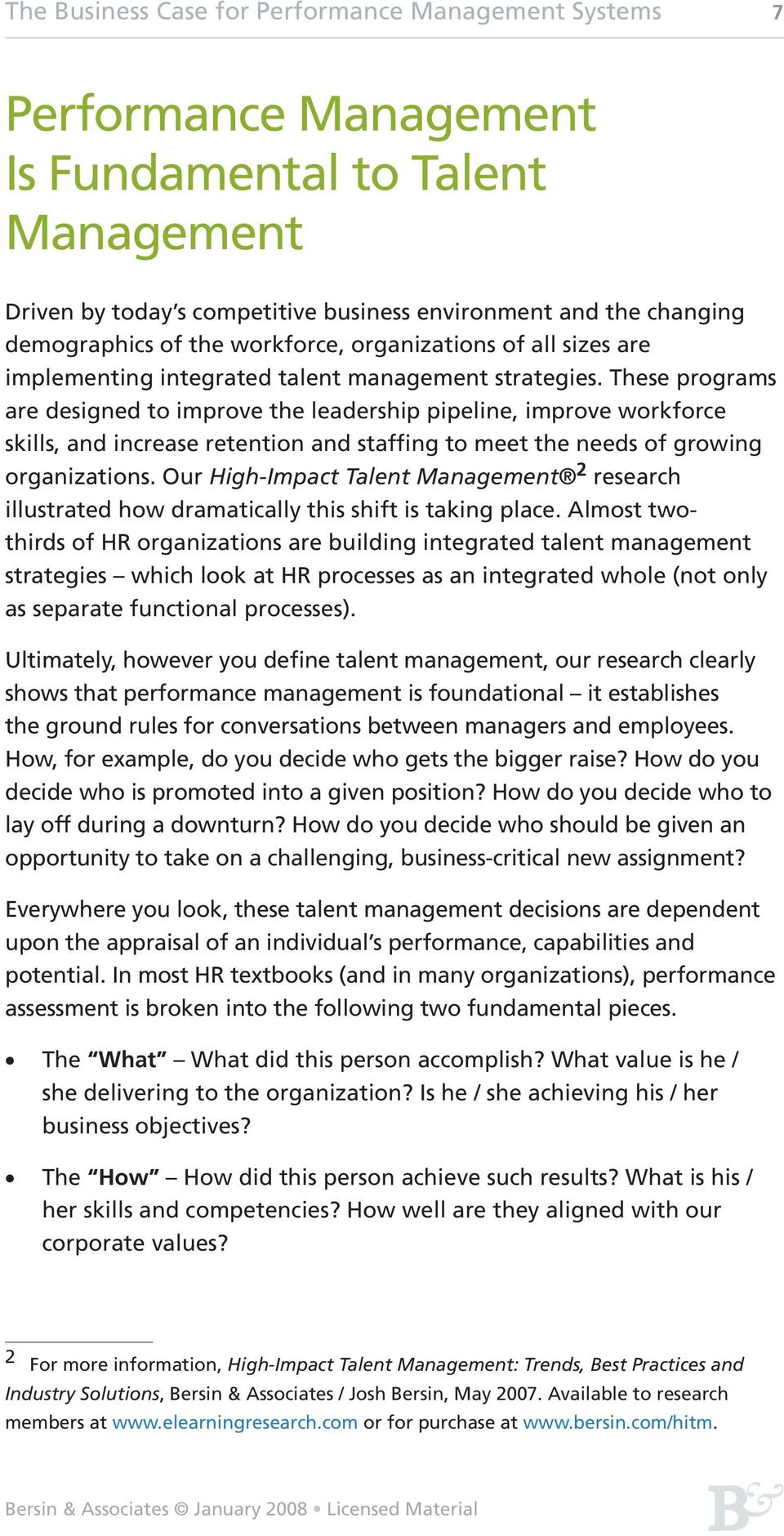
8 The Business Case for Performance Management Systems In most organizations, a performance rating is some combination of both of these. The what is typically used to establish compensation, and the how is used to establish promotability and development planning. But there is no hard and fast rule here. Some organizations weigh heavily toward the what (e.g., organizations with a very results-driven culture), and others weigh more toward the how (e.g., organizations with a more career-oriented culture). Again, our research clearly shows that, while performance-driven organizations do well in the short term, long-term value in organizations is driven much more by focusing on the how because these processes are used to help people develop, improve and move into the right jobs in the future. Our High-Impact Talent Management Framework (see Figure 1) illustrates how performance management forms the foundation of integrated talent management. Figure Figure 1: Bersin 1: Bersin & & Associates High-Impact Talent Management Talent Management Framework Framework HR Systems & Metrics Business Strategy Sourcing & Recruiting Sourcing Candidate Pools Assessment Employer Brand Recruiting Selection Talent Strategy & Planning Critical Talent Strategy Performance Management Goal-Setting Cascading Goals Self-Assessment Manager Assessment 360 Assessment Development Planning Competency Assessment Competency Management Onboarding Role-Based Curricula Content Development and Delivery Management Training Operational Training Target Metrics & Measurement Job Profiles Process Governance Career and Succession Management Calibration Meetings Talent Reviews HiPo Identification Career Planning Talent Migration Plan Corporate Values Leadership Curricula e- Learning Strategy Leadership Competencies Learning and Development Systems Strategy Leadership Development Formal Programs Stretch Assignments Executive Education Coaching Mentoring Job Rotation Assessment Evaluation Functional Competencies Coaching / Mentoring Programs Developmental Assignments Certification Programs Compensation Planning Base Compensation Plans Compensation Pay for Performance Short- and Long-Term Incentives Source: Bersin & Associates, 2007.
9 The Business Case for Performance Management Systems 9 The Business Case for Employee Performance Management Before discussing the importance of performance management software and the many benefits it provides, it is first important to discuss the business case for performance management itself. How does this process create business value? Three Categories of Business Benefits Generally speaking, there are three major business benefits from the performance management process. 1. Efficiency and Compliance (driven by HR) Legally Defensible Employee Management The first and foremost purpose for performance management is to create consistent, defensible performance standards for employees to help managers with the process of management. The process should create equity and alignment in compensation and promotional decisions, and in the legal defense of terminations. These benefits are legal mandates employers can be sued for undocumented decisions about compensation, termination and promotion without such a process. Compensation Optimization Without a performance management process (and system), many compensation decisions are made on an ad-hoc or personal-opinion basis, leading to overspending on salary increases, bonuses and other incentives. One of our research members found that, through the integration of a new performance management process (and system), the company saved more than $10 million per year on discretionary bonuses alone. 2. Process Improvement (driven by organizational development) Increasing Employee Retention There are many ways in which performance management increases retention. First, by having regular and clear goals and performance standards, employees feel

10 The Business Case for Performance Management Systems 10 more aligned with their managers and are much more likely to feel committed to the company. Second, the process itself (if welldesigned) encourages managers and employees to talk regularly about goals and development plans creating a more engaged manager and employee. Third, the process helps recruiters and prospective employees understand the company s culture and performance standards, helping to hire the right people who are most likely to succeed. Costs Associated with Losing Employees Data from Cornell University and Hewitt show that the cost of losing a single position is from 30 percent to 150 percent of the annual salary. In a firm with 40,000 full-time positions, the difference between a 15 percent turnover rate and a 25 percent turnover rate is more than $40 million annually. Improvement in Employee Engagement and Development By implementing a complete performance management process (one which includes development planning and coaching), organizations greatly improve the career development, skills and engagement of their employees. Our High-Impact Talent Management 4 research looked at 62 different talent management processes and found that the one which drives the highest level of business impact is coaching. Coaching describes the process of a manager listening, assisting and developing his / her people. A well-designed performance management process formalizes this ongoing relationship. Improving Efficiency and Effectiveness of Training Organizations spend between two percent and four percent of their payroll on training. These dollars go into a wide array of programs that are often changing every few months. The use of a welldesigned performance management process creates development planning as part of performance planning, aligned with the business strategy. It gives training managers the tools to often eliminate or redeploy 20 percent to 30 percent of their training budgets toward more urgent and needed programs. 3 Source: 4 For more information, High-Impact Talent Management: Trends, Best Practices and Industry Solutions, Bersin & Associates / Josh Bersin, May 2007.
11 The Business Case for Performance Management Systems Business Transformation (driven by business executives) and Business Performance Workforce Goal Alignment One of the biggest benefits of modern performance management is that it creates a process for common goal alignment across the workforce. Through the use of new performance management software, it is now possible to make sure that all employees have goals that are aligned with corporate goals. This gives employees, managers and executives new levels of visibility into their organizations enabling them to identify areas of misalignment and giving everyone information on how they can more easily help the business succeed. Increasing Employee Productivity and Performance Through the performance management processes, organizations can implement special programs (such as pay for performance, incentive bonuses and many others) that encourage employees to perform at higher levels. Organizations with well-established performance management programs (65 percent of organizations in our High-Impact Performance Management research 5 ) have 47 percent higher self-reported outcomes in creating a higherperforming workforce than those without well-established performance management processes. These benefits, when leveraged across an entire corporation, are tremendous. Improving the Leadership Pipeline The performance management process establishes the base for many talent management processes, as described earlier. It enables the company to find potential leaders more quickly and effectively, better develop these leaders, and identify successors to any and all critical job roles. Our research shows that the number one issue plaguing HR executives today is the hollowing out of their management and leadership pipelines. Only through a performance management process can these organizations identify and prepare the future leaders to fill these roles. 5 For more information, High-Impact Performance Management: Comprehensive Industry Study: Market Analysis, Trends, Best Practices, and Vendor Profiles, Bersin & Associates / Josh Bersin, June For more information, High-Impact Talent Management: Trends, Best Practices and Industry Solutions, Bersin & Associates / Josh Bersin, May
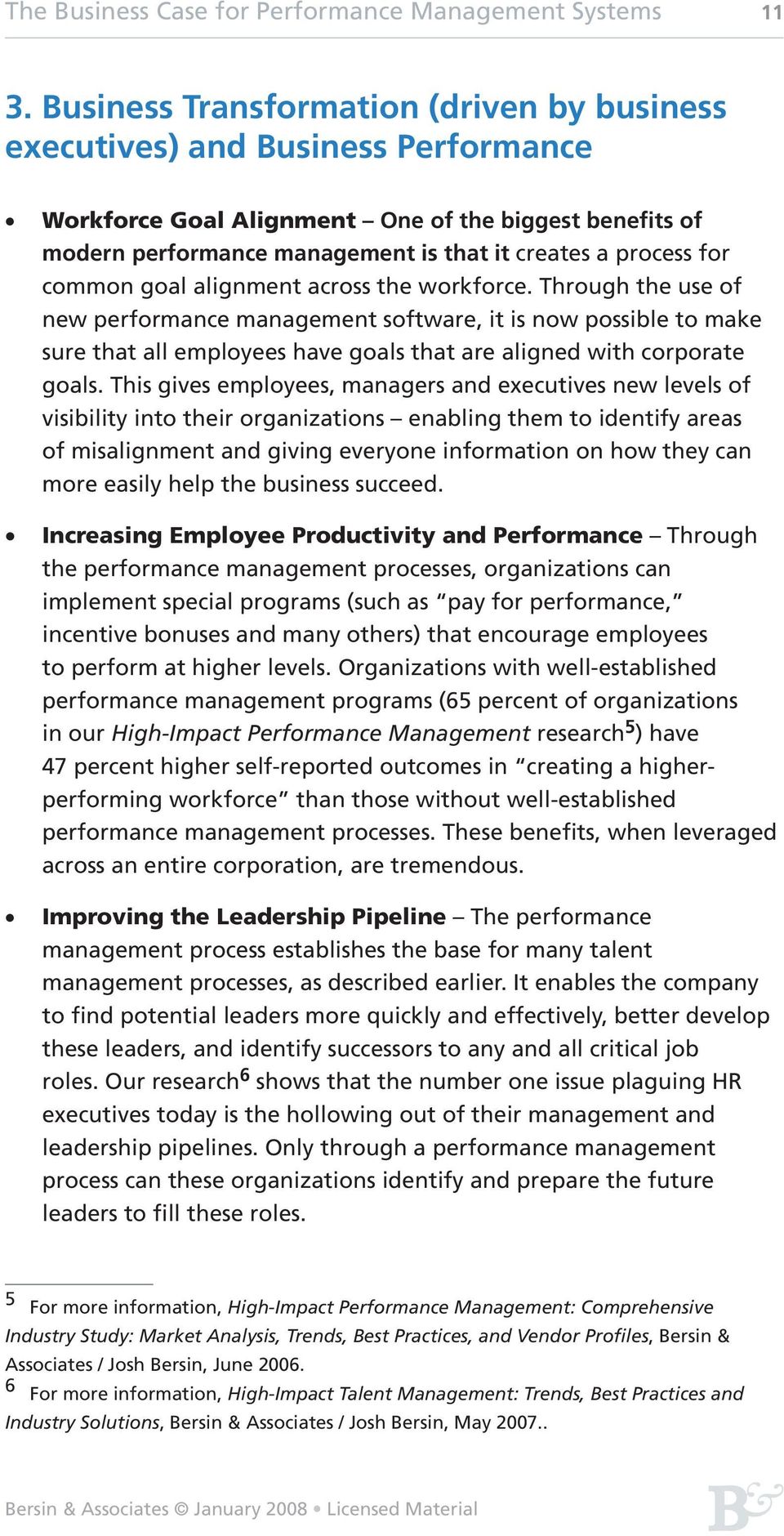
12 The Business Case for Performance Management Systems 12 The Benefits of Performance Management Software Now let us look at the role of performance management software, and how it enhances and facilitates these three areas of benefit. First, it is important to understand the evolution of these systems. First-Generation Solutions (1980s 1990s) In the 1980s and 1990s, organizations implemented Microsoft Word- and Excel-based forms automation systems that focused on automating the completion of performance appraisal forms. Initially, these systems focused on making it easier for managers to complete appraisals and then later, tools were added to help managers write (i.e., writing assistants), maintain legal compliance (i.e., checkers for illegal or discriminatory statements) and compute ratings (i.e., tools to weight and check ratings for equity and accuracy). As Figure 2 shows, these systems focused heavily on facilitating the efficiency and compliance benefits of performance management. Figure 2: 2: The Evolution of Performance Management Systems Business Transformation Third Generation Process Improvement Second Generation Business Benefits Efficiency and Compliance First Generation Web-Based Performance Management Ongoing Employee Performance Management Forms Automation (Word and Excel Templates used once per year) (Web forms appraisal workflow used a few times per year) (Employee and Manager planning, decision-making, and networking tool used frequently) 1980s s Source: Bersin & Associates, 2007.
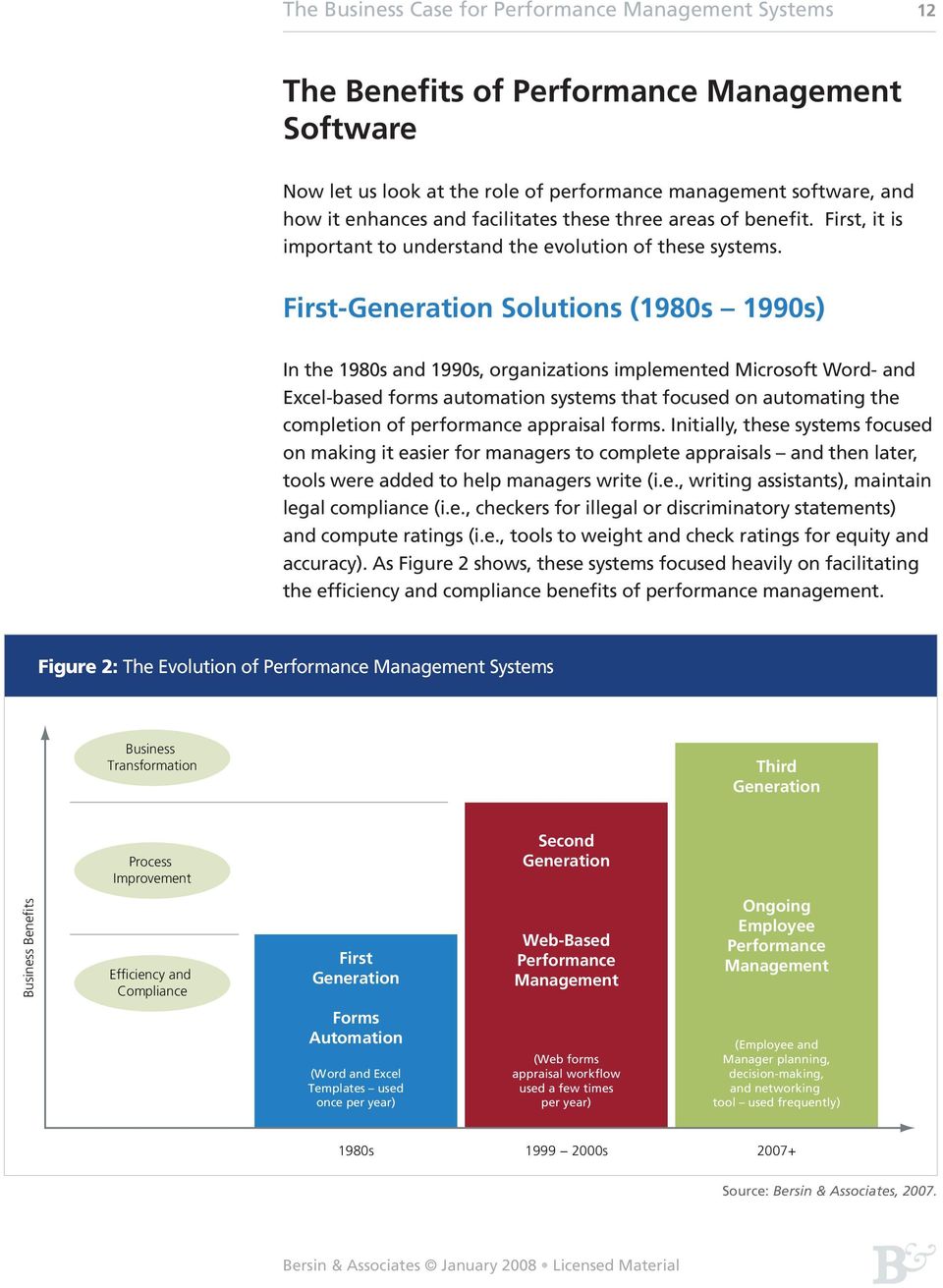
13 The Business Case for Performance Management Systems 13 Second-Generation Solutions ( s) In the late 1990s and through the 2000s, the Internet enabled organizations to build highly networked online performance management systems. These were (and still are) essentially web-based forms automation solutions. They include easy-to-use web forms to help managers and employees develop goals, assess competencies, and develop feedback and performance plans. These systems help managers capture information from others (as well as other areas) in the organization to include in the performance plan. They include powerful charting and analysis tools to help compare employees to each other and to assist in succession planning decisions. Employees and managers gain visibility into goal development, achievement, competency gaps and other information across the organization. These second-generation solutions go far beyond efficiency and compliance and focus heavily on implementing and improving the entire process of managing people. They have become more and more indispensable in the process of integrated talent management. In fact, many of these systems are now highly integrated with recruiting, learning and compensation to help the organization implement a tightly connected process for integrated talent management (often called the talent management suite 7 ). Through tools (like goal alignment and enterprisewide goal transparency), these systems are now able to facilitate true business transformation, as we will discuss. Third-Generation Solutions (emerging) There is a new, third generation of these systems now emerging. Here, we call this systems for everyday employee performance management. Most second-generation systems (while very well-designed) are still based on forms and tabs, and are only used occasionally by employees (a few times per year). 7 For more information, Talent Management Suites: A Comprehensive Look at Integrated HR Systems, Bersin & Associates / Leighanne Levensaler, January Available to research members at or for purchase at

14 The Business Case for Performance Management Systems 14 These next-generation systems are designed to drive business transformation by encouraging use by everyone in a regular and daily way. They manage more than just goals and employee development plans these systems go forward to help employees manage all the decisions they make on a daily basis. The next-generation systems look more like Web 2.0 applications (e.g., Facebook) and are designed to work through seamless integration to office productivity tools (like Microsoft Outlook). This integration means that mangers can capture performance management feedback throughout the year in the online system, without ever having actually logged into the system. Other tools include collaboration and networking, as well as embedded decisionsupport tools like analytics and workforce planning. Figure Figure 3: Next-Generation 3: Next-Generation Employee Employee Performance Performance Management Management Solutions Solutions Source: Taleo, Inc., 2007.

15 The Business Case for Performance Management Systems 15 While such systems are still in their early stages, we believe they are the inevitable next step in this market and will help accelerate business transformation. Buyers should consider these third-generation systems and features as part of their long-term talent management systems strategy. Defining the Benefits As we look at the benefits of performance management software, we find that they map directly to the three business drivers of performance management itself. Figure 4: Three Levels of Business Benefits for Performance Management Systems Business Value Business Transformation Process Improvement Efficiency and Compliance Developing Standard Rating Model Automating Performance Appraisals Increasing Engagement and Retention through Feedback and Coaching Increasing Performance through Development Developing Standard Competency Model Improving Business Results through Goal Alignment Driving Performance Culture through Pay for Performance Improving Leadership Pipeline through Succession Planning Bus Exec Driver ROI = 5-10X OD Driver ROI = 2-4X HR Driver ROI =.5-2X Source: Bersin & Associates, 2007.
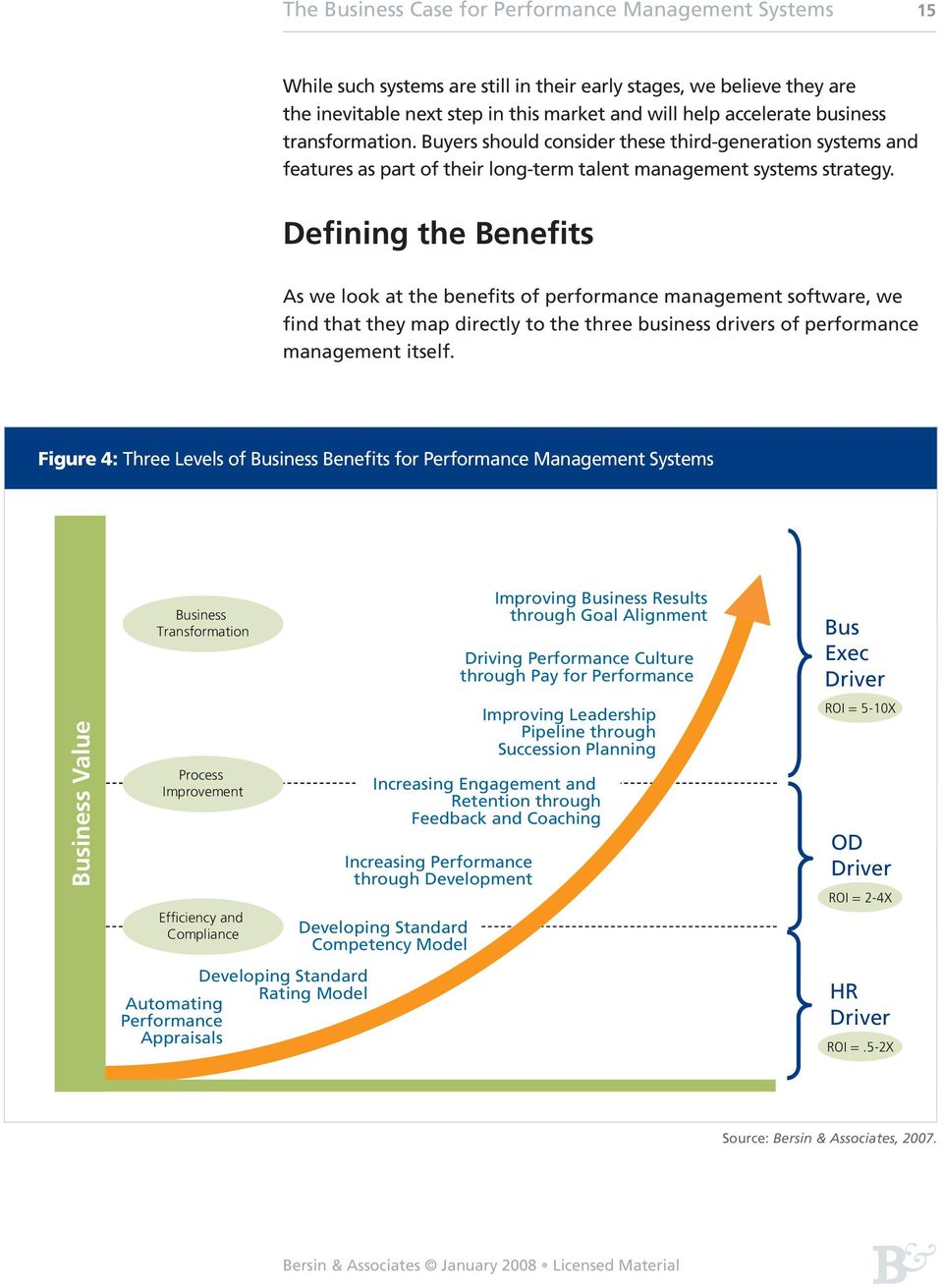
16 The Business Case for Performance Management Systems 16 Figure 5: Benefits of Performance Management Systems Category of Benefits Driver Typical Return on Investment Efficiency and Compliance HR 0.5 to 2 Times Investment Process Improvement Organizational Development 2 to 4 Times Investment Business Transformation Business Executives 5 to 10+ Times Investment Source: Bersin & Associates, Your organization will likely see benefits throughout this continuum. Your business case should focus on the areas in which there is the most urgency, awareness and need today and into the near future. Let us show some examples of benefits in each area. Efficiency and Compliance Benefits Any performance management software solution will provide many benefits in this area, including: Saving a manager s time with the appraisal process; Reducing errors in the performance management process; and, Saving the time of HR managers in consolidating and recording ratings. Such automation savings are typically small but often big enough to cost-justify a system. Today, these kinds of business cases are harder to justify, but you can build a business case on forms automation alone. If you consider that the system may save several hours per year across all managers in a large organization, the real savings can be very large. Imagine an organization of 5,000 employees that uses an ad-hoc paper-based approach to performance management. Even if forms are regularly used, there are many costs that can be saved. Imagine that 5,000 appraisal forms are filled out by hand and each is sent to HR. (In all likelihood, many will never make it to HR.) The human resources organization will typically encode these into an Excel spreadsheet

17 The Business Case for Performance Management Systems 17 to be used for compensation planning and this information will be redistributed to the employees for annual compensation planning. That forms collection, encoding and distribution process often takes four to six weeks (or longer), and rarely enables the organization to iterate and calibrate the appraisal ratings. These costs (including the cost of management time spent on paper processing) often approach the tens to hundreds of thousands of dollars. An even bigger driver here is the savings in potential legal exposure. If an employee sues an organization for discrimination in compensation or termination, the legal costs will be hundreds of thousands of dollars or higher. With a paper-based process, the organization may not have the right records available, or (even worse) the manager may have written something that is inappropriate or legally liable. Performance management software prevents such problems by including writing tips and communications archives between all managers and their employees. Our research finds that organizations easily realize a 50 percent to 200 percent return on investments (ROI) from efficiency and compliance. Process Improvement Benefits The second category of business benefits involves the improvement or adoption of important talent-related business processes. These benefits typically require the implementation of a second-generation system or a talent management suite. Consider, for example, the possible benefits of establishing a standard rating and competency model, and creating clearly aligned goals. Here, there could be tremendous financial benefits, such as: More equitably allocating compensation across employees, reducing total expense; Reducing compensation expense by not misallocating budget to employees who did not actually achieve goals; and, Reducing employees expectations for compensation by more clearly explaining performance standards. There are also significant, potential financial savings.
18 The Business Case for Performance Management Systems 18 Case in Point: Pep Boys One organization we spoke with (Pep Boys, a large automotive parts retailer) told us that the company saved more than $10 million in compensation expenses after the adoption of its new system simply because managers now felt less obligated to give out bonuses to employees who were not performing well. Prior to the use of the system, managers would hand out annual bonuses based on overall business objectives and general guidelines. After the new performance management process was put in place, managers were given clear bonus guidelines tied directly to local organizational business objectives. The result is far fewer bonuses and a far more performance-oriented process. Consider the benefits of creating an integrated process for employee development, aligned to corporate goals and competencies. First, such a system (as many pioneers in this market have seen) integrates the performance management process with the development resources in the company. Benefits include: Managers can more efficiently and easily assign the right development activities to employees; Training staff and dollars can be allocated to the most urgent and pressing development needs; HR executives and managers can assess the true value of their learning and development investments; Employees feel far more engaged because they can create their own development plan, using the support of your organization; and, Underutilized training programs and external programs can be cut or realigned. Since most companies spend between two percent and four percent of payroll on development (approximately $1,300 per employee on average across all employees in the U.S.), any savings or improvement in efficiency here can have large financial benefits.

19 The Business Case for Performance Management Systems 19 Case in Point: An Example Consider the potential savings in learning and development (L&D) spending. Most training organizations struggle to stay closely aligned with business needs. If a 5,000 employee-sized company spends two percent of its payroll on training, the total L&D budget will be around $5 million to $7 million per year. Organizations with well-defined performance management processes that are linked to development are typically 25 percent to 30 percent more efficient at allocating training dollars. This means the potential savings of $1 million to $2 million in efficient allocation of training programs. Do not underestimate the more intangible business value of integrated development planning. Organizations with integrated development planning processes can greatly: Improve their leadership pipelines; Reduce the need to hire external employees; and, Improve retention through career development programs. Many large organizations (e.g., Aetna, Seagate and Textron) have turned themselves around by focusing on the coaching and development aspects of performance management. 9 Business Transformation Benefits The third type of business benefits for performance management systems falls into the category of business transformation. Many of the newer performance management systems (including the next-generation solutions ) focus in this area. Here, the organization can use the system This information is based on our industry report, High-Impact Learning Organization, the report for which is available now with a new edition coming in For more information, please visit 9 In-depth case studies of Aetna, Seagate, Textron and others are available to Bersin & Associates research members. For more information on our research membership program, please visit
20 The Business Case for Performance Management Systems 20 to develop and implement new, integrated performance-driven processes that align and drive behavior, improve business planning, and facilitate business performance improvement. Pay for Performance For example, do you have a pay-for-performance culture in your organization today? Can you motivate employees toward organizationwide goals (such as revenue growth, cost containment, customer satisfaction measures, or other important operational measures)? Such goal alignment is often the dream of a CEO. With today s new performance management systems, such goal alignment and direct computation of goal attainment is now possible. Organizational Transformation One organization with which we spoke (a large European bank) used its new performance management process to manage a large acquisition. These two banks (one Spanish and one English) had vastly different cultures, systems and products. The company used its performance management process to establish a set of operational goals that force all employees to work on common initiatives and programs vital to making the merger work. In the first year of this rollout, more than 85 percent of all employees were given goals that directly aligned with a set of mergerbased initiatives. The organization forced alignment with this process, creating tremendous benefits in process improvement. Of course even in this case, it is still up to the individual manager to create the ongoing support and environment to achieve such goals. But with such a goal alignment process, the directors and vice presidents can clearly see who is onboard and who is not. Improving the Leadership Pipeline Imagine an even bigger challenge. Today, our research shows us that the biggest challenge in organizations is the development of the leadership pipeline For more information, High-Impact Talent Management: Trends, Best Practices and Industry Solutions, Bersin & Associates / Josh Bersin, May 2007.
21 The Business Case for Performance Management Systems 21 Figure 6: 6: Top Top Talent Talent Challenges in in Organizations Today Gaps in Leadership Pipeline 51% Creating a Performance-Driven Culture 46% Difficulty Filling Key Positions 38% Rapid Hiring Due to Growth 27% Skills Gap in Critical Positions (e.g., Engineering, IT) 27% New Skills for Product and Business Changes 24% Retirement of Key Workers 23% Retentionin Key Positions 16% % of Respondents Source: Bersin & Associates, These problems manifest themselves in many ways. In the case of Starbucks, the inability to hire regional managers means that the company cannot enter certain markets. In the case of PepsiCo, a lack of regional distributors ready for international assignments may limit the company s growth into Eastern Europe. In the case of a defense contractor like Raytheon, the lack of senior engineers and project managers means that the company cannot compete for certain contracts. These gaps cost money. So, how do you fill such gaps as these? Leadership gaps are filled by implementing an expensive leadership development program and by identifying future leaders early, providing them with the coaching, developmental assignments and formal training to become ready for these jobs. An integrated performance management system (today s systems typically include features for succession planning) is fundamental to these important processes.
22 The Business Case for Performance Management Systems 22 So some of the critical new benefits that can be achieved with performance management systems include: Improving business results (e.g., revenue, cost reduction, customer service and other measures) through pay for performance; Improving responsiveness and alignment during business transitions through goal alignment; and, Deepening the leadership pipeline through organizationwide succession planning and the identification of high-potential leaders 11, thus reducing leadership gaps. Improving Quality of Hire and Workforce Mobility Consider the following benefits of an integrated performance management process that provides visibility and information-sharing to your applicant-tracking and recruiting system. Managers and recruiters can search for internal career candidates (those with developmental interests along the lines of open positions) before looking for external hires. Recruiters can review critical job competencies and the profiles of high performers in the development of their sourcing strategies. Talent acquisition teams can measure quality of hire by tracking the performance of individuals of certain backgrounds through their careers and performance appraisals, therefore, improving the science of sourcing and recruiting. Job-specific competency models and job descriptions can be shared between line managers and recruiters to help build high-value behavioral assessments. Scientific assessments can be purchased to improve pre-hire screening, based on the known competencies and behaviors of highperforming employees. 11 A high-potential employee is an employee who has been identified as having the potential, ability and aspiration for successive leadership positions within the company. Often, these employees are provided with focused development as part of a succession plan and are referred to as HiPos.
23 The Business Case for Performance Management Systems 23 These benefits can be huge. An insurance company we spoke with told us that the company s entire system was cost-justified when it had a massive reorganization. Instead of searching throughout the organization for people with the skills and backgrounds for the new organization, people with the right experience, profiles and competencies could be quickly found to fill positions in the new operating division. The financial impact of putting the best person into a job is huge. Similarly, a healthcare organization was able to leverage its profilebased recruiting system to capture the profiles of all of its administrative workers during a reorganization. The company successfully leveraged these profiles to place most of the existing administrative employees into new jobs in the reorganized company. As a result, this visibility: Lead to even greater efficiency throughout the process; Enabled the retention of most of the workforce (which in a traditional reorganization might have been dismissed) and, ultimately, Produced significant savings for the company on new external recruiting costs.
24 The Business Case for Performance Management Systems 24 Building the Business Case: Factors to Consider As you build your business case, you must go beyond the potential savings and benefits. Organizations that successfully implement new performance and talent management systems build a complete story describing the proposed solution. This story should include the: Problems identified; Proposed solution; Implementation plan; Costs and resources; and, Roadmap for the future. The following sections offer a few key factors to consider. Process First, System Second First, you must remember to focus on process first and system second. Before you shop for a vendor, it is critical to describe the process you want to implement or change. This means developing a business strategy and set of processes that you want to implement immediately, in phase two and in phase three. Typically, these systems take two to three years to fully deploy and, during this period of time, the vendor landscape will change. During the first year, you will probably implement a pilot project among a small number of employees; in the second year, you will likely go through an enterprise rollout; and, in the third year, the system will start to truly take hold. One of our research members told us that, after five years of an integrated performance and development system, they are still dealing with issues of management training and process adoption. If you are crystal clear on the process you want to use, you will be able to use this information to both: Select the most appropriate system; and, Define a training, change management and communications program to teach managers how to use the system.
25 The Business Case for Performance Management Systems 25 Remember, performance management is management. You are not simply training people to use the system you are training them on how to manage. Consider the Type of Vendors to Evaluate As we discussed earlier, there are many types of vendors from which to select. As you evaluate their solutions, consider the evolution of such systems. You will find solutions available from your HRMS vendor, your payroll vendor and your existing HR systems vendors. Our research has found that this market is evolving and changing very rapidly, so we strongly recommend that you talk with vendors with a strong focus on performance management as one of their core product offerings. If you decide that your business benefits are likely to fall into the process improvement or business transformation areas, make sure you are talking with vendors which have clearly demonstrated capabilities and directions in these more advanced areas. Focus on Ease of Use Adoption Is Key Unfortunately, despite the tremendous amount of research and development in this market, many of the vendors are implementing highly complex features that may be hard to use. Ultimately, the users of these systems will be line managers, not HR managers and they must find the system easy to walk up to and use. Consider not just ease of use but also ease of learning. Managers may not use this system very often, so it must have a simple, help-laden user interface that is intuitive to a novice user. How do you gauge ease of use? The best way to do this is to build what we call use cases 12. Use cases are examples of steps in your process for performance management that you can document and give to prospective vendors. Ask the vendor to demonstrate your specific use cases (not their standard demonstrations). Only by seeing how these use cases work (and having line managers join you for the demonstrations) will you see how easy the system will truly be in your environment. 12 A use case provides a description of a sequence of interactions between actors, and the system necessary to complete a specific goal or function. Use cases are often co-authored by systems analysts and end-users, and are presented as a sequence of simple steps.
26 The Business Case for Performance Management Systems 26 It is particularly important to look at the newer, more modern user interfaces in these systems. New entrants to the market have designed user interfaces that look more like modern websites and less like forms with tabs. Remember that the users of these systems are everyday employees and managers, and we want to encourage them to use the system for day-to-day management, not only the annual appraisal process. Please note that your business case is dependent on widespread adoption and use of the system. We highly recommend that you evaluate systems with the help of line managers, and make sure the system is very intuitive and easy to learn not just easy to use. Budget Time and Energy on Process Design As you build the business case for systems, you must include budget and staffing plans for a variety of other important, interrelated steps. These steps include the time and effort required to define your performance management process in detail more specifically, consider the following. Time and Effort to Build a Workable Competency Model While it is not necessary to build a detailed, in-depth model for each and every job in your organization, you must have a set of basic principles and leadership competencies to succeed at performance management. Development of these models will typically take several months, and will require a multidisciplinary team of line managers, executives and HR staff. Time and Effort to Define the Rating Process As we described earlier, if you do not already have a successful performance management process, you must decide: o How numeric ratings will be computed; o What the relative ratings will mean; and, o What guidelines you will give managers for developing these ratings. This process is also likely to take research and several months of effort.
27 The Business Case for Performance Management Systems 27 Development of Compensation Linkages One of the biggest reasons for performance management is to fairly distribute compensation. Again, if you do not already have the linkages between performance management and compensation defined, this important step must be completed. Questions to consider here are as follows. o What are the relative ranges available to managers for each level of performance? o How will bonuses be computed and allocated? o What pay-for-performance metrics will you use and how will they be established? o How will compensation decisions be approved? Development of Support Tools for Managers No performance management process is successful without extensive support tools for managers. These include process guidelines, writing assistants, coaching and direct support during the process. Development of Training Materials and Programs for Managers Again, performance management is management. Organizations must develop training materials and programs that can be integrated into other leadership development programs in order to create widespread healthy adoption. Budget for Change Management, Training, Communications, Monitoring and Governance As with the rollout of any new process or system, change management is paramount. Most organizations roll out their new performance management systems (and processes) in stages, going first to a pilot audience and then a year later to a broader audience. Your business case must include staff time for the necessary change management, communications, process monitoring and governance (e.g., working with line managers to adapt the process to fit their needs). Our research shows that expenses in these areas typically include one to two people over a period of quarters to develop the entire plan for training, communications, rollout and ongoing support.
28 The Business Case for Performance Management Systems 28 Obtaining the Funding Presentation to Upper Management Once your business case is established, it is very important to obtain highlevel signoff on the program. This means presenting the business case to your CEO, CFO or other senior leaders. This business case should include the complete story of your proposed performance management system. There are two reasons for this first, to obtain the necessary funding and resources; second, and more importantly, to inform senior executives of this critical new system and enlist their full support for the rollout. Remember, performance management is a process owned by managers (not HR), so you need business-level support to ensure the process is welladopted and implemented. How do you handle the meeting with business executives? We find that organizations succeed most quickly when they focus on the following issues in this presentation. Focus on the company s existing business strategies (e.g., growth, consolidation, acquisition, product launch and so on), and explain how this new system will facilitate and greatly support these initiatives. Clearly explain how important talent management is to your organization and point out the issues discussed in this report (e.g., the dramatic impact that performance management has on performance, engagement, retention, equity and compensation efficiency). Show your executives how you selected the right platform and cite examples of other organizations using this system with highly successful results. (This, of course, demands that you make reference calls to customers of the vendor you select.) Explain the rollout plan and make sure they understand that the system will likely take one to two years to fully roll out. Explain how this process is integral to the company s entire talent management strategy. Make sure that IT fully supports your decision, so that there are no surprises by the time you obtain funding. Demonstrate confidence in your success by being prepared to discuss issues in change management and training.
29 The Business Case for Performance Management Systems 29 Figure Figure 7: 7: The The Elements Elements of of a a Business Business Case Case Statement of the Problem Business situation and challenges HR situation and challenges Statement of Current State Environment What systems do we have What is broken or done inefficiently Statement of Proposed Solution System and functionality Scheduled rollout plan Staffing and IT budget and headcount Benefits of Solution Data and decisions Benefits to employees Benefits to executives Benefits to management Benefits to HR Tell the story of the future Implementation Plan Costs Governance and change management Schedule and long-term benefits by phase What help we need from executive management Risks and how they will be mitigated Business Case for Talent Management System Company XYZ Source: Bersin & Associates, Some business executives are likely to ask for hard savings through the purchase of a new software system. In most cases, the true costs of such a system are zero, because the system itself typically costs $20 to $40 per employee to purchase, and potentially an equivalent amount of money for implementation and rollout. This cost (approximately $60 to $80 per employee) is usually saved simply through time-savings alone. While this is not the way to cost-justify a system, in most companies the time and paperwork saved by performance management software more than pays for its investment. In other cases, you may already have an existing system in place. If you do, compare the cost of the new system with the cost of developing and maintaining the existing system. Again, you are likely to find that the new system is no more expensive than the existing one.
30 The Business Case for Performance Management Systems 30 Remember to focus on the higher-level business issues. Employee performance, compensation equity, retention, employee satisfaction, engagement, and development of the leadership pipeline are issues that most business people understand. By continuously focusing on these benefits (and not the process automation efficiencies), you will help your business sponsors see the big benefits. If you follow this approach, your system will be well-supported with dollars, resources and executive support.
31 The Business Case for Performance Management Systems 31 For More Information or Assistance Bersin & Associates provides advisory services, workshops and events to help organizations build the business case, select the right platform, and implement performance and talent management systems. Come Visit with Us in 2008 In 2008, we will be further expanding our workshop and events program to bring research and best practices to your organization. In particular, we will be launching our first-ever research conference, IMPACT 2008: The Business of Talent 13. We hope you will join us to hear more than 60 senior HR and L&D executives share their experiences and best practices with you. Our workshop program 14 in 2008 will focus on providing you with the research and best practices to help your organization succeed. Some of these include: Building a High-Impact Learning Organization ; The Talent Management Masters Series ; Implementing High-Impact Leadership Development; and, Building the Business Case for Talent Management Systems. Join Our Research Membership Program Did you get a lot of valuable information from this report? If you like our research and would like to have complete access to more than 10,000 pages of research, case studies, analyses and bulletins, please consider joining our research membership program. Research members have access to all Bersin & Associates research and advisory services, as well as special discounts to our events and workshops. You can learn more by visiting or calling us at (561) For more information about this conference, please visit 14 For more information on our upcoming events and webinars, please visit
32 The Business Case for Performance Management Systems 32 Appendix I: Figures Figure 8: Checklist for the Business Case 1. Key Business Drivers Affecting Your Organization Growth, expansion, new product launches, consolidation, mergers and so on. 2. Key Talent Drivers Affecting Your Organization Shortage of leaders, recruiting challenges, low engagement, high turnover and so on. 3. Current Maturity of Performance Management in Your Organization Current process or lack of process, and current talent management program and owners. 4. Current HR Systems Environment (and possible systems to be replaced or integrated) Current HRMS and performance management process strengths and weaknesses; and, How the new system will fit into this environment. 5. Proposed Solution Recommended systems strategy and estimates of cost; Staffing and budget for implementation, change management, training and operations; Team members consulted and involved in project ownership; and, Three to five year plan for rollout and integration with other systems. 6. Major Potential Benefits Compliance and efficiency; Process improvement; and, Transformational new initiatives. 7. Benefits to the Business Specifically, how will this system help solve the specific problems highlighted in item 2 (stated in business terms). 8. Project Risks and Plans to Mitigate Risks 9. Next Steps for Executive Commitment Source: Bersin & Associates, 2007.
33 The Business Case for Performance Management Systems 33 Appendix II: Table of Figures Figure 1: Bersin & Associates High-Impact Talent Management Framework 8 Figure 2: The Evolution of Performance Management Systems 12 Figure 3: Next-Generation Employee Performance Management Solutions 14 Figure 4: Three Levels of Business Benefits for Performance Management Systems 15 Figure 5: Benefits of Performance Management Systems 16 Figure 6: Top Talent Challenges in Organizations Today 21 Figure 7: The Elements of a Business Case 29 Figure 8: Checklist for the Business Case 32
34 The Business Case for Performance Management Systems 34 About Us Bersin & Associates is the only research and advisory consulting firm focused solely on WhatWorks research in enterprise learning and talent management. With more than 25 years of experience in enterprise learning, technology and HR business processes, Bersin & Associates provides actionable, research-based services to help learning and HR managers and executives improve operational effectiveness and business impact. Bersin & Associates research members gain access to a comprehensive library of best practices, case studies, benchmarks and in-depth market analyses designed to help executives and practitioners make fast, effective decisions. Member benefits include: in-depth advisory services, access to proprietary webcasts and industry user groups, strategic workshops, and strategic consulting to improve operational effectiveness and business alignment. More than 3,500 organizations in a wide range of industries benefit from Bersin & Associates research and services. Bersin & Associates can be reached at or at (510) About This Research Copyright 2008 Bersin & Associates. All rights reserved. WhatWorks and related names such as Rapid e-learning: WhatWorks and The High Impact Learning Organization are registered trademarks of Bersin & Associates. No materials from this study can be duplicated, copied, republished, or re-used without written permission from Bersin & Associates. The information and forecasts contained in this report reflect the research and studied opinions of Bersin & Associates analysts.
The Talent Management Framework
 The Talent Framework Executive Summary Josh Bersin Stacey Harris Kim Lamoureux Madeline Laurano David Mallon May 2010 BERSIN & ASSOCIATES RESEARCH REPORT V.1.0 The Talent Framework Executive Summary The
2009 Talent Management Factbook
 2009 Talent Management Factbook Executive Summary Karen O Leonard Principal Analyst May 2009 BERSIN & ASSOCIATES RESEARCH REPORT V.2.0 2009 Talent Management Factbook: Executive Summary i The Bersin &
Research Bulletin 2007
 Research Bulletin 2007 About the Author Josh Bersin, Principal Analyst One of the biggest challenges in HR and training today is that of developing an integrated systems strategy. October 23, 2007 Vol.
High-Impact Succession Management
 High-Impact Succession Management Executive Summary Kim Lamoureux Principal Analyst Michael Campbell Senior Research Analyst Center for Creative Leadership Roland Smith Senior Research Faculty Center for
Where to Focus your Talent Management Strategies: The Top 22 Processes Which Drive Business Impact
 Where to Focus your Talent Management Strategies: The Top 22 Processes Which Drive Business Impact Josh Bersin, President & Founder of Bersin & Associates Erik Berggren, Director of SuccessFactors Research
Frameworks and Maturity Models
 Human Resources Frameworks and Maturity Models Leadership Development Learning & Development Talent Acquisition Talent Management www.bersin.com For member support or inquiries: Email us at [email protected]
Sage HRMS I White Paper. Performance Management Solutions for the Mid-Market Organization: Why Bother?
 I White Paper Performance Management Solutions for the Mid-Market Organization: Why Bother? Table of Contents Introduction... 1 Improving Administrative Efficiency and Reducing Risk... 2 Making Performance
The Talent Management Experience Series
 The Talent Management Experience Series New Roles and Expectations for Systems Leighanne Levensaler Director of Talent Management Research May 2009 BERSIN & ASSOCIATES RESEARCH REPORT v.1.0 The Talent
BUILDING A SUCCESSFUL BUSINESS CASE FOR TALENT MANAGEMENT TECHNOLOGY By Kelly McCombs and Tim Welsh, AON Hewitt
 BUILDING A SUCCESSFUL BUSINESS CASE FOR TALENT MANAGEMENT TECHNOLOGY By Kelly McCombs and Tim Welsh, AON Hewitt Introduction Human Resources today sits smack-dab in the middle of the most compelling and
The Convergence of Learning and Performance Management
 I N D U S T R Y S T U D Y The Convergence of Learning and Performance Management Has Talent Management Arrived? Josh Bersin September, 2005 Bersin & Associates The Convergence between Learning and Performance
The relatively recent combination of
 Best practice talent management Bob Little offers a template for successful, systematic implementation The relatively recent combination of major economic, demographic, social and business trends have
BUILDING A BUSINESS CASE FOR PERFORMANCE & DEVELOPMENT PLANNING (PDP) SYSTEMS
 iedex online ty Ltd ABN 65 081 927 513 BUILDING A BUSINESS CASE FOR ERFORMANCE & DEVELOMENT LANNING (D) SYSTEMS iedex ty Ltd 2/17 Raglan Street South Melbourne VIC 3205 hone : (03) 9696 1222 Fax: (03)
State of Washington. Guide to Developing Strategic Workforce Plans. Updated December 2008
 State of Washington Guide to Developing Strategic Workforce Plans Updated December 2008 Table of Contents Introduction... 3 What Is Workforce Planning?... 3 Workforce Planning Strategy Areas... 4 Strategic
Career Management. Making It Work for Employees and Employers
 Career Management Making It Work for Employees and Employers Stuck in neutral. That s how many employees around the world would describe their career. In fact, according to the 2014 Global Workforce Study,
Employee Engagement Drives Client Satisfaction and Employee Success in Professional Services
 Employee Engagement Drives Client Satisfaction and Employee Success in In professional services, business success is achieved through employee success. Organizations that prioritize top talent gain competitive
Get the Facts. Learning and Development Budgets, Staffing, and Trends for 2009. Josh Bersin. May, 2009
 Get the Facts Learning and Development Budgets, Staffing, and Trends for 2009 Josh Bersin May, 2009 Copyright 2009 Bersin & Associates. All rights reserved. About Us Who We Are Industry s primary research
Talent Management Leadership in Professional Services Firms
 Talent Management Leadership in Professional Services Firms Published by KENNEDY KENNEDY Consulting Research Consulting Research & Advisory & Advisory Sponsored by Table of Contents Introduction.... 3
CORPORATE LEADERSHIP COUNCIL JULY 2005 www.corporateleadershipcouncil.com
 CORPORATE LEADERSHIP COUNCIL JULY 2005 www.corporateleadershipcouncil.com LITERATURE Integrating Performance Management and Talent Review Processes Finding 1: Performance management involves the entire
THE EVOLUTION of Talent Management Consulting
 Talent management consulting is the giving of professional, expert advice to executives who are put in charge of handling, directing, or managing those who have a capacity for achievement or success. THE
Tapping into the Recruiting Power. Employees. Tapping into the Recruiting. of Existing. Employees. a Recruiting Trends white paper, sponsored by
 Tapping into the Recruiting Power of Existing Power Employees Tapping into the Recruiting of Existing Employees a Recruiting Trends white paper, sponsored by Tapping into the Recruiting Power of Existing
Competency Management at Its Most Competent
 Competency Management at Its Most Competent Competencies That Work for Business A recent survey by Human Resource Executive found that two of the top five challenges facing organizations today are aligning
Summary Report. Best Practices for Driving Employee Performance. Taleo Business Edition. All rights reserved.
 Summary Report Best Practices for Driving Employee Performance Taleo Business Edition. All rights reserved. TABLE OF CONTENTS I. Introduction... 4 II. Goal Management... 5 III. Performance Reviews... 6
Effective Workforce Development Starts with a Talent Audit
 Effective Workforce Development Starts with a Talent Audit By Stacey Harris, VP Research September, 2012 Introduction In a recent survey of CEO s, one in four felt they were unable to pursue a market opportunity
Deloitte and SuccessFactors Workforce Analytics & Planning for Federal Government
 Deloitte and SuccessFactors Workforce Analytics & Planning for Federal Government Introduction Introduction In today s Federal market, the effectiveness of human capital management directly impacts agencies
The Essential Guide to Employee Performance Management Systems. Leighanne Levensaler
 The Essential Guide to Employee Performance Management Systems Leighanne Levensaler Director of Talent Management Research October 2008 BERSIN & ASSOCIATES RESEARCH REPORT V.1.0 Introduction For decades,
Controlling Leadership Talent Risk: An Enterprise Imperative. By Seymour Adler, Senior Vice President and Amy Mills, Vice President
 Volume 1, Issue 1 November 2008 By Seymour Adler, Senior Vice President and Amy Mills, Vice President Leadership Shortage Imminent Grooming leaders is one of the most critical business needs in the modern
Talent Acquisition Systems 2011
 Talent Acquisition Systems 2011 Executive Summary Sarah White, Principal Analyst April 2011 BERSIN & ASSOCIATES EXECUTIVE SUMMARY V.1.0 Talent Acquisition Systems 2011: Executive Summary 2 The Bersin &
Part 3: Business Case and Readiness
 The Fundamentals of Managed Service Provider (MSP) Programs Part 3 of 3 Part 3: Business Case and Readiness By Jennifer Spicher contents This is the final of a three-part series designed to outline key
Three Strategies for Implementing HR in the Cloud
 Three Strategies for Implementing HR in the Cloud Adoption of cloud-based, software-as-a-service (SaaS) human resource management systems (HRMS) has become one of the hottest trends in HR. According to
BUSINESS CONSULTING SERVICES Comprehensive practice management solutions for independent investment advisors
 BUSINESS CONSULTING SERVICES Comprehensive practice management solutions for independent investment advisors Insights, tools and resources to help you Accelerate Your Growth, Scale Your Business and Elevate
G&A Onboarding. G&A Partners Human Capital Solutions
 G&A Onboarding G&A Onboarding streamlines new hire procedures and alleviates the administrative paper chase by providing new workers and their managers online access to all necessary employment forms,
MANAGING THE EMPLOYEE LIFECYCLE
 MANAGING THE EMPLOYEE LIFECYCLE Current Position Jose Laurel Experience & Expertise 16 years experience in management, operations, marketing and international commerce Prior to G&A, served as country manager
Department of Human Resources
 Workforce Services Workforce Policy and Planning Department Management/ Human Resource Information Systems Employee Relations Employment Compensation and Workforce Analysis Employee Benefits Organizational
STRATEGIC WORKFORCE PLANNING LATEST TRENDS AND LEADING PRACTICE EXAMPLES
 STRATEGIC WORKFORCE PLANNING LATEST TRENDS AND LEADING PRACTICE EXAMPLES BERLIN, 21 MAY 2015 Julia Howes Mercer Workforce Analytics & Planning A WORKFORCE TSUNAMI IS APPROACHING COPYRIGHT MERCER 2015 STRATEGIC
PERFORMANCE. 9 Out-of-the-box integration with best-in-class social platforms
 NetDimensions Performance helps organizations manage performance throughout the year by replacing the traditional annual performance review with an ongoing dialogue between managers and employees, focused
How To Fix A Broken Performance Management Program How Leading Organizations are transforming Performance Management to maximize Business Value
 Orange County Convention Center Orlando, Florida June 3-5, 2014 How To Fix A Broken Performance Management Program How Leading Organizations are transforming Performance Management to maximize Business
An Oracle White Paper June 2012. The Future of Talent Management: Four Stages of Evolution
 An Oracle White Paper June 2012 The Future of Talent Management: Four Stages of Evolution Introduction... 1 Talent Management Defined... 3 Stages of Talent Management Maturity... 4 Stage 1. Core HR Systems
A Practical Approach to Aligning and Managing Employee Goals
 A Practical Approach to Aligning and Managing Employee Goals By James Harvey A Knowledge Infusion White Paper June 2006 Table of Contents: Executive Summary... 3 Introducing Workforce Alignment... 4 People-Centric
Industry Insight: Performance Management
 Industry Insight: Performance Management Optimize Employee Performance to Maximize Business Performance You ve built an impressive talent hiring and screening approach, one that better predicts and ensures
PART 1: THE WHAT, WHO, AND WHY OF MSP BY JENNIFER SPICHER
 THE FUNDAMENTAL S OF MANAGED SERVICE PROVIDER (MSP) PROGR AMS PART 1 OF 3 PART 1: THE WHAT, WHO, AND WHY OF MSP BY JENNIFER SPICHER CONTENTS p3 Introduction p4 Why an MSP is Important p6 What Is an MSP?
SUMTOTAL WHITE PAPER. Calculating the ROI of an Employee Performance Management System
 SUMTOTAL WHITE PAPER Calculating the ROI of an Employee Performance Management System Calculating the ROI of an Employee Performance Management System If you have experience managing talent, you already
Leveraging HR Technology for Competitive Advantage
 SHRM Foundation Executive Briefing Leveraging HR Technology for Competitive Advantage Richard D. Johnson, Ph.D. and Hal G. Gueutal, Ph.D. Sponsored by ADP Effective management of a firm s human resources
HELPING YOU GET ON WITH BUSINESS
 HELPING YOU GET ON WITH BUSINESS We feel like Flex HR is a division of our company. They free us up to do what we do best Wendy Heath, Owner, Heath Construction HELPING YOU GET ON WITH BUSINESS A message
The CEO s Guide to Succession Planning Managing Risk & Ensuring Business Continuity. www.softscape.com
 The CEO s Guide to Succession Planning Managing Risk & Ensuring Business Continuity www.softscape.com RGB Table of Contents Automate to Drive Efficiencies & Reduce Costs Drive Succession Planning Deeper
Talent DNA that drives your business
 Talent DNA that drives your business Align your talent DNA and business strategy to achieve real success Accelerate your business with a strategic HCM solution that turns your human capital investment
Our approach for an organization s quick enablement towards Oracle s Talent Management strategy
 Our approach for an organization s quick enablement towards Oracle s Talent Management strategy A white paper May 23 rd 2013 By Vishal Ramesh, Jürgen Errijgers Oracle HCM Strategy HRMC, A Cronos Group
HR Field Guide: 5 Tips To Effective Succession Planning
 HR Field Guide: 5 Tips To Effective Succession Planning May 2010 Succession planning systems identify, prepare, and track high potential employees for promotion and advancement. This fi eld guide will
Talent Management Systems Customer Satisfaction 2011
 Talent Management Systems Customer Satisfaction 2011 Executive Summary Barb Arth, Principal Analyst December 2010 BERSIN & ASSOCIATES EXECUTIVE SUMMARY V.1.0 Talent Management Systems Customer Satisfaction
Succession planning: What is the cost of doing it poorly or not at all?
 Energy insights At a glance There are substantial benefits to be gained by identifying talented employees including those deep in the organization with specialized skills and coordinating their training
Taking Care of Your Company s Future: 3 Best Practices for Succession Planning
 Taking Care of Your Company s Future: 3 Best Practices for Succession Planning Copyright 2008 SuccessFactors, Inc. I. Introduction More successful businesses are embracing succession planning to deepen
Building and Sustaining a Strong Organization Amid Challenge And Change KPMG LLP
 Building and Sustaining a Strong Organization Amid Challenge And Change KPMG LLP The Issue Today s market realities offer businesses little choice but to embrace change. Companies in almost every industry
Compensation accounts for nearly 70 percent
 THE BUSINESS CASE FOR COMPENSATION TECHNOLOGY Compensation accounts for nearly 70 percent of operating expenses for most organizations, 1 and is one of the main reasons employees join and leave organizations.
10 Tips to Education Assistance Program Excellence
 10 Tips to Education Assistance Program Excellence White Paper by Heidi Milberg Director of Business Development General Physics Corporation www.gpworldwide.com General Physics Corporation 2011 As with
Recruitment Software 101
 Recruitment Software 101 What is Talent Acquisition? Once upon a time, personnel departments existed to simply find warm bodies to fill vacancies. Today, the best companies realize that success requires
Patient Relationship Management
 Solution in Detail Healthcare Executive Summary Contact Us Patient Relationship Management 2013 2014 SAP AG or an SAP affiliate company. Attract and Delight the Empowered Patient Engaged Consumers Information
The Approach to Talent Management Technology
 In corner offices and boardrooms across the globe, a new weapon is reemerging in the executive arsenal with powerful implications for driving and even predicting business success: Talent Management. Variously
9 CRITICAL REASONS TO AUTOMATE PERFORMANCE MANAGEMENT
 9 CRITICAL REASONS TO AUTOMATE PERFORMANCE MANAGEMENT Introduction As a human resources manager, you understand the importance of having a strong performance management process in place at your company.
Onboarding Benchmark Report. Technology Drivers Help Improve the New Hire Experience
 Onboarding Benchmark Report Technology Drivers Help Improve the New Hire Experience August 2006 Executive Summary Key Business Value Findings First impressions last. Future-looking companies recognize
Ready, Set, Go! A Game Plan for Talent Management in the Midmarket
 Ready, Set, Go! A Game Plan for Talent Management in the Midmarket Introduction Organizations that have survived the global economy of the past few years have experienced the new business reality: the
Solutions overview. Inspiring talent management. Solutions insight. Inspiring talent management
 Solutions overview Inspiring talent management Solutions insight Inspiring talent management Inspiring talent management Intuitive technology that people love to use Lumesse is the only global company
Hitachi Consulting Growing to $1 Billion Organization Leveraging the Power of the Oracle Cloud. March 27, 2015. Better
 Hitachi Consulting Growing to $1 Billion Organization Leveraging the Power of the Oracle Cloud March 27, 2015 Better Chris Buri Chris Buri is the Vice President and CIO of Hitachi Consulting and joined
HR Trends & Priorities for 2012. McLean & Company 1
 HR Trends & Priorities for 2012 McLean & Company 1 Executive Summary McLean & Company fielded its 2012 HR Priorities Survey with both HR and business respondents. Of the seven main areas in HR, Leadership
4 Steps to Getting Executive Buy-In for the Recruiting Platform You Need
 Insight4theEnterprise Series Part 1: 4 Steps to Getting Executive Buy-In for the Recruiting Platform You Need ONTENTS Introduction 3 Framing the Discussion: We re Not Talking about an ATS 4 Step-by-Step
!!!!! White Paper. Understanding The Role of Data Governance To Support A Self-Service Environment. Sponsored by
 White Paper Understanding The Role of Data Governance To Support A Self-Service Environment Sponsored by Sponsored by MicroStrategy Incorporated Founded in 1989, MicroStrategy (Nasdaq: MSTR) is a leading
Successful Succession Planning. part of our We think series
 Successful Succession Planning part of our We think series Contents A definition of Succession Planning 3 The importance of Succession Planning within the Talent Management Strategy 3 Succession Planning
Author: Lydia Cillie-Schmidt Page 1
 Talent Management: An integrated framework for implementation L Cillie-Schmidt: Talent Management: An integrated framework for implementation, Management Today, February 2009 Companies like to promote
Talent management strategy template
 Talent management strategy template 2012 Halogen Software Inc. All rights reserved. Halogen, Halogen eappraisal, Halogen ecompensation, Halogen elearning Manager, Halogen esuccession, Halogen e360 Multirater,
Supply Chain Talent: A Broken Link in the Supply Chain
 Supply Chain Talent: A Broken Link in the Supply Chain Five Proven Strategies to Close the Gaps 8/19/2014 By Lora Cecere Founder and CEO Supply Chain Insights LLC Contents Disclosure Research Research
Integrated Learning and Performance
 Integrated Learning and Performance EXECUTIVE SUMMARY In today s Age of Talent, Enterprise Learning and Talent Management have become key factors in organizations strategic competitiveness. The tight labor
5 Ways to Simplify Your Human Capital Management System
 5 Ways to Simplify Your Human Capital Management System 1 Most business leaders will say that their employees are the company s most valuable asset, but are they handling them as such? Human capital management
Improving Employee Satisfaction in Healthcare through Effective Employee Performance Management
 Improving Employee Satisfaction in Healthcare through Effective Employee Performance Management Introduction The following quotes are comments made by HR professionals from U.S. healthcare providers who
CONSULTING RESEARCH TRAINING VOLUME 2 - ISSUE 11. Three Hot Trends in Recruiting and Retaining Sales Talent
 CONSULTING RESEARCH TRAINING VOLUME 2 - ISSUE 11 Three Hot Trends in Recruiting and Retaining Sales Talent The Miller Heiman Sales Performance Journal, Volume 2, Issue 11 Copyright 2007 by Miller Heiman,
PMO Starter Kit. White Paper
 PMO Starter Kit White Paper January 2011 TABLE OF CONTENTS 1. ABOUT THE PMO STARTER KIT...3 2. INTRODUCTION TO THE PMO STARTER KIT WHITE PAPER...3 3. PMO DEVELOPMENT ROADMAP...4 4. PLAN PHASE...5 4.1 CREATE
Onboarding 2013. A New Look at New Hires. April 2013 Madeline Laurano
 Onboarding 2013 A New Look at New Hires April 2013 Madeline Laurano Page 2 Executive Summary The first impression an organization makes is often the most critical not only with customers and key stakeholders
Talent Management: Benchmarks, Trends, & Best Practices
 Talent Management: Benchmarks, Trends, & Best Practices Karen O Leonard Principal Analyst June, 2010 Copyright 2010 Bersin & Associates. All rights reserved. About Us Who We Are Premier research and advisory
A CFO s Guide to Creating a High Performance Organization: Workforce Management Best Practices
 A CFO s Guide to Creating a High Performance Organization: Workforce Management Best Practices Performance-driven organizations leverage their workforces to realize a higher return on investment, increased
Career Development and Succession Planning. Changing Landscape of HR 2012 Conference
 Career Development and Succession Planning Changing Landscape of HR 2012 Conference Overview Career Development Program Succession Planning Process Benefits Reduced organizational risk. Increased productivity.
For the Public Sector. The Missing Link: Improving your organisation, by linking reward to performance. Presented by:
 For the Public Sector The Missing Link: Improving your organisation, by linking reward to performance Presented by: Transforming people management I. Introduction An increasing number of successful, large
Insight paper. Performance Management: Building the business case
 Insight paper Performance Management: Building the business case Executive summary The need for has become a top priority for many global organisations over the last few years. As organisations were forced
Workday Human Capital Management Suite
 Workday Human Capital Management Suite Modern businesses operate in highly competitive, complex global environments. An organization must thoroughly understand its global workforce in order to make quick
INTRODUCING TALEO 10. Solutions Built for the Talent Age. Powering the New Age of Talent
 TALEO10 TA LEO.COM Solutions Built for the Talent Age Business value is no longer defined by tangible assets. It s powered by people and ideas. Competitive advantage comes from superior talent driving
WORKFORCE AND SUCCESSION PLANNING
 2012 WORKFORCE AND SUCCESSION PLANNING Toolkit to Identify and Address Strategic Talent Gaps Workforce Management Office NOAA 1/1/2012 Table of contents Introduction... 3 Workforce Planning... 3 Step 1:
Talent Management What is it? Why now?
 Talent Management What is it? Why now? May, 2006 Josh Bersin, Principal "Talent Management" has become one of the most important buzzwords in Corporate HR and Training today. In this article we will explain
Supply Chain Talent: The Missing Link?
 Supply Chain Talent: The Missing Link? 11/8/2012 By Lora Cecere Founder and CEO Supply Chain Insights LLC Contents Research... 2 Research Methodology and Overview... 2 Executive Overview... 3 The State
This page was left intentionally blank.
 This page was left intentionally blank. Workforce Planning Model Steps What This Step Accomplishes 1. Define the Scope Determines our focus could be long or short term could be a specific business unit
Making HR Strategic: Integrated Human Capital Management Holds the Key
 Making HR Strategic: Integrated Human Capital Management Holds the Key Leveraging Integrated Human Capital Processes and Data to Optimize Organizational Success March 2005 A New Strategic Wave There is
INTEGRATE CHANGE INTO YOUR WORKFORCE STRATEGIC TALENT MANAGEMENT SOFTWARE SOLUTIONS
 INTEGRATE CHANGE INTO YOUR WORKFORCE STRATEGIC TALENT MANAGEMENT SOFTWARE SOLUTIONS WHY TEDS? Fully Integrated TEDS Talent Management Solutions are fully integrated, allowing information to be shared among
HOW A PERFORMANCE MANAGEMENT SYSTEM CAN BUILD YOUR BENCH AND YOUR BOTTOM LINE STARTING RIGHT NOW
 HOW A PERFORMANCE MANAGEMENT SYSTEM CAN BUILD YOUR BENCH AND YOUR BOTTOM LINE STARTING RIGHT NOW The Basics, Drivers and Benefits of Investing in Cloud-Based Performance Management Software WHAT IT IS
Performance & Talent Management
 Performance & Talent Management SuccessFactors Integrated Applications Analytics and Reporting 6 5. How are my people doing relative to our goals? Drill down to see who is in on target and who is behind..
Primed for Growth: Midsize Companies Embrace Modern HR in the Cloud. The Winning Strategy for Hiring, Engaging, and Keeping the Right People
 Primed for Growth: Midsize Companies Embrace Modern HR in the Cloud The Winning Strategy for Hiring, Engaging, and Keeping the Right People CEOs spend their time ensuring they have practices and processes
How Smaller Organizations Can Use Talent Management to Accelerate Organizational Growth and Productivity
 How Smaller Organizations Can Use Talent Management to Accelerate Organizational Growth and Productivity Small to mid-sized organizations, whether for profit or not, need a means to manage their talent
Building a Strategy to Identify, Develop, & Retain High Potentials
 \ A Hot Topics Paper Prepared by the SIOP Visibility Committee Building a Strategy to Identify, Develop, & Retain High Potentials Sara J. Shondrick Novo Nordisk Daniel A. Neyman Reckitt Benckiser Prepared
The True Cost of a Bad Hire. Research Brief
 Research Brief Madeline Laurano August 2015 Research Brief The True Cost of a Bad Hire By: Madeline Laurano VP and Principal Analyst, Talent Acquisition Brandon Hall Group August 2015 2015 Brandon Hall
Succession Management
 Succession Management Design Build Attract When you plan for succession, you plan for success. Board members and executive leaders know the importance of succession management to long-term viability. They
A Best Practices Guide
 A Best Practices Guide Introduction: The Technology-Driven Performance Workplace Chapter 1: Revolutionize the Review Chapter 2: Reconsider the use of Competencies Chapter 3: Transform Training Chapter
Operations Excellence in Professional Services Firms
 Operations Excellence in Professional Services Firms Published by KENNEDY KENNEDY Consulting Research Consulting Research & Advisory & Advisory Sponsored by Table of Contents Introduction... 3 Market Challenges