
OPERATION MANUAL MARINE ENGINES 2YM15 3YM20 3YM30E 3YM30. English
|
|
|
- Arabella Flowers
- 10 years ago
- Views:
Transcription
1 OPERATION MANUAL MARINE ENGINES 2YM15 3YM20 3YM30E 3YM30 en English

2 Disclaimers: All information, illustrations and specifications in this manual are based on the latest information available at the time of publishing. The illustrations used in this manual are intended as representative reference views only. Moreover, because of our continuous product improvement policy, we may modify information, illustrations and/or specifications to explain and/or exemplify a product, service or maintenance improvement. We reserve the right to make any change at any time without notice. Yanmar and are registered trademarks of YANMAR CO., LTD. in Japan, the United States and/or other countries. All Rights Reserved: No part of this publication may be reproduced or used in any form by any means - graphic, electronic, or mechanical, including photocopying, recording, taping, or information storage and retrieval systems - without the written permission of YANMAR CO., LTD. OPERATION MANUAL MODEL CODE 2YM15, 3YM20, 3YM30E, 3YM30 0AYMM-G00202 All Rights Reserved, Copyright

3 TABLE OF CONTENTS INTRODUCTION... 1 YM SERIES EMISSION CONTROL SYSTEM WARRANTY-USA, THE ENVIRONMENTAL PROTECTION AGENCY (EPA) ONLY... 2 RECORD OF OWNERSHIP... 3 SAFETY... 5 SAFETY PRECAUTIONS... 6 General Information... 6 Before You Operate... 6 During Operation and Maintenance... 6 LOCATION OF SAFETY DECALS PRODUCT OVERVIEW YANMAR YM SERIES FEATURES AND APPLICATIONS New Engine Break-In COMPONENT IDENTIFICATION Right Side (Viewed from Flywheel) - 2YM Left Side (Viewed from Flywheel) - 2YM Right Side (Viewed from Flywheel) - 3YM Left Side (Viewed from Flywheel) -3YM Right Side (Viewed from Flywheel) - 3YM30(E) 15 Left Side (Viewed from Flywheel) - 3YM30(E) NAMEPLATES FUNCTION OF MAJOR COMPONENTS CONTROL EQUIPMENT Instrument Panel Single-Handle Remote Control Head YM Series Operation Manual

4 TABLE OF CONTENTS BEFORE YOU OPERATE INTRODUCTION SAFETY PRECAUTIONS DIESEL FUEL Diesel Fuel Specifications Filling the Fuel Tank Bleeding the Fuel System ENGINE OIL Engine Oil Specifications Engine Oil Viscosity Checking the Engine Oil Adding Engine Oil MARINE GEAR OR SAIL DRIVE OIL Marine Gear Oil Specifications Sail Drive Oil Specifications- SD Checking Marine Gear Oil Adding Marine Gear Oil Checking and Adding Sail Drive Oil ENGINE COOLANT Engine Coolant Specifications Coolant (Closed Cooling System) Checking and Adding Coolant CRANKING THE ENGINE ENGINE OPERATION INTRODUCTION SAFETY PRECAUTIONS STARTING THE ENGINE If the Engine Fails to Start Starting at Low Temperatures After the Engine has Started REMOTE CONTROL HANDLE OPERATION Acceleration and Deceleration Shifting the Engine CAUTIONS DURING OPERATION SHUTTING DOWN THE ENGINE Normal Shutdown Emergency Shutdown CHECKING THE ENGINE AFTER OPERATION PERIODIC MAINTENANCE INTRODUCTION SAFETY PRECAUTIONS YM Series Operation Manual

5 12/05 TABLE OF CONTENTS PRECAUTIONS The Importance of Periodic Maintenance Performing Periodic Maintenance The Importance of Daily Checks Keep a Log of Engine Hours and Daily Checks 51 Yanmar Replacement Parts Tools Required Ask Your Authorized Yanmar Marine Dealer or Distributor for Help Tightening Fasteners EPA MAINTENANCE REQUIREMENTS EPA Requirements for USA and Other Applicable Countries Conditions to Ensure Compliance with EPA Emission Standards Inspection and Maintenance Installing Sample Port PERIODIC MAINTENANCE SCHEDULE Inspection and Maintenance of EPA Emission-Related Parts PERIODIC MAINTENANCE PROCEDURES Daily Checks After Initial 50 Hours of Operation Every 50 Hours of Operation Every 100 Hours of Operation Every 150 Hours of Operation Every 250 Hours of Operation Every 1000 Hours of Operation TROUBLESHOOTING SAFETY PRECAUTIONS TROUBLESHOOTING AFTER STARTING TROUBLESHOOTING INFORMATION TROUBLESHOOTING CHART LONG-TERM STORAGE PREPARE ENGINE FOR LONG-TERM STORAGE 79 DRAIN SEAWATER COOLING SYSTEM YM Series Operation Manual

6 TABLE OF CONTENTS SPECIFICATIONS PRINCIPAL ENGINE SPECIFICATIONS YM15 Engine Specifications YM20 Engine Specifications YM30E Engine Specifications YM30 Engine Specifications Marine Gear and Sail Drive Specifications SYSTEM DIAGRAMS PIPING DIAGRAMS WIRING DIAGRAMS EPA WARRANTY USA ONLY YANMAR CO., LTD. LIMITED EMISSION CONTROL SYSTEM WARRANTY - USA ONLY Your Warranty Rights and Obligations: Warranty Period: Warranty Coverage: Exclusions: Owner s Responsibility: Customer Assistance: EMISSION SYSTEM WARRANTY NON-ROAD EMISSION SYSTEM WARRANTY Yanmar Co., Ltd. Limited Emission Control System Warranty - USA Only Maintenance Log YM Series Operation Manual

7 INTRODUCTION Welcome to the world of Yanmar Marine! Yanmar Marine offers engines, drive systems and accessories for all types of boats, from runabouts to sailboats, and from cruisers to mega yachts. In marine leisure boating, the worldwide reputation of Yanmar Marine is second to none. We design our engines to respect nature. This means quieter engines, with minimal vibrations, cleaner than ever. All of our engines meet applicable regulations, including emissions, at the time of manufacture. To help you enjoy your Yanmar YM series engine for many years to come, please follow these recommendations: Read and understand this Operation Manual before you operate the machine to ensure that you follow safe operating practices and maintenance procedures. Keep this Operation Manual in a convenient place for easy access. If this Operation Manual is lost or damaged, order a new one from your authorized Yanmar Marine dealer or distributor. Make sure this manual is transferred to subsequent owners. This manual should be considered a permanent part of the engine and remain with it. Constant efforts are made to improve the quality and performance of Yanmar products, so some details included in this Operation Manual may differ slightly from your engine. If you have any questions about these differences, please contact your authorized Yanmar Marine dealer or distributor. The specifications and components (instrument panel, fuel tank, etc.) described in this manual may differ from ones installed on your vessel. Please refer to the manual provided by the manufacturer of these components. Refer to the Yanmar Limited Warranty Handbook for a complete warranty description. YM Series Operation Manual 1

8 INTRODUCTION YM SERIES EMISSION CONTROL SYSTEM WARRANTY-USA, THE ENVIRONMENTAL PROTECTION AGENCY (EPA) ONLY YM series engines come with an emission control system warranty. In all states, 2009 and later compression-ignition engines must be designed, built and equipped to meet the United States EPA emissions standards. Yanmar warrants the emission control system on your YM series engine for the periods of time listed below. Emission Control Certification Model Year YM15 EPA marine CI Tier 3 3YM20 EPA marine CI Tier 3 3YM30E EPA marine CI Tier 3 - intermediate (NTE) - 3YM30 EPA marine CI Tier 3 intermediate - Note: Since 2013, the 3YM30 does not comply with the EPA regulation. 2 YM Series Operation Manual

9 12/05 RECORD OF OWNERSHIP INTRODUCTION Take a few moments to record the information you need when you contact Yanmar for service, parts or literature. Engine Model: Engine Serial No.: Date Purchased: Dealer: Dealer Phone: YM Series Operation Manual 3

10 INTRODUCTION This Page Intentionally Left Blank 4 YM Series Operation Manual

11 SAFETY Yanmar considers safety of great importance and recommends that anyone that comes into close contact with its products, such as those who install, operate, maintain or service Yanmar products, exercise care, common sense and comply with the safety information in this manual and on the machine s safety decals. Keep the labels from becoming dirty or torn and replace them if they are lost or damaged. Also, if you need to replace a part that has a label attached to it, make sure you order the new part and label at the same time. A This safety alert symbol appears with most safety statements. It means attention, become alert, your safety is involved! Please read and abide by the message that follows the safety alert symbol. DANGER Indicates a hazardous situation which, if not avoided, will result in death or serious injury. WARNING Indicates a hazardous situation which, if not avoided, could result in death or serious injury. CAUTION Indicates a hazardous situation which, if not avoided, could result in minor or moderate injury. NOTICE Indicates a situation which can cause damage to the machine, personal property and / or the environment, or cause the equipment to operate improperly. YM Series Operation Manual 5

12 SAFETY SAFETY PRECAUTIONS General Information There is no substitute for common sense and careful practices. Improper practices or carelessness can cause burns, cuts, mutilation, asphyxiation, other bodily injury or death. This information contains general safety precautions and guidelines that must be followed to reduce risk to personal safety. Special safety precautions are listed in specific procedures. Read and understand all of the safety precautions before operation or performing repairs or maintenance. Before You Operate DANGER The safety messages that follow have DANGER level hazards. Never permit anyone to install or operate the engine without proper training. Read and understand this Operation Manual before you operate or service the engine to ensure that you follow safe operating practices and maintenance procedures. Safety signs and labels are additional reminders for safe operating and maintenance techniques. Consult authorized Yanmar Marine dealer or distributor for additional training. During Operation and Maintenance WARNING The safety messages that follow have WARNING level hazards. Explosion Hazard While the engine is running or the battery is charging, hydrogen gas is being produced and can be easily ignited. Keep the area around the battery well-ventilated and keep sparks, open flames and any other form of ignition out of the area. Fire and Explosion Hazard Diesel fuel is flammable and explosive under certain conditions. Never use a shop rag to catch the fuel. Wipe up all spills immediately. Never refuel with the engine running. Fire Hazard Undersized wiring systems can cause an electrical fire. Store any containers containing fuel or other flammable products in a well-ventilated area, away from any combustibles or source of ignition. Store any equipment in a designated area away from moving parts. Never use the engine compartment for storage. 6 YM Series Operation Manual

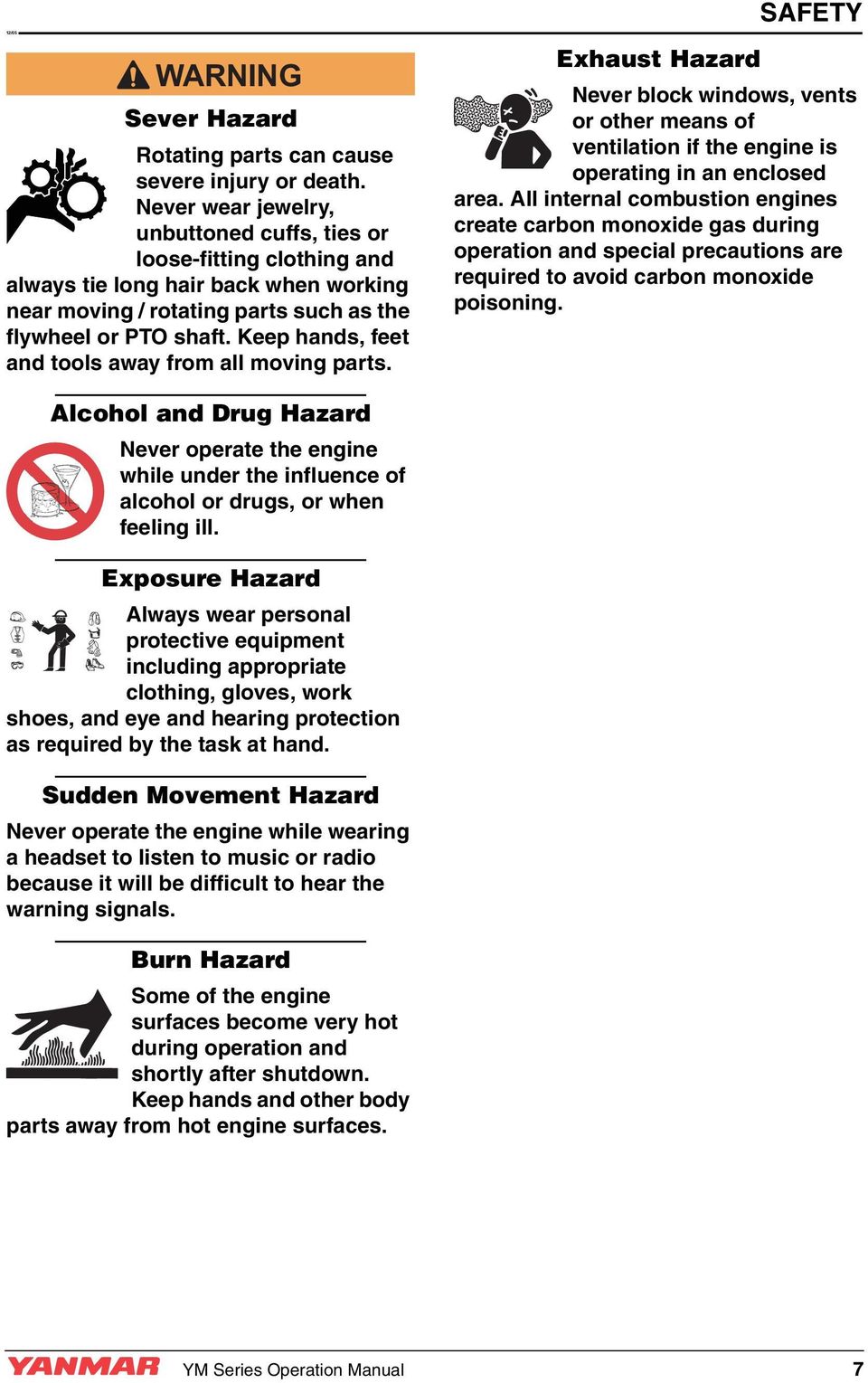
13 12/05 WARNING Sever Hazard Rotating parts can cause severe injury or death. Never wear jewelry, unbuttoned cuffs, ties or loose-fitting clothing and always tie long hair back when working near moving / rotating parts such as the flywheel or PTO shaft. Keep hands, feet and tools away from all moving parts. SAFETY Exhaust Hazard Never block windows, vents or other means of ventilation if the engine is operating in an enclosed area. All internal combustion engines create carbon monoxide gas during operation and special precautions are required to avoid carbon monoxide poisoning. Alcohol and Drug Hazard Never operate the engine while under the influence of alcohol or drugs, or when feeling ill. Exposure Hazard Always wear personal protective equipment including appropriate clothing, gloves, work shoes, and eye and hearing protection as required by the task at hand. Sudden Movement Hazard Never operate the engine while wearing a headset to listen to music or radio because it will be difficult to hear the warning signals. Burn Hazard Some of the engine surfaces become very hot during operation and shortly after shutdown. Keep hands and other body parts away from hot engine surfaces. YM Series Operation Manual 7
14 SAFETY CAUTION The safety messages that follow have CAUTION level hazards. Poor Lighting Hazard Ensure that the work area is adequately illuminated. Always install wire cages on portable safety lamps. Tool Hazard Always use tools appropriate for the task at hand and use the correct size tool for loosening or tightening machine parts. Flying Object Hazard Always wear eye protection when servicing the engine or when using compressed air or high-pressure water. Dust, flying debris, compressed air, pressurized water or steam may injure your eyes. Coolant Hazard Wear eye protection and rubber gloves when you handle engine coolant. If contact with the eyes or skin should occur, flush eyes and wash immediately with clean water. NOTICE The safety messages that follow have NOTICE level hazards. It is important to perform daily checks as listed in the Operation Manual. Periodic maintenance prevents unexpected downtime, reduces the number of accidents due to poor engine performance and helps extend the life of the engine. Consult authorized Yanmar Marine dealer or distributor if you need to operate the engine at high altitudes. At high altitudes the engine will lose power, run rough and produce exhaust gases that exceed the design specifications. Always be environmentally responsible. Follow the guidelines of the EPA or other governmental agencies for the proper disposal of hazardous materials such as engine oil, diesel fuel and engine coolant. Consult the local authorities or reclamation facility. Never dispose of hazardous materials by dumping them into a sewer, on the ground, or into ground water or waterways. If a Yanmar Marine Engine is installed at an angle that exceeds the specifications stated in the Yanmar Marine Installation Manuals, engine oil may enter the combustion chamber causing excessive engine speed, white exhaust smoke and serious engine damage. This applies to engines that run continuously or those that run for short periods of time. 8 YM Series Operation Manual

15 12/05 SAFETY NOTICE If you have an installation with two or three engines and only one engine is operating, the water pickup (thru-hull) of the non-running engine(s) should be closed. This will prevent water from being forced past the seawater pump and eventually finding its way into the engine. The result of water entering the engine could cause seizure or other serious problems. If you have an installation with two or three engines, and only one engine is operating, please note that if the propeller shaft thru-hull (stuffing box) is lubricated by engine water pressure and the engines are interconnected, care must be taken that water from the running engine does not enter the exhaust of the non-running engine(s). This water could cause seizure of the non-running engine(s). Consult authorized Yanmar Marine dealer or distributor for a complete explanation of this condition. If you have an installation with two or three engines, and only one engine is operating, it is important to limit the amount of throttle applied to the running engine. If you observe black smoke or movement of the throttle does not increase engine speed, you are overloading the engine that is running. Immediately throttle back to approximately 2/3 throttle or to a setting where the engine performs normally. Failure to do so may cause the running engine to overheat or cause excess carbon buildup which may shorten the engine s life. Never turn off the battery switch (if equipped) or short the battery cables during operation. Damage to the electrical system will result. YM Series Operation Manual 9

16 SAFETY LOCATION OF SAFETY DECALS Figure 1, show the location of safety decals on Yanmar YM series marine engines. YM Engines Figure X00 1 Part Number: Part Number: Part Number: YM Series Operation Manual

17 PRODUCT OVERVIEW YANMAR YM SERIES FEATURES AND APPLICATIONS The YM series are four-stroke swirl pre-combustion chamber diesel engines equipped with liquid coolant systems. The 2YM15 is a 2-cylinder engine and is naturally aspirated. The 3YM20 is a 3-cylinder engine and is naturally aspirated. The 3YM30E, 3YM30 is a 3-cylinder engine and is naturally aspirated. The engines are equipped with a marine gear or sail drive unit. These engines are designed for pleasure craft use and complied with EPA regulation Tier3 marine from 2009 year. It is recommended that new vessels be propped so the engines can operate at 100 to 200 min -1 above the Maximum Rated output power engine speed (3700 to 3800) to allow for some added weight and hull resistance. The engine must be able to reach the Maximum Rated Power engine speed (3600) under full load at all times. Failure to do so can lead to reduced vessel performance, lead to increased smoke levels and cause permanent damage to your engine. The engine must be installed correctly with coolant lines, exhaust gas lines and electrical wiring. Any auxiliary equipment attached to the engine should be easy to use and accessible for service. To handle the drive equipment, propulsion systems (including the propeller) and other inboard equipment, always observe the instructions and cautions given in the operation manuals supplied by the shipyard and equipment manufacturers. The YM series engines are designed to be operated at maximum throttle (3600 min -1 ) for less than 5% of total engine time (30 minutes out of every 10 hours) and cruising speed (3400 min -1 or less). The laws of some countries may require hull and engine inspections, depending on the use, size and cruising area of the boat. The installation, fitting and surveying of this engine all require specialized knowledge and engineering skills. See Yanmars local subsidiary in your region or your authorized Yanmar Marine dealer or distributor. YM Series Operation Manual 11

18 PRODUCT OVERVIEW New Engine Break-In As with all reciprocating engines, the way your engine is operated during its first 50 hours of operation plays a very significant role in determining how long it will last and how well the engine will perform over its lifetime. A new Yanmar diesel engine must be operated at suitable speeds and power settings during the break-in period to make the sliding parts, such as piston rings, break-in properly and to stabilize engine combustion. During the break-in period, the engine coolant temperature gauge should be monitored; temperature should be between 71 and 87 C (160 and 190 F). During the first 10 hours of operation, the engine should be run at maximum engine speed minus 400 to 500 min -1 (approximately 60 to 70% of load) most of the time. This will ensure the sliding parts break in properly. During this period, avoid operating at maximum engine speed and load to avoid damaging or scoring sliding parts. NOTICE Do not operate at WOT (wide open throttle) for more than a minute at a time during the first 10 hours of operation. Do not operate the engine at low idle or at low speed and light load for more than 30 minutes at a time. Since unburned fuel and engine oil will adhere to the piston rings when operating at low speeds for long periods, this will interfere with proper movement of the rings and the engine oil consumption may increase. Low idle speed does not allow break-in of sliding parts. If operating engine at low speed and light load, you must race the engine to clean the carbon from the cylinders and fuel injection valve. Perform this procedure in open waters: With the clutch in NEUTRAL, accelerate from the low-speed position to the high-speed position briefly. Repeat this process five times. Once past the initial 10 hours until 50 hours, the engine should be used over its full operating range, with special emphasis on running at relatively high power settings. This is not the time for an extended cruise at idle or low speed. The boat should be run at maximum speed minus 400 min -1 most of the time (approximately 70% load), with a 10 minute run at maximum minus 200 min -1 (approximately 80% load) every 30 minutes and a 4 to 5 minute period of operation at WOT (wide open throttle) once each 30 minutes. During this period, be sure not to operate your engine at low speed and light load for more than 30 minutes. If operating engine at low speed and light load by necessity, just after the low idle operation, be sure to race the engine. To complete engine break-in, perform After Initial 50 Hours of Operation maintenance procedures. After Initial 50 Hours of Operation on page YM Series Operation Manual

19 12/05 COMPONENT IDENTIFICATION Right Side (Viewed from Flywheel) - 2YM15 Figure 1 and Figure 2 illustrate a typical version of a 2YM15 engine. Your engine may have different equipment from that illustrated. PRODUCT OVERVIEW Left Side (Viewed from Flywheel) - 2YM Figure X Seawater Pump 2 Coolant Filler Cap 3 Engine Nameplate (on rocker arm cover) 4 Coolant Tank / Heat Exchanger 5 Exhaust Manifold 6 Starter Motor 7 Shift Lever 8 Alternator Figure 1 1 Intake Silencer (air cleaner) 2 Intake Manifold 3 Fuel Filter 4 Fuel Injection Pump 5 Engine Oil Dipstick 6 Engine Oil Filler Cap 7 Fuel Feed Pump 8 Engine Oil Filter 9 Marine Gear YM Series Operation Manual 13

20 PRODUCT OVERVIEW Right Side (Viewed from Flywheel) - 3YM20 Figure 3 and Figure 4 illustrate a typical version of a 3YM20 engine. Your engine may have different equipment from that illustrated. 2 1 Figure 3 1 Intake Silencer (air cleaner) 2 Intake Manifold 3 Fuel Filter 4 Fuel Injection Pump 5 Engine Oil Dipstick 6 Engine Oil Filler Cap 7 Fuel Feed Pump 8 Engine Oil Filter 9 Marine Gear Left Side (Viewed from Flywheel) -3YM Figure X00 1 Seawater Pump 2 Coolant Filler Cap 3 Engine Nameplate (on rocker arm cover) 4 Coolant Tank / Heat Exchanger 5 Exhaust Manifold 6 Starter Motor 7 Shift Lever 8 Alternator YM Series Operation Manual

21 12/05 Right Side (Viewed from Flywheel) - 3YM30(E) Figure 5 and Figure 6 illustrate a typical version of a 3YM30(E) engine. Your engine may have different equipment from that illustrated. 1 9 Figure 5 1 Intake Silencer (air cleaner) 2 Intake Manifold 3 Fuel Filter 4 Fuel Injection Pump 5 Engine Oil Dipstick 6 Engine Oil Filler Cap 7 Fuel Feed Pump 8 Engine Oil Filter 9 Marine Gear PRODUCT OVERVIEW Left Side (Viewed from Flywheel) - 3YM30(E) Figure X00 1 Seawater Pump 2 Coolant Filler Cap 3 Engine Nameplate (on rocker arm cover) 4 Coolant Tank / Heat Exchanger 5 Exhaust Manifold 6 Starter Motor 7 Shift Lever 8 Alternator YM Series Operation Manual 15
22 PRODUCT OVERVIEW NAMEPLATES The nameplates of Yanmar YM series engines are shown in Figure 7. Check the engine s model, output, min -1 and serial number on the nameplate. Please replace if damaged or lost. The engine nameplate is attached to the engine rocker arm cover. The marine gear nameplate (Figure 8) is attached to the marine gear. Check the marine gears model, gear ratio, oil used, oil quantity and serial number. Model Gear Model Continuous power kw Speed of prop.shaft Fuel stop power kw ENG.No. MFG.DATE kw/ / / Figure The sail drive nameplate (Figure 9) is attached to the sail drive. Check the sail drive model and serial number. Figure Figure YM Series Operation Manual
23 12/05 FUNCTION OF MAJOR COMPONENTS PRODUCT OVERVIEW Name of Component Fuel Filter Fuel Feed Pump Fuel Feed Lever Engine Oil Filler Port Engine Oil Filter Marine Gear Filler Port Cooling System Closed Cooling Circulation Pump Seawater Pump Coolant Filler Cap Reservoir Engine Oil Cooler Intake Silencer (Air Cleaner) Nameplates Starter Alternator Engine Oil Dipstick Function Removes dirt and water from the fuel. Drain the filter periodically. The filter element should be replaced periodically. The water separator (if equipped) should be drained periodically. See Draining Fuel Filter / Water Separator on page 65. Pumps fuel from the tank to the fuel injection system. Pushing the manual lever on the side of the feed pump supplies fuel to the engine when fuel priming is needed. Moving the fuel feed lever up and down feeds the fuel. The lever is used to bleed air from the fuel system after running out of fuel. Filler port for engine oil. Filters fine metal fragments and carbon from the engine oil. Filtered engine oil is distributed to the engine s moving parts. The filter is a cartridge type and the element should be replaced periodically. See Changing the Engine Oil on page 61. Filler port for marine gear lube oil. Located on top of the marine gear case. There are two cooling systems: closed cooling with coolant (fresh water) and seawater. The engine is cooled by the closed cooling circuit. The closed circuit is cooled by seawater using a heat exchanger. The seawater also cools the engine / marine gear oil. The centrifugal water pump circulates coolant inside the engine. The circulating pump is driven by a V-ribbed belt. Pumps seawater from outside vessel to the engine. The seawater pump is gear-driven and has a replaceable rubber impeller. Do not operate it without seawater, as this will damage the impeller. The filler cap on the heat exchanger / coolant tank covers the water supply port. The cap has a pressure regulating valve. When the cooling water temperature rises, the pressure rises inside the coolant system. The pressure valve in the filler cap releases vapor and hot water overflow to the reservoir. When the engine stops and the coolant cools, the pressure in the coolant tank drops. The filler cap vacuum valve then opens to send water back from the reservoir. This minimizes coolant consumption. The closed cooling system coolant level can easily be checked and refilled in this tank. A heat exchanger that cools high temperature engine oil using coolant. The intake silencer guards against dirt in the air and reduces the noise of air intake. Nameplates are provided on the engine and the marine gear and have the model, serial number and other data. See Nameplates on page 16 Starter motor for the engine; powered by the battery. Driven by a belt and generates electricity and charges the battery. Gauge stick for checking the engine oil level. YM Series Operation Manual 17
24 PRODUCT OVERVIEW CONTROL EQUIPMENT The equipment in the control room makes remote control operation possible. It consists of the instrument panel, which is connected to the engine by a wire harness, and the remote control handle, which is connected by control cables to the engine control lever and marine gear. Instrument Panel Equipment and Functions The instrument panel is located at the helm. The following instruments enable you to start or stop the engine and to monitor its condition during operation. B20-Type Alarm lamps 2 Tachometer Figure X00 3 LCD 4 Switches (push-buttons) Control panel switches All switches are push-buttons X00 Start switch Pushing this switch operates the starter and starts the engine. Stop switch Pushing this switch stops the engine X00 Glow switch Pushing this switch for the specified time heats the glow plug in the combustion chamber. It becomes red-hot, facilitating fuel ignition. This assists starting in cold weather. Power switch Pushing this switch turns on or off the power X X00 18 YM Series Operation Manual
25 12/05 Meters Instrument Tachometer Hourmeter Panel Lights PRODUCT OVERVIEW Function Shows engine rotation speed. Shows number of operating hours. Can be used as a guide for periodic maintenance checks. The hourmeter is located at the bottom of the tachometer. When the power switch is pushed, the gauges will illuminate for easier viewing. Note: The LCD on the instrument panel show hourmeter, display brightness and battery voltage. Indicators and Alarms (Optional) When a sensor detects a problem during operation, the indicator on the instrument panel will light and an alarm will sound. Indicators are located on the instrument panel and the alarms are located on the back of the panel. Under normal operating conditions, the indicators are off. Battery Low Charge Indicator When the alternator output is too low, the indicator will light. When charging begins, the indicator will turn off. Coolant High Temperature Indicator and Alarm When coolant temperature reaches the maximum allowable temperature (95 C [203 F] or higher), the indicator will light and the alarm will sound. Continuing operation at temperatures exceeding the maximum limit will result in damage and seizure. Check the load and troubleshoot the cooling system. Engine Oil Low Pressure Indicator and Alarm When the engine oil pressure falls below normal, the oil pressure sensor will send a signal to the indicator, causing it to light and the alarm to sound. Stop operation to avoid damage to the engine. Check the oil level and troubleshoot the lubrication system. Water in Sail Drive Seal Indicator and Alarm When water is detected between the seals of the sail drive, the indicator will light and the alarm will sound. YM Series Operation Manual 19
26 PRODUCT OVERVIEW LCD control (hourmeter, display brightness, battery voltage) You can switch (scroll) between displays by pressing the buttons on the bottom. Switching screens by pressing the right button (Pressing the left button switches the screens in the opposite direction.) Press the power switch. After 4 seconds, the LCD shows the hourmeter. Pressing the right button on the bottom of the LCD shows the temperature display. This feature is not available on this engine. Pressing the right button again shows the LCD brightness settings. To set the brightness of the backlight: Press the left button continuously and the digits of the LCD start flashing. In this condition, press the right button to decrease the brightness and the left button to increase the brightness. (The brightness changes in 6 steps of 20 %.) To set the desired brightness, do not touch the buttons for 3 seconds. Note: Continuously pressing means holding the button for approx. 2 seconds. Next, press the right button to show the pressure display. This feature is not available on this engine. Press again to show the battery voltage. Pressing the button once more returns the display to the initial hourmeter. Figure 1 Scroll Engine hour ( >300 min -1 ) Coolant temperature Backlighting Brightness Push and hold (display will blink when ready) Oil pressure Battery voltage Return to hourmeter Figure 11 Scroll 100, 80, 60, 40, 20, 0 (value will be set after 3 seconds) EN00 20 YM Series Operation Manual
27 12/05 Setup Screen Access and Control (Setting the engine speed pulse value for B20/C30 type panel) Use the buttons on the bottom of the LCD display to set the instrument panel. Press the left button to switch between displays. Press and hold both buttons until SET UP appears. Press the left button and go to the screen UNIT. Press the left button and go to the next screen ENGINE. Confirm that the display says ENGINE. Press the right button and P**** appears. Note: The pre-set value of speed pulse is indicated on the box of each panel. Next, press the left button and select the speed pulse value for each engine model. Figure 2 PRODUCT OVERVIEW 1 2 Engine type select Scroll 3 Select Engine model YM with HITACHI alternator Speed pulse value Scroll YM with VALEO alternator After confirming the value is changed correctly, press the right button to return to the ENGINE screen. Press the left button again to go from the ENGINE screen to the EXIT screen. After confirming the display, press the right button to re-start the panel and return to the hourmeter display. 7 Exit setup 6 Select 8 Return to LCD control Figure EN03 YM Series Operation Manual 21
28 PRODUCT OVERVIEW Alarms Checking the Warning Devices Before and after engine start, make sure that the instruments and warning devices operate correctly. If the engine runs out of coolant or lubricating oil and the instruments and warning devices fail, they can not give you warning to prevent accidents. This can also lead to incorrect operation and cause further malfunctions of the engine. Before Engine Start 1. Turn on the battery switch. 2. Push the power switch on. All alarm lamps light up for 4 seconds. After 4 seconds, the charge lamp and the lubricating oil pressure alarm lamp light up, and the hourmeter is displayed. The alarm buzzer sounds until the engine starts. After Engine Start After engine start, make sure that the warning devices operate correctly and according to After start in the below table. All alarm lamps turn off. The above check tells you whether the electric circuit for the warning lamps and alarm buzzer operate correctly. If they do not operate correctly, inspection and repair are required. Consult your dealer or distributor for repairs. Correct operation of the warning devices Instrument panel (power switch) Power ON Immediately After 2 seconds After 4 seconds Before start After start Starter switch OFF ON Alarm buzzer ON OFF Charge lamp ON ON ON OFF Coolant temperature lamp ON ON OFF OFF Engine lubricating oil pressure lamp ON ON ON OFF LCD display Yanmar Full display Hourmeter NOTICE When the warning devices are activated and normal operation is impossible, stop the engine and do not use it until the problem has been solved. 22 YM Series Operation Manual
29 12/05 Accessory power output PRODUCT OVERVIEW The harness attached to the panel has a terminal where the signal that is synchronized to the panel power supply can be taken off. (Figure 13) ( Refer to the Wiring Diagrams on page 94.) The maximum current of this output terminal is 3 A. Do not use a current higher than 3 A. For the content of the output terminal, refer to the Wiring Diagrams on page 94. Figure 3 Buzzer F1A - 3 AMP Fuse ACC Output Figure E00 YM Series Operation Manual 23
30 PRODUCT OVERVIEW Single-Handle Remote Control Head 2 Figure Figure Note: Direction of travel will vary depending on installation location. 1 Low Speed - FWD or REV 2 Low Speed - FWD or REV 3 NEUTRAL - Power to the propeller shaft is cut off and the engine idles 4 Maximum Engine Speed - FWD or REV 5 Maximum Engine Speed - FWD or REV A single handle-type (Figure 14) should be used to operate the marine gear clutch (NEUTRAL, FORWARD and REVERSE) and to control the engine speed. The handle controls the direction of the boat (ahead or astern) and also acts as an accelerator by increasing engine speed as the control handle is pushed further in FORWARD or REVERSE directions. When the handle is pulled out (Figure 15, (1)), the engine speed can be controlled without engaging the marine gear. The marine gear remains in NEUTRAL, no load position. Turn the knob (Figure 15, (2)) counterclockwise to move the handle or clockwise to lock the handle. Figure Note: Yanmar recommends the use of a single-handle type for the remote control system. If only a two-handle type is available in the market, reduce engine speed to 1000 min -1 or less before engaging and disengaging the marine gear clutch. 24 YM Series Operation Manual
31 BEFORE YOU OPERATE INTRODUCTION This section of the Operation Manual describes the diesel fuel, engine oil and engine coolant specifications and how to replenish them. SAFETY PRECAUTIONS Before performing any operations within this section, review the Safety section on page 5. YM Series Operation Manual 25
32 BEFORE YOU OPERATE DIESEL FUEL Diesel Fuel Specifications WARNING Fire and Explosion Hazard. Diesel fuel is flammable and explosive under certain conditions. Only use diesel fuels recommended by Yanmar for the best engine performance, to prevent engine damage and to comply with EPA warranty requirements. Only use clean diesel fuel. Diesel fuel should comply with the following specifications. The table lists several worldwide specifications for diesel fuels. DIESEL FUEL SPECIFICATION ASTM D975 No. 2-D S15, No. 1-D S15 EN ISO 8217 DMX BS 2869-A1 or A2 JIS K2204 Grade No. 2 Biodiesel Fuels USA LOCATION European Union International United Kingdom Japan Yanmar approves the use of biodiesel fuels that do not exceed a blend of 7% non-mineral oil based fuel with 93% standard diesel fuel. Such biodiesel fuels are known in the marketplace as B7 biodiesel fuels. B7 biodiesel fuel can reduce particulate matter and the emission of greenhouse gases compared to standard diesel fuel. If the B7 biodiesel fuel used does not meet the approved specifications, it will cause abnormal wear of injectors, reduce the life of the engine and it may affect the warranty coverage of your engine. B7 diesel fuels must meet certain specifications. The biodiesel fuels must meet the minimum specifications for the country in which they are used: In Europe, biodiesel fuels must comply with the European Standard EN , EN In the United States, biodiesel fuels must comply with the American Standard ASTM D6751 Grade-S15, D7467 Grade B7-S15. Biodiesel should be purchased only from recognized and authorized diesel fuel suppliers. Precautions and concerns regarding the use of biofuels: Biodiesel fuels have a higher content of methyl-esters, which may deteriorate certain metal, rubber and plastic components of the fuel system. The customer and / or boat builder are responsible to verify the usage of biodiesel compatible components on the vessel fuel supply and return systems. Free water in biodiesel may result in plugging of fuel filters and increased bacterial growth. High viscosity at low temperatures may result in fuel delivery problems, injection pump seizures and poor injection nozzle spray atomization. Biodiesel may have adverse effects on some elastomers (seal materials) and may result in fuel leakage and dilution of the engine lubricating oil. 26 YM Series Operation Manual
33 12/05 Even biodiesel fuels that comply with a suitable standard as delivered will require additional care and attention to maintain the quality of the fuel in the equipment or other fuel tanks. It is important to maintain a supply of clean, fresh fuel. Regular flushing of the fuel system, and / or fuel storage containers, may be necessary. The use of biodiesel fuels that do not comply with the standards as agreed to by the diesel engine manufacturers and the diesel fuel injection equipment manufacturers, or biodiesel fuels that have degraded as per the precautions and concerns above, may affect the warranty coverage of your engine. Additional Technical Fuel Requirements The fuel cetane number should be 40 or higher. The sulfur content must not exceed 15 ppm by volume. A higher sulfur content fuel may cause sulfuric acid corrosion in the cylinders of the engines. Especially in U.S.A. and Canada, Ultra Low Sulfur fuel must be used. Never mix kerosene, used engine oil or residual fuels with the diesel fuel. Water and sediment in the fuel should not exceed 0.05% by volume. Keep the fuel tank and fuel-handling equipment clean at all times. Ash content not to exceed 0.01% by volume. Carbon residue content not to exceed 0.35% by volume. Less than 0.1% is preferred. Total aromatics content should not exceed 35% by volume. Less than 30% is preferred. BEFORE YOU OPERATE PAH (polycyclic aromatic hydrocarbons) content should be below 10% by volume. Do not use Biocide. Handling of Diesel Fuel WARNING Fire and Explosion Hazard. Only fill the fuel tank with diesel fuel. Filling the fuel tank with gasoline may result in a fire and will damage the engine. Never refuel with the engine running. Wipe up all spills immediately. Keep sparks, open flames or any other form of ignition (match, cigarette, static electric source) well away when refueling. Fire and Explosion Hazard. Always put the diesel fuel container on the ground when transferring the diesel fuel from the pump to the container. Hold the hose nozzle firmly against the side of the container while filling it. This prevents static electricity buildup which could cause sparks and ignite fuel vapors. 1. Water and dust in the fuel may cause engine failure. When fuel is stored, be sure that the inside of the storage container is clean and dry, and that the fuel is stored away from dirt or rain. YM Series Operation Manual 27
34 BEFORE YOU OPERATE The fuel outlet should be positioned 20 to 30 mm (0.75 to in.) above the bottom of the tank so that only clean fuel is distributed to the engine. Fuel System Figure Keep the fuel container stationary for several hours to allow any dirt or water to settle to the bottom of the container. Use a pump to extract the clear, filtered fuel from the top of the container. 5 Figure Fuel Tank (Optional) 3 Figure Sediment Bowl 2 Drain Cock 3 Fuel Line to Engine Install a drain cock (Figure 2, (2)) at the bottom of the fuel tank to remove water and contaminants from the sediment bowl (Figure 2, (1)) Fuel Filter 2 Fuel Feed Pump (priming lever) 3 Fuel / Water Separator (optional) 4 Approximately 20 to 30 mm (0.75 to in.) 5 Within 500 mm (20 in.) 6 Drain Cock 7 Fuel Cock 8 Fuel Return Line 9 To Fuel Injection Pump 10 Fuel Tank Install the fuel line from the fuel tank to the fuel injection pump as shown in Figure 3. The recommended fuel / water separator (Figure 3, (3)) (optional) is installed at the center section of that line. 28 YM Series Operation Manual
35 BEFORE YOU OPERATE 12/05 Filling the Fuel Tank Before filling fuel tank for the first time: WARNING Fire and Explosion Hazard. Never refuel with the engine running. WARNING Fire and Explosion Hazard. Never overfill the fuel tank. 5. Replace the fuel cap and hand-tighten. Over-tightening the fuel cap will damage it. Rinse fuel tank with kerosene or diesel fuel. Dispose of waste properly. To fill the fuel tank: WARNING Fire and Explosion Hazard. Operate bilge ventilation (blowers) for a minimum of 5 minutes to purge fumes from engine compartment after refueling. Never operate bilge blower while refueling. Doing so can pump explosive fumes into the engine compartment and result in an explosion. 1. Clean the area around the fuel cap. 2. Remove the fuel cap from the fuel tank. 3. Fill the tank with clean fuel free of oil and dirt. WARNING Fire and Explosion Hazard. Hold the hose nozzle firmly against the filler port while filling. This prevents static electricity buildup which could cause sparks and ignite fuel vapors. 4. Stop fueling when the gauge shows the fuel tank is full. YM Series Operation Manual 29
36 BEFORE YOU OPERATE Bleeding the Fuel System The fuel system has an automatic air bleeding device that purges air from the fuel system. No manual air bleeding is required for normal operation. Bleeding must be done if any fuel system maintenance has been performed (replacement of fuel filter, etc.) or if the engine does not start after several attempts Check the fuel level in the fuel tank. Refill if necessary. 2. Open the fuel cock of the fuel tank. WARNING Exposure Hazard. Always wear safety glasses when bleeding the fuel system. 3. Loosen the air bleed screw (Figure 4, (1)) 2 to 3 turns. 4. Push up and down on the manual priming lever located on the side of the fuel feed pump to release air out of the air bleed screw. Always use an approved container to catch the diesel fuel. 5. Continue pumping until a solid stream of fuel with no air bubbles begins to flow. 6. Tighten the air bleed screw. Note: After engine start-up, the automatic air-bleeding device works to purge the air in the fuel system Figure 4 1 Air Bleed Screw 2 Bracket 3 O-Ring 4 Fuel Filter Element 5 Fuel Filter Housing 6 Retaining Ring 30 YM Series Operation Manual
37 12/05 ENGINE OIL Engine Oil Specifications NOTICE Only use the engine oil specified. Other engine oils may affect warranty coverage, cause internal engine components to seize and / or shorten engine life. Never mix different types of engine oil. This may adversely affect the lubricating properties of the engine oil. Use an engine oil that meets or exceeds the following guidelines and classifications: API Service Categories: CD,CF, CF-4, CI and CI-4. The oil must be changed when the Total Base Number (TBN) has been reduced to 2.0. TBN (mgkoh/g) test method: JIS K (HCI), ASTM D4739(HCI) Recommended SAE Viscosity: 10W30, 15W40. Engine oil 10W30 and 15W40 can be used throughout the year. Never use API Service Category CG-4 or CH-4 oils. NOTICE Be sure the engine oil, engine oil storage containers and engine oil filling equipment are free of sediment or water. Change the engine oil after the first 50 hours of operation and then at every 150 hours thereafter. See Changing the Engine Oil on page 61. BEFORE YOU OPERATE Select the oil viscosity based on the ambient temperature where the engine is being operated. See Engine Oil Viscosity Figure 5. Yanmar does not recommend the use of engine oil "additives." Handling Engine Oil When handling and storing engine oil, be careful not to allow dust and water to contaminate the oil. Clean around the filler port before filling. Do not mix lube oils of different types or brands. Mixing may cause the chemical characteristics of the oil to change and lubricating performance to decrease, reducing the engine s life. Engine oil should be replaced at the specified intervals, regardless of the engine s operation history. See Periodic Maintenance Schedule on page 55. Engine Oil Viscosity Figure 5 Select the appropriate engine oil viscosity based on the ambient temperature shown in the SAE Service Grade Viscosity Chart (Figure 5). YM Series Operation Manual 31
38 BEFORE YOU OPERATE NOTICE If you intend to operate your equipment at temperatures outside the limits shown, you must consult your authorized Yanmar Marine dealer or distributor for special lubricants or starting aids. Checking the Engine Oil 2 Figure 6 1 Filler Port 2 Rocker Arm Cover 3 Dipstick 4 Upper Limit 5 Lower Limit Note: 3YM30 shown. Other models are similar. 1. Make sure the engine is off. It is recommended that the engine be as level as possible before checking the oil. NOTICE Prevent dirt and debris from contaminating engine oil. Carefully clean the dipstick, filler port cap and the surrounding area before you remove the cap Remove the dipstick. The oil level should be between upper (Figure 6, (4)) and lower (Figure 6, (5)) lines on the dipstick. 5. Add oil if necessary. See Adding Engine Oil on page Fully reinsert dipstick. Adding Engine Oil 1. Remove the yellow oil filler port cap from the filler port (Figure 6, (1)) on the rocker arm cover (Figure 6, (1)) and fill with engine oil. NOTICE Prevent dirt and debris from contaminating engine oil. Carefully clean the dipstick, filler port cap and the surrounding area before you remove the cap. 2. Fill with engine oil to the upper limit (Figure 6, (4)) on the dipstick (Figure 6, (3)). NOTICE Never overfill the engine with engine oil. 3. Insert the dipstick fully to check the level. NOTICE Always keep the oil level between upper and lower lines on the oil cap / dipstick. 4. Hand-tighten the filler port cap securely. 2. Remove the dipstick(figure 6, (3)) and wipe with a clean cloth. 3. Fully reinsert dipstick. 32 YM Series Operation Manual
39 12/05 MARINE GEAR OR SAIL DRIVE OIL Marine Gear Oil Specifications Use marine gear oil that meets or exceeds the following guidelines and classifications: KM2P-1 (S), (G) or (GG): API Service Categories: CD or higher SAE Viscosity: #20 or #30 Sail Drive Oil Specifications- SD20 Refer to the Sail Drive Operation Manual for the procedure to fill or replace the sail drive oil. SD20: API Service Category: GL4.5 SAE Viscosity: 90 or 80W90 Checking Marine Gear Oil BEFORE YOU OPERATE 1. Make sure the engine is off. Make sure the engine is as level as possible and wipe area clean around the marine gear filler port (Figure 7, (2)). 2. Remove the filler cap at the top of the housing. 3. Remove the dipstick (Figure 7, (1)) and wipe with a clean cloth. 4. Re- insert the dipstick without screw in, please see illustration (Figure 7). 5. Remove the dipstick. The oil level should be between the upper (Figure 7, (3)) and lower (Figure 7, (4)) lines on the dipstick. 6. Screw in the dipstick. Adding Marine Gear Oil 1. Make sure the engine is as level as possible. 2. Remove the filler cap at the top of the housing. NOTICE Never overfill the marine gear with oil. 3. Fill with oil to the upper limit on the dipstick (Figure 7, (3)). See Marine Gear Oil Specifications on page Screw in the dipstick. 5. Hand-tighten the filler port cap. Figure 7 1 Dipstick (Filler cap combined type) 2 Marine Gear Filler Port 3 Upper Limit 4 Lower Limit (Dipstick end) X00 Checking and Adding Sail Drive Oil Refer to the Sail Drive Operation Manual for the procedure for checking and filling the sail drive oil. YM Series Operation Manual 33
40 BEFORE YOU OPERATE ENGINE COOLANT Engine Coolant Specifications Note: In the U.S., LLC is required for the warranty to be valid. Texaco Long Life Coolant (LLC), both standard and premixed, product code 7997 and 7998 Havoline Extended Life Antifreeze / Coolant, product code 7994 Following the manufacturer s recommendations, use a proper LLC which will not have any adverse effects on the materials (cast iron, aluminum, copper, etc.) of the engine s cooling system. Always use the mixing ratios specified by the antifreeze manufacturer for the temperature range. Coolant (Closed Cooling System) NOTICE Always add LLC to soft water especially when operating in cold weather. Never use hard water. Water should be clean and free from sludge or particles. Without LLC, cooling performance will decrease due to scale and rust in the coolant system. Water alone may freeze and form ice; it expands approximately 9% in volume. Use the proper amount of coolant concentrate for the ambient temperature as specified by the LLC manufacturer. LLC concentration should be a minimum of 30% to a maximum of 60%. Too much LLC will decrease the cooling efficiency. Excessive use of antifreeze also lowers the cooling efficiency of the engine. Never mix different types or brands of LLC, as a harmful sludge may form. Mixing different brands of antifreeze may cause chemical reactions, and may make the antifreeze useless or cause engine problems. 34 YM Series Operation Manual
41 YM OPM_EN.book 35 ページ 2013年6月7日 金曜日 午前11時11分 BEFORE YOU OPERATE 12/05 Checking and Adding Coolant Figure 1 Figure Figure X00 Figure Coolant Tank / Heat Exchanger Coolant Drain Plug Seawater Drain Plug Seawater Pump Coolant Pump 1 1 Stop Solenoid 2 Coolant Drain Cock 3 Flywheel Housing 1. Allow the engine to cool. Note: The drain cocks are opened before shipping from the factory. Close all drain cocks before filling the system with coolant. 2. Ensure all drain cocks are closed. 3. Loosen the coolant tank filler cap to relieve the pressure, then remove the filler cap. WARNING X00 Burn Hazard. Never remove the coolant filler cap if the engine is hot. Steam and hot engine coolant will spray out and seriously burn you. Allow the engine to cool down before you attempt to remove the cap. Figure 9 1 Coolant Tank / Heat Exchanger 2 Seawater Drain Cock 3 Coolant Drain Plug YM Series Operation Manual 35
42 BEFORE YOU OPERATE Figure 3 Figure FULL 3 LOW Figure X00 Figure Filler Cap Tabs 2 Coolant Filler Cap 3 Filler Port Notches 4 Coolant Tank / Heat Exchanger 4. Pour coolant slowly into the coolant tank / heat exchanger (Figure 11, (4)) to avoid air bubbles. Fill until coolant overflows from the filler port. NOTICE Never pour cold coolant into a hot engine. 5. Align the filler cap tabs (Figure 11, (1)) with filler port notches (Figure 11, (3)) and tighten the filler cap (Figure 11, (2)). 1 Rubber Hose to Coolant Tank 2 FULL Mark 3 LOW Mark 4 Reservoir cap 6. Check the coolant level in the reservooir. The level should be at the FULL mark (Figure 12, (2)). Note: The coolant level rises in the reservooir during operation. After stopping the engine, the coolant will cool down and the extra coolant will return to the coolant tank. NOTICE Never pour cold coolant into a hot engine. 7. Remove reservoir cap (Figure 12, (4)) to add coolant if necessary. Do not add water. 8. Replace the filler cap and tighten it firmly. Failure to do so will cause coolant to leak. Reservoir Capacity 0.8 L (0.8 qt) 36 YM Series Operation Manual
43 12/05 9. Check the rubber hose (Figure 12, (1)) connecting the reservoir to the coolant tank / heat exchanger. Replace if damaged. Note: If the coolant runs low too often or the coolant level in the coolant tank drops without any change in the level in the reservoir, there may be water or air leaks in the cooling system. Consult authorized Yanmar dealer or distributor. BEFORE YOU OPERATE CRANKING THE ENGINE NOTICE When the engine has not been used for a long period of time, engine oil will not be distributed to all of the operating parts. Using the engine in this condition will lead to seizure. After a long period of no use, distribute engine oil to each part by cranking. Perform in accordance with the following procedures before beginning operation. 1. Open seacock. 2. Open fuel cock. 3. Put remote control shift lever in NEUTRAL. See Starting the Engine on page Turn on the battery switch (if equipped). 5. Crank the engine. 1- Push the power switch on the instrument panel and turn on the power. 2- Operate the starter while pushing in the emergency stop button (Figure 13) on the back of the fuel pump. This stops the fuel supply. When you push the start switch on the instrument panel while the emergency button is pushed in, the starter operates and the engine cranks. Crank the engine 5 seconds. YM Series Operation Manual 37
44 BEFORE YOU OPERATE Figure 5 Stop solenoid Push (emergency stop) Figure E 6. Continue cranking the engine for about 5 seconds, checking for abnormal sounds. If you cannot find any abnormal sounds, push the power switch and turn off the engine. Start switch Power switch Figure E00 WARNING Never touch or allow your clothes to touch the moving parts of the engine during operation. If a part of your body or clothing is caught in the front drive shaft, V-ribbed belt, propeller shaft, etc. serious injury may result. Check to see that no tools, pieces of cloth, etc. are left on or around the engine. 38 YM Series Operation Manual
45 ENGINE OPERATION INTRODUCTION This section of the Operation Manual describes the diesel fuel, engine oil and engine coolant specifications and how to replenish them. It also describes the daily engine checkout. SAFETY PRECAUTIONS Before performing any operations within this section, review the Safety section on page 5. YM Series Operation Manual 39
46 ENGINE OPERATION WARNING Fire and Explosion Hazard Never jump-start the engine. Sparks caused by shorting the battery to the starter terminals may cause a fire or explosion. ONLY use the start switch on the instrument panel to start the engine. Sudden Movement Hazard Be sure the boat is in open water away from other boats, docks or other obstructions before increasing engine speed. Avoid unexpected equipment movement. Shift the marine gear into the NEUTRAL position any time the engine is at idle. To prevent accidental equipment movement, never start the engine in gear. Sever Hazard Keep children and pets away while the engine is operating. NOTICE If any indicator illuminates during engine operation, stop the engine immediately. Determine the cause and repair the problem before you continue to operate the engine. If the alarm indicater with audible alarm fails to display and go out about 3 seconds after the ignition switch is turned on, consult authorized Yanmar Marine dealer or distributor for service before operating the engine If the vessel is equipped with a water lift (water lock) muffler, excessive cranking could cause seawater to enter the cylinders and damage the engine. If the engine does not start after cranking for 10 seconds, close the thru-hull water intake valve to avoid filling the muffler with water. Crank for 10 seconds at a time until the engine starts. When the engine does start, stop the engine immediately and turn off the switch. Be sure to re-open the seacock and restart the engine. Operate the engine normally. Observe the following environmental operating conditions to maintain engine performance and avoid premature engine wear: Avoid operating in extremely dusty conditions. Avoid operating in the presence of chemical gases or fumes. Never run the engine if the ambient temperature is above +40 C (+104 F) or below -16 C (+5 F). If the ambient temperature exceeds +40 C (+104 F), the engine may overheat and cause the engine oil to break down. If the ambient temperature is below -16 C (+5 F), rubber components such as gaskets and seals will harden causing premature engine wear and damage. 40 YM Series Operation Manual
47 12/05 NOTICE Contact your authorized Yanmar Marine engine dealer or distributor if the engine will be operated outside of this standard temperature range. Never engage the starter motor while the engine is running. Damage to the starter motor pinion and / or ring gear will result. ENGINE OPERATION STARTING THE ENGINE 1. Open the seacock (if equipped). 2. Open the fuel tank cock. 3. Put remote control handle in NEUTRAL. Note: Safety equipment should make it impossible to start the engine in any other position than NEUTRAL. Figure 1 Start switch Glow switch Power switch Figure E01 4. Turn on the battery switch (if equipped). Do not turn off the battery switch during engine operation. Also, turn it off when the engine does not operate. 5. If the alarm buzzer and all warning lamps operate when you turn on the power switch on the instrument panel, the warning devices operate correctly. 6. Pushing the start switch turns on the engine. Release the switch after the engine starts. If the warning lamps and the alarm buzzer stops operating, the warning devices operate correctly. YM Series Operation Manual 41
48 ENGINE OPERATION If the Engine Fails to Start Before pushing the start switch again, be sure to confirm that the engine has stopped completely. If an attempt to restart is made while the engine is running, the pinion gear of the starter motor will be damaged. NOTICE Never hold for longer than 15 seconds or the starter motor will overheat. Never attempt to restart the engine if the engine has not stopped completely. Pinion gear and starter motor damage will occur. Note: Push and hold the start switch for a maximum of 15 seconds. If the engine does not start the first time, wait for about 15 seconds before trying again. NOTICE If the vessel is equipped with a water lift (water lock) muffler, excessive cranking could cause seawater to enter the cylinders and damage the engine. If the engine does not start after cranking for 15 seconds, close the thru-hull water intake valve to avoid filling the muffler with water. Crank for 10 seconds at a time until the engine starts. When the engine does start, stop the engine immediately and turn off the power switch. Be sure to re-open the seacock and restart the engine. Operate the engine normally. Air Bleeding the Fuel System After Starting Failure If the engine does not start after several attempts, there may be air in the fuel system. If air is in the fuel system, fuel cannot reach the fuel injection pump. Bleed the air out of the system. See Bleeding the Fuel System on page 30. Starting at Low Temperatures Comply with local environmental requirements. Use engine heaters to avoid starting problems and white smoke. Do not use starting aids. NOTICE Never use an engine starting aid such as ether. Engine damage will result. To limit white smoke, run the engine at low speed and under moderate load until the engine reaches normal operating temperature. A light load on a cold engine provides better combustion and faster engine warm-up than no load. Avoid running the engine at idling speed any longer than necessary. 42 YM Series Operation Manual
49 12/05 Starting with Glow plug (If Equipped) 1. Open the seacock (if equipped). 2. Open the fuel tank cock. 3. Put remote control handle in NEUTRAL. 4. Turn the battery switch on (if equipped). 5. Push the power switch on. Ensure that the instrument panel indicators light and the alarm sounds. This shows that indicators and alarm are working correctly. Note: The coolant high temperature alarm indicator does not come on during start-up. 6. Push and hold the glow switch for 10 seconds. 7. Push the start switch. Release the start switch when the engine has started. The alarm should stop and the indicators should go out. NOTICE Never hold the start switch for longer than 15 seconds or the starter motor will overheat. ENGINE OPERATION After the Engine has Started After the engine has started, check the following items at a low engine speed: 1. Check that the gauges, indicators and alarm are normal. Normal coolant operating temperature is approximately 76 to 90 C (169 to 194 F). Normal oil pressure at 3000 min -1 is 0.28 to 0.54 MPa (41 to 78 psi). 2. Check for water, fuel or oil leakage from the engine. 3. Check that the smoke color, engine vibration and sound are normal. 4. When there are no problems, keep the engine at low speed with the boat still stopped to distribute engine oil to all parts of the engine. 5. Check that sufficient cooling water is discharged from the seawater outlet. Operation with inadequate seawater discharge will damage the impeller of the seawater pump. If seawater discharge is too low, stop the engine immediately. Identify the cause and repair. NOTICE The engine will seize if it is operated when seawater discharge is too small or if load is applied without any warming up operation. For troubleshooting assistance, see Troubleshooting After Starting on page 75 or Troubleshooting Chart on page 77. If necessary, consult authorized Yanmar dealer or distributor. YM Series Operation Manual 43
50 ENGINE OPERATION REMOTE CONTROL HANDLE OPERATION Acceleration and Deceleration 1 4 Figure 2 1 FORWARD or REVERSE 2 NEUTRAL 3 REVERSE or FORWARD 4 Throttle Handle / Shifting Handle Note: Direction of travel will vary depending on installation location. Use the throttle handle (Figure 2, (4)) to control acceleration and deceleration. Move the handle slowly. Shifting the Engine WARNING Sudden Movement Hazard. The boat will start to move when the marine gear is engaged: Ensure the boat is clear of all obstacles forward and aft. Quickly shift to the FORWARD position then back to the NEUTRAL position. Observe whether the boat moves in the direction you expect NOTICE Shifting the marine gear while operating at high speed or not pushing the handle fully into position (partial engagement) will result in damage to marine gear parts and abnormal wear. 1. Before using the marine gear, be sure to move the throttle handle to a low idle position (less than 1000 min -1 ). Move the throttle handle slowly to a higher speed position after completing marine gear engagement. 2. When moving the handle between FORWARD (Figure 2, (1 or 3)) and REVERSE (Figure 2, (3 or 1)), bring the handle to NEUTRAL (Figure 2, (2)) and pause before slowly shifting to the desired position. Never shift abruptly from FORWARD to REVERSE or vice versa. NOTICE Never shift the marine gear at high engine speed. During normal operation, the marine gear should only be shifted with the engine at idle. When sailing, set the remote control handle in NEUTRAL. Not doing so WILL introduce slippage or any damage and void your warranty. 44 YM Series Operation Manual
51 12/05 CAUTIONS DURING OPERATION NOTICE Engine trouble can arise if the engine is operated for a long time under overloaded conditions with the control handle in the full throttle position (maximum engine speed position), exceeding the continuous rated output engine speed. Operate the engine at about 100 min -1 lower than the full throttle engine speed. Note: If the engine is in the first 50 hours of operation, see New Engine Break-In on page 12. Always be on the lookout for problems during engine operation. Pay particular attention to the following: Is sufficient seawater being discharged from the exhaust and seawater outlet? If the discharge is small, stop the engine immediately; identify the cause and repair. Is the smoke color normal? The continuous emission of black smoke indicates engine overloading. This shortens the engines life and should be avoided. Are there abnormal vibrations or noise? ENGINE OPERATION NOTICE Excessive vibration may cause damage to the engine, marine gear, hull and onboard equipment. In addition, it causes able passenger and crew discomfort. Depending on the hull structure, engine and hull resonance may suddenly become great at a certain engine speed range, causing heavy vibrations. Avoid operation in this speed range. If you hear any abnormal sounds, stop the engine and inspect. Alarm buzzer sounds during operation. NOTICE If any alarm indicator with audible alarm sound appears on the display during engine operation, stop the engine immediately. Determine the cause and repair the problem before you continue to operate the engine. Is there water, oil or fuel leakage, or are there any loose bolts? Check the engine room periodically for any problems. Is there sufficient diesel fuel in the diesel fuel tank? Replenish diesel fuel before leaving the dock to avoid running out of fuel during operation. When operating the engine at low speed for long periods of time, race the engine once every 2 hours. YM Series Operation Manual 45
52 ENGINE OPERATION NOTICE Racing the engine: With the gear in NEUTRAL, accelerate from the low-speed position to the high-speed position and repeat this process about five times. This is done to clean out carbon from the cylinders and the fuel injection valve. Neglecting to race the engine will result in poor smoke color and reduce engine performance. If possible, periodically operate the engine at near maximum engine speed while underway. This will generate higher exhaust temperatures, which will help clean out hard carbon deposits, maintaining engine performance and prolonging the life of the engine. NOTICE Never turn off the battery switch (if equipped) or short the battery cables during operation. Damage to the electric system will result. SHUTTING DOWN THE ENGINE Normal Shutdown 1. Reduce engine speed to low idle and put remote control handle in NEUTRAL. 2. Accelerate from low speed to high speed and repeat five times. This will clean out the carbon from the cylinders and the fuel injection nozzles. 3. Allow engine to run at low speed (approximately 1000 min -1 ) without load for 5 minutes. NOTICE For maximum engine life, Yanmar recommends that when shutting the engine down, you allow the engine to idle, without load, for 5 minutes. This will allow the engine components that operate at high temperatures, such as the turbocharger (if equipped) and exhaust system, to cool slightly before the engine itself is shut down. Start switch Stop switch Power switch Figure E02 4. Push and hold the stop switch. After the engine has stopped, push the power switch off. 46 YM Series Operation Manual
53 12/05 ENGINE OPERATION NOTICE Figure 2 Continue to hold the stop switch in until the engine is completely stopped. If the switch is released before the engine has completely stopped, it may restart. If the engine does not shut down, see Emergency Shutdown on page Turn off the battery switch (if equipped). 6. Close the fuel cock. 7. Close the seacock (if equipped). NOTICE Be sure to close the seacock. Neglecting to close the seacock could allow water to leak into the boat and may cause it to sink. If seawater is left inside the engine, it may freeze and damage parts of the cooling system when the ambient temperature is below 0 C (32 F). Emergency Shutdown 1 Figure 4 1 Stop button 2 Stop solenoid WARNING Sever Hazard. Always keep hands, body parts and loose-fitting clothes away from moving / rotating parts such as the flywheel or PTO shaft. NOTICE Never use the emergency stop switch for a normal engine shutdown. Use this switch only when stopping the engine suddenly in an emergency. If the engine cannot be shut down by the stop switch on the panel, stop the engine by pushing the button (Figure 4, (1)) at the back of the stop solenoid (Figure 4, (2)). YM Series Operation Manual 47
54 ENGINE OPERATION CHECKING THE ENGINE AFTER OPERATION Check that the power switch is off and that the battery switch (if equipped) is turned to off. Fill the fuel tank. See Filling the Fuel Tank on page 29. Close seawater cock(s). If there is a risk of freezing, check that the cooling system contains enough coolant. See Engine Coolant Specifications on page 34. If there is a risk of freezing, drain the seawater system. See Drain Seawater Cooling System on page 80. At temperatures below 0 C (32 F), drain seawater system and connect the engine heater (if equipped). 48 YM Series Operation Manual
55 PERIODIC MAINTENANCE INTRODUCTION This section of the Operation Manual describes the procedures for proper care and maintenance of the engine. SAFETY PRECAUTIONS Before performing any maintenance procedures within this section, read the following safety information and review the Safety section on page 5. WARNING Crush Hazard If the engine needs to be transported for repair, have a helper assist you attach it to a hoist and load it on a truck. The engine lifting eyes are engineered to lift the weight of the marine engine only. Always use the engine lifting eyes when lifting the engine. Additional equipment is necessary to lift the marine engine and marine gear together. Always use lifting equipment with sufficient capacity to lift the marine engine. YM Series Operation Manual 49
56 PERIODIC MAINTENANCE WARNING Welding Hazard Always turn off the battery switch (if equipped) or disconnect the negative battery cable and the leads to the alternator when welding on the equipment. Remove the engine control unit multi-pin connector. Connect the weld clamp to the component to be welded and as close as possible to the welding point. Never connect the weld clamp to the engine or in a manner which would allow current to pass through a mounting bracket. When welding is completed, reconnect the alternator and engine control unit prior to reconnecting the batteries. Never use undersized wiring for the electrical system. Tool Hazard Always remove any tools or shop rags used during maintenance from the area before operation. NOTICE Any part which is found defective as a result of inspection, or any part whose measured value does not satisfy the standard or limit, must be replaced. Modifications may impair the engine s safety and performance characteristics and shorten the engine s life. Any alterations to this engine may void its warranty. Be sure to use Yanmar genuine replacement parts. Entanglement Hazard Never leave the power switch on when you are servicing the engine. Someone may accidentally start the engine and not realize you are servicing it. Shock Hazard Always turn off the battery switch (if equipped) or disconnect the negative battery cable before servicing the equipment. Always keep the electrical connectors and terminals clean. Check the electrical harnesses for cracks, abrasions, and damaged or corroded connectors. 50 YM Series Operation Manual
57 12/05 PRECAUTIONS The Importance of Periodic Maintenance Engine deterioration and wear occur in proportion to the length of time the engine has been in service and the conditions the engine is subjected to during operation. Periodic maintenance prevents unexpected downtime, reduces the number of accidents due to poor machine performance and helps extend the life of the engine. Performing Periodic Maintenance WARNING Exhaust Hazard. Never block windows, vents, or other means of ventilation if the engine is operating in an enclosed area. All internal combustion engines create carbon monoxide gas during operation. Accumulation of this gas within an enclosure could cause illness or even death. Make sure that all connections are tightened to specifications after repair is made to the exhaust system. Failure to comply could result in death or serious injury. The Importance of Daily Checks The Periodic Maintenance Schedule assumes that the daily checks are performed on a regular basis. Make it a habit to perform daily checks before the start of each operating day. See Daily Checks on page 59. PERIODIC MAINTENANCE Keep a Log of Engine Hours and Daily Checks Keep a log of the number of hours the engine is run each day and a log of the daily checks performed. Also note the date, type of repair (e.g., replaced alternator) and parts used for any service needed between the periodic maintenance intervals. Periodic maintenance intervals are every 50, 250, 500 and 1000 engine hours. Failure to perform periodic maintenance will shorten the life of the engine. NOTICE Failure to perform periodic maintenance will shorten the life of the engine and may void the warranty. Yanmar Replacement Parts Yanmar recommends that you use genuine Yanmar parts when replacement parts are needed. Genuine replacement parts help ensure long engine life. Tools Required Before you start any periodic maintenance procedure, make sure you have the tools you need to perform all of the required tasks. Ask Your Authorized Yanmar Marine Dealer or Distributor for Help Our professional service technicians have the expertise and skills to help you with any maintenance or service related procedures you need help with. YM Series Operation Manual 51
58 PERIODIC MAINTENANCE Tightening Fasteners Use the correct amount of torque when you tighten fasteners on the engine. Applying excessive torque may damage the fastener or component and not enough torque may cause a leak or component failure. NOTICE he tightening torque in the Standard Torque Chart should be applied only to the bolts with a 7 head (JIS strength classification: 7T). Apply 60% torque to bolts that are not listed. Apply 80% torque when tightened to aluminum alloy. Bolt Diameter x Pitch (mm) M6x1.0 M8x1.25 M10x1.5 M12x1.75 M14x1.5 M16x1.5 Tightening N m 11.0 ± ± ± ± ± ± 10.0 Torque ft-lb 8.0 ± ± ± ± ± ± YM Series Operation Manual
59 12/05 EPA MAINTENANCE REQUIREMENTS To maintain optimum engine performance and compliance with the Environmental Protection Agency (EPA) Regulations for Engines, it is essential to follow the Periodic Maintenance Schedule on page 55 and the Periodic Maintenance Procedures on page 59. EPA Requirements for USA and Other Applicable Countries The following are the requirements for the EPA. Unless these requirements are met, the exhaust gas emissions will not be within the limits specified by the EPA. The EPA emission regulation is applicable only in the USA and other countries that have adopted the EPA requirements in part or in whole. Determine and follow the emission regulations in the country where your engine will be operating to assist you in specified compliance. Conditions to Ensure Compliance with EPA Emission Standards The 2YM15, 3YM20 and 3YM30E are EPA-certified engines. Note: Since 2013, the 3YM30 does not comply with the EPA regulation. The following are the conditions that must be met in order to ensure that the emissions during operation meet the EPA standards: Ambient temperature: -20 C to +40 C (-4 F to +104 F) Relative humidity: 80% or lower PERIODIC MAINTENANCE The diesel fuel should be: ASTM D975 No. 1-D S15 or No. 2-D S15 or equivalent (minimum of cetane No. 40) The lubricating oil should be: Type API, Class CD, CF, CF-4, CI and CI-4. Perform the inspections as outlined in Periodic Maintenance Procedures on page 59 and keep a record of the results. Pay particular attention to these important points: Replacing the engine oil Replacing the engine oil filter Replacing the fuel filter Cleaning the intake silencer (air cleaner) Note: Inspections are divided into two sections in accordance with who is responsible for performing the inspection: the user or the manufacturer. Inspection and Maintenance See Inspection and Maintenance of EPA Emission-Related Parts on page 58 for the EPA emission-related parts. Inspection and maintenance procedures not shown in the Inspection and Maintenance of EPA Emission-Related Parts section are covered in Periodic Maintenance Schedule on page 55 This maintenance must be performed to keep the emission values of the engine within the standard values during the warranty period. The warranty period is determined by the age of the engine or the number of hours of operation. YM Series Operation Manual 53
60 PERIODIC MAINTENANCE Installing Sample Port All engines subject to emission standards shall be equipped with a connection in the engine exhaust system that is located downstream of the engine, and before any point at which the exhaust contacts water (or any other cooling / scrubbing medium), for the temporary attachment of gaseous and / or particulate emissions sampling equipment. This connection shall be internally threaded with standard pipe threads of a size not larger than 12.7 mm (0.5 in.), and shall be closed by a pipe plug when not in use. Equivalent connections are allowed. The instructions for the proper installation and location of the required sample port, in addition to those specified above in the quoted federal regulation, are as follows: 1. The connection should be located as far downstream as reasonably practicable from any sharp bend (of 30 degrees or more) in the exhaust pipe to help ensure that a well-mixed exhaust flow sample may be taken; 2. The requirement that the connection be located before any point at which the exhaust contacts water (or any other cooling/scrubbing medium) does not include contact with water used to cool exhaust manifolds, unless the water is allowed to come into direct contact with the exhaust gases; 3. To allow ready access to the sample port, the connection should be located, if possible given the constraints of vessel design, approximately 0.6 to 1.8 m (2 to 6 ft) above a deck or walkway; 4. To facilitate insertion and withdrawal of an exhaust sample probe, there should be no obstructions for at least one and one-half exhaust pipe/stack diameters perpendicular, i.e., 90 degrees, from the sample port; and 5. If a threaded connection is used, both the internal and external threads should be coated with a high-temperature, anti-seize compound before the initial installation and at every subsequent re-installation to facilitate removal of the connection for testing. 54 YM Series Operation Manual
61 12/05 PERIODIC MAINTENANCE SCHEDULE PERIODIC MAINTENANCE Daily and periodic maintenance is important to keep the engine in good operating condition. The following is a summary of maintenance items by periodic maintenance intervals. Periodic maintenance intervals vary depending on engine application, loads, diesel fuel and engine oil used and are hard to establish definitively. The following should be treated only as a general guideline. NOTICE Establish a periodic maintenance plan according to the engine application and make sure to perform the required periodic maintenance at the intervals indicated. Failure to follow these guidelines will impair the engine s safety and performance characteristics, shorten the engine s life and may affect the warranty coverage on your engine. Consult authorized Yanmar Marine dealer or distributor for assistance when checking items marked with a. YM Series Operation Manual 55
62 PERIODIC MAINTENANCE System Whole Fuel System Lubricatin g System Cooling System : Check or Clean : Replace : Contact your authorized Yanmar Marine dealer or distributor Item Visual inspection of engine exterior Check the fuel level and refill if necessary Drain water and sediment from the fuel tank Drain the fuel / water separator Replace the fuel filter element Check the fuel injection timing Check the fuel injector spray pattern* Check the engine oil level Replace the engine oil Replace the oil filter element Seawater outlet Engine Marine Gear Before Starting See Daily Checks on page 59. Initial 50 Hours Periodic Maintenance Interval Every 50 hours or monthly whichever comes first Every 100 hours or six months whichever comes first Every 150 hours or one year whichever comes first Engine Marine Gear Sail Drive Engine Check coolant level Check or replace the seawater pump impeller Replace coolant Clean and check the seawater passages During Operatio n Every 250 hours or one year whichever comes first Every 1000 hours or 4 years whichever comes first Every year. When Long Life Coolant (LLC) is used, replace every two years. See Engine Coolant Specifications on page 34. * 56 YM Series Operation Manual
63 12/05 System Air Intake and Exhaust System Electrical System Engine Cylinder Head and Block Miscellan e- ous Items Clean the intake silencer (air cleaner) element Clean or replace the exhaust / water mixing elbow Clean the breather pipe Check the exhaust gas condition Check diaphragm assembly Check the alarm and indicators Check the electrolyte level in the battery Adjust the tension of the alternator V-ribbed belt or replace V-ribbed belt Check the wiring connectors During Operatio n PERIODIC MAINTENANCE : Check or Clean : Replace : Contact your authorized Yanmar Marine dealer or distributor Item Check for leakage of fuel, engine oil and engine coolant Tighten all major nuts and bolts Adjust intake / exhaust valve clearance Check the remote control cables Adjust the propeller shaft alignment Before Starting See Daily Checks on page 59. After Starting Initial 50 Hours Periodic Maintenance Interval Every 50 hours or monthly whichever comes first Every 100 hours or six months whichever comes first Every 150 hours or one year whichever comes first Every 250 hours or one year whichever comes first Every 1000 hours or 4 years whichever comes first * For EPA requirements, see Inspection and Maintenance of EPA Emission-Related Parts on page 58. Note: These procedures are considered normal maintenance and are performed at the owner s expense. YM Series Operation Manual 57
64 PERIODIC MAINTENANCE Inspection and Maintenance of EPA Emission-Related Parts Marine diesel engines less than 37 kw (50 hp) are certified as EPA CI marine engine and CARB non-road engine Marine diesel engines greater than 37 kw (50hp) are certified as EPA CI marine engines Inspection and Maintenance of EPA Emission-Related Parts for Non-Road and CI Marine Engines Parts Clean fuel injection nozzle Check fuel injection nozzle pressure and spray pattern Check fuel injection pump adjustment Check turbocharger adjustment (if equipped) Check electronic engine control unit and its associated sensors and actuators (if equipped) Interval 1500 hours 3000 hours Note: The inspection and maintenance items shown above are to be performed at your Yanmar Marine dealer or distributor. 58 YM Series Operation Manual
65 12/05 PERIODIC MAINTENANCE PROCEDURES WARNING Exposure Hazard. Always wear personal protective equipment when performing periodic maintenance procedures. Daily Checks Before you head out for the day, make sure the Yanmar engine is in good operating condition. NOTICE It is important to perform the daily checks as listed in this Operation Manual. Periodic maintenance prevents unexpected downtime, reduces the number of accidents due to poor engine performance and helps extend the life of the engine. Make sure you check the following items. Visual Checks 1. Check for engine oil leaks. 2. Check for fuel leaks. WARNING Piercing Hazard. Avoid skin contact with the high-pressure diesel fuel spray caused by a fuel system leak, such as a broken fuel injection line. High-pressure fuel can penetrate your skin and result in serious injury. If you are exposed to high-pressure fuel spray, obtain prompt medical treatment. PERIODIC MAINTENANCE Never check for a fuel leak with your hands. Always use a piece of wood or cardboard. Have your authorized Yanmar Marine dealer or distributor repair any damage. 3. Check for engine coolant leaks. 4. Check for damaged or missing parts. 5. Check for loose, missing or damaged fasteners. 6. Check the electrical harnesses for cracks, abrasions, and damaged or corroded connectors. 7. Check hoses for cracks, abrasions, and damaged, loose or corroded clamps. 8. Check the fuel filter / water separator for presence of water and contaminants. If you find any water or contaminants, drain the fuel filter / water separator. See Draining Fuel Filter / Water Separator on page 65. If you have to drain the fuel filter / water separator frequently, drain the fuel tank and check for the presence of water in your fuel supply. See Draining the Fuel Tank on page 61. NOTICE If any problem is noted during the visual check, the necessary corrective action should be taken before operating the engine. Check Diesel Fuel, Engine Oil and Engine Coolant Levels Follow the procedures in Diesel Fuel on page 26, Engine Oil on page 31 and Engine Coolant on page 34 to check these levels. YM Series Operation Manual 59
66 PERIODIC MAINTENANCE Checking and Refilling Marine Gear Oil Refer to the Operation Manual for the marine gear. Checking the Battery Electrolyte Level Check the battery electrolyte level before use. See Checking the Battery Electrolyte Level (Serviceable Batteries Only) on page 66. Checking the Alternator Belt Check the belt tension before use. See Checking and Adjusting the Alternator V-ribbed belt Tension on page 62. Checking the Remote Control Handle Check the operation of the remote control handle and ensure it moves smoothly. If it is hard to operate, grease the joints of the remote control cable and lever bearings. If the lever is too loose, adjust the remote control cable. See Checking and Adjusting the Remote Control Cables on page 63. After Initial 50 Hours of Operation Perform the following maintenance after the initial 50 hours of operation. Draining the Fuel Tank Changing the Engine Oil and Replacing the Engine Oil Filter Element Changing the Marine Gear Oil and Replacing the Marine Gear Oil Filter (If Equipped) Checking and Adjusting the Alternator V-ribbed belt Tension Inspecting and Adjusting Intake / Exhaust Valve Clearance Checking and Adjusting the Remote Control Cables Adjusting Propeller Shaft Alignment Checking the Alarm Indicators When operating the start switch on the instrument panel, check that there is no alarm message on the display and the alarm indicators work normally. See Control Equipment on page 18. Preparing Fuel, Oil and Coolant in Reserve Prepare sufficient fuel for the days operation. Always store engine oil and coolant in reserve (for at least one refill) onboard, to be ready for emergencies. 60 YM Series Operation Manual
67 12/05 Draining the Fuel Tank 3 Figure 1 1 Sediment Bowl 2 Drain Cock 3 Fuel Line to Engine Note: Optional fuel tank shown. Actual equipment may differ. 1. Put a pan under the drain cock (Figure 1, (2)) to catch fuel. 2. Open the drain cock and drain water and sediment. Close the drain cock when the fuel is clean and free of air bubbles. Changing the Engine Oil The engine oil on a new engine becomes contaminated from the initial break-in of internal parts. It is very important that the initial oil replacement is performed as scheduled. It is easiest and most arailable to drain the engine oil after operation while the engine is still warm PERIODIC MAINTENANCE WARNING Burn Hazard. If you must drain the engine oil while it is still hot, stay clear of the hot engine oil to avoid being burned. Always wear eye protection. 1. Turn the engine off. 2. Remove the engine oil dipstick. Attach the oil drain pump (if equipped) and pump out the oil. For easier draining, remove the engine oil fill cap. Dispose of used oil properly. NOTICE Prevent dirt and debris from contaminating engine oil. Carefully clean the dipstick and the surrounding area before removing the dipstick. Always be environmentally responsible. 3. Fill with new engine oil. See Adding Engine Oil on page 32. NOTICE Never mix different types of engine oil. This may adversely affect the lubricating properties of the engine oil. Never overfill. Overfilling may result in white smoke, engine overspeed or internal damage. 4. Perform a trial run and check for oil leaks. 5. Approximately 10 minutes after stopping the engine, remove the oil dipstick and check the oil level. Add oil if the level is too low. YM Series Operation Manual 61
68 PERIODIC MAINTENANCE Replacing the Engine Oil Filter Element 1. Turn the engine off. 2. Turn the engine oil filter Figure 2 counterclockwise with a wrench. 3. Remove the engine oil filter. Figure 1 Checking and Adjusting the Alternator V-ribbed belt Tension WARNING Sever Hazard. Perform this check with the power switch off and the battery switch turned off to avoid contact with moving parts. Figure NOTICE Never get any oil on the belt(s). Oil on the belt causes slipping and stretching. Replace the belt if it is damaged. Note: 3YM20 shown. 4. Install a new filter element and hand-tighten until the seal touches the housing. 5. Turn filter an additional 3/4 turn using a box wrench. Tighten to 20 to 24 N m (177 to 212 lb-in.). 6. Perform a trial run and check for oil leaks. Changing the Marine Gear Oil Note: Refer to the Marine Gear Operation Manual for procedure. During initial operation, the oil is quickly contaminated due to the initial wear of internal parts. The marine gear oil must therefore be replaced early. Figure Remove cap from the filler port and attach an oil drain pump. Drain marine gear oil. 2. Fill marine gear with clean marine gear oil. See Marine Gear Oil Specifications on page Perform a trial run and check for oil leaks. 4. Approximately 10 minutes after stopping the engine, remove the oil dipstick and check the oil level. Add oil if the level is too low. Figure 3 1 Middle of V-ribbed Belt 2 Alternator Bolt 3 Alternator Bolt 4 Alternator Adjusting Bolt Note: 3YM30E shown X01 62 YM Series Operation Manual
69 12/05 1. Remove the belt cover. 2. Check the belt by pushing on the middle of the belt (Figure 3, (1)) with your finger. With proper tension, the belt should deflect 8 to 10 mm (approximately 3/8 in.). 3. Loosen the 3 bolts of alternator (Figure 3, (2) (3) (4)). 4. Screw in the adjusting bolt (Figure 3, (4)) and move the alternator to adjust the belt tension properly. 5. Tighten the 3 bolts of the alternator. 6. Install the belt cover. Inspecting and Adjusting Intake / Exhaust Valve Clearance Proper adjustment is necessary to maintain the correct timing for opening and closing the valves. Improper adjustment will cause the engine to run noisily, resulting in poor engine performance and engine damage. Consult authorized Yanmar Marine dealer or distributor to adjust the intake / exhaust valve clearance. PERIODIC MAINTENANCE Checking and Adjusting the Remote Control Cables NOTICE Never adjust the high-speed stop bolt (Figure 4, (4)) on the governor. This will void the engine warranty. The various control levers on the engine side are connected to the remote control lever by remote control cables. The cables will become stretched and the attachments loose after long hours of operation. It is dangerous to control operation under these conditions, and the remote control cables must be checked and adjusted periodically. Adjusting the Throttle Remote Control Cable Figure Figure 4 1 Cable 2 Fuel Injection Pump 3 Adjustment 4 High-Speed Stop Bolt 5 Low-Speed Stop Bolt 6 Control Lever YM Series Operation Manual 63
70 PERIODIC MAINTENANCE 1. Check that the control lever on the engine side moves to the high-speed stop position and low-speed stop position when the remote control lever is moved to H (high speed) and L (low speed) respectively. 2. When there is deviation, loosen the bracket for the remote control cable on the engine side and adjust. 3. Adjust the high-speed stop position first and then adjust the low-speed idling using the adjustment bolt on the remote control lever. Adjusting Clutch Remote Control Cable Adjusting Propeller Shaft Alignment The flexible engine mounts are compressed slightly during initial engine operation and may cause misalignment between the engine and the propeller shaft. After the first 50 hours of operation, the alignment should be checked and readjusted if necessary. This is considered normal maintenance and the adjustment requires specialized knowledge and techniques. Consult your authorized Yanmar Marine dealer or distributor. Figure Figure 5 1 Marine Gear 2 Control Cable 3 Control Lever 4 Bracket (cable) 1. Check that the control lever (Figure 5, (3)) moves to the correct position when the remote control cable handle is moved to the NEUTRAL, FORWARD and REVERSE positions. 2. Use the NEUTRAL position as the standard for adjustment. When there is deviation, loosen the bracket (Figure 5, (4)) for the remote control cable on the clutch side and adjust. 64 YM Series Operation Manual
71 PERIODIC MAINTENANCE 12/05 Figure 5 Every 50 Hours of Operation 1 When completing the initial 50 hour maintenance procedures, perform the following procedures every 50 hours thereafter or monthly, whichever comes first. Draining Fuel Filter / Water Separator Checking the Battery Electrolyte Level Draining Fuel Filter / Water Separator WARNING Fire and Explosion Hazard. When removing any fuel system component to perform maintenance (such as changing the fuel filter), put an approved container under the opening to catch the fuel. Never use a shop rag to catch the fuel. Vapors from the rag are flammable and explosive. Wipe up any spills immediately. Exposure Hazard. Wear eye protection. The fuel system is under pressure and fuel could spray out when removing any fuel system component. Figure Air Bleed Screw 2 Bracket 3 O-Ring 4 Fuel Filter Element 5 Fuel Filter Housing 6 Retaining Ring 1. Close the fuel cock of the fuel tank. 2. Put a pan under the fuel / water separator. 3. Loosen the retaining ring (Figure 6, (6)), remove the filter housing (Figure 6, (5)) and drain off any water or sediment collected inside. 4. After draining, tighten the air bleed screw (Figure 6, (1)). 5 6 YM Series Operation Manual 65
72 PERIODIC MAINTENANCE 5. Be sure to bleed air from the fuel system. See Bleeding the Fuel System on page 30. Checking the Battery Electrolyte Level (Serviceable Batteries Only) Never operate with insufficient battery electrolyte. Operating with insufficient electrolyte will destroy the battery. WARNING Exposure Hazard. Batteries contain sulfuric acid. Never allow battery fluid to come in contact with clothing, skin or eyes. Severe burns could result. Always wear safety goggles and protective clothing when servicing the battery. If battery fluid contacts the eyes and / or skin, immediately flush the affected area with a large amount of clean water and obtain prompt medical treatment. NOTICE Never attempt to remove the covers or fill a maintenance-free battery. Figure 6 4. If the electrolyte level is lower than the minimum fill level (Figure 7, (1)), fill with distilled water (Figure 7, (2)) (available locally) up to the upper limit (Figure 7, (3)) of the battery. UPPER LEVEL LOWER LEVEL NOTICE Never turn off the battery switch (if equipped) or short the battery cables during operation. Damage to the electrical system will result. Battery fluid tends to evaporate in high temperatures, especially in summer. In such conditions, inspect the battery earlier than specified. Figure 7 1 Lower Level 2 Distilled Water 3 Upper Level Note: The maximum fill level is approximately 10 to 15 mm (3/8 to 9/16 in.) above the plates Make sure the engine is off. 2. Turn the battery switch to OFF (if equipped) or disconnect the negative (-) battery cable. 3. Remove the plugs and check the electrolyte level in all cells. 66 YM Series Operation Manual
73 12/05 PERIODIC MAINTENANCE Every 100 Hours of Operation Perform the following maintenance every 100 hours or every 6 months of operation, whichever comes first. Changing the Sail Drive Gear Oil Changing the Sail Drive Gear Oil Refer to the Sail Drive Operation Manual for the procedure for changing gear oil. Every 150 Hours of Operation Perform the following maintenance every 150 hours or every year of operation, whichever comes first. Changing the Engine Oil Changing the Engine Oil See Changing the Engine Oil on page 61. YM Series Operation Manual 67
74 PERIODIC MAINTENANCE Every 250 Hours of Operation Perform the following maintenance every 250 hours or 1 year of operation, whichever comes first. Draining the Fuel Tank Replacing the Fuel Filter Element Replacing the Engine Oil Filter Element Changing the Marine Gear Oil Checking or Replacing the Seawater Pump Impeller Replacing the Coolant Cleaning the Intake Silencer (Air Cleaner) Element Cleaning or Replacing the Exhaust / Water Mixing Elbow Adjusting the Alternator V-ribbed belt Tension Cleaning the Breather Pipe Checking the Wiring Connectors Draining the Fuel Tank See Draining the Fuel Tank on page 61. Replacing the Fuel Filter Element WARNING Fire and Explosion Hazard. When removing any fuel system component to perform maintenance (such as changing the fuel filter), put an approved container under the opening to catch the fuel. Never use a shop rag to catch the fuel. Vapors from the rag are flammable and explosive. Wipe up any spills immediately. Exposure Hazard. Wear eye protection. The fuel system is under pressure and fuel could spray out when removing any fuel system component. Figure Figure 8 1 Housing 2 Retaining Ring YM Series Operation Manual
75 12/05 When there is dirt in the fuel, the filter becomes clogged and the fuel will not flow easily. Check and replace the element. 1. Close the fuel cock of the fuel tank. 2. Place an approved container under the fuel filter. 3. Remove the filter case by loosening the retaining ring (Figure 8, (2)). Turn the ring counterclockwise using a filter wrench. 4. Remove the housing (Figure 8, (1)) and remove the element. Replace the element with a new one. 5. Apply a thin film of clean diesel fuel to the sealing surface of the new filter gasket. 6. Clean the inside of the housing thoroughly, install the O-ring and hand-tighten the retainer ring. Use a filter wrench and tighten to 12 N m (106 in.-lb). 7. Air will enter the fuel system when the filter is disassembled. Bleed the fuel system to remove any air from the system. See Bleeding the Fuel System on page Dispose of waste properly. Replacing the Engine Oil Filter Element See Replacing the Engine Oil Filter Element on page 62. Changing the Marine Gear Oil See Changing the Marine Gear Oil on page 62. Checking or Replacing the Seawater Pump Impeller 1. Loosen side cover bolts and remove the side cover. 2. Inspect the inside of the seawater pump with a flashlight. If any of the following are found, service the seawater pump: PERIODIC MAINTENANCE Impeller blades are cracked or nicked. Edges or surfaces of the blades are marred or scratched. Wear plate is damaged. 3. If no damage is found when inspecting the inside of the pump, install the O-ring and side cover. 4. If a large amount of water leaks continuously from the water drain line below the seawater pump during operation, replace the mechanical seal. Consult authorized Yanmar Marine dealer or distributor. When disassembly and maintenance of the seawater pump are necessary, consult your Yanmar Marine dealer or distributor. The seawater pump turns in the direction as shown in Figure 9. The impeller must be installed while considering the impeller direction. Figure Figure 9 1 Impeller Vane Direction 2 Impeller Rotating Direction 3 Impeller 4 Seawater Pump YM Series Operation Manual 69
76 PERIODIC MAINTENANCE Replacing the Coolant CAUTION Coolant Hazard. Wear eye protection and rubber gloves when you handle engine coolant. If contact with the eyes or skin should occur, flush eyes and wash immediately with clean water. Cleaning the Intake Silencer (Air Cleaner) Element 1. Disassemble the intake silencer (air cleaner). 2. Remove element (Figure 10, (1)). Clean element and housing with a neutral detergent. 3. Dry completely and reassemble. Figure 9 1 Replace coolant every year. Note: If Long Life Coolant (LLC) is used, replace coolant every 2 years. Note: The drain cocks are opened before shipping from the factory. Close all drain cocks before filling the system with coolant. 1. Put a pan under the coolant drain cocks. 2. Open all coolant drain cocks. 3. Allow to drain completely. Dispose of waste properly. 4. Close all the drain cocks. 5. Fill coolant tank and reservooir with appropriate coolant. See Engine Oil Specifications on page 31 and see Checking and Adding Coolant on page 35. Figure 10 Cleaning or Replacing the Exhaust / Water Mixing Elbow There are two types of mixing elbows, the L-type and the U-type. The mixing elbow is attached to the exhaust manifold. The exhaust gas is mixed with seawater in the mixing elbow. 1. Remove the mixing elbow. 2. Clean dirt and scale out of the exhaust and seawater passages. 3. If the mixing elbow is damaged, repair or replace it. Consult authorized Yanmar Marine dealer or distributor. 4. Inspect the gasket and replace if necessary. Replace the mixing elbow with a new one every 500 hours or 2 years, whichever comes first, even if no damage is found. Consult authorized Yanmar Marine dealer or distributor. 70 YM Series Operation Manual
77 12/05 Adjusting the Alternator V-ribbed belt Tension See Checking and Adjusting the Alternator V-ribbed belt Tension on page 62. Cleaning the Breather Pipe Consult authorized Yanmar Marine dealer or distributor. Checking the Wiring Connectors Consult authorized Yanmar Marine dealer or distributor. PERIODIC MAINTENANCE Every 1000 Hours of Operation Perform the following maintenance every 1000 hours or 4 years of operation, whichever comes first. Checking the Fuel Injection Timing Checking the Fuel Injector Spray Pattern Replacing the Seawater Pump Impeller Cleaning and Checking the Seawater Passages Checking the Diaphragm Assembly Replacing the Alternator V-ribbed belt Adjusting Intake / Exhaust Valve Clearance Checking and Adjusting the Remote Control Cables Adjusting the Propeller Shaft Alignment Tightening All Major Nuts and Bolts Checking the Fuel Injection Timing Consult authorized Yanmar Marine dealer or distributor. Checking the Fuel Injector Spray Pattern Consult authorized Yanmar Marine dealer or distributor. YM Series Operation Manual 71
78 PERIODIC MAINTENANCE Replacing the Seawater Pump Impeller The seawater impeller must be replaced every 1000 hours or every 4 years even if it is not damaged. See Checking or Replacing the Seawater Pump Impeller on page 69. Cleaning and Checking the Seawater Passages After prolonged use, clean the seawater passages to remove dirt, scale, rust and other contaminants that collect in the coolant passages. This can cause poor engine cooling. Inspect these items: Heat Exchanger Pressure Cap Consult authorized Yanmar Marine dealer or distributor. Checking the Diaphragm Assembly Inspect the diaphragm assembly on the rocker arm cover. 1. Loosen screws and remove diaphragm assembly. 2. Check for oil and contaminants between the diaphragm and cover. NOTICE If oil and contaminants enter the diaphragm assembly, the diaphragm will not operate properly. 3. Inspect the diaphragm rubber and spring for damage. If necessary, replace with new ones. Figure 10Breather System Components Figure 11 1 Diaphragm Cover 2 Spring 3 Center Plate 4 Diaphragm 5 Rocker Arm Cover 6 Breather Baffle 7 Baffle Plate 8 Intake Silencer (air cleaner) Replacing the Alternator V-ribbed belt 1. Remove the V-ribbed belt cover. 2. Loosen the V-ribbed belt tension adjusting bolt of the alternator. 3. Remove the alternator V-ribbed belt. 4. Install a new alternator V-ribbed belt. 5. Adjust the alternator V-ribbed belt tension. See Checking and Adjusting the Alternator V-ribbed belt Tension on page Replace the V-ribbed belt cover. Adjusting Intake / Exhaust Valve Clearance Consult authorized Yanmar Marine dealer or distributor YM Series Operation Manual
79 12/05 Checking and Adjusting the Remote Control Cables See Checking and Adjusting the Remote Control Cables on page 63. PERIODIC MAINTENANCE Adjusting the Propeller Shaft Alignment Consult authorized Yanmar Marine dealer or distributor. Tightening All Major Nuts and Bolts See Tightening Fasteners on page 52 or consult authorized Yanmar Marine dealer or distributor. YM Series Operation Manual 73
80 PERIODIC MAINTENANCE This Page Intentionally Left Blank 74 YM Series Operation Manual
81 TROUBLESHOOTING SAFETY PRECAUTIONS Before performing any troubleshooting procedures within this section, review the Safety section on page 5. If a problem occurs, stop the engine immediately. Refer to the Symptom column in the Troubleshooting Chart to identify the problem. TROUBLESHOOTING AFTER STARTING Just after the engine has started, check the following items at a low engine speed: Is sufficient water being discharged from the seawater outlet pipe? If the discharge is low, stop the engine immediately. Identify the cause and repair. Is the smoke color normal? The continuous emission of black exhaust smoke indicates engine overloading. This shortens the engines life and should be avoided. Are there abnormal vibrations or noise? Depending on the hull structure, engine and hull resonance may suddenly increase at certain engine speed ranges, causing heavy vibrations. Avoid operation in this speed range. If any abnormal sounds are heard, stop the engine and inspect for cause. Alarm sounds during operation. If the alarm sounds during operation, lower the engine speed immediately, check the warning lamps and stop the engine for repairs. YM Series Operation Manual 75
82 TROUBLESHOOTING Is there water, oil or fuel leakage? Are there any loose bolts or connections? Check the engine room daily for any leaks or loose connections. Is there sufficient fuel in the fuel tank? Refill fuel in advance to avoid running out of fuel. If the tank runs out of fuel, bleed the fuel system. See Bleeding the Fuel System on page 30. When operating the engine at low speed for long periods of time, race the engine once every 2 hours. Racing the engine with the clutch in NEUTRAL, accelerate from the low-speed position to the high-speed position and repeat this process about five times. This is done to clean out carbon from the cylinders and the fuel injection valves. NOTICE Neglecting to race the engine will result in poor smoke color and reduce engine performance. Periodically operate the engine near maximum speed while underway. This will generate higher exhaust temperatures, which will help clean out hard carbon deposits, maintain engine performance and prolong the life of the engine. TROUBLESHOOTING INFORMATION If the engine does not operate properly, refer to the Troubleshooting Chart on page 77 or consult authorized Yanmar Marine dealer or distributor. Supply the authorized Yanmar Marine dealer or distributor with the following information: Model name and serial number of your engine Boat model, hull material, size (tons) Use, type of boating, number of hours run Total number of operation hours (refer to hourmeter), age of boat The operating conditions when the problem occurs: Engine speed (min -1 ) Color of exhaust smoke Type of diesel fuel Type of engine oil Any abnormal noises or vibration Operating environment such as high altitude or extreme ambient temperatures, etc. Engine maintenance history and previous problems Other factors that contribute to the problem 76 YM Series Operation Manual
83 12/05 TROUBLESHOOTING CHART TROUBLESHOOTING Symptom Probable Cause Measure Reference Indicators light on the instrument panel and alarm sounds during operation Engine oil low pressure alarm indicator lights Water in sail drive seal indicator lights Coolant high temperature alarm lights Faulty Warning Devices Indicators Do Not Go On: The tachometer does not turn on, even though the power switch is turned on One of the indicators does not go out Battery low charge indicator does not go out during operation Starting Failures: Starter turns but engine does not start Shift to low-speed operation immediately, and check which indicator has come on. Stop the engine and inspect. If no abnormality is identified and there is no problem with operation, return to port at lowest speed and consult authorized Yanmar Marine dealer or distributor. Engine oil level is low. Engine oil filter is clogged. Rubber sail drive seal is broken. Coolant in coolant tank / heat exchanger is low. Insufficient seawater level causing temperature to rise. Contamination inside cooling system. Check engine oil level. Add or replace as necessary. Replace engine oil filter. Replace engine oil. Consult authorized Yanmar Marine dealer or distributor. Check coolant level and refill. Check seawater system. - Consult authorized Yanmar Marine dealer or distributor. See Checking the Engine Oil on page 32. See Changing the Engine Oil on page See Checking and Adding Coolant on page 35. Do not operate the engine if alarm devices are not repaired. See you authorized Yanmar Marine dealer or distributor. Serious accidents may result if abnormalities are not identified due to faulty indicators or alarm. No electrical current available. The battery switch is turned off, the fuse (3 A) on the instrument panel is burned out or the circuit is broken. Sensor switch is faulty. V-ribbed belt is loose or broken. Battery is defective. Alternator power generation failure. Consult authorized Yanmar Marine dealer or distributor. Consult authorized Yanmar Marine dealer or distributor. Replace V-ribbed belt or adjust tension. Check battery fluid level, specific gravity or replace battery. Consult authorized Yanmar Marine dealer or distributor See Checking and Adjusting the Alternator V-ribbed belt Tension on page 62. See Checking the Battery Electrolyte Level on page 60. No fuel. Add fuel. Bleed fuel system. See Filling the Fuel Tank on page 29 and see Bleeding the Fuel System on page 30. Fuel filter is clogged. Replace filter element. See Replacing the Fuel Filter Element on page 68. Improper fuel. Problem with fuel injection. Compression leakage from intake / exhaust valve. Replace with recommended fuel. Consult authorized Yanmar Marine dealer or distributor. Consult authorized Yanmar Marine dealer or distributor. - See Diesel Fuel Specifications on page YM Series Operation Manual 77
84 TROUBLESHOOTING Symptom Probable Cause Measure Reference Starter does not turn or turns slowly (engine can be turned manually) Engine cannot be turned manually Abnormal Exhaust Color: Faulty clutch position. Shift to NEUTRAL and start. See If the Engine Fails to Start on page 42. Insufficient battery charge. Cable terminal contact failure. Faulty safety switch device. Faulty starter switch. Power lacking due to accessory drive being engaged. Internal parts seized. Check fluid level. Recharge or replace battery. Remove corrosion from terminals. Tighten battery cables. Consult authorized Yanmar Marine dealer or distributor. Consult authorized Yanmar Marine dealer or distributor. Consult authorized Yanmar Marine dealer or distributor. Consult authorized Yanmar Marine dealer or distributor. See Checking the Battery Electrolyte Level on page 60. Black smoke Load increased. Consult authorized Yanmar - Marine dealer or distributor. Improper propeller matching. Consult authorized Yanmar - Marine dealer or distributor. Dirty intake silencer (air cleaner). Clean element. See Cleaning the Intake Silencer (Air Cleaner) Element on page 70. Improper fuel. Faulty spraying of fuel injector. Incorrect intake / exhaust valve clearance. Replace with recommended fuel. Consult authorized Yanmar Marine dealer or distributor. Consult authorized Yanmar Marine dealer or distributor. White smoke Improper fuel. Replace with recommended fuel. Faulty spraying of fuel injector. Fuel injection timing off. Excessive diesel fuel consumption. Consult authorized Yanmar Marine dealer or distributor. Consult authorized Yanmar Marine dealer or distributor. Consult authorized Yanmar Marine dealer or distributor See Diesel Fuel Specifications on page See Diesel Fuel Specifications on page YM Series Operation Manual
85 LONG-TERM STORAGE If the engine will not be used for an extended period of time, special measures should be taken to protect the cooling system, fuel system and combustion chamber from corrosion and the exterior from rusting. The engine can normally stand idle for up to 6 months. If it remains unused for longer than this, please contact your authorized Yanmar Marine dealer or distributor. Before performing any storage procedures within this section, review the Safety section on page 5. In cold temperatures or before long-term storage, be sure to drain the seawater from the cooling system. NOTICE Do not drain the coolant system. A full coolant system will prevent corrosion and frost damage. If seawater is left inside of the engine, it may freeze and damage parts of the cooling system when the ambient temperature is below 0 C (32 F). PREPARE ENGINE FOR LONG-TERM STORAGE Note: If the engine is close to a periodic maintenance interval, perform those maintenance procedures before putting the engine into long-term storage. 1. Wipe off any dust or oil from the outside of engine. 2. Drain water from fuel filters. 3. Drain fuel tank completely or fill the tank to prevent condensation. 4. Grease the exposed areas and joints of the remote control cables and the bearings of the remote control handle. 5. Seal the intake silencer, exhaust pipe, etc. to prevent moisture or contamination from entering engine. 6. Completely drain bilge in hull bottom. 7. Waterproof the engine room to prevent rain or seawater from entering. 8. Charge the battery once a month to compensate for battery s self-discharge. 9. Make sure the power switch is off. YM Series Operation Manual 79
86 YM OPM_EN.book 80 ページ 2013年6月7日 金曜日 午前11時11分 LONG-TERM STORAGE DRAIN SEAWATER COOLING SYSTEM Figure X00 1 Stop Solenoid 2 Coolant Drain Cock 3 Flywheel Housing Figure 1 1 Coolant Tank / Heat Exchanger 2 Seawater Drain Cock 3 Coolant Drain Plug 1 Figure 4 Note: The drain cocks are opened before shipping from the factory. Close all drain cocks before filling the system with coolant. NOTICE If seawater is left inside, it may freeze and damage parts of the cooling system (heat exchanger, seawater pump, etc.) when ambient temperature is below 0 C (32 F) Put a pan under the seawater drain cocks X00 Figure Coolant Tank / Heat Exchanger Coolant Drain Plug Seawater Drain Plug Seawater Pump Coolant Pump 2. Open the seawater drain cocks on the pipe and on the heat exchanger. Allow to drain. 3. Remove the four bolts fastening the side cover of the seawater pump. Remove the cover and drain the seawater. 4. Install the cover and tighten bolts. 5. Close all drain cocks. YM Series Operation Manual
87 12/05 LONG-TERM STORAGE NOTICE Never drain engine coolant in the cold season or before long storage. If LLC (Long Life Coolant) has not been added to the cooling system, add LLC or drain the coolant from the coolant system after daily use. If the coolant without LLC is not removed, it may freeze and damage parts of the cooling system or engine when ambient temperature is below 0 C (32 F). YM Series Operation Manual 81
88 LONG-TERM STORAGE This Page Intentionally Left Blank 82 YM Series Operation Manual
89 SPECIFICATIONS PRINCIPAL ENGINE SPECIFICATIONS YM Series Operation Manual 83
90 SPECIFICATIONS 2YM15 Engine Specifications Specification 2YM15 Marine Gear Model KM2P-1 SD-20 Use Pleasure use Type Vertical water cooled 4-cycle diesel engine Combustion System Swirl pre-combustion chamber Air Charging Natural aspiration Number of Cylinders 2 Bore x Stroke 70 mm x 74 mm (2.76 in. x 2.91 in.) Displacement L (34.8 cu in.) Continuous Power Fuel Stop Power Output at Crankshaft / Engine Speed Output at Crankshaft / Engine Speed 9.1 kw (12.4 hp metric) / 3489 min kw (13.6 hp metric) / 3600 min -1* Output at Propeller / Engine Speed 9.7 kw (13.2 hp metric) / 3600 min -1 ** - Installation Flexible mounting Fuel Injection Timing FID 21 ±1 BTDC Fuel Injection Opening Pressure 12.3 to MPa Main Power Take Off At flywheel end Direction of Crankshaft Counterclockwise viewed from stern Rotation Propeller Shaft (Ahead) Clockwise viewed from stern - Cooling System Coolant cooling with heat exchanger Lubrication System Forced lubrication system Coolant Capacity Engine 3.0 L (3.17 qt), Reservoir: 0.8 L (0.85 qt) Lubricating Rake Angle at rake angle 8 at rake angle 0 Oil Capacity (Engine) Total ** 2.0 L (2.1 qt) 1.8 L (1.9 qt) Effective *** 0.95 L (1.0 qt) 0.9 L (0.95 qt) Starting Type Electric System Starting Motor DC 12 V kw AC Alternator 12 V A Engine Overall Length 613 mm (24.1 in.) - Dimension Overall Width 463 mm (18.2 in.) Overall Height 528 mm (20.8 in.) Engine Dry Mass (Including Marine Gear) 113 kg (249 lb) 134 kg (295 lb) * Rating Condition: Temperature of fuel; 40 C at fuel pump inlet; ISO 8665 ** The total oil quantity includes oil in oil pan, channels, coolers and filter. *** The effective amount of oil shows the difference in maximum scale of the dipstick and minimum scale. Note: Density of fuel: g/cm 3 at 15 C. Fuel temperature at the inlet of the fuel injection pump. 1hp metric = kw 84 YM Series Operation Manual
91 12/05 3YM20 Engine Specifications SPECIFICATIONS Specification 3YM20 Marine Gear Model KM2P-1 SD-20 Use Pleasure use Type Vertical water cooled 4-cycle diesel engine Combustion System Swirl pre-combustion chamber Air Charging Natural aspiration Number of Cylinders 3 Bore x Stroke 70 mm x 74 mm (2.76 in. x 2.91 in.) Displacement L (52.1 cu in.) Continuous Power Fuel Stop Power Note: Density of fuel: g/cm 3 at 15 C. Fuel temperature at the inlet of the fuel injection pump. 1hp metric = kw Output at Crankshaft / Engine Speed Output at Crankshaft / Engine Speed 13.9 kw (18.9 hp metric) / 3489 min kw (20.8 hp metric) / 3600 min -1* Output at Propeller / Engine Speed 14.9 kw (20.1 hp metric) / 3600 min -1 ** - Installation Flexible mounting Fuel Injection Timing FID 22 ± 1 BTDC Fuel Injection Opening Pressure 12.3 to MPa Main Power Take Off At flywheel end Direction of Crankshaft Counterclockwise viewed from stern Rotation Propeller Shaft (Ahead) Clockwise viewed from stern - Cooling System Coolant cooling with heat exchanger Lubrication System Forced lubrication system Coolant Capacity Engine 4.1 L (4.33 qt), Reservoir: 0.8 L (0.85 qt) Lubricating Oil Rake Angle at rake angle 8 at rake angle 0 Capacity (Engine) Total ** 2.7 L (2.85 qt) 2.4 L (2.54 qt) Effective *** 1.4 L (1.48 qt) 1.5 L (1.59 qt) Starting System Type Electric Starting Motor DC 12 V kw AC Alternator 12 V - 120A Engine Overall Length 693 mm (27.3 in.) - Dimension Overall Width 463 mm (18.2 in.) Overall Height 528 mm (20.8 in.) Engine Dry Mass (Including Marine Gear) 130 kg (287 lb) 151 kg (333 lb) * Rating Condition: Temperature of fuel; 40 C at fuel pump inlet; ISO 8665 ** The total oil quantity includes oil in oil pan, channels, coolers and filter. *** The effective amount of oil shows the difference in maximum scale of the dipstick and minimum scale. YM Series Operation Manual 85
92 SPECIFICATIONS 3YM30E Engine Specifications Specification 3YM30E Marine Gear Model KM2P-1 SD-20 Use Pleasure use Type Vertical water cooled 4-cycle diesel engine Combustion System Swirl pre-combustion chamber Air Charging Natural aspiration Number of Cylinders 3 Bore x Stroke 76 mm x 82 mm (2.99 in. x 3.23 in.) Displacement L (68.04 cu in.) Continuous Power Fuel Stop Power Note: Density of fuel: g/cm 3 at 15 C. Fuel temperature at the inlet of the fuel injection pump. 1hp metric = kw Output at Crankshaft / Engine Speed Output at Crankshaft / Engine Speed 19.4 kw (26.4 hp metric) / 3489 min kw (29.0 hp metric) / 3600 min -1* Output at Propeller / Engine Speed 20.7 kw (28.1 hp metric) / 3600 min -1 ** - Installation Flexible mounting Fuel Injection Timing FID 18 ±1 BTDC Fuel Injection Opening Pressure 12.3 to MPa Main Power Take Off At flywheel end Direction of Crankshaft Counterclockwise viewed from stern Rotation Propeller Shaft (Ahead) Clockwise viewed from stern - Cooling System Coolant cooling with heat exchanger Lubrication System Forced lubrication system Coolant Capacity Engine 4.9 L (5.2 qt), Reservoir: 0.8 L (0.85 qt) Lubricating Rake Angle at rake angle 8 at rake angle 0 Oil Capacity (Engine) Total ** 2.8 L (2.96 qt) 2.5 L (2.64 qt) Effective *** 1.4 L (1.48 qt) 1.5 L (1.59 qt) Starting Type Electric System Starting Motor DC 12 V kw AC Alternator 12 V A Engine Overall Length 715 mm (28.1 in.) - Dimension Overall Width 463 mm (18.2 in.) Overall Height 545 mm (21.5 in.) Engine Dry Mass (Including Marine Gear) 133 kg (293 lb) 157 kg (346 lb) * Rating Condition: Temperature of fuel; 40 C at fuel pump inlet; ISO 8665 ** The total oil quantity includes oil in oil pan, channels, coolers and filter. *** The effective amount of oil shows the difference in maximum scale of the dipstick and minimum scale. 86 YM Series Operation Manual
93 12/05 3YM30 Engine Specifications SPECIFICATIONS Specification 3YM30 Marine Gear Model KM2P-1 SD-20 Use Pleasure use Type Vertical water cooled 4-cycle diesel engine Combustion System Swirl pre-combustion chamber Air Charging Natural aspiration Number of Cylinders 3 Bore x Stroke 76 mm x 82 mm (2.99 in. x 3.23 in.) Displacement L (68.04 cu in.) Continuous Power Fuel Stop Power Note: Density of fuel: g/cm 3 at 15 C. Fuel temperature at the inlet of the fuel injection pump. 1hp metric = kw Output at Crankshaft / Engine Speed Output at Crankshaft / Engine Speed 19.4 kw (26.4 hp metric) / 3489 min kw (29.0 hp metric) / 3600 min -1* Output at Propeller / Engine Speed 20.7 kw (28.1 hp metric) / 3600 min -1 ** - Installation Flexible mounting Fuel Injection Timing FID 16 ±1 BTDC Fuel Injection Opening Pressure 12.3 to MPa Main Power Take Off At flywheel end Direction of Crankshaft Counterclockwise viewed from stern Rotation Propeller Shaft (Ahead) Clockwise viewed from stern - Cooling System Coolant cooling with heat exchanger Lubrication System Forced lubrication system Coolant Capacity Engine 4.9 L (5.2 qt), Reservoir: 0.8 L (0.85 qt) Lubricating Rake Angle at rake angle 8 at rake angle 0 Oil Capacity (Engine) Total ** 2.8 L (2.96 qt) 2.5 L (2.64 qt) Effective *** 1.4 L (1.48 qt) 1.5 L (1.59 qt) Starting Type Electric System Starting Motor DC 12 V kw AC Alternator 12 V A Engine Overall Length 715 mm (28.1 in.) - Dimension Overall Width 463 mm (18.2 in.) Overall Height 545 mm (21.5 in.) Engine Dry Mass (Including Marine Gear) 133 kg (293 lb) 157 kg (346 lb) * Rating Condition: Temperature of fuel; 40 C at fuel pump inlet; ISO 8665 ** The total oil quantity includes oil in oil pan, channels, coolers and filter. *** The effective amount of oil shows the difference in maximum scale of the dipstick and minimum scale. YM Series Operation Manual 87
94 SPECIFICATIONS Marine Gear and Sail Drive Specifications Model KM2P-1(S) KM2P-1(G) KM2P-1(GG) SD20 (coupled at boat builder) Type Mechanical cone clutch Dog Clutch Reduction Ratio (Forward / Reverse) 2.21 / / / / 2.64 Propeller Speed (Forward / Reverse) * 1580 / 1140 min / 1140 min / 1140 min / 1322 min -1 Lubrication System Splash Oil bath Lubricating Oil Capacity (Total) 0.3 L (0.32 qt) 2.2 L (2.3 qt) Standard 2.5 L (2.6 qt) Long Reach Lubricating Oil Capacity (Effective) 0.05 L (0.05 qt) 0.15 L (0.16 qt) Cooling System Air cooling by fan on flywheel - Weight 10.3 kg (27.7 lb) 30 kg (66.1 lb) * At continuous power engine speed 3489 min YM Series Operation Manual
95 SYSTEM DIAGRAMS PIPING DIAGRAMS Piping diagrams and wiring diagrams are provided for reference only. Contact your authorized Yanmar Marine dealer or distributor for the most current diagrams. Notation Description Screw Joint (Union) Flange Joint Eye Joint Insertion Joint Drilled Hole Coolant Piping Seawater Piping Engine Oil Piping Diesel Fuel Piping Notes: 1. Steel pipe shows OD x wall thickness, rubber hose shows ID x wall thickness. 2. Rubber fuel lines meet EN/ISO Unit: mm YM Series Operation Manual 89
96 SYSTEM DIAGRAMS Figure 12YM15 with KM2P-1 Marine Gear C D (36) P P P T (38) (37) B P A X Figure 1 90 YM Series Operation Manual
97 12/05 Unit: mm (in.) Detail of part A Ø17 (0.67) X Detail of part C X (0.71) Ø9 (0.35) Ø8 (0.31) 17 (0.67) Detail of part B X Ø50 (1.97) Detail of part D X Ø8.5 (0.33) Ø8 (0.31) 16.5 (0.65) SYSTEM DIAGRAMS x t4.5 Rubber Hose 2 Check Valve x t4.5 Rubber Hose x t4.5 Rubber Hose 5 Overflow 6 Fuel Inlet x t4.5 Rubber Hose 8 5 x t4.5 Rubber Hose x t4.5 Rubber Hose 10 Fuel Feel Pump 11 Fuel Injection Pump x t0.7 Steel Pipe 13 Engine Oil Filter (cartridge type) x t0.7 Steel Pipe 15 Fuel High-Pressure Pipe 16 Fuel Injection Nozzle 17 Oil Pressure Switch 18 Mixing Elbow x 14 Rubber Hose 20 Heat Exchanger 21 Engine Oil Inlet Filter 22 Main Bearing 23 Seawater Inlet x t4 Rubber Hose 25 Seawater Pump x t4 Rubber Hose x t4 Rubber Hose 28 Hot Water Connection Outlet (R3/8) 29 Thermostat 30 Coolant Pump 31 Hot Water Connection Inlet (R3/8) 32 Coolant Temperature Switch 33 Engine Oil Pump 34 Pressure Control Valve 35 Diesel Fuel 36 To Oil Pan 37 To Camshaft 38 From Cylinder Head YM Series Operation Manual 91
98 SYSTEM DIAGRAMS Figure 23YM20 and 3YM30(E) with KM2P-1 Marine Gear D C P P P T B 15 A P X Figure 2 92 YM Series Operation Manual
99 12/05 Unit: mm (in.) Detail of part A Ø17 (0.67) X Detail of part C X (0.71) Ø9 (0.35) Ø8 (0.31) 17 (0.67) Detail of part B X Ø50 (1.97) Detail of part D X Ø8.5 (0.33) Ø8 (0.31) 16.5 (0.65) SYSTEM DIAGRAMS 1 PCV 2 Overflow 3 Fuel Inlet 4 Fuel Feed Pump 5 Fuel Injection Pump 6 Engine Oil Filter (cartridge type) 7 Fuel High-Pressure Pipe 8 Fuel Injection Nozzle 9 Oil Pressure Switch 10 Mixing Elbow 11 Heat Exchanger 12 Engine Oil Inlet Filter 13 Main Bearing 14 Seawater Inlet 15 Seawater Pump 16 Hot Water Connection Outlet 17 Thermostat 18 Coolant Pump 19 Hot Water Connection Inlet 20 Coolant Temperature Switch 21 Engine Oil Pump 22 Pressure Control Valve 23 Fuel Filter 24 To Oil Pan 25 To Camshaft 26 From Cylinder Head YM Series Operation Manual 93
100 SYSTEM DIAGRAMS WIRING DIAGRAMS R B W L RB LB YW YG WL V BW O WBr Color Coding Red Black White Blue Red / Black Blue / Black Yellow / White Yellow / Green White / Blue Purple Blue / White Orange White / Brown Allowable Length by Cross Sectional Area of Battery Cable Section of Cable mm 2 (in. 2 ) Allowable Length L = m (ft) 15 (0.023) < 0.86 (0.26) 20 (0.031) < 1.3 (0.40) 30 (0.046) < 2.3 (0.70) 40 (0.062) < 2.8 (0.85) 50 (0.077) < 3.5 (1.07) 60 (0.093) < 4.1 (1.25) 94 YM Series Operation Manual
101 12/05 Figure 32YM15, 3YM20, 3YM30(E) - B20 Type Instrument Panel SYSTEM DIAGRAMS 12V + 5R B 2R 2W W/Y 2W 3R RB Output status table Output Panel Power Input Power SW Glow SW Stop SW Start SW *Self-holding ACC Power * B M S 20R LB O B L W YG B Glow Relay Stop Relay Starter Relay EN00 - LB RB WBr W R L YW WL B YG O LB VW WB YB G WBr W R L YW WL WG B YG O LB RB 2B 5R 5R 2L B LYG RB + WL 2R 2B WBr YW R L W YW RB WL LB WG B YG O - BW V B Resistance 22 A A A-A Figure 3 YM Series Operation Manual 95
102 SYSTEM DIAGRAMS 1 Instrument panel B20 2 Alarm lamps (3 to 7) 3 Engine oil low pressure indicator 4 Coolant high temperature Indicator 5 Water in sail drive seal indicator 6 Battery low charge indicator 7 Water in fuel filter indicator 8 Tachometer 9 Segmented display 10 Control unit (Tacho gauge) 11 Fuse 3A 12 Buzzer 13 Switch module (14 to 18) 14 Start switch 15 Stop switch 16 Glow switch 17 Power switch 18 Control unit (Switch module) 19 Fuel tank level sensor input 20 ACC power 21 ACC GND 22 Wire harness 23 Water in sail drive seal sensor amplifier (sail drive only) 24 Procured by customer 25 Battery 26 Battery switch 27 Relay (Glow plug) 28 Glow plug 29 Stop relay 30 Engine stop solenoid 31 Starter relay 32 Starter 33 Coolant temperature switch 34 Engine oil pressure switch 35 Alternator 36 Ground 37 Water in sail drive seal sensor (Sail drive only) 38 Details of coupler (Wire harness, view from A-A) 96 YM Series Operation Manual
103 EPA WARRANTY USA ONLY YANMAR CO., LTD. LIMITED EMISSION CONTROL SYSTEM WARRANTY - USA ONLY 2YM15 EPA and CARB Nameplate For Example EMISSION CONTROL INFORMATION THIS ENGINE COMPLIES WITH U.S.EPA MARINE AND CALIFORNIA OFF-ROAD REGULATIONS FOR 2013 M.Y. DIESEL ENGINES. ULTRA LOW SULFUR DIESEL FUEL ONLY. ENGINE FAMILY: DYDXN0.57P2N DISPLACEMENT: LITERS ENGINE MODEL: 2YM15 E.C.S.: EM IFI FUEL RATE: 17.4MM kW / 3600RPM (8 kw<19) STANDARDS NOx+HC:7.5g/kW-hr CO:6.6g/kW-hr PM:0.40g/kW-hr APPLICATION:VARIABLE-SPEED PROPULSION ENGINES USED WITH FIXED-PITCH PROPELLERS. Figure 1 YANMAR CO.,LTD YM30E EPA and CARB Nameplate EMISSION CONTROL INFORMATION THIS ENGINE COMPLIES WITH U.S.EPA MARINE AND CALIFORNIA OFF-ROAD REGULATIONS FOR 2013 M.Y. DIESEL ENGINES. ULTRA LOW SULFUR DIESEL FUEL ONLY. ENGINE FAMILY: DYDXN1.11P3N DISPLACEMENT: LITERS ENGINE MODEL: 3YM30E E.C.S.: EM IFI FUEL RATE: 21.9MM kW / 3600RPM (19 kw<37) STANDARDS NOx+HC:7.5g/kW-hr CO:5.5g/kW-hr PM:0.30g/kW-hr APPLICATION:VARIABLE-SPEED PROPULSION ENGINES USED WITH FIXED-PITCH PROPELLERS. Figure 3 YANMAR CO.,LTD YM20 EPA and CARB Nameplate For Example EMISSION CONTROL INFORMATION THIS ENGINE COMPLIES WITH U.S.EPA MARINE AND CALIFORNIA OFF-ROAD REGULATIONS FOR 2013 M.Y. DIESEL ENGINES. ULTRA LOW SULFUR DIESEL FUEL ONLY. ENGINE FAMILY: DYDXN0.85P3N DISPLACEMENT: LITERS ENGINE MODEL: 3YM20 E.C.S.: EM IFI FUEL RATE: 17.2MM kW / 3600RPM (8 kw<19) STANDARDS NOx+HC:7.5g/kW-hr CO:6.6g/kW-hr PM:0.40g/kW-hr APPLICATION:VARIABLE-SPEED PROPULSION ENGINES USED WITH FIXED-PITCH PROPELLERS. YANMAR CO.,LTD. Figure YM Series Operation Manual 97
104 EPA WARRANTY USA ONLY THIS EMISSION WARRANTY APPLIES TO THE ENGINES CERTIFIED TO UNITED STATES EPA 40 CFR Part AND SOLD BY YANMAR THAT ARE INSTALLED IN VESSELS FLAGGED OR REGISTERED IN THE UNITED STATES. Your Warranty Rights and Obligations: Yanmar warrants to the first user and each subsequent purchaser the emission control system on your engine for periods of time listed below provided the engine has been installed according to Yanmar installation requirements and there has been no abuse, neglect, or improper maintenance of your Yanmar Marine engine. Yanmar warrants that the engine is designed, built and tested using genuine parts and equipped so as to conform to all applicable emission requirements of the U.S. Environmental Protection Agency and is free from defects in material and workmanship which would cause this engine to fail to conform to the applicable emission regulations over its limited emission control system warranty period. Where a warrantable emissions condition exists, Yanmar will repair your engine at no charge to you for diagnosis, parts, and labor. Warranty service or repair will be provided at authorized Yanmar Marine dealers or distributors. It is recommended that any replacement parts used for maintenance, repair or replacement of emission control systems are Yanmar parts. The owner may elect to have maintenance, replacement or repair of the emission control components and systems performed by any repair establishment or individual and may elect to use parts other than Yanmar parts for such maintenance, replacement or repair. However, the cost of such service or parts and subsequent failures from such service or parts will not be covered under this emission control system warranty: Warranty Period: The warranty starts on either the date of delivery to the first end-user, or the date the unit is first leased, rented, or loaned. Engine Model 2YM15, 3YM20 (kw < 19) 3YM30E (19 < kw < 37) Warranty Period 30 months or 1,500 hours of use, whichever comes first. 42 months or 2,500 hours of use, whichever comes first. When a measurement device of use hours is not equipped, warranties apply a period of use months. 98 YM Series Operation Manual
105 12/05 Warranty Coverage: Repair or replacement of any warranted parts will be performed at an authorized Yanmar dealer or distributor. This limited emission control system warranty covers engine components that are a part of the emission control system of the engine as delivered by Yanmar to the original retail purchaser. Such components may include the following: Fuel Injection System After cooler Electronic Engine Control Units and its associated Sensor and Actuators Exclusions: Failures other than those arising from defects in material and / or workmanship are not covered by this limited emissions warranty. This warranty does not extend to the following: malfunction caused by abuse, misuse, improper adjustment, modification, alteration, tampering, disconnection, improper or inadequate maintenance, improper storage or use of non-recommended fuels and lubricating oils, accident-caused damage, and replacement of expendable and / or consumable items made in connection with scheduled maintenance. Yanmar disclaims any responsibility for incidental or consequential damages such as loss of time, inconvenience, loss of use of marine vessel / engine or commercial loss. EPA WARRANTY USA ONLY Owner s Responsibility: As the Yanmar Marine engine owner, you are responsible for the performance of the required maintenance listed in your Operation Manual. Yanmar recommends that you retain all documentation, including receipts, covering maintenance on your marine engine, but Yanmar cannot deny warranty solely for the lack of receipts or for your failure to ensure the performance of all scheduled maintenance. Your engine is designed to operate on diesel fuel only. Use of any other fuel may result in your engine no longer operating in compliance with applicable emission requirements. You are responsible for initiating the warranty process. You must present your marine engine to an authorized Yanmar dealer or distributor as soon as a problem exists. Customer Assistance: If you have any questions regarding your warranty rights and responsibilities or would like information on the nearest authorized Yanmar dealer or distributor, you should contact Yanmar America Corporation, Marine Engine Division for assistance. Yanmar America Corporation, Marine Engine Division 101 International Parkway Adairsville, GA USA Telephone: Fax: Website: us.yanmar.com [email protected] Toll Free Telephone Numbers: YM Series Operation Manual 99
106 EPA WARRANTY USA ONLY This Page Intentionally Left Blank 100 YM Series Operation Manual
107 EMISSION SYSTEM WARRANTY NON-ROAD EMISSION SYSTEM WARRANTY Yanmar Co., Ltd. Limited Emission Control System Warranty - USA Only Your Warranty Rights and Obligations: California The Air Resources Board (ARB), the Environmental Protection Agency (EPA) and Yanmar Co., Ltd. hereafter referred to as Yanmar, are pleased to explain the emission control system warranty on your compression-ignition engine. In California, model year 2000 or later off-road compression-ignition engines must be designed, built and equipped to meet the State s stringent anti-smog standards. In all states, 1998 and later non-road compression-ignition engines must be designed, built and equipped to meet the United States EPA emissions standards. Yanmar warrants the emission control system on your engine for the periods of time listed below provided there has been no abuse, neglect or improper maintenance of your engine. Your emission control system may include parts such as the fuel injection system and the air induction system. Where a warrantable condition exists, Yanmar will repair your non-road compression-ignition engine at no charge to you including diagnosis, parts and labor. Manufacturer s Warranty Period: The model year 1998 or later certified and labeled non-road compression-ignition engines are warranted for the periods listed below. If any emission-related part on your engine is found to be defective during the applicable warranty period, the part will be replaced by Yanmar. Engine Model 2YM15, 3YM20 (kw < 19) 3YM30E (19 < kw < 37) Warranty Period 30 months or 1,500 hours of use, whichever comes first. 42 months or 2,500 hours of use, whichever comes first. When a measurement device of use hours is not equipped, warranties apply a period of use months. YM Series Operation Manual 101
108 EMISSION SYSTEM WARRANTY Warranty Coverage: This warranty is transferable to each subsequent purchaser for the duration of the warranty period. Repair or replacement of any warranted part will be performed at an authorized Yanmar Marine engine dealer or distributor. Warranted parts not scheduled for replacement as required maintenance in the Operation Manual shall be warranted for the warranty period. Warranted parts scheduled for replacement as required maintenance in the operation manual are warranted for the period of time prior to the first scheduled replacement. Any part repaired or replaced under warranty shall be warranted for the remaining warranty period. During the warranty period, Yanmar is liable for damages to other engine components caused by the failure of any warranted part during the warranty period. Any replacement part which is functionally identical to the original equipment part in all respects may be used in the maintenance or repair of your engine, and shall not reduce Yanmar s warranty obligations. Add-on or modified parts that are not exempted may not be used. The use of any non-exempted add-on or modified parts shall be grounds for disallowing a warranty. Warranted Parts: This warranty covers engine components that are a part of the emission control system of the engine as delivered by Yanmar to the original retail purchaser. Such components may include the following: Fuel Injection System Cold Start Enrichment System Positive Crankcase Ventilation System Since emissions-related parts may vary slightly between models, certain models may not contain all of these parts and other models may contain the functional equivalents. Exclusions: Failures other than those arising from defects in material and / or workmanship are not covered by this warranty. The warranty does not extend to the following: malfunctions caused by abuse, misuse, improper adjustment, modification, alteration, tampering, disconnection, improper or inadequate maintenance or use of non-recommended fuels and lubricating oils; accident-caused damage, and replacement of expendable items made in connection with scheduled maintenance. Yanmar disclaims any responsibility for incidental or consequential damages such as loss of time, inconvenience, loss of use of equipment / engine or commercial loss. 102 YM Series Operation Manual
109 12/05 Owners Warranty Responsibilities: As the engine owner, you are responsible for the performance of the required maintenance listed in your owner s manual. Yanmar recommends that you retain all documentation, including receipts, covering maintenance on your non-road compression-ignition engine, but Yanmar cannot deny warranty solely for the lack of receipts, or for your failure to ensure the performance of all scheduled maintenance. Yanmar may deny your warranty coverage of your non-road compression-ignition engine if a part has failed due to abuse, neglect, improper maintenance or unapproved modifications. Your engine is designed to operate on diesel fuel only. Use of any other fuel may result in your engine no longer operating in compliance with applicable emissions requirements. You are responsible for initiating the warranty process. You must present your engine to a Yanmar dealer as soon as a problem exists. The warranty repairs should be completed by the dealer as expeditiously as possible. EMISSION SYSTEM WARRANTY Yanmar America Corporation, Marine Engine Division 101 International Parkway Adairsville, GA USA Telephone: Fax: Website: us.yanmar.com [email protected] Toll Free Telephone Numbers: Customer Assistance If you have any questions regarding your warranty rights and responsibilities or would like information on the nearest authorized Yanmar dealer or distributor, you should contact Yanmar America Corporation for assistance. YM Series Operation Manual 103
110 EMISSION SYSTEM WARRANTY Maintenance Log Date Operating Hours Maintenance Performed Dealer Name Stamp or Signature 104 YM Series Operation Manual
111 12/05 EMISSION SYSTEM WARRANTY Date Operating Hours Maintenance Performed Dealer Name Stamp or Signature YM Series Operation Manual 105
112 EMISSION SYSTEM WARRANTY 106 YM Series Operation Manual
113 Marine Operations Division Quality Assurance Dept , Tsukaguchi-honmachi, Amagasaki Hyogo, , Japan Phone: Fax: Overseas Office Yanmar Europe B.V. (YEU) Brugplein 11, 1332 BS Almere-de Vaart, Netherlands Phone: Fax: Yanmar Asia (Singapore) Corporation Pte Ltd. (YASC) 4 Tuas Lane, Singapore Phone: Fax: Yanmar America Corporation (YA) 101 International Parkway Adairsville, GA 30103, U.S.A. Phone: Fax: Yanmar Engine (Shanghai). Co., Ltd. 10F, E-Block POLY PLAZA, No.18 Dongfang Road Pudong Shanghai, CHINA P.R.C Phone: Fax: OPERATION MANUAL 2YM15, 2YM20, 3YM30E, 3YM30 1st edition: November nd edition 1st rev.: March nd edition 2nd rev.: July rd edition: February rd edition 1st rev.: June 2013 Issued by: YANMAR CO., LTD. Marine Operations Division Edited by: YANMAR TECHNICAL SERVICE CO., LTD.
114 MARINE ENGINES 0AYMM-G00202
OPERATION MANUAL MARINE ENGINE 6LPA-STP2 6LPA-STZP2. English
 OPERATION MANUAL MARINE ENGINE 6LPA-STP2 6LPA-STZP2 en English Disclaimers: All information, illustrations and specifications in this manual are based on the latest information available at the time of
CARING FOR YOUR WATER HEATER
 http://waterheatertimer.org/troubleshoot-rheem-tankless-water-heater.html Water Heater Inspections CARING FOR YOUR WATER HEATER Venting System (Direct Vent Only) The venting system should be inspected
3620 W 11th Streetб Houston, TX 77008 Telephone: 713-635-6291 Email: [email protected] Website: www.kellogg-american.com
 Unpackaging & Handling Be sure to carefully inspect the unit before accepting the shipment. If any damage has occurred document it with the trucking company immediately. Contact your Kellogg Distributor
Installation Instructions for Alarm Module Kit A043F059
 Instruction Sheet 07-2013 Installation Instructions for Alarm Module Kit A043F059 1 Introduction The information contained within is based on information available at the time of going to print. In line
Volkswagen Jetta, Golf, GTI 1999, 2000 2.8 Liter VR6 2V Engine Mechanical, Engine Code(s): AFP 17 Engine-Lubrication (Page GR-17)
 17 Engine-Lubrication (Page GR-17) Lubrication system components, removing and installing Oil filter housing, disassembling and assembling Oil pan, removing and installing Oil pressure and oil pressure
David O. Ahrens, Commercial Marine Manager Caterpillar Engine Products Division
 Caterpillar Inc. Cat Marine Power Diesel fuel feature story 187-P-2-004-98 Special to Seaway Review HEADLINE: BYLINE: Fuel for Thought David O. Ahrens, Commercial Marine Manager Caterpillar Engine Products
Industrial Process Pump Safety Manual IMPORTANT SAFETY NOTICE
 Industrial Process Pump Safety Manual IMPORTANT SAFETY NOTICE To: Our Valued Customers User safety is a major focus in the design of our products. Following the precautions outlined in this manual will
Oil and Coolant Circulating Heating System. Model - OCSM
 Oil and Coolant Circulating Heating System Model - OCSM Installation & Operation Manual 216280-000 REV 2 Identifying Your System The HOTSTART heating system is designed to heat fluids for use in marine
IMPORTANT SAFETY NOTICE
 IMPORTANT SAFETY NOTICE To: Our Valued Customers User safety is a major focus in the design of our products. Following the precautions outlined in this manual will minimize your risk of injury. ITT Goulds
6.7L Diesel Fuel System Contamination Diagnosis and Service Procedure Job Aid (Revised March, 2012)
 6.7L Diesel Fuel System Contamination Diagnosis and Service Procedure Job Aid (Revised March, 2012) Fuel contamination on 6.7L diesel engines can damage fuel system components including the High Pressure
Trouble Shooting. Pump
 Trouble Shooting Pump Trouble Possible Cause Remedy Oil leaking in the area of water pump crankshaft Worn crankshaft seal, bad bearing, grooved shaft, or failure of retainer o-ring. Excessive play on crankshaft
Vehicle Fire Protection. An Ownerʼs Manual for ANSUL Fire Suppression/Detection Systems
 Vehicle Fire Protection An Ownerʼs Manual for ANSUL Fire Suppression/Detection Systems 002792 Off-road vehicles do have fires Statistics show that off-road vehicles burn with alarming frequency. These
National- Spencer Inc.
 9-27-2010 National- Spencer Inc. 19.2V HEAVY DUTY GREASE GUN PRODUCT SPECIFICATION Charger Input Power 110 VAC Battery Output Power 19.2V Battery Capacity 1500 MAH Battery Pack Charge Time 1 Hour Maximum
Hydraulic control unit series 0086-372-01
 Technical Product Information No. 1290 EN Hydraulic control unit series 0086-372-01 Contents Page About this Technical Product Information (TPI) 2 The ORTLINGHAUS numbering system 2 About the product 3
Fuel Injection Pump, Rotary (005-014)
 Fuel Injection Pump, Rotary View Related Topic Page 1 of 30 Fuel Injection Pump, Rotary (005-014) Table of Contents Summary General Information Preparatory Steps Remove Front Gear Train Rear Gear Train
Turbocharger system components, servicing
 21-1 Turbocharger system components, servicing Engine codes: AAZ, 1Z, AHU Observe rules of cleanliness Page 21-10 Turbocharger hoses and lines, connecting Page 21-11 WARNING! Do not re-use any fasteners
SL280UHV SERIES GAS FURNACE WARNING
 2010 Lennox Industries Inc. Dallas, Texas, USA 506677 01 11/2010 Supersedes 506409 01 SL280UHV SERIES GAS FURNACE Litho U.S.A. FIRE OR EXPLOSION HAZARD. Failure to follow safety warnings exactly could
Air Conditioner Water Heater - A Product of HotSpot Energy LLC
 Air Conditioner Water Heater - A Product of HotSpot Energy LLC PLEASE READ THIS BEFORE YOU INSTALL THE UNIT 1. This air conditioner must be installed and/or repaired by a qualified technician. If you perform
VOLVO PENTA DIESEL AND GASOLINE ENGINES LAYING-UP AND LAUNCHING GUIDE
 VOLVO PENTA DIESEL AND GASOLINE ENGINES LAYING-UP AND LAUNCHING GUIDE TIME WELL INVESTED This guide covers most of the items to be checked and seen to on your engine and drive when laying up and launching.
Section 7 Adjustment, Repair and Replacement
 Section 7 Adjustment, Repair, and Replacement Page 7-1 Section 7 Adjustment, Repair and Replacement Section Contents Page Overview...7-5 Belts Belt Guard Removal/Installation...7-7 Belt Removal/Installation...7-11
CDS TROUBLESHOOTING SECTION I. VACUUM. 1.0. Weak vacuum at wand. Gauge reads normal (10hg to 14hg)
 CDS TROUBLESHOOTING SECTION I. VACUUM 1.0. Weak vacuum at wand. Gauge reads normal (10hg to 14hg) 1.1. Clogged hoses or wand tube. Disconnect hoses and carefully check for an obstruction. 1.2. Excessive
PC1131 Electric Air Compressor
 Senco Products Inc. 8485 Broadwell Road Cincinnati, Ohio 45244 PC1131 Electric Air Compressor Operating Instructions 2006 by Senco Products, Inc. Warnings for the safe use of this tool are included in
Factory owners must ensure the boiler is:
 Factory owners must ensure the boiler is: * Registered with the Boilers and Pressure Vessels Division, Labour Department * Examined by an appointed examiner and has a valid certificate of fitness * Supervised
USER INSTRUCTIONS FOR GET PORTABLE 12k BTU AIR CONDITIONER MODEL No. GPACU12HR
 USER INSTRUCTIONS FOR GET PORTABLE 12k BTU AIR CONDITIONER MODEL No. GPACU12HR CONTENTS Introduction Safety Notes Identification of parts Installation instructions Operation instructions Maintenance Troubleshooting
How To Fix A Car With A Carbide Engine
 Section 12 Adjustment, Repair, and Replacement Page 12-1 Section 12 Adjustment, Repair and Replacement Section Contents Page Overview...12-5 Belts Belt Guard Removal/Installation...12-7 Belt Removal/Installation...12-11
PC1130 Electric Air Compressor
 Senco Products Inc. 8485 Broadwell Road Cincinnati, Ohio 45244 PC1130 Electric Air Compressor Operating Instructions 2006 by Senco Products, Inc. Warnings for the safe use of this tool are included in
User s Guide. Oreck Air Purifier with HEPA Filtration. Important! Read this manual carefully, and keep for future reference.
 User s Guide Oreck Air Purifier with HEPA Filtration Important! Read this manual carefully, and keep for future reference. Enjoy Congratulations on your purchase of the Oreck Air Purifier with HEPA Filtration.
www.servicechamp.com
 1-800-221-0216 Fax: 1-800-472-2281 www.servicechamp.com Service Champ Part 52081 Service Interval every 30,000 miles / Chevrolet 1992-2002 6.5 liter Description and Operation The fuel filter element separates
WWW.CALIFORNIAAIRTOOLS.COM Customer Support 1-866-409-4581
 sound proof AIr CoMprEssor CAbInEt owner's MAnuAl spc03 WWW.CALIFORNIAAIRTOOLS.COM Customer Support 1-866-409-4581 TAbLe OF CONTeNTS INTROduCTION IntroductIon 2 Important Safety InStructIonS 5 components
A Truck Driver s Guide to Care and Maintenance of Diesel Particulate Filters (DPFs)
 A Truck Driver s Guide to Care and Maintenance of Diesel Particulate Filters (DPFs) Disclaimer: This handbook is not a substitute for the detailed instructions/warranty limitations supplied by the manufacturer
Manual for Fire Suppression & Methane Detection System
 Manual for Fire Suppression & Methane Detection System Fogmaker North America Post address: 150 Gordon Dr Exton, PA 19341 Delivery address: 150 Gordon Dr Exton, PA 19341 Tel: 610-265-3610 Fax: 610-265-8327
SV710-SV740. SV810-SV840 Owner's Manual
 SV710-SV740 SV810-SV840 Owner's Manual IMPORTANT: Read all safety precautions and instructions carefully before operating equipment. Refer to operating instruction of equipment that this engine powers.
Portable Air Conditioner
 Portable Air Conditioner Owner's Manual Model:3 in 1 12,000 Btu/h Series 3 Please read this owner s manual carefully before operation and retain it for future reference. CONTENTS 1. SUMMARY...1 2. PORTABLE
Tankless Water Heater
 Tankless Water Heater USER S INFORMATION MANUAL Models WGRTNG199 / WGRTLP199 WGRTCNG199 / WGRTCLP199 NOTICE: Westinghouse reserves the right to make product changes or updates without notice and will not
FS Lubricants. Oil Analysis Program
 FS Lubricants Oil Analysis Program What can an oil analysis do for you? 1. Establish safe and proper drain intervals. 2. Provide a reduction in unforeseen breakdowns. 3. Reduce down time. 4. Minimize the
ENGINE FUEL FUEL FILTER... FUEL HEATER... INJECTOR... SUPPLY PUMP... COMMON RAIL... FUEL PRESSURE LIMITTER...
 FUEL FILTER............................ FUEL HEATER.......................... INJECTOR.............................. SUPPLY PUMP.......................... COMMON RAIL.......................... FUEL PRESSURE
INSPECTION AND TESTING OF EMERGENCY GENERATORS
 INSPECTION AND TESTING OF EMERGENCY GENERATORS Certification requirements NFPA 101(00), Sec. 7.9.2.3 requires that emergency generators be installed, tested and maintained in accordance with NFPA 110,
32:(5#5$7,1* 4833#USP283#+] 4;33#USP293#+] 3ULPH 113 kva, 90 kw 124 kva, 99 kw 6WDQGE\ 114 kva, 91 kw 125 kva, 100 kw
![32:(5#5$7,1* 4833#USP283#+] 4;33#USP293#+] 3ULPH 113 kva, 90 kw 124 kva, 99 kw 6WDQGE\ 114 kva, 91 kw 125 kva, 100 kw](/thumbs/30/14614129.jpg "32:(5#5$7,1* 4833#USP283#+] 4;33#USP293#+] 3ULPH 113 kva, 90 kw 124 kva, 99 kw 6WDQGE\ 114 kva, 91 kw 125 kva, 100 kw") ,1'8675,$/#*(16(7 6HULHV#'9#448 32:(5#5$7,1* 4833#USP283#+] 4;33#USP293#+] 3ULPH 113 kva, 90 kw 124 kva, 99 kw 6WDQGE\ 114 kva, 91 kw 125 kva, 100 kw Generator set consisting of engine and alternator mounted
,1'8675,$/#*(16(7 6HULHV#'9#448 32:(5#5$7,1* 4833#USP283#+] 4;33#USP293#+] 3ULPH 113 kva, 90 kw 124 kva, 99 kw 6WDQGE\ 114 kva, 91 kw 125 kva, 100 kw Generator set consisting of engine and alternator mounted
Nanni marine engine. Operator s manual N4.40 N4.43HD N4.47MD N4.50. Engines
 Nanni marine engine Operator s manual Engines N4.40 N4.43HD N4.47MD N4.50 English You can download a copy of this manual in English on nannidiesel.com. Français Vous pouvez télécharger ce manuel en Français
This leaflet provides information on
 This leaflet provides information on the fire and explosion hazards in the use of oxygen. It is for anyone who uses oxygen gas in cylinders. HSE8(rev2) Hazards from oxygen Oxygen gas in cylinders is used
Operator s Manual. PUMP Model: PAC25 SAVE THIS MANUAL FOR FUTURE REFERENCE. Distributed by: Pacer Pumps
 Operator s Manual PUMP Model: PAC25 CAUTION: Before using this product, read this manual and follow all Safety Rules and Operating Instructions. SAVE THIS MANUAL FOR FUTURE REFERENCE Distributed by: Pacer
Fuel Recommendations and Specifications for Cummins ISB07 (018-002)
 Fuel Recommendations and Specifications for Cummins ISB07 (018-002) Table of Contents Fuel Recommendations Fuel Recommendations TOC WARNING Do not mix gasoline, alcohol, or gasohol with diesel fuel. This
Routine and Emergency Boiler Operation
 Routine and Emergency Boiler Operation Learning Outcome When you complete this module you will be able to: Describe the routine safe and efficient operation of a packaged boiler. Learning Objectives Here
Take care with oxygen Fire and explosion hazards in the use of oxygen
 Fire and explosion hazards in the use of oxygen This leaflet provides information on the fire and explosion hazards in the use of oxygen. It is for anyone who uses oxygen gas in cylinders. Hazards from
Guardian Fire Safety Solutions FIRE RISK CONTROL IN WELDING FUME EXTRACTION SYSTEMS
 Guardian Fire Safety Solutions FIRE RISK CONTROL IN WELDING FUME EXTRACTION SYSTEMS Guardian Fire Safety Solutions FIRE RISK CONTROL IN WELDING FUME EXTRACTION SYSTEMS DO YOU CONTROL THE RISK OF FIRE AT
A Guide to Trouble-Free Cooling Towers
 A Guide to Trouble-Free Cooling Towers A basic understanding of cooling tower operation and maintenance will help keep a cooling water system running in top condition, year after year By David M. Suptic
Cable Drum Machine. Operation Manual BC260 SERIES. Cleans 1 1/4" to 3" lines up to 50'
 Cable Drum Machine Operation Manual BC260 SERIES Cleans 1 1/4" to 3" lines up to 50' Used For: Sink, Shower & Floor Drains 42FM " WARNING - Read All Instructions, When Using Electric Tools, Basic Safety
OPL BASIC. Dosing System for Professional Laundry machines. Contents
 OPL BASIC Dosing System for Professional Laundry machines Contents 1 Getting Started. Page 2 2 Installation. Page 4 3 Set Up & Operation. Page 8 4 Maintenance & Accessories. Page 10 5 Troubleshooting Page
ENGINE COOLING SYSTEM
 ENGINE COOLING SYSTEM 1988 Toyota Celica 1987-88 TOYOTA Engine Cooling Systems Celica DESCRIPTION The basic liquid cooling system consists of a radiator, water pump, thermostat, cooling fan, pressure cap,
GNOME PELLET E.I. Pellet Heater Owner's Manual Installation and Operating Instructions. Please read this entire manual before installation.
 Pellet Heater Owner's Manual Installation and Operating Instructions Please read this entire manual before installation. Save these instructions. SAFETY NOTICE HEATER MUST BE PROPERLY INSTALLED AND MAINTAINED
MINI-BRUTE II HOT WATER POWER WASHER MODEL# MBII
 MINI-BRUTE II HOT WATER POWER WASHER MODEL# MBII Operator s Manual INTRODUCTION Thank you for selecting this power washer from Simpson. Your power washer has been manufactured using the most advanced components
C18 ACERT Fire Pump Tier 3 448 bkw/600 bhp @ 1750 rpm
 CATERPILLAR ENGINE SPECIFICATIONS I-6, 4-Stroke-Cycle Diesel Bore...145.0 mm (5.71 in) Stroke...183.0 mm (7.2 in) Displacement... 18.1 L (1,104.53 in3) Aspiration...Turbocharged Aftercooled Compression
Waters Corporation. Waters 2690/5 USER & TROUBLESHOOTING GUIDE
 Waters Corporation Waters 2690/5 USER & TROUBLESHOOTING GUIDE Contents 2690/5 Theory Setup procedures. Troubleshooting the 2690/5 User maintenance of the 2690/5 Spare Parts 2 2690/5 Theory 2690/5 Solvent
The Yachtmans Choice...
 Ref: 1740, Nov 2015 The Yachtmans Choice... A competitive price 10 to 150 hp, engineered in the UK Advanced, compact, quiet reliable engines Easy engine replacement, with our special feet option Amazing
MAINTENANCE OF WHEELMOVE IRRIGATION SYSTEMS
 MAINTENANCE OF WHEELMOVE IRRIGATION SYSTEMS F. Richard Beard, Agricultural Equipment, Structures and Electricity Robert W. Hill, Biological & Irrigation Engineering Boyd Kitchen, Uintah County Extension
12V Portable Diaphragm Compressor Operating and Maintenance Instructions
 12V Portable Diaphragm Compressor Operating and Maintenance Instructions (Part No. DC2) Part No. Serial Number Date Purchased Table of Contents Page Safety Messages...2 Guidelines for Product Use...2 Operation
Your safety and the safety of others are very important.
 NATURAL GAS TO PROPANE CONVERSION KIT 090 INSTALLATION INSTRUCTIONS FOR ALTITUDES 0 -,00 FT. ONLY PROPANE CONVERSION KIT SAFETY... INSTALLATION REQUIREMENTS... Tools and Parts... LP Gas Requirements...
2009 QUICK REFERENCE GUIDE GET INFORMED. ROLL.
 xb 2009 QUICK REFERENCE GUIDE GET INFORMED. ROLL. 2009 Scion xb This Quick Reference Guide is a summary of basic vehicle operations. It contains brief descriptions of fundamental operations so you can
E - THEORY/OPERATION
 E - THEORY/OPERATION 1995 Volvo 850 1995 ENGINE PERFORMANCE Volvo - Theory & Operation 850 INTRODUCTION This article covers basic description and operation of engine performance-related systems and components.
DLW 8. POWER RATING 1500 rpm/50 Hz 1800 rpm/60 Hz Prime 7.5 kva, 6 kw 9.1 kva, 7.3 kw Standby 8.5 kva, 6.8 kw 10.1 kva, 8.1 kw
 DLW 8 POWER RATING 1500 rpm/50 Hz 1800 rpm/60 Hz Prime 7.5 kva, 6 kw 9.1 kva, 7.3 kw Standby 8.5 kva, 6.8 kw 10.1 kva, 8.1 kw Generator set consisting of engine and alternator mounted on a fabricated steel
15GAL STEEL OIL DRAIN WITH 110V PUMP
 15GAL STEEL OIL DRAIN WITH 110V PUMP OWNER S MANUAL WARNING: Read carefully and understand all ASSEMBLY AND OPERATION INSTRUCTIONS before operating. Failure to follow the safety rules and other basic safety
Battery Tester. GxT Incorporated, Cheboygan MI, U.S.A. All Rights Reserved E040-01G. 40 & 42HD Operator s Manual
 Battery Tester GxT Incorporated, Cheboygan MI, U.S.A. All Rights Reserved E040-01G 40 & 42HD Operator s Manual SPECIFICATIONS Measurement Range...Ferret 40... Ferret 42HD Battery Volts... 4.0 to 19.99...
Sport Ice Elektro 124
 Sport Ice Elektro 124 Operation Manual 2007/4 V2.1 Introduction The Sport Ice Elektro 124 is an ice resurfacing machine designed to be used on small ice surfaces. The machine has been designed to produce
Vertical Display and Storage B1350-2. SKOPE Gen2: Three Door Chiller
 Vertical Display and Storage User Manual MAN1227 Rev. 3.0 March 2008 edition CONTACT ADDRESSES Designed and Manufactured by New Zealand SKOPE INDUSTRIES LIMITED PO Box 1091, Christchurch New Zealand Freephone:
Draining and filling cooling system
 Page 1 of 9 Draining and filling cooling system Special tools and workshop equipment required Adapter -V.A.G 1274/8- Pipe -V.A.G 1274/10- Drip tray -V.A.G 1306- or drip tray for workshop hoist -VAS 6208-
RI-215A Operator s Manual. Part Number: 71-0045RK Revision 0 Released: 10/3/05
 RI-215A Operator s Manual Part Number: 71-0045RK Revision 0 Released: 10/3/05 Warranty RKI Instruments, Inc., warrants gas alarm equipment sold by us to be free from defects in materials and workmanship,
IMPORTANT SAFETY RULES TO FOLLOW
 WARNING FLOOR & CARPET CLEANER Any piece of equipment can be dangerous if not operated properly. YOU are responsible for the safe operation of this equipment. The operator must carefully read and follow
with MERCURY FREE 1 HP Relays ! WARNING Before using this product read and understand instructions.
 B Installation & Maintenance Instructions MM-414 Series 150E and 157E Low Water Cut-Off/Pump Controllers For Steam Boilers and Other Level Control Applications A Typical Applications: Primary or secondary
Competency Framework for Marine Engineer Class 6. Competency Framework for Marine Engineer Class 6
 Table of Contents (MEC 6)... 1 Function: Operate Vessel Machinery and Systems... 1 Diesel engines.... 1 Operational procedures.... 3 Operate and monitor a vessel s engines and auxiliary equipment.... 4
WELCOME. Dear Indmar Marine Engine Owner:
 Dear Indmar Marine Engine Owner: WELCOME Thank you for selecting a boat powered by an Indmar Marine engine. Indmar is proud to provide the power to the best boat companies in the business and we hope that
Fault codes DM1. Industrial engines DC09, DC13, DC16. Marine engines DI09, DI13, DI16 INSTALLATION MANUAL. 03:10 Issue 5.0 en-gb 1
 Fault codes DM1 Industrial engines DC09, DC13, DC16 Marine engines DI09, DI13, DI16 03:10 Issue 5.0 en-gb 1 DM1...3 Abbreviations...3 Fault type identifier...3...4 03:10 Issue 5.0 en-gb 2 DM1 DM1 Fault
Cat S O SSM. Services. Understanding Your Results. Understanding Your: S O S Oil Reports S O S Oil Results S O S Coolant Reports S O S Coolant Results
 Cat S O SSM Services Understanding Your Results Understanding Your: S O S Oil Reports S O S Oil Results S O S Coolant Reports S O S Coolant Results Contents Overview of S O S Oil Reports...4-5 Overview
Installation Instructions - For the following HEATER model numbers: 200, 300, 400, 500 Series Hydronic Heaters
 Marine Heater Installation Instructions - For the following HEATER model numbers: 200, 300, 400, 500 Series Hydronic Heaters Approximate Installation Time: 3-5 Hours Tools Required: #2 Phillips Screw Driver;
Not required for most applications Not required for most applications High pressure (12-803 provided) High pressure (12-803 provided)
 ELECTRIC FUEL PUMPS P/N 12-801-1, 712-801-1, 12-802-1, 712-802-1, 12-815-1, & 712-815-1 FUEL PRESSURE REGULATORS P/N 12-803, 12-501, 12-804, 12-500, & 15812NOS Installation Instructions THESE INSTRUCTIONS
Cooling system components, removing and installing
 Engine BHW Cooling system components, removing and installing Page 1 / 24 19-1 Cooling system components, removing and installing Warning! When doing any repair work, especially in the engine compartment,
4000 Series 4008TAG2A Diesel Engine ElectropaK 947 kwm @ 1500 rpm
 The Perkins 4000 Series family of 6, 8, 12 and 16 cylinder diesel engines was designed in advance of today s uncompromising demands within the power generation industry and includes superior performance
Marine Piston Damage By Tom Benton, Marine Surveyor
 Marine Piston Damage By Tom Benton, Marine Surveyor In the last several years I have noticed an increase in the number of outboard motors which have sustained piston damage, and several cases in V-8 inboard
! WARNING. McDonnell & Miller Installation & Maintenance Instructions MM-217(I) Series 150S and 157S (Snap Switch, All Models except 157S-RB-P)
 Series 150S and 157S (Snap Switch, All Models except 157S-RB-P) Low Water Cut-Off/Pump Controllers For Steam Boilers and Other Level Control Applications McDonnell & Miller Installation & Maintenance Instructions
Voltmaster Trash Pumps Model TSP2, TSP3 and TSP4
 Model TSP2, TSP3 and TSP4 Owner s Manual July 2010 Table of Contents 1 Introduction...................................................... 1 1.1 Read before using..............................................
Ultrasonic support removal tank
 Ultrasonic support removal tank User guide and safety manual See inside for use and safety information. The Ultrasonic support removal tank automatically removes PLA support material from a printed ABS
C32 MARINE ENGINE (RXB)
 SAFETY.CAT.COM C32 MARINE ENGINE (RXB) Maintenance Intervals Excerpted from Operation & Maintenance Manual (SEBU7908-09) 2009 Caterpillar All Rights Reserved SEBU7908-09 69 Maintenance Interval Schedule
Instructional & Operating Manual
 Instructional & Operating Manual For CoolFreeze Series Portable Refrigerators/Freezers CF-18, CF-25, CF-35, CF-40, CF-50, CF-80, CF-110 WAECO USA Clinton, CT www.waecousa.com ! Safety indications in the
HYLA NST Cleaning System
 Owner s Manual HYLA NST Cleaning System The HYLA NST Cleaning System aspirates and cleans the air through a waterbased filtration process. The system is intended for household use only. Applications: Usual
1 / 4 IN. FFL x 4 FT. 9 IN. 1 / 2 IN. ACME x 4 FT. 9 IN. Gauge Accuracy +/-2% Set includes Quick Disconnect Valves
 Specifications Blue (Low) Gauge 0-120 PSI Blue Hose 1 / 4 IN. FFL x 4 FT. 9 IN. Red (High) Gauge 0-500 PSI Red Hose 1 / 4 IN. FFL x 4 FT. 9 IN. Yellow Hose 1 / 2 IN. ACME x 4 FT. 9 IN. Gauge Accuracy +/-2%
26 3213.13 Diesel Engine Driven Generators Page 1 of 6
 Last Update: December 8, 2014 A. Description of System Consultant s Handbook Page 1 of 6 1. Provide a diesel engine driven electric generating unit, factory assembled, tested and certified to operate at
1100 Series 1104C-44TAG2 Diesel Engine ElectropaK 99.5 kwm @ 1500 rpm
 Building upon Perkins proven reputation within the power generation industry, the Perkins 1100 Series range of ElectropaK engines now fit even closer to the needs of their customers. With this 1104C-44TAG2
SYSTEM Inverter Air Conditioners
 OPERATION MANUAL SYSTEM Inverter Air Conditioners MODEL Ceiling Suspended type FXHQ12MVJU FXHQ24MVJU FXHQ36MVJU Read these instructions carefully before installation. Keep this manual in a handy place
OWNERS MANUAL FOR CORDLESS INFLATOR AIR260
 OWNERS MANUAL FOR CORDLESS INFLATOR AIR260 POWER SUPPLY OUTLET: AIR OUTPUT: BATTERY: RECHARGING TIME: WEIGHT: DIMENSIONS: FUSE: LIGHT BULB: SPECIFICATIONS DC 12V 15 AMP 180W MAX 260 PSI MAX PRESSURE SEALED
orlando OWNER S MANUAL
 orlando OWNER S MANUAL 2 Assembling & operating manual Orlando 30 mbar - PORTABLE GAS BARBECUE 1. 2. 3. Improper installation, adjustment, alteration, service or maintenance can injury or property damage.
USER S MANUAL HSC-24A
 AIRREX AIR CONDITIONER USER S MANUAL HSC-24A Thank you for purchasing an AIRREX AIR CONDITIONER. BEFORE operation please read this user s manual carefully. Keep this manual readily available. It is ESSENTIAL
12 Volt 30 Amp Digital Solar Charge Controller
 12 Volt 30 Amp Digital Solar Charge Controller User s Manual WARNING Read carefully and understand all INSTRUCTIONS before operating. Failure to follow the safety rules and other basic safety precautions
How To Use A Power Supply Unit (Upu)
 BRAVER UPS (Uninterruptible Power System) User s Manual Safety CAUTION! This UPS utilizes voltages that may be hazardous. Do not attempt to disassemble the unit. The unit contains no user replaceable parts.
Electric Fryers Instruction Manual Models: 8047D, 8048D, 8049D, 8050D, 8051D 8066, 8068, 8068FL, 8073, 8073BF and 8075
 Part No. 89047 Electric Fryers Instruction Manual Models: 8047D, 8048D, 8049D, 8050D, 8051D 8066, 8068, 8068FL, 8073, 8073BF and 8075 Cincinnati, OH 45241-4807 USA ELECTRIC FRYER SAFETY PRECAUTIONS Installation
Failure to comply with the following cautions and warnings could cause equipment damage and personal injury.
 1.0 IMPORTANT RECEIVING INSTRUCTIONS Visually inspect all components for shipping damage. Shipping Damage is not covered by warranty. If shipping damage is found, notify carrier at once. The carrier is
Dehumidifier Users manual. For Models: DH45S DH65S
 Dehumidifier Users manual For Models: DH45S DH65S 950-0062-revD Jan. 9 2007 FORWARD The appearance of the units that you purchase might be slightly different from the ones described in the Manual, but
FOR THE FOLLOWING MODELS: EE-8075W EE-8075O EE-8075R EE-8075BK
 FIREPLACE HEATER FOR THE FOLLOWING MODELS: EE-8075W EE-8075O EE-8075R EE-8075BK If you have any questions about the operation of your fireplace heater, please contact Crane Customer Care. Toll Free: 888-599-0992
IMPORTANT INSTRUCTIONS & OPERATING MANUAL. Houston 50 Inch Electric Wall Mounted Fireplace Black / White
 IMPORTANT INSTRUCTIONS & OPERATING MANUAL Houston 50 Inch Electric Wall Mounted Fireplace Black / White Model Number:MFE5050BK Model Number:MFE5050WH Read these instructions carefully before attempting
18SP653* EPA04 and EPA98 MBE 4000 High Pressure Fuel Line and Transfer Tube Installation
 18SP653* EPA04 and EPA98 MBE 4000 High Pressure Fuel Line and Transfer Tube Installation * - Rev. 9/24/08 KIT DESCRIPTION A service kit (P/N: A4600700135) is now available to install EPA07 high pressure
Service manual. Website: www.andico.com.au CAUTION - BEFORE SERVICING THE UNIT, READ THE SAFETY - PRECAUTIONS IN THIS MANUAL.
 Website: www.andico.com.au Service manual CAUTION - BEFORE SERVICING THE UNIT, READ THE SAFETY - PRECAUTIONS IN THIS MANUAL. - ONLY FOR AUTHORISED SERVICE PERSONNEL. MODELS: MPK1-09CR-QB8 MPK1-12ER-QB6