
GSFC JPSS CMO May 31, 2013 Released
|
|
|
- Arthur Holt
- 10 years ago
- Views:
Transcription
1 GSFC JPSS CMO May 31, 013 Released Joint Polar Satellite System (JPSS) Ground Project Code Joint Polar Satellite System (JPSS) Operational Algorithm Description (OAD) Document for VIIRS Perform Parallax Correction (PPC) Intermediate Product (IP) Software For Public Release The information provided herein does not contain technical data as defined in the International Traffic in Arms Regulations (ITAR) CFC This document has been approved For Public Release to the NOAA Comprehensive Large Array-data Stewardship System (CLASS). Goddard Space Flight Center Greenbelt, Maryland National Aeronautics and Space Administration

2 Joint Polar Satellite System (JPSS) Operational Algorithm Description (OAD) Document for VIIRS Perform Parallax Correction (PPC) Intermediate Product (IP) Software JPSS Electronic Signature Page Prepared By: Neal Baker JPSS Data Products and Algorithms, Senior Engineering Advisor (Electronic Approvals available online at ( Approved By: Heather Kilcoyne DPA Manager (Electronic Approvals available online at ( Goddard Space Flight Center Greenbelt, Maryland i
3 Preface This document is under JPSS Ground Algorithm ERB configuration control. Once this document is approved, JPSS approved changes are handled in accordance with Class I and Class II change control requirements as described in the JPSS Configuration Management Procedures, and changes to this document shall be made by complete revision. Any questions should be addressed to: JPSS Configuration Management Office NASA/GSFC Code 474 Greenbelt, MD 0771 ii

4 Change History Log Revision Effective Date Description of Changes (Reference the CCR & CCB/ERB Approve Date) Original 06/03/011 This version incorporates 474-CCR which converts D4038, Operational Algorithm Description Document for VIIRS Perform Parallax Correction (PPC) Software, Rev B dated 03/17/010 to a JPSS document, Rev-. This was approved by the JPSS Ground Algorithm ERB on June 3, 011. Revision A 01/18/ CCR : This version baselines , Joint Polar Satellite System (JPSS) Operational Algorithm Description (OAD) Document for VIIRS Perform Parallax Correction (PPC) Intermediate Product (IP) Software, for the Mx 6 IDPS release. This CCR was approved by the JPSS Algorithm ERB on January 18, /14/ CCR : This version authorizes , JPSS OAD Document for VIIRS PPC IP Software, for the Mx 7.0 IDPS release. Includes Raytheon PCR0370; 474- CCR /ECR-ALG-0037: Update applicable OAD filenames/template/rev/etc. for Mx7 Release. iii

5 NATIONAL POLAR-ORBITING OPERATIONAL ENVIRONMENTAL SATELLITE SYSTEM (NPOESS) OPERATIONAL ALGORITHM DESCRIPTION DOCUMENT FOR VIIRS CLOUD PERFORM PARALLAX CORRECTION (PPC) SDRL No. 141 SYSTEM SPECIFICATION SS-0096 RAYTHEON COMPANY INTELLIGENCE AND INFORMATION SYSTEMS (IIS) NPOESS PROGRAM OMAHA, NEBRASKA Copyright Raytheon Company Unpublished Work ALL RIGHTS RESERVED Portions of this work are the copyrighted work of Raytheon. However, other entities may own copyrights in this work. Therefore, the recipient should not imply that Raytheon is the only copyright owner in this work. This data was developed pursuant to Contract Number F C-050 with the US Government under subcontract number The US Government s rights in and to this copyrighted data are as specified in DFAR , which was made part of the above contract. iv

6 IAW DFAR , Raytheon hereby declares that, to the best of its knowledge and belief, the technical data delivered under Subcontract No is complete, accurate, and complies with all requirements of the Subcontract. TITLE: NATIONAL POLAR-ORBITING OPERATIONAL ENVIRONMENTAL SATELLITE SYSTEM (NPOESS) OPERATIONAL ALGORITHM DESCRIPTION DOCUMENT FOR VIIRS CLOUD PERFORM PARALLAX CORRECTION (PPC) APPROVAL SIGNATURES: Stephen E. Ellefson Date ING/PRO Lead Gabriela A. Ostler Date Mission Assurance and Enterprise Effectiveness (MAEE) v

7 Northrop Grumman Space & Mission Systems Corp. Space Technology One Space Park Redondo Beach, CA 9078 Engineering & Manufacturing Development (EMD) Phase Acquisitions &Operations Contract CAGE NO Operational Algorithm Description Document for the VIIRS Perform Parallax Correction (PPC) Software Document Date: Oct 1, 010 Document Number: D4038 Revision: C PREPARED BY: Eric Wong AM & S Algorithm Lead Date Paul D. Siebels IDPS PRO SW Manager Date ELECTRONIC APPROVAL SIGNATURES: Roy Tsugawa A&DP Lead & ACCB Chair Date Stephen E. Ellefson IDPS Processing SI Lead Date Bob Hughes A&DP Deputy & ARB Chair Date Prepared by Northrop Grumman Space & Mission Systems Corp. Space Technology One Space Park Redondo Beach, CA 9078 Prepared for Department of the Air Force NPOESS Integrated Program Office C/O SMC/CIK 40 Vela Way, Suite 1467-A8 Los Angeles AFB, CA Under Contract No. F C-050 This document has been identified per the NPOESS Common Data Format Control Book External Volume 5 Metadata, D , Appendix B as a document to be provided to the NOAA Comprehensive Large Array-data Stewardship System (CLASS) via the delivery of NPOESS Document Release Packages to CLASS. vi
8 Northrop Grumman Space & Mission Systems Corp. Space Technology One Space Park Redondo Beach, CA 9078 Revision/Change Record Document Number D4038 Document Pages Revision Date Revision/Change Description Affected Initial PCIM Release. ECR A046. All A Discussion of quality flags per SPCR ALG A Reflects Raytheon-Omaha s initial edits for Science To Operational (SciOps) Code Conversion Process, adding Raytheon coversheet, title/signature page, etc. A Section Restore of original science version of algorithm, Section 5.1 Addition of test procedures. Inserted a new Unit Test plus minor edits. A Made edits to start working off Omaha QA comments from I-P- O CUTPR held Fixed copyright year on coversheet, removed extra blank rows in some tables, removed Table titled PPC Module Constants per PRO SW engineer s suggestion, renumbered then updated List of Tables to correct for changes made, inserted a new TBD01 on Page 13 then updated TBD/TBR table, fixed Unit Test problems in Pass/Fail column. A List of OAD TBD/TBR table deleted TBD04, TBD06, Updated Section 4.4 Quality Assessment and Diagnostics, Updated Section 4. Error Handling, Updated Figures 1 and 3, Added information regarding satellite position vector. A Deleted TB0, Updated Tables 1-4,Updated Sections..3.1,..3.,.3., 5.1, 6.1 Updated reference Table All 11-14, 18-5 All v v 1, 13, 16, 1,, 5, 3 10 A Updated unit test and results. 5, 6, 3 A Updated Table 1: Global Attributes. 1 A Replaced Section 1.5 Unit test. 5-9 A Incorporated changes per Optimization Code Completion Peer Review; reformatted OAD to new document template D A Incorporated changes per customer responses to Dec 006 delivery. A Added bit-level quality flag information per customer responses to Dec 006 delivery, updated Section.1, updated Figure. All All 5-15, 1 A Updated backfill values for changes for PCR vii

9 Northrop Grumman Space & Mission Systems Corp. Space Technology One Space Park Redondo Beach, CA 9078 Revision/Change Record Document Number D4038 Document Pages Revision Date Revision/Change Description Affected A Delivered to NGST. All A Prepared for delivery to ACCB. Updated Acronym list and references. Implemented new cover sheet from NGST. A ECR A-119. Incorporated interim changes and addressed TIM comments. B Updated per PCR00530 to process new COP quality flag byte as a results of NP-EMD , Rev A All All 8,13-15 B Updated for NP-EMD All B Updated Table 9 with CM IP Quality Flags based on the VIIRS Cloud Mask 4.13.delivery. Table 9 B Updated for SDRL All B Synced up GEO pixel quality flags. Table 7 B Updated for TIM/ARB All B Submitted to ACCB Cover pages C Updated due to document convergence All viii

10 Table of Contents 1.0 INTRODUCTION Objective Scope References Document References Source Code References ALGORITHM OVERVIEW VIIRS Cloud Perform Parallax Correction Description Interfaces Inputs Outputs Algorithm Processing Main Module - PerformParallaxCorr() ComputeParallaxCorrection() PPC_ellipIntersect() FindNewPixel() Height_conversion() Backfill() Graceful Degradation Exception Handling Data Quality Monitoring Computational Precision Requirements Algorithm Support Considerations Assumptions and Limitations GLOSSARY/ACRONYM LIST Glossary Acronyms OPEN ISSUES... 8 ix

11 List of Figures Figure 1. Algorithm Overview... 5 Figure. Cloud Module Data Flow... 6 Figure 3. Perform Parallax Correction Overall Flow Diagram... 7 Figure 4. PerformParallaxCorrection() Logic Flow Figure 5. Ellipsoidal Viewing Vector Intersection... 0 List of Tables Table 1. Reference Documents... Table. Source Code References... 4 Table 3. PPC Input: Spacecraft Diary RDR... 8 Table 4. PPC Input: VIIRS Cloud Mask IP... 8 Table 5. PPC Input: VIIRS Cloud Optical Properties IP... 9 Table 6. PPC Input: VIIRS Cloud Top Parameters IP... 9 Table 7. VIIRS SDR Moderate Resolution GEO Data... 9 Table 8. VIIRS SDR GEO MOD PARAM LUT Operating Parameters Table 9. PPC Output: VIIRS Parallax Corrected Cloud Mask IP Table 10. PPC Output: VIIRS Parallax Corrected Cloud Optical Properties IP Table 11. PPC Output: VIIRS Parallax Corrected Cloud Top Parameters IP Table 1. Glossary... 4 Table 13. Acronyms... 6 Table 14. TBXs... 8 x
12 1.0 INTRODUCTION 1.1 Objective The purpose of the Operational Algorithm Description (OAD) document is to express, in computer-science terms, the remote sensing algorithms that produce the National Polar-Orbiting Operational Environmental Satellite System (NPOESS) end-user data products. These products are individually known as Raw Data Records (RDRs), Temperature Data Records (TDRs), Sensor Data Records (SDRs) and Environmental Data Records (EDRs). In addition, any Intermediate Products (IPs) produced in the process are also described in the OAD. The science basis of an algorithm is described in a corresponding Algorithm Theoretical Basis Document (ATBD). The OAD provides a software description of that science as implemented in the operational ground system -- the Data Processing Element (DPE). The purpose of an OAD is two-fold: 1. Provide initial implementation design guidance to the operational software developer.. Capture the as-built operational implementation of the algorithm reflecting any changes needed to meet operational performance/design requirements. An individual OAD document describes one or more algorithms used in the production of one or more data products. There is a general, but not strict, one-to-one correspondence between OAD and ATBD documents. 1. Scope The scope of this document is limited to the description of the core operational algorithm(s) required to create the VIIRS Parallax Corrected Cloud Mask (CM) IP, VIIRS Parallax Corrected Cloud Optical Properties (COP) IP, and VIIRS Parallax Corrected Cloud Top Parameters (CTP) IP. The theoretical basis for this algorithm is described in Section 4.1 of VIIRS Cloud Cover/Layers Algorithm Theoretical Basis Document (ATBD), References Document References The science and system engineering documents relevant to the algorithms described in this OAD are listed in Table 1. 1
13 Table 1. Reference Documents Document Title Document Number/Revision Revision Date VIIRS Cloud Cover/Layers Algorithm Theoretical Basis Document (ATBD) Department of Defense World Geodetic System 1984 Its Definition and Relationship with Local Geodetic Systems JPSS Environmental Data Record (EDR) Production Report (PR) for NPP JPSS Environmental Data Record (EDR) Interdependency Report (IR) for NPP NPP Mission Data Format Control Book and App A (MDFCB) JPSS Common Data Format Control Book - External - Block 1.. (All Volumes) JPSS Common Data Format Control Book - External - Block 1..3 (All Volumes) Latest N/A (NIMA 1997) Latest Latest _MDFCB B01 CDFCB-X Vol I B01 CDFCB-X Vol II B01 CDFCB-X Vol III B01 CDFCB-X Vol IV Part B01 CDFCB-X Vol IV Part B01 CDFCB-X Vol IV Part B01 CDFCB-X Vol IV Part B01 CDFCB-X Vol V B01 CDFCB-X Vol VI B01 CDFCB-X Vol VII Part B01 CDFCB-X Vol VII Part B01 CDFCB-X Vol VII Part B01 CDFCB-X Vol VII Part B01 CDFCB-X Vol VII Part B01 CDFCB-X Vol VIII B013 CDFCB-X Vol I B013 CDFCB-X Vol II B013 CDFCB-X Vol III B013 CDFCB-X Vol IV Part B013 CDFCB-X Vol IV Part B013 CDFCB-X Vol IV Part B013 CDFCB-X Vol IV Part B013 CDFCB-X Vol V Latest Latest Latest

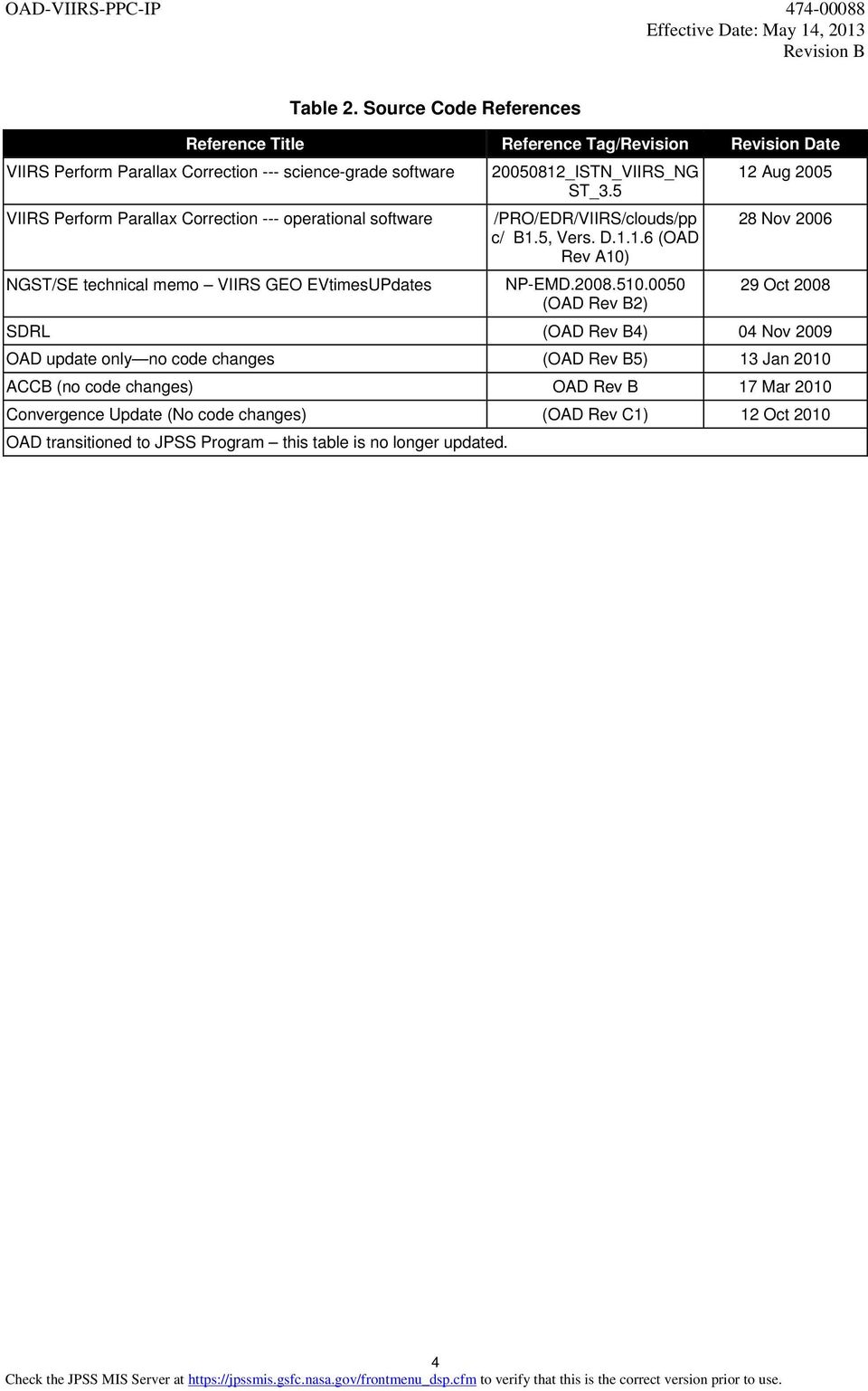
14 Document Title Document Number/Revision Revision Date B013 CDFCB-X Vol VI B013 CDFCB-X Vol VIII NPP Command and Telemetry (C&T) Handbook D56843 Rev. C 30 Sep 008 VIIRS Cloud Cover/Layers Unit Level Detailed Design P1187-SW-I-015-CCL-DDD Ver. 6 Rev Jun 005 VIIRS Cloud Module-Level Software Architecture Y47 Ver. 5 Rev. 1 Jan 005 VIIRS Cloud Module Level Interface Control Document Y378 Ver. 5 Rev. 9 Oct 004 VIIRS Cloud Module Data Dictionary Y Ver. 5 Rev. 11 Jan 005 Operational Algorithm Description Document for VIIRS Cloud Optical Properties (COP) Software Operational Algorithm Description Document for VIIRS Cloud Mask Intermediate Product (VCM IP) Operational Algorithm Description Document for VIIRS Geolocation (GEO) Sensor Data Record (SDR) and Calibration (CAL) SDR Operational Algorithm Description Document for Common Geolocation Operational Algorithm Description Document for VIIRS Cloud Cover/Layers (CCL) and Generate Cloud EDR (GCE) Software Latest Latest Latest Latest Latest NPOESS System Specification SY Ver. E 01 Aug 00 JPSS CGS Data Processor Inter-subsystem Interface Control Document (DPIS ICD) Vol I IV VIIRS Geolocation Algorithm Theoretical Basis Document (ATBD) IC60917-IDP-00 Latest Latest IDPS Processing SI Common IO Design Document DD608-IDP-011 Rev. A 1 Jun 007 JPSS Program Lexicon Latest Detailed Description of the VIIRS Science RDR to Verified RDR Conversion Whitepaper NGST/SE technical memo VIIRS Cloud Mask (VCM) OAD Update NGST/SE technical memo MS Engineering Memo_PPC OAD Update NGST/SE technical memo NPP_VIIRS_PPC_FIX_BACKFILL_DETR_XTRAS CAN NGST/SE technical memo VIIRS GEO EVtimesUPdates NGST/SE technical memo NPP_VIIRS_PPC_bug_fix_backfil NGAS/SE technical memo VIIRS Geo Quality Flags Logic Updates N/A 06 Dec 005 NP-EMD Dec 004 NP-EMD Jul 005 NP-EMD Dec 006 NP-EMD Oct 008 NP-EMD Apr 008 NP-EMD Rev A 1 Oct Source Code References The science and operational code and associated documentation relevant to the algorithms described in this OAD are listed in Table. 3

15 Table. Source Code References Reference Title Reference Tag/Revision Revision Date VIIRS Perform Parallax Correction --- science-grade software VIIRS Perform Parallax Correction --- operational software NGST/SE technical memo VIIRS GEO EVtimesUPdates _ISTN_VIIRS_NG ST_3.5 /PRO/EDR/VIIRS/clouds/pp c/ B1.5, Vers. D (OAD Rev A10) NP-EMD (OAD Rev B) 1 Aug Nov Oct 008 SDRL (OAD Rev B4) 04 Nov 009 OAD update only no code changes (OAD Rev B5) 13 Jan 010 ACCB (no code changes) OAD Rev B 17 Mar 010 Convergence Update (No code changes) (OAD Rev C1) 1 Oct 010 OAD transitioned to JPSS Program this table is no longer updated. 4
16 .0 ALGORITHM OVERVIEW For this section, the definition of an algorithm is a logical grouping of operational algorithm modules for which there is a single Input-Processing-Output (I-P-O) architecture with a single defined set of external inputs and outputs (e.g., IPs or xdrs). The Perform Parallax Correction (PPC) algorithm is implemented during IP/EDR processing and requires RDR, SDR, IP and LUT inputs to produce IP outputs. A top-level diagram for the PPC algorithm is shown in Figure 1. PPC consists of derived and core algorithm modules. The derived algorithm module ProEdrViirsPpc (represented by the shaded portion in Figure 1) functions as a wrapper for the core algorithm module and handles the I-O stages in the I-P-O architecture. ProEdrViirsPpc initiates the core algorithm module PerformParallaxCorrection which makes up the P stage. SDR Processing RDR Processing IP Processing EDR Processing Spacecraft Diary (ephemeris & attitude) RDR VIIRS SDR Moderate (Resolution) GEO VIIRS Cloud Top Top Parameters IP VIIRS Cloud Optical Properties IP VIIRS Cloud Mask IP VIIRS Geolocation Parameters LUT Perform Parallax Correction ProEdrViirsPpc Parallax-Corrected Cloud Top Parameters IP Parallax-Corrected Cloud Optical Properties IP Parallax-Corrected Cloud Mask IP Figure 1. Algorithm Overview 5

17 .1 VIIRS Cloud Perform Parallax Correction Description The PPC Module is part of the Cloud IP processing chain. Its purpose is to determine the geolocation on the surface of the Earth where a locally vertical line intercepts the cloud. Since the cloud is viewed from a slant path, the parallax corrected geolocation depends on the cloud top height and the viewing scan angle. The PPC Module therefore determines the corrected geolocation due to slant path effects so that geolocation for the cloud Environmental Data Records (EDRs) is reported at the local vertical. A dataflow diagram for the VIIRS Cloud Module, of which the VIIRS Cloud PPC Module is a member, is shown in Figure. Each circle represents a stand-alone unit of the VIIRS Cloud Module. Processing order is indicated by the number in each circle. The VIIRS Cloud PPC Module is shadowed in the diagram. Surface Temperature Cloud Top Temperature EDR VIIRS Cloud Mask IP Height Profile VIIRS 750M Moisture Profile, Pressure Profile, Temperature Profile Determine Cloud Top Parameters Satellite Parameters Ice and Night Water CTT To 6 VIIRS Mask IP CTParm 5 Determine Cloud Base Height 1 Determine COT and EPS COP 3 Perform Parallax Correction Corr_Cloud_Mask_IP, Corr_COP_IP, Corr_CTParm_IP Cloud Lay Type IP VIIRS EV 750M 4 Determine Cloud Cover/ Layers Cloud Optical Thickness EDR Cloud Effective Particle Size EDR 6 Generate Cloud EDRs Cloud Lay Type IP, Cloud Cov Type IP, Cloud Agg GEO Corr_Cloud_Mask_IP, Corr_COP_IP, Corr_CTParm_IP (from 3) Cloud Top Height EDR Cloud Top Pressure EDR Cloud Cover/ Layers EDR Cloud Base Height EDR CBH Figure. Cloud Module Data Flow.1.1 Interfaces The main flow of the operational PPC algorithm is shown in Figure 3 below. The PPC algorithm receives all the required input data from DMS. The first step is to use the verified RDR routine to unpack and byte-align the Space Craft Diary RDR. Then the algorithm uses a Common Geolocation (CMN GEO) library of functions to set up the ephemeris and attitude data. When all the input data needed for processing is available, the main module (PerformParallaxCorrection) is called to produce Corrected Cloud Mask, Corrected COP and Corrected CTP. 6
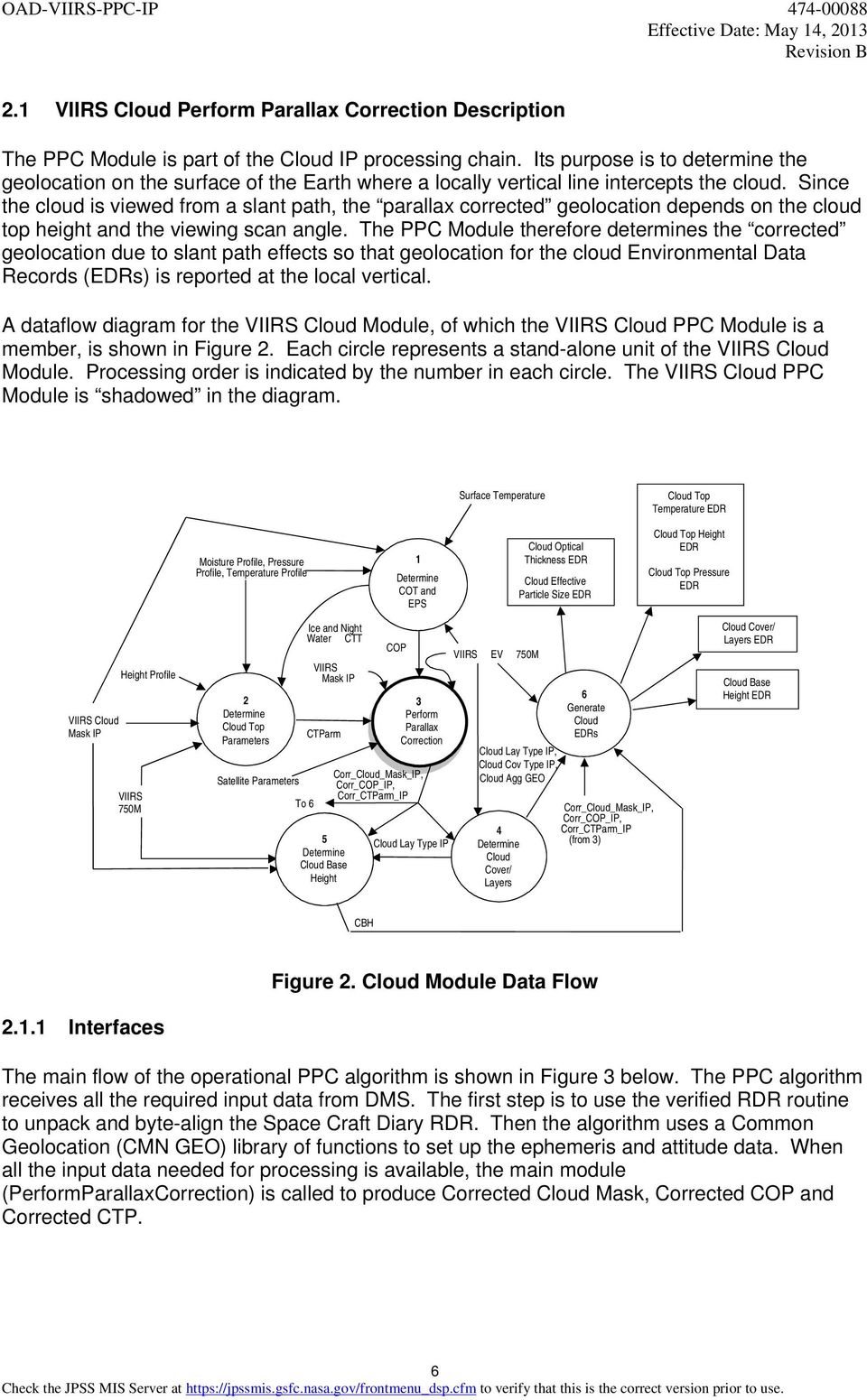
18 Inputs (from DMS) ProEdrViirsPpc PerformParallaxCorrectio n Outputs (to DMS) ProEdrViirsPpc Description This is the derived class from ProCmnAlgorithm that contains overridden methods setupdataitems and doprocessing. Method setupdataitems instantiates input and output data items which represent data buffers to be used by the algorithm. DoProcessing is the method where processing of the algorithm input data and output data is done. For more information see the Processing SI Common IO Design, DD608-IDP-011. Figure 3. Perform Parallax Correction Overall Flow Diagram The PPC Module requires Spacecraft Diary RDR, VIIRS Moderate Geolocation (GEO), VIIRS CM IP, VIIRS COP IP, VIIRS CTP IP, and VIIRS SDR Moderate Geolocation Parameters Look- Up Table (LUT) as inputs to produce the following outputs: VIIRS Parallax Corrected CM IP; VIIRS Parallax Corrected COP IP; VIIRS Parallax Corrected CTP IP. A detailed itemization of the inputs and outputs for the PPC Module is provided below. Note: For Sections and.1.1. below, the following applies: Fill values corresponding to the individual pixels in each product that do not contain valid data are dictated by the datatype. The following fill values apply: NA_UINT8_FILL for UInt8 datatypes, NA_FLOAT3_FILL for Float3 datatypes, zero for quality flags. For detailed descriptions of the quality flags in the tables below, refer to the applicable I- P-O algorithm OAD (CM, COP, or CTP). M_VIIRS_SDR_ROWS = NUMBER of SCANS PER GRANULE X NUMBER of MODERATE DETECTORS M_VIIRS_SDR_COLS = Inputs Tables 3-8 describe the inputs for the PPC algorithm. 7

19 Table 3. PPC Input: Spacecraft Diary RDR Input Type Description Units/Valid Range RDR-Level Data Items sc_pos Float64[3] S/C position vector Meters / 0 to 7,300,000 Table 4. PPC Input: VIIRS Cloud Mask IP Input Type Description Units/Valid Range Granule-Level Data Items GranuleAllOcean UInt8 Flag indicating the granule is all ocean Unitless GranuleNoOcean Uint8 Flag indicating the granule does not contain any ocean Row-Level Data Items ScanNoOcean ScanAllOcean Pixel-Level Data Items Vcm0 Vcm1 Vcm Vcm3 Uint8[M_VIIRS_S DR_ROWS] Uint8[M_VIIRS_S DR_ROWS] UInt8[M_VIIRS_S UInt8[M_VIIRS_S UInt8[M_VIIRS_S UInt8[M_VIIRS_S Flag indicating the scan does not contain any ocean Flag indicating the scan is all ocean VIIRS Cloud Mask IP quality flags: quality, cloud confidence, day/night, snow/ice, sun glint VIIRS Cloud Mask IP quality flags: Land/water, shadow detected, non cloud obstruction, fire detected, cirrus solar, cirrus IR VIIRS Cloud Mask IP quality flags: IR Threshold Cloud Test (BTM15), High Cloud (BTM1-BTM16) Test, IR Temperature Difference Test (BTM14 BTM15 & BTM15 BTM16), Temperature Difference Test (BTM15 BTM1), Temperature Difference Test (BTM1 BTM13), Visible Reflectance Test (RM5). Visible Reflectance Test (RM7), also Visible Reflectance Test (RM1), Visible Ratio Test (RM7 / RM5) VIIRS Cloud Mask IP quality flags: Adjacent Pixel Cloud Confident Value, Conifer Boreal Forest, Spatial Uniformity, Dust candidate, Smoke candidate, Dust / Volcanic Ash Unitless Unitless Unitless See Table 9 See Table 9 See Table 9 See Table 9 Vcm4 UInt8[M_VIIRS_S VIIRS Cloud Mask IP quality flags: Spare See Table 9 Vcm5 UInt8[M_VIIRS_S VIIRS Cloud Mask IP quality flags: Cloud Phase, Thin Cirrus Flag, Ephemeral Water Flag,Degraded TOC NDVI Flag, Degraded Sun Glint Flag, Degraded Polar Night Flag See Table 9 8
![indicating the granule does not contain any ocean Row-Level Data Items ScanNoOcean ScanAllOcean Pixel-Level Data Items Vcm0 Vcm1 Vcm Vcm3 Uint8[M_VIIRS_S DR_ROWS] Uint8[M_VIIRS_S DR_ROWS]](/docs-images/41/995647/images/page_19.jpg "UInt8[M_VIIRS_S UInt8[M_VIIRS_S UInt8[M_VIIRS_S UInt8[M_VIIRS_S Flag indicating the scan does not contain any ocean Flag indicating the scan is all ocean VIIRS Cloud Mask IP quality flags: quality,")
20 Table 5. PPC Input: VIIRS Cloud Optical Properties IP Input Type Description Units/Valid Range Pixel-Level Data Items Cot Eps Float3[M_VIIRS_ S Float3[M_VIIRS_ S Unscaled cloud optical thickness Unitless / 0.1 to 64.0 Unscaled cloud effective particle radius microns / 1.0 to 50.0 copqf0 UInt8[M_VIIRS_S RS_SDR_COLS COP IP quality flags: quality, ice cot out of bound, water cot out of bound, ice eps out of bound, water eps out of bound, cloud phase See Table 10 copqf1 UInt8[M_VIIRS_S RS_SDR_COLS COP IP quality flags: day water convergence, day ice convergence, day water cot < 1, day ice < 1, night water cot < 1, night ice cot < 1, sun glint, probably/confidently cloudy See Table 10 copqf UInt8[M_VIIRS_S RS_SDR_COLS COP IP quality flags: ice cloud cot > 10, Bad SDR Flag See Table 10 Table 6. PPC Input: VIIRS Cloud Top Parameters IP Input Type Description Units/Valid Range Pixel-Level Data Items Ctt Cth Float3[M_VIIRS_ S Float3[M_VIIRS_ S Unscaled Cloud Top Temperature K / 180 to 310 Unscaled Cloud Top Height km / 0 to 0 Ctp Float3[M_VIIRS_ S Unscaled Cloud Top Pressure hpa / 50.0 to ctparmqf0 UInt8[M_VIIRS_S Cloud Top Parameters IP quality flags: altitude range check, surface type, sun glint, out of range, snow/ice See Table 11 ctparmqf1 UInt8[M_VIIRS_S Cloud Top Parameters IP quality flags: cloud phase, cth out of range, ctt out of range, residual night water, residual night ice, residual day ice See Table 11 ctparmqf UInt8[M_VIIRS_S Cloud Top Parameters IP quality flags: runbackup (black cloud), ctp windowir converge See Table 11 Table 7. VIIRS SDR Moderate Resolution GEO Data Input Type Description Units/Valid Range Scan Start Time latitude longitude Int64[VIIRS_RDR _SCANS] Float3[M_VIIRS_ S Float3[M_VIIRS_ S Scan start time, defined at the leading edge of the first Earth View frame in IET Latitude of the VIIRS pixels Longitude of the VIIRS pixels Microseconds / 0 <= scanstarttime <= 1.00E+38 Radians / -(PI / )(S) to (PI /)(N) Radians / -PI(W) to PI(E) 9

21 Input Type Description Units/Valid Range Satellite Azimuth Float3[M_VIIRS_ S Satellite Azimuth of the VIIRS pixels Radians / -PI(W) to PI(E) Satellite Zenith Float3[M_VIIRS_ S Satellite Zenith of the VIIRS pixels Radians 0 to PI/ Solar Azimuth Float3[M_VIIRS_ S Solar Azimuth of the VIIRS pixels Radians / -PI(W) to PI(E) Solar Zenith Float3[M_VIIRS_ S Solar Zenith of the VIIRS pixels Radians / 0 to PI Satellite Height Float3[M_VIIRS_ S Satellite Height of the VIIRS pixels Meters Satellite Range Float3[M_VIIRS_ S Satellite Range of the VIIRS pixels Meters char[m_viirs_sd R_ROW][M_VIIRS _SDR_COLS] Bitwise Quality flags of the VIIRS pixels 0 Invalid Input Data 0=INPUT VALID 1=FALSE 1 Bad Pointing 0=GOOD POINTING 1 = BAD POINTING Quality Flag Bad Terrain 0=GOOD TERRAIN 1=BAD TERRAIN 3 Invalid Solar Angles 0=VALID SOLAR ANGLES 1= INVALID SOLAR ANGLES 4-7 SPARE Actual scans Int3 Actual number of scans in a granule Unitless Table 8. VIIRS SDR GEO MOD PARAM LUT Operating Parameters Input Type Description Units/Valid Range detector_sampling_rat e Float64 The rate at which the detectors are sampled Microseconds / sensor dependent latch_to_center Float64 Offset for center time of pixel Unitless / 0.5 t_reset Float64 Time to reset sample at beginning of frame Unitless / 0 agg_zone_bounds Int3[5] Aggregation zone boundaries Unitless / 0 to Outputs Tables 9-11 describe the outputs for the PPC algorithm. 10
22 Table 9. PPC Output: VIIRS Parallax Corrected Cloud Mask IP Input Type Description Units/Valid Range Granule-Level Data Items GranuleAllOcean UInt8 Flag indicating the granule is all ocean Unitless GranuleNoOcean Uint8 Flag indicating the granule does not contain any ocean Row-Level Data Items ScanNoOcean ScanAllOcean Pixel-Level Data Items Uint8[M_VIIRS_S DR_ROWS] Uint8[M_VIIRS_S DR_ROWS] Uint8[M_VIIRS_S Flag indicating the scan does not contain any ocean Flag indicating the scan is all ocean Unitless Unitless Unitless VIIRS Cloud Mask IP Quality (parallax corrected) Bitwise flags Exception: Day/Night, Snow/Ice, Sun glint flags are not parallax corrected. 0-1 CLOUD MASK QUALITY 0-POOR 1-LOW -MEDIUM 3-HIGH Vcm0 Vcm1 Uint8[M_VIIRS_S -3 CLOUD CONFIDENCE 0-CONFIDENTLY CLEAR 1-PROBABLY CLEAR -PROBABLY CLOUDY 3-CONFIDENTLY CLOUDY 4 DAY / NIGHT 0-NIGHT 1-DAY 5 SNOW/ICE SURFACE 0-NO SNOW/ICE 1-SNOW/ICE 6-7 SUN GLINT 0-NO SUN GLINT 1-GEOMETRY BASED -WIND SPEED BASED 3-GEOMETRY & WIND VIIRS Cloud Mask IP Quality (parallax corrected) Bitwise flags Exception: Land/Water background, Shadow detected, Non cloud Obstruction, Fire Detected flags are not parallax corrected. 0- LAND / WATER BACKGROUND 0-LAND & DESERT 1-LAND NO DESERT -INLAND WATER 3-SEA WATER 5-COASTAL 3 SHADOW DETECTED 0-NO SHADOW 1-SHADOW 4 NON CLOUD OBSTRUCTION (HEAVY AEROSOL) 0-NO AEROSOL 1-AEROSOL 5 FIRE DETECTED 0-NO FIRE 1-FIRE 6 CIRRUS DETECTION (SOLAR) (RM9) 0-NO CLOUD 1-CLOUD 7 CIRRUS DETECTION (IR) (BTM15-BTM16) 0-NO CLOUD 1-CLOUD 11
23 Vcm Vcm3 Input Type Description Units/Valid Range Uint8[M_VIIRS_S Uint8[M_VIIRS_S VIIRS Cloud Mask IP Quality (parallax corrected) Bitwise flags 0 IR THRESHOLD CLOUD TEST (BTM15) 1 HIGH CLOUD (BTM1 BTM16) TEST IR TEMPERATURE DIFFERENCE TEST (BTM14- BTM15 & BTM15-BTM16) 3 TEMPERATURE DIFFERENCE TEST (BTM15-BTM1) 4 TEMPERATURE DIFFERENCE TEST (BTM1-BTM13) 5 VISIBLE REFLECTANCE TEST (RM5) 6 VISIBLE REFLECTANCE TEST (RM7), ALSO VISIBLE REFLECTANCE TEST (RM1) 7 VISIBLE RATIO TEST (RM7/RM5) 0-NO CLOUD 1-CLOUD 0-NO CLOUD 1-CLOUD 0-NO CLOUD 1-CLOUD 0-NO CLOUD 1-CLOUD 0-NO CLOUD 1-CLOUD 0-NO CLOUD 1-CLOUD 0-NO CLOUD 1-CLOUD 0-NO CLOUD 1-CLOUD VIIRS Cloud Mask IP Quality (parallax corrected) Bitwise flags Exception: Conifer Boreal Forest, Spatial Uniformity flags are not parallax corrected 0-1 Adjacent Pixel Cloud Confident Value 11=Confident Cloudy 10=Probably Cloudy 00=Confident Clear 01=Probably Clear Conifer Boreal Forest 1=Yes 0=No 3 Spatial Uniformity 1=Yes 0=No Dust candidate Smoke candidate Dust / Volcanic Ash Spare 1=Yes 0=No 1=Yes 0=No 1=Yes 0=No Vcm4 Uint8[M_VIIRS_S VIIRS Cloud Mask IP Quality (parallax corrected) Bitwise flags 0-7 SPARE 1
24 Vcm5 Input Type Description Units/Valid Range Uint8[M_VIIRS_S VIIRS Cloud Mask IP Quality (parallax corrected) Bitwise flags 0- CLOUD PHASE 0-NOT EXECUTED 1-CLEAR -PARTLY CLOUDY 3-WATER CLOUD 4-SUPERCOOLED WATER/MIXED 5-OPAQUE ICE CLOUD 6-CIRRUS CLOUD 7-CLOUD OVERLAP 3 THIN CIRRUS 0-NO 1-YES 4 EPHEMERAL WATER 0-NO 1-YES 5 Degraded TOC NDVI Flag 1=YES 0=NO 6 Degraded Sun Glint Flag 1=YES 0=NO 7 Degraded Polar Night Flag 1=YES 0=NO Table 10. PPC Output: VIIRS Parallax Corrected Cloud Optical Properties IP Input Type Description Units/Valid Range Pixel-Level Data Items Cot Eps Float3[M_VIIRS_ S Float3[M_VIIRS_ S Unscaled cloud optical thickness (parallax corrected) Unscaled cloud effective particle radius (parallax corrected) Unitless / 0.1 to 64.0 microns / 1.0 to
25 Input Type Description Units/Valid Range copqf0 Uint8[M_VIIRS_S RS_SDR_COLS COP IP Quality (parallax corrected) bitwise flags 0 OVERALL PIXEL LEVEL FLAG 0-NOT 1-COP QUALITY FLAG IS SET 1 0-NOT ICE COT OUT OF BOUND Day: (0.1-30) 1-OUT OF BOUND Night: (0.1-30) 0-NOT WATER COT OUT OF 1- OUT OF BOUND BOUND Day: (0.1-30) Night: (0.1-30) 3 ICE EPS OUT OF BOUND (1-50 MICROMETERS) 0-NOT 1- OUT OF BOUND 4 WATER EPS OUT OF BOUND (1-50 MICROMETERS) 0-NOT 1- OUT OF BOUND 5-7 CLOUD PHASE 0- COP_PHASE_NOT_EXE 1-COP_PHASE_CIRRUS - COP_PHASE_OPQ_ICE 3-COP_PHASE_WATER 4-COP_PHASE_MIXED 5- COP_PHASE_MUL_LYR COP IP Quality (parallax corrected) bitwise flags Exception: Sun glint flag is not parallax corrected 0 DAY WATER ITERATION CONVERGENCE 1 DAY ICE ITERATION CONVERGENCE 0-NOT 1-CONVERGENT 0-NOT 1-CONVERGENT copqf1 Uint8[M_VIIRS_S RS_SDR_COLS WATER COT < 1 AT DAYTIME 0-NOT 1-TRUE 3 ICE COT < 1 AT DAYTIME 0-NOT 1-TRUE 4 WATER COT < 1 AT NIGHTTIME 0-NOT 1-TRUE 5 ICE COT < 1 AT NIGHTTIME 0-NOT 1-TRUE 6 SUN GLINT REGION 0-NOT 1-SUN GLINT 7 PROBABLY/CONFIDENTLY CLOUDY 0-NOT 1-TRUE COP IP Quality (parallax corrected) bitwise flags copqf Uint8[M_VIIRS_S RS_SDR_COLS 0 DEGRADED CONDITIONS FOR ICE CLOUD COT > BAD SDR FLAG DATA 0-NOT 1-DEGRAGED 0-GOOD 1-BAD -NO CALIBRATION 3-7 SPARE 14
26 Table 11. PPC Output: VIIRS Parallax Corrected Cloud Top Parameters IP Input Type Description Units/Valid Range Pixel-Level Data Items Ctt Cth Ctp Float3[M_VIIRS_ S Float3[M_VIIRS_ S Float3[M_VIIRS_ S Unscaled Cloud Top Temperature (parallax corrected) K / 180 to 310 Unscaled Cloud Top Height (parallax corrected) km / 0 to 0 Unscaled Cloud Top Pressure (parallax corrected) hpa / 50.0 to CTP IP Quality (parallax corrected) bitwise flags Exception: surface type, sun glint, snow/ice flags are not parallax corrected ALTITUDE RANGE CHECK 1 - < 3 - >3 && < > 7 (KM) 0 - LAND DESERT ctparmqf0 UInt8[M_VIIRS_S SURFACE TYPE 1 - LAND NOT DESERT - INLAND WATER; 3 - SEA WATER 5 - COASTAL 5 SUN GLINT 0 - NOT 1 SUN GLINT 6 CTP OUT OF RANGE ( MB) 0-NOT 1- OUT OF RANGE 7 SNOW/ICE SURFACE 0-NOT 1- SNOW/ICE CTP IP Quality (parallax corrected) bitwise flags 0-0 BAD DATA 1 - WATER CLOUD PHASE - ICE 3 - MIXED ctparmqf1 UInt8[M_VIIRS_S 3 CTH OUT OF RANGE (0-0 KM) 4 CTT OUT OF RANGE ( KELVIN) 0 - NOT 1 OUT OF RANGE 0 - NOT 1 OUT OF RANGE 5 RESIDUAL NIGHT WATER IR ICE CTT CONVERGENCE 0-NOT 1- CONVERGENCE 6 RESIDUAL NIGHT ICE IR ICE CTT CONVERGENCE 0-NOT 1- CONVERGENCE 7 RESIDUAL DAY ICE IR ICE CTT CONVERGENCE 0-NOT 1- CONVERGENCE 15
27 Input Type Description Units/Valid Range CTP IP Quality (parallax corrected) bitwise flags 0- RUNBACKUP (BLACK CLOUD APPROACH) 0- CLEAR 1 - NON-DAY/WATER CONVERGENCE - DAY/WATER CONVERGENCE ctparmqf UInt8[M_VIIRS_S 3 - BLACK CLOUD 1 CONVERGENCE 4 - BLACK CLOUD IN BOUND WINDOWIR FOR DAYWATER CLOUDS CONVERGENCE SPARE 5 - BLACK CLOUD 3 (NOT USED) 7 - NONCONVERGENCE 0-NOT 1- CONVERGENCE.1. Algorithm Processing The approach for parallax correction is to find the vector that intersects the sensor line-of-sight (LOS) at the altitude of the cloud top height (CTH). The sensor LOS is determined from the pixel position vector and the satellite position vector at the given pixel time. The vector intersecting the sensor LOS at the CTH is the position vector of the cloud. After transforming the cloud position vector into geodetic coordinates, the cloud latitude/longitude is compared with that of pixels along the sensor scan line. The pixel latitude/longitude closest to the cloud latitude/longitude is taken as the cloud s new pixel location. Parallax correction is not performed for pixels that have filled CTH values. For operational software, the parallax correction module uses non terrain-corrected geolocation data Main Module - PerformParallaxCorr() The logic flow of the PPC Module retrieval algorithm is shown in Figure 4. PerformParallaxCorr copies original IP data (inputs) to corrected IP data (outputs) thereby maintaining original IP data for pixels that are not relocated (parallax corrected). CMN GEO method GEO_determine_sample_time_offsets() is called to determine the scan sample time offsets (discussed in VIIRS Geolocation (GEO) SDR OAD, ) and scan start times are retrieved from the VIIRS SDR MOD GEO. Scan start times and sample time offsets are used in ComputeParallaxCorrection() to calculate pixel time. For each pixel with cloud data present, the cloud top height is converted from geopotential to geometric height by Height_Conversion(). ComputeParallaxCorrection() determines the cloud parallax corrected latitude and longitude, then FindNewPixel() determines the pixel that corresponds to the cloud parallax corrected latitude and longitude. Original cloud IP data at the original pixel is then copied to corrected cloud IP data at the new pixel. Note: For quality flags, 16
28 only cloud related quality flags are copied to the new pixel, all non-cloud related quality flags (for example: sun glint, day/night) are not copied (refer to CM, COP, and CTP OADs for quality flag information). The original pixel is then backfilled to clear the data. PerformParallaxCorr() - Initialize corr IP fields with orig IP data - Determine scan start and sample times For each pixel Cloud Top Height value exists (not filled) F T Convert cloud height from geopotential to geometric ComputeParallaxCorrection() SUCCES F T FindNewPixel() New pixel index is valid F T - Reassign ip data from original pixel index to new (corrected) pixel index - Backfill (clear ip data from original location) Ne xt Return SUCCESS Figure 4. PerformParallaxCorrection() Logic Flow 17
29 .1.. ComputeParallaxCorrection() This function computes the true geodetic coordinates of the observed cloud. To compute the parallax correction, the following steps are required: 1. Transform the pixel position vector from geodetic to Earth Centered Earth Fixed (ECEF) coordinates.. Retrieve the satellite position vector for the time of the pixel and perform vector subtraction to obtain the sensor LOS vector. 3. Solve for the intersection of the sensor LOS vector and the reference ellipsoid plus the cloud top height. This is the cloud position vector in ECEF coordinates (see PPC_ellipIntersect()) 4. Transform the cloud position vector from ECEF to geodetic coordinates (see PPC_ellipIntersect()). The following mathematical description of the steps listed above has been derived from the equations in the VIIRS Geolocation ATBD, , Section , ECEF to Geodetic, and Section 3.3.., Basic Earth Ellipsoid Intersection Algorithm. Steps 3 and 4 are performed in the operational algorithm by PPC_elllipIntersect(). To complete the correction, a new pixel index must be determined by the FindNewPixel() function, as discussed below. Step 1: Transform the pixel position vector from geodetic to ECEF coordinates. The relationship between ECEF and geodetic coordinates can be expressed simply in its direct form as discussed in Department of Defense World Geodetic System 1984 Its Definition and Relationship with Local Geodetic Systems, (NIMA 1997): where: N h coslat lon N h coslat lon x terrain cos y terrain sin N 1 e h lat 1 a / 1 e sin lat z sin terrain N e b 1 a x, y, z - ECEF coordinates lat, lon, h terrain - Geodetic coordinates N - Ellipsoid radius of curvature in the prime vertical e - Ellipsoid eccentricity a - Earth equatorial radius (ellipsoid semi-major axis) b - Earth polar radius (ellipsoid semi-minor axis) The geodetic coordinates, lat and lon, are inputs from the GEO data. Geolocation data used by the cloud module is non terrain-corrected, therefore h terrain = 0. Parameters e, a and b are well known physical constants. Note that constants e and N are calculated from a and b. 18
30 Step : In the operational code, pixel time is calculated by adding scan start time and sample time offset. Pixel time is used by CMN GEO method satposatt() to interpolate the satellite position for the exact time of interest (pixel time). A description of satposatt() can be found in the VIIRS Common Geolocation OAD, Vector subtraction is then performed to obtain the sensor LOS. u ecef g ecef p ecef where: u ecef - LOS unit vector in ECEF g ecef - pixel position vector in ECEF p - spacecraft position vector in ECEF ecef.1..3 PPC_ellipIntersect() Function PPC_ellipIntersect(), (a modification of CMN GEO ellipintersect() to include cloud height in calculations), solves for the intersection of the sensor LOS vector and the reference ellipsoid plus the cloud top height. This is the cloud position vector in ECEF coordinates. It then transforms the cloud position vector from ECEF to geodetic coordinates and returns the parallax corrected latitude and longitude. Step 3: (continued from above) Solve for the intersection of the sensor LOS vector and the reference ellipsoid plus the cloud top height (as depicted in Figure 5). Re-scale the viewing vector and satellite vector using the ellipsoid of interest semi-major a and semi-minor b axis dimensions (a, a, b ): u u ' = u u 1 3 / a' / a' / b' p p ' = p p 1 3 / a' / a' / b' where: a ' a h cloud and b' b hcloud 19
31 Scaled Viewing Vector d u w x Ellipsoid Intersection Vector p Spacecraft Position Vector Figure 5. Ellipsoidal Viewing Vector Intersection Note: x1 / a' x ' = x / a' - the unknown cloud position vector (re-scaled) x / ' 3 b Solve for the scaling d of u' which intersects the unit sphere: From the law of cosines: x' du' p' du' p' cos( w ) Using the dot-product, the cosine of the acute angle w between u' and cos( w ) By definition x' 1 so: 1 d u' u' p' u' p' p' d u' p' Simplifying and rearranging: d u' d u' p' p' 1 0 u' p' u' p' This can be solved for d using the quadratic formula: p' is: 0
32 d u' p' u' p' u' p' 1 u' This is the smaller of the two solutions for d, the intersection closest to the satellite. If the solution is not real, then there is no intersection. Use d to compute x' and x: x' p' d u' x' x x' x' 1 3 x pd u a' a' b' p' 1d u' 1a' p' 1 a' d u' 1 a' p' d u' a' p' a' d u' a' p' 3 d u' 3 b' p' 3 b' d u' 3 b' Step 4: Transform the cloud position vector from ECEF to geodetic coordinates. Convert the ECR ellipsoid pierce point to geodetic coordinates (special case direct solution). lon tan lat tan 1 x x 1 x x e x h terrain FindNewPixel() Function FindNewPixel() compares the parallax corrected (cloud) latitude and cloud longitude to the nearest pixels along the same scan line. The pixel whose latitude and longitude is closest to the cloud latitude and longitude is taken as the cloudy pixel's new location. The linear position of that pixel is stored in newpixindex. The algorithm to find the pixel in the current scanline with the closest geolocation to the cloud is as follows: 1. Initialize minimum distance, range, to a large value.. Initialize newpixindex to original pixel index. 3. Calculate scan pixel number. pixel_number = original pixel index % n_pixels 4. Compute arc length on ellipsoid from current pixel lat/lon to cloud lat/lon using spherical ellipsoid approximation. new _ range arccos(sin( lat pixel ) sin( latcloud ) cos( lat pixel ) cos( latcloud ) cos( loncloud lon pixel )) 5. Compare arc length to minimum distance. If new_range < range; set range = new_range; otherwise go to step 8. 1
33 6. Determine direction toward scan nadir. If pixel_number <= n_pixels/, increase newpixindex If pixel_number > n_pixels/, decrease newpixindex 7. Repeat steps 4 through 6 until minimum distance is found. 8. Move one pixel towards nadir. If pixel_number > n_pixels/, increase newpixindex If pixel_number <= n_pixels/, decrease newpixindex Note that this algorithm is based on the assumption that the pixel nearest the sub-cloud location is on the same scan line as the pixel where the cloud was observed Height_conversion() Function height_conversion() converts geopotential height to geometric height above the ellipsoid (refer to Section of the Cloud Cover/Layers ATBD, ) Backfill() Function backfill() fills the corrected IP outputs (COP, CTP) with FILL values for the pixel location given and sets the quality flags and corrected IP output CM to zero..1.3 Graceful Degradation None..1.4 Exception Handling Errors that occur during the Input/Output (I/O) stages of the algorithm are reported and result in process termination. No outputs are produced. In the processing stage of the algorithm, the PPC Module checks for a valid number of scans before any pixels are processed. If the number of scans is invalid, the error is reported, processing terminates and no outputs are produced. If the number of scans is valid but less than the expected number of scans, the pixels for the valid scans are processed, the missing scans are backfilled with FILL values, and outputs are produced. If the number of scans is valid, the pixels are processed. If an error occurs during pixel level processing, the error is reported, the pixel data remains at its original index, and processing continues with the next pixel. The following pixel level errors are handled: divide by zero; invalid satellite position; no ellipsoid intersection; invalid pixel index. Pixel level errors do not prevent PPC from producing outputs..1.5 Data Quality Monitoring None. (There are no Data Quality Threshold Tables (DQTTs) or Data Quality Notifications (DQNs) defined for PPC.).1.6 Computational Precision Requirements Floating-point calculations are carried out in single-precision arithmetic.
34 .1.7 Algorithm Support Considerations None..1.8 Assumptions and Limitations To determine the parallax-corrected pixel, the assumption is made that the pixel nearest the sub-cloud location is on the same scan line as the pixel where the cloud was observed. 3
35 3.0 GLOSSARY/ACRONYM LIST 3.1 Glossary Table 1 contains terms most applicable for this OAD. Table 1. Glossary Term Algorithm Algorithm Configuration Control Board (ACCB) Algorithm Verification Ancillary Data Auxiliary Data EDR Algorithm Environmental Data Record (EDR) Operational Code Operational-Grade Software Description A formula or set of steps for solving a particular problem. Algorithms can be expressed in any language, from natural languages like English to mathematical expressions to programming languages like FORTRAN. On NPOESS, an algorithm consists of: 1. A theoretical description (i.e., science/mathematical basis). A computer implementation description (i.e., method of solution) 3. A computer implementation (i.e., code) Interdisciplinary team of scientific and engineering personnel responsible for the approval and disposition of algorithm acceptance, verification, development and testing transitions. Chaired by the Algorithm Implementation Process Lead, members include representatives from IWPTB, Systems Engineering & Integration IPT, System Test IPT, and IDPS IPT. Science-grade software delivered by an algorithm provider is verified for compliance with data quality and timeliness requirements by Algorithm Team science personnel. This activity is nominally performed at the IWPTB facility. Delivered code is executed on compatible IWPTB computing platforms. Minor hosting modifications may be made to allow code execution. Optionally, verification may be performed at the Algorithm Provider s facility if warranted due to technical, schedule or cost considerations. Any data which is not produced by the NPOESS System, but which is acquired from external providers and used by the NPOESS system in the production of NPOESS data products. Auxiliary Data is defined as data, other than data included in the sensor application packets, which is produced internally by the NPOESS system, and used to produce the NPOESS deliverable data products. Scientific description and corresponding software and test data necessary to produce one or more environmental data records. The scientific computational basis for the production of each data record is described in an ATBD. At a minimum, implemented software is sciencegrade and includes test data demonstrating data quality compliance. [IORD Definition] Data record produced when an algorithm is used to convert Raw Data Records (RDRs) to geophysical parameters (including ancillary parameters, e.g., cloud clear radiation, etc.). [Supplementary Definition] An Environmental Data Record (EDR) represents the state of the environment, and the related information needed to access and understand the record. Specifically, it is a set of related data items that describe one or more related estimated environmental parameters over a limited time-space range. The parameters are located by time and Earth coordinates. EDRs may have been resampled if they are created from multiple data sources with different sampling patterns. An EDR is created from one or more NPOESS SDRs or EDRs, plus ancillary environmental data provided by others. EDR metadata contains references to its processing history, spatial and temporal coverage, and quality. Verified science-grade software, delivered by an algorithm provider and verified by IWPTB, is developed into operational-grade code by the IDPS IPT. Code that produces data records compliant with the System Specification requirements for data quality and IDPS timeliness and operational infrastructure. The software is modular relative to the IDPS infrastructure and compliant with IDPS application programming interfaces (APIs) as specified for TDR/SDR or EDR code. 4
36 Term Raw Data Record (RDR) Retrieval Algorithm Science Algorithm Science Algorithm Provider Science-Grade Software SDR/TDR Algorithm Sensor Data Record (SDR) Description [IORD Definition] Full resolution digital sensor data, time referenced and earth located, with absolute radiometric and geometric calibration coefficients appended, but not applied, to the data. Aggregates (sums or weighted averages) of detector samples are considered to be full resolution data if the aggregation is normally performed to meet resolution and other requirements. Sensor data shall be unprocessed with the following exceptions: time delay and integration (TDI), detector array non-uniformity correction (i.e., offset and responsivity equalization), and data compression are allowed. Lossy data compression is allowed only if the total measurement error is dominated by error sources other than the data compression algorithm. All calibration data will be retained and communicated to the ground without lossy compression. [Supplementary Definition] A Raw Data Record (RDR) is a logical grouping of raw data output by a sensor, and related information needed to process the record into an SDR or TDR. Specifically, it is a set of unmodified raw data (mission and housekeeping) produced by a sensor suite, one sensor, or a reasonable subset of a sensor (e.g., channel or channel group), over a specified, limited time range. Along with the sensor data, the RDR includes auxiliary data from other portions of NPOESS (space or ground) needed to recreate the sensor measurement, to correct the measurement for known distortions, and to locate the measurement in time and space, through subsequent processing. Metadata is associated with the sensor and auxiliary data to permit its effective use. A science-based algorithm used to retrieve a set of environmental/geophysical parameters (EDR) from calibrated and geolocated sensor data (SDR). Synonym for EDR processing. The theoretical description and a corresponding software implementation needed to produce an NPP/NPOESS data product (TDR, SDR or EDR). The former is described in an ATBD. The latter is typically developed for a research setting and characterized as science-grade. Organization responsible for development and/or delivery of TDR/SDR or EDR algorithms associated with a given sensor. Code that produces data records in accordance with the science algorithm data quality requirements. This code, typically, has no software requirements for implementation language, targeted operating system, modularity, input and output data format or any other design discipline or assumed infrastructure. Scientific description and corresponding software and test data necessary to produce a Temperature Data Record and/or Sensor Data Record given a sensor s Raw Data Record. The scientific computational basis for the production of each data record is described in an Algorithm Theoretical Basis Document (ATBD). At a minimum, implemented software is science-grade and includes test data demonstrating data quality compliance. [IORD Definition] Data record produced when an algorithm is used to convert Raw Data Records (RDRs) to calibrated brightness temperatures with associated ephemeris data. The existence of the SDRs provides reversible data tracking back from the EDRs to the Raw data. [Supplementary Definition] A Sensor Data Record (SDR) is the recreated input to a sensor, and the related information needed to access and understand the record. Specifically, it is a set of incident flux estimates made by a sensor, over a limited time interval, with annotations that permit its effective use. The environmental flux estimates at the sensor aperture are corrected for sensor effects. The estimates are reported in physically meaningful units, usually in terms of an angular or spatial and temporal distribution at the sensor location, as a function of spectrum, polarization, or delay, and always at full resolution. When meaningful, the flux is also associated with the point on the Earth geoid from which it apparently originated. Also, when meaningful, the sensor flux is converted to an equivalent top-of-atmosphere (TOA) brightness. The associated metadata includes a record of the processing and sources from which the SDR was created, and other information needed to understand the data. 5
37 Term Temperature Data Record (TDR) Model Validation Model Verification Description [IORD Definition] Temperature Data Records (TDRs) are geolocated, antenna temperatures with all relevant calibration data counts and ephemeris data to revert from T-sub-a into counts. [Supplementary Definition] A Temperature Data Record (TDR) is the brightness temperature value measured by a microwave sensor, and the related information needed to access and understand the record. Specifically, it is a set of the corrected radiometric measurements made by an imaging microwave sensor, over a limited time range, with annotation that permits its effective use. A TDR is a partially-processed variant of an SDR. Instead of reporting the estimated microwave flux from a specified direction, it reports the observed antenna brightness temperature in that direction. The process of determining the degree to which a model is an accurate representation of the real-world from the perspective of the intended uses of the model. [Ref.: DoDD DoD Modeling and Simulation Management] The process of determining that a model implementation accurately represents the developer s conceptual description and specifications. [Ref.: DoDD DoD Modeling and Simulation Management] 3. Acronyms Table 13 contains terms most applicable for this OAD. Table 13. Acronyms Acronym Description ACO Atmospheric Correction over Ocean ADCS Advanced Data Collection System AFM Airborne Fluxes and Meteorology Group AOS Acquisition of Signal CDA Command and Data Acquisition CDR Climate Data Records CI Configured Item CM Cloud Mask COMSAT Communications Satellite COP Cloud Optical Properties CTH Cloud Top Height CTP Cloud Top Parameters DES Digital Encryption System DHN Data Handling Node ECEF Earth Centered Earth Fixed ECR Earth Centered Rotating EOS Earth Observing System ERBS Earth Radiation Budget Suite ESD Electrostatic Discharge EUMETSAT European Organization for the Exploitation of Meteorological Satellites FMH Federal Meteorological Handbook GEO Geolocation GPS Global Positioning System GSE Ground Support Equipment HRD High Rate Data IGS International GPS Service IJPS Initial Joint Polar System IOC Initial Operational Capability 6
38 Acronym IP LEO&A LOS LRD LST LUT Metop MSS NA NCA NDT OAD OC/C PIP PMT POD PPC QF RSR S&R SCA SDE SDP SDR SDS SGI SI SN SOC SRD SS SST TBD TBR TBS TEMPEST TOA USB UTC Description Intermediate Product Launch, Early Orbit, & Anomaly Resolution Line Of Sight Low Rate Data Local Solar Time Look-Up Table or Local User Terminal Meteorological Operational Program Mission System Simulator Non-Applicable National Command Authority Nitrate-Depletion Temperature Operational Algorithm description Document Ocean Color/Chlorophyll Program Implementation Plan Portable Mission Terminal Precise Orbit Determination Perform Parallax Correction Quality Flag Remote Sensing Reflectance Search and Rescue Satellite Control Authority Selective Data Encryption Science Data Production Sensor Data Records Science Data Segment Silicon Graphics, Inc. International System of Units NASA Space Network Satellite Operations Center Sensor Requirements Documents Space Segment Sea Surface Temperature To Be Determined To Be Resolved To Be Supplied Telecommunications Electronics Material Protected from Emanating Spurious Transmissions Top of the Atmosphere Unified S-band Universal Time Coordinated 7
39 4.0 OPEN ISSUES Table 14. TBXs TBX ID Title/Description Resolution Date None 8
Joint Polar Satellite System (JPSS) Algorithm Specification Volume II: Data Dictionary for the Ozone Total Column. Block 2.0.0
 GSFC JPSS CMO August 04, 2015 Released Joint Polar Satellite System (JPSS) Ground Project Code 474 Joint Polar Satellite System (JPSS) Algorithm Specification Volume II: Data Dictionary for the Ozone Total
VIIRS-CrIS mapping. NWP SAF AAPP VIIRS-CrIS Mapping
 NWP SAF AAPP VIIRS-CrIS Mapping This documentation was developed within the context of the EUMETSAT Satellite Application Facility on Numerical Weather Prediction (NWP SAF), under the Cooperation Agreement
STAR Algorithm and Data Products (ADP) Beta Review. Suomi NPP Surface Reflectance IP ARP Product
 STAR Algorithm and Data Products (ADP) Beta Review Suomi NPP Surface Reflectance IP ARP Product Alexei Lyapustin Surface Reflectance Cal Val Team 11/26/2012 STAR ADP Surface Reflectance ARP Team Member
Launch-Ready Operations Code Chain ESDT ShortNames, LongNames, and Generating PGE or Ingest Source
 Launch-Ready Operations Code Chain ESDT ShortNames, LongNames, and Generating PGE or Ingest Source Generating PGE Name/Description or Ingest Source Product ESDT ShortName Product ESDT LongName NPP_VMAE_L1
MOD09 (Surface Reflectance) User s Guide
 MOD09 (Surface ) User s Guide MODIS Land Surface Science Computing Facility Principal Investigator: Dr. Eric F. Vermote Web site: http://modis-sr.ltdri.org Correspondence e-mail address: [email protected]
Joint Polar Satellite System (JPSS)
 Joint Polar Satellite System (JPSS) John Furgerson, User Liaison Joint Polar Satellite System National Environmental Satellite, Data, and Information Service National Oceanic and Atmospheric Administration
Ocean Level-3 Standard Mapped Image Products June 4, 2010
 Ocean Level-3 Standard Mapped Image Products June 4, 2010 1.0 Introduction This document describes the specifications of Ocean Level-3 standard mapped archive products that are produced and distributed
CrIS L1B Project Status
 CrIS L1B Project Status Graeme Martin 1, Hank Revercomb 1, Larrabee Strow 2, Dave Tobin 1, Howard Moteller 2, Liam Gumley 1, Ray Garcia 1, Greg Quinn 1, Joe Taylor 1, Coda Phillips 1, Bob Knuteson 1, Jessica
STAR JPSS Algorithms Integration Team Configuration Management Plan Version 1.2
 STAR JPSS Algorithms Integration Team Version 1.2 NOAA Center for Weather and Climate Prediction (NCWCP) NOAA/NESDIS/STAR 5830 University Research Ct College Park, MD 20740 Revisions Version Description
Cloud Masking and Cloud Products
 Cloud Masking and Cloud Products MODIS Operational Algorithm MOD35 Paul Menzel, Steve Ackerman, Richard Frey, Kathy Strabala, Chris Moeller, Liam Gumley, Bryan Baum MODIS Cloud Masking Often done with
Volcanic Ash Monitoring: Product Guide
 Doc.No. Issue : : EUM/TSS/MAN/15/802120 v1a EUMETSAT Eumetsat-Allee 1, D-64295 Darmstadt, Germany Tel: +49 6151 807-7 Fax: +49 6151 807 555 Date : 2 June 2015 http://www.eumetsat.int WBS/DBS : EUMETSAT
Cloud detection and clearing for the MOPITT instrument
 Cloud detection and clearing for the MOPITT instrument Juying Warner, John Gille, David P. Edwards and Paul Bailey National Center for Atmospheric Research, Boulder, Colorado ABSTRACT The Measurement Of
FRESCO. Product Specification Document FRESCO. Authors : P. Wang, R.J. van der A (KNMI) REF : TEM/PSD2/003 ISSUE : 3.0 DATE : 30.05.
 PAGE : 1/11 TITLE: Product Specification Authors : P. Wang, R.J. van der A (KNMI) PAGE : 2/11 DOCUMENT STATUS SHEET Issue Date Modified Items / Reason for Change 0.9 19.01.06 First Version 1.0 22.01.06
102 26-m Antenna Subnet Telecommunications Interfaces
 DSMS Telecommunications Link Design Handbook 26-m Antenna Subnet Telecommunications Interfaces Effective November 30, 2000 Document Owner: Approved by: Released by: [Signature on file in TMOD Library]
Clear Sky Radiance (CSR) Product from MTSAT-1R. UESAWA Daisaku* Abstract
 Clear Sky Radiance (CSR) Product from MTSAT-1R UESAWA Daisaku* Abstract The Meteorological Satellite Center (MSC) has developed a Clear Sky Radiance (CSR) product from MTSAT-1R and has been disseminating
Cloud Oxygen Pressure Algorithm for POLDER-2
 Cloud Oxygen ressure Algorithm for OLDER-2 1/7 Cloud Oxygen ressure Algorithm for OLDER-2 Aim of the : Determination of cloud gen pressure from arent pressure by removing the contribution. Date of the
Chapter 2. Mission Analysis. 2.1 Mission Geometry
 Chapter 2 Mission Analysis As noted in Chapter 1, orbital and attitude dynamics must be considered as coupled. That is to say, the orbital motion of a spacecraft affects the attitude motion, and the attitude
Evaluations of the CALIPSO Cloud Optical Depth Algorithm Through Comparisons with a GOES Derived Cloud Analysis
 Generated using V3.0 of the official AMS LATEX template Evaluations of the CALIPSO Cloud Optical Depth Algorithm Through Comparisons with a GOES Derived Cloud Analysis Katie Carbonari, Heather Kiley, and
Renewable Energy. Solar Power. Courseware Sample 86352-F0
 Renewable Energy Solar Power Courseware Sample 86352-F0 A RENEWABLE ENERGY SOLAR POWER Courseware Sample by the staff of Lab-Volt Ltd. Copyright 2009 Lab-Volt Ltd. All rights reserved. No part of this
Marcus A. Watkins Director of the Joint Agency Satellite Division, Science Mission Directorate, NASA HQ, Washington DC
 Marcus A. Watkins Director of the Joint Agency Satellite Division, Science Mission Directorate, NASA HQ, Washington DC Leads the Joint Agency Satellite Division (JASD) at NASA HQ in Washington, DC and
Studying cloud properties from space using sounder data: A preparatory study for INSAT-3D
 Studying cloud properties from space using sounder data: A preparatory study for INSAT-3D Munn V. Shukla and P. K. Thapliyal Atmospheric Sciences Division Atmospheric and Oceanic Sciences Group Space Applications
Estimating Firn Emissivity, from 1994 to1998, at the Ski Hi Automatic Weather Station on the West Antarctic Ice Sheet Using Passive Microwave Data
 Estimating Firn Emissivity, from 1994 to1998, at the Ski Hi Automatic Weather Station on the West Antarctic Ice Sheet Using Passive Microwave Data Mentor: Dr. Malcolm LeCompte Elizabeth City State University
AATSR Technical Note. Improvements to the AATSR IPF relating to Land Surface Temperature Retrieval and Cloud Clearing over Land
 AATSR Technical Note Improvements to the AATSR IPF relating to Land Surface Temperature Retrieval and Cloud Clearing over Land Author: Andrew R. Birks RUTHERFORD APPLETON LABORATORY Chilton, Didcot, Oxfordshire
16 th IOCCG Committee annual meeting. Plymouth, UK 15 17 February 2011. mission: Present status and near future
 16 th IOCCG Committee annual meeting Plymouth, UK 15 17 February 2011 The Meteor 3M Mt satellite mission: Present status and near future plans MISSION AIMS Satellites of the series METEOR M M are purposed
SATELLITE IMAGES IN ENVIRONMENTAL DATA PROCESSING
 SATELLITE IMAGES IN ENVIRONMENTAL DATA PROCESSING Magdaléna Kolínová Aleš Procházka Martin Slavík Prague Institute of Chemical Technology Department of Computing and Control Engineering Technická 95, 66
CALCULATION OF CLOUD MOTION WIND WITH GMS-5 IMAGES IN CHINA. Satellite Meteorological Center Beijing 100081, China ABSTRACT
 CALCULATION OF CLOUD MOTION WIND WITH GMS-5 IMAGES IN CHINA Xu Jianmin Zhang Qisong Satellite Meteorological Center Beijing 100081, China ABSTRACT With GMS-5 images, cloud motion wind was calculated. For
ECMWF Aerosol and Cloud Detection Software. User Guide. version 1.2 20/01/2015. Reima Eresmaa ECMWF
 ECMWF Aerosol and Cloud User Guide version 1.2 20/01/2015 Reima Eresmaa ECMWF This documentation was developed within the context of the EUMETSAT Satellite Application Facility on Numerical Weather Prediction
Reprojecting MODIS Images
 Reprojecting MODIS Images Why Reprojection? Reasons why reprojection is desirable: 1. Removes Bowtie Artifacts 2. Allows geographic overlays (e.g. coastline, city locations) 3. Makes pretty pictures for
5200 Auth Road, Camp Springs, MD 20746 USA 2 QSS Group Inc, Lanham, MD, USA
 P6.25 CO-LOCATION ALGORITHMS FOR SATELLITE OBSERVATIONS Haibing Sun 2, W. Wolf 2, T. King 2, C. Barnet 1, and M. Goldberg 1 1 NOAA/NESDIS/ORA 52 Auth Road, Camp Springs, MD 2746 USA 2 QSS Group Inc, Lanham,
Coverage Characteristics of Earth Satellites
 Coverage Characteristics of Earth Satellites This document describes two MATLAB scripts that can be used to determine coverage characteristics of single satellites, and Walker and user-defined satellite
Obtaining and Processing MODIS Data
 Obtaining and Processing MODIS Data MODIS is an extensive program using sensors on two satellites that each provide complete daily coverage of the earth. The data have a variety of resolutions; spectral,
Overview of the IR channels and their applications
 Ján Kaňák Slovak Hydrometeorological Institute [email protected] Overview of the IR channels and their applications EUMeTrain, 14 June 2011 Ján Kaňák, SHMÚ 1 Basics in satellite Infrared image interpretation
Validation of SEVIRI cloud-top height retrievals from A-Train data
 Validation of SEVIRI cloud-top height retrievals from A-Train data Chu-Yong Chung, Pete N Francis, and Roger Saunders Contents Introduction MO GeoCloud AVAC-S Long-term monitoring Comparison with OCA Summary
Hyperspectral Satellite Imaging Planning a Mission
 Hyperspectral Satellite Imaging Planning a Mission Victor Gardner University of Maryland 2007 AIAA Region 1 Mid-Atlantic Student Conference National Institute of Aerospace, Langley, VA Outline Objective
Evaluation of the Effect of Upper-Level Cirrus Clouds on Satellite Retrievals of Low-Level Cloud Droplet Effective Radius
 Evaluation of the Effect of Upper-Level Cirrus Clouds on Satellite Retrievals of Low-Level Cloud Droplet Effective Radius F.-L. Chang and Z. Li Earth System Science Interdisciplinary Center University
CERES Edition 2 & Edition 3 Cloud Cover, Cloud Altitude and Temperature
 CERES Edition 2 & Edition 3 Cloud Cover, Cloud Altitude and Temperature S. Sun-Mack 1, P. Minnis 2, Y. Chen 1, R. Smith 1, Q. Z. Trepte 1, F. -L. Chang, D. Winker 2 (1) SSAI, Hampton, VA (2) NASA Langley
Sentinel-3 Marine Test Data Set processed at EUMETSAT
 Sentinel-3 Marine Test Data Set processed at EUMETSAT Doc.No. : EUM/TSS/TEN/15/822144 Issue : v2 e-signed Date : 15 December 2015 WBS/DBS : EUMETSAT Eumetsat-Allee 1, D-64295 Darmstadt, Germany Tel: +49
How to calculate reflectance and temperature using ASTER data
 How to calculate reflectance and temperature using ASTER data Prepared by Abduwasit Ghulam Center for Environmental Sciences at Saint Louis University September, 2009 This instructions walk you through
Orbital Mechanics and Space Geometry
 Orbital Mechanics and Space Geometry AERO4701 Space Engineering 3 Week 2 Overview First Hour Co-ordinate Systems and Frames of Reference (Review) Kepler s equations, Orbital Elements Second Hour Orbit
2. Orbits. FER-Zagreb, Satellite communication systems 2011/12
 2. Orbits Topics Orbit types Kepler and Newton laws Coverage area Influence of Earth 1 Orbit types According to inclination angle Equatorial Polar Inclinational orbit According to shape Circular orbit
A remote sensing instrument collects information about an object or phenomenon within the
 Satellite Remote Sensing GE 4150- Natural Hazards Some slides taken from Ann Maclean: Introduction to Digital Image Processing Remote Sensing the art, science, and technology of obtaining reliable information
APPENDIX D: SOLAR RADIATION
 APPENDIX D: SOLAR RADIATION The sun is the source of most energy on the earth and is a primary factor in determining the thermal environment of a locality. It is important for engineers to have a working
Satellite Remote Sensing of Volcanic Ash
 Marco Fulle www.stromboli.net Satellite Remote Sensing of Volcanic Ash Michael Pavolonis NOAA/NESDIS/STAR SCOPE Nowcasting 1 Meeting November 19 22, 2013 1 Outline Getty Images Volcanic ash satellite remote
Data Processing Flow Chart
 Legend Start V1 V2 V3 Completed Version 2 Completion date Data Processing Flow Chart Data: Download a) AVHRR: 1981-1999 b) MODIS:2000-2010 c) SPOT : 1998-2002 No Progressing Started Did not start 03/12/12
NASA Earth System Science: Structure and data centers
 SUPPLEMENT MATERIALS NASA Earth System Science: Structure and data centers NASA http://nasa.gov/ NASA Mission Directorates Aeronautics Research Exploration Systems Science http://nasascience.nasa.gov/
Advances in Cloud Imager Remote Sensing
 Advances in Cloud Imager Remote Sensing Andrew Heidinger NOAA/NESDIS/ORA Madison, Wisconsin With material from Mike Pavolonis, Robert Holz, Amato Evan and Fred Nagle STAR Science Symposium November 9,
The USGS Landsat Big Data Challenge
 The USGS Landsat Big Data Challenge Brian Sauer Engineering and Development USGS EROS [email protected] U.S. Department of the Interior U.S. Geological Survey USGS EROS and Landsat 2 Data Utility and Exploitation
An Introduction to the MTG-IRS Mission
 An Introduction to the MTG-IRS Mission Stefano Gigli, EUMETSAT IRS-NWC Workshop, Eumetsat HQ, 25-0713 Summary 1. Products and Performance 2. Design Overview 3. L1 Data Organisation 2 Part 1 1. Products
Examination Space Missions and Applications I (AE2103) Faculty of Aerospace Engineering Delft University of Technology SAMPLE EXAM
 Examination Space Missions and Applications I AE2103 Faculty of Aerospace Engineering Delft University of Technology SAMPLE EXAM Please read these instructions first: This are a series of multiple-choice
DISCRIMINATING CLEAR-SKY FROM CLOUD WITH MODIS ALGORITHM THEORETICAL BASIS DOCUMENT (MOD35) MODIS Cloud Mask Team
 DISCRIMINATING CLEAR-SKY FROM CLOUD WITH MODIS ALGORITHM THEORETICAL BASIS DOCUMENT (MOD35) MODIS Cloud Mask Team Steve Ackerman, Richard Frey, Kathleen Strabala, Yinghui Liu, Liam Gumley, Bryan Baum,
Denis Botambekov 1, Andrew Heidinger 2, Andi Walther 1, and Nick Bearson 1
 Denis Botambekov 1, Andrew Heidinger 2, Andi Walther 1, and Nick Bearson 1 1 - CIMSS / SSEC / University of Wisconsin Madison, WI, USA 2 NOAA / NESDIS / STAR @ University of Wisconsin Madison, WI, USA
Introduction to GIS (Basics, Data, Analysis) & Case Studies. 13 th May 2004. Content. What is GIS?
 Introduction to GIS (Basics, Data, Analysis) & Case Studies 13 th May 2004 Content Introduction to GIS Data concepts Data input Analysis Applications selected examples What is GIS? Geographic Information
Development of an Integrated Data Product for Hawaii Climate
 Development of an Integrated Data Product for Hawaii Climate Jan Hafner, Shang-Ping Xie (PI)(IPRC/SOEST U. of Hawaii) Yi-Leng Chen (Co-I) (Meteorology Dept. Univ. of Hawaii) contribution Georgette Holmes
TOPIC: CLOUD CLASSIFICATION
 INDIAN INSTITUTE OF TECHNOLOGY, DELHI DEPARTMENT OF ATMOSPHERIC SCIENCE ASL720: Satellite Meteorology and Remote Sensing TERM PAPER TOPIC: CLOUD CLASSIFICATION Group Members: Anil Kumar (2010ME10649) Mayank
Sun Earth Relationships
 1 ESCI-61 Introduction to Photovoltaic Technology Sun Earth Relationships Ridha Hamidi, Ph.D. Spring (sun aims directly at equator) Winter (northern hemisphere tilts away from sun) 23.5 2 Solar radiation
Data processing (3) Cloud and Aerosol Imager (CAI)
 Data processing (3) Cloud and Aerosol Imager (CAI) 1) Nobuyuki Kikuchi, 2) Haruma Ishida, 2) Takashi Nakajima, 3) Satoru Fukuda, 3) Nick Schutgens, 3) Teruyuki Nakajima 1) National Institute for Environmental
GOES-R AWG Cloud Team: ABI Cloud Height
 GOES-R AWG Cloud Team: ABI Cloud Height June 8, 2010 Presented By: Andrew Heidinger 1 1 NOAA/NESDIS/STAR 1 Outline Executive Summary Algorithm Description ADEB and IV&V Response Summary Requirements Specification
NJDEP GPS Data Collection Standards For GIS Data Development
 NJDEP GPS Data Collection Standards For GIS Data Development Bureau of Geographic Information Systems Office of Information Resource Management June 8, 2011 1.0 Introduction... 3 2.0 GPS Receiver Hardware
GOES-R Advanced Baseline Imager (ABI) Algorithm Theoretical Basis Document For Low Cloud and Fog
 NOAA NESDIS CENTER for SATELLITE APPLICATIONS and RESEARCH GOES-R Advanced Baseline Imager (ABI) Algorithm Theoretical Basis Document For Low Cloud and Fog Corey Calvert, UW/CIMSS Mike Pavolonis, NOAA/NESDIS/STAR
SAFNWC/MSG Cloud type/height. Application for fog/low cloud situations
 SAFNWC/MSG Cloud type/height. Application for fog/low cloud situations 22 September 2011 Hervé LE GLEAU, Marcel DERRIEN Centre de météorologie Spatiale. Lannion Météo-France 1 Fog or low level clouds?
CBERS Program Update Jacie 2011. Frederico dos Santos Liporace AMS Kepler [email protected]
 CBERS Program Update Jacie 2011 Frederico dos Santos Liporace AMS Kepler [email protected] Overview CBERS 3 and 4 characteristics Differences from previous CBERS satellites (CBERS 1/2/2B) Geometric
Satellite'&'NASA'Data'Intro'
 Satellite'&'NASA'Data'Intro' Research'vs.'Opera8ons' NASA':'Research'satellites' ' ' NOAA/DoD:'Opera8onal'Satellites' NOAA'Polar'Program:'NOAA>16,17,18,19,NPP' Geosta8onary:'GOES>east,'GOES>West' DMSP'series:'SSM/I,'SSMIS'
Release 7 SDP Toolkit Users Guide for the EOSDIS Evolution and Development Contract
 333-EED-001 EOSDIS Evolution and Development Contract Release 7 SDP Toolkit Users Guide for the EOSDIS Evolution and Development Contract Revision - August 2010 Raytheon Company Riverdale, Maryland This
RS platforms. Fabio Dell Acqua - Gruppo di Telerilevamento
 RS platforms Platform vs. instrument Sensor Platform Instrument The remote sensor can be ideally represented as an instrument carried by a platform Platforms Remote Sensing: Ground-based air-borne space-borne
Passive Remote Sensing of Clouds from Airborne Platforms
 Passive Remote Sensing of Clouds from Airborne Platforms Why airborne measurements? My instrument: the Solar Spectral Flux Radiometer (SSFR) Some spectrometry/radiometry basics How can we infer cloud properties
Trigonometry LESSON ONE - Degrees and Radians Lesson Notes
 210 180 = 7 6 Trigonometry Example 1 Define each term or phrase and draw a sample angle. Angle Definitions a) angle in standard position: Draw a standard position angle,. b) positive and negative angles:
Spacecraft Power Systems
 Spacecraft Power Systems AOE 4065 Space Design Refs: SMAD Chap 11.4, G&F Chap 10, F&S Chap 11, P&M Chap 6 Electrical Power Subsystem (EPS) Functions Supply electrical power to spacecraft loads Control
The PACS Software System. (A high level overview) Prepared by : E. Wieprecht, J.Schreiber, U.Klaas November,5 2007 Issue 1.
 The PACS Software System (A high level overview) Prepared by : E. Wieprecht, J.Schreiber, U.Klaas November,5 2007 Issue 1.0 PICC-ME-DS-003 1. Introduction The PCSS, the PACS ICC Software System, is the
Update on EUMETSAT ocean colour services. Ewa J. Kwiatkowska
 Update on EUMETSAT ocean colour services Ewa J. Kwiatkowska 1 st International Ocean Colour Science meeting, 6 8 May, 2013 EUMETSAT space data provider for operational oceanography Operational data provider
End-to-End Ozone Mapping and Profiler Suite (OMPS) Mission Data Modeling and Simulation
 End-to-End Ozone Mapping and Profiler Suite (OMPS) Mission Data Modeling and Simulation Angela Li, Jizhong Chen*, Gary Smith, Lesyle Boyce, Christopher Roberts NASA Goddard Space Flight Center, Software
Best practices for RGB compositing of multi-spectral imagery
 Best practices for RGB compositing of multi-spectral imagery User Service Division, EUMETSAT Introduction Until recently imagers on geostationary satellites were limited to 2-3 spectral channels, i.e.
MSG MPEF Products focus on GII Simon Elliott Meteorological Operations Division [email protected]
 MSG MPEF focus on GII Simon Elliott Meteorological Operations Division [email protected] MSG Application Workshop, 15-19 March 2010, Alanya, Türkiye Slide: 1 1. What is the MPEF? Meteorological
USING THE GOES 3.9 µm SHORTWAVE INFRARED CHANNEL TO TRACK LOW-LEVEL CLOUD-DRIFT WINDS ABSTRACT
 USING THE GOES 3.9 µm SHORTWAVE INFRARED CHANNEL TO TRACK LOW-LEVEL CLOUD-DRIFT WINDS Jason P. Dunion 1 and Christopher S. Velden 2 1 NOAA/AOML/Hurricane Research Division, 2 UW/CIMSS ABSTRACT Low-level
Norwegian Satellite Earth Observation Database for Marine and Polar Research http://normap.nersc.no USE CASES
 Norwegian Satellite Earth Observation Database for Marine and Polar Research http://normap.nersc.no USE CASES The NORMAP Project team has prepared this document to present functionality of the NORMAP portal.
Orbital Mechanics. Angular Momentum
 Orbital Mechanics The objects that orbit earth have only a few forces acting on them, the largest being the gravitational pull from the earth. The trajectories that satellites or rockets follow are largely
Measurement of the effect of biomass burning aerosol on inhibition of cloud formation over the Amazon
 Supporting Online Material for Koren et al. Measurement of the effect of biomass burning aerosol on inhibition of cloud formation over the Amazon 1. MODIS new cloud detection algorithm The operational
GEOGRAPHIC INFORMATION SYSTEMS CERTIFICATION
 GEOGRAPHIC INFORMATION SYSTEMS CERTIFICATION GIS Syllabus - Version 1.2 January 2007 Copyright AICA-CEPIS 2009 1 Version 1 January 2007 GIS Certification Programme 1. Target The GIS certification is aimed
EE4367 Telecom. Switching & Transmission. Prof. Murat Torlak
 Path Loss Radio Wave Propagation The wireless radio channel puts fundamental limitations to the performance of wireless communications systems Radio channels are extremely random, and are not easily analyzed
The NASA NEESPI Data Portal to Support Studies of Climate and Environmental Changes in Non-boreal Europe
 The NASA NEESPI Data Portal to Support Studies of Climate and Environmental Changes in Non-boreal Europe Suhung Shen NASA Goddard Space Flight Center/George Mason University Gregory Leptoukh, Tatiana Loboda,
Information Contents of High Resolution Satellite Images
 Information Contents of High Resolution Satellite Images H. Topan, G. Büyüksalih Zonguldak Karelmas University K. Jacobsen University of Hannover, Germany Keywords: satellite images, mapping, resolution,
REMOTE SENSING OF CLOUD-AEROSOL RADIATIVE EFFECTS FROM SATELLITE DATA: A CASE STUDY OVER THE SOUTH OF PORTUGAL
 REMOTE SENSING OF CLOUD-AEROSOL RADIATIVE EFFECTS FROM SATELLITE DATA: A CASE STUDY OVER THE SOUTH OF PORTUGAL D. Santos (1), M. J. Costa (1,2), D. Bortoli (1,3) and A. M. Silva (1,2) (1) Évora Geophysics
Math 215 Project (25 pts) : Using Linear Algebra to solve GPS problem
 Due Thursday March 1, 2012 NAME(S): Math 215 Project (25 pts) : Using Linear Algebra to solve GPS problem 0.1 Introduction The age old question, Where in the world am I? can easily be solved nowadays by
International coordination for continuity and interoperability: a CGMS perspective
 International coordination for continuity and interoperability: a CGMS perspective Peng Zhang, CGMS WG-III Co-Chair NSMC/CMA In Cooperation with Suzanne Hilding, CGMS WG-III Co-Chair OPPA/NESDIS/NOAA 1
DISCRIMINATING CLEAR-SKY FROM CLOUD WITH MODIS ALGORITHM THEORETICAL BASIS DOCUMENT (MOD35) MODIS Cloud Mask Team
 DISCRIMINATING CLEAR-SKY FROM CLOUD WITH MODIS ALGORITHM THEORETICAL BASIS DOCUMENT (MOD35) MODIS Cloud Mask Team Steve Ackerman 1, Kathleen Strabala 1, Paul Menzel 1,2, Richard Frey 1, Chris Moeller 1,
Penn State University Physics 211 ORBITAL MECHANICS 1
 ORBITAL MECHANICS 1 PURPOSE The purpose of this laboratory project is to calculate, verify and then simulate various satellite orbit scenarios for an artificial satellite orbiting the earth. First, there
Clouds and the Energy Cycle
 August 1999 NF-207 The Earth Science Enterprise Series These articles discuss Earth's many dynamic processes and their interactions Clouds and the Energy Cycle he study of clouds, where they occur, and
A KNOWLEDGE-BASED APPROACH FOR REDUCING CLOUD AND SHADOW ABSTRACT
 A KNOWLEDGE-BASED APPROACH FOR REDUCING CLOUD AND SHADOW Mingjun Song, Graduate Research Assistant Daniel L. Civco, Director Laboratory for Earth Resources Information Systems Department of Natural Resources
Assessing Cloud Spatial and Vertical Distribution with Infrared Cloud Analyzer
 Assessing Cloud Spatial and Vertical Distribution with Infrared Cloud Analyzer I. Genkova and C. N. Long Pacific Northwest National Laboratory Richland, Washington T. Besnard ATMOS SARL Le Mans, France
Definition of KOMPSAT-3 Product Quality
 KOMPSAT-1 KOMPSAT-2 KOMPSAT-3 KOMPSAT-5 KOMPSAT-3A Korea Aerospace Research Institute 115 Gwahangro, Yuseong-gu Daejeon, 305-333, Korea Definition of KOMPSAT-3 Product Quality March 27, 2014 DongHan Lee