
Thesauri Usage in Information Retrieval Systems: Example of LISTA and ERIC Database Thesaurus
|
|
|
- Job Simpson
- 10 years ago
- Views:
Transcription
1 Overview Thesauri Usage in Information Retrieval Systems: Example of LISTA and ERIC Database Thesaurus Summary Kristina Feldvari Departmant of Information Sciences, Faculty of Philosphy in Osijek Lorenza Jägera 9, Osijek, Croatia This paper offers some thoughts on the usage of thesaurus in information retrieval with special reference to information retrieval systems like databases. A thesaurus is an example of controlled vocabulary and an important aid in subject analysis. Controlled vocabularies are used to describe the subject within knowledge organization systems, where the sole purpose of a vocabulary control is to achieve a consistency of subject description and facilitation of information retrieval. We survey some approaches to this question in literature and give two examples of usage of thesaurus in the following databases: the Thesaurus of ERIC Descriptors and LISTA thesaurus. These thesauri are described along with their functions and display in database. Key words: thesaurus, information retrieval systems, Thesaurus of ERIC Descriptors, LISTA thesaurus Introduction Main research purpose is presentation of thesauri, their function and role in facilitation of information retrieval as well as their function and importance in information retrieval systems. A thesaurus is an example of controlled vocabulary and an important aid in subject analysis. It controls the vocabulary and is formed in a way that facilitates seeking and marking within a specific subject area. It actually has a place at both ends of the information access process, at both storage and retrieval. Main research questions are: 1) How do IR systems (data bases) use thesauri? 2) Which functions do thesauri support? 3) How are thesauri displayed in data bases? We used the following methods: literature overview, analysis and the comparison of the data. Purposes of controlled vocabularies A keyword search for information on a particular subject performed on the World Wide Web may retrieve thousands of irrelevant documents 1. According 1 Svenonius, Elaine. Intelektualne osnove organizacije informacija. Lokve: Benja, Page

2 INFuture2009: Digital Resources and Knowledge Sharing to Lancaster the major defect of the Internet as an information source, apart from its size, is the fact that it lacks any form of quality control. 2 We can try to solve this problem by using a subject language that incorporates measures designed to improve retrieval of the desired information. Usage of subject languages to retrieve information provides a value-added quality, which, in the case of highly refined languages, can transform information into knowledge. 3 A subject language is used to describe what the document is about. The main purpose it serves are primary those of the collocation of documents that have the same information content and the navigation of the users. To achieve the collocation objective, the language must be designed so as to facilitate the retrieval of all and only relevant documents 4. This is estimated by the twin measures of precision 5 and recall 6. We can name five main purposes that controlled vocabularies serve: 1) Translation: provide a means for converting the natural language of authors, indexers, and users into a vocabulary that can be used for indexing and retrieval. 2) Consistency: promote uniformity in term format and in the assignment of terms. 3) Indication of relationships: Indicate semantic relationships among terms. 4) Label and browse: provide consistent and clear hierarchies in a navigation system to help users locate desired content objects. 5) Retrieval: serve as a searching aid in locating content objects. 7 The last purpose is the our research question and will be elaborated in the rest of this paper. What is thesaurus? Definition Librarian Lexicon defines thesaurus as a vocabulary of key words, i.e., a standardized set of terms and phrases authorized for use in an indexing system to describe a subject area or information domain. 8 If we take a look at definitions of some authors, e.g. D. Bawden we can notice that he offered definition of the- 2 Lancaster, F. W. Do indexing and abstracting have a future? // Anales de documentation. 2003, 6; page Svenonius, Elaine. Ibid. Page Ibid, page Recall (R) is the proportion of relevant material retrieved and precision (P) is the proportion of retrieved material that is relevant. 6 Lancaster, F.W. Indexing and abstracting in theory and practice. Compaing Illions: University of Illinois, Page ANSI/NISO Z Guidelines for the Construction, Format, and Management of Monolingual Controlled Vocabularies help/z pdf ( ) 8 Bibliotekarski leksikon. Beograd: Nolit, Page

3 K. Feldvari, Thesauri Usage in Information Retrieval Systems saurus purpose. He accents that in information retrieval thesaurus limits and controls the diversity of natural languages by offering an expression that should be use for each concept 9 while M.L. Nielsen says that thesaurus is a well-known and well-established tool in information retrieval that is used to guide indexing and retrieval based on controlled as well as natural language indexing. 10 Thesaurus deficiencies- user comprehension and usage J.Greenberg in her article stresses out three questions when she talks about user thesaurus comprehension: thesaurus interface design, processing options and end-user warrant. Current thesaurus-supported systems often fail to adequately highlight the thesaurus search option. Information systems may include the word thesaurus on a navigation bar or as a hypertext button, but the explanation of how this feature can assist with the selection of search terms may be hidden. Additionally, systems that include the thesaurus often provide confusing interfaces. They use thesaural identifiers like BT and NT which may not be clear to a user. In this study it is also concluded that if we give a basic thesaurus introduction, users will indicate a desire to employ these tools and also that users favor either interactive or a combination of automatic and interactive thesaurus processing compared to completely automatic processing. 11 Second question end-user warrant is explained by M. Bates. She proposes that matching and lead-in terminology should be made available for information searchers to help them in their search process. Such an end-user thesaurus would recognize the many variants, informal terms and other terms that users actually input when searching. The thesaurus would be designed to link directly with whatever database the searcher wanted to use, so that the searcher could be led to the legitimate indexing terms. 12 Thesaurus and IR systems Information retrieval is defined as the process of searching a collection of documents, using the term document in its widest sense, in order to identify those documents which deal with a specific subject. The success is determined 9 Bawden, David. Tezaurusi: nova postignuća. // Vjesnik bibliotekara Hrvatske. 44 (2001), 1-4; page Nielsen, Lykke M. Thesaurus construction: key issue and selected reading. // The thesaurus: review, renaissance, and revision / Roe,Sandra K. ; and Thomas,Alan R., (ed.). Binghamton: The Haworth Information Press, 2004., page Ibis, page Bates, M.J. Task force recommendation 2.3 research and design review: improving user access to library catalog and portal information: final report (version 3) bibcontrol/2.3batesreport6-03.doc.pdf ( ) 281

4 INFuture2009: Digital Resources and Knowledge Sharing by the accuracy of data retrieved. It is the recall and the precision which attempt to measure the effectiveness. 13 The information retrieval has changed dramatically in recent years, with the immense increase in availability of searchable full text and the increasing availability of powerful engines for searching the text. Today it is beginning to seem as if all information is available in full text. 14 However, there are many problems (ambiguity, synonyms, etc.) that indicate otherwise. Full text searching will always be valuable for browsing in any size of file but in large files, controlled language access searching will always support efficient retrieval. 15 Therefore, we can conclude that thesauri and indexing are required in facilitating information retrieval. Electronic thesaurus versions have strengthened its role as a search aid. Many operational systems accessible via the internet have incorporated thesauri in their interface as a part of their browsing and searching facilities. 16 Any of these types of system could produce better results by taking advantage of the presence of thesaurus. Most information professionals also point to the value-add of thesauri to justify the cost of traditional databases. 17 Currently, most large-scale IR systems in general use consist of an indexed document database and a static thesaurus of terms and simple relationships. There are many such thesauri already in existence, designed in the first instance as printed documents to be consulted by human searchers, and there is an international standard setting out detailed rules for their compilation. 18 An information retrieval thesaurus should, ideally, serve many purposes in information origination, storage and retrieval. Some of the more important applications of the thesaurus in such an environment are listed by Eugene Wall: 1) To serve as a term authority for indexers, so that only acceptable terms are employed by indexers. 2) To enable indexers quickly to find the right term to signify a concept in mind- right in the sense that the term must not only con- 13 Muddamalle, Manikya Rao. Natural Language versus Controlled Vocabulary in Information Retrieval: A Case Study in Soil Mechanics research/%5bmuddamalle98%5dnaturallanguagevscontrolledvocinir.pdf ( ) 14 Milstead, Jessica L. Use of Thesauri in the Full-Text Environment ( ) 15 Batty, David. WWW - Wealth, Weariness or Waste: Controlled Vocabulary and Thesauri in Support of Online Information Access. // D-Lib Magazine. 4 (1998), 10; page 2 ( ) 16 Sihvonen, Anne; Vakkari, Pertti. Subject knowledge improves interactive query expansion assisted by a thesaurus. // Journal of Documentation. 60 (2004), 6; page Ojala, M. Finding and using the magic words: Keywords, thesauri and free text search. // Online. 31 (2007), 4; page Jones, Susan...[et al.]. Interactive thesaurus navigation: Intelligence rules OK? // Journal of the American Society for Information Science. 46 (1995), 1; page

5 K. Feldvari, Thesauri Usage in Information Retrieval Systems note the proper concept but also must be appropriately specific (or general) with respect to the information being indexed. 3) To serve as a means of validating the results of the indexing effort, from the viewpoint of correctness of spelling, to insure that non-preferred synonyms are not employed by indexers, and to flag any terms newly required (in the indexer s judgment) by the system. 4) To enable the addition of cross-references between terms in any publication issue-periodic or cumulative-and to validate such cross-references to guarantee against circularity and blindness 5) To enable appropriate formulation of queries put to either printed or computerized indexes. 6) To provide a starting point for other systems which require a vocabulary significantly similar to the one encompassed by the thesaurus at hand. 7) To encourage consistent use of terminology by authors, abstractors, and other originators of information. 19 ERIC database thesaurus The Education Resources Information Center database is sponsored by the U.S. Department of Education to provide extensive access to educational-related literature. ERIC provides coverage of journal articles, conferences, meetings, government documents, theses, dissertations, reports, audiovisual media, bibliographies, directories, books and monographs. We can search ERIC using keywords or using descriptors from Thesaurus. Searching by keywords requires matching the exact words found in a record, while searching by descriptors allows location of the records indexed by subject, regardless of the terminology the author may have used. 20 The Thesaurus of ERIC Descriptors contains an alphabetical listing of terms used for indexing and searching in the ERIC database. This word-by-word alphabetical display provides a variety of information for each descriptor. 21 Except alphabetic search we can also use browsing the Thesaurus by 41 categories. Of course, there is a possibility of combining the selected descriptors with Boolean operators (basic and advanced search) to refine retrieval. 22 Cross-references and relations between descriptors Seven types of cross- references are used: Scope Note (SN), Use For (UF) and Use (USE) references, Narrower Terms (NT), Broader Terms (BT), Related Terms (RT) and Parenthetical Qualifiers Wall, Eugene. Symbiotic development of thesauri and information systems: A case history // Journal of the American Society for Information Science. 26 (1975), 2; pages ProQuest: ERIC ( ) 21 ProQuest: ERIC Thesaurus ( ) 22 ERIC: Education Resources Information Center: Search the Thesaurus Ibid. 283

6 INFuture2009: Digital Resources and Knowledge Sharing Scope Note (SN)= brief statement of the intended usage of a descriptor. It may be used to clarify an ambiguous term or to restrict the usage of a term. 24 INFORMATION RETRIEVAL SN Techniques used to recover specific information from large quantities of stored data. 25 Use For (UF) and USE (USE)= terms we consider to be equivalent (equal or almost equal by the meaning) we can combine to the category of equivalence so that equivalent expressions match only one term. Equivalence relations direct synonyms and pseudosynonyms of specific term to appropriate descriptor. For these relations we use UF and USE references. 26 The UF reference is employed generally to solve problems of synonymy occurring in natural language. Terms following the UF notation are not used in indexing. They most often represent either (1) synonymous or variant forms of the main term, or (2) specific terms that, for purposes of storage and retrieval, are indexed under a more general term. Years listed in parentheses indicate the time period during which the term was used in indexing. It provides useful information for searching older printed indexes, or computer files that have not been updated. 27 BIBLIOGRAPHIC DATABASES UF Bibliographic Records (2004); Bibliographic Utilities (2004) 28 The USE reference, the mandatory reciprocal of the UF, refers an indexer or searcher from a no usable (non indexable) term to the preferred indexable term or terms Craven, Tim. Thesaurus construction ( ) 25 ERIC: Education Resources Information Center: Search the Thesaurus Urbanija, Jože. Ibid. Page ProQuest: ERIC Thesaurus ( ) 28 ERIC: Education Resources Information Center: Search the Thesaurus ProQuest: ERIC Thesaurus ( ) 284

7 K. Feldvari, Thesauri Usage in Information Retrieval Systems KINESCOPES USE Films Narrower Terms (NT) and Broader Terms (BT)= These indicate the existence of a hierarchical relationship between a class and its subclasses. In a hierarchical relation, one term is viewed as being above another term because it is broader in scope. Narrower terms are included in the broader class represented by the main entry. The Broader Term (BT) is the mandatory reciprocal of the NT. Broader Terms include as a subclass the concept represented by the main (narrower) term. 30 SCHOOL CULTURE BT Culture; Organizational Culture RECREATIONAL ACTIVITIES NT Playground Activities; Recreational Reading 31 Related Terms (RT)= Associative relations express the analogy (not equivalence) between concepts. These kinds of relations are used for not hierarchical semantic relations in the thesaurus. 32 ALCOHOLISM RT Addictive Behaviour; Alcohol Education; Antisocial Behaviour; Behaviour Disorders; Drug Addiction; Fetal Alcohol Syndrome; Physical Health; Special Health Problems 33 Parenthetical Qualifiers= A Parenthetical Qualifier is used to identify a particular indexable meaning of a homograph. In other words, it discriminates between terms (either Descriptors or USE references) that might otherwise be confused with each other. Examples include LETTERS (ALPHABET) and LET- TERS (CORRESPONDENCE). The Qualifier is considered an integral part of 30 Urbanija, Jože. Ibid. Page ERIC: Education Resources Information Center: Search the Thesaurus Urbanija, Jože. Ibid. Page ERIC: Education Resources Information Center: Search the Thesaurus

8 INFuture2009: Digital Resources and Knowledge Sharing the Descriptor and must be used with the Descriptor in indexing and searching. 34 LISTA database thesaurus LISTA (Library, Information Science & Technology Abstracts) is a bibliographic database made available by EBSCO. The database offers searchable cited references, alerts functionality, author profiles and online tutorials. It provides coverage on subjects such as librarianship, classification, cataloguing, online information retrieval and information management. The thesauri in both the LISTA and LISTA with Full Text databases include 6,800 terms, 2,700 of which are preferred terms. 35 We can browse LISTA thesaurus by choosing tree type of displays: Term begins with displays a browsable alphabetical list, Term contains displays all the subject descriptors that contain requested term, whether it s the first word or not, and other terms to which requested term is related and Relevancy ranked displays the exact match to requested term first, if one exists, followed by subject terms in order of relevance. As well as it is in the Thesaurus of ERIC Descriptors, here we can also combine two or more descriptors using Boolean operators to refine retrieval. Unlike the the Thesaurus of ERIC Descriptors in LISTA thesaurus there is no browsing by category list, just alphabetic list.. Another obvious difference from the Thesaurus of ERIC Descriptors is that cross-reference USE (USE) appears in all displays and there is possibility of exploding the term. 36 Cross-references and relations between descriptors Since we have explained types of relations between descriptors on the example of the Thesaurus of ERIC Descriptors, in the rest of the paper will be given only examples of that relations in LISTA thesaurus. Six types of cross- references are used: Scope Note (SN), Use For (UF) and Use (USE) references, Narrower Terms (NT), Broader Terms (BT), and Related Terms (RT). Scope Note (SN) example: ACADEMIC librarians SN Here are entered works on librarians who manage and maintain college and university libraries. 34 ProQuest: ERIC Thesaurus ( ) 35 EBSCO publishing: Customer Success Center: LISTA customersuccess/default.php?id=7 ( ) 36 Library, Information Science & Technology Thesaurus thesaurus?vid=2&hid=8&sid=bb81003c-cc48-4dfd-8a97-593c9d9ec7a8%40sessionmgr10 ( ) 286

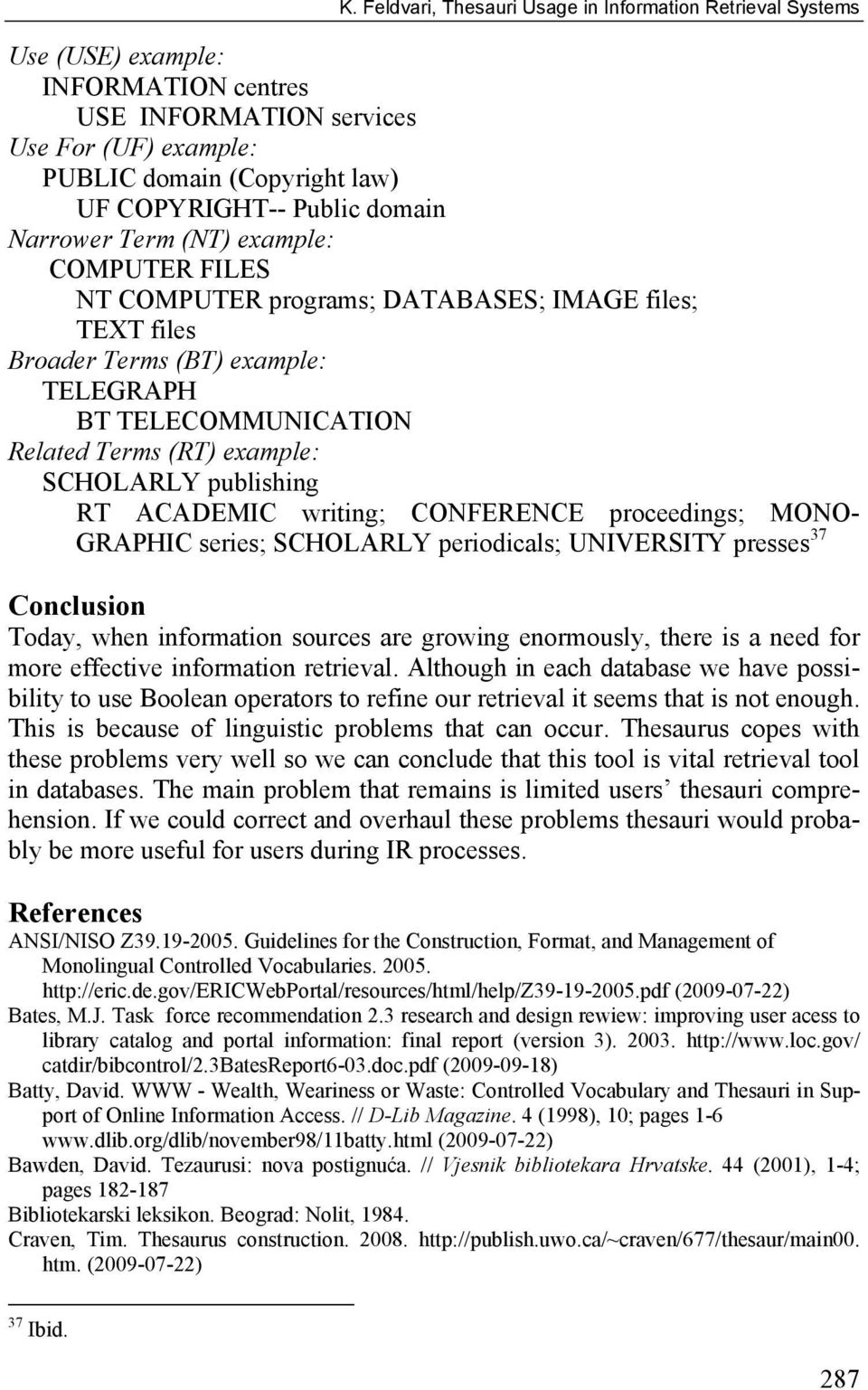
9 K. Feldvari, Thesauri Usage in Information Retrieval Systems Use (USE) example: INFORMATION centres USE INFORMATION services Use For (UF) example: PUBLIC domain (Copyright law) UF COPYRIGHT-- Public domain Narrower Term (NT) example: COMPUTER FILES NT COMPUTER programs; DATABASES; IMAGE files; TEXT files Broader Terms (BT) example: TELEGRAPH BT TELECOMMUNICATION Related Terms (RT) example: SCHOLARLY publishing RT ACADEMIC writing; CONFERENCE proceedings; MONO- GRAPHIC series; SCHOLARLY periodicals; UNIVERSITY presses 37 Conclusion Today, when information sources are growing enormously, there is a need for more effective information retrieval. Although in each database we have possibility to use Boolean operators to refine our retrieval it seems that is not enough. This is because of linguistic problems that can occur. Thesaurus copes with these problems very well so we can conclude that this tool is vital retrieval tool in databases. The main problem that remains is limited users thesauri comprehension. If we could correct and overhaul these problems thesauri would probably be more useful for users during IR processes. References ANSI/NISO Z Guidelines for the Construction, Format, and Management of Monolingual Controlled Vocabularies ( ) Bates, M.J. Task force recommendation 2.3 research and design rewiew: improving user acess to library catalog and portal information: final report (version 3) catdir/bibcontrol/2.3batesreport6-03.doc.pdf ( ) Batty, David. WWW - Wealth, Weariness or Waste: Controlled Vocabulary and Thesauri in Support of Online Information Access. // D-Lib Magazine. 4 (1998), 10; pages ( ) Bawden, David. Tezaurusi: nova postignuća. // Vjesnik bibliotekara Hrvatske. 44 (2001), 1-4; pages Bibliotekarski leksikon. Beograd: Nolit, Craven, Tim. Thesaurus construction htm. ( ) 37 Ibid. 287
10 INFuture2009: Digital Resources and Knowledge Sharing EBSCO publishing: Customer Success Center: LISTA customersuccess/default.php?id=7 ( ) ERIC: Education Resources Information Center: Search the Thesaurus. Greenberg, J. User comprehension and searching with information retrieval thesauri // The thesaurus: review, renaissance, and revision / Roe,Sandra K. ; and Thomas,Alan R., (ed.). Binghamton: The Haworth Information Press, 2004., page Jones, Susan.[et al.]. Interactive thesaurus navigation: Intelligence rules OK? // Journal of the American Society for Information Science. 46 (1995), 1; pages Lancaster, F. W. Do indexing and abstracting have a future? // Anales de documentation. 2003, 6; pages Lancaster, F.W. Indexing and abstracting in theory and practice. Compaing Illions: University of Illinois, Leščić, Jelica. O tezaurusu načela, izradba, struktura: pregled. // Vjesnik bibliotekara Hrvatske 44 (2001), 1-4; pages Library, Information Science & Technology Thesaurus thesaurus?vid=2&hid=8&sid=bb81003c-cc48-4dfd-8a97-593c9d9ec7a8%40sessionmgr10 ( ) Milstead, Jessica L. Use of Thesauri in the Full-Text Environment ( ) Muddamalle, Manikya Rao. Natural Language versus Controlled Vocabulary in Information Retrieval: A Case Study in Soil Mechanics spring/research/%5bmuddamalle98%5dnaturallanguagevscontrolledvocinir.pdf ( ) Nielsen, Lykke M. Thesaurus construction: key issue and selected reading. // The thesaurus: review, renaissance, and revision / Roe,Sandra K. ; and Thomas,Alan R., (ed.). Binghamton: The Haworth Information Press, 2004., pages Ojala, M. Finding and using the magic words: Keywords, thesauri and free text search. // Online. 31 (2007), 4; pages ProQuest: ERIC ( ) ProQuest: ERIC Thesaurus ( ) Sihvonen, Anne; Vakkari, Pertti. Subject knowledge improves interactive query expansion assisted by a thesaurus. // Journal of Documentation. 60 (2004), 6; pages Svenonius, Elaine. Intelektualne osnove organizacije informacija. Lokve: Benja, Urbanija, Jože. Metodologija izrade tezaurusa. Zagreb: Naklada Nediljko Dominović, Wall, Eugene. Symbiotic development of thesauri and information systems: A case history // Journal of the American Society for Information Science. 26 (1975), 2; pages

Encoding Library of Congress Subject Headings in SKOS: Authority Control for the Semantic Web
 Encoding Library of Congress Subject Headings in SKOS: Authority Control for the Semantic Web Corey A Harper University of Oregon Libraries Tel: +1 541 346 1854 Fax:+1 541 346 3485 [email protected]
Taxonomies for Auto-Tagging Unstructured Content. Heather Hedden Hedden Information Management Text Analytics World, Boston, MA October 1, 2013
 Taxonomies for Auto-Tagging Unstructured Content Heather Hedden Hedden Information Management Text Analytics World, Boston, MA October 1, 2013 About Heather Hedden Independent taxonomy consultant, Hedden
A Software Tool for Thesauri Management, Browsing and Supporting Advanced Searches
 J. Nogueras-Iso, J.A. Bañares, J. Lacasta, J. Zarazaga-Soria 105 A Software Tool for Thesauri Management, Browsing and Supporting Advanced Searches J. Nogueras-Iso, J.A. Bañares, J. Lacasta, J. Zarazaga-Soria
Chapter 5 Use the technological Tools for accessing Information 5.1 Overview of Databases are organized collections of information.
 Chapter 5 Use the technological Tools for accessing Information 5.1 Overview of Databases are organized collections of information. Ex: Online Catalogs. 1. Structure of a Database - Contains record and
An Introduction to Using CINAHL
 An Introduction to Using CINAHL Through EBSCOhost What is CINAHL? CINAHL stands for the Cumulative Index of Nursing and Allied Health Literature and is the largest and most in-depth nursing research database.
What is a literature review?
 1 What is a literature review? A literature review is more than a list of bibliographic references. A good literature review surveys and critiques the body of literature in your field of interest. It enables
Your guide to finding academic information for Engineering
 Your guide to finding academic information for Engineering This guide is designed to introduce you to electronic academic databases relevant to Engineering. Online databases contain large amounts of current
Chapter 1: The Cochrane Library Search Tour
 Chapter : The Cochrane Library Search Tour Chapter : The Cochrane Library Search Tour This chapter will provide an overview of The Cochrane Library Search: Learn how The Cochrane Library new search feature
A GENERALIZED APPROACH TO CONTENT CREATION USING KNOWLEDGE BASE SYSTEMS
 A GENERALIZED APPROACH TO CONTENT CREATION USING KNOWLEDGE BASE SYSTEMS By K S Chudamani and H C Nagarathna JRD Tata Memorial Library IISc, Bangalore-12 ABSTRACT: Library and information Institutions and
Audio Engineering Resources
 Audio Engineering Resources Audio Engineering resources Books, DVDs, CDs & print journals Search for these in the JMC Academy Library Catalogue click on Library Catalogue link on Student Portal Look in
PROQUEST ABI / INFORM
 HOW TO USE THE DATABASES PROQUEST ABI / INFORM Read How to devise a search strategy before using this guide. Proquest ABI / Inform includes full text for articles from over 2000 journals and magazines
Information access through information technology
 Information access through information technology 1 Created to support an invited lecture at the International Conference MDGICT 2009 in Tamil Nadu, India, December 2009 by [email protected]
School Library Standards. for California Public Schools, Grades Nine through Twelve
 School Library Standards for California Public Schools, Grades Nine through Twelve STANDARD 1 Students Access Information The student will access information by applying knowledge of the organization of
LexisNexis TotalPatent. Training Manual
 LexisNexis TotalPatent Training Manual March, 2013 Table of Contents 1 GETTING STARTED Signing On / Off Setting Preferences and Project IDs Online Help and Feedback 2 SEARCHING FUNDAMENTALS Overview of
Glossary of Library Terms
 Glossary of Library Terms A B C D E F G H I J K L M N O P Q R S T U V W X Y Z Term A Abstract Advanced search B Basic search Bibliography Boolean operators C Call number Catalogue Definition An abstract
How to stop looking in the wrong place? Use PubMed!
 How to stop looking in the wrong place? Use PubMed! 1 Why not just use? Plus s Fast! Easy to remember web address Its huge - you always find something It includes PubMed citations Downside Is simply finding
The Value of Indexing
 The Value of Indexing A White Paper Prepared for Factiva, a Dow Jones and Reuters Company By Jan Sykes, Information Management Services February 2001 Executive Summary Finding particular documents after
Figure A Partial list of EBSCOhost databases
 Getting More from EBSCOhost Databases September 2006, St. Mary s University, Louis J. Blume Library, http://library.stmarytx.edu/acadlib/ Diane M. Duesterhoeft, [email protected], 210/436-3346;
OVERVIEW AND PRINCIPLES OF SCIS SUBJECT HEADINGS
 OVERVIEW AND PRINCIPLES OF SCIS SUBJECT HEADINGS Originally published in SCIS Subject Headings Fifth Edition 2002, Curriculum Corporation, Carlton South, ISBN 1 836366 565X. Revised October 2011 CONTENTS
T HE I NFORMATION A RCHITECTURE G LOSSARY
 T HE I NFORMATION A RCHITECTURE G LOSSARY B Y K AT H AGEDORN, ARGUS A SSOCIATES M ARCH 2000 I NTRODUCTION This glossary is intended to foster development of a shared vocabulary within the new and rapidly
User-Centered Website Development: A Human- Computer Interaction Approach
 User-Centered Website Development: A Human- Computer Interaction Approach Daniel D. McCracken City College of New York Rosalee J. Wolfe DePaul University With a foreword by: Jared M. Spool, Founding Principal,
CINAHL (via Ovid): Introduction to Searching
 CINAHL (via Ovid): Introduction to Searching Ovid is a collection health sciences databases provided by Ovid Technologies, Inc. and purchased by the Ehrman Medical Library. The Cumulative Index to Nursing
OvidSP Quick Reference Guide
 OvidSP Quick Reference Guide Opening an OvidSP Session Open the OvidSP URL with a browser or Follow a link on a web page or Use Athens or Shibboleth access Select Resources to Search In the Select Resource(s)
Digital Asset Management and Controlled Vocabulary
 Digital Asset Management and Controlled Vocabulary Introduction One of the challenges that DataBasics has found in delivering and implementing a digital asset management system is the issue of asset ingestion
www.engineeringvillage.com QUICK REFERENCE GUIDE
 www.engineeringvillage.com QUICK REFERENCE GUIDE Quick Search The first page you see in Engineering Village is the Quick Search page. This page is designed for quick, straightforward searches. The interface
Where to search for books and articles. Accessing and Searching Avery Index
 Finding and citing articles for students at College of Architecture & Design Goals of this tutorial: Searching and locating articles for architecture and design-related research using Avery Index. Citing
Taxonomies? That s classified information. Jordan Cassel
 Chapter 1 What Are Taxonomies? Taxonomies? That s classified information. Jordan Cassel The first step in discussing the role and work of the taxonomist is to clarify what a taxonomy is. Even if you already
Chapter-1 : Introduction 1 CHAPTER - 1. Introduction
 Chapter-1 : Introduction 1 CHAPTER - 1 Introduction This thesis presents design of a new Model of the Meta-Search Engine for getting optimized search results. The focus is on new dimension of internet
Add external resources to your search by including Universal Search sites in either Basic or Advanced mode.
 Opening a Nursing@Ovid Session Open the Nursing@Ovid URL with a browser or Follow a link on a web page or Use Athens or Shibboleth access Select Resources to Search On login, Nursing@Ovid may take you
EMBASE (via Ovid): Introduction to Searching
 EMBASE (via Ovid): Introduction to Searching The Excerpta Medica (EMBASE) database is a major biomedical and pharmaceutical database indexing over 3,500 international journals in the following fields:
Flattening Enterprise Knowledge
 Flattening Enterprise Knowledge Do you Control Your Content or Does Your Content Control You? 1 Executive Summary: Enterprise Content Management (ECM) is a common buzz term and every IT manager knows it
UTILIZING COMPOUND TERM PROCESSING TO ADDRESS RECORDS MANAGEMENT CHALLENGES
 UTILIZING COMPOUND TERM PROCESSING TO ADDRESS RECORDS MANAGEMENT CHALLENGES CONCEPT SEARCHING This document discusses some of the inherent challenges in implementing and maintaining a sound records management
Introduction. Chapter 1. 1.1 Introduction. 1.2 Background
 Chapter 1 Introduction 1.1 Introduction This report is the fifth in the series describing experiments with the British Library Research & Development Department's (BLR&DD) Okapi bibliographic information
Weblogs Content Classification Tools: performance evaluation
 Weblogs Content Classification Tools: performance evaluation Jesús Tramullas a,, and Piedad Garrido a a Universidad de Zaragoza, Dept. of Library and Information Science. Pedro Cerbuna 12, 50009 [email protected]
How to undertake a literature search and review for dissertations and final year projects
 How to undertake a literature search and review for dissertations and final year projects As part of your project or dissertation, you will need to undertake a literature search. This is a search designed
Use of Online Public Access Catalogue at Annamalai University Library
 International Journal of Information Science 2012, 2(6): 70-74 DOI: 10.5923/j.ijis.20120206.01 Use of Online Public Access Catalogue at Annamalai University Library S. Thanuskodi Department of Library
Taxonomies? That s classified information. Jordan Cassel
 Chapter 1 What Are Taxonomies? Taxonomies? That s classified information. Jordan Cassel The first step in discussing the role and work of the taxonomist is to clarify what a taxonomy is. Even if you already
Medical Information-Retrieval Systems. Dong Peng Medical Informatics Group
 Medical Information-Retrieval Systems Dong Peng Medical Informatics Group Outline Evolution of medical Information-Retrieval (IR). The information retrieval process. The trend of medical information retrieval
Physics MSci Project Literature Review: Information for your literature search
 Physics MSci Project Literature Review: Information for your literature search http://www3.imperial.ac.uk/library/subjectsandsupport/physics Jenny Evans, Maths & Physics Librarian [email protected]
CINAHL. CINAHL - Cumulative Index to Nursing and Allied Health Literature Database
 CINAHL Advanced Searching CINAHL - Cumulative Index to Nursing and Allied Health Literature Database CINAHL indexes information for all of the allied health professions, including: Art Therapy Athletic
A Quick Start Guide to Searching the LLC Catalogue and Databases
 A Quick Start Guide to Searching the LLC Catalogue and Databases 1. What is the LLC Catalogue? 2. What is a Library Database? 3. How to Access the LLC Catalogue and Database Collection 4. Basic Search
User research for information architecture projects
 Donna Maurer Maadmob Interaction Design http://maadmob.com.au/ Unpublished article User research provides a vital input to information architecture projects. It helps us to understand what information
Library of Congress Subject Headings Pre- vs. Post-Coordination and Related Issues
 Library of Congress Subject Headings Pre- vs. Post-Coordination and Related Issues Report for Beacher Wiggins, Director, Acquisitions & Bibliographic Access Directorate, Library Services, Library of Congress
EndNote Beyond the Basics
 IOE Library Guide EndNote Beyond the Basics These notes assume that you know EndNote basics and are using it regularly. Additional tips and instruction is contained within the guides and FAQs available
Assignment 2: Thesaurus Construction Project Report
 : Thesaurus Construction Project Report Sally Blanchard San Jose State University LIBR247: Vocabulary Design November 2, 2011 Sally Blanchard, 2 Report This report lays out my process for constructing
Module 5 The Internet as an Information Resource
 Module 5 The Internet as an Information Resource Lesson 2 How to search for Information on the Internet. UNESCO EIPICT MODULE 5. LESSON 2 1 Scope What are the ways to find information on the Internet?
An Overview of a Role of Natural Language Processing in An Intelligent Information Retrieval System
 An Overview of a Role of Natural Language Processing in An Intelligent Information Retrieval System Asanee Kawtrakul ABSTRACT In information-age society, advanced retrieval technique and the automatic
Integrated Library Systems (ILS) Glossary
 Integrated Library Systems (ILS) Glossary Acquisitions Selecting, ordering and receiving new materials and maintaining accurate records. Authority files Lists of preferred headings in a library catalogue,
Robert B. McGeachin. Introduction. Most academic scholars have usually amassed personal collections of works relevant to
 Robert B. McGeachin 1 The Impact of Electronic Bibliographic Databases and Electronic Journal Articles on the Scholar s Information Seeking Behavior and Personal Collection of Reprints Robert B. McGeachin
Library and Information Science, and Bibliography (Classes Z and ZA)
 LIBRARY OF CONGRESS COLLECTIONS POLICY STATEMENTS ±² Collections Policy Statement Index Library and Information Science, and Bibliography (Classes Z and ZA) Contents I. Scope II. Research strengths III.
MEDLINE (via Ovid): Introduction to Searching
 MEDLINE (via Ovid): Introduction to Searching Ovid Technologies, Inc. provides access to a collection of health sciences databases through a single search interface. The Ovid suite of databases includes
Searching for Journal Articles with EBSCOhost Shannon Betts, MAT, MLS Reference Librarian Post University
 Searching for Journal Articles with EBSCOhost Shannon Betts, MAT, MLS Reference Librarian Post University * Please note: This tutorial reflects the EBSCOhost advanced search interface in place as of August
Information Retrieval Methods in Libraries and Information Centers (Pp. 108-120)
 An International Multidisciplinary Journal, Ethiopia Vol. 5 (6), Serial No. 23, November, 2011 ISSN 1994-9057 (Print) ISSN 2070--0083 (Online) DOI: http://dx.doi.org/10.4314/afrrev.v5i6.10 Information
EBSCO. * While the search pages might look a little different depending on which database you are using, it will largely operate the same.
 EBSCO Lots of databases the Library subscribes to are through EBSCO including Academic Search Premier, ATLA Catholic Periodical and Literature Index, ATLA Religion Database, Business Source Complete, CINAHL,
VALDOSTA STATE UNIVERSITY MASTER OF LIBRARY & INFORMATION SCINCE MLIS 7110 Online Searching Syllabus Spring Semester 2012 Three Credit Hours
 VALDOSTA STATE UNIVERSITY MASTER OF LIBRARY & INFORMATION SCINCE MLIS 7110 Online Searching Syllabus Spring Semester 2012 Three Credit Hours Instructor: Anita Ondrusek, Ph.D. Associate Professor MLIS Program
Doing a literature search: a step by step guide. Faculty Librarians
 Doing a literature search: a step by step guide Faculty Librarians Table of Contents What is a literature search?... 3 Why carry out a literature search?... 3 The Stages of the Literature Search... 4 1.
USE OF INFORMATION SOURCES AMONGST POSTGRADUATE STUDENTS IN COMPUTER SCIENCE AND SOFTWARE ENGINEERING A CITATION ANALYSIS YIP SUMIN
 USE OF INFORMATION SOURCES AMONGST POSTGRADUATE STUDENTS IN COMPUTER SCIENCE AND SOFTWARE ENGINEERING A CITATION ANALYSIS YIP SUMIN A dissertation submitted in partial fulfillment of requirements for the
Databases and computerized information retrieval
 **** 1 Databases and computerized information retrieval Introduction **** What is a database? 2 A database is a collection of similar data records stored in a common file (or collection of files). ****
The Bibliography of the Italian Parliament: Building a Digital Parliamentary Research Library. http://bpr.camera.it. What is the BPR?
 The Bibliography of the Italian Parliament: Building a Digital Parliamentary Research Library What is the BPR? http://bpr.camera.it The BPR (the Bibliography of the Italian Parliament and Electoral Studies)
8 Steps in Preparing a Research Paper
 UNIT 6: GETTING STARTED WITH RESEARCH INTRODUCTION Do you know how the marathon (a long-distance running race) got its name? Or, have you ever wondered where you would find information on making wine?
What can e-libraries learn from e-business?
 What can e-libraries learn from e-business? Alastair G Smith Senior Lecturer School of Information Management Victoria University of Wellington [email protected] Abstract: Libraries were arguably
I. INTRODUCTION NOESIS ONTOLOGIES SEMANTICS AND ANNOTATION
 Noesis: A Semantic Search Engine and Resource Aggregator for Atmospheric Science Sunil Movva, Rahul Ramachandran, Xiang Li, Phani Cherukuri, Sara Graves Information Technology and Systems Center University
KEAN UNIVERSITY LIBRARY GUIDE Graduate Research Resources
 KEAN UNIVERSITY LIBRARY GUIDE Graduate Research Resources Welcome to the Kean University Library! The Library offers a broad range of resources and services designed to meet the academic information needs
Guide with practice questions Encore (Innovative Interfaces, Inc.)
 Guide with practice questions Encore (Innovative Interfaces, Inc.) Use this tool to search for library materials. Description Encore is an enhanced interface for the library s online catalog. Using a simple
WEB OF SCIENCE QUICK REFERENCE CARD QUICK REFERENCE CARD
 WEB OF SCIENCE QUICK REFERENCE CARD QUICK REFERENCE CARD REUTERS/ Ina Fassbender WHAT IS WEB OF SCIENCE? Search over 9,00 journals from over 5 different languages across the sciences, social sciences,
Semantic SharePoint. Technical Briefing. Helmut Nagy, Semantic Web Company Andreas Blumauer, Semantic Web Company
 Semantic SharePoint Technical Briefing Helmut Nagy, Semantic Web Company Andreas Blumauer, Semantic Web Company What is Semantic SP? a joint venture between iquest and Semantic Web Company, initiated in
USER GUIDE FOR L ANNÉE PHILOLOGIQUE ON THE INTERNET
 USER GUIDE FOR L ANNÉE PHILOLOGIQUE ON THE INTERNET Tip: You can use the Bookmarks to navigate through the guide. Accessing L Année philologique Individual Membership Individual membership accounts are
California Lutheran University Information Literacy Curriculum Map Graduate Psychology Department
 California Lutheran University Information Literacy Curriculum Map Graduate Psychology Department Student Outcomes Outcome 1 LO1 determines the nature and extent of the information needed. Outcome 2 LO2
Mary and Jeff Bell Library Electronic Resources Collection Development Policy Purpose
 Mary and Jeff Bell Library Electronic Resources Collection Development Policy Purpose The purpose of the Electronic Resources Collection Development Policy is to direct the addition, maintenance, and removal
Taxonomy Development Business Classification Schemes Charmaine M. Brooks, CRM
 Taxonomy Development Business Classification Schemes Taxonomy Thesaurus - Classification Taxonomy is the practice and science of taxonomic classification. Thesaurus more commonly means a listing of words
EEHIST: East of England Healthcare Information Skills Trainers. searching the evidence: Cochrane Library
 EEHIST: East of England Healthcare Information Skills Trainers searching the evidence: Cochrane Library Training Guide 6 Edition 4: January 2013 Searching the Evidence 1. How to access The Cochrane Library
Ways to find medical information on the Internet. Academic Library of the Medical Faculty CU
 Ways to find medical information on the Internet Web search tools Directories Search engines Metasearch tools Things to know about subject directories Assembled by teams of editors who are specialists
NewsEdge.com User Guide
 NewsEdge.com User Guide November 2013 Table of Contents Accessing NewsEdge.com... 5 NewsEdge.com: Front Page... 6 Saved Search View... 7 Free Text Search Box... 7 Company Watchlist... 9 Weather...12 NewsEdge.com: