
QUALITY CONTROL MANUAL
|
|
|
- Shanna Blair
- 10 years ago
- Views:
Transcription
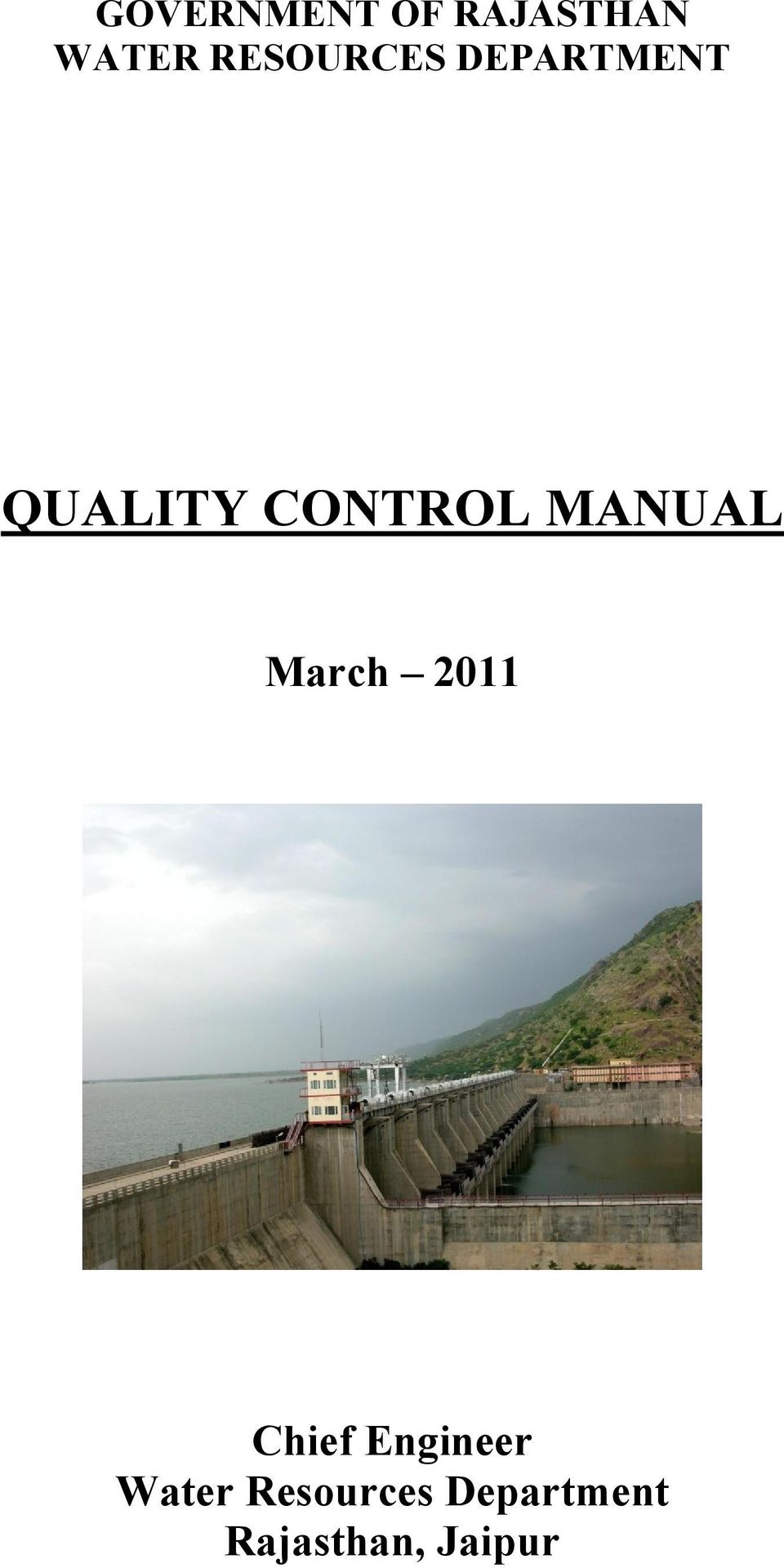
1 GOVERNMENT OF RAJASTHAN WATER RESOURCES DEPARTMENT QUALITY CONTROL MANUAL March 2011 Chief Engineer Water Resources Department Rajasthan, Jaipur
2

3 PREFACE Status of water in Rajasthan is critical and complex. Ground water table is depleting at fast rate across the state due to over exploitation. The availability of water is also decreasing regularly due to abnormal growth of population. After independence, major concentration was extended to water sector and 90% of state's water is utilized by irrigated agriculture. But the major concerns in water sector are sustainability, productivity, water management, pricing etc. It will be our endeavor that the works are executed with strict quality standards confirming to technical specifications with deployment of good construction modalities. To achieve the objectives of an effective Quality Control Monitoring and Quality Assurance Management System, an independent quality control unit has been established and made operational. The important aspect is to develop quality concept and capacity of field engineers to be continuously vigilant on quality control. Accordingly a manual to promote procedure and guidelines of quality control systems on the works of Water Resources Department has been prepared, after detailed discussions and feedback experience from the prevailing practices. The manual shall provide in depth understanding of the need of quality control, including prescribing the tests required to be conducted for the materials during construction and placement activities along-with post construction scenario. The manual is designed to introduce various formats to be followed at various stages or construction to achieve proper quality control and to transmit necessary reports. It also provides an opportunity for the engineering personnel for deployment of their skills in quality control procedures to increase useful life of structures being constructed in confirmation with the international standards. Although every care has been taken to check mistakes and misprints, yet it is difficult to claim perfection. Any errors, omissions and suggestions for the improvement and corrections in the Quality Control Manual are most welcome from all the quarters, which may please be sent to the undersigned.

4 Quality Control Manual for Water Resources Department has been made under valuable guidance and support of the Committee officers Sh.P.L.Solanki, Chief Engineer Quality Control & Vigilance, Jaipur and Sh.G.R.Bhansali, Chief Engineer SWRPD, Jaipur.Their valuable support for the finalization of Quality Control Manual applicable to the construction works of Water Resources Department by Sh. Narendra Mertia SE & TA and his team is thankfully acknowledged. Date: 17th March, 2011 Place: JAIPUR (Kundan Lal) Chief Engineer Water Resources Department Rajasthan, Jaipur

5 INDEX CHAPTER NO. PARTICULARS PAGE NO. LIST OF INDIAN STANDARDS CHAPTER-I QUALITY ASSURANCE AND CONTROL 1 CHAPTER-II ORGANISATIONAL SET-UP 5 CHAPTER-III GENERAL FUNCTIONS OF LABORATORIES 8 CHAPTER-IV CHAPTER-V DUTIES OF STAFF INCHARGE OF LABORATORIES DUTIES OF FIELD STAFF IN RELATION TO QUALITY OF WORKS (i)-(iii) CHAPTER-VI CO-ORDINATIONS 24 CHAPTER-VII QUALITY ASSURANCE 27 CHAPTER-VIII O.K. CARDS 29 CHAPTER-IX TESTS TO BE PERFORMED ON MATERIALS 39 CHAPTER-X LIST OF EQUIPMENT FOR CEMENT AND CONCRETE TESTING CHAPTER-XI FORMATS OF TEST RESULTS 43 CHAPTER-XII IMPORTANT SPECIFICATIONS 58 CHAPTER-XIII FREQUENCY OF TESTING 96 CHAPTER-XIV MONITORING THROUGH CONTROL CHARTS 102 CHAPTER-XV COMPILATION OF QUALITY CONTROL DATA CHAPTER-XVI PROCEDURE FOR EXECUTING EARTH WORK 108 CHAPTER-XVII CHAPTER-XVIII CHAPTER-XIX CHAPTER-XX CHAPTER-XXI CHAPTER-XXII ANNEXURE-I PROCEDURE FOR EXECUTING CONCRETE LINING PROCEDURE FOR EXECUTING RCC WORK & CONCRETE FOR STRUCTURES PROCEDURE FOR SHOT-CRETING AND GUNITING DETERMINATION OF FIELD MOISTURE & DRY DENSITY OF COMPACTED EARTH FILL DETERMINATION OF FIELD DENSITY BY SAND REPLACEMENT METHOD CHECK LIST FOR QUALITY CONTROL UNIT SKETCH SHOWING THE ROLES AND RESPONSIBILITY MATRIX ANNEXURE-II ORGANISATIONAL CHART 142 ANNEXURE-III SKETCH SHOWING CONSTRUCTION JOINT IN LINING

6 ANNEXURE-IV INSPECTION OF TESTING ACTIVITIES 144 ANNEXURE-V-A SKETCH SHOWING AIR WATER GUN 145 ANNEXURE-V-B AIR MORTAR GUN 146 ANNEXURE-VI ANNEXURE-VII ILLUSTRATIVE SKETCH SHOWING TREATMENT OF CANAL PRISM IN EXPANSIVE SOILS WITH CNS MATERIALS TYPICAL CROSSECTION OF A DISTRIBUTARY WITH C.N.S. SUB GRADE ANNEXURE-VIII ANNEXURE-IX ANNEXURE-X ANNEXURE-XI ANNEXURE-XII ANNEXURE-XIII ANNEXURE-XIV ANNEXURE-XV CURVE SHOWING RELATION BETWEEN SPECIMEN SIZE AND STRENGTH OF CONCRETE CORE DATA OF THE CORES TAKEN FROM IN SITU CONCRETE CANAL LINING ILLUSTRATION OF PREPARATION OF CONTROL CHARTS FOR CEMENT AND CONCRETE GRAPH SHOWING CORRECTION FACTOR FOR HEIGHT/ DIAMETER RATIO OF A CORE STATEMENT SHOWING CAPACITY OF PAVER AND MECHANICAL TRIMMER GOVERNMENT OF RAJASTHAN,IRRIGATION DEPPARTMENT ORDER OF DATED GOVERNMENT OF RAJASTHAN,WRD ORDER OF DATED PHOTOGRAPHS OF KEY/CRITICAL EQUIPMENTS

7 S. No. LIST OF INDIAN STANDARDS Short Title IS. to various Standards (A) Cement 1 Specification for 33 grade ordinary Portland cement IS: Specification for Rapid-hardening Portland cement IS: Specification for Portland pozzolona cement IS:1489 (Part 1&2) Methods of physical test for hydraulic cement IS: Method of chemical analysis of hydraulic cement IS: Method of sampling for hydraulic cement IS: Standard sand for testing of cement IS: Specification for 43 grade ordinary Portland cement IS: Specification for 53 grade ordinary Portland cement IS: (B) Coarse / Fine Aggregate 1 Specification for coarse & fine aggregates IS: Methods of test for aggregates for concrete IS:2386 (Part I)-1963 particle size and shape. 3 Methods of test for aggregates for concrete IS:2386 (Part II)-1963 estimation of deleterious materials and organic impurities. 4 Methods of test for aggregates for concrete specific IS:2386 (Part III) gravity, density, voids, absorption & bulking. 5 Methods of test for aggregates for concrete IS:2386 (Part IV)-1963 Mechanical properties. 6 Methods of test for aggregate for concrete IS:2386 (Part V) Soundness. 7 Methods of test for aggregate for concrete IS:2386 (Part VI)-1963 measuring mortar making properties of fine aggregates. 8 Methods of test for aggregates for concrete alkali aggregate reactivity. IS:2386 (Part VII) Methods of test for aggregates for concrete petrographic examination. IS:2386 (Part VIII) (C) Bricks 1 Method for sampling of clay building bricks IS: Method of tests of burnt-clay building bricks IS:3495 (Parts 1 to 4) Common burnt clay building bricks IS:

8 S. No. (D) Short Title IS. to various Standards Masonry Mortar 1 Specification for sand for masonry mortars IS: Code of practice for preparation and use of masonry mortar. IS: (E) Cement Concrete 1. Specification for coarse and fine aggregate IS: Specification for compressive strength, flexural IS: strength. 3 Code of practice for plain & reinforced concrete IS: Methods of sampling and analysis of concrete IS: Recommended guide lines for concrete mix design IS: (F) Curing Compound 1 Standard test method for water retention & day light reflection test on concrete. 2 Standard method of test for effect of organic materials in fine aggregate on strength of mortar. 3 Standard specification for liquid membranes forming compounds. ASTM-C ASTM-C ASTM- C (G) PVC Water Stops 1 Code of practice for provision of water stops IS: Procedure for Testing Parts of IS: Standard Test methods for Tensile properties of ASTM : D Plastics. 4 Standard Test methods for Thermoplastic Elastomers Tension. ASTM : D (H) HYSD BARS 1 Specifications for HYSD bars. IS: Specification for Mild Steel and Medium Tensile IS:432 (Part I) steel bars for concrete reinforcement. 3 Method for Tensile testing of steel wires IS: Hard drawn steel wire for concrete reinforcement IS:432 (Part II) Method for Tensile testing of Steel IS: Code of practice for bending & fixing of bars for concrete reinforcement. IS: (I) Precast R.C.C. Pipes 1 Specifications for precast concrete pipes IS: Methods of test for concrete pipes IS:

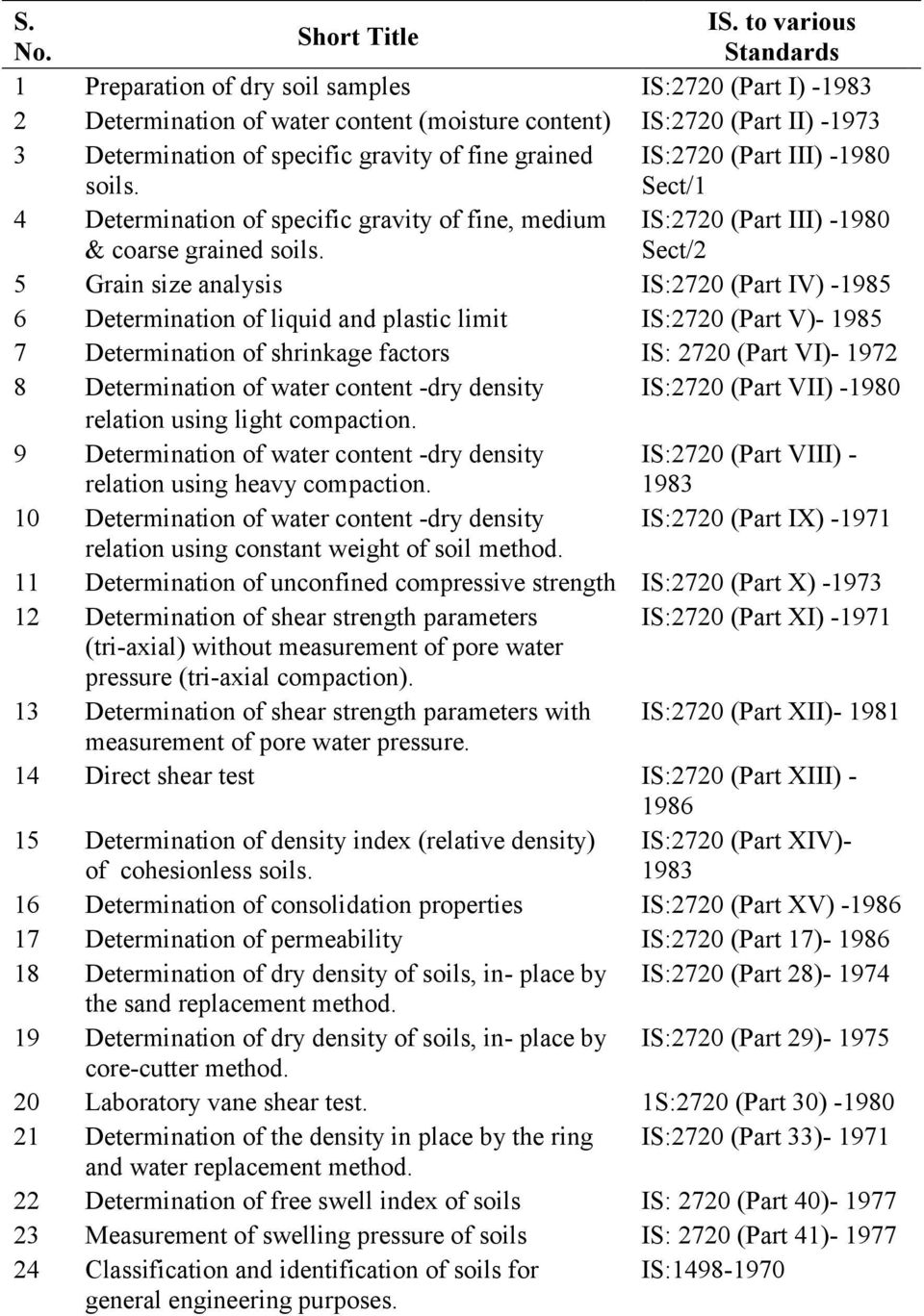
9 S. IS. to various Short Title No. Standards 1 Preparation of dry soil samples IS:2720 (Part I) Determination of water content (moisture content) IS:2720 (Part II) Determination of specific gravity of fine grained soils. IS:2720 (Part III) Sect/1 4 Determination of specific gravity of fine, medium & coarse grained soils. IS:2720 (Part III) Sect/2 5 Grain size analysis IS:2720 (Part IV) Determination of liquid and plastic limit IS:2720 (Part V) Determination of shrinkage factors IS: 2720 (Part VI) Determination of water content -dry density IS:2720 (Part VII) relation using light compaction. 9 Determination of water content -dry density relation using heavy compaction. IS:2720 (Part VIII) Determination of water content -dry density IS:2720 (Part IX) relation using constant weight of soil method. 11 Determination of unconfined compressive strength IS:2720 (Part X) Determination of shear strength parameters IS:2720 (Part XI) (tri-axial) without measurement of pore water pressure (tri-axial compaction). 13 Determination of shear strength parameters with IS:2720 (Part XII) measurement of pore water pressure. 14 Direct shear test IS:2720 (Part XIII) Determination of density index (relative density) of cohesionless soils. IS:2720 (Part XIV) Determination of consolidation properties IS:2720 (Part XV) Determination of permeability IS:2720 (Part 17) Determination of dry density of soils, in- place by IS:2720 (Part 28) the sand replacement method. 19 Determination of dry density of soils, in- place by IS:2720 (Part 29) core-cutter method. 20 Laboratory vane shear test. 1S:2720 (Part 30) Determination of the density in place by the ring IS:2720 (Part 33) and water replacement method. 22 Determination of free swell index of soils IS: 2720 (Part 40) Measurement of swelling pressure of soils IS: 2720 (Part 41) Classification and identification of soils for general engineering purposes. IS:
10

11 CHAPTER I QUALITY ASSURANCE AND CONTROL 1. INTRODUCTION Evaluation of water resources projects involves enormous expenditure. They are time bound programme and require assistance from various technical bodies for investigation, design, planning and execution. To have a safe durable structure, it is necessary that the materials and standard of execution fully satisfy the specifications. It is to be recognized that the ultimate efficiency of the performance of a project will depend upon proper layout and designs, the ultimate health of the project during life scale of its operational phase will depend largely on the quality achieved during its construction. Each and every job whether big or howsoever small shall require to be executed to acceptable construction quality duly confirming to sound design principles, specifications and deployment of good methodology or modern technique and procedures. To achieve the requisite objectives, it is essential to introduce a result oriented quality management system. This system is planned to orient the whole range of quality effort on a continuous basis covering quality assurance and quality control, broadly out lined below including steps initiated for its meticulous implementation. 1.1 Orientation and training of construction supervision/quality control staff A capable and functional construction supervision (CS) and quality control / quality assurance team is needed to ensure implementation of contract specifications. To achieve this objective intensive training will be given to all related staff of construction / quality control in suitable batches covering specifications for the works to be executed and also the procedure to conduct various tests in the field and laboratories. Recommendation of I.S. codes will be explained in the training so as to cover key construction and QC / QA aspects. 1

12 1.2 Laboratory system for testing of Input and Outputs Looking to the overall quantum of work and the scattered area in different zones, establishment of laboratories at different levels and places forms an important link of project organisation for quality control. The system is required to provide reliable and accurate testing support to fulfill the objectives. Accuracy and reliability in testing will depend upon the competence of testing personal, accuracy of apparatus, quality of reagents used, and maintenance of requisite environmental conditions. Introduction of "Mobile testing laboratory system" will prove to be highly result-oriented. This can be supplemented by adequate nos. of site labs, field laboratories and zonal laboratories. 1.3 O.K. Card System It provides a systematic approach towards assuring quality construction and has proved to be practical mechanism for enforcement of technical specifications. For the purpose, each work is divided in various activities in proper sequence/order of construction and listed in chronological order of occurrence in O.K. Card. The cards are maintained in 2 colors (Pink and Green) to be operated by construction and quality control units separately. During execution of work both cards are operated simultaneously and will be kept on record by Executive Engineer concerned. 2. OBJECTIVES AND SCOPE OF QUALITY CONTROL The objective of quality control management is to collect, process and then communicate the data related to the quality of inputs and outputs as well as finished item of work to those who are responsible for the quality. Any programme of quality control seeks to ensure adequacy and uniformity of quality through the following operations. 1. To ensure that the works are being executed in conformity with the prescribed specification. 2

13 2. Inspection of storage, handling and processing facilities for all materials in conformity with accepted or specified practice. 3. Monitoring the variation in specification of the materials and quantities used in the operation of production and in the final product by suitable observation, measurements or tests. 4. In order to achieve the common goal Construction quality in the execution of project, the roles and responsibility matrix, as depicted in Annexure-I shall be broadly followed by : 1. GOR 2. Contractor 3. Project Construction Team 4. Project QC/QA Team and 5. Project Design Team 5. Analysis of the observed variations by statistical or other techniques. 6. Feed-back of the results of analysis for exercise of control at each stage and to take corrective steps for maintaining the variations within specified limits. 7. Indicating expeditiously the possible remedial measures, wherever warranted to ensure execution of works as per drawings / specifications. 8. Rejecting, where warranted, the material or the product at any intermediate or final stage in case acceptance criteria is not satisfied. The rejected material should be removed from work site immediately. 3. QUALITY CONTROL MANUAL It is very important constituent of the quality management system. It is a document encompassing specific requirement, which if fulfilled, shall help in effectively implementing the quality control system to achieve the objective of good construction quality. It covers broadly, the objectives, functions and operations of the Q.C. organisation; duties and responsibilities of Q.C. personnel; Q.C. Laboratory System; O.K. Cards; Monitoring through Control Charts; Control on workmanship; Tests on materials; Important specifications; Standards to be adopted for materials and works; Frequency of testing and reporting; Compilation of Q.C. Data and Statistical Analysis etc.; Documentation and Feed-back; Inspection etc. 3

14 4. CONFIGURATION OF QUALITY MANAGEMENT SYSTEM QUALITY MANAGEMENT SYSTEM Quality planning, Q.C. Manual; Training of Q.C./Q.A. Staff, Infrastructure etc. Quality Control Quality Assurance 5.1 QUALITY CONTROL: (Q.C.) The operational techniques and activities that are used to fulfill the requirements for quality. 5.2 QUALITY ASSURANCE: (Q.A.) All the planned and systematic activities implemented within the quality system and demonstrated as needed to provide adequate confidence that an entity will fulfill requirements for quality; and making sure that the quality of a product is what it should be. Purpose of Quality Assurance is to prevent problems before they occur, to identify and correct them swiftly if they occur and to uncover the root cause. 5.3 QUALITY MANAGEMENT All activities of the overall management function that determine the quality policy, objectives and responsibilities, and implement them by means such as Quality Planning, Quality Control, Quality Assurance, and Quality Improvement within the quality system. The QUALITY CONTROL MANUAL being adopted for Water Resources Department (the salient requirements of which are being outline in the various chapters) aims at a System Approach to ensure that upon implementation, the quality levels as set and defined in the specifications and contract documents and relevant Indian Standards would be met in the execution of project works. 4

15 CHAPTER II ORGANISATIONAL SET-UP GENERAL I. Anyone connected with quality control work, should possess adequate knowledge and experience of quality control works and be well conversant with testing of construction materials. The object of quality control should be clearly understood by them in letter and spirit so as to help in construction and achieve high order of quality as laid down in specifications for works by controlling various factors responsible for deterioration in quality, investigating reasons therefore and suggesting ways and means for improvement. II. III. To have proper and independent quality, quality control formation shall consist of an independent unit headed by Chief Engineer Quality Control. The C.E. shall have three S.E.'s in-charge of Quality Control Circle for the various construction activities of different zones and the S.E.'s shall have a team of E.E.'s to look after the work of different circles. Thus there will be separate streams of construction and quality control assurance respectively up to the level of C.E. (Organisational Chart attached at Annexure-II). Every Q/C Circle shall be divided in number of division and each division shall be headed by the Executive Engineer for the purpose of effective quality control, every divisional jurisdiction shall be sub-divided in number of units and each unit is to be put under the charge of A.En. The E.E. quality control shall make all arrangements for the demarcating the areas of operation of every quality control staff and issue a duty chart for each member after approval from the C.E / S.E. Field Laboratory will be situated at important nodal points which shall cover all the adjoining works and incharge will be T.A. to Executive Engineer. Site Laboratories as per requirement in field shall be maintained by concerned site in-charge (construction) and also utilized by Assistant Engineer Q/C for carrying out necessary tests whenever site is inspected by him. 5
16 IV. One of the fundamental principles to be understood and kept in mind is that the overall responsibility for achieving construction quality in each subproject rests with the execution unit and construction staff shall be fully responsible for quality of work. Requisite assistance is to be provided by the Q.C. Staff for ensuring construction quality. Functions of Quality Control Units The main function of Q.C. units is to have independent checking and control of works. Since the works in the zones are of scattered nature, the quality control units can not exercise concurrent quality control, but it has been planned that these units should act in such a manner that necessary quality control requirements are fulfilled jointly with the execution staff. It will be the responsibility of quality control staff to ensure that all-requisite test as per IS / relevant standards and specifications are carried out in site / field / zonal or central laboratories. The quality control units will carry out periodic inspections of works and conduct field tests so that any deficiencies in the execution of works are properly brought to the notice of concerned authorities and execution staff for taking corrective measures. The following broad indications of functions of quality control units are given which may be supplemented by issue of any further instructions by the Chief Engineer, Quality Control, Jaipur from time to time. (1) They should monitor that all required tests are carried out before start of work as well as during execution. At least 10% tests are to be conducted by the quality control units for reliability of the results and counter checking. (2) They should ensure that all arrangements for carrying out routine field tests in the field laboratories and site laboratories are duly made including provisions and up-keeping of equipments, personnel etc. and record of these field tests in prescribed formats are maintained. They should check this record and also sign in the relevant registers in token of their inspection. They should conduct field tests whenever they visit site of construction work and record results of such tests in the registers maintained for the purpose. 6

17 (3) They shall be empowered to order the suspension of work if deficiencies or defects are noticed during execution. Order for stoppage of work if given by the officer below the rank of S.E. should be got examined and confirmed by S.E. Q.C. very promptly, preferably within 24 hours. However, order for suspension of work can only be passed by the Chief Engineer Quality Control. (4) Inspection Book should be maintained at site wherein remarks should be recorded by quality control staff whenever they visit site which should be noted for compliance by the construction unit. They should specifically record any deficiency noted to bring the same to the notice of appropriate authority through remarks in the inspection book or inspection note. The execution staff shall ensure the compliance of such deficiency and intimate to the concerned officer of Quality Control Unit. (5) The Chief Engineer, Quality Control shall ensure at least one test check of all the works costing more than Rs lacs in a year. This does not preclude him for conducting more than one test check of any work for important works; frequent checking is to be carried out. The test check shall be thorough to ensure the quality of work and shall include - a. Observation of DBD and moisture contents of earthwork in filling reaches. b. Fineness modulus of sand, grading of sand and coarse aggregate. c. Checking of water cement ratio for concrete. d. Checking of lining work / masonry work / concrete work. e. Any other requisite tests as per case. 7

18

19 CHAPTER III GENERAL FUNCTIONS OF LABORATORIES The laboratory system, in addition to evaluate and monitor the inputs and outputs, would also evaluate and monitor the workmanship as well as construction plant, machinery and equipment. This would, thus, be accompanied by testing as well as inspection. FUNCTIONS OF CENTRAL LABORATORY AT JAIPUR I. To conduct laboratory tests on samples of sand, coarse aggregate, stone, cement and steel for use in masonry and concrete works. II. III. IV. To conduct laboratory tests for foundation soil, and for selection of soils from proposed borrow areas, for use in the various zones of embankment as per specifications, proctor density & optimum moisture content of soils before start of earth work. For masonry and concrete, the strength of mortar and concrete has to be as specified in agreement. Laboratory has to design the proportions of different ingredients through tests for the specified strength. The proportioning shall be done by weight. It should be co-related with volume for volumetric batching of concrete where quantity of concrete to be placed is of small magnitude. Volume batching may be allowed by the Engineer-in-charge where weight batching is not practical and provided accurate bulk densities of materials to be actually used in concrete have been established. Allowance for bulking shall be made in accordance with IS: 2386 (Part III) The mass volume relationship shall be checked at periodical frequency to ensure that specified grading is maintained. For concrete and mortars where strength is not given and only proportions have been specified, the strength should be treated as standard for execution. V. When controlled concrete is specified, it is essential that mix design is to be done. VI. Since the strength of cement varies from batch to batch in a cement factory itself, it is essential that a relation between strength of cement versus strength 8

20 of concrete may be worked out in the lab, well in advance of the starting of the work. This would facilitate in furnishing the proper proportion of the mix for adopting in the field and also it entails adding or reducing cement content based on the strength of the cement. VII. Results of tests performed in central laboratory should be documented in prescribed Performa pertaining to following tests. A. SOIL : Disturbed grain size analysis IS: 2720 (Part IV) Proctors compaction IS: 2720 (Part VII & VIII). Atterberg's limit IS: 2720 (Part V) Permeability IS: 2720 (XVII) (at OMC. MDD) Shear test (remoulded at OMC. MDD drained / undrained) IS: 2720 (Part XIII) Specific gravity IS: 2720 (Part III) Undisturbed density and natural moisture content, permeability, consolidation, shear test (drained/undrained) at OMC or saturation. Free swell index; Swelling pressure of soil sample. Dispersibility of soils. Total Soluble salts. Chemical test for carbonates & sulphates (Chlorides Gypsum test). B. SAND : For IS: Grading, IS: 2386 (Part I) Fineness Modulus, IS: 2386 (Part III) Bulkage, IS: 2386 (Part II) Organic and silt content. Deleterious material and mica content, and presence of organic impurities, if any. C. Cohesive Non-Swelling Soils Requirement should broadly confirm to IS: D. CEMENT Fineness, consistency, specific gravity, compressive strength, setting time, soundness by Le-Chatelier test. E. COARSE AGGREGATE : Grading IS: 2386 (Part I)

21 Soundness, crushing value, impact test. Abrasion, Absorption, Specific gravity IS: 2386 (Part III):1963 Flakiness. F. BOULDERS : Soundness, weight and size, absorption, specific gravity, weathering conditions (visual) abrasion after breaking to proper sizes. G. FILTER MATERIALS : Grading, uniformity co-efficient, weathering conditions (visual) and tests for fine and coarse aggregate fulfillment of filter criteria as per I.S.Code. H. WATER: ph value, silt content, soluble salts and any other impurities. H1. STEEL Ultimate tensile strength / Elongation. I. CONCRETE : Air Content Mix Proportions; Test on admixture (if used); Test on Super-plasticiser (if used) J. HARDENED CONCRETE AND MORTARS : Proportion by chemical analysis and compressive strength. K. BRICKS : Dimensions and physical properties including water absorption and compressive strength. L. TESTS FOR FOUNDATION INVESTIGATION AND INSITU PERMEABILITY BEARING CAPACITY : Other properties, if tested shall be reported in the remarks column or foot note. M. LDPE Film wherever used shall be tests. N. IMPROVED DEVICES FOR QUALITY CONTROL : It is planned to introduce improved devices for achieving speedy and efficient quality control. Monitoring the characteristics of fresh concrete is important from the point of view of quality control. The 28 days strength of concrete is the criteria for acceptance and is the basis of quality evaluation. 10
22 However, one has to wait for 28 days to get the results of compressive strength of concrete cubes / cylinders. Even the accelerated compressive strength tests take considerable time. The portable electronic devices, commercially available now, have made it possible for rapid on-site measurements of slump, temperature, water-cement ratio (the most important factor influencing the strength of concrete) and the likely 28 days strength of fresh concrete mixes. Software supplied with the electronic unit also produces 'quality control certificates' based on the measurements taken by this unit. This evidence of the properties of concrete gives the site Q.C. /Q.A. Engineer, the confidence to accept or, if necessary, to reject the concrete mix before it is placed. Central laboratory at Jaipur is planned to be equipped with such a portable electronic unit with software. On embankment construction and compacted earth fill placement it is planned to procure an engineering device of the type "Nuclear Guage" to enable much more rapid and economic compaction and quality control than the conventional methods, without any loss in accuracy. Such a device is capable of quickly computing and displaying wet density, moisture content, dry density, and percentage of compaction in terms of Proctor density. The central laboratory at Jaipur is planned to be equipped with two Nuclear Guage Device. Inspection of testing activities is illustrated in Annexure -IV. FUNCTIONS OF ZONAL LABORATORY To carry out tests of soils, filter materials, ingredients of concrete, tests of cement and mortar etc. of the samples collected by the quality control staff and also such samples collected by construction staff whose facility of testing is not available at site as well as field laboratories. Results of tests performed will be reported to Executive Engineer construction and Superintending Engineer and Chief Engineer of Quality Control unit in the prescribed Performa pertaining to the following tests: 11
23 SOILS: 1. Density, moisture content and compaction efficiency. 2. Sieve analysis 3. Proctor density & O.M.C. 4. Atterberg's limits 5. Specific gravity SAND: 1. Gradation analysis & silt content. 2. Presence of deleterious materials including organic impurities. 3. Bulkage COARSE AGGREGATE: 1. Grading 2. Specific gravity 3. Impact Value, Soundness, Crushing Value, Flakiness. FRESH CONCRETE & MORTAR: 1. Water cement ratio, slump test 2. Compressive strength of Concrete & Mortar 3. Mix Proportions BOULDER SAMPLE: 1. Absorption 2. Dimensions 3. Visual observation as regards weathering etc. 4. Specific gravity, impact value, soundness, specific gravity. CEMENT: 1. Setting time by Vicat needle test 2. Strength of cement BRICKS: 1. Dimensions and physical properties including compressive strength. WATER: 1. Chemical 2. Cl, SO 4, Organics & Inorganic Solids 3. ph value, Alkalinity, Acidity 12
24 FUNCTIONS OF FIELD LABORATORIES To carry out daily routine tests of soils, filter materials, ingredients of concrete and mortar of the samples collected by the construction staff and report the results to concerned J.En., A.En. & Executive Engineer of construction. The results will also be reported to the quality control unit in the prescribed Performa pertaining to following tests: SOILS & EARTH WORK: 1. Density, moistures content and compaction efficiency. 2. Sieve analysis. 3. Proctor density & OMC. CNS: 1. Gradation analysis 2. Shear Parameters 3. Index properties SAND: 1. Gradation and Fineness Modulus. 2. Bulkage 3. Organic impurities through quick "Colour test". CEMENT: Casting of cubes for strength; Fineness by Sieve. COARSE AGGREGATE: 1. Grading 2. Physical Properties FRESH CONCRETE & MORTAR: 1. Water cement ratio & slump test 2. Physical properties of ingredients & silt content of sand. 3. Casting of concrete & mortar cubes. BOULDER SAMPLE: 1. Water absorption 2. Dimensions 3. Physical properties including weathering etc. 13
25 BRICKS: Dimensions & physical properties including water absorption. SITE LABORATORIES: To carry out daily routine tests of soils, filter material, ingredients of concrete and mortar for the on-going works and material carted at site before use. Results will be recorded in registers kept at site for inspection purposes and will be reported to J.En. & A.En. Construction and Quality Control, in the prescribed Performa pertaining to the following: SOILS & EARTH WORK: 1. D.B.D. & Moisture content layer wise. SAND: 1. Gradation analysis & Fineness Modulus. 2. Bulkage COARSE AGGREGATE: 1. Gradation analysis 2. Physical properties CEMENT: Casting of cubes for strength FRESH CONCRETE & MORTAR: 1. Slump test 2. Physical properties of Ingredients; Proportion of cement and sand in mortar. 3. Casting of concrete / mortar cubes. BOULDER SAMPLE: 1. Dimensions & physical properties including weathering etc. 2. Water absorption BRICKS: 1. Dimension & physical properties 2. Sampling of bricks for testing. 14
26 Record of daily activities / tests will be maintained at site in the registers such as:- 1. Inspection Register 2. D.B.D. Register 3. Cement Consumption Register 4. Slump Test Register 5. Daily progress register progress to be compared with consumption of various ingredients including cement. FUNCTIONS OF MOBILE LABORATORY (FIELD TESTS) (i) (ii) (iii) To carry daily routine tests on compaction efficiency. Field density and moisture content determination test. To carry out daily routine tests like silt content, fineness modulus and gradation of fine aggregates and coarse aggregates. To carry out slump test, unit weight and temperature of concrete by using fresh concrete in-situ testing equipment, and to take fresh concrete as per the required frequency. 15
27 CHAPTER IV DUTIES OF STAFF INCHARGE OF LABORATORIES DUTIES OF ASSISTANT ENGINEER / A.R.O. INCHARGE OF LABORATORY i) To ensure proper up-keep and maintenance of laboratory equipment in laboratory. ii) iii) iv) To ensure proper up-keep of records of all samples being tested in the laboratory as per prescribed norms and communication of the results to the concerned. To supervise the testing works of Junior Engineer, Laboratory Assistants and personally to check the tests to the extent of 25%. To prepare fortnightly review of all the tests results and submit to the Executive Engineer, Quality Control & Construction. v) To conduct any research work as may be assigned by the Executive Engineer. vi) vii) viii) The Central Laboratory & Zonal Laboratories have to conduct tests for the suitability of materials proposed from various quarries, well in advance of the actual execution of work, for which the construction staff shall send the material to the lab well in advance. Steel rods as proposed to be used shall be tested for ultimate tensile strength elongation and bond etc. as per standards. Samples of welded rods, welded at site shall be collected and tested to the quality of welding. DUTIES OF ASSISTANT ENGINEERS / A.R.O. / S.R.A. (LABORATORY) Shall perform important tests as mentioned below: A) CEMENT : 1. Fineness by Blaine 2. Normal Consistency 3. Setting time 16
28 4. Soundness 5. Specific gravity 6. Compressive strength 7. Adulteration test B) SAND : 1. Sieve Analysis & Fineness Modulus 2. Test for organic impurities silt & clay 3. Decantation test for silt 4. Specific gravity 5. Unit weight and bulkage factor C) COARSE AGGREGATE : 1. Sieve Analysis and gradation 2. Specific gravity 3. Water absorption 4. Examination of deleterious materials 5. Crushing strength 6. Impact 7. Abrasion 8. Flakiness index 9. Alkali Silicate reactivity D) CONCRETE : 1. Consistency slump or compaction factor 2. Compressive strength 3. Air content 4. Yield per unit quantity of cement 5. Mix design test 6. Cement content E) MORTAR : 1. Consistency 2. Compressive Strength 3. Yield per unit quantity of cement 4. Cement Content 17
29 F) SOILS : 1. Gradation (Grain size analysis) 2. Consistency limits 3. Porosity & Voids ratio 4. Specific gravity 5. Swell pressure DUTIES OF LABORATORY TECHNICIANS / JUNIOR RESEARCH ASSISTANTS i) To assist Assistant Engineer / Executive Engineers whenever required in laboratory and field work. ii) To perform tests in laboratory such as : a) Compaction tests b) Limit tests c) Analysis of fine & coarse aggregates d) Silt in fine aggregate e) Slump test f) Collection of samples of concrete and mortars for filling moulds for compaction test. DUTIES OF LABORATORY ATTENDANTS a) To keep instruments clean. b) To assist Assistant Engineer / Executive Engineer and Laboratory Technicians in conducting tests. c) To prepare samples for test. d) To arrange samples systematically. CONTROL OF INSPECTION, TESTING AND MEASURING EQUIPMENT The identification, calibration, and adjustment of all inspection, measuring and test equipment and devices will be done at prescribed intervals as stated below against certified equipment having a known valid relationship to nationally recognised standards. The equipment will be capable of controlling the delivery of material for weighing so that in accuracies in feeding and measuring during normal operation 18
30 will not exceed 1% for water and 3% for all aggregates. Periodical test will be made at least once in a month in case of equipment for measuring water, cement, admixtures, sand and coarse aggregate. Other measuring equipments will be tested once in a year unless some defects are noticed earlier, in which case these will be attended immediately. Documents will be established and calibration procedures will be maintained including details of the following: 1. Equipment type 2. Identification number 3. Location 4. Frequency of Checks 5. Check method 6. Acceptance criteria 7. Action to be taken for unsatisfactory results, to ensure that the inspection, measuring, and test equipment are capable of the required accuracy and precision. 19
31 CHAPTER V DUTIES OF FIELD STAFF IN RELATION TO QUALITY OF ASSISTANT ENGINEER CONSTRUCTION WORKS DUTIES OF ASSISTANT ENGINEER 1. Shall see that the markout of the area to be tackled is properly given, shuttering, centering, reinforcement are done as per drawing and technical specifications, to record the Pre levels / foundation levels, and to see that mark-out for canal excavation is perfectly given as per drawings. Pre levels, classification levels and final levels of canal shall be taken as per specification. 2. Shall see that the construction equipment like mixers, vibrators, compaction equipment, pumping arrangements for curing / watering are arranged before starting of any work. 3. Shall see that sufficient quantities of input materials as per agreement specifications are made available at site of work and to arrange testing equipment, men and material required for conducting field tests, sending samples of input materials for testing to central lab, field laboratories as per norms. 4. Shall write O.K. Cards after area is ready to start the work and to inform the Assistant Engineer Quality Control and Executive Engineer construction and take permission to start the work on O.K. Card. Shall also permit OK in case quality control A.En. is not available. 5. Shall supervise and ensure that correct quantities of input materials as per mix design communicated by the ASSISTANT ENGINEER QUALITY CONTROL 1. Shall check the markout of foundation and centering/ shuttering reinforcement arrangement and inform the Assistant Engineer construction to rectify the defects if any. 2. Shall check the adequacy of the construction equipment and curing/ watering arrangements before start of work and during excavation. 3. Shall conduct / get conducted by different laboratories the field tests on input materials and record the results and to inform the Assistant Engineer construction to rectify the defects if any. 4. Shall check and write the O.K. card and record the deviations, defects if any or otherwise to record the final OK and to inform Executive Engineer quality control and to permit to start the work. 5. Shall make regular checks of the feeding of input materials mixing time and suggest the quantity of 20
32 ASSISTANT ENGINEER CONSTRUCTION central laboratory are fed into the mixers/batching plants etc., and shall ensure specified mixing time. (minimum 2½ minutes) ASSISTANT ENGINEER QUALITY CONTROL water depending on the moisture content of sand as and when required. 6. Shall ensure proper vibration, rolling etc., during course of day to day work. Shall conduct D.B.D. test of earth work, gradation of material, slump test, core drill test and to extract field samples of material and finished products to be sent to different laboratories also provide men and material required for extracting samples of finished product for quality control staff. 7. Shall ensure proper curing of samples extracted till the curing time is over and to make arrangements to send the samples to central lab or other suitable lab. 8. Shall ensure timely green cutting of concrete with proper air water gun; nicking & chipping (wherever so warranted) so as to prepare the surface for next concrete lift for effective bond at the lift / construction joints. 9. Shall ensure proper curing / watering and allow removal of shuttering only after the time limit prescribed in the specifications and to see that the surface are finished to the plumb/straight lines etc., after removal shuttering. 6. Shall ensure slump test, core tests, proctor density etc., conducted as per norms by the construction and quality control staff and to extract field samples of finished product to be sent to central laboratory later. 7. Shall assist the Assistant Engineer in Proper handling / transport of samples to central lab. 8. Shall check and see that the preparation of the surface is adequately done for starting the next lift. 9. Shall check the adequacy of curing/watering and see that the final surfaces are finished neatly plumb/straight lines etc. 10. Shall maintain (1) mark-out register (2) OK Card files (3) Load Register. 10. Shall maintain registers of field tests conducted. 21
33 DUTIES OF EXECUTIVE ENGINEER EXECUTIVE ENGINEER CONSTRUCTION 1. Shall supervise, check, advice, and instruct the J.E.N. /A.E.N. Construction regarding discharge of their functions properly. 2. Shall intimate the Executive Engineer quality control regarding signing of agreement for starting of any new work, duly endorsing a copy of work order. Shall supply copies of contract documents, drawings construction programme etc., to Executive Engineer Quality Control, and Superintending Engineer. 3. Shall get all ingredients of concrete, masonry got tested before use. Shall see that the soils are tested for various properties like OMC, MDD, etc., before starting of Embankment work. 4. Shall see that all the Machinery/ Equipment being used by the contractor is got periodically calibrated. 5. Shall see that OK Cards are written and kept at site of work before starting of any work. Also will ensure rectification of work before releasing payments. 6. Shall order the suspension of work if any defects are noticed or reported by quality control staff and resume the work only after rectification of defects in the presence of quality control staff. 7. Foundations and reinforcement, shuttering, centering where heavy reinforcement is involved is to be checked by Executive Engineer EXECUTIVE ENGINEER QUALITY CONTROL 1. Shall supervise, check, advice and instruct the A.E.N. Quality Control regarding discharge of their functions properly. 2. Shall maintain copies of approved Designs, reports, contract document, drawings, construction programme, extracts of inspection notes etc., and shall see that his subordinates go through the above documents. 3. Shall remind and verify whether test results are available or not before starting up of any new work and during execution of work. 4. Shall assist in upkeep and calibration of equipment. 5. Shall inspect and sign on OK Cards during field visits. Defects of construction will be pointed out and remedies suggested for achieving good quality construction. 6. Shall order the stopping of work if major defects are noticed or reported by quality control staff and intimate his counterpart to see that defects are rectified. Also defects noted during construction are to be reported to the S.E./Quality Control & Construction. 7. Foundations and reinforcement, shuttering, centering where heavy reinforcement is involved is to be tallied by Executive Engineer 22
34 EXECUTIVE ENGINEER CONSTRUCTION invariably before starting the work. 8. Shall personally see that the samples to the laboratories are sent regularly, obtain the results and communicate the same to Executive Engineer quality control. 9. Shall take the help of quality control Executive Engineer whenever a dispute is referred. 10. Shall jointly inspect the site with quality control Executive Engineer in case variation in classification is less than 10% (+/-) and finalize the classification. EXECUTIVE ENGINEER QUALITY CONTROL invariably before starting the work, during his field visits. 8. Shall pursue and keep track of sending of samples various laboratories and to keep record of results received. 9. Shall co-ordinate with the EE/ Construction division render assistance in resolving the issues referred to him. 10. Shall jointly inspect the site with Construction Executive Engineer in case variation in classification is less than 10% (+/-) and finalize the classification. 23
35 CHAPTER VI CO-ORDINATIONS The construction staff and quality control staff must act in tandem to achieve good quality of the finished product and construction as per the contract specifications. Construction staff should make it a point to inform the quality control staff, the date of starting of any activities or component of the work well in advance so as to enable the quality control staff to schedule their work plan and attend the particular work on the particular date. In turn quality control staff should schedule their programme, so as to attend to the work on the dates required by the construction staff and ensure that, the progress of work is not hampered. The quality control staff shall be responsible for exercising the various field checks with reference to drawing and specifications laid down in respective I.S. code during construction and carrying out all the laboratory and field tests on materials used for construction and reporting through their higher officer, to the field staff for ensuring quality. The Assistant Engineer / Executive Engineer (Quality Control) can address Assistant Engineer / Executive Engineer construction regarding defects, rectification testing etc. As far as possible the defects are to be rectified in the presence of the Quality Control staff and the payment shall be effected only after the Quality Control Staff are fully satisfied with the rectification and quality of work. Any rectification done subsequently any intimation and presence of Quality Control Staff shall be at the sole responsibility of the construction staff. The defects, if any, noticed by the quality control staff during their course of inspection shall be brought to the notice of the construction staff then and there. It is the primary responsibility of the Quality Control & Inspections staff to draw the attention of the construction staff, whenever they notice defective work during their course of inspection. It is duty of the construction staff to attend to the rectification and maintain proper specifications as pointed out by their counter part of the Quality Control organisation. 24
36 Quality Control staff will monitor that all tests required as per agreement and I.S. Codes are carried out in different laboratories by the field staff they will also test check to the extent of minimum 10% (or as decided by Chief Engineer QC) of the required tests and co-relate with the other tests conducted in different laboratories. All observations regarding substandard or below specification work will be dully recorded in the inspection / visit books kept at site by inspecting officer. Such substandard or below specification works should be got stopped / dismantled immediately by execution unit. The defects pointed out by Quality Control Unit will be communicated to the execution unit for compliance immediately. The compliance report should be sent by execution unit within ten days. The quality control staff cannot supervise the placement of concrete on a mix to mix basis continuously. They can only conduct random check of input materials, mixing time, placement of concrete, vibration etc. It's the primary responsibility of the construction staff to ensure adequate supervision of mix to mix placement of concrete. The Operations of the Quality Control Staff shall not interfere in any way, with the executive powers vested with the officers in-charge of execution. They will also in no way diminish the responsibility of the officers in-charge of execution. The field officers in-charge of works are primarily responsible for the quality of all works and to carry out the work as per the technical specifications. In case of difference of opinion between quality control staff and construction staff, it should be sorted out by way of discussions in cordial atmosphere and mutual trust as per the guide lines indicated below. In case it involves any design feature / problem / aspect, the design office should be duly consulted and the advice given by the designer should be accepted. In case of difference of opinion between Executive Engineer, Construction and Executive Engineer, Quality Control it would be referred to Superintending Engineer, Construction, who would discuss the matter with Superintending Engineer, Quality Control and settle the issue. Similarly, when the Superintending Engineer, Quality Control is not readily available, the Superintending Engineer, Construction can over-rule after recording the reasons in writing. In such cases the 25
37 Superintending Engineer, Construction has to discuss with Superintending Engineer, Quality Control at the earliest opportunity and modify his earlier orders, if necessary. Similar action will be taken in case of difference of opinion on the comments of Superintending Engineer, Quality Control. In case there is a difference of opinion between both the Chief Engineer /Additional Chief Engineer, Construction and Quality Control the matter would be referred to Chief Engineer Water Resources Jaipur, whose decision shall be final and binding on all. Work should immediately be suspended and not allowed to resume until the defects pointed out by Quality Control and Inspection staff are rectified. The construction and quality control staff shall keep a regular liaison with the Geologist in respect of all Geo-technical problems and enlist his input on foundations of structures & dams; Cut Off Trenches, tunneling; contract/ consolidation/curtain grouting; Rock / Excavation Slopes (stability of slopes); protection measures; permeability / Water loss tests etc., as well as any geological problem. The advice rendered by the Geologist should be discussed with the Designers and duly respected and implemented. 26
38
39 CHAPTER VII QUALITY ASSURANCE All planned and systematic strategies and actions necessary to generate adequate confidence that Input and Output product will satisfy given requirements of quality and all the components of works perform satisfactory during life period of service, adequate quality checks as analysed during construction is a record which speaks of "Quality Assurance". It comprises planning and policies, education and training standards and specifications, contracts and agreements, and quality control. Quality assurance is to assume that the materials as per standard and as per the requirements have gone into the production of concrete, earth, masonry work etc. This is achieved by evaluating the quality checks during construction and post construction tests made and compared. LIST OF DOCUMENTS Each QC laboratory should hold the following documents: Quality control manual. Technical Records: Specification, Contract documents, inspection and Test Procedures, relevant standards / code of practice. Mill Certificates. Material test reports, test reports of cores. Inspection Reports. Photographic / Video film records of construction which may not remain accessible after commissioning of the project. Non-conformance reports. Statistical evaluation reports. Technical Literature. Standardization of records. Quality Control Personnel should hold the following Documents: Data of test. Area where material is used. Test method with reference to standards. Testing results, including those of cores of concrete. 27
40 Acceptance criteria. Remarks Test personnel signature. Junior Engineer and Assistant Engineer (Site In-charge at site) should always have a kit consisting of equipments i.e. measuring tapes, scale, Vernier calipers, Plumb rule & bob, spirit level, square, Gunia (small), hammer, measuring glass etc. to facilitate quality checking at site. 28
41 CHAPTER VIII O.K. CARDS Since O.K. Cards contain important entries/information on execution of works at all stages and are liable to be referred/perused at a later stage also, the O.K. Cards shall be maintained in duplicate in two colours. The green coloured card shall form a part of the record of Q.C. /Q.A. Wing and the pink coloured card remains in the custody of Construction wing. The O.K. Cards, relating to any particular work, shall be put in a round shaped tin box and placed right at the construction site. The exterior of the tin box shall be painted red. Senior officers shall also check the O.K. Cards during their field inspections to ensure that those are being maintained and proper/genuinely filled. An O.K. Card is a condensed form of specifications and essential requirements for achieving specified workmanship and quality level of output. Each work is subdivided into various construction activities in proper sequence / order of construction. Such activities are listed in chronological order on the O.K. Cards. For various stages of construction activities where laboratory tests or checks with reference to drawing and specification are required from quality control unit, O.K. Cards System shall be followed. The O.K. Cards should be made available on the site in regular manner. Approval of the component of work in progress at the times of inspection should be recorded by the inspecting officer. The O.K. Card consists of two parts for each work. Part first covers the initial preparedness for the work and indicates pre-requisites where as the second part covers the daily performance of activities based on pre-requisites and also giving permission to perform the job by the construction as well as Quality Control staff. Besides the location and type of work, the first column of O.K. Card is to be filled by the construction agency (contractor) by preparing each feature and making it ready for inspection by the project construction engineer who Okay through his signatures and then puts up to the Q.C. /Q.A. Engineer is not available at site then O.K. given by construction Engineer will be treated as final. If anything otherwise is 29
42 not observed. Should anything otherwise be found, the O.K. Card shall not be signed by him and ask the Construction Engineer / agency for necessary rectification. Subsequently, O.K. Card should refer to the defects removed, if pointed out previously in O.K. Card and counter reference to the previous check and should be signed of Okayed. It must be borne in mind that work cannot be held up unduly for disposal of O'K Card. The Assistant Engineer (Quality Control) / Construction will be okaying authority for concentrated work like dam, spillway, head regulator etc. and Assistant Engineer / Junior Engineer construction will be okaying authority for scattered works like canals and small structures. Random checks by supervising officers should be recorded on O'K Cards at site. Weekly report of O'K Cards maintained by construction unit should be submitted to S.E. / Q.C. of the area who has to monitor and ensure that adequate check is being maintained by field staff. Confirmation regarding rectification of defects be obtained from A.En. /Q.C. before making payment once in three bills and final bill of the contractor. After processing through various levels and entering observations and rectification O'K Card will be closed at the time of taking measurements for releasing payments to the contractor. Photocopy of the O'K Cards (pink) will be kept at site and original copy will be attached with the bill and will be kept on record by the division office while making payments to the contractor. Photo copy of O'K Card of Quality Control will also be enclosed with the bill & kept on record with the bill by the division office. However O.K. Card of Quality Control will not be closed till the work is finalized and will be kept on record by the Executive Engineer, Quality Control after the rectification is completed by the construction wing and final comments are recorded by both the Assistant Engineer. Specimen of O.K. Cards for various works such as embankment, concrete, masonry etc. have been enclosed below. 30
43 Water Resources Department O.K. Card No. 1 O.K. Card for raising / Strengthening of Earthen Embankments / Fill Placement & Compaction (Part-I) Name of Work Agency Contract / Package No. Location Date Description of Activities Layout / Demarcation / Fixing & checking T.B.M. Removal of Vegetation, debris & Site clearance Benching, stripping of base (20 cm) PRE-REQUISITES (1) Proctor's density of borrow area (2) Designation of borrow area & checking of required moisture (3) Excavation and shaping of rain cuts and its refilling (4) Weather key- trench made and/or plowing of old embankments done if required (5) Watering of base OK FOR FILL PLACEMENT Thickness of loose layer (cm) Removal of oversize (more than 7.5 cm size) layer Moisture content (%) initial Moisture content (%) final (OMC = %) Weather soil laid as per profile OK FOR COMMENCING COMPACTION Checking of Type of Compaction Equipment / Roller Checking of In place density (D.B.D.) Compaction Efficiency (%) Specified Compaction (%) of Proctor Re-Rolling / Re-compaction if required D.B.D. after Re-Rolling OK FOR NEXT LAYER Removal of extra/loose earth from U/S & D/S faces Remarks & Dated Signature of Agency Remarks and Dated Signature of Construction staff Supervisor JEN AEN Remarks & Dated Signature of QC/ Inspection Engineer 31
44 O.K. Card No. 2 Water Resources Department Supplementary O.K. Card for subsequent layers (Part II) Name of Work Agency Contract / Package No. Location Date Date Description of Activities (Chainage layer) Weather Pre- Requisites fulfilled Weather satisfactory consolidation achieved Weather permitted for next layer Dated Signature of Agency/ Contractor Remarks and Dated Signature of Construction staff Supervisor JEN AEN Remarks & Dated Signature of QC/ Inspection Engineer 32
45 Water Resources Department O.K. Card No. 3 O.K. Card for Sub grade preparation for placement of lining (Part I) Name of Work Agency Contract / Package No. Location Date Chainage Description of Activities Removal of Vegetation, debris Completion of dewatering Filling of over excavation, depressions/ Pockets in soil/rocky strata as per specification Watering of sub-grade Compaction of sub-grade (bottom & sides) through slope compaction/pneumatic rammer / power roller to specific density (... %) Final Lip cutting & checking sub-grade surface to ensure within permissible tolerances (up to 6.5 mm on sides, up to 12.5 mm on Bed) Laying of under-drainage arrangement (a) Porous Plugs (b) Longitudinal & Transverse Drains (c) Porous Panels Final wetting of sub-grade to 15 cm depth Checking of quantity and quality of material stacked at site Cement, Aggregate, Sand, Water Checking of mixer, vibratos & power Checking of form work/ Shuttering true to line and grade O.K. for lining placement Dated Signatur es of Agency Remarks and Dated Signature of Construction staff Supervisor JEN AEN Remarks & Dated Signature of QC/ Inspection Engineer 33
46 O.K. Card No. 4 Water Resources Department O.K. Card for placement of cast-in-situ Concrete lining (Part II) Name of Work Agency Contract / Package No. Location Date Date Description of Activities & location Weather Pre- Requisites of Sub-grade preparation done Satisfactory Quality & Quantity of material stacked at site Signature of Contractor/ Engineer Whether slump checked & cubes casted Whether specified contraction joints provided Remarks and Dated Signature of Construction Staff Supervisor JEN AEN Remarks & Dated Sign. of QC/ Inspection Engineer 34
47 Water Resources Department O.K. Card for Random Rubble Stone Masonry O.K. Card No. 5 Name of Work Agency Contract / Package No. Location Date Description of Activities Stone Quality Size Suitability of a) Cement b) Sand c) Water Mortar a) Mix measurement b) Mixing, Consistency Pointing, thickness of joints, staggering of joints, laying of stones, hearting stones, bond stones spacing. Whether samples of mortar collected in cubes for testing Green cutting with proper air water gun / sand blasting Adequacy of curing for masonry work Verticality of structure check by using plumb bob Embedded Materials Final OK for masonry work Dated Signatures of Agency Remarks and Dated Signature of Construction Staff Supervisor JEN AEN Remarks & Dated Signature of QC/ Inspection Engineer 35
48 Water Resources Department Dated Signatures of Agency O.K. Card No. 6 O.K. Card for Plain & Reinforced Cement Concrete Name of Work Agency Contract / Package No. Location Date Remarks and Dated Signature of Description of Activities Construction Staff Material Suitability i. Cement ii. Steel iii. Aggregate 40 mm, 20 mm iv. Sand v. Water vi. Admixture O.K. for materials Form work & Centering i) Tightness, Stability, Smoothness ii) Cleaning, oiling, perfectness of form work. iii) R.L. of Centering iv) Checking of reinforcement. Supervisor JEN AEN Remarks & Dated Signature of QC/ Inspection Engineer O.K. for reinforcement Tools & Plants i) Mixers & Vibrator ii) Adequacy of concrete production / transportation, placement, consolidation. O.K. for Placement 1. Design mix, measurement 2. Mixing / Consistency 3. Slump 4. Compaction of Concrete 5. Joints 6. Finishing 7. Casting of Cubes 8. Curing 9. Compressive strength 28 days Final O.K. Note: Before pouring of concrete the reinforcement should be got checked by the Q.C. Unit. Working standby vibrator & mixer should be kept at site before start of concreting. 36
49 Water Resources Department Remarks & Dated Signatures of Agency O.K. Card No. 7 O.K. Card for PCC Slab Canal Lining Name of Work Agency Contract / Package No. Location Date Remarks and Dated Signature of Description of Activities Construction Staff A. Materials Suitability : i. Cement ii. Aggregate 40 mm, 20 mm iii. Sand iv. Water v. Treatment of soil if any O.K. for materials B. Formation of Canal Banks : i) Stripping/Removal of vegetation ii) Cutting canal bed & sides to the geometric section/shape iii) Consolidation iv) Trimming C. Casting of PCC Slabs : i) Mix, Measurement by weight ii) Mixing, consistency iii) Slump iv) Water Cement Ratio v) Casting of PCC Slabs vi) Casting of cubes of concrete mix vii) Providing sub base if necessity viii) Laying/Placing in position PCC slabs ix) Construction joints x) Contraction joints xi) Pointing with CM xii) Curing xiii) Pressure Relief Hole xiv) Flexural Strength of PCC Slabs Final O.K. Supervisor JEN AEN Remarks & Dated Signature of QC/ Inspection Engineer 37
50 Water Resources Department O.K. Card for Grouting O.K. Card No. 8 Name of Work Agency Contract / Package No. Location Date S.No. Description Dated Signature of Contractor/QC Remarks GENERAL 1. R.L. and area surface to be grouted. 2. Classification of the rock strata. 3. Salient feature of the strata such as a fault zone cavities, fissures etc. 4. Permeability value of the strata before grout. GROUP 5. Pattern of Grout adopted 6. Depth and dia. of the hole 7. Pressure adopted for grout 8. Proportion of grouting mix 9. Intake of slurry mortar per unit area per unit time 10. Total quality of intake 11. Final permeability value of the strata after grout 12. Whether the grout strata is OK. 38
51 CHAPTER IX TESTS TO BE PERFORMED ON MATERIALS MATERIAL TEST METHOD Cement a) Chemical IS: i) Sio 2, A1 2 O 3, Fe 2 O 3, Cao,MgO, SO 2, Insoluble residue & Loss on ignition ii) Alkalies & Chlorides iii) Free Lime b) Physical IS: i) Specific gravity ii) Fineness iii) Soundness iv) Compressive strength v) Drying shrinkage Water Chemicals i) Cl, SO 4, Organic & Inorganic Solids, ph, Alkalinity / Acidity ii) Setting time of mortar iii) Relative strength of concrete IS: IS: Fine Aggregate i) Sieve Analysis & Fineness Modulus IS:383, IS:2386 ii) Test for organic impurities silt & clay (Part I & IV) iii) Decantation test for silt IS:2386 (Part II) iv) Specific gravity IS:2386 (Part III) v) Unit weight and bulkage IS:2386 (Part III) IS:2386 (Part III) Coarse i) Sieve Analysis IS: Aggregates ii) Flakiness index iii) Elongation Index PART - I iv) Deleterious materials v) Specific gravity PART-II vi) Bulk Density vii) Moisture content PART-III viii) Absorption value Mechanical tests PART-IV ix) Aggregate crushing value x) Impact Value PART - V xi) Abrasion Value xii) Potential reactivity of aggregate xiii) Petro-graphic examination xiv) Alkali Aggregate reactivity test PART-VI PART-VII 39
52 Embankment i) Proctors compaction IS:2720 Part (vii & viii) ii) Atterberg s Limits IS:2720 Part (v)-1985 iii) Permeability IS:2720 Part (xvii) iv) Shear Test v) Specific gravity vi) Disturbed grain size analysis Concrete a) Fresh Concrete i) Air Contents ii) Vibration iii) Temperature measurement iv) Mix proportions v) Water cement ratio vi) Yield IS:2720 Part (xiii)-1986 IS:2720 Part (iii)-1980 IS:2720 Part (iv)-1985 b) Workability test i) Slump Test Usual procedure ii) Compaction Factor test IS:CED2(CESS) ASTM C c) Hardened Concrete BS: 4408 i) Compressive strength ii) MDT Tests d) Special Test i) Microscopy ii) Non-destructive iii) Core Testing IS : IS : CED 2 (3890) Admixtures i) Bleeding IS: ii) Relative Strength IS: iii) Setting Time iv) Relative water content IS: IS: v) Relative length change IS: Masonry i) Gradation of Sand ii) Slump Test iii) Compressive strength of stones IS:1121(Part I)-1974 iv) Tests for stone - IS: Water absorption - Specific gravity - Porosity - Weathering of natural building stone IS:
53 CHAPTER X LIST OF EQUIPMENT FOR CEMENT AND CONCRETE TESTING TEST EQUIPMENT A. CEMENT Flame Photometer a. Chemical i) Alkalies ii) Minor, major oxides by Calorimetry iii) Chloride iv) General Hot plate, Balance (Acc g) Muffle Furnace (up to 1200 c). Platinum Crucibles, conductivity Bridge, ph Meter, physical balance (Cap. 150 g) b. Physical i) Fineness Blaine Apparatus, stop watch. ii) Soundness Le- Chatelier Le-Chatelier Moulds, hot water bath Autoclave iii) Consistency and setting time iv) Heat of Hydration v) General B. AGGREGATES & CONCRETE a) General i) Crushing value ii) Impact value iii) Abrasion value vi) Alkali Aggregate Reactivity vii) Flakiness & Elongation indices viii) Unit weight Containers ix) Sampling (Sand) viii) Specific Gravity and Absorption Vicat Apparatus, moulds, setting time needles and plunger compression testing machine (50 tonnes). vibrating machine, moulds 50 sq.cm. Area, calorimeter thermometer, flow table, stop watch, timer temperature controlled oven, humidity chamber incubator, physical balance (ACC g), balance (cap. 5 kg ACC 1 g), set of standard sieves lid and receiver. Electric Driver, hot plates, set of standard sieves lid and receiver, balance 10 kg (ACC 1g), 100 kg (ACC kg), 200 kg (ACC 0.5 kg) scop, Enamel trays, balance, shovels, compression testing machine (200 tonnes), crusher and ball mill prevailing rigs 2,25,50,100 tones. Crushing apparatus Aggregate impact test machine Apparatus for measuring flakiness Minimum Capacity of Measures. 41
54 TEST C. CONCRETE a. Fresh Concrete EQUIPMENT Max. C.A. Size of Capacity of Measure dm3 i. Vibration ii. Temperature measurement iii. Mix proportions b. Workability Tests: i. Slump Test ii. Compaction factor test c. Hardened concrete Refer sample Divider i) Compression, tension bending & Brinnel hardness tests. Pycnometer Internal Vibrator, table vibrator constituents, Slump cone Apparatus Compaction Factor apparatus, Universal Testing Machines with accessories (Cap. 100 tonnes), Concrete workability meter, Capping moulds Laboratory concrete mixer, Reluctance meter. d. Special Tests Optical microscope, grinding and polishing i) Microscopy equipment, ultrasonic pulse velocity, rebound ii) Non-Destructive hammer core drilling machine, RCC cutting iii) Core Testing machine, RCC cutting machine, thermal conductivity apparatus,permeability apparatus. 42
55 CHAPTER XI FORMATS OF TEST RESULTS 43
56 FORM NO. 1 Remarks & dated signature of Inspecting Engineer D.B.D. SHEET 1. REACH 2. MAX. LAB DENSITY OF SOIL PROFILE 3. OPTIMUM MOISTURE CONTENT 4. D.B.D. TO BE ATTAINED IN THE FIELD (GMS / C.C.) (... OF THE LAB DENSITY) DATE SUB REACH NUMBER OF LAYER WITH LOCATION THICKNESS OF THE LAYER WITH R.L. WT. OF SOIL IN GRAMS VOLUME OF SOIL IN C.C. DRY BULK DENSITY (D.B.D.) MOISTURE CONTENT % SIGNATURE OF WET DRY OBSERVER JEN 44
57 REGISTER FOR COMPACTION EFFICIENCY DETERMINATION Name of Work R.D. Date Sample No. Location of Sample R.D. off R.L. Set Field Classification Earth Fill Zone W.D. Embankment Data Laboratory Data Compaction Dry Density M.C. % % OMC MDD Gms /C.C Signature of S.R.A. A.En./A.R.O. 45
58 Testing results of soil samples of borrow area (Central Laboratory) Name of Work: S. No. Date of Sampling Lab Sample No. Location Borrow Offset Location: R.L. Specific Gravity Gravel 4.75 mm% Grain size Analysis (I.S. No. 480) Sand 4.75 to Silt 0.75 to mm% Clay mm Proctor's Compaction % OMC M.D.D. Gms/cc Permeability mt/yr. U/D At OMC MDD Atterberg s Limits Shear Test at O.M.C. & M.D.D. L.L. P.L. P.I. Drained / Undrained/ Saturated/Gms/C.C. Dispensability Remarks Signature of S.R.A. A.En./A.R.O. 46
59 Testing results of Coarse Samples of borrow area (Central Laboratory) Field Lab.: Location Quarry Stock Ref. I.S. SIEVE Description Percentage Passing for graded aggregate of Normal Size(mm) Sample 40 mm 20 mm 12.5 mm 80 mm mm mm mm mm mm mm Crushing Value (>45) Impact Value (>45) Abrasion (>50) Absorption Soundness Loss > 12% for Na 2 So 4 > 15% for MgSo 4 Signature of S.R.A. A.En./A.R.O. 47
60 Test results of Fine aggregate sand samples conducted at central lab / field lab LAB... Location Quarry / Stock Ref. I.S. SIEVE Description Sample Grading Zone-I Percentage passing for Grading Zone-II Grading Zone-III Grading Zone-IV mm mm mm mm micron micron micron F.M. SILT REMARKS NOTE: BULKAGE 1. For crushed stone sand, the permissible limit on 150-micron IS Sieve is increased to 20 percent. This does not affect the 5 percent allowance permitted in 4.3 applying to other sieve sizes. 2. Fine aggregate complying with the requirements of any grading zone in this table is suitable for concrete but the quality of concrete produced will depend upon a number of factors including proportions. 3. Where concrete of high strength and good durability is required, fine aggregate confirming to any one of the four grading zones may be used, but the concrete mix should be properly designed. As the fine aggregate grading becomes progressively finer, that is, from Grading Zones I to IV, the ratio of fine aggregate to coarse aggregate should be progressively reduced. The most suitable fine to coarse ratio to be used for any particular mix will, however, depend upon the actual grading, particle shape and surface texture of both fine and coarse aggregates. 4. It is recommended that fine aggregate confirming to Grading Zone IV should not be used in reinforced concrete unless tests have been made to ascertain the suitability of proposed mix proportions. 5. For sand to be used for masonry work and plastering work, please see next table. Signature of S.R.A. A.En./A.R.O. 48
61 Criteria for Masonry Work: (As per IS: ) IS Sieve Size Percentage passing by Weight 4.75 mm mm mm micron micron micron 0-15 Criteria for Plastering Work: (As per IS: ) IS Sieve Size Percentage passing by Weight 10 mm mm mm mm micron micron micron
62 Testing results of Cement Samples (Central Laboratory) Name of Godown for use in structure Manufactured at factory Ref. S. No. Samples No. Lab No. Size of Cube Physical Testing Setting time Specific Surface Compressive strength test Cube kg/cm 2 LF Chart Test Remarks Signature of S.R.A. A.En./A.R.O. 50
63 Testing results of Stone Samples conducted at Central Laboratory Location Quarry Stock Ref. S. No. Lab Samples Wt. of Individual Piece kg Size L x B x H Absorption (%) Density gm/cc Soundness With Na 2 So 4 Abrasion Acid Reaction with HCL Conc. Abrasion Visual Curing General Remarks including suitability Signature of S.R.A. A.En./A.R.O. 51
64 Test Results of Water Samples conducted at Central Laboratory Location River: Reservoir Storage Ref. For use in concreting/mortar/curing/other purpose in Structure at S. No. Sample Quantity Tests Percentage of Quantitative Test Remarks SO 4 CO 3 Cl NO PO ph Silt & Suspended Impurity Total Soluble Salt Signature of S.R.A. A.En./A.R.O. 52
65 Test Results of common brick samples conducted at Laboratory Location For use in at Sample mark of Ref. Lab No. 1 Colour 2 Burnt Character 3 Shape 4 Edges Properties of bricks Observation Remarks 5 Texture after breaking 6 Sound when struck 7 Efflorescence 8 Tolerance (as per Agreement / I.S. Code) 9 Compressive strength kg/cm 2 10 Water Absorption 11 Flexural strength for tile Note: Properties of bricks with dimensions / tolerances and compressive strength etc. shall be covered by the specifications as per Agreement / relevant I.S. Codes. Signature of S.R.A. A.En./A.R.O. 53
66 Test Results of Concrete / Mortar cubes casted Name of Work: R.D. to of structure Sample No. Date of Casting Location of Sample Block R.D. Offset R.L. Mark on the Cube Proportion W/C Ratio Slump Compressive Strength of Concrete / Mortar Cube in kg/cm 2 Designed 28 days strengths of Cube Mortar kg/cm 2 Remarks Signature of S.R.A. A.En./A.R.O. 54
67 Test results of post checking of rolled fill of Dam / Canal Embankment (Central Lab test) Name of Work:- S.No. Date of sampling Lab sample No. Location Rolled Fill; Dry Density gm/cc Ch. Off- L/R M.C. of the Fill Permeability of U/D sample Mt./Yr Performed as per frequency ( Dam every alternate day and canal weekly) Remarks
68 Test Results of HYSD bars samples conducted at Central Laboratory Name of Work:- Location Godown Work site for use Structure Manufacture at Factory Ref: Mechanical properties of High Strength Deformed bars S.No. Properties Sample Grade Fe 415 Fe 500 Fe percent proof stress / yield stress Min. N/mm 2. 2 Elongation percent Min. on gauge 5.65 A. where A is the cross sectional area of the test piece Tensile strength Min. 10% more than the actual 10.2% proof stress but not less than the 485 N/mm 2 8% more than the actual 10.2% proof stress but not less than the 545 N/mm 2 6% more than the actual 0.2 proof stress but not less than the 585 N/mm 2 56
69 Test Results of Hardened samples conducted at central Laboratory Name of Work:- Location of Sample Conc rete cube No. Designed concrete mix properties Test Results Block Ch. off R. Set W/C Propor tion 28 days Compressive Strength kg/cm 2 7 days Compressive Strength kg/cm 2 28 days Compressive Strength kg/cm Designed Mortar Mix Properties Test Results Remarks W/C Proportion 28 days Compressive Strength kg/cm 2 7 days Compressive Strength kg/cm 2 28 days Compressive Strength kg/cm
70
71 CHAPTER XII IMPORTANT SPECIFICATIONS EARTH WORK (IS CODES: 2720, 4701, 8237, 9481, 1200 and 9451) The procedures to be adopted while doing earth work excavation for various jobs and the precautions to be taken are prescribed in the IS specified above. The important Do's and Don'ts are given below for ready reference. A. EXCAVATION OF CANALS DO'S 1. Fix-up the centre line and set the curves correctly. 2. Take working levels, real variation in ground levels and classification of soils. 3. Get top soil vegetation etc. removed. 4. Form spoil bank as per drawing and away from side drain with suitable gaps for drainage into the valley. 5. Form Dowel Bank, as per drawing. 6. Form Inspection path to a uniform longitudinal gradient and with gentle transverse slope towards drains. 7. Compact over excavation / breakage portion with suitable soils, gravel, spalls. 8. Provide CNS treatment in expansive black cotton soils. DO NOTS 1. Do not avoid approval of the deviation statement. 2. Avoid over break and loosening of canal. 3. Do not mix up useful soils with other soil of cutting. 58
72 B. FORMATION OF EMBANKMENT DO'S 1. Get the top spoil, vegetation and sand patches removed to complete depth. 2. Scarify the ground and wet properly. 3. Obtain Proctor density OMC for the useful soils and borrow soils. 4. Raise embankment to full width with uniform horizontal layer of 15 cm to 22.5 cm thickness. 5. Break clods, remove roots, big boulders other materials etc. larger than 75mm form the soils used in embankment. 6. Supplement deficit moisture whenever required. 7. Compaction with 8 to 10 tonnes power roller or Fuel operated vibratory plate compactors. 8. Conduct field compaction tests and determine compaction efficiency. 9. Check embankment profiles periodically. 10 Provide C.O.T.s according to height of bank. 11 Provide 0.45 m. Extra offset on both sides of bank, as warranted. 12 Provide 10% allowance in setting profile of the embankment. DO NOTS 1. Soil required for embankment to be obtained from borrow area should be got tested for proctor density & O.M.C. before start of work. 2. Do not raise the bank in piecemeal. 3. Do not allow new layer without scarification and wetting of old layer. 4. Do not allow new layer unless the old layer compacted up to required density. 5. Don't leave any loose layer unrolled at the end of the day in rainy season. 6. Don't allow compacted layer to be more than 150 mm. 7. No new layer to be laid unless the over moistured layer is either completely removed or allowed to dry. 8. Don't dump soil in heaps. 9. Don't slump the soils in water and slush. 10. Do not forget to provide settlement allowance of 2 cm.mtr. height of bank. 59
73 SPECIFICATIONS OF PLAIN AND REINFORCED CONCRETE 1. Proportioning & batching: Design mix concrete (controlled concrete) shall be used for concrete of grade M10 and higher. Nominal mix concrete (as per table) may be used for lean concrete mix (viz. concrete mix of grade lower than M10 viz. M5, M7.5). In proportioning concrete, the quantity of both cement and aggregate shall be determined by mass. Water shall be either measured by volume in calibrated tanks or weighed. Concrete shall be manufactured in mechanical mixers either in batching mixing plants or mechanical mixers of various capacities (14/10 or 10/7). Alternatively, mobile self-loading weight batching-mixing and transporting mixers of suitable drum capacity can be used, both for mixing and transporting concrete. The mix proportions shall be such as to ensure the workability of the fresh concrete and when concrete is hardened, it shall have the required strength, durability, and surface finish. Grade of Concrete Proportions for Nominal Mix Concrete Total quantity of dry aggregates by mass per 50 kg of cement to be taken as the sum of the individual masses of fine and coarse aggregate (kg) Proportion of fine aggregate to coarse aggregate (by mass) M5 800 Generally 1:2 but M subject to an upper limit of 1:1.5 and a M lower limit of 1:2.5 Notes: i) Graded aggregates shall be used. ii) Water cement ratio should be as per mix design. 60
74 2. Design Mix concrete: The mix shall be designed to produce the grade of concrete having the required workability and characteristics strength not less than appropriate values given below: Grade of Designation of concrete Specified characteristic compressive Strength of 150 mm cube at 28 days in N/mm 2 M10 10 M15 15 M20 20 M25 25 The concrete mix shall be designed for the 'target mean strength'. The target mean strength of concrete mix should be equal to characteristic strength plus 1.65 times the standard deviation. Where sufficient test results for a particular grade of concrete are not available, the value of standard deviation given below shall be assumed for design mix of concrete in the first instance. As soon as the results of samples are available, actual standard deviation shall be used and the mix designed accordingly. Assumed Standard deviation (as per IS: ) Grade of concrete Assumed standard deviation M M M M Water cement ratio (W/C): Water cement ratio is one of the key elements for a durable and sound concrete of adequate strength. Accordingly, water cement ratio shall be maintained at correct value. The water contents in both fine and coarse aggregate shall be determined regularly. The amount of added water shall be adjusted to compensate for any observed variation in moisture content. The amount of surface water may be estimated from the following table in the absence of exact data: 61
75 S. No. Aggregate Approx. quantity of surface water % by mass litre/m 3 1. Very wet sand Moderately wet sand Moist sand Moist sand /crushed rock 1.25 to to Durability of concrete: It is essential that the concrete be durable viz., it should perform satisfactory in the working environment during its anticipated exposure conditions during service. The materials and mix proportions are to be such as to maintain its integrity, and (where ever applicable), to protect embedded metal/reinforcement from corrosion. The different environmental exposure conditions are given below: Environmental exposure conditions (as per Table 3 of IS: ) S. No. Environment Exposure condition 1. Mild Concrete surfaces protected against weather or aggressive conditions, except those situated in coastal area. 2. Moderate Concrete surfaces sheltered from severe rain or freezing whilst wet. Concrete exposed to condensation and rain. Concrete continuously under water. Concrete in contact or buried under non-aggressive soil/ground water. Concrete surfaces sheltered from saturated salt air in coastal area. 3. Severe Concrete surfaces exposed to severe rain, alternate wetting and drying, or occasional freezing whilst wet or severe condensation. Concrete completely immersed in sea water. Concrete exposed to coastal environment. 4. Very Severe Concrete surfaces exposed to sea water spray, corrosive fumes or severe freezing conditions whilst wet. Concrete in contact with or buried under aggressive subsoil/ground water, concrete exposed to alternate 62
76 wetting & drying. 5. Extreme Surface of members in tidal zone. Members in direct contact with liquid/solid aggressive chemicals. The severity level in the water resources works may be assumed moderate to severe only, except in such environment which is associated with corrosive fumes or where the concrete work is to be in contact with or buried under aggressive sub-soil /ground water. 4. Workability of concrete: The concrete mix proportions chosen shall be such that the concrete is of adequate workability for the placing conditions of the concrete and can be properly compacted. Slump for good workability of concrete shall be as per mix design /as per IS: Mixing: Concrete ingredients shall be mixed thoroughly in the mechanical mixer and the mixing shall be continued until there is a uniform distribution of the ingredients and the mass is uniform in colour and consistency. Minimum mixing time shall be 2 minutes or as determined by the Engineer-in-charge. The accuracy of the measuring equipment shall be within 2 percent of the quantity of cement being measured and within 3 percent of the quantity of aggregate and water being measured. 6. Transporting: Concrete shall be transported from the mixer to the form work / site of placement as quickly as possible by methods, which shall prevent the segregation and maintain the requisite workability. Transportation of concrete in ordinary open tippers or trucks shall not be allowed as it causes segregation. Transit concrete mixers can be used for transportation. Self loading, batching, mixing & transporting mixers can also be used both for mixing and transporting concrete. 63
77 7. Placing: The concrete shall be placed and compacted with vibrators (Immersion / needle) and plate vibrators in case of lining before initial setting of concrete commences and shall not be subsequently disturbed. Methods of placing shall be such as to avoid segregation. Strict and meticulous care shall be taken to avoid displacement of reinforcement or movement of form work and concrete. Concrete shall be fully worked around reinforcement and in the corners of form work. Over vibration resulting into bleeding of concrete shall be strictly avoided. Spare vibrator shall be kept by the contractors as stand by. Temperature of concrete, as placed, shall preferably be restricted to about 32ºC (90ºF). 8. Curing: Curing shall commence as soon as possible after concrete is placed and initial set has occurred but before it has hardened. Curing with water shall be continued for at least 14 days. Exposed surfaces of concrete shall be kept continuously in a damp / wet condition by pounding or by covering with a layer of sacking, canvas, hessian, or similar materials and kept continuously wet for 14 days. 9. Sampling and strength of designed mix concrete: Sampling of concrete: A random sampling procedure shall be adopted to ensure that each concrete batch shall have a reasonable chance of being tested, viz. the sampling should be spread over the entire period of concreting and cover all mixing units (concrete production units). Frequency of sampling: The minimum frequency of sampling of concrete of each grade shall be in accordance with the following: Quantity of concrete in the Number of samples Remarks work, m 3 Upto 50 One set of 3 samples 51 and above One additional set of 3 sample for each additional 50 m 3 or part thereof. 64
78 At least one sample shall be taken from each shift. Test specimen: Three specimens shall be made for each sample for testing at 28 days. Additional specimens may be taken to determine the strength of concrete at 7 days. Test results of the sample shall be the average of the strength of 3 specimens. The individual variation should not be more than 15% of the average strength of 3 specimens. If more, the test results of the sample are considered invalid. Acceptance criteria of compressive strength: The concrete shall be deemed to comply with the strength requirement when both the following conditions are met, as per IS: : (a) The mean strength determined from any group of 4 non-overlapping consecutive test results complied with the appropriate limits in columns 2 of the following table. (b) Any individual test results complied with the appropriate limits in column 3 of the following table. Specified grade Table: Characteristics compressive strength compliance requirements Mean of the group of 4 non-overlapping consecutive test results in N/mm 2 Individual test results in N/mm M15 M20 or above fck x established standard deviation (rounded off to nearest 0.5N/mm 2 ) Or fck 3 N/mm 2 whichever is greater. fck x established standard deviation (rounded off to nearest 0.5N/mm 2 ) Or fck 4 N/mm 2 whichever is greater. fck 3 N/mm 2 fck 4 N/mm 2 In the absence of established value of standard deviation the following value may be assumed in the first instance and there after established values based on the requisite number of test results. 65
79 Grade of concrete Assumed standard deviation M10 and M N/mm 2 M20 and M N/mm 2 fck = Characteristic compressive strength of 150 mm cube at 28 days in N/mm 2. For M10 concrete, fck is 10 N/mm 2.For M15 & M20 grades, fck is 15 N/mm 2 and 20 N/mm 2 respectively. In respect of CC lining with a minimum cement level of 250 Kg/m 3, minimum fck envisaged is 13.5 N/mm 2. Based on the assumed standard of deviation values of 2 N/mm 2 and 2.5 N/mm 2 for M10 and M13.5 respectively their acceptance criteria of compressive strength can envisaged as; Specified grade M10 M13.5 (CC lining with minimum cement level of 250 Kg/m 3 ) Mean of the group of 4 non-overlapping consecutive test results in N/mm 2 fck x established standard deviation. fck x established standard deviation. Individual test results in N/mm 2 fck 2 N/mm 2 fck 4 N/mm 2 Note: The minimum cement level of 250 kg/m 3 for plain cement concrete lining is from the durability consideration and not on the 28 day characteristic strength basis alone. Standard Deviation: It is calculated from the following equation: Sd = ( X X )2 N 1 N = No. of samples (30 samples are generally considered) X = Sum of the mean value of 3 test specimens of each sample divided by the number of samples, viz. overall average strength. X = Difference between overall average strength and the mean strength of 3 test specimen of each sample. 66
80 CONCRETE (IS CODES 383, 269, 2116, 2386, 456, 516, 1199, 3878, 9103) CONSTRUCTION JOINTS & TECHNIQUE OF GREEN CUTTING CONSTRUCTION JOINTS Concrete shall be placed in massive structures in lifts which are generally 1.5 m high. To develop proper bond between the lifts, the concrete surface shall be freed of all laitance, coating stains, defective concrete and all foreign material and the surface shall be roughened. This can be achieved by green-cutting. For lining work the construction joint wherever required is to be adopted as shown the sketch in Annexure-III. GREEN CUTTING The surface of the joint shall be thoroughly green-cut with an air-water jet. Green cutting is usually done 8 to 12 hours after the top surface of a concrete lift has been completed and sufficiently hardened. The actual time for taking up the green cutting operation shall depend upon the following factors: a) Concrete placement temperature. b) Atmospheric temperature c) Concrete mix; and d) Slump The air-water jet will remove the thin surface film of laitance and grout to expose clean surface. GREEN CUTTING, IF DONE AT THE PROPER TIME, SHALL YIELD VERY GOOD RESULTS When started too early, it shall result in over-cutting and removing too much mortar. It is also liable to loosen the aggregate particle and leaving too poor a surface to bind the fresh concrete. On the other hand, if green-cutting is delayed too long, the cutting 67
81 action of the air and water jet would be ineffective for proper removal of laitance. It, therefore requires much greater care and judgment for proper use at the proper time. SKILL OF JET OPERATOR Besides determining the proper time for initiating green-cutting, the process will require constant attention on the part of the air-water jet operator. By correct manipulation of the high velocity air-water jet, a trained operator can ensure the removal of the thin surface film of laitance and group effectively and at the same time leaving the aggregate stones, already embedded in the mortar, undisturbed. PROPER AIR-WATER GUN In addition to the skill of the jet operator, a proper air-water gun is also a vital requirement for effective green-cutting. The issuing nozzle must be about 460 mm (18 inches) long to ensure the requisite cutting force close to the concrete surface. A dimensioned sketch of an air-water gun is enclosed as Annexure-V-A. QUANTUM OF COMPRESSED AIR AND WATER For effective green-cutting, it is essential that the air pressure should be around 6.33 to 7.03 kg/cm 2 (90 to 100 lbs. per square inch). It should not be allowed to fall below 90 lbs. per square inch. The water pressure, of course, should be sufficient to bring the water into effective influence of the air pressure. As an approximate estimate, the quantity of compressed air required by the green-cutting gun is 2 cubic meters per minute (70 cfm) and the quantity of water 60 gallons (273 liters) per minute. SAND BLASTING Sand blasting is the process of roughening and cleaning the surface of old and set concrete by means of coarse sand and air applied under pressure of 90 to 100 pounds per square inch (6.33 to 7.03 kilogram per square centimeter) through a nozzle, so as to erode the laitance and grout from the old and fresh concretes monolithic. Sand blasting of rock is also done so that concrete may be placed on or against a clean surface as required according to specifications. There are two types of sand blasting, namely "wet sand blasting" and "dry sand blasting". In wet sand blasting water is also used along with sand and air under 68
82 pressure, while in the latter, only sand and air under pressure are used. Normally the concrete and rock surface etc., are wet sand blasted to keep down the dust. The percentage of different sizes of sand particles for efficient sand blasting shall be as follows: Size Percentage 8 mesh per inch (25.40 mm) mesh per inch (25.40 mm) mesh per inch (25.40 mm) mesh per inch (25.40 mm) 21 For effective sand blasting it is essential that pressure of air should be between 90 to 100 pounds per square inch (6.33 to 7.03 kilograms per square centimeter). If pressure falls below 90 pounds per square inch (6.33 kilograms per square centimeter), sand blasting becomes in effective. If sand having large percentage of fines is used, it will not provide the requisite cutting power and the whole effort goes waste. A good quality well graded "sand-blast-sand" is needed for achieving the objective of sand blasting. 69
83 A. FOR FOUNDATION: (CONCRETE WORK) DO'S 1. Verify dimensions and foundation levels as per drawing. 2. Wet the foundation surface to a depth of 150 mm or to impermeable material. 3. Compact with suitable bedding materials in case of over excavations and with M-5 grade concrete in case of rock. 4. Ensure the rock surface free from oil, objectionable coating unsound fragments. 5. Check-up correct batching of ingredients. 6. Check the batch of cements and its make. 7. Check-up water cement ratio and slump test. 8. Ensure uniform mixing in a mixer for at least 2½ minutes. 9. Ensure proper compaction with vibrators and keep stand-by vibrator and needles. 10. Operate immersion type vibrators nearly in vertical position to vertical drain Cure with water for 28 days. Allow admixtures as per IS: DO NOTS 1. Do not forget to compare bearing capacity of actual soils met with design strength. 2. Don't lay the foundation concrete without wetting the surface. 3. Don't allow admixtures, which will harm the strength of concrete. 4. Do not lay the concrete under water and over slush. 5. The minimum mixing time should not be less than 2 minutes. 6. Do not forget to keep stand by vibrator and needles. 7. Do not place concrete in raw in sufficiently heavy to wash mortar from concrete. 8. Do not forget to cast the cubes. 9. Do not allow segregation of concrete. 10. Do not use unsatisfactory mix. 70
84 B. FOR SUPER STRUCTURE DO'S DO NOTS 1. Check the form work 1. Avoid abrupt surface irregularities. 2. Apply cement slurry after cleaning the surface at vertical joints. 2. Do not deviate from specified dimensions of cross section from 6 mm to + 12 mm. 3. Clean and cover with a layer of 10 to 15 mm thick mortar of the same proportion of concrete mix for horizontal joints. 4. Place the concrete, preferable at temperature not exceeding about 32ºC (90ºF). 5. The concrete shall be discharged within half an hour after introduction of the mix water and cement. 3. Do not allow concreting until all form work installation of items to be embedded and preparation of surface involved are approved. C. REINFORCED CEMENT CONCRETE SLABS (IS CODES 2502, 1786) DO'S 1. Check the reinforcement as per drawing and I.S. Code with particular reference to concrete cover. 2. Provide asphaltic pad and water stopper as per drawing. 3. Ensure lightning arrangement if the work is to be carried out during night. 4. Ensure stand by vibrator & mixer in working condition at site before start of work. 5. Fill up the cubes of concrete samples for testing. DO NOTS 1. Do not pass without specified cover. 2. Do not allow less length in over laps. 71
85 REGISTERS TO BE MAINTAINED 1. Load Register 2. Cement Day book 3. Sieve analysis for sand and metal. 4. Slump for consistency. 5. Compressive strength of concrete. PREPARATION OF SUB-GRADE FOR C.C. LINING (IS CODES: 2720, 4701, 3873) PREPARATION OF SUB-GRADE Preparation of sub-grade is a factor on which depends much of the successful performance of lining. Failure or cracking of lining in many cases can be attributed to poor preparation of sub-grade. Due emphasis is, therefore to be laid on control and proper preparation of sub-grade for lining. Sub-grade in different soil reaches shall be prepared based on IS: Whereas the work of trimming the canal section up to underside of lining shall be carried out well in advance, the trimming of proud section equivalent to the thickness of lining (for base preparation of lining) should be carried out immediately prior to laying of lining but in no case the time interval shall exceed 3 days in normal weather and 2 days in adverse condition. Preparation of Sub-grade consisting of Earth: 1. The sub-grade should be prepared, dressed and rolled true to level according to the required cross-section of the canal to form a firm compacted bed for the lining. Sample profiles true to the cross section of the canal should be made at suitable intervals to ensure correct formation of the sub-grade. If at any point material of sub-grade has been excavated beyond the neat lines required to receive lining, the excess excavation should be filled with material compatible with sub-grade material and thoroughly compacted. 72
86 2. When partial filling of existing canal section is necessary to reduce the cross sectional area to that required for lined canal, the fill shall be paced and suitably compacted by rolling /compactors /mechanical tampers to form firm foundation for placing the lining to avoid its settlement. Slope compactors shall also be used as required for effective compaction of sub grade to the specified density. 3. The consolidation of bed in sandy reaches shall be done by saturating the bed with water before lining is placed. The consolidation of side slopes in such reaches shall be done by over cutting the sub grade in slope by 15 cm and refilling it with earth and compacting by vibro-compactors / appropriate mechanical compactors. 4. The compaction of sub grade in other than predominantly sandy reaches shall be done at optimum moisture content in layers not more than 15 cm - 20 cm thick to obtain a dry bulk density of 95% of the density at optimum moisture content obtained in accordance with IS:2720 (Part VII) Consolidation shall be done by power rollers/pneumatic or fuel-powered tampers/suitable compactors. In the sandy reaches, compaction shall be governed by 'relative density test' and the relative density shall not be less than 70%.Compaction by manual labour shall not be permitted. 5. Where placing and compacting bedding material is on sloping foundation, the layers shall be placed parallel to the surface of the foundation. If at any point the foundation material is disturbed or loosened, it shall be moistened if necessary and thoroughly compacted to form firm foundation for placing the lining. 6. All along the canal alignment, the rain cuts on the inner slopes of the banks shall be filled up with approved soil and shall be compacted thoroughly to required lines, dimensions, and levels. 7. If at any place, placement of bedding material below the proposed lining is required, due care shall be taken to place the bedding material on scientifically approved surface adequately moistened (to be wet to a depth of 15 cm or to depth up to impermeable layer below, whichever is less) in layers not exceeding 15 cm in depth in a single operation and thoroughly compacted. 73
87 8. All loose materials likely to be present at the end panel of existing lining adjacent to which lining is to be placed shall be removed and all voids beneath the existing lining shall be refilled and compacted thoroughly. Preparation of Sub grade consisting of Rock: 1. The sub grade shall be prepared and dressed true to level and according to the required cross-section of the canal. 2. Final cutting for 300 mm mm in hard rock shall be carried out by wedging, barring, controlled blasting or trimming with pavement breakers etc. 3. The bed and side slopes of the canal excavation profile over which the bedding material, under-drainage and pressure relief arrangements (wherever so required) are to be placed and over laid with lining shall be furnished accurately to true and even surfaces and to the dimensions shown on the drawings. 4. All excavation including over breakage below the lines of underside of lining shall be back -filled completely up to the lines of the underside of lining with suitable bedding material as under or as directed by the Engineer-in-charge. The bedding material shall be lean concrete (1:5:10) in bed and sides for thickness of filling less than 15 cm; and RR masonry in cement mortar (1:5) if thickness is more than 15 cm. OR In Slopes: In slopes, the selected material shall be suitable semi-previous material / gravely soil and a layer of pea gravel as binding material duly moistened and compacted by appropriate compactors/tampers to form a firm backing for the lining. In Bed: In bed, the selected bedding material shall be rock spalls and chips to form a firm backing. Selected bedding material to be used over fractured rock or rubble shall be such as would resist piping and consequent washing of fines into the sub grade voids and thus losing support. The material shall be approved by the Engineer-in-charge for its impermeability and care of placement. 74
88 Tolerance in Surface Irregularities in Preparation of Final Sub grade Surface irregularities shall be tested by the use of a long template consisting of a straight edge or the equivalent there-of for curved surfaces and shall not exceed the following limits: i) 6.25 mm for sub grade in bed. ii) mm for sub grade in the side slopes. Preparation of sub grade consisting of expansive soils (IS: ) Field and laboratory tests shall be carried out to determine the physical, textural, engineering, and chemical properties of expansive soils and evaluate the swelling pressures of soils in various reaches to establish the thickness of CNS (Cohesive Non- Swelling soils) layer required so that the resulting deformation is within the permissible limit of 2 cm. The thickness of CNS layer to be provided normal to the sub grade shall be governed by the Indian Standard IS: , out lines below. CNS material shall be non-swelling with a maximum swelling pressure of 10 kn/m 2 when tested in accordance with IS: 2720 (Part 41) at optimum moisture content and minimum cohesion. Some of the soils which may be considered as cohesive nonswelling soils are all adequately compacted clayey soils, silty clays, sandy clays, gravelly sandy clays, etc. exhibiting cohesive properties and containing predominately non-expanding type clay minerals with liquid limit not exceeding 50 percent. Expansive soils are inorganic or organic plastic clays characterized by shrinkage, high compressibility, and swelling properties. To counter act the swelling pressure and prevent deformation of lining, a CNS material of required thickness is sandwiched between the soil and lining. The thickness of CNS material is normal (perpendicular) to the sub grade. Guidelines for choosing the thickness of CNS materials (Cohesive Non-Swelling) required for balancing the different swelling pressures is given in the following tables corresponding to various discharge ranges in canals. Side slope shall not be steeper than 1.5:1, though slopes of 2:1 shall be preferable. 75
89 TABLE-12.1 Thickness of CNS layer in channels of carrying capacity less than 2 cumecs Discharge in cumeccs ( m 3 /sec) Thickness of CNS layer in cm( minimum) Swell pressure Swell pressure more kn /m 2 than 150 kn /m ( 50 to 70 cusecs) 60 cm 75 cm (25 to 50 cusecs) 50 cm 60 cm ( 10 to 25 cusecs ) 40 cm 50 cm ( 1 to 10 cusecs) 30 cm 40 cm TABLE-12.2 Thickness of CNS layer in channels of carrying capacity of 2 cumecs and more Swell pressure of soil kn /m 2 Thickness of CNS layer in cm ( minimum) 50 to cm 150 to cm 300 to cm Note: - CNS soil to be laid in layers and compacted, to specified density. Specification of CNS Soils: (i) Gradation of CNS Soil Clay (less than mm) 15 to 20% Silt (0.06 mm mm) 30 to 40% Sand (2 mm 0.06 mm) 30 to 40% Gravel (Greater than 2 mm) 0 to 10% 76
90 (ii) The CNS material shall be non-swelling, with a maximum swelling pressure of 10 kn/m 2 when tested in accordance with IS: 2720 (Part 41) at optimum moisture content and minimum cohesion. Liquid limit Greater than 30, but less than 50% Plasticity Index Greater than 15, but less than 30% If given CNS material is not available, designed soils mix to produce artificial CNS may be used. The artificial CNS shall broadly satisfy all the requirements of CNS outlined above. In respect of the provisions of CNS layer in the bed, it shall be as worked out from consideration of swelling pressure. However, the thickness of CNS layer to be provided on slopes shall, in addition, be governed by the construction consideration viz. from the Power Roller rollable width consideration for achieving effective compaction. CNS layers shall be compacted to 98% proctor density. Note: During construction, it shall be ensured that: (i) (ii) (iii) (iv) (v) (vi) Serrations/steps/benches shall be provided in the side slopes of canal in cutting to provide a good bond between the CNS layers and expansive soil and to also prevent contact slides between CNS materials and expansive soil. Proper moisture shall be added to CNS material and expansive soil. CNS material shall be laid in layers ( 20 cm thickness) and compacted to requisite proctor density, preferably, by Power Roller. To avoid slipping and rain cuts during the rainy season, it shall be advisable to provide CNS right up to the ground level. The sub grade on which CNS layer is to be laid shall, generally, be not kept exposed for more than 4 days prior to the placement of CNS layer. Effective compaction of sub grade for side lining on slopes is very important in cutting or embankments. In addition to the designed thickness of CNS, 20 cm or more (perpendicular to side slope) of extra thickness (called proud) shall be provided and compacted. This proud shall be removed only just prior to the placement of lining (a time interval of, say, about one day), thus making a 77
91 fresh and well-compacted surface available for bedding. In small section channels, it shall be appropriate to over excavate the section, and fill the entire section with CNS material (laid in successive layers and compacted to 98% proctor density), and, thereafter, scoop this section to the designed section for placement of lining. This PAD method ensures effective compaction by 8-10 T power rollers or equivalent power vibratory rollers. The CNS material so scooped out is utilized in the next reach through re-handling. (vii) To avoid slipping and rain cuts during the rainy seasons, the CNS shall be provided right up to ground level in cutting reaches. (viii) Under drainage arrangement, as per provisions in the agreement. Sub-grade Density and Moisture Control: A sound dense earth foundation, carefully trimmed and pre-moistened before lining placement are critical steps, prerequisite to a good lining construction. Required foundation density of embankment and preparation coupled with moisture control are the key requirement. At the time, concrete is placed the sub-grade is required to be thoroughly moist (but not muddy) for a depth of about 12 to 15 cm and 20 to 22 cm in case of sand as else the concrete would extract moisture from the sub-grade. Compliance of these requirements must be recorded by the execution, QC staff in the OK card. Photographic record showing the actual use of very fine spray nozzles instead of hose (for moistening the compacted sub-grade) should also be kept. Lining Preparation of Sub-grade DO'S 1. Check the model section to the canal profile i.e., bottom or lining viz. side slopes, bed width, top width, slant length, smoothness of slant length. 2. Check the canal profile with reference to model section. Profile be prepared at 15 M intend in case of tile lining. DO NOTS 1. Do not allow concrete lining on loose sub-grade. 2. Do not allow any root or stumps to be on sub-grade. 78
92 3. Remove roots and stumps completely from the sub-grade. 4. Compact over-excavation in soils with earth gravel duly wetted. 5. Compact over-excavation in rocky area or fill up with not concrete as per specification. 6. Provide treatment with C.N.S. soils in expansive soils. 7. Provide porous plugs of specified size in each panel with specified local filters of graded metal and sand. 8. Check whether porous plugs are freely draining or not. 3. Do not allow lining in expansive soils without treatment with C.N.S. soils. 4. Do not place the porous plug below the surface of the lining. 5. Do not allow lining without wetting the sub-grade suitably. 6. Do not allow movement of labours after preparation of sub-grade. C.C. LINING (IS CODES, 383, 269, 2116, 456, 516) CONCRETE CORES FROM CANAL LINING AND OTHER STRUCTURE A specimen to be tested for strength shall not be removed from the structure until the concrete has become hard enough to permit its removal without disturbing the bond between the mortar and the course aggregate. In general the concrete shall be 28 days old before the specimens are removed. Specimens that show abnormal defects or that have been damaged in removal shall not be used. Core Drill: A core drill shall be used for securing cylindrical core specimens. For specimens taken perpendicular to a horizontal surface, a diamond drill shall be used. Specimens: A core specimen for the determination of pavement thickness shall have a diameter of at least 10 cm. A core specimen for the determination of compressive strength shall have a diameter of at least three times the maximum nominal size of the course aggregate used in concrete and in no case shall the final diameter of the specimen be less than twice the maximum size of the course aggregate. The length of the specimen, when capped, shall be, as nearly as practicable, twice its diameter. The curve enclosed at Annexure-VIII should be used to correct the indicated strengths so 79
93 that they will be comparable with those obtained from standard specimens (having L/D ratio as 2). Core Drilling: A core specimen shall be taken perpendicular to a horizontal surface, so that its axis is perpendicular to the bed of the concrete as originally placed. Frequency of drill cores could be one core each from bed and side lining per 2000 square meter of in-situ lining. The cores should be inspected for: a) Segregation b) Honey-combing and c) Thickness of lining. The cores should be tested for: a) Density b) Compressive strength c) Water absorption Compressive Strength: End Preparation: Core specimen to be tested in compression shall have ends that are essentially smooth, perpendicular to the axis and of the same diameter, as the body of the specimen. Moisture Conditioning: Test specimens shall be completely submerged in water at room temperature for 40 to 48 hours immediately prior to the compression test. Specimens shall be tested promptly after removal from water storage. The testing shall be done in accordance with the guide lines laid down in IS: , complete data and test results of cores should be meticulously recorded as per the format enclosed at Annexure IX. Concrete in the member represented by a core test shall be considered accepted if the average equivalent cube strength of the cores is equal to at least 85% of the cube strength of the grade of concrete specified for the corresponding age and no individual core has strength less than 75 percent. DO'S 1. Check the canal prism and verify the bed levels. 2. Check the gradation analysis of fine and coarse aggregate to the requirement of mix at batching DO NOTS 1. Do not allow concrete lining on loose sub-grade. 2. Do not allow lining without wetting sub-grade. 80
94 plant. 3. Allow the ingredients of fine and coarse aggregate as per required mix by weight batching. 3. Do not allow C.C. lining manually without vibration. 4. Check the calibration of weighing machine at batching plant. 5. Check the water meter and its discharge. 6. Check the batch of cement, its make and test results. 7. Check the water cement ratio and record the slump. 8. Check whether any retarders and air entraining agents are added. 4. Do not allow segregation of concrete while laying through discharge conveyor. 5. Do not allow concrete directly on sub-grade from transit mixer. 6. Do not form contraction joints over longitudinal drains. 7. Do not fill up contraction joints with sealing compound without cleaning with air water jet or sand blast. 8. Do not allow any projections or contraction joint over the surface of the lining. 9. Maintain load register. 9. Do not allow the C.C. lining without applying suitable primer to sides. 10. Record the No. of CC cubes cast and its compressive strength. 11. Cure CC lining with water for 28 days. 12. Ensure smooth surface with paver roller passes. 13. Form the contraction and construction joints as per approved drawing. 14. Check the thickness of C.C. lining for each panel. 15. Checking placing of mastic pad at structures of construction joints. 16. Allow concrete lining at temperature between 15 0 C and 32 0 C. 17. Check periodically the coefficient of variation in the compressive 10. Do not remove the channels immediately before setting of C.C. 11. Do not use untested cement. 12. Do not allow to sink the porous plugs in the drains. 13. Do not allow lining without making proper arrangements for curing with water. 14. The co-efficient of variation in the compressive strength of cement should not be more than 8%. 81
95 strength of cement. 18. The batching plant to be used shall confirm to the requirement of IS: MASONRY (IS CODES 1597, 1812, , 269, 2116) DO'S 1. The stone shall be of uniform colour, texture, strong, hard durable. 2. Dress C.R.S. stone to a depth of 75 mm on all four sides. 3. Wet the stones before placing in position clean and cover with fresh mortar. 4. Place stones in layers to the line and plumb. DO NOTS 1. Do not use soft stones of crushing strength less than the specified strength. 2. Do not allow projections more than 40 mm on the face. 3. Do not allow stones of length more than 3 times the height. 4. Do not allow stone of breadth less than height of ¾ of thickness of wall. 5. Do not allow breaking of vertical joints less than 75 mm. 5. Provide weep holes at 2 mtrs interval staggered as per drawing. 6. Chisel dress the corner stones. 6. Header shall not project not less than 10 cm beyond stretcher. 7. Face stones shall be laid alternately 7. Do not place stones in position in headers and stretchers. without cleaning and wetting. 8. Provide bond stones at 2 m interval 8. Do not allow skin stones, weathered in each layer and mark. stones. 9. Place the heating stones on its 9. Do not place stone in position broadest face. without wetting. 10. Ensure perfect heating to make the 10. Smaller stones shall not be placed masonry water tight. in lower cores. 11. Mortar shall be used within 30 min. 11. Joints thickness should not be more after discharge from mixer. than 12 mm. 12. Sieve analysis for sand shall be 12. Do not allow mixing less than 3 done periodically. minutes for thorough mix. 13. For flush pointing the mortar shall 13. Do not add more water than be finished off flush and level with required to have a consistency of 90 edges of the stones. to 130 mm. 14. Joint shall be raked out to 14. Avoid spreading of mortar over the minimum depth of 12 mm when the mortar is green. surface of the masonry. Mortar should be spread over the stone just before laying the next layer. 15. Cure the masonry with water for No pointing to be commenced 82
96 days. 16. Cure the plastered surface with water for 14 days. 17. Cure the pointing surface with water for 7 days. without washing and wetting the joints thoroughly. DRILLING AND GROUTING (IS CODE ) 1.0 SCOPE The pressure grouting of rock, masonry, concrete dams with cement and with or without suitable admixtures and fillers applicable to general grouting, consolidation grouting, and curtain grouting shall broadly confirm to Indian Standard, IS: GENERAL A. The design requirements for adopting a grouting programme are as under. The parameters will depend on the type of structure. (a) Curtain Grouting: i. To safeguard the foundation against erodibility hazard, and / or ii. To reduce quantity of seepage. (b) Consolidating grouting. i. To reduce the deformability of jointed or shattered rock. ii. Grouting the masonry dams to minimize seepage. B. To reduce Quantity of Seepage: (a) (b) For dams exceeding 30 m height, curtain grouting should be carried out when the water absorption exceeds one lugeon. For dams under 30 m, height, curtain grouting is to be carried out where the water absorption exceeds 3 lugeon. C. The depth, spacing and orientation of grout holes are to be related to the geological features; for example, inclined holes should be preferred when the rock permeability is primarily due to closely spaced vertical/ sub-vertical system of joints. It is sometimes necessary to evolve a pattern of holes consisting of different sets of holes appropriate to each type of discontinuity, such as bedding planes, system of joints and lava contacts. 83
97 3.0 GROUTING METHODS: Rock grouting consists essentially of drilling a series of grout holes in rock and injecting grout under pressure, which eventually sets in the opening and voids in the rock. The drilling and grouting operations can be carried out either to the full depth in one operation or in successive depths either by stage grouting or by packer grouting. 3.1 FULL DEPTH GROUTING In the full depth method each hole shall be drilled to the full desired depth, washed, pressure tested and grouted in one operation. This method shall be usually limited to short holes, 5 m or less in depth, or holes upto 10 m that have only small cracks and joints with no risk of surface leakage. In deep bore holes high grouting pressures shall be used to achieve proper penetration of the grout at a spacing of holes shown in the drawing or directed by the engineer-in-charge. As full depth grouting involves the risk of disturbance in the upper elevations, it is not generally considered suitable for grouting deep holes. For grouting in heterogeneous strata, where the nature of rock discontinuities is subjects to large variations in relation to the depth, full depth grouting shall not be used and stage grouting shall be preferred to packer grouting in such cases. 3.2 STAGE GROUTING Stage grouting shall be conducted to permit treatment of various zones individually, by grouting successively increasing depths, after sealing the upper zones. Stage grouting, in descending stages, shall be carried out by adopting the procedure given below. Grouting shall be done by drilling the holes to a predetermined depth and grouting this initial depth at an appropriate pressure. Grout shall be then washed from the hole prior to its final set (within 2-4 hours) and the hole deepened for the next stage. Alternatively the grout shall be allowed to harden and re-drilling shall be carried out through the hardened grout and the holes extended to the next stage. In another procedure called the one stage re-drilled method, which may be sometimes used, grout is washed out within a small depth of the top of the stage being routed and only one stage shall be re-drilled for proceeding to the next stage. In each of the above procedures the cycle of drilling grouting-washing or re-drilling shall be repeated until the required depth of the hole is reached. For stage grouting, the connection at the top of the hole can be made directly to the header or by sealing a packer at the top of the hole in the casing pipe. Alternatively, it is sometimes advantageous to install a packer immediately above the stage that is being routed in order to isolate the upper portion of the hole. Higher pressures can then be permitted for grouting of the lower stage without causing upheaval in the higher stages. 84
98 Grouting with double packer shall be adopted where a few well defined seams or zones exist and the packers can be seated above and below such zones. Rotary drilling method is preferred when double packers are used. When packers can be seated and there is no risk of upheaval, grouting shall be carried out with single packer in ascending stages. However, in many cases packers may function yet grout may over travel and cause upheaval in the zones above the section being grouted. At such places stage grouting in descending order shall be adopted in case of badly jointed and fissured strata vulnerable to upheaval. In relatively compact rocks it may be more convenient to seal the packer at the top of the stage being grouted. The hole shall then be washed, as soon as the period of initial set of cement is over, to the entire depth of the hole up to the bottom of the stage in progress. In strata vulnerable to upheaval, it may be necessary to allow the grout to set and form a sheath around the hole in order to enable high pressures to be used in the lower portions of the hole. In such cases, the washing and single stage re-drilling procedure shall be adopted. 4.0 PATTERN AND DEPTH OF HOLES AND SEQUENCE OF GROUTING The pattern and depth holes shall be governed primarily by the design requirements and the nature of the rock. When the purpose will be consolidation, the holes shall be arranged in a regular pattern over the entire surface areas required to be strengthened and the depth shall be determined by the extent of broken rock as well as the structural requirements regarding the deformability and strength of the foundation. When the purpose will be impermeabilization, the grout holes shall be arranged in a series of lines to form a curtain approximately perpendicular to the direction of seepage. The depth of holes shall dependent on design considerations as also on depth of pervious rock and the configuration of zones of relatively impervious strata. For grouting with cement, 38 mm diameter holes may be used. In long holes, the diameter at the top of holes may have to be larger than the final diameter at the bottom of the hole to facilitate telescoping or to allow the wear of the bit. 5.0 PATTERNS OF HOLES FOR CURTAIN GROUTING SINGLE LINE GROUT CURTAINS Single line grout curtains are effective only in rocks / masonry / concrete having a fairly regular network of discontinuities with reasonably uniform size of openings. In such cases a curtain of adequate width can be achieved by grouting a single line of holes. In massive rocks / masonry / concrete with fine fissures, uplift control shall be primarily achieved by drainage and the grout curtain shall be used only as a supplementary measure to avoid concentrations of seepage which may exceed the capacity of the drainage system. Single line 85
99 curtain may serve this limited objective in comparatively tight rock formations. In Single line curtains a widely spaced system of primary holes, subsequently followed by secondary and tertiary holes at progressively smaller spacing shall be drilled and grouted at spacing as shown on the drawing or as directed by the engineer-in-charge. The usual practice of splitting the spacing from primary to the secondary and secondary to tertiary phase shall be adopted. At every phase of the grouting operation, the results of percolation tests and grout absorption data shall be compared with the previous set of holes in order to decide whether a further splitting of the space of holes in worthwhile. When no significant improvement shall be noticed either in terms of decrease of the grout absorption or water percolation, careful review shall be made of the rock / masonry features, the nature of the rock / masonry and its relations to the patterns of holes. Sometimes it may be required to drill another line of holes at a different angle and orientation than to split the spacing further. If the area is too limited, the setting time of the grout becomes important since it is not desirable to drill too close to a freshly grouted hole. Before pressure grouting is targeted, drilling of all the holes shall be completed within a distance of 20 m of the hole to be grouted. Depending upon initial investigation and strata conditions the spacing of primary hole shall be decided. If the primary holes were spaced more than 6 m apartment secondary holes should be drilled and grouted. On completion of primary holes spaced closer than 6 m or secondary holes (when the primary holes are spaced more than 6 m), should the percolation tests carried out in a few test holes indicate that further grouting of the area is necessary, secondary or tertiary treatment, as the case may be, shall be carried out systematically thereafter in the whole area or in the particular section where the rock conditions are bad. Similarly tertiary holes shall be taken over the whole area or the full length of the section which requires the treatment. (Please refer the Drawing at the end of the chapter). 6.0 PATTERN OF HOLES FOR CONSOLIDATION GROUTING The choice of pattern of holes, for consolidation grouting shall depend on whether it is necessary to wash and jet the hole systematically. When washing has to be carried out, a hexagonal pattern shall be preferred as this admits for flow reversal. When systematic washing and jetting is carried out to remove all soft material in seams it may not be necessary to use a primary and secondary system of holes. When it will be desirable to test the efficacy of consolidation grouting by comparing the grout absorption in primary and secondary holes a rectangular or square pattern of holes shall be preferred. This shall be the case when the joints are irregular and relatively free from in filling or it is not necessary to remove the materials filling the joints. 86
100 7.0 SEQUENCE OF GROUTING While carrying out grouting operations it is necessary to ensure that no hole is drilled so close to a hole being grouted that inter connections develop. Spacing between primary holes is generally so selected that the drilling could be carried out without interference from grouting due to inter-connections from adjoining holes. Sometimes a situation arises when drilling of upper stages of secondary holes may be in progress concurrently with the grouting of the deeper stages of primary holes. In such cases, inter-connections would not be prevented if a sufficient cover of rock is not available between the portion which is being grouted and the zone in which the drilling of secondary holes in any zone of the foundation shall not be taken up until sufficient cushion of already grouted stages of primary holes in the same area is not available. In multiple line curtains relative sequence of outer and inner rows shall also be strictly followed. When grouting in rock overlain by pervious soil it is necessary to complete grouting of the contact zones of the rock and soil before commencing the grouting of the rock otherwise the grout would escape into the soil and it may be possible to control or detect excessive leakage. 8.0 GROUT MIXTURE Masonry/Concrete grouting is usually performed with a mixture of cement and water with or without additives. The cement generally used shall be any of the following:- i. Ordinary Portland - IS: or - IS: or - IS: ii. Portland Pozzolana - IS: 1489 (Part-I)-1991 (Part-II)-1991 iii. Portland Slag - IS: iv. Super Sulphated cement - IS: iv. Sulphate Resisting Portland - IS:
101 9.0 DRILLING AND GROUTING EQUIPMENT DRILLING EQUIPMENT The equipment shall be capable of drilling holes of size 38 mm to 75 mm diameter to the required depths. The equipment shall be capable of providing a continuous water or air flush of adequate capacity. The various types of drilling equipment can be grouted as under. (a) Percussive drilling equipment: (i) Standard drifter or wagon drill; (ii) Down the hole drilling equipment; and (iii)overburden drilling equipment. (b) Rotary drilling equipment with suitable drive, that is, hydraulic, electric, diesel or compressed air. Percussive drilling methods are generally more economical in all types of rocks. For deep holes it may be advantageous to use overburden drilling equipment. By virtue of the separate rotation drive, greater speed and economy can be achieved, also by virtue of the greater rigidity of casing tube combined with the drill rods, better control on inclination of holes can generally achieved in the overburden drilling equipment. Down the hole hammer is also capable of maintaining a better control on the inclination. However, the hammer may get clogged when the drill cuttings form slush soft saturated strata cannot be removed by air flushing. During percussive drilling in stratified rocks where the resistance of the rocks is prone to variation the holes may get curved and control on inclination may be lost. In such cases guide tubes may be used for ensuring verticality of the holes of alternatively rotary drilling may be used GROUT EQUIPMENT The equipment for mixing and grouting shall be capable of effectively mixing in correct and specified proportions, agitation the grout and pumping to into the holes, in an uninterrupted flow at the designated pressure it into the holes, in an uninterrupted flow at the designated pressure upto at least of 5 kg/cm 2 (75 psi) - 7 kg/cm 2 (100 psi). There should be satisfactory arrangements for accurately measuring the quantity of water, cement and other ingredients to be used. The agitator shall have paddles of suitable design and shape to keep the mix in proper consistency till it is pumped into the holes. Standard equipments of approved quality shall be used. The mixing and conveying system shall be laid to provide sufficient capacity for a heavy flow of grout. The mixer shall be in two compartments or parts so that grout could be mixed one when that from the other is being pumped. In 88
102 general an uninterrupted flow of grout shall be maintained and the grout conveyed from the pump to the hole through a pipe. The mixer shall be placed as near the hole as possible and long pipe lines avoided. The flow of grout into the holes shall be controlled by the pressure relief valve by passing and returning to the mixer all grout not accepted by the hole at the desired pressure. Proper pressure gauges shall be provided to measure the pressure of the grout pumped into the hold. They shall be provided with diaphragms to prevent grout from getting into the gauges and clogging them CIRCULATION SYSTEM The circulation system required two pipe lines, a supply line from the grout pump to the grout hole and a return line from the grout hole to the agitator/pump. By opening the supply and grout hole valves, grout is forced into the hole as required. Pressure is maintained by adjusting either the supply valve or the return valve, or both, so that complete control of pressure is maintained at the hold. There should be a pressure gauge at the delivery end of the pump. No grout is wasted when washing out the grout lines and close control of the grouting operations is maintained. When directed electric or diesel drive pumps shall be employed, use of a return line is necessary. Long supply lines shall be avoided to reduce the chances of change in consistency of the grout and clogging. Field telephones are useful for communication between the pump operator and the grout man at the collar. The circulating system shall be so provided that the grout shall be kept circulating continuously at sufficient velocity to prevent settlement of cement or clogging of pipe line and fittings. The pump and the pipe line shall be flushed with clear water at frequent intervals, to keep them clear. Deposits of grout in the pump, mixer etc. not removed by flushing shall be removed, scraping, clipping etc. A fine screen capable of being readily removed, cleaned and replaced would be desirable between the mixer and the pump. Proper arrangement shall also be provided with equipment to stock adequate quantity of cement, stone dust etc. likely to be required for the grouting. After the grouting operations are completed for shift on the day, the remaining unused grout mix shall be thrown away. Also a mix not used up completely within one hour after mixing or that which in the opinion of the Engineer has set or clogged shall be thrown away. At no extra cost to the development. No payment shall be made on account of such wasted labour, material etc DRILLING THE GROUT HOLES In such area as may be designated, holes shall be drilled size 38 mm to 50 mm in dia. These will be spaced in rows spaced 3 meters apart or as specified in 89
103 the drawings. The holes specified for coring and exploratory drilling / test holes shall be of 75 mm diameter or as directed by the Engineer-in-charge. Drilling in masonry, concrete or combination of these for local drainage or shallow grouting shall also be done by percussion tube drilling method and paid for under the same item as for the above. Grout holes both in the masonry or concrete shall be of varying depth. The drilling in masonry or concrete above will be paid for at the same rate as for as drilling in rock. All holes will be drilled with the equipment of the type specified most suitable for the particular job as approved by the Engineer-in-charge. The depth and requirements of the drilled holes indicated are approximate and may be altered as per actual needs, as found necessary. The grout holes shall be drilled normal to the surface of masonry, or if so directed inclined to the normal upto any inclination, in the direction as may be indicated without any extra cost. At locations, where the leakages are excessive, masonry might require additional drilling and grouting of any area which may have earlier been drilled, grouted and even covered by concrete or masonry. The contractor shall comply with directions in this behalf. The unit rate for all such holes also be the same as quoted in the bill of quantities and shall be paid separately. Re-drilling required, if any, in case of incomplete holes because of the contractors failure to clean the hole before the grout has set or for any other reason shall be performed at the contractors expense. Where the grout has been allowed to set as per specific directions or approval of the Engineer-incharge the required re-drilling shall be paid for at 25% of the tendered rate of drilling grout holes. After the drilling of the grout hole has been completed it shall be temporarily capped or plugged until it is grouted. Any hole that gets checked before it is grouted shall be opened to the satisfaction of the Engineer-in-charge by and at the expense of the contractor CLEANING OF HOLES Before grouting and when a suitable small group of holes has been drilled, all but three holes (consecutive or as otherwise considered suitable for the purpose of cleaning) shall be closed temporarily at the surface. Water and air shall be pumped under pressure as determined by the Engineer-in-charge into two holes and allowed to escape from the third until all possible loose materials and mud etc., has been washed out of communicating seams or other passage ways, if any. Combinations of three holes at a time shall thus be cleaned before applying any grout into the holes. Suitable valves shall be used to permit alternate or continuous injection of air and water and for quickly switching the flow from one hole to other so as to produce turbulent action 90
104 necessary to dislodge the softer materials if any. Water will be connected to one hole and air to the other adjoining hole. The water and air connections shall be interchanged at frequent intervals, to cause water to flow in every possible direction. The operation should be continued till reasonably clean water emerges out of the holes. In general the pressure of water and of air shall be such as to maintain the minimum possible velocity but sufficiently low to prevent heaving and movement of masonry. The normal maximum pressure should be about 5 kg/cm 2 ; higher pressure shall be used where so directed by the Engineer-in-charge. The connected holes shall be blown clear of any detritus that might have settled in the seams therein, washing shall be so timed as to immediately precedes the grouting. Before the grouting of a hole under grouting in case they are found connected to the hole under grouting. The cost of testing and preparing the holes and cleaning them shall be deemed to be covered in the item of drilling PRESSURE GROUNDING The proportion of cement and water will be as determined by the Engineer-incharge. Cement and water shall be of the same quality as specified under section ICsub-section A & D. Payment shall be made for the quantities of material actually used as assessed by the Engineer which shall be final and binding. The grout shall be applied at a low pressure (as may be specified by the Engineer) initially and gradually but within the time as may be specified by the Engineer, increased upto the maximum pressure. It shall be maintained for minimum period of about 10 minutes thereafter. Care shall, however, be taken to release the pressure immediately should there be signs of any movement of any part or heaving of rock / concrete / masonry, which amongst other observations, be indicated by sudden and erratic fall in pressure. When grouting has just been commenced in any hole, if it is found that the grout has been freely flowing too far to fast from the hole at low pressure, fine stone dust, or other suitable material as may be approved by the engineer shall be immediately be added in order to block the leakage at sufficient distance from the hole and thus localize the area to be grouted for any particular hole or set of holes. As a hole approaches refusal the grout shall be progressively thinned and grouting operation continued to refusal at the specified maximum pressure maintained for period of minimum 10 minutes as stated in above paragraph. The consolidation grouting of the foundations shall be done at pressure upto 5 kg/cm 2 or as directed by Engineer-in-charge. Utmost care and precautions shall be taken to ensure that the dam masonry or concrete is not damaged during the grouting. Any damage caused to the concrete or masonry or any other element, material or structure in the dam or 91
105 adjacent to it shall be made good by the contractor at his own expenses and to the satisfaction of the Engineer-in-charge METHOD OF APPLYING GROUT It is always advisable to begin with a low initial pressure say 0.10 to 0.25 kg/cm 2 /m of overburden, and build-up the pressure gradually. Initially the rate of intake may be 20 to 31 lit/min. In order to avoid the premature build-up of high pressure a general guideline should be followed that the pressure should be raised only when the intake rate falls below 5 lit/min. When surface leaks develop, pressure should be immediately reduced. Sub-surface cracking may sometimes be indicated by an abrupt rise in the rate of intake after grouting at a constant value of pressure for a considerable period. Grout mixture (ratio by weight of water and cement ranging from 5:1 to 0.8:1 are recommended. It is only in exceptional circumstances that mixtures leaner that 10:1 need be used. The choice of grout mixtures may be based on results of percolation tests conducted prior to grouting. The grouting of hole shall be continued till the hole or a combination of holes takes grout mix at a rate less than - Rate of grout intake Time in Minutes Pressure 0.03 cum. (1 cft.) kg/cm 2 (50 psi or less) 0.03 cum. (1 cft.) kg/cm 2 to 7 kg/cm 2 (50 to 100 psi) The grouting shall, however be stopped when the pressure gauge registers sudden rise or when other indications are seen of extension or upheaval or rock / masonry / concrete, under the pressure being applied. After the hole has been grouted it should be closed by means of a valve to maintain the grout under pressure in the seams or crevices into which it has been forced. After any hole is grouted, it should be examined if cement has settled, unduly with water coming up, the amount of settlement depending on the proportion of mix used. Holes, where such settlement has taken place, are to be cleaned of all soft sediment and grouted again under pressure. Shallow grouting (i.e. grouting not exceeding 15 m in depth) operations shall always be started on the side of pattern so that the trapped air may be more easily forced out. Grouting shall be continued until at the specified pressure the hole refuses to take grout more than specified above. If for any reasons grouting operations must be stopped before a hole has been grouted to refusal, clear water shall be kept running into the hole until grouting is resumed. 92
106 16.0 TEST FOR GROUTING WORK To test the efficiency and penetration of grouting, fresh holes shall be drilled as directed by the Engineer-in-charge, after the grouting operations are completed to determine post grouting permeability values. These holes shall be tested by water under pressure actual to the maximum grout pressure adopted at the particular location and the amount and the rate of leakage if any measured in each such hole. If the Engineer-in-charge so directs, such holes shall be grouted at pressure specified by the Engineer. If not they shall be left open. No extra payment will be made for testing the holes by water. If such holes are grouted under direction Engineer, such grouting will be paid for as ordinary grouting on the basis of the quantity of cement and stone dust (where used) actually forced in. Cost of drilling of such holes shall be paid under the appropriate item of drilling RECORDS The information to be recorded daily is as follows:- i. Result of the pressure test; ii. Grouting feature, for example, curtain and consolidation; iii. Date iv. Shift v. Name of Foreman vi. Grouting method, packer grouting or full depth grouting and stage whether first, second or third; vii. Hole station number or co-ordinates; viii. Time grouting begun; ix. Time of each change in mix, pressure, or pumping rate; x. Name of Inspector; xi. Time of hole completion; xii. Total quantity of cement used for each pressure or mix charge; xiii. Water-cement ratio at the start and each change thereafter; xiv. Air pressure; xv. Grout consumption and time required for consumption of each batch; xvi. Pressure recorded at 3 min to 15 min intervals and on completion; xvii. Rate of injection; xviii. Cement washed; xix. Total quantity of cement injected into the hole; xx. Reason for abandoned holes (if any); xxi. Number and depth of holes left for re-drilling; and xxii. In addition, the inspector should record under 'Remarks' any change or incident affecting the grouting operation; such as 'tight hole', 'no leakage', 'had leakage', 'leaks caulked' 'grout pump down', 'hole completed' and so forth. 93
107 18.0 REPORTS In order to facilitate control and planning of grouting operations, reports should be prepared at regular intervals to summarize important observations and data. It serves no useful purpose to maintain elaborate records unless they can be complied in such a form that significant trends can be determined regarding the efficacy or otherwise of the grouting operations. In the absence of such reports timely action, would not be possible and procedures which may be ineffective or unsuitable may be continued indefinitely. These reports may consist of: a) a hole-wise register of drilling, water tests, routing and inter connections. b) for consolidation grouting -a plan showing grout hole stages and grout intake. c) for curtain grouting - a 'L' section showing driving stages and grout intake GROUTING MUST BE DONE IN THE PRESENCE OF THE ENGINEER- IN-CHARGE OR HIS REPRESENTATIVE Whenever pressure grouting is to be done, the contractor will give due notice thereof to the Engineer-in-charge to enable him or his authorized representative to be present during the grouting operations which will always be done in his presence FINISHING The grout mix that might flow out or otherwise get spilt on the concrete or masonry or other surface shall be removed expeditiously without allowing any time for the grout to set on any of the aforesaid surface. After the grout has set, the grout holes shall be plugged with cement mortar in the proportion of one to two by volume and the surface finished smooth in line with floor at that location CALIBRATION OF PRESSURE GAUGES & WATER METERS ETC. The pressure gauges and water meters shall be got calibrated by the contractor at his cost, for their accuracy from time to time as may be directed by the Engineer-in-charge. The contractor shall produce necessary test certificate for such calibration. The pressure gauges and water meters which have been duly tested and calibrated shall only be used for grouting and testing holes MEASUREMENT AND PAYMENT The exploratory holes shall be measured and paid, for in actual linear meter of depth drilled or as directed by the Engineer-in charge whichever is less and shall include drilling taking water intake test in stages under pressure wherever specified. 94
108 Drilling shall be measured for actual depth of drilling and paid to for at the unit price tendered for the relevant item in the bill of quantities. These unit prices shall include drilling of holes and maintaining the hole free from choking until grouted, washing and preparing the holes for grouting, and all works incidental thereto. Measurement and payment for pressure grouting shall be made on the basis of cement actually forced into the grout holes. All wastage due to any cause shall not be paid for. Payment for grouting shall be made at the unit price per metric tonne of cement tendered in the bill of quantities and shall include all material, plant and labour required for the grouting operation. 95
109 S. No. 1. Grain size analysis for classification and Atterberg s limits CHAPTER XIII FREQUENCY OF TESTING Test Frequency of Test Purpose Test Designation One test per day for every 3000 m 3 To know the classifications of soil actually put in the embankment As per IS: 2720-IV- 1985, IS: 2720-V Specific Gravity One test per day -do- IS:2720-III Field Density and Moisture content 4. In-situ permeability Test One test for every 1500 m 3 of earth work and at least one test in each layer laid on embankment One test every 3m of embankment height or for 20,000 m 3 5. Tri-axial Shear Test One test in every 3m of embankment or for 20,000 m 3 6. Consolidation Test 1 set of 3 samples in every 6m height of embankment or for 30,000 m 3 7. Standard Proctor Test For every 10,000 cum of compacted earth or where there is change in the borrow area or change of soil texture, limited to minimum three samples and maximum 10 samples. 8. Moisture content One test in each sample 9. Shrinkage Factor One test in 5 mtrs of embankment height FILTERS 10. Grain Size Analysis One test for every 200m 3 of filter (sand) One test for every 200 m 3 of filter (Aggregate) 11. Clay lumps and organic impurities One test for every 200 m 3 (sand),one test for every 200 m 3 (Aggregate) To determine the placement density and moisture content. To determine permeability characteristics of the fill material To know the shear characteristics of fill material (in-situ) To know the settlement rate and its magnitude. To determine MDD and OMC of the soil and compare the results with Laboratory value To know the moisture content of the sample To determine shrinkage limited To find % of the D10, D15, D30, D50, D60 and D85 grain sizes of materials To find out clay lumps & Organic impurities level IS:2720-XXVIII IS:2720-XXIX-1975 IS:2720-XXXIII IS:2720-XVII-1986 IS:2720-XII-1981 IS:2720-XV-1986 IS:2720-VII-1980 IS:2720-II-1980 IS:2720-VI-1972 IS:2385- Part I-1963 IS:2386-Part II
110 S. No. 1. CEMENT Test Frequency IS Allowable Limits a) Chemical i) Alkalies ii) Minor, major oxides by Calorimetry iii) Chloride b) Physical i) Fineness ii) Soundness (Le Chatelier iii) Consistency iv) Setting time (Initial & Final) v) Compressive Strength vi) Heat of Hydration vii) Drying shrinkage For each consignment For each consignment a) IS: b) IS: c) IS: a) IS: b) IS: IS: OPC < 0.60% PPC < 0.70% PPC/OPC<0.05% Not < 2250 cm 2 /gm Not > 10 mm Penetration upto 5 to 7 mm from base. IT Not <30 min FT Not >600 min 3 days Kg/cm 2 7 days Kg/cm 2 28 days Kg/cm 2 PPC 7 days 65 Cal./gm OPC 28 days 75 Cal./gm < 0.15% S. No. 2. FINE AGGREGATE i) Screen Analysis (Fineness Modulus) ii) Unit Weight and Bulkage of sand Test Frequency Purpose IS Allowable Limits One test for every 150 m 3 of sand used in concrete - As above- (also once in a shift or for every consignment) To know grain size and the fineness modulus of sand To utilize data for mix design computat ion iii) Organic impurities - As above - To assess the quality of sand iv) Soundness One test for every 150 cum of sand used in concrete v) Silt Content One test for every 150 cum To assess the quality of sand To assess IS: 2386 Part I IS:2386 Part III IS:2386 Part II IS :2386 Part V IS : to 3.2 Allowable limit of Bulkage of sand is 20% As explained in Sec Loss Not >10% after 5 cycles of immersion in Na 2 So 4 Not greater than 3% for natural FA and Not 97
111 vi) Specific Gravity, moisture content and absorption 3. COARSE AGGREGATE of sand used in concrete One test for every 150 cum of sand used in concrete i) Sieve Analysis One test for every 150 m 3 ii) Specific Gravity, Bulk Density, Moisture content, Absorption & Silt Continent iii) Soundness test (Sodium Sulphate method) iv) Abrasion, Impact & Crushing Value v) Organic Impurities (Mica content) vi) Alkali reactivity (Alkali-Aggregate reactivity) or less. -do- -do- the silt content present in the sand To utilise the data for mix design computat ions To know gradatio n and percenta ge of various size To utilize data for mix design computat ion. To assess the quality of course aggregat e IS :2386 Part III IS :2386 Part I IS :2386 Part III IS :2386 Part V do- -do- IS :2386 Part IV do- -do- IS :2386 Part II Twice in one working season To know the 'innocuo us' or 'deleterio us' nature of aggregat e IS :2386 Part VII greater than 5% for crushed FA. Not >2.6 Not more than 5% by weight Not >3% Loss Not >12% after 5 cycles of immersion in Na 2 SO 4 Wearing Surfaces: Loss Not > 30% Non Wearing Surface Not >45% Less than 1% Falling in left side of Sc/Re curve.. 'Innocuous' Falling in right side of Sc/Re curve... 'Deleterious' 98
112 vii) Petrographic Examination Twice in one working season To know the deleterio us constitue nts and silt in aggregat e IS: 2386 Part VIII Deleterious constituent plus silt shall not exceeds 5% S. No. 1. GRAVEL i) Size of Gravel ii) Liquid limit iii) Plasticity Index 2. WATER ph value, Organic,Inorganic Test Frequency IS Allowable Limits For each stack Two samples for each source IRC: Not larger than ¾" IS:3025 Part II IS:3025 Part 18 Sulphates,Chlorides IS:3025 -Part 24 IS:3025 -Part 32 < 20% < 6% 6 to 8 Not greater than 200 mg/l Not greater than 3000 mg/l Not greater than 400 mg/l Plain Concrete: Not greater than 2000 mg/lit RCC Work: Not greater than 1000 mg/lit. Suspended Solids IS:3025-Part -17 Not greater than 2000 mg/l 3. RR STONE i) Abrasion value For each IS: Not to exceed 6% ii) Crushing Strength quarry IS: Granite 1000 Kg/cm 2 Basalt 400 Kg/cm 2 iii) Specific Gravity IS: iv) Water Absorption IS: Not to exceed 5% v) Durability IS: REINFORCEMENT Weight Diameter Ultimate Test Strength Yield Stress Elongation For each consignment IS: IS: Dia 8mm 4% Dia 8mm 2.5% Dia 25mm 0.5% Refer the table below for allowable limits. 99
113 Allowable Limits for Reinforcement Bars Types of reinforcement Characteristic strength (yield stress of 0.2% proof stress) N/mm 2 Mild steel of grades I II Medium tensile steel Cold worked deformed bars Ultimate tensile stress, N/mm % more than the actual 0.2% proof stress % more than the actual 0.2% proof stress Hot Rolled % higher than the yield stress SAIL-MA of grades 300 HY HY HY Minimum elongation on gauge length of 5.65x Sq.rt. Crosssectional area (%) S. No. 1 Cube Test for concrete Frequency to Testing Cement Mortar, Masonry and Concrete 2. Cube test for cement mortar in masonry 3. Permeability test on cement mortar 4. Permeability test on masonry (applicable for masonry dams) Test Frequency IS Allowable Limited 3 tests specimens per 50 m 3 of concrete subject to a minimum of three samples per day for each grade of concrete. 3 tests per each grade of mortar per day Once in a week At least two holes in every block for every lift, one in upstream and one in downstream in staggered fashion. 5. Slump test One test in each shift on at frequent intervals to checked workability IS: IS: Appendix-A IS: IS: IS : Not greater than 2.5x10⁻⁸ mm per sec. for rich mortar & 4.8x10⁻⁸ for lean mortar. Not greater than 2.5 Lugeons in masonry in CM 1:3 and 5 Lugeons in masonry in CM 1:4 for dams. As per Mix design. 100
114 The actual frequencies shall be determined by the Engineer-in-charge to suit the nature and variability of material placed and the rate of fill placement with the objective of ensuring best quality control and quality construction. 101
115 CHAPTER XIV MONITORING THROUGH CONTROL CHARTS Monitoring of quality control and assessment of the trend of quality control being exercised by the Project Management is best done through control charts. Indian Standards IS: 397 (Parts I to III) cover control charts for general and special application. These charts are based on compressive strengths of cement and concrete tests specimens. Control charts for cement strengths are for different test ages (i.e., 3, 7 and 28 days) and both for strengths of individual test and moving average of five tests over periods of time control charts for concrete strengths are also constructed in more or less the same manner as per cement. In addition to the test data, the control charts also incorporate certain reference line constituting a frame within which the degree of control actually achieved is assessed and remedial measures initiated where called for. The reference lines are termed the "Warning" and "Action Limits". The warning and action lines provide feed-back for timely remedial measures. The illustration of preparation of control charts for cement & concrete are appended in Annexure-X. Preparation of quality control reports and control charts is considered to be a vital step towards the process of achieving good construction quality. The Central Charts should be used as a dynamic tool and accordingly these should be prepared as a concurrent exercise as the work proceeds. These should be constantly scanned to identify indication of any significant deviation in quality and initiate the remedial action promptly. STANDARD DEVIATION (IS: ) The estimated standard deviation of given grade of concrete can be calculated from the result of individual tests of concrete, using the formula: S = 2 n 1 102
116 Where = n = the deviation of the individual test strength from the average strength of 'n' samples, and number of samples test results. If at least 30 test results for a particular grade of concrete at site with the same materials and equipment are not available, the standard deviation, S, for the corresponding degree of control, may be assumed from the following tabulation, given (IS: ). Grade of Concrete Degree of Control Standard Deviation for Different Degree of Control in N/mm 2 Very Good Good Fair M M M M M M M Degree of Field Control (as per IS: ) Degree of Control Very Good Good Fair Condition of Production Fresh cement from single source and regular tests weightbatching of all materials; aggregate supplied in single sizes, control of aggregate, grading and moisture content, control of water added; frequent supervision: regular workability and strength tests, and good field laboratory facilities. Carefully stored cement and periodic tests; weigh batching of all materials; controlled water; graded aggregate supplied; occasional grading and moisture tests; periodic check of workability and strength; intermittent supervision, and experienced workers. Proper storage of cement; volume batching of all aggregates, allowing for bulking of sand: weight-batching of cement; water content controlled by inspection of mix, and occasional supervision and tests. 103
117 Acceptance Criteria (As per IS: ) Compressive Strength The concrete shall be deemed to comply with the strength requirements when both the following conditions are met: a) The mean strength determined from any group of four consecutive tests, results complies with the appropriate limits in column 2 of the following table. b) Any individual test result complied with the appropriate limits in column 3 of the following table. Flexural Strength When both the following conditions are met, the concrete complied with the specified flexural strength. a) The mean strength determined from any group of four consecutive test results exceeds the specified characteristics strength by at least 0.3 N/mm 2. b) The strength determined from any test result is not less than the specified characteristic strength less 0.3 N/mm 2. Specified grade Mean of the group of 4 non-overlapping consecutive test results in N/mm 2 Individual test results in N/mm M 15 M 20 or above f ck x established standard deviation (rounded off to nearest 0.5 N/mm 2 ) Or f ck + 3 N/mm 2 whichever is greater f ck x established standard deviation (rounded off to nearest 0.5 N/mm 2 ) Or f ck + 4 N/mm 2 whichever is greater f ck 3 N/mm 2 f ck 4N/mm 2 NOTE: In the absence of established value of standard deviation; the values given in Table may be assumed, and attempt should be made to obtain results of 30 samples as early as possible to establish the value of standard deviation. 104
118 INSPECTION AND TESTING OF STRUCTURES Inspection: Immediately after stripping the formwork, all concrete shall be carefully inspected and any defective work or small defects either removed or made good before concrete has thoroughly hardened. In case of doubt regarding the grade of concrete used, either due to poor workmanship or based on results of cube strength tests, compressive strength tests of concrete on the basis of and/or and load test may be carried out. Core Test The point from which cores are to be taken and the number of cores required shall be at the discretion of the engineer-in-charge and shall be representative of the whole of concrete concerned. In no case however, shall fever than three cores be tested. Core shall be prepared and tested described in IS: Concrete in the member represented by a core test shall be considered acceptable if the average equivalent cube strength of the cores is equal at least 85 percent of the cube strength of the grade of concrete specified for the corresponding age and no individual core has a strength less than 75 percent. In case the core test results do not satisfy the requirements of or where such tests have not been done, load test may be restored to. Example: In a concrete work, M15 (fck = 15 N/mm 2 ) is to be used. The assumed standard deviation for this grade of concrete from the table is 3.5 N/mm 2. In the course of testing cubes, the following results are obtained from a week's production (average strength of 3 specimens) tested at 28 days in N/mm , 21.7, 20.7, 20.6, 19.7, 13.2, 11.8 N/mm 2 Discuss the acceptance of the results Sol: a) First five results are accepted as being greater than the characteristic strength. b) Sixth and Seventh samples are less than characteristics strength, these can be acceptable if their values are not less than the greater of: i) fck 1.35 s = x3.5 = N/mm 2 105
119 ii) 0.8 x fck = 0.8x15 = 12 N/mm The average strength = 7 =18.61 The average strength should not be less than x S n fck = x 3.5= N/mm 2... O.K. n The Sixth sample is acceptable, the seventh sample is not acceptable according to code but the decision may be left to the engineer-in-charge. 106
120
121 CHAPTER XV COMPILATION OF QUALITY CONTROL DATA Quality control data shall be compiled on a continuing basis and reports prepared in a booklet form at regular intervals. These reports should include the following: 1. Brief report of the project for which the data is compiled. 2. Index Plan 3. Geologists report depending upon the nature of the project. 4. Note on foundation treatment, grouting pattern if suggested. 5. Nature of input materials like soil, cement, aggregates, steels and their source of supply. 6. Test reports on input materials and acceptance criteria as laid in I.S. codes. 7. Design of concrete mixes. 8. Summary of records and reports on grouting as specified in IS: Test reports on concrete like slump, compressive strength etc. 10. Control charts for cement concrete i.e. Master charts, moving average strength and range charts etc. 11. Statement showing the deployment of machinery. 12. Statement showing the quality of concrete and earthwork executed and number of cubes tests conducted. 107
122
123 CHAPTER XVI PROCEDURE FOR EXECUTING EARTH WORK (A) (i) (ii) (iii) (B) (i) (ii) (iii) (C) (i) (ii) General: Sufficient number of reference Bench marks for facilitating setting out works and taking levels shall be established. Permanent reference lines and check profiles at suitable intervals for checking the execution of all slopes, steps and elevation of the profiles of the approved drawings, shall be established. The entire area required for setting out, shall be cleared of all tree stumps, roots, bush wood, rubbish of all kinds, loose and all objectionable materials. Stripping: The work area shall be stripped of the surface soil, including vegetation, overlying grass, organic matter, bushes, roots and other perishable or unsuitable material before commencing of the excavation. It shall be done as per the requirement or to a depth of 0.30 m or as specified or as directed by the Engineer-in-charge. Prior to starting the stripping, initial cross-sections shall be taken at suitable interval of 10 m to 30 m, or as specified or as directed by Engineer-in-charge and shall be recorded in ink directly in the field books. After the work of stripping in the canal width is completed, detailed crosssections shall be taken as specified or as directed by Engineer-in-charge to form the base for computing the quantities of excavation or embankments. Borrow Area: In case when the materials required for construction of different zones of embankment and backfill around the structures are not available from canal excavation foundation excavation, the same are to be obtained from the approved borrow area, designated within the reasonable lead or as directed by the Engineer in charge. Borrow pits, along the canal shall be operated in special case only after due approval of the competent authority keeping in view the hydraulic gradient 108
124 line. This should not impair the usefulness of soil; the appearance of any part of work or any other property. (iii) The stripping of borrow areas shall be done as per "B (i)" above. (iv) Necessary grid lines with base line at suitable intervals shall be marked prior to and after stripping to take the levels of the cross-sections to compute the quantity of stripping and the materials borrowed from the borrow area. (v) Necessary sample from the different depth shall be collected and got tested for their suitability in different zones of embankment / backfill prior to commencing the borrow area. (vi) The required moisture as determined by the laboratory test shall be introduced in to the borrow area itself, by watering well in advance of the excavation to ensure uniformity of moisture content. (vii) Moisture control register shall be maintained looking to the day to day initial moisture content of borrow area's material and the optimum moisture content of the respective material obtained from proctor tests. (viii) The depth of cut in all borrow areas and borrow pits shall be designated by the Engineer-in-charge. Each borrow area shall be fully exploited to avoid haphazard exploitation. The borrow area excavation shall be carried out in such a way so as to produce the required uniformity mixture of materials for the embankment with the available excavation machinery. (D) (i) (ii) (iii) (iv) (v) Embankment: This may be in the reaches of canals in partial cutting and partial banking or in full banking with or without bed banking. Before commencement of the work, it shall be ensured that the materials of different zones for a particular section based on laboratory tests are available. Stripped ground shall be scarified and loosened by using plough or ripper. The base-seat for embankment to receive earth shall be watered to the required moisture content and shall be compacted with suitable type of compactor so as to attain 95% of MDD or as specified. The layers for the embankment portion shall be placed continuously and approximately in horizontal layers of thickness varying from 15 to 23 cm in 109
125 depth, in the respective zone, to the full width of the embankments, including slopes at the respective level. (vi) Construction of embankment shall begin at toe of the fill and in no case material shall be dumped from the top, to widen the embankment. (vii) Adequate Proud Section not less than 20 cm in thickness measured perpendicular to the slope or as specified shall be provided on canal lining side and outer side. (viii) Each layer shall be tested for FDD and FMC as per the frequency stipulated in the tender specifications. (ix) No fresh layer shall be laid until the previous layer is properly watered & compacted as per requirement. (x) For proper bond of the embankment done in the previous season with new embankment, care shall be taken as under: (a) In case of the bank to be extended horizontally, it shall be cut to a slope not steeper than 1 in 3 and the surface so prepared shall be scarified and made loose at least for a depth of 15 cm. Necessary watering shall be done. Earlier surface shall be thus prepared to receive new embankments. The bank material shall be laid in layers of 15 cm to 23 cm thickness or as specified and compacted to the required degree of compaction to have proper bond with the old one. (b) If the old bank is to be raised vertically, vegetation shall be cleared followed by scarifying, watering and placing of new earth layer as specified above. (c) The rain cuts, if any, shall be made good with due care by filling with proper / selected soil duly watered and compacted with suitable compactors or tempers. (E) (i) (ii) (iii) Important Features Laboratory testing of soil to be used shall be done well in advance. Borrow areas to be identified looking to the suitability of soil available for different zones of the embankment. Water content control to be exercised rigorously either by borrow area watering or spreading it uniformly over loose layer before rolling. 110
126 (iv) Proper roller should be selected for compaction, looking to the type of soil e.g. pad foot / sheep foot roller for cohesive soil, vibrator / random roller for cohesion less soil. (v) Thickness of layer shall be controlled (a) Initial, layer shall be of 15 cm to 20 cm thick. (b) Thickness of subsequent layers can be increased depending on the equipment used after trail runs / results and on approval of the Engineer -in -charge. (vi) Regular tests for field density and Moisture control shall be taken as per provisions. (vii) No fresh layer shall be laid until the previous layer is properly watered and compacted as per requirement and tests are taken and recorded. (viii) In case of cohesion less soil, where compaction test for MDD/OMC is not feasible, it shall be compacted to at least 65% of RD or as directed by the Engineer -in -charge. (ix) When the filters are to be provided filter material to be used shall be checked for gradation curves and filter criteria's provided in tender. Compaction shall be done as specified. (F) Records to be maintained (i) Date of Earth work as indicated in Design note and Drawing of embankment section. (ii) Record of properties of soil available from canal excavation and Borrow area. (iii) Confirmatory tests of soil being used for embankment (during construction) (iv) Compaction test results of each layer and base seat of embankment. (v) Data for proctor test for each type of material used. (vi) Moisture control (before NMC comparison with OMC) (vii) Layer wise R.L. Location etc. (viii) Daily & Monthly Progress report. (ix) Record for filter material used shall be maintained such as Filter Criteria, Gradation Curve, Compaction / Watering etc. 111
127 CHAPTER XVII PROCEDURE FOR EXECUTING CONCRETE LINING (I) (i) (ii) (iii) (iv) (v) (vi) (II) (i) General: The area shall be cleared of the objectionable material, before taking up lining work. Center line, bed-width, inner & outer slopes etc. With the due provision for proud cutting shall be marked before start of trimming or bed excavation. The excavation for trimming for preparing base for lining, i.e. sub grade shall be carried out / - (trimmed prior to lining) and to the profile. Trimming should not be exposed much before the actual starting of the lining of the work so as to preserve the O.M.C. in soil which comes in contact with cement mortar layer of the lining. Over cutting shall be avoided. However, over excavated portion shall be filled up with suitable material, moistured and compacted to the required density by tamping, rolling or slope compactor so as to form properly compacted sub-grade to receive the concrete for lining. Check the profile of sub-grade so prepared and also check and record the density and the moisture content of sub grade. All loose materials on sub grade shall be removed and compacted suitably if required, by slope compacters. In case where rocky strata is met with over excavation shall have to be carried out as specified and shall be filled up with the selected material and compacted as per requirement. Necessary under drainage arrangements shall be provided. Mechanized Lining: The thickness of un-reinforced in situ cement concrete lining (M15 grade) to be provided in the main canals, branch canals, majors, and minors is indicated in the drawings. 112
128 (ii) (iii) (iv) (v) Paver machine (Cylinder forming type) used for lining consists of conveyer belt, paver and foot bridge. A statement showing capacity of paver and mechanical trimmer is appended in Annexure- XII. Temporary rails on wooden sleepers are laid of movement of conveyor belt and paver assembly. It is therefore very important to maintain the line and levels of the rails to achieve the required uniform thickness of concrete, proper placement, compaction, finishing and maintaining profile. As such, wooden sleepers shall be provided at closer interval of nearly 0.50 m for ensuring firm fixation of rails. Level shall be marked on jacks of the paver to achieve the desired uniform thickness of concrete. Behind the roller, an attachment for inserting PVC strip Joint /chatter for cutting groves are provided. Similar attachment for providing transverse joints at 4 m c/c is also attached. In case of PVC strips the position of transverse joints at 4 m c/c shall be marked and the fin of longitudinal joints shall be cut to accommodate the transverse joint at the crossings. A work bridge is also provided to follow the movement of paver for attending to the finishing of concrete and working of labours during lining, operation and subsequently for application of curing compound. (III) Materials : (i) Cement either OPC or PPC to be used shall be got tested in advance. Cement older than 90 days shall not be used without retesting and prior approval of Engineer-in-charge. Daily consumption record for cement shall be maintained in cement Account books. (ii) Fine Aggregate: Sand shall confirm to the requirement of IS: and other relevant specifications. Sand shall be tested for gradation, specific gravity, water absorption, fineness modulus, spectrographic analysis etc. It should be brought from approved quarry / Source with requisite F.M. of 2.4 to 3.0 or as specified. 113
129 (iii) (iv) (v) Coarse Aggregate: (a) Coarse aggregate for concrete shall be clean, hard, dense, free from vegetation it-shall be confirming to IS: or the specification concerned with the work. Predominately flaky and elongated aggregate shall not be used. Gravel / metal shall be brought from the approved source / quarry only and shall be tested for their gradation, specific gravity, water absorption, impact and abrasion values, soundness, spectrographic analysis, flakiness and elongation. (b) Each grade of material ranging from 40 mm to 4.75 mm shall be stacked separately. Water: Potable water free from any other deleterious material shall be used. Water shall be got tested as per relevant standards. Admixture: Air entraining agent (AEA) as an admixture shall be added to the concrete batch as per the dose prescribed in the mix-design. (Normally 200 ml/cum of concrete). (IV) Manufacturing of cement concrete : (i) The concrete shall be manufactured of the controlled grade as specified with suitable admixture, using well graded aggregate with msa 40/20 mm, OPC or PPC cement, coarse aggregate, sand etc. in accordance with the mix design. (ii) Concrete should be properly mixed in mixing plant or tilting type mixer. The weighting and measuring equipment, i.e., Batching plant or weight batcher shall operate within the limits of accuracy specified. They shall be calibrated regularly to ensure accurate performance. (iii) The Proportion of different types of aggregate, sand, cement and water, and w/c ratio shall be in accordance with design mix and necessary correction for variation for over size and undersize and water absorption shall be made. Time of mixing shall be in accordance with specification to obtain dense, plastic, with uniform distribution of material and the concrete of uniform colour and consistency. (iv) Mixer efficiency test shall be conducted from time to time. 114
130 (V) Transporting, Placing & compaction of Concrete : (i) Concrete manufactured shall be handled from the place of mixing to the place of deposit as rapidly as practicable by use of transit mixers in agitating conditions or suitable placers and placed in final position within the specified time. Alternatively, mobile "Self Loading, weight-batching & mixing and transporting concrete mixture (of ± 2.5 m 3 drum capacity)" viz. visibly moving B & M plant can be deployed. (ii) (iii) (iv) (v) (vi) (vii) During placement segregation of concrete should be avoided. Before placing of concrete, sub-grade shall be moistened adequately. Concrete shall be placed directly to the final position and shall not be allowed to flow. Manual placing of the concrete shall not be permitted. Suitable means to convey the concrete shall be provided to avoid free fall of concrete from the unacceptable height or angle. Cutting grooves or inserting PVC strip, for longitudinal and transverse joints shall be attended as per the requirement. The surface of the concrete finished and vibrated shall be even, smooth and free from pockets, projections, honey combing and other objectionable defects. (VI) Curing of Concrete : (i) The concrete lining on slopes including curvature portion shall be cured with liquid membrane forming curing compound. The concrete lining in bed shall be cured with water. (ii) Curing compound to be used shall be confirming to the relevant ASTM standards. It should be got tested for water retention and reflectance. Curing compound as per relevant ASTM-C-309 and ASTM-C-156 and other ASTM standard well in advance before use. (iii) Curing compound shall be sprayed only by mechanical sprayer to ensure uniform and continuous application on concrete surface. The coverage achieved shall be kept on record and maintained regularly. The curing compound shall be sprayed / applied as soon as water is disappeared & curing compound sprayed shall not mix with the concrete. Record of test 115
131 (iv) results of curing compound its coverage and consumption shall be maintained. Record for curing period in case of water curing as per specification shall be maintained. Vehicles shall not be allowed on lining work. (VII) Testing of concrete : (i) Concrete shall be tested for workability (slump and air content), at B.M. Plant & / or site, cubes shall be cast at site / B.M. Plant specified. (ii) Concrete shall be tested at site and in Laboratory on representative sample collected at site during laying in accordance with relevant specifications. Sampling procedure, frequency and preparation of test specimens etc. shall be followed as per the relevant specification. (iii) Test strength of samples shall be compared and evaluated as per the provisions contained in the specifications. (iv) Concrete shall be accepted as per the acceptance criteria laid down in the relevant specification. (v) Cores from the hardened concrete shall be taken to check the thickness, density, water absorption compressive strength etc. (vi) Necessary in-situ density test of green concrete shall be taken & recorded. (vii) Records to be maintained. 116
132
133 CHAPTER XVIII PROCEDURE FOR EXECUTING R.C.C. WORK & CONCRETE FOR STRUCTURES (I) General: (i) Necessary TBM, Reference line etc. shall be maintained and kept undisturbed till completion of the structure. (ii) The foundation or the concrete -surface of the structures shall have to cleared of the objectionable matter before putting the concrete and shall be got approved from competent authority. (iii) O.K. Card for placement of concrete shall be maintained. (iv) Incase of earth foundation, all soft, loose mud and surface debris shall be scrapped and removed. The surface shall be moistened to a depth of about 15 cm to prevent absorption of water from the fresh concrete. (v) In case of old concrete surface, the surface shall be clean, rough and damp when receiving the next lift by scrapping, chipping or by other suitable means. (II) (A) Materials: Cement: (i) Ordinary Portland cement (OPC) confirming to relevant IS according to different grades shall be used, in case foundation concrete or mass concrete, PPC may be used if permitted. (ii) Samples from the stock of cement shall be collected in accordance with IS procedures and shall be got tested well in advance as per the frequency specified. (iii) Cement older than 90 days shall not be used without retesting & prior approval of Engineer-in-Charge. (iv) Daily Receipt and consumption record shall be maintained in Cement Account Book. 117
134 (B) (C) Fine Aggregates: (i) Sand to be used shall be brought from the approved river shoal only. It shall confirm to the requirement of IS: and other relevant specifications. (ii) Sand should be tested for Fineness Modulus (F.M.) gradation, specific gravity. Coarse Aggregates: (i) Coarse aggregate for concrete shall be clean, hard, dense and free from vegetation. It shall be confirming to IS: or the Specifications concreted with the work. Predominantly flaky and elongated aggregate shall not be used. Gravel / metal shall be brought from only approved quarry and shall be tested for their gradation; specific gravity, water absorption, impact and abrasion values, soundness, spectrographic analysis, flakiness and elongation. (ii) Each grade of material ranging from 40 mm to 4.75 mm shall be stacked separately. (D) (E) (III) Water: Potable water free from any other deleterious or organic material shall be used. Reinforcing Steel: H.Y.S.D. bars, M.S. bars or other structural steel confirming to relevant IS shall be used as reinforcement. However, samples of such bars shall be collected and got tested prior to their use as per the frequency specified in the relevant specifications. Manufacturing of Cement Concrete: (i) The concrete mix shall be got designed in laboratory for various grades i.e. M10, M15, M20 & other grade as specified, used proposed construction materials to achieve the required workability & strength at optimum cement level for RCC works, minimum grade of concrete shall be M
135 (ii) (iii) The prescribed amount of different materials such as coarse aggregate, fine aggregate, water, cement and AEA as per the mixdesign, incorporation correction for over/under size and water absorption shall be measured at the Batching plant or weigh batcher. Batching plant or weigh batcher shall operate within the limits of accuracy specified. They shall be calibrated regularly to keep the combined inaccuracies in feeding and measuring the material, water and cement within the specified limit. The concrete ingredients thus measured and fed shall be mixed thoroughly in batch mixers for the prescribed time of mixing so as to uniform distribution of all the constituent material resulting in dense, plastic, stiff concrete of uniform colour and consistency. (IV) Transporting, Placing & Compaction of concrete (i) Concrete shall be transported from the mixing plant to the placement position as rapidly as possible, by use of transit mixer or suitable placers, conveyors etc. (ii) In case when chutes are used for concrete conveying, they shall be of such size and shape as to ensure a steady uniform flow of concrete without segregation. (iii) Before placing of concrete, foundation surface or surface of old, concrete shall be cleaned, roughened and damped. (iv) Concrete, as far as practicable, shall be placed directly in final position, and shall not be caused to flow to avoid segregation. (v) In case of old concrete surface, it should be cleaned and chipping / cutting shall be attempted as per requirement. Clearing with wire brush / roughening of surface shall be done invariably. (vi) Hand placing of concrete shall not be permitted and it should always be insisted for providing suitable means to convey the concrete to avoid free fall from unacceptable height or angle. (vii) Cold joints shall be avoided. However, in unavoidable circumstances, if a cold joint is formed then necessary remedial measures and 119
136 contraction joint treatment shall be done prior to resuming the placement of concrete. (viii) Concrete placed shall be concreted in final position within specified time. Re-tamping of concrete shall not be permitted. (ix) Concrete shall be compacted with the help of suitable type of vibrators, (Normally it shall be immersion type having vibrating head of 100 mm, operated at speed of at least 6000 vibrations per minutes when immersed in the concrete). It shall be compacted to achieve the desired density. (x) Necessary in-situ density test of green concrete shall be taken and records for it shall be maintained. (xi) The surfaces of the concrete vibrated and finished shall be even, smooth and free from pockets, projections, honey-combing and other objectionable defects. (V) Form Work: (i) Formwork to be used to confine the concrete for bringing shape and required lines shall preferably be of steel and got approved from the Engineer-in-charge. Effective and sufficient number of props and bracing shall be provided to prevent deformation due to placing, vibrating and compacting concrete. (ii) The surface of formwork shall be such as to produce surface finishes as specified and form work joints tight enough i.e. grout tight. (iii) Before fixing the formwork in line and level it shall be properly cleaned and oiled. (iv) Formwork fixed in position duly lines and leveled shall be inspected prior to commencing of concrete and O.K. card shall be maintained. a) Embedded parts shall be fixed in position with desired standard of Geometry. b) PVC water stops shall be fixed in position so as to have its bulb in the centre of joint. 120
137 (v) Formwork shall be removed as soon as the concrete has hardened sufficiently or looking to the requirement of design. Due care shall be taken at the time of removal, so as to avoid damage to concrete. (vi) Formed surfaces shall have finish F1, F2, F3, or F4 as specified in the relevant specification. Similarly unformed surfaces, i.e., U1, U2, U3 and finish U4 shall be in confirmity with relevant specifications. If concrete is to be repaired then the repair of concrete shall be attended immediately as per the provisions contained in the relevant specifications. (VI) (A) (i) (ii) (iii) Curing of Concrete: Moist Curing: Top surfaces of concrete shall be kept moistened by covering with wet jute bags or by sprinkling water or by any other effective means. Steeply sloping or vertical surfaces shall be kept completely and continuously moist by water. Concrete cured with water shall be kept wet at least for 14 days when ordinary Portland Cement (OPC) is used. (B) (i) (ii) (iii) (iv) Membrane Curing: Membrane curing shall be done by application of suitable approved white pigmented type curing compound. When curing compound is to be used, application shall commence immediately after the finishing operations are completed. It shall be applied with mechanical spray pump of insecticide or Jumbo mounted on Work Bridge. Curing compound to be used shall be of approved quality and shall be got tested for water retention and reluctance test, well in advance. Record for test results consumption and coverage of curing compound shall be maintained. 121
138
139 CHAPTER XIX PROCEDURE FOR SHOT-CRETING AND GUNITING I. SHOT-CRETING Specifications & Procedure of Application 1. Materials for Shot-creting : Cement, sand, coarse aggregate, water and admixtures are used in the shotcrete mix. Ordinary Portland cement, 43 Grade or 53 Grade will be used. 1.1 Sand: Well graded sand as per either of the following grading can be used. Sieve Designation Percentage by mass passing for Grading -II Grading -III 10 mm mm mm mm micron micron micron Sand should be free from deleterious substances and organic impurities Coarse Aggregate: The maximum size of coarse aggregate should be restricted to 10 mm. It should be free from impurities, clay / shale particles, and confirm to the requirements of impact, abrasion and crushing criteria (viz. less than 45 %) and the soundness acceptance criteria (less than 12 % with sodium sulphate method). It should have a specific gravity of not less than 2.6. The aggregate should be well graded and should broadly confirm to the following grading. 122
140 Sieve Designation Percentage by mass passing for aggregate of 10 mm maximum Size 12.5 mm mm mm mm mm Water: Ordinary potable water with ph value not less than 6 and not more than 8.5 will be used. 1.4 Chemical Additives: The following additives be used in the concrete mix in the 'Dry Mix Process' of shot creting. Sodium Carbonate = ½ kg per 50 kg bag of cement Sodium Aluminate = ½ kg per 50 kg bag of cement Calcium Carbonate = 1 kg per 50 kg bag of cement Total=2 kg per 50 kg bag of cement viz. 4% by weight of Cement Alternatively, following additives can be used: Super 1% by weight of cement viz. 4.5 kg of super plasticizer for 450 kg cement to be used in the mix. Accelerator (say sodium 5% by weight of cement viz.22.5 kg for 450 kg cement to be used in the mix Air Supply: Properly operating air compressor is essential for a satisfactory shot creating operation. The compressor should be fitted with a moisture extractor to deliver clean and dry air. For hose length of up to 30 m, air pressure at the nozzle should be 0.3 N / mm 2 or more. 123
141 1.6 Water supply: The water pressure at the discharge nozzle should be sufficiently greater than the operating air pressure to ensure that the water is intimately mixed with the other material. Properly applied Shot -crete is a structurally adequate and durable material capable of excellent bond with concrete as well as masonry, 1.7 Shot -Crete Mix: The water-cement ratio should be maintained within the range of 0.40 to 0.50 by mass. The mix should have a 28 day characteristic compressive strength of not less than 200 kg / cm 2 though strength of 250 kg / cm 2 would be preferable. Normally the following mix proportions would be adequate. Cement = 450 kg / m 3 Sand = 1100 kg / m 3 (0.70 m 3 ) Coarse aggregate (5 mm -10 mm size) = 500 kg / m 3 (0.30 m 3 ) Proportioning of mix = 1:2.44: Application of Shot-crete: Following guidelines and sequence will be followed: 1. All unsound and deteriorated concrete be removed and chipping done, wherever necessary, or sand blasting done. 2. Exposed reinforcement bars be cleaned free of rust / scales. Additional reinforcement is provided if and as warranted. 3. Ensure sufficient clearance around the reinforcement to permit complete encasement with sound shot-crete. A clearance of at least 50 mm should be provided. 4. Air water jet be applied for final clean up of the surface. Spray pneumatically the first layer of shot-crete of about 38 mm thickness (hollow pockets) will consume more shot-crete). 5. Next "Welded wire mesh of size 100 mm x 100 mm x 5 mm" be nailed, butting with shot-crete. Binding wire of 20 gauge or 24 gauge be used for binding of wire mesh panels. 6. The second and final layer of shot-crete of thickness ± 38 mm be than pneumatically sprayed over the first layer. The finished shot-crete surface 124
142 should be kept continuously wet (viz. cured) for at least 7 days. Alternately, membrane -forming chemical curing compound be used for curing. A rebound of 25 % to 30 % would occur and the rebounded material is not to be re-used in the shot -crete mix. 1.9 Quality Control of Shot - creting The shot-creting operation should be continuously inspected by the Engineers who should check the materials, concrete mix, shot- creting equipment, application of shot- crete, and curing. The finished surface should be sounded with a hammer for detection of any hollow pockets due to lack of bond. Such hollow pockets or other defects are required to be carefully cut out and replaced with the new shot -crete layer. The first layer is also to be sounded with a hammer and remedial action taken for any hollow pockets before commencing the application of the final layer. II. GUNITING ON THE UPSTREAM FACE OF MASONRY DAM (50 mm thick gunite in 1:3 cement sand mortar) 2.1. Scope These specifications cover, in general, all the materials, and the methods and workmanship for providing a 50mm thick guniting on the upstream face of masonry dam including preparation, providing and fixing reinforcement fabric, placing gunite finishing and curing. 2.2 Materials The cement shall be ordinary Portland cement confirming to IS: or IS: , for use in massive structures. The sand shall consist of natural sand and shall be strong, hard, coarse, sharp, chemically inert, clean and free from any coatings, organic or any other impurities that may impair the strength or durability of the gunite mortar and shall confirm to IS: It shall be well graded and particles shall range in size within the limits as specified in the latest relevant IS Specifications. The Fineness Modulus shall be between 2.4 to 2.8. The sand shall be screened and thoroughly washed so as to remove all earthy impurities and shall be dry before being used for the mix. The steel reinforcement where used, shall be of hard drawn 125
143 steel wire fabric of mesh size 150 mm x 150 mm formed of 3.15 mm dia. steel wires, confirming to IS: The mild steel rod to be used as dowels or nails for anchoring the I.R.C. fabric shall confirm to IS: 432. The steel shall be free from loose mild scale, rust, oil, grease and other deleterious matter, before being placing in-situ. The water proofing compound shall be of approved quality confirming to IS: The water for mixing the grout shall be clean and free from earth, organic matter, acids and alkaline substances in solution or in suspension, with the turbidity within permissible limits Preparation of Surface for Guniting The masonry surface where guniting is required to be done shall be made rough by chipping and raking out mortar joint deep or as directed by the Engineer-in-charge. Chipping shall be done by using pneumatic chippers or manually by using chisels and hammers. After roughening the surface and raking of joints, the face shall be cleaned and washed by air and water jets under pressure. It shall be ascertained that no loose material, dirt, etc., is left on the face Fixing Reinforcement 10 mm dia. M.S. rods are to be securely fixed in masonry or concrete at 1m intervals both horizontally and vertically to a minimum depth of 225 mm. either by drilling holes or any other approved method. After the rods are fixed, the hard drawn steel wire fabric reinforcement is to be securely tied to these rods by using binding wire of approved quality. The minimum space of 20 mm, is to be maintained between the surface of the Dam and the fabric reinforcement. The adjacent sheets of wire fabric both horizontally and vertically shall be lapped at least 150 mm and firmly tied together with the binding wire of approved gauge. There should be at least 20 mm cover for the anchor rods. Suitable additional anchor bars shall be provided at proper intervals, if necessary, for taking the thickness of guniting work to be done. 126
144 2.5. Composition and Mixing of Gunite The average thickness of guniting shall be 50 mm. Gunite shall consist of an intimate mixture of ordinary port land cement, dry sand fly ash (Where used) and approved water proofing agent, by weight, 1½ kg of water proofing compound is to be added for 50 kg of cement. All the ingredients shall be thoroughly mixed by machine mixing before feeding into the guniting machine. Hand mixing will not be generally permitted unless special approval is accorded. The mixing operation shall continue for not less than 1½ minutes, after all the ingredients have been placed in the mixer. Hand mixing, if permitted, shall be thorough and should be done on a clean and water tight floor. The water content shall be regulated so that the mix is elastic enough to give good compaction and a low percentage of rebound and stiff enough not to sag Placing of Gunite The equipment used for guniting shall be capable of discharging the sandcement mixture into the delivery hose under close control and it should deliver a continuous smooth stream of uniformly mixed materials at the proper velocity to the nozzle. The discharge nozzle shall be equipped with a manually operated water injection system for directing an even distribution of water through the sand-cement mixture. The water valve shall be capable of ready adjustment to vary the quantity of water and shall be located convenient to the nozzle operator. A nozzle velocity of about 150 m/sec is preferable. The required layer of gunite is to be built up by making several passes of the nozzle over the working area. The gunite shall emerge from the nozzle in a steady stream. If the flow becomes intermittent, the nozzle shall be directed away from the face. The nozzle shall be held at a distance of about one meter and shall be perpendicular to the application surface, except when guniting through reinforcing bars, the nozzle shall be held close and at a slight angle 127
145 to permit better encasement and facilitate removal of rebound. Special care shall be taken to ensure that no loose material is left behind the reinforcement bars. Corners, re-entrant surfaces and pockets shall be filled first. The gunite shall be applied in thick layers normally 12 mm (½") thickness or as directed by the Engineer-in-charge under a pressure of 5 to 7 kg/cm 2. When the work is to be suspended at the end of the day or otherwise, the gunite shall be tapered, where practicable, to a thin edge over a width of 30 cm. Before work is resumed, the surface of the gunite upon or against which fresh gunite is to be placed shall be thoroughly cleaned and roughened and shall be wetted to ensure adequate bond between old and new gunites. The contractor shall take such preventive measures as the Engineer may consider to prevent injury to or the formation of objectionable coatings on completed gunite surfaces by particles, dust or rebound from subsequent guniting operation. Materials which rebound and drop down, shall in no case be re-used and must be immediately removed and disposed off. The guniting shall be done in such a manner that waste of cement due to rebound is minimum. In any case, the consumption of cement shall not normally exceed 50 kg /cm 2 of gunited surface. The natural gun finish is preferable but when greater smoothness is desired, a fresh coat containing fine sand shall be applied. During the period immediately followed by the placing of the gunite, the gunite shall be protected against injury from any cause which in the opinion of the Executive Engineer might result in weakening the bond between gunite and the surface to which it is applied or in otherwise injuring the gunite. As soon as the gunite is set, it shall be properly cured and protected. After completing the guniting and after the mix is set, the surface should be thoroughly sounded by a hammer for drumming areas resulting from rebound pockets or lack of bond etc., which should be cut out and replaced to the entire satisfaction of the Engineer. Any guniting which is damaged or found to be defective any time before completion or acceptance of the work shall be replaced. 128
146
147 CHAPTER-XX DETERMINATION OF FIELD MOISTURE AND DRY DENSITY OF COMPACTED EARTH FILL Name of Work: - 1. Sample No. / Date 2. Wt. of core cutter = W c 3. Wt. of core cutter + wet soil = W s 4. Wt. of wet soil in gms (Ws-Wc) =W 5. Wet density gms /c.c. = W / V 6. Moisture container No. 7. Wt. of container + wet soil in gms 8. Wt. of container + dry soil in gms 9. Wt. of moisture in gms (m) 10. Wt. of dry soil in gms (d) 11. % moisture content (m.c.) = m x 100 / d 12. Dry density in gms /c.c. SIGNATURE OF A.E. /.E.E. 129
148
149 CHAPTER-XXI DETERMINATION OF FIELD DENSITY BY SAND REPLACEMENT METHOD SCOPE: The object of the test is to determine the dry density of natural or compacted soil, in place, by the sand replacement method. EQUIPMENT AND MATERIALS: 1) Sand pouring cylinder of about 3 litre capacity mounted above a pouring cone and separated by a shutter cover plate and shutter. 2) Cylindrical calibrating container, 100 mm internal diameter 150 mm internal depth fitted with flange approximately 50 mm wide and about 5 mm thick. 3) Glass plate, about 450 mm square and 10 mm thick. 4) Metal tray with a central circular hole of diameter equal to the diameter of pouring cone. 5) Tools for excavating hole. 6) Balance accurate to 0.01 g. 7) Container for water content determination. 8) Clean closely graded natural sand passing the 600-micron IS sieve and retained on the 300 micron IS sieve. TEST PROCEDURE: Determination of weight of Sand filling the cone Fill clean closely graded sand in the sand pouring cylinder (SPC) up to a height of 1 cm below the top. Find the initial weight of cylinder plus sand (W1). This weight is to be maintained constant throughout. Place the SPC on a flat surface and open the shutter. When no movement of sand is observed close the shutter and find the weight of SPC. The difference between these two gives weight of the sand in conical portion. Determination of bulk density of sand Determine the volume of the calibrating container, Pour sand into the calibrating can along with the conical portion. The difference in weights between W1 and weight of 130
150 SPC after filling the calibrating can gives the weight of sand in the calibrating can. This weight of sand divided by volume of sand gives density of sand. Determination of dry density of soil in-place Clean the area of about 45 cm 2 and place the metal tray over the area. Excavate the soil equal to a depth of about the depth of the calibrating container and put it in the tray and find the weight of the excavated soil. Fill the excavated hole with sand from the SPC along with the conical portion. The difference in weights between W1 and this weight gives the weight of sand in the cone. The volume of soil is found by dividing the weight of sand in the excavated hole by the density of sand. The weight of excavated soil divided by the volume of soil gives the density of soil. The dry density is found from this wet density. Keep a representative soil for water content determination. Use this table for reports Test Steps Obtaining the unit weight of the sand used Quantity 1. Weight of Proctor mould, W1 2. Weight of proctor mould + Sand, W2 3. Volume of the mould, V m 3 4. Dry unit weight, d (sand) = (W2 W1) / V1 Calibration cone 5. Weight of plastic Gallon+Cone+Sand (before use), W3 6. Weight of plastic Gallon+Cone+Sand (after use), W4 7. Weight of the sand to fill the cone, Wc = W3-W4 Results from field tests 8. Weight of plastic Gallon+Cone+Sand (before use), W5 9. Weight of plastic Gallon+Cone+Sand (after use), W6 10. Volume of hole, V2 = (W5-W6-Wc)/ d (sand) l l. Weight of evaporating dish, W7 12. Weight of evaporating dish + wet soil from the field, W8 13. Weight of evaporating dish + dry soil after 24 hrs, W9 14. Moist unit weight of the soil in the field, t (in-situ soil) = (W8 -W7) /V2 15. Water content in the field, w(%)=(w8 W9) / W9- W7)* Dry unit weight in the field, d (in-situ soil)= [ t (Row 14)] / [1+w(%) / 100] 131
151 CHAPTER-XXII CHECK LIST FOR QUALITY CONTROL UNIT GOVERNMENT OF RAJASTHAN WATER RESOURCES DEPARTMENT Name of work Name of Division Name of Sub division Name & Designation of the Execution staff available at site Date of Inspection Brief description of work in progress during inspection Observation and comments of Inspection officer S.No. Check points Observation A. GENERAL 1. Whether the reference lines and Bench Marks have been established and marked at site, B.M. values written after double leveling. 2. Whether set of approved drawings, specification, estimate & copy of agreement available at site or not. 3. Whether construction material has been tested before its use and test result are available at site & areas per specification. 4. Whether following record are available at site:- I. Density Register II. Cement receipt and Consumption Register III. Slump Test Register IV. Cube casting Register V. Inspection Register VI. FM & Gradation Register VII. Test Result of Bricks, tiles / PCC Blocks 132
152 5. Field laboratory equipment available at site I. DBD set II. Sieve analysis III. Slump cone IV. Flexural tile testing machine V. Cube moulds 6. Any other point. GENERAL ITEMS FOR CONCRETE, MASONRY, LINING etc. 1. Specify the mode of mixing of ingredients in to the Mixer i.e. volumetric or by weight. 2. Whether Concrete/ Mortar Mixer is as per specification and in proper working condition. 3. Whether Sand being used has been screened and free from organic materials and confirms to specifications and gradations. 4. Whether coarse aggregate used is confirming to the specification & washing is being done before feeding in Mixer. 5. Whether Slump of the concrete is as per specification. Specify the Slump as per observation at the time of inspection (range 25mm to 75mm). 6. Whether Cubes for compressive strength of Mortar/ concrete are being casted and tested, specify the variations in test results. 7. Whether curing arrangement are adequate and curing is ensured up to specified time. B.EARTHWORK FOR DAM & CANAL EMBANKMENT 1. Whether approved borrow area plan with adequate test result is available at site. 2. Whether the earth is being carted from the approved & designed borrow area. 133
153 3. Whether the Earth being used is free from organic material, plants, roots etc and does not contained kankar beyond permissible limit. 4. Whether moisture contents of the earth in the borrow area / at the placement site is within permissible limit (OMC) (Specify the moisture contents after observation in the field). 5. Whether the surface over which the earth layer is being laid is free from roots, vegetation and perishable material and pre-wetted and benched or not. 6. Specify the layer thickness, whether the earth is being laid in horizontal layers or along slopes of existing bank. 7. Specify the mode of compaction and frequency of density observations made by field staff at site and corrective measures taken in case required density has not been achieved. 8. The density of surface over which earth layer is in progress on the day of inspection (either observed or as per density register). As far as possible density should be observed during inspection and also compared with Proctor density. C.PREPARATION OF SUB GRADE FOR CANAL LINING I. Sub grade consisting of earth 1. Whether sub grade prepared dressed and rolled to the level and X-section to form firm compacted bed for lining or not. 2. Whether the surface irregularities are within permissible limit. 3. Whether the canal section is dewatered II. Sub grade consisting of Expansive Soil's 1. Whether CNS soil being laid /already laid confirm to gradation and other parameters 2. Whether steps or benching is being 134
154 provided. 3. Whether pre-wetting of existing surface is being done. 4. Whether CNS provided up to ground level, in Horizontal layers or along slopes. III. Sub grade consisting of Rock 1. Whether sub grade prepared and dressed true to level and according to require profile. 2. Whether final cutting for 300 mm to 450 mm in hard rock carried out by wedging, barring or controlled blasting. 3. Whether the over breakage below the lines under the side of lining back filled with suitable material. IV. Preparation of surface of existing masonry / concrete before raising / plastering 1. Whether the racking out of joints of existing masonry has been done to a depth of 12 mm. 2. Whether all loose material has been removed or not? 3. Whether the surface has been washed with air Water Jet or not? D. CANAL LINING 1. Whether section ready to receive lining is as per approved design & drawings. 2. Whether model section / templates / concrete Sleepers provided at regular intervals. 3. Whether under drainage arrangements provided. 4. Whether sub grade is being moist to specified depth with water spray. 5. Specify the mode of placement of concrete-paver or manual. 6. Whether concrete for lining/mortar for brick lining is as per specification. 135
155 7. Whether Bricks are being soaked in soaking tank before using for lining. 8. Whether green masonry/lining is being protected from movement of labour and material is not being stacked over it. 9. Specify the lining thickness after actual observation at site during inspection. 10. Whether base plaster and sandwich plaster (in case of PCC block lining) has been provided in required thickness and cured to specified period. 11. Whether PCC block/bricks are being laid over 6 mm thick CM 1:3 and joints are upto 9 mm thick. Specify the average thickness of joints between two blocks. 12. Whether dates of lining in each panel is marked or not. 13. Whether proper curing is being done or proper curing compound is being used. 14. Specify workmanship of lining. 15. Whether construction joints are being provided as per specification. E. CONCRETE 1. Whether vibrator is being used for consolidation of concrete- specify the number and type of Vibrator being used at site. 2. Whether surface of previous layer is green cut, roughened, cleaned, washed and moist before laying next layer of concrete to have good bond. 3. Whether mix designed of concrete has been done. 4. Whether contraction joints are being left as per specification. 5. Whether shuttering confirms to the specifications and is in alignment as per drawing. 6. Whether reinforcement is as per design & specifications. 136
156 F. MASONRY WORK 1. Whether stones / bricks are as per specification. 2. Whether bedding is being prepared before laying of stones. 3. Whether thickness of joints is within permissible limit. 4. Whether surface is cleaned, washed & moist before laying next layer. 5. Whether stones / bricks are washed / submerged before using for masonry. 6. Whether bond stones and headers are provided at 2 m intervals and are marked. G. PITCHING / RIPRAP 1. Whether stones being used for pitching are as per specification & proper size. 2. Whether pitching is being done by constructing grids in specified pattern. 3. Whether thickness of pitching is as per specification specify the thickness of pitching with location after actual observations at site. 4. Whether Quarry Spall and sand is as per specification & is in required thickness. H. PCC BLOCK CASTING 1. Whether forms being used for casting of blocks are as per specification rigid and without any distortion. 2. Whether proper platform, vibration / consolidation and curing arrangements have been done. 3. Whether block being casted are as per approved shape & size specify if there is any deformation or honey combing on the surface of the blocks. 4. Whether flexural strength is being observed & whether required equipments are available for testing (One sample per 1000 blocks or as specified in the 137
157 agreement). 5. Whether curing is being done for 28 days. I. MATERIALS 1. Whether following field test are being conducted at site and sufficient equipments for testing are available at site. Sand Gravels Masonry Stones Coarse Aggregate Steel Bricks Silt contents, Gradation Gradation & Silt contents Size, Water absorption Gradation, Silt contents Diameter of bars, corrosion. Size, Dimensions and water absorptions, compressive strength (strength for 10 bricks out of bricks) 2. Whether laboratory test of the construction material is being done at regular interval as specified in manual and specification. OTHER POINTS NOT COVERED UNDER ABOVE SUB-HEADS Field Officer/Official Inspecting Officer 138
158
159 ANNEXURE 1 SKETCH SHOWING ROLES AND RESPONSIBILITY MATRIX OWNER G.O.R. Set the tone for Quality Construction Issue directives on firm commitment to quality & strict implementation of QC/AC programs on projects Establish project requirements and arrange Project financing. Set organization of field construction team Set organization of quality control team. PROJECT CONSTRUCTION TEAM Organise for construction supervision Convene preconstruction meeting with Contractor after award of Contract. Introduce OK Card system. Job-specific specifications be made available to all, right up to the lowest supervising level. Acquaint the staff up to J.En. fully with technical specifications of the contract documents for strict implementation. Monitor regularly the adequacy of contractor's equipment and plant for progress and quality. Conduct sampling of inputs and outputs and get them tested from laboratory as per specified frequency. To stop work wherever necessary in case work found not confirming to specifications. Administer contracts strictly. Enforce housekeeping and site safety by the contractor. PROJECT Q.C./ Q.A. TEAM Organise for QC/ AC supervision Implement OK Card System meticulously. Acquaint fully with technical specifications in the contract documents and implement strictly. Ensure conducting of sampling and testing of inputs and outputs as per IS-specified frequency. Calibrate the lab testing equipment regularly CONTRACTOR Adopt Means and methods of construction to ensure progress with quality. Maintain proper Construction sequence and scheduling. To engage requisite engineering staff to ensure implementation of contract specifications and works. Maintain site safety, first aid, and house keeping. Strict compliance of technical specifications. 139
160 OWNER G.O.R. Approve training programme for construction supervision and quality control personnel on QC/AC aspects Ensure that QC labs are manned by competent personnel well versed in conducting tests on inputs/outputs and that tests are reliable. PROJECT CONSTRUCTION TEAM Conduct regular progress & quality review meetings with contractor. Involve Geologist on geo technical problems. Ensure regular payment to the contractor for works done. PROJECT Q.C./ Q.A. TEAM Acquaint fully with testing procedures and standards. Communication and feed back of deficient quality work be very prompt, work be stopped, if necessary (and construction team informed for violation of specified procedures by contractor. CONTRACTOR Filling of OK Cards and presenting to construction staff. Planning and deployment of construction plant and equipment consistent with progress & quality. Ensure preparation of "as built drawing" as work proceeds. Fulfilling contract commitments competently and faithfully; performing on schedule. 140
161 PROJECT DESIGN TEAM to: Furnish construction drawings well in time. Provide prompt advice on design and design related quality aspects. Review and approve job specific technical specifications and acceptance criteria. Inspect works regularly to ensure proper implementation of design, safety, and quality, related aspects in construction. Provide guidance to project teams on technical elements of contract change orders. Review adequacy of contractor's infrastructure, job facilities and construction plant deployment to assist Owner in achieving quality construction. Maintain close liaison with Geologist. 141
162
163 142
164
165 143 ANNEXURE-III
166
167 144
168
169 145 ANNEXURE V-A
170
171 146 ANNEXURE V-B
172
173 147 ANNEXURE - VI
174
175 148 ANNEXURE - VII
176
177 149 ANNEXURE-VIII
178
179 ANNEXURE IX Data of the cores taken from In-situ Concrete canal lining Name of Canal Grade of Concrete Mix Reach Slump Name of the Contractor W/C ratio S.No. Chainage & Location of Test core bed/ Slope Thickness of lining exhibited by core (cm) Density of core gm/cc Density of standard specimen prepared in Laboratory Indicated compressive strength of core kg/cm 2 Compressive strength after correction kg/cm 2 Type of Curing water of curing compound Water absorption % Alkali reactivity test results of representative sample Remarks 150
180
181 ANNEXURE X ILLUSTRATION OF PREPARATION OF CONTROL CHARTS FOR CEMENT AND CONCRETE A. CONTROL CHARTS FOR CONCRETE STRENGTHS 1. An illustrative set of compressive strength data (hypothetical data) and its further analysis for incorporation in a typical set of control charts is shown in the enclosed Table A. It is assumed that 3 companion specimen samples are made from each homogeneous batch and constitute a "test". Thirty such tests are covered in this Table. Master Chart The-axis indicates the chronological order of tests (col. 1 of the Table), Strengths of the individual companion specimens constituting a given "test" (Cols. 2 to 4), are plotted one above the other along the ordinate and their mean values (col. 5) representing each "test" are joined to generate the Chart. Refer Plate 1A. Moving average strength Chart Each test is averaged with 4 numbers of previous tests, making a total of 5 and this "moving average", viz. average of 5 consecutive tests (col. 6) is plotted. Refer Plate 2A. Range Chart The range between the maximum 5 consecutive tests, as shown in Col. 7 is also plotted. This chart monitors the overall batch to batch variation of production. Refer Plate 2A. 2. The target average strength and control limits can be estimated depending on the percentage of test values permitted to fall below the specified or "characteristic" strength fsp in terms of the standard deviation (or coefficient of variation Cv) corresponding to the degree of control aimed at. The target average strength (TAV) is worked out as. Fsp for mass concrete and fsp for structural concrete confirming to IS:
182 3. The standard deviation is that is what is assumed for mix design. For mass concrete, coefficient of variation Cv is assumed as 15% and the target average strength is Then = Cv = 15% Solving, = 27.5 kg/cm 2 So, target av. Strength = x6 = x 27.5 = 182 kg/cm 2 Upper warning limit = (TAV+0.84 ) = 206 kg/cm 2 Lower warning limit (LWL) = 160 kg/cm 2 (viz. fsp) Upper action limit (UAL) = x 27.5 = 265 kg / cm 2 Lower action limit (LAL) = = 101 kg/ cm 2 Lower warning limit = x 27.5 / 5 The control charts, incorporating these limits are exhibited in plates 1A and 2A. The lower action limit (LAL) shall, in no case, be lower than the absolute minimum strength wherever specified, IS: specifies on over riding absolute minimum of 0.8 times the characteristic concrete strength. 4. Target average range = d x 6 = x 27.5 = 64 This is depicted in Control Chart 3A (Refer para B- below) B. CONTROL CHARTS FOR CEMENT STRENGTHS 1. An illustrative set of strength data and its analysis for incorporation in a typical set of control charts is shown in the enclosed Table B. Thirty one "tests" (each consisting of 3 companion specimens) are covered in the table. 152
183 The Master Chart, Moving Average Strength Chart, and the Range Chart (range between the maximum and minimum 5 consecutive tests) are depicted in Plate 1B, Plate 2B, and Plate 3B respectively. Target Av. Strength = 45 kg / cm 2 Coefficient of variation (Cv) = 8% So, standard deviation ( ) = 450 x 8% = 36 kg / cm 2 The upper and lower warning limits are set as = x Upper warning limit (UWL) = x 36 = 509 kg/cm 2 Lower warning limit (LWL) = x 36 = 391 kg/cm 2 The upper and lower limits are set as = x 6 Upper action limit (UAL) = x 36 = 558 kg/cm 2 Lower action limit (LAL) = x 26 = 342 kg/cm 2 The lower action limit (LAL) should in no case to lower than the minimum specified strength in IS specifications IS: 269 or IS: 1469 (330 kg/cm 2 at 28 days) The control charts incorporating these limits are exhibited in plate 1B and 2B. 5. Target average range = d x d = coefficient depending upon the no. of tests considered for obtaining the range; and for consecutive tests, d = So, target av. Range = 2,326 x 36 = 84 kg/cm 2 The control chart of cement test ranges (between maximum and minimum of 5 consecutive tests), depicting the mean sample range (84 kg/cm 2 ) as well, is shown in Plate 3B. 153
184 TABLE A ILLUSTRATIVE DATA AND ITS ANALYSIS FOR SETTING UP CONTROL CHARTS OF CONCRETE STRENGTHS (Mass Concrete) Location on x-axis of chart S.No. / Date of Sample Strength of individual Companion Specimens Test value "T" (Mean of a, b & c) (X) (Kg/cm 2 ) Moving age. of "T" (Five consecutive tests) Range bet. max. & min. 5 consecutive tests (X-X) 2 = a b c Comp. Strength at 28 days (kg/cm 2 ) STATISTICAL ANALYSIS N (No. of sample) = 30 X (Av. Strength) = (Av. of Column 5 viz. 5747/30) Sd ( ) = kg/cm 2 Total of column = COV (Cv) = 11.23% (X-X) 2 = Percentage of sample = 90% SD ( ) = / N-1 Passing (viz. Comp. Strength more than fsp of 160 x kg/cm 2 ) = kg/cm 2 NOTE: The data listed are hypothetical and in arbitrary units and are meant only to illustrate their analysis for incorporation in control charts. * Conc. Grade A 150 S160 * Cement level 170 kg/m 3 * Specified strength 160 kg/cm 2 (fsp) 154
185 TABLE B ILLUSTRATIVE DATA AND ITS ANALYSIS FOR SETTING UP CONTROL CHARTS OF CEMENT STRENGTHS Minimum 28 days strength as per IS: 269 = 330 kg/cm 2 Location on x-axis of chart S.No./ Date of Sample Comp. 28 days three individual specimens Average of 4, 5 and 6 Moving Avg. of 5 consecutive Test Results Range bet. Max. & min. of 5 consecutive Test Results STATISTICAL ANALYSIS N = 31 Target Av. Range: 84 kg/cm2 X = 459 Sd ( ) = Cov (Cv) = 6.65% 155
186
187 156
188 APPENDIX-2 PLATE 3B 157
189 APPENDIX-2 PLATE 2 A 158
190 159 APPENDIX-3
191 PROFORMA Test Results of Cement Samples Name of Factory Tested at Laboratory ReS.No. Particulars 1 No. of test results (n) 2 Av. Compressive strength at 3 3 days (kg/cm 2 ) 4 Standard deviation (Sd) Co-efficient of variation (Cv)% 5 Av. Compressive strength at 6 7 days (kg/cm 2 ) 7 Standard deviation (Sd) Co-efficient of variation (Cv)% 8 Av. Compressive strength at 6 28 days (kg/cm 2 ) 10 Standard deviation (Sd) Co-efficient of variation (Cv)% Values for the Month of Jan. Feb. Mar. Apr. May Remarks 160
192
193 ANNEXURE XI IS: Graph showing Correction factor for height / diameter ratio of a core 161
194
195 ANNEXURE XII STATEMENT SHOWING CAPACITY OF PAVER AND MECHANICAL TRIMMER Paver Type Rated Output On Actual Average Output on Bed Lining Slope Lining Bed Lining Slope Lining SL-450 x (Gomaco) or of identical make 15m 3 /hr (or 150m 2 /hr) for 10cm thick lining 10m 3 /hr (or 100m 2 /hr) for 10cm thick lining 10m 3 /hr (or 100m 2 /hr) for10cm thick lining or (130m 2 /hr) 7.5m 3 /hr (or 75 m 2 /hr) for 10cm thick lining SL-750 x (heavier version) 40m 3 /hr (or 400m 2 /hr) for 10cm thick lining 30m 3 /hr (or 300m 2 /hr) for 10cm thick lining 22m 3 /hr (or 220m 2 /hr) for 10cm thick lining 15m 3 /hr (or 150m 2 /hr) for 10cm thick lining Mechanical Trimmer Type Rated Capacity of Trimming Average Actual Out put Gomaco SL 450 T 200m 2 /hr (2.8cm to 4.0 cm cut in a single pass) or on depth of cut is about ± 3 to 3.5 cum 60m 2 /hr (depth of cut in a single pass was only 2.5 cum. Gomaco SL-750 T (Heavy Duty Trimmer) 400m 2 /hr (with a rated capacity to cut 10 cum in a single pass) 125m 2 /hr (depth of cut in a single pass was only 4.0 cum) 162
196
197 ANNEXURE XIII GOVERNMENT OF RAJASTHAN IRRIGATION DEPARTMENT No. F. 30 (14) Irrigation / 96 Dated: To, Chief Engineer, Irrigation, Rajasthan / Chief Engineer (Headquarters) / Chief Engineer, Bisalpur / Chief Engineer,IDR / Chief Engineer, Mahi Bajaj Sagar Project, Banswara / Chief Project Director, Sidhmukh Nohar Project / Chief Engineer, Irrigation, North, Hanumangarh. Additional Chief Engineer, Irrigation Department, Jaipur / Jodhpur / Kota / Udaipur, Director, IMTI, Kota. All Superintending Engineers /All Executive Engineers /All Assistant Engineers /All Junior Engineers, Irrigation Department. ORDER In pursuance of the directions issued by the State Government, a committee of officers had been constituted vide orders of the Chief Engineer, Irrigation. Rajasthan No dated for determination of the norms of inspection of irrigation works by the officers and staff of the Department. The committee was directed to give its recommendations in this regard with reference to various categories of works such as maintenance works, construction works, quality control etc. The report of the committee dated has been received by the State Government and has been duly considered. On the basis of these recommendations, the State Government hereby determines the norms for inspection of all categories of irrigation works by officers and staff of the Irrigation Department as per details attached herewith. Annexure-I determines the norms for inspection by Engineers of the Department having only maintenance (and no construction works) under their charge. Part A of this annexure deals with tank irrigation projects and part-b with large canal systems such as Gang, Bhakra, IGNP, Mahi, Gurgaon and Jawai Canal systems. Annexure-II determines the norms for inspection and supervision of works by officers and staff of the Irrigation Department having either construction works (or no maintenance works) or, having both construction and maintenance works under their respective charge. Annexure-III determines the norms for the Quality Control units of the Irrigation Departments and the guidelines to be followed by them. The assessment of the performance of the officers and staff of the Department in the annual performance appraisal forms shall be based on the achievement of the norms and determined by these orders. All officers and staff of the Department are hereby directed to adhere to the norms as determined herein. It is also reiterated that during such tours and inspections, the officers and staff concerned shall record their notes in the inspection registers maintained at each site for which directions have already been issued separately. Encl.: a/a. C.K. Methew Secretary to Government Irrigation Department 163
198
199 Annexure-III NORMS OF INSPECTION FOR QUALITY CONTROL OF CONSTRUCTION S.No. Post Norms WORKS 1. Junior Engineer 18 inspections on different days in a month with minimum one inspection of every work in a fortnight. 2. Assistant Engineer 12 inspections on different days in a month with minimum one inspection of every work in a fortnight. 3. Executive Engineer 8 inspections on different days in a month with minimum one inspection of every work in a fortnight. Notes: 1. Quality Control Units shall examine all construction works having estimated cost of more than Rs lakhs. In addition, specific works with lesser estimate shall also be inspected by the Quality Control Units when directed to do so. 2. For works costing more than Rs. 25 lakhs, preliminary laboratory testing as per I.S.S. for all important construction materials such as cement,steel, rubber seals, bearings, copper seals, stone aggregate, sand, lime,bricks etc. should be done for each source by Quality Control Units before use for which adequate time should be given. 3. Ultimate responsibility for quality of works as per specification should rest with the concerned executing staff. However, the quality control unit shall conduct intensive inspections after preliminary tests in order to assist in achieving the proper quality of construction works. 4. The quality control personnel shall also exercise overall vigilance on all construction activities; however, they need not comment if the measurements are within acceptable tolerance limits. The decision of the Executive Engineer in charge of executing the work as regards measurements shall prevail. 5. The Executive Engineer, Quality Control may stop the execution of any substandard work for recorded reasons. However, the decision on the continuation or otherwise of the work concerned shall be taken by the Superintending Engineer in charge of the construction works where the cost of a work is upto Rs. 25 lakhs. In case of a work costing more than Rs. 25 lakhs, the decision of the concerned Additional Chief Engineer, Irrigation shall be considered final. Secretary to Government Irrigation Department, Rajasthan. 164
200
201 ANNEXURE XIV GOVERNMENT OF RAJASTHAN WATER RESOURCES, PHED, GWD & IGN DEPTTS No. F1 ( )/PS/WR-PHED-GWD-IGNB/2010 Jaipur, Dated: To, 1. Chief Engineer, Quality Control WR, Jaipur. 2. Addl. Chief Engineer (QC & Vigilance), IGNP, Bikaner Sub.: Inspection for QC control as per prescribed norms. Sir, Your kind attention is invited to Annexure III of order No. F. 30(14) Irrigation/96 dated vide which inspection norms were prescribed for the officers posted in the QC Wing. The incidents of breaches in Gardada and some other darns in previous few years indicate that the QC Wing has not been able to exercise requisite quality control checks. Had the inspection of the works been carried out thoroughly as per norms, such losses were available. Government has taken it seriously. It is now decided that close monitoring of the inspections carried out would be done at Government level. Please take the following action immediately: 1) Depending upon the number of ongoing works, annual inspection norms should be worked out for each division and target be clearly prescribed. 2) An inspection check list to have thorough technical examination of all technical aspects of work to ensure requisite quality should be prepared and circulated to all officers within 15 days. After inspection of work, each inspecting officer would submit the report in the check list to the next authority within 3 days. 3) Monthly progress report in the enclosed format (Form III) would be sent by you to Pr. Secretary, WR by 10 th of each month. 165
202 You would also ensure that those officers who fail to carry out the inspections as per norms are strictly dealt with. The CE (QC) and ACE (QC & Vigilance), IGNP & SE (QC) would also carry out inspections of work as follows:- CE QC ACE (QC), IGNP : Work of all major and medium projects once in 6 months. : All major works once in 6 months. SE (QC) : (i) All major projects once in a year. (ii) 50% of medium projects once in a year. (iii) 5% of minor projects once in a year. Please ensure compliance of these instructions strictly. Yours faithfully, (Ram Lubhaya) Pr. Secretary, WR & IGND 166
203 NORMS OF INSPECTION FOR QUALITY CONTROL OF CONSTRUCTION WORKS Name of District:... Report for the month of:... Status of laboratory at site As per norms Established FORM-III Whether report submitted to next higher officer? (Y/N) i. T - Annual Target. ii. A - Achievement (up to the reporting months). iii. Where more than one inspecting officer exist, the annual target would be = No. of officials / officers actually working x the annual target prescribed vide Annexure - III of order dated iv. Total number means total number existing in the district. S. No. Name of the Zone/Circle/ Division Designation of the inspecting officer No. Posted No. of Ongoing Constructio n works above Rs. 5 lacs in the jurisdiction Progress of inspections done Status of inspection note / compliance made T A No. of Inspection Notes issued No. of notes of which complia nce made Status for stoppage of sub standard works No. of works instructe d to be stopped due to poor quality No. of works actually stopped No. of works where competent authority has given direction to start the work 1 CE/ACE 2. SE 3. XEN 4. AEN 167
204
205 Portable Electronic Devices for Quick on-site measurement of moisture content, in place density & compaction efficiency during compaction of subgrade/embankment 168
206 Steel Screed fitted with Fuel-Operated Vibrator (Final adjustments being made prior to commencement of placement of cement concrete lining in canal bed) 169
207 Vibratory Power Rollers For Compaction 170
208 Compaction of Subgrade on Canal Side Slope with Portable Compactor 171
209 Slip Form Steel Gantry fitted with Vibrators For Placement of Cement Concrete lining on side slopes (Single rail track) 172
210 View of Slip-Form Steel Gantry for Placement of Cement Concrete lining on Canal Side Slopes (Double rail track) 173
211 Mobile self-loading, Mixing and Transporting Concrete Mixer 174
C. Section 014510 TESTING LABORATORY SERVICE.
 SECTION 014500 QUALITY CONTROL PART 1 GENERAL 1.01 RELATED REQUIREMENTS A. Drawings and General Provisions of Contract, including General and Special Conditions and other Division 1 Specification Sections,
Shotcrete Quality Control and Testing for an Underground Mine in Canada
 Shotcrete Quality Control and Testing for an Underground Mine in Canada By Dudley R. (Rusty) Morgan and Mazin Ezzet AMEC Earth & Environmental, a division of AMEC Americas Limited SHOTCRETE FOR AFRICA
5.2.7.4 CONCRETE: CONTRACTOR S QUALITY CONTROL PLAN
 5.2.7.4 CONCRETE: CONTRACTOR S QUALITY CONTROL PLAN NOTE: This document is generally written in the imperative mood. The subject, "the Contractor" is implied. Also implied in this language are "shall",
Construction Materials Testing. Classes of Test
 Construction Materials Testing Classes of Test February 2014 Copyright National Association of Testing Authorities, Australia 2014 This publication is protected by copyright under the Commonwealth of Australia
Strength and Workability Characteristics of Concrete by Using Different Super Plasticizers
 International Journal of Materials Engineering 12, 2(1): 7-11 DOI: 1.923/j.ijme.11.2 Strength and Workability Characteristics of Concrete by Using Different Super Plasticizers Venu Malagavelli *, Neelakanteswara
GRADATION OF AGGREGATE FOR CONCRETE BLOCK
 GRADATION OF AGGREGATE FOR CONCRETE BLOCK Although numerous papers have been written concerning the proper gradation for concrete mixes, they have generally dealt with plastic mixes, and very little published
STANDARD INSPECTION & TEST PLAN (ITP) FOR CIVIL WORKS :
 CONSTRUCTION OF BG RAILAY SIDING AT KADAPA IRD (ITP) F CIVIL KS : 1.0 GENERAL NOTES: Inspection & Test Plan (ITP) given herein is indicative only. Contractor shall prepare and submit ITP for all activities.
SPECIFICATIONS FOR PRECAST MODULAR BLOCK RETAINING WALL SYSTEM (revised 11/5/13)
 Page 1 of 7 STONE STRONG SYSTEMS SPECIFICATIONS FOR PRECAST MODULAR BLOCK RETAINING WALL SYSTEM (revised ) PART 1: GENERAL 1.01 Description A. Work includes furnishing and installing precast modular blocks
1.5 Concrete (Part I)
 1.5 Concrete (Part I) This section covers the following topics. Constituents of Concrete Properties of Hardened Concrete (Part I) 1.5.1 Constituents of Concrete Introduction Concrete is a composite material
Quality Assurance Program. June 2005 2005 by Texas Department of Transportation (512) 416-2055 all rights reserved
 Quality Assurance Program June 2005 2005 by Texas Department of Transportation (512) 416-2055 all rights reserved Quality Assurance Program June 2005 Manual Notices Manual Notice 2005-1To: Users of the
CONCRETE SEGMENTAL RETAINING WALL SYSTEM
 CONCRETE SEGMENTAL RETAINING WALL SYSTEM PART 1: GENERAL SPECIFICATIONS 1.01 Work Included A. Work shall consist of furnishing and constructing a Rockwood Classic 8 with PCS unit segmental retaining wall
CONSTRUCTION MATERIAL TESTING WWW.AU.SGS.COM/INDUSTRIAL
 CONSTRUCTION MATERIAL TESTING WWW.AU.SGS.COM/INDUSTRIAL Introduction For over 20 years, we have offered a full range of materials testing to suit the requirements of local, national and international civil
NOTE: FOR PROJECTS REQUIRING CONTRACTOR MIX DESIGN, THE DESIGN PROCEDURES ARE SPECIFIED IN THE SPECIAL PROVISIONS OF THE CONTRACT.
 September 1, 2003 CONCRETE MANUAL 5-694.300 MIX DESIGN 5-694.300 NOTE: FOR PROJECTS REQUIRING CONTRACTOR MIX DESIGN, THE DESIGN PROCEDURES ARE SPECIFIED IN THE SPECIAL PROVISIONS OF THE CONTRACT. 5-694.301
Georgia Department of Transportation. Office of Materials and Research. Standard Operating Procedure (SOP) 19
 Laboratory SOP 19 Revised July 1, 2003 Georgia Department of Transportation Office of Materials and Research Standard Operating Procedure (SOP) 19 This Standard Operating Procedure provides a means whereby
Chapter 8 Design of Concrete Mixes
 Chapter 8 Design of Concrete Mixes 1 The basic procedure for mix design is applicable to concrete for most purposes including pavements. Concrete mixes should meet; Workability (slump/vebe) Compressive
SITE INVESTIGATION FACILITIES
 SITE INVESTIGATION FACILITIES Drilling Hydraulic rotary & calax drilling rigs100/150mm Diameter boreholes having drilling capacity up to 200m depth. Auger drilling 100/150mm diameter boreholes up to maximum
Example Specification for Concrete using Current Building Code Requirements
 Example Specification for Concrete using Current Building Code Requirements DISCLAIMER: This specification is an example that accompanies a seminar titled The P2P Initiative: Performance-based Specs for
STATE OF OHIO DEPARTMENT OF TRANSPORTATION SUPPLEMENTAL SPECIFICATION 888 PORTLAND CEMENT CONCRETE PAVEMENT USING QC/QA.
 STATE OF OHIO DEPARTMENT OF TRANSPORTATION SUPPLEMENTAL SPECIFICATION 888 PORTLAND CEMENT CONCRETE PAVEMENT USING QC/QA October 21, 2011 888.01 General 888.02 Materials 888.03 Concrete Proportioning 888.04
Lab 1 Concrete Proportioning, Mixing, and Testing
 Lab 1 Concrete Proportioning, Mixing, and Testing Supplemental Lab manual Objectives Concepts Background Experimental Procedure Report Requirements Discussion Prepared By Mutlu Ozer Objectives Students
Geotechnical Investigation Test Report
 Geotechnical Investigation Test Report Report No. htsc/rcd/ 3457 Dated: - 20/03/2010 Asphalt Standard Penetration Test as per IS 2131 ------------- IS 6403 Soil Job Card No - 1649 Cement Client/Department
NorthEast Transportation Training and Certification Program (NETTCP) Course Registration Form
 (NETTCP) Course Registration Form Interim Certification (Cost $300 members / $425 non-members) HMA Plant Technician* HMA Paving Inspector* Soils & Aggregate Inspector* Soils & Aggregate Lab Technician*
CONCRETE SEGMENTAL RETAINING WALL SYSTEM
 CONCRETE SEGMENTAL RETAINING WALL SYSTEM PART 1: GENERAL SPECIFICATIONS 1.01 Work Included A. Work shall consist of furnishing and constructing a Rockwood Vintage TM unit segmental retaining wall (SRW)
NAPCA BULLETIN 18-99 APPLICATION PROCEDURES FOR CONCRETE WEIGHT COATING APPLIED BY THE COMPRESSION METHOD TO STEEL PIPE
 NAPCA BULLETIN 18-99 APPLICATION PROCEDURES FOR CONCRETE WEIGHT COATING APPLIED BY THE COMPRESSION METHOD TO STEEL PIPE GENERAL a. These specifications may be used in whole or in part by any party without
Specification Guidelines: Allan Block Modular Retaining Wall Systems
 Specification Guidelines: Allan Block Modular Retaining Wall Systems The following specifications provide Allan Block Corporation's typical requirements and recommendations. At the engineer of record's
FACT SHEET: HYDRATED LIME FOR MASONRY PURPOSES
 FACT SHEET: HYDRATED LIME FOR MASONRY PURPOSES Hydrated Masons Lime Characteristics Type S (Special) hydrated lime is a fine, white, high purity product which has been specially hydrated for convenient,
DMS - 7310 REINFORCED CONCRETE PIPE AND MACHINE-MADE PRECAST CONCRETE BOX CULVERT FABRICATION AND PLANT QUALIFICATION
 DMS - 7310 REINFORCED CONCRETE PIPE AND MACHINE-MADE PRECAST CONCRETE BOX CULVERT FABRICATION EFFECTIVE DATE: APRIL 2012 7310.1. Description. This specification will govern for the fabrication of machine-made
SIENA STONE GRAVITY RETAINING WALL INSTALLATION SPECIFICATIONS. Prepared by Risi Stone Systems Used by permission.
 SIENA STONE GRAVITY RETAINING WALL INSTALLATION SPECIFICATIONS Prepared by Risi Stone Systems Used by permission. 1-800-UNILOCK www.unilock.com FOREWORD This outline specification has been prepared for
NRMCA Quality Certification. Ready Mixed Concrete Quality Management System. Certification Criteria Document
 NRMCA Quality Certification Ready Mixed Concrete Quality Management System Certification Criteria Document Version 1 February 2014 NRMCA Quality Certification Ready Mixed Concrete Quality Management System
METHOD OF STATEMENT FOR STATIC LOADING TEST
 Compression Test, METHOD OF STATEMENT FOR STATIC LOADING TEST Tension Test and Lateral Test According to the American Standards ASTM D1143 07, ASTM D3689 07, ASTM D3966 07 and Euro Codes EC7 Table of Contents
SECTION 36 - CAST-IN-PLACE CONCRETE PIPE (CIPCP) TABLE OF CONTENTS
 SECTION 36 - CAST-IN-PLACE CONCRETE PIPE (CIPCP) TABLE OF CONTENTS Section Page 36-1 GENERAL... 36.1 36-2 PIPEMAKING EQUIPMENT... 36.1 36-3 TRENCH EXCAVATION... 36.1 36-4 SPECIAL FOUNDATION TREATMENT...
Soils and Aggregates Division
 Dan Sajedi, Division Chief 443-572-5162 George Hall, Assistant Division Chief Field Operations 443-572-5271 Eric Frempong, Assistant Division Chief Laboratory 443-572-5055 Aggregate Materials, Controlled
SPECIFICATIONS. INTERLOCKING CONCRETE POROUS PAVING UNITS or Permeable Interlocking Concrete Pavers (PICP)
 SPECIFICATIONS INTERLOCKING CONCRETE POROUS PAVING UNITS or Permeable Interlocking Concrete Pavers (PICP) Part 1 General 1.1 CONFORMITY Conforms to the requirements of the general conditions of the contract.
1 Mobilisation and demobilisation 1 Deep boring sum 2 Cone penetration tests sum 3 Miscellenous tests sum
 Malaysian Civil Engineering Standard Method of Measurement (MyCESMM) CLASS D: SITE INVESTIGATION WORK Measurement covered under other classes: Excavation not carried out for the purpose of soil investigation
CONSULTANCY & MATERIAL TESTING FACILITY
 CONSULTANCY & MATERIAL TESTING FACILITY (CIVIL ENGINEERING DEPARTMENT) JAYPEE UNIVERSITY OF ENGINEERING & TECHNOLOGY A.B. ROAD, P.B. NO-1, RAGHOGARH, DIST: GUNA (M.P.) - 473226 Phone: 07544-267051, 267310-314,
SECTION 02400 - STORM DRAIN SYSTEM
 SECTION 02400 - STORM DRAIN SYSTEM CONTENTS: Part 1 - General... 1 1.01 Work Included... 1 1.02 Related Requirements... 1 1.03 Reference Standards... 1 1.04 Quality Assurance... 1 1.05 Measurement And
c. Borehole Shear Test (BST): BST is performed according to the instructions published by Handy Geotechnical Instruments, Inc.
 Design Manual Chapter 6 - Geotechnical 6B - Subsurface Exploration Program 6B-2 Testing A. General Information Several testing methods can be used to measure soil engineering properties. The advantages,
Commonwealth of Pennsylvania PA Test Method No. 632 Department of Transportation October 2013 5 Pages LABORATORY TESTING SECTION. Method of Test for
 Commonwealth of Pennsylvania PA Test Method No. 632 Department of Transportation 5 Pages LABORATORY TESTING SECTION Method of Test for TIME OF SETTING OF CONCRETE MIXTURES BY PENETRATION RESISTANCE 1.
Mortars for Brickwork - Selection and Quality Assurance
 TECHNICAL NOTES on Brick Construction 1850 Centennial Park Drive, Reston, Virginia 20191 www.gobrick.com 703-620-0010 Mortars for Brickwork - Selection and Quality Assurance 8B October 2006 Abstract: This
By K M Chanda, HUDCO
 QUALITY ASSURANCE AND MONITORING IN PROJECT IMPLEMENTATION PERIOD By K M Chanda, HUDCO HUDCO HOUSE, LODHI ROAD NEW DELHI-110003 Quality Control regulates and measures: Adequacy of the construction procedure
LABORATORY DETERMINATION OF CALIFORNIA BEARING RATIO
 LABORATORY DETERMINATION OF CALIFORNIA BEARING RATIO STANDARD IS: 2720 (Part 16) 1979. DEFINITION California bearing ratio is the ratio of force per unit area required to penetrate in to a soil mass with
State of Illinois Department Of Transportation CONSTRUCTION INSPECTOR S CHECKLIST FOR STORM SEWERS
 State of Illinois Department Of Transportation CONSTRUCTION INSPECTOR S CHECKLIST FOR STORM SEWERS While its use is not required, this checklist has been prepared to provide the field inspector a summary
PROPERTIES AND MIX DESIGNATIONS 5-694.200
 September 1, 2003 CONCRETE MANUAL 5-694.200 5-694.210 PROPERTIES OF CONCRETE PROPERTIES AND MIX DESIGNATIONS 5-694.200 Inspectors should familiarize themselves with the most important properties of concrete:
FINAL REPORT ON SOIL INVESTIGATION
 FINAL REPORT ON SOIL INVESTIGATION FOR PROPOSED CONSTRUCTION AT SS-6B AREA AT HPCL VISAKH REFINERY VISAKHAPATNAM ANDHRA PRADESH J.J. ASSOCIATES(VISAKHAPATNAM) AETP(P) LIMITED #11-6-3, RockDale Layout,
Evaluation of M35 and M40 grades of concrete by ACI, DOE, USBR and BIS methods of mix design
 Evaluation of M35 and M40 grades of concrete by ACI, DOE, USBR and BIS methods of mix design Sharandeep Singh 1, Dr.Hemant Sood 2 1 M. E. Scholar, CIVIL Engineering, NITTTR, Chandigarh, India 2Professor
DIVISION 300 BASES SECTION 304 AGGREGATE BASE COURSE DESCRIPTION MATERIALS CONSTRUCTION REQUIREMENTS
 304.06 DIVISION 300 BASES SECTION 304 AGGREGATE BASE COURSE DESCRIPTION 304.01 This work consists of furnishing and placing one or more courses of aggregate and additives, if required, on a prepared subgrade.
CHAPTER 4 CONCRETE TRAINING AND QUALIFICATIONPROGRAM
 Concrete Training Qualification Program Topic No. 700-000-001 Effective: July 1, 2002 Construction Training and Qualification Manual Revision: March 22, 2011 Concrete Training and Qualification Program
SECTION 311 PLACEMENT AND CONSTRUCTION OF CEMENT TREATED SUBGRADESOIL CEMENT BASE COURSE
 PLACEMENT AND CONSTRUCTION OF CEMENT TREATED SUBGRADESOIL CEMENT BASE COURSE 311.1 DESCRIPTION: This item shall consist of a cement treated subgrade base course composed of a mixture of local soil, portland
EXPERIMENT NO.1. : Vicat s apparatus, plunger
 EXPERIMENT NO.1 Name of experiment:to determine the percentage of water for normal consistency for a given sample of cement Apparatus : Vicat s apparatus with plunger of 10mm dia, measuring cylinder, weighing
Work Type Definition and Submittal Requirements
 Work Type: Highway Materials Testing Geotechnical Laboratory Testing, Geotechnical Laboratory Testing, Standard Penetration (SPT) & Rock Coring, Cone Penetration Test, Solid Stem Auger Drilling, and Materials
SECTION 55 PIPE FOR STORM DRAINS AND CULVERTS (FAA D-701)
 SECTION 55 PIPE FOR STORM DRAINS AND CULVERTS (FAA D-701) 55-1 GENERAL The Contractor shall perform all work required by the plans for construction of pipe for storm drains, precast polymer trench drains
CW 3110 SUB-GRADE, SUB-BASE AND BASE COURSE CONSTRUCTION TABLE OF CONTENTS
 December 2014 CW 3110 SUB-GRADE, SUB-BASE AND BASE COURSE CONSTRUCTION TABLE OF CONTENTS 1. DESCRIPTION... 1 1.1 General... 1 1.2 Definitions... 1 1.3 Referenced Standard Construction Specifications...
HYDRAULIC STRUCTURES, EQUIPMENT AND WATER DATA ACQUISITION SYSTEMS Vol. IV - Testing of Materials and Soils - F. Druyts
 TESTING OF MATERIALS AND SOILS F. Druyts Pr. Eng., Department of Water Affairs and Forestry, Pretoria, South Africa Keywords: Materials testing, soil mechanics/properties, construction materials, earth
Quality Assurance Concepts. Outline
 Quality Assurance Concepts Peter C. Taylor Outline What is quality? Who cares? How do we get it? What is the important stuff? 1 Defining Quality Simple Definition (Philip Crosby) Quality: Conformance to
MASONRY INFORMATION. Selecting and Specifying Mortar and Grout for Unit Masonry. Introduction. Desirable Mortar Properties. Selection of Mortar
 Portland Cement Association MASONRY INFORMATION Selecting and Specifying Mortar and Grout for Unit Masonry Introduction Masonry mortar and masonry grout are key materials in unit masonry construction.
Analysis of M35 and M40 grades of concrete by ACI and USBR methods of mix design on replacing fine aggregates with stone dust
 Analysis of M35 and M40 s of concrete by and methods of mix design on replacing fine aggregates with stone dust Satwinder Singh 1, Dr. Hemant Sood 2 1 M. E. Scholar, Civil Engineering, NITTTR, Chandigarh,
SPECIFICATION FOR DYNAMIC CONSOLIDATION / DYNAMIC REPLACEMENT
 SPECIFICATION FOR DYNAMIC CONSOLIDATION / DYNAMIC REPLACEMENT 1.0 SOIL IMPROVEMENT 1.1 General Soil Investigation Information are provided in Part B1 annex as a guide to the Contractor for his consideration
SUPPLEMENTAL TECHNICAL SPECIFICATIONS BI-DIRECTIONAL STATIC LOAD TESTING OF DRILLED SHAFTS
 July 14, 2015 1.0 GENERAL BI-DIRECTIONAL STATIC LOAD TESTING OF DRILLED SHAFTS This work shall consist of furnishing all materials, equipment, labor, and incidentals necessary for conducting bi-directional
Inspections: Central Laboratory of the Regions
 Page 1 Inspections: Central Laboratory of the Regions Protocol for Open Laboratory Review of a CDOT Materials Testing Laboratory Protocol for the Inspection of Region Materials Laboratories by the Central
Guidelines for the Acceptance of Manufacturer's Quality Assurance Systems for Welding Consumables
 (1987) Guidelines for the Acceptance of Manufacturer's Quality Assurance Systems for Welding Consumables 1. General 1.1 Introduction 1.1.1 The present guidelines are to serve as a supplement to the IACS
Installation PowerPoint for Grasscrete Formers
 Installation PowerPoint for Grasscrete Formers 1 This document describes the two single-use tools utilized to create the Grasscrete product. The original Former is a vacuum formed light gauge plastic mold
Quality control: Annex-A.
 Quality control: Quality of the constructed work has been checked by our staff as per frequency and provision mentioned section 900 in MoRT&H and as per provision mentioned in Concession Agreement. The
SPECIAL COMPOUND FOR RHEOPLASTIC AND ANTI-CORROSION SUPERCONCRETE WITH VERY HIGH DURABILITY
 BS 40 M6 MuCis mono SPECIAL COMPOUND FOR RHEOPLASTIC AND ANTI-CORROSION SUPERCONCRETE WITH VERY HIGH DURABILITY LE CE LE type: "expansive binder which allows the production of extremely fluid concrete
HIGHWAYS DEPARTMENT GUIDANCE NOTES ON SOIL TEST FOR PAVEMENT DESIGN
 HIGHWAYS DEPARTMENT GUIDANCE NOTES ON SOIL TEST FOR PAVEMENT DESIGN Research & Development Division RD/GN/012 August 1990 HIGHWAYS DEPARTMENT GUIDANCE NOTES (RD/GN/012) SOIL TEST FOR PAVEMENT DESIGN Prepared
The AASHO Road Test site (which eventually became part of I-80) at Ottawa, Illinois, was typical of northern climates (see Table 1).
 Página 1 de 12 AASHO Road Test The AASHO Road Test, a $27 million (1960 dollars) investment and the largest road experiment of its time, was conceived and sponsored by the American Association of State
SECTION 18 - CAST IN PLACE HIGH PERFORMANCE CONCRETE (HPC)
 SECTION 18 - CAST IN PLACE HIGH PERFORMANCE CONCRETE (HPC) 1.0 DESCRIPTION This section details the requirements for materials and methods in the proportioning, mixing, transporting, placing, finishing
TECHNICAL SPECIFICATIONS CEMENT-BENTONITE SLURRY TRENCH CUTOFF WALL
 TECHNICAL SPECIFICATIONS CEMENT-BENTONITE SLURRY TRENCH CUTOFF WALL SCOPE This section of the specifications includes requirements for the Slurry Trench Cutoff Wall and related work as indicated on the
SECTION 1 GENERAL REQUIREMENTS
 Page 1 of 6 SECTION 1 GENERAL REQUIREMENTS 1. SCOPE OF WORK: The work to be performed under the provisions of these documents and the contract based thereon includes furnishing all labor, equipment, materials,
Foundation Code compliance and Best Practices By Michael Coello
 Foundation Code compliance and Best Practices By Michael Coello Background Graduated cum laude in 1992 with a Bachelor of Science degree in finance from University of Wisconsin - Parkside Started poured
Advancements in Permeable Pavements
 Advancements in Permeable Pavements Engineers Workshop Saint Vincent College March 14 & 15 2013 Permeable Pavements There are several different words that are used to describe a pavement that water drains
GUIDELINES FOR SOIL FILTER MEDIA IN BIORETENTION SYSTEMS (Version 2.01) March 2008
 GUIDELINES FOR SOIL FILTER MEDIA IN BIORETENTION SYSTEMS (Version 2.01) March 2008 The following guidelines for soil filter media in bioretention systems have been prepared on behalf of the Facility for
ITEM #0702770 OSTERBERG CELL LOAD TESTING OF DRILLED SHAFT
 ITEM #0702770 OSTERBERG CELL LOAD TESTING OF DRILLED SHAFT Description: This work shall consist of furnishing all materials, equipment and labor necessary for conducting an Osterberg Cell (O-Cell) Load
Civil. 2. City of Seattle Supplement to the Specification for Road, Bridge and Municipal Construction, most current addition.
 Design Guide Basis of Design This section applies to the design and installation of earthwork and backfill. Design Criteria No stockpiling of excavation materials is allowed unless the Geotechnical Engineer
PRE INSTALLATION MANUAL
 REINFORCED CONCRETE PIPE PRE INSTALLATION INSPECTION & REPAIR MANUAL Kentucky Transportation Cabinet Kentucky Department of Highways Division of Materials 1227 Wilkinson Boulevard Frankfort, KY 40601 (502)
PERMEABILITY TEST. To determine the coefficient of permeability of a soil using constant head method.
 PERMEABILITY TEST A. CONSTANT HEAD OBJECTIVE To determine the coefficient of permeability of a soil using constant head method. need and Scope The knowledge of this property is much useful in solving problems
Soil Mechanics. Soil Mechanics
 Soil is the most misunderstood term in the field. The problem arises in the reasons for which different groups or professions study soils. Soil scientists are interested in soils as a medium for plant
PROJECT PROFILE ON CEMENT CONCRETE HOLLOW BLOCKS
 PROJECT PROFILE ON CEMENT CONCRETE HOLLOW BLOCKS PRODUCT : Cement Concrete Hollow Blocks NIC CODE : 26959 (based on NIC 2004) PRODUCT CODE : 94459 (based on ASICC 2000) PRODUCTION CAPACITY : Quantity :
cement Masonry Cement Engineered for quality and reliability, Lafarge cements for masonry deliver consistent performance. page 2 Lafarge Cement
 cement Masonry Cement Engineered for quality and reliability, Lafarge cements for masonry deliver consistent performance. page 2 Lafarge Cement Lafarge in North America The Lafarge Group is the world leader
SECTION 32 14 13.19 PERMEABLE INTERLOCKING CONCRETE PAVEMENT (1995 MasterFormat Section 02795)
 SECTION 32 14 13.19 PERMEABLE INTERLOCKING CONCRETE PAVEMENT (1995 MasterFormat Section 02795) Note: This guide specification for U.S. applications describes construction of permeable interlocking concrete
SECTION 623 CONCRETE BONDING COMPOUND, EPOXY MORTAR AND EPOXY POLYMER CONCRETE OVERLAY SECTION 623.10 CONCRETE BONDING COMPOUND.
 SECTION 623 CONCRETE BONDING COMPOUND, EPOXY MORTAR AND EPOXY POLYMER CONCRETE OVERLAY SECTION 623.10 CONCRETE BONDING COMPOUND. 623.10.1 Description. This work shall consist of preparing the surface,
CONSTANT HEAD AND FALLING HEAD PERMEABILITY TEST
 CONSTANT HEAD AND FALLING HEAD PERMEABILITY TEST 1 Permeability is a measure of the ease in which water can flow through a soil volume. It is one of the most important geotechnical parameters. However,
:: ARTIFICIAL SAND :: Zone One Sand : Zone Two Sand :
 :: ARTIFICIAL SAND :: Natural sand are weathered and worn out particles of rocks and are of various grades or size depending on the accounting of wearing. The main natural and cheapest resource of sand
4-02 Gravel Base. 4-04 Ballast and Crushed Surfacing
 Chapter 4 Bases 4-02 Gravel Base GEN 4-02.1 General Instructions Gravel Base is typically used in the construction of the roadway section and provides support for the pavement. For the pavement to provide
No allowance will be made for classification of different types of material encountered.
 PROJECT : Repair/ Maintenance of Flood Control and Drainage Structures Along Butuan City Cagayan de Oro City Iligan City Road LOCATION : San Antonio, Jasaan, Misamis Oriental SUBJECT : General Notes and
Quality Assurance Program for Design-Bid-Build Projects. January 2016. 2016 by Texas Department of Transportation 512/506-5802 All Rights Reserved
 Quality Assurance Program for Design-Bid-Build Projects January 2016 2016 by Texas Department of Transportation 512/506-5802 All Rights Reserved TABLE OF CONTENTS SECTION 1 - INTRODUCTION... 4 1.1 Overview...
Division 2 Section 32 14 13.19 Section 02795
 Note: The text must be edited to suit specific project requirements. It should be reviewed by a qualified civil or geotechnical engineer, or landscape architect familiar with the site conditions. Edit
SPECIAL INSPECTION AND TESTING AGREEMENT INTERNATIONAL BUILDING CODE
 Community Development Permit Services SPECIAL INSPECTION AND TESTING AGREEMENT INTERNATIONAL BUILDING CODE PROJECT NAME PROJECT ADDRESS PERMIT NUMBER CITY RECEIVED STAMP AND INITIALS Instructions: BEFORE
SPECIFIC GRAVITY OF COARSE AGGREGATE AASHTO T 85
 SPECIFIC GRAVITY OF COARSE AGGREGATE AASHTO T 85 GLOSSARY Absorption: The increase in weight due to water contained in the pores of the material. Bulk Specific Gravity (also known as Bulk Dry Specific
Transport and Main Roads Specifications MRTS25 Steel Reinforced Precast Concrete Pipes
 Technical Specification Transport and Main Roads Specifications MRTS25 Steel Reinforced Precast Concrete Pipes September 2014 Copyright http://creativecommons.org/licenses/by/3.0/au/ State of Queensland
TABLE OF CONTENTS CHAPTER NO. TITLE PAGE NO. ABSTRACT
 vii TABLE OF CONTENTS CHAPTER NO. TITLE PAGE NO. ABSTRACT LIST OF TABLES LIST OF FIGURES LIST OF SYMBOLS AND ABBREVIATIONS iii xvii xix xxvii 1 INTRODUCTION 1 1.1 GENERAL 1 1.2 OBJECTIVES AND SCOPE OF
Section 8.1 Volume I QUALITY ASSURANCE PROGRAM OF PRECAST PRESTRESSED CONCRETE PRODUCTS
 Section 8.1 Volume I QUALITY ASSURANCE PROGRAM OF PRECAST PRESTRESSED CONCRETE PRODUCTS 8.1.1 PURPOSE This procedure provides guidelines related to the implementation of quality control and quality assurance
METHOD OF TEST FOR DETERMINATION OF PERMEABILITY OF GRANULAR SOILS
 Laboratory Testing Manual Date: 99 06 21 Page 1 of 7 METHOD OF TEST FOR DETERMINATION OF PERMEABILITY OF GRANULAR SOILS 1. SCOPE 1.1 This method covers the determination of the coefficient of permeability
External Wrapping of Steel Riser Pipe. Case Study HJ3 CS200902
 External Wrapping of Steel Riser Pipe Case Study HJ3 CS200902 Introduction Refineries process a wide variety of petroleum products. As part of the process, they rely on cooling towers, which recycle water
STRENGTH OF CONCRETE INCORPORATING AGGREGATES RECYCLED FROM DEMOLITION WASTE
 STRENGTH OF CONCRETE INCORPORATING AGGREGATES RECYCLED FROM DEMOLITION WASTE R. Kumutha and K. Vijai Department of Civil Engineering, Sethu Institute of Technology, Pulloor, Kariapatti, India E-Mail: [email protected],
GUIDELINE FOR HAND HELD SHEAR VANE TEST
 GUIDELINE FOR HAND HELD SHEAR VANE TEST NZ GEOTECHNICAL SOCIETY INC August 2001 CONTENTS Page 1.0 Introduction 2 2.0 Background 2 3.0 Recommended Practice 3 4.0 Undrained Shear Strength 3 5.0 Particular