
STANTON A. WARREN. Niagara University
|
|
|
- Charla Hudson
- 10 years ago
- Views:
Transcription
1 Review of Income and Wealth Series 36, No. 2, June 1990 A BALANCE OF PAYMENTS ANALYSIS OF THE LATIN AMERICAN DEBT CRISIS BY J. THOMAS ROMANS SUNY Buffalo AND STANTON A. WARREN Niagara University In this paper we offer a definition of a country "debt crisis" based upon the amount of new borrowing relative to the cost of servicing past debt. Policy implications for both debtor countries and their creditors are examined. An empirical application is made to Latin American countries, The causes of the debt problems created during this period are investigated with respect to the extent they were the result of rising interest rates vis 6 vis increased borrowing. In this paper the authors develop a balance of payments taxonomy for Latin American debtor countries. It has three purposes. First, a functional definition of a debt crisis is offered. Second, it provides a framework for discussion of the policy implications of a country's placement in the taxonomy. Third, it can be used to measure the extent to which various debt crises have been caused by rising interest rates versus increased borrowing. Alternative policy options considered are (partial) repudiation on the part of the borrowers, (partial) forgiveness on the part of creditors, or "buying time" on the part of both. For a private individual or firm (as opposed to a country or government) there are two distinct causes of a "debt crisis". The first is a liquidity crisis wherein a debtor does not have the cash to meet debt payments (interest plus principal) when due, even though net worth is positive. The second is insolvency, a negative net worth. Much of the discussion of the Latin American debt crisis involves the first type, a liquidity crisis or a lack of reserves. However, it can be argued that the crisis is not a problem of liquidity, certainly not initially anyway, and in any event the private sector analogy is misleading. A shortage of liquidity (reserves) is not nearly so binding a constraint on a country as on an individual or firm. A country has many ways of acquiring international reserves: borrowing, selling assets, expanding the money supply, etc. On the other hand, reserve acquisition may be very costly to the economy. In any event, illiquidity is more the result of a crisis than the cause of one. For private borrowers, insolvency Note: We are indebted to Niu Yongzhi for statistical assistance.

2 leads to a confiscation of assets. A debtor country's assets cannot be confiscated short of war. Nevertheless, policy prescriptions for the debt crisis have generally perceived it to be a liquidity problem (curable through another "involuntary" loan or IMF loan, perhaps). It seems more reasonable to view a crisis as one where the borrowing country no longer benefits from net foreign disinvestment. This creates an incentive to repudiate. Such a situation arises when all proceeds of new borrowing go to pay interest on past loans. This is a functional definition of a debt crisis point. In this paper it is equated with the achievement of "mature" debtor status. In the balance of payments statistics a measure of a country's current borrowing is the current account deficit (M - X) which represents the net balance of imports (M) over exports (X) of trade, transfers and factor services. This deficit does not necessarily represent institutional borrowing since it involves the tlow of equity as well as debt capital, but from the country's point of view, it is all acquisition of debt. In the interplay between new borrowing (M - X) and net payments for factor services (FS) which represents the burden from past borrowing, three possibilities emerge for debtor countries (a symmetrical three exist for creditor countries): Current Account Net Payments for Deficit Factor Services Classification (M-X)>O FS < 0 New Debtor (M - X) > 0 0 < FS < (M - X) Immature Debtor (M - X) > 0 FS > (M - X ) Mature Debtor In the taxonomy, if a debtor country has negative net payments for factor services, i.e. a net receiver of factor income, it must have been a creditor in the past, thus, the term new debtor. If a debtor country has net factor payments less than its new borrowing (the payments burden arising from debt accumulation has not overtaken its new borrowing), it is termed an immature debtor. However, if its net factor payments are greater than new borrowing (the payment burden from past borrowing is greater than new borrowing), it is termed a mature debtor.' This taxonomy is similar, but not the same as that developed by Kindleberger (1963). In this section the taxonomy is applied primarily to private bank debt and not to total country debt. Several policy options are explored: debt forgiveness from a lending bank's point of view, debt repudiaton from a borrowing country's 'Set in more conventional terminology, new and immature debtors have deficits on trade account and mature debtors have surpluses (ignoring transfer payments and employee compensation which for many countries are zero). In other words, mature debtors are in the position of operating a trade surplus in order to service their interest burden.

3 point of view, and the implications of "buying time" for both. Buying time is defined as a rescheduling agreement where the present value of the outstanding debt does not change (see Bergsten, 1985). Where the present value does change, forgiveness or repudiation has occurred but it is frequently unclear which. Forgiveness: Costs: Benefits: Repudiation: Costs: Benefits: From the Lender's point of view. (a) Forego future interest and/or principal payments which might otherwise have been repaid, or lengthen the maturity of the loan which lowers its present value. (b) Lower asset values and net worth positions of the lenders. In the extreme, insolvency is a possibility. Increase the probability that the remaining, unforgiven portion of the loan will be repaid. From the borower's point of view. (a) Potential cutoff from international financial markets. Further borrowing may be impossible and imports may be forceably red~ced.~ (b) Potential expropriation of financial and real assets in foreign countries. (c) Potential political consequences as domestic markets become uncertain in regard to expectations of government honoring internal contracts after defaulting on external ones (Dornbusch, 1985). Eliminate the income drain or the financial capital flow from the debtor country. If the costs are less than the benefits of forgiveness to the lender, presumably the lender will forgive debt; if the costs of repudiation are less than the benefits, presumably the borrower will repudiate. In those cases where the costs are greater than the benefits for both parties, then presumably neither forgiveness or repudiation takes place. Both lender and borrower, in effect, must "buy time." Buying Time: Costs: The benefits of forgiveness or repudiation are not realized by either party. Benefits: (a) The costs associated with repudiation or forgiveness are avoided. (b) Future economic growth might solve the debt problem. Sufficient income may be generated by increasing exports or by import substitution to repay debt without imposing excessive costs on the debtor country. Economic growth may be encouraged by a restructuring agreement without a change in the present value of the obligation. (c) A bailout may occur either by the creditor bank's government or central bank, or an international organization. 'History suggests that lenders have short memories.

4 (d) Real interest rates may decline in the future thus reducing the burden of the debt and better enabling the country to repay. (e) Creditors are allowed time to supplement loan loss reserves. If a country is a mature debtor, the costs of repudiation should be lower than for any other debtor category since its interest payments exceed new borrowing. It may have little to lose from repudiation. Similarly, for the lender, the benefits of forgiveness should be greater and the costs lower because the probability of otherwise being repaid is low. For the immature debtor, buying time may be the more viable policy option. The repudiation cost to the borrower of being cut off from international capital markets is greater and the net benefits of forgiveness to the lender are lower since repayment in full is more likely. The classification technique was applied to the largest countries in Latin America. Annual data for exports, imports and net payment for factor services were obtained from the United Nations, Statistical Yearbook, These were aggregated over the period The results are shown in Table 1. TABLE 1 New Debtor Paraguay - Immature Debtor Colombia Dominican Republic* El Salvador Guatemala Honduras Jamaica* Nicaragua* Peru* Trinidad-Tobago* Uruguay* -- Mature Debtor Argentina* Bolivia* Brazil* Chile* Costa Rica* Ecuador* Mexico* *Countries with debt rescheduling prior to 1981 are denoted by asterisks. Two Latin American countries, Panama and Venezuela, were not borrowers during this period. They are what symmetrically would be called "new creditors", i.e. M - X < 0 and FS>O. They are lenders but their net payments to service past borrowing are still positive. A country's classification may have been affected by a prior debt rescheduling agreement which, in all likelihood, reduced FS. Kettell and Magnus (1986, p. 147) list rescheduling agreements, The seven mature debtors all had prior rescheduling, yet remained mature debtors. Six of the ten immature debtors
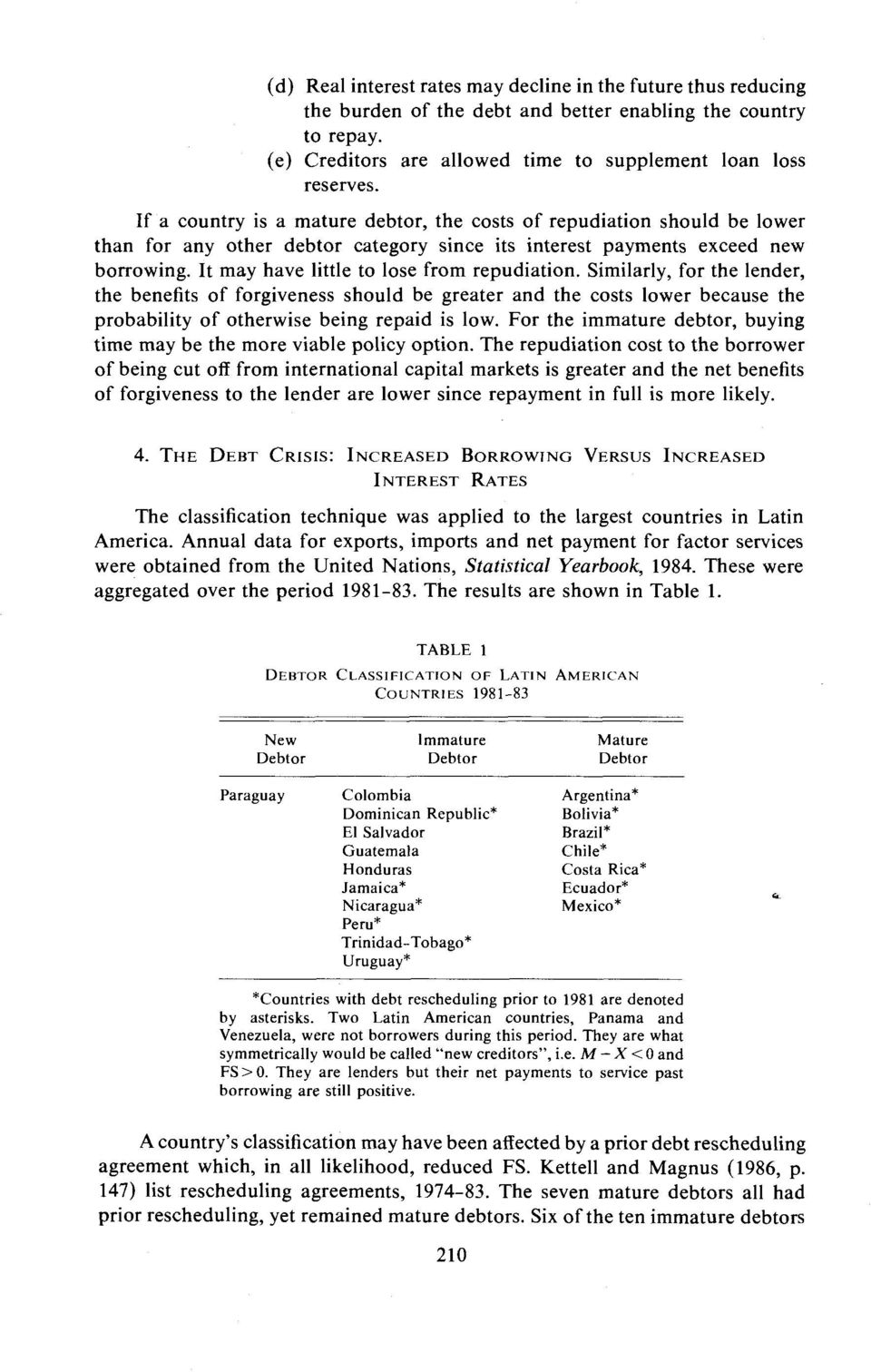
5 also had prior rescheduling agreements. They may have otherwise been mature debtors. Controversy exists as to what pushed these seven countries to the debt crisis point in Was it the rising interest rates of the early 1980s or continued, perhaps even profligate, increases in borrowing? One way of approaching this question is to separate out that portion of the change in net payments for factor services (FS) which was due to increased country borrowing from that portion which was caused by rising interest rates. Such a distinction can be relevant only to a specified time period. If during a particular period, say the interest rate increase, it is concluded that it was the rising interest rates rather than new borrowing which caused a debt crisis. It must also be the case that there was significant borrowing in previous periods, otherwise, the increase in interest rates would have had an insignificant effect. This approach abstracts from the reasons for the increased borrowing (poor economic policies or recessions in creditor or debtor countries, a fall in the terms of trade, etc.) and also from the reasons for the rising interest rates. For a survey of these reasons, see Errunza and Ghalbouni (1986) and Sachs (1985). The difficulty in separating interest rate effects from borrowing effects is in determining the appropriate average interest rate or rate of return to use since interest rates are numerous and many rates of return on equity capital are unobservable. In the empirical model, interest rate effects become functions of alternative hypothetical interest rates. The assumption is made that all debt has variable interest, and equity capital always earns the current market return. Over any time period, the change in FS is: AFS = iad+aid+aiad where FS = net payments for factor services (exclusive of employee compensation), i =interest rate or the average rate of return paid on foreign equity investments, D = country debt, AD represents new borrowing which is the current account deficit, AD = M -X. The level of debt is the capitalized value of FS, D = FS/ i. Thus, and AFS = i(m -X)+AiFS/i+Ai(M -X), i - ) A FS Ai(M-X) 1.0 = +T'- + AFS 1 AFS AFS ' The first term is the proportion of the increase in FS due to increased borrowing. The second is the proportion due to the increase in the interest rate. The third, the interaction term, is assumed to be small in value and to be part of the interest rate effect. This may lead to an overestimate of the interest rate effect and an underestimate of the borrowing effect. Define P = i(m - X)/AFS, as the fraction of the increase in FS due to the borrowing effect. Then (1 - P) is due to the increased interest rate and interaction effects. Note that the size of P depends on i. Values of the interest rate are calculated which result in a borrowing effect of 50 percent and 100 percent of the change in FS. Tables 2 and 3 show this relationship between i and P. (M - X)

6 TABLE 2 INTEREST (RATE OF RETURN) REQUIREMENTS TO MAKE NEW BORROWING EFFECT ACCOUNT FOR 50 PERCENT AND 100 PERCENT (P=0.5,1.0) OF THE INCREASE IN NET PAYMENTS FOR FACTOR SERVICES FOR THE FOUR-YEAR INTERVAL PRECEDING THE DEBT CRISIS POINT Bolivia Costa Rica Ecuador El Salvador Honduras Jamaica (1) Jamaica (2) Jamaica (3) Nicaragua Panama Peru Required Interest Rate Country Period P = 0.5 P= 1.0 and FS are calculated over four-year intervals for several Latin American countries. The interest rates which would have been required to make P= 0.50 and P = 1.0 are listed. Any other values can be interpolated. Table 2 lists the results for the four years preceding the year a country became a mature debtor (inclusive of that year). Eleven such occurrences are recorded for nine countries. For five of the eleven the increase in FS was at least 50 percent due to new borrowing rather than rising interest rates if the average interest rate (including other rates of return) was less than ten percent. On the other side, for three occurrences, P could not be equal to 0.5 even at a 35 percent interest rate. To achieve mature debtor status (the crisis point) through new borrowing exclusively (i.e. no interest rate effect), interest rates would have had to be 160 percent for Jamaica ( ) and 95 percent for Peru ( ). On the other hand, rates could have been as low as 1.0 percent for Ecuador ( ), 2.7 percent for Nicaragua ( ), and 6.1 percent for El Salvador ( ). When one looks at each country's borrowing behavior over the four-year interval preceding a debt crisis point, it is clear that Jamaica and Peru were caught by rising interest rates. On the other side, Ecuador, Nicaragua and El Salvador borrowed themselves into mature debtor status during the period. The data in table 3 details the period leading to the interest rate peak. It shows that the rise in net payments for factor services was at least 50 percent due to new borrowing for ten of the twelve countries if the average interest rate and other rates of return were less than 12.5 percent.3 For the rise in FS to be 100 percent due to borrowing, vis a vis rising interest rates, rates could have been as low as six percent for Honduras and Guatemala, but would have had to be 68 percent for Peru. Peru's rise in FS is explained by rising interest rates; Honduras' and Guatemala's rise was due to new borrowing. 3~he average LIBOR one-year rate between 1978 and 1982 was 12.8 percent.

7 TABLE 3 INTEREST (RATE OF RETURN) REQUIREMENTS TO MAKE NEW BORROWING EFFECT ACCOUNT FOR 50 PERCENT AND 100 PERCENT (P=0.5,1.0) OF THE ~NCREASE IN NET PAYMENTS FOR FACTORS SERVICES FOR THE FOUR-YEAR INTERVAL PRECEEDING THE 1982 INTEREST RATE PEAK Bolivia Chile Colombia Costa Rica El Salvador Ecuador Guatamala Honduras Mexico Panama Peru Venezuela Country P = 0.5 P=l.O This paper defines a country in a debt crises if it reaches "mature debtor" status, i.e. the interest burden on past borrowing surpasses new borrowing. For such a country both repudiation and/or forgiveness become more cost effective. For other debtor countries, "new" or "immature" debtors, buying time may be a more viable option. Responses may also be influenced by the manner in which a debtor country reached the debt crisis point. If rising interest rates explain the crisis for a particular country, a "buying time" policy may be better than forgiveness. The crisis may be cyclical or at least short-lived. However, for a country which borrowed its way into mature debtor status, partial forgiveness by lenders may be necessary in order to discourage outright repudiation. Whatever the cause and whatever the policy responses, the achievement of mature debtor status is a functional definition of "debt crisis." Bergsten, C. Fred, Cline, William R., and Williamson, John, Bank Lending to Developing Countries: The Policy Alternatives, Institute for International Economics, Washington, D.C., Cline, William R., International Debt: Systematic Risk and Policy Response, Institute for International Economics, Washington, D.C., Dornbusch, Rudiger, Policy and Performance Links Between LDC Debtors and Industrial Nations, Bookings Papers on Economic Activity, 2, , Errunza, V. R. and Ghalbouni, J. P., Interest Rates and International Debt Crisis, Banca Nazionale del Lavoro Quaterly Review 157, Kettell, Brian and Magnus, George, The International Debt Game, Graham and Trotman Ltd., London, Kindleberger, Charles P, International Economics, 3rd ed., Richard D. Irwin, Inc., Homewood, IL, Sachs, Jeffrey D. External Debt and Macroeconomic Performance in Latin America and East Asia, Brookings Papers on Economic Activity, 2, , United Nations, Statistical Yearbook, 1984, New York, 1985.

ECON 4311: The Economy of Latin America. Debt Relief. Part 1: Early Initiatives
 ECON 4311: The Economy of Latin America Debt Relief Part 1: Early Initiatives The Debt Crisis of 1982 severely hit the Latin American economies for many years to come. Balance of payments deficits and
Latin America s s Foreign Debt
 Latin America s s Foreign Debt Causes and Effects Internal Causes of the Debt Overvalued currency associated with ISI Returns on projects in future, but payments now: Debt trap Populist economic policies:
INTERNATIONAL FACTORING
 INTERNATIONAL FACTORING November 3, 2011 1 L. Gabriel Segura President and founding officer of CVCredit Inc, a Miami-based company which focuses in USA-domestic and international factoring services. Nine
The Economic Impact of a U.S. Slowdown on the Americas
 Issue Brief March 2008 Center for Economic and Policy Research 1611 Connecticut Ave, NW Suite 400 Washington, DC 20009 tel: 202-293-5380 fax:: 202-588-1356 www.cepr.net The Economic Impact of a U.S. Slowdown
Obtaining Finance in Latin America and the Caribbean 1
 Obtaining Finance in Latin America and the Caribbean 1 World Bank Group latin America and the Caribbean Series Note No. REV. 8/14 Basic Definitions Countries surveyed in and how they are grouped for analysis:
THE EFFECT OF CRIME VICTIMIZATION ON ATTITUDES TOWARDS CRIMINAL JUSTICE IN LATIN AMERICA
 THE EFFECT OF CRIME VICTIMIZATION ON ATTITUDES TOWARDS CRIMINAL JUSTICE IN LATIN AMERICA Gabriel Demombynes Draft of May 2009 ABSTRACT This paper examines the effects victimization on criminal justice
Evolution of EU exports and imports of goods with CELAC, 2004-2014 (in billion)
 100/2015-9 June 2015 EU Community of Latin American and Caribbean States (CELAC) summit CELAC represents the fifth most important trading partner of the EU More than 200 bn total trade The 28 Member States
FCPA and Anti-Corruption in Latin America
 FCPA and Anti-Corruption in Latin America May 2011 FCPA Enforcement "FCPA enforcement is stronger than it's ever been and getting stronger. We are in a new era of FCPA enforcement; and we are here to stay."
Agrimonitor: PSE Agricultural Policy Monitoring System in LAC INE/RND
 Agrimonitor: PSE Agricultural Policy Monitoring System in LAC INE/RND WHAT POLICY MONITORING IS,WHY IS IMPORTANT AND WHAT HAS ALREADY BEEN DONE IN OUR COUNTRIES? Monitor and evaluate developments in agricultural
Trends, News and Events that are Shaping the AML Arena in Latin America
 Trends, News and Events that are Shaping the AML Arena in Latin America Presented by: Octavio Betancourt- Managing Director 1 MoneyLaundering.com 15 th Annual International Anti-MoneyLaundering Conference
Avoiding Crime in Latin America and the Caribbean 1
 Avoiding Crime in Latin America and the Caribbean 1 WORLD BANK GROUP LATIN AMERICA AND THE CARIBBEAN SERIES NOTE NO. 7 REV. 8/2014 Basic Definitions Countries surveyed in 2010 and how they are grouped
Accounting Education in Latin America and the Caribbean
 REPARIS A REGIONAL PROGRAM Accounting Education in Latin America and the Caribbean Henri Fortin, Program Manager, CFRR THE ROAD TO EUROPE: PROGRAM OF ACCOUNTING REFORM AND INSTITUTIONAL STRENGTHENING (REPARIS)
Esteban Pérez Caldentey Development Studies Section Economic Commission for Latin America and the Caribbean (ECLAC)
 The Challenge of Financing Business in Latin America and the Caribbean The Future of the Financial Services Industry after the Crisis 14th Caribbean Business Executive Seminar Port-of of-spain, Trinidad
Open access policies: What can we learn from Latin America? Roxana Barrantes Instituto de Estudios Peruanos
 Open access policies: What can we learn from Latin America? Roxana Barrantes Instituto de Estudios Peruanos 8.00 GDP growth 1999 2009 (percetual variation) 6.00 4.00 2.00 0.00-2.00-4.00-6.00 1999 2000
Receivables Management Solutions
 Receivables Management Solutions Unlock trapped liquidity, reduce costs and make collections more predictable Citi Transaction Services Latin America and Mexico Citi Transaction Services Latin America
Formulas for the Current Account Balance
 Formulas for the Current Account Balance By Leigh Harkness Abstract This paper uses dynamic models to explain the current account balance in a range of situations. It starts with simple economies with
Bankruptcy law, bank liquidations and the case of Brazil. Aloisio Araujo IMPA, FGV Banco Central do Brasil May 6 th, 2013
 Bankruptcy law, bank liquidations and the case of Brazil Aloisio Araujo IMPA, FGV Banco Central do Brasil May 6 th, 2013 Description of the talk A. Corporate bankruptcy law reform in Brazil How bad is
Managing the LDC Debt Crisis
 JEFFREY SACHS Harvard University Managing the LDC Debt Crisis THE DEBT CRISIS of the developing countries is now entering its fifth year. Since August 1982, when Mexico declared its inability to service
Grupo PRISA Overview An integrated media and education company
 October, 2013 Disclaimer In addition to figures prepared in accordance with IFRS, PRISA presents non-gaap financial performance measures, e.g., EBITDA, EBITDA margin, adjusted EBITDA, adjusted EBITDA margin,
How To Tax A Holding Company
 Investing in Latin America through Spain: Planning Opportunities 11th Annual Latin American Tax Conference Miami, Florida 10-11 March 2010 Luis Carbajo, Isabel Otaola, Joaquin Kersman, Clarissa Machado,
Debt Reorganization and Related Transactions
 APPENDIX 2 Debt Reorganization and Related Transactions A. Debt Reorganization Reference: IMF and others, External Debt Statistics: Guide for Compilers and Users, Chapter 8, Debt Reorganization. A2.1 This
BRAIN DRAIN IN LATIN AMERICA*
 UN/POP/EGM-MIG/2005/10 5 February 2006 EXPERT GROUP MEETING ON INTERNATIONAL MIGRATION AND DEVELOPMENT IN LATIN AMERICA AND THE CARIBBEAN Population Division Department of Economic and Social Affairs United
Dealer. Línea Integral Autos Car Line Program. Autos (LIA): Línea Integral. The Wholesale Plan: The Retail Plan: Inventory 0 % Inventory Sales
 Automotive Sector Introduction Grupo Bancolombia is the financial partner for the Automotive Sector in Colombia and has a comprehensive portfolio designed according to your needs and those of agents that
UNIVERSITY OF NOTTINGHAM. Discussion Papers in Economics THE CURRENCY DENOMINATION OF SOVEREIGN DEBT
 UNIVERSITY OF NOTTINGHAM Discussion Papers in Economics Discussion Paper No. 06/0 THE CURRENCY DENOMINATION OF SOVEREIGN DEBT by Michael Bleaney January 006 DP 06/0 ISSN 1360-438 UNIVERSITY OF NOTTINGHAM
Health Care Expenditure and Financing in Latin America and the Caribbean [Fact sheet]
![Health Care Expenditure and Financing in Latin America and the Caribbean [Fact sheet]](/thumbs/40/20950063.jpg "Health Care Expenditure and Financing in Latin America and the Caribbean [Fact sheet]") Health Care Expenditure and Financing in Latin America and the Caribbean [Fact sheet] December 2012 Overview of Health Expenditure and Financing Current Situation and Trends In 2011, the national or total
Health Care Expenditure and Financing in Latin America and the Caribbean [Fact sheet] December 2012 Overview of Health Expenditure and Financing Current Situation and Trends In 2011, the national or total
The economics of sovereign debt restructuring: Swaps and buybacks
 The economics of sovereign debt restructuring: Swaps and buybacks Eduardo Fernandez-Arias Fernando Broner Main ideas The objective of these notes is to present a number of issues related to sovereign debt
SIGNATURES AND CURRENT STATUS OF RATIFICATIONS AMERICAN CONVENTION ON HUMAN RIGHTS "PACT OF SAN JOSE, COSTA RICA"
 SIGNATURES AND CURRENT STATUS OF RATIFICATIONS AMERICAN CONVENTION ON HUMAN RIGHTS "PACT OF SAN JOSE, COSTA RICA" (Signed at San José, Costa Rica, 22 November 1969, at the Inter-American Specialized Conference
Quarterly Report. For the three month period ended. April 30, 2015
 Quarterly Report For the three month period ended April 30, 2015 The attached unaudited interim condensed consolidated financial statements have been prepared by Management of International Datacasting
Deutsche Bank Research. The Pacific Alliance. A bright spot in Latin America May 2014. Deutsche Bank Research
 The Pacific Alliance A bright spot in Latin America May 2014 Agenda 1 2 3 What is it about? Combined strengths Challenges ahead 1 What is it about? A next generation free trade agreement Mexico Colombia
Appendix 1: Full Country Rankings
 Appendix 1: Full Country Rankings Below please find the complete rankings of all 75 markets considered in the analysis. Rankings are broken into overall rankings and subsector rankings. Overall Renewable
"Dollarisation in Emerging Market Economies" Part 2: IMPLICATIONS
 Part 2: IMPLICATIONS FISCAL IMPLICATIONS OF CURRENCY SUBSTITUTION DOLLARISATION AND FINANCIAL DEEPENING DOLLARISATION AND FINANCIAL FRAGILITY Solvency risk Liquidity risk Liquidity risk and solvency risk
Big Concepts. Balance of Payments Accounts. Financing International Trade. Economics 202 Principles Of Macroeconomics. Lecture 12
 Economics 202 Principles Of Macroeconomics Professor Yamin Ahmad Big Concepts Balance of Payments Equilibrium The relationship between the current account, capital account and official settlements balance
Latin America s Debt crisis 1980 s
 Latin America s Debt crisis 1980 s The LATAM Debt Crisis of the 80 s Why the region accumulated an unmanageable external debt? What factors precipitated the crisis? How sovereignties and international
Banking Crises, Credit, and Political Institutions
 Banking Crises, Credit, and Political Institutions Stephen Haber Stanford University Presentation at ASOBANCARIA Medellín, Colombia April 4, 2013 Caveat Lector All of the material in this presentation
SUBCOMMITTEE ON PLANNING AND PROGRAMMING OF THE EXECUTIVE COMMITTEE
 PAN AMERICAN HEALTH ORGANIZATION WORLD HEALTH ORGANIZATION SUBCOMMITTEE ON PLANNING AND PROGRAMMING OF THE EXECUTIVE COMMITTEE 31st Session, 23-24 November 1998 Provisional Agenda Item 8 SPP31/8, Rev.1
Q.nomy Case Study: Telefonica Page 1. Case Study: Telefonica, April 2008. Overview
 Case Study: Telefonica, April 2008 Overview Telefonica ended 2007 consolidating its position as one of the world s leading telecommunications operators, largely thanks to the success of its commercial
How credit analysts view and use the financial statements
 How credit analysts view and use the financial statements Introduction Traditionally it is viewed that equity investment is high risk and bond investment low risk. Bondholders look at companies for creditworthiness,
AmericasBarometer Insights: 2009(No.22) * Municipal Corruption Victimization 1
 This is the third paper (I0803, I0813) in the AmericasBarometer Insight Series to analyze the sources of corruption victimization, focusing on another question included in the 2008 round of the Latin American
U.S. Trade Overview, 2013
 U.S. Trade Overview, 213 Stephanie Han & Natalie Soroka Trade and Economic Analysis Industry and Analysis Department of Commerce International Trade Administration October 214 Trade: A Vital Part of the
The Healthcare and Health Tourism. Sector
 The Healthcare and Health Tourism Sector Introduction For Bancolombia being an ally of healthcare institutions means to accompany, advise, and offer alternatives to make your projects become a reality.
How To Understand The Relationship Between Free Trade And Meat Production In Mexico
 FREE TRADE AND MEXICO S MEAT SECTOR September 27, 2012 Contents I. Trade Agreements signed by Mexico II. Benefits of Foreign Trade III. External Challenges of Foreign Trade IV. Foreign Trade and the Mexican
Lecture 10: International banking
 Lecture 10: International banking The sessions so far have focused on banking in a domestic context. In this lecture we are going to look at the issues which arise from the internationalisation of banking,
GOVERNMENT OF SAINT LUCIA DEBT MANAGEMENT STRATEGY
 Page 1 of 5 Introduction GOVERNMENT OF SAINT LUCIA DEBT MANAGEMENT STRATEGY Debt management is the process of establishing and executing a strategy for managing the government s debt in order to raise
THE LOW INTEREST RATE ENVIRONMENT AND ITS IMPACT ON INSURANCE MARKETS. Mamiko Yokoi-Arai
 THE LOW INTEREST RATE ENVIRONMENT AND ITS IMPACT ON INSURANCE MARKETS Mamiko Yokoi-Arai Current macro economic environment is of Low interest rate Low inflation and nominal wage growth Slow growth Demographic
Education and Training
 Education and Training Education The William J. Harrington Medical Training Programs for Latin America and the Caribbean 1967 August 2011 Total 3939 Residency Program for Internal Medicine 397 Elective
SunGard Capital Corp. SunGard Capital Corp. II SunGard Data Systems Inc.
 United States Securities and Exchange Commission Washington, D.C. 20549 FORM 10-Q (Mark One) Quarterly report pursuant to section 13 or 15(d) of the Securities Exchange Act of 1934 For the quarterly period
research brief A Profile of the Middle Class in Latin American Countries 2001 2011 by Leopoldo Tornarolli
 research brief The International Policy Centre for Inclusive Growth is jointly supported by the United Nations Development Programme and the Government of Brazil. August/2014no. 47 A Profile of the Middle
University of Twente Business Travel Reimbursement Scheme
 University of Twente Business Travel Reimbursement Scheme Kenmerk: 401.829/HR Datum: 11-03-2014 Auteur: Miessen Index ARTICLE 1 DEFINITIONS... 2 ARTICLE 2 APPLICABILITY... 2 ARTICLE 3 GENERAL PROVISIONS...
Lecture17 Debt overhang, debt relief and poverty reduction in low-income countries
 Master PPD M1 2008 / 2009 Lecture17 Debt overhang, debt relief and poverty reduction in low-income countries Marc Raffinot. LEDa Université Paris Dauphine Outline of the lecture Some facts, with a focus
American Funds Insurance Series. New World Fund. Summary prospectus Class 2 shares May 1, 2015
 American Funds Insurance Series New World Fund Summary prospectus Class 2 shares May 1, 2015 Before you invest, you may want to review the fund s prospectus and statement of additional information, which
FINANCING EXPORTS. Sandro Murtas Small Business Administration Office of International Trade Regional Manager [email protected] Tel: 504-756-5353
 FINANCING EXPORTS Sandro Murtas Small Business Administration Office of International Trade Regional Manager [email protected] Tel: 504-756-5353 Separating Myths from Facts Myth Small Businesses Don
Is Cancellation of Debt Income Taxable? One question that I am asked often these days is whether cancellation of debt (COD) income is taxable or not?
 Is Cancellation of Debt Income Taxable? One question that I am asked often these days is whether cancellation of debt (COD) income is taxable or not? For tax purposes, the general rule is that all debt
Developing Credit Reporting in Africa: Opportunities and Challenges
 African Finance for the 21 st Century High-Level Seminar organized by the IMF Institute in collaboration with the Joint Africa Institute Tunis, Tunisia, March 4 5, 2008 Session VI: Designing Context-Specific
Practice Problems on Current Account
 Practice Problems on Current Account 1- List de categories of credit items and debit items that appear in a country s current account. What is the current account balance? What is the relationship between
Energy Briefing: Global Crude Oil Demand & Supply
 Energy Briefing: Global Crude Oil Demand & Supply November 6, 215 Dr. Edward Yardeni 516-972-7683 eyardeni@ Debbie Johnson 48-664-1333 djohnson@ Please visit our sites at www. blog. thinking outside the
How To Understand The Relationship Between A Country And The Rest Of The World
 Lecture 1: current account - measurement and theory What is international finance (as opposed to international trade)? International trade: microeconomic approach (many goods and factors). How cross country
performance of a company?
 How to deal with questions on assessing the performance of a company? (Relevant to ATE Paper 7 Advanced Accounting) Dr. M H Ho This article provides guidance for candidates in dealing with examination
MULTIPLE CHOICE. Choose the one alternative that best completes the statement or answers the question.
 ECON 4110: Sample Exam Name MULTIPLE CHOICE. Choose the one alternative that best completes the statement or answers the question. 1) Economists define risk as A) the difference between the return on common
CALCULATOR TUTORIAL. Because most students that use Understanding Healthcare Financial Management will be conducting time
 CALCULATOR TUTORIAL INTRODUCTION Because most students that use Understanding Healthcare Financial Management will be conducting time value analyses on spreadsheets, most of the text discussion focuses
Colombia: sustaining reforms over time
 26 Colombia: sustaining reforms over time Colombia s experience shows the importance of sustaining reform efforts over time and adjusting them to the changing needs of the economy, whether at the national
4. The minimum amount of owners' equity in a bank mandated by regulators is called a requirement. A) reserve B) margin C) liquidity D) capital
 Chapter 4 - Sample Questions 1. Quantitative easing is most closely akin to: A) discount lending. B) open-market operations. C) fractional-reserve banking. D) capital requirements. 2. Money market mutual
Managing Systemic Banking Crises. David S. Hoelscher Assistant Director Money and Credit Markets Department
 Managing Systemic Banking Crises David S. Hoelscher Assistant Director Money and Credit Markets Department 2 Introduction Systemic banking crises of unprecedented scale: Argentina, East Asia, Ecuador,
Econ 202 Section 2 Final Exam
 Douglas, Fall 2009 December 17, 2009 A: Special Code 0000 PLEDGE: I have neither given nor received unauthorized help on this exam. SIGNED: PRINT NAME: Econ 202 Section 2 Final Exam 1. The present value
Insolvency and. Business Recovery. Procedures. A Brief Guide. Compiled by Compass Financial Recovery and Insolvency Ltd
 Insolvency and Business Recovery Procedures A Brief Guide Compiled by Compass Financial Recovery and Insolvency Ltd I What is Insolvency? Insolvency is legally defined as: A company is insolvent (unable
Reading the balance of payments accounts
 Reading the balance of payments accounts The balance of payments refers to both: All the various payments between a country and the rest of the world The particular system of accounting we use to keep
Preventing through education
 Ministerial Declaration Preventing through education The Ministerial Declaration Preventing through Education, was approved in Mexico City in the framework of the 1st Meeting of Ministers of Health and
Simple Interest. and Simple Discount
 CHAPTER 1 Simple Interest and Simple Discount Learning Objectives Money is invested or borrowed in thousands of transactions every day. When an investment is cashed in or when borrowed money is repaid,
Preparing Tomorrow's Teachers with Web 2.0 Tools and 21st Century Skills 1
 Professional Development Scholarship Program Preparing Tomorrow's Teachers with Web 2.0 Tools and 21st Century Skills 1 OAS/DHDEC/CIR.031/2012 1) Study venue: The course will be delivered entirely online
VENTURE CAPITAL: DRIVING DEVELOPMENT IN LATIN AMERICA
 VENTURE CAPITAL: DRIVING DEVELOPMENT IN LATIN AMERICA Multilateral Investment Fund Member of the IDB Group SUMMARY Venture Capital (VC) in Latin America is still in its inception but has enormous potential.
FINANCE for the POOR Equipment Leasing and Lending: A Guide for Microfinance 1
 FINANCE for the POOR Equipment Leasing and Lending: A Guide for Microfinance 1 GLENN D. WESTLEY Senior Advisor, Micro, Small and Medium Enterprise Division Inter-American Development Bank As microfinance
The remainder of this handbook is divided into the following sections: Getting Started (p. 2); Beginner Mode (pp. 3 5); Expert Mode (pp. 5 11).
 User Guide to LAPOP s System for Online Data Analysis (v1) The following guide is designed to help users navigate through and use LAPOP s System for Online Data Analysis (SODA). The system allows individuals
THE IMF AND ITS CRITICS. Anna J. SCHWARTZ National Bureau of Economic Research
 THE IMF AND ITS CRITICS Anna J. SCHWARTZ National Bureau of Economic Research How the future role of the IMF should be modified has been the subject of a slew of recent reports. I discuss the main criticisms,
Access to Financial Services in Developing Countries: Identification of Obstacles. Liliana Rojas-Suárez July 2006
 Access to Financial Services in Developing Countries: Identification of Obstacles Liliana Rojas-Suárez July 2006 Background Even though banks are the most important providers of financial services Evolution
Precondition for Rehabilitation An international perspective
 Precondition for Rehabilitation An international perspective PricewaterhouseCoopers Corporate Life Cycle Growth Maturity Loss Profit Start-up Decline Transformation Time Turnaround Insolvency 3 Causes
External Debt and Growth
 External Debt and Growth Catherine Pattillo, Hélène Poirson and Luca Ricci Reasonable levels of external debt that help finance productive investment may be expected to enhance growth, but beyond certain
18th Year of Publication. A monthly publication from South Indian Bank. www.sib.co.in
 To kindle interest in economic affairs... To empower the student community... Open YAccess www.sib.co.in [email protected] A monthly publication from South Indian Bank 18th Year of Publication SIB STUDENTS
352 UNHCR Global Report 2010
 352 UNHCR Global Report 2010 Argentina Bolivia (Plurinational State of) Brazil Chile Colombia Costa Rica Cuba Ecuador El Salvador Guatemala Honduras Mexico Nicaragua Panama Paraguay Peru Uruguay Venezuela
Managing the Current Account Balance
 Managing the Current Account Balance Abstract By Leigh Harkness This paper follows on from my paper on the Formulas for the Current Account Balance to show how the application of the Demand and Supply
Commentary: What Do Budget Deficits Do?
 Commentary: What Do Budget Deficits Do? Allan H. Meltzer The title of Ball and Mankiw s paper asks: What Do Budget Deficits Do? One answer to that question is a restatement on the pure theory of debt-financed
Chapter 6 Interest rates and Bond Valuation. 2012 Pearson Prentice Hall. All rights reserved. 4-1
 Chapter 6 Interest rates and Bond Valuation 2012 Pearson Prentice Hall. All rights reserved. 4-1 Interest Rates and Required Returns: Interest Rate Fundamentals The interest rate is usually applied to