
Legal Studies. Stage 6. Syllabus
|
|
|
- Marcia Potter
- 10 years ago
- Views:
Transcription
1 Legal Studies Stage 6 Syllabus 2009

2 2009 Copyright Board of Studies NSW for and on behalf of the Crown in right of the State of New South Wales. This document contains Material prepared by the Board of Studies NSW for and on behalf of the State of New South Wales. The Material is protected by Crown copyright. All rights reserved. No part of the Material may be reproduced in Australia or in any other country by any process, electronic or otherwise, in any material form or transmitted to any other person or stored electronically in any form without the prior written permission of the Board of Studies NSW, except as permitted by the Copyright Act School students in NSW and teachers in schools in NSW may copy reasonable portions of the material for the purposes of bona fide research or study. When you access the Material you agree: to use the Material for information purposes only; to reproduce a single copy for personal bona fide study use only and not to reproduce any major extract or the entire Material without the prior permission of the Board of Studies NSW; to acknowledge that the Material is provided by the Board of Studies NSW; not to make any charge for providing the Material or any part of the Material to another person or in any way make commercial use of the material without the prior written consent of the Board of Studies NSW and payment of the appropriate copyright fee; to include this copyright notice in any copy made; not to modify the Material or any part of the Material without the express prior written permission of the Board of Studies NSW. The Material may contain third-party copyright materials such as photos, diagrams, quotations, cartoons and artworks. These materials are protected by Australian and international copyright laws and may not be reproduced or transmitted in any format without the copyright owner s specific permission. Unauthorised reproduction, transmission or commercial use of such copyright materials may result in prosecution. The Board of Studies has made all reasonable attempts to locate owners of third-party copyright material and invites anyone from whom permission has not been sought to contact the Copyright Officer, ph (02) , fax (02) Published by Board of Studies NSW GPO Box 5300 Sydney 2001 Australia Tel: (02) Fax: (02) ISBN

3 Contents 1 Background...4 The Higher School Certificate program of study...4 Legal Studies in the K 12 continuum Rationale Employability skills statement Aim Objectives Objectives and outcomes The structure of Legal Studies Content: Preliminary course...10 Part I: The legal system...10 Part II: The individual and the law...13 Part III: Law in practice Content HSC course...17 Part I of the core Crime...17 Part II of the core: Human rights...20 Part III: Options...22 Option 1: Consumers...22 Option 2 : Global environmental protection...24 Option 3: Family...26 Option 4 : Indigenous peoples...28 Option 5: Shelter...30 Option 6: Workplace...32 Option 7: World order Assessment and reporting...36 Requirements and advice...36 Internal assessment...37 External examination...37 Board requirements for the internal assessment mark...37 Assessment components and weightings...39 HSC external examination specifications...40 Summary of external and internal HSC assessment...41 Reporting student performance against standards...41 Post-school opportunities...41

4 1 Background The Higher School Certificate program of study The purpose of the Higher School Certificate program of study is to: provide a curriculum structure which encourages students to complete secondary education foster the intellectual, social and moral development of students, in particular developing their: knowledge, skills, understanding, values and attitudes in the fields of study they choose capacity to manage their own learning desire to continue learning in formal or informal settings after school capacity to work together with others respect for cultural diversity in Australian society provide a flexible structure within which students can prepare for: further education and training employment full and active participation as citizens provide formal assessment and certification of students achievements provide a context within which schools have the opportunity to foster students physical and spiritual development. 4

5 Legal Studies in the K 12 continuum Human Society and Its Environment K 6 Geography Other HSIE Subjects History Stages Stages 4 5 Legal Studies Stage 6 Work/University/TAFE/Others Legal Studies forms part of the Human Society and Its Environment continuum of study from Kindergarten to Year 12. It complements other Stage 6 subjects in the area. 5

6 2 Rationale There is a lot of loose talk in Australia about democracy, the rule of law and basic rights. Yet unless we educate future citizens concerning the broad outline of our laws, they may grow up feeling that law is alien to their experience. I want them to grow up insisting that the law must be just and modern and accepting the citizen s responsibility to ensure that this is so. Michael Kirby AC CMG Former Justice of the High Court of Australia Our society is regulated by a complex set of rules and regulations which both guide and protect individual and community rights. Being well informed about legal issues, including the rights and responsibilities integral to our society, is part of being an active and informed citizen. Students of Legal Studies Stage 6 will develop an understanding of legal concepts and the way the law functions in our society. The syllabus focuses on the way in which law is generated, how it is structured and how it operates in Australian and international contexts. Learning about our legal system will allow students to investigate the way our society operates and the influences that shape it. Students will develop an understanding of the implications that legal decisions can have for Australian society and the ways in which the legal system can affect the lives of Australian citizens. A critical understanding of the processes of reform and change will help students to contribute to making our society more equitable for all. The Legal Studies Stage 6 course offers excellent preparation for life through a study of the legal system, its principles, structures, institutions and processes. The course fosters respect for cultural diversity. It allows students to question and evaluate legal institutional structures in the domestic and international environments and to undertake a comparative analysis of other political and institutional structures. Legal Studies enables students to have confidence in approaching and accessing the legal system and provides them with a better appreciation of the relationship between social and legal structures. The course will assist in the development of students knowledge of their basic legal rights and responsibilities in a broad selection of contexts which appeal to their interests. Legal Studies is situated in the key learning area (KLA) of Human Society and Its Environment (HSIE). The skills developed in the HSIE KLA empower students to become critical learners and thinkers. The Legal Studies Stage 6 course also provides learning that prepares students for further education and training, employment and full and active participation as citizens in Australia and in the global society. Students gain the skills of critical analysis, independent research, collaboration, and effective communication. 6

7 3 Employability skills statement Legal Studies provides a context for the development of higher-order thinking skills necessary for further education, work and everyday life, and a range of other employability skills. Employability skills are embedded in the Legal Studies syllabus to enhance student learning. The employability skills of planning and organising, learning and communication are explicit in the objectives, outcomes and content of the Preliminary and HSC courses. The development of these skills results from the nature of Legal Studies and the investigation and analysis of legal issues. The employability skill of self-management is explicit in the outcomes for the HSC course. Students will also work towards other employability skills throughout the Legal Studies Stage 6 course. During investigations they will need to use appropriate information technologies and so develop the appropriate employability skills in technology. The Law in Practice unit in the Preliminary course supports students to demonstrate initiative and enterprise as they investigate areas of the law in which they have an interest. Finally, as students investigate and propose solutions to legal problems, they develop problem-solving skills. 4 Aim Legal Studies develops students knowledge, understanding and critical thinking skills in relation to the legal system and its effectiveness in promoting a just and fair society, with a view to empowering students to participate effectively as responsible citizens at the local, national and international level. 5 Objectives Through Legal Studies, students will develop: knowledge and understanding about: the nature and institutions of domestic and international law the operation of Australian and international legal systems and the significance of the rule of law the interrelationship between law, justice and society and the changing nature of the law skills in: investigating, analysing and communicating relevant legal information and issues interest in, and informed and responsible values and attitudes in regard to: legal functions, practices and institutions. 7

8 5.1 Objectives and outcomes Objectives Preliminary course outcomes HSC course outcomes A student develops knowledge and understanding about: 1. the nature and institutions of domestic and international law 2. the operation of Australian and international legal systems and the significance of the rule of law A student: P1. identifies and applies legal concepts and terminology P2. describes the key features of Australian and international law P3. describes the operation of domestic and international legal systems P4. discusses the effectiveness of the legal system in addressing issues A student: H1. identifies and applies legal concepts and terminology H2. describes and explains key features of and the relationship between Australian and international law H3. analyses the operation of domestic and international legal systems H4. evaluates the effectiveness of the legal system in addressing issues 3. the interrelationship P5. describes the role of law in H5. explains the role of law in between law, justice and encouraging cooperation and encouraging cooperation and society and the changing resolving conflict, as well as resolving conflict, as well as nature of the law. initiating and responding to change initiating and responding to change A student develops skills in: 4. investigating, analysing and communicating relevant legal information and issues. P6. explains the nature of the interrelationship between the legal system and society P7. evaluates the effectiveness of the law in achieving justice P8. locates, selects and organises legal information from a variety of sources including legislation, cases, media, international instruments and documents P9. communicates legal information using wellstructured responses P10. accounts for differing perspectives and interpretations of legal information and issues H6. assesses the nature of the interrelationship between the legal system and society H7. evaluates the effectiveness of the law in achieving justice H8. locates, selects, organises, synthesises and analyses legal information from a variety of sources including legislation, cases, media, international instruments and documents H9. communicates legal information using well-structured and logical arguments H10. analyses differing perspectives and interpretations of legal information and issues. Outcomes are applicable to all topics. Some may be more relevant to a particular topic than others. Outcomes may be examined. 8

9 6 The structure of Legal Studies Preliminary HSC Core Part I: The legal system Core Part I: Crime Basic legal concepts The nature of crime Core 40% Sources of contemporary Australian law Classification of law Law reform Law reform in action The criminal investigation process The criminal trial process Sentencing and punishment Young offenders International crime Core 30% Core Part II: The individual and the law Core Part II: Human rights Core 30% Your rights and responsibilities Resolving disputes The nature and development of human rights Promoting and enforcing human rights Core 20% Contemporary issue: the individual and technology Contemporary issue Core Part III: Law in practice Part III: Options Core 30% The Law in practice unit is designed to provide opportunities for students to deepen their understanding of the principles of law covered in the first sections of the course. This section may be integrated with Part I and/or Part II. Choose Two Consumers Global environmental protection Family Indigenous peoples Option 25% each Shelter Workplace World order Please note: Outcomes are applicable to all topics. Some may be more relevant to a particular topic than others. Outcomes may be examined. The principal focus for each topic may be examined. Each topic s themes and challenges should be integrated into the study of the topic, and they may be examined. 9

10 7 Content: Preliminary course Part I: The legal system 40% of course time Principal focus: Students develop an understanding of the nature and functions of law through the examination of the law-making processes and institutions. Themes and challenges to be incorporated throughout this topic: the need for law in the operation of society the importance of the rule of law for society the relationship between different legal institutions and jurisdictions the development of law as a reflection of society influences on the Australian legal system. Students learn about: Students learn to: 1. Basic legal concepts meaning of law customs, rules and law values and ethics characteristics of just laws nature of justice: equality fairness access procedural fairness (principles of natural justice) rule of law anarchy tyranny define law distinguish between customs, rules, laws, values and ethics describe the characteristics of just laws and the nature of justice define and investigate procedural fairness and the rule of law define anarchy and tyranny 2. Sources of contemporary Australian law common law British origins, including: development of common law equity, precedent adversarial system of trial court hierarchy: jurisdiction of state and federal courts statute law role and structure of parliament legislative process delegated legislation outline the origin of common law examine the hierarchy and jurisdiction of state and federal courts outline the role and structure of parliament and the legislative process describe the function of delegated legislation 10

11 the constitution division of powers separation of powers role of the High Court Aboriginal and Torres Strait Islander Peoples customary laws diverse nature of customary laws spiritual basis, significance of land and water family and kinship ritual and oral traditions mediation and sanctions relevance to contemporary Australian law international law differences between domestic and international law state sovereignty sources, including: international customary law instruments (declarations and treaties) legal decisions, writings role of: United Nations courts and tribunals intergovernmental organisations non-government organisations relevance to contemporary Australian law explain the difference between division and separation of powers examine the role of the High Court in the interpretation of the constitution examine the characteristics of Aboriginal and Torres Strait Islander Peoples customary laws outline the extent to which Aboriginal and Torres Strait Islander Peoples customary laws have been integrated into Australian law distinguish between domestic and international law and examine the impact of state sovereignty examine the sources of international law describe the role of the various organisations involved in international law examine how international law impacts on and is incorporated into Australian law 3. Classification of law public law criminal law administrative law constitutional law outline different types of law compare the purpose of different types of law private law (civil law) contract law tort law property law criminal and civil court procedures including legal personnel common and civil law systems It is strongly recommended that if possible students should have the opportunity to observe the operation of one or more courts or tribunals in civil and criminal cases. distinguish between civil and criminal court procedures identify the role of legal personnel involved in the court process compare and contrast common and civil law systems 11

12 4. Law reform conditions that give rise to law reform including: changing social values, new concepts of justice, new technology agencies of reform including law reform commissions, parliamentary committees, the media, non-government organisations mechanisms of reform including courts, parliaments, United Nations intergovernmental organizations examine the conditions that give rise to law reform describe the role of agencies involved in law reform examine the operation of the different mechanisms of reform 5. Law reform in action Two examples of law reform must be studied. Law reform in relation to native title is mandatory. Another example may be taken from list B or may be a topic of the student s choice. A) native title terra nullius the roles of the High Court and federal parliament major native title decisions legislation explain why terra nullius was an obstacle to achieving native title examine the roles of the High Court and federal parliament in recognising native title examine major Australian native title decisions assess the effectiveness of the law reform process in achieving just outcomes in regard to native title B) a contemporary law reform issue (examples of topics that may be studied): young drivers and the law sport and the law animal welfare drug use and the law. identify and investigate a contemporary law reform issue examine the conditions that give rise to the need for law reform, the agencies of reform and mechanisms of reform assess the effectiveness of law reform in achieving just outcomes with regard to a contemporary law reform issue. 12

13 Part II: The individual and the law 30% of course time Principal focus: Students investigate the way in which the law impacts on individuals by referring to legal and non-legal institutions, laws and media reports. Themes and challenges to be incorporated throughout this topic: relationship between justice, law and society relationship between rights and responsibilities balancing the rights of individuals with the needs of the state role of the law in regulating technology effectiveness of legal mechanisms for achieving justice for individuals and society. Students learn about: Students learn to: 1. Your rights and responsibilities the nature of individual rights identify the types of rights to which relationship between rights and individuals are entitled responsibilities outline the responsibilities of citizens within a society explain the interrelationship between rights and responsibilities 2. Resolving disputes the roles of the federal and state police and outline the roles of law enforcement other law enforcement agencies agencies resolving disputes between individuals: identify and examine methods of resolving alternative dispute resolution disputes between individuals tribunals courts compare and contrast disputes between individuals and those between individuals resolving disputes with the state: and the state non-legal methods: - media assess the effectiveness of methods of - members of parliament resolving disputes - trade unions - interest groups, including non- distinguish between non-legal and legal government organisations methods of enforcing rights and resolving legal methods: disputes - internal review - external review: administrative, assess the effectiveness of dispute judicial, ombudsman, statutory resolution processes in achieving justice for bodies including Australian Human and between individuals Rights Commission, Independent Commission against Corruption (ICAC), Royal Commissions 13

14 3. Contemporary issue: The individual and technology explain the difficulties with enforcing rights impacts of technology on the individual legal implications difficulties with enforcing rights assess the role of law reform in addressing future directions the role of law reform emerging technological issues and enforcing rights Examples that may be studied could include: discuss the legal implications of the use of misuse of interactive technologies technology and its impact on the individual. cyber-bullying genetic profiling cyberspace privacy issues security and surveillance mobile phones copyright. 14

15 Part III: Law in practice 30% of course time Principal focus: students investigate contemporary issues that illustrate how the law operates in practice. Themes and challenges to be incorporated throughout this topic: the relationship between justice, law and society the development and reform of law as a reflection of society the importance of the rule of law the responsiveness of the legal system in dealing with issues the effectiveness of legal and non-legal mechanisms in achieving justice for individuals and society. The Law in practice unit can be integrated with Part I and/or Part II of the Preliminary course, or treated as a separate unit. The Law in Practice unit is designed to provide opportunities for students to deepen their understanding of the principles of law covered in Part I and Part II of the Preliminary course. Students will develop the research, analytical and communication skills that underpin the process of investigation. At least TWO contemporary issues should be studied. Students should synthesise information from a range of sources, including cases, legislation, the media and international instruments, to support a legal argument. Topics should extend particular areas of individual or group interests. 15

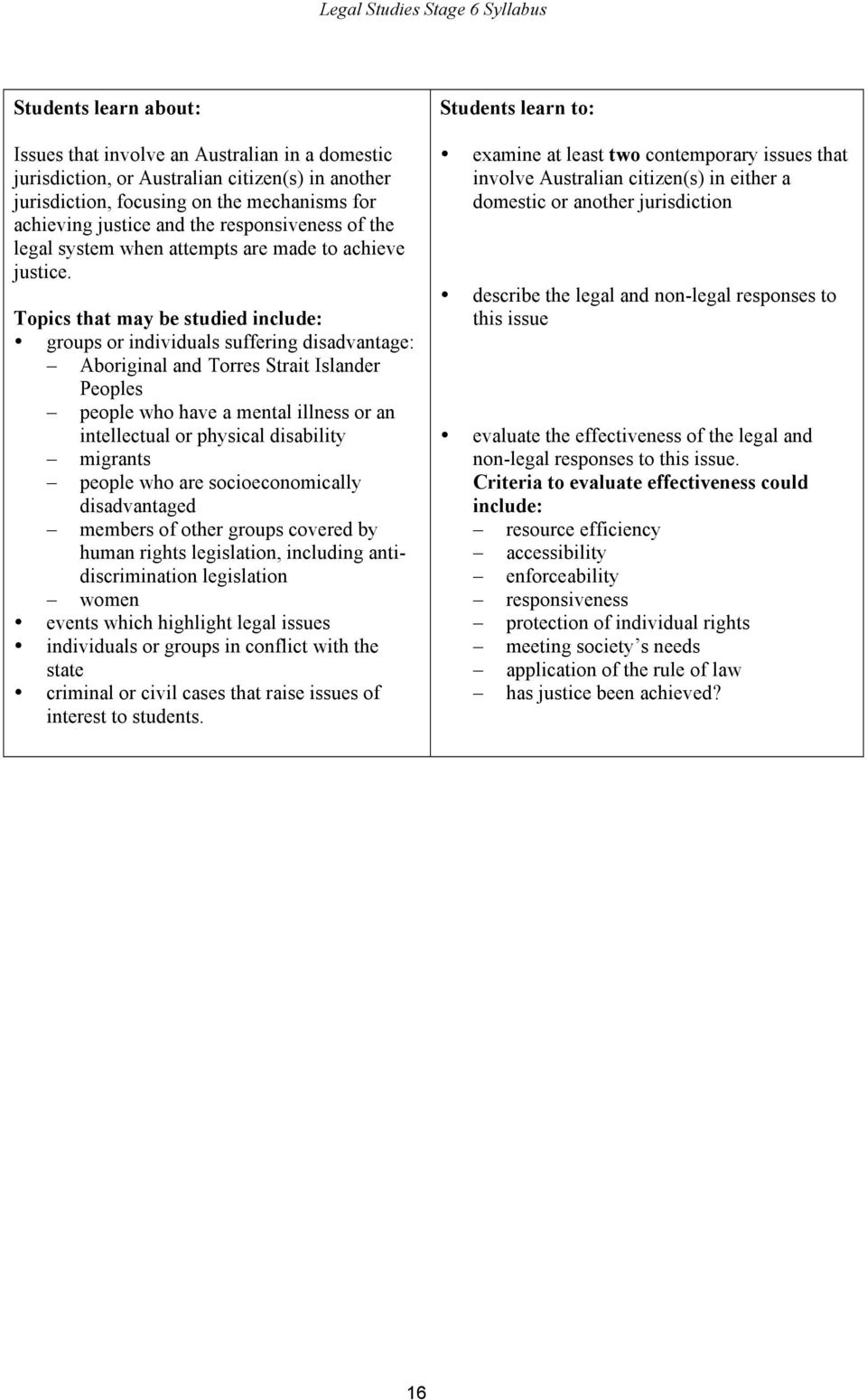
16 Students learn about: Issues that involve an Australian in a domestic jurisdiction, or Australian citizen(s) in another jurisdiction, focusing on the mechanisms for achieving justice and the responsiveness of the legal system when attempts are made to achieve justice. Topics that may be studied include: groups or individuals suffering disadvantage: Aboriginal and Torres Strait Islander Peoples people who have a mental illness or an intellectual or physical disability migrants people who are socioeconomically disadvantaged members of other groups covered by human rights legislation, including antidiscrimination legislation women events which highlight legal issues individuals or groups in conflict with the state criminal or civil cases that raise issues of interest to students. Students learn to: examine at least two contemporary issues that involve Australian citizen(s) in either a domestic or another jurisdiction describe the legal and non-legal responses to this issue evaluate the effectiveness of the legal and non-legal responses to this issue. Criteria to evaluate effectiveness could include: resource efficiency accessibility enforceability responsiveness protection of individual rights meeting society s needs application of the rule of law has justice been achieved? 16
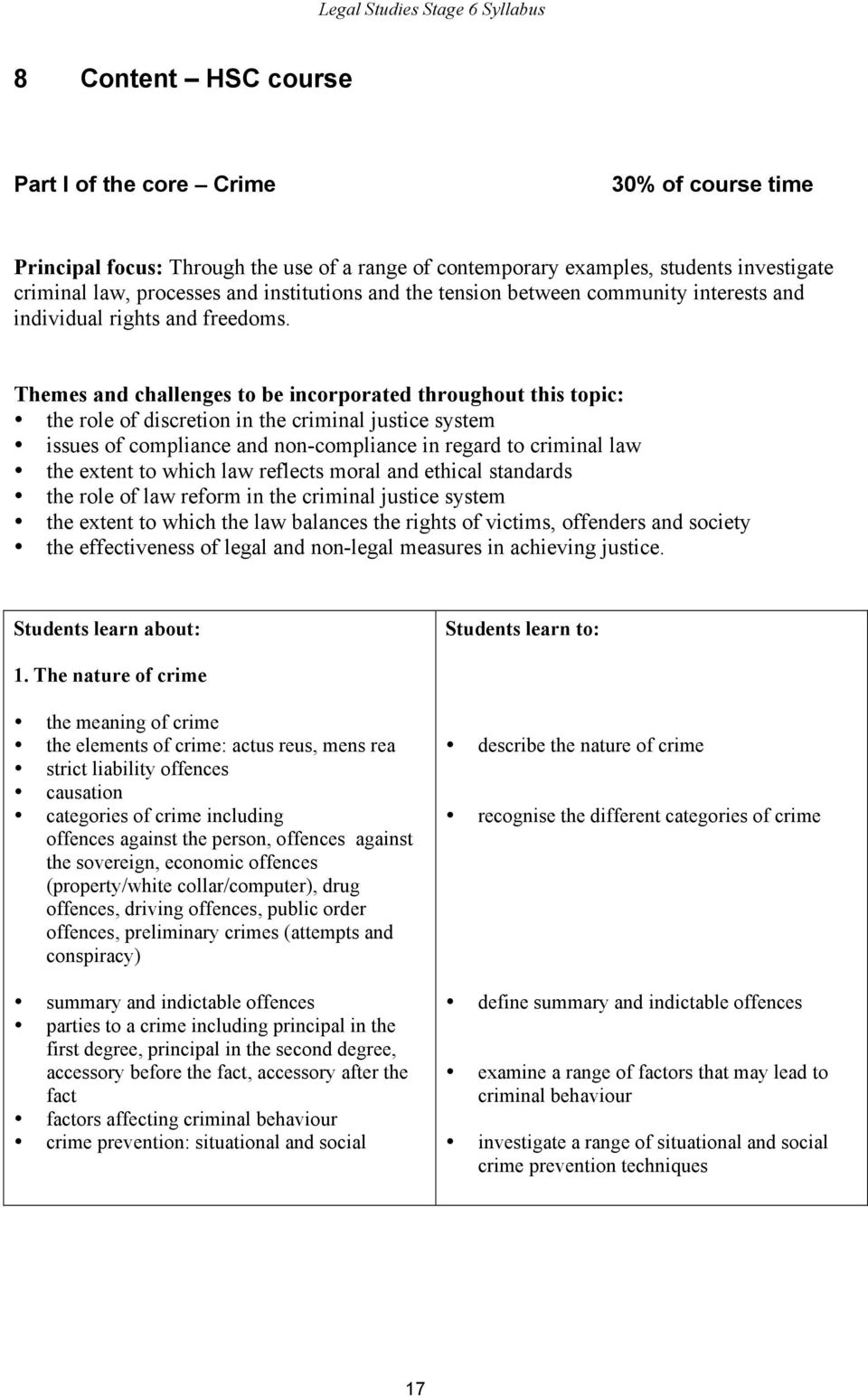
17 8 Content HSC course Part I of the core Crime 30% of course time Principal focus: Through the use of a range of contemporary examples, students investigate criminal law, processes and institutions and the tension between community interests and individual rights and freedoms. Themes and challenges to be incorporated throughout this topic: the role of discretion in the criminal justice system issues of compliance and non-compliance in regard to criminal law the extent to which law reflects moral and ethical standards the role of law reform in the criminal justice system the extent to which the law balances the rights of victims, offenders and society the effectiveness of legal and non-legal measures in achieving justice. Students learn about: Students learn to: 1. The nature of crime the meaning of crime the elements of crime: actus reus, mens rea describe the nature of crime strict liability offences causation categories of crime including recognise the different categories of crime offences against the person, offences against the sovereign, economic offences (property/white collar/computer), drug offences, driving offences, public order offences, preliminary crimes (attempts and conspiracy) summary and indictable offences define summary and indictable offences parties to a crime including principal in the first degree, principal in the second degree, accessory before the fact, accessory after the examine a range of factors that may lead to fact criminal behaviour factors affecting criminal behaviour crime prevention: situational and social investigate a range of situational and social crime prevention techniques 17
18 2. The criminal investigation process police powers discuss the powers of police in the criminal reporting crime process investigating crime: gathering evidence, use examine the reporting and investigating of of technology, search and seizure, use of crime warrants arrest and charge, summons, warrants assess the effectiveness of the criminal bail or remand investigation process as a means of achieving detention and interrogation, rights of suspects justice 3. Criminal trial process court jurisdiction describe the role of courts in the criminal the adversary system justice process legal personnel: magistrate, judge, police discuss the use of the adversary system as a prosecutor, Director of Public Prosecution, means of achieving justice Public Defenders pleas, charge negotiation examine the role of legal representation in the legal representation, including legal aid criminal trial burden and standard of proof use of evidence, including witnesses assess the use of defences to criminal charges defences to criminal charges: in achieving justice complete defences partial defences to murder evaluate the effectiveness of the jury system the role of juries, including verdicts in the criminal trial assess the effectiveness of the criminal trial process as a means of achieving justice 4. Sentencing and punishment statutory and judicial guidelines the purposes of punishment: deterrence (specific and general), retribution, rehabilitation, incapacitation factors affecting a sentencing decision: discuss factors that affect sentencing aggravating and mitigating circumstances decisions, including the purposes of the role of the victim in sentencing punishment and the role of the victim appeals types of penalties including: no conviction evaluate the effectiveness of different types of recorded, caution, fine, bond, suspended penalties, including diversionary programs sentence, probation, criminal infringement notice, penalty units, community service order, home detention, periodic detention, forfeiture of assets, imprisonment, diversionary programs alternative methods of sentencing including assess the roles of alternative methods of circle sentencing, restorative justice sentencing 18

19 post-sentencing considerations, including examine the implications of post-sentencing security classification, protective custody, considerations in achieving justice parole, preventative detention, continued detention, sexual offenders registration, evaluate the effectiveness of sentencing and deportation punishment as a means of achieving justice 5. Young offenders age of criminal responsibility discuss the issues surrounding the age of the rights of children when questioned or criminal responsibility arrested explain why young offenders are treated Children s Court procedures and operation differently in the criminal justice system penalties for children alternatives to court assess the effectiveness of the criminal justice system when dealing with young offenders 6. International crime categories of international crime, including: define international crime crimes against the international community describe the various measures used to deal transnational crimes with international crime dealing with international crime: domestic and international measures evaluate the effectiveness of the domestic and limitations. international legal systems in dealing with international crime. 19

20 Part II of the core: Human rights 20% of course time Principal focus: Through the use of a range of contemporary examples, students investigate the notion of human rights and assess the extent to which legal systems embody such human rights and promote them in practice. Themes and challenges to be incorporated throughout this topic: the changing understanding of the relationship between state sovereignty and human rights issues of compliance and non-compliance in relation to human rights the development of human rights as a reflection of changing values and ethical standards the role of law reform in protecting human rights the effectiveness of legal and non-legal measures in protecting human rights. Students learn about: Students learn to: 1. The nature and development of human rights the definition of human rights define human rights developing recognition of human rights the abolition of slavery outline how human rights have changed and trade unionism and labour rights developed over time universal suffrage universal education investigate the evolving recognition and self-determination importance of universal human rights environmental rights peace rights formal statements of human rights examine major human rights documents and Universal Declaration of Human Rights explain their contribution to the International Covenant on Civil and Political development of human rights Rights International Covenant on Economic, Social and Cultural Rights 2. Promoting and enforcing human rights In the international community: assess the role of state sovereignty in state sovereignty promoting and enforcing human rights the roles of : the United Nations evaluate the effectiveness of international intergovernmental organisations responses in promoting and enforcing courts, tribunals and independent human rights statutory authorities non-government organisations the media 20

21 In Australia: the incorporation of human rights into domestic law the roles of: the Constitution, including division of powers and separation of powers statute law common law courts and tribunals non-government organisations the media a Charter of Rights (arguments for and against) outline how human rights are incorporated into Australian domestic law evaluate the effectiveness of Australian responses in promoting and enforcing human rights discuss the arguments for and against a Charter of Rights for Australia 3. Investigate a contemporary issue which illustrates the promotion and/or enforcement of human rights. Issues could include: genocide treatment of refugees asylum seekers child soldiers abuse of children torture capital punishment arbitrary detention religious discrimination discrimination against women exploitation of workers human trafficking and slavery limitations on free speech. investigate a contemporary human rights issue and evaluate the effectiveness of legal and non-legal responses to the issue. 21
22 Part III: Options Students must study TWO of the following Options. Option 1: Consumers 25% of course time Principal focus: Through the use of contemporary examples, students investigate the legal rights of consumers and the effectiveness of the law in achieving justice for consumers. Themes and challenges to be incorporated throughout this topic: the role of the law in encouraging cooperation and resolving conflict in regard to consumers issues of compliance and non-compliance laws relating to consumers as a reflection of changing values and ethical standards the role of law reform in recognising the rights of consumers the effectiveness of legal and non-legal responses in achieving justice for consumers. Students learn about: Students learn to: 1. The nature of consumer law outline the developing need for consumer the developing need for consumer protection protection the definition of consumer objectives of consumer laws outline the objectives of consumer law contracts types, elements, terms, exclusion clauses examine the nature, function and regulation standards implied by statutes of contracts unjust contracts common law and statutory protection the role of negligence in consumer protection evaluate the effectiveness of the regulation regulation of marketing and advertising: of marketing, advertising and product statutory protection, non-statutory controls certification in achieving consumer on advertising protection occupational licensing examine the role of occupational licensing in achieving consumer protection 2. Consumer redress and remedies awareness and self-help recognise the importance of awareness state government organisations and self-help federal government organisations 22
23 industry organisations examine the range of different remedies the role of tribunals and courts available to consumers the role of non-government organisations the role of the media consumer remedies: individual, society evaluate the effectiveness of non-legal and legal measures in achieving justice for consumers 3. Contemporary issues concerning consumers Issues that must be studied: credit identify and investigate these product certification contemporary issues involving the marketing innovations protection of consumers and evaluate the technology. effectiveness of legal and non-legal responses to these issues. 23
24 Option 2 : Global environmental protection 25% of course time Principal focus: Through the use of contemporary examples, students investigate the effectiveness of legal and non-legal processes in promoting and achieving environmental protection. Themes and challenges to be incorporated throughout this topic: the impact of state sovereignty on international cooperation and the resolution of conflict in regard to environmental protection issues of compliance and non-compliance the impact of changing values and ethical standards on environmental protection the role of law reform in protecting the global environment the effectiveness of legal and non-legal responses in protecting the environment. Students learn about: Students learn to: 1. The nature of global environmental protection the definition of global environmental protection the development of global environmental law the need for global environmental protection the importance of ecologically sustainable development: biodiversity, intergenerational equity, intragenerational equity, the precautionary principle define global environmental protection outline the development of global environmental law outline the need for laws to protect the global environment 2. Responses to global environmental protection The roles of: nation state and state sovereignty the United Nations international instruments courts and conferences intergovernmental organisations non-government organisations the media Australia s federal structure examine the role of sovereignty in assisting and impeding the resolution of global environmental protection issues outline the structure and function of the United Nations in relation to environmental protection explain the effects of Australia s federal structure in responding to global environmental protection evaluate the effectiveness of legal and nonlegal measures in protecting the global environment 24
25 3. Contemporary issues concerning global environmental protection Issues that must be studied: the role of the law in relation to global identify and investigate these contemporary threats to the environment issues involving the protection of the global legal responses to conflict between the environment and evaluate the effectiveness demand for resources and global of legal and non-legal responses to these environmental protection issues. Australia s responses to international initiatives for global environmental protection barriers to achieving an international response to global environmental protection. 25
26 Option 3: Family 25% of course time Principal focus: Through the use of contemporary examples, students investigate the legal nature of family relationships and the effectiveness of the law in achieving justice. Themes and challenges to be incorporated throughout this topic: the role of the law in encouraging cooperation and resolving conflict in regard to family issues of compliance and non-compliance changes to family law as a response to changing values in the community the role of law reform in achieving just outcomes for family members and society the effectiveness of legal and non-legal responses in achieving just outcomes for family members. Students learn about: Students learn to: 1. The nature of family law the concept of family law legal requirements of marriage alternative family relationships legal rights and obligations of parents and children adoption discuss the difficulty of defining family and the changing concepts of family distinguish between state and federal jurisdiction in family law outline the legal requirements of a valid marriage explain the legal rights and obligations of parents and children, including those derived from international law 2. Responses to problems in family relationships divorce legal consequences of separation children property dealing with domestic violence the roles of: courts and dispute resolution methods non-government organisations the media outline the legal processes involved in dealing with problems in family relationships evaluate the effectiveness of the law in protecting victims of domestic violence examine the role of non-government organisations and the media in relation to family law evaluate the effectiveness of the law in achieving justice for parties involved in relationship breakdowns 26
27 3. Contemporary issues concerning family law Issues that must be studied: recognition of same-sex relationships identify and investigate these contemporary the changing nature of parental issues relating to family law and evaluate responsibility the effectiveness of legal and non-legal surrogacy and birth technologies responses to these issues. care and protection of children. 27
28 Option 4 : Indigenous peoples 25% of course time Principal focus: Through the use of contemporary examples, students investigate the effectiveness of legal and non-legal processes in achieving justice for indigenous peoples globally. Themes and challenges to be incorporated throughout this topic: the impact of state sovereignty in encouraging cooperation and resolving conflict in regard to indigenous peoples issues of compliance and non-compliance laws relating to indigenous peoples as a reflection of changing values and ethical standards the role of law reform in recognising the rights of indigenous peoples the effectiveness of legal and non-legal responses in achieving justice for indigenous peoples. Students learn about: Students learn to: 1. Nature of the law and indigenous peoples define indigenous peoples definition of indigenous peoples outline the loss of rights of indigenous loss of rights of indigenous peoples over peoples globally time legal recognition of indigenous peoples outline the need for legal recognition of importance of the right to self- indigenous peoples determination explain the difficulties faced by indigenous peoples in determining their own future 2. Responses to indigenous peoples The roles of: examine the role of sovereignty in the nation state and state sovereignty assisting and impeding the recognition the United Nations of the rights of indigenous peoples international instruments courts evaluate the effectiveness of legal and intergovernmental organisations non-legal measures in achieving justice non-government organisations for indigenous peoples the media Australia s federal structure explain the role of Australia s federal structure in responding to the needs of indigenous peoples 28
29 3. Contemporary issues concerning indigenous peoples Issues that must be studied: loss of cultural rights including language identify and investigate these land rights contemporary issues involving the legal rights to natural resources rights of indigenous peoples and intellectual property rights. evaluate the effectiveness of legal and non-legal responses to these issues. 29
30 Option 5: Shelter 25% of course time Principal focus: Through the use of contemporary examples, students investigate the legal means of securing shelter and the effectiveness of the law in achieving justice for people seeking and providing shelter. Themes and challenges to be incorporated throughout this topic: the role of the law in encouraging cooperation and resolving conflict in regard to shelter issues of compliance and non-compliance laws relating to shelter as a reflection of changing values and ethical standards the role of law reform in protecting the rights of those seeking shelter the effectiveness of the legal and non-legal responses in achieving just outcomes in regard to the provision of shelter. Students learn about: Students learn to: The nature of shelter definition of shelter define shelter and outline the extent of laws right to shelter concerning shelter obligation to provide shelter discuss the right to shelter according to types of shelter international law examine the obligation of state and federal governments to provide shelter describe the types of shelter 2. Legal protection and remedies associated with securing shelter purchasing including: outline the process of securing shelter separate dwelling or shared space private treaty or auction systems of registration sources of finance protection for buyers assess the role of the legal system in leasing including: protecting those securing and providing rights and obligations of landlords and shelter tenants protection for tenants, landlords, boarders and lodgers securing other types of shelter such as: aged care, residential parks and squats dispute resolution mechanisms 30
31 evaluate the effectiveness of legal and non- the roles of: legal measures in achieving justice for people courts and tribunals seeking shelter alternative dispute resolution government organisations non-governmental organisations the media 3. Contemporary issues concerning shelter Issues that must be studied: affordability discrimination homelessness identify and investigate these contemporary social housing including public housing, issues involving the provision of shelter and cooperative housing and community housing. evaluate the effectiveness of legal and nonlegal responses to these issues. 31
32 Option 6: Workplace 25% of course time Principal focus: Through the use of contemporary examples, students investigate legal rights and responsibilities and the effectiveness of the law in achieving justice in the workplace. Themes and challenges to be incorporated throughout this topic: the role of the law in encouraging cooperation and resolving conflict in the workplace issues of compliance and non-compliance laws relating to the workplace as a reflection of changing values and ethical standards the role of law reform in recognising rights and enforcing responsibilities in the workplace the effectiveness of legal and non-legal responses in achieving justice in the workplace. Students learn about: Students learn to: 1. The nature of workplace law outline the developing need for workplace the changing nature of workplace law over law time contracts: outline the sources of workplace of service regulations for services express and implied terms describe the rights and responsibilities of awards and agreements employers and employees in the statutory conditions workplace 2. Regulation of the workplace industrial relations the state and federal examine the legal framework for framework workplace law negotiations between employers and employees evaluate the effectiveness of dispute dispute resolution mechanisms resolution processes the roles of: courts and tribunals assess the role of the legal system in governmental organisations regulating the workplace trade unions employer associations non-government organisations outline how remuneration is determined the media remuneration evaluate the effectiveness of legal and non-legal measures in protecting and recognising workplace rights 32
33 3. Contemporary issues concerning the workplace Issues that must be studied: discrimination identify and investigate these safety contemporary issues involving workplace termination of employment law and evaluate the effectiveness of legal leave. and non-legal responses to these issues. 33
34 Option 7: World order 25% of course time Principal focus: Through the use of contemporary examples, students investigate the effectiveness of legal and non-legal measures in promoting peace and resolving conflict between nation states. Themes and challenges to be incorporated throughout this topic: the role of law in encouraging cooperation and resolving conflict in regard to world order issues of compliance and non-compliance the impact of changing values and ethical standards on world order the role of law reform in promoting and maintaining world order the effectiveness of legal and non-legal responses in promoting and maintaining world order. Students learn about: Students learn to: 1. The nature of world order the meaning of world order discuss the concept of world order the need for world order outline the evolving nature of world order the development of world order over time describe the need for world order the nature of conflict: inter-state and intra- explain the implications of the nature of state conflict on achieving world order access to resources as a source of conflict 2. Responses to world order the roles of: examine the role of sovereignty in assisting the nation state and state sovereignty and impeding the resolution of world order the United Nations issues international instruments courts and tribunals explain the role of Australia s federal intergovernmental organisations government in responding to world order non-government organisations Australia s federal government evaluate the effectiveness of legal and non- the media legal measures in resolving conflict and working towards world order political negotiation, persuasion and the use of force 34
35 3. Contemporary issues concerning world order Issues that must be studied: the principle of responsibility to protect identify and investigate these contemporary regional and global situations that threaten issues involving world order and evaluate peace and security the effectiveness of legal and non-legal the success of global cooperation in achieving responses to these issues. world order rules regarding the conduct of hostilities. 35
36 9 Assessment and reporting Requirements and advice The information in this section of the syllabus relates to the Board of Studies requirements for assessing and reporting achievements in the Preliminary and HSC courses for the Higher School Certificate. Assessment is the process of gathering information and making judgements about student achievement for a variety of purposes. In the Preliminary and HSC courses, those purposes include: assisting student learning evaluating and improving teaching and learning programs providing evidence of satisfactory achievement and completion in the Preliminary course providing the Higher School certificate results. Reporting refers to the Higher School Certificate documents received by students that are used by the Board to report both the internal and external measures of achievement. Higher School Certificate results comprise: an assessment mark derived from the mark submitted by the school and produced in accordance with the Board s requirements for the internal assessment program an examination mark derived from the HSC external examination an HSC mark, which is the average of the assessment mark and the examination mark a performance band, determined by the HSC mark. Results are reported using a course report containing a performance scale with bands describing standards of achievement in the course. The use of both internal assessment and external examination of student achievement allows measurements and observations to be made at several points and in different ways throughout the HSC Legal Studies course. Taken together, the external examination and the internal assessment marks provide a valid and reliable assessment of the achievement of the knowledge, understanding and skills described for the course. The Board of Studies uses a standards-referenced approach to assessing and reporting student achievement in the Higher School Certificate. The standards in the HSC are: the knowledge, skills and understanding expected to be learnt by students the syllabus standards the levels of achievement of the knowledge, skills and understanding the performance standards. Both syllabus standards and performance standards are based on the aim, objectives, outcomes and content of the course. Together they specify what is to be learnt and how well it is to be achieved. 36
37 Teacher understanding of standards comes from the set of aims, objectives, outcomes and content in each syllabus together with: the performance descriptions that summarise the different levels of performance of the course outcomes HSC examination papers and marking guidelines samples of students achievement, collected in the Standards Packages. Internal assessment The internal assessment mark submitted by the school provides a summation of each student s achievements measured at points throughout the course. The marks for each group at a school should reflect the rank order of students and relative differences between students achievements. Internal assessment provides a measure of a student s achievement based on a wider range of syllabus content and outcomes than may be covered by the external examination alone. The assessment components and weightings to be applied are identified on page 39. They ensure a common focus for internal assessment in the course across schools, while allowing for flexibility in the design of tasks. A variety of tasks should be used to give students the opportunity to demonstrate outcomes in different ways and to improve the validity and reliability of the assessment. External examination In Stage 6 Legal Studies the external examination consists of a written paper. The specifications of the HSC examination in Legal Studies are on page 40. The external examination provides a measure of student achievement in a range of syllabus outcomes that can be reliably measured in an examination setting. The external examination and its marking and reporting relate to syllabus standards by: providing clear links to syllabus outcomes enabling students to demonstrate the levels of achievement outlined in the course performance scale applying marking guidelines based on established criteria. Board requirements for the internal assessment mark The Board requires schools to submit an assessment mark for each candidate in the HSC Legal Studies course. The Board requires that the assessment tasks used to determine the internal assessment mark must comply with the components and weightings specified in the tables on page 39. The collection of information for the HSC assessment mark must not begin before the completion of the Preliminary course. 37
38 Schools are required to develop an internal assessment program that: specifies the various assessment tasks and the weightings allocated to each task provides a schedule of the tasks designed for the whole course. The standards-referenced approach to assessment for the HSC involves schools ensuring that in the design and marking of tasks: assessment tasks are designed to focus on outcomes the types of assessment tasks are appropriate for the outcomes being assessed students are given the opportunity to demonstrate their level of achievement of the outcomes in a range of different task types tasks reflect the weightings and components specified in the relevant syllabus students know the assessment criteria before they begin the task marking guidelines for each task are linked to the standards by including the wording of all or parts of the syllabus outcomes and relevant performance descriptions marks earned on individual tasks are expressed on a scale sufficiently wide to reflect adequately the relative differences in student performances. In feedback and reporting: students receive meaningful feedback about what they are able to do and what they need to do in order to improve their level of performance the ranking and relative difference between students result from different levels of achievement of the specified standards marks submitted to the Board for each course are on a scale sufficiently wide to reflect adequately the relative differences in student performances. Note that: measures of objectives that address values and attitudes should not be included in schoolbased assessments of students achievements. As these objectives are important elements of any course, schools may decide to report on them separately to students and parents, perhaps using some form of descriptive statements measures that reflect student conduct should not be included. 38
39 Assessment components and weightings Preliminary course The suggested components and weightings for the Preliminary course are set out below. There should be a balance between the assessment of knowledge and understanding outcomes, skills outcomes and course content. Component Weighting Knowledge and understanding 60% Research 20% Communication 20% HSC course The mandatory components and weightings for the HSC course are set out below. The internal assessment mark for Legal Studies Stage 6 is to be based on the HSC course only. There must be a balance between the assessment of knowledge and understanding outcomes, skills outcomes and course content. Component Weighting Knowledge and understanding 60% Research 20% Communication 20% Teachers may use their discretion in determining the manner in which they allocate tasks within the course content. There will be three to five assessment tasks. 39
40 HSC external examination specifications The examination will consist of a written paper worth 100 marks. Time allowed: 3 hours plus 5 minutes reading time. The paper will consist of three sections. SECTION I: CORE Crime and human rights 20 marks There will be objective response questions to the value of 20 marks. Questions to the value of 15 marks will be drawn from Crime. Questions to the value of 5 marks will be drawn from Human Rights. Questions may refer to stimulus. SECTION II: CORE Crime and human rights 30 marks Part A: Human Rights 15 marks There will be short-answer questions to the value of 15 marks. The questions may be in parts. There will be 3 4 items in total. Questions may refer to stimulus. Part B: Crime 15 marks There will be one extended response question to the value of 15 marks. The question may refer to stimulus. The expected length of response is around four examination writing booklet pages (approximately 600 words). SECTION III: OPTIONS 50 marks There will be seven extended response questions, one for each Option. Each question is worth 25 marks. Each question has two alternatives. Candidates answer two questions, each from a different Option. The expected length of response is around eight examination writing booklet pages (approximately 1000 words). 40
41 Summary of external and internal HSC assessment External examination Weighting Internal assessment Weighting Section I: Core Crime and Human Rights Objective response questions Section II: Core Part A Human Rights Short-answer questions Part B Crime One extended response question Knowledge and Understanding 60 Research 20 Section III: Options Communication 20 Two extended response questions, each from a different Option Reporting student performance against standards Student performance in an HSC course will be reported against standards on a course report. The course report includes a performance scale for the course describing levels (bands) of achievement, an HSC mark located on the performance scale, an internal assessment mark and an examination mark. It will also show, graphically, the state-wide distribution of examination marks of all students in the course. Each band on the performance scale (except for Band 1) includes descriptions that summarise the attainments typically demonstrated in that band. The distribution of marks will be determined by students performances against the standards and not scaled to a predetermined pattern of marks. Post-school opportunities The study of Stage 6 Legal Studies provides students with knowledge, understanding and skills that form a valuable foundation for a range of courses at university and other tertiary institutions. 41
42 In addition, the study of Stage 6 Legal Studies assists students to prepare for employment and full and active participation as citizens. In particular, there are opportunities for students to gain recognition in vocational education and training. Teachers and students should be aware of these opportunities. Recognition of student achievement Wherever appropriate, the skills and knowledge acquired by students in their study of HSC courses should be recognised by industry and training organisations. Recognition of student achievement means that students who have satisfactorily completed HSC courses will not be required to repeat their learning in courses in TAFE NSW or other Registered Training Organisations (RTOs). Registered Training Organisations, such as TAFE NSW, provide industry training and issue qualifications within the Australian Qualifications Framework (AQF). The degree of recognition available to students in each subject is based on the similarity of outcomes between HSC courses and industry training packages endorsed within the Australian Qualifications Framework. Training packages are documents that link an industry s competency standards to AQF qualifications. More information about industry training packages can be found can be found on the National Training Information Service (NTIS) website ( Recognition by TAFE NSW TAFE NSW conducts courses in a wide range of industry areas, as outlined each year in the TAFE NSW Handbook. Under current arrangements, the recognition available to students of Legal Studies in relevant courses conducted by TAFE is described in the HSC/TAFE Credit Transfer Guide. This guide is produced by the Board of Studies and TAFE NSW and is distributed annually to all schools and colleges. Teachers should refer to this guide and be aware of the recognition available to their students through the study of Stage 6 Legal Studies. This information can be found on the TAFE NSW website. ( Recognition by other Registered Training Organisations Students may also negotiate recognition into a training package qualification with another Registered Training Organisation. Each student will need to provide the RTO with evidence of satisfactory achievement in Stage 6 Legal Studies so that the degree of recognition available can be determined. 42
LEGAL STUDIES 2 UNIT
 Ashfield Boys High School LEGAL STUDIES 2 UNIT PRELIMINARY COURSE 2015 COURSE OUTLINE AND ASSESSMENT GUIDE Name: Ashfield Boys High School Human Society and Its Environment Year 11 Legal Studies 2015 Course
Legal Studies. Total marks 100
 2014 HIGHER SCHOOL CERTIFICATE EXAMINATION Legal Studies Total marks 100 Section I Pages 2 6 20 marks Attempt Questions 1 20 Allow about 30 minutes for this section General Instructions Reading time 5
Assessment and Reporting in Business Studies Stage 6
 Assessment and Reporting in Business Studies Stage 6 Effective from Date published March 2011 2011 for Preliminary and 2012 for HSC course This document contains the Board of Studies requirements for assessing
DAPTO HIGH SCHOOL. YEAR 11 LEGAL STUDIES Preliminary Mid-Course Examination 2009
 DAPTO HIGH SCHOOL YEAR 11 LEGAL STUDIES Preliminary Mid-Course Examination 2009 General Instructions: Reading time 5 minutes Working time 1 ½ hours Write using blue or black pen Write your Student Number/Name
Commerce Years 7 10. Syllabus
 Commerce Years 7 10 Syllabus June 2003 2003 Copyright Board of Studies NSW for and on behalf of the Crown in right of the State of New South Wales. This document contains Material prepared by the Board
English. Stage 6 Syllabus. English (Standard) English (Advanced) English as a Second Language (ESL) English (Extension) Fundamentals of English
 English Stage 6 Syllabus English (Standard) English (Advanced) English as a Second Language (ESL) English (Extension) Fundamentals of English Original published version updated: Nov/Dec 1999 Board Bulletin/Official
2012 HSC Legal Studies Sample Answers
 2012 HSC Legal Studies Sample Answers When examination committees develop questions for the examination, they may write sample answers or, in the case of some questions, answers could include. The committees
LLB (Hons) Law with Criminology Module Information
 LLB (Hons) Law with Criminology Module Information Year 1 Law of Contract and Problem Solving This module develops students knowledge and understanding of the law of contract. You will study the underlying
Assessment and Reporting in Society and Culture Stage 6
 Assessment and Reporting in Society and Culture Stage 6 Effective from 2015 HSC Date published June 2014 This document contains the Board of Studies, Teaching and Educational Standards NSW (BOSTES) requirements
Registration for Home Schooling in NSW Information Package
 Registration for Home Schooling in NSW Information Package August 2013 2013 Copyright Board of Studies NSW for and on behalf of the Crown in right of the State of New South Wales. This document contains
Criminal Law. Month Content Skills August. Define the term jurisprudence. Introduction to law. What is law? Explain several reasons for having laws.
 Criminal Law Month Content Skills August Introduction to law Define the term jurisprudence. What is law? Explain several reasons for having laws. Discuss the relationship between laws and values. Give
LLB (Hons) International Law Module Information
 LLB (Hons) International Law Module Information Year 1 Law of Contract and Problem Solving This module develops students knowledge and understanding of the law of contract. You will study the underlying
ALBERTA S JUSTICE SYSTEM AND YOU
 ALBERTA S JUSTICE SYSTEM AND YOU This brochure will give you the facts about your justice system the major participants and the important roles that each plays. In addition, it will help you better understand
COUNCIL OF EUROPE COMMITTEE OF MINISTERS
 COUNCIL OF EUROPE COMMITTEE OF MINISTERS Recommendation Rec(2006)8 of the Committee of Ministers to member states on assistance to crime victims (Adopted by the Committee of Ministers on 14 June 2006 at
Course like a Trial process with many case examples and notable trials discussed
 "THE LAW OR JUSTICE" SYNOPSIS OF U3A COURSE AN OVERVIEW/OUTLINE 1. Introduction and Explanation: Opening and Welcome to U3A course Course like a Trial process with many case examples and notable trials
Vincent Massey High School Law 40S Course Outline 2014-2015
 Vincent Massey High School Law 40S Course Outline 2014-2015 Course Title: Law 40S School Year and Semester: 2014-2015 Teacher: Ray McLachlan [email protected] Course Description: The course includes
1.2 Distinguish between civil law and criminal law. 1.3 Distinguish between common law and equity
 Tech Level Unit Title: Level: Level 3 Credit Value: 10 INTRODUCTION TO LAW AND THE LEGAL SYSTEM IN ENGLAND AND WALES Guided Learning Hours 60 Learning outcomes Assessment criteria Knowledge, understanding
GUIDANCE Implementing Section 176 of the Anti-social Behaviour, Crime and Policing Act 2014: Lowvalue
 GUIDANCE Implementing Section 176 of the Anti-social Behaviour, Crime and Policing Act 2014: Lowvalue shoplifting Guidance for police in England and Wales First publication: June 2014 1 Introduction 1.
5. The Model Strategies and Practical Measures are aimed at providing de jure and de
 MODEL STRATEGIES AND PRACTICAL MEASURES ON THE ELIMINATION OF VIOLENCE AGAINST WOMEN IN THE FIELD OF CRIME PREVENTION AND CRIMINAL JUSTICE 1. The multifaceted nature of violence against women suggests
Defendants charged with serious violent and sexual offences (including murder)
 Bail Amendment Bill Q+A Defendants charged with serious violent and sexual offences (including murder) How is the Government changing bail rules for defendants charged murder? The Government thinks that
REPORT TO CRIME & DISORDER OVERVIEW & SCRUTINY PANEL. Title: OVERVIEW OF THE CRIMINAL JUSTICE SYSTEM. Date: 27 th October 2009
 REPORT TO CRIME & DISORDER OVERVIEW & SCRUTINY PANEL Title: OVERVIEW OF THE CRIMINAL JUSTICE SYSTEM Date: 27 th October 2009 Officer Reporting: Brian Martin, Community Safety Manager Contact Officer(s):
SUN PRAIRIE AREA SCHOOL DISTRICT COURSE SYLLABUS. Curriculum Area: Social Studies Course Length: Semester
 SUN PRAIRIE AREA SCHOOL DISTRICT COURSE SYLLABUS Course Title: Legal Studies Curriculum Area: Social Studies Course Length: Semester Credit Status: Elective Date submitted: 2/07 District Adopted Texts/Materials/Resources:
INFORMATION / FACT SHEET CRIME TO TRIAL PROCESS CRIMINAL COURT HEARINGS EXPLAINED
 INFORMATION / FACT SHEET CRIME TO TRIAL PROCESS CRIMINAL COURT HEARINGS EXPLAINED *(Please be advised that this is a general guide only and is by no means an exhaustive summary of all criminal court hearings.
Compulsory Drug Treatment Correctional Centre Act 2004 No 42
 New South Wales Compulsory Drug Treatment Correctional Centre Act 2004 No 42 Contents Page 1 Name of Act 2 2 Commencement 2 3 Amendment of Drug Court Act 1998 No 150 2 4 Amendment of Crimes (Sentencing
Legal Information Reading Guides 2015
 Legal Information Reading Guides 2015 These reading guides contain titles that many public libraries in BC have, or can get for you. Reading guides by topic: 1. Aboriginal Law 2. Criminal Law a. Abuse
As part of their course on law and/or sociology in this module, participants will be able to:
 Correctional Service Service correctionnel Service correctionnel Correctional Service Law Correctional Service : At the Heart of Criminal Justice Description The Correctional Service of : At the Heart
Employability Skills in Tourism, Travel and Events. based on the SIT12 Tourism, Travel and Hospitality Training Package version 2
 Employability Skills in Tourism, Travel and Events based on the SIT12 Tourism, Travel and Hospitality Training Package version 2 Effective from 2014 Date published November 2013 2013 Copyright Board of
Explanatory Notes to Criminal Justice And Court Services Act
 Explanatory Notes to Criminal Justice And Court Services Act 2000 Chapter 43 Crown Copyright 2000 Explanatory Notes to Acts of the UK Parliament are subject to Crown Copyright protection. They may be reproduced
DRAFT. Business Services. BSB20115 Certificate II in Business. based on the BSB Business Services Training Package. Effective from Date published
 DRAFT Business Services BSB20115 based on the BSB Business Services Training Package Effective from Date published xxx xxx 2015 Copyright Board of Studies, Teaching and Educational Standards NSW for and
Business Services. BSB30415 Certificate III in Business Administration. based on the BSB Business Services Training Package (version 2)
 Business Services BSB30415 Certificate III in Business based on the BSB Business Services Training Package (version 2) Effective from 2016 Date published February 2016 2016 Copyright Board of Studies,
Legislative Brief The Code of Criminal Procedure (Amendment) Bill, 2006
 Legislative Brief The Code of Criminal Procedure (Amendment) Bill, 2006 The Bill was introduced in the Rajya Sabha on August 23, 2006. The Bill has been referred to the Parliamentary Standing Committee
Chapter 6B STATE ELIGIBILITY GUIDELINES. Last Amended: 1 July 2006. Manual of Legal Aid
 Chapter 6B STATE ELIGIBILITY GUIDELINES Last Amended: 1 July 2006 Manual of Legal Aid TABLE OF CONTENTS CHAPTER 6B - STATE ELIGIBILITY GUIDELINES GENERAL...3 PROVISION OF LEGAL ASSISTANCE...3 GENERAL GUIDELINES
Courts & Our Legal System
 Courts & Our Legal System 2012 (Version 1.0) This booklet has been prepared, published and distributed by the Public Legal Education Association of Saskatchewan (PLEA). The purpose of PLEA and this booklet
Materials for A-level Citizenship Studies Activity 4: What are the differences between the civil and criminal law?
 LSIS Post-16 Citizenship Support Programme Materials for A-level Citizenship Studies Activity 4: What are the differences between the civil and criminal law? Background, organisation and resources This
Modern Slavery Act 2015
 Modern Slavery Act 2015 CHAPTER 30 Explanatory Notes have been produced to assist in the understanding of this Act and are available separately 14.25 Modern Slavery Act 2015 CHAPTER 30 CONTENTS PART 1
International Transfer of Prisoners (South Australia) Act 1998
 Version: 2.4.2000 South Australia International Transfer of Prisoners (South Australia) Act 1998 An Act relating to the transfer of prisoners to and from Australia. Contents Part 1 Preliminary 1 Short
Employability Skills in Financial Services
 Employability Skills in Financial Services Effective from 2012 Date published 14 October 2011 2011 Copyright Board of Studies NSW for and on behalf of the Crown in right of the State of New South Wales.
Increasing the Magistrates Court fine limit Equality Impact Assessment
 Increasing the Magistrates Court fine limit Equality Impact Assessment Introduction The Ministry of Justice tabled Government amendments at the Commons Report stage of the Legal Aid, Sentencing and Punishment
NATIONAL COMPLIANCE AND ENFORCEMENT POLICY
 1. Introduction NATIONAL COMPLIANCE AND ENFORCEMENT POLICY The Commonwealth, state and territory governments have agreed to harmonised work health and safety laws to improve work health and safety, provide
Chapter 3. Justice Process at the County Level. Brooks County Courthouse
 Chapter 3 Justice Process at the County Level Brooks County Courthouse Chapter Three: Judice Process at the County Level Developmental Assets: Life Skills: TEKS: Objectives: 10. Safety 30. Responsibility
PRISONERS INTERNATIONAL TRANSFER (QUEENSLAND) ACT 1997
 Queensland PRISONERS INTERNATIONAL TRANSFER (QUEENSLAND) ACT 1997 Reprinted as in force on 1 April 1999 (Act not amended up to this date) Reprint No. 1 This reprint is prepared by the Office of the Queensland
ORAL STATEMENT ON ACCESS TO JUSTICE REVIEW FINAL REPORT: 13 SEPTEMBER 2011
 ORAL STATEMENT ON ACCESS TO JUSTICE REVIEW FINAL REPORT: 13 SEPTEMBER 2011 Members will have heard me speak previously, in this chamber and elsewhere, of the opportunities that the devolution of justice
London Borough of Brent Joint Regulatory Services ENFORCEMENT POLICY
 London Borough of Brent Joint Regulatory Services ENFORCEMENT POLICY Date of implementation: 01/11/05 Issue No:01 Issued by: Stephen Moore Executive approval: 12/09/2005 INTRODUCTION 1. This document sets
Society and Culture. Stage 6 Syllabus
 Society and Culture Stage 6 Syllabus Original published version updated: April 2000 Board Bulletin/Official Notices Vol 9 No 2 (BOS 13/00) September 2009 Assessment and Reporting information updated 2009
Business Studies. Stage 6 Syllabus
 Business Studies Stage 6 Syllabus June 2010 Original published version updated: August 2013 Updated with minor amendments 2010 Copyright Board of Studies NSW for and on behalf of the Crown in right of
CHARGED with a CRIME What YOU
 YOU VE been CHARGED with a CRIME What YOU NEED to KNOW Visit the Alberta Justice website at: www.justice.alberta.ca This booklet is intended to provide general information only. If you require specific
Greens NSW Aboriginal and Torres Strait Islander Peoples Policy
 Greens NSW Aboriginal and Torres Strait Islander Peoples Policy Updated November 2009 Principles The Greens NSW believe: 1. Aboriginal peoples are the original owners and custodians of the land now known
The Criminal Procedure Rules Part 17 as in force on 2 February 2015 PART 17 EXTRADITION
 Contents of this Part PART 17 EXTRADITION Section 1: general rules When this Part applies rule 17.1 Meaning of court, presenting officer and defendant rule 17.2 Section 2: extradition proceedings in a
Information Technology Curriculum Framework
 Information Technology Curriculum Framework Stage 6 Syllabus Part A for implementation from 2000 Information Technology (120 indicative hours) Information Technology (180 indicative hours) Information
Geography Years 7 10. Syllabus
 Geography Years 7 10 Syllabus June 2003 Original published version updated: April 2006 - BoS Job Number 2006198 2003 Copyright Board of Studies NSW for and on behalf of the Crown in right of the State
Human Services Certificate III in Aged Care (CHC30212)
 Human Services Certificate III in Aged Care (CHC30212) Effective from 2013 Date published January 2013 Date updated February 2014 Training Package CHC08 version 4.2 Original published version updated:
Witness Protection Act 1995 No 87
 New South Wales Witness Protection Act 1995 No 87 Status information Currency of version Current version for 5 October 2012 to date (generated 10 October 2012 at 19:15). Legislation on the NSW legislation
YOU VE been CHARGED. with a CRIME What YOU. NEED to KNOW. Justice
 YOU VE been CHARGED with a CRIME What YOU NEED to KNOW Justice 1 This booklet is intended to provide general information only. If you require specific legal advice, please consult the appropriate legislation
Registered and Accredited Individual Non-government Schools (NSW) Manual
 Registered and Accredited Individual Non-government Schools (NSW) Manual October 2014 (incorporating changes from 2004 to 2014) Please note: Amendments to the Manual are noted, as they take effect, in
Glossary of Court-related Terms
 Glossary of Court-related Terms Acquittal Adjudication Appeal Arraignment Arrest Bail Bailiff Beyond a reasonable doubt Burden of proof Capital offense Certification Charge Circumstantial evidence Citation
8 July 2015 CRIMINAL JUSTICE (Victims of Crime) BILL 2015 GENERAL SCHEME CONTENTS PART 1 PRELIMINARY. PART 2 Information for Victims
 1 P a g e 8 July version Preamble Head 8 July 2015 CRIMINAL JUSTICE (Victims of Crime) BILL 2015 GENERAL SCHEME 1. Short title and commencement 2. Interpretation 3. Expenses CONTENTS PART 1 PRELIMINARY
Bail and Remand The Scottish Executive Action Plan
 Bail and Remand The Scottish Executive Action Plan The Scottish Executive Action Plan Crown copyright 2005 ISBN: 0-7559-4852-1 Scottish Executive St Andrew's House Edinburgh EH1 3DG Produced for the Scottish
FROM CHARGE TO TRIAL: A GUIDE TO CRIMINAL PROCEEDINGS
 FROM CHARGE TO TRIAL: A GUIDE TO CRIMINAL PROCEEDINGS If you are experiencing, or have experienced, domestic violence and/or sexual violence there are a number of ways the law can protect you. This includes
AAS Paralegal Program Student Survey
 AAS Paralegal Program Student Survey The purpose of this survey is to assess your familiarity and comfort level with the courses taken and skills developed throughout the Paralegal Program. Please answer
PART 37 TRIAL AND SENTENCE IN A MAGISTRATES COURT
 Contents of this Part PART 37 TRIAL AND SENTENCE IN A MAGISTRATES COURT When this Part applies rule 37.1 General rules rule 37.2 Procedure on plea of not guilty rule 37.3 Evidence of a witness in person
Queensland DRUG REHABILITATION (COURT DIVERSION) ACT 2000
 Queensland DRUG REHABILITATION (COURT DIVERSION) ACT 2000 Act No. 3 of 2000 Queensland DRUG REHABILITATION (COURT DIVERSION) ACT 2000 Section TABLE OF PROVISIONS PART 1 PRELIMINARY Page 1 Short title.....................................................
Glossary. To seize a person under authority of the law. Police officers can make arrests
 Criminal Law Glossary Arrest Charge Convicted Court Crime/Offence Crown Attorney or Prosecutor Criminal Custody Guilty Illegal Innocent Lawyer To seize a person under authority of the law. Police officers
PARTICIPANTS PAPERS THE MALDIVES CRIMINAL JUSTICE SYSTEM AN ALTERNATIVE METHOD FOR PUNISHMENT. Haleem Mohamed*
 PARTICIPANTS PAPERS THE MALDIVES CRIMINAL JUSTICE SYSTEM AN ALTERNATIVE METHOD FOR PUNISHMENT Haleem Mohamed* I. INTRODUCTION The Maldives legal system is based on the principles of shariah and other legislation,
Appendix 1 Legislation administered by our department
 Appendix 1 Legislation administered by our department The Department of Communities functions and powers are derived from administering the following Acts of Parliament, in accordance with Administrative
Assault Definitive Guideline DEFINITIVE GUIDELINE
 Assault Definitive Guideline DEFINITIVE GUIDELINE Assault Definitive Guideline 1 Contents Applicability of guideline 2 Causing grievous bodily harm with intent to do grievous bodily harm/wounding with
COOK ISLANDS FAMILY LAW BILL. 11 th Triennial of Pacific Women, 16-20 August 2010, Noumea
 COOK ISLANDS FAMILY LAW BILL 11 th Triennial of Pacific Women, 16-20 August 2010, Noumea 1 Approaching a New Family Law Bill The UNDP Pacific Centre, after a request from the Cook Islands government, developed
CRIMINAL LAW AND VICTIMS RIGHTS
 Chapter Five CRIMINAL LAW AND VICTIMS RIGHTS In a criminal case, a prosecuting attorney (working for the city, state, or federal government) decides if charges should be brought against the perpetrator.
Gender Bias in the Law Catherine Fletcher State Prosecutor, Office of the Director of Public Prosecutions, Western Australia
 Australian Women Lawyers 5 th National Conference 3-5 October 2014, Adelaide South Australia Gender Bias in the Law Catherine Fletcher State Prosecutor, Office of the Director of Public Prosecutions, Western
Financial Services Certificate III in Accounts Administration (FNS30311) based on the Financial Services Training Package (FNS10) version 5.
 Financial Services Certificate III in Accounts (FNS30311) based on the Financial Services Training Package (FNS10) version 5.1 Effective from 2012 Date published 14 October 2011 Updated February 2014 Original
How To Understand The Law Of England
 UNIT 1: All Compulsory The syllabus lists what the Course must cover as a minimum, it is not set out in any order of importance, weight or otherwise. The course must always remain current, relevant and
Legal Studies. Senior Syllabus 2013. Queensland Studies Authority
 Legal Studies Senior Syllabus 2013 Queensland Studies Authority ISBN Print version: 978-1-921802-40-9 Electronic version: 978-1-921802-41-6 Legal Studies Senior Syllabus 2013 The State of Queensland (Queensland
United Nations Study on Violence against Children. Response to the questionnaire received from the Government of the Republic of GUYANA
 United Nations Study on Violence against Children Response to the questionnaire received from the Government of the Republic of GUYANA 1 MINISTRY OF LABOUR, HUMAN SERVICES & SOCIAL SECURITY RESPONSE TO
STUDENT STUDY GUIDE CHAPTER TWO
 Multiple Choice Questions STUDENT STUDY GUIDE CHAPTER TWO 1. A court s application of prior judicial rulings to similar cases is the use of a. Substantive law b. Precedent c. Civil law d. Evidence 2. What
The Criminal Procedure Rules Part 5 as in force on 7 April 2014 PART 5 FORMS AND COURT RECORDS
 Contents of this Part PART 5 FORMS AND COURT RECORDS Section 1: forms Forms rule 5.1 Forms in Welsh rule 5.2 Signature of forms rule 5.3 Section 2: court records Duty to make records rule 5.4 Recording
Criminal Justice (Scotland) Bill [AS INTRODUCED]
![Criminal Justice (Scotland) Bill [AS INTRODUCED]](/thumbs/26/8940436.jpg "Criminal Justice (Scotland) Bill [AS INTRODUCED]") Criminal Justice (Scotland) Bill [AS INTRODUCED] CONTENTS Section PART 1 ARREST AND CUSTODY CHAPTER 1 ARREST BY POLICE 1 Power of a constable 2 Exercise of the power Arrest without warrant Procedure following
Criminal Justice (Scotland) Bill [AS INTRODUCED] CONTENTS Section PART 1 ARREST AND CUSTODY CHAPTER 1 ARREST BY POLICE 1 Power of a constable 2 Exercise of the power Arrest without warrant Procedure following
Legal Studies Upper Secondary Syllabus
 Legal Studies Upper Secondary Syllabus Papua New Guinea Department of Education Issued free to schools by the Department of Education Published in 2008 by the Department of Education, Papua New Guinea
TABLE OF CONTENTS. Homicide Case Flowchart...3. Overview of Homicide Trial...4. Location of Local Court Houses...5. General Courtroom Diagram...
 A Guide to the Homicide Criminal Justice Process P a g e 2 TABLE OF CONTENTS Homicide Case Flowchart...3 Overview of Homicide Trial...4 Location of Local Court Houses...5 General Courtroom Diagram...6
Financial Services Certificate III in Financial Services (FNS30111) based on the Financial Services Training Package (FNS10) version 5.
 Financial Services Certificate III in Financial Services (FNS30111) based on the Financial Services Training Package (FNS10) version 5.1 Effective from 2012 Date published 14 October 2011 Updated February
Assess the purpose of the Criminal Justice System and the role of the Ministry of Justice.
 Assess the purpose of the Criminal Justice System and the role of the Ministry of Justice. Introduction Justice is a concept, a concept of moral rightness based on ethics, rationality, law or religion
Intellectual Disability Rights Service welcomes the opportunity to comment on the proposed Evidence Amendment (Evidence of Silence) Bill 2012.
 27 September 2012 The Director Criminal Law Review Department of Attorney General and Justice By Email: [email protected] To The Director, Re: Evidence Amendment (Evidence of Silence) Bill 2012 Intellectual
CRIMINAL LAW & YOUR RIGHTS MARCH 2008
 CRIMINAL LAW & YOUR RIGHTS MARCH 2008 1 What are your rights? As a human being and as a citizen you automatically have certain rights. These rights are not a gift from anyone, including the state. In fact,
Business Services Curriculum Framework
 Business Services Curriculum Framework Stage 6 Syllabus Part A for implementation from 2002 Business Services (120 indicative hours) Business Services (240 indicative hours) Business Services Extension
Pacific Preparatory Meeting
 Pacific Preparatory Meeting World Conference on Indigenous Peoples Centre for Indigenous Excellence, Sydney, 19 March 2013 Justice for Indigenous Peoples NATIONAL CONGRESS OF AUSTRALIA S FIRST PEOPLES
Release: 1. HLTEN509B Apply legal and ethical parameters to nursing practice
 Release: 1 HLTEN509B Apply legal and ethical parameters to nursing practice HLTEN509B Apply legal and ethical parameters to nursing practice Modification History Not Applicable Unit Descriptor Descriptor
Business Services (Administration) Curriculum Framework
 Business Services (Administration) Curriculum Framework Stage 6 Syllabus Part A for implementation from 2000 Business Services Office Administration (120 indicative hours) Business Services Office Administration
Model Spent Convictions Bill - Consultation paper
 Model Spent Convictions Bill - Consultation paper Background The Standing Committee of Attorneys-General is working on a project to design a national model Bill for a spent-convictions scheme. A spentconvictions
CORE 573. Community Rehabilitation and Disability Studies. Disability and the Law. Calendar Description. Content/Objectives. Outcomes/Competencies
 Community Rehabilitation and Disability Studies CORE 573 Half (3-0) Disability and the Law Calendar Description Foundations of Canadian legal principles and practice as they affect community rehabilitation.
A GUIDE TO FAMILY LAW LEGAL AID
 A GUIDE TO FAMILY LAW LEGAL AID Important new rules in relation to legal aid were introduced on 1 April 2013 by the Legal Aid, Sentencing and Punishment of Offenders Act 2012 (LASPO). This legal guide
Criminal appeals. Page 1 of 19 Criminal appeals version 3.0 Published for Home Office staff on 08 July 2015
 Page 1 of 19 Criminal appeals version 3.0 Published for Home Office staff on 08 July 2015 About this guidance An overview of appeals Appeals relating to immigration enforcement investigation cases The
7. MY RIGHTS IN DEALING WITH CRIMINAL LAW AND THE GARDAÍ
 7. MY RIGHTS IN DEALING WITH CRIMINAL LAW AND THE GARDAÍ 7.1 Victim of a crime What are my rights if I have been the victim of a crime? As a victim of crime, you have the right to report that crime to
NORTHERN TERRITORY OF AUSTRALIA HEALTH SERVICES ACT 2014. As in force at 1 July 2014. Table of provisions
 NORTHERN TERRITORY OF AUSTRALIA HEALTH SERVICES ACT 2014 As in force at 1 July 2014 Table of provisions Part 1 Preliminary matters 1 Short title... 1 2 Commencement... 1 3 Principles and objectives of