
THE CAM-I PERFORMANCE MANAGEMENT FRAMEWORK: A HOLISTIC APPROACH TO IMPROVING BUSINESS PERFORMANCE
|
|
|
- Kenneth Morris
- 10 years ago
- Views:
Transcription
1 Checkpoint Contents Accounting, Audit & Corporate Finance Library Editorial Materials Cost Management Cost Management [formerly Journal of Cost Management] Archive March/April 2015 THE CAM-I PERFORMANCE MANAGEMENT FRAMEWORK: A HOLISTIC APPROACH TO IMPROVING BUSINESS PERFORMANCE THE CAM-I PERFORMANCE MANAGEMENT FRAMEWORK: A HOLISTIC APPROACH TO IMPROVING BUSINESS PERFORMANCE DEREK SANDISON, LAUREN CARICATO, AND STEPHEN KIDD DEREK SANDISON is vice president of Strategic Alliances for Decimal Technologies, a Canadian solutions and consulting company. Derek helps Decimal expand their international solutions reach through appropriate channels and partnerships. Derek has been a subject matter expert for the Consortium for Advanced Management International (CAM-I) for more than 20 years. Derek has degrees in mathematics and operations research. LAUREN CARICATO is a manager with Grant Thornton LLP's Global Public Sector. Lauren supports the Performance Transformation group by serving various federal security and justice clients. She has been an active member of CAM-I's Performance Management Interest Group for eight years, serving as co-chair for several. Lauren has a bachelor's degree in mathematics. STEPHEN KIDD is a program and management analyst with the USDA Animal and Plant Health Inspection Service agency. Stephen assists agency programs in identifying areas of improvement; development of recommended methods or actions for improvement; and development of performance monitoring. Stephen has been involved with CAM-I's Performance Management Framework for six years. He has a B.A. in math and science and a master's in public administration from the American University. The CAM-I performance management framework provides a holistic implementation framework that aims to evaluate and improve any organization's business performance using one consistent methodology, regardless of size or industry.

2 Performance management is mentioned and discussed in almost all facets of business. The demand today for improved performance and increased accountability has triggered increased expectations in the management of performance. This has brought about diverse views as to what really constitutes performance management. On behalf of CAM-I member companies, the Performance Management Interest Group (PMIG) addressed this issue in multiple phases of research by initially identifying key enablers of performance and developing an associated maturity assessment model. Not satisfied with simply identifying gaps in maturity, the PMIG expanded their research by recommending categories of improvement techniques that could be used to advance enabler maturity. At the same time, it was recognized that organizational readiness should be addressed prior to implementing any improvement initiative. Ultimately, the PMIG developed a standardized and integrated performance management maturity framework. Industry experts recognized the Phase I deliverable, published by CAM-I and CMA Canada as an emerging issues paper, as a breakthrough in the field of performance management. The publication provided a holistic methodology and toolset for improving any organization's business performance, regardless of size or industry. In Phase II of the research, in order to improve the practical details of the methodology and toolsets, the PMIG: expanded the framework to an eight-step implementation process; reviewed the framework elements with specific subject matter experts; conducted workshops and assessment surveys for different industries in various countries; integrated the framework as a key component of the deliverables of other CAM-I special interest groups (SIGs); developed an instructor guidebook so that trained individuals could implement the performance management framework (PMF) within their organizations; and tested the application of the framework within some member companies. In summary, the CAM-I PMF is a holistic methodology that identifies key enablers that influence any organization's business performance. Within the constraints of the organization's readiness capability, the framework: pinpoints gaps in enabler maturity; recommends specific improvement techniques; and shows how to measure improvement success. The CAM-I PMF provides eight distinct implementation steps for improving performance (Exhibit 1). The steps enable organizations to identify the business areas that have the greatest need for improvement. Various assessment tools support each of the implementation steps, providing users with a deeper understanding of what drives performance.


3 Exhibit 1. Summary of the PMF Components The CAM-I PMF represents a generic model that can be adapted and refined to meet the specific needs of any organization, industry, or sector. It is a tool for organizational discovery that enables any business to be better prepared to achieve long-term performance by uncovering obstacles to implementation before it undertakes improvement initiatives. Organizations can optimize their investment in valuable resources by using the PMF to focus on improving key business capabilities and achieving business goals. Recommended implementation approach The PMF establishes a conceptual methodology for evaluating and identifying potential improvements in business performance. Organizations can use the recommended eight-step continuous approach (as shown in Exhibit 2) to implement the PMF. Exhibit 2. Recommended Implementation Approach

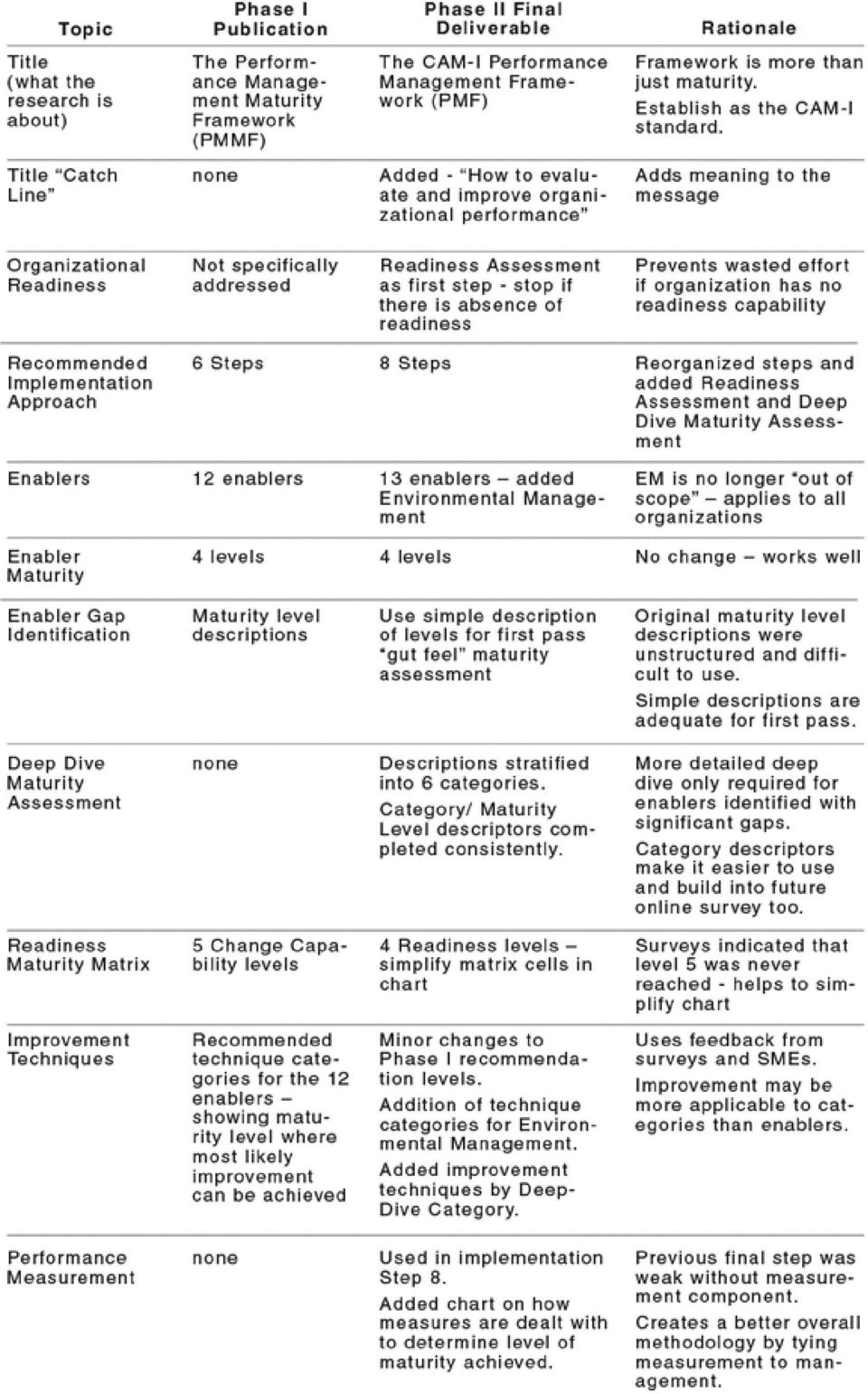
4 As discussed in the PMF methodology, the PMIG has developed various assessment tools to support each of the implementation steps. The approach can be executed internally or with external assistance at any step. The cost/benefit of either approach must be weighed against an organization's priorities and its need to improve performance. Exhibit 3 shows the evolution and rationale for specific topics addressed within the Phase II research. Exhibit 3. How the PMIG Research Evolved from End of Phase I to Completion of Phase II

5

6 Summary of the key components of the CAM-I PMF We know from our collective experience within CAM-I and its member organizations that new initiatives related to performance management have, in general, had a disappointing record of success and sustainability. The summary of this research shows that one of the main reasons implementations fail is that organizations are simply "not ready for change" (i.e., lacking organizational readiness). Organizational readiness is the ability of a business to adapt to change and tackle new initiatives in a positive and constructive manner. Therefore, the PMIG recommends that it is essential to review the organization's implementation readiness. This should be Step 1, which should happen before beginning any application of the PMF. The PMF uses five criteria to assess an organization's readiness to implement the methodology (see Exhibit 4). Exhibit 4. Readiness Assessment The assessment is conducted using four levels of evidence of readiness: 1. absent; 2. minor; 3. moderate; and 4. considerable. If the results of the assessment indicate that evidence of readiness is absent from any of the criteria, the framework should not be undertaken until these criteria can be improved. Various CAM-I methodologies


7 and tools are referenced to assist in this area. An overall assessment result of minor, moderate, or considerable evidence will determine the depth to which the PMF can be successfully implemented (as referenced later in the PMF component Readiness Maturity Matrix). The cornerstone of the PMF methodology is the concept of enablers and maturity. Enablers are a logical grouping of core business capabilities that allow an enterprise to advance its level of maturity and agility in achieving its business goals. The research identified 13 enablers that should first be ranked for importance (Step 2) and then assessed for actual (A) and needed (N) maturity (Step 3), as shown in Exhibit 5. Exhibit 5. Actual and Needed Maturity of 13 Assessed Enablers
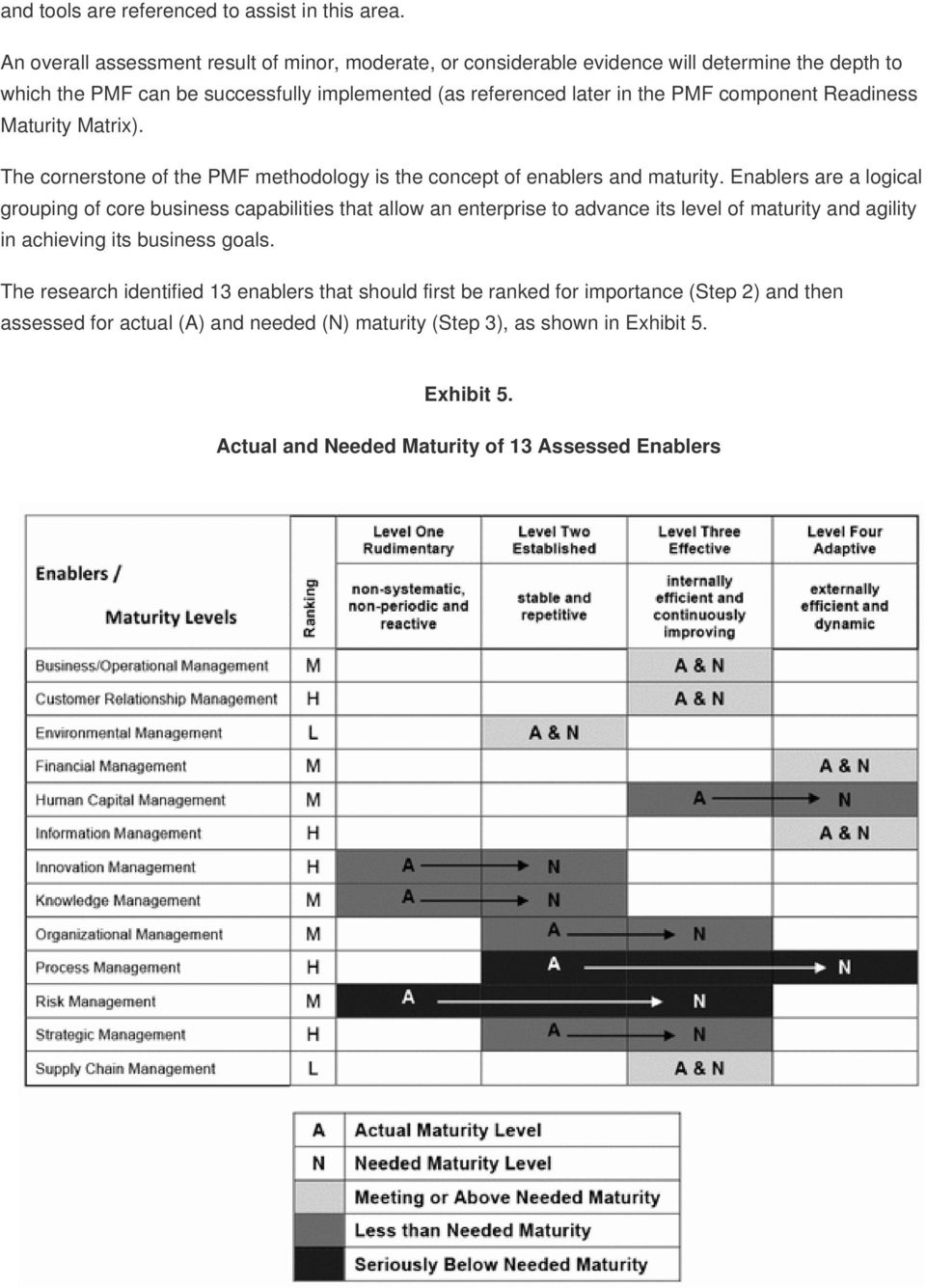
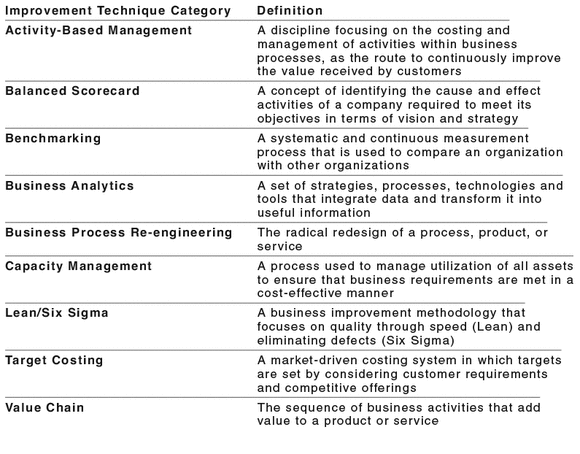
8 Clearly, not every enabler in the list is critical for all organizations, but the research indicates that they should all be taken into consideration, as the ranking will determine the enablers that are key to the business strategy. In the same way, not all key enablers need to be at the highest level of maturity, and it is important to recognize where effort is actually required to improve performance in order to maximize scarce resources. This quick assessment helps organizations to identify and focus on key enablers that have the biggest gaps (Step 4) in performance management capability. The enablers with significant performance gaps are then analyzed in more detail using the Deep Dive Maturity Assessment category descriptors (Step 5). In the example shown in Exhibit 5, process management and risk management have the biggest maturity gaps, so the organization can concentrate on these areas for further assessment and validation of the specific enabler. The framework continues by using the readiness assessment from Step 1 and consulting the Readiness Maturity Matrix (Step 6) to establish the most likely level of enabler maturity that can be achieved. The next component (Step 7) is possibly the biggest breakthrough in the PMIG research. This is where the framework identifies the most applicable techniques that are likely to produce an improvement in enabler maturity. Improvement techniques are a list of business tools or solutions designed to improve all processes and systems in the organization in order to achieve higher levels of performance. The PMIG undertook a thorough investigation of improvement techniques using various sources and publications. This research identified more than 50 of the most relevant techniques used by organizations today to improve performance. Using collective knowledge, subject matter experts, surveys, and the experiences of CAM-I members, these were grouped into the nine key improvement technique categories as shown in Exhibit 6. Exhibit 6. Nine Key Improvement Technique Categories

9 The first step in assessing the improvement technique categories is to determine the level of success that any of the techniques has already had in improving organizational performance. This will assist with the technique selection process later in the assessment and help ensure the organization selects the best improvement aid. The PMIG identified and mapped specific improvement technique categories to each enabler at maturity levels at which the technique would most likely begin to help an organization improve that specific enabler's performance. (The details of this identification and mapping are currently protected by the CAM-I members intellectual property rights and, as such, are not illustrated in this publication.) Using this mapping, enablers identified as having the greatest need for enhancement (as defined in Steps 4 and 5) in conjunction with the highest likely achievable maturity level (as identified in Step 6) will point to the most appropriate improvement technique categories. This approach enables an organization to identify and focus on the best improvement technique for the greatest performance gap need. The PMF was developed as a generic approach for all organizations so that the recommended improvement techniques for any enabler provide guidelines and suggestions for investigating improvement mechanisms. The framework provides the user with a means to choose and implement the

10 most applicable management technique to produce an improvement in enabler maturity and thus increase the organization's overall performance. It is the success of this implementation that an organization would measure (as in Step 8) to gain a greater understanding and assessment of the effort employed. Finally, in Step 8, a balanced set of performance measures are selected to assess the improvement that has been obtained by implementing the recommended technique. Performance measurement is the practice of tracking quantifiable and relevant outcomes to provide an objective assessment of performance. Frequently, organizations use the terms "performance management" and "performance measurement" interchangeably. Indeed, many organizations start a performance management initiative by defining and tracking measures (often referred to as key performance indicators) without a real understanding of the enablers behind these measures. This research emphasizes the need for organizations to understand performance management concepts before measuring performance. In the PMF, performance measurement as a means of assessing improvement is just one of the PMF methodology components. The PMF provides a means for choosing and implementing the most applicable management technique to improve enabler maturity and thus improve the organization's overall performance. It is measuring this improvement that would help an organization gauge the success of an implementation. The PMF provides a guide for organizations to determine the most appropriate performance measures for the associated enabler, bearing in mind that a balanced set of measures (e.g., time, cost, or quality) should always be considered. For guidance, the PMF provides a list of suggested measures for each enabler. PMIG Phase III research In the Phase III research effort, CAM-I intends to analyze data that has been collected from the many workshops that have been offered. This effort, coupled with case studies, will provide greater insight into how organizations function within the use of the framework and validate the prior research that was used to develop the CAM-I PMF. We hope to identify opportunities to improve the framework so that organizations can experience even greater returns on their organizational improvement efforts by focusing their limited resources on what matters the most and what efforts have the greatest chance for success. As part of the Phase III research, the PMIG intends to develop a PMF certification program. The certification will increase the success potential by ensuring those individuals or organizations employing the PMF fully understand how to use this innovative tool and that they are prepared to support the organization in both the framework's implementation and continual use.

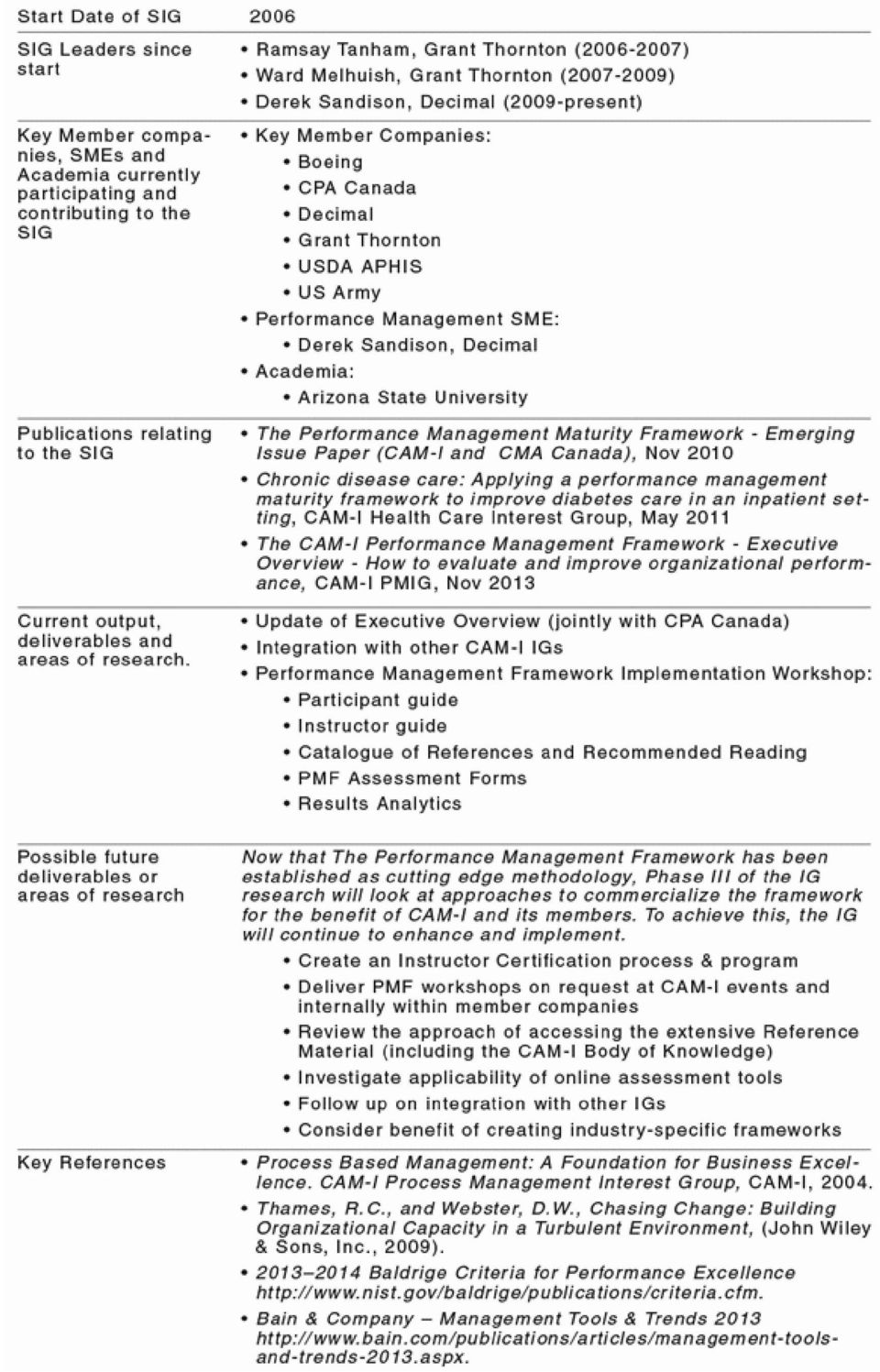
11 Finally, CAM-I will work to provide the most current reference material by updating the suggested reading list. We feel that this list is critical for an organization to grow its expertise in the many organizational improvement tools available today. PMIG Summary The CAM-I PMF provides a holistic implementation framework that aims to evaluate and improve any organization's business performance using one consistent methodology, regardless of size or industry. CAM-I strives to meet the demands of today's competitive business environment as well as the increased demands on modern government. The CAM-I PMF can provide modern organizations with valuable insight into what works well and what needs improvement. CAM-I looks to further understand how this tool can help organizations excel in their mission. For more details on the CAM-I PMIG, see Exhibit 7. Exhibit 7. CAM-I Performance Management Special Interest Group Summary

12
13 2015 Thomson Reuters/Tax & Accounting. All Rights Reserved.

The CAM-I Performance Management Framework
 The CAM-I Performance Framework HOW TO EVALUATE AND IMPROVE ORGANIZATIONAL PERFORMANCE EXECUTIVE OVERVIEW The CAM-I Performance Framework HOW TO EVALUATE AND IMPROVE ORGANIZATIONAL PERFORMANCE EXECUTIVE
Performance Management Maturity Framework. Presented in partnership with:
 Performance Management Maturity Framework Presented in partnership with: 1 Presenter: Introduction Derek Sandison, VP Strategic Alliances, Decimal Technologies Panelists: Moderator: Gordon Cummings, MBA,
Procurement Programmes & Projects P3M3 v2.1 Self-Assessment Instructions and Questionnaire. P3M3 Project Management Self-Assessment
 Procurement Programmes & Projects P3M3 v2.1 Self-Assessment Instructions and Questionnaire P3M3 Project Management Self-Assessment Contents Introduction 3 User Guidance 4 P3M3 Self-Assessment Questionnaire
Computing & Communications Services
 2010 Computing & Communications Services 2010 / 10 / 04 Final Kent Percival, M.Sc., P.Eng. Defining the Value of the Business Analyst In achieving its vision, key CCS partnerships involve working directly
P3M3 Portfolio Management Self-Assessment
 Procurement Programmes & Projects P3M3 v2.1 Self-Assessment Instructions and Questionnaire P3M3 Portfolio Management Self-Assessment P3M3 is a registered trade mark of AXELOS Limited Contents Introduction
Executive Checklist to Transitioning Processes
 Digital Innovation Series Executive Checklist to Transitioning Processes Building a Flexible Model The Digital Innovation Series traces the trends that are driving the digital-innovation imperative that
The Business Case Justification
 The Business Case Justification Solutions for Capital Project Delivery Improvement (White Paper) Table of Contents Page Introduction... 3 Business Case Structure... 5 Business Case Process... 6 Detailed
Enterprise Architecture Assessment Guide
 Enterprise Architecture Assessment Guide Editorial Writer: J. Schekkerman Version 2.2 2006 Preface An enterprise architecture (EA) establishes the organization-wide roadmap to achieve an organization s
Prosci Research Methodology Training Advisory Services
 Prosci Change Management Webinar Advanced Instructor: Facilitating Change Management Training Prosci Research Methodology Training Advisory Services www.prosci.com +1-970-203-9332 [email protected]
The following is intended to outline our general product direction. It is intended for information purposes only, and may not be incorporated into
 The following is intended to outline our general product direction. It is intended for information purposes only, and may not be incorporated into any contract. It is not a commitment to deliver any material,
The Communications Audit NEVER MORE RELEVANT, NEVER MORE VALUABLE:
 WHITE PAPER The Communications Audit NEVER MORE RELEVANT, NEVER MORE VALUABLE: VALUE PROPOSITION OBJECTIVES METHODOLOGY BY GARY DOLZALL CHIEF COMMUNICATIONS OFFICER I. INTRODUCTION: THE VALUE PROPOSITION
7.0 Review of Management Systems
 7.0 Review of Management Systems 7.1 INTRODUCTION This section is intended to review management systems which will allow the Joint Board of the LHPWSS to have the staff and planning mechanisms in place
Center for Effective Organizations
 Center for Effective Organizations WHAT MAKES HR A STRATEGIC PARTNER? CEO PUBLICATION G 09-01 (555) EDWARD E. LAWLER III Center for Effective Organizations Marshall School of Business University of Southern
Business Continuity Position Description
 Position Description February 9, 2015 Position Description February 9, 2015 Page i Table of Contents General Characteristics... 2 Career Path... 3 Explanation of Proficiency Level Definitions... 8 Summary
3 rd GENERATION KNOWLEDGE MANAGEMENT and Beyond!
 KNOWLEDGE MANAGEMENT TALKS: 3 rd GENERATION KNOWLEDGE MANAGEMENT and Beyond! Even given its short life span, Knowledge Management has clearly evolved through three distinct eras, and is already entering
PhD in Information Studies Goals
 PhD in Information Studies Goals The goals of the PhD Program in Information Studies are to produce highly qualified graduates for careers in research, teaching, and leadership in the field; to contribute
Business and Public Administration Outcomes Assessment Plan; April 1, 2011 Page 1
 Business Administration Program Outcomes Assessment Plan Bachelor of Business Administration Associate of Applied Science Business Associate of Business April 1, 2011 Contact Name: Dr. Kathy DiLorenzo
Professional Services for Cloud Management Solutions
 Professional Services for Cloud Management Solutions Accelerating Your Cloud Management Capabilities CEOs need people both internal staff and thirdparty providers who can help them think through their
IT@Intel. Aligning IT with Business Goals through Strategic Planning
 White Paper Intel Information Technology Computer Manufacturing Strategic Planning Aligning IT with Business Goals through Strategic Planning Intel IT has developed and implemented a new approach to strategic
Five Core Principles of Successful Business Architecture. STA Group, LLC Revised: May 2013
 Five Core Principles of Successful Business Architecture STA Group, LLC Revised: May 2013 Executive Summary This whitepaper will provide readers with important principles and insights on business architecture
Network Rail Infrastructure Projects Joint Relationship Management Plan
 Network Rail Infrastructure Projects Joint Relationship Management Plan Project Title Project Number [ ] [ ] Revision: Date: Description: Author [ ] Approved on behalf of Network Rail Approved on behalf
The Landscape of Health Information Management
 1 Benchmark Report The Landscape of Health Information Management Benchmarking Trends and Insights for HIM Leadership Sponsored by himagine solutions Brought to you by himagine solutions, inc. and ADVANCE
A discussion of information integration solutions November 2005. Deploying a Center of Excellence for data integration.
 A discussion of information integration solutions November 2005 Deploying a Center of Excellence for data integration. Page 1 Contents Summary This paper describes: 1 Summary 1 Introduction 2 Mastering
Agile Master Data Management TM : Data Governance in Action. A whitepaper by First San Francisco Partners
 Agile Master Data Management TM : Data Governance in Action A whitepaper by First San Francisco Partners First San Francisco Partners Whitepaper Executive Summary What do data management, master data management,
How To Understand And Understand The Concept Of Business Architecture
 WHITE PAPER Business Architecture: Dispelling Ten Common Myths William Ulrich, TSG, Inc. Whynde Kuehn, S2E Consulting Inc. Business Architecture: An Evolving Discipline B usiness architecture is a maturing
December 14, 2007. Sincerely, Charles T. Follin, PMP President. Page 1 of 5
 December 14, 2007 Department of Transportation Federal Transit Administration Federal Transit Administration HQ Attn: Mr. John Bardwell 1200 New Jersey Avenue, SE Washington, DC 20590 Reference: Reference
Project Management Competency Standards
 BSB01 Business Services Training Package Project Management Competency Standards CONTENTS BSBPM401A Apply scope management techniques...3 BSBPM402A Apply time management techniques...8 BSBPM403A Apply
ISO 9001 Quality Management System
 ISO 9001 Quality Management System DETAILED GUIDE ISO 9001 Background ISO 9001:2008 is the world s foremost quality management standard, used by hundreds of thousands of organizations in over 170 countries
9 TH INTERNATIONAL ASECU CONFERENCE ON SYSTEMIC ECONOMIC CRISIS: CURRENT ISSUES AND PERSPECTIVES
 Matilda Alexandrova Liliana Ivanova University of National and World Economy,Sofia, Bulgaria CRITICAL SUCCESS FACTORS OF PROJECT MANAGEMENT: EMPIRICAL EVIDENCE FROM PROJECTS SUPPORTED BY EU PROGRAMMES
Optimizing the Data Center for Today s State & Local Government
 WHITE PAPER: OPTIMIZING THE DATA CENTER FOR TODAY S STATE...... &.. LOCAL...... GOVERNMENT.......................... Optimizing the Data Center for Today s State & Local Government Who should read this
ACCELUS COMPLIANCE MANAGER FOR FINANCIAL SERVICES
 THOMSON REUTERS ACCELUS ACCELUS COMPLIANCE MANAGER FOR FINANCIAL SERVICES PROACTIVE. CONNECTED. INFORMED. THOMSON REUTERS ACCELUS Compliance management Solutions Introduction The advent of new and pending
Creating Powerful Brands. Malcolm McDonald and Leslie de Chernatony. Theme of the Book
 Malcolm McDonald and Leslie de Chernatony Butterworth Heinemann, September 2003, 496 pages ISBN 0750659807 Theme of the Book A thorough and practical analysis of the essential elements of branding, giving
Become a hunter: fi nding the true value of SIEM.
 Become a hunter: fi nding the true value of SIEM. When Security Information and Event Management (SIEM) hit the security scene, it was heralded as a breakthrough in threat detection. However, SIEM is just
Article. Jørgen Thorsell & Didier Gonin: the hottest new trends in executive development
 Article Jørgen Thorsell & Didier Gonin: the hottest new trends in executive development J ørgen Thorsell and Didier Gonin are senior executives with Denmark-based Mannaz A/S (formerly The Danish Leadership
Lead Management Best Practices
 WhitePaper Lead Management Best Practices An effective, integrated approach using the 6 pillars of lead management: content marketing, lead capture, lead nurturing, lead scoring, opportunity handoff, and
Lecture Objectives. Software Life Cycle. Software Engineering Layers. Software Process. Common Process Framework. Umbrella Activities
 Software Life Cycle Lecture Objectives What happens in the life of software To look at the life cycle of a software To understand the software process and its related elements To relate to the different
Applications Executive Council Drivers of Business Analyst Effectiveness
 Applications Executive Council Drivers of Business Analyst Effectiveness IIBA Building Business Capabilities 2012 Moderator: Mark Tonsetic Senior Research Director A FRAMEWORK FOR MEMBER CONVERSATIONS
How To Understand And Understand Activity Based Management
 Technical Briefing DEVELOPING AND PROMOTING STRATEGY APRIL 2001 Activity-based Management An Overview IN THIS BRIEFING Part 1 General FAQs Part 2 Practical guidance on implementing ABM Part 3 Checklist
Business Analyst to Business Architect
 Business Analyst to Business Architect To Infinity... and Beyond! White Paper March 2010 Authors: Jack Hilty Cathy Brunsting Editor: Janice Koerber Copyright 2010 SentientPoint, Inc. All Rights Reserved
Cisco Unified Communications and Collaboration technology is changing the way we go about the business of the University.
 Data Sheet Cisco Optimization s Optimize Your Solution using Cisco Expertise and Leading Practices Optimizing Your Business Architecture Today, enabling business innovation and agility is about being able
Background: Business Value of Enterprise Architecture TOGAF Architectures and the Business Services Architecture
 Business Business Services Services and Enterprise and Enterprise This Workshop Two parts Background: Business Value of Enterprise TOGAF s and the Business Services We will use the key steps, methods and
Banking Application Modernization and Portfolio Management
 Banking Application Modernization and Portfolio Management Key Challenges and Success Factors As part of their long-term strategic plans, banks are seeking to capitalize on their legacy applications. Acquired
BEST PRACTICES RESEARCH
 2013 Frost & Sullivan 1 We Accelerate Growth Entrepreneurial Company of the Year Award Pharmaceutical Knowledge Process Outsourcing North America, 2013 Frost & Sullivan s Global Research Platform Frost
Table of contents. Best practices in open source governance. Managing the selection and proliferation of open source software across your enterprise
 Best practices in open source governance Managing the selection and proliferation of open source software across your enterprise Table of contents The importance of open source governance... 2 Executive
National Research Council Canada IP Prosecution and IP License Management Solution Project
 National Research Council Canada IP Prosecution and IP License Management Solution Project Appendix 1 Statement of Work Version 6.0, 10 December 2013 ii Table of Contents 1. Instructions to Bidders...
!"#$%&'()"*"++%(*,%-")+.*(#%/"0"#.12"*3
 INTERNATIONAL BUSINESS SKILLS COURSEWARE!"#$%&'()"*"++%(*,%")+.*(#%/"0"#.12"*3!!!!!"#$!%&'()*(+,'(!".)+!""#$%&'%#()#*)+,"%("")./&$'%'%#(/" I hear and I Forget I see and I Remember I do and I Understand
TEACHER/HIGHER EDUCATION INSPECTION
 TEACHER/HIGHER EDUCATION INSPECTION Education and Training Inspectorate An Inspection Report on the PGCE Early Years Programme, with a focus on Literacy and Numeracy, Stranmillis University College Inspected:
Your Software Quality is Our Business. INDEPENDENT VERIFICATION AND VALIDATION (IV&V) WHITE PAPER Prepared by Adnet, Inc.
 INDEPENDENT VERIFICATION AND VALIDATION (IV&V) WHITE PAPER Prepared by Adnet, Inc. February 2013 1 Executive Summary Adnet is pleased to provide this white paper, describing our approach to performing
National Qualifications Framework for Higher Education in Thailand IMPLEMENTATION HANDBOOK
 National Qualifications Framework for Higher Education in Thailand IMPLEMENTATION HANDBOOK November 2006 National Qualifications Framework for Higher Education in Thailand Implementation Handbook Table
Building HR Capabilities. Through the Employee Survey Process
 Building Capabilities Through the Employee Survey Process Survey results are only data unless you have the capabilities to analyze, interpret, understand and act on them. Your organization may conduct
THE ORGANIZER S ROLE IN DRIVING EXHIBITOR ROI A Consultative Approach
 7 Hendrickson Avenue, Red Bank, NJ 07701 800.224.3170 732.741.5704 Fax www.exhibitsurveys.com White Paper THE ORGANIZER S ROLE IN DRIVING EXHIBITOR ROI A Consultative Approach Prepared for the 2014 Exhibition
Talent Management: Why It s Critical for Business Success
 Talent Management: Why It s Critical for Business Success Integrated talent management drives measurable results by aligning employee development to your business goals. Learn how. Contents Aligning Individual
Thought Leadership Selling
 Thought Leadership Selling How to execute sales programs that engage your customers and differentiate your sales experience with education, ideas and insights The Emergence of Thought Leadership as a Sales
Root Cause Analysis Concepts and Best Practices for IT Problem Managers
 Root Cause Analysis Concepts and Best Practices for IT Problem Managers By Mark Hall, Apollo RCA Instructor & Investigator A version of this article was featured in the April 2010 issue of Industrial Engineer
HP ITSM Assessment Services Helping you reach the levels of service your business requires
 HP ITSM Assessment Services Helping you reach the levels of service your business requires HP ITSM Assessment Services are designed to help you achieve the IT service levels your business requires by reducing
Full Time Master of Science in Management program. Core concepts and disciplinary foundations of the courses. Marketing Management Specialization
 Full Time Master of Science in program Core concepts and disciplinary foundations of the courses Specialization Courses during the adaptation phase (Pre-Master) Deep Dive Business Strategy Managerial Economics
Enterprise Architecture Program. Key Initiative Overview
 Richard Buchanan Research Managing Vice President This overview provides a high-level description of the Enterprise Architecture Program Key Initiative. IT leaders can use this guide to understand what
Lindner College of Business MS Marketing Capstone Project - Prospectus and Application-
 Lindner College of Business MS Marketing Capstone Project - Prospectus and Application- During January April 2015, 30 graduate students pursuing a Masters in Science (MS) degree in Marketing will engage
Organizing for Sourcing Excellence Insights for impact on profitability and revenue.
 Organizing for Sourcing Excellence Insights for impact on profitability and revenue. The Transformation of Procurement Strategic decision making opportunities that can have immediate impact on profitability
An Introduction to SharePoint Governance
 An Introduction to SharePoint Governance A Guide to Enabling Effective Collaboration within the Workplace Christopher Woodill Vice President, Solutions and Strategy [email protected] 416-477-3945
TYLER JUNIOR COLLEGE School of Continuing Studies 1530 SSW Loop 323 Tyler, TX 75701 1.800.298.5226 www.tjc.edu/continuingstudies/mycaa
 Student Full Name: TYLER JUNIOR COLLEGE School of Continuing Studies 1530 SSW Loop 323 Tyler, TX 75701 1.800.298.5226 www.tjc.edu/continuingstudies/mycaa Education & Training Plan Project Management Professional
Safety System Performance Measurement
 Workplace Safety Strategy for Nova Scotia 2013 2017 Summary of Findings from Consultation and Research: Safety System Performance Measurement Introduction: Performance management is a process that links
Case Study: Public Relations
 Internationalisation of the Curriculum in Action Case Study: Public Relations This case study was developed as part of an Australian Learning and Teaching Council National Teaching Fellowship, Internationalisation
Becoming Agile: a getting started guide for Agile management in Marketing and their partners in IT, Sales, Customer Service and other business teams.
 Becoming Agile: a getting started guide for Agile management in Marketing and their partners in IT, Sales, Customer Service and other business teams. Agile for Business www.agilefluent.com Summary The
Best Practices in Change Management 2014 Edition
 Best Practices in Change Management 2014 Edition Executive Overview A look at Prosci s latest change management research In Brief: Since 1998, Prosci has conducted eight benchmarking studies to discover
Business Analysis Standardization & Maturity
 Business Analysis Standardization & Maturity Contact Us: 210.399.4240 [email protected] Copyright 2014 Enfocus Solutions Inc. Enfocus Requirements Suite is a trademark of Enfocus Solutions Inc.
Build a Better Workplace: Engagement Edition
 Build a Better Workplace: Employee Engagement Edition Employee engagement, that willingness of each employee to strive to do their best work on a daily basis, has become the leading indicator of performance
Research Analyst. It s About You. What is Research and Analysis? What is the role of the Research Analyst? Areas of Focus.
 Research Analyst It s About You Do you like digging for facts? Are you inquisitive and eager to learn about new things? Are you able to sift through large quantities of information and come up with the
High-Impact Succession Management
 High-Impact Succession Management Executive Summary Kim Lamoureux Principal Analyst Michael Campbell Senior Research Analyst Center for Creative Leadership Roland Smith Senior Research Faculty Center for
Survey of more than 1,500 Auditors Concludes that Audit Professionals are Not Maximizing Use of Available Audit Technology
 Survey of more than 1,500 Auditors Concludes that Audit Professionals are Not Maximizing Use of Available Audit Technology Key findings from the survey include: while audit software tools have been available
The Rising Opportunity for CMO-CIO Collaboration in the Pharmaceutical Industry
 Accenture Life Sciences Rethink Reshape Restructure for better patient outcomes The Rising Opportunity for CMO-CIO Collaboration in the Pharmaceutical Industry Demographics Life Sciences Pharma/Biotech:
A Practical Guide for Creating an Information Management Strategy and Strategic Information Management Roadmap
 A Practical Guide for Creating an Information Management Strategy and Strategic Information Management Roadmap Principal Author Sam McCollum, CRM, MBA Director of End User Consulting Parity Research LLC
CSR / Sustainability Governance and Management Assessment By Coro Strandberg Principal, Strandberg Consulting www.corostrandberg.
 Introduction CSR / Sustainability Governance and Management Assessment By Coro Strandberg Principal, Strandberg Consulting www.corostrandberg.com June 2015 Companies which adopt CSR or sustainability 1
Datacenter Management and Virtualization. Microsoft Corporation
 Datacenter Management and Virtualization Microsoft Corporation June 2010 The information contained in this document represents the current view of Microsoft Corporation on the issues discussed as of the
Market Research. What is market research? 2. Why conduct market research?
 What is market research? Market Research Successful businesses have extensive knowledge of their customers and their competitors. Market research is the process of gathering information which will make
Position description and specification
 Position description and specification Position: Business Analyst Future Focus project Group: Infrastructure Services Classification: Band 8 Organisational context Barwon Water s mission is to provide
Professional Services for a Software-Defined Data Center
 Professional Services for a Software-Defined Data Center Accelerating to a Software-Defined Data Center CIOs need people both internal staff and thirdparty providers who can help them think through their
3 DEVELOP A SHARED VISION, MISSION, AND
 MISSION AND GOALS 34 3 DEVELOP A MISSION, AND GOALS When organizations or individuals decide to join forces and work as a partnership, they do so with a purpose in mind. While the individual partners may
Enterprise Data Management for SAP. Gaining competitive advantage with holistic enterprise data management across the data lifecycle
 Enterprise Data Management for SAP Gaining competitive advantage with holistic enterprise data management across the data lifecycle By having industry data management best practices, from strategy through
Operational Risk Management - The Next Frontier The Risk Management Association (RMA)
 Operational Risk Management - The Next Frontier The Risk Management Association (RMA) Operational risk is not new. In fact, it is the first risk that banks must manage, even before they make their first
Partnership Satisfaction & Impact Survey
 Partnership Satisfaction & Impact Survey Page 1 of TABLE OF CONTENTS Contents I INTRODUCTION... 3 II SATISFACTION SURVEY... 4 II.1 What?... 4 II.1.1 Definition... 4 II.1.2 Satisfaction survey in Practice...