
my Unisa
|
|
|
- Alice Martin
- 10 years ago
- Views:
Transcription
1 2015 my Unisa registration process, rules & qualifications College of Science, Engineering and Technology College of Agriculture & Environmental Sciences Learn without limits. university of south africa
2 Contents Register to continue your Unisa journey 2 The Unisa student walk 2 Unisa services 4 Get connected 4 Unisa is changing 5 The benefits of online study 5 Unisa e-solutions for students 6 Signature courses 7 Signature courses per college registration dates & times 9 Academic progression 10 For students who registered for a new qualification prior to For students who registered for a new qualification in 2013, 2014 and Registration process Confirm your qualification Choose your modules Calculate your student fees and payment options Complete and submit your registration 45 Did you know? 50 Prepare for your studies 54 Qualifications 56 Alternative pathway/extended programme 180 Buy your books 187 Unisa rules for students 190 Registration form codes 207 Unisa forms 225 The information contained in this brochure was correct at the time of publication (24 June 2014). For updates, please go to the Unisa website

3 Register to continue your Unisa journey The Unisa student walk 1 3 CHOOSE & APPLY This is where you chose your qualification, checked that you met the admission requirements, confirmed that you have the skills and the right personal circumstances to study at an open distance learning university, and applied for admission during the relevant application period. TEACH & LEARN After you ve registered successfully, you ll receive your study material and the my Unisa brochure. This tells you how to access your study material online. The internet plays a vital role in the learning process at Unisa, as does discipline, commitment and hard work. A Unisa qualification behind your name opens many doors, but like everything of value, open distance learning is not an easy path. 4 GRADUATE & LIFELONG LEARNING Once you graduate, you join the group of Unisa alumni. We encourage our alumni to remain in contact with Unisa for networking and academic opportunities, as well as the mentoring of new students. Website: Mobi: [email protected] 2 The information contained in this brochure was correct at the time of publication (12 November 2014). For updates, please go to the Unisa website

4 2 Register Successful applicants and re-registering students must now register to study through Unisa in You can register online ( at a Unisa regional centre with self-help facilities, by post or by fax during the specified registration periods. We urge you to register online or at a self-help facility at one of Unisa s regional centres. You must register to be eligible to write exams and receive credits for work done in the year. Before you register Confirm your qualification Choose your modules Calculate your fees How to register Complete and submit your registration form - Online at - Via a self-help terminal at a regional centre Unisa will... Process your registration Enable you to access your study material After you register Join mylife & myunisa Download your study material my Unisa 2015 College of Law 3

5 Lifestyle on the internet Our lives will become increasingly more difficult if we are not connected in some way to the internet. Unisa services Library e-tutors/teaching assistants myunisa Fellow students Unisa lecturers mylife Student counsellors Get connected Mentors Friends and family Industry professionals Experts in your field

6 Get connected Connect to your academic network via myunisa - don't forget your friends and family are part of your support network too. Unisa is changing Computers and the internet are becoming more and more essential in the workplace, in life and in education. In distance learning, especially, these online tools play a huge role in your study experience, because you don t attend face-to-face lectures at Unisa - you connect to your university from a distance. The internet is simply the fastest, most effective and efficient way to do that. By embracing computers, by encouraging our students to use the internet, we re better preparing them for the demands of the digital age. We understand that for some the cost of a computer can be difficult to manage, so we still provide you with alternative channels (eg the post), but we urge you, if you can, to go online. A Unisa qualification is not a small thing. It s a huge investment in time, money and effort. You need to study every day, you need to keep up from day one and being online helps you to do that. The benefits of online study You may be wondering, why all the fuss about going online? Well, it just saves so much time. You can submit assignments or get results at the click of a button, rather than waiting for the post. Yes, systems do go down. Internet connections are lost from time to time. But for the most part, the internet is very reliable. So you can submit those assignments with confidence and check that they ve been received. You can connect with other people so much more easily too, which makes a big difference when creating your academic network, for example. Work that you type on a computer is easier to read, easier to correct and easier to manage. What s more, by using online systems regularly, you ll develop those online skills, thus preparing you for the digital future.

7 Unisa e-solutions for students R100 per month *R600 must be paid upfront Connect for less... get exclusive deals on laptops, tablets and 3G internet access Once you are a Unisa student, Unisa gives you access to some wonderful deals to get you connected at affordable rates. 3G internet access offer for students: All Unisa students registered for formal qualifications can purchase 3 Gigabytes of 3G internet data for R100 a month. The R600 must be paid upfront. Student technology program: All students can now purchase quality laptops and tablets at affordable prices. And thanks to our partnerships with major service providers and suppliers, you ll also have your choice of networks and brands to choose from. For more information on Unisa s e-solutions, go to 6 The information contained in this brochure was correct at the time of publication (12 November 2014). For updates, please go to the Unisa website

8 Signature courses All students who register at Unisa for the first time from 2013 have to do a fully online signature course at some point during their undergraduate studies. A digiband (flash drive) will also be made available that enables students to work offline, should they not have ready access to the internet. Each college has its own specific signature course. When it comes to planning your study time, remember that you ll be required to do frequent assignments as part of your signature course, which reference current events and up-to-date information. It will not be possible to put off assignments and then do all the work in one session. You have to keep up and schedule your time accordingly. Signature courses per college College Code name College of Accounting Sciences SUS1501 Sustainability and greed College of Agriculture and Environmental Sciences GGH3708 Environmental awareness and responsibility College of Economic and Management Sciences SUS1501 Sustainability and greed College of Education BPT1501 Being a professional teacher College of Human Sciences AFL1501 Language through an African lens College of Law SJD1501 Social dimensions of justice College of Science, Engineering and Technology EUP1501 Ethical information and communication technologies for development solutions my Unisa 2015 College of Law 7

9 8 The information contained in this brochure was correct at the time of publication (12 November 2014). For updates, please go to the Unisa website

10 2015 registration dates & times Semester 1, semester 2 and year modules Online, self-help, post & fax 24 November 2014 to 19 December January 2015 to 23 January 2015 The prescribed minimum registration fee must be paid on or before the relevant date, otherwise your registration won t be finalised. (payments accepted until 31 January 2015) 5 January 2015 to 27 February 2015 (2 nd semester & year modules) Official Saturdays open: 10 & 17 January 2015, 21 February 2015 Semester 2 modules Online, self-help, post & fax 17 June 2015 to 10 July 2015 (payment deadline is 10 July 2015) Official Saturday open: 4 July 2015 College of Accounting Sciences: Postgraduate Diplomas, Hons BCompt (Management Accounting) Online, self-help, post & fax 24 November 2014 to 19 December January 2015 to 23 January 2015 Unisa offices will close for registration at 15:30 on Friday 19 December 2014 and re-open for registration at 08:00 on Monday 5 January No registration documentation will be accepted - either online, by post or by fax - during this period. Self-help centres open weekdays 08:00-15:30 Official Saturdays 08:00-11:30 Unisa officially closes at 12:00 on Wednesday 24 December 2014 and re-opens on Friday 2 January 2015 for other Unisa business. my Unisa 2015 College of Law 9

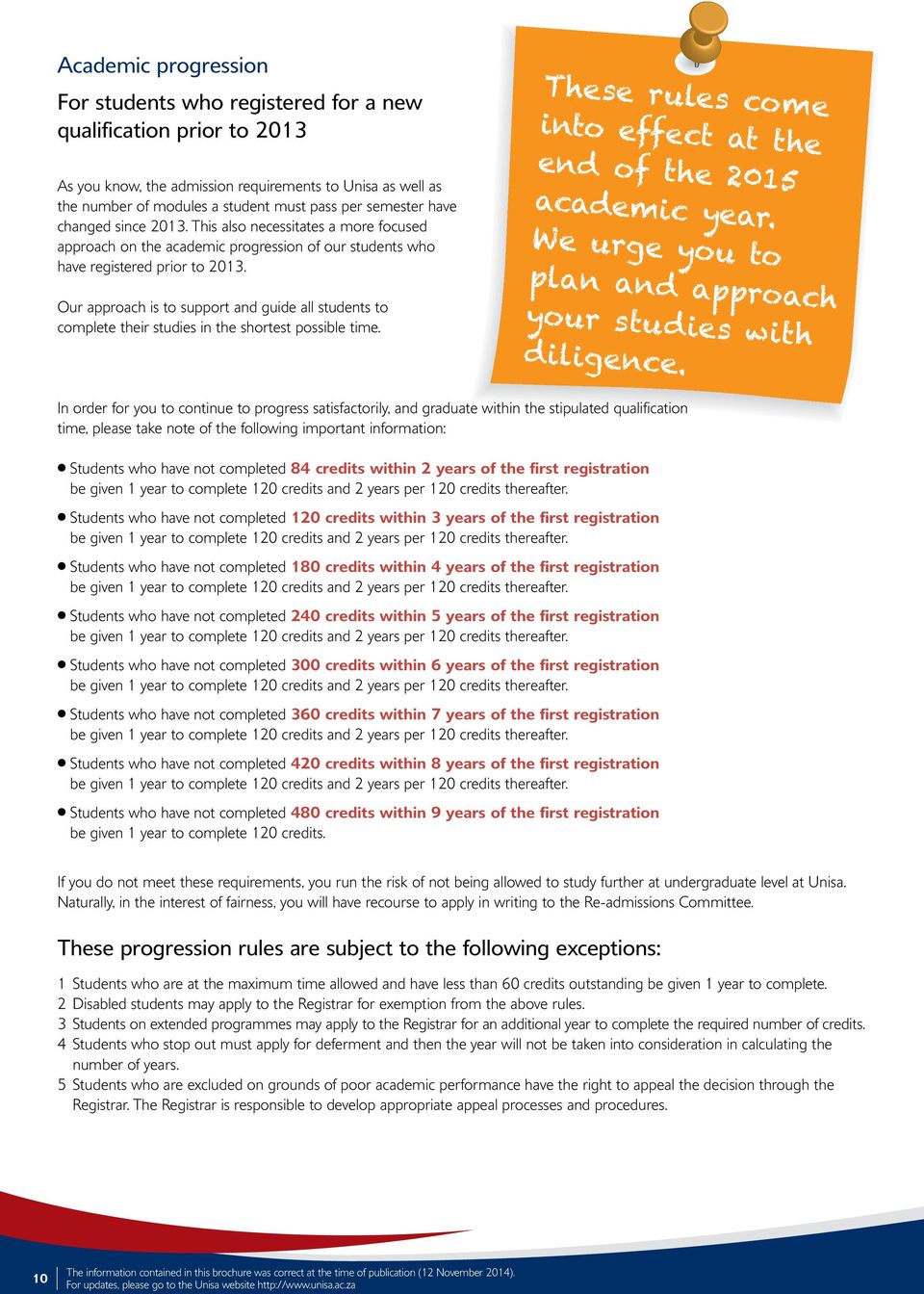
11 Academic progression For students who registered for a new qualification prior to 2013 As you know, the admission requirements to Unisa as well as the number of modules a student must pass per semester have changed since This also necessitates a more focused approach on the academic progression of our students who have registered prior to Our approach is to support and guide all students to complete their studies in the shortest possible time. These rules come into effect at the end of the 2015 academic year. We urge you to plan and approach your studies with diligence. In order for you to continue to progress satisfactorily, and graduate within the stipulated qualification time, please take note of the following important information: Students who have not completed 84 credits within 2 years of the first registration be given 1 year to complete 120 credits and 2 years per 120 credits thereafter. Students who have not completed 120 credits within 3 years of the first registration be given 1 year to complete 120 credits and 2 years per 120 credits thereafter. Students who have not completed 180 credits within 4 years of the first registration be given 1 year to complete 120 credits and 2 years per 120 credits thereafter. Students who have not completed 240 credits within 5 years of the first registration be given 1 year to complete 120 credits and 2 years per 120 credits thereafter. Students who have not completed 300 credits within 6 years of the first registration be given 1 year to complete 120 credits and 2 years per 120 credits thereafter. Students who have not completed 360 credits within 7 years of the first registration be given 1 year to complete 120 credits and 2 years per 120 credits thereafter. Students who have not completed 420 credits within 8 years of the first registration be given 1 year to complete 120 credits and 2 years per 120 credits thereafter. Students who have not completed 480 credits within 9 years of the first registration be given 1 year to complete 120 credits. If you do not meet these requirements, you run the risk of not being allowed to study further at undergraduate level at Unisa. Naturally, in the interest of fairness, you will have recourse to apply in writing to the Re-admissions Committee. These progression rules are subject to the following exceptions: 1 Students who are at the maximum time allowed and have less than 60 credits outstanding be given 1 year to complete. 2 Disabled students may apply to the Registrar for exemption from the above rules. 3 Students on extended programmes may apply to the Registrar for an additional year to complete the required number of credits. 4 Students who stop out must apply for deferment and then the year will not be taken into consideration in calculating the number of years. 5 Students who are excluded on grounds of poor academic performance have the right to appeal the decision through the Registrar. The Registrar is responsible to develop appropriate appeal processes and procedures. 10 The information contained in this brochure was correct at the time of publication (12 November 2014). For updates, please go to the Unisa website
12 Academic progression For students who registered for a new qualification in 2013, 2014 and st year of study Pass 36 credits per year/over 2 consecutive semesters. Exception: If you are a student following an alternative pathway/extended programme, please note that you must pass 24 credits per year/over 2 consecutive semesters. From 2nd year of study Pass 48 credits per year/over 2 consecutive semesters. Yes Re-admission in 2016 Yes Admission declined No Failure to pass the required number of modules will result in you not being able to study further at undergraduate level. No A student wishing to be re-admitted to Unisa after being excluded on the basis of poor performance in a qualification may only do so after providing proof of successful study at NQF level 4, 5 or higher at another training institution or a Unisa short learning programme. In order to satisfy the requirements of this rule, the student must have completed at least 48 credits before an application for re-admission will be considered. my Unisa 2015 College of Law 11

13 12 The information contained in this brochure was correct at the time of publication (12 November 2014). For updates, please go to the Unisa website

14 Registration process There are four steps to a successful registration. Each part of the process is important in completing your registration successfully. We have therefore included information that is important for you to know at each stage. Note: If you use the electronic channels (web or self-help terminals at the regional centres) to complete and submit your registration, you will be prompted when information is missing or incorrect. This will assist you in ensuring that you include all important details when submitting your registration. If you choose to register by post or by fax, the responsibility for the accuracy and inclusion of your information rests with you. We therefore urge you to register as soon as registration opens if you will be registering via one of these channels, as missing or incorrect information may cause delays in the approval of your registration. 1. Confirm your qualification Only for successful applicants and students starting a new qualification. If you are a first-time successful applicant, you may have applied for admission to two qualifications. If you received confirmation from Unisa that you have been successfully admitted to both qualifications, you must now select and register for one qualification. If you received confirmation from Unisa that you have been successfully admitted to one qualification, you may only register for the approved qualification. Should you wish to change to an alternative qualification, please apply for the alternative qualification during the next application period. 2. Choose your modules 3. Calculate your student fees & payment options 4. Complete & submit your registration form my Unisa 2015 College of Law 13

15 1. Confirm your qualification Undergraduate admission requirements 2015 College of Accounting Sciences Programme Minimum requirements Language requirement Higher Certificate in A National Senior Certificate (NSC) Accounting Sciences with at least 30% in the language of teaching and learning Mathematics requirement and with at least 30% in Mathematics or 50% in Mathematical Literacy and with an equivalent of at least 30% in Mathematics in terms of the NSC and with an equivalent of at least 30% in Mathematics in terms of the NSC Students with incomplete A Senior Certificate with an equivalent of at least qualifications from Unisa or other 30% in the language of teaching HEI, who wish to migrate to one and learning in terms of the NSC of the CAS qualifications, need to have passed at least 4 modules A National Certificate (Vocational) with an equivalent of at least (or 48 credits) and have obtained 30% in the language of teaching an average of at least 55% for and learning in terms of the NSC the modules registered in the last period of registration. Candidates who do not comply with the above requirements for admission to the Higher Certificate, should consider enrolling for the Higher Certificate in Economic and Management Sciences Diplomas Students with incomplete qualifications from Unisa or other HEI, who wish to migrate to one of the CAS qualifications, need to have passed at least 4 modules (or 48 credits) and have obtained an average of at least 55% for the modules registered in the last period of registration. A National Senior Certificate (NSC) (Diploma endorsement) A Senior Certificate A National Certificate (Vocational) with at least 50% in the language of teaching and learning in terms of the NSC with an equivalent of at least 50% in the language of teaching and learning in terms of the NSC with an equivalent of at least 60% in the language of teaching and learning in terms of the NSC, and with at least 40% in Mathematics or 60% in Mathematical Literacy and with an equivalent of at least 40% in Mathematics in terms of the NSC and with an equivalent of at least 40% in Mathematics in terms of the NSC A Higher Certificate in Accounting Sciences or A Higher Certificate in Economic and Management Sciences or their equivalent Candidates, who do not comply with the above requirements for admission to the Diploma, should consider enrolling for either the Higher Certificate in Accounting Sciences or for the Higher Certificate in Economic and Management Sciences Bachelor degrees A National Senior Certificate (NSC) (Degree with at least 60% in the language and with at least 60% in endorsement) of teaching and learning Mathematics or 80% in (360 Credit curriculum that can Mathematical Literacy be completed in 3 years) Students with incomplete qualifications from Unisa or other HEI, who wish to migrate to one of the CAS qualifications, need to have passed at least 4 modules (or 48 credits) and have obtained an average of at least 55% for the modules registered in the last period of registration. A Senior Certificate with matriculation exemption or qualify for the exemption from the Matriculation Board, A National Certificate (Vocational) Level 4 (Degree endorsement) with an equivalent of at least 60% in the language of learning and teaching in terms of the NSC with an equivalent of at least 70% in the language of teaching and learning in terms of the NSC, and with an equivalent of at least 60% in Mathematics in terms of the NSC and with an equivalent of at least 60% in Mathematics in terms of the NSC A National Senior Certificate (NSC) (Degree endorsement) as well as A Higher Certificate in Accounting Sciences or in Economic and Management Sciences or their equivalent A Diploma in Accounting Sciences or its equivalent. Candidates, who do not comply with the above requirements for admission to the 3 year Bachelor s degree curriculum, should consider enrolling for the 4 year Bachelor s degree curriculum. Bachelor degrees (360 Credit curriculum that includes 5 compulsory foundation modules in the first year. This degree can be completed in 4 years) Students with incomplete qualifications from Unisa or other HEI, who wish to migrate to one of the CAS qualifications, need to have passed at least 4 modules (or 48 credits) and have obtained an average of at least 55% for the modules registered in the last period of registration. A National Senior Certificate (NSC) (Degree endorsement) A Senior Certificate with matriculation exemption or qualify for the exemption from the Matriculation Board, A National Certificate (Vocational) Level 4 (Degree endorsement) with at least 50% in the language of teaching and learning in terms of the NSC; with an equivalent of at least 50%, in the language of learning and teaching in terms of the NSC; with at an equivalent of at least 60% in the language of teaching and learning in terms of the NSC; and with at least 50% in Mathematics or 70% in Mathematical Literacy and with an equivalent of at least 50% in Mathematics in terms of the NSC and with an equivalent of at least 50% in Mathematics in terms of the NSC Candidates, who do not comply with the above requirements for admission to the 4 year Bachelor s degrees curriculum, should consider enrolling for either the Diploma in Accounting Sciences or for the Higher Certificate in Accounting Sciences or for the Higher Certificate in Economic and Management Sciences For the equivalent tables of National Senior Certificate (from 2009) against Senior Certificate, National Certificate, Vocational and Forgeign Certificates, see page 21 of this brochure. 14 The information contained in this brochure was correct at the time of publication (12 November 2014). For updates, please go to the Unisa website

16 College of Agriculture and Environmental Sciences Programme Higher Certificates Diplomas Minimum requirements A National Senior Certificate (NSC) A Senior Certificate A National Certificate (Vocational) Level 4 A National Senior Certificate (Diploma endorsement) A Senior Certificate A National Certificate (Vocational) Level 4 with at least diploma endorsement Language requirement with an equivalent of at least 40% in the language of teaching and learning in terms of the NSC with an equivalent of at least 40% in the language of teaching and learning in terms of the NSC with an equivalent of at least 40% in the language of teaching and learning in terms of the NSC with an equivalent of at least 50% in the language of teaching and learning in terms of the NSC with an equivalent of at least of 50%, in the language of learning and teaching in terms of the NSC with an equivalent of at least 60% in the language of teaching and learning in terms of the NSC Mathematics requirement with an equivalent of at least 40% in Mathematics in terms of the NSC with an equivalent of at least 40% in Mathematics in terms of the NSC with an equivalent of at least 40% in Mathematics in terms of the NSC with an equivalent of at least 50% in Mathematics in terms of the NSC with an equivalent of at least 50% in Mathematics in terms of the NSC with an equivalent of at least 50% in Mathematics in terms of the NSC Physical science requirement NONE Students who do not meet the additional requirements, will be considered for admission into the extended programme or may consider applying for a lower level qualification for which they meet the statutory and additional requirements. A National Senior Certificate (Degree endorsement) Bachelor degrees A Senior Certificate with matriculation exemption or qualify for the exemption from the Matriculation Board A National Certificate (Vocational) Level 4 with at least degree endorsement with an equivalent of at least 50% in the language of teaching and learning in terms of the NSC with an equivalent of at least an equivalent of 50%*, in the language of learning and teaching in terms of the NSC with an equivalent of at least 60% in the language of teaching and learning in terms of the NSC with an equivalent of at least 50% in Mathematics in terms of the NSC with an equivalent of at least 50% in Mathematics in terms of the NSC with an equivalent of at least 50% in Mathematics in terms of the NSC NONE NONE NONE NONE NONE an equivalent of at least 50% in Physical Science in terms of the NSC, in any of the Bachelor of Science degrees offered in the college an equivalent of at least 50% in Physical Science in terms of the NSC, in any of the Bachelor of Science degrees offered in the college an equivalent of at least 50% in Physical Science in terms of the NSC, in any of the Bachelor of Science degrees offered in the college Students who do not meet the additional requirements, will be considered for admission into the extended programme or may consider applying for a lower level qualification for which they meet the statutory and additional requirements. For the equivalent tables of National Senior Certificate (from 2009) against Senior Certificate, National Certificate, Vocational and Forgeign Certificates, see page 21 of this brochure. my Unisa 2015 College of Law 15

17 College of Economic & Management Sciences Programme Minimum requirements Language requirement Mathematics requirement A National Senior Certificate (NSC) with an equivalent of at least 30% NONE in the language of teaching and learning in terms of the NSC Higher Certificate in Economic and Management Sciences Higher Certificates in Banking, Marketing, Tourism Management A Senior Certificate with an equivalent of at least 30% in the language of teaching and learning in terms of the NSC A National Certificate (Vocational) Level 4 with an equivalent of at least 30% in the language of teaching and learning in terms of the NSC A National Senior Certificate (NSC) with an equivalent of at least 30% in the language of teaching and learning in terms of the NSC A Senior Certificate with an equivalent of at least 30% in the language of teaching and learning in terms of the NSC NONE NONE with an equivalent of at least 30% in Mathematics or 50% in Mathematical Literacy terms of the NSC with an equivalent of at least 30% in Mathematics or 50% in Mathematical Literacy terms of the NSC with an equivalent of at least 30% in Mathematics or 50% in Mathematical Literacy terms of the NSC A National Certificate (Vocational) with an equivalent of at least 30% Level 4 in the language of teaching and learning in terms of the NSC Candidates who do not comply with the above requirements for admission to the Higher Certificate, should consider enrolling for the Higher Certificate in Economic and Management Sciences A National Senior Certificate (Diploma endorsement) Diplomas and National Diplomas with an equivalent of at least 50% in the language of teaching and learning in terms of the NSC A Senior Certificate with an equivalent of at least 50% in the language of teaching and learning in terms of the NSC A National Certificate (Vocational) Level 4 with at least diploma endorsement with an equivalent of at least 60% in the language of teaching and learning in terms of the NSC with an equivalent of at least 40% in Mathematics or 60% in Mathematical Literacy in terms of the NSC with an equivalent of at least 40% in Mathematics or 60% in Mathematical Literacy in terms of the NSC with an equivalent of at least 40% in Mathematics or 60% in mathematical Literacy in terms of the NSC An appropriate Higher Certificate Candidates who do not comply with the above requirements for admission to the Diploma, should consider enrolling for any of the Higher Certificates offered by the College Bachelor degrees (360-Credit curriculum that can be completed in 3 years) Bachelor degrees (360-Credit curriculum that includes 5 compulsory foundation modules in the first year. This degree can be completed in 4 years) A National Senior Certificate (Degree endorsement) A Senior Certificate with matriculation exemption or qualify for the exemption from the Matriculation Board A National Certificate (Vocational) Level 4 with at least degree endorsement An appropriate Higher Certificate An appropriate Diploma A National Senior Certificate (Degree endorsement) A Senior Certificate with matriculation exemption or qualify for the exemption from the Matriculation Board A National Certificate (Vocational) Level 4 with at least degree endorsement with an equivalent of at least 50% in the language of teaching and learning in terms of the NSC with an equivalent of at least 50%, in the language of learning and teaching in terms of the NSC with an equivalent of at least 60% in the language of teaching and learning in terms of the NSC with an equivalent of at least 50% in the language of teaching and learning in terms of the NSC with an equivalent of at least 50%, in the language of learning and teaching in terms of the NSC with an equivalent of at least 60% in the language of teaching and learning in terms of the NSC with an equivalent of at least 60% in Mathematics or 80% in Mathematical Literacy in terms of the NSC with an equivalent of at least 60% in Mathematics or 80% in mathematical Literacy in terms of the NSC with an equivalent of at least 60% in Mathematics or 80% in Mathematical Literacy in terms of the NSC with an equivalent of at least 50% in Mathematics or 70% in Mathematical Literacy in terms of the NSC with an equivalent of at least 50% in Mathematics or 70% in Mathematical Literacy in terms of the NSC with an equivalent of at least 50% in Mathematics or 70% in Mathematical Literacy in terms of the NSC Candidates, who do not comply with the above requirements for admission to the 4 year Bachelor s degrees curriculum, should consider enrolling for any of the diplomas or higher certificates offered in the College For the equivalent tables of National Senior Certificate (from 2009) against Senior Certificate, National Certificate, Vocational and Forgeign Certificates, see page 21 of this brochure. 16 The information contained in this brochure was correct at the time of publication (12 November 2014). For updates, please go to the Unisa website

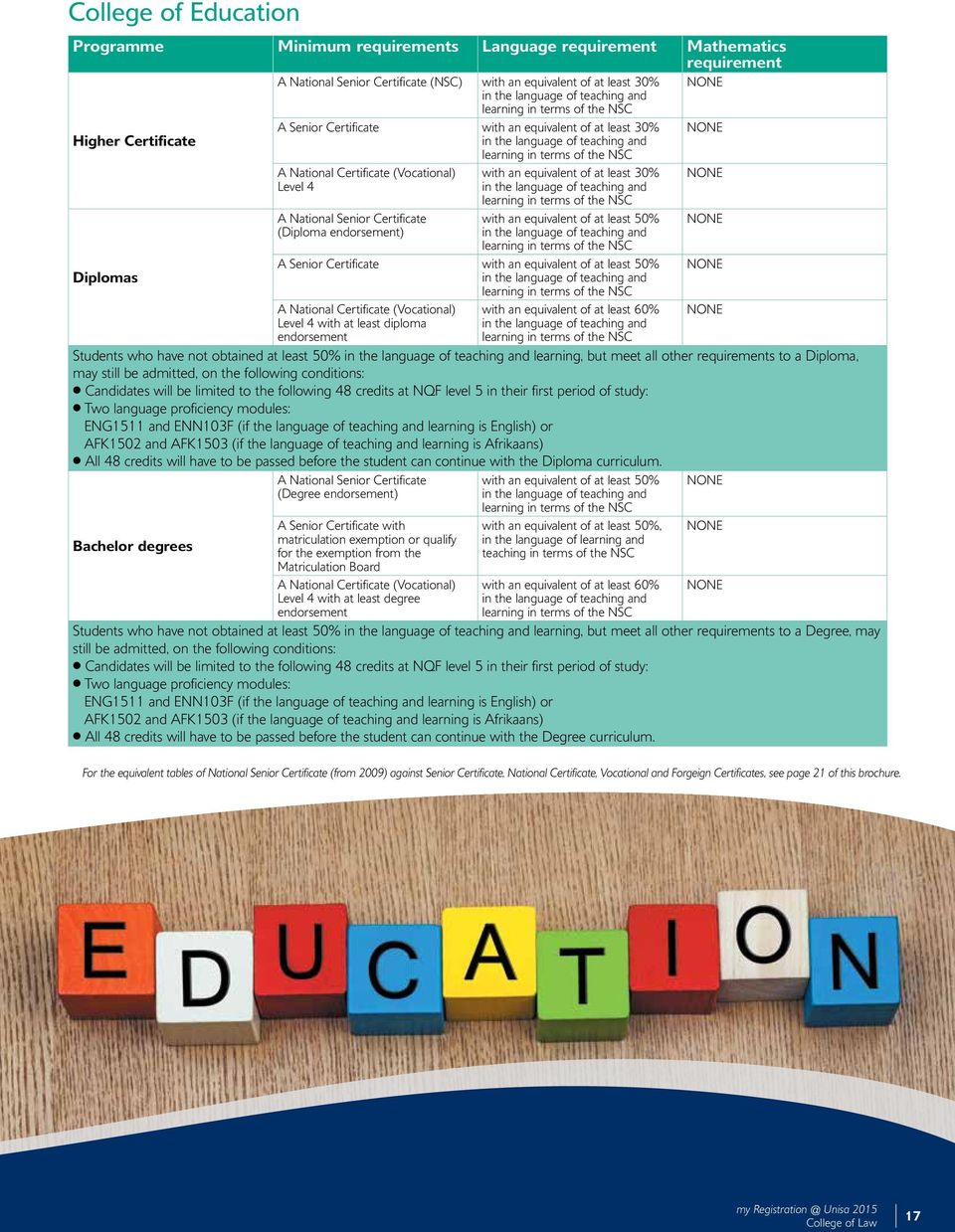
18 College of Education Programme Minimum requirements Language requirement Mathematics requirement A National Senior Certificate (NSC) with an equivalent of at least 30% NONE in the language of teaching and learning in terms of the NSC A Senior Certificate with an equivalent of at least 30% NONE Higher Certificate in the language of teaching and learning in terms of the NSC A National Certificate (Vocational) Level 4 with an equivalent of at least 30% in the language of teaching and learning in terms of the NSC NONE Diplomas A National Senior Certificate (Diploma endorsement) with an equivalent of at least 50% in the language of teaching and learning in terms of the NSC A Senior Certificate with an equivalent of at least 50% in the language of teaching and learning in terms of the NSC A National Certificate (Vocational) Level 4 with at least diploma endorsement with an equivalent of at least 60% in the language of teaching and learning in terms of the NSC Students who have not obtained at least 50% in the language of teaching and learning, but meet all other requirements to a Diploma, may still be admitted, on the following conditions: Candidates will be limited to the following 48 credits at NQF level 5 in their first period of study: Two language proficiency modules: ENG1511 and ENN103F (if the language of teaching and learning is English) or AFK1502 and AFK1503 (if the language of teaching and learning is Afrikaans) All 48 credits will have to be passed before the student can continue with the Diploma curriculum. Bachelor degrees A National Senior Certificate (Degree endorsement) A Senior Certificate with matriculation exemption or qualify for the exemption from the Matriculation Board A National Certificate (Vocational) Level 4 with at least degree endorsement with an equivalent of at least 50% in the language of teaching and learning in terms of the NSC with an equivalent of at least 50%, in the language of learning and teaching in terms of the NSC with an equivalent of at least 60% in the language of teaching and learning in terms of the NSC Students who have not obtained at least 50% in the language of teaching and learning, but meet all other requirements to a Degree, may still be admitted, on the following conditions: Candidates will be limited to the following 48 credits at NQF level 5 in their first period of study: Two language proficiency modules: ENG1511 and ENN103F (if the language of teaching and learning is English) or AFK1502 and AFK1503 (if the language of teaching and learning is Afrikaans) All 48 credits will have to be passed before the student can continue with the Degree curriculum. For the equivalent tables of National Senior Certificate (from 2009) against Senior Certificate, National Certificate, Vocational and Forgeign Certificates, see page 21 of this brochure. NONE NONE NONE NONE NONE NONE my Unisa 2015 College of Law 17
19 College of Human Sciences Programme MInimum requirements Language requirement Mathematics requirement A National Senior Certificate (NSC) with an equivalent of at least 30% NONE in the language of teaching and learning in terms of the NSC A Senior Certificate with an equivalent of at least 30% NONE Higher Certificates in the language of teaching and learning in terms of the NSC A National Certificate (Vocational) Level 4 with an equivalent of at least 30% in the language of teaching and learning in terms of the NSC NONE Diplomas A National Senior Certificate (Diploma endorsement) with an equivalent of at least 50% in the language of teaching and learning in terms of the NSC A Senior Certificate with an equivalent of at least 50%, in the language of teaching and learning in terms of the NSC A National Certificate (Vocational) Level 4 with at least diploma endorsement with an equivalent of at least 60% in the language of teaching and learning in terms of the NSC NONE NONE NONE Bachelor degrees A National Senior Certificate (Degree endorsement) A Senior Certificate with matriculation exemption or qualify for the exemption from the Matriculation Board A National Certificate (Vocational) Level 4 with at least degree endorsement with an equivalent of at least 50% in the language of teaching and learning in terms of the NSC with an equivalent of at least 50%, in the language of learning and teaching in terms of the NSC with an equivalent of at least 60% in the language of teaching and learning in terms of the NSC NONE NONE NONE For the equivalent tables of National Senior Certificate (from 2009) against Senior Certificate, National Certificate, Vocational and Forgeign Certificates, see page 21 of this brochure. 18 The information contained in this brochure was correct at the time of publication (12 November 2014). For updates, please go to the Unisa website

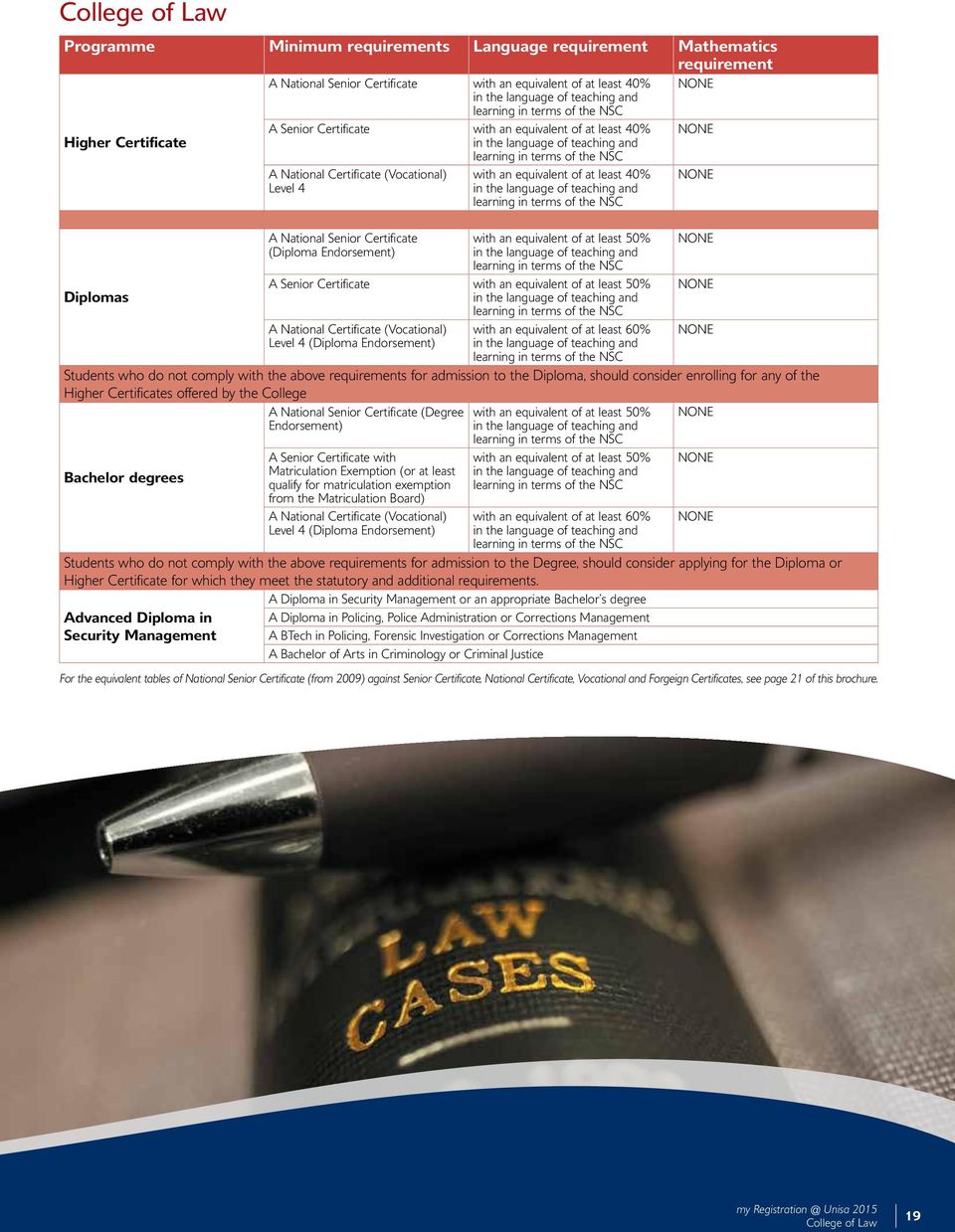
20 College of Law Programme Minimum requirements Language requirement Mathematics requirement A National Senior Certificate with an equivalent of at least 40% NONE in the language of teaching and learning in terms of the NSC A Senior Certificate with an equivalent of at least 40% NONE Higher Certificate in the language of teaching and learning in terms of the NSC A National Certificate (Vocational) Level 4 with an equivalent of at least 40% in the language of teaching and learning in terms of the NSC NONE A National Senior Certificate (Diploma Endorsement) with an equivalent of at least 50% in the language of teaching and learning in terms of the NSC A Senior Certificate with an equivalent of at least 50% NONE Diplomas in the language of teaching and learning in terms of the NSC A National Certificate (Vocational) with an equivalent of at least 60% NONE Level 4 (Diploma Endorsement) in the language of teaching and learning in terms of the NSC Students who do not comply with the above requirements for admission to the Diploma, should consider enrolling for any of the Higher Certificates offered by the College Bachelor degrees A National Senior Certificate (Degree Endorsement) A Senior Certificate with Matriculation Exemption (or at least qualify for matriculation exemption from the Matriculation Board) A National Certificate (Vocational) Level 4 (Diploma Endorsement) with an equivalent of at least 50% in the language of teaching and learning in terms of the NSC with an equivalent of at least 50% in the language of teaching and learning in terms of the NSC with an equivalent of at least 60% NONE in the language of teaching and learning in terms of the NSC Students who do not comply with the above requirements for admission to the Degree, should consider applying for the Diploma or Higher Certificate for which they meet the statutory and additional requirements. Advanced Diploma in Security Management A Diploma in Security Management or an appropriate Bachelor s degree A Diploma in Policing, Police Administration or Corrections Management A BTech in Policing, Forensic Investigation or Corrections Management A Bachelor of Arts in Criminology or Criminal Justice For the equivalent tables of National Senior Certificate (from 2009) against Senior Certificate, National Certificate, Vocational and Forgeign Certificates, see page 21 of this brochure. NONE NONE NONE my Unisa 2015 College of Law 19
21 College of Science, Engineering and Technology Programme Higher Certificate Diplomas Minimum requirements Language requirement Mathematics requirement Physical science requirement NONE NONE NONE NONE NONE NONE NONE NONE NONE NONE NONE NONE A National Senior Certificate (Diploma endorsement) A Senior Certificate A National Certificate (Vocational) Level 4 with at least diploma endorsement with an equivalent of at least 50% in the language of teaching and learning in terms of the NSC with an equivalent of at least 50%, in the language of learning and teaching in terms of the NSC with an equivalent of at least 60% in the language of teaching and learning in terms of the NSC with an equivalent of at least 50% in Mathematics in terms of the NSC with an equivalent of at least 50% in Mathematics in terms of the NSC with an equivalent of at least 50% in Mathematics in terms of the NSC A student who has not obtained at least 50% in the language of teaching and learning, 50% in Mathematics and 50% Physical Science will be limited to 48 credits at NQF level 5 in their first period of study and must register for: To meet the language requirement: Two language proficiency modules: ENG1511 and ENN103F (if the language of teaching and learning is English) or AFK1502 and AFK1503 (if the language of teaching and learning is Afrikaans) To meet the Mathematics requirement: a Mathematics module (MAT0511) To meet the Physical Science requirement: a Science module (SMI181Q) All 48 credits will have to be passed before the student can continue with the Diploma Studies Bachelor degrees A National Senior Certificate (Degree endorsement) A Senior Certificate with matriculation exemption or qualify for the exemption from the Matriculation Board A National Certificate (Vocational) Level 4 with at least degree endorsement with an equivalent of at least 50% in the language of teaching and learning in terms of the NSC with an equivalent of at least 50%, in the language of learning and teaching in terms of the NSC with an equivalent of at least 60% in the language of teaching and learning in terms of the NSC with an equivalent of at least 50% in Mathematics in terms of the NSC with an equivalent of at least 50% in Mathematics in terms of the NSC with an equivalent of at least 50% in Mathematics in terms of the NSC A student who has not obtained at least 50% in the language of teaching and learning, 50% in Mathematics and 50% Physical Science will be limited to 48 credits at NQF level 5 in their first period of study and must register for: To meet the language requirement: Two language proficiency modules: ENG1511 and ENN103F (if the language of teaching and learning is English) or AFK1502 and AFK1503 (if the language of teaching and learning is Afrikaans) To meet the Mathematics requirement: a Mathematics module (MAT0511) To meet the Physical Science requirement: a Science module (SMI181Q) All 48 credits will have to be passed before the student can continue with the Degree Studies with an equivalent of at least 50% in Physical Science in terms of the NSC for admission to any National Diploma in Engineering with an equivalent of at least 50% in Physical Science in terms of the NSC for admission to any National Diploma in Engineering with an equivalent of at least 50% in Physical Science in terms of the NSC for admission to any National Diploma in Engineering with an equivalent of at least 50% in Physical Science in terms of the NSC, if any Chemistry or Physics modules are part of the curriculum of the selected Bachelor s qualification with an equivalent of at least 50% in Physical Science if any Chemistry or Physics modules are part of the curriculum of the selected Bachelor s qualification with an equivalent of at least 50% in Physical Science if any Chemistry or Physics modules are part of the curriculum of the selected Bachelor s qualification For the equivalent tables of National Senior Certificate (from 2009) against Senior Certificate, National Certificate, Vocational and Forgeign Certificates, see page 21 of this brochure. 20 The information contained in this brochure was correct at the time of publication (12 November 2014). For updates, please go to the Unisa website
22 Equivalent tables of National Senior Certificate (from 2009) against Senior Certificate, National Certificate Vocational and Foreign Certificates National Senior Certificate against Senior Certificate NSC rating HG 1st Language HG 2nd Language Languages Senior Certificate (SC) rating SG 1st Language SG 2nd Language HG Other subjects 5 (60 69%) C (60 69%) B (70 79%) B (70 79%) A (80 89%) C (60 69%) B (70 79%) 4 (50 59%) D (50 59%) C (60 69%) C (60 69%) B (70 79%) D (50 59%) C (60 69%) 3 (40 49%) E (40 49%) D (50 59%) D (50 59%) C (60 69%) E (40 49%) D (50 59%) SG 2 (30 39%) F (33%) E (40 49%) E (40 49%) D (50 59%) F (33%) E (40 49%) National Senior Certificate against National Certificate Vocational Subjects NSC rating National Certificate Vocational (NCV) Fundamental subjects 5 (60 69%) 5 (60 69%) 4 (50 59%) 4 (50 59%) 3 (40 49%) 3 (40 49%) 2 (30 39%) 2 (30 39%) National Certificate Vocational (NCV) Vocational subjects 4 (80 100%) 3 (70 79%) 2 (60 69%) 1 (0 59%) National Senior Certificate against International Schooling Certificates NSC rating A Level AS Level O Level International Baccalaureate (Higher) International Baccalaureate (Standard) HIGCSE/ NSSC Higher IGCSE/NSSC Ordinary 7 (80 89%) D B (70 79%) E C (60 69%) D A, 1 or A 4 (50 59%) E B, 3 or 4 4 B 3 (40 49%) C, 5 or 6 C my Unisa 2015 College of Law 21
23 Apply for credits from other higher education institutions Unisa may recognise previous learning from previous formal education. This will be evaluated on a case-by-case basis. Not all credits achieved at other institutions will count towards a Unisa qualification. Your request for exemption(s) will only be considered once we have received your completed DSAR04 form and a certified copy of an official academic record, a conduct certificate and, in some cases, the syllabus. In the case of international qualifications, SAQA evaluation and the syllabus are required. This form can be found on the Unisa website ( NB: No exemptions will be finalised during the application period. You must meet the admission requirements for the qualification for which you are applying for credits and/or exemptions. A maximum of 50% of the credits of a completed qualification may be transferred to another qualification (HEQSF 2013). All credits for an incomplete qualification may be recognised by the same or a different institution as meeting part of the requirements for a different qualification, or may be recognised by a different institution as meeting part of the requirements for the same qualification (HEQSF 2013). No exemptions will be granted for Unisa's signature modules. Unisa reserves the right to grant and/or decline applications for exemptions or credit transfers. Recognition of prior learning (RPL) When applying to Unisa, remember that Unisa will consider your previous learning. This includes both formal education at a tertiary institution (eg formal certificate, diploma and degree qualifications) and informal learning (eg knowledge or skills acquired during practical work experience, including community work in a relevant field). For further information, send an to [email protected] Remember, there may be additional admission requirements based on the qualification you choose. Meeting these criteria does not mean automatic acceptance. Many qualifications have a limited number of places for the year. Each application will be considered individually. 22 The information contained in this brochure was correct at the time of publication (12 November 2014). For updates, please go to the Unisa website
24 my Unisa 2015 College of Law 23
25 2. Choose your modules Standards are high at Unisa. They have to be because, for one thing, our qualifications are recognised globally. Having a Unisa qualification behind your name takes hard work, it means that you are dedicated, diligent and independent qualities that are valued by employers the world over. The following section breaks down our qualifications into their constituent parts. It will give you a better idea of what you need to achieve to become a Unisa graduate. Qualifications: credits, modules and levels Credits are the number of notional study hours required for achieving the learning outcomes. Notional hours include study time, assignments and examinations. The credit rating system rates 10 notional hours as equivalent to one credit. For example: a Higher Certificate has 120 credits consisting of a 10 x 12 credit module. A module consisting of 12 credits equates to 120 notional hours. It therefore requires at least 8 hours of study per week in a 15-week semester. Qualifications require a certain number of credits, broken down into smaller units. At Unisa, undergraduate modules are usually 12 credits. Each module is pegged according to a specific NQF level. A bachelor s degree of 360 credits, for example, consists of 30 modules of 12 credits each. A bachelor s degree may consist of between 8 and 10 modules of 12 credits each at NQF level 5; 10 to 12 modules of 12 credits each at NQF level 6; 10 modules of 12 credits each at NQF level 7. These levels follow on from one another. When choosing a module, you must first have passed the module at the lower level. Before you can be awarded a qualification, you must have completed the required number of credits; and the modules must be completed at the required NQF level. Curriculum changes and/or the replacement of modules New knowledge and insight, as well as regulatory requirements from the Department of Higher Education and Training, and the Council for Higher Education, require that curriculums may from time to time be changed, or that certain modules in qualifications be replaced with new modules. Unisa thus reserves the right to change curriculums or to replace modules in qualifications, and to require students registered for those qualification(s) to convert to new curricula or new modules The implementation of these changes will be done in such a way that students will not be prejudiced, will not lose any credits already obtained or be required to complete more modules than originally required for the qualification. NQF levels New and changed qualifications conform to the requirements of the HEQSF and are pegged on the new NQF levels. Old qualifications are not HEQSF aligned and have lower old NQF levels as they were developed under the old framework; these levels will be retained as such. Qualifications indicating the old NQF levels will continue to receive the same recognition as those on the new NQF levels. Learning outcomes should be recognised and pegged in line with new NQF levels. NQF level Vocational Professional General 10 Doctoral degree Doctoral degree 9 Master s degree Master s degree 8 Postgraduate diploma 7 Advanced diploma Postgraduate diploma Bachelor degree Bachelor degree Advanced diploma Honours degree Bachelor degree Bachelor degree 6 Diploma (240 credits and 360 credits) Diploma (360 credits) 6 Advanced certificate (120 credits) 5 Higher certificate (120 credits) 24 The information contained in this brochure was correct at the time of publication (12 November 2014). For updates, please go to the Unisa website
26 Each Unisa qualification is structured over a defined period, usually between 2 and 4 academic years. To graduate, you need to pass a total number of modules within a certain amount of time. (The modules are specified in the qualification information.) You can register for a maximum of 60 NQF credits per semester/120 NQF credits per year (in the case of year modules) Undergraduate modules usually consist of 12 NQF credits Honours modules usually consist of 24 NQF credits The maximum number of credits do not include supplementary and/or aegrotat examinations from a previous semester. s taken for non-degree/non-diploma purposes also count towards the maximum number of credits allowed. Please check the provisional examination timetable to make sure that the modules you choose don t clash in terms of examination dates. Remember to take your available time into consideration when choosing your modules. You need approximately 6 to 8 hours per week per semester module 4 to 6 hours per week per year module Choose wisely! Rather than choose too many, choose a number of modules you know you can manage and pass. Having said that, though, you also need to pass a minimum number of modules per year, so you can t choose too few either. To verify the modules for your qualification, go to the qualifications section on page 56 of this brochure. Time limits 3 years to complete a 120-credit qualification (eg Higher Certificate or Advanced Certificate) 8 years to complete a 360-credit qualification (3-year degree or diploma) 10 years to complete a 480-credit qualification (4-year degree) Helpful hints Mark modules you ve already passed. Select the module(s) you plan to register for in Check that you meet the pre-requisites and co-requisites for your chosen modules. Add or change modules accordingly. codes change occasionally. Please check the table of equivalents under transitional arrangements at the back of this brochure or the Unisa website ( for modules you may have passed which previously had a different code. my Unisa 2015 College of Law 25
27 26 The information contained in this brochure was correct at the time of publication (12 November 2014). For updates, please go to the Unisa website
28 3. Calculate your student fees and payment options It is important to assess the full cost of your studies before confirming your modules for registration. What you can afford will affect the number of modules you can register for. This cost includes Unisa study fees: You need to pay a prescribed minimum fee (for all modules for which you are registered) on or before the closing date for registration for your registration to be finalised. The remaining fees must be paid by the prescribed due dates. Failure to do so will result in your modules being financially suspended. Read this section carefully for the fees and closing dates for payments for Cost of prescribed books: Some modules have prescribed books which must be purchased. To request an advance list of these books, contact Unisa on or [email protected]. You can get a quote for the prescribed books from one of our official booksellers. You ll find a list of these booksellers at the back of this brochure. If you re registering via the web or the self-help terminals at a regional centre, you can choose your modules and calculate your fees during that process. If you re registering by post or by fax, you should use the fee tables in this brochure to calculate your fees and minimum payments before you register. The fees detailed in this brochure are valid for the 2015 academic year only. Our fees differ depending on your qualification, your number of modules, and so on, but basically they can be grouped as follows: Prescribed student fees (including registration fees) Miscellaneous fees Fees for additional study material These are further grouped according to your level of study, whether you re an undergraduate or an honours student. There are various payment methods. Taken together our fee structures and payment methods may seem complicated, but if you read this section carefully, you ll find out what to pay, how to pay and when to pay. Unisa does not accept cash or cheques at any of its offices. Cash may be paid into the university s bank account, at any Standard Bank branch. Foreign students The government is currently investigating the subsidy for foreign students, which means that prescribed student fees could increase substantially in the future. Unisa reserves the right to charge fees in certain countries in the currency of that country. The levy for students in foreign countries must be paid in addition to the minimum initial payment at the time of registration. A student must be in possession of a student number before registration can be processed, or fees paid or deposited into the Standard Bank South African account. my Unisa 2015 College of Law 27
29 Minimum amount payable at registration A minimum fee amount is payable before the closing dates for registration for each module or paper for which you register. If this amount is not paid before the closing date for registration, the university will not be able to process your registration. After paying the minimum amount, the outstanding balance must be paid by the relevant dates into the university s Standard Bank account. This fee will be forfeited if the respective module is cancelled. If you are applying for Matriculation Exemption, please note that the Matriculation Exemption fee must be included together with the minimum fee amount payable. Compulsory miscellaneous fees, where applicable, are also payable at the time of registration. These include the levy for students in foreign countries and levies for additional study material. All fees must be paid into the correct bank account with the correct reference number (see page 36 of this brochure) or else the university will not be able to process your registration before the relevant closing date. In the case where a letter from an employer/sponsor assumes responsibility for payment, the university can provide the employer/sponsor with a quotation. Registration will only be activated upon receipt of the minimum payment by the relevant closing date. Unisa does not issue invoices to companies or government departments. Dishonoured payments If a cheque or credit card is tendered in payment of the minimum amount which must accompany a student s application for registration, and payment of that cheque or credit card is later returned unpaid by the bank, the student s registration will be cancelled by the university. Such registrations will not be reinstated unless the student s full tuition fees for the year or semester are paid in the form of cash, electronic transfer or bank guaranteed cheque into the university s bank account, or via debit card payment at any of the Unisa regional offices before the relevant closing date. On re-registration of the cancelled modules, the student s account will be debited with a once-off administrative levy, per dishonoured transaction. Overdue accounts and accounts handed over for collection No student will be allowed to re-register with the university until all outstanding debt of previous registration periods has been settled in full. Students with long overdue balances on their accounts may be handed over to a third party for collection. Any collection/legal costs that may arise from the account being handed over will be for the account of the student. Payment or arrangements thereof of overdue accounts handed over for collection should be made with the collection company concerned Cancellation dates A student who voluntary cancels his or her registration of a module will forfeit either a part of or the entire study fees paid as indicated below. If you wish to cancel your registration, you must do so by the following dates: s Date Comment Last date for cancellation of semester 1 modules Last date for cancellation of semester 2 modules Year modules 15 May 2015 Year modules 15 August March 2015 Minimum payment forfeited by this date. Full payment forfeited after this date. 15 August 2015 Minimum payment forfeited by this date. Full payment forfeited after this date. Minimum payment forfeited by this date. Initial payment and second payment forfeited after this date. Minimum payment and May payment forfeited after this date. Full payments forfeited after this date. 28 The information contained in this brochure was correct at the time of publication (12 November 2014). For updates, please go to the Unisa website
30 Prescribed student fees (undergraduates) Here are the prescribed fees for the various undergraduate modules and degrees, together with the payment dates and minimum fees due by those dates. Description Semester Total Minimum amount payable on registration Due by 15 March 2015 Due by 15 May 2015 Due by 15 Aug 2015 Subjects in Education; Law; Psychology; and Public Management and Services Half module S1 R 695,00 R 335,00 R 360,00 S2 R 695,00 R 335,00 R 360,00 YEAR R 695,00 R 335,00 R 360,00 / Paper S1 R 1 390,00 R 670,00 R 720,00 S2 R 1 390,00 R 670,00 R 720,00 YEAR R 1 390,00 R 670,00 R 720,00 Full-year course YEAR R 2 780,00 R 1 340,00 R 720,00 R 720,00 Subjects in Business Economics and Management Studies; Communication and Journalism; Computer and Information Sciences; Languages; Linguistics and Literature; Philosophy; Religion and Theology; Social Sciences Half module S1 R 680,00 R 335,00 R 345,00 S2 R 680,00 R 335,00 R 345,00 YEAR R 680,00 R 335,00 R 345,00 / Paper S1 R 1 360,00 R 670,00 R 690,00 S2 R 1 360,00 R 670,00 R 690,00 YEAR R 1 360,00 R 670,00 R 690,00 Full-year course YEAR R 2 720,00 R 1 340,00 R 690,00 R 690,00 Subjects in Architecture and the Built Enviroment; Engineering; Family Ecology and Consumer Sciences: Mathematics and Statistics Half module S1 R 675,00 R 335,00 R 340,00 S2 R 675,00 R 335,00 R 340,00 YEAR R 675,00 R 335,00 R 340,00 / Paper S1 R 1 350,00 R 670,00 R 680,00 S2 R 1 350,00 R 670,00 R 680,00 YEAR R 1 350,00 R 670,00 R 680,00 Full-year course YEAR R 2 700,00 R 1 340,00 R 680,00 R 680,00 Subjects in Agriculture and Agricultural Operations; Visual and Performing Arts; Health Professions and related Clinical Sciences; Life Sciences; Physical Sciences. Half module S1 R 640,00 R 335,00 R 305,00 S2 R 640,00 R 335,00 R 305,00 YEAR R 640,00 R 335,00 R 305,00 / Paper S1 R 1 280,00 R 670,00 R 610,00 S2 R 1 280,00 R 670,00 R 610,00 YEAR R 1 280,00 R 670,00 R 610,00 Full-year course YEAR R 2 560,00 R 1 340,00 R 610,00 R 610,00 my Unisa 2015 College of Law 29
31 Prescribed student fees (honours & 4th year) Here are the prescribed fees for the various honours and 4th-year modules and degrees, together with the payment dates and minimum fees due by those dates. Fees for fourth-level modules will be charged the same as for honours-level modules. Any legal fees that arise due to actions taken by Unisa to collect unpaid student fees will be for the account of the student. Description Semester Total Minimum amount payable on registration Subject in Education, Law, Psychology, Public Administration and Services Due by 15 March 2015 Due by 15 May 2015 Due by 15 Aug 2015 Half module YEAR R 980,00 R 420,00 R 280,00 R 280,00 S1 R 1 960,00 R 840,00 R 1 120,00 S2 R 1 960,00 R 840,00 R 1 120,00 YEAR R 1 960,00 R 840,00 R 560,00 R 560,00 Full-year course / Paper YEAR R 3 920,00 R 1 680,00 R 1 120,00 R 1 120,00 Full-year course/ Paper 36 SAQA YEAR R 5 880,00 R 2 680,00 R 1 600,00 R 1 600,00 Subjects in Business Economics and Management Studies; Communication and Journalism; Computer and Information Sciences; Languages; Linguistics and Literature; Philosophy; Religion and Theology; Social Sciences Half module YEAR R 925,00 R 420,00 R 250,00 R 255,00 S1 R 1 850,00 R 840,00 R 1 010,00 S2 R 1 850,00 R 840,00 R 1 010,00 YEAR R 1 850,00 R 840,00 R 505,00 R 505,00 Full-year course / Paper YEAR R 3 700,00 R 1 680,00 R 1 010,00 R 1 010,00 Full-year course/ Paper 36 SAQA YEAR R 5 550,00 R 2 680,00 R 1 435,00 R 1 435,00 Subjects in Architecture and the Built Enviroment; Engineering; Family Ecology and Consumer Sciences: Mathematics and Statistics Half module YEAR R 900,00 R 420,00 R 480,00 S1 R 1 800,00 R 840,00 R 960,00 S2 R 1 800,00 R 840,00 R 960,00 YEAR R 1 800,00 R 840,00 R 480,00 R 480,00 Full-year course / Paper YEAR R 3 600,00 R 1 680,00 R 960,00 R 960,00 Full-year course/ Paper 36 SAQA YEAR R 5 400,00 R 2 680,00 R 1 360,00 R 1 360,00 Subjects in Agriculture and Agricultural Operations; Visual and Performing Arts; Health Professions and related Clinical Sciences; Life Sciences; Physical Sciences. Half module YEAR R 865,00 R 420,00 R 222,00 R 223,00 S1 R 1 730,00 R 840,00 R 890,00 S2 R 1 730,00 R 840,00 R 890,00 YEAR R 1 730,00 R 840,00 R 445,00 R 445,00 Full-year course / Paper YEAR R 3 460,00 R 1 680,00 R 890,00 R 890,00 Full-year course/ Paper 36 SAQA YEAR R 5 190,00 R 2 680,00 R 1 255,00 R 1 255,00 30 The information contained in this brochure was correct at the time of publication (12 November 2014). For updates, please go to the Unisa website
32 Miscellaneous fees Apart from your general fees, there are various miscellaneous fees that you will encounter during the course of your studies, such as supplementary exams, remarks, exemption certificates and library cards. All miscellaneous fees are payable to Unisa and may be included with your student fees. The following table details all these fees and indicates who they apply to: Supplementary, deferred and aegrotat examinations R Per study unit. Remarking of examinations scripts Checking of marks Purchasing of examinations scripts R R R Examination scripts and closing dates for application (per examination script) Closing dates for the receipt of applications to have examination answer scripts rechecked/remarked are as follows * October/November 2014 examinations: 31 January 2015 * January/February 2015 supplementary examinations: 31 March 2015 * May/June 2015 examinations: 31 July 2015 Issuing of complete or conditional exemption certificates by the Matriculation Board (payable before or on registration) The fees are payable before or on registration. R Dishonoured cheques R The levy will be charged per dishonoured transaction. Levy on students in foreign countries Category Levy per course Levy per module Category A: Africa A R R Category B: Rest of the world B R R Students with an address or examination centre outside the RSA must pay the additional compulsory levy on registrations. Students who after registration, change their examination centre will be liable to pay the foreign levy as specified. The levy for foreign students is not transferable and also not refundable; this rule also applies to the change of address from foreign countries to South Africa. Library card (smart card) R45.00 Students who are liable for the Library card fees are: * Students who apply for a card for the first time * Students who previously had a card but need a new one * Students whose previous card is lost or damaged Students who are in possession of a Library card and re-register do not need to apply or pay for a new card; the old card will be activated automatically. If you indicated yes on the registration form with regard to the Library card, the card fees will automatically be payable upon registration as part of your minimum payment. Amount forfeited in case of death prior to the examination period R Visual Art Studio fee R Per semester R Full-year course my Unisa 2015 College of Law 31
33 Additional study material for formative and professional subjects Code Previous module code Price Comment AFK1501 AFK101Q R Students who registered for this module in 2013 to 2014 are exempted from this levy AFK2601 AFK202U R Students who registered for this module in 2007 to 2014 are exempted from this levy AFK3701 AFK201T R Students who registered for this module in 2007 to 2014 are exempted from this levy AFK3702 AFK301W R Students who registered for this module in 2007 to 2014 are exempted from this levy AFK3704 AFK823N R Students who registered for this module in 2007 to 2014 are exempted from this levy AFL4802 R Students who registered for this module in 2012 to 2014 are exempted from this levy APC1501 R Students who registered for this module in 2013 to 2014 are exempted from this levy APC1502 R Students who registered for this module in 2013 to 2014 are exempted from this levy APC2601 R Students who registered for this module in 2014 are exempted from this levy APC2602 R Students who registered for this module in 2014 are exempted from this levy APC3701 Book 1 APC3701 Book 2 R Students who registered for this module in 2013 to 2014 are exempted from this levy R Students who registered for this module in 2013 to 2014 are exempted from this levy APC3702 R Students who registered for this module in 2014 are exempted from this levy APC3703 R Students who registered for this module in 2012 to 2014 are exempted from this levy AST1631 R Students who registered for this module in 2013 to 2014 are exempted from this levy ATC2601 ATC2602 ATC2603 ATC3702 ATC2016 ATC2028 ATC2039 ATC303C R Students who registered for this module in 2007 to 2014 are exempted from this levy CGM2601 R Students who registered for this module in 2013 to 2014 are exempted from this levy CLO3703 R CLO3705 CLO3054 R Students who registered for this module in 2010 to 2014 are exempted from this levy CLO3706 CLO3065 R 1, Students who registered for this module in 2007 to 2014 are exempted from this levy CLO3707 R Students who registered for this module in 2007 to 2014 are exempted from this levy CLS3704 CLO3054 R Students who registered for this module in 2014 are exempted from this levy CLS3705 CLO3065 R Students who registered for this module in 2014 are exempted from this levy 32 The information contained in this brochure was correct at the time of publication (12 November 2014). For updates, please go to the Unisa website
34 Code Previous module code Price Comment CMH1501 R Students who registered for this module in 2013 to 2014 are exempted from this levy CMH1502 R Students who registered for this module in 2013 to 2014 are exempted from this levy CMH1503 R Students who registered for this module in 2012 to 2014 are exempted from this levy CMM2601 TIC301B R Students who registered for this module in 2012 to 2014 are exempted from this levy CMM3701 R Students who registered for this module in 2009 to 2019 are exempted from this levy CMM3704 R Students who registered for this module in 2014 are exempted from this levy CSL2601 R Students who registered for this module in 2012 to 2014 are exempted from this levy CST1501/ CST2602/ CST2603 CTH123D CTH222F CTH224H R 1, Students who registered for this module in 2009 to 2014 are exempted from this levy CST3703 R Students who registered for this module in 2013 to 2014 are exempted from this levy CST3705 CTH325M R Students who registered for this module in 2010 to 2014 are exempted from this levy DVA1501 R Students who registered for this module in 2014 are exempted from this levy DVA1601 DVA2601 DVA303Y R Students who registered for this module in 2012 to 2014 are exempted from this levy DVA2602 DVA3054 R Students who registered for this module in 2012 to 2014 are exempted from this levy DVA3701 R Students who registered for this module in 2007 to 2014 are exempted from this levy DVA3702 R Students who registered for this module in 2007 to 2014 are exempted from this levy DVA3703 R Students who registered for this module in 2007 to 2014 are exempted from this levy DVA3704 R Students who registered for this module in 2007 to 2014 are exempted from this levy DVA3705 R Students who registered for this module in 2007 to 2014 are exempted from this levy DVA4801 R Students who registered for this module in 2012 to 2014 are exempted from this levy DVA4802 Book 1 R Students who registered for this module in 2012 to 2014 are exempted from this levy my Unisa 2015 College of Law 33
35 Additional study material for formative and professional subjects (continued) Code DVA4802 Book 2 Previous module code Price Comment R Students who registered for this module in 2012 to 2014 are exempted from this levy DVA4803 R Students who registered for this module in 2012 to 2014 are exempted from this levy DVA4804 R 300 Students who registered for this module in 2012 to 2014 are exempted from this levy DVA4805 R Students who registered for this module in 2012 to 2014 are exempted from this levy EGE401C EMC401C EGE4PJT EGE401C R Students who registered for this module in 2007 to 2014 are exempted from this levy ENG2602 R Students who registered for this module in 2014 are exempted from this levy EUP1501 R Students who registered for this module in 2014 are exempted from this levy DVD 1 EUP1501 R Students who registered for this module in 2014 are exempted from this levy DVD 2 GGH2606 R 190 GGH3707 R HBEDAIQ R Students who registered for this module in 2010 to 2014 are exempted from this levy HBEDDAMU R Students who registered for this module in 2008 to 2014 are exempted from this levy HBEDMAB R Students who registered for this module in 2010 to 2014 are exempted from this levy HES4802 R Students who registered for this module in 2012 to 2014 are exempted from this levy HES4809 R Students who registered for this module in 2012 to 2014 are exempted from this levy HES4811 R Students who registered for this module in 2012 to 2014 are exempted from this levy HONLINR R 1, Students who registered for this module in 2014 are exempted from this levy IOP3704 R Students who registered for this module in 2014 are exempted from this levy IPC1501 IPC101Y R Students who registered for this module in 2007 to 2014 are exempted from this levy IPC1502 R Students who registered for this module in 2007 to 2014 are exempted from this levy IPC3701 IPC3019 R Students who registered for this module in 2007 to 2014 are exempted from this levy LCP4805 LCP407P R Students who registered for this module in 2007 to 2014 are exempted from this levy LML4804 LML404R R Students who registered for this module in 2009 to 2014 are exempted from this levy LPL4801 LPL4018 R Students who registered for this module in 2009 to 2014 are exempted from this levy MAC3703 R Students who registered for this module in 2014 are exempted from this levy 34 The information contained in this brochure was correct at the time of publication (12 November 2014). For updates, please go to the Unisa website
36 Code Previous module code Price Comment MACECHJ R Students who registered for this module in 2012 to 2014 are exempted from this levy MEDAE1R R Students who registered for this module in 2007 to 2014 are exempted from this levy MHS2601 R Students who registered for this module in 2014 are exempted from this levy MHS2603 R MHS2605 R MHS3701 R Students who registered for this module in 2010 to 2014 are exempted from this levy MUS4801 R NUT2601 R Students who registered for this module in 2013 to 2014 are exempted from this levy NUT3704 R Students who registered for this module in 2007 to 2012 are exempted from this levy PLC3703 R Students who registered for this module in 2013 to 2014 are exempted from this levy PLS1502 PLS2610 PLS3703 PRS2015 PCF4099 R Students who registered for this module in 2013 to 2014 are exempted from this levy R Students who registered for this module in 2012 to 2014 are exempted from this levy PSC3703 R 180 PUB2606 R Students who registered for this module in 2013 to 2014 are exempted from this levy PUB4860 R Students who registered for this module in 2008 to 2014 are exempted from this levy PYC3705 R Students who registered for this module in 2010 to 2014 are exempted from this levy PYC3705 PYC305D R Students who registered for this module in 2010 to 2014 are exempted from this levy RLE1501 R Students who registered for this module in 2013 to 2014 are exempted from this levy RST2603 RST2255 R Students who registered for this module in 2007 to 2014 are exempted from this levy RST2705 RST2705 R Students who registered for this module in 2012 to 2014 are exempted from this levy RST3707 R 260 Students who registered for this module in 2012 to 2014 are exempted from this levy RST3709 R Students who registered for this module in 2011 to 2014 are exempted from this levy SCK3703 R WFS3703 THL2601 THL201A R Students who registered for this module in 2008 to 2014 are exempted from this levy my Unisa 2015 College of Law 35
37 Payment methods For your convenience, we provide a variety of different payment methods. The following table details ways to pay, payment channels, plus refund and other information. All fees must be paid into the correct bank account with the correct reference number. Fees paid into the incorrect bank account will not be recognised as payment of study fees. In the case of electronic transfers, please ensure that the reference field is completed correctly. No cash or cheques will be accepted at any Unisa office. Cash can, however, be paid into the university s bank account at any Standard Bank branch. Debit cards Debit card payments are only accepted if you pay or register in person at Unisa in Sunnyside/Florida or at one of the regional offices: Credit cards Unisa web credit card payments Postal orders, money orders & bank drafts Credit cards are restricted to Visa and Mastercard. Credit card payments are accepted if you pay or register in person at Unisa in Sunnyside/Florida or at one of the regional offices: Unisa web payment link: (this is a secure site) Postal orders, money orders and bank drafts should be made payable to Unisa. Please note that these are real-time transactions. Please note that these are real-time transactions. This method of payment will only be accepted if posted to the university. Telegraphic money order (TMO) Students must state surname, first names, address, student number (if known) and for what purpose the payment is made. The TMO must be addressed to Unisa Unisarand for delivery and payment by the Unisarand Post Office. Bank deposit Internet/electronic payments Bank deposits can be made at any Standard Bank branch in South Africa if you already have a student number in respect of fees, for example: study fees, examination fees (supplementary, sick or special exam fees), exemption fees and library charges provided that the deposit slip is correctly filled in as follows: Deposit to: Unisa student deposits Bank account number: 096R Deposit reference: first eight (8) blocks are for the student number (If the student number consists of only 7 digits, then a 0 must be filled in as the first digit of the student number). Leave one block open, then fill in the following codes: for study fees for library fees 5352X74608 for matriculation exemption fees If a cheque is deposited, write your student number on the back of the cheque Please note that Unisa is a pre-approved beneficiary. Select Unisa on the beneficiary field. You will not be required to complete the bank account or branch code details. Ensure that the reference field is completed correctly. Deposit reference: first eight (8) blocks are for the student number (if the student number consists of only 7 digits, then a 0 must be filled in as the first digit of the student number). Leave one block open, then fill in the following codes: for study fees for library fees 5352X74608 for matriculation exemption fees Should any of the information on the bank deposit slip be incomplete or incorrect, the transaction will not be processed by the bank and/or may cause a delay in the allocation or transfer of funds to your account and as such the university cannot be held liable for delays caused. Payments will be allocated within two days, except over weekends, to the study fees account provided that all the information on the deposit slip is correct. Only bank guaranteed cheques will be accepted for deposit. You must write your student number on the back of the cheque. Should any of the information on the bank deposit slip be incomplete or incorrect, the transaction will not be processed by the bank and/or may cause a delay in the allocation or transfer of funds to your account. Payments will be allocated within two days, except over weekends, to the study fees account provided that all the information on the deposit slip is correct. South African Post Office (SAPO) Refunds General Deposit reference: first eight (8) blocks are for the student number (if the student number consists of only 7 digits, then a 0 must be filled in as the first digit of the student number). Leave one block open, then fill in the following codes: for study fees 5352X74608 for matriculation exemption fees Just provide this reference number to the SAPO cashier and state that you want to pay Unisa Requests have to be made in writing and must be signed by the registered student. The refund form is available on the Unisa website. Requests can be ed to [email protected] or faxed to +27 (12) Refunds will be processed within 21 working days from receipt of request. Credit balances exceeding the total study fees paid by sponsors or bursaries will be refunded to the sponsor or bursary concerned. No refunds for credit balances less than R will be allowed. Refund requests must be accompanied by proof of payment. The university reserves the right not to render services to students with outstanding balances. Receipts and statements of accounts will be issued to registered students only. It remains the student s responsibility to submit the document to the relevant sponsor. 36 The information contained in this brochure was correct at the time of publication (12 November 2014). For updates, please go to the Unisa website
38 International students Please note that this bank account can ONLY be used by international students. Please note that credit card payments are real-time transactions. Submit proof of payment to The preferred method of payment is credit card via the Unisa website. The Unisa web payment link is Alternatively, you can make payment by means of a SWIFT/EFT transfer (see bank account details below). SWIFT/EFT transfers can be made if you already have a student number in respect of fees, for example: study fees, examination fees (supplementary, sick or special exam fees), exemption fees and library charges provided that the details are filled in as follows: Bank: Standard Bank Beneficiary: Unisa student deposits Branch code: Swift code: SBZAZAJJ Account number: Deposit reference: first eight (8) blocks are for the student number (if the student number consists of only 7 digits, then a 0 must be filled in as the first digit of the student number). Leave one block open, then fill in the following codes: for study fees for library fees 5352X74608 for matriculation exemption fees Bank payments Please note that Unisa now banks with Standard Bank. Should you need to make payments at a Standard Bank branch, please refer to the following sample deposit slip. A Standard Bank deposit slip Complete the deposit slip according to the table below 1 Unisa student deposits 2 096R 3 8 digit student number 4 Leave a block empty after your student number 5 Reference number a) Study fees b) Matriculation fees 5352X74608 d) Library fees my Unisa 2015 College of Law 37
39 38 The information contained in this brochure was correct at the time of publication (12 November 2014). For updates, please go to the Unisa website
40 Bursaries and loans Soon you will have to make the first minimum registration payment. There are a number of other factors influencing the cost of your studies: Have you made provision for the remainder of the payments? Have you considered the cost of prescribed books and travel expenses to get to examination centres? Does your company offer study leave or will you need to take unpaid leave? Financial worries can affect your state of mind not a good idea when you re trying to focus on your studies. It s best to try and resolve the money side before you get started. The financial assistance offered by Unisa can go a long way towards calming financial worries. NSFAS loans The National Student Financial Aid Scheme (NSFAS) operates according to the National Student Financial Aid Act 56 of NSFAS and its administrative partners have made, and will continue to make, a substantial contribution to student financial aid in South Africa. If, in the opinion of NSFAS, the student successfully completes the course of study, NSFAS may deem up to 40% of the loan amount to be a bursary. If NSFAS chooses to reward a student with this bursary, the loan amount will be reduced by the amount of that bursary, and the student will be obliged to repay only the remaining balance of the loan amount and interest on that balance. Eligibility A student qualifies for a NSFAS loan or bursary if he or she is a South African citizen registered at a public South African Higher Education Institution, and can demonstrate potential for academic success and the fact that he or she is financially needy. Students who have received loans, bursaries or scholarships from other sources covering the full cost of study are not eligible for a NSFAS loan. Interest on NSFAS loans While the student remains studying at Unisa, interest will remain at 0% of the loan amount. Interest will start to accrue on the loan account balance based on the exit date of the student. The exit date is defined as the date the student exits Unisa, regardless of whether the student has graduated. The interest will start to accrue on the outstanding capital balance one year after the exit date from Unisa or when contractual repayment becomes due or payable. The student must begin repaying the Loan Amount and accrued interest in monthly instalments as soon as the student finds employment. The following applies every year, unless changed by NSFAS: Interest on loans starts to accrue one year after the date of completion of your qualification. The interest rate is generally less than the rate at which the Reserve Bank lends to other banks. How to apply for a NSFAS loan Students only apply once for a NSFAS loan. To apply please visit to complete the online application. Please visit for more information or contact the NSFAS Contact Centre on New students must complete the Unisa application process to receive a student number. New students may apply online for a NSFAS loan. Students who received a NSFAS loan in 2014 do not need to re-apply. Students who received a NSFAS loan prior to 2014 need to visit their nearest Unisa Regional Office and complete an application form and submit it together with all supporting documents. Incomplete, faxed and late applications will not be considered. Complete a temporary registration during the specified registration period. The outcome of loan applications will be communicated via SMS by NSFAS. my Unisa 2015 College of Law 39
41 Awarding of loans Students will be informed via SMS if their application was successful. The student will again be notified via SMS about when to sign. Loans are NOT awarded on a first come, first served basis. Closing dates Applications for first semester close on 25 August Applications for second semester close on 25 April Qualifications not covered by NSFAS These include the MBL, MBA, DBL, DBA short course certificates/programmes, higher certificates and non-degree courses. Appeals All appeals are handled by NSFAS. Dates may change. Please visit the relevant website for updated information. Accepting a NSFAS loan If the applicant accepts the loan, he or she has to sign the online NSFAS Loan Agreement Form (LAF). Students need to ensure that their correct cellphone numbers are captured on the NSFAS application as a One Time Pin (OTP) will be sent via SMS to the student to log in and sign the LAF. Students have the right to access NSFAS eligibility criteria access procedures and deadlines for submitting application forms or any other required documentation in support of their application know why an application for a loan has been refused so that the decision can be appealed Student responsibilities Read the instructions carefully and complete the online application/laf forms accurately. Provide any information or documentation required (eg certified copies of ID documents). Read, understand and keep copies of any forms. Notify the SFO and/or NSFAS of any changes with regard to their address, employment status, marital status and so on. Know and comply with all requirements for continuation of financial aid, including academic progress. Contact details (Directorate of Student Funding) General enquiries: /1/2/3 Bursary enquiries: Loan enquiries: NSFAS Contact Centre [email protected] Web: NSFAS bursaries Nedbank bursary Criteria Nedbank funds are granted to South African students studying towards BCom or BBusScience qualification majoring in Accounting or Banking, Economics, Finance/Financial Management, Statistics, Investment Management, Actuarial Science, Information Systems, BSc Computer Sciences or Information Systems The Nedbank Bursary is performance-based. Students with the potential to succeed must be identified. For more information and the relevant closing dates for 2015, visit 40 The information contained in this brochure was correct at the time of publication (12 November 2014). For updates, please go to the Unisa website
42 Allocation The Nedbank bursary functions on the basis of the demographic spread of the economically active population, as published by Statistics South Africa, that is, 75% black African, 12% coloured, 10% white and 3% Indian and a minimum of 40% female gender distribution, where applicable. The allocation must be split as follows: 25% to first-year students, 50% to second-year students and 25% to third or final-year students. The bursary covers the basic cost of study which includes tuition and prescribed books. The bursary is allocated annually and is renewable on successful performance for a maximum of three years. Within one month after the recipient completes the degree, Nedbank has first option to recruit the graduate. If Nedbank does not have a vacancy or chooses not to recruit the graduate, he or she is not liable to pay back the bursary and is free to seek employment elsewhere. If the graduate is offered employment by Nedbank but chooses not to take up the position, he or she must pay back the full cost of the bursary to NSFAS. Natskills bursary Only South African citizens are eligible. The bursary pertains to qualifications addressing the scarce skills needed in South Africa (full list available on our website). Successful candidates will be selected from those who applied for the NSFAS loan. Funza Lushaka bursary Applicable to students studying towards a teaching qualification. Applicants must be studying towards a BEd degree or PGCE with priority areas ( Academic performance of applicants must be above average. Applicants must meet Unisa s admission requirements for the relevant programme. Once qualified, bursary recipients must teach in the public school to which they are appointed. Applications must be submitted online at Application will be accepted from 1 October Re-applications close on 15 November 2014 and new applications close on 10 January Due to the limited number of bursaries available, new applicants are advised to pursue other funding opportunities. Social development bursary How to apply Application forms are available from and should be submitted to the Department of Social Development. The list of successful applicants will be forwarded to Unisa by the National Department of Social Development. Who qualifies? Anyone who wishes to pursue a BA in Social Work Documents to be submitted a certified copy of the identity document a completed schedule of particulars, including personal details, details of next of kin, study details (course and modules for which you have registered) and witnesses Allocation of funds and practicals are as per National Department of Social Development criteria. For more information, visit and click on "scholarships". Dates may change. Please visit the relevant website for updated information. my Unisa 2015 College of Law 41
43 Bursary scheme for students with disabilities Current recipients of this bursary will continue to receive support, regardless of the field of study, provided they are academically able (fulfilling the admission requirements) they are financially needy their disability is regarded as long term, recurring and substantially limiting they are South African citizens The minimum time to complete undergraduate studies is as determined by the institution s academic faculties, plus an additional two years (N+2). On completion of studies, beneficiaries are required to work in South Africa for a specified period. Should a beneficiary be unable to find employment in South Africa within three months of completing the qualification, he or she must apply in writing to the NSFAS for a fair exit/buy-out clause. The bursary covers (bursaries are only awarded if funds are available) registration, tuition and examination fees ( the tuition costs ) payable to the institution costs of books and other study materials prescribed by the institution ( the materials costs ) costs of assistive device to the student (as per the attached schedule/cost table) except where no other means of cash payment is possible (as determined by the NSFAS) Application dates First semester closing date is 30 September 2014; second semester closing date is 17 April 2015 Application forms are available at Unisa Student Funding offices as well as ARCSWID Contact: Tel: Fax: [email protected] Other bursaries Omigsa/Imfundo Trust The Old Mutual Imfundo Trust offers bursaries to top performing students in the following fields at Unisa: Accounting, Law, Agriculture. The bursary covers tuition as well as other study material expenses. KPMG KPMG offers bursaries to students who are currently registered for their CTA qualification. DAC Linguistics The Department of Arts and Culture offers a bursary to students registered for a BA degree majoring in Afrikaans or an African Language and Linguistics. Applications are open from 15 August to 20 September and the application forms can be downloaded from the DSF webpage at Crossroads Distribution (Skynet Worldwide Express) Crossroads offers a bursary to students studying towards an honours, master s or doctoral degree in logistics. Department of Transport Bursary The DoT offers a bursary to students studying towards a qualification in Transport, Logistics and Civil Engineering. Any additional bursaries added during the year are also published on our webpage. Please visit ( for more information. 42 The information contained in this brochure was correct at the time of publication (12 November 2014). For updates, please go to the Unisa website
44 my Unisa 2015 College of Law 43
45 44 The information contained in this brochure was correct at the time of publication (12 November 2014). For updates, please go to the Unisa website
46 4. Complete and submit your registration You have 4 options/channels through which you can submit your registration. Unisa will not accept online any registration forms submitted via . self-help terminals at regional centres through the post (please be aware that postal strikes may mean that your registration form will not reach Unisa in time.) by fax If you use our electronic channels (the internet and self-help terminals), you ll be prompted when information is missing or incorrect. If you register by post or by fax, you must ensure that the information is correct. You should, in that case, register as soon as registration opens, as missing or incorrect information may cause delays in the approval of your registration. In light of the above, we suggest that, if you can, you register electronically. If you do need to register through the post or by fax, you ll find guidelines on how to complete your registration form correctly on page 47. You will find the qualification information for this college in this brochure or on the Unisa website ( Ensure that you meet all the requirements, then complete and submit your registration. The example below shows you how. Structure of qualification curriculum A Qualification B Stream C Qualification code: D NQF Exit level: E Total credits: F Qualification offered until: G Admission requirements: H Rules: J s K Pre/co-requisites A = name of qualification (eg BSc) B = some qualifications have streams, eg Environmental management C = qualification code (eg 02089) D = NQF exit level, ie highest level of the qualification E = Total NQF credits required for completion of qualification F = Some qualifications are only available to repeating students as these qualifications will be phased out. This line would indicate until when the repeating students have to complete that qualification. G = Details the admission requirements to the qualification H = The rules applicable to the qualification. Important that these must be read by student. J = The list of modules. There would also be an indication of the compulsory modules and those from which choices can be made. K = The pre-requisite or co-requisite for each module. Note: Pre-requisite indicates the module and/or modules you must have passed before you can take the selected module. Co-requisite indicates a module you must take together with the selected module. my Unisa 2015 College of Law 45
47 Option 1: Online via the internet Unisa s online registration process is quick, simple and accurate. This is why we recommend this option. Once again, when registering online, you ll be prompted when information is missing or incorrect, helping you to ensure that you include all important details and upload all necessary documents when submitting your registration form. The steps are as follows Go to the Unisa registration website: Enter your student number in the block provided and other details required. (If you don t have a student number you won t be able to continue; you ll need to apply for a student number during the next application period.) Check your personal details on screen. Change any contact details that are missing or incorrect. Enter the modules you want to register for. You must meet all the pre-requisites and co-requisites for the selected module enter the correct module code select the correct semester (1 = first semester; 2 = second semester) indicate in which language you want to receive your study material (English or Afrikaans) Do not exceed the prescribed number of modules per semester or year, as your registration will not be processed. Calculate your fees Use the fee quotation link on the Unisa website ( to obtain a quote for the cost of your modules. Note the minimum fee that must be paid before Unisa will process your registration. If these fees are more than you can afford, delete modules until you can afford the fees. You can make payment online, using a credit card at If you don t have a credit card, you can pay at a Standard Bank. Retain your proof of payment in case of enquiries. Submit your registration. Option 2: In person at a self-help computer terminal When you arrive at a Unisa Regional Office, you ll be referred to a self-help computer terminal. Finalise your registration by following the prompts/instructions on the screen. Unisa staff will be in the registration halls to assist you. At the computer, type in your student number. You ll be prompted to confirm your information. If it s correct, click Yes. If you need to make changes, click No. Make the necessary changes and when you re satisfied, click Yes to submit the information. Select your modules. Use the drop-down menu provided with each module. Once you ve selected your modules and confirmed the information on the summary page, click Proceed with temporary registration. If you have a credit card you may pay your fees online. If not, you can pay at any Standard Bank branch. Retain your proof of payment in case of enquiries. If you pay, at least, the minimum fee, you can print out a confirmation of your registration. If you don t make the minimum payment, you ll receive a printout indicating the details of the modules you selected and the payment details (minimum fee payable, total fee and payment options). Once your registration is finalised, register and download your study material and the my Unisa brochure from myunisa. 46 The information contained in this brochure was correct at the time of publication (12 November 2014). For updates, please go to the Unisa website
48 Options 3 & 4: Post and fax Please check that you have completed the registration form correctly using the information in this brochure or on the Unisa website. Errors or inaccuracies may result in your registration being delayed. Completed registration documents and payments must reach Unisa before the closing date for registrations. Use the payment information in this brochure to calculate your minimum fees, then pay at any Standard Bank branch. Please use your student number as your reference number when paying. Proof of payment must be faxed to Unisa on or included with your registration documents. Please don t include cash or cheques with your documents. Completed registration forms can also be faxed to or posted to Unisa, PO Box 392, Unisa, Please note the university cannot be held responsible for any registration forms that do not reach Unisa by the closing date for registrations. We urge you to register online or by making use of our self-help terminals at Unisa Regional Offices. Guidelines for completing your registration form New and re-registering students must check the pre-populated form for accuracy and provide any missing information. Returning students registering for a new qualification must complete the form in full. Complete the form in black ink and write as clearly as possible. Make 2 additional photocopies of the form before you begin (in case you make a mistake). Complete both sides of the form. Check that your qualification and personal information is correct. Confirm the language that Unisa will use to communicate with you. If you have a disability, please look at the registration form codes section at the back of this brochure. 01 is the code for no disability. Check your cellphone number and mylife address (if you already have one). This is how Unisa will contact you. Check the examination centres. Ensure that the venue code corresponds with where you want to write your exams. If you want to change your examination venue, ensure that you apply by the due date for the specified examination period. Study material can be found on myunisa and your first study pack will be sent to you via courier. In this case, please ensure that your postal and courier address are correct. Indicate the period for which you are registering: semester 1 (1); semester 2 (2); the year (0) (applies to year modules only). my Unisa 2015 College of Law 47
49 Study pack delivery options Your first study material pack will be delivered to you via courier. Your first study material pack will be delivered to you via courier. This only applies to the first study pack. Subsequent material will be sent via ordinary mail service to the South African Post Office. Once you have registered, you may register on myunisa ( to access and download your study material online. Courier: There is no additional fee to courier your study material. Please provide Unisa with your cellphone number, an alternative contact number (in case we can t get hold of you via your cellphone number) and a physical delivery address. Please ensure that someone is available to take receipt of your study material pack at the courier address you provide. Post: Provide Unisa with a correct address, suburb and postal code. * Study material for second semester modules will only be sent to you at the start of the second semester. Second semester study material will also only be available on my Unisa at the start of the second semester. Go to myunisa to download study material online. 48 The information contained in this brochure was correct at the time of publication (12 November 2014). For updates, please go to the Unisa website
50 Registration approval Your registration will only be finalised once you receive confirmation from Unisa that it has been approved. If you submitted your registration at a self-help terminal and paid the full minimum fees by the closing date for registration, it may have been finalised immediately. If you registered via the web, post or fax, you must first receive a notification from Unisa indicating that you ve been successfully registered. If you don t receive this notification within two weeks, despite having paid the minimum fees and submitting your registration form, please send an to [email protected]. Alternatively, visit your nearest Unisa Regional Office for an update on the status of your registration. Once your registration is approved we will then send you your initial study pack via courier. The my Unisa brochure included in the study pack and available on myunisa has information on how to plan your studies, how to study, how to connect to Unisa services, and how to tackle assignments, exams, and so on. Your registration remains provisional until you have paid the required fees and submitted proof of payment to Unisa. The university reserves the right to verify and amend the correctness of your provisional registration until you have paid the required fees and submitted proof of payment to Unisa. my Unisa 2015 College of Law 49
51 Did you know? 50 The information contained in this brochure was correct at the time of publication (12 November 2014). For updates, please go to the Unisa website
52 Amending your registration You may make any of the following changes to your registration by logging on to myunisa ( and following the registration prompts. If you d prefer the university to assist you, submit your request in writing using the prescribed forms (at the back of this brochure). By post: The Deputy Registrar, PO Box 392, Unisa, 0003 By fax: Adding modules To add modules after registration you must apply online or in writing using the prescribed form (DSAR02) and then pay the necessary fee to the university by the relevant closing date for registration. Please note that requests to add modules received via will not be accepted as official requests for additions. Cancelling modules You can cancel modules via the same channels (apply online or in writing using the prescribed DSAR02 form). You will, however, forfeit the applicable portion of the fees paid (related to the date of cancellation-see page 28 of this brochure). Please look at the exclusion from studies paragraph in the Student Rules before cancelling modules. Changing your address and/or telephone number Submit all requests to change telephone numbers and/or postal, physical or courier addresses or venue online or in writing using the prescribed form (DSAR03). All addresses are compulsory. No registrations will be processed without address details. my Unisa 2015 College of Law 51
53 Changing your exam centre You must confirm your examination centre at the time of registration. You can also check this on myunisa. All examinations in one examination period must be written at this centre unless you apply, in writing, to Unisa to change the venue. Unisa will confirm whether it is possible to change your venue (depending on availability, venue capacity and the closing date for applications). You can do this via myunisa (include your student number in the subject line) SMS fax If you want to change your examination venue, ensure that you apply by the due date for the specified examination period: 28 February for the May/June examinations 31 July for the October/November examinations 15 October for the January/February examinations CTA levels 1 and 2 students should note that examination centres for these exams are limited to venues used for tests during the year. CTA exams take place prior to the October/November examination period. Applications for venue changes must be submitted to Unisa by 31 July The information contained in this brochure was correct at the time of publication (12 November 2014). For updates, please go to the Unisa website
54 Applying for course credit exemptions A maximum of 50% of the credits of a completed qualification may be transferred to another qualification (HEQSF 2013). All credits for an incomplete qualification may be recognised by the same or a different institution as meeting part of the requirements for a different qualification, or may be recognised by a different institution as meeting part of the requirements for the same qualification (HEQSF 2013). You must have met Unisa s admission requirements at the time of having passed the relevant modules at your previous institution. Conditional exemption If you have an ordinary conditional exemption, you will not be allowed to proceed to second or further years of study until you have passed the outstanding module and met the condition of that exemption. Did you know that some Unisa qualifications include workplace-based learning? Specific modules in certain qualifications offered at Unisa include workplace-based learning that must be completed. Please check if the qualification you have chosen has one or more work-integrated learning (WIL) module. This experience is called work-integrated learning or experiential learning, and must be completed under the supervision of a suitably qualified and experienced person (mentor). This experience is mandatory for passing that module and achieving your qualification. Please check, before registering for such a module, that you will be able to complete this work-integrated learning component. Students who do not have placement at an employer can contact the relevant academic department for assistance in finding a suitable experiential learning provider to gain this experience. Will Unisa recognise my prior learning? When applying to Unisa, Unisa may consider your previous learning. This includes both formal education at a tertiary institution (eg formal certificate, diploma and degree qualifications) and informal learning (eg knowledge or skills acquired during practical work experience, including community work in a relevant field). For further information, send an to [email protected] How do I get an academic record or credit certificate? Complete the prescribed (DSAR08) form and submit it to Unisa. Can I transfer from another university to Unisa? Yes, except if you were excluded/suspended from a prior institution of higher education on grounds of misconduct. You need to apply to Unisa first, however. Please go to the Unisa website ( for the dates for the next application period. Can I register with Unisa and another university simultaneously? Only if the qualification you register for at Unisa is for non-degree purposes, and that you have written permission from the other university allowing concurrent registration. You must submit this written permission at the point of registration. Remember, if you do not have a Unisa student number you first need to apply. Can I register for two or more formal programmes at Unisa simultaneously? Unfortunately not. When can I register for a module if I was registered before and did not write the exam for the module? After the official release of the exam results for that exam period, but before the appropriate closing date. I completed my education in a country other than South Africa. What should I do? If you did and you re registering for a bachelor s degree you must apply for a certificate of conditional matric exemption through the Access and Matriculation Exemption Office at Unisa ([email protected]). my Unisa 2015 College of Law 53
55 Sunday Monday Tuesday Wednesday Thursday Friday Saturday 08:00 Breakfast Sleep late 09:00 with mom 10:00 APM 1513 As- DCE :00 Assignment 12:00 1: complete signment1: Complete assignment Work and Travel Work and Travel Prepare for your studies It may take a little time before you receive confirmation of your registration. While you re waiting, it s a good idea to start preparing. Create a study space Creating your study space is a good place to start, somewhere in your home that s quiet, that s your own, where you won t be disturbed. It should have good natural light and be well lit at night too. Schedule your time Get yourself a year planner, identify the times you re not working at your job (if you have one). Mark the events (social and otherwise) that you know you ll have to attend. Mark your family time, the time for all your other obligations and the time you need for yourself. In this way, you ll start to identify your ideal study times, and the instances where, perhaps, you need to sacrifice a little social time to get in those extra study hours. Remember: semester modules require between 6 and 8 hours per week, and year modules between 4 and 6 hours per week. Start building a support community Like we said at the start, building a support community is one of the most important requirements for any Unisa student. It s a network of people who can help you on your journey. You ll only be able to connect to lecturers and students once you re registered on myunisa, but family, friends and work colleagues play a big part too. Talk to your family, talk to friends, let them know what to expect. Having the understanding of the people in your life means having their support too. If you re working in your field of study, then the workplace will be a great source of support. People with experience in your field are invaluable. Talk to your colleagues and your employer. This will also help when you need to take time off for exams, for instance. Find a mentor, someone you know and trust, who can advise you through the course of your studies. Ideally, he or she should have studied too, they should understand the challenges; they should know you and your situation well enough to resolve conflicts when they arise; and importantly, they should be someone you trust. 13:00 Lunch Lunch 14:00 APM 1513 Assignment1: Complete assignment APM 1513 Assignment1: Complete assignment Register on myunisa Once you ve received confirmation of your registration, register on myunisa, the university s online student portal. Then you won t need to wait for your study material to be sent to you. You ll be able to download everything, including your tutorial letters and the my Unisa brochure, from myunisa. Registering on myunisa is one of the first things you need to do once you have your student number. Work and Travel Work and Travel Work and Travel DCE 1501 Assignment 1: complete 54 APM 1513 Assignment1: Compl C 15:00 Break 16:00 Break 17:00 COS1511 Assignment 1: complete 0 Dinner Dinner Dinner Dinner COS1511 Assignment 1: COS1511 As- complete signment 1: complete DCE 150 Ass The information contained in this brochure was correct at the time of publication (12 November 2014). For updates, please go to the Unisa website
56 After registering on myunisa, you can download study material, tutorial letters and study guides submit and track assignments receive assignment results join discussion forums contact lecturers and read material posted by lecturers pay fees update your personal details conduct administrative processes register for additional modules find e-resources check and change exam info Your mylife account Once registered on myunisa, you can claim your mylife account. It s a free account which Unisa uses to communicate with you via . It s the only account we use. If you re using another address, you must have your mylife s forwarded to that address otherwise you ll miss out on important information. Unisa also uses SMSs when necessary, using the cellphone number you provided at the point of registration. Students with disabilities Unisa s Advocacy and Resource Centre for Students with Disabilities (ARCSWiD) assists and supports students with disabilities. Should you require assistance, please indicate the nature of your disability on your registration form and contact ARCSWiD as soon as possible. Also complete the special assistance form, ARCSWiD01 (you ll find it further on in this brochure). This enables ARCSWiD to plan the measures necessary to support your needs. Should you require additional assistance with your examinations (eg Braille or large print), please apply by sending an to [email protected] by the relevant due date. For more information about ARCSWiD, please send an to [email protected] my Unisa 2015 College of Law 55
57 Qualifications Index DIPLOMAS 59 Diploma in Information Technology 59 Diploma in Information Technology Extended Programme 60 National Diploma: Engineering: Civil 61 National Diploma: Engineering: Electrical (Clinical Engineering) 63 National Diploma: Engineering: Electrical (Computer Systems) 65 National Diploma: Engineering: Electrical (Electronics and Electronic Communication) 67 National Diploma: Engineering: Electrical (Mechatronics) 69 National Diploma: Engineering: Electrical (Power Engineering) 71 National Diploma: Engineering: Electrical (Process Instrumentation) 73 National Diploma: Engineering: Industrial 75 National Diploma: Engineering: Mechanical 77 National Diploma: Engineering: Chemical 79 National Diploma: Information Technology 81 National Diploma: Mining Engineering 82 National Diploma: Mine Surveying 83 National Diploma: Pulp and Paper Technology 84 National Diploma: Surface Mining 85 BACCALAUREUS TECHNOLOGIAE DEGREES 86 Baccalaureus Technologiae: Engineering: Chemical (Environmental) 86 Baccalaureus Technologiae: Engineering: Civil (Construction Management) 86 Baccalaureus Technologiae: Engineering: Civil (Environmental Engineering) 87 Baccalaureus Technologiae: Engineering: Civil (Structural) 88 Baccalaureus Technologiae: Engineering: Civil (Urban Engineering) 88 Baccalaureus Technologiae: Engineering: Civil (Water) 89 Baccalaureus Technologiae: Engineering: Electrical (Clinical Engineering) 89 Baccalaureus Technologiae: Engineering: Electrical (Computer Systems) 90 Baccalaureus Technologiae: Engineering: Electrical (Power Engineering) 90 Baccalaureus Technologiae: Engineering: Electrical (Process Instrumentation) 91 Baccalaureus Technologiae: Engineering: Electrical (Telecommunication) 91 Baccalaureus Technologiae: Engineering: Chemical 92 Baccalaureus Technologiae: Engineering: Industrial 92 Baccalaureus Technologiae: Information Technology 93 Baccalaureus Technologiae: Engineering: Mechanical 93 BACHELOR DEGREES 94 Bachelor of Science (Applied Mathematics and Computer Science Stream) 94 Bachelor of Science Extended Programme (Applied Mathematics and Computer Science Stream) 95 Bachelor of Science (Applied Mathematics and Physics Stream) 96 Bachelor of Science Extended Programme (Applied Mathematics and Physics Stream) 97 Bachelor of Science (Applied Mathematics and Statistics Stream) 98 Bachelor of Science Extended Programme (Applied Mathematics and Statistics Stream) 99 Bachelor of Science (Chemistry and Applied Mathematics Stream) The information contained in this brochure was correct at the time of publication (12 November 2014). For updates, please go to the Unisa website
58 Bachelor of Science Extended Programme (Chemistry and Applied Mathematics Stream) 101 Bachelor of Science (Chemistry and Physics Stream) 102 Bachelor of Science Extended Programme (Chemistry and Physics Stream) 103 Bachelor of Science (Chemistry and Statistics Stream) 105 Bachelor of Science Extended Programme (Chemistry and Statistics Stream) 106 Bachelor of Science (Chemistry and Computer Science Stream) 108 Bachelor of Science Extended Programme (Chemistry and Computer Science Stream) 109 Bachelor of Science (Chemistry and Information Systems Stream) 111 Bachelor of Science Extended Programme (Chemistry and Information Systems Stream) 112 Bachelor of Science General 114 Bachelor of Science Extended Programme (General) 116 Bachelor of Science (Mathematics and Chemistry Stream) 117 Bachelor of Science Extended Programme (Mathematics and Chemistry Stream) 119 Bachelor of Science (Mathematics and Applied Mathematics Stream) 120 Bachelor of Science Extended Programme (Mathematics and Applied Mathematics Stream) 121 Bachelor of Science (Mathematics and Physics Stream) 122 Bachelor of Science Extended Programme (Mathematics and Physics Stream) 123 Bachelor of Science (Mathematics and Statistics Stream) 125 Bachelor of Science Extended Programme (Mathematics and Statistics Stream) 126 Bachelor of Science (Mathematics and Computer Science Stream) 127 Bachelor of Science Extended Programme (Mathematics and Computer Science Stream) 128 Bachelor of Science (Mathematics and Information Systems Stream) 129 Bachelor of Science (Mathematics and Information Systems Stream) 130 Bachelor of Science (Statistics and Physics Stream) 131 Bachelor of Science Extended Programme (Statistics and Physics Stream) 132 Bachelor of Science in Computing 133 Bachelor of Science in Computing Extended Programme (Computing) 134 Bachelor of Science in Informatics 135 Bachelor of Science in Informatics Extended Programme (Informatics) 136 Bachelor Of Science General 137 Bachelor of Science (Information Technology and Computer Science: Computational Intelligence Stream) 139 Bachelor of Science (Information Technology and Computer Science: Computational Statistics (Programming) Stream) 140 Bachelor of Science (Information Technology and Computer Science: Computational Statistics (Information Systems) Stream) 141 Bachelor of Science (Information Technology and Computer Science: Decision Modelling and Computing Stream) 142 Bachelor of Science (Information Technology and Computer Science: Information and Decision Modelling Stream) 143 Bachelor of Science (Information Technology and Computer Science: Scientific Computing Stream) 144 Bachelor of Science (Information Technology and Computer Science: Software Engineering Stream) 145 my Unisa 2015 College of Law 57
59 Bachelor of Science (Information Technology and Computer Science: Information Systems and Geography) 146 Bachelor of Science (Information Technology and Computer Science: Information Technology Management Stream) 147 Bachelor Of Science (Mathematical And Statistical Science: Applied Mathematics Stream) 148 Bachelor of Science (Mathematical and Statistical Science: Environmental Statistics Stream) 149 Bachelor of Science (Mathematical and Statistical Science: Financial Modelling Stream) 150 Bachelor Of Science (Mathematical And Statistical Science: Mathematics Stream) 151 Bachelor of Science (Mathematical and Statistical Science: Mathematical: Modelling Stream) 152 Bachelor of Science (Mathematical and Statistical Science: Mathematical Statistics Stream) 153 Bachelor of Science (Mathematical and Statistical Science: Statistical Decision Science Stream) 154 Bachelor of Science (Mathematical and Statistical Science: Statistics for Management Stream) 155 Bachelor of Science (Natural Sciences: Astronomy Stream) 156 Bachelor of Science (Natural Sciences: Chemistry and Physics Stream) 157 Bachelor of Science (Natural Sciences: Chemistry and Microbiology Stream) 158 Bachelor of Science (Natural Sciences: Chemistry and Mathematics Stream) 160 Bachelor of Science (Natural Sciences: Chemistry and Physiology Stream) 161 Bachelor of Science (Natural Sciences: Physics and Computer Science Stream) 163 Bachelor of Science (Natural Sciences: Physics Stream) 164 HONOURS DEGREES 166 Honours Bachelor of Commerce in Statistics 166 Honours Bachelor of Science in Chemistry 166 Honours Bachelor of Science in Physics 166 Honours Bachelor of Science in Applied Mathematics 167 Honours Bachelor of Science in Mathematics 167 Honours Bachelor of Science in Statistics 168 Bachelor of Commerce Honours in Business Informatics 168 Bachelor of Science Honours in Computing 169 Bachelor of Science Honours in Astronomy Education 169 Bachelor of Science Honours in Chemistry Education 170 Bachelor of Science Honours in Computing Education 170 Bachelor of Science Honours in Life Science Education 170 Bachelor of Science Honours in Mathematics Education 171 Bachelor of Science Honours in Physics Education 171 Bachelor of Science Honours in Science Education 171 Bachelor of Science Honours in Statistics Education 173 Bachelor of Science Honours in Physics 173 Bachelor of Science Honours in Chemistry 173 Bachelor of Science Honours in Astronomy 174 Bachelor of Science Honours in Applied Mathematics 174 Bachelor of Science Honours in Statistics 175 Bachelor of Science Honours in Mathematics The information contained in this brochure was correct at the time of publication (10 November 2014). For updates, please go to the Unisa website
60 DIPLOMAS Diploma in Information Technology Qualification code: NQF Exit level: 6 Total credits: 360 This qualification will be presented using both online and distance learning modes. Admission requirements: A National Senior Certificate (Diploma endorsement) with at least 50% in the language of teaching and learning. Students will be streamed into the Extended Programme depending on their Academic Point Scores (APS). Students who do not meet the additional requirements may follow Unisa's alternative pathway. First level BSM Business Management IA ENN Practising Workplace English EUP Ethical Information and Communication Technologies for Development Solutions ICT Introduction to Programming ICT Introduction to Interactive Programming Co-requisite: ICT1513 ICT Introduction to Web Design Co-requisite: EUP1501 (or XUP1501) ICT Introduction to Databases Co-requisite: EUP1501 (or XUP1501) ICT Workstation Technical Skills ICT Network Technical Skills Co-requisite: ICT1531 (or XCT1531) ICT Business Informatics I Second level FAC Introductory Financial Accounting ICT Graphical User Interface Programming Pre-requisite: COS1511 (or XOS1511) or ICT1511 (or XCT1511) & ICT1513 (or XCT1513) ICT Interactive Programming Pre-requisite: COS1511 (or XOS1511) or ICT1511 (or XCT1511) & ICT1513 (or XCT1513) ICT Internet Programming Pre-requisite: COS1511 (or XOS1511) or ICT1511 (or XCT1511), ICT1512 (or XCT1512) & ICT1513 (or XCT1513) ICT Structured Systems analysis and Design Pre-requisite: ICT1521 (or XCT1521) & ICT1541 (or XCT1541) or INF1505 (or XNF1505) or COS1521 (or XOS1521) ICT Object-Oriented analysis Pre-requisite: ICT1521 (or XCT1521) & ICT1541 (or XCT1541) or INF1505 (or XNF1505) or COS1521 (or XOS1521) ICT Operating Systems Practice Pre-requisite: ICT1531 (or XCT1531) & ICT1532 (or XCT1532) ICT Digital Logic Pre-requisite: ICT1531 (or XCT1531) & ICT1532 (or XCT1532) ICT Business Informatics IIA Pre-requisite: ICT1541 (or XCT1541) Co-requisite: FAC1501 ICT Business Informatics IIB Pre-requisite: ICT1541 (or XCT1541) Co-requisite: FAC1501 & ICT2641 Third level ICT Advanced Graphical User Interface Programming Pre-requisite: ICT2611 ICT Advanced Internet Programming Pre-requisite: ICT2612 & ICT2613 ICT Database Design Pre-requisite: ICT2621 & ICT2622 Co-requisite: ICT3722 ICT Advanced Operating System Practice Pre-requisite: ICT2631 (not applicable to BTELN COS) ICT Business Informatics IIIA Pre-requisite: ICT2641 & ICT2642 ICT Business Informatics IIIB Pre-requisite: ICT2641 & ICT2642 Co-requisite: ICT3641 ICT Information and Communication Technology Project Proposal Pre-requisite: ICT2621, ICT2622, ICT2641 & ICT2642 Co-requisite: ICT3722, ICT3621 & INF3708 ICT Information and Communication Technology Project Implementation Pre-requisite: ICT2611, ICT2612, ICT2613, ICT2621, ICT2622, ICT2631 & ICT3713 Co-requisite: ICT3611, ICT3722, ICT3621 & INF3708 ICT Database Practice Pre-requisite: ICT2621 & ICT2622 Co-requisite: ICT3621 INF Software Project Management my Unisa 2015 College of Science, Engineering and Technology 59
61 Diploma in Information Technology Stream: Extended Programme Qualification code: XIT NQF Exit level: 6 Total credits: 360 This qualification will be presented using both online and distance learning modes. Admission requirements: A National Senior Certificate (Diploma endorsement) with at least 50% in the language of teaching and learning. Students will be streamed into the Extended Programme depending on their Academic Point Scores (APS). Students who do not meet the additional requirements may follow Unisa's alternative pathway. Rules: In this qualification, registration is restricted to 60 credits in the first and second levels. It is strongly recommended to students to complete all the first level modules, followed by all the second level modules, before proceeding to register for the third or fourth level modules. First level ENN Practising Workplace English XCT Introduction to Programming (Extended) XCT Introduction to Interactive Programming (Extended) Co-requisite: XUP1501 (or EUP1501), XCT1513 XCT Introduction to Web Design (Extended) Co-requisite: XUP1501 (or EUP1501) XUP Ethical Information and Communication Technologies for Development Solutions (Extended) Second level BSM Business Management IA XCT Introduction to Databases (Extended) (Offered From 2016) Co-requisite: EUP1501 (or XUP1501) XCT Workstation Technical Skills (Extended) (Offered From 2016) Pre-requisite: XCT1511 or XCT1512 or XCT1513 or XCT1521 XCT Network Technical Skills (Extended) (Offered From 2016) Co-requisite: XCT1531 (or ICT1531) XCT Business Informatics I (Extended) (Offered From 2016) Pre-requisite: XCT1511 or XCT1512 or XCT1513 or XCT1521 Third level FAC Introductory Financial Accounting ICT Graphical User Interface Programming Pre-requisite: COS1511 (or XOS1511) or ICT1511 (or XCT1511) & ICT1513 (or XCT1513) ICT Interactive Programming Pre-requisite: COS1511 (or XOS1511) or ICT1511 (or XCT1511) & ICT1513 (or XCT1513) ICT Internet Programming Pre-requisite: COS1511 (or XOS1511) or ICT1511 (or XCT1511), ICT1512 (or XCT1512) & ICT1513 (or XCT1513) ICT Structured Systems analysis and Design Pre-requisite: ICT1521 (or XCT1521) & ICT1541 (or XCT1541) or INF1505 (or XNF1505) or COS1521 (or XOS1521) ICT Object-Oriented analysis Pre-requisite: ICT1521 (or XCT1521) & ICT1541 (or XCT1541) or INF1505 (or XNF1505) or COS1521 (or XOS1521) ICT Operating Systems Practice Pre-requisite: ICT1531 (or XCT1531) & ICT1532 (or XCT1532) ICT Digital Logic Pre-requisite: ICT1531 (or XCT1531) & ICT1532 (or XCT1532) ICT Business Informatics IIA Pre-requisite: ICT1541 (or XCT1541) Co-requisite: FAC1501 ICT Business Informatics IIB Pre-requisite: ICT1541 (or XCT1541) Co-requisite: FAC1501 & ICT2641 Fourth level ICT Advanced Graphical User Interface Programming Pre-requisite: ICT2611 ICT Advanced Internet Programming Pre-requisite: ICT2612 & ICT2613 ICT Database Design Pre-requisite: ICT2621 & ICT2622 Co-requisite: ICT3722 ICT Advanced Operating System Practice Pre-requisite: ICT2631 (not applicable to BTELN COS) ICT Business Informatics IIIA Pre-requisite: ICT2641 & ICT2642 ICT Business Informatics IIIB Pre-requisite: ICT2641 & ICT2642 Co-requisite: ICT3641 ICT Information and Communication Technology Project Proposal Pre-requisite: ICT2621, ICT2622, ICT2641 & ICT2642 Co-requisite: ICT3722, ICT3621 & INF3708 ICT Information and Communication Technology Project Implementation Pre-requisite: ICT2611, ICT2612, ICT2613, ICT2621, ICT2622, ICT2631 & ICT3713 Co-requisite: ICT3611, ICT3722, ICT3621 & INF3708 ICT Database Practice Pre-requisite: ICT2621 & ICT2622 Co-requisite: ICT3621 INF Software Project Management 60 The information contained in this brochure was correct at the time of publication (10 November 2014). For updates, please go to the Unisa website
62 National Diploma: Engineering: Civil Qualification code: NDECI NQF Exit level: 6 Total credits: 360 This qualification will be presented using both online and distance learning modes. Admission requirements: A National Senior Certificate (Diploma endorsement) with at least 50% in the language of teaching and learning and with at least 50% in Mathematics and Physical Science. Students who do not meet the additional requirements may follow Unisa's alternative pathway. Rules: Work-integrated learning is a compulsory component towards the completion of this qualification. Students may do PEC2601and PEC301C sequentially (i.e.pec301c after PEC2601} or simultaneously by registering for both modules in the same year. A student may only select Option A for PEC2601and PEC301C if s/he has a placement. Purpose statement: To train a Civil Engineering Technician with sufficient academic knowledge and practical experience to plan, design, construct and manage projects in the Civil Engineering field. A qualified person with sufficient experience will be able to register with the Engineering Council of South Africa (ECSA) as a Professional Technician in this field of Engineering. First level AMC1PRA - Applied Mechanics I (Practical) Co-requisite: PHY1501 DRW Drawing I ENN103F - English for Academic Purposes EUP Ethical Information and Communication Technologies for Development Solutions MAT Mathematics I (Engineering) PHY Elementary Mechanics Co-requisite: AMC1PRA (only applicable to NDECI), MCA1PRA (only applicable to NDEEN-MEC, NDEID, NDEMC) SRV Surveying I (Theory) Co-requisite: SRVPRA1 or SRV1PRA SRVPRA1 - Surveying I (Practical) Co-requisite: SRV1501 or SRV121Q Second level CMD Construction Methods I CMT Construction Materials I (Theory) Co-requisite: CMTPRA1 or CMT1PRA CMTPRA1 - Construction Materials I (Practical) Co-requisite: CMT1501 or CMT101C DRW Drawing II Pre-requisite: DRW1501 or DRW111X MAT Mathematics II (Engineering) Pre-requisite: MAT1581 MCL Management: Civil I SRC Surveying: Civil II (Theory) Pre-requisite: SRV1501or SRV121Q & SRVPRA1 or SRV1PRA Co: SRCPRA2 or SRV2PRA SRCPRA2 - Surveying: Civil II (Practical) Pre-requisite: SRV1501or SRV121Q & SRVPRA1 or SRV1PRA Co-requisite: SRC2601 or SRV211Q TST Theory of Structures II (Theory) Pre-requisite: PHY1501 & AMC1PRA Co-requisite: TSTPRA2 or TST2PRA TSTPRA2 - Theory of Structures II (Practical) Pre-requisite: PHY1501 & AMC1PRA Co-requisite: TST2601 or TST271Z my Unisa 2015 College of Science, Engineering and Technology 61
63 Third level GTE Geotechnical Engineering II (Theory) Co-requisite: GTE2PRA GTE2PRA - Geotechnical Engineering II (Practical) Co-requisite: GTE2601 or GTE281Q MCL Management: Civil II Pre-requisite: MCL1501 or MCL191S PEC Engineering Practice: Civil II (Option A: Workplace-Based Learning Or Option B: Project-Based Learning) Co-requisite: Option A: AMC1PRA & DRW1501& ENN103F & EUP1501 & MAT1581 & PHY1501& SRV1501& SRVPRA1 & CMD1501& MCL1501 Option B: DCM3601& DCM3602 & GTE3601& GTEPRA3 & SAN3601& SSD3601& SSD3602 & TPE3601& TPE3PRA & WEN3601& WEN3PJT & WEN3PRA RCD Reinforced Concrete and Masonry Design III (Theory) Pre-requisite: TST2601 or TST271Z & TSTPRA2 or TST2PRA Co-requisite: RCD3602 or RCD3PJT & SAN2601 or SAN271Z RCD Reinforced Concrete and Masonry Design III (Project) Pre-requisite: TST2601 or TST271Z & TSTPRA2 or TST2PRA Co-requisite: RCD3601 or RCD301C & SAN2601or SAN271Z SAN Structural analysis II Pre-requisite: TST2601 or TST271Z & TSTPRA2 or TST2PRA TPE Transportation Engineering II (Theory) Co-requisite: SRC2601 or SRC211Q & SRCPRA2 or SRC2PRA & TPE2602 or TPE211C TPE Transportation Engineering II (Project) Co-requisite: SRC2601or SRC211Q & SRCPRA2 or SRC2PRA & TPE2601 or TPE211C WEN Water Engineering II (Theory) Pre-requisite: PHY1501 & AMC1PRA Co-requisite: WEN2PRA WEN2PRA - Water Engineering II (Practical) Pre-requisite: PHY1501 & AMC1PRA Co-requisite: WEN2601 or WEN221R Fourth level DCM Documentation III (Theory) Co-requisite: DCM3602 or DCM3PJT DCM Documentation III (Project) Co-requisite: DCM3601 or DCM371Y GTE Geotechnical Engineering III (Theory) Pre-requisite: GTE2601 or GTE281Q & GTE2PRA Co-requisite: GTEPRA3 or GTE3PRA GTEPRA3 - Geotechnical Engineering III (Practical) Pre-requisite: GTE2601 or GTE281Q & GTE2PRA Co-requisite: GTE3601 or GTE331Q PEC301C - Engineering Practice: Civil III (Option A: Workplace-Based Learning Or Option B: Project-Based Learning) Co-requisite: Option A: PEC2601 or PEC201C & RCD3601or RCD301C & RCD3602 or RCD3PJT & MCL2601 or MCL221S Option B: DCM3601 & DCM3602 & GTE3601 & GTEPRA3 & SAN3601& SSD3601& SSD3602 & TPE3601 & TPE3PRA & WEN3601& WEN3PJT & WEN3PRA SAN Structural analysis III Pre-requisite: SAN2601 or SAN271Z SSD Structural Steel and Timber Design III (Theory) Pre-requisite: SAN2601 or SAN271Z Co-requisite: SSD3602 or SSD3PJT SSD Structural Steel and Timber Design III (Project) Pre-requisite: SAN2601 or SAN271Z Co-requisite: SSD3601 or SSD301C TPE Transportation Engineering III (Theory) Pre-requisite: TPE2601 or TPE211C & TPE2602 or TPE2PJT Co-requisite: TPE3PRA TPE3PRA - Transportation Engineering III (Practical) Pre-requisite: TPE2601 or TPE211C & TPE2602 or TPE2PJT Co-requisite: TPE3601 or TPE381V WEN Water Engineering III (Theory) Pre-requisite: WEN2601 or WEN221R & WEN2PRA Co-requisite: WEN3PRA & WEN3PJT WEN3PJT - Water Engineering III (Project) Pre-requisite: WEN2601 or WEN221R & WEN2PRA Co-requisite: WEN3601 or WEN361F WEN3PRA - Water Engineering III (Practical) Pre-requisite: WEN2601 or WEN221R & WEN2PRA Co-requisite: WEN3601 or WEN361F & WEN3PJT 62 The information contained in this brochure was correct at the time of publication (10 November 2014). For updates, please go to the Unisa website
64 National Diploma: Engineering: Electrical Stream: Clinical Engineering Qualification code: NDEEN - CEN NQF Exit level: 6 Total credits: 360 This qualification will be presented using both online and distance learning modes. Admission requirements: A National Senior Certificate (Diploma endorsement) with at least 50% in the language of teaching and learning and with at least 50% in Mathematics and Physical Science. Students who do not meet the additional requirements may follow Unisa's alternative pathway. Rules: For experiential learning purposes, students currently unemployed should contact the department. Purpose statement: Students will be competent to apply technical knowledge, engineering principles and problem-solving techniques in the field of Electrical Engineering by operating within the relevant standards and codes in collaboration with other members of the engineering team. A qualified person with sufficient experience will be able to register with the Engineering Council of South Africa (ECSA) as a Professional Technician in this field of Engineering. First level COS Introduction to Programming I DIG Digital Systems I (Theory) Co-requisite: DIGPRA1 or DIG1PRA DIGPRA1 - Digital Systems I (Practical) Co-requisite: DIG1501 or DIG111Z ECT Electronics I (Theory) Co-requisite: ECTPRA1 or ECT1PRA ECTPRA1 - Electronics I (Practical) Co-requisite: ECT1501 or ECT151R ELE Electrical Engineering I (Theory) Co-requisite: ELEPRA1 or ECT1PRA ELEPRA1 - Electrical Engineering I (Practical) Co-requisite: ELE1501or ELE171U ENN103F - English for Academic Purposes EUP Ethical Information and Communication Technologies for Development Solutions MAT Mathematics I (Engineering) Second level DIG Digital Systems II (Theory) Pre-requisite: DIG1501 or DIG111Z &, DIGPRA1 or DIG1PRA Co-requisite: DIGPRA2 or DIG2PRA DIGPRA2 - Digital Systems II (Practical) Pre-requisite: DIG1501 or DIG111Z & DIGPRA1 or DIG1PRA Co-requisite: DIG2601 or DIG221X ECT Electronics II (Theory) Pre-requisite: ECT1501 or ECT151R & ECTPRA1 or ECT1PRA Co-requisite: ECTPRA2 or ECT2PRA ECTPRA2 - Electronics II (Practical) Pre-requisite: ECT1501 or ECT151R & ECTPRA1 or ECT1PRA Co-requisite: ECT2601 or ECT261Z ELE Electrical Engineering II (Theory) Pre-requisite: ELE1501 or ELE171U & ELEPRA1 or ELE1PRA Co-requisite: ELEPRA2 or ELE2PRA ELEPRA2 - Electrical Engineering II (Practical) Pre-requisite: ELE1501 or ELE171U & ELEPRA1 or ELE1PRA Co-requisite: ELE2601 or ELE281X EPR101E - Electrical Engineering Practice I Pre-requisite: ELE2601, ECT2601 & MAT2691 ICT Introduction to Interactive Programming Co-requisite: ICT1513 ICT Introduction to Web Design Co-requisite: EUP1501 (or XUP1501) MAT Mathematics II (Engineering) Pre-requisite: MAT1581 my Unisa 2015 College of Science, Engineering and Technology 63
65 Third level BSY Bio-Systems I DIG Digital Systems III (Theory) Pre-requisite: DIG2601 or DIG221X & DIGPRA2 or DIG2PRA Co-requisite: DIGPRA3 or DIG3PRA DIGPRA3 - Digital Systems III (Practical) Pre-requisite: DIG2601or DIG221X & DIGPRA2 or DIG2PRA Co-requisite: DIG3601or DIG331Q ECT Electronics III (Theory) Pre-requisite: ECT2601 or ECT261Z & ECTPRA2 or ECT2PRA Co-requisite: ECTPRA3 or ECT3PRA ECTPRA3 - Electronics III (Practical) Pre-requisite: ECT2601or ECT261Z & ECTPRA2 or ECT2PRA Co-requisite: ECT3601 or ECT381A EPR201E - Electrical Engineering Practice II Co-requisite: MAT3700, DPJ391U MAT Mathematics III (Engineering) Pre-requisite: MAT2691 MEQ Medical Equipment III ( A) (Theory) Co-requisite: MEQPRA1 or MEQ3P1C MEQ Medical Equipment III ( B) (Theory) Co-requisite: MEQPRA2 or MEQ3P2D MEQPRA1 - Medical Equipment III ( A) (Practical) Co-requisite: MEQ3601 or MEQ3116 MEQPRA2 - Medical Equipment III ( B) (Practical) Co-requisite: MEQ3602 or MEQ3128 Fourth level DPJ391U - Design Project III Pre-requisite: 10 study units on level 1 or level 2 and 2 study units on level 3. Group B. Choose 1 of the following groups of modules BSM Business Management IA BSM Business Management IB Group C. EMA Engineering Management II ( A) EMA Engineering Management II ( B) 64 The information contained in this brochure was correct at the time of publication (10 November 2014). For updates, please go to the Unisa website
66 National Diploma: Engineering: Electrical Stream: Computer Systems Qualification code: NDEEN - COS NQF Exit level: 6 Total credits: 360 This qualification will be presented using both online and distance learning modes. Admission requirements: A National Senior Certificate (Diploma endorsement) with at least 50% in the language of teaching and learning and with at least 50% in Mathematics and Physical Science. Students who do not meet the additional requirements may follow Unisa's alternative pathway. Rules: Compilation of curriculum: The following compulsory modules need to be completed: English for Academic Purposes. Ethical Information and Communication Technologies for Development Solutions. Mathematics 1, 2 & 3. Electrical Engineering 1 & 2. Electronics 1 & 2. Digital Systems 1. Design Project 3. Electrical Engineering Practice 1 & of the 360 credits must be level 3 subjects. For experiential learning purposes, students currently unemployed should contact the department.. Purpose statement: Students will be competent to apply technical knowledge, engineering principles and problem-solving techniques in the field of Electrical Engineering by operating within the relevant standards and codes in collaboration with other members of the engineering team. A qualified person with sufficient experience will be able to register with the Engineering Council of South Africa (ECSA) as a Professional Technician in this field of Engineering. First level Group A. COS Introduction to Programming I DIG Digital Systems I (Theory) Co-requisite: DIGPRA1 or DIG1PRA DIGPRA1 - Digital Systems I (Practical) Co-requisite: DIG1501 or DIG111Z ECT Electronics I (Theory) Co-requisite: ECTPRA1 or ECT1PRA ECTPRA1 - Electronics I (Practical) Co-requisite: ECT1501 or ECT151R ELE Electrical Engineering I (Theory) Co-requisite: ELEPRA1 or ECT1PRA ELEPRA1 - Electrical Engineering I (Practical) Co-requisite: ELE1501or ELE171U ENN103F - English for Academic Purposes EUP Ethical Information and Communication Technologies for Development Solutions ICT Workstation Technical Skills MAT Mathematics I (Engineering) Second level Group A. DIG Digital Systems II (Theory) Pre-requisite: DIG1501 or DIG111Z &, DIGPRA1 or DIG1PRA Co-requisite: DIGPRA2 or DIG2PRA DIGPRA2 - Digital Systems II (Practical) Pre-requisite: DIG1501 or DIG111Z & DIGPRA1 or DIG1PRA Co-requisite: DIG2601 or DIG221X ECT Electronics II (Theory) Pre-requisite: ECT1501 or ECT151R & ECTPRA1 or ECT1PRA Co-requisite: ECTPRA2 or ECT2PRA ECTPRA2 - Electronics II (Practical) Pre-requisite: ECT1501 or ECT151R & ECTPRA1 or ECT1PRA Co-requisite: ECT2601 or ECT261Z ELE Electrical Engineering II (Theory) Pre-requisite: ELE1501 or ELE171U & ELEPRA1 or ELE1PRA Co-requisite: ELEPRA2 or ELE2PRA ELEPRA2 - Electrical Engineering II (Practical) Pre-requisite: ELE1501 or ELE171U & ELEPRA1 or ELE1PRA Co-requisite: ELE2601 or ELE281X EPR101E - Electrical Engineering Practice I Pre-requisite: ELE2601, ECT2601 & MAT2691 ICT Introduction to Interactive Programming Co-requisite: ICT1513 ICT Introduction to Web Design Co-requisite: EUP1501 (or XUP1501) ICT Network Technical Skills Co-requisite: ICT1531 (or XCT1531) MAT Mathematics II (Engineering) Pre-requisite: MAT1581 my Unisa 2015 College of Science, Engineering and Technology 65
67 Third level Group A. DIG Digital Systems III (Theory) Pre-requisite: DIG2601 or DIG221X & DIGPRA2 or DIG2PRA Co-requisite: DIGPRA3 or DIG3PRA DIGPRA3 - Digital Systems III (Practical) Pre-requisite: DIG2601or DIG221X & DIGPRA2 or DIG2PRA Co-requisite: DIG3601or DIG331Q ECM Electronic Communication II (Theory) Co-requisite: ECMPRA2 or ECM2PRA & ECT2601 or ECT261Z & ECTPRA2 or ECT2PRA ECMPRA2 - Electronic Communication II (Practical) Co-requisite: ECM2601 or ECM391Z & ECT2601or ECT261Z & ECTPRA2 or ECT2PRA ECT Electronics III (Theory) Pre-requisite: ECT2601 or ECT261Z & ECTPRA2 or ECT2PRA Co-requisite: ECTPRA3 or ECT3PRA ECTPRA3 - Electronics III (Practical) Pre-requisite: ECT2601or ECT261Z & ECTPRA2 or ECT2PRA Co-requisite: ECT3601 or ECT381A EPR201E - Electrical Engineering Practice II Co-requisite: MAT3700, DPJ391U ICT Business Informatics I ICT Interactive Programming Pre-requisite: COS1511 (or XOS1511) or ICT1511 (or XCT1511) & ICT1513 (or XCT1513) ICT Internet Programming Pre-requisite: COS1511 (or XOS1511) or ICT1511 (or XCT1511), ICT1512 (or XCT1512) & ICT1513 (or XCT1513) ICT Operating Systems Practice Pre-requisite: ICT1531 (or XCT1531) & ICT1532 (or XCT1532) ICT Advanced Graphical User Interface Programming Pre-requisite: ICT2611 MAT Mathematics III (Engineering) Pre-requisite: MAT2691 Fourth level DPJ391U - Design Project III Pre-requisite: 10 study units on level 1 or level 2 and 2 study units on level 3. ICT Advanced Internet Programming Pre-requisite: ICT2612 & ICT2613 ICT Advanced Operating System Practice Pre-requisite: ICT2631 (not applicable to BTELN COS) Group B. Choose 1 of the following groups of modules BSM Business Management IA BSM Business Management IB Group C. EMA Engineering Management II ( A) EMA Engineering Management II ( B) 66 The information contained in this brochure was correct at the time of publication (10 November 2014). For updates, please go to the Unisa website
68 National Diploma: Engineering: Electrical Stream: Electronics and Electronic Communication Qualification code: NDEEN - EEC NQF Exit level: 6 Total credits: 360 This qualification will be presented using both online and distance learning modes. Admission requirements: A National Senior Certificate (Diploma endorsement) with at least 50% in the language of teaching and learning and with at least 50% in Mathematics and Physical Science. Students who do not meet the additional requirements may follow Unisa's alternative pathway. Rules: Compilation of curriculum: The following compulsory modules need to be completed: English for Academic Purposes. Ethical Information and Communication Technologies for Development Solutions. Mathematics 1, 2 & 3. Electrical Engineering 1 & 2. Electronics 1 & 2. Digital Systems 1. Design Project 3. Electrical Engineering Practice 1 & of the 360 credits must be level 3 subjects. Students who select Electronic Measurements 3 and Metrology 3 must pass both modules in order for credit to be granted. For experiential learning purposes, students currently unemployed should contact the department. Purpose statement: Students will be competent to apply technical knowledge, engineering principles and problem-solving techniques in the field of Electrical Engineering by operating within the relevant standards and codes in collaboration with other members of the engineering team. A qualified person with sufficient experience will be able to register with the Engineering Council of South Africa (ECSA) as a Professional Technician in this field of Engineering. First level Group A. COS Introduction to Programming I DIG Digital Systems I (Theory) Co-requisite: DIGPRA1 or DIG1PRA DIGPRA1 - Digital Systems I (Practical) Co-requisite: DIG1501 or DIG111Z ECT Electronics I (Theory) Co-requisite: ECTPRA1 or ECT1PRA ECTPRA1 - Electronics I (Practical) Co-requisite: ECT1501 or ECT151R ELE Electrical Engineering I (Theory) Co-requisite: ELEPRA1 or ECT1PRA ELEPRA1 - Electrical Engineering I (Practical) Co-requisite: ELE1501or ELE171U ENN103F - English for Academic Purposes EUP Ethical Information and Communication Technologies for Development Solutions MAT Mathematics I (Engineering) Second level Group A. DIG Digital Systems II (Theory) Pre-requisite: DIG1501 or DIG111Z &, DIGPRA1 or DIG1PRA Co-requisite: DIGPRA2 or DIG2PRA DIGPRA2 - Digital Systems II (Practical) Pre-requisite: DIG1501 or DIG111Z & DIGPRA1 or DIG1PRA Co-requisite: DIG2601 or DIG221X ECT Electronics II (Theory) Pre-requisite: ECT1501 or ECT151R & ECTPRA1 or ECT1PRA Co-requisite: ECTPRA2 or ECT2PRA ECTPRA2 - Electronics II (Practical) Pre-requisite: ECT1501 or ECT151R & ECTPRA1 or ECT1PRA Co-requisite: ECT2601 or ECT261Z ELE Electrical Engineering II (Theory) Pre-requisite: ELE1501 or ELE171U & ELEPRA1 or ELE1PRA Co-requisite: ELEPRA2 or ELE2PRA ELEPRA2 - Electrical Engineering II (Practical) Pre-requisite: ELE1501 or ELE171U & ELEPRA1 or ELE1PRA Co-requisite: ELE2601 or ELE281X EPR101E - Electrical Engineering Practice I Pre-requisite: ELE2601, ECT2601 & MAT2691 ICT Introduction to Interactive Programming Co-requisite: ICT1513 ICT Introduction to Web Design Co-requisite: EUP1501 (or XUP1501) MAT Mathematics II (Engineering) Pre-requisite: MAT1581 my Unisa 2015 College of Science, Engineering and Technology 67
69 Third level Group A. DIG Digital Systems III (Theory) Pre-requisite: DIG2601 or DIG221X & DIGPRA2 or DIG2PRA Co-requisite: DIGPRA3 or DIG3PRA DIGPRA3 - Digital Systems III (Practical) Pre-requisite: DIG2601or DIG221X & DIGPRA2 or DIG2PRA Co-requisite: DIG3601or DIG331Q ECM Electronic Communication II (Theory) Co-requisite: ECMPRA2 or ECM2PRA & ECT2601 or ECT261Z & ECTPRA2 or ECT2PRA ECMPRA2 - Electronic Communication II (Practical) Co-requisite: ECM2601 or ECM391Z & ECT2601or ECT261Z & ECTPRA2 or ECT2PRA ECT Electronics III (Theory) Pre-requisite: ECT2601 or ECT261Z & ECTPRA2 or ECT2PRA Co-requisite: ECTPRA3 or ECT3PRA ECTPRA3 - Electronics III (Practical) Pre-requisite: ECT2601or ECT261Z & ECTPRA2 or ECT2PRA Co-requisite: ECT3601 or ECT381A EKM Electronic Measurements III (Theory) Pre-requisite: ECT2601 or ECT261Z & ECTPRA2 or ECT2PRA Co-requisite: MTR3601 or MTR341X & MTRPRA3 or MTR3PRA & EKMPRA3 or EKM3PRA EKMPRA3 - Electronic Measurements III (Practical) Pre-requisite: ECT2601 or ECT261Z & ECTPRA2 or ECT2PRA Co-requisite: MTR3601or MTR341X & MTRPRA3 or MTR3PRA & EKM3601 or EKM341X EPR201E - Electrical Engineering Practice II Co-requisite: MAT3700, DPJ391U MAT Mathematics III (Engineering) Pre-requisite: MAT2691 MTR Metrology III (Theory) Pre-requisite: ECT2601 or ECT261Z & ECTPRA2 or ECT2PRA Co-requisite: MTRPRA3 or MTR3PRA & EKM3601 or EKM341X & EKMPRA3 or EKM3PRA MTRPRA3 - Metrology III (Practical) Pre-requisite: ECT2601 or ECT261Z & ECTPRA2 or ECT2PRA Co-requisite: MTR3601 or MTR341X & EKM3601 or EKM341X & EKMPRA3 or EKMPRA3 Fourth level Group A. CSY Control Systems III (Theory) Pre-requisite: ECT2601 or ECT261Z & ECTPRA2 or ECT2PRA & ELE2601 or ELE281X & ELEPRA2 or ELE2PRA & MAT3700 Co-requisite: CSYPRA3 or CSY3PRA CSYPRA3 - Control Systems III (Practical) Pre-requisite: ECT2601 or ECT261Z & ECTPRA2 or ECT2PRA & ELE2601 or ELE281X & ELEPRA2 or ELE2PRA & MAT3700 Co-requisite: CSY3601 or CSY391B DPJ391U - Design Project III Pre-requisite: 10 study units on level 1 or level 2 and 2 study units on level 3. ICT Interactive Programming Pre-requisite: COS1511 (or XOS1511) or ICT1511 (or XCT1511) & ICT1513 (or XCT1513) ICT Internet Programming Pre-requisite: COS1511 (or XOS1511) or ICT1511 (or XCT1511), ICT1512 (or XCT1512) & ICT1513 (or XCT1513) MCE Microwave Communication III (Theory) Pre-requisite: ECM2601 or ECM291Z & ECMPRA2 or ECM2PRA Co-requisite: MCEPRA3 or MCE3PRA MCEPRA3 - Microwave Communication III (Practical) Pre-requisite: ECM2601or ECM291Z & ECMPRA2 or ECM2PRA Co-requisite: MCE3601 or MCE341Z RAE Radio Engineering III (Theory) Pre-requisite: ECM2601 or ECM391Z & ECMPRA2 or ECM2PRA Co-requisite: RAEPRA3 or RAE3PRA RAEPRA3 - Radio Engineering III (Practical) Pre-requisite: ECM2601 or ECM921Z & ECMPRA2 or ECM2PRA Co-requisite: RAE3601 or RAE341X Group B. Choose 1 of the following groups of modules. BSM Business Management IA BSM Business Management IB Group C. EMA Engineering Management II ( A) EMA Engineering Management II ( B) 68 The information contained in this brochure was correct at the time of publication (10 November 2014). For updates, please go to the Unisa website
70 National Diploma: Engineering: Electrical Stream: Mechatronics Qualification code: NDEEN - MEC NQF Exit level: 6 Total credits: 360 This qualification will be presented using both online and distance learning modes. Admission requirements: A National Senior Certificate (Diploma endorsement) with at least 50% in the language of teaching and learning and with at least 50% in Mathematics and Physical Science. Students who do not meet the additional requirements may follow Unisa's alternative pathway. Rules: For experiential learning purposes, students currently unemployed should contact the department. Purpose statement: Students will be competent to apply technical knowledge, engineering principles and problem-solving techniques in the field of Electrical Engineering by operating within the relevant standards and codes in collaboration with other members of the engineering team. A qualified person with sufficient experience will be able to register with the Engineering Council of South Africa (ECSA) as a Professional Technician in this field of Engineering. First level DIG Digital Systems I (Theory) Co-requisite: DIGPRA1 or DIG1PRA DIGPRA1 - Digital Systems I (Practical) Co-requisite: DIG1501 or DIG111Z ECT Electronics I (Theory) Co-requisite: ECTPRA1 or ECT1PRA ECTPRA1 - Electronics I (Practical) Co-requisite: ECT1501 or ECT151R ELE Electrical Engineering I (Theory) Co-requisite: ELEPRA1 or ECT1PRA ELEPRA1 - Electrical Engineering I (Practical) Co-requisite: ELE1501or ELE171U ENN103F - English for Academic Purposes EUP Ethical Information and Communication Technologies for Development Solutions MAT Mathematics I (Engineering) MCA1PRA - Mechanics I (Practical) Co-requisite: PHY1501 MED161Q - Mechanical Engineering Drawing I PHY Elementary Mechanics Co-requisite: AMC1PRA (only applicable to NDECI), MCA1PRA (only applicable to NDEEN-MEC, NDEID, NDEMC) Second level COS Introduction to Programming I DIG Digital Systems II (Theory) Pre-requisite: DIG1501 or DIG111Z &, DIGPRA1 or DIG1PRA Co-requisite: DIGPRA2 or DIG2PRA DIGPRA2 - Digital Systems II (Practical) Pre-requisite: DIG1501 or DIG111Z & DIGPRA1 or DIG1PRA Co-requisite: DIG2601 or DIG221X ECT Electronics II (Theory) Pre-requisite: ECT1501 or ECT151R & ECTPRA1 or ECT1PRA Co-requisite: ECTPRA2 or ECT2PRA ECTPRA2 - Electronics II (Practical) Pre-requisite: ECT1501 or ECT151R & ECTPRA1 or ECT1PRA Co-requisite: ECT2601 or ECT261Z ELE Electrical Engineering II (Theory) Pre-requisite: ELE1501 or ELE171U & ELEPRA1 or ELE1PRA Co-requisite: ELEPRA2 or ELE2PRA ELEPRA2 - Electrical Engineering II (Practical) Pre-requisite: ELE1501 or ELE171U & ELEPRA1 or ELE1PRA Co-requisite: ELE2601 or ELE281X EPR101E - Electrical Engineering Practice I Pre-requisite: ELE2601, ECT2601 & MAT2691 MAT Mathematics II (Engineering) Pre-requisite: MAT1581 MOM Mechanics of Machines II (Theory) Pre-requisite: PHY1501 & MCA1PRA Co-requisite: MOMPRA2 or MOM2PRA MOMPRA2 - Mechanics of Machines II (Practical) Pre-requisite: PHY1501 & MCA1PRA Co-requisite: MOM2601 or MOM251Z SOM Strength of Materials II (Theory) Pre-requisite: PHY1501 & MCA1PRA Co-requisite: SOMPRA2 or SOM2PRA SOMPRA2 - Strength of Materials II (Practical) Pre-requisite: PHY1501 & MCA1PRA Co-requisite: SOM2601 or SOM251R my Unisa 2015 College of Science, Engineering and Technology 69
71 Third level CSY Control Systems III (Theory) Pre-requisite: ECT2601 or ECT261Z & ECTPRA2 or ECT2PRA & ELE2601 or ELE281X & ELEPRA2 or ELE2PRA & MAT3700 Co-requisite: CSYPRA3 or CSY3PRA CSYPRA3 - Control Systems III (Practical) Pre-requisite: ECT2601 or ECT261Z & ECTPRA2 or ECT2PRA & ELE2601 or ELE281X & ELEPRA2 or ELE2PRA & MAT3700 Co-requisite: CSY3601 or CSY391B EPR201E - Electrical Engineering Practice II Co-requisite: MAT3700, DPJ391U FMC Fluid Mechanics II (Theory) Pre-requisite: PHY1501 & AMC1PRA Co-requisite: FMCPRA2 or FMC2PRA FMCPRA2 - Fluid Mechanics II (Practical) Pre-requisite: PHY1501 & AMC1PRA Co-requisite: FMC2601 or FMC201U INE Industrial Electronics II (Theory) Pre-requisite: ECT1501 or ECT151R & ECTPRA1 or ECT1PRA Co-requisite: INEPRA2 or INE2PRA INEPRA2 - Industrial Electronics II (Practical) Pre-requisite: ECT1501 or ECT151R & ECTPRA1 or ECT1PRA Co-requisite: INE2601 or INE211E MAT Mathematics III (Engineering) Pre-requisite: MAT2691 MOM Mechanics of Machines III (Theory) Pre-requisite: MOM2601 or MOM251Z & MOMPRA2 or MOM2PRA Co-requisite: MOMPRA3 or MOM3PRA MOMPRA3 - Mechanics of Machines III (Practical) Pre-requisite: MOM2601 or MOM251Z & MOMPRA2 or MOM2PRA Co-requisite: MOM3601 or MOM371A Fourth level DIG Digital Systems III (Theory) Pre-requisite: DIG2601 or DIG221X & DIGPRA2 or DIG2PRA Co-requisite: DIGPRA3 or DIG3PRA DIGPRA3 - Digital Systems III (Practical) Pre-requisite: DIG2601or DIG221X & DIGPRA2 or DIG2PRA Co-requisite: DIG3601or DIG331Q DPJ391U - Design Project III Pre-requisite: 10 study units on level 1 or level 2 and 2 study units on level 3. EMM Electrical Machines II (Theory) Co-requisite: EMMPRA2 or EMM2PRA EMMPRA2 - Electrical Machines II (Practical) Co-requisite: EMM2602 or EMM261R PCE Power Electronics III (Theory) Pre-requisite: INE2601or INE211E & INEPRA2 or INE2PRA) or (ECT2601 or ECT261Z & ECTPRA2 or ECT2PRA); Co-requisite: PCEPRA3 or PCE3PRA PCEPRA3 - Power Electronics III (Practical) Pre-requisite: (INE2601 or INE211E & INEPRA2 or INE2PRA) or (ECT2601 or ECT261Z & ECTPRA2 or ECT2PRA) Co-requisite: PCE3601 or PCE361U 70 The information contained in this brochure was correct at the time of publication (10 November 2014). For updates, please go to the Unisa website
72 National Diploma: Engineering: Electrical Stream: Power Engineering Qualification code: NDEEN - PEN NQF Exit level: 6 Total credits: 360 This qualification will be presented using both online and distance learning modes. Admission requirements: A National Senior Certificate (Diploma endorsement) with at least 50% in the language of teaching and learning and with at least 50% in Mathematics and Physical Science. Students who do not meet the additional requirements may follow Unisa's alternative pathway. Rules: Compilation of curriculum: The following compulsory modules need to be completed: English for Academic Purposes. Ethical Information and Communication Technologies for Development Solutions. Mathematics 1, 2 & 3. Electrical Engineering 1 & 2. Electronics 1 & 2. Digital Systems 1. Design Project 3. Electrical Engineering Practice 1 & of the 360 credits must be level 3 subjects. Students who select Electronic Measurements 3 and Metrology 3 must pass both modules in order for credit to be granted. For experiential learning purposes, students currently unemployed should contact the department. Purpose statement: Students will be competent to apply technical knowledge, engineering principles and problem-solving techniques in the field of Electrical Engineering by operating within the relevant standards and codes in collaboration with other members of the engineering team. A qualified person with sufficient experience will be able to register with the Engineering Council of South Africa (ECSA) as a Professional Technician in this field of Engineering. First level Group A. COS Introduction to Programming I DIG Digital Systems I (Theory) Co-requisite: DIGPRA1 or DIG1PRA DIGPRA1 - Digital Systems I (Practical) Co-requisite: DIG1501 or DIG111Z ECT Electronics I (Theory) Co-requisite: ECTPRA1 or ECT1PRA ECTPRA1 - Electronics I (Practical) Co-requisite: ECT1501 or ECT151R ELE Electrical Engineering I (Theory) Co-requisite: ELEPRA1 or ECT1PRA ELEPRA1 - Electrical Engineering I (Practical) Co-requisite: ELE1501or ELE171U ENN103F - English for Academic Purposes EUP Ethical Information and Communication Technologies for Development Solutions MAT Mathematics I (Engineering) Second level Group A. DIG Digital Systems II (Theory) Pre-requisite: DIG1501 or DIG111Z &, DIGPRA1 or DIG1PRA Co-requisite: DIGPRA2 or DIG2PRA DIGPRA2 - Digital Systems II (Practical) Pre-requisite: DIG1501 or DIG111Z & DIGPRA1 or DIG1PRA Co-requisite: DIG2601 or DIG221X ECT Electronics II (Theory) Pre-requisite: ECT1501 or ECT151R & ECTPRA1 or ECT1PRA Co-requisite: ECTPRA2 or ECT2PRA ECTPRA2 - Electronics II (Practical) Pre-requisite: ECT1501 or ECT151R & ECTPRA1 or ECT1PRA Co-requisite: ECT2601 or ECT261Z ELE Electrical Engineering II (Theory) Pre-requisite: ELE1501 or ELE171U & ELEPRA1 or ELE1PRA Co-requisite: ELEPRA2 or ELE2PRA ELEPRA2 - Electrical Engineering II (Practical) Pre-requisite: ELE1501 or ELE171U & ELEPRA1 or ELE1PRA Co-requisite: ELE2601 or ELE281X EPR101E - Electrical Engineering Practice I Pre-requisite: ELE2601, ECT2601 & MAT2691 ICT Introduction to Interactive Programming Co-requisite: ICT1513 ICT Introduction to Web Design Co-requisite: EUP1501 (or XUP1501) MAT Mathematics II (Engineering) Pre-requisite: MAT1581 my Unisa 2015 College of Science, Engineering and Technology 71
73 Third level Group A. CSY Control Systems III (Theory) Pre-requisite: ECT2601 or ECT261Z & ECTPRA2 or ECT2PRA & ELE2601 or ELE281X & ELEPRA2 or ELE2PRA & MAT3700 Co-requisite: CSYPRA3 or CSY3PRA CSYPRA3 - Control Systems III (Practical) Pre-requisite: ECT2601 or ECT261Z & ECTPRA2 or ECT2PRA & ELE2601 or ELE281X & ELEPRA2 or ELE2PRA & MAT3700 Co-requisite: CSY3601 or CSY391B DIG Digital Systems III (Theory) Pre-requisite: DIG2601 or DIG221X & DIGPRA2 or DIG2PRA Co-requisite: DIGPRA3 or DIG3PRA DIGPRA3 - Digital Systems III (Practical) Pre-requisite: DIG2601or DIG221X & DIGPRA2 or DIG2PRA Co-requisite: DIG3601or DIG331Q ELD Electrical Distribution III (Theory) Pre-requisite: ELE2601 or ELE261Z & ELEPRA2 or ELE2PRA Co-requisite: ELDPRA3 or ELD3PRA ELDPRA3 - Electrical Distribution III (Practical) Pre-requisite: ELE2601or ELE261Z & ELEPRA2 or ELE2PRA Co-requisite: ELD3601or ELD371R ELE Electrical Engineering III (Theory) Pre-requisite: ELE2601 & ELEPRA2 or ELE281X & ELE2PRA Co-requisite: ELEPRA3 or ELE3PRA ELEPRA3 - Electrical Engineering III (Practical) EMM Electrical Machines II (Theory) Co-requisite: EMMPRA2 or EMM2PRA EMMPRA2 - Electrical Machines II (Practical) Co-requisite: EMM2602 or EMM261R EPR201E - Electrical Engineering Practice II Co-requisite: MAT3700, DPJ391U INE Industrial Electronics II (Theory) Pre-requisite: ECT1501 or ECT151R & ECTPRA1 or ECT1PRA Co-requisite: INEPRA2 or INE2PRA INEPRA2 - Industrial Electronics II (Practical) Pre-requisite: ECT1501 or ECT151R & ECTPRA1 or ECT1PRA Co-requisite: INE2601 or INE211E MAT Mathematics III (Engineering) Pre-requisite: MAT2691 Fourth level Group A. DPJ391U - Design Project III Pre-requisite: 10 study units on level 1 or level 2 and 2 study units on level 3. EKM Electronic Measurements III (Theory) Pre-requisite: ECT2601 or ECT261Z & ECTPRA2 or ECT2PRA Co-requisite: MTR3601 or MTR341X & MTRPRA3 or MTR3PRA & EKMPRA3 or EKM3PRA EKMPRA3 - Electronic Measurements III (Practical) Pre-requisite: ECT2601 or ECT261Z & ECTPRA2 or ECT2PRA Co-requisite: MTR3601or MTR341X & MTRPRA3 or MTR3PRA & EKM3601 or EKM341X ELM Electrical Protection III (Theory) Pre-requisite: ELE2601 or ELE281X & ELEPRA2 or ELE2PRA Co-requisite: ELMPRA3 or ELM3PRA ELMPRA3 - Electrical Protection III (Practical) Pre-requisite: ELE2601or ELE281X & ELEPRA2 or ELE2PRA Co-requisite: ELM3601 or ELM381Z EMM Electrical Machines III (Theory) EMMPRA3 - Electrical Machines III (Practical) Pre-requisite: ELE2601 or ELE281X & ELEPRA2 or ELE2PRA & EMM2602 or EMM261R & EMMPRA2 or EMM2PRA Co-requisite: EMM3601or EMM371R MTR Metrology III (Theory) Pre-requisite: ECT2601 or ECT261Z & ECTPRA2 or ECT2PRA Co-requisite: MTRPRA3 or MTR3PRA & EKM3601 or EKM341X & EKMPRA3 or EKM3PRA MTRPRA3 - Metrology III (Practical) Pre-requisite: ECT2601 or ECT261Z & ECTPRA2 or ECT2PRA Co-requisite: MTR3601 or MTR341X & EKM3601 or EKM341X & EKMPRA3 or EKMPRA3 PCE Power Electronics III (Theory) Pre-requisite: INE2601or INE211E & INEPRA2 or INE2PRA) or (ECT2601 or ECT261Z & ECTPRA2 or ECT2PRA); Co-requisite: PCEPRA3 or PCE3PRA PCEPRA3 - Power Electronics III (Practical) Pre-requisite: (INE2601 or INE211E & INEPRA2 or INE2PRA) or (ECT2601 or ECT261Z & ECTPRA2 or ECT2PRA) Co-requisite: PCE3601 or PCE361U Group B. Choose 1 of the following groups of modules. BSM Business Management IA BSM Business Management IB Group C. EMA Engineering Management II ( A) EMA Engineering Management II ( B) 72 The information contained in this brochure was correct at the time of publication (10 November 2014). For updates, please go to the Unisa website
74 National Diploma: Engineering: Electrical Stream: Process Instrumentation Qualification code: NDEEN - PIN NQF Exit level: 6 Total credits: 360 This qualification will be presented using both online and distance learning modes. Admission requirements: A National Senior Certificate (Diploma endorsement) with at least 50% in the language of teaching and learning and with at least 50% in Mathematics and Physical Science. Students who do not meet the additional requirements may follow Unisa's alternative pathway. Rules: Compilation of curriculum: The following compulsory modules need to be completed: English for Academic Purposes. Ethical Information and Communication Technologies for Development Solutions. Mathematics 1, 2 & 3. Electrical Engineering 1 & 2. Electronics 1 & 2. Digital Systems 1. Design Project 3. Electrical Engineering Practice 1 & of the 360 credits must be level 3 subjects. Students who select Electronic Measurements 3 and Metrology 3 must pass both modules in order for credit to be granted. For experiential learning purposes, students currently unemployed should contact the department. Purpose statement: Students will be competent to apply technical knowledge, engineering principles and problem-solving techniques in the field of Electrical Engineering by operating within the relevant standards and codes in collaboration with other members of the engineering team. A qualified person with sufficient experience will be able to register with the Engineering Council of South Africa (ECSA) as a Professional Technician in this field of Engineering. First level Group A. COS Introduction to Programming I DIG Digital Systems I (Theory) Co-requisite: DIGPRA1 or DIG1PRA DIGPRA1 - Digital Systems I (Practical) Co-requisite: DIG1501 or DIG111Z ECT Electronics I (Theory) Co-requisite: ECTPRA1 or ECT1PRA ECTPRA1 - Electronics I (Practical) Co-requisite: ECT1501 or ECT151R ELE Electrical Engineering I (Theory) Co-requisite: ELEPRA1 or ECT1PRA ELEPRA1 - Electrical Engineering I (Practical) Co-requisite: ELE1501or ELE171U ENN103F - English for Academic Purposes EUP Ethical Information and Communication Technologies for Development Solutions MAT Mathematics I (Engineering) Second level Group A. DIG Digital Systems II (Theory) Pre-requisite: DIG1501 or DIG111Z &, DIGPRA1 or DIG1PRA Co-requisite: DIGPRA2 or DIG2PRA DIGPRA2 - Digital Systems II (Practical) Pre-requisite: DIG1501 or DIG111Z & DIGPRA1 or DIG1PRA Co-requisite: DIG2601 or DIG221X ECT Electronics II (Theory) Pre-requisite: ECT1501 or ECT151R & ECTPRA1 or ECT1PRA Co-requisite: ECTPRA2 or ECT2PRA ECTPRA2 - Electronics II (Practical) Pre-requisite: ECT1501 or ECT151R & ECTPRA1 or ECT1PRA Co-requisite: ECT2601 or ECT261Z ELE Electrical Engineering II (Theory) Pre-requisite: ELE1501 or ELE171U & ELEPRA1 or ELE1PRA Co-requisite: ELEPRA2 or ELE2PRA ELEPRA2 - Electrical Engineering II (Practical) Pre-requisite: ELE1501 or ELE171U & ELEPRA1 or ELE1PRA Co-requisite: ELE2601 or ELE281X EPR101E - Electrical Engineering Practice I Pre-requisite: ELE2601, ECT2601 & MAT2691 MAT Mathematics II (Engineering) Pre-requisite: MAT1581 PRI Process Instrumentation I (Theory) Co-requisite: PRIPRA1 or PRIPRA1 PRIPRA1 - Process Instrumentation I (Practical) PRIPRA2 - Process Instrumentation II (Practical) Pre-requisite: PRI1501 or PRS131P & PRIPRA1 or PRS1PRA Co-requisite: PRI2601 or PRS241S my Unisa 2015 College of Science, Engineering and Technology 73
75 Third level Group A. CSY Control Systems III (Theory) Pre-requisite: ECT2601 or ECT261Z & ECTPRA2 or ECT2PRA & ELE2601 or ELE281X & ELEPRA2 or ELE2PRA & MAT3700 Co-requisite: CSYPRA3 or CSY3PRA CSYPRA3 - Control Systems III (Practical) Pre-requisite: ECT2601 or ECT261Z & ECTPRA2 or ECT2PRA & ELE2601 or ELE281X & ELEPRA2 or ELE2PRA & MAT3700 Co-requisite: CSY3601 or CSY391B DIG Digital Systems III (Theory) Pre-requisite: DIG2601 or DIG221X & DIGPRA2 or DIG2PRA Co-requisite: DIGPRA3 or DIG3PRA DIGPRA3 - Digital Systems III (Practical) Pre-requisite: DIG2601or DIG221X & DIGPRA2 or DIG2PRA Co-requisite: DIG3601or DIG331Q EPR201E - Electrical Engineering Practice II Co-requisite: MAT3700, DPJ391U ICT Introduction to Interactive Programming Co-requisite: ICT1513 ICT Introduction to Web Design Co-requisite: EUP1501 (or XUP1501) INE Industrial Electronics II (Theory) Pre-requisite: ECT1501 or ECT151R & ECTPRA1 or ECT1PRA Co-requisite: INEPRA2 or INE2PRA INEPRA2 - Industrial Electronics II (Practical) Pre-requisite: ECT1501 or ECT151R & ECTPRA1 or ECT1PRA Co-requisite: INE2601 or INE211E MAT Mathematics III (Engineering) Pre-requisite: MAT2691 PRI Process Instrumentation II (Theory) Pre-requisite: PRI1501 or PRS131P & PRIPRA1 or PRS1PRA Co-requisite: PRIPRA2 or PRS2PRA PRI Process Instrumentation III (Theory) Pre-requisite: PRI2601 or PRS241S & PRIPRA2 or PRS2PRA Co-requisite: PRIPRA3 or PRS3PRA PRIPRA3 - Process Instrumentation III (Practical) Pre-requisite: PRI2601 or PRS241S & PRIPRA2 or PRS2PRA Co-requisite: PRI3601 or PRS341Z Fourth level Group A. DPJ391U - Design Project III Pre-requisite: 10 study units on level 1 or level 2 and 2 study units on level 3. EKM Electronic Measurements III (Theory) Pre-requisite: ECT2601 or ECT261Z & ECTPRA2 or ECT2PRA Co-requisite: MTR3601 or MTR341X & MTRPRA3 or MTR3PRA & EKMPRA3 or EKM3PRA EKMPRA3 - Electronic Measurements III (Practical) Pre-requisite: ECT2601 or ECT261Z & ECTPRA2 or ECT2PRA Co-requisite: MTR3601or MTR341X & MTRPRA3 or MTR3PRA & EKM3601 or EKM341X MTR Metrology III (Theory) Pre-requisite: ECT2601 or ECT261Z & ECTPRA2 or ECT2PRA Co-requisite: MTRPRA3 or MTR3PRA & EKM3601 or EKM341X & EKMPRA3 or EKM3PRA MTRPRA3 - Metrology III (Practical) Pre-requisite: ECT2601 or ECT261Z & ECTPRA2 or ECT2PRA Co-requisite: MTR3601 or MTR341X & EKM3601 or EKM341X & EKMPRA3 or EKMPRA3 Group B. Choose 1 of the following groups of modules BSM Business Management IA BSM Business Management IB Group C. EMA Engineering Management II ( A) EMA Engineering Management II ( B) 74 The information contained in this brochure was correct at the time of publication (10 November 2014). For updates, please go to the Unisa website
76 National Diploma: Engineering: Industrial Qualification code: NDEID NQF Exit level: 6 Total credits: 360 This qualification will be presented using both online and distance learning modes. Admission requirements: A National Senior Certificate (Diploma endorsement) with at least 50% in the language of teaching and learning and with at least 50% in Mathematics and Physical Science. Students who do not meet the additional requirements may follow Unisa's alternative pathway. Rules: Work-integrated learning (WIL) is a compulsory component towards the completion of this qualification. Students may do IDP101E and IDP201E sequentially, that is, IDP201E after IDP101E or simultaneously by registering for both modules in the same year. Purpose statement: The Industrial Engineering technician is involved in the investigation, improvement, design and implementation of integrated systems, comprising the optimisation of capital, plant, manpower and raw materials. The principles and techniques of engineering, industrial economics and management are utilised to design the systems to obtain the desired physical and economical results. First level ENN103F - English for Academic Purposes EUP Ethical Information and Communication Technologies for Development Solutions MAT Mathematics I (Engineering) MCA1PRA - Mechanics I (Practical) Co-requisite: PHY1501 MED161Q - Mechanical Engineering Drawing I MME Mechanical Manufacturing Engineering I (Theory) Co-requisite: MMEPRA1 or MME1PRA MMEPRA1 - Mechanical Manufacturing Engineering I (Practical) Co-requisite: MME1501 or MME141X PHY Elementary Mechanics Co-requisite: AMC1PRA (only applicable to NDECI), MCA1PRA (only applicable to NDEEN-MEC, NDEID, NDEMC) Second level ELE Electrical Engineering I (Theory) Co-requisite: ELEPRA1 or ECT1PRA ELEPRA1 - Electrical Engineering I (Practical) Co-requisite: ELE1501or ELE171U EWS121Q - Engineering Work Study I MME Mechanical Manufacturing Engineering II (Theory) Pre-requisite: MME1501 or MME141X Co-requisite: MMEPRA1 or MME1PRA MMEPRA2 - Mechanical Manufacturing Engineering II (Practical) Pre-requisite: MME1501 or MME141X Co-requisite: MMEPRA1 or MME1PRA & MME2601 or MME251U PEI191V - Production Engineering: Industrial I QUT151Z - Qualitative Techniques I SOM Strength of Materials II (Theory) Pre-requisite: PHY1501 & MCA1PRA Co-requisite: SOMPRA2 or SOM2PRA SOMPRA2 - Strength of Materials II (Practical) Pre-requisite: PHY1501 & MCA1PRA Co-requisite: SOM2601 or SOM251R my Unisa 2015 College of Science, Engineering and Technology 75
77 Third level EWS271L - Engineering Work Study II Pre-requisite: EWS121Q FLM271S - Facility Layout and Materials Handling HRM Human Resource Management for Line Managers MAC Introduction to Management Accounting MME Mechanical Manufacturing Engineering III Pre-requisite: MME2601 or MME251U & MMEPRA2 or MME2PRA PEI281S - Production Engineering: Industrial II QAS221U - Quality Assurance II Pre-requisite: QUT151Z Fourth level ATO331Q - Automation III Pre-requisite: MME2601 or MME251U & MMEPRA2 or MME2PRA EWS381G - Engineering Work Study III Pre-requisite: EWS271L, FLM271S, CTA101A & CTA2M2A FMA401V - Financial Management IV IDP101E - Industrial Engineering Practice I Pre-requisite: MCA1PRAC; MED161Q; MME1501; MMEPRA1; PHY1501; ELE1501; ELEPRA1; EWS121Q; MME2601; MMEPRA2; PEI191V; QUT151Z; SOM2610; SOMPRA2; EWS271L; FLM271S; MME3601; PEI281S; QAS221U; ENN103F; EUP1501; MAT1581; CTAM2A; HRM2605; MAC1501 IDP201E - Industrial Engineering Practice II Pre-requisite: MCA1PRAC; MED161Q; MME1501; MMEPRA1; PHY1501; ELE1501; ELEPRA1; EWS121Q; MME2601; MMEPRA2; PEI191V; QUT151Z; SOM2610; SOMPRA2; EWS271L; FLM271S; MME3601; PEI281S; QAS221U; ENN103F; EUP1501; MAT1581; CTAM2A; HRM2605; MAC1501 MEE231V - Mechanical Engineering Design II Pre-requisite: MED161Q MGP437U - Management Practice IV OPR371S - Operational Research III Pre-requisite: PEI281S & QUT151Z 76 The information contained in this brochure was correct at the time of publication (10 November 2014). For updates, please go to the Unisa website
78 National Diploma: Engineering: Mechanical Qualification code: NDEMC NQF Exit level: 6 Total credits: 360 This qualification will be presented using both online and distance learning modes. Admission requirements: A National Senior Certificate (Diploma endorsement) with at least 50% in the language of teaching and learning and with at least 50% in Mathematics and Physical Science. Students who do not meet the additional requirements may follow Unisa's alternative pathway. Rules: Students must have access to a computer, printer and the necessary software for two hours per week. Also see the requirements for IT related study units. For Computer Aided Drafting I (CAD161S), students must have access to the following: Pentium 486DX (or higher) with at least 16 MB RAM, connected to printer MS Windows operating system, with AutoCAD program (Version 13 or Student Version 13). Students that have successfully completed MCP101E may apply to be exempted from MME1PRA and MME2PRA. To align the new Diploma to the Higher Education Qualifications Framework (HEQF) and the Engineering Council of South Africa (ECSA) documents, the curricula for Mechanical Engineering has been restructured as indicated above. Work-integrated learning (WIL) is a compulsory component towards the completion of this qualification. Students may do MCP101E and MCP201E sequentially, that is, MCP201E after MCP101E or simultaneously by registering for both modules in the same year Purpose statement: A career in Mechanical Engineering will expose you to machines, vehicles, ships or aircraft. As part of a mechanical engineering team you will become involved in design, development and manufacture of a wide variety of components and systems. You will also be exposed to and eventually be responsible for organising the running of industrial installations and/or process plants. A qualified technician with sufficient experience will be able to register with the Engineering Council of South Africa (ECSA) as a Professional Technician in this field of Engineering. First level BSM Business Management IA ELE Electrical Engineering I (Theory) Co-requisite: ELEPRA1 or ECT1PRA ELEPRA1 - Electrical Engineering I (Practical) Co-requisite: ELE1501or ELE171U ENN103F - English for Academic Purposes EUP Ethical Information and Communication Technologies for Development Solutions MAT Mathematics I (Engineering) MCA1PRA - Mechanics I (Practical) Co-requisite: PHY1501 MED161Q - Mechanical Engineering Drawing I MME Mechanical Manufacturing Engineering I (Theory) Co-requisite: MMEPRA1 or MME1PRA MMEPRA1 - Mechanical Manufacturing Engineering I (Practical) Co-requisite: MME1501 or MME141X PHY Elementary Mechanics Co-requisite: AMC1PRA (only applicable to NDECI), MCA1PRA (only applicable to NDEEN-MEC, NDEID, NDEMC) Second level ELE Electrical Engineering II (Theory) Pre-requisite: ELE1501 or ELE171U & ELEPRA1 or ELE1PRA Co-requisite: ELEPRA2 or ELE2PRA ELEPRA2 - Electrical Engineering II (Practical) Pre-requisite: ELE1501 or ELE171U & ELEPRA1 or ELE1PRA Co-requisite: ELE2601 or ELE281X FMC Fluid Mechanics II (Theory) Pre-requisite: PHY1501 & AMC1PRA Co-requisite: FMCPRA2 or FMC2PRA FMCPRA2 - Fluid Mechanics II (Practical) Pre-requisite: PHY1501 & AMC1PRA Co-requisite: FMC2601 or FMC201U MAT Mathematics II (Engineering) Pre-requisite: MAT1581 MEE231V - Mechanical Engineering Design II Pre-requisite: MED161Q MEG101T - Maintenance Engineering I Pre-requisite: MAT1581 MOM Mechanics of Machines II (Theory) Pre-requisite: PHY1501 & MCA1PRA Co-requisite: MOMPRA2 or MOM2PRA MOMPRA2 - Mechanics of Machines II (Practical) Pre-requisite: PHY1501 & MCA1PRA Co-requisite: MOM2601 or MOM251Z SOM Strength of Materials II (Theory) Pre-requisite: PHY1501 & MCA1PRA Co-requisite: SOMPRA2 or SOM2PRA SOMPRA2 - Strength of Materials II (Practical) Pre-requisite: PHY1501 & MCA1PRA Co-requisite: SOM2601 or SOM251R THD Thermodynamics II (Theory) Pre-requisite: PHY1501 Co-requisite: MCA1PRA THDPRA2 - Thermodynamics II (Practical) Pre-requisite: PHY1501 Co-requisite: MCA1PRA my Unisa 2015 College of Science, Engineering and Technology 77
79 Third level CAD161S - Computer Aided Draughting I Co-requisite: MED161Q EMA Engineering Management II ( A) EMA Engineering Management II ( B) MCP101E - Mechanical Engineering Practice I Pre-requisite: BSM1501; ELE1501; ELEPRA1; ENN103F; EUP1501; MAT1581; MCA1PRA; MED161Q; MME1501; MMEPRA1; PHY1501; ELE2601; ELEPRA2; FMC2601; FMCPRA2; MAT2691; MEE231V; MEG101T; MOM2601; MOMPRA2; SOM2601; SOMPRA2; THD2601; THDPRA2; CAD161S; EMA2601; EMA2602; MEA351A; MME2601; MMEPRA2, including a selection of 2 group-combinations from the following 4 groups: Group 1-FMA3601 and FMAPRA3: Group2- MOM3601 and MOMPRA3: Group 3- SOM3601 and SOMPRA3: Group 4-THD3601 and THDPRA3. MEA351A - Mechanical Engineering Design III Pre-requisite: MEE231V MME Mechanical Manufacturing Engineering II (Theory) Pre-requisite: MME1501 or MME141X Co-requisite: MMEPRA1 or MME1PRA MMEPRA2 - Mechanical Manufacturing Engineering II (Practical) Pre-requisite: MME1501 or MME141X Co-requisite: MMEPRA1 or MME1PRA & MME2601 or MME251U Group B. Choose any 3 from the following groups of modules FMA Fluid Mechanics III (Theory) Pre-requisite: FMC2601 or FMA201A Co-requisite: FMCPRA2 or FMA2PRA FMAPRA3 - Fluid Mechanics III (Practical) Pre-requisite: FMC2601 or FMA201A Co-requisite: FMCPRA2 or FMA2PRA Group C. MOM Mechanics of Machines III (Theory) Pre-requisite: MOM2601 or MOM251Z & MOMPRA2 or MOM2PRA Co-requisite: MOMPRA3 or MOM3PRA MOMPRA3 - Mechanics of Machines III (Practical) Pre-requisite: MOM2601 or MOM251Z & MOMPRA2 or MOM2PRA Co-requisite: MOM3601 or MOM371A Group D. SOM Strength of Materials III (Theory) Pre-requisite: SOM2601 or SOM251R Co-requisite: SOMPRA2 or SOM2PRA SOMPRA3 - Strength of Materials III (Practical) Pre-requisite: SOM2601 or SOM251R Co-requisite: SOMPRA2 or SOM2PRA Group E. THD Thermodynamics III (Theory) Pre-requisite: THD2601 or THD291Z Co-requisite: THDPRA2 or THD2PRA THDPRA3 - Thermodynamics III (Practical) Pre-requisite: THD2601 or THD291Z Co-requisite: THDPRA2 or THD2PRA Fourth level MCP201E - Mechanical Engineering Practice II Pre-requisite: BSM1501; ELE1501; ELEPRA1; ENN103F; EUP1501; MAT1581; MCA1PRA; MED161Q; MME1501; MMEPRA1; PHY1501; ELE2601; ELEPRA2; FMC2601; FMCPRA2; MAT2691; MEE231V; MEG101T; MOM2601; MOMPRA2; SOM2601; SOMPRA2; THD2601; THDPRA2; CAD161S; EMA2601; EMA2602; MEA351A; MME2601; MMEPRA2, including a selection of 2 group-combinations from the following 4 groups: Group 1-FMA3601 and FMAPRA3: Group2- MOM3601 and MOMPRA3: Group 3- SOM3601 and SOMPRA3: Group 4-THD3601 and THDPRA3. Group B. Choose any 2 from the following groups FMA Hydraulic Machines III (Theory) Pre-requisite: FMA3601 or FMA301A Co-requisite: FMAPRB3 or FMA3PRB FMAPRB3 - Hydraulic Machines III (Practical) Pre-requisite: FMA3601 or FMA301A Group C. MOM Theory of Machines III (Theory) Pre-requisite: MOM3601 or MOM371A Co-requisite: MOMPRB3 or MOM3PRB MOMPRB3 - Theory of Machines III (Practical) Pre-requisite: MOM3601or MOM371A Group D. SOM Applied Strength of Materials III (Theory) Pre-requisite: SOM3601 or SOM381A Co-requisite: SOMPRB3 or SOM3PRB SOMPRB3 - Applied Strength of Materials III (Practical) Pre-requisite: SOM3601 or SOM381A Group E. THD Steam Plant III (Theory) Pre-requisite: THD3601 or THD311A Co-requisite: THDPRB3 or THD3PRB THDPRB3 - Steam Plant III (Practical) Pre-requisite: THD3601 or THD311A Group F. Choose any 1 from the following. Note: Theory and practical modules count as 1 subject. ELE Electrical Engineering III (Theory) Pre-requisite: ELE2601 & ELEPRA2 or ELE281X & ELE2PRA Co-requisite: ELEPRA3 or ELE3PRA ELEPRA3 - Electrical Engineering III (Practical) MAT Mathematics III (Engineering) Pre-requisite: MAT2691 MEA361B - Machine Design III Pre-requisite: MEA351A MEG291X - Maintenance Engineering II Pre-requisite: MEG101T 78 The information contained in this brochure was correct at the time of publication (10 November 2014). For updates, please go to the Unisa website
80 National Diploma: Engineering: Chemical Qualification code: NDENG NQF Exit level: 6 Total credits: 360 This qualification will be presented using both online and distance learning modes. Admission requirements: A National Senior Certificate (Diploma endorsement) with at least 50% in the language of teaching and learning and with at least 50% in Mathematics and Physical Science. Students who do not meet the additional requirements may follow Unisa's alternative pathway. Rules: The following practical modules must be done at Unisa's Muckleneuk Campus in Pretoria: INC2PRA, ORC2PRA and PCH2PRA. The practical component of these study units is compulsory. Registration for the practical component is done at Unisa. The Chemical Engineering practical courses must be done at Unisa Florida laboratories, Vaal University of Technology, Durban University of Technology or Cape University of Technology as these institutions offer the same courses. If the student decides to do the practical component at VUT, DUT or CPUT, then Unisa will make the necessary arrangements and pay the costs involved. Both the theoretical and the practical component of the subject must be passed before credit for the subject can be obtained. The practical component must be done simultaneously or after the theoretical component. s can be completed concurrently or in different years. Access to a personal computer is compulsory for the practical. All study materials and examination papers (except Mathematics III) are available only in English. Work integrated learning is a compulsory component towards the completion of this qualification. Students may do CEP101E and CEP201E sequentially (i.e. CEP201E after CEP101E) or simultaneously by registering for both modules in the same year. A student may only select Option A for CEP101E and CEP201E if s/he has a placement. Purpose statement: Chemical engineering is concerned with the manufacturing of chemicals on an industrial scale as well as the industrial processes that convert raw materials into products that have a higher economic value and in a particular manufacturing environment, there is usually a chemical design team. This team is usually led by a degreed Chemical Engineer, usually assisted by a Chemical Engineering Technologist or a Chemical Engineering Technician. They all obtain their qualifications from a university of technology or a university. The technologist has obtained a BTech degree and the technician a National Diploma. The team is qualified to research, develop, design, construct and operate the plants required to make any processed product. A qualified person with sufficient experience will be able to register with the Engineering Council of South Africa as a Professional Technician in this field of Engineering. First level CHE181T - Chemistry I (Theory) Co-requisite: CHE1PRA CHE1PRA - Chemistry I (Practical) Co-requisite: CHE181T DCE Drawing: Chemical Engineering I ENN103F - English for Academic Purposes EUP Ethical Information and Communication Technologies for Development Solutions FIC181C - Physics I (Theory) Co-requisite: FIC1PRA FIC1PRA - Physics I (Practical) Co-requisite: FIC181C MAT Mathematics I (Engineering) Second level CEM Chemical Engineering Technology II Co-requisite: CHE181T & CEMPRA2 or CEM2PRA CEMPRA2 - Chemical Engineering Technology II (Practical) Co-requisite: CEM2601 or CEM211F CPI Chemical Process Industries II ENP291Q - Engineering Physics II (Theory) Pre-requisite: FIC181C Co-requisite: ENP2PRA ENP2PRA - Engineering Physics II (Practical) Pre-requisite: FIC181C Co-requisite: ENP291Q INC251U - Inorganic Chemistry II (Theory) Pre-requisite: CHE181T & CHE1PRA INC2PRA - Inorganic Chemistry II (Practical) Pre-requisite: CHE181T & CHE1PRA Co-requisite: INC251U MAT Mathematics II (Engineering) Pre-requisite: MAT1581 ORC221F - Organic Chemistry II (Theory) Pre-requisite: CHE181T & CHE1PRA ORC2PRA - Organic Chemistry II (Practical) Pre-requisite: CHE181T & CHE1PRA Co-requisite: ORC221FÂ PCH241P - Physical Chemistry II (Theory) Pre-requisite: CHE181T Co-requisite: PCH2PRA PCH2PRA - Physical Chemistry II (Practical) Pre-requisite: CHE181T Co-requisite: PCH241PÂ my Unisa 2015 College of Science, Engineering and Technology 79
81 Third level CEM311A - Chemical Engineering Technology III ( A) Pre-requisite: CEM2601 or CEM211F Co-requisite: CEM2601 or CEM211F & CEMPRA3 or CEM3PRA CEMPRA3 - Chemical Engineering Technology III ( A) (Practical) Co-requisite: CEM311A CEP101E - Chemical Engineering Practice I (Option A: Workplace-Based Learning Or Option B: Project-Based Co-requisite: Option A: CHE181T & CHE1PRA & Learning) DCE1501 & ENN103F & EUP1501 & FIC181C & FIC1PRA & MAT1581 Option B: CEM321B & CEMPRA3 & CHP3602 & CPD3601 & EMA2602 & TDA3601 CHP Chemical Plant III ( A) Pre-requisite: CHE181T EMA Engineering Management II ( A) PCT Process Control III Pre-requisite: MAT2691 TDC Thermodynamics (Chemical Engineering III) Co-requisite: PCH241P Fourth level CEM321B - Chemical Engineering Technology III ( B) Co-requisite: CEM311A & CEMPRB3 or CEM3PRB CEMPRB3 - Chemical Engineering Technology III B (Practical) Co-requisite: CEM321B CEP201E - Chemical Engineering Practice II (Option A: Workplace-Based Learning Or Option B: Project-Based Learning) Co-requisite: Option A: CEP101E Option B: CEM321B & CEMPRA3 & CHP3602 & CPD3601 & EMA2602 & TDA3601 CHP Chemical Plant III ( B) Pre-requisite: CHE181T CPD Chemical Process Design: Principles III Pre-requisite: CEM2601 or CEM211F Co-requisite: CEM311A & CEM321B EMA Engineering Management II ( B) TDA Thermodynamics (Applied III) Co-requisite: PCH241P 80 The information contained in this brochure was correct at the time of publication (10 November 2014). For updates, please go to the Unisa website
82 National Diploma: Information Technology Qualification code: NDINL NQF Exit level: 6 Total credits: 360 This qualification will be presented using both online and distance learning modes. Qualification offered until 2016, and ONLY for students previously registered for this qualification. Admission requirements: NSC (Diploma) or Senior Certificate First level BSM Business Management IA ENN Practising Workplace English EUP Ethical Information and Communication Technologies for Development Solutions ICT Introduction to Programming ICT Introduction to Interactive Programming Co-requisite: ICT1513 ICT Introduction to Web Design Co-requisite: EUP1501 (or XUP1501) ICT Introduction to Databases Co-requisite: EUP1501 (or XUP1501) ICT Workstation Technical Skills ICT Network Technical Skills Co-requisite: ICT1531 (or XCT1531) ICT Business Informatics I Second level FAC Introductory Financial Accounting ICT Graphical User Interface Programming Pre-requisite: COS1511 (or XOS1511) or ICT1511 (or XCT1511) & ICT1513 (or XCT1513) ICT Interactive Programming Pre-requisite: COS1511 (or XOS1511) or ICT1511 (or XCT1511) & ICT1513 (or XCT1513) ICT Internet Programming Pre-requisite: COS1511 (or XOS1511) or ICT1511 (or XCT1511), ICT1512 (or XCT1512) & ICT1513 (or XCT1513) ICT Structured Systems analysis and Design Pre-requisite: ICT1521 (or XCT1521) & ICT1541 (or XCT1541) or INF1505 (or XNF1505) or COS1521 (or XOS1521) ICT Object-Oriented analysis Pre-requisite: ICT1521 (or XCT1521) & ICT1541 (or XCT1541) or INF1505 (or XNF1505) or COS1521 (or XOS1521) ICT Operating Systems Practice Pre-requisite: ICT1531 (or XCT1531) & ICT1532 (or XCT1532) ICT Digital Logic Pre-requisite: ICT1531 (or XCT1531) & ICT1532 (or XCT1532) ICT Business Informatics IIA Pre-requisite: ICT1541 (or XCT1541) Co-requisite: FAC1501 ICT Business Informatics IIB Pre-requisite: ICT1541 (or XCT1541) Co-requisite: FAC1501 & ICT2641 Third level ICT Advanced Graphical User Interface Programming Pre-requisite: ICT2611 ICT Advanced Internet Programming Pre-requisite: ICT2612 & ICT2613 ICT Database Design Pre-requisite: ICT2621 & ICT2622 Co-requisite: ICT3722 ICT Advanced Operating System Practice Pre-requisite: ICT2631 (not applicable to BTELN COS) ICT Business Informatics IIIA Pre-requisite: ICT2641 & ICT2642 ICT Business Informatics IIIB Pre-requisite: ICT2641 & ICT2642 Co-requisite: ICT3641 ICT Information and Communication Technology Project Proposal Pre-requisite: ICT2621, ICT2622, ICT2641 & ICT2642 Co-requisite: ICT3722, ICT3621 & INF3708 ICT Information and Communication Technology Project Implementation Pre-requisite: ICT2611, ICT2612, ICT2613, ICT2621, ICT2622, ICT2631 & ICT3713 Co-requisite: ICT3611, ICT3722, ICT3621 & INF3708 ICT Database Practice Pre-requisite: ICT2621 & ICT2622 Co-requisite: ICT3621 INF Software Project Management my Unisa 2015 College of Science, Engineering and Technology 81
83 National Diploma: Mining Engineering Qualification code: NDMIN NQF Exit level: 6 Total credits: 360 This qualification will be presented using both online and distance learning modes. Admission requirements: A National Senior Certificate (Diploma endorsement) with at least 50% in the language of teaching and learning and with at least 50% in Mathematics and Physical Science. Students who do not meet the additional requirements may follow Unisa's alternative pathway. Purpose statement: To produce competent mining engineers whose responsibilities would include the selection and managing of the optimal mining process applicable to the relevant mineral deposit to be mined. A qualified person with sufficient experience will be able to register with the Engineering Council of South Africa (ECSA) as a Professional Technician in this field of Engineering. First level ENN103F - English for Academic Purposes EUP Ethical Information and Communication Technologies for Development Solutions MAT Mathematics I (Engineering) MEP171X - Mineral Exploitation I SMI181Q - Science: Mining I STA Basic Statistics Second level CAD161S - Computer Aided Draughting I Co-requisite: MED161Q ENV301E - Environmental Management EWS121Q - Engineering Work Study I FAC Introductory Financial Accounting MAT Mathematics II (Engineering) Pre-requisite: MAT1581 MED161Q - Mechanical Engineering Drawing I MPR101E - Mining Engineering Practice I MPR201E - Mining Engineering Practice II Third level EMA Engineering Management II ( A) EMA Engineering Management II ( B) MBE Mineral Beneficiation II Pre-requisite: MEP171X MEN Mine Engineering II Pre-requisite: SMI181Q MGY Mining Geology II Pre-requisite: MEP171X MIN Mining II Pre-requisite: MEP171X SAV Mine Survey and Valuation II Pre-requisite: MEP171X Fourth level EMA Engineering Management III Pre-requisite: EMA2601 or EMA2M1E & EMA2602 or EMA2M2E GMI Geology: Mining III Pre-requisite: MGY2601 or MGY291S MIE Mine Engineering III Pre-requisite: MEN2601 or MEN251W MIN Mining III Pre-requisite: MIN2601 or MIN201E MTS351X - Mining Technical Services III SAV Mine Survey and Valuation III Pre-requisite: SAV2601 or SAV231Y 82 The information contained in this brochure was correct at the time of publication (10 November 2014). For updates, please go to the Unisa website
84 National Diploma: Mine Surveying Qualification code: NDMSR NQF Exit level: 6 Total credits: 360 This qualification will be presented using both online and distance learning modes. Admission requirements: A National Senior Certificate (Diploma endorsement) with at least 50% in the language of teaching and learning and with at least 50% in Mathematics and Physical Science. Students who do not meet the additional requirements may follow Unisa's alternative pathway. Purpose statement: To produce competent mine surveyors whose responsibilities (simplified) would include taking measurements upon and under the surface of the earth either in a horizontal or vertical plane and showing the results in the form of a map or plan applicable to the relevant mineral deposit to be mined. First level ENN103F - English for Academic Purposes MAT Mathematics I (Engineering) MEP171X - Mineral Exploitation I MSP101R - Mine Survey Practice I SMI181Q - Science: Mining I STA Basic Statistics Second level EMA Engineering Management II ( A) EMA Engineering Management II ( B) EUC End-User Computing I (Theory) EUP Ethical Information and Communication Technologies for Development Solutions MAT Mathematics II (Engineering) Pre-requisite: MAT1581 MGY Mining Geology II Pre-requisite: MEP171X MSG211Q - Mine Survey II Pre-requisite: MEP171X MSP242S - Mine Survey Practice II MVA231Q - Mine Valuation II Pre-requisite: MEP171X Third level EMA Engineering Management III Pre-requisite: EMA2601 or EMA2M1E & EMA2602 or EMA2M2E MSG Mine Survey III Pre-requisite: MSG211Q MSP352T - Mine Survey Practice III MVA Mine Valuation III Pre-requisite: MVA231Q & STA1510 STG381S - Structural Geology III Pre-requisite: MGY291S my Unisa 2015 College of Science, Engineering and Technology 83
85 National Diploma: Pulp and Paper Technology Qualification code: NDPPT NQF Exit level: 6 Total credits: 360 This qualification will be presented using both online and distance learning modes. Admission requirements: A National Senior Certificate (Diploma endorsement) with at least 50% in the language of teaching and learning and with at least 50% in Mathematics and Physical Science. Students who do not meet the additional requirements may follow Unisa's alternative pathway. Rules: The following practical module must be done at Unisa's Muckleneuk Campus in Pretoria: PCH2PRA. The Chemical Engineering practical courses must be done at Vaal University of Technology, Durban University of Technology or Cape Peninsula University of Technology, as these institutions offer the same courses. If the student decides to do the practical component at DUT or CPUT, then UNISA will make the necessary arrangements and then pay the costs involved. Both the theoretical and the practical component of the subject must be passed before credit for the subject can be obtained. The practical component must be done simultaneously or after the theoretical component. s can be completed concurrently or in different years. Access to a personal computer is compulsory for the Practical. All study materials and examination papers (except Mathematics III) are available only in English. Purpose statement: To apply integrated technical knowledge/skills and advanced analysis and problem solving to a particular specialised research area in Chemical Engineering. First level CHE181T - Chemistry I (Theory) Co-requisite: CHE1PRA CHE1PRA - Chemistry I (Practical) Co-requisite: CHE181T ENN103F - English for Academic Purposes EUP Ethical Information and Communication Technologies for Development Solutions FIC181C - Physics I (Theory) Co-requisite: FIC1PRA FIC1PRA - Physics I (Practical) Co-requisite: FIC181C IPM101P - Introduction to Pulp and Paper Making I MAT Mathematics I (Engineering) Second level CEM Chemical Engineering Technology II Co-requisite: CHE181T & CEMPRA2 or CEM2PRA CEMPRA2 - Chemical Engineering Technology II (Practical) Co-requisite: CEM2601 or CEM211F ENP291Q - Engineering Physics II (Theory) Pre-requisite: FIC181C Co-requisite: ENP2PRA ENP2PRA - Engineering Physics II (Practical) Pre-requisite: FIC181C Co-requisite: ENP291Q PCH241P - Physical Chemistry II (Theory) Pre-requisite: CHE181T Co-requisite: PCH2PRA PCH2PRA - Physical Chemistry II (Practical) Pre-requisite: CHE181T Co-requisite: PCH241PÂ PCY Pulp and Paper Chemistry II PTL101P - Pulp and Paper Technology I PUP Pulp and Paper Practice I QUT151Z - Qualitative Techniques I Third level CEM311A - Chemical Engineering Technology III ( A) Pre-requisite: CEM2601 or CEM211F Co-requisite: CEM2601 or CEM211F & CEMPRA3 or CEM3PRA CEMPRA3 - Chemical Engineering Technology III ( A) (Practical) Co-requisite: CEM311A CHP Chemical Plant III ( A) Pre-requisite: CHE181T EMA Engineering Management II ( A) PTL Pulp and Paper Technology II PUP Pulp and Paper Practice II Co-requisite: CHE181T & CHE1PRA & ENN103F & EUP1501 & FIC181C & FIC1PRA &IPM101P & MAT1581 & CEM2601 or CEM211F Fourth level CEM321B - Chemical Engineering Technology III ( B) Co-requisite: CEM311A & CEMPRB3 or CEM3PRB CEMPRB3 - Chemical Engineering Technology III B (Practical) Co-requisite: CEM321B CHP Chemical Plant III ( B) Pre-requisite: CHE181T EMA Engineering Management II ( B) PCY Pulp and Paper Chemistry III PTL Pulp and Paper Technology III Co-requisite: PTL2601 or PTL201P PUP Pulp and Paper Practice III Pre-requisite: PUP1501 or PUP101P TDA Thermodynamics (Applied III) Co-requisite: PCH241P 84 The information contained in this brochure was correct at the time of publication (10 November 2014). For updates, please go to the Unisa website
86 National Diploma: Surface Mining Qualification code: NDSMI NQF Exit level: 6 Total credits: 360 This qualification will be presented using both online and distance learning modes. Qualification offered until 2015, and ONLY for students previously registered for this qualification. Admission requirements: NSC (Diploma) with Mathematics, English, Physical Science & (Engineering and Technology or a Computer subject) passed with a rating of 4 OR Senior Certificate with at least E(40%) for Higher Grade Mathematics, English &Physical Science or at least D(50%) for Standard Grade Mathematics, English & Physical Science OR an N3 or N4 Certificate with Mathematics, English, Industrial Chemistry & Engineering Science passed with at least 50%. Rules: Purpose statement: No new students will be allowed to register for the NDip Surface Mining. Pay close attention to the phasing-out dates of the different modules and plan your studies accordingly. s to be discontinued/phasing out schedule code description (last year/semester of offering): SMR121Q - Surface Mining Practice I (2013); SSV201S - Surface Surveying and Valuation II (1st semester last supplementary examination, Oct/Nov 2013); MSU201S - Mining Surface II (1st semester last supplementary examination, Oct/Nov 2013); SMR230P - Surface Mining Practice II (2014); SSV301S - Surface Surveying and Valuation III ( last supplementary examination, Jan/Feb 2016); MSU301S - Mining: Surface III ( last supplementary examination, Jan/Feb 2016); SME301S - Surface Mining Equipment III ( last supplementary examination, Jan/Feb 2016); SMR351Y - Surface Mining Practice III ( last supplementary examination, Jan/Feb 2016); all Part III modules (2015). To produce competent mining engineers whose responsibilities would include the selection and managing of the optimal mining process applicable to the relevant mineral deposit to be mined. First level ENN103F - English for Academic Purposes MAT Mathematics I (Engineering) MEP171X - Mineral Exploitation I SMI181Q - Science: Mining I STA Basic Statistics Second level EMA Engineering Management II ( A) EMA Engineering Management II ( B) EUC End-User Computing I (Theory) EUP Ethical Information and Communication Technologies for Development Solutions FAC Introductory Financial Accounting MEN Mine Engineering II Pre-requisite: SMI181Q Third level EMA Engineering Management III Pre-requisite: EMA2601 or EMA2M1E & EMA2602 or EMA2M2E MGY Mining Geology II Pre-requisite: MEP171X MSU Mining: Surface III Pre-requisite: MSU2601 or MSU201S SME Surface Mining Equipment III SMR351Y - Surface Mining Practice III SSV Surface Surveying and Valuation III Pre-requisite: SSV2601 or SSV201S my Unisa 2015 College of Science, Engineering and Technology 85
87 BACCALAUREUS TECHNOLOGIAE DEGREES Baccalaureus Technologiae: Engineering: Chemical (Environmental) Qualification code: BTECE NQF Exit level: 7 Total credits: 120 This qualification will be presented using both online and distance learning modes. Admission requirements: A National Diploma: Engineering (S4) in Chemical Engineering OR National Higher Diploma in Chemical Engineering (T4) OR National Diploma: Chemical Engineering (T3 diploma: 3 semesters UoT training plus 3 semesters' work integrated learning) PLUS the following 3 bridging units: Chemical Engineering Technology III ( B) (CEM321B CEM3PRB or CEMPRB3); Thermodynamics: Chemical Engineering III (TDC341P or TDC3601); Chemical Process Design: Principles III (CPD371S or CPD3601); Foreign Chemical Engineering qualifications are considered but subject to SAQA evaluation and departmental approval. Rules: Important: A student may only register for the BTech: Engineering: Chemical (Environmental) if he or she : a) can identify and complete a research project for CEE4701 (CEE401C), b) the project (CEE401C/CEE4701) must be related to water treatment or solid waste treatment or air quality control, c) has access to a computer simulation design programme/package for CPD4702 (CPD4M2C), such as ASPEN, CHEMCAD, PROII, etc. and d) can provide a mentor for each of the above study units respectively. It is the responsibility of the student to find it elsewhere. Students who register for CEE4701 and CPD4702 will be required to do oral presentations as part of the assessment for these modules. Purpose statement: Chemical engineering is concerned with the manufacturing of chemicals on an industrial scale as well as with the industrial processes that convert raw materials into products that have higher economic value. In a particular manufacturing environment, there is usually a chemical engineering team. This team is usually led by a degreed Chemical Engineer, usually assisted by a Chemical Engineering Technologist or a Chemical Engineering Technician. They all obtain their qualifications from a university of technology or a university. The technologist has obtained a BTech degree and the technician a National Diploma. The team is qualified to research, develop, design, construct and operate the plants required to make any processed product. A qualified person with sufficient experience will be able to register with the Engineering Council of South Africa (ECSA) as a Professional Technologist in this field of Engineering. Compulsory. AQC Air Quality Control (Chemical) IV CEE Chemical Environmental Engineering IV (Project) Co-requisite: AQC4701or AQC401C & SWT4701or SWT401C & WTC4701or WTC401C CEM Chemical Engineering Technology IV: Heat and Mass ( B) CEM Chemical Engineering Technology IV: Unit Operations ( C) CPD Chemical Process Design IV: Equipment Design ( A) Co-requisite: CEM4702 or CEM4M2C & CEM4703 or CEM4M3C CPD Chemical Process Design IV: Plant Design ( B) Co-requisite: CPD4701& RTE4701or CPD4M1C & RTE401C EMC401C - Environmental Management for Chemical Engineering IV RTE Reactor Technology IV Co-requisite: CEM4702 or CEM4M2C SWT Solid Waste Treatment (Chemical) IV WTC Water Treatment (Chemical) IV Baccalaureus Technologiae: Engineering: Civil Stream: Construction Management Qualification code: BTECV - COM NQF Exit level: 7 Total credits: 120 Qualification offered until 2015, and ONLY for students previously registered for this qualification. Admission requirements: National Diploma: Engineering (S4) in the relevant discipline or equivalent qualification OR National Higher Diploma in Civil Engineering (T4) OR Foreign Civil Engineering qualifications are considered but subject to SAQA evaluation and departmental approval. Students with a National Diploma (T3) in Civil Engineering must do bridging study units: (i) Documentation III. Choose 3 of the following 4 study units: (ii) Structural Analysis III; (iii)transportation Engineering III; (iv) Water Engineering III; (iv) Geotechnical Engineering III. Rules: A total of 8 study units must be taken. Five (5 study units) must be taken from the BTECV-COM option of which Project Management V and Commercial Law 1A and 1B are compulsory. The remaining 3 study units (must be engineering modules) and may be selected from any other BTECV options, except BTECV- ENV. NOTE: Construction Material Technology IV should not be taken in combination with Concrete Technology IV. Purpose statement: To train civil engineering technologists for specialization in particular field of Civil Engineering, e.g. Water, Construction Management, Urban Planning, Environmental and Structural. A qualified person with sufficient experience will be able to register with the Engineering Council of South Africa (ECSA) as a professional Technologist in the field of Civil Engineering. CLA Commercial Law IA CLA Commercial Law IB CMC Contract Management: Civil IV Co-requisite: CMC4702 or CMC4PJT CMC Contract Management: Civil IV (Project) Co-requisite: CMC4701or CMC401C FMA401V - Financial Management IV MGP437U - Management Practice IV PMN501B - Project Management V 86 The information contained in this brochure was correct at the time of publication (10 November 2014). For updates, please go to the Unisa website
88 Baccalaureus Technologiae: Engineering: Civil Stream: Environmental Engineering Qualification code: BTECV - ENV NQF Exit level: 7 Total credits: 120 Admission requirements: A National Diploma: Engineering (S4) in the relevant discipline or equivalent qualification OR National Higher Diploma in Civil Engineering (T4) OR Foreign Civil Engineering qualifications are considered but subject to SAQA evaluation and departmental approval. Students with a National Diploma (T3) in Civil Engineering must do bridging study units: (i) Documentation III. Choose 3 of the following 4 study units: (ii) Structural Analysis III; (iii) Transportation Engineering III; (iv) Water Engineering III; (iv) Geotechnical Engineering III. Rules: A total of eight study units must be taken. All the study units for BTECV-ENV are compulsory. For project and theory modules, the students must register for the project and the theory components simultaneously unless a credit for any component has been approved by Unisa. Both the project component and the theory component must be passed to obtain full credit for the study unit. Purpose statement: To train civil engineering technologists for specialization in particular field of Civil Engineering, e.g. Water, Construction Management, Urban Planning, Environmental and Structural. A qualified person with sufficient experience will be able to register with the Engineering Council of South Africa (ECSA) as a professional Technologist in the field of Civil Engineering. EEN Environmental Engineering: Civil IV ( A) Co-requisite: EEN4702 or EEN4M2C & EEN4703 or EEN4PJT & EEN4704 or EEN4PJB EEN Environmental Engineering: Civil IV ( B) Co-requisite: EEN4701 or EEN4M1C & EEN4703 or EEN4PJT & EEN4704 or EEN4PJB EEN Environmental Engineering: Civil IV ( A) Project Co-requisite: EEN4701or EEN4M1C & EEN4702 or EEN4PJB & EEN4704 or EEN4PJB EEN Environmental Engineering: Civil IV ( B) Project Co-requisite: EEN4701 or EEN4M1C & EEN4702 or EEN4M2C & EEN4703 or EEN4PJA EGE401C - Environmental Management for Engineers: Civil IV (Theory) Co-requisite: EGE4PJT EGE4PJT - Environmental Management for Engineers: Civil IV (Project) Co-requisite: EGE401C SNS Social Environmental Studies: Civil IV : A: Theory Co-requisite: SNS4702 or SNS4M2C & SNS4PJA & SNS4703 or SNS4PJB SNS Social Environmental Studies: Civil IV: B: Theory Co-requisite: SNS4701 or SNS4M1C & SNS4703 or SNS4PJB & SNS4PJA SNS Social Environmental Studies: Civil IV ( B) Project Co-requisite: SNS4701 or SNS4M1C & SNS4702 or SNS4M2C & SNS4PJA SNS4PJA - Social Environmental Studies: Civil IV ( A) Project Co-requisite: SNS4701 or SNS4M1C & SNS4702 or SNS4M2C & SNS4703 or SNS4PJB SWM Solid Waste Management IV (Theory) Co-requisite: SWM4702 or SWM4PJT SWM Solid Waste Management IV (Project) Co-requisite: SWM4701 or SWM401C WTT Water Treatment Technology IV Co-requisite: WTT4702 or WTT4PJT WTT Water Treatment Technology IV (Project) Co-requisite: WTT4701 or WTT401C WWT Waste Water Treatment Technology IV (Theory) Co-requisite: WWT4702 or WTT4PJT WWT Waste Water Treatment Technology IV (Project) Co-requisite: WWT4701 or WWT401C my Unisa 2015 College of Science, Engineering and Technology 87
89 Baccalaureus Technologiae: Engineering: Civil Stream: Structural Qualification code: BTECV - STR NQF Exit level: 7 Total credits: 120 Admission requirements: A National Diploma: Engineering (S4) in the relevant discipline or equivalent qualification OR National Higher Diploma in Civil Engineering (T4) OR Foreign Civil Engineering qualifications are considered but subject to SAQA evaluation and departmental approval. Students with a National Diploma (T3) in Civil Engineering must do bridging study units: (i) Documentation III. Choose 3 of the following 4 study units: (ii) Structural Analysis III; (iii)transportation Engineering III; (iv) Water Engineering III; (iv) Geotechnical Engineering III. Rules: A total of eight study units must be taken. All the study units for BTECV-STR are compulsory. For project and theory modules, the students must register for the project and the theory components simultaneously unless a credit for any component has been approved by Unisa. Both the project component and the theory component must be passed to obtain full credit for the study unit. For practical, project and theory modules, the student must register for the practical, project and theory components simultaneously unless a credit for any component has been approved by Unisa. All three components must be passed to obtain full credit for the study unit. Purpose statement: To train civil engineering technologists for specialization in particular field of Civil Engineering, e.g. Water, Construction Management, Urban Planning, Environmental and Structural. A qualified person with sufficient experience will be able to register with the Engineering Council of South Africa (ECSA) as a professional Technologist in the field of Civil Engineering. CMC Contract Management: Civil IV Co-requisite: CMC4702 or CMC4PJT CMC Contract Management: Civil IV (Project) Co-requisite: CMC4701or CMC401C CNT Concrete Technology IV (Theory) Co-requisite: CNT4702 or CNT4PJT & CNTPRA4 or CNT4PRA CNT Concrete Technology IV (Project) Co-requisite: CNT4701 or CNT401C & CNTPRA4 or CNT4PRA CNTPRA4 - Concrete Technology IV (Practical) Co-requisite: CNT4701 or CNT401C & CNT4702 or CNT4PJT FEN Foundation Engineering IV (Theory) Co-requisite: FEN4702 or FEN4PJT FEN Foundation Engineering IV (Project) Co-requisite: FEN4701 or FEN401C RCD Reinforced Concrete Design IV (Theory) Co-requisite: RCD4PJT & CNT4701 or CNT401C & CNT4702 or CNT4PJT & CNTPRA4 or CNT4PRA RCD4PJT - Reinforced Concrete Design IV (Project) Co-requisite: RCD4701 or RCD401C & CNT4701 or CNT401C & CNT4702 or CNT4PJT & CNTPRA4 or CNT4PRA SAN Structural analysis IV SMD Structural Masonry Design IV (Theory) Co-requisite: SMD4702 or SMD4PJT SMD Structural Masonry Design IV (Project) Co-requisite: SMD4701 or SMD401C SSD Structural Steel Design IV (Theory) Co-requisite: SSD4702 or SSD4PJT SSD Structural Steel Design IV (Project) Co-requisite: SSD4701 or SSD401C TST401C - Theory of Structures IV Baccalaureus Technologiae: Engineering: Civil Stream: Urban Engineering Qualification code: BTECV - URB NQF Exit level: 7 Total credits: 120 Admission requirements: A National Diploma: Engineering (S4) in the relevant discipline or equivalent qualification OR National Higher Diploma in Civil Engineering (T4) OR Foreign Civil Engineering qualifications are considered but subject to SAQA evaluation and departmental approval. Students with a National Diploma (T3) in Civil Engineering must do bridging study units: (i) Documentation III. Choose 3 of the following 4 study units: (ii) Structural Analysis III; (iii)transportation Engineering III; (iv) Water Engineering III; (iv) Geotechnical Engineering III. Rules: A total of eight study units must be taken. All the study units for BTECV-URB are compulsory. For project and theory modules, the students must register for the project and the theory components simultaneously unless a credit for any component has been approved by Unisa. Both the project component and the theory component must be passed to obtain full credit for the study unit. Purpose statement: To train civil engineering technologists for specialization in particular field of Civil Engineering, e.g. Water, Construction Management, Urban Planning, Environmental and Structural. A qualified person with sufficient experience will be able to register with the Engineering Council of South Africa (ECSA) as a professional Technologist in the field of Civil Engineering. CMT Construction Materials Technology IV (Theory) Co-requisite: CMT4702 or CMT4PJT CMT Construction Materials Technology IV (Project) Co-requisite: CMT4701 or CMT401C GDS Geometric Design IV (Theory) Co-requisite: GDS4702 or GDS4PJT GDS Geometric Design IV (Project) Co-requisite: GDS4701 or GDS401C PVT Pavement Technology IV (Theory) Co-requisite: PVT4702 or PVT4PJT PVT Pavement Technology IV (Project) Co-requisite: PVT4701 or PVT401C RDM Reticulation Design and Management IV (Theory) Co-requisite: RDM4702 or RDM4PJT RDM Reticulation Design and Management IV (Project) Co-requisite: RDM4701 or RDM401C SWM Solid Waste Management IV (Theory) Co-requisite: SWM4702 or SWM4PJT SWM Solid Waste Management IV (Project) Co-requisite: SWM4701 or SWM401C UPD Urban Planning and Design IV (Theory) Co-requisite: UPD4702 or UPD4PJT UPD Urban Planning and Design IV (Project) Co-requisite: UPD4701 or UPD401C WTT Water Treatment Technology IV Co-requisite: WTT4702 or WTT4PJT WTT Water Treatment Technology IV (Project) Co-requisite: WTT4701 or WTT401C WWT Waste Water Treatment Technology IV (Theory) Co-requisite: WWT4702 or WTT4PJT WWT Waste Water Treatment Technology IV (Project) Co-requisite: WWT4701 or WWT401C 88 The information contained in this brochure was correct at the time of publication (10 November 2014). For updates, please go to the Unisa website
90 Baccalaureus Technologiae: Engineering: Civil Stream: Water Qualification code: BTECV - WAT NQF Exit level: 7 Total credits: 120 Admission requirements: A National Diploma: Engineering (S4) in the relevant discipline or equivalent qualification OR National Higher Diploma in Civil Engineering (T4) OR Foreign Civil Engineering qualifications are considered but subject to SAQA evaluation and departmental approval. Students with a National Diploma (T3) in Civil Engineering must do bridging study units: (i) Documentation III. Choose 3 of the following 4 study units: (ii) Structural Analysis III; (iii)transportation Engineering III; (iv) Water Engineering III; (iv) Geotechnical Engineering III Rules: A total of eight study units must be taken. All the study units for BTECV-WAT are compulsory. For project and theory modules, the students must register for the project and the theory components simultaneously unless a credit for any component has been approved by Unisa. Both the project component and the theory component must be passed to obtain full credit for the study unit. Purpose statement: To train civil engineering technologists for specialization in particular field of Civil Engineering, e.g. Water, Construction Management, Urban Planning, Environmental and Structural. A qualified person with sufficient experience will be able to register with the Engineering Council of South Africa (ECSA) as a professional Technologist in the field of Civil Engineering. EEN Environmental Engineering: Civil IV ( A) Co-requisite: EEN4702 or EEN4M2C & EEN4703 or EEN4PJT & EEN4704 or EEN4PJB EEN Environmental Engineering: Civil IV ( B) Co-requisite: EEN4701 or EEN4M1C & EEN4703 or EEN4PJT & EEN4704 or EEN4PJB EEN Environmental Engineering: Civil IV ( A) Project Co-requisite: EEN4701or EEN4M1C & EEN4702 or EEN4PJB & EEN4704 or EEN4PJB EEN Environmental Engineering: Civil IV ( B) Project Co-requisite: EEN4701 or EEN4M1C & EEN4702 or EEN4M2C & EEN4703 or EEN4PJA HDG Hydrology IV (Theory) Co-requisite: HDG4702 or HDG4PJT HDG Hydrology IV (Project) Co-requisite: HDG4701 or HDG401C HDL Hydraulics IV (Theory) Co-requisite: HDL4702 or HDL4PJT HDL Hydraulics IV (Project) Co-requisite: HDL4701 or HDL401C RDM Reticulation Design and Management IV (Theory) Co-requisite: RDM4702 or RDM4PJT RDM Reticulation Design and Management IV (Project) Co-requisite: RDM4701 or RDM401C SWM Solid Waste Management IV (Theory) Co-requisite: SWM4702 or SWM4PJT SWM Solid Waste Management IV (Project) Co-requisite: SWM4701 or SWM401C WTT Water Treatment Technology IV Co-requisite: WTT4702 or WTT4PJT WTT Water Treatment Technology IV (Project) Co-requisite: WTT4701 or WTT401C WWT Waste Water Treatment Technology IV (Theory) Co-requisite: WWT4702 or WTT4PJT WWT Waste Water Treatment Technology IV (Project) Co-requisite: WWT4701 or WWT401C Baccalaureus Technologiae: Engineering: Electrical Stream: Clinical Engineering Qualification code: BTELN - CEN NQF Exit level: 7 Total credits: 120 This qualification will be presented using both online and distance learning modes. Admission requirements: A National Diploma: Engineering: Electrical (S4) with Mathematics III OR National Diploma in Electrical Engineering (T3) with Mathematics III PLUS the bridging subject: design project III (DPJ391U) OR National Higher Diploma in Electrical Engineering (T4) with Mathematics III, PLUS the bridging subject: Design project III (DPJ391U) OR nationally or internationally equivalent qualification. Purpose statement: Students will be competent to design, implement and control production, testing, planning, construction, commissioning and maintenance in the field of Electrical Engineering by applying technical knowledge, engineering principles, innovative design, problem-solving techniques and managerial skills. They will be capable of exercising independent technological judgement and responsible decision making by taking into account the relevant financial, economic, commercial, social, environmental and statutory factors. A qualified person with sufficient experience will be able to register with the Engineering Council of South Africa (ECSA) as a Professional Technologist in this field of Engineering. EMT Engineering Mathematics IV IPR Industrial Project IV Group B. Choose 6 from the following subjects. Theory and Practical modules count as 1 subject. Students may either do ENM401E or ENT401E. CAN Circuit analysis IV (Theory) Co-requisite: CANPRA4 or CAN4PRA CANPRA4 - Circuit analysis IV (Practical) Co-requisite: CAN4701 or CAN401E CET401J - Clinical Engineering Technology Management IV DSP Digital Signal Processing IV Co-requisite: DSPPRA4 or DSP4PRA DSPPRA4 - Digital Signal Processing IV (Practical) Co-requisite: DSP4701 or DSP401E ECM Electronic Communication IV (Theory) Co-requisite: ECMPRA4 or ECM4PRA ECMPRA4 - Electronic Communication IV (Practical) Co-requisite: ECM4701 or ECM401E ECT Electronics IV (Theory) Co-requisite: ECTPRA4 or ECT4PRA ECTPRA4 - Electronics IV (Practical) Co-requisite: ECT4701 or ECT401E ENM401E - Engineering Management IV ENT401I - Entrepreneurship IV (Option I) MEQ Medical Equipment IV ( A) (Theory) Co-requisite: MEQPRA4 or MEQ4PRA MEQPRA4 - Medical Equipment IV ( A) (Practical) Co-requisite: MEQ4701 or MEQ4018 MWE Microwave Engineering IV (Theory) Co-requisite: MWEPRA4 or MWE4PRA MWEPRA4 - Microwave Engineering IV (Practical) Co-requisite: MWE4701 or MWE401E OPE Opto-Electronics IV (Theory) Co-requisite: OPEPRA4 or OPE4PRA OPEPRA4 - Opto-Electronics IV (Practical) Co-requisite: OPE4701 or OPE401E RAE Radio Engineering IV (Theory) Co-requisite: RAEPRA4 or RAE4PRA RAEPRA4 - Radio Engineering IV (Practical) Co-requisite: RAE4701 or RAE401E my Unisa 2015 College of Science, Engineering and Technology 89
91 Baccalaureus Technologiae: Engineering: Electrical Stream: Computer Systems Qualification code: BTELN - COS NQF Exit level: 7 Total credits: 120 This qualification will be presented using both online and distance learning modes. Admission requirements: A National Diploma: Engineering: Electrical (S4) with Mathematics III OR National Diploma in Electrical Engineering (T3) with Mathematics III PLUS the bridging subject: design project III (DPJ391U) OR National Higher Diploma in Electrical Engineering (T4) with Mathematics III, PLUS the bridging subject: Design project III (DPJ391U) OR nationally or internationally equivalent qualification. Purpose statement: Students will be competent to design, implement and control production, testing, planning, construction, commissioning and maintenance in the field of Electrical Engineering by applying technical knowledge, engineering principles, innovative design, problem-solving techniques and managerial skills. They will be capable of exercising independent technological judgement and responsible decision making by taking into account the relevant financial, economic, commercial, social, environmental and statutory factors. A qualified person with sufficient experience will be able to register with the Engineering Council of South Africa (ECSA) as a Professional Technologist in this field of Engineering. EMT Engineering Mathematics IV IPR Industrial Project IV Group B. Choose 6 from the following subjects. Note: Theory and Practical modules count as 1 subject. Students may either do ENM401E or ENT401E. CAN Circuit analysis IV (Theory) Co-requisite: CANPRA4 or CAN4PRA CANPRA4 - Circuit analysis IV (Practical) Co-requisite: CAN4701 or CAN401E DSP Digital Signal Processing IV Co-requisite: DSPPRA4 or DSP4PRA DSPPRA4 - Digital Signal Processing IV (Practical) Co-requisite: DSP4701 or DSP401E ECT Electronics IV (Theory) Co-requisite: ECTPRA4 or ECT4PRA ECTPRA4 - Electronics IV (Practical) Co-requisite: ECT4701 or ECT401E ENM401E - Engineering Management IV ENT401I - Entrepreneurship IV (Option I) ICT Advanced Operating System Practice Pre-requisite: ICT2631 (not applicable to BTELN COS) INF Databases II Pre-requisite: ICT2621 or ICT2622 or INF2603 INF Advanced Systems Development Pre-requisite: ICT2621 & ICT2622 OPE Opto-Electronics IV (Theory) Co-requisite: OPEPRA4 or OPE4PRA OPEPRA4 - Opto-Electronics IV (Practical) Co-requisite: OPE4701 or OPE401E Baccalaureus Technologiae: Engineering: Electrical Stream: Power Engineering Qualification code: BTELN - PEN NQF Exit level: 7 Total credits: 120 This qualification will be presented using both online and distance learning modes. Admission requirements: A National Diploma: Engineering: Electrical (S4) with Mathematics III OR National Diploma in Electrical Engineering (T3) with Mathematics III PLUS the bridging subject: Design project III (DPJ391U) OR National Higher Diploma in Electrical Engineering (T4) with Mathematics III, PLUS the bridging subject: Design project III (DPJ391U) OR nationally or internationally equivalent qualification. Rules: Students should note that from Group B, they may either do (CSY401E & CSY4PRA) or DCS401E and not both. Students may also do ENT401I or ENM401E but not both. Purpose statement: Students will be competent to design, implement and control production, testing, planning, construction, commissioning and maintenance in the field of Electrical Engineering by applying technical knowledge, engineering principles, innovative design, problem-solving techniques and managerial skills. They will be capable of exercising independent technological judgement and responsible decision making by taking into account the relevant financial, economic, commercial, social, environmental and statutory factors. A qualified person with sufficient experience will be able to register with the Engineering Council of South Africa (ECSA) as a Professional Technologist in this field of Engineering. EMT Engineering Mathematics IV IPR Industrial Project IV Group B. Choose 6 from the following subjects: Theory & Practical module count as 1 subject. CAN Circuit analysis IV (Theory) Co-requisite: CANPRA4 or CAN4PRA CANPRA4 - Circuit analysis IV (Practical) Co-requisite: CAN4701 or CAN401E CSY Control Systems IV (Theory) Co-requisite: CSYPRA4 or CSY4PRA CSYPRA4 - Control Systems IV (Practical) Co-requisite: CSY4701 or CSY401E DCS401E - Digital Control Systems IV ECT Electronics IV (Theory) Co-requisite: ECTPRA4 or ECT4PRA ECTPRA4 - Electronics IV (Practical) Co-requisite: ECT4701 or ECT401E EMM Electrical Machines IV (Theory) Co-requisite: EMMPRA4 or EMM4PRA EMMPRA4 - Electrical Machines IV (Practical) Co-requisite: EMM4701 or EMM401E ENM401E - Engineering Management IV ENT401I - Entrepreneurship IV (Option I) HVE High Voltage Engineering IV (Theory) Co-requisite: HVEPRA4 or HVE4PRA HVEPRA4 - High Voltage Engineering IV (Practical) Co-requisite: HVE4701 or HVE401E OPE Opto-Electronics IV (Theory) Co-requisite: OPEPRA4 or OPE4PRA OPEPRA4 - Opto-Electronics IV (Practical) Co-requisite: OPE4701 or OPE401E PCE Power Electronics IV (Theory) Co-requisite: PCEPRA4 or PCE4PRA PCEPRA4 - Power Electronics IV (Practical) Co-requisite: PCE4701 or PCE401E PRT Protection Technology IV (Theory) Co-requisite: PRTPRA4 or PRT4PRA PRTPRA4 - Protection Technology IV (Practical) Co-requisite: PRT4701 or PRT401E PSY Power Systems IV (Theory) Co-requisite: PSYPRA4 or PSY4PRA PSYPRA4 - Power Systems IV (Practical) Co-requisite: PSY4701 or PSY401E Baccalaureus Technologiae: Engineering: Electrical 90 The information contained in this brochure was correct at the time of publication (10 November 2014). For updates, please go to the Unisa website
92 PRT Protection Technology IV (Theory) Co-requisite: PRTPRA4 or PRT4PRA PRTPRA4 - Protection Technology IV (Practical) Co-requisite: PRT4701 or PRT401E PSY Power Systems IV (Theory) Co-requisite: PSYPRA4 or PSY4PRA PSYPRA4 - Power Systems IV (Practical) Co-requisite: PSY4701 or PSY401E Baccalaureus Technologiae: Engineering: Electrical Stream: Process Instrumentation Qualification code: BTELN - PIN NQF Exit level: 7 Total credits: 120 This qualification will be presented using both online and distance learning modes. Admission requirements: A National Diploma: Engineering: Electrical (S4) with Mathematics III OR National Diploma in Electrical Engineering (T3) with Mathematics III PLUS the bridging subject: Design project III (DPJ391U) OR National Higher Diploma in Electrical Engineering (T4) with Mathematics III, PLUS the bridging subject: Design project III (DPJ391U) OR nationally or internationally equivalent qualification. Purpose statement: Students will be competent to design, implement and control production, testing, planning, construction, commissioning and maintenance in the field of Electrical Engineering by applying technical knowledge, engineering principles, innovative design, problem-solving techniques and managerial skills. They will be capable of exercising independent technological judgement and responsible decision making by taking into account the relevant financial, economic, commercial, social, environmental and statutory factors. A qualified person with sufficient experience will be able to register with the Engineering Council of South Africa (ECSA) as a Professional Technologist in this field of Engineering. EMT Engineering Mathematics IV IPR Industrial Project IV Group B. Choose 6 from the following subjects. Note: Theory and Practical modules count as 1 subject. Students may either do ENM401E or ENT401E. CAN Circuit analysis IV (Theory) Co-requisite: CANPRA4 or CAN4PRA CANPRA4 - Circuit analysis IV (Practical) Co-requisite: CAN4701 or CAN401E CMN401E - Computer Networks IV CSY Control Systems IV (Theory) Co-requisite: CSYPRA4 or CSY4PRA CSYPRA4 - Control Systems IV (Practical) Co-requisite: CSY4701 or CSY401E DCS401E - Digital Control Systems IV DSP Digital Signal Processing IV Co-requisite: DSPPRA4 or DSP4PRA DSPPRA4 - Digital Signal Processing IV (Practical) Co-requisite: DSP4701 or DSP401E ECT Electronics IV (Theory) Co-requisite: ECTPRA4 or ECT4PRA ECTPRA4 - Electronics IV (Practical) Co-requisite: ECT4701 or ECT401E ENM401E - Engineering Management IV ENT401I - Entrepreneurship IV (Option I) OPE Opto-Electronics IV (Theory) Co-requisite: OPEPRA4 or OPE4PRA OPEPRA4 - Opto-Electronics IV (Practical) Co-requisite: OPE4701 or OPE401E PRI Process Instrumentation IV (Theory) Co-requisite: PRIPRA4 or PRS4PRA PRIPRA4 - Process Instrumentation IV (Practical) Co-requisite: PRI4701 or PRS401E Baccalaureus Technologiae: Engineering: Electrical Stream: Telecommunication Qualification code: BTELN - TEL NQF Exit level: 7 Total credits: 120 This qualification will be presented using both online and distance learning modes. Admission requirements: A National Diploma: Engineering: Electrical (S4) with Mathematics III OR National Diploma in Electrical Engineering (T3) with Mathematics III PLUS the bridging subject: design project III (DPJ391U) OR National Higher Diploma in Electrical Engineering (T4) with Mathematics III, PLUS the bridging subject: Design project III (DPJ391U) OR nationally or internationally equivalent qualification. Purpose statement: Students will be competent to design, implement and control production, testing, planning, construction, commissioning and maintenance in the field of Electrical Engineering by applying technical knowledge, engineering principles, innovative design, problem-solving techniques and managerial skills. They will be capable of exercising independent technological judgement and responsible decision making by taking into account the relevant financial, economic, commercial, social, environmental and statutory factors. A qualified person with sufficient experience will be able to register with the Engineering Council of South Africa (ECSA) as a Professional Technologist in this field of Engineering. EMT Engineering Mathematics IV IPR Industrial Project IV Group B. Choose 6 from the following subjects. Note: Theory and Practical modules count as 1 subject. Students may either do ENM401E or ENT401E. CAN Circuit analysis IV (Theory) Co-requisite: CANPRA4 or CAN4PRA CANPRA4 - Circuit analysis IV (Practical) Co-requisite: CAN4701 or CAN401E CMN401E - Computer Networks IV DSP Digital Signal Processing IV Co-requisite: DSPPRA4 or DSP4PRA DSPPRA4 - Digital Signal Processing IV (Practical) Co-requisite: DSP4701 or DSP401E ECM Electronic Communication IV (Theory) Co-requisite: ECMPRA4 or ECM4PRA ECMPRA4 - Electronic Communication IV (Practical) Co-requisite: ECM4701 or ECM401E ECT Electronics IV (Theory) Co-requisite: ECTPRA4 or ECT4PRA ECTPRA4 - Electronics IV (Practical) Co-requisite: ECT4701 or ECT401E ENM401E - Engineering Management IV ENT401I - Entrepreneurship IV (Option I) MWE Microwave Engineering IV (Theory) Co-requisite: MWEPRA4 or MWE4PRA MWEPRA4 - Microwave Engineering IV (Practical) Co-requisite: MWE4701 or MWE401E OPE Opto-Electronics IV (Theory) Co-requisite: OPEPRA4 or OPE4PRA OPEPRA4 - Opto-Electronics IV (Practical) Co-requisite: OPE4701 or OPE401E RAE Radio Engineering IV (Theory) Co-requisite: RAEPRA4 or RAE4PRA RAEPRA4 - Radio Engineering IV (Practical) Co-requisite: RAE4701 or RAE401E SCM Satellite Communications IV (Theory) Co-requisite: SCMPRA4 or SCM4PRA SCMPRA4 - Satellite Communications IV (Practical) Co-requisite: SCM4701 or SCM401E my Unisa 2015 College of Science, Engineering and Technology 91
93 Baccalaureus Technologiae: Engineering: Chemical Qualification code: BTENC NQF Exit level: 7 Total credits: 120 Admission requirements: National Diploma: Engineering (S4) in the relevant discipline OR National Higher Diploma in Chemical Engineering (T4), PLUS the following bridging subjects: Process Control III (PCT3601 or PCT381H), which is the prerequisite for PCT401C; National Diploma: Chemical Engineering (T3 diploma: 3 semesters Uot training plus 3 semesters work integrated learning service training) PLUS the following 4 bridging units: Process Control III (PCT3601 or PCT381H); Chemical Engineering Technology III ( B) (CEM321B and CEMPRB3 or CEM3PRB); Thermodynamics: Chemical Engineering III (TDC341P or TDC3601 ); Chemical Process Design: Principles III (CPD371S or CPD3601); Foreign Chemical Engineering qualifications are considered but subject to SAQA evaluation and departmental approval. Rules: Important: A student may only register for BTech: Engineering: Chemical if he or she: (a) can identify and complete a research project for Project: Chemical Engineering IV (PCE401C),(b) has access to a computer simulation design programme/package for Chemical Process Design IV : Plant Design ( B) such as ASPEN,CHEMCAD,PROII, etc. and (c) can provide a mentor for each of the above study units respectively. Students who register for PCE401C and CPD4702 will be required to do an oral presentation at Unisa's Science campus in Florida, Johannesburg, as part of the assessment for these modules. The practical component must be done at Unisa's Science campus in Florida, Johannesburg or Durban University of Technology. If the student decides to do the practical component at DUT, then UNISA will make the necessary arrangements and pay the costs involved. Access to a personal computer is compulsory for the Practical. Purpose statement: Chemical engineering is concerned with the manufacturing of chemicals on an industrial scale as well as with the industrial processes that convert raw materials into products that have higher economic value. In a particular manufacturing environment, there is usually a chemical engineering team. This team is usually led by a degreed Chemical Engineer and usually assisted by a Chemical Engineering Technologist or a Chemical Engineering Technician. They all obtain their qualifications from a university of technology or a university. The technologist has obtained a BTech degree and the technician a National Diploma. The team is qualified to research, develop, design, construct and operate the plants required to make any processed product. A qualified person with sufficient experience will be able to register with the Engineering Council of South Africa (ECSA) as a Professional Technologist in this field of Engineering. CEM Chemical Engineering Technology IV: Fluid Flow ( A) CEM Chemical Engineering Technology IV: Heat and Mass ( B) CEM Chemical Engineering Technology IV: Unit Operations ( C) CHE4PRA - Chemical Engineering IV (Practical) Co-requisite: CPD4701 or CPD4M1C, CEM4701, CEM4702 & CEM4703 CPD Chemical Process Design IV: Equipment Design ( A) Co-requisite: CEM4702 or CEM4M2C & CEM4703 or CEM4M3C CPD Chemical Process Design IV: Plant Design ( B) Co-requisite: CPD4701& RTE4701or CPD4M1C & RTE401C MAT Mathematics III (Engineering) Pre-requisite: MAT2691 PCE401C - Project: Chemical Engineering IV Co-requisite: CEM4701 or CEM4M1C & CEM4702 or CEM4M2C & CPD4701 & CEM4703 & PCT401C & RTE4701 PCI401C - Production Engineering: Chemical Industry IV PCT401C - Process Control IV (Chemical) Co-requisite: MAT3700 RTE Reactor Technology IV Co-requisite: CEM4702 or CEM4M2C Group B. Optional Study Unit ENT401I - Entrepreneurship IV (Option I) Baccalaureus Technologiae: Engineering: Industrial Qualification code: BTENI NQF Exit level: 7 Total credits: 120 This qualification will be presented using both online and distance learning modes. Admission requirements: National Higher Diploma: Industrial Engineering OR a National Diploma: Engineering: Industrial OR a National Diploma: Industrial Engineering (T3-diploma) as well as the following study units from the National Diploma: Engineering: Industrial (S4): (i) Management Practice IV (MGP437U); (ii) Automation III (ATO331Q); (iii) Operational Research III (OPR371S); (iv) Financial Management (FMA401V); (v) Quality Assurance II (QAS221U). Students who hold any approved National Diploma in Engineering, other than the ND: Industrial Engineering who want to study BTech: Industrial Engineering, must first complete the Higher Certificate: Industrial Engineering successfully. Refer to the Short Learning Programmes Calendar. Purpose statement: Persons achieving this qualification should be competent in leading programmes involving productivity improvement, integrated manufacturing systems, operating information systems, and those of project and logistics management. The qualified person will be able to register with ECSA as a professional Industrial Engineering Technologist. Group A. ENT401I - Entrepreneurship IV (Option I) INY401I - Information Systems IV LGE401I - Logistics Engineering IV PRE401I - Project Engineering IV PRT401I - Production Technology IV PTR401I - Project Research IV QAS401I - Quality Assurance IV SDY401I - Systems Dynamics IV 92 The information contained in this brochure was correct at the time of publication (10 November 2014). For updates, please go to the Unisa website
94 Baccalaureus Technologiae: Information Technology Qualification code: BTINF NQF Exit level: 7 Total credits: 120 This qualification will be presented using both online and distance learning modes. Qualification offered until 2018, and ONLY for students previously registered for this qualification. Admission requirements: A National Diploma in Information Technology with a 60% average for the 3rd year. Rules: Students registering for this degree must have access to an internet cafe, a Unisa Regional Learning Centre or other internet facilities. After registration, access to myunisa on a regular basis is compulsory. DEV401I - Advanced Development Software IV Pre-requisite: DSO401I DSO401I - Information Systems Development Software INT401I - Information and Technology Management IV PRJ4M1I - It Project: Practical Project Pre-requisite: RIT4801 or RME101Q PRJ4M2I - It Project: Research Script Pre-requisite: RIT4801 or RME101Q RIT Research in Information Technology Group B. Choose 4 from the following CPS401I - Information Technology Computer Security DBS401I - Information Technology Database Systems NTW401I - Networks IV OPS401I - Information Technology: Operating Systems SED401I - It Software Engineering and Design IV Pre-requisite: DSO401I Co-requisite: DEV401I Baccalaureus Technologiae: Engineering: Mechanical Qualification code: BTMEE NQF Exit level: 7 Total credits: 120 This qualification will be presented using both online and distance learning modes. Admission requirements: National Diploma: Engineering: Mechanical (S4 diploma); or a National Higher Diploma: Mechanical Engineering (T4 diploma); or a National Diploma: Mechanical Engineering (T3 diploma) with at least 2 of the following S4 subjects: Theory of Machines III; Applied Strength of Materials III, Hydraulic Machines III, Steam Plant III. Foreign Mechanical Engineering Qualifications are considered but subject to SAQA evaluation and departmental approval. Purpose statement: Persons achieving this qualification should be able to independently integrate mechanical engineering principles and specialist knowledge, apply these to determine appropriate ways of approaching activities and establish and use criteria to judge processes and outcomes. This qualification is intended for engineering practitioners in the industry. A qualified person with sufficient experience will be able to register with the Engineering Council of South Africa (ECSA) as a Professional Technologist in this field of Engineering. EDP401M - Engineering Design Project IV Choose any two of the following groups (B,C,D,E). Group B AUC401M - Automatic Control IV MOM401M - Mechanics of Machines IV Group C. SOM401M - Strength of Materials IV STA401M - Stress analysis IV Group D. FMA401M - Fluid Mechanics IV TMA401M - Turbo Machines IV Group E. RAC401M - Refrigeration and Air Conditioning IV THD401M - Thermodynamics IV Group F. Choose 2 from the following or from the above list ENV301E - Environmental Management MMN101M - Maintenance Management PRT401I - Production Technology IV my Unisa 2015 College of Science, Engineering and Technology 93
95 BACHELOR DEGREES Bachelor of Science Stream: (Applied Mathematics and Computer Science Stream) Qualification code: AMC NQF Exit level: 7 Total credits: 360 This qualification will be presented using both online and distance learning modes. Admission requirements: A National Senior Certificate (Degree endorsement) with at least 50% in the language of teaching and learning and Mathematics with at least 50%. Students will be streamed into the Extended Programme depending on their Academic Point Scores (APS). Students who do not meet the additional requirements may follow Unisa's alternative pathway. Rules: Students who want to register for Computer Science or Information Systems modules should: (a) Have access to an internet cafe, at a Unisa Regional Learning Centre or other internet facilities. After registration, access to myunisa on a regular basis is compulsory and (b) Have passed Computer Application Technology or Information Technology with a rating of 4 (new National Senior Certificate) or have passed Computer Studies (old Senior Certificate) or hold an Industry Standard qualification such as the ICDL in Computer Literacy. Students who do not satisfy this requirement are strongly recommended to register for EUP1501 before they register for COS1511. First level APM Applied Linear Algebra APM Mathematical Modelling COS Theoretical Computer Science I COS Introduction to Programming I COS Introduction to Programming II Pre-requisite: COS1511 (or XOS1511) COS Computer Systems: Fundamental Concepts MAT Linear Algebra MAT Calculus A Second level APM Differential Equations Pre-requisite: MAT1512 (or XAT1512) & MAT1613 APM Applied Dynamical Systems Pre-requisite: APM1513 (or XPM1513) & MAT1503 (or XAT1503), MAT1512 (or XAT1512) & MAT1613 APM Computer Algebra Pre-requisite: APM1513 (or XPM1513)& MAT1503 (or XAT1503), MAT1512 (or XAT1512) & MAT1613 COS Theoretical Computer Science II Pre-requisite: COS1501 ( or XOS1501) or MAT2612 COS Programming: Data Structures Pre-requisite: COS1512 (or XOS1512) COS Programming: Contemporary Concepts Pre-requisite: COS1512 (or XOS1512) COS Computer Organisation Pre-requisite: COS1512 (or XOS1512) & COS1521 (or XOS1521) COS Numerical Methods I Pre-requisite: COS1511 (or XOS1511), MAT1512 (or XAT1512) & MAT1503 (or XAT1503) COS Formal Logic II Pre-requisite: COS1501 (or XOS1501) MAT Calculus B Co-requisite: MAT1512 (or XAT1512) MAT Introduction to Discrete Mathematics Pre-requisite: COS1501 (or XOS1501) or MAT1512 (or XAT1512) or MAT1613 or MAT1503 (or XAT1503) MAT Calculus in Higher Dimensions Pre-requisite: MAT1512 (or XAT1512) or MAT1503 (or XAT1503) PLS Philosophy of Science Third level APM Numerical Methods II Pre-requisite: COS2633 APM Mechanics and Calculus of Variations Pre-requisite: Any 2 APM or MAT modules on second level APM Special Relativity and Riemannian Geometry Pre-requisite: Any 2 APM or MAT modules on second level COS Theoretical Computer Science III Pre-requisite: COS2601 COS Advanced Programming Pre-requisite: COS2611 & COS2614 COS Operating Systems and Architecture Pre-requisite: COS2614 COS Techniques of Artificial Intelligence Pre-requisite: COS2611 & COS2661 (Not applicable to AMC & XAC) COS Formal Logic III Pre-requisite: COS2661 (Not applicable to AMC & XAC) MAT Ordinary Differential Equations Pre-requisite: Any 2 APM or MAT modules on second level MAT Discrete Mathematics: Combinatorics Pre-requisite: Any 2 APM or MAT modules on second level 94 The information contained in this brochure was correct at the time of publication (10 November 2014). For updates, please go to the Unisa website
96 Bachelor of Science Stream: Extended Programme (Applied Mathematics and Computer Science) Qualification code: XAC NQF Exit level: 7 Total credits: 360 This qualification will be presented using both online and distance learning modes. Admission requirements: A National Senior Certificate (Degree endorsement) with at least 50% in the language of teaching and learning and Mathematics with at least 50%. Students will be streamed into the Extended Programme depending on their Academic Point Scores (APS). Students who do not meet the additional requirements may follow Unisa's alternative pathway. Rules: In this qualification, registration is restricted to 60 credits in the first and second levels. It is strongly recommended to students to complete all the first level modules, followed by all the second level modules, before proceeding to register for the third or fourth level modules. Students who want to register for Computer Science or Information Systems modules should: (a) Have access to an internet cafe, at a Unisa Regional Learning Centre or other internet facilities. After registration, access to myunisa on a regular basis is compulsory and (b) Have passed Computer Application Technology or Information Technology with a rating of 4 (new National Senior Certificate) or have passed Computer Studies (old Senior Certificate) or hold an Industry Standard qualification such as the ICDL in Computer Literacy. Students who do not satisfy this requirement are strongly recommended to register for XUP1501 before they register for XOS1511. First level MAT Calculus B Co-requisite: MAT1512 (or XAT1512) XAT Linear Algebra (Extended) XAT Calculus a (Extended) Pre-requisite: XAT1511 (Not applicable to XAC, XAP, XCM, XCP, XCC, XCI, XMM, XMP, XMS, XMI, XSP) XOS Theoretical Computer Science I (Extended) XOS Introduction to Programming I (Extended) Second level APM Differential Equations Pre-requisite: MAT1512 (or XAT1512) & MAT1613 XOS Introduction to Programming II (Extended) (Offered From 2016) Pre-requisite: XOS1511 (or COS1511) XOS Computer Systems: Fundamental Concepts (Extended) (Offered From 2016) XPM Applied Linear Algebra (Extended) (Offered From 2016) XPM Mathematical Modelling (Extended) (Offered From 2016) Third level APM Applied Dynamical Systems Pre-requisite: APM1513 (or XPM1513) & MAT1503 (or XAT1503), MAT1512 (or XAT1512) & MAT1613 APM Computer Algebra Pre-requisite: APM1513 (or XPM1513)& MAT1503 (or XAT1503), MAT1512 (or XAT1512) & MAT1613 COS Theoretical Computer Science II Pre-requisite: COS1501 ( or XOS1501) or MAT2612 COS Programming: Data Structures Pre-requisite: COS1512 (or XOS1512) COS Programming: Contemporary Concepts Pre-requisite: COS1512 (or XOS1512) COS Computer Organisation Pre-requisite: COS1512 (or XOS1512) & COS1521 (or XOS1521) COS Numerical Methods I Pre-requisite: COS1511 (or XOS1511), MAT1512 (or XAT1512) & MAT1503 (or XAT1503) COS Formal Logic II Pre-requisite: COS1501 (or XOS1501) MAT Introduction to Discrete Mathematics Pre-requisite: COS1501 (or XOS1501) or MAT1512 (or XAT1512) or MAT1613 or MAT1503 (or XAT1503) MAT Calculus in Higher Dimensions Pre-requisite: MAT1512 (or XAT1512) or MAT1503 (or XAT1503) PLS Philosophy of Science Fourth level APM Numerical Methods II Pre-requisite: COS2633 APM Mechanics and Calculus of Variations Pre-requisite: Any 2 APM or MAT modules on second level APM Special Relativity and Riemannian Geometry Pre-requisite: Any 2 APM or MAT modules on second level COS Theoretical Computer Science III Pre-requisite: COS2601 COS Advanced Programming Pre-requisite: COS2611 & COS2614 COS Operating Systems and Architecture Pre-requisite: COS2614 COS Techniques of Artificial Intelligence Pre-requisite: COS2611 & COS2661 (Not applicable to AMC & XAC) COS Formal Logic III Pre-requisite: COS2661 (Not applicable to AMC & XAC) MAT Ordinary Differential Equations Pre-requisite: Any 2 APM or MAT modules on second level MAT Discrete Mathematics: Combinatorics Pre-requisite: Any 2 APM or MAT modules on second level Bachelor of Science my Unisa 2015 College of Science, Engineering and Technology 95
97 MAT Ordinary Differential Equations Pre-requisite: Any 2 APM or MAT modules on second level MAT Discrete Mathematics: Combinatorics Pre-requisite: Any 2 APM or MAT modules on second level Bachelor of Science Stream: (Applied Mathematics and Physics Stream) Qualification code: AMP NQF Exit level: 7 Total credits: 360 This qualification will be presented using both online and distance learning modes. Admission requirements: A National Senior Certificate (Degree endorsement) with at least 50% in the language of teaching and learning, with at least 50% in Mathematics and Physical Science. Students will be streamed into the Extended Programme depending on their Academic Point Scores (APS). Students who do not meet the additional requirements may follow Unisa's alternative pathway. Rules: Students who want to register for Computer Science or Information Systems modules should: (a) Have access to an internet cafe, a Unisa Regional Learning Centre or other internet facilities. After registration, access to myunisa on a regular basis is compulsory and (b) Have passed Computer Application Technology or Information Technology with a rating of 4 (new NSC) or have passed Computer Studies (old Senior Certificate) or hold an Industry Standard qualification such as the ICDL in Computer Literacy. Students who do not satisfy this requirement are strongly recommended to register for EUP1501 before they register for COS1511. First level APM Applied Linear Algebra APM Mathematical Modelling COS Introduction to Programming I MAT Linear Algebra MAT Calculus A PHY Physics Practical Work I Co-requisite: PHY1505 (or XHY1505) & PHY1506 (or XHY1506) PHY Mechanics (Physics) PHY Electromagnetism and Heat (Physics) Second level APM Mechanics II Pre-requisite: MAT1512 (or XAT1512) & PHY1505 (or XHY1505) APM Differential Equations Pre-requisite: MAT1512 (or XAT1512) & MAT1613 APM Applied Dynamical Systems Pre-requisite: APM1513 (or XPM1513) & MAT1503 (or XAT1503), MAT1512 (or XAT1512) & MAT1613 COS Numerical Methods I Pre-requisite: COS1511 (or XOS1511), MAT1512 (or XAT1512) & MAT1503 (or XAT1503) MAT Calculus B Co-requisite: MAT1512 (or XAT1512) MAT Linear Algebra Pre-requisite: MAT1503 (or XAT1503) MAT Calculus in Higher Dimensions Pre-requisite: MAT1512 (or XAT1512) or MAT1503 (or XAT1503) PHY Modern Physics Co-requisite: PHY1505 PHY Classical Mechanics Pre-requisite: PHY1505 (or XHY1505), MAT1503 (or XAT1503) & MAT1512 (or XAT1512) PHY Electricity and Magnetism (Physics) Pre-requisite: PHY1506 (or XHY1506), MAT1503 (or XAT1503) & MAT1512 (or XAT1512) PHY Physics Practical Work II Pre-requisite: PHY1506 (or XHY1506), MAT1503 (or XAT1503) & MAT1512 (or XAT1512) Co-requisite: PHY2601, PHY2602 & PHY2606 PHY Waves (Physics) Pre-requisite: PHY1503 (or XHY1503), PHY1505 (or XHY1505), PHY1506 (or XHY1506), MAT1503 (or XAT1503)& MAT1512 (or XAT1512) Third level APM Partial Differential Equations Pre-requisite: Any 2 APM or MAT modules on second level APM Numerical Methods II Pre-requisite: COS2633 APM Mechanics and Calculus of Variations Pre-requisite: Any 2 APM or MAT modules on second level APM Special Relativity and Riemannian Geometry Pre-requisite: Any 2 APM or MAT modules on second level MAT Ordinary Differential Equations Pre-requisite: Any 2 APM or MAT modules on second level PHY Quantum Physics Pre-requisite: APM2611, MAT2611, PHY1604 (or XHY1604), PHY2601 & PHY2602 PHY Statistical and Thermal Physics Pre-requisite: PHY2606 Co-requisite: PHY3702 PHY Solid State Physics Pre-requisite: PHY2606 Co-requisite: PHY3702 PHY Atomic and Nuclear Physics Pre-requisite: PHY2606 Co-requisite: PHY3702 Group B. Choose 1 from the following PHY Physics Practical Work III Pre-requisite: PHY2604 PHY Computational Modeling Co-requisite: APM The information contained in this brochure was correct at the time of publication (10 November 2014). For updates, please go to the Unisa website
98 Bachelor of Science Stream: Extended Programme (Applied Mathematics and Physics Stream) Qualification code: XAP NQF Exit level: 7 Total credits: 360 This qualification will be presented using both online and distance learning modes. Admission requirements: A National Senior Certificate (Degree endorsement) with at least 50% in the language of teaching and learning, with at least 50% in Mathematics and Physical Science. Students will be streamed into the Extended Programme depending on their Academic Point Scores (APS). Students who do not meet the additional requirements may follow Unisa's alternative pathway. Rules: In this qualification, registration is restricted to 60 credits in the first and second levels. It is strongly recommended to students to complete all the first level modules, followed by all the second level modules, before proceeding to register for the third or fourth level modules. First level XAT Linear Algebra (Extended) XAT Calculus a (Extended) Pre-requisite: XAT1511 (Not applicable to XAC, XAP, XCM, XCP, XCC, XCI, XMM, XMP, XMS, XMI, XSP) XHY Mechanics (Physics) (Extended) XOS Introduction to Programming I (Extended) XPM Applied Linear Algebra (Extended) Second level APM Mechanics II Pre-requisite: MAT1512 (or XAT1512) & PHY1505 (or XHY1505) PHY Physics Practical Work I Co-requisite: PHY1505 (or XHY1505) & PHY1506 (or XHY1506) XHY Electromagnetism and Heat (Physics) (Extended) (Offered From 2016) XHY Modern Physics (Extended) (Offered From 2016) Co-requisite: PHY1505 (or XHY1505) XPM Mathematical Modelling (Extended) (Offered From 2016) Third level APM Differential Equations Pre-requisite: MAT1512 (or XAT1512) & MAT1613 APM Applied Dynamical Systems Pre-requisite: APM1513 (or XPM1513) & MAT1503 (or XAT1503), MAT1512 (or XAT1512) & MAT1613 COS Numerical Methods I Pre-requisite: COS1511 (or XOS1511), MAT1512 (or XAT1512) & MAT1503 (or XAT1503) MAT Calculus B Co-requisite: MAT1512 (or XAT1512) MAT Linear Algebra Pre-requisite: MAT1503 (or XAT1503) MAT Calculus in Higher Dimensions Pre-requisite: MAT1512 (or XAT1512) or MAT1503 (or XAT1503) PHY Classical Mechanics Pre-requisite: PHY1505 (or XHY1505), MAT1503 (or XAT1503) & MAT1512 (or XAT1512) PHY Electricity and Magnetism (Physics) Pre-requisite: PHY1506 (or XHY1506), MAT1503 (or XAT1503) & MAT1512 (or XAT1512) PHY Physics Practical Work II Pre-requisite: PHY1506 (or XHY1506), MAT1503 (or XAT1503) & MAT1512 (or XAT1512) Co-requisite: PHY2601, PHY2602 & PHY2606 PHY Waves (Physics) Pre-requisite: PHY1503 (or XHY1503), PHY1505 (or XHY1505), PHY1506 (or XHY1506), MAT1503 (or XAT1503)& MAT1512 (or XAT1512) Fourth level APM Partial Differential Equations Pre-requisite: Any 2 APM or MAT modules on second level APM Numerical Methods II Pre-requisite: COS2633 APM Mechanics and Calculus of Variations Pre-requisite: Any 2 APM or MAT modules on second level APM Special Relativity and Riemannian Geometry Pre-requisite: Any 2 APM or MAT modules on second level MAT Ordinary Differential Equations Pre-requisite: Any 2 APM or MAT modules on second level PHY Quantum Physics Pre-requisite: APM2611, MAT2611, PHY1604 (or XHY1604), PHY2601 & PHY2602 PHY Statistical and Thermal Physics Pre-requisite: PHY2606 Co-requisite: PHY3702 PHY Solid State Physics Pre-requisite: PHY2606 Co-requisite: PHY3702 PHY Atomic and Nuclear Physics Pre-requisite: PHY2606 Co-requisite: PHY3702 Group B. Choose 1 module from the following PHY Physics Practical Work III Pre-requisite: PHY2604 PHY Computational Modeling Co-requisite: APM2611 my Unisa 2015 College of Science, Engineering and Technology 97
99 Bachelor of Science Stream: (Applied Mathematics and Statistics Stream) Qualification code: AMS NQF Exit level: 7 Total credits: 360 This qualification will be presented using both online and distance learning modes. Admission requirements: A National Senior Certificate (Degree endorsement) with at least 50% in the language of teaching and learning and Mathematics with at least 50%. Students will be streamed into the Extended Programme depending on their Academic Point Scores (APS). Students who do not meet the additional requirements may follow Unisa's alternative pathway. Rules: Students who want to register for Computer Science or Information Systems modules should: (a) Have access to an internet cafe, a Unisa Regional Learning Centre or other internet facilities. After registration, access to myunisa on a regular basis is compulsory and (b) Have passed Computer Application Technology or Information Technology with a rating of 4 (new NSC) or have passed Computer Studies (old Senior Certificate) or hold an Industry Standard qualification such as the ICDL in Computer Literacy. Students who do not satisfy this requirement are strongly recommended to register for EUP1501 before they register for COS1511. First level APM Applied Linear Algebra APM Mathematical Modelling COS Introduction to Programming I MAT Linear Algebra MAT Calculus A STA Descriptive Statistics and Probability STA Statistical Inference I Co-requisite: STA1501 STA Distribution Theory I Pre-requisite: STA1501 Co-requisite: STA1502 & (MAT1512 or DSC1620) Second level APM Differential Equations Pre-requisite: MAT1512 (or XAT1512) & MAT1613 APM Applied Dynamical Systems Pre-requisite: APM1513 (or XPM1513) & MAT1503 (or XAT1503), MAT1512 (or XAT1512) & MAT1613 APM Computer Algebra Pre-requisite: APM1513 (or XPM1513)& MAT1503 (or XAT1503), MAT1512 (or XAT1512) & MAT1613 COS Numerical Methods I Pre-requisite: COS1511 (or XOS1511), MAT1512 (or XAT1512) & MAT1503 (or XAT1503) MAT Calculus B Co-requisite: MAT1512 (or XAT1512) MAT Linear Algebra Pre-requisite: MAT1503 (or XAT1503) MAT Calculus in Higher Dimensions Pre-requisite: MAT1512 (or XAT1512) or MAT1503 (or XAT1503) PLS Philosophy of Science STA Applied Statistics II Pre-requisite: STA1501 (or XTA1501) & STA1502 (or XTA1502) STA Statistical Inference II Pre-requisite: STA1501 (or XTA1501) & STA1502 (or XTA1502) Co-requisite: STA1503 (or XTA1503) or STA2610 STA Distribution Theory II Pre-requisite: (STA1502 (or XTA1502) & DSC1620) or (STA1503 (or XTA1503) & MAT1512 (or XAT1512) Co-requisite: STA2610 (only for BCom students) STA Forecasting II Pre-requisite: STA1501 (or XTA1501) & STA1502 (or XTA1502) Third level APM Partial Differential Equations Pre-requisite: Any 2 APM or MAT modules on second level APM Numerical Methods II Pre-requisite: COS2633 APM Mechanics and Calculus of Variations Pre-requisite: Any 2 APM or MAT modules on second level APM Special Relativity and Riemannian Geometry Pre-requisite: Any 2 APM or MAT modules on second level MAT Ordinary Differential Equations Pre-requisite: Any 2 APM or MAT modules on second level STA Applied Statistics III Pre-requisite: STA2601 Co-requisite: STA3703 & (MAT2611 or STA3710) STA Statistical Inference III Pre-requisite: STA2603 or (STA2602 & STA2610) STA Distribution Theory III Pre-requisite: (STA2603 & MAT2615) or (STA2603 & STA2610) Co-requisite: STA3710 ( only for BCom students) STA Time Series III Pre-requisite: STA2604 STA Mathematical Techniques in Statistics Pre-requisite: STA2603 or STA The information contained in this brochure was correct at the time of publication (10 November 2014). For updates, please go to the Unisa website
100 Bachelor of Science Stream: Extended Programme (Applied Mathematics and Statistics Stream) Qualification code: XAS NQF Exit level: 7 Total credits: 360 This qualification will be presented using both online and distance learning modes. Admission requirements: A National Senior Certificate (Degree endorsement) with at least 50% in the language of teaching and learning and Mathematics with at least 50%. Students will be streamed into the Extended Programme depending on their Academic Point Scores (APS). Students who do not meet the additional requirements may follow Unisa's alternative pathway. Rules: In this qualification, registration is restricted to 60 credits in the first and second levels. It is strongly recommended to students to complete all the first level modules, followed by all the second level modules, before proceeding to register for the third or fourth level modules. First level MAT Calculus B Co-requisite: MAT1512 (or XAT1512) XAT Linear Algebra (Extended) XAT Calculus a (Extended) Pre-requisite: XAT1511 (Not applicable to XAC, XAP, XCM, XCP, XCC, XCI, XMM, XMP, XMS, XMI, XSP) XPM Applied Linear Algebra (Extended) XTA Descriptive Statistics and Probability (Extended) Second level APM Differential Equations Pre-requisite: MAT1512 (or XAT1512) & MAT1613 XOS Introduction to Programming I (Extended) (Offered From 2016) XPM Mathematical Modelling (Extended) (Offered From 2016) XTA Statistical Inference I (Extended) (Offered From 2016) Co-requisite: XTA1501 (or STA1501) XTA Distribution Theory I (Extended) (Offered From 2016) Pre-requisite: XTA1501 (or STA1501) Co-requisite: XTA1502 (or STA1502) & (MAT1512(or XAT1512) or DSC1620) Third level APM Applied Dynamical Systems Pre-requisite: APM1513 (or XPM1513) & MAT1503 (or XAT1503), MAT1512 (or XAT1512) & MAT1613 APM Computer Algebra Pre-requisite: APM1513 (or XPM1513)& MAT1503 (or XAT1503), MAT1512 (or XAT1512) & MAT1613 COS Numerical Methods I Pre-requisite: COS1511 (or XOS1511), MAT1512 (or XAT1512) & MAT1503 (or XAT1503) MAT Linear Algebra Pre-requisite: MAT1503 (or XAT1503) MAT Calculus in Higher Dimensions Pre-requisite: MAT1512 (or XAT1512) or MAT1503 (or XAT1503) PLS Philosophy of Science STA Applied Statistics II Pre-requisite: STA1501 (or XTA1501) & STA1502 (or XTA1502) STA Statistical Inference II Pre-requisite: STA1501 (or XTA1501) & STA1502 (or XTA1502) Co-requisite: STA1503 (or XTA1503) or STA2610 STA Distribution Theory II Pre-requisite: (STA1502 (or XTA1502) & DSC1620) or (STA1503 (or XTA1503) & MAT1512 (or XAT1512) Co-requisite: STA2610 (only for BCom students) STA Forecasting II Pre-requisite: STA1501 (or XTA1501) & STA1502 (or XTA1502) Fourth level APM Partial Differential Equations Pre-requisite: Any 2 APM or MAT modules on second level APM Numerical Methods II Pre-requisite: COS2633 APM Mechanics and Calculus of Variations Pre-requisite: Any 2 APM or MAT modules on second level APM Special Relativity and Riemannian Geometry Pre-requisite: Any 2 APM or MAT modules on second level MAT Ordinary Differential Equations Pre-requisite: Any 2 APM or MAT modules on second level STA Applied Statistics III Pre-requisite: STA2601 Co-requisite: STA3703 & (MAT2611 or STA3710) STA Statistical Inference III Pre-requisite: STA2603 or (STA2602 & STA2610) STA Distribution Theory III Pre-requisite: (STA2603 & MAT2615) or (STA2603 & STA2610) Co-requisite: STA3710 ( only for BCom students) STA Time Series III Pre-requisite: STA2604 STA Mathematical Techniques in Statistics Pre-requisite: STA2603 or STA2610 Bachelor of Science my Unisa 2015 College of Science, Engineering and Technology 99
101 STA2610) Co-requisite: STA3710 ( only for BCom students) STA Time Series III Pre-requisite: STA2604 STA Mathematical Techniques in Statistics Pre-requisite: STA2603 or STA2610 Bachelor of Science Stream: (Chemistry and Applied Mathematics Stream) Qualification code: CAM NQF Exit level: 7 Total credits: 360 This qualification will be presented using both online and distance learning modes. Admission requirements: A National Senior Certificate (Degree endorsement) with at least 50% in the language of teaching and learning, with at least 50% in Mathematics and Physical Science. Students will be streamed into the Extended Programme depending on their Academic Point Scores (APS). Students who do not meet the additional requirements may follow Unisa's alternative pathway. First level APM Mathematical Modelling APM Mechanics II Pre-requisite: MAT1512 (or XAT1512) & PHY1505 (or XHY1505) CHE General Chemistry IA CHE General Chemistry IB Pre-requisite: CHE1501(or XHE1501) CHE Chemistry I (Practical) Pre-requisite: CHE1501 (or XHE1501) Co-requisite: CHE1502 (or XHE1502) COS Theoretical Computer Science I MAT Linear Algebra MAT Calculus A PHY Mechanics (Physics) Second level APM Differential Equations Pre-requisite: MAT1512 (or XAT1512) & MAT1613 APM Applied Dynamical Systems Pre-requisite: APM1513 (or XPM1513) & MAT1503 (or XAT1503), MAT1512 (or XAT1512) & MAT1613 CHE Inorganic Chemistry II (Theory) Pre-requisite: CHE1501 (or XHE1501), CHE1502 (or XHE1502) & CHE1503 Co-requisite: MAT1512 (or XAT1512) (Not applicable to NKP & NKZ) CHE Physical Chemistry II (Theory) Pre-requisite: CHE2614 & CHE2624 (Not applicable to NFI, NOP & NOZ) Co-requisite: MAT1512 (or XAT1512) (Not applicable to NFI) CHE Organic Chemistry II (Theory) Pre-requisite: CHE2611, CHE2621 (Not applicable to NOP & NOZ) CHE Analytical Chemistry II (Theory) Pre-requisite: CHE1501 (or XHE1501), CHE1502 (or XHE1502) & CHE1503 Co-requisite: MAT1512 (or XAT1512) CHE Inorganic Chemistry II (Practical) Pre-requisite: CHE1501 (or XHE1501), CHE1502 (or XHE1502) & CHE1503 Co-requisite: CHE2611 CHE Physical Chemistry II (Practical) Pre-requisite: CHE2614 & CHE2624 (Not applicable to NFI, NOK, NOP & NOZ) Co-requisite: CHE2612 & MAT1512 (or XAT1512) (Not applicable to NFI) CHE Organic Chemistry II (Practical) Pre-requisite: CHE2611 & CHE2621 (Not applicable to NOP & NOZ) Co-requisite: CHE2613 CHE Analytical Chemistry II (Practical) Pre-requisite: CHE1501 (or XHE1501), CHE1502 (or XHE1502), CHE1503 Co-requisite: CHE2614, MAT1512 (or XAT1512) COS Theoretical Computer Science II Pre-requisite: COS1501 ( or XOS1501) or MAT2612 MAT Calculus B Co-requisite: MAT1512 (or XAT1512) MAT Linear Algebra Pre-requisite: MAT1503 (or XAT1503) MAT Introduction to Discrete Mathematics Pre-requisite: COS1501 (or XOS1501) or MAT1512 (or XAT1512) or MAT1613 or MAT1503 (or XAT1503) MAT Calculus in Higher Dimensions Pre-requisite: MAT1512 (or XAT1512) or MAT1503 (or XAT1503) Third level APM Partial Differential Equations Pre-requisite: Any 2 APM or MAT modules on second level APM Mechanics and Calculus of Variations Pre-requisite: Any 2 APM or MAT modules on second level APM Special Relativity and Riemannian Geometry Pre-requisite: Any 2 APM or MAT modules on second level CHE Inorganic Chemistry III Pre-requisite: CHE2611& CHE2621 CHE Physical Chemistry III Pre-requisite: CHE2612, CHE2622 & MAT1512 (or XAT1512) CHE Organic Chemistry III Pre-requisite: CHE2613 & CHE2623 CHE Analytical Chemistry III Pre-requisite: CHE2614 & CHE2624 CHE Inorganic Chemistry III (Practical) Pre-requisite: CHE2611 & CHE2621 Co-requisite: CHE3701 CHE Physical Chemistry III (Practical) Pre-requisite: CHE2612, CHE2622 & MAT1512 (or XAT1512) Co-requisite: CHE3702 CHE Organic Chemistry III (Practical) Pre-requisite: CHE2613 & CHE2623 Co-requisite: CHE3703 CHE Analytical Chemistry III (Practical) Pre-requisite: CHE2614 & CHE2624 Co-requisite: CHE3704 MAT Ordinary Differential Equations Pre-requisite: Any 2 APM or MAT modules on second level MAT Discrete Mathematics: Combinatorics Pre-requisite: Any 2 APM or MAT modules on second level 100 The information contained in this brochure was correct at the time of publication (10 November 2014). For updates, please go to the Unisa website
102 Bachelor of Science Stream: Extended Programme (Chemistry and Applied Mathematics Stream) Qualification code: XCM NQF Exit level: 7 Total credits: 360 This qualification will be presented using both online and distance learning modes. Admission requirements: A National Senior Certificate (Degree endorsement) with at least 50% in the language of teaching and learning, with at least 50% in Mathematics and Physical Science. Students will be streamed into the Extended Programme depending on their Academic Point Scores (APS). Students who do not meet the additional requirements may follow Unisa's alternative pathway. Rules: In this qualification, registration is restricted to 60 credits in the first and second levels. It is strongly recommended to students to complete all the first level modules, followed by all the second level modules, before proceeding to register for the third or fourth level modules. First level XAT Linear Algebra (Extended) XAT Calculus a (Extended) Pre-requisite: XAT1511 (Not applicable to XAC, XAP, XCM, XCP, XCC, XCI, XMM, XMP, XMS, XMI, XSP) XHE General Chemistry IA (Extended) XHY Mechanics (Physics) (Extended) XPM Mathematical Modelling (Extended) Second level APM Mechanics II Pre-requisite: MAT1512 (or XAT1512) & PHY1505 (or XHY1505) CHE Chemistry I (Practical) Pre-requisite: CHE1501 (or XHE1501) Co-requisite: CHE1502 (or XHE1502) MAT Calculus B Co-requisite: MAT1512 (or XAT1512) XHE General Chemistry IB (Extended) (Offered From 2016) Pre-requisite: XHE1501 (or CHE1501) XOS Theoretical Computer Science I (Extended) (Offered From 2016) Third level APM Differential Equations Pre-requisite: MAT1512 (or XAT1512) & MAT1613 APM Applied Dynamical Systems Pre-requisite: APM1513 (or XPM1513) & MAT1503 (or XAT1503), MAT1512 (or XAT1512) & MAT1613 CHE Inorganic Chemistry II (Theory) Pre-requisite: CHE1501 (or XHE1501), CHE1502 (or XHE1502) & CHE1503 Co-requisite: MAT1512 (or XAT1512) (Not applicable to NKP & NKZ) CHE Physical Chemistry II (Theory) Pre-requisite: CHE2614 & CHE2624 (Not applicable to NFI, NOP & NOZ) Co-requisite: MAT1512 (or XAT1512) (Not applicable to NFI) CHE Organic Chemistry II (Theory) Pre-requisite: CHE2611, CHE2621 (Not applicable to NOP & NOZ) CHE Analytical Chemistry II (Theory) Pre-requisite: CHE1501 (or XHE1501), CHE1502 (or XHE1502) & CHE1503 Co-requisite: MAT1512 (or XAT1512) CHE Inorganic Chemistry II (Practical) Pre-requisite: CHE1501 (or XHE1501), CHE1502 (or XHE1502) & CHE1503 Co-requisite: CHE2611 CHE Physical Chemistry II (Practical) Pre-requisite: CHE2614 & CHE2624 (Not applicable to NFI, NOK, NOP & NOZ) Co-requisite: CHE2612 & MAT1512 (or XAT1512) (Not applicable to NFI) CHE Organic Chemistry II (Practical) Pre-requisite: CHE2611 & CHE2621 (Not applicable to NOP & NOZ) Co-requisite: CHE2613 CHE Analytical Chemistry II (Practical) Pre-requisite: CHE1501 (or XHE1501), CHE1502 (or XHE1502), CHE1503 Co-requisite: CHE2614, MAT1512 (or XAT1512) COS Theoretical Computer Science II Pre-requisite: COS1501 ( or XOS1501) or MAT2612 MAT Linear Algebra Pre-requisite: MAT1503 (or XAT1503) MAT Introduction to Discrete Mathematics Pre-requisite: COS1501 (or XOS1501) or MAT1512 (or XAT1512) or MAT1613 or MAT1503 (or XAT1503) MAT Calculus in Higher Dimensions Pre-requisite: MAT1512 (or XAT1512) or MAT1503 (or XAT1503) my Unisa 2015 College of Science, Engineering and Technology 101
103 Fourth level APM Partial Differential Equations Pre-requisite: Any 2 APM or MAT modules on second level APM Mechanics and Calculus of Variations Pre-requisite: Any 2 APM or MAT modules on second level APM Special Relativity and Riemannian Geometry Pre-requisite: Any 2 APM or MAT modules on second level CHE Inorganic Chemistry III Pre-requisite: CHE2611& CHE2621 CHE Physical Chemistry III Pre-requisite: CHE2612, CHE2622 & MAT1512 (or XAT1512) CHE Organic Chemistry III Pre-requisite: CHE2613 & CHE2623 CHE Analytical Chemistry III Pre-requisite: CHE2614 & CHE2624 CHE Inorganic Chemistry III (Practical) Pre-requisite: CHE2611 & CHE2621 Co-requisite: CHE3701 CHE Physical Chemistry III (Practical) Pre-requisite: CHE2612, CHE2622 & MAT1512 (or XAT1512) Co-requisite: CHE3702 CHE Organic Chemistry III (Practical) Pre-requisite: CHE2613 & CHE2623 Co-requisite: CHE3703 CHE Analytical Chemistry III (Practical) Pre-requisite: CHE2614 & CHE2624 Co-requisite: CHE3704 MAT Ordinary Differential Equations Pre-requisite: Any 2 APM or MAT modules on second level MAT Discrete Mathematics: Combinatorics Pre-requisite: Any 2 APM or MAT modules on second level Bachelor of Science Stream: (Chemistry and Physics Stream) Qualification code: CAP NQF Exit level: 7 Total credits: 360 This qualification will be presented using both online and distance learning modes. Admission requirements: A National Senior Certificate (Degree endorsement) with at least 50% in the language of teaching and learning, with at least 50% in Mathematics and Physical Science. Students will be streamed into the Extended Programme depending on their Academic Point Scores (APS). Students who do not meet the additional requirements may follow Unisa's alternative pathway. First level CHE General Chemistry IA CHE General Chemistry IB Pre-requisite: CHE1501(or XHE1501) CHE Chemistry I (Practical) Pre-requisite: CHE1501 (or XHE1501) Co-requisite: CHE1502 (or XHE1502) MAT Linear Algebra MAT Calculus A PHY Physics Practical Work I Co-requisite: PHY1505 (or XHY1505) & PHY1506 (or XHY1506) PHY Mechanics (Physics) PHY Electromagnetism and Heat (Physics) Second level APM Differential Equations Pre-requisite: MAT1512 (or XAT1512) & MAT1613 CHE Inorganic Chemistry II (Theory) Pre-requisite: CHE1501 (or XHE1501), CHE1502 (or XHE1502) & CHE1503 Co-requisite: MAT1512 (or XAT1512) (Not applicable to NKP & NKZ) CHE Physical Chemistry II (Theory) Pre-requisite: CHE2614 & CHE2624 (Not applicable to NFI, NOP & NOZ) Co-requisite: MAT1512 (or XAT1512) (Not applicable to NFI) CHE Organic Chemistry II (Theory) Pre-requisite: CHE2611, CHE2621 (Not applicable to NOP & NOZ) CHE Analytical Chemistry II (Theory) Pre-requisite: CHE1501 (or XHE1501), CHE1502 (or XHE1502) & CHE1503 Co-requisite: MAT1512 (or XAT1512) CHE Inorganic Chemistry II (Practical) Pre-requisite: CHE1501 (or XHE1501), CHE1502 (or XHE1502) & CHE1503 Co-requisite: CHE2611 CHE Physical Chemistry II (Practical) Pre-requisite: CHE2614 & CHE2624 (Not applicable to NFI, NOK, NOP & NOZ) Co-requisite: CHE2612 & MAT1512 (or XAT1512) (Not applicable to NFI) CHE Organic Chemistry II (Practical) Pre-requisite: CHE2611 & CHE2621 (Not applicable to NOP & NOZ) Co-requisite: CHE2613 CHE Analytical Chemistry II (Practical) Pre-requisite: CHE1501 (or XHE1501), CHE1502 (or XHE1502), CHE1503 Co-requisite: CHE2614, MAT1512 (or XAT1512) MAT Calculus B Co-requisite: MAT1512 (or XAT1512) 102 The information contained in this brochure was correct at the time of publication (10 November 2014). For updates, please go to the Unisa website
104 MAT Linear Algebra Pre-requisite: MAT1503 (or XAT1503) PHY Modern Physics Co-requisite: PHY1505 PHY Classical Mechanics Pre-requisite: PHY1505 (or XHY1505), MAT1503 (or XAT1503) & MAT1512 (or XAT1512) PHY Electricity and Magnetism (Physics) Pre-requisite: PHY1506 (or XHY1506), MAT1503 (or XAT1503) & MAT1512 (or XAT1512) PHY Waves (Physics) Pre-requisite: PHY1503 (or XHY1503), PHY1505 (or XHY1505), PHY1506 (or XHY1506), MAT1503 (or XAT1503)& MAT1512 (or XAT1512) PLS Philosophy of Science Third level CHE Inorganic Chemistry III Pre-requisite: CHE2611& CHE2621 CHE Physical Chemistry III Pre-requisite: CHE2612, CHE2622 & MAT1512 (or XAT1512) CHE Organic Chemistry III Pre-requisite: CHE2613 & CHE2623 CHE Analytical Chemistry III Pre-requisite: CHE2614 & CHE2624 CHE Inorganic Chemistry III (Practical) Pre-requisite: CHE2611 & CHE2621 Co-requisite: CHE3701 CHE Physical Chemistry III (Practical) Pre-requisite: CHE2612, CHE2622 & MAT1512 (or XAT1512) Co-requisite: CHE3702 CHE Organic Chemistry III (Practical) Pre-requisite: CHE2613 & CHE2623 Co-requisite: CHE3703 CHE Analytical Chemistry III (Practical) Pre-requisite: CHE2614 & CHE2624 Co-requisite: CHE3704 PHY Quantum Physics Pre-requisite: APM2611, MAT2611, PHY1604 (or XHY1604), PHY2601 & PHY2602 PHY Statistical and Thermal Physics Pre-requisite: PHY2606 Co-requisite: PHY3702 PHY Solid State Physics Pre-requisite: PHY2606 Co-requisite: PHY3702 PHY Atomic and Nuclear Physics Pre-requisite: PHY2606 Co-requisite: PHY3702 PHY Computational Modeling Co-requisite: APM2611 Bachelor of Science Stream: Extended Programme (Chemistry and Physics Stream) Qualification code: XCP NQF Exit level: 7 Total credits: 360 This qualification will be presented using both online and distance learning modes. Admission requirements: A National Senior Certificate (Degree endorsement) with at least 50% in the language of teaching and learning, with at least 50% in Mathematics and Physical Science. Students will be streamed into the Extended Programme depending on their Academic Point Scores (APS). Students who do not meet the additional requirements may follow Unisa's alternative pathway. Rules: In this qualification, registration is restricted to 60 credits in the first and second levels. It is strongly recommended to students to complete all the first level modules, followed by all the second level modules, before proceeding to register for the third or fourth level modules. First level XAT Linear Algebra (Extended) XAT Calculus a (Extended) Pre-requisite: XAT1511 (Not applicable to XAC, XAP, XCM, XCP, XCC, XCI, XMM, XMP, XMS, XMI, XSP) XHE General Chemistry IA (Extended) XHY Mechanics (Physics) (Extended) XHY Electromagnetism and Heat (Physics) (Extended) Second level CHE Chemistry I (Practical) Pre-requisite: CHE1501 (or XHE1501) Co-requisite: CHE1502 (or XHE1502) MAT Calculus B Co-requisite: MAT1512 (or XAT1512) PHY Physics Practical Work I Co-requisite: PHY1505 (or XHY1505) & PHY1506 (or XHY1506) XHE General Chemistry IB (Extended) (Offered From 2016) Pre-requisite: XHE1501 (or CHE1501) XHY Modern Physics (Extended) (Offered From 2016) Co-requisite: PHY1505 (or XHY1505) Third level APM Differential Equations Pre-requisite: MAT1512 (or XAT1512) & MAT1613 CHE Inorganic Chemistry II (Theory) Pre-requisite: CHE1501 (or XHE1501), CHE1502 (or XHE1502) & CHE1503 Co-requisite: MAT1512 (or XAT1512) (Not applicable to NKP & NKZ) my Unisa 2015 College of Science, Engineering and Technology 103
105 CHE Physical Chemistry II (Theory) Pre-requisite: CHE2614 & CHE2624 (Not applicable to NFI, NOP & NOZ) Co-requisite: MAT1512 (or XAT1512) (Not applicable to NFI) CHE Organic Chemistry II (Theory) Pre-requisite: CHE2611, CHE2621 (Not applicable to NOP & NOZ) CHE Analytical Chemistry II (Theory) Pre-requisite: CHE1501 (or XHE1501), CHE1502 (or XHE1502) & CHE1503 Co-requisite: MAT1512 (or XAT1512) CHE Inorganic Chemistry II (Practical) Pre-requisite: CHE1501 (or XHE1501), CHE1502 (or XHE1502) & CHE1503 Co-requisite: CHE2611 CHE Physical Chemistry II (Practical) Pre-requisite: CHE2614 & CHE2624 (Not applicable to NFI, NOK, NOP & NOZ) Co-requisite: CHE2612 & MAT1512 (or XAT1512) (Not applicable to NFI) CHE Organic Chemistry II (Practical) Pre-requisite: CHE2611 & CHE2621 (Not applicable to NOP & NOZ) Co-requisite: CHE2613 CHE Analytical Chemistry II (Practical) Pre-requisite: CHE1501 (or XHE1501), CHE1502 (or XHE1502), CHE1503 Co-requisite: CHE2614, MAT1512 (or XAT1512) MAT Linear Algebra Pre-requisite: MAT1503 (or XAT1503) PHY Classical Mechanics Pre-requisite: PHY1505 (or XHY1505), MAT1503 (or XAT1503) & MAT1512 (or XAT1512) PHY Electricity and Magnetism (Physics) Pre-requisite: PHY1506 (or XHY1506), MAT1503 (or XAT1503) & MAT1512 (or XAT1512) PHY Waves (Physics) Pre-requisite: PHY1503 (or XHY1503), PHY1505 (or XHY1505), PHY1506 (or XHY1506), MAT1503 (or XAT1503)& MAT1512 (or XAT1512) PLS Philosophy of Science Fourth level CHE Inorganic Chemistry III Pre-requisite: CHE2611& CHE2621 CHE Physical Chemistry III Pre-requisite: CHE2612, CHE2622 & MAT1512 (or XAT1512) CHE Organic Chemistry III Pre-requisite: CHE2613 & CHE2623 CHE Analytical Chemistry III Pre-requisite: CHE2614 & CHE2624 CHE Inorganic Chemistry III (Practical) Pre-requisite: CHE2611 & CHE2621 Co-requisite: CHE3701 CHE Physical Chemistry III (Practical) Pre-requisite: CHE2612, CHE2622 & MAT1512 (or XAT1512) Co-requisite: CHE3702 CHE Organic Chemistry III (Practical) Pre-requisite: CHE2613 & CHE2623 Co-requisite: CHE3703 CHE Analytical Chemistry III (Practical) Pre-requisite: CHE2614 & CHE2624 Co-requisite: CHE3704 PHY Quantum Physics Pre-requisite: APM2611, MAT2611, PHY1604 (or XHY1604), PHY2601 & PHY2602 PHY Statistical and Thermal Physics Pre-requisite: PHY2606 Co-requisite: PHY3702 PHY Solid State Physics Pre-requisite: PHY2606 Co-requisite: PHY3702 PHY Atomic and Nuclear Physics Pre-requisite: PHY2606 Co-requisite: PHY3702 PHY Computational Modeling Co-requisite: APM The information contained in this brochure was correct at the time of publication (10 November 2014). For updates, please go to the Unisa website
106 Bachelor of Science Stream: (Chemistry and Statistics Stream) Qualification code: CAS NQF Exit level: 7 Total credits: 360 This qualification will be presented using both online and distance learning modes. Admission requirements: A National Senior Certificate (Degree endorsement) with at least 50% in the language of teaching and learning, with at least 50% in Mathematics and Physical Science. Students will be streamed into the Extended Programme depending on their Academic Point Scores (APS). Students who do not meet the additional requirements may follow Unisa's alternative pathway. First level CHE General Chemistry IA CHE General Chemistry IB Pre-requisite: CHE1501(or XHE1501) CHE Chemistry I (Practical) Pre-requisite: CHE1501 (or XHE1501) Co-requisite: CHE1502 (or XHE1502) MAT Linear Algebra MAT Calculus A STA Descriptive Statistics and Probability STA Statistical Inference I Co-requisite: STA1501 STA Distribution Theory I Pre-requisite: STA1501 Co-requisite: STA1502 & (MAT1512 or DSC1620) Second level CHE Inorganic Chemistry II (Theory) Pre-requisite: CHE1501 (or XHE1501), CHE1502 (or XHE1502) & CHE1503 Co-requisite: MAT1512 (or XAT1512) (Not applicable to NKP & NKZ) CHE Physical Chemistry II (Theory) Pre-requisite: CHE2614 & CHE2624 (Not applicable to NFI, NOP & NOZ) Co-requisite: MAT1512 (or XAT1512) (Not applicable to NFI) CHE Organic Chemistry II (Theory) Pre-requisite: CHE2611, CHE2621 (Not applicable to NOP & NOZ) CHE Analytical Chemistry II (Theory) Pre-requisite: CHE1501 (or XHE1501), CHE1502 (or XHE1502) & CHE1503 Co-requisite: MAT1512 (or XAT1512) CHE Inorganic Chemistry II (Practical) Pre-requisite: CHE1501 (or XHE1501), CHE1502 (or XHE1502) & CHE1503 Co-requisite: CHE2611 CHE Physical Chemistry II (Practical) Pre-requisite: CHE2614 & CHE2624 (Not applicable to NFI, NOK, NOP & NOZ) Co-requisite: CHE2612 & MAT1512 (or XAT1512) (Not applicable to NFI) CHE Organic Chemistry II (Practical) Pre-requisite: CHE2611 & CHE2621 (Not applicable to NOP & NOZ) Co-requisite: CHE2613 CHE Analytical Chemistry II (Practical) Pre-requisite: CHE1501 (or XHE1501), CHE1502 (or XHE1502), CHE1503 Co-requisite: CHE2614, MAT1512 (or XAT1512) MAT Calculus B Co-requisite: MAT1512 (or XAT1512) MAT Linear Algebra Pre-requisite: MAT1503 (or XAT1503) MAT Calculus in Higher Dimensions Pre-requisite: MAT1512 (or XAT1512) or MAT1503 (or XAT1503) PLS Philosophy of Science STA Applied Statistics II Pre-requisite: STA1501 (or XTA1501) & STA1502 (or XTA1502) STA Statistical Inference II Pre-requisite: STA1501 (or XTA1501) & STA1502 (or XTA1502) Co-requisite: STA1503 (or XTA1503) or STA2610 STA Distribution Theory II Pre-requisite: (STA1502 (or XTA1502) & DSC1620) or (STA1503 (or XTA1503) & MAT1512 (or XAT1512) Co-requisite: STA2610 (only for BCom students) STA Forecasting II Pre-requisite: STA1501 (or XTA1501) & STA1502 (or XTA1502) my Unisa 2015 College of Science, Engineering and Technology 105
107 Third level CHE Inorganic Chemistry III Pre-requisite: CHE2611& CHE2621 CHE Physical Chemistry III Pre-requisite: CHE2612, CHE2622 & MAT1512 (or XAT1512) CHE Organic Chemistry III Pre-requisite: CHE2613 & CHE2623 CHE Analytical Chemistry III Pre-requisite: CHE2614 & CHE2624 CHE Inorganic Chemistry III (Practical) Pre-requisite: CHE2611 & CHE2621 Co-requisite: CHE3701 CHE Physical Chemistry III (Practical) Pre-requisite: CHE2612, CHE2622 & MAT1512 (or XAT1512) Co-requisite: CHE3702 CHE Organic Chemistry III (Practical) Pre-requisite: CHE2613 & CHE2623 Co-requisite: CHE3703 CHE Analytical Chemistry III (Practical) Pre-requisite: CHE2614 & CHE2624 Co-requisite: CHE3704 STA Applied Statistics III Pre-requisite: STA2601 Co-requisite: STA3703 & (MAT2611 or STA3710) STA Statistical Inference III Pre-requisite: STA2603 or (STA2602 & STA2610) STA Distribution Theory III Pre-requisite: (STA2603 & MAT2615) or (STA2603 & STA2610) Co-requisite: STA3710 ( only for BCom students) STA Time Series III Pre-requisite: STA2604 STA Mathematical Techniques in Statistics Pre-requisite: STA2603 or STA2610 Bachelor of Science Stream: Extended Programme (Chemistry and Statistics Stream) Qualification code: XCS NQF Exit level: 7 Total credits: 360 This qualification will be presented using both online and distance learning modes. Admission requirements: A National Senior Certificate (Degree endorsement) with at least 50% in the language of teaching and learning, with at least 50% in Mathematics and Physical Science. Students will be streamed into the Extended Programme depending on their Academic Point Scores (APS). Students who do not meet the additional requirements may follow Unisa's alternative pathway. Rules: In this qualification, registration is restricted to 60 credits in the first and second levels. It is strongly recommended to students to complete all the first level modules, followed by all the second level modules, before proceeding to register for the third or fourth level modules. First level XAT Linear Algebra (Extended) XAT Calculus a (Extended) Pre-requisite: XAT1511 (Not applicable to XAC, XAP, XCM, XCP, XCC, XCI, XMM, XMP, XMS, XMI, XSP) XHE General Chemistry IA (Extended) XTA Descriptive Statistics and Probability (Extended) XTA Statistical Inference I (Extended) Co-requisite: XTA1501 (or STA1501) Second level CHE Chemistry I (Practical) Pre-requisite: CHE1501 (or XHE1501) Co-requisite: CHE1502 (or XHE1502) MAT Calculus B Co-requisite: MAT1512 (or XAT1512) MAT Linear Algebra Pre-requisite: MAT1503 (or XAT1503) XHE General Chemistry IB (Extended) (Offered From 2016) Pre-requisite: XHE1501 (or CHE1501) XTA Distribution Theory I (Extended) (Offered From 2016) Pre-requisite: XTA1501 (or STA1501) Co-requisite: XTA1502 (or STA1502) & (MAT1512(or XAT1512) or DSC1620) 106 The information contained in this brochure was correct at the time of publication (10 November 2014). For updates, please go to the Unisa website
108 Third level CHE Inorganic Chemistry II (Theory) Pre-requisite: CHE1501 (or XHE1501), CHE1502 (or XHE1502) & CHE1503 Co-requisite: MAT1512 (or XAT1512) (Not applicable to NKP & NKZ) CHE Physical Chemistry II (Theory) Pre-requisite: CHE2614 & CHE2624 (Not applicable to NFI, NOP & NOZ) Co-requisite: MAT1512 (or XAT1512) (Not applicable to NFI) CHE Organic Chemistry II (Theory) Pre-requisite: CHE2611, CHE2621 (Not applicable to NOP & NOZ) CHE Analytical Chemistry II (Theory) Pre-requisite: CHE1501 (or XHE1501), CHE1502 (or XHE1502) & CHE1503 Co-requisite: MAT1512 (or XAT1512) CHE Inorganic Chemistry II (Practical) Pre-requisite: CHE1501 (or XHE1501), CHE1502 (or XHE1502) & CHE1503 Co-requisite: CHE2611 CHE Physical Chemistry II (Practical) Pre-requisite: CHE2614 & CHE2624 (Not applicable to NFI, NOK, NOP & NOZ) Co-requisite: CHE2612 & MAT1512 (or XAT1512) (Not applicable to NFI) CHE Organic Chemistry II (Practical) Pre-requisite: CHE2611 & CHE2621 (Not applicable to NOP & NOZ) Co-requisite: CHE2613 CHE Analytical Chemistry II (Practical) Pre-requisite: CHE1501 (or XHE1501), CHE1502 (or XHE1502), CHE1503 Co-requisite: CHE2614, MAT1512 (or XAT1512) MAT Calculus in Higher Dimensions Pre-requisite: MAT1512 (or XAT1512) or MAT1503 (or XAT1503) PLS Philosophy of Science STA Applied Statistics II Pre-requisite: STA1501 (or XTA1501) & STA1502 (or XTA1502) STA Statistical Inference II Pre-requisite: STA1501 (or XTA1501) & STA1502 (or XTA1502) Co-requisite: STA1503 (or XTA1503) or STA2610 STA Distribution Theory II Pre-requisite: (STA1502 (or XTA1502) & DSC1620) or (STA1503 (or XTA1503) & MAT1512 (or XAT1512) Co-requisite: STA2610 (only for BCom students) STA Forecasting II Pre-requisite: STA1501 (or XTA1501) & STA1502 (or XTA1502) Fourth level CHE Inorganic Chemistry III Pre-requisite: CHE2611& CHE2621 CHE Physical Chemistry III Pre-requisite: CHE2612, CHE2622 & MAT1512 (or XAT1512) CHE Organic Chemistry III Pre-requisite: CHE2613 & CHE2623 CHE Analytical Chemistry III Pre-requisite: CHE2614 & CHE2624 CHE Inorganic Chemistry III (Practical) Pre-requisite: CHE2611 & CHE2621 Co-requisite: CHE3701 CHE Physical Chemistry III (Practical) Pre-requisite: CHE2612, CHE2622 & MAT1512 (or XAT1512) Co-requisite: CHE3702 CHE Organic Chemistry III (Practical) Pre-requisite: CHE2613 & CHE2623 Co-requisite: CHE3703 CHE Analytical Chemistry III (Practical) Pre-requisite: CHE2614 & CHE2624 Co-requisite: CHE3704 STA Applied Statistics III Pre-requisite: STA2601 Co-requisite: STA3703 & (MAT2611 or STA3710) STA Statistical Inference III Pre-requisite: STA2603 or (STA2602 & STA2610) STA Distribution Theory III Pre-requisite: (STA2603 & MAT2615) or (STA2603 & STA2610) Co-requisite: STA3710 ( only for BCom students) STA Time Series III Pre-requisite: STA2604 STA Mathematical Techniques in Statistics Pre-requisite: STA2603 or STA2610 my Unisa 2015 College of Science, Engineering and Technology 107
109 Bachelor of Science Stream: (Chemistry and Computer Science Stream) Qualification code: CCS NQF Exit level: 7 Total credits: 360 This qualification will be presented using both online and distance learning modes. Admission requirements: A National Senior Certificate (Degree endorsement) with at least 50% in the language of teaching and learning, with at least 50% in Mathematics and Physical Science. Students will be streamed into the Extended Programme depending on their Academic Point Scores (APS). Students who do not meet the additional requirements may follow Unisa's alternative pathway. Rules: Students who want to register for Computer Science or Information Systems modules should: (a) Have access to an internet cafe, a Unisa Regional Learning Centre or other internet facilities. After registration, access to myunisa on a regular basis is compulsory and (b) Have passed Computer Application Technology or Information Technology with a rating of 4 (new National Senior Certificate) or have passed Computer Studies (old Senior Certificate) or hold an Industry Standard qualification such as the ICDL in Computer Literacy. Students who do not satisfy this requirement are strongly recommended to register for EUP1501 before they register for COS1511. First level CHE General Chemistry IA CHE General Chemistry IB Pre-requisite: CHE1501(or XHE1501) CHE Chemistry I (Practical) Pre-requisite: CHE1501 (or XHE1501) Co-requisite: CHE1502 (or XHE1502) COS Theoretical Computer Science I COS Introduction to Programming I COS Introduction to Programming II Pre-requisite: COS1511 (or XOS1511) COS Computer Systems: Fundamental Concepts MAT Calculus A Second level CHE Inorganic Chemistry II (Theory) Pre-requisite: CHE1501 (or XHE1501), CHE1502 (or XHE1502) & CHE1503 Co-requisite: MAT1512 (or XAT1512) (Not applicable to NKP & NKZ) CHE Physical Chemistry II (Theory) Pre-requisite: CHE2614 & CHE2624 (Not applicable to NFI, NOP & NOZ) Co-requisite: MAT1512 (or XAT1512) (Not applicable to NFI) CHE Organic Chemistry II (Theory) Pre-requisite: CHE2611, CHE2621 (Not applicable to NOP & NOZ) CHE Analytical Chemistry II (Theory) Pre-requisite: CHE1501 (or XHE1501), CHE1502 (or XHE1502) & CHE1503 Co-requisite: MAT1512 (or XAT1512) CHE Inorganic Chemistry II (Practical) Pre-requisite: CHE1501 (or XHE1501), CHE1502 (or XHE1502) & CHE1503 Co-requisite: CHE2611 CHE Physical Chemistry II (Practical) Pre-requisite: CHE2614 & CHE2624 (Not applicable to NFI, NOK, NOP & NOZ) Co-requisite: CHE2612 & MAT1512 (or XAT1512) (Not applicable to NFI) CHE Organic Chemistry II (Practical) Pre-requisite: CHE2611 & CHE2621 (Not applicable to NOP & NOZ) Co-requisite: CHE2613 CHE Analytical Chemistry II (Practical) Pre-requisite: CHE1501 (or XHE1501), CHE1502 (or XHE1502), CHE1503 Co-requisite: CHE2614, MAT1512 (or XAT1512) COS Theoretical Computer Science II Pre-requisite: COS1501 ( or XOS1501) or MAT2612 COS Programming: Data Structures Pre-requisite: COS1512 (or XOS1512) COS Programming: Contemporary Concepts Pre-requisite: COS1512 (or XOS1512) COS Computer Organisation Pre-requisite: COS1512 (or XOS1512) & COS1521 (or XOS1521) COS Computer Networks I COS Formal Logic II Pre-requisite: COS1501 (or XOS1501) PLS Critical Reasoning PLS Philosophy of Science 108 The information contained in this brochure was correct at the time of publication (10 November 2014). For updates, please go to the Unisa website
110 Third level CHE Inorganic Chemistry III Pre-requisite: CHE2611& CHE2621 CHE Physical Chemistry III Pre-requisite: CHE2612, CHE2622 & MAT1512 (or XAT1512) CHE Organic Chemistry III Pre-requisite: CHE2613 & CHE2623 CHE Analytical Chemistry III Pre-requisite: CHE2614 & CHE2624 CHE Inorganic Chemistry III (Practical) Pre-requisite: CHE2611 & CHE2621 Co-requisite: CHE3701 CHE Physical Chemistry III (Practical) Pre-requisite: CHE2612, CHE2622 & MAT1512 (or XAT1512) Co-requisite: CHE3702 CHE Organic Chemistry III (Practical) Pre-requisite: CHE2613 & CHE2623 Co-requisite: CHE3703 CHE Analytical Chemistry III (Practical) Pre-requisite: CHE2614 & CHE2624 Co-requisite: CHE3704 COS Theoretical Computer Science III Pre-requisite: COS2601 COS Advanced Programming Pre-requisite: COS2611 & COS2614 COS Operating Systems and Architecture Pre-requisite: COS2614 COS Techniques of Artificial Intelligence Pre-requisite: COS2611 & COS2661 (Not applicable to AMC & XAC) COS Formal Logic III Pre-requisite: COS2661 (Not applicable to AMC & XAC) Bachelor of Science Stream: Extended Programme (Chemistry and Computer Science Stream) Qualification code: XCC NQF Exit level: 7 Total credits: 360 This qualification will be presented using both online and distance learning modes. Admission requirements: A National Senior Certificate (Degree endorsement) with at least 50% in the language of teaching and learning, with at least 50% in Mathematics and Physical Science. Students will be streamed into the Extended Programme depending on their Academic Point Scores (APS). Students who do not meet the additional requirements may follow Unisa's alternative pathway. Rules: In this qualification, registration is restricted to 60 credits in the first and second levels. It is strongly recommended to students to complete all the first level modules, followed by all the second level modules, before proceeding to register for the third or fourth level modules. Students who want to register for Computer Science or Information Systems modules should: (a) Have access to an internet cafe, a Unisa Regional Learning Centre or other internet facilities. After registration, access to myunisa on a regular basis is compulsory and (b) Have passed Computer Application Technology or Information Technology with a rating of 4 (new National Senior Certificate) or have passed Computer Studies (old Senior Certificate) or hold an Industry Standard qualification such as the ICDL in Computer Literacy. Students who do not satisfy this requirement are strongly recommended to register for XUP1501 before they register for XOS1511. First level XAT Calculus a (Extended) Pre-requisite: XAT1511 (Not applicable to XAC, XAP, XCM, XCP, XCC, XCI, XMM, XMP, XMS, XMI, XSP) XHE General Chemistry IA (Extended) XOS Theoretical Computer Science I (Extended) XOS Introduction to Programming I (Extended) XOS Computer Systems: Fundamental Concepts (Extended) Second level CHE Chemistry I (Practical) Pre-requisite: CHE1501 (or XHE1501) Co-requisite: CHE1502 (or XHE1502) COS Theoretical Computer Science II Pre-requisite: COS1501 ( or XOS1501) or MAT2612 PLS Critical Reasoning XHE General Chemistry IB (Extended) (Offered From 2016) Pre-requisite: XHE1501 (or CHE1501) XOS Introduction to Programming II (Extended) (Offered From 2016) Pre-requisite: XOS1511 (or COS1511) my Unisa 2015 College of Science, Engineering and Technology 109
111 Third level CHE Inorganic Chemistry II (Theory) Pre-requisite: CHE1501 (or XHE1501), CHE1502 (or XHE1502) & CHE1503 Co-requisite: MAT1512 (or XAT1512) (Not applicable to NKP & NKZ) CHE Physical Chemistry II (Theory) Pre-requisite: CHE2614 & CHE2624 (Not applicable to NFI, NOP & NOZ) Co-requisite: MAT1512 (or XAT1512) (Not applicable to NFI) CHE Organic Chemistry II (Theory) Pre-requisite: CHE2611, CHE2621 (Not applicable to NOP & NOZ) CHE Analytical Chemistry II (Theory) Pre-requisite: CHE1501 (or XHE1501), CHE1502 (or XHE1502) & CHE1503 Co-requisite: MAT1512 (or XAT1512) CHE Inorganic Chemistry II (Practical) Pre-requisite: CHE1501 (or XHE1501), CHE1502 (or XHE1502) & CHE1503 Co-requisite: CHE2611 CHE Physical Chemistry II (Practical) Pre-requisite: CHE2614 & CHE2624 (Not applicable to NFI, NOK, NOP & NOZ) Co-requisite: CHE2612 & MAT1512 (or XAT1512) (Not applicable to NFI) CHE Organic Chemistry II (Practical) Pre-requisite: CHE2611 & CHE2621 (Not applicable to NOP & NOZ) Co-requisite: CHE2613 CHE Analytical Chemistry II (Practical) Pre-requisite: CHE1501 (or XHE1501), CHE1502 (or XHE1502), CHE1503 Co-requisite: CHE2614, MAT1512 (or XAT1512) COS Programming: Data Structures Pre-requisite: COS1512 (or XOS1512) COS Programming: Contemporary Concepts Pre-requisite: COS1512 (or XOS1512) COS Computer Organisation Pre-requisite: COS1512 (or XOS1512) & COS1521 (or XOS1521) COS Computer Networks I COS Formal Logic II Pre-requisite: COS1501 (or XOS1501) PLS Philosophy of Science Fourth level CHE Inorganic Chemistry III Pre-requisite: CHE2611& CHE2621 CHE Physical Chemistry III Pre-requisite: CHE2612, CHE2622 & MAT1512 (or XAT1512) CHE Organic Chemistry III Pre-requisite: CHE2613 & CHE2623 CHE Analytical Chemistry III Pre-requisite: CHE2614 & CHE2624 CHE Inorganic Chemistry III (Practical) Pre-requisite: CHE2611 & CHE2621 Co-requisite: CHE3701 CHE Physical Chemistry III (Practical) Pre-requisite: CHE2612, CHE2622 & MAT1512 (or XAT1512) Co-requisite: CHE3702 CHE Organic Chemistry III (Practical) Pre-requisite: CHE2613 & CHE2623 Co-requisite: CHE3703 CHE Analytical Chemistry III (Practical) Pre-requisite: CHE2614 & CHE2624 Co-requisite: CHE3704 COS Formal Logic II Pre-requisite: COS1501 (or XOS1501) COS Theoretical Computer Science III Pre-requisite: COS2601 COS Advanced Programming Pre-requisite: COS2611 & COS2614 COS Operating Systems and Architecture Pre-requisite: COS2614 COS Techniques of Artificial Intelligence Pre-requisite: COS2611 & COS2661 (Not applicable to AMC & XAC) COS Formal Logic III Pre-requisite: COS2661 (Not applicable to AMC & XAC) 110 The information contained in this brochure was correct at the time of publication (10 November 2014). For updates, please go to the Unisa website
112 Bachelor of Science Stream: (Chemistry and Information Systems Stream) Qualification code: CIS NQF Exit level: 7 Total credits: 360 This qualification will be presented using both online and distance learning modes. Admission requirements: A National Senior Certificate (Degree endorsement) with at least 50% in the language of teaching and learning, with at least 50% in Mathematics and Physical Science. Students will be streamed into the Extended Programme depending on their Academic Point Scores (APS). Students who do not meet the additional requirements may follow Unisa's alternative pathway. Rules: Students who want to register for Computer Science or Information Systems modules should: (a) Have access to an internet cafe, a Unisa Regional Learning Centre or other internet facilities. After registration, access to myunisa on a regular basis is compulsory and (b) Have passed Computer Application Technology or Information Technology with a rating of 4 (new National Senior Certificate) or have passed Computer Studies (old Senior Certificate) or hold an Industry Standard qualification such as the ICDL in Computer Literacy. Students who do not satisfy this requirement are strongly recommended to register for EUP1501 before they register for INF1511. First level CHE General Chemistry IA CHE General Chemistry IB Pre-requisite: CHE1501(or XHE1501) CHE Chemistry I (Practical) Pre-requisite: CHE1501 (or XHE1501) Co-requisite: CHE1502 (or XHE1502) EUP Ethical Information and Communication Technologies for Development Solutions INF Introduction to Business Information Systems INF Visual Programming I INF Human-Computer Interaction I MAT Calculus A Second level CHE Inorganic Chemistry II (Theory) Pre-requisite: CHE1501 (or XHE1501), CHE1502 (or XHE1502) & CHE1503 Co-requisite: MAT1512 (or XAT1512) (Not applicable to NKP & NKZ) CHE Physical Chemistry II (Theory) Pre-requisite: CHE2614 & CHE2624 (Not applicable to NFI, NOP & NOZ) Co-requisite: MAT1512 (or XAT1512) (Not applicable to NFI) CHE Organic Chemistry II (Theory) Pre-requisite: CHE2611, CHE2621 (Not applicable to NOP & NOZ) CHE Analytical Chemistry II (Theory) Pre-requisite: CHE1501 (or XHE1501), CHE1502 (or XHE1502) & CHE1503 Co-requisite: MAT1512 (or XAT1512) CHE Inorganic Chemistry II (Practical) Pre-requisite: CHE1501 (or XHE1501), CHE1502 (or XHE1502) & CHE1503 Co-requisite: CHE2611 CHE Physical Chemistry II (Practical) Pre-requisite: CHE2614 & CHE2624 (Not applicable to NFI, NOK, NOP & NOZ) Co-requisite: CHE2612 & MAT1512 (or XAT1512) (Not applicable to NFI) CHE Organic Chemistry II (Practical) Pre-requisite: CHE2611 & CHE2621 (Not applicable to NOP & NOZ) Co-requisite: CHE2613 CHE Analytical Chemistry II (Practical) Pre-requisite: CHE1501 (or XHE1501), CHE1502 (or XHE1502), CHE1503 Co-requisite: CHE2614, MAT1512 (or XAT1512) EWS Engaging With Society: Meeting the Challenges of a Changing World ICT Structured Systems analysis and Design Pre-requisite: ICT1521 (or XCT1521) & ICT1541 (or XCT1541) or INF1505 (or XNF1505) or COS1521 (or XOS1521) ICT Object-Oriented analysis Pre-requisite: ICT1521 (or XCT1521) & ICT1541 (or XCT1541) or INF1505 (or XNF1505) or COS1521 (or XOS1521) INF Databases I Pre-requisite: INF1505 (or XNF1505) INF Visual Programming II Pre-requisite: INF1511 (or XCT1511) MAT Calculus B Co-requisite: MAT1512 (or XAT1512) PLS Critical Reasoning PLS Philosophy of Science my Unisa 2015 College of Science, Engineering and Technology 111
113 Third level CHE Inorganic Chemistry III Pre-requisite: CHE2611& CHE2621 CHE Physical Chemistry III Pre-requisite: CHE2612, CHE2622 & MAT1512 (or XAT1512) CHE Organic Chemistry III Pre-requisite: CHE2613 & CHE2623 CHE Analytical Chemistry III Pre-requisite: CHE2614 & CHE2624 CHE Inorganic Chemistry III (Practical) Pre-requisite: CHE2611 & CHE2621 Co-requisite: CHE3701 CHE Physical Chemistry III (Practical) Pre-requisite: CHE2612, CHE2622 & MAT1512 (or XAT1512) Co-requisite: CHE3702 CHE Organic Chemistry III (Practical) Pre-requisite: CHE2613 & CHE2623 Co-requisite: CHE3703 CHE Analytical Chemistry III (Practical) Pre-requisite: CHE2614 & CHE2624 Co-requisite: CHE3704 INF Databases II Pre-requisite: ICT2621 or ICT2622 or INF2603 INF Advanced Systems Development Pre-requisite: ICT2621 & ICT2622 INF Database Design and Implementation Pre-requisite: ICT2621 or ICT2622 or INF2603 INF Software Project Management INF Human-Computer Interaction II Co-requisite: INF1520 ( or XNF1520) Bachelor of Science Stream: Extended Programme (Chemistry and Information Systems Stream) Qualification code: XCI NQF Exit level: 7 Total credits: 360 This qualification will be presented using both online and distance learning modes. Admission requirements: A National Senior Certificate (Degree endorsement) with at least 50% in the language of teaching and learning, with at least 50% in Mathematics and Physical Science. Students will be streamed into the Extended Programme depending on their Academic Point Scores (APS). Students who do not meet the additional requirements may follow Unisa's alternative pathway. Rules: In this qualification, registration is restricted to 60 credits in the first and second levels. It is strongly recommended to students to complete all the first level modules, followed by all the second level modules, before proceeding to register for the third or fourth level modules. Students who want to register for Computer Science or Information Systems modules should: (a) Have access to an internet cafe, a Unisa Regional Learning Centre or other internet facilities. After registration, access to myunisa on a regular basis is compulsory and (b) Have passed Computer Application Technology or Information Technology with a rating of 4 (new National Senior Certificate) or have passed Computer Studies (old Senior Certificate) or hold an Industry Standard qualification such as the ICDL in Computer Literacy. Students who do not satisfy this requirement are strongly recommended to register for XUP1501 before they register for XNF1511. First level XAT Calculus a (Extended) Pre-requisite: XAT1511 (Not applicable to XAC, XAP, XCM, XCP, XCC, XCI, XMM, XMP, XMS, XMI, XSP) XHE General Chemistry IA (Extended) XNF Introduction to Business Information Systems (Extended) XNF Visual Programming I (Extended) XUP Ethical Information and Communication Technologies for Development Solutions (Extended) Second level CHE Chemistry I (Practical) Pre-requisite: CHE1501 (or XHE1501) Co-requisite: CHE1502 (or XHE1502) INF Databases I Pre-requisite: INF1505 (or XNF1505) MAT Calculus B Co-requisite: MAT1512 (or XAT1512) XHE General Chemistry IB (Extended) (Offered From 2016) Pre-requisite: XHE1501 (or CHE1501) XNF Human-Computer Interaction I (Extended) (Offered From 2016) 112 The information contained in this brochure was correct at the time of publication (10 November 2014). For updates, please go to the Unisa website
114 Third level CHE Inorganic Chemistry II (Theory) Pre-requisite: CHE1501 (or XHE1501), CHE1502 (or XHE1502) & CHE1503 Co-requisite: MAT1512 (or XAT1512) (Not applicable to NKP & NKZ) CHE Physical Chemistry II (Theory) Pre-requisite: CHE2614 & CHE2624 (Not applicable to NFI, NOP & NOZ) Co-requisite: MAT1512 (or XAT1512) (Not applicable to NFI) CHE Organic Chemistry II (Theory) Pre-requisite: CHE2611, CHE2621 (Not applicable to NOP & NOZ) CHE Analytical Chemistry II (Theory) Pre-requisite: CHE1501 (or XHE1501), CHE1502 (or XHE1502) & CHE1503 Co-requisite: MAT1512 (or XAT1512) CHE Inorganic Chemistry II (Practical) Pre-requisite: CHE1501 (or XHE1501), CHE1502 (or XHE1502) & CHE1503 Co-requisite: CHE2611 CHE Physical Chemistry II (Practical) Pre-requisite: CHE2614 & CHE2624 (Not applicable to NFI, NOK, NOP & NOZ) Co-requisite: CHE2612 & MAT1512 (or XAT1512) (Not applicable to NFI) CHE Organic Chemistry II (Practical) Pre-requisite: CHE2611 & CHE2621 (Not applicable to NOP & NOZ) Co-requisite: CHE2613 CHE Analytical Chemistry II (Practical) Pre-requisite: CHE1501 (or XHE1501), CHE1502 (or XHE1502), CHE1503 Co-requisite: CHE2614, MAT1512 (or XAT1512) EWS Engaging With Society: Meeting the Challenges of a Changing World ICT Structured Systems analysis and Design Pre-requisite: ICT1521 (or XCT1521) & ICT1541 (or XCT1541) or INF1505 (or XNF1505) or COS1521 (or XOS1521) ICT Object-Oriented analysis Pre-requisite: ICT1521 (or XCT1521) & ICT1541 (or XCT1541) or INF1505 (or XNF1505) or COS1521 (or XOS1521) INF Visual Programming II Pre-requisite: INF1511 (or XCT1511) PLS Critical Reasoning PLS Philosophy of Science Fourth level CHE Inorganic Chemistry III Pre-requisite: CHE2611& CHE2621 CHE Physical Chemistry III Pre-requisite: CHE2612, CHE2622 & MAT1512 (or XAT1512) CHE Organic Chemistry III Pre-requisite: CHE2613 & CHE2623 CHE Analytical Chemistry III Pre-requisite: CHE2614 & CHE2624 CHE Inorganic Chemistry III (Practical) Pre-requisite: CHE2611 & CHE2621 Co-requisite: CHE3701 CHE Physical Chemistry III (Practical) Pre-requisite: CHE2612, CHE2622 & MAT1512 (or XAT1512) Co-requisite: CHE3702 CHE Organic Chemistry III (Practical) Pre-requisite: CHE2613 & CHE2623 Co-requisite: CHE3703 CHE Analytical Chemistry III (Practical) Pre-requisite: CHE2614 & CHE2624 Co-requisite: CHE3704 INF Databases II Pre-requisite: ICT2621 or ICT2622 or INF2603 INF Advanced Systems Development Pre-requisite: ICT2621 & ICT2622 INF Database Design and Implementation Pre-requisite: ICT2621 or ICT2622 or INF2603 INF Software Project Management INF Human-Computer Interaction II Co-requisite: INF1520 ( or XNF1520) my Unisa 2015 College of Science, Engineering and Technology 113
115 Bachelor Of Science Stream: General Qualification code: GEN NQF Exit level: 7 Total credits: 360 This qualification will be presented using both online and distance learning modes. Admission requirements: A National Senior Certificate (Degree endorsement) with at least 50% in the language of teaching and learning, with at least 50% in Mathematics and Physical Science. Students who qualify in terms of the statutory requirements but do not meet the additional requirements, may follow Unisa's alternative pathways or consider applying for a lower level qualification for which they meet the statutory and additional requirements. Rules: 1. The curriculum for the BSC degree consists of: a. THIRTY MODULES b. At least TWENTY-FOUR of the thirty modules must be from the list below. c. Not more than EIGHT of the thirty modules may be on the first level (NQF level 5). d. At least TEN modules must be on third level (NQF level 7). e. Not more than THREE courses on first year level (the equivalent of 6 modules) maybe in Subjects from the curricula of first Bachelor s degrees of other colleges. f. Refer to my s for the Major subject combination Example: BSC Degree with Computer Science and Chemistry as Major Subjects First level Computer Science COS Theoretical Computer Science I COS Introduction to Programming I COS Introduction to Programming II Pre-requisite: COS1511 (or XOS1511) Chemistry CHE General Chemistry IA Pre-requisite: CHE1501 CHE General Chemistry IB Pre-requisite: CHE1501(or XHE1501) CHE Chemistry I (Practical) Pre-requisite: CHE1501 (or XHE1501) Co-requisite: CHE1502 (or XHE1502) MAT Calculus A Plus 1 other module from the College Second level Computer Science COS Theoretical Computer Science II Pre-requisite: COS1501(or XOS1501) or MAT2612 COS Programming: Data Structures Pre-requisite: COS1512 (or XOS1512) COS Programming: Contemporary Concepts Pre-requisite: COS1512 (or XOS1512) COS Formal Logic II Pre-requisite: COS1501 (or XOS1501) Chemistry CHE Inorganic Chemistry II (Theory) Pre-requisite: CHE1501, CHE1502 & CHE1503 Co-requisite: MAT1512 CHE Inorganic Chemistry II (Practical) Pre-requisite: CHE1501, CHE1502 & CHE1503 Co-requisite: CHE2611 CHE Physical Chemistry II (Theory) Pre-requisite: CHE2614 & CHE2624 Co-requisite: MAT1512 CHE Physical Chemistry II (Practical) Pre-requisite: CHE2614 & CHE2624 Co-requisite: MAT1512 & CHE2612 CHE Organic Chemistry II (Theory) Pre-requisite: CHE2611 & CHE2621 CHE Organic Chemistry II (Practical) Pre: requisite: CHE2611 & CHE2621 Co-requisite: CHE2613 CHE Analytical Chemistry II (Theory) Pre-requisite: CHE1501, CHE1502 & CHE1503 CHE Analytical Chemistry II (Practical) Pre-requisite: CHE1501, CHE1502 & CHE1503 Co-requisite: CHE2614 & MAT1512 MAT Introduction to Discrete Mathematics Pre-requisite: MAT1512 Plus 3 other modules from the College 114 The information contained in this brochure was correct at the time of publication (10 November 2014). For updates, please go to the Unisa website
116 Third level Computer Science COS Theoretical Computer Science III Pre-requisite: COS2601 COS Advanced Programming Pre-requisite: COS2611 & COS2614 COS Operating Systems and Architecture Pre-requisite: COS2614 COS Techniques of Artificial Intelligence Pre-requisite: COS2611 & COS2661 COS Formal Logic III Pre-requisite: COS2661 Chemistry CHE Inorganic Chemistry III Pre-requisite: CHE2611, CHE2621 CHE Physical Chemistry III Pre-requisite: CHE2612 & CHE2622 CHE Organic Chemistry III Pre-requisite: CHE2613, CHE2623 CHE Analytical Chemistry III Pre-requisite: CHE2614, CHE2624 CHE Inorganic Chemistry III (Practical) Pre-requisite: CHE2611 & CHE2621 Co-requisite: CHE3701 CHE Physical Chemistry III (Practical) Pre-requisite: CHE2612 & CHE2622 Co-requisite: CHE3702 CHE Organic Chemistry III (Practical) Pre-requisite: CHE2613 & CHE2623 Co-requisite: CHE3703 CHE Analytical Chemistry III (Practical) Pre-requisite: CHE2614 & CHE2624 Co-requisite: CHE3704 The letter M before the name of a subject indicates that it may be selected as a major subject. Subjects M Applied Mathematics M Botany Astronomy M Geography M Chemistry Geology M Computer Science M Microbiology M Information Systems M Physiology M Physics M Zoology M Mathematics Biology M Operations Research M Archeology M Statistics Comprehension Skills for Science M Biochemistry M Psychology my Unisa 2015 College of Science, Engineering and Technology 115
117 Bachelor of Science Stream: Extended Programme (General) Qualification code: XGE NQF Exit level: 7 Total credits: 360 This qualification will be presented using both online and distance learning modes. Admission requirements: A National Senior Certificate (Degree endorsement) with at least 50% in the language of teaching and learning, with at least 50% in Mathematics and Physical Science. Students will be streamed into the Extended Programme depending on their Academic Point Scores (APS). Students who do not meet the additional requirements may follow Unisa's alternative pathway. Rules: The curriculum for the BSC degree consists of: a. THIRTY MODULES b. At least TWENTY-FOUR of the thirty modules must be from the list below. c. Not more than EIGHT of the thirty modules may be on the first level (NQF level 5). d. At least TEN modules must be on third level (NQF level 7). e. Not more than THREE course on first year level (the equivalent of 6 modules) maybe in Subjects from the curricula of first Bachelor's degrees of other colleges. f. Refer to my s for the Major subject combination g. In this qualification, registration is restricted to 60 credits in the first and second levels. It is strongly recommended to students to complete all the first level modules, followed by all the second level modules, before proceeding to register for the third or fourth level modules. Example: BSC Degree with Computer Science and Chemistry as Major Subjects First level Computer Science XOS Theoretical Computer Science I XOS Introduction to Programming I Chemistry CHE General Chemistry IA Pre-requisite: CHE1501 MAT Calculus A Plus 1 other NQF level 5 extended module from the College Second level Computer Science XOS Introduction to Programming II (Offered From 2016) Pre-requisite: COS1511 (or XOS1511) Chemistry XHE General Chemistry IB (Offered From 2016) Pre-requisite: CHE1501(or XHE1501) CHE Chemistry I (Practical) Pre-requisite: CHE1501 (or XHE1501) Co-requisite: CHE1502 (or XHE1502) Plus 2 other NQF level 6 extended modules from the College Third level Computer Science COS Theoretical Computer Science II Pre-requisite: COS1501(or XOS1501) or MAT2612 COS Programming: Data Structures Pre-requisite: COS1512 (or XOS1512) COS Programming: Contemporary Concepts Pre-requisite: COS1512 (or XOS1512) COS Formal Logic II Pre-requisite: COS1501 (or XOS1501) Chemistry CHE Inorganic Chemistry II (Theory) Pre-requisite: CHE1501, CHE1502 & CHE1503 Co-requisite: MAT1512 CHE Inorganic Chemistry II (Practical) Pre-requisite: CHE1501, CHE1502 & CHE1503 Co-requisite: CHE2611 CHE Physical Chemistry II (Theory) Pre-requisite: CHE2614 & CHE2624 Co-requisite: MAT1512 CHE Physical Chemistry II (Practical) Pre-requisite: CHE2614 & CHE2624 Co-requisite: MAT1512 & CHE2612 CHE Organic Chemistry II (Theory) Pre-requisite: CHE2611 & CHE2621 CHE Organic Chemistry II (Practical) Pre: requisite: CHE2611 & CHE2621 Co-requisite: CHE2613 CHE Analytical Chemistry II (Theory) Pre-requisite: CHE1501, CHE1502 & CHE1503 CHE Analytical Chemistry II (Practical) Pre-requisite: CHE1501, CHE1502 & CHE1503 Co-requisite: CHE2614 & MAT1512 MAT Introduction to Discrete Mathematics Pre-requisite: MAT1512 Plus 1 other module from the College 116 The information contained in this brochure was correct at the time of publication (10 November 2014). For updates, please go to the Unisa website
118 Fourth level Computer Science COS Theoretical Computer Science III Pre-requisite: COS2601 COS Advanced Programming Pre-requisite: COS2611 & COS2614 COS Operating Systems and Architecture Pre-requisite: COS2614 COS Techniques of Artificial Intelligence Pre-requisite: COS2611 & COS2661 COS Formal Logic III Pre-requisite: COS2661 Chemistry CHE Inorganic Chemistry III Pre-requisite: CHE2611, CHE2621 CHE Physical Chemistry III Pre-requisite: CHE2612 & CHE2622 CHE Organic Chemistry III Pre-requisite: CHE2613, CHE2623 CHE Analytical Chemistry III Pre-requisite: CHE2614, CHE2624 CHE Inorganic Chemistry III (Practical) Pre-requisite: CHE2611 & CHE2621 Co-requisite: CHE3701 CHE Physical Chemistry III (Practical) Pre-requisite: CHE2612 & CHE2622 Co-requisite: CHE3702 CHE Organic Chemistry III (Practical) Pre-requisite: CHE2613 & CHE2623 Co-requisite: CHE3703 CHE Analytical Chemistry III (Practical) Pre-requisite: CHE2614 & CHE2624 Co-requisite: CHE3704 The letter M before the name of a subject indicates that it may be selected as a major subject. Subjects M Applied Mathematics M Botany Astronomy M Geography M Chemistry Geology M Computer Science M Microbiology M Information Systems M Physiology M Physics M Zoology M Mathematics Biology M Operations Research M Archaeology M Statistics Comprehension Skills for Science M Biochemistry M Psychology Bachelor of Science Stream: (Mathematics and Chemistry Stream) Qualification code: MAC NQF Exit level: 7 Total credits: 360 This qualification will be presented using both online and distance learning modes. Admission requirements: A National Senior Certificate (Degree endorsement) with at least 50% in the language of teaching and learning, with at least 50% in Mathematics and Physical Science. Students will be streamed into the Extended Programme depending on their Academic Point Scores (APS). Students who do not meet the additional requirements may follow Unisa's alternative pathway. First level CHE General Chemistry IA CHE General Chemistry IB Pre-requisite: CHE1501(or XHE1501) CHE Chemistry I (Practical) Pre-requisite: CHE1501 (or XHE1501) Co-requisite: CHE1502 (or XHE1502) COS Theoretical Computer Science I EUP Ethical Information and Communication Technologies for Development Solutions MAT Linear Algebra MAT Calculus A STA Basic Statistics Second level APM Differential Equations Pre-requisite: MAT1512 (or XAT1512) & MAT1613 CHE Inorganic Chemistry II (Theory) Pre-requisite: CHE1501 (or XHE1501), CHE1502 (or XHE1502) & CHE1503 Co-requisite: MAT1512 (or XAT1512) (Not applicable to NKP & NKZ) CHE Physical Chemistry II (Theory) Pre-requisite: CHE2614 & CHE2624 (Not applicable to NFI, NOP & NOZ) Co-requisite: MAT1512 (or XAT1512) (Not applicable to NFI) CHE Organic Chemistry II (Theory) Pre-requisite: CHE2611, CHE2621 (Not applicable to NOP & NOZ) CHE Analytical Chemistry II (Theory) Pre-requisite: CHE1501 (or XHE1501), CHE1502 (or XHE1502) & CHE1503 Co-requisite: MAT1512 (or XAT1512) CHE Inorganic Chemistry II (Practical) Pre-requisite: CHE1501 (or XHE1501), CHE1502 (or XHE1502) & CHE1503 Co-requisite: CHE2611 CHE Physical Chemistry II (Practical) Pre-requisite: CHE2614 & CHE2624 (Not applicable to NFI, NOK, NOP & NOZ) Co-requisite: CHE2612 & MAT1512 (or XAT1512) my Unisa 2015 College of Science, Engineering and Technology 117
119 (Not applicable to NFI) CHE Organic Chemistry II (Practical) Pre-requisite: CHE2611 & CHE2621 (Not applicable to NOP & NOZ) Co-requisite: CHE2613 CHE Analytical Chemistry II (Practical) Pre-requisite: CHE1501 (or XHE1501), CHE1502 (or XHE1502), CHE1503 Co-requisite: CHE2614, MAT1512 (or XAT1512) COS Theoretical Computer Science II Pre-requisite: COS1501 ( or XOS1501) or MAT2612 MAT Calculus B Co-requisite: MAT1512 (or XAT1512) MAT Linear Algebra Pre-requisite: MAT1503 (or XAT1503) MAT Introduction to Discrete Mathematics Pre-requisite: COS1501 (or XOS1501) or MAT1512 (or XAT1512) or MAT1613 or MAT1503 (or XAT1503) MAT Real analysis Pre-requisite: MAT1512 (or XAT1512) & MAT1613 MAT Calculus in Higher Dimensions Pre-requisite: MAT1512 (or XAT1512) or MAT1503 (or XAT1503) PLS Philosophy of Science Third level CHE Inorganic Chemistry III Pre-requisite: CHE2611& CHE2621 CHE Physical Chemistry III Pre-requisite: CHE2612, CHE2622 & MAT1512 (or XAT1512) CHE Organic Chemistry III Pre-requisite: CHE2613 & CHE2623 CHE Analytical Chemistry III Pre-requisite: CHE2614 & CHE2624 CHE Inorganic Chemistry III (Practical) Pre-requisite: CHE2611 & CHE2621 Co-requisite: CHE3701 CHE Physical Chemistry III (Practical) Pre-requisite: CHE2612, CHE2622 & MAT1512 (or XAT1512) Co-requisite: CHE3702 CHE Organic Chemistry III (Practical) Pre-requisite: CHE2613 & CHE2623 Co-requisite: CHE3703 CHE Analytical Chemistry III (Practical) Pre-requisite: CHE2614 & CHE2624 Co-requisite: CHE3704 MAT Linear Algebra Pre-requisite: MAT2611 or MAT211R MAT Complex analysis Pre-requisite: MAT2613 or MAT2615 MAT Ordinary Differential Equations Pre-requisite: Any 2 APM or MAT modules on second level MAT Discrete Mathematics: Combinatorics Pre-requisite: Any 2 APM or MAT modules on second level MAT Real analysis Pre-requisite: MAT2613 or MAT The information contained in this brochure was correct at the time of publication (10 November 2014). For updates, please go to the Unisa website
120 Bachelor of Science Stream: Extended Programme (Mathematics and Chemistry Stream) Qualification code: XMH NQF Exit level: 7 Total credits: 360 This qualification will be presented using both online and distance learning modes. Admission requirements: A National Senior Certificate (Degree endorsement) with at least 50% in the language of teaching and learning, with at least 50% in Mathematics and Physical Science. Students will be streamed into the Extended Programme depending on their Academic Point Scores (APS). Students who do not meet the additional requirements may follow Unisa's alternative pathway. Rules: In this qualification, registration is restricted to 60 credits in the first and second levels. It is strongly recommended to students to complete all the first level modules, followed by all the second level modules, before proceeding to register for the third or fourth level modules. First level XAT Linear Algebra (Extended) XAT Calculus a (Extended) Pre-requisite: XAT1511 (Not applicable to XAC, XAP, XCM, XCP, XCC, XCI, XMM, XMP, XMS, XMI, XSP) XHE General Chemistry IA (Extended) XTA Basic Statistics (Extended) XUP Ethical Information and Communication Technologies for Development Solutions (Extended) Second level CHE Chemistry I (Practical) Pre-requisite: CHE1501 (or XHE1501) Co-requisite: CHE1502 (or XHE1502) MAT Calculus B Co-requisite: MAT1512 (or XAT1512) MAT Linear Algebra Pre-requisite: MAT1503 (or XAT1503) XHE General Chemistry IB (Extended) (Offered From 2016) Pre-requisite: XHE1501 (or CHE1501) XOS Theoretical Computer Science I (Extended) (Offered From 2016) Third level APM Differential Equations Pre-requisite: MAT1512 (or XAT1512) & MAT1613 CHE Inorganic Chemistry II (Theory) Pre-requisite: CHE1501 (or XHE1501), CHE1502 (or XHE1502) & CHE1503 Co-requisite: MAT1512 (or XAT1512) (Not applicable to NKP & NKZ) CHE Physical Chemistry II (Theory) Pre-requisite: CHE2614 & CHE2624 (Not applicable to NFI, NOP & NOZ) Co-requisite: MAT1512 (or XAT1512) (Not applicable to NFI) CHE Organic Chemistry II (Theory) Pre-requisite: CHE2611, CHE2621 (Not applicable to NOP & NOZ) CHE Analytical Chemistry II (Theory) Pre-requisite: CHE1501 (or XHE1501), CHE1502 (or XHE1502) & CHE1503 Co-requisite: MAT1512 (or XAT1512) CHE Inorganic Chemistry II (Practical) Pre-requisite: CHE1501 (or XHE1501), CHE1502 (or XHE1502) & CHE1503 Co-requisite: CHE2611 CHE Physical Chemistry II (Practical) Pre-requisite: CHE2614 & CHE2624 (Not applicable to NFI, NOK, NOP & NOZ) Co-requisite: CHE2612 & MAT1512 (or XAT1512) (Not applicable to NFI) CHE Organic Chemistry II (Practical) Pre-requisite: CHE2611 & CHE2621 (Not applicable to NOP & NOZ) Co-requisite: CHE2613 CHE Analytical Chemistry II (Practical) Pre-requisite: CHE1501 (or XHE1501), CHE1502 (or XHE1502), CHE1503 Co-requisite: CHE2614, MAT1512 (or XAT1512) COS Theoretical Computer Science II Pre-requisite: COS1501 ( or XOS1501) or MAT2612 MAT Introduction to Discrete Mathematics Pre-requisite: COS1501 (or XOS1501) or MAT1512 (or XAT1512) or MAT1613 or MAT1503 (or XAT1503) MAT Real analysis Pre-requisite: MAT1512 (or XAT1512) & MAT1613 MAT Calculus in Higher Dimensions Pre-requisite: MAT1512 (or XAT1512) or MAT1503 (or XAT1503) PLS Philosophy of Science my Unisa 2015 College of Science, Engineering and Technology 119
121 Fourth level CHE Inorganic Chemistry III Pre-requisite: CHE2611& CHE2621 CHE Physical Chemistry III Pre-requisite: CHE2612, CHE2622 & MAT1512 (or XAT1512) CHE Organic Chemistry III Pre-requisite: CHE2613 & CHE2623 CHE Analytical Chemistry III Pre-requisite: CHE2614 & CHE2624 CHE Inorganic Chemistry III (Practical) Pre-requisite: CHE2611 & CHE2621 Co-requisite: CHE3701 CHE Physical Chemistry III (Practical) Pre-requisite: CHE2612, CHE2622 & MAT1512 (or XAT1512) Co-requisite: CHE3702 CHE Organic Chemistry III (Practical) Pre-requisite: CHE2613 & CHE2623 Co-requisite: CHE3703 CHE Analytical Chemistry III (Practical) Pre-requisite: CHE2614 & CHE2624 Co-requisite: CHE3704 MAT Linear Algebra Pre-requisite: MAT2611 or MAT211R MAT Complex analysis Pre-requisite: MAT2613 or MAT2615 MAT Ordinary Differential Equations Pre-requisite: Any 2 APM or MAT modules on second level MAT Discrete Mathematics: Combinatorics Pre-requisite: Any 2 APM or MAT modules on second level MAT Real analysis Pre-requisite: MAT2613 or MAT2615 Bachelor of Science Stream: (Mathematics and Applied Mathematics Stream) Qualification code: MAM NQF Exit level: 7 Total credits: 360 This qualification will be presented using both online and distance learning modes. Admission requirements: A National Senior Certificate (Degree endorsement) with at least 50% in the language of teaching and learning and Mathematics with at least 50%. Students will be streamed into the Extended Programme depending on their Academic Point Scores (APS). Students who do not meet the additional requirements may follow Unisa's alternative pathway. First level APM Applied Linear Algebra APM Mathematical Modelling COS Theoretical Computer Science I COS Introduction to Programming I EUP Ethical Information and Communication Technologies for Development Solutions MAT Linear Algebra MAT Calculus A PHY Mechanics (Physics) Second level APM Differential Equations Pre-requisite: MAT1512 (or XAT1512) & MAT1613 APM Applied Dynamical Systems Pre-requisite: APM1513 (or XPM1513) & MAT1503 (or XAT1503), MAT1512 (or XAT1512) & MAT1613 APM Computer Algebra Pre-requisite: APM1513 (or XPM1513)& MAT1503 (or XAT1503), MAT1512 (or XAT1512) & MAT1613 COS Theoretical Computer Science II Pre-requisite: COS1501 ( or XOS1501) or MAT2612 COS Numerical Methods I Pre-requisite: COS1511 (or XOS1511), MAT1512 (or XAT1512) & MAT1503 (or XAT1503) MAT Calculus B Co-requisite: MAT1512 (or XAT1512) MAT Linear Algebra Pre-requisite: MAT1503 (or XAT1503) MAT Introduction to Discrete Mathematics Pre-requisite: COS1501 (or XOS1501) or MAT1512 (or XAT1512) or MAT1613 or MAT1503 (or XAT1503) MAT Real analysis Pre-requisite: MAT1512 (or XAT1512) & MAT1613 MAT Calculus in Higher Dimensions Pre-requisite: MAT1512 (or XAT1512) or MAT1503 (or XAT1503) PHY Classical Mechanics Pre-requisite: PHY1505 (or XHY1505), MAT1503 (or XAT1503) & MAT1512 (or XAT1512) PLS Philosophy of Science 120 The information contained in this brochure was correct at the time of publication (10 November 2014). For updates, please go to the Unisa website
122 Third level APM Partial Differential Equations Pre-requisite: Any 2 APM or MAT modules on second level APM Numerical Methods II Pre-requisite: COS2633 APM Mechanics and Calculus of Variations Pre-requisite: Any 2 APM or MAT modules on second level APM Special Relativity and Riemannian Geometry Pre-requisite: Any 2 APM or MAT modules on second level MAT Linear Algebra Pre-requisite: MAT2611 or MAT211R MAT Algebra Pre-requisite: Any 2 APM or MAT modules on second level MAT Complex analysis Pre-requisite: MAT2613 or MAT2615 MAT Ordinary Differential Equations Pre-requisite: Any 2 APM or MAT modules on second level MAT Discrete Mathematics: Combinatorics Pre-requisite: Any 2 APM or MAT modules on second level MAT Real analysis Pre-requisite: MAT2613 or MAT2615 Bachelor of Science Stream: Extended Programme (Mathematics and Applied Mathematics Stream) Qualification code: XMM NQF Exit level: 7 Total credits: 360 This qualification will be presented using both online and distance learning modes. Admission requirements: A National Senior Certificate (Degree endorsement) with at least 50% in the language of teaching and learning and Mathematics with at least 50%. Students will be streamed into the Extended Programme depending on their Academic Point Scores (APS). Students who do not meet the additional requirements may follow Unisa's alternative pathway. Rules: In this qualification, registration is restricted to 60 credits in the first and second levels. It is strongly recommended to students to complete all the first level modules, followed by all the second level modules, before proceeding to register for the third or fourth level modules. First level XAT Linear Algebra (Extended) XAT Calculus a (Extended) Pre-requisite: XAT1511 (Not applicable to XAC, XAP, XCM, XCP, XCC, XCI, XMM, XMP, XMS, XMI, XSP) XPM Applied Linear Algebra (Extended) XPM Mathematical Modelling (Extended) XUP Ethical Information and Communication Technologies for Development Solutions (Extended) Second level MAT Calculus B Co-requisite: MAT1512 (or XAT1512) MAT Linear Algebra Pre-requisite: MAT1503 (or XAT1503) XHY Mechanics (Physics) (Extended) (Offered From 2016) XOS Theoretical Computer Science I (Extended) (Offered From 2016) XOS Introduction to Programming I (Extended) (Offered From 2016) Third level APM Differential Equations Pre-requisite: MAT1512 (or XAT1512) & MAT1613 APM Applied Dynamical Systems Pre-requisite: APM1513 (or XPM1513) & MAT1503 (or XAT1503), MAT1512 (or XAT1512) & MAT1613 APM Computer Algebra Pre-requisite: APM1513 (or XPM1513)& MAT1503 (or XAT1503), MAT1512 (or XAT1512) & MAT1613 COS Theoretical Computer Science II Pre-requisite: COS1501 ( or XOS1501) or MAT2612 COS Numerical Methods I Pre-requisite: COS1511 (or XOS1511), MAT1512 (or XAT1512) & MAT1503 (or XAT1503) MAT Introduction to Discrete Mathematics Pre-requisite: COS1501 (or XOS1501) or MAT1512 (or XAT1512) or MAT1613 or MAT1503 (or XAT1503) MAT Real analysis Pre-requisite: MAT1512 (or XAT1512) & MAT1613 MAT Calculus in Higher Dimensions Pre-requisite: MAT1512 (or XAT1512) or MAT1503 (or XAT1503) PHY Classical Mechanics Pre-requisite: PHY1505 (or XHY1505), MAT1503 (or XAT1503) & MAT1512 (or XAT1512) PLS Philosophy of Science my Unisa 2015 College of Science, Engineering and Technology 121
123 Fourth level APM Partial Differential Equations Pre-requisite: Any 2 APM or MAT modules on second level APM Numerical Methods II Pre-requisite: COS2633 APM Mechanics and Calculus of Variations Pre-requisite: Any 2 APM or MAT modules on second level APM Special Relativity and Riemannian Geometry Pre-requisite: Any 2 APM or MAT modules on second level MAT Linear Algebra Pre-requisite: MAT2611 or MAT211R MAT Algebra Pre-requisite: Any 2 APM or MAT modules on second level MAT Complex analysis Pre-requisite: MAT2613 or MAT2615 MAT Ordinary Differential Equations Pre-requisite: Any 2 APM or MAT modules on second level MAT Discrete Mathematics: Combinatorics Pre-requisite: Any 2 APM or MAT modules on second level MAT Real analysis Pre-requisite: MAT2613 or MAT2615 Bachelor of Science Stream: (Mathematics and Physics Stream) Qualification code: MAP NQF Exit level: 7 Total credits: 360 This qualification will be presented using both online and distance learning modes. Admission requirements: A National Senior Certificate (Degree endorsement) with at least 50% in the language of teaching and learning, with at least 50% in Mathematics and Physical Science. Students will be streamed into the Extended Programme depending on their Academic Point Scores (APS). Students who do not meet the additional requirements may follow Unisa's alternative pathway. First level COS Introduction to Programming I EUP Ethical Information and Communication Technologies for Development Solutions MAT Linear Algebra MAT Calculus A PHY Physics Practical Work I Co-requisite: PHY1505 (or XHY1505) & PHY1506 (or XHY1506) PHY Mechanics (Physics) PHY Electromagnetism and Heat (Physics) Second level APM Differential Equations Pre-requisite: MAT1512 (or XAT1512) & MAT1613 COS Numerical Methods I Pre-requisite: COS1511 (or XOS1511), MAT1512 (or XAT1512) & MAT1503 (or XAT1503) MAT Calculus B Co-requisite: MAT1512 (or XAT1512) MAT Linear Algebra Pre-requisite: MAT1503 (or XAT1503) MAT Introduction to Discrete Mathematics Pre-requisite: COS1501 (or XOS1501) or MAT1512 (or XAT1512) or MAT1613 or MAT1503 (or XAT1503) MAT Real analysis Pre-requisite: MAT1512 (or XAT1512) & MAT1613 MAT Calculus in Higher Dimensions Pre-requisite: MAT1512 (or XAT1512) or MAT1503 (or XAT1503) PHY Modern Physics Co-requisite: PHY1505 PHY Classical Mechanics Pre-requisite: PHY1505 (or XHY1505), MAT1503 (or XAT1503) & MAT1512 (or XAT1512) PHY Electricity and Magnetism (Physics) Pre-requisite: PHY1506 (or XHY1506), MAT1503 (or XAT1503) & MAT1512 (or XAT1512) PHY Waves (Physics) Pre-requisite: PHY1503 (or XHY1503), PHY1505 (or XHY1505), PHY1506 (or XHY1506), MAT1503 (or XAT1503)& MAT1512 (or XAT1512) PLS Critical Reasoning PLS Philosophy of Science 122 The information contained in this brochure was correct at the time of publication (10 November 2014). For updates, please go to the Unisa website
124 Third level APM Partial Differential Equations Pre-requisite: Any 2 APM or MAT modules on second level APM Numerical Methods II Pre-requisite: COS2633 MAT Linear Algebra Pre-requisite: MAT2611 or MAT211R MAT Complex analysis Pre-requisite: MAT2613 or MAT2615 MAT Ordinary Differential Equations Pre-requisite: Any 2 APM or MAT modules on second level PHY Quantum Physics Pre-requisite: APM2611, MAT2611, PHY1604 (or XHY1604), PHY2601 & PHY2602 PHY Statistical and Thermal Physics Pre-requisite: PHY2606 Co-requisite: PHY3702 PHY Solid State Physics Pre-requisite: PHY2606 Co-requisite: PHY3702 PHY Atomic and Nuclear Physics Pre-requisite: PHY2606 Co-requisite: PHY3702 PHY Computational Modeling Co-requisite: APM2611 Bachelor of Science Stream: Extended Programme (Mathematics and Physics Stream) Qualification code: XMP NQF Exit level: 7 Total credits: 360 This qualification will be presented using both online and distance learning modes. Admission requirements: A National Senior Certificate (Degree endorsement) with at least 50% in the language of teaching and learning, with at least 50% in Mathematics and Physical Science. Students will be streamed into the Extended Programme depending on their Academic Point Scores (APS). Students who do not meet the additional requirements may follow Unisa's alternative pathway. Rules: In this qualification, registration is restricted to 60 credits in the first and second levels. It is strongly recommended to students to complete all the first level modules, followed by all the second level modules, before proceeding to register for the third or fourth level modules. First level XAT Linear Algebra (Extended) XAT Calculus a (Extended) Pre-requisite: XAT1511 (Not applicable to XAC, XAP, XCM, XCP, XCC, XCI, XMM, XMP, XMS, XMI, XSP) XHY Mechanics (Physics) (Extended) XOS Introduction to Programming I (Extended) XUP Ethical Information and Communication Technologies for Development Solutions (Extended) Second level COS Numerical Methods I Pre-requisite: COS1511 (or XOS1511), MAT1512 (or XAT1512) & MAT1503 (or XAT1503) MAT Calculus B Co-requisite: MAT1512 (or XAT1512) PHY Physics Practical Work I Co-requisite: PHY1505 (or XHY1505) & PHY1506 (or XHY1506) XHY Electromagnetism and Heat (Physics) (Extended) (Offered From 2016) XHY Modern Physics (Extended) (Offered From 2016) Co-requisite: PHY1505 (or XHY1505) my Unisa 2015 College of Science, Engineering and Technology 123
125 Third level APM Differential Equations Pre-requisite: MAT1512 (or XAT1512) & MAT1613 MAT Linear Algebra Pre-requisite: MAT1503 (or XAT1503) MAT Introduction to Discrete Mathematics Pre-requisite: COS1501 (or XOS1501) or MAT1512 (or XAT1512) or MAT1613 or MAT1503 (or XAT1503) MAT Real analysis Pre-requisite: MAT1512 (or XAT1512) & MAT1613 MAT Calculus in Higher Dimensions Pre-requisite: MAT1512 (or XAT1512) or MAT1503 (or XAT1503) PHY Classical Mechanics Pre-requisite: PHY1505 (or XHY1505), MAT1503 (or XAT1503) & MAT1512 (or XAT1512) PHY Electricity and Magnetism (Physics) Pre-requisite: PHY1506 (or XHY1506), MAT1503 (or XAT1503) & MAT1512 (or XAT1512) PHY Waves (Physics) Pre-requisite: PHY1503 (or XHY1503), PHY1505 (or XHY1505), PHY1506 (or XHY1506), MAT1503 (or XAT1503)& MAT1512 (or XAT1512) PLS Critical Reasoning PLS Philosophy of Science Fourth level APM Partial Differential Equations Pre-requisite: Any 2 APM or MAT modules on second level APM Numerical Methods II Pre-requisite: COS2633 MAT Linear Algebra Pre-requisite: MAT2611 or MAT211R MAT Complex analysis Pre-requisite: MAT2613 or MAT2615 MAT Ordinary Differential Equations Pre-requisite: Any 2 APM or MAT modules on second level PHY Quantum Physics Pre-requisite: APM2611, MAT2611, PHY1604 (or XHY1604), PHY2601 & PHY2602 PHY Statistical and Thermal Physics Pre-requisite: PHY2606 Co-requisite: PHY3702 PHY Solid State Physics Pre-requisite: PHY2606 Co-requisite: PHY3702 PHY Atomic and Nuclear Physics Pre-requisite: PHY2606 Co-requisite: PHY3702 PHY Computational Modeling Co-requisite: APM The information contained in this brochure was correct at the time of publication (10 November 2014). For updates, please go to the Unisa website
126 Bachelor of Science Stream: (Mathematics and Statistics Stream) Qualification code: MAS NQF Exit level: 7 Total credits: 360 This qualification will be presented using both online and distance learning modes. Admission requirements: A National Senior Certificate (Degree endorsement) with at least 50% in the language of teaching and learning and Mathematics with at least 50%. Students will be streamed into the Extended Programme depending on their Academic Point Scores (APS). Students who do not meet the additional requirements may follow Unisa's alternative pathway. First level COS Theoretical Computer Science I EUP Ethical Information and Communication Technologies for Development Solutions MAT Linear Algebra MAT Calculus A STA Descriptive Statistics and Probability STA Statistical Inference I Co-requisite: STA1501 STA Distribution Theory I Pre-requisite: STA1501 Co-requisite: STA1502 & (MAT1512 or DSC1620) Second level APM Differential Equations Pre-requisite: MAT1512 (or XAT1512) & MAT1613 COS Theoretical Computer Science II Pre-requisite: COS1501 ( or XOS1501) or MAT2612 MAT Calculus B Co-requisite: MAT1512 (or XAT1512) MAT Linear Algebra Pre-requisite: MAT1503 (or XAT1503) MAT Introduction to Discrete Mathematics Pre-requisite: COS1501 (or XOS1501) or MAT1512 (or XAT1512) or MAT1613 or MAT1503 (or XAT1503) MAT Real analysis Pre-requisite: MAT1512 (or XAT1512) & MAT1613 MAT Calculus in Higher Dimensions Pre-requisite: MAT1512 (or XAT1512) or MAT1503 (or XAT1503) PLS Critical Reasoning PLS Philosophy of Science STA Applied Statistics II Pre-requisite: STA1501 (or XTA1501) & STA1502 (or XTA1502) STA Statistical Inference II Pre-requisite: STA1501 (or XTA1501) & STA1502 (or XTA1502) Co-requisite: STA1503 (or XTA1503) or STA2610 STA Distribution Theory II Pre-requisite: (STA1502 (or XTA1502) & DSC1620) or (STA1503 (or XTA1503) & MAT1512 (or XAT1512) Co-requisite: STA2610 (only for BCom students) STA Forecasting II Pre-requisite: STA1501 (or XTA1501) & STA1502 (or XTA1502) Third level MAT Linear Algebra Pre-requisite: MAT2611 or MAT211R MAT Complex analysis Pre-requisite: MAT2613 or MAT2615 MAT Ordinary Differential Equations Pre-requisite: Any 2 APM or MAT modules on second level MAT Discrete Mathematics: Combinatorics Pre-requisite: Any 2 APM or MAT modules on second level MAT Real analysis Pre-requisite: MAT2613 or MAT2615 STA Applied Statistics III Pre-requisite: STA2601 Co-requisite: STA3703 & (MAT2611 or STA3710) STA Statistical Inference III Pre-requisite: STA2603 or (STA2602 & STA2610) STA Distribution Theory III Pre-requisite: (STA2603 & MAT2615) or (STA2603 & STA2610) Co-requisite: STA3710 ( only for BCom students) STA Time Series III Pre-requisite: STA2604 STA Mathematical Techniques in Statistics Pre-requisite: STA2603 or STA2610 my Unisa 2015 College of Science, Engineering and Technology 125
127 Bachelor of Science Stream: Extended Programme (Mathematics and Statistics Stream) Qualification code: XMS NQF Exit level: 7 Total credits: 360 This qualification will be presented using both online and distance learning modes. Admission requirements: A National Senior Certificate (Degree endorsement) with at least 50% in the language of teaching and learning and Mathematics with at least 50%. Students will be streamed into the Extended Programme depending on their Academic Point Scores (APS). Students who do not meet the additional requirements may follow Unisa's alternative pathway. Rules: In this qualification, registration is restricted to 60 credits in the first and second levels. It is strongly recommended to students to complete all the first level modules, followed by all the second levelmodules, before proceeding to register for the third or fourth level modules. First level XAT Linear Algebra (Extended) XAT Calculus a (Extended) Pre-requisite: XAT1511 (Not applicable to XAC, XAP, XCM, XCP, XCC, XCI, XMM, XMP, XMS, XMI, XSP) XOS Theoretical Computer Science I (Extended) XTA Descriptive Statistics and Probability (Extended) XUP Ethical Information and Communication Technologies for Development Solutions (Extended) Second level MAT Calculus B Co-requisite: MAT1512 (or XAT1512) PLS Critical Reasoning PLS Philosophy of Science XTA Statistical Inference I (Extended) (Offered From 2016) Co-requisite: XTA1501 (or STA1501) XTA Distribution Theory I (Extended) (Offered From 2016) Pre-requisite: XTA1501 (or STA1501) Co-requisite: XTA1502 (or STA1502) & (MAT1512(or XAT1512) or DSC1620) Third level APM Differential Equations Pre-requisite: MAT1512 (or XAT1512) & MAT1613 COS Theoretical Computer Science II Pre-requisite: COS1501 ( or XOS1501) or MAT2612 MAT Linear Algebra Pre-requisite: MAT1503 (or XAT1503) MAT Introduction to Discrete Mathematics Pre-requisite: COS1501 (or XOS1501) or MAT1512 (or XAT1512) or MAT1613 or MAT1503 (or XAT1503) MAT Real analysis Pre-requisite: MAT1512 (or XAT1512) & MAT1613 MAT Calculus in Higher Dimensions Pre-requisite: MAT1512 (or XAT1512) or MAT1503 (or XAT1503) STA Applied Statistics II Pre-requisite: STA1501 (or XTA1501) & STA1502 (or XTA1502) STA Statistical Inference II Pre-requisite: STA1501 (or XTA1501) & STA1502 (or XTA1502) Co-requisite: STA1503 (or XTA1503) or STA2610 STA Distribution Theory II Pre-requisite: (STA1502 (or XTA1502) & DSC1620) or (STA1503 (or XTA1503) & MAT1512 (or XAT1512) Co-requisite: STA2610 (only for BCom students) STA Forecasting II Pre-requisite: STA1501 (or XTA1501) & STA1502 (or XTA1502) Fourth level MAT Linear Algebra Pre-requisite: MAT2611 or MAT211R MAT Complex analysis Pre-requisite: MAT2613 or MAT2615 MAT Ordinary Differential Equations Pre-requisite: Any 2 APM or MAT modules on second level MAT Discrete Mathematics: Combinatorics Pre-requisite: Any 2 APM or MAT modules on second level MAT Real analysis Pre-requisite: MAT2613 or MAT2615 STA Applied Statistics III Pre-requisite: STA2601 Co-requisite: STA3703 & (MAT2611 or STA3710) STA Statistical Inference III Pre-requisite: STA2603 or (STA2602 & STA2610) STA Distribution Theory III Pre-requisite: (STA2603 & MAT2615) or (STA2603 & STA2610) Co-requisite: STA3710 ( only for BCom students) STA Time Series III Pre-requisite: STA2604 STA Mathematical Techniques in Statistics Pre-requisite: STA2603 or STA The information contained in this brochure was correct at the time of publication (10 November 2014). For updates, please go to the Unisa website
128 Bachelor of Science Stream: (Mathematics and Computer Science Stream) Qualification code: MCS NQF Exit level: 7 Total credits: 360 This qualification will be presented using both online and distance learning modes. Admission requirements: A National Senior Certificate (Degree endorsement) with at least 50% in the language of teaching and learning and Mathematics with at least 50%. Students will be streamed into the Extended Programme depending on their Academic Point Scores (APS). Students who do not meet the additional requirements may follow Unisa's alternative pathway. Rules: Students who want to register for Computer Science or Information Systems modules should: (a) Have access to an internet cafe, a Unisa Regional Learning Centre or other internet facilities. After registration, access to myunisa on a regular basis is compulsory and (b) Have passed Computer Application Technology or Information Technology with a rating of 4 (new National Senior Certificate) or have passed Computer Studies (old Senior Certificate) or hold an Industry Standard qualification such as the ICDL in Computer Literacy. Students who do not satisfy this requirement are strongly recommended to register for EUP1501 before they register for COS1511. First level COS Theoretical Computer Science I COS Introduction to Programming I COS Introduction to Programming II Pre-requisite: COS1511 (or XOS1511) COS Computer Systems: Fundamental Concepts EUP Ethical Information and Communication Technologies for Development Solutions MAT Linear Algebra MAT Calculus A Second level APM Differential Equations Pre-requisite: MAT1512 (or XAT1512) & MAT1613 COS Theoretical Computer Science II Pre-requisite: COS1501 ( or XOS1501) or MAT2612 COS Programming: Data Structures Pre-requisite: COS1512 (or XOS1512) COS Programming: Contemporary Concepts Pre-requisite: COS1512 (or XOS1512) COS Numerical Methods I Pre-requisite: COS1511 (or XOS1511), MAT1512 (or XAT1512) & MAT1503 (or XAT1503) COS Formal Logic II Pre-requisite: COS1501 (or XOS1501) MAT Calculus B Co-requisite: MAT1512 (or XAT1512) MAT Linear Algebra Pre-requisite: MAT1503 (or XAT1503) MAT Introduction to Discrete Mathematics Pre-requisite: COS1501 (or XOS1501) or MAT1512 (or XAT1512) or MAT1613 or MAT1503 (or XAT1503) MAT Real analysis Pre-requisite: MAT1512 (or XAT1512) & MAT1613 MAT Calculus in Higher Dimensions Pre-requisite: MAT1512 (or XAT1512) or MAT1503 (or XAT1503) PLS Philosophy of Science Third level APM Numerical Methods II Pre-requisite: COS2633 COS Theoretical Computer Science III Pre-requisite: COS2601 COS Advanced Programming Pre-requisite: COS2611 & COS2614 COS Operating Systems and Architecture Pre-requisite: COS2614 COS Techniques of Artificial Intelligence Pre-requisite: COS2611 & COS2661 (Not applicable to AMC & XAC) COS Formal Logic III Pre-requisite: COS2661 (Not applicable to AMC & XAC) MAT Linear Algebra Pre-requisite: MAT2611 or MAT211R MAT Complex analysis Pre-requisite: MAT2613 or MAT2615 MAT Ordinary Differential Equations Pre-requisite: Any 2 APM or MAT modules on second level MAT Discrete Mathematics: Combinatorics Pre-requisite: Any 2 APM or MAT modules on second level MAT Real analysis Pre-requisite: MAT2613 or MAT2615 my Unisa 2015 College of Science, Engineering and Technology 127
129 Bachelor of Science Stream: Extended Programme (Mathematics and Computer Science Stream) Qualification code: XMC NQF Exit level: 7 Total credits: 360 This qualification will be presented using both online and distance learning modes. Admission requirements: A National Senior Certificate (Degree endorsement) with at least 50% in the language of teaching and learning and Mathematics with at least 50%. Students will be streamed into the Extended Programme depending on their Academic Point Scores (APS). Students who do not meet the additional requirements may follow Unisa's alternative pathway. Rules: In this qualification, registration is restricted to 60 credits in the first and second levels. It is strongly recommended to students to complete all the first level modules, followed by all the second level modules, before proceeding to register for the third or fourth level modules. Students who want to register for Computer Science or Information Systems modules should: (a) Have access to an internet cafe, a Unisa Regional Learning Centre or other internet facilities. After registration, access to myunisa on a regular basis is compulsory and (b) Have passed Computer Application Technology or Information Technology with a rating of 4 (new National Senior Certificate) or have passed Computer Studies (old Senior Certificate) or hold an Industry Standard qualification such as the ICDL in Computer Literacy. Students who do not satisfy this requirement are strongly recommended to register for XUP1501 before they register for XOS1511. First level MAT Calculus B Co-requisite: MAT1512 (or XAT1512) XAT Linear Algebra (Extended) XAT Calculus a (Extended) Pre-requisite: XAT1511 (Not applicable to XAC, XAP, XCM, XCP, XCC, XCI, XMM, XMP, XMS, XMI, XSP) XOS Introduction to Programming I (Extended) XUP Ethical Information and Communication Technologies for Development Solutions (Extended) Second level APM Differential Equations Pre-requisite: MAT1512 (or XAT1512) & MAT1613 MAT Linear Algebra Pre-requisite: MAT1503 (or XAT1503) XOS Theoretical Computer Science I (Extended) (Offered From 2016) XOS Introduction to Programming II (Extended) (Offered From 2016) Pre-requisite: XOS1511 (or COS1511) XOS Computer Systems: Fundamental Concepts (Extended) (Offered From 2016) Third level COS Theoretical Computer Science II Pre-requisite: COS1501 ( or XOS1501) or MAT2612 COS Programming: Data Structures Pre-requisite: COS1512 (or XOS1512) COS Programming: Contemporary Concepts Pre-requisite: COS1512 (or XOS1512) COS Numerical Methods I Pre-requisite: COS1511 (or XOS1511), MAT1512 (or XAT1512) & MAT1503 (or XAT1503) COS Formal Logic II Pre-requisite: COS1501 (or XOS1501) MAT Introduction to Discrete Mathematics Pre-requisite: COS1501 (or XOS1501) or MAT1512 (or XAT1512) or MAT1613 or MAT1503 (or XAT1503) MAT Real analysis Pre-requisite: MAT1512 (or XAT1512) & MAT1613 MAT Calculus in Higher Dimensions Pre-requisite: MAT1512 (or XAT1512) or MAT1503 (or XAT1503) PLS Philosophy of Science Fourth level APM Numerical Methods II Pre-requisite: COS2633 COS Theoretical Computer Science III Pre-requisite: COS2601 COS Advanced Programming Pre-requisite: COS2611 & COS2614 COS Operating Systems and Architecture Pre-requisite: COS2614 COS Techniques of Artificial Intelligence Pre-requisite: COS2611 & COS2661 (Not applicable to AMC & XAC) COS Formal Logic III Pre-requisite: COS2661 (Not applicable to AMC & XAC) MAT Linear Algebra Pre-requisite: MAT2611 or MAT211R MAT Complex analysis Pre-requisite: MAT2613 or MAT2615 MAT Ordinary Differential Equations Pre-requisite: Any 2 APM or MAT modules on second level MAT Discrete Mathematics: Combinatorics Pre-requisite: Any 2 APM or MAT modules on second level MAT Real analysis Pre-requisite: MAT2613 or MAT The information contained in this brochure was correct at the time of publication (10 November 2014). For updates, please go to the Unisa website
130 Bachelor of Science Stream: (Mathematics and Information Systems Stream) Qualification code: MIS NQF Exit level: 7 Total credits: 360 This qualification will be presented using both online and distance learning modes. Admission requirements: A National Senior Certificate (Degree endorsement) with at least 50% in the language of teaching and learning and Mathematics with at least 50%. Students will be streamed into the Extended Programme depending on their Academic Point Scores (APS). Students who do not meet the additional requirements may follow Unisa's alternative pathway. Rules: Students who want to register for Computer Science or Information Systems modules should: (a) Have access to an internet cafe, a Unisa Regional Learning Centre or other internet facilities. After registration, access to myunisa on a regular basis is compulsory and (b) Have passed Computer Application Technology or Information Technology with a rating of 4 (new National Senior Certificate) and have passed Computer Studies (NSC) or hold an Industry Standard qualification such as the ICDL in Computer Literacy. Students who do not satisfy this requirement are strongly recommended to register for EUP1501 before they register for INF1511. First level COS Theoretical Computer Science I EUP Ethical Information and Communication Technologies for Development Solutions INF Introduction to Business Information Systems INF Visual Programming I INF Human-Computer Interaction I MAT Linear Algebra MAT Calculus A Second level APM Differential Equations Pre-requisite: MAT1512 (or XAT1512) & MAT1613 COS Theoretical Computer Science II Pre-requisite: COS1501 ( or XOS1501) or MAT2612 ICT Structured Systems analysis and Design Pre-requisite: ICT1521 (or XCT1521) & ICT1541 (or XCT1541) or INF1505 (or XNF1505) or COS1521 (or XOS1521) ICT Object-Oriented analysis Pre-requisite: ICT1521 (or XCT1521) & ICT1541 (or XCT1541) or INF1505 (or XNF1505) or COS1521 (or XOS1521) INF Databases I Pre-requisite: INF1505 (or XNF1505) INF Visual Programming II Pre-requisite: INF1511 (or XCT1511) MAT Calculus B Co-requisite: MAT1512 (or XAT1512) MAT Linear Algebra Pre-requisite: MAT1503 (or XAT1503) MAT Introduction to Discrete Mathematics Pre-requisite: COS1501 (or XOS1501) or MAT1512 (or XAT1512) or MAT1613 or MAT1503 (or XAT1503) MAT Real analysis Pre-requisite: MAT1512 (or XAT1512) & MAT1613 MAT Calculus in Higher Dimensions Pre-requisite: MAT1512 (or XAT1512) or MAT1503 (or XAT1503) PLS Critical Reasoning PLS Philosophy of Science Third level INF Databases II Pre-requisite: ICT2621 or ICT2622 or INF2603 INF Advanced Systems Development Pre-requisite: ICT2621 & ICT2622 INF Database Design and Implementation Pre-requisite: ICT2621 or ICT2622 or INF2603 INF Software Project Management INF Human-Computer Interaction II Co-requisite: INF1520 ( or XNF1520) MAT Linear Algebra Pre-requisite: MAT2611 or MAT211R MAT Complex analysis Pre-requisite: MAT2613 or MAT2615 MAT Ordinary Differential Equations Pre-requisite: Any 2 APM or MAT modules on second level MAT Discrete Mathematics: Combinatorics Pre-requisite: Any 2 APM or MAT modules on second level MAT Real analysis Pre-requisite: MAT2613 or MAT2615 my Unisa 2015 College of Science, Engineering and Technology 129
131 Bachelor of Science Stream: Extended Programme (Mathematics and Information Systems Stream) Qualification code: XMI NQF Exit level: 7 Total credits: 360 This qualification will be presented using both online and distance learning modes. Admission requirements: A National Senior Certificate (Degree endorsement) with at least 50% in the language of teaching and learning and Mathematics with at least 50%. Students will be streamed into the Extended Programme depending on their Academic Point Scores (APS). Students who do not meet the additional requirements may follow Unisa's alternative pathway. Rules: In this qualification, registration is restricted to 60 credits in the first and second levels. It is strongly recommended to students to complete all the first level modules, followed by all the second level modules, before proceeding to register for the third or fourth level modules. Students who want to register for Computer Science or Information Systems modules should: (a) Have access to an internet cafe, a Unisa Regional Learning Centre or other internet facilities. After registration, access to myunisa on a regular basis is compulsory and (b) Have passed Computer Application Technology or Information Technology with a rating of 4 (new National Senior Certificate) or have passed Computer Studies (old Senior Certificate) or hold an Industry Standard qualification such as the ICDL in Computer Literacy. Students who do not satisfy this requirement are strongly recommended to register for XUP1501 before they register for XNF1511. First level XAT Linear Algebra (Extended) XAT Calculus a (Extended) Pre-requisite: XAT1511 (Not applicable to XAC, XAP, XCM, XCP, XCC, XCI, XMM, XMP, XMS, XMI, XSP) XNF Introduction to Business Information Systems (Extended) XOS Theoretical Computer Science I (Extended) XUP Ethical Information and Communication Technologies for Development Solutions (Extended) Second level MAT Calculus B Co-requisite: MAT1512 (or XAT1512) PLS Critical Reasoning PLS Philosophy of Science XNF Visual Programming I (Extended) (Offered From 2016) XNF Human-Computer Interaction I (Extended) (Offered From 2016) Third level APM Differential Equations Pre-requisite: MAT1512 (or XAT1512) & MAT1613 COS Theoretical Computer Science II Pre-requisite: COS1501 ( or XOS1501) or MAT2612 ICT Structured Systems analysis and Design Pre-requisite: ICT1521 (or XCT1521) & ICT1541 (or XCT1541) or INF1505 (or XNF1505) or COS1521 (or XOS1521) ICT Object-Oriented analysis Pre-requisite: ICT1521 (or XCT1521) & ICT1541 (or XCT1541) or INF1505 (or XNF1505) or COS1521 (or XOS1521) INF Databases I Pre-requisite: INF1505 (or XNF1505) INF Visual Programming II Pre-requisite: INF1511 (or XCT1511) MAT Linear Algebra Pre-requisite: MAT1503 (or XAT1503) MAT Introduction to Discrete Mathematics Pre-requisite: COS1501 (or XOS1501) or MAT1512 (or XAT1512) or MAT1613 or MAT1503 (or XAT1503) MAT Real analysis Pre-requisite: MAT1512 (or XAT1512) & MAT1613 MAT Calculus in Higher Dimensions Pre-requisite: MAT1512 (or XAT1512) or MAT1503 (or XAT1503) Fourth level INF Databases II Pre-requisite: ICT2621 or ICT2622 or INF2603 INF Advanced Systems Development Pre-requisite: ICT2621 & ICT2622 INF Database Design and Implementation Pre-requisite: ICT2621 or ICT2622 or INF2603 INF Software Project Management INF Human-Computer Interaction II Co-requisite: INF1520 ( or XNF1520) MAT Linear Algebra Pre-requisite: MAT2611 or MAT211R MAT Complex analysis Pre-requisite: MAT2613 or MAT2615 MAT Ordinary Differential Equations Pre-requisite: Any 2 APM or MAT modules on second level MAT Discrete Mathematics: Combinatorics Pre-requisite: Any 2 APM or MAT modules on second level MAT Real analysis Pre-requisite: MAT2613 or MAT The information contained in this brochure was correct at the time of publication (10 November 2014). For updates, please go to the Unisa website
132 Bachelor of Science Stream: (Statistics and Physics Stream) Qualification code: STP NQF Exit level: 7 Total credits: 360 This qualification will be presented using both online and distance learning modes. Admission requirements: A National Senior Certificate (Degree endorsement) with at least 50% in the language of teaching and learning, with at least 50% in Mathematics and Physical Science. Students will be streamed into the Extended Programme depending on their Academic Point Scores (APS). Students who do not meet the additional requirements may follow Unisa's alternative pathway. First level MAT Linear Algebra MAT Calculus A PHY Physics Practical Work I Co-requisite: PHY1505 (or XHY1505) & PHY1506 (or XHY1506) PHY Mechanics (Physics) PHY Electromagnetism and Heat (Physics) STA Descriptive Statistics and Probability STA Statistical Inference I Co-requisite: STA1501 STA Distribution Theory I Pre-requisite: STA1501 Co-requisite: STA1502 & (MAT1512 or DSC1620) Second level APM Differential Equations Pre-requisite: MAT1512 (or XAT1512) & MAT1613 MAT Calculus B Co-requisite: MAT1512 (or XAT1512) MAT Linear Algebra Pre-requisite: MAT1503 (or XAT1503) MAT Calculus in Higher Dimensions Pre-requisite: MAT1512 (or XAT1512) or MAT1503 (or XAT1503) PHY Modern Physics Co-requisite: PHY1505 PHY Classical Mechanics Pre-requisite: PHY1505 (or XHY1505), MAT1503 (or XAT1503) & MAT1512 (or XAT1512) PHY Electricity and Magnetism (Physics) Pre-requisite: PHY1506 (or XHY1506), MAT1503 (or XAT1503) & MAT1512 (or XAT1512) PHY Waves (Physics) Pre-requisite: PHY1503 (or XHY1503), PHY1505 (or XHY1505), PHY1506 (or XHY1506), MAT1503 (or XAT1503)& MAT1512 (or XAT1512) STA Applied Statistics II Pre-requisite: STA1501 (or XTA1501) & STA1502 (or XTA1502) STA Statistical Inference II Pre-requisite: STA1501 (or XTA1501) & STA1502 (or XTA1502) Co-requisite: STA1503 (or XTA1503) or STA2610 STA Distribution Theory II Pre-requisite: (STA1502 (or XTA1502) & DSC1620) or (STA1503 (or XTA1503) & MAT1512 (or XAT1512) Co-requisite: STA2610 (only for BCom students) STA Forecasting II Pre-requisite: STA1501 (or XTA1501) & STA1502 (or XTA1502) Third level PHY Quantum Physics Pre-requisite: APM2611, MAT2611, PHY1604 (or XHY1604), PHY2601 & PHY2602 PHY Statistical and Thermal Physics Pre-requisite: PHY2606 Co-requisite: PHY3702 PHY Solid State Physics Pre-requisite: PHY2606 Co-requisite: PHY3702 PHY Atomic and Nuclear Physics Pre-requisite: PHY2606 Co-requisite: PHY3702 PHY Computational Modeling Co-requisite: APM2611 STA Applied Statistics III Pre-requisite: STA2601 Co-requisite: STA3703 & (MAT2611 or STA3710) STA Statistical Inference III Pre-requisite: STA2603 or (STA2602 & STA2610) STA Distribution Theory III Pre-requisite: (STA2603 & MAT2615) or (STA2603 & STA2610) Co-requisite: STA3710 ( only for BCom students) STA Time Series III Pre-requisite: STA2604 STA Mathematical Techniques in Statistics Pre-requisite: STA2603 or STA2610 my Unisa 2015 College of Science, Engineering and Technology 131
133 Bachelor of Science Stream: Extended Programme (Statistics and Physics Stream) Qualification code: XSP NQF Exit level: 7 Total credits: 360 This qualification will be presented using both online and distance learning modes. Admission requirements: A National Senior Certificate (Degree endorsement) with at least 50% in the language of teaching and learning, with at least 50% in Mathematics and Physical Science. Students will be streamed into the Extended Programme depending on their Academic Point Scores (APS). Students who do not meet the additional requirements may follow Unisa's alternative pathway. Rules: In this qualification, registration is restricted to 60 credits in the first and second levels. It is strongly recommended to students to complete all the first level modules, followed by all the second level modules, before proceeding to register for the third or fourth level modules. First level XAT Linear Algebra (Extended) XAT Calculus a (Extended) Pre-requisite: XAT1511 (Not applicable to XAC, XAP, XCM, XCP, XCC, XCI, XMM, XMP, XMS, XMI, XSP) XHY Mechanics (Physics) (Extended) XHY Electromagnetism and Heat (Physics) (Extended) XTA Descriptive Statistics and Probability (Extended) Second level MAT Calculus B Co-requisite: MAT1512 (or XAT1512) PHY Physics Practical Work I Co-requisite: PHY1505 (or XHY1505) & PHY1506 (or XHY1506) XHY Modern Physics (Extended) (Offered From 2016) Co-requisite: PHY1505 (or XHY1505) XTA Statistical Inference I (Extended) (Offered From 2016) Co-requisite: XTA1501 (or STA1501) XTA Distribution Theory I (Extended) (Offered From 2016) Pre-requisite: XTA1501 (or STA1501) Co-requisite: XTA1502 (or STA1502) & (MAT1512(or XAT1512) or DSC1620) Third level APM Differential Equations Pre-requisite: MAT1512 (or XAT1512) & MAT1613 MAT Linear Algebra Pre-requisite: MAT1503 (or XAT1503) MAT Calculus in Higher Dimensions Pre-requisite: MAT1512 (or XAT1512) or MAT1503 (or XAT1503) PHY Classical Mechanics Pre-requisite: PHY1505 (or XHY1505), MAT1503 (or XAT1503) & MAT1512 (or XAT1512) PHY Electricity and Magnetism (Physics) Pre-requisite: PHY1506 (or XHY1506), MAT1503 (or XAT1503) & MAT1512 (or XAT1512) PHY Waves (Physics) Pre-requisite: PHY1503 (or XHY1503), PHY1505 (or XHY1505), PHY1506 (or XHY1506), MAT1503 (or XAT1503)& MAT1512 (or XAT1512) STA Applied Statistics II Pre-requisite: STA1501 (or XTA1501) & STA1502 (or XTA1502) STA Statistical Inference II Pre-requisite: STA1501 (or XTA1501) & STA1502 (or XTA1502) Co-requisite: STA1503 (or XTA1503) or STA2610 STA Distribution Theory II Pre-requisite: (STA1502 (or XTA1502) & DSC1620) or (STA1503 (or XTA1503) & MAT1512 (or XAT1512) Co-requisite: STA2610 (only for BCom students) STA Forecasting II Pre-requisite: STA1501 (or XTA1501) & STA1502 (or XTA1502) Fourth level PHY Quantum Physics Pre-requisite: APM2611, MAT2611, PHY1604 (or XHY1604), PHY2601 & PHY2602 PHY Statistical and Thermal Physics Pre-requisite: PHY2606 Co-requisite: PHY3702 PHY Solid State Physics Pre-requisite: PHY2606 Co-requisite: PHY3702 PHY Atomic and Nuclear Physics Pre-requisite: PHY2606 Co-requisite: PHY3702 PHY Computational Modeling Co-requisite: APM2611 STA Applied Statistics III Pre-requisite: STA2601 Co-requisite: STA3703 & (MAT2611 or STA3710) STA Statistical Inference III Pre-requisite: STA2603 or (STA2602 & STA2610) STA Distribution Theory III Pre-requisite: (STA2603 & MAT2615) or (STA2603 & STA2610) Co-requisite: STA3710 ( only for BCom students) STA Time Series III Pre-requisite: STA2604 STA Mathematical Techniques in Statistics Pre-requisite: STA2603 or STA The information contained in this brochure was correct at the time of publication (10 November 2014). For updates, please go to the Unisa website
134 Bachelor of Science in Computing Qualification code: NQF Exit level: 7 Total credits: 360 Admission requirements: A National Senior Certificate (Degree endorsement) with at least 50% in the language of teaching and learning, and Mathematics with at least 50%. Students will be streamed into the Extended Programme depending on their Academic Point Scores (APS). Students who do not meet the additional requirements may follow Unisa's alternative pathway. Rules: Students who want to register for Computer Science or Information Systems modules should: (a) Have access to an internet cafe, a Unisa Regional Learning Centre or other internet facilities. After registration, access to myunisa on a regular basis is compulsory and (b) Have passed Computer Application Technology or Information Technology with a rating of 4 (new National Senior Certificate) or have passed Computer Studies (old Senior Certificate) or hold an Industry Standard qualification such as the ICDL in Computer Literacy. Students who do not satisfy this requirement are strongly recommended to register for EUP1501 before they register for COS1511. First level COS Theoretical Computer Science I COS Introduction to Programming I COS Introduction to Programming II Pre-requisite: COS1511 (or XOS1511) COS Computer Systems: Fundamental Concepts INF Introduction to Business Information Systems MAT Linear Algebra Group B. Choose 2 from the following INF Visual Programming I INF Human-Computer Interaction I MAT Calculus A Second level COS Theoretical Computer Science II Pre-requisite: COS1501 ( or XOS1501) or MAT2612 COS Programming: Data Structures Pre-requisite: COS1512 (or XOS1512) COS Programming: Contemporary Concepts Pre-requisite: COS1512 (or XOS1512) COS Computer Organisation Pre-requisite: COS1512 (or XOS1512) & COS1521 (or XOS1521) COS Computer Networks I ICT Structured Systems analysis and Design Pre-requisite: ICT1521 (or XCT1521) & ICT1541 (or XCT1541) or INF1505 (or XNF1505) or COS1521 (or XOS1521) ICT Object-Oriented analysis Pre-requisite: ICT1521 (or XCT1521) & ICT1541 (or XCT1541) or INF1505 (or XNF1505) or COS1521 (or XOS1521) INF Databases I Pre-requisite: INF1505 (or XNF1505) STA Introduction to Statistics Group B. Choose 2 from the following COS Numerical Methods I Pre-requisite: COS1511 (or XOS1511), MAT1512 (or XAT1512) & MAT1503 (or XAT1503) COS Formal Logic II Pre-requisite: COS1501 (or XOS1501) INF Visual Programming II Pre-requisite: INF1511 (or XCT1511) Third level COS Theoretical Computer Science III Pre-requisite: COS2601 COS Advanced Programming Pre-requisite: COS2611 & COS2614 COS Operating Systems and Architecture Pre-requisite: COS2614 INF Databases II Pre-requisite: ICT2621 or ICT2622 or INF2603 INF Advanced Systems Development Pre-requisite: ICT2621 & ICT2622 INF Database Design and Implementation Pre-requisite: ICT2621 or ICT2622 or INF2603 INF Software Project Management Group B. Choose 4 from the following APM Numerical Methods II Pre-requisite: COS2633 COS Computer Graphics Pre-requisite: COS2611 & MAT1503 (or XAT1503) COS Techniques of Artificial Intelligence Pre-requisite: COS2611 & COS2661 (Not applicable to AMC & XAC) COS Formal Logic III Pre-requisite: COS2661 (Not applicable to AMC & XAC) INF Human-Computer Interaction II Co-requisite: INF1520 ( or XNF1520) my Unisa 2015 College of Science, Engineering and Technology 133
135 Bachelor of Science in Computing Stream: Extended Programme (Computing) Qualification code: XCO NQF Exit level: 7 Total credits: 360 Admission requirements: A National Senior Certificate (Degree endorsement) with at least 50% in the language of teaching and learning, and Mathematics with at least 50%. Students will be streamed into the Extended Programme depending on their Academic Point Scores (APS). Students who do not meet the additional requirements may follow Unisa's alternative pathway. Rules: In this qualification, registration is restricted to 60 credits in the first and second levels. It is strongly recommended to students to complete all the first level modules, followed by all the second level modules, before proceeding to register for the third or fourth level modules. Students who want to register for Computer Science or Information Systems modules should: (a) Have access to an internet cafe, a Unisa Regional Learning Centre or other internet facilities. After registration, access to myunisa on a regular basis is compulsory and (b) Have passed Computer Application Technology or Information Technology with a rating of 4 (new National Senior Certificate) or have passed Computer Studies (old Senior Certificate) or hold an Industry Standard qualification such as the ICDL in Computer Literacy. Students who do not satisfy this requirement are strongly recommended to register for XUP1501 before they register for XOS1511. First level XAT Linear Algebra (Extended) XNF Introduction to Business Information Systems (Extended) XOS Theoretical Computer Science I (Extended) XOS Introduction to Programming I (Extended) XOS Computer Systems: Fundamental Concepts (Extended) Second level COS Theoretical Computer Science II Pre-requisite: COS1501 ( or XOS1501) or MAT2612 XOS Introduction to Programming II (Extended) (Offered From 2016) Pre-requisite: XOS1511 (or COS1511) XTA Introduction to Statistics (Extended) (Offered From 2016) Group B. Choose any 2 modules from the following XAT Calculus a (Extended) (Offered From 2016) Pre-requisite: XAT1511 (Not applicable to XAC, XAP, XCM, XCP, XCC, XCI, XMM, XMP, XMS, XMI, XSP) XNF Visual Programming I (Extended) (Offered From 2016) XNF Human-Computer Interaction I (Extended) (Offered From 2016) Third level COS Programming: Data Structures Pre-requisite: COS1512 (or XOS1512) COS Programming: Contemporary Concepts Pre-requisite: COS1512 (or XOS1512) COS Computer Organisation Pre-requisite: COS1512 (or XOS1512) & COS1521 (or XOS1521) COS Computer Networks I ICT Structured Systems analysis and Design Pre-requisite: ICT1521 (or XCT1521) & ICT1541 (or XCT1541) or INF1505 (or XNF1505) or COS1521 (or XOS1521) ICT Object-Oriented analysis Pre-requisite: ICT1521 (or XCT1521) & ICT1541 (or XCT1541) or INF1505 (or XNF1505) or COS1521 (or XOS1521) INF Databases I Pre-requisite: INF1505 (or XNF1505) Group B. Choose any 2 modules from the following COS Numerical Methods I Pre-requisite: COS1511 (or XOS1511), MAT1512 (or XAT1512) & MAT1503 (or XAT1503) COS Formal Logic II Pre-requisite: COS1501 (or XOS1501) INF Visual Programming II Pre-requisite: INF1511 (or XCT1511) Fourth level COS Theoretical Computer Science III Pre-requisite: COS2601 COS Advanced Programming Pre-requisite: COS2611 & COS2614 COS Operating Systems and Architecture Pre-requisite: COS2614 INF Databases II Pre-requisite: ICT2621 or ICT2622 or INF2603 INF Advanced Systems Development Pre-requisite: ICT2621 & ICT2622 INF Database Design and Implementation Pre-requisite: ICT2621 or ICT2622 or INF2603 INF Software Project Management Group B. Choose Any 4 modules from the following APM Numerical Methods II Pre-requisite: COS2633 COS Computer Graphics Pre-requisite: COS2611 & MAT1503 (or XAT1503) COS Techniques of Artificial Intelligence Pre-requisite: COS2611 & COS2661 (Not applicable to AMC & XAC) COS Formal Logic III Pre-requisite: COS2661 (Not applicable to AMC & XAC) INF Human-Computer Interaction II Co-requisite: INF1520 ( or XNF1520) 134 The information contained in this brochure was correct at the time of publication (10 November 2014). For updates, please go to the Unisa website
136 Bachelor of Science in Informatics Qualification code: NQF Exit level: 7 Total credits: 360 This qualification will be presented using both online and distance learning modes. Admission requirements: A National Senior Certificate (Degree endorsement) with at least 50% in the language of teaching and learning and Mathematics with at least 50%. Students will be streamed into the Extended Programme depending on their Academic Point Scores (APS). Students who do not meet the additional requirements may follow Unisa's alternative pathway. Rules: Students who want to register for Computer Science or Information Systems modules should: (a) Have access to an internet cafe, a Unisa Regional Learning Centre or other internet facilities. After registration, access to myunisa on a regular basis is compulsory and (b) Have passed Computer Application Technology or Information Technology with a rating of 4 (new National Senior Certificate) or have passed Computer Studies (old Senior Certificate) or hold an Industry Standard qualification such as the ICDL in Computer Literacy. Students who do not satisfy this requirement are strongly recommended to register for EUP1501 before they register for COS1511. First level COS Introduction to Programming I COS Introduction to Programming II Pre-requisite: COS1511 (or XOS1511) COS Computer Systems: Fundamental Concepts FAC Financial Accounting Principles, Concepts and Procedures INF Introduction to Business Information Systems INF Visual Programming I INF Human-Computer Interaction I MNB Business Management IA Second level COS Programming: Contemporary Concepts Pre-requisite: COS1512 (or XOS1512) COS Computer Networks I ICT Structured Systems analysis and Design Pre-requisite: ICT1521 (or XCT1521) & ICT1541 (or XCT1541) or INF1505 (or XNF1505) or COS1521 (or XOS1521) ICT Object-Oriented analysis Pre-requisite: ICT1521 (or XCT1521) & ICT1541 (or XCT1541) or INF1505 (or XNF1505) or COS1521 (or XOS1521) INF Databases I Pre-requisite: INF1505 (or XNF1505) INF Visual Programming II Pre-requisite: INF1511 (or XCT1511) MNB Business Management IB Pre-requisite: MNB1501 or MNB101D MNE Introduction to Entrepreneurship and Small Business Management Pre-requisite: MNB1501 & MNB1601 or MNB101D & MNB102E MNG General Management STA Introduction to Statistics Group B. Choose 2 from the following AUE Corporate Governance in Accountancy Pre-requisite: FAC1502 or FAC1M2X or ACN101M COS Programming: Data Structures Pre-requisite: COS1512 (or XOS1512) FAC Financial Accounting Reporting Pre-requisite: FAC1502 (or ACN101M or FAC1M2X). (NOT applicable to NDSCR-NEW) Third level INF Databases II Pre-requisite: ICT2621 or ICT2622 or INF2603 INF Advanced Systems Development Pre-requisite: ICT2621 & ICT2622 INF Database Design and Implementation Pre-requisite: ICT2621 or ICT2622 or INF2603 INF Software Project Management INF Human-Computer Interaction II Co-requisite: INF1520 ( or XNF1520) MNE Entrepreneurship and Small Business Management Pre-requisite: MNE2601 or MNE202V MNE Corporate Entrepreneurship Pre-requisite: MNE2601 or MNE202V MNG Strategic Planning IIIA Pre-requisite: MNG2601 or MNG2016 (Not applicable to BTCMR, BTCRM, BTCOR, BTEXP, BTLGF, BTLOG, BTMAN, BTSMN, BTTOU, BTAGM & 98235) MNG Strategic Implementation and Control IIIB Co-requisite: MNG3701 Group B. Choose 1 from the following AUI The Internal Audit Process: Test of Controls Pre-requisite: AUE2602 or AUE202M COS Advanced Programming Pre-requisite: COS2611 & COS2614 MNI Global Business Environment Pre-requisite: MNG2601 my Unisa 2015 College of Science, Engineering and Technology 135
137 Bachelor of Science in Informatics Stream: Extended Programme (Informatics) Qualification code: XIN NQF Exit level: 7 Total credits: 360 This qualification will be presented using both online and distance learning modes. Admission requirements: A National Senior Certificate (Degree endorsement) with at least 50% in the language of teaching and learning and Mathematics with at least 50%. Students will be streamed into the Extended Programme depending on their Academic Point Scores (APS). Students who do not meet the additional requirements may follow Unisa's alternative pathway. Rules: In this qualification, registration is restricted to 60 credits in the first and second levels. It is strongly recommended to students to complete all the first level modules, followed by all the second level modules, before proceeding to register for the third or fourth level modules. Students who want to register for Computer Science or Information Systems modules should: (a) Have access to an internet cafe, a Unisa Regional Learning Centre or other internet facilities. After registration, access to myunisa on a regular basis is compulsory and (b) Have passed Computer Application Technology or Information Technology with a rating of 4 (new National Senior Certificate) or have passed Computer Studies (old Senior Certificate) or hold an Industry Standard qualification such as the ICDL in Computer Literacy. Students who do not satisfy this requirement are strongly recommended to register for XUP1501 before they register for XOS1511. First level XNF Introduction to Business Information Systems (Extended) XNF Visual Programming I (Extended) XNF Human-Computer Interaction I (Extended) XOS Introduction to Programming I (Extended) XOS Computer Systems: Fundamental Concepts (Extended) Second level FAC Financial Accounting Principles, Concepts and Procedures MNB Business Management IA MNB Business Management IB Pre-requisite: MNB1501 or MNB101D XOS Introduction to Programming II (Extended) (Offered From 2016) Pre-requisite: XOS1511 (or COS1511) XTA Introduction to Statistics (Extended) (Offered From 2016) Third level COS Programming: Contemporary Concepts Pre-requisite: COS1512 (or XOS1512) COS Computer Networks I ICT Structured Systems analysis and Design Pre-requisite: ICT1521 (or XCT1521) & ICT1541 (or XCT1541) or INF1505 (or XNF1505) or COS1521 (or XOS1521) ICT Object-Oriented analysis Pre-requisite: ICT1521 (or XCT1521) & ICT1541 (or XCT1541) or INF1505 (or XNF1505) or COS1521 (or XOS1521) INF Databases I Pre-requisite: INF1505 (or XNF1505) INF Visual Programming II Pre-requisite: INF1511 (or XCT1511) MNE Introduction to Entrepreneurship and Small Business Management Pre-requisite: MNB1501 & MNB1601 or MNB101D & MNB102E MNG General Management Group B. Choose 2 modules from the following AUE Corporate Governance in Accountancy Pre-requisite: FAC1502 or FAC1M2X or ACN101M COS Programming: Data Structures Pre-requisite: COS1512 (or XOS1512) FAC Financial Accounting Reporting Pre-requisite: FAC1502 (or ACN101M or FAC1M2X). (NOT applicable to NDSCR-NEW) Fourth level INF Databases II Pre-requisite: ICT2621 or ICT2622 or INF2603 INF Advanced Systems Development Pre-requisite: ICT2621 & ICT2622 INF Database Design and Implementation Pre-requisite: ICT2621 or ICT2622 or INF2603 INF Software Project Management INF Human-Computer Interaction II Co-requisite: INF1520 ( or XNF1520) MNE Entrepreneurship and Small Business Management Pre-requisite: MNE2601 or MNE202V MNE Corporate Entrepreneurship Pre-requisite: MNE2601 or MNE202V MNG Strategic Planning IIIA Pre-requisite: MNG2601 or MNG2016 (Not applicable to BTCMR, BTCRM, BTCOR, BTEXP, BTLGF, BTLOG, BTMAN, BTSMN, BTTOU, BTAGM & 98235) MNG Strategic Implementation and Control IIIB Co-requisite: MNG3701 Group B. Choose 1 module from the following AUI The Internal Audit Process: Test of Controls Pre-requisite: AUE2602 or AUE202M COS Advanced Programming Pre-requisite: COS2611 & COS2614 MNI Global Business Environment Pre-requisite: MNG The information contained in this brochure was correct at the time of publication (10 November 2014). For updates, please go to the Unisa website
138 Bachelor Of Science Stream: General Qualification code: GEN NQF Exit level: 6 Total credits: 360 Qualification offered until 2015, and ONLY for students previously registered for this qualification. Admission requirements: NSC (Degree) with Mathematics & English passed with a rating of 4 OR Matriculation exemption with at least E (40%) for Higher Grade Mathematics & English or at least D(50%) for Standard Grade Mathematics & English. Rules: 1. The curriculum for the BSC degree consists of: a. THIRTY MODULES b. At least TWENTY-FOUR of the thirty modules must be from the list below. c. Not more than FOURTEEN of the thirty modules may be on the first level (NQF level 5). d. At least EIGHT modules must be on third level (NQF level 7). e. Not more than THREE courses on first year level (the equivalent of 6 modules) maybe in subjects from the curricula of first Bachelor s degrees of other colleges. f. Refer to my s for the Major subject combination Example: BSC Degree with Computer Science and Chemistry as Major Subjects First level Computer Science COS Theoretical Computer Science I COS Introduction to Programming I COS Introduction to Programming II Pre-requisite: COS1511 (or XOS1511) Chemistry CHE General Chemistry IA CHE General Chemistry IB Pre-requisite: CHE1501 CHE Chemistry I (Practical) Pre-requisite: CHE1501 Co-requisite: CHE1502 MAT Calculus A Plus 5 other modules Second level Computer Science COS Theoretical Computer Science II Pre-requisite: COS1501 or MAT2612 COS Programming: Data Structures Pre-requisite: COS1512 COS Programming: Contemporary Concepts Pre-requisite: COS1512 COS Computer Organisation Pre-requisite: COS1501 Chemistry CHE Inorganic Chemistry II (Theory) Pre-requisite: CHE1501, CHE1502 & CHE1503 Co-requisite: MAT1512 CHE Inorganic Chemistry II (Practical) Pre-requisite: CHE1501, CHE1502 & CHE1503 Co-requisite: CHE2611 CHE Physical Chemistry II (Theory) Pre-requisite: CHE2614 & CHE2624 Co-requisite: MAT1512 CHE Physical Chemistry II (Practical) Pre-requisite: CHE2614 & CHE2624 Co-requisite: MAT1512 & CHE2612 CHE Organic Chemistry II (Theory) Pre-requisite: CHE2611 & CHE2621 CHE Organic Chemistry II (Practical) Pre-requisite: CHE2611 & CHE2621 Co-requisite: CHE2613 CHE Analytical Chemistry II (Theory) Pre-requisite: CHE1501, CHE1502 & CHE1503 Co-requisite: MAT1512 CHE Analytical Chemistry II (Practical) Pre-requisite: CHE1501, CHE1502 & CHE1503 Co-requisite: CHE2614 & MAT1512 my Unisa 2015 College of Science, Engineering and Technology 137
139 Third level Computer Science COS Theoretical Computer Science III Pre-requisite: COS2601 COS Advanced Programming Pre-requisite: COS2611 & COS2614 COS Operating Systems and Architecture Pre-requisite: COS2621 COS Techniques of Artificial Intelligence Pre-requisite: COS2611 & COS2661 COS Formal Logic III Pre-requisite: COS2661 Chemistry CHE Inorganic Chemistry III Pre-requisite: CHE2611, CHE2621 CHE Physical Chemistry III Pre-requisite: MAT1512, CHE2612 & CHE2622 CHE Organic Chemistry III Pre-requisite: CHE2613, CHE2623 CHE Analytical Chemistry III Pre-requisite: CHE2614, CHE2624 CHE Inorganic Chemistry III (Practical) Pre-requisite: CHE2611 & CHE2621 Co-requisite: CHE3701 CHE Physical Chemistry III (Practical) Pre-requisite: MAT1512, CHE2612 & CHE2622 Co-requisite: CHE3702 CHE Organic Chemistry III (Practical) Pre-requisite: CHE2613 & CHE2623 Co-requisite: CHE3703 CHE Analytical Chemistry III (Practical) Pre-requisite: CHE2614 & CHE2624 Co-requisite: CHE3704 The letter M before the name of a subject indicates that it may be selected as a major subject. Subjects M Applied Mathematics M Botany Astronomy M Geography M Chemistry Geology M Computer Science M Microbiology M Information Systems M Physiology M Physics M Zoology M Mathematics Biology M Operations Research (Decision Science) M Archaeology M Statistics M Biochemistry M Psychology 138 The information contained in this brochure was correct at the time of publication (10 November 2014). For updates, please go to the Unisa website
140 Bachelor of Science Stream: Information Technology and Computer Science: Computational Intelligence Stream Qualification code: ICI NQF Exit level: 6 Total credits: 360 This qualification will be presented using both online and distance learning modes. Qualification offered until 2015, and ONLY for students previously registered for this qualification. Admission requirements: NSC (Degree) with Mathematics & English passed with a rating of 4 OR Matriculation exemption with at least E(40%) for Higher Grade Mathematics & English or at least D(50%) for Standard Grade Mathematics & English. First level COS Theoretical Computer Science I COS Introduction to Programming I COS Introduction to Programming II Pre-requisite: COS1511 (or XOS1511) COS Computer Systems: Fundamental Concepts ENN103F - English for Academic Purposes EUP Ethical Information and Communication Technologies for Development Solutions INF Human-Computer Interaction I MAT Precalculus Mathematics B MAT Calculus A PYC Basic Psychology STA Basic Statistics Group B. Choose 3 from the following DSC Introduction to the Business World INF Visual Programming I LIN Grammatical Patterns and Concepts MAT Linear Algebra Second level COS Theoretical Computer Science II Pre-requisite: COS1501 ( or XOS1501) or MAT2612 COS Programming: Data Structures Pre-requisite: COS1512 (or XOS1512) COS Programming: Contemporary Concepts Pre-requisite: COS1512 (or XOS1512) COS Formal Logic II Pre-requisite: COS1501 (or XOS1501) Group B. Choose 4 from the following COS Computer Organisation Pre-requisite: COS1512 (or XOS1512) & COS1521 (or XOS1521) COS Numerical Methods I Pre-requisite: COS1511 (or XOS1511), MAT1512 (or XAT1512) & MAT1503 (or XAT1503) LIN Text Structure and Function MAT Introduction to Discrete Mathematics Pre-requisite: COS1501 (or XOS1501) or MAT1512 (or XAT1512) or MAT1613 or MAT1503 (or XAT1503) PLS Philosophy of Science Third level COS Theoretical Computer Science III Pre-requisite: COS2601 COS Techniques of Artificial Intelligence Pre-requisite: COS2611 & COS2661 (Not applicable to AMC & XAC) COS Formal Logic III Pre-requisite: COS2661 (Not applicable to AMC & XAC) INF Human-Computer Interaction II Co-requisite: INF1520 ( or XNF1520) PYC Cognition: Thinking, Memory and Problem Solving Group B. Choose 3 from the following APM Numerical Methods II Pre-requisite: COS2633 COS Advanced Programming Pre-requisite: COS2611 & COS2614 COS Computer Graphics Pre-requisite: COS2611 & MAT1503 (or XAT1503) INF Databases II Pre-requisite: ICT2621 or ICT2622 or INF2603 MAT Discrete Mathematics: Combinatorics Pre-requisite: Any 2 APM or MAT modules on second level my Unisa 2015 College of Science, Engineering and Technology 139
141 Bachelor of Science Stream: Information Technology and Computer Science: Computational Statistics (Programming) Stream Qualification code: ICP NQF Exit level: 6 Total credits: 360 This qualification will be presented using both online and distance learning modes. Qualification offered until 2015, and ONLY for students previously registered for this qualification. Admission requirements: NSC (Degree) with Mathematics & English passed with a rating of 4 OR Matriculation exemption with at least E (40%) for Higher Grade Mathematics & English or at least D(50%) for Standard Grade Mathematics & English. First level COS Introduction to Programming I COS Introduction to Programming II Pre-requisite: COS1511 (or XOS1511) COS Computer Systems: Fundamental Concepts DSC Introduction to the Business World DSC Introductory Financial Mathematics ENN103F - English for Academic Purposes INF Introduction to Business Information Systems MAT Linear Algebra MAT Precalculus Mathematics B MAT Calculus A MAT Calculus B Co-requisite: MAT1512 (or XAT1512) STA Descriptive Statistics and Probability STA Statistical Inference I Co-requisite: STA1501 STA Distribution Theory I Pre-requisite: STA1501 Co-requisite: STA1502 & (MAT1512 or DSC1620) Second level COS Programming: Data Structures Pre-requisite: COS1512 (or XOS1512) COS Programming: Contemporary Concepts Pre-requisite: COS1512 (or XOS1512) COS Numerical Methods I Pre-requisite: COS1511 (or XOS1511), MAT1512 (or XAT1512) & MAT1503 (or XAT1503) MAT Linear Algebra Pre-requisite: MAT1503 (or XAT1503) MAT Calculus in Higher Dimensions Pre-requisite: MAT1512 (or XAT1512) or MAT1503 (or XAT1503) STA Applied Statistics II Pre-requisite: STA1501 (or XTA1501) & STA1502 (or XTA1502) STA Statistical Inference II Pre-requisite: STA1501 (or XTA1501) & STA1502 (or XTA1502) Co-requisite: STA1503 (or XTA1503) or STA2610 STA Distribution Theory II Pre-requisite: (STA1502 (or XTA1502) & DSC1620) or (STA1503 (or XTA1503) & MAT1512 (or XAT1512) Co-requisite: STA2610 (only for BCom students) STA Forecasting II Pre-requisite: STA1501 (or XTA1501) & STA1502 (or XTA1502) Third level APM Numerical Methods II Pre-requisite: COS2633 INF Databases II Pre-requisite: ICT2621 or ICT2622 or INF2603 STA Applied Statistics III Pre-requisite: STA2601 Co-requisite: STA3703 & (MAT2611 or STA3710) STA Statistical Inference III Pre-requisite: STA2603 or (STA2602 & STA2610) STA Distribution Theory III Pre-requisite: (STA2603 & MAT2615) or (STA2603 & STA2610) Co-requisite: STA3710 ( only for BCom students) STA Time Series III Pre-requisite: STA2604 STA Sampling Techniques Pre-requisite: STA The information contained in this brochure was correct at the time of publication (10 November 2014). For updates, please go to the Unisa website
142 Bachelor of Science Stream: Information Technology and Computer Science: Computational Statistics (Information Systems) Stream Qualification code: ICS NQF Exit level: 6 Total credits: 360 This qualification will be presented using both online and distance learning modes. Qualification offered until 2015, and ONLY for students previously registered for this qualification. Admission requirements: NSC (Degree) with Mathematics & English passed with a rating of 4 OR Matriculation exemption with at least E (40%) for Higher Grade Mathematics & English or at least D(50%) for Standard Grade Mathematics & English. First level DSC Introduction to the Business World DSC Introductory Financial Mathematics ECS Economics IA ENN103F - English for Academic Purposes EUP Ethical Information and Communication Technologies for Development Solutions INF Introduction to Business Information Systems INF Visual Programming I MAT Linear Algebra MAT Precalculus Mathematics B MAT Calculus A MAT Calculus B Co-requisite: MAT1512 (or XAT1512) STA Descriptive Statistics and Probability STA Statistical Inference I Co-requisite: STA1501 STA Distribution Theory I Pre-requisite: STA1501 Co-requisite: STA1502 & (MAT1512 or DSC1620) Second level ICT Structured Systems analysis and Design Pre-requisite: ICT1521 (or XCT1521) & ICT1541 (or XCT1541) or INF1505 (or XNF1505) or COS1521 (or XOS1521) ICT Object-Oriented analysis Pre-requisite: ICT1521 (or XCT1521) & ICT1541 (or XCT1541) or INF1505 (or XNF1505) or COS1521 (or XOS1521) MAT Linear Algebra Pre-requisite: MAT1503 (or XAT1503) MAT Calculus in Higher Dimensions Pre-requisite: MAT1512 (or XAT1512) or MAT1503 (or XAT1503) STA Applied Statistics II Pre-requisite: STA1501 (or XTA1501) & STA1502 (or XTA1502) STA Statistical Inference II Pre-requisite: STA1501 (or XTA1501) & STA1502 (or XTA1502) Co-requisite: STA1503 (or XTA1503) or STA2610 STA Distribution Theory II Pre-requisite: (STA1502 (or XTA1502) & DSC1620) or (STA1503 (or XTA1503) & MAT1512 (or XAT1512) Co-requisite: STA2610 (only for BCom students) STA Forecasting II Pre-requisite: STA1501 (or XTA1501) & STA1502 (or XTA1502) Third level INF Databases II Pre-requisite: ICT2621 or ICT2622 or INF2603 INF Advanced Systems Development Pre-requisite: ICT2621 & ICT2622 INF Database Design and Implementation Pre-requisite: ICT2621 or ICT2622 or INF2603 INF Software Project Management STA Applied Statistics III Pre-requisite: STA2601 Co-requisite: STA3703 & (MAT2611 or STA3710) STA Statistical Inference III Pre-requisite: STA2603 or (STA2602 & STA2610) STA Distribution Theory III Pre-requisite: (STA2603 & MAT2615) or (STA2603 & STA2610) Co-requisite: STA3710 ( only for BCom students) Group B. Choose 1 from the following STA Time Series III Pre-requisite: STA2604 STA Sampling Techniques Pre-requisite: STA2601 my Unisa 2015 College of Science, Engineering and Technology 141
143 Bachelor of Science Stream: Information Technology and Computer Science: Decision Modelling and Computing Stream Qualification code: IDC NQF Exit level: 6 Total credits: 360 This qualification will be presented using both online and distance learning modes. Qualification offered until 2015, and ONLY for students previously registered for this qualification. Admission requirements: NSC (Degree) with Mathematics & English passed with a rating of 4 OR Matriculation exemption with at least E (40%) for Higher Grade Mathematics & English or at least D(50%) for Standard Grade Mathematics & English. Rules: Students who have passed DSC2601, need not register for DSC2605. First level COS Theoretical Computer Science I COS Introduction to Programming I COS Introduction to Programming II Pre-requisite: COS1511 (or XOS1511) COS Computer Systems: Fundamental Concepts DSC Introduction to the Business World DSC Introductory Financial Mathematics EUP Ethical Information and Communication Technologies for Development Solutions MAT Linear Algebra MAT Precalculus Mathematics B MAT Calculus A MAT Calculus B Co-requisite: MAT1512 (or XAT1512) STA Descriptive Statistics and Probability STA Statistical Inference I Co-requisite: STA1501 Second level COS Programming: Data Structures Pre-requisite: COS1512 (or XOS1512) COS Programming: Contemporary Concepts Pre-requisite: COS1512 (or XOS1512) COS Computer Organisation Pre-requisite: COS1512 (or XOS1512) & COS1521 (or XOS1521) COS Numerical Methods I Pre-requisite: COS1511 (or XOS1511), MAT1512 (or XAT1512) & MAT1503 (or XAT1503) COS Formal Logic II Pre-requisite: COS1501 (or XOS1501) DSC Rational Decision Making Pre-requisite: DSC1510 or DSC1520 or DSC1620 OR OPS101G or QMG101P or QMS101D DSC Financial Modelling Pre-requisite: DSC1630 or QMG102Q DSC Linear Mathematical Programming Pre-requisite: DSC1510 or DSC1520 or DSC1620 or OPS101G or QMG101P or QMS101D STA Distribution Theory II Pre-requisite: (STA1502 (or XTA1502) & DSC1620) or (STA1503 (or XTA1503) & MAT1512 (or XAT1512) Co-requisite: STA2610 (only for BCom students) Third level APM Numerical Methods II Pre-requisite: COS2633 COS Advanced Programming Pre-requisite: COS2611 & COS2614 COS Operating Systems and Architecture Pre-requisite: COS2614 COS Techniques of Artificial Intelligence Pre-requisite: COS2611 & COS2661 (Not applicable to AMC & XAC) DSC Optimisation of Resources Pre-requisite: DSC2602 and (DSC2601 or DSC2605 & DSC2606) DSC Simulation Pre-requisite: DSC2602 and (DSC2601 or DSC2605 & DSC2606) DSC Financial Risk Modelling Pre-requisite: DSC2602 & DSC2604 and (DSC2601 or DSC2605 & DSC2606) DSC Mathematical Modelling II Pre-requisite: DSC2602 and (either DSC2601 or DCS2605 & DSC2606) 142 The information contained in this brochure was correct at the time of publication (10 November 2014). For updates, please go to the Unisa website
144 Bachelor of Science Stream: Information Technology and Computer Science: Information and Decision Modelling Stream Qualification code: IDM NQF Exit level: 6 Total credits: 360 This qualification will be presented using both online and distance learning modes. Qualification offered until 2015, and ONLY for students previously registered for this qualification. Admission requirements: NSC (Degree) with Mathematics & English passed with a rating of 4 OR Matriculation exemption with at least E (40%) for Higher Grade Mathematics & English or at least D(50%) for Standard Grade Mathematics & English. Rules: Students who have passed DSC2601, need not register for DSC2605. First level DSC Introduction to the Business World DSC Introductory Financial Mathematics ENN103F - English for Academic Purposes EUP Ethical Information and Communication Technologies for Development Solutions INF Introduction to Business Information Systems INF Visual Programming I INF Human-Computer Interaction I MAT Linear Algebra MAT Precalculus Mathematics B MAT Calculus A MAT Calculus B Co-requisite: MAT1512 (or XAT1512) STA Descriptive Statistics and Probability STA Statistical Inference I Co-requisite: STA1501 Group B. Choose 1 from the following COS Theoretical Computer Science I DSC Mathematical Modelling I Second level COS Numerical Methods I Pre-requisite: COS1511 (or XOS1511), MAT1512 (or XAT1512) & MAT1503 (or XAT1503) DSC Rational Decision Making Pre-requisite: DSC1510 or DSC1520 or DSC1620 OR OPS101G or QMG101P or QMS101D DSC Financial Modelling Pre-requisite: DSC1630 or QMG102Q DSC Linear Mathematical Programming Pre-requisite: DSC1510 or DSC1520 or DSC1620 or OPS101G or QMG101P or QMS101D ICT Structured Systems analysis and Design Pre-requisite: ICT1521 (or XCT1521) & ICT1541 (or XCT1541) or INF1505 (or XNF1505) or COS1521 (or XOS1521) ICT Object-Oriented analysis Pre-requisite: ICT1521 (or XCT1521) & ICT1541 (or XCT1541) or INF1505 (or XNF1505) or COS1521 (or XOS1521) STA Distribution Theory II Pre-requisite: (STA1502 (or XTA1502) & DSC1620) or (STA1503 (or XTA1503) & MAT1512 (or XAT1512) Co-requisite: STA2610 (only for BCom students) Third level DSC Optimisation of Resources Pre-requisite: DSC2602 and (DSC2601 or DSC2605 & DSC2606) DSC Simulation Pre-requisite: DSC2602 and (DSC2601 or DSC2605 & DSC2606) DSC Models for Strategic Decision-Making Pre-requisite: DSC2602 and (DSC2601 or DSC2605 & DSC2606) DSC Financial Risk Modelling Pre-requisite: DSC2602 & DSC2604 and (DSC2601 or DSC2605 & DSC2606) DSC Mathematical Modelling II Pre-requisite: DSC2602 and (either DSC2601 or DCS2605 & DSC2606) INF Databases II Pre-requisite: ICT2621 or ICT2622 or INF2603 INF Advanced Systems Development Pre-requisite: ICT2621 & ICT2622 Group B. Choose 2 from the following INF Database Design and Implementation Pre-requisite: ICT2621 or ICT2622 or INF2603 INF Software Project Management INF Human-Computer Interaction II Co-requisite: INF1520 ( or XNF1520) my Unisa 2015 College of Science, Engineering and Technology 143
145 Bachelor of Science Stream: Information Technology and Computer Science: Scientific Computing Stream Qualification code: ISC NQF Exit level: 6 Total credits: 360 This qualification will be presented using both online and distance learning modes. Qualification offered until 2015, and ONLY for students previously registered for this qualification. Admission requirements: NSC (Degree) with Mathematics & English passed with a rating of 4 OR Matriculation exemption with at least E (40%) for Higher Grade Mathematics & English or at least D(50%) for Standard Grade Mathematics & English. Rules: Students who have passed DSC2601, need not register for DSC2605. First level APM Applied Linear Algebra APM Mathematical Modelling COS Theoretical Computer Science I COS Introduction to Programming I COS Introduction to Programming II Pre-requisite: COS1511 (or XOS1511) COS Computer Systems: Fundamental Concepts ENN103F - English for Academic Purposes EUP Ethical Information and Communication Technologies for Development Solutions MAT Linear Algebra MAT Precalculus Mathematics B MAT Calculus A MAT Calculus B Co-requisite: MAT1512 (or XAT1512) STA Basic Statistics Second level COS Theoretical Computer Science II Pre-requisite: COS1501 ( or XOS1501) or MAT2612 COS Programming: Data Structures Pre-requisite: COS1512 (or XOS1512) COS Programming: Contemporary Concepts Pre-requisite: COS1512 (or XOS1512) COS Computer Organisation Pre-requisite: COS1512 (or XOS1512) & COS1521 (or XOS1521) COS Computer Networks I COS Numerical Methods I Pre-requisite: COS1511 (or XOS1511), MAT1512 (or XAT1512) & MAT1503 (or XAT1503) DSC Rational Decision Making Pre-requisite: DSC1510 or DSC1520 or DSC1620 OR OPS101G or QMG101P or QMS101D DSC Linear Mathematical Programming Pre-requisite: DSC1510 or DSC1520 or DSC1620 or OPS101G or QMG101P or QMS101D MAT Introduction to Discrete Mathematics Pre-requisite: COS1501 (or XOS1501) or MAT1512 (or XAT1512) or MAT1613 or MAT1503 (or XAT1503) Third level APM Numerical Methods II Pre-requisite: COS2633 COS Theoretical Computer Science III Pre-requisite: COS2601 COS Advanced Programming Pre-requisite: COS2611 & COS2614 COS Computer Graphics Pre-requisite: COS2611 & MAT1503 (or XAT1503) COS Operating Systems and Architecture Pre-requisite: COS2614 DSC Optimisation of Resources Pre-requisite: DSC2602 and (DSC2601 or DSC2605 & DSC2606) INF Databases II Pre-requisite: ICT2621 or ICT2622 or INF2603 MAT Discrete Mathematics: Combinatorics Pre-requisite: Any 2 APM or MAT modules on second level 144 The information contained in this brochure was correct at the time of publication (10 November 2014). For updates, please go to the Unisa website
146 Bachelor of Science Stream: Information Technology and Computer Science: Software Engineering Stream Qualification code: ISE NQF Exit level: 6 Total credits: 360 This qualification will be presented using both online and distance learning modes. Qualification offered until 2015, and ONLY for students previously registered for this qualification. Admission requirements: NSC (Degree) with Mathematics & English passed with a rating of 4 OR Matriculation exemption with at least E (40%) for Higher Grade Mathematics & English or at least D(50%) for Standard Grade Mathematics & English. First level COS Theoretical Computer Science I COS Introduction to Programming I COS Introduction to Programming II Pre-requisite: COS1511 (or XOS1511) COS Computer Systems: Fundamental Concepts ENN103F - English for Academic Purposes EUP Ethical Information and Communication Technologies for Development Solutions INF Introduction to Business Information Systems INF Visual Programming I INF Human-Computer Interaction I STA Basic Statistics Group B. Choose 4 from the following FAC Financial Accounting Principles, Concepts and Procedures LIN Grammatical Patterns and Concepts MAT Linear Algebra MAT Precalculus Mathematics A MAT Precalculus Mathematics B MAT Calculus A MAT Calculus B Co-requisite: MAT1512 (or XAT1512) Second level COS Programming: Data Structures Pre-requisite: COS1512 (or XOS1512) COS Programming: Contemporary Concepts Pre-requisite: COS1512 (or XOS1512) ICT Structured Systems analysis and Design Pre-requisite: ICT1521 (or XCT1521) & ICT1541 (or XCT1541) or INF1505 (or XNF1505) or COS1521 (or XOS1521) ICT Object-Oriented analysis Pre-requisite: ICT1521 (or XCT1521) & ICT1541 (or XCT1541) or INF1505 (or XNF1505) or COS1521 (or XOS1521) Group B. Choose 4 from the following COS Theoretical Computer Science II Pre-requisite: COS1501 ( or XOS1501) or MAT2612 COS Computer Organisation Pre-requisite: COS1512 (or XOS1512) & COS1521 (or XOS1521) COS Computer Networks I COS Numerical Methods I Pre-requisite: COS1511 (or XOS1511), MAT1512 (or XAT1512) & MAT1503 (or XAT1503) COS Formal Logic II Pre-requisite: COS1501 (or XOS1501) Third level INF Databases II Pre-requisite: ICT2621 or ICT2622 or INF2603 INF Advanced Systems Development Pre-requisite: ICT2621 & ICT2622 Group B. Choose at least 1 from INF Database Design and Implementation Pre-requisite: ICT2621 or ICT2622 or INF2603 INF Software Project Management INF Human-Computer Interaction II Co-requisite: INF1520 ( or XNF1520) Group C. Choose at least 5 from APM Numerical Methods II Pre-requisite: COS2633 COS Theoretical Computer Science III Pre-requisite: COS2601 COS Advanced Programming Pre-requisite: COS2611 & COS2614 COS Computer Graphics Pre-requisite: COS2611 & MAT1503 (or XAT1503) COS Operating Systems and Architecture Pre-requisite: COS2614 COS Techniques of Artificial Intelligence Pre-requisite: COS2611 & COS2661 (Not applicable to AMC & XAC) COS Formal Logic III Pre-requisite: COS2661 (Not applicable to AMC & XAC) my Unisa 2015 College of Science, Engineering and Technology 145
147 Bachelor of Science Stream: Information Technology and Computer Science: Information Systems and Geography Qualification code: ISG NQF Exit level: 6 Total credits: 360 This qualification will be presented using both online and distance learning modes. Qualification offered until 2015, and ONLY for students previously registered for this qualification. Admission requirements: NSC (Degree) with Mathematics & English passed with a rating of 4 OR Matriculation exemption with at least E (40%) for Higher Grade Mathematics & English or at least D(50%) for Standard Grade Mathematics & English. Rules: Students who have passed DSC2601, need not register for DSC2605. First level AGE Introduction to Archaeology COS Computer Systems: Fundamental Concepts ENN103F - English for Academic Purposes EUP Ethical Information and Communication Technologies for Development Solutions GGH Know Your World: Introduction to Geography GGH World issues: a Geographical Perspective INF Introduction to Business Information Systems INF Visual Programming I INF Human-Computer Interaction I STA Basic Statistics Group B: Choose 1 module from the following. DSC Quantitative Modelling I DSC Mathematical Modelling I Second level DSC Rational Decision Making Pre-requisite: DSC1510 or DSC1520 or DSC1620 OR OPS101G or QMG101P or QMS101D DSC Linear Mathematical Programming Pre-requisite: DSC1510 or DSC1520 or DSC1620 or OPS101G or QMG101P or QMS101D GGH The African Challenge: People and Environment GGH The Geography of Services Provision GGH The Interpretation of Maps, Aerial Photographs and Satellite Images GGH People and the Natural Environment: Use and Impact ICT Structured Systems analysis and Design Pre-requisite: ICT1521 (or XCT1521) & ICT1541 (or XCT1541) or INF1505 (or XNF1505) or COS1521 (or XOS1521) ICT Object-Oriented analysis Pre-requisite: ICT1521 (or XCT1521) & ICT1541 (or XCT1541) or INF1505 (or XNF1505) or COS1521 (or XOS1521) Group B. Choose 1 from the following AGE Archaeological Fieldwork Techniques and analytical Methods COS Computer Networks I Third level GGH State of the Environment in Southern Africa GGH Spatial Economic Development GGH Introduction to Geographical Information Systems GGH Development of Urban Space INF Databases II Pre-requisite: ICT2621 or ICT2622 or INF2603 INF Advanced Systems Development Pre-requisite: ICT2621 & ICT2622 INF Database Design and Implementation Pre-requisite: ICT2621 or ICT2622 or INF2603 INF Human-Computer Interaction II Co-requisite: INF1520 ( or XNF1520) Group B. Choose 2 from the following AGE The Interpretation of Archaeological Data DSC Optimisation of Resources Pre-requisite: DSC2602 and (DSC2601 or DSC2605 & DSC2606) DSC Simulation Pre-requisite: DSC2602 and (DSC2601 or DSC2605 & DSC2606) DSC Models for Strategic Decision-Making Pre-requisite: DSC2602 and (DSC2601 or DSC2605 & DSC2606) DSC Financial Risk Modelling Pre-requisite: DSC2602 & DSC2604 and (DSC2601 or DSC2605 & DSC2606) GGH Assessing Environmental Impacts INF Software Project Management 146 The information contained in this brochure was correct at the time of publication (10 November 2014). For updates, please go to the Unisa website
148 Bachelor of Science Stream: Information Technology and Computer Science: Information Technology Management Stream Qualification code: ITM NQF Exit level: 6 Total credits: 360 This qualification will be presented using both online and distance learning modes. Qualification offered until 2015, and ONLY for students previously registered for this qualification. Admission requirements: NSC (Degree) with Mathematics & English passed with a rating of 4 OR Matriculation exemption with at least E (40%) for Higher Grade Mathematics & English or at least D(50%) for Standard Grade Mathematics & English. First level COS Introduction to Programming I COS Introduction to Programming II Pre-requisite: COS1511 (or XOS1511) COS Computer Systems: Fundamental Concepts ENN103F - English for Academic Purposes EUP Ethical Information and Communication Technologies for Development Solutions FAC Financial Accounting Principles, Concepts and Procedures FAC Financial Accounting Reporting Pre-requisite: FAC1502 (or ACN101M or FAC1M2X). (NOT applicable to NDSCR-NEW) INF Introduction to Business Information Systems INF Visual Programming I MNB Business Management IA MNB Business Management IB Pre-requisite: MNB1501 or MNB101D STA Basic Statistics Group B. Choose 1 from the following COS Theoretical Computer Science I DSC Introduction to the Business World DSC Quantitative Modelling I DSC Mathematical Modelling I DSC Introductory Financial Mathematics INF Human-Computer Interaction I Second level AUE Corporate Governance in Accountancy Pre-requisite: FAC1502 or FAC1M2X or ACN101M COS Programming: Data Structures Pre-requisite: COS1512 (or XOS1512) COS Programming: Contemporary Concepts Pre-requisite: COS1512 (or XOS1512) COS Computer Organisation Pre-requisite: COS1512 (or XOS1512) & COS1521 (or XOS1521) COS Computer Networks I ICT Structured Systems analysis and Design Pre-requisite: ICT1521 (or XCT1521) & ICT1541 (or XCT1541) or INF1505 (or XNF1505) or COS1521 (or XOS1521) ICT Object-Oriented analysis Pre-requisite: ICT1521 (or XCT1521) & ICT1541 (or XCT1541) or INF1505 (or XNF1505) or COS1521 (or XOS1521) MNG General Management Group B. Choose 1 from the following AIN Practical Accounting Data Processing Pre-requisite: FAC1502 & (either AIN1501 or INF1505) MNE Introduction to Entrepreneurship and Small Business Management Pre-requisite: MNB1501 & MNB1601 or MNB101D & MNB102E MNO Production and Operations Management Pre-requisite: MNB1601 Third level INF Databases II Pre-requisite: ICT2621 or ICT2622 or INF2603 INF Advanced Systems Development Pre-requisite: ICT2621 & ICT2622 INF Database Design and Implementation Pre-requisite: ICT2621 or ICT2622 or INF2603 INF Software Project Management MNG Strategic Planning IIIA Pre-requisite: MNG2601 or MNG2016 (Not applicable to BTCMR, BTCRM, BTCOR, BTEXP, BTLGF, BTLOG, BTMAN, BTSMN, BTTOU, BTAGM & 98235) MNG Strategic Implementation and Control IIIB Co-requisite: MNG3701 Group B. Choose 2 from the following COS Advanced Programming Pre-requisite: COS2611 & COS2614 COS Operating Systems and Architecture Pre-requisite: COS2614 INF Human-Computer Interaction II Co-requisite: INF1520 ( or XNF1520) my Unisa 2015 College of Science, Engineering and Technology 147
149 Bachelor Of Science Stream: Mathematical And Statistical Science: Applied Mathematics Stream Qualification code: MAM NQF Exit level: 6 Total credits: 360 Qualification offered until 2015, and ONLY for students previously registered for this qualification. Admission requirements: NSC (Degree) with Mathematics & English passed with a rating of 4 OR Matriculation exemption with at least E (40%) for Higher Grade Mathematics & English or at least D(50%) for Standard Grade Mathematics & English First level. EUP End-User Computing (Practical) MAT Linear Algebra (Mathematics) MAT Precalculus Mathematics A MAT Precalculus Mathematics B MAT Calculus A MAT Calculus B (Mathematics) Group B. Choose at least 2 modules from the following PHY Mechanics (Physics) APM Applied Linear Algebra APM Mathematical Modelling APM Mechanics 2 DSC Introduction to the Business World DSC Introductory Financial Mathematics Group C. Choose at least 5 modules from the following subjects Astronomy Computer Science Operations Research Physics Statistics Second level APM Differential Equations MAT Calculus in Higher Dimensions Group B. Choose at least 2 from the following APM Applied Dynamical Systems APM Computer Algebra COS Numerical Methods I Group C. Choose at least 6 modules from the following subjects Astronomy Computer Science Mathematics Operations Research Physics Statistics Third level Group A. Choose at least 4 of the following modules APM Partial Differential Equations APM Numerical Methods 2 APM Mechanics and Calculus Variations APM Special Relativity and Riemannian Geometry MAT Ordinary Differential Equations MAT Dicrete Mathematics: Combinatorics Group B. Choose at least 4 modules from the following subjects Applied Mathematics Astronomy Computer Science Operations Research Physics Statistics Pre-requisite: MAT1512 & MAT1613 Pre-requisite: APM1513, MAT1503, MAT1512 & MAT1613 Pre-requisite: MAT1613, MAT1503 or APM1513 & MAT1512 Pre-requisite: MAT1512, MAT1503 & COS1511 Pre: Any 2 APM or MAT modules on second level Pre: COS2633 Pre: Any 2 APM or MAT modules on second level Pre: Any 2 APM or MAT modules on second level Pre: Any 2 APM or MAT modules on second level Pre: Any 2 APM or MAT modules on second level 148 The information contained in this brochure was correct at the time of publication (10 November 2014). For updates, please go to the Unisa website
150 Bachelor of Science Stream: Mathematical and Statistical Science: Environmental Statistics Stream Qualification code: MES NQF Exit level: 6 Total credits: 360 This qualification will be presented using both online and distance learning modes. Qualification offered until 2015, and ONLY for students previously registered for this qualification. Admission requirements: NSC (Degree) with Mathematics & English passed with a rating of 4 OR Matriculation exemption with at least E (40%) for Higher Grade Mathematics & English or at least D(50%) for Standard Grade Mathematics & English First level DSC Introductory Financial Mathematics ENN103F - English for Academic Purposes EUP Ethical Information and Communication Technologies for Development Solutions GGH Know Your World: Introduction to Geography GGH World issues: a Geographical Perspective INF Introduction to Business Information Systems MAT Linear Algebra MAT Precalculus Mathematics B MAT Calculus A MAT Calculus B Co-requisite: MAT1512 (or XAT1512) STA Descriptive Statistics and Probability STA Statistical Inference I Co-requisite: STA1501 STA Distribution Theory I Pre-requisite: STA1501 Co-requisite: STA1502 & (MAT1512 or DSC1620) Second level GGH The Interpretation of Maps, Aerial Photographs and Satellite Images GGH People and the Natural Environment: Use and Impact MAT Linear Algebra Pre-requisite: MAT1503 (or XAT1503) MAT Calculus in Higher Dimensions Pre-requisite: MAT1512 (or XAT1512) or MAT1503 (or XAT1503) STA Applied Statistics II Pre-requisite: STA1501 (or XTA1501) & STA1502 (or XTA1502) STA Statistical Inference II Pre-requisite: STA1501 (or XTA1501) & STA1502 (or XTA1502) Co-requisite: STA1503 (or XTA1503) or STA2610 STA Distribution Theory II Pre-requisite: (STA1502 (or XTA1502) & DSC1620) or (STA1503 (or XTA1503) & MAT1512 (or XAT1512) Co-requisite: STA2610 (only for BCom students) STA Forecasting II Pre-requisite: STA1501 (or XTA1501) & STA1502 (or XTA1502) Group B. Choose 1 from the following GGH The African Challenge: People and Environment GGH The Geography of Services Provision ICT Structured Systems analysis and Design Pre-requisite: ICT1521 (or XCT1521) & ICT1541 (or XCT1541) or INF1505 (or XNF1505) or COS1521 (or XOS1521) Third level GGH State of the Environment in Southern Africa GGH Spatial Economic Development GGH Introduction to Geographical Information Systems GGH Assessing Environmental Impacts STA Applied Statistics III Pre-requisite: STA2601 Co-requisite: STA3703 & (MAT2611 or STA3710) STA Statistical Inference III Pre-requisite: STA2603 or (STA2602 & STA2610) STA Distribution Theory III Pre-requisite: (STA2603 & MAT2615) or (STA2603 & STA2610) Co-requisite: STA3710 (only for BCom students) Group B. Choose 1 from the following STA Time Series III Pre-requisite: STA2604 STA Sampling Techniques Pre-requisite: STA2601 my Unisa 2015 College of Science, Engineering and Technology 149
151 Bachelor of Science Stream: Mathematical and Statistical Science: Financial Modelling Stream Qualification code: MFI NQF Exit level: 6 Total credits: 360 This qualification will be presented using both online and distance learning modes. Qualification offered until 2015, and ONLY for students previously registered for this qualification. Admission requirements: NSC (Degree) with Mathematics & English passed with a rating of 4 OR Matriculation exemption with at least E (40%) for Higher Grade Mathematics & English or at least D(50%) for Standard Grade Mathematics & English Rules: Students who have passed DSC2601, need not register for DSC2605. First level APM Mathematical Modelling COS Introduction to Programming I DSC Introduction to the Business World DSC Introductory Financial Mathematics ECS Economics IA ECS Economics IB Pre-requisite: ECS1501 or ECS1016 IOP Psychological Processes in Work Context MAT Linear Algebra MAT Precalculus Mathematics B MAT Calculus A MAT Calculus B Co-requisite: MAT1512 (or XAT1512) STA Descriptive Statistics and Probability STA Statistical Inference I Co-requisite: STA1501 Second level APM Differential Equations Pre-requisite: MAT1512 (or XAT1512) & MAT1613 COS Numerical Methods I Pre-requisite: COS1511 (or XOS1511), MAT1512 (or XAT1512) & MAT1503 (or XAT1503) DSC Rational Decision Making Pre-requisite: DSC1510 or DSC1520 or DSC1620 OR OPS101G or QMG101P or QMS101D DSC Financial Modelling Pre-requisite: DSC1630 or QMG102Q DSC Linear Mathematical Programming Pre-requisite: DSC1510 or DSC1520 or DSC1620 or OPS101G or QMG101P or QMS101D ECS South African Financial System Pre-requisite: ECS1601 or ECS1028 MAT Linear Algebra Pre-requisite: MAT1503 (or XAT1503) STA Applied Statistics II Pre-requisite: STA1501 (or XTA1501) & STA1502 (or XTA1502) STA Distribution Theory II Pre-requisite: (STA1502 (or XTA1502) & DSC1620) or (STA1503 (or XTA1503) & MAT1512 (or XAT1512) Co-requisite: STA2610 (only for BCom students) Third level APM Partial Differential Equations Pre-requisite: Any 2 APM or MAT modules on second level APM Numerical Methods II Pre-requisite: COS2633 DSC Optimisation of Resources Pre-requisite: DSC2602 and (DSC2601 or DSC2605 & DSC2606) DSC Simulation Pre-requisite: DSC2602 and (DSC2601 or DSC2605 & DSC2606) DSC Models for Strategic Decision-Making Pre-requisite: DSC2602 and (DSC2601 or DSC2605 & DSC2606) DSC Financial Risk Modelling Pre-requisite: DSC2602 & DSC2604 and (DSC2601 or DSC2605 & DSC2606) IOP Investor Psychology MAT Ordinary Differential Equations Pre-requisite: Any 2 APM or MAT modules on second level 150 The information contained in this brochure was correct at the time of publication (10 November 2014). For updates, please go to the Unisa website
152 Bachelor Of Science Stream: Mathematical And Statistical Science: Mathematics Stream Qualification code: MMA NQF Exit level: 6 Total credits: 360 Qualification offered until 2015, and ONLY for students previously registered for this qualification. Admission requirements: NSC (Degree) with Mathematics & English passed with a rating of 4 OR Matriculation exemption with at least E (40%) for Higher Grade Mathematics & English or at least D(50%) for Standard Grade Mathematics & English Rules: From 2010 no new registrations will be allowed for this stream. Students have until the end of 2015 to complete the qualification, after which students will be transferred to the BSc General degree. First level. DSC Introductory Financial Mathematics EUP Ethical Information and Communication Technologies for development solutions MAT Linear Algebra MAT Precalculus Mathematics A MAT Precalculus Mathematics B MAT Calculus A MAT Calculus B Group B. Choose 8 modules from the following subjects Applied Mathematics Astronomy Computer Science Operations Research Physics Statistics Second level MAT Linear Algebra MAT Real Analysis Group B. Choose at least 2 from APM Differential Equations APM Applied Dynamical Systems APM Computer Algebra MAT Introduction to Discrete Mathematics MAT Calculus in Higher Dimensions Group C. Choose at least 4 modules from the following subjects Applied Mathematics Astronomy Computer Science Operations Research Physics Statistics Third level Group A. Choose at least 4 of the following modules APM Partial Differential Equations MAT Linear Algebra MAT Algebra MAT Complex Analysis MAT Ordinary Differential Equations MAT Dicrete Mathematics: Combinatorics MAT Real Analysis Group B. Choose at least 4 modules from the following subjects Applied Mathematics Astronomy Computer Science Operations Research Physics Statistics Pre-requisite: MAT1503 Pre-requisite: MAT1512 & MAT1613 Pre-requisite: MAT1512 & MAT1613 Pre-requisite: APM1513, MAT1503, MAT1512, & MAT1613 Pre-requisite: MAT1613, MAT1503 or APM1513 & MAT1512 Pre-requisite: COS1501 or MAT1512 or MAT1613 or MAT1503 Pre-requisite: MAT1503 & MAT1512 Pre-requisite: Any 2 APM or MAT modules on second level Pre-requisite: MAT2611 or MAT211R Pre-requisite: Any 2 APM or MAT modules on second level Pre-requisite: MAT2613 or MAT2615 Pre-requisite: Any 2 APM or MAT modules on second level Pre-requisite: Any 2 APM or MAT modules on second level Pre-requisite: Any 2 APM or MAT modules on second level my Unisa 2015 College of Science, Engineering and Technology 151
153 Bachelor of Science Stream: Mathematical and Statistical Science: Mathematical: Modelling Stream Qualification code: MMM NQF Exit level: 6 Total credits: 360 This qualification will be presented using both online and distance learning modes. Qualification offered until 2015, and ONLY for students previously registered for this qualification. Admission requirements: NSC (Degree) with Mathematics & English passed with a rating of 4 OR Matriculation exemption with at least E (40%) for Higher Grade Mathematics & English or at least D(50%) for Standard Grade Mathematics & English Rules: Students who have passed DSC2601, need not register for DSC2605. First level APM Applied Linear Algebra APM Mathematical Modelling COS Introduction to Programming I DSC Introduction to the Business World DSC Introductory Financial Mathematics ENN103F - English for Academic Purposes EUP Ethical Information and Communication Technologies for Development Solutions MAT Linear Algebra MAT Precalculus Mathematics B MAT Calculus A MAT Calculus B Co-requisite: MAT1512 (or XAT1512) STA Descriptive Statistics and Probability STA Statistical Inference I Co-requisite: STA1501 Second level APM Differential Equations Pre-requisite: MAT1512 (or XAT1512) & MAT1613 COS Numerical Methods I Pre-requisite: COS1511 (or XOS1511), MAT1512 (or XAT1512) & MAT1503 (or XAT1503) DSC Rational Decision Making Pre-requisite: DSC1510 or DSC1520 or DSC1620 OR OPS101G or QMG101P or QMS101D DSC Financial Modelling Pre-requisite: DSC1630 or QMG102Q DSC Linear Mathematical Programming Pre-requisite: DSC1510 or DSC1520 or DSC1620 or OPS101G or QMG101P or QMS101D MAT Linear Algebra Pre-requisite: MAT1503 (or XAT1503) MAT Introduction to Discrete Mathematics Pre-requisite: COS1501 (or XOS1501) or MAT1512 (or XAT1512) or MAT1613 or MAT1503 (or XAT1503) STA Distribution Theory II Pre-requisite: (STA1502 (or XTA1502) & DSC1620) or (STA1503 (or XTA1503) & MAT1512 (or XAT1512) Co-requisite: STA2610 (only for BCom students) Third level APM Partial Differential Equations Pre-requisite: Any 2 APM or MAT modules on second level APM Numerical Methods II Pre-requisite: COS2633 DSC Optimisation of Resources Pre-requisite: DSC2602 and (DSC2601 or DSC2605 & DSC2606) DSC Simulation Pre-requisite: DSC2602 and (DSC2601 or DSC2605 & DSC2606) DSC Models for Strategic Decision-Making Pre-requisite: DSC2602 and (DSC2601 or DSC2605 & DSC2606) DSC Financial Risk Modelling Pre-requisite: DSC2602 & DSC2604 and (DSC2601 or DSC2605 & DSC2606) DSC Selected Topics for Operations Research Pre-requisite: DSC2602 and (either DSC2601 or DSC2605 & DSC2606) MAT Ordinary Differential Equations Pre-requisite: Any 2 APM or MAT modules on second level MAT Discrete Mathematics: Combinatorics Pre-requisite: Any 2 APM or MAT modules on second level 152 The information contained in this brochure was correct at the time of publication (10 November 2014). For updates, please go to the Unisa website
154 Bachelor of Science Stream: Mathematical and Statistical Science: Mathematical Statistics Stream Qualification code: MMS NQF Exit level: 6 Total credits: 360 This qualification will be presented using both online and distance learning modes. Qualification offered until 2015, and ONLY for students previously registered for this qualification. Admission requirements: NSC (Degree) with Mathematics & English passed with a rating of 4 OR Matriculation exemption with at least E (40%) for Higher Grade Mathematics & English or at least D(50%) for Standard Grade Mathematics & English First level APM Applied Linear Algebra COS Introduction to Programming I COS Introduction to Programming II Pre-requisite: COS1511 (or XOS1511) DSC Introductory Financial Mathematics ENN103F - English for Academic Purposes EUP Ethical Information and Communication Technologies for Development Solutions MAT Linear Algebra MAT Precalculus Mathematics B MAT Calculus A MAT Calculus B Co-requisite: MAT1512 (or XAT1512) STA Descriptive Statistics and Probability STA Statistical Inference I Co-requisite: STA1501 STA Distribution Theory I Pre-requisite: STA1501 Co-requisite: STA1502 & (MAT1512 or DSC1620) Second level MAT Linear Algebra Pre-requisite: MAT1503 (or XAT1503) MAT Real analysis Pre-requisite: MAT1512 (or XAT1512) & MAT1613 MAT Calculus in Higher Dimensions Pre-requisite: MAT1512 (or XAT1512) or MAT1503 (or XAT1503) STA Applied Statistics II Pre-requisite: STA1501 (or XTA1501) & STA1502 (or XTA1502) STA Statistical Inference II Pre-requisite: STA1501 (or XTA1501) & STA1502 (or XTA1502) Co-requisite: STA1503 (or XTA1503) or STA2610 STA Distribution Theory II Pre-requisite: (STA1502 (or XTA1502) & DSC1620) or (STA1503 (or XTA1503) & MAT1512 (or XAT1512) Co-requisite: STA2610 (only for BCom students) STA Forecasting II Pre-requisite: STA1501 (or XTA1501) & STA1502 (or XTA1502) Group B. Choose 2 from the following APM Differential Equations Pre-requisite: MAT1512 (or XAT1512) & MAT1613 COS Numerical Methods I Pre-requisite: COS1511 (or XOS1511), MAT1512 (or XAT1512) & MAT1503 (or XAT1503) MAT Introduction to Discrete Mathematics Pre-requisite: COS1501 (or XOS1501) or MAT1512 (or XAT1512) or MAT1613 or MAT1503 (or XAT1503) Third level MAT Linear Algebra Pre-requisite: MAT2611 or MAT211R MAT Complex analysis Pre-requisite: MAT2613 or MAT2615 STA Applied Statistics III Pre-requisite: STA2601 Co-requisite: STA3703 & (MAT2611 or STA3710) STA Statistical Inference III Pre-requisite: STA2603 or (STA2602 & STA2610) STA Distribution Theory III Pre-requisite: (STA2603 & MAT2615) or (STA2603 & STA2610) Co-requisite: STA3710 ( only for BCom students) STA Time Series III Pre-requisite: STA2604 STA Sampling Techniques Pre-requisite: STA2601 Group B. Choose 1 from the following MAT Algebra Pre-requisite: Any 2 APM or MAT modules on second level MAT Ordinary Differential Equations Pre-requisite: Any 2 APM or MAT modules on second level my Unisa 2015 College of Science, Engineering and Technology 153
155 Bachelor of Science Stream: Mathematical and Statistical Science: Statistical Decision Science Stream Qualification code: MSD NQF Exit level: 6 Total credits: 360 This qualification will be presented using both online and distance learning modes. Qualification offered until 2015, and ONLY for students previously registered for this qualification. Admission requirements: NSC (Degree) with Mathematics & English passed with a rating of 4 OR Matriculation exemption with at least E(40%) for Higher Grade Mathematics & English or at least D(50%) for Standard Grade Mathematics & English Rules: Students who have passed DSC2601, need not register for DSC2605. First level COS Introduction to Programming I COS Introduction to Programming II Pre-requisite: COS1511 (or XOS1511) COS Computer Systems: Fundamental Concepts DSC Introduction to the Business World DSC Introductory Financial Mathematics MAT Linear Algebra MAT Calculus A STA Descriptive Statistics and Probability STA Statistical Inference I Co-requisite: STA1501 Second level COS Programming: Data Structures Pre-requisite: COS1512 (or XOS1512) COS Programming: Contemporary Concepts Pre-requisite: COS1512 (or XOS1512) DSC Rational Decision Making Pre-requisite: DSC1510 or DSC1520 or DSC1620 OR OPS101G or QMG101P or QMS101D DSC Financial Modelling Pre-requisite: DSC1630 or QMG102Q DSC Linear Mathematical Programming Pre-requisite: DSC1510 or DSC1520 or DSC1620 or OPS101G or QMG101P or QMS101D ICT Structured Systems analysis and Design Pre-requisite: ICT1521 (or XCT1521) & ICT1541 (or XCT1541) or INF1505 (or XNF1505) or COS1521 (or XOS1521) STA Applied Statistics II Pre-requisite: STA1501 (or XTA1501) & STA1502 (or XTA1502) STA Statistical Inference II Pre-requisite: STA1501 (or XTA1501) & STA1502 (or XTA1502) Co-requisite: STA1503 (or XTA1503) or STA2610 STA Distribution Theory II Pre-requisite: (STA1502 (or XTA1502) & DSC1620) or (STA1503 (or XTA1503) & MAT1512 (or XAT1512) Co-requisite: STA2610 (only for BCom students) STA Forecasting II Pre-requisite: STA1501 (or XTA1501) & STA1502 (or XTA1502) STA Mathematical Techniques in Statistics Pre-requisite: STA2603 or STA2610 Third level DSC Optimisation of Resources Pre-requisite: DSC2602 and (DSC2601 or DSC2605 & DSC2606) DSC Simulation Pre-requisite: DSC2602 and (DSC2601 or DSC2605 & DSC2606) DSC Models for Strategic Decision-Making Pre-requisite: DSC2602 and (DSC2601 or DSC2605 & DSC2606) DSC Financial Risk Modelling Pre-requisite: DSC2602 & DSC2604 and (DSC2601 or DSC2605 & DSC2606) INF Databases II Pre-requisite: ICT2621 or ICT2622 or INF2603 INF Database Design and Implementation Pre-requisite: ICT2621 or ICT2622 or INF2603 STA Applied Statistics III Pre-requisite: STA2601 Co-requisite: STA3703 & (MAT2611 or STA3710) STA Statistical Inference III Pre-requisite: STA2603 or (STA2602 & STA2610) STA Distribution Theory III Pre-requisite: (STA2603 & MAT2615) or (STA2603 & STA2610) Co-requisite: STA3710 ( only for BCom students) STA Time Series III Pre-requisite: STA The information contained in this brochure was correct at the time of publication (10 November 2014). For updates, please go to the Unisa website
156 Bachelor of Science Stream: Mathematical and Statistical Science: Statistics for Management Stream Qualification code: MSM NQF Exit level: 6 Total credits: 360 This qualification will be presented using both online and distance learning modes. Qualification offered until 2015, and ONLY for students previously registered for this qualification. Admission requirements: NSC (Degree) with Mathematics & English passed with a rating of 4 OR Matriculation exemption with at least E (40%) for Higher Grade Mathematics & English or at least D(50%) for Standard Grade Mathematics & English Rules: Students who have passed DSC2601, need not register for DSC2605. First level DSC Introduction to the Business World DSC Introductory Financial Mathematics ECS Economics IA ENN103F - English for Academic Purposes EUP Ethical Information and Communication Technologies for Development Solutions INF Introduction to Business Information Systems MAT Linear Algebra MAT Precalculus Mathematics B MAT Calculus A MAT Calculus B Co-requisite: MAT1512 (or XAT1512) STA Descriptive Statistics and Probability STA Statistical Inference I Co-requisite: STA1501 STA Distribution Theory I Pre-requisite: STA1501 Co-requisite: STA1502 & (MAT1512 or DSC1620) Second level DSC Rational Decision Making Pre-requisite: DSC1510 or DSC1520 or DSC1620 OR OPS101G or QMG101P or QMS101D DSC Financial Modelling Pre-requisite: DSC1630 or QMG102Q DSC Linear Mathematical Programming Pre-requisite: DSC1510 or DSC1520 or DSC1620 or OPS101G or QMG101P or QMS101D MAT Linear Algebra Pre-requisite: MAT1503 (or XAT1503) MAT Calculus in Higher Dimensions Pre-requisite: MAT1512 (or XAT1512) or MAT1503 (or XAT1503) STA Applied Statistics II Pre-requisite: STA1501 (or XTA1501) & STA1502 (or XTA1502) STA Statistical Inference II Pre-requisite: STA1501 (or XTA1501) & STA1502 (or XTA1502) Co-requisite: STA1503 (or XTA1503) or STA2610 STA Distribution Theory II Pre-requisite: (STA1502 (or XTA1502) & DSC1620) or (STA1503 (or XTA1503) & MAT1512 (or XAT1512) Co-requisite: STA2610 (only for BCom students) STA Forecasting II Pre-requisite: STA1501 (or XTA1501) & STA1502 (or XTA1502) Third level DSC Simulation Pre-requisite: DSC2602 and (DSC2601 or DSC2605 & DSC2606) DSC Financial Risk Modelling Pre-requisite: DSC2602 & DSC2604 and (DSC2601 or DSC2605 & DSC2606) DSC Selected Topics for Operations Research Pre-requisite: DSC2602 and (either DSC2601 or DSC2605 & DSC2606) STA Applied Statistics III Pre-requisite: STA2601 Co-requisite: STA3703 & (MAT2611 or STA3710) STA Statistical Inference III Pre-requisite: STA2603 or (STA2602 & STA2610) STA Distribution Theory III Pre-requisite: (STA2603 & MAT2615) or (STA2603 & STA2610) Co-requisite: STA3710 ( only for BCom students) Group B. Choose 2 from the following DSC Optimisation of Resources Pre-requisite: DSC2602 and (DSC2601 or DSC2605 & DSC2606) DSC Models for Strategic Decision-Making Pre-requisite: DSC2602 and (DSC2601 or DSC2605 & DSC2606) STA Time Series III Pre-requisite: STA2604 STA Sampling Techniques Pre-requisite: STA2601 my Unisa 2015 College of Science, Engineering and Technology 155
157 Bachelor of Science Stream: Natural Sciences: Astronomy Stream Qualification code: NAS NQF Exit level: 6 Total credits: 360 This qualification will be presented using both online and distance learning modes. Qualification offered until 2015, and ONLY for students previously registered for this qualification. Admission requirements: NSC (Degree) with Mathematics & English passed with a rating of 4 OR Matriculation exemption with at least E (40%) for Higher Grade Mathematics & English or at least D(50%) for Standard Grade Mathematics & English First level AST Spherical Astronomy and Kepler Orbits AST General Introduction to Astronomy Pre-requisite: APM1513 (or XPM1513) or APM1514 (or XPM1514) ENN103F - English for Academic Purposes EUP Ethical Information and Communication Technologies for Development Solutions MAT Linear Algebra MAT Precalculus Mathematics B MAT Calculus A MAT Calculus B Co-requisite: MAT1512 (or XAT1512) PHY Physics Practical Work I Co-requisite: PHY1505 (or XHY1505) & PHY1506 (or XHY1506) PHY Mechanics (Physics) PHY Electromagnetism and Heat (Physics) PHY Modern Physics Co-requisite: PHY1505 Group B. Choose 3 from the following APM Applied Linear Algebra APM Mathematical Modelling COS Introduction to Programming I COS Introduction to Programming II Pre-requisite: COS1511 (or XOS1511) STA Basic Statistics Second level APM Differential Equations Pre-requisite: MAT1512 (or XAT1512) & MAT1613 AST The Structure and Evolution of Stars Pre-requisite: PHY1505 ( or XHY1505), PHY1506 (or XHY1506) & MAT1512 (or XAT1512) Co-requisite: PHY1604 AST The Structure and Evolution of Galaxies Pre-requisite: PHY1505 ( or XHY1505), PHY1506 (or XHY1506) & MAT1512 (or XAT1512) Co-requisite: PHY1604 AST Astronomy Practical Pre-requisite: PHY1503 or PHY1038 Co-requisite: AST1534 MAT Calculus in Higher Dimensions Pre-requisite: MAT1512 (or XAT1512) or MAT1503 (or XAT1503) PHY Classical Mechanics Pre-requisite: PHY1505 (or XHY1505), MAT1503 (or XAT1503) & MAT1512 (or XAT1512) PHY Electricity and Magnetism (Physics) Pre-requisite: PHY1506 (or XHY1506), MAT1503 (or XAT1503) & MAT1512 (or XAT1512) PHY Waves (Physics) Pre-requisite: PHY1503 (or XHY1503), PHY1505 (or XHY1505), PHY1506 (or XHY1506), MAT1503 (or XAT1503)& MAT1512 (or XAT1512) Third level APM Mechanics and Calculus of Variations Pre-requisite: Any 2 APM or MAT modules on second level APM Special Relativity and Riemannian Geometry Pre-requisite: Any 2 APM or MAT modules on second level PHY Quantum Physics Pre-requisite: APM2611, MAT2611, PHY1604 (or XHY1604), PHY2601 & PHY2602 PHY Statistical and Thermal Physics Pre-requisite: PHY2606 Co-requisite: PHY3702 Group B. Choose 4 from the following APM Computer Algebra Pre-requisite: APM1513 (or XPM1513)& MAT1503 (or XAT1503), MAT1512 (or XAT1512) & MAT1613 APM Partial Differential Equations Pre-requisite: Any 2 APM or MAT modules on second level APM Numerical Methods II Pre-requisite: COS2633 COS Numerical Methods I Pre-requisite: COS1511 (or XOS1511), MAT1512 (or XAT1512) & MAT1503 (or XAT1503) MAT Complex analysis Pre-requisite: MAT2613 or MAT2615 MAT Ordinary Differential Equations Pre-requisite: Any 2 APM or MAT modules on second level 156 The information contained in this brochure was correct at the time of publication (10 November 2014). For updates, please go to the Unisa website
158 Bachelor of Science Stream: Natural Sciences: Chemistry and Physics Stream Qualification code: NCF NQF Exit level: 6 Total credits: 360 This qualification will be presented using both online and distance learning modes. Qualification offered until 2015, and ONLY for students previously registered for this qualification. Admission requirements: NSC (Degree) with Mathematics & English passed with a rating of 4 OR Matriculation exemption with at least E (40%) for Higher Grade Mathematics & English or at least D (50%) for Standard Grade Mathematics & English First level CHE General Chemistry IA CHE General Chemistry IB Pre-requisite: CHE1501(or XHE1501) CHE Chemistry I (Practical) Pre-requisite: CHE1501 (or XHE1501) Co-requisite: CHE1502 (or XHE1502) ENN103F - English for Academic Purposes EUP Ethical Information and Communication Technologies for Development Solutions MAT Linear Algebra MAT Precalculus Mathematics B MAT Calculus A MAT Calculus B Co-requisite: MAT1512 (or XAT1512) PHY Physics Practical Work I Co-requisite: PHY1505 (or XHY1505) & PHY1506 (or XHY1506) PHY Mechanics (Physics) PHY Electromagnetism and Heat (Physics) PHY Modern Physics Co-requisite: PHY1505 Group B. Choose 2 from the following COS Introduction to Programming I COS Introduction to Programming II Pre-requisite: COS1511 (or XOS1511) COS Computer Systems: Fundamental Concepts PLS Philosophy of Science STA Basic Statistics Second level CHE Inorganic Chemistry II (Theory) Pre-requisite: CHE1501 (or XHE1501), CHE1502 (or XHE1502) & CHE1503 Co-requisite: MAT1512 (or XAT1512) (Not applicable to NKP & NKZ) CHE Physical Chemistry II (Theory) Pre-requisite: CHE2614 & CHE2624 (Not applicable to NFI, NOP & NOZ) Co-requisite: MAT1512 (or XAT1512) (Not applicable to NFI) CHE Organic Chemistry II (Theory) Pre-requisite: CHE2611, CHE2621 (Not applicable to NOP & NOZ) CHE Analytical Chemistry II (Theory) Pre-requisite: CHE1501 (or XHE1501), CHE1502 (or XHE1502) & CHE1503 Co-requisite: MAT1512 (or XAT1512) CHE Inorganic Chemistry II (Practical) Pre-requisite: CHE1501 (or XHE1501), CHE1502 (or XHE1502) & CHE1503 Co-requisite: CHE2611 CHE Physical Chemistry II (Practical) Pre-requisite: CHE2614 & CHE2624 (Not applicable to NFI, NOK, NOP & NOZ) Co-requisite: CHE2612 & MAT1512 (or XAT1512) (Not applicable to NFI) CHE Organic Chemistry II (Practical) Pre-requisite: CHE2611 & CHE2621 (Not applicable to NOP & NOZ) Co-requisite: CHE2613 CHE Analytical Chemistry II (Practical) Pre-requisite: CHE1501 (or XHE1501), CHE1502 (or XHE1502), CHE1503 Co-requisite: CHE2614, MAT1512 (or XAT1512) PHY Classical Mechanics Pre-requisite: PHY1505 (or XHY1505), MAT1503 (or XAT1503) & MAT1512 (or XAT1512) PHY Electricity and Magnetism (Physics) Pre-requisite: PHY1506 (or XHY1506), MAT1503 (or XAT1503) & MAT1512 (or XAT1512) PHY Waves (Physics) Pre-requisite: PHY1503 (or XHY1503), PHY1505 (or XHY1505), PHY1506 (or XHY1506), MAT1503 (or XAT1503)& MAT1512 (or XAT1512) Group B. Choose 1 from the following COS Programming: Contemporary Concepts Pre-requisite: COS1512 (or XOS1512) COS Formal Logic II Pre-requisite: COS1501 (or XOS1501) MAT Linear Algebra Pre-requisite: MAT1503 (or XAT1503) PHY Physics Practical Work II Pre-requisite: PHY1506 (or XHY1506), MAT1503 (or XAT1503) & MAT1512 (or XAT1512) Co-requisite: PHY2601, PHY2602 & PHY2606 my Unisa 2015 College of Science, Engineering and Technology 157
159 Third level CHE Inorganic Chemistry III Pre-requisite: CHE2611& CHE2621 CHE Physical Chemistry III Pre-requisite: CHE2612, CHE2622 & MAT1512 (or XAT1512) CHE Organic Chemistry III Pre-requisite: CHE2613 & CHE2623 CHE Analytical Chemistry III Pre-requisite: CHE2614 & CHE2624 CHE Inorganic Chemistry III (Practical) Pre-requisite: CHE2611 & CHE2621 Co-requisite: CHE3701 CHE Physical Chemistry III (Practical) Pre-requisite: CHE2612, CHE2622 & MAT1512 (or XAT1512) Co-requisite: CHE3702 CHE Organic Chemistry III (Practical) Pre-requisite: CHE2613 & CHE2623 Co-requisite: CHE3703 CHE Analytical Chemistry III (Practical) Pre-requisite: CHE2614 & CHE2624 Co-requisite: CHE3704 PHY Quantum Physics Pre-requisite: APM2611, MAT2611, PHY1604 (or XHY1604), PHY2601 & PHY2602 PHY Statistical and Thermal Physics Pre-requisite: PHY2606 Co-requisite: PHY3702 Group B. Choose 2 from the following APM Mechanics and Calculus of Variations Pre-requisite: Any 2 APM or MAT modules on second level PHY Solid State Physics Pre-requisite: PHY2606 Co-requisite: PHY3702 PHY Atomic and Nuclear Physics Pre-requisite: PHY2606 Co-requisite: PHY3702 Bachelor of Science Stream: Natural Sciences: Chemistry and Microbiology Stream Qualification code: NCK NQF Exit level: 6 Total credits: 360 This qualification will be presented using both online and distance learning modes. Qualification offered until 2015, and ONLY for students previously registered for this qualification. Admission requirements: NSC (Degree) with Mathematics & English passed with a rating of 4 OR Matriculation exemption with at least E (40%) for Higher Grade Mathematics & English or at least D (50%) for Standard Grade Mathematics & English First level BLG Basic Biology BLG Animal and Plant Diversity BLG Biology Practical Co-requisite: BLG1501 (or XLG1501) & BLG1502 (or XLG1502) CHE General Chemistry IA CHE General Chemistry IB Pre-requisite: CHE1501(or XHE1501) CHE Chemistry I (Practical) Pre-requisite: CHE1501 (or XHE1501) Co-requisite: CHE1502 (or XHE1502) DSC Introduction to the Business World ENN103F - English for Academic Purposes EUP Ethical Information and Communication Technologies for Development Solutions MAT Linear Algebra MAT Precalculus Mathematics B MAT Calculus A PLS Philosophy of Science 158 The information contained in this brochure was correct at the time of publication (10 November 2014). For updates, please go to the Unisa website
160 Second level CHE Inorganic Chemistry II (Theory) Pre-requisite: CHE1501 (or XHE1501), CHE1502 (or XHE1502) & CHE1503 Co-requisite: MAT1512 (or XAT1512) (Not applicable to NKP & NKZ) CHE Physical Chemistry II (Theory) Pre-requisite: CHE2614 & CHE2624 (Not applicable to NFI, NOP & NOZ) Co-requisite: MAT1512 (or XAT1512) (Not applicable to NFI) CHE Organic Chemistry II (Theory) Pre-requisite: CHE2611, CHE2621 (Not applicable to NOP & NOZ) CHE Analytical Chemistry II (Theory) Pre-requisite: CHE1501 (or XHE1501), CHE1502 (or XHE1502) & CHE1503 Co-requisite: MAT1512 (or XAT1512) CHE Inorganic Chemistry II (Practical) Pre-requisite: CHE1501 (or XHE1501), CHE1502 (or XHE1502) & CHE1503 Co-requisite: CHE2611 CHE Physical Chemistry II (Practical) Pre-requisite: CHE2614 & CHE2624 (Not applicable to NFI, NOK, NOP & NOZ) Co-requisite: CHE2612 & MAT1512 (or XAT1512) (Not applicable to NFI) CHE Organic Chemistry II (Practical) Pre-requisite: CHE2611 & CHE2621 (Not applicable to NOP & NOZ) Co-requisite: CHE2613 CHE Analytical Chemistry II (Practical) Pre-requisite: CHE1501 (or XHE1501), CHE1502 (or XHE1502), CHE1503 Co-requisite: CHE2614, MAT1512 (or XAT1512) MIB Introductory Microbiology MIB Microbial Ecology MIB Introductory Microbial Genetics, Immunology and Epidemiology MIB Microbiology II (Practical) Pre-requisite: CHE1501 (or XHE1501) or CHE1502 (or XHE1502) Co-requisite: Any 2 of MIB2601, MIB2602, MIB2603 Third level CHE Inorganic Chemistry III Pre-requisite: CHE2611& CHE2621 CHE Physical Chemistry III Pre-requisite: CHE2612, CHE2622 & MAT1512 (or XAT1512) CHE Organic Chemistry III Pre-requisite: CHE2613 & CHE2623 CHE Analytical Chemistry III Pre-requisite: CHE2614 & CHE2624 CHE Inorganic Chemistry III (Practical) Pre-requisite: CHE2611 & CHE2621 Co-requisite: CHE3701 CHE Physical Chemistry III (Practical) Pre-requisite: CHE2612, CHE2622 & MAT1512 (or XAT1512) Co-requisite: CHE3702 CHE Organic Chemistry III (Practical) Pre-requisite: CHE2613 & CHE2623 Co-requisite: CHE3703 CHE Analytical Chemistry III (Practical) Pre-requisite: CHE2614 & CHE2624 Co-requisite: CHE3704 MIB Microbial Physiology MIB Advanced Microbial Genetics, Recombinant DNA Technology and Industrial Microbiology MIB Microbial Diversity MIB Microbiology III (Practical) Pre-requisite: MIB2604 Co-requisite: Any two of the following: MIB3701, MIB3702, MIB3703 my Unisa 2015 College of Science, Engineering and Technology 159
161 Bachelor of Science Stream: Natural Sciences: Chemistry and Mathematics Stream Qualification code: NCM NQF Exit level: 6 Total credits: 360 This qualification will be presented using both online and distance learning modes. Qualification offered until 2015, and ONLY for students previously registered for this qualification. Admission requirements: NSC (Degree) with Mathematics & English passed with a rating of 4 OR Matriculation exemption with at least E (40%) for Higher Grade Mathematics & English or at least D (50%) for Standard Grade Mathematics & English First level CHE General Chemistry IA CHE General Chemistry IB Pre-requisite: CHE1501 (or XHE1501) CHE Chemistry I (Practical) Pre-requisite: CHE1501 (or XHE1501) Co-requisite: CHE1502 (or XHE1502) ENN103F - English for Academic Purposes EUP Ethical Information and Communication Technologies for Development Solutions MAT Linear Algebra MAT Precalculus Mathematics B MAT Calculus A MAT Calculus B Co-requisite: MAT1512 (or XAT1512) Group B. Choose 6 from the following APM Applied Linear Algebra APM Mathematical Modelling COS Introduction to Programming I COS Computer Systems: Fundamental Concepts DSC Introduction to the Business World PLS Philosophy of Science STA Basic Statistics Second level CHE Inorganic Chemistry II (Theory) Pre-requisite: CHE1501 (or XHE1501), CHE1502 (or XHE1502) & CHE1503 Co-requisite: MAT1512 (or XAT1512) (Not applicable to NKP & NKZ) CHE Physical Chemistry II (Theory) Pre-requisite: CHE2614 & CHE2624 (Not applicable to NFI, NOP & NOZ) Co-requisite: MAT1512 (or XAT1512) (Not applicable to NFI) CHE Organic Chemistry II (Theory) Pre-requisite: CHE2611, CHE2621 (Not applicable to NOP & NOZ) CHE Analytical Chemistry II (Theory) Pre-requisite: CHE1501 (or XHE1501), CHE1502 (or XHE1502) & CHE1503 Co-requisite: MAT1512 (or XAT1512) CHE Inorganic Chemistry II (Practical) Pre-requisite: CHE1501 (or XHE1501), CHE1502 (or XHE1502) & CHE1503 Co-requisite: CHE2611 CHE Physical Chemistry II (Practical) Pre-requisite: CHE2614 & CHE2624 (Not applicable to NFI, NOK, NOP & NOZ) Co-requisite: CHE2612 & MAT1512 (or XAT1512) (Not applicable to NFI) CHE Organic Chemistry II (Practical) Pre-requisite: CHE2611 & CHE2621 (Not applicable to NOP & NOZ) Co-requisite: CHE2613 CHE Analytical Chemistry II (Practical) Pre-requisite: CHE1501 (or XHE1501), CHE1502 (or XHE1502), CHE1503 Co-requisite: CHE2614, MAT1512 (or XAT1512) MAT Linear Algebra Pre-requisite: MAT1503 (or XAT1503) MAT Real analysis Pre-requisite: MAT1512 (or XAT1512) & MAT1613 Group B. Choose 2 from the following APM Differential Equations Pre-requisite: MAT1512 (or XAT1512) & MAT1613 APM Applied Dynamical Systems Pre-requisite: APM1513 (or XPM1513) & MAT1503 (or XAT1503), MAT1512 (or XAT1512) & MAT1613 APM Computer Algebra Pre-requisite: APM1513 (or XPM1513)& MAT1503 (or XAT1503), MAT1512 (or XAT1512) & MAT1613 MAT Introduction to Discrete Mathematics Pre-requisite: COS1501 (or XOS1501) or MAT1512 (or XAT1512) or MAT1613 or MAT1503 (or XAT1503) MAT Calculus in Higher Dimensions Pre-requisite: MAT1512 (or XAT1512) or MAT1503 (or XAT1503) 160 The information contained in this brochure was correct at the time of publication (10 November 2014). For updates, please go to the Unisa website
162 Third level CHE Inorganic Chemistry III Pre-requisite: CHE2611& CHE2621 CHE Physical Chemistry III Pre-requisite: CHE2612, CHE2622 & MAT1512 (or XAT1512) CHE Organic Chemistry III Pre-requisite: CHE2613 & CHE2623 CHE Analytical Chemistry III Pre-requisite: CHE2614 & CHE2624 CHE Inorganic Chemistry III (Practical) Pre-requisite: CHE2611 & CHE2621 Co-requisite: CHE3701 CHE Physical Chemistry III (Practical) Pre-requisite: CHE2612, CHE2622 & MAT1512 (or XAT1512) Co-requisite: CHE3702 CHE Organic Chemistry III (Practical) Pre-requisite: CHE2613 & CHE2623 Co-requisite: CHE3703 CHE Analytical Chemistry III (Practical) Pre-requisite: CHE2614 & CHE2624 Co-requisite: CHE3704 MAT Linear Algebra Pre-requisite: MAT2611 or MAT211R MAT Algebra Pre-requisite: Any 2 APM or MAT modules on second level Group B. Choose 2 from the following MAT Complex analysis Pre-requisite: MAT2613 or MAT2615 MAT Ordinary Differential Equations Pre-requisite: Any 2 APM or MAT modules on second level MAT Discrete Mathematics: Combinatorics Pre-requisite: Any 2 APM or MAT modules on second level MAT Real analysis Pre-requisite: MAT2613 or MAT2615 Bachelor of Science Stream: Natural Sciences: Chemistry and Physiology Stream Qualification code: NCP NQF Exit level: 6 Total credits: 360 This qualification will be presented using both online and distance learning modes. Qualification offered until 2015, and ONLY for students previously registered for this qualification. Admission requirements: NSC (Degree) with Mathematics & English passed with a rating of 4 OR Matriculation exemption with at least E (40%) for Higher Grade Mathematics & English or at least D(50%) for Standard Grade Mathematics & English First level BLG Basic Biology BLG Animal and Plant Diversity BLG Biology Practical Co-requisite: BLG1501 (or XLG1501) & BLG1502 (or XLG1502) CHE General Chemistry IA CHE General Chemistry IB Pre-requisite: CHE1501(or XHE1501) CHE Chemistry I (Practical) Pre-requisite: CHE1501 (or XHE1501) Co-requisite: CHE1502 (or XHE1502) DSC Introduction to the Business World ENN103F - English for Academic Purposes EUP Ethical Information and Communication Technologies for Development Solutions GGH Know Your World: Introduction to Geography MAT Precalculus Mathematics B MAT Calculus A PLS Philosophy of Science STA Basic Statistics my Unisa 2015 College of Science, Engineering and Technology 161
163 Second level CHE Inorganic Chemistry II (Theory) Pre-requisite: CHE1501 (or XHE1501), CHE1502 (or XHE1502) & CHE1503 Co-requisite: MAT1512 (or XAT1512) (Not applicable to NKP & NKZ) CHE Physical Chemistry II (Theory) Pre-requisite: CHE2614 & CHE2624 (Not applicable to NFI, NOP & NOZ) Co-requisite: MAT1512 (or XAT1512) (Not applicable to NFI) CHE Organic Chemistry II (Theory) Pre-requisite: CHE2611, CHE2621 (Not applicable to NOP & NOZ) CHE Analytical Chemistry II (Theory) Pre-requisite: CHE1501 (or XHE1501), CHE1502 (or XHE1502) & CHE1503 Co-requisite: MAT1512 (or XAT1512) CHE Inorganic Chemistry II (Practical) Pre-requisite: CHE1501 (or XHE1501), CHE1502 (or XHE1502) & CHE1503 Co-requisite: CHE2611 CHE Physical Chemistry II (Practical) Pre-requisite: CHE2614 & CHE2624 (Not applicable to NFI, NOK, NOP & NOZ) Co-requisite: CHE2612 & MAT1512 (or XAT1512) (Not applicable to NFI) CHE Organic Chemistry II (Practical) Pre-requisite: CHE2611 & CHE2621 (Not applicable to NOP & NOZ) Co-requisite: CHE2613 CHE Analytical Chemistry II (Practical) Pre-requisite: CHE1501 (or XHE1501), CHE1502 (or XHE1502), CHE1503 Co-requisite: CHE2614, MAT1512 (or XAT1512) FIS Digestion, Endocrine Control and Metabolism Pre-requisite: CHE1501 (or XHE1501) or CHE1502 (or XHE1502) FIS Respiration and Excretion Pre-requisite: CHE1501 (or XHE1501) or CHE1502 (or XHE1502) FIS Physiological Defence Mechanisms Pre-requisite: CHE1501 (or XHE1501) or CHE1502 (or XHE1502) FIS Physiology II (Practical) Pre-requisite: CHE1501 (or XHE1501) or CHE1502 (or XHE1502) Co-requisite: Any two of the following: FIS2601, FIS2602, FIS2603 Third level CHE Inorganic Chemistry III Pre-requisite: CHE2611& CHE2621 CHE Physical Chemistry III Pre-requisite: CHE2612, CHE2622 & MAT1512 (or XAT1512) CHE Organic Chemistry III Pre-requisite: CHE2613 & CHE2623 CHE Analytical Chemistry III Pre-requisite: CHE2614 & CHE2624 CHE Inorganic Chemistry III (Practical) Pre-requisite: CHE2611 & CHE2621 Co-requisite: CHE3701 CHE Physical Chemistry III (Practical) Pre-requisite: CHE2612, CHE2622 & MAT1512 (or XAT1512) Co-requisite: CHE3702 CHE Organic Chemistry III (Practical) Pre-requisite: CHE2613 & CHE2623 Co-requisite: CHE3703 CHE Analytical Chemistry III (Practical) Pre-requisite: CHE2614 & CHE2624 Co-requisite: CHE3704 FIS Physiology of the Nervous System FIS Cardiovascular System FIS Membrane and Effector Physiology FIS Physiology (Practical) Pre-requisite: FIS2604 Co-requisite: Any two of the following: FIS3701, FIS3702, FIS The information contained in this brochure was correct at the time of publication (10 November 2014). For updates, please go to the Unisa website
164 Bachelor of Science Stream: Natural Sciences: Physics and Computer Science Stream Qualification code: NFC NQF Exit level: 6 Total credits: 360 This qualification will be presented using both online and distance learning modes. Qualification offered until 2015, and ONLY for students previously registered for this qualification. Admission requirements: NSC (Degree) with Mathematics & English passed with a rating of 4 OR Matriculation exemption with at least E (40%) for Higher Grade Mathematics & English or at least D(50%) for Standard Grade Mathematics & English First level COS Introduction to Programming I COS Introduction to Programming II Pre-requisite: COS1511 (or XOS1511) COS Computer Systems: Fundamental Concepts ENN103F - English for Academic Purposes EUP Ethical Information and Communication Technologies for Development Solutions MAT Linear Algebra MAT Calculus A MAT Calculus B Co-requisite: MAT1512 (or XAT1512) PHY Physics Practical Work I Co-requisite: PHY1505 (or XHY1505) & PHY1506 (or XHY1506) PHY Mechanics (Physics) PHY Electromagnetism and Heat (Physics) PHY Modern Physics Co-requisite: PHY1505 Group B. Choose 3 from the following APM Mathematical Modelling AST General Introduction to Astronomy Pre-requisite: APM1513 (or XPM1513) or APM1514 (or XPM1514) CHE General Chemistry IA CHE General Chemistry IB Pre-requisite: CHE1501(or XHE1501) DSC Introduction to the Business World PLS Philosophy of Science STA Basic Statistics Second level COS Programming: Data Structures Pre-requisite: COS1512 (or XOS1512) COS Numerical Methods I Pre-requisite: COS1511 (or XOS1511), MAT1512 (or XAT1512) & MAT1503 (or XAT1503) MAT Linear Algebra Pre-requisite: MAT1503 (or XAT1503) MAT Calculus in Higher Dimensions Pre-requisite: MAT1512 (or XAT1512) or MAT1503 (or XAT1503) PHY Classical Mechanics Pre-requisite: PHY1505 (or XHY1505), MAT1503 (or XAT1503) & MAT1512 (or XAT1512) PHY Electricity and Magnetism (Physics) Pre-requisite: PHY1506 (or XHY1506), MAT1503 (or XAT1503) & MAT1512 (or XAT1512) Group B. Choose 2 from the following APM Differential Equations Pre-requisite: MAT1512 (or XAT1512) & MAT1613 COS Programming: Contemporary Concepts Pre-requisite: COS1512 (or XOS1512) COS Computer Organisation Pre-requisite: COS1512 (or XOS1512) & COS1521 (or XOS1521) PHY Physics Practical Work II Pre-requisite: PHY1506 (or XHY1506), MAT1503 (or XAT1503) & MAT1512 (or XAT1512) Co-requisite: PHY2601, PHY2602 & PHY2606 PHY Waves (Physics) Pre-requisite: PHY1503 (or XHY1503), PHY1505 (or XHY1505), PHY1506 (or XHY1506), MAT1503 (or XAT1503)& MAT1512 (or XAT1512) my Unisa 2015 College of Science, Engineering and Technology 163
165 Third level APM Numerical Methods II Pre-requisite: COS2633 COS Advanced Programming Pre-requisite: COS2611 & COS2614 PHY Quantum Physics Pre-requisite: APM2611, MAT2611, PHY1604 (or XHY1604), PHY2601 & PHY2602 PHY Statistical and Thermal Physics Pre-requisite: PHY2606 Co-requisite: PHY3702 Group B. Choose 4 from the following APM Mechanics and Calculus of Variations Pre-requisite: Any 2 APM or MAT modules on second level APM Special Relativity and Riemannian Geometry Pre-requisite: Any 2 APM or MAT modules on second level COS Operating Systems and Architecture Pre-requisite: COS2614 MAT Linear Algebra Pre-requisite: MAT2611 or MAT211R MAT Complex analysis Pre-requisite: MAT2613 or MAT2615 PHY Physics Practical Work III Pre-requisite: PHY2604 PHY Solid State Physics Pre-requisite: PHY2606 Co-requisite: PHY3702 PHY Atomic and Nuclear Physics Pre-requisite: PHY2606 Co-requisite: PHY3702 Bachelor of Science Stream: Natural Sciences: Physics Stream Qualification code: NFI NQF Exit level: 6 Total credits: 360 This qualification will be presented using both online and distance learning modes. Qualification offered until 2015, and ONLY for students previously registered for this qualification. Admission requirements: NSC (Degree) with Mathematics & English passed with a rating of 4 OR Matriculation exemption with at least E (40%) for Higher Grade Mathematics & English or at least D(50%) for Standard Grade Mathematics & English First level ENN103F - English for Academic Purposes EUP Ethical Information and Communication Technologies for Development Solutions MAT Linear Algebra MAT Precalculus Mathematics B MAT Calculus A MAT Calculus B Co-requisite: MAT1512 (or XAT1512) PHY Physics Practical Work I Co-requisite: PHY1505 (or XHY1505) & PHY1506 (or XHY1506) PHY Mechanics (Physics) PHY Electromagnetism and Heat (Physics) PHY Modern Physics Co-requisite: PHY1505 Group B. Choose 4 from the following APM Mathematical Modelling AST Spherical Astronomy and Kepler Orbits AST General Introduction to Astronomy Pre-requisite: APM1513 (or XPM1513) or APM1514 (or XPM1514) CHE General Chemistry IA CHE General Chemistry IB Pre-requisite: CHE1501(or XHE1501) CHE Chemistry I (Practical) Pre-requisite: CHE1501 (or XHE1501) Co-requisite: CHE1502 (or XHE1502) COS Introduction to Programming I COS Introduction to Programming II Pre-requisite: COS1511 (or XOS1511) COS Computer Systems: Fundamental Concepts PLS Philosophy of Science STA Basic Statistics 164 The information contained in this brochure was correct at the time of publication (10 November 2014). For updates, please go to the Unisa website
166 Second level APM Differential Equations Pre-requisite: MAT1512 (or XAT1512) & MAT1613 MAT Linear Algebra Pre-requisite: MAT1503 (or XAT1503) MAT Calculus in Higher Dimensions Pre-requisite: MAT1512 (or XAT1512) or MAT1503 (or XAT1503) PHY Classical Mechanics Pre-requisite: PHY1505 (or XHY1505), MAT1503 (or XAT1503) & MAT1512 (or XAT1512) PHY Electricity and Magnetism (Physics) Pre-requisite: PHY1506 (or XHY1506), MAT1503 (or XAT1503) & MAT1512 (or XAT1512) PHY Physics Practical Work II Pre-requisite: PHY1506 (or XHY1506), MAT1503 (or XAT1503) & MAT1512 (or XAT1512) Co-requisite: PHY2601, PHY2602 & PHY2606 PHY Waves (Physics) Pre-requisite: PHY1503 (or XHY1503), PHY1505 (or XHY1505), PHY1506 (or XHY1506), MAT1503 (or XAT1503)& MAT1512 (or XAT1512) Group B. Choose 2 from the following. Note: Theory and Practical modules count as 1 subject. AST The Structure and Evolution of Stars Pre-requisite: PHY1505 ( or XHY1505), PHY1506 (or XHY1506) & MAT1512 (or XAT1512) Co-requisite: PHY1604 CHE Inorganic Chemistry II (Theory) Pre-requisite: CHE1501 (or XHE1501), CHE1502 (or XHE1502) & CHE1503 Co-requisite: MAT1512 (or XAT1512) (Not applicable to NKP & NKZ) CHE Physical Chemistry II (Theory) Pre-requisite: CHE2614 & CHE2624 (Not applicable to NFI, NOP & NOZ) Co-requisite: MAT1512 (or XAT1512) (Not applicable to NFI) CHE Inorganic Chemistry II (Practical) Pre-requisite: CHE1501 (or XHE1501), CHE1502 (or XHE1502) & CHE1503 Co-requisite: CHE2611 CHE Physical Chemistry II (Practical) Pre-requisite: CHE2614 & CHE2624 (Not applicable to NFI, NOK, NOP & NOZ) Co-requisite: CHE2612 & MAT1512 (or XAT1512) (Not applicable to NFI) COS Programming: Data Structures Pre-requisite: COS1512 (or XOS1512) COS Numerical Methods I Pre-requisite: COS1511 (or XOS1511), MAT1512 (or XAT1512) & MAT1503 (or XAT1503) Third level APM Mechanics and Calculus of Variations Pre-requisite: Any 2 APM or MAT modules on second level MAT Complex analysis Pre-requisite: MAT2613 or MAT2615 MAT Ordinary Differential Equations Pre-requisite: Any 2 APM or MAT modules on second level PHY Quantum Physics Pre-requisite: APM2611, MAT2611, PHY1604 (or XHY1604), PHY2601 & PHY2602 PHY Statistical and Thermal Physics Pre-requisite: PHY2606 Co-requisite: PHY3702 PHY Solid State Physics Pre-requisite: PHY2606 Co-requisite: PHY3702 PHY Atomic and Nuclear Physics Pre-requisite: PHY2606 Co-requisite: PHY3702 Group B. Choose 1 from the following APM Numerical Methods II Pre-requisite: COS2633 APM Special Relativity and Riemannian Geometry Pre-requisite: Any 2 APM or MAT modules on second level PHY Physics Practical Work III Pre-requisite: PHY2604 my Unisa 2015 College of Science, Engineering and Technology 165
167 HONOURS DEGREES Honours Bachelor of Commerce in Statistics Qualification code: NQF Exit level: 7 Total credits: 120 This qualification will be presented using both online and distance learning modes. Qualification offered until 2017, and ONLY for students previously registered for this qualification. Admission requirements: An appropriate bachelor's degree with an average of 60% or more. In instances where a student does not have an average of 60% or more a submission may be made to the relevant college to allow such a student admission. Students must provide a written motivation of not more than 3 pages requesting admission to the college. Each college will determine the requirements for the motivation. However, in considering the application the college must take into account: the relevant experience, work or otherwise, of the student; the language capabilities of the student; alternative options for access into the programme; any other factor deemed necessary by the college. Rules: Access to a computer is a requirement. STA Matrix Methods in Statistics STA Multivariate Distribution Theory Co-requisite: STA4801 STA Linear Models Co-requisite: STA4801 STA Regression Co-requisite: STA4801 & STA4803 STA Research Project in Statistics Co-requisite: STA4806 STA Advanced Research Methods in Statistics Co-requisite: STA4801 Group B. Choose 3 from the following STA Time Series Co-requisite: STA4801 STA Survival analysis STA Nonparametric Regression Co-requisite: STA4801 STA Methods of Multivariate analysis Co-requisite: STA4801, STA4802 & STA4806 STA Probability and Stochastic Processes Co-requisite: STA4801 STA Inference Co-requisite: STA4801 Honours Bachelor of Science in Chemistry Qualification code: NQF Exit level: 7 Total credits: 120 Qualification offered until 2015, and ONLY for students previously registered for this qualification. Admission requirements: An appropriate bachelor's degree with an average of 60% or more. In instances where a student does not have an average of 60% or more a submission may be made to the relevant college to allow such a student admission. Students must provide a written motivation of not more than 3 pages requesting admission to the college. Each college will determine the requirements for the motivation. However, in considering the application the college must take into account: the relevant experience, work or otherwise, of the student; the language capabilities of the student; alternative options for access into the programme; any other factor deemed necessary by the college. Rules: A student whose average for Chemistry III or equivalent is between 55% and 59% and who has fulfilled the other admission requirements stipulated above may be granted provisional admission but consideration of the student's experiences in his or her profession will be taken into account. Such a student may be allowed to register for a maximum of three honours modules in consultation with the Chair of the Department of Chemistry. A student may not register for any other honours modules in the following year unless he or she has passed the three stipulated honours modules. CHE Inorganic Chemistry IV CHE Physical Chemistry IV CHE Organic Chemistry IV CHE Analytical Chemistry IV CHE Advanced Physical Inorganic Chemistry CHE Polymer Chemistry Co-requisite: CHE4803 CHE Environmental Chemistry CHE Honours Project Co-requisite: CHE4801, CHE4802, CHE4803 & CHE4804 Honours Bachelor of Science in Physics Qualification code: NQF Exit level: 7 Total credits: 120 Qualification offered until 2015, and ONLY for students previously registered for this qualification. Admission requirements: An appropriate bachelor's degree with an average of 60% or more. In instances where a student does not have an average of 60% or more a submission may be made to the relevant college to allow such a student admission. Students must provide a written motivation of not more than 3 pages requesting admission to the college. Each college will determine the requirements for the motivation. However, in considering the application the college must take into account: the relevant experience, work or otherwise, of the student; the language capabilities of the student; alternative options for access into the programme; any other factor deemed necessary by the college. HMPHY80 - Physics Honours Research Methods Co-requisite: PHY4801 HRPHY81 - Physics Honours Research Project Co-requisite: HMPHY80 PHY Advanced Mathematical Methods PHY Electromagnetism Co-requisite: PHY4801 PHY Quantum Mechanics I Co-requisite: PHY4801 PHY Quantum Mechanics II Co-requisite: PHY4803 PHY Statistical Physics Co-requisite: PHY4801 PHY Advanced Solid State Physics Co-requisite: PHY4801 PHY Nuclear Physics Co-requisite: PHY4801 Honours Bachelor of Science in Applied Mathematics 166 The information contained in this brochure was correct at the time of publication (10 November 2014). For updates, please go to the Unisa website
168 PHY Advanced Mathematical Methods PHY Electromagnetism Co-requisite: PHY4801 PHY Quantum Mechanics I Co-requisite: PHY4801 PHY Quantum Mechanics II Co-requisite: PHY4803 PHY Statistical Physics Co-requisite: PHY4801 PHY Advanced Solid State Physics Co-requisite: PHY4801 PHY Nuclear Physics Co-requisite: PHY4801 Honours Bachelor of Science in Applied Mathematics Qualification code: 0457X NQF Exit level: 7 Total credits: 120 This qualification will be presented using both online and distance learning modes. Qualification offered until 2015, and ONLY for students previously registered for this qualification. Admission requirements: An appropriate bachelor's degree with an average of 60% or more. In instances where a student does not have an average of 60% or more a submission may be made to the relevant college to allow such a student admission. Students must provide a written motivation of not more than 3 pages requesting admission to the college. Each college will determine the requirements for the motivation. However, in considering the application the college must take into account: the relevant experience, work or otherwise, of the student; the language capabilities of the student; alternative options for access into the programme; any other factor deemed necessary by the college. HMAPM80 - Research Methods in Applied Mathematics HRAPM81 - Honours Research Project in Applied Mathematics Co-requisite: HMAPM80 Group B. Choose 7 from the following. APM Cosmology APM Continuous Time Stochastic Processes APM Introduction to General Relativity APM Mathematics of Optimization Theory APM Riemannian Geometry and Tensor Calculus APM Numerical Solutions to Partial Differential Equations APM Optimal Control APM An Introduction to the Finite Element Method APM Applied Functional analysis APM Introduction to Mechanics of Fluids MAT Partial Differential Equations I MAT Partial Differential Equations II Co-requisite: MAT4847 Honours Bachelor of Science in Mathematics Qualification code: NQF Exit level: 7 Total credits: 120 This qualification will be presented using both online and distance learning modes. Qualification offered until 2015, and ONLY for students previously registered for this qualification. Admission requirements: An appropriate bachelor's degree with an average of 60% or more. In instances where a student does not have an average of 60% or more a submission may be made to the relevant college to allow such a student admission. Students must provide a written motivation of not more than three pages requesting admission to the college. Each college will determine the requirements for the motivation. However, in considering the application the college must take into account: the relevant experience, work or otherwise, of the student; the language capabilities of the student; alternative options for access into the programme; any other factor deemed necessary by the college. HMMAT80 - Research Methods in Mathematics HRMAT81 - Honours Research Report in Mathematics Co-requisite: HMMAT80 Group B. Choose 7 from the following MAT Measure Theory and Integration I MAT Group Theory MAT Rings and Fields Co-requisite: MAT4833 MAT Set Theory MAT Topology MAT Introduction to Category Theory MAT Category Theory MAT Functional analysis I MAT Functional analysis II Co-requisite: MAT4841 MAT Ordinary Differential Equations I MAT Ordinary Differential Equations II Co-requisite: MAT4843 MAT Graph Theory I MAT Graph Theory II Co-requisite: MAT4845 MAT Partial Differential Equations I MAT Partial Differential Equations II Co-requisite: MAT4847 MAT Matrix Theory and Linear Algebra I MAT Matrix Theory and Linear Algebra II Co-requisite: MAT4857 my Unisa 2015 College of Science, Engineering and Technology 167
169 Honours Bachelor of Science in Statistics Qualification code: NQF Exit level: 7 Total credits: 120 This qualification will be presented using both online and distance learning modes. Qualification offered until 2015, and ONLY for students previously registered for this qualification. Admission requirements: An appropriate bachelor's degree with an average of 60% or more. In instances where a student does not have an average of 60% or more a submission may be made to the relevant college to allow such a student admission. Students must provide a written motivation of not more than 3 pages requesting admission to the college. Each college will determine the requirements for the motivation. However, in considering the application the college must take into account: the relevant experience, work or otherwise, of the student; the language capabilities of the student; alternative options for access into the programme; any other factor deemed necessary by the college. Rules: Access to a computer is a requirement. STA Matrix Methods in Statistics STA Multivariate Distribution Theory Co-requisite: STA4801 STA Linear Models Co-requisite: STA4801 STA Regression Co-requisite: STA4801 & STA4803 STA Research Project in Statistics Co-requisite: STA4806 STA Advanced Research Methods in Statistics Co-requisite: STA4801 Group B. Choose 3 from the following STA Time Series Co-requisite: STA4801 STA Survival analysis STA Nonparametric Regression Co-requisite: STA4801 STA Methods of Multivariate analysis Co-requisite: STA4801, STA4802 & STA4806 STA Probability and Stochastic Processes Co-requisite: STA4801 STA Inference Co-requisite: STA4801 Bachelor of Commerce Honours in Business Informatics Qualification code: NQF Exit level: 8 Total credits: 120 This qualification will be presented using both online and distance learning modes. Admission requirements: A BCom or BCompt Degree (or equivalent qualification) with an average of at least 60% in the relevant major subject. HPCOS81 - Research Methods and Proposal HRCOS82 - Honours Research Report Pre-requisite: HPCOS81 Group B. Choose 2 from the following INF Software Engineering INF Human-Computer Interaction INF Software Project Management INF Information Security INF Enterprise Architecture Group C. Choose 2 from the following AUI Advanced Internal Audit Practice AUI Advanced Internal Audit Responsibilities in Risk, Control and Governance BAN Financial Institutions Management FIN Advanced Financial Management Pre-requisite: FIN3701 or MNF3015 FIN International Financial Management INV Investments: Portfolio Management Pre-requisite: INV3701, INV3702 & INV3703 IOP Managerial and Organisational Psychology RSK Operational Risk Management 168 The information contained in this brochure was correct at the time of publication (10 November 2014). For updates, please go to the Unisa website
170 Bachelor of Science Honours in Computing Qualification code: NQF Exit level: 8 Total credits: 120 This qualification will be presented online only. Admission requirements: A Bachelor's degree with an average of 60% for a major subject in Computer Science or Information Systems (or equivalent). Rules: Computing is an umbrella term that includes both Computer Science and Information Systems. The new Bachelor of Science Honours degree in Computing (98908) therefore includes modules in Information Systems and Computer Science. Students may take any combination of them. Note, however, that the Computer Science modules assume a background in Computer Science. Students with only a major in Information Systems on undergraduate level are strongly advised to take the Information Systems honours modules, and students with only a major in Computer Science on undergraduate level are strongly advised to take the Computer Science honours modules. An exception is Ontology Engineering COS4840, which is suitable for students with a background in Computer Science or Information Systems.Students who want to register for this qualification must have access to an Internet Cafe or a Unisa Regional Learning Centre or other Internet facilities. After registration, access to myunisa on a regular basis is compulsory. HPCOS81 - Research Methods and Proposal HRCOS82 - Honours Research Report Pre-requisite: HPCOS81 Group B. Choose any 6 from the following COS Formal Logic COS Ontology Engineering COS Logic-Based Reasoning COS Machine Learning COS Natural Language Processing COS Formal Program Verification INF Software Engineering INF Human-Computer Interaction INF Software Project Management INF Information Security INF E-Learning: Concepts and Principles INF Enterprise Architecture Bachelor of Science Honours in Astronomy Education Qualification code: NQF Exit level: 8 Total credits: 120 This qualification will be presented online only. Admission requirements: An appropriate Bachelor's Degree in Astronomy or Physics with an average of 60% or more. In instances where a student does not have an average of 60% or more a submission may be made to the relevant college to allow such a student admission. Students must provide a written motivation of not more than 3 pages requesting admission to the college. Each college will determine the requirements for the motivation. However, in considering the application the college must take into account: the relevant experience, work or otherwise, of the student; the language capabilities of the student; alternative options for access into the programme; any other factor deemed necessary by the college. Rules: Students who have passed STE4802, will retain credit for the module, AST Special Topics in Astrophysics AST Galaxies I AST Radiative Processes AST Atomic and Molecular Spectroscopy HPSTE81 - Proposal for Honours in Mathematics, Science and Technology Education Co-requisite: STE4803 HRMAS82 - Honours Report in Astronomy Education Pre-requisite: HPSTE81 STE Contemporary Theories of Learning and Implications for Teaching (Offered in Semester 1) STE Research Methods in Mathematics, Science and Technology Education (Offered in Semester 1) STE Contributions From Cognitive Science to Teaching and Learning (Offered in Semester 2) my Unisa 2015 College of Science, Engineering and Technology 169
171 Bachelor of Science Honours in Chemistry Education Qualification code: NQF Exit level: 8 Total credits: 120 This qualification will be presented online only. Admission requirements: An appropriate Bachelor's Degree in Chemistry with an average of 60% or more. In instances where a student does not have an average of 60% or more a submission may be made to the relevant college to allow such a student admission. Students must provide a written motivation of not more than 3 pages requesting admission to the college. Each college will determine the requirements for the motivation. However, in considering the application the college must take into account: the relevant experience, work or otherwise, of the student; the language capabilities of the student; alternative options for access into the programme; any other factor deemed necessary by the college. Rules: Students who have passed STE4802, will retain credit for the module, students who have failed STE4802, may repeat it in CHE Inorganic Chemistry IV CHE Physical Chemistry IV CHE Organic Chemistry IV CHE Analytical Chemistry IV HPSTE81 - Proposal for Honours in Mathematics, Science and Technology Education Co-requisite: STE4803 HRMCH82 - Honours Report in Chemistry Education Pre-requisite: HPSTE81 STE Contemporary Theories of Learning and Implications for Teaching (Offered in Semester 1) STE Research Methods in Mathematics, Science and Technology Education (Offered in Semester 1) STE Contributions From Cognitive Science to Teaching and Learning (Offered in Semester 2) Bachelor of Science Honours in Computing Education Qualification code: NQF Exit level: 8 Total credits: 120 This qualification will be presented online only. Admission requirements: An appropriate Bachelor's Degree in Computer Science with an average of 60% or more. In instances where a student does not have an average of 60% or more a submission may be made to the relevant college to allow such a student admission. Students must provide a written motivation of not more than 3 pages requesting admission to the college. Each college will determine the requirements for the motivation. However, in considering the application the college must take into account: the relevant experience, work or otherwise, of the student; the language capabilities of the student; alternative options for access into the programme; any other factor deemed necessary by the college. Rules: Students who have passed STE4802, will retain credit for the module, students who have failed STE4802, may repeat it in HPSTE81 - Proposal for Honours in Mathematics, Science and Technology Education Co-requisite: STE4803 HRMCO82 - Honours Report in Computing Education Pre-requisite: HPSTE81 STE Contemporary Theories of Learning and Implications for Teaching (Offered in Semester 1) STE Research Methods in Mathematics, Science and Technology Education (Offered in Semester 1) STE Contributions From Cognitive Science to Teaching and Learning (Offered in Semester 2) Group B. Choose any 4 from the following: COS Formal Logic COS Ontology Engineering COS Logic-Based Reasoning COS Machine Learning COS Natural Language Processing COS Formal Program Verification Bachelor of Science Honours in Life Science Education Qualification code: NQF Exit level: 8 Total credits: 120 This qualification will be presented online only. Admission requirements: An appropriate Bachelor's Degree in any of the Life Sciences with an average of 60% or more. In instances where a student does not have an average of 60% or more a submission may be made to the relevant college to allow such a student admission. Students must provide a written motivation of not more than 3 pages requesting admission to the college. Each college will determine the requirements for the motivation. However, in considering the application the college must take into account: the relevant experience, work or otherwise, of the student; the language capabilities of the student; alternative options for access into the programme; any other factor deemed necessary by the college. Rules: Students who have passed STE4802, will retain credit for the module, students who have failed STE4802, may repeat it in BOT Advanced Plant Taxonomy and Nomenclature HPSTE81 - Proposal for Honours in Mathematics, Science and Technology Education Co-requisite: STE4803 HRMLS82 - Honours Report in Life Science Education Pre-requisite: HPSTE81 STE Contemporary Theories of Learning and Implications for Teaching (Offered in Semester 1) STE Research Methods in Mathematics, Science and Technology Education (Offered in Semester 1) STE Contributions From Cognitive Science to Teaching and Learning (Offered in Semester 2) Group B. Choose 1 from the following: BOT Medicinal Plant Use HES Ecotoxicology Recommendation: First year Chemistry HES Conservation Ecology Bachelor of Science Honours in Mathematics Education 170 The information contained in this brochure was correct at the time of publication (10 November 2014). For updates, please go to the Unisa website
172 BOT Medicinal Plant Use HES Ecotoxicology Recommendation: First year Chemistry HES Conservation Ecology Bachelor of Science Honours in Mathematics Education Qualification code: NQF Exit level: 8 Total credits: 120 This qualification will be presented online only. Admission requirements: An appropriate Bachelor's Degree in Mathematics with an average of 60% or more. In instances where a student does not have an average of 60% or more a submission may be made to the relevant college to allow such a student admission. Students must provide a written motivation of not more than 3 pages requesting admission to the college. Each college will determine the requirements for the motivation. However, in considering the application the college must take into account: the relevant experience, work or otherwise, of the student; the language capabilities of the student; alternative options for access into the programme; any other factor deemed necessary by the college. Rules: Students who have passed STE4802, will retain credit for the module, students who have failed STE4802, may repeat it in HPSTE81 - Proposal for Honours in Mathematics, Science and Technology Education Co-requisite: STE4803 HRMMA82 - Honours Report in Mathematics Education Pre-requisite: HPSTE81 STE Contemporary Theories of Learning and Implications for Teaching (Offered in Semester 1) STE Research Methods in Mathematics, Science and Technology Education (Offered in Semester 1) STE Contributions From Cognitive Science to Teaching and Learning (Offered in Semester 2) Group B. Choose any 4 from the following: APM Cosmology MAT Measure Theory and Integration I MAT Topology MAT Functional analysis I MAT Ordinary Differential Equations I MAT Graph Theory I MAT Partial Differential Equations I MAT Matrix Theory and Linear Algebra I Bachelor of Science Honours in Physics Education Qualification code: NQF Exit level: 8 Total credits: 120 This qualification will be presented online only. Admission requirements: An appropriate Bachelor's Degree in Physics with an average of 60% or more. In instances where a student does not have an average of 60% or more a submission may be made to the relevant college to allow such a student admission. Students must provide a written motivation of not more than 3 pages requesting admission to the college. Each college will determine the requirements for the motivation. However, in considering the application the college must take into account: the relevant experience, work or otherwise, of the student; the language capabilities of the student; alternative options for access into the programme; any other factor deemed necessary by the college. Rules: Students who have passed STE4802, will retain credit for the module, students who have failed STE4802, may repeat it in HPSTE81 - Proposal for Honours in Mathematics, Science and Technology Education Co-requisite: STE4803 HRMPH82 - Honours Report in Physics Education Pre-requisite: HPSTE81 STE Contemporary Theories of Learning and Implications for Teaching (Offered in Semester 1) STE Research Methods in Mathematics, Science and Technology Education (Offered in Semester 1) STE Contributions From Cognitive Science to Teaching and Learning (Offered in Semester 2) Group B. Choose any 4 from the following: PHY Advanced Mathematical Methods PHY Electromagnetism Co-requisite: PHY4801 PHY Statistical Physics Co-requisite: PHY4801 PHY Advanced Solid State Physics Co-requisite: PHY4801 PHY Nuclear Physics Co-requisite: PHY4801 Bachelor of Science Honours in Science Education Qualification code: NQF Exit level: 8 Total credits: 120 Qualification offered until 2015, and ONLY for students previously registered for this qualification. Admission requirements: An appropriate bachelor's degree with an average of 60% or more. In instances where a student does not have an average of 60% or more a submission may be made to the relevant college to allow such a student admission. Students must provide a written motivation of not more than 3 pages requesting admission to the college. Each college will determine the requirements for the motivation. However, in considering the application the college must take into account: the relevant experience, work or otherwise, of the student; the language capabilities of the student; alternative options for access into the programme; any other factor deemed necessary by the college. my Unisa 2015 College of Science, Engineering and Technology 171
173 HPSTE81 - Proposal for Honours in Mathematics, Science and Technology Education Co-requisite: STE4803 HRMSE82 - Honours Report in Science Education Pre-requisite: HPSTE81 STE Contemporary Theories of Learning and Implications for Teaching (Offered in Semester 1) STE History and Philosophy of Science STE Research Methods in Mathematics, Science and Technology Education (Offered in Semester 1) STE Contributions From Cognitive Science to Teaching and Learning (Offered in Semester 2) Group B. Choose any 3 from the following: APM Cosmology APM Continuous Time Stochastic Processes APM Introduction to General Relativity APM Mathematics of Optimization Theory APM Riemannian Geometry and Tensor Calculus APM Numerical Solutions to Partial Differential Equations APM Optimal Control APM An Introduction to the Finite Element Method APM Applied Functional analysis APM Introduction to Mechanics of Fluids BOT Medicinal Plant Use BOT Advanced Plant Taxonomy and Nomenclature CHE Inorganic Chemistry IV CHE Physical Chemistry IV CHE Organic Chemistry IV CHE Analytical Chemistry IV CHE Advanced Physical Inorganic Chemistry CHE Polymer Chemistry Co-requisite: CHE4803 CHE Environmental Chemistry CHE Honours Project Co-requisite: CHE4801, CHE4802, CHE4803 & CHE4804 COS Formal Logic COS Logic-Based Reasoning COS Machine Learning COS Formal Program Verification INF Software Engineering INF Human-Computer Interaction INF Software Project Management INF Information Security INF E-Learning: Concepts and Principles INF Enterprise Architecture MAT Measure Theory and Integration I MAT Group Theory MAT Rings and Fields Co-requisite: MAT4833 MAT Set Theory MAT Topology MAT Introduction to Category Theory MAT Functional analysis I MAT Functional analysis II Co-requisite: MAT4841 MAT Ordinary Differential Equations I MAT Ordinary Differential Equations II Co-requisite: MAT4843 MAT Graph Theory I MAT Graph Theory II Co-requisite: MAT4845 MAT Partial Differential Equations I MAT Partial Differential Equations II Co-requisite: MAT4847 MAT Matrix Theory and Linear Algebra I MAT Matrix Theory and Linear Algebra II Co-requisite: MAT4857 PHY Advanced Mathematical Methods PHY Electromagnetism Co-requisite: PHY4801 PHY Quantum Mechanics I Co-requisite: PHY4801 PHY Quantum Mechanics II Co-requisite: PHY4803 PHY Statistical Physics Co-requisite: PHY4801 PHY Advanced Solid State Physics Co-requisite: PHY4801 PHY Nuclear Physics Co-requisite: PHY4801 STA Matrix Methods in Statistics STA Multivariate Distribution Theory Co-requisite: STA4801 STA Linear Models Co-requisite: STA4801 STA Regression Co-requisite: STA4801 & STA4803 STA Research Project in Statistics Co-requisite: STA4806 STA Advanced Research Methods in Statistics Co-requisite: STA4801 STA Time Series Co-requisite: STA4801 STA Survival analysis STA Nonparametric Regression Co-requisite: STA4801 STA Methods of Multivariate analysis Co-requisite: STA4801, STA4802 & STA4806 STA Probability and Stochastic Processes Co-requisite: STA4801 STA Inference Co-requisite: STA The information contained in this brochure was correct at the time of publication (10 November 2014). For updates, please go to the Unisa website
174 Bachelor of Science Honours in Statistics Education Qualification code: NQF Exit level: 8 Total credits: 120 This qualification will be presented online only. Admission requirements: An appropriate Bachelor's Degree in Statistics with an average of 60% or more. In instances where a student does not have an average of 60% or more a submission may be made to the relevant college to allow such a student admission. Students must provide a written motivation of not more than 3 pages requesting admission to the college. Each college will determine the requirements for the motivation. However, in considering the application the college must take into account: the relevant experience, work or otherwise, of the student; the language capabilities of the student; alternative options for access into the programme; any other factor deemed necessary by the college. Rules: Students who have passed STE4802, will retain credit for the module, students who have failed STE4802, may repeat it in HPSTE81 - Proposal for Honours in Mathematics, Science and Technology Education Co-requisite: STE4803 HRMST82 - Honours Report in Statistics Education Pre-requisite: HPSTE81 STE Contemporary Theories of Learning and Implications for Teaching (Offered in Semester 1) STE Research Methods in Mathematics, Science and Technology Education (Offered in Semester 1) STE Contributions From Cognitive Science to Teaching and Learning (Offered in Semester 2) Group B. Choose any 4 from the following: STA Matrix Methods in Statistics STA Linear Models Co-requisite: STA4801 STA Regression Co-requisite: STA4801 & STA4803 STA Time Series Co-requisite: STA4801 STA Inference Co-requisite: STA4801 Bachelor of Science Honours in Physics Qualification code: NQF Exit level: 8 Total credits: 120 This qualification will be presented online only. Admission requirements: An appropriate Bachelor's Degree with an average of 60% or more for the equivalent of Unisa's 3rd level modules. In instances where a student does not have an average of 60% or more a submission may be made to the relevant college to allow such a student admission. Students must provide a written motivation of not more than 3 pages requesting admission to the college. Each college will determine the requirements for the motivation. However, in considering the application the college must take into account: the relevant experience, work or otherwise, of the student; the language capabilities of the student; alternative options for access into the programme; any other factor deemed necessary by the college. Group A. HMPHY80 - Physics Honours Research Methods Co-requisite: PHY4801 HRPHY81 - Physics Honours Research Project Co-requisite: HMPHY80 PHY Advanced Mathematical Methods PHY Electromagnetism Co-requisite: PHY4801 PHY Quantum Mechanics I Co-requisite: PHY4801 PHY Quantum Mechanics II Co-requisite: PHY4803 PHY Statistical Physics Co-requisite: PHY4801 PHY Advanced Solid State Physics Co-requisite: PHY4801 PHY Nuclear Physics Co-requisite: PHY4801 Bachelor of Science Honours in Chemistry Qualification code: NQF Exit level: 8 Total credits: 120 This qualification will be presented online only. Admission requirements: An appropriate Bachelor's Degree with an average of 60% or more. In instances where a student does not have an average of 60% or more a submission may be made to the relevant college to allow such a student admission. Students must provide a written motivation of not more than 3 pages requesting admission to the college. Each college will determine the requirements for the motivation. However, in considering the application the college must take into account: the relevant experience, work or otherwise, of the student; the language capabilities of the student; alternative options for access into the programme; any other factor deemed necessary by the college. Group A. CHE Inorganic Chemistry IV CHE Physical Chemistry IV CHE Organic Chemistry IV CHE Analytical Chemistry IV CHE Advanced Physical Inorganic Chemistry CHE Polymer Chemistry Co-requisite: CHE4803 CHE Environmental Chemistry CHE Honours Project Co-requisite: CHE4801, CHE4802, CHE4803 & CHE4804 my Unisa 2015 College of Science, Engineering and Technology 173
175 Bachelor of Science Honours in Astronomy Qualification code: NQF Exit level: 8 Total credits: 120 This qualification will be presented online only. Admission requirements: An appropriate Bachelor's Degree with an average of 60% or more. In instances where a student does not have an average of 60% or more a submission may be made to the relevant college to allow such a student admission. Students must provide a written motivation of not more than 3 pages requesting admission to the college. Each college will determine the requirements for the motivation. However, in considering the application the college must take into account: the relevant experience, work or otherwise, of the student; the language capabilities of the student; alternative options for access into the programme; any other factor deemed necessary by the college. AST Radiative Processes HMAST80 - Research Methods: Astronomy HRAST81 - Honours Research Report: Astronomy Co-requisite: HMAST80 Group B. Choose 6 from the following AST Special Topics in Astrophysics AST Special Topics in Astrophysics AST Special Topics in Astrophysics AST Special Topics in Astrophysics AST Special Topics in Astrophysics AST Special Topics in Astrophysics AST Special Topics in Astrophysics AST Galaxies I AST Atomic and Molecular Spectroscopy Bachelor of Science Honours in Applied Mathematics Qualification code: NQF Exit level: 8 Total credits: 120 This qualification will be presented online only. Admission requirements: An appropriate Bachelor's Degree with an average of 60% or more in the third level Applied Mathematics modules. In instances where a student does not have an average of 60% or more a submission may be made to the relevant college to allow such a student admission. Students must provide a written motivation of not more than 3 pages requesting admission to the college. Each college will determine the requirements for the motivation. However, in considering the application the college must take into account: the relevant experience, work or otherwise, of the student; the language capabilities of the student; alternative options for access into the programme; any other factor deemed necessary by the college. HMAPM80 - Research Methods in Applied Mathematics HRAPM81 - Honours Research Project in Applied Mathematics Co-requisite: HMAPM80 Group B. Choose 7 from the following APM Cosmology APM Continuous Time Stochastic Processes APM Introduction to General Relativity APM Mathematics of Optimization Theory APM Riemannian Geometry and Tensor Calculus APM Numerical Solutions to Partial Differential Equations APM Optimal Control APM An Introduction to the Finite Element Method APM Applied Functional analysis APM Introduction to Mechanics of Fluids 174 The information contained in this brochure was correct at the time of publication (10 November 2014). For updates, please go to the Unisa website
176 Bachelor of Science Honours in Statistics Bachelor of Science Honours in Statistics Qualification code: NQF Exit level: 8 Total credits: 120 This Qualification qualification code: will be presented online only. NQF Exit level: 8 Total credits: 120 Admission This qualification requirements: will be presented An appropriate online only. Bachelor's Degree with an average of 60% or more. In instances where a student does not have an average of 60% or more Admission requirements: a An submission appropriate may Bachelor's be made Degree to the relevant with average college to of allow 60% or such more. a student In instances admission. where Students a student must does provide not have a written an average motivation of 60% of not or more more than a submission 3 pages requesting may be made admission to the relevant to the college. Each to allow college such will a student determine admission. the requirements Students must for the provide motivation. a written However, motivation in considering of not more the than application 3 pages requesting the college admission must take to into the account: college. Each the relevant college experience, will determine work the or requirements otherwise, of for the the student; motivation. the language However, capabilities in considering of the student; the application alternative the college options must for access take into into account: the programme; the relevant any experience, other factor work deemed or otherwise, necessary of by the the student; college. the language capabilities of the student; alternative options for access into the programme; any other factor deemed necessary by the college. Group A. Compulsory STA Matrix Methods in Statistics STA4802 STA Multivariate Matrix Methods Distribution in Statistics Theory Co-requisite: STA4801 STA4803 STA Linear Multivariate Models Distribution Theory Co-requisite: STA4801 STA4804 STA Regression Linear Models Co-requisite: STA4801 & STA4803 STA4805 STA Research Regression Project in Statistics Co-requisite: STA4806 STA4801 & STA4803 STA4806 STA Advanced Research Project Research in Statistics Methods in Statistics Co-requisite: STA4801 STA4806 Group STA4806 B. Choose - Advanced 3 from the Research following Methods in Statistics STA4807 Group B. Choose - Time 3 from Series the following Co-requisite: STA4801 Co-requisite: STA4801 STA4808 STA Survival Time Series analysis Co-requisite: STA4801 STA4809 STA Nonparametric Survival analysis Regression Co-requisite: STA4801 STA4810 STA Methods Nonparametric of Multivariate Regression analysis Co-requisite: STA4801, STA4802 & STA4806 STA4811 STA Probability Methods of and Multivariate Stochastic analysis Processes Co-requisite: STA4801, STA4802 & STA4806 STA4812 STA Inference Probability and Stochastic Processes Co-requisite: STA4801 STA Inference Co-requisite: STA4801 Bachelor of Science Honours in Mathematics Bachelor of Science Honours in Mathematics Qualification code: NQF Exit level: 8 Total credits: 120 This Qualification qualification code: will be presented online only. NQF Exit level: 8 Total credits: 120 Admission This qualification requirements: will be presented An appropriate online only. Bachelor's Degree with an average of 60% or more in the third year Mathematics modules. In instances where a student does Admission requirements: An not appropriate have an average Bachelor's of 60% Degree or more with a submission an average may of 60% be or made more to in the the relevant third year college Mathematics to allow such modules. a student In instances admission. where Students a student must does not provide have a an written average motivation of 60% of or not more more a submission than three pages may be requesting made to the admission relevant to college the college. to allow Each such college a student will determine admission. the Students requirements must provide for the motivation. a written motivation However, of in not considering more than the three application pages requesting the college admission must take to into the account: college. the Each relevant college experience, will determine work the or requirements otherwise, of for the the student; motivation. the language However, capabilities in considering of the the student; application alternative the college options must for access take into into account: the programme; the relevant any experience, other factor work deemed or otherwise, necessary of the by the student; college. the language capabilities of the student; alternative options for access into the programme; any other factor deemed necessary by the college. Group A. Compulsory HMMAT80 - Research Methods in Mathematics HRMAT81 HMMAT80 - Honours Research Research Methods Report in Mathematics in Mathematics Co-requisite: HMMAT80 Group HRMAT81 B. Choose - Honours 7 from Research the following Report in Mathematics Co-requisite: HMMAT80 MAT4831 Group B. Choose - Measure 7 from Theory the following and Integration I MAT4833 MAT Group Measure Theory and Integration I MAT4834 MAT Rings Group and Theory Fields Co-requisite: MAT4833 MAT4835 MAT Set Rings Theory and Fields Co-requisite: MAT4833 MAT4836 MAT Topology Set Theory MAT4837 MAT Introduction Topology to Category Theory MAT4838 MAT Category Introduction Theory to Category Theory MAT4841 MAT Functional Category Theory analysis I MAT4842 MAT Functional analysis II Co-requisite: MAT4841 MAT4843 MAT Ordinary Functional Differential analysis II Equations I Co-requisite: MAT4841 MAT4844 MAT Ordinary Differential Equations II Co-requisite: MAT4843 MAT4845 MAT Graph Ordinary Theory Differential I Equations II Co-requisite: MAT4843 MAT4846 MAT Graph Theory II Co-requisite: MAT4845 MAT4847 MAT Partial Graph Theory Differential II Equations I Co-requisite: MAT4845 MAT4848 MAT Partial Differential Equations II Co-requisite: MAT4847 MAT4857 MAT Matrix Partial Theory Differential and Equations Linear Algebra II I Co-requisite: MAT4847 MAT4858 MAT Matrix Theory and Linear Algebra II Co-requisite: MAT4857 MAT Matrix Theory and Linear Algebra II Co-requisite: MAT4857 my Unisa 2015 College of Science, Engineering and Technology 175
177 EXTENDED (FOUR-YEAR) SCIENCE PROGRAMMES 2015 What is Science Foundation Provision? Science Foundation Provision provides learning support in extended streams within selected science diploma and degree qualifications. This support is largely provided in the form of tutorials within each module, but also includes mentorship and assistance in English language, mathematics, information and computer literacies. The purpose of Science Foundation Provision is to improve the success rate in science programmes; hence, increasing the throughput of our science students. Special learning support is provided to students AT NO ADDITIONAL COST. What is an extended programme? Extended programmes are streams within regular diploma or bachelor degree qualifications which are offered over a period longer than the formal time for regular programmes. On completion of an extended programme, students are awarded the same diploma or degree certificate as students in the regular streams within a qualification. The rationale behind the extended period of learning is to accommodate additional learning support. The general regulations stipulated for a regular qualification apply. In addition, the following are specific to the extended programmes: In each of the first and second year of study, students are restricted to a maximum of 60 credits of prescribed, sequenced modules At least 50% of the first and second year curriculum is made up of extended (year) modules, with foundation provisions. The minimum number of years required to complete a full extended programme is one year plus the approved minimum formal time for the regular programme. The maximum number of years required to complete a full extended programme is one year plus the approved maximum formal time for the regular programme. The normal rules that regulate progression (including repeats in modules) within the qualification will apply. What is different about teaching and learning in extended modules? Diagnostics and academic development Students take diagnostic tests in academic skills during orientation, with referrals to professional academic development for remediation. Unique teaching and learning methods Critical foundational academic skills are embedded in the learning outcomes. Extended modules are taken over a year. Students complete double the notional or study hours compared to the regular module. Learning is augmented through special, highly interactive tutorials. Extended modules contain multiple, regular assessments. The rationale behind the multiple assignments is to gather evidence formatively and continuously as to whether or not the student is achieving, or showing potential to achieve the prescribed outcomes of the module. The assessment is, therefore, developmental. Interactive tutorials Tutors use custom-made tutorial support resources which follow a motivational, appreciative enquiry, activity-based approach. Tutorials are designed to encourage student interactive learning to promote authentic learning. Students have an option of face-to-face tutorials at a Unisa learning centre or online or e-tutorials on Unisa s electronic management system (myunisa) Tutorials are delivered in relatively small groups with more tutorial time compared to regular modules. Mentorship, guidance and counselling Peer mentorship through online and face-to-face modes. Professional career guidance and educational counselling. 176 The information contained in this brochure was correct at the time of publication (12 November 2014). For updates, please go to the Unisa website
178 Qualifications with extended programmes College of Agriculture and Environmental Sciences Diplomas XNC Nature Conservation XOH Ornamental Horticulture Bachelor of Consumer Science XSJ Journalism XFC Food And Clothing Stream XFN Food And Nutrition Stream XSJ Food Retail Management Stream BSc in Environmental Management XEB Botany XEC Chemistry XEZ Zoology Bachelor of Science (Life Sciences) XBB Biochemistry & Botany XBU Biochemistry (Or Physiology Or Microbiology) With Business Management XBM Biochemistry And Microbiology XBP Biochemistry And Physiology XBZ Biochemistry And Zoology XBN Botany And Microbiology BZG Botany And Zoology (With Geography) GZB Genetics And Zoology Or Botany/ Microbiology/Biochemistry/Physiology XMP Microbiology And Physiology XMZ Microbiology And Zoology XPZ Physiology And Zoology XPG Psychology And Physiology (With Genetics) College of Science, Engineering and Technology Diploma XIT Information Technology XCO XIN Bachelor Of Science In Computing Bachelor Of Science In Informatics Bachelor of Science XAC Applied Mathematics And Computer Science XAP XAS XCM XCC XCI XCP XCS XGE XMM XMH XMC XMI XMP XMS XSP Applied Mathematics And Physics Applied Mathematics And Statistics Chemistry And Applied Mathematics Chemistry And Computer Science Chemistry And Information Systems Chemistry And Physics Chemistry And Statistics General Mathematics And Applied Mathematics Mathematics And Chemistry Mathematics And Computer Science Mathematics And Information Systems Mathematics And Physics Mathematics And Statistics Statistics And Physics my Unisa 2015 College of Law 177
179 List of foundation modules in the extended programmes Code Description Code Description XAT1503 Linear Algebra XSC1620 Mathematical Modelling I XAT1510 Precalculus Mathematics A XSO1501 Plant Studies I XAT1511 Precalculus Mathematics B XSP1501 Introduction To Applied Sciences XAT1512 Calculus A XST1534 Spherical Astronomy And Kepler Orbits XCT1511 Introduction To Programming XTA1501 Descriptive Statistics And Probability I XCT1512 Introduction To Interactive Programming Extended) XSC1501 Soil Science I XCT1513 Introduction To Web Design XSC1510 Introduction To The Business World XCT1521 Introduction To Databases Extended) XSC1620 Mathematical Modelling I XEC1501 Conservation Ecology I XSO1501 Plant Studies I XGH1501 Know Your World, Introduction To Geography XSP1501 Introduction To Applied Sciences XGH1502 Wold Issues-A Geographical Perspective XST1534 Spherical Astronomy And Kepler Orbits XGH1503 Our Living Earth XTA1501 Descriptive Statistics And Probability I XHE1501 General Chemistry IA XTA1502 Statistical Inference I XHY1501 Elementary Mechanics XTA1510 Basic Statistics XHY1502 Elementary Electromagnetism and Heat XUP1501 Ethical Information And Communication Technologies For Development XHY1505 Mechanics (physics) XUT1501 Introduction To Nutrition and Energy Yielding Nutrients XHY1506 Electromagnetism And Heat XCT1531 Workstation Technical Skills XIN1501 Conservation Interpretation I XCT1532 Network Technical Skills XLG1501 Basic Biology XCT1541 Business Informatics I Extended) XLO1501 Clothing Construction Theory XDS1501 Landscape Maintenance XNF1505 Introduction To Business Information Systems XHE1502 General Chemistry IB XNF1511 Visual Programming I XHY1604 Modern physics XNF1520 Human-Computer Interaction I XLG1502 Animal And Plant Diversity XOC1501 Fundamentals of Conservation I XMS1501 Ornamental Plant Use I XOL1501 Animal Diversity I XNS1501 Animal Studies I XOO1501 Food Preparation I XOA1501 Conservation Administration I XOR1501 Ornamental Plant Propagation XOL1502 Animal Diversity II XOS1501 Theoretical Computer Science I XOR1503 Plant Growing and Care XOS1511 Introduction To Programming I XOS1512 Introduction To Programming II XOS1521 Computer Systems, Fundamental Concepts XOT1502 Plant Biodiversity and Environmental Botany XOT1501 Plant Structure, Cytology, Morphology and Anatomy XST1613 General Introduction To Astronomy XPM1513 Applied Linear Algebra XTA1503 Distribution Theory I XPM1514 Mathematical Modelling XTA1610 Introduction To Statistics XSC1501 Soil Science I XUT1601 Nutrition and Nutrient Deficiency Diseases XSC1510 Introduction To The Business World XVM1501 Conservation Resource Management I 178 The information contained in this brochure was correct at the time of publication (12 November 2014). For updates, please go to the Unisa website
180 Admission requirements The minimum admission requirements specified for each qualification apply to the extended streams. Thereafter, Unisa s application process will stream students who enter into extended (four-year) diploma and bachelor degree science programmes for the first time based on the following criteria (which may be adjusted each year). The following criteria are used to determine whether or not you are in the Science Foundation Provision: Registration for a qualification which offers Science Foundation Provision Registration for a module (s) which offers Science Foundation Provision South African citizenship First time registration for a qualification at tertiary level Level of achievement of 49% or less in mathematics and or English at Grade 12 in the NSC and at HG, or achievement of 59% or less at the SG A Matric point score of 24 or lower calculated as follows: 80% 70-79% 60-69% 50-59% 40-49% National Senior Certificate Senior Certificate HG SG Step 1: Write down the score for your English language paper. Step 2: Add the points from five other subjects: first the score of the subjects prescribed for entry into your qualification, and then the scores of your best other subjects. Step 3: If the total is 24 or lower, you qualify for Science Foundation help. Contact details Administrative enquiries Science Foundation Provision: General Academic: College of Agriculture & Environmental Science: General Academic: College of Science, Engineering and Technology: [email protected] [email protected] [email protected] Discipline-specific enquiries College of Agriculture & Environmental Sciences Science Foundation Provision Coordinator Geography Life and Consumer Science Environmental Science Agriculture and Animal Health College of Science, Engineering & Technology Science Foundation Provision Coordinator School of Engineering all departments Statistics Mathematics Chemistry School of Computing Physics my Unisa 2015 College of Law 179
181 Alternative pathway/extended programme If you received confirmation from Unisa that you have been admitted to an alternative pathway/extended programme, please take note of the following information to help you with your choice of modules. Please note that you must pass 24 credits (2 modules) per year/over 2 consecutive semesters. College of Agriculture and Environmental Sciences Diploma studies (for repeaters only) Diploma in Nature Conservation (98024): AFK AFK1503 (if the language of teaching and learning is Afrikaans) or ENG ENN103F (if the language of teaching and learning is English) or SM181Q (if the Physical Science requirement is not met) + any 2 or 3 of: EUP1501, SSC1501 or CEC1501. Diploma in Ornamental Horticulture (98025): AFK AFK1503 (if the language of teaching and learning is Afrikaans) or ENG ENN103F (if the language of teaching and learning is English) + any 2 of the following: EUP1501, CEC1501 or SSC1501. National Diploma in Agricultural Management (NDAGR): AFK AFK1503 (if the language of teaching and learning is Afrikaans) or ENG ENN103F (if the language of teaching and learning is English) or MAT0511 (if the Mathematics requirement is not met) or SM181Q (if the Physical Science requirement is not met) + any 2 or 3 of the following: EUP1501, EUC1501, CLA1501 or CLA1502. National Diploma in Animal Health (NDANM): AFK AFK1503 (if the language of teaching and learning is Afrikaans) or ENG ENN103F (if the language of teaching and learning is English) or MAT0511 (if the Mathematics requirement is not met) or SM181Q (if the Physical Science requirement is not met) + any 2 or 3 of the following: EUP1501, EUC1501, MNG1502 or COM1501. Degree studies (*for repeaters only) *Bachelor of Consumer Science (Journalism Stream) (98005CSJ): AFK AFK1503 (if the language of teaching and learning is Afrikaans) or ENG ENN103F (if the language of teaching and learning is English) + any 2 of the following: CLO1501, EUP1501, FOO1501 or F *Bachelor of Consumer Science (Fashion Retail Management Stream) (98005FAR): AFK AFK1503 (if the language of teaching and learning is Afrikaans) or ENG ENN103F (if the language of teaching and learning is English) + any 2 of the following: CLO1501, EUP1501, ENN1504 or MNB1501. *Bachelor of Consumer Science (Food and Clothing Stream) (98005FCL): AFK AFK1503 (if the language of teaching and learning is Afrikaans) or ENG ENN103F (if the language of teaching and learning is English) + any 2 of the following: CLO1501, EUP1501, FOO1501 or FOO1602. *Bachelor of Consumer Science (Food and Nutrition Stream) (98005FNU): AFK AFK1503 (if the language of teaching and learning is Afrikaans) or ENG ENN103F (if the language of teaching and learning is English) + any 2 of the following: EUP1501, ENN1504, FOO1501, FOO1602 or MNB1501. *Bachelor of Consumer Science (Food Retail Management Stream) (98005FOR): AFK AFK1503 (if the language of teaching and learning is Afrikaans) or ENG ENN103F (if the language of teaching and learning is English) + any 2 of the following: EUP1501, FOO1501 or FOO1602. *Bachelor of Consumer Science (Fashion Small Business Management Stream) (98005FSB): AFK AFK1503 (if the language of teaching and learning is Afrikaans) or ENG ENN103F (if the language of teaching and learning is English) + any 2 of the following: CLO1501, EUP1501, ENN1504 or MNB1501. *Bachelor of Consumer Science (Hospitality Management Stream) (98005HOM): AFK AFK1503 (if the language of teaching and learning is Afrikaans) or ENG ENN103F (if the language of teaching and learning is English) + any 2 of the following: EUP1501, ENN1504, FOO1501 or FOO1602. Bachelor of Science in Environmental Management (Botany Stream) (98052EBO): AFK AFK1503 (if the language of teaching and learning is Afrikaans) or ENG ENN103F (if the language of teaching and learning is English) or MAT0511(if the Mathematics requirement is not met) or SM181Q (if the Physical Science requirement is not met) + any 2 or 3 of the following: GGH1501, GGH1502 or GGH1503. Bachelor of Science in Environmental Management (Chemistry Stream) (98052ECH): AFK AFK1503 (if the language of teaching and learning is Afrikaans) or ENG ENN103F (if the language of teaching and learning is English) or MAT0511(if the Mathematics requirement is not met) or SM181Q(if the Physical Science requirement is not met) + any 2 or 3 of the following: GGH1501, GGH1502 or GGH1503. Bachelor of Science in Environmental Management (Zoology Stream) (98052EZO): AFK AFK1503 (if the language of teaching and learning is Afrikaans) or ENG ENN103F (if the language of teaching and learning is English) or MAT0511(if the Mathematics requirement is not met) or SM181Q (if the Physical Science requirement is not met) + any 2 or 3 of the following: GGH1501, GGH1502 or GGH1503. Bachelor of Science in Life Sciences (Biochemistry and Botany Stream) (98053BAB): AFK AFK1503 (if the language of teaching and learning is Afrikaans) or ENG ENN103F (if the language of teaching and learning is English) or MAT0511(if the Mathematics requirement is not met) or SM181Q (if the Physical Science requirement is not met) + any 2 or 3 of the following: EUP1501, MNB1501 or STA The information contained in this brochure was correct at the time of publication (12 November 2014). For updates, please go to the Unisa website
182 Bachelor of Science in Life Sciences (Biochemistry and Microbiology Stream) (98053BAM): AFK AFK1503 (if the language of teaching and learning is Afrikaans) or ENG ENN103F (if the language of teaching and learning is English) or MAT0511(if the Mathematics requirement is not met) or SM181Q (if the Physical Science requirement is not met) + any 2 or 3 of the following: EUP1501, MNB1501 or STA1510. Bachelor of Science in Life Sciences (Biochemistry and Physiology Stream) (98053BAP): AFK AFK1503 (if the language of teaching and learning is Afrikaans) or ENG ENN103F (if the language of teaching and learning is English) or MAT0511(if the Mathematics requirement is not met) or SM181Q (if the Physical Science requirement is not met) + any 2 or 3 of the following: EUP1501, MNB1501 or STA1510. Bachelor of Science in Life Sciences (Biochemistry and Zoology Stream) (98053BAZ): AFK AFK1503 (if the language of teaching and learning is Afrikaans) or ENG ENN103F (if the language of teaching and learning is English) or MAT0511(if the Mathematics requirement is not met) or SM181Q (if the Physical Science requirement is not met) + any 2 or 3 of the following: EUP1501, MNB1501 or STA1510. Bachelor of Science in Life Sciences (Biochemistry [or Physiology or Microbiology] with Business Management Stream) (98053BBM): AFK AFK1503 (if the language of teaching and learning is Afrikaans) or ENG ENN103F (if the language of teaching and learning is English) or MAT0511(if the Mathematics requirement is not met) or SM181Q (if the Physical Science requirement is not met) + any 2 or 3 of the following: EUP1501, MNB1501 or STA1510. Bachelor of Science in Life Sciences (Botany and Microbiology Stream) (98053BNM): AFK AFK1503 (if the language of teaching and learning is Afrikaans) or ENG ENN103F (if the language of teaching and learning is English) or MAT0511(if the Mathematics requirement is not met) or SM181Q (if the Physical Science requirement is not met) + any 2 or 3 of the following: EUP1501, MNB1501or STA1510. Bachelor of Science in Life Sciences (Botany and Zoology [with Geography] Stream) (98053BZG): AFK AFK1503 (if the language of teaching and learning is Afrikaans) or ENG ENN103F (if the language of teaching and learning is English) or MAT0511(if the Mathematics requirement is not met) or SM181Q(if the Physical Science requirement is not met) + any 2 or 3 of the following: EUP1501, STA1510 or GGH2603. Bachelor of Science in Life Sciences (Genetics and Zoology or Botany/Microbiology/Biochemistry/Physiology Stream) (98053GZB): AFK AFK1503 (if the language of teaching and learning is Afrikaans) or ENG ENN103F (if the language of teaching and learning is English) or MAT0511(if the Mathematics requirement is not met) or SM181Q (if the Physical Science requirement is not met) + any 2 or 3 of the following: EUP1501, MNB1501 or STA1510. Bachelor of Science in Life Sciences (Microbiology and Physiology Stream) (98053MAP): AFK AFK1503 (if the language of teaching and learning is Afrikaans) or ENG ENN103F (if the language of teaching and learning is English) or MAT0511(if the Mathematics requirement is not met) or SM181Q (if the Physical Science requirement is not met) + any 2 or 3 of the following: EUP1501, MNB1501or STA1510. Bachelor of Science in Life Sciences (Microbiology and Zoology Stream) (98053MAZ): AFK AFK1503 (if the language of teaching and learning is Afrikaans) or ENG ENN103F (if the language of teaching and learning is English) or MAT0511(if the Mathematics requirement is not met) or SM181Q (if the Physical Science requirement is not met) + any 2 or 3 of the following: EUP1501, MNB1501or STA1510. Bachelor of Science in Life Sciences (Physiology and Zoology Stream) (98053PAZ): AFK AFK1503 (if the language of teaching and learning is Afrikaans) or ENG ENN103F (if the language of teaching and learning is English) or MAT0511(if the Mathematics requirement is not met) or SM181Q (if the Physical Science requirement is not met) + any 2 or 3 of the following: EUP1501, MNB1501or STA1510. Bachelor of Science in Life Sciences (Psychology and Physiology Stream [with Genetics]) (98053PPG): AFK AFK1503 (if the language of teaching and learning is Afrikaans) or ENG1511+ ENN103F (if the language of teaching and learning is English) or MAT0511(if the Mathematics requirement is not met) or SM181Q (if the Physical Science requirement is not met) + any 2 or 3 of the following: EUP1501, STA1510 or PYC1501. *Bachelor of Arts in Environmental Management (98055): AFK AFK1503 (if the language of teaching and learning is Afrikaans) or ENG ENN103F (if the language of teaching and learning is English) + any 2 or 3 of the following: GGH1501, GGH1502 or GGH1503. College of Economic and Management Sciences (for repeaters only) Diploma studies A student who has not obtained at least 50% in the language of teaching and learning, but meets all the other requirements to do a diploma, will be limited to 48 credits at NQF level 5 in their first period of study and two language proficiency modules. Diploma in Human Resources Management or Banking: AFK AFK1503 (if the language of teaching and learning is Afrikaans) or ENG ENN103F (if the language of teaching and learning is English) + FAC MNB1501. Diploma in Marketing Management or Retail Management: AFK AFK1503 (if the language of teaching and learning is Afrikaans) or ENG ENN103F (if the language of teaching and learning is English) + MNM MNM1502. Diploma in Accounting Sciences: AFK AFK1503 (if the language of teaching and learning is Afrikaans) or ENG ENN103F (if the language of teaching and learning is English) + BSM EUP1501. my Unisa 2015 College of Law 181
183 Diploma in Tourism Management: AFK AFK1503 (if the language of teaching and learning is Afrikaans) or ENG ENN103F (if the language of teaching and learning is English) + BSM EUP1501. Diploma in Safety Management: AFK AFK1503 (if the language of teaching and learning is Afrikaans) or ENG ENN103F (if the language of teaching and learning is English) + BSM EUP1501. Diploma in Public Administration: AFK AFK1503 (if the language of teaching and learning is Afrikaans) or ENG ENN103F (if the language of teaching and learning is English) + PUB SUS1501. Diploma in Administrative Management: AFK AFK1503 (if the language of teaching and learning is Afrikaans) or ENG ENN103F (if the language of teaching and learning is English) + ADB ADB1602. Diploma in Office Management and Technology: AFK AFK1503 (if the language of teaching & learning is Afrikaans) or ENG ENN103F (if the language of teaching and learning is English) + BSA BSA1602. Diploma in Safety Management: AFK AFK1503 (if the language of teaching and learning is Afrikaans) or ENG ENN103F (if the language of teaching and learning is English) + STA161O + EUC1501. National Diploma in Management: AFK AFK1503 (if the language of teaching and learning is Afrikaans) or ENG ENN103F (if the language of teaching and learning is English) + ECS FAC1501. Degree studies A student who has not obtained at least 50% in the language of learning and teaching, but meets all the other requirements to do a degree, will be limited to 48 credits at NQF level 5 in their first period of study and two language proficiency modules. All bachelor degrees: AFK AFK1503 (if the language of teaching & learning is Afrikaans) + or ENG ENN103F (if the language of teaching & learning is English) + any two of the following: ECS1501, FAC1502 or MNB1501. Bachelor of Administration (98315): AFK AFK1503 (if the language of teaching and learning is Afrikaans) + or ENG ENN103F (if the language of teaching and learning is English) + DVA PUB1501. College of Education Diploma studies (99000) (EDU) Diploma in Youth Development: AFK AFK1503 (if the language of teaching and learning is Afrikaans) or ENG ENN103F (if the language of teaching and learning is English) + DYD111Q + DYD112R. Diploma in Adult Basic Education: AFK AFK1503 (if the language of teaching and learning is Afrikaans) or ENG ENN103F (if the language of teaching and learning is English)+ ABT ABT1512. Degree studies (98000) (EDU): AFK AFK1503 (if the language of teaching and learning is Afrikaans)+ or ENG ENN103F (if the language of teaching and learning is English)+ ETH306W + EDC1015. College of Human Sciences (for repeaters only) Diploma studies National Diploma: Public Relations Management (DPUBR): AFK AFK1503 (if the language of teaching and learning is Afrikaans) or ENG ENN103F (if the language of teaching and learning is English)+ any two of the following modules: BSM1501, BSM1602 or PYC1502. You must pass all 48 credits before you will be allowed to continue with the diploma curriculum. Degree studies You will be limited to 48 credits at NQF level 5 in your first period of study. You must pass 48 credits before you will be allowed to continue with the degree curriculum. Bachelor of Visual Arts (02224): AFK AFK1503 (if the language of teaching and learning is Afrikaans) or ENG ENN103F (if the language of teaching and learning is English)+ ARH ARH1502. Bachelor of Arts Multimedia Studies: Audio Visual (02305) (MA1): AFK AFK1503 (if the language of teaching and learning is Afrikaans) or ENG ENN103F (if the language of teaching and learning is English) + ARH ARH1502. Bachelor of Arts Multimedia Studies: Digital Visual Arts (02305) (MMD): AFK AFK1503 (if the language of teaching and learning is Afrikaans) or ENG ENN103F (if the language of teaching and learning is English) + ARH ARH1502. Bachelor of Arts Philosophy, Politics and Economics (02291) (PPE): AFK AFK1503 (if the language of teaching and learning is Afrikaans) or ENG ENN103F (if the language of teaching and learning is English) + PLC PLC1502. Bachelor of Arts in Government, Administration and Development (99301): AFK AFK1503 (if the language of teaching and learning is Afrikaans) or ENG ENN103F (if the language of teaching and learning is English) + PLC PLC1502. Bachelor of Arts in Policy Studies (99303): AFK AFK1503 (if the language of teaching and learning is Afrikaans) or ENG ENN103F (if the language of teaching and learning is English) + PLC PLC1502. Bachelor of Arts in Political Leadership and Citizenship (99304): AFK AFK1503 (if the language of teaching and learning is Afrikaans) or ENG ENN103F (if the language of teaching and learning is English) + PLC PLC The information contained in this brochure was correct at the time of publication (12 November 2014). For updates, please go to the Unisa website
184 Bachelor of Arts in Public Administration and Communication Facilitation (02291) (PAF): AFK AFK1503 (if the language of teaching and learning is Afrikaans) or ENG ENN103F (if the language of teaching and learning is English) + PLC PLC1502. Bachelor of Arts in Communication Science (98051): AFK AFK1503 (if the language of teaching and learning is Afrikaans) or ENG ENN103F (if the language of teaching and learning is English) + PLC PLC1502. Bachelor of Arts in Community Development (98618): AFK AFK1503 (if the language of teaching and learning is Afrikaans) or ENG ENN103F (if the language of teaching and learning is English) + COM COM1502. Bachelor of Arts Multimedia Studies: Computer Generated Multimedia (02305) (MC1): AFK AFK1503 (if the language of teaching and learning is Afrikaans) or ENG ENN103F (if the language of teaching and learning is English) + COM COM1502. Bachelor of Arts Multimedia: Visual Multimedia (02035) (MV1): AFK AFK1503 (if the language of teaching and learning is Afrikaans) or ENG ENN103F (if the language of teaching and learning is English) + COM COM1502. Bachelor of Information Science (99310): AFK AFK1503 (if the language of teaching and learning is Afrikaans) or ENG ENN103F (if the language of teaching and learning is English) +EUP COM1501. Bachelor of Arts in Applied Psychology for Professional Contexts (02313) (APP): AFK AFK1503 (if the language of teaching and learning is Afrikaans) or ENG ENN103F (if the language of teaching and learning is English) +EUP COM1501. Bachelor of Arts in Community and Health Psychology (02313) (CHP): AFK AFK1503 (if the language of teaching and learning is Afrikaans) or ENG ENN103F (if the language of teaching and learning is English) +EUP COM1501. Bachelor of Arts in Psychological Counselling (02313) (COU): AFK AFK1503 (if the language of teaching and learning is Afrikaans) or ENG ENN103F (if the language of teaching and learning is English) +PYC PYC1502. Bachelor of Arts (99311): AFK AFK1503 (if the language of teaching and learning is Afrikaans) or ENG ENN103F (if the language of teaching and learning is English) +AFL HRV1601. Bachelor of Arts in International Relations and Diplomacy (99302): AFK AFK1503 (if the language of teaching and learning is Afrikaans) or ENG ENN103F (if the language of teaching and learning is English) + IPC IPC1502. Bachelor of Theology (99305) (Gen): AFK AFK1503 (if the language of teaching and learning is Afrikaans) or ENG ENN103F (if the language of teaching and learning is English) +CGM CGM1502. Bachelor of Theology (99305) (GE2): AFK AFK1503 (if the language of teaching and learning is Afrikaans) or ENG ENN103F (if the language of teaching and learning is English) +CGM CGM1502. Bachelor of Theology (GE4): AFK AFK1503 (if the language of teaching and learning is Afrikaans) or ENG ENN103F (if the language of teaching and learning is English) +CGM CGM1502. Bachelor of Social Work (99309): AFK AFK1503 (if the language of teaching and learning is Afrikaans) or ENG ENN103F (if the language of teaching and learning is English) +SCW SCW2602. Bachelor of Musicoloy (99308): AFK AFK1503 (if the language of teaching and learning is Afrikaans) or ENG ENN103F (if the language of teaching and learning is English) +MHS MHS1502. Bachelor of Arts in Development Studies (99312): AFK AFK1503 (if the language of teaching & learning is Afrikaans) or ENG ENN103F (if the language of teaching & learning is English) +APC DVA1501. Bachelor of Arts in Creative Writing (02283): AFK AFK1503 (if the language of teaching and learning is Afrikaans) or ENG ENN103F (if the language of teaching and learning is English) + THL THL1502. College of Law (for repeaters only) Diploma studies Diploma in Corrections Management: AFK AFK1503 (if the language of teaching and learning is Afrikaans) or ENG ENN103F (if the language of teaching and learning is English) + any two of the following modules: PEN1501, PEN1502, PEN1503, PUB1501 or SCK1501. Policing: AFK AFK1503 (if the language of teaching and learning is Afrikaans) or ENG ENN103F (if the language of teaching and learning is English) + any two of the following modules: POL1501, POL1502, OVM1501, OVM1502 or INS1501. Security Management: AFK AFK1503 (if the language of teaching and learning is Afrikaans) or ENG ENN103F (if the language of teaching and learning is English) + any two of the following modules: SEP1501, SEP1502, SEP1503, SEP1505 or MNG1502. Law: AFK AFK1503 (if the language of teaching and learning is Afrikaans) or ENG ENN103F (if the language of teaching and learning is English) + any two of the following modules: ILW1501, CRW1501, PVL1501, PAR1501 or BWE1501. my Unisa 2015 College of Law 183
185 Degree studies LLB: AFK AFK1503 (if the language of teaching and learning is Afrikaans) or ENG ENN103F (if the language of teaching and learning is English) + any two of the following modules: ILW1501, PVL1501, FAC1503, FLS1501 or FLS1502. Criminology: AFK AFK1503 (if the language of teaching and learning is Afrikaans) or ENG ENN103F (if the language of teaching and learning is English) + any two of the following modules: CMY1501, CMY1502, CMY1503, ENN1504 or ILW1501. Police Science: AFK AFK1503 (if the language of teaching and learning is Afrikaans) or ENG ENN103F (if the language of teaching and learning is English) + any two of the following modules: POL1501, POL1502, OVM1501, OVM1502 or INS1502. College of Science, Engineering and Technology Diploma studies Diploma Information Technology (98806): AFK AFK1503 (if the language of teaching and learning is Afrikaans) or ENG ENN103F (if the language of teaching and learning is English) + any two of the following modules: EUP1501, ENN1504 or ICT1511. National Diploma: Engineering: Civil (NDECI): AFK AFK1503 (if the language of teaching and learning is Afrikaans) or ENG ENN103F (if the language of teaching and learning is English) or MAT0511 (if the Mathematics requirement is not met) or SM181Q (if the Physical Science requirement is not met + any two or three of the following modules: EUP1501, EUC1501 or DRW1501. National Diploma: Engineering: Electrical (NDEEN): AFK AFK1503 (if the language of teaching and learning is Afrikaans) or ENG ENN103F (if the language of teaching and learning is English) or MAT0511 (if the Mathematics requirement is not met) or SM181Q (if the Physical Science requirement is not met + any two or three of the following modules: EUP1501, EUC1501 or COS1511. National Diploma: Engineering: Industrial (NDEID): AFK AFK1503 (if the language of teaching and learning is Afrikaans) or ENG ENN103F (if the language of teaching and learning is English) or MAT0511 (if the Mathematics requirement is not met) or SM181Q (if the Physical Science requirement is not met + any two or three of the following modules: EUP1501, EUC1501 or MED161Q. National Diploma: Engineering: Mechanical (NDEMC): AFK AFK1503 (if the language of teaching and learning is Afrikaans) or ENG ENN103F (if the language of teaching and learning is English) or MAT0511 (if the Mathematics requirement is not met) or SM181Q (if the Physical Science requirement is not met + any two or three of the following modules: EUP1501, EUC1501 or MED161Q. National Diploma: Engineering: Chemical (NDENG): AFK AFK1503 (if the language of teaching and learning is Afrikaans) or ENG ENN103F (if the language of teaching and learning is English) or MAT0511 (if the Mathematics requirement is not met) or SM181Q (if the Physical Science requirement is not met + any two or three of the following modules: EUP1501, EUC1501 or DCE1501. National Diploma: Mining Engineering (NDMIN): AFK AFK1503 (if the language of teaching and learning is Afrikaans) or ENG ENN103F (if the language of teaching and learning is English) or MAT0511 (if the Mathematics requirement is not met) or SM181Q (if the Physical Science requirement is not met + any two or three of the following modules: EUP1501, EUC1501 or MED161Q. National Diploma: Mine Surveying (NDMSR): AFK AFK1503 (if the language of teaching and learning is Afrikaans) or ENG ENN103F (if the language of teaching and learning is English) or MAT0511 (if the Mathematics requirement is not met) or SM181Q (if the Physical Science requirement is not met + any two or three of the following modules: EUP1501, EUC1501 or STA1510. National Diploma: Pulp and Paper Technology (NDPPT): AFK AFK1503 (if the language of teaching and learning is Afrikaans) or ENG ENN103F (if the language of teaching and learning is English) or MAT0511 (if the Mathematics requirement is not met) or SM181Q (if the Physical Science requirement is not met + any two or three of the following modules: EUP1501, EUC1501 or IMP101P. Degree studies Bachelor of Science (Applied Mathematics and Computer Science Stream) (98801AMC): AFK AFK1503 (if the language of teaching and learning is Afrikaans) or ENG ENN103F (if the language of teaching and learning is English) or MAT0511 (if the Mathematics requirement is not met) or SM181Q (if the Physical Science requirement is not met + any two or three of the following modules: APM1513, APM1514, COS1511, COS1501, COS1521 or MAT1503. Bachelor of Science (Applied Mathematics and Physics Stream) (98801AMP): AFK AFK1503 (if the language of teaching and learning is Afrikaans) or ENG ENN103F (if the language of teaching and learning is English) or MAT0511 (if the Mathematics requirement is not met) or SM181Q (if the Physical Science requirement is not met + any two or three of the following modules: APM1513, APM1514, COS1511 or MAT1503. Bachelor of Science (Applied Mathematics and Statistics Stream) (98801AMS): AFK AFK1503 (if the language of teaching and learning is Afrikaans) or ENG ENN103F (if the language of teaching and learning is English) or MAT0511 (if the Mathematics requirement is not met) or SM181Q(if the Physical Science requirement is not met + any two or three of the following modules: APM1513, APM1514, COS1511, MAT1503 or STA1501. Bachelor of Science (Chemistry and Applied Mathematics Stream) (98801CAM): AFK AFK1503 (if the language of teaching and learning is Afrikaans) or ENG ENN103F (if the language of teaching and learning is English) or MAT0511 (if the Mathematics requirement is not met) or SM181Q (if the Physical Science requirement is not met + any two or three of the following modules: APM151,4 COS1501 or MAT The information contained in this brochure was correct at the time of publication (12 November 2014). For updates, please go to the Unisa website
186 Bachelor of Science (Chemistry and Physics Stream) (98801CAP): AFK AFK1503 (if the language of teaching and learning is Afrikaans) or ENG ENN103F (if the language of teaching and learning is English) or MAT0511 (if the Mathematics requirement is not met) or SM181Q (if the Physical Science requirement is not met + any two or three of the following modules: MAT1503, MAT1512 or PHY1505. Bachelor of Science (Chemistry and Statistics Stream) (98801CAS): AFK AFK1503 (if the language of teaching and learning is Afrikaans) or ENG ENN103F (if the language of teaching and learning is English) or MAT0511 (if the Mathematics requirement is not met) or SM181Q (if the Physical Science requirement is not met + any two or three of the following modules: MAT1503, MAT1512 or STA1501. Bachelor of Science (Chemistry and Computer Science Stream) (98801CCS): AFK AFK1503 (if the language of teaching and learning is Afrikaans) or ENG ENN103F (if the language of teaching and learning is English) or MAT0511 (if the Mathematics requirement is not met) or SM181Q (if the Physical Science requirement is not met + any two or three of the following modules: COS1511, COS1501, COS1521 or MAT1512. Bachelor of Science (Chemistry and Information Systems Stream) (98801CIS): AFK AFK1503 (if the language of teaching and learning is Afrikaans) or ENG ENN103F (if the language of teaching and learning is English) or MAT0511 (if the Mathematics requirement is not met) or SM181Q (if the Physical Science requirement is not met + any two of the following modules: EUP1501, INF1505, INF1511 or MAT1512. Bachelor of Science (Mathematics and Chemistry Stream) (98801MAC): AFK AFK1503 (if the language of teaching and learning is Afrikaans) or ENG ENN103F (if the language of teaching and learning is English) or MAT0511 (if the Mathematics requirement is not met) or SM181Q (if the Physical Science requirement is not met + any two or three of the following modules: COS1501, EUP1501, MAT1503 or MAT1512. Bachelor of Science (Mathematics and Applied Mathematics Stream) (98801MAM): AFK AFK1503 (if the language of teaching and learning is Afrikaans) or ENG ENN103F (if the language of teaching and learning is English) or MAT0511 (if the Mathematics requirement is not met) or SM181Q(if the Physical Science requirement is not met + any two or three of the following modules:, COS1511, COS1501 or EUP1501. Bachelor of Science (Mathematics and Physics Stream) (98801MAP): AFK AFK1503 (if the language of teaching and learning is Afrikaans) or ENG ENN103F (if the language of teaching and learning is English) or MAT0511 (if the Mathematics requirement is not met) or SM181Q (if the Physical Science requirement is not met + any two or three of the following modules: COS1511, EUP1501 or PHY1505. Bachelor of Science (Mathematics and Statistics Stream) (98801MAS): AFK AFK1503 (if the language of teaching and learning is Afrikaans) or ENG ENN103F (if the language of teaching and learning is English) or MAT0511 (if the Mathematics requirement is not met) or SM181Q (if the Physical Science requirement is not met + any two or three of the following modules: COS1511, EUP1501 or STA1501. Bachelor of Science (Mathematics and Computer Science Stream) (98801MCS): AFK AFK1503 (if the language of teaching and learning is Afrikaans) or ENG ENN103F (if the language of teaching and learning is English) or MAT0511 (if the Mathematics requirement is not met) or SM181Q (if the Physical Science requirement is not met + any two or three of the following modules: COS1511, COS1501, COS1521 or EUP1501. Bachelor of Science (Mathematics and Information Systems Stream) (98801MIS): AFK AFK1503 (if the language of teaching and learning is Afrikaans) or ENG ENN103F (if the language of teaching and learning is English) or MAT0511 (if the Mathematics requirement is not met) or SM181Q (if the Physical Science requirement is not met + any two or three of the following modules: COS1501, EUP1501 or INF1505. Bachelor of Science (Statistics and Physics Stream) (98801STP): AFK AFK1503 (if the language of teaching and learning is Afrikaans) or ENG ENN103F (if the language of teaching and learning is English) or MAT0511 (if the Mathematics requirement is not met) or SM181Q (if the Physical Science requirement is not met + any two or three of the following modules: MAT1503, MAT1512, PHY1505 or STA1501. Bachelor of Science in Computing (98906): AFK AFK1503 (if the language of teaching and learning is Afrikaans) or ENG ENN103F (if the language of teaching and learning is English) or MAT0511 (if the Mathematics requirement is not met) + any two or three of the following modules: COS1511, COS1501, COS1521 or INF1505. Bachelor of Science in Informatics (98907): AFK AFK1503 (if the language of teaching and learning is Afrikaans) or ENG ENN103F (if the language of teaching and learning is English) or MAT0511 (if the Mathematics requirement is not met) + any two or three of the following modules: COS1511, COS1521 or INF1505. my Unisa 2015 College of Law 185
187 186 The information contained in this brochure was correct at the time of publication (12 November 2014). For updates, please go to the Unisa website
188 Buy your books Each tutorial letter 101 has a list of prescribed books and recommended readings. Buying your books from an official Unisa bookseller will ensure that you get the correct editions. When ordering, please include the name, ISBN code and edition. The recommended readings on your list are available from the library. Book Express Contact number Website: Johannesburg 70b Loch Ave, Parktown West, / (whatsapp) (fax) [email protected] Kalahari.com Website: Contact number / 9111 [email protected] [email protected] Protea Bookshops New and second hand books Website: Arcadia Helen Joseph Street Bloemfontein Shop 33, Brandwag Centre, corner of Melville and Stapelberg Streets, Brandwag, 9300 Hatfield 1067 Burnett Street, Hatfield, Between Hilda and Festival Streets Hatfield 1 st floor Hatfield Plaza, 1122 Burnett Street, Hatfield, 0083 Johannesburg Carlton Centre Shop 231, lower level, Carlton Centre, Commissioner Street, Johannesburg, 2001 Potchefstroom 86 Steve Biko Street, Bult, Potchefstroom, 2522 Rondebosch Shop 29, Rondebosch on Main Centre, Main Road, Rondebosch Cape Town, 7700 Stellenbosch Bergzicht Plaza, Andringa Street, Stellenbosch, 7600 Parow Unit 1, 2 and 3, Parow Business Park, Jean Simonis Street, Parow, 7500 Contact number [email protected] [email protected] /4 / 85 [email protected] [email protected] [email protected] [email protected] /4 [email protected] [email protected] [email protected] [email protected] my Unisa 2015 College of Law 187
189 Pro Visions Books New and second hand books Website: Durban 37F Ordnance Road Contact number Takealot.com Website: Contact number or Van Schaik Bookstores Website: Call Centre: Bloemfontein 9 Park Road, Willows Boksburg Shop 10, K90 Centre, corner of K90 and North Rand Road Braamfontein Braamfontein Centre, Jorissen Street Cape Town 22 Long Street, Shop No 1, corner of Strand & Long Street Durban Shop 3, Momentum House, corner of Stalwart Simelane and Bram Fisher Streets Durban Shop 3, 134 Steve Biko Street East London 31B Caxton House, 35 Terminus Street EmalahlenI 19 OR Tambo Avenue Hatfield Protea Hotel Building, Burnett Street Kimberley Ou William Pescod, Room B2, 31 Scanlan Street, New Park Contact number [email protected] / 3850 [email protected] [email protected] [email protected] / 2049 [email protected] [email protected] /34 [email protected] [email protected] / 5669 / 5698 [email protected] (053) [email protected] 188 The information contained in this brochure was correct at the time of publication (12 November 2014). For updates, please go to the Unisa website
190 Van Schaik Bookstores Website: Call Centre: Mankweng (Turfloop) Shop 4B, 697 Turfloop Plaza, Zone A, University Street Namibia University of Namibia, 340 Mandume Ndemufayo Avenue Nelspruit Shop 52, The Promenade Parow Parow Centre, Voortrekker Road Pietermaritzburg University of KwaZulu-Natal, Golf Road, Scottsville Polokwane 49B Schoeman Street Port Elizabeth Sanlam Student Village, Nelson Mandela Metropolitan University, Summerstrand Potchefstroom Cachetpark Centre, Steve Biko Avenue Pretoria Shop 1, 235 Church Street Rondebosch 26 Main Road Rustenburg 137 Beyers Naude Street Soweto Shop 242, Maponya Mall University Of Zululand KwaDlengezwa Campus, Library Building Basement Vanderbijlpark North West University Grounds, Building 4 Contact number [email protected] [email protected] / 7860 [email protected] [email protected] /9 [email protected] / 9090 / 9306 [email protected] [email protected] [email protected] [email protected] [email protected] [email protected] / 3462 [email protected] [email protected] [email protected] my Unisa 2015 College of Law 189
191 Unisa rules for students Introduction The content of this section is defined by the legislation and regulations set out in the Higher Education Act, 1997 (as amended). Where provision is made for institutional discretion, the Unisa rules are subject to approval by Council and/or Senate (as appropriate), except where expressly recorded to the contrary. The rules contained in this document represent the general rules of the university and apply to all Unisa students. These rules must be read together with the applicable Unisa policies, which have the same force and effect as the rules contained in this document. The relevant policies are available on the Unisa website. The rules published here and related policies may be amended prior to the commencement of the following academic year. In addition to these general rules, there may be specific rules per college and/or qualification. They will be expressly stated in the information pertaining to the college and/or qualification set out elsewhere in this or other registration brochures, or in the relevant tutorial letters, all of which are available to registered students in print format or online. Where the rules of a college make provision for special requirements with regard to registration for a module offered in the college, the requirements will apply equally where the module is taken in another college or for non-degree purposes, unless expressly stated to the contrary. When a student registers with Unisa, the student: (i) acknowledges an awareness of the prevalent rules of the university; and (ii) undertakes to be bound and abide by the rules of the institution. The student bears the onus of ensuring that he or she is familiar with the rules pertinent to his or her registration with Unisa. Ignorance of these rules and related institutional policies will not be accepted as an excuse for any transgression. Office hours 07:45 to 16:00, Mondays to Fridays, excluding public holidays. Self-help centres close at 15:30. 1 Language of tuition The university provides tuition in Afrikaans and English, according to the preference of the student. However, as approved by Senate, specific modules are offered in English only. In qualifications comprising the learning of a language, tuition may be offered only in the language of the module that is being taught, after the approval by Senate. Prescribed books may not always be available in the language in which the student has chosen to receive tuition. 2 Language(s) of research The Language Policy subscribes to the principles of functional multilingualism. Where mutually acceptable to the student and supervisor, students are allowed to write their thesis in any of South Africa s official languages. However, if the thesis or dissertation is written in a language other than English, the abstracts of the thesis or dissertation must be provided in English. 3 Method of tuition Unisa is an open distance learning institution. Consequently, contact tuition is limited to group discussion classes or tutorials as may be scheduled for the module. Tuition is provided through print-based format (except in the case of modules offered solely online), multimedia and online through the myunisa student portal. Students with disabilities who are registered at Unisa receive modes of tuition according to their needs insofar as the university is reasonably able to accommodate the student s needs. Students with special needs must advise the university of their circumstances and make arrangements for the provision thereof. The rules regarding assessments are set out later in this document. 190 The information contained in this brochure was correct at the time of publication (12 November 2014). For updates, please go to the Unisa website
192 4 Library services 4.1 Membership of the library is available to all registered students and is subject to library regulations. These regulations are published in the my Unisa brochure, which is issued at the time of registration, and on the Unisa website. 4.2 Students living outside of South Africa also qualify for library membership, but services will depend on whether the student s environment provides the infrastructure required for a specific service. 4.3 The library does not stock prescribed books. Prescribed books must be purchased by the student, as required. Limited copies of prescribed books may be purchased by the library for tuition and research purposes. 4.4 To gain access to the services (electronically), students must visit the library webpage click on login and create a PIN. Please refer to the Unisa library website for more information. 4.5 Examination results of students who fail to return library material by the due date will be withheld until the material has been received or until the replacement cost of each item as well as all outstanding administrative costs have been paid in full. Re-registration will also not be possible until everything indicated above has been submitted and/or paid 5 Reports, records and statements of academic results 5.1 Certified Advance Statement A student will receive a Certified Advance Statement in respect of a completed degree, diploma or certificate The Advance Statement is posted to the student as soon as reasonably possible after completion of the qualification All modules that have been passed will be indicated on the Advance Statement, together with the percentages obtained An Advance Statement will not be issued to a student who has an outstanding fee balance or outstanding library material. The Advance Statement will only be processed upon settlement of the obligation An Advance Statement is only issued after the student s results have been finally audited for correctness. 5.2 Statement of Credits Unisa is a dedicated open distance learning institution and will not assist students to obtain study permits except if its contact sessions are an inherent requirement of a qualification. The information and process to be followed will be communicated in the tutorial letter for the specific module A student may request, in writing, a Statement of Credits in respect of an incomplete qualification or for a completed qualification, which will set out the modules passed by the student. 5.3 Transcript of academic record and abbreviated syllabus A student may, upon a written request, receive a transcript of his or her academic record and/or the abbreviated curriculum for modules comprising the qualification. Students may also request that the documents be sent directly to a South African university or to one institution in a foreign jurisdiction. In the latter instance, the onus is on the requesting student to ensure that the information is correctly provided to Unisa. 5.4 Certificate of Conduct The Certificate of Conduct is printed as part of the student s academic record and no separate document is issued A Certificate of Conduct is issued on request only A Certificate of Conduct is not a testimonial of the student s character. 5.5 Progress Report The university does not issue Progress Reports in respect of undergraduate qualifications At least four weeks prior to the commencement of an official examination session, an admission letter indicating whether or not a student has been admitted to the examinations in each of the modules for which he or she is registered, will be posted to the student. The communication (final timetable) also indicates the final examination dates and may be used in support of any application for leave for examination purposes, if needed. my Unisa 2015 College of Law 191
193 5.6 Completion of a qualification A student s qualification status will only be amended from INCOMPLETE to COMPLETE on the academic record after the results have been finally audited and approved as being correct. 6 Qualifications offered 6.1 Unisa is a comprehensive university and offers qualifications ranging from certificates to doctoral studies within eight colleges, namely: College of Accounting Sciences (CAS) College of Agriculture and Environmental Sciences (CAES) College of Economic and Management Sciences (CEMS) College of Education (CEDU) College of Graduate Studies (CGS) College of Human Sciences (CHS) College of Law (CLAW) College of Science, Engineering and Technology (CSET) 6.2 Each college further offers formal and non-formal programmes, where: Formal qualifications refer to those qualifications that are subsidised by the Department of Higher Education and Training, and therefore offered under the DHET policies and legislation; while Non-formal qualifications refer to those short learning programmes that are not subsidised by the DHET. Such qualifications, ranging from three months to one year, have a focus on providing specific skills within the work environment. 6.3 Although different student numbers are used for formal and non-formal qualifications, the rules of the university apply to both formal and non-formal qualifications. 7 Application for admission to study at Unisa For further detailed information, refer to the institutional brochure entitled my Unisa. 7.1 In respect of undergraduate and postgraduate qualifications, prospective students who have not previously been registered with Unisa for a formal qualification, as well as returning students who wish to change qualification or stream/ specialisation, must apply for admission to study at Unisa prior to registration. 7.2 All postgraduate students must apply to be admitted to the selected postgraduate qualification. 7.3 Application to study at Unisa for the selected qualification takes place during published periods prior to a registration cycle and the onus is on a student to ensure that he or she has the correct information regarding the set dates. 7.4 Students whose applications are not finalised by the relevant closing date will not be considered for registration during the following registration period. 7.5 To comply with the requirements for application, a student must (summarised): Apply online or by using the prescribed Unisa online application form during the published scheduled periods Ensure that he or she complies with the admission requirements prescribed for the qualification for which he or she is applying. This information is contained in the my Unisa brochure and on the Unisa website Submit the required supporting documents with the application form Submit the non-refundable application fee (not applicable to returning students), together with the application form and other documentation In respect of master s and doctoral qualifications, all applications must be completed and submitted online. No other mode of application will be accepted. Note: An application is only complete when the university has received (i) the application form; (ii) the relevant supporting documents required for the processing of the application; and (iii) the payment of the application fee (where relevant) Apply before the closing date set for the academic period in which he or she intends to register. 192 The information contained in this brochure was correct at the time of publication (12 November 2014). For updates, please go to the Unisa website
194 8 Admission to study The general university and qualification-specific admission requirements are detailed in the institutional brochures: my Unisa and my Unisa. The information is also available on the Unisa website. 8.1 The onus is on the student (including students who register for non-degree purposes) to ensure that he or she meets the admission requirement/s for his or her chosen qualification. 8.2 The university will unilaterally de-register any student who does not comply with the prescribed admission requirement/s. 8.3 Unisa is a dedicated open distance learning institution and will not assist students to obtain study permits except if its contact sessions are an inherent requirement of a qualification. The information and process to be followed will be communicated in the tutorial letter for the specific module. 9 Registration The rules regarding registration are set out in detail in the Admission Policy and the brochure entitled my Unisa. Specifically, the following rules are highlighted: 9.1 The registration form A student must complete a registration form (either online or in hard copy format) for each academic year, in terms of which he or she binds himself or herself to all the rules of the university The content of the form is the basis of the student s contract with the university It is the student s responsibility to inform the university in writing, using the prescribed Unisa forms or online via myunisa, of any change/s to personal data contained on the registration form, notably, name change, address change, change in telephone numbers and/or change in examination venue It is the responsibility of the student to submit his or her modules for registration through the prescribed registration modes before the closing date. The minimum prescribed fee for all modules submitted for registration must be submitted by the closing date for registration. No late registrations are accepted for any reason. Note: In respect of master s and doctoral qualifications, registration is only available online. 9.2 Choice of modules per semester/per annum A student s registration per semester and per annum is subject to the maximum number of NQF (National Qualifications Framework) credits as set out in the Admission Policy s registered for non-degree purposes will also be taken into account when calculating the maximum NQF credits for a semester/year of study Students in the final semester of study for a qualification weighted at 240 credits or more may apply to register for an additional 24 credits if this will enable the student to complete the registered qualification. Applications to take additional modules must be made to the Deputy Registrar using the Unisa prescribed form. In order to be eligible for the application of this rule, the affected student must have a minimum overall average of 55% in all modules previously passed Where the final year of a qualification comprises only year modules (as opposed to semester modules), the above rule will apply; application for the additional 24 credits may, however, be made at the beginning of the final year of study. 9.3 Pre-requisite modules A student may not register for a module for which he or she has not passed the pre-requisite. 9.4 Co-requisite modules Students must register for prescribed co-requisite modules simultaneously. 9.5 Concurrent registration Students may register concurrently for formal and non-formal qualifications at the university, with the consent of the colleges involved Students may not register for a formal qualification at the university, if concurrently registered for a formal or non-formal programme at another university. Such students, however, may be allowed to register for non-degree purposes (NDP) at Unisa, if their registration is accompanied by a letter of permission from the other university granting permission for concurrent studies for non-degree purposes and indicating the modules to be taken at Unisa. my Unisa 2015 College of Law 193
195 9.6 Registration for research master s and doctoral qualifications Students registering for a research master s or doctoral qualification must first register for and comply with the requirements set for the Research Proposal module before registering for the research component of the qualification (ie the dissertation or thesis). 9.7 Registration for non-degree purposes (NDP) Students intending to register for a module even for non-degree purposes must meet the admission requirements for the qualification in which the study unit is offered, for example: Registration for a study unit at honours level can only be considered if the student meets the admission requirements for the honours programme concerned. Additionally, the student must meet pre and co-requisites for modules to be taken for NDP purposes A student may be allowed to register for a maximum of 4 modules for non-degree purposes while registered for a formal undergraduate diploma or degree qualification that has a minimum duration of 3 or 4 years A student may be allowed to register for a maximum of 2 modules for non-degree purposes while registered for a formal undergraduate diploma or degree qualification that has a minimum duration of 1 or 2 years A student who is registered for an honours bachelor s degree may, only with the special permission of the executive dean of the respective college that offers the honours programme, also register in the same academic year for not more than two undergraduate modules for non-degree purposes (NDP) A student who is registered for a master s degree may, only with the special permission of the executive dean of the respective college that offers the master s programme, also register in the same academic year for two undergraduate modules or for one honours module or the corresponding number of modules on the same level for non-degree purposes (NDP) A student who is registered for a doctoral degree may, only with the special permission of the executive dean of the respective college that offers the doctoral programme, also register in the same academic year for two undergraduate modules or for one honours module or one master s module or the corresponding number of modules on the same level for non-degree purposes (NDP). 10 Application for credits and exemptions 10.1 Students applying for credits and exemptions for studies passed at other higher education institutions must do so on the prescribed form and in accordance with the rules and procedures for processing applications of exemptions 10.2 A maximum of 50% of the credits of a completed qualification may be transferred to another qualification (HEQSF 2013) All credits for an incomplete qualification may be recognised by the same or a different institution as meeting part of the requirements for a different qualification, or may be recognised by a different institution as meeting part of the requirements for the same qualification (HEQSF 2013) Students must meet the minimum admission requirements of the qualification for which they are applying for exemptions or credits transfers Exemption will only be granted if there is a substantial overlap between the syllabi of the module passed at a different institution and the corresponding module at Unisa Exemption or credit cannot be granted if the student studied and passed outdated information. The periods of outdated information of qualifications varies and are determined by the relevant colleges NQF levels of the corresponding module at Unisa and the module presented for exemption may play a role during decision making In the case of credits for a qualification obtained at a South African institution, exemption is only granted to a student who passed corresponding modules at an institution that is registered with the Department of Higher Education and Training. The recognised qualifications and institutions are listed or specified in the register of private higher education institutions. The list is available on In the case of credits for a qualification obtained at a foreign or international institution, exemption is granted to a student who passed corresponding modules at the foreign or international institution that is accredited and/or listed in the International Handbook of Universities and/or Commonwealth Universities Yearbook. 194 The information contained in this brochure was correct at the time of publication (12 November 2014). For updates, please go to the Unisa website
196 10.10 In the case of a student who has obtained a qualification, exemption shall not be granted by virtue thereof unless they qualified for admission to studies for their proposed degree, diploma or certificate before they registered for the relevant study units of the completed diploma. Backdating of matric exemption certificates must be requested if necessary or required Study units passed by a student for an incomplete qualification at this university, may, where applicable, be transferred as credits for another qualification provided that the student qualifies for admission to the proposed qualification. The student shall forfeit such study units as credits for the original qualification A student who has completed a diploma at Vista University Distance Education Campus (VUDEC) may, where applicable, be exempted from all corresponding study units for a degree If candidates do not pass any study units in the year in which they are exempted from study units, their exemption shall be subject to the rules in force in the year in which they continue their studies No exemptions will be granted for any Unisa signature modules Credits can only be transferred if they form part of the curriculum of the qualification that the student is enrolled for A student must repeat study units from which he/she has not been exempted for in terms of the rules of exemptions and credit transfers In circumstances where rules are not clear and/or yet to be determined, each application will be dealt with on its individual merits and will be evaluated on a case by case basis Circumstances under which applications will not be considered are not limited to but include the situation where: a) the application form (DSAR04) is not completed correctly or not submitted to Unisa b) supporting documentation is not submitted c) supporting documentation is not correctly certified d) previous institution is not recognised or registered with the relevant bodies or organisations e) applicants are not registered students at the University of South Africa 11 Cancellation of registration 11.1 Students who are admitted to an examination, but are unable to write, cannot request a cancellation of such a module. The records will reflect that the student had been absent from the examination concerned A student who voluntarily cancels his or her registration for a module for any reason whatsoever, will forfeit either a part of or the entire fee paid, as prescribed in the fee payment schedule for this year. 12 Exclusion from study on the grounds of poor academic performance and re-admission to study 12.1 Unisa prescribes a set of minimum standards with which students must comply to ensure their continued registration with the university. These are set out in the Admission Policy A student who does not comply with the standards prescribed in the Admission Policy will be excluded from further admission to the university, unless the executive dean of the college in which the student is registered, at his or her discretion, grants the student permission to re-register for a further period of study. my Unisa 2015 College of Law 195
197 12.3 The required standards include inter alia: a student must in the first calendar year of registration pass at least 36 credits (students in the alternate pathway must pass at least 24 credits in the first year); and a student in the second and subsequent years of study must pass, at least, 48 credits annually. For students who registered for a new qualification prior to Students who have not completed 84 credits within 2 years of the first registration be given 1 year to complete 120 credits and 2 years per 120 credits thereafter Students who have not completed 120 credits within 3 years of the first registration be given 1 year to complete 120 credits and 2 years per 120 credits thereafter Students who have not completed 180 credits within 4 years of the first registration be given 1 year to complete 120 credits and 2 years per 120 credits thereafter Students who have not completed 240 credits within 5 years of the first registration be given 1 year to complete 120 credits and 2 years per 120 credits thereafter Students who have not completed 300 credits within 6 years of the first registration be given 1 year to complete 120 credits and 2 years per 120 credits thereafter Students who have not completed 360 credits within 7 years of the first registration be given 1 year to complete 120 credits and 2 years per 120 credits thereafter Students who have not completed 420 credits within 8 years of the first registration be given 1 year to complete 120 credits and 2 years per 120 credits thereafter Students who have not completed 480 credits within 9 years of the first registration be given 1 year to complete 120 credits These progression rules are subject to the following exceptions: Students who are at the maximum time allowed and have less than 60 credits outstanding be given 1 year to complete Disabled students may apply to the Registrar for exemption from the above rules Students on extended programmes may apply to the Registrar for an additional year to complete the required number of credits Students who stop out must apply for deferment and then the year will not be taken into consideration in calculating the number of years Students who are excluded on grounds of poor academic performance have the right to appeal the decision through the Registrar. The Registrar is responsible to develop appropriate appeal processes and procedures For purposes of compliance with this rule, NDP registrations and the results of all aegrotat and supplementary examinations will be taken into account Each year in which the student was registered at Unisa is included in the calculation of the period of registration, and not just the years in which the student was registered for a particular qualification In the case of a student who has completed a formal degree or diploma and is registered for a second or further qualification, only those years of registration after the completion of the degree or diploma will be taken into account for purposes of calculating the study period in respect of the second or further qualification s from which a student has been exempted will not be taken into consideration for purposes of determining whether he or she should be re-admitted to the university. Similarly, a student s previous academic performance at another university will not be taken into consideration Students registered for the postgraduate Research Proposal module will only be permitted one further opportunity to reregister. If the student is not successful after the second registration, the student will not be permitted to register again for the Research Proposal module and will be excluded from the qualification. Re-admission 12.9 A student applying for re-admission to the university after being excluded on the basis of poor performance (as defined above) may do so only after providing proof of successful completion of study in accordance with the standards set out in the Admission Policy A student applying for re-admission must submit his or her application, using the prescribed Unisa form, for the consideration of the Registrar. 196 The information contained in this brochure was correct at the time of publication (12 November 2014). For updates, please go to the Unisa website
198 13 Finance and fees 13.1 The fees payable and the manner in which fees must be paid are determined by the Council of the university, and are set out in the university brochure entitled my Unisa and on the Unisa website Payment must be made in terms of the modes set by the university. The adoption of any alternate payment method which is dishonoured by the financial institution, will result in the fees being deemed to have not been paid and will result in the affected student s registration being automatically cancelled A student who owes a financial debt to the university, or has not returned university property that has been loaned to him or her, shall not be provided with a Certificate of Conduct or any proof of academic achievement by the university Students who qualify to write examinations and who are financially suspended due to the non-payment of fees will still be permitted to write the examinations. All examination results will, however, be withheld until the outstanding fees are settled Any legal fees that arise due to actions taken by Unisa to collect unpaid student fees will be for the account of the student Prescribed student fees include registration, examination (excluding deferred, aegrotat, supplementary examinations) and admission to discussion classes. Other examination related fees payable, are mentioned under the section Miscellaneous fees. 14 Formative assessments 14.1 Every student is required to complete and submit the formative assessment requirements as set out in the tutorial letters for the registered module The formative assessments will be used to calculate the year mark as set out in the tutorial letters and on myunisa for the module. The year mark will contribute towards the final examination mark, except if Rule 14.3 applies. (The contribution of the year mark towards the final summative assessment mark will be set out in the tutorial letter/s for the module.) 14.3 The year mark will only be considered for purposes of calculating the final examination summative assessment mark if a student attains a minimum mark of 40% in the summative assessment set for the module (the sub-minimum rule) The year mark will not contribute to the calculation of the final summative assessment mark in the case of FI Concessions. 15 Admission to the summative examinations 15.1 A student will not be admitted to an examination in a module unless he or she (a) is registered at the university for tuition in that module for the particular academic year and period; and (b) has satisfactorily completed all the requirements for admission to the examination as prescribed by Senate. 16 Assessment periods 16.1 Summative assessments for modules which are offered in the first semester take place in May/June. Deferred, supplementary and aegrotat assessments are scheduled in October/November of the same year Summative assessments for modules which are offered in the second semester take place in October/November of the same year. Deferred, supplementary and aegrotat examinations are scheduled in May/June of the following year Year modules and certain postgraduate modules will be assessed in October/November. Deferred, supplementary and aegrotat assessments for the year modules and certain postgraduate modules will be scheduled in January/February of the following year. my Unisa 2015 College of Law 197
199 16.4 Assessments in the following qualifications will take place in January/February following the year of registration: Advanced Certificate in Education Postgraduate Diploma in Advanced Nursing Science Postgraduate Diploma in Distance Education Postgraduate Diploma in Tertiary Education Postgraduate Diploma in Telecommunications and Information Policy IMPORTANT: Postgraduate students who have their second assessment opportunity in May/June must re-register for the module by the official closing date for registrations in the event that they fail the second assessment. No late registrations will be considered. Students who have re-registered and pass the second assessment, must themselves liaise with the Directorate: Student Admissions and registrations regarding a refund for fees already paid. 17 Supplementary, aegrotat and deferred assessment opportunities Please note that there are undergraduate modules which do not make provision for aegrotat, or deferred examinations and FI Concession eg. practical modules. No supplementary examinations are granted in respect of aegrotat, supplementary or deferred examinations Except where expressly stated to the contrary, a student will be granted a maximum of 2 assessment opportunities in a module without having to re-register for the module. Thus, where a student is granted a supplementary, aegrotat or deferred assessment opportunity, this will be the final assessment opportunity without the student having to re-register for the module. Students who fail or are absent (for whatever reason) from the second assessment opportunity will not be granted a further opportunity without reregistering for the module. Students who passed their examinations cannot apply for a second assessment opportunity in order to improve their results. Such students must re-register for the module(s) concerned for non-degree purposes An aegrotat or deferred examination in the following examination period may be granted to a student who has been prevented from taking the preceding examination or has been unable to complete the examination as a result of: illness on the day of or immediately before or during the examination, provided that the application is accompanied by a certificate, issued by a medical practitioner registered with the SA Medical and Dental Council, specifying the nature, commencement date and duration of the illness and declaring that for health reasons it was impossible or undesirable for the candidate to sit for the examination on the day concerned. personal circumstances, such as work commitments (official letter from employer is required) or travel arrangements, serious illness or death of a relative during the examination period, provided that satisfactory evidence of such circumstances is produced (see below) A student will be granted a second assessment opportunity (supplementary examination) in a module if he or she achieves a minimum final summative assessment mark of 40%, as well as complying with the additional (where relevant) specific criteria for an aegrotat, deferred or supplementary assessment for the module. The university awards supplementary examinations. Students cannot apply for this opportunity Where an examination is deferred or an aegrotat examination (second examination opportunity) is granted, without the examination having been written at the first examination opportunity, such deferred examination will be regarded as the second and final examination opportunity for that academic year. No further supplementary, aegrotat or deferred examinations will be granted and students who fail or are absent from such an examination (for whatever reason) will have to reregister for the relevant module/paper during the next academic period. Note: A student must have obtained examination admission and have paid the full registration fee in respect of the relevant module. The prescribed examination fee will automatically be debited to your study account once you have written the aegrotat or deferred examination No alternative dates or times can be arranged in cases where examination dates and/or times clash. Note: A student will not be granted admission to a deferred assessment on the basis of clashes in examination dates; save where the clash may arise as a result of a change to the provisional timetable made by the University after the registration period. IMPORTANT: Students registered for a formal qualification as well as a Short Learning Programme at Unisa, or two different Short Learning Programmes and have a clash in modules between the two qualifications, must contact the University at [email protected] prior to the examinations for information on the procedure to be followed on the day of the clash. The student must also ensure that the examination venue for both qualifications is the same. 198 The information contained in this brochure was correct at the time of publication (12 November 2014). For updates, please go to the Unisa website
200 17.6 Applications for deferred examinations must be accompanied by original documentary evidence giving full details as to why the student was prevented from writing the examination. Applications must be submitted WITHIN 10 WORKING DAYS of the original examination date. Please ensure that your student number appears on all documentation. Medical certificates received without an accompanying written application will be deemed to be an incomplete application and will, therefore, not be processed or considered. Applications can be submitted via fax ( ), (your student number must appear in the subject line) or may be posted to the university (PO Box 392, Unisa, 0003). It remains the student s responsibility to ensure that the university receives the original application and any accompanying documentation before the closing date. Note: s which consist of 2 papers ( Paper 1 & Paper 2) will both be deferred, since students may not defer only one paper at a time. IMPORTANT: Students may not write and complete the examination and also apply for a deferment of such a module. In such cases the script will be marked and the deferred examination will be cancelled Undergraduate students in their final year of study who have a maximum of two modules outstanding to complete the qualification may qualify for assistance in terms of the procedure to assist students who have one or two modules outstanding to complete a qualification at Unisa. s offered for Non-Degree Purposes in order to complete a qualification at another university, are not considered for FI Concession purposes. The student must have written and failed the modules in the last examination and the examinations must have been the first examination opportunity. Note that not all modules are considered for FI Concession purposes. Since the university grants the FI Concession opportunity based on the requirements met by the student, you are not able to apply to the university to be considered for such an assessment opportunity. No student will be granted a third opportunity in respect of the FI Concession. The university reserves the right to award or decline the special assessment opportunity based on the student s formative and last summative assessment. Postgraduate students (who qualify) must owe 24 credits or less in order to be considered for the above assistance. This opportunity is granted at the sole discretion of the University. Students cannot apply for this opportunity The year mark will contribute to the calculation of the final assessment mark in the case of a supplementary assessment Deferred, aegrotat and supplementary assessments will be scheduled at the same examination centre at which the student was scheduled to write the previous examination, save where prior arrangements have been made with the university to change to another approved venue before the official closing date. No assessments in lieu of the above will be scheduled outside of the official examination periods Senate may approve that there is no second assessment opportunity in respect of specific undergraduate modules. Where this rule is in place, the information is expressly set out in the relevant tutorial letter, which forms part of the student s agreement with Unisa Most postgraduate modules (excluding Honours Research proposal modules) also have a second examination opportunity. The following should also be noted: The summative assessments for the MBL modules and certain postgraduate modules are conducted in October/November, with deferred, supplementary and aegrotat assessments scheduled in January of the year following; and The assessments for the MBA modules are conducted in May/June and October/ November and the deferred, supplementary and aegrotat assessments (for students who qualify) are scheduled in the next formal semester examination period The assessments for most postgraduate modules are conducted in January/February and the deferred, supplementary and aegrotat assessments (for students who qualify) are scheduled in May/June of the same year. Postgraduate students who have their second assessment opportunity in May/June must re-register for the module by the official closing date for registrations in the event that they fail the second assessment. No late registrations will be considered. Students who have re-registered and pass the second assessment, must themselves liaise with the Registrations Division regarding a refund for fees already paid. my Unisa 2015 College of Law 199
201 18 Examination timetable 18.1 A provisional examination timetable will be available to all students at the time of registration to ensure that he or she is able to make an informed decision. The examination dates for all modules (except for non-venue based assessments, portfolios, theses and dissertations) are available in the examination timetable brochure The onus is on the student to ensure, at the time of registration, that the examinations for which they register do not clash with any religious commitments which may take place during the year Students in foreign countries must ensure that the examination dates do not clash with any public holidays in their particular country. If unable to write /sit for an examination due to a public holiday, the student must apply to have the examination deferred, if he/she qualifies. Such students are also subject to the rules and regulations of that country. Unisa cannot be held liable for any examinations missed as a result of the aforementioned. Students will either have to apply for a deferment in terms of Rule 17 or reregister if the missed examination had been a second examination opportunity. The university will not make special exam arrangements in such cases The university reserves the right to make reasonable changes (if dictated by operational needs), to the provisional timetable which is provided to students at the time of registration The final examination timetable will be posted, at least, one month prior to the commencement of the examination period. It will also be available on myunisa. Please contact the university immediately if you have not received your final timetable two weeks prior to the initial examination date. Note: No additional examination opportunities will be granted in respect of students who claim to have received their examination timetables late or not at all The final timetable will contain the following information: A list of the modules for which a student has gained admission to the examination, together with the final examination dates and times; A list of the modules (if any) for which the student has not gained admission to the examination; The examination venue details; Further general instructions It is the student s responsibility to familiarise himself or herself with the contents of the final examination timetable insofar as it applies to the student s registration for the semester/year. No deferments will be granted due to the misreading of the examination timetable Financial suspensions: Students who have been financially suspended for certain modules may still go and write their examination as scheduled. Note however, that all examination results (and supplementary examination information where applicable) will be withheld until all tuition fees have been settled and library material returned. Supplementary examinations missed as a result of the aforementioned will not be rescheduled nor will students be granted any further examination opportunities. 19 Examination centres 19.1 Unisa has an official list of examination centres approved by Senate. The details of the approved examination centres are contained in the university brochure entitled my Unisa, My Choice@Unisa and myunisa. Examination centres in prison are limited and exclusively for use by students who during their studies are incarcerated/awaiting trial. Such students will not be allowed to write examinations at any external examination centre. Foreign students should familiarize themselves with logistical arrangements per specific centre as indicated on their Exam timetable Examination centres in foreign countries are limited to the examination venues currently in use, locally or abroad and as detailed in the my Unisa and my Unisa brochures No individual requests will be considered regarding the setting up of ad hoc examination centres At the time of registration a student must select one examination centre from the list at which he or she will write his or her examinations. No dual centres will be allowed in the same examination period A student may change his or her examination centre after registration. An application to change must reach the university on/before the following dates, as no late applications will be accepted: 28 February for the May/June examinations 31 July for the October/November examinations 15 October for the January/February examinations 19.6 The university may, where dictated by operational and venue capacity requirements, change the student s chosen examination centre. Affected students will be notified of any change at least 1 month prior to the commencement of the examination. 200 The information contained in this brochure was correct at the time of publication (12 November 2014). For updates, please go to the Unisa website
202 19.7 The final details regarding the allocated examination centre (together with the examination dates and times) will be set out in the final Examination Timetable Notice that is sent to all students. The information is also available on the myunisa student portal. Students carry the onus of informing themselves of the scheduled venue, dates and times of their examinations The following reasons will not be accepted as justifying a departure from the stipulated procedures: Objection to the expense involved in travelling to and from an examination centre Difficulty in obtaining leave from official duties Lack of ordinary transport facilities, such as a regular bus or train service Non-receipt of the letter confirming admission to the examinations 20 Examination fees 20.1 The examination fee is included in the fee for the module and no additional fee is payable in respect of the student s first examination opportunity, except where the examination is written at an examination centre in a foreign country Additional fees will, however, be payable in respect of supplementary, aegrotat or deferred examinations. Please refer to the section Miscellaneous fees of my Unisa brochure or the Unisa website for the amount payable The additional fees (to which reference is made in 20.2 above) are paid in addition to the fees for the preceding examinations. 21 Language of examinations 21.1 All examinations, except for examinations in a language module, will be presented in English and/or Afrikaans. Senate may approve another language for examination purposes in accordance with the Language Policy of the university. 22 Examination times, presence and admission to the examination venue 22.1 A student must be seated in the examination venue 15 minutes prior to the commencement time of the examination A student who arrives after the scheduled commencement time of the examination will not be granted entry to the examination venue. Late arrivals at an examination venue will not be granted any additional examination opportunities It is the responsibility of the student to ensure that he or she is present in the examination venue in terms of the rules set out in the examination timetable notice A student who is not officially registered at an examination centre will not be permitted to write examinations at that centre. The student will be referred to the centre at which he or she is officially registered to write examinations. Any prejudice arising from the student presenting him/herself at the incorrect examination venue will be borne by the student A student must use his or her student number as the examination number Every student will be required to produce proof of identity at the examination venue. For this purpose the student card AND identity document, driver s licence or passport bearing a photograph of the student must be presented A student is responsible for (i) making the necessary arrangements for; and (ii) any costs incurred in attending an examination A student must ensure that he or she is seated in the correct row and has received the correct question paper. 23 Examination modalities 23.1 At the discretion of Senate an examination may be written, oral, or both written and oral, and may include practical work. Students cannot apply for, or choose an assessment method The university may, at its discretion, require a student to take a further or additional oral or written examination. Except where otherwise arranged, these written and oral examinations will take place in Pretoria and any costs incurred by a student for the purposes of attending the examination will be for the student s own account. my Unisa 2015 College of Law 201
203 24 Pass mark and distinction 24.1 The pass mark for most modules is 50%. Refer to the tutorial letter of the module concerned for more information The predicate with distinction in a module will be recorded on the Academic Record and the Advance Statement of Results when a student achieves a final examination mark of 75% A qualification is passed with distinction (cum laude) when a student has: passed all modules for the qualification at Unisa; and passed all final level modules at the first attempt; and attained an overall average of 75% in the qualification s passed with distinction are not reflected on the certificate. However, if a qualification has been obtained with distinction, this fact will be reflected on both the Advance Statement of results and the certificate The rules apply to all qualifications (postgraduate and undergraduate), irrespective of the duration of the qualification). 25 The sub-minimum rule 25.1 If a student does not achieve a minimum mark of 40% in the summative assessment, his or her year mark will not be taken into account for the purpose of calculating the final examination mark. 26 Remarking an examination answer script 26.1 Only those students who obtain 35%-49% or 68%-74% in a study unit may apply for a remark of such an examination script The examination answer script will be remarked in accordance with the rules and procedures as approved by Senate An external examiner who was not involved with the original marking of the answer script will be contracted to undertake the remarking of the answer script An application for a remark must be submitted in writing on the prescribed Unisa form per fax or via ([email protected]) within the set period and must be accompanied by the payment of the prescribed fee The mark awarded after remarking will be the final examination mark for the module, even if it is lower than the original mark. The year mark contribution will be calculated in determining the final examination result, provided the examination mark complies with the sub-minimum rule A student will be entitled to a supplementary examination (if applicable) on grounds of a remark result The result of the remark will be provided to the student approximately 2 months after the closing date of applications. Not withstanding an application for a remark, the onus is on the student to ensure that his/her registration (where relevant) is submitted on or before the scheduled closing date for registration. No extension will be considered for registration on grounds of an application for remarking of an examination script. If as a result of a remark the student passes the module previously failed, the student s registration for the module will be automatically cancelled and any fees paid in respect of the affected module will be credited to the student`s account A student may not apply for a remark in respect of the practical component of an examination, or where the examination was entirely a multiple choice assessment Remarking fees will only be refunded if a student: who originally failed, passes as a result of the remark; or who originally failed because of the implementation of the subminimum rule, achieves the subminimum requirements and passes as a result of the remark; or gains admission to study for a following higher qualification on the grounds that his or her marks have sufficiently improved as a result of the remark. Note: Students who applied for a remark and who have been granted a supplementary examination in the module, should continue preparing for the examination until the remark result has been finalised. 202 The information contained in this brochure was correct at the time of publication (12 November 2014). For updates, please go to the Unisa website
204 27 Rechecking an examination answer script 27.1 All students may apply to have their examination answer scripts rechecked by the university The examination answer script will be rechecked in accordance with the rules and procedures set out in the Notice of Examination Results, which is sent to all students An application for a recheck must be submitted in writing on the prescribed Unisa form or via ([email protected]) or per fax within the set period. The application for recheck must be accompanied by payment of the prescribed fee The mark awarded after recheck will be the final examination mark for the module, even if it is lower than the original mark. The year mark contribution will be calculated in determining the final examination result, provided that the examination mark complies with the sub-minimum rule A student will be entitled to a supplementary examination (if applicable) on grounds of a rechecked result The result of the recheck will be provided to the student within approximately 4 weeks of the closing date for recheck applications. Notwithstanding an application for a recheck, the onus is on the student to ensure that his/her registration (where relevant) is submitted on or before the scheduled closing date for registration. No extension will be considered for registration on grounds of an application for rechecking of an examination script. If as a result of a recheck the student passes the module previously failed, the student s registration for the module will be automatically cancelled and any fees paid in respect of the affected module will be credited to the student s study account A student may not apply for a recheck where the examination was entirely a multiple-choice assessment The fee paid for the rechecking process will be refunded if as a result of the rechecking process the student obtains a higher mark. 28 Loss of examination material 28.1 Should the examination material (answer book, etc) of a student not be received by the university s offices in Pretoria for marking, irrespective of the reason for such loss, such candidate may be granted an opportunity of writing another examination in the same module free of charge In all cases the student will be required to submit his or her attendance register signed by the invigilator which will serve as proof of attendance. 29 Practical examinations 29.1 Where there is a prescribed practical examination, the procedures and venues for practical examinations will be set out in the relevant tutorial letter The university reserves the right not to offer practical examinations outside of the Republic of South Africa. The onus is on the student to ensure that he or she is familiar with the rules regarding practical examinations prior to registration for the module. 30 Examination results 30.1 The university publishes the examination results only after the results are signed off by the Executive Deans of the respective colleges Final examination results will be: posted to each student admitted to the examination available on the MTN voice response system number available on the internet ( delivered to the student by SMS (where the student has requested the service) my Unisa 2015 College of Law 203
205 30.3 No examination results will be supplied by telephone or facsimile No examination results will be released to a student until he or she has returned all books borrowed from the library and paid all/any outstanding study and/or library fees A student who has passed a module and obtained credit for it may repeat it but only for non-degree purposes (NDP). This also applies to students who are repeating modules to qualify for admission to further studies. The mark obtained for Non Degree Purposes will not be recognized or included in the student`s degree. The university releases examination results in a staggered manner. Examination results which have been captured and signed off by the dean of the college will be released and made available to students. Since all examinations are not written at the same time, all examination results cannot be released at the same time. Please do not contact the university for examination results prior to the official release date of examination results The University will regard all results to be correct and complete if no query is received from a student within a period of three (3) months from the date of release of the examination results. 31 Examination arrangements for students with disabilities 31.1 A student with a disability who requires special examination arrangements must apply annually, in writing, before 28 February for the May/June examination period; and 31 July for the October/November and January/February examination periods A medical certificate specifying the nature of the disability must accompany the application The application, setting out the special requirement/s, must be submitted by to [email protected] (student number must appear in the subject line) or faxed to Kindly note that while not all modules may lend themselves to appropriate summative assessment methods, alternative assessment methods may be considered in consultation with the relevant role players. Should you require more information, please contact the Examination Administration Division to discuss your method of assessment. 32 Purchase of examination answer books (copies only) 32.1 A student may apply in writing on the prescribed application form to purchase a copy of his or her examination answer script and mark reading sheet. For details of the process and the administrative fee payable, students are referred to the Unisa website and to the section Miscellaneous fees in my Unisa Students requesting a copy of the answer script will receive a photocopy replica or electronic version via of the examination answer script once the application form and fee have been received and processed In accordance with university policy and legislation, question papers and model answers/memoranda will not be included with the copy of the answer script. Only material that relates directly to the student will be provided Applications must be sent to [email protected] (student number must appear in the subject heading) or faxed to (Attention: Examinations). 33 Student discipline 33.1 All students are subject to the Student Disciplinary Code. A complete copy of the Code is available on the Unisa website or upon request to the Office of the Registrar The onus is on the student to familiarise himself or herself with the contents of the Student Disciplinary Code. Ignorance of the applicable rule/s will not constitute a defence in any disciplinary proceeding. 34 Graduation 34.1 Graduations at the university are governed according to the Policy: Graduation Ceremonies The results of all final year students will be audited/verified prior to a student s qualification status being changed from final year to complete. The audit will be finalised as soon as reasonably possible after the final examination results are published. Confirmation of completion of a qualification will not be provided prior to the audit being finalised As soon as possible after registration, all final year students must ensure that their personal details (eg names, surname and qualification) are correctly captured by the university. 204 The information contained in this brochure was correct at the time of publication (12 November 2014). For updates, please go to the Unisa website
206 34.4 A student who has a pending disciplinary hearing, or who owes outstanding library material, or who has an outstanding fee balance will not be invited to a graduation ceremony. Invitation to a graduation ceremony 34.5 Only students who have completed a degree or a three-year diploma will be invited to a graduation ceremony. On receipt of the invitation material, the onus is on the student to ensure the veracity of the content of the Advance Statement of Results. Any corrections must be reported immediately to Division: Graduations. Amendments will not be effected to certificates or the graduation programme on the day of the ceremony On arrival at the graduation venue, a student must be able to identify him/herself by means of a valid South African Identity Document (ID), or valid Passport, or valid South African Driver s Licence or birth certificate. Admission to the venue may be refused if proof of identification cannot be shown. Amendments to graduation information 34.6 In cases where a certificate must be amended, due to a university error, a corrected certificate will be issued within ten working days upon return of the incorrect certificate accompanied by an affidavit from the affected student indicating that he or she has not made copies of the incorrect certificate or has utilised such certificate to his or her advantage. Issuing/award of a graduation certificate 34.7 If a student does not attend the ceremony, the qualification will be awarded in absentia, that is, in the student s absence The certificate of a student who graduates in absentia will be posted within ten working days after the ceremony for which the student was scheduled. Students who do not attend a graduation ceremony may not opt to collect their certificates in person after or on the date of the ceremony concerned A certificate will not be issued to a student prior to the qualification having been conferred (even if in absentia) at a graduation ceremony. The student may request an Advance Statement of Results Students who present themselves on a date or at a time contrary to their scheduled date and/or time of the graduation ceremony, will not be accommodated to participate in the graduation proceedings. Guests A student may invite a maximum of three guests to a graduation ceremony Students and guests must be seated at least 30 minutes before the scheduled time of a ceremony. Once the ceremony has started, admission will be refused. Students and guests should not leave the hall until the end of the proceedings. Students and/or guests with disabilities Special arrangements will be made for students and guests who have a disability. Students are requested to inform the Division: Graduations within a reasonable period in advance if special arrangements need to be made. Dress code and academic attire The dress code for graduates is formal/semi-formal attire and participation in a graduation ceremony will be refused to students wearing sport shoes, T-shirts or denim attire Students must ensure that they have the correct prescribed academic attire. The university reserves the right to refuse to confer a qualification on any student not attired according to the stipulated university protocols A student may not wear the hood of any previous qualification during the graduation ceremony. Certificates Certificates are only issued in English Duplicate certificates, re-issues or copies of certificates will not be issued by the University. Students who have lost their original certificate may request a statement in lieu of the lost certificate from the university. 35 Third-party access to student information 35.1 The university will not provide any information to a third party regarding a student except with the written authorisation of the student. my Unisa 2015 College of Law 205
207 206 The information contained in this brochure was correct at the time of publication (12 November 2014). For updates, please go to the Unisa website
208 Registration form codes Examination centre codes South Africa Gauteng Code Centre Code Centre Code Centre 3407X Alberton Hammanskraal Roodepoort (only students residing in Roodepoort) Alberton Hellenic Centre Johannesburg (Ormonde) Soshanguve Alberton: West New Redruth Krugersdorp (Greek Church) Soweto Benoni Krugersdorp (PP Church) Springs (Hellenic Centre) Brakpan Nigel Vanderbijlpark Bronkhorstspruit Olifantsfontein Vereeniging Carltonville Pretoria Showgrounds Westonaria Cullinan Pretoria Heartfelt Arena Witpoortjie Daveyton 3102X Randfontein Germiston Randburg South Africa Mpumalanga Code Centre Code Centre Code Centre Amersfoort Hendrina Praktiseer (Burgersfort) Arabie Ka Nyamazane Sabie Balfour Kabokweni Siyabuswa Barberton Kwa Mhlanga Skukuza Bethal Lydenburg Standerton Carolina Malelane Steelpoort Delmas Middelburg (Mpumalanga) Volkrust Elukwatini Mkhuhlu White River Ermelo Mlumati Witbank Evander Nelspruit Groblersdal Piet Rietief South Africa North West Code Centre Code Centre Code Centre 3701X Brits Mafikeng Taung College Christiana Mogwase Ventersdorp Delareyville Orkney Vryburg Fochville 4511X Potchefstroom Wolmaranstad Klerksdorp Rustenburg Zeerust Lehurutshe Saulspoort Lichtenburg 4461X Schweizer Reneke my Unisa 2015 College of Law 207
209 South Africa Limpopo Code Centre Code Centre Code Centre Acornhoek Letaba (Tivumbeni) Mpudulle Bela Bela Limburg Penge Bopedi-Bapedi Lephalale (Ellisras) Phalaborwa 4220X Ga Kgapane Makhado (Louis Trichardt) Polokwane (Pietersburg) Giyani 4301X Messina (Musina) 4315X Senwabarwana (Bochum) Groothoek Hospital Modimolle (Nylstroom) Soekmekaar Hoedspruit Modjadji Thabazimbi Jane Furse Hospital Mokopane (Potgietersrus) Thohoyandou Lebowakgomo Mookgopong (Naboomspruit) South Africa Free State Code Centre Code Centre Code Centre Bethlehem Ladybrand Thaba Nchu Bloemfontein Lindley 4721X Theunissen Bothaville Lohatlha Viljoenskroon Bultfontein Odendaalsrus Virginia 5111X Ficksburg Parys 5223X Vrede Frankfort 5030X Petrus Steyn Welkom Heilbron Reitz Wepener Harrismith Sasolburg Winburg Jan Kempdorp Senekal Witsieshoek/Qwa-Qwa Koffiefontein Springfontein Zastron Kroonstad Steynsburg South Africa KwaZulu-Natal Code Centre Code Centre Code Centre Balgowan Durban Umgeni Newcastle 3021X Dundee Durban Umlazi Pietermaritzburg Durban Chatsworth Durban Umlazi Hall W Pongola Durban Ethekwini Empangeni Port Shepstone Durban (DLI Hall) Eshowe Richards Bay Durban (Hellenic Centre) Estcourt Richmond Durban Jewish Club Greytown Stanger Durban Mount Edgecombe Illovo Beach Tongaat 0748X Durban North Conference Ixopo Ulundi Durban Natal Tamil Kokstad Umzinto 2628X Durban Ntuzuma Hall B Ladysmith Underberg 2595X Durban Pinetown Nkandla Utrecht Durban Pinetown Methodist Mkuze Vryheid Durban Telkom Mtubatuba Wild Coast Sun 208 The information contained in this brochure was correct at the time of publication (12 November 2014). For updates, please go to the Unisa website
210 South Africa Eastern Cape Code Centre Aberdeen (South Africa) Adelaide (South Africa) Alexandria Aliwal North Barkly East Burgersdorp Butterworth Cathcart Cradock Dordrecht 2001X East London Cambridge Town Hall East London First City Baptist Church 2161X Elliot Engcobo Code Centre Fort Beaufort Goedemoed Graaff Reinet Grahamstown Idutywa Jansenville Jeffreys Bay Joubertina Kenhardt King Williams Town Kirkwood 8221X Lady Frere Lusikisiki 2211X Maclear Code Centre Matatiele Middelburg (Eastern Cape) 8233 Mthatha 1821X Port Alfred Port Elizabeth Port Elizabeth (Green Acres) Queenstown Somerset East Steytlerville Ugie Uitenhage Willowmore South Africa Northern Cape Code Centre 7764X Alexander Bay 0510X Brandvlei Carnarvon Calvinia Colesberg De Aar Douglas 1611X Hartswater Hopetown Code Centre Kakamas Kathu Kimberley Kleinsee Kuruman Lime Acres 1513X Pofadder Port Nolloth Postmasburg Code Centre Prieska Richmond Springbok Sutherland Upington 1415X Victoria West Williston South Africa Western Cape Code Centre Athlone Beaufort West Bellville South Hall Belhar Sports Centre Bredasdorp Caledon Cape Town Kraaifontein Cape Town Muizenberg Cape Town Wynberg Ceres Citrusdal Clanwilliam George Code Centre Goodwood Sports Club Goodwood N1 City Grassy Park 6985X Helderstroom Hermanus Knysna Ladismith Laingsburg Malmesbury (DR Church) Milnerton Moorreesburg 0801X Mossel Bay Oudtshoorn Code Centre Paarl Piketberg Porterville Prince Albert 0541X Riversdale Robertson Stellenbosch Strand/Somerset West Swellendam Touwsriver 0331X Vredenburg Vredendal 0491X Worcester my Unisa 2015 College of Law 209
211 Prisons and detention barracks IMPORTANT Centres at prisons and detention barracks are ONLY for prisoners, and NOT for the staff of the prison or for other students. Code Centre Code Centre Code Centre Allandale (Paarl) Helderstroom Potchefstroom Atteridgeville Helderstroom Maximum Modderbee 4007X Barberton Johannesburg (Project 3) (Diepkloof) Mogwase 3603X Baviaanspoort Johannesburg (Medium A) Mount Fletcher Bethal Johannesburg (Medium B) Mount Frere Boksburg 1642X Kimberley 3083X Ncome Brandvlei Maximum King William s Town Nelspruit Buffeljags Prison Klerksdorp Nigel Butterworth Kokstad (Medium) Obiqua Prison, Tulbach De Aar Kroonstad Port Elizabeth (Female) Devon Krugersdorp Pretoria Local Douglas Kuruman Pretoria Maximum Drakenstein (Medium B) Kutama-Sinthumule Max (Lephalale) Pretoria Central Durban (Male) Ladysmith (KwaZulu-Natal) Pretoria (Female) Durban (Female) 3214X Leeuhof (Vereeniging) Prince Albert Dwarsrivier Leeuwkop (Medium A) Qalakabusha (Empangeni) East London (Medium C) 3312X Leeuwkop (Medium B) 1723X Rooigrond Ebongweni C-Max (Kokstad) Leeuwkop (Medium C) Rustenburg Ekuseni (Youth Development Centre) Leeuwkop Maximum 5710X Sasolburg Johannesburg (Project 2) (Female) Lichtenburg Sekhukhuni 3925X Ermelo Losperfontein (Brits) 5092X Senekal 2905X Eshowe 4332X Louis Trichardt 2760X Sevontein Estcourt Lusikisiki St Albans Maximum Fort Beaufort Mafikeng Standerton Gaborone Malmesbury (New Prison) Swakopmund George Mangaung Maximum Thohoyandou Glencoe Mauritius Mthatha 2127X Goedemoed Mdantsane Umzinto Goodwood Middledrift Upington (Male) Grahamstown Middelburg (Eastern Cape) Voorberg Groenpunt (Vereeniging) Middelburg (Mpumalanga) Waterval-Utrecht Grootfontein Odi/Mabopane Wellington Grootvlei Oudtshoorn Windhoek Central Harrismith Parys Witbank Harare Pietermaritzburg Worcester Hardap (Mariental, Namibia) Pollsmoor Maximum Zonderwater B Heidelberg Polokwane 210 The information contained in this brochure was correct at the time of publication (12 November 2014). For updates, please go to the Unisa website
212 Other countries in Africa Code Centre Algeria Algiers Angola 8400X Luanda Botswana Dukwi, Sowa Town Francistown Gaborone Jwaneng Lobatse Maun 8509X Selebi Pikwe Burundi Bujumbura Cameroon Yaounde Congo (DRC) Kinshasa Egypt Cairo Eritrea 8994X Asmara Ethiopia Addis Ababa Equatorial Guinea Malabo Gabon 9112X Libreville Ghana Accra Ivory Coast Abidjan Code Centre Kenya Nairobi (Kenya College of Accountancy) Nairobi (Inoorero University) Egerton University Lesotho Maseru Malawi Blantyre 8803X Lilongwe Mali Bamako Mozambique 9997X Maputo Morocco Rabat Namibia Gobabis Karasburg Katima-Mulilo Keetmanshoop 8929X Khorixas Luderitz 7781X Mariental Okahandja Oranjemund Oshakati/Ongwediva Otjiwarongo Outjo Rosh Pinah Rundu Swakopmund Tsumeb Walvis Bay Windhoek Code Centre Nigeria Abuja Lagos Rwanda Kigali Senegal 8512X Dakar Sierra Leone Freetown South Sudan Juba Sudan Khartoum Swaziland 8705X Matsapha Big Bend Tanzania Dar es Salaam Uganda Kampala Zambia Kitwe 8896X Livingstone Lusaka Zimbabwe Harare Bulawayo my Unisa 2015 College of Law 211
213 Countries outside of Africa Code Centre Arab Emirates (United) Abu Dhabi Dubai Argentina Buenos Aires Adelaide Brisbane Canberra Australia Melbourne 9059X Perth Sydney Vienna Austria Bahrain (Persian Gulf) Manamah Brussels Bermuda Brasilia Sao Paulo Sofia Belgium Bermuda Brazil Bulgaria Canada Calgary, Alberta Charlottetown, Prince Edward Island Halifax, Nova Schotia Happy Valley, Goose Bay, NL Kingston, Jamaica Montreal (Quebec) Ottawa Regina, Saskatchewan Saskatoon Toronto Vancouver Victoria, British Columbia Winnipeg, Manitoba Yukon Cayman Islands Code Centre Chile Santiago China Beijing Shanghai China - Taiwan Taipei Cuba Havana Cyprus Nicosia Denmark 9031X Copenhagen Finland Helsinki France Paris Germany Berlin Frankfurt Köln Munich Greece Athens Hong Kong Hong Kong Hungary Budapest Iceland Reykjavik India Mumbay New Delhi Indonesia Jakarta Iran 9076X Tehran Code Centre Ireland Dublin Israel Tel Aviv Italy 9045X Milan Rome Japan Tokyo Jordan Amman Kazakhstan Astana Korea Seoul Kuwait Kuwait Madagascar Antananarivo Malaysia Kuala Lumpur Mauritius Reduit Rodrigues Island Mexico Mexico City Netherlands Rotterdam New Zealand Auckland Dunedin Wellington Christchurch Norway 9014X Oslo Oman 9918X Muscat Pakistan Islamabad Peru Lima 212 The information contained in this brochure was correct at the time of publication (12 November 2014). For updates, please go to the Unisa website
214 Code Centre Philippines Manila Poland 9093X Warsaw Portugal Lisbon Qatar Doha Russian Federation Moscow Saudi Arabia Jeddah Riyadh Seychelles Mahe Singapore Singapore Spain Madrid Sri Lanka Sri Lanka Sweden Stockholm Switzerland Berne Thailand Bangkok Turkey Ankara Istanbul Ukraine Kiev United Kingdom London Code Centre Uruguay Montevideo USA Anchorage, Alaska Atlanta, Georgia Bentonville Arkansas Chicago 9255X Dallas. Texas Daly City, San Francisco Delaware, Newark Denver City, Colorado Fresno, California Greenville, Ohio Idaho, Nampa Jackson, Mississippi Lawton, Oklahoma Los Angeles Menomonie, Wisconsin New York Norfolk, Virginia Oregon, Portland Orlando, Florida 9269X Piscataway, New Jersey Salt Lake City, Utah San Diego, California 9336X St Louis, Missouri Washington DC Venezuela Caracas Vietnam Hanoi my Unisa 2015 College of Law 213
215 Other registration codes Physical disability type codes Code Disability 15 Cardiovascular diseases, such as heart diseases and blood pressure Code Disability 21 Multiple disabilities 09 Cerebral palsied 13 Muscular/skeletal/joint/limb deficiencies/diseases, such as polio and muscular dystrophy 08 Communication and speech problems, 14 Other neurological diseases, such as multiple sclerosis such as stuttering 06 Deaf 10 Paraplegic 19 Diabetes 11 Quadriplegic 22 Disabilities not mentioned 20 Serious chronic diseases 07 Dyslexia and other similar learning disabilities 17 Stroke/brain disorders 12 Epilepsy 02 Visually impaired: blind 05 Hearing disability: study material on audio cassette should be transcribed 03 Visually impaired: not blind. Find it difficult to read printed text. Cannot study through reading. Need help, such as audio cassettes, enlarged print, computer discs for computers with voice synthesizers 16 Kidney and blood deficiencies 04 Visually impaired: not blind. Can study through reading. Do not need study material on audio cassette 18 Mental health problems/mental disorders/phobias/ chemical imbalances 23 Wheelchair Home language Code Home language Code Home language 51 Unknown NS Northern Sotho A Afrikaans OA Other African languages B Afr/Eng OF Other foreign languages D German PO Portuguese E English SH Shona F French SP Spanish GR Greek SS Sesotho GU Gujarati SW Siswati HE Hebrew TA Tamil HI Hindi TE Telegu IT Italian TS Xitsonga KH Khoi TW Setswana NA Nama UD Udu NB Isindebele VE Tshivenda ND Ndonga XH IsiXhosa Population groups Code Population group Code Population group 300X African 1007 White 2003 Coloured 9008 Foreign National 4006 Indian 9016 No information 214 The information contained in this brochure was correct at the time of publication (12 November 2014). For updates, please go to the Unisa website
216 Occupation Code Occupation Accountant/Auditor Architect/Quantity Surveyor Computer Specialist 0104X Engineer Farm Management Advisor Forestor/Conservationist Home Management Advisor Jurist Librarian/Archivist Mathematician, Acctuary, Sta Life/Physical Scientist Ops Research/Systems Analyst Personnel Officer Medical Doctor/Dentist, Etc Nurses, Dieticians Etc Health Technologist/Tech Religious Worker 0118X Social Scientist Social/Recreation Worker Lecturer/Professor 0121X Secondary Education Teacher Engineering/Science Tech Technician (Other) Vocational Counsellor Writer/Artist/Musician Research Worker Not Class Technical Worker (Other) Other Language Teachers Other Music Teachers Manager/Administrator 0300X Sales Worker Clerical Or Related Worker Craftsman Or Related Worker Operator (Except Transport) Operative (Transport) Labourer (Exept Farm) Farmer/Farm Manager Farm Labourer/Farm Foreman Commissioned Officer Non-Commissioned Officers Code Occupation Other Armed Forces Occup Occupation Not Classified Prison Service Worker Fireman Police Officer/Detective Citizen Force Member Permanent Force Member National Service Trainee 1107X Protection Service (Other) Service Worker (Other) Security Guard Legislators Man Directors/Chief Exec Advertising & Pr Manager Finance Manager Policy & Planning Manager Research & Dev. Manager Sales & Marketing Manager Other Admin Manager Senior Gov. Official Senior Official-Special Org Traditional Chief/Village He Education Managers Fin./Insure. Branch Manager Mining/Construction Manager Ict Service Managers Professional Service Manager Aged Care Sevrice Manager Agric/Forestry Prod Manager Aquaculture/Fishery Manager 1138X Child Care Service Manager Construction Managers Health Service Managers 1141X Hotel Managers Retail/Wholesale Trade Manag Other Service Managers Restaurant Manager Sports/Cultural Manager Other Prof. Service Manager Manufacturing Managers my Unisa 2015 College of Law 215
217 Occupation (continued) Code Occupation Mining Managers Social Welfare Manager Supply/Distribution Manager Biologist, Botanist, Zoologi Building Architect Cartographer & Surveyor Chemical Engineer Chemist Civil Engineer Electrical Engineer Electronics Engineer Evironmental Engineer 1169X Environ. Protection Professi Farming, Forestry, Fish Adv Geologist & Geophysicists 1172X Graphic & Multimedia Design Indust & Production Engineer Landscape Architect Mechanical Engineer Meteorologist Mining Engineers, Metallurgi Physicist & Astronomer Product & Garment Designer Telecommunications Engineer Town & Traffic Planner Other Engineering Profession Housewife Life Sciences Professional Electrotechnology Engineer It Trainer Special Needs Teacher Vocational Education Teacher 1219X Other Arts Teachers Audiologist/ Speech Therapit Dentists 1222X Dietician & Nutritioninst Trad/Complement Medicine Paramedical Practitioners Veterinarians Other Health Professional Enviro./Hygine Profession General Med Practitioner Midwifery Professional Nursing Professional Code Occupation Optometrist/Ophthalmic Opti Vocational Education Teacher Pharmacist Primary School/Ecd Teacher Other Teaching Professional 1236X Physiotherapist Specialist Med Practitioner Early Childhood Educator Education Methods Specialist Accountant Finance Professionals Administration Professional Sales & Marketing Profession Financial Analyst Ict Sales Professional Managt. & Org. Analyst Personnel & Career Professio Policy Admin Professional Public Relation Professional Tech & Med Sale Professional Training & Staff Development Other Database/Network 1253X Financial & Invest Advisor Application Programmer Computer Network Profession Database & Design Administra Software Developer Systems Administrator Systems Analyst Web & Multimedia Developer Other Software/App Developer Actor Radio/ Tv/Media Announcer Archivist & Curators Creative/Performing Artist Author & Related Writer 1267X Dancer & Chareographer Economist Film/Stage Director/Produc 1270X Journalist Judge Lawyer Musician/Singer/Composer Philosopher/Historian 216 The information contained in this brochure was correct at the time of publication (12 November 2014). For updates, please go to the Unisa website
218 Code Occupation Psychologist Religious Professional Social Worker & Councelling Sociologist/Anthropologist Translator, Interpreter, Lin Visual Artist Other Creative/Perform Art Other Legal Professional Full-Time Student at Unisa Full-Time Student (Elsewhere Construction Supervisor Process Control Technicians Life Science Techn/Ass Prof Medical/Pharmaceutical Tech Nursing/Midwifery Ass Prof Traditional Med. Ass. Prof Veterinary Technicians/Asst Other Health Associate Prof Ambulance Worker Community Health Worker Dental Assistant & Therapist Dispensing Optician Environ & Health Inspector Financial/Math. Ass. Prof Sales And Purchasing Agents Business Services Agents 1334X Admin/Spec. Secretaries Regulatory Govt. Ass. Prof Med & Dent Prosthetic Tech Med & Pathology Lab Tech Medical Assistant Med Imaging Equip Tech Med Records/Health Info Tech Midwifery Associate Professi Sports And Fitness Workers Nursing Associate Profession Pharmaceutical Tech & Assist Physiotherapy Tech & Assist Traditional/Med Associate Broadcasting & Audio Visual Code Occupation 1351X Ict Ops/User Support Tech Telecoms/ Engineering Tech Comp Network System Tech Ict User Support Technician Web Technician Agricultural Technician Air Traffic Controller Air Trafic Safety Elect Tech Aicraft Pilot Associate Pro Chemical & Physical Sci Tech Chemical Engineering Techn Chem Processing Plant Contrl Civil Engineering Technician Draughtsperson 1365X Electrical Engineering Techn Electronics Engineering Tech Forestry Technician Water Treatment Plant Opr Manufacturing Supervisor Mechanical Engineering Techn Metal Productin Proces Contr Mining & Metallurgical Techn Mining Supervisor Petro/ Natural Gas Plant Opt Power Production Plant Oprt Ship s Deck Officer & Pilot Ship s Engineer Other Physical Enginr. Sci 1379X Other Process Control Techn Occupation Not Classified Secretaries (General) Keyboard Operators Data Entry Clerks 1415X General Office Clerk Typist & Word Processing Ops Accounting & Bookkeeping Ops Payroll Clerk Production Clerk Stats, Fin & Insurance Cler Tellers/Related Clerks my Unisa 2015 College of Law 217
219 Occupation (continued) Code Occupation Client Information Workers Bookmakers, Croupiers & Rela Debt Collectors & Related Wo Enquiry Clerks Hotel Receptionist Pawnbrokers & Money Lenders Receptionist 1429X Survey & Market Reseach Inte Numerical Clerks 1432X Material-Recording/Transport Transport Clerk Telephone Switchboard Operat Travel Consultants & Clerks Other Client Information Work Other Clerical Support Work Coding, Proof-Reading Clerk Filing & Copying Clerk Library Clerk Mail Carriers & Sorting Cler 1446X Personnel Clerk Scribes & Related Workers Unemployed Shop Sales Assistant Shop Supervisor Street Food Salesperson Astrologer, Fortune Teller Travel Att./Steward Cooks 1513X Waiters Hairdressers/Beauticians/Rel Building/Housekeeping Superv Other Personal Services Work Bartender Beautician & Related Worker Building Caretaker Cashier & Ticket Clerk Contact Centre Sales Person Shop Salespersons/Keeper Stall&Market Salesperson Other Sales Workers Door To Door Salesperson Fashion & Other Models 1527X Food Service Counter Att Sales Demonstrator Service Station Att. Code Occupation 1530X Health Care Assistant Child Care Workers/Teach Aid Personal Care Health Service Home-Based Personal Care Wor Teacher s Aides Other Personal Care Workers Cleaning & Housekeeping Sup Companions & Valets Domestic Housekeeper Driving Instructor Pet Groomer/Animal Care Work Transport Conductor Travel Guide Undertaker & Embalmer 1544X Waiter Retired Apiarists & Sericulturist 1611X Market Gardeners/Crop Grower Animal Producers Mixed Crop & Animal Producer Field Crop & Veg. Grower Gardener, Horticult, Nursery Livestock & Dairy Producer Mixed Crop Grower Poultry Producer Tree & Shrub Grop Grower Other Animal Producers Aquaculture Workers Hunters & Trap Deep-Sea Fishery Worker Forestry & Related Worker 1625X Inland & Coastal Fishery Wor Subsistence Crop Farmers Subsistence Livestock Farmer Subsistence Mixed Crop Farme Subs Fishers/Hunters/Trapper Accounting Associate Profess Admin Exec. Secretary 1642X Buyer Clearing & Forwarding Agent Commercial Sales Rep Conference & Event Planner Credit & Loan Officer Customs & Border Inspector Employment Agent & Contracto 218 The information contained in this brochure was correct at the time of publication (12 November 2014). For updates, please go to the Unisa website
220 Code Occupation Government Licensing Officia Gov. Social Benefit Official Gov Tax & Excise Official Insurance Representative Legal Secretary Medical Secretary Office Supervisor 1656X Police Inspector/ Detective Real Estate Agent/ Prop Man Securities/ Fin Dealer/ Bro Stats. Maths. Associate Pro Trade Broker Valuer & Loss Assessor Other Business Service Agent Other Regulatory Gov Associa Athlet & Sport Player Chef Fitness/ Recreation Instruct 1673X Gallery/ Museum/Library Tech Interior Designer & Decorato Photographer Religious Associate Professi Social Work Associate Profes Sports Coaches, Instructors Other Arts & Culture Associa Occupation Unknown Building Frame Trade Work Building Finishers/Rel Trade Paint/Build. Struct Cleaner Air Con & Refrigeratio Mechs Masons & Related Workers Building Structure Cleaner Carpenters & Joiners Concrete Placers/Finishers Floor Layer & Tile Setters Glaziers Sheet Metal Worker Blacksmiths/Toolmakers/Rel. 1723X Machinery Mechanics & Repair House Builders Insulation Workers Painter & Related Workers Code Occupation Plasters Plumbers & Pipe Fitters Roofers Handicraft Workers, Textile Printing Trades Workers Spray Painters & Varnishers Stonemasons/Cutters/Carvers Other Building Frame & Relat Handicraft Workers/Wood/Bask 1737X Jewellery & Precious Metal Musical Instrument Maker/Tun Potter & Related Worker 1740X Precision Instrument Maker Electr Equipm Install/Repair Electronics/Telecoms Install Building & Related Electrici Electrical Line Ins/Repairer Electrical Mechanic & Fitter Electronic Mechanic & Servic Ict Inststaller & Servicer Food Proc./Related Trade Wood Treaters Garment/Related Trades Work 1754X Other Craft And Related Work Baker/Pastry Cook & Confecti Butcher/Fishmonger & Related Cabinet Maker & Related Dairy Products Maker Food & Beverage Taster/Grade Fruit, Veg & Related Preserv Fumigators, Pest/Weed Contr Garment/Related Pattern Make Pelt Dressers, Tanners & Fel Product Graders (Excl F&B) Sewing, Embroidery & Related Shoemakers & Related Tailors, Dressmakers, Furrie 1768X Tobacco Preparers/Product Ma Underwater Divers Upholsterer & Related Worker 1771X Shotfirers & Blasters Wood Machine Tool Setter, Op my Unisa 2015 College of Law 219
221 Occupation (continued) Code Occupation Pre-Press Technicians Glassmaker, Cutter & Grinder Print Finishing & Binding Sign Writer, Deco, Paint, En Other Handicraft Workers Agric/Industmachine Machani Aircraft Engine Mecha/Repai Bicycle & Related Repairer Blacksmith/Hammersmith Metal Moulder & Coremaker Metal Polisher/Tool Sharp Machine Tool Setter/Operato 1785X Motor Vehicle Mechanic Rigger & Cable Splicer Structural Metal Preparer Toolmaker & Related Worker Welder & Flamecutter Crop Farm Labourer Fishery & Aquaculture Labour Forestry Labourer Garden & Hoticultural Labour Livestock Farm Labourer Mining/Mineral Plant Operat Metal Proc/Finishing Operat Chemical/Photogr. Operator Rubber/Plastic/Paper Operat Textile/Fur/Leather Mach Ope Food/Related Mach Operator Wood Proc/Paper Plant Operat 1818X Other Stationary Plant Oper Assembler-Electronic/Electri 1821X Other Assemblers Assemlber-Mechanical Machine Loco Engine Drivers Car/Taxi/Van Drivers Heavy Truck & Lorry Drivers Mobile Plant Operators 1835X Ships Deck Crews & Related Bus & Tram Drivers Crane/Hoist & Related Opera Earthmoving & Related Operat Lifting Truck Operator Motorcycle Driver Railway Brake/Signal Operat Code Occupation Machine Ops-Bleach/Dye/Cle Machine Ops-Cement/Stone Pro 1852X Machine Ops-Chemical Plant Machine Ops-Fibre Prep/Spin Machine Ops-Food & Related Machine Ops-Fur/Leather Prep Machine Ops-Metal Finishing Machine Ops-Packing/Bottelin Machine Ops-Paper Products Machine Ops-Photographic Machine Ops-Plastic Products Machine Ops-Rubber Products Machine Ops-Sewing Machine Ops-Shoemaking Relat Machine Ops-Weaving & Knitti Machine Ops-Miners/Quarries 1866X Operator:glass/Ceramicplant Operator:laundry Machine Operator:metal Process Plant Operator:mineral/Stone Plant Operator:pulp/Papermaking Operator:steam Engine/Boiler Operator:wood Processing Operator:well Driller/Borer Other Stationary Plant Ops Other Textile/Fur/Leather Helper, Office/Hotel Clean Domestic Cleaners & Helpers Vehicle Cleaners Hand Launderer & Presser Window Cleaner Other Cleaning Worker Builbing Construction Labour Mining/Construction Labourer Manufacturing Labourers 1933X Transport And Storage Labour Civil Engineering Labourer Animal-Drawn Vehicle Driver Freight Handler Hand & Pedal Vehicle Driver Hand Packers Labourer:mining,Quarry Shelf Filler Food Preparation Assistants 220 The information contained in this brochure was correct at the time of publication (12 November 2014). For updates, please go to the Unisa website
222 Code Occupation Fast Food Preparer Kitchen Helpers Other Manufacturing Labourer Street/Related Service Worke Street Vendors (Excl. Food) Garbage & Recycling Collecto Refuse Sorters Messenger/Potter/Deliverer Meter Reader & Vending Machi 1964X Odd Job Person Code Occupation Sweeper & Related Labourer Water & Fire Wood Collector Other Elementary Worker Unemployed Want Work Not Loo Unemployed-Not Looking Pensioner 3021X Labour-Disabled Persons Not Econ Active Not Elsewh Full Time Student-Other Univ 3200X Homemakers(Housewife/Husband Economic sector Code Economic sector Agriculture, Forestry, Fish Accommodation & Food Service Extrateristrial Activities Household Goods & Services 0104X Admin & Support Services Agric, Forestry And Fishing Arts, Entertainment & Recrea Financial & Insurance Activities Human Health & Social Activi Informatio & Communication Other Technicians Electricity,Gas,Water,Steam Mining Other Services 0202X Prof, Scientific & Tech Serv Real Estate Activities Water, Sewage, Waste Service 0300X Construction Manufacturing Code Economic sector Transport & Public Utilities Wholesale & Retail Trade Finance, Insurance Business And Repair Services Personal Services Entertainment/Rec. Services Post And Telecommunication Research And Development Cultural & Sporting Activity Other 1110X Hospital And Health Services Education (Pre-Primary) Primary Education Secondary Education Tertiary Education Welfare, Religion, Etc Other Professional Services Public Administration, Etc Not Applicable/Unknown Previous year activity Code Previous year ctivity 05 Secondary school student 01 University student 02 University of Technology/ Technikon student 03 Higher Education College student 04 Technical College student 08 Enrolled in a foreign post secondary institution Code Previous year ctivity 06 Working in labour force 07 Unemployed 98 Other activity not mentioned above 99 Unknown activity my Unisa 2015 College of Law 221
223 Nationality Code Country 3298 Afghanistan 524X Aland Islands 4006 Albania 1007 Algeria 5258 American Samoa 4146 Andorra 1279 Angola 2119 Anguilla 2127 Antigua And Barbuda 2011 Argentina 3026 Armenia 2135 Aruba 5010 Australia 4014 Austria 3034 Azerbaijan 2143 Bahamas 3042 Bahrain 3158 Bangladesh 2151 Barbados 4154 Belarus 4022 Belgium 216X Belize 1406 Benin 2178 Bermuda 3190 Bhutan 2038 Bolivia 5266 Bonaire Saint Eustatius And 4162 Bosnia And Herzegovina 1139 Botswana 202X Brazil 3166 Brunei Darussalam 4170 Bulgaria 1414 Burkina Faso 1295 Burundi 3174 Cambodia 1422 Cameroon 2216 Canada 1430 Cape Verde 2186 Cayman Islands 2100 Centr.americ 1449 Central African Republic 1457 Chad 2046 Chile Code Country 3107 China 328X China 3182 China 2054 Colombia 1317 Comores 1341 Congo 5053 Cook Islands 2194 Costa Rica 1112 Cote D ivoire 4189 Croatia 2003 Cuba 5274 Curacao 4138 Cyprus 4227 Czech Republic 3689 Democratic Korea Republic 1228 Democratic Republic Of Congo 4235 Denmark 1465 Djibouti 2062 Dominica 2070 Dominican Republic 2089 Ecuador 1473 Egypt 2240 El Salvador 4669 England (U K ) 1481 Equatorial Guinea 149X Eritrea 4243 Estonia 1503 Ethiopia 4251 Faeroe Islands 5282 Falkland Islands (Malvinas) 5061 Fiji 426X Finland 4030 France 2305 French Guiana 507X French Polynesia 135X Gabon 1600 Gambia 3050 Georgia 412X Germany 1708 Ghana 4286 Gibraltar 4049 Greece 2259 Greenland Code Country 2267 Grenada 2275 Guadelope 5088 Guam 2283 Guatemala 4294 Guernsey 1805 Guinea 1902 Guinea-Bissau 2232 Guyana 2291 Haiti 4340 Holy See 2402 Honduras 4405 Hungary 4502 Iceland 3077 India 3085 Indonesia 3204 Iran 3212 Iraq 4057 Ireland 5290 Isle Of Man 3018 Israel 4065 Italy 250X Jamaica 3131 Japan 4529 Jersey 3239 Jordan 3220 Kazakhstan 121X Kenya 5096 Kiribati 3247 Kuwait 3255 Kyrgyzstan 3263 Lao Peoples Democratic Repub 4537 Latvia 3271 Lebanon 1147 Lesotho 1384 Liberia 1929 Libya 4545 Liechtenstein 4553 Lithuania 4561 Luxemborg 1244 Madagascar 118X Malawi 314X Malaysia 3301 Maldives 222 The information contained in this brochure was correct at the time of publication (12 November 2014). For updates, please go to the Unisa website
224 Code Country 1937 Mali 4588 Malta 5118 Marshall Islands 2518 Martinique 1945 Mauritania 1198 Mauritius 5304 Mayotte 2526 Mexico 5126 Micronesia (Federated States 460X Monaco 3409 Mongolia 4367 Montenegro 2534 Montserrat 1953 Morocco 1201 Mozambique 331X Myanmar 1120 Namibia 5134 Nauru 3506 Nepal 4073 Netherlands 2542 Netherlands Antilles 5142 New Caledonia 5029 New Zealand 2550 Nicaragua 1961 Niger 197X Nigeria 5312 Niue 9997 No Information 5150 Norfolk Island 510X Northern Mariana Islands 4707 Norway 3514 Oman 2097 Other 1309 Other Africa 3115 Other Asia 4308 Other Europe 3093 Other M.east 5037 Other Oceania 3522 Pakistan 5169 Palau 2569 Panama 5177 Papua New Guinea Code Country 2577 Paraguay 2585 Peru 3530 Philippines 5320 Pitcairn 4804 Poland 4081 Portugal 2593 Puerto Rico 3549 Qatar 3581 Republic Of Korea 457X Republic Of Macedonia 4596 Republic Of Moldova 1260 Reunion 4901 Romania 3557 Russian Federation 1392 Rwanda 5339 Saint Barthelemy 5347 Saint Helena 2801 Saint Kitts And Nevis 2607 Saint Lucia 5355 Saint Martin (French Part) 5363 Saint Pierre And Miquelon 2704 Saint Vincent & Grenadines 5231 Samoa 4200 San Marino (Republic Of) 1368 Sao Tome And Principe 3565 Saudi Arabia 4863 Scotland (U K ) 1988 Senegal 4413 Serbia 1252 Seychelles 1538 Sierra Leone 3573 Singapore 5371 Sint Maarten (Dutch Part) 4219 Slovakia 4995 Slovenia 5185 Solomon Islands 1554 Somalia 1015 South Africa 1570 South Sudan 409X Spain 359X Sri Lanka 3328 State Of Palestine Code Country 1511 Sudan 2909 Suriname 538X Svalbard And Jan Mayen Islan 1155 Swaziland 4278 Sweden 4103 Switzerland 3603 Syrian Arab Republic 3123 Taiwan 3611 Tajikistan 362X Thailand 3069 Timor-Leste 152X Togo 5398 Tokelau 5193 Tonga 2917 Trinidad And Tobago 1546 Tunisia 4448 Turkey 3638 Turkmenistan 2925 Turks And Caicos Islands 5207 Tuvalu 1287 Uganda 4456 Ukraine 3646 United Arab Emirates 4111 United Kingdom Of Gb & Ni 1236 United Republic Of Tanzania 2208 United States Of America 2968 Unites States Virgin Islands 2933 Uruguay 3654 Uzbekistan 5215 Vanuatu 2941 Venezuela 3662 Viet Nam 295X Virgin Islands (British) 4766 Wales (U K ) 5223 Wallis And Futuna Islands 1562 Western Sahara 3670 Yemen 4359 Yugoslavia 1163 Zambia 1171 Zimbabwe my Unisa 2015 College of Law 223
225
226 Unisa forms All administrative forms used at this level. Some of these forms are also available on the Unisa website and on myunisa. ARCSWiD 01 DSAR02 DSAR03 DSAR04 DSAR06 DSAR07 DSAR08 DSAR09 DSAR25 DSAR26 Special assistance form for students with disabilities Addition and cancellation application form Changes of address/examination centre and contact numbers Application form for exemption of study units Application form for final-year students requesting registration for 12 modules Application form for re-admission Application for academic record or credit certificate Appeal for re-admission Teaching practical placement form Application for deferment of studies
227
228 ARCSWiD 01 Special assistance form for students with disabilities Please note: This form should only be completed by students with disabilities who require special study assistance. To qualify for special study assistance, students must attach documentary proof of disability. Documentary proof of disability must be in the form of a certificate issued by a registered medical practitioner. Staff responsible for processing the documents will respect the confidentiality of the information provided. 1 Student number 2 Surname 3 Full names 4 Special study assistance In each of the following sections, please either tick or arrange for a tick to be placed in the appropriate box. Please do not tick more than one box. 4.1 Study material In which format would you prefer your study material (please select only one option)? Braille Large print Electronic material on CD MP3 format DAISY format Not applicable 4.2 Orientation and mobility Do you require assistance with regard to orientation and mobility? Yes No 4.3 Sign Language interpretation If you are a student who is deaf, do you require Sign Language interpretation services during tutorial sessions? Yes No 5 Study units for which you are registered Study units Semester Study units Semester 6 Declaration I declare that all the particulars furnished by me on this form are true and correct. I undertake to comply with all the rules, regulations and decisions of the university and any amendments thereto, and I have taken note of advice which may be applicable to students in general. I, as a student registered with Unisa or an applicant intending to study with Unisa, hereby consent that Unisa may use, distribute, process and communicate my personal data and information for all required academic processes pertaining to my application/registration to study with Unisa, which may include, although not limited to, internal administrative processing, educational research, and funding submissions, processing by the Matriculation Board and Admissions Committees, Higher Education South Africa, the Council of Higher Education, the South African Qualification Authority, and Public Providers of Education and Qualification Verification Agencies. I confirm that I have read the notice and understand the contents thereof. Date Y Y Y Y M M D D Signature This form can be faxed to or posted to the university at PO Box 392, Unisa, 0003 Please note: Unisa does not accept any forms submitted via .
229
230 DSAR02 Addition and cancellation application form (This form is also available on myunisa) Initials & surname Student number Qualification Specialisation Addition of study units Study units Exam period Study unit Exam period S1 S2 Yr S1 S2 Yr Will your qualification be completed with this registration? Yes No Cancellation of study units Please take note of exclusion from studies before cancelling any study unit/s. Study unit Study unit Study unit Study unit NB: You will forfeit the minimum fee per module Cancellation of qualification Do you want to cancel all the study units registered for this academic year? Yes No I declare that all the particulars furnished by me on this form are true and correct. I undertake to comply with all the rules, regulations and decisions of the university and any amendments thereto, and I have taken note of advice which may be applicable to students in general. I, as a student registered with Unisa or an applicant intending to study with Unisa, hereby consent that Unisa may use, distribute, process and communicate my personal data and information for all required academic processes pertaining to my application/registration to study with Unisa, which may include, although not limited to, internal administrative processing, educational research, and funding submissions, processing by the Matriculation Board and Admissions Committees, Higher Education South Africa, the Council of Higher Education, the South African Qualification Authority, and Public Providers of Education and Qualification Verification Agencies. I confirm that I have read the notice and understand the contents thereof. Signature Date Y Y Y Y M M D D RMC: File Operator code Signature Date This form can be faxed to or posted to the university at PO Box 392, Unisa, 0003 Please note: Unisa does not accept any forms submitted via .
231
232 DSAR03 Changes of address/examination centre and contact numbers (This form is also available on myunisa) Initials & surname Student number Registered qualification Old postal address New postal address Postal code Country Postal code Country Old physical address New physical address Postal code Country Old courier address (Street address only: no P0 Box/Private bag) Postal code Country New courier address (Street address only: no P0 Box/Private bag) Postal code Examination centre Code Postal code Name The my Unisa brochure contains a list of examination centres and codes Contact numbers For office use only Home For office use only Cell Operator s code: Work File: Fax Completed by (signature): I declare that all the particulars furnished by me on this form are true and correct. I undertake to comply with all the rules, regulations and decisions of the university and any amendments thereto, and I have taken note of advice which may be applicable to students in general. I, as a student registered with Unisa or an applicant intending to study with Unisa, hereby consent that Unisa may use, distribute, process and communicate my personal data and information for all required academic processes pertaining to my application/registration to study with Unisa, which may include, although not limited to, internal administrative processing, educational research, and funding submissions, processing by the Matriculation Board and Admissions Committees, Higher Education South Africa, the Council of Higher Education, the South African Qualification Authority, and Public Providers of Education and Qualification Verification Agencies. I confirm that I have read the notice and understand the contents thereof. Date Y Y Y Y M M D D Signature This form can be faxed to or posted to the university at PO Box 392, Unisa, 0003 Please note: Unisa does not accept any forms submitted via .
233
234 DSAR04 Application form for exemption of study units Student number Initials, surname & title Proposed qualification (eg BCom, BTech) Specialisation field (if applicable) Previous institution(s) Qualification code Study unit(s) from which exemption must be considered Other institution s study NQF level unit code Other institution s name Year passed at other institution Unisa study unit code Important information Unisa reserves the right to grant and/or decline applications for exemptions or credit transfers. 1 Exemption is not granted for more than half of the maximum number of study units prescribed for a qualification. 2 Students must be aware that in addition to school qualifications and academic records already submitted, it may be required to submit additional supporting documents such as syllabi of courses passed, official academic records, conduct certificates, etc. A SAQA evaluation may be required for foreign qualifications. 3 All applications for exemptions can only be dealt with after the relevant registration period. Exemptions can only be finalised if the necessary admission documentation is issued. 4 No exemptions will be granted toward any Unisa signature modules. I hereby declare that I am fully aware that Unisa can amend my registration if necessary, should I not qualify for exemption from the modules requested. I declare that all the particulars furnished by me on this form are true and correct. I undertake to comply with all the rules, regulations Date and Ydecisions Yof the Yuniversity Y and Many amendments M D D thereto, Signature and I have taken note of advice which may be applicable to students in general. I, as a student registered with Unisa or an applicant intending to study with Unisa, hereby consent that Unisa may use, distribute, process and communicate my personal data and information for all required academic processes pertaining to my application/registration to study with Unisa, which may include, although not limited to, internal administrative processing, educational research, and funding submissions, processing by the Matriculation Board and Admissions Committees, Higher Education South Africa, the Council of Higher Education, the South African Qualification Authority, and Public Providers of Education and Qualification Verification Agencies. I confirm that I have read the notice and understand the contents thereof. Date Y Y Y Y M M D D Signature This form can be faxed to or posted to the university at PO Box 392, Unisa, 0003 Please note: Unisa does not accept any forms submitted via .
235
236 DSAR06 Application form for final-year students requesting registration for 12 modules Student number Qualification Qualification code and specialisation (if applicable) Indicate the number of modules that you have already passed Indicate the average percentage of all previous modules registered (average must be 55% for an extra 2 modules to be considered) Additional 2 modules for which you wish to register code 1 2 Semester period Language (E or A) I declare that all the particulars furnished by me on this form are true and correct. I undertake to comply with all the rules, regulations and decisions of the university and any amendments thereto, and I have taken note of advice which may be applicable to students in general. I, as a student registered with Unisa or an applicant intending to study with Unisa, hereby consent that Unisa may use, distribute, process and communicate my personal data and information for all required academic processes pertaining to my application/registration to study with Unisa, which may include, although not limited to, internal administrative processing, educational research, and funding submissions, processing by the Matriculation Board and Admissions Committees, Higher Education South Africa, the Council of Higher Education, the South African Qualification Authority, and Public Providers of Education and Qualification Verification Agencies. I confirm that I have read the notice and understand the contents thereof. Date Y Y Y Y M M D D Signature This form can be faxed to or posted to the university at PO Box 392, Unisa, 0003 Please note: Unisa does not accept any forms submitted via . FOR OFFICE USE ONLY 1 The student academic record is attached (Y/N)? Yes No 2 The application complies with the conditions prescribed by the Senate decision (Y/N)? Yes No Approved Not approved Name of Unisa student advisor Signature Unisa Deputy Registrar (or delegated authority)
237
238 DSAR07 Application form for re-admission Name of student Student number Qualification completed for re-admission purposes NQF level NQF credits Date completed Qualification for which you wish to register at Unisa Qualification code for this programme I declare that all the particulars furnished by me on this form are true and correct. I undertake to comply with all the rules, regulations and decisions of the university and any amendments thereto, and I have taken note of advice which may be applicable to students in general. I, as a student registered with Unisa or an applicant intending to study with Unisa, hereby consent that Unisa may use, distribute, process and communicate my personal data and information for all required academic processes pertaining to my application/registration to study with Unisa, which may include, although not limited to, internal administrative processing, educational research, and funding submissions, processing by the Matriculation Board and Admissions Committees, Higher Education South Africa, the Council of Higher Education, the South African Qualification Authority, and Public Providers of Education and Qualification Verification Agencies. I confirm that I have read the notice and understand the contents thereof. Date Y Y Y Y M M D D Signature This form can be faxed to or posted to the university at PO Box 392, Unisa, 0003 Please note: Unisa does not accept any forms submitted via . For office use only Date when student was phased out Student number Documents submitted in support of application to be readmitted Processed by Academic record Certificate completed Proof of completion Date Approved Not approved Date Comments to be recorded on student system Unisa Deputy Registrar (or delegated authority)
239
240 DSAR08 Application for academic record or credit certificate Please tick the required request Academic Record request- Full record of studies Credit Certificate request Statement of courses passed Please note: A certificate of conduct may only be printed after the official release of exam results at the end of the academic year. No 3rd party requests. 1. Unisa Student number 2 Initials & surname 3 SA ID number 4 Passport number (foreign student) 5 Language of printout Eng Afri 6 Qualification required OR all formal studies at Unisa 9 *Credits only Yes N0 *Only in the case of a credit certificate 10 NQF Level Yes N0 11 NQF Credits Yes N0 12 Must the request be Faxed Posted Fax number I declare that all the particulars furnished by me on this form are true and correct. I undertake to comply with all the rules, regulations and decisions of the university and any amendments thereto, and I have taken note of advice which may be applicable to students in general. I, as a student registered with Unisa or an applicant intending to study with Unisa, hereby consent that Unisa may use, distribute, process and communicate my personal data and information for all required academic processes pertaining to my application/registration to study with Unisa, which may include, although not limited to, internal administrative processing, educational research, and funding submissions, processing by the Matriculation Board and Admissions Committees, Higher Education South Africa, the Council of Higher Education, the South African Qualification Authority, and Public Providers of Education and Qualification Verification Agencies. I confirm that I have read the notice and understand the contents thereof. Date Y Y Y Y M M D D Signature This form can be faxed to or posted to the university at PO Box 392, Unisa, 0003 Please note: Unisa does not accept any forms submitted via .
241
242 DSAR09 Appeal for re-admission Name of student Student number Qualification previously registered Reason for appeal Documents submitted in support of the appeal I declare that all the particulars furnished by me on this form are true and correct. I undertake to comply with all the rules, regulations and decisions of the university and any amendments thereto, and I have taken note of advice which may be applicable to students in general. I, as a student registered with Unisa or an applicant intending to study with Unisa, hereby consent that Unisa may use, distribute, process and communicate my personal data and information for all required academic processes pertaining to my application/registration to study with Unisa, which may include, although not limited to, internal administrative processing, educational research, and funding submissions, processing by the Matriculation Board and Admissions Committees, Higher Education South Africa, the Council of Higher Education, the South African Qualification Authority, and Public Providers of Education and Qualification Verification Agencies. I confirm that I have read the notice and understand the contents thereof. Date Y Y Y Y M M D D Signature This form can be faxed to or posted to the university at PO Box 392, Unisa, 0003 Please note: Unisa does not accept any forms submitted via . FOR OFFICE USE ONLY Date when student was phased out Processed by Date Approved Not approved Date Comments to be recorded on student system Unisa Registrar
243
244 DSAR25 Teaching practical placement form Please complete the form on the reverse side of this page and hand it in when you register. Students who register by post must return the completed form with their registration form. If you register online you will be required to provide the following information during the registration process. Please ensure that you read and understand the guidelines applicable for teach teaching practice module. When selecting a school, please ensure the school of your choice offers your Teaching Practice subject/s. Note that the Teaching Practice module must be done either together with or after you have completed the subject didactic module and not before. Guidelines for registration of teaching practice modules PGCE Foundation Phase CODE Duration Guidelines PCF410X 10 weeks PGCE Early Childhood Development PCP410D PGCE Intermediate PFC104T 10 weeks 10 weeks If you register for this module you are required to do 10 weeks (50 days) of teaching practice. These may run consecutively or in two periods on either one or two schools which has Grade R-3. You will be required to complete both Section A and B on the reverse form irrespective of whether you are doing the 10 weeks consecutively or in two periods of 5 weeks If you register for this module you are required to do 10 weeks (50 days) of teaching practice. These may run consecutively or in two periods on either one or two schools which has Grade 0-R. You will be required to complete both Section A and B on the reverse form irrespective of whether you are doing the 10 weeks consecutively or in two periods of 5 weeks If you register for this module you are required to do 10 weeks (50 days) of teaching practice. These may run consecutively or in two periods on either one or two schools which has Grade 4-7. You will be required to complete both Section A and B on the reverse form irrespective of whether you are doing the 10 weeks consecutively or in two periods of 5 weeks. PGCE Senior Phase and FET For this module you are required to complete 5 weeks (25 days) of teaching practice either in FET PTEAC1X 5 weeks College or school that has Grade PTEAC2Y 5 weeks BEd Foundation Phase For this module you are required to complete 5 weeks (25 days) of teaching practice at a school that has Grade 7-9 PSR weeks For these modules you are required to complete 2 weeks (10 days) of observation at an ECD centre and 3 weeks (15 days) at a primary school that has Grade R-3. Please note that you will need to arrange for your own observation at an ECD centre. We will send you a request letter to assist you to make your own PRS weeks arrangements for doing your observation at that ECD centre. PRS304C 5 weeks PRS403E 5 weeks BEd Intermediate PST104F 5 weeks PST204J 5 weeks PST304M 5 weeks PST402N 5 weeks BEd Senior Phase and FET TPR100C 5 weeks TPR200F 5 weeks For these modules you are required to complete 5 weeks (25 days) of teaching practice at a school that has Grade R-3 For these modules you are required to complete 5 weeks (25 days) of teaching practice at a school that has Grade 4-7 For this module you are required to complete 5 weeks (25 days) of teaching practice at a school that has Grade For this module you are required to complete 5 weeks (25 days) of teaching practice at a school that has Grade 7-9
245 DSAR25 Teaching practical placement form Student number The following details are required for South African students for placements at South African schools for the teaching practical module that you are registering for in You may view the list of schools available at Students who live in other countries will have to make arrangements to do the required teaching practice in South Africa (during February and October) before the qualification can be completed. Section A Which modules are you registering for? Please circle the correct module code. PCF410X PCP410D PFC104T PTEAC1X PTEAC2Y PRS1045 PRS2049 PRS304C PRS403E PST104F PST204J PST304M PST402N TPR100C TPR200F Mark your province with a cross FS GP WC EC NC KZN MP NW LIM District Name of school where you intend to do your practical teaching Contact details of school Tel: Are you employed by the school? Select the month in which you wish to start your teaching practice. Mark with a cross Feb Mar Apr May Jun Aug Sep Yes School stamp if school confirms that they can accommodate you No I declare that all the particulars furnished by me on this form are true and correct. I undertake to comply with all the rules, regulations and decisions of the university and any amendments thereto, and I have taken note of advice which may be applicable to students in general. I, as a student registered with Unisa or an applicant intending to study with Unisa, hereby consent that Unisa may use, distribute, process and communicate my personal data and information for all required academic processes pertaining to my application/registration to study with Unisa, which may include, although not limited to, internal administrative processing, educational research, and funding submissions, processing by the Matriculation Board and Admissions Committees, Higher Education South Africa, the Council of Higher Education, the South African Qualification Authority, and Public Providers of Education and Qualification Verification Agencies. I confirm that I have read the notice and understand the contents thereof. Date Y Y Y Y M M D D Signature This form can be faxed to or posted to the university at PO Box 392, Unisa, 0003 Please note: Unisa does not accept any forms submitted via .
246 Teaching practice placement information All professional teaching qualifications have teaching practice as a compulsory component of the curriculum. If you live in one of the SADC countries, you will need to make your own arrangements to do your teaching practice in your own country. Students who live in other countries will have to make arrangements to do the required teaching practice in South Africa (during February and October) before the qualification can be completed. No registration for any professional teaching qualification will be accepted for students living in a foreign country unless the DSAR25 form is included with your registration form. Depending on the qualification for which you want to enrol, the duration of teaching practice may differ from between 5 to 10 consecutive weeks. Teaching practice must be done within the phase (eg Foundation, Senior Phase) of the qualification for which you are registered. If you are enrolled for a BEd in Early Childhood Education or the Foundation Phase, your teaching practice is to be divided between a Pre-Primary School and the Foundation Phase of a Primary School. The practical component in fulfilment of the pre-primary qualification requirement must be done in the first and second years of your professional studies, and in the second component in the Foundation Phase during the third and fourth year. The university may appoint supervisors to assess your teaching practice, or it may liaise with the relevant school to carry out your assessment during these compulsory teaching practice sessions. In order to do so, the university will need to know when you will be doing your teaching practice and at which school. You are therefore required to submit the DSAR25 form with your registration form. A list of schools in each province and district is available on the Unisa web ( to assist you in selecting a school close to where you live so that you can fulfil your teaching practice requirements. It is, however, your responsibility to liaise with the school and to obtain confirmation that they can accommodate your teaching practice at that school. You must then complete the DSAR25 form online, or at the back of this brochure, when submitting your request for registration. Should the university have any problem with your selection of a school, an alternative placement will be communicated to you by the teaching practice unit. Students who have appropriate experience of teaching within the relevant phase may apply to be exempted from the teaching practical module by applying for Recognition of Prior Learning (RPL). Students who wish to apply for RPL should do so well in advance. They will need to supply sufficient evidence of relevant experience. Such applications should be referred to [email protected].
247
248 DSAR26 Application for deferment of studies Student names and surname Student number Qualification Code Description Academic Year in which deferment is applied for. Applications must be submitted before the closing dates as indicated below. Choose one of the following by ticking the appropriate box: Full Year 27 February 2015 Semester 1 Only 23 January 2015 Semester 2 Only 10 July 2015 Signature Date FOR OFFICE USE ONLY Processed by Approved (Yes or No) Date Date Comments form to [email protected]
249
250 Notes
251 Notes
252 Notes
253 Notes
254 Notes
255 Notes
256 Notes
257 Notes
258
my Registration @ Unisa
 2015 my Registration @ Unisa registration process, rules & qualifications College of Accounting Sciences College of Agriculture & Environmental Sciences Learn without limits. university of south africa
my Registration @ Unisa
 2013 my Registration @ Unisa registration process, rules & qualifications undergraduate higher certificates, diplomas & degrees honours degrees, postgraduate certificates & diplomas College of Law 001
my Registration @ Unisa
 2013 my Registration @ Unisa registration process, rules & qualifications undergraduate higher certificates, diplomas & degrees honours degrees, postgraduate certificates & diplomas College of Human Sciences
my Registration @ Unisa
 2014 my Registration @ Unisa registration process, rules & qualifications College of Education Index Get to know ODL 2 Register to continue your Unisa journey 4 2014 registration dates & times 6 Re-admission
Identify the category that is applicable to you and complete only those sections of the form as indicated in the table below.
 Application to study at Unisa (Only for first-time applicants who have not previously registered for a formal programme.) Applications Office: PO Box 1, Unisarand, 0148 Website: www.unisa.ac.za See the
SCHOOL OF LANGUAGES AND COMMUNICATION STUDIES RULES
 SCHOOL OF LANGUAGES AND COMMUNICATION STUDIES RULES SLC1. DEFINITIONS AND EXPLANATIONS (TC\13 " B1 Definitions and Explanations) Discipline: Programme: Qualification: Syllabus: Compulsory ancillary module:
What qualifications do I need before I can register at Unisa?
 decide to start off with an academically oriented degree. Theoretical or academic approach o Preparation for professional occupations o Emphasis on basic scientific methods and theoretical knowledge o
FACT SHEET BACHELORS OF BUSINESS ADMINISTRATION
 FACT SHEET BACHELORS OF BUSINESS ADMINISTRATION Qualification Bachelor of Business Administration in Media Operations Management BBA (Media Operations Management) SAQA ID 90664, NQF (HEQSF) Level 8, minimum
How To Study At North West University
 INFORMATION FOR PROSPECTIVE STUDENTS FOR ADMISSION TO STUDY IN 15 PLEASE READ THIS DOCUMENT CAREFULLY AND COMPLETE THE APPLICATION FORM IN FULL Dear prospective student Private Bag X46, Mmabatho South
POLICIES, ADMINISTRATIVE PROCEDURES AND GUIDELINES ADMISSION POLICY PART ONE: ADMISSION POLICY AS FROM 2009
 POLICIES, ADMINISTRATIVE PROCEDURES AND GUIDELINES 1. INTRODUCTION ADMISSION POLICY PART ONE: ADMISSION POLICY AS FROM 2009 The University of the Western Cape has been at the forefront of South Africa
my RULES General rules of Unisa Learn without limits. university of south africa
 my RULES General rules of Unisa Learn without limits. university of south africa This brochure contains the rules for students studying through the University of South Africa. Don t wait until everything
UNIVERSITY OF SOUTH AFRICA
 UNIVERSITY OF SOUTH AFRICA UNISA S NEW APPLICATION AND REGISTRATION PHASES APPLICATION PHASE First-time students at UNISA must apply for admission on the prescribed form which is to be submitted together
Bachelor of Business Administration (NQF 7) (3 Years) CHE (HEQF) Accredited Qualification SAQA ID: 88921
 Bachelor of Business Administration (NQF 7) (3 Years) CHE (HEQF) Accredited Qualification SAQA ID: 88921 1. 1. Bachelor of Business Administration (NQF 7) (3 Years) The PC Training & Business College (Pty)
GENERAL REGULATIONS AND RULES
 GENERAL REGULATIONS AND RULES ISBN 978-1-77592-088-5 General regulations 2015 SECTION A GENERAL REGULATIONS This section contains the General Regulations (G Regulations) that apply to all faculties of
UNIVERSITY OF SOUTH AFRICA
 UNIVERSITY OF SOUTH AFRICA DEPARTMENT OF HEALTH STUDIES INFORMATION CONCERNING THE DEGREES FOR THE HONOURS BACHELOR OF ARTS IN HEALTH STUDIES MASTER OF ARTS IN HEALTH STUDIES MASTER OF PUBLIC HEALTH AND
EXPLORING GEOGRAPHICAL INFORMATION SYSTEMS
 Important information and answers to frequently asked questions about the short course, Please note: EXPLORING GEOGRAPHICAL INFORMATION SYSTEMS 1. The university presently has two processes one can follow
Policy on Professional Qualifications for Lecturers in Technical and Vocational Education and Training
 Policy on Professional Qualifications for Lecturers in Technical and Vocational Education and Training UFS/VVOB TVET CONFERENCE 25 th September 2013 Working from quality as a starting point... Quality
Our Honours Qualifications
 Faculty of Department of industrial psychology and People Our Honours Qualifications Content Page 1. Who are we? 1 2. What is our total offering? 2 3. What is the profile of the graduates we aim to deliver?
ID 90509, NQF LEVEL 7) MAJOR:
 CAPE TOWN CAMPUS: Tel: (021) 673 9100 Fax: (021) 673 9111 2 nd Floor, Sunclare Building, Cnr Dreyer & Protea Roads, Claremont P O Box 44235, Claremont, 7735 Email: [email protected] JOHANNESBURG
UNIVERSITY OF SOUTH AFRICA
 UNIVERSITY OF SOUTH AFRICA DEPARTMENT OF HEALTH STUDIES INFORMATION CONCERNING POST GRADUATE PROGRAMMES HONOURS BACHELOR OF ARTS IN HEALTH STUDIES POSTGRADUATE DIPLOMA IN PUBLIC HEALTH MASTER OF PUBLIC
COLLEGE OF ECONOMIC AND MANAGEMENT SCIENCES DEPARTMENT OF HUMAN RESOURCE MANAGEMENT
 COLLEGE OF ECONOMIC AND MANAGEMENT SCIENCES DEPARTMENT OF HUMAN RESOURCE MANAGEMENT Information on the new Programme Mix (PQM) to be introduced by the Department of Human Management in 2012 2 CONTENTS
DIPLOMA IN BUSINESS ADMINISTRATION (NQF 6) (3 YEAR) CHE (HEQF) ACCREDITED QUALIFICATION SAQA ID: 88897
 DIPLOMA IN BUSINESS ADMINISTRATION (NQF 6) (3 YEAR) CHE (HEQF) ACCREDITED QUALIFICATION SAQA ID: 88897 1. Diploma in Business Administration (NQF 6) (6 Year) The PC Training & Business College (Pty) Ltd
QUALIFICATION: Higher Certificate in Short-Term Insurance (SAQA ID 83526, NQF LEVEL 5) MODE OF DELIVERY: DISTANCE LEARNING (Claremont)
 CAPE TOWN CAMPUS: Tel: (021) 673-9100 Fax: (021) 673-9111 2 nd Floor, Sunclare Building, Cnr Dreyer &Protea Roads, Claremont P O Box 44235, Claremont, 7735 Email: [email protected] JOHANNESBURG CAMPUS:
UNIVERSITY OF SOUTH AFRICA
 UNIVERSITY OF SOUTH AFRICA UNISA S NEW APPLICATION AND REGISTRATION PHASES APPLICATION PHASE First-time students at UNISA must apply for admission on the prescribed form which is to be submitted together
WORK INTEGRATED LEARNING IN ELECTRICAL ENGINEERING AT UNISA 1. Abstract
 WORK INTEGRATED LEARNING IN ELECTRICAL ENGINEERING AT UNISA 1 Abstract The new University of South Africa (UNISA) was the first comprehensive university in South Africa that could offer both academic and
GENERAL RULES FOR FIRST QUALIFICATIONS, POSTGRADUATE DIPLOMAS, HONOURS BACHELOR S DEGREES, MASTER S DEGREES, DOCTORAL DEGREES, HIGHER DOCTORAL
 GENERAL RULES FOR FIRST QUALIFICATIONS, POSTGRADUATE DIPLOMAS, HONOURS BACHELOR S DEGREES, MASTER S DEGREES, DOCTORAL DEGREES, HIGHER DOCTORAL DEGREES, HONORARY DEGREES AND CONVOCATION 2014 STATUTORY POWERS
Reproduced by Sabinet Online in terms of Government Printer s Copyright Authority No. 10505 dated 02 February 1998 STAATSKOERANT, 26 NOVEMBER 2009
 STAATSKOERANT, 26 NOVEMBER 2009 No.32743 3 GOVERNMENT NOTICE DEPARTMENT OF EDUCA1"ION No. 1114 26 November 2009 DEPARTMENT OF HIGHER EDUCATION AND TRAINING HIGHER EDUCATION ACT, 1997 MINIMUM ADMISSION
QUALIFICATION: Higher Certificate in Short-Term Insurance (SAQA ID 83526, NQF LEVEL 5) MODE OF DELIVERY: DISTANCE LEARNING (Claremont)
 CAPE TOWN CAMPUS: Tel: (021) 673-9100 Fax: (021) 673-9111 2 nd Floor, Sunclare Building, Cnr Dreyer & Protea Roads, Claremont P O Box 44235, Claremont, 7735 Email: [email protected] JOHANNESBURG
GENERAL RULES FOR FIRST QUALIFICATIONS, POSTGRADUATE DIPLOMAS, BACHELOR HONOURS DEGREES, MASTER S DEGREES, DOCTORAL DEGREES, HIGHER DOCTORATES,
 GENERAL RULES FOR FIRST QUALIFICATIONS, POSTGRADUATE DIPLOMAS, BACHELOR HONOURS DEGREES, MASTER S DEGREES, DOCTORAL DEGREES, HIGHER DOCTORATES, HONORARY DEGREES AND CONVOCATION 2015 Table of Contents STATUTORY
Faculty of Military Science. Dean: Prof MS Tshehla MSc (UL), PhD (Cape Town) CALENDAR 2015 PART 13
 Faculty of Military Science Dean: Prof MS Tshehla MSc (UL), PhD (Cape Town) CALENDAR 2015 PART 13 CALENDAR 1. Amendments, liability and accuracy 1.1. In this publication any expression signifying one of
BCom Honours in Financial Planning
 FACULTY OF ECONOMIC AND FINANCIAL SCIENCES Department of Finance and Investment Management BCom Honours in Financial Planning Invest in Yourself Think FINANCE 2 Table of Contents 1. Rules of access 2 2.
GENERAL RULES FOR DEGREES, DIPLOMAS AND CERTIFICATES
 GENERAL RULES FOR DEGREES, DIPLOMAS AND CERTIFICATES PART 1: RULES FOR BACHELORS DEGREES, DIPLOMAS AND CERTIFICATES Basic Definitions 1. A Problem: Means lack of knowledge in understanding a particular
DIE AFRIKAANSE PROTESTANTSE AKADEMIE NPC
 DIE AFRIKAANSE PROTESTANTSE AKADEMIE NPC Registration number: 2002/031756/08 Registered with the Department of Higher Education and Training as a private higher education institution under the Higher Education
FACULTY RULES FACULTY OF COMMERCE
 FACULTY RULES FACULTY OF COMMERCE General Information Bachelor of Business Science The degree of Bachelor of Business Science is a four-year career-focused degree premised on the application of quantitative
MASTERS PROGRAMME IN MARKETING MANAGEMENT (COURSE WORK: 07250022) MASTERS COURSEWORK INFORMATION
 DEPARTMENT OF MARKETING MANAGEMENT MASTERS PROGRAMME IN MARKETING MANAGEMENT (COURSE WORK: 07250022) MASTERS COURSEWORK INFORMATION 1. BACKGROUND The study of Marketing at postgraduate level is more than
FACULTY OF EDUCATION. DEAN: Dr Hirek Kwiatkowski MA MEd PhD Chief Adviser of Studies: Kevin Clancy MA MLitt MEd DATES OF SEMESTERS
 Calendar 2004-05 UNIVERSITY of GLASGOW FACULTY OF EDUCATION DEAN: Dr Hirek Kwiatkowski MA MEd PhD Chief Adviser of Studies: Kevin Clancy MA MLitt MEd DATES OF SEMESTERS Semester 1: 28th September 2004-21st
BUFFALO CITY CAMPUS 2015 ACADEMIC PROGRAMMES AND ADMISSION REQUIREMENTS POTSDAM SITE. 30 Endorsement: NSC (Bachelor s Degree or Diploma) 3
 BUFFALO CITY CAMPUS 2015 ACADEMIC PROGRAMMES AND ADMISSION REQUIREMENTS QUALIFICATION CODE 3039 2014 FACULTY OF SCIENCE, ENGINEERING & TECHNOLOGY QUALIFICATION DESCRIPTION National Diploma: Analytical
A. GENERAL INFORMATION
 FACULTY OF MEDICINE AND HEALTH SCIENCES STELLENBOSCH UNIVERSITY GUIDELINES FOR THE SELECTION OF OCCUPATIONAL THERAPY STUDENTS IN THE ALLIED HEALTH SCIENCES (2015 for the 2016 intake) A. GENERAL INFORMATION
MBL Master of Business Leadership
 MASTER OF BUSINESS LEADERSHIP (MBL) Managers at senior and top level will enhance their global and professional perspective as well as their strategic leadership skills in order to lead and change their
PJ McGrath and L Nickola University of South Africa, Private Bag X6, Florida, 1710 South Africa [email protected]. Abstract
 A NEW EDUCATION FRAMEWORK AND THE IMPACT ON VOCATIONAL QUALIFICATIONS OFFERED BY SOUTH AFRICAN COMPREHENSIVE UNIVERSITIES AND UNIVERSITIES OF TECHNOLOGY PJ McGrath and L Nickola University of South Africa,
AMENDED NATIONAL SENIOR CERTIFICATE, MATRIC REWRITE, TECHNICAL MATRIC AND NATIONAL CERTIFICATE VOCATIONAL LEVEL 2 4 (NCV) EQUIVALENT TO MATRIC
 AMENDED NATIONAL SENIOR CERTIFICATE, MATRIC REWRITE, TECHNICAL MATRIC AND NATIONAL CERTIFICATE VOCATIONAL LEVEL 2 4 (NCV) EQUIVALENT TO MATRIC COURSES YOU CAN DO WHEN YOU WANT TO GET A MATRIC CERTIFICATE
UNIVERSITY OF SOUTH AFRICA
 UNIVERSITY OF SOUTH AFRICA DEPARTMENT OF HEALTH STUDIES INFORMATION CONCERNING THE DEGREES FOR THE HONOURS BACHELOR OF ARTS IN HEALTH STUDIES MASTER OF ARTS IN HEALTH STUDIES MASTER OF PUBLIC HEALTH AND
PhD IN MARKETING MANAGEMENT (code 07267041) PhD THESIS INFORMATION
 DEPARTMENT OF MARKETING MANAGEMENT PhD IN MARKETING MANAGEMENT (code 07267041) PhD THESIS INFORMATION 1. INTRODUCTION The value-adding advantage of this degree lies in the exposure to independent research
WITS. Rules & Syllabuses. Commerce, Law and Management. Commerce, Law and Management 2014. www.wits.ac.za
 T SI Rules & Syllabuses W A ER SR AND Faculty Syllabus & Rules Covers 2014.indd 1-2 THE WIT ER www.wits.ac.za OF T 2014 WITS Y UNIV Commerce, Law and Management 2014 Commerce, Law and Management J O R
A guide to application for exemption certificates. Matriculation Board
 A guide to application for exemption certificates Matriculation Board 1 Introduction The Matriculation Board operates an online application service at which is particularly helpful for South African schooled
FACULTY OF MEDICINE: NURSING & HEALTH CARE
 Calendar 2009-10 FACULTY OF MEDICINE: NURSING & HEALTH CARE DATES OF SEMESTERS Semester 1: 21st September 2009-18th December 2009 Christmas Vacation: 1st Year, 2nd Year and 3rd Year: 21st December 2009-8th
Faculty of Economic and Management Sciences. Dean: Prof S du Plessis BCom, BComHons (Stell), MPhil (Cambridge), PhD (Stell) CALENDAR 2016 PART 10
 Faculty of Economic and Management Sciences Dean: Prof S du Plessis BCom, BComHons (Stell), MPhil (Cambridge), PhD (Stell) CALENDAR 2016 PART 10 Calendar Amendments, liability and accuracy In this publication
SCHOOL OF ACCOUNTING FREQUENTLY ASKED QUESTIONS
 SCHOOL OF ACCOUNTING FREQUENTLY ASKED QUESTIONS STUDY@SCHOOL OF ACCOUNTING Why do I want to study an Accounting programme? If you have the following skills: numeracy skills; communication skills; an ability
DESCRIPTION. Programme purpose
 JOHANNESBURG CAMPUS: Tel: (011) 718 4000 Fax: (011) 482 1814 Cnr Main Road and Landau Terrace, Melville Ext 2 P O Box 91714, Auckland Park, 2006 Email: [email protected] Website: www.milpark.ac.za
FACULTY OF ENGINEERING
 Calendar 2003-04 UNIVERSITY of GLASGOW FACULTY OF ENGINEERING DEAN: Professor John W Hancock BSc PHD DATES OF SEMESTERS Semester 1: 30th September 2003-23rd January 2004 Christmas Vacation: 22nd December
BUSINESS MANAGEMENT PROGRAMME NATIONAL DIPLOMA: FINANCIAL ACCOUNTING
 CAPE TOWN CAMPUS: Tel: (021) 673-9100 Fax: (021) 673-9111 2 nd Floor, Sunclare Building, Corner Dreyer & Protea Roads, Claremont JOHANNESBURG CAMPUS: Tel: (011) 718-4000 Fax: (011) 718-4001 Corner Main
Prospectus 2015. Expert. business education specialising in Marketing and Supply Chain Management. 0861 IMM GSM immgsm.ac.za
 Prospectus 2015 Expert business education specialising in Marketing and Supply Chain Management. Publication date: May 2015 0861 IMM GSM immgsm.ac.za INDEX ABOUT THE IMM GSM 03 REGISTRATION STATUS 03 MISSION,
FACULTY OF ENGINEERING
 Calendar 2004-05 UNIVERSITY of GLASGOW FACULTY OF ENGINEERING DEAN: Professor John W Hancock BSc PhD DATES OF SEMESTERS Semester 1: 28th September 2004-21st January 2005 Christmas Vacation: 20th December
Wits gives you the edge.
 Degrees and Diplomas in Education Rules and Syllabuses EDUCATION Official address All correspondence should be addressed, as far as is possible, directly to the relevant person or school. The address is
Curriculum for the Master of Laws (LL.M.) at the University of Copenhagen
 Curriculum for the Master of Laws (LL.M.) at the University of Copenhagen This document is a translation produced solely for guidance purposes. The Danish language version of this document is the only
Diploma in Logistics Management
 FACULTY OF MANAGEMENT Developing Future-fit Leadership Diploma in Logistics Transport and Supply Chain CONTINUING EDUCATION PROGRAMME 2015 UNIVERSITY OF JOHANNESBURG TRANSPORT AND SUPPLY CHAIN MANAGEMENT
DEPARTMENT OF HISTORY
 DEPARTMENT OF HISTORY INFORMATION REGARDING POSTGRADUATE STUDIES BA HONOURS MA DLitt et Phil Thank you for your interest in the postgraduate degrees offered by UNISA s Department of History. This booklet
COLLEGE OF SOCIAL SCIENCES
 Calendar 2011-12 COLLEGE OF SOCIAL SCIENCES HEAD OF COLLEGE: Professor Anne Anderson Dean of Graduate Studies: Dr Ralf St Clair Dean of Learning & Teaching: Professor Tom Guthrie DATES OF SEMESTERS Semester
2015 FACT SHEET FIELD OF STUDY: BUSINESS ADMINISTRATION SCHOOL OF BUSINESS, MANAGEMENT & CORPORATE TRAINING
 205 FACT SHEET FIELD OF STUDY: BUSINESS ADMINISTRATION 6052 Level 4 40 DESCRIPTION The IBS Administration programme at NQF Level 4 has been designed for learners who want to be employed in business administration
POLICY DOCUMENT POLICY DOCUMENT. Admissions Policy
 POLICY DOCUMENT Students Admissions Policy Prepared by: Carol Gibney Title: Accreditation Manager Approved by: Gilliane Burford Title: CEO Development date: 07/05/2014 Approval Date: 07/05/2014 Revision
D1DLMQ. Diploma in Logistics Management FACULTY OF MANAGEMENT. Transport and Supply Chain Management. Developing Future-fit Leadership
 FACULTY OF MANAGEMENT Developing Future-fit Leadership Diploma in Logistics Management Transport and Supply Chain Management CONTINUING EDUCATION PROGRAMME D1DLMQ 2016 UNIVERSITY OF JOHANNESBURG TRANSPORT
Diploma in Commerce in Business Management
 Diploma in Commerce in Business Management The Independent Institute of Education (The IIE) The purpose of the Diploma is to develop the skills, knowledge and competence of graduates who aims to manage
UNIVERSITY OF SOUTH AFRICA
 UNIVERSITY OF SOUTH AFRICA DEPARTMENT OF HEALTH STUDIES INFORMATION CONCERNING THE DEGREES FOR THE HONOURS BACHELOR OF ARTS IN HEALTH STUDIES; MASTER OF ARTS IN HEALTH STUDIES; MASTER OF PUBLIC HEALTH
2015 Bachelor of Education Applicant Handbook
 2015 Bachelor of Education Applicant Handbook Trent University B.Ed. Applicant Handbook 2015 1 CONTENTS Overview & Welcome... 3 Contact Information... 3 Program Information & Teaching Divisions... 4 Teacher
UNIVERSITY OF SOUTH AFRICA
 UNIVERSITY OF SOUTH AFRICA UNISA S NEW APPLICATION AND REGISTRATION PHASES APPLICATION PHASE First-time students at UNISA must apply for admission on the prescribed form which is to be submitted together
EPOKA UNIVERSITY DIRECTIVE ON SPECIAL STUDENTS
 EU-DIR-018-EN 29.04.2013 - - 1 / 6 Article 1 Purpose Special Student status is available to individuals wishing to take a limited number of courses who have sound academic and/or professional reasons for
INFORMATION ON THE HONOURS DEGREE AND POSTGRADUATE DIPLOMAS IN BUSINESS MANAGEMENT
 INFORMATION ON THE HONOURS DEGREE AND POSTGRADUATE DIPLOMAS IN BUSINESS MANAGEMENT 1 UNIVERSITY OF SOUTH AFRICA INFORMATION ON THE HONOURS DEGREE IN BUSINESS MANAGEMENT AND POSTGRADUATE DIPLOMAS IN BUSINESS
REGULATIONS FOR THE DEGREE OF BACHELOR OF HOUSING MANAGEMENT (BHousMan)
 1391 REGULATIONS FOR THE DEGREE OF BACHELOR OF HOUSING MANAGEMENT (BHousMan) (See also General Regulations and Regulations for First Degree Curricula) HM1 In these Regulations, and in the Syllabuses for
VOCATIONAL SCHOOL. Safety & Security. Criminal Justice ACCREDITED BY. Build your future the INTEC way
 VOCATIONAL SCHOOL Safety & Security Criminal Justice ACCREDITED BY Build your future the INTEC way A Criminal Justice Course will not only benefit your life, but also the lives of those around you. Our
Economic and Management Sciences
 innovative wide choice career focussed FACULTY OF leadership Economic and Management Sciences excellence UNDERGRADUATE PROGRAMMES FOR 2016 FIRST-YEAR STUDENTS renewal Brief programme guide Broad degree
General Information: Postgraduate Diploma in Financial Planning
 0 General Information: Postgraduate Diploma in Financial Planning 2014 Contents Welcome 1 Contact details 1 Postgraduate Diploma in Financial Planning 2 Admission Requirements 2 Academic Overview 3 Application
NATIONAL OPEN UNIVERSITY OF NIGERIA 14/16 Ahmadu Bello Way, P.M.B. 80067 Victoria Island, Lagos Office of the Registrar 1.
 B. SCHOOL OF AGRICULTURAL SCIENCES NATIONAL OPEN UNIVERSITY OF NIGERIA 14/16 Ahmadu Bello Way, P.M.B. 80067 Victoria Island, Lagos Office of the Registrar ADVERTISEMENT FOR ADMISSION INTO PROGRAMMES OF
PROGRAMME SPECIFICATION KEY FACTS. Programme name Journalism AND Sociology. Department or equivalent Journalism. Total UK credits 360 Total ECTS 180
 PROGRAMME SPECIFICATION KEY FACTS Programme name Journalism AND Sociology Award BA (Hons) School School of Arts Department or equivalent Journalism UCAS Code LP35 Programme code UJJASO Type of study Full
MBA Degree Programme. Building leaders who go beyond
 MBA Degree Programme Building leaders who go beyond 1 Vision To be the leading African business school of choice offering internationally recognised leadership and management education. Mission Preparing
STANDARD ASSESSMENT REGULATIONS 2015/16 Approved June 2015
 STANDARD ASSESSMENT REGULATIONS 2015/16 Approved June 2015 In the context of these regulations "you" means students at Sheffield Hallam University and "University" means Sheffield Hallam University. These
STELLENBOSCH UNIVERSITY DEPARTMENT OF BUSINESS MANAGEMENT
 STELLENBOSCH UNIVERSITY DEPARTMENT OF BUSINESS MANAGEMENT HONOURS PROGRAMMES IN BUSINESS MANAGEMENT: 2015-2016 This information brochure aims to provide prospective post-graduate students who are contemplating
Undergraduate Regulations
 Undergraduate Regulations Admission to the College Registration and Enrolment Programmes and Awards Courses Assessment Progression Within Programmes Consideration for the Award Termination of Registration
MTHATHA CAMPUS 2015 ACADEMIC PROGRAMMES AND ADMISSION REQUIREMENTS. Additional Language Level. with: 5 (60-69%) in Physical Science.
 MTHATHA CAMPUS 2015 ACADEMIC PROGRAMMES AND ADMISSION REQUIREMENTS NELSON MANDELA DRIVE SITE FACULTY OF HEALTH SCIENCES CLOSING DATE: 30 SEPTEMBER 201 - No late applications accepted thereafter. MINIMUM
DIRECTIVES FOR CERTIFICATION NATIONAL SENIOR CERTIFICATE (SCHOOLS)
 DIRECTIVES FOR CERTIFICATION NATIONAL SENIOR CERTIFICATE (SCHOOLS) COPYRIGHT 2013 UMALUSI COUNCIL FOR QUALITY ASSURANCE IN GENERAL AND FURTHER EDUCATION AND TRAINING. ALL RIGHTS RESERVED Table of Contents
THE UWI SCHOOL OF NURSING, MONA
 THE UNIVERSITY OF THE WEST INDIES FACULTY OF MEDICAL SCIENCES THE UWI SCHOOL OF NURSING, MONA BACHELOR OF SCIENCE NURSING BScN Programme REGULATIONS 1 BScN degree BScN Regulations A. QUALIFICATIONS FOR
RULES FOR DEGREES AND DIPLOMAS IN THE COLLEGE OF AGRICULTURE, ENGINEERING AND SCIENCE...
 Contents RULES FOR DEGREES AND DIPLOMAS IN THE COLLEGE OF AGRICULTURE, ENGINEERING AND SCIENCE... 59 Definition of Terms... 59 General Rules in College of Agriculture Engineering and Science... 60 The
Scarce Skills Development Fund Programme for Masters, Doctoral and Postdoctoral Scholarships & Fellowships
 Scarce Skills Development Fund Programme for Masters, Doctoral and Postdoctoral Scholarships & Fellowships 1. Background The Department of Higher Education and Training (DHET commits grant funds from the
accredited affordable accessible MANCOSA BURSARY FUND Information Pack
 accredited affordable accessible MANCOSA BURSARY FUND Information Pack 2016 Bursary Fund 2016 MANCOSA recognises the changing needs in dynamic economies and is committed to skills and training development
School of Accounting. Faculty of Commerce and Administration. Innovation through diversity
 School of Accounting Faculty of Commerce and Administration Innovation through diversity 1. FOR APPLICATION FORMS AND GENERAL ENQUIRIES PLEASE WRITE TO: The Registrar North-West University Mafikeng Campus
Criminal Justice. Prospectus. With one of the most employer recognised colleges
 Criminal Justice Prospectus With one of the most employer recognised colleges Contents Message from the General Manager 2 Why Choose Damelin Correspondence College? 4 Damelin Correspondence College General
This brochure is for all prospective students who have never studied through Unisa and who wish to enrol for a formal qualification in 2012.
 This brochure is for all prospective students who have never studied through Unisa and who wish to enrol for a formal qualification in 2012. It will assist you in making an informed decision regarding
2015 FACT SHEET FIELD OF STUDY: Accounting SCHOOL OF BUSINESS, MANAGEMENT & CORPORATE TRAINING
 DESCRIPTION The learner will be introduced to recording and accounting fixed assets, purchasing and disposal of fixed assets, understanding profit and losses and calculation o0f depreciation. Learner will
Calendar 2010-11 DEGREES, DIPLOMAS AND CERTIFICATES AWARDED IN CONJUNCTION WITH THE GLASGOW SCHOOL OF ART
 Calendar 2010-11 DEGREES, DIPLOMAS AND CERTIFICATES AWARDED IN CONJUNCTION WITH THE GLASGOW SCHOOL OF ART Contents Page Appeals 4 Introduction.. 4 Degrees of Bachelor of Arts in Design and Bachelor of
UNIVERSITY OF SOUTH AFRICA DEPARTMENT OF STATISTICS
 UNIVERSITY OF SOUTH AFRICA DEPARTMENT OF STATISTICS UNISA S NEW APPLICATION AND REGISTRATION PHASES APPLICATION PHASE First-time students at UNISA must apply for admission on the prescribed form which
2015 FACT SHEET FIELD OF STUDY: Accounting SCHOOL OF BUSINESS, MANAGEMENT & CORPORATE TRAINING
 DESCRIPTION Accounting Technician is a skill to understand the accounting and payroll function within an organization. Demonstrate a range of effective communication skills relating to explanation of accounting
THE TEACHING COUNCIL [REGISTRATION] REGULATIONS IN ACCORDANCE WITH SECTION 31 OF PART 3 OF THE TEACHING COUNCIL ACTS, 2001 TO 2006 ( THE ACT )
![THE TEACHING COUNCIL [REGISTRATION] REGULATIONS IN ACCORDANCE WITH SECTION 31 OF PART 3 OF THE TEACHING COUNCIL ACTS, 2001 TO 2006 ( THE ACT )](/thumbs/25/4907189.jpg "THE TEACHING COUNCIL [REGISTRATION] REGULATIONS IN ACCORDANCE WITH SECTION 31 OF PART 3 OF THE TEACHING COUNCIL ACTS, 2001 TO 2006 ( THE ACT )") THE TEACHING COUNCIL [REGISTRATION] REGULATIONS IN ACCORDANCE WITH SECTION 31 OF PART 3 OF THE TEACHING COUNCIL ACTS, 2001 TO 2006 ( THE ACT ) The Teaching Council in exercise of the powers conferred on
THE TEACHING COUNCIL [REGISTRATION] REGULATIONS IN ACCORDANCE WITH SECTION 31 OF PART 3 OF THE TEACHING COUNCIL ACTS, 2001 TO 2006 ( THE ACT ) The Teaching Council in exercise of the powers conferred on
CALENDAR 2015. FACULTY OF ARTS POSTGRADUATE Potchefstroom Campus. POSTGRADUATE DIPLOMA IN PUBLIC MANAGEMENT: Public and non-profit Management
 CALENDAR 2015 FACULTY OF ARTS POSTGRADUATE Potchefstroom Campus POSTGRADUATE DIPLOMA IN PUBLIC MANAGEMENT: Public and non-profit Management L.1 RULES FOR THE POSTGRADUATE DIPLOMA IN MANAGEMENT L.1.1 L.1.2
Bachelor of Teaching (Early Childhood Education)
 PROGRAMME REGULATIONS Programme Schedule Bachelor of Teaching (Early Childhood Education) To be read in conjunction with the Bachelor Generic Regulations. 1. Programme Schedule This Schedule applies to
University of Tampere s Regulations on Degrees
 1/14 These Regulations on Degrees enter into force on 1 August 2015. NB: This is an unofficial translation. In the event of any discrepancies between the Finnish and English versions, the original Finnish
REGULATIONS FOR FIRST DEGREE CURRICULA 1
 REGULATIONS FOR FIRST DEGREE CURRICULA 1 (See also General Regulations) UG 1 Definitions: For the purpose of regulations and syllabuses for all first degree curricula unless otherwise defined An academic
2015 APPLIED MANAGEMENT BACHELOR OF
 2015 APPLIED MANAGEMENT BACHELOR OF WELCOME TO OPEN POLYTECHNIC Whether you are looking to improve your career prospects or learn something new, we can help you achieve your goal. We specialise in open
REGULATIONS FOR THE DEGREE OF BACHELOR OF BUSINESS ADMINISTRATION (INTERNATIONAL BUSINESS AND GLOBAL MANAGEMENT) (BBA[IBGM])
![REGULATIONS FOR THE DEGREE OF BACHELOR OF BUSINESS ADMINISTRATION (INTERNATIONAL BUSINESS AND GLOBAL MANAGEMENT) (BBA[IBGM])](/thumbs/24/2801746.jpg "REGULATIONS FOR THE DEGREE OF BACHELOR OF BUSINESS ADMINISTRATION (INTERNATIONAL BUSINESS AND GLOBAL MANAGEMENT) (BBA[IBGM])") REGULATIONS FOR THE DEGREE OF BACHELOR OF BUSINESS ADMINISTRATION (INTERNATIONAL BUSINESS AND GLOBAL MANAGEMENT) (BBA[IBGM]) These regulations apply to candidates admitted to the first year of the 4-year
REGULATIONS FOR THE DEGREE OF BACHELOR OF BUSINESS ADMINISTRATION (INTERNATIONAL BUSINESS AND GLOBAL MANAGEMENT) (BBA[IBGM]) These regulations apply to candidates admitted to the first year of the 4-year
Policies & procedures for the admission of students to post-graduate degrees
 Policies & procedures for the admission of students to post-graduate degrees Unless expressly noted otherwise, the following policies & procedures will apply with regard to all post-graduate qualifications
POLICY FOR MASTER S AND DOCTORAL DEGREES
 POLICY FOR MASTER S AND DOCTORAL DEGREES 1. INTRODUCTION 1.1 This policy should be understood and read in conjunction with the University s Tuition, Research, Admission, and Assessment Policies and the
3.1 Undergraduate Awards Framework and course structure principles
 3.1 Undergraduate Awards Framework and course structure principles Undergraduate Awards Framework, incorporating Preparatory awards Awards and awards descriptors CATS points FHEQ Level Preparatory Certificate