
Intel Remote Management Module 3
|
|
|
- Mark Singleton
- 10 years ago
- Views:
Transcription
1 Intel Remote Management Module 3 User Guide Revision 1.0 March 2009

2 Legal Statements INFORMATION IN THIS DOCUMENT IS PROVIDED IN CONNECTION WITH INTEL PRODUCTS FOR THE PURPOSE OF SUPPORTING INTEL DEVELOPED SERVER BOARDS AND SYSTEMS. NO LICENSE, EXPRESS OR IMPLIED, BY ESTOPPEL OR OTHERWISE, TO ANY INTELLECTUAL PROPERTY RIGHTS IS GRANTED BY THIS DOCUMENT. EXCEPT AS PROVIDED IN INTEL'S TERMS AND CONDITIONS OF SALE FOR SUCH PRODUCTS, INTEL ASSUMES NO LIABILITY WHATSOEVER, AND INTEL DISCLAIMS ANY EXPRESS OR IMPLIED WARRANTY, RELATING TO SALE AND/OR USE OF INTEL PRODUCTS INCLUDING LIABILITY OR WARRANTIES RELATING TO FITNESS FOR A PARTICULAR PURPOSE, MERCHANTABILITY, OR INFRINGEMENT OF ANY PATENT, COPYRIGHT OR OTHER INTELLECTUAL PROPERTY RIGHT. UNLESS OTHERWISE AGREED IN WRITING BY INTEL, THE INTEL PRODUCTS ARE NOT DESIGNED NOR INTENDED FOR ANY APPLICATION IN WHICH THE FAILURE OF THE INTEL PRODUCT COULD CREATE A SITUATION WHERE PERSONAL INJURY OR DEATH MAY OCCUR. Intel may make changes to specifications and product descriptions at any time, without notice. Designers must not rely on the absence or characteristics of any features or instructions marked "reserved" or "undefined." Intel reserves these for future definition and shall have no responsibility whatsoever for conflicts or incompatibilities arising from future changes to them. The information here is subject to change without notice. Do not finalize a design with this information. The products described in this document may contain design defects or errors known as errata which may cause the product to deviate from published specifications. Current characterized errata are available on request. Contact your local Intel sales office or your distributor to obtain the latest specifications and before placing your product order. Intel is a trademark of Intel Corporation in the U.S. and other countries. Microsoft, Windows, Windows Server, Active Directory, and Vista are trademarks, or registered trademarks of Microsoft Corporation in the United States and/or other countries. AMI is a trademark, or registered trademark, a property of American Megatrends, Inc in the United States and/or other countries. * Other names and brands may be claimed as the property of others. Copyright Intel Corporation. All rights reserved. ii Intel Remote Management Module 3 User Guide
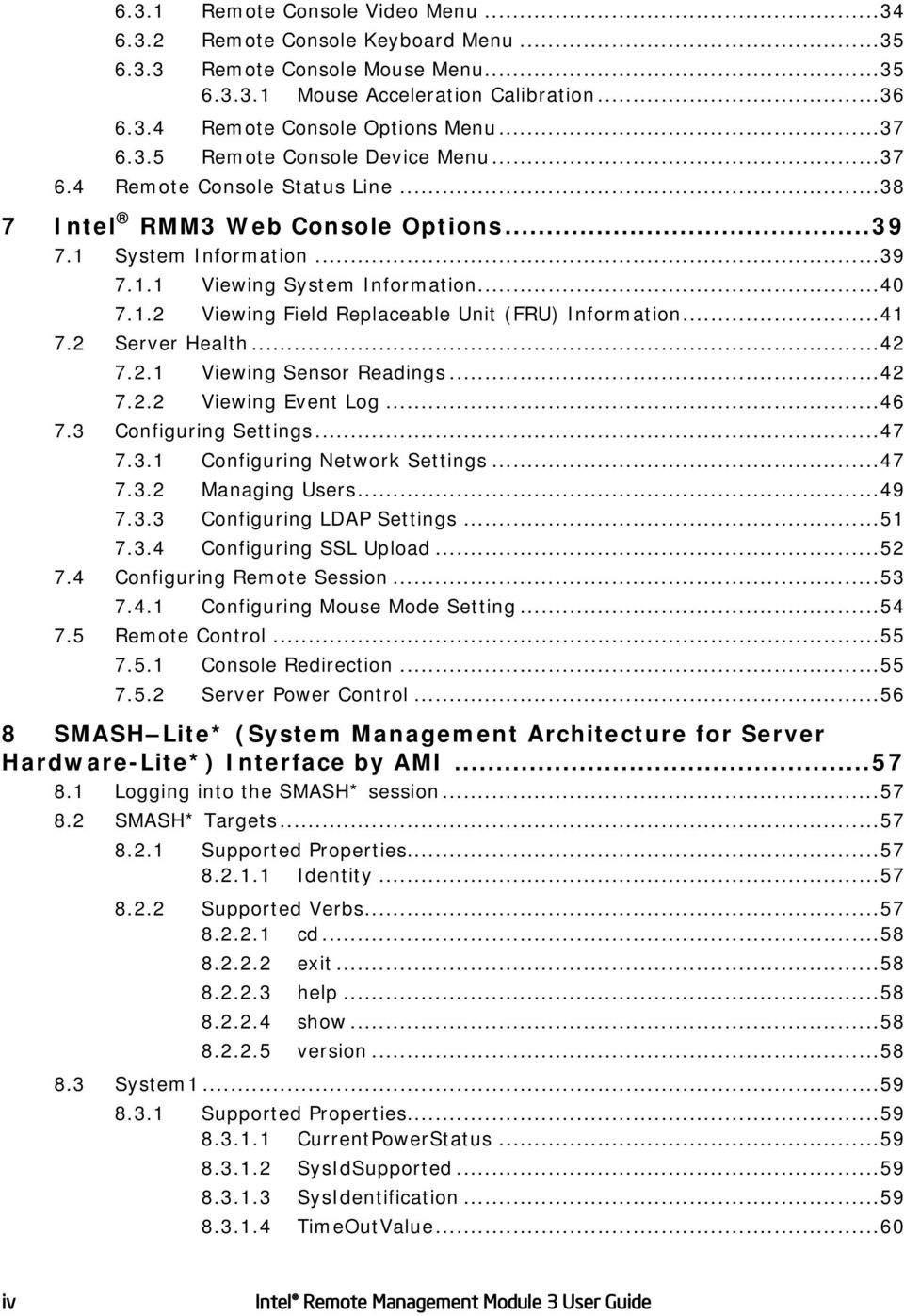
3 Table of Contents List of Figures...x 1 Introduction Target Audience Terminology Safety Information Support Information Warranty Information Intel Remote Management Module 3 Overview Intel RMM3 Features Supported Operating Systems Server System Client System Hardware Installations and Initial Configuration Before You Begin Tools and Supplies Needed Installation Installation on Intel Server Boards S5500UR and S5500WB Installation on Intel Server Boards S5520HC, S5520BC, and S5520SC12 4 Configuring Intel RMM Configuring Your Server Using Intel Deployment Assistant (IDA) Configuring the Intel RMM3 using syscfg commands Running the Syscfg Configuring IP address Configuring the LAN channel Configuring Users Obtaining the assigned DHCP address Getting Started with Intel RMM3 Operation Before You Begin Browsers Logging In Navigation Online Help Logging Out of Intel RMM Remote Console (KVM) Operation Launching the Redirection Console Main Window Remote Console Menu Bar...34 Intel Remote Management Module 3 User Guide iii

4 6.3.1 Remote Console Video Menu Remote Console Keyboard Menu Remote Console Mouse Menu Mouse Acceleration Calibration Remote Console Options Menu Remote Console Device Menu Remote Console Status Line Intel RMM3 Web Console Options System Information Viewing System Information Viewing Field Replaceable Unit (FRU) Information Server Health Viewing Sensor Readings Viewing Event Log Configuring Settings Configuring Network Settings Managing Users Configuring LDAP Settings Configuring SSL Upload Configuring Remote Session Configuring Mouse Mode Setting Remote Control Console Redirection Server Power Control SMASH Lite* (System Management Architecture for Server Hardware-Lite*) Interface by AMI Logging into the SMASH* session SMASH* Targets Supported Properties Identity Supported Verbs cd exit help show version System Supported Properties CurrentPowerStatus SysIdSupported SysIdentification TimeOutValue...60 iv Intel Remote Management Module 3 User Guide
5 identity Supported Verbs cd exit help set reset show start stop version Settings Supported Properties cdt outputformat timeout identity Supported Verbs cd exit help set show version SP Supported Properties Identity Supported Verbs cd exit help show version SOL Supported Properties identity Supported Verbs cd exit help show start...67 Intel Remote Management Module 3 User Guide v
6 version Terminating an SOL Session Enetport Supported Properties macaddress identify Supported Verbs cd exit help show version Lanendpt Supported Properties identity Supported Verbs cd exit help show version Ipendpt Supported Properties ipaddress subnetmask usedhcp committed identity Supported Verbs cd exit help set show version Remotesap Supported Properties defaultgatewayaddress identity Supported Verbs cd exit...74 vi Intel Remote Management Module 3 User Guide

7 help set show version Dnsendpt Supported Properties domainnamefromdhcp dnsdomainname serversfromdhcp identity Supported Verbs cd exit help show version Remotesap Supported Properties dnsserveraddress identity Supported Verbs cd exit help set show version Remotesap Supported Properties dnsserveraddress identity Supported Verbs cd exit help set show version Account Supported Properties userid username...81 Intel Remote Management Module 3 User Guide vii
8 pmilanprivileges password enabledstate identity Supported Verbs cd exit help Delete set show version Logs Supported Properties MaxNumberOfRecords MaxNumberOfRecords Description Identity Supported Verbs cd exit help delete show version Record Supported Properties LogCreationClassName LogName CreationClassName RecordID MessageTimeStamp RecordData identity Supported Verbs cd exit help show version Sensor Supported Properties...88 viii Intel Remote Management Module 3 User Guide
9 Description systemcreationclassname CurrentReading BaseUnits SystemName CreationClassName DeviceID Name SensorType HealthState OperationalStatus Identity Supported Verbs cd exit help show version Targets Creation...91 Appendix A. Intel Server Issue Report Form...92 Intel Remote Management Module 3 User Guide ix

10 List of Figures Figure 1. Intel Remote Management Module Figure 2. Installing Intel RMM3 on Intel Server Boards S5500UR and S5500WB...11 Figure 3. Installing Intel RMM3 on Intel Server Boards S5520HC, S5520BC, and S5520SC...12 Figure 4. IDA Configure Server: Communication Options Window...14 Figure 5. IDA Configure Server: Configure LAN Channel 3 (Intel RMM3) Settings Window Figure 6. IDA Configure Server: Configure LAN Channel 3 (Intel RMM3) Static IP Address Window...16 Figure 7. IDA Configure Server: Configure LAN Channel 3 (Intel RMM3) Set Up Users Window...17 Figure 8. IDA Configure Server: Configure LAN Channel 3 (Intel RMM3) Edit User Information Window...18 Figure 9. IDA Configure Server: Configure LAN Channel 3 (Intel RMM3) Apply Configuration Window.19 Figure 10. IDA Configure Server: Configure LAN Channel 3 (Intel RMM3) Applying Configuration progress Window...20 Figure 11. Internet Explorer displaying encryption key length...24 Figure 12. Intel RMM3 Login Page...25 Figure 13. Intel RMM3 Home Page...26 Figure 14. Launching the Online Help...29 Figure 15. Logging Out of Intel RMM3 Step Figure 16. Logging Out of Intel RMM3 Step Figure 17. Remote Control> Console Redirection window...31 Figure 18. Remote Console...32 Figure 19. Remote Console Main Window...33 Figure 20. Remote Console Control Bar...34 Figure 21. Remote Console Video Menu...34 Figure 22. Remote Console Keyboard Menu...35 Figure 23. Remote Console Mouse Menu...35 Figure 24. Remote Console Options Menu...37 Figure 25. Remote Console Device Menu...37 Figure 26. Status Line...38 Figure 27. Busy Indicator Bar...39 Figure 28. System Information page...40 Figure 29. System Information > FRU Information page...41 Figure 30. Server Health > Sensor Readings window (Thresholds not displayed)...43 Figure 31. Server Health > Sensor Readings window (Thresholds displayed)...44 Figure 32. Server Health > Event Log...46 Figure 33. Configuration> Network Settings window...48 Figure 34. Configuring User List window...49 Figure 35. Configuring Users> Modify User window...50 Figure 36. Configuring LDAP Settings window...51 Figure 37. Configuring SSL Upload window...52 Figure 38. Configuring Remote Session window...53 Figure 39. Configuring Mouse Mode Setting window...54 Figure 40. Remote Control > Console Redirection window...55 x Intel Remote Management Module 3 User Guide

11 Figure 41. Server Power Control window...56 Figure 42. SMASH* Target...58 Figure 43. System Target...61 Figure 44. System Target - an example...62 Figure 45. Setting1 Target...65 Figure 46. SP1 Target...66 Figure 47. SOL1 Target...68 Figure 48. Enetport1 Target...70 Figure 49. LANENDPT1 Target...71 Figure 50. IPENDPT1 Target...73 Figure 51. REMOTESAP1 Target...75 Figure 52. DNSENDPT1 Target...77 Figure 53. REMOTESAP1 Target...79 Figure 54. REMOTESAP2 Target...81 Figure 55. ACCOUNT1 Target...83 Figure 56. LOGS1 Target...85 Figure 57. RECORD1 Target...88 Figure 58. SENSOR2 Target...91 Intel Remote Management Module 3 User Guide xi

12 <This page intentionally left blank.> xii Intel Remote Management Module 3 User Guide
13 1 Introduction The Intel RMM3 is a 1.23-inch x 2.30-inch printed circuit board. When installed onto the Intel RMM connector on Intel server boards, it provides an increased level of manageability over the basic server management available to the server board. It works as an integrated solution on your server system. Designed to work with the Integrated Baseboard Management Controller (BMC), this small form-factor mezzanine card enables server control via a built-in Web Console from anywhere, at anytime. This User Guide describes how to use the Intel Remote Management Module 3 (hereinafter referred to as Intel RMM3). It provides an overview of the features of the module and instructions on how to set up and operate the Intel RMM Target Audience This Guide is intended for system technicians who are responsible for installing, troubleshooting, upgrading, and repairing the Intel RMM3. As a system administrator, you can use it to work on the Intel RMM3 to gain location-independent remote access to respond to critical incidents. Intel Remote Management Module 3 User Guide 1

14 1.2 Terminology The following table lists the terminology used in this document and the description. ARP BMC CLI DDC DHCP DVC DVO FML FPGA ICMP Word / Acronym Address Resolution Protocol Baseboard Management Controller Command Line Interface Display Data Channel Dynamic Host Configuration Protocol Dambrackas Video Compression Dynamic Visual Output Fast Management Link Field Programmable Gate Array Internet Control Message Protocol Definition Intel RMM3 Intel Remote Management Module 3 IPMI ITE KVM MAC MII OOB PBDE RMII RTC TCP/IP TPS UART UDP Intelligent Platform Management Interface Information Technology Equipment Keyboard, Video and Mouse Media Access Controller Media Independent Interface Out Of Band- No operating system interaction on Server Polybrominated Biphenyls Diphenyl Ethers Reduced Media Independent Interface Real-Time Clock Transmission Control Protocol / Internet Protocol Technical Product Specification Universal Asynchronous Receiver Transmitter User Datagram Protocol 2 Intel Remote Management Module 3 User Guide

15 1.3 Safety Information WARNING Before working with your Intel RMM3 server product whether you are using this guide or any other resource as a reference pay close attention to the safety instructions. You must adhere to the assembly instructions in this guide to ensure and maintain compliance with existing product certifications and approvals. Use only the described regulated components specified in this guide. Use of other products / components will void the UL listing and other regulatory approvals of the product and will most likely result in noncompliance with product regulations in the region(s) in which the product is sold. Warnings System power on/off: The server power button DOES NOT turn off the system power or Intel RMM3 power. To remove power from the Intel RMM3 you must unplug the server AC power cord from the wall outlet. Make sure the AC power cord is unplugged before you open the chassis to add or remove the Intel RMM3. Hazardous conditions, devices and cables: Hazardous electrical conditions may be present on power, telephone, and communication cables. Turn off the server and disconnect the power cord, telecommunications systems, networks, and modems attached to the server before opening it. Otherwise, personal injury or equipment damage can result. Electrostatic discharge (ESD) and ESD protection: ESD can damage disk drives, boards, and other parts. We recommend that you perform all procedures in this chapter only at an ESD workstation. If one is not available, provide some ESD protection by wearing an antistatic wrist strap attached to chassis ground any unpainted metal surface on your server when handling parts. ESD and handling boards: Always handle boards carefully. They can be extremely sensitive to ESD. Hold boards only by their edges. After removing a board from its protective wrapper or from the server, place the board component side up on a grounded, static free surface. Use a conductive foam pad if available but not the board wrapper. Do not slide board over any surface. Installing or removing jumpers: A jumper is a small plastic encased conductor that slips over two jumper pins. Some jumpers have a small tab on top that you can grip with your fingertips or with a pair of fine needle nosed pliers. If your jumpers do not have such a tab, take care when using needle nosed pliers to remove or install a jumper; grip the narrow sides of the jumper with the pliers, never the wide sides. Gripping the wide sides can damage the contacts inside the jumper, causing intermittent problems with the function controlled by that jumper. Take care to grip with, but not squeeze, the pliers or other tools you use to remove a jumper, or you may bend or break the pins on the board. Intel Remote Management Module 3 User Guide 3
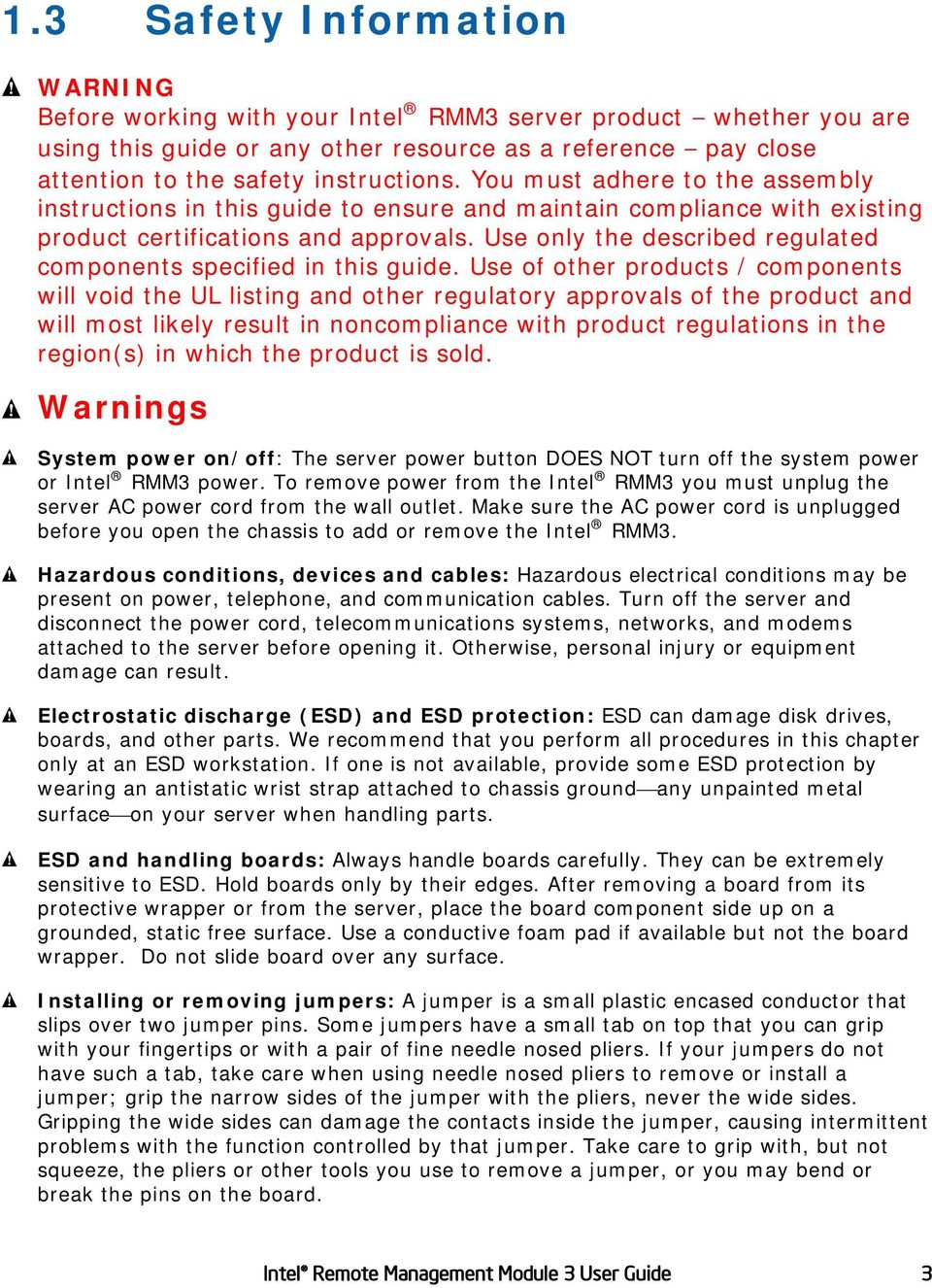
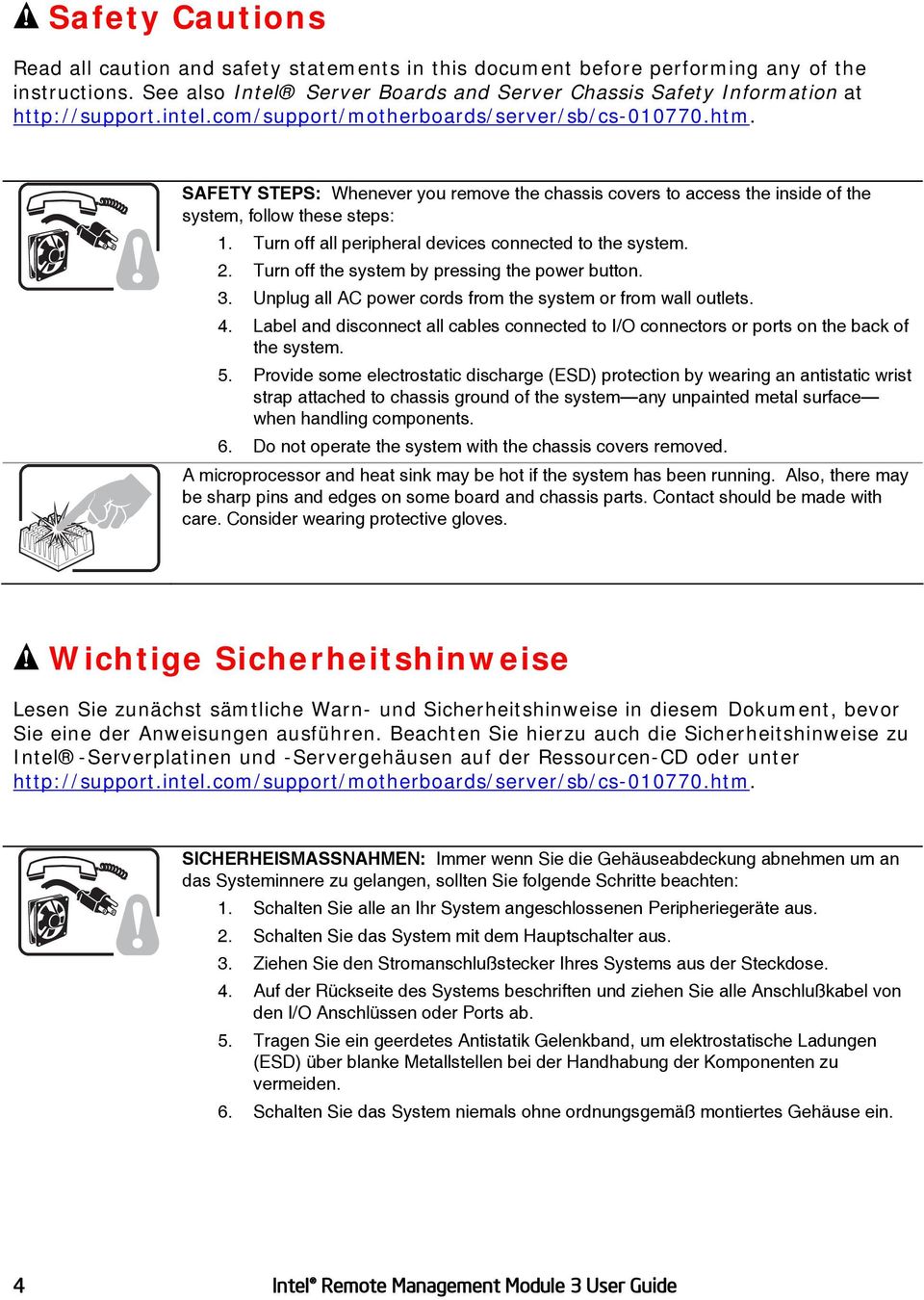
16 Safety Cautions Read all caution and safety statements in this document before performing any of the instructions. See also Intel Server Boards and Server Chassis Safety Information at SAFETY STEPS: Whenever you remove the chassis covers to access the inside of the system, follow these steps: 1. Turn off all peripheral devices connected to the system. 2. Turn off the system by pressing the power button. 3. Unplug all AC power cords from the system or from wall outlets. 4. Label and disconnect all cables connected to I/O connectors or ports on the back of the system. 5. Provide some electrostatic discharge (ESD) protection by wearing an antistatic wrist strap attached to chassis ground of the system any unpainted metal surface when handling components. 6. Do not operate the system with the chassis covers removed. A microprocessor and heat sink may be hot if the system has been running. Also, there may be sharp pins and edges on some board and chassis parts. Contact should be made with care. Consider wearing protective gloves. Wichtige Sicherheitshinweise Lesen Sie zunächst sämtliche Warn- und Sicherheitshinweise in diesem Dokument, bevor Sie eine der Anweisungen ausführen. Beachten Sie hierzu auch die Sicherheitshinweise zu Intel -Serverplatinen und -Servergehäusen auf der Ressourcen-CD oder unter SICHERHEISMASSNAHMEN: Immer wenn Sie die Gehäuseabdeckung abnehmen um an das Systeminnere zu gelangen, sollten Sie folgende Schritte beachten: 1. Schalten Sie alle an Ihr System angeschlossenen Peripheriegeräte aus. 2. Schalten Sie das System mit dem Hauptschalter aus. 3. Ziehen Sie den Stromanschlußstecker Ihres Systems aus der Steckdose. 4. Auf der Rückseite des Systems beschriften und ziehen Sie alle Anschlußkabel von den I/O Anschlüssen oder Ports ab. 5. Tragen Sie ein geerdetes Antistatik Gelenkband, um elektrostatische Ladungen (ESD) über blanke Metallstellen bei der Handhabung der Komponenten zu vermeiden. 6. Schalten Sie das System niemals ohne ordnungsgemäß montiertes Gehäuse ein. 4 Intel Remote Management Module 3 User Guide
17 Der Mikroprozessor und der Kühler sind möglicherweise erhitzt, wenn das System in Betrieb ist. Außerdem können einige Platinen und Gehäuseteile scharfe Spitzen und Kanten aufweisen. Arbeiten an Platinen und Gehäuse sollten vorsichtig ausgeführt werden. Sie sollten Schutzhandschuhe tragen. 重 要 安 全 指 导 在 执 行 任 何 指 令 之 前, 请 阅 读 本 文 档 中 的 所 有 注 意 事 项 及 安 全 声 明 参 见 Resource CD( 资 源 光 盘 ) 和 / 或 上 的 Intel Server Boards and Server Chassis Safety Information( Intel 服 务 器 主 板 与 服 务 器 机 箱 安 全 信 息 ) Consignes de sécurité Lisez attention toutes les consignes de sécurité et les mises en garde indiquées dans ce document avant de suivre toute instruction. Consultez Intel Server Boards and Server Chassis Safety Information sur le CD Resource CD ou bien rendez-vous sur le site CONSIGNES DE SÉCURITÉ -Lorsque vous ouvrez le boîtier pour accéder à l intérieur du système, suivez les consignes suivantes: 1. Mettez hors tension tous les périphériques connectés au système. 2. Mettez le système hors tension en mettant l interrupteur général en position OFF (bouton-poussoir). 3. Débranchez tous les cordons d alimentation c.a. du système et des prises murales. 4. Identifiez et débranchez tous les câbles reliés aux connecteurs d E-S ou aux accès derrière le système. 5. Pour prévenir les décharges électrostatiques lorsque vous touchez aux composants, portez une bande antistatique pour poignet et reliez-la à la masse du système (toute surface métallique non peinte du boîtier). 6. Ne faites pas fonctionner le système tandis que le boîtier est ouvert. Le microprocesseur et le dissipateur de chaleur peuvent être chauds si le système a été sous tension. Faites également attention aux broches aiguës des cartes et aux bords tranchants du capot. Nous vous recommandons l'usage de gants de protection. Intel Remote Management Module 3 User Guide 5

18 Instrucciones de seguridad importantes Lea todas las declaraciones de seguridad y precaución de este documento antes de realizar cualquiera de las instrucciones. Vea Intel Server Boards and Server Chassis Safety Information en el CD Resource y/o en INSTRUCCIONES DE SEGURIDAD: Cuando extraiga la tapa del chasis para acceder al interior del sistema, siga las siguientes instrucciones: 1. Apague todos los dispositivos periféricos conectados al sistema. 2. Apague el sistema presionando el interruptor encendido/apagado. 3. Desconecte todos los cables de alimentación CA del sistema o de las tomas de corriente alterna. 4. Identifique y desconecte todos los cables enchufados a los conectores E/S o a los puertos situados en la parte posterior del sistema. 5. Cuando manipule los componentes, es importante protegerse contra la descarga electrostática (ESD). Puede hacerlo si utiliza una muñequera antiestática sujetada a la toma de tierra del chasis o a cualquier tipo de superficie de metal sin pintar. 6. No ponga en marcha el sistema si se han extraído las tapas del chasis. Si el sistema ha estado en funcionamiento, el microprocesador y el disipador de calor pueden estar aún calientes. También conviene tener en cuenta que en el chasis o en el tablero puede haber piezas cortantes o punzantes. Por ello, se recomienda precaución y el uso de guantes protectores. AVVERTENZA: Italiano PASSI DI SICUREZZA: Qualora si rimuovano le coperture del telaio per accedere all interno del sistema, seguire i seguenti passi: 1. Spegnere tutti i dispositivi periferici collegati al sistema. 2. Spegnere il sistema, usando il pulsante spento/acceso dell interruttore del sistema. 3. Togliere tutte le spine dei cavi del sistema dalle prese elettriche. 4. Identificare e sconnettere tutti i cavi attaccati ai collegamenti I/O od alle prese installate sul retro del sistema. 5. Qualora si tocchino i componenti, proteggersi dallo scarico elettrostatico (SES), portando un cinghia anti-statica da polso che è attaccata alla presa a terra del telaio del sistema qualsiasi superficie non dipinta. 6. Non far operare il sistema quando il telaio è senza le coperture. Se il sistema è stato a lungo in funzione, il microprocessore e il dissipatore di calore potrebbero essere surriscaldati. Fare attenzione alla presenza di piedini appuntiti e parti taglienti sulle schede e sul telaio. È consigliabile l'uso di guanti di protezione. 6 Intel Remote Management Module 3 User Guide

19 1.4 Support Information If you encounter an issue with your server system, follow these steps to obtain support: 1. Visit the following Intel support web page: This web page provides 24x7 support when you need it to get the latest and most complete technical support information on all Intel Enterprise Server and Storage Platforms. Information available at the support site includes: Latest BIOS, firmware, drivers and utilities Product documentation, installation and quick start guides Full product specifications, technical advisories and errata Compatibility documentation for memory, hardware add-in cards, chassis support matrix and operating systems Server and chassis accessory parts list for ordering upgrades or spare parts A searchable knowledgebase to search for product information throughout the support site 2. If you are still unable to obtain a solution to your issue, send an to Intel s technical support center using the online form available at 3. Lastly, you can contact an Intel support representative using one of the support phone numbers available at (charges may apply). Intel customer support suggests filling out the issue report form (see Appendix A) to better service the issue. Intel also offers Channel Program members around-the-clock 24x7 technical phone support on Intel server boards, server chassis, server RAID controller cards, and Intel Server Management at Note: You will need to log in to the Reseller site to obtain the 24x7 number Warranty Information To obtain warranty information, visit the following Intel web site: Intel Remote Management Module 3 User Guide 7

20 2 Intel Remote Management Module 3 Overview This section gives you an overview of the Intel RMM3 and highlights significant benefits of its features. The Intel RMM3 works as an integrated solution on your server system. Based on an embedded operating system, the Intel RMM3 add-on card provides both exceptional stability and permanent availability independent of the present state of the server s operating system. As a system administrator, you can use the Intel RMM3 to gain locationindependent remote access to respond to critical incidents and to undertake necessary maintenance. 2.1 Intel RMM3 Features The Intel RMM3 add-on card offers convenient, remote KVM access and control via LAN or Internet. It captures, digitizes, and compresses video and transmits it with keyboard and mouse signals to and from a remote computer. Remote access and control software runs in the Integrated Baseboard Management Controller, utilizing expanded capabilities provided by the Intel RMM3 hardware, so there is no impact to the server operation or network performance. Figure 1. Intel Remote Management Module 3 In addition, the Intel RMM3 add-on card offers integrated remote power management using IPMI. Key features of the Intel RMM3 add-on card are: Embedded Web UI - Remote Power on\off, system health, system info, Event log. KVM redirection via Dedicated NIC or through the server board NIC used for management traffic high performance, multiple concurrent sessions. KVM can be redirected to either the RMM3 NIC or the server board NIC used for management traffic. 8 Intel Remote Management Module 3 User Guide

21 USB 2.0 media redirection - boot over remote media Security open SSL, open LDAP OEM Customization of the Web Console. IPMI V2.0 Compliance KVM - Automatically senses video resolution for best possible screen capture; highperformance mouse tracking and synchronization; allows remote viewing and configuration in pre-boot POST and BIOS setup. 2.2 Supported Operating Systems The Intel RMM3 runs independent of the host operating system on the server where it is installed, except during Remote Console (KVM) connections. During Remote Console connections, the Keyboard, Mouse, and Video of the console system operate just as if you were at the server where the Intel RMM3 is connected. During Remote Console connections, the interaction with the host operating system limits the support to operating systems that have been validated. The validated operating systems are listed below Server System The following operating systems are supported on the managed server: Microsoft Windows 2003 Server* with SP1 Microsoft Windows 2003 Server* 32-bit Microsoft Windows 2003 Server* with SP2 Red Hat* Enterprise Linux 5.2 SuSE* 10 SP1 Red Hat* Enterprise Linux 5.2 U3 Red Hat* Enterprise Linux 5.2 U4 Microsoft Windows XP* with SP Client System The following client operating system and Internet browser combinations have been tested: SuSE* 10.2/Firefox* Red Hat* Enterprise Linux 5.1/Firefox* 3.01 Microsoft Windows XP Pro* with SP3/Firefox* Microsoft Windows XP Pro* with SP3/ IE* 7.0 Microsoft Windows XP Pro* with SP3 64-bit/ IE* 7.0 Microsoft Windows Vista* 32-bit/ IE* 7.0 Microsoft Windows XP Pro* with SP2/ IE* 6.0 Microsoft Windows XP Pro* with SP2/ Firefox* Intel Remote Management Module 3 User Guide 9
22 3 Hardware Installations and Initial Configuration This section guides you on the hardware installations and initial configuration. 3.1 Before You Begin Before working with your server product, pay close attention to the Safety Information at the beginning of this manual. 3.2 Tools and Supplies Needed Following are the tools and supplies needed: Phillips * (cross head) screwdriver (#1 bit and #2 bit) Needle nosed pliers Antistatic wrist strap and conductive foam pad (recommended) 3.3 Installation The Intel Remote Management Module is currently supported on the following Intel server boards: All SKUs of Intel Server Board S5500BC All SKUs of Intel Server Board S5520HC All SKUs of Intel Workstation Board S5520SC All SKUs of Intel Server Board S5520UR All SKUs of Intel Server Board S5520WB The Intel RMM3 box contains the following components: Intel Remote Management Module Plastic bag containing screws, slot bracket and cabling The installation varies between these server boards and their chassis configurations. The following sections detail installation instructions. Caution: Remove AC power from the server and wait at least 10 seconds before installing the Intel RMM3. 10 Intel Remote Management Module 3 User Guide
23 3.3.1 Installation on Intel Server Boards S5500UR and S5500WB The Intel Server Boards S5500UR and S5500WB install in a rack mount 1U or 2U chassis. The same installation steps apply to both chassis types. The high-level steps are provided below. For detailed instructions, refer to the individual Server Board and/or System Service Guides. 1. Mount the Intel RMM3 module to the header on the server board and secure the metal fastening bracket to the back of the chassis as shown in figure 2. This aligns the RJ-45 with the opening in the chassis. Figure 2. Installing Intel RMM3 on Intel Server Boards S5500UR and S5500WB 2. Replace the chassis cover, attach AC power, and connect a network cable to the Intel RMM NIC. Intel Remote Management Module 3 User Guide 11
24 3.3.2 Installation on Intel Server Boards S5520HC, S5520BC, and S5520SC The Intel Server Boards S5520HC, S5520BC, and S5520SC install in a pedestal style chassis. The high-level steps are provided below. For detailed instructions, refer to the individual Server Board and/or System Service Guides. 1. Attach the cable from the server board to the Intel RMM3 module as shown in figure 3. Figure 3. Installing Intel RMM3 on Intel Server Boards S5520HC, S5520BC, and S5520SC 2. Replace the chassis cover, attach AC power, and connect a network cable to the Intel RMM NIC 12 Intel Remote Management Module 3 User Guide
25 4 Configuring Intel RMM3 This section discusses using the server configuration utilities to enable an Intel RMM3 from a new, unconfigured state to an operational state. When first installed, by default, the Intel RMM3 uses a static IP address of The Intel RMM3 must be configured using either the syscfg utility or the Intel Deployment Assistant (IDA) CD that is provided with your Intel server board. Third-party IPMI-based configuration utilities can be used to configure the Intel RMM3 for management, but support for these utilities are beyond the scope of this document. The following two steps must be performed before Intel RMM3 can be used: 1. Either the BMC LAN channel or the RMM3 LAN channel (or both) must be configured for management. a. The server board BMC LAN channel is channel 1. b. The RMM3 LAN channel is channel At least one user must be enabled to use the LAN channel(s). a. The Intel RMM3 cannot use the anonymous user for RMM3 functionality, a user with both a valid user name and password are required. The following sections explain how you can configure Intel RMM3 using syscfg commands and Intel Deployment Assistant. Intel Remote Management Module 3 User Guide 13
26 4.1 Configuring Your Server Using Intel Deployment Assistant (IDA) Figure 4. IDA Configure Server: Communication Options Window 14 Intel Remote Management Module 3 User Guide
27 Figure 5. IDA Configure Server: Configure LAN Channel 3 (Intel RMM3) Settings Window 1 Intel Remote Management Module 3 User Guide 15
28 Figure 6. IDA Configure Server: Configure LAN Channel 3 (Intel RMM3) Static IP Address Window WARNING: The server board BMC LAN channel 1 and RMM3 LAN channel 3 cannot be configured for management on the same subnets. This restriction only applies to the management functionality of these NICs, not the operating system network traffic. 16 Intel Remote Management Module 3 User Guide
29 Figure 7. IDA Configure Server: Configure LAN Channel 3 (Intel RMM3) Set Up Users Window You have the option to edit user information data. Select the user and click Edit. The Edit User Data dialog box appears. Notes: You cannot use the anonymous user for RMM3 functionality. To connect remotely to LAN Channel 1 or 3, you need to configure users. Details to edit the username/passwords and set privileges for the users are provided below. Intel Remote Management Module 3 User Guide 17
30 Figure 8. IDA Configure Server: Configure LAN Channel 3 (Intel RMM3) Edit User Information Window Edit the User information and click OK to apply configuration. 18 Intel Remote Management Module 3 User Guide
31 Figure 9. IDA Configure Server: Configure LAN Channel 3 (Intel RMM3) Apply Configuration Window Intel Remote Management Module 3 User Guide 19
32 Figure 10. IDA Configure Server: Configure LAN Channel 3 (Intel RMM3) Applying Configuration progress Window 20 Intel Remote Management Module 3 User Guide
33 4.1.1 Configuring the Intel RMM3 using syscfg commands Syscfg is a command-line utility that can be used to save and restore BIOS and firmware settings to a file, or to set and display individual settings. Syscfg may be used in a script to automate the process of configuring multiple servers. The description of each command is available in the Syscfg User s Guide or using the /h or /? switch to display usage. The general syntax is: syscfg [{/ -}command [arguments]] [ next_command [arguments]] There are versions of the utility that run in the EFI, Linux, Windows command prompt, and Windows Preinstallation Environment. The utility can be used to configure an individual server via the host interface, but can be used in conjunction with scripts to configure many systems at a time. The latest syscfg software and User s Guide can be downloaded from by searching for update & configuration utilities for your specific server platform Running the Syscfg The syscfg utility is executed from a command shell in the operating system or EFI environment. Refer to the syscfg User s Guide for operating system dependencies and more detailed usage. The following sections detail the basic commands required for setting up an Intel RMM3 for operation. Options enclosed in angular brackets (<>) must be provided by the user based on the desired setting for that parameter. The <CHANNEL> option can be either 1 or 3 (see the following examples) Configuring IP address To set LAN channel with a static IP address: syscfg -le <CHANNEL> static <STATIC_IP> <SUBNET_MASK> Example for channel 3: syscfg le 3 static To set the default gateway: Syscfg -lc <CHANNEL> 12 <DEFAULT_GATEWAY_IP> To set LAN channel to obtain a dhcp IP address: syscfg -le <CHANNEL> dhcp To enable LAN channel for Serial Over LAN (SOL) (can be used for either static or DHCP): syscfg -sole <CHANNEL> Enable Admin <BAUD_RATE> <RETRY_COUNT> Intel Remote Management Module 3 User Guide 21
34 <RETRY_INTERVAL_IN_MILLISECONDS> Configuring the LAN channel To enable a specific BMC LAN channel: syscfg /c <CHANNEL> 7 Always Example for channel 3: syscfg /c 3 7 always Configuring Users To set the password for a BMC user: syscfg /u <USER#> <username> <password> Example for user number 3: syscfg /u 3 root password1 To enable a BMC user to use a BMC channel: syscfg /ue <USER#> enable <CHANNEL> To enable admin privilege and payload type to SOL for the BMC user 3 on BMC channel 1, type: syscfg /up <USER#> <CHANNEL> admin sol Obtaining the assigned DHCP address The syscfg utility can display the assigned IP address if DHCP is used. After waiting for a short time for the DHCP server to assign a new address to the BMC, execute the following command: syscfg /d lan <CHANNEL> 22 Intel Remote Management Module 3 User Guide
35 5 Getting Started with Intel RMM3 Operation This section describes how to get started on the Intel RMM3 operation. It also explains how to log into the advanced features of the module, navigate the options available, and how to log out. 5.1 Before You Begin The Intel RMM3 module features an embedded web server and applications offering a variety of standardized interfaces. This section describes both the interfaces and how to use them. The interfaces are accessed using TCP/IP protocol. For initial setup information, refer Chapter 4. Before you log in, you must enable the intended user. The examples in this chapter use user root, but other usernames and passwords can be used. The Intel RMM3 add-on card may be accessed using a standard Java-enabled web browser. You may use the HTTP protocol or a secure encrypted connection via HTTPS. HTTP/HTTPS: Full access is provided by the embedded web server. You can access the Intel RMM3 module using the HTTP protocol or using the encrypted HTTPS protocol. Note: Intel recommends that you use HTTPS to enable data encryption of the kvm session. Java Runtime Environment (JRE) 1.6 or later must be installed on the management system used to connect to the Intel RMM3 via the web browser Browsers In order to access the web console using a securely encrypted connection, you need a browser that supports the HTTPS protocol. Strong security is only assured by using 128-bit Cipher Strength (encryption). Some older browsers may not have a strong 128-bit encryption algorithm. If you are using Microsoft Windows Internet Explorer* 6.0 or higher, you can verify strong encryption by opening the Help > About menu to read about the key length that is currently activated. The following figure displays the dialog box presented by Microsoft Internet Explorer* 6.0. Intel Remote Management Module 3 User Guide 23
36 Figure 11. Internet Explorer displaying encryption key length In order to use the Remote Console (KVM) window of your managed server, Java Runtime Environment (JRE) version 1.6 or higher must be installed. Note: The Web Console is designed for a screen size of 1280 pixels by 1024 pixels or larger. In smaller screens, the browser will display slider controls to enable the user to see the full content of each web page. 5.2 Logging In To log in to the Intel RMM3 module, follow these steps: 4. Enter the configured IP address of the Intel RMM3 add-on card into your web browser. For example: In order to use a secure connection, type in as shown in the following example: This will take you to the Intel RMM3 module login page as shown in Figure Intel Remote Management Module 3 User Guide
37 5. Enter the username and password to log in. For example: Username = root Password = superuser Figure 12. Intel RMM3 Login Page Note: The Username and Password are case sensitive. Any username and password can be used (except anonymous). 6. Click the Login button to view the RMM3 home page as shown in Figure 13. After the initial log in, System Administrators may change passwords, create new users, and have full control over access to the Intel RMM3. Intel Remote Management Module 3 User Guide 25
38 5.3 Navigation After successful login to the Intel RMM3 module, the Intel RMM3 home page appears as shown in Figure 13: Figure 13. Intel RMM3 Home Page Intel Remote Management Module 3 User Guide 26
39 The top horizontal toolbar within the Intel RMM3 home page has four tabs. Click these tabs to get specific system information and perform tasks as identified in the following table: Tab Function Click this tab to access general information about the server. The 'System Information' page automatically opens. In general, this tab provides access to the following: System information FRU information Click this tab for access to the sensors and event log. The 'Sensor Readings' page automatically opens. In general, this tab provides access to the following: Sensor readings Event log Click this tab to configure various settings for the server. The 'Network' configuration page automatically opens. In general, this tab provides access to the following: Network Users LDAP SSL Remote Session Mouse Mode Click this tab for access to the remote console and to control the power state of the server. In general, this tab provides access to the following: Console Redirection Server Power Control The four tabs on the horizontal menu allow you to navigate within the Intel RMM3 Web Console. Each of these tabs contains a secondary menu on the left edge of the browser window. For detailed information on the specific functionality of the secondary menu items, see Chapter 7: Intel RMM3 Web Console Options. Intel Remote Management Module 3 User Guide 27
40 The top horizontal toolbar consists of the Logout, Refresh, and Help buttons. Click these buttons to perform tasks as desribed in the following table. Button Function Click this button to end the current Web Console session. Note that a remote console (KVM) window, if active, is closed when you log out. After logging out, the Web Console returns to the Login screen. Click this button to refresh the current web page, including any data shown on the page. Click this button to view a brief description of the current page in a frame at the right-hand side of the browser window. Close the Help frame by clicking the 'X' in the upper right corner of the frame or by clicking the HELP button again. 28 Intel Remote Management Module 3 User Guide
41 5.4 Online Help The Web Console user interface gives specific online help for each page. For additional information on a certain topic or group of options, click the button on the top horizontal toolbar to view the online help as shown in Figure 14. The right Help panel is visible only when the online Help is being accessed. Figure 14. Launching the Online Help Intel Remote Management Module 3 User Guide 29
42 5.5 Logging Out of Intel RMM3 Click the button to log out the current user and revert to a new login screen as shown in Figure 15 and Figure 16. Figure 15. Logging Out of Intel RMM3 Step 1 Figure 16. Logging Out of Intel RMM3 Step 2 Note: Automatic Timeout: If no user activity is detected by the Web Console for 30 minutes, the current session is automatically terminated. If the user has an open KVM remote console window, the web session does not automatically timeout. The next action attempted by the user after the automatic timeout informs the user of the need to log in again for continued access to the Web Console. Intel Remote Management Module 3 User Guide 30
43 6 Remote Console (KVM) Operation The Remote Console is the redirected screen, keyboard, and mouse of the remote host system where the Intel RMM3 module is installed. To use the Remote Console window of your managed host system, the browser must include a Java* Runtime Environment plugin. When the Remote Console is launched, a new window opens to display the screen content of the host system. The Remote Console acts as if the administrator is sitting directly in front of the screen of his/her remote system. This means the keyboard and mouse can be used in the usual way. 6.1 Launching the Redirection Console The Remote Console is the redirected keyboard, video, and mouse of the remote host system where the Intel RMM3 module is installed. Launch the remote console KVM redirection window from this page. Figure 17. Remote Control> Console Redirection window Click the Launch Console button to launch the redirection console and manage the server remotely. When the Launch Console button is clicked, a pop-up window appears to download the Java Intel Remote Management Module 3 User Guide 31
44 Network Launch Protocol jviewer.jnlp file. This in turn downloads the standalone Java application implementing the Remote Console. Both Microsoft Internet Explorer* and Mozilla Firefox* browsers are supported. Notes: Java Runtime Environment (JRE) version 6, update 10 or later must be installed on the client prior to the launch of a JNLP file. The client browser must allow pop-up windows from the Intel RMM3 IP address. Figure 18. Remote Console The Remote Console window is a Java Applet that establishes TCP connections to the Intel RMM3 module. The protocol that runs over these connections is a unique KVM protocol and not HTTP or HTTPS. This protocol uses ports #7578 for KVM, #5120 for CD-ROM media redirection, and #5123 for Floppy/USB media redirection. Your local network environment must permit these connections to be made, that is, your firewall and, if you have a private internal network, your NAT (Network Address Translation) settings must be configured accordingly. 32 Intel Remote Management Module 3 User Guide
45 6.2 Main Window When the Remote Console is launched, an additional window appears as shown in the following figure. Figure 19. Remote Console Main Window It displays the screen content of your remote server. The Remote Console behaves as if you were located at the remote server. The responsiveness may be slightly delayed depending on the bandwidth and latency of the network between the Intel RMM3 module and Remote Console. Enabling KVM and/or media encryption on the Configuration > Remote Session web page degrades performance as well. The Remote Console window always tries to show the remote screen with its optimal size. That means it will adapt its size to the size of the remote screen initially and after the screen resolution of the remote screen has been changed. However, you can always resize the Remote Console window in your local window system as usual. Intel Remote Management Module 3 User Guide 33
46 6.3 Remote Console Menu Bar The upper part of the Remote Console window contains a menu bar. You can use the items on the menu bar to view the status of the Remote Console and configure the local Remote Console settings. The following sections describe each control. Figure 20. Remote Console Control Bar Remote Console Video Menu Click Video in the Remote Console control bar to open the Remote console Video menu as shown in the following figure. Using this menu, you can do the following: Figure 21. Remote Console Video Menu Pause Redirection: Temporarily pauses redirection of keyboard, video, and mouse. The Remote Console window stops being updated. Keyboard shortcut is ALT+P. Resume Redirection: Resume redirection after a pause. Keyboard shortcut is ALT+R. Refresh Video: Refreshes the Remote Console window. Keyboard shortcut is ALT+E. Compression: Enabling compression improves the responsiveness of the Remote Console. Disabling compression maximizes the quality of the redirected video. Full Screen: Toggles between window and full screen mode for the Remote Console. Shortcut is ALT+F. Exit: Closes the Remote Console. 34 Intel Remote Management Module 3 User Guide
47 6.3.2 Remote Console Keyboard Menu Click Keyboard to open the Keyboard menu with options to perform tasks as shown in the following figure. Using this menu, you can do the following: Figure 22. Remote Console Keyboard Menu Hold Ctrl/Alt/Windows keys: Allows simulating holding down these special keys on the remote keyboard. On the local keyboard, these special keys are processed by the local OS and not passed on to the remote OS. Ctrl+Alt+Del: Issues a Ctrl+Alt+Del to the remote OS Remote Console Mouse Menu Click Mouse to open the Mouse menu with options to perform tasks as shown in the following figure. The Mouse submenu offers two options: Figure 23. Remote Console Mouse Menu Show Cursor: This option toggles the cursor display in the Remote Console window. It does not affect the remote system cursor. The keyboard shortcut is ALT+C. Calibrate Mouse Acceleration: This option is used to detect the acceleration settings on the remote system and set the local client s acceleration setting accordingly. It only applies when in the Relative Mouse Mode, selected on the Configuration > Mouse Mode web page. Absolute Mouse Mode does not require calibration. The keyboard shortcut is ALT+A. Intel Remote Management Module 3 User Guide 35
48 For Relative mouse mode operation, the following is the mechanism to synchronize the mouse settings Mouse Acceleration Calibration 1. If the remote mouse and local mouse cursor are not in sync, start mouse acceleration calibration by selecting the Calibrate Mouse Acceleration menu item or by pressing <ALT+A>. Once started, you will see two mouse cursors moving diagonally across the screen (starting at 0, 0 location). The local mouse cursor is displayed in RED color to differentiate between the two mouse cursors. Depending upon the difference in acceleration settings on both ends, mouse cursors may eventually go out of sync. 2. Press + or - key to change the acceleration settings. If the local mouse cursor is lagging behind the host cursor, press + to try to be in sync. If the local cursor is moving ahead of the host cursor, press - to sync it up. Adjust the sync using + or - until you achieve the maximum sync possible. A good indicator of that setting is that the mouse movement switches from lagging to leading or vice-versa when the most optimal value is crossed. 3. To ensure that both cursors are in sync, wait until they reach the bottom of the screen and are still in sync. 4. Once in sync, press <ALT+A> to stop acceleration calibration and save the current acceleration settings. 5. When acceleration sync is done, start mouse threshold calibration by selecting the Calibrate Mouse Threshold menu item or by pressing <ALT+T>. The behavior is same as in mouse acceleration case. Once started, you will see two mouse cursors moving diagonally across the screen (starting at 0, 0 location). The local mouse cursor is displayed in RED color to differentiate between the two mouse cursors. Depending upon the difference in threshold settings on both ends, mouse cursors may eventually go out of sync. 6. Press + or - key to change the threshold settings. If the local mouse cursor is lagging behind the host cursor, press + to try to be in sync. If the local cursor is moving ahead of the host cursor, press - to sync it up. Adjust the sync using + or -, until you achieve the maximum sync possible. A good indicator of that setting is that the mouse movement switches from lagging to leading or vice-versa when the most optimal value is crossed. 7. To ensure that both cursors are in sync, wait until they reach the bottom of the screen and are still in sync. 8. Once in sync, press <ALT+T> to stop threshold calibration and save the current threshold settings. At this point, both local and the remote mouse cursors should be in synchronization. NOTE: Once the acceleration calibration is preformed, you must calibrate threshold 36 Intel Remote Management Module 3 User Guide
49 settings for the mouse to be in sync Remote Console Options Menu Click Options to open the menu with options to perform tasks as shown in the following figure. Figure 24. Remote Console Options Menu Using this menu, you can do the following: Bandwidth: Changing the bandwidth setting affects low-level connection protocol parameters like fragment size and timeouts. If you experience performance problems when operating over a slow connection such as a modem, the Bandwidth setting may need to be adjusted. Use the Auto Detect option to find the correct setting for your connection. Keyboard/Mouse Encryption: Keyboard and Mouse data are normally encrypted before being sent over the connection, but this can be disabled for a small performance increase Remote Console Device Menu Click Device to open the Device menu with options to perform tasks as shown in the following figure. Figure 25. Remote Console Device Menu This menu option allows starting/stopping remote media redirection. Redirect CDROM / Redirect ISO: Allows you to redirect either a local CD- ROM/DVD drive or an ISO image on your local client file system as a virtual CD- ROM device on the remote system. Redirect Floppy/USB Key / Redirect Floppy/USB Key Image: Allows you to redirect either a local floppy drive, a local USB key drive, or a floppy.img file as a virtual floppy device on the remote system. Intel Remote Management Module 3 User Guide 37
50 The virtual devices act just like any other CD-ROM or floppy on the remote system. They can be read, written (assuming they are not read-only), and booted. The pair of virtual devices only appear on the remote OS or BIOS setup menus when some media redirection is active. The virtual devices persist across remote system resets and power up/downs. They do not disappear from the remote system until the checkboxes are cleared in the Remote Console window. Note that the virtual devices are not limited to normal floppy/cd-rom sizes and can be as large as the device or file being redirected. A USB Key drive is redirected as a virtual floppy device rather than a USB device to allow the loading of custom device drivers during remote OS installation which may require a floppy drive. There is only one virtual CD-ROM and one virtual floppy device on the remote system allowed so only one local item of each type can be redirected at a time. Only one Remote Console window can be doing media redirection at any given time. 6.4 Remote Console Status Line The status line at the bottom of the Remote Console screen displays the console state as shown in the following figure. As you navigate the menu options, the status line gives a more detailed definition for each option. Figure 26. Status Line 38 Intel Remote Management Module 3 User Guide
51 7 Intel RMM3 Web Console Options This chapter gives you a detailed description of each Web Console page. It is organized in sections corresponding to the four tabs on the horizontal menu. Within each section, each menu choice from the left-hand menu is illustrated and described in detail. Notes: The first menu item for each tab is the default page which appears when the tab is selected. Similar information about each page is available in the Web Console by clicking the HELP button at the right side of the horizontal menu. When the Web Console is working on current user request, a busy indicator bar appears as shown in Figure 27. Figure 27. Busy Indicator Bar 7.1 System Information By default, the Intel RMM3 home page displays the System Information page. It contains general information about the system as explained in the following subsections. Intel Remote Management Module 3 User Guide 39
52 7.1.1 Viewing System Information The System information page displays a summary of the general system information as shown in Figure 28. Figure 28. System Information page The System Information page has the following information about the server: Information Details Host Power Status RMM3 Status Device (BMC) Available BMC FW Build Time BMC FW Rev Boot FW Rev SDR Package Version Shows the power status of the host (on/off). Indicates if the Intel RMM3 card is present and if the firmware is up to date. Indicates whether the BMC is available for normal management tasks. The date and time of the installed BMC firmware. Major and minor revision of the BMC firmware. Major and minor revision of the BOOT firmware. Displays the version of the SDR package loaded in the system. 40 Intel Remote Management Module 3 User Guide
53 7.1.2 Viewing Field Replaceable Unit (FRU) Information The FRU Information page displays information from the FRU (Field Replaceable Unit) repository of the host system as shown in Figure 29. Figure 29. System Information > FRU Information page Intel Remote Management Module 3 User Guide 41
54 The FRU Information page has the following BMC FRU file data: Information Details FRU Chassis Information FRU Board Information FRU Product Information Shows the following: Type Part/Model Number Serial Number. Shows the following: Manufacturing Date Manufacturer Product Name Serial Number Part/Model Number FRU File ID Shows the following: Manufacturer Name Part/Model Number Version, Serial Number Asset Tag FRU File ID 7.2 Server Health The Server Health page shows you data related to the server's health, such as sensor readings and the event log. Click on the Server Health Tab to display the page. By default, this tab opens the Sensor Readings page as shown in Figure Viewing Sensor Readings The Sensor Readings page displays system sensor information including readings and status. 42 Intel Remote Management Module 3 User Guide
55 Figure 30. Server Health > Sensor Readings window (Thresholds not displayed) Intel Remote Management Module 3 User Guide 43
56 Figure 31. Server Health > Sensor Readings window (Thresholds displayed) 44 Intel Remote Management Module 3 User Guide
57 The following table lists the options available on this page: Option Sensor Selection drop-down box Sensor Readings list Show Thresholds button Hide Thresholds button Refresh Task Select the type of sensor readings to display in the list. The default is to see all sensors. Selected sensors shown with their name, status, and readings. Click to expand the list, showing low and high threshold assignments. See the critical (CT) and non-critical (NC) thresholds for the selected sensors. Use scroll bar located at the bottom of the page to move the display to the left and right. Click to return to original display, hiding the threshold values. Click to refresh the selected sensor readings. Intel Remote Management Module 3 User Guide 45
58 7.2.2 Viewing Event Log The Event Log page displays the Event Log as shown in Figure 32. Figure 32. Server Health > Event Log Intel Remote Management Module 3 User Guide 46
59 The following table lists the options available on this page: Option Event Log Category drop-down box Event Log List Clear Event Log button Task Select the type of events to display in the list Selected sensors are shown with their name, status, and readings. This includes a list of the events with their ID, time stamp, sensor name, sensor type, and description. Click to clear the event logs. 7.3 Configuring Settings The Configure settings page is used to configure settings such as network, users, and alerts. Note: The RMM3 IP address must be on a different subnet than the server board IP address used for management traffic. It has the following options for server management as shown in Figure 33: Network Users LDAP SSL Remote Session Mouse Mode Configuring Network Settings The Network settings page is used to configure the network settings. It provides options to do one of the following: Automatic: Obtain an IP address automatically (using DHCP) OR Manual: Manually configure an IP address. Intel Remote Management Module 3 User Guide 47
60 Figure 33. Configuration> Network Settings window The following table lists the options available in this page: Option LAN Channel Number drop-down box MAC Address IP Address Save button Task It lists the LAN Channel(s) available for server management. The LAN channels describe the physical NIC connection on the server. Intel RMM3 channel is the add-in RMM3 NIC. The Baseboard Mgmt channel (BMC LAN Channel 1) is the onboard, shared NIC configured for management and shared with the operating system. The MAC address of the device (read only) Select the type of IP assignment using the radio buttons. If configuring a static IP, enter the requested address, subnet mask, and gateway in the given fields. IP Address is made of four numbers, with each number separated by a period (.) as in "xxx.xxx.xxx.xxx". 'xxx' ranges from 0 to 255 First 'xxx' must not be 0 Click to save any changes made. 48 Intel Remote Management Module 3 User Guide
61 7.3.2 Managing Users The User List page lists the configured users, along with their status and network privilege. Figure 34. Configuring User List window Intel Remote Management Module 3 User Guide 49
62 Figure 35. Configuring Users> Modify User window This page has options to configure the IPMI users and privileges for this server. To modify or delete a user, select user name in the list and click Modify User or Delete User. Notes: UserID 1 (anonymous) may not be renamed or deleted. UserID 2 (root) may not be renamed or deleted. Also, the network privileges of UserID 2 cannot be changed. User Names cannot be changed. To rename a User, you must first delete the existing User, and then add the User with the new name. To add a user, select an empty slot in the list and click to add a new user. To modify a user, select a user in the list and click to modify their settings. To delete a user, select a user in the list and click to delete. 50 Intel Remote Management Module 3 User Guide
63 7.3.3 Configuring LDAP Settings To enable/disable LDAP, select or clear the "Enable LDAP Authentication" checkbox respectively. Figure 36. Configuring LDAP Settings window The following table lists the options available on this page: Option Task LDAP Authentication Port IP Address Bind Password Bind DN Searchbase Save button Select this checkbox to enable LDAP authentication, and then enter the required information to access the LDAP server. Specify the LDAP Port. The IP address of LDAP server IP Address is made of four numbers, with each number separated by a period (.) as in "xxx.xxx.xxx.xxx" 'xxx' ranges from 0 to 255 First 'xxx' must not be 0. Authentication password for LDAP server; the password must be at least 4 characters long. The Distinguished Name of the LDAP server, for example, "cn=manager, dc=my-domain, dc=com". The searchbase of the LDAP server, for example, "dc=my-domain, dc=com". Click to save the current settings. Intel Remote Management Module 3 User Guide 51
64 7.3.4 Configuring SSL Upload Use this page to upload an SSL certificate and privacy key, which allows the device to be accessed in secured mode. Figure 37. Configuring SSL Upload window First, upload the SSL certificate and then the device prompts to upload the privacy key. If any of the files are invalid, the device provides a notification. The device also provides a notification on successful upload. After the SSL certificate is successful uploaded, the device will prompt to reboot the device. If you want to reboot, click 'Ok' or click 'Cancel' to cancel the reboot operation. 52 Intel Remote Management Module 3 User Guide
65 7.4 Configuring Remote Session Use this page to enable/disable encryption on KVM or Media during a redirection session. Figure 38. Configuring Remote Session window The following table lists the options allowing you to enable or disable encryption on KVM or media data during a redirection session. Option Enable/Disable Encryption mode Save button Task Enable/Disable encryption on KVM or Media data during a redirection session. Notes: KVM and Media encryption are enabled by default. Disabling encryption can improve performance of KVM or Media redirection. Click to use the selected modes. Intel Remote Management Module 3 User Guide 53
66 7.4.1 Configuring Mouse Mode Setting Click the Mouse Mode tab to view the Mouse Mode Setting window as shown in Figure 39. Figure 39. Configuring Mouse Mode Setting window The Redirection Console handles mouse emulation from a local window to the remote screen using one of the following two methods: Absolute Mode. Select Absolute Mode to have the absolute position of the local mouse sent to the server. Use this mode for Windows OS. Relative Mode. Select Relative Mode to have the calculated relative mouse position displacement sent to the server. Use this mode for Linux OS. Click Save to use the selected mode. 54 Intel Remote Management Module 3 User Guide
67 7.5 Remote Control The Remote Control page allows you to perform the following remote operations on the server: Console redirection Server power control Console Redirection By default, the Remote control tab is selected in the Console Redirection page. Launch the remote console KVM redirection window from this page. Figure 40. Remote Control > Console Redirection window Click the Launch Console button to launch the redirection console and manage the server remotely. Note: Java Runtime Environment (JRE) version 6, update 10 or later must be installed on the client prior to launching the JNLP file. Intel Remote Management Module 3 User Guide 55
68 7.5.2 Server Power Control The Server Power Control page shows the power status of the server. Figure 41. Server Power Control window The following power control operations can be performed: Option Task Reset Server Power OFF Server Power ON Server Power Cycle Server Perform Action button Select option to hard reset the host without powering off. Select option to immediately power off the host. Select option to power on the host. Select option to immediately power off the host, then power it back on after one second. Click to execute the selected remote power command. NOTE: All power control actions are done through the BMC and are immediate actions. It is suggested to gracefully shut down the operating system via the KVM interface or another interface before initiating power actions. 56 Intel Remote Management Module 3 User Guide
69 8 SMASH Lite* (System Management Architecture for Server Hardware-Lite*) Interface by AMI The Intel RMM3 supports an interface to System Management Architecture for Server Hardware-Lite* (SMASH Lite*). The SMASH* v1.0 suite of specifications was released by Distributed Management Task Force, Inc in December, The information that follows is reproduced, with permission, from the SMASH-Lite User Guide developed by AMI. The SMASH-Lite interface is a direct, command-line interface to the Intel RMM Logging into the SMASH* session 1. ssh to BMC from the client machine. 2. SMASH console screen( ) should appear. 3. This executable will initialize all the needed variables, discover the targets and will show the SMASH console screen. 8.2 SMASH* Targets SMASH Targets is the first layer of the SMASH which contains two targets: settings1 and system1. The settings1 contains all the current session supported values and the system1 is the server/blade and about this target is explained in the next section Supported Properties The supported properties of the SMASH targets are identity. Each property is explained in the following sections Identity This property gives a one word brief explanation about the present target. This property is a read-only property. It cannot be changed Supported Verbs The supported verbs of the SMASH targets are as follows: Intel Remote Management Module 3 User Guide 57
70 cd The verb cd is used to change from one valid target path to the any other valid target path exit The verb exit is used to exit from the current SMASH session help The verb help is used to provide information for the SMASH usage show The verb show is used to show all the targets, supported properties, and supported verbs by this target version The verb version, is used to shows the current version of SMASH*. Figure 42. SMASH* Target 58 Intel Remote Management Module 3 User Guide
71 8.3 System1 The system target represents the server/blade. Power control is available on this target.system1 contains sol1, sp1 and other sensor monitoring targets. Here sp1 means Service Process Configuration Supported Properties The supported properties of the target system1 are as follows: CurrentPowerStatus This Read-Only property shows the power status of the system as ON or OFF. The value of the property is assigned to any of the following values: ON - If the power status of the system is on, then the value of this property is ON. OFF - If the power status of the system is off, then the value of this property is OFF SysIdSupported This read-only property indicates if System Identification is supported or not. SUPPORTED indicates that system identification is supported NOT SUPPORTED - indicates that system identification is not supported SysIdentification This R/W property reflects the current state of system identification. 1. It can set to any of the following values: System identification can be turned off as follows. ->Set SysIdentification=OFF System identification can be timed ON as follows. ->Set SysIdentification=TIMED 2. Set the timeout value. Now, the TimeOutValue property is set to TIMED and SysIdentification property value is set to ON Note: If we ->set SysIdentification=INDEFINITE, then TimeOutValue property is set to INDEFENITE and SysIdentification property value is setted to ON Intel Remote Management Module 3 User Guide 59
72 TimeOutValue This value is R/W, which is associated with TIMED (ON) gives input in seconds as follows: INDEFINITE - System identification is ON for an indefinite period of time. TIMED System identification is ON for only a known period of time. OFF - System identification is currently OFF. If TimeOutValue is TIMED then we have to set the TimeOutValue as ->Set TimeOutValue=3 (only numeric, non zero values accepted) identity This read-only property gives a brief explanation of current target. This property cannot be changed Supported Verbs The supported verbs of the system1 targets are as follows: cd The verb cd is used to change from one valid target path to any other valid target path exit The verb exit is used to exit from the current SMASH* session help The verb help is used to provide information on using SMASH* set The verb set is used to the set the R/W supported properties reset The verb reset is used to reset the device show The verb show is used to show all the targets, supported properties, and supported verbs of this target. 60 Intel Remote Management Module 3 User Guide
73 start The verb start is used to start the device stop The verb stop is used to stop the device version The verb version is used to show the current version of the SMASH*. Figure 43. System Target Intel Remote Management Module 3 User Guide 61
74 Figure 44. System Target - an example 62 Intel Remote Management Module 3 User Guide
75 8.4 Settings1 Settings1 target represents the settings of the current session of SMASH* and does not have any targets. This target affects the current session Supported Properties The supported properties of the target Settings1 as follows: cdt This property represents the current default directory. This is the path from where the session starts outputformat This R/W property gives the output format: clpxml, text, clpcsv. Keyword of the currently running SMASH* session. The values supported by this property are explained below. Clpxml - The output format of the currently running SMASH* session will be in the.xml format ->set outputformat=clpxml Keyword - The output format of the currently running SMASH session will be in the keyword format ->set outputformat=keyword. Text - The output format of the currently running SMASH session will be in the text format->set outputformat=text. By default this property value is assigned to text. Clpcsv This output format of the currently running SMASH* session has a clpcsv table to represent the Command Status. Each line of the clpcsv output data has its first item either as the header or as the group keyword. Rows beginning with the header keyword specify the start of a new table and the items in the comma-separated list of keywords identify the output data elements that appear in each row of the table. Rows beginning with the group keyword specify a row of table values for the preceding header timeout The R/W property timeout represents the inactivity timeout value in seconds of the currently running SMASH* session. If the SMASH* session is inactive for the timeout value seconds mentioned, then after reaching the timeout value this session will exit automatically. This is. The value of this property can be set to preferred inactivity time. By default it is assigned to Intel Remote Management Module 3 User Guide 63
76 500. ->set timeout= identity This property gives a brief explanation about the present target. This property is a readonly property and cannot be changed Supported Verbs The supported verbs of the settings1 target are as follows: cd The verb cd is used to change from one valid target path to the any other valid target path exit The verb exit is used to exit from the current SMASH* session help The verb help is used to provide information on using SMASH* set The verb set is used to the set the r/w supported properties show The verb show is used to show all the targets, properties, and verbs supported by this target version The verb version is used to show the current version of the SMASH*. 64 Intel Remote Management Module 3 User Guide
77 Figure 45. Setting1 Target 8.5 SP1 The SP1 target (service processor) provides information of the user accounts Ethernet port and logs. It contains three targets: enetport1 (Ethernet port target), accounts, and logs Supported Properties The supported property of the target SP1 is as follows: Identity This property gives a brief explanation about the present target. This property is read-only and cannot be changed Supported Verbs The supported verbs of the SP1 target are as follows cd The verb cd is used to change from one valid target path to any other valid target path Intel Remote Management Module 3 User Guide 65
78 exit The verb exit is used to exit from the current SMASH* session help The verb help is used to provide information on using SMASH* show The verb show is used to show all the targets, properties, and verbs supported by this target version The verb version is used to show the current version of the SMASH*. Figure 46. SP1 Target 66 Intel Remote Management Module 3 User Guide
79 8.6 SOL1 Serial Over LAN (SOL) is the name for the redirection of baseboard serial controller traffic over an IPMI session. It does not have any targets Supported Properties The supported property of the target SOL1 is as follows: identity This property gives a brief explanation about the present target. This property is read-only and cannot be changed Supported Verbs The supported verbs of the SOL1 target are as follows: cd The verb cd is used to change from one valid target path to any other valid target path exit The verb exit is used to exit from the current SMASH* session help The verb help is used to provide information on using SMASH* show The verb show is used to show all the targets, properties, and verbs supported by this target start To start the device version The verb version is used to show the current version of the SMASH*. Intel Remote Management Module 3 User Guide 67
80 Figure 47. SOL1 Target Terminating an SOL Session SOL session can be terminated using the following control key sequence: CR, ESC, T or t CARRIAGE RETURN/ENTER key, followed by ESCAPE key, followed by T or t Control key sequence Ctrl+[ can be used in the place of ESCAPE key. Once terminated, the control will come back to SMASH-Lite* session. 8.7 Enetport1 The BMC in the managed system needs the system s IP Address and MAC Address in order to be able to respond to UDP/IP packets or generate LAN alerts. Enetport1 (Ethernet port target) gives the port address information. Enetport1 contains only one target named lanendpt1. 68 Intel Remote Management Module 3 User Guide
81 8.7.1 Supported Properties The supported properties of the target enetport1 are as follows: macaddress Address that was received by the activated session. This property gives the value of macaddress. Mac address is an unique identifier attached to most network adaptors (NICs) This property is a read-only property identify This property gives a brief explanation about the present target. This property is read-only and cannot be changed Supported Verbs The supported verbs of the Enetport1 target as follows: cd The verb cd, is used to change from one valid target path to any other valid target path exit The verb exit s used to exit from the current SMASH* session help The verb help is used to provide information on using SMASH* show The verb show is used to show all the targets, properties, and verbs supported by this target version The verb version is used to show the current version of SMASH*. Intel Remote Management Module 3 User Guide 69
82 8.8 Lanendpt1 Figure 48. Enetport1 Target The target Lanendpt1 gives information about LAN configuration. It contains the following target: Ipendpt1 - IP configuration Supported Properties Following is the supported property of target lanendpt1: identity This property gives a brief explanation about the present target. This property is read-only and cannot be changed Supported Verbs The supported verbs of the Lanendpt1 target are as follows: cd The verb cd is used to change from one valid target path to any other valid target path. 70 Intel Remote Management Module 3 User Guide
83 exit The verb exit is used to exit from the current SMASH* session help The verb help is used to provide information on using SMASH* show The verb show is used to show all the targets, properties and verbs supported by this target version The verb version is used to show the current version of SMASH*. 8.9 Ipendpt1 Figure 49. LANENDPT1 Target The target Ipendpt1 provides information about ipaddress and other information related to the SP. It contains two targets - dnsendpt1 and remotesap1. The supported properties and supported verbs of the Ipendpt1 are as follows. Intel Remote Management Module 3 User Guide 71
84 8.9.1 Supported Properties The supported properties of the target ipendpt1 are as follows: ipaddress The value of ipaddress is the IP address of the SP. An IP address (Internet Protocol address) is a unique address that is used to identify and communicate with each other on a computer network utilizing the Internet Protocol standard (IP). This is an R/W property. The value setting to the ipaddress affects the IP of the SP. ->set ipaddress= This will change the ipaddress of the sp. After changing, use committed property to save subnetmask This is the value of the subnetmask of the SP. A subnetmask is a range of logical addresses within the address space that is assigned to an organization. This is an R/W property. The value setting to the ipaddress affects the IP of the SP. ->set subnetmask= This will change the subnetmask of the sp. After changing, use committed property to save usedhcp Dynamic Host Configuration Protocol (DHCP) is a protocol used by networked devices to obtain various parameters necessary for the networked devices to operate in an Internet Protocol(IP) network. This property has two values(1 for DHCP and 0 for Static). This an R/W property. ->set usedhcp= committed Once the ipadress or subnetmask is set to 1, the property saves all the changes made. In addition, the network settings also change and network connection is lost. ->Set commited= identity This property gives a brief explanation about the present target. This property is a read only property and cannot be changed Supported Verbs The supported verbs of the Ipendpt1 target are as follows: 72 Intel Remote Management Module 3 User Guide
85 cd The verb cd is used to change from one valid target path to any other valid target path exit The verb exit is used to exit from the current SMASH session help The verb help is used to provide information on using SMASH* set The verb set is used to set the r/w supported properties show The verb show is used to show all the targets, properties, and verbs supported by this target version The verb version is used to show the current version of SMASH*. Figure 50. IPENDPT1 Target Intel Remote Management Module 3 User Guide 73
86 8.10 Remotesap1 The remotesap1 target will enumerate all the configurable IPs under the containing target. A remote access server enables users who are not on a local network to access. This does not contains any targets Supported Properties The supported properties of the target remotesap1 are as follows: defaultgatewayaddress IP address of the gateway. A gateway address is a private address and is the address to which traffic is sent from the LAN.This is an R/W property. The value of the gateway can be set as follows: ->Set defaultgatewayip= identity This property gives a brief explanation about the present target. This property is a read only property and cannot be changed Supported Verbs The supported verbs of the Remotesap1 target are as follows cd The verb cd is used to change from one valid target path to any other valid target path exit The verb exit is used to exit from the current SMASH* session help The verb help is used to provide information on using SMASH* set The verb set is used to set the r/w supported properties show The verb show is used to show all the targets, properties and verbs supported by this target. 74 Intel Remote Management Module 3 User Guide
87 version The verb version is used to show the current version of SMASH*. Figure 51. REMOTESAP1 Target 8.11 Dnsendpt1 The dnsendpt target has the configurable parameters for Domain Name System (DNS). The DNS associates various sorts of information with so-called domain names; most importantly, it serves the Internet by translating human-readable computer hostnames into the IP address, information that the networking equipment needs to deliver.dnsendpt1 contains two targets - remotesap1 and remotesap2. The supported properties of dnsendpt1 are as follows Supported Properties The supported properties of the target dnsendpt1 are as follows: domainnamefromdhcp Dhcp based DNS configuration. This property is a read-only property dnsdomainname This property gives the DNS Domain. This property is a read-only property. Intel Remote Management Module 3 User Guide 75
88 serversfromdhcp This property shows the servers dhcp. This is a read-only property identity This property gives a brief explanation about the present target. This property is a readonly property and cannot be changed Supported Verbs The supported verbs of the Dnsendpt1 target are as follows cd The verb cd is used to change from one valid target path to any other valid target path exit The verb exit is used to exit from the current SMASH* session help The verb help is used to provide information on using SMASH* show The verb show is used to show all the targets, properties and verbs supported by this target version The verb version is used to show the current version of SMASH*. 76 Intel Remote Management Module 3 User Guide
89 8.12 Remotesap1 Figure 52. DNSENDPT1 Target The remotesap1 target enumerates all the configurable IPs under the containing target. A remote access server enables user access to those users who are not on a local network. This does not contain any targets Supported Properties The supported properties of the target remotesap1 are dnsserveraddress and identity dnsserveraddress This property gives the dns server address. This is a R/W property. The value of this property can be set as follows: ->set dnsserveraddress= identity This property gives a one word brief explanation about the present target. This property is a read-only property and cannot be changed. Intel Remote Management Module 3 User Guide 77
90 Supported Verbs The supported verbs of the remotesap1 target as follows cd The verb cd is used to change from one valid target path to any other valid target path exit The verb exit is used to exit from the current SMASH* session help The verb help is used to provide information on using SMASH* set The verb set is used to set the r/w supported properties show The verb show is used to show all the targets, properties, and verbs supported by this target. 78 Intel Remote Management Module 3 User Guide
91 version The verb version is used to show the current version of SMASH*. Figure 53. REMOTESAP1 Target Remotesap2 The remotesap1 target enumerates all the configurable IPs under the containing target. A remote access server enables users who are not on a local network to access. This does not contain any targets Supported Properties The supported properties of the target remotesap2 are dnsserveraddress and identity dnsserveraddress Gives the dns server address. This is a R/W property. The value of this property can be set as follows. ->set dnsserveraddress= identity This property gives a brief explanation about the present target. This property is a readonly property and cannot be changed. Intel Remote Management Module 3 User Guide 79
92 Supported Verbs The supported verbs of the remotesap2 target are as follows cd The verb cd is used to change from one valid target path to any other valid target path exit The verb exit is used to exit from the current SMASH* session help The verb help is used to provide information on using SMASH* set The verb set is used to set values to the r/w supported properties show The verb show is used to show all the targets, properties and verbs supported by this target. 80 Intel Remote Management Module 3 User Guide
93 version The verb version is used to show the current version of SMASH* Account Figure 54. REMOTESAP2 Target The account target represents user accounts. It does not contain any targets Supported Properties The supported properties of the target account are as follows userid This property defines the unique id for each user. This property is read-only username This property gives the usermname of a particular account. This is settable except for userid=1. Username Length must be more than 1 character and less than 16 characters. ->Set username=sdf Intel Remote Management Module 3 User Guide 81
94 pmilanprivileges This property gives the ipmi lan privileges. It can be set except for userid=1. Only numbers are allowed. ->set ipmilanprivileges= password This property gives the password of a particular user. It can be set xcept for userid=1; password length should be less than 16 characters. ->Set password=ssd enabledstate This property shows the state of the user. This property is settable except for userid=1. Use 0 for disable and 1 for enable. For example to enable the user set the value of this property to 1 ->set userid= identity This property gives a brief explanation about the present target. This property is read-only and cannot be changed Supported Verbs The supported verbs of the account target are as follows cd The verb cd is used to change from one valid target path to any other valid target path exit The verb exit is used to exit from the current SMASH* session help The verb help is used to provide information on using SMASH* Delete To delete, go to sp1 target and delete account(n) where n>2. 82 Intel Remote Management Module 3 User Guide
95 set The verb set is used to set the r/w supported properties show The verb show is used to show all the targets, properties, and verbs supported by this target version The verb version is used to show the current version of SMASH*. Figure 55. ACCOUNT1 Target Logs1 The logs target is the containing target for log records of the ipmi System Event Log (SEL). The System Event Log is a non-volatile repository for system events and certain system configuration information. This target contains all the read-only properties. It contains log records as the targets. Intel Remote Management Module 3 User Guide 83
96 Supported Properties The supported properties of the target Logs1 as follows MaxNumberOfRecords This property is a read-only property and gives information about maximum number of log records MaxNumberOfRecords This property is a read-only property gives the number of records found Description This property is a read-only description about the target Identity This property gives a brief explanation about the present target. This property is read-only and cannot be changed Supported Verbs The supported verbs of the Logs1 target are as follows cd The verb cd is used to change from one valid target path to any other valid target path exit The verb exit is used to exit from the current SMASH* session help The verb help is used to provide information on using SMASH* delete Individual SEL records cannot be deleted. Use Delete Logs1 to delete the entire set show The verb show is used to show all the targets, properties, and verbs supported by this target. 84 Intel Remote Management Module 3 User Guide
97 version The verb version is used to show the current version of SMASH*. Figure 56. LOGS1 Target Intel Remote Management Module 3 User Guide 85
98 8.14 Record The record target represents the individual SEL entries. SEL records are in a list. Each SEL entity is a record. This does not have any targets Supported Properties The supported properties of the target Record1 are as follows LogCreationClassName This property is a read-only property and gives information about the log creation class name LogName This property is a read-only property and gives the name of the log record CreationClassName This property is a read-only property and gives the creation class name of the record RecordID SEL Entries have a unique Record ID field.this is the unique ID for the particular record. This is a read-only property MessageTimeStamp This gives the time stamp of the record creation and this is a read-only property RecordData The record data field that is passed in the request consists of all bytes of the SEL event record. This property gives information of the record and is read-only identity This property gives a brief explanation about the present target. This property is read only and cannot be changed. 86 Intel Remote Management Module 3 User Guide
99 Supported Verbs The supported verbs of the Record target are as follows cd The verb cd is used to change from one valid target path to any other valid target path exit The verb exit is used to exit from the current SMASH* session help The verb help is used to provide information on using SMASH* show The verb show is used to show all the targets, properties, and verbs supported by this target version The verb version is used to show the current version of SMASH*. Intel Remote Management Module 3 User Guide 87
100 Figure 57. RECORD1 Target 8.15 Sensor A typical server BMC would provide sensors for baseboard temperature, voltage, and chassis intrusion monitoring. A sensor uses one type of energy, a signal of some sort, and converts it into a reading for the purpose of information transfer. The sensor doesn t have any targets. All properties of this target are read-only properties Supported Properties Description This property describes the sensor and the target under which it is present. This property is read-only. 88 Intel Remote Management Module 3 User Guide
101 systemcreationclassname This property gives the system creation class name and is a read-only property CurrentReading This property gives the current reading shown by the sensor. This property is a read-only property BaseUnits This property gives the units for the value given by current reading property. This property is a read-only property SystemName This property gives the target name under which this sensor exists. This property is a readonly property CreationClassName This property gives the creation class name of the sensor. It is a read-only property DeviceID This property gives the device ID. This is a read-only property Name This property gives the name of the current sensor. This property is a read-only property SensorType This property gives the type of sensor. This property is a read-only property HealthState This property gives the health status of the sensor. This property is a read-only property OperationalStatus This property defines the operational status of the sensor. This property is a read-only property Identity This property gives a brief explanation about the present target. This property is a read-only property and cannot be changed. Intel Remote Management Module 3 User Guide 89
102 Supported Verbs The supported verbs of the sensor target are as follows cd The verb cd is used to change from one valid target path to any other valid target path exit The verb exit is used to exit from the current SMASH* session help The verb help is used to provide information on using SMASH* show The verb show is used to show all the targets, properties, and verbs supported by this target version The verb version is used to show the current version of SMASH*. 90 Intel Remote Management Module 3 User Guide
103 Figure 58. SENSOR2 Target 8.16 Targets Creation Dynamic targets in SMASH*(without CIM) are the sensors and their associated entities. You need to go through the sdr and search for Full and Compact record types. Name the Full type as numsensor<index> (indicates the analog sensors) and the Compact type as the sensor<index> (indicates the discrete sensors). While a sensor instance is discovered, the EntityID and the EntityInstance of the record are also seen. EntityID denotes the entity the sensor is monitoring. If the EntityID is of type cpu and Entityinstance is 1, then the parent of sensor1 will be cpu1. Other sensor related entity instances are created in a similar manner. Intel Remote Management Module 3 User Guide 91
104 Appendix A. Intel Server Issue Report Form Issue Report Form (Rev 3.5) NOTE: Filling out this form completely is required for any escalation. Customer Contact Information: Customer Support Case #: Intel Server Board or System: (Example : S5000PSL or SR6850HW4) Server Chassis: (Example SC5400. If third party chassis used, indicate make and model.) Base Board Information: (some information maybe found by accessing BIOS & going through the Server Management menu -> System Information) Baseboard PBA/TA/AA # (Example: ): - can be found on the white sticker label on the baseboard System BIOS Version: Intel Remote Management Module Firmware Version (if applicable): Intel Management Module BMC Revision (if applicable) : BMC/mBMC Version: FRU/SDR Version: HSC Version: Has the latest BIOS been tried? (Yes/No): Has the latest BMC/mBMC been tried? (Yes/No): Has the latest IMM BMC been tried? (Yes/No): Has the latest RMM Firmware been tried? (Yes/No): Has the latest FRU/SDR been tried? (Yes/No): Has the latest HSC been tried? (Yes/No): 92 Intel Remote Management Module 3 User Guide
105 Processor information: Type Speed sspec Thermal Solution Processor 1 Processor 2 Processor 3 Processor 4 Thermal solution (Heatsink) examples: (1U, Passive w/air ducting, Active w/fan, etc.) Memory: Manufacturer Part Number DRAM Part Number On Intel tested list? Add-in adapters (Example: NICs, Management Adapters, Serial Expansion Cards, PCI-Express* Adapters, RAID Controllers, SCSI Controllers, etc.): Type Slot Manufacturer Model Firmware Other third part hardware (Example: Example: KVM, Chassis, etc): Description/Use Manufacturer Model Firmware Intel Remote Management Module 3 User Guide 93
106 Storage Devices (Example: SCSI, SATA, SAS, USB, Tape, etc.): Manufacturer Model Type Size Firmware In Hot Swap Bay? Operating System Information (Example: RedHat* Enterprise Linux, Microsoft* Windows* Server 2003, Service pack 1, OEM CD): Manufacturer: Version: Language version (English, Arabic, Chinese (Simplified)): Service Pack Level or Kernel Revision: Distribution (OEM/Retail): Intel RAID Controller: (Example SRCU42E) RAID controller part number (PBA number): RAID controller firmware version: Has the latest RAID firmware been tried? (Yes/No): RAID driver version: Has the latest RAID driver been tried? (Yes/No): RAID volumes configuration (disks & RAID level): RAID volume use (Boot device/data Volume): Is BBU (Battery Backup Unit) installed? (Yes/No): BBU part number: Detailed description of issue: 94 Intel Remote Management Module 3 User Guide
107 Troubleshooting tried: Steps to replicate the issue: Issue impact statements: Do you have any potential Intel system, or component purchases that this issue is holding up? If yes, please provide a brief description below. Do you have systems already purchased that are not being delivered to your customers because of this issue? If yes, please provide a brief description below. Have you returned systems or components to your place of purchase because of this issue? If yes, please provide a brief description below. *All other brands and names are property of their respective owners. Intel Remote Management Module 3 User Guide 95
Rack Mount Kit Install Guide: Intel Entry Server Chassis SC5295-E UP/DP/WS/BRP Intel Entry Server Chassis SC5299-E DP/WS/BRP
 Rack Mount Kit Install Guide: Intel Entry Server Chassis SC5295-E UP/DP/WS/BRP Intel Entry Server Chassis SC5299-E DP/WS/BRP A Guide for Technically Qualified Assemblers of Intel Identified Subassemblies/Products
Backup Battery Kit Install Guide: Intel Storage Controller AXXSCM3S
 Backup Battery Kit Install Guide: Intel Storage Controller AXXSCM3S A Guide for Technically Qualified Assemblers of Intel Identified Subassemblies/ Products Intel Order Number: E13860-004 Disclaimer Information
Rail Kit Install Guide: Intel Modular Server System MFSYS25 A Guide for Technically Qualified Assemblers of Intel Identified Subassemblies/ Products
 Rail Kit Install Guide: Intel Modular Server System MFSYS25 A Guide for Technically Qualified Assemblers of Intel Identified Subassemblies/ Products Intel Order Number: E12567-002 Disclaimer Information
Intel Remote Management Module 3 User Guide
 Intel Remote Management Module 3 User Guide May, 2010 Revision History Intel Remote Management Module 3 User Guide Revision History Date Revision Modifications Number Aug 2009 1.1 Updated document for
Intel Remote Management Module 4 User Guide
 Intel Remote Management Module 4 User Guide February, 2011 Enterprise Platforms and Services Division Revision History Revision History Date ii December 2010 Revision Number 0.5 Modifications First Pre-release.
4x3.5" Hot-Swap Drive Cage Kit Installation Guide for Intel Server Chassis/System
 4x3.5" Hot-Swap Drive Cage Kit Installation Guide for Intel Server Chassis/System Order Number: G23758-002 G23758-002 This document provides instructions for installing the following accessory kit: FUP4X35HSDK
ThinkServer RD230 and RD240 Remote Management User Guide
 ThinkServer RD230 and RD240 Remote Management User Guide ThinkServer RD230 and RD240 Remote Management User Guide Note: Before using this information and the product it supports, be sure to read and understand
Intel Remote Management Module 4 and Integrated BMC Web Console User Guide
 Intel Remote Management Module 4 and Integrated BMC Web Console User Guide May 2012 Enterprise Platforms and Services Division Revision History Intel Remote Management Module 4 and Integrated BMC Web Console
Intel Remote Management Module 4 and Integrated BMC Web Console User Guide
 Intel Remote Management Module 4 and Integrated BMC Web Console User Guide Intel order number H54847-001 Revision 2.8 July 2014 Intel Server Boards and Systems Marketing Revision History Intel BMC And
Intel Remote Management Module User s Guide A Guide for Technically Qualified Assemblers of Intel Identified Subassemblies/ Products
 Intel Remote Management Module User s Guide A Guide for Technically Qualified Assemblers of Intel Identified Subassemblies/ Products Intel Order Number D48601-001 Disclaimer Information in this document
Intel Remote Management Module 2 User Guide. Order Number: E27084-001
 Intel Remote Management Module 2 User Guide Order Number: E27084-001 Disclaimer Information in this document is provided in connection with Intel products. No license, express or implied, by estoppel
Intel RAID Premium Feature Key AXXRPFKSSD, AXXRPFKDE, and AXXRPFKSNSH Installation Guide
 Intel RAID Premium Feature Key AXXRPFKSSD, AXXRPFKDE, and AXXRPFKSNSH Installation Guide Order Number: E88588-001 E88588-001 IMPORTANT: Your Intel RAID Controller must be programmed with the latest Intel
Intel Remote Management Module 4 and Integrated BMC Web Console User Guide
 Intel Remote Management Module 4 and Integrated BMC Web Console User Guide July 2013 Enterprise Platforms and Services Division Revision History Intel Remote Management Module 4 and Integrated BMC Web
Intel System Event Log (SEL) Viewer Utility
 Intel System Event Log (SEL) Viewer Utility User Guide Document No. E12461-007 Legal Statements INFORMATION IN THIS DOCUMENT IS PROVIDED IN CONNECTION WITH INTEL PRODUCTS FOR THE GENERAL PURPOSE OF SUPPORTING
Intel System Event Log (SEL) Viewer Utility
 Intel System Event Log (SEL) Viewer Utility User Guide Document No. E12461-005 Legal Statements INFORMATION IN THIS DOCUMENT IS PROVIDED IN CONNECTION WITH INTEL PRODUCTS FOR THE GENERAL PURPOSE OF SUPPORTING
Gigabyte Management Console User s Guide (For ASPEED AST 2400 Chipset)
 Gigabyte Management Console User s Guide (For ASPEED AST 2400 Chipset) Version: 1.4 Table of Contents Using Your Gigabyte Management Console... 3 Gigabyte Management Console Key Features and Functions...
McAfee Firewall Enterprise
 Hardware Guide Revision C McAfee Firewall Enterprise S1104, S2008, S3008 The McAfee Firewall Enterprise Hardware Product Guide describes the features and capabilities of appliance models S1104, S2008,
Intel System Event Log (SEL) Viewer Utility. User Guide SELViewer Version 10.0 /11.0 December 2012 Document number: G88216-001
 Intel System Event Log (SEL) Viewer Utility User Guide SELViewer Version 10.0 /11.0 December 2012 Document number: G88216-001 Legal Statements INFORMATION IN THIS DOCUMENT IS PROVIDED IN CONNECTION WITH
System Event Log (SEL) Viewer User Guide
 System Event Log (SEL) Viewer User Guide For Extensible Firmware Interface (EFI) and Microsoft Preinstallation Environment Part Number: E12461-001 Disclaimer INFORMATION IN THIS DOCUMENT IS PROVIDED IN
System Area Manager. Remote Management
 System Area Manager Remote Management Remote Management System Area Manager provides remote management functions for its managed systems, including Wake on LAN, Shutdown, Restart, Remote Console and for
This guide explains how to install an Intel Solid-State Drive (Intel SSD) in a SATA-based desktop or notebook computer.
 Installation Guide This guide explains how to install an (Intel SSD) in a SATA-based desktop or notebook computer. The instructions include migrating your data from your current storage device (such as
8/16-Port IP KVM Switch IKVM-8010 / IKVM-16010. Quick Installation Guide
 8/16-Port IP KVM Switch IKVM-8010 / IKVM-16010 Quick Installation Guide Table Of Contents Chapter 1 Introduction... 3 1.1 Features... 3 1.2 Package Contents... 4 1.3 Technical Specifications... 4 Chapter
Gigabyte Content Management System Console User s Guide. Version: 0.1
 Gigabyte Content Management System Console User s Guide Version: 0.1 Table of Contents Using Your Gigabyte Content Management System Console... 2 Gigabyte Content Management System Key Features and Functions...
SecureLinx Spider Duo Quick Start Guide
 SecureLinx Spider Duo Quick Start Guide SecureLinx Spider Duo Quick Start Guide SecureLinx Spider Duo QUICK START GUIDE CONTENTS Overview... 2 What s In The Box... 3 Installation and Network Settings...
Intel System Event Log (SEL) Viewer Utility
 Intel System Event Log (SEL) Viewer Utility User Guide Document No. E12461-003 Legal Statements INFORMATION IN THIS DOCUMENT IS PROVIDED IN CONNECTION WITH INTEL PRODUCTS FOR THE GENERAL PURPOSE OF SUPPORTING
Intel Remote Management Module 2 User Guide
 Intel Remote Management Module 2 User Guide A Guide for Technically Qualified Assemblers of Intel Identified Subassemblies/Products Intel Order Number D93678-001 Disclaimer Information in this document
http://docs.trendmicro.com
 Trend Micro Incorporated reserves the right to make changes to this document and to the products described herein without notice. Before installing and using the product, please review the readme files,
Intel Active Management Technology with System Defense Feature Quick Start Guide
 Intel Active Management Technology with System Defense Feature Quick Start Guide Introduction...3 Basic Functions... 3 System Requirements... 3 Configuring the Client System...4 Intel Management Engine
Addonics T E C H N O L O G I E S. NAS Adapter. Model: NASU2. 1.0 Key Features
 1.0 Key Features Addonics T E C H N O L O G I E S NAS Adapter Model: NASU2 User Manual Convert any USB 2.0 / 1.1 mass storage device into a Network Attached Storage device Great for adding Addonics Storage
Intel Management Engine BIOS Extension (Intel MEBX) User s Guide
 Intel Management Engine BIOS Extension (Intel MEBX) User s Guide User s Guide For systems based on Intel B75 Chipset August 2012 Revision 1.0 INFORMATION IN THIS DOCUMENT IS PROVIDED IN CONNECTION WITH
5. Getting Started with Intel RMM4 Operation
 Intel Remote Management Module 4 and Integrated BMC Web Console User Guide 5. Getting Started with Intel RMM4 Operation Getting Started with Intel RMM4 Operation The Intel RMM4 module features remote KVM
Dominion KX II-101-V2
 Dominion KX II-101-V2 Quick Setup Guide Thank you for your purchase of the Dominion KX II-101-V2, the economical, full-featured, single-port digital KVM-over-IP device. For details on using the KX II-101-V2,
Server Management on Intel Server Boards and Intel Server Platforms. Revision 1.1 September 2009
 Server Management on Intel Server Boards and Intel Server Platforms Revision 1.1 September 2009 Revision History Date Revision Description March 2008 0.5 Initial release. April 2008 0.9 Updated it for
Intel Simple Network Management Protocol (SNMP) Subagent v6.0
 Intel Simple Network Management Protocol (SNMP) Subagent v6.0 User Guide March 2013 ii Intel SNMP Subagent User s Guide Legal Information INFORMATION IN THIS DOCUMENT IS PROVIDED IN CONNECTION WITH INTEL
Intel Entry Storage System SS4000-E
 Intel Entry Storage System SS4000-E Software Release Notes March, 2006 Storage Systems Technical Marketing Revision History Intel Entry Storage System SS4000-E Revision History Revision Date Number 3 Mar
Unpacking the Product. Rack Installation. Then, use the screws provided with the equipment rack to mount the firewall in the rack.
 About This Guide This guide contains step-by-step instructions for setting up the D-Link DFL-260E/860E Firewall. Please note that the model you have purchased may appear slightly different from those shown
Installing the Operating System or Hypervisor
 Installing the Operating System or Hypervisor If you purchased E-Series Server Option 1 (E-Series Server without preinstalled operating system or hypervisor), you must install an operating system or hypervisor.
Thank for choosing the Dominion KX III, the industry's highest performance enterprise-class, secure, digital KVM (Keyboard, Video, Mouse) switch.
 QS Rule Dominion KX III Quick Setup Guide Thank for choosing the Dominion KX III, the industry's highest performance enterprise-class, secure, digital KVM (Keyboard, Video, Mouse) switch. This Quick Setup
Server Management on Intel Server Boards and Intel Server Platforms. Revision 1.0 March 2009
 Server Management on Intel Server Boards and Intel Server Platforms Revision 1.0 March 2009 Revision History Date Revision Description March 2008 0.5 Initial release. April 2008 0.9 Updated it for all
Intel Unite Solution. Standalone User Guide
 Intel Unite Solution Standalone User Guide Legal Disclaimers & Copyrights All information provided here is subject to change without notice. Contact your Intel representative to obtain the latest Intel
Symantec Database Security and Audit 3100 Series Appliance. Getting Started Guide
 Symantec Database Security and Audit 3100 Series Appliance Getting Started Guide Symantec Database Security and Audit 3100 Series Getting Started Guide The software described in this book is furnished
SUPER SMC LCD. User's Guide. Revision 1.0
 SUPER SMC LCD User's Guide Revision 1.0 The information in this User s Manual has been carefully reviewed and is believed to be accurate. The vendor assumes no responsibility for any inaccuracies that
Intel Matrix Storage Console
 Intel Matrix Storage Console Reference Content January 2010 Revision 1.0 INFORMATION IN THIS DOCUMENT IS PROVIDED IN CONNECTION WITH INTEL PRODUCTS. NO LICENSE, EXPRESS OR IMPLIED, BY ESTOPPEL OR OTHERWISE,
This chapter explains a preparation for the use of RemoteControlService.
 ServerView User's Guide (For RemoteControlService) Areas Covered Before Reading This Manual This section explains the notes for your safety and conventions used in this manual. Chapter 1 Overview of RemoteControlService
Barracuda Link Balancer Administrator s Guide
 Barracuda Link Balancer Administrator s Guide Version 1.0 Barracuda Networks Inc. 3175 S. Winchester Blvd. Campbell, CA 95008 http://www.barracuda.com Copyright Notice Copyright 2008, Barracuda Networks
Intel Remote Management Module 4
 Intel Remote Management Module 4 Technical Product Specification Revision 1.0 January, 2011 Enterprise Platforms and Services Division Marketing Revision History Intel Remote Management Module 4 Revision
Quick Start Guide. RV 120W Wireless-N VPN Firewall. Cisco Small Business
 Quick Start Guide Cisco Small Business RV 120W Wireless-N VPN Firewall Package Contents Wireless-N VPN Firewall Ethernet Cable Power Adapter Quick Start Guide Documentation and Software on CD-ROM Welcome
Avalanche Remote Control User Guide. Version 4.1.3
 Avalanche Remote Control User Guide Version 4.1.3 ii Copyright 2012 by Wavelink Corporation. All rights reserved. Wavelink Corporation 10808 South River Front Parkway, Suite 200 South Jordan, Utah 84095
AST2150 IPMI Configuration Guide
 AST2150 IPMI Configuration Guide Version 1.1 Copyright Copyright 2011 MiTAC International Corporation. All rights reserved. No part of this manual may be reproduced or translated without prior written
Revision History. Revision Revision History Date
 G001 Revision History Revision Revision History Date 1.0 First release of the Intel NUC Home Theatre Personal Computer on the Linux* Mint Platform using XBMC May 2013 2.0 Second release of the Intel NUC
Using the IPMI interface
 Using the IPMI interface The T800, T1600 and T3200 server models are equipped with an IPMI interface with KVM / IP functionality. This enables you to access the server console if it becomes inaccessible
Configuring and Using AMT on TS140 and TS440
 Configuring and Using AMT on TS140 and TS440 Lenovo ThinkServer TS Series Servers Lenovo Enterprise Product Group Version 1.0 September 17, 2013 2013 Lenovo. All rights reserved. LENOVO PROVIDES THIS PUBLICATION
SyAM Software* Server Monitor Local/Central* on a Microsoft* Windows* Operating System
 SyAM Software* Server Monitor Local/Central* on a Microsoft* Windows* Operating System with Internal Storage Focusing on IPMI Out of Band Management Recipe ID: 19SYAM190000000011-01 Contents Hardware Components...3
Installation Guide. Wyse C Class Conversion to WES7. Wyse USB Firmware Tool TM Release 1.10. Issue: 102910 PN: 883887-17L Rev. B
 Installation Guide Wyse C Class Conversion to WES7 Wyse USB Firmware Tool TM Release 1.10 Issue: 102910 PN: 883887-17L Rev. B Copyright Notices 2010, Wyse Technology Inc. All rights reserved. This manual
Intel Rapid Storage Technology
 Intel Rapid Storage Technology User Guide August 2011 Revision 1.0 1 Document Number: XXXXXX INFORMATION IN THIS DOCUMENT IS PROVIDED IN CONNECTION WITH INTEL PRODUCTS. NO LICENSE, EXPRESS OR IMPLIED,
Sharp Remote Device Manager (SRDM) Server Software Setup Guide
 Sharp Remote Device Manager (SRDM) Server Software Setup Guide This Guide explains how to install the software which is required in order to use Sharp Remote Device Manager (SRDM). SRDM is a web-based
INSTALLATION GUIDE. Assign an IP Address and Access the Video Stream
 INSTALLATION GUIDE Assign an IP Address and Access the Video Stream Liability Every care has been taken in the preparation of this document. Please inform your local Axis office of any inaccuracies or
Intelligent Power Protector User manual extension for Microsoft Virtual architectures: Hyper-V 6.0 Manager Hyper-V Server (R1&R2)
 Intelligent Power Protector User manual extension for Microsoft Virtual architectures: Hyper-V 6.0 Manager Hyper-V Server (R1&R2) Hyper-V Manager Hyper-V Server R1, R2 Intelligent Power Protector Main
Intel Unite. User Guide
 Intel Unite User Guide Intel Unite Users Guide September 2015 Legal Disclaimers & Copyrights All information provided here is subject to change without notice. Contact your Intel representative to obtain
http://docs.trendmicro.com
 Trend Micro Incorporated reserves the right to make changes to this document and to the products described herein without notice. Before installing and using the product, please review the readme files,
Installing Management Applications on VNX for File
 EMC VNX Series Release 8.1 Installing Management Applications on VNX for File P/N 300-015-111 Rev 01 EMC Corporation Corporate Headquarters: Hopkinton, MA 01748-9103 1-508-435-1000 www.emc.com Copyright
ThinPoint Quick Start Guide
 ThinPoint Quick Start Guide 2 ThinPoint Quick Start Guide Table of Contents Part 1 Introduction 3 Part 2 ThinPoint Windows Host Installation 3 1 Compatibility... list 3 2 Pre-requisites... 3 3 Installation...
User Manual. Onsight Management Suite Version 5.1. Another Innovation by Librestream
 User Manual Onsight Management Suite Version 5.1 Another Innovation by Librestream Doc #: 400075-06 May 2012 Information in this document is subject to change without notice. Reproduction in any manner
Wireless Router Setup Manual
 Wireless Router Setup Manual NETGEAR, Inc. 4500 Great America Parkway Santa Clara, CA 95054 USA 208-10082-02 2006-04 2006 by NETGEAR, Inc. All rights reserved. Trademarks NETGEAR is a trademark of Netgear,
INSTALL AND CONFIGURATION GUIDE. Atlas 5.1 for Microsoft Dynamics AX
 INSTALL AND CONFIGURATION GUIDE Atlas 5.1 for Microsoft Dynamics AX COPYRIGHT NOTICE Copyright 2012, Globe Software Pty Ltd, All rights reserved. Trademarks Dynamics AX, IntelliMorph, and X++ have been
HP StorageWorks 8Gb Simple SAN Connection Kit quick start instructions
 HP StorageWorks 8Gb Simple SAN Connection Kit quick start instructions Congratulations on your purchase of the 8Gb Simple SAN Connection Kit. This guide provides procedures for installing the kit components,
Backup & Disaster Recovery Appliance User Guide
 Built on the Intel Hybrid Cloud Platform Backup & Disaster Recovery Appliance User Guide Order Number: G68664-001 Rev 1.0 June 22, 2012 Contents Registering the BDR Appliance... 4 Step 1: Register the
User s Manual. Copyright 2010 Vantec Thermal Technologies. All Rights Reserved.
 Copyright 2010 Vantec Thermal Technologies. All Rights Reserved. User s Manual Package Contents: 1 NextStar FX Gigabit NAS Adapter x1 2 AC Adapter x1 3 Installation Guide x1 4 Rubber Feet x4 5 User s CD
10/2011 - English Edition 1. Quick Start Guide. NWA1100N-CE CloudEnabled Business N Wireless Access Point
 10/2011 - English Edition 1 Quick Start Guide NWA1100N-CE CloudEnabled Business N Wireless Access Point Package Contents - 1 x ZyXEL NWA1100N-CE Access Point - 2 x Detachable Antennas - 1 x Power Adapter
Intel Matrix Storage Manager 8.x
 Intel Matrix Storage Manager 8.x User's Manual January 2009 Revision 1.0 Document Number: XXXXXX INFORMATION IN THIS DOCUMENT IS PROVIDED IN CONNECTION WITH INTEL PRODUCTS. NO LICENSE, EXPRESS OR IMPLIED,
Quick Start Guide. RV0xx Series Routers
 Quick Start Guide RV0xx Series Routers RV042 Dual WAN VPN Router RV042G Gigabit Dual WAN VPN Router RV082 Dual WAN VPN Router RV016 Multi-WAN VPN Router Package Contents VPN Router Power Adapter (Cisco
LabelWriter. Print Server. User Guide
 LabelWriter Print Server User Guide Copyright 2010 Sanford, L.P. All rights reserved. 08/10 No part of this document or the software may be reproduced or transmitted in any form or by any means or translated
Network Security Firewall
 Building Networks for People Network Security Firewall This Quick Guide will guide you through the installation Process. You are only moments away from using your new D-Link Network Security Product DFL-210
Intel Server Boards and Server Platforms Server Management Guide
 Intel Server Boards and Server Platforms Server Management Guide Intel part number: G37830-002 October 2012 Revision History Revision History Date Revision Description March 2008 0.5 Initial release. April
Intel Remote Management Module 4
 Intel Remote Management Module 4 Technical Product Specification Revision 1.2 December, 2011 Enterprise Platforms and Services Division Marketing Revision History Intel Remote Management Module 4 TPS Date
CommandCenter Secure Gateway User Guide Release 6.0
 CommandCenter Secure Gateway User Guide Release 6.0 Copyright 2014 Raritan, Inc. CC-0X-v6.0-E April 2014 255-80-3100-00 This document contains proprietary information that is protected by copyright. All
Intel Internet of Things (IoT) Developer Kit
 Intel Internet of Things (IoT) Developer Kit IoT Cloud-Based Analytics User Guide September 2014 IoT Cloud-Based Analytics User Guide Introduction Table of Contents 1.0 Introduction... 4 1.1. Revision
MobileStatus Server Installation and Configuration Guide
 MobileStatus Server Installation and Configuration Guide Guide to installing and configuring the MobileStatus Server for Ventelo Mobilstatus Version 1.2 June 2010 www.blueposition.com All company names,
Installing and Configuring vcloud Connector
 Installing and Configuring vcloud Connector vcloud Connector 2.7.0 This document supports the version of each product listed and supports all subsequent versions until the document is replaced by a new
Management Software. Web Browser User s Guide AT-S106. For the AT-GS950/48 Gigabit Ethernet Smart Switch. Version 1.0.0. 613-001339 Rev.
 Management Software AT-S106 Web Browser User s Guide For the AT-GS950/48 Gigabit Ethernet Smart Switch Version 1.0.0 613-001339 Rev. A Copyright 2010 Allied Telesis, Inc. All rights reserved. No part of
Cisco 837 Router and Cisco SOHO 97 Router Cabling and Setup
 English CHAPTER 1 Cisco 837 Router and Cisco SOHO 97 Router Cabling and Setup Cisco One-Year Limited Hardware Warranty Terms Easy Installation: Try These Steps First! (CRWS Users) Overview Parts List Verify
Roamer KVM User Manual
 Roamer KVM User Manual Part Number: 40-01-00148 First Edition Rev. 02: October 2007 Website: www.rackable.com Telephone: 1.510.933.8300 Copyright 2007 Copyright (c) Rackable Systems, Inc. 2005-2007. All
Intel NUC Kit DC3217IYE User Guide. Intel NUC Kit DC3217IYE
 Intel NUC Kit DC3217IYE User Guide 1 Before You Begin CAUTIONS The procedures in this user guide assume familiarity with the general terminology associated with personal computers and with the safety practices
Features Reference. About Unified Communication System. Before Using This Machine. Starting a Meeting. What You Can Do During the Meeting
 Features Reference About Unified Communication System Before Using This Machine Starting a Meeting What You Can Do During the Meeting Leaving a Meeting Managing Address Book Changing Network Configuration
Quick Start Guide. WAP371 Wireless AC/N Dual Radio Access Point with Single Point Setup Quick Start Guide. Cisco Small Business
 Quick Start Guide Cisco Small Business WAP371 Wireless AC/N Dual Radio Access Point with Single Point Setup Quick Start Guide Versión en Español para México en el CD Version en français sur CD Versione
Product Description. Licenses Notice. Introduction TC-200
 User Manual TC-200 Introduction TC-200 Product Description The TC-200 provides the fastest Thin Client performance on the market, It runs embedded Linux, swing user interface, Citrix 6.3, Microsoft RDP
Classroom Management, part of Intel Education User Manual
 Classroom Management, part of Intel Education User Manual Disclaimer INFORMATION IN THIS DOCUMENT IS PROVIDED IN CONNECTION WITH INTEL PRODUCTS. EXCEPT AS PROVIDED IN INTEL'S TERMS AND CONDITIONS OF SALE
Cisco 831 Router and Cisco SOHO 91 Router Cabling and Setup Quick Start Guide
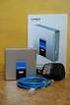 English CHAPTER 1 Cisco 831 Router and Cisco SOHO 91 Router Cabling and Setup Quick Start Guide Cisco One-Year Limited Hardware Warranty Terms Easy Installation: Try These Steps First! (CRWS Users) Overview
PREFACE http://www.okiprintingsolutions.com 07108001 iss.01 -
 Network Guide PREFACE Every effort has been made to ensure that the information in this document is complete, accurate, and up-to-date. The manufacturer assumes no responsibility for the results of errors
Imaging License Server User Guide
 IMAGING LICENSE SERVER USER GUIDE Imaging License Server User Guide PerkinElmer Viscount Centre II, University of Warwick Science Park, Millburn Hill Road, Coventry, CV4 7HS T +44 (0) 24 7669 2229 F +44
Moxa Device Manager 2.0 User s Guide
 First Edition, March 2009 www.moxa.com/product 2009 Moxa Inc. All rights reserved. Reproduction without permission is prohibited. Moxa Device Manager 2.0 User Guide The software described in this manual
Xerox 700 Digital Color Press with Integrated Fiery Color Server. Utilities
 Xerox 700 Digital Color Press with Integrated Fiery Color Server Utilities 2008 Electronics for Imaging, Inc. The information in this publication is covered under Legal Notices for this product. 45072726
Setup and Configuration Guide for Pathways Mobile Estimating
 Setup and Configuration Guide for Pathways Mobile Estimating Setup and Configuration Guide for Pathways Mobile Estimating Copyright 2008 by CCC Information Services Inc. All rights reserved. No part of
Quick Start Guide. Cisco Small Business. 300 Series Managed Switches
 Quick Start Guide Cisco Small Business 300 Series Managed Switches Welcome Thank you for choosing the Cisco 300 Series Managed Switch, a Cisco Small Business network communications device. This device
Network Security UTM Firewall
 Building Networks for People Network Security UTM Firewall This Quick Guide will guide you through the installation Process. You are only moments away from using your new D-Link Network Security Product
Ethernet Radio Configuration Guide
 Ethernet Radio Configuration Guide for Gateway, Endpoint, and Repeater Radio Units April 20, 2015 Customer Service 1-866-294-5847 Baseline Inc. www.baselinesystems.com Phone 208-323-1634 FAX 208-323-1834
Monthly Specification Update
 Intel Server Board S1200BTLR Intel Server Board S1200BTSR Intel Server Board S1200BTLRM Intel Server System R1304BTLSFANR Intel Server System R1304BTSSFANR Intel Server System R1304BTLSHBNR Intel Server
Compaq Presario Desktop Products. Upgrading and Servicing Guide
 Compaq Presario Desktop Products Upgrading and Servicing Guide The information in this document is subject to change without notice. Hewlett-Packard Company makes no warranty of any kind with regard to