
Active Directory Federation Services 2.0
|
|
|
- Solomon Hoover
- 10 years ago
- Views:
Transcription

1 Active Directory Federation Services 2.0 Security Target Common Criteria: EAL4 augmented with ALC_FLR.3 Version MAR-12

2 Document history Version Date Description MAY-11 Initial draft for review MAY-11 Updated to address evaluator comments for submission NOV-11 Updated to address EOR (Draft) 24-MAR-12 Updated TOE version 2 of 55

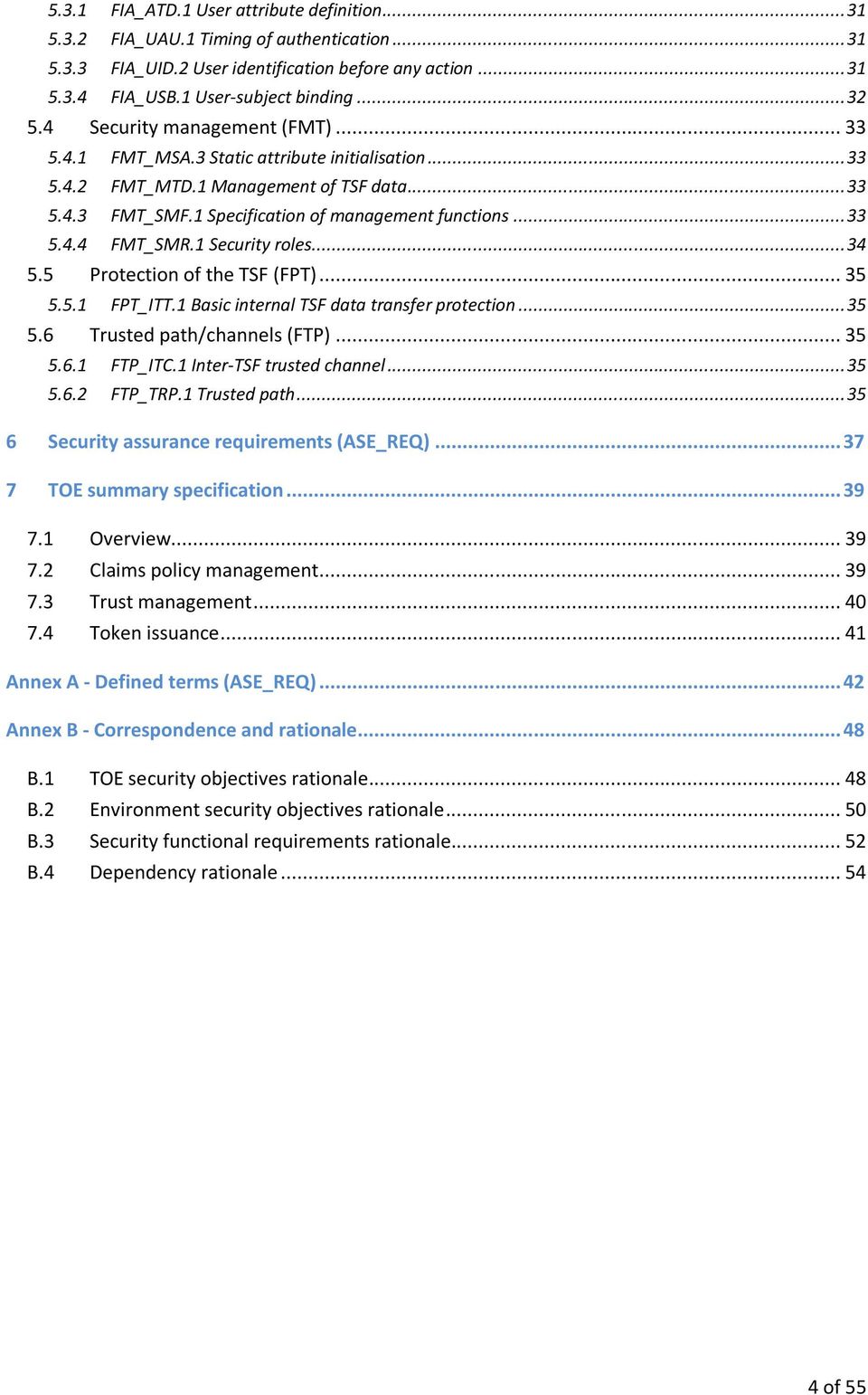
3 Table of Contents 1 Security Target Introduction (ASE_INT) Background ST reference Document organization TOE overview TOE type TOE usage and major security features Supporting hardware Supporting software Certificate requirements Client requirements Authentication requirements TOE description Physical scope of the TOE Logical scope of the TOE Conformance Claim (ASE_CCL) Security problem definition (ASE_SPD) Overview Threats Organisational security policies Assumptions Security objectives (ASE_OBJ) Overview Security objectives for the TOE Security objectives for the environment Security functional requirements (ASE_REQ) Overview User data protection (FDP) FDP_DAU.2 Data Authentication with identity of guarantor FDP_IFC.1 Subset information flow control (CLAIMS) FDP_IFF.1 Simple security attributes (CLAIMS) FDP_ETC.2 Export of user data with security attributes FDP_ITC.1 Import of user data with security attributes FDP_ITT.1 Basic internal transfer protection Identification and authentication (FIA) of 55

4 5.3.1 FIA_ATD.1 User attribute definition FIA_UAU.1 Timing of authentication FIA_UID.2 User identification before any action FIA_USB.1 User-subject binding Security management (FMT) FMT_MSA.3 Static attribute initialisation FMT_MTD.1 Management of TSF data FMT_SMF.1 Specification of management functions FMT_SMR.1 Security roles Protection of the TSF (FPT) FPT_ITT.1 Basic internal TSF data transfer protection Trusted path/channels (FTP) FTP_ITC.1 Inter-TSF trusted channel FTP_TRP.1 Trusted path Security assurance requirements (ASE_REQ) TOE summary specification Overview Claims policy management Trust management Token issuance Annex A - Defined terms (ASE_REQ) Annex B - Correspondence and rationale B.1 TOE security objectives rationale B.2 Environment security objectives rationale B.3 Security functional requirements rationale B.4 Dependency rationale of 55
5 1 Security Target Introduction (ASE_INT) 1.1 Background Employees require security-enhanced access to a growing number of on-premises applications, cloud services, and other resources. Organizations want that access to be easy, yet flexible enough to accommodate collaboration across organizational boundaries. Access must comply with internal security policies and external regulations. In addition, organizations need to readily adapt to changing business needs and technology trends, such as the emergence of more hosted services and service-oriented architecture models. Today, few organizations have successfully implemented such a comprehensive solution. The root of the problem is that applications rely on custom access control logic which is dependent on existing IT infrastructure and methods that do not provide a collaborative approach to managing identity and authorization to resources. Active Directory Federation Service (AD FS) solves this problem by enabling the federation of identity and access management by securely sharing digital identity and entitlements rights across security and enterprise boundaries. AD FS extends the ability to use single sign-on functionality that is available within a single security or enterprise boundary to Internet-facing applications to enable customers, partners, and suppliers a streamlined user experience while accessing the web-based applications of an organization. AD FS supports open standards such as the Security Assertion Markup Language (SAML), an XMLbased open standard for exchanging authentication and authorization data between security domains. AD FS also supports a range of other client authentication methods such as Kerberos, X.509 and user name/password. AD FS also interacts with a range of user identity and attribute stores. This flexibility allows AD FS to co-exist with existing Windows security capabilities and other external trust infrastructure. AD FS helps IT enable users to collaborate across organizational boundaries and easily access applications on-premise and in the cloud, while maintaining application security by: a) establishing, managing and distributing an identity claims ruleset; b) establishing and managing trust relationships between independent organizations; and c) managing access requests by establishing, creating, transforming and distributing authentication and authorization claims through a standard security token. 5 of 55

6 1.2 ST reference ST Title ST Version/Date TOE Reference CC Identification Microsoft Active Directory Federation Services 2.0 Security Target 1.0 (Draft) (23-MAR-12) Microsoft Active Directory Federation Services 2.0, which includes the following: a) Federation Service (Build KB974408) b) Federation Service Proxy (Build KB974408) c) AD FS Management Console (Build KB974408) Common Criteria for Information Technology (IT) Security Evaluation, Version 3.1 (REV 3) July 2009, incorporating: a) Part One Introduction and General Model, b) Part Two Security Functional Components, and c) Part Three Security Assurance Component. 1.3 Document organization This document is organized into the following major sections: a) Section 1 provides the introductory material for the ST and the TOE overview (ASE_INT). b) Section 2 provides the conformance claims for the evaluation (ASE_CCL). c) Section 3 provides the definition of the security problem addressed by the TOE (ASE_SPD). d) Section 4 defines the security objectives for the TOE and the environment (ASE_OBJ). e) Section 5 contains the security functional requirements derived from the Common Criteria, Part 2 (ASE_REQ). f) Section 6 contains the security assurance requirements derived from the Common Criteria, Part 3 (ASE_REQ). g) Section 7 provides the TOE summary specification that demonstrates how the TOE implements the claimed security functions. h) Annex A provides defined terms (ASE_REQ). i) Annex B provides a suite of correspondence mappings and required rationale. 6 of 55

7 1.4 TOE overview TOE type The target of evaluation (TOE) is an identity access solution providing a suite of software components that manage and process authentication and authorization claims across trusted organisational network boundaries and also across heterogeneous environments. Fundamentally the TOE provides the necessary infrastructure for implementing a web-based single sign on (SSO) capability for claims-aware applications for both local users and external users from trusted partner organisations. The TOE can be categorised in the access control devices and systems category in accordance with those categories identified on the Common Criteria Portal that lists all certified products TOE usage and major security features The TOE is generally used in an enterprise environment and provides browser-based clients with a seamless single-sign on (SSO) experience across multiple Internet-facing web-based applications that are considered claims-aware applications. AD FS helps simplify the user experience by enabling the issue of a single token that can be used over multiple related web applications over the life of single online session. AD FS can be used to provide federated access to multiple claims-aware applications for users in partner and trusted organisations. The TOE is deployed in one of the following three (3) specific ways to support the identity and access goals of an organization: a) Providing your organization s Active Directory users with access to corporate claims-aware applications and services. Users in your organization can access an AD FS 2.0 secured application or service (either your organization s application or service or a partner s application or service) when the users are logged on to Active Directory in the corporate intranet. In this deployment model: i. Corporate network users who are logged on to an Active Directory forest in the corporate network can use SSO to access multiple applications or services in the organization s perimeter network. ii. iii. Remote users who are logged on to an Active Directory domain can obtain AD FS tokens from the federation server to gain federated access to AD FS-secured webbased applications or services that also reside within the organization. Information in the Active Directory attribute store can be populated into an employee s AD FS security token. 7 of 55

8 b) Providing your organization s Active Directory users with access to the applications and services of other organizations. Users in your organization can access an AD FS 2.0 secured application or service (either your organization s own application or service or a partner s application or service) when the users are logged on to an attribute store in the corporate intranet and when they log on remotely from the Internet. The administrator in the account partner organization has a deployment goal to provide federated access to partner organization users. In this deployment model: i. Corporate network users who are logged on to an Active Directory domain in the corporate network can use SSO functionality to access multiple web-based applications or services, which are secured by AD FS 2.0, when the applications or services are in a different organization. ii. Remote employees who are logged on to an Active Directory domain can obtain AD FS 2.0 tokens from the federation server in your organization to gain federated access to AD FS 2.0 secured web-based applications or services that are hosted in another organization. c) Provide federated users in another organization access to your claims-aware applications and services. User accounts in another organization that are located in an attribute store on that organization s corporate network require access an AD FS 2.0 secured application in your organization. This goal also works when consumer-based user accounts that are located in an attribute store in your organization s perimeter network must be provided with access to an AD FS 2.0 secured application in your organization. In this deployment model: i. Federated users both in your organization and in organizations who have configured a federation trust to your organization (account partner organizations) can access the AD FS secured application or service that is hosted by your organization. ii. Federated users who have no direct association with a trusted organization (such as individual customers), who are logged on to an attribute store that is hosted in your perimeter network, can access multiple AD FS-secured applications, which are also hosted in your perimeter network, by logging on one time from client computers that are located on the Internet. There are two (2) sides in any given federation relationship, one side supplies the users with the requested claims while the other side relies on the presented claims to authorize access to supplied applications or resources. The claims provider is responsible for collecting and authenticating a user s credentials, building up claims for that user, and packaging the claims into security tokens for issuance to the user. Whereas the relying party, the second organizational partner in the federation trust relationship, trusts the account partner to authenticate users and verifies that security token provided by users are really issued by the trusted account partner. 8 of 55

9 The following table describes the security features that are central to the security functional requirements that are being claimed for this evaluation of AD FS. Security features Claims management Trust management Descriptions AD FS provides a claims rules engine that is used to manage claims policy for the implementation of the capability. In the context of digital identities, claims are statements that one subject makes about itself or another subject. These claims can be made by a person directly or provided to others by a third party. Other parties can rely on the values of the claims to perform a process of digital identification. AD FS implements the capability to manage cross-organizational (federationbased) collaboration. The determination of the trust relationship depends on whether the organisation will host a web resource to be accessed by other organizations across the Internet or the reverse. Therefore, there are a two types of partners in the relationship that is to be managed by AD FS: Account partner. An account partner represents the organization in the federation trust relationship that physically stores user accounts in either an Active Directory Domain Services (AD DS) store or an Active Directory Lightweight Directory Services (AD LDS) store. The account partner is responsible for collecting and authenticating a user's credentials, building up claims for that user, and packaging the claims into security tokens. These tokens can then be presented across a federation trust for access to resources that are located in the resource partner organization. Resource partner. A resource partner is the second organizational partner in the federation trust relationship. A resource partner is the organization where the AD FS-enabled web servers that host one or more web-based applications. The resource partner trusts the account partner to authenticate users. Therefore, to make authorization decisions, the resource partner consumes the claims that are packaged in security tokens coming from users in the account partner. Token issuance AD FS implements a security token service (STS) that processes all claims and requests for tokens using the following steps: Step 1: Accept incoming claims. Extract the incoming claims from the token and eliminate claims that are not expected or trusted. After they are extracted, the acceptance rules that make up the acceptance transform rule set for a claims provider trust are run. Step 2: Authorize the claims requester. This stage is used by the claims engine to issue permit or deny claims based on whether the token requester is allowed to obtain a token for the given relying party or not. Step 3: Issue outgoing claims. This stage is used to issue outgoing claims and send them along the pipeline where they will be packaged into a security token. 9 of 55

10 1.4.3 Supporting hardware The following minimum and recommended hardware requirements apply to the servers that host the Federation Server and the Federation Service Proxy components. Hardware Minimum requirement Recommended requirement CPU speed Single-core, 1 gigahertz (GHz) Quad-core, 2 GHz RAM 1 GB 4 GB Disk space 50 MB 100 MB Supporting software For a base installation platform, AD FS requires either the Windows Server 2008 or the Windows Server 2008 R2 operating system. During the AD FS installation process, the setup wizard attempts to automatically check for and, if necessary, install the following prerequisite applications and hotfixes: a) Windows Hotfix (KB968389) - Installed only on Windows Server 2008 computers b) Windows Hotfix (KB970430) - Installed only on Windows Server 2008 computers c) Windows Hotfix (KB973917) - Installed only on Windows Server 2008 computers d) Windows Hotfix (KB975955) - Installed only on Windows Server 2008 computers e) Windows Hotfix (KB981002) - Installed only on Windows Server 2008 R2 computers f) Windows Hotfix (KB981201) - Installed only on Windows Server 2008 computers g) Windows Hotfix (KB981202) - Installed only on Windows Server 2008 computers h) Windows Hotfix (KB981205) - Installed only on Windows Server 2008 computers i) Microsoft.NET Framework 3.5 Service Pack 1 (SP1) - Installed only on Windows Server 2008 R2 computers j) Internet Information Services (IIS) 7 k) Windows Identity Foundation (WIF) l) Windows PowerShell 10 of 55

11 1.4.5 Certificate requirements Certificates play an important role in securing communications between federation servers, federation server proxies, claims-aware applications, and web clients. The requirements for certificates vary, depending on the server or client on which the certificate is being installed. The following table identifies the required certificates. Server Certificate type Description Federation server Federation server proxy Server authentication certificate (also referred to as a Service Communication Certificate in the AD FS 2.0 Management snap-in) Token-signing certificate Token-decryption certificate Server authentication certificate This is a standard Secure Sockets Layer (SSL) certificate that is used for securing communications between federation servers, clients, and federation server proxy computers. This is a standard X509 certificate that is used for securely signing all tokens that the federation server issues. This is a standard SSL certificate that is used to decrypt any incoming tokens that are encrypted by a partner federation server. It is also published in federation metadata. This is a standard Secure Sockets Layer (SSL) certificate that is used for securing communications between a federation server proxy and Internet client computers Client requirements Although any current web browser with JavaScript capability can be made to work as an AD FS client, the Web pages that are provided by default have been tested only against Internet Explorer versions 7.0 and 8.0, Mozilla Firefox 3.0, and Safari 3.1 on Windows. JavaScript must be enabled, and cookies must be enabled for browser-based sign-in and sign-out to work correctly. Cookies that are used for authentication are always Secure Hypertext Transfer Protocol (HTTPS) session cookies that are written for the originating server. If the client browser is not configured to allow these cookies, AD FS cannot function correctly. Persistent cookies are used to preserve user selection of the claims provider. 11 of 55

12 1.4.7 Authentication requirements AD FS integrates naturally with existing Windows authentication, such as Kerberos authentication, NTLM, smart cards, and X.509 v3 client-side certificates. Federation servers use standard Kerberos authentication to authenticate a user against a domain. Clients can authenticate by using formsbased authentication, smart card authentication, and Windows Integrated authentication. The AD FS federation server proxy role makes possible a scenario in which the user authenticates externally using SSL client authentication. The federation server role can be configured to require SSL client authentication. Although AD FS can enforce the type of credentials that it uses for authentication (passwords, SSL client authentication, or Windows Integrated authentication), it does not directly enforce authentication with smart cards. Therefore, AD FS does not provide a client-side user interface (UI) to obtain smart-card personal identification number (PIN) credentials. 12 of 55

13 1.5 TOE description Physical scope of the TOE Physically the TOE is an enterprise software application that is an optional server role in the Microsoft Windows Server 2008 operating system. Figure 1 identifies the various components that both comprise and support the AD FS solution. This diagram presents a simplistic view of the deployment of the AD FS solution with the aim of identifying all of the major components that are considered within the scope of the evaluation. In reality implementation of an enterprise AD FS solution must consider many environment conditions and federation requirements to ensure that a secure and suitable capability is deployed according to the needs of the customer. CLAIMS-AWARE APPLICATION Remote User Web App Web Server INTERNET TOE FEDERATION SERVICE PROXY Metadata Proxy STS Proxy Partner User Local User CORPORATE NETWORK Metadata Security Token Service (STS) Configuration Database Management Snap-in Management API Administrator FEDERATION SERVICE Attribute Store Figure 1 TOE high-level architecture As identified in Figure 1 above the following components comprise the AD FS solution: a) Federation service. This component manages federation trust relationships between organizations and associated policies. The FS also issues security tokens for users successfully authenticated by the external attribute store that includes the claims data. The Federation Service can be deployed on one or more Federation Servers that share a common trust policy. The Federation Service routes and manages authentication requests and generates security tokens for local, remote business partner users from trusted organizations. The Federation Service is the core component of the capability housing the metadata and policy and also the security token service for the TOE. 13 of 55

14 b) Federation service proxy. The Federation Service Proxy component is proxy to the Federation Service in the perimeter network (also commonly known as a demilitarized zone or a screened subnet). The Federation Service Proxy uses WS-Federation Passive Requestor Profile (WS-F PRP) protocols to collect user credential information from browser clients, and it sends the user credential information to the Federation Service on the requesting user s behalf. This component processes client token requests and provides a user interface for browser-based clients. c) AD FS management snap-in. The AD FS snap-in is a single Microsoft Management Console (MMC) snap-in. It provides a graphical user interface (GUI) for configuring service and policy settings that are used most commonly with AD FS solution. The following components are considered outside the physical scope of the TOE, but are necessary software elements that support the TOE in delivering the security objectives: a) Attribute Stores. AD FS uses the term attribute stores to refer to directories or databases that an organization uses to store its user accounts and their associated attribute values. After it is configured as an identity provider organization, AD FS retrieves these attribute values from the store and creates claims based on that information so that a web application or service that is hosted in a relying party organization can make the appropriate authorization decisions whenever a federated user (a user whose account is stored in the identity provider organization) attempts to access the application or service. The attribute store also provides the capability to authenticate the user s claims so that appropriate claims can be included in the returned token. b) Configuration database. The AD FS configuration database stores all the configuration data that represents a single instance of AD FS (the Federation Service). The AD FS configuration database defines the set of parameters and rules that a Federation Service requires to identify partners, certificates, attribute stores, claims, and various data about these associated entities. This data store can be in either a Microsoft SQL Server database or the Windows Internal Database feature that is included with Windows Server 2008 and Windows Server 2008 R2. c) Claims-aware applications. Developers will typically use the Windows Identity Foundation (WIF) to build a claims-aware application. However, while some elements of WIF have been used to develop the TOE, the use of this framework and development of the client-side applications is outside the scope of the evaluation. 14 of 55

15 1.5.2 Logical scope of the TOE The logical scope of the TOE and the evaluation is centred on the core security functional policies and claims management activities as follows: a) Claims policy management. Establishing, managing and distributing claims management policy. b) Trust management. Establishing trust relationships between independent organizations and/or entities. c) Token issuance. Managing authentication requests from various sources by establishing, creating, transforming and distributing authentication and authorization claims through a standard security token. 15 of 55
16 2 Conformance Claim (ASE_CCL) This ST is conformant to version 3.1 (Rev 3) of the Common Criteria for Information Technology Security Evaluation. The following specific conformance claims are made for this ST: a) Part 2 conformant. Conformant with Common Criteria for Information Technology Security Evaluation Part 2: Security functional requirements, version 3.1 (Rev 3). b) Part 3 conformant, EAL4 augmented with ALC_FLR.3. Conformant with Common Criteria for Information Technology Security Evaluation Part 3: Security assurance requirements, version 3.1 (Rev 3). 16 of 55
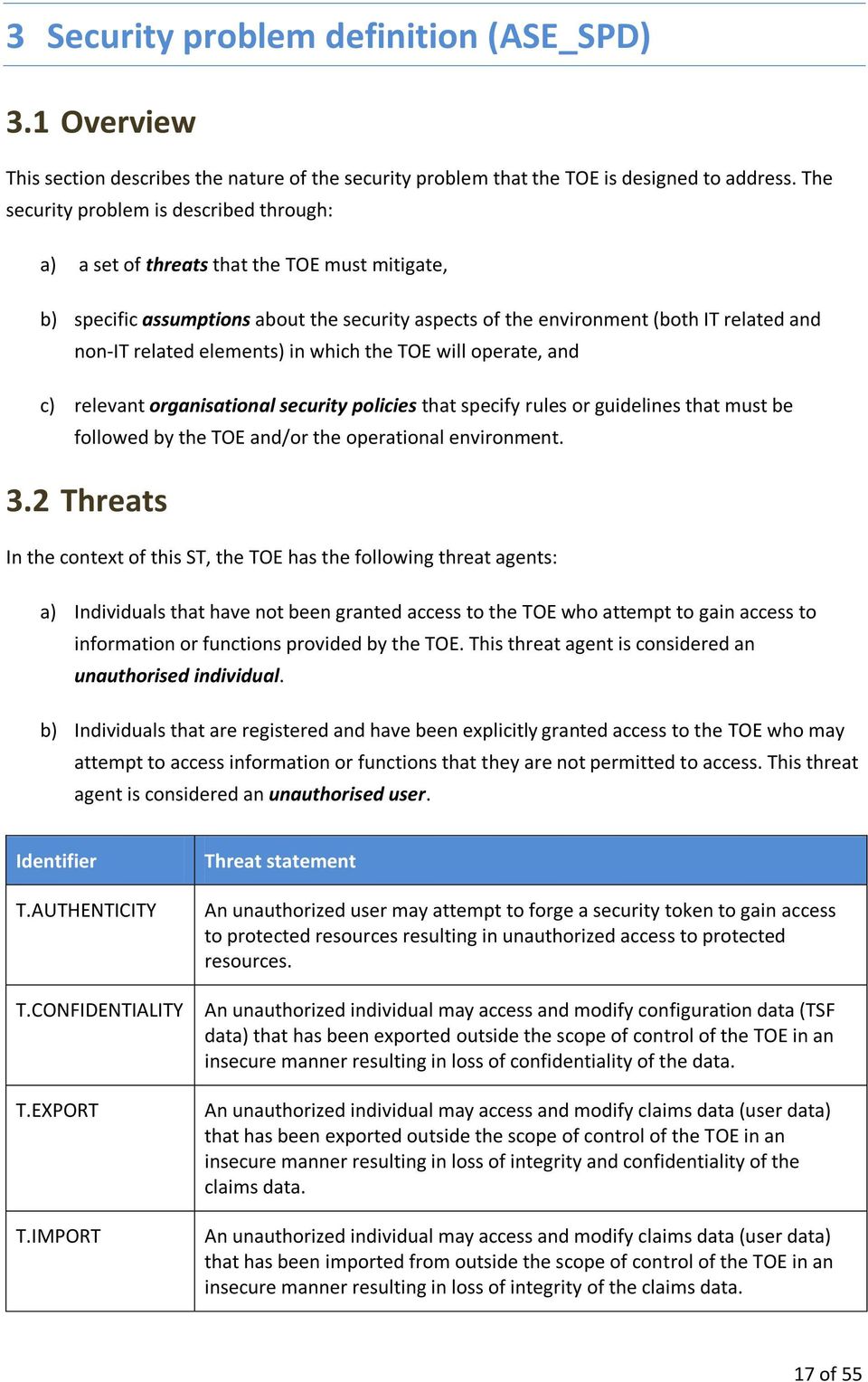
17 3 Security problem definition (ASE_SPD) 3.1 Overview This section describes the nature of the security problem that the TOE is designed to address. The security problem is described through: a) a set of threats that the TOE must mitigate, b) specific assumptions about the security aspects of the environment (both IT related and non-it related elements) in which the TOE will operate, and c) relevant organisational security policies that specify rules or guidelines that must be followed by the TOE and/or the operational environment. 3.2 Threats In the context of this ST, the TOE has the following threat agents: a) Individuals that have not been granted access to the TOE who attempt to gain access to information or functions provided by the TOE. This threat agent is considered an unauthorised individual. b) Individuals that are registered and have been explicitly granted access to the TOE who may attempt to access information or functions that they are not permitted to access. This threat agent is considered an unauthorised user. Identifier T.AUTHENTICITY T.CONFIDENTIALITY T.EXPORT T.IMPORT Threat statement An unauthorized user may attempt to forge a security token to gain access to protected resources resulting in unauthorized access to protected resources. An unauthorized individual may access and modify configuration data (TSF data) that has been exported outside the scope of control of the TOE in an insecure manner resulting in loss of confidentiality of the data. An unauthorized individual may access and modify claims data (user data) that has been exported outside the scope of control of the TOE in an insecure manner resulting in loss of integrity and confidentiality of the claims data. An unauthorized individual may access and modify claims data (user data) that has been imported from outside the scope of control of the TOE in an insecure manner resulting in loss of integrity of the claims data. 17 of 55
18 Identifier T.INTEGRITY T.INTERNAL T.TRUST Threat statement An unauthorized individual may access and modify configuration data (TSF data) that has been exported outside the scope of control of the resulting in loss of integrity of the data. An unauthorized individual may access and modify configuration data (TSF data) transmitted between physically separate parts of the TOE resulting in loss of confidentiality and integrity of the data. An unauthorized individual may access and modify trust relationship data (TSF data) transmitted between the claims provider and relying parties resulting in loss of confidentiality and integrity of the data. 3.3 Organisational security policies In the context of this ST, the following organisational security policies (OSPs) are used to provide the basis for security objectives that are most often desired by acquirers and users of the TOE. Identifier P.ADMIN P.BINDING P.AUTHENTICATE P.DEFAULT P.MANAGE P.PATH P.RESTRICTED P.ROLES OSP statement Administrators must be capable of managing the full range of security functions and policies of the TOE. All authenticated users will be bound to provisioned security tokens to provide them with federated and SSO access to controlled resources. All users requesting claims must be authenticated by an approved attribute store prior to processing claims and generating a security token. All identity resource access policies and authorization rules must be restrictive by default. Administrators must be provided with an identity management tool supported by the TOE, and be capable of using it to manage the identities of TOE users. All remote and federated users must be provided with a trusted interface for authenticating to the TOE to ensure the confidentiality and integrity of user and TSF data. All administrative functions of the TOE must be restricted to the administrator. The TOE must be capable of associating all authenticated user with a specific role that relates to their location and expected interactions with the TOE. 18 of 55

19 Identifier P.TOKEN OSP statement The TOE must be capable of applying administrator configured rules to the acceptance of input claim requests from remote, federated and corporate network users and the generation and issuance of a token that provides authorized access to protect resources. 3.4 Assumptions The following assumptions provide the foundation for security objectives for the operational environment for the TOE. Identifier A.COMMS A.INSTALL A.ACCESS A.I&A A.ATTRIBUTE A.CONFIG A.UNTRUSTED A.COMPETENT A.NO_EVIL Assumption statement It is assumed that any connection between an untrusted network and the underlying servers for the federation service is appropriately secured by a firewall. It is assumed that the TOE will be delivered, installed, configured and set up in accordance with documented delivery and installation/setup procedures. It is assumed that the underlying server operating systems will provide access control mechanisms to restrict modification to TOE executables, the platform itself, configuration files and databases only to the administrators authorized to perform these functions. It is assumed that underlying server operating systems will provide the capability to enforce identification and authentication of local administrators. It is assumed that the IT environment will provide secure methods for storing managing and supplying identity related attributes for populating submitted claims as requested by the TOE. It is assumed that the IT environment will provide secure methods for storing and managing TSF data for the TOE. It is assumed that no untrusted software is installed on the machines the TOE is installed on. It is assumed that there will be one or more competent administrators assigned to manage the TOE, its platform and the security of the information both of them contain. It is assumed that the administrator(s) are not careless, willfully negligent, nor hostile, and will follow and abide by the instructions provided by the administration documentation. 19 of 55

20 Identifier A.PARTNERS A.CERTIFICATES A.PROTECT Assumption statement It is assumed that organizations that enter into a trust relationship are capable of providing the necessary IT environment and operational support to effectively manage their attribute store, federation service and underlying platforms. It is assumed that the IT environment and underlying server operating systems are capable of producing and securely managing the necessary cryptographic certificates required. It is assumed that the TOE and its platform will be located within facilities providing controlled access to prevent unauthorized physical access. 20 of 55

21 4 Security objectives (ASE_OBJ) 4.1 Overview The security objectives are a concise statement of the intended response to the security problem defined in Section 3. There are security objectives for the TOE to address and additional objectives that provide specific direction for the intended environment in which the TOE is to operate. 4.2 Security objectives for the TOE Identifier O.ADMIN O.AUTHENTICATE O.AUTHENTICITY O.BINDING O.DEFAULT O.EXPORT O.IMPORT O.INTERNAL O.PATH O.RESTRICTED Objective statements The TOE must provide administrators with the capability to manage the various security functions and policies of the TOE. The TOE must provide the capability to authenticate all users prior to processing claims and generating a security token for the user. The TOE must provide protection for issued security tokens to ensure that they cannot be forged or modified in order to gain unauthorized access to protected resources. The TOE must be capable of binding all authenticated users to provisioned security tokens. The TOE must provide default restrictive policies and authorization rules. The TOE shall prevent claims data from being exported outside the scope of control of the TOE in an insecure manner resulting in potential loss of integrity and confidentiality of the stored identity information. The TOE shall prevent claims data from being imported from outside the scope of control of the TOE in an insecure manner resulting in potential loss of integrity and confidentiality of the stored identity information. The TOE shall be capable of preventing unauthorized and modification of configuration data configuration data that is being transmitted between physically separate parts of the TOE. The TOE must provide all remote and federated users with a trusted interface for authenticating to the TOE to ensure the confidentiality and integrity of user and TSF data. The TOE must be capable of protecting all administrative functions of the TOE so that they can only be accessed by the authorized administrator. 21 of 55
22 Identifier O.ROLES O.TOKEN O.TRUST Objective statements The TOE must be capable of associating all authenticated user with a specific role that relates to their location and expected interactions with the TOE. The TOE must be capable of applying administrator configured rules to the acceptance of input claim requests from remote, federated and corporate network users and the generation and issuing a security token that provides authorized access to protect resources. The TOE must be capable of protecting trust relationship data being transmitted between the claims provider and relying parties from unauthorized modification and/or access. 4.3 Security objectives for the environment Identifier OE.COMMS OE.INSTALL OE.ACCESS OE.I&A OE.ATTRIBUTE OE.CONFIG OE.UNTRUSTED OE.COMPETENT Objective statements The IT environment shall provide appropriate protection for components of the TOE from untrusted networks. The operational environment shall ensure that the TOE is delivered, installed, configured and set up in accordance with documented delivery and installation/setup procedures. The IT environment shall provide access control mechanisms to restrict modification to TOE executables, the platform itself, configuration files and databases only to the administrators authorized to perform these functions. The IT environment shall provide functionality for supporting and enforcing identification and authentication of local administrators. The IT environment shall provide secure methods for storing managing and supplying identity related attributes for populating submitted claims as requested by the TOE. The IT environment shall provide secure methods for storing and managing TSF data for the TOE. The operational environment shall ensure that no untrusted software is installed on the machines the TOE is installed on. The operational environment shall provide one or more competent administrators assigned to manage the TOE, its platform and the security of the information both of them contain. 22 of 55
23 Identifier OE.NO_EVIL OE.PARTNERS OE.CERTIFICATES OE.PROTECT OE.MANAGE OE.CONFIDENTIALITY OE.INTEGRITY Objective statements The operational environment shall ensure that administrator(s) are not careless, willfully negligent, nor hostile, and will follow and abide by the instructions provided by the administration documentation. The operational environment shall ensure that trusted partner organization s are capable of providing the necessary IT environment and operational support to effectively manage their attribute store, federation service and underlying platforms. The IT environment shall be capable of producing and securely managing the necessary cryptographic certificates required. The operational environment shall provide facilities that protect the TOE and its platform from unauthorized physical access. The IT environment shall provide an identity management tool supported by the TOE. The tool shall allow administrators to manage the identities of users of the TOE. The IT environment must be capable of protecting configuration data from unauthorized access. The IT environment must be capable of preventing unauthorized modification of configuration data that has been exported outside the scope of control of the TOE. 23 of 55
24 5 Security functional requirements (ASE_REQ) 5.1 Overview This section defines the security requirements satisfied by the TOE. Each requirement has been extracted from version 3.1 (Rev 3) of the CC, part 2 providing functional requirements and part 3 providing assurance requirements. Part 2 of the CC defines an approved set of operations that may be applied to security functional requirements. Following are the approved operations and the document conventions that are used within this ST to depict their application: Assignment. The assignment operation provides the ability to specify an identified parameter within a requirement. Assignments are depicted using bolded text and are surrounded by square brackets as follows [assignment]. Selection. The selection operation allows the specification of one or more items from a list. Selections are depicted using bold italics text and are surrounded by square brackets as follows [selection]. Refinement. The refinement operation allows the addition of extra detail to a requirement. Refinements are indicated using bolded text, for additions, and strike-through, for deletions. Iteration. The iteration operation allows a component to be used more than once with varying operations. Iterations are depicted by placing a letter at the end of the component identifier as follows FDP_IFF.1a and FDP_IFF.1b. The security functional requirements are expressed using the notation stated in Section 5.1 above and are identified in the table below. Identifier Title User data protection (FDP) FDP_DAU.2 FDP_ETC.2 FDP_IFC.1 FDP_IFF.1 FDP_ITC.1 Data authentication with identity of guarantor Export of user data with security attributes Subset information flow control (CLAIMS) Simple security attributes (CLAIMS) Import of user data with security attributes 24 of 55
25 Identifier FDP_ITT.1 Title Basic internal transfer protection Identification and authentication (FIA) FIA_ATD.1 FIA_UAU.1 FIA_UID.2 FIA_USB.1 User attribute definition Timing of authentication User identification before any action User-subject binding Security management (FMT) FMT_MSA.3 FMT_MTD.1 FMT_SMF.1 FMT_SMR.1 Static attribute initialisation Management of TSF data Specification of management functions Security roles Protection of the TSF (FPT) FPT_ITT.1 Basic internal TSF data transfer protection Trusted path/channels (FTP) FTP_ITC.1 FTP_TRP.1 Inter-TSF trusted channel Trusted path 25 of 55
26 5.2 User data protection (FDP) FDP_DAU.2 Data Authentication with identity of guarantor Hierarchical to: Dependencies: FDP_DAU.2.1 FDP_DAU.2.2 Notes: FDP_DAU.1 Basic Data Authentication FIA_UID.1 Timing of identification The TSF shall provide a capability to generate evidence that can be used as a guarantee of the validity of [security tokens]. The TSF shall provide [relying party] with the ability to verify evidence of the validity of the indicated information and the identity of the user that generated the evidence. The federation server uses a token-signing certificate to digitally sign all security tokens that it produces. Because each security token is digitally signed by the claims provider, the relying party can verify that the security token was in fact issued by the claims provider and that it was not modified FDP_IFC.1 Subset information flow control (CLAIMS) Hierarchical to: Dependencies: No other components FDP_IFF.1 Simple security attributes FDP_IFC.1.1 The TSF shall enforce the [CLAIMS-SFP] on [ a) Subjects: i. user, ii. relying party, and iii. claims provider. b) Information: i. incoming claim, and ii. security token. c) Operations: i. accept incoming claims, ii. authorizing claims, and iii. issuing outgoing claims through a security token]. Notes: This SFR is designed to model the AD FS central claims rule engine that accepts incoming claim requests, processes those claim requests and issues appropriate authorizations through a security token in accordance with specific rules that are applied to federated trust relationships. 26 of 55
27 5.2.3 FDP_IFF.1 Simple security attributes (CLAIMS) Hierarchical to: Dependencies: FDP_IFF.1.1 FDP_IFF.1.2 No other components. FDP_IFC.1 Subset information flow control FMT_MSA.3 Static attribute initialisation The TSF shall enforce the [CLAIMS-SFP] based on the following types of subject and information security attributes: [ a) User (subject): i. UPN ii. iii. Common name b) Relying party and claims provider (subjects): i. Relying party identifier ii. iii. iv. Claims provider identifier Acceptance transform rules Issuance transform rules v. Issuance authorization rules vi. vii. viii. ix. c) Incoming claims: i. User ii. iii. iv. Delegation authorization rules Impersonation authorization rule Token-signing certificate Token-decrypting certificate Claim type Requested access rights Resource d) Security token: i. Issuer ii. iii. Authorization claims (ClaimType, Right, Resource) Claims provider digital signature]. The TSF shall permit an information flow between a controlled subject and controlled information via a controlled operation if the following rules hold: [ a) The users input claims must be accepted by the claims provider in accordance with the acceptance transform rule that is associated with the claims provider trust. b) If the user is requesting authorization to access a resource, then the relying party must have an issuance authorization rule that permits 27 of 55
28 the user to access the requested resource in order for a returned security token to include this claim. c) If the user is requesting to impersonate another user without having to identify the requesting user in the token, then a relying party trust must have an impersonation authorization rule that permits this specific authorization in order for a returned security token to include this claim. d) If the user is requesting to impersonate another user while still identifying the requesting user in the token, then a relying party trust must have a delegation authorization rule that permits this specific authorization in order for a returned security token to include this claim. e) The relying party must permit the issuance of a security token to the user in accordance with the issuance transform rules]. FDP_IFF.1.3 FDP_IFF.1.4 The TSF shall enforce the [following additional rules: a) All claim rules are executed chronologically as they appear in a rule set. The claim rule that is at the top of the rule set is processed first and then subsequent rules are processed until all of the rules have been run. b) Each rule within a rule set is only executed once. c) All claims are processed using the following claims pipeline: i. Claims that are received from the claims provider are processed by the acceptance transform rules on the claims provider trust. These rules determine which claims are accepted from the claims provider. ii. iii. Output from the acceptance transform rules is used as input to the issuance authorization rules. These rules determine whether the user is permitted to access the relying party. Output from the acceptance transform rules is used as input to the issuance transform rules. These rules determine the claims that will be sent to the relying party]. The TSF shall explicitly authorise an information flow based on the following rules: [none]. FDP_IFF.1.5 The TSF shall explicitly deny an information flow based on the following rules: [ a) If the user submitting the claim does not have an account in the attribute store of either the relying party or the claims provider, or b) If the user is unable to submit the required authentication data]. Notes: This SFR is designed to model the functionality of the claims pipeline process: accepting incoming claims, authorizing the claims requester and issuing outgoing claims. 28 of 55
29 5.2.4 FDP_ETC.2 Export of user data with security attributes Hierarchical to: Dependencies: FDP_ETC.2.1 FDP_ETC.2.2 FDP_ETC.2.3 FDP_ETC.2.4 Notes: No other components. [FDP_ACC.1 Subset access control, or FDP_IFC.1 Subset information flow control] The TSF shall enforce the [CLAIMS-SFP] when exporting user data, controlled under the SFP(s), outside of the TOE. The TSF shall export the user data with the user data's associated security attributes. The TSF shall ensure that the security attributes, when exported outside the TOE, are unambiguously associated with the exported user data. The TSF shall enforce the following rules when user data is exported from the TOE: [ a) The TOE is only permitted to transmit incoming claims to approved attribute stores. b) The TOE communicates with attribute stores in accordance with established attribute store priority. c) All TOE communications with approved account stores are protected by SSL/TLS]. This SFR provides the control associated with taking the incoming claims from the federation server and having that data transmitted to the attribute store (AD DS in most cases) for processing. AD FS is tightly integrated with AD DS. AD FS retrieves user attributes and authenticates users against AD DS. AD FS also uses Windows Integrated Authentication and security tokens that AD DS creates FDP_ITC.1 Import of user data with security attributes Hierarchical to: Dependencies: FDP_ITC.1.1 FDP_ITC.1.2 FDP_ITC.1.3 No other components. [FDP_ACC.1 Subset access control, or FDP_IFC.1 Subset information flow control] [FTP_ITC.1 Inter-TSF trusted channel, or FTP_TRP.1 Trusted path] FPT_TDC.1 Inter-TSF basic TSF data consistency The TSF shall enforce the [CLAIMS-SFP] when importing user data, controlled under the SFP, from outside of the TOE. The TSF shall ignore any security attributes associated with the user data when imported from outside the TOE. The TSF shall enforce the following rules when importing user data controlled 29 of 55
30 under the SFP from outside the TOE: [ a) The TOE is only permitted to import attributes from approved attribute stores. b) The TOE communicates with account stores in accordance with established attribute store priority. c) All TOE communications with approved attribute stores are protected by SSL/TLS]. Notes: This SFR provides the rules associated with receiving information back from the attribute store in a secure manner to populate claims FDP_ITT.1 Basic internal transfer protection Hierarchical to: Dependencies: FDP_ITT.1.1 Notes: No other components. [FDP_ACC.1 Subset access control, or FDP_IFC.1 Subset information flow control] The TSF shall enforce the [CLAIMS-SFP] to prevent the [disclosure and modification] of user data when it is transmitted between physically-separated parts of the TOE. This SFR aims to provide protection of user data (claims data) between separate parts of the TOE (AD FS Web Agent, Federation Service Proxy and the Federation Service). 30 of 55
31 5.3 Identification and authentication (FIA) FIA_ATD.1 User attribute definition Hierarchical to: Dependencies: FIA_ATD.1.1 Notes: No other components No dependencies The TSF shall maintain the following list of security attributes belonging to individual users requesting claims: [ a) UPN b) address c) Common name]. Users requesting access to resources will be required to provide at least the common security attributes FIA_UAU.1 Timing of authentication Hierarchical to: Dependencies: FIA_UAU.1.1 FIA_UAU.1.2 Notes: No other components. FIA_UID.1 Timing of identification. The TSF shall allow [presentation of claims through a security token or authentication data] on behalf the user to be performed before the user is authenticated. The TSF shall require each user to be successfully authenticated before allowing any other TSF-mediated actions on behalf of that user. The user is free to present claims through a security token, or authentication data to claims-aware applications prior to authentication being completed. AD FS does not authenticate the user, all authentication activities are passed on to the attribute store (AD DS in most cases) to be authenticated prior to generating claims and providing authorized access to protected resources FIA_UID.2 User identification before any action Hierarchical to: Dependencies: FIA_UID.2.1 Notes: FIA_UID.1 Timing of identification. No dependencies. The TSF shall require each user to be successfully identified before allowing any other TSF-mediated actions on behalf of that user. AD FS must have an indication of the identity of the user prior to being capable of undertaking any controlled actions on that user s behalf. 31 of 55
32 5.3.4 FIA_USB.1 User-subject binding Hierarchical to: Dependencies: FIA_USB.1.1 FIA_USB.1.2 FIA_USB.1.3 Notes: No other components FIA_ATD.1 User attribute definition The TSF shall associate the following user security attributes with subjects acting on the behalf of that user: [security token and associated claims]. The TSF shall enforce the following rules on the initial association of user security attributes with subjects acting on the behalf of users: [ a) the user must be authenticated by one of the approved attribute stores b) the authorization rules that pertain to the relevant relying party trust must provide requested access, and c) the issuance rules must permit the issuance of a security token]. The TSF shall enforce the following rules governing changes to the user security attributes associated with subjects acting on the behalf of users: [none]. This SFR provides the rules for associating users (corporate network, remote or federated) with the security token that represents their respective claims. 32 of 55
33 5.4 Security management (FMT) FMT_MSA.3 Static attribute initialisation Hierarchical to: Dependencies: FMT_MSA.3.1 FMT_MSA.3.2 Notes: No other components FMT_MSA.1 Management of security attributes FMT_SMR.1 Security roles The TSF shall enforce the [CLAIMS-SFP] to provide [restrictive] default values for security attributes that are used to enforce the SFP. The TSF shall allow the [administrator] to specify alternative initial values to override the default values when an object or information is created. This SFR ensures that the default position relating to both access control to resources and the control of issuing tokens is one of deny FMT_MTD.1 Management of TSF data Hierarchical to: Dependencies: FMT_MTD.1.1 Notes: No other components FMT_SMR.1 Security roles FMT_SMF.1 Specification of Management Functions The TSF shall restrict the ability to [query, modify delete, [create]] the [following TSF data: a) attribute store configuration data, b) trust policy, c) claims ruleset, d) Federation Server configuration data, e) Federation Server Proxy configuration data, and f) certificates] to [the administrator]. The administrator is the only role permitted to interact with the TOE to perform general security, administrative and operational activities FMT_SMF.1 Specification of management functions Hierarchical to: Dependencies: No other components. No dependencies. FMT_SMF.1.1 The TSF shall be capable of performing the following management functions: [ 33 of 55
34 a) Relying party trust management (ADFSRelyingPartyTrust) b) Claims provider trust management (ADFSClaimsProviderTrust) c) Attribute store management (ADFSAttributeStore) d) Claim description management (ADFSClaimDescription) e) Endpoint management (ADFSEndpoint) f) Certificate management (ADFSCertificate) g) Federation proxy configuration management (ADFSProxyProperties) h) Federate server configuration management (ADFSProperties) i) Claim ruleset management (ADFSClaimRuleSet)]. Notes: The TOE provides a graphical user interface (GUI) tool the AD FS 2.0 Management snap-in for Microsoft Management Console (MMC). Windows PowerShell cmdlets that are also included with AD FS 2.0 as an optional toolset to configure and administer the TOE FMT_SMR.1 Security roles Hierarchical to: Dependencies: No other components FIA_UID.1 Timing of identification FMT_SMR.1.1 The TSF shall maintain the roles [ a) corporate network user, b) remote user, c) federated user, and d) administrator]. FMT_SMR.1.2 Notes: The TSF shall be able to associate users with roles. In the context of users (for example employees) that are able to access the functionality of the TOE there are several different types. Individuals that are logged on to an Active Directory forest in the corporate network are considered to be corporate network users. Remote users are also employees who are logged on to an Active Directory domain, however, they are accessing this domain remotely, that is from outside the corporate network environment. A federated user is generally not an employee and their account will reside in an account partner organization, who can access federated applications that reside in a resource partner organization. The administrator relates simply to the local administrator that has privileged access to the TOE and the underlying and supporting platforms. 34 of 55
35 5.5 Protection of the TSF (FPT) FPT_ITT.1 Basic internal TSF data transfer protection Hierarchical to: Dependencies: FPT_ITT.1.1 Notes: No other components. No dependencies. The TSF shall protect TSF data from [disclosure and modification] when it is transmitted between separate parts of the TOE. This SFR ensures that the AD FS solution is capable of federation service metadata (TSF data) when transferred between components of the solution that may be implemented on physically separate servers, namely the Federation Service Proxy and the Federation Service. 5.6 Trusted path/channels (FTP) FTP_ITC.1 Inter-TSF trusted channel Hierarchical to: Dependencies: FTP_ITC.1.1 FTP_ITC.1.2 FTP_ITC.1.3 Notes: No other components No dependencies The TSF shall provide a communication channel between itself and another trusted IT product that is logically distinct from other communication channels and provides assured identification of its end points and protection of the channel data from modification or disclosure. The TSF shall permit [the TSF or another trusted IT product] to initiate communication via the trusted channel. The TSF shall initiate communication via the trusted channel for [communicating trust relationship data]. This SFR implements a method for securely communicating between the claims provider and the relying party in any trust relationship FTP_TRP.1 Trusted path Hierarchical to: Dependencies: FTP_TRP.1.1 No other components. No dependencies. The TSF shall provide a communication path between itself and [remote] users that is logically distinct from other communication paths and provides assured identification of its end points and protection of the communicated data from [modification and disclosure]. 35 of 55
36 FTP_TRP.1.2 FTP_TRP.1.3 Notes: The TSF shall permit [remote users] to initiate communication via the trusted path. The TSF shall require the use of the trusted path for [all users presenting a security token or authentication data to a claims-aware application]. This SFR implements security functionality to ensure that the user (either federated or remote) is capable of establishing a trusted path between itself in a remote location via a browser and the claims-aware application. This is through the implementation of an SSL/TLS session to protect communications between the user and the application from modification and disclosure. Each AD FS-enabled Web server that hosts an AD FS Web Agent uses SSL server authentication certificates to securely communicate with Web clients. 36 of 55
37 6 Security assurance requirements (ASE_REQ) This ST implements the Security Assurance Requirements (SARs) of the EAL4 package and augments this package with the inclusion of the ALC_FLR.3, systematic flaw remediation. EAL4 provides assurance by a full security target and an analysis of the SFRs in that ST, using a functional and complete interface specification, guidance documentation and a description of the modular design of the TOE. The full implementation is also provided to the evaluator so that analysis can be conducted of an evaluator-selected subset, so that security behaviour can be understood and potential vulnerabilities identified. The analysis is supported by independent testing of the TSF, which can be based on evidence of developer testing of the functions of the TOE. In addition, the evaluators will conduct a vulnerability analysis using all provided inputs and ensure that the TOE is resistant to penetration attackers with an enhanced-basic attack potential. EAL4 also provides assurance through the use of development environment controls and additional TOE configuration management including automation, and evidence of secure delivery procedures. The selected set of SARs is appropriate due to the intended enterprise operating environment and customer base that this product is intended for. EAL4 provides evaluators with access to the implementation details for the TOE and enables deep analysis to identify potential vulnerabilities and exposures which is relevant and expected of an enterprise-grade software product. EAL4 provides the right balance with understanding and documenting the modular structure of the TOE and the implementation detail, and providing sufficient assurance through independent functional and penetration testing. The following table highlights the assurance requirements of the EAL4 assurance package. Assurance class ADV: Development Assurance components ADV_ARC.1 Security architecture description ADV_FSP.4 Complete functional specification ADV_IMP.1 Implementation representation of the TSF ADV_TDS.3 Basic modular design AGD: Guidance documents ALC: Life cycle support AGD_OPE.1 Operational user guidance AGD_PRE.1 Preparative procedures ALC_CMC.4 Production support, acceptance procedures and automation 37 of 55
38 Assurance class Assurance components ALC_CMS.4 Problem tracking CM coverage ALC_DEL.1 Delivery procedures ALC_DVS.1 Identification of security measures ALC_LCD.1 Developer defined life-cycle model ALC_TAT.1 Well-defined development tools ALC_FLR.3 Systematic flaw remediation ASE: Security Target evaluation ASE_CCL.1 Conformance claims ASE_ECD.1 Extended components definition ASE_INT.1 ST Introduction ASE_OBJ.2 Security objectives ASE_REQ.2 Derived security requirements ASE_SPD.1 Security Problem Definition ASE_TSS.1 TOE summary specification ATE: Tests ATE_COV.2 Analysis of coverage ATE_DPT.1 Testing: basic design ATE_FUN.1 Functional testing ATE_IND.2 Independent testing sample AVA: Vulnerability assessment AVA_VAN.3 Focused vulnerability analysis 38 of 55
39 7 TOE summary specification 7.1 Overview This chapter provides the TOE summary specification, a high-level description of how the TOE implements the claimed security functional requirements. The TOE implements the following security functions that suitably address the claimed set of requirements: a) Claims policy management. AD FS provides a claims rules engine that is used to manage claims policy for the implementation of the capability. In the context of digital identities, claims are statements that one subject makes about itself or another subject. These claims can be made by a person directly or provided to others by a third party. Other parties can rely on the values of the claims to perform a process of digital identification. b) Trust management. AD FS implements the capability to manage cross-organizational (federation-based) collaboration. The determination of the trust relationship depends on whether the organisation will host a web resource to be accessed by other organizations across the Internet or the reverse. c) Token issuance. AD FS implements a security token service (STS) that processes all claims and requests for tokens. 7.2 Claims policy management In the context of digital identities, claims are statements that one subject (a person, organization, or thing) makes about itself or another subject. For example, claims can be made about the name, age, role, or other characteristics of a person. These claims can be made by a person directly or provided to others by a third party. Other parties can rely on the values of the claims to perform a process of digital identification. At its most basic level, AD FS works with claims and uses its Federation Service in the following ways: a) When a Federation Service is configured in the claims provider role, it serves as a claims producer authenticating users and issuing outgoing claims on their behalf. In this role, the Federation Service can retrieve claims data from an attribute store and then send that information back in the form of tokens. b) When a Federation Service is configured in the relying party role, it can also serve as a claims consumer processing and trusting the incoming tokens that other claims providers pass to it. While relying parties can often simply be applications that are claims aware and that are able to process these tokens, in this role, AD FS 2.0 also supports federated identity 39 of 55
40 scenarios in which a relying party validates or handles claims that another claims provider issues. More precisely, a Federation Service in the relying party role looks at and validates claims that some other Federation Service asserts and, upon successful validation, it either reaffirms those claims to its relying parties or it asserts additional or even different claims in the token that it issues. The TOE provides an MMC snap-in to administer AD FS. There is also a suite of cmdlets that can be run through Windows PowerShell. These resources can be used to configure or administer a federation server or federation server proxy. A resource is implemented as an object type that is used to derive one or more cmdlets. 7.3 Trust management Adding a claims provider trust to AD FS gives users of that claims provider access to the relying parties that are configured in AD FS. Each relying party application makes authorization decisions about a user by examining the claims that AD FS provides. AD FS uses the administrator-defined claim rules for a claims provider to determine what claims to issue about each user, based on the relying party that is involved. In AD FS, a relying party is a Federation Service or application that consumes claims in a particular transaction. Claims that originate from a claims provider can be presented and consumed by the relying party. A Federation Service or application in a relying party role: a) Acts as a Web service that can request a set of claims from a trusted claims provider. b) Consumes the claims that it receives from its configured claims provider. When AD FS is configured in the role of the relying party, it acts as a partner that trusts a claims provider to authenticate users. Therefore, the relying party consumes the claims that are packaged in security tokens that come from users in the claims provider. Typically, the Federation Service in the relying party role uses the security tokens that the claims provider produces to issue tokens to the Web servers that are located in the same organization. To function as a relying party application for AD FS, the relying party Web server must have either the Windows Identity Foundation (WIF) platform installed or the AD FS 1.0/1.1 claims-aware Web agent. Web servers that function as a relying party application can host claims-aware applications. 40 of 55
41 7.4 Token issuance In AD FS, a claims provider is a Federation Service responsible for collecting and authenticating a user, building up claims for that user, and packaging the claims into security tokens that the relying party uses to make authorization decisions. A Federation Service in a claims provider role provides the following: a) a web service that issues security tokens in a recognized format, and b) administrators with the means to publish federation metadata that a relying party can retrieve. The claims pipeline in AD FS represents the path that claims must follow through the Federation Service before they can be issued. The Federation Service manages the entire end-to-end process of flowing claims through the various stages of the claims pipeline, which also includes the processing of claim rules by the claim rule engine. The claims pipeline process consists of three high-level stages. Each stage in this process initializes the claim rule engine to process claim rules that are specific to that stage. These stages include (in the order that they occur): a) Accepting incoming claims. This stage in the claims pipeline is used to extract the incoming claims from the token and eliminate claims that are not expected or trusted. After they are extracted, the acceptance rules that make up the acceptance transform rule set for a claims provider trust are run. These rules can be used to pass through or add new claims that can then be used in the subsequent stages of the claims pipeline. The output of this stage is used as an input to second and third stage. b) Authorizing the claims requester. This stage is used by the claims engine to issue permit or deny claims based on whether the token requester is allowed to obtain a token for the given relying party or not. However, before this can occur the authorization rules that make up either the issuance authorization rule set or the delegation authorization rule set for a relying party trust are ran. c) Issuing outgoing claims. This stage is used to issue outgoing claims and send them along the pipeline where they will be packaged into a security token. However, before this can occur the issuance rules that make up the issuance transform rule set for a relying party trust are ran, which will determine what claims will be issued as outgoing claims. All three stages above perform claims rules processing but use a different set of rules. As described above, each stage has an associated set of rules based on either the issuer of the incoming claims (the acceptance rules) or the target service for which the claims/token are being issued (authorization and issuance rules). 41 of 55
42 Annex A - Defined terms (ASE_REQ) The following table defines all subjects, objects, operations, security attributes, external entities and other key terms that are used within the statements of security functional and assurance requirements. Term/Acronym acceptance transform rules AD FS configuration database account store Definition The set of claim rules that correspond to a particular claims provider trust. These rules define what claims from the claims provider will be accepted and used later by the issuance transform rules. A database that stores all the configuration data that represents a single instance of AD FS 2.0 (the Federation Service). This configuration data can be stored either in the Windows Internal Database, which is included with Windows Server 2008 and Windows Server 2008 R2, or in a Microsoft SQL Server database. AD FS 2.0 uses account stores to log on users and extract security claims for those users. Multiple account stores can be configured for a single Federation Service. You can also define their priority. The Federation Service uses Lightweight Directory Access Protocol (LDAP) to communicate with account stores. AD FS supports the following two account stores: Active Directory Domain Services (AD DS) Active Directory Lightweight Directory Services (AD LDS) attribute store claim claim descriptions claim issuer claim name A database or directory service that contains attributes about clients. These attributes can be used to issue claims about the clients. For example, AD FS 2.0 supports the use of either AD DS or SQL Server as the attribute store for a claims provider. A statement that one subject makes about itself or another subject. For example, the statement can be about a name, identity, key, group, privilege, or capability. Claims have a provider that issues them, and they are given one or more values. They are also defined by a claim value type and, possibly, associated metadata. The list of claims that AD FS 2.0 maintains for the sake of publishing federation metadata, issuing display tokens, and assisting in the authoring of claim rules. The claims provider that issued the claim. A user-friendly name for the claim type. 42 of 55
43 Term/Acronym claim rule claim rule template claim rule language claim rule set claim type claim value claim value type claims-aware application claims provider claims provider trust client custom attribute store custom rule delegation authorization rules digital identity Definition A rule that is created with a claim rule template or that is written using the claim rule language in AD FS 2.0 that defines how to generate, transform, pass through, or filter claims. A template that is designed to help administrators easily select and create the most appropriate claim rules for a particular business need. Claim rule templates are used only during the claim rule creation process. The language that AD FS 2.0 uses to author and process the logic in all claim rules. A grouping of one or more claim rules for a given federated trust that defines how claims will be processed by the claims rule engine. The type of statement in the claim that is made. Example claim types include FirstName and Role. The claim type provides context for the claim value, and it is usually expressed as a Uniform Resource Identifier (URI). The value of the statement in the claim that is made. For example, if the claim type is Role, a value might be Contributor. The type of value in the claim. For example, if the claim value is Contributor, the claim type value is String. A relying party software application that uses claims to manage identity and access for users. A Federation Service that issues claims for a particular transaction. In the AD FS 2.0 snap-in, a claims provider trust is a trust object that is created to maintain the relationship with another Federation Service that provides claims to this Federation Service. The user or the software of a user that acts on claims that it receives from the claims provider. A Microsoft.NET Framework assembly component that was developed for extending the functionality of AD FS 2.0 attribute stores. A claim rule that you author using the claim rule language to express a series of complex logic conditions. You can build custom rules by typing the claim rule language syntax in the Send Claims Using a Custom Rule template. The set of claim transformation rules corresponding to a relying party trust that determines whether the requester is permitted to impersonate a user while still identifying the requester to the relying party. A set of claims that represent a subject. 43 of 55
44 Term/Acronym endpoint federation metadata federation server federation server proxy Federation Service identifier identity delegation impersonation authorization rules input claim set issuance rules issuance authorization rules issuance transform rules Definition Endpoints provide access to the federation server functionality of Active Directory Federation Services (AD FS) 2.0, such as token issuance, and the publishing of federation metadata. The data format for communicating configuration information between a claims provider and a relying party to facilitate automated configuration of claims provider trusts and relying party trusts. The data format is defined in Security Assertion Markup Language (SAML) 2.0, and it is extended in WS- Federation. A computer running Windows Server 2008 or Windows Server 2008 R2 that has been configured using the AD FS 2.0 Federation Server Configuration Wizard to act in the federation server role. A federation server issues tokens and serves as part of a Federation Service. A computer running Windows Server 2008 or Windows Server 2008 R2 that has been configured with the AD FS 2.0 Federation Server Proxy Configuration Wizard to act as an intermediary proxy service between an Internet client and a Federation Service that is located behind a firewall on a corporate network. A logical instance of AD FS 2.0. A Federation Service can be deployed as a stand-alone federation server or as a load-balanced federation server farm. A Uniform Resource Identifier (URI) that is used to identify an object. The object can be the instance of AD FS 2.0, a claims provider, or a relying party. A feature in AD FS 2.0 that makes it possible for a user or computer to be authorized to act as another user or computer to a relying party. The set of claim rules corresponding to a relying party trust that determines whether the requester is permitted to impersonate a user without identifying the requester to the relying party. These rules can be created only using the Windows PowerShell command-line interface. A collection of claims within the context of a given claim rule set that is available as input to subsequent claim rules within that set. Claims in this collection are discarded after the rules are processed. The rules processing engine adds the claims that each rule generates to the input claim set so that subsequent rules within a given rule set can use those claims. The set of rules applied when outgoing claims are issued across all federated trust relationships. The set of claim rules corresponding to a relying party trust that determines whether the requester is permitted to receive a token. The set of claim rules that correspond to a relying party trust that determine the claims that are issued to the relying party. 44 of 55
45 Term/Acronym output claim set primary federation server relying party relying party application relying party trust rich client Security Assertion Markup Language (SAML) Security Token Security Assertion Markup Language (SAML) subject trust establishment Definition A collection of claims within the context of a given claim rule set that will determine which claims are emitted from the list of claim rules within a rule set. If temporary claims are needed for processing, a rule can be authored in such a way that the resulting claims are added to the input claim set only. A computer running Windows Server 2008 or Windows Server 2008 R2 that has been configured in the federation server role with the AD FS 2.0 Federation Server Configuration Wizard and that has a read/write copy of the AD FS configuration database. You create the primary federation server when you use the AD FS 2.0 Federation Server Configuration Wizard, select the option to create a new Federation Service, and make that computer the first federation server in a federation server farm. All other federation servers in the farm must replicate changes that are made on the primary federation server to a read-only copy of the AD FS configuration database that they store locally. The term primary federation server does not apply when the AD FS configuration database is stored in a SQL Server database, because all federation servers can read and write equally to the SQL Server database. A Federation Service or application that consumes claims in a particular transaction. Software that can consume claims to make authentication and authorization decisions. The relying party application receives the claims from a claims provider. In the AD FS 2.0 snap-in, a relying party trust is a trust object that is created to maintain the relationship with a Federation Service or application that consumes claims from this Federation Service. A client that can use the WS-Trust protocol. The data format for communicating claims between a claims provider and a relying party. AD FS 2.0 uses both SAML 1.1 and SAML 2.0 formats. The WebSSO protocol that is defined in the SAML 2.0 Core specification. The SAML protocol specifies how to use HTTP Web browser redirects to exchange assertions data. SAML is used to authenticate and authorize users across secure boundaries. A person, organization, or thing that is described or dealt with. A process by which trust relationships are established between claims providers, such as AD FS 2.0, and relying party applications. This process involves the exchange of identifying certificates that make it possible for the relying party to trust the contents of claims that the claims provider issues. 45 of 55
46 Term/Acronym trust monitoring trust policy trust relationship User Principal Name (UPN) Uniform Resource Locator (URL) Web browser client Web Service Description Language (WSDL) Windows Communication Foundation (WCF) Windows Identity Foundation (WIF) WS-Federation WS-Federation Passive WS-SecurityPolicy Definition A feature in AD FS 2.0 that keeps the configuration of a claims provider or relying party up to date by periodically monitoring its Federation Metadata. The Active Directory Federation Services (ADFS) trust policy file defines the set of parameters that a Federation Service requires to identify partners, certificates, account stores, claims, and various properties of these entities that are associated with the Federation Service. A federation trust relationship is the embodiment of a business-level agreement or partnership between two organizations. An identifier used by Microsoft Active Directory that provides a user name and the Internet domain with which that username is associated in an address format. The format is [AD username]@[associated domain]; an example would be [email protected]. The address that is used to locate a Web site. URLs are text strings that must conform to the guidelines in RFC A client that can use the SAML WebSSO protocol and the WS-Federation passive protocol. Also referred to as a "passive client." The data format for specifying how a Simple Object Access Protocol (SOAP) service should be called. AD FS 2.0 uses WSDL 1.1. The Microsoft unified programming model for building service-oriented applications. Developers can use WCF to build secure, reliable, transacted solutions that integrate across platforms and interoperate with existing programs. A framework for building identity-aware applications. The framework abstracts the WS-Trust and WS-Federation protocols and presents developers with application programming interfaces (APIs) for building security token services (STSs) and claims-aware applications. Applications can use WIF to process tokens that are issued from STSs and make identity-based decisions at the Web application or Web service. The OASIS standard specification that defines the WS-Federation Passive protocol and other protocol extensions that are used for federation. The protocol for requesting claims from a claims provider by using HTTP Web browser redirects. This protocol is described in section 13 of the WS- Federation 1.2 specification. An XML-based specification that describes the security requirements of a Web service. These security requirements include descriptions of the claims that the service requires. 46 of 55
47 Term/Acronym WS-Trust Definition The SOAP protocol, which is defined by the WS-Trust specifications, for requesting claims from a claims provider. AD FS 2.0 uses both the February 2005 and 1.3 versions of the protocol. 47 of 55
48 Annex B - Correspondence and rationale B.1 TOE security objectives rationale The following table demonstrates that all security objectives for the TOE trace back to the threats and OSPs in the security problem definition. Threats/OSPs Objectives Rationale P.ADMIN O.ADMIN Provides direct mapping to the policy statement and aims to ensure that the TOE provides administrators with the capability to manage the various security functions and policies of the TOE. P.AUTHENTICATE O.AUTHENTICATE Provides direct mapping to the policy statement and aims to ensure that users requesting claims are effectively authenticated by the IT environment. P.BINDING O.BINDING Provides direct mapping to the policy statement and aims to ensure that users are bound to their security tokens. P.DEFAULT O.DEFAULT Provides direct mapping to the policy statement and aims to ensure that the TOE provides a default policy rules of deny all for all created identity resource objects. P.PATH O.PATH Provides direct mapping to the policy statement and aims to ensure that the TOE provides all remote users with a trusted interface for authenticating to the TOE to ensure the confidentiality and integrity of user and TSF data. P.RESTRICTED O.RESTRICTED Provides direct mapping to the policy statement and aims to ensure that access to TSF data is restricted to the administrator. P.ROLES O.ROLES Provides direct mapping to the policy statement and aims to ensure the TOE is capable of binding users to specific roles. P.TOKEN O.TOKEN Provides direct mapping to the policy statement and aims to ensure there are specific rules about the acceptance, authorization of claims and the issuance of a security token. 48 of 55
49 Threats/OSPs Objectives Rationale T.AUTHENTICITY O.AUTHENTICITY Provides direct mapping to the threat and aims to prevent an unauthorized individual from forging a security token. T.CONFIDENTIALITY OE.CONFIDENTIALITY Provides direct mapping to the threat and aims to ensure that configuration data transferring between the TOE and the configuration database is well protected against eavesdropping. T.EXPORT O.EXPORT Provides direct mapping to the threat and aims to prevent claims data from being exported outside the scope of control of the TOE in an insecure manner. T.IMPORT O.IMPORT Provides direct mapping to the threat and aims to prevent claims information from being imported from outside the scope of control of the TOE in an insecure manner. T.INTEGRITY OE.INTEGRITY Provides direct mapping to the threat and aims to ensure that configuration data transferring between the TOE and the configuration database is well protected against unauthorized modification. T.INTERNAL O.INTERNAL Provides direct mapping to the threat and aims to prevent user and TSF data from being compromised when being transmitted between physically separate servers. T.TRUST O.TRUST Provides direct mapping to the threat and aims to ensure that the end-user has a trusted method for engaging with the TOE. 49 of 55
50 B.2 Environment security objectives rationale The following table demonstrates that all security objectives for the operational environment all trace back to assumptions or OSPs in the security problem definition. Assumptions Objectives Rationale A.COMMS OE.COMMS This IT environment objective provides a direct mapping to the stated assumption and aims to ensure that the communication channels between all server roles are appropriately secured. A.INSTALL OE.INSTALL This operational environment objective provides a direct mapping to the stated assumption and aims to ensure that the TOE is delivered, installed, configured and set up in accordance with documented delivery and installation/setup procedures. A.ACCESS OE.ACCESS This IT environment objective provides a direct mapping to the stated assumption and aims to ensure that the underlying server operating systems will provide access control mechanisms to restrict modification to TOE executables, the platform itself, configuration files and databases only to the administrators authorized to perform these functions. A.I&A OE.I&A This IT environment objective provides a direct mapping to the stated assumption and aims to ensure that the underlying server platform provides the necessary identification and authentication capabilities. A.ATTRIBUTE OE.ATTRIBUTE This IT environment objective provides a direct mapping to the stated assumption and aims to ensure that secure methods for storing managing and supplying identity related attributes for populating submitted claims as requested by the TOE are provided. A.CONFIG OE.CONFIG This IT environment objective provides a direct mapping to the stated assumption and aims to ensure that secure methods for storing and managing TSF data for the TOE. A.UNTRUSTED OE.UNTRUSTED This operational environment objective provides a direct mapping to the stated assumption and aims to ensure that no untrusted software is installed on the machines the TOE is installed on. A.COMPETENT OE.COMPETENT This operational environment objectives provides a direct mapping to the stated assumption and aims to ensure that the administrators are competent and follow the TOE guidance. 50 of 55
51 Assumptions Objectives Rationale A.NO_EVIL OE.NO_EVIL This operational environment objective provides a direct mapping to the stated assumption and aims to ensure that there are suitable administrator resources available to manage the TOE. A.PARTNERS OE.PARTNERS This operational environment objective provides a direct mapping to the stated assumption and aims to ensure that trusted partner organizations are capable of providing the necessary IT environment and operational support to effectively manage their attribute store, federation service and underlying platforms. A.CERTIFICATES OE.CERTIFICATES This IT environment objective provides a direct mapping to the stated assumption and aims to ensure that it is capable of producing and securely managing the necessary cryptographic certificates required. A.PROTECT OE.PROTECT This operational environment objective provides a direct mapping to the stated assumption and aims to ensure that the TOE and its underlying platform are located within facilities providing controlled access to prevent unauthorized physical access. P.MANAGE OE.MANAGE Provides direct mapping to the policy statement and aims to ensure that the IT environment provides administrators with the capability to perform the necessary identity management related tasks. 51 of 55
52 B.3 Security functional requirements rationale The following table demonstrates that all security functional requirements trace back to security objectives of the TOE as specified in the security problem definition. Objectives SFRs Rationale O.ADMIN FMT_SMF.1 This SFR specifies the suite of security functions and policy management capabilities that must exist within the TOE for the Administrator. O.AUTHENTICATE FIA_UAU.1 This SFR provides the specification relating to authenticating users prior to processing claims and generating a security token for the user. FIA_UID.2 This SFR provides the required identification function that precedes the authentication function. O.AUTHENTICITY FDP_DAU.2 This SFR provides protection for issued security tokens to ensure that they cannot be forged or modified in order to gain unauthorized access to protected resources. O.BINDING FIA_ATD.1 This SFR specifies the attributes that are associated with users to support the binding of the token to the user. FIA_USB.1 This SFR specifies the rules that apply when generating and binding a token to a user. O.DEFAULT FMT_MSA.3 This SFR specifies the requirements associated with establishing default restrictive access and federation requirements from initialization. O.EXPORT FDP_ETC.2 This SFR specifies the rules around controlling claims data (user data) when it is transferred outside the scope of control of the TOE. O.IMPORT FDP_ITC.1 This SFR specifies the rules around controlling claims data (user data) when it is imported from outside the scope of control of the TOE. O.INTERNAL FDP_ITT.1 This SFR specifies controls for the protection of user data (claims and token data) internally as it flows between physically separate components of the TOE. 52 of 55
53 Objectives SFRs Rationale FPT_ITT.1 This SFR specifies controls for the protection of TSF data (trust-related data) internally as it flows between physically separate components of the TOE. O.PATH FTP_TRP.1 This SFR specifies the implementation of a trusted path between the end-user and the TOE. O.RESTRICTED FMT_MTD.1 This SFR specifies that controls needed to limit the security administration and management functions to the administrator. O.ROLES FMT_SMR.1 This SFR simply identifies the key roles associated with the TOE, the user and the administrator. O.TOKEN FDP_IFC.1 This SFR specifies the set of information, subjects and security attributes that relate to the implementation of an information flow control policy for the receipt, generation and issuance of tokens. FDP_IFF.1 This SFR specifies the actual information flow control rules associated with the claims policy of the TOE. O.TRUST FTP_ITC.1 This SFR specifies controls for protecting trust information that flows between the federation servers. 53 of 55
54 B.4 Dependency rationale SFR Dependencies Rationale FDP_DAU.2 FIA_UID.1 Timing of identification FIA_UID.2 included FDP_ETC.2 [FDP_ACC.1 Subset access control, or FDP_IFC.1 Subset information flow control] FCP_IFC.1 included FDP_IFC.1 FDP_IFF.1 Simple security attributes Included FDP_IFF.1 FDP_ITC.1 FDP_ITT.1 FDP_IFC.1 Subset information flow control FMT_MSA.3 Static attribute initialisation [FDP_ACC.1 Subset access control, or FDP_IFC.1 Subset information flow control] [FTP_ITC.1 Inter-TSF trusted channel, or FTP_TRP.1 Trusted path] FPT_TDC.1 Inter-TSF basic TSF data consistency [FDP_ACC.1 Subset access control, or FDP_IFC.1 Subset information flow control] Included Included Included Included Included Not included. This requirements deals with the protection of user data in the form of attributes that are applied to security tokens. Included Included FIA_ATD.1 No dependencies - FIA_UAU.1 FIA_UID.1 Timing of identification FIA_UID.2 included FIA_UID.2 No dependencies - FIA_USB.1 FIA_ATD.1 User attribute definition Included FMT_MSA.1 FMT_MSA.3 [FDP_ACC.1 Subset access control, or FDP_IFC.1 Subset information flow control] FMT_SMR.1 Security roles FMT_SMF.1 Specification of Management Functions FMT_MSA.1 Management of security attributes FMT_SMR.1 Security roles Included Included Included Included Not included. Functionality and control of security attributed adequately covered through both FMT_MTD SFRs that specify the TSF data that is controlled by both the user and the administrator. Included 54 of 55
55 SFR Dependencies Rationale FMT_MTD.1 FMT_SMR.1 Security roles FMT_SMF.1 Specification of Management Functions Included Included FMT_SMF.1 No dependencies - FMT_SMR.1 FIA_UID.1 Timing of identification FIA_UID.2 included FPT_ITT.1 No dependencies - FPT_TDC.1 No dependencies - FTP_ITC.1 No dependencies - FTP_TRP.1 No dependencies - 55 of 55
Forefront Identity Manager (FIM) 2010
 Forefront Identity Manager (FIM) 2010 Security Target Common Criteria: EAL4 augmented with ALC_FLR.3 Version 1.0 24-MAR-2012 Document history Version Date Description 0.1 28-APR-11 Initial draft for review.
EAL4+ Security Target
 EAL4+ Security Target Common Criteria: EAL4 augmented with ALC_FLR.3 Version 1.0 21-DEC-10 Document management Document identification Document ID Document title Release authority E14_EAL4_ASE Microsoft
Mobile Billing System Security Target
 Mobile Billing System Security Target Common Criteria: EAL1 Version 1.2 25 MAY 11 Document management Document identification Document ID Document title Product version IDV_EAL1_ASE IDOTTV Mobile Billing
Marimba Client and Server Management from BMC Software Release 6.0.3
 Marimba Client and Server Management from BMC Software Release 6.0.3 Version 2.3.0 4 June, 2007 Prepared by: BMC Software, Inc. 2101 City West Blvd. Houston, Texas 77042 TABLE OF CONTENTS 1. Introduction...
System Center Mobile Device Manager 2008 Service Pack 1 Security Target
 System Center Mobile Device Manager 2008 Service Pack 1 EAL4 augmented with ALC_FLR.3 Version 1.1 July 2009 The information contained in this document represents the current view of Microsoft Corporation
JMCS Northern Light Video Conferencing System Security Target
 JMCS Northern Light Video Conferencing System Security Target Common Criteria: EAL2 Version 1.2 22 FEB 12 Document management Document identification Document ID Document title Product version NLVC_ST_EAL2
EPASSPORT WITH BASIC ACCESS CONTROL AND ACTIVE AUTHENTICATION
 COMMON CRITERIA PROTECTION PROFILE EPASSPORT WITH BASIC ACCESS CONTROL AND ACTIVE AUTHENTICATION Draft Version 1.0 TURKISH STANDARDS INSTITUTION TABLE OF CONTENTS Common Criteria Protection Profile...
Security Target. NetIQ Access Manager 4.0. Document Version 1.13. August 7, 2014. Security Target: NetIQ Access Manager 4.0
 Security Target NetIQ Access Manager 4.0 Document Version 1.13 August 7, 2014 Document Version 1.13 NetIQ Page 1 of 36 Prepared For: Prepared By: NetIQ, Inc. 1233 West Loop South Suite 810 Houston, TX
Security Target. McAfee Enterprise Mobility Management 12.0. Document Version 1.16
 Security Target McAfee Enterprise Mobility Management 12.0 Document Version 1.16 September 17, 2014 Prepared For: Prepared By: McAfee, Inc. 2821 Mission College Blvd. Santa Clara, CA 95054 Primasec Ltd
Security Target. McAfee Enterprise Mobility Management 9.7. Document Version 0.9. July 5, 2012
 Security Target McAfee Enterprise Mobility Management 9.7 Document Version 0.9 July 5, 2012 Document Version 0.9 McAfee Page 1 of 39 Prepared For: Prepared By: McAfee, Inc. 2821 Mission College Blvd. Santa
SECURITY TARGET FOR FORTIANALYZER V4.0 MR3 CENTRALIZED REPORTING
 SECURITY TARGET FOR FORTIANALYZER V4.0 MR3 CENTRALIZED REPORTING Document No. 1735-005-D0001 Version: 1.0, 3 June 2014 Prepared for: Fortinet, Incorporated 326 Moodie Drive Ottawa, Ontario Canada, K2H
EMC Documentum. EMC Documentum Content Server TM V5.3. and EMC Documentum Administrator TM V5.3. Security Target V2.0
 EMC Documentum EMC Documentum Content Server TM V5.3 and EMC Documentum Administrator TM V5.3 Security Target V2.0 December 8, 2005 ST prepared by Suite 5200, 4925 Jones Branch Drive McLean, VA 22102-3305
Security Target. McAfee Data Loss Prevention Endpoint 9.4 and epolicy Orchestrator 5.1.3. Document Version 1.0
 Security Target McAfee Data Loss Prevention Endpoint 9.4 and epolicy Orchestrator 5.1.3 Document Version 1.0 November 24, 2015 Prepared For: Prepared By: Intel Corporation. 2821 Mission College Blvd. Santa
Microsoft Forefront UAG 2010 Common Criteria Evaluation Security Target Microsoft Forefront Unified Access Gateway Team
 Microsoft Forefront UAG 2010 Common Criteria Evaluation Security Target Microsoft Forefront Unified Access Gateway Team Author: Microsoft Corp. Version: 1.0 Last Saved: 2011-03-10 File Name: MS_UAG_ST_1.0.docx
Security Target. Securonix Security Intelligence Platform 4.0. Document Version 1.12. January 9, 2015
 Security Target Securonix Security Intelligence Platform 4.0 Document Version 1.12 January 9, 2015 Document Version 1.12 Copyright Securonix Page 1 of 41 Prepared For: Prepared By: Securonix 5777 W. Century
EMC Corporation Data Domain Operating System Version 5.2.1.0. Security Target. Evaluation Assurance Level (EAL): EAL2+ Document Version: 0.
 EMC Corporation Data Domain Operating System Version 5.2.1.0 Security Target Evaluation Assurance Level (EAL): EAL2+ Document Version: 0.11 Prepared for: Prepared by: EMC Corporation 176 South Street Hopkinton,
SECURITY TARGET FOR CENTRIFY SUITE VERSION 2013.2
 SECURITY TARGET FOR CENTRIFY SUITE VERSION 2013.2 Document No. 1769-000-D0007 Version: v0.89, 12 September 2013 Prepared for: Centrify Corporation 785 N. Mary Avenue, Suite 200 Sunnyvale, California USA,
Windows Mobile 6.5 Security Target
 EAL4 augmented with ALC_FLR.1 Version 1.0 January 2010 The information contained in this document represents the current view of Microsoft Corporation on the issues discussed as of the date of publication.
Security Target. Symantec TM Network Access Control Version 12.1.2. Document Version 0.12. February 14, 2013
 Security Target Symantec TM Network Access Control Version 12.1.2 Document Version 0.12 February 14, 2013 Document Version 0.12 Symantec Page 1 of 39 Prepared For: Prepared By: Symantec Corporation 350
CA CA, Inc. Identity Manager 12.5 Identity Manager r12.1 Security Target
 CA CA, Inc. Identity Manager 12.5 Identity Manager r12.1 Security Target Version 2.0 June Version 21, 2010 0.6 December 29, 2008 Prepared for: Prepared CA for: 100 Staples CA, Inc. Drive Framingham, 100
McAfee Web Gateway Version 7.2.0.1 EAL 2 + ALC_FLR.2 Security Target
 McAfee Web Gateway Version 7.2.0.1 EAL 2 + ALC_FLR.2 Release Date: 5 October 2012 Version: 1.0 Prepared By: Primasec Ltd. Prepared For: McAfee Inc. 3965 Freedom Circle Santa Clara, CA 95054 Document Introduction
Security Target. Symantec Data Loss Prevention 11.1.1. Document Version 1.0. January 23, 2012
 Security Target Symantec Data Loss Prevention 11.1.1 Document Version 1.0 January 23, 2012 Document Version 1.0 Symantec Corporation Page 1 of 40 Prepared For: Prepared By: Symantec Corporation 350 Ellis
IBM Security Access Manager for Enterprise Single Sign-On Version 8.2 with IMS Server Interim Fix 4 and AccessAgent Fix Pack 22 Security Target
 IBM Security Access Manager for Enterprise Single Sign-On Version 8.2 with IMS Server Interim Fix 4 and AccessAgent Fix Pack 22 Security Target Version: Status: Last Update: 1.19 Released 2014-03-05 Trademarks
BMC ProactiveNet Performance Management 9.5. Security Target
 BMC ProactiveNet Performance Management 9.5 Security Target Version 0.4 18 July 2014 Copyright 2014 BMC Software, Inc. All rights reserved. BMC, BMC Software, and the BMC Software logo are the exclusive
SECURITY TARGET CITADEL HERCULES ENTERPRISE VULNERABILITY MANAGEMENT (EVM) VERSION 4.1
 SECURITY TARGET CITADEL HERCULES ENTERPRISE VULNERABILITY MANAGEMENT (EVM) VERSION 4.1 Document No. 1517-011-D001 Version 1.1, 3 August 2006 Prepared for: Citadel Security Software Inc. Two Lincoln Centre
Enterasys Networks, Inc. Netsight/Network Access Control v3.2.2. Security Target
 Enterasys Networks, Inc. Netsight/Network Access Control v3.2.2 Security Target Evaluation Assurance Level: EAL2+ Document Version: 0.7 Prepared for: Prepared by: Enterasys Networks, Inc. Corsec Security,
Intrusion, Inc. SecureNet Pro Intrusion Detection System Version 4.1 SP1 Security Target December 20, 2002 Document No.
 Intrusion, Inc. SecureNet Pro Intrusion Detection System Version 4.1 SP1 Security Target December 20, 2002 Document No. F2-1202-004 COACT, Inc. Rivers Ninety Five 9140 Guilford Road, Suite L Columbia,
Security Target for Citrix Presentation Server 4.0 For Windows
 Security Target for Citrix Presentation Server 4.0 For Windows Reference: ST/T488 July 2005 Version: 1.0 This document has been prepared on behalf of: Prepared by: Citrix Systems, Inc BT 851 West Cypress
Trustwave DbProtect Version 6.4.3 Security Target
 Trustwave DbProtect Version 6.4.3 Security Target Version 1.8 July 21, 2015 Trustwave 70 West Madison Street Suite 1050 Chicago, IL 60602 Prepared By: Common Criteria Consulting LLC 15804 Laughlin Lane
Low Assurance Protection Profile for a VPN gateway
 LAPP VPN gateway Low Assurance Protection Profile for a VPN gateway Version: 1.4 Date: 29/04/2005 Filename: lapp4_14 Product: VPN gateway Sponsor: SRC Security Research & Consulting GmbH, Graurheindorfer
RSA, The Security Division of EMC RSA Data Loss Prevention Suite v6.5. Security Target
 RSA, The Security Division of EMC RSA Data Loss Prevention Suite v6.5 Security Target Evaluation Assurance Level: EAL2 Augmented with ALC_FLR.1 Document Version: 0.7 Prepared for: Prepared by: RSA, The
Citrix Systems, Inc. NetScaler Platinum Edition Load Balancer Version 9.1 Security Target
 Citrix Systems, Inc. NetScaler Platinum Edition Load Balancer Version 9.1 Security Target Evaluation Assurance Level: EAL2 augmented with ALC_FLR.2 Document Version: 1 Prepared for: Prepared by: Citrix
Hybrid for SharePoint Server 2013. Search Reference Architecture
 Hybrid for SharePoint Server 2013 Search Reference Architecture 2014 Microsoft Corporation. All rights reserved. This document is provided as-is. Information and views expressed in this document, including
Tenrox. Single Sign-On (SSO) Setup Guide. January, 2012. 2012 Tenrox. All rights reserved.
 Tenrox Single Sign-On (SSO) Setup Guide January, 2012 2012 Tenrox. All rights reserved. About this Guide This guide provides a high-level technical overview of the Tenrox Single Sign-On (SSO) architecture,
Security Target. Astaro Security Gateway V8 Packet Filter Version 1.000. Assurance Level EAL4+ Common Criteria v3.1
 Astaro Security Gateway V8 Packet Filter Version 1.000 Assurance Level EAL4+ Common Criteria v3.1 This Security Target also covers the secunet wall 2 packet filter Version : 1.03 Date: 2011-05-20 Author:
SolarWinds Log and Event Manager Software Security Target
 SolarWinds Log and Event Manager Software Security Target Version 1.5 August 25, 2014 SolarWinds Worldwide, LLC 3711 South MoPac Expressway Building Two Austin, Texas 78746 Copyright 2013 SolarWinds Worldwide,
BMC Real End User Experience Monitoring and Analytics 2.5. Security Target
 BMC Real End User Experience Monitoring and Analytics 2.5 Security Target Version 0.07 5 March 2015 Copyright 2015 BMC Software, Inc. All rights reserved. BMC, BMC Software, and the BMC Software logo
Natek Network Access Control (NAC)
 Natek Network Access Control (NAC) V 5.4.2 Security Target Release Date: 28.08.2014 Version 1.13 AUTHOR: NATEK BİLİŞİM BİLGİSAYAR EĞİTİM DANIŞMANLIK YAZILIM TİCARET SANAYİ ANONİM ŞİRKETİ 1 Revision History
U.S. Government Protection Profile for Application-level Firewall In Basic Robustness Environments
 U.S. Government Protection Profile for Application-level Firewall In Basic Robustness Environments Information Assurance Directorate Version 1.1 July 25, 2007 Forward This Protection Profile US Government
Common Criteria Security Target For 1E Power and Patch Management Pack
 Intelligent Windows Management Common Criteria Security Target For 1E Power and Patch Management Pack 30 September 2009 Document Version 1-0 1E Limited. All Rights reserved. Summary of Amendments Version
How To Understand The Toe
 Rapid7 Nexpose Vulnerability Management and Penetration Testing System V.5.1 Security Target Version 1.7 May 11, 2012 Prepared for: Rapid7 LLC 545 Boylston Street, Suite 400 Boston, MA 02116 Prepared By:
Common Criteria Security Target For XenApp 6.0 for Windows Server 2008 R2 Platinum Edition
 Common Criteria Security Target For XenApp 6.0 for Windows Server 2008 R2 Platinum Edition Version 1-0 7 February 2011 2011 Citrix Systems, Inc. All rights reserved. Summary of Amendments Version 1-0 7
Security Target. McAfee Database Security 4.4.3. Document Version 1.4. June 18, 2013. Security Target: McAfee Database Security 4.4.
 Security Target McAfee Database Security 4.4.3 Document Version 1.4 June 18, 2013 Document Version 1.4 McAfee Page 1 of 66 Prepared For: Prepared By: McAfee, Inc. 2821 Mission College Blvd. Santa Clara,
Security Target: Symantec Mail Security 8300 Series Appliances Version 5.0
 Security Target: Symantec Mail Security 8300 Series Appliances Version 5.0 ST Version 1.6 August 20, 2007 Document Version 1.6 Symantec Corporation Page 1 of 55 Prepared For: Prepared By: Symantec Corporation
McAfee Web Gateway Version 7.0.1.1 EAL 2 + ALC_FLR.2 Security Target
 McAfee Web Gateway Version 7.0.1.1 EAL 2 + ALC_FLR.2 Security Target Release Date: September 2010 Document ID: Version: Draft J Prepared By: Primasec Ltd. Prepared For: McAfee Inc. 3965 Freedom Circle
CA SiteMinder Federation Security Services r12 SP1 CR3 Security Target
 CA SiteMinder Federation Security Services r12 SP1 CR3 Security Target Version 1.0 April 5, 2010 Prepared for: CA 100 Staples Drive Framingham, MA 01702 Prepared by: Booz Allen Hamilton Common Criteria
Firewall Protection Profile
 samhällsskydd och beredskap 1 (38) ROS-ISÄK Ronny Janse 010-2404426 [email protected] Firewall Protection Profile samhällsskydd och beredskap 2 (38) Innehållsförteckning 1. Introduction... 4 1.1 PP reference...
How To Evaluate A Security Target Of Evaluation (Toe)
 Security Target McAfee Enterprise Security Manager with Event Receiver, Enterprise Log Manager, Advanced Correlation Engine, Application Data Monitor and Database Event Monitor 9.1 Document Version 1.1
C038 Certification Report
 C038 Certification Report TAXSAYA Online File name: Version: v1a Date of document: 15 August 2013 Document classification: For general inquiry about us or our services, please email: [email protected]
Deployment Guide AX Series with Active Directory Federation Services 2.0 and Office 365
 Deployment Guide AX Series with Active Directory Federation Services 2.0 and Office 365 DG_ADFS20_120907.1 TABLE OF CONTENTS 1 Overview... 4 2 Deployment Guide Overview... 4 3 Deployment Guide Prerequisites...
Common Criteria for Information Technology Security Evaluation. Part 2: Security functional requirements. August 2005. Version 2.
 Common Criteria for Information Technology Security Evaluation Part 2: Security functional requirements August 2005 Version 2.3 CCMB-2005-08-002 Foreword This version of the Common Criteria for Information
RSA, The Security Division of EMC RSA Access Manager v6.1. Security Target
 RSA, The Security Division of EMC RSA Access Manager v6.1 Security Target Evaluation Assurance Level: EAL3+ Augmented with ALC_FLR.2 Document Version: 0.8 Prepared for: Prepared by: RSA, The Security Division
Trustwave Secure Web Gateway Security Target
 Trustwave Secure Web Gateway Security Target Version 1.5 September 18, 2013 Trustwave 70 West Madison Street Suite 1050 Chicago, IL 60602 Prepared By: Common Criteria Consulting LLC 15804 Laughlin Lane
Secuware Virtual System (SVS)
 Secuware Virtual System (SVS) SECURITY TARGET EAL2 Copyright 2008 by SECUWARE All rights reserved. The information in this document is exclusive property of SECUWARE and may not be changed without express
Common Criteria for Information Technology Security Evaluation. Part 2: Security functional components. September 2007. Version 3.
 Common Criteria for Information Technology Security Evaluation Part 2: Security functional components September 2007 Version 3.1 Revision 2 CCMB-2007-09-002 Foreword This version of the Common Criteria
EXTOL epassport Suite v2.5 Security Target v2.0. ECSB/MyCC/JL/002 Common Criteria EAL1 Certification
 Doc Ref RD/JL/069 Replaces: N/A EXTOL epassport Suite v2.5 ECSB/MyCC/JL/002 Common Criteria EAL1 Certification Extol Corporation (M) Sdn Bhd (121135-U) (643683-U) Extol Group www.extolcorp.com Unit G1,
Microsoft Dynamics CRM Server 2011 software requirements
 Microsoft Dynamics CRM Server 2011 software requirements This section lists the software and application requirements for Microsoft Dynamics CRM Server 2011. Windows Server operating system: Microsoft
IBM WebSphere Message Broker Security Target
 IBM WebSphere Message Broker Security Target Version 2.1.2 2007-08-22 Document History Version Date Summary Author 1.0 2006-10-23 Final EAL3 ST plus changes by IBM. SAIC / IBM 1.1 2006-12-11 Fixed inconsistencies.
Protection Profile for UK Dual-Interface Authentication Card
 Protection Profile for UK Dual-Interface Authentication Card Version 1-0 10 th July 2009 Reference: UNKT-DO-0002 Introduction This document defines a Protection Profile to express security, evaluation
Protection Profile for Portable Storage Media (PSMPP) Common Criteria Protection Profile BSI-CC-PP-0081-2012 Version 1.0
 Protection Profile for Portable Storage Media (PSMPP) Common Criteria Protection Profile BSI-CC-PP-0081-2012 Version 1.0 German Federal Office for Information Security PO Box 20 03 63 D-53133 Bonn Tel.:
ADFS for. LogMeIn and join.me authentication
 ADFS for LogMeIn and join.me authentication ADFS for join.me authentication This step-by-step guide walks you through the process of configuring ADFS for join.me authentication. Set-up Overview 1) Prerequisite:
Common Criteria Security Target For NetScaler Platinum Edition Load Balancer Version 10.0
 Common Criteria Security Target For NetScaler Platinum Edition Load Balancer Version 10.0 Version 1-1 5 July 2013 2013 Citrix Systems, Inc. All rights reserved. Summary of Amendments Version 1-1 5 July
Wyse Technology Inc. Wyse Device Manager Enterprise Edition Version 4.7.2 Security Target
 Wyse Technology Inc. Wyse Device Manager Enterprise Edition Version 4.7.2 Security Target Version 1.8 April 18, 2011 Wyse Technology Inc. 3471 N. First Street San Jose, CA 95134 DOCUMENT INTRODUCTION Prepared
How To Protect Your Computer From Being Hacked
 Senforce Endpoint Security Suite Version 3.1.175 Security Target Version 1.0 06/19/07 Prepared for: Senforce Technologies, Inc. 147 W Election Rd Ste 110 Draper UT 84020 Prepared By: Science Applications
FOR EAL2 AUGMENTED WITH ALC_FLR.1. Version: 1.2 November 20, 2013
 SECURITY TARGET FOR A10 NETWORKS THUNDER 5430S AND 6430S APPLICATIONS DELIVERY CONTROLLERS EAL2 AUGMENTED WITH ALC_FLR.1 Version: 1.2 November 20, 2013 DENMARK FINLAND NORWAY SWEDEN THE NETHERLANDS www.secode.no
BMC Remedy Action Request System 6.3 Security Target
 BMC Remedy Action Request System 6.3 Security Target Version 4.5 March 28, 2007 Part number: 60658 Prepared by: BMC Software, Inc. 1030 W. Maude Avenue Sunnyvale, CA 94085 Copyright 2004-2007 BMC Software,
HP StoreOnce Backup System Generation 3 Version 3.6.6 Security Target
 HP StoreOnce Backup System Generation 3 Version 3.6.6 Security Target Version 1.0 February 12, 2014 Prepared for: Hewlett-Packard Long Down Avenue Stoke Gifford Bristol BS34 8QZ UK Prepared By: Leidos
Firewall Protection Profile V2.0 2008. 4. 24
 Firewall Protection Profile V2.0 2008. 4. 24 (This page left blank on purpose for double-side printing) Protection Profile Title Firewall Protection Profile for Government Evaluation Criteria Version This
HOTPin Integration Guide: Google Apps with Active Directory Federated Services
 HOTPin Integration Guide: Google Apps with Active Directory Federated Services Disclaimer Disclaimer of Warranties and Limitation of Liabilities All information contained in this document is provided 'as
Certification Report
 Certification Report EAL 3+ Evaluation of Rapid7 Nexpose Vulnerability Management and Penetration Testing System V5.1 Issued by: Communications Security Establishment Canada Certification Body Canadian
Check Point Endpoint Security Media Encryption Security Target
 Check Point Endpoint Security Media Encryption Security Target Version 1.0 June 23, 2010 Prepared for: 5 Ha Solelim St. Tel Aviv, Israel 67897 Prepared By: Science Applications International Corporation
MINISTERIO DE DEFENSA CENTRO NACIONAL DE INTELIGENCIA CENTRO CRIPTOLÓGICO NACIONAL ORGANISMO DE CERTIFICACIÓN
 REF: 2010-12-INF-626 V1 Distribution: Public Date: 29.04.2011 Created: CERT3 Reviewed: TECNICO Approved: JEFEAREA CERTIFICATION REPORT FOR EADS GROUND SEGMENT SYSTEMS PROTECTION PROFILE (GSS-PP) ISSUE
Certification Report
 Certification Report HP Network Automation Ultimate Edition 10.10 Issued by: Communications Security Establishment Certification Body Canadian Common Criteria Evaluation and Certification Scheme Government
McAfee Firewall Enterprise v7.0.1.02 Security Target
 McAfee Firewall Enterprise v7.0.1.02 Security Target 8 Nov 2010 Version 1.3 Prepared By: Primasec Ltd For McAfee Inc 2340 Energy Park Drive St. Paul, MN 55108 USA McAfee Inc. Page 1 of 60 Contents 1 Introduction...
Security Target. McAfee Host Intrusion Prevention 8 and epolicy Orchestrator 4.5. Document Version 1.1. September 9, 2011
 Security Target McAfee Host Intrusion Prevention 8 and epolicy Orchestrator 4.5 Document Version 1.1 September 9, 2011 Document Version 1.1 McAfee Page 1 of 61 Prepared For: Prepared By: McAfee, Inc. 2821
Extended Package for Mobile Device Management Agents
 Extended Package for Mobile Device Management Agents 31 December 2014 Version 2.0 REVISION HISTORY Version Date Description 1.0 21 October 2013 Initial Release 1.1 7 February 2014 Typographical changes
Blue Coat Systems, Inc. ProxySG v5.3.1.9 running on SG510, SG810, and SG8100. Security Target
 Blue Coat Systems, Inc. ProxySG v5.3.1.9 running on SG510, SG810, and SG8100 Security Target Evaluation Assurance Level: EAL 2+ Document Version: 0.7 Prepared for: Prepared by: Blue Coat Systems, Inc.
U.S. Government Protection Profile for Database Management Systems
 U.S. Government Protection Profile for Database Management Systems Information Assurance Directorate Version 1.3 December 24, 2010 Protection Profile Title: 1 U.S. Government Protection Profile for Database
Security Target Microsoft SQL Server Team
 Security Target Microsoft SQL Server Team Author: Roger French Version: 1.27 Date 2008-07-23 File Name: MS_SQL_ST_1.27 Abstract This document is the Security Target (ST) for the Common Criteria evaluation
COMMON CRITERIA PROTECTION PROFILE. for NEW GENERATION CASH REGISTER FISCAL APPLICATON SOFTWARE (NGCRFAS PP) TSE-CCCS/PP-002
 COMMON CRITERIA PROTECTION PROFILE for NEW GENERATION CASH REGISTER FISCAL APPLICATON SOFTWARE (NGCRFAS PP) TSE-CCCS/PP-002 Revision No 1.7 Revision Date 28.08.2013 Document Code File Name NGCRFAS PROTECTION
Teradata Database Version 2 Release 6.1.0 (V2R6.1.0) Security Target
 Teradata Database Version 2 Release 6.1.0 (V2R6.1.0) Security Target Version 2.0 February 2007 TRP Number: 541-0006458 NCR, Teradata and BYNET are registered trademarks of NCR Corporation. Microsoft, Windows,
Introduction to the EIS Guide
 Introduction to the EIS Guide The AirWatch Enterprise Integration Service (EIS) provides organizations the ability to securely integrate with back-end enterprise systems from either the AirWatch SaaS environment
MINISTERIO DE DEFENSA CENTRO NACIONAL DE INTELIGENCIA CENTRO CRIPTOLÓGICO NACIONAL ORGANISMO DE CERTIFICACIÓN
 REF: 2010-22-INF-764 V1 Distribution: Expediente Date: 21.11.2011 Created: CERT3 Reviewed: CALIDAD Approbed: TECNICO CERTIFICATION REPORT FOR FOR HUAWEI INTEGRATED MANAGEMENT APPLICATION PLATFORM VERSION
National Information Assurance Partnership. Common Criteria Evaluation and Validation Scheme Validation Report
 National Information Assurance Partnership Common Criteria Evaluation and Validation Scheme Validation Report TM HP Network Node Management Advanced Edition Software V7.51 with patch PHSS_35278 Report
Security Target for Cisco Remote Access VPN
 Security Target for Cisco Remote Access VPN Reference: ST 16 May 2007 Version 1.17 CISCO Systems Inc. 170 West Tasman Drive San Jose CA 95124-1706 USA Copyright: 2007 Cisco Systems, Inc. Table of Contents
PROVIDING SINGLE SIGN-ON TO AMAZON EC2 APPLICATIONS FROM AN ON-PREMISES WINDOWS DOMAIN
 PROVIDING SINGLE SIGN-ON TO AMAZON EC2 APPLICATIONS FROM AN ON-PREMISES WINDOWS DOMAIN CONNECTING TO THE CLOUD DAVID CHAPPELL DECEMBER 2009 SPONSORED BY AMAZON AND MICROSOFT CORPORATION CONTENTS The Challenge:
Microsoft Windows Common Criteria Evaluation
 Microsoft Windows Common Criteria Evaluation Microsoft Windows 8 Microsoft Windows Server 2012 Document Information Version Number 1.0 Updated On December 19, 2014 Microsoft 2014 Page 1 of 446 This is