
BMC ProactiveNet Performance Management 9.5. Security Target
|
|
|
- Oliver Stanley
- 10 years ago
- Views:
Transcription
1 BMC ProactiveNet Performance Management 9.5 Security Target Version July 2014

2

3 Copyright 2014 BMC Software, Inc. All rights reserved. BMC, BMC Software, and the BMC Software logo are the exclusive properties of BMC Software, Inc., are registered with the U.S. Patent and Trademark Office, and may be registered or pending registration in other countries. All other BMC trademarks, service marks, and logos may be registered or pending registration in the U.S. or in other countries. All other trademarks or registered trademarks are the property of their respective owners. IBM and DB2 are registered trademarks of International Business Machines Corporation. Linux is a registered trademark of Linus Torvalds. Microsoft, Windows and Windows Server are registered trademarks of Microsoft Corporation Oracle, Java and Solaris are registered trademark of Oracle. UNIX is a registered trademark of The Open Group. Restricted Rights Legend U.S. Government Restricted Rights to Computer Software. UNPUBLISHED -- RIGHTS RESERVED UNDER THE COPYRIGHT LAWS OF THE UNITED STATES. Use, duplication, or disclosure of any data and computer software by the U.S. Government is subject to restrictions, as applicable, set forth in FAR Section , DFARS , DFARS , DFARS , and DFARS , as amended from time to time. Contractor/Manufacturer is BMC Software, Inc., 2101 City West Blvd., Houston, TX , USA. Any contract notices should be sent to this address. 3 BMC SOFTWARE, INC

4 Document Revision History Date Revision Author Changes made 16 January TM Initial Draft. 9 April TM Addressed evaluator s comments 2 May TM Addressed evaluator s comments 18 July TM Updated document list BMC SOFTWARE, INC 4

5 TABLE OF CONTENTS 1 SECURITY TARGET INTRODUCTION ST Reference TOE Reference Document References Document Conventions Document Terminology CC Terminology Abbreviations TOE Overview Usage and Major Security Features of the TOE TOE Type Required non-toe Hardware and Software TOE Description Evaluated Components Physical Scope and Boundary BMC ProactiveNet Components Logical scope and boundary Functionalities and Components Excluded from the Evaluated TOE CONFORMANCE CLAIMS Common Criteria Conformance Claim Protection Profile Claim Assurance Package Claim SECURITY PROBLEM DEFINITION Threats Organizational Security Policies Assumptions SECURITY OBJECTIVES Security Objectives for the TOE Security Objectives for the Environment Security Objectives Rationale EXTENDED COMPONENTS DEFINITION Class FPM Performance Management Performance management (FPM_COL_EXT.1) Rationale for the Extended TOE Security Functional Components Extended TOE Security Assurance Components BMC SOFTWARE, INC
6 6 SECURITY REQUIREMENTS Security Functional Requirements Security Audit (FAU) User Data Protection (FDP) Identification and Authentication (FIA) Security Management (FMT) Performance Management (FPM) Security Assurance Requirements Security Requirements Rationale Security Functional Requirements Rationale Rationale for SFR Dependencies Security Assurance Requirements Rationale TOE SUMMARY SPECIFICATION Mapping of the TSFs to SFRs Audit PATROL Agent BPPM Server Access Control Identification and Authentication Security Management Performance Management BMC SOFTWARE, INC 6

7 1 SECURITY TARGET INTRODUCTION This section presents Security Target (ST) identification information and an overview of the ST for BMC ProactiveNet Performance Management 9.5 (hereinafter referred to as BMC ProactiveNet). An ST contains the information technology (IT) security requirements of an identified Target of Evaluation (TOE) and specifies the functional and assurance security measures offered by that TOE to meet stated requirements. An ST principally defines: A security problem expressed as a set of assumptions about the security aspects of the environment, a list of threats that the product is intended to counter, and any known rules with which the product must comply (Security Problem Definition section). A set of security objectives and a set of security requirements to address the security problem (Security Objectives and IT Security Requirements sections, respectively). The IT security functions provided by the TOE that meet the set of requirements in the TOE Summary Specification section. 1.1 ST Reference ST Title: BMC ProactiveNet Performance Management 9.5 Security Target ST Version: Version 0.4 ST Date: 18 July TOE Reference TOE Identification: TOE Developer TOE Type BMC ProactiveNet Performance Management 9.5 build with PATROL Agent GA (Bundled with Patrol base repository 9.5_base GA) and Knowledge Modules GA (Bundled with Patrol base repository 9.5_base GA) BMC Software, Inc. Network Resource Management and Optimization 1.3 Document References The following references are used in this ST: Abbreviation Document [CC] Common Criteria for Information Technology Security Evaluation, Version 3.1, Revision 4, September 2012, CCMB (001 to 003) [CCP1] Common Criteria for Information Technology Security Evaluation, Part 1: Introduction and General Model; CCMB , Version 3.1, Revision 4, September 2012 [CCP2] Common Criteria for Information Technology Security Evaluation, Part 2: Security Functional Components; CCMB , Version 3.1, Revision 4, September 2012 [CCP3] Common Criteria for Information Technology Security Evaluation, Part 3: Security Assurance Components; CCMB , Version 3.1, Revision 4, September 2012 [CEM] Common Methodology for Information Technology Security Evaluation; CCMB , Version 3.1, Revision 4, September Document Conventions Section 8.1 in [CCP1] defines the approved set of operations that can be applied to the CC functional and assurance components: assignment, refinement, selection, and iteration. In this ST, these operations are indicated as follows: 7 BMC SOFTWARE, INC

8 1) The assignment operation is used to assign a specific value to an unspecified parameter, such as the length of a password. Showing the value in square brackets [assignment_value] indicates an assignment. In the case when an assignment operation is embedded in a selection operation, the operations will be denoted as follows: selection value [assignment_value]. 2) The refinement operation is used to add detail or refine a requirement, and thus further restricts a requirement. Refinement of security requirements is denoted by bold text for new text and strikethrough text for deleted text. 3) The selection operation is used to select one or more options provided by the CC in stating a requirement. Selections are denoted by underlined italicized text. 4) Iterated security functional requirements will be identified by appending an additional identifier in round brackets next to their original identifier. For example: FMT_MTD.1(1) and FMT_MTD.1(2). In addition, the following general conventions are also used in this document: 5) Plain italicized text is used to introduce the names of TOE components and specific concepts. 6) Bold italicized text is used for emphasis. 7) Text in Courier Font is used to identify file name and directory paths. 1.5 Document Terminology CC Terminology In the CC, many terms are defined in Section 4.1 of [CCP1]. The following terms are a subset of those definitions: Term Authentication data Authorized user External entity Identity Object Operation (on an object) Role Security function policy Security objective Security requirement Subject Target of evaluation TOE security functionality TSF interface User Definition The information used to verify the claimed identity of a user. A TOE user who may, in accordance with the SFRs, perform an operation. A human or IT entity possibly interacting with the TOE from outside of the TOE boundary. A representation uniquely identifying entities (e.g. a user, a process or a disk) within the context of the TOE An example of such a representation is a string. For a human user, the representation can be the full or abbreviated name or a (still unique) pseudonym. A passive entity in the TOE, that contains or receives information, and upon which subjects perform operations. A specific type of action performed by a subject on an object. A predefined set of rules establishing the allowed interactions between a user and the TOE. A set of rules describing specific security behavior enforced by the TSF and expressible as a set of SFRs. A statement of an intent to counter identified threats and/or satisfy identified organization security policies and/or assumptions. A requirement, stated in a standardized language, which is meant to contribute to achieving the security objectives for a TOE. An active entity in the TOE that performs operations on objects. A set of software, firmware and/or hardware possibly accompanied by guidance. The combined functionality of all hardware, software, and firmware of a TOE that must be relied upon for the correct enforcement of the SFRs. The means by which external entities (or subjects in the TOE but outside of the TSF) supply data to the TSF, receive data from the TSF and invoke services from the TSF. See external entity defined above. BMC SOFTWARE, INC 8
![In the case when an assignment operation is embedded in a selection operation, the operations will be denoted as follows: selection value [assignment_value].](/docs-images/40/1948656/images/page_8.jpg "2) The refinement operation is used to add detail or refine a requirement, and thus further restricts a requirement.")
9 1.5.2 Abbreviations The following acronyms are used in this ST: Term Definition BPPM CC CI CLI CMA CMDB EAL HTTPS IT KM KPI LDAP PCM PP REST API RLS SAR SFR SFP ST TOE TSF WLS BMC ProactiveNet Performance Management Common Criteria Configuration Item Command Line Interface Central Monitoring Administration Configuration Management Database Evaluation Assurance Level Hyper Text Transfer Protocol Secure Information Technology Knowledge Module Key Performance Indicators Lightweight Directory Access Protocol PATROL Configuration Manager Protection Profile Representational State Transfer Application Programming Interface Read Level Security Security Assurance Requirement Security Functional Requirement Security Function Policy Security Target Target of Evaluation TOE Security Functionality Write Level Security 1.6 TOE Overview Usage and Major Security Features of the TOE The TOE is the BMC ProactiveNet Performance Management 9.5 which performs real-time predictive root cause analysis to sift through events and abnormalities collected from the application and infrastructure components that support business services, identifying a prioritized set of the most likely problem causes. This information provides continuous visibility into problems as they develop; allowing the diagnosis of intermittent performance issues without requiring users to reproduce problems. BPPM allows users to create a baseline of the system through system monitoring. The baseline is the expected normal operating range for a metric or attribute of a monitor. Abnormalities are generated when the data values from a monitor fall outside of the normal baseline range for a statistically significant number of points within the sample window specified in the threshold. When a threshold is 9 BMC SOFTWARE, INC

10 exceeded, BPPM registers this as an event. Event rules define the set of actions that can be performed when an event occurs. Event management involves setting thresholds and creating, modifying, deleting and querying event rules. BMC ProactiveNet Performance Management consolidates data and events spanning multiple vendors, platforms, and sources. It supports agent-less and agent-based monitoring of infrastructure, applications, real and synthetic end-user transactions, SNMP networks, configuration changes, business metrics, and custom information. In addition, it collects data and events from non-bmc monitoring and event management tools. Finally, it monitors onpremise and public cloud resources (e.g., storage, UCS) and services, to include Software as a Service (SaaS), Infrastructure as a Service (IaaS) and Platform as a Service (PaaS) resources. Through analysis, BMC ProactiveNet automatically discovers and learns the behavioral and performance trends for each of the monitored applications and services, identifying normal and abnormal behavior. Events are only generated when significant abnormal behavior is detected. This creates a manageable number of intelligent events, allowing the most critical business issues to be prioritized. BMC ProactiveNet Performance Management automatically discovers and learns the behavioral and performance trends for each of the monitored application and service components; identifying normal and abnormal behavior. Unlike threshold-based monitoring systems, the analytics engine only generates events when there is significantly abnormal behavior. Based on these learned trends, customers eliminate their reliance on reactive thresholds, capture critical events missed by static thresholds, and realize a significant reduction in the number of false events generated by reactive, threshold-based approaches. With fewer, more intelligent events administrators may more easily pinpoint and prioritize the most critical business issues. The solution applies predictive correlation and filtering techniques that leverage real-time service relationships in the BMC Atrium CMDB and configuration changes collected from BMC BladeLogic (or any other change source), along with additional detailed diagnostic data. This information provides continuous visibility into problems as they develop; allowing administrators to diagnose intermittent performance issues without requiring reproduction of the problem. As a result, problem resolution time is greatly reduced. BMC ProactiveNet Performance Management supports a number of features that enable users to adapt their implementation to meet the needs of their own networks and architectures. They include: Use of external authentication such as Active Directory or BMC Atrium Single Sign On BMC ProactiveNet Performance Management supports the use of either an embedded Sybase database, or an external Oracle database. The external Oracle database is used in the evaluated configuration. Support for the BMC Atrium CMDB for Configuration Item based access control The BMC ProactiveNet Performance Management server includes an Apache server which may be configured to provide HTTPS protected communications between distributed parts of the product The PATROL Agent is the core piece of the BMC ProactiveNet architecture that monitors and manages host computers. The PATROL Agent performs the following tasks: Runs commands to collect system or application information; the information is collected according to applications and parameters defined in Knowledge Modules Stores information locally for retrieval by the BMC ProactiveNet Integration Service Loads specified Knowledge Modules (KMs) at start-up The PATROL Knowledge Module is a set of files from which a PATROL Agent receives information about all of the resources, such as databases and file systems running on a monitored computer. PATROL KMs provide information to the PATROL Agent about: The identity of objects Parameters Actions to take when an object changes a state How to monitor the application Communications between components is protected using HTTPS protocols. Figure 1 shows a typical implementation configuration for BMC ProactiveNet Performance Management. BMC SOFTWARE, INC 10
11 Figure 1 BMC ProactiveNet TOE Type BMC ProactiveNet Performance Management is an IT management application Required non-toe Hardware and Software The hardware requirements for any given environment depend on the size and amount of activity expected. In most cases, BMC recommends that an analysis of the organization s needs be performed to determine the hardware requirements for the installation. The following tables identify the requirements for all components of the BMC ProactiveNet, Table 1 Operating System and Hardware Requirements for TOE Components TOE Component Operating System Hardware BMC ProactiveNet Server BMC ProactiveNet Integration Service Red Hat Enterprise Linux 6.2 (64-bit) Red Hat Enterprise Linux 6.2 (64-bit) Intel Xeon CPU 2.40 GHz, 2 CPUs and a total of 2 Cores, minimum 16 GB memory Intel Core i7, 2 CPUs and a total of 2 Cores, GHz frequency, 2400 MHz bus-speed, and 16 threads or equivalent, minimum 8 GB memory BMC PATROL Agent Windows 7 (64-bit) General Purpose Computer Hardware Red Hat Enterprise Linux 6.2 (64-bit) General Purpose Computer Hardware Table 2 Requirements for Non-TOE Components Non-TOE Component Web browser Requirement Microsoft Internet Explorer 8, Adobe Flash V10 or later, display resolution 1280x BMC SOFTWARE, INC

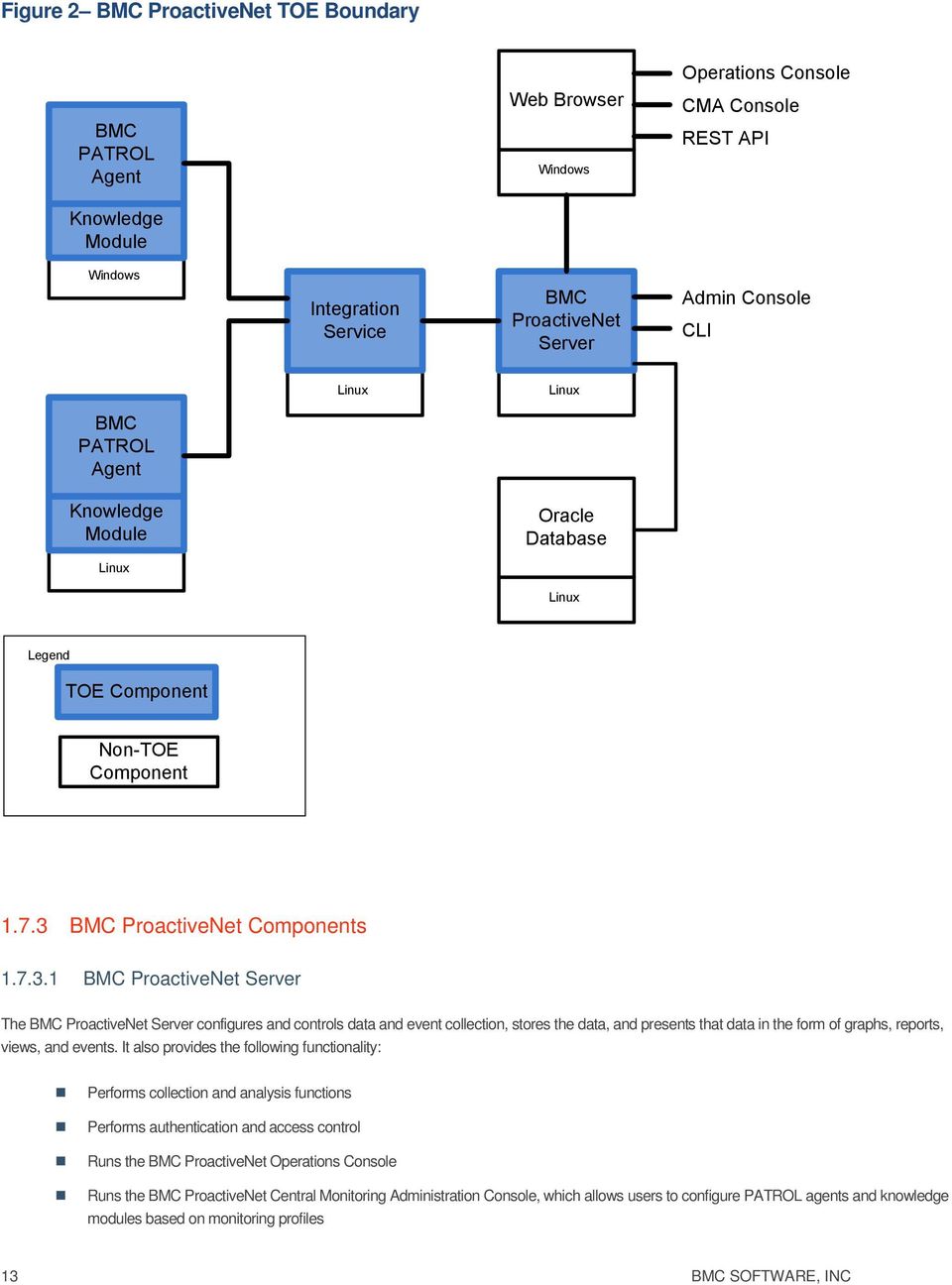
12 Non-TOE Component External Oracle Database Requirement Oracle Database 11g r2 ( ) or higher Standard Edition, 64-bit production. In an Oracle RAC environment, Oracle Database Enterprise Edition is recommended. 1.7 TOE Description This section provides context for the TOE evaluation by identifying the product type and describing the evaluated configuration Evaluated Components Table 3 identifies the BMC ProactiveNet components included in the evaluated configuration. The abbreviated name is used in this Security Target for discussion purposes. Table 3 BMC ProactiveNet component names BMC ProactiveNet component name BMC ProactiveNet Server BMC ProactiveNet Integration Service BMC PATROL Agents Abbreviated name ProactiveNet Server, BPPM Server Integration service PATROL agent(s), Agent(s) Physical Scope and Boundary Figure 2 identifies the physical scope and the physical boundary of the TOE, as well as showing how all the components of the TOE tie together with IT systems in the enterprise. BMC SOFTWARE, INC 12

13 Figure 2 BMC ProactiveNet TOE Boundary BMC PATROL Agent Knowledge Module Web Browser Windows Operations Console CMA Console REST API Windows Integration Service BMC ProactiveNet Server Admin Console CLI Linux Linux BMC PATROL Agent Knowledge Module Oracle Database Linux Linux Legend TOE Component Non-TOE Component BMC ProactiveNet Components BMC ProactiveNet Server The BMC ProactiveNet Server configures and controls data and event collection, stores the data, and presents that data in the form of graphs, reports, views, and events. It also provides the following functionality: Performs collection and analysis functions Performs authentication and access control Runs the BMC ProactiveNet Operations Console Runs the BMC ProactiveNet Central Monitoring Administration Console, which allows users to configure PATROL agents and knowledge modules based on monitoring profiles 13 BMC SOFTWARE, INC
14 Provides the BMC Patrol Configuration Manager Console to manage PATROL Agents and Knowledge Modules which provides rule management features, such as basic change control, rule organization, and rule deployment methods Provides the BMC ProactiveNet Administration Console which enables users to modify and manage the BMC ProactiveNet Server and the Integration Service network management areas by adding or deleting users, groups, Integration Services, monitored devices, applications, and services, or changing event notifications and thresholds Controls the actions of the PATROL Agents Includes an Apache HTTPD server to support HTTPS communications to other components Includes an embedded database to store data Includes a Command Line Interface (CLI) for setup and diagnostic activities Administrative Interfaces The TOE is administered via a number of interfaces accessed directly, or via a web browser. They are: a. The Operations Console: This is a web Interface accessible from operated through a supported browser. This console is used to: administer events generate reports determine the probable cause for an event This interface is described in the BMC ProactiveNet User Guide; b. Central Monitoring Administration (CMA): Also known as the CMA Console, this is a web Interface accessible from It is used to configure PATROL agents, Integration Servers, thresholds, and users. On a multi-server deployment, the CMA web application is hosted on the BPPM server, and is described in BMC CMA Administering-v _1528. c. BMC ProactiveNet Administration Console (or Admin Console): This console may be used to: configure connections manage devices manage users, groups and roles This console is described in the BMC ProactiveNet Administrator Guide. In the evaluated configuration, this console is installed on the BPPM Server and accessed directly. d. The BMC ProactiveNet Command Line Interface (CLI) is a collection of BMC ProactiveNet and Event Management commands that may only be run from the BMC ProactiveNet server as the root (on Linux) or the Administrator (on Windows). The CLI provides an alternative to the Administrative Console for setup operations, and provides diagnostics capabilities. This interface is described in the BMC ProactiveNet Command Line Interface Reference Guide. Use of SSH or Remote Desktop to access this CLI remotely is prohibited in the evaluated configuration. e. REST API: This is a programmatic interface hosted by the server. It may be used in place of the CLI and is documented in BMC ProactiveNet Performance Management Web Services Reference Guide BMC ProactiveNet Integration Service The BMC ProactiveNet Integration Services enable the BMC ProactiveNet Server to remotely gather statistical data from all supported operating systems. The BMC ProactiveNet Integration Service acts as a concentrator, collecting data from BMC PATROL Agents and providing the data to the BMC ProactiveNet Server. BMC SOFTWARE, INC 14

15 BMC PATROL Agents The BMC PATROL Agent is a core component of the BMC ProactiveNet architecture that monitors and manages the distributed environment. A BMC PATROL Agent performs the following tasks: Run commands to collect information either locally or remotely; the information is collected according to the applications and parameters defined in Knowledge Modules (KMs) Act as a service provider for event and data management for BMC ProactiveNet Server Interpret data by using defined rules Load specified KMs at start-up, runs commands, and updates configuration information Store information locally Knowledge Modules are packaged monitors that acquire performance and availability data for a defined operating system or application environment. They: Run under the control of the PATROL agents May monitor the local managed system or remote systems without agents Pass discovered instance and monitor data to the PATROL agent Only the system KM is enabled in the evaluated configuration Guidance Documentation The TOE includes the following guidance: BMC PATROL Agent Reference Manual BMC PATROL for Microsoft Windows Servers Getting Started Guide BMC PATROL for UNIX and Linux Getting Started Guide BMC ProactiveNet Logical scope and boundary The TOE provides the following security functions: Audit User Data Protection Identification and Authentication Security Management Performance Management Audit BMC ProactiveNet provides the capability to audit actions at the BMC PATROL Agent and the BMC ProactiveNet Server. The TOE relies on the operational environment to store and protect the audit data, and provide a means to view the data. It also relies on the TOE environment to provide an appropriate time stamp for use in the audit records. 15 BMC SOFTWARE, INC

16 User Data Protection Access to data in BMC ProactiveNet administrative features is controlled through Configuration Item based access controls. Only users belonging to a group with read and/or write permissions for a Configuration Item are able to perform actions on that Configuration Item Identification and Authentication BMC ProactiveNet identifies users by their user names. By default, users who access BMC ProactiveNet through a web browser or Java console are prompted for a user name and password by BMC ProactiveNet and must be identified and authenticated before they can access the system. After identification and authentication, the user name is then used as part of every ProactiveNet Server request, since no action can be taken unless a valid user name is associated with it. The CLI allows access to users logged into the underlying operating system. In the evaluated configuration, the CLI may only be accessed locally on the BMC ProactiveNet Server, and only the root (Linux) or local administrator (Windows) have access to this machine Security Management The BMC ProactiveNet includes a number of interfaces allowing local and remote management of the security functions. These functions support the administrator s ability to: configure the system by managing devices manage users and groups configure event attributes to support performance management functions Performance Management The TOE natively collects and leverages key performance indicators (KPIs) to assess the relevance and impact of abnormalities, alerts, events and trends from the applications and infrastructure components that support enterprise IT services, identifying a prioritized set of the most likely problem causes Functionalities and Components Excluded from the Evaluated TOE The following components and features are excluded from this evaluation: External Authentication Provider. For external authentication, BMC ProactiveNet can be configured to use Lightweight Directory Access Protocol (LDAP) or to integrate with the BMC Atrium Single Sign On component. BMC Configuration Management Database (CMDB) All PATROL legacy interfaces (i.e. PATROL Configuration Manager, PATROL Central Operator, PATROL Console Server, PATROL Operator Console, PATROL Developer Console, PATROL Event Manager, PATROL Integration Products, PATROL Agent Query and PATROL Command Line Interface) BMC SOFTWARE, INC 16
17 2 CONFORMANCE CLAIMS 2.1 Common Criteria Conformance Claim This Security Target claims to be conformant to version 3.1 of Common Criteria for Information Technology Security Evaluation according to: Common Criteria for Information Technology Security Evaluation, Part 1: Introduction and General Model; CCMB , Version 3.1, Revision 4, September 2012 [CCP1] Common Criteria for Information Technology Security Evaluation, Part 2: Security Functional Components; CCMB , Version 3.1, Revision 4, September 2012 [CCP2] Common Criteria for Information Technology Security Evaluation, Part 3: Security Assurance Requirements CCMB , Version 3.1, Revision 4, September 2012 [CCP3] As follows: CC Part 2 extended CC Part 3 conformant Interpretations of the Common Methodology for Information Technology Security Evaluation, Version 3.1, Revision 4, September 2012 [CEM] have been taken into account. 2.2 Protection Profile Claim This Security Target does not claim conformance to a validated Protection Profile. 2.3 Assurance Package Claim This Security Target claims conformance to Evaluation Assurance Level (EAL) 2 augmented with ALC_FLR BMC SOFTWARE, INC
![CCMB-2012-09-001, Version 3.1, Revision 4, September 2012 [CCP1] Common Criteria for Information Technology Security Evaluation, Part 2: Security Functional Components; CCMB-2012-09-002, Version 3.](/docs-images/40/1948656/images/page_17.jpg "1, Revision 4, September 2012 [CCP2] Common Criteria for Information Technology Security Evaluation, Part 3: Security Assurance Requirements CCMB-2012-09-003, Version 3.")
18 3 SECURITY PROBLEM DEFINITION 3.1 Threats Table 4 lists threats to the resources to be protected by the TOE. The threat agents to the TOE are considered to be unauthorized users with public knowledge of how the TOE operates and who possess the skills and resources to alter TOE configuration settings, or parameters, or both. The threat agents do not have physical access to the TOE. Mitigation to the threats is through the objectives identified in Section 4.1 Security Objectives. Table 4 Threats Threat T.TAMPER T.UNAUTH T.UNDETECT T.PERFORM Description A hostile/unauthorized user may be able to modify TOE behavior or gain TOE access by tampering with the TOE or the TOE operational environment. A hostile/unauthorized user may be able to read TOE data/configuration files in order to ascertain TOE, or managed application, secrets, or modify TOE behavior. Authorized or unauthorized users may be able to access TOE data or modify TOE behavior without a record of those actions in order to circumvent TOE security functionality. Network problems caused by attackers or environmental conditions may go undetected, causing network performance to degrade. 3.2 Organizational Security Policies There are no organizational security policies defined for this ST. 3.3 Assumptions The assumptions are delineated in Table 5 are required to ensure the security of the TOE: Table 5 Assumptions Assumption A.ACCESS A.MANAGE A.OPERATE A.PEER A.PHYSICAL A.AUTHORIZED A.TIME Description The operating systems upon which the TOE software runs are under the same administrative management as the TOE. The operating systems upon which the TOE software runs is configured to restrict modification to TOE executables and configuration files to only Authorized TOE Administrators. There will be one or more competent individuals assigned to manage the TOE. Those assigned to manage the TOE are appropriately trained and follow all administrator guidance. The computer platforms and operating systems upon which the TOE software runs operates correctly. Any other systems that communicate with the TOE are under the same management control and will operate under the same security policy constraints. The processing resources of the TOE will be located within facilities providing controlled access to prevent unauthorized physical access. Only authorized users will have physical access to the server platforms and are expected to follow all security policies. Only authorized TOE users and administrators will have accounts on the operating system platforms on which the TOE software executes. The operational environment will provide reliable system time. BMC SOFTWARE, INC 18

19 4 SECURITY OBJECTIVES The purpose of the security objectives is to address all of the security concerns, and to show which security concerns are addressed by the TOE, and which are addressed by the environment. Threats can be directed against the TOE or the security environment or both. Therefore, the CC identifies two categories of security objectives: Security objectives for the TOE Security objectives for the environment 4.1 Security Objectives for the TOE This section identifies and describes the security objectives for the TOE, as shown in Table 6. Table 6 Security objectives for the TOE Security Objective O.ADMIN O.AUDIT O.ACCESS Description The TOE must provide functions to enable administrators to effectively manage and maintain the TOE and its security functions, ensuring that only they can access administrative functionality and TOE data. The TOE must provide an audit capability to report security relevant events so that the responsible subjects can be held accountable for their actions. The TOE must be able to control access to configuration items. O. IDENTIFICATION The TOE must identify users to verify that permission for access to TOE components, or data is authorized. O.ROLES O.PERFORMANCE The TOE must accommodate separate roles for Authorized Administrators to limit their access to the TOE security mechanisms. The TOE must be capable of collecting and analyzing data to identify the causes of system and network performance and availability issues. 4.2 Security Objectives for the Environment This section identifies and describes the security objectives for the environment, as shown in Table 7. Table 7 Security objectives for the environment Objective OE.PLATFORM OE.PROTECT OE.SERVER_ACCESS OE.INSTALL OE.TIME Description The TOE environment must provide appropriate and reliable hardware and software to support the TOE. The TOE environment must protect itself and the TOE from external interference or tampering. Access to the TOE server hardware and operating system must be limited to authorized administrators. Those responsible for the TOE must ensure that the TOE is delivered, installed, managed, and operated in a manner that maintains IT security objectives. The TOE operational environment must provide correct system time to facilitate reliable timestamps. 19 BMC SOFTWARE, INC

20 4.3 Security Objectives Rationale This section demonstrates that all security objectives for the TOE are traced back to aspects of the identified threats to be countered by the TOE, and that all objectives for the environment are traced back to assumptions for the environments. Table 8 Security objective to threats correspondence Threats T.TAMPER T.UNAUTH T.UNDETECT T.PERFORM O.ADMIN X X O.AUDIT X X O.ACCESS X X O.IDENTIFICATION X X O.ROLES X X O. PERFORMANCE X OE.PLATFORM X OE.PROTECT X X OE.SERVER_ACCESS X X OE.INSTALL X OE.TIME Table 9 Security objective to assumptions correspondence Assumptions A.ACCESS A.MANAGE A.OPERATE A.PEER A.PHYSICAL A.AUTHORIZED A.TIME O.ADMIN O.AUDIT O.ACCESS O.IDENTIFICATION O.ROLES O. PERFORMANCE OE.PLATFORM X X OE.PROTECT X X OE.SERVER_ACCESS X X X X X OE.INSTALL X OE.TIME X BMC SOFTWARE, INC 20

21 Table 10 Security objectives rationale for the TOE Objective Threat or OSP Rationale O.ADMIN T.TAMPER O.ADMIN counters this threat by providing administrative functionality only to authorized administrators. T.UNAUTH O.ADMIN counters this threat by ensuring that only authorized administrators may access TOE data. O.AUDIT T.TAMPER O.AUDIT counters this threat by ensuring that actions causing modification to TOE behavior are recorded. T.UNDETECT O.AUDIT counters this threat by ensuring that changes to TOE data and behavior are recorded, holding those who perform those activities responsible for their actions. O.ACCESS T.TAMPER O.ACCESS counters this threat by ensuring that access to TOE configuration items is restricted to authorized users. T.UNAUTH O.ACCESS counters this threat by ensuring that access to data is controlled, and limited to authorized personnel. O. IDENTIFICATION T.TAMPER O.IDENTIFICATION counters this threat by ensuring that users are identified before having access to the TOE applications that facilitate the modification of TOE behavior. T.UNAUTH O.IDENTIFICATION counters this threat by ensuring that only authorized users, based on identification, are permitted access to the TOE. O.ROLES T.TAMPER O.ROLES counters this threat by ensuring that TOE administrators and users have access to only those functions required to perform their duties. T.UNAUTH O.ROLES counters this threat by ensuring that TOE administrators and users have access to only that TOE data required to perform their duties. O.PERFORMANCE T.PERFORM O.PERFORMANCE counters this threat by providing the capabilities to collect and analyze data to identify the causes of system and network performance and availability issues. Table 11 Environment security objectives rationale for the TOE Objective Threat, OSP, Assumption Rationale OE.PLATFORM T.TAMPER OE.PLATFORM counters this threat by ensuring that appropriately secure hardware and software support the TOE. A.OPERATE A.PHYSICAL OE.PLATFORM upholds this assumption by ensuring that the hardware and software supporting the TOE operate correctly OE.PLATFORM upholds this assumption by ensuring the hardware and software support the policies required to ensure secure operation. OE.PROTECT T.TAMPER OE.PROTECT counters this threat by ensuring that the TOE is protected from external interference or tampering. T.UNAUTH A.ACCESS A.PHYSICAL OE.PROTECT counters this threat by ensuring that the TOE and the TOE environment are protected from unauthorized users. OE.PROTECT upholds this assumption by ensuring that the TOE environment is protected from external interference. OE.PROTECT upholds this assumption by ensuring that the TOE and its environment are protected from external interference and tampering. OE.SERVER_ACCESS T.TAMPER OE.SERVER_ACCESS counters this threat by ensuring that TOE access is limited to authorized administrators. 21 BMC SOFTWARE, INC
22 Objective Threat, OSP, Assumption Rationale T.UNAUTH A.ACCESS A.MANAGE A.PEER A.PHYSICAL A.AUTHORIZED OE.SERVER_ACCESS counters this threat by ensuring that TOE access is limited to authorized administrators, mitigating the risk of access by hostile/unauthorized users. OE.SERVER_ACCESS upholds this assumption by ensuring that TOE access is limited to authorized administrators, mitigating the risk of access by other users. OE.SERVER_ACCESS upholds this assumption by ensuring that TOE access is limited to authorized administrators, allowing only competent authorized users to manage the TOE. OE.SERVER_ACCESS upholds this assumption by ensuring that TOE is accessible from systems under the same management, mitigating the risk of access by hostile/unauthorized users. OE.SERVER_ACCESS upholds this assumption by ensuring only authorized administrators have physical access to the TOE server resources. OE.SERVER_ACCESS upholds this assumption by ensuring that only authorized administrators have access to the operating systems on which the TOE is installed. OE.INSTALL A.MANAGE OE.INSTALL upholds this assumption by ensuring the TOE is installed and managed correctly by competent users who follow all guidance. T.TAMPER OE.INSTALL upholds this assumption by reducing the risk of tampering through proper installation, management and operation. OE.TIME A.TIME OE.TIME upholds this assumption by ensuring that the operational environment provides reliable time to the TOE. BMC SOFTWARE, INC 22
23 5 EXTENDED COMPONENTS DEFINITION This section specifies the extended Security Functional Requirement (SFR) used in this ST. 5.1 Class FPM Performance Management The Performance Management class addresses the collection and analysis of data used to identify and prioritize problems within a network. The class is modeled on the FAU Security Audit class. One family, Collection of Key Performance Indicators, is defined for this class. The FPM_COL_EXT Collection of Key Performance Indicators family is modeled after FAU_GEN Security audit data generation, and FPM_COL_EXT.1 was modeled after FAU_GEN.1. Component leveling is shown in Figure 3 below. Figure 3 Component Leveling FPM_COL_EXT Collection of Key Performance Indicators Performance management (FPM_COL_EXT.1) Family Behavior: This family defines a requirement for ensuring that the TOE natively collects and leverages key performance indicators (KPIs) to assess the relevance and impact of abnormalities, alerts, events and trends from the applications and infrastructure components that support enterprise IT services, identifying a prioritized set of the most likely problem causes. Management Activity: The following actions could be considered for the management functions in FMT: Managing event rules. Audit Activity: The following actions should be auditable if FAU_GEN Security Audit data generation is included in the ST: Basic: Administrator changes to the event rules. FPM_COL_EXT.1 Hierarchical to: Dependencies: FPM_COL_EXT.1.1 Collection of Key Performance Indicators No other components. No dependencies. The TSF shall be able to collect and leverage Key Performance Indicators (KPIs) to assess the relevance and impact of events to identify likely problem causes. 5.2 Rationale for the Extended TOE Security Functional Components FPM_COL_EXT.1 was created to capture the basic functionality provide by the TOE. 5.3 Extended TOE Security Assurance Components There are no extended TOE security assurance components defined for this evaluation. 23 BMC SOFTWARE, INC
24 6 SECURITY REQUIREMENTS 6.1 Security Functional Requirements Table 12 below is a summary of the operations performed on the security functional requirements selected for the TOE. The operations will be identified as follows: A = Assignment, S = Selection, R = Refinement and I = Iteration. Table 12 TOE security functional requirements Class Functional component A S R I Security Audit (FAU) FAU_GEN.1 Audit data generation X X User Data Protection (FDP) FDP_ACC.1 Subset access control X X FDP_ACF.1 Security attribute based access control X Identification and Authentication (FIA) FIA_ATD.1 User attribute definition FIA_UAU.1 Timing of authentication FIA_UID.1 Timing of identification X X X FMT_MSA.1 Management of security attributes X X Security Management (FMT) FMT_MSA.3 Static attribute initialization X X FMT_SMF.1 Specification of Management Functions X FMT_SMR.1 Security roles X Performance Management (FPM) FPM_COL_EXT.1 Collection of key performance indicators Security Audit (FAU) FAU_GEN.1 Hierarchical to: Dependencies: FAU_GEN.1.1 FAU_GEN.1.2 Audit data generation No other components. FPT_STM.1 Reliable time stamps The TSF shall be able to generate an audit record of the following auditable events: a) Start-up and shutdown of the audit functions; b) All auditable events for the not specified level of audit; and c) [none]. The TSF shall record within each audit record at least the following information: a) Date and time of the event, type of event, subject identity (if applicable), and the outcome (success or failure) of the event; and b) For each audit event type, based on the auditable event definitions of the functional components included in the PP/ST, [none] User Data Protection (FDP) FDP_ACC.1 Hierarchical to: Subset access control No other components BMC SOFTWARE, INC 24
25 Dependencies: FDP_ACF.1 Security attribute based access control FDP_ACC.1.1 The TSF shall enforce the [Administrative Access Control SFP] on [ Subjects: BPPM Administrators and Users Objects: BPPM Configuration Items Operations: event management operations.] using the Operations Console, CMA Console, Administration Console, and REST API. Application Note: Event management includes setting thresholds for the detection of abnormal behaviour and creating, modifying, deleting and querying event rules, which define the set of actions that may be performed when an event occurs. FDP_ACF.1 Hierarchical to: Dependencies: Security attribute based access control No other components. FDP_ACC.1 Subset access control FMT_MSA.3 Static attribute initialisation FDP_ACF.1.1 The TSF shall enforce the [Administrative Access Control SFP] to objects based on the following: [ Subjects: BPPM Administrators and Users Subject Attributes: Group membership Objects: BPPM Configuration Items Object Attributes: Read Level Security and Write Level Security settings]. FDP_ACF.1.2 FDP_ACF.1.3 FDP_ACF.1.4 The TSF shall enforce the following rules to determine if an operation among controlled subjects and controlled objects is allowed: [ a. access to a Configuration Item is allowed if the Administrator or User belongs to a Group associated with that Configuration Item; and b. the User Group name must be present in the Read Level Security and/or Write Level Security setting associated with the Configuration Item.] The TSF shall explicitly authorise access of subjects to objects based on the following additional rules: [Users in the Administrator role have access to all Configuration Items]. The TSF shall explicitly deny access of subjects to objects based on the following additional rules: [none] Identification and Authentication (FIA) FIA_ATD.1 Hierarchical to: Dependencies: User attribute definition No other components. No dependencies. FIA_ATD.1.1 The TSF shall maintain the following list of security attributes belonging to individual users: [ a) User Name, b) Password, c) User Group]. FIA_UAU.1 Hierarchical to: Dependencies: FIA_UAU.1.1 Timing of authentication No other components FIA_UID.1 Timing of identification. The TSF shall allow [CLI Access to the root or Administrator user at the physical console] on behalf of the user to be performed before the user is authenticated. FIA_UID.1 Hierarchical to: Dependencies: Timing of identification FIA_UID.1 Timing of identification No dependencies. 25 BMC SOFTWARE, INC
26 FIA_UID.1.1 The TSF shall allow [CLI Access to the root or Administrator user at the physical console] on behalf of the user to be performed before the user is identified Security Management (FMT) FMT_MSA.1 Hierarchical to: Dependencies: FMT_MSA.1.1 Management of security attributes No other components. [FDP_ACC.1 Subset access control, or FDP_IFC.1 Subset information flow control] FMT_SMR.1 Security roles FMT_SMF.1 Specification of Management Functions The TSF shall enforce the [Administrator Access Control SFP] to restrict the ability to query, modify, delete, the security attributes [event attributes, users and groups] to [authorized Administrators]. FMT_MSA.3 Hierarchical to: Dependencies: FMT_MSA.3.1 FMT_MSA.3.2 Static attribute initialisation No other components. FMT_MSA.1 Management of security attributes FMT_SMR.1 Security roles The TSF shall enforce the [Administrator Access Control SFP] to provide permissive default values for security attributes that are used to enforce the SFP. The TSF shall allow the [any Administrator with access] to specify alternative initial values to override the default values when an object or information is created. FMT_SMF.1 Hierarchical to: Dependencies: FMT_SMF.1.1 Specification of Management Functions No other components. No dependencies. The TSF shall be capable of performing the following management functions: [device management, event management, user and group management]. FMT_SMR.1 Hierarchical to: Dependencies: FMT_SMR.1.1 FMT_SMR.1.2 Security roles No other components. FIA_UID.1 Timing of identification The TSF shall maintain the roles [BPPM Administrator, BPPM Model Administrator, BPPM Monitoring Administrator, BPPM Operator, BPPM Supervisor, BPPM Viewer, and BPPM WS Full Access]. The TSF shall be able to associate users with roles. BMC SOFTWARE, INC 26
27 6.1.5 Performance Management (FPM) FPM_COL_EXT.1 Hierarchical to: Dependencies: FPM_COL_EXT.1.1 Collection of key performance indicators No other components. No dependencies. The TSF shall be able to collect and leverage Key Performance Indicators (KPIs) to assess the relevance and impact of events to identify likely problem causes. 27 BMC SOFTWARE, INC
28 6.2 Security Assurance Requirements The TOE satisfies the SARs listed in Table 13. Table 13 TOE security assurance requirements Class Assurance Component ADV_ARC.1 Security architecture description Development (ADV) ADV_FSP.2 Security-enforcing functional specification ADV_TDS.1 Basic design Guidance Documents (AGD) AGD_OPE.1 Operational user guidance AGD_PRE.1 Preparative procedures ALC_CMC.2 Use of a CM system Life-Cycle Support (ALC) ALC_CMS.2 Parts of the TOE CM coverage ALC_DEL.1 Delivery procedures ALC_FLR.2 Flaw reporting procedures ASE_CCL.1 Conformance claims ASE_ECD.1 Extended components definition Security Target Evaluation (ASE) ASE_INT.1 ST introduction ASE_OBJ.2 Security objectives ASE_REQ.2 Derived security requirements ASE_SPD.1Security problem definition ATE_COV.1 Evidence of coverage Tests (ATE) ATE_FUN.1 Functional testing ATE_IND.2 Independent testing sample Vulnerability Assessment (AVA) AVA_VAN.2 Vulnerability analysis 6.3 Security Requirements Rationale Security Functional Requirements Rationale The following two tables provide the security requirement to security objective mapping and a rationale to justify the mapping. BMC SOFTWARE, INC 28
29 Table 14 Objective to requirement correspondence O.ADMIN O.AUDIT O.ACCESS O.IDENTIFICATION O.ROLES O.PERFORMANCE FAU_GEN.1 Audit data generation X FDP_ACC.1 Subset access control X X FDP_ACF.1 Security attribute based access control X X FIA_ATD.1 User attribute definition X FIA_UAU.1 Timing of authentication X X FIA_UID.1 Timing of identification X X FMT_MSA.1 Management of security attributes X FMT_MSA.3 Static attribute initialization X FMT_SMF.1 Specification of Management Functions X FMT_SMR.1 Security roles X FPM_COL_EXT.1 Collection of key performance indicators X Table 15 Security functional requirements rationale for the TOE Objective SFRs Rationale O.ADMIN FMT_MSA.1 FMT_MSA.3 FMT_SMF.1 FMT_MSA.1 ensures that the TOE is able to manage security attributes required to support the Administrative Access Control SFP, and FMT_MSA.3 specifies that permissive defaults will be used where possible. FMT_SMF.1 ensures that the appropriate management functions are in place to enable administrators to manage security functions. O.AUDIT FAU_GEN.1 FAU_GEN.1 specifies that audit data is generated, ensuring that subjects may be held accountable for their actions. O.ACCESS O.IDENTIFICATION O.ROLES FDP_ACC.1 FDP_ACF.1 FIA_UAU.1 FIA_UID.1 FIA_ATD.1 FIA_UAU.1 FIA_UID.1 FDP_ACC.1 FDP_ACF.1 FMT_SMR.1 FDP_ACC.1 and FDP_ACF.1 describe the Administrative Access Control SFP that determines how access control to configuration items is performed. FIA_UAU.1 and FIA_UID.1 ensure that access control is applied to identified and authenticated users. FIA_UAU.1 and FIA_UID.1 ensure that users are identified and authenticated. FIA_ATD.1 ensures that users may be mapped to the User Groups that determine their access permissions. FDP_ACC.1 and FDP_ACF.1 describe that Administrative Access Control SFP that limits access to TOE security mechanisms based on roles. FMT_SMR.1 ensures that separate roles are available to limit access to security functionality for different users. O.PERFORMANCE FPM_COL_EXT.1 FPM_COL_EXT.1 ensures that the TOE has the capability to collect and analyze data to identify the cause of system and network performance and availability issues. 29 BMC SOFTWARE, INC
30 6.3.2 Rationale for SFR Dependencies Table 16 lists the functional components, their related dependencies, and whether the dependency was satisfied, or provides justification for why the dependency is not satisfied. Table 16 SFR dependency status SFR Dependencies Fulfilled by SFRs in this ST FAU_GEN.1 FPT_STM.1 Timestamps are provided by the environment in accordance with the OE.TIME objective. FDP_ACC.1 FDP_ACF.1 FDP_ACF.1 FDP_ACF.1 FDP_ACC.1 FDP_ACC.1 FMT_MSA.3 FMT_MSA.3 FIA_ATD.1 None Not applicable FIA_UAU.1 FIA_UID.1 FIA_UID.1 FIA_UID.1 None Not applicable FMT_MSA.1 [FDP_ACC.1 or FDP_IFC.1] FDP_ACC.1 FMT_SMR.1 FMT_SMF.1 FMT_SMR.1 FMT_SMF.1 FMT_MSA.3 FMT_MSA.1 FMT_MSA.1 FMT_SMR.1 FMT_SMF.1 FMT_SMR.1 FMT_SMF.1 FMT_SMF.1 None Not applicable FMT_SMR.1 FIA_UID.1 FIA_UID.1 FPM_COL_EXP.1 None Not applicable Security Assurance Requirements Rationale EAL2+ was chosen to provide a low to moderate level of assurance that is consistent with good commercial practices. As such, minimal additional tasks are placed upon the vendor assuming the vendor follows reasonable practices and can provide support to the evaluation for design and testing efforts. The chosen assurance level is appropriate with the threats defined for the environment. The TOE is expected to be in a non-hostile location and installed on or protected by other products designed to address threats that correspond with the intended environment. ALC_FLR.2 was added to provide assurance that the vendor will respond to reports of new threats and reported defects in the TOE. BMC SOFTWARE, INC 30
31 7 TOE SUMMARY SPECIFICATION 7.1 Mapping of the TSFs to SFRs The specified TSFs work together to satisfy the TOE SFRs. Table 17 provides a mapping of SFRs to the TSFs to show that each SFR is captured within a security function. Table 17 Mapping of TSFs to SFRs TSF Audit Access Control Identification and Authentication Security Management Performance Management SFR FAU_GEN.1 Audit data generation FDP_ACC.2 Complete access control FDP_ACF.1 Security attribute based access control FIA_ATD.1 User attribute definition FIA_UAU.1 Timing of authentication FIA_UID.1 Timing of identification FMT_MSA.1 Management of security attributes FMT_MSA.3 Static attribute initialization FMT_SMF.1 Specification of Management Functions FMT_SMR.1 Security roles FPM_COL_EXT.1 Collection of key performance indicators 7.2 Audit The PATROL Agent and BMC ProactiveNet Server components perform auditing of security relevant activities. The TOE relies on the operational environment to store and protect the audit data, and provide a means to view the data. It also relies on the TOE environment to provide an appropriate time stamp for use in the audit records PATROL Agent The auditing feature is controlled by the configuration variable /AgentSetup/auditLog. The standard PATROL installation process does not create this variable. The PATROL System Administrator must create and set this variable to enable audit logging. Table 18 Audit Log Entries for PATROL Agent Functional Component Auditable Event Audit Record Contents PATROL Agent Spawned Commands The entry in the log file records explicitly created external processes. PATROL Agent Commands executed The audit log records each command (i.e. script) that is executed as a result of a Menu Command or an InfoBox Command. The entry in the log file records the console-id of the peer and the local account name used for the connection. PATROL Agent Connect/Disconnect The entry in the log file records each connection/disconnection. PATROL Agent Commit Actions The entry in the log file records each file that is transferred during a commit. PATROL Agent Configuration Actions The entry in the log file records each explicit pconfig, wpconfig, or xpconfig action that affects the state of the PATROL Agent. 31 BMC SOFTWARE, INC
32 The PATROL Agent uses a number of audit log keys and values to determine the behavior of audit logging. The Audit Log configuration variable, /AgentSetup/auditLog, consists of a new line separated list of KEY=VALUE pairs, with the following possible values: Key Active Delimiter FileAging FileCount FileName Description This key determines whether the audit logging feature is turned on or off, and where the information is being logged. The recognized values include: 0 - turns off audit logging and is the default setting 1 - logs information to a file (This is the evaluated configuration setting) 2 - log information is sent to the Applications log 3 - logs information to both a file and Windows Event Log This key determines the delimiter character that separates the fields in the log file. The default character is the pipe-symbol ' ' This key determines the interval at which a new log file is created. -Daily N - create a new log file every day at approximately the hour N, where N ranges from midnight 12 a.m. represented as 0 to 11 p.m. represented as 23; the default is Daily 0 -Entries N - create a new log file after logging N entries, where N is the number of entries; for example, N >= 100 -Size N - create a new log file when the file reaches a designated size, where N is the file size in KB; for example, N >= 32 This key determines how many old log files are retained. The default value is 5. Each time a new logfile is created, the previous files are renamed. This key determines the pathname and filenaming convention for the audit log file. The name can contain the following macros %H- refers to the current Agent-host %P- refer to the port-number being used If path is not a fully qualified pathname, the PATROL Agent treats it as being relative to the PATROL_HOME/log directory. All subdirectories in the pathname must already exist. PATROL Agent creates the log file but not the directories leading up to the file. If the file cannot be opened, the Agent writes an error message to the Agent's log file. The default path and file name is NT %PATROL_HOME%\log\PatrolAgent-%H-%P.audit UNIX $PATROL_HOME/log/PatrolAgent-%H-%P.audit BPPM Server The BMC ProactiveNet Server maintains audit logs of security related events. Table 19 Audit Log Entries for BPPM Server Auditable Event Remote Actions Administrative changes Administrative changes made via the CLI Audit Record Contents Actions performed by administrators on remote hosts, including the Integration Service. The AdminAudit.log logs administrative and configuration changes. This includes user actions such as Add, Edit and Delete user events. All actions are recorded and are readable by issuing the pw log list command. By default, audit logs are located at: <bppm>/pw/pronto/logs/<logfolder>. The main file for administrative logs is AdminAudit.log. The audit log properties may be modified in the propertiesfile. This file may be used to set the size of the audit log file. The default is 5000 bytes, and while there is no predefined maximum size, BMC recommends that each log file not exceed 5 MB. Users may also set the number of audit log files that are cycled through during a rotation. After the specified number is reached, the cycle repeats itself, overwriting in sequence the log files of the previous cycle. The default is 1. For example, if auditlogfilename=auditlog%g.log auditlogfilecount=10 auditloglimit=5000 then the initial audit log is assigned the name AuditLog1.file. When its file size reaches 5000 bytes, a new audit log is generated with the same name but BMC SOFTWARE, INC 32
33 incremented by one: AuditLog2.file. As each log reaches the maximum size, a new audit log is created and incremented by one. When the maximum log file count (10 in this example) is reached, then the process repeats itself because only one cycle of logs is maintained. The first audit log of the new cycle starts at 1 (AuditLog1), overwriting the existing file. As new logs are generated in the new cycle, they overwrite the existing ones in sequence. Whenever a BPPM Administrator manages the TOE through the CLI, these actions are recorded. The log records are accessible by issuing the pw log list in the CLI. The BMC ProactiveNet Server includes a logs directory (<bppm>/pw/pronto/logs and <bppm>/pw/pronto/logs/debug) where the logs for various functions are held. When debugging is configured, the logs/debug directory collects additional logs. 7.3 Access Control Access to data in BMC ProactiveNet administrative features is controlled through Role-Based access controls. Users and User Groups are assigned one or more roles. Each configuration item has an ACL (Access Control List) detailing read and write permissions. Only users belonging to a group with read and/or write permissions for a Configuration Item are able to perform actions on that Configuration Item. For each role, individual administrative and operational features may be enabled or disabled, resulting in more fine grained access control to read and modify data. This is also called feature level access control. Within BMC ProactiveNet, a CI is any accessible resource. Access control is driven by the Read Level Security (RLS) and Write Level Security (WLS) settings on CIs, and the roles and groups associated with that CI. A CI is accessible to a user group only when the user group name is present in the BMC ProactiveNet defined RLS or WLS fields of the CI. If the user group name is present in the WLS field of the CI, then the user group has write access. If the user group name is present in the RLS field of the CI, then the user group has read access. If the user group name is not present in either of these fields of the CI, then the CI is not accessible to the user group. Such a CI is accessible only to admin users or users who have access to all CIs. Roles determine the permission users have to perform certain actions on accessible CIs. Roles are assigned to user groups, and user groups can have multiple roles. One role can be assigned to multiple user groups, giving identical permissions to different user groups. Users may be added from the BMC ProactiveNet Administration console and associated to a user group. A user must be associated at least one user group. When users are assigned to a user group, they have access to the CIs defined in that user group. If the user group has access to a CI, the user has access to all devices associated with that CI. Users may be added and associated with a user group from the BMC ProactiveNet Administration console. Users can be assigned to more than one user group, but must be associated with at least one user group in order to create the user. The available user groups are listed in the User Groups pane, which also allows for editing and deleting users. The User folder maintains user accounts, and allows an administrator to identify who has access to the BMC ProactiveNet system. These access controls are applied any time a user accesses TOE resources through the Operations Console, the Central Monitoring Administration, the BMC ProactiveNet Administration Console, or the REST API. However, this is not enforced for the BMC ProactiveNet Command Line Interface, which provides setup and diagnostic capabilities. 7.4 Identification and Authentication The BMC ProactiveNet server maintains the username, password and group information for individual users in an external Oracle database. Users must log into the Operations Console, the Central Monitoring Administration, the BMC ProactiveNet Administration Console, the PATROL Configuration Manager and the REST API as one of these users. Users may log into the CLI and use the CLI or the Admin Console by logging into the server operating system. In the evaluated configuration, these interfaces may only be used locally, and are limited to the Linux root or Windows Administrator user. 7.5 Security Management The TOE is administered via five interfaces accessed directly, or via a web browser. They are: 33 BMC SOFTWARE, INC
34 The Operations Console: This is a web Interface accessible from operated through a supported browser. This is the primary interface for managing the performance management functionality of the TOE. This interface is used by the BPPM Operator, BPPM Supervisor and BPPM Viewer role users to perform the functions required to configure events and event relationships, to view probable cause information and generate reports. Users of this interface may be restricted to administer only particular parts of the monitored network (i.e. certain PATROL Agents) based on Group membership. Users of this interface work with events and event relationships to help identify the probable cause of network issues. The functionality provided by this console is described in the BMC ProactiveNet User Guide. Central Monitoring Administration (CMA): Also known as the CMA Console, this is a web Interface accessible from It is used by the BPPM Administrator, BPPM Model Administrator, and BPPM Monitoring Administrator to configure PATROL agents and verify their connection status, and to manage the monitoring policies employed in the network, including setting thresholds for determining abnormalities. The CMA web application is hosted on the BPPM server. The functionality provided by this interface is described in BMC CMA Administering-v _1528. BMC ProactiveNet Administration Console: This is a legacy administration console. Most of the functionality of this interface is also available on the CMA. There are some key administrative features that are only available from this interface, including the administration of users, user groups and roles. This console is used by the BPPM Administrator to perform some user management and some configuration tasks for the Integration Servers. This interface is described in the BMC ProactiveNet Administrator Guide. In the evaluated configuration, this console is installed on the BPPM Server and accessed directly. The BMC ProactiveNet CLI is a collection of BMC ProactiveNet and Event Management commands that may only be run from the BMC ProactiveNet server as the root (on Linux) or the Administrator (on Windows). The CLI provides an alternative to the Administrative Console for setup operations, and provides diagnostics capabilities. This interface is described in the BMC ProactiveNet Command Line Interface Reference Guide. Use of SSH or Remote Desktop to access this CLI remotely is not included in the evaluated configuration. REST API: This is a programmatic interface hosted by the server. It may be used in place of the CLI and is documented in BMC ProactiveNet Performance Management Web Services Reference Guide. BMC ProactiveNet REST-based web service APIs can be used to retrieve metadata, configuration data, and statistical data for specific BMC ProactiveNet- monitored resources. It may be used in place of the CLI for some functions. The REST API is documented in the BMC ProactiveNet Performance Management Web Services Reference Guide. The TOE supports the following roles: BPPM Administrator, BPPM Model Administrator, BPPM Monitoring Administrator, BPPM Operator, BPPM Supervisor, BPPM Viewer, and BPPM WS Full Access. These are known as default user groups in the BPPM documentation, and each group is associated with one or more roles to determine the available permissions. Finally, users are put into user groups and are granted the permissions associated with the group. 7.6 Performance Management The TOE consolidates data and events from the PATROL Agents. Using this information, the TOE learns the behavioral and performance trends for each of the monitored components and identifies normal and abnormal behavior. Metrics that are determined to be of particular importance are designated as key performance indicators. This information is provided to the analytics engine, which then generates events when there is significantly abnormal behavior. Based on these learned trends, critical events are identified. These events point to the root cause of network issues and may then be examined by the users to correct the problem causing the network issue. Abnormalities are generated when the data values from a monitor fall outside of the normal baseline range for a statistically significant number of points within the sample window specified in the signature threshold. The abnormalities generated have a severity field, which records which baseline was exceeded for a significant number of points (helping determine the severity of the abnormality). Generally, abnormalities that exceed Weekly baseline are more serious in nature than ones that exceed Daily baseline, and abnormalities that exceed Daily baseline are more serious in nature than ones that exceed Hourly baseline. By default, if no signature threshold is set, abnormalities are still generated. A minimum of five data points are required. If the sample window is set too small (sample window is set in time duration), the algorithm will still automatically wait for five data points to come in. For example, if you set a sample window to 10 minutes on a specific monitor attribute but the polling rate of that monitor is 5 minutes, 25 minutes must pass before an abnormality is generated. For this reason, it is better to use lower polling rates for monitors. Abnormalities are closed when the number of data points exceeded in the last window sample size is not considered significant. For example, if six out of seven data points out of range are statistically significant, then as soon as the last exceeded points drop to five out of seven points, the abnormality will be closed. By default, even if no explicit global or instance signature threshold is set, BMC ProactiveNet will generate abnormalities for these baseline conditions. BMC SOFTWARE, INC 34
35 Event collectors gather events for display in an event list. They provide operators with meaningful groups of events or abnormalities. Relationships may be established between events by defining rules and policies. In addition to the normal events generated after a problem arises, BMC ProactiveNet can also generate predictive events. Predictive events are early warning events that BMC ProactiveNet generates before an event condition occurs on an existing metric. Such events facilitate the identification of potential problems before the condition causes impacts to business services and before the end users notice the problem. The typical predictive window is three hours or less, which means most predictive events are generated up to three hours before an actual event condition would occur. Predictive events target persistent anomalies that might go undetected for most of the day (during the offpeak periods) but become serious issues at peak load periods. These kinds of problems are typically caused by configuration changes or user load shifts. For example, if a change is made to a load balancer that accidentally redirects more end-user transactions to one of the servers in the pool, that server might now have much more load than the other servers in the pool. However, this would not be obvious during low traffic periods. As the peak load period approaches, the imbalance would become more serious and the server load issue would become obvious, eventually causing an event on an end user transaction and performance or availability issues for all transactions routed through that server. In this scenario where BMC ProactiveNet events are used, an abnormality is generated as soon as the first change in behavior is detected, a predictive event would be generated two to three hours before any impact or before a real event condition. Predictive events are enabled through the absolute threshold settings. The predictive algorithm leverages the hourly baseline in conjunction with the threshold setting to determine when to create a predictive event. By gathering data from different sources and applying filters to rule out unrelated events, BMC ProactiveNet can determine the most-likely causes for an event, such as an attribute that is outside the desired range. This process of gathering and filtering data to determine the cause for an event is called probable cause analysis. The probable cause analysis process analyzes data and displays the relevant events automatically. The accuracy of probable cause analysis is increased by providing relationships between devices and monitors. The more data that is provided about an event, the more accurate probable cause analysis will be. Probable cause analysis focuses on events that are able to impact other events in unexpected ways. The resulting analysis may be viewed through the Operations Console. Reports may be generated showing various levels of detail. 35 BMC SOFTWARE, INC
36
37
BMC Real End User Experience Monitoring and Analytics 2.5. Security Target
 BMC Real End User Experience Monitoring and Analytics 2.5 Security Target Version 0.07 5 March 2015 Copyright 2015 BMC Software, Inc. All rights reserved. BMC, BMC Software, and the BMC Software logo
Security Target. Securonix Security Intelligence Platform 4.0. Document Version 1.12. January 9, 2015
 Security Target Securonix Security Intelligence Platform 4.0 Document Version 1.12 January 9, 2015 Document Version 1.12 Copyright Securonix Page 1 of 41 Prepared For: Prepared By: Securonix 5777 W. Century
Security Target. McAfee Enterprise Mobility Management 9.7. Document Version 0.9. July 5, 2012
 Security Target McAfee Enterprise Mobility Management 9.7 Document Version 0.9 July 5, 2012 Document Version 0.9 McAfee Page 1 of 39 Prepared For: Prepared By: McAfee, Inc. 2821 Mission College Blvd. Santa
Enterasys Networks, Inc. Netsight/Network Access Control v3.2.2. Security Target
 Enterasys Networks, Inc. Netsight/Network Access Control v3.2.2 Security Target Evaluation Assurance Level: EAL2+ Document Version: 0.7 Prepared for: Prepared by: Enterasys Networks, Inc. Corsec Security,
Security Target. McAfee Enterprise Mobility Management 12.0. Document Version 1.16
 Security Target McAfee Enterprise Mobility Management 12.0 Document Version 1.16 September 17, 2014 Prepared For: Prepared By: McAfee, Inc. 2821 Mission College Blvd. Santa Clara, CA 95054 Primasec Ltd
Security Target. Symantec TM Network Access Control Version 12.1.2. Document Version 0.12. February 14, 2013
 Security Target Symantec TM Network Access Control Version 12.1.2 Document Version 0.12 February 14, 2013 Document Version 0.12 Symantec Page 1 of 39 Prepared For: Prepared By: Symantec Corporation 350
How To Evaluate A Security Target Of Evaluation (Toe)
 Security Target McAfee Enterprise Security Manager with Event Receiver, Enterprise Log Manager, Advanced Correlation Engine, Application Data Monitor and Database Event Monitor 9.1 Document Version 1.1
Mobile Billing System Security Target
 Mobile Billing System Security Target Common Criteria: EAL1 Version 1.2 25 MAY 11 Document management Document identification Document ID Document title Product version IDV_EAL1_ASE IDOTTV Mobile Billing
EMC Corporation Data Domain Operating System Version 5.2.1.0. Security Target. Evaluation Assurance Level (EAL): EAL2+ Document Version: 0.
 EMC Corporation Data Domain Operating System Version 5.2.1.0 Security Target Evaluation Assurance Level (EAL): EAL2+ Document Version: 0.11 Prepared for: Prepared by: EMC Corporation 176 South Street Hopkinton,
EMC Documentum. EMC Documentum Content Server TM V5.3. and EMC Documentum Administrator TM V5.3. Security Target V2.0
 EMC Documentum EMC Documentum Content Server TM V5.3 and EMC Documentum Administrator TM V5.3 Security Target V2.0 December 8, 2005 ST prepared by Suite 5200, 4925 Jones Branch Drive McLean, VA 22102-3305
Security Target. Astaro Security Gateway V8 Packet Filter Version 1.000. Assurance Level EAL4+ Common Criteria v3.1
 Astaro Security Gateway V8 Packet Filter Version 1.000 Assurance Level EAL4+ Common Criteria v3.1 This Security Target also covers the secunet wall 2 packet filter Version : 1.03 Date: 2011-05-20 Author:
Security Target. Symantec Data Loss Prevention 11.1.1. Document Version 1.0. January 23, 2012
 Security Target Symantec Data Loss Prevention 11.1.1 Document Version 1.0 January 23, 2012 Document Version 1.0 Symantec Corporation Page 1 of 40 Prepared For: Prepared By: Symantec Corporation 350 Ellis
McAfee Web Gateway Version 7.2.0.1 EAL 2 + ALC_FLR.2 Security Target
 McAfee Web Gateway Version 7.2.0.1 EAL 2 + ALC_FLR.2 Release Date: 5 October 2012 Version: 1.0 Prepared By: Primasec Ltd. Prepared For: McAfee Inc. 3965 Freedom Circle Santa Clara, CA 95054 Document Introduction
Microsoft Forefront UAG 2010 Common Criteria Evaluation Security Target Microsoft Forefront Unified Access Gateway Team
 Microsoft Forefront UAG 2010 Common Criteria Evaluation Security Target Microsoft Forefront Unified Access Gateway Team Author: Microsoft Corp. Version: 1.0 Last Saved: 2011-03-10 File Name: MS_UAG_ST_1.0.docx
SenSage, Inc. SenSage 4.6.2. Security Target. Evaluation Assurance Level: EAL2+ Document Version: 1.2
 SenSage, Inc. SenSage 4.6.2 Security Target Evaluation Assurance Level: EAL2+ Document Version: 1.2 Prepared for: Prepared by: SenSage, Inc. 55 Hawthorne Street San Francisco, CA 94105 United States of
How To Understand The Toe
 Rapid7 Nexpose Vulnerability Management and Penetration Testing System V.5.1 Security Target Version 1.7 May 11, 2012 Prepared for: Rapid7 LLC 545 Boylston Street, Suite 400 Boston, MA 02116 Prepared By:
Security Target. NetIQ Access Manager 4.0. Document Version 1.13. August 7, 2014. Security Target: NetIQ Access Manager 4.0
 Security Target NetIQ Access Manager 4.0 Document Version 1.13 August 7, 2014 Document Version 1.13 NetIQ Page 1 of 36 Prepared For: Prepared By: NetIQ, Inc. 1233 West Loop South Suite 810 Houston, TX
JMCS Northern Light Video Conferencing System Security Target
 JMCS Northern Light Video Conferencing System Security Target Common Criteria: EAL2 Version 1.2 22 FEB 12 Document management Document identification Document ID Document title Product version NLVC_ST_EAL2
Firewall Protection Profile V2.0 2008. 4. 24
 Firewall Protection Profile V2.0 2008. 4. 24 (This page left blank on purpose for double-side printing) Protection Profile Title Firewall Protection Profile for Government Evaluation Criteria Version This
Trustwave DbProtect Version 6.4.3 Security Target
 Trustwave DbProtect Version 6.4.3 Security Target Version 1.8 July 21, 2015 Trustwave 70 West Madison Street Suite 1050 Chicago, IL 60602 Prepared By: Common Criteria Consulting LLC 15804 Laughlin Lane
Marimba Client and Server Management from BMC Software Release 6.0.3
 Marimba Client and Server Management from BMC Software Release 6.0.3 Version 2.3.0 4 June, 2007 Prepared by: BMC Software, Inc. 2101 City West Blvd. Houston, Texas 77042 TABLE OF CONTENTS 1. Introduction...
SolarWinds Log and Event Manager Software Security Target
 SolarWinds Log and Event Manager Software Security Target Version 1.5 August 25, 2014 SolarWinds Worldwide, LLC 3711 South MoPac Expressway Building Two Austin, Texas 78746 Copyright 2013 SolarWinds Worldwide,
U.S. Government Protection Profile for Database Management Systems
 U.S. Government Protection Profile for Database Management Systems Information Assurance Directorate Version 1.3 December 24, 2010 Protection Profile Title: 1 U.S. Government Protection Profile for Database
CA CA, Inc. Identity Manager 12.5 Identity Manager r12.1 Security Target
 CA CA, Inc. Identity Manager 12.5 Identity Manager r12.1 Security Target Version 2.0 June Version 21, 2010 0.6 December 29, 2008 Prepared for: Prepared CA for: 100 Staples CA, Inc. Drive Framingham, 100
McAfee Web Gateway Version 7.0.1.1 EAL 2 + ALC_FLR.2 Security Target
 McAfee Web Gateway Version 7.0.1.1 EAL 2 + ALC_FLR.2 Security Target Release Date: September 2010 Document ID: Version: Draft J Prepared By: Primasec Ltd. Prepared For: McAfee Inc. 3965 Freedom Circle
SECURITY TARGET FOR FORTIANALYZER V4.0 MR3 CENTRALIZED REPORTING
 SECURITY TARGET FOR FORTIANALYZER V4.0 MR3 CENTRALIZED REPORTING Document No. 1735-005-D0001 Version: 1.0, 3 June 2014 Prepared for: Fortinet, Incorporated 326 Moodie Drive Ottawa, Ontario Canada, K2H
BMC Remedy Action Request System 6.3 Security Target
 BMC Remedy Action Request System 6.3 Security Target Version 4.5 March 28, 2007 Part number: 60658 Prepared by: BMC Software, Inc. 1030 W. Maude Avenue Sunnyvale, CA 94085 Copyright 2004-2007 BMC Software,
Xceedium GateKeeper Version 5.2.1 Security Target
 ceedium GateKeeper Version 521 Security Target February 3, 2011 Prepared for: ceedium, Inc 30 Montgomery Street Jersey City, NJ 07302 Prepared By: Science Applications International Corporation Common
gateprotect Firewall Packet-Filtering-Core v10.3 Security Target Version:
 Version: Status: Last Update: Classification: 1.0 Release 2013-02-08 public Legal tice This document is provided AS IS with no express or implied warranties. Use the information in this document at your
EAL4+ Security Target
 EAL4+ Security Target Common Criteria: EAL4 augmented with ALC_FLR.3 Version 1.0 21-DEC-10 Document management Document identification Document ID Document title Release authority E14_EAL4_ASE Microsoft
Citrix Systems, Inc. NetScaler Platinum Edition Load Balancer Version 9.1 Security Target
 Citrix Systems, Inc. NetScaler Platinum Edition Load Balancer Version 9.1 Security Target Evaluation Assurance Level: EAL2 augmented with ALC_FLR.2 Document Version: 1 Prepared for: Prepared by: Citrix
National Information Assurance Partnership. Common Criteria Evaluation and Validation Scheme Validation Report
 National Information Assurance Partnership Common Criteria Evaluation and Validation Scheme Validation Report TM HP Network Node Management Advanced Edition Software V7.51 with patch PHSS_35278 Report
Teradata Database Version 2 Release 6.1.0 (V2R6.1.0) Security Target
 Teradata Database Version 2 Release 6.1.0 (V2R6.1.0) Security Target Version 2.0 February 2007 TRP Number: 541-0006458 NCR, Teradata and BYNET are registered trademarks of NCR Corporation. Microsoft, Windows,
Secuware Virtual System (SVS)
 Secuware Virtual System (SVS) SECURITY TARGET EAL2 Copyright 2008 by SECUWARE All rights reserved. The information in this document is exclusive property of SECUWARE and may not be changed without express
U.S. Government Protection Profile for Application-level Firewall In Basic Robustness Environments
 U.S. Government Protection Profile for Application-level Firewall In Basic Robustness Environments Information Assurance Directorate Version 1.1 July 25, 2007 Forward This Protection Profile US Government
Natek Network Access Control (NAC)
 Natek Network Access Control (NAC) V 5.4.2 Security Target Release Date: 28.08.2014 Version 1.13 AUTHOR: NATEK BİLİŞİM BİLGİSAYAR EĞİTİM DANIŞMANLIK YAZILIM TİCARET SANAYİ ANONİM ŞİRKETİ 1 Revision History
RSA, The Security Division of EMC RSA Data Loss Prevention Suite v6.5. Security Target
 RSA, The Security Division of EMC RSA Data Loss Prevention Suite v6.5 Security Target Evaluation Assurance Level: EAL2 Augmented with ALC_FLR.1 Document Version: 0.7 Prepared for: Prepared by: RSA, The
Firewall Protection Profile
 samhällsskydd och beredskap 1 (38) ROS-ISÄK Ronny Janse 010-2404426 [email protected] Firewall Protection Profile samhällsskydd och beredskap 2 (38) Innehållsförteckning 1. Introduction... 4 1.1 PP reference...
Security Target. McAfee Host Intrusion Prevention 8 and epolicy Orchestrator 4.5. Document Version 1.1. September 9, 2011
 Security Target McAfee Host Intrusion Prevention 8 and epolicy Orchestrator 4.5 Document Version 1.1 September 9, 2011 Document Version 1.1 McAfee Page 1 of 61 Prepared For: Prepared By: McAfee, Inc. 2821
MINISTERIO DE DEFENSA CENTRO NACIONAL DE INTELIGENCIA CENTRO CRIPTOLÓGICO NACIONAL ORGANISMO DE CERTIFICACIÓN
 REF: 2010-22-INF-764 V1 Distribution: Expediente Date: 21.11.2011 Created: CERT3 Reviewed: CALIDAD Approbed: TECNICO CERTIFICATION REPORT FOR FOR HUAWEI INTEGRATED MANAGEMENT APPLICATION PLATFORM VERSION
SECURITY TARGET FOR CENTRIFY SUITE VERSION 2013.2
 SECURITY TARGET FOR CENTRIFY SUITE VERSION 2013.2 Document No. 1769-000-D0007 Version: v0.89, 12 September 2013 Prepared for: Centrify Corporation 785 N. Mary Avenue, Suite 200 Sunnyvale, California USA,
Fingerprint Spoof Detection Protection Profile
 Fingerprint Spoof Detection Protection Profile based on Organisational Security Policies FSDPP_OSP v1.7 Bundesamt für Sicherheit in der Informationstechnik Postfach 20 03 63 53133 Bonn Tel.: +49 228 99
RSA, The Security Division of EMC envision platform v4.0 SP 1. Security Target
 RSA, The Security Division of EMC envision platform v4.0 SP 1 Security Target Evaluation Assurance Level: 3+ Document Version: 0.8 Prepared for: Prepared by: RSA, The Security Division of EMC 174 Middlesex
Security Target: Symantec Mail Security 8300 Series Appliances Version 5.0
 Security Target: Symantec Mail Security 8300 Series Appliances Version 5.0 ST Version 1.6 August 20, 2007 Document Version 1.6 Symantec Corporation Page 1 of 55 Prepared For: Prepared By: Symantec Corporation
IBM Security Access Manager for Enterprise Single Sign-On Version 8.2 with IMS Server Interim Fix 4 and AccessAgent Fix Pack 22 Security Target
 IBM Security Access Manager for Enterprise Single Sign-On Version 8.2 with IMS Server Interim Fix 4 and AccessAgent Fix Pack 22 Security Target Version: Status: Last Update: 1.19 Released 2014-03-05 Trademarks
DataPower XS40 XML Security Gateway and DataPower XI50 Integration Appliance Version 3.6. Security Target Version 0.75
 DataPower S40 ML Security Gateway and DataPower I50 Integration Appliance Version 3.6 Security Target Version 0.75 10/09/2008 Prepared for: IBM SOA Appliance Group One Rogers St Cambridge, MA 02142 Prepared
IBM WebSphere Message Broker Security Target
 IBM WebSphere Message Broker Security Target Version 2.1.2 2007-08-22 Document History Version Date Summary Author 1.0 2006-10-23 Final EAL3 ST plus changes by IBM. SAIC / IBM 1.1 2006-12-11 Fixed inconsistencies.
Extreme Networks, Inc. ExtremeXOS Network Operating System v12.3.6.2
 Extreme Networks, Inc. ExtremeXOS Network Operating System v12.3.6.2 Security Target Evaluation Assurance Level: EAL3+ Document Version: 0.9 Prepared for: Prepared by: Extreme Networks, Inc. 3585 Monroe
Forefront Identity Manager (FIM) 2010
 Forefront Identity Manager (FIM) 2010 Security Target Common Criteria: EAL4 augmented with ALC_FLR.3 Version 1.0 24-MAR-2012 Document history Version Date Description 0.1 28-APR-11 Initial draft for review.
EPASSPORT WITH BASIC ACCESS CONTROL AND ACTIVE AUTHENTICATION
 COMMON CRITERIA PROTECTION PROFILE EPASSPORT WITH BASIC ACCESS CONTROL AND ACTIVE AUTHENTICATION Draft Version 1.0 TURKISH STANDARDS INSTITUTION TABLE OF CONTENTS Common Criteria Protection Profile...
Security Target. McAfee Data Loss Prevention Endpoint 9.4 and epolicy Orchestrator 5.1.3. Document Version 1.0
 Security Target McAfee Data Loss Prevention Endpoint 9.4 and epolicy Orchestrator 5.1.3 Document Version 1.0 November 24, 2015 Prepared For: Prepared By: Intel Corporation. 2821 Mission College Blvd. Santa
Wyse Technology Inc. Wyse Device Manager Enterprise Edition Version 4.7.2 Security Target
 Wyse Technology Inc. Wyse Device Manager Enterprise Edition Version 4.7.2 Security Target Version 1.8 April 18, 2011 Wyse Technology Inc. 3471 N. First Street San Jose, CA 95134 DOCUMENT INTRODUCTION Prepared
BMC Remedy Action Request System 7.5.00 Security Target
 BMC Remedy Action Request System 7.5.00 Security Target Version 1.10 October 2011 Prepared by BMC Software, Inc. 91 E. Tasman Drive San Jose, CA 95134 Copyright 2011 BMC Software, Inc. All rights reserved.
C038 Certification Report
 C038 Certification Report TAXSAYA Online File name: Version: v1a Date of document: 15 August 2013 Document classification: For general inquiry about us or our services, please email: [email protected]
Trustwave Secure Web Gateway Security Target
 Trustwave Secure Web Gateway Security Target Version 1.5 September 18, 2013 Trustwave 70 West Madison Street Suite 1050 Chicago, IL 60602 Prepared By: Common Criteria Consulting LLC 15804 Laughlin Lane
How To Protect Your Computer From Being Hacked
 Senforce Endpoint Security Suite Version 3.1.175 Security Target Version 1.0 06/19/07 Prepared for: Senforce Technologies, Inc. 147 W Election Rd Ste 110 Draper UT 84020 Prepared By: Science Applications
Protection Profile for Server Virtualization
 Protection Profile for Server Virtualization 29 October 2014 Version 1.0 i 0 Preface 0.1 Objectives of Document This document presents the Common Criteria (CC) Protection Profile (PP) to express the fundamental
Security Target. McAfee Database Security 4.4.3. Document Version 1.4. June 18, 2013. Security Target: McAfee Database Security 4.4.
 Security Target McAfee Database Security 4.4.3 Document Version 1.4 June 18, 2013 Document Version 1.4 McAfee Page 1 of 66 Prepared For: Prepared By: McAfee, Inc. 2821 Mission College Blvd. Santa Clara,
Top Layer Networks. Security Target V2.3
 Top Layer Networks IDS Balancer TM Version 2.2 Appliance (IDSB3531-CCV1.0, IDSB3532-CCV1.0, IDSB4508-CCV1.0) Security Target V2.3 August 31, 2004 AppBalancing, AppSafe, DCFD, Flow Mirror, SecureWatch,
RSA, The Security Division of EMC RSA Access Manager v6.1. Security Target
 RSA, The Security Division of EMC RSA Access Manager v6.1 Security Target Evaluation Assurance Level: EAL3+ Augmented with ALC_FLR.2 Document Version: 0.8 Prepared for: Prepared by: RSA, The Security Division
FOR EAL2 AUGMENTED WITH ALC_FLR.1. Version: 1.2 November 20, 2013
 SECURITY TARGET FOR A10 NETWORKS THUNDER 5430S AND 6430S APPLICATIONS DELIVERY CONTROLLERS EAL2 AUGMENTED WITH ALC_FLR.1 Version: 1.2 November 20, 2013 DENMARK FINLAND NORWAY SWEDEN THE NETHERLANDS www.secode.no
Security Target: Symantec Endpoint Protection Version 11.0
 Security Target: Symantec Endpoint Protection Version 11.0 ST Version 1.6 June 2, 2008 Document Version 1.6 Symantec Corporation Page 1 of 68 Prepared For: Prepared By: Symantec Corporation 20330 Stevens
Oracle Business Intelligence Enterprise Edition (OBIEE) Version 10.1.3.3.2 with Quick Fix 090406 running on Oracle Enterprise Linux 4 update 5 x86_64
 122-B CERTIFICATION REPORT No. CRP250 Business Intelligence Edition (OBIEE) Version 10.1.3.3.2 with Quick Fix 090406 running on update 5 Issue 1.0 June 2009 Crown Copyright 2009 All Rights Reserved Reproduction
Oracle Identity and Access Management 10g Release 10.1.4.0.1 running on Red Hat Enterprise Linux AS Release 4 Update 5
 122-B CERTIFICATION REPORT No. CRP245 Oracle Identity and Access Management 10g Release 10.1.4.0.1 running on Red Hat Enterprise Linux AS Release 4 Update 5 Issue 1.0 June 2008 Crown Copyright 2008 Reproduction
PATROL Console Server and RTserver Getting Started
 PATROL Console Server and RTserver Getting Started Supporting PATROL Console Server 7.5.00 RTserver 6.6.00 February 14, 2005 Contacting BMC Software You can access the BMC Software website at http://www.bmc.com.
Security Target Microsoft SQL Server Team
 Security Target Microsoft SQL Server Team Author: Roger French Version: 1.27 Date 2008-07-23 File Name: MS_SQL_ST_1.27 Abstract This document is the Security Target (ST) for the Common Criteria evaluation
IBM Internet Security Systems GX6116 Security Appliance Version 2.2 and SiteProtector Version 2.0 Service Pack 7.0 with Reporting Module
 Security Target IBM Internet Security Systems GX6116 Security Appliance Version 2.2 and SiteProtector Version 2.0 Service Pack 7.0 with Reporting Module Document Version 2.0 July 6, 2011 Document Version
LogRhythm Integrated Solution. Security Target
 LogRhythm Integrated Solution Security Target Version 1.1 March 30, 2012 Prepared for: LogRhythm, Inc. 4780 Pearl East Circle Boulder, CO 80301 Prepared By: Science Applications International Corporation
Security Target: IBM Internet Security Systems GX Series Security Appliances Version 4.1 and SiteProtector Version 2.0 Service Pack 8.
 Security Target IBM Internet Security Systems GX Series Security Appliances Version 4.1 and Document Version 0.6 February 27, 2012 Document Version 0.6 IBM Internet Security Systems Page 1 of 55 Prepared
Low Assurance Protection Profile for a VoIP Infrastructure
 Low Assurance Protection Profile for a VoIP Infrastructure Version 1.1 Date Author(s) Dirk-Jan Out Certification ID Sponsor File name No of pages 12 TNO-ITSEF BV VoIP Low Assurance Protection Profile 1.1
Security Target for Cisco Secure PIX Firewall 515, 520, 525 Version 5.2(3)
 Security Target for Cisco Secure PIX Firewall 515, 520, 525 Version 5.2(3) Reference: ST January 2001 Version: 1.6 Europe: USA: CISCO Systems Ltd CISCO Systems Inc. 3 The Square 170 West Tasman Drive Stockley
TRUSTED SECURITY FILTER SECURITY TARGET
 TRUSTED SECURITY FILTER SECURITY TARGET Edition: 4 29 Oct 07 Previous editions: Ed. 1 11 May 2006 Ed. 2 16 Aug 2006 Ed. 3 28 June 2007 Author: KKK Appr.: PÅT All pages in this document shall have the same
Blue Coat Systems, Inc. ProxySG v5.3.1.9 running on SG510, SG810, and SG8100. Security Target
 Blue Coat Systems, Inc. ProxySG v5.3.1.9 running on SG510, SG810, and SG8100 Security Target Evaluation Assurance Level: EAL 2+ Document Version: 0.7 Prepared for: Prepared by: Blue Coat Systems, Inc.
HP StoreOnce Backup System Generation 3 Version 3.6.6 Security Target
 HP StoreOnce Backup System Generation 3 Version 3.6.6 Security Target Version 1.0 February 12, 2014 Prepared for: Hewlett-Packard Long Down Avenue Stoke Gifford Bristol BS34 8QZ UK Prepared By: Leidos
Red Hat Enterprise Linux 3 (running on specified Dell and Hewlett-Packard hardware) Security Target
 Red Hat Enterprise Linux 3 (running on specified Dell and Hewlett-Packard hardware) Security Target Version 1.7 January 2004 Document Control DOCUMENT TITLE Red Hat Enterprise Linux 3 Security Target Version
Common Criteria for Information Technology Security Evaluation. Part 3: Security assurance components. September 2012. Version 3.
 Common Criteria for Information Technology Security Evaluation Part 3: Security assurance components September 2012 Version 3.1 Revision 4 CCMB-2012-09-003 Foreword This version of the Common Criteria
EXTOL epassport Suite v2.5 Security Target v2.0. ECSB/MyCC/JL/002 Common Criteria EAL1 Certification
 Doc Ref RD/JL/069 Replaces: N/A EXTOL epassport Suite v2.5 ECSB/MyCC/JL/002 Common Criteria EAL1 Certification Extol Corporation (M) Sdn Bhd (121135-U) (643683-U) Extol Group www.extolcorp.com Unit G1,
Low Assurance Security Target for a Cisco VoIP Telephony System
 Low Assurance Security Target for a Cisco VoIP Telephony System Security Target Version 1.6 March 14, 2005 Document Control Preparation Action Name Date Prepared by: Rob Hunter of TNO-ITSEF BV on behalf
Guidelines for Developer Documentation
 Guidelines for Developer Documentation according to Common Criteria Version 3.1 Version 1.0 Bundesamt für Sicherheit in der Informationstechnik Postfach 20 03 63 53133 Bonn Phone: +49 (0)3018 9582-111
Certification Report
 Certification Report HP Network Automation Ultimate Edition 10.10 Issued by: Communications Security Establishment Certification Body Canadian Common Criteria Evaluation and Certification Scheme Government
Certification Report StoneGate FW/VPN 5.2.5
 Ärendetyp: 6 Diarienummer: 11FMV3127-87:1 Dokument ID HEMLIG/ enligt Offentlighets- och sekretesslagen (2009:400) 2012-01-23 Country of origin: Sweden Försvarets materielverk Swedish Certification Body
MINISTERIO DE DEFENSA CENTRO NACIONAL DE INTELIGENCIA CENTRO CRIPTOLÓGICO NACIONAL ORGANISMO DE CERTIFICACIÓN CERTIFICATION REPORT
 REF: 2010-15-INF-681 v1 Difusión: Expediente Fecha: 05.07.2011 Creado: CERT2 Revisado: TECNICO Aprobado: JEFEAREA CERTIFICATION REPORT Expediente: 2010-15 Datos del solicitante: 440301192W HUAWEI References:
Common Criteria Security Target For NetScaler Platinum Edition Load Balancer Version 10.0
 Common Criteria Security Target For NetScaler Platinum Edition Load Balancer Version 10.0 Version 1-1 5 July 2013 2013 Citrix Systems, Inc. All rights reserved. Summary of Amendments Version 1-1 5 July
SECURITY TARGET CITADEL HERCULES ENTERPRISE VULNERABILITY MANAGEMENT (EVM) VERSION 4.1
 SECURITY TARGET CITADEL HERCULES ENTERPRISE VULNERABILITY MANAGEMENT (EVM) VERSION 4.1 Document No. 1517-011-D001 Version 1.1, 3 August 2006 Prepared for: Citadel Security Software Inc. Two Lincoln Centre
Common Criteria Security Target For 1E Power and Patch Management Pack
 Intelligent Windows Management Common Criteria Security Target For 1E Power and Patch Management Pack 30 September 2009 Document Version 1-0 1E Limited. All Rights reserved. Summary of Amendments Version
Intrusion, Inc. SecureNet Pro Intrusion Detection System Version 4.1 SP1 Security Target December 20, 2002 Document No.
 Intrusion, Inc. SecureNet Pro Intrusion Detection System Version 4.1 SP1 Security Target December 20, 2002 Document No. F2-1202-004 COACT, Inc. Rivers Ninety Five 9140 Guilford Road, Suite L Columbia,
SAMSUNG SDS FIDO Server Solution V1.1 Certification Report
 KECS-CR-15-73 SAMSUNG SDS FIDO Server Solution V1.1 Certification Report Certification No.: KECS-ISIS-0645-2015 2015. 9. 10 IT Security Certification Center History of Creation and Revision No. Date Revised
Trustwave WebDefend Enterprise Software Security Target
 Trustwave WebDefend Enterprise Software Security Target Version 1.5 June 22, 2012 Trustwave 70 West Madison Street Suite 1050 Chicago, IL 60602 Prepared By: Common Criteria Consulting LLC 15804 Laughlin
Certification Report
 Certification Report EAL 2+ Evaluation of Issued by: Communications Security Establishment Canada Certification Body Canadian Common Criteria Evaluation and Certification Scheme Government of Canada, Communications
AppGate Security Server, Version 8.0.4. Security Target. Document Version: 2.9 Date: 2008-04-10
 AppGate Security Server, Version 8.0.4 Security Target Document Version: 2.9 Date: 2008-04-10 Contents 1 INTRODUCTION...6 1.1 ST Identification...6 1.2 ST Overview...6 1.3 CC Conformance Claim...6 1.4
Common Criteria Security Target For XenApp 6.0 for Windows Server 2008 R2 Platinum Edition
 Common Criteria Security Target For XenApp 6.0 for Windows Server 2008 R2 Platinum Edition Version 1-0 7 February 2011 2011 Citrix Systems, Inc. All rights reserved. Summary of Amendments Version 1-0 7
Certification Report
 Certification Report HP Universal CMDB and Universal Discovery v10.21 Issued by: Communications Security Establishment Certification Body Canadian Common Criteria Evaluation and Certification Scheme Government