
SCIENTIFIC REPORT OF EFSA
|
|
|
- Millicent McKenzie
- 10 years ago
- Views:
Transcription
1 EFSA Journal 2012;10(10):2913 SCIENTIFIC REPORT OF EFSA Scientific and technical assistance on the minimum sample size to test should an annual BSE statistical testing regime be authorised in healthy slaughtered cattle 1 European Food Safety Authority 2, 3 European Food Safety Authority (EFSA), Parma, Italy This scientific output, published on 4 April 2014, replaces the earlier version published on 24 January 2013* ABSTRACT This Scientific Report of EFSA provides scientific and technical assistance to the European Commission on (i) the minimum sample size to test, should an annual Bovine Spongiform Encephalopathy (BSE) statistical regime be authorised in healthy slaughtered cattle in certain EU Member States (MSs), and (ii) on the added value of that sample size for monitoring the trend of Classical BSE, Atypical BSE, and the emergence of a hypothetical new type of cattle Transmissible Spongiform Encephalopathy (TSE). Firstly, an evaluation of the epidemiological trends of BSE in 25 EU MSs was carried out in groups based on historical BSE monitoring data. Secondly, and with the aid of a purpose-built model called Cattle TSE Monitoring Model (C-TSEMM) developed by an EFSA contractor, both the assessment of the design prevalence and of the sensitivity of different BSE monitoring scenarios were carried out. Among the assumptions made in the C-TSEMM, a key one is that for those EU MSs with no, or few, BSE cases post-2001 an alternative estimate of cohort-based prevalence is required. This is estimated based on the average prevalence of the group of MSs with BSE cases under which they were placed in previous EFSA Opinions. Also, the model estimates presented are based on the demographics of the adult cattle population and on the number of adult cattle removed from the population via the different streams in 2011 (i.e. healthy slaughter, animals showing clinical signs of disease during ante mortem inspection, emergency slaughtered animals and fallen stock). Therefore, future fluctuations in those numbers at EU level and in each of the MSs will impact on the validity of the estimates presented in this report. A series of recommendations are made on sampling strategies for BSE monitoring and on the future use of the C-TSEMM. European Food Safety Authority, 2012 KEY WORDS cattle, TSE, BSE, monitoring, design prevalence 1 On request from the European Commission, Question No EFSA-Q , approved on 8 October Correspondence: [email protected] 3 Acknowledgement: EFSA wishes to thank the members of the Working Group on sample size healthy slaughter cattle BSE monitoring: Olivier Andreoletti, Christian Ducrot, Aline de Koeijer, Giuseppe Ru, Thomas Selhorst and Emmanuel Vanopdenbosch for the preparatory work on this scientific output and EFSA staff: Ernesto Liebana Criado and Luis Vivas- Alegre for the support provided to this scientific output, and to José Cortiñas Abrahantes and Gabriele Zancanaro for having supported the contractor that provided the model C-TSEMM. * The corrections made in this new version of the Scientific Output relate to changes in the C-TSEMM results provided by the contractor due to a model data input error (see Adkin et al., 2012). These changes impact on: (i) the quantitative estimates presented for the different scenarios modelled regarding BSE in general (i.e. when all strains including unknown strains were used in the calculations), and (ii) based on C-TSEMM estimates, the grouping of MSs where the estimated number of healthy slaughtered cattle tested may be reduced, whereby Finland is moved to the group where no sufficient numbers were tested based on the 2011 data. The correction made in the previous version of the Scientific Output (published on 24 January 2013) related to changes in Table 6, page 22, where the categories Emergency slaughter and Fallen stock were interchanged in Table 6 and in the text describing Table 6. Suggested citation: European Food Safety Authority; Request for scientific and technical assistance on the minimum sample size to test should an annual BSE statistical testing regime be authorised in healthy slaughtered cattle. EFSA Journal 2012;10(10):2913. [90 pp.] doi: /j.efsa Available online: European Food Safety Authority, 2012

2 SUMMARY The European Commission has requested that the European Food Safety Authority (EFSA) provides scientific and technical assistance on the minimum sample size to test should an annual Bovine Spongiform Encephalopathy (BSE) statistical regime be authorised in healthy slaughtered cattle. In particular, in a scenario where the BSE testing of at-risk cattle would remain unchanged (i.e. testing of 100 % of at-risk cattle over 48 months), EFSA was asked: (i) to propose a minimum annual sample size in healthy slaughtered cattle above 72 months of age, that would allow the detection of BSE with a yearly design prevalence of at least 1 case per in the adult population (i.e. older than 24 months of age) of the Member States (MSs), at a confidence level of 95% and both in the group of 25 EU MSs that are entitled for having the BSE monitoring system in healthy slaughtered cattle reviewed 4 as a whole and in each Member State individually; and (ii) to advise on the added value of this minimum sample to the overall surveillance programme in terms of monitoring the trend of Classical BSE, Atypical BSE and the emergence of a hypothetical new type of cattle Transmissible Spongiform Encephalopathy (TSE). Firstly, an evaluation of the epidemiological trends of BSE in the 25 EU MSs is presented in this report based on BSE monitoring data provided by the European Commission. For this purpose, MSs are grouped following a similar approach taken in former EFSA Opinions: EU17 (Austria, Belgium, Cyprus, Denmark, Finland, France, Germany, Greece, Ireland, Italy, Luxembourg, Netherlands, Portugal, Slovenia, Spain, Sweden and United Kingdom) and EU8 (Czech Republic, Estonia, Hungary, Latvia, Lithuania, Malta, Poland and Slovakia). The EU8 group of MSs is further subdivided in EU5 (Estonia, Hungary, Latvia, Lithuania and Malta), where BSE has not been detected and in EU3 (Czech Republic, Poland and Slovakia), where BSE has been detected. It is to be noted that unless otherwise specified, the term BSE on its own refers to refers to all BSE types, including Classical BSE, Atypical BSE and Unknown type of BSE (i.e. a reported BSE case that has not been typed). Based on that first evaluation, it was concluded that a constant decline in the total number of detected BSE cases (i.e. coming from both Active and Passive surveillance) has been recorded in the EU17 group from cases in 2001 to 27 cases in In the EU3 group, the number of detected cases dropped down from 28 in 2005 (peak) to one in Moreover, the log10 transformed annual BSE prevalence and incidence (defined respectively as the number of positive BSE cases out of the tested population and out of the standing adult cattle population) in the EU17 and in the EU8 show a statistically significant decreasing trend. There has been a statistically significant increasing trend in the average age of the detected BSE cases per test year during the last 11 years and eight years in the EU17 and the EU8, respectively. At present, this average age exceeds 11 years in each of these MSs (where reported in 2011). Furthermore, and assuming that the age distribution of cattle within the EU25 has not changed substantially, the decreasing trend observed in the annual BSE occurrence and the increasing trend observed in the annual average age of the cases are the consequence of the implementation of the BSE control measures. Regarding Atypical BSE, it is concluded that epidemiological data reported by the EU MSs indicate that over the last years the number of detected did not show any trend and that these cases were mainly identified in the fallen stock and healthy slaughtered animals older than eight years of age. However, it is also noted that the performance of the current BSE monitoring system, both in terms of its analytical sensitivity and earliness of the detection of animals infected with Atypical BSE is unknown. Secondly, a model called Cattle TSE Monitoring Model (C-TSEMM) was developed by an EFSA contractor in order to provide a general frame for evaluating the design prevalence and the sensitivity 4 The EU 25 MSs are: Austria, Belgium, Czech Republic, Cyprus, Denmark, Estonia, Finland, France, Germany, Greece, Hungary, Ireland, Italy, Latvia, Lithuania, Luxembourg, Malta, Netherlands, Poland, Portugal, Slovenia, Slovakia, Spain, Sweden and United Kingdom. EFSA Journal 2012;10(10):2913 2

3 of cattle TSE monitoring systems 5. The model was built considering available historical EU wide data on BSE monitoring, and contains assumptions, limitations and uncertainty that have to be considered when interpreting the different estimates that the model provides. Among those assumptions, a key one is that for MSs with no, or few, BSE cases post-2001 an alternative estimate of cohort-based prevalence is required. This has been estimated for those MSs based on the average prevalence of the group of MSs with BSE cases under which they were placed in previous EFSA Opinions 6 : the EU17 or the EU8 group 7. This results in an overestimate of prevalence for countries with no recorded cases as they are assumed to be a merged epidemiological unit with MSs where cases are observed. Based on the estimates provided by the C-TSEMM model (that considered prevalence in the standing adult cattle population (i.e. period prevalence in a given year of detectable infected animals in the standing population) and the available historical EU wide data on BSE monitoring), it can be concluded that in the EU25 as a whole the current BSE monitoring regime enables the detection of one BSE case in adult cattle with a confidence level of 95%. Moreover, if the current BSE monitoring regime would exclude testing of healthy slaughter cattle, it would be able to detect in the standing population one BSE case in adult cattle with a confidence level of 95%. Therefore, no healthy slaughtered animals need to be tested in order to meet a design prevalence of 1 detectable case in adult cattle, since testing of at risk animals (i.e. animals showing clinical signs during ante mortem inspection, emergency slaughter and fallen stock over 48 months of age and clinical suspects) is sufficient to meet the proposed design prevalence. Furthermore and also based on C-TSEMM model estimates, it can also be concluded that at individual MS level, in eight MSs (Belgium, Denmark, France, Germany, Ireland, Netherlands, Spain and the UK) the testing of healthy slaughter animals is not needed in order to meet a 1 in design prevalence with a confidence level of 95%, since testing of at risk animals is sufficient to meet the proposed design prevalence. On the other hand, in four MSs (Austria, Italy, Poland and Sweden) the testing of a fraction of healthy slaughtered animals older than 72 months of age (i.e. on the basis of the number tested in 2011) would be sufficient to meet a 1 in design prevalence with a confidence level of 95%. Finally, in thirteen MSs (Cyprus, Czech Republic, Estonia, Finland, Greece, Hungary, Latvia, Lithuania, Luxembourg, Malta, Portugal, Slovakia and Slovenia) the number of tested animals in 2011 (i.e. including all the healthy slaughtered animals older than 72 months of age) did not allow to meet a 1 in design prevalence with 95% confidence. However, fitting a sample size larger than the actually slaughtered cattle population of a MS is neither feasible nor realistic. Thus, the current testing of all animals of certain age categories that are slaughtered or dead may provide the most sensitive BSE monitoring system possible (i.e. that employs post mortem tests) under the current epidemiological scenario with the potential limitation on the impact of the age at testing as evaluated in former related EFSA Opinions 8. 5 Amie Adkin, Robin Simmons and Mark Arnold; Model for evaluation of different options for the monitoring of Transmissible Spongiform Encephalopathies in cattle in the European Union (C-TSEMM). Supporting Publications 2012:EN-349. [55 pp.]. Available online: 6 Latest one: EFSA, Opinion of the Scientific Panel on Biological Hazards on a second update on the risk for human and animal health related to the revision of the BSE monitoring regime in some Member States. The EFSA Journal, 8(12), EU17: Austria, Belgium, Cyprus, Denmark, Finland, France, Germany, Greece, Ireland, Italy, Luxembourg, Netherlands, Portugal, Slovenia, Spain, Sweden and United Kingdom; EU8: Czech Republic, Estonia, Hungary, Latvia, Lithuania, Malta, Poland and Slovakia 8 EFSA (European Food Safety Authority), 2008a. Risk for Human and Animal Health related to the revision of the BSE Monitoring regime in some Member States. The EFSA Journal. 762, EFSA, 2008b. Further considerations of age-related parameters on the Risk for Human and Animal Health related to the revision of the BSE Monitoring regime in some Member States. The EFSA Journal, 763, 1-8. EFSA, Updated risk for human and animal health related to the revision of the BSE monitoring regime in some Member States. The EFSA Journal, 1059, EFSA, Opinion of the Scientific Panel on Biological Hazards on a second update on the risk for human and animal health related to the revision of the BSE monitoring regime in some Member States. The EFSA Journal, 8(12), EFSA Journal 2012;10(10):2913 3

4 It is further concluded that in the event of a re-emergence of Classical BSE, stopping the testing of healthy slaughtered cattle would lower the sensitivity of its detection by the TSE monitoring system. As an example, based on a theoretical scenario of an annual 10% increase in detectable cases in the tested population (prevalence), the C-TSEMM model estimates that: (i) In the EU25 as a whole, where testing healthy slaughtered cattle above and age of 72 months is not needed in order to meet the proposed design prevalence, the time to detection of the supposed 10% yearly increase in detectable cases would increase from six to 11 years ( i.e. five extra years to detect the supposed 10% yearly increase in prevalence of detectable cases) should testing of healthy slaughtered cattle be stopped compared to the current testing regime; (ii) In those MSs where testing healthy slaughtered cattle above the age of 72 months is not needed in order to meet the proposed design prevalence (Belgium, Denmark, France, Germany, France, Ireland, Netherlands, Spain and the UK), it would take between three and eight extra years (depending on the MS) to detect that yearly increase in prevalence should testing of healthy slaughtered cattle be stopped compared to the current testing regime; (iii) In those MSs where testing healthy slaughtered cattle could be reduced in order to meet the proposed design prevalence (Austria, Italy, Poland and Sweden), it would take between six and 16 extra years (depending on the MS) to detect that yearly increase in prevalence should testing of healthy slaughtered cattle older than 72 months of age be reduced to the number needed to meet the proposed design prevalence compared to the current testing regime; (iv) In those MSs where testing healthy slaughtered cattle older than 72 months of age as per the current BSE monitoring regime is not sufficient to meet the proposed design prevalence(cyprus, Czech Republic, Estonia, Finland, Greece, Hungary, Latvia, Lithuania, Luxembourg, Malta, Portugal, Slovakia and Slovenia), it would take between three and 25 extra years (depending on the MS) to detect that yearly increase in prevalence should testing of healthy slaughtered cattle be stopped compared to the current testing regime. When considering Atypical BSE, at EU25 as a whole there is not sufficient data (i.e. number of detected cases annually) to reliably estimate with the C-TSEMM model the impact of the stopping/continuation of testing healthy slaughtered animals older than 72 months. However, when using France as an example (i.e. country with a large population and sufficient number of detected Atypical cases) the C-TSEMM model indicates that, based on a theoretical scenario of an annual 10% increase of detectable prevalence of Atypical BSE in the tested population, it would take an extra 13 years to detect that yearly increase in prevalence should testing of healthy slaughtered cattle be stopped compared to the current testing regime. Considering the timeframe available for this mandate, carrying out simulation studies for hypothetical new types of cattle TSEs was not possible. However, it was concluded that the C-TSEMM model can be considered as a useful tool in order to simulate future ad hoc epidemiological scenarios of hypothetical new types of cattle TSEs. It is highlighted that when interpreting the estimates presented above or those obtained in future simulations performed with the C-TSEMM model, consideration has to be given to the assumptions, limitations and uncertainty in the model. Moreover, the models estimates presented in this report are based on the demographics of the adult cattle population in 2011 and on the number of adult cattle removed from the population via the different streams (i.e. healthy slaughter, animals showing clinical signs of disease during ante mortem inspection, emergency slaughtered animals and fallen stock). Therefore, future fluctuations in those numbers at EU level and in each MSs will impact the validity of current estimates. A series of recommendations are made in this report including considerations on the sampling strategy should monitoring of BSE in healthy slaughtered cattle remain based on a sample of animals over certain age, and considerations on future potential needs for the assessment of the impact of changes to current EU BSE control measures in the sensitivity of the EU surveillance system. It is finally recommended that if the C-TSEMM model will be employed in future years for the review of the BSE monitoring regime in the EU, updated yearly data including BSE testing data have to be considered as these drive the results estimated by the model. EFSA Journal 2012;10(10):2913 4

5 TABLE OF CONTENTS Abstract... 1 Summary... 2 Table of contents... 5 Background as provided by the European Commission... 6 Terms of reference as provided by the European Commission... 6 Analysis Introduction Analysis of the trend of BSE in the 25 EU Member States Approach, data sources and general assumptions Trends of BSE in the EU17 during the period 2001 to Trend of BSE in the EU8 during the period 2004 to Atypical BSE in cattle Atypical BSE Type L (L-BSE) Atypical BSE Type H (H-BSE) Concluding remarks on Atypical BSE A brief overview of existing BSE surveillance and risk models Data-sparse models Statistical models Predictive models Estimating sample sizes of healthy slaughtered cattle over 72 months of age for the monitoring and surveillance of TSEs Methodology, limitations and assumptions Results Estimated design prevalence of the current BSE monitoring system Estimated number to test in healthy slaughter stream to achieve a design prevalence of 1 in Estimated number of BSE cases missed should healthy slaughtered cattle testing stop Estimated number of years to detect an hypothetical increase in the prevalence of Classical BSE Estimated number of Atypical BSE cases missed should healthy slaughtered cattle testing stop Estimated number of years to detect an hypothetical increase in the prevalence of Atypical BSE Concluding Remarks Estimating capacity of the BSE surveillance system to detect the emergence of an hypothetical new type of cattle TSE The impact of a new TSE testing policy on TSE monitoring in healthy slaughtered cattle with unchanged testing in at risk cattle Conclusions and recommendations Documentation provided to EFSA References Appendices A. Summary tables on the review of the BSE trend in the 25 EU MSs by group of MSs B. BSE cases detected through BSE monitoring (Active and Passive) between 2001/2004 and 2011 per Member State, birth cohort and year of detection Abbreviations EFSA Journal 2012;10(10):2913 5

6 BACKGROUND AS PROVIDED BY THE EUROPEAN COMMISSION According to TSE legislation 9, each Member State shall carry out an annual monitoring programme for BSE, including a screening procedure using rapid tests approved for that purpose. This programme shall cover, as a minimum, all bovine animals above 30 months of age slaughtered normally for human consumption (healthy slaughtered cattle) and all bovine animals above 24 months of age which have died/been killed or been sent for emergency slaughter (at risk cattle). However, a Member State which can demonstrate, based on epidemiological criteria, the improvement of the BSE situation on its territory may send an application to the Commission with a view to being authorised to revise its monitoring programme. Since 2009, all Member States except Bulgaria and Romania have progressively been authorised, based on their favourable epidemiological situation and following positive EFSA opinions 10, to review their BSE monitoring programmes and to raise the age limit for testing to 72 months in healthy slaughtered cattle and 48 months in at risk cattle. Furthermore, as laid down in Article 2, point 3 of Commission Decision 2009/719/EC as amended by Commission Implementing Decision 2011/358/EU 11, these 25 Member States will be allowed, as from 1st January 2013, to test only a minimum annual sample of the healthy slaughtered cattle above 72 months of age. TERMS OF REFERENCE AS PROVIDED BY THE EUROPEAN COMMISSION In accordance with Article 31 of (EC) Regulation 178/2002, EFSA is requested to provide scientific and technical assistance on the minimum sample size that the Member States that are listed in the Annex to Commission Decision 2009/719 as lastly amended by Commission Implementing Decision 2011/358/EU should test for BSE as from 1st January 2013, if they decide to opt after that date for testing only a minimum annual sample of the healthy slaughtered cattle population. More specifically, in a scenario where the BSE testing of at-risk cattle would remain unchanged (i.e. testing of 100 % of at-risk cattle over 48 months), EFSA is asked to propose a minimum annual sample size in healthy slaughtered cattle above 72 months of age in order to: - allow the detection of BSE (both Classical and Atypical strains) with a design prevalence of at least one case per in the adult population of the Member States, at a confidence level of 95% (i.e. consistent with type A surveillance as described in article of the OIE code); - monitor the trend of BSE in cattle (both Classical and Atypical strains); - detect the emergence of a hypothetical new type of TSE in cattle Regulation (EC) No 999/2001 of the European Parliament and of the Council of 22 May 2001 laying down rules for the prevention, control and eradication of certain transmissible spongiform encephalopathies (OJ L 147, , p. 1) 17 July 2008: Scientific Opinion of the Panel on Biological Hazards on a request from the European Commission on the risk for human and animal health related to the revision of the BSE monitoring regime in some Member States, The EFSA Journal (2008) 762, p April 2009: Scientific Opinion of the Panel on Biological Hazards on a request from the European Commission on the updated risk for human and animal health related to the revision of the BSE monitoring regime in some Member States, The EFSA Journal (2009) 1059, p. 1. December 2010: "Scientific Opinion on a second update on the risk for human and animal health related to the revision of the BSE monitoring regime in some Member States", The EFSA Journal 2010; 8(12):1946 April 2011: "Scientific Opinion on the review on the risk for human and animal health related to the revision of the BSE monitoring regime in three EU Member States", The EFSA Journal 2011;9(4):2142 Commission Implementing Decision 2011/358/EU of 17 June 2011 amending Decision 2009/719/EC authorising certain Member States to revise their annual BSE monitoring programmes (OJ L161, , p.29) EFSA Journal 2012;10(10):2913 6

7 In order to facilitate implementation by the Member States, according to their adult cattle population (>2 years of age - see Table 1), the sample size should be determined for each of the following adult cattle population groups: <25 000; [ ]; [ ]; [ ]; [ ]; [ ]; [ ]; [ ]; [ ]; [ ]; [ ]; [ ]; The adult cattle population (>2 years of age) of the 25 Member States and an estimate of the number of cattle over 72 months old is provided in Table 1. Table 1: Distribution of the adult cattle population in the 25 EU Member States. Proposed adult cattle population group (>24 months) Member State Adult cattle population Estimate of healthy cattle (>24 months) 12 >72 months slaughtered each year 13 < Malta Cyprus [ ] [ ] Luxembourg [ ] Estonia [ ] Slovenia Latvia Slovakia [ ] Hungary Greece Finland [ ] Lithuania [ ] [ ] Czech Republic Sweden [ ] Denmark [ ] Portugal [ ] Austria Belgium Netherlands Italy Poland Ireland Spain United Kingdom Germany France Source: EUROSTAT July Source: Number of healthy slaughtered cattle over 72 months tested in 2010 (TSE database) EFSA Journal 2012;10(10):2913 7
![800 000]; [800 000 900 000]; [900 000 1 000 000]; 1 000 000.](/docs-images/45/8781517/images/page_7.jpg "The adult cattle population (>2 years of age) of the 25 Member States and an estimate of the number of cattle over 72 months old is provided in Table 1.")
8 Clarification on the Terms of Reference: Following discussions with the European Commission, the above Terms of Reference were rephrased as follows: More specifically, in a scenario where the BSE testing of at-risk cattle would remain unchanged (i.e. testing of 100 % of at-risk cattle over 48 months): - EFSA is asked to propose a minimum annual sample size in healthy slaughtered cattle above 72 months of age in order to allow the detection of BSE with a yearly design prevalence of at least one case per in the adult population of the Member States, at a confidence level of 95% in the group of 25 EU Member States as a whole and in each Member State individually; - What is the added value of this minimum sample to the overall surveillance programme in terms of monitoring the trend of Classical BSE, Atypical BSE and the emergence of a hypothetical new type of cattle TSE? EFSA Journal 2012;10(10):2913 8
9 ANALYSIS 1. Introduction The current Active monitoring of cattle TSEs in the European Union (EU) has been traditionally designed with the aim of ensuring that all bovines of certain age are tested. The age for testing depends on the health status of the animal (i.e. healthy slaughtered animals, emergency slaughtered, animals showing clinical signs during ante mortem inspection, fallen stock) 14. In view of the BSE epidemiological trends in the EU, the European Commission has tasked in the past to EFSA the assessment of the age for TSE testing of cattle in some EU Member States (MSs) (EFSA, 2008a, 2008b, 2009, 2010, 2011). As a consequence, a derogation allows 25 EU MSs 15 to test healthy slaughtered cattle at 72 months and at risk cattle at 48 months of age. Nevertheless, MSs may continue testing at younger ages. Table 2 shows the age for testing BSE in cattle in the EU implemented by the MSs in Table 2: BSE testing ages (in months) for bovine animals during 2011 in the EU MSs by testing stream. When the same testing age applies to different testing streams this is shown overarching those streams. Source: European Commission. Age limit in months Fallen Stock Emergency slaughtered Clinical signs at AM Healthy slaughtered BSE eradication BSE suspects Austria > 24 > 48 > 72* No age limit Belgium > 48 > 72* > 24 No age limit Bulgaria > 24 > 30 No age limit Czech Republic > 48* > 72* No age limit Cyprus* > 24 > 72* > 48 No age limit Denmark > 48 > 72* > 24 No age limit Estonia > 48* > 72* No age limit Finland > 48 > 72* No age limit France > 24 > 72* > 24 No age limit Germany > 48 > 72* No age limit Greece > 48 > 72* No age limit Hungary > 24 > 72* No age limit Ireland > 48 > 72* No age limit Italy > 48 > 72* No age limit Latvia > 48* > 72* No age limit Lithuania > 48* > 72* No age limit Luxembourg > 24 > 48 > 72* > 24 No age limit Malta > 48* > 72* No age limit Netherlands > 48 > 72* No age limit Poland > 48* > 72* No age limit Portugal > 48* > 72* >48* No age limit Romania > 24 > 30 No age limit Slovakia > 48* > 72* No age limit Slovenia > 48 > 72* No age limit Spain > 36 > 72* No age limit Sweden > 48 > 72* No age limit United Kingdom > 48 > 72* No age limit * Since 1 July As defined in Annex III, Chapter A of Reg. (EC) 999/2001 (as amended) of the European Parliament and of the Council of 22 May 2001 laying down rules for the prevention, control and eradication of certain transmissible spongiform encephalopathies (OJ L 147, , p. 1). At present Bulgaria and Romania have not been yet considered for an increase in testing ages due to the six-year requirement of EU BSE monitoring and controls been fully implemented. EFSA Journal 2012;10(10):2913 9

10 This Scientific Report of EFSA replies to the request of the European Commission that seeks advice on a minimum annual sample size in healthy slaughtered cattle above 72 months of age (i.e. move from systematic testing to annual sample-size testing) whereby testing of at-risk cattle would be maintained at 48 months of age (i.e. unchanged with current practices). This minimum annual sample size of healthy slaughtered cattle: Should allow the detection of BSE with a yearly design prevalence of at least one case per in the adult cattle population of the MSs at a confidence level of 95% (it should be taken into account that testing of all the at risk cattle over 48 months of age also counts when meeting that design prevalence), Has to be examined for its added value to the overall surveillance programme for monitoring the trend of Classical BSE, Atypical BSE and the emergence of a hypothetical new type of cattle BSE. 2. Analysis of the trend of BSE in the 25 EU Member States 2.1. Approach, data sources and general assumptions For the purposes of the review of the BSE monitoring regime in the 25 EU MSs considered in this Report, EU MSs are separated into two groups based on BSE monitoring data, resulting in: A group of 17 EU MSs (hereafter referred as EU17), for which the data taken into account goes back to 1 st January 2001 (i.e. consistent with the approach taken in previous EFSA Opinions). The EU MSs forming this group are: Austria, Belgium, Cyprus, Denmark, Finland, France, Germany, Greece, Ireland, Italy, Luxembourg, Netherlands, Portugal, Slovenia, Spain, Sweden and United Kingdom. A group of 8 EU MSs (hereafter referred as EU8), for which data taken into account goes back to 1 st January (i.e. consistent with the approach taken in previous EFSA Opinions). The EU MSs forming this group are: Czech Republic, Estonia, Hungary, Latvia, Lithuania, Malta, Poland and Slovakia. Within this group, two subgroups are identified: A subgroup of 5 EU MSs (hereafter referred as EU5) where BSE has not been reported (i.e. Estonia, Hungary, Latvia, Lithuania and Malta) and a subgroup of 3 EU MSs (hereafter referred as EU3) where BSE has been reported (i.e. Czech Republic, Poland and Slovakia). The following data sources have been employed for the analysis presented in this Report: Data on BSE cases detected in the EU were received from the European Commission on 3 July Further clarifications on these data were made with the support of the European Commission. The following has to be taken into account when interpreting the data presented in this Scientific/Technical Report: o o Unless otherwise specified, the term BSE on its own refers to all BSE types, including Classical BSE, Atypical BSE and Unknown type of BSE (i.e. a reported BSE case present in the data received from the European Commission that has not been typed). Only reported BSE cases with known age category (i.e. age-group reported in the database from the European Commission) and year of testing are considered. Based on this, a total of 15 reported cases were excluded from the analysis, as described in Appendices A and B. Data on the number of rapid TSE tests performed in the EU in the frame of BSE monitoring 16 When applicable, the number of BSE cases diagnosed before 1 st May 2004 in the MSs of the EU8 group are addressed in the relevant tables in Appendix A. EFSA Journal 2012;10(10):

11 were received from the European Commission (EC) on 11 January 2012 and 3 July When needed, clarifications on these data were made with the support of the European Commission. Data on the adult bovine population (over 24 months of age) from the year 2011 in the 25 MSs were received from the European Commission on 11 January 2012, and were also retrieved from EUROSTAT 17 on 5 and 26 April 2012 for the whole period 2001 to Detailed epidemiological information on BSE monitoring in the EU can be found in the TSE annual reports released by the EC, available at: Summary tables reviewing the trend of BSE in the EU 25 MSs grouped in EU17 and EU8 are presented in Appendix A. The number of BSE cases detected through the BSE surveillance (Active and Passive) between 2001/2004 and 2011 per EU MS, birth cohort and year of detection are presented in Appendix B. Some minor differences may be found between the data presented in this EFSA Report and those presented in previous EFSA Opinions. This is due to ongoing updates/corrections that the MSs may make to the European Commission databases on BSE monitoring and to EUROSTAT databases. On the other hand, the few BSE cases arising from BSE eradication measures (i.e. cohort-culling) are not included in the calculations presented in section 2 of this Report, as they come from a stream other than the epidemiological surveillance. However, it has to be noted that their exclusion does not affect the trends of the BSE epidemic. Details on the number of these cases per MS are presented in Appendix B. In line with previous EFSA Opinions dealing with requests on the BSE monitoring regime (EFSA, 2008a, 2008b and 2009), three key assumptions are made for each EU MS considered in this Report in order to render the analysis presented in this chapter valid: It is assumed that all 25 EU MSs considered for this mandate have implemented a BSE surveillance system and control measures as set out in Reg. (EC) 999/ for at least six years. If this assumption cannot be verified, the conclusions of this opinion will not apply to the respective MS. It is assumed that all 25 EU MSs considered for this mandate will continue to implement currently applied measures as set out in Reg. (EC) 999/2001 aimed at controlling and reducing BSE in the EU MSs. It is assumed that the rapid tests applied in the frame of the Reg. (EC) 999/2001 for BSE surveillance have a sensitivity of 100% in the very late stages of the incubation period. The likely point in the incubation period at which PrP res is detectable with the rapid BSE tests depends on the infective dose. While the range of doses of exposure of field cases of BSE is not known, an oral attack rate study has shown that the mean incubation period arising from doses in the range 0.1-1g fits with that estimated for field cases. For a 1g dose, it was found that PrP res was detectable only after 97% of the length of the incubation period. This degree of under-detection has to be taken into account when estimating infection prevalence from surveillance data EUROSTAT data available at: Data tree: Statistics> Data Navigation Tree> Database by themes> Agriculture, forestry and fisheries> Food: From farm to fork statistics (food) > inputs to the food chain (food_in)> Livestock (1000 heads) (food_in_pagr2) Regulation (EC) 999/2001 of the European Parliament and of the Council laying down rules for the prevention, control and eradication of certain transmissible spongiform encephalopathies. EFSA Journal 2012;10(10):

12 When interpreting the significance of the results presented in this section of the EFSA report, the following points should also be considered: The shape of the age distribution of BSE cases depends on two aspects: the age distribution of the cattle population and the level of BSE transmission in the past (de Koeijer et al., 2002). Out of the BSE cases found in the EU17, only 47 cases were related to animals born after the start of the total feed ban in The EU8 are all new EU MSs since 1 May 2004, since when the EU total feed ban has been implemented in these MSs. In the EU3 a total of 16 cases have been born since 2001, and 3 cases are born after 30 th April The Geographical BSE Risk as well as the stage of the BSE epidemic can vary considerably between MSs. Furthermore, this Scientific Report is supported by the modelling work of a contractor (Animal Health and Veterinary Laboratories Agency (AHVLA), United Kingdom) identified by EFSA through an open call for tender (Ref. CT/EFSA/BIOHAZ/2011/03 19 ). Key background details and results of the modelling work are presented in section 5 of this EFSA Report. Also, the full Scientific Report submitted to EFSA by the contractor (Adkin et al., 2012) should be read as background and supporting information Trends of BSE in the EU17 during the period 2001 to 2011 Extensive epidemiological data on BSE has been collected via the BSE Active and Passive Surveillance over the last 11 years in the EU17. Detailed tables on the epidemiological trend of BSE are presented in Appendix A, while in this section summary tables and figures are presented. From 2001 until the end of 2011, more than 92 million of tests were carried out in the framework of BSE Active Surveillance in the EU17. Of these, animals were positive. These included out of million healthy slaughtered cattle tested (15.96 per million healthy cattle tested), and out of at risk cattle ( per million), while testing schemes differed between MSs during this period of time. For example: Germany tested younger healthy stock than most MS. In the framework of BSE Passive Surveillance in EU17 during the period a total bovine animals were tested and were positive. Based on the available data, no BSE cases have been reported in EU17 in the framework of BSE Surveillance in 2011 in: Austria, Belgium, Cyprus, Denmark, Finland, Germany, Greece, Luxemburg, Netherlands, Slovenia and Sweden. Moreover, also in 2010 no cases have been reported in these same countries, except for Austria and Netherlands. Italy did not report any BSE case in With respect to the number of BSE cases detected through the BSE Active and Passive Surveillance and in the frame of eradication measures in EU17 from 2001 to 2011, the data per target group are reported in Table For further contract award details see EFSA Journal 2012;10(10):

13 Table 3: Number of BSE cases detected through the BSE Active and Passive Surveillance and eradication measures in EU17 during the period per target group. Target Group No of detected BSE cases per testing year Total Active Surveillance Healthy slaughtered At risk animals Emergency slaughter Fallen stock Presenting Clinical signs at ante mortem inspection Total Active Surveillance Passive Surveillance Suspects subject to lab Eradication Measures Total The trend observed in these data demonstrates that the control measures in place against BSE have been efficient because the prevalence of the disease (i.e. number of positive cases out of the total number of tested animals in a given year) is declining exponentially in the EU17. This can also be seen in Figure 1 below. EFSA Journal 2012;10(10):

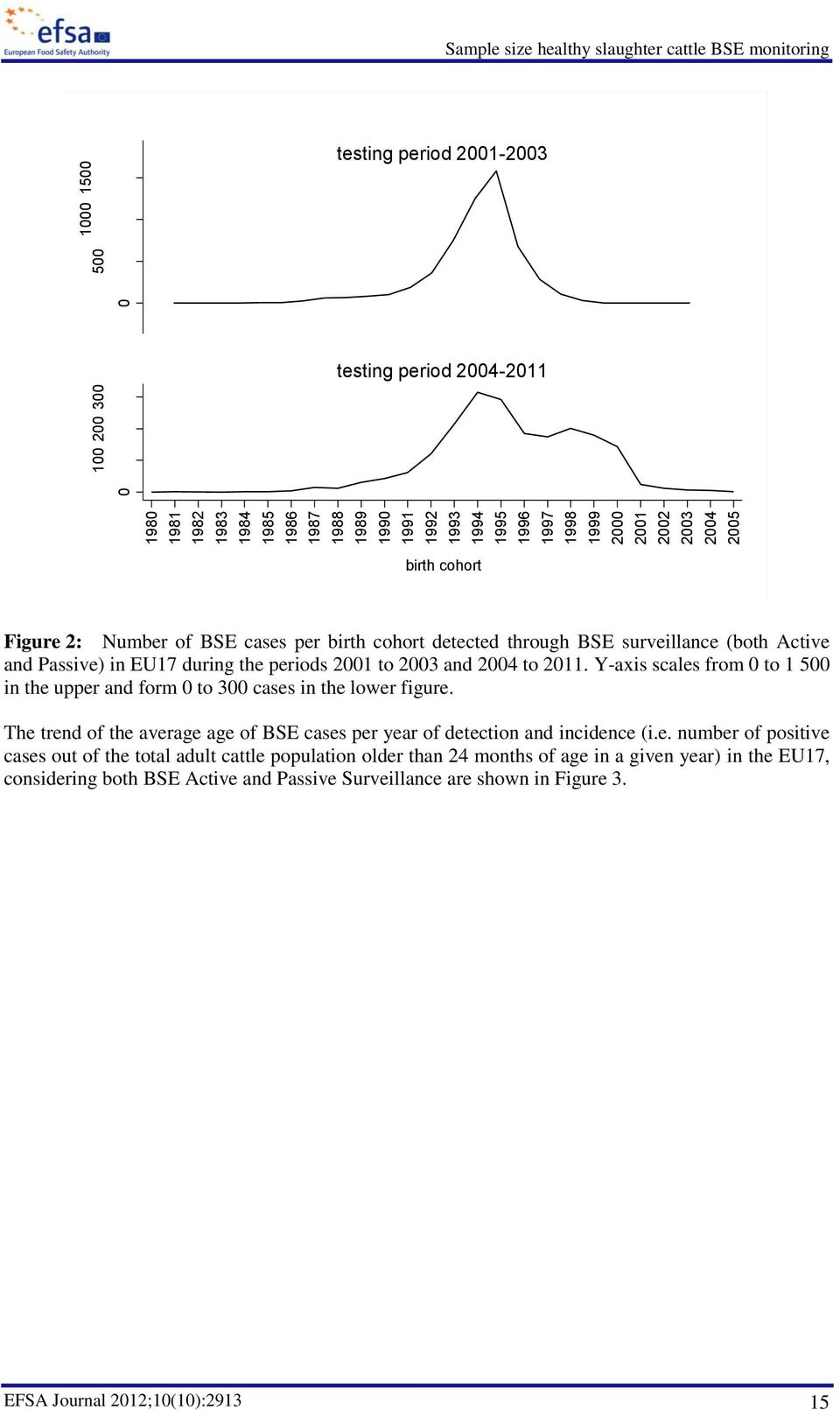
14 year of testing (o) active surveillance (+) passive surveillance Figure 1: Prevalence (log10 scale) of BSE in the EU17 found by Active and Passive surveillance from 2001 to In 2010 and 2011 no cases were reported in Passive surveillance. When modelling the log10 prevalence on the year, these declining trends on yearly prevalence in the EU17 are statistically significant for both the prevalence rates obtained within Active and Passive surveillance (beta values and for Active and Passive, respectively, with p<0.001 for both). The total number of BSE cases per birth cohort detected through BSE Surveillance (both Active and Passive) in EU17 during the period and 2004 to 2011 are presented in Figure 2. In the EU17 there were two apparent consecutive waves of infection, the first in the mid 90 s and a second one (lower number of cases involved) between 1998 and EFSA Journal 2012;10(10):

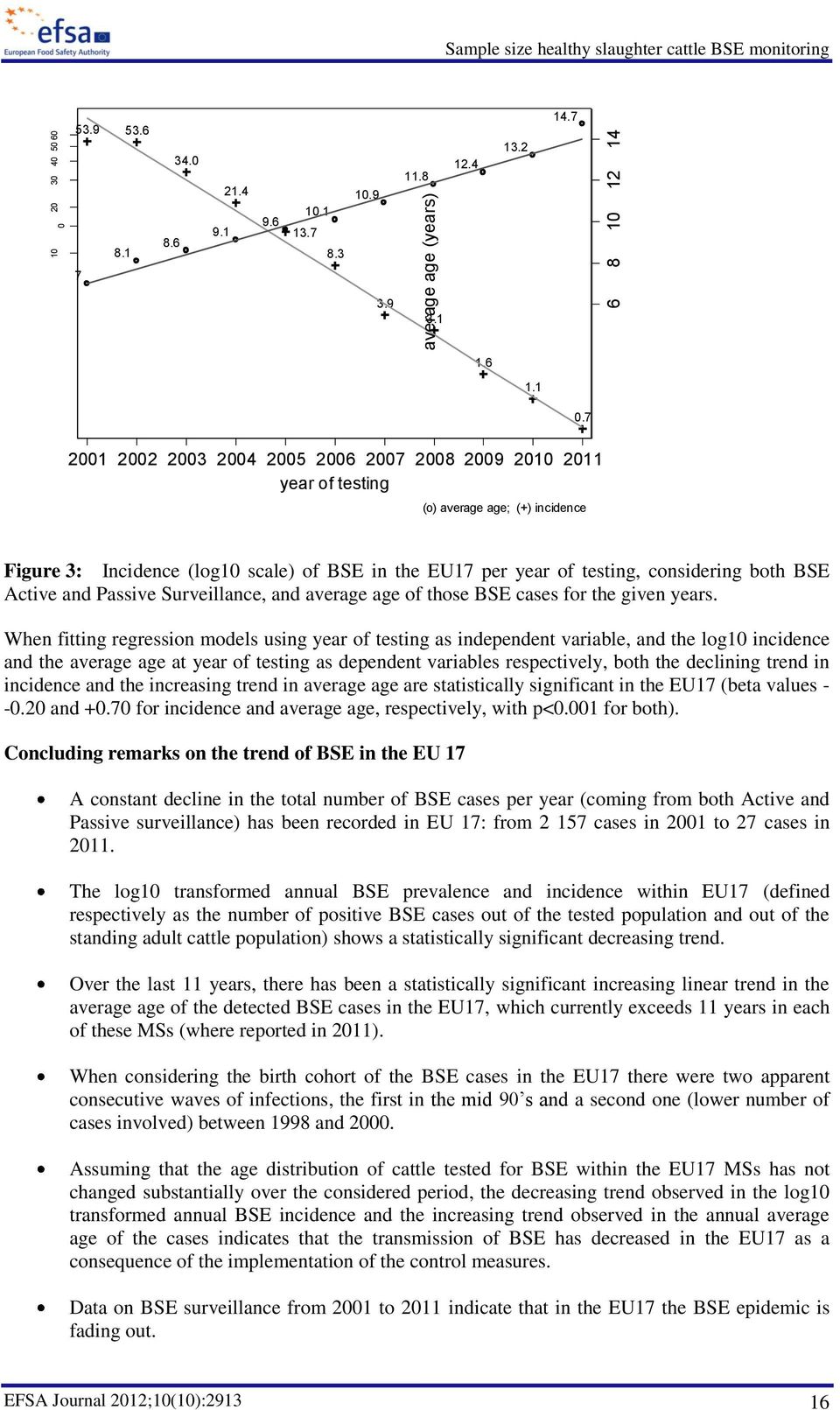
15 number of cases number of cases Sample size healthy slaughter cattle BSE monitoring testing period testing period birth cohort Figure 2: Number of BSE cases per birth cohort detected through BSE surveillance (both Active and Passive) in EU17 during the periods 2001 to 2003 and 2004 to Y-axis scales from 0 to in the upper and form 0 to 300 cases in the lower figure. The trend of the average age of BSE cases per year of detection and incidence (i.e. number of positive cases out of the total adult cattle population older than 24 months of age in a given year) in the EU17, considering both BSE Active and Passive Surveillance are shown in Figure 3. EFSA Journal 2012;10(10):
16 average age (years) Sample size healthy slaughter cattle BSE monitoring year of testing (o) average age; (+) incidence Figure 3: Incidence (log10 scale) of BSE in the EU17 per year of testing, considering both BSE Active and Passive Surveillance, and average age of those BSE cases for the given years. When fitting regression models using year of testing as independent variable, and the log10 incidence and the average age at year of testing as dependent variables respectively, both the declining trend in incidence and the increasing trend in average age are statistically significant in the EU17 (beta values and for incidence and average age, respectively, with p<0.001 for both). Concluding remarks on the trend of BSE in the EU 17 A constant decline in the total number of BSE cases per year (coming from both Active and Passive surveillance) has been recorded in EU 17: from cases in 2001 to 27 cases in The log10 transformed annual BSE prevalence and incidence within EU17 (defined respectively as the number of positive BSE cases out of the tested population and out of the standing adult cattle population) shows a statistically significant decreasing trend. Over the last 11 years, there has been a statistically significant increasing linear trend in the average age of the detected BSE cases in the EU17, which currently exceeds 11 years in each of these MSs (where reported in 2011). When considering the birth cohort of the BSE cases in the EU17 there were two apparent consecutive waves of infections, the first in the mid 90 s and a second one (lower number of cases involved) between 1998 and Assuming that the age distribution of cattle tested for BSE within the EU17 MSs has not changed substantially over the considered period, the decreasing trend observed in the log10 transformed annual BSE incidence and the increasing trend observed in the annual average age of the cases indicates that the transmission of BSE has decreased in the EU17 as a consequence of the implementation of the control measures. Data on BSE surveillance from 2001 to 2011 indicate that in the EU17 the BSE epidemic is fading out. EFSA Journal 2012;10(10):
17 2.3. Trend of BSE in the EU8 during the period 2004 to 2011 Sample size healthy slaughter cattle BSE monitoring Extensive epidemiological data on BSE has been collected in the framework of EU regulations via the BSE Active and Passive Surveillance over the last eight years in the EU8. Detailed tables on the epidemiological description of the trend of BSE are presented in Appendix A, while in this section summary tables and figures are presented. As addressed earlier on in this Report, it has to be noted that out of the eight MSs of interest, only three - referred to as EU3 - have reported positive BSE cases: Czech Republic, Poland and Slovakia. Thus, in five of the MSs of the EU8 group - referred to as EU5: Estonia, Hungary, Latvia, Lithuania and Malta - BSE cases have not been identified through the EU BSE monitoring regime. In the EU5 group, where BSE has not been identified, more than 1.9 million tests have been carried out in the framework of BSE Active surveillance between 2004 and Of these tests, about 1.68 million were tests done in healthy slaughtered cattle, while approximately at risk cattle were tested. In the EU 3 group, more than 6.2 million of tests have been carried out in the framework of BSE Active surveillance since Of these, 95 animals were positive. These included 63 out of healthy slaughtered cattle tested (11.61 per million healthy cattle tested), and 32 out of at risk cattle tested (37.09 per million). In the framework of BSE Passive Surveillance in EU3 during the period from 2004 to 2011, a total of 169 bovine animals were tested and none was positive. In the framework of BSE Surveillance in 2011, only one BSE case has been reported in the EU3 (in Poland), whereas in 2010 three cases were reported, 2 in Poland and 1 in Slovakia, respectively. With respect to the number of BSE cases detected through the BSE Active and Passive Surveillance and in the frame of eradication measures in EU3 between 2004 and 2011, data per target group are presented in Table 4. EFSA Journal 2012;10(10):

18 Table 4: Number of BSE cases detected through the BSE Active and Passive Surveillance and from eradication measures in EU3 during the period per target group. No of detected BSE cases per testing year Target Group Total Active Surveillance Healthy slaughtered At risk animals 0 Emergency slaughter Fallen stock Presenting Clinical signs at ante mortem inspection Total Active Surveillance Passive Surveillance 0 Suspects subject to lab Eradication Measures Total In 2004, seven cases were diagnosed before 1 May. The trend observed in these data demonstrates that the control measures in place against BSE have been efficient because the prevalence of the disease is declining exponentially in the EU3. This can also be seen in Figure 4 below. EFSA Journal 2012;10(10):

19 year of testing Figure 4: Prevalence (log10 scale) of BSE in the EU8 found by Active surveillance from 2004 to No cases were reported in EU8 by Passive surveillance. When comparing the prevalence in the EU8 for the period 2004 to 2009 with the prevalence in the EU17 for the period 2001 to 2006 (i.e. 6 first years of the total feed ban), it can be noticed that the yearly prevalence in the EU8 is in the range of 7 to 4 times lower than that of the EU17. As for the EU17, also in the EU8, when modelling the log10 prevalence on the year there is a significant continuous declining trend on the yearly prevalence (beta -0.19, p<0.001). The total number of BSE cases per birth cohort detected through BSE Surveillance (both Active and Passive) in EU3 during the period 2004 to 2011 are presented in Figure 5. In the EU3 there were two apparent consecutive waves of infections, the first in the mid 90 s and a second one (with larger number of cases involved) around the year EFSA Journal 2012;10(10):

20 0 5 number of cases Sample size healthy slaughter cattle BSE monitoring testing period , N= birth cohort Figure 5: Number of BSE cases per birth cohort detected through BSE Active surveillance in EU3 during the period 2004 to The trend of the average age of BSE cases per year of detection and incidence in the EU8, considering both BSE Active and Passive Surveillance are shown in Figure average age (years) year of testing (o) average age; (+) incidence Figure 6: Incidence (log10 scale) of BSE in the EU8 per year of detection, considering both BSE Active and Passive Surveillance, and average age of those BSE cases for the given years. When fitting regression models using year of testing as independent variable, and the log10 incidence or the average age at testing as dependent variables, both the declining trend in incidence and the EFSA Journal 2012;10(10):

21 increasing trend in average age are statistically significant in the EU8 (beta values and for incidence and average age, respectively, with p<0.001 for both). Concluding remarks on the trend of BSE in the EU8 BSE has not been detected in five of the EU8 MSs (the EU5 group): Estonia, Hungary, Latvia, Lithuania and Malta. Three MSs (the EU3 group), these being Czech Republic, Poland and Slovakia, account for all the BSE cases detected in the EU8 group. The number of BSE cases in the EU3 decreased from 28 in 2005 (peak) to one in The log10 transformed annual BSE prevalence and incidence in the UE8 (defined respectively as the number of positive BSE cases out of the tested population and out of the standing adult cattle population) exhibits a statistically significant decreasing trend. There has been a statistically significant increasing trend in the average age of the detected BSE cases in the EU8 per test year over the last eight years, which currently exceeds 11 years in each of these MSs (where reported in 2011). When considering the birth cohort of the BSE cases in the EU3 there were two apparent consecutive waves of infections, the first in the mid 90 s and a second one (with larger number of cases involved) around the year Assuming that the age distribution of cattle within the EU8 countries did not change substantially over the considered period, the decreasing trend observed in the log10 transformed annual BSE incidence and the increasing trend observed in the annual average age of the cases indicates that the transmission of BSE has decreased in the EU8 as a consequence of the implementation of the control measures. EFSA Journal 2012;10(10):
22 3. Atypical BSE in cattle Sample size healthy slaughter cattle BSE monitoring Since its first report, Atypical BSE cases were described in a number of European and non-european countries. According to the data available in scientific literature or obtained through the EU active surveillance system, cases have been reported in several European countries (Jacobs et al., 2007; Stack et al., 2009), Japan (Masujin et al., 2008; Yamakawa et al., 2003), USA (Richt et al., 2007) and Canada (Dudas et al., 2010). Atypical BSE cases reported by the different EU MSs since 2001 are presented in Table 5. These data have to be interpreted with caution as in the EU there is no legal requirement for typing BSE positive cases (i.e. all cases traditionally reported as BSE). Thus, the data presented here has been only reported in and ad hoc manner to the European Commission in the frame of the current and previously related mandates. Out of the 64 cases reported up to 2011, 37 were L-type and 27 H-type, respectively. Table 5: Atypical BSE cases reported in the EU MSs since Source: European Commission. Member State Year of testing Total Austria Denmark 1 1 France Germany Ireland Italy Netherlands Poland Spain 1 1 Sweden 1 1 United Kingdom Total Pre-May 2004 testing, before full implementation of EU regulations Reported Atypical BSE cases were detected almost exclusively in animals over 8 years of age (except for one case in a 6 year old bovine reported in 2011). All these cases were identified by active surveillance testing. However, there is currently no data available on the performance of the validated rapid assays used for cattle TSE testing, for detection of Atypical BSE cases, both in terms of their analytical sensitivity and of the efficacy of detection of infected asymptomatic animals. The number of Atypical BSE cases reported by EU MSs since 2001 by testing stream is included in table 6. Table 6: Number of Atypical BSE cases reported by EU MSs since 2001 by testing stream. Source: European Commission. Year of testing Target group Total Fallen stock Healthy slaughtered animals Emergency slaughter Total Data presented in table 6 indicate that over the past decade the majority of the reported Atypical BSE cases are in the fallen stock and healthy slaughter target groups (around 60% and 35% respectively), EFSA Journal 2012;10(10):
23 average age (years) Sample size healthy slaughter cattle BSE monitoring while only a few cases were detected in the emergency slaughter target group (around 5%). The number of Atypical BSE cases reported seems to be also rather stable throughout the years. In the EU17 group of MSs, where the majority of the BSE cases have been found, most of the cases identified over the past decade via active surveillance have been reported in the fallen stock target group. Figure 7 shows the average age of the Atypical L-BSE and H-BSE cases reported in the EU since H-BSE L-BSE year of testing (o) H-BSE; (+) L-BSE Figure 7: Average age of the Atypical L-BSE and H-BSE cases reported in the EU since 2001 to There is a significant increasing trend of the average age of the Atypical BSE cases of the two types combined (i.e. H-BSE and L-BSE), (beta +0.24, p= 0.02) in the EU25.The slope of this trend is less pronounced that it is in the case of the increasing trend of the average age of the Classical BSE (C- BSE) cases. However, when assessing the trend individually for H-BSE and L-BSE, only a significant increasing trend in the yearly average age of the H-BSE cases is observed (beta +0.29, p=0.01), while for L-BSE the trend is not significant (beta=0.14, p=0.297) Atypical BSE Type L (L-BSE) Atypical L-BSE has been reported to be transmissible to different animal models. In particular, intracerebral (IC) inoculation of the L-BSE agent in cattle provokes a TSE which is both clinically and pathologically distinct from C-BSE (Lombardi et al., 2008). To date, there are no available results concerning the oral transmission of L-BSE in cattle. Bioassay in transgenic (Tg) mice over-expressing the bovine PrP C seems to indicate that infectivity might disseminate in skeletal muscle tissues in animals IC challenged with L-BSE (Suardi et al., 2012). In contrast no infectivity was detected in the kidney, in the spleen and in lymph nodes from the same animal. Both abnormal PrP Sc deposits and infectivity (detected by bioassay in tg-bov mice) was also observed in a naturally infected but asymptomatic BSE L case (Polak and Zmudzinski, 2012; Suardi et al., 2012). In Classical BSE cases, pathogenesis studies have established that abnormal PrP deposition in the brainstem first occurs at the obex level, where substantial amount of this disease specific protein accumulates during the late incubation phase (Arnold et al., 2007; Simmons et al., 2010; Wells et al., EFSA Journal 2012;10(10):
24 2007). As a consequence, targeting obex for C-BSE rapid testing is considered as the most sensitive approach for detecting cases within the framework of the active surveillance system. In Atypical BSE (both L and H type), the dynamics of the abnormal PrP deposition in the different brain areas is poorly documented, and the suitability of the obex as the target tissue for testing that would allow an early and sensitive detection of these conditions remain largely unknown. On one hand, all the Atypical BSE cases detected so far were identified through the active surveillance system, indicating that obex testing with currently validated tests allows the detection of at least a part of the Atypical cases. However, on other hand the distribution of abnormal PrP in L-BSE, as observed from a very limited number of samples, clearly indicates that brainstem deposition of abnormal PrP in the context of L-BSE is poor by comparison to other areas (Casalone et al., 2004; Konold et al.; Polak and Zmudzinski, 2012). This last finding strongly support the contention that active surveillance system as currently applied could have a more limited sensitivity to detect Atypical BSE cases than C- BSE cases in field cattle population. Proof of principle of the L-BSE ability to propagate in sheep was brought by the IC propagation of a L-BSE isolate into ARQ/ARQ and in Tg mice expressing the ovine PrP C variants. The propagation of L-BSE in sheep seemed to result in a TSE with a different profile to that of C-BSE (Nonno et al., 2008). Unexpectedly, L-BSE isolates transmitted to either Tg mice expressing ovine PrP C (Beringue et al., 2007) or inbred wild-type mouse lines (Capobianco et al., 2007) resulted in a disease with similar phenotypic features to those of the C-BSE agent. However, the inoculation of tissues collected in mice over-expressing ovine PrP C inoculated with C-BSE and L-BSE in bovine PrP C transgenic mice, resulted into two different phenotypes specific of each agent indicating that the tg338 passaged agents, although producing a similar signature in the brain, were actually different (Beringue et al., 2010). Results from several studies that focus on the potential human risk from Atypical L-BSE are available. Kong and colleagues (2008) investigated the infectivity and phenotype of L-BSE by IC inoculating Tg mice expressing the human PrP C (M129M) with brain homogenates from two L-BSE affected cattle. Sixty percent of the inoculated Tg mice became infected after months incubation, a transmission rate higher than those reported for C-BSE. A quarter of L-BSE infected Tg mice, but none of the Tg mice infected with sporadic CJD (scjd), showed presence of PrP res in the spleen, indicating that the L-BSE agent may be lymphotropic. The pathological prion protein isoforms in L-BSE infected humanized Tg mouse brains were different from those of the original cattle L-BSE or scjd. Minimal brain spongiosis and long incubation time were observed in the L-BSE infected Tg mice. A similar study was performed in another Tg mice expressing the human PrP C (M129M- Tg650) (Beringue et al., 2008). In contrast with C-BSE prions, L-BSE prions appeared to propagate in these mice with no obvious transmission barrier. Another study evaluated the transmission of L-BSE to a non-human primate (Comoy et al., 2008). Brain homogenates from cattle with C-BSE and L-BSE were IC inoculated into cynomolgus monkeys (Macacca fascicularis). The single monkey infected with L-BSE had a shorter survival, and a different clinical evolution, histopathology, and prion protein (PrP res ) pattern than what was observed for either C-BSE or vcjd-inoculated animals. These results were interpreted to suggest a possibly higher degree of pathogenicity of L-BSE than C-BSE in primates. Taken together, these experimental studies may demonstrate that L-BSE or BASE is easily transmissible to both humanised mice and primates, and may be more virulent to humans than C-BSE. More recently transmission of L-BSE into bank voles resulted in a TSE which phenotype (incubation period, PrP Sc biochemical properties and vacuolar lesion profiles) were identical to the one observed after transmission of a VV2 s-cjd case in this rodent model (Nonno et al., 2009). Finally, it has to be mentioned that there is no data available about the impact of the TSE inactivation process currently applied to processed animal proteins (133 C, 2 Bar pressure, 20 minutes) on the infectivity of the L-BSE agent. EFSA Journal 2012;10(10):
25 3.2. Atypical BSE Type H (H-BSE) Sample size healthy slaughter cattle BSE monitoring There is currently no data available on the pathogenesis and the tissue infectivity distribution of H- BSE in ruminants. H-BSE has been transmitted into a number of laboratory animal models. In most of the reported cases the transmission features obtained were distinct from those observed after inoculation with C-BSE (Beringue et al., 2006). However, a recently published work described the transmission of four French and one Polish H-BSE isolates into transgenic mice expressing bovine PrP C (Tg110 mice) by IC challenge (Torres et al., 2011). Following these transmissions, two H-BSE isolates resulted in the propagation in some mice (respectively 3 and 2 out of 12) of a TSE displaying a C-BSE phenotype. Second passage of prions into TgBov mice confirmed that the TSE agent was C-BSE. These results imply that C-BSE might emerge spontaneously from an H-BSE type isolate (in the absence of any interspecies passage), which could indicate that H-BSE might be a source of the C- BSE agent. This hypothesis is also consistent with the observed trend in the average age of cases. Finally and equally to L-BSE, there is no data about the impact of the TSE inactivation process currently applied to processed animal proteins on the infectivity of the H-BSE Agent Concluding remarks on Atypical BSE The following can be concluded regarding Atypical BSE: The origin and pathogenesis of Atypical forms of BSE in its natural host are unknown. Epidemiological data reported by the EU MSs indicate that over the last years the number of detected Atypical BSE cases did not show any trend and that these cases were mainly identified in the fallen stock and healthy slaughtered animals older than 8 years of age. The performance of the current TSE monitoring system, both in terms of its analytical sensitivity and earliness of the detection of animals infected with Atypical BSE is unknown. 4. A brief overview of existing BSE surveillance and risk models Modelling has been applied quite intensively on BSE, with different aims and using different approaches to adapt to available data. Existing BSE surveillance and risk models can be separated in two main categories: Models for datarich situations and models for data-sparse situations. Data-sparse models are quite rare, and are generally risk models, that look at the risk of introduction or of transmission of BSE considering available test samples results. The data-rich models again separate into two categories: statistical models and predictive models, where the predictive models are generally an extension of a statistical data analysis model Data-sparse models Data-sparse models (i.e. sparse case data) are rare. The EFSA Geographical BSE Risk Assessment is a good example of a reasonably good assessment of future risk was made based on rather limited information, (EFSA, 2007). For parameter-sparse models, the OIE point system 20 for evaluation of surveillance is also available. This is not a model in the classical sense but to be considered as a criterion, which was based on evaluation of EU case data from the early active surveillance period, based on the BSurvE model (Prattley et al., 2007). Various risk categories were determined with relative risk, leading to the points 20 For further details see: EFSA Journal 2012;10(10):
26 accredited to these categories. Although extrapolation of these risk estimates to other situations and non-randomized surveillance data is not scientifically sound, it surely offers a very simple evaluation method Statistical models The statistical models analyse existing BSE case data and negative test data, aiming to provide 1.) a prediction of the prevalence in the selected population, 2.) to analyse the BSE trend in time, or 3.) to increase the sensitivity of the surveillance system. Most of these models include the age structure and an age-dependent case-risk functions. Examples of these models are the BSurvE model (Prattley et al., 2007), models considered in former EFSA Opinions (EFSA, 2008a, 2009, 2010; Prattley et al., 2007) and that published in 2008 by de Koeijer (de Koeijer, 2008). A similar approach of analysing the trend of BSE has been the application of Age-Period-Cohort (APC) regression models (Ducrot et al., 2010; Sala and Ru, 2009). APC modelling, commonly used in the assessment of cancer trends, is based on the analysis of tested animals (in term of age at testing, date of testing i.e. period, and birth cohort): it may provide a calculation of the evolution of BSE risk over successive birth cohorts allowing the comparison of trends by country and the identification of difference in the probability of infection of subsequent cohorts. Back calculation models are very detailed models offering more precision than more simple models. These models derive several transmission relations, like the age dependent susceptibility, age dependent mortality etc. simultaneously from the data, while also analysing (historical) prevalences Predictive models Predictive extensions to the statistical models are made based either on linear extrapolation or on mechanistic analysis. Although back-calculation models are in theory less suitable for extrapolation, this can be solved as easily as with the less detailed categorizing models. However, the precision gained in the model will get lost with the extrapolation, while such a model remains more blackbox - like, in the sense that all the computations performed within the modelling process are not easily evident. EFSA Journal 2012;10(10):
27 5. Estimating sample sizes of healthy slaughtered cattle over 72 months of age for the monitoring and surveillance of TSEs Following an EFSA open call for tender (CT/EFSA/BIOHAZ/2002), a model to estimate sample sizes of healthy slaughtered cattle to be tested in order to meet a given design prevalence has been provided by a contractor (Animal Health and Veterinary Laboratories Agency (AHVLA), UK). This model was called the Cattle-TSE Monitoring Model, to be referred to as C-TSEMM from now onwards. The full report submitted to EFSA by the contractor should be read as part of this EFSA Scientific Report (Adkin et al., 2012) Methodology, limitations and assumptions The probabilistic statistical C-TSEMM model employs a framework developed in R software 21 with a Visual Basic 22 software interface. The detailed description of the structure of the model can be found in the contractor s Report (Adkin et al., 2012). The model uses EU data on prevalence of infection by birth-cohort and demographic information, which is employed to estimate the design prevalence and the sensitivity of a monitoring system. European Commission and EU member states provided the relevant data. It has to be noticed that the models estimates presented in this report are based on the 2011 demographics of the adult cattle population and on the number of adult cattle removed from the population via the different streams (i.e. healthy slaughter, animals showing clinical signs of disease during ante mortem inspection, emergency slaughtered animals and fallen stock). Therefore, future fluctuations in those numbers at EU level and in each MSs will impact the validity of current estimates. Thus, should the C-TSEMM model be employed in future years for the review of the BSE monitoring regime in the EU, updated yearly data including BSE testing data have to be considered as these drive the results estimated by the model. Based on the model approach, the number of animals of the healthy slaughter exit stream that need to be tested, in order that at least one animal is detected with a probability of τ, is given by using binomial formulae. This is an approximation to the hypergeometric distribution, which would be the correct distribution for a sampling scheme without replacement. Testing for BSE is a testing procedure without replacement, but the approximation by the binomial distribution is acceptable is n < 0,1N. If we compare the means and the standard deviations of the binomial and the hypergeometric distributions we immediately see that the means are identical but the standard deviations differ by the factor sqrt((n-n)/(n-1)). This factor is called the finite populations factor and is always less or equal to one. If n<0,1n, the corresponding binomial and hypergeometric probabilities correspond close enough (see C-TSEMM sensitivity analysis, section 5.4. of the contractor s Report, (Adkin et al., 2012)). In the simulation model the hypergeometric distribution is replaced by the binomial distribution because the model becomes computationally more tractable. When dealing with the relationship between sample size and design prevalence in this report, calculations are presented taking into account both the standing adult cattle population and the tested adult cattle population, both of them older than 24 months of age. Thus, the definitions of prevalence in the contractor s Report (Adkin et al., 2012) and as presented in this section of the EFSA Report here are as follows: Detectable prevalence in test population: Period prevalence in a given year of detectable infected animals in the test population. Calculated by the model s predicted number of adult animals (>24 months), in the population of animals tested, that would test positive by a diagnostic test, divided by the total number of animals tested in one year Microsoft Cooperation EFSA Journal 2012;10(10):
28 Infection prevalence in test population: Period prevalence in a given year of infected animals in the test population. Calculated by the model s predicted number of adult animals (>24 months), in the population of animals tested, that are actually infected (i.e. animals that may or may not test positive or be showing clinical symptoms) divided by the total number of animals tested in year. Detectable prevalence in standing population: Period prevalence in a given year of detectable infected animals in the standing population. Calculated by the model s predicted number of adult animals (>24 months), in the standing population, that would test positive by a diagnostic test, divided by the total number of adult animals in the standing population. In the context of BSE monitoring, addressing prevalence in the tested cattle population is usually considered of greater epidemiological value than addressing prevalence in the standing cattle population. This is because the population of study of BSE is the tested population, which is not a random representation of the standing population but part of the population that is slaughtered (or dead). Furthermore the predicted detectable prevalence in the standing population can never be validated. Nevertheless, results are presented considering also the standing population as this forms part of the technical request made by the Commission. A series of assumptions are made in the C-TSEMM, which need to be considered when evaluating the outputs from the model (Adkin et al., 2012). These assumptions can be categorised in two groups: a. Assumptions made when transforming input data. These include: For MSs with no, or few, BSE cases post-2001 (i.e. Austria, Cyprus, Estonia, Finland, Greece, Hungary, Latvia, Lithuania, Luxembourg, Malta and Sweden) an alternative estimate of cohort-based prevalence is required. This has been estimated for those MSs based on the average prevalence of the group of MSs with BSE cases under which they were placed in previous related EFSA Opinions (EFSA, 2009, 2010), theeu17 or the EU8 group 23. This results in an overestimate of prevalence for countries with no recorded cases as they are assumed to be a merged epidemiological unit with countries where cases are observed (see Appendix C of the contractor s report (Adkin et al., 2012) for further details). Whilst the healthy slaughter, emergency slaughter, fallen stock and clinical suspects of BSE seem to be populated to a similar degree within European countries, clinical signs at ante mortem does not seem to be uniformly applied. When considering the definition of the emergency slaughter category there appears little to distinguish between the categories and therefore it has been agreed that the clinical signs at AM stream can be merged into the emergency slaughtered stream. Animals culled under the eradication measures are traditionally difficult to include in modelling work as for most countries there are insufficient test positive data to estimate prevalence on a cohort basis. These were incorporated into the fallen stock category with the impact of this assumption investigated in section 5.1 of the contractor s Report (Adkin et al., 2012). The proportion of animals > 155 months in the (i) slaughtered/dead, and (ii) standing population, by 12 month intervals to 204 months (17 years) is not known for most MSs. Therefore, the assumption was made that the proportions by 12 monthly intervals could be approximated by that recorded in (i) the UK slaughtered/dead population between EU17: Austria, Belgium, Cyprus, Denmark, Finland, France, Germany, Greece, Ireland, Italy, Luxembourg, Netherlands, Portugal, Slovenia, Spain, Sweden and United Kingdom. EU8: Czech Republic, Estonia, Hungary, Latvia, Lithuania, Malta, Poland and Slovakia. EFSA Journal 2012;10(10):
29 and 2010, and (ii) an average of that recorded in Austria and the UK standing population in Assumption (i) has been tested in the sensitivity analysis and could be replaced by assuming equal proportions by 12 monthly intervals without impacting results (refer to section 5.2 of the contractor s Report (Adkin et al., 2012)). Data are absent for the standing population for most MSs in It is assumed that the data for 2010 can be used as a proxy. Age data are transformed into cohort based testing data assuming an equal probability per month of birth and death. There are little experimental data to assess the sensitivity of the BSE test in cattle. It is assumed that we can use data based on 1g experimentally dosed cattle as detailed in Arnold et al. (2007) to approximate the sensitivity of the test for field cases. b. Model assumptions. These include: Underpinning the estimate of true prevalence it is assumed that the use of an exponential distribution to model the true prevalence is appropriate. While other distributions could be fitted, analysis of alternative distributions has indicated that an exponential decay of prevalence over time is appropriate for the majority of European data (section 5.3 of the contractor s Report (Adkin et al., 2012)). Cases from the clinical suspect (CS) stream and fallen stock (FS) stream are assumed to be identified at the end of the incubation period, that is, death is as a result of the disease. Whereas healthy slaughter (HS) and emergency slaughter (ES) animals may be within a period of time before clinical onset depending on the distribution of the age at onset and test sensitivity. This assumption impacts the number of infected animals within these streams. Prevalence estimated for the combined streams (i.e. clinical suspects and fallen stock, healthy slaughter and emergency slaughter) can be divided into the individual exit streams according to the proportion of test positive animals observed in those streams. Where there are no test positives, it is assumed that the number of animals tested by birth cohort and testing year is an appropriate proxy. It is assumed that all cases of BSE are typed by strain such that the number tested for Classical and unknown strains is the same number as that tested for Atypical H and L type. This is not the case for all MSs and therefore only simulations from MSs where strain differentiation is routinely conducted will be valid. The design prevalence calculation is based on an infinite population (sampling with replacement) which is based on the binomial distribution. This method is straightforward to implement, however, for MSs with small slaughter populations, the use of the hypergeometric distribution produces lower estimates for the number to test to achieve a desired design prevalence. This has been investigated in the sensitivity analysis (section 5.4 of the contractor s Report (Adkin et al., 2012)). The conclusion is that for those countries with a small slaughter population, the number of animals needed to be tested is still greater than the number that are actually tested with the exception of Finland which has a marginal reduction in the number to test using the hypergeometric equation. For all other MSs that are not achieving a sufficient design prevalence to reduce current levels of testing, conclusions are not affected whether the hypergeometric or binomial based sample size formula is used. The impact of the use of the binomial could be further explored with the application in the field of a sampling with replacement strategy in BSE monitoring. However, that is not currently feasible under the current BSE testing EFSA Journal 2012;10(10):
30 practices (i.e. post mortem testing) and may proof challenging even with a theoretical live animal testing BSE monitoring regime. In estimating either the re-emergence of an existing TSE, or emergence of a new TSE disease in cattle, it is assumed that the disease can be detected by current testing assays. For simulating the EU25 as a whole, it is assumed that it can be merged as an unique epidemiological unit or territory. EFSA Journal 2012;10(10):
31 5.2. Results Estimated design prevalence of the current BSE monitoring system Table 7 shows the results for different design prevalence calculations that would be detected by the baseline monitoring regime in place in the EU25 as a whole and by the MSs individually with τ% confidence. Results are provided based on the detectable prevalence (prevalence of cases) for the adult standing population and adult tested population, together with results based on the infection prevalence (prevalence of infected animals) for the adult tested population. This considers all cases recorded in the Commission BSE database including the unknown strains. The baseline monitoring regime is the testing of healthy slaughter animals > 72 months, emergency slaughter and fallen stock > 48 months and the testing of all clinical suspect animals. Results are expressed as 1 in X, so a result of indicates that we would expect the current system to detect a prevalence in adult cattle >24 months of 1 in For the main results τ=95%, to show the uncertainty surrounding these estimates we also present results for τ=92.5% and τ=97.5%. Design prevalence results are shaded where the estimated prevalence detected is greater than the threshold of As the level of confidence is increased from τ=92.5% to τ=97.5%, it can be seen from the table that the estimated design prevalence reduces in sensitivity. N/A in Table 7 indicates that model has failed to converge, and thus not being able to provide estimates based on the country-specific data characteristics of those MSs Table 7: Estimated design prevalence of baseline monitoring system for all strains, using detectable prevalence in the tested population and standing population, and infection prevalence in the tested population to a confidence (τ) of 95% (lower 92.5% and upper 97.5% confidence). Shaded results show that the estimated prevalence detected is greater than the threshold of MS Estimated design prevalence of baseline monitoring system considering all strains and unknown Detectable prevalence in standing population (1 in X) Detectable prevalence in tested population (1 in X) Infection prevalence in tested population (1 in X) τ=0.925 τ=0.95 τ=0.975 τ=0.925 τ=0.95 τ=0.975 τ=0.925 τ=0.95 τ=0.975 EU AT BE CY N/A N/A N/A 461 N/A N/A CZ DE DK N/A N/A N/A N/A EFSA Journal 2012;10(10):
32 MS Estimated design prevalence of baseline monitoring system considering all strains and unknown Detectable prevalence in standing population (1 in X) Detectable prevalence in tested population (1 in X) Infection prevalence in tested population (1 in X) τ=0.925 τ=0.95 τ=0.975 τ=0.925 τ=0.95 τ=0.975 τ=0.925 τ=0.95 τ=0.975 DK* EE N/A EL N/A N/A N/A N/A ES FI N/A FR HU IE IT LT N/A N/A LU LV MT N/A N/A 545 N/A N/A N/A N/A NL N/A PL PT N/A N/A N/A SE SI SK UK N/A=the model has failed to find a viable value. *Values for Denmark using alternative solver routine EFSA Journal 2012;10(10):
33 From Table 7 it can be seen that the calculation using the detectable prevalence in the standing population produces the highest estimates for the design prevalence the baseline monitoring system is able to detect. Twelve MSs (i.e. Austria, Belgium, Denmark, Germany, Spain, France, Ireland, Italy, Netherlands, Poland, Sweden and the UK) have a design prevalence of at least 1 in using the estimated detectable prevalence to a confidence level of 95%. The EU25 design prevalence is higher than for individual MSs as far more animals are tested, with an estimated design prevalence of 1 in N/A in Table 7 indicates that model has failed to converge. This is due to the use of a solver to calculate the estimated design prevalence a monitoring system is able to detect by the rearrangement of the design prevalence equation (see Equation 2 in Appendix B, contractor s Report (Adkin et al., 2012)), where the design prevalence value is solved for a specified number of animals tested. The generic solver routine has been optimised to produce results for the majority of MSs. When considering the detectable prevalence in the standing population, a viable value has not been found at the 95 th confidence value for Greece, Lithuania, and Malta. Based on other confidence values and the estimated number to test values provided in Table 8 below, the design prevalence of these countries is not meeting the 1 in threshold. However, for Denmark it is likely that at the 95 th confidence value, the monitoring system is detecting greater than 1 in To investigate that value for Denmark, the generic solver routine was adapted specifically for Denmark. Results using the specific solver routine for Denmark are denoted in the table with an asterisk. For the remaining MSs in Table 7 (i.e. Czech Republic, Cyprus, Estonia, Finland, Hungary, Luxembourg, Latvia, Portugal, Slovenia and Slovakia) the design prevalence the baseline monitoring system is able to detect ranges between 1 in and 1 in with a confidence level of 95%. Using the estimated detectable prevalence in the tested population to a confidence level of 95%, the baseline monitoring regimes in seven MSs (Germany, Spain, France, Ireland, Italy, Poland and UK) have a design prevalence of at least 1 in Additionally, France has a design prevalence greater than 1 in estimated using the prevalence of infection in the tested population. The EU25 design prevalence is higher than for individual MSs as far more animals are tested, with an estimated design prevalence of 1 in using the detectable prevalence in the tested population and 1 in using the prevalence of infection in the tested population. The assumption is made that the EU25 can be estimated as a merged epidemiological unit or territory. EFSA Journal 2012;10(10):
34 Estimated number to test in healthy slaughter stream to achieve a design prevalence of 1 in Table 8 shows the number of healthy slaughter animals that would need to be tested, given the number of animals currently being tested in the other exit streams remains the number tested in those streams in 2011, in order to be τ(%) confident of detecting a positive animal if the overall prevalence in animals >24 months is 1 in As in table 7, results are provided based on the detectable prevalence (prevalence of cases) for the adult standing population and adult tested population, together with results based on the infection prevalence (prevalence of infected animals) for the adult tested population. For the main results τ=95%, to show the uncertainty surrounding these estimates we also present results for τ=92.5% and τ=97.5%. Results for the number of healthy slaughter animals to be tested are shaded where the estimated number is less than current testing in this exit stream. This considers all cases recorded in the Commission BSE database including the unknown strains. Table 8: Estimated number of health slaughtered animals required to be tested for all strains, given testing of emergency slaughter, fallen stock and clinical suspect animals, to achieve a design prevalence of 1 in using detectable prevalence in the tested population and standing population, and infection prevalence in the tested population to a confidence (τ) of 95% (lower 92.5% and upper 97.5% confidence). Shaded results show that the estimated prevalence detected is greater than the threshold of Number to test in healthy slaughter to detect prevalence of 1 in considering all strains and unknown Detectable prevalence in standing population Detectable prevalence in tested population Infection prevalence in tested population MS 1 Actual number tested in HS >72 m (2011) τ=0.925 τ=0.95 τ=0.975 τ=0.925 τ=0.95 τ=0.975 τ=0.925 τ=0.95 τ=0.975 EU AT BE CY CZ DE DK EE EL ES FI FR HU IE EFSA Journal 2012;10(10):
35 Number to test in healthy slaughter to detect prevalence of 1 in considering all strains and unknown Detectable prevalence in standing population Detectable prevalence in tested population Infection prevalence in tested population MS 1 Actual number tested in HS >72 m (2011) τ=0.925 τ=0.95 τ=0.975 τ=0.925 τ=0.95 τ=0.975 τ=0.925 τ=0.95 τ=0.975 IT LT LU LV MT NL PL PT SE SI SK UK See Appendix B for MS acronyms 2 In the case of Finland the number of healthy slaughter cattle to test using the hypergeometric equation is estimated to be , less than the number tested in 2011 Considering the estimated detectable prevalence in the standing population, in Table 8 we can see that when the EU25 is merged into one epidemiological unit, the area already tests sufficient animals in the ES, FS and CS streams such that they do not need to test any healthy slaughter animals (represented in the table by a value of 0). Thus, the C-TSEMM model estimates that, with the current BSE monitoring regime but excluding the testing of healthy slaughter cattle, the system is able to detect in the standing population one BSE case in adult cattle with a confidence level of 95%. Also considering the estimated detectable prevalence in the standing population, at a confidence level of 95%, eight MSs (i.e. Belgium, Germany, Denmark, Spain, France, Ireland, Netherlands, and the UK) do not require the testing of any healthy slaughter animals to meet a 1 in design prevalence. Also based on detectable prevalence in the standing population, four MSs (i.e. Austria, Italy, Poland and Sweden) do require testing less healthy slaughtered animals older than 72 months of age than the total number tested in those MSs in 2011 in order to meet a 1 in design prevalence. In the remaining thirteen MSs (i.e. Cyprus, Czech Republic, Estonia, Finland, Greece, Hungary, Latvia, Lithuania, Luxembourg, Malta, Portugal, Slovenia and Slovakia) the number of healthy slaughtered animals older than 72 months of age that would need to be tested in order to meet a 1 in design prevalence is higher than the actual number tested in In the case of Finland, the number of healthy slaughter cattle to test if the hypergeometric equation would be used instead of the binomial one is estimated to be less than the number tested in EFSA Journal 2012;10(10):
36 However, it has to be noted that in the context of the current BSE monitoring system (i.e. post mortem test carried out in slaughtered cattle or dead cattle of certain age categories), fitting a sample size larger than the actually slaughtered cattle population is neither feasible nor realistic. Thus, the current testing of all animals of certain age categories that are slaughtered or dead, may provide the most sensitive BSE monitoring system possible (i.e. that employs post mortem tests) under the current epidemiological scenario with the potential limitation on the impact of the age at testing as evaluated in former EFSA Opinions (EFSA, 2008a, 2008b, 2009, 2010). One potential consideration could be given to those MSs where the sample size is larger than the actual cattle population size. In that case, an alternative could be to consider extending (e.g. from one to more years) the time frame given to meet the design prevalence. However, this would not be in line with the technical aspects of the terms of reference (i.e. yearly design prevalence). The calculations using the standing population prevalence show the lowest number of animals that need to be tested when compared to results using the detectable prevalence in the test population. The estimate of the numbers of animals needing to be sampled in order to detect a prevalence of 1 in is lower (and thus the power of the surveillance in Table 8 is higher) when considering the standing population than when considering the test population. This is because the prevalence of BSE in the standing population is lower than the prevalence in the test population. As such, assuming a design prevalence of 1 in in the standing population, as opposed to in the test population, will lead to higher stream prevalences in the test population after the appropriate scaling. In other words, a design prevalence of 1 in in the standing population will lead to a greater than 1 in prevalence in the test population (the design prevalence used when considering the test population). Therefore, the standing population prevalence calculations are effectively performed at a higher overall BSE prevalence than the test population calculations, leading to smaller sample sizes. Using the estimated detectable prevalence in the tested population, we can see that when the EU25 is merged into one epidemiological unit, the area already tests sufficient animals in the ES, FS and CS streams such that they do not need to test any healthy slaughter animals (represented in the table by a value of 0). At a confidence level of 95%, three MSs (i.e. Germany, France, and the UK) do not require to test any healthy slaughter animals to meet 1 in design prevalence given the other exit streams are tested. Italy (IT), for example, with a confidence level of 95%, is required to test HS animals. As Italy (IT) currently tests there is a reduction in the animals required to be tested to achieve the desired design prevalence. Luxembourg (LU) is required to test HS animals, but only test so that MS will not achieve the design prevalence. When using the estimated infection prevalence in the tested population only France and the EU25 as a whole achieve the required confidence with no testing of healthy slaughter animals required. The differences in the results between MSs are based on the estimated ratio of the prevalence in each of the four testing streams and how many animals are tested per year in those streams. France, for example, has a relatively high prevalence in FS and CS testing streams and tests a large number of animals within these streams. Therefore, for France the design prevalence is met without the requirement for testing in the healthy slaughter stream. EFSA Journal 2012;10(10):
37 Estimated number of BSE cases missed should healthy slaughtered cattle testing stop Table 9 displays, based on simulations done by the model, the predicted number of BSE cases (i.e. this considers all cases recorded in the Commission BSE database including the unknown strains) detected by the monitoring baseline and scenario and the total number of infected animals slaughtered/dead over one year. The baseline monitoring regime involves the testing of healthy slaughter animals > 72 months, emergency slaughter and fallen stock > 48 months and the testing of all clinical suspect animals. The scenario regime only affects the healthy slaughter stream in that no healthy slaughtered animals are tested. The mean values are presented, together with the 95% confidence intervals in brackets. For comparison purposes, the actual number of test positives for 2011 are shown in the second column by exit stream. The final column on the right hand side displays the total number of infected animals slaughtered/dead (for all four streams including all age groups) irrespective the testing scheme applied. Table 9: Estimated mean number of cases missed and infected animals missed of all strains given a change in the monitoring regime from the baseline to a scenario where no healthy slaughter animals are tested with 95% confidence intervals (CI*). Number of animals missed between monitoring baseline and scenario in one year considering all strains and unknown MS 1 Actual cases in 2011 {HS,ES,FS,CS} Baseline detected [CI * ] Scenario detected[ci * ] Number detected missed [CI * ] (baseline - scenario) Number infected animals dead [CI * ] (all streams, all age groups) EU25 28 { 9, 0, 19, 0 } 28 [ 11, 148 ] 18 [ 5.6, 132 ] 10 [ 5.2, 16 ] 100 [ 59, 247 ] AT [ 0.74, 101 ] 0.27 [ 0.71, 100 ] 0.25 [ 0.03, 0.52 ] 2.4 [ 1.1, 104 ] BE [ 0.71, 100 ] 0.13 [ 0.7, 100 ] 0.09 [ 0.01, 0.19 ] 0.99 [ 0.81, 102 ] CY [ 0.66, 96 ] 0.02 [ 0.66, 96 ] 0.01 [ 0.001, 0.02 ] 0.12 [ 0.67, 96 ] CZ [ 0.77, 98 ] 0.34 [ 0.7, 97 ] 0.52 [ 0.07, 1.05 ] 7.5 [ 2.6, 110 ] DE [ 1.3, 107 ] 2 [ 0.98, 104 ] 1.5 [ 0.36, 2.79 ] 20 [ 7.9, 132 ] DK [ 0.69, 100 ] 0.01 [ 0.68, 100 ] [ , 0.01 ] 0.05 [ 0.69, 100 ] EE [ 0.67, 96 ] 0.03 [ 0.66, 96 ] 0.04 [ 0.004, 0.08 ] 0.52 [ 0.72, 97 ] EL [ 0.69, 100 ] 0.06 [ 0.69, 100 ] 0.03 [ 0.003, 0.06 ] 0.30 [ 0.72, 100 ] ES 7 { 4, 0, 3, 0 } 16 [ 5.7, 128 ] 11 [ 3.4, 120 ] 5 [ 2.3, 7.92 ] 60 [ 32, 190 ] FI [ 0.71, 100 ] 0.16 [ 0.7, 100 ] 0.08 [ 0.009, 0.16 ] 0.98 [ 0.81, 102 ] FR 3 { 0, 0, 3, 0 } 2.9 [ 1.1, 105 ] 2.2 [ 0.98, 104 ] 0.69 [ 0.14, 1.32 ] 8.2 [ 2.6, 115 ] HU [ 0.66, 93 ] 0.11 [ 0.64, 92 ] 0.15 [ 0.018, 0.32 ] 2 [ 0.94, 96 ] IE 3 { 0, 0, 3, 0 } 3.9 [ 1.3, 107 ] 3.1 [ 1.1, 106 ] 0.81 [ 0.18, 1.51 ] 9.5 [ 3, 117 ] IT 1 { 1, 0, 0, 0 } 0.31 [ 0.72, 100 ] 0.07 [ 0.69, 100 ] 0.24 [ 0.027, 0.50 ] 2.2 [ 1, 104 ] LT [ 0.68, 96 ] 0.02 [ 0.66, 96 ] 0.17 [ 0.019, 0.36 ] 1.7 [ 0.89, 99 ] LU [ 0.69, 100 ] 0.03 [ 0.69, 100 ] [ 0.001, 0.02 ] 0.11 [ 0.7, 100 ] LV [ 0.67, 96 ] 0.01 [ 0.66, 96 ] [ 0.011, 0.21 ] 0.95 [ 0.78, 98 ] MT [ 0.66, 96 ] [ 0.66, 96 ] [ , 0.01 ] [ 0.66, 96 ] NL [ 0.73, 100 ] 0.24 [ 0.71, 100 ] 0.16 [ 0.019, 0.33 ] 1.8 [ 0.95, 103 ] EFSA Journal 2012;10(10):
38 Number of animals missed between monitoring baseline and scenario in one year considering all strains and unknown MS 1 Actual cases in 2011 {HS,ES,FS,CS} Baseline detected [CI * ] Scenario detected[ci * ] Number detected missed [CI * ] (baseline - scenario) Number infected animals dead [CI * ] (all streams, all age groups) PL 1 { 1, 0, 0, 0 } 1.2 [ 0.82, 98 ] 0.26 [ 0.69, 96 ] 0.96 [ 0.14, 1.93 ] 8.9 [ 3, 112 ] PT 5 { } 3.1 [ 1.1, 106 ] 2.2 [ 0.97, 104 ] 0.91 [ 0.17, 1.74 ] 11 [ 3.5, 119 ] SE [ 0.72, 100 ] 0.18 [ 0.7, 100 ] 0.13 [ 0.02, 0.26 ] 1.5 [ 0.89, 103 ] SI [ 0.7, 97 ] 0.26 [ 0.69, 96 ] 0.13 [ 0.016, 0.27 ] 1.9 [ 0.94, 100 ] SK [ 0.73, 97 ] 0.3 [ 0.69, 97 ] 0.27 [ 0.034, 0.54 ] 4.6 [ 1.6, 105 ] UK 8 { 0, 0, 8, 0 } 11 [ 3.2, 120 ] 5.2 [ 1.5, 110 ] 5.8 [ 1.7, ] 44 [ 20, 171 ] 1 See Appendix B for MS acronyms *Confidence intervals are results from using upper and lower 95% Poisson confidence interval values about the model predictions If testing in the healthy slaughter stream were to cease, an estimated mean 10 cases (95% CI: 5.2, 16) across the EU25 (when the EU25 is merged into one epidemiological unit) would have been missed in The estimated number missed can be compared against the background estimated number of 100 infected animals slaughtered/dead which includes those animals which, if tested, would test negative. The number of missed cases estimated by the C-TSEMM model based on detectable cases can be compared with those estimated by the model employed in the EFSA Scientific Opinion of 2010 on a second update of the risk to human and animal health on the review of the BSE monitoring regime in some MSs (EFSA, 2010). That Scientific Opinion estimated that should testing of healthy slaughtered cattle be completely stopped but maintaining testing of the at risk animal group in animals older than 48 months of age, less than three Classical BSE cases would have been missed in the EU17 in 2011 under a more realistic 24 scenario. When comparing these results, the following has to be noted: The C-TSEMM model employs new BSE data collected in 2011; The C-TSEMM model considers the EU25 MSs, while the former EFSA model considers the MSs in the EU17 group; The lower limit of the CI of the C-TSEMM model result is 5.2; The C-TSEMM model considers all cattle BSE strains (i.e. including Atypical BSE) while the former EFSA model considers only Classical BSE. Considering Atypical BSE would fit better under the worst case scenario of the former EFSA model, which may be consistent with a constant trend of BSE. The result based on the worst case scenario of the former EFSA model was that less than seven cases would be missed. Comparison between these two models should be made with caution due to the differences in their methodology and in the scope of their use. Still, the estimates of the C-TSEMM model regarding number of detectable cases missed if testing of healthy slaughtered cattle were to be stopped in 2011 are in line with the estimates presented in the EFSA Opinion from 2010, taking account of the different scenario s and datasets used. 24 The more realistic scenario of the model in the EFSA 2010 Opinion considers a declining Classical BSE trend based on the historical BSE data available at the time, while a worst case scenario was also presented based on a constant prevalence of Classical BSE in birth cohorts since EFSA Journal 2012;10(10):
39 Estimated number of years to detect an hypothetical increase in the prevalence of Classical BSE Table 10 displays the model predictions of the estimated number of years taken to detect a hypothetical annual 10% increase in Classical BSE cases (i.e. consider cases recorded as Classical and unknown strains in the Commission BSE database) given an emergence initiated in The assumption is made that detection will occur when the number of model predicted cases exceeds the upper confidence interval prediction of number of cases for 2011 (upper confidence interval prediction is calculated in the baseline model using the upper 95% Poisson confidence interval values for the input test positive data). Results for the number of cases (detectable) and the number of infected animals between 2011 and the year of detection are provided, based on an annual 10% increase in the number of test positive animals. Table 10: Estimated number of years to detect a hypothetical increase in prevalence of 10% per year with Classical and unknown strains starting in 2011, together with estimates of the number of detectable cases and infected animals missed during that time interval between the scenario and baseline model. Number of years to detect an hypothetical annual 10% increase in prevalence of Classical and unknown strains and estimated number of positive cases missed Current number test positives (baseline, scenario) Upper CI limit + ( 0.975) Years to detection (i.e. cross upper CI limit) (baseline, scenario) Total test positives at detection (baseline, scenario) Number of extra cases under scenario before detection (scenario-baseline) Total infected animals at detection (baseline, scenario) Number of extra infected animals dead under scenario before detection (scenario-baseline) MS 1 EU , , , , 1, AT * 0.49, , , , BE 0.20, , , , CY * 0.03, , , , CZ 0.85, , , , DE 3.64, , , , DK 0.03, , , , EE ** 0.09, , , , EL * 0.08, , , , ES 15.37, , , , FI * 0.22, , , , FR 2.64, , , , HU ** 0.29, , , , IE 3.54, , , , IT 0.32, , , , LT ** 0.22, , , , EFSA Journal 2012;10(10):
40 MS 1 Number of years to detect an hypothetical annual 10% increase in prevalence of Classical and unknown strains and estimated number of positive cases missed Current number test positives (baseline, scenario) Upper CI limit + ( 0.975) Years to detection (i.e. cross upper CI limit) (baseline, scenario) Total test positives at detection (baseline, scenario) Number of extra cases under scenario before detection (scenario-baseline) Total infected animals at detection (baseline, scenario) Number of extra infected animals dead under scenario before detection (scenario-baseline) LU * 0.04, , , , LV ** 0.12, , , , MT ** 0.01, , , , NL 0.46, , , , PL 1.51, , , , 3, , PT 2.82, , , , SE * 0.27, , , , SI 0.39, , , , SK 0.56, , , , UK 10.61, , , , 1, , See Appendix B for MS acronyms * Uses EU17 test positive data. ** Uses EU8 test positive data, + Using model fit on 95 th Poisson CI input values From Table 10 it can be seen that across the EU25 (when the EU25 is merged into one epidemiological unit) detection of the emergence would take an estimated 6 years for the baseline monitoring system and 11 years for the scenario monitoring regime. In this intervening five years an additional estimated 108 test positives would be required for the number of cases to be greater than the threshold, and an estimated extra 974 infected animals would be slaughtered/die. It has been noted that the countries that use the EU17 test positive data, as a proxy, in the absence of cases between , have a fairly short time to detection (i.e. until the model predicted number of cases is greater than the upper threshold value). This early detection is based on the relatively low level of uncertainty associated with the EU17 data and thus the upper CI limit is relatively close to the current number tested. The real level of uncertainty in the individual MSs is higher, due to a smaller sample size. Therefore the model underestimates the time to detection for these countries. A similar scenario exists for the countries using the EU8 test positive data, but to a lesser degree as it is a smaller sample size than the EU17. Therefore, the results for countries denoted with asterisk(s) in Table 10 could be considered to represent the combined MSs of the EU8 and EU17 rather than individual country time to detection. For the remaining MSs, it can be seen that Spain has the shortest estimated time to detection of 7 years under the baseline monitoring regime, while both Spain and Ireland have the joint shortest estimated time to detection of 11 years under the scenario monitoring regime. The monitoring system of France and Ireland EFSA Journal 2012;10(10):
41 are estimated to be least affected by the lifting of testing from healthy slaughtered animals, with only three additional years to detect the significant increase. Italy and Poland s monitoring regimes are estimated to be the most affected, with a difference of 16 years between the baseline and monitoring regimes. The Upper CI limit for the current testing year (2011) in each MS was selected as a means to determine when a MS will detect that there has been a significant increase in the annual number of cases. This approach may not be a realistic method that would be implemented to detect an emergence within the EU25, however, it provides a simple, comparative measure that can be generically applied across all MSs, strains and monitoring regimes without additional assumptions. The upper CI limit for the Slovakia (SK) in 2011 was 3.82, indicating that a significant increase in the number of cases would be detected when a year with greater than 3.82 cases occurs. For SK, the estimated number of cases, when considering a 10% from the current testing year, was greater than 3.79 at 22 years for the baseline regime, and 28 years after under the scenario regime. Over these time periods (22 and 28 years) the model estimates a total of approximately observed cases under the baseline regime and cases under the scenario regime. The negative results for SK for the number of additional cases are not intuitive, in that there is an estimated additional six years for detection for the scenario regime but this accounts for less cases in total. This is due to the lack of testing of HS animals in the scenario regime, for most other MS s estimates the scenario regime takes sufficiently longer to detect the increase that more cases are detected overall. It is useful to compare the difference in the number of cases with the difference in the number of infected animals dead/slaughtered between monitoring regimes. For SK it can be seen from the table that although the scenario regime detects the theoretical increase with less observed cases, due to the additional year of testing required, an additional 200 infected animals would be slaughtered/die when comparing the regimes. Whilst Table 10 provides the time to detection for the baseline monitoring system and the scenario of no testing of healthy slaughtered animals, Table 11 below provides the results for the scenario where testing could be reduced by certain MSs to achieve a 1 in design prevalence. For those countries shaded in Table 8, the testing of healthy slaughtered animals could be reduced to achieve a design prevalence of 1 in at the 95% confidence value, using the detectable prevalence in the standing population. Given the estimated number of healthy slaughter animals to test, Table 11 shows the results for the number of years to detect for those countries with reduced testing. The first column on the left hand side of Table 8 refers to the percentage reduction calculated from the number to test for that MS divided by the total number of healthy slaughter animals tested. For example, the results from Table 8 suggest that Austria is required to test HS animals to achieve a design prevalence of 1 in Austria currently tests HS animals, which suggests that they only need test 61% of their HS animals (63 640/ *100). EFSA Journal 2012;10(10):
42 Table 11: Estimated number of years to detect a hypothetical increase in prevalence of 10% per year with Classical and unknown strains starting in 2011, together with estimates of the number of detectable cases and infected animals missed during that time interval between the scenario and baseline model, where the scenario is testing the proportion of HS slaughter suggested by the results in Table 8 for the standing population with τ=0.95. Proportion HS >72 months tested Number of years to detect an annual 10% increase in prevalence of Classical and unknown strains and estimated number of positives missed Number of extra Total test cases under Number of extra Current number Years to detection positives at scenario before infected animals test positives Upper CI (i.e. cross upper CI detection detection Total infected dead under scenario (baseline, limit + limit) (baseline, (baseline, (scenariobaseline) animals at detection before detection scenario) ( 0.975) scenario) scenario) (baseline, scenario) (scenario-baseline) MS 1 EU , , , , 1, AT * , , , , BE , , , , DE , , , , DK , , , , ES , , , , FR , , , , IE , , , , IT , , , , NL , , , , PL , , , , 1, SE * , , , , UK , , , , 1, , See Appendix B for MS acronyms * Uses EU17 test positive data. + Using model fit on 95 th Poisson CI input values From Table 11 it can be seen that for those MS where no healthy slaughter animals are required to be tested to achieve a 1 in design prevalence in the standing population (i.e. those MSs with a 0 in the first column: EU25, BE, DE, DK, ES, FR, IE, NL and UK) the number of years to detect an increase in prevalence is the same between Table 10 and Table 11 where the scenario is no healthy slaughter testing. For those MSs where partial testing achieves the level of confidence required, results are between the baseline (100% testing of healthy slaughter > 72 months) and the scenario of no healthy slaughter testing results given in Table 10. For example, for Austria, under the scenario of no healthy slaughter testing, the number of years to cross the upper confidence interval is achieved at 13 years (Table 10), whereas with the random sampling of 61% of healthy slaughtered animals > 72 months, thus achieving an estimated 1 in design prevalence, detection is achieved at 8 years (Table 11). EFSA Journal 2012;10(10):
43 Estimated number of Atypical BSE cases missed should healthy slaughtered cattle testing stop France was selected as an individual MS case study as the country has the highest number of L and H type strain typed within EU25 MS datasets. Table 12 displays the comparison of the estimated number of Atypical cases detected by the baseline and scenario regimes and, as a comparison, the estimated number of infected animals slaughtered/dead for the case study France. The baseline monitoring regime is the testing of healthy slaughter animals > 72 months, emergency slaughter and fallen stock > 48 months and the testing of all clinical suspect animals. The scenario regime only affects the healthy slaughter stream in that no healthy slaughtered animals are tested. The mean values are presented, together with the 95% confidence intervals in brackets Table 12: Estimated mean number of cases missed and infected animals missed comparing separate calculation of Atypical L and H type with all strains given a change in the monitoring regime from the baseline to a scenario where no healthy slaughter animals are tested with 95% confidence intervals (CI*). Actual cases 2011 {HS,ES,FS,CS} Baseline detected [CI * ] Scenario detected[ci * ] Number of Atypical BSE cases missed between monitoring baseline and scenario Number detected missed MS (baseline - scenario) FR*-L&H strains [ 0.84, ] 0.94 [ 0.8, ] 0.32 [ 0.045, 0.64 ] 3.4 [ 1.2, ] FR-All strains and unknown 3 { 0, 0, 3, 0 } 2.9 [ 1.1, ] 2.2 [ 0.98, ] 0.69 [ 0.14, 1.32 ] 8.2 [ 2.6, ] *FR=France Number infected animals dead [CI * ] (all streams, all age groups) From Table 12 it can be seen that, for France, the estimated number of cases missed between the baseline and scenario monitoring regimes is approximately the same for both strain combinations, that is approximately 24%-25% of the cases currently detected would not be detected under a regime of no healthy slaughter testing. When analysing results using only the Atypical data, it is assumed that all cases of BSE are typed by strain such that the number tested for Classical and unknown strains is the same number as that tested for Atypical H and L type. This is not the case for all MSs, and therefore only simulations from MSs where strain differentiation is routinely conducted will be valid. EFSA Journal 2012;10(10):
44 Estimated number of years to detect an hypothetical increase in the prevalence of Atypical BSE As per results presented in section 5.2.5, France was selected as an individual MS case study as the country has the highest number of L and H type strain typed within EU25 MS datasets. Table 13 displays a comparison between the estimated number of years taken to detect a hypothetical 10% increase in French cases between Classical and unknown data and Atypical L and H type strain types. France was selected as the case study as the country has the highest number of L and H type strain typed within EU25 MS datasets. Results for the number of cases (detectable) and the number of infected animals between 2011 and the year of detection are provided, based on an annual 10% increase in the number of test positive animals. Note, when analysing results using only the Atypical data only simulations from MSs where strain differentiation is routinely conducted will be valid. Table 13: Estimated number of years to detect a hypothetical increase in prevalence of 10% per year in France for different strains starting in 2011, together with estimates of the number of detectable cases and infected animals missed during that time interval for the baseline model Number of years to detect an hypothetical annual 10% increase in prevalence of Atypical BSE and estimated number of positive cases missed Number of extra MS Current number test positives (baseline, scenario) Upper CI limit ( 0.975) Years to detection (i.e. cross upper CI limit) (baseline, scenario) Total test positives at detection (baseline, scenario) Number of extra cases under scenario before detection (scenario-baseline) Total infected animals at detection (baseline, scenario) infected animals dead under scenario before detection (scenario baseline) FR*-L&H strains 1.26, , , , FR-Classical and unknown 2.64, , , , *FR=France From Table 13 it can be seen that, for France (FR), the upper CI limit in 2011 was an estimated 11 for Atypical strains and 6.7 for Classical and unknown strains, indicating that a significant increase in the number of cases would be detected when a year with greater than 11 or 6.7 cases occurs. For FR, the estimated number of Atypical cases was greater than 11 after 24 years for the baseline regime, and 27 years under the scenario regime. Over these time periods (24 and 27 years) the model estimates a total of approximately 112 observed cases under the baseline regime and 114 cases under the scenario regime. For Classical and unknown strains the results are similar, with the estimated number of cases greater that the upper threshold at 11 years for the baseline and 14 years for the scenario monitoring regime. Between these years an estimated 49 cases and 56 cases were observed. The results for France can be compared to those provided in Table 6 for all strains, where the estimated years to cross the upper CI limit were 11 and 14 years for the baseline EFSA Journal 2012;10(10):
45 Concluding Remarks The cattle TSE Monitoring Model (C-TSEMM) has a series of assumptions that have to be considered when interpreting the estimates provided by this. Among those assumptions, a key one is that for MSs with no, or few, BSE cases post-2001 an alternative estimate of cohort-based prevalence is required. This has been estimated for those MSs based on the average prevalence of the group of MSs with BSE cases under which they were placed in previous EFSA Opinions (EU17 or theeu8 group) 25. This results in an overestimate of prevalence for countries with no recorded cases as they are assumed to be a merged epidemiological unit with countries where cases are observed. Based on the estimates provided by the C-TSEMM model that considered prevalence in the standing adult cattle population (i.e. Period prevalence in a given year of detectable infected animals in the standing population) and the available historical EU wide data on BSE monitoring, the following provides support to the reply of the quantitative aspects of the request received from the European Commission: In the EU25 as a whole: o The current BSE monitoring regime enables the detection of one BSE case in adult cattle (i.e. older than 24 months of age) with a confidence level of 95%. o If the current BSE monitoring regime would exclude testing of healthy slaughter cattle, it would be able to detect in the standing population one BSE case in adult cattle with a confidence level of 95%. Therefore, no healthy slaughter animals need to be tested in order to meet a design prevalence of one detectable case in adult cattle, since testing of at risk animals (i.e. animals showing clinical signs during ante mortem inspection, emergency slaughter animals and fallen stock over 48 months of age, and clinical suspects) is sufficient to meet the proposed design prevalence. At individual MS level: o o o In eight MSs (Belgium, Germany, Denmark, Spain, France, Ireland, Netherlands, and the UK) the testing of any healthy slaughter animals is not needed in order to meet a 1 in design prevalence with a confidence level of 95%, since testing of at risk animals is sufficient to meet the proposed design prevalence. In four MSs (Austria, Italy, Poland and Sweden) the testing of a fraction of healthy slaughtered animals older than 72 months of age (i.e. on the basis of the number tested in 2011) would be sufficient to meet a 1 in design prevalence with a confidence level of 95%. In thirteen MSs (Cyprus, Czech Republic, Estonia, Finland, Greece, Hungary, Latvia, Lithuania, Luxembourg, Malta, Portugal, Slovenia and Slovakia) the number of tested animals in 2011 (i.e. including all the healthy slaughtered animals older than 72 months of age) did not allow to meet a 1 in design prevalence with 95% confidence. However, fitting a sample size larger than the actually slaughtered cattle population of a MS is neither feasible nor realistic. Thus, the current testing of all animals of certain age categories that are slaughtered or dead may provide the most sensitive BSE monitoring system possible (i.e. that employs post mortem tests) under the current epidemiological scenario with the potential limitation on the impact of the 25 EU17: Austria, Belgium, Cyprus, Denmark, Finland, France, Germany, Greece, Ireland, Italy, Luxembourg, Netherlands, Portugal, Slovenia, Spain, Sweden and United Kingdom; EU8: Czech Republic, Estonia, Hungary, Latvia, Lithuania, Malta, Poland and Slovakia EFSA Journal 2012;10(10):
46 age at testing as evaluated in former related EFSA Opinions 26. Sample size healthy slaughter cattle BSE monitoring o Regarding Classical BSE: Based on a theoretical scenario of an annual 10% increase in detectable cases in the tested population (prevalence), the C-TSEMM model estimates that: In the EU25 as a whole, where testing healthy slaughtered cattle above and age of 72 months is not needed in order to meet the proposed design prevalence, the time to detection of the supposed 10% yearly increase in detectable cases would increase from six to 11 years ( i.e. five extra years to detect the supposed 10% yearly increase in prevalence of detectable cases) should testing of healthy slaughtered cattle be stopped compared to the current testing regime. In those MSs where testing healthy slaughtered cattle above the age of 72 months is not needed in order to meet the proposed design prevalence (Belgium, Denmark, France, Germany, Ireland, Netherlands, Spain and the UK), it would take between three and eight extra years (depending on the MS) to detect that yearly increase in prevalence should testing of healthy slaughtered cattle be stopped compared to the current testing regime. In those MSs where testing healthy slaughtered cattle could be reduced in order to meet the proposed design prevalence (Austria, Italy, Poland and Sweden), it would take between six and 16 extra years (depending on the MS) to detect that yearly increase in prevalence should testing of healthy slaughtered cattle older than 72 months of age be reduced to the number needed to meet the proposed design prevalence compared to the current testing regime. In those MSs where testing healthy slaughtered cattle older than 72 months of age as per the current BSE monitoring regime is not sufficient to meet the proposed design prevalence (Cyprus, Czech Republic, Estonia, Finland, Greece, Hungary, Latvia, Lithuania, Luxembourg, Malta, Portugal, Slovenia and Slovakia), it would take between three and 25 extra years (depending on the MS) to detect that yearly increase in prevalence should testing of healthy slaughtered cattle be stopped compared to the current testing regime. o Regarding Atypical BSE: Based on a theoretical scenario of an 10% annual increase in the number of Atypical BSE infected and detectable cattle in the tested population, the C- TSEMM model estimates that: In the EU25 as a whole, there is not sufficient data (i.e. number of 26 EFSA (European Food Safety Authority), 2008a. Risk for Human and Animal Health related to the revision of the BSE Monitoring regime in some Member States. The EFSA Journal. 762, EFSA, 2008b. Further considerations of age-related parameters on the Risk for Human and Animal Health related to the revision of the BSE Monitoring regime in some Member States. The EFSA Journal, 763, 1-8. EFSA, Updated risk for human and animal health related to the revision of the BSE monitoring regime in some Member States. The EFSA Journal, 1059, EFSA, Opinion of the Scientific Panel on Biological Hazards on a second update on the risk for human and animal health related to the revision of the BSE monitoring regime in some Member States. The EFSA Journal, 8(12), EFSA Journal 2012;10(10):
47 detected cases annually) to reliably estimate the impact of the stopping/continuation of testing healthy slaughtered animals older than 72 months. However, using France as an example (i.e. country with a large population and sufficient number of detected Atypical cases) the C- TSEMM model indicates that, based on a theoretical scenario of an annual 10% increase of detectable prevalence of Atypical BSE in the tested population, it would take an extra 13 years to detect that yearly increase in prevalence should testing of healthy slaughtered cattle be stopped compared to the current testing regime. When interpreting the estimates presented above or those obtained in future simulations performed with the C-TSEMM model, consideration has to be given to the assumptions, limitations and uncertainty in the model. Moreover, the models estimates presented in this report are based on the demographics of the adult cattle population in 2011 and on the number of adult cattle removed from the population via the different streams (i.e. healthy slaughter, animals showing clinical signs of disease during ante mortem inspection, emergency slaughtered animals and fallen stock). Therefore, future fluctuations in those numbers at EU level and in each of the MSs will impact the validity of the current estimates. Thus, should the C-TSEMM model be employed in future years for the review of the BSE monitoring regime in the EU, updated yearly data including BSE testing data have to be considered as these drive the results estimated by the model Estimating capacity of the BSE surveillance system to detect the emergence of an hypothetical new type of cattle TSE The model developed to prepare this Scientific Report allows for future simulations via the modification of key parameters reflecting the epidemiological behaviour of a TSE in cattle (i.e. the age at onset, the age distribution and the sensitivity of current TSE rapid tests). It could therefore serve to estimate through simulation the performance of a defined surveillance system for detecting the emergence of a hypothetical new type of cattle TSE. When elaborating on a possible new form of TSE in cattle, very different situations can be considered. Whereas certain situations would be purely hypothetical, other could correspond to features of already known TSE agents (e.g. chronic wasting disease (CWD), transmissible mink encephalopathy (TME), Classical and Atypical scrapie in small ruminants, Atypical BSE in cattle). Amongst the possible scenario to be explored, the following could be included: A moderate to high contagiousness of the disease (e.g. similar to CWD, Classical scrapie), with efficient horizontal transmission during the asymptomatic incubation period. A limited capacity of the test to detect infected and incubating individuals (e.g. similar to Atypical Scrapie). A potentially long incubation asymptomatic period (e.g. similar Atypical BSE, Atypical scrapie) by comparison to life expectations of farmed animals. Considering the timeframe available for this mandate, carrying out simulation studies was not possible. However, the C-TSEMM model developed in parallel to this Scientific Report (Adkin et al., 2012) can be considered as a useful tool in order to simulate ad hoc epidemiological scenarios of hypothetical new types of cattle TSEs. EFSA Journal 2012;10(10):
48 6. The impact of a new TSE testing policy on TSE monitoring in healthy slaughtered cattle with unchanged testing in at risk cattle As presented in two previously related EFSA Opinions concerning the first and the second update of the BSE monitoring regime (EFSA, 2008a, 2010), currently EU BSE surveillance aims at detecting: Any changes in the trend of the BSE epidemiology, like a decrease or an increase in the number of BSE cases per period in a given region, or in a specific cattle subpopulation (young animals, old animals). A hypothetical new emerging TSE in cattle, such as Atypical BSE. Furthermore, it has to be noted that the main general conclusions of the first Opinion on the revision of the BSE monitoring regime in some MSs (EFSA, 2008a) do remain valid in the context of this Report: The purpose of the TSE surveillance in cattle in the EU is mainly to monitor the BSE epidemic. Prevention of human exposure to BSE Agent mainly relies on SRM removal. Prevention of animal exposure to and propagation of TSE Agents mainly relies on the Feed Ban. The objective of the former EFSA Opinions was to assess the human and animal health consequences of modifications to the TSE monitoring system in cattle, including options in which TSE testing would be stopped in healthy slaughtered and /or at risk animals born after certain dates. Such scenarios would influence the capacity of the EU TSE monitoring system to fulfil these objectives. It has to be noted that in the event of a re-emergence of Classical BSE, stopping the testing of healthy slaughtered cattle would lower the sensitivity of its detection by the TSE monitoring system. The possible future relaxation of certain TSE control measures in cattle and the lack of knowledge related to Atypical BSE strongly plead in favour of a continued, although adapted TSE monitoring system in cattle, which is in balance with the relaxation of the control measures. Other relevant conclusions of those former EFSA Opinions remain also valid, in particular it can be noted that: passive surveillance on its own cannot be considered an appropriate approach to TSE surveillance, since it leads to late detection, when clinical symptoms are not well known and is has a very low sensitivity; targeted testing of the at-risk population could represent an efficient early detection tool for the re-emergence of BSE and/or of a new TSE epidemics if it should occur in cattle in the future. Assuming a new TSE monitoring system in cattle might be designed, aiming at detection of at least one TSE case per at a confidence level of 95% over a period of 1 year in the adult cattle population, this could for example consist of the BSE testing of 100% at-risk cattle over 48 months and a minimum sample size in healthy slaughtered cattle above 72 months. In such a situation one may also consider the following: the (historic) scientific data and the uncertainties related to TSE in cattle, and the need to ensure a high level of protection towards TSE risks. EFSA Journal 2012;10(10):
49 Apart from the sample size, another important point to consider in designing a sampling strategy for the monitoring and surveillance of TSE in healthy slaughtered cattle is the sampling method, in order to ensure the randomness of the sample (probability sampling) in the targeted population. If monitoring of BSE in healthy slaughtered cattle remains based on a sample size of animals over certain age, then a sampling strategy should be designed in order to ensure randomness in the targeted population: in this way the sample drawn will better reflect the characteristics of the target population (e.g. in terms of age-, breed-, geographical, feeding regime-, time period-distribution). Stratification procedures may help in sampling each subpopulation (strata, in particular when they are thin) independently and therefore improving the representatives of the final sample. In the frame of the active surveillance of BSE, the study population is mainly composed of healthy slaughter cattle and fallen stock; in this particular situation it is not possible to apply a simple random sampling which would require the selection of the sample units by drawing up them from a list, i.e. the sampling frame, that is not available by definition. The randomness may be obtained based on the animal ranking in the slaughtering chain through a systematic sampling where the first animal is selected randomly followed by selection at equal intervals (Duncan and Glen, 2006). This sampling strategy therefore does not require knowledge of total size of the study population. If probability sampling is not ensured, the presence of sampling biases might modify the estimated prevalence of TSEs in the population, in any direction depending on the type of bias, and affect the surveillance ability to monitor the TSE trend. Concluding remarks on the impact of the TSE testing policy on TSE monitoring in cattle BSE Passive Surveillance has been demonstrated to be a very insensitive detection system, when BSE is not expected or easily recognised. In contrast active surveillance has been demonstrated to be a far more effective and more sensitive method for BSE monitoring. In the event of a re-emergence of Classical BSE, stopping the testing of healthy slaughtered cattle would lower the sensitivity of its detection by the TSE monitoring system. If monitoring of BSE in healthy slaughtered cattle remains based on a sample of animals over certain age, then a sampling strategy should be designed in order to ensure randomness in the targeted population: in this way the sample drawn will better reflect the characteristics of the target population (e.g. in terms of age-, breed-, geographical, feeding regime-, time perioddistribution). Stratification procedures may help in sampling each subpopulation (i.e. strata, in particular when they are thin) independently and therefore improving the representatives of the final sample. It is recommended to assess the sensitivity of the EU surveillance system for detecting the prevalence and trend of Atypical BSE, re-emergence of Classical BSE and the emergence of an hypothetical new type of TSE in cattle should changes be made to current EU BSE control measures and in particular to the total feed ban. This assessment should take into account that, at least for feed-borne transmitted TSEs like Classical BSE, the impact of potential changes to the current total feed ban, it will most likely take five or more years to become apparent due to the known incubation period for Classical BSE, whereas control measures related to the feed ban are likely not to have any influence on non-feed related TSE cases. EFSA Journal 2012;10(10):
50 CONCLUSIONS AND RECOMMENDATIONS CONCLUSIONS General Conclusions A constant decline in the total number of detected BSE cases (i.e. coming from both Active and Passive surveillance) has been recorded in the EU 17 group of MSs (Austria, Belgium, Cyprus, Denmark, Finland, France, Germany, Greece, Ireland, Italy, Luxembourg, Netherlands, Portugal, Slovenia, Spain, Sweden and United Kingdom) from cases in 2001 to 27 cases in BSE has not been detected in 5 MSs of the EU8 group of MSs (the EU5 group: Estonia, Hungary, Latvia, Lithuania and Malta). In 3 MSs of the EU8 group (the EU3 group: Czech Republic, Poland and Slovakia), the number of detected cases dropped down from 28 in 2005 (peak) to one in The log10 transformed annual BSE prevalence and incidence (defined respectively as the number of positive BSE cases out of the tested population and out of the standing adult cattle population) in the EU17 and in the EU8 show a statistically significant decreasing trend. There has been a statistically significant increasing trend in the average age of the detected BSE cases per test year during the last 11 years and eight years in the EU17 and the EU8, respectively. At present, this average age exceeds 11 years in each of these MSs (where reported in 2011). Assuming that the age distribution of cattle within the EU25 has not changed substantially, the decreasing trend observed in the annual BSE occurrence and the increasing trend observed in the annual average age of the cases are the consequence of the implementation of the BSE control measures. Epidemiological data reported by the EU MSs indicate that over the last years the number of detected Atypical BSE cases did not show any trend and that Atypical BSE cases were mainly identified in the fallen stock and healthy slaughtered animals older than eight years of age. The performance of the current BSE monitoring system, both in terms of its analytical sensitivity and earliness of the detection of animals infected with Atypical BSE is unknown. Reply to the Terms of Reference In order to support the quantitative reply to the terms of reference, a model called Cattle TSE Monitoring Model (C-TSEMM) was developed by an EFSA contractor in order to provide a general frame for evaluating the design prevalence and the sensitivity of cattle TSE monitoring systems 27. This model, so called Cattle TSE Monitoring Model (C-TSEMM), has a series of assumptions that have to be considered when interpreting the estimates provided by this. Among those assumptions, a key one is that for MSs with no, or few, BSE cases post-2001 an alternative estimate of cohort-based prevalence is required. This has been estimated for those MSs based on the average prevalence of the group of MSs with BSE cases under which they were placed in previous EFSA Opinions 28 : the EU17 27 Amie Adkin, Robin Simmons and Mark Arnold; Model for evaluation of different options for the monitoring of Transmissible Spongiform Encephalopathies in cattle in the European Union (C-TSEMM). Supporting Publications 2012:EN-349. [55 pp.]. Available online: 28 EFSA, Opinion of the Scientific Panel on Biological Hazards on a second update on the risk for human and animal health related to the revision of the BSE monitoring regime in some Member States. The EFSA Journal, 8(12), EFSA Journal 2012;10(10):
51 or the EU8 group 29. This results in an overestimate of prevalence for countries with no recorded cases as they are assumed to be a merged epidemiological unit with MSs where cases are observed. Based on the estimates provided by the C-TSEMM model that considered prevalence in the standing adult cattle population (i.e. period prevalence in a given year of detectable infected animals in the standing population) and the available historical EU wide data on BSE monitoring, the following provides support to the reply of the quantitative aspects of the request received from the European Commission: With regards to the request for a proposal on a minimum annual sample size in healthy slaughtered cattle above 72 months of age in order to allow the detection of BSE with a yearly design prevalence of at least 1 case per in the adult population (i.e. older than 24 months of age) of the Member States, at a confidence level of 95% in the group of 25 EU Member States as a whole and in each Member State individually. o In the EU25 as a whole and according to C-TSEMM model estimates: The current BSE monitoring regime enables the detection of one BSE case in adult cattle with a confidence level of 95%. If the current BSE monitoring regime would exclude testing of healthy slaughter cattle, it would be able to detect in the standing population one BSE case in adult cattle with a confidence level of 95%. Therefore, no healthy slaughter animals need to be tested in order to meet a design prevalence of 1 detectable case in adult cattle, since testing of at risk animals (i.e. animals showing clinical signs during ante mortem inspection, emergency slaughter and fallen stock over 48 months of age, and clinical suspects) is sufficient to meet the proposed design prevalence. o At individual MS level, according to C-TSEMM model estimates: In eight MSs (Belgium, Denmark, France, Germany, Ireland, Netherlands, Spain and the UK) the testing of healthy slaughter animals is not needed in order to meet a 1 in design prevalence with a confidence level of 95%, since testing of at risk animals is sufficient to meet the proposed design prevalence. In four MSs (Austria, Italy, Poland and Sweden) the testing of a fraction of healthy slaughtered animals older than 72 months of age (i.e. on the basis of the number tested in 2011) would be sufficient to meet a 1 in design prevalence with a confidence level of 95%. In thirteen MSs (Cyprus, Czech Republic, Estonia, Finland, Greece, Hungary, Latvia, Lithuania, Luxembourg, Malta, Portugal, Slovenia and Slovakia) the number of tested animals in 2011 (i.e. including all the healthy slaughtered animals older than 72 months of age) did not allow to meet a 1 in design prevalence with 95% confidence. However, fitting a sample size larger than the actually slaughtered cattle population of a MS is neither feasible nor realistic. Thus, the current testing of all animals of certain age categories that are slaughtered or dead may provide the most sensitive BSE monitoring system possible (i.e. that employs post mortem tests) under the current epidemiological scenario with the potential limitation on the impact of the age 29 EU17: Austria, Belgium, Cyprus, Denmark, Finland, France, Germany, Greece, Ireland, Italy, Luxembourg, Netherlands, Portugal, Slovenia, Spain, Sweden and United Kingdom; EU8: Czech Republic, Estonia, Hungary, Latvia, Lithuania, Malta, Poland and Slovakia EFSA Journal 2012;10(10):
52 at testing as evaluated in former related EFSA Opinions 30. On the added value of this minimum sample to the overall surveillance programme in terms of monitoring the trend of Classical BSE, Atypical BSE and the emergence of an hypothetical new type of cattle TSE: o Regarding Classical BSE: In the event of a re-emergence of Classical BSE, stopping the testing of healthy slaughtered cattle would lower the sensitivity of its detection by the TSE monitoring system. Based on a theoretical scenario of an annual 10% increase in detectable cases in the tested population (prevalence), the C-TSEMM model estimates that: In the EU25 as a whole, where testing healthy slaughtered cattle above and age of 72 months is not needed in order to meet the proposed design prevalence, the time to detection of the supposed 10% yearly increase in detectable cases would increase from six to 11 years ( i.e. five extra years to detect the supposed 10% yearly increase in prevalence of detectable cases) should testing of healthy slaughtered cattle be stopped compared to the current testing regime. In those MSs where testing healthy slaughtered cattle above the age of 72 months is not needed in order to meet the proposed design prevalence (Belgium, Denmark, France, Germany, Ireland, Netherlands, Spain and the UK), it would take between three and eight extra years (depending on the MS) to detect that yearly increase in prevalence should testing of healthy slaughtered cattle be stopped compared to the current testing regime. In those MSs where testing healthy slaughtered cattle could be reduced in order to meet the proposed design prevalence (Austria, Italy, Poland and Sweden), it would take between six and 16 extra years (depending on the MS) to detect that yearly increase in prevalence should testing of healthy slaughtered cattle older than 72 months of age be reduced to the number needed to meet the proposed design prevalence compared to the current testing regime. In those MSs where testing healthy slaughtered cattle older than 72 months of age as per the current BSE monitoring regime is not sufficient to meet the proposed design prevalence (Cyprus, Czech Republic, Estonia, Finland, Greece, Hungary, Latvia, Lithuania, Luxembourg, Malta, Portugal, Slovenia and Slovakia), it would take between three and 25 extra years (depending on the MS) to detect that yearly increase in prevalence should testing of healthy slaughtered cattle be stopped compared to the current testing regime. 30 EFSA (European Food Safety Authority), 2008a. Risk for Human and Animal Health related to the revision of the BSE Monitoring regime in some Member States. The EFSA Journal. 762, EFSA, 2008b. Further considerations of age-related parameters on the Risk for Human and Animal Health related to the revision of the BSE Monitoring regime in some Member States. The EFSA Journal, 763, 1-8. EFSA, Updated risk for human and animal health related to the revision of the BSE monitoring regime in some Member States. The EFSA Journal, 1059, EFSA, Opinion of the Scientific Panel on Biological Hazards on a second update on the risk for human and animal health related to the revision of the BSE monitoring regime in some Member States. The EFSA Journal, 8(12), EFSA Journal 2012;10(10):
53 o Regarding Atypical BSE: Based on a theoretical scenario of an 10% annual increase in the number of Atypical BSE infected and detectable cattle in the tested population, the C- TSEMM model estimates that: At EU25 as a whole, there is not sufficient data (i.e. number of detected cases annually) to reliably estimate the impact of the stopping/continuation of testing healthy slaughtered animals older than 72 months. However, using France as an example (i.e. country with a large population and sufficient number of detected Atypical cases) the C- TSEMM model indicates that, based on a theoretical scenario of an annual 10% increase of detectable prevalence of Atypical BSE in the tested population, it would take an extra 13 years to detect that yearly increase in prevalence should testing of healthy slaughtered cattle be stopped compared to the current testing regime. o Regarding an hypothetical new type of cattle TSE: Considering the timeframe available for this mandate, carrying out simulation studies for hypothetical new types of cattle TSEs was not possible. However, the C-TSEMM model developed in parallel to this Scientific Report can be considered as a useful tool in order to simulate future ad hoc epidemiological scenarios of hypothetical new types of cattle TSEs. When interpreting the estimates presented above or those obtained in future simulations performed with the C-TSEMM model, consideration has to be given to the assumptions, limitations and uncertainty in the model. Moreover, the models estimates presented in this report are based on the demographics of the adult cattle population in 2011 and on the number of adult cattle removed from the population via the different streams (i.e. healthy slaughter, animals showing clinical signs of disease during ante mortem inspection, emergency slaughtered animals and fallen stock). Therefore, future fluctuations in those numbers at EU level and in each of the MSs will impact the validity of current estimates. RECOMMENDATIONS The following is recommended: If monitoring of BSE in healthy slaughtered cattle remains based on a sample of animals over certain age, then a sampling strategy should be designed in order to ensure randomness in the targeted population: in this way the sample drawn will better reflect the characteristics of the target population (e.g. in terms of age-, breed-, geographical, feeding regime-, time perioddistribution). Stratification procedures may help in sampling each subpopulation (i.e. strata, in particular when they are thin) independently and therefore improving the representatives of the final sample. To assess the sensitivity of the EU surveillance system for detecting the prevalence and trend of Atypical BSE, re-emergence of Classical BSE and the emergence of an hypothetical new type of TSE in cattle should changes be made to current EU BSE control measures and in particular to the total feed ban. This assessment should take into account that, at least for feedborne transmitted TSEs like Classical BSE, the impact of potential changes to the current total feed ban will most likely take five or more years to become apparent due to the known EFSA Journal 2012;10(10):
54 incubation period for Classical BSE, whereas control measures related to the feed ban are likely not to have any influence on non-feed related TSE cases. Should the C-TSEMM model be employed in future years for the review of the BSE monitoring regime in the EU, updated yearly data including BSE testing data have to be considered as these drive the results estimated by the model. DOCUMENTATION PROVIDED TO EFSA 1. Mandate from the European Commission on a Request for scientific and technical assistance on the minimum sample size to test should an annual BSE statistical testing regime be authorised in healthy slaughtered cattle. Ref. SANCO/G4/FS/rz Received on 18 November Data on BSE cases detected in the frame of BSE monitoring in the EU from 2001 to Provided by the European Commission on 3 July Data on number of rapid TSE testes performed in the EU in the frame of BSE monitoring from 2001 to Provided by the European Commission on 11 January 2012 and 3 July Additional data on details of BSE testing and cattle populations in the EU MSs requested to the EU MSs with the support of the European Commission, between 13 March 2012 and 6 July EFSA Journal 2012;10(10):
55 REFERENCES Adkin A, Simmons R and Arnold M, Final Report on a Model for the evaluation of different options for the monitoring of Transmissible Encephalopathies in cattle in the European union (C- TSEMM). Animal Health and Veterinary Laboratories Agency (UK). Supporting Publications 2012:EN-349. Arnold ME, Ryan JB, Konold T, Simmons MM, Spencer YI, Wear A, Chaplin M, Stack M, Czub S, Mueller R, Webb PR, Davis A, Spiropoulos J, Holdaway J, Hawkins SA, Austin AR and Wells GA, Estimating the temporal relationship between PrPSc detection and incubation period in experimental bovine spongiform encephalopathy of cattle. J Gen Virol, 88, Beringue V, Andreoletti O, Herzog L, Jaumin E, Reine F, Le Dur A, Vilotte JL and Laude H L- type and Epizootic BSEs: Playing Cat and Mouse. Special edition with Preliminary Conference Program and Abstract from Prion 2010 Conference. Prion, 4(3). Beringue V, Andreoletti O, Le Dur A, Essalmani R, Vilotte JL, Lacroux C, Reine F, Herzog L, Biacabe AG, Baron T, Caramelli M, Casalone C and Laude H, A bovine prion acquires an epidemic bovine spongiform encephalopathy strain-like phenotype on interspecies transmission. J Neurosci, 27, Beringue V, Bencsik A, Le Dur A, Reine F, Lai TL, Chenais N, Tilly G, Biacabe AG, Baron T, Vilotte JL and Laude H, Isolation from cattle of a prion strain distinct from that causing bovine spongiform encephalopathy. PLoS Pathog, 2, e112. Beringue V, Herzog L, Reine F, Le Dur A, Casalone C, Vilotte JL and Laude H, Transmission of atypical bovine prions to mice transgenic for human prion protein. Emerg Infect Dis, 14, Capobianco R, Casalone C, Suardi S, Mangieri M, Miccolo C, Limido L, Catania M, Rossi G, Di Fede G, Giaccone G, Bruzzone MG, Minati L, Corona C, Acutis P, Gelmetti D, Lombardi G, Groschup MH, Buschmann A, Zanusso G, Monaco S, Caramelli M and Tagliavini F, Conversion of the BASE prion strain into the BSE strain: the origin of BSE? PLoS Pathog, 3, e31. Casalone C, Zanusso G, Acutis P, Ferrari S, Capucci L, Tagliavini F, Monaco S and Caramelli M, Identification of a second bovine amyloidotic spongiform encephalopathy: molecular similarities with sporadic Creutzfeldt-Jakob disease. Proc Natl Acad Sci U S A, 101, Comoy EE, Casalone C, Lescoutra-Etchegaray N, Zanusso G, Freire S, Marcé D, Auvré F, Ruchoux M-M, Ferrari S, Monaco S, Salès N, Caramelli M, Leboulch P, Brown P, Lasmézas CI and Deslys J-P, Atypical BSE (BASE) Transmitted from Asymptomatic Aging Cattle to a Primate. PLoS ONE, 3, e3017. de Koeijer A, Schreuder B and Bouma A, Factors that influence the age distribution of BSE cases: potentials for age targeting in surveillance. Livestock Production Science 76, de Koeijer AA, Analysing BSE transmission to quantify regional risk. Risk Analysis 27(5), Ducrot C, Sala C, Ru G, de Koeijer A, Sheridan H, Saegerman C, Selhorst T, Arnold M, Polak MP and Calavas D, Modelling BSE trend over time in Europe, a risk assessment perspective. Eur J Epidemiol, 25, Dudas S, Yang J, Graham C, Czub M, McAllister TA, Coulthart MB and Czub S, Molecular, biochemical and genetic characteristics of BSE in Canada. PLoS ONE, 5, e Duncan JM and Glen T, Perfect sampling for queues and network models. ACM Trans. Model. Comput. Simul., 16, EFSA (European Food Safety Authority), Scientific Opinion of the Panel on Biological Hazards on the revision of the Geographical BSE risk assessment (GBR) methodology. The EFSA Journal, 463, EFSA Journal 2012;10(10):
56 EFSA (European Food Safety Authority), 2008a. Risk for Human and Animal Health related to the revision of the BSE Monitoring regime in some Member States. The EFSA Journal. 762, EFSA (European Food Safety Authority), 2008b. Further considerations of age-related parameters on the Risk for Human and Animal Health related to the revision of the BSE Monitoring regime in some Member States. The EFSA Journal, 763, 1-8. EFSA Panel on Biological Hazards, Updated risk for human and animal health related to the revision of the BSE monitoring regime in some Member States. The EFSA Journal, 1059, EFSA Panel on Biological Hazards, Opinion of the Scientific Panel on Biological Hazards on a second update on the risk for human and animal health related to the revision of the BSE monitoring regime in some Member States. The EFSA Journal, 8(12), [75 pp.] EFSA Panel on Biological Hazards, Scientific Opinion on the review on the risk for human and animal health related to the revision of the BSE monitoring regime in three EU Member States. The EFSA Journal 2011;9(4):2142. [39 pp.] Jacobs JG, Langeveld JP, Biacabe AG, Acutis PL, Polak MP, Gavier-Widen D, Buschmann A, Caramelli M, Casalone C, Mazza M, Groschup M, Erkens JH, Davidse A, van Zijderveld FG and Baron T, Molecular discrimination of atypical bovine spongiform encephalopathy strains from a geographical region spanning a wide area in Europe. J Clin Microbiol, 45, Kong Q, Zheng M, Casalone C, Qing L, Huang S, Chakraborty B, Wang P, Chen F, Cali I, Corona C, Martucci F, Iulini B, Acutis P, Wang L, Liang J, Wang M, Li X, Monaco S, Zanusso G, Zou WQ, Caramelli M and Gambetti P, Evaluation of the human transmission risk of an atypical bovine spongiform encephalopathy prion strain. J Virol, 82, Konold T, Bone GE, Clifford D, Chaplin MJ, Cawthraw S, Stack MJ and Simmons MM, Experimental H-type and L-type bovine spongiform encephalopathy in cattle: observation of two clinical syndromes and diagnostic challenges. BMC Vet Res, 8, 22. Lombardi G, Casalone C, A DA, Gelmetti D, Torcoli G, Barbieri I, Corona C, Fasoli E, Farinazzo A, Fiorini M, Gelati M, Iulini B, Tagliavini F, Ferrari S, Caramelli M, Monaco S, Capucci L and Zanusso G, Intraspecies transmission of BASE induces clinical dullness and amyotrophic changes. PLoS Pathog, 4, e Masujin K, Shu Y, Yamakawa Y, Hagiwara K, Sata T, Matsuura Y, Iwamaru Y, Imamura M, Okada H, Mohri S and Yokoyama T, Biological and biochemical characterization of L-type-like bovine spongiform encephalopathy (BSE) detected in Japanese black beef cattle. Prion, 2, Nonno R, Casalone C, Di Bari M, Luini B, D'Agostino C, Esposito E, Marcon S, Vaccari G, Chiappini B, Conte M, Corona C, D'Angelo A, Giordani F, Rosone F, De Grossi L, Caramelli M and Agrimi U BASE in sheep displays strain features distinct from BSE and scrapie. Prion conference, 8-10 October 2008, Madrid. Oral Communication in Abstracts Bood. Ref. OC7.01. Nonno R, Di Bari M, Pirusinu L, Marcon S, D'Agostino C, Esposito E, Fazzi P, Simson S, Frassanito P, Casalone C, Cardone F, Pocchiari M, Vaccari G and Agrimi U Biological typing of sporadic Crreutzfeldt-Jakob disease isolates and comparison with animal prion isolates. Prion conference 2009, Thessaloniki-Chalkidiki. Oral Communication in Abstracts Book. Ref. O Polak MP and Zmudzinski JF, Distribution of a pathological form of prion protein in the brainstem and cerebellum in classical and atypical cases of bovine spongiform encephalopathy. Vet J, 191, Prattley DJ, Cannon RM, Wilesmith JW, Morris RS and Stevenson MA, A model (BSurvE) for estimating the prevalence of bovine spongiform encephalopathy in a national herd. Prev Vet Med, 80, Richt JA, Kunkle RA, Alt D, Nicholson EM, Hamir AN, Czub S, Kluge J, Davis AJ and Hall SM, Identification and characterization of two bovine spongiform encephalopathy cases diagnosed in the United States. J Vet Diagn Invest, 19, EFSA Journal 2012;10(10):
57 Sala C and Ru G, Time trends in exposure of cattle to bovine spongiform encephalopathy and cohort effect in France and Italy: value of the classical Age-Period-Cohort approach. BMC Vet Res, 5, 34. Simmons MM, Spiropoulos J, Webb PR, Spencer YI, Czub S, Mueller R, Davis A, Arnold ME, Marsh S, Hawkins SA, Cooper JA, Konold T and Wells GA, Experimental classical bovine spongiform encephalopathy: definition and progression of neural PrP immunolabeling in relation to diagnosis and disease controls. Vet Pathol, 48, Stack MJ, Focosi-Snyman R, Cawthraw S, Davis L, Chaplin MJ and Burke PJ, Third atypical BSE case in Great Britain with an H-type molecular profile. Vet Rec, 165, Suardi S, Vimercati C, Casalone C, Gelmetti D, Corona C, Iulini B, Mazza M, Lombardi G, Moda F, Ruggerone M, Campagnani I, Piccoli E, Catania M, Groschup MH, Balkema-Buschmann A, Caramelli M, Monaco S, Zanusso G and Tagliavini F, Infectivity in skeletal muscle of cattle with atypical bovine spongiform encephalopathy. PLoS One, 7, e Torres JM, Andreoletti O, Lacroux C, Prieto I, Lorenzo P, Larska M, Baron T and Espinosa JC, Classical bovine spongiform encephalopathy by transmission of H-type prion in homologous prion protein context. Emerg Infect Dis, 17, Wells GA, Konold T, Arnold ME, Austin AR, Hawkins SA, Stack M, Simmons MM, Lee YH, Gavier-Widen D, Dawson M and Wilesmith JW, Bovine spongiform encephalopathy: the effect of oral exposure dose on attack rate and incubation period in cattle. J Gen Virol, 88, Yamakawa Y, Hagiwara K, Nohtomi K, Nakamura Y, Nishijima M, Higuchi Y, Sato Y and Sata T, Atypical proteinase K-resistant prion protein (PrPres) observed in an apparently healthy 23- month-old Holstein steer. Jpn J Infect Dis, 56, EFSA Journal 2012;10(10):
58 APPENDICES A. SUMMARY TABLES ON THE REVIEW OF THE BSE TREND IN THE 25 EU MSS BY GROUP OF MSS Data excludes cases with unidentified age category. Details are presented in Table 1 below. Table 14: Reported BSE cases by MS that were excluded from the analysis due to incomplete data on age category or year of testing. Year of testing MSs Belgium 1 * Portugal United Kingdom *Reported year of testing 1991 is the reason for exclusion from the analysis. 1. Group of 17 EU MSs (EU17). Table 15: Prevalence (number of BSE cases per ten thousand of animals tested) of BSE in the EU17 for passive and active surveillance from 2001 to Prevalence for some years presented in this table may be slightly different to those presented in the EFSA Scientific Opinion of 2010 (EFSA, 2010) due to changes made by MSs to the reported data hosted by the European Commission. Type of testing Year of testing Active Surveillance Passive Surveillance EFSA Journal 2012;10(10):
59 Table 16: Number of BSE cases detected through the BSE Surveillance (Active and Passive) in EU17 during the period per birth cohort and year of detection. Birth cohort N o of detected BSE cases per year Grand Total Grand Total EFSA Journal 2012;10(10):
60 Table 17: Number of BSE cases, incidence per million adult cattle (i.e. over 24 months of age) and average age in years of cases during the period per year of detection in the EU17 MS. The data consider both BSE Active and Passive Surveillance. Member Year of testing Total State N cases Austria Incidence Average age 5.0 NA NA NA NA NA 14.0 NA 10.9 N cases Belgium Incidence Average age NA NA NA NA NA 6.7 N cases Cyprus Incidence Average age NA NA NA NA NA NA NA NA NA NA NA NA N cases Denmark Incidence Average age NA NA NA 14.0 NA NA 6.9 N cases Finland Incidence Average age 6 NA NA NA NA NA NA NA NA NA NA 6 N cases France Incidence Average age N cases Germany Incidence Average age NA NA 6.1 N cases Greece Incidence Average age 5.0 NA NA NA NA NA NA NA NA NA NA 5.0 N cases Ireland Incidence Average age N cases Italy Incidence Average age NA N cases Luxemburg Incidence Average age NA NA NA 4.0 NA NA NA NA NA NA 5.0 N cases Netherlands Incidence Average age N cases Portugal Incidence Average age N cases Slovenia Incidence Average age N cases Spain Incidence Average age N cases Sweden Incidence Average age NA NA NA NA NA 12.0 NA NA NA NA NA 12.0 United Kingdom N cases Incidence Average age N cases EU17 Incidence Average age NA=Non Applicable EFSA Journal 2012;10(10):
61 2. Group of 8 EU MSs (EU8). Table 18: Prevalence (number of BSE cases per ten thousand of animals tested) of BSE in the EU3 (i.e. where BSE cases have been reported) and in the EU8 for active surveillance from 2004 to No cases have been identified through passive surveillance in the EU3. Prevalence Year of testing EU EU Table 19: Number of BSE cases detected through the BSE Surveillance (Active and Passive) in EU3 (i.e. where BSE cases have been reported) during the period per birth cohort and year of detection. No of detected BSE cases per year Birth Cohort Total Grand Total In 2004, seven cases were diagnosed before 1 st May. EFSA Journal 2012;10(10):
62 Table 20: Number of BSE cases, incidence per million cattle over 24 months and average age in years of cases during the period per year of detection in the EU8 MS (the data consider both BSE Active and Passive Surveillance. Please note no cases identified in Passive Surveillance). Member State Czech Republic Year of testing Total N cases Incidence Average age NA 5.5 NA NA 6.0 N cases Estonia Incidence Average age NA NA NA NA NA NA NA NA NA N cases Hungary Incidence Average age NA NA NA NA NA NA NA NA NA N cases Latvia Incidence Average age NA NA NA NA NA NA NA NA NA N cases Lithuania Incidence Average age NA NA NA NA NA NA NA NA NA N cases Malta Incidence Average age NA NA NA NA NA NA NA NA NA N cases Poland Incidence Average age N cases Slovakia Incidence Average age NA NA 8.0 NA N cases EU8 Incidence Average age In 2004, seven cases were diagnosed before 1 st May. 2 NA=Non applicable. EFSA Journal 2012;10(10):
63 B. BSE CASES DETECTED THROUGH BSE MONITORING (ACTIVE AND PASSIVE) BETWEEN 2001/2004 AND 2011 PER MEMBER STATE, BIRTH COHORT AND YEAR OF DETECTION The following has to be considered when interpreting the data provided in this Appendix: Data as provided by the European Commission on 3 July Data excludes cases identified in the frame of BSE eradication measures. Details are presented in Table 1 below. Table 21: Reported BSE cases identified in the frame of BSE eradication measures in the EU from 2001 to N o of detected BSE cases per year 1 MSs Total Belgium 1 1 Czech Republic 1 1 France Germany Ireland Poland 1 1 Portugal Slovakia 1 1 Spain United Kingdom Total No cases identified in the frame of BSE eradication measures have been reported after 2008 up to Data excludes cases with unidentified age category. Details are presented in Table 2 below. Table 22: Reported BSE cases by MS that were excluded from the analysis due to incomplete data on age category or year of testing. Year of testing MSs Belgium 1 * Portugal United Kingdom *Reported year of testing 1991 is the reason for exclusion from the analysis. EFSA Journal 2012;10(10):
64 TABLE OF CONTENTS Austria (AT) Belgium (BE) Cyprus (CY) Czech Republic (CZ) Denmark (DK) Estonia (EE) Finland (FI) France (FR) Germany (DE) Greece (EL) Hungary (HU) Ireland (IE) Italy (IT) Latvia (LV) Lithuania (LT) Luxemburg (LU) Malta (MT) Netherlands (NL) Poland (PL) Portugal (PT) Slovakia (SK) Slovenia (SI) Spain (ES) Sweden (SE) United Kingdom (UK) EFSA Journal 2012;10(10):
65 Austria (AT) Number of BSE cases detected through the BSE Surveillance (Active and Passive) in Austria since 2001 per birth cohort and year of detection. Birth cohort N of detected BSE cases per year Total Total EFSA Journal 2012;10(10):
66 Belgium (BE) Number of BSE cases detected through the BSE Surveillance (Active and Passive) in Belgium since 2001 per birth cohort and year of detection. Birth cohort N of detected BSE cases per year Total Total EFSA Journal 2012;10(10):
67 Cyprus (CY) Sample size healthy slaughter cattle BSE monitoring Number of BSE cases detected through the BSE Surveillance (Active and Passive) in Cyprus since 2001 per birth cohort and year of detection. Birth cohort N of detected BSE cases per year Total Total EFSA Journal 2012;10(10):
68 Czech Republic (CZ) Number of BSE cases detected through the BSE Surveillance (Active and Passive) in Czech Republic since 2004 per birth cohort and year of detection. N of detected BSE cases per year Birth cohort Total Total EFSA Journal 2012;10(10):
69 Denmark (DK) Number of BSE cases detected through the BSE Surveillance (Active and Passive) in Denmark since 2001 per birth cohort and year of detection. Birth cohort N of detected BSE cases per year Total Total EFSA Journal 2012;10(10):
70 Estonia (EE) Number of BSE cases detected through the BSE Surveillance (Active and Passive) in Estonia since 2004 per birth cohort and year of detection. Birth cohort N of detected BSE cases per year Total Total EFSA Journal 2012;10(10):
71 Finland (FI) Number of BSE cases detected through the BSE Surveillance (Active and Passive) in Finland since 2001 per birth cohort and year of detection. Birth cohort N of detected BSE cases per year Total Total EFSA Journal 2012;10(10):
72 France (FR) Sample size healthy slaughter cattle BSE monitoring Number of BSE cases detected through the BSE Surveillance (Active and Passive) in France since 2001 per birth cohort and year of detection. Birth cohort N of detected BSE cases per year Total Total EFSA Journal 2012;10(10):
73 Germany (DE) Number of BSE cases detected through the BSE Surveillance (Active and Passive) in Germany since 2001 per birth cohort and year of detection. Birth cohort N of detected BSE cases per year Total Total EFSA Journal 2012;10(10):
74 Greece (EL) Sample size healthy slaughter cattle BSE monitoring Number of BSE cases detected through the BSE Surveillance (Active and Passive) in Greece since 2001 per birth cohort and year of detection. Birth cohort N of detected BSE cases per year Total Total EFSA Journal 2012;10(10):
75 Hungary (HU) Sample size healthy slaughter cattle BSE monitoring Number of BSE cases detected through the BSE Surveillance (Active and Passive) in Hungary since 2004 per birth cohort and year of detection. Birth cohort N of detected BSE cases per year Total Total EFSA Journal 2012;10(10):
76 Ireland (IE) Number of BSE cases detected through the BSE Surveillance (Active and Passive) in Ireland since 2001 per birth cohort and year of detection. Birth cohort N of detected BSE cases per year Total Total EFSA Journal 2012;10(10):
77 Italy (IT) Number of BSE cases detected through the BSE Surveillance (Active and Passive) in Italy since 2001 per birth cohort and year of detection. Birth cohort N of detected BSE cases per year Total Total EFSA Journal 2012;10(10):
78 Latvia (LV) Number of BSE cases detected through the BSE Surveillance (Active and Passive) in Latvia since 2004 per birth cohort and year of detection. Birth cohort N of detected BSE cases per year Total Total EFSA Journal 2012;10(10):
79 Lithuania (LT) Sample size healthy slaughter cattle BSE monitoring Number of BSE cases detected through the BSE Surveillance (Active and Passive) in Lithuania since 2004 per birth cohort and year of detection. Birth cohort N of detected BSE cases per year Total Total EFSA Journal 2012;10(10):
80 Luxemburg (LU) Sample size healthy slaughter cattle BSE monitoring Number of BSE cases detected through the BSE Surveillance (Active and Passive) in Luxemburg since 2001 per birth cohort and year of detection. Birth cohort N of detected BSE cases per year Total Total EFSA Journal 2012;10(10):
81 Malta (MT) Sample size healthy slaughter cattle BSE monitoring Number of BSE cases detected through the BSE Surveillance (Active and Passive) in Malta since 2004 per birth cohort and year of detection. Birth cohort N of detected BSE cases per year Total Total EFSA Journal 2012;10(10):
82 Netherlands (NL) Sample size healthy slaughter cattle BSE monitoring Number of BSE cases detected through the BSE Surveillance (Active and Passive) in the Netherlands since 2001 per birth cohort and year of detection. Birth cohort N of detected BSE cases per year Total Total EFSA Journal 2012;10(10):
83 Poland (PL) Number of BSE cases detected through the BSE Surveillance (Active and Passive) in Poland since 2004 per birth cohort and year of detection. Birth cohort N of detected BSE cases per year Total Total EFSA Journal 2012;10(10):
84 Portugal (PT) Number of BSE cases detected through the BSE Surveillance (Active and Passive) in Portugal since 2001 per birth cohort and year of detection. Birth cohort N of detected BSE cases per year Total Total EFSA Journal 2012;10(10):
85 Slovakia (SK) Sample size healthy slaughter cattle BSE monitoring Number of BSE cases detected through the BSE Surveillance (Active and Passive) in Slovakia since 2004 per birth cohort and year of detection. Birth cohort N of detected BSE cases per year Total Total EFSA Journal 2012;10(10):
86 Slovenia (SI) Sample size healthy slaughter cattle BSE monitoring Number of BSE cases detected through the BSE Surveillance (Active and Passive) in Slovenia since 2001 per birth cohort and year of detection. Birth cohort N of detected BSE cases per year Total Total EFSA Journal 2012;10(10):
87 Spain (ES) Number of BSE cases detected through the BSE Surveillance (Active and Passive) in Spain since 2001 per birth cohort and year of detection. Birth cohort N of detected BSE cases per year Total Total EFSA Journal 2012;10(10):
88 Sweden (SE) Sample size healthy slaughter cattle BSE monitoring Number of BSE cases detected through the BSE Surveillance (Active and Passive) in Sweden since 2001 per birth cohort and year of detection. Birth cohort N of detected BSE cases per year Total Total EFSA Journal 2012;10(10):
89 United Kingdom (UK) Sample size healthy slaughter cattle BSE monitoring Number of BSE cases detected through the BSE Surveillance (Active and Passive) in United Kingdom since 2001 per birth cohort and year of detection. Birth cohort N of detected BSE cases per year Total Total EFSA Journal 2012;10(10):
90 ABBREVIATIONS EU25 The group of following EU MSs: Austria, Belgium, Czech Republic, Cyprus, Denmark, Estonia, Finland, France, Germany, Greece, Hungary, Ireland, Italy, Latvia, Lithuania, Luxembourg, Malta, Netherlands, Poland, Portugal, Slovenia, Slovakia, Spain, Sweden and United Kingdom. EU17 EU8 EU5 EU3 C-BSE C-TSEMM H-BSE L-BSE MS/MSs PrP res The group of following EU MSs: Austria, Belgium, Cyprus, Denmark, Finland, France, Germany, Greece, Ireland, Italy, Luxembourg, Netherlands, Portugal, Slovenia, Spain, Sweden and United Kingdom. The group of following EU MSs: Czech Republic, Estonia, Hungary, Latvia, Lithuania, Malta, Poland and Slovakia. The group of following EU MSs: Estonia, Hungary, Latvia, Lithuania and Malta. The group of following EU MSs: Czech Republic, Poland and Slovakia. Classical BSE Cattle TSE Monitoring Model H-type BSE L-type BSE Member State/Member States of the European Union The PK resistant core of the the N-terminally truncated form of abnormal diseaseassociated isoforms (PrP Sc ) of the normal cellular prion protein (PrP C ), following digestion with proteinase K in the presence of detergents. EFSA Journal 2012;10(10):
Alcohol Consumption in Ireland 1986-2006 A Report for the Health Service Executive
 Alcohol Consumption in Ireland 1986-2006 A Report for the Health Service Executive Prepared by Dr. Ann Hope This report should be referenced: Hope, A. (2007). Alcohol consumption in Ireland 1986-2006.
SURVEY ON THE TRAINING OF GENERAL CARE NURSES IN THE EUROPEAN UNION. The current minimum training requirements for general care nurses
 SURVEY ON THE TRAINING OF GENERAL CARE NURSES IN THE EUROPEAN UNION This survey serves as a background document for the discussion of the Commission's legislative proposal to modernize the minimum requirements
ERASMUS+ MASTER LOANS
 Ref. Ares(2015)660570-17/02/2015 ERASMUS+ MASTER LOANS Erasmus+ Master Loan: opening up access to more affordable lending for cross-border studies The Erasmus+ programme makes it possible for students
193/2014-15 December 2014. Hourly labour costs in the EU28 Member States, 2012 (in )
 193/2014-15 December 2014 Labour Cost Survey 2012 in the EU28 Labour costs highest in the financial and insurance sector Three times higher than in the accommodation and food sector In 2012, average hourly
Labour Force Survey 2014 Almost 10 million part-time workers in the EU would have preferred to work more Two-thirds were women
 75/2015-27 April 2015 Labour Force Survey 2014 Almost 10 million part-time workers in the EU would have preferred to work more Two-thirds were women Among the 44.1 million persons in the European Union
COMMUNICATION FROM THE COMMISSION
 EUROPEAN COMMISSION Brussels, 17.9.2014 C(2014) 6767 final COMMUNICATION FROM THE COMMISSION Updating of data used to calculate lump sum and penalty payments to be proposed by the Commission to the Court
ERASMUS+ MASTER LOANS
 ERASMUS+ MASTER LOANS Erasmus+ Master Loan: opening up access to more affordable lending for cross-border studies The Erasmus+ programme makes it possible for students who want to take a full Masters level
187/2014-5 December 2014. EU28, euro area and United States GDP growth rates % change over the previous quarter
 187/2014-5 December 2014 This News Release has been revised following an error in the data for Gross Fixed Capital Formation. This affects both the growth of GFCF and its contribution to GDP growth. All
99/2015-9 June 2015. EU28, euro area and United States GDP growth rates % change over the previous quarter
 2005Q1 2005Q2 2005Q3 2005Q4 2006Q1 2006Q2 2006Q3 2006Q4 2007Q1 2007Q2 2007Q3 2007Q4 2008Q1 2008Q2 2008Q3 2008Q4 2009Q1 2009Q2 2009Q3 2009Q4 2010Q1 2010Q2 2010Q3 2010Q4 2011Q1 2011Q2 2011Q3 2011Q4 2012Q1
REPORT FROM THE COMMISSION TO THE EUROPEAN PARLIAMENT AND THE COUNCIL
 EUROPEAN COMMISSION Brussels, 25.9.2014 COM(2014) 592 final REPORT FROM THE COMMISSION TO THE EUROPEAN PARLIAMENT AND THE COUNCIL on the implementation in the period from 4 December 2011 until 31 December
- Assessment of the application by Member States of European Union VAT provisions with particular relevance to the Mini One Stop Shop (MOSS) -
 - Assessment of the application by Member States of European Union VAT provisions with particular relevance to the Mini One Stop Shop (MOSS) - BACKGROUND The information available on this website relates
INNOBAROMETER 2015 - THE INNOVATION TRENDS AT EU ENTERPRISES
 Eurobarometer INNOBAROMETER 2015 - THE INNOVATION TRENDS AT EU ENTERPRISES REPORT Fieldwork: February 2015 Publication: September 2015 This survey has been requested by the European Commission, Directorate-General
How To Study The Small Ruminant Population In The European Land Animals
 1 Joint Research Centre (JRC) Economic Analysis of Electronic Identification (EID) of Small Ruminants in Member States IPSC - Institute for the Protection and Security of the Citizen Ispra - Italy http://ipsc.jrc.ec.europa.eu/
THE ROLE OF PUBLIC SUPPORT IN THE COMMERCIALISATION OF INNOVATIONS
 Flash Eurobarometer THE ROLE OF PUBLIC SUPPORT IN THE COMMERCIALISATION OF INNOVATIONS REPORT Fieldwork: January February 2014 Publication: May 2014 This survey has been requested by the European Commission,
The coordination of healthcare in Europe
 The coordination of healthcare in Europe Rights of insured persons and their family members under Regulations (EC) No 883/2004 and (EC) No 987/2009 Social Europe European Commission The coordination of
Energy prices in the EU Household electricity prices in the EU rose by 2.9% in 2014 Gas prices up by 2.0% in the EU
 92/2015-27 May 2015 Energy prices in the EU Household electricity prices in the EU rose by 2.9% in 2014 Gas prices up by 2.0% in the EU In the European Union (EU), household electricity prices 1 rose by
Annual report 2009: the state of the drugs problem in Europe
 Annual report 2009: the state of the drugs problem in Europe International Conference: New trends in drug use: facts and solutions, Parliament of the Republic of Vilnius - 5 November 2009 Dagmar Hedrich
CO1.2: Life expectancy at birth
 Definitions and methodology CO1.2: at birth at birth is the average number of years a newborn can expect to live if he or she experienced the age-specific mortality rates prevalent in a particular year.
International Hints and Tips
 International Hints and Tips Content Q: What is the cut off time for processing International payments? A: International payments must be submitted and fully approved within the cut off time indicated
EUF STATISTICS. 31 December 2013
 . ESTIMATES OF EU TURNOVER VOLUMES. Turnover volumes by product, allocation and notification (Estimates of EU s, Millions of ) Estimate of the EU % on Turnover Significance of the sample on total turnover
Equity Release Schemes in the European Union
 Reifner Clerc-Renaud Perez-Carillo Tiffe Knobloch Equity Release Schemes in the European Union institut fur finanzdienstleistungen e.v. Contents PREFACE I EXECUTIVE SUMMARY V TABLES XXIX FIGURES XXX 1.
Indicator fact sheet Fishing fleet trends
 Indicator fact sheet Fishing fleet trends Key message: The big EU 15 fishing fleet (1989 2000) has decreased in numbers of vessels (10 %), in tonnage (6 %) and power (12 %) The much smaller EFTA fishing
Planned Healthcare in Europe for Lothian residents
 Planned Healthcare in Europe for Lothian residents Introduction This leaflet explains what funding you may be entitled to if you normally live in Lothian (Edinburgh, West Lothian, Midlothian and East Lothian
MOBILISING THE POTENTIAL OF ACTIVE AGEING IN EUROPE Trends in Healthy Life Expectancy and Health Indicators Among Older People in 27 EU Countries
 Funded by the European Commission s Seventh Framework Programme FP7-SSH-2012-1/No 320333 The MOPACT Coordination Team The University of Sheffield Department of Sociological Studies Northumberland Road
CENTRAL BANK OF CYPRUS
 APPENDIX 2 NOTIFICATION BY A BANK INCORPORATED IN CYPRUS, WHICH WISHES TO PROVIDE SERVICES, ON A CROSS BORDER BASIS, IN OTHER EUROPEAN UNION (E.U.) MEMBER STATES IN ACCORDANCE WITH ARTICLE (28) OF THE
Value of production of agricultural products and foodstuffs, wines, aromatised wines and spirits protected by a geographical indication (GI)
 Value of production of agricultural products and foodstuffs, wines, aromatised wines and spirits protected by a geographical indication (GI) TENDER N AGRI 2011 EVAL 04 Leaflet October 2012 The information
FEDERATION EUROPEENNE DE LA MANUTENTION Product Group. industrial trucks. A brief guide for identification of noncompliant. - Exhaust Emission -
 FEDERATION EUROPEENNE DE LA MANUTENTION Product Group Industrial Trucks FEM A brief guide for identification of noncompliant industrial trucks 11.2010 (E) - Exhaust Emission - I n d e x 1 Introduction...
Measles and rubella monitoring
 SURVEILLANCE REPORT Measles and rubella monitoring February 213 Measles and rubella are targeted for elimination in Europe by 215. ECDC closely monitors progress towards interruption of endemic transmission
Electricity and natural gas price statistics 1
 Electricity and natural gas price statistics 1 Source: Statistics Explained (http://epp.eurostat.ec.europa.eu/statistics_explained/) - 21/11/2011-09:11:44 Electricity and natural gas price statistics Data
ERASMUS+ MASTER LOANS
 ERASMUS+ MASTER LOANS Erasmus+ Master Loan: opening up access to more affordable lending for cross-border studies The Erasmus+ programme makes it possible for students who want to take a full Master's-level
EUROPE 2020 TARGET: TERTIARY EDUCATION ATTAINMENT
 EUROPE 2020 TARGET: TERTIARY EDUCATION ATTAINMENT Low tertiary or equivalent education attainment levels create skills bottlenecks in knowledgeintensive economic sectors and hamper productivity, innovation
1. Perception of the Bancruptcy System... 2. 2. Perception of In-court Reorganisation... 4
 Bankruptcy Systems and In-court Reorganisation of Firms, 2010 Content: 1. Perception of the Bancruptcy System... 2 2. Perception of In-court Reorganisation... 4 3. Perception of Creditor Committees, Fast
DRAFT AMENDING BUDGET N 6 TO THE GENERAL BUDGET 2014 GENERAL STATEMENT OF REVENUE
 EUROPEAN COMMISSION Brussels, 17.10.2014 COM(2014) 649 final DRAFT AMENDING BUDGET N 6 TO THE GENERAL BUDGET 2014 GENERAL STATEMENT OF REVENUE STATEMENT OF EXPENDITURE BY SECTION Section III Commission
Statistical Data on Women Entrepreneurs in Europe
 Statistical Data on Women Entrepreneurs in Europe September 2014 Enterprise and Industry EUROPEAN COMMISSION Directorate-General for Enterprise and Industry Directorate D SMEs and Entrepreneurship Unit
NEW PASSENGER CAR REGISTRATIONS BY ALTERNATIVE FUEL TYPE IN THE EUROPEAN UNION 1 Quarter 4 2015
 NEW PASSENGER CAR REGISTRATIONS BY ALTERNATIVE FUEL TYPE IN THE Quarter 4 2015 Alternative fuel vehicle (AFV) registrations: +20.0% in 2015; +21.1% in Q4 In the fourth quarter of 2015, total alternative
FUSIONS Food waste data set for EU-28. New Estimates and Environmental Impact
 FUSIONS Food waste data set for EU-28 New Estimates and Environmental Impact 15 October 2015 Food waste is an issue of importance to global food security and good environmental governance, directly linked
The education system and lifelong learning in Finland. October 2015 Petri Haltia
 The education system and lifelong learning in Finland October 2015 Petri Haltia FINLAND Population: year 2012: 5,421,827 density: 16/km 2 Area: total 338,424 km 2 water 10 % GDP (nominal) 2011 estimate:
168/2014-4 November 2014. At risk of poverty or social exclusion 2 rate in the EU28, 2008-2013 (% of total population)
 168/2014-4 November 2014 At risk of poverty or social exclusion in the EU28 More than 120 million persons at risk of poverty or social exclusion in 2013 Almost 1 out of every 4 persons in the EU in this
New environmental liabilities for EU companies
 New environmental liabilities for EU companies The ELD applies to all businesses that operate within the EU, even if the parent company is located outside of the EU. The ELD applies to all businesses,
Size and Development of the Shadow Economy of 31 European and 5 other OECD Countries from 2003 to 2015: Different Developments
 January 20, 2015 ShadEcEurope31_January2015.doc Size and Development of the Shadow Economy of 31 European and 5 other OECD Countries from 2003 to 2015: Different Developments by Friedrich Schneider *)
SEPA. Changes in the Payment System Implementation of the European SEPA Regulations for Kuna and Euro Payments
 SEPA Changes in the Payment System Implementation of the European SEPA Regulations for Kuna and Euro Payments SEPA The Single Euro Payments Area (SEPA) stands for a European Union (EU) payments integration
EXECUTIVE SUMMARY. Measuring money laundering at continental level: The first steps towards a European ambition. January 2011 EUROPEAN COMMISSION
 MONEY LAUNDERING IN EUROPE Measuring money laundering at continental level: The first steps towards a European ambition EXECUTIVE SUMMARY January 2011 EUROPEAN COMMISSION DG HOME AFFAIRS FIGHT AGAINST
RETAIL FINANCIAL SERVICES
 Special Eurobarometer 373 RETAIL FINANCIAL SERVICES REPORT Fieldwork: September 211 Publication: March 212 This survey has been requested by Directorate-General Internal Market and Services and co-ordinated
Keeping European Consumers safe Rapid Alert System for dangerous non-food products 2014
 Keeping European Consumers safe Rapid Alert System for dangerous non-food products 2014 COMPLETE STATISTICS Justice and Consumers Directorate-General for Justice and Consumers Directorate Consumers Unit
Waste. Copenhagen, 3 rd September 2014. Almut Reichel Project Manager Sustainable consumption and production & waste, European Environment Agency
 Waste Copenhagen, 3 rd September 2014 Almut Reichel Project Manager Sustainable consumption and production & waste, European Environment Agency Waste and material resources MAWP Strategic Area 1.9 Objective
RETAIL FINANCIAL SERVICES
 Special Eurobarometer 373 RETAIL FINANCIAL SERVICES REPORT Fieldwork: September 211 Publication: April 212 This survey has been requested by the European Commission, Directorate-General Internal Market
Electricity, Gas and Water: The European Market Report 2014
 Brochure More information from http://www.researchandmarkets.com/reports/2876228/ Electricity, Gas and Water: The European Market Report 2014 Description: The combined European annual demand for electricity,
Regional characteristics of foreignborn people living in the United Kingdom
 Regional characteristics of foreignborn people living in the United Kingdom By Alice Reid and Caroline Miller, Office for National Statistics Abstract This article examines the characteristics of foreign-born
Analysis of the EU fruit and vegetables sector
 26 September 2014 Analysis of the EU fruit and vegetables sector EU and to Russia (2011-2013) Recent market s and measures taken to address market disruptions following the Russian import ban EU and to
CABINET OFFICE THE CIVIL SERVICE NATIONALITY RULES
 ANNEX A CABINET OFFICE THE CIVIL SERVICE NATIONALITY RULES Introduction The Civil Service Nationality Rules concern eligibility for employment in the Civil Service on the grounds of nationality and must
How To Understand Factoring
 EIF Project "Jeremie" General Report on Factoring 1 Market analysis on Factoring in EU 25+2 prepared by International Factors Group (IFG) for European Investment Fund (EIF) project JEREMIE Preliminary
Panel: How broadband policy can contribute to deploy secured and universal broadband access. Presentation:
 Panel: How broadband policy can contribute to deploy secured and universal broadband access Presentation: Initiatives to deploy broadband access in Europe Erik BOHLIN Chalmers University of Technology,
Cash machine withdrawal in the EU (+Norway and Iceland)
 Cash machine withdrawal in the EU (+Norway and Iceland) Country Is it free of charge to go to a cash machine from a different bank than consumers own to withdraw money? If withdrawal is not free of charge,
41 T Korea, Rep. 52.3. 42 T Netherlands 51.4. 43 T Japan 51.1. 44 E Bulgaria 51.1. 45 T Argentina 50.8. 46 T Czech Republic 50.4. 47 T Greece 50.
 Overall Results Climate Change Performance Index 2012 Table 1 Rank Country Score** Partial Score Tendency Trend Level Policy 1* Rank Country Score** Partial Score Tendency Trend Level Policy 21 - Egypt***
Employee eligibility to work in the UK
 Employee eligibility to work in the UK This document details legal requirements that apply to ALL new members of staff All employers in the UK are legally bound to comply with the Asylum and Immigration
EUROPEAN AREA OF SKILLS AND QUALIFICATIONS
 EUROPEAN AREA OF SKILLS AND QUALIFICATIONS REPORT Fieldwork: April - May 2014 Publication: June 2014 This survey has been requested by the European Commission, Directorate-General for Education and Culture
The Community Innovation Survey 2010 (CIS 2010)
 The Community Innovation Survey 2010 (CIS 2010) THE HARMONISED SURVEY QUESTIONNAIRE The Community Innovation Survey 2010 FINAL VERSION July 9, 2010 This survey collects information on your enterprise s
Computing our Future Computer programming and coding in schools in Europe. Anja Balanskat, Senior Manager European Schoolnet
 Computing our Future Computer programming and coding in schools in Europe Anja Balanskat, Senior Manager European Schoolnet ABOUT THE SURVEY What do Ministries currently think about the topic? Curricula
ECDC SURVEILLANCE REPORT
 ECDC SURVEILLANCE REPORT Pandemic (H1N1) 2009 Weekly report: Individual case reports EU/EEA countries 31 July 2009 Summary The pandemic A(H1N1) 2009 is still spreading despite the fact that the regular
Animal Tissues Update on Requirements September 2013 2013 BSI Healthcare Roadshow
 Animal Tissues Update on Requirements September 2013 2013 BSI Healthcare Roadshow 93/42/EEC - Animal Tissue - Conformity Assessment 1. 2. 3. 93/42/EEC ER#8.2 and EN ISO 22442 applicable 93/42/EEC Rule
ERMInE Database. Presentation by Nils Flatabø SINTEF Energy Research. ERMInE Workshop 2 - Northern Europe Oslo, 1. November 2006
 ERMInE Database Presentation by Nils Flatabø SINTEF Energy Research ERMInE Workshop 2 - Northern Europe Oslo, 1. November 26 Overview Content of the Ermine Database Electronic Questionnaire RTD&D Data
Implementing the cooperation mechanisms of the RES directive current status and open questions
 Implementing the cooperation mechanisms of the RES directive current status and open questions Corinna Klessmann, Ecofys Germany RE-SHAPING Workshop, Vilnius, 16.05.2011 Supported by Intelligent Energy
IEWT 2011 TOWARDS AN EFFECTIVE AND EFFICIENT RES TARGET FULFILLMENT FROM BAU TO STRENGTHENED NATIONAL POLICIES WITH PROACTIVE RISK MITIGATION
 TOWARDS AN EFFECTIVE AND EFFICIENT RES TARGET FULFILLMENT FROM BAU TO STRENGTHENED NATIONAL POLICIES WITH PROACTIVE RISK MITIGATION Vienna University of Technology, 7 th IEWT Slide 1 Cost estimates of
TPI: Traffic Psychology International on a common European curriculum for postgraduate education in traffic psychology
 TPI: Traffic Psychology International on a common European curriculum for postgraduate education in traffic psychology Sucha, M.*, Sramkova, L.** DeVol, D.* * TPI - Traffic Psychology International **
Taxation trends in the European Union EU27 tax ratio fell to 39.3% of GDP in 2008 Steady decline in top corporate income tax rate since 2000
 DG TAXUD 95/2010-28 June 2010 Taxation trends in the European Union EU27 tax ratio fell to 39.3% of GDP in 2008 Steady decline in top corporate income tax rate since 2000 The overall tax-to-gdp ratio 1
ARE YOU A EUROPEAN CITIZEN LIVING IN BELGIUM? Come and vote for the European Parliament on 25 May 2014!
 ARE YOU A EUROPEAN CITIZEN LIVING IN BELGIUM? Come and vote for the European Parliament on 25 May 2014! 1 WHO IS ENTITLED TO VOTE ON 25 MAY 2014? In order to take part in this election as a European citizen,
INNOVATION IN THE PUBLIC SECTOR: ITS PERCEPTION IN AND IMPACT ON BUSINESS
 Flash Eurobarometer INNOVATION IN THE PUBLIC SECTOR: ITS PERCEPTION IN AND IMPACT ON BUSINESS REPORT Fieldwork: February-March 22 Publication: June 22 This survey has been requested by the European Commission,
NERI Quarterly Economic Facts Summer 2012. 4 Distribution of Income and Wealth
 4 Distribution of Income and Wealth 53 54 Indicator 4.1 Income per capita in the EU Indicator defined National income (GDP) in per capita (per head of population) terms expressed in Euro and adjusted for
How To Calculate Tax Burden In European Union
 The Tax Burden of Typical Workers in the EU 28 2015 James Rogers Cécile Philippe Institut Économique Molinari, Paris Bruxelles TABLE OF CONTENTS Abstract 2 Background 2 Main Results 3 On average, a respite
EUROPE 2020 TARGETS: RESEARCH AND DEVELOPMENT
 EUROPE 2020 TARGETS: RESEARCH AND DEVELOPMENT Research, development and innovation are key policy components of the EU strategy for economic growth: Europe 2020. By fostering market take-up of new, innovative
Definition of Public Interest Entities (PIEs) in Europe
 Definition of Public Interest Entities (PIEs) in Europe FEE Survey October 2014 This document has been prepared by FEE to the best of its knowledge and ability to ensure that it is accurate and complete.
How To Fund A Project
 PREPARATORY ACTION IN THE FIELD OF SPORT Administrative and Financial Management Handbook The rules outlined in this Administrative and Financial Handbook apply to the projects funded by the Preparatory
13 th Economic Trends Survey of the Architects Council of Europe
 13 th Economic Trends Survey 13 th Economic Trends Survey of the Architects Council of Europe 13 th Economic Trends Survey Breakdown of responses COUNTRY ANSWERS France 1464 Belgium 399 Spain 365 Italy
Wind energy scenarios for 2020. A report by the European Wind Energy Association - July 2014. Wind energy scenarios for 2020
 A report by the European Wind Energy Association - July 2014 1 WIND ENERGY SCENARIOS FOR 2020 Content Background...3 Reasons for the new scenarios...3 Proposed new scenarios...3 Text and analysis: Jacopo
CASH BENEFITS IN RESPECT OF SICKNESS AND MATERNITY SUBJECT TO EU COORDINATION
 CASH BENEFITS IN RESPECT OF SICKNESS AND MATERNITY SUBJECT TO EU COORDINATION Z a k ł a d U b e z p i e c z e ń S p o ł e c z n y c h The scope and purpose of benefits coordination The EU coordination
THE ORGANISATION AND FINANCING OF HEALTH CARE SYSTEM IN LATVIA
 THE ORGANISATION AND FINANCING OF HEALTH CARE SYSTEM IN LATVIA Eriks Mikitis Ministry of Health of the Republic of Latvia Department of Health Care Director General facts, financial resources Ministry
Replacement Migration
 Population Division Department of Economic and Social Affairs United Nations Secretariat Replacement Migration United Nations ST/ESA/SER.A/206 Population Division Department of Economic and Social Affairs
(Only available if you have applied for a Decreasing Mortgage Cover Plan or a Level Protection Plan).
 Mortgage protection Free cover (Only available if you have applied for a Decreasing Mortgage Cover Plan or a Level Protection Plan). At Zurich, we understand the importance of financial protection when
European Surveillance of Veterinary Antimicrobial Consumption (ESVAC):
 4 Focus Veterinary medicines European Surveillance of Veterinary Antimicrobial Consumption (ESVAC): Establishment of the project and key outputs Authors Kari Grave, ESVAC National Expert; David Mackay,
Monitoring the social impact of the crisis: public perceptions in the European Union (wave 6) REPORT
 Eurobarometer Monitoring the social impact of the crisis: public perceptions in the European Union (wave 6) REPORT Fieldwork: December 2011 Publication: April 2012 This survey has been requested by Directorate-General
RULES FOR THE REIMBURSEMENT OF TRAVEL AND SUBSISTENCE EXPENSES FOR EXCHANGE OF OFFICIALS
 EUROPEAN COMMISSION CONSUMERS, HEALTH AND FOOD EXECUTIVE AGENCY Consumers and Food Safety Unit RULES FOR THE REIMBURSEMENT OF TRAVEL AND SUBSISTENCE EXPENSES FOR EXCHANGE OF OFFICIALS CONSUMER PROGRAMME
Dublin, March 2013. EPSO Network of Experts in the field of Personnel Selection 14th March 2013
 Dublin, March 2013 EPSO Network of Experts in the field of Personnel Selection 14th March 2013 On-going and upcoming competitions AD2012 by Citizenship AD2012 Citizenship %EU Population validated application
EUROPEAN YOUTH: PARTICIPATION IN DEMOCRATIC LIFE
 Flash Eurobarometer EUROPEAN YOUTH: PARTICIPATION IN DEMOCRATIC LIFE REPORT Fieldwork: April 2013 Publication: May 2013 This survey has been requested by the European Commission, Directorate-General for
EUROPE 2020 TARGET: EARLY LEAVERS FROM EDUCATION AND TRAINING
 EUROPE 2020 TARGET: EARLY LEAVERS FROM EDUCATION AND TRAINING By 2020, the share of early leavers from education and training (aged 18-24) should be less than 10% Early school leaving 1 is an obstacle
Health care in Scotland for UK passport holders living abroad
 Health care in Scotland for UK passport holders living abroad If you have a UK passport and you live abroad, this factsheet tells you how you can get health care from the NHS when you are in Scotland.
Pan-European opinion poll on occupational safety and health
 PRESS KIT Pan-European opinion poll on occupational safety and health Results across 36 European countries Press kit Conducted by Ipsos MORI Social Research Institute at the request of the European Agency
Beer statistics. 2014 edition. The Brewers of Europe
 Beer statistics 2014 edition The Brewers of Europe Beer statistics 2014 edition The Brewers of Europe Editor: Marlies Van de Walle 1st edition, October 2014 ISBN 978-2-9601382-3-8 EAN 9782960138238 1
Family benefits Information about health insurance country. Udbetaling Danmark Kongens Vænge 8 3400 Hillerød. A. Personal data
 Mail to Udbetaling Danmark Kongens Vænge 8 3400 Hillerød Family benefits Information about health insurance country A. Personal data Name Danish civil registration (CPR) number Address Telephone number
EIOPA Stress Test 2011. Press Briefing Frankfurt am Main, 4 July 2011
 EIOPA Stress Test 2011 Press Briefing Frankfurt am Main, 4 July 2011 Topics 1. Objectives 2. Initial remarks 3. Framework 4. Participation 5. Results 6. Summary 7. Follow up 2 Objectives Overall objective
72/2015-21 April 2015
 72/2015-21 April 2015 Provision of deficit and debt data for 2014 - first notification Euro area and EU28 government deficit at 2.4% and 2.9% of GDP respectively Government debt at 91.9% and 86.8% In 2014,
EU Lesson Plan. Name of Teacher: Sharon Goralewski School: Oakland Schools Title of Lesson Plan: The European Union: United in Diversity
 EU Lesson Plan Name of Teacher: School: Oakland Schools Title of Lesson Plan: The European Union: United in Diversity Grades: 6th or 7 th Description: This lesson introduces the students to the countries
Anhang 1.3 Animal health requirements for pig meat etc. to be exported to Japan from Austria
 Anhang 1.3 Animal health requirements for pig meat etc. to be exported to Japan from Austria 1 This document defines animal health requirements for pig meat etc. and its products to be exported to Japan
Statewatch Briefing ID Cards in the EU: Current state of play
 Statewatch Briefing ID Cards in the EU: Current state of play Introduction In March 2010, the Council Presidency sent out a questionnaire to EU Member States and countries that are members of the socalled