
Independent auditors report
|
|
|
- Paula Payne
- 10 years ago
- Views:
Transcription
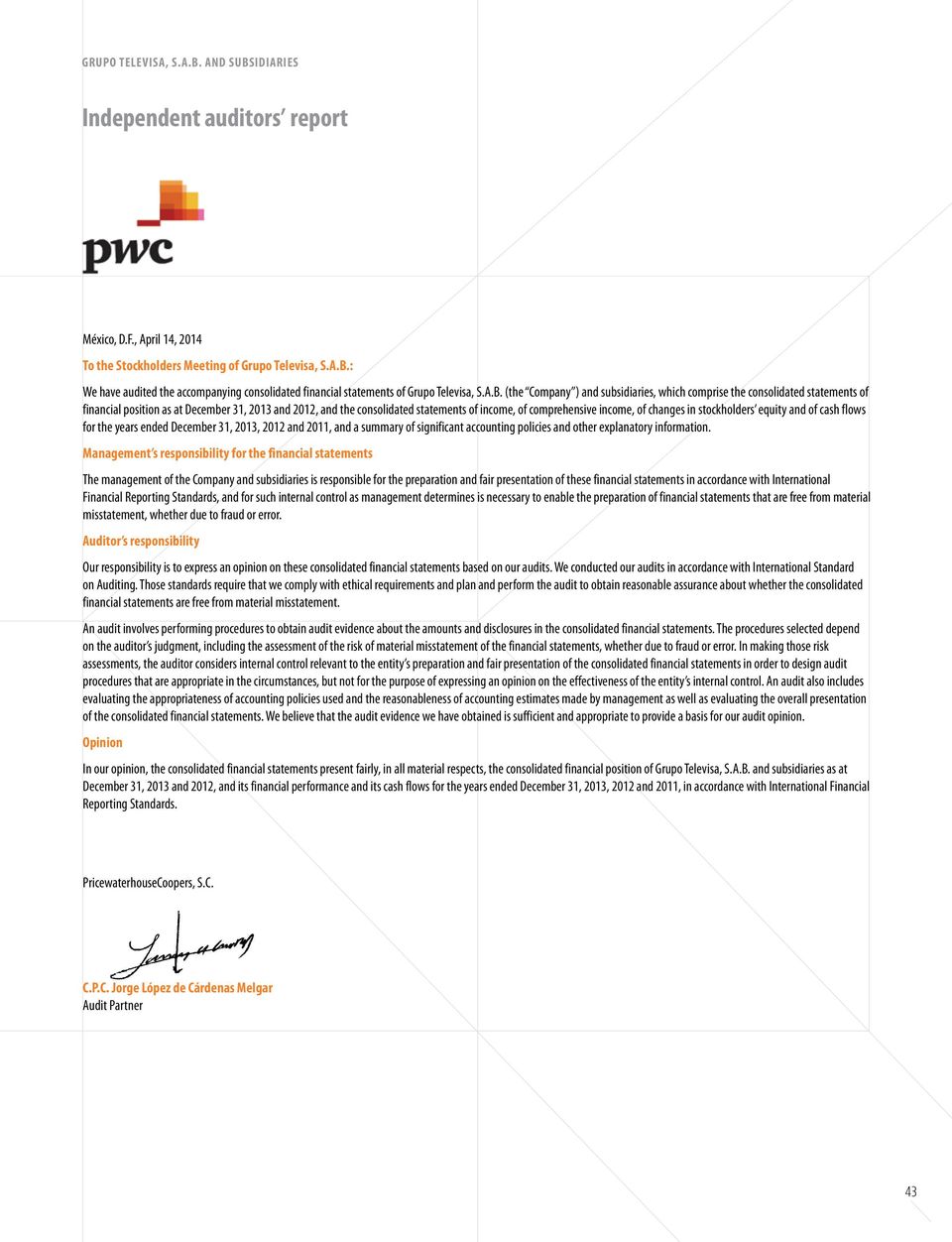
1 GRUPO TELEVISA, S.A.B. AND SUBSIDIARIES Independent auditors report México, D.F., April 14, 2014 To the Stockholders Meeting of Grupo Televisa, S.A.B.: We have audited the accompanying consolidated financial statements of Grupo Televisa, S.A.B. (the Company ) and subsidiaries, which comprise the consolidated statements of financial position as at December 31, 2013 and 2012, and the consolidated statements of income, of comprehensive income, of changes in stockholders equity and of cash flows for the years ended December 31, 2013, 2012 and 2011, and a summary of significant accounting policies and other explanatory information. Management s responsibility for the financial statements The management of the Company and subsidiaries is responsible for the preparation and fair presentation of these financial statements in accordance with International Financial Reporting Standards, and for such internal control as management determines is necessary to enable the preparation of financial statements that are free from material misstatement, whether due to fraud or error. Auditor s responsibility Our responsibility is to express an opinion on these consolidated financial statements based on our audits. We conducted our audits in accordance with International Standard on Auditing. Those standards require that we comply with ethical requirements and plan and perform the audit to obtain reasonable assurance about whether the consolidated financial statements are free from material misstatement. An audit involves performing procedures to obtain audit evidence about the amounts and disclosures in the consolidated financial statements. The procedures selected depend on the auditor s judgment, including the assessment of the risk of material misstatement of the financial statements, whether due to fraud or error. In making those risk assessments, the auditor considers internal control relevant to the entity s preparation and fair presentation of the consolidated financial statements in order to design audit procedures that are appropriate in the circumstances, but not for the purpose of expressing an opinion on the effectiveness of the entity s internal control. An audit also includes evaluating the appropriateness of accounting policies used and the reasonableness of accounting estimates made by management as well as evaluating the overall presentation of the consolidated financial statements. We believe that the audit evidence we have obtained is sufficient and appropriate to provide a basis for our audit opinion. Opinion In our opinion, the consolidated financial statements present fairly, in all material respects, the consolidated financial position of Grupo Televisa, S.A.B. and subsidiaries as at December 31, 2013 and 2012, and its financial performance and its cash flows for the years ended December 31, 2013, 2012 and 2011, in accordance with International Financial Reporting Standards. PricewaterhouseCoopers, S.C. C.P.C. Jorge López de Cárdenas Melgar Audit Partner 43 43
2 GRUPO TELEVISA, S.A.B. AND SUBSIDIARIES Consolidated statements of financial position As of December 31, 2013 and 2012 (In thousands of Mexican Pesos) (Notes 1, 2 and 3) Notes ASSETS Current assets: Cash and cash equivalents 6 Ps. 16,692,033 Ps. 19,063,325 Temporary investments 6 3,722,976 5,317,296 Trade notes and accounts receivable, net 7 20,734,137 18,982,277 Other accounts and notes receivable, net 2,405,871 2,475,533 Derivative financial instruments 14 3,447 2,373 Due from affiliated companies 19 1,353,641 1,436,892 Transmission rights and programming 8 4,970,603 4,462,348 Inventories, net 1,718,366 1,508,581 Other current assets 1,606,671 1,389,129 Total current assets 53,207,745 54,637,754 Non-current assets: Accounts receivable 334,775 Derivative financial instruments 14 4,941 12,627 Transmission rights and programming 8 9,064,845 6,435,609 Investments in financial instruments 9 38,016,402 20,867,624 Investments in joint ventures and associates 10 18,250,764 22,111,315 Property, plant and equipment, net 11 53,476,475 48,267,322 Intangible assets, net 12 11,382,311 11,126,791 Deferred income taxes 23 10,608,778 1,100,731 Other assets 96, ,603 Total non-current assets 140,901, ,359,397 Total assets Ps. 194,108,920 Ps. 164,997, The accompanying notes are an integral part of these consolidated financial statements.

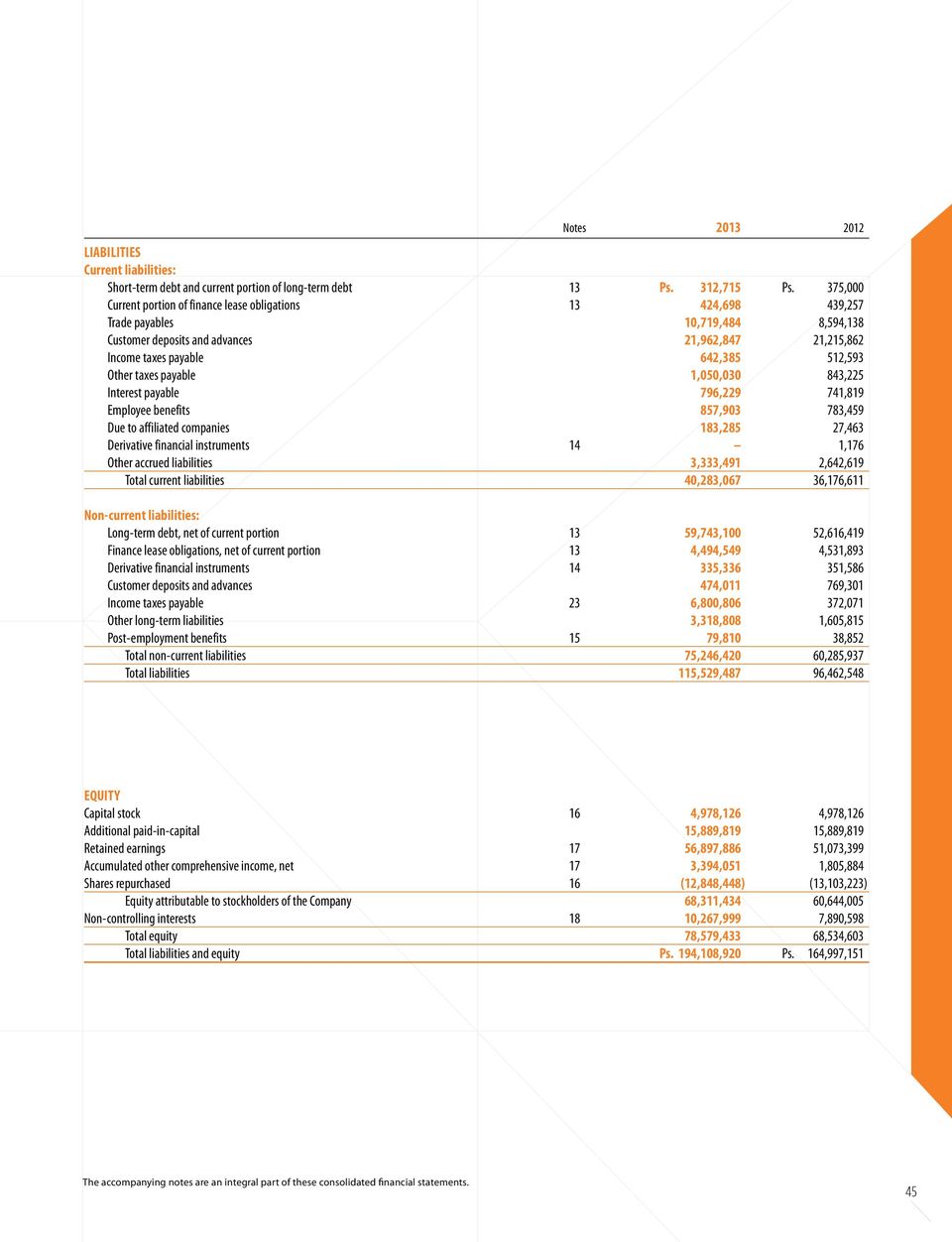
3 Notes LIABILITIES Current liabilities: Short-term debt and current portion of long-term debt 13 Ps. 312,715 Ps. 375,000 Current portion of finance lease obligations , ,257 Trade payables 10,719,484 8,594,138 Customer deposits and advances 21,962,847 21,215,862 Income taxes payable 642, ,593 Other taxes payable 1,050, ,225 Interest payable 796, ,819 Employee benefits 857, ,459 Due to affiliated companies 183,285 27,463 Derivative financial instruments 14 1,176 Other accrued liabilities 3,333,491 2,642,619 Total current liabilities 40,283,067 36,176,611 Non-current liabilities: Long-term debt, net of current portion 13 59,743,100 52,616,419 Finance lease obligations, net of current portion 13 4,494,549 4,531,893 Derivative financial instruments , ,586 Customer deposits and advances 474, ,301 Income taxes payable 23 6,800, ,071 Other long-term liabilities 3,318,808 1,605,815 Post-employment benefits 15 79,810 38,852 Total non-current liabilities 75,246,420 60,285,937 Total liabilities 115,529,487 96,462,548 EQUITY Capital stock 16 4,978,126 4,978,126 Additional paid-in-capital 15,889,819 15,889,819 Retained earnings 17 56,897,886 51,073,399 Accumulated other comprehensive income, net 17 3,394,051 1,805,884 Shares repurchased 16 (12,848,448) (13,103,223) Equity attributable to stockholders of the Company 68,311,434 60,644,005 Non-controlling interests 18 10,267,999 7,890,598 Total equity 78,579,433 68,534,603 Total liabilities and equity Ps. 194,108,920 Ps. 164,997,151 The accompanying notes are an integral part of these consolidated financial statements. 45
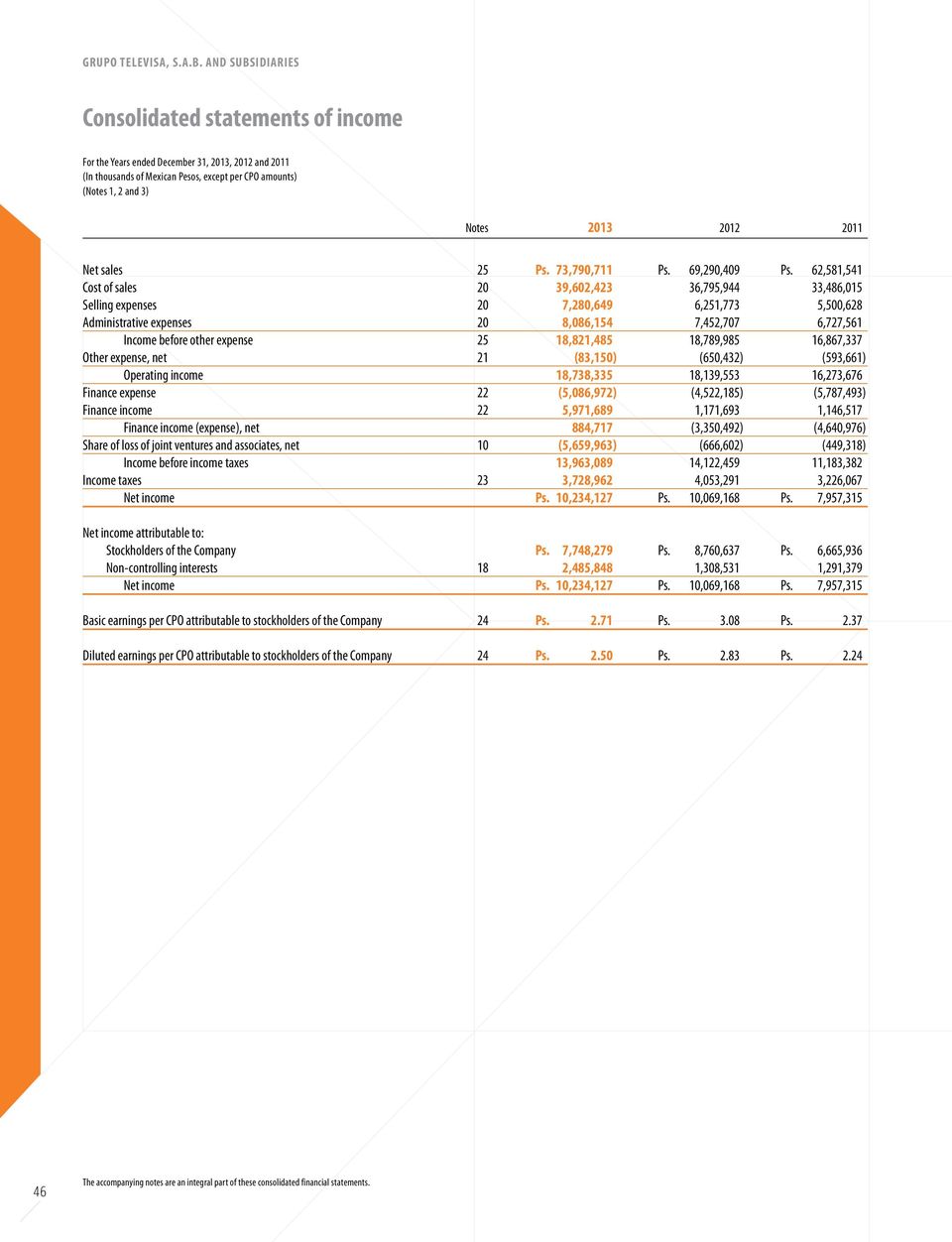
4 GRUPO TELEVISA, S.A.B. AND SUBSIDIARIES Consolidated statements of income For the Years ended December 31, 2013, 2012 and 2011 (In thousands of Mexican Pesos, except per CPO amounts) (Notes 1, 2 and 3) Notes 2011 Net sales 25 Ps. 73,790,711 Ps. 69,290,409 Ps. 62,581,541 Cost of sales 20 39,602,423 36,795,944 33,486,015 Selling expenses 20 7,280,649 6,251,773 5,500,628 Administrative expenses 20 8,086,154 7,452,707 6,727,561 Income before other expense 25 18,821,485 18,789,985 16,867,337 Other expense, net 21 (83,150) (650,432) (593,661) Operating income 18,738,335 18,139,553 16,273,676 Finance expense 22 (5,086,972) (4,522,185) (5,787,493) Finance income 22 5,971,689 1,171,693 1,146,517 Finance income (expense), net 884,717 (3,350,492) (4,640,976) Share of loss of joint ventures and associates, net 10 (5,659,963) (666,602) (449,318) Income before income taxes 13,963,089 14,122,459 11,183,382 Income taxes 23 3,728,962 4,053,291 3,226,067 Net income Ps. 10,234,127 Ps. 10,069,168 Ps. 7,957,315 Net income attributable to: Stockholders of the Company Ps. 7,748,279 Ps. 8,760,637 Ps. 6,665,936 Non-controlling interests 18 2,485,848 1,308,531 1,291,379 Net income Ps. 10,234,127 Ps. 10,069,168 Ps. 7,957,315 Basic earnings per CPO attributable to stockholders of the Company 24 Ps Ps Ps Diluted earnings per CPO attributable to stockholders of the Company 24 Ps Ps Ps The accompanying notes are an integral part of these consolidated financial statements.
5 GRUPO TELEVISA, S.A.B. AND SUBSIDIARIES Consolidated statements of comprehensive income For the Years Ended December 31, 2013, 2012 and 2011 (In thousands of Mexican Pesos) (Notes 1, 2 and 3) Notes 2011 Net income Ps. 10,234,127 Ps. 10,069,168 Ps. 7,957,315 Other comprehensive income (loss): Items that will not be reclassified to income: Remeasurement of post-employment benefit obligations ,863 (75,065) 2,218 Items that may be subsequently reclassified to income: Exchange differences on translating foreign operations 64,591 (287,343) 241,725 Equity instruments 9 254, ,948 Cash flow hedges 17,025 (141,098) 150, % Convertible debentures due 2025 issued by BMP 9 592,810 1,202, ,136 Convertible debentures issued by GSF: (Loss) gain from changes in fair value 9 (1,628,675) 695,675 Reclassification to other finance expense 9 933,000 Convertible debt instruments issued by Ares 9 100,333 Long-term debt instrument issued by Ares 9 (54,184) Available-for-sale investments 9 987, ,863 (402,187) Share of other comprehensive income (loss) of joint ventures and associates ,259 50,606 (37,314) Other comprehensive income before income taxes 2,202, ,725 1,195,269 Income taxes 23 (602,684) (183,474) (344,169) Other comprehensive income 1,599, , ,100 Total comprehensive income Ps. 11,833,473 Ps. 10,530,419 Ps. 8,808,415 Total comprehensive income attributable to: Stockholders of the Company Ps. 9,336,446 Ps. 9,243,319 Ps. 7,442,603 Non-controlling interests 18 2,497,027 1,287,100 1,365,812 Total comprehensive income Ps. 11,833,473 Ps. 10,530,419 Ps. 8,808,415 The accompanying notes are an integral part of these consolidated financial statements. 47

6 GRUPO TELEVISA, S.A.B. AND SUBSIDIARIES Consolidated statements of changes in equity For the Years Ended December 31, 2013, 2012 and 2011 (In thousands of Mexican Pesos) (Notes 1, 2 and 3) Capital Stock Retained Issued Additional Earnings (Note 16) Paid-in Capital (Note 17) Balance at January 1, 2011 Ps. 4,883,782 Ps. 3,844,524 Ps. 41,493,638 Dividends (1,023,012) Shares issued 120,787 10,379,213 Shares repurchased Sale of shares (697,467) Acquisition of a non-controlling interest in Cablemás (Note 3) 36,239 1,666,082 (1,595,796) Stock-based compensation 649,325 Other adjustments to non-controlling interests Comprehensive income 6,665,936 Balance at December 31, ,040,808 15,889,819 45,492,624 Dividends (1,002,692) Share cancellation (62,682) (1,929,032) Shares repurchased Sale of shares (876,775) Stock-based compensation 628,637 Other adjustments to non-controlling interests Comprehensive income 8,760,637 Balance at December 31, ,978,126 15,889,819 51,073,399 Dividends (2,168,384) Adjustment for adoption of IAS 19, as amended (Note 1 (t)) (101,814) Shares repurchased Sale of shares (254,775) Stock-based compensation 601,181 Other adjustments to non-controlling interests Comprehensive income 7,748,279 Balance at December 31, 2013 Ps. 4,978,126 Ps.15,889,819 Ps. 56,897, The accompanying notes are an integral part of these consolidated financial statements.
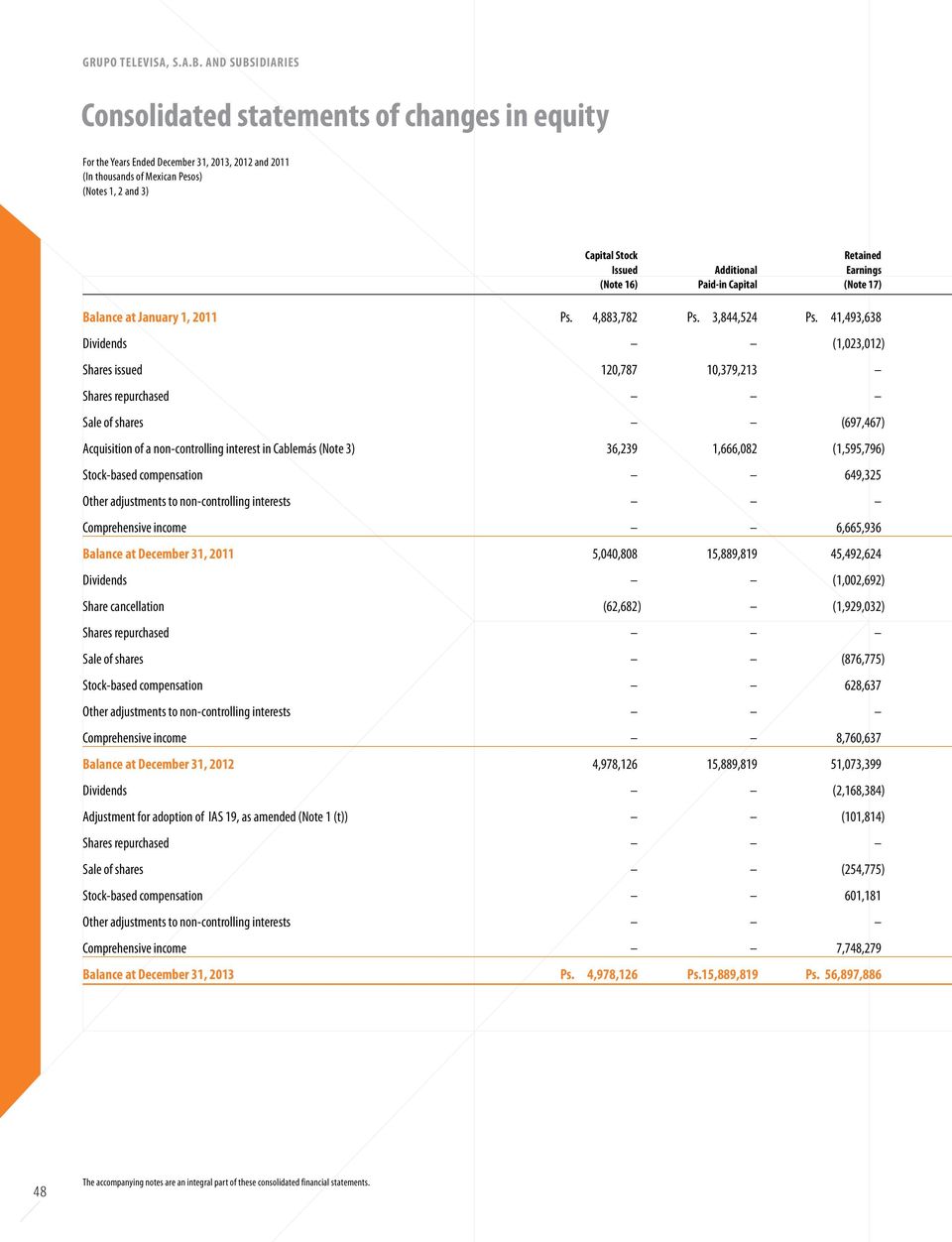
7 Accumulated Other Equity Comprehensive Shares Attributable to Non-controlling Income Repurchased Stockholders of Interests (Note 17) (Note 16) the Company (Note 18) Total Equity Ps. 546,535 Ps. (6,156,625) Ps. 44,611,854 Ps. 8,628,731 Ps. 53,240,585 (1,023,012) (2,202,243) (3,225,255) 10,500,000 (39,454) 10,460,546 (11,442,740) (11,442,740) (11,442,740) 1,627, , , ,525 (470,076) (363,551) 649, ,325 31,862 31, ,667 7,442,603 1,365,812 8,808,415 1,323,202 (15,971,710) 51,774,743 7,314,632 59,089,375 (1,002,692) (672,988) (1,675,680) 1,991,714 (533,038) (533,038) (533,038) 1,409, , , , ,637 (38,146) (38,146) 482,682 9,243,319 1,287,100 10,530,419 1,805,884 (13,103,223) 60,644,005 7,890,598 68,534,603 (2,168,384) (118,238) (2,286,622) (101,814) (1,088) (102,902) (1,057,083) (1,057,083) (1,057,083) 1,311,858 1,057,083 1,057, , ,181 (300) (300) 1,588,167 9,336,446 2,497,027 11,833,473 Ps. 3,394,051 Ps. (12,848,448) Ps. 68,311,434 Ps. 10,267,999 Ps. 78,579,433 49

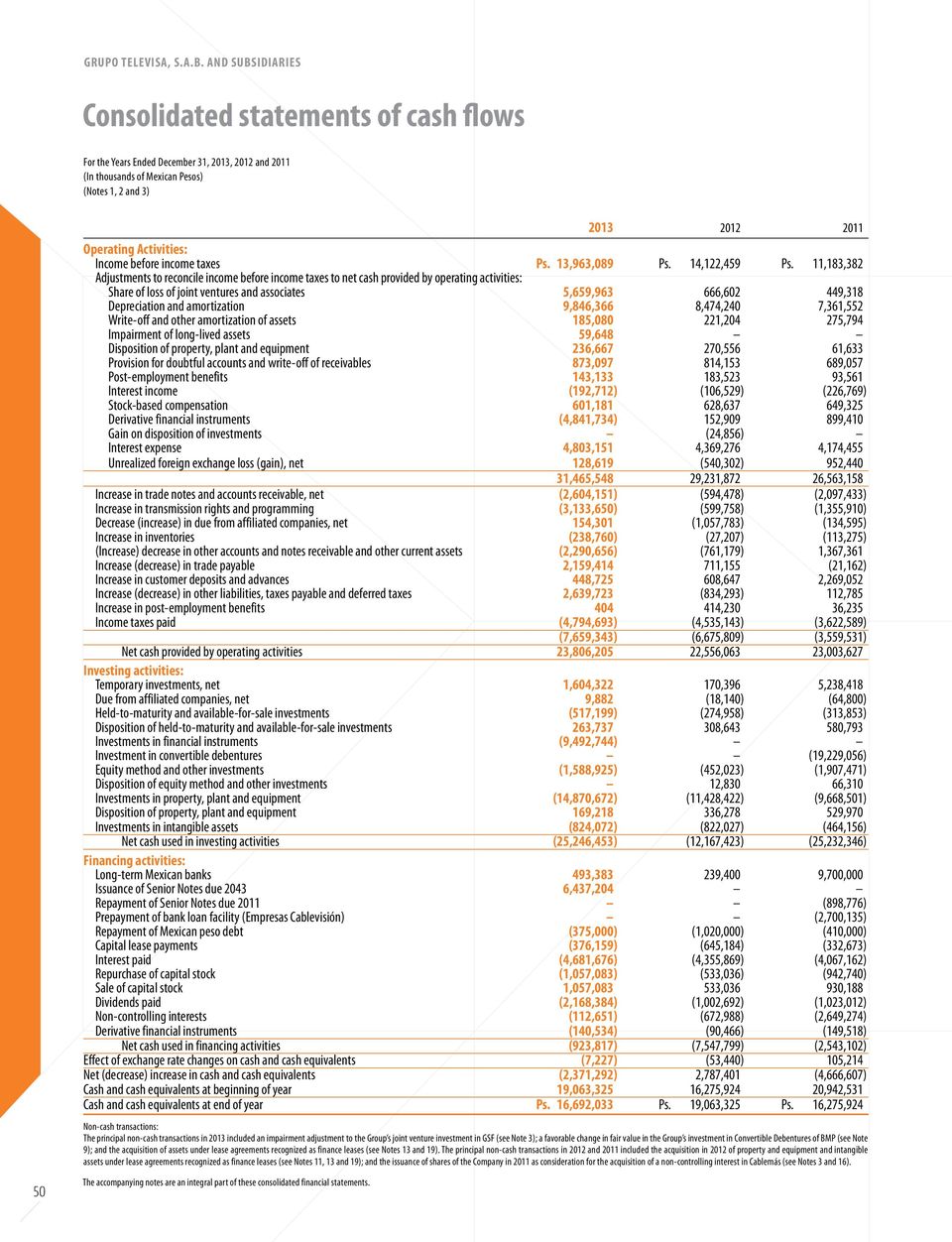
8 GRUPO TELEVISA, S.A.B. AND SUBSIDIARIES Consolidated statements of cash flows For the Years Ended December 31, 2013, 2012 and 2011 (In thousands of Mexican Pesos) (Notes 1, 2 and 3) 2011 Operating Activities: before income taxes to net cash provided by operating activities: Share of loss of joint ventures and associates 5,659, , ,318 Depreciation and amortization 9,846,366 8,474,240 7,361,552 Write-off and other amortization of assets 185, , ,794 Impairment of long-lived assets 59,648 Disposition of property, plant and equipment 236, ,556 61,633 Provision for doubtful accounts and write-off of receivables 873, , ,057 Post-employment benefits 143, ,523 93,561 Interest income (192,712) (106,529) (226,769) Stock-based compensation 601, , ,325 Derivative financial instruments (4,841,734) 152, ,410 Gain on disposition of investments (24,856) Interest expense 4,803,151 4,369,276 4,174,455 Income before income taxes Adjustments to reconcile income Ps. 13,963,089 Ps. 14,122,459 Ps. 11,183,382 Unrealized foreign exchange loss (gain), net 128,619 (540,302) 952,440 31,465,548 29,231,872 26,563,158 Increase in trade notes and accounts receivable, net (2,604,151) (594,478) (2,097,433) Increase in transmission rights and programming (3,133,650) (599,758) (1,355,910) Decrease (increase) in due from affiliated companies, net 154,301 (1,057,783) (134,595) Increase in inventories (238,760) (27,207) (113,275) (Increase) decrease in other accounts and notes receivable and other current assets (2,290,656) (761,179) 1,367,361 Increase (decrease) in trade payable 2,159, ,155 (21,162) Increase in customer deposits and advances 448, ,647 2,269,052 Increase (decrease) in other liabilities, taxes payable and deferred taxes 2,639,723 (834,293) 112,785 Increase in post-employment benefits ,230 36,235 Income taxes paid (4,794,693) (4,535,143) (3,622,589) (7,659,343) (6,675,809) (3,559,531) Net cash provided by operating activities 23,806,205 22,556,063 23,003,627 Investing activities: Temporary investments, net 1,604, ,396 5,238,418 Due from affiliated companies, net 9,882 (18,140) (64,800) Held-to-maturity and available-for-sale investments (517,199) (274,958) (313,853) Disposition of held-to-maturity and available-for-sale investments 263, , ,793 Investments in financial instruments (9,492,744) Investment in convertible debentures (19,229,056) Equity method and other investments (1,588,925) (452,023) (1,907,471) Disposition of equity method and other investments 12,830 66,310 Investments in property, plant and equipment (14,870,672) (11,428,422) (9,668,501) Disposition of property, plant and equipment 169, , ,970 Investments in intangible assets (824,072) (822,027) (464,156) Net cash used in investing activities (25,246,453) (12,167,423) (25,232,346) Financing activities: Long-term Mexican banks 493, ,400 9,700,000 Issuance of Senior Notes due ,437,204 Repayment of Senior Notes due 2011 (898,776) Prepayment of bank loan facility (Empresas Cablevisión) (2,700,135) Repayment of Mexican peso debt (375,000) (1,020,000) (410,000) Capital lease payments (376,159) (645,184) (332,673) Interest paid (4,681,676) (4,355,869) (4,067,162) Repurchase of capital stock (1,057,083) (533,036) (942,740) Sale of capital stock 1,057, , ,188 Dividends paid (2,168,384) (1,002,692) (1,023,012) Non-controlling interests (112,651) (672,988) (2,649,274) Derivative financial instruments (140,534) (90,466) (149,518) Net cash used in financing activities (923,817) (7,547,799) (2,543,102) Effect of exchange rate changes on cash and cash equivalents (7,227) (53,440) 105,214 Net (decrease) increase in cash and cash equivalents (2,371,292) 2,787,401 (4,666,607) Cash and cash equivalents at beginning of year 19,063,325 16,275,924 20,942,531 Cash and cash equivalents at end of year Ps. 16,692,033 Ps. 19,063,325 Ps. 16,275,924 Non-cash transactions: The principal non-cash transactions in 2013 included an impairment adjustment to the Group s joint venture investment in GSF (see Note 3); a favorable change in fair value in the Group s investment in Convertible Debentures of BMP (see Note 9); and the acquisition of assets under lease agreements recognized as finance leases (see Notes 13 and 19). The principal non-cash transactions in 2012 and 2011 included the acquisition in 2012 of property and equipment and intangible assets under lease agreements recognized as finance leases (see Notes 11, 13 and 19); and the issuance of shares of the Company in 2011 as consideration for the acquisition of a non-controlling interest in Cablemás (see Notes 3 and 16). 50 The accompanying notes are an integral part of these consolidated financial statements.
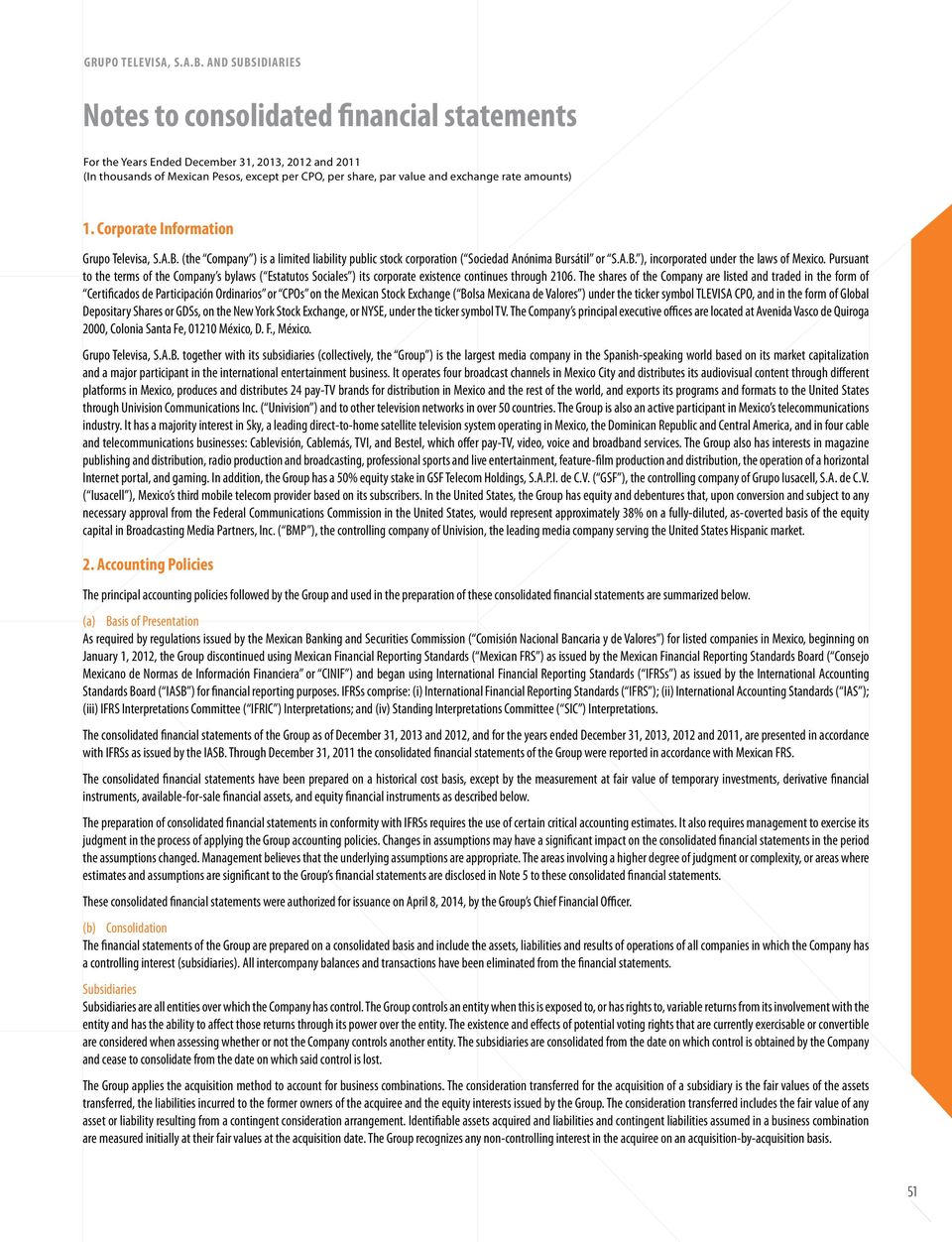
9 GRUPO TELEVISA, S.A.B. AND SUBSIDIARIES Notes to consolidated financial statements For the Years Ended December 31, 2013, 2012 and 2011 (In thousands of Mexican Pesos, except per CPO, per share, par value and exchange rate amounts) 1. Corporate Information Grupo Televisa, S.A.B. (the Company ) is a limited liability public stock corporation ( Sociedad Anónima Bursátil or S.A.B. ), incorporated under the laws of Mexico. Pursuant to the terms of the Company s bylaws ( Estatutos Sociales ) its corporate existence continues through The shares of the Company are listed and traded in the form of Certificados de Participación Ordinarios or CPOs on the Mexican Stock Exchange ( Bolsa Mexicana de Valores ) under the ticker symbol TLEVISA CPO, and in the form of Global Depositary Shares or GDSs, on the New York Stock Exchange, or NYSE, under the ticker symbol TV. The Company s principal executive offices are located at Avenida Vasco de Quiroga 2000, Colonia Santa Fe, México, D. F., México. Grupo Televisa, S.A.B. together with its subsidiaries (collectively, the Group ) is the largest media company in the Spanish-speaking world based on its market capitalization and a major participant in the international entertainment business. It operates four broadcast channels in Mexico City and distributes its audiovisual content through different platforms in Mexico, produces and distributes 24 pay-tv brands for distribution in Mexico and the rest of the world, and exports its programs and formats to the United States through Univision Communications Inc. ( Univision ) and to other television networks in over 50 countries. The Group is also an active participant in Mexico s telecommunications industry. It has a majority interest in Sky, a leading direct-to-home satellite television system operating in Mexico, the Dominican Republic and Central America, and in four cable and telecommunications businesses: Cablevisión, Cablemás, TVI, and Bestel, which offer pay-tv, video, voice and broadband services. The Group also has interests in magazine publishing and distribution, radio production and broadcasting, professional sports and live entertainment, feature-film production and distribution, the operation of a horizontal Internet portal, and gaming. In addition, the Group has a 50% equity stake in GSF Telecom Holdings, S.A.P.I. de C.V. ( GSF ), the controlling company of Grupo Iusacell, S.A. de C.V. ( Iusacell ), Mexico s third mobile telecom provider based on its subscribers. In the United States, the Group has equity and debentures that, upon conversion and subject to any necessary approval from the Federal Communications Commission in the United States, would represent approximately 38% on a fully-diluted, as-coverted basis of the equity capital in Broadcasting Media Partners, Inc. ( BMP ), the controlling company of Univision, the leading media company serving the United States Hispanic market. 2. Accounting Policies The principal accounting policies followed by the Group and used in the preparation of these consolidated financial statements are summarized below. (a) Basis of Presentation As required by regulations issued by the Mexican Banking and Securities Commission ( Comisión Nacional Bancaria y de Valores ) for listed companies in Mexico, beginning on January 1, 2012, the Group discontinued using Mexican Financial Reporting Standards ( Mexican FRS ) as issued by the Mexican Financial Reporting Standards Board ( Consejo Mexicano de Normas de Información Financiera or CINIF ) and began using International Financial Reporting Standards ( IFRSs ) as issued by the International Accounting Standards Board ( IASB ) for financial reporting purposes. IFRSs comprise: (i) International Financial Reporting Standards ( IFRS ); (ii) International Accounting Standards ( IAS ); (iii) IFRS Interpretations Committee ( IFRIC ) Interpretations; and (iv) Standing Interpretations Committee ( SIC ) Interpretations. The consolidated financial statements of the Group as of December 31, 2013 and 2012, and for the years ended December 31, 2013, 2012 and 2011, are presented in accordance with IFRSs as issued by the IASB. Through December 31, 2011 the consolidated financial statements of the Group were reported in accordance with Mexican FRS. The consolidated financial statements have been prepared on a historical cost basis, except by the measurement at fair value of temporary investments, derivative financial instruments, available-for-sale financial assets, and equity financial instruments as described below. The preparation of consolidated financial statements in conformity with IFRSs requires the use of certain critical accounting estimates. It also requires management to exercise its judgment in the process of applying the Group accounting policies. Changes in assumptions may have a significant impact on the consolidated financial statements in the period the assumptions changed. Management believes that the underlying assumptions are appropriate. The areas involving a higher degree of judgment or complexity, or areas where estimates and assumptions are significant to the Group s financial statements are disclosed in Note 5 to these consolidated financial statements. These consolidated financial statements were authorized for issuance on April 8, 2014, by the Group s Chief Financial Officer. (b) Consolidation The financial statements of the Group are prepared on a consolidated basis and include the assets, liabilities and results of operations of all companies in which the Company has a controlling interest (subsidiaries). All intercompany balances and transactions have been eliminated from the financial statements. Subsidiaries Subsidiaries are all entities over which the Company has control. The Group controls an entity when this is exposed to, or has rights to, variable returns from its involvement with the entity and has the ability to affect those returns through its power over the entity. The existence and effects of potential voting rights that are currently exercisable or convertible are considered when assessing whether or not the Company controls another entity. The subsidiaries are consolidated from the date on which control is obtained by the Company and cease to consolidate from the date on which said control is lost. The Group applies the acquisition method to account for business combinations. The consideration transferred for the acquisition of a subsidiary is the fair values of the assets transferred, the liabilities incurred to the former owners of the acquiree and the equity interests issued by the Group. The consideration transferred includes the fair value of any asset or liability resulting from a contingent consideration arrangement. Identifiable assets acquired and liabilities and contingent liabilities assumed in a business combination are measured initially at their fair values at the acquisition date. The Group recognizes any non-controlling interest in the acquiree on an acquisition-by-acquisition basis. 51
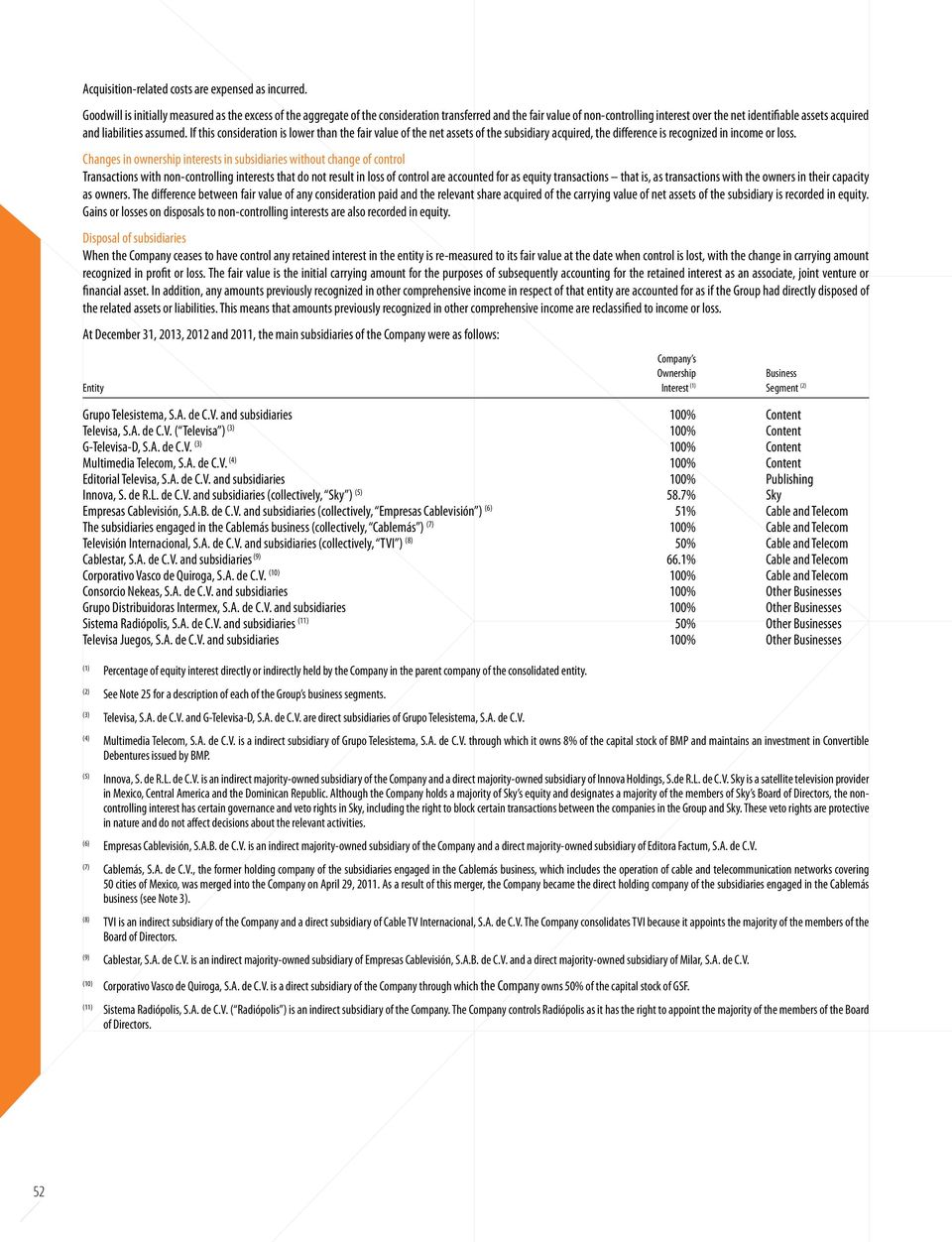
10 Acquisition-related costs are expensed as incurred. Goodwill is initially measured as the excess of the aggregate of the consideration transferred and the fair value of non-controlling interest over the net identifiable assets acquired and liabilities assumed. If this consideration is lower than the fair value of the net assets of the subsidiary acquired, the difference is recognized in income or loss. Changes in ownership interests in subsidiaries without change of control Transactions with non-controlling interests that do not result in loss of control are accounted for as equity transactions that is, as transactions with the owners in their capacity as owners. The difference between fair value of any consideration paid and the relevant share acquired of the carrying value of net assets of the subsidiary is recorded in equity. Gains or losses on disposals to non-controlling interests are also recorded in equity. Disposal of subsidiaries When the Company ceases to have control any retained interest in the entity is re-measured to its fair value at the date when control is lost, with the change in carrying amount recognized in profit or loss. The fair value is the initial carrying amount for the purposes of subsequently accounting for the retained interest as an associate, joint venture or financial asset. In addition, any amounts previously recognized in other comprehensive income in respect of that entity are accounted for as if the Group had directly disposed of the related assets or liabilities. This means that amounts previously recognized in other comprehensive income are reclassified to income or loss. At December 31, 2013, 2012 and 2011, the main subsidiaries of the Company were as follows: Company s Ownership Business Entity Interest (1) Segment (2) Grupo Telesistema, S.A. de C.V. and subsidiaries 100% Content Televisa, S.A. de C.V. ( Televisa ) (3) 100% Content G-Televisa-D, S.A. de C.V. (3) 100% Content Multimedia Telecom, S.A. de C.V. (4) 100% Content Editorial Televisa, S.A. de C.V. and subsidiaries 100% Publishing Innova, S. de R.L. de C.V. and subsidiaries (collectively, Sky ) (5) 58.7% Sky Empresas Cablevisión, S.A.B. de C.V. and subsidiaries (collectively, Empresas Cablevisión ) (6) 51% Cable and Telecom The subsidiaries engaged in the Cablemás business (collectively, Cablemás ) (7) 100% Cable and Telecom Televisión Internacional, S.A. de C.V. and subsidiaries (collectively, TVI ) (8) 50% Cable and Telecom Cablestar, S.A. de C.V. and subsidiaries (9) 66.1% Cable and Telecom Corporativo Vasco de Quiroga, S.A. de C.V. (10) 100% Cable and Telecom Consorcio Nekeas, S.A. de C.V. and subsidiaries 100% Other Businesses Grupo Distribuidoras Intermex, S.A. de C.V. and subsidiaries 100% Other Businesses Sistema Radiópolis, S.A. de C.V. and subsidiaries (11) 50% Other Businesses Televisa Juegos, S.A. de C.V. and subsidiaries 100% Other Businesses (1) Percentage of equity interest directly or indirectly held by the Company in the parent company of the consolidated entity. (2) See Note 25 for a description of each of the Group s business segments. (3) Televisa, S.A. de C.V. and G-Televisa-D, S.A. de C.V. are direct subsidiaries of Grupo Telesistema, S.A. de C.V. (4) Multimedia Telecom, S.A. de C.V. is a indirect subsidiary of Grupo Telesistema, S.A. de C.V. through which it owns 8% of the capital stock of BMP and maintains an investment in Convertible Debentures issued by BMP. (5) Innova, S. de R.L. de C.V. is an indirect majority-owned subsidiary of the Company and a direct majority-owned subsidiary of Innova Holdings, S.de R.L. de C.V. Sky is a satellite television provider in Mexico, Central America and the Dominican Republic. Although the Company holds a majority of Sky s equity and designates a majority of the members of Sky s Board of Directors, the noncontrolling interest has certain governance and veto rights in Sky, including the right to block certain transactions between the companies in the Group and Sky. These veto rights are protective in nature and do not affect decisions about the relevant activities. (6) Empresas Cablevisión, S.A.B. de C.V. is an indirect majority-owned subsidiary of the Company and a direct majority-owned subsidiary of Editora Factum, S.A. de C.V. (7) Cablemás, S.A. de C.V., the former holding company of the subsidiaries engaged in the Cablemás business, which includes the operation of cable and telecommunication networks covering 50 cities of Mexico, was merged into the Company on April 29, As a result of this merger, the Company became the direct holding company of the subsidiaries engaged in the Cablemás business (see Note 3). (8) TVI is an indirect subsidiary of the Company and a direct subsidiary of Cable TV Internacional, S.A. de C.V. The Company consolidates TVI because it appoints the majority of the members of the Board of Directors. (9) Cablestar, S.A. de C.V. is an indirect majority-owned subsidiary of Empresas Cablevisión, S.A.B. de C.V. and a direct majority-owned subsidiary of Milar, S.A. de C.V. (10) Corporativo Vasco de Quiroga, S.A. de C.V. is a direct subsidiary of the Company through which the Company owns 50% of the capital stock of GSF. (11) Sistema Radiópolis, S.A. de C.V. ( Radiópolis ) is an indirect subsidiary of the Company. The Company controls Radiópolis as it has the right to appoint the majority of the members of the Board of Directors. 52
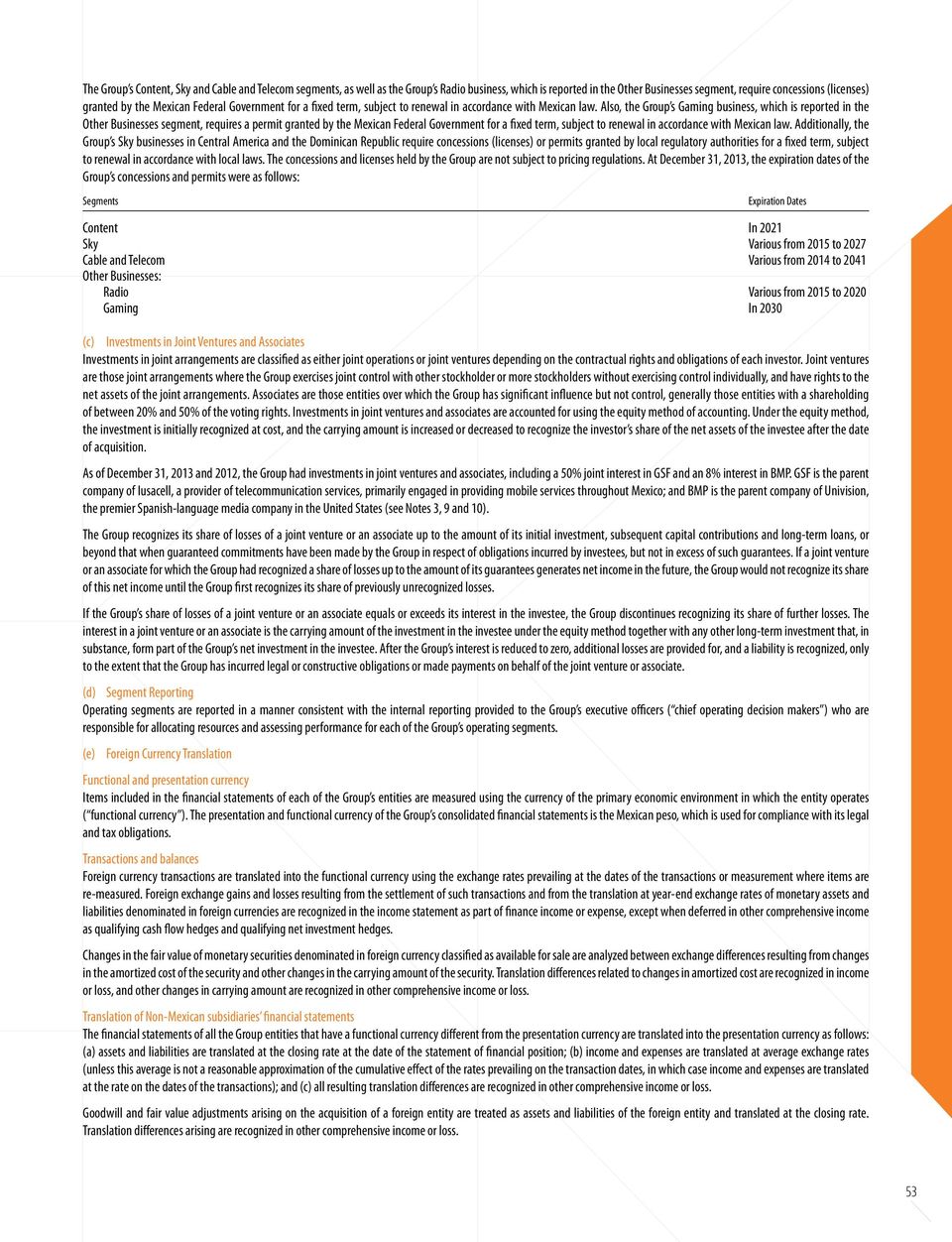
11 The Group s Content, Sky and Cable and Telecom segments, as well as the Group s Radio business, which is reported in the Other Businesses segment, require concessions (licenses) granted by the Mexican Federal Government for a fixed term, subject to renewal in accordance with Mexican law. Also, the Group s Gaming business, which is reported in the Other Businesses segment, requires a permit granted by the Mexican Federal Government for a fixed term, subject to renewal in accordance with Mexican law. Additionally, the Group s Sky businesses in Central America and the Dominican Republic require concessions (licenses) or permits granted by local regulatory authorities for a fixed term, subject to renewal in accordance with local laws. The concessions and licenses held by the Group are not subject to pricing regulations. At December 31, 2013, the expiration dates of the Group s concessions and permits were as follows: Segments Expiration Dates Content In 2021 Sky Various from 2015 to 2027 Cable and Telecom Various from 2014 to 2041 Other Businesses: Radio Various from 2015 to 2020 Gaming In 2030 (c) Investments in Joint Ventures and Associates Investments in joint arrangements are classified as either joint operations or joint ventures depending on the contractual rights and obligations of each investor. Joint ventures are those joint arrangements where the Group exercises joint control with other stockholder or more stockholders without exercising control individually, and have rights to the net assets of the joint arrangements. Associates are those entities over which the Group has significant influence but not control, generally those entities with a shareholding of between 20% and 50% of the voting rights. Investments in joint ventures and associates are accounted for using the equity method of accounting. Under the equity method, the investment is initially recognized at cost, and the carrying amount is increased or decreased to recognize the investor s share of the net assets of the investee after the date of acquisition. As of December 31, 2013 and 2012, the Group had investments in joint ventures and associates, including a 50% joint interest in GSF and an 8% interest in BMP. GSF is the parent company of Iusacell, a provider of telecommunication services, primarily engaged in providing mobile services throughout Mexico; and BMP is the parent company of Univision, the premier Spanish-language media company in the United States (see Notes 3, 9 and 10). The Group recognizes its share of losses of a joint venture or an associate up to the amount of its initial investment, subsequent capital contributions and long-term loans, or beyond that when guaranteed commitments have been made by the Group in respect of obligations incurred by investees, but not in excess of such guarantees. If a joint venture or an associate for which the Group had recognized a share of losses up to the amount of its guarantees generates net income in the future, the Group would not recognize its share of this net income until the Group first recognizes its share of previously unrecognized losses. If the Group s share of losses of a joint venture or an associate equals or exceeds its interest in the investee, the Group discontinues recognizing its share of further losses. The interest in a joint venture or an associate is the carrying amount of the investment in the investee under the equity method together with any other long-term investment that, in substance, form part of the Group s net investment in the investee. After the Group s interest is reduced to zero, additional losses are provided for, and a liability is recognized, only to the extent that the Group has incurred legal or constructive obligations or made payments on behalf of the joint venture or associate. (d) Segment Reporting Operating segments are reported in a manner consistent with the internal reporting provided to the Group s executive officers ( chief operating decision makers ) who are responsible for allocating resources and assessing performance for each of the Group s operating segments. (e) Foreign Currency Translation Functional and presentation currency Items included in the financial statements of each of the Group s entities are measured using the currency of the primary economic environment in which the entity operates ( functional currency ). The presentation and functional currency of the Group s consolidated financial statements is the Mexican peso, which is used for compliance with its legal and tax obligations. Transactions and balances Foreign currency transactions are translated into the functional currency using the exchange rates prevailing at the dates of the transactions or measurement where items are re-measured. Foreign exchange gains and losses resulting from the settlement of such transactions and from the translation at year-end exchange rates of monetary assets and liabilities denominated in foreign currencies are recognized in the income statement as part of finance income or expense, except when deferred in other comprehensive income as qualifying cash flow hedges and qualifying net investment hedges. Changes in the fair value of monetary securities denominated in foreign currency classified as available for sale are analyzed between exchange differences resulting from changes in the amortized cost of the security and other changes in the carrying amount of the security. Translation differences related to changes in amortized cost are recognized in income or loss, and other changes in carrying amount are recognized in other comprehensive income or loss. Translation of Non-Mexican subsidiaries financial statements The financial statements of all the Group entities that have a functional currency different from the presentation currency are translated into the presentation currency as follows: (a) assets and liabilities are translated at the closing rate at the date of the statement of financial position; (b) income and expenses are translated at average exchange rates (unless this average is not a reasonable approximation of the cumulative effect of the rates prevailing on the transaction dates, in which case income and expenses are translated at the rate on the dates of the transactions); and (c) all resulting translation differences are recognized in other comprehensive income or loss. Goodwill and fair value adjustments arising on the acquisition of a foreign entity are treated as assets and liabilities of the foreign entity and translated at the closing rate. Translation differences arising are recognized in other comprehensive income or loss. 53
12 Assets and liabilities of non-mexican subsidiaries that use the Mexican Peso as a functional currency are translated into Mexican Pesos by utilizing the exchange rate of the statement of financial position date for monetary assets and liabilities, and historical exchange rates for nonmonetary items, with the related adjustment included in the consolidated statement of income as income or finance expense. Beginning in the third quarter of 2011, the Group designated as an effective hedge of foreign exchange exposure a portion of the outstanding principal amount of its U.S. dollar denominated long-term debt in connection with its net investment in shares of common stock of BMP, which amounted to U.S.$218.9 million (Ps.2,862,147) and U.S.$197.7 million (Ps.2,539,814) as of December 31, 2013 and 2012, respectively. Consequently, any foreign exchange gain or loss attributable to this designated hedging long-term debt is credited or charged directly to other comprehensive income or loss as a cumulative result from foreign currency translation (see Notes 3, 9 and 23). (f) Cash and Cash Equivalents and Temporary Investments Cash and cash equivalents consist of cash on hand and all highly liquid investments with an original maturity of three months or less at the date of acquisition. Cash is stated at nominal value and cash equivalents are measured at fair value, and the changes in the fair value are recognized in the income statement. Temporary investments consist of short-term investments in securities, including without limitation debt with a maturity of over three months and up to one year at the date of acquisition, stock and/or other financial instruments, as well as current maturities of noncurrent held-to-maturity securities. Temporary investments are measured at fair value with changes in fair value recognized in the income statement, except the current maturities of non-current held-to-maturity securities which are measured at amortized cost. As of December 31, 2013 and 2012, cash equivalents and temporary investments primarily consisted of fixed short-term deposits and corporate fixed income securities denominated in U.S. dollars and Mexican pesos, with an average yield of approximately 0.12% for U.S. dollar deposits and 4.12% for Mexican peso deposits in 2013, and approximately 0.23% for U.S. dollar deposits and 4.56% for Mexican peso deposits in (g) Transmission Rights and Programming Programming is comprised of programs, literary works, production talent advances and films. Transmission rights and literary works are valued at the lesser of acquisition cost and net realizable value. Programs and films are valued at the lesser of production cost, which consists of direct production costs and production overhead, and net realizable value. Payments for production talent advances are initially capitalized and subsequently included as direct or indirect costs of program production. The Group s policy is to capitalize the production costs of programs which benefit more than one annual period and amortize them over the expected period of future program revenues based on the Company s historical revenue patterns for similar productions. Transmission rights, programs, literary works, production talent advances and films are recorded at acquisition or production cost. Cost of sales is calculated for the month in which such transmission rights, programs, literary works, production talent advances and films are matched with related revenues. Transmission rights are amortized over the lives of the contracts. Transmission rights in perpetuity are amortized on a straight-line basis over the period of the expected benefit as determined by past experience, but not exceeding 25 years. (h) Inventories Inventories of paper, magazines, materials and supplies are recorded at the lower of cost or its net realization value. The net realization value is the estimated selling price in the normal course of business, less costs estimated to conduct the sale. Cost is determined using the average cost method. (i) Financial Assets The Group classifies its financial assets in the following categories: loans and receivables, held-to-maturity investments, fair value through income and available-for-sale financial assets. The classification depends on the purpose for which the financial assets were acquired. Management determines the classification of its financial assets at initial recognition. Loans and Receivables Loans and receivables are non-derivative financial assets with fixed or determinable payments that are not quoted in an active market. Loans and receivables are initially recognized at fair value plus transaction costs and subsequently carried at amortized cost using the effective interest method, with changes in carrying value recognized in the income statement in the line which most appropriately reflects the nature of the item or transaction. They are included in current assets, except for maturities greater than 12 months after the end of the reporting period. These are classified as non-current assets. The Group s loans and receivables are presented as trade notes and accounts receivable and other accounts and notes receivable in the consolidated statement of financial position (see Note 7). Held-to-maturity Investments Held-to-maturity investments are non-derivative financial assets with fixed or determinable payments and fixed maturities that the Group s management has the positive intention and ability to hold to maturity. After initial measurement, held-to-maturity investments are measured at amortized cost using the effective interest rate method, less impairment, if any. Any gain or loss arising from these investments is included in finance income or loss in the consolidated statement of income. Held-to-maturity investments are included in investments in financial instruments, except for those with maturities less than 12 months from the end of the reporting period, which are classified as temporary investments (see Note 9). Available-for-sale Financial Assets Available-for-sale financial assets are non-derivative financial assets that are not classified as loans and receivables, held-to-maturity investments or financial assets at fair value through income or loss, and include debt securities and equity instruments. Debt securities in this category are those that are intended to be held for an indefinite period of time and that may be sold in response to needs for liquidity or in response to changes in the market conditions. Equity instruments in this category are those of companies in which the Group does not exercise joint control nor significant influence, but intent to hold for an indefinite term, and are neither classified as held for trading nor designated at fair value through income. After initial measurement, available-for-sale assets are measured at fair value with unrealized gains or losses recognized as other comprehensive income or loss until the investment is derecognized or the investment is determined to be impaired, at which time the cumulative gain or loss is recognized in the consolidated statement of income either in other finance income or expense (debt securities) or other income or expense (equity instruments). Interest earned whilst holding available-for-sale financial assets is reported as interest income using the effective interest rate method (see Notes 9 and 14). 54

13 Financial Assets at Fair Value through Income Financial assets at fair value through income are financial assets held for trading. A financial assets is classified in this category if acquired principally for the purpose of selling in the short term. Derivatives are also categorized as held for trading unless they are designated as hedges. Assets in this category are classified as current assets if expected to be settled within 12 months, otherwise they are classified as non-current. Impairment of Financial Assets The Group assesses at each statements of financial position date whether there is objective evidence that a financial asset or group of financial assets is impaired. A financial asset or a group of financial assets is impaired and impairment losses are incurred only if there is objective and other-than-temporary evidence of impairment as a result of one or more events that occurred after the initial recognition of the asset. If it is determined that a financial asset or group of financial assets have sustained a decline other than temporary in their value a charge is recognized in income in the related period. For financial assets classified as held-to-maturity the amount of the loss is measured as the difference between the asset s carrying amount and the present value of estimated future cash flows (excluding future credit losses that have not been incurred) discounted at the financial asset s original effective interest rate. Impairment of Financial Assets Recognized at Amortized Cost The Group assesses at the end of each reporting period whether there is objective evidence that a financial asset or group of financial assets measured at amortized cost is impaired. A financial asset or group of financial assets is impaired and impairment losses are incurred only if there is objective evidence of impairment as a result of one or more events that occurred after the initial recognition of the asset (a loss event ) and that loss event (or events) has an impact on the estimated future cash flows of the financial asset or group of financial assets that can be reliably estimated. (j) Property, Plant and Equipment Property, plant and equipment are recorded at acquisition cost. Subsequent costs are included in the asset s carrying amount or recognized as a separate asset, as appropriate, only when it is probable that future economic benefits associated with the item will flow to the Group and the cost of the item can be measured reliably. The carrying amount of the replaced part is derecognized. All other repairs and maintenance are charged to income or loss during the financial period in which they are incurred. Land is not depreciated. Depreciation of property, plant and equipment is based upon the carrying value of the assets in use and is computed using the straight-line method over the estimated useful lives of the asset, as follows: Estimated useful lives Buildings Building improvements Technical equipment Satellite transponders Furniture and fixtures Transportation equipment Computer equipment Leasehold improvements years 5-20 years 3-20 years 15 years 3-11 years 4-8 years 3-5 years 2-20 years The assets residual values and useful lives are reviewed, and adjusted if appropriate, at the end of each reporting period. An asset s carrying amount is written down immediately to its recoverable amount if the asset s carrying amount is greater than its estimated recoverable amount. Gains and losses on disposals are determined by comparing the proceeds with the carrying amount and are recognized within other income or expense in the consolidated income statement. (k) Intangible Assets Intangible assets are recognized at acquisition cost. Intangible assets acquired through business combinations are recorded at fair value at the date of acquisition. Intangible assets with indefinite useful lives, which include goodwill, publishing trademarks and television network concessions, are not amortized. Intangible assets with finite useful lives are amortized on a straight-line basis over their estimated useful lives, as follows: Estimated useful lives Licenses Subscriber lists Other intangible assets 3-14 years 4-10 years 3-20 years Goodwill Goodwill arises on the acquisition of subsidiaries and represents the excess of the consideration transferred over the Group s interest in net fair value of the identifiable assets, liabilities and contingent liabilities of the acquiree and the fair value of the non-controlling interest in the acquire. For the purpose of impairment testing, goodwill acquired in a business combination is allocated to each of the cash generating units ( CGUs ), or groups of CGUs, that are expected to benefit from the synergies of the combination. Each unit or group of units to which the goodwill is allocated represents the lowest level within the entity at which the goodwill is monitored for internal management purposes. Goodwill is monitored at the operating segment level. 55

14 Goodwill impairment reviews are undertaken annually or more frequently if events or changes in circumstances indicate a potential impairment. The carrying value of goodwill is compared to the recoverable amount, which is the higher of value in use and the fair value less costs to sell. Any impairment is recognized as an expense and may be subsequently reversed under certain circumstances. (l) Impairment of Long-lived Assets The Group reviews for impairment the carrying amounts of its long-lived assets, tangible and intangible, including goodwill (see Note 12), at least once a year, or whenever events or changes in business circumstances indicate that these carrying amounts may not be recoverable. An impairment loss is recognized for the amount by which the asset s carrying amount exceeds its recoverable amount. The recoverable amount is the higher of an asset s fair value less costs to sell and value in use. To determine whether an impairment exists, the carrying value of the reporting unit is compared with its recoverable amount. Fair value estimates are based on quoted market values in active markets, if available. If quoted market prices are not available, the estimate of fair value is based on various valuation techniques, including discounted value of estimated future cash flows, market multiples or third-party appraisal valuations. (m) Trade Payables Trade payables are obligations to pay for goods or services that have been acquired in the ordinary course of business from suppliers. Accounts payable are classified as current liabilities if payment is due within one year or less (or in the normal operating cycle of the business if longer). If not, they are presented as non-current liabilities. Trade payables are recognized initially at fair value and subsequently measured at amortized cost using the effective interest method. (n) Debt Debt is recognized initially at fair value, net of transaction costs incurred. Debt is subsequently carried at amortized cost; any difference between the proceeds (net of transaction costs) and the redemption value is recognized in the income statement over the period of the debt using the effective interest method. Fees paid on the establishment of debt facilities are recognized as transaction costs of the loan to the extent that it is probable that some or all of the facility will be drawn down. In this case, the fee is deferred until the draw-down occurs. To the extent there is no evidence that it is probable that some or all of the facility will be drawn down, the fee is capitalized as a pre-payment for liquidity services and amortized over the period of the facility to which it relates. (o) Customer Deposits and Advances Customer deposit and advance agreements for television advertising services provide that customers receive preferential prices that are fixed for the contract period for television broadcast advertising time based on rates established by the Group. Such rates vary depending on when the advertisement is aired, including the season, hour, day, rating and type of programming. (p) Provisions Provisions are recognized when the Group has a present legal or constructive obligation as a result of past events; it is probable that an outflow of resources will be required to settle the obligation; and the amount has been reliably estimated. Provisions are not recognized for future operating losses. Provisions are measured at the present value of the expenditures expected to be required to settle the obligation using a pre-tax rate that reflects current market assessments of the time value of money and the risks specific to the obligation. The increase in the provisions due to passage of time is recognized as interest expense. (q) Equity The capital stock and other equity accounts include the effect of restatement through December 31, 1997, determined by applying the change in the Mexican National Consumer Price Index between the dates capital was contributed or net results were generated and December 31, 1997, the date through which the Mexican economy was considered hyperinflationary under the guidelines of the IFRSs. The restatement represented the amount required to maintain the contributions and accumulated results in Mexican Pesos in purchasing power as of December 31, (r) Revenue Recognition Revenue is measured at the fair value of the consideration received or receivable, and represents amounts receivable for services provided. The Group recognizes revenue when the amount of revenue can be reliably measured; when it is probable that future economic benefits will flow to the entity; and when specific criteria have been met for each of the Group s activities, as described below. The Group bases its estimate of return on historical results, taking into consideration the type of customer, the type of transaction and the specifics of each arrangement. The Group derives the majority of its revenues from media and entertainment-related business activities both in Mexico and internationally. Revenues are recognized when the service is provided and collection is probable. A summary of revenue recognition policies by significant activity is as follows: Advertising revenues, including deposits and advances from customers for future advertising, are recognized at the time the advertising services are rendered. Revenues from program services for network subscription and licensed and syndicated television programs are recognized when the programs are sold and become available for broadcast. Revenues from magazine subscriptions are initially deferred and recognized proportionately as products are delivered to subscribers. Revenues from the sales of magazines are recognized on the date of circulation of delivered merchandise, net of a provision for estimated returns. Revenues from publishing distribution are recognized upon distribution of the products. Sky program service revenues, including advances from customers for future direct-to-home ( DTH ) program services, are recognized at the time the service is provided. Cable television, internet and telephone subscription, and pay-per-view and installation fees are recognized in the period in which the services are rendered. Revenues from telecommunications and data services are recognized in the period in which these services are provided. Telecommunications services include long distance and local telephony, as well as leasing and maintenance of telecommunications facilities. 56

15 Revenues from attendance to soccer games, including revenues from advance ticket sales for soccer games and other promotional events, are recognized on the date of the relevant event. Motion picture production and distribution revenues are recognized as the films are exhibited. Gaming revenues consist of the net win from gaming activities, which is the difference between amounts wagered and amounts paid to winning patrons. In respect to sales of multiple products or services, the Group evaluates whether it has fair value evidence for each deliverable in the transaction. For example, the Group sells cable television, internet and telephone subscription to subscribers in a bundled package at a rate lower than if the subscriber purchases each product on an individual basis. Subscription revenues received from such subscribers are allocated to each product in a pro-rata manner based on the fair value of each of the respective services. (s) Interest Income Interest income is recognized using the effective interest method. When a loan and receivable is impaired, the Group reduces the carrying amount to its recoverable amount, being the estimated future cash flow discounted at the original effective interest rate of the instrument, and continues unwinding the discount as interest income. Interest income on impaired loan and receivables is recognized using the original effective interest rate. (t) Employee Benefits Pension and Seniority Premium Obligations Plans exist for pensions and seniority premiums (post-employment benefits), for most of the Group s employees funded through irrevocable trusts. Increases or decreases in the consolidated liability or asset for post-employment benefits are based upon actuarial calculations. Contributions to the trusts are determined in accordance with actuarial estimates of funding requirements. Payments of post-employment benefits are made by the trust administrators. The defined benefit obligation is calculated annually using the projected unit credit method. The present value of the defined benefit obligation is determined by discounting the estimated future cash outflows using interest rates of government bonds that are denominated in the currency in which the benefits will be paid, and that have terms to maturity approximating to the terms of the related pension obligation. In the first quarter of 2013, the Group adopted the provisions of IAS 19, Employee Benefits, as amended, which became effective on January 1, The amended IAS 19 eliminated the corridor approach for the recognition of remeasurement of post-employment benefit obligations, and requires the calculation of finance costs on a net funding basis. Also, the amended IAS 19 requires the recognition of past service cost as an expense at the earlier of the following dates: (i) when the plan amendment or curtailment occurs; and (ii) when the entity recognizes related restructuring costs or termination benefits. As a result of the adoption of the amended IAS 19, the Group adjusted a consolidated unamortized past service cost balance and consolidated retained earnings as of January 1, 2013 in the aggregate amount of Ps.102,902 (see Note 15). Remeasurement of post-employment benefit obligations related to experience adjustments and changes in actuarial assumptions of post-employment benefits are recognized in the period in which they are incurred as part of other comprehensive income or loss in consolidated equity. Profit Sharing The employees profit sharing required to be paid under certain circumstances in Mexico, is recognized as a direct benefit to employees in the consolidated statements of income in the period in which it is incurred. Termination Benefits Termination benefits, which mainly represent severance payments by law, are recorded in the consolidated statement of income. The Group recognizes termination benefits at the earlier of the following dates: (a) when the Group can no longer withdraw the offer of those benefits; and (b) when the entity recognizes costs for a restructuring is within the scope of IAS 37 and involves the payment of termination benefits. (u) Income Taxes The income tax expense for the period comprises current and deferred income tax. Income tax is recognized in the consolidated statement of income, except to the extent that it relates to items recognized in other comprehensive income or directly in equity. In this case, the income tax is also recognized in other comprehensive income. The current income tax charge is calculated on the basis of the tax laws enacted or substantively enacted at the statement of financial position date in the countries where the Company and its subsidiaries operate and generate taxable income. Management periodically evaluates positions taken in tax returns with respect to situations in which applicable tax regulation is subject to interpretation. It establishes provisions where appropriate on the basis of amounts expected to be paid to the tax authorities. Deferred income tax is recognized, using the liability method, on temporary differences arising between the tax bases of assets and liabilities and their carrying amounts in the consolidated financial statements. However, deferred income tax liabilities are not recognized if they arise from the initial recognition of goodwill; deferred income tax is not accounted for if it arises from initial recognition of an asset or liability in a transaction (other than in a business combination) that at the time of the transaction affects neither accounting nor taxable income or loss. Deferred income tax is determined using tax rates (and laws) that have been enacted or substantively enacted by the statement of financial position date and are expected to apply when the related deferred income tax asset is realized or the deferred income tax liability is settled. Deferred income tax assets are recognized only to the extent that it is probable that future taxable profit will be available against which the temporary differences and tax loss carryforwards can be utilized. For this purpose, the Group takes into consideration all available positive and negative evidence, including factors such as market conditions, industry analysis, projected taxable income, carryforward periods, current tax structure, potential changes or adjustments in tax structure, and future reversals of existing temporary differences. Deferred income tax liability is provided on taxable temporary differences associated with investments in subsidiaries, joint ventures and associates, except for deferred income tax liability where the timing of the reversal of the temporary difference is controlled by the Group and it is probable that the temporary difference will not reverse in the foreseeable future. Deferred income tax asset is provided on deductible temporary differences associated with investments in subsidiaries, joint ventures and associates, to the extent that it is probable that there will be sufficient taxable income against which to utilize the benefit of the temporary difference and it is expected to reverse in the foreseeable future. 57

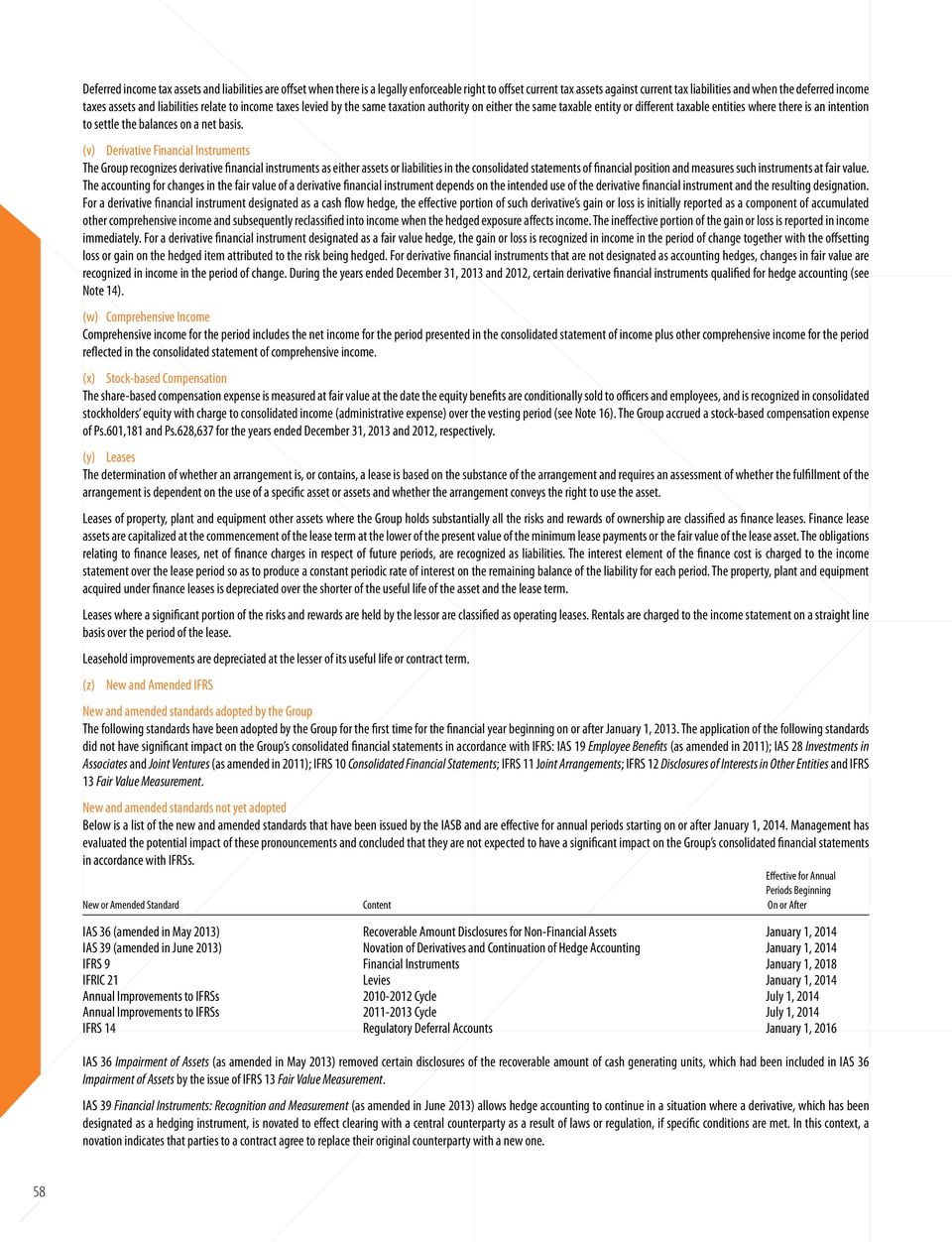
16 Deferred income tax assets and liabilities are offset when there is a legally enforceable right to offset current tax assets against current tax liabilities and when the deferred income taxes assets and liabilities relate to income taxes levied by the same taxation authority on either the same taxable entity or different taxable entities where there is an intention to settle the balances on a net basis. (v) Derivative Financial Instruments The Group recognizes derivative financial instruments as either assets or liabilities in the consolidated statements of financial position and measures such instruments at fair value. The accounting for changes in the fair value of a derivative financial instrument depends on the intended use of the derivative financial instrument and the resulting designation. For a derivative financial instrument designated as a cash flow hedge, the effective portion of such derivative s gain or loss is initially reported as a component of accumulated other comprehensive income and subsequently reclassified into income when the hedged exposure affects income. The ineffective portion of the gain or loss is reported in income immediately. For a derivative financial instrument designated as a fair value hedge, the gain or loss is recognized in income in the period of change together with the offsetting loss or gain on the hedged item attributed to the risk being hedged. For derivative financial instruments that are not designated as accounting hedges, changes in fair value are recognized in income in the period of change. During the years ended December 31, 2013 and 2012, certain derivative financial instruments qualified for hedge accounting (see Note 14). (w) Comprehensive Income Comprehensive income for the period includes the net income for the period presented in the consolidated statement of income plus other comprehensive income for the period reflected in the consolidated statement of comprehensive income. (x) Stock-based Compensation The share-based compensation expense is measured at fair value at the date the equity benefits are conditionally sold to officers and employees, and is recognized in consolidated stockholders equity with charge to consolidated income (administrative expense) over the vesting period (see Note 16). The Group accrued a stock-based compensation expense of Ps.601,181 and Ps.628,637 for the years ended December 31, 2013 and 2012, respectively. (y) Leases The determination of whether an arrangement is, or contains, a lease is based on the substance of the arrangement and requires an assessment of whether the fulfillment of the arrangement is dependent on the use of a specific asset or assets and whether the arrangement conveys the right to use the asset. Leases of property, plant and equipment other assets where the Group holds substantially all the risks and rewards of ownership are classified as finance leases. Finance lease assets are capitalized at the commencement of the lease term at the lower of the present value of the minimum lease payments or the fair value of the lease asset. The obligations relating to finance leases, net of finance charges in respect of future periods, are recognized as liabilities. The interest element of the finance cost is charged to the income statement over the lease period so as to produce a constant periodic rate of interest on the remaining balance of the liability for each period. The property, plant and equipment acquired under finance leases is depreciated over the shorter of the useful life of the asset and the lease term. Leases where a significant portion of the risks and rewards are held by the lessor are classified as operating leases. Rentals are charged to the income statement on a straight line basis over the period of the lease. Leasehold improvements are depreciated at the lesser of its useful life or contract term. (z) New and Amended IFRS New and amended standards adopted by the Group The following standards have been adopted by the Group for the first time for the financial year beginning on or after January 1, The application of the following standards did not have significant impact on the Group s consolidated financial statements in accordance with IFRS: IAS 19 Employee Benefits (as amended in 2011); IAS 28 Investments in Associates and Joint Ventures (as amended in 2011); IFRS 10 Consolidated Financial Statements; IFRS 11 Joint Arrangements; IFRS 12 Disclosures of Interests in Other Entities and IFRS 13 Fair Value Measurement. New and amended standards not yet adopted Below is a list of the new and amended standards that have been issued by the IASB and are effective for annual periods starting on or after January 1, Management has evaluated the potential impact of these pronouncements and concluded that they are not expected to have a significant impact on the Group s consolidated financial statements in accordance with IFRSs. Effective for Annual Periods Beginning New or Amended Standard Content On or After IAS 36 (amended in May 2013) Recoverable Amount Disclosures for Non-Financial Assets January 1, 2014 IAS 39 (amended in June 2013) Novation of Derivatives and Continuation of Hedge Accounting January 1, 2014 IFRS 9 Financial Instruments January 1, 2018 IFRIC 21 Levies January 1, 2014 Annual Improvements to IFRSs Cycle July 1, 2014 Annual Improvements to IFRSs Cycle July 1, 2014 IFRS 14 Regulatory Deferral Accounts January 1, 2016 IAS 36 Impairment of Assets (as amended in May 2013) removed certain disclosures of the recoverable amount of cash generating units, which had been included in IAS 36 Impairment of Assets by the issue of IFRS 13 Fair Value Measurement. IAS 39 Financial Instruments: Recognition and Measurement (as amended in June 2013) allows hedge accounting to continue in a situation where a derivative, which has been designated as a hedging instrument, is novated to effect clearing with a central counterparty as a result of laws or regulation, if specific conditions are met. In this context, a novation indicates that parties to a contract agree to replace their original counterparty with a new one. 58
17 IFRS 9 Financial Instruments ( IFRS 9 ) addresses the classification, measurement and recognition of financial assets and financial liabilities. IFRS 9 was issued in November 2009 and October It replaces the parts of IAS 39 Financial Instruments: Recognition and Measurement ( IAS 39 ) that relate to the classification and measurement of financial instruments. IFRS 9 requires financial assets to be classified into two measurement categories: those measured at amortized cost and those measured at fair value. The determination is made at initial recognition. The basis of classification depends on the entity s business model for managing its financial instruments and the contractual cash flow characteristics of the financial asset. The guidance in IAS 39 on impairment of financial assets and hedge accounting continues to apply. For financial liabilities, this standard retains most of the IAS 39 requirements. The main change is that, in cases where the fair value option is taken for financial liabilities, the part of a fair value change due to an entity s own credit risk is recorded in other comprehensive income rather than the income statement, unless this creates an accounting mismatch. Some amendments to IFRS 9 and IFRS 7 Financial Instruments: Disclosures ( IFRS 7 ) were issued in December These amendments to IFRS 9 modify the mandatory effective date of this standard and the relief from restating prior periods, and also add transition disclosures to IFRS 7 that are required to be applied when IFRS 9 is first applied. IFRIC 21 Levies was issued in May 2013 as an interpretation of IAS 37, Provisions, contingent liabilities and contingent assets ( IAS 37 ), on the accounting for levies imposed by governments. IAS 37 sets out criteria for the recognition of a liability, one of which is the requirement for the entity to have a present obligation as a result of a past event (known as an obligating event). The interpretation clarifies that the obligating event that give rise to a liability to pay a levy is the activity described in the relevant legislation that triggers the payment of the levy. Annual Improvements to IFRSs Cycle and Annual Improvements to IFRSs Cycle were published in December 2013 and set out amendments to certain IFRSs. These amendments result from proposals made during the IASB s Annual Improvements process, which provides a vehicle for making non-urgent but necessary amendments to IFRSs. The IFRSs amended and the topics addressed by these amendments are as follows: Annual Improvements Cycle Subject of Amendment IFRS 2 Share-based Payment IFRS 3 Business Combinations IFRS 8 Operating Segments IFRS 13 Fair Value Measurement IAS 16 Property, Plant and Equipment IAS 24 Related Party Disclosures IAS 38 Intangible Assets Annual Improvements Cycle IFRS 1 First-time Adoption of IFRSs IFRS 3 Business Combinations IFRS 13 Fair Value Measurement IAS 40 Investment property Definition of vesting condition Accounting for contingent consideration in a business combination Aggregation of operating segments. Reconciliation of the total of the reportable segments assets to the entity s assets Short-term receivables and payables Revaluation method proportionate restatement of accumulated depreciation Key management personnel Revaluation method proportionate restatement of accumulated amortization Subject of Amendment Meaning of effective IFRSs Scope exceptions for joint ventures Scope of paragraph 52 (portfolio exception) Clarifying the interrelationship between IFRS 3 and IAS 40 when classifying property as investment property or owner-occupied property IFRS 14 Regulatory Deferral Accounts ( IFRS 14 ) enhances the comparability of financial reporting by entities that are engaged in rate-regulated activities. IFRS 14 was issued in January 2014 as an interim standard and does not provide any specific guidance for rate-regulated activities, which are subject to a comprehensive project being developed by the IASB. IFRS 14 is intended for first-time adopters of IFRSs, and an entity that already presents IFRS financial statements is not eligible to apply this standard. 3. Acquisitions, Investments and Dispositions In July 2013, the Group made an investment in the amount of Ps.7,000,000 in convertible debt instruments which, subject to regulatory approvals, will allow the Group to acquire 95% of the equity interest of Tenedora Ares, S.A.P.I. de C.V. ( Ares ), owner of 51% of the equity interest of Grupo Cable TV, S.A. de C.V. ( Cablecom ), a telecommunications company that offers video, telephony, data and other telecom services in Mexico. In addition, Ares will have an option to acquire in the future, subject to regulatory approvals, the remaining 49% of the equity interest of Cablecom at a value of approximately 9.3 times earnings before interest, taxes, depreciation and amortization ( EBITDA ) of Cablecom, as defined, of the 12-month period preceding the closing of such acquisition. In addition, as part of this transaction, the Group also invested in a long-term debt instrument issued by Ares in the amount of U.S.$195 million (Ps.2,549,625) (see Notes 9, 14 and 19). In December 2011, the Company agreed to exchange on a non-cash basis its 40.8% interest in Gestora de Inversiones Audiovisuales La Sexta, S.A. ( La Sexta ), a free-to-air television channel in Spain, for a 14.5% equity participation in Imagina Media Audiovisual, S. L. ( Imagina ), a significant provider of content and audiovisual services for the media and entertainment industry in Spain. All closing conditions applicable to this transaction were met on February 29, 2012, and the Company recognized a pre-tax gain of Ps.24,856 as a result of this transaction in the consolidated statement of income for the year ended December 31, 2012, and classified its investment in Imagina as an equity financial instrument, with changes in related fair value recognized as other comprehensive income or loss (see Notes 9 and 21). 59

18 In April 2011, the Company, Iusacell and GSF reached an agreement under which the Group made an investment intended to hold a 50% equity stake in GSF, which consisted of (i) U.S.$37.5 million (Ps.442,001) in % of the outstanding shares of common stock of GSF, which amount was paid in cash by the Group in April 2011; and (ii) U.S.$1,565 million (Ps.19,229,056) in unsecured debentures issued by GSF that were mandatorily convertible into shares of common stock of GSF, subject to regulatory approval and other customary closing conditions. The debentures issued by GSF were divided into two tranches, the Series 1 Debentures and the Series 2 Debentures. The Series 1 Debentures were the 364,996 registered unsecured debentures of GSF, par value U.S.$1,000 each, representing in the aggregate U.S.$365 million (Ps.4,302,146), issued against the payment in cash made by the Group in April The Series 2 Debentures were the 1,200,000 registered unsecured debentures of GSF, par value U.S.$1,000 each, representing in the aggregate U.S.$1,200 million (Ps.14,926,910), issued against payments in cash made by the Group in the period from April through October 2011, in the aggregate amount of U.S.$1,200 million (Ps.14,926,910). These debentures had a conversion date on or before December 2015, with an annual interest rate of 2%, which was receivable on a quarterly basis. In addition, the Company agreed to make an additional payment of U.S.$400 million (Ps.5,230,000) to GSF if cumulative EBITDA of Iusacell, as defined, reaches U.S.$3,472 million (Ps.45,396,400) at any time between 2011 and In June 2012, (i) the Mexican Antitrust Commission approved, subject to the acceptance of certain conditions, the conversion by the Group of the debentures issued by GSF into common stock of GSF; (ii) the Group accepted the conditions established by the Mexican Antitrust Commission and converted the debentures issued by GSF into common stock of GSF; and (iii) GSF became a jointly controlled entity of the Group with a 50% interest and the Group began to share equal governance rights with the other owner of GSF. As of June 30, 2012, the Group recognized at fair value its 50% interest in GSF in the amount of Ps.18,738,057, which included related intangible assets, and began to account for this joint venture by using the equity method. Before that date, this investment was accounted for as an equity financial instrument with changes in fair value recognized in other comprehensive income or loss. In connection with the conversion of debentures into common stock of GSF, the Group reclassified a cumulative net loss in fair value of Ps.933,000 recognized in other comprehensive income or loss through June 30, 2012, to other finance expense in the consolidated statement of income for the year ended December 31, During 2013, the Group made capital contributions in connection with its 50% interest in GSF in the aggregate amount of Ps.1,587,500 (see Notes 9, 10 and 22). On March 31, 2011, the stockholders of Cablemás approved, among other matters, a capital increase in Cablemás, by which a wholly-owned subsidiary of the Company increased its equity interest in Cablemás from 58.3% to 90.8%. On April 29, 2011, the stockholders of the Company approved, among other matters: (i) the merger of Cablemás into the Company on that date, for which regulatory approvals were obtained in the first half of 2011; and (ii) an increase in the capital stock of the Company in connection with this merger, by which the Group s controlling interest in Cablemás increased from 90.8% to 100%. These transactions between stockholders, which were completed in October 2011, resulted in a net loss of Ps.1,595,796, which decreased retained earnings attributable to stockholders of the Company in the year ended December 31, 2011 (see Note 18). On December 20, 2010, the Group, Univision, BMP and other parties affiliated with the investor groups that owned BMP entered into various agreements and completed certain transactions. As a result, the Group: (i) made an aggregate cash investment of U.S.$1,255 million in BMP in the form of a capital contribution in the amount of U.S.$130 million (Ps.1,613,892), representing 5% of the outstanding shares of common stock of BMP, and 1.5% Convertible Debentures of BMP due 2025 in the principal amount of U.S.$1,125 million (Ps.13,904,222), which are convertible at the Company s option into additional shares equivalent to a 30% equity stake of BMP, subject to existing laws and regulations in the United States, and other conditions; (ii) acquired an option to purchase at fair value additional shares equivalent to a 5% equity stake of BMP, subject to existing laws and regulations in the United States, and other terms and conditions and (iii) sold to Univision its entire interest in TuTv, LLC ( TuTv ), which represented 50% of TuTv s capital stock, for an aggregate cash amount of U.S.$55 million (Ps.681,725). In connection with this investment, (i) the Company entered into an amended Program License Agreement ( PLA ) with Univision, pursuant to which Univision has the right to broadcast certain Televisa content in the United States for a term that commenced on January 1, 2011 and ends on the later of 2025 or seven and one-half years after the Group has sold two-thirds of its initial investment in BMP, and which includes an increased percentage of royalties from Univision and (ii) the Group entered into a new program license agreement with Univision, the Mexico License Agreement ( MLA ), under which the Group has the right to broadcast certain Univision s content in Mexico for the same term as that of the PLA. In connection with its option to purchase at fair value additional shares equivalent to a 5% equity of BMP, in the fourth quarter of 2011 and third quarter of 2012, the Group entered into agreements to buy from existing BMP stockholders additional 219,125 shares and 97,389 shares, respectively, of common stock of BMP in the aggregate cash amount of U.S.$49.1 million (Ps.669,392) and U.S.$22.5 million (Ps.301,534), respectively. As a result of these acquisitions, the Group increased its equity stake in BMP to 7.1% and 8%, respectively (see Notes 9, 10 and 22). 4. Financial Risk Management (a) Market Risk Market risk is the exposure to an adverse change in the value of financial instruments caused by market factors including changes in equity prices, interest rates, foreign currency exchange rates, commodity prices and inflation rates. The following information includes forward-looking statements that involve risks and uncertainties. Actual results could differ from those presented. The Group is exposed to market risks arising from changes in equity prices, interest rates, foreign currency exchange rates and inflation rates, in both the Mexican and U.S. markets. Risk management activities are monitored by the Risk Management Committee and reported to the Executive Committee. (i) Foreign Exchange Risk The Group is exposed to foreign exchange risk arising from various currency exposures, primarily with respect to the U.S. dollar and the Mexican peso. Foreign exchange risk arises from future commercial transactions, recognized assets and liabilities and net investments in foreign operations. Foreign currency exchange risk is monitored by assessing the net monetary liability position in U.S. dollars and the forecasted cash flow needs for anticipated U.S. dollar investments and servicing the Group s U.S. dollar denominated debt. Management has set up a policy to require Group companies to manage their foreign exchange risk against their functional currency. To manage their foreign exchange risk arising from future commercial transactions and recognized assets and liabilities, entities in the Group use forward contracts. In compliance with the procedures and controls established by the Risk Management Committee, in 2013 and 2012, the Group entered into certain derivative transactions with certain financial institutions in order to manage its exposure to market risks resulting from changes in interest rates, foreign currency exchange rates, and inflation rates. The objective in managing foreign currency and inflation fluctuations is to reduce earnings and cash flow volatility. 60

19 Foreign Currency Position The foreign currency position of monetary items of the Group at December 31, 2013, was as follows: Foreign Currency Amounts Year-End (Thousands) Exchange Rate Mexican Pesos Assets: U.S. Dollars 2,242,046 Ps Ps. 29,314,751 Euros 30, ,638 Argentinean Pesos 225, ,955 Chilean Pesos 4,263, ,172 Colombian Pesos 14,139, ,737 Other currencies 326,788 Liabilities: U.S. Dollars 2,980,274 Ps Ps. 38,967,082 Euros 10, ,363 Argentinean Pesos 156, ,985 Chilean Pesos 1,089, ,140 Colombian Pesos 11,948, ,056 Other currencies 83,433 As of April 8, 2014, the exchange rate was Ps per U.S. dollar, which represents the interbank free market exchange rate on that date as reported by Banco Nacional de México, S.A. The Group is also subject to the risk of foreign currency exchange rate fluctuations, resulting from the net monetary position in U.S. dollars of the Group s Mexican operations, as follows (in millions of U.S. dollars): December 31, U.S. dollar-denominated monetary assets, primarily cash and cash equivalents, held-to-maturity investments, non-current investments, and convertible debentures (1) U.S.$ 2,231.3 U.S.$ 2,285.5 U.S. dollar-denominated monetary liabilities, primarily trade accounts payable, Senior debt securities and other notes payable (2) (2,932.6) (2,745.3) Net liability position U.S.$ (701.3) U.S.$ (459.8) (1) In 2013 and 2012, include U.S. dollar equivalent amounts of U.S.$ 35.2 million and U.S.$108.4 million, respectively, related to other foreign currencies, primarily euros. (2) In 2013 and 2012, include U.S. dollar equivalent amounts of U.S.$14.1 million and U.S.$10.5 million, respectively, related to other foreign currencies, primarily euros. At December 31, 2013, a hypothetical 10% appreciation / depreciation in the U.S. dollar to Mexican peso exchange rate would result in a gain/loss in earnings of Ps.916,913. At December 31, 2012, a hypothetical 10% appreciation / depreciation in the U.S. dollar to Mexican peso exchange rate would result in a gain/loss in earnings of Ps.590,821. In December 2012 and 2011, the Group entered into foreign exchange option agreements to buy U.S.$135.0 million and U.S.$337.5 million, respectively, to hedge against a Mexican peso depreciation of 30% with various maturity dates until the end of 2015 and 2014, respectively. The fair value of these option contracts was an asset of Ps.6,122 and Ps.12,419 as of December 31, 2013 and 2012, respectively. (ii) Cash Flow Interest Rate Risk The Group monitors the exposure to interest rate risk by: (i) evaluating differences between interest rates on its outstanding debt and short-term investments and market interest rates on similar financial instruments; (ii) reviewing its cash flow needs and financial ratios (indebtedness and interest coverage); (iii) assessing current and forecasted trends in the relevant markets; and (iv) evaluating peer Group and industry practices. This approach allows the Group to determine the interest rate mix between variable and fixed rate debt. The Group s interest rate risk arises from long-term debt. Debt issued at variable rates expose the Group to cash flow interest rate risk which is partially offset by cash and cash equivalents held at variable rates. Debt issued at fixed rates expose the Group to fair value interest rate risk. During recent years the Group has maintained most of its debt in fixed rate instruments. Based on various scenarios, the Group manages its cash flow interest rate risk by using cross-currency interest rate swap agreements and floating-to-fixed interest rate swaps. Cross-currency interest rate swap agreements allow the Group to hedge against Mexican peso depreciation on the interest payments for medium-term periods. Interest rate swaps have the economic effect of converting borrowings from floating rates to fixed rates. Sensitivity and Fair Value Analyses The sensitivity analyses that follow are intended to present the hypothetical change in fair value or loss in earnings due to changes in interest rates, inflation rates, foreign currency exchange rates and debt and equity market prices as they affect the Group s financial instruments at December 31, 2013 and These analyses address market risk only and do not take into consideration other risks that the Group faces in the ordinary course of business, including country risk and credit risk. The hypothetical changes reflect management view of changes that are reasonably possible over a one-year period. For purposes of the following sensitivity analyses, the Group has made conservative assumptions of expected near-term future changes in U.S. interest rates, Mexican interest rates, inflation rates and Mexican peso to U.S. dollar exchange rate of 10%. The results of the analyses do not purport to represent actual changes in fair value or losses in earnings that the Group will incur. 61

20 Fair Value at December 31, Assets: Temporary investments (1) Ps. 3,722,976 Ps. 5,317, % Convertible debentures due 2025 issued by BMP (2) 7,675,036 6,990,427 Embedded derivative BMP (3) 14,761,677 9,611,873 Convertible debt instruments issued by Ares (4) 6,446,000 Embedded derivative Ares (19) 771,000 Long-term debt instrument issued by Ares (5) 2,521,999 Long-term loan and interest receivable from GTAC (6) 739, ,403 Held-to-maturity investments (7) 631, ,957 Available-for-sale investments (8) 4,015,105 2,986,933 Shares of common stock of Imagina (17) 1,169, ,581 Derivative financial instruments (18) 8,388 15,000 Liabilities: U.S. dollar-denominated debt: Senior Notes due 2018 (9) Ps. 7,305,656 Ps. 7,565,438 Senior Notes due 2025 (10) 8,800,599 10,041,580 Senior Notes due 2032 (11) 4,890,455 5,582,657 Senior Notes due 2040 (12) 8,386,462 9,981,058 Peso-denominated debt: Notes due 2020 (14) 10,391,700 10,636,900 Senior Notes due 2037 (13) 4,377,420 5,191,110 Senior Notes due 2043 (15) 5,326,893 Short-term and long-term notes payable to Mexican banks (16) 14,413,969 14,535,200 Derivative financial instruments (18) 335, ,762 (1) At December 31, 2013, the Group s temporary investments consisted of highly liquid securities, including without limitation debt securities (primarily Mexican peso and U.S. dollar-denominated in 2013 and 2012). Given the short-term nature of these investments, an increase in U.S. and/or Mexican interest rates would not significantly decrease the fair value of these investments. (2) At December 31, 2013, these notes are recorded at fair value. Assuming an increase in the fair value of these notes of a hypothetical 10% increase in the fair value of these notes, the fair value would exceed the carrying value by approximately Ps.767,504 (U.S.$58.7 million) at December 31, (3) At December 31, 2013, these notes are recorded at fair value. Assuming an increase in the fair value of these notes of a hypothetical 10% increase in the fair value of these notes, the fair value would exceed the carrying value by approximately Ps.1,476,168 (U.S.$112.9 million) at December 31, (4) At December 31, 2013, these notes are recorded at fair value. Assuming an increase in the fair value of these notes of a hypothetical 10% increase in the fair value of these notes, the fair value would exceed the carrying value by approximately Ps.644,600 (U.S.$49.3 million) at December 31, (5) At December 31, 2013, these notes are recorded at fair value. Assuming an increase in the fair value of these notes of a hypothetical 10% increase in the fair value of these notes, the fair value would exceed the carrying value by approximately Ps.252,200 (U.S.$19.3 million) at December 31, (6) At December 31, 2013, fair value exceeded the carrying value of these notes by Ps.30,691 (U.S.$2.3 million). Assuming an increase in the fair value of these notes of a hypothetical 10% increase in the fair value of these notes the fair value would exceed the carrying value by approximately Ps.104,629 (U.S.$8.0 million) at December 31, (7) At December 31, 2013, fair value exceeded the carrying value of these notes by Ps.26 (U.S.$0.0 million). Assuming an increase in the fair value of these notes of a hypothetical 10% increase in the quoted market price of these notes, the fair value would exceed the carrying value by approximately Ps.63,225 (U.S.$4.8 million) at December 31, (8) At December 31, 2013, these investments are recorded at fair value. Assuming an increase in the fair value of these notes of a hypothetical 10% increase in the quoted market price of these notes, the fair value would exceed the carrying value by approximately Ps.401,511 (U.S.$30.7 million) at December 31, (9) At December 31, 2013, fair value exceeded the carrying value of these notes by Ps.768,156 (U.S.$58.8 million). Assuming an increase in the fair value of these notes of a hypothetical 10% increase in the quoted market price of these notes, the fair value would exceed the carrying value by approximately Ps.1,498,722 (U.S.$114.6 million) at December 31, (10) At December 31, 2013, fair value exceeded the carrying value of these notes by Ps.955,599 (U.S.$73.1 million). Assuming an increase in the fair value of these notes of a hypothetical 10% increase in the quoted market price of these notes, the fair value would exceed the carrying value by approximately Ps.1,835,659 (U.S.$140.4 million) at December 31, (11) At December 31, 2013, fair value exceeded the carrying value of these notes by Ps.967,955 (U.S.$74.0 million). Assuming an increase in the fair value of these notes of a hypothetical 10% increase in the quoted market price of these notes, the fair value would exceed the carrying value by approximately Ps.1,457,001 (U.S.$111.4 million) at December 31, (12) At December 31, 2013, fair value exceeded the carrying value of these notes by Ps.541,462 (U.S.$41.4 million). Assuming an increase in the fair value of these notes of a hypothetical 10% increase in the quoted market price of these notes, the fair value would exceed the carrying value by approximately Ps.1,380,108 (U.S.$105.6 million) at December 31, (13) At December 31, 2013, carrying value exceeded the fair value of these notes by Ps.122,580 (U.S.$9.4 million). Assuming an increase in the fair value of these notes of a hypothetical 10% increase in the quoted market price of these notes, the fair value would exceed the carrying value by approximately Ps.315,162 (U.S.$24.1 million) at December 31, (14) At December 31, 2013, fair value exceeded the carrying value of these notes by Ps.391,700 (U.S.$30.0 million). Assuming an increase in the fair value of these notes of a hypothetical 10% increase in the quoted market price of these notes, the fair value would exceed the carrying value by approximately Ps.1,430,870 (U.S.$109.4 million) at December 31, (15) At December 31, 2013, carrying value exceeded the fair value of these notes by Ps.1.173,107 (U.S.$89.7 million). Assuming an increase in the fair value of these notes of a hypothetical 10% increase in the quoted market price of these notes, the carrying value would exceed the fair value by approximately Ps.640,418 (U.S.$49.0 million) at December 31, (16) At December 31, 2013, fair value exceeded the carrying value of these notes by Ps.699,569 (U.S.$53.5 million). At December 31, 2013, a hypothetical 10% increase in Mexican interest rates of these notes, the fair value would exceed the carrying value by approximately Ps.2,140,966 (U.S.$163.7 million) at December 31, (17) At December 31, 2013, these shares are recorded at fair value. Assuming an increase in the fair value of these notes of a hypothetical 10% increase in the fair value of these notes, the fair value would exceed the carrying value by approximately Ps.116,900 (U.S.$8.9 million) at December 31, (18) Given the nature of these derivative instruments, an increase of 10% in the interest and/or exchange rates would not have a significant impact on the fair value of these financial instruments. (19) At December 31, 2013, these notes are recorded at fair value. Assuming an increase in the fair value of these notes of a hypothetical 10% increase in the fair value of these notes, the fair value would exceed the carrying value by approximately Ps.77,100 (U.S.$5.9 million) at December 31,

21 (b) Credit Risk Credit risk is managed on a Group basis, except for credit risk relating to accounts receivable balances. Each local entity is responsible for managing and analyzing the credit risk for each of their new clients before standard payment and delivery terms and conditions are offered. Credit risk arises from cash and cash equivalents, derivative financial instruments and deposits with banks and financial institutions, as well as credit exposure to customers, including outstanding receivables and committed transactions. For banks and financial institutions, only independently rated parties with a minimum rating of AA in local scale for domestic institutions and BBB in global scale for foreign institutions are accepted. If customers are independently rated, these ratings are used. If there is no independent rating, the Group s risk control function assesses the credit quality of the customer, taking into account its financial position, past experience and other factors. Individual risk limits are set based on internal or external ratings in accordance with limits set by the Company s management. See Note 7 for further disclosure on credit risk. No credit limits were exceeded during the reporting period, and management does not expect any losses from non-performance by the counterparties. The Group historically has not had significant credit losses arising from customers. (c) Liquidity Risk Cash flow forecasting is performed in the operating entities of the Group and aggregated by corporate management. Corporate management monitors rolling forecasts of the Group s liquidity requirements to ensure it has sufficient cash to meet operational needs while maintaining sufficient headroom on its borrowing facilities at all times so that the Group does not breach borrowing limits or covenants (where applicable) on any of its borrowing facilities. Such forecasting takes into consideration the Group s debt financing plans, covenant compliance, compliance with internal statement of financial position ratio targets and, if applicable external regulatory or legal requirements. Surplus cash held by the operating entities over and above balance required for working capital management are transferred to the Group treasury. Group treasury invests surplus cash in interest bearing current accounts, time deposits, money market deposits and marketable securities, choosing investments with appropriate maturities or sufficient liquidity to provide sufficient headroom as determined by the above-mentioned forecasts. At December 31, 2013 and 2012, the Group held cash and cash equivalents of Ps.16,692,033 and Ps.19,063,325, respectively, and temporary investments of Ps.3,722,976 and Ps.5,317,296, respectively, that are expected to readily generate cash inflows for managing liquidity risk (see Note 6). The table below analyses the Group s non-derivative and derivative financial liabilities as well as related contractual interest on debt and finance lease obligations into relevant maturity groupings based on the remaining period at the statement of financial position date to the contractual maturity date. Derivative financial liabilities are included in the analysis if their contractual maturities are essential for an understanding of the timing of the cash flows. The amounts disclosed in the table are the contractual undiscounted cash flows. Less Than 12 Months Months Months Maturities January 1, 2014 to January 1, 2015 to January 1, 2017 to Subsequent to December 31, 2014 December 31, 2016 December 31, 2018 December 31, 2018 Total At December 31, 2013 Debt (1) Ps. 314,293 Ps. 9,582,515 Ps. 9,278,425 Ps. 41,689,167 Ps. 60,864,400 Finance lease liabilities 424, , ,317 3,241,654 4,919,247 Derivative financial instruments (interest rate swaps) 133, ,614 (1,462) 335,336 Trade and other payables 1,484,716 1,938, , ,137 4,560,841 Interest on debt (2) 3,521,590 8,128,689 6,785,739 38,490,977 56,926,995 Interest on capital lease obligations 310, , ,041 1,207,587 2,630,871 Less Than 12 Months Months Months Maturities January 1, 2013 to January 1, 2014 to January 1, 2016 to Subsequent to December 31, 2013 December 31, 2015 December 31, 2017 December 31, 2017 Total At December 31, 2012 Debt (1) Ps. 375,000 Ps. 544,620 Ps. 10,764,780 Ps. 42,105,000 Ps. 53,789,400 Finance lease liabilities 439, , ,274 3,397,610 4,971,150 Derivative financial instruments (interest rate swaps) 1, , , ,762 Trade and other payables 1,374, , , ,968 2,755,737 Interest on debt (2) 3,092,753 7,599,347 6,359,931 29,393,902 46,445,933 Interest on capital lease obligations 313, , ,550 1,343,278 2,775,195 (1) The amounts of debt are disclosed on a principal amount basis (see Note 13). (2) Interest to be paid in future years on outstanding debt as of December 31, 2013 and 2012, based on contractual interest rate and exchange rates as of that date. Certain of the Group s derivative financial instruments (coupon swaps) are in hedge relationships and are due to settle within 12 months of the statement of financial position date. These contracts require undiscounted contractual cash inflows of U.S.$12.8 million and U.S.$19.9 million in 2014 and 2013, respectively and undiscounted contractual cash outflows of Ps.165,316 and Ps.256,073 in 2014 and 2013, respectively. Capital Management The Group s objectives when managing capital are to safeguard the Group s ability to continue as a going concern in order to provide returns for stockholders and benefits for other stakeholders and to maintain an optimal capital structure in order to minimize the cost of capital. 63
22 5. Critical Accounting Estimates and Assumptions Estimates and assumptions are continually evaluated and are based on historical experience and other factors, including expectations of future events that are believed to be reasonable under the circumstances. The Group makes estimates and assumptions concerning the future. By definition, the resulting accounting estimates will seldom equal the related actual results. The estimates and assumptions that have a risk of causing a material adjustment to the carrying amounts of consolidated assets and liabilities within the next financial year are addressed below. (a) Accounting for Programming The Group produces a significant portion of programming for initial broadcast over its television networks in Mexico, its primary market. Following the initial broadcast of this programming, the Group then licenses some of this programming for broadcast in secondary markets, such as Mexico, the United States, Latin America, Asia, Europe and Africa. Under IFRS, in order to properly capitalize and subsequently amortize production costs related to this programming, the Group must estimate the expected future benefit period over which a given program will generate revenues (generally, over a five-year period). The Group then amortizes the production costs related to a given program over the expected future benefit period. Under this policy, the Group generally expenses approximately 70% of the production costs related to a given program in its initial broadcast run and defers and expenses the remaining production costs over the remainder of the expected future benefit period (see Note 2 (g)). The Group estimates the expected future benefit periods based on past historical revenue patterns for similar types of programming and any potential future events, such as new outlets through which the Group can exploit or distribute its programming, including its consolidated subsidiaries and equity investees. To the extent that a given future expected benefit period is shorter than the estimate, the Group may have to accelerate capitalized production costs sooner than anticipated. Conversely, to the extent that a given future expected benefit period is longer than the estimate, the Group may have to extend the amortization schedule for the remaining capitalized production costs. The Group also purchases programming from, and enters into license arrangements with, various third party programming producers and providers, pursuant to which it receives the rights to broadcast programming produced by third parties over its television networks in Mexico. In the case of programming acquired from third parties, the Group estimates the expected future benefit period based on the anticipated number of showings in Mexico. In the case of programming licensed from third parties, the Group estimates the expected future benefit period based upon the term of the license. To the extent that a given future expected benefit period is shorter than the estimate, the Group may have to accelerate the purchase price or the license fee sooner than anticipated. Conversely, to the extent that a given future expected benefit period is longer than the estimate, the Group may have to extend the amortization schedule for the remaining portion of the purchase price or the license fee. (b) Investments in Joint Ventures and Associates Some of the Group s investments are structured as investments in joint ventures and associates (see Notes 2 (c) and 10). As a result, the results of operations attributable to these investments are not consolidated with the results of the Group s various segments for financial reporting purposes, but are reported as share of income or loss of joint ventures and associates in the consolidated statement of income (see Note 10). In the past, the Group has made significant capital contributions and loans to its joint ventures and associates, and it may in the future make additional capital contributions and loans to at least some of its joint ventures. In the past, these ventures have generated, and they may continue to generate, operating losses and negative cash flows as they continue to build and expand their respective businesses. The Group periodically evaluates its investments in these joint ventures and associates for impairment, taking into consideration the performance of these ventures as compared to projections related to net sales, expenditures, strategic plans and future required cash contributions, among other factors. In doing so, the Group evaluates whether any declines in value are other than temporary. The Group has taken impairment charges in the past for some of these investments. Given the dynamic environments in which these businesses operate, as well as changing macroeconomic conditions, there can be no assurance that the Group s future evaluations will not result in recognizing additional impairment charges for these investments. Once the carrying balance of a given investment is reduced to zero, the Group evaluates whether it should suspend the equity method of accounting, taking into consideration both quantitative and qualitative factors, such as long-term loans guarantees it has provided to these joint ventures and associates, future funding commitments and expectations as to the viability of the business. These conditions may change from year to year, and accordingly, the Group periodically evaluates whether to continue to account for its various investments under the equity method. (c) Goodwill and Other Indefinite-lived Intangible Assets Goodwill and other intangible assets with indefinite useful lives are reviewed for impairment at least annually. When an impairment test is performed, the recoverable amount is assessed by reference to the higher of the net present value of the expected future cash flows (value in use) of the relevant cash generating unit and the fair value less cost to sell. The recoverable amount of cash generating units has been determined based on value in use calculations. These calculations require the use of estimates, including management s expectations of future revenue growth, operating costs, profit margins and operating cash flows for each cash-generating unit. During 2013, the Group recorded impairments for goodwill and other indefinite-lived intangible assets related to its joint venture investment in capital stock of GSF, and its Publishing segment (see Notes 10 and 12). There were no goodwill impairments recorded in 2012 and (d) Long-lived Assets The Group presents certain long-lived assets other than goodwill and indefinite-lived intangible assets in its consolidated statement of financial position. Long-lived assets are tested for impairment whenever events or changes in circumstances indicate that the carrying value of an asset may no longer be recoverable. An impairment loss is recognized for the amount by which the asset s carrying amount exceeds its recoverable amount. The recoverable amount is the higher of an asset s fair value less costs to sell and value in use. Recoverability is analyzed based on projected cash flows. Estimates of future cash flows involve considerable management judgment. These estimates are based on historical data, future revenue growth, anticipated market conditions, management plans, and assumptions regarding projected rates of inflation and currency fluctuations, among other factors. If these assumptions are not correct, the Group would have to recognize a write-off or write-down or accelerate the amortization schedule related to the carrying value of these assets (see Notes 2 (l), 12 and 21). The Group has not recorded any significant impairment charges over the past few years. 64
23 (e) Deferred Income Taxes The Group records its deferred tax assets based on the likelihood that these assets are realized in the future. This likelihood is assessed by taking into consideration the future taxable income. In the event the Group were to determine that it would be able to realize its deferred tax assets in the future in excess of the net recorded amount, an adjustment to the deferred tax asset would increase income in the period such determination was made. Should the Group determine that it would not be able to realize all or part of its net deferred tax asset in the future, an adjustment to the deferred tax asset would be charged to income in the period such determination was made. (f) Financial Assets and Liabilities Measured at Fair Value The Group has a significant amount of financial assets and liabilities which are measured at fair value on a recurring basis. The degree of management s judgment involved in determining the fair value of a financial asset and liability varies depending upon the availability of quoted market prices. When observable quoted market prices exist, that is the fair value estimate the Group uses. To the extent such quoted market prices do not exist, management uses other means to determine fair value. 6. Cash and Cash Equivalents and Temporary Investments Cash and cash equivalents as of December 31, 2013 and 2012, consisted of: Cash and bank accounts Ps. 1,281,663 Ps. 1,777,349 Short-term investments (1) 15,410,370 17,285,976 Total cash and cash equivalents Ps. 16,692,033 Ps. 19,063,325 (1) Highly-liquid investments with an original maturity of three months or less at the date of acquisition. Temporary investments as of December 31, 2013 and 2012, consisted of: Short-term investments (2) Ps. 12,202 Ps. 43,435 Other financial assets (3) 3,675,632 5,153,058 Current maturities of non-current held-to-maturity securities 35, ,803 Total temporary investments Ps. 3,722,976 Ps. 5,317,296 (2) Short-term investments with a maturity of over three months and up to one year at the date of acquisition. (3) Other financial assets include equity instruments held for trading and current held-to-maturity investments. 7. Trade Notes and Accounts Receivable, Net Trade notes and accounts receivable as of December 31, 2013 and 2012, consisted of: Non-interest bearing notes received from customers as deposits and advances Ps. 16,050,479 Ps. 14,608,137 Trade accounts receivable 7,176,194 6,559,863 Allowance for doubtful accounts (2,492,536) (2,185,723) Ps. 20,734,137 Ps. 18,982,277 The carrying amounts of the Group s trade notes and account receivables denominated in other than peso, currencies are as follows: U.S. dollar Ps. 1,524,245 Ps. 1,714,614 Other currencies 561, ,573 At December 31 Ps. 2,086,235 Ps. 2,227,187 Movements on the Group allowance for doubtful accounts of trade notes and account receivables are as follows: At January 1 Ps. (2,185,723) Ps. (1,781,670) Impairment provision (789,895) (781,949) Write off of receivables 457, ,896 Unused amounts reversed 25,361 At December 31 Ps. (2,492,536) Ps. (2,185,723) 65
24 8. Transmission Rights and Programming At December 31, 2013 and 2012, transmission rights and programming consisted of: Transmission rights Ps. 8,947,399 Ps. 6,609,643 Programming 5,088,049 4,288,314 14,035,448 10,897,957 Non-current portion of: Transmission rights 6,126,109 4,138,222 Programming 2,938,736 2,297,387 9,064,845 6,435,609 Current portion of transmission rights and programming Ps. 4,970,603 Ps. 4,462, Investments in Financial Instruments At December 31, 2013 and 2012, the Group had the following investments in financial instruments: Available-for-sale financial assets: 1.5% Convertible Debentures due 2025 issued by BMP (1) Ps. 7,675,036 Ps. 6,990,427 Embedded derivative BMP (1) 14,761,677 9,611,873 Convertible debt instruments issued by Ares (2) 6,446,000 Embedded derivative Ares (2) 771,000 Long-term debt instrument issued by Ares (2) 2,521,999 Shares of common stock of Imagina (3) 1,169, ,581 Available-for-sale investments (4) 4,015,105 2,986,933 37,359,819 20,456,814 Held-to-maturity investments (5) 631, ,504 Other 24,619 22,306 Ps. 38,016,402 Ps. 20,867,624 (1) As of December 31, 2013 and 2012, the Group held an investment in 1.5% Convertible Debentures due 2025 issued by BMP in the principal amount of U.S.$1,125 million (Ps.14,709,375 and Ps.14,456,250, respectively). These Convertible Debentures are classified as available-for-sale financial assets with changes in fair value recognized in consolidated other comprehensive income or loss. The Group s option of converting these debentures into an equity stake of BMP is accounted for as an embedded derivative with changes in fair value recognized in consolidated income (see Notes 3, 14 and 19). (2) As of December 31, 2013, the Group held an investment in convertible debt instruments issued by Ares which, subject to regulatory approvals, will allow the Group to acquire 95% of the equity interest of Ares. These debt instruments have an initial maturity in 2018, which can be extended through 2023, with an annual interest of 4% capitalized into the principal amount on a semiannual basis. As of December 31, 2013, the Group also held an investment in a note payable due 2023 issued by Ares in the principal amount of U.S.$195 million with an annual interest of the higher of 2.5% and the six-month LIBOR plus 190 basis points, which is payable at the maturity of the note. The debt financial instruments are classified as available-for-sale financial assets with changes in fair value recognized in consolidated other comprehensive income or loss. The eventual conversion of the debt instruments into and equity stake of Ares is accounted for as an embedded derivative with changes in fair value recognized in consolidated income (see Notes 3 and 14). (3) The Company s investment in 14.5% of the common stock of Imagina is accounted for as an available-for-sale equity financial asset with changes in fair value recognized in consolidated other comprehensive income or loss (see Notes 3 and 21). (4) The Group has an investment in an open ended fund that has as a primary objective to achieve capital appreciation by using a broad range of strategies through investments and transactions in telecom, media and other sectors across global markets, including Latin America and other emerging markets. Shares may be redeemed on a quarterly basis at the Net Asset Value ( NAV ) per share as of such redemption date. The fair value of this fund is determined by using the NAV per share. The NAV per share is calculated by determining the value of the fund assets and subtracting all of the fund liabilities and dividing the result by the total number of issued shares (see Note 2 (i)). (5) Held-to-maturity investments represent corporate fixed income securities with long-term maturities. These investments are stated at amortized cost. Maturities of these investments subsequent to December 31, 2013, are as follows: Ps.342,238 in 2015, Ps.193,913 in 2016 and Ps.95,813 thereafter. Held-to-maturity financial assets as of December 31, 2013 and 2012 are denominated primarily in Mexican pesos. A roll forward of available-for-sale financial assets for the years ended December 31, 2013 and 2012 is presented as follows: At January 1 Ps. 20,456,814 Ps. 38,946,680 Foreign exchange differences 350,506 (1,472,690) Acquisitions 9,492, ,633 Reclassification to investments in joint ventures (18,738,057) Interest income 143,225 Changes in other comprehensive income 1,928, ,625 Changes in other finance income 4,988, ,623 At December 31 Ps. 37,359,819 Ps. 20,456,814 66
25 10. Investments in Joint Ventures and Associates At December 31, 2013 and 2012, the Group had the following investments in joint ventures and associates accounted for by the equity method: Ownership as of December 31, 2013 Joint ventures: GSF (1) 50% Ps. 13,828,000 Ps. 18,072,210 GTAC (2) 33.3% 628, ,707 Associates: BMP (3) 8% 2,844,519 2,539,814 Ocesa Entretenimiento, S.A. de C.V. and subsidiaries (collectively, OCEN ) (4) 40% 878, ,328 Other 71,457 82,256 Ps. 18,250,764 Ps. 22,111,315 (1) Effective in June 2012, the Group shares equal governance rights with the other owner of GSF, and began to account for this joint venture under the equity method. The investment in GSF includes intangible assets in the amount of Ps.5,172,851 and Ps.10,009,206 as of December 31, 2013 and 2012, respectively (see Note 3). Following the approvals of new industry regulations during 2013, and due to the lack of specific guidance, which is still being discussed by the Mexican congress, Management determined that it will take a longer period to realize the projected benefits of its investment, thus affecting its present value. As a result, the Company recorded an impairment of Ps.4,587,785 in its joint venture in the consolidated statement of income for the year ended December 31, The recoverable amount for GSF has been determined based on fair value calculations. Determining fair value requires the exercise of significant judgment, including judgment about appropriate discount rates, perpetual growth rates, the amount and timing of expected future cash flows for a period of time that comprise five years, as well as relevant comparable company earnings multiples for the market-based approach. The key assumptions used for fair value calculations of the recoverable amount of GSF in 2013 and 2012 were as follows: Long-term growth rate 3.00% 3.00% Discount rate 13.60% 13.70% (2) In 2010, Grupo de Comunicaciones de Alta Capacidad, S.A.P.I. de C.V. ( GTAC ) was granted a 20-year contract for the lease of a pair of dark fiber wires held by the Mexican Federal Electricity Commission and a concession to operate a public telecommunications network in Mexico with an expiration date in GTAC is a joint venture in which a subsidiary of the Company, a subsidiary of Grupo de Telecomunicaciones Mexicanas, S.A. de C.V. and a subsidiary of Megacable, S.A. de C.V. have an equal equity participation of 33.3%. GTAC started operations in the second half of 2011 and commercial services in the first quarter of In June 2010, a subsidiary of the Company entered into a long-term credit facility agreement to provide financing to GTAC for up to Ps.688,217, with an annual interest rate of the Mexican Interbank Interest Rate ( Tasa de Interés Interbancaria de Equilibrio or TIIE ) plus 200 basis points. Under the terms of this agreement, principal and interest are payable at dates agreed by the parties, between 2013 and As of December 31, 2013 and 2012, GTAC had used a principal amount of Ps.618,683 and Ps.562,083, respectively, under this credit facility, with a related accrued interest receivable of Ps.114,491 and Ps.74,687, respectively. In the second half of 2013 GTAC paid interest to the Group in connection with this credit facility in the aggregate amount of Ps.84,577. In 2013, a subsidiary of the Company entered into a long-term credit facility agreement to provide additional financing to GTAC for up to U.S.$6.1 million (Ps.80,046), with an annual interest of TIIE plus 200 basis points. As of December 31, 2013, GTAC had used a principal amount of U.S.$5.9 million (Ps.77,359) under this additional credit facility, with a related accrued interest receivable of U.S.$0.3 million (Ps.3,668). The net investment in GTAC as of December 31, 2013 and 2012, included amounts receivable in connection with these credit facilities to GTAC in the aggregate amount of Ps.708,693 and Ps.648,720, respectively (see Note 14). (3) The Group accounts for its 8% investment in common stock of BMP, the parent company of Univision, under the equity method due to the Group s ability to exercise significant influence over BMP s operations. The Group has determined it has the ability to exercise significant influence over the operating and financial policies of BMP because as of December 31, 2013 and 2012, the Group (i) owned 842,850 Class C shares of common stock of BMP, representing 8% of the outstanding total shares of BMP as of each of those dates; (ii) held 1.5% Convertible Debentures due 2025 issued by BMP with interest payable on a quarterly basis, which can be converted into additional 4,858,485 shares (subject to adjustment as provided in the debentures) of common stock of BMP equivalent to a 30% equity stake of BMP on a fully-diluted, as-converted basis, at the option of the Group, subject to certain conditions and regulations; (iii) owned an option to acquire at fair value additional shares of common stock of BMP representing 2% of the outstanding total shares of BMP as of each of those dates, subject to certain conditions and regulations; (iv) had three of 20 designated members of the Board of Directors of BMP; and (v) had entered into program license agreements with Univision, an indirect wholly-owned subsidiary of BMP, through the later of 2025 or seven and one-half years after the Group has sold two-thirds of its initial investment in BMP. On January 30, 2014, a group of institutional investors made a capital contribution in BMP. As a result of this transaction, the Group s equity stake in BMP was decreased from 8% to 7.8% (see Notes 3, 9, 14 and 19). (4) OCEN is a majority-owned subsidiary of Corporación Interamericana de Entretenimiento, S.A. de C.V., and is engaged in the live entertainment business in Mexico. In 2011, OCEN paid dividends to the Group in the aggregate amount of Ps.64,960. The investment in OCEN included a goodwill of Ps.359,613 as of December 31, 2013 and 2012 (see Note 19). A roll forward of investment in joint ventures and associates for the years ended December 31, 2013 and 2012 is presented as follows: At January 1 Ps. 22,111,315 Ps. 3,936,085 Equity method for the year (661,569) (653,939) Equity method from prior years (52,825) (24,547) Impairment adjustment (4,587,785) Amortization of GSF intangibles (248,570) Capital contributions to GSF 1,587,500 Long-term loans to GTAC, net 65, ,102 Reclassification of GSF investment 18,738,057 Other 37,090 3,557 At December 31 Ps. 18,250,764 Ps. 22,111,315 67
26 Amounts of consolidated cash and cash equivalents, other current assets, non-current assets, debt and finance lease obligations, trade payables, other non-current liabilities and equity related to GSF as of December 31, 2013 and 2012, as well as a reconciliation of this summarized financial information to the Group s carrying amount of its interest in this joint venture as of those dates, are set forth as follows: Assets: Cash and cash equivalents Ps. 1,011,899 Ps. 752,021 Other current assets 7,997,528 7,498,174 Total current assets 9,009,427 8,250,195 Non-current assets 26,863,439 22,091,409 Total assets Ps. 35,872,866 Ps. 30,341,604 Liabilities: Short-term debt and finance lease obligations Ps. 2,267,161 Ps. 1,139,115 Trade payables 8,721,489 7,374,844 Total current liabilities 10,988,650 8,513,959 Long-term debt and finance lease obligations 6,570,140 7,474,040 Long-term trade payables 3,629, ,875 Other non-current liabilities 620,322 1,134,344 Total non-current liabilities 10,819,467 8,947,259 Total liabilities 21,808,117 17,461,218 Equity: Attributable to stockholders of GSF 17,310,297 16,126,007 Non-controlling interests (3,245,548) (3,245,621) Total equity 14,064,749 12,880,386 Total liabilities and equity Ps. 35,872,866 Ps. 30,341,604 Share of equity attributable to controlling stockholders of GSF Ps. 8,655,149 Ps. 8,063,004 Other concepts that are part of the investment: Intangible assets 5,172,851 10,009,206 Total investment Ps. 13,828,000 Ps. 18,072,210 Amounts of consolidated net sales, depreciation and amortization, operating income, interest expense, income tax expense, net income or loss, and comprehensive income or loss related to GSF for the years ended December 31, 2013 and 2012, are set forth as follows: (a) Net sales Ps. 19,582,451 Ps. 17,382,368 Depreciation and amortization 2,378,885 2,017,128 Operating income (loss) (1,093,673) (1,787,456) Interest expense (1,149,683) (1,363,627) Income tax expense 342, ,075 Net (loss) income attributable to: Controlling stockholders of GSF (1,991,059) (2,232,394) Non-controlling interests 73 (79) Comprehensive (loss) income attributable to: Controlling stockholders of GSF (1,990,710) (2,227,826) Non-controlling interests 73 (79) (a) As discussed in Note 3, the Group started recognizing equity method in its investment in GSF in the second half of The net loss, other comprehensive income and comprehensive loss attributable to controlling stockholders of GSF for the six months ended December 31, 2012, amounted to Ps.(1,336,261), Ps.4,568 and Ps.(1,331,693), respectively. Aggregate amounts of consolidated net income or loss, other comprehensive income or loss and total comprehensive income or loss related to the Group s interests in other joint ventures and associates for the years ended December 31, 2013, 2012 and 2011, are set forth as follows: 2011 Net income (loss) Ps. 246,276 Ps. 1,505 Ps. (500,816) Other comprehensive income (loss) 87,510 10,403 (19,316) Total comprehensive income (loss) Ps. 333,786 Ps. 11,908 Ps. (520,132) The Group recognized its share of comprehensive loss of joint ventures and associates for the years ended December 31, 2013, 2012 and 2011, as follows: 2011 Share of loss of joint ventures and associates, net Ps. (5,659,963) Ps. (666,602) Ps. (449,318) Share of other comprehensive income (loss) of joint ventures and associates: Foreign currency translation adjustments, net 50,398 (291,460) 292,720 Gain on equity accounts, net 105,259 50,606 (37,314) 155,657 (240,854) 255,406 Share of total comprehensive loss of joint ventures and associates Ps. (5,504,306) Ps. (907,456) Ps. (193,912) 68
27 11. Property, Plant and Equipment, Net The analysis of the changes in property, plant and equipment is as follows: Buildings Technical Satellite Furniture and Transportation Computer Leasehold Construction Changes and Land Equipment Transponders Fixtures Equipment Equipment Improvements in Progress Total Cost: January 1, 2012 Ps. 14,255,102 Ps. 52,277,259 Ps. 3,593,873 Ps. 884,408 Ps. 2,136,332 Ps. 4,422,994 Ps. 1,424,386 Ps. 3,653,553 Ps. 82,647,907 Additions 27,776 1,825,760 16,287 72, ,635 62,352 13,631,268 15,794,829 Retirements (253,085) (5,647,233) (106,991) (74,934) (410,043) (164,706) (1,319) (6,658,311) Transfers and reclassifications 228,280 8,650,639 4,275,619 (51,549) 88,886 82, ,129 (13,387,447) Acquisition of subsidiaries 18,384 1,513 1, ,872 26,762 Effect of translation (23,495) (100,489) (18,921) (1,788) (5,618) (1,561) 23 (151,849) December 31, ,234,578 57,024,320 7,869, ,747 2,222,488 4,249,163 1,438,472 3,896,078 91,659,338 Additions 26,829 2,484,622 21,261 68, ,679 36,617 12,018,787 14,870,672 Retirements (1,173,618) (1,715,313) (5,783) (495,244) (55,284) (186) (526,507) (3,971,935) Transfers and reclassifications 242,804 8,580,462 95, , ,427 52,999 (10,008,347) Acquisition of subsidiaries 7, ,987 7,118 5,451 7,546 1, ,782 Effect of translation (24,280) 23,487 (17,515) (1,562) (3,477) (798) (24,145) December 31, 2013 Ps. 13,314,186 Ps. 66,508,565 Ps. 7,869,492 Ps. 825,284 Ps. 1,907,209 Ps. 5,341,054 Ps. 1,528,911 Ps. 5,380,011 Ps. 102,674,712 Depreciation: January 1, 2012 Ps. (4,688,112) Ps. (30,083,670) Ps. (1,962,701) Ps. (531,811) Ps. (977,116) Ps. (3,008,686) Ps. (520,925) Ps. Ps. (41,773,021) Depreciation of the year (213,347) (6,071,153) (239,201) (57,198) (222,578) (609,205) (133,220) (7,545,902) Write-off of the year (25,247) (25,247) Retirements 89,953 5,178, ,268 66, ,262 47,210 5,871,377 Transfers and reclassifications 5,870 (250,452) (977) ,513 (5,206) Acquisition of subsidiaries (7,379) (605) (267) (288) (2,036) (10,575) Effect of translation 10,670 56,358 17,489 2,633 3, ,352 December 31, 2012 (4,794,966) (31,202,824) (2,201,902) (470,834) (1,130,111) (2,978,119) (613,260) (43,392,016) Depreciation of the year (222,209) (7,154,847) (405,307) (48,048) (215,481) (658,067) (157,431) (8,861,390) Retirements 1,156,200 1,486,930 5, ,879 53, ,147,519 Acquisition of subsidiaries (4,478) (87,764) (6,176) (5,032) (5,555) (483) (109,488) Effect of translation 9,653 (12,305) 15, , ,138 December 31, 2013 Ps. (3,855,800) Ps. (36,970,810) Ps. (2,607,209) Ps. (504,216) Ps. (904,135) Ps. (3,585,681) Ps. (770,386) Ps. Ps. (49,198,237) Carrying value: At January 1, 2012 Ps. 9,566,990 Ps. 22,193,589 Ps. 1,631,172 Ps. 352,597 Ps. 1,159,216 Ps. 1,414,308 Ps. 903,461 Ps. 3,653,553 Ps. 40,874,886 At December 31, 2012 Ps. 9,439,612 Ps. 25,821,496 Ps. 5,667,590 Ps. 253,913 Ps. 1,092,377 Ps. 1,271,044 Ps. 825,212 Ps. 3,896,078 Ps. 48,267,322 At December 31, 2013 Ps. 9,458,386 Ps. 29,537,755 Ps. 5,262,283 Ps. 321,068 Ps. 1,003,074 Ps. 1,755,373 Ps. 758,525 Ps. 5,380,011 Ps. 53,476,475 Depreciation charges are presented in Note 20. In March 2010, Sky reached an agreement with a subsidiary of Intelsat to lease 24 transponders on Intelsat IS-21 satellite, mainly for signal reception and retransmission services over the satellite s estimated 15-year service life. IS-21 replaced Intelsat IS-9 as Sky s primary transmission satellite and started service in the fourth quarter of This lease agreement contemplates monthly payments of U.S.$3.0 million to be paid by Sky beginning in the fourth quarter of In October 2012, the Group recognized this agreement as a finance lease obligation in the net amount of U.S.$326.3 million (Ps.4,192,955). 69
28 12. Intangible Assets, Net The analysis of the changes in intangible assets is as follows: Intangible Assets with Indefinite Useful Lives Intangible Assets with Finite Useful Lives Other Intangible Changes Goodwill Trademarks Concessions Licenses Subscriber Lists Assets Total Cost: January 1, 2012 Ps. 2,621,842 Ps. 1,749,765 Ps. 3,921,603 Ps. 2,285,988 Ps. 2,785,800 Ps. 1,224,582 Ps. 14,589,580 Additions 10,000 15, , , ,662 1,645,222 Retirements (310) (624,227) (281,000) (28,467) (934,004) Acquisition of subsidiaries 6,534 10,386 16,920 Transfers and reclassifications (43,856) 43,856 Effect of translation (509) (139) (3,515) (4,163) December 31, ,621,532 1,759,256 3,893,179 2,230,023 2,690,447 2,119,118 15,313,555 Additions 942,166 36, ,850 1,386,214 Retirements (756) (419,618) (420,374) Acquisition of subsidiaries 100, ,028 Impairment adjustments (50,130) (9,518) (59,648) Effect of translation (336) (748) (42) December 31, 2013 Ps. 2,671,430 Ps. 1,749,402 Ps. 3,893,179 Ps. 3,170,685 Ps. 2,726,844 Ps. 2,108,193 Ps. 16,319,733 Amortization: January 1, 2012 Ps. (49,900) Ps. Ps. (270,638) Ps. (1,533,088) Ps. (1,582,533) Ps. (479,490) Ps. (3,915,649) Amortization of the year (400,265) (364,940) (163,133) (928,338) Other amortization of the year (195,957) (195,957) Retirements 561, ,979 20, ,026 Acquisition of subsidiaries (2,940) (5,193) (8,133) Transfers and reclassifications 33,444 (33,444) Effect of translation 686 4,601 5,287 December 31, 2012 (49,900) (237,194) (1,374,305) (1,678,687) (846,678) (4,186,764) Amortization of the year (453,195) (344,769) (187,012) (984,976) Other amortization of the year (185,080) (185,080) Retirements , ,693 Effect of translation 522 (817) (295) December 31, 2013 Ps. (49,900) Ps. Ps. (237,194) Ps. (1,826,495) Ps. (2,023,456) Ps. (800,377) Ps. (4,937,422) Carrying value: At January 1, 2012 Ps. 2,571,942 Ps. 1,749,765 Ps. 3,650,965 Ps. 752,900 Ps. 1,203,267 Ps. 745,092 Ps. 10,673,931 At December 31, 2012 Ps. 2,571,632 Ps. 1,759,256 Ps. 3,655,985 Ps. 855,718 Ps. 1,011,760 Ps. 1,272,440 Ps. 11,126,791 At December 31, 2013 Ps. 2,621,530 Ps. 1,749,402 Ps. 3,655,985 Ps. 1,344,190 Ps. 703,388 Ps. 1,307,816 Ps. 11,382,311 Amortization charges are presented in Note 20. The changes in the net carrying amount of goodwill and trademarks for the year ended December 31, 2013, were as follows: Foreign Currency Balance as of Translation Impairment Balance as of December 31, 2012 Acquisitions Adjustments Adjustments December 31, 2013 Goodwill: Content Ps. 241,973 Ps. Ps. Ps. Ps. 241,973 Cable and Telecom 1,859, ,028 1,959,076 Publishing 470,611 (50,130) 420,481 Ps. 2,571,632 Ps. 100,028 Ps. Ps. (50,130) Ps. 2,621,530 Trademarks (see Note 3): Publishing Ps. 464,965 Ps. Ps. (336) Ps. (9,518) Ps. 455,111 Cable and Telecom 1,284,291 1,284,291 Other 10,000 10,000 Ps. 1,759,256 Ps. Ps. (336) Ps. (9,518) Ps. 1,749,402 70
29 During the fourth quarter of 2013, the Group monitored the market associated with its Publishing segment, which has experienced a general slow-down in Latin America. Accordingly, the Group reduced its cash flow expectations for some of its foreign operations. As a result, the Group compared the implied fair value of the goodwill and trademarks in the reporting units with the related carrying value and recorded an aggregate Ps.59,648 pre-tax impairment charge in other expense, net, in the consolidated statement of income for the year ended December 31, The key assumptions used for fair value calculations of Goodwill and intangible assets in 2013 were as follows: Publishing Cable and Telecom Minimum Maximum Minimum Maximum Long-term growth rate 3.50% 4.60% 3.50% 3.50% Discount rate 14.10% 22.80% 11.20% 13.50% The key assumptions used for fair value calculations of Goodwill and intangible assets in 2012 were as follows: Publishing Cable and Telecom Minimum Maximum Minimum Maximum Long-term growth rate 2.70% 4.90% 3.50% 3.70% Discount rate 11.60% 20.20% 10.60% 12.56% 13. Debt and Finance Lease Obligations Debt and finance lease obligations outstanding as of December 31, 2013 and 2012, were as follows: U.S. dollar debt: 6% Senior Notes due 2018 (1) Ps. 6,507,849 Ps. 6,388, % Senior Notes due 2025 (1) 7,414,019 7,240, % Senior Notes due 2032 (1) 3,890,267 3,821, % Senior Notes due 2040 (1) 7,679,931 7,538,562 Total U.S. dollar debt 25,492,066 24,988,908 Mexican peso debt: 7.38% Notes due 2020 (2) 9,951,803 9,944, % Senior Notes due 2037 (1) 4,483,022 4,482, % Senior Notes due 2043 (1) 6,430,330 Bank loans (3) 8,589,233 8,586,064 Bank loans (Sky) (4) 3,500,000 3,500,000 Bank loans (TVI) (5) 1,609,361 1,489,400 Total Mexican peso debt 34,563,749 28,002,511 Total debt (8) 60,055,815 52,991,419 Less: Short-term debt and current portion of long-term debt 312, ,000 Long-term debt, net of current portion Ps. 59,743,100 Ps. 52,616,419 Finance lease obligations: Satellite transponder lease obligation (6) Ps. 4,077,561 Ps. 4,132,365 Other (7) 841, ,785 Total finance lease obligations 4,919,247 4,971,150 Less: Current portion 424, ,257 Finance lease obligations, net of current portion Ps. 4,494,549 Ps. 4,531,893 (1) The Senior Notes due 2018, 2025, 2032, 2037, 2040 and 2043, in the outstanding principal amount of U.S.$500 million, U.S.$600 million, U.S.$300 million, Ps.4,500,000, U.S.$600 million and Ps.6,500,000, respectively, are unsecured obligations of the Company, rank equally in right of payment with all existing and future unsecured and unsubordinated indebtedness of the Company, and are junior in right of payment to all of the existing and future liabilities of the Company s subsidiaries. Interest on the Senior Notes due 2018, 2025, 2032, 2037, 2040 and 2043, including additional amounts payable in respect of certain Mexican withholding taxes, is 6.31%, 6.97%, 8.94%, 8.93%, 6.97% and 7.62% per annum, respectively, and is payable semi-annually. These Senior Notes may not be redeemed prior to maturity, except (i) in the event of certain changes in law affecting the Mexican withholding tax treatment of certain payments on the securities, in which case the securities will be redeemable, as a whole but not in part, at the option of the Company; and (ii) in the event of a change of control, in which case the Company may be required to redeem the securities at 101% of their principal amount. Also, the Company may, at its own option, redeem the Senior Notes due 2018, 2025, 2037, 2040 and 2043, in whole or in part, at any time at a redemption price equal to the greater of the principal amount of these Senior Notes or the present value of future cash flows, at the redemption date, of principal and interest amounts of the Senior Notes discounted at a fixed rate of comparable U.S. or Mexican sovereign bonds. The Senior Notes due 2018, 2032, 2040 and 2043 were priced at %, %, % and %, respectively, for a yield to maturity of 6.097%, 8.553%, 6.755% and 7.27%, respectively. The Senior Notes due 2025 were issued in two aggregate principal amounts of U.S.$400 million and U.S.$200 million, and were priced at % and %, respectively, for a yield to maturity of 6.802% and 6.787%, respectively. The agreement of these Senior Notes contains covenants that limit the ability of the Company and certain restricted subsidiaries engaged in the Group s Content segment, to incur or assume liens, perform sale and leaseback transactions, and consummate certain mergers, consolidations and similar transactions. The Senior Notes due 2018, 2025, 2032, 2037 and 2040 are registered with the U.S. Securities and Exchange Commission ( SEC ). The Senior Notes due 2043 are registered with both the U.S. SEC and the Mexican Banking and Securities Commission ( Comisión Nacional Bancaria y de Valores ). (2) In 2010, the Company issued 7.38% Notes ( Certificados Bursátiles ) due 2020 through the Mexican Stock Exchange ( Bolsa Mexicana de Valores ) in the aggregate principal amount of Ps.10,000,000. Interest on these Notes is payable semi-annually. The Company may, at its own option, redeem these Notes, in whole or in part, at any semi-annual interest payment date at a redemption price equal to the greater of the principal amount of the outstanding Notes and the present value of future cash flows, at the redemption date, of principal and interest amounts of the Notes discounted at a fixed rate of comparable Mexican sovereign bonds. The agreement of these Notes contains covenants that limit the ability of the Company and certain restricted subsidiaries appointed by the Company s Board of Directors, and engaged in the Group s Content segment, to incur or assume liens, perform sale and leaseback transactions, and consummate certain mergers, consolidations and similar transactions. 71
30 (3) In March 2011, the Company entered into long-term credit agreements with four Mexican banks in the aggregate principal amount of Ps.8,600,000, with an annual interest rate between 8.09% and 9.4%, payable on a monthly basis, and principal maturities between 2016 and The proceeds of these loans were used for general corporate purposes. Under the terms of these loan agreements, the Company is required to (a) maintain certain financial coverage ratios related to indebtedness and interest expense; and (b) comply with the restrictive covenant on spin-offs, mergers and similar transactions. (4) Includes in 2013 and 2012, two long-term loans entered into by Sky with Mexican banks in the principal amount of Ps.1,400,000 and Ps.2,100,000, with a maturity in 2016, bearing annual interest of TIIE plus 24 basis points and 8.74%, respectively, with interest payable on a monthly basis. This Sky long-term indebtedness is guaranteed by the Company. Under the terms of these loan agreements, Sky is required to maintain (a) certain financial coverage ratios related to indebtedness and interest expense; and (b) certain restrictive covenants on indebtedness, liens, asset sales, and certain mergers and consolidations. (5) Includes in 2013 and 2012, outstanding balances in the aggregate principal amount of Ps.1,614,400 and Ps. 1,489,000, respectively, in connection with certain credit agreements entered into by TVI with Mexican banks, with maturities between 2014 and 2019, bearing interest at an annual rate in the range of TIIE plus 1.70% to TIIE plus 2.50%, with interest payable on a monthly basis. (6) Starting from the fourth quarter of 2012, Sky is obligated to pay a monthly fee of U.S.$3.0 million under a capital lease agreement entered into with Intelsat Global Sales & Marketing Ltd. ( Intelsat ) in March 2010 for satellite signal reception and retransmission service from 24 KU-band transponders on satellite IS-21, which became operational in October The service term for IS-21 will end at the earlier of (a) the end of 15 years or (b) the date IS-21 is taken out of service. This line item also includes in 2012 the agreement to pay a monthly fee of U.S.$1.7 million under a capital lease agreement entered into with Intelsat (formerly PanAmSat Corporation) in February 1999 for satellite signal reception and retransmission service from 12 KU-band transponders on satellite IS-9, which became operational in September The agreement provided that the service term for IS-9 was to end at the earlier of (a) the end of 15 years or (b) the date IS-9 is taken out of service. In 2010, Intelsat notified Sky that IS-9 experienced certain technical anomalies in its primary propulsion system, resulting in a shortened satellite life through 2012 instead of its original estimated life through Accordingly, Sky reduced the carrying value of the corresponding asset and the present value of the minimum payments in accordance with the related agreement and based on the remaining useful life of IS-9. The obligations of Sky under the IS-9 agreement were terminated in October 2012 (see Note 11). (7) Includes minimum lease payments of property and equipment and intangible assets under leases that qualify as capital leases. Also, includes in 2013 and 2012 a subsidiary of the Company entered a lease agreement with GTAC, a related party for the right to use certain capacity of a telecommunications network to This lease provides for annual payments to 2020 and The capital leases have terms which expire at various dates between 2014 and (8) Total debt is presented net of unamortized finance costs as of December 31, 2013 and 2012, in the aggregate amount of Ps.808,585 and Ps.797,981, respectively. Maturities of Debt and Finance Lease Obligations Debt maturities for the years subsequent to December 31, 2013, are as follows: Nominal Net of Unamortized Finance Costs 2014 Ps. 314,293 Ps. 312, , , ,243,855 9,238, ,650,925 1,650, ,627,500 7,592,800 Thereafter 41,689,167 40,923,593 Ps. 60,864,400 Ps. 60,055,815 Future minimum payments under finance lease obligations for the years subsequent to December 31, 2013, are as follows: 2014 Ps. 735, , , , ,125 Thereafter 4,449,241 7,550,118 Less: Amount representing interest (2,630,871) Ps. 4,919, Financial Instruments The Group s financial instruments presented in the consolidated statements of financial position included cash and cash equivalents, temporary investments, accounts and notes receivable, a long-term loan receivable from GTAC, convertible debentures issued by BMP with an option to convert these debentures into common stock of BMP, convertible debt instruments issued by Ares with an option to convert these instruments into common stock of Ares, debt securities classified as held-to-maturity investments, investments in securities in the form of an open-ended fund classified as available-for-sale investments, accounts payable, debt and derivative financial instruments. For cash and cash equivalents, temporary investments, accounts receivable, accounts payable, and short-term notes payable due to banks and other financial institutions, the carrying amounts approximate fair value due to the short maturity of these instruments. The fair value of the Group s long-term debt securities are based on quoted market prices. The fair value of the long-term loans that the Group borrowed from leading Mexican banks (see Note 13) has been estimated using the borrowing rates currently available to the Group for bank loans with similar terms and average maturities. The fair value of held-to-maturity securities, available-for-sale investments, and currency option, interest rate swap and share put option agreements is based on quotes obtained from financial institutions. 72
31 The carrying and estimated fair values of the Group s non-derivative financial instruments as of December 31, 2013 and 2012, were as follows: Carrying Value Fair Value Carrying Value Fair Value Assets: Temporary investments Ps. 3,722,976 Ps. 3,722,976 Ps. 5,317,296 Ps. 5,317,296 Trade notes and accounts receivable, net 20,734,137 20,734,137 18,982,277 18,982, % Convertible Debentures due 2025 issued by BMP (see Note 9) 7,675,036 7,675,036 6,990,427 6,990,427 Embedded derivative BMP 14,761,677 14,761,677 9,611,873 9,611,873 Long-term loan and interest receivable from GTAC (see Note 10) 708, , , ,403 Held-to-maturity investments (see Note 9) 631, , , ,957 Shares of common stock of Imagina (see Note 9) 1,169,002 1,169, , ,581 Available-for-sale investments (see Note 9) 4,015,105 4,015,105 2,986,933 2,986,933 Convertible debt instruments issued by Ares (see Note 9) 6,446,000 6,446,000 Embedded derivative Ares (see Note 9) 771, ,000 Long-term debt instrument issued by Ares (see Note 9) 2,521,999 2,521,999 Liabilities: Senior Notes due 2018, 2025, 2032 and 2040 Ps. 26,150,000 Ps. 29,383,172 Ps. 25,700,000 Ps. 33,170,733 Senior Notes due 2037 and ,000,000 9,704,313 4,500,000 5,191,110 Notes due ,000,000 10,391,700 10,000,000 10,636,900 Short-term loans and long-term notes payable to Mexican banks 13,714,400 14,413,969 13,589,400 14,535,200 Finance lease obligations 4,919,247 4,830,631 4,971,150 4,886,123 The carrying values (based on estimated fair values), notional amounts, and maturity dates of the Group s derivative financial instruments as of December 31, 2013 and 2012, were as follows: 2013: Notional Amount Derivative Financial Instruments Carrying Value (U.S. Dollars in Thousands) Maturity Date Assets: Derivatives not recorded as accounting hedges: Options (c) Ps. 6,122 U.S.$270, and 2015 Derivatives recorded as accounting hedges (cash flow hedges): Cross-currency interest rate swaps (a) 2,266 U.S.$300,000/Ps.3,867,000 March 2014 Total assets Ps. 8,388 (1) Liabilities: Derivatives not recorded as accounting hedges: Sky s interest rate swap (b) Ps. 119,780 Ps.1,400,000 April 2016 TVI s interest rate swap (e) 11,942 Ps.1,577,700 February 2016 and April 2019 Derivatives recorded as accounting hedges (cash flow hedges): Interest rate swap (d) 203,614 Ps.2,500,000 March 2018 Total liabilities Ps. 335, : Notional Amount Derivative Financial Instruments Carrying Value (U.S. Dollars in Thousands) Maturity Date Assets: Derivatives not recorded as accounting hedges: Options (c) Ps. 12,419 U.S.$405, , 2014 and 2015 TVI s interest rate swap (e) 1,443 Ps.1,300,000 February 2016 Derivatives recorded as accounting hedges (cash flow hedges): Cross-currency interest rate swaps (a) 1,138 U.S.$600,000/Ps.7,644,600 January 2013 Total assets Ps. 15,000 (1) Liabilities: Derivatives not recorded as accounting hedges: Sky s interest rate swap (b) Ps. 132,075 Ps.1,400,000 April 2016 TVI s forward (f) 1,176 U.S.$3,000/Ps.39,804 January 2013 Derivatives recorded as accounting hedges (cash flow hedges): Interest rate swap (d) 219,511 Ps.2,500,000 March 2018 Total liabilities Ps. 352,762 (1) Includes derivative financial instruments of Ps.3,447 that were classified in current assets in the consolidated statement of financial position as of December 31, (a) In order to reduce the adverse effects of exchange rates on the Senior Notes due 2032 and 2040, during 2013 and 2012, the Company entered into cross-currency interest rate swap agreements with various financial institutions that allow the Company to hedge against Mexican peso depreciation on interest payments to be made in 2014, and Under these transactions, the Company receives semi-annual payments based on the aggregate notional amount U.S.$300 million and U.S.$600 million as of December 31, 2013 and 2012, respectively, at an average annual rate of 8.50% and %, respectively, and the Company makes semi-annual payments based on an aggregate notional amount of Ps.3,867,000 and Ps.7,644,600 as of December 31, 2013 and 2012, respectively, at an average annual rate of % and %, respectively, without an exchange of the notional amount upon which the payments are based. As a result of the change in fair value of these transactions, in the years ended December 31, 2013 and 2012, the Company recorded a (loss) gain of Ps.(5,020) and Ps.41,336, respectively, relating to the interest rate swaps not recorded as accounting hedges, in consolidated finance expense, net (other finance expense), and as of December 31, 2013 and 2012, the Company has recorded in consolidated equity, as accumulated other comprehensive income or loss attributable to stockholders of the Company, a cumulative gain for changes in fair value of Ps.2,266 and Ps.1,138, respectively, relating to interest rate swaps recorded as accounting hedges. 73
32 (b) (c) (d) (e) (f) In December 2006, Sky entered into a derivative transaction agreement from April 2009 through April 2016 to hedge the variable interest rate exposure resulting from a Mexican peso loan of a total principal amount of Ps.1,400,000. Under this transaction, Sky receives 28-day payments based on an aggregate notional amount of Ps.1,400,000 at an annual variable rate of TIIE+24 basis points and makes 28-day payments based on the same notional amount at an annual fixed rate of 8.415%. The Group recorded the change in fair value of this transaction as interest expense in consolidated other finance expense, net (see Note 13). In December 2012 and 2011, the Company entered into derivative agreements ( knock-out option calls ) with two financial institutions to reduce the adverse effect of exchange rates on the Senior Notes due 2018, 2025, 2032 and 2040, and hedge against severe Mexican peso depreciation on interest payments to be made in the second half of 2012, 2013, 2014 and Under these transactions, the Company has the option to receive in 2012 and 2011 an aggregate amount of U.S.$135.0 million in exchange for an aggregate amount of Ps.2,497,500, and U.S.$337.5 million in exchange for aggregate amount of Ps.6,041,250, respectively, at maturity dates between July 2012, November 2014 and November 2015, only if the exchange rate of the Mexican peso during each agreement period is not above a limit agreed between the parties. If the exchange rate exceeds such limit at any time during the agreement period, the option is extinguished. The Company paid in 2012 and 2011 premiums for these agreements in the aggregate amount of U.S.$0.9 million (Ps.11,489) and U.S.$2.56 million (Ps.34,812), respectively. The Company recognized the change in fair value of this transaction as well as the related premium amortization in consolidated finance expense, net (other finance expense, net). In March 2011, the Company entered into a derivative transaction agreement (interest rate swap) from March 2011 through March 2018 to hedge the variable interest rate exposure resulting from a Mexican peso loan of a total principal amount of Ps.2,500,000. Under this transaction, the Company receives 28-day payments based on an aggregate notional amount of Ps.2,500,000 through September 2016, Ps.1,875,000 through March 2017, Ps.1,250,000 through September 2017, and Ps.625,000 through March 2018, at an annual variable rate of TIIE and makes 28-day payments based on the same notional amount at an annual fixed rate of %. The Company recognized the change in fair value of this transaction in consolidated finance expense, net (other finance expense, net). In 2013 and 2012, TVI entered into a derivative transaction agreement (interest rate swap) with two financial institutions from January 2012 through April 2019 to hedge the variable interest rate exposure resulting from a Mexican peso loan of a total principal amount of Ps.500,000 and Ps.1,300,000, respectively. Under this transaction, the Company receives 28-day payments based on an aggregate notional amount of Ps.500,000 and Ps.1,300,000 and payment based on the same notional at annual fixed rate of % and 5.032%, respectively. As a result of the change in fair value of these transactions, in the year ended December 31, 2013 and 2012, TVI recorded a loss of Ps.23,588 and Ps.867, respectively, in consolidated other finance expense, net. At December 31, 2012, TVI had foreign currency contracts in the aggregate notional amount of U.S.$3.0 million to exchange U.S. dollars for Mexican pesos at an average rate of Ps per U.S. dollar in Fair Value Measurement Assets and Liabilities Measured at Fair Value on a Recurring Basis All fair value adjustments as of December 31, 2013 and 2012 represent assets or liabilities measured at fair value on a recurring basis. In determining fair value, the Group s financial instruments are separated into three categories: temporary investments, available-for-sale investments and derivative instruments. Financial assets and liabilities measured at fair value as of December 31, 2013 and 2012: Quoted Prices in Internal Models Internal Models Active Markets for with Significant with Significant Balance as of Identical Assets Observable Inputs Unobservable December 31, 2013 (Level 1) (Level 2) Inputs (Level 3) Assets: Temporary investments Ps. 3,722,976 Ps. 3,722,976 Ps. Ps. Available-for-sale financial assets: Available-for-sale investments 4,015,105 4,015, % Convertible Debentures due 2025 issued by BMP 7,675,036 7,675,036 Embedded derivative BMP 14,761,677 14,761,677 Shares of Common Stock of Imagina 1,169,002 1,169,002 Convertible debt instruments issued by Ares 6,446,000 6,446,000 Embedded derivative Ares 771, ,000 Long-term debt instrument issued by Ares 2,521,999 2,521,999 Derivative financial instruments 8,388 8,388 Total Ps. 41,091,183 Ps. 3,722,976 Ps. 4,023,493 Ps. 33,344,714 Liabilities: Derivative financial instruments Ps. 335,336 Ps. Ps. 335,336 Ps. Total Ps. 335,336 Ps. Ps. 335,336 Ps. Quoted Prices in Internal Models Internal Models Active Markets for with Significant with Significant Balance as of Identical Assets Observable Inputs Unobservable December 31, 2012 (Level 1) (Level 2) Inputs (Level 3) Assets: Temporary investments Ps. 5,317,296 Ps. 2,844,386 Ps. 2,472,910 Ps. Available-for-sale financial assets: Available-for-sale investments 2,986,933 2,986, % Convertible Debentures due 2025 issued by BMP 6,990,427 6,990,427 Embedded derivative BMP 9,611,873 9,611,873 Shares of Common Stock of Imagina 867, ,581 Derivative financial instruments 15,000 15,000 Total Ps. 25,789,110 Ps. 2,844,386 Ps. 5,474,843 Ps. 17,469,881 Liabilities: Derivative financial instruments Ps. 352,762 Ps. Ps. 352,762 Ps. Total Ps. 352,762 Ps. Ps. 352,762 Ps. 74
33 The table below presents the reconciliation for all assets and liabilities measured at fair value using internal models with significant unobservable inputs (Level 3) during the year ended December 31, 2013: Financial Assets Balance at beginning of year Ps. 17,469,881 Included in finance income 5,441,710 Included in other comprehensive income 940,379 Long-term debt instrument issued by Ares 2,492,744 Convertible debt instrument and Embedded derivative issued by Ares 7,000,000 Balance at the end of year Ps. 33,344,714 Temporary Investments Temporary investments include highly liquid securities, including without limitation debt with a maturity of three months, or over, and up to one year at the consolidated statement of financial position date, stock and other financial instruments denominated principally in U.S. dollars and Mexican pesos (see Notes 2 (f) and 6). Temporary investments are generally valued using quoted market prices or alternative pricing sources with reasonable levels of price transparency. The types of instruments valued based on quoted market prices in active markets include mostly fixed short-term deposits, equities and corporate fixed income securities denominated in U.S. dollars and Mexican pesos. Such instruments are classified in Level 1 or Level 2 depending on the observability of the significant inputs. For positions that are not traded in active markets or are subject to transfer restrictions, valuations are adjusted to reflect illiquidity and/or non-transferability. Such adjustments are generally based on available market evidence. Such instruments are classified in Level 2. Available-for-Sale Financial Assets Investments in debt securities or with readily determinable fair values, not classified as held-to-maturity are classified as available-for-sale, and are recorded at fair value with unrealized gains and losses included in consolidated stockholders equity as accumulated other comprehensive result. Available-for-sale financial assets are generally valued using quoted market prices or alternative pricing sources with reasonable levels of price transparency. Such instruments are classified in Level 1, Level 2, and Level 3 depending on the observability of the significant inputs. Available-for-Sale Investments Open Ended Fund The Group has an investment in an open ended fund that has as a primary objective to achieve capital appreciation by using a broad range of strategies through investments and transactions in telecom, media and other sectors across global markets, including Latin America and other emerging markets. Shares may be redeemed on a quarterly basis at the NAV per share as of such redemption date (see Notes 4 and 9). BMP Convertible Debentures due 2025 As described in Note 3, on December 20, 2010, the Company made a cash investments in the form of 1.5% Convertible Debentures due 2025 issued by BMP, the parent company of Univision, in the principal amount of U.S.$1,125 million (Ps.13,904,222), which are convertible at the Company s option into additional shares currently equivalent to a 30% equity stake of BMP, subject to existing laws and regulations in the United States, and other conditions (see Notes 4 and 9). The Group determined the fair value of the Convertible Debentures using the income approach based on post-tax discounted cash flows. The income approach requires management to make judgments and involves the use of significant estimates and assumptions. These estimates and assumptions include long-term growth rates and operating margins used to calculate projected future cash flows, risk-adjusted discount rates based on weighted average cost of capital within a range of 8% to 10%, among others. The Group s estimates for market growth are based on historical data, various internal estimates and observable external sources when available, and are based on assumptions that are consistent with the strategic plans and estimates used to manage the underlying business. Since the described methodology is an internal model with significant unobservable inputs, the Convertible Debentures are classified in Level 3. Ares Convertible and Long-term Debt Instruments As described in Note 3, in July 2013, the Group made an investment in the amount of Ps.7,000,000 in convertible debt instruments which, subject to regulatory approvals, will allow the Group to acquire 95% of the equity interest of Ares, owner of 51% of the equity interest of Cablecom. In addition, as part of this transaction, the Group also invested in a long-term debt instrument issued by Ares in the amount of U.S.$195 million (Ps.2,549,625). The Group determined the fair value of the convertible debt instruments using the expected present value valuation methodology based on post-tax discontinued cash flows. The expected present value methodology requires management to make judgments and involves the use of significant estimates and assumptions. These estimates and assumptions include long-term growth rates, operating margins used to calculate projected future cash flow and risk-adjusted discount rates based on weighted average cost of capital within a range of 5.5% to 6.5%, among others. The Group s estimates for market growth are based on current conditions and reasonable forecasts, various internal estimates and observable external sources when available, and are based on assumptions that are consistent with the strategic plans and estimates used to manage the underlying business. Since the described methodology is an internal model with significant unobservable inputs, the convertible debt instruments are classified in level 3. Derivative Financial Instruments Derivative financial instruments include swaps, forwards and options (see Notes 2 (v), 4 and 14). The Group s derivative portfolio is entirely over-the-counter ( OTC ). The Group s derivatives are valued using industry standard valuation models; projecting future cash flows discounted to present value, using market-based observable inputs including interest rate curves, foreign exchange rates, and forward and spot prices for currencies. When appropriate, valuations are adjusted for various factors such as liquidity, bid/offer spreads and credit spreads considerations. Such adjustments are generally based on available market evidence. In the absence of such evidence, management s best estimate is used. All derivatives are classified in Level 2. 75
34 Assets and Liabilities Measured at Fair Value on a Non-Recurring Basis The majority of the Group s non-financial instruments, which include goodwill, intangible assets, inventories, transmission rights and programming and property, plant and equipment, are not required to be carried at fair value on a recurring basis. However, if certain triggering events occur (or at least annually in the fourth quarter for goodwill and indefinite-lived intangible assets) such that a non-financial instrument is required to be evaluated for impairment, a resulting asset impairment would require that the nonfinancial instrument be recorded at the lower of carrying amount or its fair value. The impairment test for goodwill involves a comparison of the estimated fair value of each of the Group s reporting units to its carrying amount, including goodwill. The Group determines the fair value of a reporting unit using a combination of a discounted cash flow analysis and a market-based approach, which utilize significant unobservable inputs (Level 3) within the fair value hierarchy. The impairment test for intangible assets not subject to amortization involves a comparison of the estimated fair value of the intangible asset with its carrying value. The Group determines the fair value of the intangible asset using a discounted cash flow analysis, which utilizes significant unobservable inputs (Level 3) within the fair value hierarchy. Determining fair value requires the exercise of significant judgment, including judgment about appropriate discount rates, perpetual growth rates, the amount and timing of expected future cash flows for a period of time that comprise five years, as well as relevant comparable company earnings multiples for the market-based approach. Once an asset has been impaired, it is not remeasured at fair value on a recurring basis; however, it is still subject to fair value measurements to test for recoverability of the carrying amount. 15. Post-employment Benefits Certain companies in the Group have collective bargaining contracts which include defined benefit pension plans and other retirement benefits for substantially all of their employees. Additionally, the Group has defined benefit pension plans for certain eligible executives and employees. All pension benefits are based on salary and years of service rendered. Under the provisions of the Mexican labor law, seniority premiums are payable based on salary and years of service to employees who resign or are terminated prior to reaching retirement age. Some companies in the Group have seniority premium benefits which are greater than the legal requirement. After retirement age employees are no longer eligible for seniority premiums. Post-employment benefits are actuarially determined by using nominal assumptions and attributing the present value of all future expected benefits proportionately over each year from date of hire to age 65. The Group used a 7.0% and 7.2% discount rate and 5.0% and 5.0% salary scale for 2013 and 2012, respectively. The Group used a 7.0% and 6.5% return on assets rate for 2013 and 2012, respectively. The Group used a 3.5% inflation rate for 2013 and The Group makes voluntary contributions from time to time to trusts for the pension and seniority premium plans which are generally deductible for tax purposes. As of December 31, 2013 and 2012, plan assets were invested in a portfolio that primarily consisted of debt and equity securities, including shares of the Company. Pension and seniority premium benefits are paid when they become due. The reconciliation between defined benefit obligations and post-employment benefit liability (asset) in the consolidated statements of financial position as of December 31, 2013 and 2012, is presented as follows: Pensions Seniority Premiums 2013 Vested benefit obligations Ps. 452,160 Ps. 230,070 Ps. 682,230 Unvested benefit obligations 1,341,858 71,424 1,413,282 Defined benefit obligations 1,794, ,494 2,095,512 Fair value of plan assets 1,466, ,134 2,015,702 Underfunded (overfunded) status of the plan assets 327,450 (247,640) 79,810 Post-employment benefit liability (asset) Ps. 327,450 Ps. (247,640) Ps. 79,810 Pensions Seniority Premiums 2012 Vested benefit obligations Ps. 359,664 Ps. 238,488 Ps. 598,152 Unvested benefit obligations 1,344,893 67,466 1,412,359 Defined benefit obligations 1,704, ,954 2,010,511 Fair value of plan assets 1,348, ,423 1,868,757 Underfunded (overfunded) status of the plan assets 356,223 (214,469) 141,754 Prior service (cost) benefit for plan amendments (104,290) 1,388 (102,902) Post-employment benefit liability (asset) Ps. 251,933 Ps. (213,081) Ps. 38,852 The components of net periodic pension and seniority premium cost for the years ended December 31, consisted of the following: Service cost Ps. 129,855 Ps. 110,479 Interest cost 124, ,646 Prior service cost for plan amendments 3,239 (13,692) Interest of assets (114,838) (122,936) Loss on curtailments and settlements (332) Business acquisition 356 Net cost Ps. 143,133 Ps. 91,521 76
35 The Group s defined benefit obligations, plan assets, funded status and balances in the consolidated statements of financial position as of December 31, 2013 and 2012, associated with post-employment benefits are presented as follows: Pensions Seniority Premiums Defined benefit obligations: Beginning of year Ps. 1,704,557 Ps. 305,954 Ps. 2,010,511 Ps. 1,769,448 Service cost 98,803 31, , ,479 Interest cost 106,219 18, , ,646 Benefits paid (58,818) (20,065) (78,883) (59,636) Remeasurement of post-employment benefit obligations (59,375) (34,712) (94,087) 72,549 Past service cost 2, ,239 Business acquisition 25 End of year 1,794, ,494 2,095,512 2,010,511 Fair value of plan assets: Beginning of year 1,348, ,423 1,868,757 1,798,158 Remeasurement return on plan assets 82,213 32, , ,936 Remeasurement of post-employment benefit obligations 34,605 5,171 39,776 (2,516) Contributions 39,988 3,663 43, Benefits paid (38,572) (12,748) (51,320) (50,221) End of year 1,466, ,134 2,015,702 1,868,757 Underfunded (overfunded) status of the plan assets Ps. 327,450 Ps. (247,640) Ps. 79,810 Ps. 141,754 The changes in the net post-employment liability (asset) in the consolidated statements of financial position as of December 31, 2013 and 2012, are as follows: Pensions Seniority Premiums Beginning net post-employment liability (asset) Ps. 251,933 Ps. (213,081) Ps. 38,852 Ps. (105,090) Adjustment for adoption of IAS 19, as amended (see Note 2 (t)) 104,290 (1,388) 102,902 Net periodic cost 125,441 17, ,133 91,521 Contributions (39,988) (3,663) (43,651) (400) Remeasurement of post employment benefits (93,980) (39,883) (133,863) 75,065 Benefits paid (20,246) (7,317) (27,563) (22,244) Ending net post-employment liability (asset) Ps. 327,450 Ps. (247,640) Ps. 79,810 Ps. 38,852 The post-employment benefits as of December 31, 2013 and 2012 and remeasurements adjustments for the years ended December 31, 2013 and 2012, are summarized as follows: Pensions: Defined benefit obligations Ps. 1,794,018 Ps. 1,704,557 Plan assets 1,466,568 1,348,334 Unfunded (overfunded) status of the plans 327, ,223 Remeasurements adjustments (1) (93,980) 69,899 Seniority premiums: Defined benefit obligations Ps. 301,494 Ps. 305,954 Plan assets 549, ,423 Unfunded (overfunded) status of the plans (247,640) (214,469) Remeasurements adjustments (1) (39,883) 5,166 (1) On defined benefit obligations and plan assets. If the discount rate of 7.0% used by the Group in 2013 decreased by 50 basis points, the impact on defined benefit obligation would be an increase of Ps.115,535 as of December 31,
36 Pension and Seniority Premium Plan Assets The plan assets are invested according to specific investment guidelines determined by the technical committees of the pension plan and seniority premiums trusts and in accordance with actuarial computations of funding requirements. These investment guidelines require a minimum investment of 30% of the plan assets in fixed rate instruments, or mutual funds comprised of fixed rate instruments. The plan assets that are invested in mutual funds are all rated AA or AAA by at least one of the main rating agencies. These mutual funds vary in liquidity characteristics ranging from one day to one month. The investment goals of the plan assets are to preserve principal, diversify the portfolio, maintain a high degree of liquidity and credit quality, and deliver competitive returns subject to prevailing market conditions. Currently, the plan assets do not engage in the use of financial derivative instruments. The Group s target allocation in the foreseeable future is to maintain approximately 20% in equity securities and 80% in fixed rate instruments. The weighted average asset allocation by asset category as of December 31, 2013 and 2012, was as follows: Equity securities (1) 26.1% 24.4% Fixed rate instruments 73.9% 75.6% Total 100.0% 100.0% (1) Included within plan assets at December 31, 2013 and 2012, are shares of the Company held by the trust with a fair value of Ps.247,082 and Ps.208,749, respectively. The weighted average expected long-term rate of return of plan assets of 7.0% and 7.2% were used in determining net periodic pension cost in 2013 and 2012, respectively. The rate used in 2012 reflected an estimate of long-term future returns for the plan assets. This estimate was primarily a function of the asset classes (equities versus fixed income) in which the plan assets were invested and the analysis of past performance of these asset classes over a long period of time. This analysis included expected long-term inflation and the risk premiums associated with equity investments and fixed income investments. The following table summarizes the Group s plan assets measured at fair value on a recurring basis as of December 31, 2013 and 2012: Quoted Prices in Internal Models Internal Models Active Markets with Significant with Significant Balance as of for Identical Assets Observable Inputs Unobservable Inputs December 31, 2013 (Level 1) (Level 2) (Level 3) Common stocks (1) Ps. 247,082 Ps. 247,082 Ps. Ps. Mutual funds (fixed rate instruments) (2) 881, ,092 Money market securities (3) 609, ,758 Other equity securities 277, ,770 Total investment assets Ps. 2,015,702 Ps. 2,015,702 Ps. Ps. Quoted Prices in Internal Models Internal Models Active Markets with Significant with Significant Balance as of for Identical Assets Observable Inputs Unobservable Inputs December 31, 2012 (Level 1) (Level 2) (Level 3) Common stocks (1) Ps. 208,749 Ps. 208,749 Ps. Ps. Mutual funds (fixed rate instruments) (2) 858, ,260 Money market securities (3) 545, ,533 Other equity securities 256, ,809 79,406 Total investment assets Ps. 1,868,757 Ps. 1,789,351 Ps. 79,406 Ps. (1) Common stocks are valued at the closing price reported on the active market on which the individual securities are traded. All common stock included in this line item relate to the Company s CPOs. (2) Mutual funds consist of fixed rate instruments. These are valued at the net asset value provided by the administrator of the fund. (3) Money market securities consist of government debt securities, which are valued based on observable prices from the new issue market, benchmark quotes, secondary trading and dealer quotes. The Group does not expect to make significant contributions to its plan assets in Capital Stock, Stock Purchase Plan and Long-term Retention Plan Capital Stock The Company has four classes of capital stock: Series A Shares, Series B Shares, Series D Shares and Series L Shares, with no par value. The Series A Shares and Series B Shares are common shares. The Series D Shares are limited-voting and preferred dividend shares, with a preference upon liquidation. The Series L Shares are limited-voting shares. The Company s shares are publicly traded in Mexico, primarily in the form of Ordinary Participation Certificates ( CPOs ), each CPO representing 117 shares comprised of 25 Series A Shares, 22 Series B Shares, 35 Series D Shares and 35 Series L Shares; and in the United States in the form of Global Depositary Shares ( GDS ), each GDS representing five CPOs. Non-Mexican holders of CPOs do not have voting rights with respect to the Series A, Series B and Series D Shares. In April 2011, the Company s stockholders approved, among other matters: (i) the merger of Cablemás, S.A. de C.V. into the Company, for which regulatory approvals were obtained in the first half of 2011; (ii) an increase in the capital stock of the Company in the aggregate amount of Ps.1,359,040, which consisted of 2,901.6 million shares in the form of 24.8 million CPOs, in connection with the merger of Cablemás, S.A. de C.V. into the Company, by which the Company increased its interest in the Cablemás business from 90.8% to 100% (see Note 3); and (iii) an additional issuance of 17,550 million shares of the capital stock of the Company in the form of 150 million CPOs, in the aggregate amount of Ps.10,500,000, which was paid in cash primarily by the special purpose trust of the Company s Long-Term Retention Plan in October
37 At December 31, 2013, shares of capital stock and CPOs consisted of (in millions): Authorized Repurchased by Held by a and Issued (1) the Company (2) Company s Trust (3) Outstanding Series A Shares 123,273.9 (9,076.4) 114,197.5 Series B Shares 58,982.9 (6,062.4) 52,920.5 Series D Shares 90,086.5 (5,895.0) 84,191.5 Series L Shares 90,086.5 (5,895.0) 84,191.5 Total 362,429.8 (26,928.8) 335,501.0 Shares in the form of CPOs 301,145.5 (19,706.1) 281,439.4 Shares not in the form of CPOs 61,284.3 (7,222.7) 54,061.6 Total 362,429.8 (26,928.8) 335,501.0 CPOs 2,573.9 (168.4) 2,405.5 (1) As of December 31, 2013, the authorized and issued capital stock amounted to Ps.4,978,126 (nominal Ps.2,494,410). (2) In connection with a share repurchase program that was approved by the Company s stockholders and is exercised at the discretion of management. In April 2012, the Company s stockholders approved the cancellation of 4,563.5 million shares of capital stock in the form of 39.0 million CPOs which were repurchased by the Company under this program. (3) In connection with the Company s Stock Purchase Plan and Long-Term Retention Plan described below. A reconciliation of the number of shares and CPOs outstanding for the years ended December 31, 2013 and 2012, is presented as follows (in millions): Series A Series B Series D Series L Shares CPOs Shares Shares Shares Shares Outstanding Outstanding As of January 1, , , , , , ,372.3 Acquired by a Company s trust (78.4) (69.0) (109.8) (109.8) (367.0) (3.1) Released by the stock plans 1, , As of December 31, , , , , , ,395.0 Acquired by a Company s trust (332.4) (292.5) (465.4) (465.4) (1,555.7) (13.3) Released by the stock plans , As of December 31, , , , , , ,405.5 Under the Company s bylaws, the Company s Board of Directors consists of 20 members, of which the holders of Series A Shares, Series B Shares, Series D Shares and Series L Shares, each voting as a class, are entitled to elect eleven members, five members, two members and two members, respectively. Holders of Series D Shares are entitled to receive a preferred dividend equal to 5% of the nominal capital attributable to those Shares (nominal Ps per share) before any dividends are payable in respect of Series A Shares, Series B Shares or Series L Shares. Holders of Series A Shares, Series B Shares and Series L Shares are entitled to receive the same dividends as holders of Series D Shares if stockholders declare dividends in addition to the preferred dividend that holders of Series D Shares are entitled to. If the Company is liquidated, Series D Shares are entitled to a liquidation preference equal to the nominal capital attributable to those Shares nominal Ps per share before any distribution is made in respect of Series A Shares, Series B Shares and Series L Shares. At December 31, 2013, the restated tax value of the Company s common stock was Ps.41,271,124. In the event of any capital reduction in excess of the tax value of the Company s common stock, such excess will be treated as dividends for income tax purposes (see Note 17). Stock Purchase Plan The Company has adopted a Stock Purchase Plan (the Plan ) that provides, in conjunction with the Long-term Retention Plan described below, for the conditional sales of up to 8% of the Company s capital stock to key Group employees. Pursuant to this Plan, as of December 31, 2013 and 2012, the Company had assigned approximately million CPOs, at sale prices that range from Ps to Ps per CPO, subject to certain conditions, including vesting periods within five years from the time the awards are granted. The shares sold pursuant to the Plan, some of which have been registered pursuant to a registration statement on Form S-8 under the Securities Act of 1933 of the United States, as amended, can only be transferred to the plan participants when the conditions set forth in the Plan and the related agreements are satisfied. In January 2013, 2012 and 2011, 2.7 million CPOs, 2.8 million CPOs and 2.7 million CPOs, respectively, were vested and transferred to participants to be paid pursuant to this Plan. Long-Term Retention Plan The Company has adopted a Long-Term Retention Plan (the Retention Plan ) which supplements the Company s existing Stock Purchase Plan described above, and provides for the conditional sale of the Company s capital stock to key Group employees. Pursuant to the Retention Plan, as of December 31, 2013 and 2012, the Company had assigned approximately million CPOs and million CPOs or CPOs equivalent, respectively, at sale prices that range from Ps per CPO to Ps per CPO, subject to certain conditions, including adjustments based on the Group s consolidated operating income and vesting periods between 2009 and In 2013 and 2012, 24.3 million CPOs and 26.3 million CPOs or CPOs equivalent, respectively, were vested and transferred to participants pursuant to this Retention Plan. As of December 31, 2013, the designated Retention Plan trust owned approximately 2.6 million CPOs or CPOs equivalents, which have been reserved to a group of employees, and may be sold at a price at least of Ps per CPO, subject to certain conditions, in vesting periods between 2018 and
38 In connection with the Company s Plan and Retention Plan, the Group has determined the stock-based compensation expense (see Note 2 (x)) by using the Black-Scholes pricing model at the date on which the stock was conditionally sold to personnel under the Group s stock-based compensation plans, on the following arrangements and weightedaverage assumptions: Stock Purchase Plan Long-Term Retention Plan Arrangements: Year of grant Number of CPOs or CPOs equivalent granted 32,918 8,300 24,869 25,000 25,000 39,000 Contractual life 1-3 years 1-3 years 3 years 3 years 3 years 3 years Assumptions: Dividend yield 3% 0.64% 0.48% 0.65% 0.66% 0.54% Expected volatility (1) 21.81% 35% 35% 25% 27% 24% Risk-free interest rate 6.52% 4.96% 5% 5.80% 4.90% 4.79% Expected average life of awards 2.62 years 1.22 years 2.93 years 3.01 years 2.99 years 3.00 years (1) Volatility was determined by reference to historically observed prices of the Company s CPOs. A summary of the stock awards for employees as of December 31, is presented below (in Mexican pesos and thousands of CPOs): CPOs or CPOs Weighted-Average CPOs or CPOs Weighted-Average Equivalent Exercise Price Equivalent Exercise Price Stock Purchase Plan: Outstanding at beginning of year 4, , Conditionally sold Paid by employees (4,942) (2,796) Forfeited Outstanding at end of year 4, To be paid by employees at end of year 2, Long-Term Retention Plan: Outstanding at beginning of year 105, , Conditionally sold 39, , Paid by employees (35,502) (27,634) Forfeited (1,050) (421) Outstanding at end of year 108, , To be paid by employees at end of year 20, , As of December 31, 2013, the weighted-average remaining contractual life of the awards under the Stock Purchase Plan and Long-Term Retention Plan is 1.44 years. As of December 31, 2012, the weighted-average remaining contractual life of the awards under the Stock Purchase Plan and Long-Term Retention Plan is 1.22 years. 17. Retained Earnings and Accumulated Other Comprehensive Income (a) Retained Earnings: Unappropriated Net Income Legal Reserve Earnings for the Year Retained Earnings Balance at January 1, 2012 Ps. 2,139,007 Ps. 36,687,681 Ps. 6,665,936 Ps. 45,492,624 Appropriation of net income relating to ,665,936 (6,665,936) Dividends paid relating to 2011 (1,002,692) (1,002,692) Sale of repurchase shares (876,775) (876,775) Stock-based compensation 628, ,637 Share cancellation (1,929,032) (1,929,032) Net income for the year ,760,637 8,760,637 Balance at December 31, 2012 Ps. 2,139,007 Ps. 40,173,755 Ps. 8,760,637 Ps. 51,073,399 Appropriation of net income relating to ,760,637 (8,760,637) Dividends paid relating to 2012 (2,168,384) (2,168,384) Sale of repurchase shares (254,775) (254,775) Stock-based compensation 601, ,181 Adjustment for adoption of IAS 19, as amended (see Note 1 (t)) (101,814) (101,814) Net income for the year ,748,279 7,748,279 Balance at December 31, 2013 Ps. 2,139,007 Ps. 47,010,600 Ps. 7,748,279 Ps. 56,897,886 In accordance with Mexican law, the legal reserve must be increased by 5% of annual net profits until it reaches 20% of the capital stock amount. As of December 31, 2013 and 2012, the Company s legal reserve amounted to Ps.2,139,007 and Ps.2,139,007, respectively and was classified into retained earnings in consolidated equity. As the legal reserve reached 20% of the capital stock amount, no additional increases were required in 2013, 2012 and This reserve is not available for dividends, but may be used to reduce a deficit or may be transferred to stated capital. Other appropriations of profits require the vote of the Company s stockholders. 80
39 In April 2013, 2012 and 2011, the Company s stockholders approved the payment of a dividend of Ps.0.35 per CPO and Ps per share of Series A, B, D and L Shares, not in the form of a CPO, which was paid in cash in May 2013, 2012 and 2011, in the aggregate amount of Ps.1,084,192, Ps.1,002,692 and Ps.1,023,012, respectively (see Note 16). In December 2013, the Company s stockholders approved the payment of a dividend of Ps.0.35 per CPO and Ps per share of Series A, B, D and L Shares, not in the form of a CPO, which was paid in cash in December 2013 in the aggregate amount of Ps.1,084,192 (see Note 16). Dividends, either in cash or in other forms, paid by the Mexican companies in the Group will be subject to income tax if the dividends are paid from earnings that have not been subject to Mexican income tax computed on an individual company basis under the provisions of the Mexican Income Tax Law. In this case, dividends will be taxable by multiplying such dividends by a factor and applying to the resulting amount the income tax rate of 30%. This income tax will be paid by the company paying the dividends. In addition, the 2014 Tax Reform sets forth that entities that distribute dividends to its stockholders who are individuals or foreign residents must withhold 10% thereof for income tax purposes, which will be paid in Mexico. The foregoing will not be applicable when distributed dividends arise from the taxed net earnings account computed on an individual company basis generated through December 31, As of December 31, 2013, cumulative earnings that have been subject to income tax and can be distributed by the Company free of Mexican income tax were approximately Ps.54,181,190. (b) Accumulated Other Comprehensive Income: Remeasurement of Post- Available employment Share of For-Sale Exchange Benefit Cash Flow Equity Changes Investments Differences Obligations Hedges Accounts Income Tax Total Accumulated at January 1, 2011 Ps. 698,257 Ps. Ps. Ps. (152,379) Ps. 147,309 Ps. (146,652) Ps. 546,535 Changes in other comprehensive income 838, ,152 1,777 75,104 (37,314) (318,676) 776,667 Accumulated at December 31, ,536, ,152 1,777 (77,275) 109,995 (465,328) 1,323,202 Changes in other comprehensive income 164,625 (269,408) (71,569) (141,098) 50,606 (183,474) (450,318) Reclassifications 933, ,000 Accumulated at December 31, ,634,506 (52,256) (69,792) (218,373) 160,601 (648,802) 1,805,884 Changes in other comprehensive income 1,881,292 59, ,210 17, ,259 (602,684) 1,588,167 Accumulated at December 31, 2013 Ps. 4,515,798 Ps. 6,809 Ps. 58,418 Ps. (201,348) Ps. 265,860 Ps. (1,251,486) Ps. 3,394, Non-controlling Interests Non-controlling interests as of December 31, 2013 and 2012, consisted of: Capital stock (1) (2) Ps. 1,330,520 Ps. 1,330,426 Additional paid-in capital (1) (2) 3,137,163 3,137,342 Legal reserve 152, ,139 Retained earnings from prior years (2) (3) (4) 3,146,744 1,980,577 Net income for the year 2,485,848 1,308,531 Accumulated other comprehensive income (loss): Cumulative result from hedge derivative contracts, net of income taxes Cumulative result from foreign currency translation 12,164 6,638 Remeasurement of post-employment benefit obligations on defined benefit plans 2,598 (3,055) Ps. 10,267,999 Ps. 7,890,598 (1) In March 2011, the stockholders of Empresas Cablevisión, S.A.B. de C.V. made a capital contribution in cash to increase the capital stock of this Company s subsidiary in the aggregate amount of Ps.3,000,000, of which Ps.1,469,165 was contributed by non-controlling interests. (2) In March 2011, the stockholders of Cablemás, S.A. de C.V. approved a capital distribution and a payment of dividends in the amount of Ps.4,580,463 and Ps.3,200,451, respectively, of which Ps.1,910,000 and Ps.1,334,000, respectively, were paid to its non-controlling interests. (3) In 2012 and 2011, the holding companies of the Sky segment paid a dividend to its equity owners in the aggregate amount of Ps.1,350,000 and Ps.1,850,000, respectively, of which Ps.558,000 and Ps.764,667, respectively, were paid to its non-controlling interests. (4) In 2013, 2012 and 2011, the stockholders of Sistema Radiópolis, S.A. de C.V. approved the payment of dividends in the amount of Ps.135,000, Ps.135,000 and Ps.120,000, respectively, of which Ps.67,500, Ps.67,500 and Ps.60,000, respectively, were paid to its non-controlling interest. Amounts of consolidated current assets, non-current assets, current liabilities and non-current liabilities of Sky and Empresas Cablevisión as of December 31, 2013 and 2012, are set forth as follows: Sky Empresas Cablevisión Assets: Current assets Ps. 6,277,815 Ps. 4,332,539 Ps. 2,663,597 Ps. 3,236,431 Non-current assets 16,523,748 13,014,150 13,722,882 11,848,183 Total assets 22,801,563 17,346,689 16,386,479 15,084,614 Liabilities: Current liabilities 5,611,050 4,102,980 3,144,039 2,942,166 Non-current liabilities 7,409,336 7,517,248 2,201,091 2,043,290 Total liabilities 13,020,386 11,620,228 5,345,130 4,985,456 Net assets Ps. 9,781,177 Ps. 5,726,461 Ps. 11,041,349 Ps. 10,099,158 81
40 Amounts of consolidated net sales, net income or loss and total comprehensive income or loss of Sky and Empresas Cablevisión for the years ended December 31, 2013 and 2012, are set forth as follows: Sky Empresas Cablevisión Net sales Ps. 16,098,251 Ps. 14,465,345 Ps. 8,522,576 Ps. 7,885,530 Net income 4,041,987 2,108, , ,876 Total comprehensive income 4,054,716 1,996, , ,368 As of December 31, 2013, the Group has a payable amount corresponding to dividends amounting Ps.5, Transactions with Related Parties The principal transactions carried out by the Group with affiliated companies, including equity investees, stockholders and entities in which stockholders have an equity interest, for the years ended December 31, were as follows: 2011 Revenues and interest income: Royalties (Univision) (a) Ps. 3,522,746 Ps. 3,261,522 Ps. 2,823,483 Programming production and transmission rights (b) 280, ,155 80,241 Telecom services (c) 148,926 91,918 Administrative services (d) 59,568 48, ,357 Advertising (e) 432, ,647 16,104 Interest income (f) 265, , ,668 Ps. 4,708,996 Ps. 4,069,801 Ps. 3,275,853 Costs and expenses: Donations Ps. 127,991 Ps. 108,496 Ps. 107,595 Administrative services (d) 17,849 1,117 20,043 Technical services (g) 112,823 61,158 67,773 Programming production and transmission rights and Telecom (h) 288, , ,775 Ps. 547,653 Ps. 306,078 Ps. 397,186 (a) The Group receives royalties from Univision for programming provided pursuant to a PLA, as amended. The amended PLA includes a provision for certain yearly minimum guaranteed advertising, with a value of U.S.$72.6 million, U.S.$71.5 million and U.S.$69.9 million for the fiscal years 2013, 2012 and 2011, respectively, to be provided by Univision, at no cost, for the promotion of the Group s businesses (see Notes 3, 9 and 10). (b) Services rendered to Univision in 2013, Univision and OCEN in 2012, and Univision, La Sexta and OCEN in (c) (d) Services rendered to GSF and GTAC in 2013 and GSF, including Iusacell, became related parties to the Group in June 2012, with the conversion of debentures issued by GSF into capital stock of GSF (see Notes 3, 9, 10 and 26). The Group receives revenue from and is charged by affiliates for various services, such as equipment rental, security and other services, at rates which are negotiated. The Group provides management services to affiliates, which reimburse the Group for the incurred payroll and related expenses. Includes technical assistance rendered to Univision in (e) Advertising services rendered to Iusacell, Univision, OCEN and Editorial Clío, Libros y Videos, S.A. de C.V. ( Editorial Clío ) in 2013 and 2012 and OCEN and Editorial Clío in (f) (g) Includes in 2013, 2012 and 2011 interest income from the Group s investment in convertible debentures issued by BMP in the aggregate amount of Ps.215,702, Ps.221,540 and Ps.215,959, respectively (see Notes 3 and 9). In 2013, 2012 and 2011, Sky received services from a subsidiary of DirecTV Latin America for play-out, uplink and downlink of signals. (h) Received mainly from Iusacell and Univision in 2013 and 2012 and Barra Deportiva, S.A. de C.V. and Univision in Other transactions with related parties carried out by the Group in the normal course of business include the following: (1) A consulting firm controlled by a relative of one of the Company s directors, has provided consulting services and research in connection with the effects of the Group s programming on its viewing audience. Total fees for such services during 2013, 2012 and 2011 amounted to Ps.22,032, Ps.18,239 and Ps.17,291, respectively. (2) From time to time, a Mexican bank has made loans to the Group, on terms substantially similar to those offered by the bank to third parties. Some members of the Company s Board serve as Board members of this bank. (3) Two of the Company s directors are members of the Board of, as well as, in the case of one of them, a stockholder of, a Mexican company, which is a producer, distributor and exporter of beer in Mexico. Such company purchases advertising services from the Group in connection with the promotion of its products from time to time, paying rates applicable to third-party advertisers for these advertising services. (4) Several other current members of the Company s Board serve as members of the Boards and/or are stockholders of other companies, some of which purchased advertising services from the Group in connection with the promotion of their respective products and services, paying rates applicable to third-party advertisers for these advertising services. (5) During 2013, 2012 and 2011, a professional services firm in which the current Secretary of the Company s Board maintains an interest provided legal advisory services to the Group in connection with various corporate matters. Total fees for such services amounted to Ps.59,733, Ps.59,936 and Ps.27,287, respectively. 82
41 (6) During 2013, 2012 and 2011, a company in which a current director and executive of the Company is a stockholder, purchased unsold advertising from the Group for a total of Ps.350,172, Ps.365,908 and Ps.353,000, respectively. (7) During 2013, 2012 and 2011, a professional services firm in which two current directors of the Company maintain an interest provided finance advisory services to the Group in connection with various corporate matters. Total fees for such services amounted to Ps.12,712, Ps.146,185 and Ps.11,908, respectively. (8) A current member of the Company s Board serves as a member of the Board of a Mexican company, which controls the principal chain of convenience stores in Mexico. Such company entered into an agreement with the Group to sell online lottery tickets from the Group s gaming business in its convenience stores. Total fees for such services during 2013 amounted to Ps.8,856. During 2013, 2012 and 2011, the Group paid to its directors, alternate directors and executive officers an aggregate compensation of Ps.547,264, Ps.521,687 and Ps.494,800, respectively, for services in all capacities. This compensation included certain amounts related to the use of assets and services of the Group, as well as travel expenses reimbursed to directors and executive officers. Projected benefit obligations related to the Group s directors, alternate directors and executive officers amounted to Ps.146,686, Ps.140,735 and Ps.123,700 as of December 31, 2013, 2012 and 2011, respectively. Contributions made by the Group to the pension and seniority premium plans on behalf of these directors and executive officers amounted to Ps.141,099, Ps.130,809 and Ps.97,100 as of December 31, 2013, 2012 and 2011, respectively. In addition, the Group has made conditional sales of the Company s CPOs to its directors and executive officers under the Stock Purchase Plan and the Long-term Retention Plan. The balances of receivables between the Group and affiliates as of December 31, 2013 and 2012, were as follows: Receivables: BMP, including Univision Ps. 385,086 Ps. 715,719 GSF, including Iusacell 712, ,220 Other 256,176 66,953 Ps. 1,353,641 Ps. 1,436,892 All significant account balances included in amounts due from affiliates bear interest. In 2013 and 2012, average interest rates of 6.2% and 6.8% were charged, respectively. Advances and receivables are short-term in nature; however, these accounts do not have specific due dates. Customer deposits and advances as of December 31, 2013 and 2012, included deposits and advances from affiliates and other related parties, in an aggregate amount of Ps.938,071 and Ps.674,906, respectively, which were primarily made by Iusacell, Grupo TV Promo, S.A. de C.V. and Univision in 2013 and In the second half of 2012, a subsidiary of the Company entered into an amended lease contract with GTAC for the right to use certain capacity in a telecommunication network. This amended lease agreement contemplates annual payments to GTAC in the amount of Ps.41,400 through 2029 beginning in August 2012, subject to inflation restatement, as well as an annual maintenance charge, which amount is to be agreed with by the parties at the end of each year, and was determined in the amount of Ps.8,793 for In the fourth quarter of 2012, the Group recognized this amended lease agreement as a finance lease obligation in the net amount of Ps.625,711 (see Notes 10, 12 and 13). 20. Cost of Sales, Selling Expenses and Administrative Expenses Cost of sales represents primarily the production cost of programming, acquired programming and transmission rights at the moment of broadcasting or at the time the produced programs are sold and became available for broadcast. Such cost of sales also includes benefits to employees and post-employment benefits, network maintenance and interconnections, satellite links, paper and printing, depreciation of property, plant and equipment, leases of real estate property, and amortization of intangible assets. Selling expenses and administrative expenses include primarily benefits to employees, sale commissions, postemployment benefits, share-based compensation to employees, depreciation of property and equipment, leases of real estate property, and amortization of intangibles. The amount of depreciation and amortization included in cost of sales, selling expenses and administrative expenses, is as follows: 2011 Cost of sales Ps. 7,328,817 Ps. 6,150,592 Ps. 5,353,306 Selling expenses 675, , ,819 Administrative expenses 1,842,510 1,704,021 1,480,427 Ps. 9,846,366 Ps. 8,474,240 Ps. 7,361,552 Amortization of other intangible assets included in cost of sales amounted to Ps.185,080, Ps.195,957 and Ps.226,529, for the years ended December 31, 2013, 2012 and 2011, respectively. Employee benefits, share-based compensation and post-employment benefits incurred by the Group for the years ended December 31, 2013, 2012 and 2011, were as follows: 2011 Employee benefits Ps. 13,242,633 Ps. 11,540,341 Ps. 9,817,823 Share-based compensation 601, , ,325 Post-employment benefits 143,133 91,521 69,762 Ps. 13,986,947 Ps. 12,260,499 Ps. 10,536,910 83
42 21. Other Expense, Net Other (expense) income for the years ended December 31, is analyzed as follows: 2011 Gain on disposition of investment (1) Ps. Ps. 24,856 Ps. Donations (see Note 19) (136,225) (118,532) (122,238) Financial advisory and professional services (2) (167,888) (296,046) (137,227) Loss on disposition of property and equipment (92,873) (358,221) (222,181) Other income from Univision (3) 467,131 Other, net (153,295) 97,511 (112,015) Ps. (83,150) Ps. (650,432) Ps. (593,661) (1) In 2012 included a gain on disposition of a 40.8% interest in La Sexta in the amount of Ps.24,856 (see Notes 3 and 9). (2) Includes financial advisory services in connection with contemplated dispositions and strategic planning projects and professional services in connection with certain litigation and other matters (see Notes 3 and 19). (3) In 2013 this income is related to the release of certain rights with DirecTV held by the Group in the United States. 22. Finance Income (Expense) Finance (expense) income for the years ended December 31, 2013, 2012 and 2011, included: 2011 Interest expense Ps. (4,803,151) Ps. (4,369,276) Ps. (4,174,455) Foreign exchange loss, net (283,821) (713,628) Other finance expense, net (1) (152,909) (899,410) Finance expense (5,086,972) (4,522,185) (5,787,493) Interest income (2) 1,129,955 1,044,321 1,146,517 Foreign exchange gain, net 127,372 Other finance income, net (1) 4,841,734 Finance income 5,971,689 1,171,693 1,146,517 Finance income (expense), net Ps. 884,717 Ps. (3,350,492) Ps. (4,640,976) (1) Other finance income (expense), net, consisted primarily of (loss) or gain from derivative financial instruments. In 2013, 2012 and 2011 included changes in fair value from an embedded derivative in a host contract related to the Group s investment in convertible debentures issued by BMP in the amount of Ps.4,988,479, Ps.901,623 and Ps.(503,200), respectively. In 2012 also included a non-cash cumulative net loss of Ps.(933,000) from changes in fair value related to the Group s investment in debentures issued by GSF, which amount was reclassified from accumulated other comprehensive loss to consolidated income in connection with the conversion of debentures issued by GSF into shares of common stock of GSF in June 2012 (see Notes 3, 9, 10 and 14). (2) In 2013 included interest income from the Group s investments in financial instruments issued by Ares and BMP in the aggregate amount of Ps.358,927. In 2013, 2012 and 2011 included interest income from the Group s investments in convertible debentures issued by BMP and GSF in the aggregate amount of Ps.215,702, Ps.411,152 and Ps.435,281, respectively (see Notes 3, 9, 10 and 14). 23. Income Taxes The income tax provision for the years ended December 31, was comprised of: 2011 Income taxes, current (1) Ps. (6,496,684) Ps. (4,833,347) Ps. (4,309,129) Deconsolidation income taxes 2014 Tax Reform (2) (7,360,403) Income taxes, deferred 10,128, ,056 1,083,062 Ps. (3,728,962) Ps. (4,053,291) Ps. (3,226,067) (1) In 2013, this line item includes income taxes computed by the Company on a tax consolidated basis for the year ended December 31, 2013, IETU (flat tax) for the year ended December 31, 2013, and amounts resulting from income taxes related to prior years, including the tax payment made in connection with the matter discussed in Note 26. (2) In 2013, this line item reflects the effects of the elimination of the tax consolidation regime resulting from the 2014 Tax Reform, which includes the recognition of an additional income tax liability in the aggregate amount of Ps.6,813,595. The Mexican corporate income tax rate was 30% in 2013, 2012 and In accordance with the 2014 Tax Reform, the corporate income tax rate will be 30% in 2014 and thereafter. 84
43 2014 Tax Reform In the last quarter of 2013, the Mexican Congress enacted a new Tax Reform (the 2014 Tax Reform ), which became effective as of January 1, Among the tax reforms approved by the Mexican Congress, one of the most relevant changes was the elimination of the tax consolidation regime allowed for Mexican controlling companies through December 31, As a result of this change, beginning on January 1, 2014, the Company is no longer allowed to consolidate income or loss of its Mexican subsidiaries for income tax purposes and (i) accounted for an additional income tax liability for the elimination of the tax consolidation regime in the aggregate amount of Ps.6,813,595 as of December 31, 2013, of which Ps.6,629,865 was classified as non-current liabilities as of that date; (ii) recognized a benefit from tax loss carryforwards of Mexican companies in the Group in the aggregate amount of Ps.7,936,044 as of December 31, 2013; and (iii) adjusted the carrying amount of deferred income taxes from temporary differences by recognizing such effects on a separate company basis by using the enacted corporate income tax rate as of December 31, Tax Reform In December 2009, the Mexican government enacted certain amendments and changes to the Mexican Income Tax Law that became effective as of January 1, 2010 (the 2010 Mexican Tax Reform ). These amendments and changes included, among other, the following provisions: (i) under certain circumstances, the deferred income tax benefit derived from tax consolidation of a parent company and its subsidiaries is limited to a period of five years; therefore, the resulting deferred income tax has to be paid starting in the sixth year following the fiscal year in which the deferred income tax benefit was received; and (ii) the payment of this tax has to be made in installments of 25% in the first and second year, 20% in the third year and 15% in the fourth and fifth year. The effects of income tax payable as of December 31, 2013 and 2012, in connection with the 2010 Mexican Tax Reform, are as follows: Tax losses of subsidiaries, net Ps. 350,197 Ps. 431,872 Dividends distributed among the Group s entities 81, , ,872 Less: Current portion (a) 260,285 59,801 Non-current portion (b) Ps. 170,941 Ps. 372,071 (a) Income tax provision accounted for as income taxes payable in the consolidated statement of financial position as of December 31, 2013 and (b) Income tax provision accounted for as long-term income taxes payable in the consolidated statement of financial position as of December 31, 2013 and The following items represent the principal differences between income taxes computed at the statutory rate and the Group s provision for income taxes. % % % 2011 Statutory income tax rate Differences in inflation adjustments for tax and book purposes 2 4 Unconsolidated income tax 1 (2) Non-controlling interest (1) (1) (1) Asset tax 1 (8) (3) Intangible assets and transmission rights (13) Tax loss carryforwards (59) 2014 Tax Reform 53 Income tax effect from prior years 12 Foreign operations (6) (4) Share of loss in joint ventures and associates, net 1 1 Effect of conversion of convertible bonds 7 Change in income tax rate 1 Flat rate business tax 1 9 Effective income tax rate As a result of the 2014 Tax Reform and the elimination of the tax consolidation regime effective on January 1, 2014, the Group recognized the benefits from tax loss carryforwards of certain companies in the Group as of December 31, The years of expiration of tax loss carryforwards as of December 31, 2013 are as follows: Year of expiration Tax loss carryforwards 2014 Ps. 311, , , , ,455,875 Thereafter 21,608,436 Ps. 26,453,480 85
44 During 2013, 2012 and 2011, certain Mexican subsidiaries utilized unconsolidated operating tax loss carryforwards in the amounts of Ps.581,564, Ps.317,221 and Ps.1,414,092, respectively which included the operating tax loss carryforwards related to the non-controlling interest of Sky. Unused tax loss carryforwards from subsidiaries in South America, the United States, and Europe amounted to Ps.1,246,961 as of December 31, 2013, and mature between 2014 and The deferred income taxes as of December 31, 2013 and 2012, were principally derived from the following temporary differences: Assets: Accrued liabilities Ps. 1,455,444 Ps. 1,655,731 Allowance for doubtful accounts 753, ,003 Customer advances 2,480,552 2,294,882 Intangible assets and transmission rights 755,985 Liabilities: Investments (1,147,683) (647,368) Property, plant and equipment, net (1,727,736) (2,166,293) Derivative financial instruments (366,225) (559,086) Intangible assets and transmission rights (816,104) Prepaid expenses and other items (542,435) (106,050) Deferred income taxes of Mexican companies 1,660, ,715 Deferred income taxes of foreign subsidiaries 165, ,047 Asset tax 845, ,484 Flat rate business tax (239,515) Tax loss carryforwards 7,936,044 Deferred income tax asset, net Ps. 10,608,778 Ps. 1,100,731 The gross movement on the deferred income tax account is as follows: At January 1 Ps. 1,100,731 Ps. 451,885 Income statement charge 10,128, ,056 Tax charge relating to components of other comprehensive income (617,803) (120,846) Tax charged directly to equity (2,275) (10,364) At December 31 Ps. 10,608,778 Ps. 1,100,731 The analysis of deferred tax assets and liabilities is as follows: Deferred tax assets: Deferred tax assets to be recovered after more than 12 months Ps. 12,752,051 Ps. 1,249,642 Deferred tax assets to be recovered within 12 months 3,563,016 3,105,976 Deferred tax liabilities: Deferred tax liabilities to be paid after more than 12 months (4,640,993) (1,817,807) Deferred tax liabilities to be paid within 12 months (1,065,296) (1,437,080) Deferred tax assets, net Ps. 10,608,778 Ps. 1,100,731 The tax (charge) credit relating to components of other comprehensive income is as follows: 2013 Before tax Tax (charge) credit After tax Remeasurement of post-employment benefit obligations Ps. 133,863 Ps. Ps. 133,863 Exchange differences on translating foreign operations 64,591 15,119 79,710 Equity instruments 254,662 (80,657) 174,005 Derivative financial instruments cash flow hedges 17,025 (717) 16, % Convertible debentures due 2025 issued by BMP 592,810 (212,804) 380,006 Convertible debt instruments issued by Ares 100,333 (30,100) 70,233 Long-term debt financial instrument issued by Ares (54,184) 16,255 (37,929) Available-for-sale investments 987,671 (309,780) 677,891 Share of income of joint ventures and associates 105, ,259 Other comprehensive income Ps. 2,202,030 (602,684) Ps. 1,599,346 Current tax 15,119 Deferred tax Ps. (617,803) 86
45 2012 Before tax Tax (charge) credit After tax Remeasurement of post-employment benefit obligations Ps. (75,065) Ps. Ps. (75,065) Exchange differences on translating foreign operations (287,343) 82,483 (204,860) Equity instruments 212,948 (59,625) 153,323 Derivatives financial instruments cash flow hedges (141,098) 41,379 (99,719) 1.5% Convertible debentures due 2025 issued by BMP 1,202,489 (336,698) 865,791 Convertible debentures issued by GSF: Loss from changes in fair value (1,628,675) 456,029 (1,172,646) Reclassification accumulated result 933,000 (261,240) 671,760 Available-for-sale investments 377,863 (105,802) 272,061 Share of income of joint ventures and associates 50,606 50,606 Other comprehensive income Ps. 644,725 (183,474) Ps. 461,251 Current tax (62,628) Deferred tax Ps. (120,846) 2011 Before tax Tax (charge) credit After tax Remeasurement of post-employment benefit obligations Ps. 2,218 Ps. Ps. 2,218 Exchange differences on translating foreign operations 241,725 (54,782) 186,943 Derivatives financial instruments cash flow hedges 150,016 (54,610) 95, % Convertible debentures due 2025 issued by BMP 545,136 (152,600) 392,536 Convertible debentures issued by GSF: Gain from changes in fair value 695,675 (194,789) 500,886 Available-for-sale investments (402,187) 112,612 (289,575) Share of loss of joint ventures and associates (37,314) (37,314) Other comprehensive income Ps. 1,195,269 (344,169) Ps. 851,100 Current tax 90,329 Deferred tax Ps. (434,498) IETU Through December 31, 2013, Mexican companies were subject to paying the greater of the Flat Rate Business Tax ( Impuesto Empresarial a Tasa Única or IETU ) or the income tax. As part of the 2014 Tax Reform, the IETU was eliminated for Mexican companies beginning on January 1, The IETU was calculated by applying a tax rate of 17.5%. Although the IETU was defined as a minimum tax, it had a wider taxable base as some of the tax deductions allowed for income tax purposes were not allowed for the IETU. Through December 31, 2013, the Company paid primarily regular income tax on a tax consolidated basis. 24. Earnings per CPO/Share At December 31, 2013 and 2012, the weighted average of outstanding total shares, CPOs and Series A, Series B, Series D and Series L Shares (not in the form of CPO units), was as follows (in thousands): Total Shares 335,263, ,371,978 CPOs 2,404,309 2,392,401 Shares not in the form of CPO units: Series A Shares 53,767,382 53,542,125 Series B Shares Series D Shares Series L Shares Basic earnings per CPO and per each Series A, Series B, Series D and Series L Share (not in the form of a CPO unit) for the years ended December 31, 2013, 2012 and 2011, are presented as follows: 2011 Per Each Series Per Each Series Per Each Series A, B, D A, B, D A, B, D Per CPO and L Share Per CPO and L Share Per CPO and L Share Net income attributable to stockholders of the Company Ps Ps Ps Ps Ps Ps
46 Diluted earnings per CPO and per Share attributable to stockholders of the Company: Total Shares 362,429, ,429,887 CPOs 2,573,894 2,573,894 Shares not in the form of CPO units: Series A Shares 58,926,613 58,926,613 Series B Shares 2,357,208 2,357,208 Series D Shares Series L Shares Diluted earnings per CPO and per each Series A, Series B, Series D and Series L Share (not in the form of a CPO unit) for the years ended December 31, 2013, 2012 and 2011, are presented as follows: 2011 Per Each Series Per Each Series Per Each Series A, B, D A, B, D A, B, D Per CPO and L Share Per CPO and L Share Per CPO and L Share Net income attributable to stockholders of the Company Ps Ps Ps Ps Ps Ps Segment Information Reportable segments are those that are based on the Group s method of internal reporting. The Group is organized on the basis of services and products. The Group s segments are strategic business units that offer different entertainment services and products. The Group s reportable segments are as follows: Content At the beginning of 2012, the Group adjusted its segment reporting. Beginning in the first quarter of 2012, the business activities of Television Broadcasting, Pay Television Networks and Programming Exports, which were previously reported as separate reportable segments, and the Internet business, which was previously reported as part of the Other Businesses segment, are reported as a single segment, Content. The new Content segment categorizes the Group s sources of content revenue as follows: (a) Advertising; (b) Network Subscription Revenue; and (c) Licensing and Syndication. Given the cost structure of the Group s Content business, operating segment income is reported as a single line item. The Advertising revenue is derived primarily from the sale of advertising time on the Group s television broadcast operations, which include the production of television programming and nationwide broadcasting of Channels 2, 4, 5 and 9 ( television networks ), as well as the sale of advertising time on programs provided to pay television companies in Mexico and advertising revenue in the Group s Internet business and the production of television programming and broadcasting for local television stations in Mexico and the United States. The broadcasting of television networks is performed by television repeater stations in Mexico which are wholly-owned, majority-owned or minority-owned by the Group or otherwise affiliated with the Group s networks. The Network Subscription revenue is derived from domestic and international programming services provided to independent cable television systems in Mexico and the Group s direct-to-home ( DTH ) satellite and cable television businesses. These programming services for cable and pay-per-view television companies are provided in Mexico, other countries in Latin America, the United States and Europe. The programming services consist of both programming produced by the Group and programming produced by others. The Licensing and Syndication revenue is derived from international program licensing and syndication fees. The Group s television programming is licensed and syndicated to customers abroad, including Univision. Publishing The Publishing segment primarily consists of publishing Spanish-language magazines in Mexico, the United States and Latin America. Publishing revenues include subscriptions, sales of advertising space and magazine sales to distributors. Sky The Sky segment includes DTH broadcast satellite pay television services in Mexico, Central America and the Dominican Republic. Sky revenues are primarily derived from program services, installation fees and equipment rental to subscribers, and national advertising sales. Cable and Telecom The Cable and Telecom segment includes the operation of a cable and telecommunication system in the Mexico City metropolitan area (Cablevisión); the operation of telecommunication facilities through a fiber-optic network that covers the most important cities and economic regions of Mexico and the cities of San Antonio and San Diego in the United States (Bestel); the operation of cable and telecommunication networks covering 50 cities of Mexico (Cablemás); and the operation of cable and telecommunications networks covering Monterrey and suburban areas (Cablevisión). The cable and telecommunication businesses derive revenues from cable subscribers, principally from basic and premium television services subscription, pay-per-view fees, installation fees, Internet services subscription and telephone services subscription as well as from local and national advertising sales. The telecommunication facilities business derives revenues from providing data and long-distance services solutions to carriers and other telecommunications service providers through its fiber-optic network. 88
47 Other Businesses The Other Businesses segment includes the Group s domestic operations in sports and show business promotion, soccer, feature film production and distribution, gaming, radio, and publishing distribution. The table below presents information by segment and a reconciliation to consolidated total for the years ended December 31: Intersegment Consolidated Segment Total Revenues Revenues Revenues Income (Loss) 2013: Content Ps. 33,817,614 Ps. 822,694 Ps. 32,994,920 Ps. 15,565,959 Publishing 3,218,296 58,346 3,159, ,901 Sky 16,098,262 24,143 16,074,119 7,340,525 Cable and Telecom 17,138, ,271 17,032,524 6,131,773 Other Businesses 4,855, ,870 4,529, ,146 Segment totals 75,128,035 1,337,324 73,790,711 29,860,304 Reconciliation to consolidated amounts: Eliminations and corporate expenses (1,337,324) (1,337,324) (1,192,453) Depreciation and amortization expense (9,846,366) Consolidated total before other expense 73,790,711 73,790,711 18,821,485 (1) Other expense, net (83,150) Consolidated total Ps. 73,790,711 Ps. Ps. 73,790,711 Ps. 18,738,335 (2) Intersegment Consolidated Segment Total Revenues Revenues Revenues Income (Loss) 2012: Content Ps. 32,884,119 Ps. 762,072 Ps. 32,122,047 Ps. 15,411,148 Publishing 3,452,988 60,707 3,392, ,630 Sky 14,465,341 64,068 14,401,273 6,558,033 Cable and Telecom 15,570,433 66,160 15,504,273 5,812,785 Other Businesses 4,211, ,692 3,870, ,933 Segment totals 70,584,108 1,293,699 69,290,409 28,413,529 Reconciliation to consolidated amounts: Eliminations and corporate expenses (1,293,699) (1,293,699) (1,149,304) Depreciation and amortization expense (8,474,240) Consolidated total before other expense 69,290,409 69,290,409 18,789,985 (1) Other expense, net (650,432) Consolidated total Ps. 69,290,409 Ps. Ps. 69,290,409 Ps. 18,139,553 (2) Intersegment Consolidated Segment Total Revenues Revenues Revenues Income (Loss) 2011: Content Ps. 30,685,668 Ps. 869,591 Ps. 29,816,077 Ps. 14,480,679 Publishing 3,191,788 67,865 3,123, ,729 Sky 12,479,158 39,665 12,439,493 5,789,759 Cable and Telecom 13,635,354 44,542 13,590,812 4,778,570 Other Businesses 3,825, ,032 3,611,236 (132,316) Segment totals 63,817,236 1,235,695 62,581,541 25,371,421 Reconciliation to consolidated amounts: Eliminations and corporate expenses (1,235,695) (1,235,695) (1,142,532) Depreciation and amortization expense (7,361,552) Consolidated total before other expense 62,581,541 62,581,541 16,867,337 (1) Other expense, net (593,661) Consolidated total Ps. 62,581,541 Ps. Ps. 62,581,541 Ps. 16,273,676 (2) (1) Consolidated total represents income before other expense. (2) Consolidated total represents consolidated operating income. 89
48 Accounting Policies The accounting policies of the segments are the same as those described in the Group s summary of significant accounting policies (see Note 2). The Group evaluates the performance of its segments and allocates resources to them based on operating income before depreciation and amortization. Intersegment Revenue Intersegment revenue consists of revenues derived from each of the segments principal activities as provided to other segments. The Group accounts for intersegment revenues as if the revenues were from third parties, that is, at current market prices. Allocation of Corporate Expenses Non-allocated corporate expenses include payroll for certain executives, related employee benefits and other general than are not subject to be allocated within the Group s business segments. The table below presents segment information about assets, liabilities, and additions to property, plant and equipment as of and for the years ended December 31: Additions to Segment Assets Segment Liabilities Property, Plant at Year-End at Year-End and Equipment 2013: Continuing operations: Content Ps. 70,710,221 Ps. 38,646,427 Ps. 1,897,619 Publishing 2,244, ,246 8,902 Sky 21,099,963 11,377,840 5,095,984 Cable and Telecom 34,127,143 8,031,719 7,633,784 Other Businesses 7,038,279 1,860, ,383 Total Ps. 135,220,224 Ps. 60,586,494 Ps. 14,870, : Continuing operations: Content Ps. 64,858,049 Ps. 29,195,783 Ps. 1,490,228 Publishing 2,293, ,401 4,975 Sky 17,003,339 10,835,530 8,057,262 Cable and Telecom 29,282,141 6,582,298 5,994,469 Other Businesses 6,009,585 1,241, ,895 Total Ps. 119,446,580 Ps. 48,460,529 Ps. 15,794, : Continuing operations: Content Ps. 64,112,762 Ps. 28,914,363 Ps. 1,599,715 Publishing 2,244, ,455 19,120 Sky 11,106,318 6,195,301 2,957,675 Cable and Telecom 24,064,577 5,524,980 5,146,232 Other Businesses 5,179,126 1,628, ,626 Total Ps. 106,707,606 Ps. 43,015,892 Ps. 9,921,368 Segment assets reconcile to total assets as follows: Segment assets Ps. 135,220,224 Ps. 119,446,580 Investments attributable to: Content (1) 41,736,174 24,249,662 Cable and Telecom 14,530,992 18,729,277 Goodwill attributable to: Content 644, ,046 Publishing 343, ,642 Cable and Telecom 1,633,972 1,533,944 Total assets Ps. 194,108,920 Ps. 164,997,151 (1) Includes goodwill attributable to equity investments of Ps.359,613 in 2013 and 2012 (see Note 10). 90
49 Equity method gain (loss) recognized in income for the years ended December 31, 2013, 2012 and 2011 attributable to equity investments in Content, was Ps.184,564, Ps.50,778 and Ps.(429,680), respectively. Equity method loss recognized in income for the years ended December 31, 2013, 2012 and 2011 attributable to equity investments in Cable and Telecom, was Ps.5,840,571, Ps.717,380 and Ps.13,760, respectively. Segment liabilities reconcile to total liabilities as follows: Segment liabilities Ps. 60,586,494 Ps. 48,460,529 Debt not attributable to segments 54,942,993 48,002,019 Total liabilities Ps. 115,529,487 Ps. 96,462,548 Geographical segment information: Additions to Segment Assets Property, Plant Total Net Sales at Year-End and Equipment 2013: Mexico Ps. 63,747,899 Ps. 129,048,024 Ps. 14,537,604 Other countries 10,042,812 6,172, ,068 Ps. 73,790,711 Ps. 135,220,224 Ps. 14,870, : Mexico Ps. 59,702,984 Ps. 113,870,653 Ps. 15,677,537 Other countries 9,587,425 5,575, ,292 Ps. 69,290,409 Ps. 119,446,580 Ps. 15,794, : Mexico Ps. 54,325,223 Ps. 102,651,933 Ps. 9,797,397 Other countries 8,256,318 4,055, ,971 Ps. 62,581,541 Ps. 106,707,606 Ps. 9,921,368 Net sales are attributed to geographical segment based on the location of customers. Net sales from external customers are presented by sale source, as follows: 2011 Services Ps. 57,255,507 Ps. 54,182,419 Ps. 49,645,995 Royalties 5,321,561 5,283,553 4,494,305 Goods 2,163,696 2,103,220 1,826,113 Leases 9,049,947 7,721,217 6,615,128 Total Ps. 73,790,711 Ps. 69,290,409 Ps. 62,581, Commitments and Contingencies As of December 31, 2013, the Group had commitments for programming and transmission rights in the aggregate amount of U.S.$123.2 million (Ps.1,610,709) and U.S.$399.0 million (Ps.5,216,925), respectively. At December 31, 2013, the Group had commitments in an aggregate amount of Ps.466,827, of which Ps.28,266 were commitments related to gaming operations, Ps.85,426 were commitments to acquire television technical equipment, Ps.114,718 were commitments for the acquisition of software and related services, and Ps.238,417 were construction commitments for building improvements and technical facilities. In connection with a long-term credit facility, the Group will provide financing to GTAC in 2014 in the principal amount of Ps.30,312 (see Notes 3 and 10). At December 31, 2013, the Group had the following aggregate minimum annual commitments for the use of satellite transponders: Thousands of U.S. Dollars 2014 U.S.$ 10, , , , and thereafter U.S.$ 25,624 91
50 The Company has guaranteed the obligation of Sky for direct loans in an aggregate principal amount of Ps.3,500,000, which are reflected as long-term debt in the consolidated statement of financial position as of December 31, 2013 and 2012 (see Note 13). In the third quarter of 2013, Sky entered into an agreement with DirecTV for the acquisition and launch of a satellite ( SM1 ), which is expected to be in service in the fourth quarter of In 2013, Sky recognized investments made in connection with this agreement in the aggregate amount of U.S.$68.7 million (Ps.898,413). As of December 31, 2013, Sky had commitments to invest in 2014 and 2015 in connection with the acquisition and launch of the SM1 satellite in the amounts of U.S.$60.5 million (Ps.791,038) and U.S.$41.8 million (Ps.546,535), respectively. The Company has guaranteed 35% of the payment obligations of a subsidiary of GSF under a credit agreement with principal maturities between 2015 and As of December 31, 2013, this guarantee was in the amount (undiscounted) of U.S.$22.7 million (Ps.296,969). The Group leases facilities, primarily for its Gaming business, under operating leases expiring through As of December 31, 2013, non-cancellable annual lease commitments (undiscounted) are as follows: 2014 Ps. 500, , , , ,539 Thereafter 809,524 Ps. 3,009,634 In connection with the Group s investment in GSF, the Company agreed to make an additional payment of U.S.$400 million (Ps.5,230,000) to GSF if cumulative EBITDA of Iusacell, as defined, reaches U.S.$3,472 million (Ps.45,396,400) at any time between 2011 and 2015 (see Notes 3 and 10). In 2011, the Administrative Tax System, or SAT, of the Mexican Ministry of Finance, determined a tax assessment against Televisa, for alleged wrongful deductions of losses in the payment of its income tax for the year Televisa filed a claim before the Federal Tax Court contending such tax assessment. In April 2013, Televisa s complaint was ultimately resolved by withdrawal of such claim by Televisa and payment in the amount of Ps.343,254 to the SAT (see Note 23). There are several other legal actions and claims pending against the Group which are filed in the ordinary course of business. In the opinion of the Company s management, none of these actions and claims is expected to have a material adverse effect on the Group s financial statements as a whole; however, the Company s management is unable to predict the outcome of any of these legal actions and claims. Telecom Reform On June 12, 2013 a decree amending and supplementing certain articles of the Mexican Constitution in telecommunications matters (the Telecom Reform ) came into force. On March 24, 2014, the Mexican President sent to the Senate of the Mexican Federal Congress the Initiative Decree that amends, supplements and repeals certain provisions relating to television and broadcasting (the Secondary Legislation ). On February 27, 2014, the General Guidelines Regarding the Provisions of Section 1 of the Eight Article of the Transitory Decree Amending and Supplementing a Number of Provisions of Articles 6, 7, 27, 28, 73, 78, 94 and 105 of the Mexican Constitution in Telecommunications or the Guidelines, were published in the Official Gazette of the Federation, which among other adverse effects, may result in additional costs to the Company s pay-tv subsidiaries. On March 6, 2014, the Instituto Federal de Telecomunicaciones ( IFT ) issued a decision (the Preponderance Decision ) whereby it determined that the Company, together with certain subsidiaries with concessions to provide broadcast television, are preponderant economic agents in the broadcasting sector in Mexico (together, the Preponderant Economic Agent ). The Preponderance Decision imposes on the Preponderant Economic Agent various measures, terms, conditions and restrictive obligations, some of which may adversely affect the activities and businesses of the Company s broadcasting businesses, as well as their results of operations and financial condition. The Telecom Reform, the Secondary Legislation, secondary regulations that the President or IFT may issue, and certain actions recently taken by IFT affect or may adversely affect the business, results of operations and financial position of certain of the Company s subsidiaries that provide services in the areas of broadcasting and telecommunications. The Company will continue to analyze and evaluate on an ongoing basis, the impact that the Telecom Reform, the Secondary Legislation, secondary regulations, and the actions taken and to be taken by IFT may have upon it and its subsidiaries. On March 28, 2014, the Company together with the subsidiaries determined to be Preponderant Economic Agent, filed an amparo proceeding challenging the constitutionality of the Preponderance Decision. There can be no assurance that the outcome of such procedure would be favorable to the Company and its subsidiaries. Issuance of Local Bonds On April 8, 2014, the Company announced that it successfully priced local bonds (Certificados Bursátiles) for a principal amount of Ps.6,000,000 (the Bonds ) due 2021 with an interest rate of 0.35% plus the 28-day Interbank Equilibrium Interest Rate. The issuance of these Bonds will take place on April 10, The Bonds will be unsecured. The Company intends to use the net proceeds of the offering of the Bonds for general corporate purposes and working capital. 92
51 Investor information Common stock data CPOs (Certificados de Participación Ordinarios) of Grupo Televisa, S.A.B., comprise 117 shares each (25 Series A Shares, 22 Series B Shares, 35 Series D Shares and 35 Series L Shares), and are listed and admitted for trading on the Mexican Stock Exchange (Bolsa Mexicana de Valores, S.A.B. de C.V.),under the ticker symbol TLEVISA CPO. The GDRs (Global Depositary Receipts), each representing five CPOs, are listed on the New York Stock Exchange and trade under the ticker symbol TV. Dividend policy Decisions regarding the payment and amount of dividends are subject to approval by a majority of the Series A Shares and Series B Shares voting together, generally, by recommendation of the Board of Directors, as well as to the approval of a majority of the Series A Shares voting separately. On March 25, 2004, the Company s board of directors approved a dividend payment policy pursuant to which the Company shall pay an annual ordinary dividend of Ps.0.35 per CPO. SEC filings Televisa files and submits annual reports to the US Securities and Exchange Commission. This annual report contains both historical information and forward-looking statements. These forward-looking statements, as well as other forward-looking statements made by the company, or its representatives from time to time, whether orally or in writing, involve risks and uncertainties relating to the company s businesses, operations, and financial condition. A summary of these risks is included in the company s filings with the US Securities and Exchange Commission, and this summary as well as the other filings with and submissions to the US Securities and Exchange Commission are and will be available through the office of investor relations upon written request. Corporate headquarters Grupo Televisa, S.A.B. Av. Vasco de Quiroga 2000 C.P México, D.F. (5255) Legal counsel Mijares, Angoitia, Cortés y Fuentes, S.C. Montes Urales 505, 3er piso C.P México, D.F. (5255) Fried, Frank, Harris, Shriver & Jacobson LLP One New York Plaza New York, New York U.S.A. (212) Independent auditors PricewaterhouseCoopers, S.C. Mariano Escobedo 573 C.P México, D.F. (5255) Depositary The Bank of New York BNY Mellon Shareowner Services PO Box Pittsburgh, PA (201) DESIGN: signi.com.mx Investor relations We ask that investors and analysts direct all inquiries to: Grupo Televisa, S.A.B. Av. Vasco de Quiroga 2000 C.P México, D.F. (5255) [email protected] This annual report is available in both English and Spanish. April Este informe anual está disponible tanto en español como en inglés. Abril III
52
Note 2 SIGNIFICANT ACCOUNTING
 Note 2 SIGNIFICANT ACCOUNTING POLICIES BASIS FOR THE PREPARATION OF THE FINANCIAL STATEMENTS The consolidated financial statements have been prepared in accordance with International Financial Reporting
MATRIX IT LTD. AND ITS SUBSIDIARIES CONSOLIDATED FINANCIAL STATEMENTS
 CONSOLIDATED FINANCIAL STATEMENTS AS OF DECEMBER 31, 2013 CONSOLIDATED FINANCIAL STATEMENTS AS OF DECEMBER 31, 2013 NIS IN THOUSANDS INDEX Page Auditors' Reports 2-4 Consolidated Statements of Financial
Consolidated Statement of Financial Position Sumitomo Corporation and Subsidiaries As of March 31, 2016 and 2015. Millions of U.S.
 Consolidated Statement of Financial Position Sumitomo Corporation and Subsidiaries As of March 31, 2016 and 2015 ASSETS Current assets: Cash and cash equivalents 868,755 895,875 $ 7,757 Time deposits 11,930
ATS AUTOMATION TOOLING SYSTEMS INC. Annual Audited Consolidated Financial Statements
 Annual Audited Consolidated Financial Statements For the year ended March 31, 2014 MANAGEMENT S RESPONSIBILITY FOR FINANCIAL REPORTING The preparation and presentation of the Company s consolidated financial
Consolidated Financial Statements. FUJIFILM Holdings Corporation and Subsidiaries. March 31, 2015 with Report of Independent Auditors
 Consolidated Financial Statements FUJIFILM Holdings Corporation and Subsidiaries March 31, 2015 with Report of Independent Auditors Consolidated Financial Statements March 31, 2015 Contents Report of Independent
Consolidated financial statements
 Summary of significant accounting policies Basis of preparation DSM s consolidated financial statements have been prepared in accordance with International Financial Reporting Standards (IFRS) as adopted
KOREAN AIR LINES CO., LTD. AND SUBSIDIARIES. Consolidated Financial Statements
 Consolidated Financial Statements December 31, 2015 (With Independent Auditors Report Thereon) Contents Page Independent Auditors Report 1 Consolidated Statements of Financial Position 3 Consolidated Statements
ANNUAL FINANCIAL RESULTS
 ANNUAL FINANCIAL RESULTS For the year ended 31 July 2013 ANNUAL FINANCIAL RESULTS 2013 FONTERRA CO-OPERATIVE GROUP LIMITED Contents: DIRECTORS STATEMENT... 1 INCOME STATEMENT... 2 STATEMENT OF COMPREHENSIVE
FUBON LIFE INSURANCE CO., LTD. AND SUBSIDIARIES. CONDENSED CONSOLIDATED INTERIM FINANCIAL STATEMENTS JUNE 30, 2013 and 2012
 FUBON LIFE INSURANCE CO., LTD. AND SUBSIDIARIES CONDENSED CONSOLIDATED INTERIM FINANCIAL STATEMENTS JUNE 30, 2013 and 2012 (with Independent Auditors Report Thereon) Address: 14F, No. 108, Sec. 1, Tun
A&W Food Services of Canada Inc. Consolidated Financial Statements December 30, 2012 and January 1, 2012 (in thousands of dollars)
 A&W Food Services of Canada Inc. Consolidated Financial Statements December 30, and January 1, (in thousands of dollars) February 12, 2013 Independent Auditor s Report To the Shareholders of A&W Food Services
Shin Kong Investment Trust Co., Ltd. Financial Statements for the Years Ended December 31, 2014 and 2013 and Independent Auditors Report
 Shin Kong Investment Trust Co., Ltd. Financial Statements for the Years Ended, 2014 and 2013 and Independent Auditors Report INDEPENDENT AUDITORS REPORT The Board of Directors and stockholder Shin Kong
Cathay Life Insurance Co., Ltd. Financial Statements As of December 31, 2006 and 2007 With Independent Auditors Report
 Financial Statements With Independent Auditors Report The reader is advised that these financial statements have been prepared originally in Chinese. These financial statements do not include additional
PART III. Consolidated Financial Statements of Hitachi, Ltd. and Subsidiaries: Independent Auditors Report 47
 PART III Item 17. Financial Statements Consolidated Financial Statements of Hitachi, Ltd. and Subsidiaries: Schedule: Page Number Independent Auditors Report 47 Consolidated Balance Sheets as of March
CONSOLIDATED FINANCIAL STATEMENTS
 CONSOLIDATED FINANCIAL STATEMENTS TABLE OF CONTENTS MANAGEMENT S STATEMENT OF RESPONSIBILITY FOR FINANCIAL REPORTING 65 INDEPENDENT AUDITOR S REPORT 66 CONSOLIDATED FINANCIAL STATEMENTS 67 Consolidated
Principal Accounting Policies
 1. Basis of Preparation The accounts have been prepared in accordance with Hong Kong Financial Reporting Standards ( HKFRS ). The accounts have been prepared under the historical cost convention as modified
ANNUAL FINANCIAL RESULTS FOR THE YEAR ENDED 31 JULY 2014 FONTERRA ANNUAL FINANCIAL RESULTS 2014 A
 ANNUAL FINANCIAL RESULTS FOR THE YEAR ENDED 31 JULY 2014 FONTERRA ANNUAL FINANCIAL RESULTS 2014 A CONTENTS DIRECTORS STATEMENT 1 INCOME STATEMENT 2 STATEMENT OF COMPREHENSIVE INCOME 3 STATEMENT OF FINANCIAL
Consolidated financial statements of MTY Food Group Inc. November 30, 2015 and 2014
 Consolidated financial statements of MTY Food Group Inc. Independent auditor s report...1 2 Consolidated statements of income... 3 Consolidated statements of comprehensive income... 4 Consolidated statements
Summary of Significant Accounting Policies FOR THE FINANCIAL YEAR ENDED 31 MARCH 2014
 46 Unless otherwise stated, the following accounting policies have been applied consistently in dealing with items which are considered material in relation to the financial statements. The Company and
SAMPLE MANUFACTURING COMPANY LIMITED CONSOLIDATED FINANCIAL STATEMENTS. Year ended December 31, 2011
 SAMPLE MANUFACTURING COMPANY LIMITED CONSOLIDATED FINANCIAL STATEMENTS Year ended SAMPLE MANUFACTURING COMPANY LIMITED CONSOLIDATED FINANCIAL STATEMENTS For the year ended The information contained in
(Amounts in millions of Canadian dollars except for per share amounts and where otherwise stated. All amounts stated in US dollars are in millions.
 Notes to the Consolidated Financial Statements (Amounts in millions of Canadian dollars except for per share amounts and where otherwise stated. All amounts stated in US dollars are in millions.) 1. Significant
Interim report to the shareholders for the six months ended March 31, 2012
 Interim report to the shareholders for the six months ended March 31, 2012 CASTING AND EXTRUSION AUTOMOTIVE SOLUTIONS NOTICE TO READER The attached consolidated financial statements have been prepared
Cathay Life Insurance Co., Ltd. Financial Statements For The Three Months Ended March 31, 2012 and 2011 With Independent Auditors Review Report
 Financial Statements For The Three Months Ended March 31, 2012 and 2011 With Independent Auditors Review Report The reader is advised that these financial statements have been prepared originally in Chinese.
G8 Education Limited ABN: 95 123 828 553. Accounting Policies
 G8 Education Limited ABN: 95 123 828 553 Accounting Policies Table of Contents Note 1: Summary of significant accounting policies... 3 (a) Basis of preparation... 3 (b) Principles of consolidation... 3
Financials. Ahold Annual Report 2014 63. Financials
 at a glance Financials Annual Report 2014 63 Financials Financial statements 64 Consolidated income statement 65 Consolidated statement of comprehensive income 66 Consolidated balance sheet 67 Consolidated
CEZ GROUP CONSOLIDATED FINANCIAL STATEMENTS PREPARED IN ACCORDANCE WITH INTERNATIONAL FINANCIAL REPORTING STANDARDS AS OF DECEMBER 31, 2010
 CEZ GROUP CONSOLIDATED FINANCIAL STATEMENTS PREPARED IN ACCORDANCE WITH INTERNATIONAL FINANCIAL REPORTING STANDARDS AS OF DECEMBER 31, 2010 TOGETHER WITH INDEPENDENT AUDITOR S REPORT INDEPENDENT AUDITOR'S
Samsung Life Insurance Co., Ltd. Separate Financial Statements March 31, 2013 and 2012
 Separate Financial Statements Index Page(s) Report of Independent Auditors 1-2 Separate Financial Statements Statements of Financial Position 3 Statements of Comprehensive Income 4 5 Statements of Changes
FUBON LIFE INSURANCE CO., LTD. AND SUBSIDIARIES. CONSOLIDATED INTERIM FINANCIAL STATEMENTS June 30, 2014 and 2013
 CONSOLIDATED INTERIM FINANCIAL STATEMENTS 2014 and (with Independent Accountants Report Thereon) Address: 14F, No. 108, Sec. 1, Tun Hua S. Road, Taipei, Taiwan Telephone: 886-2-8771-6699 - 1 - 2014 and
Empire Company Limited Consolidated Financial Statements May 7, 2016
 Consolidated Financial Statements CONTENTS Independent Auditor s Report... 1-2 Consolidated Balance Sheets... 3 Consolidated Statements of (Loss) Earnings... 4 Consolidated Statements of Comprehensive
Statutory Financial Statements
 Statutory Financial Statements for the year ended December 31, 2007 by Kardan NV, Amsterdam, the Netherlands Consolidated IFRS Financial Statements Consolidated IFRS Balance Sheet 54 Consolidated IFRS
NOTES TO THE FINANCIAL STATEMENTS
 NOTES TO THE FINANCIAL STATEMENTS 1 SIGNIFICANT ACCOUNTING POLICIES (a) Statement of compliance These financial statements have been prepared in accordance with all applicable Hong Kong Financial Reporting
Residual carrying amounts and expected useful lives are reviewed at each reporting date and adjusted if necessary.
 87 Accounting Policies Intangible assets a) Goodwill Goodwill represents the excess of the cost of an acquisition over the fair value of identifiable net assets and liabilities of the acquired company
Brussels, March 2014 Summary of significant accounting policies
 Brussels, March 2014 Summary of significant accounting policies Tessenderlo Chemie NV (hereafter referred to as the "company"), the parent company, is domiciled in Belgium. The consolidated financial statements
Consolidated Balance Sheets March 31, 2001 and 2000
 Financial Statements SEIKAGAKU CORPORATION AND CONSOLIDATED SUBSIDIARIES Consolidated Balance Sheets March 31, 2001 and 2000 Assets Current assets: Cash and cash equivalents... Short-term investments (Note
IFrS. Disclosure checklist. July 2011. kpmg.com/ifrs
 IFrS Disclosure checklist July 2011 kpmg.com/ifrs Contents What s new? 1 1. General presentation 2 1.1 Presentation of financial statements 2 1.2 Changes in equity 12 1.3 Statement of cash flows 13 1.4
NOTES TO THE ANNUAL FINANCIAL STATEMENTSNOTE
 NOTES TO THE ANNUAL FINANCIAL STATEMENTSNOTE Notes to the ANNUAL FINANCIAL STATEMENTS 19 1. SUMMARY OF SIGNIFICANT ACCOUNTING POLICIES The principal accounting policies adopted in the preparation of these
Grenville Strategic Royalty Corp (formally Troon Ventures Ltd.) Consolidated Financial Statements For the Year Ended December 31, 2014
 Grenville Strategic Royalty Corp (formally Troon Ventures Ltd.) Consolidated Financial Statements For the Year Ended Contents Independent Auditors Report... 2 Consolidated Statements of Financial Position...
Ahold Annual Report 2012 73 Ahold at a glance Our strategy Our performance Governance Financials Investors
 Ahold Annual Report 73 Ahold at a glance Our strategy Our performance Governance Financials Investors Consolidated income statement Consolidated statement of comprehensive income Consolidated balance sheet
FINANCIAL STATEMENTS. Alberta Beverage Container Recycling Corporation. Contents
 1 FINANCIAL STATEMENTS Alberta Beverage Container Recycling Corporation Contents 2 Independent Auditor s Report 3 Statement of Operations and Changes in Net Assets 4 Statement of Financial Position 5 Statement
Annual Report 2009 Financial Information
 Annual Report 2009 Financial Information Financial Information 2009 Contents 01 Chief Executive Officer and Chief Financial Officer s Responsibility Statement 02 2009 Consolidated Financial Statements
CONSOLIDATED FINANCIAL STATEMENTS AND NOTES
 CONSOLIDATED FINANCIAL STATEMENTS AND NOTES Consolidated Income Statements p.2 Statements of profit or loss and other comprehensive Income p.3 Statements of financial position p.4 Consolidated Cash Flow
Summary of significant accounting policies
 1 (14) Summary of significant accounting policies The principal accounting policies applied in the preparation of Neste's consolidated financial statements are set out below. These policies have been consistently
Consolidated Financial Statements of. Years ended September 30, 2015 and 2014
 Consolidated Financial Statements of Years ended September 30, 2015 and 2014 1 KPMG LLP Telephone 519-747-8800 115 King Street South, 2 nd Floor Fax 519-747-8830 Waterloo ON N2J 5A3 Internet www.kpmg.ca
Notes to Consolidated Financial Statements Note 1: Basis of Presentation
 NOTES TO CONSOLIDATED FINANCIAL STATEMENTS to Consolidated Financial Statements Note 1: Basis of Presentation Bank of Montreal ( the bank ) is a public company incorporated in Canada having its registered
YAHOO INC FORM 10-Q. (Quarterly Report) Filed 08/07/15 for the Period Ending 06/30/15
 YAHOO INC FORM 10-Q (Quarterly Report) Filed 08/07/15 for the Period Ending 06/30/15 Address YAHOO! INC. 701 FIRST AVENUE SUNNYVALE, CA 94089 Telephone 4083493300 CIK 0001011006 Symbol YHOO SIC Code 7373
Consolidated financial statements
 Consolidated financial statements Year ended December 31, 2009 (in blank) Consolidated Financial Statements 2 CONSOLIDATED INCOME STATEMENT... 6 STATEMENT OF COMPREHENSIVE INCOME... 7 CONSOLIDATED STATEMENT
HARMONIC DRIVE SYSTEMS INC. AND CONSOLIDATED SUBSIDIARIES CONSOLIDATED FINANCIAL STATEMENTS MARCH 31, 2013
 HARMONIC DRIVE SYSTEMS INC. AND CONSOLIDATED SUBSIDIARIES CONSOLIDATED FINANCIAL STATEMENTS MARCH 31, 2013 HARMONIC DRIVE SYSTEMS INC. AND CONSOLIDATED SUBSIDIARIES CONSOLIDATED BALANCE SHEETS ASSETS
Expressed in Canadian Dollars - Unaudited
 Hatch Interactive Technologies Corp. (Formerly Tosca Resources Corp.) Consolidated Interim Financial Report For the three and nine month periods ended August 31, 2015 Expressed in Canadian Dollars - Unaudited
Condensed Consolidated Statement of Operations and Comprehensive Income (Loss) 3. Condensed Consolidated Balance Sheet 4
 CONSOLIDATED FINANCIAL STATEMENTS For the fiscal year ended March 31, 2014 INDEX Page Condensed Consolidated Statement of Operations and Comprehensive Income (Loss) 3 Condensed Consolidated Balance Sheet
D. Consolidated Financial Statements
 Consolidated 254 D.1 Consolidated Statements of Income 255 D.2 Consolidated Statements of Comprehensive Income 256 D.3 Consolidated Statements of Financial Position 257 D.4 Consolidated Statements of Cash
FORM 6-K UNITED STATES SECURITIES AND EXCHANGE COMMISSION KYOCERA CORPORATION
 FORM 6-K UNITED STATES SECURITIES AND EXCHANGE COMMISSION Washington, D. C. 20549 Report of Foreign Private Issuer Pursuant to Rule 13a-16 or 15d-16 under the Securities Exchange Act of 1934 For the month
MOL Hungarian Oil and Gas Public Limited Company and Subsidiaries
 MOL Hungarian Oil and Gas Public Limited Company and Subsidiaries Consolidated financial statements prepared in accordance with International Financial Reporting Standards together with the independent
CSCBANK S.A.L. (FORMERLY CREDITCARD SERVICES COMPANY S.A.L.)
 CSCBANK S.A.L. (FORMERLY CREDITCARD SERVICES COMPANY S.A.L.) CONSOLIDATED FINANCIAL STATEMENTS AND INDEPENDENT AUDITORS REPORT YEAR ENDED DECEMBER 31, 2010 CSCBANK S.A.L. (FORMERLY CREDITCARD SERVICES
Consolidated Balance Sheets
 Consolidated Balance Sheets March 31 2015 2014 2015 Assets: Current assets Cash and cash equivalents 726,888 604,571 $ 6,057,400 Marketable securities 19,033 16,635 158,608 Notes and accounts receivable:
SIGNIFICANT GROUP ACCOUNTING POLICIES
 SIGNIFICANT GROUP ACCOUNTING POLICIES Basis of consolidation Subsidiaries Subsidiaries are all entities over which the Group has the sole right to exercise control over the operations and govern the financial
POLICY MANUAL. Financial Management Significant Accounting Policies (July 2015)
 POLICY 1. Objective To adopt Full Accrual Accounting and all other applicable Accounting Standards. 2. Local Government Reference Local Government Act 1995 Local Government (Financial Management) Regulations
The consolidated financial statements of
 Our 2014 financial statements The consolidated financial statements of plc and its subsidiaries (the Group) for the year ended 31 December 2014 have been prepared in accordance with International Financial
136 ST ENGINEERING / ABOVE & BEYOND
 136 ST ENGINEERING / ABOVE & BEYOND Independent auditors report Members of the Company Singapore Technologies Engineering Ltd Report on the financial STATEMENTS We have audited the accompanying financial
Financial Results. 46 2013 Annual Report - Financial Review
 Financial Results Managements Statement of Responsibility for Financial Reporting Independent Auditors Report Consolidated Financial Statements Consolidated Statements of Earnings Consolidated Statements
Investments and advances... 313,669
 Consolidated Financial Statements of the Company The consolidated balance sheet, statement of income, and statement of equity of the Company are as follows. Please note the Company s consolidated financial
Consolidated Financial Statements Notes to the Consolidated Financial Statements for Fiscal Year 2014
 171 The most important exchange rates applied in the consolidated financial statements developed as follows in relation to the euro: Currency Average rate Closing rate Country 1 EUR = 2014 2013 2014 2013
WAM ACQUISITION, S.A.
 CONSOLIDATED STATEMENT OF FINANCIAL POSITION FOR THE YEARS ENDED ASSETS 31/12/2009 31/12/2008 31/12/2007 Tangible assets (note 7) Land and buildings 87,200 87,870 90,327 Data processing hardware and software
Acal plc. Accounting policies March 2006
 Acal plc Accounting policies March 2006 Basis of preparation The consolidated financial statements of Acal plc and all its subsidiaries have been prepared in accordance with International Financial Reporting
EXPLANATORY NOTES. 1. Summary of accounting policies
 1. Summary of accounting policies Reporting Entity Taranaki Regional Council is a regional local authority governed by the Local Government Act 2002. The Taranaki Regional Council group (TRC) consists
Consolidated financial statements
 Consolidated CEMEX, S.A.B. de C.V and subsidiaries 39 Independent auditor s report 40 Consolidated of operations 41 Consolidated of comprehensive income (loss) 42 Consolidated balance sheets 43 Consolidated
WWW.SIEMENS.COM/AR/CONSOLIDATED- FINANCIAL-STATEMENTS
 The Consolidated Financial Statements are prepared in accordance with International Financial Reporting Standards (IFRS) as adopted by the European Union (EU), the supplementary requirements of German
FEDERATED CO-OPERATIVES LIMITED CONSOLIDATED STATEMENT OF COMPREHENSIVE INCOME year ended October 31, 2012
 CONSOLIDATED Financial Statements Federated Co-operatives Limited / OCTOBER 31, 2012 In Millions of CAD $ FEDERATED CO-OPERATIVES LIMITED CONSOLIDATED STATEMENT OF COMPREHENSIVE INCOME year ended October
EVERGREEN MARINE CORPORATION FINANCIAL STATEMENTS WITH REPORT OF INDEPENDENT AUDITORS FOR THE YEARS ENDED DECEMBER 31, 2006 AND 2005
 EVERGREEN MARINE CORPORATION FINANCIAL STATEMENTS WITH REPORT OF INDEPENDENT AUDITORS FOR THE YEARS ENDED DECEMBER 31, 2006 AND 2005 The reader is advised that the accompanying financial statements have
Consolidated Financial Statements
 Consolidated Financial Statements Reports 111 Management s responsibility for financial reporting 111 Report of Independent Registered Chartered Accountants 112 Management s report on internal control
Starrex International Ltd.
 Consolidated Financial Statements Table of Contents Independent Auditor s Report 1 Consolidated Financial Statements Consolidated Statements of Financial Position 2 Consolidated Statements of Comprehensive
2 This Standard shall be applied by all entities that are investors with joint control of, or significant influence over, an investee.
 International Accounting Standard 28 Investments in Associates and Joint Ventures Objective 1 The objective of this Standard is to prescribe the accounting for investments in associates and to set out
Investments and advances... 344,499
 Consolidated Financial Statements of the Company The consolidated balance sheet, statement of income, and statement of equity of the Company are as follows. Please note the Company s consolidated financial
Mood Media Corporation
 Consolidated Financial Statements Mood Media Corporation For the year ended 1 INDEPENDENT AUDITORS REPORT To the Shareholders of Mood Media Corporation We have audited the accompanying consolidated financial
ACCOUNTING POLICIES. for the year ended 30 June 2014
 ACCOUNTING POLICIES REPORTING ENTITIES City Lodge Hotels Limited (the company) is a company domiciled in South Africa. The group financial statements of the company as at and comprise the company and its
Investments in Associates and Joint Ventures
 International Accounting Standard 28 Investments in Associates and Joint Ventures In April 2001 the International Accounting Standards Board (IASB) adopted IAS 28 Accounting for Investments in Associates,
Japan Vilene Company, Ltd. and Subsidiaries
 - 27 - Japan Vilene Company, Ltd. and Subsidiaries Notes to Consolidated Financial Statements Year Ended March 31, 2015 1. BASIS OF PRESENTATION OF CONSOLIDATED FINANCIAL STATEMENTS The accompanying consolidated
Türkiye İş Bankası A.Ş. Separate Financial Statements As at and for the Year Ended 31 December 2015
 Türkiye İş Bankası A.Ş. Separate Financial Statements As at and for the Year Ended 2015 29 April 2016 This report includes 93 pages of separate financial statements together with their explanatory notes.
Financial Statements
 ATB INSURANCE ADVISORS INC. Financial Statements Year Ended March 31, 2015 Independent Auditor s Report.... 442 Statement of Financial Position..................... 443 Statement of Changes in Equity....
CONSOLIDATED FINANCIAL INFORMATION
 www.legrand.com CONSOLIDATED FINANCIAL INFORMATION AS OF DECEMBER 31, LEGRAND STATUTORY AUDITORS REPORT ON THE CONSOLIDATED FINANCIAL STATEMENTS FOR THE YEAR ENDED DECEMBER 31, PricewaterhouseCoopers Audit
ASPE at a Glance. Standards Included in Topic
 ASPE AT A GLANCE ASPE AT A GLANCE This publication has been compiled to assist users in gaining a high level overview of Accounting Standards for Private Enterprises (ASPE) included in Part II of the CPA
FINANCIAL STATEMENTS AS AT NOVEMBER 30, 2014
 FINANCIAL STATEMENTS AS AT NOVEMBER 30, 2014 INDEPENDENT AUDITORS REPORT To the Shareholders of the Fonds de solidarité des travailleurs du Québec (F.T.Q.) We have audited the accompanying financial statements
Consolidated Financial Statements
 Consolidated Financial Statements For the year ended February 20, 2016 Nitori Holdings Co., Ltd. Consolidated Balance Sheet Nitori Holdings Co., Ltd. and consolidated subsidiaries As at February 20, 2016
Address: 296, Jen Ai Road, Sec. 4, Taipei, Taiwan, R.O.C. Telephone: 886-2-2755-1399
 Consolidated Statements For The Years Ended 2013 and With Independent Auditors Report The reader is advised that these financial statements have been prepared originally in Chinese. These financial statements
In addition, Outokumpu has adopted the following amended standards as of January 1, 2009:
 1. Corporate information Outokumpu Oyj is a Finnish public limited liability company organised under the laws of Finland and domiciled in Espoo. The parent company, Outokumpu Oyj, has been listed on the
462 IBN18 (MAURITIUS) LIMITED. IBN18 (Mauritius) Limited
 462 IBN18 (MAURITIUS) LIMITED IBN18 (Mauritius) Limited IBN18 (MAURITIUS) LIMITED 463 Independent Auditors Report Independent Auditors Report to the member of IBN18 (Mauritius) Limited Report on the Financial
Statements Chapter 5 CHAPTER 5 STATEMENTS I. FINANCIAL STATEMENTS 70 II. CORPORATE RESPONSIBILITY STATEMENTS 149
 CHAPTER 5 STATEMENTS I. FINANCIAL STATEMENTS 70 II. CORPORATE RESPONSIBILITY STATEMENTS 149 69 I. FINANCIAL STATEMENTS Consolidated statement of financial position 71 Consolidated income statement 72 Consolidated
INGENICO GROUP Consolidated Financial Statements
 INGENICO GROUP Consolidated Financial Statements December 31, 2014 Ingenico Consolidated Financial Statements December 31, 2014 I. CONSOLIDATED INCOME STATEMENTS For the years ended December 31, 2014 and
TUCKAMORE CAPITAL MANAGEMENT INC.
 Consolidated Interim Financial Statements of TUCKAMORE CAPITAL MANAGEMENT INC. Three and Nine Months Ended September 30, 2011 and 2010 These statements have not been reviewed by an independent firm of
Jollibee Foods Corporation and Subsidiaries
 Jollibee Foods Corporation and Subsidiaries Consolidated Financial Statements December 31, 2013 and 2012 and Years Ended December 31, 2013, 2012 and 2011 and Independent Auditors Report SyCip Gorres Velayo
Notes to the Consolidated Financial Statements
 Deutsche Bank 2 Consolidated Financial Statements 289 Notes to the Consolidated Financial Statements 1 Significant Accounting Policies and Critical Accounting Estimates Notes to the Consolidated Financial
Financial statements: contents
 Section 5 Financial statements 115 Financial statements: contents Consolidated financial statements Independent auditors report to the members of Pearson plc 116 Consolidated income statement 123 Consolidated
International Accounting Standard 28 Investments in Associates
 International Accounting Standard 28 Investments in Associates Scope 1 This Standard shall be applied in accounting for investments in associates. However, it does not apply to investments in associates
Management s Responsibility for the Financial Statements
 SGV & CO SyCip Gorres Velayo & Co. 6760 Ayala Avenue 1226 Makati City Philippines Phone: (632) 891-0307 Fax: (632) 819-0872 www.sgv.com.ph BOA/PRC Reg. No. 0001 SEC Accreditation No. 0012-FR-1 INDEPENDENT
NOTES TO THE FINANCIAL STATEMENTS For the financial year ended 31 March 2012
 For the financial year ended 31 March These notes form an integral part of and should be read in conjunction with the accompanying financial statements. 1. GENERAL The Company, Singapore Telecommunications