
GFI MailEssentials 11. Manual. By GFI Software Ltd.
|
|
|
- Constance Lawson
- 10 years ago
- Views:
Transcription
1 GFI MailEssentials 11 Manual By GFI Software Ltd.

2 This manual was produced by GFI Software Ltd. Information in this document is subject to change without notice. Companies, names, and data used in examples herein are fictitious unless otherwise noted. No part of this document may be reproduced or transmitted in any form or by any means, electronic or mechanical, for any purpose, without the express written permission of GFI Software Ltd. GFI MailEssentials was developed by GFI Software Ltd. GFI MailEssentials is copyright of GFI Software Ltd GFI Software Ltd. All rights reserved. GFI MailEssentials is a registered trademark and GFI Software Ltd. and the GFI logo are trademarks of GFI Software Ltd. in the Europe, the United States and other countries. Version 11 last updated: May 16, 2005

3 Contents Explaining GFI MailEssentials 1 Introduction to GFI MailEssentials...1 Key features of GFI MailEssentials...1 GFI MailEssentials components...2 Installing GFI MailEssentials 5 Introduction to installing GFI MailEssentials...5 Upgrading from GFI MailEssentials 9 and Installing GFI MailEssentials on the Exchange 2000/2003 machine...6 Installing GFI MailEssentials on a separate machine...9 Entering your License key after installation...20 Installing the rule manager (sorts spam to junk folder)...20 The Bayesian anti spam filter 25 Introduction...25 How the Bayesian spam filter works...25 Creating a tailor-made Bayesian word database...25 Creating the ham database (tailored to your company)...26 Creating the spam database...27 How the actual filtering is done...27 Why Bayesian filtering is better...27 What s the catch?...28 Training the Bayesian filter...28 Configuring the Bayesian filter...29 Updates...30 Actions...31 Configuring Anti Spam 33 Introduction to Anti Spam...33 Sender Policy Framework (SPF)...34 How SPF works...34 Configuring the SPF feature...35 Defining your Perimeter (Gateway) SMTP Server...39 Whitelist...40 Auto whitelist...42 Whitelisted keywords...43 IP Whitelist...44 Directory harvesting...45 Custom Blacklist...47 DNS blacklists (DNSBL)...49 Spam URI Realtime Blacklist (SURBL)...51 Header checking...54 Keyword checking...58 New Senders check...60 Actions what to do with spam mail...62 Anti Spam global actions...65 Sorting Anti Spam filters by priority...66 GFI MailEssentials 11 Manual Contents i

4 Spam management from the user s point of view 69 Introduction...69 Reviewing spam mail...69 Adding senders to the Whitelist...70 Adding senders to the blacklist...71 Adding discussion lists to the whitelist...71 Adding spam to the SPAM database...71 Adding HAM to the ham database...71 Securing access to the public folders...72 Configuring Public folder scanning via IMAP or MAPI...72 Creating a dedicated account to login via IMAP...73 Configuring the GFI Anti Spam folders so that posts are hidden...74 Configuring Disclaimers 75 Introduction to disclaimers...75 Configuring disclaimers...75 Configuring Auto replies 79 Introduction to auto replies...79 Configuring Auto replies...79 Configuring Mail Monitoring 83 Introduction to Mail monitoring...83 Configuring Mail monitoring...83 Enabling/Disabling mail monitoring...85 Configuring the list server 87 Introduction to list servers...87 Requirements of the list server feature...87 Creating a list...87 Newsletter properties...91 Creating a custom footer for the list...93 Setting permissions to the list...94 Adding subscribers to the list...95 Operating the newsletter list Sending a newsletter...95 Subscribing to the list...95 Subscription process...95 Unsubscribing from the list...96 Adding a link to your web site...96 Creating a discussion list...96 Discussion list properties...98 Creating a custom footer for the list...98 Adding subscribers to the list...98 Importing subscribers to the list / Database structure...98 Installing the Message Queuing services (MSMQ) on Windows Configuring Mail Archiving 101 Introduction to Mail archiving Configuring Mail archiving Configuring the search page (AWI) Securing the Archive Web Search Interface Generating Mail Reports 109
5 Introduction Configuring GFI MailEssentials reporter Daily spam report Anti-Spam rules report User usage statistics Domain usage statistics Mail server daily usage statistics User communications Miscellaneous options Printing reports Configuring POP3 downloading 121 Should you use POP3 or SMTP to receive mail? Configuring the POP3 downloader Dial up Connection options Miscellaneous options 127 General node The GFI MailEssentials monitor Configuring a fake Non Delivery Report (NDR) Adding additional local domains Remote commands Using remote commands Examples Remote command logging Troubleshooting 135 Introduction Knowledgebase Request support via Request support via web chat Request support via phone Web Forum Build notifications Index 137 GFI MailEssentials 11 Manual Contents iii
6

7 Explaining GFI MailEssentials Introduction to GFI MailEssentials GFI MailEssentials offers server-based anti spam and other key corporate features for your mail server. Installed as an add-on to your mail server, GFI MailEssentials is totally transparent to your users - no additional user training or administration is needed. Key features of GFI MailEssentials Server-based Anti spam With fraudulent, inappropriate and offensive s being delivered in vast quantities to adults, children and businesses every day, spam protection is an essential component of your network s security strategy. Spam wastes network users time and network resources, and can be dangerous too. GFI MailEssentials includes an advanced anti spam module that includes blacklist/whitelists, a Bayesian filter, keyword checking and header analysis. Company-wide disclaimer/footer text Because companies are effectively responsible for the content of their employees' messages, it is wise to add a disclaimer to each outgoing . This disclaimer/footer text can also be used to add a standard corporate message to each , such as an address or company slogan. Although most employees have their own personal signature, the disclaimer/footer text ensures that the corporate message is always communicated. Disclaimers can be added to the top or the bottom of a mail. In addition, you can include fields/variables in the disclaimer, for example a recipient name or . This way you can personalize the disclaimer towards the recipient. Mail archiving to a database With GFI MailEssentials, you can archive all inbound and outbound Internet mail. This allows you to keep a back up of all communications and easily search for a required message, such as a particular customer's s. This also enables you to check the content of messages and quality of responses. Reporting GFI MailEssentials includes a reporting module that allows you to create reports on Internet mail use, including: daily statistics report, detailed log of s sent, reports per user or by date range. These reports can be used for costing purposes. GFI MailEssentials 11 Manual Explaining GFI MailEssentials 1

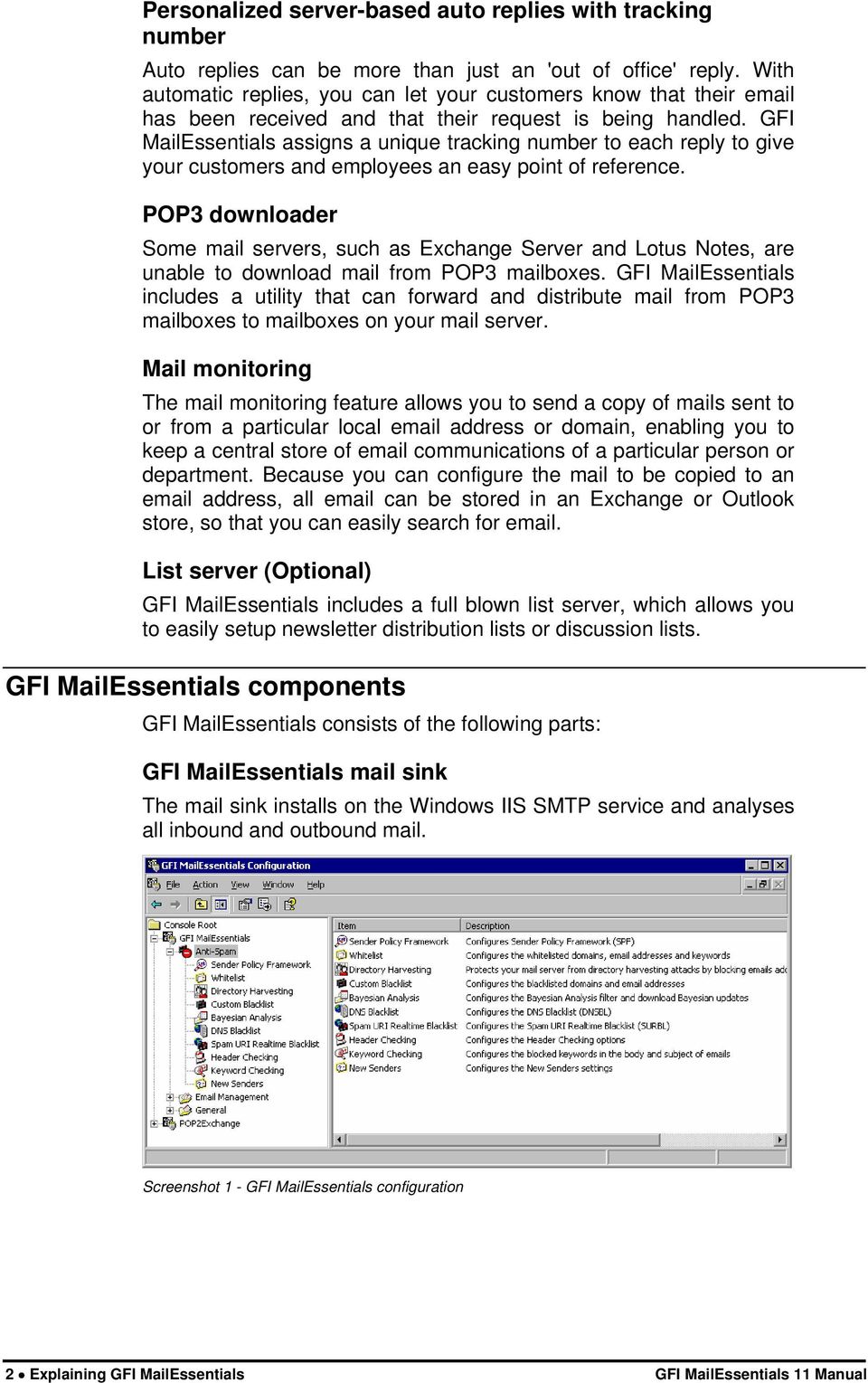
8 Personalized server-based auto replies with tracking number Auto replies can be more than just an 'out of office' reply. With automatic replies, you can let your customers know that their has been received and that their request is being handled. GFI MailEssentials assigns a unique tracking number to each reply to give your customers and employees an easy point of reference. POP3 downloader Some mail servers, such as Exchange Server and Lotus Notes, are unable to download mail from POP3 mailboxes. GFI MailEssentials includes a utility that can forward and distribute mail from POP3 mailboxes to mailboxes on your mail server. Mail monitoring The mail monitoring feature allows you to send a copy of mails sent to or from a particular local address or domain, enabling you to keep a central store of communications of a particular person or department. Because you can configure the mail to be copied to an address, all can be stored in an Exchange or Outlook store, so that you can easily search for . List server (Optional) GFI MailEssentials includes a full blown list server, which allows you to easily setup newsletter distribution lists or discussion lists. GFI MailEssentials components GFI MailEssentials consists of the following parts: GFI MailEssentials mail sink The mail sink installs on the Windows IIS SMTP service and analyses all inbound and outbound mail. Screenshot 1 - GFI MailEssentials configuration 2 Explaining GFI MailEssentials GFI MailEssentials 11 Manual
9 GFI MailEssentials configuration The configuration program allows you to set up and configure GFI MailEssentials. All configuration can be done from the new MMC console. Screenshot 2 - GFI Monitor GFI MailEssentials monitor This program allows you to monitor the activity of GFI MailEssentials. The POP collector service can be monitored from the POP2Exchange tab. GFI MailEssentials list server service The list server is a separate application and runs as a service in the background GFI MailEssentials attendant service This service handles a number of GFI MailEssentials tasks and processes. GFI MailEssentials 11 Manual Explaining GFI MailEssentials 3

10

11 Installing GFI MailEssentials Introduction to installing GFI MailEssentials This chapter explains the procedure on how to install and configure GFI MailEssentials. GFI MailEssentials can be installed in 2 ways: Installation option 1: Installing GFI MailEssentials on the Exchange server 2000/2003 machine This is a very straightforward and easy deployment mode. Simply install GFI MailEssentials on the Exchange Server 2000/2003 machine. Go to the paragraph 'Installing GFI MailEssentials on the Exchange 2000/2003 machine for instructions how to install this deployment option. NOTE: This installation option allows you to direct mail marked as spam directly to the user s junk mail folder. This makes it easy for users to periodically review spam mail for false positives. If you install GFI MailEssentials in the DMZ, or in front of Exchange 2000/2003, this feature will not be available. Installation option 2: Installing GFI MailEssentials on a separate machine If you are not running Exchange 2000/2003 or simply wish to separate the MailEssentials installation from the Exchange 2000/2003 machine, you can install MailEssentials on a separate machine. This also allows you to keep your corporate mail server behind the firewall. GFI MailEssentials will act as a smart host/mail relay server in the perimeter network (also known as DMZ, demilitarized zone, and screened subnet). Additional advantages are: You can perform maintenance on your Mail server machine, whilst still receiving from the Internet. You use less resources on your Mail server machine The GFI MailEssentials machine can have a lower spec then the Mail server machine and can process mail faster Additional fault tolerance if anything happens with your Mail server you still receive mail, which is queued on the GFI MailEssentials machine. NOTE: This separate machine does not need to be dedicated to GFI MailEssentials; it can run other applications, such as GFI MailSecurity. If you choose this option, you have to configure IIS before installing GFI MailEssentials. Go to the paragraph 'Installing GFI MailEssentials on a separate machine' for instructions on how to do this. GFI MailEssentials 11 Manual Installing GFI MailEssentials 5

12 IMPORTANT: Don't judge GFI MailEssentials' spam detection rate until you have allowed the Bayesian filter to run for at least 1 week! GFI MailEssentials can achieve the highest detection rate compared to other anti spam solutions because it adapts specifically to your mail. Be patient and wait at least a week before you evaluate it! Upgrading from GFI MailEssentials 9 and 10 NOTE: Only GFI MailEssentials version 9 and 10 can be upgraded to GFI MailEssentials 11. NOTE: Upgrades cannot be un-done: i.e. you cannot revert back to version 9 or 10 once you have installed the upgrade. If you are currently using GFI MailEssentials 9 or 10, you can upgrade your current installation. All version 9 and 10 configuration settings will be kept. You will need to enter a new license key within 30 days of installing the upgrade. For information on how to obtain the new license key, visit To upgrade: Screenshot 3 - Confirm the upgrade 1. Launch the GFI MailEssentials 11 setup file on the machine on which you have installed GFI MailEssentials. Setup will prompt you on whether you wish to remove the current version of GFI MailEssentials and install GFI MailEssentials Setup will now proceed to install GFI MailEssentials 11 in exactly the same manner as a new installation (for a detailed description, see this chapter). However it will not let you change the destination folder. This section applies to GFI MailEssentials 9 users only. After setup has copied the files, setup will notify you that it will convert the Bayesian weights file to the new GFI MailEssentials 11 format. The New format is more compact and uses less memory. During this conversion process a progress dialog box is displayed on screen. Once the conversion is ready, click on the Finish button to complete the upgrade. Installing GFI MailEssentials on the Exchange 2000/2003 machine This is the recommended mode if you have Exchange 2000/2003! System requirements Windows 2000/2003 Server or Advanced Server Microsoft Exchange server 2000/2003 If using the GFI MailEssentials reporter, Microsoft XML core services is required. This is included in the GFI MailEssentials 6 Installing GFI MailEssentials GFI MailEssentials 11 Manual

13 installation and will be installed automatically if your operating system is UK/US English. IMPORTANT: Disable Anti Virus software from scanning the GFI MailEssentials & IIS directories! AV products are known to both interfere with normal operation as well as slow down any software which requires file access. In fact Microsoft does not recommend running file based anti virus software on the Exchange Server. For more information: Make sure that backup software is not backing up any of the GFI MailEssentials directories at any point. For list server only: The list server feature requires the installation of Microsoft Message Queuing Services. This is a scalable event processing system service developed by Microsoft. It is included with every Windows 2000/2003 and XP version, although not always installed by default. For more information on how to install it, please see the chapter Configuring the list server. If you do not plan to use the list server feature, you do not need to install Microsoft MSMQ. NOTE: If you have a cluster please check this KBase article prior to installation: GFI MailEssentials will need to start & stop the Exchange services during installation. Running GFI MailEssentials setup 1. On the Exchange machine, Log-on as administrator and run GFI MailEssentials setup by double clicking the file me.exe. A welcome dialog will appear. Close other Windows programs and click Next. GFI MailEssentials will prompt you to check for a later GFI MailEssentials version. Always use the latest version! 2. Read and confirm the License agreement, click Next. 3. Setup will now ask you where you want GFI MailEssentials to be installed. GFI MailEssentials will need approximately 70 MB of free hard disk space. In addition to this, you must reserve approximately 200 MB for temporary files. 4. Now enter your Name, company, and License key. If you are evaluating the product, leave the default Evaluation. Click Next. 5. Setup will ask you for the administrator . This will be used to send critical notifications. GFI MailEssentials 11 Manual Installing GFI MailEssentials 7

14 Screenshot 4 - Selecting SMTP mode or Active Directory mode 6. If you are installing GFI MailEssentials on an Exchange Server configured as a front end server (i.e. in a DMZ in front of another Exchange Server), you can choose whether you want to install GFI MailEssentials in Active Directory mode or in SMTP mode. Active Directory mode allows you to select users present in Active Directory for user based configuration/rules, such as a disclaimer. However, on a front end server not all users are available. In this case it is better to select SMTP mode, which allows you to input the SMTP address for user based configuration/rules. Screenshot 5 - Installing Microsoft Message Queuing Service 7. If you do not have Microsoft Message Queuing Services (MSMQ) installed, setup will ask you whether you wish to install it. The list server feature requires this service. Microsoft Message Queuing Service is a scalable event processing system service developed by Microsoft. It is included with every Windows 2000/2003 and XP 8 Installing GFI MailEssentials GFI MailEssentials 11 Manual

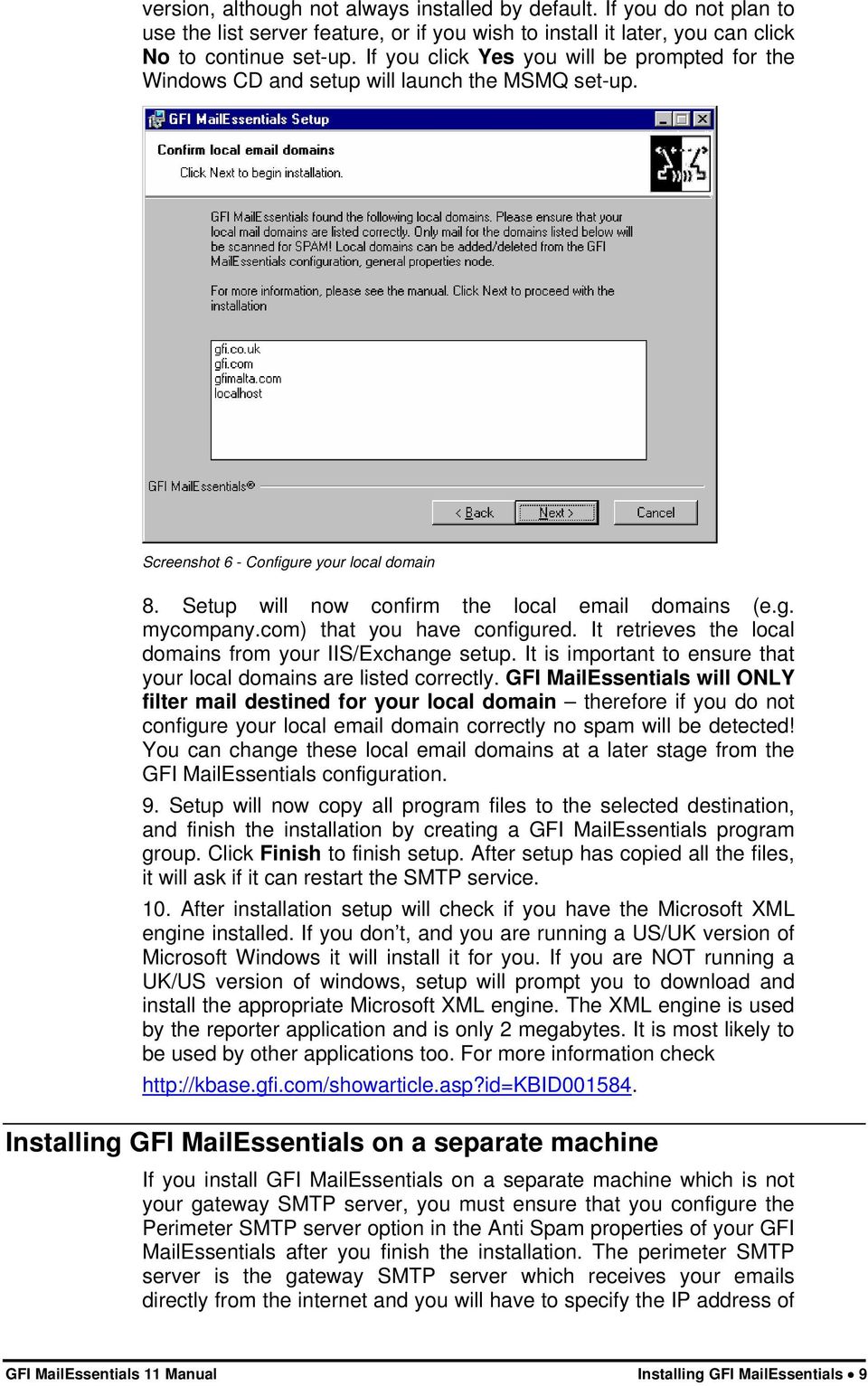
15 version, although not always installed by default. If you do not plan to use the list server feature, or if you wish to install it later, you can click No to continue set-up. If you click Yes you will be prompted for the Windows CD and setup will launch the MSMQ set-up. Screenshot 6 - Configure your local domain 8. Setup will now confirm the local domains (e.g. mycompany.com) that you have configured. It retrieves the local domains from your IIS/Exchange setup. It is important to ensure that your local domains are listed correctly. GFI MailEssentials will ONLY filter mail destined for your local domain therefore if you do not configure your local domain correctly no spam will be detected! You can change these local domains at a later stage from the GFI MailEssentials configuration. 9. Setup will now copy all program files to the selected destination, and finish the installation by creating a GFI MailEssentials program group. Click Finish to finish setup. After setup has copied all the files, it will ask if it can restart the SMTP service. 10. After installation setup will check if you have the Microsoft XML engine installed. If you don t, and you are running a US/UK version of Microsoft Windows it will install it for you. If you are NOT running a UK/US version of windows, setup will prompt you to download and install the appropriate Microsoft XML engine. The XML engine is used by the reporter application and is only 2 megabytes. It is most likely to be used by other applications too. For more information check Installing GFI MailEssentials on a separate machine If you install GFI MailEssentials on a separate machine which is not your gateway SMTP server, you must ensure that you configure the Perimeter SMTP server option in the Anti Spam properties of your GFI MailEssentials after you finish the installation. The perimeter SMTP server is the gateway SMTP server which receives your s directly from the internet and you will have to specify the IP address of GFI MailEssentials 11 Manual Installing GFI MailEssentials 9
16 your perimeter SMTP server in GFI MailEssentials, especially if you are going to use the SPF filter feature. For more information on how to setup your gateway SMTP server, please refer to the Defining your Perimeter (Gateway) SMTP Server section of the Configuring Anti Spam chapter in this manual. Effectively GFI MailEssentials will act as a mail relay server between the perimeter (gateway) SMTP server and the recipients inboxes. System requirements Windows 2000/ Pro, Server or Advanced Server or Windows XP Professional. NOTE: If you use Windows 2000 Pro or XP, you will only be able to accept up to 10 inbound SMTP connections simultaneously, so its better to use Windows 2000/2003 server) IIS5 SMTP service installed and running as an SMTP relay to your mail server. This means that the MX record of your domain must be pointing to the machine on which you will install GFI MailEssentials. For more information about configuring IIS5: Microsoft Exchange server 2000, 2003, 4, 5 or 5.5, Lotus Notes 4.5 and up, or an SMTP/POP3 mail server. IMPORTANT: Disable Anti Virus software from scanning the GFI MailEssentials & IIS directories! AV products are known to both interfere with normal operation as well as slow down any software which requires file access. In fact Microsoft does not recommend running file based anti virus software on the Exchange Server. For more information: Make sure that backup software is not backing up any of the GFI MailEssentials directories at any point. For list server only: The list server feature requires the installation of Microsoft Message Queuing Services. This is a scalable event processing system service developed by Microsoft. It is included with every Windows 2000/2003 and XP version, although not always installed by default. For more information how to install it, please see the chapter Configuring the list server. If you do not plan to use the list server feature, you do not need to install Microsoft MSMQ. Installing & configuring IIS SMTP service GFI MailEssentials uses the Windows IIS SMTP service as its SMTP Server. Because GFI MailEssentials works with this SMTP service, you need to configure this service as a mail relay server first. About the Windows IIS SMTP service The Windows SMTP service is part of IIS, which is part of Windows 2000/2003. It is used as the message transfer agent of Microsoft Exchange Server, and has been designed to handle large amounts of mail traffic. The Windows IIS 5 SMTP service is included in every Windows distribution, including Windows professional. 10 Installing GFI MailEssentials GFI MailEssentials 11 Manual

17 NOTE: If you have a cluster please check this kbase article prior to installation: To install & configure the IIS SMTP service as a mail relay server: Step 1: Verify the Installation of the SMTP Service In Control Panel, open Add/Remove Programs, click Add/Remove Windows Components. Click the Internet Information Services (IIS) component, click Details, and then verify that the SMTP Service check box is selected. If it is not selected, click to select it, click OK, and then follow the installation directions that are displayed. Screenshot 7- Specify mail relay server name and assign IP Step 2: Specify mail relay server name and assign an IP 1. Click Start, point to Programs, click Administrative Tools, and then click Internet Services Manager. 2. Expand the tree under the server name, and then expand the Default SMTP Virtual Server. Right click and select Properties. Assign an IP to it. Step 3: Configure the SMTP Service to relay mail to your mail server In this step, you configure the SMTP service to relay inbound messages to your mail server. NOTE: During installation, GFI MailEssentials will perform this step for you automatically. GFI MailEssentials will ask for your local domain name, and create it as a remote domain. You will see the domain listed in the right pane. However, if you do this step manually, you can confirm that your relay server is working properly before running the GFI MailEssentials installation. GFI MailEssentials 11 Manual Installing GFI MailEssentials 11
18 Creating a local domain in IIS to route mail Click Start, point to Programs, click Administrative Tools, and then click Internet Services Manager. Expand the tree under the server name, and then expand the Default SMTP Virtual Server. By default, you should have a Local (Default) domain with the fully qualified domain name of the server. Configure the domain for inbound: 1. Right-click the Domains icon, click New, and then click Domain. 2. Click Remote, click Next, and then type the domain name in the Name box. Click Finish. Screenshot 8 - Configure the domain IMPORTANT NOTE ABOUT LOCAL DOMAINS Ensure that you add all your local domains (e.g. mycompany.com); otherwise inbound mail will not be filtered for spam! NOTE: Upon installation, GFI MailEssentials will import local domains from the IIS SMTP service. If you want to add additional local domains, you have to add these local domains in the GFI MailEssentials configuration. For more information see Adding additional local domains in the Misc. chapter. If you add additional local domains in IIS SMTP service, they will not be automatically recognized until you enter them in the GFI MailEssentials configuration. This allows you to setup remote smart hosts for particular domains that are not local. Configure the domain to relay mail to your mail server: In the properties for the domain that you just created, click to select the Allow the Incoming Mail to be Relayed to this Domain check box. 12 Installing GFI MailEssentials GFI MailEssentials 11 Manual

19 If this is being set up for an internal domain, you should specify the server that receives for the domain name by the IP address in the Route domain dialog box. Click the forward all to smart host option, and then type the IP address of the server that is responsible for for that domain in square brackets. For example: [ ] NOTE: Typing the IP address of the server in brackets is necessary so that the server recognizes this is an IP address and not to attempt a DNS lookup. 4. Click OK. Screenshot 9 - Relay options Step 4: Secure your mail relay server. In this step you will specify your mail server name, and any other mail servers that will send mail via this mail relay server. Effectively you will limit the servers that can send mail to the internet through this server. If you don t create restrictions anyone can use your mail relay server as an open relay (i.e. Spamming). To prevent this: 1. Open the properties of the Default SMTP Virtual Server. 2. On the Access tab, click Relay. 3. Click Only the list below, click Add, and then add the IP of your mail server that will be forwarding the mail to this server. You can specify a single computer, group of computers or a domain: a) Single computer: Specify one particular host that you want to relay off from this server. If you click the DNS Lookup button, you can lookup an IP address of a specific host. b) Group of computers: Specify a base IP address for the computers that you want to relay. c) Domain: Select all of the computers in a domain by domain name that will openly relay. This option adds processing overhead, and might reduce the SMTP service performance because it includes reverse DNS lookups on all IP addresses that try to relay to verify their domain name. GFI MailEssentials 11 Manual Installing GFI MailEssentials 13
![123.123.123] NOTE: Typing the IP address of the server in brackets is necessary so that the server recognizes this is an IP address and not to attempt a DNS lookup. 4. Click OK.](/docs-images/42/8621378/images/page_19.jpg "Screenshot 9 - Relay options Step 4: Secure your mail relay server. In this step you will specify your mail server name, and any other mail servers that will send mail via this mail relay server.")
20 Step 5: Configure your mail server to relay mail via the mail relay server After you have configured the IIS SMTP service to send and receive mail, you must configure your mail server to relay all mail to the mail relay server. To do this: If you have Microsoft Exchange Server 4/5/5.5: 1. Start up Microsoft Exchange Administrator. 2. Go to the Internet Mail Service and double-click on it to configure its properties. 3. Go to the Connections tab. 4. Message Delivery section, select 'Forward all messages to host'. Enter the computer name or IP of the machine running GFI MailEssentials. 5. Click OK and restart Exchange server. This can be done from the services applet. If you have Microsoft Exchange Server 2000/2003: You will need to setup an SMTP connector that forwards all mail to GFI MailEssentials: 1. Start up Exchange System Manager Screenshot 10 - Forwarding mail to GFI MailEssentials machine 2. Right-click on the Connectors Node->New->SMTP Connector and create a new SMTP connector. You will be prompted for a name. 14 Installing GFI MailEssentials GFI MailEssentials 11 Manual

21 Screenshot 11 - Specifying IP of GFI MailEssentials machine 3. Now select the option Forward all mail through this connector to the following smart host, and type in the IP of the GFI MailEssentials server (the mail relay server) enclosed within square brackets [ ] (e.g.: [ ]. Screenshot 12 - Adding a bridgehead 4. Now click on the Add button in the local bridgeheads section, and select the appropriate virtual SMTP Server instances that you want to forward mail for. GFI MailEssentials 11 Manual Installing GFI MailEssentials 15
22 Screenshot 13 - Adding SMTP as address space 5. Go to the Address Space tab, and click Add. Select SMTP and click OK. 6. Click OK to exit. All mails will now be forwarded to the GFI MailEssentials machine. If you have Lotus Notes or an SMTP/POP3 server: Check the mail server documentation on how to forward mail to the GFI MailEssentials machine. Step 6: Point the MX record of your domain to the mail relay server. Since the new mail relay server must receive all inbound mail first, you must update the MX record of your domain to point to the IP of the new mail relay server. Otherwise mail will continue to go to your mail server and by-pass GFI MailEssentials. If you run your own DNS server you need to update this in your DNS server. If your ISP manages it for you, you need to ask your ISP to update the MX record for you. After you have done this, check if the MX record is correct using the following procedure. Checking if the MX record for your domain is set correctly 1. Open command prompt. Type nslookup 2. Now type 'set type=mx' 3. Enter your mail domain. 4. The MX record should return a single IP. This IP must be the mail relay server! 16 Installing GFI MailEssentials GFI MailEssentials 11 Manual
23 Screenshot 14 - Checking the MX record of your domain NOTE: If you wish to send out mail using a smart host (used when using dial-up) or receive mail using ETRN, you will need to perform additional steps to configure IIS 5 as a mail relay server. For more information refer to the IIS 5 documentation. Step 7: Test your new mail relay server! Before you proceed to install GFI MailEssentials, verify that your new mail relay server is working correctly. 1. Test IIS 5 SMTP inbound connection of your mail relay server by sending a mail from an external account to an internal user (you can use hotmail, if you don t have an external account available). Verify that the mail client received the Test IIS 5 SMTP outbound connection of your mail relay server by sending an to an external account from an internet client. Verify that the external user received the . NOTE: Instead of using an client, you can use Telnet and manually send an . This will give you more troubleshooting information. Here is the link to the Microsoft KB article how to do it: Step 8: Running GFI MailEssentials setup 1. On the newly configured mail relay machine, Log-on as administrator and run GFI MailEssentials setup by double-clicking the file me.exe. A welcome dialog will appear. Close other Windows programs and click Next. GFI MailEssentials will prompt you to check for a later GFI MailEssentials version. Always use the latest version! 2. Read and confirm the License agreement, click Next. 3. Setup will now ask you where you want GFI MailEssentials to be installed. GFI MailEssentials will need approximately 70 MB of free hard disk space. In addition to this, you must reserve approximately 200 MB for temporary files. 4. Now enter your Name, company, and License key. If you are evaluating the product, leave the default Evaluation. Click Next. GFI MailEssentials 11 Manual Installing GFI MailEssentials 17
24 Screenshot 15 - Specify mail server IP & domain 5. Setup will now ask you to specify your mail server IP, port and your local domain: Specify the IP of your Mail server (e.g. Exchange server name) and the port of the Mail server Specify your local domain. The local domain is the last part of your internal address, for example gfi.com. 6. Setup will ask you for the administrator . This will be used to send critical notifications. Screenshot 16 - Selecting SMTP mode or Active Directory mode If you are installing GFI MailEssentials on a machine that is part of a domain and has Active Directory, setup will ask you whether you want to install in Active Directory mode or in SMTP mode. Active Directory mode allows you to select users present in Active Directory for user based configuration/rules, such as a disclaimer. However, if your machine is in the DMZ, then it is better to select SMTP mode. In this mode all user based configuration/rules will require you to input the SMTP address. 18 Installing GFI MailEssentials GFI MailEssentials 11 Manual
25 Screenshot 17 - Screenshot 15- Installing Microsoft Message Queuing Service 7. If you do not have Microsoft Message Queuing Services (MSMQ) installed, setup will ask you whether you wish to install it. The list server feature requires this service. Microsoft Message Queuing Service is a scalable event processing system service developed by Microsoft. It is included with every Windows 2000/2003 and XP version, although not always installed by default. If you do not plan to use the list server feature, or if you wish to install it later, you can click No to continue set-up. If you click Yes you will be prompted for the Windows CD and setup will launch the MSMQ setup. Screenshot 18 - Confirm your local domain 8. Setup will now confirm the local domains that you have configured. It retrieves the local domains from your IIS set-up. It is important to ensure that your local domains are listed correctly. GFI MailEssentials will ONLY filter mail destined for your local domain therefore if you do not configure your local domain correctly GFI MailEssentials 11 Manual Installing GFI MailEssentials 19
26 no spam will be detected! You can change these local domains at a later stage from the GFI MailEssentials configuration. 9. Setup will now copy all program files to the selected destination, and finish the installation by creating a GFI MailEssentials program group. Click Finish to end setup. After setup has copied all the files, it will ask if it can restart the SMTP service. 10. After installation, setup will check if you have the Microsoft XML engine installed. If you don t, and you are running a US/UK version of Microsoft Windows it will install it for you. If you are NOT running a UK/US version of windows, setup will prompt you to download and install the appropriate Microsoft XML engine. The XML engine is used by the reporter application and is only 2 megabytes. It is most likely to be used by other applications too. For more information check If you have IIS services running, GFI MailEssentials will need to stop these services during installation to install certain files. After it has done that, it will offer to restart these services. Entering your License key after installation If you have purchased GFI MailEssentials, you can enter your License key in the General > Licensing node. If you are evaluating GFI MailEssentials, it will time out after 60 days (with evaluation key). If you then decide to purchase GFI MailEssentials, you can just enter the License key here without having to re-install. You must license GFI MailEssentials for the amount of users that you have on your mail server. Entering the License key should not be confused with the process of registering your company details on our website. This is important, since it allows us to give you support and notify you of important product news. Register on: Installing the rule manager (sorts spam to junk folder) NOTE: The rule manager will only run on Windows 2000 and up. It will not run on Windows NT. The mailbox rule manager The mailbox rule manager is a utility which allows you to setup rules for users' mailboxes, so that mails marked as spam can be automatically moved to the user's junk mail folder for easy review by the user. How it works Basically, you install the rule manager on the Exchange Server and specify the mailboxes which you wish to install the rule on. Then you specify in the GFI MailEssentials configuration that all spam mail must be tagged. 20 Installing GFI MailEssentials GFI MailEssentials 11 Manual
27 If you want to use the rule manager, you must select TAG, and NOT block and delete or move. The latter will mean that no mail will reach the mailbox of the user, and therefore the rule will never be activated! Screenshot 19 - Tag mail, NOT block and delete! This way all spam will be tagged as [SPAM], and subsequently the rules installed on the mailbox will then move the mail tagged as [SPAM] to another folder of choice, for example the users junk mail folder. The mailbox rule manager is applicable to: Companies who have not installed GFI MailEssentials on the Exchange Server 2000/2003, but rather installed it as a mail relay, for example in the DMZ Companies using Exchange 5.5 If you have installed GFI MailEssentials on the Exchange 2000/2003 machine itself, there is no need to run the mailbox rule manager, because GFI MailEssentials will be able to route the mail itself to the user s junk mail folder. Installing the rule manager and the Bayesian wizard To install the rule manager and the Bayesian wizard: 1. Copy the file bayesianwiz.exe, located in the MailEssentials\bsw folder, to the machine on which you wish to install these utilities. 2. Run bayesianwiz.exe, click on the Next button and specify the path were the Bayesian wizard and rule manager files will be extracted. 3. Click on Yes to start installing the Bayesian Wizard. GFI MailEssentials 11 Manual Installing GFI MailEssentials 21
28 NOTE: The Bayesian Wizard can only be installed on a separate machine as a stand alone tool. The server version of GFI MailEssentials already includes the Bayesian wizard and can be used without further configurations. NOTE: The Bayesian wizard (bayesianwiz.exe) installation does not create any icon or additional components in the GFI MailEssentials program group. In order to launch the rule manager, you must run rulemgmt.exe. Configuring the rules on user s mailboxes To configure the rules on users mailboxes: 1. Run the rule manager application (rulemgmt.exe) from the GFI MailEssentials program folder (by default C:\Program Files\GFI\MailEssentials). Screenshot 20 - The rules manager 2. The main screen will show all the mailboxes it found on your server. Now select the mailboxes which you want to install a rule on. You can create 2 types of rules: A rule which moves mail marked as spam to the user s junk mail folder A rule which deletes mail marked as spam (This rule can be used for users who wish to delete their spam automatically). 22 Installing GFI MailEssentials GFI MailEssentials 11 Manual
29 Screenshot 21 - Create a rule 3. Click Configure. By default the rule will check for [SPAM] in the subject. NOTE: If you change this, you will have to change the tag appended by GFI MailEssentials at server level too! Then select whether to delete the mail, or move the spam to a separate folder. You can specify the folder name. If you specify for example inbox\junk, then the folder will be created under the inbox folder. If you specify just junk, then the folder will be created at the top level, i.e. next to the inbox for example. 4. You can select multiple mailboxes and configure rules for all of them in one go (as long as the same rule applies to all) 5. All mailboxes for which you have configured a rule will be marked as blue. GFI MailEssentials 11 Manual Installing GFI MailEssentials 23
30
31 The Bayesian anti spam filter Introduction The Bayesian filter is the main Spam fighting technology of GFI MailEssentials. Whilst the other anti spam features are important too and complementary to the Bayesian filter, it is the Bayesian filter that will allow you to virtually eliminate spam from your network. Bayesian filtering technology is an adaptive, artificial intelligence technique that is much harder to circumvent by spammers. However it pays administrators to take a moment to understand the Bayesian filtering technology, in order to be able to gain the most from it. This chapter explains how the Bayesian filter works, how it can be configured and how it can be trained. IMPORTANT: Don't judge GFI MailEssentials' spam detection rate until you have allowed the Bayesian filter to run for at least 1 week! GFI MailEssentials can achieve the highest detection rate compared to other anti spam solutions because it adapts specifically to your mail. Be patient and wait at least a week before you evaluate it! How the Bayesian spam filter works Bayesian filtering is based on the principle that most events are dependent and that the probability of an event occurring in the future can be inferred from the previous occurrences of that event. (More information about the mathematical basis of Bayesian filtering is available at Bayesian Parameter Estimation and An Introduction to Bayesian Networks and their Contemporary Applications) ( & This same technique can be used to classify spam. If some piece of text occurs often in spam but not in legitimate mail, then it would be reasonable to assume that this is probably spam. Creating a tailor-made Bayesian word database Before mail can be filtered using this method, the user needs to generate a database with words and tokens (such as the $ sign, IP addresses and domains, and so on), collected from a sample of spam mail and valid mail (referred to as ham ). GFI MailEssentials 11 Manual The Bayesian anti spam filter 25
32 Figure 1 - Creating a word database for the filter A probability value is then assigned to each word or token; the probability is based on calculations that take into account how often that word occurs in spam as opposed to legitimate mail (ham). This is done by analyzing the users' outbound mail and by analyzing known spam: All the words and tokens in both pools of mail are analyzed to generate the probability that a particular word points to the mail being spam. This word probability is calculated as follows: If the word "mortgage" occurs in 400 of 3,000 spam mails and in 5 out of 300 legitimate s, for example, then its spam probability would be (that is, [400/3000] divided by [5/ /3000]). Creating the ham database (tailored to your company) It is important to note that the analysis of ham mail is performed on the company's mail, and is therefore tailored to that particular company. For example, a financial institution might use the word "mortgage" many times over and would get a lot of false positives if using a general anti spam rule set. On the other hand, the Bayesian filter, if tailored to your company through an initial training period, takes note of the company's valid outbound mail (and recognizes "mortgage" as being frequently used in legitimate messages), it will have a much better spam detection rate and a far lower false positive rate. NOTE: Some anti spam software with very basic Bayesian capabilities, such as the Outlook spam filter or the Internet Message Filter in Exchange Server, does not create a tailored ham data file for your company, but ships a standard ham data file with the installation. Although this method does not require an initial learning period, it has 2 major flaws: 1. The ham data file is publicly available and can thus be hacked by professional spammers and therefore bypassed. If the ham data file is unique to your company, then hacking the ham data file is useless. For example, there are hacks available to bypass the Microsoft Outlook 2003 or Exchange Server spam filter. For more information about this, see Microsoft Outlook 2003 Spam Filter: Under the hood. 2. The ham data file is a general one, and thus not tailored to your company, it cannot be as effective and you will suffer from noticeably higher false positives. 26 The Bayesian anti spam filter GFI MailEssentials 11 Manual
33 Creating the spam database Besides ham mail, the Bayesian filter also relies on a spam data file. This spam data file must include a large sample of known spam and must be constantly updated with the latest spam by the anti spam software. This will ensure that the Bayesian filter is aware of the latest spam tricks, resulting in a high spam detection rate (NOTE: this is achieved once the required initial two-week learning period is over). How the actual filtering is done Once the ham and spam databases have been created, the word probabilities can be calculated and the filter is ready for use. When a new mail arrives, it is broken down into words and the most relevant words - i.e., those that are most significant in identifying whether the mail is spam or not - are singled out. From these words, the Bayesian filter calculates the probability of the new message being spam or not. If the probability is greater than a threshold, say 0.9, then the message is classified as spam. This Bayesian approach to spam is highly effective - a May 2003 BBC article reported that spam detection rates of over 99.7% can be achieved with a very low number of false positives! Why Bayesian filtering is better 1. The Bayesian method takes the whole message into account - It recognizes keywords that identify spam, but it also recognizes words that denote valid mail. For example: not every that contains the word "free" and "cash" is spam. The advantage of the Bayesian method is that it considers the most interesting words (as defined by their deviation from the mean) and comes up with a probability that a message is spam. The Bayesian method would find the words "cash" and "free" interesting but it would also recognize the name of the business contact who sent the message and thus classify the message as legitimate, for instance; it allows words to "balance" each other out. In other words, Bayesian filtering is a much more intelligent approach because it examines all aspects of a message, as opposed to keyword checking that classifies a mail as spam on the basis of a single word. 2. A Bayesian filter is constantly self-adapting - By learning from new spam and new valid outbound mails, the Bayesian filter evolves and adapts to new spam techniques. For example, when spammers started using "f-r-e-e" instead of "free" they succeeded in evading keyword checking until "f-r-e-e" was also included in the keyword database. On the other hand, the Bayesian filter automatically notices such tactics; in fact if the word "f-r-e-e" is found, it is an even better spam indicator, since it s unlikely to occur in a ham mail. Another example would be using the word "5ex" instead of "Sex". You would probably not have a word 5ex in a ham mail, and therefore the likelihood that it is spam increases. 3. The Bayesian technique is sensitive to the user It learns the habits of the company and understands that, for example, the word mortgage might indicate spam if the company running the filter is, say, a car dealership, whereas it would not indicate it as spam if the company is a financial institution dealing with mortgages. GFI MailEssentials 11 Manual The Bayesian anti spam filter 27
34 4. The Bayesian method is multi-lingual and international - A Bayesian anti spam filter, being adaptive, can be used for any language required. Most keyword lists are available in English only and are therefore quite useless in non English-speaking regions. The Bayesian filter also takes into account certain language deviations or the diverse usage of certain words in different areas, even if the same language is spoken. This intelligence enables such a filter to catch more spam. 5. A Bayesian filter is difficult to fool, as opposed to a keyword filter - An advanced spammer who wants to trick a Bayesian filter can either use fewer words that usually indicate spam (such as free, Viagra, etc), or more words that generally indicate valid mail (such as a valid contact name, etc). Doing the latter is impossible because the spammer would have to know the profile of each recipient - and a spammer can never hope to gather this kind of information from every intended recipient. Using neutral words, for example the word "public", would not work since these are disregarded in the final analysis. Breaking up words associated with spam, such as using "mo-r-t-g-a-g-e" instead of "mortgage", will only increase the chance of the message being spam, since a legitimate user will rarely write the word "mortgage" as "m-o-r-t-g-a-g-e". What s the catch? Bayesian filtering, if implemented the right way and tailored to your company is by far the most effective technology to combat spam. Is there a downside? Well, in a way there is one downside, but this can easily be overcome: Before you can use and judge the Bayesian filter, you have to wait for it to learn for at least two weeks - that or create the ham or spam databases yourself. This task can be quite complex, so it is best to wait until the filter has had time to learn. Over time, the Bayesian filter becomes more and more effective as it learns more about your organization s habits. To quote the old saying, Good things come to he who waits. Training the Bayesian filter When you first install GFI MailEssentials, the Bayesian filter will be disabled. GFI MailEssentials ships with a default HAM (2000 ham s) and SPAM database, however its better if you train the Bayesian filter with your specific profile before switching it on. This training can be done in 2 ways: 1. Automatically by collecting outbound s. GFI MailEssentials will collect legitimate mail (HAM) by scanning outbound mail. You can enable the Bayesian filter after it has collected at least 500 outbound s (If you send out mainly English mail) or 1000 outbound mails (If you send out non-english mail). Normally this amount of mail is collected in a matter of days. 28 The Bayesian anti spam filter GFI MailEssentials 11 Manual
35 Screenshot 22 - Supplying ham to the Bayesian filter 2. By supplying ham to the Bayesian filter by copying between mails from your sent items to the This is legitimate sub folder in the GFI Anti Spam public folders. For more information see paragraph Adding HAM to the ham database in the chapter Spam management from the user s point of view. Configuring the Bayesian filter After the Bayesian filter has been trained you can enable the Bayesian filter: Screenshot 23 - Bayesian analysis properties 1. In the GFI MailEssentials configuration, select the Anti Spam > Bayesian Analysis node, right-click and select Properties. This brings up the Bayesian filter properties. Click Enable Bayesian analysis. GFI MailEssentials 11 Manual The Bayesian anti spam filter 29
36 2. Ensure that the Automatically learn from outbound s option is ticked. This option will continuously update the legitimate mail database with outbound mails. Updates Screenshot 24 - Bayesian updates 3. In the updates tab you can specify how frequently GFI MailEssentials should check for updates to the spam database. You can also trigger an instant download by clicking on the Download Updates Now button. 30 The Bayesian anti spam filter GFI MailEssentials 11 Manual
37 Actions Screenshot 25 - What to do with mail tagged as spam After you have configured the Bayesian filter, you can configure what you wish to do with mail marked as Spam. Please see the actions paragraph in the configuring Anti Spam chapter. GFI MailEssentials 11 Manual The Bayesian anti spam filter 31
38
39 Configuring Anti Spam Introduction to Anti Spam GFI MailEssentials tackles spam protection at server level and eliminates the need to install and update anti spam software on each desktop. GFI MailEssentials uses various methods to identify spam: 1. Sender Policy Framework (SPF) SPF works by publishing a text record in the DNS of domains that indicates which machines send mail from that domain. GFI MailEssentials supports SPF and fights spam by checking the SPF record in the received messages. This feature allows you to define the SPF test sensitivity which will be used when processing s with forged senders (e.g. Block only messages which are determined to have a forged sender). 2. Whitelists. Whitelists are lists of addresses, IP addresses and phrases/words from which you always wish to receive mail. GFI MailEssentials will automatically build a whitelist for you from outbound mail. 3. Directory Harvesting This feature blocks s addressed to users that do not exist on the organisation s mail server. Such attacks occur when spammers try to send messages, using details from known addresses together with the most common usernames or possible alphanumeric combinations (brute force approach) that could be used for the username part of an . This is done in order to try and discover other accounts present on the same server. 4. Custom blacklist This feature allows you to specify domains and addresses from which you do not wish to receive mail. 5. DNS blacklist This feature allows you to configure GFI MailEssentials to query whether the sender is on a public DNS blacklist of known spammers such as ORDB. 6. Spam URI Realtime Blacklist (SURBL) This feature will extract links or domains from the message body and query whether these are listed on public Spam URI Blacklists such as sc.surbl.org 7. Bayesian analysis This feature analyses the content of the inbound mail and based on mathematical rules decides if the mail is spam or not. The Bayesian filter is discussed in the chapter The Bayesian anti spam filter. 8. Header checking This feature analyses the header of the mail to detect whether a mail is spam or not. 9. Keyword checking This feature allows you to configure keywords which indicate if a mail is spam. 10. New Senders This feature automatically identifies s which have been sent from senders to whom you have never sent s. These s could be from legitimate senders as well as GFI MailEssentials 11 Manual Configuring Anti Spam 33
40 spam which where not detected by the GFI MailEssentials spam filter. Screenshot 26 - Anti spam configuration When GFI MailEssentials finds a spam message, it can delete the message, move it to a central folder, forward it to an address, tag the or move it to a user s junk mail folder. NOTE: To stop spammers from relaying their mail through your mail server, you need to configure your mail server to deny mail relaying. For more information on this, consult the mail server documentation. Sender Policy Framework (SPF) GFI MailEssentials supports the Sender Policy Framework (SPF). The Sender Policy Framework allows you to check whether a particular sender is forged or not. Most of today s spammers use forged addresses. SPF is a community effort that is rapidly gaining ground. SPF requires that the company of the sender has published its mail server in an SPF record. For example if an is sent from [email protected] then companyabc.com must publish an SPF record in order for SPF to be able to determine if the was really sent from the companyabc.com network or whether it was forged. If an SPF record is not published by CompanyABC.com the SPF result will be unknown. How SPF works Domains use public records (DNS) to direct requests to the machines that perform services (web, , etc.). All domains already publish (MX) records to publicly inform which machines receive mail for the domain. SPF works by domains publishing a text record in the DNS of those domains to publicly inform which machines send mail from the domain. When receiving a message from a domain, GFI MailEssentials can check those records to make sure mail is coming from where it should be. GFI MailEssentials does not require you to publish any SPF records yourself. If you would like to do this then you can use the SPF wizard at: 34 Configuring Anti Spam GFI MailEssentials 11 Manual
41 An example Suppose a spammer forges CompanyABC.com and tries to spam you. He connects from somewhere other than CompanyABC. When his message is sent, you see MAIL FROM: <[email protected]>, but you don't have to take his word for it. You can ask CompanyABC if the IP address comes from their network. In this example CompanyABC publishes an SPF record. That record tells GFI MailEssentials how to find out if the sending machine is allowed to send mail from CompanyABC. If CompanyABC says they recognize the sending machine, it passes, and you can assume the sender is who they say they are. If the message fails the SPF tests, it's a forgery. That's how you can tell it's probably a spammer. For more information on SPF and how it works, please visit the Sender Policy Framework Web Site at SPF on a perimeter (gateway) SMTP server The perimeter SMTP server is the machine which receives s directly from the Internet. If you have installed GFI MailEssentials on a perimeter SMTP server, you do not need configure any settings on GFI MailEssentials (i.e. you do not need to configure the perimeter [gateway] SMTP server options in the Perimeter SMTP Servers tab of the Anti spam properties). SPF on a non-perimeter (gateway) SMTP server If GFI MailEssentials is NOT installed on a perimeter SMTP server, you must configure the Perimeter SMTP Servers option in the Anti Spam node properties. To setup this option, right click on the Anti spam node > select Properties and click on the Perimeter SMTP Servers tab. If you are not sure if you have installed GFI MailEssentials on your perimeter SMTP server, you can make use of the Auto Discovery button in the Perimeter SMTP setup option to perform a DNS MX lookup and automatically define the IP address of your perimeter SMTP server. For further details on how to configure your perimeter SMTP server option, please refer to the Defining your Perimeter (Gateway) SMTP Server settings section in this chapter. Configuring the SPF feature The configuration of SPF is done from the Anti Spam > Sender Policy Framework node. Right-click on this node to open the SPF properties. GFI MailEssentials 11 Manual Configuring Anti Spam 35
42 SPF block level Screenshot 27 - Configuring the SPF block level The rejection level allows you to set the sensitivity of the SPF test. You can choose between 4 levels: Never: Never block any messages. When this option is selected SPF tests are not done on incoming s. Low: Only block messages which are determined to have a forged sender. This option will treat any message with a forged sender as spam. Medium: Block messages which appear to have a forged sender. This option will treat any messages that appear to have a forged sender as spam. This is the default and recommended setting. High: Block any message which is not proven to be from the sender. This option will treat all mail as spam unless it could be proven that the sender is not forged. Since the majority of mail servers do not yet have an SPF record this option is not yet recommended. 36 Configuring Anti Spam GFI MailEssentials 11 Manual
43 Screenshot 28 Current Perimeter SMTP Server setup After you define the sensitivity required for your SPF test, click on the Apply button to save this configuration. If you have already specified in GFI MailEssentials that this computer is not your perimeter SMTP server (refer to Defining your perimeter (gateway) SMTP server section in this chapter), a dialogue similar to the one shown above will pop up. This dialogue shows the perimeter SMTP server settings that you have configured in GFI MailEssentials (i.e. the IPs specified for your perimeter SMTP server). If GFI MailEssentials is installed on your perimeter SMTP server or if you have not yet specified that the mail server on which GFI MailEssentials is installed is not a perimeter SMTP server (refer to Defining your perimeter(gateway) SMTP server section in this chapter), the dialogue shown below will pop up. Screenshot 29 - Reminder: SPF must be installed on the perimeter SMTP server. This dialogue will remind you that if this computer is not a perimeter server, you must configure the Perimeter SMTP Servers option in the Anti Spam node properties (right click on the Anti Spam node > select Properties and click on the Perimeter SMTP server tab). For further information on how to configure your perimeter SMTP server, please refer to the Defining your perimeter (gateway) SMTP Server section in this chapter. Click on the OK button to close the dialogue on display. If you wish to test your DNS settings/services, click on the Test button located on top of the Apply button. GFI MailEssentials 11 Manual Configuring Anti Spam 37
44 Configuring Exceptions Screenshot 30 - Configuring the SPF exceptions This page allows you to configure the IP addresses and recipients that should be excluded from SPF checks. IP exception list: IP addresses in this list will automatically pass SPF checks. Click on Add...' to add a new IP address. To remove an IP address, select it from the list and click on Remove. To disable the IP exception list uncheck the 'IP exception list' checkbox. Recipient exception list: This option allows certain recipients to always receive their , even if the messages should be rejected. A recipient exception can be entered in one of three ways: localpart - "abuse" (matches "[email protected]", "[email protected]", etc...) domain - "@abc.com" (matches "[email protected]", "[email protected]", etc...) complete - "[email protected]" (only matches "[email protected]") To disable the recipient exception list uncheck the 'Recipient exception list' checkbox. Trusted Forwarder Global Whitelist: The Trusted Forwarder Global Whitelist ( provides a global whitelist for SPF users. It provides a way of allowing legitimate that is sent through known, trusted forwarders from being blocked by SPF 38 Configuring Anti Spam GFI MailEssentials 11 Manual
45 checks because the forwarders do not use some sort of envelopefrom rewriting system. By default this setting is enabled. It is recommended to always leave this option enabled. Actions tab After you have configured the SPF feature, click on the Actions tab to specify what you want to do with mails marked as Spam by the SPF filter. For more information on possible actions, please refer to the Actions what to do with spam mail section in this chapter. Other tab Please refer to the Other options section in this chapter. Defining your Perimeter (Gateway) SMTP Server The perimeter SMTP server is the Mail server gateway which processes s received directly from the Internet. Figure 2 A typical Perimeter SMTP Relay Server setup Such gateway SMTP servers are generally specified and configured in the DNS MX records of a domain and are often setup on a De- Militarized Zone (DMZ). The DMZ (see figure above) is a public internal network typically used exclusively for servers that are accessed by external clients on the Internet, such as Web, FTP and Mail servers. If the inbound s arriving to the server on which GFI MailEssentials is installed are being relayed from another gateway server, then you must specify your gateway SMTP server details using the Perimeter SMTP Servers tab in the Anti Spam properties in order for the SPF filter to work correctly. (e.g., let s take into account a company in England, which receives all its s on an SMTP server located in the USA. Since the SMTP server in USA will subsequently relay all s received to the local SMTP server in England, then the SMTP server in USA is the perimeter gateway server for the company in England i.e. when the company in England installs GFI MailEssentials on its local SMTP server, they must make sure to GFI MailEssentials 11 Manual Configuring Anti Spam 39
46 enable the option in the perimeter SMTP servers page and specify the details of the SMTP server in USA for the SPF filter to work correctly). Screenshot 31 Perimeter SMTP Server Setup When GFI MailEssentials is not installed on the perimeter SMTP server, you must: 1. Right click on the Anti Spam node and select Properties. 2. Click on the Perimeter SMTP Servers tab and enable the This machine is not a perimeter SMTP server option. 3. Click on the Add button and specify the IP address of your perimeter (gateway) SMTP server. Repeat the same process if you want to specify alternative perimeter SMTP servers which you might have available. Please make sure to specify your perimeter SMTP servers in their order of preference, with the actual perimeter server being the one at the top of your list, followed by its alternatives. NOTE: You can click on the Automatic discovery button to perform a DNS MX lookup which will automatically search and retrieve the IP s of perimeter SMTP servers configured on your local domains. Whitelist The Whitelist is a list of addresses and domains from which you always wish to receive s. i.e., mails sent from these addresses or domains will never be marked as spam. You can also 40 Configuring Anti Spam GFI MailEssentials 11 Manual
47 configure keywords, which if found in the body or subject, will automatically whitelist the . Screenshot 32 - Whitelisted domains The configuration of the Whitelist is done from the Anti Spam > Whitelist node. Right-click on this node to bring up the Whitelist properties. The first tab is the Whitelist configuration. Screenshot 33 - Adding a whitelisted entry To add a whitelisted domain or address: 1. Click Add and specify the full address. If you wish to specify an entire domain, specify it as follows *@companysupport.com. The GFI MailEssentials 11 Manual Configuring Anti Spam 41
48 * is a wildcard to include all addresses from that domain. You can also specify wildcards and whitelist entire domain suffixes, for example *@*.mil or *@*.edu. The latter will for example ensure that mail sent from military or educational domains will never be marked as spam. 2. Specify Check Mime to: OR Check Mime from:. This option allows you to whitelist an recipient. The MIME TO: is the address to which the is addressed. To find out the MIME TO: open up a copy of the list mail/newsletter and double click on the TO: field. Enter the address shown in the Add List dialog. Some newsletters use mailers that do not address the sender in the MIME TO field causing the GFI MailEssentials header checking feature to mark it as spam. These should be whitelisted with the MIME TO: option NOTE: If you want to exclude a user from spam filtering, simply enter the address of the user, and select MIME TO: Auto whitelist Screenshot 34 - Auto Whitelist options This feature, when enabled, automatically whitelists addresses to which you send mail. Clearly you will want to receive a reply from anyone you send a mail to; automatic whitelisting therefore makes a lot of sense. The process is completely automatic - you will have a reliable and constantly updated whitelist in no time and without any 42 Configuring Anti Spam GFI MailEssentials 11 Manual
49 administration! You can specify the total amount of addresses to be stored in the whitelist up to a maximum of 30,000 addresses. After the maximum amount is reached, the oldest records get replaced. The Auto Whitelist is made up of two components. One component scans incoming s and matches their senders against the auto whitelist. If the sender is present in the list, the mail will be passed on directly to the recipient s inbox without applying further spam checking. This feature is by default enabled, but you can still disable it by unmarking the Check s against Auto Whitelist option in the whitelist properties page. The second component extracts the destination addresses from outbound s and automatically adds them to the autowhitelist.mdb for use by the first component. This feature is also enabled by default, but you can still disable it by unmarking the Populate Auto Whitelist automatically option in the whitelist properties page. You can view auto whitelist entries by selecting the Show automatically entered option in the filter dropdown located at the top (right) of the page, near the address/domain display list. We highly recommend using these features, since they allow GFI MailEssentials to achieve a very low rate of false positives. Whitelisted keywords Screenshot 35 - Whitelisting keywords GFI MailEssentials allows you to specify keywords, which cause the mail to be flagged as HAM (valid mail). If a keyword configured in the GFI MailEssentials 11 Manual Configuring Anti Spam 43
50 keyword whitelist is found in a mail, then GFI MailEssentials will automatically allow the mail to skip all anti spam filters and deliver the mail directly the user s inbox. Use this option carefully, since entering too many keywords will allow too much spam to skip the spam filters. You can configure whitelisted keywords for body and subject: 1. To specify whitelisted keywords in the message body, click on the whitelisted keywords (body) tab and select Add. 2. To specify whitelisted keywords in the subject, click on the whitelisted keywords (subject) tab and select Add. IP Whitelist Screenshot 36 Whitelisting IPs GFI MailEssentials allows you to bypass anti spam checks on mails sent from servers whose IP address is specified in the IP Whitelist. Mails sent from listed servers are automatically classified as valid mail and are directly delivered in the user s inbox. To enable this feature, click on the IP Whitelist tab in the whitelist properties and mark on Enter IP s from which mails are classified as HAM option. In this page, you can also specify IP s to be added to the whitelist, as well as delete or make changes to the IP details already available. 44 Configuring Anti Spam GFI MailEssentials 11 Manual
51 Screenshot 37 - IP entry dialogue Directory harvesting To add IP s to the whitelist, click on the Add button. In the IP entry dialogue on display, you can specify the IP of a single computer as well as a range of IP s for a group of computers, by marking the Group of computers option and entering the relative subnet address and subnet mask. Directory harvesting attacks occur when a spammer uses known addresses to generate other valid addresses from corporate or ISP mail servers. This technique allows the spammer to send s to randomly generated addresses. Some of these addresses are real users in the organization however many of them are bogus addresses that flood the victim s mail server. The Directory Harvesting Attacks feature in GFI MailEssentials stops these types of attacks by blocking s addressed to users that do not exist on the organizations Active Directory or server. This feature makes use of the Active Directory or LDAP server to search for known users within the organization. GFI MailEssentials 11 Manual Configuring Anti Spam 45
52 Screenshot 38 - The directory harvesting feature Configuration is done from the Anti Spam -> Directory Harvesting node. Right-click on this node to bring up the Directory Harvesting properties. Mark the Enable directory harvesting protection option to enable this feature. If GFI MailEssentials is installed in SMTP mode, fill in your LDAP server detail (i.e. server name, the rest can be left as default). If your LDAP server requires authentication, unmark the Anonymous bind option and enter the authentication details that will be used by this feature. You can test your LDAP configuration settings by clicking on the Test button or click on the Apply button to save the current settings. If GFI MailEssentials is installed in Active Directory user mode, define the type of user lookup which best suits your company s setup i.e., enable the Use native Active Directory lookups option to search for user information in the Active Directory or enable the Use LDAP lookups option and specify your LDAP setting to search for user information on your LDAP server. NOTE: If GFI MailEssentials is installed in Active Directory user mode on a DMZ, the Active Directory of a DMZ, normally, does not include all the network users (i.e. mail recipients) and as a result, you will be getting a lot of false positives. In such cases it is recommended that you perform Directory Harvesting checks using LDAP lookups (i.e. 46 Configuring Anti Spam GFI MailEssentials 11 Manual
53 enable the Use LDAP lookups option and specify your LDAP server details). NOTE: When GFI MailEssentials is setup behind a firewall, the Directory Harvesting feature will not be able to connect directly to the internal Active Directory because of the Firewall. In this case, although both options will be available, you must make use of LDAP lookups in order to enable the Directory Harvesting feature to connect to the internal Active Directory of your network (i.e., pass through your Firewall). NOTE: Make sure to enable default port 389 on your Firewall NOTE: When connecting to an Active Directory using LDAP (i.e. when GFI MailEssentials in installed on a DMZ or behind a Firewall), you have to specify the authentication credentials in this form: Domain\User (e.g. gfi\jasonm). NOTE: In an Active Directory, normally the LDAP server is the Domain Controller. Actions tab After you have configured Directory Harvesting, click on Actions to specify what you want to do with s marked as spam by this filter. For more information on possible actions, please refer to the Actions what to do with spam mail section in this chapter. Other tab Custom Blacklist Please refer to the Other options section in this chapter. The Blacklist is a custom database of addresses & domains from which you never wish to receive s. i.e., s sent from these addresses or domains will always be marked as spam. The configuration of the blacklist is done from the Anti Spam > Custom Blacklist list node. Right-click on this node to bring up the Custom Blacklist properties. GFI MailEssentials 11 Manual Configuring Anti Spam 47
54 Screenshot 39 - The custom blacklist Screenshot 40 - Adding a blacklisted entry To add a blacklisted domain or address, click Add. Specify the full address. If you wish to specify an entire domain, specify it as follows *@spammer.com. The * is a wildcard to include all addresses from that domain. You can also blacklist entire domain suffixes, for example *@*.jp. This will for example ensure that mail sent from Japan is automatically marked as spam. Clearly you have to use these entries with care. Then specify whether you want the blacklist entry to apply to the MIME TO: field or the MIME FROM: field. The MIME TO option allows you to blacklist sent to a non existing address. This could be handy if you want to avoid an NDR being sent and just want the 48 Configuring Anti Spam GFI MailEssentials 11 Manual
55 to be automatically deleted (for example mail sent to ex employees). Actions tab After having specified your custom blacklist, click on the Actions tab to specify what you want to do with mails marked as spam by this filter. For more information on possible actions, please refer to the Actions what to do with spam mail section in this chapter. Other tab Please refer to the Other options section in this chapter. DNS blacklists (DNSBL) NOTE: This feature requires a properly configured DNS server. If the DNS server is not properly configured (and this occurs often enough!), a time out will occur and will be processed slowly. For more information see the GFI Knowledgebase article KBID GFI MailEssentials supports a number of DNS blacklists, which can be configured from the DNS blacklists node. DNS blacklists are databases of SMTP servers that have been used for spamming. There are quite few third party DNS blacklists available, ranging from reliable lists that have clearly outlined procedures for getting on or off the DNS blacklist to less reliable lists. When an is sent, it is passed through a number of SMTP servers until it reaches the final destination. The IP address of each of these SMTP servers is recorded in the header. GFI MailEssentials will check all the public IPs found in the message header with the DNSBL database configured (example: ordb.org). The ORDB list is an Open Relay Database maintained by ORDB.org. ORDB.org is a non-profit organization, which stores IP addresses of verified open SMTP relays. These relays are likely to be, used as conduits for sending unsolicited bulk , also known as spam. By accessing this list, system administrators are allowed to choose to accept or deny exchange with servers at these addresses. How it works GFI MailEssentials will check all the public IPs found in the message header with the DNSBL database configured (example: ordb.org). GFI MailEssentials will record all the IPs checked in an internal database and will not perform further checks with the DNSBL for the same IPs. The IP addresses are kept in the database for 4 days, or until the Simple Mail Transport Protocol service is restarted. GFI MailEssentials 11 Manual Configuring Anti Spam 49
56 Screenshot 41 - The DNS blacklist properties To enable the DNS blacklist: 1. Right click on the Anti Spam > DNS Blacklist node and select Properties. 2. Click on Check whether the sending mail server is on one of the following DNS Blacklists:. 3. Now select the appropriate DNS blacklists that you wish to check incoming mail against. For example relays.ordb.org NOTE: You can click on the Test button to check if the selected blacklists are available. NOTE: Querying a DNS blacklist can be slow (depending on your connection), so mail can be slowed down a little bit, especially if you query against multiple DNS blacklists. You can also add more DNS Blacklists to the ones already listed by clicking on the Add button. 50 Configuring Anti Spam GFI MailEssentials 11 Manual
57 Screenshot 42 - Adding more DNS blacklists Specify the domain containing the DNSBL (e.g. sbl.spahaus.org) in the dialogue on display and click on the OK button. To change the order of reference for an enabled DNS blacklist, click on the relative blacklist and then click on the Up or Down buttons to move it up or down in the list according to the required priority. The DNSBL feature will reference enabled blacklist starting from the top. To edit or delete a blacklist from GFI MailEssentials, click on the required blacklist and subsequently click on the Edit or Delete button accordingly. Actions tab After you have specified which DNS blacklists will be referenced, click on the Actions tab to specify what you want to do with s marked as spam by this filter. For more information on possible actions, please refer to the Actions what to do with spam mail section in this chapter. Other tab Please refer to the Other options section in this chapter. Spam URI Realtime Blacklist (SURBL) A Universal Resource Identifier (URI) is a standard means of addressing resources on the Web. Common URIs such as Uniform Resource Locators (URLs) and Uniform Resource Names (URNs) are used to identify the destination of hypertext links as well as the sources of images, information and other objects in a Web Page. URLs are most generally used in web sites but can also be included as part of an message body e.g. to attract new visitors to a web site. SURBLs differ from most other RBLs in that they are used to detect spam based on message body URIs. Unlike most other RBLs, SURBLs are not used to block spam senders. Instead they allow you to block messages that have spam hosts (e.g. web servers, domains, web sites) which are mentioned in message bodies. GFI MailEssentials 11 Manual Configuring Anti Spam 51
58 Screenshot 43 Spam URI Realtime Blacklist properties To enable the SURBL check: 1. Right-click on the Anti Spam > Spam URI Realtime blacklist node and select Properties. 2. In the default opening page, mark the Check if mail message contains URLs with domains that are in these blacklists: option to enable the SURBL check on inbound messages. 3. Mark on the available list, the blacklists that will be used as reference when checking messages using the SURBL function. (e.g., if you mark sc.surbl.org, the domains (URLs) in the message body will be compared to the blacklist present (sc.surbl.org). If the message contains URLs with domains that are on the selected blacklist, it will be marked as spam). 4. When ready, click on the Apply button. NOTE: You can test the connection to the selected SURBL providers by clicking on the Test button. NOTE: To add more SURBLs, click on the Add button, specify the full name of the domain (e.g. URIBL.com) containing the blacklist and click on the OK button to accept the new entry. TIP: Multi.surbl.org combines the following lists in a unique list: sc.surbl.org ws.surbl.org 52 Configuring Anti Spam GFI MailEssentials 11 Manual
59 phishing data source from mailsecurity.net.au phishing data source from fraud.rhs.mailpolice.com ob.surbl.org ab.surbl.org jp data source This means that Multi.surbl.org includes all other SURBL Lists already listed in GFI MailEssentials 11, as well as two other sources. Hence you can enable multi.surbl.org only for SURBL checks since this leads to the following advantages: You need to click only one blacklist. You would have 2 extra sources against which the URLs/domains are being checked. Multi.surbl.org has a unique list with no re-occurrence (i.e. a domain will appear only once in multi.surbl.org even if it is found in more than 1 list) thus it is faster than using the other four lists simultaneously (due to re-occurrence). NOTE: When enabling multi.surbl.org it is recommended to disable all other SURBL lists from the configuration, otherwise the same scan will be performed more than once (in deferent lists) leading to lengthy mail processing. NOTE: The disadvantages of using multi.surbl.org only are: You might have a higher rate of false positives since more blacklists are present. The entries present in multi.surbl.org list have a higher (6 hours) TTL (Time to live) than those present in other lists (sc.surbl.org entries TTL is 10 minutes). This means that you might encounter some false positives. If for some reason the multi.surbl.org list is not reachable, no checks will be performed. TIP: If SURBL is giving a lot of false positives it is suggested that you try to disable multi.surbl.org and enable the other 4 SURBL lists. You can attempt reducing the amount of lists enabled in SURBL filter every time a high rate of false positives is present. For more information on SURBL lists, please refer to Actions tab After you have specified which SURBLs will be referenced, click on the Actions tab to specify what you want to do with s marked as spam by this filter. For more information on possible actions, please refer to the Actions what to do with spam mail section in this chapter. Other tab Please refer to the Other options section in this chapter. GFI MailEssentials 11 Manual Configuring Anti Spam 53
60 Header checking The header checking module analyses the individual fields in a header. This module makes reference to SMTP and MIME fields. SMTP fields are specified by the mail server, whereas the MIME fields are specified by the client (which encodes the mail to MIME). The configuration of anti spam identification based on headers is done from the Anti Spam > Header Checking node. Right-click on this node to bring up the Header checking properties. Screenshot 44 - Header checking properties (1) General anti spam header checking options The General tab in the Header Checking Properties dialog contains the following options: 1. Checks if the header contains empty MIME From field: This feature checks if the sender has identified himself in the From: field. If this field is empty it s an almost sure sign that the mail is sent by a spammer. 2. Checks if the header contains a malformed MIME from: field: This feature checks if the MIME from field is a correct notation, i.e. it matches the RFC. Spammers often include a wrong or wrongly specified From address. 3. Marks s with recipient lists of more then X recipients as spam: This feature marks mails with large recipient lists as spam. Mails with large recipient lists tend to be joke lists, chain s or simply 'junior' or inadvertent spammers. 54 Configuring Anti Spam GFI MailEssentials 11 Manual
61 4. Marks with different SMTP to: and MIME to: fields in the addresses as spam: Checks whether the SMTP to: and MIME to: fields are the same. The spammers server always has to include an SMTP to: address. However, the MIME to: address is often not included or is different. This feature captures a lot of spam, however some list servers don t include the MIME to: either. Therefore to use this feature, you must whitelist the newsletter sender address if it gets marked as spam by this feature. This can be done from the whitelist node or by dragging the newsletter in the GFI Anti Spam public folders I want this Discussion list node. 5. Check if contains remote images only: To circumvent keyword filters, spammers are now sending out image only mails. GFI MailEssentials can flag mails which only have images and a minimal amount of text as spam. Screenshot 45 - Header checking continued 6. Verify if sender domain is valid: This feature will perform a DNS lookup on the domain specified in the MIME from field and verify if the domain is valid. If the domain is not valid it s a sure sign of spam. NOTE: This feature requires a properly configured DNS server, otherwise, a time out will occur and mails will be processed slowly. In addition a lot of valid mail will be tagged as spam. After enabling this feature, you can test your DNS server/services by clicking on the adjacent Test button. A dialogue will subsequently inform you if the DNS test has been successful or not. GFI MailEssentials 11 Manual Configuring Anti Spam 55
62 7. Check if s contain more than X numbers in the MIME from: Frequently, more than 3 numbers in the MIME from means that the sender is a spammer. The reason for this is that spammers often use tools to automatically create reply-to: addresses on hotmail and other free services. Frequently they use 3 or more numbers in the name to make sure the reply-to: is unique. 8. Checks if subject contains first part of recipient address: To personalize a spam mail, spammers frequently include the first part of the recipient address in the subject. Be careful using this feature with generic addresses such as [email protected]. A customer that replies to an auto-reply with a subject Your mail to sales, would be marked as spam. To avoid this, you can specify addresses for which this check should not be done, by clicking on the Except button. Screenshot 46 - Excluding an address 9. Check if contains encoded IP addresses: This check looks for a URL which has a hex/octal encoded IP ( or which has a username/password combination in it (e.g. These practices are often used by spammers as well as hackers. The following are examples which will be flagged as spam: Configuring Anti Spam GFI MailEssentials 11 Manual
63 Language detection Screenshot 47 - Language detection The languages tab in the Header Checking Properties dialog contains the language detection options. Many spam mails are not even in your language, meaning that you can greatly reduce spam simply be blocking mail written in say Chinese or Vietnamese. Using the Languages tab you can block mail using certain character sets. (GFI MailEssentials cannot distinguish between Italian and French for example because they use the same character set) GFI MailEssentials can only detect languages written in different character sets. Actions tab After you have configured the header checking filter, click on the Actions tab to specify what you want to do with mails marked as Spam by this filter. For more information on possible actions, please refer to the Actions what to do with spam mail section in this chapter. Other tab Please refer to the Other options section in this chapter. GFI MailEssentials 11 Manual Configuring Anti Spam 57
64 Keyword checking The configuration of anti spam identification based on keywords is done from the Anti Spam > Keyword Checking node. Right-click on this node to bring up the Keyword checking properties. Screenshot 48 - Anti Spam keyword checking properties 1. Enable 'Scan body'. Now you can enter keywords & conditions that identify spam. Select either 'Add Condition' to enter a condition, which uses operands, or select 'Add Keyword' to enter a single keyword or a phrase. Screenshot 49 - Adding a condition 58 Configuring Anti Spam GFI MailEssentials 11 Manual
65 Adding conditions Conditions are combinations of keywords using the operands IF, AND, AND NOT, OR, OR NOT. Using conditions, you can specify combinations of words that must appear in the . For example a condition "If Word1 AND Word2" will check for Word1 and Word2. Both words would have to be present in the mail to activate the rule. To add a condition, select 'Add Condition' Screenshot 50 - Adding a keyword or phrase Adding keywords If you only wish to check for single words or phrases, you do not need to create a condition. In this case you can just add a keyword. Select 'Add Keyword' to do this. If you enter multiple words, then GFI MailEssentials will search for that phrase. For example, if you enter Basketball sports, then GFI MailEssentials will check for the phrase 'Basketball sports'. Only this phrase would activate the rule, not only the word basketball OR sports. Match whole words only: Enabling this option allows you to ensure that GFI MailEssentials will only block mails where the word you specify is a whole word. For example, if you specify the word sport, an with the word sport will be blocked, but not an with the word Allsports. Subject 2. To scan for words in the subject, enable 'Scan subject'. Now you can specify words that you wish to check for in the subject of the message. You can specify keywords and conditions. GFI MailEssentials 11 Manual Configuring Anti Spam 59
66 Screenshot 51 - Looking for keywords in the subject tab Actions tab After you have configured the keyword checking filter, click on the Actions tab to specify what you want to do with mails marked as Spam by this filter. For more information on possible actions, please refer to the Actions what to do with spam mail section in this chapter. Other tab New Senders check Please refer to the Other options section in this chapter. GFI MailEssentials can automatically identify mails which have been sent from senders to whom you have never sent s before. Such senders are identified by referencing the data collected in the Whitelists. NOTE: ONLY mails in which no spam was detected and whose senders are not present in any Whitelist are delivered in the New Senders folder. Since such mails could be sent from legitimate users as well as undetected spam, GFI MailEssentials collects them into a dedicated folder. This feature conveniently separates such s from the rest of the filtered messages in your inbox, in order to make them easily identifiable. Subsequently, you can review such s and add any undetected spam present in this folder to the custom blacklist. NOTE: You must enable at least one of the available Whitelists in order to be able to use the New Senders function. In the absence of 60 Configuring Anti Spam GFI MailEssentials 11 Manual
67 the Whitelist functions (should no spam be detected by the other filters) received messages will be delivered to the recipient s inbox. i.e. ONLY s in which no spam was detected and whose senders are not present in the Whitelist are delivered in the New Senders folder. Screenshot 52 - New Senders properties To activate the new senders filter: 1. Right-click on the Anti Spam > New Senders and select Properties. 2. In the default opening page, mark the Enable New Senders option to enable the check for new senders on all inbound messages and click on the Apply button. Exceptions tab In the New Senders properties you can specify the address (MIME TO) of any sender whose s should be excluded from the New Senders check. GFI MailEssentials 11 Manual Configuring Anti Spam 61
68 Screenshot 53 - New Senders Exception setup To setup your exception list: 1. Click on the Exceptions tab and enable the MIME TO exception list: option. 2. Click on the Add button and specify the address of the sender (e.g. [email protected]). Repeat the same procedure for each address that needs to be added, and then click on the Apply button to save these entries. TIP: If you want to temporarily disable your exception list, there is no need to delete all address entries made, but you only need to disable (un-mark) the MIME TO exception list: option. Actions tab After you have enabled the New Senders feature, click on the Actions tab to specify what you want to do with s marked as spam by this filter. For more information on possible actions, please refer to the Actions what to do with spam mail section in this chapter. Actions what to do with spam mail In GFI MailEssentials, actions define what should be done with s marked as spam. You can configure different actions for each of the available spam filters (i.e. the Senders Policy Framework, the Whitelist, Directory Harvesting protection, custom blacklist, Bayesian 62 Configuring Anti Spam GFI MailEssentials 11 Manual
69 analysis, DNS blacklist, Spam URI Realtime Blacklist, Header checking, Keyword checking and the New Senders). This feature conveniently enables you to use separate folders for storing spam mail detected by each filter. This would help you to immediately identify why the mail was marked as spam as well as makes it easier to perform operations on mails blocked by a particular filter. (e.g. you might want to delete mails marked by the blacklist spam filter, but do something else with mails marked as spam by the keyword checking filter). The options in the actions tab are identical for each spam filter. Screenshot 54 - Configuring the action that should be taken Select one of the following options to specify what you want to do with mail marked as spam: Delete this option, will cause spam mail to be deleted. Move to subfolder of user s mailbox this option will cause spam mail to be sent to a set of subfolders in the user s mailbox. GFI MailEssentials will create a folder according to the name you specify and sort all mail marked as spam to this folder. This way, users can periodically check mail marked as spam, and identify mail that might have been wrongly marked. If you enter inbox/junk mail, then the folder will be created under the inbox folder. If you don t it will be created next to the inbox, i.e. at the same level. By using a different folder name for the Bayesian, GFI MailEssentials 11 Manual Configuring Anti Spam 63
70 keyword and header checking filters, spam is automatically sorted to a different folder depending on which filter identified it as spam. This further eases the spam reviewing process. NOTE: This option requires that GFI MailEssentials is installed on the Exchange Server machine, in Active Directory mode, and that you are running Exchange 2000/2003. However if you are running Exchange 5.5 or are not running GFI MailEssentials on the Exchange server machine, you can still achieve the same thing with the Tag feature and the Rules manager (see installation chapter) Forward to another address In this case the will be sent to a central address. You can specify the address of a public folder. The subject of the mail will be in the format [recipient] [subject]. This way a person can be assigned to periodically check mail marked as spam, and identify mail that might have been wrongly marked as spam. This feature can also be used to further improve the spam rules. Move to the specified folder In this case the mail will be saved as a file in a specified folder (e.g. C:\My Spam). The file name will be in the following format: [Sender_recipient_subject_number_.eml]; this allows you to quickly sort spam based on sender. (e.g. C:\My Spam\ [email protected][email protected]_mailoffers_1_.eml) Tag with the following text - This option allows you to tag a spam but does not block or delete it. You can also specify where to insert this tag by selecting: o o o Prepend to subject to insert the specified tag at the start (i.e. as a prefix) of the s subject text i.e. [SPAM TAG]Subject text (e.g. [SPAM]Free Web Mail). Append to subject to insert the specified tag at the end (i.e as a suffix) of the s subject text i.e. Subject text[spam TAG] (e.g. Free Web Mail[SPAM]). Add tag in a new X - to add the specified tag as a new X-header to the . In this case, the X-Header will have the following format : X-GFIME-SPAM: [TAG TEXT] X-GFIME-SPAM-REASON: [REASON] E.g. X-GFIME-SPAM: [This is SPAM] X-GFIME-SPAM-REASON: [DNSBL Check failed Sent from Blacklisted Domain] The tag option can be used in conjunction to the Rules manager application, which allows you to easily setup sorting rules for all mailboxes on your Exchange Server machine. All mail tagged as spam will be subsequently sorted into the user s junk mail folder. (Location and name of folder is customizable) Move to user s junk mail folder (Exchange 2003) only if you have Exchange 2003, GFI MailEssentials can tag spam in such a way that Outlook will sort the mail to the user s junk mail folder. However we recommend using the move to users spam folder feature instead, since this allows you to use a different folder name for the Bayesian, keyword and header checking filters. Spam mail 64 Configuring Anti Spam GFI MailEssentials 11 Manual
71 is then automatically sorted to a different folder depending on which filter identified it as spam, greatly easing the spam reviewing process. Other options Screenshot 55 - The other actions tab In the other tab, you can specify a number of optional actions: The Log occurrence to this file feature allows you to log the spam mail occurrence to a log file of your choice. The Generate Non Delivery Report (NDR) feature allows you to create a fake Non Delivery Report (NDR). This will cause most bulk mailing software to remove your address from their database. In addition you can use this feature to notify the sender that his has been considered as spam. This feature can be convenient to use during the initial training phase. NOTE: If you wish you can customize the NDR. Go to the chapter miscellaneous options for more information on this. Anti Spam global actions This section applies only to users who have installed GFI MailEssentials on the Exchange 2000/2003 machine and who are using the Forward to user s spam folder function. If you have not installed on the Exchange 2000/2003 machine, the anti spam global actions tab will not appear. A lot of spam is sent to addresses that no longer exist on your server. Therefore, once you start sorting mail marked as spam to GFI MailEssentials 11 Manual Configuring Anti Spam 65
72 user s junk mail folders, you will end up with a relatively large percentage of mail that cannot be sorted into someone s mailbox. Generally, you will simply want to delete these mails. However for troubleshooting or evaluation purposes, you might want to move these mails to a folder or forward them to a particular address. This can be done from the global actions tab in the Anti Spam properties. To configure the global actions: 1. Right click on the Anti Spam node and select Properties. Screenshot 56 - Global actions 2. Click on the Global Actions tab and select whether to: Delete the mail Forward it to an address Move it to a specified folder. Additionally, using the 'Log occurrence to this file' feature, you can log the spam mail occurrence to a log file of your choice. Sorting Anti Spam filters by priority In GFI MailEssentials, you can define the order in which your anti spam checks will be applied to your inbound messages (i.e. you can define the priority of each anti spam filter). 66 Configuring Anti Spam GFI MailEssentials 11 Manual
73 NOTE: You can sort the priority of all available filters except for the New Senders filter, which is always automatically set to the lowest priority. This is because this filter depends on the results of the Whitelist checks and the other anti spam filters. Screenshot 57 Assigning filter Priorities To define the order of the anti spam filters 1. Right click on the Anti Spam node and select Order module Priorities. 2. Click on the required filter and click on the (up) button on the right of the list to assign a higher priority to the selected filter (i.e. move the filter up in the list) or click on the (down) button on the right of the list to assign a lower priority to the selected filter (i.e. move the filter down in the list). NOTE: Clicking on the Default Settings button will setup the filter priorities to the order recommended by GFI. 3. When you have finished sorting your anti spam filter priorities, click on the OK button. Changes will take effect immediately. GFI MailEssentials 11 Manual Configuring Anti Spam 67
74
75 Spam management from the user s point of view Introduction This chapter describes how users can manage their spam. GFI MailEssentials has been designed to minimize spam management by the user. It s pointless to flag mail as spam if the user has to spend a lot of time managing his spam. That said, there are some valid actions that a user can perform to increase the effectiveness of GFI MailEssentials. These include: 1. Training the Bayesian filter with valid mail, flagged erroneously as spam by GFI MailEssentials. 2. Training the Bayesian filter with spam, flagged erroneously as valid mail. 3. Adding mail senders and newsletters to the Whitelist. In addition, users will tend to blame the anti spam package for not receiving certain mails. Therefore, especially just after the deployment of GFI MailEssentials, it pays administrators to give users control and allow them to see what has been flagged as spam. Reviewing spam mail It is recommended that you configure GFI MailEssentials to forward mail marked as spam by the Bayesian, keyword and header filters, to separate subfolders in the user s mailbox. Screenshot 58 - Spam is sorted to a subfolder GFI MailEssentials 11 Manual Spam management from the user s point of view 69
76 This makes it easier for you to carry out periodical checks and identify any mails that might have been wrongly marked as spam. Using separate subfolders for each filter allows the user to immediately understand which filter has flagged the mail as spam. For more information on how to configure and setup spam filters, please refer to the Configuring anti spam chapter. Adding senders to the Whitelist Screenshot 59 - Whitelisting an If a user wants to add a specific address to the company whitelist, all he needs to do is drag and drop the mail to the Add to whitelist Public folder, located under the GFI Anti Spam public folders. NOTE: To automatically create the GFI Anti Spam Public Folders on your exchange server, you must make sure to enable the Scan Public Folders option in GFI MailEssentials and to enable/start the IMAP service on your exchange server. GFI MailEssentials will retrieve the mail, and add the MIME FROM address (whole not domain) to the whitelist. Use this same procedure for newsletters that you wish to receive, simply drop them in the Add to whitelist folder. NOTE: When dragging and dropping mail, by default Outlook will move the mail. To retain a copy of the mail, hold down the CTRL key, which copies the mail rather then moves it. 70 Spam management from the user s point of view GFI MailEssentials 11 Manual
77 Adding senders to the blacklist To add the sender of a spam mail to the company blacklist, drag and drop the mail to the Public folder Add to blacklist, located under the GFI Anti Spam public folders. NOTE: To automatically create the GFI Anti Spam Public Folders on your exchange server, you must make sure to enable the Scan Public Folders option in GFI MailEssentials and to enable/start the IMAP service on your exchange server. GFI MailEssentials will retrieve the mail, and add the MIME FROM address (whole not domain) to the blacklist Adding discussion lists to the whitelist Often discussion lists (NOT newsletters) are sent out without including the recipient address in the MIME TO and are therefore marked as spam. If you want to receive these discussion lists, you need to whitelist the addresses of these valid list mailers. To add the newsletter to the company whitelist, drag and drop the discussion list to the Public folder I want this discussion list, located under the GFI Anti Spam public folders. GFI MailEssentials will retrieve the mail, and add MIME TO, CC and BCC (whole not domain) to the whitelist. NOTE: To automatically create the GFI Anti Spam Public Folders on your exchange server, you must make sure to enable the Scan Public Folders option in GFI MailEssentials and to enable/start the IMAP service on your exchange server. Adding spam to the SPAM database When a spam mail arrives in the user s inbox, which has therefore not been flagged as spam, users should notify GFI MailEssentials of this. Dragging the mail to the Public folder This is spam ", will prompt GFI MailEssentials to retrieve the mail and add it to the SPAM database. This further improves the performance of the Bayesian filter. NOTE: To automatically create the GFI Anti Spam Public Folders on your exchange server, you must make sure to enable the Scan Public Folders option in GFI MailEssentials and to enable/start the IMAP service on your exchange server. Adding HAM to the ham database If, whilst reviewing a spam mail a user finds a valid mail, the user should add the mail to the ham database. To do this, the user simply drags the mail to the Public folder This is legitimate . Doing this will prompt GFI MailEssentials to retrieve the mail and add it to the HAM database, thus further tuning the Bayesian filter and avoiding it being flagged as spam in the future. NOTE: To automatically create the GFI Anti Spam Public Folders on your exchange server, you must make sure to enable the Scan Public GFI MailEssentials 11 Manual Spam management from the user s point of view 71
78 Folders option in GFI MailEssentials and to enable/start the IMAP service on your exchange server. Securing access to the public folders If you don t want to allow all users in your company to add to the ham, spam or whitelist database, simply limit access to the public folder from Exchange Server. NOTE: To automatically create the GFI Anti Spam Public Folders on your exchange server, you must make sure to enable the Scan Public Folders option in GFI MailEssentials and to enable/start the IMAP service on your exchange server. Configuring Public folder scanning via IMAP or MAPI Screenshot 60 - Configuring Public folder scanning To use the public folder scanning feature, you must configure GFI MailEssentials to scan the public folders. To do this: 1. In the GFI MailEssentials configuration, right-click on the anti spam node and select Properties. 2. Tick the option Enable public folder scanning. 3. Now choose how GFI MailEssentials will retrieve the mails from the public folders: 72 Spam management from the user s point of view GFI MailEssentials 11 Manual
79 Via MAPI (requires that GFI MailEssentials is installed on the Exchange Server machine itself) Via IMAP (requires that the Ms Exchange IMAP service is started). IMAP allows you to scan the public folders remotely and also works well across firewalls. It can also be used with other Mail servers that support IMAP. 4. If you select IMAP, you must specify the Mail server name, port (default IMAP port is 143) as well as an account and password. You can also use a secure connection. 5. Click Test. If everything went OK, the public folders will be created automatically. If they do not appear, check the credentials and re-test. Creating a dedicated account to login via IMAP If GFI MailEssentials is installed in a DMZ, for security reasons it is recommended to create a dedicated user account to retrieve the mail from the public folders. This user would only have access to the GFI Anti Spam folders. To do this on Exchange 2003: 1. Before you proceed to create the user, use admin credentials and click Test to ensure that IMAP is working properly and that the public folders have been created. 2. Create a new user. This user can have limited rights. 3. Open the Exchange System manager and go to Administrative groups > Folders > Public Folders. Right-click on the GFI Anti Spam public folders to bring up its properties 4. Go to the permissions tab and click on the client permissions button. 5. Click Add and select the user you created in step 2 and click OK. Screenshot 61 - Setting user role GFI MailEssentials 11 Manual Spam management from the user s point of view 73
80 6. Click on the user you just added to the client permissions list and set its role to owner. Make sure all check boxes are enabled and the radio buttons are set to all. 7. Click OK twice to return to Exchange System manager 8. Now right-click on the GFI Anti Spam Folders, select All tasks > Propagate settings. Enable the Folder rights checkbox and click OK. 9. Now enter the user name you have created in the GFI MailEssentials configuration and click Test to ensure the permissions have been set correctly. Configuring the GFI Anti Spam folders so that posts are hidden If desired, you can hide the posts that users make from other users by configuring Exchange Server to hide them. 1. Open the Exchange System manager and go to Administrative groups > Folders > Public Folders. Right-click on the GFI Anti Spam public folders to bring up its properties 2. Go to the permissions tab and click on the client permissions button. 3. Click Add and select the user/group you want to hide the posts from and click OK. 4. Click on the user/group you just added to the client permissions list and set its role to contributor. Make sure that only the Create items check box is enabled and the radio buttons are set to none. 5. Click OK twice to return to Exchange System manager 6. Now right-click on the GFI Anti Spam Folders, select All tasks > Propagate settings. Enable the Folder rights checkbox and click OK. NOTE: Users will only be able to post to the GFI Anti Spam folders. They will not be able to view any mails, not even the ones they posted themselves. 74 Spam management from the user s point of view GFI MailEssentials 11 Manual
81 Configuring Disclaimers Introduction to disclaimers What are disclaimers? Disclaimers are standard text added to the bottom or top of each outbound . They can be used for legal and/or marketing reasons Legal reasons to use a disclaimer disclaimers are a good start in helping companies protect themselves from potential legal threats resulting from the contents of an . Basically, adding a standard disclaimer to each will help in case you ever get sued over the content of an . Marketing reasons to use a disclaimer You can also use a disclaimer to add a description about the products/services your company provides. Note that disclaimers are only added to outbound mail. Configuring disclaimers To add disclaimers to your outbound , go to the disclaimer node in the GFI MailEssentials configuration. You can add different disclaimers for different domains and users. GFI MailEssentials 11 Manual Configuring Disclaimers 75
82 Screenshot 62 - Adding a disclaimer To add a disclaimer: 1. Highlight the management > Disclaimer node in the GFI MailEssentials configuration. Right click and select New > Disclaimer. Screenshot 63 - Selecting a user or domain disclaimer 2. Now you can specify whether you wish to add a user based disclaimer or a domain based disclaimer. If you select domain, you can choose the appropriate domain from the list of configured domains. All s sent FROM that domain will have the disclaimer added. If you select user, you can specify a user or a group of users, and the disclaimer will be added ONLY to mails sent FROM that user or group of users. 76 Configuring Disclaimers GFI MailEssentials 11 Manual
83 Screenshot 64 - Selecting the user or group for which the user based disclaimer will apply 3. If you selected a user based disclaimer, you have to specify the user. If you have installed GFI MailEssentials in Active Directory mode, you will be able to pick users or groups of users directly from Active Directory. If you have not installed in Active Directory mode, you have to specify the SMTP address of the user. Screenshot 65 - Specifying the domain for a domain based disclaimer 4. If you selected a domain based disclaimer, you have to specify the domain. Note that the disclaimer will only be added if the from address specified in the includes the domain you specified! If you use multiple addresses with different domains, setup the disclaimers for all domains that you use. 5. A new disclaimer will be listed in the right pane. You can now double-click on the disclaimer to bring up the disclaimer properties. 6. You can specify whether the disclaimer should be put at the bottom of the mail or at the top of the mail using the top/bottom 'Position' radio button. You can also change to which mail the disclaimer is added, by clicking on the Select button and selecting the user/group or domain. 7. You can now create your disclaimer. You can create both an HTML disclaimer and a text only disclaimer. To create an HTML disclaimer, click on Edit HTML to bring up the HTML disclaimer editor. Now enter your disclaimer. You can insert variables using the Insert menu. You can format text and variables using the formatting toolbar at the top. Variables are fields, which will be replaced with the real recipient or sender name in the . You can include the following fields in a disclaimer text: [recipient display name], [recipient address], [date], [sender display name] and [sender address]. After you are ready, click on Close. This will add the disclaimer to the disclaimer properties dialog. GFI MailEssentials 11 Manual Configuring Disclaimers 77
84 Screenshot 66 - The disclaimer editor 8. You can include a text based version of your disclaimer (for text only s) directly from the disclaimer properties dialog. Simply insert the text directly into the Text Disclaimer edit field. You can insert variables using the Variable button. Screenshot 67 - Including variables in your disclaimer 9. If you wish you can import or export your disclaimer using the import and export buttons. 10. Click OK to exit the dialog. NOTE: The recipient display name and recipient address variables will only be replaced if the mail is sent to a single recipient. If an is sent to multiple recipients, the variable will be replaced with 'recipients' 78 Configuring Disclaimers GFI MailEssentials 11 Manual
85 Configuring Auto replies Introduction to auto replies The Auto reply feature allows you to send automated replies to certain incoming s. You can specify a different auto reply for each address or subject. You can use variables in an auto reply to personalize an . Configuring Auto replies Screenshot 68 - Auto-reply properties To create an auto reply: 1. Highlight the management > Auto replies node in the GFI MailEssentials configuration. Right click and select New > Auto reply. GFI MailEssentials 11 Manual Configuring Auto replies 79
86 Screenshot 69 - Creating a new auto reply 2. Enter the address for which you wish to create an auto reply. That means that for sent to this particular address, for instance [email protected], this auto reply will be sent. Click OK. The auto reply options dialog will now come up. 3. At the top of this dialog you can specify a subject, which the must include in order to trigger the auto reply. This is optional. To enable this, specify a subject in the edit box And subject contains. 4. Now you must specify the auto reply text: Enter the text that you wish to be sent. To import a text file, click Import. If you wish to include an attachment, click on Add and choose the file you wish to send. 5. You can personalize the auto reply by adding variables. To do this click on 'Variable'. The following fields are available: Screenshot 70 - Variables dialog Date Field: This will insert the date that the was sent. From Field: This will insert the address of the sender. From Name Field: This will insert the name of the sender. Subject Field: This will insert the subject of the . To Field: This will insert the recipient s address. To Name Field: This will insert the recipient s name. Tracking Number: This will insert the tracking number. Select the variable(s) you wish to insert and click OK. 6. When you have prepared the auto reply click OK to activate it. Other options: Generate Tracking Number in subject: Activate this option if you wish the auto reply to include a tracking number in the subject. The 80 Configuring Auto replies GFI MailEssentials 11 Manual
87 tracking number can be used as a point of reference for the recipient and your company. The tracking number will be added to the auto reply and also to the subject of the original mail. Therefore, if you route the mail to a public folder, you can easily search for a customer s based on the tracking number. Include sent: Activate this option if you wish the auto reply to include the text that was sent. Auto reply from: You can specify a from address for your auto reply. Auto reply subject: You can specify a fixed subject for your autoreply. NOTE: When creating auto reply text, be sure not to format the body text beyond characters per line. Alternatively do not include carriage returns. This is because some older mail servers will truncate the line at characters. If your text is longer than that and contains a return at the end of the line, your message will be truncated as follows: Example: This is a long text line with a return at the end. It looks fine in my editor This is the next line Might look like this: This is a long text line with a return at the end. It looks fine in my editor This is the next line Therefore many newsletters that you receive are formatted to avoid this. GFI MailEssentials 11 Manual Configuring Auto replies 81
88
89 Configuring Mail Monitoring Introduction to Mail monitoring Screenshot 71 - Monitor specific addresses The mail monitoring feature allows you to send a copy of mails sent to or from a particular LOCAL address to another address. This allows you to keep a central store of communications of a particular person or department. Because you can configure the mail to be copied to an address, all can be stored in an Exchange or Outlook store, so that you can easily search for . Mail monitoring can therefore be used as a replacement for Mail archiving. Configuring Mail monitoring Mail monitoring can be configured from the Mail monitoring node. To monitor a particular address or domain: 1. Highlight the Mail monitoring node in the GFI MailEssentials configuration. Right click and select New > Inbound mail monitoring rule or New > Outbound mail monitoring rule, depending on whether you want to monitor outbound mail or inbound mail with this rule. 2. You will be asked for the address/mailbox to which you wish to copy the mail. You can specify the address of a manager or GFI MailEssentials 11 Manual Configuring Mail Monitoring 83
90 specify an address associated with for example a public folder. Click OK. The monitoring rule properties will appear. Screenshot 72 - Configuring mail monitoring 3. Now specify which correspondence you wish to monitor by clicking on the sender and the recipient buttons respectively. Click Add to add the mail monitoring filter. You can specify multiple filters. You can specify both the sender and the recipient of an , meaning that you can monitor rules from one person to another person. You can also monitor mail from one person to an entire company (domain), or monitor all mail of a particular user. To monitor: All mail sent by a particular user: Create outbound rule, specify sender or select user (if using AD) in the sender field and specify the all mail (*@*) in the recipient field. All mail sent to a particular user: Create inbound rule, specify recipient or select user (if using AD) in the recipient field and specify all mail (*@*) in the sender field. Mail sent by a particular user to an external recipient: Create an outbound rule, specify sender or select user (if using AD) in the sender field. Then enter external recipient in the recipient field. Mail sent to a particular user by an external sender: Create an inbound rule, specify external sender in the sender field. Then enter the user name or user address in the recipient field. Mail sent by a particular user to a company or domain: Create an outbound rule, specify sender or select user (if using AD) in the sender field. Then specify the domain of the company in the recipient field. To do this select domain when clicking on the recipient button. Mail sent to a particular user by a company or domain: Create an inbound rule, specify domain of the company in the sender field. To do this, select domain when clicking on the sender button. Then enter the user name or user address in the recipient field. 84 Configuring Mail Monitoring GFI MailEssentials 11 Manual
91 Exceptions You can configure exceptions to the rule from the exceptions tab. Here you can exclude mails sent from or to the CEO for example. Screenshot 73 - Creating an exception Note that the exceptions are both applied. e.g. all senders listed in the sender exception list and all recipients listed in the recipient list will NOT be monitored. Enabling/Disabling mail monitoring You can enable/disable all mail monitoring rules temporarily by switching off inbound/outbound mail monitoring. This can be done from the Mail monitoring properties dialog, which can be accessed by right-clicking on the mail monitoring node Screenshot 74 - Enable or disable mail monitoring You can also disable an individual mail monitoring rule temporarily, by right clicking on the rule and selecting Disable. GFI MailEssentials 11 Manual Configuring Mail Monitoring 85
92
93 Configuring the list server Introduction to list servers Creating a list List servers allow you to create two types of distributions lists: 1. A newsletter subscription list. this type of list can be used for a company or product newsletter. The big advantage over using normal ing software is that creating a list allows users to unsubscribe or subscribe to the list. 2. A discussion list this type of list allows a group of people to hold a discussion via , with each member of the list receiving the mail that a user sends to it. Typically, list server software is very expensive. Furthermore it requires that you run the list server on a separate machine from the Exchange Server, since port 25 is already taken by Exchange. GFI MailEssentials now brings powerful list server capabilities to Exchange Server users, at a small price and without the need to dedicate an additional machine for the list server alone. Requirements of the list server feature The list server feature requires the installation of Microsoft Message Queuing Services. This is a scalable system service developed by Microsoft to enable high volume event processing. GFI MailEssentials 11 uses this service. It is included with every Windows 2000/2003 and XP version, although not always installed by default. To check whether it is installed and if not how to install it, see the last paragraph of this chapter. To create a newsletter list: 1. Right-click on the management > list server node and select New > Newsletter. GFI MailEssentials 11 Manual Configuring the list server 87
94 Screenshot 75 - Creating a new newsletter list 2. The general list dialog will appear. Here you can enter a name for the list, and also specify the domain of the list (if you have multiple domains). Click Next to continue Screenshot 76 - Specifying database backend 3. Next you need to specify the type of database backend. For smaller lists of up to 5000 members, you can use Microsoft Access as a backend. 88 Configuring the list server GFI MailEssentials 11 Manual
95 4. You can specify whether GFI MailEssentials should create a new database or connect to an existing database. The latter allows you to use an existing customer database for the newsletter list. Click Next Screenshot 77 - Specifying Microsoft Access details 5. If you selected Automatic and selected Microsoft Access as the database backend, you have to configure a file name and location for the database. Click Finish to end the wizard. The wizard will confirm the creation of database and table. The newsletter list will now be created in the right hand pane and you can further configure its options by right clicking on the list and selecting Properties. Screenshot 78 - Specifying SQL server details GFI MailEssentials 11 Manual Configuring the list server 89
96 If you selected Automatic and selected Microsoft SQL server, you can configure the SQL server name, the database and the credentials. Click Finish to end the wizard. The wizard will confirm creation of the table. The newsletter list will now be created in the right hand pane and you can further configure its options by right clicking on the list and selecting Properties. Screenshot 79 - Specifying existing Microsoft Access database file and table 6. If you selected Existing database and selected Microsoft Access as the database backend, you have to enter the path to the file name and enter the table name which contains the subscriber members. Then you have to map the field to a string value field containing the address. In addition you have to map the UNSUBSCRIBE field to an integer (or Boolean) value field which will be used to define whether the user is subscribed to the list or not. This field is there so that when a user unsubscribes from the list we do not delete the user's entry, but rather just unsubscribe them from the list. If you selected Existing database and selected Microsoft SQL server as the database backend, you have to enter the SQL server details, as well as the table name which contains the subscribers and the credentials to logon to the database. Then you have to map the fields as described above. 90 Configuring the list server GFI MailEssentials 11 Manual
97 Screenshot 80 - Specifying existing SQL server table Newsletter properties After you have created the newsletter list, you can further configure its properties. To do this, right click on the newsletter in the right hand pane and select Properties. This brings up the newsletter properties dialog. Screenshot 81 - General newsletter properties GFI MailEssentials 11 Manual Configuring the list server 91
98 The general newsletter properties dialog allows you to change the list name, as well as its domain. In addition you can specify that if the list server receives an NDR, it automatically unsubscribes the user. Screenshot 82 - Database newsletter properties In the database tab, you can modify the database settings of the list. 92 Configuring the list server GFI MailEssentials 11 Manual
99 Creating a custom footer for the list Screenshot 83 - Footer newsletter properties The footer tab allows you to configure a custom HTML or text footer. This footer will be added to each mail. Click Edit HTML to create an HTML footer. Use the footer to communicate how users can subscribe to the list and unsubscribe from the list. GFI MailEssentials 11 Manual Configuring the list server 93
100 Setting permissions to the list Screenshot 84 - Setting permissions to the newsletter The permissions tab allows you to specify who can submit a mail to the list. If you do not secure the list, anybody can send a mail to the entire list by sending a mail to the list address! Click Add to specify a user with permissions to submit a mail to the list. You can optionally set a password which secures access to this newsletter in case someone else makes use of the client or account details of a permitted user (e.g. client sharing between employees, computers left unlocked by permitted users, spoofing, etc..). When this option is enabled, permitted users must authenticate themselves by including this password in the s subject field when sending s to the newsletter. The password must be specified in the subject field as follows: [PASSWORD:<configured password>]<the Subject of the !> e.g :[PASSWORD:letmepost]Special Offer. If the password is correct, the listserver will remove the password details from the subject and relay on the mail to the specified list address (i.e. to the Newsletter). To enable password authentication, click on the Password required option and specify the password in the text box at the bottom of the page. 94 Configuring the list server GFI MailEssentials 11 Manual
101 Adding subscribers to the list Screenshot 85 - Entering subscribers to the newsletter The subscribers tab allows you to add/remove users to the list manually. However, we recommend that you allow users to subscribe specifically to the list. If you import users, and have not specifically asked their permission to be added to the list, you might get spam complaints. Therefore we suggest you send out a mailing asking them to subscribe at [email protected] Operating the newsletter list. Sending a newsletter Sending mail to the entire list is very easy. Members who have permission to send mail to the list (this is configured from the permission tab in the newsletter properties), can just send the mail to the newsletter list mailing address, which is <newslettername>@yourdomain.com Subscribing to the list We recommend that you allow users to subscribe specifically to the list. If you add users to the list without specifically asking their permission, you might get spam complaints. Therefore we recommend sending out a mailing and asking them to subscribe by sending a mail to <newslettername>[email protected] Subscription process To subscribe to a newsletter, a user has to send a subscription request to <newslettername>[email protected]. Upon receiving the request, the list server will send a confirmation to GFI MailEssentials 11 Manual Configuring the list server 95
102 the user. Only after confirming his subscription by replying to the confirmation , will the user be added as a subscriber. The confirmation is required and cannot be turned off. It will save you a lot of spam complaints. Unsubscribing from the list To unsubscribe from the list, users simply send an to <newslettername>[email protected] Adding a link to your web site To allow users to easily subscribe to your newsletter, simply add a small web form which asks for name and address and direct the output to the <newslettername>[email protected] Creating a discussion list Creating a discussion list is largely the same as a newsletter list. To create a discussion list: 1. Right-click on the management > list server node and select New > Discussion list 2. The general list dialog will appear. Here you can enter a name for the list, and also specify the domain of the list (if you have multiple domains). Click Next to continue. Screenshot 86 - Specifying database backend 3. Next you need to specify the type of database backend. In general, we recommend using Microsoft SQL server if you have more then 5 lists OR one of the lists has more then 1000 members. 96 Configuring the list server GFI MailEssentials 11 Manual
103 Screenshot 87 - Specifying Microsoft Access details 4. If you selected Microsoft Access, you can configure a file name and location for the database. Click Finish to end the wizard. The wizard will confirm creation of database and table. The discussion list will now be created in the right hand pane and you can further configure its options by right clicking on the list and selecting Properties. Screenshot 88 - Specifying SQL server details If you selected Microsoft SQL server, you can configure the SQL server name, the database and the credentials. Click Finish to end the wizard. The wizard will confirm creation of the table. The list will GFI MailEssentials 11 Manual Configuring the list server 97
104 now be created in the right hand pane and you can further configure its options by right clicking on the list and selecting Properties. Discussion list properties After you have created the discussion list, you can further configure its properties by right clicking on the discussion list and selecting Properties. This brings up the discussion list properties dialog. Screenshot 89 - General discussion list properties The general tab allows you to change the list name, as well as its domain. In addition you can specify that if the list server receives an NDR, it automatically unsubscribes the user. In the database tab, you can modify the database settings of the list. Creating a custom footer for the list The footer tab allows you to configure a custom HTML or text footer. This footer will be added to each mail. Click Edit HTML to create an HTML footer. Use the footer to communicate how users can subscribe to the list and unsubscribe from the list. Adding subscribers to the list Adding subscribes to the list is identical to adding subscribers for a newsletter list. The subscribers tab allows you to add/remove users to the list manually. Importing subscribers to the list / Database structure When you create a new newsletter OR discussion list, the configuration will create a table called 'listname_subscribers' with the following fields as shown in the table below. If you wish to import data into the list, simply ensure that the database is populated with the correct data in the correct fields. 98 Configuring the list server GFI MailEssentials 11 Manual
105 Field name Type Default Flags Description Value Ls_id Varchar(100) PK Subscriber ID Ls_first Varchar(250) First name Ls_last Varchar(250) Last name Ls_ Varchar(250) Ls_unsubscribed Int 0 NOT NULL Unsubscribe flag ls_company Varchar(250) Company name Table 1 - Fields automatically created for the list Installing the Message Queuing services (MSMQ) on Windows 2000 The Messaging queue is a scalable system service developed by Microsoft to enable high volume event processing. GFI MailEssentials uses this service. It is included with every Windows 2000/2003 and XP version, although not always installed by default. To check whether it is installed or to install it: 1. To check if it is installed, simply go to Control Panel > Add/Remove Programs > Windows Components. The Windows components wizard will appear. Now check if a tick mark is present next to 'Message Queuing Service'. Screenshot 90 - The Windows components wizard 2. If there is no check mark selected, you need to install the Message Queuing Service. To do this, select the checkbox and click Next. You will need to have your Windows 2000 CD handy. GFI MailEssentials 11 Manual Configuring the list server 99
106 Screenshot 91 - Selecting the Message Queuing type 3. You will now be asked to select what type of queue to install. Select 'independent client'. Screenshot 92 - Message queue will not access a directory service 4. After you select independent, you will be asked if the Message Queue will be connecting to a directory service. Select 'Message Queuing Service will not access a directory service'. Select Next. The Message Queuing Service will now be installed. 100 Configuring the list server GFI MailEssentials 11 Manual
107 Configuring Mail Archiving Introduction to Mail archiving The archiving feature allows you to archive all in- and outbound mail. This feature can be used to store a history of your communications. In some countries and industries this is required by law. Configuring Mail archiving Screenshot 93 - Archiving properties To archive mail: 1. In the GFI MailEssentials configuration, highlight the mail archiving node, right click and select Properties. This brings up the Mail Archiving properties dialog. 2. You can now specify to archive inbound and/or outbound mail. Enable Inbound archiving: Select this option to enable archiving of Inbound mail. Enable Outbound archiving: Select this option to enable archiving of Outbound mail. GFI MailEssentials 11 Manual Configuring Mail Archiving 101
108 3. Then choose whether to archive mail to a database or to a text file. 4. If you want to archive mail to a text file, click on the button Configure to select the location and filename to which GFI MailEssentials should archive the mail. Be sure to select a drive with ample disk space! NOTE: If you archive to a text file, attachments will not be archived. 5. If you want to archive mail to a database you have to select which database you wish to use. Although you can archive mail to an access database file, this is not very practical, considering the amount of data that will be archived. Screenshot 94 - SQL server settings 6. Select SQL/MSDE (Note that if you select MSDE there is a limit of 2 gigabyte) and specify server name, database and credentials. Configuring the search page (AWI) Mail archived by the archiving module can be searched using a web based front end, called the Archive Web Interface (AWI). To use this front end, you have to configure IIS and configure the asp search page included with GFI MailEssentials. To do this: 1. Start up Internet Services Manager, right click on the Web Site node, and from the popup menu select New Virtual Directory. 102 Configuring Mail Archiving GFI MailEssentials 11 Manual
109 Screenshot 95 - Specifying an alias for the virtual directory 2. This will start the Virtual Directory Creation Wizard. Click Next to continue. Now you need to enter an alias for the virtual directory. In this case it is AWI, but you can enter whatever name you like, as long as it follows the folder naming conventions used in Microsoft Windows. 3. Now enter the path where the content is located. Select browse, and select the folder AWI\wwwroot in the GFI MailEssentials installation path. Screenshot 96 - Pointing to the AWI web folder GFI MailEssentials 11 Manual Configuring Mail Archiving 103
110 Screenshot 97 - Setting permissions 4. Next you need to set the access permissions. Tick Read and Run Scripts only. Do not tick any of the other check boxes. Now click Next to finish the Virtual Directory Creation Wizard. 5. Right-click on the newly created virtual directory, located under the web root of your web site server and select Properties. 6. In the Virtual Directory tab of the properties dialog, tick the Read, the Log Visits and the Index this resource check boxes. For Execute Permissions, select Scripts Only. 7. Press OK to close the properties dialog. The Virtual Directory has been setup and you can now test access to it. Screenshot 98 - Setting Virtual Directory properties 104 Configuring Mail Archiving GFI MailEssentials 11 Manual
111 Securing the Archive Web Search Interface Since the Archive Web Interface provides access to all the s archived by GFI MailEssentials, it is important to setup proper authentication and security for this web server and virtual directory. There are three ways to secure the Search Interface. These are Basic Authentication, Digest and Integrated Windows Authentication. Integrated Windows Authentication is the preferred choice in an Active Directory environment, because it makes the authentication process seamless, since initially it does not prompt users for their user name or password information. Rather, it uses the current Windows user information on the client computer for authentication. If you are installing GFI MailEssentials in a DMZ, you must use Basic authentication. The following steps show how to secure access to AWI: 1. Open up Internet Services Manager. Right click on the Archive Web Interface virtual directory under your server web site and select Properties. 2. Under the Virtual Directory tab make sure to deselect Directory Browsing. 3. Select the Documents tab and remove all the default documents except for default.asp Screenshot 99 - Specify default document 4. Next select the Directory Security tab and click on the Edit button for the Anonymous access and authentication control group. 5. Select Integrated Windows authentication (recommended if installed on the internal network) OR Basic Authentication check box (if installed in the DMZ). Ensure Anonymous access is deselected. GFI MailEssentials 11 Manual Configuring Mail Archiving 105
112 Screenshot Select authentication method If using Integrated Windows authentication, then authentication will occur against Active Directory. This means you do not need to configure additional users. If you use basic authentication, authentication will occur against the local user database on the machine. In this case you must create user names and passwords on that local machine. For more information on securing IIS, please review the IIS documentation. Be sure not to allow anonymous access! 6. Now restrict access to the accounts you want by using NTFS permissions. Open up Explorer and navigate to the GFI MailEssentials folder. Right click on the GFI MailEssentials folder and select Properties and then the Security tab. Screenshot Setting permissions 106 Configuring Mail Archiving GFI MailEssentials 11 Manual
113 7. Add / remove the users / groups you want to allow access to the Archive Web Interface. To allow access only to users forming part of the administrators group you would set the security tab as in screenshot 101. Click OK. You have now secured the Archive Web Interface. NOTE: Since GFI MailEssentials services (attendant and engine) and IIS services all run using the localsystem account, please make sure to include the SYSTEM account in the list of users/groups allowed to access the Archive Web Interface. Also make sure that the permissions for the SYSTEM account are set to Full Control, otherwise the required services will fail to start (i.e. GFI MailEssentials will not work). GFI MailEssentials 11 Manual Configuring Mail Archiving 107
114
115 Generating Mail Reports Introduction The GFI MailEssentials Mail reporter allows you to generate useful reports regarding inbound and outbound mail traffic. For example, you can generate reports on number of mails sent per user, per domain, or just daily statistics of mail traffic. Screenshot The MailEssentials reporter Configuring GFI MailEssentials reporter Reporting data is generated from data logged to a database. GFI MailEssentials can log data to a Microsoft Access file or to a Microsoft SQL server database. For larger networks, we recommend using Microsoft SQL server. If you do not have Microsoft SQL server, or if the database server is not accessible from where you have installed GFI MailEssentials, you can use the Microsoft Access format to log data to. This capability is built in to the operating system and does not require the installation of Microsoft Access. Note however that a file limit of 2 gigabytes is imposed on the file. Before the file reaches that size you need to start logging to a new database. To configure the database type to which GFI MailEssentials should log to: 1. In the GFI MailEssentials configuration, go to the management > Reporting node. GFI MailEssentials 11 Manual Generating Mail Reports 109
116 2. Right click on the node and select Properties. This will bring up the reporting properties dialog. Click on the Configure button. 3. Specify Microsoft Access or Microsoft SQL server. 4. If you specify Microsoft Access, specify the file name and location. Daily spam report Screenshot 103- Configure database 5. If you specify Microsoft SQL server, specify the server name and the credentials. 6. Click Test to ensure you have configured the database correctly. Click OK to exit. Screenshot Daily spam report 110 Generating Mail Reports GFI MailEssentials 11 Manual
117 The Spam report shows you how much spam GFI MailEssentials caught as a percentage of total mails received. The daily spam report can be generated via the Reports > Daily Spam menu option. This will bring up the report options dialog. You can specify the following options for the report: Report Options Sort column: allows you to specify whether the report should be sorted by date, total spam processed, keyword checking etc. For example, if you sort on keyword checking, it will list the days on which most s were caught via keyword checking at the top. Multi Page report: allows you to specify the number of days you wish to display on each page. Filter options Specific This filter option allows you to limit the report to a specific address. Date range: This filter option allows you to limit the report to a specific date range. When you have specified the report options, click on the Report button to start generating the report. The report will be shown in the main window. GFI MailEssentials 11 Manual Generating Mail Reports 111
118 Anti-Spam rules report Screenshot Anti Spam rules report The Anti-spam rules report shows you how much spam each antispam method caught. The Anti-spam rules report can be generated via the Reports > Anti Spam rules menu option. This will bring up the report options dialog. You can specify the following options for the report: Specific This filter option allows you to limit the report to a specific address. Date range: This filter option allows you to limit the report to a specific date range. When you have specified the report options, click on the Report button to start generating the report. The report will be shown in the main window. 112 Generating Mail Reports GFI MailEssentials 11 Manual
119 User usage statistics Screenshot User usage statistics filter dialog The user usage statistics report gives you an overview of how many s users send or receive and how large their sent or received s are. The user usage statistics report can be generated via the Reports > User usage statistics menu option. This will bring up the User usage statistics report options dialog. You can specify the following options for the report: Report Type Report Type: Allows you to specify whether you wish to report on inbound or outbound s, or both. Report Options Sort by: Allows you to specify whether the report should be sorted by address, by number of s, or by the total size of the s. For example, if you sort on number of s, the users which send/receive most s will be listed at the top of the report. If you are reporting on both inbound and outbound s, you can specify this sort option for inbound or outbound. Highlight users: Allows you to highlight those users that send or receive more then X number of s or X number of megabytes of mail. List top: Allows you to list only the top X number of users in the report. This can be very handy if you have a lot of users on your mail server. Multi Page report: Allows you to specify the number of users you wish to display on each page. GFI MailEssentials 11 Manual Generating Mail Reports 113
120 Filter options Specific Allows you to limit the report to a specific address. Date range : Allows you to limit the report to a specific date range. When you have specified the report options, click on the Report button to start generating the report. The report will be shown in the main window. Domain usage statistics Screenshot Domain usage statistics filter dialog The domain usage statistics report gives you an overview of how many s are sent or received for a particular domain. This report is handy if managing multiple domains. The domain usage statistics report can be generated via the Reports > Domain usage statistics menu option. This will bring up the Domain usage statistics report options dialog. You can specify the following options for the report: Report Type Report Type: Report data for domain usage statistics is always for both inbound and outbound s. Report Options Sort by: Allows you to specify whether the report should be sorted by domain name, by number of s, or by the total size of the s. For example, if you sort on domain name, the report will be sorted in alphabetical order. 114 Generating Mail Reports GFI MailEssentials 11 Manual
121 Highlight domains: Allows you to highlight those domains that send or receive more then X number of s or X number of megabytes of mail. List to: Allows you to list only the top X number of domains in the report. This can be very handy if you have a lot of domains. Multi Page report: Allows you to specify the number of domains you wish to display on each page. Filter options Specific domain: Allows you to limit the report to a specific domain. Date range: Allows you to limit the report to a specific date range. When you have specified the report options, click on the Report button to start generating the report. The report will be shown in the main window. Mail server daily usage statistics Screenshot Mail server daily usage statistics filter dialog The mail server daily usage statistics report gives you an overview of how many s, per day, are sent or received on the mail server on which GFI MailEssentials is installed. The mail server daily usage statistics report can be generated via the Reports > Mail server daily usage statistics menu option. This will bring up the Mail server daily usage statistics report options dialog. You can specify the following options for the report: Report Type Report Type: Report data for Mail Server Daily usage statistics is always for both inbound and outbound s. GFI MailEssentials 11 Manual Generating Mail Reports 115
122 Report Options Sort by: Allows you to specify whether the report should be sorted by date (since the report is per day), by number of s, or by the total size of the s. For example, if you sort on number of s, the days on which you sent or received most will be listed at the top. You can specify this sort option for inbound or outbound. Highlight days: Allows you to highlight those days on which you sent or received more then X number of s or X number of megabytes of mail. List top: Allows you to list only the top X number of days in the report. Multi Page report: Allows you to specify the number of days you wish to display on each page. Screenshot The daily usage statistics report Filter options Specific Allows you to limit the report to a specific domain. Date range: Allows you to limit the report to a specific date range. When you have specified the report options, click on the Report button to start generating the report. The report will be shown in the main window. 116 Generating Mail Reports GFI MailEssentials 11 Manual
123 User communications Screenshot User communications filter dialog The User communications report allows you to view what kind of s each user has sent. Once you generate a user communications report, you can expand the user record to list the subject of sent or received mails. Mail with the same subject is grouped. These s can be further expanded to reveal when and to whom, with that subject was sent. Screenshot The user communications report shows exact trail The User communications report can be generated via the Reports > User communications option. This will bring up the User communications report options dialog. You can specify the following options for the report: GFI MailEssentials 11 Manual Generating Mail Reports 117
124 Report Type Report Type: Allows you to specify whether you wish to report on inbound or outbound s, or both. Report Options Sort by: Allows you to specify whether the report should be sorted by address, by number of s, or by the total size of the s. For example, if you sort on number of s, the days on which you sent or received most will be listed at the top. You can specify this sort option for inbound or outbound. Highlight users: Allows you to highlight those users who sent or received more then X number of s or X number of megabytes of mail. List top: Allows you to list only the top X number of users in the report. Multi Page report: Allows you to specify the number of users you wish to display on each page. Filter options Specific Allows you to limit the report to a specific address. Date range: Allows you to limit the report to a specific date range. When you have specified the report options, click on the Report button to start generating the report. The report will be shown in the main window. NOTE: The user communications report is a complex report that takes time to generate. Therefore, if you have large logs, we recommend that limit the user communications report to specific users or to a particular date range. Miscellaneous options The following additional options are available from the tools menu of the GFI MailEssentials reporter. 118 Generating Mail Reports GFI MailEssentials 11 Manual
125 Excluded users Screenshot Excluded users dialog The exclude users tool allows you to specify addresses that should be excluded from the reports. The excluded users dialog can be accessed from the Tools > Excluded users menu option. To exclude a user, simply click on the Add button and specify the SMTP address of the user to be excluded from the reports. Find Printing reports Screenshot Find dialog The find tool allows you to find a string in a report. The find dialog can be accessed from the Tools > Find menu option. After you have generated a report, you can choose to print it. You can print a report from the File > Print menu option. You can preview the report using the print preview option. GFI MailEssentials 11 Manual Generating Mail Reports 119
126
127 Configuring POP3 downloading Should you use POP3 or SMTP to receive mail? We recommend using SMTP. This is the proper protocol for receiving mail. If you have a continuous line or dial on demand router, use SMTP. POP3 was meant only for clients, not for mail servers to retrieve mail. However, in some cases you might not have a choice and you have to use POP3 to download your mail. Using POP3 to receive mail Post office protocol (POP3 (RFC 1225)) is a client/server protocol for storing so that the client can connect to the POP3 server at any time and read the . A mail client will make a TCP/IP connection with the server and by exchanging a series of commands, read the . All ISPs support POP3. Advantages of using POP3 to retrieve mail Simple Any ISP can support it No need for fixed IP address. Disadvantages BCC messages are not routed within your organization. If you use a POP3 mailbox for each user, you have to create mailboxes twice once at the ISP and once on Exchange Server. If you use one POP3 mailbox for multiple users, messages sent by list servers are not always routed correctly. If your ISP mail server does not support the for clause, messages from some mailing lists will not be routed. This is because when mail is sent via SMTP, the actual recipient is provided by the sender on the "RCPT" command. This information is called part of the "envelope" (since it is outside of the message), and is sometimes not included in the actual mail message's header. For a single recipient, this is not a problem. If the mail is in your mailbox, you know it is for you. However, if all mail directed at a specific domain goes into the same mailbox, there may be no way of determining who the mail should be delivered to. This is most often the case for messages from mailing lists or if the BCC: field was used. There is however a solution for this problem. The most common is in the Received: line. According to page 32 of RFC 821, the Received: line should look something like this: Received: from sender.com by yourisp.com for [email protected] GFI MailEssentials 11 Manual Configuring POP3 downloading 121
128 The "for" clause is derived directly from the envelope information, so even if the To: and Cc: lines make no mention of the true recipient can be found here. Thus, any POP to Exchange solution must (at least) be able to parse the Received: lines in the header in order to forward the mail to the correct local recipient. NOTE: An easy way around the above problem is to create dedicated POP3 mailboxes for lists. Then route the lists to a public mailbox, so that other users can also benefit from the lists. Using SMTP to receive mail Simple Mail Transport Protocol (SMTP(RFC821)) is a server-to-server protocol for sending across the Internet. Briefly, a mail client will make a TCP connection to an ISP's SMTP server and upload a mail message (complete with headers) and instructions to whom the message should be delivered. The SMTP server will then either deliver the message (if it knows the final recipient) or pass it along to another SMTP server. SMTP works best when all servers are connected all the time. If the receiving server is not available, then the sender will have to queue the message and try later. Eventually, the sender will either make it through or give up and return the message to its originator. In the case of dial-up connections, the receiver may be unavailable more often than not. Advantages of using SMTP Server protocol, not client protocol Allows you to create an unlimited amount of addresses on your mail server, without having to worry about aliases etc. Disadvantages using of SMTP You need a public IP Configuring the POP3 downloader If you wish to receive mail by downloading mail from one or more POP3 mailboxes, you need to setup the POP3 downloader. To do this: 122 Configuring POP3 downloading GFI MailEssentials 11 Manual
129 Screenshot The GFI MailEssentials pop3 downloader 1. Highlight the POP2exchange node in the GFI MailEssentials configuration. In the right pane, a node 'general' will appear. Doubleclick on general. This will bring up the POP2Exchange configuration dialog. 2. Enable the POP3 downloader by ticking the 'Enable POP2Exchange. 3. To add a POP3 mailbox from which you wish to download mail, click Add. Screenshot Adding a POP3 mailbox Enter the POP3 server name, for example mail.myisp.com, the POP3 mailbox/login name and the password of the mailbox. Then choose between two options: Send mail to address stored in To field: Activate this option if you wish GFI MailEssentials to analyze the header and route the mail accordingly. If the mail analyzing fails the mail will be sent to the mail address specified in the alternate address. GFI MailEssentials 11 Manual Configuring POP3 downloading 123
130 Send mail to alternate address: Activate this option if you wish all mail from this mailbox to be forwarded to one address. Enter the full SMTP address in the address box, for example Now specify the alternate address. Mail will be sent to this address if it can not be 'resolved' from the to: header of the mail, or if you specified to forward all mail to address. 4. When you are ready, click OK. You can add as many POP3 mailboxes as you wish. NOTE: When specifying the destination address (the address where GFI MailEssentials will forward the to), be sure that you have set up a corresponding SMTP address on your mail server. Other POP3 downloading options Check every.. minutes: Specify the download interval. Do not download mail larger than: Here you can specify a maximum download size. If mail exceeds this size, it will not be downloaded. If mail is larger, than: You can either choose to delete mail larger than the maximum allowed size, or send a message to the postmaster. Dial up Connection options To receive mails by dial-up, go to dial-up tab in the POP2Exchange dialog. Tick the option 'Receive mails by Dial-Up'. Screenshot Dial-up options In this dialog, you can specify where and when GFI MailEssentials should dial up to pick up . You must specify a dial-up networking profile and specify a login name and password, as well as a schedule stating when the mail should be sent/ picked up. The dial-up networking profiles are setup from RAS. The following options are available: 124 Configuring POP3 downloading GFI MailEssentials 11 Manual
131 Use this Dial-Up Networking profile: Choose the Dial-up Networking profile you wish to use from the drop down list. If not connected dial: If you tick this option GFI MailEssentials will only dial-up if there is no connection. User name: Enter the user name used to logon to your ISP. Password: Enter the password used to logon to your ISP. Process only when already connected: If you tick this option, GFI MailEssentials will only process mail if a connection already exists. Dial on demand router: If you have an internet connection that gets automatically established, such as a dial on demand router, select this option. This will prompt GFI MailEssentials to pick up mail at the specified interval, but without triggering a dial-up connection. Process every.. minutes: Enter the interval at which GFI MailEssentials must either dial-up or check if a connection already exists (depends on whether you set GFI MailEssentials to dial-up or to only process mail when already connected). Scheduler Use the scheduler to specify when GFI MailEssentials should dial-up to pick up mail: 1. Click on Schedule 2. Specify the hours when GFI MailEssentials should dial-up. A V indicates that GFI MailEssentials will dial out. An 'X' indicates that GFI MailEssentials will not dial out at this hour. Screenshot You can configure the act schedule when GFI MailEssentials should pick up mail GFI MailEssentials 11 Manual Configuring POP3 downloading 125
132
133 Miscellaneous options General node Under the general node in the GFI MailEssentials configuration you will find general information regarding GFI MailEssentials. 1. Version Information allows you to check what version you have installed and whether it s the latest. 2. Licensing use this node to enter your License key. 3. Product patches shows you patches available 4. GFI MailSecurity link to the product information page of GFI MailSecurity, GFI MailEssentials companion product. 5. GFI FAXmaker link to the product information page of GFI FAXmaker, GFI MailEssentials companion product. 6. Support takes you directly to the GFI MailEssentials support page, which lists the most frequently asked questions. Also allows you to search the GFI Knowledge Base The GFI MailEssentials monitor Screenshot The MailEssentials monitor The monitor shows you the current activity of GFI MailEssentials. You can use it to check how GFI MailEssentials is processing mails. The POP collector service can be monitored from the POP2Exchange tab. Configuring a fake Non Delivery Report (NDR) In anti-spam actions, you can enable a fake NDR to be sent once a spam mail is detected. If you wish to customize this NDR, you can do so by editing the file ndr.xml, located in MailEssentials\templates GFI MailEssentials 11 Manual Miscellaneous options 127
134 directory. You can edit the file with notepad as well as with an XML editor. Adding additional local domains GFI MailEssentials needs to know what your local domains are to distinguish between inbound or outbound . During installation, GFI MailEssentials will import local domains from the IIS SMTP service. If however you wish to add or remove local domains afterwards, you can do so from the local domains tab in the general node properties: Remote commands Screenshot Adding a local domain 1. Right-click on the general node and select Properties to access this dialog. 2. Now enter the local domain. This feature is handy because in some cases you might want to configure local mail routing in IIS differently, i.e. add domains which are local for mail routing purposes but are not local for your mail server. Remote commands make it easy to add domains or addresses to the spam blacklist, as well as update the Bayesian filter with spam or ham (valid mails). Remote commands function by sending a mail to GFI MailEssentials: Simply address a mail to [email protected] (configurable) and GFI MailEssentials will recognize the mail as containing remote commands and will process the remote commands. With remote commands, you can do the following: 1. Add Spam or ham to the Bayesian module 2. Add keywords either to the subject keyword checking feature or to the body keyword checking feature. 3. Add addresses to the blacklist feature. 128 Miscellaneous options GFI MailEssentials 11 Manual
135 Configuring remote commands Screenshot Remote commands configuration To configure remote commands: 1. Go to the Anti-spam node, right click and select Properties. This brings up the anti-spam properties dialog. 2. Now enable remote commands 3. You can edit the address to which the remote commands should be sent. However it should not be a local domain. We suggest using [email protected]. A mailbox for the configured address does not need to exist, but the domain-part of the address must consist of a real address domain which returns a positive result to an MX-record lookup via DNS. 4. Optionally you can configure some basic security for the remote commands: You can do any of the following: Specify a shared password which should be included in the mail as follows (see next section for information how to create a mail with remote commands) In addition, you can specify which users are able to send s with remote commands. Note that a user could fake this by faking the From address. The password is specified as a separate command with the following syntax: PASSWORD: <shared password>; GFI MailEssentials 11 Manual Miscellaneous options 129
136 Using remote commands Once you have configured remote commands, you can send s with remote commands. The remote commands must follow the following syntax: <command> : <param1>, [ <param2>, <param3>, ]; There can be more than one command in the body of an ; each of them must be separated by a semi-colon (;). Each command name is case-sensitive and should be written in Upper Case. The following commands are available: Keyword checking commands NOTE: The robot can only add keywords, but not delete or modify them. Conditions are not supported. ADDSUBJECT this command adds keywords specified to the subject keyword checking database. Example: ADDSUBJECT: sex, porn, spam; ADDBODY this command adds keywords specified to the body keyword checking database. Example: ADDBODY: free, 100% free, absolutely free ; NOTE: when you need to specify a phrase rather than a single word, enclose the phrase in double quotes ( ). Blacklist commands With blacklist commands you can add a single address or an entire domain to the custom blacklist. To add an entire domain to the blacklist, one must specify a wildcard before the domain, e.g. *@domain.com. ADDBLIST: < >; Example: ADDBLIST: [email protected]; ADDBLIST: *@domain.com; NOTE: For security reasons, there can be only one ADDBLIST command in an , and only one address can be specified as the command parameter. The parameter is either a user , e.g. [email protected], or a domain, e.g. *@spammers.org. Please note that you cannot use wildcards in domain name, that is, an like *@*.domain.com will be rejected as invalid. Bayesian filter commands With these commands you can add spam mail or good mail (ham) to the Bayesian filter database. Simply forward the with one of the following remote commands in them. ADDASSPAM instructs the Bayesian module to classify given as spam. ADDASGOODMAIL instructs the Bayesian module to classify given as good . These commands do not have parameters the rest of the mail is the parameter. 130 Miscellaneous options GFI MailEssentials 11 Manual
137 Examples Screenshot Adding an address to the blacklist & keywords Example 1 - By sending this , the user adds [email protected] to the blacklist and also adds a few keywords to subject keyword checking database. Screenshot Specifying the same commands more than once Example 2: You can specify the same command more then once. (in this case ADDBODY). The result is cumulative, that is, in this case the keywords added to the body checking database are: sex, 100% free and instant money. GFI MailEssentials 11 Manual Miscellaneous options 131
138 Screenshot Adding a spam to the Bayesian filter database Example 3: A spam is added using the ADDASSPAM command. Note that a colon is not required for this type of command everything immediately after this command is treated as data for the Bayesian filter. Screenshot Sending remote commands without security Example 4: When Disable Password checkbox is checked, you can send remote commands without specifying a password. Remote command logging In order to keep track of changes made to the configuration database via remote commands, each with remote commands (even if with remote commands was invalid) is saved under ADBRProcessed subfolder which is located under product s main folder. The file name of each is formatted according to the following format: 132 Miscellaneous options GFI MailEssentials 11 Manual
139 <sender_ _address>_success_<timestamp>.eml in case of successful processing. <sender_ _address>_failed_<timestamp>.eml in case of failure. Timestamp is formatted as yyyyddmmhhmmss. GFI MailEssentials 11 Manual Miscellaneous options 133
140
141 Troubleshooting Introduction Knowledgebase The troubleshooting chapter explains how you should go about resolving issues you have. The main sources of information available to users are: 1. The manual most issues can be solved by reading the manual. 2. The GFI Knowledgebase accessible from the GFI website. 3. The GFI support site. 4. Contacting the GFI support department by at 5. Contacting the GFI support department using our live support service at 6. Contacting our support department by telephone. GFI maintains a Knowledgebase, which includes answers to most common problems. If you have a problem, please consult the knowledgebase first. The knowledgebase always has the most up-todate listing of support questions and patches. The Knowledgebase can be found on Request support via If, after using the Knowledgebase and this manual, you have any problems that you cannot solve, you can contact the GFI support department. The best way to do this is via , since you can include vital information as an attachment that will enable us to solve the issues you have more quickly. The Troubleshooter, included in the program group, generates automatically a series of files needed for GFI to give you technical support. The files would include the configuration settings etc. To generate these files, start the troubleshooter and follow the instructions in the application. In addition to collecting all the information, it also asks you a number of questions. Please take your time to answer these questions accurately. Without the proper information it will not be possible to diagnose your problem. Then go to the support directory, located under the main program directory, ZIP the files, and send the generated files to [email protected]. Ensure that you have registered your product on our website first, at GFI MailEssentials 11 Manual Troubleshooting 135
142 We will answer your query within 24 hours or less, depending on your time zone. Request support via web chat You may also request support via Live Support (web chat). You can contact the GFI support department using our live support service at Ensure that you have registered your product on our website first, at Request support via phone Web Forum You can also contact GFI by phone for technical support. Please check our support website for the correct numbers to call, depending on where you are located, and for our opening times. Support website: Build notifications Ensure that you have registered your product on our website first, at User to user support is available via the web forum. The forum can be found at: We strongly suggest that you subscribe to our build notifications list. This way, you will be immediately notified about new product builds. To subscribe to our build notifications, go to: Troubleshooting GFI MailEssentials 11 Manual
143 Index A Anti-Spam 1, Append to subject 64 Archiving 101 Attachments 102 Auto replies 2, 79 auto whitelist 43 B Bayesian filter 1, 6, 25, 26, 27, 28, 29, 31, 33, 69, 71, 128, 130, 132 blacklist C Custom blacklist 33 D Dial on demand 121, 125 dial up directory harvesting 45, 46, 47 Directory Harvesting 33, 46, 47, 62 disclaimers 75, 77 DNS black list 33 DNS lookup 13 DNSbl 49 E Exchange Server , 14 H header 33, 54 57, 121, 123 header checking 54, 57 I IIS5 SMTP 10 IP Whitelist 44 L language detection 57 LDAP 45, 47 Lotus Notes 2, 16 M mail monitoring 2, 83, 85 mail relay server 5, 10 11, mail reports 3 mail sink 2 MailEssentials reporter 3, 6, 118 MX record 10, 16 N new senders 61, 62 New Senders 33, 60, 61, 62, 63 New Senders folder 60, 61 newsletter 71 non delivery report 65, 127 O ORDB 49 P POP2exchange 123 POP3 2, 10, 16, POP3 downloading 121, 124 Prepend to subject 64 S Scheduler 125 sink 2 SMTP 2, 10 18, SMTP mode 8, 18 Spam URI Blacklists 33 SPF 33, 34, 35, 36, 38, 39 System requirements 6 W white list 33, 41, 42, 44, 55, 62, 69, 70, 71, 72 white listed keywords 44 whitelist 38, 40 42, 43, 44, 45 X XML 6 9, 20, 127 K Keyword checking 33, 58, 63, 130 GFI MailEssentials 11 Manual 137
Installing GFI MailEssentials
 Installing GFI MailEssentials Introduction to installing GFI MailEssentials This chapter explains the procedure on how to install and configure GFI MailEssentials. GFI MailEssentials can be installed in
Installing GFI MailEssentials
 Installing GFI MailEssentials Introduction to installing GFI MailEssentials This chapter shows you how to install and configure GFI MailEssentials. GFI MailEssentials can be installed in two ways: Installation
Installing GFI MailEssentials
 Installing GFI MailEssentials Introduction to installing GFI MailEssentials This chapter shows you how to install and configure GFI MailEssentials. GFI MailEssentials can be installed in two ways: Installation
GFI MailEssentials 12. Manual. By GFI Software
 GFI MailEssentials 12 Manual By GFI Software http://www.gfi.com Email: [email protected] Information in this document is subject to change without notice. Companies, names, and data used in examples herein
Why Bayesian filtering is the most effective anti-spam technology
 Why Bayesian filtering is the most effective anti-spam technology Achieving a 98%+ spam detection rate using a mathematical approach This white paper describes how Bayesian filtering works and explains
Installing GFI MailSecurity
 Installing GFI MailSecurity Introduction This chapter explains how to install and configure GFI MailSecurity. You can install GFI MailSecurity directly on your mail server or you can choose to install
Installing GFI MailSecurity
 Installing GFI MailSecurity Introduction This chapter explains how to install and configure GFI MailSecurity. You can install GFI MailSecurity directly on your mail server or you can choose to install
GFI Product Manual. Getting Started Guide
 GFI Product Manual Getting Started Guide http://www.gfi.com [email protected] The information and content in this document is provided for informational purposes only and is provided "as is" with no warranty
Installing Policy Patrol on a separate machine
 Policy Patrol 3.0 technical documentation July 23, 2004 Installing Policy Patrol on a separate machine If you have Microsoft Exchange Server 2000 or 2003 it is recommended to install Policy Patrol on the
Installing GFI FAXmaker
 Installing GFI FAXmaker System Requirements Before you install GFI FAXmaker, please ensure that the following requirements are met. GFI FAXmaker FAX Server: A Windows 2000, 2003, 2008 server or Windows
GFI MailSecurity 10.1 for Exchange/SMTP User Guide
 GFI MailSecurity 10.1 for Exchange/SMTP User Guide http://www.gfi.com Email: [email protected] Information in this document is subject to change without notice. Companies, names, and data used in examples
GFI FAXmaker 14.3 for Exchange/Lotus/SMTP. Manual. By GFI Software Ltd
 GFI FAXmaker 14.3 for Exchange/Lotus/SMTP Manual By GFI Software Ltd http://www.gfi.com Email: [email protected] Information in this document is subject to change without notice. Companies, names, and data
GFI Product Manual. GFI MailEssentials Administrator Guide
 GFI Product Manual GFI MailEssentials Administrator Guide The information and content in this document is provided for informational purposes only and is provided "as is" with no warranty of any kind,
1 Introduction 11 1.1 About this manual 11 1.2 Terms and conventions used in this manual 12
 Administrator Guide The information and content in this document is provided for informational purposes only and is provided "as is" with no warranty of any kind, either express or implied, including but
Administration and Configuration Manual
 GFI MailEssentials 14.1 Administration and Configuration Manual By GFI Software Ltd. http://www.gfi.com Email: [email protected] Information in this document is subject to change without notice. Companies,
GFI Product Manual. Administration and Configuration Manual
 GFI Product Manual Administration and Configuration Manual http://www.gfi.com [email protected] The information and content in this document is provided for informational purposes only and is provided "as is"
1 Introduction 11 1.1 About this manual 11 1.2 Terms and conventions used in this manual 12
 Administrator Guide The information and content in this document is provided for informational purposes only and is provided "as is" with no warranties of any kind, either express or implied, including
Quick Start Policy Patrol Mail Security 10
 Quick Start Policy Patrol Mail Security 10 This guide will help you start using Policy Patrol Mail Security as quickly as possible. For more detailed instructions, consult the Policy Patrol manual. Step
1 Introduction 10 1.1 About this manual 10 1.2 Terms and conventions used in this manual 11
 Administrator Guide The information and content in this document is provided for informational purposes only and is provided "as is" with no warranty of any kind, either express or implied, including but
GFI FAXmaker for Exchange/SMTP 12. Manual. By GFI Software Ltd.
 GFI FAXmaker for Exchange/SMTP 12 Manual By GFI Software Ltd. This manual was produced by GFI SOFTWARE Ltd. GFI SOFTWARE Ltd. http://www.gfi.com E-mail: [email protected] Information in this document is subject
Installing GFI FAXmaker
 UTH Installing GFI FAXmaker System Requirements Before you install GFI FAXmaker, please ensure that you meet all the following requirements. GFI FAXmaker FAX Server: A Windows 2000 or 2003 server machine
Quick Start Policy Patrol Mail Security 9
 Quick Start Policy Patrol Mail Security 9 This guide will help you start using Policy Patrol Mail Security as quickly as possible. For more detailed instructions, consult the Policy Patrol manual. Step
How To Use Gfi Mailarchiver On A Pc Or Macbook With Gfi Email From A Windows 7.5 (Windows 7) On A Microsoft Mail Server On A Gfi Server On An Ipod Or Gfi.Org (
 GFI MailArchiver for Exchange 4 Manual By GFI Software http://www.gfi.com Email: [email protected] Information in this document is subject to change without notice. Companies, names, and data used in examples
Quick Start Policy Patrol Spam Filter 9
 Quick Start Policy Patrol Spam Filter 9 This guide will help you start using Policy Patrol Spam Filter as quickly as possible. For more detailed instructions, consult the Policy Patrol manual. Step 1.
Quick Start Policy Patrol Spam Filter 5
 Quick Start Policy Patrol Spam Filter 5 This guide will help you start using Policy Patrol Spam Filter as quickly as possible. For more detailed instructions, consult the Policy Patrol manual. Step 1.
Installing Policy Patrol with Lotus Domino
 Policy Patrol 9 technical documentation May 21, 2013 If you have Lotus Domino R5/6/7/8/9 Mail Server, you must install Policy Patrol on a separate Windows 2003/2008/2012 machine and forward your mails
How to keep spam off your network
 What features to look for in anti-spam technology A buyers guide to anti-spam software, this white paper highlights the key features to look for in anti-spam software and why. GFI Software www.gfi.com
Kaseya Server Instal ation User Guide June 6, 2008
 Kaseya Server Installation User Guide June 6, 2008 About Kaseya Kaseya is a global provider of IT automation software for IT Solution Providers and Public and Private Sector IT organizations. Kaseya's
Implementing MDaemon as an Email Security Gateway to Exchange Server
 Implementing MDaemon as an Email Security Gateway to Exchange Server Introduction MDaemon is widely deployed as a very effective antispam/antivirus gateway to Exchange. For optimum performance, we recommend
Load Balancing Exchange 2007 SP1 Hub Transport Servers using Windows Network Load Balancing Technology
 Load Balancing Exchange 2007 SP1 Hub Transport Servers using Windows Network Load Balancing Technology Introduction Exchange Server 2007 (RTM and SP1) Hub Transport servers are resilient by default. This
Configuring, Customizing, and Troubleshooting Outlook Express
 3 Configuring, Customizing, and Troubleshooting Outlook Express............................................... Terms you ll need to understand: Outlook Express Newsgroups Address book Email Preview pane
ArcMail Technology Defender Mail Server Configuration Guide for Microsoft Exchange Server 2003 / 2000
 ArcMail Technology Defender Mail Server Configuration Guide for Microsoft Exchange Server 2003 / 2000 Version 3.2 ArcMail Technology 401 Edwards Street, Suite 1601 Shreveport, LA 71101 Support: (888) 790-9252
Installation Guide For ChoiceMail Enterprise Edition
 Installation Guide For ChoiceMail Enterprise Edition How to Install ChoiceMail Enterprise On A Server In Front Of Your Company Mail Server August, 2004 Version 2.6x Copyright DigiPortal Software, 2002-2004
How to keep spam off your network
 GFI White Paper How to keep spam off your network What features to look for in anti-spam technology A buyer s guide to anti-spam software, this white paper highlights the key features to look for in anti-spam
Policy Patrol 7 Upgrade Guide
 Policy Patrol 7 technical documentation September 4, 2012 www.policypatrol.com If you have Policy Patrol 4, 5 or 6 installed you can upgrade to version 7 and keep your existing configuration. Please follow
Achieve more with less
 Energy reduction Bayesian Filtering: the essentials - A Must-take approach in any organization s Anti-Spam Strategy - Whitepaper Achieve more with less What is Bayesian Filtering How Bayesian Filtering
Copyright 2011 Sophos Ltd. Copyright strictly reserved. These materials are not to be reproduced, either in whole or in part, without permissions.
 PureMessage for Microsoft Exchange protects Microsoft Exchange servers and Windows gateways against email borne threats such as from spam, phishing, viruses, spyware. In addition, it controls information
Installing GFI MailArchiver
 Installing GFI MailArchiver Introduction This chapter highlights important points you should take into consideration before installing GFI MailArchiver on your network, so that you can make the best decisions
WhatsUp Gold v16.2 Installation and Configuration Guide
 WhatsUp Gold v16.2 Installation and Configuration Guide Contents Installing and Configuring Ipswitch WhatsUp Gold v16.2 using WhatsUp Setup Installing WhatsUp Gold using WhatsUp Setup... 1 Security guidelines
Articles Fighting SPAM in Lotus Domino
 Page 1 of 5 Articles Fighting SPAM in Lotus Domino For many e-mail administrators these days, the number one complaint from the users and managers is unsolicited emails flooding the system, commonly called
1 Accessing E-mail accounts on the Axxess Mail Server
 1 Accessing E-mail accounts on the Axxess Mail Server The Axxess Mail Server provides users with access to their e-mail folders through POP3, and IMAP protocols, or OpenWebMail browser interface. The server
Getting Started Guide. Review system requirements and follow the easy steps in this guide to successfully deploy and test GFI FaxMaker.
 Getting Started Guide Review system requirements and follow the easy steps in this guide to successfully deploy and test GFI FaxMaker. The information and content in this document is provided for informational
1 Introduction 10 1.1 About 10 1.2 How GFI FaxMaker works - Sending faxes 11 1.3 How GFI FaxMaker works - Receiving faxes 12
 Administrator Guide Find out how you can manage and customize GFI FaxMaker. Tweak settings according to your requirements and troubleshoot any issues encountered. The information and content in this document
VPOP3 Your email post office Getting Started Guide
 VPOP3 Your email post office Getting Started Guide VPOP3 Getting Started Guide, version 2.1 1 Copyright Statement This manual is proprietary information of Paul Smith Computer Services and is not to be
Deployment Guide. For the latest version of this document please go to: http://www.exchangedefender.com/documentation.php
 Deployment Guide For the latest version of this document please go to: http://www.exchangedefender.com/documentation.php ExchangeDefender Introduction The purpose of this guide is to familiarize you with
Outpost Network Security
 Administrator Guide Reference Outpost Network Security Office Firewall Software from Agnitum Abstract This document provides information on deploying Outpost Network Security in a corporate network. It
Getting Started Guide
 GFI MailArchiver for Exchange Getting Started Guide By GFI Software Ltd. http://www.gfi.com Email: [email protected] Information in this document is subject to change without notice. Companies, names, and
Manual POLICY PATROL EMAIL SPAM FILTER
 Manual POLICY PATROL EMAIL SPAM FILTER MANUAL Policy Patrol Email Spam filter This manual, and the software described in this manual, are copyrighted. No part of this manual or the described software may
Setting up Microsoft Office 365
 Integration Guide Revision G McAfee SaaS Email Protection Securing Exchange Online in Microsoft Office 365 Setting up Microsoft Office 365 Use this guide to configure Microsoft Office 365 and Microsoft
Vodafone Text Centre User Guide for Microsoft Outlook
 Vodafone Text Centre User Guide for Microsoft Outlook 1 Contents Introduction 1 System requirements 2 Installation 3 The installation guide 3 First use 5 Send a message 8 Select recipient 8 Enter the message
Installing GFI FAXmaker version 12
 Installing GFI FAXmaker version 12 How to install GFI FAXmaker version 12 on the same machine as the SMTP server (non-exchange 2000/2003) This white paper explains how to install GFI FAXmaker for Exchange/SMTP
User Guide. Version 3.0 April 2006
 User Guide Version 3.0 April 2006 2006 Obvious Solutions Inc. All rights reserved. Dabra and Dabra Network are trademarks of Obvious Solutions Inc. All other trademarks owned by their respective trademark
MailFoundry Users Manual. MailFoundry User Manual Revision: MF2005071100 Copyright 2005, Solinus Inc. All Rights Reserved
 MailFoundry User Manual Revision: MF2005071100 Copyright 2005, Solinus Inc. All Rights Reserved Page 1 of 91 Chapter 1: Introduction... 4 What are Spam Profiles?... 4 Models Covered In This Manual... 4
User Guide. ThreatTrack Security Product Manual
 User Guide ThreatTrack Security Product Manual Copyright 2014 ThreatTrack Security, Inc. All Rights Reserved. The legal rights, license, and warranties of the software product described herein are governed
8.7. NET SatisFAXtion Email Gateway Installation Guide. For NET SatisFAXtion 8.7. Contents
 NET SatisFAXtion Email Gateway Installation Guide For NET SatisFAXtion 8.7 Contents Install Microsoft Virtual SMTP Server 2 XP and 2003 2 2008 and 2008 R2 2 Windows 7 2 Upgrade Path 2 Configure Microsoft
Aloaha Mail and Archive
 Aloaha Mail and Archive Aloaha Mail and Archive is an email archiving solution that can archive inbound-, internal and outbound emails directly and transparently into a central mailstore. Additionally
Installing GFI Network Server Monitor
 Installing GFI Network Server Monitor System Requirements Machines running GFI Network Server Monitor require: Windows 2000 (SP1 or higher), 2003 or XP Pro operating systems. Windows scripting host 5.5
Manual. 3CX Phone System integration with Microsoft Outlook and Salesforce Version 1.0
 Manual 3CX Phone System integration with Microsoft Outlook and Salesforce Version 1.0 Copyright 2006-2009, 3CX ltd. http:// E-mail: [email protected] Information in this document is subject to change without
Email Gateways Using MDaemon 6.0
 Email Gateways Using MDaemon 6.0 Alt-N Technologies, Ltd 1179 Corporate Drive West, #103 Arlington, TX 76006 Tel: (817) 652-0204 2002 Alt-N Technologies. All rights reserved. Product and company names
GETTING STARTED GUIDE Exclaimer Anti-spam
 GETTING STARTED GUIDE Exclaimer Anti-spam Getting Started Guide www.exclaimer.com Getting Started Guide - Anti-spam 01/30 Contents About This Guide...2 Anti-spam Overview...3 How does it Work?...3 What
Product Manual. Administration and Configuration Manual
 Product Manual Administration and Configuration Manual http://www.gfi.com [email protected] The information and content in this document is provided for informational purposes only and is provided "as is" with
NetWrix Account Lockout Examiner Version 4.0 Administrator Guide
 NetWrix Account Lockout Examiner Version 4.0 Administrator Guide Table of Contents Concepts... 1 Product Architecture... 1 Product Settings... 2 List of Managed Domains and Domain Controllers... 2 Email
8.6. NET SatisFAXtion Email Gateway Installation Guide. For NET SatisFAXtion 8.6. Contents
 NET SatisFAXtion Email Gateway Installation Guide For NET SatisFAXtion 8.6 Contents 1.0 - Install Microsoft Virtual SMTP Server 2 XP and 2003 2 2008 and 2008 R2 2 Windows 7 2 Upgrade Path 2 Configure Microsoft
Setting up Microsoft Office 365
 Setup Guide Revision F Using McAfee SaaS Email Protection to Secure Exchange Online in Microsoft Office 365 Setting up Microsoft Office 365 Use this guide to configure Microsoft Office 365 and Microsoft
escan SBS 2008 Installation Guide
 escan SBS 2008 Installation Guide Following things are required before starting the installation 1. On SBS 2008 server make sure you deinstall One Care before proceeding with installation of escan. 2.
eprism Email Security Appliance 6.0 Intercept Anti-Spam Quick Start Guide
 eprism Email Security Appliance 6.0 Intercept Anti-Spam Quick Start Guide This guide is designed to help the administrator configure the eprism Intercept Anti-Spam engine to provide a strong spam protection
Frequently Asked Questions
 Frequently Asked Questions Table of Contents DNS Settings... 3 MX record... 3 SPF record... 3 Configuring Outbound... 3 Smart host configuration for Exchange 2003... 3 Smart host configuration for Exchange
Using Avaya Aura Messaging
 Using Avaya Aura Messaging Release 6.3.2 Issue 1 December 2014 Contents Chapter 1: Getting Started... 4 Messaging overview... 4 Prerequisites... 4 Accessing your mailbox from any phone... 4 Accessing the
Sage HRMS 2014 Sage Employee Self Service Tech Installation Guide for Windows 2003, 2008, and 2012. October 2013
 Sage HRMS 2014 Sage Employee Self Service Tech Installation Guide for Windows 2003, 2008, and 2012 October 2013 This is a publication of Sage Software, Inc. Document version: October 17, 2013 Copyright
Zimbra Connector for Microsoft Outlook User Guide. Network Edition 7.0
 Zimbra Connector for Microsoft Outlook User Guide Network Edition 7.0 February 2011 Legal Notices Copyright 2005-2011 VMware, Inc. All rights reserved. This product is protected by U.S. and international
Installing GFI MailArchiver
 Installing GFI MailArchiver Introduction This chapter highlights important points you should take into consideration before installing GFI MailArchiver on your network, so that you can make the best decisions
Symantec Mail Security for Domino
 Getting Started Symantec Mail Security for Domino About Symantec Mail Security for Domino Symantec Mail Security for Domino is a complete, customizable, and scalable solution that scans Lotus Notes database
Releasing blocked email in Data Security
 Releasing blocked email in Data Security IN-TopicInfo:Topic 41101/ Updated: 02-May-2011 Applies To: Websense Data Security v7.1.x Websense Data Security v7.5.x Websense Data Security v7.6.x - v7.8x SMTP
GFI Product Manual. Administration and Configuration Manual
 GFI Product Manual Administration and Configuration Manual http://www.gfi.com [email protected] The information and content in this document is provided for informational purposes only and is provided "as is"
Version 1.7. Inbound Email Integration (POP3 and IMAP) Installation, Configuration and User Guide. Last updated October 2011
 Version 1.7 Inbound Email Integration (POP3 and IMAP) Installation, Configuration and User Guide Last updated October 2011 1 Introduction and Overview... 1 2 The Case for Email monitoring... 2 3 Installation
Sophos for Microsoft SharePoint startup guide
 Sophos for Microsoft SharePoint startup guide Product version: 2.0 Document date: March 2011 Contents 1 About this guide...3 2 About Sophos for Microsoft SharePoint...3 3 System requirements...3 4 Planning
Barracuda Spam Firewall Administrator s Guide
 Barracuda Spam Firewall Administrator s Guide 1 Copyright Copyright 2005, Barracuda Networks www.barracudanetworks.com v3.2.22 All rights reserved. Use of this product and this manual is subject to license.
Exclaimer Anti-spam User Manual
 Exclaimer UK +44 (0) 1252 531 422 USA 1-888-450-9631 [email protected] Contents GETTING STARTED... 8 Overview... 9 How Does It Work?... 9 What Next?... 9 No Technical Expertise Required... 10 But That's
Microsoft and Windows are either registered trademarks or trademarks of Microsoft Corporation in the United States and/or other countries.
 2001 2014 EdgeWave. All rights reserved. The EdgeWave logo is a trademark of EdgeWave Inc. All other trademarks and registered trademarks are hereby acknowledged. Microsoft and Windows are either registered
GREEN HOUSE DATA. E-Mail Services Guide. Built right. Just for you. greenhousedata.com. Green House Data 340 Progress Circle Cheyenne, WY 82007
 GREEN HOUSE DATA Built right. Just for you. E-Mail Services Guide greenhousedata.com 1 Green House Data 340 Progress Circle Cheyenne, WY 82007 Table of Contents Getting Started on Business Class Email
WhatsUp Gold v16.1 Installation and Configuration Guide
 WhatsUp Gold v16.1 Installation and Configuration Guide Contents Installing and Configuring Ipswitch WhatsUp Gold v16.1 using WhatsUp Setup Installing WhatsUp Gold using WhatsUp Setup... 1 Security guidelines
EFFECTIVE SPAM FILTERING WITH MDAEMON
 EFFECTIVE SPAM FILTERING WITH MDAEMON Introduction The following guide provides a recommended method for increasing the overall effectiveness of MDaemon s spam filter to reduce the level of spam received
Spector 360 Deployment Guide. Version 7
 Spector 360 Deployment Guide Version 7 December 11, 2009 Table of Contents Deployment Guide...1 Spector 360 DeploymentGuide... 1 Installing Spector 360... 3 Installing Spector 360 Servers (Details)...
Omtool Server Monitor administrator guide
 Omtool Server Monitor administrator guide May 29, 2008 (4.0342-AA) Omtool, Ltd. 6 Riverside Drive Andover, MA 01810 Phone: +1/1 978 327 5700 Toll-free in the US: +1/1 800 886 7845 Fax: +1/1 978 659 1300
Security. Help Documentation
 Help Documentation This document was auto-created from web content and is subject to change at any time. Copyright (c) 2016 SmarterTools Inc. Security Antivirus Administration SmarterMail is equipped with
Setup Guide for Exchange Server
 Setup Guide for Exchange Server Table of Contents Overview... 1 A. Exchange Server 2007/2010 Inbound Mail... 2 B. Exchange Server 2007/2010 Outbound Mail (optional)... 8 C. Exchange Server 2003/2000 Inbound
PureMessage for Microsoft Exchange Help. Product version: 4.0
 PureMessage for Microsoft Exchange Help Product version: 4.0 Document date: July 2013 Contents 1 About PureMessage for Microsoft Exchange...3 2 Key concepts...4 3 Administration console...7 4 Monitoring...9
MANUAL. Policy Patrol Email. Disclaimers. Version 7
 MANUAL Policy Patrol Email Disclaimers This manual, and the software described in this manual, are copyrighted. No part of this manual or the described software may be copied, reproduced, translated or
Zimbra Connector for Microsoft Outlook User Guide 7.1
 Zimbra Connector for Microsoft Outlook User Guide 7.1 March 2011 Legal Notices Copyright 2005-2011 VMware, Inc. All rights reserved. This product is protected by U.S. and international copyright and intellectual
Barracuda Spam Firewall User s Guide
 Barracuda Spam Firewall User s Guide 1 Copyright Copyright 2004, Barracuda Networks www.barracudanetworks.com All rights reserved. Use of this product and this manual is subject to license. Information
WhatsUp Gold v16.3 Installation and Configuration Guide
 WhatsUp Gold v16.3 Installation and Configuration Guide Contents Installing and Configuring WhatsUp Gold using WhatsUp Setup Installation Overview... 1 Overview... 1 Security considerations... 2 Standard
SonicWALL Anti-Spam Desktop User Guide
 SonicWALL Anti-Spam Desktop User Guide Version 6.2 SonicWALL, Inc. 2001 Logic Drive San Jose, CA 95124-3452 Phone: +1.408.745.9600 Fax: +1.408.745.9300 E-mail: [email protected] Part Number: 232-001812-00
How does the Excalibur Technology SPAM & Virus Protection System work?
 How does the Excalibur Technology SPAM & Virus Protection System work? All e-mail messages sent to your e-mail address are analyzed by the Excalibur Technology SPAM & Virus Protection System before being
BULLGUARD SPAMFILTER
 BULLGUARD SPAMFILTER GUIDE Introduction 1.1 Spam emails annoyance and security risk If you are a user of web-based email addresses, then you probably do not need antispam protection as that is already
Installation Notes for Outpost Network Security (ONS) version 3.2
 Outpost Network Security Installation Notes version 3.2 Page 1 Installation Notes for Outpost Network Security (ONS) version 3.2 Contents Installation Notes for Outpost Network Security (ONS) version 3.2...
Getting Started Guide
 Getting Started Guide www.exclaimer.com Contents About This Guide... 2 Signature Manager Overview... 3 How does it Work?... 3 But That s Not All... 4 And There s More... 4 Licensing... 5 Licensing Information...
Trustwave SEG Cloud Customer Guide
 Trustwave SEG Cloud Customer Guide Legal Notice Copyright 2015 Trustwave Holdings, Inc. All rights reserved. This document is protected by copyright and any distribution, reproduction, copying, or decompilation
Bitrix Site Manager ASP.NET. Installation Guide
 Bitrix Site Manager ASP.NET Installation Guide Contents Introduction... 4 Chapter 1. Checking for IIS Installation... 5 Chapter 2. Using An Archive File to Install Bitrix Site Manager ASP.NET... 7 Preliminary