
May English version. European ICT Professional Profiles
|
|
|
- Katrina Kennedy
- 10 years ago
- Views:
Transcription
1 CEN WORKSHOP CWA May 2012 AGREEMENT ICS English version European ICT Professional Profiles This CEN Workshop Agreement has been drafted and approved by a Workshop of representatives of interested parties, the constitution of which is indicated in the foreword of this Workshop Agreement. The formal process followed by the Workshop in the development of this Workshop Agreement has been endorsed by the National Members of CEN but neither the National Members of CEN nor the CEN-CENELEC Management Centre can be held accountable for the technical content of this CEN Workshop Agreement or possible conflicts with standards or legislation. This CEN Workshop Agreement can in no way be held as being an official standard developed by CEN and its Members. This CEN Workshop Agreement is publicly available as a reference document from the CEN Members National Standard Bodies. CEN members are the national standards bodies of Austria, Belgium, Bulgaria, Croatia, Cyprus, Czech Republic, Denmark, Estonia, Finland, France, Germany, Greece, Hungary, Iceland, Ireland, Italy, Latvia, Lithuania, Luxembourg, Malta, Netherlands, Norway, Poland, Portugal, Romania, Slovakia, Slovenia, Spain, Sweden, Switzerland, Turkey and United Kingdom. EUROPEAN COMMITTEE FOR STANDARDIZATION COMITÉ EUROPÉEN DE NORMALISATION EUROPÄISCHES KOMITEE FÜR NORMUNG Management Centre: Avenue Marnix 17, B-1000 Brussels 2012 CEN All rights of exploitation in any form and by any means reserved worldwide for CEN national Members. Ref. No.:CWA 16458:2012 E

2 CONTENT TABLE Foreword Executive overview European ICT Professional Profiles basic principles The top of a European ICT Family Tree: 23 ICT Profiles in six families Application guide: Create your own ICT Profiles Generation Glossary References Acknowledgements

3 Foreword This CEN Workshop Agreement has been drafted and approved by CEN Workshop ICT Skills representatives on January 2009, the constitution of which was supported by CEN following the public call for participation made on May A list of the individuals and organizations which supported the technical consensus represented by the CEN Workshop Agreement is available to purchasers from the CEN-CENELEC Management Centre. These organizations were drawn from the following economic sectors (IT large companies, ICT Practitioners, IT Certification and Human Resources). The formal process followed by the Workshop in the development of the CEN Workshop Agreement has been endorsed by the National Members of CEN but neither the National Members of CEN nor the CEN-CENELEC Management Centre can be held accountable for the technical content of the CEN Workshop Agreement or possible conflict with standards or legislation. This CEN Workshop Agreement can in no way be held as being an official standard developed by CEN and its members. The final review/endorsement round for this CWA was started on 21 March 2012 and was successfully closed on 28 March The final text of this CWA was submitted to CEN for publication on 30 March Below is a list of companies that endorsed this CWA: AICA Association Pasc@line CEPIS CIGREF ECDL Foundation EeSA EMF eexcellence ESI Central Europe EuroCIO EXIN HBO-I IWA IT KWB ev Microsoft Thames Communication UBO Univ. Brest This CEN Workshop Agreement is publicly available as a reference document from the National Members of CEN: Austria, Belgium, Bulgaria, Croatia, Cyprus, Czech Republic, Denmark, Estonia, Finland, France, Germany, Greece, Hungary, Iceland, Ireland, Italy, Latvia, Lithuania, Luxembourg, Malta, Netherlands, Norway, Poland, Portugal, Romania, Slovakia, Slovenia, Spain, Sweden, Switzerland, Turkey and the United Kingdom. Comments or suggestions from the users of the CEN Workshop Agreement are welcome and should be addressed to the CEN-CENELEC Management Centre. 3

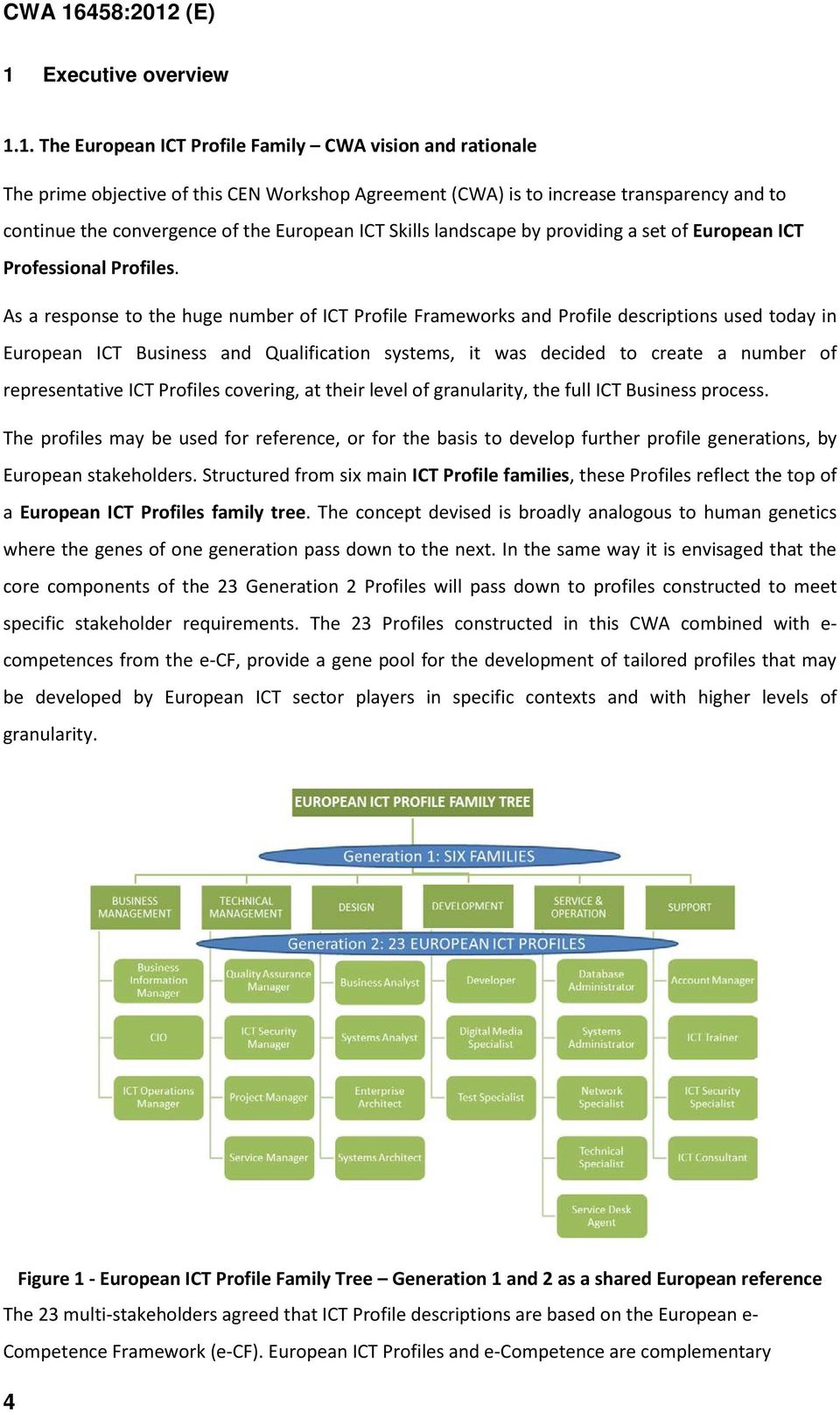
4 1 Executive overview 1.1. The European ICT Profile Family CWA vision and rationale The prime objective of this CEN Workshop Agreement (CWA) is to increase transparency and to continue the convergence of the European ICT Skills landscape by providing a set of European ICT Professional Profiles. As a response to the huge number of ICT Profile Frameworks and Profile descriptions used today in European ICT Business and Qualification systems, it was decided to create a number of representative ICT Profiles covering, at their level of granularity, the full ICT Business process. The profiles may be used for reference, or for the basis to develop further profile generations, by European stakeholders. Structured from six main ICT Profile families, these Profiles reflect the top of a European ICT Profiles family tree. The concept devised is broadly analogous to human genetics where the genes of one generation pass down to the next. In the same way it is envisaged that the core components of the 23 Generation 2 Profiles will pass down to profiles constructed to meet specific stakeholder requirements. The 23 Profiles constructed in this CWA combined with e- competences from the e-cf, provide a gene pool for the development of tailored profiles that may be developed by European ICT sector players in specific contexts and with higher levels of granularity. Figure 1 - European ICT Profile Family Tree Generation 1 and 2 as a shared European reference The 23 multi-stakeholders agreed that ICT Profile descriptions are based on the European e- Competence Framework (e-cf). European ICT Profiles and e-competence are complementary 4
5 concepts that can significantly support the development and management of a world class ICT professional community within Europe. Applied at the same level of granularity as the e-cf, the European ICT Profiles provide generic skeletons of the most representative Profile prototypes currently used in ICT Business structures. To add value, the European ICT Profiles must be adaptable to the employment environment. They are not useful if, on the contrary, the employer has to change practices to meet profile descriptions. The European ICT Profile descriptions are therefore reduced to core components and constructed to clearly differentiate one from each other. Further context-specific elements can be added to the Profiles according to the specific environments in which the Profiles are to be integrated. Clause 4 explains how the European ICT Profiles can be used and adapted by any European stakeholder from a business, qualification or from a research perspective. The 23 Profiles cover the full ICT Business process; positioning them into the e-cf Dimension 1 demonstrates this. Figure 2 below illustrates this together with the ICT Profiles family structure. Figure 2 - European ICT Professional Profiles structured by six families and positioned within the ICT Business Process (e-cf Dimension 1) The European ICT Profiles build a consistent bridge between existing competence and profile approaches. In some European Countries, job profile creation is deployed as the traditional methodology for identifying and driving both organisational career paths and educational curriculum. 5

6 Other countries deploy a competence-oriented approach, appreciating that the competence approach provides more flexibility. In the European ICT Profiles development, the advantages of both approaches have been combined. The European ICT Profiles present e-competences in an operational context. e-competences provide the European ICT Profiles with core content in terms of capabilities needed to successfully perform a role. This provides the flexibility to make Profiles applicable EU-wide yet usable in a workplace environment. By embedding e-competence within ICT Profiles, which can be readily understood by experts or laymen, the European ICT Profile Family provides a universally applicable solution for communication between stakeholders with interests in ICT skills, knowledge and attitude development. The European ICT Profiles have been developed in the context of the CEN Workshop on ICT Skills. The underlying project Towards European e-job Profiles has received EC/EFTA 1 funding within the 2009 ICT Standardization Work Programme. This CWA reviews and replaces the Career Space CWAs (in particular CWA published in March 2004) The European e-competence Framework The European e-competence Framework (e-cf) 3 is another key achievement of the CEN ICT Skills Workshop. The e-cf is an early significant response to the need for standardization and guidance to ICT practitioners (students or experienced) in their performance, training and development Europewide. The e-cf supports the definition of jobs, training courses, qualifications, career paths, formal and non-formal learning paths, certifications etc. in the ICT sector. In this way, local, national, European and global ICT vendor and user companies as well as qualification and certification providers have access to a shared reference. 1 European Free Trade Association 2 For the sake of continuity it is recommended to engage stakeholders to elaborate a cross-reference between both documents in the near future. 3 Published for the first time in 2008 and updated by version 2.0 in See: 6
7 Figure 3 - European e-competence Framework Version 2.0 (Overview) a key input to the European ICT Profiles creation Three years after first publication, the European e-competence Framework has proven in practise to be a successful ICT workforce planning and development tool. Many companies and associations including National Public Authorities in Europe and abroad currently use the e-cf. Consequently, the e-cf was a primary reference used in the creation of European ICT Profiles. 7

8 1.3. ICT Professional Profiles and e-competences European ICT Profiles and e-competence are complementary concepts constructed to support the development and management of a world class ICT professional community within Europe. There are many stakeholders who have an interest in the recruitment, development, education and training, certification and qualifications of ICT professionals. Each of these has a different perspective on the process of continuous professional development. The figure below illustrates the key stages of the ICT professional development cycle. Figure 4 - The key stages of the ICT professional development cycle Job profiles, which sometimes are erroneously known as job descriptions, often provide a start point for employers of ICT personnel. The profile is likely to contain many components describing the essential elements of a job and how it should be performed. This European ICT Profiles CWA establishes a consistent structure and provides a set of rules for profile construction. Education and training takes many forms, not least of which is on the job training. The objectives of employers who invest in and commission programmes of education and training are to enhance the 8

9 capability of individuals and in turn the organisation. Predominately the task of education is delegated to specialist private or public institutions. e-competence is a way of articulating the capability of an ICT professional and hence provides a way of recognising skills or knowledge gaps that may be needed to improve individual and consequently organisational performance. With the European e-competence Framework Europe has succeeded to create a common e-competence language. A Badge of Success is often provided to recognise the achievement of an individual following a period of education. Many awards devised by the public and private sectors are provided to indicate a level of achievement. Some are universally recognised some are specialised and are less well known. 4 Employers often describe their staffing requirements in terms of job profiles and/ or e-competence. Educational Institutions are normally more familiar with education principles, in particular knowledge transference and badges of success such as certifications and qualifications. The creation of job profiles and the concept of e-competence are ways of communicating the skills and knowledge characteristics required by employers to other stakeholders such as recruitment agencies and education establishments. Job profiles are popularly deployed in some European countries to provide a virtuous circle of job requirements through to education, competence development and qualification, as shown in Figure 4. The benefits of a job profile approach are that extensive communications are necessary between stakeholders to set up this sophisticated development process and the consequent quality of output is high. The disadvantage of the job profile approach is a lack of flexibility and the time required to amend profiles in a fast changing technological environment. A different perspective is taken in other European nations where e-competence is the focal point for ICT professional development. Competence units can be grouped together in clusters to enable clear articulation of education and training needs and can be readily restructured to meet changing needs. The disadvantage of e-competence is that it is still not a commonly understood concept and it needs to be put in context when applied to the workplace environment. To gain maximum advantage and added value from both approaches, the European ICT Professional Profiles CWA has elected to bring job profiles and competence together, gaining the best of both worlds. By embedding competence within profiles, which can be readily understood by experts or 4 Previous studies of the CEN ICT Skills Workshop have highlighted the large certification industry at IT Professional level: CEN, European Committee for Standardization: e-certification in action (CEN CWA xxxxx), Brussels 2011 (Not Published) 9

10 laymen, the ICT job profile family provides a universally applicable solution for communication between stakeholders with interests in ICT skills, knowledge and attitude development. In summary the combination of profiles and competence enables individuals, organisations or nations with different cultures to address ICT professional skills development from a familiar perspective yet conform to a standard format recognisable by all Benefits for target groups The multi-stakeholders agreed European ICT Profiles were developed for use by any European ICT Skills Players on the market. Specifically, they are addressed to: ICT managers, providing organisational patterns of accountabilities, tasks, competences and controls between actors (ICT or not); ICT practitioners and managers, to define position descriptions, individual annual training plans and development perspectives; HR managers, to anticipate and plan competence requirements; Education and Training managers, to effectively plan and design ICT curricula; Students, to facilitate information and their professional orientation; Market researchers and policy makers, to use a common language for anticipating ICT job and competence needs in a long-term perspective Procurement managers, providing common definitions for effective technical terms of reference in national and international bids. Furthermore, the up-to-date Pan-European agreed ICT Profile framework in line with the e-cf brings significant benefits to all sectorial players, for example: Many stakeholders are very interested in having a common European ICT Profile framework reflecting current ICT Business needs; Applying the e-cf to ICT profile development, puts e-competences in context for stakeholders who are less familiar with the competence-based approach; Consequently, the ICT Profiles presented facilitate e-cf application by companies and stakeholders familiar with job profile frameworks; Europe-wide agreed ICT Profiles can also help to improve the communication of competence requirements between suppliers and customers. 10
11 Most national ICT stakeholders (representatives of government, trade unions, universities, big enterprises, training bodies ) need to reflect major ICT competence requirement changes during the past ten years by updating existing frameworks. Based on the European e-competences Framework, a European ICT Profiles Family structure facilitates further convergence and/ or interoperability of existing skills and competence frameworks across Europe Positioning with other European e-skills achievements: Overview chart The European ICT Professional Profiles CWA directly contributes to the implementation of the European e-skills strategy as defined in the European Commission's Communication on "e-skills for the 21st Century: Fostering Competitiveness, Growth and Jobs". Over recent years, significant efforts have been made by European and National stakeholders specifically working with the European Commission and CEN to drive forward e-skills development in Europe. The following chart provides an overview of key organisations/ players and results achieved so far. Figure 5 - European e-skills for the 21 st Century Key players, communication structures and Multistakeholder achievements 11

12 2 European ICT Professional Profiles basic principles 2.1. General To support the European ICT Profiles Family construction, a systematic methodological approach was deployed combining sound methodology consistent with the existing e-cf and expert contribution based on practical ICT Business experience. The following Clause describes the ICT Profile identification and description approach; including the development of a generic template which in principle can be applied by any sector in detail European ICT Profiles identification The mission of the CWA development was to define a generic set of ICT Profiles applicable on European and National levels and using the e-cf as the basis for competence identification. The related proposal recommended that approximately 20 ICT Profiles should be developed which are generic and relevant to all organisation types and sizes. As a first step, a reasonable number of commonly used ICT Profile titles were identified. It is probable that over job titles and derivatives are in use by organisations across Europe. A quantitative exercise was undertaken to identify the plethora of existing role titles. The expert project team identified a non-exhaustive list of more than one hundred and forty titles from a variety of sources including corporate career paths, government advisory services, technical education pathways and SME representative structures. 5 With this background of innumerable roles an approach was adopted which recognized the need to identify titles that are clear and easily understood by all stakeholders. A multi faceted spread sheet was created which consolidated the range and scope of identified roles. This collective set was characterized by the presence of a range of granularity levels, from Packaged Application Specialist (a specialist proprietary job title) Technician (a very general title). Clearly a target group of approximately 20 ICT Profiles needs to be of consistent granularity. This was achieved by recognizing the essential connection with e-competences; the experts were able to use this e-cf relationship as a yardstick for granularity guidance. In addition the frequency of title usage was taken into account to inform the final title selections. Initially, 19 titles were selected which fitted the requirements of being, i) easy to understand (plain English), 5 In particular, the following frameworks were analysed: Michelin, international level - EUCIP, European level - AITTS, Germany - Airbus, international level - CIGREF, France - an SME framework from UK - an SME company framework from Germany - UK Government framework - Microsoft Technet, international level - IBM, international level, IWA Web Skills Profiles, international level 12

13 ii) iii) generic and of similar granularity. These essential characteristics were tested against the selected profiles. It was then verified that each of the originally identified (over 140) titles could be represented by the selected role title profiles; all be it at a more generic level. 6 Given the challenge of condensing hundreds of job roles/ titles into a manageable quantity of approximately 20, it was inevitable that consistency of granularity would be compromised in some cases. This was a necessary trade off to ensure that the complete breadth of ICT job roles was covered. Recognising this limitation led to the concept of user generated/ tailored profiles in generation 3 which provide the opportunity to construct profiles of a consistent structure that relate to generation 2 and are of an appropriate granularity level (see the Application Guide in Clause 4). The outcomes of the expert work were presented to a wider stakeholder and expert community to seek further opinion and refinement of the profiles title selection. 7 As identifying titles is not an exact science, testing of the appropriateness and value of the selected titles was continued throughout the project life cycle. The final outcome from the above described process and with multi-stakeholder agreement resulted in 23 Profiles. Taking account of the necessary low level of granularity, the profile descriptions can be seen as complementary and complete: They seek to cover the entire ICT Business Process. The following Table 1 gives an A-Z overview of the 23 Profile Titles together with their Summary statements. Column 3 of the table lists alternative titles currently used on the market for similar Profiles. Table 1-23 Profile Titles (A-Z) with Summary Statements and examples of alternative titles used for similar Profiles European ICT Profile title ICT Profile Summary statement Alternative titles that may be found and used by the market for similar Profiles - Not necessarily accurate Account Manager Business Analyst Senior focal point for client sales and customer satisfaction. Analyses Information System for improving business performance. Sales Advisor (AITTS) Customer Representative (General multi-sector use) Business Development Manager (ICT Role, ACS) 6 See Annex 1 of the Interim report Towards European ICT (e-job) Profiles, April 2011 ICT Profiles identification exercise 7 See Interim Report: Towards European ICT (e-job) Profiles, April

14 European ICT Profile title ICT Profile Summary statement Alternative titles that may be found and used by the market for similar Profiles - Not necessarily accurate Business Information Manager Proposes plans and manages functional and technical evolutions of the Information System within the relevant business domain. Business Intelligence Developer (Microsoft) Business/ Systems Analyst (ICT-Role) Chief Information Officer Database Administrator Developer Digital Media Specialist Enterprise Architect ICT Consultant ICT Operations Manager 14 Develops and maintains Information Systems compliant to business and organisation s needs. Designs and implements, or monitors and maintains databases. Builds/codes ICT solutions and specifies ICT products according to the customer needs. Creates websites and multimedia applications combining the power of digital technology with effective use of graphics, audio, photographic and video images. Designs and maintains the Enterprise Architecture. Supports understanding of how new ICT technologies add value to a business. Manages operations, people and further resources for the ICT activity. Head of Computing (Demand side title) Database Developer (Microsoft) Database Manager (Eucip) Network Administrator (ACS) Component Developer (AITTS) Application Developer (ITA-J) Programmer (IBM) Front-End Web Developer (IWA) User Experience Designer (IWA) Web & Multimedia Master (Eucip) Web Content Manager (UK-Gov, IWA) Web Developer (Bring-IT-On, Microsoft, UK-Gov) Web Editor (UK-Gov) Digital Media Developer (AITTS) Multimedia Designer (Bring-IT-On) Multimedia Developer (ACS) Consultant (ACS) Consultant and Contractor (ACS) Enterprise Solutions Consultant (Eucip) Logistics & Automation Consultant (Eucip) Sales & Application Consultant (Eucip) Technical Consultant (Bring-IT-On) IS Service Manager (Airbus) Service Advisor (AITTS) Computing Manager (Demand side title)
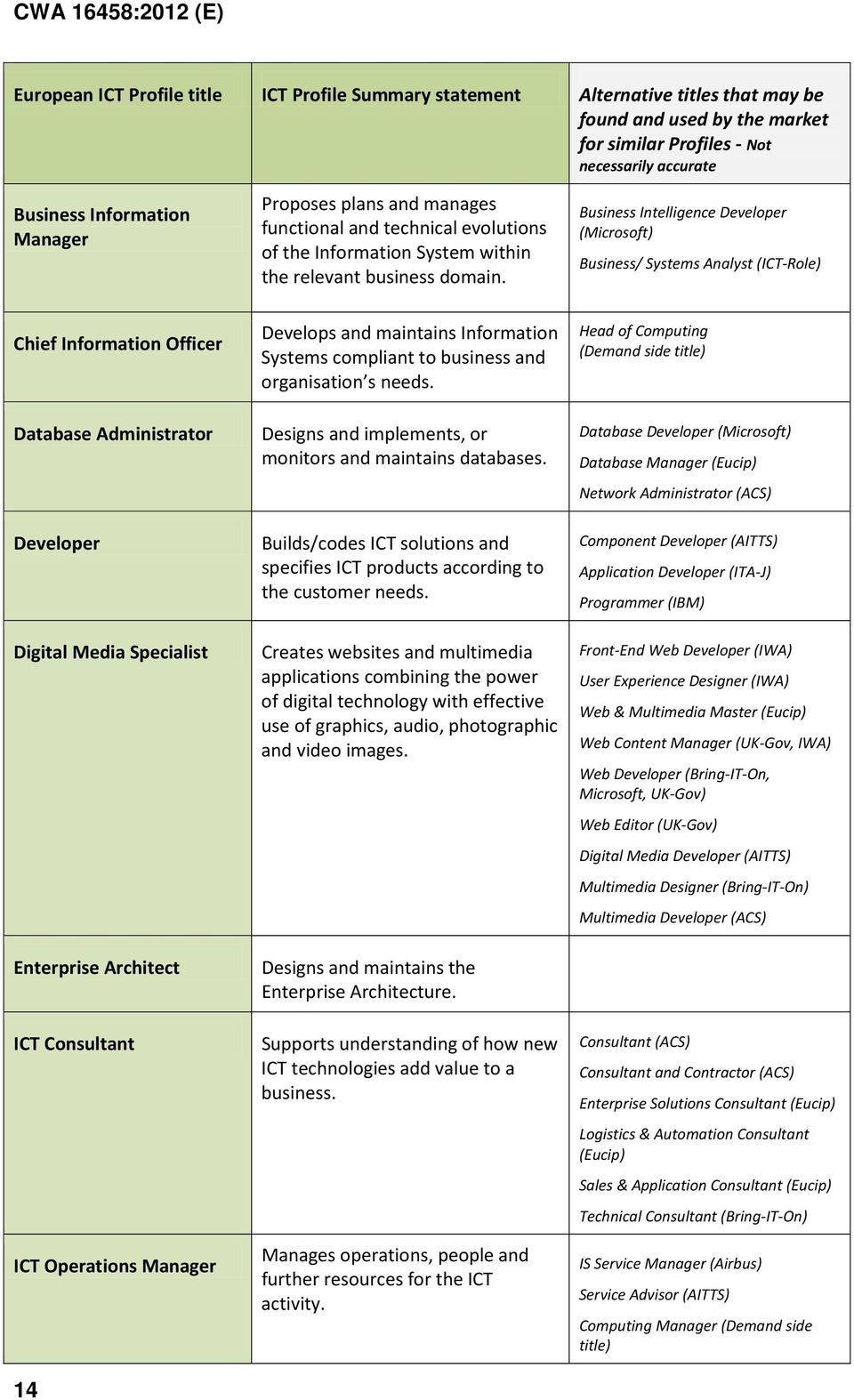
15 European ICT Profile title ICT Profile Summary statement Alternative titles that may be found and used by the market for similar Profiles - Not necessarily accurate ICT Security Manager ICT Security Specialist ICT Trainer Network Specialist Project Manager Quality Assurance Manager Manages the Information System security policy. Ensures the implementation of the organizations security policy. Educates and trains ICT professionals and practitioners to reach predefined standards of ICT technical /business competence. Ensures the alignment of the network, including telecommunication and/or computer infrastructure to meet the organization s communication needs. Manages project to achieve optimal performance that conforms to original specifications. Guarantees that Information Systems are delivered according to organization policies (quality, risks, Service Level Agreement). Security Advisor (Eucip) Security Analyst (ACS) Security Service Personal (UK-Gov) Security Services Specialist (ITA-J) Security Specialist (aux, ICT Role) Security Technician (AITTS) Technical Trainer (IBM) Instructor (multi-sector common title) Network Engineer (Bring-IT-On, UK Gov) Network Manager (Eucip, UK Gov) Network Services Specialist (ITA-J) Network Support (ACS) Network Administrator (ACS) IS Project Manager (Eucip) Project Coordinator (AITTS Web Project Manager (IWA)) Quality Management Coordinator (AITTS) Quality Manager (SME) Service Desk Agent Provides first line telephone or e- mail support to clients with technical issues. Help Desk Supervisor (Eucip) Helpdesk Professional (UK-Gov) Service Manager Systems Administrator Plans, implements and manages solution provision. Administers ICT System components to meet service requirements. Service Advisor (AITTS) IS Service Manager (Airbus) Network Administrator (ACS) Server Administrator (Microsoft) System Administrator (SME) Database Administrator (Microsoft) Enterprise Administrator (Microsoft) Enterprise Messaging Administrator (Microsoft) Web Server Administrator (IWA) 15
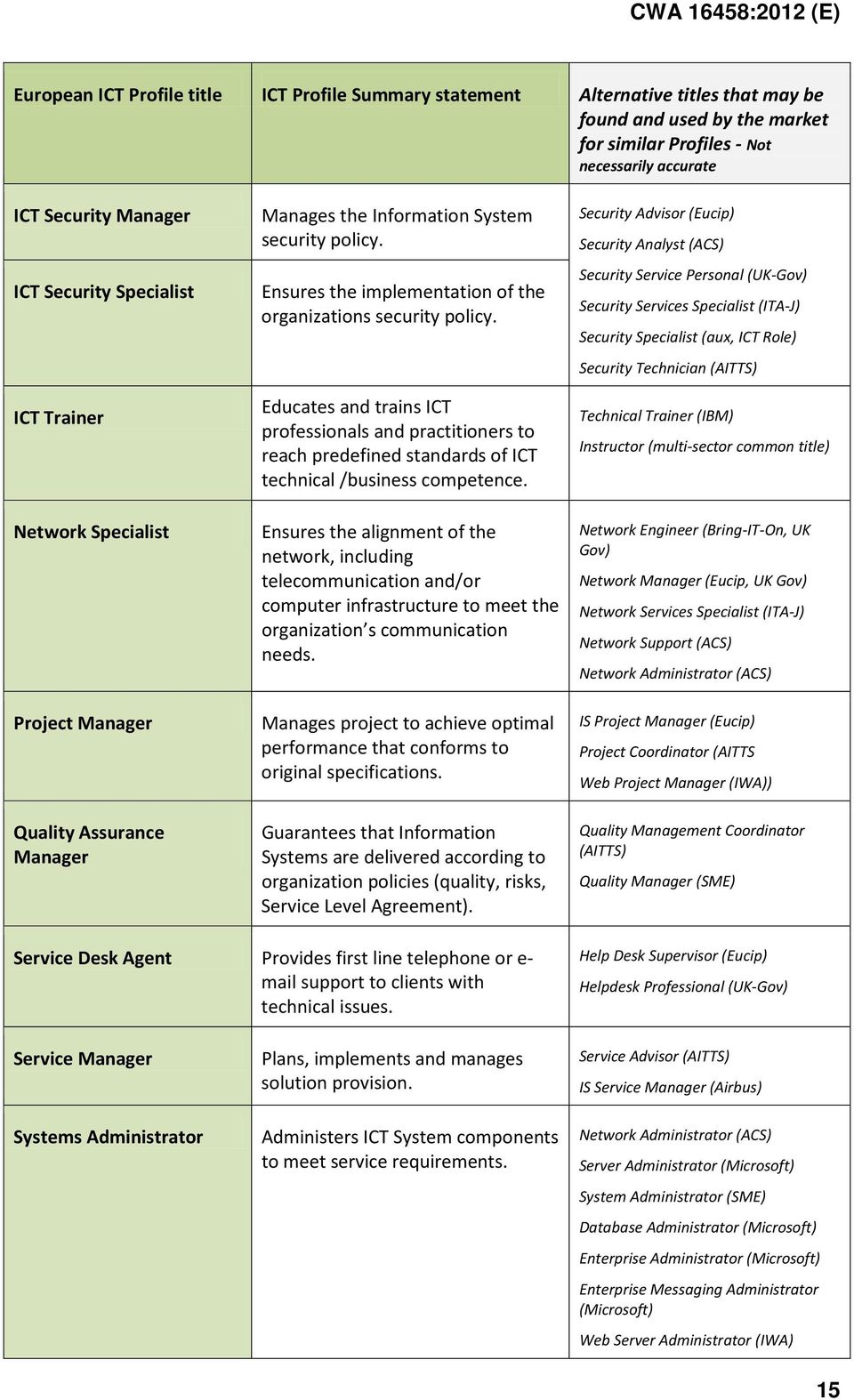
16 European ICT Profile title ICT Profile Summary statement Alternative titles that may be found and used by the market for similar Profiles - Not necessarily accurate Systems Analyst Systems Architect Technical Specialist Analyses requirements and specifies software and systems. Plans and is accountable for the implementation and integration of software and/ or ICT systems. Maintains and repairs hardware and software on client premises. Information Scientist (UK-Gov) Information Systems Analyst (Eucip, ACS) Telecommunications Architect (Eucip) Computer Service and Repair Technician (UK-Gov) Consumer Support Technician (Microsoft) Service Engineer (general multi-sector use) Customer Engineer (IBM) Test Specialist Designs and performs testing plans. Computer Games Tester (UK-Gov) 2.3. Basic concepts: e-competences and deliverables Software Tester (SME) Systems Integration & Testing Engineer (Eucip) Test Specialist (ITA-J) Tester (AITTS) The European ICT Profile descriptions are based on two fundamental concepts: European e-competence Framework: for defining ICT Profiles a list of e-competences can be identified, to provide differentiation between profiles; Outcomes/ Deliverables - An ICT Profile is defined by a list of Deliverables, either in terms of accountable, responsible or in terms of contribution; - A Deliverable is a predefined result of a task in a working context; - One Deliverable can have only one associated accountable job but may have many contributors; - A deliverable may or may not be seen by users, may be intermediate or final, but must always be observable. 16

17 The European e-competence Framework, its look and its principles are commonly known and can be read more in detail in the three basic e-cf related publications. 8 The deliverables concept adds a second innovative element to the European ICT Profiles description. To ensure overall understanding of the European ICT Profiles approach, the following paragraphs explain in detail how the deliverables were identified and described. Deliverables identification and description methodology In general terms a Deliverable is the outcome of an activity. Profiles can contribute in different ways towards the production of a Deliverable. Deliverables are an important attribute in Profiles definitions; using them we can direct mission, tasks and competences to illustrate observable results. Deliverables must be observable. For example, the mission of the Account Manager is to build business relationships, it is therefore a logical consequence, that business relationships are a deliverable. However, the deliverables definition does not include quality attributes like Good business relationships. Quality issues are meaningful only if they can be measured. 9 A complete list of Deliverables was not required to meet the project aim, merely the identification of the most relevant ones, consistent with the overall level of granularity and applicable to the identified ICT Profiles. Choices were made to identify relevant Deliverables which added value to ICT Profiles in order to better characterize their mission. For this application Deliverables are selected to illustrate Observable Results, whether tangible or intangible. To support the 23 Profiles the Deliverables list was limited to approximately items. The process for identifying Deliverables was inspired from three different sources: i) e-cf 2.0 Framework ii) Additional content from the Waterfall Development Process iii) Role Profile Iteration The following paragraphs describe in more detail how the three different sources were used. 8 See: European e-competence Framework 2.0, e-cf User guide and Methodology documentation for free download at 9 To equally address quality issues within the European ICT Profiles description it was decided to include KPI areas into the Profile definitions; from there context-specific KPI s (Key Performance Indicator) can be derived. 17
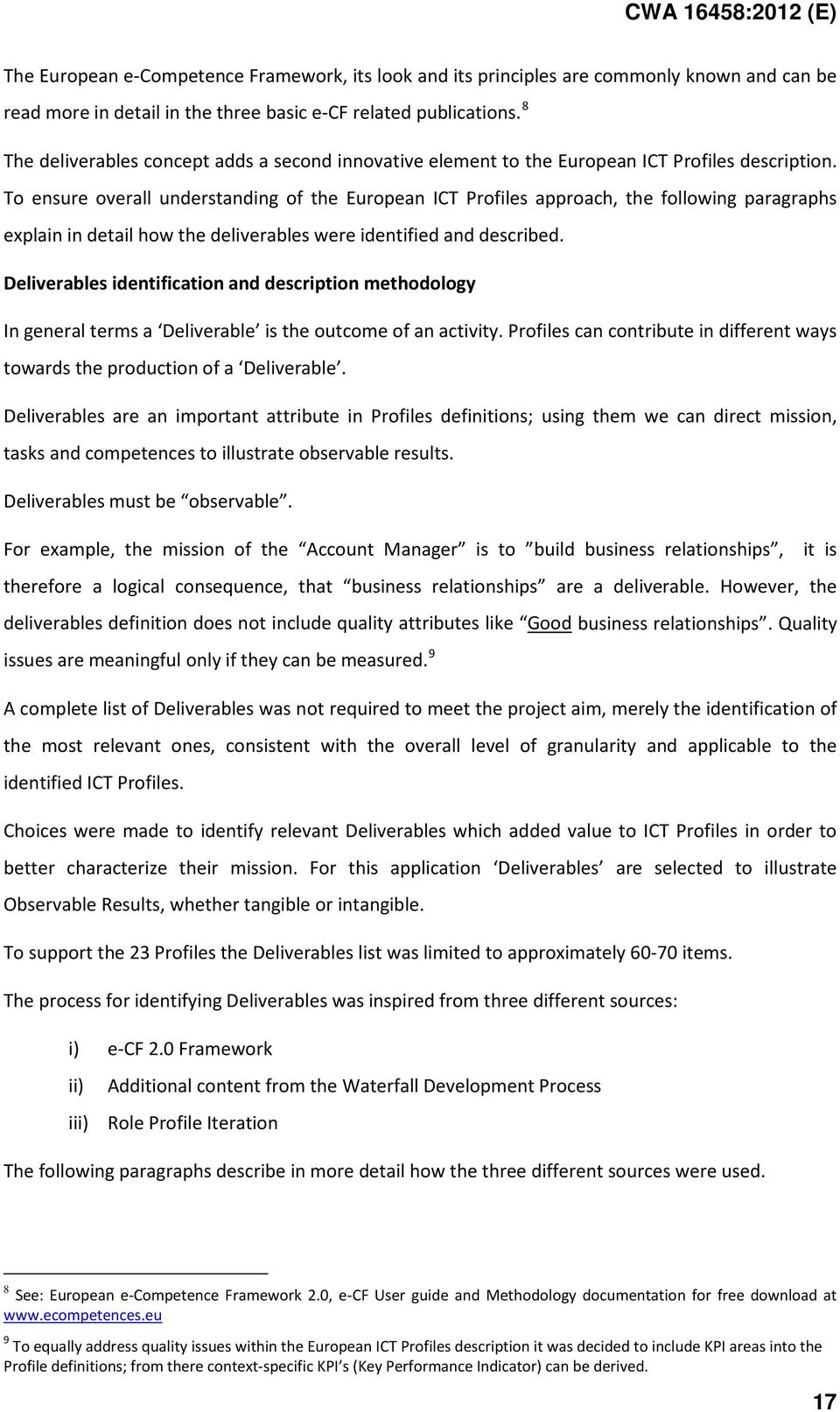
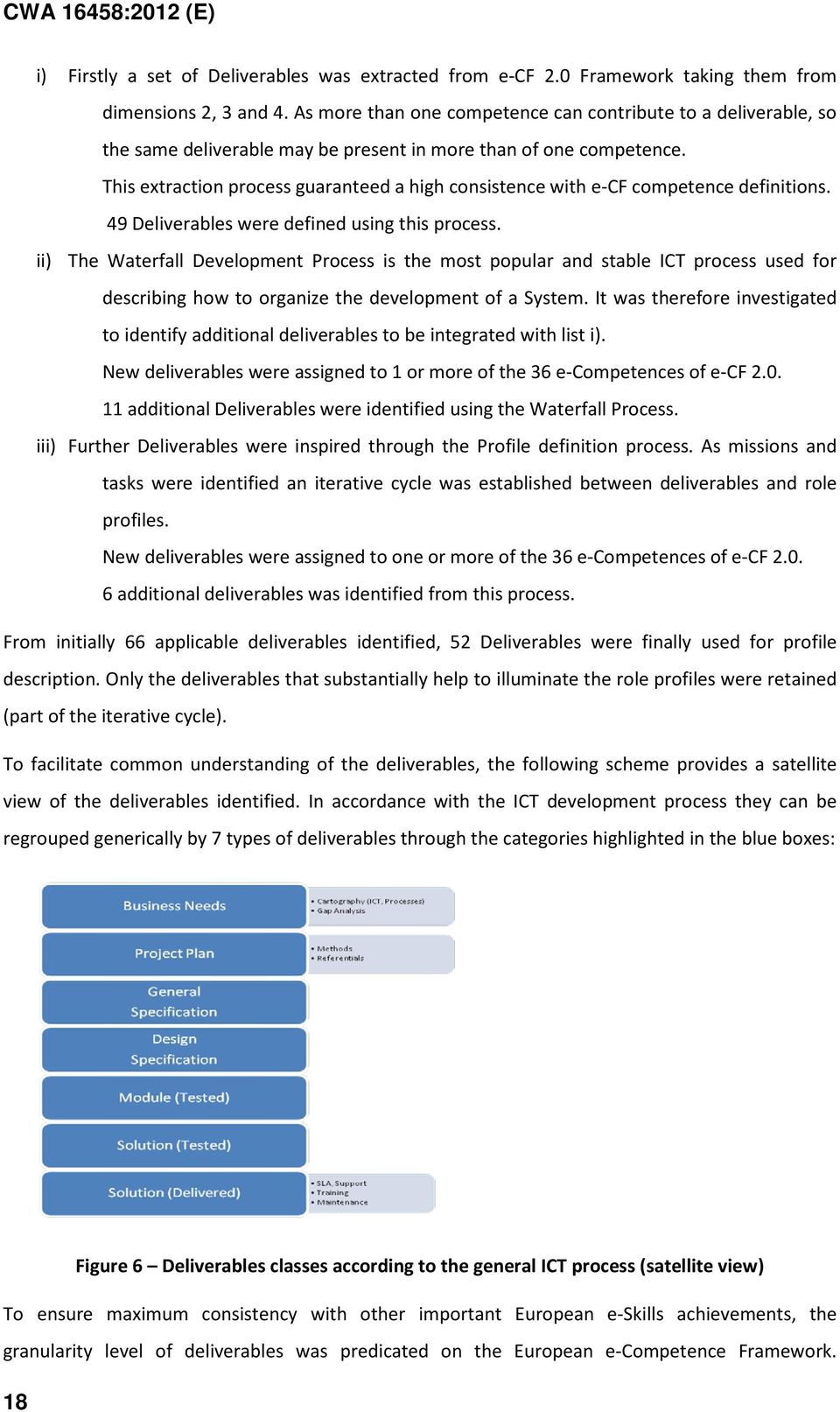
18 i) Firstly a set of Deliverables was extracted from e-cf 2.0 Framework taking them from dimensions 2, 3 and 4. As more than one competence can contribute to a deliverable, so the same deliverable may be present in more than of one competence. This extraction process guaranteed a high consistence with e-cf competence definitions. 49 Deliverables were defined using this process. ii) The Waterfall Development Process is the most popular and stable ICT process used for describing how to organize the development of a System. It was therefore investigated to identify additional deliverables to be integrated with list i). New deliverables were assigned to 1 or more of the 36 e-competences of e-cf additional Deliverables were identified using the Waterfall Process. iii) Further Deliverables were inspired through the Profile definition process. As missions and tasks were identified an iterative cycle was established between deliverables and role profiles. New deliverables were assigned to one or more of the 36 e-competences of e-cf additional deliverables was identified from this process. From initially 66 applicable deliverables identified, 52 Deliverables were finally used for profile description. Only the deliverables that substantially help to illuminate the role profiles were retained (part of the iterative cycle). To facilitate common understanding of the deliverables, the following scheme provides a satellite view of the deliverables identified. In accordance with the ICT development process they can be regrouped generically by 7 types of deliverables through the categories highlighted in the blue boxes: Figure 6 Deliverables classes according to the general ICT process (satellite view) To ensure maximum consistency with other important European e-skills achievements, the granularity level of deliverables was predicated on the European e-competence Framework. 18
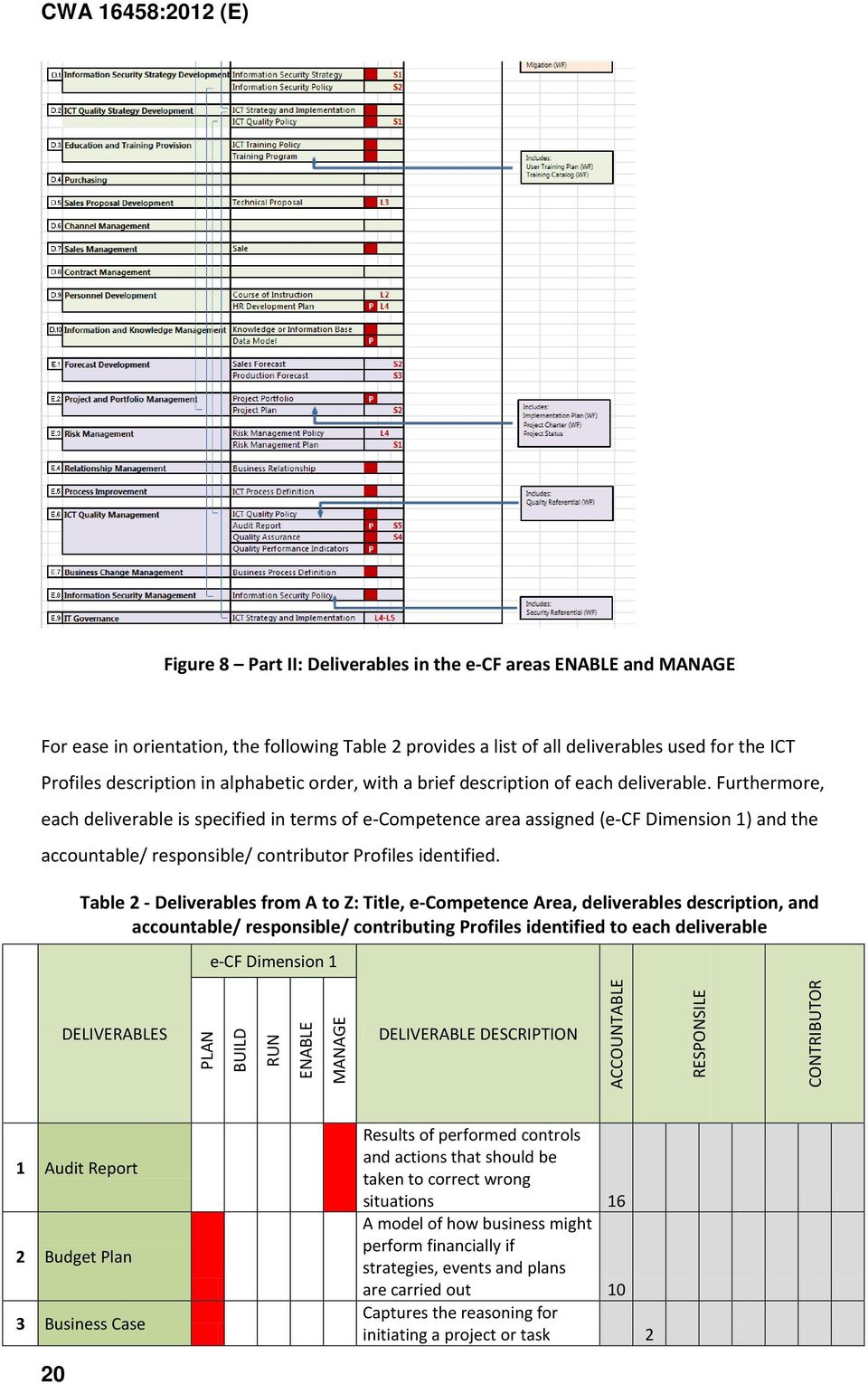
19 Nevertheless it should be noted that owing to the variance of ICT Profiles in terms of complexity and autonomy, not all deliverables identified can be of the same level of granularity. Whilst a high level deliverable such as IS Strategy & Implementation assigned to the CIO is very generic, others provided at a lower level of complexity and autonomy, e.g. Audit Reports assigned to the Quality Assurance Manager, are more specific and more detailed. Figure 7 shows an overview of deliverables identified and classified according to the European e- Competence Framework. Figure 7 Part I: Deliverables in the e-cf areas PLAN, BUILD, RUN 19

20 Figure 8 Part II: Deliverables in the e-cf areas ENABLE and MANAGE For ease in orientation, the following Table 2 provides a list of all deliverables used for the ICT Profiles description in alphabetic order, with a brief description of each deliverable. Furthermore, each deliverable is specified in terms of e-competence area assigned (e-cf Dimension 1) and the accountable/ responsible/ contributor Profiles identified. Table 2 - Deliverables from A to Z: Title, e-competence Area, deliverables description, and accountable/ responsible/ contributing Profiles identified to each deliverable e-cf Dimension 1 DELIVERABLES PLAN BUILD RUN ENABLE MANAGE DELIVERABLE DESCRIPTION ACCOUNTABLE RESPONSILE CONTRIBUTOR 1 Audit Report 2 Budget Plan 3 Business Case Results of performed controls and actions that should be taken to correct wrong situations 16 A model of how business might perform financially if strategies, events and plans are carried out 10 Captures the reasoning for initiating a project or task 2 20
21 4 Business Plan Business Process Definition Business Relationship Business Requirements Course of Instruction 9 Data Model Development Process Eco- Responsibilities Referential Enterprise Architecture 13 First Level Support (WF) 14 Hardware Component 15 HR Development Plan 16 ICT Model 17 ICT Process Definition 18 ICT Quality Policy 19 ICT Strategy and Implementation 20 ICT Training Policy 21 Information Security Policy Formal statement of a set of business goals, why they are believed attainable, and the plan for reaching them A collection of related, structured activities that will accomplish a specific organizational goal 8 A formal contractual relationship established to provide business services 1 2 Describes what a business needs so that it may be able to operate successfully 2 9 Single unit of a Training Program 13 Description of data and relations in terms of dependency, consistency and integrity 5 Process imposed on the development of a software product 21 Reference for Eco- Responsibilities Rigorous description of the structure of an enterprise related to ICT 8 Services providing first level user assistance 17 Physical artifact of a technology 6 20 Systematic process of matching interest,skills and talents of individual with long-term organisation goals 10 Description of user functions and services provided by an information system 20 Defines a collection of related, structured activities or tasks that will accomplish ICT development goals 20 Principle or rule to guide decisions and achieve rational outcome(s) in ICT quality policy 16 Defines goals and strategy IT Principle or rule to guide decisions and achieve rational outcome(s) in ICT training 13 Principle or rule to guide decisions and achieve rational outcome(s) in Information Security
22 Information Security Strategy Integrated Solution IS Department & budget Knowledge or Information Base Multimedia 26 Component New technology 27 integration proposal 28 Production Forecast 29 Project Plan 30 Project Portfolio 31 Quality Assurance 32 Quality Performance Indicators 33 Quality Plan Risk Management Plan Risk Management Policy Defines goals and strategy for quality in Information Security Process 11 4 Solution at the stage where all components and sub-systems are integrated and tested Organisation, Processes, Human Resources,Infrastructure and Budget needed to implement IS Strategy 4 23 Model for collection, organization, and retrieval of information and knowledge Software and contents based on audio,video and animations 7 Illustrates goals, benefits and strategy for introducing new ICT technology Projection of achievable produ ction volumes, based on market needs, historical sales data and current Production Capacity 1 A formal, approved document used to guide both project execution and project control 15 9 Set of documents for analyzing and collectively managing a group of current or proposed projects 3 4 The systematic monitoring and evaluation of the various aspects of a project or service to maximize the probability that minimum standards of quality are being attained by the production process. 16 Indicators measuring how quality policy is implemented on IS project and ICT solutions in operation Defines activities to deliver solutions achieveing customer's quality expectations on the basis of the quality standards. 15 Document to foresee risks, to estimate the effectiveness, and to create response plans to mitigate them 12 Principle or rule to guide decisions and achieve rational outcome(s) in Risk Management
23 36 Sale 37 Sales Forecast Service Level Agreement Software Component Solution Documentation Solution in Operation Solution Specification 43 Solved Incident SW Design Description SW Needs Assessment 46 Technical Proposal 47 Test Plan 48 Test Procedure 49 Test Result 50 Training Program 51 Up-to-date Solution 52 Validated Solution Contract involving transfer of the possession and ownership (title) of a good or property, in exchange for money or value. 1 Projection of achievable sales revenue, based on historical sales data, analysis of market survey s and trends, and sales persons' estimates 1 Part of a service contract where the level of service is formally defined 4 18 Software package, or module that encapsulates a set of related functions (or data) 6 20 Set of Documents which illustrate all aspect related to the Solution Solution deployed and running in the final environment Set of Documents which define in detail the Solution to be developed Incident in the stage where a Solution to address the failure has been applyed Set of Documents which illustrate all the characteristic of Software to be developed 6 Describes Needs in terms of Software after a detailed organisation assessment 20 Document that defines the technical requirements of a project, and explains the plan formulated to address them A formal, approved document used to guide Test Phase 23 A set of tests which addresses homogeneous solution areas Details results after one of several sessions during Test Phase 23 Program for the acquisition of knowledge, skills, and competencies Updated Solution during the Maintenance Phase 22 Solution at the end of Test and Validation Phase
24 Deliverables were identified as a tool being valuable contributors to support illumination and differentiation of the 23 ICT Professional Profiles at an appropriate level of granularity. The intention was not to provide a fully comprehensive and consistent Deliverables Framework; this issue is further explained in
25 2.4. The ICT Profiles Template and description rules A basic achievement of this CWA is the agreement on a template used to show how all 23 ICT Profiles were defined and how they can be further adapted in a specific context by individual users. This template is of generic value and can in principle be applied to any sector. To continue increasing transparency it is recommended to follow this outline format for job profile descriptions in other profile description activities. By using the same basic template it becomes easier to compare and contrast different profiles within the same or different industry sectors. Influenced by job roles used in ICT organizations across Europe and by considering practicalities to be taken into consideration, the template specification for each profile contains definitions as follows: A title to give a name to the profile; A summary statement to indicate the main purpose of the profile; A mission statement to describe the rationale of the profile; A list of deliverables (maximum 5 to focus on main ones, with mention of the level of responsibility accountable, responsible or contributor) to be carried out by the profile; A list of typical tasks to be performed by the profile; A list of necessary e-competences (from the e-cf) to carry out the mission; A KPI (Key Performance Indicator) area to inspire how to deduce specific KPIs allowing the measurement of the mission performance and its outputs. Less is more: About the need to focus To answer to the need of a common European language for ICT Profiles and flexibility in application, the European ICT Professional Profiles have been developed as Skeletons reducing the description of each item to the core of a role. Following the principle Less is more, questions considered were: What is the essential content of this Profile? What makes it different from the others? Which are the most relevant e-competences, tasks or deliverables, discriminating a profile one from another? What can serve as generic KPI area (from where specific measurable indicators can be derived by European stakeholders on the next application level, the third or tailored generation)? For example, even if the CIO Profile is responsible for Service Level Management as a deliverable, the competence A.2. Service Level Management is not associated to this profile. Reducing the Profile to its core shows that other e-competences are more important for the CIO and the assignment of e.g. e-competence A.2. would be too narrow. This question of priority explains also why the e- competences D.4. Purchasing and A.8. Sustainable Development are not assigned to any of the 23 ICT 25
26 Profiles. Both e-competences could be included in a number of Profiles but not at this generic European level where the initial sense of Profiles specification is to provide basic characteristics and to make clear differences between them. Less is more is also valid when it comes to the level assignment of e-competences. The intention of this CWA is to reflect competent individuals in conditions of successful work performance. For this reason the competences selected have to focus on a maximum of two levels. Removing the limitation of levels would not lead to the definition of junior and senior specialists in one profile, but lead to less consistent and less usable Profile references. However, the differences made between Profiles can not be fully understood when only focusing on the selected e-competences and the levels assigned. Some Profiles may need very similar competences for successful work performance however they clearly differ from each other by summary statement, mission and tasks. In this sense, the Profiles have to be understood and used in their entire descriptions. The following scheme shows a template specifying all items and rules applied to describe each item of a profile. Profile title Summary statement Mission Table 3 - The European ICT Profile description template and rules Gives a commonly used name to a profile. Identification exercise and multistakeholder agreement as described in 2.2. Indicates the main purpose of the profile. The purpose is to present to stakeholders and users a brief, concise understanding of the specified ICT Profile. It should be understandable by ICT professionals, ICT managers and Human Resource personnel. The structure should consist of a short sentence (up to approximately 15 words). It should not repeat the entire ICT Profile name. It should provide a statement of the job s main activity. Describes the rationale of the profile. The purpose is to specify the designated job role defined in the ICT Profile. It should provide the performance context of the job within an organisational structure. The following verbs may be used within the description or at least for structuring the thinking about how to express the mission: Guarantees, Ensures, Contributes. Deliverables Accountable (A) Responsible (R) Contributor (C) 26
27 Main task/s e-cf competences assigned KPI Area Specifies the Profile by key deliverables. The purpose is to illuminate the ICT Profiles and to explain relevance including the perspective from a non-ict point of view. Also add the dimension of responsible following the RACI model Select only the most important deliverables, which help to illustrate the ICT Profile, not more than 5 in total (A,R,C together). Mention the level of responsibility A accountable, R responsible, C contributor to be carried out by the profile. Provides a list of typical tasks to be performed by the profile. A task is an action taken to achieve a result within a broadly defined context. Tasks may be associated with deadlines, resources, goals, specifications and/or the expected results. These elements depend upon the context of the task and may be omitted, however the action must always be described. A task is defined by a short description using a verb and the objective or goal of the action. List no more than 10. SELECTION CRITERIA: A task contributes to define a Profile. Provides a list of necessary competences (from the e-cf) to carry out the mission. Must include 1 up to 5 competences. Level assignment is important. Can be (usually) 1 or (maximum) 2 levels. SELECTION CRITERIA: A competence is a consequence of the previously derived Profile definition and helps to separate profiles one from another. Based upon KPIs (Key Performance Indicators) KPI area is a more generic indicator, congruent with the overall profile granularity level. It is deployed to add depth to the mission. Not prescriptive. Non-specific measurements. Use general examples. The principle is to provide KPI areas (which are stable, general and long lasting) providing users with an inspiration to enable development of specific KPI s for specific roles (such KPI measurements can be more short-term oriented). Must be related to the key deliverables in order to measure them. Focus on long-term deliverables (Profile), not short term (Job position). Be described in a single sentence. The KPI area should always be translatable into detailed measurable KPI examples. 27
28 Once all Profiles were fully described, a consistency cross-check was carried out: Have all items described been identified in a coherent and consistent way? Is there a clear distinction between all profiles and have overlaps been avoided? On the assigned level of granularity; are all relevant missions and deliverables of the ICT business process covered? The technical interim and final results were presented at several occasions to the wider European experts and stakeholders community, seeking further feedback and final improvement. The outcome of this process, all 23 European ICT Professional Profiles with full descriptions, including profile interrelationships and further illustrative overview schemes, are presented in Clause ICT Profile Family identification Structuring the 23 European ICT Profiles by families significantly facilitates navigation and enriches an initially flat structure with orientation guidance. In this way ICT Profiles can be divided into family groups of related profiles. considered; for example: In identifying groups, different options of similarity were initially ICT Profiles could be arranged according to hierarchical roles, like manager or specialist ICT Profiles could be arranged according to similar fields, like business or database ICT Profiles could be arranged according to other similarities such as functions or deliverables However, patterns of competence are the most helpful arrangement of European ICT Profiles for enterprises, human resources department and professionals involved in competence and skills development. The assigned competences of all European ICT Profiles are gathered from the e- Competence Framework. Consequently every European ICT Profile is characterised by a set of competences at specific levels that form a typical pattern. The following example shows the e-cf competences assigned to two different ICT Manager Profiles: 28
29 Table 4 - e-competence assignment Two European ICT Profile examples ICT Security Manager Project Manager A.4 Product or Project Planning (level 4) A.7 Technology Watching (level 4) D.1 Information Security Strategy Development E.2 Project and Portfolio Management (level 4) E.3 Risk Management (level 3) E.3 Risk Management (level 3) E.4 Relationship Management (level 3) E.7 Business Change Management (level 3) E.8 Information Security Management (level 4) E.9 IT Governance (level 4) Another example of two different ICT Profiles: both located in the field of systems (please note the different levels of competence): Table 5 - e-competence assignment Two further European ICT Profile examples Systems Analyst Systems Architect A.5 Design Architecture (level 3) A.5 Design Architecture (level 4) A.7 Technology Watching (level 4-5) B.1 Design and Development (level 3-4) B.1 Design and Development (level 4-5) B.2 System Integration (level 4) E.5 Process Improvement (level 3-4) Based on the pattern of competence it is possible to locate each European ICT Profile on a map, built from Dimension 1 of the e-competence Framework which reflects the five main ICT business processes PLAN, BUILD, RUN, ENABLE and MANAGE: 29
30 Figure 9 - The 23 European ICT Professional Profiles positioned in the 5 main business processes (e-cf Dimension 1) Most ICT Profiles are located in one e-cf dimension, for example, CIO in MANAGE, Enterprise Architect in PLAN or Technical Specialist in RUN. This means, that all or most important competences of the profile are related to this ICT business process. A minority of ICT Profiles are located on borders, e.g. Business Information Manager in MANAGE and PLAN or the Systems Administrator in BUILD and RUN. This means, that these profiles typically combine competences (and also tasks) from two ICT business processes. To build families, it was necessary to associate the profiles. Again, different possibilities were available. The first and most obvious possibility is to group profiles within the ICT Business Processes and create a MANAGE-family, a PLAN-family and so on. This approach adds little as families fail to add any additional information than the profiles on their own. Another possibility was to build families within similar fields of action, integrating some specialisations, and forming groups such as an analyse-family or a service-family. This option may work in some ICT contexts, but it mainly relates to enterprise organisations and fails to be relevant to SMEs. To ensure maximum added value, it was decided to provide six families combining similar patterns of competence with similar tasks and work relationships. This final result is illustrated in
31 3 The top of a European ICT Family Tree: 23 ICT Profiles in six families 3.1 General The prime objective of the presented 23 European ICT Professional Profiles is to increase transparency and to continue the convergence of the European ICT Skills landscape, as initiated in the origins of the European e-competence Framework (e-cf). As a response to the vast number of ICT Profiles Frameworks and Profiles descriptions used today in European ICT Business and Qualification practice, it was decided to create a reasonable number of representative ICT Profiles which cover the whole ICT Business process reflected by e-cf Dimension 1 and which can be used for reference or further development by stakeholders Europe-wide. Structured in six main ICT Profile families, the philosophy behind these reference Profiles is to reflect the top of a European ICT Profiles family tree. Figure 10 - European ICT Profile Family Tree Generation 1 and 2 for Europe-wide reference The following Clauses present the 23 Profiles and the related Profile families in detail. All ICT Profiles are fully described. Additionally a number of charts are provided which illustrate the profiles structure from different perspectives (e-competences, Deliverables, Working Relationships, Business/ Technology Orientation). 3.2 Generation 1: Six ICT Profile Families Six families combining typical patterns of competences with typical tasks and work relationships group the 23 Profiles. This family classification is shown in the following Figure
32 Figure 11 - The 23 European ICT Profiles structured by six families Six families specify Generation 1 of the European ICT Family Tree; leading to the 23 specific ICT Professional Profiles in Generation 2 for Europe-wide reference: Business Management with Business Information Manager, Chief Information Officer, ICT Operations Manager Technical Management with Quality Assurance Manager, ICT Security Manager, Project Manager, Service Manager Design with Business and Systems Analyst, Enterprise and Systems Architect Development with Developer, Digital Media Specialist, Test Specialist Service & Operation with Database and Systems Administrator, Network and Technical Specialist, Service Desk Agent Support with ICT Consultant, Account Manager, ICT Trainer, ICT Security Specialist. Profiles within families (except the family Support ) share a commonality that sometimes provides a possible basis for them to coexist within similar career paths sharing development opportunities, or participating in similar business and work processes. 3.3 Generation 2: 23 European ICT Profiles Full descriptions To add value the European ICT Profiles must be adaptable to the employment environment. They are not useful if, on the contrary, the employer has to change practices to meet profile descriptions. 32
33 The European ICT Profile descriptions are therefore reduced to their core characteristics which clearly differentiate them one from another (see 2.4). Further context-specific elements can be added to the Profiles according to the specific environments in which the Profiles are to be integrated. An example of this need to take into account context is the use of the acronyms ICT (information communications technology) or IS (information systems). At the top of the European ICT Profiles Family Tree, within Generation 2 Profiles, it is too restrictive and possibly inaccurate to prescribe the use of ICT or IS. The default is to use the more general term ICT, except in exceptional circumstances where only IS, is applicable. However, IS or ICT can be applied within Generation 3 Profiles to more accurately focus the profile. Definitions of IS and ICT are Incorporated within the Glossary, Clause 5. 33
34 Profile title ACCOUNT MANAGER (1) Summary statement Mission Senior focal point for client sales and customer satisfaction. Builds business relationships with clients to facilitate the sale of hardware, software, telecommunications or ICT services. Identifies opportunities and manages sourcing and delivery of products to customers. Has responsibility for achieving sales targets and maintaining profitability. Deliverables Accountable Responsible Contributor Sale Business Relationship Sales Forecast Technical proposal Production Forecast Main task/s Maintain overall customer satisfaction with products and/or services Identify opportunities to propose new products or services to client(s) Be the primary contact point for client executive management Deliver value added presentations related to products and services to customer executive management Lead negotiations to establish profitable contracts with client(s) Maintain and enhance business relationships e-competences (from e-cf) D.5. Sales Proposal Development Level 4 D.7. Sales Management Level 5 E.1. Forecast Development Level 3 E.4. Relationship Management Level 4 D.6. Channel Management Level 4 KPI area Sales quota achievement 34
35 Profile title BUSINESS ANALYST (2) Summary statement Mission Analyses Information System for improving business performance. Identifies areas where information system changes are needed to support business plans and monitors the impact in terms of change management. Contributes to the general functional requirements of the business organization in the area of ICT solutions. Analyses business needs and translates them into ICT solutions. Deliverables Accountable Responsible Contributor Business requirements Business case Business relationship Business plan ICT Strategy & implementation Main task/s e-competences (from e-cf) Contribute to the preparation of the business plan of the organization Identify areas for improvement in business processes providing possible ICT solutions compliant with the ICT strategy Build requirements, specifications, business processes and the business case related to the proposed solutions Analyze required information and documents A.1. IS and Business Strategy alignment Level 4 A.3. Business Plan Development Level 4 E.5. Process Improvement Level 4 KPI area Adequacy of the business requirements in response to the business plan 35
36 Profile title BUSINESS INFORMATION MANAGER (3) Summary statement Mission Proposes plans and manages functional and technical evolutions of the Information System within the relevant business domain. Manages and implements updates to existing applications and maintenance activities guided by the needs, costs and plans agreed with internal users. Ensures quality of service and internal user satisfaction. Deliverables Accountable Responsible Contributor Project portfolio Solution specification Business plan Main task/s e-competences (from e-cf) Responsible for managing the information technology development within the business domain Anticipate changes to the Information System and the business impact and vice versa Formalize, consolidate and drive the development of the configuration of the information system Evaluate the relevance of the Information systems to the business domain Build a knowledge base through understanding the organization s information system A.1. IS and Business Strategy Alignment Level 4 A.3. Business Plan Development Level 4 E.2. Project and Portfolio Management Level 4 E.7. Business Change Management Level 4 D.10. Information and Knowledge Management Level 5 KPI area Business User requirement satisfaction 36
37 Profile title CHIEF INFORMATION OFFICER (CIO) (4) Summary statement Mission Develops and maintains Information Systems compliant to business and organisation s needs. Defines and implements governance and ICT strategy. Determines necessary resources for ICT strategy implementation. Anticipates ICT market evolutions and company business needs. Contributes to the development of the organisation s strategic plan. Leads or participates in larger change projects. Deliverables Accountable Responsible Contributor ICT Strategy & implementation ICT Department & budget Project Portfolio Service Level Agreement Information Security Strategy Risk management policy Main task/s Define the company s strategy for IT Manage all IS department activity Responsible for the quality and management of customer-supplier relationships Define and ensure compliance with Service Level Agreements Negotiate and implement complex contracts Make recommendations to senior general management Ensure that change management processes are implemented Ensure the reliability, confidentiality, security and integrity of Information Systems e-competences (from e-cf) A1. IS and Business Strategy Alignment Level 5 A3. Business Plan Development Level 5 E2. Project and Portfolio Management Level 5 E4. Relationship Management Level 4 E9. IT Governance Level 5 KPI area Overall added value, efficiency and effectiveness of the information system 37
38 Profile title DATABASE ADMINISTRATOR (5) Summary statement Mission Designs, implements, or monitors and maintains databases. Ensures the design and the implementation (Developer), or ensures the maintenance and repair of an organization's database (Administrator) to support information system solutions that meet business information needs. Verifies the development and design of database strategies, monitoring and improving database performance and capacity, and planning for future expansion requirements. Plans, co-ordinates and implements security measures to safeguard the database. Deliverables Accountable Responsible Contributor Data model Solution Specification Solution in operation Test procedure Solved incident Main task/s e-competences (from e-cf) Define/ build/optimize database models and schemas Apply standards methods and tools for measuring and reporting on wide set of relevant performance indicators (response time, availability, safety, integrity ) Produce database procedures and instructions for other analysts or administrators Monitor and maintain databases Identify, investigate and correct problems or incidents related to databases Provide training, support, advice and guidance on database issues to other information system practitioners A.6. Application design Level 1 B.1. Design and development Level 3 B.2. System integration Level 2-3 C.4. Problem management Level 3 D.10. Information and knowledge management Level 3 KPI area Database in operation 38
39 Profile title DEVELOPER (6) Summary statement Mission Builds/codes ICT solutions and specifies ICT products according to customer needs. Ensures building and implementing of ICT applications. Contributes to planning, low level design. Compiles diagnostic programs and designs and writes code for operating systems and software to ensure optimum efficiency and functionality. Deliverables Accountable Responsible Contributor Hardware Component Software Component Solution Documentation Software Design Description Test Procedure Solution in Operation Main task/s Develop component Engineer component Shape documentation Provide component support beyond the first level Supply 3 rd level support e-competences (from e-cf) B.1. Design and Development Level 3 B.2. Systems Integration Level 2 B.3. Testing Level 2 B.5. Documentation Production Level 3 C.4. Problem Management Level 3 KPI area Fully functional ICT components 39
40 Profile title DIGITAL MEDIA SPECIALIST (7) Summary statement Mission Creates websites and multimedia applications combining the power of digital technology with effective use of graphics, audio, photographic and video images. Designs, lays out and codes, multimedia applications and websites to maximize information presentation, including marketing messages. Makes recommendations on technical interfaces and ensures sustainability through application of appropriate content management systems. Deliverables Accountable Responsible Contributor Multimedia component Integrated Solution Solution in Operation Main task/s Design web and multimedia content to provide clear and visually attractive solution in line with customer needs Test and resolve any technical issues Ensure accessibility for disabled users and for accessibility via a range of browsers Ensure compliance with privacy, legal requirements and environmental constraints e-competences (from e-cf) A.6. Application Design Level 2 B.1. Design and Development Level 3 B.3. Testing Level 2 B.4. Solution Deployment Level 3 B.5. Documentation Production Level 3 KPI area Fully functional web components 40
41 Profile title ENTERPRISE ARCHITECT (8) Summary statement Mission Designs and maintains the Enterprise Architecture Balances technological opportunities with business (process) requirements. Maintains a holistic view of the organisation s strategy, processes, information and ICT assets. Links the business mission, strategy and processes to the IT strategy. Deliverables Accountable Responsible Contributor Enterprise Architecture Business Plan New Technology integration proposal Knowledge or Information Base Business Process Definition Main task/s e-competences (from e-cf) Devise business improvement opportunities and create proposals Align IT strategy and planning with the organisation s business goals Streamline business processes, functions, procedures and workflows and apply a consistent implementation approach Manage stakeholder engagement in the development of new processes and systems and verifies feasibility Conduct post-implementation reviews to evaluate benefits accrued from new processes and systems A.1. IS and Business Strategy Alignment Level 4-5 A.3. Business Plan Development Level 3-4 A.5. Architecture Design Level 4 A.7. Technology Watching Level 5 E.7. Business Change Management Level 4-5 KPI area Quality and consistency of enterprise architecture aligned with business objectives 41
42 Profile title ICT CONSULTANT (9) Summary statement Mission Supports understanding of how new ICT technologies add value to a business. Ensures technological watch to inform stakeholders of emergent technologies. Anticipates and brings to maturity ICT projects by the introduction of appropriate technology. Communicates the value of new technologies to the business. Contributes to project definitions. Deliverables Accountable Responsible Contributor New technology integration proposal Knowledge or information base (on his domain) Business requirements Project plan Main task/s e-competences (from e-cf) Provide advice on how to optimize the use of existing tools and systems Raise awareness of information technology innovations and potential value to a business Make recommendations for the development and implementation of a business project or technological solution Participate in the definition of general project specifications Participate in the assessment and choice of ICT solutions A7. Technology watching Level 5 E7. Business Change Management Level 4-5 A3. Business Plan Development Level 4 A4. Product or Project Planning Level 3 E3. Risk Management Level 3 KPI area Impact of advice in new technologies implementation 42
43 Profile title ICT OPERATIONS MANAGER (10) Summary statement Mission Manages operations, people and overall resources for the ICT activity. Implements and maintains a designated part of the ICT infrastructure. Ensures that activities are conducted in accordance with organizational rules, processes and standards. Anticipates necessary changes according to company strategy and cost controls. Evaluates and recommends investments based on new technologies. Ensures the effectiveness of the ICT and associated risk management. Deliverables Accountable Responsible Contributor Budget plan HR Development plan Training Program Eco-responsibilities Assurance Main task/s e-competences (from e-cf) Coordinate and manage staff Direct, organize, plan and monitor activities Negotiate the objectives and resources Manage the departmental budget Establish and monitor management information Analyse and propose solutions for the continuous productivity improvement Manage the implementation and monitoring of IS quality assurance and security Communicate with internal business departments and project owners D.9. Personnel Development Level 4 E.3. Risk Management Level 3 E.6. ICT Quality Management Level 3 E.7. Business Change Management Level 4 E.8. Information Security Management Level 3 KPI area Optimization of overall resources 43
44 Profile title ICT SECURITY MANAGER (11) Summary statement Mission Manages the Information System security policy. Defines the Information System security policy. Manages security deployment across all Information Systems. Ensures the provision of information availability. Recognized as the ICT security policy expert by internal and external stakeholders. Deliverables Accountable Responsible Contributor Information security policy Knowledge or Information base Information security strategy Risk Management policy New technology integration proposal ICT Strategy & implementation Main task/s e-competences (from e-cf) Define and implement procedures linked to IS security Contribute to the development of the organization s security policy Establish the prevention plan Inform and raise awareness among general management Ensure the promotion of the IT security charter among users Inspect and ensure that principles and rules for IS security are applied A.7. Technology Watching Level 4 D.1. Information Security Strategy Development Level 5 E.3. Risk Management Level 3 E.9. IT Governance Level 4 E.8. Information Security Management Level 4 KPI area Security Policy effectiveness 44
45 Profile title ICT SECURITY SPECIALIST (12) Summary statement Mission Ensures the implementation of the organizations security policy. Proposes and implements necessary security updates. Advises, supports, informs and provides training and security awareness. Takes direct action on all or part of a network or system. Is recognized as the ICT technical security expert by peers. Deliverables Accountable Responsible Contributor Knowledge or Information base (Security) New technology integration proposal (Security) Risk Management policy Risk Management Plan Information security policy Main task/s Ensure security and appropriate use of ICT resources Evaluate risks, threats and consequences Provide security training and education Provide technical validation of security tools Contribute to definition of security standards Audit security vulnerability Monitor security developments to ensure data and physical security of the ICT resources e-competences (from e-cf) C.2 Change Support Level 3 C.3 Service Delivery Level 3 D.9 Personnel Development Level 3 D.10. Information and Knowledge Management Level 3 E.8 Information Security Management Level 3-4 KPI area Security measures in place 45
46 Profile title ICT TRAINER (13) Summary statement Mission Educates and trains ICT professionals and practitioners to reach predefined standards of ICT technical/ business competence. Provide the knowledge and skills required to ensure that students are able to effectively perform tasks in the workplace. Deliverables Accountable Responsible Contributor Course of Instruction ICT training policy Training Program Main task/s Conduct training needs analyses Design programs to meet needs Produce and/or update existing training materials (content and method) Deliver effective training in classroom, on-line or informally Monitor, evaluate and report effectiveness of training Maintain currency of expertise on specialist subject Evaluate and report student performance D.3. Education and Training Provision Level 2-3 D.9. Personnel Development Level 3 KPI area Impact of the training 46
47 Profile title NETWORK SPECIALIST (14) Summary statement Mission Ensures the alignment of the network, including telecommunication and/or computer infrastructure to meet the organization s communication needs. Manages and operates a networked information system, solving problems and faults to ensure defined service levels. Monitors and improves network performances. Deliverables Accountable Responsible Contributor Network Solution Documentation Network Solution in Operation Network Solution Specification Solved Incident Main task/s Ensure that communication performance, recovery, and security needs meet agreed service agreement standards Contribute to define network design policies, philosophies and criteria. Investigate, diagnose and solve network problems Use network management system tools to determine network load and model performance statistics. Maintain awareness of relevant legislation affecting network security e-competences (from e-cf) B.1. Design and Development Level 2-3 B.2. Systems Integration Level 2-3 B.4. Solution Deployment Level 2-3 C.4. Problem Management Level 2-3 E.8. Information Security Management Level 2 KPI area Level of Network Services Quality 47
48 Profile title PROJECT MANAGER (15) Summary statement Mission Manages projects to achieve optimal performance conforming to original specifications. Defines, implements and manages projects from conception to final delivery. Responsible for achieving optimal results, conforming to standards for quality, safety and sustainability and complying with defined scope, performance, costs, and schedule. Deliverables Accountable Responsible Contributor Project Plan Validated solution Solution documentation Quality Plan Integrated Solution Main task/s Organize, coordinate and lead the project team Supervise project progress Coordinate, record and ensure quality compliance Circulate and distribute information from the project owner Implement the new application or service Plan maintenance and user support Ensure specification compliance Comply with budgets and delivery times Update the project according to changing circumstances e-competences (from e-cf) A.4. Product or Project Planning Level 4 E.2. Project and Portfolio Management Level 4 E.3. Risk Management Level 3 E.4. Relationship Management Level 3 E.7. Business Change Management Level 3 KPI area Project scope achievement 48
49 Profile title QUALITY ASSURANCE MANAGER (16) Summary statement Mission Ensures that Information Systems are delivered according to organizational policies (quality, risks, Service Level Agreement). Establishes and operates an ICT quality approach compliant with the organization s culture. Ensures that management controls are correctly implemented to safeguard assets, data integrity and operations. Is focused and committed to the achievement of quality goals and monitors statistics to forecast quality outcomes. Deliverables Accountable Responsible Contributor Audit report Quality performance indicators Quality assurance ICT quality policy Risk management policy Information security policy Main task/s e-competences (from e-cf) Establish and deploy the ICT quality policy Organize and provide quality training Provide ICT managers with quality performance indicators Perform quality audits Organize customer satisfaction surveys Assist project team members to build and perform project quality plans D.2. ICT Quality Strategy Development Level 4-5 E.3. Risk Management Level 3 E.5. Process Improvement Level 3 E.6. ICT Quality Management Level 4 KPI area Achievement of company quality goals 49
50 Profile title SERVICE DESK AGENT (17) Summary statement Mission Provides first line telephone or support to internal or external clients with technical issues. To provide user support and troubleshoot ICT problems and issues. The primary objective is to enable users to maximize their productivity through efficient use of ICT equipment or software applications. Deliverables Accountable Responsible Contributor First level Support Solved Incident Main task/s Identify and diagnose issues and problems Categorize and record reported queries and provide solutions Support problem identification Advise users on appropriate course of action Monitor issues from start to resolution Escalate unresolved problems to higher levels of support e-competences (from e-cf) C.1. User Support Level 2 C.3. Service Delivery Level 1 C.4. Problem Management Level 2 KPI area Responsiveness and accuracy of solution provision for specific problem 50
51 Profile title SERVICE MANAGER (18) Summary statement Mission Plans, implements and manages solution provision. Manages the definition of Service Level Agreements (SLAs), Operational Level Agreements (OLAs) contracts and Key Performance Indicators (KPIs). Negotiates contracts with the various business domains or customers and in alignment with the Business IS Manager. Man manages the staff who monitor, report and fulfil the SLAs. Takes mitigation action in case of non-fulfilment of agreements. Contributes to the development of the maintenance budget together with business/finance organisations. Deliverables Accountable Responsible Contributor Solution in Operation Service Level Agreement Solved incident Quality Performance Indicators Technical Proposal Main task/s Define Service requirements Negotiate SLA / OLA Manage solution operation Provide service delivery e-competences (from e-cf) A.2. Service Level Management Level 4 C.3. Service Delivery Level 3 C.4. Problem Management Level 4 D.8. Contract Management Level 4 D.9. Personnel Development Level 3 KPI area Fulfillment of Service Levels 51
52 Profile title SYSTEMS ADMINSTRATOR (19) Summary statement Mission Administers ICT System components to meet service requirements. Installs software, configures and upgrades ICT systems. Administers day-today operations to satisfy continuity of service, recovery, security and performance needs. Deliverables Accountable Responsible Contributor Solution in Operation Solved Incident Main task/s Investigate, diagnose and solve system related problems Install and upgrades software Schedule installation work, liaising with all concerned to ensure that installation priorities are met and disruption to the organization is minimized. Diagnose and solve problems and faults occurring in the operation of hardware and software Comply with organization procedures to ensure integrity of the system e-competences (from e-cf) B.2. Systems Integration Level 2 B.3. Testing Level 2 C.1. User Support Level 2-3 C.4. Problem Management Level 2 E.8. Information Security Management Level 2 KPI area Systems in operation 52
53 Profile title SYSTEMS ANALYST (20) Summary statement Mission Analyses requirements and specifies software and systems. Ensures the technical design and contributes to implementation of new software and/or enhancements. Deliverables Accountable Responsible Contributor Software Needs Assessment Integrated Solution Technical Proposal ICT Process definition ICT Model Solution Specification Main task/s Recommend resolutions and improvements Provide integrated solutions Provide consolidate findings on components or processes e-competences (from e-cf) A.5. Architecture Design Level 3 E.5. Process Improvement Level 3-4 B.1. Design and Development Level 3-4 KPI area Fully functional ICT applications 53
54 Profile title SYSTEMS ARCHITECT (21) Summary statement Mission Plans and is accountable for the implementation and integration of software and/ or ICT systems. Designs, integrates and implements complex ICT solutions from a technical perspective. Ensures, that technical solutions, procedures and models for development are up-to-date and comply with standards. Watches technology development and integrates into new solutions. Acts as a team leader for developers and technical experts. Deliverables Accountable Responsible Contributor Solution Specification Integrated Solution New technology integration proposal Development process Main task/s Analyse technology, business and technical requirements Specify and implement complex ICT solutions Lead development and integration of components Lead and/ or conduct system integration e-competences (from e-cf) A.5. Architecture Design Level 4 A.7. Technology Watching Level 4-5 B.1. Design and development Level 4-5 B.2. System integration Level 4 KPI area Effectiveness and efficiency of solution implementation 54
55 Profile title TECHNICAL SPECIALIST (22) Summary statement Mission Maintains and repairs hardware and software on client premises. To effectively maintain customer hardware/software. Responsible for delivering timely and effective repairs to ensure optimal system performance and superior customer satisfaction. Deliverables Accountable Responsible Contributor Solved Incident Up to-date Solution Solution Documentation Main task/s Identify software and hardware problems and repair Perform regular maintenance on hardware and software components Install cables and configures hardware and software Document system addresses and configurations Run diagnostic programs or use test equipment to locate source of problems Communicate effectively with end users and customer management Maintain security and functionality through application of program temporary fixes e-competences (from e-cf) C.2. Change Support Level 3 C.3. Service Delivery Level 2 C.4. Problem Management Level 3 KPI area Efficiency and speed of problem resolution 55
56 Profile title TEST SPECIALIST (23) Summary statement Mission Designs and performs testing plans. Contributes to correctness and completeness of a system ensuring that solutions meet technical and user requirements. Contributes in different areas of systems development, testing system functionality, identifying anomalies and diagnosing possible causes. Deliverables Accountable Responsible Contributor Test Plan Test Procedure Test Result Integrated Solution Validated Solution Solution Documentation Main task/s Select and develop integration testing techniques to ensure the system meets requirements. Design and customize integration tests, identify open issues. Develop test plans and procedures for white and black box testing at unit, module, system and integration levels. Establish procedures for result analysis and reporting. Design and implement defect tracking and correction procedures Write test program to assess software quality Develop tools to increase test effectiveness. e-competences (from e-cf) B.1. Design and Development Level 3-4 B.2. Systems Integration Level 2-3 B.3. Testing Level 2-3 B.4. Solution Deployment Level 3 C.4. Problem Management Level 2-3 KPI area Consistency of the test plan according to the quality plan of the project 56
57 3.4 ICT Profiles Business Technology Complexity Scheme The technical debate on how to identify and further specify the 23 selected ICT Professional Profiles, at the intended level of granularity, demonstrated a need to view all Profiles from a generic and holistic perspective and to position them according to two main criteria: Is the job positioned towards the Business or Technology side of the work process? The level of autonomy and/ or complexity represented by each Profile This positioning cannot be regarded as an exact science owing to the many variables which exist in real life application of the ICT Profiles. To further increase accuracy, the introduction of a third dimension by splitting the autonomy/ complexity axis may be required. However, this would make comprehension more difficult. The key function of the graphic is to provide orientation and communication support to expert and stakeholder discussions about orientation of ICT Profiles. Figure 12 - The 23 European ICT Profiles positioned against increasing Autonomy and Complexity (e-cf levels) and Business Technology orientation 57
58 About career paths Profiles from this CWA may be used to support the creation of organisational job roles. As highlighted in section 4.1. there are many variations in the way in which organisations construct roles, based upon such variables as industry sector, organisation size and business objectives. The application of the European skeleton profiles will consequently result in differences from one organisation to another, especially in terms of granularity. The formation of company career paths adds more variables that are driven, to name a few, by culture, specialism and profitability. Extraction between the European ICT Professional Profiles and organisational career paths is therefore too tenuous and subjective to be of value. This CWA does not attempt to create a profile or career path straight jacket. It recognises and supports employers in constructing coherent Profiles serving their needs but at the same time integrated into the European ICT Professional community. 58
59 3.5 ICT Profiles Relationships ICT Profiles do not function independently; relationships and connections are basic components of an ICT Process. There are many different processes and organizational structures applicable to ICT, for example hierarchical, flat, agile etc. It follows that relationships between roles differ according to the environment in which they operate or the perspective from which they are viewed. The below schematic diagram depicts loose relationships between some profiles placing them in an overview ICT process. The background arrow shows the direction of an ICT Process from business to operations. Figure 13 - ICT Profiles Relationship Scheme 59
60 The following Figure 14 represents a cluster of related profiles working on the same process and sharing some common competences. Figure 14 - A cluster of related profiles working on the same process and sharing some competences Different clusters of profiles have a relationship related to process implementation as in the following figure: Figure 15 - Relationship between different clusters of profiles Relationships between a management profile and a cluster of technical profiles are represented below. Figure 16 - Relationships between a management profile and a cluster of technical profiles 60
61 3.6 ICT Profiles e-competences Matrix Each ICT Profile is specified by three up to five e-competences from the European e-competence Framework. The following Matrix provides a one-sight overview of which e-competences have been assigned as prerequisite to successful performance of which ICT Profile. Table 6 - ICT Profiles e-competences Matrix ICT Profile titles A-Z Account Manager Business Analyst Business Information Manager Chief Information Officer Database Administrator Developer Digital Media Specialist Enterprise Architect ICT Consultant ICT Operations Manager ICT Security Manager ICT Security Specialist ICT Trainer Network Specialist Project Manager Quality Assurance Manager Service Desk Agent Service Manager Systems Administrator Systems Analyst Systems Architect Technical Specialist Test Specialist e-competences e-competence Framework Level e-1 to e-5 A.1 IS and Business Strategy alignment A.2 Service Level Management A.3 Business Plan Development A.4 Product or Project Planning A.5 Architecture Design A.6 Application design A.7 Technology Watching A.8 Sustainable Development B.1 Design and development B.2 System integration
62 ICT Profile titles A-Z Account Manager Business Analyst Business Information Manager Chief Information Officer Database Administrator Developer Digital Media Specialist Enterprise Architect ICT Consultant ICT Operations Manager ICT Security Manager ICT Security Specialist ICT Trainer Network Specialist Project Manager Quality Assurance Manager Service Desk Agent Service Manager Systems Administrator Systems Analyst Systems Architect Technical Specialist Test Specialist e-competences e-competence Framework Level e-1 to e-5 B.3 Testing B.4 Solution Deployment 3 B.5 Documentatio n Production C.1 User support 2 C.2 Change Support C.3 Service delivery C.4 Problem management D.1 Information Security Strategy Development D.2 ICT quality strategy development D.3 Education and Training Provision D.4 Purchasing D.5 Sales Proposal Development D.6 Channel Management D.7 Sales Management
63 ICT Profile titles A-Z Account Manager Business Analyst Business Information Manager Chief Information Officer Database Administrator Developer Digital Media Specialist Enterprise Architect ICT Consultant ICT Operations Manager ICT Security Manager ICT Security Specialist ICT Trainer Network Specialist Project Manager Quality Assurance Manager Service Desk Agent Service Manager Systems Administrator Systems Analyst Systems Architect Technical Specialist Test Specialist e-competences e-competence Framework Level e-1 to e-5 D.8 Contract Management D.9 Personnel Development D.10 Information and Knowledge Management E.1 Forecast Development E.2 Project and portfolio management E.3 Risk management E.4 Relationship Management E.5 Process improvement E.6 ICT quality management E.7 Business Change Management E.8 Information Security Management E.9 IT Governance The table shows that some e-competences are only applied to one single Profile, others appear more often, two competences are not assigned to any Profile. This follows the skeleton principle that Less is more ; resulting in only the most relevant e-competences being assigned to Profiles. Some e- Competences are relevant to a large number of Profiles but not at the level of this European CWA 63
64 that focuses upon core competences that clearly differentiate one profile from another. Detailed examples for this are explained in 2.4. In consequence, the above table 6 does not indicate the frequency or commonality of how individual e-competences are deployed in daily business practise. 64
65 3.7 ICT Profiles Deliverables Matrix Each ICT Profile is specified by a maximum of five Deliverables from the Deliverables list illustrated in 2.3. The following Matrix provides a one-sight overview of which Deliverables have been assigned to each Profile in terms of Accountable (A), Responsible (R) or Contributor (C). Table 7 - ICT Profiles Deliverables Matrix Profile titles A-Z Account Manager Business Analyst Business Information Manager Chief Information Officer (CIO) Database Administrator Deliverables A-Z 1 Audit Report A 2 Budget Plan C A 3 Business Case R 4 Business Plan C C 5 Business Process Definition 6 Business Relationship R R 7 Business Requirements A R 8 Course of Instruction A 9 Data Model A Developer Digital Media Specialist 10 Development Process C 11 Eco-Responsibilities Referential 12 Enterprise Architecture A 13 First Level Support (WF) R 14 Hardware Component A 15 HR Development Plan R 16 ICT Model C 17 ICT Process Definition C 18 ICT Quality Policy C 19 ICT Strategy and Implementation C A C 20 ICT Training Policy C Information Security A C C Policy Information Security R R Strategy Enterprise Architect C 23 Integrated Solution C R A C 24 IS Department & budget A 25 Knowledge or Information Base C R R A ICT Consultant ICT Operations Manager C ICT Security Manager ICT Security Specialist ICT Trainer Network Specialist Project Manager Quality Assurance Manager Service Desk Agent Service Manager Systems Administrator Systems Analyst Systems Architect Technical Specialist Test Specialist 65
66 Profile titles A-Z Deliverables A-Z 26 Multimedia Component A Account Manager Business Analyst Business Information Manager Chief Information Officer (CIO) Database Administrator Developer Digital Media Specialist New technology 27 C A C R R integration proposal 28 Production Forecast C 29 Project Plan C A 30 Project Portfolio A R 31 Quality Assurance C 32 Quality Performance Indicators Enterprise Architect 33 Quality Plan C C 34 Risk Management Plan C 35 Risk Management Policy C C C C 36 Sale A 37 Sales Forecast C 38 Service Level Agreement R R 39 Software Component A 40 Solution Documentation R R C C Network R 41 Solution in Operation C A R Network R Systems R C 42 Solution Specification R R C A Network R 43 Solved Incident C C C R C A 44 SW Design Description C 45 SW Needs Assessment A 46 Technical Proposal C C R 47 Test Plan R 48 Test Procedures C C R 49 Test Result R 50 Training Program R C 51 Up-to-date Solution R 52 Validated Solution A C ICT Consultant ICT Operations Manager ICT Security Manager ICT Security Specialist ICT Trainer Network Specialist Project Manager Quality Assurance Manager R Service Desk Agent Service Manager Systems Administrator Systems Analyst Systems Architect Technical Specialist Test Specialist 66
67 The table shows that some deliverables feature in a large number of Profiles while for a large number of deliverables, no one is accountable or responsible. Even if the deliverable is identified as being an important attribute of Profiles definition, this doesn t necessarily mean that for the main goal of the 23 ICT Professional Profiles comprehensive description, all deliverables have to be allocated at the accountable and/ or responsible level. The deliverables in this CWA have been identified and used as tools; they do not represent a structure which can be coherently mapped against each Profile. The deliverables were identified and used within the 23 European ICT Professional Profiles, to make them more understandable and comprehensive for ICT experts and non-experts alike. 4 Application guide: Create your own ICT Profiles Generation Some basic observations It is obvious that for a European set of ICT Professional Profiles to add value they must be easily adaptable to the employment environment. They are not useful if, on the contrary, the employer has to change practices to meet profile descriptions. The 23 European ICT Profiles have therefore been created in a generic and simple way, in order to enable reference and use by all types of ICT organisations, whatever their size, their structure and their make or buy policy. In consequence, the European ICT Profiles provide high level ICT Profile skeletons ; easy to break down to the next context specific application level, in particular Job Position descriptions. If you ask one hundred knowledgeable managers to describe a particular job role you will get one hundred different responses. That means that, however well formulated; no single European ICT Profile will fulfil the needs of every situation. In daily practise, one specific ICT Profile may be divided and performed by several people. Conversely one person s job may combine components of several ICT Profiles proposed at the European level. To meet this challenge it is now appropriate that users can adapt Profiles according to specific needs. In our human genome analogy this is the third Generation development built from the 23 parent profiles in Generation 2. The European ICT Profiles, clearly related to the European e-competence Framework and to workplace deliverables, provide a consistent input and basis to create further and more detailed Profiles. Structured in six families, the defined ICT Profiles provide the genesis for new profiles designed to meet user requirements. 67
68 Figure 17 - European ICT Family Tree Create your own Generation 3 The following Clauses provide some specific guidance on how to construct and/ or relate Generation 3 profiles Create new How to adapt the template For optimum profile assignment and development, carefully check the 23 European ICT Profiles as they are provided in Generation 2. During this exercise, it will be useful to recall some basic aspects of the new profile context: Note the size of the organization. Take into account company policies, such as make or buy, security, customs/export restrictions, legal issues, HR and ethics. Complete the template as illustrated below to adapt the existing European ICT Profiles for reference to local specific needs. This leads to a new Generation 3 ICT Profile, a job Profile corresponding to the needs of your specific environment. To allocate your local Profiles to the European ICT family and to adapt the template appropriately several actions are relevant: 1. Select best fit ICT Profile/s (One/ Part of one/ Set of several) 2. Adapt (Title/ Summary Statement/ Mission) 3. Keep or Add (Deliverables/ Tasks/ Competences/ Align Proficiency Levels) 68
69 4. Apply the appropriate use of the acronyms, IS and ICT, as described in Add missing items according to your organizational needs, (e.g. Experiences (Tools, Methods)/ Attitudes (essential)/ Qualification/ Certification(s)/ Accreditation(s)/ Reporting line) The following template provides the necessary practical support and instructions for Profile adaptation. Table 8 - The European Profile Template for adaptation at Generation 3 PROFILE TITLE Reuse or define Gives a commonly used name to a profile. Before starting check that there is strong distinction between new proposed profile with the 2 nd generation profiles. If not use existing title and modify remainder of profile. If significantly different create a new title that does not conflict or completely overlap with existing. SUMMARY STATEMENT Adapt Indicates the main purpose of the profile. The purpose is to present a brief, concise understanding of the new specified ICT Profile. It should be understandable by ICT professionals, ICT managers, Human Resource personnel and education and training institutions. The structure should consist of a short sentence (up to approximately 15 words). It should not repeat the entire ICT Profile name. It should provide a statement of the job s main activity. NOTE Ensure that the statement discriminates between other profiles. MISSION Adapt Describes the rationale of the profile. The purpose is to specify the designated job role defined in the ICT Profile. It should provide the performance context of the job within an organisational structure. The following verbs may be used within the description or at least for structuring the thinking about how to express the mission: Guarantees, Ensures, Contributes DELIVERABLES Keep or add Illuminates the ICT Profiles and explains relevance including the perspective from a non-ict point of view. Also add the dimension of responsible following the RACI model. Select only the most important deliverables*, which help to illustrate the ICT Profile, e.g. not more than 6 in total (A,R,C 69
70 MAIN TASKS Keep or add e-cf COMPETENCES Keep or add together, not all three aspects have to be necessarily covered) NOTE A cross check may be useful to ensure deliverables do not overlap. Also it may help to identify the existence of an existing profile that could be used rather than creating a new one. * see list of deliverables in table X Accountable (A) Responsible (R) Contributor (C) A list of typical tasks to be performed by the profile. A task is an action taken to achieve a result within a broadly defined context. Tasks may be associated with deadlines, resources, goals, specifications and/or the expected results; however this depends upon the context of the task and they may be omitted, however the action must always be described. A task is defined by a short description using a verb and the objective or goal of the action. List no more than ten. Each task should contribute in defining a Profile. A list of necessary competences (from the e-cf) to carry out the mission. Level assignment is important. Can be (usually) 1 or (maximum) 2 levels Must include 1 up to 5 competences. SELECTION CRITERIA: A competence is a consequence of the above-derived Profile definition and helps to separate profiles one from another. SKILLS/ KNOWLEDGE Not part of generation 2 Key Performance Indicators (KPIs) Derive from KPI area A list of necessary knowledge and skills. Some examples for inspiration are provided in European Competence Framework Dimension 4. Must relate to the key deliverables in order to measure them. In all 23 ICT Profiles KPI areas are provided, reflecting a long-term point of view of good role performance. The KPI areas give an inspiration to enable development of specific KPI s for specific job descriptions. Such KPI measurements can be more short-term oriented. To facilitate KPI definition, in table 9 for each KPI area specific KPI examples are provided as possible optional and non-exhaustive examples. The meaningful KPI s have to be identified in each context by the following rules: Use KPI s examples which are strictly connected to the profile domain 70
71 Use KPI s examples which are strictly connected to the KPI area QUALIFICATION/ CERTIFICATIONS Not part of generation 2 ATTITUDES (non ICT) Not part of generation 2 RELATIONSHIPS/ REPORTING LINE Not part of geneartion 2 Use KPI s examples which inspire a simple mode to measure them (bad examples: ease in navigation, user satisfaction) Up to 5. Reports to Interacts with The red items are not part of European ICT Profiles Generation 2. They provide examples for inspiration on how the generic European ICT Profiles can be augmented at Generation 3, with more context specific descriptions and elements, in order to fit to the needs of a specific situation. Identify Key Performance Indicators (KPI s) As Key Performance Indicators strongly vary with the working context and the business processes of an ICT organization, it is not possible to provide KPI s, for reference and EU-wide use, in the generation 2 ICT Profile descriptions. Nevertheless to support the context-appropriate specification of KPI s, one generic KPI area has been identified for each Profile. From these KPI areas, specific KPI s can be derived that are valid and applicable to a specific business context. The following table provides KPI examples. The examples are given for inspiration and are not intended to be prescriptive or exhaustive. Table 9 - The 23 European ICT Profiles with KPI areas and possible KPI examples in your own Profile Generation 3 EU ICT Profile KPI area Specific KPI examples for inspiration at Generation 3 Account Manager Sales quota achievement Volume, revenues, profit Business Analyst Adequacy of the business needs in response to the business plan Pertinence of requirements in terms of ICT capabilities (technologies, budget, timing ) 71
72 EU ICT Profile KPI area Specific KPI examples for inspiration at Generation 3 Business Information Manager Chief Information Officer (CIO) Database Administrator 72 Business User requirement satisfaction Overall added value, efficiency and effectiveness of the information system Database in operation Requirements fulfilled and deployed in term of: Number, Time, Quality Respect of the ICT budget, ROI on ICT investments In coherence with SLA (Service Level Agreement) : availability, confidentiality, performance Developer Fully functional ICT components Percentage of failed Released Components Acceptance Tests, Components delivered on time Digital Media Specialist Enterprise Architect ICT Consultant ICT Operations Manager ICT Security Manager ICT Security Specialist Fully functional web component Quality and consistency of enterprise architecture aligned with business objectives Impact of the advices in new technologies implementation Optimization of overall resources Security Policy effectiveness Security measures in place Percentage of failed Released Components Acceptance Tests, Components delivered in time Pertinence of enterprise architecture between as is is and to be Number of projects implementing new technologies Customer satisfaction, in coherence with SLA: operation performance indicators Cost/Risk ratio, final impact of security incidents Number of major Security Incidents, Number of implemented Preventive Measures ICT Trainer Impact of the training Satisfaction of trainees, fulfillment of the learning outcomes, Network Specialist Level of Network Services Quality In coherence with SLA: availability, performance, scalability Project Manager Project scope achievement Respect of specifications, costs, delivery time, clients satisfaction, leadership and management quality Quality Assurance Manager Service Desk Agent Achievement of company quality goals Responsiveness and accuracy of the solution provision, specific to the problem Customer satisfaction, operation faults, delivery time, budget compliance Time and quality of solution provision Service Manager Fulfilment of Service Levels SLA indicators, Usefulness and pertinence of SLA indicators
73 EU ICT Profile KPI area Specific KPI examples for inspiration at Generation 3 Systems Administrator Systems in operation In coherence with SLA: availability, performance Systems Analyst Fully functional ICT applications Functionalities design in term of: Requirements matching, Number, Time, Quality Systems Architect Technical Specialist Test Specialist Effectiveness and efficiency of solution implementation Efficiency and speed of problem resolution Consistency of the test plan according to the quality plan of the project System architecture indicators: TCO (Total Cost of Ownership), scalability, maintainability Problem resolution time, number of unresolved problems Number of anomalies delivered/ Function Point; Anomaly persistence in development phases before removing 4.3. Communicate existing How to relate existing profiles All 23 European ICT Profiles are created in a generic and straightforward way, in order to enable reference by all types of ICT organisations. In consequence, the European ICT Profiles provide high level ICT Profile skeletons ; easy to break down into a context specific applications or to assign existing profiles, systems or frameworks. So, it is possible to use the European ICT Profiles as a reference or like the European e-competence Framework as a common language. Firstly, it is very helpful to find matching dimensions or categories in the descriptions to compare profiles. The most important task to assign profiles to the European ICT Profiles is to find an anchor, one or more categories where the contents are similar in both groups of profiles. The descriptions of the European ICT Profiles contain title, summary statement, mission, deliverables, main tasks, e-cf competences assigned and KPI areas. Contrary to current opinion, the title of a profile is not the most significant information. In most cases, the summary, the mission statement and the main tasks are the most effective for an assignment. For example: the German AITTS Profiles are structured very similar to the European ICT Profiles. An IT specialist profile of the Advanced IT Training System always contains a title, brief description, work area and tasks, profile-typical work processes and characteristic areas of competency. So it is possible to see the European and the German Profiles in contrast to each other: 73
74 Table 10 - National and European ICT Profile relating - Example 1 AITTS/ IT Security Coordinator EU/ ICT Security Specialist IT specialist from AITTS Title: IT Security Coordinator Brief description: IT Security Coordinators design appropriate IT security solutions based on valid technical standards, laws, and regulations, support their implementation, and continually adapt them to current situations. Work area and tasks: IT Security Coordinators consult and support management, partners, and customers with regard to IT security. They design appropriate security solutions based on the valid technical standards, laws, and other regulations, and support their implementation.... Profile-typical work processes: Maintains IT Security Prepares IT Security policy and solutions Implements IT Security solutions European ICT Profile Title: ICT Security Specialist Summary statement: Ensures the implementation of the organizations security policy. Mission: Proposes and implements necessary security updates. Advises, supports, informs and provides training and security awareness. Main tasks: Ensures security and appropriate use of ICT resources Evaluates risks, threats and consequences Provides security training and education... If your profile(s) include(s) competences and/or assignments to the e-competence Framework, it could be also helpful to compare competence patterns: Table 11 - National and European ICT Profile relating - Example 2 AITTS/ Administrator EU/ Technical Specialist Title: Administrator IT specialist from AITTS Related e-cf competences: C.1 User Support (level 2-3) C.2 Change Support (level 2-3) C.3 Service Delivery (level 2) C.4 Problem Management (level 3) E.2 Project and Portfolio Management (level 2) E.8 Information security Management (level 2) Title: Technical Specialist European ICT Profile e-cf competences assigned: C.2 Change Support (level 3) C.3 Service Delivery (level 2) C.4 Problem Management (level 3) 74
75 Other possible starting points to assign profiles to the European ICT Profiles are: the Deliverables (see 2.3): which Profiles reflect which results? the ICT Profiles overview scheme (see 3.4): which levels of autonomy and complexity are addressed in the field of business and/or technology? the ICT Profiles families (see 3.2): in which processes or families profiles are located? It depends on the context of profiles which kind and degree of similarity to the European ICT Profiles can be found. In all likelihood local profiles are likely to be more detailed than the European ICT Profile skeletons. In some cases profiles might contain more than one of the European ICT Profiles, in others it is possible that a European ICT Profile contains two local profiles. The following example, one of many, which has been drawn from The International Webmasters Association (IWA), demonstrates how linkage between the European ICT Professional skeleton profiles from this CWA and more tailored profiles can be established and exploited. Table 12 - Another Example of Profiles relating IWA Web Skills Profiles : Professional Profiles for the Web European ICT Professional Profiles (Generation 2) Project Manager Account Manager Digital Media Specialist Digital Media Specialist Digital Media Specialist and/ or Developer Digital Media Specialist Database Administrator Systems Administrator IWA Professional Profiles for the Web (Generation 3) Web Project Manager Account User Experience Designer Search Engine Optimizer Front-End Web Developer Web Content Manager DB Administrator Web Server Administrator How existing Profiles are allocated within Generation 3, following the logic of the European ICT Family tree, depends on many influences including, relationships to the business, to the size of the company and to the division of work. Relating local profiles to the European ICT Family Tree will support the use of a common European language for ICT Profile comparisons and increase transparency of local frameworks within an international environment. 75
76 5 Glossary Term Accountable Activities Attitude Autonomy Definition/ description To be Accountable is to be the only owner of the work. The owner must sign off or approve when the task, objective or decision is complete. He/she must make sure that responsibilities are assigned for all related activities. There is only one owner accountable for each deliverable. The term accountability is also used as generic term, without relationship to the RACI Matrix. A very generic term, similar to operations or workings Attitude, in the context of the European e- Competence Framework, means the "cognitive and relational capacity" (e.g. analysis capacity, synthesis capacity, flexibility, pragmatism...). If skills and knowledge are the components of competences, attitudes are the glue, which keep them together. In the European e-competence Framework, Autonomy ranges between Responding to instructions and Making personal choices. see also (Glossary) Contribute Deliverable RACI Matrix Responsible Competence Complexity see also (subclause) Contribute Competence Complexity Contributors provide input before work can be completed and signed-off on. They are in the loop and active participants. Several people can be contributors to one deliverable. In the European e-competence Framework: Demonstrated ability to apply knowledge, skills and attitudes to achieve observable results. In the European e-competence Framework: Context complexity ranges between Structured Predictable situations and Unpredictable Unstructured situations. Accountable Deliverable RACI Matrix Responsible Attitude Knowledge Skills Job Task Autonomy Deliverable Function A predefined result of a task in a working context. Deliverables are observable results, that may be tangible or intangible. A function in an organisation is the same as a position (see Position) Accountable Contribute Responsible Task Position
77 Term ICT IS Job Job Descriptions Key Performance Indicator (KPI) Knowledge Occupation Organisation Definition/ description Information and Communication Technology is an all embracing term covering computing, information storage and telecommunications concepts and applications. The term ICT is commonly used by policy makers Information System(s) is normally applied to computing and data systems, bringing together the science of computing with the storage and access of information. In common use it does not include telecommunications. Jobs provide a bridge between enterprises and individuals. Jobs reflect employment conditions in the labour market In addition jobs may indicate requirements, results, tasks, competences and required qualifications. Jobs brings together a number of perspectives and are defined by organizations.jobs are identified or labeled by a single or few word description, for example, Programmer, Service Manager or Chief Information Officer. Job descriptions provide more detailed and specific information about a job and in this way qualify the single or short word description Tasks that have been agreed between an employee and line manager/ HR with an expectation that they will be completed satisfactorily in the time agreed or as an ongoing task. In the European e-competence Framework (and the EQF): Knowledge represents the "set of know-what" (e.g. programming languages, design tools...) and can be described by operational descriptions. Refers to a job/employment/career and is often the title given to a work activity A structural framework, which establishes the basis for determining the responsibility, authority, and relationships of the members of the enterprise. (How the resources are arranged to meet objectives). Organizational design should address function/position, coordination, authority, responsibility and accountability. see also (Glossary) IS 3.3 ICT Competence Occupation Position Profession Role Task Job Job Competence see also (subclause) Job Position RACI Matrix
78 Term Position Profession Professional Profile Definition/ description A position is an assigned group of duties and responsibilities, temporary or permanent, requiring the full-time or part-time employment of one person. It may be occupied or vacant. Could be also named as function or job/job profile. A specialist role, supported by in depth training and education, culminating in a license to operate. Sometimes used generically but ambiguously as a nonmanagement job role. A person who is engaged in a Profession. Also used in a general context to describe the positive attributes of a capable and ethical employee. Job profiles add to job descriptions by including additional job related components such as mission, main tasks, accountability, requested deliverables, KPI's etc. In this context a job profile provides a comprehensive description written and formal of a job. see also (Glossary) Job Organisation Job Job Job see also (subclause) all RACI Responsible A RACI (Responsible Accountable Contribute/Consulted - Informed) Matrix describes the participation by various roles in completing deliverables for a project or business process. (Source: PMBOK Guide) The Doers of the work are responsible for the work. They must fulfil the task or objective or make the decision. Several people can be jointly responsible for one deliverable. Accountable Contribute Deliverable Responsible Role Accountable Deliverable RACI Matrix Contribute Role The terms responsible and responsibility are also used as generic terms, without relationship to the RACI Matrix. Normally expressed as a role profile: a specialised combination of skills or competences with specific responsibilities to fulfil a specific type of tasks and to produce pre-defined deliverables, mostly used in engineering, especially SW-engineering models. Deliverables Job Profile Task all 78
79 Term Skill Task Definition/ description In the European e-competence Framework: The item skill is defined as "ability to carry out managerial or technical tasks". Managerial and technical skills are the components of competences and specify some core abilities which form a competence. A distinct work activity (normally partially predefined) which has an identifiable beginning and end and observable results. see also (Glossary) Competence Deliverable Job Role see also (subclause) References CWA 16367:2011, Implementing e-competence Framework into SMEs CEN, European Committee for Standardization: e-certification in action (CEN CWA xxxxx), Brussels 2011 (Not published) CWA :2010, European e-competence Framework Part 1: A common European framework for ICT Professionals in all industry sectors CWA :2010, European e-competence Framework Part 2: User guidelines for the application of the European e-competence Framework 2.0 CWA :2010, European e-competence Framework Part 3: Building the e-cf a combination of sound methodology and expert contribution CWA 16053:2009, Interoperability of European e-career Services CWA 15515:2006, European ICT Skills Meta-Framework - State-of-the-Art review, clarification of the realities, and recommendations for next steps IG Metall, Towards a European ICT sector Framework. Addressing ICT competence demand and qualification supply in Europe. Trends, products and multi-stakeholder activities. Frankfurt am Main 2008 Interim report Towards European ICT (e-job) Profiles, April 2011 Office for Official Publications of the European Communities: The European Qualifications Framework for LifeLong Learning. Luxemburg 2008 The European e-competence Framework in the Internet: 79
80 ICT Profile Framework sources used for profile identification exercise (see 2.2.) Advanced IT Training System Airbus, No public access Australian Computer Society BringITon EUCIP Information Technology Association in Jordan IWA, International Webmasters Association: IWA Web Skills Profiles. Professional Profiles for the Web Microsoft Net Typical SME, from Germany, No public access UK Careers Advice riteria.pagesize=20&sortby=dp&display=full&addfilter=69 7 Acknowledgements We are grateful and indebted to the wide group of contributors to the European ICT Profiles CWA development, including the members of the CEN ICT Skills workshop Plenary, coming from A/I/M bv, AFPA, AICA, AIRBUS, Association Pasc@line, ATI, ATT, British Computer Society, BIBB - Bundesinstitut für Berufsbildung, Birkbeck Univ. of London, Breyer Publico, CEDEFOP, CEPIS, CIGREF, CISCO, CPI Competenze per l Innovazione, C&R Bureau for informatics and education, DEKRA Akademie GmbH, Deutsche Telekom AG, DND (Norwegian 80
81 computer society), EeSA (former e-skills ILB), e-skills UK, ECABO, ECDL Foundation, Empirica GmbH, ESI BG, EuroCIO, European Metalworkers Federation, EXIN, Fondazione Politecnico di Milano, FZI, HBO-I Foundation, IBM UK, IG Metall, Institut für Praktische Interdisziplinarität, Intel Corp., IPA Japan, IT Star, IWA IT, KWB ev, Microsoft Deutschland, MinEZ, Ministère de l'éducation et de la recherche FR, MPSA, MS Consulting & Research Ltd., MTA, NIOC, NormaPME, Norwegian computer association, ORACLE, PMI, Skillsnet, THAMES Communication, Trinity College Dublin, UK Cabinet office/ Delivery and transformation group, UNESCO, Uni Duisburg, UNI Europa, Univ. Danube/CEPA, Univ. Gent/Fac. EC&BA, Zumiya Consulting, the European ICT profiles expert workgroup participants, coming from AICA, Airbus, Breyer Publico, Cap Gemini, CIGREF, CPI Competenze per l Innovazione, Deutsche Telekom, e-skills UK, EURO CIO, EXIN International, Fondazione Politecnico di Milano, IG Metall, Institut PI, La Poste, Michelin, Pôle Emploi, PSA Peugeot Citroen, and further European e-skills stakeholders for providing highly valuable input and support. 81
This document is a preview generated by EVS
 CEN WORKSHOP CWA 16926-7 August 2015 AGREEMENT ICS 35.240.40; 35.240.15; 35.200 English version Extensions for Financial Services (XFS) interface specification Release 3.30 - Part 7: Check Reader/Scanner
ONR CEN/TS 16555-3. Innovation management Part 3: Innovation thinking (prcen/ts 16555-3:2014) DRAFT ICS 03.100.40; 03.100.50
 ICS 03.100.40; 03.100.50 DRAFT ONR CEN/TS 16555-3 Innovation management Part 3: Innovation thinking (prcen/ts 16555-3:2014) Innovationsmanagement Teil 3: Integriertes Design-Management (prcen/ts 16555-3:2014)
ONR CEN/TS 419241. Security Requirements for Trustworthy Systems Supporting Server Signing (prcen/ts 419241:2013) DRAFT ICS 35.240.
 ICS 35.240.99 DRAFT ONR CEN/TS 419241 Security Requirements for Trustworthy Systems Supporting Server Signing (prcen/ts 419241:2013) Sicherheitsanforderungen für Vertrauenswürdige Systeme, die Serversignaturen
DRAFT ÖNORM EN 16602-40-12
 DRAFT ÖNORM EN 16602-40-12 Edition: 2013-12-15 Space product assurance Fault tree analysis Adoption notice ECSS/IEC 61025 Raumfahrtproduktsicherung Fehlerbaumanalyse Adoption notice ECSS/IEC 61025 Assurance
ONR CEN/TS 16555-5. Innovation management Part 5: Collaboration management (prcen/ts 16555-5:2014) DRAFT ICS 03.100.40; 03.100.50
 ICS 03.100.40; 03.100.50 DRAFT ONR CEN/TS 16555-5 Innovation management Part 5: Collaboration management (prcen/ts 16555-5:2014) Innovationsmanagement Teil 5: Partnermanagement (prcen/ts 16555-5:2014)
Computing our Future Computer programming and coding in schools in Europe. Anja Balanskat, Senior Manager European Schoolnet
 Computing our Future Computer programming and coding in schools in Europe Anja Balanskat, Senior Manager European Schoolnet ABOUT THE SURVEY What do Ministries currently think about the topic? Curricula
The Helsinki Communiqué
 The Helsinki Communiqué on Enhanced European Cooperation in Vocational Education and Training Communiqué of the European Ministers of Vocational Education and Training 1, the European Social partners 2
English Version. Security service providers - Terminology
 EUROPEAN STANDARD NORME EUROPÉENNE EUROPÄISCHE NORM EN 15602 January 2008 ICS 01.040.03; 01.040.13; 03.080.20; 13.310 English Version Security service providers - Terminology Prestataires de services de
EN ISO 14121-1. Safety of machinery Risk assessment. Sicherheit von Maschinen Risikobeurteilung Teil 1: Leitsätze (ISO 14121-1:2007)
 ÖNORM EN ISO 14121-1 Edition: 2008-01-01 Safety of machinery Risk assessment Part 1: Principles (ISO 14121-1:2007) Sicherheit von Maschinen Risikobeurteilung Teil 1: Leitsätze (ISO 14121-1:2007) Sécurité
ÖNORM EN 1504-8. The European Standard EN 1504-8 has the status of an Austrian Standard. Edition: 2005-02-01. Standards group B
 ÖNORM EN 1504-8 Edition: 2005-02-01 Standards group B Identical (IDT) with EN 1504-8:2004 ICS 91.080.40 Products and systems for the protection and repair of concrete structures Definitions, requirements,
English version. Manual for Determination of Combined Heat and Power (CHP)
 CEN/CENELEC WORKSHOP CWA 45547 September 2004 AGREEMENT ICS 27.100 English version Manual for Determination of Combined Heat and Power (CHP) This CEN/CENELEC Workshop Agreement has been drafted and approved
The structure of the European education systems. schematic diagrams. Eurydice Highlights. Education and Training
 What is Eurydice The Eurydice Network provides information on and analyses of European education systems and policies. It consists of 40 national units based in all 36 countries participating in the EU's
ERASMUS+ MASTER LOANS
 ERASMUS+ MASTER LOANS Erasmus+ Master Loan: opening up access to more affordable lending for cross-border studies The Erasmus+ programme makes it possible for students who want to take a full Masters level
The structure of the European education systems 2012/13: schematic diagrams
 What is Eurydice The Eurydice Network provides information on and analyses of European education systems and policies. It consists of 38 national units based in all 34 countries participating in the EU's
13 th Economic Trends Survey of the Architects Council of Europe
 13 th Economic Trends Survey 13 th Economic Trends Survey of the Architects Council of Europe 13 th Economic Trends Survey Breakdown of responses COUNTRY ANSWERS France 1464 Belgium 399 Spain 365 Italy
Supporting CSIRTs in the EU Marco Thorbruegge Head of Unit Operational Security European Union Agency for Network and Information Security
 Supporting CSIRTs in the EU Marco Thorbruegge Head of Unit Operational Security European Union Agency for Network and Information Security www.enisa.europa.eu European Union Agency for Network and Information
ERASMUS+ MASTER LOANS
 Ref. Ares(2015)660570-17/02/2015 ERASMUS+ MASTER LOANS Erasmus+ Master Loan: opening up access to more affordable lending for cross-border studies The Erasmus+ programme makes it possible for students
TOYOTA I_SITE More than fleet management
 EMPOWERING YOUR BUSINESS TOYOTA I_SITE More than fleet management www.toyota-forklifts.eu TOYOTA I_SITE More than fleet management Toyota I_Site is a unique combination of technology, information, expertise
ARE THE POINTS OF SINGLE CONTACT TRULY MAKING THINGS EASIER FOR EUROPEAN COMPANIES?
 ARE THE POINTS OF SINGLE CONTACT TRULY MAKING THINGS EASIER FOR EUROPEAN COMPANIES? SERVICES DIRECTIVE IMPLEMENTATION REPORT NOVEMBER 2011 EUROPEAN COMPANIES WANT WELL-FUNCTIONING POINTS OF SINGLE CONTACT
1. Perception of the Bancruptcy System... 2. 2. Perception of In-court Reorganisation... 4
 Bankruptcy Systems and In-court Reorganisation of Firms, 2010 Content: 1. Perception of the Bancruptcy System... 2 2. Perception of In-court Reorganisation... 4 3. Perception of Creditor Committees, Fast
The Community Innovation Survey 2010 (CIS 2010)
 The Community Innovation Survey 2010 (CIS 2010) THE HARMONISED SURVEY QUESTIONNAIRE The Community Innovation Survey 2010 FINAL VERSION July 9, 2010 This survey collects information on your enterprise s
ANALYSIS OF THE STAKEHOLDER CONSULTATION ON
 ANALYSIS OF THE STAKEHOLDER CONSULTATION ON Science and Technology, the key to Europe s future: guidelines for future European policy to support research COM(353)2004 DG Research, European Commission,
No. 1 Choice for Europe s Leading Brands e-recruitment
 Recognised as a leader in e-recruitment software by: No. 1 Choice for Europe s Leading Brands e-recruitment StepStone is the world s leading provider of Total Talent Management solutions. Every day StepStone
The Structure of the European Education Systems 2014/15:
 The Structure of the European Education Systems 2014/15: Schematic Diagrams November 2014 Eurydice Facts and Figures Education and Training at is Eurydice The Eurydice Network provides information on and
MAPPING THE IMPLEMENTATION OF POLICY FOR INCLUSIVE EDUCATION
 MAPPING THE IMPLEMENTATION OF POLICY FOR INCLUSIVE EDUCATION MAPPING THE IMPLEMENTATION OF POLICY FOR INCLUSIVE EDUCATION (MIPIE) An exploration of challenges and opportunities for developing indicators
TOWARDS PUBLIC PROCUREMENT KEY PERFORMANCE INDICATORS. Paulo Magina Public Sector Integrity Division
 TOWARDS PUBLIC PROCUREMENT KEY PERFORMANCE INDICATORS Paulo Magina Public Sector Integrity Division 10 th Public Procurement Knowledge Exchange Platform Istanbul, May 2014 The Organization for Economic
Funding and network opportunities for cluster internationalization
 BSR Innovation Express: Cluster- to- Cluster Conference Funding and network opportunities for cluster internationalization Jens Peter Vittrup Special Adviser Email: [email protected] Why international R&I cooperation?
Metallic products Types of inspection documents
 BRITISH STANDARD BS EN 10204:2004 Metallic products Types of inspection documents The European Standard EN 10204:2004 has the status of a British Standard ICS 01.110; 77.080.01; 77.120.01 BS EN 10204:2004
Labour Force Survey 2014 Almost 10 million part-time workers in the EU would have preferred to work more Two-thirds were women
 75/2015-27 April 2015 Labour Force Survey 2014 Almost 10 million part-time workers in the EU would have preferred to work more Two-thirds were women Among the 44.1 million persons in the European Union
Overseas degree equivalency: methodology
 This document was produced by UK NARIC for the National College for Teaching and Leadership (NCTL) 1. Introduction The current allocation of bursaries for postgraduate teacher training places in England
Analysis of the determinants of workplace occupational safety and health practice in a selection of EU Member States
 EN Safety and health at work is everyone s concern. It s good for you. It s good for business. Analysis of the determinants of workplace occupational safety and health practice in a selection of EU Member
ERASMUS FOR YOUNG ENTREPRENEURS : A NEW EXCHANGE PROGRAMME
 PRESS DOSSIER INDEX PRESS DOSSIER...1 INDEX...2 ERASMUS FOR YOUNG ENTREPRENEURS : A NEW EXCHANGE PROGRAMME...3 WHO CAN PARTICIPATE?...5 WHAT BENEFITS AND FOR WHOM?...6 HOW DOES IT WORK? STRUCTURE AND IMPLEMENTATION...7
The European Entrepreneur Exchange Programme
 The European Entrepreneur Exchange Programme Users Guide 2 Contents 1.0 Introduction... 5 2.0 Objectives... 6 3.0 Structure... 7 3.1 Basic elements... 7 3.2 Four phases... 8 4.0 Implementation... 9 4.1
ERASMUS+ MASTER LOANS
 ERASMUS+ MASTER LOANS Erasmus+ Master Loan: opening up access to more affordable lending for cross-border studies The Erasmus+ programme makes it possible for students who want to take a full Master's-level
Size and Development of the Shadow Economy of 31 European and 5 other OECD Countries from 2003 to 2015: Different Developments
 January 20, 2015 ShadEcEurope31_January2015.doc Size and Development of the Shadow Economy of 31 European and 5 other OECD Countries from 2003 to 2015: Different Developments by Friedrich Schneider *)
EN ISO 10993-1. Biological evaluation of medical devices. Part 1: Evaluation and testing within a risk management process
 ÖNORM EN ISO 10993-1 Edition: 2011-03-15 Biological evaluation of medical devices Part 1: Evaluation and testing within a risk management process (consolidated version) Biologische Beurteilung von Medizinprodukten
English version. Specifications for a Web Accessibility Conformity Assessment Scheme and a Web Accessibility Quality Mark
 CEN WORKSHOP CWA 15554 June 2006 AGREEMENT ICS 35.240.99 English version Specifications for a Web Accessibility Conformity Assessment Scheme and a Web Accessibility Quality Mark This CEN Workshop Agreement
EUROPE 2020 TARGET: TERTIARY EDUCATION ATTAINMENT
 EUROPE 2020 TARGET: TERTIARY EDUCATION ATTAINMENT Low tertiary or equivalent education attainment levels create skills bottlenecks in knowledgeintensive economic sectors and hamper productivity, innovation
Draft guidelines and measures to improve ICT procurement. Survey results
 Draft guidelines and measures to improve ICT procurement Survey results Europe Economics Chancery House 53-64 Chancery Lane London WC2A 1QU Tel: (+44) (0) 20 7831 4717 Fax: (+44) (0) 20 7831 4515 www.europe-economics.com
IT Service Continuity Management
 Service Continuity Management Service Continuity Components and Approach to the Activities Roberto Giaffreda, Service Continuity Manager CISA, CISM, CISSP, ISO27001LA, BS25999LA, ILv2 Pisa, 22 Maggio 2009
Public consultation on the contractual public-private partnership on cybersecurity and possible accompanying measures
 Public consultation on the contractual public-private partnership on cybersecurity and possible accompanying measures Fields marked with are mandatory. Public consultation on the contractual public-private
BEST PRACTICES/ TRENDS/ TO-DOS
 Online Insurance Europe: S/ TRENDS/ TO-DOS New success guidelines WHAT TO DO N D E EW IO IT N Your Benefits EUROPE S S/ TRENDS/ TO-DOS: The new and only study about the best online insurance solutions
Milan Zoric ETSI [email protected]
 Antilope Testing tools Milan Zoric ETSI [email protected] Antilope Core and Experts Partners Antilope 2 Antilope Validation Partners Denmark, Norway, Sweden Finland, Iceland, Estonia, Lithuania, Latvia
Outdoor furniture Seating and tables for camping, domestic and contract use
 BRITISH STANDARD BS EN 581-1:2006 Outdoor furniture Seating and tables for camping, domestic and contract use Part 1: General safety requirements The European Standard EN 581-1:2006 has the status of a
DRAFT ÖNORM EN ISO 11986
 DRAFT ÖNORM EN ISO 11986 Edition: 2009-10-01 Ophthalmic optics Contact lenses and contact lens care products Determination of preservative uptake and release (ISO/DIS 11986:2009) Augenoptik Kontaktlinsen
European judicial training 2014. Justice
 European judicial training 2014 Justice Europe Direct is a service to help you find answers to your questions about the European Union. Freephone number (*): 00 800 6 7 8 9 10 11 (*) Certain mobile telephone
Information for applicants, employers and supervisors. Periods of adaptation
 Information for applicants, employers and supervisors Periods of adaptation Contents Introduction 1 Section one: Information for applicants, employers and supervisors 4 Section two: Guidance for applicants
THE EVOLUTION AND THE FUTURE ROLE OF THE BRANCH IN DISTRIBUTION OF THE BANKING PRODUCTS AND SERVICES
 Annals of the University of Petroşani, Economics, 11(3), 2011, 15-22 15 THE EVOLUTION AND THE FUTURE ROLE OF THE BRANCH IN DISTRIBUTION OF THE BANKING PRODUCTS AND SERVICES CĂTĂLIN NICOLAE BULGĂREA * ABSTRACT:
Definition of Public Interest Entities (PIEs) in Europe
 Definition of Public Interest Entities (PIEs) in Europe FEE Survey October 2014 This document has been prepared by FEE to the best of its knowledge and ability to ensure that it is accurate and complete.
Introduction. Fields marked with * are mandatory.
 Questionnaires on introducing the European Professional Card for nurses, doctors, pharmacists, physiotherapists, engineers, mountain guides and estate agents(to competent authorities and other interested
Analysis on European landscape & Match making tool for Photonics Industry & Research
 Analysis on European landscape & Match making tool for Photonics Industry & Research Contents Topic of this presentation Photonics21 Projects supporting Photonics21 Analysis on European landscape Matchmaking
SUPPLY, DEMAND, ENERGY AND LOCATION: THE FOUR PILLARS TO SUCCESS
 SUPPLY, DEMAND, ENERGY AND LOCATION: THE FOUR PILLARS TO SUCCESS DC RADAR The second edition of the Arcadis European Data Centre Radar, produced in conjunction with ixconsulting, is based upon extensive
The innovation value chain:
 The innovation value chain: Context: where is the demand for demand-side innovation policy at in Europe? Lead Market Initiative: And lessons learned And future directions Henriette van Eijl EC, DG Enterprise,
Equity Release Schemes in the European Union
 Reifner Clerc-Renaud Perez-Carillo Tiffe Knobloch Equity Release Schemes in the European Union institut fur finanzdienstleistungen e.v. Contents PREFACE I EXECUTIVE SUMMARY V TABLES XXIX FIGURES XXX 1.
COMMUNICATION FROM THE COMMISSION
 EUROPEAN COMMISSION Brussels, 17.9.2014 C(2014) 6767 final COMMUNICATION FROM THE COMMISSION Updating of data used to calculate lump sum and penalty payments to be proposed by the Commission to the Court
Family benefits Information about health insurance country. Udbetaling Danmark Kongens Vænge 8 3400 Hillerød. A. Personal data
 Mail to Udbetaling Danmark Kongens Vænge 8 3400 Hillerød Family benefits Information about health insurance country A. Personal data Name Danish civil registration (CPR) number Address Telephone number
PRINCIPLES FOR EVALUATION OF DEVELOPMENT ASSISTANCE
 PRINCIPLES FOR EVALUATION OF DEVELOPMENT ASSISTANCE DEVELOPMENT ASSISTANCE COMMITTEE PARIS, 1991 DAC Principles for Evaluation of Development Assistance Development Assistance Committee Abstract: The following
EUCIP Model and Related Services Frank Mockler Programme Development Manager, ECDL Foundation. Placeholder for licensee logo
 EUCIP Model and Related Services Frank Mockler Programme Development Manager, ECDL Foundation EUCIP What is it for? How is it structured? What are its benefits? More than just a group of related certifications
EUROPE 2020 TARGETS: RESEARCH AND DEVELOPMENT
 EUROPE 2020 TARGETS: RESEARCH AND DEVELOPMENT Research, development and innovation are key policy components of the EU strategy for economic growth: Europe 2020. By fostering market take-up of new, innovative
Case Studies for the application of the e-cf 3.0
 Case Studies for the application A shared common European Framework for for ICT Professionals in all industry sectors Case Studies for the application A common European framework for ICT Professionals
OPEN CALL to participate in ECF s 2014 Idea Camp
 OPEN CALL to participate in ECF s 2014 Idea Camp The European Cultural Foundation (ECF) invites you to submit an innovative, daring idea for cross-sectoral collaboration that engages Europeans in re-defining
SUPPLY, DEMAND, ENERGY AND LOCATION: THE FOUR PILLARS TO SUCCESS
 SUPPLY, DEMAND, ENERGY AND LOCATION: THE FOUR PILLARS TO SUCCESS DC RADAR The second edition of the Arcadis European Data Centre Radar, produced in conjunction with ixconsulting, is based upon extensive
How To Understand Programmatic Advertising
 Attitudes towards Programmatic Advertising August 2015 @IABEurope IAB Europe iabeurope.eu IAB Europe Page 1 of17 Contents 1. Introduction 3-4 2. Executive Summary 5 3. Methodology and Participants 6 4.
Part 13: Determination of secant modulus of elasticity in compression
 ÖNORM EN 12390-13 Edition: 2013-12-15 Testing hardened concrete Part 13: Determination of secant modulus of elasticity in compression Prüfung von Festbeton Teil 13: Bestimmung des Elastizitätsmoduls unter
The Diploma Supplement in Australia
 The Diploma Supplement in Australia Iain Watt and Heather Gregory Department of Education, Science and Training, PO Box 9880, Canberra City ACT 2601 [email protected]; [email protected] Abstract
Finance Industry. Integrated Software Solutions
 Finance Industry Integrated Software Solutions Cologne Vienna Zurich Deep industry knowledge meets highly standardized software NAVAX offers a wide range of software solutions for the financial industry
The education system and lifelong learning in Finland. October 2015 Petri Haltia
 The education system and lifelong learning in Finland October 2015 Petri Haltia FINLAND Population: year 2012: 5,421,827 density: 16/km 2 Area: total 338,424 km 2 water 10 % GDP (nominal) 2011 estimate:
IBM Global Services. IBM Maintenance Services managed maintenance solution for Cisco products
 IBM Maintenance Services managed maintenance solution for Cisco products agenda The challenges of business connection The IBM/Cisco strategic alliance Introducing IBM Maintenance Services managed maintenance
Improving the quality and flexibility of data collection from financial institutions
 Improving the quality and flexibility of data collection from financial institutions Milan Nejman 1, Otakar Cejnar 1, Patrick Slovik 2 Abstract: The recent financial crisis has revealed important limitations
Vejledning til en europæisk COREfaktura-datamodel. CII-retningslinjer for implementering Del 1: Introduktion
 DS-information DS/CWA 16356-1 1. udgave 2011-11-09 Vejledning til en europæisk COREfaktura-datamodel med UN/CEFACT CII-retningslinjer for implementering Del 1: Introduktion Guide for a European CORE INVOICE
International Compliance
 YOUR FREE COPY - NEW - Additional countries outside European Union LEGAL WHITE PAPER International Compliance Legal requirements international einvoicing European Union & Selected Countries Worldwide International
Electricity, Gas and Water: The European Market Report 2014
 Brochure More information from http://www.researchandmarkets.com/reports/2876228/ Electricity, Gas and Water: The European Market Report 2014 Description: The combined European annual demand for electricity,
Planned Healthcare in Europe for Lothian residents
 Planned Healthcare in Europe for Lothian residents Introduction This leaflet explains what funding you may be entitled to if you normally live in Lothian (Edinburgh, West Lothian, Midlothian and East Lothian
DEUTSCHE NORM February 2004 DIN EN ISO 18265 {
 DEUTSCHE NORM February 2004 DIN EN ISO 18265 { ICS 77.040.10 Supersedes DIN 50150, October 2000 edition. Metallic materials Conversion of hardness values (ISO 18265 : 2003) English version of DIN EN ISO
AEROSPACE SERIES - QUALIFICATION AND APPROVAL OF PERSONNEL FOR NON-DESTRUCTIVE TESTING IRISH STANDARD I.S. EN 4179:2006.
 IRISH STANDARD I.S. EN 4179:2006 ICS 49.020 National Standards Authority of Ireland Glasnevin, Dublin 9 Ireland AEROSPACE SERIES - QUALIFICATION AND APPROVAL OF PERSONNEL FOR Tel: +353 1 807 3800 Fax:
ORGANISATION FOR ECONOMIC CO-OPERATION AND DEVELOPMENT
 2 OECD RECOMMENDATION OF THE COUNCIL ON THE PROTECTION OF CRITICAL INFORMATION INFRASTRUCTURES ORGANISATION FOR ECONOMIC CO-OPERATION AND DEVELOPMENT The OECD is a unique forum where the governments of
Joint Declaration. On the Establishment of the Regional Co-operation Council (RCC)
 Joint Declaration On the Establishment of the Regional Co-operation Council (RCC) Representatives of the Participating States of the South East European Co-operation Process (SEECP), the United Nations
English version. CEN members are bound to comply with the CEN/CENELEC Internal Regulations which stipulate the
 EUROPEAN STANDARD NORME EUROPÉENNE EUROPÄISCHE NORM EN 4162 2012 ICS: 49.030.20 English version Aerospace series Screws 100 countersunk normal head, offset cruciform recess, coarse tolerance normal shank,
COPYRIGHT Danish Standards. NOT FOR COMMERCIAL USE OR REPRODUCTION
 EUROPEAN STANDARD NORME EUROPÉENNE EUROPÄISCHE NORM ICS 91.060.50 English version EN 12045 June 2000 Shutters and blinds power operated - Safety in use - Measurement of the transmitted force Fermetures,
Towards a European e-competence Framework
 Towards a European e-competence Framework Report on progress and on awareness activities CEN/ISSS Workshop on ICT Skills Jutta Breyer and Clementina Marinoni, I. Towards the framework Overview 1. European
Contribution to the online consultation July 2007
 European Film Agency Directors Study on the economic and cultural impact, notably on co-productions, of territorialisation clauses of State aid schemes for films and audio-visual productions Contribution
TPI: Traffic Psychology International on a common European curriculum for postgraduate education in traffic psychology
 TPI: Traffic Psychology International on a common European curriculum for postgraduate education in traffic psychology Sucha, M.*, Sramkova, L.** DeVol, D.* * TPI - Traffic Psychology International **
RC GROUP. Corporate Overview
 RC GROUP Corporate Overview VISION & MISSION We, at RC Group aim to become the preferred Partner for Innovative, Customer driven, Value adding IT based business solutions and services in local and international
REPORT FROM THE COMMISSION TO THE EUROPEAN PARLIAMENT AND THE COUNCIL
 EUROPEAN COMMISSION Brussels, 25.9.2014 COM(2014) 592 final REPORT FROM THE COMMISSION TO THE EUROPEAN PARLIAMENT AND THE COUNCIL on the implementation in the period from 4 December 2011 until 31 December
Preventing fraud and corruption in public procurement
 Preventing fraud and corruption in public procurement CRIM, European Parliament 24 September 2012 Brussels János Bertók Head of division Public Sector Integrity OECD Data on trends in procurement Size
SEPA. Changes in the Payment System Implementation of the European SEPA Regulations for Kuna and Euro Payments
 SEPA Changes in the Payment System Implementation of the European SEPA Regulations for Kuna and Euro Payments SEPA The Single Euro Payments Area (SEPA) stands for a European Union (EU) payments integration
SMEs access to finance survey 2014
 EUROPEAN COMMISSION MEMO Brussels, 12 November 2014 SMEs access to finance survey 2014 This memo outlines the results of a survey undertaken by the European Commission to provide policy makers with evidence
AMADEUS: Analyse MAjor Databases from EUropean Sources - A financial database of 4 million European companies, including Eastern Europe MODULE.
 AMADEUS http://amadeus.bvdep.com/ip AMADEUS: Analyse MAjor Databases from EUropean Sources - A financial database of 4 million European companies, including Eastern Europe MODULE. General AMADEUS contains