
How To Understand The Impact Of Digital Technology On Retail
|
|
|
- Trevor Haynes
- 5 years ago
- Views:
Transcription
1 Networked Society Lab ICT & the future of Retail Industry Transformation Horizon scan Industry Transformation Horizon Scan: ICT & the Future of Retail 1

2 Structure of this Report Series This report is one in a series of seven investigating industrial transformation in the Networked Society. The impact of technology on our everyday lives and economic interactions is undeniable. In conjunction with megatrends such as globalization, climate change, urbanization and aging populations, ICT is helping to transform our society and the economic structures that have formed the basis of industries since the industrial revolution. Digital technologies allow new organizational forms to emerge within and outside of industrial boundaries, thereby challenging our traditional notions of economic organization in markets. Where once size was an important driver of success, now many smaller companies are able to compete both locally and globally. Where firm, strongly defined boundaries and clearly defined economic roles were necessary, now the ability to dynamically participate in a variety of networks is key to a resilient corporate strategy. ICT is transforming the rules of our world s economic value systems, and industries are being transformed as a result. It is not possible to provide a deep dive into every industry covered within this series. Instead each report investigates the role of ICT in creating productivity improvements and industrial disruption with a view to gaining a broad perspective on the overall transformation the world is undergoing. Six industries are investigated and across them general themes are identified that form the basis of the final report, the Economics of the Networked Society, which outlines some of the broad economic principles that may help us understand the era we are entering. These reports represent the culmination of several years work investigating the changing economic structures of the world in the digital age. We hope our small contribution helps to further not just the vision of a Networked Society, but also its implementation a society where dynamic, digitally enabled strategic networks allow us to build an economically, environmentally and socially sustainable world.
3 Method The reports in this series are developed using systems analysis to identify the operating boundaries of each industrial structure. Through analyzing the boundaries and their associated thresholds, a stronger understanding of capacity for change within an industry is possible to achieve. This method combines systems analysis with traditional measurement methods as well as extensive interviews across various parts of an industry s value chain in order to try and understand the possible emergent characteristics of industrial structures and the role that digital technologies may play in creating innovation, disruptive or otherwise. Many boundaries may be affected by a number of different aspects. Within these reports, however, we focus solely on how these thresholds can be adapted by ICT. Each report outlines the following: 1. The industrial boundaries and associated thresholds. 2. The role of data within those boundaries and the emerging information value chains. 3. An overview of the industrial archetypes / organizational forms of start-ups in the industry. Each of these industrial analyses has then been further analyzed to understand the emerging characteristics of the Networked Society, which is covered in the final report. For further information contact [email protected] Industry Transformation Horizon Scan: ICT & the Future of Retail 3

4 ICT & THE FUTURE OF RETAIL TABLE OF CONTENTS Structure of this Report Series 2 Method 3 Scope of the Report 5 Executive Summary 6 1. Introduction Retail Industry Structure Interaction Between Retail and the High Street Impact of Digital Productivity Improvements Retail and Productivity Improvements New Location Sensing Technologies Impact of Digital Industrial Transformation Industrial Disruption Demand Power Industrial Disruption New Fulfillment Channels and Urban Retail Centers Crowd-based Transformation Aggregation Across Suppliers Aggregation Across Retail Space Sharing Economy Creation of New Products and Services from IoT Data Industrial Disruption Micro Supply Chains Conclusions Rise of mcommerce and scommerce Social Media and Online Browsing Patterns Personalization of the Shopping Experience Benefits of Big Data Improved Efficiencies Information Value Chains for Retail Barriers to Big Data in Retail Privacy Concerns 26

5 ICT & THE FUTURE OF RETAIL Scope of the Report The retail industry covers a broad range of products and services and a complete assessment of the entire industry is not possible within the scope of this report. This report focuses on two areas where ICT is most likely to create industrial disruption: > > Retail in Fast Moving Consumer Goods, with a focus on foodstuffs. > > Order fulfillment how goods and services are delivered to end users. This report is a complement to two others in this series: the Food and Agriculture report and the Transport report. While the first of these focuses on the supply side boundaries, this report instead focuses on the demandside boundaries within these systems namely, how consumers interact with and cause industrial disruption within the retail system, primarily with the help of digital technologies. Naturally, the retail sector rests heavily on logistics and the manner in which goods and services are delivered to end users. These are covered separately in the Transport report and are only briefly referred to here. Also highlighted are some of the complex feedback loops between the retail sector and the nature of the urban environment through its impact on the high street. As industrial disruption continues within retail, we can expect the impact on the urban environment to increase although this will probably lead to a redefinition of how high streets and shopping areas are configured, rather than their ultimate demise. Consumers ultimately use digital technology to find the right product at the cheapest prices at the most convenient location. In a digitally enabled consumer society, physical stores undergo a shift in which they increasingly serve secondary functions as centers for in-store pickup of online orders, showrooms and locations for making returns easier. 1 AUTHORS Dr. C. Mulligan, Research Fellow, Imperial College, London Dr. Z. Gurguc, Research Associate, Imperial College, London The moral rights of the authors have been asserted. DISCLAIMER All due care has been taken in the preparation of this report but no responsibility will be taken for actions or decisions made on the basis of its contents. 1 JLL, 2014, Long live retail, Retail Research Industry Transformation Horizon Scan: ICT & the Future of Retail 5

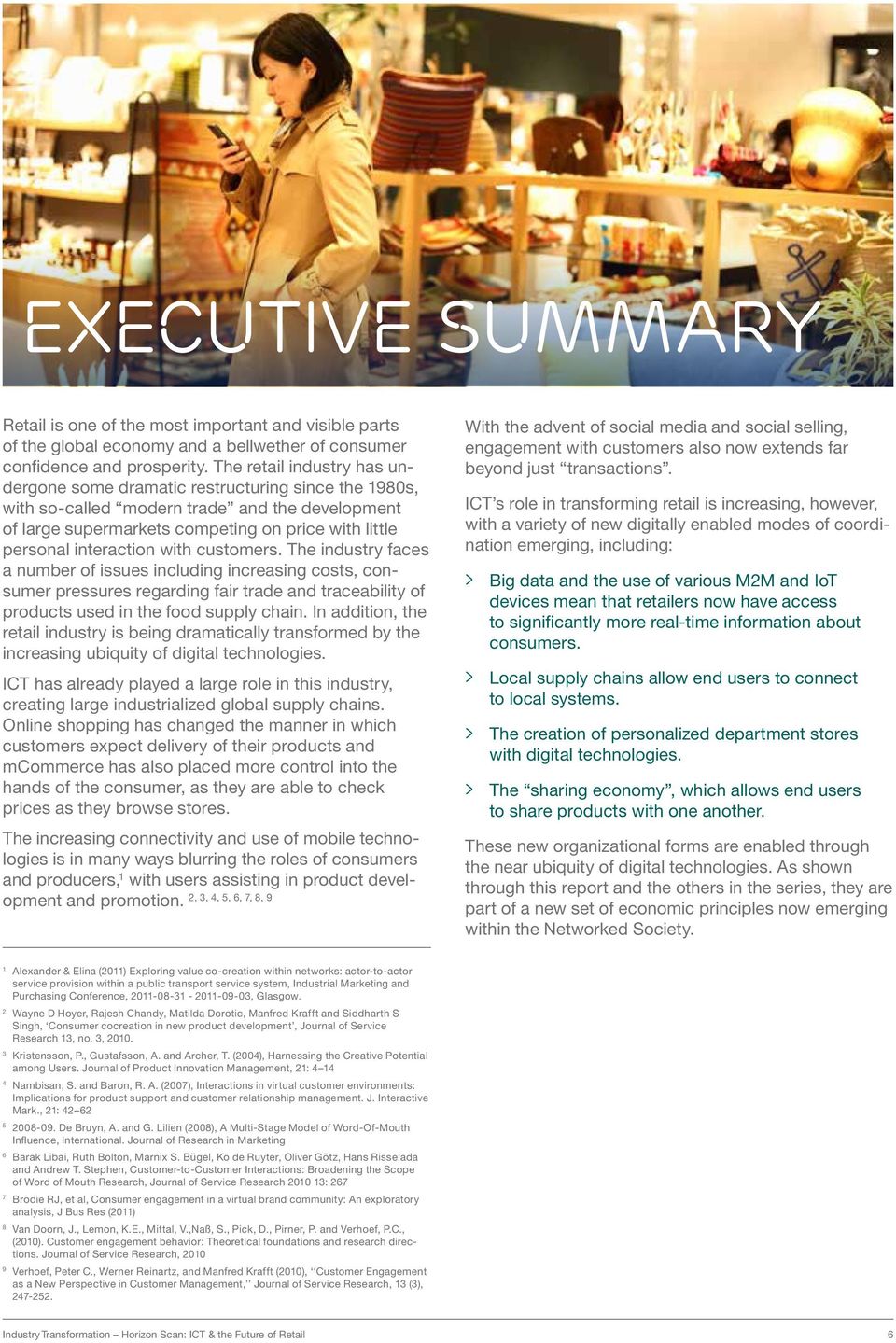
6 Executive Summary Retail is one of the most important and visible parts of the global economy and a bellwether of consumer confidence and prosperity. The retail industry has undergone some dramatic restructuring since the 1980s, with so-called modern trade and the development of large supermarkets competing on price with little personal interaction with customers. The industry faces a number of issues including increasing costs, consumer pressures regarding fair trade and traceability of products used in the food supply chain. In addition, the retail industry is being dramatically transformed by the increasing ubiquity of digital technologies. ICT has already played a large role in this industry, creating large industrialized global supply chains. Online shopping has changed the manner in which customers expect delivery of their products and mcommerce has also placed more control into the hands of the consumer, as they are able to check prices as they browse stores. The increasing connectivity and use of mobile technologies is in many ways blurring the roles of consumers and producers, 1 with users assisting in product development and 2, 3, 4, 5, 6, 7, 8, 9 promotion. With the advent of social media and social selling, engagement with customers also now extends far beyond just transactions. ICT s role in transforming retail is increasing, however, with a variety of new digitally enabled modes of coordination emerging, including: > > Big data and the use of various M2M and IoT devices mean that retailers now have access to significantly more real-time information about consumers. > > Local supply chains allow end users to connect to local systems. > > The creation of personalized department stores with digital technologies. > > The sharing economy, which allows end users to share products with one another. These new organizational forms are enabled through the near ubiquity of digital technologies. As shown through this report and the others in the series, they are part of a new set of economic principles now emerging within the Networked Society. 1 Alexander & Elina (2011) Exploring value co-creation within networks: actor-to-actor service provision within a public transport service system, Industrial Marketing and Purchasing Conference, , Glasgow. 2 Wayne D Hoyer, Rajesh Chandy, Matilda Dorotic, Manfred Krafft and Siddharth S Singh, Consumer cocreation in new product development, Journal of Service Research 13, no. 3, Kristensson, P., Gustafsson, A. and Archer, T. (2004), Harnessing the Creative Potential among Users. Journal of Product Innovation Management, 21: Nambisan, S. and Baron, R. A. (2007), Interactions in virtual customer environments: Implications for product support and customer relationship management. J. Interactive Mark., 21: De Bruyn, A. and G. Lilien (2008), A Multi-Stage Model of Word-Of-Mouth Influence, International. Journal of Research in Marketing 6 Barak Libai, Ruth Bolton, Marnix S. Bügel, Ko de Ruyter, Oliver Götz, Hans Risselada and Andrew T. Stephen, Customer-to-Customer Interactions: Broadening the Scope of Word of Mouth Research, Journal of Service Research : Brodie RJ, et al, Consumer engagement in a virtual brand community: An exploratory analysis, J Bus Res (2011) 8 Van Doorn, J., Lemon, K.E., Mittal, V.,Naß, S., Pick, D., Pirner, P. and Verhoef, P.C., (2010). Customer engagement behavior: Theoretical foundations and research directions. Journal of Service Research, Verhoef, Peter C., Werner Reinartz, and Manfred Krafft (2010), Customer Engagement as a New Perspective in Customer Management, Journal of Service Research, 13 (3), Industry Transformation Horizon Scan: ICT & the Future of Retail 6
7 1. Introduction Retail is an important and visible sector within a nation s economy. In the UK alone, the retail industry had a turnover of 310 billion in Seven retailers, together worth some 76 billion, were in the FTSE 100, and many pension and investment funds have significant retail holdings. 10 Globally, retail revenue rose 5.1% to US $4.271 trillion for the world s top 250 retailers. 11 Retail acts as an intermediary industry, connecting consumers with other sectors of the economy. It links producers and manufacturers with consumers and influences supply and demand in those sectors. Retail sales are often used as a bellwether of consumer confidence and the wider economic health of countries and regions. As with many other industries, however, retail is facing a number of significant issues which change the way companies must prioritize their resources in response to risk. Increasingly complex challenges face retailers, from supply chain disruption to food safety and network security breaches, all of which could potentially cause tremendous disruptions to a business and damage its reputation. In the current fast-changing economic, legal and regulatory landscape, the risk profiles of retail companies evolve quickly 12 and increase the requirement for up-to-date information and innovative solutions to help companies manage these risks. In addition to these changes, many countries across the globe are experiencing dramatic changes in demographics, with an ongoing shift to an aging population in many areas of Europe and the US. In the UK, the ONS predict that by 2033 nearly 29% of the population will be over 60 years of age 13. Hence, retail products, fulfillment processes and customer services will all need to be tailored to this transformation. ICT has played a critical role in shaping the retail industry as we know it today. Firstly, over the past few decades, it has been used to create globally connected and real-time supply chains in consumer society. In the clothing industry, this has allowed the replacement of the traditional four-season year for fashion with updated lines on a near-monthly basis for extremely low cost. Secondly, digitization has changed the manner in which consumers buy and use media products; for example, people now download music and stream videos, rather than buy CDs or rent videos. Thirdly, online shopping itself has become increasingly popular with the development of secure payment channels and delivery options for consumers. During 2012, the value of internet retail sales in the UK was 29 Billion, or around 9% of total retail sales. 14 In Australia, online sales account for between 3 and 7% of total retail. 15 Business models have evolved so that manufacturers and suppliers now sell online directly to customers, while many entrepreneurs also test the market through e-commerce before investing in bricks and mortar. 16 E-commerce therefore does not necessarily imply the removal of physical stores, but rather an evolution of how retailers fulfill orders. The OECD definition of e-commerce specifies that it relates to the ordering of goods and services over the internet, but the payment and ultimate delivery of the good or service can be conducted on- or offline. 10 BIS, 2013, A Strategy for the Future of Retail 11 Deloittes, 2013, Global Powers of Retailing Aon, 2014, 2014 U.S. Industry Report: Retail 13 ONS, 2014, E-commerce and ICT Activity of UK Businesses 14 BIS, 2013, A Strategy for the Future of Retail 15 Productivity Commission Inquiry 2011, Economic Structure and Performance of the Australian Retail Industry, No. 56, 4 November BIS, 2013, A Strategy for the Future of Retail Industry Transformation Horizon Scan: ICT & the Future of Retail 7

8 1. INTRODUCTION E-commerce has therefore led to an increase in innovative combinations of physical and digital solutions through concepts such as Click to Collect and other collection methods. Logistics is also key for reaching millenials: 92 percent said that real-time product availability would directly influence where they shop. 17 Properly implemented ICT solutions are becoming increasingly important in the retail industry. Research conducted by Aon indicates that failure to innovate/ meet customer needs, distribution or supply chain failure and technology failure/system failure are some of the top risks to retail companies. Technology failure and system failure have also experienced the greatest increases in losses at 55%. 18 Everything from ICT security and regulatory compliance to privacy legislation increases these complexities. Pervasive mobile coverage, smartphones and increasing broadband penetration have facilitated the emergence of a multitude of new retail marketing channels. E-commerce and mcommerce have rapidly grown in popularity and have led to an increase in home deliveries as well as a shift to omnichannel requirements for retailers. In the US, mobile coupons are estimated to increase to approximately 53.2 million in 2014, driven by the uptake of smartphone. 19 Additionally, 80% of customers state they would like more product information available via their mobile phones whilst shopping in stores. 20 The retail paradigm has therefore shifted from a single physical connection point with customers to a multi-pronged approach that crosses both physical and digital channels. The traditional bricks-and-mortar retail store is no longer the dominant medium for purchasing goods. Instead, it serves as one of many potential connection points between customers and a retailer s brand. 21 With the requirement to innovate in omnichannel sales, it is critical to access accurate and timely information, and proactively address risk at every level of the organization. 22 The cumulative effects of these changes are undeniable; near-ubiquitous access to ICT and information allow customers to connect with retailers, manufacturers and other consumers in new ways. This report focuses on how these types of ICT solutions enable the transformation of the retail industry as consumers place a premium on the following issues: Convenience consumption where the purchase and receipt of goods requires little time or effort. 2. Experience consumption the customer journey being enjoyable rather than simply utilitarian. 3. Market segmentation where consumption reflects the self-identity of individuals and groups, increasing the importance of brands, labels and marketing. 17 JLL, 2014, Long live retail Retail Research 18 Aon, 2014, 2014 U.S. Industry Report: Retail 19 emarketer, 2013, Mcommerce Takes 15% of UK Retail Ecommerce Sales June 20, Moosylvania, 2013, 21 Deloittes, 2013, Global Powers of Retailing Aon, 2014, 2014 U.S. Industry Report: Retail 23 BIS, 2013, A Strategy for the Future of Retail Industry Transformation Horizon Scan: ICT & the Future of Retail 8

9 1.1 Retail Industry Structure Retail is an extremely varied industry and covers a vast range of products, regulatory requirements and consumer interactions. Traditional industrial analysis treats industries as linear, where inputs are processed to become products and services, as illustrated below in Figure 1: Figure 1: Linear retail value chain and scope of report Digital disruption Inputs Middlemen Processors Producers Retailers Consumers Scope of report Industry Transformation Horizon Scan: ICT & the Future of Retail 9

10 1.1 RETAIL INDUSTRY STRUCTURE This report focuses on disruption created by digital technologies between producers/manufacturer and consumers. A key factor of the analysis is therefore the current fulfillment model, illustrated in Figure 2 below. A manufacturer uses several means to connect to consumers, for example via their own shops, large retailers (modern trade, or supermarkets) or smaller local shops and kiosks. As illustrated in section 3, digital technologies create opportunities to disrupt the consumer fulfillment methods, creating new means by which customers can interact with retailers and manufacturers. Retail has deeply embedded links with other industrial systems, including manufacturing, construction, wholesale distribution and the broader logistics sector. Retailers are also affected by a wider range of regulations than many other sectors of the economy, from food hygiene and health and safety to employment law, licensing, tobacco display and poisons licensing and consumer protection legislation. These regulations are country- and often region-dependent. Figure 2: Fulfillment Framework for Retail Industry Traditional 1 I N P U T S I M P O R T S F A C T O R Y MANUFACTURER S DISTRUBUTION CENTER EXTERNAL DISTRIBUTORS MANUFACTURER S OWN DISTRUBUTION OWN SHOPS LOCAL SHOPS R E T A I L E R S C O N S U M E R 1 Source interviews with FMCG retailers and manufacturers Industry Transformation Horizon Scan: ICT & the Future of Retail 10

11 1.2 Interaction Between Retail and the High Street Since the 1960s and 1970s, the retail sector has come to dominate the structure and layout of most of our towns and cities, so much so that the terms retail and the high street are often used interchangeably. A high street or town center needs a thriving and diverse retail sector, and retail needs thriving high streets and town centers. Problems for retail affect the high street, and problems for high streets impact on retail. 24 The growth of suburban and exurban shopping centers, retail parks and individual hypermarkets has had a further transformational effect on shopping patterns. Supermarkets have engaged in a space race where major grocery stores have rushed to build more and larger stores on the edges of towns. Online shopping has provided an alternative to the megastore approach to retail and has increased competition for non-food offerings. As a result, the requirements for physical stores to maintain large displays of certain products, (e.g. electrical appliances or household items) has also reduced. Retailers are therefore exploring diversification into other sectors. For example, Marks and Spencers does not plan to add any more space for clothing and housewares from 2016 as more of its sales move online: What is new is the approach we have taken to the use of space. That use reflects the profound changes we are seeing in retailing... technology is transforming the way we shop. 25 Many retailers realize that in order to reach a significant number of customers, physical stores are no longer a necessity. Retailers are therefore taking a variety of approaches; for example, John Lewis is trying to make our stores great places that you want to go to and experience shopping for products. But we are adding services such as beauty spas, which make the places a destination in themselves. 26 This is even more important for millennials, as keeping them engaged will involve strategic renovations of shopping centers and influx of technology into stores, and configuring the center and store space in the best way to keep the shopping experience fresh and interesting. 27 In addition, retailers are also taking a broader perspective of fulfillment, developing multi- or omnichannel retail where goods and services are delivered across more than one sales and fulfillment channel beyond just bricks and mortar. As a result, choosing, purchasing and receiving are increasingly being integrated in a seamless experience for customers, who can perform different parts of the process in different combinations to suit their needs and preferences. 28 Multichannel offerings have recently expanded to cover more than just home delivery and now include concepts such as click and collect, delivery to secure lockers or workplaces, and even delivery to the trunk of a customer s parked car. Asda, for example, is set to open 100 standalone forecourts and roll out click and collect services to 1,000 locations over the next five years. 29 Currently, more than a third of shoppers use click and collect services, and use is expected to rise by 12% this year. 24 BIS, 2013, A Strategy for the Future of Retail 25 Independent, JLL, 2014, Long live retail, Retail Research 28 BIS, 2013, A Strategy for the Future of Retail 29 bloglead?blogger=1027 Industry Transformation Horizon Scan: ICT & the Future of Retail 11

12 1.2 INTERACTION BETWEEN RETAIL AND THE HIGH STREET John Lewis saw click and collect sales rise 60%, while Tesco said 70% of its online orders for fashion and housewares were collected in stores. 30 Both e-commerce and multichannel retailing are exhibiting rapid growth rates. In the long-term they are indicative of a shift for the entire retail sector, in which many major retail companies investigating how to move away from big box retail to develop local formats that can deliver through a multichannel offering, while still achieving economies of scale. 31 Omnichannel, however, is not easy and requires not just changing technical systems, but making costly changes in software to combine online and in-store inventory as well as blending parts of retail operations that have traditionally operated separately, which also requires a shift in sales strategy. Stores also need to be reconfigured to give workers room to pack and prepare orders. Staff has to be retrained so that they encourage sales both in-store and online, even if they lose a potential commission by selling online. 32 Moreover, business models and technical systems need to adjust to the availability and use of big data. Research from ecommera found that only 23% of UK retailers feel they can quickly make sense of the data available to them to take the right business decisions. 33 Meanwhile, nearly 50% of retailers believe their current business intelligence tools fall short of their needs, with only 16% confident that their data analytics tools provide the organizational visibility they require. 34 Despite the increase in online sales, these channels still only accounted for 9.3% of retail sales during 2012 within the UK. Within the EU only 9% of consumers bought online cross-border (from another member state). E-commerce still counts for less than 4% of total European trade, with a significant number of barriers including language problems, labelling problems and connectivity for many of the newer member states. Even the vast majority of younger shoppers 82 percent still prefer to buy in stores Independent, 2014, Ten things Christmas taught us about the UK retail revolution 31 BIS, 2013, A Strategy for the Future of Retail 32 Reuters, 2013, ibid 35 JLL, 2014, Long live retail Retail Research Industry Transformation Horizon Scan: ICT & the Future of Retail 12

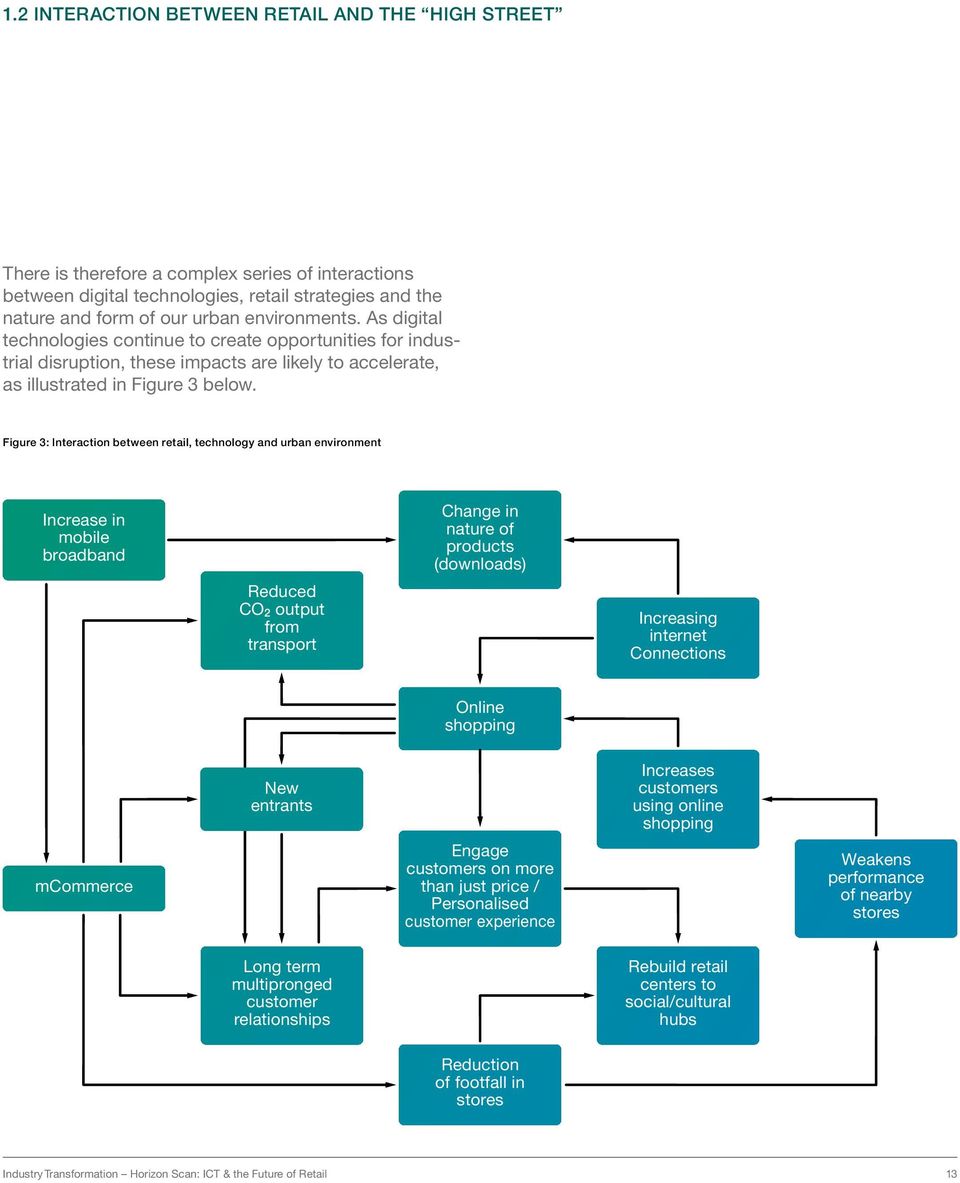
13 1.2 INTERACTION BETWEEN RETAIL AND THE HIGH STREET There is therefore a complex series of interactions between digital technologies, retail strategies and the nature and form of our urban environments. As digital technologies continue to create opportunities for industrial disruption, these impacts are likely to accelerate, as illustrated in Figure 3 below. Figure 3: Interaction between retail, technology and urban environment Increase in mobile broadband Reduced CO 2 output from transport Change in nature of products (downloads) Increasing internet Connections Online shopping mcommerce New entrants Long term multipronged customer relationships Engage customers on more than just price / Personalised customer experience Increases customers using online shopping Rebuild retail centers to social/cultural hubs Weakens performance of nearby stores Reduction of footfall in stores Industry Transformation Horizon Scan: ICT & the Future of Retail 13
14 2. Impact of Digital Productivity Improvements In the retail value chain, sales and customer data flow from stores to enterprise systems. Traditionally, suppliers fulfill the orders from their warehouses and in turn place orders with manufacturers when warehouse inventory falls below a certain threshold. These processes need to function smoothly in order to avoid customers arriving at a store with a desired product out of stock. Technology has so far allowed retailers to shorten the ordering process; for example, electronic ordering helps ensure stock is available without needing direct intervention from employees. Digital technologies, however, have started to have a dramatically larger effect on the retail industry, such as by enabling overseas expansion of previously regional brands. The top 10 retailers now have a larger total geographic footprint than the next 250 combined, operating on average in 16.7 countries accounting for nearly onethird of their retail revenue. 36 ICT has helped the very large retailers make the move overseas. Tesco, for example, has done this through adopting a common operating model across its businesses worldwide, allowing it to deploy and support key systems like supply chain and replenishment applications when it expands into new countries. 37 Tesco is able to deploy the same application across the world and save costs as it uses existing servers. An increasing reliance of foreign vendors and resources means that retailers need to implement systems with coordination and central oversight, in order to address evolving compliance and regulatory concerns. 38 ICT therefore creates opportunities both for process improvements and industrial disruption in the retail industry. Section 2 focuses on productivity improvements created by digital technologies. Section 3 concentrates on the manner in which digital technologies can disrupt existing industrial structures. 36 Deloittes, 2013, Global Powers of Retailing Aon, 2014, 2014 U.S. Industry Report: Retail Industry Transformation Horizon Scan: ICT & the Future of Retail 14

15 2.1 Retail and Productivity Improvements Information is going to be our generation s next natural resource, like steam was to the 19th century there are a number of technology shifts and their convergence is happening at once big data will be retailers basis of competitive advantage and will be how you engage with your customers. 39 Terry Lundgren CEO, Macy s One of the common areas in which ICT has been applied in retail is in providing the right information, at the right time, in the right place. Making information available in near real-time requires systems that can rapidly generate, combine and deliver data to the right places. Previously, retailers had to rely on expensive, large-scale proprietary systems to implement these information flows. Retail companies have been constrained by the following limitations on information: 1. Information available was limited and stored in proprietary formats in siloed systems across companies, business units and across the industry. 2. The cost of data storage and processing capacity was high in comparison to the advantage that could be gained from gathering information about every consumer. 3. There was a well-defined set of languages and technology approaches to managing information. Information technologies were therefore mainly used to drive down costs across the supply chain and to dramatically streamline transport and logistics operations for improved supply management. Many supermarkets in the UK now run near real-time inventories and in recent transport strikes, many supermarket shelves deprived of this constant stream of goods were empty within 6 hours. Globalized retail supply chains allowed continuous competition based on price, with low-income countries being used as the workshops of the world Industry Transformation Horizon Scan: ICT & the Future of Retail 15

16 2.1 RETAIL AND PRODUCTIVITY IMPROVEMENTS While the use of ICT allowed for economies of scale, these very large-scale solutions demanded that retailers lost proximity to customers and instead competed solely on price. The selection of goods became larger, the prices became ever more competitive, and the communications became impersonal. The dramatic pace of globalization and the constant drive for scale meant customer knowledge was often lost, as was the understanding of consumers future purchasing requirements. As digital technologies have reduced in cost and the amounts of data that can be stored have significantly increased, it has become possible for retailers to improve productivity while re-establishing closer connections with the customers in question via deeper insights into their overall purchasing patterns. Digital technologies also provide a more detailed manner of engaging with customers on a longer-term basis through, for example, customer sentiment analysis in social media. All of these form the basis of big data in the retail industry. With the promise and potential of big data, however, come several potential risks and barriers. These are discussed in section 2. All of these new applications of ICT rely to a greater or lesser extent on new means and methods of engaging with existing and potential customers. With the advent of these new ICT solutions, therefore, retailers are able to overcome the dominant technical designs of the established industrial structure that rely heavily on impersonal communications with customers. In the following section, we illustrate some of the new digital technologies that are enabling retailers continuously improve productivity. Section 3, meanwhile, illustrates the role of ICT in enabling industrial transformation. ICT is now being applied in a variety of ways by retailers beyond supply chain management, including: 1. New customer location sensing technologies. 2. E-commerce and mcommerce. 3. Social media. 4. Personalization of retail services and products. Industry Transformation Horizon Scan: ICT & the Future of Retail 16
17 2.1.2 New Location Sensing Technologies We provide context around location and proximity; we make it more filtered and more relevant. 40 Kevin Hunter, Gimbal Product Management, Qualcomm The level of detail that retailers can now collect about individual shoppers has increased dramatically with improvements in location-based and location-sensing technologies, such as geo-fencing, WiFi, Bluetooth and ubiquitous smartphones. These technologies allow retailers to both identify and track customers smartphones. The goal is to have a customer walk into a department store and get a push notification on his or her phone with a personalized offer. Startups building out the technology include Nomi, which offers stores analytics on foot traffic and has raised $13 million in venture funding, Euclid which has raised $23.6 million, and RetailNext which has raised $29.4 million. 41 These technologies can provide retailers with sources of additional revenue as well as new methods of collecting significantly more and much more specific data about individuals in their stores than was previously possible. Technologies such as ibeacon use Bluetooth to send messages to enabled smartphones in the vicinity. These messages provide contextspecific information to end users and enables retailers to provide on the spot offers to consumers. Another example is Shopkick, with 6.5 million users (of which 70% are women), which focuses on helping retailers get consumers through the door of the shop. If you get them through the door, you stand a very good chance of making a sale, says Cyriac Roeding, co-founder and chief executive of Redwood City. In addition, many retailers already have a large installed base of CCTV, or infrared cameras, originally installed to reduce the likelihood of theft. With the application of back-end software, however, it is now relatively easy for retailers to track customers as they move around the store. They can see how long they stay in particular sections and can even track individual customers throughout the entire store. By applying learning algorithms, retailers are able to redesign their store layouts in a manner that is more appealing to customers and group different products together to increase the possibility of sales. RetailNext, for example, has developed software that uses a store s existing security cameras to give managers all kinds of information about how consumers interact with the store. They can show exactly how many customers are in a store at a given time, which parts of the store they explore, which specific items customers spend more time perusing, and which they do not. They can combine this information with other variables like staffing levels, weather, product assortment and placement to determine their effects on sales. Mont Blanc has used RetailNext s services to improve its staffing levels and its product arrangement within its stores, increasing same-store sales by 20% in the process Industry Transformation Horizon Scan: ICT & the Future of Retail 17
18 2.1.3 Rise of mcommerce and scommerce The ubiquity of Internet access and smartphones has given consumers more bargaining power than ever. I don t think people realize how much the consumer is in control these days. 43 Paula Rosenblum, retail analyst at RSR Associates The increasing ubiquity of smartphones and other digital devices has created new marketing channels for retailers namely, mcommerce. mcommerce allows retailers to provide coupons to shoppers via mobile devices and gives consumers another means to make purchases. It is expected that expenditure made via mobile devices is set to grow strongly. According to IMRG 44 mcommerce grew by 300% last year alone. The typical mcommerce shopper is forecast to spend 905 per year by 2017, a 243% increase from This presents both opportunities and challenges for retailers. While it creates new routes to target customers, it also provides consumers with increased power through the ability to check prices at other stores while on the move, effectively providing consumers with the same power they have in E-commerce scenarios, but via mobile devices. Consumers are therefore no longer bound geographically when searching for the best price or service. Some retailers have embraced this opportunity, while others have instead blocked mobile and Wi-Fi signals in their stores, possibly to decrease searches for competitive products. mcommerce also provides the opportunity to link with other industries in order to make conversion even simpler for consumers, for example, by linking the mobile shopping experience with mobile or contactless payment systems. With the increase in mobile broadband speeds via 4G and faster chipsets on mobile devices, the end-user experience of mobile shopping will be increasingly enhanced. As 5G use cases become a reality over the coming decades, it is highly likely that mcommerce will increasingly become one of the main fulfillment channels for consumers. Several pilot examples exist and have been trialled, such as in the flat supermarket in Korea, where supermarket aisles were printed on a wall and given QRcodes. 46 Shoppers could then use their mobile devices to select the products they wanted while waiting for a bus. The order would be placed via their phones before being delivered to their homes at a convenient time. In these ways, mcommerce further challenges the traditional bricks and mortar retail model as increasing improvements to the mobile experience and technology continue to drive industrial disruption. 43 ibid 44 BIS, 2013, A Strategy for the Future of Retai Industry Transformation Horizon Scan: ICT & the Future of Retail 18
19 2.1.4 Social Media and Online Browsing Patterns At the same time as mobile devices are creating new fulfillment routes for consumers, so too are social media and online search patterns helping retailers to better direct their advertising, create new sales channels and refine their product portfolios. By linking online searches together with proximity and social media platforms, companies are able to provide a linked-up shopping experience and ultimately improve the rates of conversion. For example, Kohl s is testing real-time, personalized offers in five of its stores. Shoppers who walk into one of those stores can opt in for offers via their smartphones. A shopper lingering in the shoe department, for example, could receive a coupon based on the shoes they looked at online but never bought. 47 Within online retail, meanwhile, sites like Amazon can present special offers or alert users to products they might not otherwise have been aware of based on a user s previous search history on their website. Amazon has had tremendous success by using data it has collected to discover what additional products its users are likely to buy. Amazon reported that 30 percent of sales were due to its recommendation engine. 48 Big data therefore helps retailers predict trends and prepare for future demand by using web browsing patters, social media sentiment analysis, demographic data and shopping patterns from customer loyalty data and purchasing history, all of which can be combined with more traditional market research techniques. Moreover, it becomes possible to pinpoint which customer may be interested in a particular product or service, or what complementary services they might be offered in order to encourage them to visit the physical store. This allows retailers to perform better segmentation of customers. 49 Through better segmentation of customers, it is also possible to create a targeted strategy using social media analysis and customer demographic information: Vera Bradley sent 63% fewer s but generated a 101% increase in shopper click through and a 275% increase in the conversion rate of browsers to purchasers ibid Industry Transformation Horizon Scan: ICT & the Future of Retail 19
20 2.1.5 Personalization of the Shopping Experience One of the strongest motives for tracking the full range of shopping experiences is to create personalized shopping experiences for consumers. Tim Steiner, chief executive of Ocado, believes the next step for online shopping will be for individual shops to be created for each customer. We ve started on the personalization journey but are only 5% of the way. The next phase is to customize the shops for each customer. 51 As we discuss in Section 3, there are also many opportunities for companies to work with customers to personalize their own products for a tailor-made experience. The role of 3D printing, which is set to accelerate this trend, is covered in Section Industry Transformation Horizon Scan: ICT & the Future of Retail 20

21 2.2 Benefits of Big Data Improved Efficiencies Combining the rising amount of data streams that are increasingly available, big data is becoming a key determinant of business strategy in retail and helps create a smarter shopping experience by allowing retailers to be more efficient and responsive to consumer demand. Big data determines a retailer s competitive advantage by influencing how they predict and respond to demand, and engage with customers over a longerterm perspective. Big data in retailing therefore allows companies to streamline and improve already existing business processes by using analytics to find meaningful patterns and useful insights. Increases in data enable four main forms of efficiency improvements: 1. Customer knowledge: Determining how to design shops and web pages, particularly in choosing assortment, stock, layout, merchandising and range in the stores. It also help determine packaging, labelling and bundling of products. 2. Targeted advertising: Deciding where and when to do advertisement e.g. in public transport, in the street, shops and online channels. > > To place the right advertising tools in the right locations (driving, walking, shopping); to create personalized real-time offers to increase demand; to determine which products to bundle (looking at purchase trends, social media, forums & reviews, online browsing). 52 > > Configure the right to send (personalize communications with the customer). > > Determine a customer s preferred method of being contacted ( , text, social media). 3. Pricing, price optimization using customer demand, competitor activity and shareholder value, allowing retailers to synchronize prices with inventory and competitor data. > > Next step is for offers to have both a real-time offer and redemption. This involves any cashback offers redeemed in store or online leading to an immediate crediting to the customer. Big data therefore enables new forms of dynamic pricing. 4. Personalized shopping experience: Retailers are preparing personalized and real-time in-store banners as the industry begins to use data more intelligently. One technology, which is supported by data integration company Informatica, will use social media to target consumers in-store and online. A bespoke campaign based consumer tweets and Facebook sharing could be shown to someone entering a store, with messages such as: Welcome Tony and Happy Birthday! Have you seen our latest range of Liverpool football kits? They re located on the fourth aisle, half-way down. 53 Many of these concepts rely of the aggregation of a variety of data streams from various sources and the creation of an information value chain that allows new types of information products to be developed Industry Transformation Horizon Scan: ICT & the Future of Retail 21
22 2.2.1 Information Value Chains for Retail Multiple Information Value Chains (IVC) can potentially be developed within the retail industry through combining customer data with corporate databases and third party applications such as ibeacon or CCTV analysis software. All of these solutions need to take into account privacy and regulatory issues covered in Section 3.3. This section covers one possible IVC in the retail industry: combining smartphone offers and a customer s actual path through a retail space or shop. This is illustrated in Figure 4 below: Figure 4: Information Value Chain for Retail Inputs Production/ Manufacture Processing Packaging Distribution RFID on clothes Store layout plans Store location sensing (e.g. beacon) Customers mobile device Clothing location information Customer location and offers Search information Clothes selected by customer Offers responded to by customer Search queries submitted by customer while in store Actually selected clothes, offers made via beacon and search queries Improved customer offers based on actual clothes selsction CCTV Social media updates Overall customer route through store Sediment analasys of customer Aggregated human patterns of walking through stores Optimized floor layouts for retail stores Industry Transformation Horizon Scan: ICT & the Future of Retail 22
23 2.2.1 INFORMATION VALUE CHAINS FOR RETAIL Inputs: The raw inputs to the IVC are formed from: > > RFID tags on clothes. > > Existing floor layout plans. > > Third party products for mobile offers, e.g. ibeacon. > > Mobile phone data. > > CCTV footage. Processing: During the processing stage, data from various sources is mixed together to create information components necessary for decision-making: > > RFID tags, combined with floor layout plans, allow for the exact location of clothing assortments across a retail space. > > A customer s mobile device captures the user s location and the search queries that they have submitted while browsing in the store. > > Social media updates allow a store to assess sentiment of a broad range of customers. Packaging: After the data from various inputs has been combined, the packaging section of the information value chain creates information products ready for distribution. > > Which clothes did a customer actually choose to try on? Which did they purchase and which did they return? > > What are the routes that customers are taking through the store and which product lines are different demographics actually attracted to? Distribution/Marketing: The final stage of the Information Value Chain is the creation of an Information Product. These products fall into two main categories: > > Information products for improving internal decision-making: these information products are the result of detailed information analysis that allows better decisions to be made. > > Information products for re-sale or re-use by other economic actors: these information products have high value for other economic actors and can be sold and/or shared with them. For example, information products within retail could be used to completely redesign floor layouts for different demographics and retail spaces. Improved customer offers could be made and information products could be developed that would re-direct customers while moving through a mall. These forms of IVC lead to industrial transformation as retailers and third parties are able to sell or share these information products onwards with other economic actors, not just within the retail industry itself. For example, demographics departments of cities or countries could use such information products to gain a better understanding of the requirements of particular areas of a nation or city. Alternatively, they could prove extremely useful to real-estate agents or developers who wish to understand how to develop a certain area of town or which companies it should advertise retail space to. Industry Transformation Horizon Scan: ICT & the Future of Retail 23
24 2.2.1 INFORMATION VALUE CHAINS FOR RETAIL Finally, the data can also be used to gain deep and fine-grained understanding of the real functioning of the economy for policy and government analysis. These are illustrated in Figure 5 below: This is only one small example of the data integration possibilities within retail; many more exist. There are, however, a number of barriers to the use of data in this manner, as covered in the following section. Figure 5: Information and the reconfiguration of the retail industry I N P U T S I M P O R T S F A C T O R Y MANUFACTURER S DISTRUBUTION CENTER EXTERNAL DISTRIBUTORS MANUFACTURER S OWN DISTRUBUTION OWN SHOPS LOCAL SHOPS R E T A I L E R S C O N S U M E R Location, Serarch history, Purchasing patterns Aggregated (annonymised) location and search history becomes: Trend identification, fine grained understanding of demand, demographics Demographics.gov Real estate companies Develop new products Industry Transformation Horizon Scan: ICT & the Future of Retail 24
25 2.3 Barriers to Big Data in Retail Despite the opportunities associated with big data, a number of difficulties emerge in its application within retail. These include: > > Costs Applying big data appropriately within a retailer s operations is a complex process and can also be very expensive. Cleaning and producing usable data can often take significantly more time than actually analyzing it. Many data formats are incompatible with one another due to legacy proprietary systems that prevent data sharing. > > Complexity Collecting information from WiFi, for instance, can also be logistically difficult and prohibitively expensive when retailers do not know exactly what insights they may be able to achieve with data. Big data can also be unnecessarily complicated for smaller retailers. Big data may therefore be most pertinent for massmarket retailers that can afford to collect and store the data, as well as analyze it. One of the biggest concerns, however, is privacy and the use of consumers private data to create such products. Industry Transformation Horizon Scan: ICT & the Future of Retail 25
26 2.3.1 Privacy Concerns As machine-vision systems advance, your actions such as picking up a particular product can be tracked against your mood, as shown by your facial expression. When better to raise the price of that product? (WIRED, 2014) 54 Big data in retail has brought with it a number of concerns, not least of which is consumer privacy. While consumers have become used to tracking of activities within stores to prevent theft via CCTV, the use of their personalized, identifiable data from social media and online searches has begun to raise some quite serious concerns. 55 One survey of consumers found that 77% of respondents thought that in-store tracking was unacceptable, and 81% said they don t trust retailers to keep data private and secure. In particular, they did not trust mass market retailers with this sort of information, 56 and by nearly a two-to-one margin, 62% to 38%, more consumers believe that they do not have enough control over their privacy in the hands of the retailers whose shops they use. Retailers must therefore walk a fine line when using information that shoppers may view as personal. A key aspect should be to obtain permission by providing clearly communicated opt-in or opt-out policies and processes. In addition, companies should make the customer data storage process transparent, even for the consumer loyalty cards. Customers should be able to clearly see and understand: 1. What information about them is stored? 2. How will the company use the information? 3. How can any third parties can gain access to the information stored, and how are they permitted to use it? 4. How can customers permanently delete all the information a retailer stores about them should they wish to terminate their relationship with the retailer? Over the next few years, ICT solutions and regulations will be implemented that protect end users privacy. ICT is playing a broader role in retail due to the broad consumerization of digital technologies. It is now helping to completely restructure the very foundations of retail itself. Individuals and small companies, now able to use powerful ICT solutions in a similar fashion to large multinationals, now have access to a range of newly emerging organizational forms. These are discussed in Section 3, and are examined further in the final report in this series, The Economics of the Networked Society Industry Transformation Horizon Scan: ICT & the Future of Retail 26
27 3. Impact of Digital Industrial Transformation As discussed in previous sections, the retail industry is already undergoing a series of transformations as consumers gain power through access to cheaper connectivity and technologies. Smaller manufacturers and retailers also have access to these new forms of technological coordination, which fundamentally reshape the entire retail industry. In addition, these transformations may also contribute to the transformation of our urban environments. Previous studies of digital transformation in the retail industry have focused on the ability of digital technologies to reshape the balance of power between actors in the industry and between consumers and companies, particularly in marketing and other activities enabling the co-creation of value. The potential for transformation goes far beyond these traditional activities, however, and creates new possibilities to completely restructure retail activities including the locus of production and the very distinctions between suppliers and customers. Within this section, we therefore take a broader view and focus on four main sources of power originally defined by Labrecque, vor dem Esche, Mathwick, Novak & Hofacker, 57 adapted here to the industrial context of retail: >Demand: > Demand-based power rests on the aggregated impact of consumption and purchasing behaviors. > > Information: Information-based power allows for the reduction of information asymmetry, which expedites market diffusion of information and shortens product lifecycles. > > Crowd-based: Crowd-based power resides in the ability to pool, mobilize and structure resources in ways that benefit both individuals and groups. Through the application of digital technologies, power relationships within the industrial structure may be shifted, creating organizational structures that establish new links between consumer, manufacturer and retailer. The following sections illustrate these new digitally enabled organizational forms within the retail industry. 57 Labrecque, Lauren I.; vor dem Esche, Jonas; Mathwick, Charla; Novak, Thomas P.; Hofacker, Charles F. (2013): Consumer Power - Evolution in the Digital Age, Journal of Interactive Marketing, 27 (4), Industry Transformation Horizon Scan: ICT & the Future of Retail 27
28 3.1 Industrial Disruption Demand Power One of the simplest ways for consumers to exercise their power is to utilize digital technologies to assist in the design processes of companies in order to receive the products and services that they want. Examples include interacting with manufacturers and retailers via social media and the internet in order to see improvements in established product lines. Several examples already exist such as Makies, 58 which allows customers to design their own dolls and receive a unique 3D printed copy delivered by mail. This type of model eliminates the need for retailers altogether and instead provides a direct connection between customer and manufacturer. Another growing area is the use of 3D printers for foodstuffs. 59 A number of printers have been developed for chocolates that currently allow small to medium runs of personalized chocolates based on customer-created designs. 60 Through online ordering, consumers can get custom-made chocolate bars, for example containing their preferred cocoa mass from different regions and towns or even chocolates that are otherwise only available overseas, and have them manufactured and delivered locally. Rather than shipping the final product over long distances, the recipe travels digitally, and as a result the environmental impact of importing could be reduced for certain items such as foodstuffs. Items could then be delivered via post or held for pick up from a local retailer, which would allow for delivery of customized items with the standard order for that store. Digital technologies therefore allow for the creation of new fulfillment models within the retail industry and create new connections between consumers and economic actors. This is illustrated in figure 6, next page campaign=copyright Industry Transformation Horizon Scan: ICT & the Future of Retail 28
29 3.1 INDUSTRIAL DISRUPTION DEMAND POWER Figure 6: Digital Technologies drive demand-based industrial disruption I N P U T S I M P O R T S F A C T O R Y MANUFACTURER S DISTRUBUTION CENTER EXTERNAL DISTRIBUTORS MANUFACTURER S OWN DISTRUBUTION OWN SHOPS LOCAL SHOPS R E T A I L E R S C O N S U M E R POSTAL/COURIER SERVICE ONLINE Tailor made chocolate ordering The majority of the current 3D printers are still relatively expensive, but some smaller models are now available for home use, such as the Chocabyte printer, which costs approximately $99, but has a size limitation of 5 cm by 5 cm by 2.5 cm. 61 Cheaper 3D printers would again allow new connections to be made between manufacturers and consumers. Brand name chocolate manufacturers could sell chocolate cartridges with their own unique blend of cocoa allowing customers to print their own chocolate at home in their own designs. In addition, online design catalogues are likely to emerge for customers to access and retrieve a wide variety of designs. As a result of these new digitally enabled entrants, a reconfiguration of relationships between customers and retailers has occurred. In this case, the role of the retailer is significantly reduced and a direct connection between customers and manufacturers has been established. Existing 3D printers allow for small to medium scale production runs, but commercial-scale 3D printing will enable new forms of retail spaces to be created. These are covered in section Industry Transformation Horizon Scan: ICT & the Future of Retail 29
30 3.2 Industrial Disruption New Fulfillment Channels and Urban Retail Centers The emergence of commercial-scale 3D printing will lead to potential disruption in the retail industry and also provides the opportunity to recreate urban retail centers in response to this new technology. These technologies create new forms of interaction with consumers and create breaks in the traditional fulfillment systems. In our Food and Agriculture report, we mention the example of fruit and vegetables that are printed based on exact market requirements for texture, taste and size. Here, we discuss the scenario from the perspective of the FMCG industry, specifically chocolate. In Figure 7 below, we illustrate a restructuring of the relationships between manufacturers, retailers and consumers through the establishment of 3D printing in urban centers. Figure 7: Restructuring the urban retail space with 3D printing I N P U T S I M P O R T S F A C T O R Y MANUFACTURER S DISTRUBUTION CENTER EXTERNAL DISTRIBUTORS MANUFACTURER S OWN DISTRUBUTION PREMIUM BOUTIQUE 3D CHOCOLATE PRINTING LOCAL SHOPS R E T A I L E R S C O N S U M E R Industry Transformation Horizon Scan: ICT & the Future of Retail 30
31 3.2 INDUSTRIAL DISRUPTION NEW FULFILLMENT CHANNELS AND URBAN RETAIL CENTERS Many manufacturers have already created premium boutique stores as a method to drive greater brand recognition and loyalty among customers. Examples include the Nespresso and Apple stores. The chocolate industry, providing a low-cost premium product within the FMCG industry, has begun to face some challenges with the development of modern trade, including: > > Impulse buys are reduced due to large-scale supermarkets and online shopping becoming the dominant fulfillment methods, rather than traditional smaller stores and chocolate displays at checkouts. > > Rising consumer pressures concerning fair trade and traceability of products. > > Discount traders, such as Lidl and ASDA, continuously place demands for lower prices. For example, these low cost traders may now request a 20% discount today compared with 10-15% five years ago. Manufacturers therefore need to maintain control over distribution channels, build exclusivity and create new connections with customers based more on premium and luxury products rather than competing solely on price. 3D printing could allow companies to establish premium boutique stores in urban retail areas that allow consumers greater interaction with the brand, and through creating a personalized chocolate experience, provide an improved product development for companies. Consumers, instead of relying on manufacturers to come up with innovative chocolate products, could bring their own designs to a 3D printing shop and create highly personalized products and services. An early example of this phenomenon is the 3D printing of chocolate lollypops of people s faces 62. These services could easily be tailored to local market conditions and cultural traditions. Based on input from these consumers, companies could create significantly improved basic product lines, which would still be sold via traditional retailer routes to market Industry Transformation Horizon Scan: ICT & the Future of Retail 31
32 3.3 Crowd-based Transformation The use of crowd-based power allows a variety of new organisation forms to emerge in the retail industry. This section outlines three different forms: 1. Aggregation across suppliers 2. Aggregation across retail spaces 3. The Sharing economy Industry Transformation Horizon Scan: ICT & the Future of Retail 32
33 3.3.1 Aggregation Across Suppliers Digital technologies have enabled the creation of tools that allow customers to aggregate across a broad spectrum of designers to create their own tailor-made department stores. For example, Lyst provides customers with a fashion feed from up to 10,000 brands. Customers can receive personalized sales and discounts based on the combination of brands they have selected to follow. Similarly, many solutions now exist for personalized grocery shopping across a broad range of suppliers. For example, Ambrosia allows customers to customize organic shopping and have it delivered to their homes. This is illustrated in Figure 8: Figure 8: Aggregation across Suppliers Customers Demand Digital Supply Burberry Diesel Paul Smith Aggregation across suppliers Industry Transformation Horizon Scan: ICT & the Future of Retail 33
34 3.3.2 Aggregation Across Retail Space Digital technologies also allow for the more efficient allocation of short-term retail spaces by coordinating small retailers and available spaces for pop-up stores. 63 These allow small companies and retailers to rent space for seasonal or short-term collections or allow larger brands to engage in more experimental sales methods. They also enable a more localized version of retail to emerge, specific to the short-term needs of a city or region. Examples include Appear Here 64 and We Are Pop Up. This organizational form is similar in form to the transport models that allow riders to rent time and space within a vehicle. This is illustrated in Figure 9: Figure 9: Retail - Matching Locale with Retailers Retailers Digital Diesel Paul Smith Aggregation across suppliers Industry Transformation Horizon Scan: ICT & the Future of Retail 34
35 3.3.3 Sharing Economy Perhaps one of the most disruptive innovations with regards to the retail industry is the possibility created by the sharing economy, in which individual end users are able to share products, assets and even services with one another via the coordination of the internet. 65 We discuss the similar impacts of crowd-based utility power in our Energy Utilities report, the impact of community-driven currencies and lending in our Financial Services report and the role of sharing space in our Transport report. In this section, we therefore focus on the sharing of products and goods with one another within local communities as creating disruption within the retail industry. The core of the sharing economy is people renting rather than purchasing things from one other. For example, instead of every household having to buy a hammer, it is possible for one person to buy a hammer and rent it out to their neighbours when required. This has led manufacturers to investigate the role that services can play, for example by allowing end-users to rent drilling time, rather than needing to purchase an entire drill. This allows resources to be more effectively distributed across society while reducing the overall cost for consumers to access products. A broader service offering would allow a drill to be shared across a city, for example, rather than only within one community. The sharing economy, based either on the crowdbased power of individuals combining their requirements for access to products or via manufacturers creating new services offerings, creates strong possibilities for the restructuring and transformation of the retail industry. By creating new connections between manufacturers, retailers and consumers, digital technologies are creating change across the entire retail landscape. As a result of these changes, it is likely that we will also experience changes to our urban environments as the shifts in consumer power mean that retailers reassess how they interact with customers. Instead of retailers, we may instead see a return to manufacturers branding on the high streets Industry Transformation Horizon Scan: ICT & the Future of Retail 35
36 3.4 Creation of New Products and Services from IoT Data The introduction of RFID and other forms of electronic tags into consumer purchases leads to the opportunity for the creation of new products and services for end users and consumers in retail. These types of goods and services also create the opportunity for new entrants to enter the retail industry to manage and deliver them to consumers. We can envisage a scenario where consumers purchase a form of Personal etag Gate (PeG) that they may use to tag and collate a database of selected items around their home, for example clothes, keys or small electronic goods. This could then be used to provide a number of services throughout the lifetime of these products. For example, it could be used to create a Google your home service to find the location of particular items when they are misplaced. From an industrial disruption perspective, however, the possibility for new intermediaries is highly possible based on the data contained within a person s home and through the collective understanding of their entire purchasing history. These new entrants can also add a new dimension to customer/company interactions as well as improve environmental and social outcomes. Some of these include: > > Providing detailed care instructions throughout the lifetime of the product based on actual use, rather than generic care instructions provided on clothing tags or in user manuals. Recalls can be managed much more effectively. > > Connecting with freecycling services Allowing consumers to advertise the products to their local community for collection once they are no longer useful. Using an etag Gate, they could transmit information about the product to a centralized community noticeboard. The electronic tag could provide useful information to the community about the age of the good and its overall condition. > > Connecting with public services When the end of a product s lifetime approaches, consumers could receive notifications from the manufacturer to assist with the disposal of the good or product. For example, it could provide a map of the closest recycling centers or send a request to the relevant local agency to arrange appropriate collection. > > Protect the privacy of end users The etag Gate could provide a privacy protection mechanism that removes any identifying data from transmissions to retailers or intermediaries in order to protect the privacy of the end user, meaning that home addresses or other personal information are only transmitted when required, for example when collected at the product s end of life. Industry Transformation Horizon Scan: ICT & the Future of Retail 36
37 3.5 Industrial Disruption Micro Supply Chains As discussed several times in this report, digital technologies enable new organizational forms to emerge. In particular, the coordination mechanisms available to micro-enterprises and individuals are now at least as powerful as the technology-enabled coordination available to large companies in the 1980s and 1990s. 66 As a result, many smaller entities are able to participate in markets as economic actors as they are able to coordinate relatively complex supply chains across cities, regions and even globally. These micro-enterprises rely on small-scale, ubiquitous technologies to coordinate their supply chains in the same manner as larger corporations. This supply chain innovation has allowed new forms of micro-enterprises to emerge. At the same time, it is not uncommon to find individuals and micro-enterprises working within several such micro supply chains, connecting as and when necessary in order to sell products and services. Digitally enabled micro-enterprises are able to participate dynamically in a number of strategic networks selecting when and where to participate and building longer-term economic growth through those networks. The boundary of their participation in economic activity may therefore be viewed as the boundary of their network activities, rather than at the boundary of the firm itself. Microenterprises challenge the traditional notions of scale within the global economy as they achieve scale not through economies of scale, but rather through smaller aggregations. In this way, they are able to retain the benefits of being small, while achieving impact on a local, regional or global level. These issues are covered in more detail in the final report of this series, The Economics of the Networked Society. As an example, a micro-enterprise such as Pretty Delicious 67 would not exist without the use of digital technologies. Using low-costs digital technologies, the company has created a micro-market for itself in the area of edible flowers. 68 Pretty Delicious is a one-person micro-enterprise creating edible bridal bouquets and a variety of other products that are sold either to restaurants in the London area or via a market stall. Supply of edible flowers within the UK can be sporadic and of varying quality. In order to manage both supply and demand, the company utilizes Twitter in order to coordinate its supply chain. Suppliers of edible flowers inform the market of the quantity, type and quality of the products they have available by tweeting a photo with the appropriate hashtag. Customers can search the hashtag for their requirements and place orders either via Twitter or coordinate offline via phone or . In this way, Twitter functions as a real-time supply chain information management system, allowing Pretty Delicious to coordinate regularly with a variety of suppliers from around rural UK, including in Scotland, England and Wales world Edible flowers are flowers that can safely be eaten and used within cooking. Many flowers from globalised supply chains are inedible due to genetic modifications to ensure length of life in vase and assured colours and also large amounts of chemicals used in growing, storage and transportation from growers across the world. Industry Transformation Horizon Scan: ICT & the Future of Retail 37
38 3.5 INDUSTRIAL DISRUPTION MICRO SUPPLY CHAINS In addition to managing supply, the company is also able to manage customers and often coordinates with restaurants and brides-to-be via Twitter before taking the actual business transaction offline. Twitter therefore functions as an end-to-end lightweight business process management system enabling a micro-enterprise to create a new niche market around edible flowers in the London area. Micro-supply chains are among the most disruptive organizational forms to emerge through the use of digital technologies. Micro-enterprises can create micro-markets that allow for later aggregation to create large-scale disruption of established supply chains and industrial relationships. These enterprises have the potential to fundamentally challenge the manner in which the retail industry is organized by creating new connections not just between customers, manufacturers and retailers, but bypassing the need for large-scale suppliers and instead distributing manufacturing across a strategic network of actors, coordinated via digital technologies. This is covered in more detail in the Retail report. Industry Transformation Horizon Scan: ICT & the Future of Retail 38
39 4. Conclusions Within retail, a complex new landscape is emerging due to ICT. ICT will enable continued productivity and efficiency improvements for large companies that are able to utilize big data effectively. Both big data and Information Value Chains will prove critical to the continued effective and efficient functioning of the retail industry but will not restructure the industry alone. Industrial transformation within retail will be driven by ICT as it enables a fundamental reshaping of the nature of the retail industry itself with the development of innovative new means of coordinating between consumers, manufacturers and retailers. ICT also enables coordination among consumers themselves, reducing the need to purchase from manufacturers and retailers. Together with 3D printing and other emerging technologies, end users are able to transmit designs directly to manufacturers and have them delivered immediately to them in local areas. This promises to revolutionize not only the connection between consumer and retailer, but also the manufacturers supply chains as result. ICT is consequently exerting a transformational impact on retail. Regulation will play a strong role in ensuring the new retail paradigm is safe and secure for consumers. From regulations on safety of food products to the privacy of consumers, regulation will need to follow new technology interventions in order to provide the same level of security as provided by today s hierarchical retail solutions. The landscape of digital technologies impact on the retail industry is illustrated below in Figure 10: Figure 10: Matrix of Digital Impacts on Retail Big Data * 3D printing, * localized production Micro Supply Chains * * Regulations health and safety (food) Regulation privacy * Restructuring * supply relationships (new digital entrants) Big Data * Information Value Chain * Industry Transformation Horizon Scan: ICT & the Future of Retail 39
40 Ericsson is the driving force behind the Networked Society a world leader in communications technology and services. Our long-term relationships with every major telecom operator in the world allow people, businesses and societies to fulfil their potential and create a more sustainable future. Our services, software and infrastructure especially in mobility, broadband and the cloud are enabling the telecom industry and other sectors to do better business, increase efficiency, improve the user experience and capture new opportunities. With more than 110,000 professionals and customers in 180 countries, we combine global scale with technology and services leadership. We support networks that connect more than 2.5 billion subscribers. Forty percent of the world s mobile traffic is carried over Ericsson networks. And our investments in research and development ensure that our solutions and our customers stay in front. Telefonaktiebolaget LM Ericsson SE Stockholm, Sweden Telephone LME-15: Uen Telefonaktiebolaget LM Ericsson 2015
Omni-Channel Retailing By James Rowell [email protected]
 Omni-Channel Retailing By James Rowell [email protected] Abstract Since the advent of the internet, shopping has been a key component in its commercial use and usefulness. Products and services
Digital Commerce in Retail: Supporting a Common Mobile Customer Journey RETAILER SURVEY - CONDUCTED NOVEMBER 2014
 Digital Commerce in Retail: Supporting a Common Mobile Customer Journey RETAILER SURVEY - CONDUCTED NOVEMBER 2014 Digital Commerce in Retail: Supporting a Common Mobile Customer Journey CONTENTS 1. Background
Drive Business Further Faster With RetailNext
 Drive Business Further Faster With RetailNext Built especially for retailers, RetailNext is a scalable in-store analytics platform that makes it easy for you to collect, analyze, and visualize data about
Bricks And Clicks A Look At Today s Retail Marketing Trends
 Bricks And Clicks A Look At Today s Retail Marketing Trends A Quick and Easy Guide to Digital Advertising for Local Businesses TABLE OF CONTENTS 3 4 7 11 The New Customer Path to Purchase The Rise of Mobile
Personalized User Journeys. By Kevin Jackson Global Sales Director Gravity R&D 12/15/14
 Personalized User Journeys By Kevin Jackson Global Sales Director Gravity R&D 12/15/14 Table of Contents Omnichannel and Retail 2.0... 3 Moments of Truth (MOTs)... 4 ibeacons, MOTs, and Big Data... 5 Personalized
How To Reinvent The Store Shelf Edge
 IN Rethinking Retail Series: Reinventing the store shelf edge in the age of omni-channel shopping STORE E SL Product $4.99 Reinventing the store shelf edge in the age of omni-channel shopping The meteoric
Page 1. Transform the Retail Store with the Internet of Things
 Page 1 Transform the Retail Store with the Internet of Things The Internet of Things is here today There s a new era dawning in the retail industry, and it s being driven by the Internet of Things. The
Experian Cross Channel Marketing Platform. Managing campaigns and reaching consumers in real time
 Experian Cross Channel Marketing Platform Managing campaigns and reaching consumers in real time The relationship between brands and customers has fundamentally changed. Whereas once there was equilibrium
RBTE: Big themes from Europe s biggest Retail show
 RBTE: Big themes from Europe s biggest Retail show The Pierhouse team joined thousands of visitors, retailers and exhibitors at the Retail Business Technology Expo in London to discuss the challenges and
WWW.WIPRO.COM THE INTERNET OF THINGS. HARMONIZING IoT FOR RETAIL. Kuru Subramaniam
 WWW.WIPRO.COM THE INTERNET OF THINGS HARMONIZING IoT FOR RETAIL Kuru Subramaniam Table of contents 01 Abstract 01 Introduction 02 Where Are We Headed? 02 What Does IoT Mean for Retailers? 03 Getting the
The Operational Implications of Omnichannel Retailing
 The Operational Implications of Omnichannel Retailing How Creating a Balanced Retail Strategy Can Increase Basket Size, Grow Conversion Rates, and Reduce Inventory Losses By Edward Westenberg, Bharat Popat,
Digital Technology Renders Traditional Supply Chain Models Obsolete. Organization. Control Points
 Digital technology is disrupting traditional operations and now every business is a digital business. The impact on supply chain management is particularly great. Businesses cannot unlock the full potential
How To Use Big Data To Help A Retailer
 IBM Software Big Data Retail Capitalizing on the power of big data for retail Adopt new approaches to keep customers engaged, maintain a competitive edge and maximize profitability 2 Capitalizing on the
Retail 2020 Challenges: Collaborating for Growth through Supply Chain Efficiencies. Jeff Holmes Managing Director, Retail and Consumer PwC
 Retail 2020 Challenges: Collaborating for Growth through Supply Chain Efficiencies Jeff Holmes Managing Director, Retail and Consumer www.pwc.com Retail 2020: Redefining Supply Chain Collaboration to Drive
On Your Mark, Get Set, Go! ebook
 On Your Mark, Get Set, Go! ebook Order Management Best Practices for Sporting Goods Retailers Technology levels the playing field to allow small to medium-sized sporting goods retailers to compete with
Changing trends in multichannel shopping and browsing preferences. October 2013
 Changing trends in multichannel shopping and browsing preferences October 2013 Page 1 Overview Since June 2010, edigitalresearch and Portaltech Reply have been tracking the changes in multichannel shopping
Information-Driven Transformation in Retail with the Enterprise Data Hub Accelerator
 Introduction Enterprise Data Hub Accelerator Retail Sector Use Cases Capabilities Information-Driven Transformation in Retail with the Enterprise Data Hub Accelerator Introduction Enterprise Data Hub Accelerator
How To Be Successful In A Cross Channel Retailing
 Foreword Retail industry is currently going through a once-in-a-generation transformation, primarily driven by more evolved shoppers and technological innovations. This has resulted in a structural shift
Outlook insights Hot Topics
 Outlook insights Hot Topics Four forces reshaping the digital advertising landscape: mobile, video, native and programmatic www.pwc.com/outlook Four forces reshaping the digital advertising landscape:
SPORTING GOOD RETAILERS ebook
 SPORTING GOOD RETAILERS ebook On Your Mark, Get Set, Go! Order Management Best Practices for Sporting Goods Retailers Technology levels the playing field to allow small to medium-sized sporting goods retailers
The Role of Mobile in Retail Commerce. June 2013
 The Role of Mobile in Retail Commerce June 2013 Page 1 Overview Since June 2010, edigitalresearch and Portaltech Reply have been tracking the growth and development of smartphone devices in mobile and
EPoS and Ecommerce Solutions for Independent Retailers
 EPoS and Ecommerce Solutions for Independent Retailers The future of independent retail is multi-channel. Successful independent retailers will need to have a real time, single view of customers, stock
The retail productivity agenda Paving the path for a productive store network
 The retail productivity agenda Paving the path for a productive store network Stores have always been at the centre of the retail world. It is where consumers go to get to know brands, discover products,
Supplier Strategies for e-tailing Success A Fresh Look at e-tailing, Online Shopping And the Aftermarket
 A Fresh Look at e-tailing, Online Shopping And the Aftermarket Automotive Aftermarket Suppliers Association November 2015 Delivered by UPS A Fresh Look at e-tailing, Online Shopping and the Aftermarket
Digital Shopping Behavior in an Internet of Everything World Top Insights and Actions from Cisco Consulting Research
 Digital Shopping Behavior in an Internet of Everything World Top Insights and Actions from Cisco Consulting Research Jon Stine Hiten Sethi Top insights and actions from this research have significant implications
CLOUD SOURCING FOR AN OMNI-CHANNEL WORLD
 CLOUD SOURCING FOR AN OMNI-CHANNEL WORLD March 7, 2013 An Industry White Paper Prepared For TradeCard By Patrick Lamson-Hall Managing Editor, Sourcing Journal Online Table of Contents 1. Omni-Channel Retailing
HOW THEY ARE SHOPPING NOW
 HOW THEY ARE SHOPPING NOW Current trends and challenges in digital retailing An NCR white paper Are you ready for today s retailing? It s not just about what consumers want to buy. It s about how they
Unified Communications Solution for Retail Industry
 March 2014, HAPPIEST MINDS TECHNOLOGIES Unified Communications Solution for Retail Industry Author Sindhu Selvaraj SHARING. MINDFUL. INTEGRITY. LEARNING. EXCELLENCE. SOCIAL RESPONSIBILITY. Copyright Information
Leveraging the Internet of Things in Marketing
 Leveraging the Internet of Things in Marketing Index 3 3 4 4 5 5 6 6 Introduction The Internet of Things outlook IoT and marketing Wearables: Reaching customers anywhere Location-based marketing RFID tags
Hyper-Personalization with MNO Subscriber Data
 Hyper-Personalization with MNO Subscriber Data Approaches and Recent Trends Regarding the Use of MNO Data for Hyper-Personalization By Zach Cohen, Shahzad Zia and Carly Christian Private and public-sector
Omni-channel stores offer seamless offline and online retail experiences
 Cheil s Up II Written by Jiyoung Shon, Retail Marketing Team 06 Omni-channel stores offer seamless offline and online retail experiences With the spread of mobile devices, more people are purchasing things
Differentiate Now for Retail Leadership The Omni Channel Customer Experience
 Differentiate Now for Retail Leadership The Omni Channel Customer Experience Singapore October 11 th, 2011 Ivano Ortis Head International, IDC Retail Insights Agenda Industry Trends What is Changed? Omni-channel
Application of Big Data in Retail
 Application of Big Data in Retail 5Ways Retailers Can Use Big Data Analytics Contents Executive Summary No Dearth of Data Big Data Analytics in Retail: Five Areas to Focus 3 4 5 Personalization ecommerce
The Visible Store Data Platform for Retail Excellence
 Safer. Smarter. Tyco. TM DRIVE SALES AND CUSTOMER SATISFACTION WITH ACCURATE, REAL-TIME VISIBILITY. SEE ON-FLOOR AVAILABILITY DETERMINE SALES FLOOR LOCATION OF LOSS EVENTS The Visible Store Data Platform
WHITE PAPER Analytics for digital retail
 WHITE PAPER Analytics for digital retail Introduction The advent of organized retail propelled businesses to reach out to a wider spectrum of consumers in an effort to increase market share. This gave
The Rise of Omni-commerce and its reflections on Supply Chain Management
 The Rise of Omni-commerce and its reflections on Supply Chain Management Erhan Musaoğlu Çağdaş Yıldız Büşra Kurt The Rise of Omni-commerce and its reflections on Supply Chain Management As of today it
Enriching In-Store Experience with Analytics
 Enriching In-Store Experience with Analytics Arun Kumar, General Manager & Global Head of Retail Consulting Practice, Wipro Ltd. www.wipro.com Balakrishna Parankusam Venkata, Principal Consultant, Retail
Reduce your markdowns. 7 ways to maintain your margins by aligning supply and demand
 Reduce your markdowns 7 ways to maintain your margins by aligning supply and demand On average, On average, Step off the high-volume, low-price treadmill Browse through any online store or shopping mall
SHOPPING IN TWO WORLDS
 Retail Online-to-offline SHOPPING IN TWO WORLDS With the lines between online and offline shopping becoming increasingly blurred, many retailers are being forced to reshape their business models to stay
Understanding the impact of the connected revolution. Vodafone Power to you
 Understanding the impact of the connected revolution Vodafone Power to you 02 Introduction With competitive pressures intensifying and the pace of innovation accelerating, recognising key trends, understanding
Resource Library. Consumer Location-Based Analytics Deliver Actionable Insights. From Platt Retail Institute s. Bringing Research to Retail SM
 From Platt Retail Institute s Resource Library Bringing Research to Retail SM See the entire PRI Resource Library at www.plattretailinstitute.org/library. Consumer Location-Based Analytics Deliver Actionable
OMNICHANNEL LOGISTICS COUNTERING AMAZON
 OMNICHANNEL LOGISTICS COUNTERING AMAZON OMNICHANNEL LOGISTICS Now in its teenage years, e-commerce continues to barrel along a path of exponential growth, finding new ways to reach shoppers and expanding
A ZK Research Whitepaper. November 2014. e t. It s INTERNET OF THINGS
 A ZK Research Whitepaper November 2014 It s inesses to em s u b r o bra f e ce tim t he INTERNET OF THINGS The Era of the Internet of Things Has Arrived The term perfect storm is used to describe a scenario
Omni-Channel Logistics
 Omni-Channel Logistics ecommerce has entered the mainstream in force, with the Global ecommerce market now standing at over $1 trillion - so retailers who ignore this growing market segment do so at their
IBM Commerce by CrossView, Order Management Order management in the cloud. IBM Commerce by CrossView, Order Management 1
 IBM Commerce by CrossView, Order Management Order management in the cloud IBM Commerce by CrossView, Order Management 1 IBM Commerce by CrossView, Order Management is a solution that delivers strategy,
Mobility in Retail. RapidValue Solutions
 Mobility in Retail Retail Industry : Changing Landscape Why Go Mobile? Increased penetration of mobile Increased need to focus on the mobile market. M-commerce growth is outpacing traditional E-commerce
Lisa Byfield-Green Senior Retail Analyst, Online & Digital. 25 November 2015
 Lisa Byfield-Green Senior Retail Analyst, Online & Digital 25 November 2015 Today s presentation UK channel overview Drivers of growth Future trends Winning strategies for retailers / suppliers Source:
The Global E-Commerce Gold Rush How Retailers Can Find Riches Overseas
 The Global E-Commerce Gold Rush How Retailers Can Find Riches Overseas By Joanne Bethlahmy, Bharat Popat, and Paul Schottmiller E-commerce is going global as retailers from around the world take advantage
BUILDING OMNI-CHANNEL RETAIL FROM THE BACK END UP
 BUILDING OMNI-CHANNEL RETAIL FROM THE BACK END UP Building Omni-Channel Retail From The Back End Up 2 An average of 50% of retailers plan to increase their commitments to order management, e-commerce,
HOW TO TURN 9 RETAIL IT CHALLENGES INTO 9 BUSINESS OPPORTUNITIES
 HOW TO TURN 9 RETAIL IT CHALLENGES INTO 9 BUSINESS OPPORTUNITIES Intro According to a recent market study on be the main driver of total retail sales Embracing mobility the state of the retail sector that
Online shopping order fulfillment process for an Health and Beauty Retailer in Singapore
 Online shopping order fulfillment process for an Health and Beauty Retailer in Singapore By: Sharath Narayanswamy Thesis Advisor: Dr. Albert Tan Summary: This thesis proposes a solution for developing
IBM Social Media Analytics
 IBM Analyze social media data to improve business outcomes Highlights Grow your business by understanding consumer sentiment and optimizing marketing campaigns. Make better decisions and strategies across
IBM Social Media Analytics
 IBM Social Media Analytics Analyze social media data to better understand your customers and markets Highlights Understand consumer sentiment and optimize marketing campaigns. Improve the customer experience
ecommerce Industry Outlook 2016 Satisfying shoppers who want anything, anywhere, anytime!
 ecommerce Industry Outlook 2016 Satisfying shoppers who want anything, anywhere, anytime! Here s to a fantastic 2016! 2016 will be another amazing year for the ecommerce industry, as consumers increasingly
Winning in Retail in the next decade. Turn Showroomers and Digital Shoppers into Omnichannel advocates
 Winning in Retail in the next decade Turn Showroomers and Digital Shoppers into Omnichannel advocates The Digital Shopper Profile Price-conscious, showrooming, real-time, all time Millennials and Other
The rapid growth of online shopping is driving structural changes in the retail model
 Australian online shopping market and digital insights An executive overview July The rapid growth of online shopping is driving structural changes in the retail model pwc.com.au Executive overview The
Mobile Consumers. & You. How to use mobile to your advantage. tradedoubler.com
 Mobile Consumers & You How to use mobile to your advantage Driving value from the mobile consumer In the age of the smartphone, brands and retailers cannot succeed without persuading mobile researchers
Big Data. Dr.Douglas Harris DECEMBER 12, 2013
 Dr.Douglas Harris DECEMBER 12, 2013 GOWTHAM REDDY Fall,2013 Table of Contents Computing history:... 2 Why Big Data and Why Now?... 3 Information Life-Cycle Management... 4 Goals... 5 Information Management
State of the Market LOCATION POWERED MOBILE ADVERTISING REPORT DEEP DIVE ON CPG
 State of the Market LOCATION POWERED MOBILE ADVERTISING REPORT DEEP DIVE ON CPG USING MOBILE ADVERTISING TACTICS TO DRIVE AND MEASURE SALES LIFT FOR CPG The consumer package goods (CPG) vertical has traditionally
New Software Strategies for Omnichannel Order Fulfillment
 New Software Strategies for Omnichannel Order Fulfillment Presented by: Sponsored by: Greg Cronin & Nyle Morris 2014 MHI Copyright claimed as to audiovisual works of seminar sessions and sound recordings
DESIGNING AND WHOLESALING
 THOUGHT LEADERSHIP REPORT DESIGNING AND WHOLESALING you asked someone to define retailer in the year IF 2000, the answer likely would have included words and phrases such as seller of consumer goods, stores
Social Media for Automotive Dealers. A Look at How Social Media Empowers Dealers Through Increased Exposure and Interaction With Consumers.
 Social Media for Automotive Dealers A Look at How Social Media Empowers Dealers Through Increased Exposure and Interaction With Consumers. This whitepaper offers a closer look at how social media gives
HCL's Next Gen Store Management
 www.hcltech.com HCL's Next Gen Store Management white paper TABLE OF CONTENTS Executive Summary 2 Retail Stores Management 2 Trends, Business and Operational Challenges 3 Applying the Right Technology
FULFILLING EXPECTATIONS: THE HEART OF OMNICHANNEL RETAILING
 FULFILLING EXPECTATIONS: THE HEART OF OMNICHANNEL RETAILING Creating the supply chain visibility, accuracy, control and flexibility retailers need to meet the demanding fulfillment expectations of the
The Canadian perspective Retail landscape transformation. The way that Canadians live, work and shop is about to change profoundly
 The Canadian perspective Retail landscape transformation Sheila Botting Partner Financial Advisory Deloitte Jennifer Lee Partner Financial Advisory Deloitte The way that Canadians live, work and shop is
Challenges & Trends. Why NTT DATA?
 NTT DATA for Retail Challenges & Trends The current macroeconomic and social market, where recession continues, has changed the consumer s behavior inducing families to pay more attention to value for
THE CHANGING RETAIL WORLD The rise and challenges of omnichannel retailing
 THE CHANGING RETAIL WORLD The rise and challenges of omnichannel retailing WHITEPAPER 2015 CitiXsys. All Rights Reserved. Page: 1 PREFACE The world is constantly evolving and so are the habits of people
E-retailing Project. E-retailing - An Exciting Opportunity for the Logistics Sector
 E-retailing Project E-retailing - An Exciting Opportunity for the Logistics Sector May 2012 Goodman E retailing Research Report About Transport Intelligence Headquartered in the UK, Ti is one of the world
THE OMNICHANNEL CONSUMER
 THE OMNICHANNEL CONSUMER KEY FINDINGS FROM THE DELOITTE REPORT THE OMNICHANNEL OPPORTUNITY TO HELP RETAILERS UNLOCK THE POWER OF THE CONNECTED CONSUMER INTRODUCTION The internet and mobile devices have
ecommerce Industry Outlook 2015.
 ecommerce Industry Outlook 2015. JANUARY 2015 Introduction. The global ecommerce industry saw impressive growth in 2014 with goods and services worth $1.5 trillion bought by shoppers via desktops, tablets
What s ahead for online grocery?
 What s ahead for online grocery? Growth forecast and implications October 2014 By Steve Bishop Co- founder and Managing Director, Brick Meets Click Brick Meets Click helps organizations understand, plan
The digital future for retail, hospitality and travel.
 Digital transformation resets customer expectations. The digital future for retail, hospitality and travel. Technology is fundamentally changing how retail, hospitality and travel businesses operate. Businesses
The changing face of the mobile phone and its implication for marketing
 The changing face of the mobile phone and its implication for marketing The ubiquitous mobile phone The Irish love affair with the mobile phone is a well documented story. The most recent report from the
SOLUTION OVERVIEW SAS MERCHANDISE INTELLIGENCE. Make the right decisions through every stage of the merchandise life cycle
 SOLUTION OVERVIEW SAS MERCHANDISE INTELLIGENCE Make the right decisions through every stage of the merchandise life cycle Deliver profitable returns and rewarding customer experiences Challenges Critical
The Future of Omni-Channel in the New World of Retail
 The Future of Omni-Channel in the New World of Retail Peter Sheldon, Principal Analyst Forrester Research @peter_sheldon 63% of consumers visit a manufacturers site to find product information 2 ...and
Connecting the Dots on the Omnichannel Customer Journey
 A new e-book from TeleTech for sales, marketing, and customer care leaders. Connecting the Dots on the Omnichannel Customer Journey Everybody s talking about omnichannel these days. But what is omnichannel
T r a n s f o r m i ng Manufacturing w ith the I n t e r n e t o f Things
 M A R K E T S P O T L I G H T T r a n s f o r m i ng Manufacturing w ith the I n t e r n e t o f Things May 2015 Adapted from Perspective: The Internet of Things Gains Momentum in Manufacturing in 2015,
Tapping the benefits of business analytics and optimization
 IBM Sales and Distribution Chemicals and Petroleum White Paper Tapping the benefits of business analytics and optimization A rich source of intelligence for the chemicals and petroleum industries 2 Tapping
OMNICHANNEL OPERATIONS BRANCHING OUT IN THE NEW RETAIL ECOSYSTEM
 OMNICHANNEL OPERATIONS BRANCHING OUT IN THE NEW RETAIL ECOSYSTEM OMNICHANNEL OPERATIONS While e-commerce sales accounted for just 8% of retail sales in the US in 2013 and 2014, cross-channel retail contributes
CPG Sales Leaders Go Multichannel A Guide To CPG Sales And Channel Management In A Digital World
 A Forrester Consulting Thought Leadership Paper Commissioned By Accenture January 2015 CPG Sales Leaders Go Multichannel A Guide To CPG Sales And Channel Management In A Digital World Table Of Contents
White Paper. Growing your business with APIs.
 White Paper Growing your business with APIs. Mobile and digital technologies have changed the way we live. Consumers are doing business with all kinds of companies via apps and mobile devices. We expect
IS THE INTERNET OF THINGS MAKING OUR LIVES EASIER OR MORE DIFFICULT? WHAT ARE THE OPPORTUNITIES AND CHALLENGES?
 IS THE INTERNET OF THINGS MAKING OUR LIVES EASIER OR MORE DIFFICULT? WHAT ARE THE OPPORTUNITIES AND CHALLENGES? [Document subtitle] ValueInfinity Inc. Transformation with Purpose It is estimated that more
Future Trends in Retail Marketing: 2015 Event report SPOTLIGHT. Thursday 18th September 2014. Powered by
 SPOTLIGHT Future Trends in Retail Marketing: 2015 Event report Thursday 18th September 2014 Powered by London s Century Club was the unique venue for the latest Tag Spotlight forum. After our successful
CONSUMERLAB CONNECTED LIFESTYLES. An analysis of evolving consumer needs
 CONSUMERLAB CONNECTED LIFESTYLES An analysis of evolving consumer needs An Ericsson Consumer Insight Summary Report January 2014 Contents INTRODUCTION AND KEY FINDINGS 3 THREE MARKETS, THREE REALITIES
Meeting the Omni-Channel Challenge with In-Store Fulfillment for Retailers
 Meeting the Omni-Channel Challenge with In-Store Fulfillment for Retailers ABOUT THE AUTHOR CHUCK FUERST DIRECTOR OF PRODUCT STRATEGY Chuck Fuerst is the director of product strategy at HighJump. He has
Machina Research Viewpoint. The critical role of connectivity platforms in M2M and IoT application enablement
 Machina Research Viewpoint The critical role of connectivity platforms in M2M and IoT application enablement June 2014 Connected devices (billion) 2 Introduction The growth of connected devices in M2M
Holiday Readiness Guide: Strategies to Prepare Omni-channel tactics to maximize impact and results during HSS 2015
 Market Track Perspective TM Holiday Readiness Guide: Strategies to Prepare Omni-channel tactics to maximize impact and results during HSS 2015 Market Track s Holiday Readiness Guide In this issue of Market
White paper. Outsourcing e-commerce logistics: pros and cons. www.landmarkglobal.com
 White paper Outsourcing e-commerce logistics: pros and cons. White Paper. Outsourcing e-commerce logistics: pros and cons. 2 Contents Introduction 3 The need for e-fulfillment warehouses 4 State of the