
Seneca Towns Engaging People for Solutions (STEPS)
|
|
|
- Opal Davidson
- 10 years ago
- Views:
Transcription
1 Seneca Towns Engaging People for Solutions (STEPS) Neighborhood Health Improvement Project in towns of Covert, Ovid, Lodi, and Romulus Phase I Engagement and Community Assessment Report Compiled by STEPS September 2014
2 Table of Contents Introductions STEPS Phase I Community Assessment: Executive Summary... 3 Demographics... 9 Health Issues Inventories of Assets & Strengths Individual Associations Institution Physical Economic Cultural and Social Strategies Community Health Improvement Priorities Media Bibliography Seneca Towns Engaging People for Solutions (STEPS) 1

3 Seneca Towns Engaging People for Solutions (STEPS) 2

4 STEPS Phase I Community Assessment: Executive Summary The Seneca Towns Engaging People for Solutions (STEPS) slogan and logo are important representations of the STEPS Project. Both embody our plan to address the long range goal of improving the overall health of residents in southern Seneca County and our work in Phase 1. Using one of our initially identified individual assets, we engaged a resident who donated his time and talent to create the STEPS logo. The four steps in the logo represent the towns of Covert, Ovid, Lodi, and Romulus. They depict that we are one neighborhood, climbing the stairs to build a better community. With funding from the Greater Rochester Health Foundation and the sponsorship of the S2AY Rural Health Network, we embarked on our Neighborhood Health Status Improvement Project in December The long range goal is to improve the health status of over 10,000 residents in the four towns. Acknowledging that where people live and socialize, and the economic and environmental conditions of the neighborhood, have a tremendous influence on health outcomes. STEPS took a multi-faceted approach providing residents with information about the Asset Based Community Development (ABCD) process, and at the same time asked them to indicate their individual strengths along with those of the community in order to create our asset map. Gathering Ideas from Residents: We asked the community residents to share their ideas on what we can do together to improve the neighborhood. We conducted a survey and talked with as many individuals as possible through one-on-one conversations, public presentations, and monthly Community Conversations around the neighborhood. Asset data were also gathered at community events and focus groups throughout the community. A number of collaborations were developed and outreach activities conducted which were also included within this community assessment. The diverse assets discovered provide a solid foundation on which to build a stronger, more vibrant, southern Seneca County community. Analyzing the Data: The neighborhood survey data were reviewed by the STEPS assessment committee, shared with residents at Community Conversations and presentations, and focus groups were held to ensure ownership of the findings. Aggregate survey data were sent to Jennifer Jensen of Cornell University s Community and Regional Development Institute for analysis. Telephone consultation and an in- person visit took place in July between our steering committee chairman, project coordinator, and Jennifer to ensure d that information was clear and summarized as reported by residents. Jennifer prepared Seneca Towns Engaging People for Solutions (STEPS) 3

5 a PowerPoint presentation of the survey results that was disseminated throughout the neighborhood via one-on-one conversations with residents at events, public presentations, focus groups and our Community Conversations. The richness of the assets collected in Phase 1 is truly impressive and as this information is shared, enthusiasm is generated regarding the many possibilities for strengthening the community the project represents. Evident from the 116 neighborhood surveys received, the rural character is what residents appreciate most about the community. The 48% response rate would have been even higher if we included the safety and affordable categories within the rural character definition. There is a connection between the appreciation of the landscape and the prevalence of responses to environmentally protect it. The people are another thing residents liked best about their community. Qualifiers make particular mention that neighbors are friendly and caring, characteristics that serve our STEPS project well. The third category of what people like best is the natural beauty of the community, particularly the lakes. The remaining responses included the schools, safety, affordability, and the libraries, which are highly valued by a majority of survey respondents. The individual assets identified through the neighborhood survey responses were numerous. A list of top mentions was created. Assets were identified in six major categories: 1. Individual 2. Association 3. Institution 4. Physical 5. Economic (Businesses) 6. Cultural (Social) Key findings are as follows: Individual Assets: o Area of knowledge: Leadership and business- 35% Teach, work with kids-23% Agriculture and gardening-21% Construction/physical work/machines-17% Health and wellness(athletics)-15% Art,crafting-14% Cooking/baking-8%, Local knowledge-8% Donate and fundraise-6% Seneca Towns Engaging People for Solutions (STEPS) 4

6 o Desire for change: Aesthetic pride and clean-up Community action: more community interaction with each other and leaders Downtown revitalization: closed storefronts back in business Public infrastructure: sidewalks, water systems, transportation Community Center More diversified employment opportunities o Willingness to help: 60% of respondents want to help by volunteering their time for community activities, provide education and talk to neighbors and elected officials. o Concerns: Youth (retention) and housing for senior citizens Lack of health and fitness opportunities (pools, lake access) Safety Environmental stewardship (hydrofracking, waste dumping, and the Seneca Army Depot) Of the 85 Associations identified, noted as key assets are: o STEPS Steering Committee :A group of dedicated residents with representatives from all four towns who are directing the STEPS project o Volunteer Fire Departments o Ovid-Willard Lions Club: A volunteer member organization that provides funds and manpower for community projects o Area Churches: Food pantries associated with Ovid Federated and Interlaken Reformed Churches, Romulus Presbyterian Church -Community Garden Site o Seneca County Partners for Children, Christmas and Literacy Projects: Resident groups that supports children in chaotic environments, provide school supplies for back to school and gifts for marginalized families at the holidays and promote literacy o Parent Teacher Organizations and Shared Decision making groups o Historical Societies o VFW, American Legion Post Of the 63 Institutions identified, noted as key assets are: o Libraries: Top mention on survey. Universally beloved by residents o Cornell Cooperative Extension of Seneca County: Bringing numerous services and programs to the neighborhood and connecting the project to Cornell University though the Community and Regional Development Institute (CaRDI) and engaged research opportunities o Seneca County: Public Health, DHS, Human Services Network and Health Solutions Committees, Transportation Advisory Committee Seneca Towns Engaging People for Solutions (STEPS) 5

7 o Romulus and South Seneca Central School Districts: Seen as community centers and pride points for the neighborhood; Assist with distribution and collection of surveys to students and adults; Provide opportunities for STEPS outreach & engagement o Seneca County Substance Abuse Coalition: Underage drinking prevention includes collaboration with the Tobacco Action Coalition of the Finger Lakes to reduce availability of tobacco products to youth o United Way of Seneca County o Towns of Covert, Ovid, Lodi and Romulus; Villages of Interlaken and Ovid and Lodi: Provide a community forum for updates and discussion about STEPS o Ovid Health Center: Primary health and dental care o Community Action Programs of Seneca and Wayne County: Healthy Families program; Wayne County CAP provides oversight of volunteer medical transportation of Seneca County residents through the RSVP Program Of the 33 Physical Assets identified, key findings in this category are: o Farmland: Includes crop, dairy and beef, and organic farms; some owned by Amish and Mennonites. o Cayuga and Seneca Lake: Offer scenic beauty, draw tourists, provide ideal conditions for growing grapes, recreation, fishing o Open spaces: Provide opportunity for development(depot), hunting, recreation o State Parks: Sampson, Lodi. o Existing buildings: Include lake properties, farmhouses, historical buildings and architecture, schools, library, shops and churches. o Vacant storefronts/homes: Former court house in Lodi, Depot Including over 260 Businesses identified in a separate category, key Economic Assets are: o Agriculture: Dairy, livestock, and cash crop farms, organic farms, vineyards, field crops o Wineries, B & B s, Lakes, and Community Events: Draws thousands of tourists each year o Small Businesses: *See Business Inventory Excel Sheet and GIS map o Local Banks: Five Star and Finger Lakes Federal Credit Union, Community Bank (all served as drop off /distribution sites for survey) o Large Employers: *See Business Inventory Excel Sheet and GIS map Of the 32 Cultural Assets identified, key in this category are: o Community Pride: Resilient take-care-of-our-own, self-sufficient o Libraries: Interlaken, Ovid and Lodi o Local History: Rich and extensive history of the area; active historical societies, Three Bears County Courthouse complex Seneca Towns Engaging People for Solutions (STEPS) 6

8 o Spirit of Volunteerism: Fire Departments, 1 st responders, churches, Habitat for Humanity o Community Events: Strawberry Festival, Olde Home Days, Pickin in the Pasture, Plow Days o Wine Trails: Wine and culinary events o School Activities and Events: Parent Groups, South Seneca School Music program, sports, school drama clubs, open houses, programs, and educational opportunities open to the community at large o Amish and Mennonite communities o Retiree destination: Natives return, vacationers relocate, seasonal residents become permanent Based on the review of assets collected to date, themes arise most from the openended responses related to: Public infrastructure/services, especially the desire for a community space and interactive activities Business and economic development (jobs and retail opportunities) Community spirit and people Natural landscape/ environment Health Status Improvement Priorities Emerging toward the end of Phase I are: o Changing Personal Health Behaviors: Chronic disease prevention and management, physical activity, nutrition, emotional health/stress management and substance abuse prevention o Increasing social opportunities/activities for youth, seniors, and families; Creating an intergenerational gathering space; and developing Welcome Wagon type program o Increasing Economic Opportunities: Small businesses, jobs, stores, restaurants, housing. Education o Youth Retention and Senior Housing: o Increasing Services: Transportation, Healthy Families, WIC and SNAP sign up in southern end of county o Beautifying the Project Area: Improve Main Streets, general clean-up Phase II plans will be developed based on community strengths and the desires of residents as we move forward toward the ultimate goal of improving population health and fulfilling the STEPS mission to: Strengthen families, address challenges that are a part of rural life, grow a sustainable regional economy, cultivate leadership, encourage initiative and foster respect for all. Seneca Towns Engaging People for Solutions (STEPS) 7
9 Seneca Towns Engaging People for Solutions (STEPS) 8

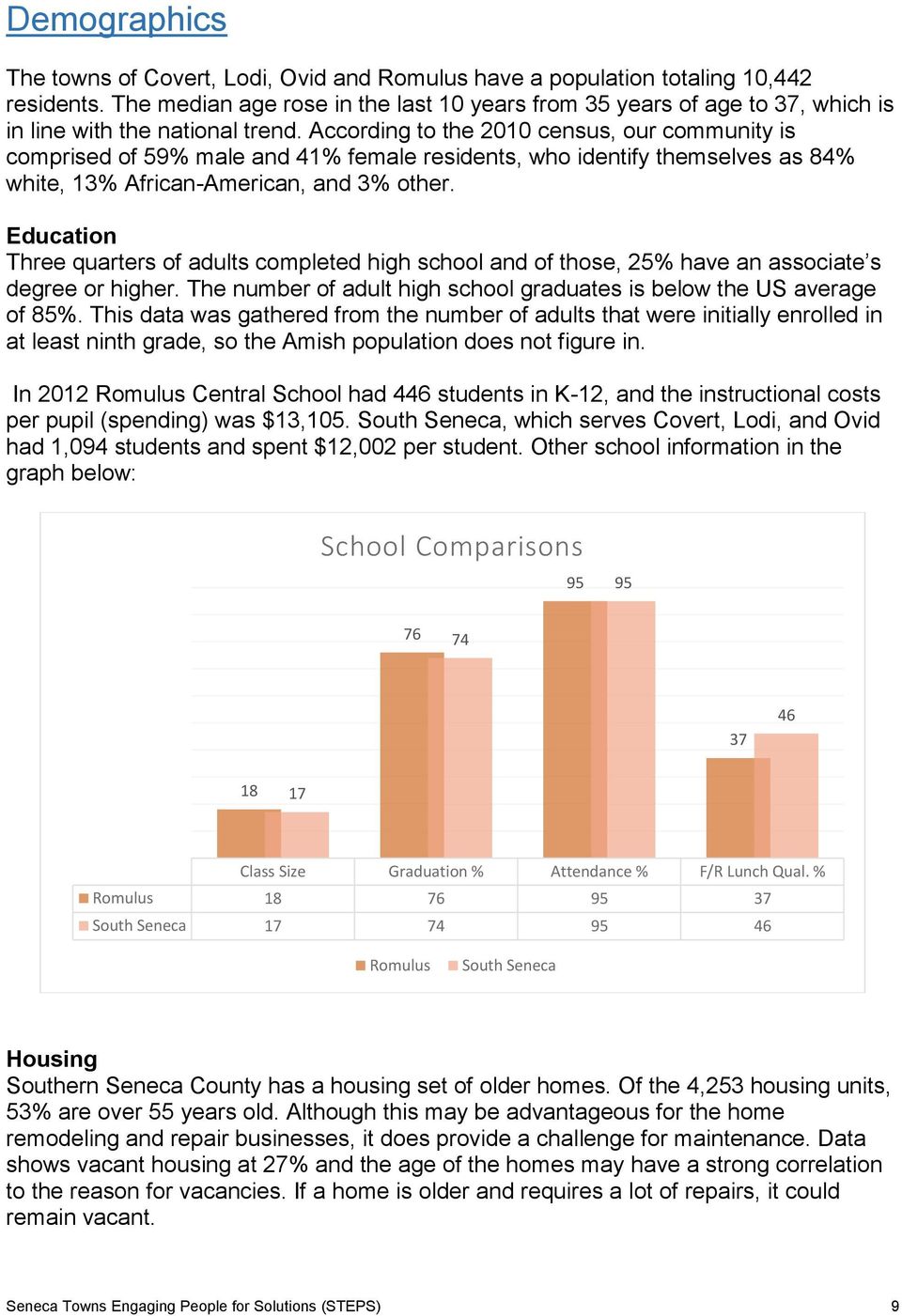
10 Demographics The towns of Covert, Lodi, Ovid and Romulus have a population totaling 10,442 residents. The median age rose in the last 10 years from 35 years of age to 37, which is in line with the national trend. According to the 2010 census, our community is comprised of 59% male and 41% female residents, who identify themselves as 84% white, 13% African-American, and 3% other. Education Three quarters of adults completed high school and of those, 25% have an associate s degree or higher. The number of adult high school graduates is below the US average of 85%. This data was gathered from the number of adults that were initially enrolled in at least ninth grade, so the Amish population does not figure in. In 2012 Romulus Central School had 446 students in K-12, and the instructional costs per pupil (spending) was $13,105. South Seneca, which serves Covert, Lodi, and Ovid had 1,094 students and spent $12,002 per student. Other school information in the graph below: School Comparisons Class Size Graduation % Attendance % F/R Lunch Qual. % Romulus South Seneca Romulus South Seneca Housing Southern Seneca County has a housing set of older homes. Of the 4,253 housing units, 53% are over 55 years old. Although this may be advantageous for the home remodeling and repair businesses, it does provide a challenge for maintenance. Data shows vacant housing at 27% and the age of the homes may have a strong correlation to the reason for vacancies. If a home is older and requires a lot of repairs, it could remain vacant. Seneca Towns Engaging People for Solutions (STEPS) 9
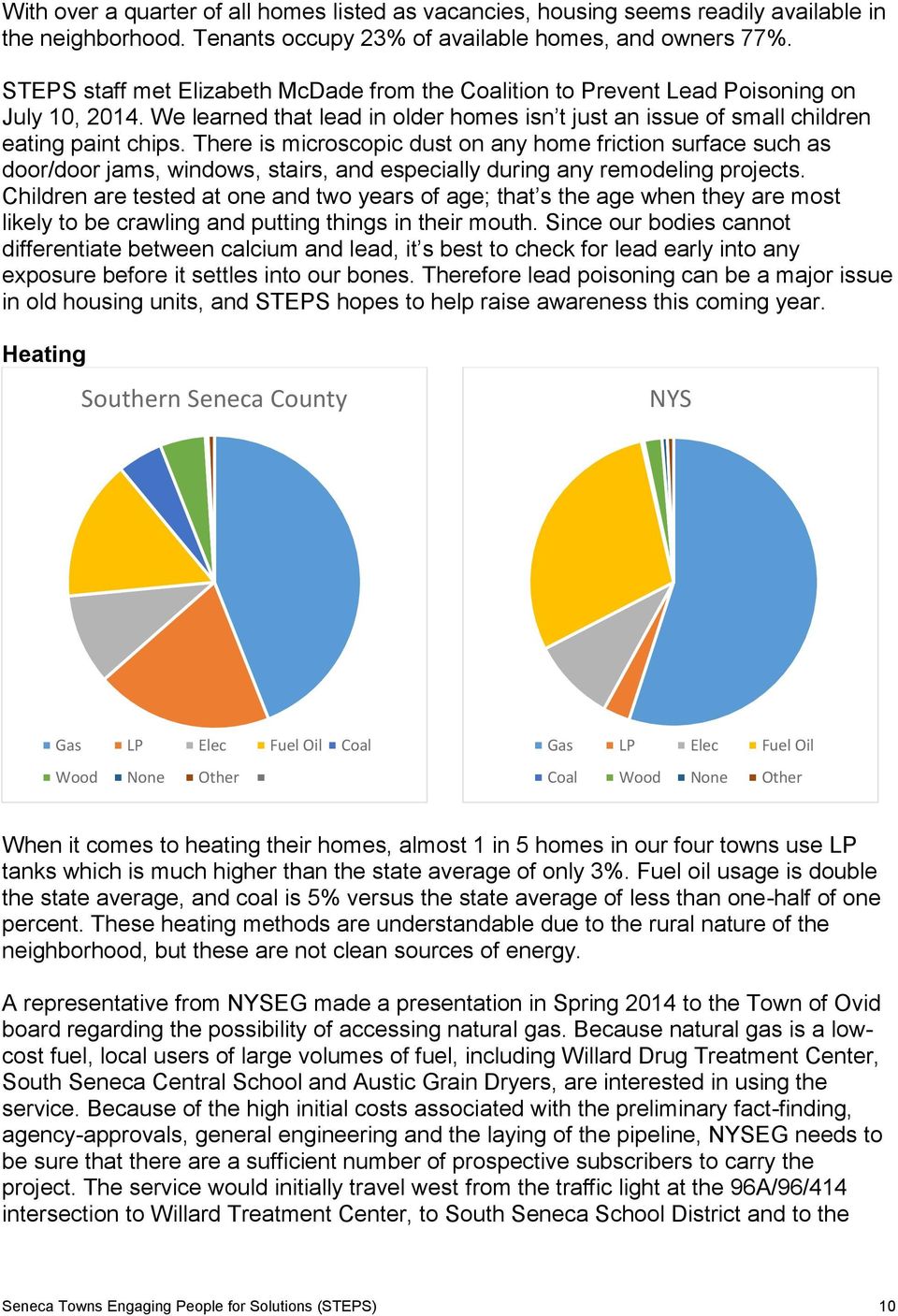
11 With over a quarter of all homes listed as vacancies, housing seems readily available in the neighborhood. Tenants occupy 23% of available homes, and owners 77%. STEPS staff met Elizabeth McDade from the Coalition to Prevent Lead Poisoning on July 10, We learned that lead in older homes isn t just an issue of small children eating paint chips. There is microscopic dust on any home friction surface such as door/door jams, windows, stairs, and especially during any remodeling projects. Children are tested at one and two years of age; that s the age when they are most likely to be crawling and putting things in their mouth. Since our bodies cannot differentiate between calcium and lead, it s best to check for lead early into any exposure before it settles into our bones. Therefore lead poisoning can be a major issue in old housing units, and STEPS hopes to help raise awareness this coming year. Heating Southern Seneca County NYS Gas LP Elec Fuel Oil Coal Wood None Other Gas LP Elec Fuel Oil Coal Wood None Other When it comes to heating their homes, almost 1 in 5 homes in our four towns use LP tanks which is much higher than the state average of only 3%. Fuel oil usage is double the state average, and coal is 5% versus the state average of less than one-half of one percent. These heating methods are understandable due to the rural nature of the neighborhood, but these are not clean sources of energy. A representative from NYSEG made a presentation in Spring 2014 to the Town of Ovid board regarding the possibility of accessing natural gas. Because natural gas is a lowcost fuel, local users of large volumes of fuel, including Willard Drug Treatment Center, South Seneca Central School and Austic Grain Dryers, are interested in using the service. Because of the high initial costs associated with the preliminary fact-finding, agency-approvals, general engineering and the laying of the pipeline, NYSEG needs to be sure that there are a sufficient number of prospective subscribers to carry the project. The service would initially travel west from the traffic light at the 96A/96/414 intersection to Willard Treatment Center, to South Seneca School District and to the Seneca Towns Engaging People for Solutions (STEPS) 10
12 grain dryers east on Route 96. NYSEG is working with the Town of Ovid and the Village of Ovid to find out if the community is interested, a public hearing took place in July. NYSEG cautioned that the service wouldn t happen overnight and much in-between legwork is needed. Still, a Resident Project in Romulus placed a community garden in a spot where a natural gas line would not interfere with raised beds should natural gas make its way to hamlet of Romulus, a prospect some residents there desire as well. Amish Also, 160 homes are listed as having no plumbing, but this could be attributed to the Amish homes. There is a strong presence of Amish homes. From 1992 to 2013, New York s Amish population has increased 293%, second only to Virginia in the US. The principal reasons for the increase are the size of families, generally 5 or more children, and a solid retention rate. Amish communities are attracted by a number of factors that we have in southern Seneca County, the first being rich farmland. They also prefer rural isolation in an area accepting of their way of life. Although the Amish remain a somewhat closed society, there is still interaction between the Amish and the general population. For instance, some of the Amish men serve on the local volunteer fire departments and businesses are accommodating and respectful to each other. Business The largest type of employer is educational/health care/social assistance, followed by manufacturing, then retail trade. In our area, that would be the schools. Only 6% are self-employed. The average wage for females is $33,983 and for males is $42,849. According to the US Census Bureau, the number of small businesses (defined by ACS as family employees or under 3 employees) has declined from 2006 until 2012 in Seneca County. There were 1,778 small businesses in 2012, with receipts totaling almost $70M, showing a drop of over $2.6M. Agricultural and construction businesses rose and service industries all declined (food services, health & social assistance, accommodation services) accounting for most of the loss of 42 businesses. Seneca Towns Engaging People for Solutions (STEPS) 11

13 Of those who work off of their property, almost all (83%) drive alone. The average travel time is 23 minutes, therefore they are working outside the neighborhood. With most full-time workers working outside the neighborhood their social and physical services are also provided outside the neighborhood, causing a disconnect with their local services. For instance scheduling doctors appointments near work and/or picking up groceries before heading home. Income As a standard, if housing costs are over 30% of total household income, it indicates unaffordable housing and utility costs. For our neighborhood, homes with mortgages averaged 37%, which unfortunately is on track with the national average. The same can be said of renters, of which almost half spend more than 30% of their income on housing and utilities. Sixty-five percent of households have income from Social Security or retirement, which is higher than the US average of 45% Percentage of Households with Young Children 0 Two Parents Female HOH Male HOH Public Assistance No Assistance Seneca Towns Engaging People for Solutions (STEPS) 12

14 Health Issues History In the 2013 Community Health Assessment Community Health Improvement Plan (CHA-CHIP) for Seneca County, the County Health Solutions Team lead by S2AY Rural Health Network and County Health Department in collaboration with partners identified health priorities as: Prevent Chronic Disease, and Promote Mental Health and Prevent Substance Abuse. Diverse organizations that participated in the community health assessment process included health providers, community action programs, and service providers. Efforts STEPS joined the Seneca County Health Solutions Team to learn about their work plan for addressing community health improvement. Being at the table provides an opportunity to discuss the social determinants of health relationship to the high incidence of child and adult obesity, substance abuse and other mental health behavioral disorders in southern Seneca County. The match between communityidentified health priorities (section 9), and the health issues and prioritization identified in the County Community Health Improvement Plan is close. However residents want to learn more about social-emotional health and made a recommendation to have a representative from the county office of Mental Health attend a Community Conversation to provide an opening dialogue on this topic. A health disparity in tobacco use and abuse within this demographic exists as well, 24.3% of Seneca County residents smoke compared to the NYS rate of 18.1%. The CHIP prioritization process is explained here: CHA 2013.pdf. Although the social host law in Seneca County has been in place since 2013, more education to the general public to increase awareness of this and the consequence for hosting underage drinking is needed. The Seneca County Substance Abuse Coalition (SCSAC) in collaboration with various partners promote a social norm against underage drinking. The SCSAC focus is prevention of marijuana, tobacco, underage drinking and heroin use in 6-12 th grade. We are grateful that no use of heroin incidence is reported in Romulus or South Seneca School Districts to date. Vital statistical data as of September 2012 per NYS Department of Health Biometric and Health Statistics states that 70.5% of age-adjusted adults in Seneca County are overweight or obese (Body Mass Index 25 or higher) ( ). The percentage of overweight or obese children (85th percentile or higher) is 35.8 % in Seneca County. Both indicators of adult and child obesity rates place our county fourth in rank per the NYS county health ranking. One way STEPS creates environments to promote and support healthy food choice is by adhering to the NYS DOH Healthy Meeting Guidelines, serving healthy food at our community meetings. Residents want to help address the obesity epidemic for children in the neighborhood through education on topics such as healthy budget-friendly and nutritious meals classes for parents, and promote increased physical activities. Fresh produce from the Seneca Towns Engaging People for Solutions (STEPS) 13

15 Romulus community garden, some of which 3 rd graders from Romulus school started by seed last spring, was given away during a Back-to-School supply giveaway event held on site. Several community institutional resources are invested in reducing obesity in adults and children in the neighborhood. Seneca County Public Health and Seneca CCE both provide WE CAN classes to high school students. The evidence-based WE CAN program focuses on healthy eating, increased physical activity and reduced media screen time. CCE promotes the use of SNAP/EBT at Farmer s markets, specifically at WIC clinics. In an effort to create greater awareness of the many opportunities for physical activity that exist, CCE, Finger Lakes Health, and the County Health Department created a Local Motion map. The map is meant to direct residents looking for fun ways to increase physical activity to the area s natural resources. The map highlights hiking trails and more, many free and open to the public. The on-line resource guide link is shared with the community. STEPS will continue to promote healthy opportunities for our community. Below is a picture of fourteen-year-old resident project leader Edwin, his father, and younger brother, smiling because the Village of Ovid granted approval to move forward with the Hoops for Youth project. The village has been very supportive of the project, utilizing Village equipment and manpower to take down the basketball backboard so the teenage boys could paint, repair and replace a broken rim. A Willard-Ovid Lions Club member provides oversight and adult supervision of this resident project. The project will not only provide the opportunity for youth to be physically active, playing basketball, it is hoped that the spruced up basketball court will be a renewed positive gathering place, supportive of social-emotional well-being for local youth. We know that the earlier emotional health issues are identified and interventions are put in place, the better the outcomes are for both. Franziska Center, Inc. and the Seneca County Community Counseling Center collaborate on an Early Recognition Grant thru the Office of Mental Health. They are working to promote universal, regular emotional health screening for all children and youth in Seneca County. A resident recommendation was to have a representative from the county office of Mental Health Seneca Towns Engaging People for Solutions (STEPS) 14

16 attend a Community Conversation to educate the community on the topic of mental health. STEPS is looking forward to planning this soon. Although residents as of yet have not voiced concerns regarding the occurrence of cancer in the neighborhood, data reveals the incidence of breast cancer in Seneca County remains high. In data set of the State Cancer Registries, the incidence of breast cancer in females age 50 + (cases per 100,000) places Seneca County in the RED ZONE and fourth highest in New York counties. One of our key collaborative partners, the Ovid Health Center is exploring a possible partnership with the Ontario, Seneca and Yates Cancer Services Program (CSP) that provides free cancer screening to the uninsured and under-insured residents in the three county area. STEPS has been approached to help alleviate the transportation barrier to getting mammograms. Although the Ovid Health Center can provide several cancer screenings on site, mammography is not available. Residents in our neighborhood need to travel outside of southern Seneca County for this important cancer screening and for many this is a hardship. STEPS will explore ways to assist with the cancer screening event to be held in October, Breast Cancer Awareness month. The Community Health Plan for Seneca County ( ) included the following table of Breast Cancer incidence by ZIP code, Seneca County, Source: New York State Cancer Registry Primary ZIP Code Post Office Included ZIP Codes Number Number of Cases of Cases Percent Difference Observed Expected from Expected Seneca Falls to 49% above expected Waterloo Within 15% of expected Clyde* Within 15% of expected Geneva* 14463, Within 15% of expected Lyons* Within 15% of expected Ovid to 49% above expected Phelps* Within 15% of expected Romulus Within 15% of expected Hector* Very sparse data Interlaken More than 50% above expected Lodi More than 50% above expected Trumansburg* 14854, Within 15% of expected Seneca Towns Engaging People for Solutions (STEPS) 15

17 Seneca Towns Engaging People for Solutions (STEPS) 16

18 Individual Speaking with individuals has been the most exciting part of this project. Due to the rural nature of our area, creative measures are required to try and reach as many residents as possible, especially isolated groups. We conducted targeted outreach to priority audiences at food pantries in Interlaken and Ovid. The organizer and volunteers at the food pantries encouraged people they serve to complete the neighborhood surveys. Surveys The first assessment method was to conduct neighborhood surveys of community residents to determine their assets: opinions, hobbies, occupations, formal experiences. This gave us our first baseline on what the community was feeling and what they felt were their strengths and concerns. Surveys were conducted electronically through a Survey Monkey link, along with paper copies which were distributed to the public through the local free paper The Shopper, employers, educational and human services agencies, and through other community groups. A drawing for local merchant gift certificates was held to encourage responses. A total of 116 completed surveys were returned. Paper surveys were added to the Survey Monkey link by STEPS staff so that all results were stored electronically. Although the surveys will always be available to residents to complete, a soft close was done on June 1, 2014 for evaluation. These results gave us more specific avenues of approach. What are things you know how to do and like to share with others? Seneca Towns Engaging People for Solutions (STEPS) 17
19 Seneca Towns Engaging People for Solutions (STEPS) 18

20 What are things you know how to do and would like to talk to others about? Community Conversations Once a month, STEPS runs a Community Conversation. Because of the large area we cover, the meeting place constantly rotates to further encourage people in differing geographical locations to join us. One month Covert, next Lodi, etc. We also rotate buildings in each town. This gives us and our residents an opportunity to see more of their neighborhood s assets. We start at 6pm on different days of the week. We tried a Saturday Conversation but the attendance was too low to continue that idea, and we have noticed that Wednesdays or Thursdays are most populated. Sign-in sheets give us the opportunity to add attendees to our distribution lists. When our Conversations started the agenda was introducing our project, the survey and our Resident Project grants. All residents are invited to speak. Community projects were publicized, and groups were able to enlist volunteers. Announce-ments were made on upcoming events, and residents were encouraged to discuss changes in the neighborhood they wanted to share. We stressed the importance of filling out surveys and would remind everyone that STEPS staff would be more than happy to speak, to introduce ourselves and the project, to any of their social groups. Seneca Towns Engaging People for Solutions (STEPS) 19

21 Our Conversations have evolved first from open dialogues, and now into discussing the survey results in focus groups. We are pleased with the attendance rates, averaging 20 people, and every meeting brings new faces. Festival tables The spring and summer seasons are in full swing which means lots of outdoor festivals and events. We have been invited to set up a table at four community events. This gives us a chance to meet many residents from the area and introduce ourselves and the STEPS program. At the first few festivals we handed out surveys, collected names, addresses, and s, and acquainted interested individuals with our Resident Projects ( mini-grants ). After evaluating survey results, we progressed to adding graffiti boards. We taped a large piece of blank newsprint paper with a question at the top related to the survey results. Examples are, Where do you envision our neighborhood in five years? and What do you like most about your neighborhood? We encouraged any resident to write down their ideas, then we talk with them about what they wrote and why, and what steps they are willing to take to make change happen. By taking a conversational approach, residents could answer to a specific community issue and know their opinions were heard. There also was no pressure to speak in front of a group and people could come and go at their pace. Our presence at summer events has been very helpful in spreading name recognition. Below is a picture of youth who carried the STEPS banner in the Ovid Strawberry Festival Parade. Actions Taken The woman pictured above with her children volunteers at the STEPS office on a regular basis and maintains a STEPS binder, ensuring all attendance sheets, minutes, press reports, quantitative and qualitative records of activities and progress of STEPS are accounted for. Seneca Towns Engaging People for Solutions (STEPS) 20
22 The idea for the teen resident project Hoops for Youth in Ovid originated from talking with kids from Lodi, Romulus and Ovid at a festival. A young lady from the local 4H handmade a wonderful STEPS banner carried in a parade in the Village of Interlaken parade. She and her cousin passed out STEPS promotional materials along the parade route and encouraged their neighbors to attend the upcoming Community Conversations. Distribution list STEPS is constructing an list of all individuals who share their address. The STEPS survey gives residents an opportunity to share their contact information with us (or remain anonymous). We always have sign-in sheets available at events and ask for addresses. Residents on our individual assets list who are willing to stay in touch electronically are added to an distribution list. And we add contacts to this list from outside our neighborhood for those who show an interest or an investment in our neighborhood. This list is used 2-3 times every month for an blast to inform everyone of upcoming Conversations and events. Our distribution list is currently at 171 individuals and growing. Skills map Because of the strong community spirit in our neighborhood, we are building a comprehensive map of volunteerism potentials. Residents can share with us their skills in multiple ways. The surveys ask for their knowledge in popular areas (see graph above) and at Community Conversations and festivals we make note of their areas of expertise or interests. STEPS has created a spreadsheet listing individuals, their assets, and contact information. Our future plan is to increase volunteerism in the neighborhood by directing residents to local projects. For instance, if a team is working on rehabilitating storefronts, they may not know enough people with carpentry skills to help. With our skills map, we can quickly identify individuals with that skill set that may be able to assist, and share their contact information. This will help build a healthier community through stronger neighbor ties. Resident Projects Our Community Conversations have helped bring residents together through neighborto-neighbor links for small projects. A great example is a woman named Kathy. At the first Conversation she attended, she told us that she had recently moved here from New Jersey, and she was surprised at the number of businesses and homes that appeared run down in our towns centers. She said she would love to see them fixed up with a little paint and some elbow grease and felt it would help to attract more new businesses to our towns if the area buildings were spruced up. At the next month s Conversation she mentioned it again and added that she loved to do exterior painting but didn t know anyone in the neighborhood. Another resident spoke up and said he agreed with her Seneca Towns Engaging People for Solutions (STEPS) 21
23 assessment, was familiar with local guidelines, and would like to help. Because the majority of residents have lived here long term, it s easy to become complacent to your surroundings and not notice things a newcomer would notice. Her vision for the area was shared and accepted, and the group of volunteers they are gathering hope to work on facelifts for the downtown areas in our neighborhood. Facebook STEPS has created a Facebook page under NYSTEPS Project. Our goal is to utilize social media to spread the word on local volunteer opportunities and share the successes and progress of neighborhood projects. Because STEPS is a new project in a rural community, we believed it would be beneficial to find a way to link to more popular and visible organizations or groups in our area. One recent event: STEPS was hosting a school supplies giveaway at a local high school. By linking our Facebook posting to the high school s page in a tag, our message went out to over 150 additional people and our event was a success. Since teens communicate nearly exclusively per social media and text messaging, Romulus resident Edwin, resident leader for the basketball court project in the village park, will post his Hoops for Youth project on his personal Facebook page to encourage involvement and announce pick-up basketball games. Seneca Towns Engaging People for Solutions (STEPS) 22
24 Associations We need to start with those we owe so much thanks to the STEPS Steering Committee. Our Steering Committee is comprised of 14 residents, with member representation from each town in the neighborhood. This is a key resident network and the back bone of the STEPS Project. Most members have been at the table pre-grant, eager to explore ways to improve the physical, social, and economic climate in our four towns. A quote from survey respondent # 75 captures the essence of our committed members and guides our project: Many people are willing to work very hard on behalf of our community. We are finding residents passionate about the place they call home, many belonging to local associations in an effort to support their community. One way STEPS reaches out to local associations is by using their sites for our Community Conversations. We rotate our monthly meetings among the four towns, and we also rotate locations. STEPS asks groups to open their doors for our public meetings, which not only gives us a chance to learn more about their meeting space, but also gives the residents an opportunity to learn about the organization itself. This provides a chance to engage interested neighbors. Our Community Conversations have taken us to several historical sites in the community. Pictured here is the Lodi Historical Society. Active associations in the neighborhood also include historical societies in the Village of Interlaken, and Towns of Romulus and Ovid. Fire Departments Our local Fire Departments, besides having such caring volunteers, are gracious is allowing use of their facilities. Ovid and Romulus Fire Departments hosted a Breakfast with Santa early in the grant year. STEPS was invited to attend the holiday celebrations allowing for an opportunity to introduce our new project to young families, thanks to the fire departments. The Lodi Fire Department hosted a Tractor Show this summer, and STEPS set up a table to meet residents. They also will host our October Community Conversation. The Romulus Fire Department uses their roadside sign to advertise STEPS meetings and activities held at the Romulus Presbyterian Church which is also the site of a thriving community garden project. Seneca Towns Engaging People for Solutions (STEPS) 23
25 Churches The Romulus Presbyterian Church has hosted three STEPS-sponsored community events: a Back to School supply give-a-way, and two community meetings. Following the well-received Environmental Conversation held there, a resident that participated in our environmental discussion attended the August Town of Covert meeting and spoke out, encouraging her neighbors to get involved with STEPS. This approach to community engagement is most effective and appreciated. Another example of effective in-reach realized was in partnership with the Ovid Federated Church (OFC) Food Pantry. The church houses the ecumenical food pantry, run in a joint effort between the OFC and Holy Cross Catholic Church. A volunteer from the food pantry spoke directly to participants well known to her, asking them to have their voices heard by completing a survey. Utilizing this in-reach approach greatly increased the number of completed surveys from this often disenfranchised group. Numerous one-on-one conversations took place with food pantry consumers and the OFC congregants in Phase I. The Interlaken Reformed Church keeps emergency food stocked to help individuals and families experiencing financial crisis. Each Friday the church s Kitchen Cupboard is open to the public. Phyllis, the pantry organizer, has been supportive of STEPS work, serving as a site to disseminate STEPS activity and meeting notices and welcoming outreach. We recognize that charity oftentimes demeans a person and strips him or her of dignity, STEPS provides an excellent opportunity for residents to mobilize their individual assets toward making a difference in the community while impacting their own lives in a significant positive way, thanks to these associations opening their doors to us. Churches in the area appear to be keenly interested in strengthening their community. They often have firsthand knowledge of the individual assets in their faith community. This is how we identified a resident with technical expertise willing to help build our STEPS website. Another example is the Christ Church in Willard offering recognition of an amazing local musical talent. They are working to increase culture and social opportunities in the neighborhood by highlighting local performances in a Hometown Music Series. We believe tapping into the faith communities innate altruistic qualities complements our STEPS community development work, resulting in extremely positive partnerships. Ovid Willard Lions Club Our local Lions Club is a local organization that provides funding to libraries, backpack school food programs, and recreation programs in the neighborhood in addition to their nationally recognized effort to provide vison screening for children. This association is the #1 supporter of the Seneca Christmas Project that provides food, clothing and gifts to local families during the holiday season. Each year the club hosts a free St. Patrick s Day Corn Beef and Cabbage for seniors at Ovid Federated Church, as a way of saying thank you for past and present contributions to the community. This highly anticipated Seneca Towns Engaging People for Solutions (STEPS) 24
26 event always has good turnout. The club offers assistance at the Wine Country Circuit Dog Show held at Sampson State Park in September. A Lion s club member will supervise the youth installing new basketball equipment in Ovid. This group of dedicated residents has been identified as a key association in the neighborhood. STEPS staff had the pleasure of being guest speaker at a club meeting this spring. It was great to see the members at community events such as the Strawberry Festival in mid-june. The group also fundraises at the 4-Town Invitational Wrestling Tournament at South Seneca High School. They have a strong presence in the community and are a key associational partner. Between the Lakes Community Players (BTLCP) This group brings musical theater experiences to the neighborhood as well as helps non-profit groups raise money and awareness. This summer, the association enhanced the lives of neighborhood children through their summer theatre camp. Children showcased their new learned talents in singing, dancing, acting and improvising. Project staff set up a table at the community event in the school foyer. We engaged in conversation with several parent and youth and provided back-to-school supplies, an initiative spearheaded by our outreach coordinator. Numerous associations such as the Historical Societies, the VFW, American Legion and Sportsman Club are viewed by residents as assets. The positive characteristics of these groups vary, but all are contributory, actively supporting the community. As we move forward we plan to explore partnerships with more of the 80 associational assets identified in the neighborhood. We continue to ask the membership of these groups to encourage community engagement with STEPS and consider the unique role they might have on our neighborhood health improvement project. Seneca Towns Engaging People for Solutions (STEPS) 25
27 Seneca Towns Engaging People for Solutions (STEPS) 26
28 Institution STEPS has established relationships with numerous institutions that serve the community. Of the over 60 institutions identified, this section highlights the ones we ve mobilized or had the most interaction with during Phase 1. STEPS Project broad-based institutional support throughout the four towns is demonstrated by strong institution and service provider presence at our monthly meetings. Seneca County Cornell Cooperative Extension (SCCCE) and Cornell University Seneca County Cornell Cooperative Extension Executive Director and our Steering Committee Chairman, (as all steering committee members) brings many resources and expertise to the STEPS table, most especially his established relationship with Cornell University. Our partnerships with SCCCE and Cornell will help pave the way toward eventual health improvement in southern Seneca County. Our chairman facilitated a Community Conversation about Environmental Stewardship in July in response to the community expressed interest in protecting the beautiful land and lakes in the neighborhood.this environmental stewardship conversation was about the role we play as users and caretakers of our natural resources, we were a featured site through the NY Council of Humanities. The work of SCCE puts to practical use the scholarship and research of Cornell University in the following areas related to our assessment and potential neighborhood health improvement plans: Families, nutrition, health and safety (human ecology); Youth development,environmental and natural resource enhancement; Community and economic vitality. STEPS tapped into the expertise of Jennifer Jensen from Cornell University s Community and Regional Development Institute (CaRDI) program. Jennifer lent her expertise on behalf of CaRDI, assisting us with the initial neighborhood survey data analysis. Jennifer was a visiting scholar from the Rural Policy Research Institute, where she was a Research Analyst with the Rural Future Labs. We also partnered with Cornell s Institute for Resource Information Sciences (IRIS) to gain GIS mapping access to CCE s Geospatial maps. The Extension s IRIS team have agreed to offer STEPS support as needed, our GIS maps are on their map system so they can see the maps and assist with any issues hands-on. Several maps are included within this report. There is potential for partnering with Cornell s Design Connect program, a student organization that provides pro bono design and planning services. SCCE and STEPS would develop a consulting type relationship with the university s design students in partnership with the village or town involved. Residents voiced their desire to improve the aesthetics of the neighborhood. Design Connect program could help the residents articulate their vision for improving the appearance of the neighborhood by drawing plans and developing blue prints. Residents interacting with Cornell students facilitate the creation of a conceptual vision of what the neighborhood could look like in future Seneca Towns Engaging People for Solutions (STEPS) 27
29 years. Project(s) would be determined by working with residents and town or village governments, and might include streetscape plans, or eventually ideas for redevelopment of the vacant lots in Ovid as a results of a massive fire in March 2014 that took out a small strip of storefronts, 3 major business and 8 apartment units. Residents dream of one day having a community center or central gathering place in the neighborhood too. The level of expertise that Design Connect might potentially provide as we move forward in planning is truly an institutional asset. Additionally, STEPS looks forward to the possibility of hosting a Cornell intern in summer of 2015 through the CALS NYS Internship Program. The Neighborhoods Libraries According to the survey results Ovid, Interlaken and Lodi Libraries are highly valued by residents. Access to the quality programs that each offer enrich the community and inspire lifelong learning. STEPS anticipates growing strong partnerships with the libraries moving forward. In Phase I of the project, our libraries served as distribution and drop off site of survey, provided speaking opportunities and meeting space, and computer training for staff. The possibilities for community action and collaboration for literacy promotion is an area residents would like to expand upon. Interlaken Library Ovid Library Lodi Library Seneca County Government The Department of Health is a key institutional partner that lends ongoing support to STEPS. The public health educator and director attend STEPS meetings, offering their expertise of chronic disease prevention education and knowledge of the community. The county health department provided the STEPS community with research based educational materials on Lyme s disease in response to a resident raised concern of the high occurrence in the neighborhood. This information was disseminated at community wide events over the summer. As stated in the health issue section, the health department and their partners have a Community Health Improvement Plan (CHIP) in place to address issues of obesity, substance abuse and other emotional and behavioral disorders, and tobacco use. Seneca Towns Engaging People for Solutions (STEPS) 28
30 Other Departments of County Government noted as key institutional assets include: o Office of the Aging; sent survey out with home delivered meals, arranged for STEPS to present at a congregant meal site in Ovid o Department of Environmental Health; Outreach and engagement opportunities at rabies clinics o Seneca County Division of Human Services; Transportation Advisory Committee, steering committee members attended meetings to advocate for increased public transportation services in the neighborhood Wayne County Community Action Program (CAP) and Cayuga/Seneca Action Agency The Retired and Senior Volunteer Program (RSVP) of Wayne County serves Seneca County. A STEPS Steering Committee member and his wife volunteer for the RSVP medical transportation program, they provide much needed transportation service to seniors needing rides to and from medical appointments. STEPS would like to expand the driver volunteer base and has plans to encourage more resident participation. Cayuga/ Seneca Community Action Agency advocates for economical challenged families and works toward changing stereo types regarding poverty. This agency administers the Healthy Families an intensive home visiting program for new and expectant parents, however services are not available in much of the southern part of the county. Through referrals to the Healthy Families program STEPS can help demonstrate a need for providing services in our neighborhood to support young families on their path to self-sufficiency. Ovid Community Health Center A representative of the organization regularly participates in STEPS meetings. Plans to partner with the health center and the Seneca County Department of Heath on an immunization clinic in the fall of 2014 are underway. Partnering with the health center on a cancer screening event in collaboration with the Cancer Services program of Ontario, Seneca and Yates counties is also being discussed. The Ovid Health Center houses our Steps office, we enjoy an excellent landlord tenant relationship. United Way of Seneca County United Way works to advance the common good by focusing on three priorities Education, Income and Health. The following partnerships have been identified STEPS Collaborative partners: Seneca County Partners for Children (SCPC) SCPC is a network of people and organizations supported by the United Way that have been working effectivity for years to strengthen services to children and families. The partnership includes both school districts in our neighborhood, leaders from county government and businesses. SCPC advocates for holistic youth and family orientated Seneca Towns Engaging People for Solutions (STEPS) 29
31 policies and services. The work of the Seneca County Substance Abuse Coalition (SCSAC ) resulted in the United Way being awarded a grant from New York States OASES in 2011 to reduce underage drinking.the SCSAC sponsored a billboard graphic design contest to promote Drinking -not a minor problem campaign and students from both our local high schools won! Their design was used on billboard in the neighborhood. Steps will join the SCSAC table in fall 2014 to support the delivery of prevention messages thru our networks in the southern end of the county. The UW s goal for improving people s health is consistent with our resident identified health priority for changing personal behavior, avoiding risky behaviors, and supporting a drug free community. Seneca County Literacy Partners The goal of this United Way funded project is to create a culture of literacy. A quality education leads to a stable job with income enough to support a family. The work of the Seneca County Literacy project builds a foundation for increased education attainment. Education is one of the most important indicators for economic success, and lack of education is closely linked to poverty. UW s goal to promote financial stability and independence among working families is in line with our vision to strengthen families by having the ability to take care one self and one s family. This critical to a personal and collective sense of well-being. Romulus and South Seneca School districts Resident acknowledge that the two school districts in the neighborhood work very hard to help children achieve their potential. Residents appreciate the many advantages to attending these small and rural schools. Both districts have embraced the community development work of STEPS, facilitating opportunities to engage with students, parents and staff during the assessment process. The school districts support by posting STEPS information on websites, publishing STEPS news in newsletters, and disseminating surveys.staff has participated in events at the schools, and were granted the opportunity to address the community at their holiday concerts. Superintendents from both districts serve ex-officio on our steering committee. The community is very proud of the ability of their public schools endurance of the current economic climate and their dedication to serving children and families. Local town and village governments On occasion local government board members attend our STEPS community meeting and likewise we have attended their meeting to speak on behalf of STEPS. The village of Ovid has been very supportive of the youth resident project, assisting with youth resident project to spruce up a basketball court. Ovid Mayor Terry serves on the steering committee.the town of Covert and Lodi have provided meeting space. And towns of Romulus and Lodi post STEPS information and surveys on their website. At this time we are scheduling opportunities to share Phase I assessment findings with local government boards. In partnership of many dedicated institutional asset we will work together to create long lasting change by looking at and addressing the root cause of issues. Seneca Towns Engaging People for Solutions (STEPS) 30
32 Physical Descriptions Seneca County is a beautiful area nestled between Cayuga and Seneca Lakes in Central New York. The northern end of the county consists mostly of two large towns, Waterloo and Seneca Falls. Both are more heavily populated and have large employers such as NY Chiropractic College, ITT Goulds Pumps. Southern Seneca County is 159 miles of beautiful, lush area filled with farms and dotted with wineries. The southern end, specifically the towns of Covert, Ovid, Lodi and Romulus, are less populated and much more rural with no major employers. Seneca Army Depot is a 10,000 acre parcel that was used between the 1940s and Filled with Army personnel and their families until 2000, the closing of the Depot has left the area deserted. It will be turned over to the towns (and to the tax rolls) in 2016, with hopes of attracting businesses. Roads Three state highways run north-south through southern Seneca County. Route 96A is on the western end, closest to Seneca Lake. It starts in Geneva, Ontario County, and ends in Lodi in southern Seneca County. Route 96A is worth driving at a leisurely pace. It winds through farmland; you will probably see an Amish family or two working their land. You will find some signs tempting you to turn into local wineries for a tasting. When passing Sampson State Park, you will see many miles of barbed fencing on the east side this is the Depot boundary, the best place to be on the lookout for the white deer that live on the depot grounds! State Route 96 runs through the middle of our community. It starts in Ontario County, dissects Romulus, makes a sharp turn in Ovid, runs through Covert, and continues until it ends at the bottom tip of Cayuga Lake in Ithaca, with few traffic lights the whole way. Between Romulus and Ovid is the barbed fencing marking the east boundary of the Depot. You can see a few of the deserted Army buildings along the way. You will need to be on the lookout for Amish horse-drawn carriages on Route 96. Route 89 is a beautiful drive. Starting at the northern end of Seneca County, Route 89 winds along the edge of Cayuga Lake, also ending at the bottom tip of Cayuga Lake. Driving south you will see lake houses on the right, and matching boat houses on the left. In the fall, the leaves changing colors around the lakes are stunning. And in the winter, when Cayuga Lake freezes over, you can find thousands of white snow geese sitting on the ice! Seneca Towns Engaging People for Solutions (STEPS) 31
33 Route 89 is also part of the Cayuga Lake Scenic Byway. A Scenic Byway is a road or roads that show off the beauty or historical significance of an area. As chosen by the NYS Department of Transportation, the designation can be a promotional enhancement to help boost tourism. The Cayuga Lake Scenic Byway runs all the way around Cayuga Lake, totaling almost 90 miles. Our local active resident Chris is working on kiosks at either end of the Scenic Byway to promote events. Once the kiosks are approved by the State, the project qualifies for New York State funding. Most of the land in our neighborhood is used for agriculture. The major crops are livestock feed such as field corn and soybeans. Cattle are the largest producers, both dairy and beef. As seen by the map below, agriculture holds a very strong presence in our neighborhood. Parks There are three State Parks in our neighborhood. The largest is Sampson State Park in Romulus, with more than 2,000 acres on Seneca Lake. Like most state parks, it has camping areas, picnic areas, and play courts. There is a sand beach and a large marina for boat launching. Seneca Lake is a great area for fishing for trout, bass, bullheads and more. Adjacent to Sampson Park is the new Sampson Veterans Memorial Cemetery, also overlooking beautiful Seneca Lake. As their website boasts, The Cemetery is located on the site of the former Sampson Naval Training Station and Sampson Air Force Base, one of the most historically significant military sites in the Finger Lakes Region, having served more than 1 million servicemen and women. Lodi Point State Park, in Lodi and also on Seneca Lake, offers boat launching and picnic facilities. It is a popular spot for local kids in the summer. Bonavista is a State Golf Course in Ovid, and it includes a 9-hole golf course and a restaurant. The parks offer a lot of green space for family or school reunions, and school field trips. Spring and fall access is great for walking trails and bird watching. Most winters bring cross-country skiing. All three state-run areas are huge assets for the community. Most of the lake frontage on both lakes is privately owned by homeowners, so park access is used by residents in all seasons. Of course summer is popular for swimming, and residents expressed a desire to see more swimming opportunities and public lake access in the community. Seneca Towns Engaging People for Solutions (STEPS) 32
34 The Finger Lakes Land Trust has been working for land and water conservation for 25 years. As property is donated, FLLT opens that land to the public free of charge for hiking and bird watching. The acreage is 16,000 acres and counting, consisting of wooded areas, gorges, streams, and farmland. Currently they hold 80 acres, including lakefront, in Romulus. Actions taken Physical assets were gathered by prior knowledge, maps, word of mouth, tax rolls, and neighborhood drive-bys. Emerging ideas for incorporating physical space into local health improvement activities include: Marketing local produce Along with more Amish and Mennonite farms, southern Seneca County shows an increase in small organic farms. Young farmers are purchasing smaller tracts of farmland and growing a variety of fruits and vegetables. There is a strong interest among the community to form a farmers market. Environmental stewardship Because residents are concerned with the health of Seneca & Cayuga Lakes, STEPS hosted an environmental conservation discussion. Residents are aware that the environment sustains us economically by providing energy and raw material for our farms and wineries and by offering us spaces to gather, work, and play. As we look to the future, New Yorkers grapple with finding a responsible balance between using and protecting our natural resources. In response, STEPS invited the public to an Environmental Community Conversation led by Ave Bauder, Director of Seneca County Cornell Cooperative Extension. It was a conversation sponsored by the NY Council of Humanities and the role we play as users and takers of our natural resources. Attendees found the discussion informative, and STEPS encouraged residents to form a group of likeminded citizens to continue the conversation. Increasing lake access. Besides the parks listed, the majority of lakefront property is privately owned. Citizens are looking for areas of access with one possibility located on the east side of Seneca Lake, in the hamlet of Willard. Beautifying the area Residents are concerned with the appearance of the downtown areas, the rundown look of building fronts. There have also been discussions on building a walking trail along the lakeshore and a ramp to launch non-motorized boats. A community center In addressing the lack of public spaces there is strong support for a central building where people can gather and meet. Residents envision a centralized public area for teens and senior citizens, both groups identified as lacking in access to enough activities. Seneca Towns Engaging People for Solutions (STEPS) 33
35 Parks Agriculture in Blue Seneca Towns Engaging People for Solutions (STEPS) 34
36 Economic Description As stated previously, there are few large employers in the neighborhood. The two biggest employers would be the two school districts, which require a majority of professional licensed employees. Five Points Correctional Facility also employs many professionals. The majority of businesses would be classified as small businesses, which according to American Community Survey (ACS) would employ family or under 3 persons. The number of small businesses have declined, and receipts in 2012 were $69.8 Million, a drop of over $2.6 Million since 2006 county-wide. Service industries all declined (food services, health & social assistance, accommodation service) accounting for most of the type of loss. The average drive time for persons employed is 23 minutes, which means they are working and spending outside of the neighborhood. Agriculture and construction small businesses have increased. After farming, the types of businesses we have met tend to offer products that serve the local needs. Farm supplies, house repairs/roofing, heating/plumbing, and car/farm equipment repair. The trend towards repair versus replacement follows the national trend; due to poor economics, people are more apt to repair or maintain their current car, tractor, or house, versus buying new. Thanks to the rich soil between each of the Finger Lakes, southern Seneca County is dotted with dozens of wineries. Distilleries and micro-breweries are on the rise, enticing another genre of tourists to visit. Although these businesses only hire a few employees and mostly seasonal, the tourism they bring in is an economic boost, especially in the summer and fall, which trickles down to restaurants, bed-and-breakfasts, and specialty gift or antique stores. Through association with the wine trails there is an opportunity for larger collaborations and the wineries can offer events off-season, too. Actions taken To date, we have identified over 260 businesses on our asset inventory list. Our methods for identifying include newspaper ads, yellow pages, drive-by and word of mouth. Once identified we contact the business, almost always in person. The businesses we have contacted are friendly and receptive. As we introduce ourselves, we plant the idea of community spirit, pride in local people and local products. Seneca Towns Engaging People for Solutions (STEPS) 35
37 Directory At our July Community Conversation, a resident expressed perfectly what so many are saying: We should feel a sense of responsibility to use our local businesses. The idea of a local business directory seems popular. We are pleased that the consensus seems to be a preference towards frequenting our neighborhood businesses and we will continue to support the idea of a group working towards that goal. Fifteen local businesses served as drop-off and distribution sites for our neighborhood surveys and several contributed gift certificates to incentivize residents to have their voices heard by completing a survey. Marketing In an effort to help grow the local economy, the Resident Project The Covert Trail helped 27 Covert businesses and producers gain exposure for their products and services. Local businesses included a local honey producer (apiarist), a guitar manufacturer, a pottery store, and a produce store, all selling handmade goods. It is exciting to see the kind of movement especially from young farmers (in their 20 or 30s) in the Covert area where there appears to be a transition to a new generation. This trend is exciting because many residents say they want to buy food locally and these young entrepreneurs want to produce it! Shopping Many small businesses produce an assortment of quality products that may not have a lot of visibility. Kinney Drugs in Ovid is embarking on a buy local program partnering local venders to offer more local products.this will give residents more of an opportunity to support local economy by purchasing local products without having to go to a bigger store farther away from their homes. STEPS will support this venture, ensuring that small businesses in the area are aware of this initiative. There is a small grocery store in Ovid, and some residents purchase groceries out of convenience at the Dollar Store and the pharmacy. Larger markets (Walmart, Wegmans, Tops) are minutes away and public transportation is scarce. Reading Education is one of the most important indicators of the potential for economic success, and lack of education is closely linked to poverty. Studies show that geographies with a higher than average educated workforce grow faster, have higher incomes, and suffer less during economic downturns. STEPS has begun talk of partnering with Kinney s and Ovid Library to place a Bright Red Book Shelf in their foyers to stock free books for children. Residents have been identified to donate the shelves and a local small lawn ornament business will paint them. The initiative is an effort to promote early literacy and lifelong learning. While awaiting corporate approval for placement of the shelf, donated children books courtesy of The Seneca County Literacy Program are given Seneca Towns Engaging People for Solutions (STEPS) 36
38 away at events such as the Covert Trail, Public Health and Ovid Health Center Immunization Clinics. Mentors In addition, there has been a strong interest in mentoring. In an attempt to increase youth retention in the neighborhood, residents have suggested starting a mentoring program for high school students. If businesses in the area would be willing to open their doors to teens, there is a good chance that students will find interest in a field that would benefit our community. STEPS will support and assist in bringing together likeminded residents to see this idea flourish. Asset Mapping STEPS is fortunate to join Cornell Cooperative Extension s Geospatial Mapping program. This access includes all public ArcGIS maps on the internet, as well as support from CCE s work team Neil Curri and Steve Smith. STEPS Outreach Coordinator and one of our Steering Committee members attended a seminar at Cornell to familiarize us with the GIS program. GIS (Geographic Information System) allows the user to map addresses, streets, natural resources such as rivers, lakes, grasslands any geographic information can be customized as needed. We are currently using this mapping system to geographically pinpoint businesses and institutions in south Seneca County, see map below. Businesses are in blue, and institutions in red. Because of our rural area, and that we do not have a local newspaper, it can be difficult to know where our assets are located. STEPS is setting up the map so if you hover over a pinpoint it will give you the business name, type of business, address and contact information. Our intention is to make this mapping information available to all residents to easily find and support - local businesses. Asset Map Businesses & Institutions Seneca Towns Engaging People for Solutions (STEPS) 37
39 Seneca Towns Engaging People for Solutions (STEPS) 38
40 Cultural and Social As stated in our original grant application prepared by the S2AY Rural Health Network, the history that exists in the neighborhood and the people that represent it is rich. The locations of April through June Community Conversations gave us an opportunity to visit three wonderful cultural and historical locations in the neighborhood. Residents toured and were introduced to the history of these buildings and the people (past and present) of the Three Bears, Lodi Historical Society and the Romulus Presbyterian Church. (Three Bears) Our standing monthly Community Conversation in July was held at the historic Covert Grange. This meeting served as a focus group, which proved to be an excellent forum as there were 11 new residents in attendance, among the 27 total participants. We have heard many fascinating stories along the way. On this particular evening, a women spoke of her parent s farm located on the former Seneca Army Depot pre-world War Two. The farm family was given just a few days to harvest some of their crops and vacate, in order for the construction phase of the Depot to begin. Although this family received only minimal compensation after abruptly uprooting their lives, they did not challenge it. It was 1941, WW2 was about to begin and this particular farm family was focused on the well-being, safety, and greater good of their friends, family and neighbors. This is just one example of a story rich in history in the southern end of Seneca County. When residents speak of the cultural and social assets in the community, our Amish and Mennonite neighbors are frequently mentioned. The Amish truly embody communitybuilding characteristics as shown in their willingness to assist their own, such as in barn raisings. And although Amish engagement remains limited with STEPS, relationships are being developed. One resident project leader purchased lumber thru a local Amish supplier, and was astounded to learn there was already awareness of STEPS and other resident projects! Seneca Towns Engaging People for Solutions (STEPS) 39
41 Other resident projects also purchased materials from Midlakes Metal Sales in Ovid, a local Amish run business. We think building relationships such as this with local businesses will prove valuable to STEPS in the future. Many strong families and friendships exist in the neighborhood and as shown time and again, residents help each other out in times of need. During one Community Conversation, a women left abruptly. However, the following day she followed up with an explanation for her quick departure. Family members, Emergency Medical personnel, received a call for mutual aid, and she was needed at home to care for her young grandchild. Although this is a common example of the family bonds and friendships that exist in our tight-knit community, we are discovering residents without extended family or benefit of lifelong friendships in the neighborhood, too. A recurrent theme surfacing is the desire to be more intentional about welcoming newer residents. This is the population most likely to be living in the area without support, who are isolated and may not have anyone to call upon in times of need. We frequently hear that some people are considered newcomers even if they have been in the area 20 years. A frequent mention as a possible way to strengthen the social environment is to replicate a Welcome Wagon type program so that newer residents might experience the many advantages that come with knowing your neighbors and the resources available. There is a youthful diversity that new families who are moving into the area offer. There is a wealth of new ideas, talents and goods & services which come with these new families. (Resident comment on the STEPS neighborhood survey) As an example, Ovid Health Center s physician, Dr. Liz Ryan, referred a new resident of the neighborhood to STEPS. During a pleasant telephone conversation and meeting with this resident, she revealed numerous individual assets. We look forward to developing this relationship and mobilizing the many gifts and talents this new community member is eager to offer! I can add my enthusiasm and skills to yours, making a difference in my new community! Linda Pacelli Dixon, resident Seneca Towns Engaging People for Solutions (STEPS) 40
42 Although the major hubs for social activities take place at the schools and libraries, through activity mapping in the neighborhood we have identified the following informal gathering spots for coffee and casual conversation; o Grandpa s Convenience Store o McDonald s o Quik Shoppe o AJ s Diner In addition to the Four Towns Community Center s programming that provides safe opportunities for area youth to participate in organized sports, we discovered other key social assets that support community activities and the arts, as follows: o Lions Club o Historical Societies o VFW o American Legion o Masons o Thumb Garden Club o Parent Groups o Between the Lakes Community Service Players Examples of local traditions that bring residents together for celebrations are community events such as the Strawberry Festival in Ovid and Olde Home Days in Interlaken. A concert series is offered through the Lodi Historical Society and lawn concerts take place 3-4 times a year at the Ovid Library. School sponsored events provide the remainder of cultural performing arts opportunities. According to the ACT Rochester 2014 Report Card, an initiative of the Rochester Area Community Foundation, Seneca County s cultural, arts and leisure activities indicators are worse by 10% or more when measured by the rest of the state. On a small scale two Resident Projects in particular, History and Health: Walking at Lake View Cemetery and Aspects of the Stage helped to stimulate the community s cultural interests. Seneca Towns Engaging People for Solutions (STEPS) 41
43 Seneca Towns Engaging People for Solutions (STEPS) 42
44 Community Health Improvement Priorities Residents considered many factors that influence health, and used the following methods to identify the range of health issues considered important: Focus group feedback Review of small-scale resident promotion project ideas and outcomes Analysis of the 116 neighborhood surveys Community Conversations One-on-one meetings Focus groups were held in July and August 2014: July 19 - Lodi Tractor Show July 21 - Community Conversation at Interlaken Grange August 4 - Romulus Fire Department August 20 - Community Conversation at Ovid Library August 14 - Interlaken Conifer Village August 25 - Ovid Health Center In May 2014, 53 High and Middle School students were asked the following questions: What do you think is missing from your community? 52% (32) - Community center, swimming pools, skateboard park, summer activities/sports, a hang-out spot to meet friends 13% (8) - Bigger parks, better parks, more beaches 16% (10) - More restaurants, better restaurants Smaller responses: movie theater, more retail shopping, water park, museums, community gardens. If you could change one thing about your community, what would it be? (All responses less than 5 per category) Bigger library Fix run-down buildings More snow, horse and dirt bike trails Better roads, better park maintenance Litter (tires) on back roads More teachers More community spirit School Less traffic Safety Farm odors Seneca Towns Engaging People for Solutions (STEPS) 43
45 What would you be willing to do to be part of this change? 15 students, 28%, answered this question, all positively. Responses varied, but all indicated a willingness to help. And students did help by picking up litter in the neighborhood, they took a photo of all the trash they gathered to depict what I do not like about my neighborhood What worries you about your community? Safety, welfare of others, skateboard injuries. But only 17 answered this question, so 41% of answers, or 13% of all surveys. Smaller responses: Drugs, smoking, bullying, shut downs, littering, fire, losing programs we already have, smooth flow of living. In response to the question, What do you love about your community, student s submitted photos of farmland, barn and creeks, the village park and the library in Ovid. There is general consensus on the health priorities identified by residents from both senior citizen housing complexes in the neighborhood, Verona and Conifer Village; for increasing social engagement, entertainment activities, and transportation. In speaking with a handful of parents of school aged children at the Aspects of Stage summer theater showcase in August, the issue of limited options for pre-school and day care in the community surfaced. A priority identified by this demographic is the need to expand the availability of quality childcare services in the community. The Learning Tree Child Care center in the north end of the county closed recently, leaving some of our young families in a difficult position as they searched to find quality day care. Although Seneca County Head Start s service area includes children from all of the county, the majority of children enrolled are from Waterloo and Seneca Falls, where the center is located. Families from Covert, Ovid, Romulus and Lodi often lack the means of transportation to transport their pre-school children to the north end of the county. Discussions with volunteer firemen from Romulus Fire Department identified the need for safe, decent, and affordable housing. More community spirit and involvement is needed; there are 33 members but only 12 or so are regularly active, plus 12 active women s auxiliary, who host community parties/events at the firehouse. The range of local health issues the community considers important is fairly broad but most everyone concurs that the prevalence of overweight and obese residence is a health priority. It is believed that obesity can be addressed by changing personal health behaviors, relating healthy food choices, and physical activity. These positive health Seneca Towns Engaging People for Solutions (STEPS) 44
46 behaviors will also address the prevention and management of chronic disease that the community also identified as a priority. Substance abuse prevention, and the promotion of good emotional mental health are identified as priorities as well. Other community identified health priorities include: o Increasing social opportunities/activities for youth, seniors, and families; creating an intergenerational gathering space; and developing a Welcome Wagon type program o Increasing Economic Opportunities: Small businesses, jobs, stores, restaurants, housing o Youth Retention and Senior Housing o Increasing Services: Transportation, Healthy Families, WIC and SNAP sign up in southern end of county o Beautifying the Project Area: Improve Main Streets, general clean-up Several of the aforementioned community identified health priorities are addressed on a small scale in the STEPS Resident Projects as follow: Resident Projects and results achieved on community identified health priorities: Covert Community Trail: A Day of Connection and Celebration Residents offered a day of tours of Covert businesses on August 23 rd of this year. This project addressed the issues of health, youth involvement, community pride, and awareness of local economy. To encourage participation, a combined trail map and passport could be picked up at any of the 27 joining businesses, each business put a stamp on their square of the passport. For every four stamps you received a raffle ticket to be entered in the trail prizes donated by 10 local business. This idea promoted awareness of small local businesses. Following the business trail there was a community picnic behind the elementary school. The town of Covert provided the tables and chairs for the picnic and music was donated by Three Stone Fire; a wonderful time was had by all! The grant amount was $500 by STEPS. This resident project team did an excellent job leveraging donations from local businesses, too. Noted on a survey was a comment: There is a real dearth of business offerings in Covert to help people in town support each other. The Covert Trail certainly supported the resident s keen asset identification. Aspects of the Stage This project addressed the issues of youth involvement, skills development, and cultural and community social health by offering a week of learning drama, set design and ending the week with a live theater production. Seneca County children grades 4-12 were provided no-cost breakfast and lunch with the help of the South Seneca School Food Services Program and the NYS Feeding Program. Very positive feedback was received from campers and families about the week. Seneca Towns Engaging People for Solutions (STEPS) 45
47 Willard residents received $350 to provide seven scholarships for their summer theatrical camp and showcase performance on August 15 th.these students would not have had the opportunity for Summer Theatre Camp had it not been for the mini- grant. An added bonus was seeing our logo on the back of the tie-die shirts the group wore with pride. The theater camp director reported an outstanding week. The Berry Fun Run 5K Walk / Run The Ovid Strawberry Festival was able to reinstate their 5K run after a hiatus of several years. Their request addressed issues of health, youth involvement, and skills development. There was strong turnout for the 5K, and for the Kids Fun Run of one mile the previous night. The Finger Lakes Times noted that Dr. Ryan from the Ovid Community Health Center was in the 5K pushing her baby in a stroller; in June of 2015 this child may very well be in the Kids 1K! A $500 grant helped planners with the expenses of a professional timer for the race. The Strawberry Festival Chairman has passed the 5K/walk run torch to a local resident and the STEPS Outreach Coordinator for planning of next year s race. Romulus Community Garden Romulus residents created a community garden, addressing the issues of health, youth involvement, nutrition, skills development, and community pride. On the project application under the other categories, the best description the project leader included was the desire to encourage people to work together in the community. The garden has brought together more than a dozen residents including classes from Romulus Elementary School; third graders brought seedlings they had started in class and planted them in the raised beds themselves. With help from a $500 grant, the garden is full of vegetables that kids (and adults!) pick with pride. History and Health, Walking at Lake View Cemetery Residents of Interlaken constructed a one-mile walking tour / trail at the historic Lake View Cemetery. They are addressing the issues of health, youth involvement and beautification. Project members marked off areas of interest in the cemetery, and printed small booklets filled with historical facts and landmark notes. A grant of $415 was awarded. The walks have been well received with lots of positive comments from participants. The Garden A Place Where Community Can Grow Lodi residents started a community garden addressing the issues of health, youth involvement, beautification, skills development and socialization issues. They have received great advice from a local Master Gardener, and community members came together to help build a tool shed in the off-season. They started the community garden with help from an $800 grant, and Lodi residents are always welcome to stop by, learn, plant, and chat. Seneca Towns Engaging People for Solutions (STEPS) 46
48 Hoops for Youth Ovid STEPS is pleased that local teens have decided to revamp an outdoor basketball court. The project addresses health issues, physical and social activity and youth involvement. The Ovid, Lodi and Romulus teens propose cleanup & repair of the popular court in the village park in Ovid. The village board approved the work and will assist with mounting the equipment securely and safety. A $250 grant from STEPS will help buy new nets and paint for the court lines. A celebration is planned at the completion of the project. Residential Address Markers for Emergency Services Residents of Interlaken and Ovid submitted a large-scale resident project request for luminescent house number markers. The issues they were addressing were health and emergency services (Fire, Police, and Rescue). Southern Seneca County is a rural area, and the project leaders are hoping to provide visible roadside house numbers that emergency personnel can easily see and find. After much discussion, it was recommended that a more appropriate funding source would be a GRHF Community Health Grant. We are pleased that the project was awarded in the first round. The Little Towns That Could and Did: Paint the Towns Residents of Interlaken and Ovid requested a grant to start a community project painting some of the more run-down businesses and houses in all four downtown areas. They plan to address the issues of health, youth involvement, beautification, skills development, housing, and community pride. The barrier for moving forward with the proposed resident project has to do with liability and lead certification requirement for structures built before We are exploring the possibility of offering a resident regional lead certification training with other GRHF Neighborhood Health Improvement projects. Residents and volunteers need to be informed about the dangers of lead, which was brought to the attention of STEPS staff during the July all grantee meeting. Community Health Issues An area that community members identify as a health priority and one that is seen as a local health issue consistent with data in the Seneca County Community Health Assessment is the obesity rates in children. An average of 44% of students at South Seneca Central School were overweight or obese in and 39 % of children enrolled in Romulus Central School District fell in the obese/overweight category. A community identified health issue that is also consistent with data found in the Seneca County Community Health Assessment is the county s rank of 3 rd highest of ageadjusted percentage of adults who are obese or overweight (BMI of 25 or above) compared to New York State. 70.5% of Seneca County residents are obese or overweight versus the New York State average of 59.3% STEPS would like to help address the obesity epidemic for children in the neighborhood through education, providing healthy budget-friendly and nutritious meals and classes for parents. We will continue to encourage residents to bring their ideas forward for possible resident projects. Seneca Towns Engaging People for Solutions (STEPS) 47
49 Seneca Towns Engaging People for Solutions (STEPS) 48
50 Media Seneca Towns Engaging People for Solutions (STEPS) 49
51 STEPS has been fortunate in media coverage. Because our neighborhood covers a rural area of 159 square miles, publicity is a necessity for spreading the word. As you can see from the attached, our local newspapers are very supportive of our project. An issue for our community is not having only one primary source for information. There are four newspapers and one weekly publication. The two larger newspapers are the Finger Lakes Times, printed in Geneva (Ontario County), and the Ithaca Journal, printed in Ithaca (Tompkins County). The residents on the northern end of our community prefer the Times, whereas the southern end prefers the Journal, both choices made because it s more of the territory they associate with shopping, working, etc. Both have a circulation around 20,000, but neither focus strongly solely on southern Seneca County. However, the Finger Lakes Times is generous with devoting space to non-profits. They run large visible sections twice a week, and STEPS events are almost included. Their reporter also wrote a feature article about STEPS this year. There are two small community papers, the Ovid Gazette and the Interlaken Review, both owned by Finger Lakes Community Newspapers, with circulations of 500 and 400, respectively. They are geared more toward full articles, and we are pleased with the amount of coverage we have received from them. STEPS is looking forward to continuing the strong relationship we have with our local media. For radio, Finger Lakes Radio Group is a group of eight stations covering the Finger Lakes region. There is not a specific station that covers southern Seneca County, so airtime can be competitive and least productive. STEPS was invited to a morning talk show in the spring, and we hope to work with the stations in the coming year. Seneca Towns Engaging People for Solutions (STEPS) 50
52 Bibliography Executive Summary CDC Chronic diseases: The Power to Prevent, the Call to Control Demographic US Census American Community Survey (ACS) 2000, 2006, 2012 Amish data: Amish Population Trends , 21-Year highlights. Young Center for Anabaptist and Pietist Studies, Elizabethtown College. Seneca County Sub County Profiles, 2013, compiled by Jan Vink A Profile of Demographics, South Seneca Neighborhood, produced by Economic Profiles System Human Dimensions Toolkit Health Issues Website NYS District Report Card New York State Dept. of Health Obesity Prevention Maps Esri, HERE, DeLorme, USGS Earthstar Geographics, CNES/Airbus DS Esri, HERE, DeLorme, ipc DigitalGlobe, Microsoft Seneca Towns Engaging People for Solutions (STEPS) 51
Sponsorship Opportunities 2015-2016
 2015-2016 Sponsorship Opportunities Our Mission Destin Charity Wine Auction Foundation s mission is to connect wine enthusiasts to raise money to benefit children in need in Northwest Florida. Founded
Smith County Forum Sponsored and Facilitated by: Smith County Office Texas Cooperative Extension The Texas A&M University System
 Smith County Forum Sponsored and Facilitated by: Smith County Office Texas Cooperative Extension The Texas A&M University System Smith County Forum 1 Smith County Forum Introduction This report presents
Hand, Head and Heart Exercise
 Asset Based Community Development Asset-Based Community Development/Asset Mapping Texas Healthy Start Alliance March 7, 2014 Copyright 2014 H. Daniels Duncan, Faculty Member ABCD Institute Hand, Head and
The question often arises What does the MBA do? Who does it represent? What role does it play in the community? JOIN THE MBA
 The question often arises What does the MBA do? Who does it represent? What role does it play in the community? By the way of simple definition, the MBA (Matteson Business Association) is the business
Identifying, Mapping and Mobilizing Our Assets
 Identifying, Mapping and Mobilizing Our Assets Assets, often of untold value, lie within the citizens of our communities, within the groups we form, within our larger organizations, within our land and
Table of Contents Introduction Overview of Asset Mapping The Asset Mapping Process Appendix Resources
 Table of Contents Introduction Overview of Asset Mapping Purpose Values and Goals of Asset Mapping Understand Community Assets Skills Needed Why do an Asset Map The Asset Mapping Process Identify and involve
SPONSORSHIP PACKAGES
 Benefitting Presented By SPONSORSHIP PACKAGES Our sponsorship packages offer an exceptional opportunity to gain exposure to fellow outstanding supporters throughout Southern California. We have developed
YMCA CAMPAIGNER HANDBOOK
 1 YMCA CAMPAIGNER HANDBOOK TABLE OF CONTENTS INFORMATION PAGE Introduction 3 Campaigner Responsibilities 4 Donor Prospect Development 5 Campaign Success Tips 6 Steps/Script For Solicitation 7 Filling Out
Communications/publications Volunteer opportunities Events Awards PREAMBLE
 PREAMBLE Dean Kate VandenBosch charged our committee to offer recommendations related to alumni engagement over the next decade. She asked us to consider alumni interests and the needs of CALS students
Volunteer Services. Give the gift of your time and expertise
 Volunteer Services Give the gift of your time and expertise Volunteer Opportunities at WISE & Healthy Aging AARP Tax-Aide Program A free, volunteer-run tax counseling and preparation service sponsored
CREATING A STRONG LOCAL ECONOMY PROMOTING THE COMMUNITY PROVIDING NETWORKING OPPORTUNITIES REPRESENTING BUSINESS TO GOVERNMENT POLITICAL ACTION
 2015 Rock Springs Chamber of Commerce Annual Progress Report Introduction: The Rock Springs Chamber of Commerce operates under five core values: CREATING A STRONG LOCAL ECONOMY PROMOTING THE COMMUNITY
Schools Uniting Neighborhoods: Community Schools Anchoring Local Change
 Schools Uniting Neighborhoods: Community Schools Anchoring Local Change By Diana Hall, Multnomah County Across the United States, communities are thinking differently about the challenges they face to
TABLE OF CONTENTS. INTRODUCTION...1 Purpose of a Comprehensive Plan...1 McKenzie County Comprehensive Plan...1 Definitions...2 Goal...2 Vision...
 MCKENZIE COUNTY COMPREHENSIVE PLAN TABLE OF CONTENTS INTRODUCTION...1 Purpose of a Comprehensive Plan...1 McKenzie County Comprehensive Plan...1 Definitions...2 Goal....2 Vision...3 ECONOMIC DEVELOPMENT...4
Introduction. Hello. We appreciate you, that you are
 Introduction Hello. We appreciate you, that you are Evan (L) and Chad (R), a sunny fall day on the farm considering us as prospective adoptive parents. We are Evan and Chad. We are excited to grow our
Running Head: COUNCIL ON ACCREDITATION, INNOVATIVE PRACTICES AWARD 1. Council on Accreditation Innovative Practices Award
 Running Head: COUNCIL ON ACCREDITATION, INNOVATIVE PRACTICES AWARD 1 Council on Accreditation Innovative Practices Award ICAN Peer Leadership Innovative Recruitment & Retention Practices Christy McClendon
Empowering Your Ministry
 Empowering Your Ministry 1 Ten Things That Will Empower Your Youth Ministry Programs 1. Have a clear vision. Spend time visioning for the highest quality program you can imagine and then create a plan
Town of Montezuma, New York Community Survey 2015
 Town of Montezuma, New York Community Survey 2015 The Montezuma Comprehensive Planning Committee and the Central New York Regional Planning & Development Board MONTEZUMA, NEW YORK COMMUNITY SURVEY PLEASE
6 Ways to Describe Your Community
 APPENDIX 10 6 Ways to Describe Your Community Lifestyles & Interests Groups & Affiliations Agencies & Services Social & Economic Factors Community Assets Changes occurring Public libraries are deeply inclusive
Mobilizing for Action through Planning and Partnerships
 Mobilizing for Action through Planning and Partnerships Butler County 2011 Community Health Assessment FOUR CORNERS HEALTH DEPARTMENT MAPP 2011 Page 1 Background Information In October of 2010, Four Corners
Program Guidelines Fiscal Year 2013. Introduction
 Program Guidelines Fiscal Year 2013 Introduction While many of the City s neighborhood development programs focus on housing and social services, the New York City Department of Small Business Services
THE TOOL KIT. The ENCOURAGEMENT APPROACH uses events and contests to entice students to try walking and biking.
 Did you walk or bike to school when you were a child? Thirty years ago, more than 66 percent of all children walked to school. Walking or biking to school gives children a sense of freedom and responsibility,
GLAZER FAMILY FOUNDATION
 GLAZER FAMILY FOUNDATION VISION PROGRAM Since 2006, the Glazer Family Foundation Vision Program has helped detect and correct vision problems for Central Florida s most underprivileged youth through on-site
FCC Potential Funding Sources for Charities and Non Profits
 FCC Potential Funding Sources for Charities and Non Profits Background Included in the list below, are many of the major sources of charitable and nonprofit funding sources available, with a focus primarily
Laying the Foundation for an Age-friendly Philadelphia
 Laying the Foundation for an Age-friendly Philadelphia A Progress Report Chapter ONE: Chapter TWO: Age-friendly Parks Chapter THREE: Public Transportation Chapter FOUR: Flexible Housing Chapter FIVE: Walkability
Involving Parents in the School - Ministry of Education Tips http://www.edu.gov.on.ca/eng/parents/involvement/gettingstarted.html
 Involving Parents in the School - Ministry of Education Tips http://www.edu.gov.on.ca/eng/parents/involvement/gettingstarted.html We believe that good schools are even better when parents are involved
Strategic Plan 2015-2019. Child Care Resource Center. Quality Care for Every Child. Community Service Council
 Goal 6: CCRC will improve internal and external communications Objective 2: Improve internal communications. Hold monthly CCRC staff meetings. Provide information about early care and learning issues at
2015 Event Sponsorship Packet
 2015 Event Sponsorship Packet Sat. September 26th Sat. December 5th Destination Downtown South Boston, Inc. 432 Main Street South Boston, VA 24592 Phone: 434-575-4209 Fax: 434-575-4275 Web: downtownsobo.com
Quality of Life Plan. Central City South Phoenix, Arizona. Our Community. Our Vision. Our Plan. Neighbors United
 Neighbors United Quality of Life Plan Central City South Phoenix, Arizona Our Community. Our Vision. Our Plan. Residents discuss downtown development projects that could impact Central City South. An Invitation
Play Every Day. Go Outside
 QUICK START KIT: Choose to At the Y, we believe that small steps lead to big changes. With a balanced approach, even the busiest of families can discover ways to eat healthier and feel better. Get Together
Best Practices of Diocesan Outreach Ministries or, Some Really Good Ideas to Make Your Program Run More Smoothly! Fall 2010
 presents Best Practices of Diocesan Outreach Ministries or, Some Really Good Ideas to Make Your Program Run More Smoothly! Fall 2010 Fall 2010 Dear Outreach Ministry Leaders, is so pleased to offer you
Business Plan and Extension Program Strategy
 Business Plan and Extension Program Strategy Cornell Cooperative Extension of Ontario County Agriculture Economic Development Program 2010-2013 Cornell Cooperative Extension of Ontario County 480 North
City of San Ramon 5 Year Cultural Plan 2008-2012
 City of San Ramon 5 Year Cultural Plan 2008-2012 San Ramon Cultural Art Vision To enhance the quality of life in San Ramon by developing and promoting the arts Overview This document reflects the Arts
Field Trip: College visit ESSENTIAL QUESTION: What is it like to be on a college campus?
 Field trip: Field trips can be educationally and socially engaging additions to Girls Only. Field trips must be planned ahead of time, with attention to budget, transportation needs, and other logistics.
NEW BEGINNINGS SCHOOL FOUNDATION SCHOOL WELLNESS POLICY
 Purpose: New Beginnings School Foundation wellness policy was developed to fulfill the school s commitment to the health of its students, as well as to comply with the federal Child Nutrition Reauthorization
P.O. Box 220, Somerville, NJ 08876 e-mail: [email protected] Partnering with: 2015 SPONSORSHIP
 P.O. Box 220, Somerville, NJ 08876 e-mail: [email protected] Partnering with: 2015 SPONSORSHIP Introduction We would like to introduce you to the 72 nd Tour of Somerville Cycling Series. Since
LIBRO CAMPOS PROYECTOS 2014
 Page 1 of 10 Referencia: 1 VFP01-14A SUSTAINABLE LIVING CONS-ENVI - Construction-Environmental 29/06/ 1 12/07/ VFP01-14A SUSTAINABLE LIVING, VERMONT 29-JUN to 12-JUL CONS/ENVI AGE + 10 VOLS LIFECYCLING
SeaTac - Tukwila Food Innovation Network (FIN)
 SeaTac - Tukwila Food Innovation Network (FIN) What is the Food Innovation Network (FIN)? The Food Innovation Network is a governance structure for accomplishing the goal of promoting increased local food
Understanding the HandsOn Central Ohio Holiday Resource Guides
 Understanding the HandsOn Central Ohio Holiday Resource Guides Resource guides are constructed in Agency, Service, Site formats. Please reference the following diagram: Agency 1 information Agency 1 Program
Creating the Ask: Red Cross Clubs: Recruit, Retain and Recognize Club Members
 s: Recruit, Retain and Recognize Club Members There are many different stages in the life of a club. Some of you might just be starting a while others have a well-established program. Regardless of how
Inspiring Healthy Living Around the World. Starter Guide
 Inspiring Healthy Living Around the World Starter Guide 1 JUICE PLUS+ VIRTUAL FRANCHISE STARTER GUIDE To build a stable and lasting company that will help as many people as possible to realize their dreams.
I Can Make A Difference! Self Family Community Country World With Hope, Education and Action
 Children s Defense Fund Freedom Schools Program 2016 Program Operating Principles I Can Make A Difference! Self Family Community Country World With Hope, Education and Action The Children's Defense Fund
50 Anniversary Sponsorship Opportunities
 Community Action Partnership of Orange County Celebrating 50 Years of Helping People & Changing Lives 50 Anniversary Sponsorship Opportunities th Strengthening Families Alleviating Hunger Educating Youth
So you have decided to host a Christmas International House Program GETTING STARTED
 1 So you have decided to host a Christmas International House Program GETTING STARTED You will want to find answers to these questions, for your own planning and for the National Office: 1. Who will be
Affordable Housing Partnership Housing Counseling Program
 Affordable Housing Partnership Housing Counseling Program ORGANIZATION AND STAFF INFORMATION Name of Organization: Affordable Housing Partnership of the Capital Region Inc. 255 Orange Street Albany, New
Youth Ministry Handbook for Keltys First Baptist Church
 Youth Ministry Handbook for Keltys First Baptist Church I. The Ministry s Purpose and Function II. Policy on Adult Dream Team III. Policy on Youth Leadership Team IV. Policy on Youth Outings and Trips
Excellence in Our Schools
 South Colonie Central School District Excellence in Our Schools www.southcolonieschools.org www.southcolonieschools.org An enriched and expansive academic program High School Level u While all students
Welcome to a lifetime of Free Vacations and to Business Opportunities.
 Welcome to a lifetime of Free Vacations and to Business Opportunities. On behalf of Club Solaris I am so proud to present to our much loved members the enhancement of the Solaris Gratitude Rewards Program
READY KIDS DENVER Ready Kids, Ready Families, Ready Communities Initiative A Proposal for Educational Achievement and Workforce Excellence
 READY KIDS DENVER Ready Kids, Ready Families, Ready Communities Initiative A Proposal for Educational Achievement and Workforce Excellence With elections in May for a new Mayor and all thirteen City Council
All students in grades K-12 will have opportunities, support, and encouragement to be physically active on a regular basis.
 EFA. DISTRICT WELLNESS PROGRAM Introduction Childhood obesity has become a national epidemic. Obesity rates have doubled in children and adolescents over the last two decades (NIH Word on Health, June
Sample Cover Letter & Sample Proposal for Funding Support
 Sample Cover Letter & Sample Proposal for Funding Support Uses for Document Proposals to corporations, civic clubs and organizations Simple corporate or foundation grants not requiring specific application
Proposal for Supplemental Nutrition Assistance Program Nutrition Education (SNAP-Ed) in Menominee and Shawano Counties during Fiscal Year 2014
 Proposal for Supplemental Nutrition Assistance Program Nutrition Education (SNAP-Ed) in Menominee and Shawano Counties during Fiscal Year 2014 Overview of Supplemental Nutrition Assistance Program Nutrition
DEPARTMENT OF AGRICULTURE
 DEPARTMENT OF AGRICULTURE Funding Highlights: Provides $23.7 billion in discretionary resources for the Department of Agriculture to invest in rural communities; nutrition assistance for vulnerable populations;
Pac Meadows Neighbors
 1 Pac Meadows Neighbors Quarterly newsletter for Pac Meadows II and II homeowners Summer 2014 Here are some of the things the HOA has accomplished and continue to do for Pac Meadows II and III homeowners:
Serving God s. Children. A Planning Guide to Fraternal Outreach 12-234
 Serving God s Children A Planning Guide to Fraternal Outreach 12-234 Make a difference through Serving God s Children Created by Catholic Order of Foresters, Serving God s Children is a year-round effort
The search for a Visionary and Inspirational leader. for PRESIDENT of Lorain County Community College
 The search for a Visionary and Inspirational leader for PRESIDENT of Lorain County Community College The District Board of Trustees and the Presidential Search Advisory Committee invite nominations and
Mineral County Community Health Improvement Plan (CHIP): 2011-2016
 Mineral County Community Health Improvement Plan (CHIP): 2011-2016 May 31, 2011 Peggy Stevens, Director Mineral County Health Department EXECUTIVE SUMMARY We are pleased to provide you with the Community
Salisbury Behavioral Health, Inc. ASSERTIVE COMMUNITY TREATMENT TEAM. Consumer & Family Handbook
 Salisbury Behavioral Health, Inc. ASSERTIVE COMMUNITY TREATMENT TEAM Consumer & Family Handbook Who is the ACT Team? There are a variety of mental health professionals and other trained staff on the ACT
A Guide for Parents: Helping Your Child Succeed in School
 A Guide for Parents: Helping Your Child Succeed in School A guide to help you understand: No Child Left Behind State Learning Standards Parent Practices to Help Children Learn Parent/School Relationships
Our Festival, Basin Summer Sounds
 Our Festival, Basin Summer Sounds For the past nine years, Basin Summer Sounds has grown into the largest free music festival in Washington State, featuring a progressive mix of live music, dance, crafts,
Welcome. Dear Chef, Welcome!
 A Chef s Guide Dear Chef, Welcome! Congratulations on joining Chefs Move to Schools. The Chefs Move to Schools program is an important component of First Lady Michelle Obama s Let s Move! initiative, which
newsletter February 24, 2014
 The CMCSS newsletter February 24, 2014 In This Newsletter Onsite News Youth Art Month COMMUNITY BENEFITS NEWS MedFSA REMINDER to all participants in the MedFSA plan, you have until March 15 to incur expenses
[email protected] 858.357.3011 www.usgbc-sd.org
 Sponsorship Opportunities [email protected] 858.357.3011 www.usgbc-sd.org Revised: May 5, 2015 ABOUT US The San Diego Green Building Council (SDGBC) is the voice of green building in the San Diego region.
Welcome to Nutrition Education at Oregon Food Bank!
 Welcome to Nutrition Education at Oregon Food Bank! Thanks for your interest in volunteering to share your strength with families in need. You have a great opportunity to engage members of your community
Camden Community Conversation. Vibrancy Survey Results May 21, 2009
 Camden Community Conversation Vibrancy Survey Results May 21, 2009 Prepared by Friends of Midcoast Maine For the Citizens of Camden Electronic survey and analysis by Jane Lafleur and Deborah Dodge. May
Getting a Community After School Program Off the Ground Tip Sheet for Iowa State University Extension Staff
 Getting a Community After School Program Off the Ground Tip Sheet for Iowa State University Extension Staff Getting a community after school program off the ground can seem overwhelming and daunting. Like
IF THEN SURVEY RESULTS
 IF THEN SURVEY RESULTS BUILDING TOWARDS A REGIONAL VISION Survey Summary April 2013 BACKGROUND In the spring of 2011, the Piedmont Triad undertook an ambitious, 3-year planning effort designed to strengthen
NETwork Ministries Mail: PO Box 442; Chambersburg, PA 17201
 NETwork Ministries Mail: PO Box 442; Chambersburg, PA 17201 Office: 10 Redwood Street; Chambersburg, PA 17201 Phone: 717-264-4640 Email: [email protected] Website: network-ministries.org To
First Steps to Launch a Marriage Ministry
 First Steps to Launch a Marriage Ministry Marriage Ministry Models Created by California Healthy Marriages Coalition www.camarriage.com First Steps to Launch a Marriage Ministry Introduction to How to
Most schools and early years settings have a multi-faceted resource for learning outside the classroom on their doorstep their own site or grounds.
 Most schools and early years settings have a multi-faceted resource for learning outside the classroom on their doorstep their own site or grounds. The immediate surroundings of a school or early years
PASTORAL PLAN FOR HOLY TRINITY CATHOLIC HIGH SCHOOL 2015-2016. Ut Omnes Unum Sint That All May Be One
 PASTORAL PLAN FOR HOLY TRINITY CATHOLIC HIGH SCHOOL 2015-2016 Ut Omnes Unum Sint That All May Be One Principal: Humberto Cacilhas BHNCDSB Theme: Act Justly, Love Tenderly, Walk Humbly With Our God. - 1
My name is Ana Maria Alvarez
 I had come to the United States dreaming of finding my mother but I ended up discovering so much more about myself. My name is Ana Maria Alvarez and I am 20 years old. I am from Guatemala I came to Mary
We hope to see ALL parents and their children here to discuss their progress in school and next steps.
 October 2015 opper ing October kicks off with Parent Teacher conferences. These one-on-one meetings are priceless opportunities for families and teachers to get a better understanding of our children.
Department of Counseling Services Operational Plan
 Department of Counseling Services Operational Plan Introduction to Counseling Services The Department of Counseling Services provides: Individual, couples, and group counseling for students with psychological
CENTRAL KITCHEN, URBAN FARM, AND EDUCATION CENTER
 RETHINKING SCHOOL LUNCH OAKLAND CENTRAL KITCHEN, URBAN FARM, AND EDUCATION CENTER THE HUB OF A NEW DISTRICT-WIDE SCHOOL FOOD SYSTEM NETWORK We are committed to building a school district that provides
Assistant Superintendent for Recreation
 Assistant Superintendent for Recreation fast facts 1883 Year MPRB established 15.4 million 5 million 182 6,732 200,000 50 27 6 215 60 2 12 12 6 4 345 438 7 59 51 51 6 12 2 7 3 1 2 47 396 Estimated regional
FOSTERING COMMUNITY BENEFITS. How Food Access Nonprofits and Hospitals Can Work Together to Promote Wellness
 FOSTERING COMMUNITY BENEFITS How Food Access Nonprofits and Hospitals Can Work Together to Promote Wellness 2 fostering community benefits INTRODUCTION: NONPROFIT HOSPITALS AND THE AFFORDABLE CARE ACT
Atlanta Regional Commission s Lifelong Communities Initiative: Creating Communities for All Ages and Abilities
 Atlanta Regional Commission s Lifelong Communities Initiative: Creating Communities for All Ages and Abilities Laura Keyes, MS, AICP and Cathie Berger, LMSW The Atlanta region is experiencing a monumental