
2015 VORMETRIC INSIDER THREAT REPORT
|
|
|
- Basil Gordon
- 10 years ago
- Views:
Transcription
1 2015 VORMETRIC INSIDER THREAT REPORT / CLOUD AND BIG DATA EDITION Research Conducted by Research Analyzed by 2015 VORMETRIC INSIDER THREAT REPORT Trends and Future Directions in Data Security CLOUD AND BIG DATA EDITION #2015InsiderThreat 1

2 TABLE OF CONTENTS SUMMARY 3 Catalyst 3 Ovum view 4 Key messages 4 DESPITE ONGOING SECURITY CONCERNS, CLOUD IS SET TO BECOME THE SINGLE MOST IMPORTANT ENTERPRISE OPERATING ENVIRONMENT 4 Cloud offers an all-encompassing range of services 4 Four out of five enterprise organizations already use cloud-based services and the numbers are growing 5 SaaS represents an important component of the cloud services sector 7 Data protection concerns vary between different markets and industry verticals 8 Big Data projects also raise security concerns 9 Cloud providers need to step up to improve enterprise adoption 15 BIG DATA PROJECTS RAISE DATA MANAGEMENT AND SECURITY CONCERNS 16 The increased profile of Big Data projects puts security, access control, and data protection on the senior management agenda 16 Big Data projects suffer from serious data protection issues; regional figures highlight further concerns 17 MANAGEMENT SUMMARY AND RECOMMENDATIONS FOR ENTERPRISES 18 Further reading 19 Author 19 CLOUD SECURITY ISSUES ARE AT THE TOP OF THE SENIOR MANAGEMENT AGENDA 10 Data sensitivity has a significant impact across all major business domains 10 Security implementations and controls have to be right, or enterprise adoption will stall 11 The U.S. has more cloud-related issues than any other region 13 Mature cloud markets are driving further adoption but others are beginning to stall 13 OUR SPONSORS 2
3 2015 VORMETRIC INSIDER THREAT REPORT / CLOUD AND BIG DATA EDITION SUMMARY Catalyst The increasing use of cloud services and Big Data projects is causing major security concerns. The Cloud and Big Data edition of the 2015 Vormetric Insider Threat Report provides up-to-date insight and opinion on the increasing security, risk, and compliance concerns that enterprise organizations face on an ongoing basis. The report is based on survey responses from more than 800 senior business managers and IT professionals from major global markets. It examines their concerns and looks at the changes they want to see implemented before increasing their adoption of cloud and Big Data solutions. Interviews were conducted online by Harris Poll on behalf of Vormetric in September October, This version of the Insider Threat Report focuses on the increasing use of all forms of cloud technology, and provides information about the security and data protection issues that need to be addressed. Increased risk, the need to manage and protect more data, and a perceived lack of care from cloud service providers are seen as the key progress inhibitors. Insider threat issues that cause particular concern in cloud and Big Data environments include having to deal with an increasing number of privileged users, including systems administrators who require access to corporate data systems when working on behalf of the cloud services provider. These systems administrator issues, as well as increasingly large volumes of data that need to be protected, are also relevant to Big Data solutions which are frequently implemented using cloudbased services. 80% of enterprise organizations now make use of cloud-based services and infrastructure systems. * Customer organizations should demand high-end protection and strong rule-based security controls as a minimum requirement for doing business with cloud providers. Where Do Insider Threats Come From? Criminal Hackers Nation States STATES Traditional Insiders SA Root Privileged Users Service Providers and Contractors Hackers Targeting Insider Accounts * Source Ovum ICT Enterprise Insights Major Markets Technology Priorities, October 2013 a global study with 6,700 respondents 3
4 Ovum view At a global level, the top three locations where company-sensitive data is stored, maintained, and therefore in need of enterprise-level protection are: databases, file servers, and now, because of the rapid adoption and growth, cloud service environments. Ovum research shows that globally over 80% of enterprise organizations now make use of cloud-based services and infrastructure systems. The numbers continue to rise, as does the incidence of multiple cloud deployments and interest in Big Data initiatives. Company-owned databases and file servers may still retain the top two slots when looking at where the bulk of enterprise data assets are stored, but if continued adoption levels are maintained in key global markets (for example, the U.S. and UK), it is only a matter of time before cloud is challenging for the number one position. The growth in data protection requirements by volume and the consistent direction of travel away from internal application systems puts more pressure on cloud-based service providers to deal with the host of insider and external security threats that continue to inhibit further progress. This is especially the case in more conservative technology markets such as Germany and Japan and in highly regulated industries such as financial services, healthcare, and retail. Enterprise security, data protection, access control, and compliance concerns are genuine and worrying. Customer organizations should demand high-end protection and strong rule-based security controls as a minimum requirement for doing business with cloud providers. Cloud and software-as-a-service (SaaS) providers need to step up to earn the trust of their enterprise clients and justify their presence in this lucrative market. Key messages More than 80% of organizations use cloud and Big Data services, with 54% claiming to keep companysensitive information in the cloud. Despite these significantly high numbers, further adoption in security-conscious markets including Japan and Germany continues to be constrained. Cloud environments at 40% now outstrip databases (38%) and file servers (29%) as the location perceived as being at greatest risk by enterprise organizations. Security and compliance concerns continue to inhibit progress, especially when cloud service providers are targeting highly regulated enterprise accounts. DESPITE ONGOING SECURITY CONCERNS, CLOUD IS SET TO BECOME THE SINGLE MOST IMPORTANT ENTERPRISE OPERATING ENVIRONMENT Cloud offers an all-encompassing range of services The term cloud services provides an all-encompassing description of the cloud marketplace. For the purposes of the 2015 Vormetric Insider Threat Report, it includes: Infrastructure as a service (IaaS), in which thirdparty service providers host virtualized computing resources over the Internet on behalf of their clients (software, servers, storage, and other infrastructure components). Platform as a service (PaaS), which enables service providers to deliver applications (apps) over the Internet and host a client s hardware and software using their infrastructure. Software as a service (SaaS), in which selected applications are hosted by a service provider and delivered to their clients over the Internet. 4
5 2015 VORMETRIC INSIDER THREAT REPORT / CLOUD AND BIG DATA EDITION Four out of five enterprise organizations already use cloud-based services and the numbers are growing The top three operating environments, measured by volume of corporate data held, are internally managed databases (49%) then file servers (39%) and in third place, due to the rapid and continuing increases in adoption, is data held in the cloud (30%). At the same time, because of the large data volumes involved, Big Data initiatives (31%) are catching up fast. In key global markets, particularly the U.S., cloud usage is likely to challenge and ultimately outstrip internally managed systems. Cloud and Big Data usage would undoubtedly be more extensive by now if all the major security challenges had been overcome and usage, access control, and data protection concerns had not held back progress. Industry-wide numbers show that four out of five enterprise organizations make use of cloud-based services, often working with multiple cloud service providers while also making use of several mainstream SaaS-based services. What the high adoption numbers do not immediately highlight is that usage and multiple adoption rates would be even higher if the security and data protection concerns of business users had been taken more seriously at an earlier stage in the evolutionary lifecycle of the cloud. The safety and security of cloud environments is a key concern for enterprises across the globe. The results of this report highlight the need for addressing the risk of data breaches and compliance in the enterprise. The Rackspace managed cloud can provide enterprise customers with security best practices to help them implement appropriate security measures to protect their data. John Engates CTO of Rackspace To be clear, 80% of organizations make use of some form of cloud-based services, and often there are multiple deployments within each organization. * Of the 20% that say they choose not to make use of the cloud, there will be specific security-related industry, regulatory, and operational reasons why they have been forced to abstain. CLOUD AND BIG DATA USAGE WOULD UNDOUBTEDLY BE MORE EXTENSIVE BY NOW IF ALL THE MAJOR SECURITY CHALLENGES HAD BEEN OVERCOME. It is also the case that the global percentage that have chosen the cloud to host mission-critical applications drops down significantly to 54% when security and data protection concerns are taken into consideration. As shown in Figure 1, even that 54% average varies across the major markets. For example the U.S. appears to be more prepared to accept the risk of keeping company-sensitive data in the cloud, with 60% of organizations deploying cloud services that manage company-sensitive information. The percentage figure for the ASEAN region is also high at 56% but, with everywhere else occupying the lower end of the scale with a mid-forties response, significant levels of reluctance remain. 54% The percentage of global organizations hosting sensitive data in the cloud. * Source Ovum ICT Enterprise Insights Major Markets Technology Priorities, October 2013 a global study with 6,700 respondents 5

6 SaaS 83% of U.S. organizations are very or extremely concerned with SaaS cloud storage environments. Germany has the highest level of perceived risk for sensitive data in cloud environments at 49% of respondents. Percentage in the Cloud 0% 10% 20% 30% 40% 50% 60% U.S. ASEAN Germany UK Japan Figure 1: The percentage of organizations holding company-sensitive data in the cloud Another way of looking at the risk factors linked to the use of cloud-based services when company-sensitive data is involved is to compare actual data usage with and the associated risk levels that senior business and IT managers associate with the cloud. Figure 2 provides a direct global comparison between the volumes of company-sensitive data held within each major operating environment against the perception of risk. In doing so, it also shows that business and IT managers do not accept that all forms of cloud usage present the same levels of risk, hence the immediately identifiable spike that positions overall cloud usage as very unsafe and the lower levels of risk associated with cloud-based Big Data and SaaS usage Actual Risk Perception of Risk Data Percentages Dbases File Servers Cloud Big Data Backup SaaS PC&WS Mobile Hard Copy Figure 2: Data risk based on actual volumes of sensitive data stored in each location compared to the perception of risk Databases and file servers are seen as presenting a risk factor that is significantly lower than the volume of corporate data they hold. This is a reasonable risk position to take because of the general levels of maturity these environments represent and the work that has been done to deploy and maintain security and data management tools. 6

7 2015 VORMETRIC INSIDER THREAT REPORT / CLOUD AND BIG DATA EDITION Nevertheless, cloud, which not unreasonably is seen as a newer and far more risky area of the marketplace, continues to achieve significant growth. In many cases the increased usage involves company-sensitive data, and is being achieved despite a risk score that even exceeds that of ultra-high risk mobile device environments. Another interesting fact that Figure 2 identifies is the difference in the overall profile of the cloud services model. The general cloud services position is shown as representing high usage and even higher risk, Big Data has lower usage and a comparatively lower risk profile, and SaaS applications are shown as maintaining an even usage and risk position. SaaS represents an important component of the cloud services sector SaaS provides the applications and software distribution infrastructure in which applications are hosted by a service provider and made available to clients via the Internet. Popular application services include project and task management and messaging systems, online office and accounting suites, customer relationship management (CRM), enterprise resource planning (ERP), cloud-based backup and storage facilities, and collaboration tools. have been made over the use of specific SaaS-based facilities, those services are seen by business decisionmakers as being lower risk and having an approval rating that matches the requirements of the operation and the sensitivity of the data involved. That said, there are specific areas of the SaaS delivery model that continue to cause significant levels of concern to business users. The global average shows that 72% of enterprise respondents are very or extremely concerned about cloud storage within the SaaS environment. That number goes up to 83% when focusing on U.S. organizations. Online backup (65%) and online accounting (65%) also see high levels of concern reported at the global level and increase to 80% and 79% respectively in the U.S. In fact across all elements of the SaaS application market, respondents from U.S. organizations express the highest levels of concern. Across the cloud services environment there continue to be high levels of enterprise concern about security and data protection that extend across all major business operations. However, as shown in Figure 2, when choices Threat Levels (Percent) Not Concerned A Little Concerned Very Or Extremely Concerned Cloud Storage Online Backup Online Accounting CRM and ERP Online Office Suites Project and Task Figure 3: U.S. SaaS security concerns 7

8 Threat Levels (Percent) Not Concerned A Little Concerned Very Or Extremely Concerned Cloud Storage Online Backup Online Accounting CRM and ERP Online Office Suites Project and Task Figure 4: Japan SaaS security concerns Data protection concerns vary between different markets and industry verticals The levels of concern about cloud and Big Data operations and the SaaS-based applications used to support those operations vary across different global markets. Based on data volumes held, as highlighted in Figure 5, the markets that show the most concern and that rate the cloud as being the greatest risk to the protection of sensitive data are the U.S. (46%) and Germany (49%). These figures were above the global average, but also highlighted a difference in attitudes between how market dynamics are operating. Big Data Low adoption corresponds with low risk perceptions by respondents. Japan 10%. Actual Risk Perception of Risk Data Percentages U.S. UK Germany ASEAN Japan Figure 5: Cloud security, the actual and perceived risks when company-sensitive data is involved global, regional and country-wide markets The U.S. has high levels of cloud usage, and forward-looking statistics show that adoption rates will remain higher than the global average. Yet 46% continue to express concern about the market pressures that are forcing them to use cloud services. 8

9 2015 VORMETRIC INSIDER THREAT REPORT / CLOUD AND BIG DATA EDITION In Germany, meanwhile, the adoption rates for cloud services when storing company-sensitive and regulated data are lower, but the levels of concern remain even higher than in the U.S. In fact, at 49% it is higher than in any other developed market, and close to double that of Japan. Significantly, the impact this is having in Germany is very different from that of the U.S. Two thirds of companies in Germany (66%) stated that they have no plans to increase their use of cloud services in the near future because of security and data protection concerns. Big Data projects also raise security concerns The U.S. and countries within the ASEAN region report the highest levels of concern when issues of protecting sensitive data in Big Data environments come into play. At the lower end of the scale Japan and Germany report that they see the lowest levels of risk. Even though Big Data projects regularly rely on the cloud-based service delivery model to support typically high processing and data usage overheads, a lack of advancement and lower usage levels continue to soften the all-round perception of risk. The survey findings in Figure 6 show that the adoption of Big Data projects within all regions have a direct correlation between usage and perception of risk. Across all regions, the perception of risk reported by survey respondents was slightly but consistently lower than the real risk based on the actual volumes of company-sensitive data held. Actual Risk Perception of Risk Data Percentages ASEAN U.S. UK Germany Japan Figure 6: Big Data security concerns Therefore, for specific markets that express lower levels of concern over Big Data issues such as Japan and Germany, the lower adoption levels help to explain their position. 9

10 CLOUD SECURITY ISSUES ARE AT THE TOP OF THE SENIOR MANAGEMENT AGENDA Data sensitivity has a significant impact across all major business domains Data security, and in particular the protection of company-sensitive information, is the number one priority for enterprise organizations. This level of prioritization exists because of the explosion in the amount of data that needs to be protected, and the volumes of data now being held and maintained in cloud-based environments. Also, there are additional, cloud-specific, data loss and theft concerns that relate to integral systems management and control services that now need to be maintained away from the control of corporate IT. Essentially cloud and Big Data issues are about the need to protect more data assets, the distributed nature of those assets, and the growing number of users who are likely to need access. This position posed few surprises to any of the senior business and IT managers interviewed. Figure 7 shows that cloud environments, with 40%, came top of the list when respondents were asked which data storage locations put the enterprise at the greatest risk for loss of sensitive data. However, despite the risk to business that cloud represents, 40% of survey respondents said that their cloud service operations were used to manage, store, and maintain company-sensitive information and regulated data. There was also a continuity of growth over the coming year because the global average figure for future planned initiatives where cloud and the management of sensitive data would be combined as part of the overall requirement was 52%. Although these numbers do not directly relate back to the four out of every five enterprise organizations that currently make use of cloud-based services (because the 80% figure includes all forms of cloud usage * ), they are interesting because they focus on organizations that appear to be reasonably content to store companysensitive data in cloud environments. This is a relevant issue because the company-sensitive data that needs to be protected in cloud environments is likely to include critical intellectual property, data that is subject to national or international privacy regulations, data that should be protected under industry rules and standards, and data that if it were to be disclosed could cause harm to the organization. As previously discussed, the high-cloud usage numbers show that the vast majority of enterprise organizations have taken up the cloud opportunity. They also confirm that despite very real security and data protection concerns, organizations continue to make extensive use of cloudbased services. Data % Dbases File Serv Cloud Big Data Backup SaaS PC/WS Mobile Hard Copy Figure 7: The perception of risk when comparing cloud to other mainstream operations * Source Ovum ICT Enterprise Insights Major Markets Technology Priorities, October 2013 a global study with 6,700 respondents 10

11 2015 VORMETRIC INSIDER THREAT REPORT / CLOUD AND BIG DATA EDITION The general direction of travel continues to be towards the cloud, with many public and private sector organizations adopting a cloud first strategy. However, this approach tends to be more prominent when new systems initiatives and the deployment of new services are involved. For existing mainframe and server-based implementations, unless strong operational motivations exist, the switch to cloud-based alternatives is happening far more slowly because data protection reservations remain. Security implementations and controls have to be right, or enterprise adoption will stall The enterprise focus continues to be on the unerring direction of travel towards the use of cloud-based services. Nevertheless, enterprise clients say that adoption levels would be even higher and involve more key enterprise applications if the service providers did more to assail their fears on security, data protection, and data management issues. despite the risk to business that cloud represents, 54% of survey respondents said that their cloud service operations were used to manage, store, and maintain company sensitive information and regulated data. Therefore, if they are determined to win more enterprise business, cloud service providers (CSPs) need to take their clients far more seriously when they ask for better protection and more visibility into security and data management matters. This is an issue that CSPs have to come to terms with. Some are better placed than others, but as an industry the position is very mixed. Some providers are already promoting their baked in security protection and management services. Others are still dabbling while building their strategies and are not ready to address the major security and data protection issues that worry the enterprise. In our opinion, many within the CSP community would benefit from working more closely with specialist security providers to improve their situations. Otherwise, the security concerns highlighted in Figure 8 will continue to be a major stumbling block when organizations make their decisions on which cloud service provider they are prepared to do business with. 11
12 THE TOP THREE CONCERNS FOR DATA WITHIN CLOUD ENVIRONMENTS: Privileged user control (94%) Insider Threat and APT activity (93%) Concerns over shared infrastructure (92%) Privileged User Control Concerns Insider Threat and APT Activity Concerns About Shared Infrastructure Lack of Control Over Data Lack of Security Visibility 85% 90% 95% 100% Figure 8: Operational concerns that extend across the cloud services spectrum As Figure 8 shows, the specific cloud security concerns that were raised by senior business and IT managers are extensive and worry a very high percentage of enterprise clients. At the top of the list, 94% of survey respondents had serious operational concerns about privileged user abuse (system, cloud, storage, and virtualization administrators) and additional risk caused by employees of the cloud provider. There were similar levels of concern about potential vulnerabilities caused by insider or advanced persistent threat activity (APT) within the service provider domain, raised vulnerabilities from shared infrastructure, and lack of control over the location of data that the service provider may be holding outside acceptable borders. Of the 94% of senior business and IT managers who said they were worried about privileged user abuse by the cloud service provider s own systems admin staff, 67% said they were very or extremely concerned and significantly only 6% said they were not at all worried. Very similar results were found across the other top security response categories. For example, 66% said they were very or extremely concerned about APTs and the penetration of their data while under the care of a service provider; only 7% were not at all worried. About two thirds reported that they were very or extremely concerned about increased security vulnerabilities emanating from the use of shared infrastructure and from the lack of control over the location of sensitive data and associated across border, data-control issues. In both cases only 8% said they were not worried and were satisfied that their services providers had addressed their data protection and compliance concerns. Collectively, although very high, these results were only slightly above all the other data protection, access control, and malware management concerns that enterprise clients have about the cloud and cloud services in general. There are also major concerns over the lack of openness and visibility into the security measures that CSPs put in place and how they are being operated on behalf of business users. Worries were also expressed about data custodianship. These included issues of ownership around encryption key management, lack of data privacy policies and privacy commitments. Although it didn t achieve the levels of prominence that it had in the previous years, failure to address compliance issues remained a concern. 12

13 2015 VORMETRIC INSIDER THREAT REPORT / CLOUD AND BIG DATA EDITION In summary, when senior business and IT managers were asked about the issues they have when cloud services are being used, all the usual in-house security and data protection issues were raised, and then more were added as all things to do with the service providers and their staff were discussed. The U.S. has more cloud related issues than any other region The U.S. and its enterprise business users have more cloud-related concerns than any other region. This is understandable because the adoption of cloudbased services to store sensitive company information within the U.S. (60%) outstrips other markets, often by a significant margin. Japan represents the other end of the spectrum. Its support for cloud services is very low when compared to the global average and in particular to the U.S. market position. Survey results show that Japan has the highest percentage of users that currently place no sensitive data in the cloud (17%). The percentage of Japanese respondents that report no plans to expand their use of cloud services in the next year is also high, at 36%. As a direct consequence, Japanese business users express fewer concerns about the data they actually choose to hold in the cloud. The Cloud Security Alliance is dedicated to helping organizations make safe use of cloud computing environments. The report clearly illustrates that organizations still feel at risk from their cloud and SaaS implementations, illustrating the need for education and best practices that enable them to safely benefit from their cloud-based resources. Jim Reavis CEO Cloud Security Alliance Mature cloud markets are driving further adoption but others are beginning to stall The global average for cloud usage among enterprise organizations where sensitive and regulated data is involved is 53%. The future figure for the use of cloud locations for the storage and maintenance of sensitive data during the next 12 months is expected to be 52%, which maintains but does not increase the current position. The numbers are reasonably consistent across all three main areas of cloud usage laas, PaaS, and SaaS. However, with a current global usage level of 60%, SaaS despite the areas of concern already expressed in this report is the cloud component that enjoys the highest adoption rates. It achieves wider support in the U.S. than in the rest of the world and, within the U.S., the financial services sector sees the greatest levels of SaaS usage, with 72% of financial services organizations reporting that sensitive data is already deployed within SaaS-based operations. At the other end of the scale Japan has the highest percentage of users that place no sensitive data in the cloud (17%). Their SaaS adoption rate is 19 points below the U.S. at 47%. But even more worryingly for the cloud sector, expected usage rates for the next year show a decline of 15 points down to 32%. 13
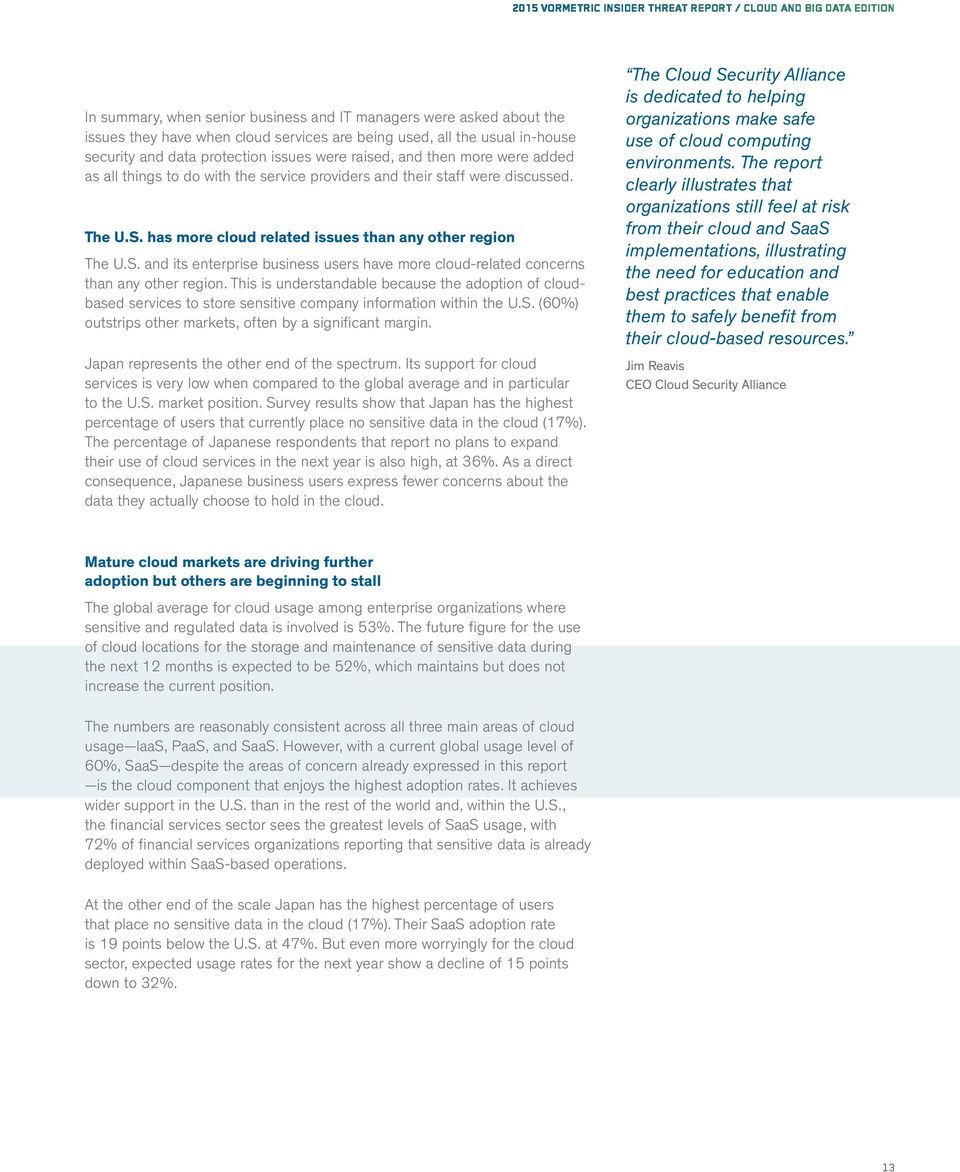
14 Generally, the reported global figures for IaaS, PaaS, and SaaS growth rates, where the use of sensitive data is involved, look steady, but are expected to tail off by a couple of points over the next 12 months. Nevertheless, it is the outperforming U.S. market that is chiefly responsible for sustaining current adoption rates, with strong support from its financial services, healthcare, and retail markets. The detailed IaaS, PaaS, and SaaS usage numbers are shown in Figure 9. Current (percent) Future (percent) IaaS PaaS SaaS Global UK Germany ASEAN Japan Figure 9: Detailed IaaS, PaaS, and SaaS usage statistics where sensitive company information is being stored Apart from the U.S., which is currently positioned as the market with the highest percentage of cloud users, the survey response figures show adoption figures that both encourage and disappoint. The emerging markets of the ASEAN region Indonesia, Malaysia, the Philippines, Singapore, and Thailand start out with lower cloud adoption numbers than the U.S. and slightly above the global average, but when next year s expectations are taken into account ASEAN at 75% for SaaS is likely to outperform the U.S. The UK, albeit starting from a far lower base, is the only market that is expected to see increases in cloud adoption rates across all three major sectors IaaS 43% up to 54%, PaaS 37% up to 49%, and SaaS 53% up to 58%. This also makes the UK one of only a few markets where data stored in the cloud is likely to exceed that of the server market in the near future. The two major markets that are likely to see a decline in cloud adoption where sensitive data is involved over the next year are Japan and Germany. The projected figures for Japan see reduced adoption across the three cloud sectors IaaS down from 47% to 28%, PaaS down from 37% to 26%, and SaaS down from 47% to 32%. Germany, however, is down in two and up in one PaaS down from 45% to 36% and SaaS down from 52% to 43%; IaaS is up from 37% to 41%. JAPAN AND THE U.S. AT OPPOSITE POLES FOR STORING SENSITIVE DATA IN SAAS ENVIRONMENTS: U.S. 62% Japan 32% 14

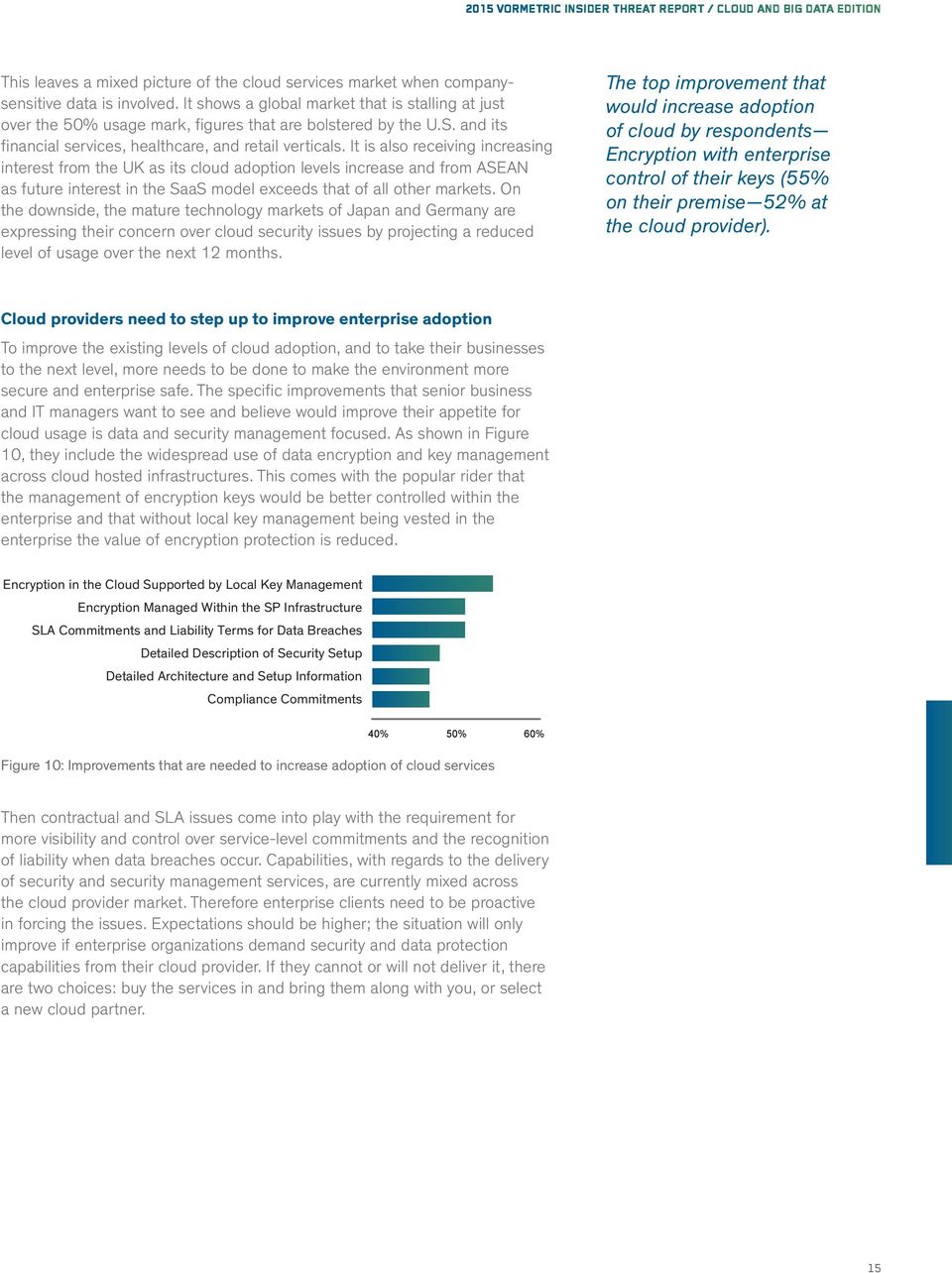
15 2015 VORMETRIC INSIDER THREAT REPORT / CLOUD AND BIG DATA EDITION This leaves a mixed picture of the cloud services market when companysensitive data is involved. It shows a global market that is stalling at just over the 50% usage mark, figures that are bolstered by the U.S. and its financial services, healthcare, and retail verticals. It is also receiving increasing interest from the UK as its cloud adoption levels increase and from ASEAN as future interest in the SaaS model exceeds that of all other markets. On the downside, the mature technology markets of Japan and Germany are expressing their concern over cloud security issues by projecting a reduced level of usage over the next 12 months. The top improvement that would increase adoption of cloud by respondents Encryption with enterprise control of their keys (55% on their premise 52% at the cloud provider). Cloud providers need to step up to improve enterprise adoption To improve the existing levels of cloud adoption, and to take their businesses to the next level, more needs to be done to make the environment more secure and enterprise safe. The specific improvements that senior business and IT managers want to see and believe would improve their appetite for cloud usage is data and security management focused. As shown in Figure 10, they include the widespread use of data encryption and key management across cloud hosted infrastructures. This comes with the popular rider that the management of encryption keys would be better controlled within the enterprise and that without local key management being vested in the enterprise the value of encryption protection is reduced. Encryption in the Cloud Supported by Local Key Management Encryption Managed Within the SP Infrastructure SLA Commitments and Liability Terms for Data Breaches Detailed Description of Security Setup Detailed Architecture and Setup Information Compliance Commitments 40% 50% 60% Figure 10: Improvements that are needed to increase adoption of cloud services Then contractual and SLA issues come into play with the requirement for more visibility and control over service-level commitments and the recognition of liability when data breaches occur. Capabilities, with regards to the delivery of security and security management services, are currently mixed across the cloud provider market. Therefore enterprise clients need to be proactive in forcing the issues. Expectations should be higher; the situation will only improve if enterprise organizations demand security and data protection capabilities from their cloud provider. If they cannot or will not deliver it, there are two choices: buy the services in and bring them along with you, or select a new cloud partner. 15
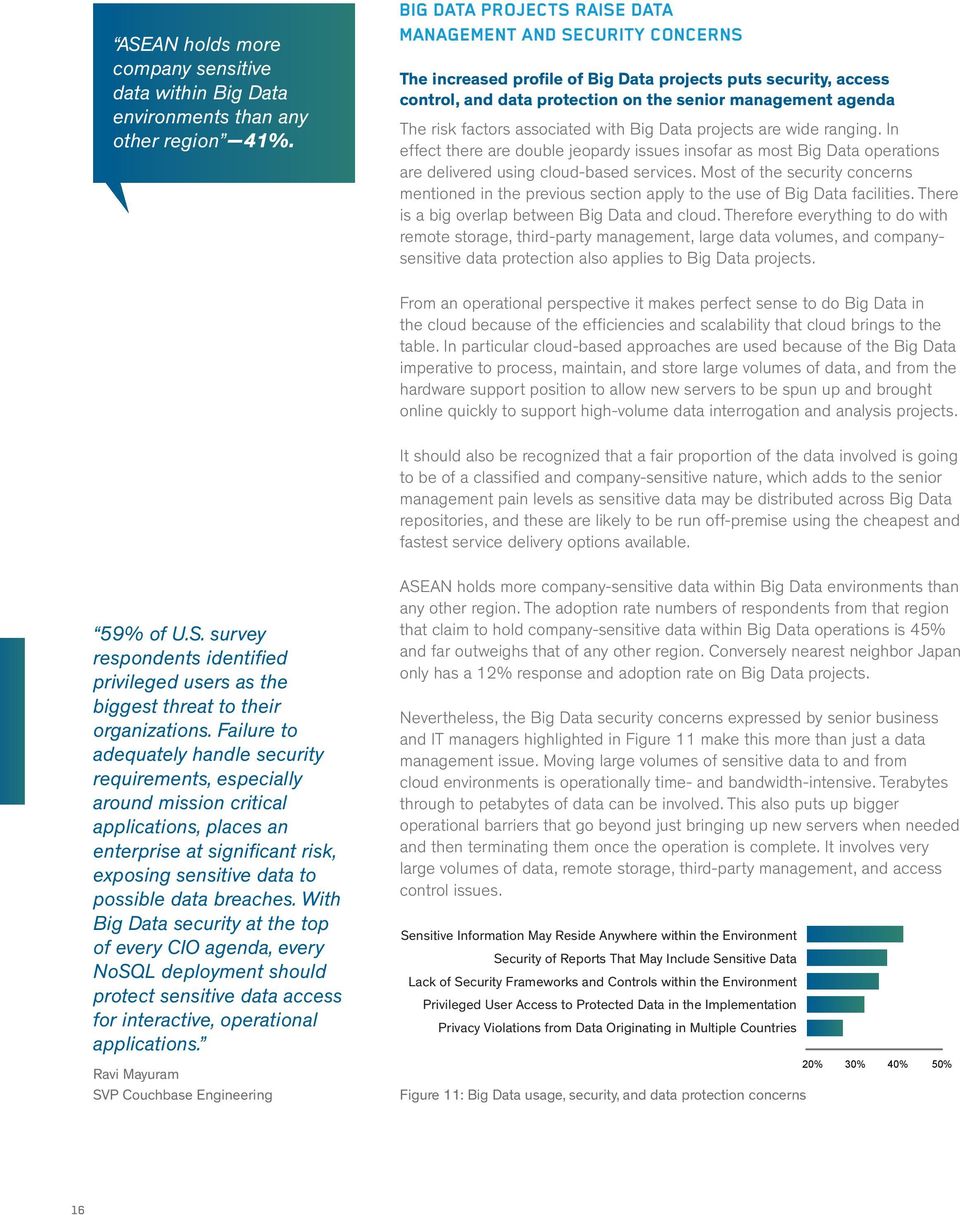
16 ASEAN holds more company sensitive data within Big Data environments than any other region 41%. BIG DATA PROJECTS RAISE DATA MANAGEMENT AND SECURITY CONCERNS The increased profile of Big Data projects puts security, access control, and data protection on the senior management agenda The risk factors associated with Big Data projects are wide ranging. In effect there are double jeopardy issues insofar as most Big Data operations are delivered using cloud-based services. Most of the security concerns mentioned in the previous section apply to the use of Big Data facilities. There is a big overlap between Big Data and cloud. Therefore everything to do with remote storage, third-party management, large data volumes, and companysensitive data protection also applies to Big Data projects. From an operational perspective it makes perfect sense to do Big Data in the cloud because of the efficiencies and scalability that cloud brings to the table. In particular cloud-based approaches are used because of the Big Data imperative to process, maintain, and store large volumes of data, and from the hardware support position to allow new servers to be spun up and brought online quickly to support high-volume data interrogation and analysis projects. It should also be recognized that a fair proportion of the data involved is going to be of a classified and company-sensitive nature, which adds to the senior management pain levels as sensitive data may be distributed across Big Data repositories, and these are likely to be run off-premise using the cheapest and fastest service delivery options available. 59% of U.S. survey respondents identified privileged users as the biggest threat to their organizations. Failure to adequately handle security requirements, especially around mission critical applications, places an enterprise at significant risk, exposing sensitive data to possible data breaches. With Big Data security at the top of every CIO agenda, every NoSQL deployment should protect sensitive data access for interactive, operational applications. Ravi Mayuram SVP Couchbase Engineering ASEAN holds more company-sensitive data within Big Data environments than any other region. The adoption rate numbers of respondents from that region that claim to hold company-sensitive data within Big Data operations is 45% and far outweighs that of any other region. Conversely nearest neighbor Japan only has a 12% response and adoption rate on Big Data projects. Nevertheless, the Big Data security concerns expressed by senior business and IT managers highlighted in Figure 11 make this more than just a data management issue. Moving large volumes of sensitive data to and from cloud environments is operationally time- and bandwidth-intensive. Terabytes through to petabytes of data can be involved. This also puts up bigger operational barriers that go beyond just bringing up new servers when needed and then terminating them once the operation is complete. It involves very large volumes of data, remote storage, third-party management, and access control issues. Sensitive Information May Reside Anywhere within the Environment Security of Reports That May Include Sensitive Data Lack of Security Frameworks and Controls within the Environment Privileged User Access to Protected Data in the Implementation Privacy Violations from Data Originating in Multiple Countries Figure 11: Big Data usage, security, and data protection concerns 20% 30% 40% 50% 16
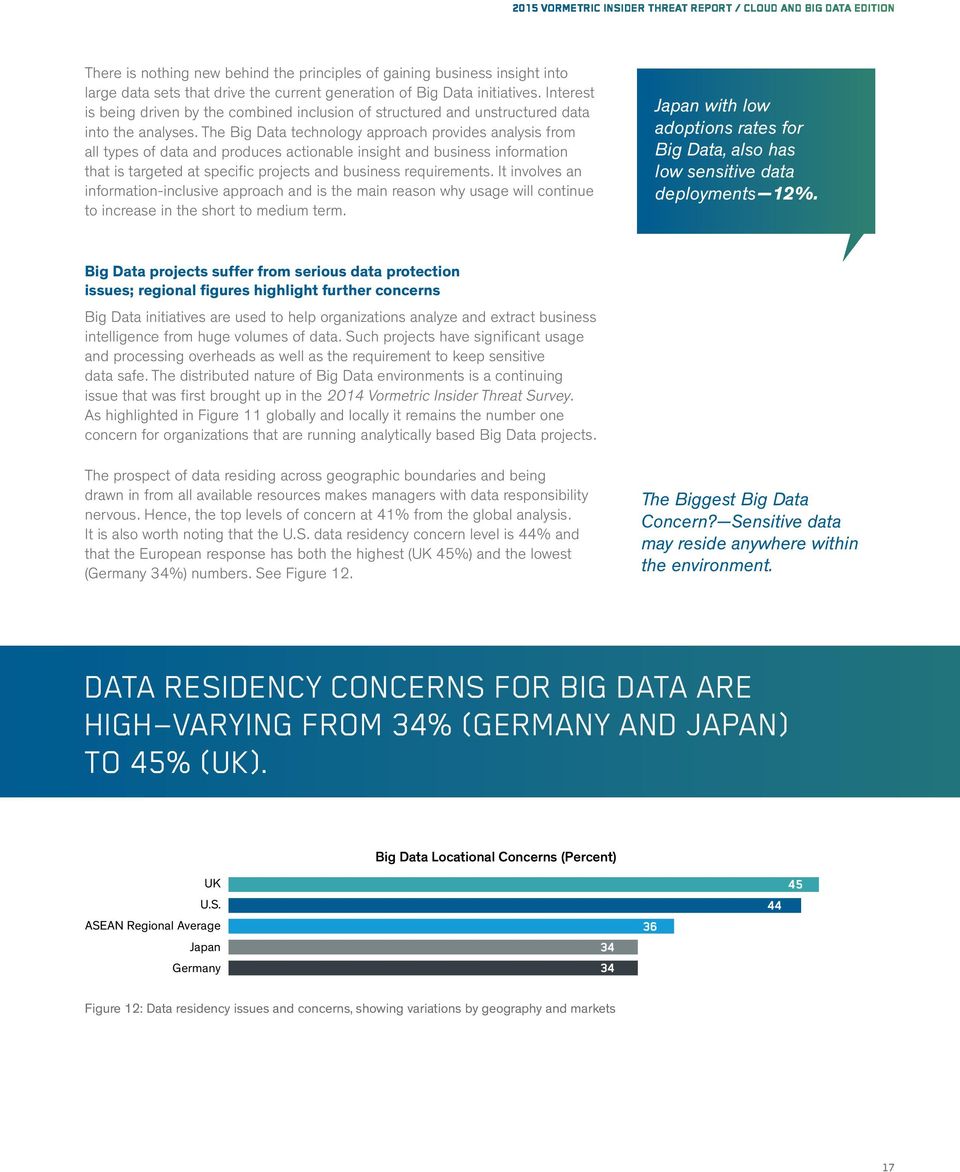
17 2015 VORMETRIC INSIDER THREAT REPORT / CLOUD AND BIG DATA EDITION There is nothing new behind the principles of gaining business insight into large data sets that drive the current generation of Big Data initiatives. Interest is being driven by the combined inclusion of structured and unstructured data into the analyses. The Big Data technology approach provides analysis from all types of data and produces actionable insight and business information that is targeted at specific projects and business requirements. It involves an information-inclusive approach and is the main reason why usage will continue to increase in the short to medium term. Japan with low adoptions rates for Big Data, also has low sensitive data deployments 12%. Big Data projects suffer from serious data protection issues; regional figures highlight further concerns Big Data initiatives are used to help organizations analyze and extract business intelligence from huge volumes of data. Such projects have significant usage and processing overheads as well as the requirement to keep sensitive data safe. The distributed nature of Big Data environments is a continuing issue that was first brought up in the 2014 Vormetric Insider Threat Survey. As highlighted in Figure 11 globally and locally it remains the number one concern for organizations that are running analytically based Big Data projects. The prospect of data residing across geographic boundaries and being drawn in from all available resources makes managers with data responsibility nervous. Hence, the top levels of concern at 41% from the global analysis. It is also worth noting that the U.S. data residency concern level is 44% and that the European response has both the highest (UK 45%) and the lowest (Germany 34%) numbers. See Figure 12. The Biggest Big Data Concern? Sensitive data may reside anywhere within the environment. DATA RESIDENCY CONCERNS FOR BIG DATA ARE HIGH VARYING FROM 34% (GERMANY AND JAPAN) TO 45% (UK). Big Data Locational Concerns (Percent) UK U.S. ASEAN Regional Average Japan Germany Figure 12: Data residency issues and concerns, showing variations by geography and markets 17
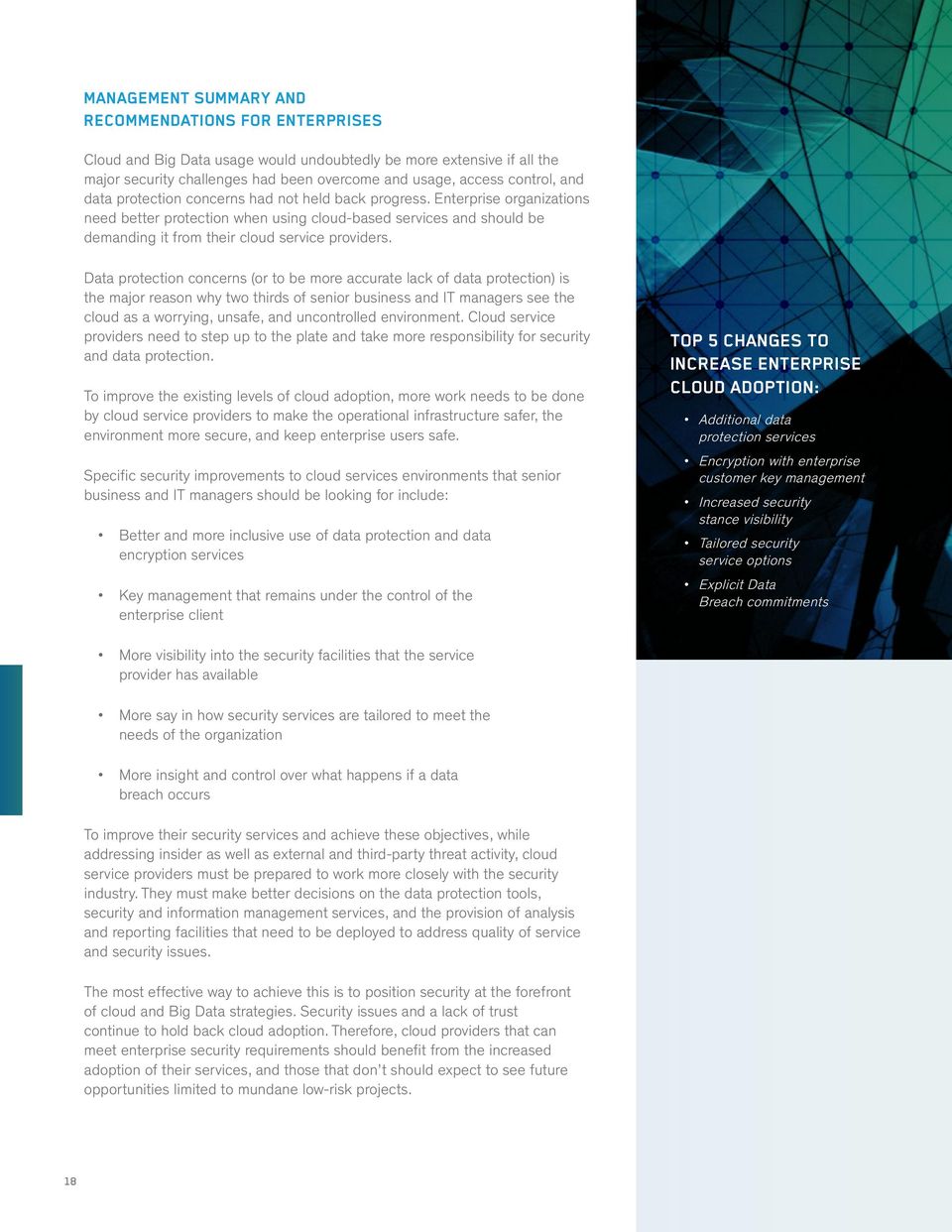
18 MANAGEMENT SUMMARY AND RECOMMENDATIONS FOR ENTERPRISES Cloud and Big Data usage would undoubtedly be more extensive if all the major security challenges had been overcome and usage, access control, and data protection concerns had not held back progress. Enterprise organizations need better protection when using cloud-based services and should be demanding it from their cloud service providers. Data protection concerns (or to be more accurate lack of data protection) is the major reason why two thirds of senior business and IT managers see the cloud as a worrying, unsafe, and uncontrolled environment. Cloud service providers need to step up to the plate and take more responsibility for security and data protection. To improve the existing levels of cloud adoption, more work needs to be done by cloud service providers to make the operational infrastructure safer, the environment more secure, and keep enterprise users safe. Specific security improvements to cloud services environments that senior business and IT managers should be looking for include: Better and more inclusive use of data protection and data encryption services Key management that remains under the control of the enterprise client TOP 5 CHANGES TO INCREASE ENTERPRISE CLOUD ADOPTION: Additional data protection services Encryption with enterprise customer key management Increased security stance visibility Tailored security service options Explicit Data Breach commitments More visibility into the security facilities that the service provider has available More say in how security services are tailored to meet the needs of the organization More insight and control over what happens if a data breach occurs To improve their security services and achieve these objectives, while addressing insider as well as external and third-party threat activity, cloud service providers must be prepared to work more closely with the security industry. They must make better decisions on the data protection tools, security and information management services, and the provision of analysis and reporting facilities that need to be deployed to address quality of service and security issues. The most effective way to achieve this is to position security at the forefront of cloud and Big Data strategies. Security issues and a lack of trust continue to hold back cloud adoption. Therefore, cloud providers that can meet enterprise security requirements should benefit from the increased adoption of their services, and those that don t should expect to see future opportunities limited to mundane low-risk projects. 18
19 2015 VORMETRIC INSIDER THREAT REPORT / CLOUD AND BIG DATA EDITION ANALYST PROFILE ANDREW KELLETT, PRINCIPAL ANALYST SOFTWARE IT SOLUTIONS, OVUM Andrew enjoys the challenge of working with state-of-the-art technology. As lead analyst in the Ovum IT security team, he has the opportunity to evaluate, provide opinion, and drive the Ovum security agenda, including its focus on the latest security trends. He is responsible for research on the key technologies used to protect public and private sector organizations, their operational systems, and their users. The role provides a balanced opportunity to promote the need for good business protection and, at the same time, to research the latest threat approaches. HARRIS POLL SOURCE/METHODOLOGY Vormetric s 2015 Insider Threat Report was conducted online by Harris Poll on behalf of Vormetric from September 22-October 16, 2014, among 818 adults ages 18 and older, who work full-time as an IT professional in a company and have at least a major influence in decision making for IT. In the U.S., 408 ITDMs were surveyed among companies with at least $200 million in revenue with 102 from the health care industries, 102 from financial industries, 102 from retail industries and 102 from other industries. Roughly 100 ITDMs were interviewed in the UK (103), Germany (102), Japan (102), and ASEAN (103) from companies that have at least $100 million in revenue. ASEAN countries were defined as Singapore, Malaysia, Indonesia, Thailand, and the Philippines. This online survey is not based on a probability sample and therefore no estimate of theoretical sampling error can be calculated. Author Andrew Kellett Principal Analyst Software IT Solutions, Ovum [email protected] ABOUT VORMETRIC Vormetric (@Vormetric) is the industry leader in data security solutions that protects data-at-rest across physical, Big Data and cloud environments. Vormetric helps over 1500 customers, including 17 of the Fortune 30, to meet compliance requirements and protect what matters their sensitive data from both internal and external threats. The company s scalable Vormetric Data Security Platform protects any file, any database and any application s data anywhere it resides with a high performance, market-leading solution set. FURTHER READING To read the 2015 Vormetric Insider Threat Report Global Edition, please visit 19

20 2015 VORMETRIC INSIDER THREAT REPORT CLOUD AND BIG DATA EDITION Vormetric.com/InsiderThreat/ Vormetric, Inc. All rights reserved.

How To Protect Your Organization From Insider Threats
 Research Conducted by 2015 VORMETRIC INSIDER THREAT REPORT Trends and Future Directions in Data Security FINANCIAL SERVICES EDITION #2015InsiderThreat RESEARCH BRIEF US FINANCIAL SERVICES SPOTLIGHT ABOUT
2015 VORMETRIC INSIDER THREAT REPORT
 Research Conducted by 2015 VORMETRIC INSIDER THREAT REPORT Trends and Future Directions in Data Security RETAIL EDITION #2015InsiderThreat RESEARCH BRIEF RETAIL CUSTOMERS AT RISK ABOUT THIS RESEARCH BRIEF
Data Centric Security
 Data Centric Security What s wrong and what to do about it Mike Shanahan Regional Sales Manager Albert Dolan Senior Systems Engineer, EMEA IT s Dirty Little Secret 30+ Years super users have been managing
2015 VORMETRIC INSIDER THREAT REPORT
 Research Conducted by Research Analyzed by 2015 VORMETRIC INSIDER THREAT REPORT Trends and Future Directions in Data Security GLOBAL EDITION #2015InsiderThreat 1 TABLE OF CONTENTS EXECUTIVE SUMMARY 3 Catalyst
Adoption, Approaches & Attitudes
 Adoption, Approaches & Attitudes The Future of Cloud Computing in the Public and Private Sectors A Global Cloud Computing Study Sponsored by JUNE 2011 TABLE OF CONTENTS Executive Summary... 1 Methodology
Cloud Data Security. Sol Cates CSO @solcates [email protected]
 Cloud Data Security Sol Cates CSO @solcates [email protected] Agenda The Cloud Securing your data, in someone else s house Explore IT s Dirty Little Secret Why is Data so Vulnerable? A bit about Vormetric
cloud Development Strategies - Part 1
 for a successful shift to the cloud May 2014 1 CONTENTS Introduction Challenge 1: Application security Challenge 2: Complexity Challenge 3: Applications not optimized for cloud Challenge 4: Cost Challenge
2015 Cloud Security Survey. Security and privacy of sensitive data remains the most disturbing concern for 63% of organizations
 2015 Cloud Security Survey Security and privacy of sensitive data remains the most disturbing concern for 63% of organizations Introduction Cloud technology is gaining increasing attention from businesses
White Paper Big Data Without Big Headaches
 Vormetric, Inc. 2545 N. 1st Street, San Jose, CA 95131 United States: 888.267.3732 United Kingdom: +44.118.949.7711 Singapore: +65.6829.2266 [email protected] www.vormetric.com THE NEW WORLD OF DATA IS
The cloud - ULTIMATE GAME CHANGER ===========================================
 The cloud - ULTIMATE GAME CHANGER =========================================== When it comes to emerging technologies, there is one word that has drawn more controversy than others: The Cloud. With cloud
Getting Your Head In The Cloud
 CRM Expert Advisor White Paper Getting Your Head In The Cloud Businesses today hold more data than ever before. As a result, one of the biggest decisions any company small or large has to face is where
Cloud Computing Safe Harbor or Wild West?
 IT Best Practices Series Cloud Computing Safe Harbor or Wild West? With IT expenditures coming under increasing scrutiny, the cloud is being sold as an oasis of practical solutions. It s true that many
Public or Private Cloud: The Choice is Yours
 white paper Public or Private Cloud: The Choice is Yours Current Cloudy Situation Facing Businesses There is no debate that most businesses are adopting cloud services at a rapid pace. In fact, a recent
Putting Web Threat Protection and Content Filtering in the Cloud
 Putting Web Threat Protection and Content Filtering in the Cloud Why secure web gateways belong in the cloud and not on appliances Contents The Cloud Can Lower Costs Can It Improve Security Too?. 1 The
Global IT Security Risks
 Global IT Security Risks June 17, 2011 Kaspersky Lab leverages the leading expertise in IT security risks, malware and vulnerabilities to protect its customers in the best possible way. To ensure the most
How to ensure control and security when moving to SaaS/cloud applications
 How to ensure control and security when moving to SaaS/cloud applications Stéphane Hurtaud Partner Information & Technology Risk Deloitte Laurent de la Vaissière Directeur Information & Technology Risk
Cloud creates path to profitability for Australian businesses. A complimentary report from cloud-based business management software provider NetSuite
 Cloud creates path to profitability for Australian businesses A complimentary report from cloud-based business management software provider NetSuite Introduction Australian businesses are facing a dynamic
Identifying new markets for Managed Services
 Identifying Growth Markets for Managed Services Strategies for Managed Service Providers to capture a larger share of IT spending Identifying new markets for Managed Services WWW.OVUM.COM Written by:roy
TechInsights Report: Cloud Succeeds. Now What?
 WHITE PAPER TECHINSIGHTS REPORT MAY 2013 TechInsights Report: Cloud Succeeds. Now What? Cloud success exceeds initial expectations. IT management and security tools now more important than ever. agility
Open Certification Framework. Vision Statement
 Open Certification Framework Vision Statement Jim Reavis and Daniele Catteddu August 2012 BACKGROUND The Cloud Security Alliance has identified gaps within the IT ecosystem that are inhibiting market adoption
How To Choose A Cloud Computing Solution
 WHITE PAPER How to choose and implement your cloud strategy INTRODUCTION Cloud computing has the potential to tip strategic advantage away from large established enterprises toward SMBs or startup companies.
Multi-factor Authentication
 Multi-factor Authentication Current Usage and Trends whitepaper Executive Summary In this digital age, validating identities and controlling access is vital, which is why multifactor authentication has
Unisys Security Insights: Global Summary A Consumer Viewpoint - 2015
 Unisys Security Insights: Global Summary A Consumer Viewpoint - 2015 How consumers in 12 countries feel about: Personal data security, ranked by industry Region-specific security perceptions Research by
Asia-Pacific Application Performance Management Market CY 2013 Rapidly Changing Application Architecture and Business Environment Drives the Market
 Asia-Pacific Application Performance Management Market CY 2013 Rapidly Changing Application Architecture and Business Environment Drives the Market October 2014 Contents Section Slide Number Executive
Unisys Security Insights: Germany A Consumer Viewpoint - 2015
 Unisys Security Insights: Germany A Consumer Viewpoint - 2015 How consumers in Germany feel about: Personal data security, ranked by industry Experiences concerning security of personal data Research by
CLOUD ERP SOFTWARE PREFERENCES STUDY
 CLOUD ERP SOFTWARE PREFERENCES STUDY A study conducted by IFS North America APRIL, 2013 THE CURRENT STATE OF THE INDUSTRY BASED ON A SURVEY OF MORE THAN 200 EXECUTIVES METHODOLOGY In early 2013, IFS North
What s Holding Back the Cloud?
 MAY 2012 Peer Research What s Holding Back the Cloud? Intel Survey on Increasing IT Professionals Confidence in Cloud Security Why You Should Read This Document This report captures key findings from a
Cloud computing insights from 110 implementation projects
 IBM Academy of Technology Thought Leadership White Paper October 2010 Cloud computing insights from 110 implementation projects IBM Academy of Technology Survey 2 Cloud computing insights from 110 implementation
Software-as-a-Service: Managing Key Concerns and Considerations
 Software-as-a-Service: Managing Key Concerns and Considerations A research report Publication sponsored by: TABLE OF CONTENTS Introduction: Cloud IT, including SaaS, is Real IT Managing The Key Concerns
Mapping Your Path to the Cloud. A Guide to Getting your Dental Practice Set to Transition to Cloud-Based Practice Management Software.
 Mapping Your Path to the Cloud A Guide to Getting your Dental Practice Set to Transition to Cloud-Based Practice Management Software. Table of Contents Why the Cloud? Mapping Your Path to the Cloud...4
Odin. SMB Cloud InsightsTM UNITED STATES
 Odin 2015 SMB Cloud InsightsTM UNITED STATES DEFINITIONS SMBs Defined We define SMBs also known as small and medium enterprises (SMEs) as companies with one to 999 employees. There are around 7 million
The Cloud Balancing Act for IT: Between Promise and Peril
 The Cloud Balancing Act for IT: Between Promise and Peril Table of Contents EXECUTIVE SUMMARY...2 ONBOARDING CLOUD SERVICES...3 SYSTEMS OF RECORD: THE NEXT WAVE OF CLOUD ADOPTION...6 A CULTURE OF COMPLIANCE
Secure Your Cloud and Outsourced Business with Privileged Identity Management
 Secure Your Cloud and Outsourced Business with Privileged Identity Management Table of Contents Executive Summary... 3 Understanding Privilege... 3 Do All Service Providers Get It?... 5 Managing Privilege
Logentries Insights: The State of Log Management & Analytics for AWS
 Logentries Insights: The State of Log Management & Analytics for AWS Trevor Parsons Ph.D Co-founder & Chief Scientist Logentries 1 1. Introduction The Log Management industry was traditionally driven by
WHAT ARE THE BENEFITS OF OUTSOURCING NETWORK SECURITY?
 WHAT ARE THE BENEFITS OF OUTSOURCING NETWORK SECURITY? Contents Introduction.... 3 What Types of Network Security Services are Available?... 4 Penetration Testing and Vulnerability Assessment... 4 Cyber
2015 GLOBAL THREAT INTELLIGENCE REPORT EXECUTIVE SUMMARY
 2015 GLOBAL THREAT INTELLIGENCE REPORT EXECUTIVE SUMMARY 1 EXECUTIVE SUMMARY INTRODUCING THE 2015 GLOBAL THREAT INTELLIGENCE REPORT Over the last several years, there has been significant security industry
Cloud Computing and Business Intelligence
 Database Systems Journal vol. V, no. 4/2014 49 Cloud Computing and Business Intelligence Alexandru Adrian TOLE Romanian American University, Bucharest, Romania [email protected] The complexity of data
Services. Cybersecurity. Capgemini & Sogeti. Guiding enterprises and government through digital transformation while keeping them secure
 Home Secure digital transformation SMACT Advise, Protect & Monitor Why Capgemini & Sogeti? In safe hands Capgemini & Sogeti Cybersecurity Services Guiding enterprises and government through digital transformation
The Key To Cloud And Virtual Computing
 A Forrester Consulting Thought Leadership Paper Commissioned By TeamQuest Managing And Planning Capacity In 2011 And Beyond June 2011 Table Of Contents Executive Summary... 2 Key Findings... 2 The Pursuit
Managed Hosting And Private Hosted Cloud Both Are Viable Alternatives To Public And Virtual Private Cloud Models
 A Forrester Consulting Thought Leadership Paper Commissioned By AT&T June 2014 Managed Hosting And Private Hosted Cloud Both Are Viable Alternatives To Public And Virtual Private Cloud Models Table Of
Awareness, Trust and Security to Shape Government Cloud Adoption
 Awareness, Trust and Security to Shape Government Adoption Awareness Trust Security A white paper by: April 1 1 Executive Summary The awareness, trust and security issues that have limited federal government
Capturing the New Frontier:
 Capturing the New Frontier: How Software Security Unlocks the Power of Cloud Computing Executive Summary Cloud computing is garnering a vast share of IT interest. Its promise of revolutionary cost savings
Public, Private and Hybrid Clouds
 Public, Private and Hybrid Clouds When, Why and How They are Really Used Sponsored by: Research Summary 2013 Neovise, LLC. All Rights Reserved. [i] Table of Contents Table of Contents... 1 i Executive
Datamation. 5 Reasons to Consider SaaS for Your Business Applications. Executive Brief. In This Paper
 5 Reasons to Consider SaaS for Your Business Applications In This Paper SaaS-based business applications offer a number of advantages for line-of-business managers Oracle offers a suite of SaaS business
What You Need to Know About Cloud Backup: Your Guide to Cost, Security, and Flexibility
 Your Guide to Cost, Security, and Flexibility What You Need to Know About Cloud Backup: Your Guide to Cost, Security, and Flexibility 10 common questions answered Over the last decade, cloud backup, recovery
Why You Should Consider the Cloud
 INTERSYSTEMS WHITE PAPER Why You Should Consider the Cloud In 2014, we ll see every major player make big investments to scale up Cloud, mobile, and big data capabilities, and fiercely battle for the hearts
How To Get Ready For Business
 A Ready Business rises above infrastructure limitations Vodacom Power to you Vodacom Business Nigeria Managed Hosted Services Get Ready to free up your business. To succeed in today s world of dramatic
The NREN s core activities are in providing network and associated services to its user community that usually comprises:
 3 NREN and its Users The NREN s core activities are in providing network and associated services to its user community that usually comprises: Higher education institutions and possibly other levels of
Cloud, On-premises, and More: The Business Value of Software Deployment Choice
 Cloud, On-premises, and More: A research report prepared by: Publication sponsored by: TABLE OF CONTENTS Introduction: Choices, Limits, and Adaptability Isn t Everything Cloud? The Importance of Architecture
VMware Cloud Adoption Study
 VMware Cloud Adoption Study Executive Summary May 2012 Contents About the research 3 Objectives 4 Overview 4 Key Findings 5 European enterprises to spend a third of IT budgets this year on cloud computing,
Master the Might of the Hybrid Cloud
 Reach for the Sky Master the Might of the Hybrid Cloud WHITE PAPER As an IT decision maker at a global enterprise, you face unique challenges in managing a complex infrastructure with varied resources
INTRUSION PREVENTION SYSTEMS: FIVE BENEFITS OF SECUREDATA S MANAGED SERVICE APPROACH
 INTRUSION PREVENTION SYSTEMS: FIVE BENEFITS OF SECUREDATA S MANAGED SERVICE APPROACH INTRODUCTION: WHO S IN YOUR NETWORK? The days when cyber security could focus on protecting your organisation s perimeter
How To Get A Better At Developing An Application
 Whitepaper Rethink application possibilities and align to desired business outcomes EALA results January 2014 2014 Avanade Inc. All rights reserved. Executive summary It s a new world of applications.
white paper Big Data for Small Business Why small to medium enterprises need to know about Big Data and how to manage it Sponsored by:
 white paper Big Data for Small Business Why small to medium enterprises need to know about Big Data and how to manage it Sponsored by: Big Data is the ability to collect information from diverse sources
Module 1: Facilitated e-learning
 Module 1: Facilitated e-learning CHAPTER 3: OVERVIEW OF CLOUD COMPUTING AND MOBILE CLOUDING: CHALLENGES AND OPPORTUNITIES FOR CAs... 3 PART 1: CLOUD AND MOBILE COMPUTING... 3 Learning Objectives... 3 1.1
KEEPING PATIENT INFORMATION SAFE AND SECURE IN THE CLOUD
 CASE STUDY Take Cover The costs of exposing or losing patient information can ruin a dental practice. Cloud-based solutions can protect your business and your patients against these threats: Unauthorized
Software as a Service Offers Broadening Appeal for Small and Medium-Sized Discrete Manufacturers
 Software as a Service Offers Broadening Appeal for Small and Medium-Sized Discrete Manufacturers WHITE PAPER Sponsored by: SAP Simon Ellis November 2010 IDC MANUFACTURING INSIGHTS OPINION Software as a
Methods and Practices: Cloud in Retail
 Methods and Practices: Cloud in Retail IDC Retail Insights: Retail IT Infrastructure Strategies METHODS AND PRACTICES #RI243398 Kimberly Knickle Leslie Hand Global Headquarters: 5 Speen Street Framingham,
What is Cloud-Based Security? Cloud-based Security = Security Management + Cloud Computing.
 What is Cloud-Based Security? Cloud-based Security = Security Management + Cloud Computing. What is Cloud-Based Security? Cloud computing is: IT services via the internet from an external service provider
white paper Using Cloud for Data Storage and Backup By Aaron Goldberg Principal Analyst, Content4IT
 white paper Using Cloud for Data Storage and Backup By Aaron Goldberg Principal Analyst, Content4IT (Former analyst with Ziff Davis Enterprise and IDC) Executive Overview Industry research shows the amount
1 Introduction. 2 What is Cloud Computing?
 1 Introduction Table of Contents 1 Introduction 2 What is Cloud Computing? 3 Why is Cloud Computing important? 4 Why Cloud deployments fail? 5 Holistic Approach to cloud computing implementation 6 Conclusion