
Choices, choices, choices... Which sequence database? Which modifications? What mass tolerance?
|
|
|
- Evelyn James
- 10 years ago
- Views:
Transcription
1 Optimization 1

2 Choices, choices, choices... Which sequence database? Which modifications? What mass tolerance? Where to begin? 2

3 Sequence Databases Swiss-prot MSDB, NCBI nr dbest Species specific ORFS fast search; not comprehensive; consensus sequence; good annotations average speed; comprehensive; non-identical slow search; exhaustive & redundant fast search; exhaustive for one species Swiss-prot is the highest quality database, but many entries are consensus sequences, with variants described in the annotations. Mascot searches only the FASTA sequence, so these variants are missed. Better to use a database where variant sequences are included as separate entries. 3

4 Modifications Variable modifications Increase search time Reduce specificity First pass Fixed: Cys alkylation Variable: Met oxidation Watch for Multiple variable Cys mods Modfications should be used sparingly in a first pass search. 4

5 Mass Tolerances Better to be pessimistic Accuracy, not precision Proportional (%, ppm) or fixed (Da, mmu)? Higher accuracy = higher specificity 5

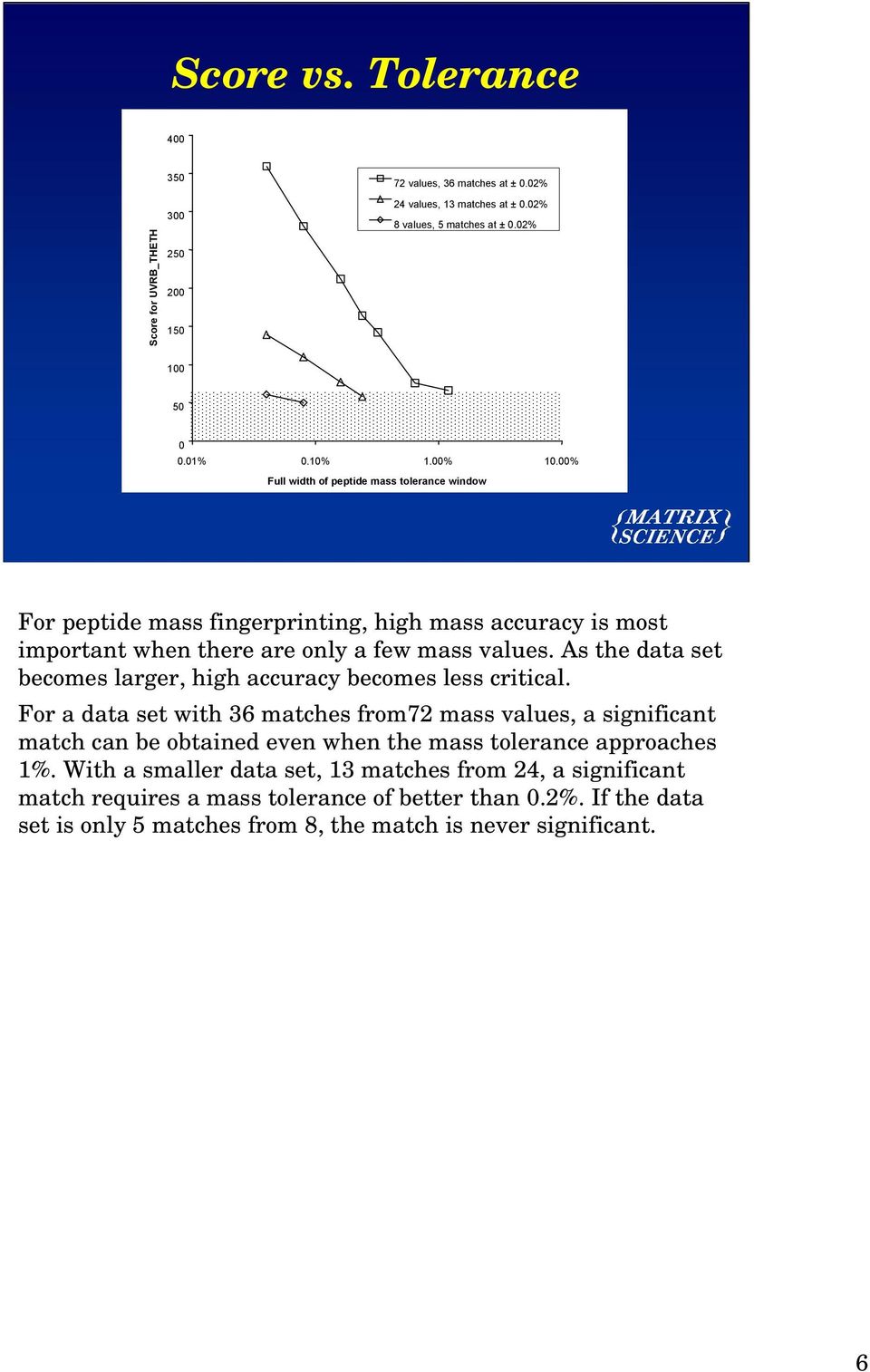
6 Score vs. Tolerance 400 Score for UVRB_THETH values, 36 matches at ± 0.02% 24 values, 13 matches at ± 0.02% 8 values, 5 matches at ± 0.02% % 0.10% 1.00% 10.00% Full width of peptide mass tolerance window For peptide mass fingerprinting, high mass accuracy is most important when there are only a few mass values. As the data set becomes larger, high accuracy becomes less critical. For a data set with 36 matches from72 mass values, a significant match can be obtained even when the mass tolerance approaches 1%. With a smaller data set, 13 matches from 24, a significant match requires a mass tolerance of better than 0.2%. If the data set is only 5 matches from 8, the match is never significant. 6
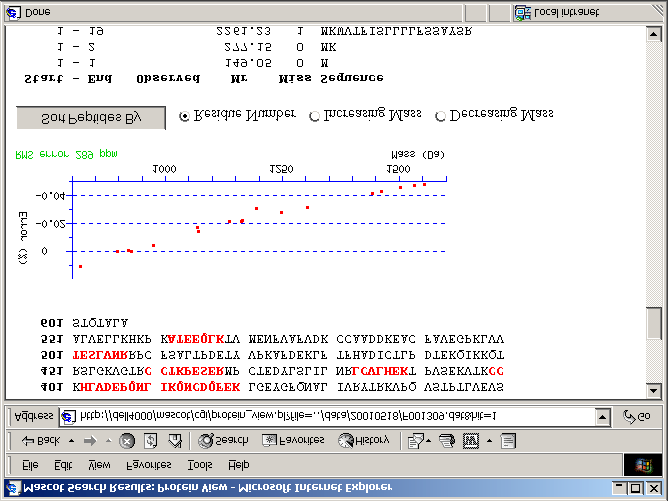
7 Error distribution graph The best way to decide on the mass tolerance setting is to look at the error graphs. For peptide mass values, the error graph is on the protein view report. For fragment ion mass values, the error graph is on the peptide view report. The graphs will also give an indication of whether a constant (Da, mmu) or a fractional (%, ppm) error window is most appropriate. 7

8 Worst case conditions Wide peptide mass tolerance Large number of variable modifications No enzyme specificity Large database Search time and search specificity are inversely related. Search time increases proportionately to peptide mass tolerance and database size. Search time increases geometrically with the number of variable modifications. Going from tryptic specificity to no-enzyme will typically increase the search time by a factor between 100 and

9 Interpreting the results What does the score mean? What does the histogram mean? Protein View Peptide summary report vs Protein summary report for ms-ms data MS-MS fragment ions identity / homology threshold Repeating searches with different parameters Tour of a complex MS-MS results page 9

10 Probability based scoring: Compute the probability that the observed match between the experimental data and mass values calculated from a candidate peptide sequence is a random event. The correct match, which is not a random event, has a very low probability. 10

11 Probability based scoring enables standard statistical tests to be applied to results Mascot score is -10Log 10 (P) In a database of 500,000 entries, a 1 in a 1,000 chance of getting a false positive match is a probability of P = 1 / (1,000 x 500,000) Equivalent to a Mascot score of 87 The most important advantage of probability based scoring is that we can use standard statistical tests to determine significance. That is, we have an objective means of determining whether a match is strong or weak or a false positive. Assigning a significance threshold or confidence level to a match is extremely simple. Assume we are running a fully automated system and prefer to repeat an experiment rather than get a false positive. We might choose a significance threshold of 1 in 1,000. That is, we are only interested in results which have less than a 1 in 1,000 chance of being random events. If the database being searched has 500,000 protein entries, a 1 in 1,000 chance of finding a match is simply 1 over 1,000 times 500,000. Which converts into a Mascot score of 87. So, we can have a simple rule in software which looks for matches with scores greater than

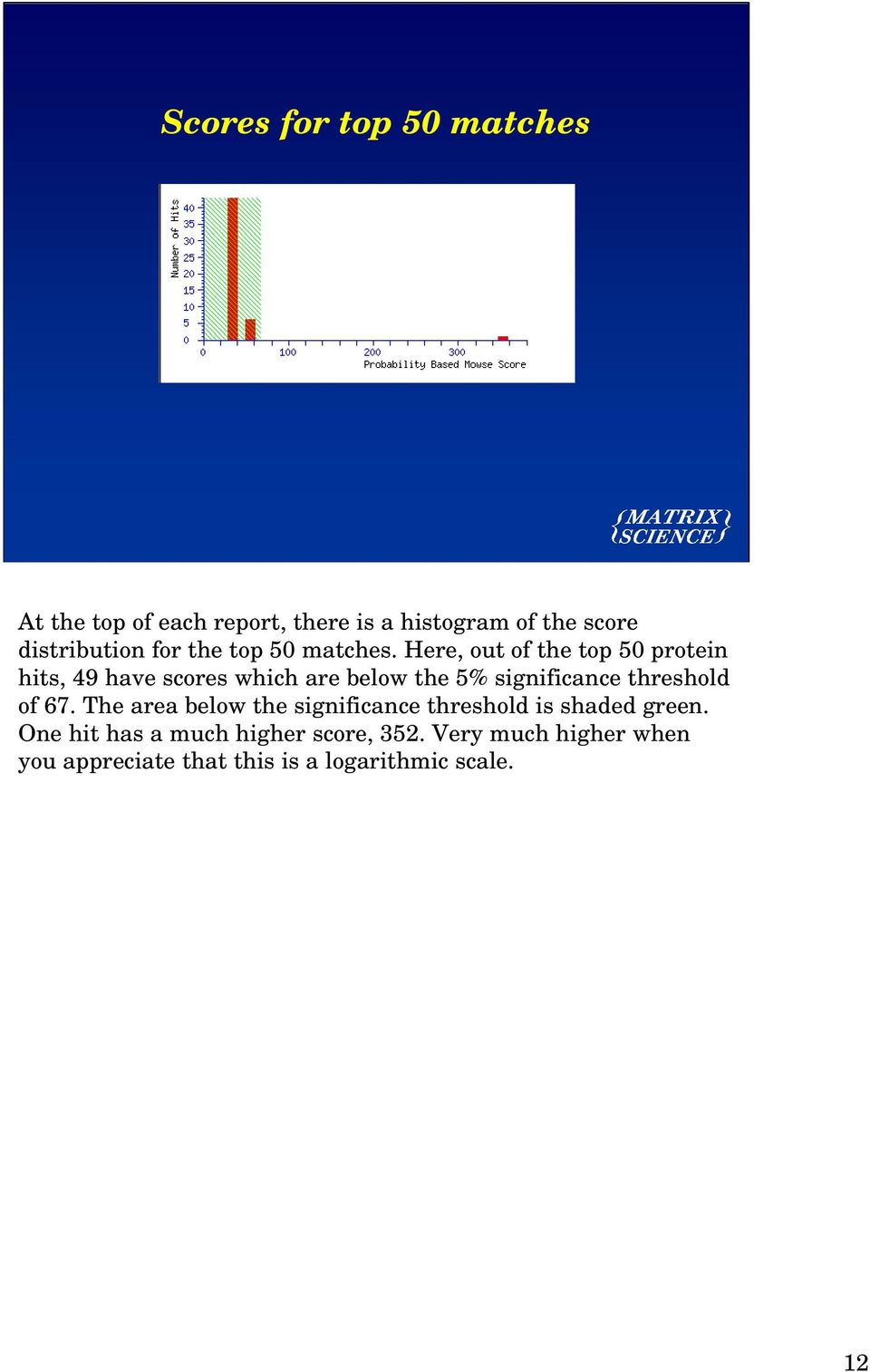
12 Scores for top 50 matches At the top of each report, there is a histogram of the score distribution for the top 50 matches. Here, out of the top 50 protein hits, 49 have scores which are below the 5% significance threshold of 67. The area below the significance threshold is shaded green. One hit has a much higher score, 352. Very much higher when you appreciate that this is a logarithmic scale. 12
13 Protein Summary Always used for peptide mass fingerprint Option for MS/MS ions search Not suitable for complex mixtures Lists top scoring protein matches 13


14 The top of a protein summary report 14


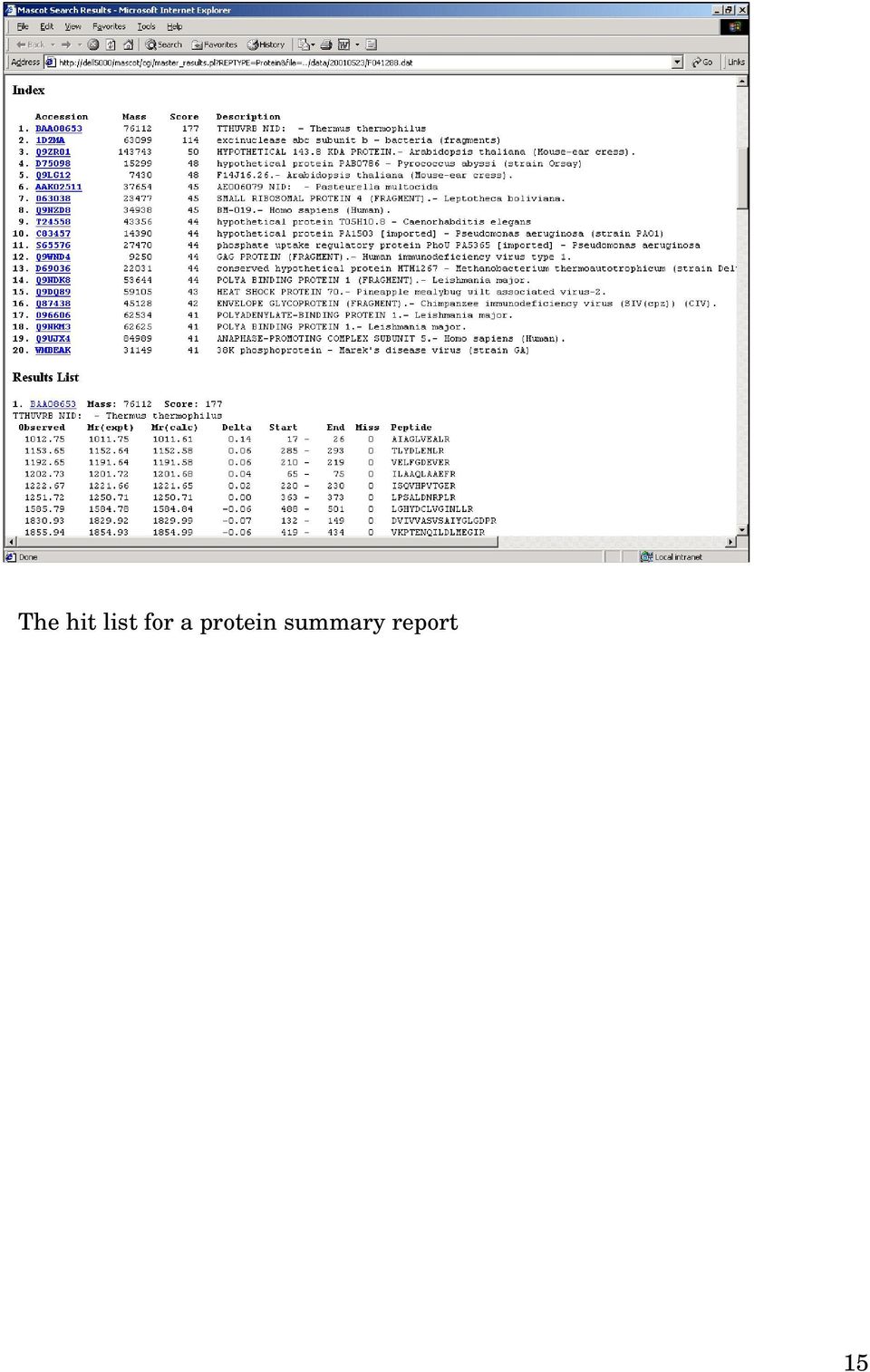
15 The hit list for a protein summary report 15
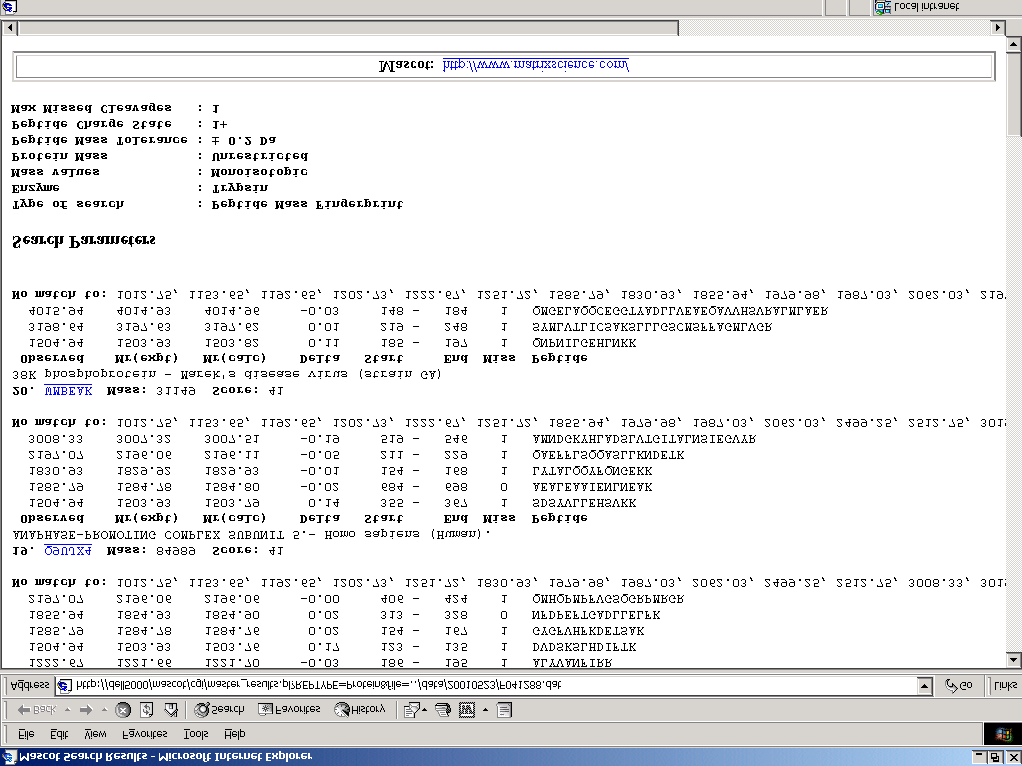
16 The bottom of the report showing the search parameter summary 16
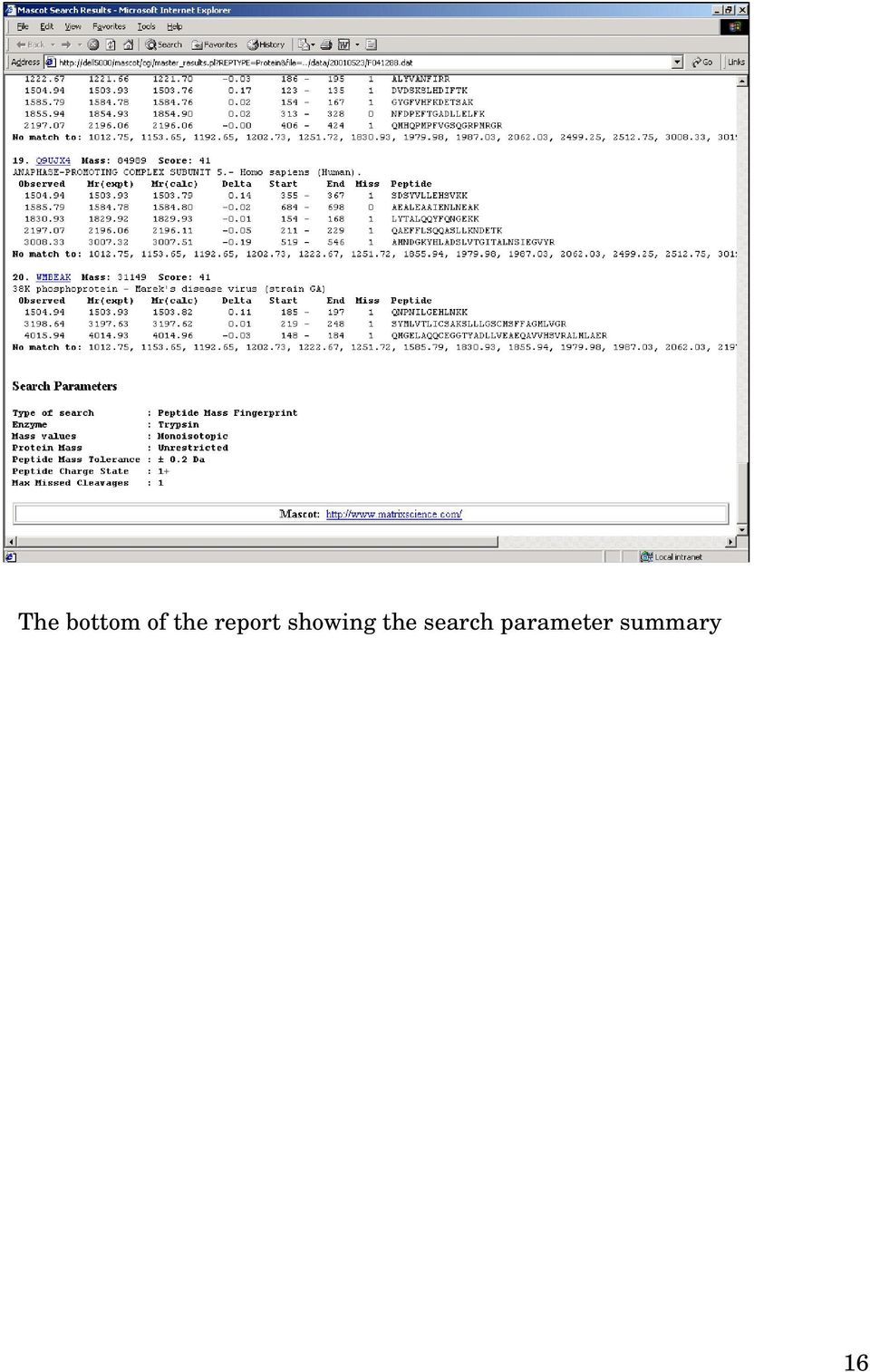
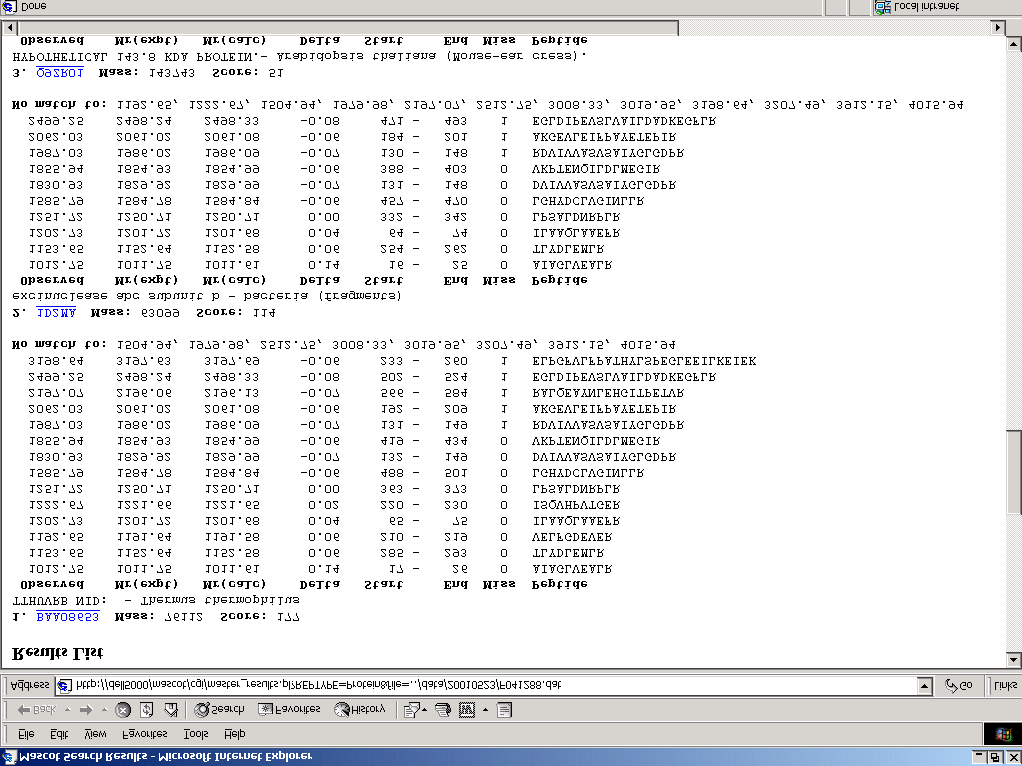
17 The protein summary report tabulates details of the matches for the top hits. Here, we can see that hit 2 is not a different protein, it is just a fragment of hit 1. 17

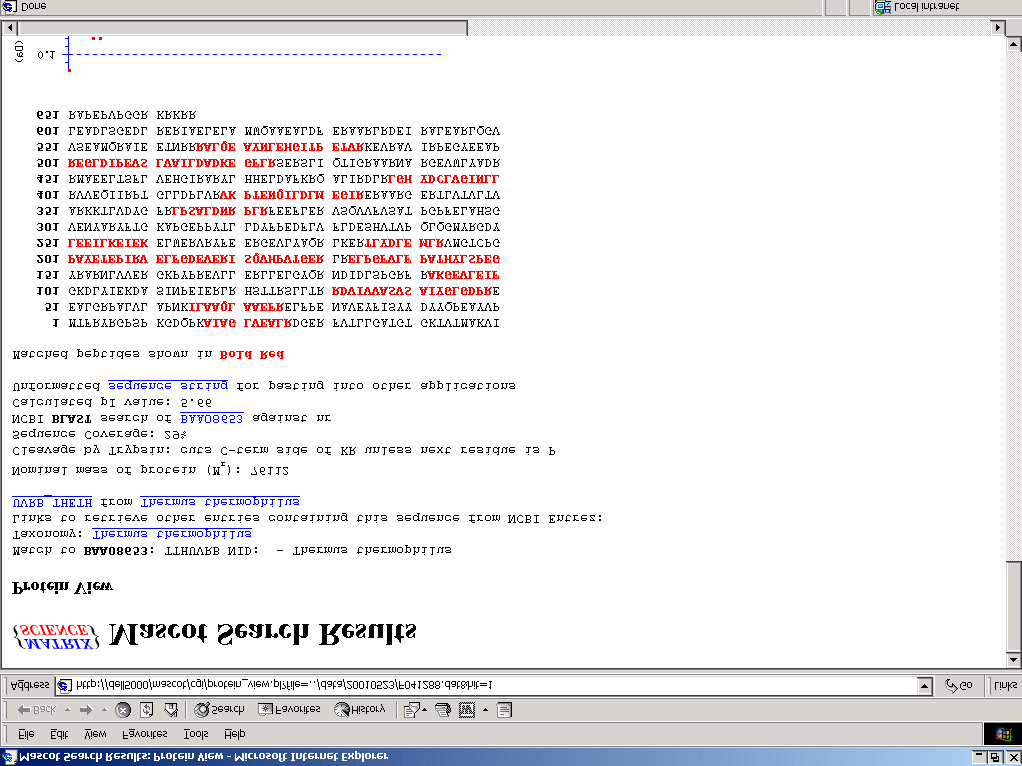
18 Clicking on the accession number link leads to the protein view report. 18
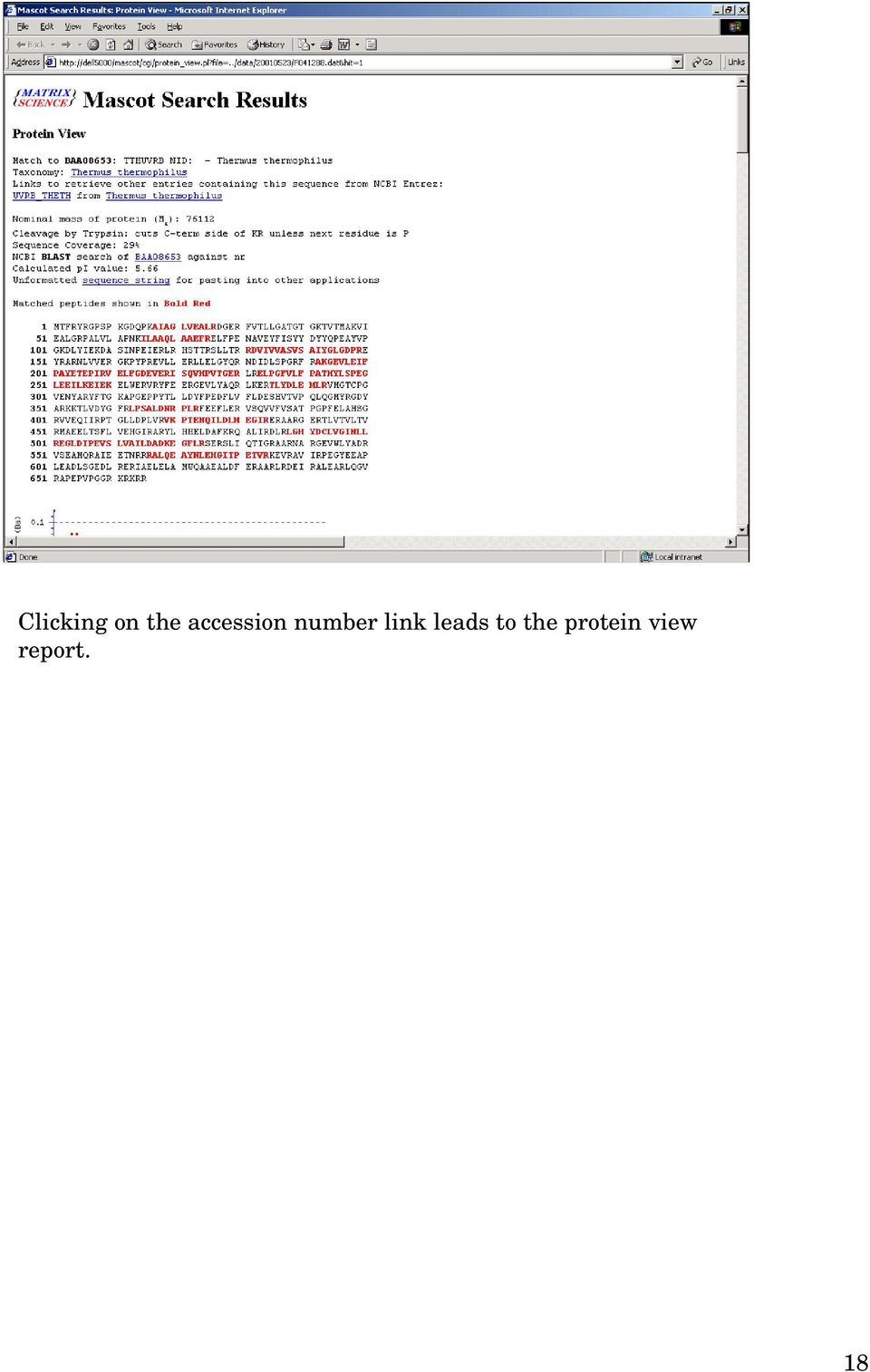

19 Besides the error graph mentioned earlier, the protein view also shows the hits highlighted on the protein sequence and a table of all the peptides from the in silico digest. 19
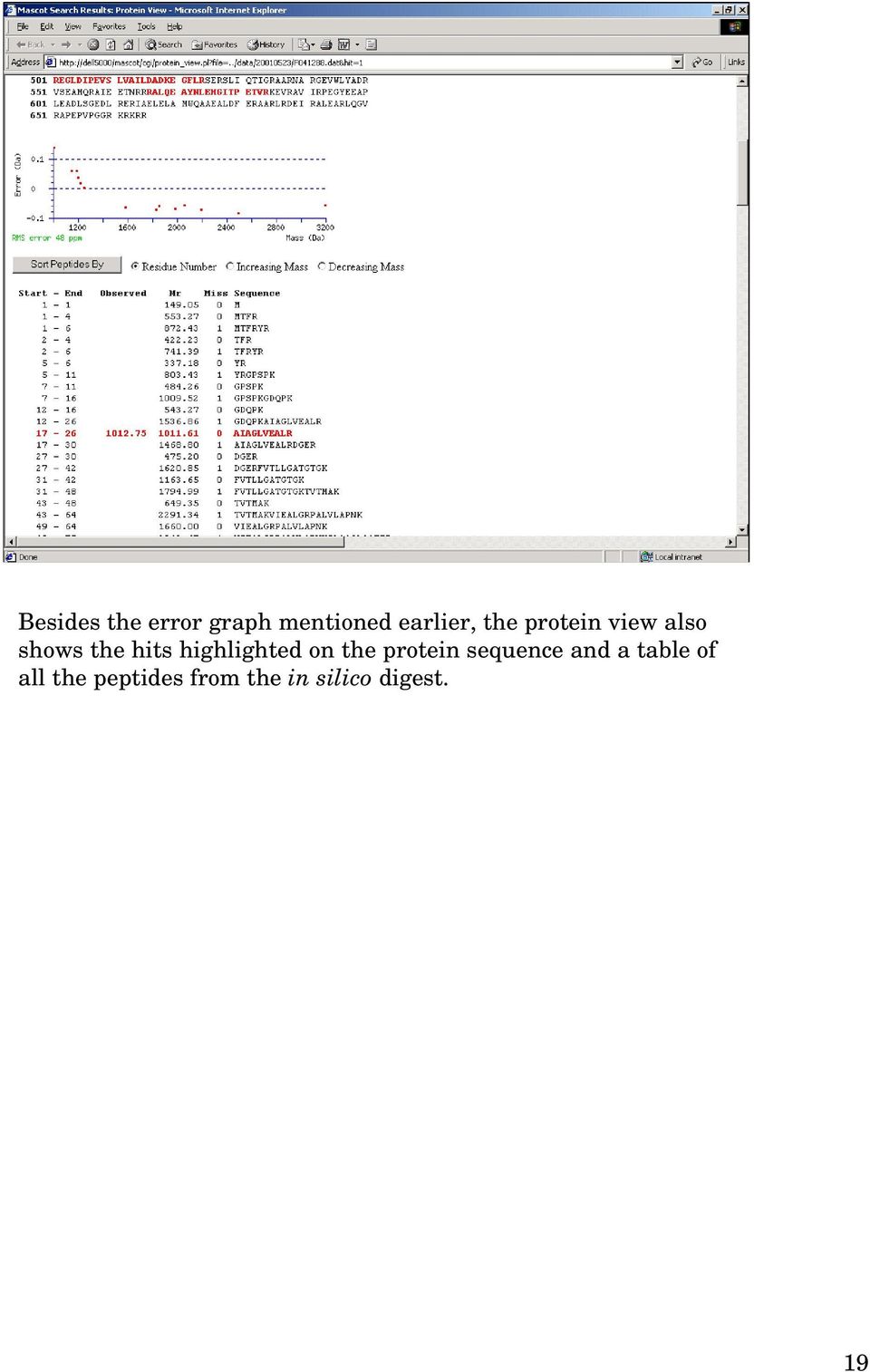
20 If available, the full annotation text is displayed at the bottom of the protein view. 20

21 Repeating searches Click on Re-search all or Search Selected Repeat to get a better score to validate results - increase number of missed cleavages - look at error graph, is tolerance correct Repeat when no significant match - try different modifications - try increasing the mass tolerance 21
22 Peptide Summary Default for MS/MS ions search Lists top scoring peptide matches grouped into protein matches Tries to answer the question: which minimal set of proteins best accounts for the peptides matches found in the experimental data? 22

23 When we have just a single MS/MS spectrum, life is simple. Either we get a peptide match, or we don t. 23

24 If we get a match,and the peptide is unique to one protein family, we have a protein match 24

25 However, if we have a complex data set, containing many MS/MS spectra which match to peptides from a number of different proteins, trying to report which proteins have been identified becomes more subjective. 25
26 Proteins Peptides When Mascot searches MS/MS data, it is getting peptide matches. Looking at the peptide matches and trying to determine which proteins were present is a secondary process, which is actually done by the report script. We can think of the results from a Mascot search of an LC-MS/MS search as a huge matrix. The columns are proteins and the rows are peptides. This isn t a diagonal matrix, with just one cross in each row or column. In most cases, a peptide match can be found in several proteins. And, very often, a protein will contain several peptide matches. To produce a simple, linear list of protein matches, we take the column with the highest score, and call that protein hit number 1. Any other proteins which match the same set of peptides, or a subset, are considered to be equivalent, but inferior matches, and collapsed into the same hit. These proteins are removed from the matrix, and we then look for the next highest scoring column and so on. 26

27 In the reports, we try to provide clues as to the most likely assignments. We use red to indicate that a peptide match is the top ranking match. We use bold type to indicate that this is the first time in the report that we have listed a match to a particular spectrum. So, Hit 24 has two nice, top-ranking matches, but they are not in bold face type. This indicates that we have already seen matches to these spectra in earlier, i.e. higher scoring, proteins, which probably means that this protein match is spurious but one can t be sure. 27
28 Peptide Summary Bold face type: First match listed for this spectrum Red type: Top ranking peptide match for this spectrum Protein match without any bold red peptide matches is unlikely to be correct 28
29 K2C1_HUMAN KRHU2 Query Score Sequence * * TLLEGEESR * AQYEDIAQK * SLDLDSIIAEVK * * WELLQQVDTSTR * * QISNLQQSISDAEQR The peptide summary report represents one reasonable interpretation of the results. Sometimes, there are alternatives which cannot be resolved. For example, we might have this situation, where there are four matches to one keratin and four matches to another keratin. It could be that only the left hand keratin was actually present in the sample, and the match to AQYEDIAQK is unreliable, or belongs to a different protein. Or, it could be that the keratin in the sample was a variant, not present in the database, which contains all five peptide matches. There are several other possible interpretations, and we cannot be certain which is correct. 29

30 A search of a complete LC-MS/MS run generates a wealth of data, and presenting these results in a complex and intuitive fashion is not trivial. Here, we have part of the Mascot report for such a search. A number of peptide matches have been assigned to a particular database entry. For each peptide match listed in the main table, there may be better or worse matches to peptides from other entries in the database. These are shown in a pop-up window when the mouse cursor is held over a query number link. In this example, we have one match with a high, and significant score. The remaining matches are random matches with random scores. 30
31 In contrast, here we see several non-random, significant matches, because there are four peptides in the database which are almost, but not quite, identical. The peptide match to this protein has a very high score, but there is another sequence with a slightly higher score. Since this protein has several other excellent matches, we are faced with a question: which of the top two peptide matches do we believe? Does the analyte have a variant sequence from that in the database, and the top match is correct? Or, is the spectrum ambiguous, and there is insufficient information to differentiate the top two matches with confidence? Either is perfectly possible. 31
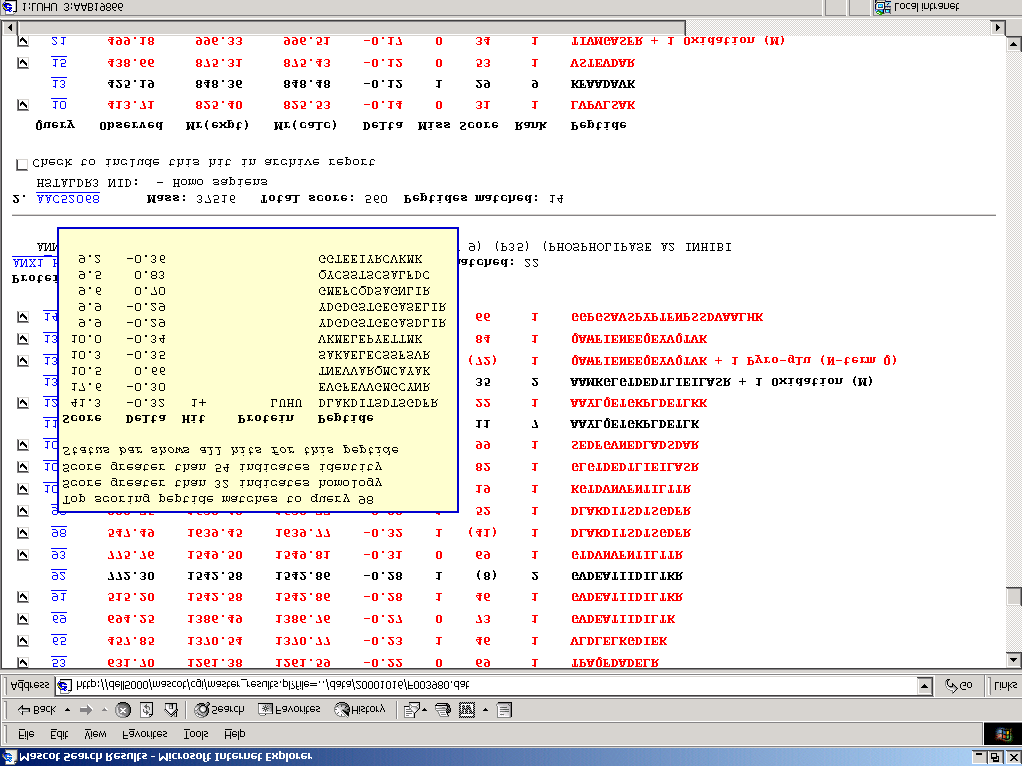
32 This third example shows a weak match. Very often, this is because the quality of the MS/MS spectrum is poor. If the signal to noise ratio is low, a match to the correct sequence might not exceed the absolute significance threshold. Even so, the match to the correct sequence could have a relatively high score, well differentiated from the quasi-normal distribution of random scores. In other words, the score is an outlier. This would indicate that the match was not a random event and, on inspection, such matches are often found to be either the correct match or a match to a close homolog. For this reason, Mascot also attempts to characterise the distribution of random scores, and provide a second, lower threshold to highlight the presence of any outlier. The lower, relative threshold is reported as the homology threshold while the higher, absolute threshold is reported as the identity threshold. 32
33 Peptide Summary Score exceeds homology threshold: Match is not random. Spectrum may not fully define sequence Sequence may be close but not exact Score exceeds identity threshold: 5% chance that match is not exact 33
34 Clicking on a query number link in the summary report loads the peptide view report. This illustrates the fragment ion matches highlighted on the MS/MS spectrum. Here we have a strong match with an almost complete series of y ions 34

35 Further down, the matched peaks are highlighted in a table of calculated fragment ion masses. The peptide view is also where you can find the new graph of the error distribution for fragment ion masses. 35
36 This is the peptide view for the weak match shown earlier. It can be seen that there is very little information above the precursor, and the signal to noise is not great 36

37 The N terminal end of the sequence is pretty much undefined. This is a good example of a spectrum which might get a match above the homology threshold, but lacks the information required to exceed the identity threshold 37

38 Finally, a major difference between reports from searching a protein database and those from searching a nucleic acid database is the possibility of frame shifts within the entry. Thus, in the protein view report, there is a drop down list for the different translation frames. For this particular entry, most of the matches have been found in reading frame 2. But, as so often happens, there is a frame shift in this entry, and there are additional matches in frame 3. 38
MASCOT Search Results Interpretation
 The Mascot protein identification program (Matrix Science, Ltd.) uses statistical methods to assess the validity of a match. MS/MS data is not ideal. That is, there are unassignable peaks (noise) and usually
Error Tolerant Searching of Uninterpreted MS/MS Data
 Error Tolerant Searching of Uninterpreted MS/MS Data 1 In any search of a large LC-MS/MS dataset 2 There are always a number of spectra which get poor scores, or even no match at all. 3 Sometimes, this
Tutorial for Proteomics Data Submission. Katalin F. Medzihradszky Robert J. Chalkley UCSF
 Tutorial for Proteomics Data Submission Katalin F. Medzihradszky Robert J. Chalkley UCSF Why Have Guidelines? Large-scale proteomics studies create huge amounts of data. It is impossible/impractical to
When you install Mascot, it includes a copy of the Swiss-Prot protein database. However, it is almost certain that you and your colleagues will want
 1 When you install Mascot, it includes a copy of the Swiss-Prot protein database. However, it is almost certain that you and your colleagues will want to search other databases as well. There are very
Searching Nucleotide Databases
 Searching Nucleotide Databases 1 When we search a nucleic acid databases, Mascot always performs a 6 frame translation on the fly. That is, 3 reading frames from the forward strand and 3 reading frames
Mascot Search Results FAQ
 Mascot Search Results FAQ 1 We had a presentation with this same title at our 2005 user meeting. So much has changed in the last 6 years that it seemed like a good idea to re-visit the topic. Just about
High Throughput Proteomics
 High Throughput Proteomics 1 High throughput means... Continuous real-time searching of data Human scrutiny of results is not practical High throughput doesn t necessarily mean large scale. We would characterise
In-Depth Qualitative Analysis of Complex Proteomic Samples Using High Quality MS/MS at Fast Acquisition Rates
 In-Depth Qualitative Analysis of Complex Proteomic Samples Using High Quality MS/MS at Fast Acquisition Rates Using the Explore Workflow on the AB SCIEX TripleTOF 5600 System A major challenge in proteomics
Effects of Intelligent Data Acquisition and Fast Laser Speed on Analysis of Complex Protein Digests
 Effects of Intelligent Data Acquisition and Fast Laser Speed on Analysis of Complex Protein Digests AB SCIEX TOF/TOF 5800 System with DynamicExit Algorithm and ProteinPilot Software for Robust Protein
ProteinScape. Innovation with Integrity. Proteomics Data Analysis & Management. Mass Spectrometry
 ProteinScape Proteomics Data Analysis & Management Innovation with Integrity Mass Spectrometry ProteinScape a Virtual Environment for Successful Proteomics To overcome the growing complexity of proteomics
Advantages of the LTQ Orbitrap for Protein Identification in Complex Digests
 Application Note: 386 Advantages of the LTQ Orbitrap for Protein Identification in Complex Digests Rosa Viner, Terry Zhang, Scott Peterman, and Vlad Zabrouskov, Thermo Fisher Scientific, San Jose, CA,
Global and Discovery Proteomics Lecture Agenda
 Global and Discovery Proteomics Christine A. Jelinek, Ph.D. Johns Hopkins University School of Medicine Department of Pharmacology and Molecular Sciences Middle Atlantic Mass Spectrometry Laboratory Global
Laboration 1. Identifiering av proteiner med Mass Spektrometri. Klinisk Kemisk Diagnostik
 Laboration 1 Identifiering av proteiner med Mass Spektrometri Klinisk Kemisk Diagnostik Sven Kjellström 2014 [email protected] 0702-935060 Laboration 1 Klinisk Kemisk Diagnostik Identifiering av
Application Note # LCMS-81 Introducing New Proteomics Acquisiton Strategies with the compact Towards the Universal Proteomics Acquisition Method
 Application Note # LCMS-81 Introducing New Proteomics Acquisiton Strategies with the compact Towards the Universal Proteomics Acquisition Method Introduction During the last decade, the complexity of samples
Protein Prospector and Ways of Calculating Expectation Values
 Protein Prospector and Ways of Calculating Expectation Values 1/16 Aenoch J. Lynn; Robert J. Chalkley; Peter R. Baker; Mark R. Segal; and Alma L. Burlingame University of California, San Francisco, San
Learning Objectives:
 Proteomics Methodology for LC-MS/MS Data Analysis Methodology for LC-MS/MS Data Analysis Peptide mass spectrum data of individual protein obtained from LC-MS/MS has to be analyzed for identification of
ProteinPilot Report for ProteinPilot Software
 ProteinPilot Report for ProteinPilot Software Detailed Analysis of Protein Identification / Quantitation Results Automatically Sean L Seymour, Christie Hunter SCIEX, USA Pow erful mass spectrometers like
Aiping Lu. Key Laboratory of System Biology Chinese Academic Society [email protected]
 Aiping Lu Key Laboratory of System Biology Chinese Academic Society [email protected] Proteome and Proteomics PROTEin complement expressed by genome Marc Wilkins Electrophoresis. 1995. 16(7):1090-4. proteomics
ProSightPC 3.0 Quick Start Guide
 ProSightPC 3.0 Quick Start Guide The Thermo ProSightPC 3.0 application is the only proteomics software suite that effectively supports high-mass-accuracy MS/MS experiments performed on LTQ FT and LTQ Orbitrap
Database manager does something that sounds trivial. It makes it easy to setup a new database for searching with Mascot. It also makes it easy to
 1 Database manager does something that sounds trivial. It makes it easy to setup a new database for searching with Mascot. It also makes it easy to automate regular updates of these databases. 2 However,
MS Amanda Standalone User Manual
 MS Amanda Standalone User Manual February 2014 Viktoria Dorfer, Peter Pichler, Stephan Winkler, and Karl Mechtler 1. Installation of MS Amanda Standalone In order to install MS Amanda Standalone please
Tutorial 9: SWATH data analysis in Skyline
 Tutorial 9: SWATH data analysis in Skyline In this tutorial we will learn how to perform targeted post-acquisition analysis for protein identification and quantitation using a data-independent dataset
Scaling from 1 PC to a super computer using Mascot
 Scaling from 1 PC to a super computer using Mascot 1 Mascot - options for high throughput When is more processing power required? Options: Multiple Mascot installations Using a large Unix server Clusters
MRMPilot Software: Accelerating MRM Assay Development for Targeted Quantitative Proteomics
 MRMPilot Software: Accelerating MRM Assay Development for Targeted Quantitative Proteomics With Unique QTRAP and TripleTOF 5600 System Technology Targeted peptide quantification is a rapidly growing application
Database Searching Tutorial/Exercises Jimmy Eng
 Database Searching Tutorial/Exercises Jimmy Eng Use the PETUNIA interface to run a search and generate a pepxml file that is analyzed through the PepXML Viewer. This tutorial will walk you through the
Application Note # MT-90 MALDI-TDS: A Coherent MALDI Top-Down-Sequencing Approach Applied to the ABRF-Protein Research Group Study 2008
 Bruker Daltonics Application Note # MT-90 MALDI-TDS: A Coherent MALDI Top-Down-Sequencing Approach Applied to the ABRF-Protein Research Group Study 2008 In the ABRF-PRG study 2008 [*] the ability to characterize
BLAST. Anders Gorm Pedersen & Rasmus Wernersson
 BLAST Anders Gorm Pedersen & Rasmus Wernersson Database searching Using pairwise alignments to search databases for similar sequences Query sequence Database Database searching Most common use of pairwise
The Scheduled MRM Algorithm Enables Intelligent Use of Retention Time During Multiple Reaction Monitoring
 The Scheduled MRM Algorithm Enables Intelligent Use of Retention Time During Multiple Reaction Monitoring Delivering up to 2500 MRM Transitions per LC Run Christie Hunter 1, Brigitte Simons 2 1 AB SCIEX,
MultiQuant Software 2.0 for Targeted Protein / Peptide Quantification
 MultiQuant Software 2.0 for Targeted Protein / Peptide Quantification Gold Standard for Quantitative Data Processing Because of the sensitivity, selectivity, speed and throughput at which MRM assays can
Accurate Mass Screening Workflows for the Analysis of Novel Psychoactive Substances
 Accurate Mass Screening Workflows for the Analysis of Novel Psychoactive Substances TripleTOF 5600 + LC/MS/MS System with MasterView Software Adrian M. Taylor AB Sciex Concord, Ontario (Canada) Overview
RETRIEVING SEQUENCE INFORMATION. Nucleotide sequence databases. Database search. Sequence alignment and comparison
 RETRIEVING SEQUENCE INFORMATION Nucleotide sequence databases Database search Sequence alignment and comparison Biological sequence databases Originally just a storage place for sequences. Currently the
泛 用 蛋 白 質 體 學 之 質 譜 儀 資 料 分 析 平 台 的 建 立 與 應 用 Universal Mass Spectrometry Data Analysis Platform for Quantitative and Qualitative Proteomics
 泛 用 蛋 白 質 體 學 之 質 譜 儀 資 料 分 析 平 台 的 建 立 與 應 用 Universal Mass Spectrometry Data Analysis Platform for Quantitative and Qualitative Proteomics 2014 Training Course Wei-Hung Chang ( 張 瑋 宏 ) ABRC, Academia
Thermo Scientific PepFinder Software A New Paradigm for Peptide Mapping
 Thermo Scientific PepFinder Software A New Paradigm for Peptide Mapping For Conclusive Characterization of Biologics Deep Protein Characterization Is Crucial Pharmaceuticals have historically been small
Mascot Integra: Data management for Proteomics ASMS 2004
 Mascot Integra: Data management for Proteomics 1 Mascot Integra: Data management for proteomics What is Mascot Integra? What Mascot Integra isn t Instrument integration in Mascot Integra Designing and
AB SCIEX TOF/TOF 4800 PLUS SYSTEM. Cost effective flexibility for your core needs
 AB SCIEX TOF/TOF 4800 PLUS SYSTEM Cost effective flexibility for your core needs AB SCIEX TOF/TOF 4800 PLUS SYSTEM It s just what you expect from the industry leader. The AB SCIEX 4800 Plus MALDI TOF/TOF
Master course KEMM03 Principles of Mass Spectrometric Protein Characterization. Exam
 Exam Master course KEMM03 Principles of Mass Spectrometric Protein Characterization 2010-10-29 kl 08.15-13.00 Use a new paper for answering each question! Write your name on each paper! Aids: Mini calculator,
How To Use An Ionsonic Microscope
 Sample Analysis Design Element2 - Basic Software Concepts Scan Modes Magnetic Scan (BScan): the electric field is kept constant and the magnetic field is varied as a function of time the BScan is suitable
MaxQuant User s Guide Version 1.2.2.5
 MaxQuant User s Guide Version 1.2.2.5 Jűrgen Cox and Matthias Mann Nature Biotechnology 26, 1367-1372 (2008) Sara ten Have 2012 http://www.lamondlab.com/ http://greproteomics.lifesci.dundee.ac.uk/ References
Protein Protein Interaction Networks
 Functional Pattern Mining from Genome Scale Protein Protein Interaction Networks Young-Rae Cho, Ph.D. Assistant Professor Department of Computer Science Baylor University it My Definition of Bioinformatics
Increasing the Multiplexing of High Resolution Targeted Peptide Quantification Assays
 Increasing the Multiplexing of High Resolution Targeted Peptide Quantification Assays Scheduled MRM HR Workflow on the TripleTOF Systems Jenny Albanese, Christie Hunter AB SCIEX, USA Targeted quantitative
Sub menu of functions to give the user overall information about the data in the file
 Visualize The Multitool for Proteomics! File Open Opens an.ez2 file to be examined. Import from TPP Imports data from files created by Trans Proteomic Pipeline. User chooses mzxml, pepxml and FASTA files
PeptidomicsDB: a new platform for sharing MS/MS data.
 PeptidomicsDB: a new platform for sharing MS/MS data. Federica Viti, Ivan Merelli, Dario Di Silvestre, Pietro Brunetti, Luciano Milanesi, Pierluigi Mauri NETTAB2010 Napoli, 01/12/2010 Mass Spectrometry
Tackling the data analysis challenge for characterisation of biotherapeutics
 CASSS AT 2015 Berlin March 2015 1 Tackling the data analysis challenge for characterisation of biotherapeutics Carsten P Sönksen, Ph.D., Novo Nordisk Tackling the data analysis challenge 2 Personal background:
Analyzing A DNA Sequence Chromatogram
 LESSON 9 HANDOUT Analyzing A DNA Sequence Chromatogram Student Researcher Background: DNA Analysis and FinchTV DNA sequence data can be used to answer many types of questions. Because DNA sequences differ
Mass Spectra Alignments and their Significance
 Mass Spectra Alignments and their Significance Sebastian Böcker 1, Hans-Michael altenbach 2 1 Technische Fakultät, Universität Bielefeld 2 NRW Int l Graduate School in Bioinformatics and Genome Research,
Quantitative proteomics background
 Proteomics data analysis seminar Quantitative proteomics and transcriptomics of anaerobic and aerobic yeast cultures reveals post transcriptional regulation of key cellular processes de Groot, M., Daran
Industry Perspective: Advantages of Open Access and Walkup LC/ MS Supporting Protein Drug Discovery and Development
 Industry Perspective: Advantages of Open Access and Walkup LC/ MS Supporting Protein Drug Discovery and Development Dawn Stickle, Agilent Technologies Originally presented by Eric Fang, Novartis Overview
Multiple Optimization Using the JMP Statistical Software Kodak Research Conference May 9, 2005
 Multiple Optimization Using the JMP Statistical Software Kodak Research Conference May 9, 2005 Philip J. Ramsey, Ph.D., Mia L. Stephens, MS, Marie Gaudard, Ph.D. North Haven Group, http://www.northhavengroup.com/
Retrospective Analysis of a Host Cell Protein Perfect Storm: Identifying Immunogenic Proteins and Fixing the Problem
 Retrospective Analysis of a Host Cell Protein Perfect Storm: Identifying Immunogenic Proteins and Fixing the Problem Kevin Van Cott, Associate Professor Dept. of Chemical and Biomolecular Engineering Nebraska
A Navigation through the Tracefinder Software Structure and Workflow Options. Frans Schoutsen Pesticide Symposium Prague 27 April 2015
 A Navigation through the Tracefinder Software Structure and Workflow Options Frans Schoutsen Pesticide Symposium Prague 27 April 2015 Kings day in The Netherlands 1 Index Introduction Acquisition, Method
Proteomic Analysis using Accurate Mass Tags. Gordon Anderson PNNL January 4-5, 2005
 Proteomic Analysis using Accurate Mass Tags Gordon Anderson PNNL January 4-5, 2005 Outline Accurate Mass and Time Tag (AMT) based proteomics Instrumentation Data analysis Data management Challenges 2 Approach
Introduction to Database Searching using MASCOT
 Introduction to Database Searching using MASCOT 1 Three ways to use mass spectrometry data for protein identification 1.Peptide Mass Fingerprint A set of peptide molecular masses from an enzyme digest
NCSS Statistical Software Principal Components Regression. In ordinary least squares, the regression coefficients are estimated using the formula ( )
 Chapter 340 Principal Components Regression Introduction is a technique for analyzing multiple regression data that suffer from multicollinearity. When multicollinearity occurs, least squares estimates
Unemployment Insurance Data Validation Operations Guide
 Unemployment Insurance Data Validation Operations Guide ETA Operations Guide 411 U.S. Department of Labor Employment and Training Administration Office of Unemployment Insurance TABLE OF CONTENTS Chapter
Tutorial for proteome data analysis using the Perseus software platform
 Tutorial for proteome data analysis using the Perseus software platform Laboratory of Mass Spectrometry, LNBio, CNPEM Tutorial version 1.0, January 2014. Note: This tutorial was written based on the information
Bioinformatics Resources at a Glance
 Bioinformatics Resources at a Glance A Note about FASTA Format There are MANY free bioinformatics tools available online. Bioinformaticists have developed a standard format for nucleotide and protein sequences
Session 1. Course Presentation: Mass spectrometry-based proteomics for molecular and cellular biologists
 Program Overview Session 1. Course Presentation: Mass spectrometry-based proteomics for molecular and cellular biologists Session 2. Principles of Mass Spectrometry Session 3. Mass spectrometry based proteomics
Guide for Bioinformatics Project Module 3
 Structure- Based Evidence and Multiple Sequence Alignment In this module we will revisit some topics we started to look at while performing our BLAST search and looking at the CDD database in the first
Mass Frontier 7.0 Quick Start Guide
 Mass Frontier 7.0 Quick Start Guide The topics in this guide briefly step you through key features of the Mass Frontier application. Editing a Structure Working with Spectral Trees Building a Library Predicting
Using Excel (Microsoft Office 2007 Version) for Graphical Analysis of Data
 Using Excel (Microsoft Office 2007 Version) for Graphical Analysis of Data Introduction In several upcoming labs, a primary goal will be to determine the mathematical relationship between two variable
Sanger Sequencing and Quality Assurance. Zbigniew Rudzki Department of Pathology University of Melbourne
 Sanger Sequencing and Quality Assurance Zbigniew Rudzki Department of Pathology University of Melbourne Sanger DNA sequencing The era of DNA sequencing essentially started with the publication of the enzymatic
Analytical Test Method Validation Report Template
 Analytical Test Method Validation Report Template 1. Purpose The purpose of this Validation Summary Report is to summarize the finding of the validation of test method Determination of, following Validation
STATISTICA. Financial Institutions. Case Study: Credit Scoring. and
 Financial Institutions and STATISTICA Case Study: Credit Scoring STATISTICA Solutions for Business Intelligence, Data Mining, Quality Control, and Web-based Analytics Table of Contents INTRODUCTION: WHAT
ForensicDB: A Web-accessible Spectral Database
 ForensicDB: A Web-accessible Spectral Database Table of Contents 1. Introduction to ForensicDB... 1 2. Accessing ForensicDB... 1 3. Setting System Properties... 5 Spectrum Properties... 5 Frame Properties...
BUDAPEST: Bioinformatics Utility for Data Analysis of Proteomics using ESTs
 BUDAPEST: Bioinformatics Utility for Data Analysis of Proteomics using ESTs Richard J. Edwards 2008. Contents 1. Introduction... 2 1.1. Version...2 1.2. Using this Manual...2 1.3. Why use BUDAPEST?...2
Longitudinal Relaxation Time (T 1 ) Measurement for 1 H on VnmrJ2.2D (use on Ra, Mut, and Isis)
 Longitudinal Relaxation Time (T 1 ) Measurement for 1 H on VnmrJ2.2D (use on Ra, Mut, and Isis) Knowledge of the T 1 's of a molecule is important in the setup of many 1D and 2D experiments, in which the
Challenges in Computational Analysis of Mass Spectrometry Data for Proteomics
 Ma B. Challenges in computational analysis of mass spectrometry data for proteomics. SCIENCE AND TECHNOLOGY 25(1): 1 Jan. 2010 JOURNAL OF COMPUTER Challenges in Computational Analysis of Mass Spectrometry
Interpretation of MS-Based Proteomics Data
 Interpretation of MS-Based Proteomics Data Yet-Ran Chen, 陳 逸 然 Agricultural Biotechnology Research Center Academia Sinica Brief Overview of Protein Identification Workflow Protein Sample Specific Protein
Mass Spectrometry Based Proteomics
 Mass Spectrometry Based Proteomics Proteomics Shared Research Oregon Health & Science University Portland, Oregon This document is designed to give a brief overview of Mass Spectrometry Based Proteomics
Server Load Prediction
 Server Load Prediction Suthee Chaidaroon ([email protected]) Joon Yeong Kim ([email protected]) Jonghan Seo ([email protected]) Abstract Estimating server load average is one of the methods that
Peak intensity Trypsin. Protein Sequence Before trypsin digestion After digestion with trypsin for 24 h digestion
 Supplemental table 1. The completeness of trypsin digestion of the signature peptides with native flanking sequence. The signature peptides with native flanking sequence were digested with trypsin as described
SimGlycan Software*: A New Predictive Carbohydrate Analysis Tool for MS/MS Data
 SimGlycan Software*: A New Predictive Carbohydrate Analysis Tool for MS/MS Data Automated Data Interpretation for Glycan Characterization Jenny Albanese 1, Matthias Glueckmann 2 and Christof Lenz 2 1 AB
MultiQuant Software Version 3.0 for Accurate Quantification of Clinical Research and Forensic Samples
 MultiQuant Software Version 3.0 for Accurate Quantification of Clinical Research and Forensic Samples Fast and Efficient Data Review, with Automatic Flagging of Outlier Results Adrian M. Taylor and Michael
Analysing Questionnaires using Minitab (for SPSS queries contact -) [email protected]
 Analysing Questionnaires using Minitab (for SPSS queries contact -) [email protected] Structure As a starting point it is useful to consider a basic questionnaire as containing three main sections:
CATIA Basic Concepts TABLE OF CONTENTS
 TABLE OF CONTENTS Introduction...1 Manual Format...2 Log on/off procedures for Windows...3 To log on...3 To logoff...7 Assembly Design Screen...8 Part Design Screen...9 Pull-down Menus...10 Start...10
When you install Mascot, it includes a copy of the Swiss-Prot protein database. However, it is almost certain that you and your colleagues will want
 1 When you install Mascot, it includes a copy of the Swiss-Prot protein database. However, it is almost certain that you and your colleagues will want to search other databases as well. There are very
Bioinformatics Grid - Enabled Tools For Biologists.
 Bioinformatics Grid - Enabled Tools For Biologists. What is Grid-Enabled Tools (GET)? As number of data from the genomics and proteomics experiment increases. Problems arise for the current sequence analysis
DNA Sequencing Overview
 DNA Sequencing Overview DNA sequencing involves the determination of the sequence of nucleotides in a sample of DNA. It is presently conducted using a modified PCR reaction where both normal and labeled
Analytical Chemistry Lab Reports
 Analytical Chemistry Lab Reports Format and Calculations John Collins [email protected] Measurement Analytical chemistry is entirely about measurement, what these measurements signify, and the understanding
Similarity Searches on Sequence Databases: BLAST, FASTA. Lorenza Bordoli Swiss Institute of Bioinformatics EMBnet Course, Basel, October 2003
 Similarity Searches on Sequence Databases: BLAST, FASTA Lorenza Bordoli Swiss Institute of Bioinformatics EMBnet Course, Basel, October 2003 Outline Importance of Similarity Heuristic Sequence Alignment:
A Streamlined Workflow for Untargeted Metabolomics
 A Streamlined Workflow for Untargeted Metabolomics Employing XCMS plus, a Simultaneous Data Processing and Metabolite Identification Software Package for Rapid Untargeted Metabolite Screening Baljit K.
Data analysis and regression in Stata
 Data analysis and regression in Stata This handout shows how the weekly beer sales series might be analyzed with Stata (the software package now used for teaching stats at Kellogg), for purposes of comparing
PROTEIN SEQUENCING. First Sequence
 PROTEIN SEQUENCING First Sequence The first protein sequencing was achieved by Frederic Sanger in 1953. He determined the amino acid sequence of bovine insulin Sanger was awarded the Nobel Prize in 1958
How Mascot Integra helps run a Core Lab
 How Mascot Integra helps run a Core Lab 1 Areas where a database can help a core lab Project, experiment and sample tracking Flexibility in experiment design Role based security Automation Custom results
Tutorial 2: Using Excel in Data Analysis
 Tutorial 2: Using Excel in Data Analysis This tutorial guide addresses several issues particularly relevant in the context of the level 1 Physics lab sessions at Durham: organising your work sheet neatly,
Pep-Miner: A Novel Technology for Mass Spectrometry-Based Proteomics
 Pep-Miner: A Novel Technology for Mass Spectrometry-Based Proteomics Ilan Beer Haifa Research Lab Dec 10, 2002 Pep-Miner s Location in the Life Sciences World The post-genome era - the age of proteome
Manual for simulation of EB processing. Software ModeRTL
 1 Manual for simulation of EB processing Software ModeRTL How to get results. Software ModeRTL. Software ModeRTL consists of five thematic modules and service blocks. (See Fig.1). Analytic module is intended
Agilent G2721AA/G2733AA Spectrum Mill MS Proteomics Workbench
 Agilent G2721AA/G2733AA Spectrum Mill MS Proteomics Workbench Application Guide Agilent Technologies Notices Agilent Technologies, Inc. 2012 No part of this manual may be reproduced in any form or by any
Final Project Report
 CPSC545 by Introduction to Data Mining Prof. Martin Schultz & Prof. Mark Gerstein Student Name: Yu Kor Hugo Lam Student ID : 904907866 Due Date : May 7, 2007 Introduction Final Project Report Pseudogenes
Text Mining in JMP with R Andrew T. Karl, Senior Management Consultant, Adsurgo LLC Heath Rushing, Principal Consultant and Co-Founder, Adsurgo LLC
 Text Mining in JMP with R Andrew T. Karl, Senior Management Consultant, Adsurgo LLC Heath Rushing, Principal Consultant and Co-Founder, Adsurgo LLC 1. Introduction A popular rule of thumb suggests that
Research-grade Targeted Proteomics Assay Development: PRMs for PTM Studies with Skyline or, How I learned to ditch the triple quad and love the QE
 Research-grade Targeted Proteomics Assay Development: PRMs for PTM Studies with Skyline or, How I learned to ditch the triple quad and love the QE Jacob D. Jaffe Skyline Webinar July 2015 Proteomics and
Mass Spectrometry Signal Calibration for Protein Quantitation
 Cambridge Isotope Laboratories, Inc. www.isotope.com Proteomics Mass Spectrometry Signal Calibration for Protein Quantitation Michael J. MacCoss, PhD Associate Professor of Genome Sciences University of
Exploratory Spatial Data Analysis
 Exploratory Spatial Data Analysis Part II Dynamically Linked Views 1 Contents Introduction: why to use non-cartographic data displays Display linking by object highlighting Dynamic Query Object classification