
Manual VCI - Virtual CAN Interface VCI-V2 Programmers Manual
|
|
|
- Loreen McDowell
- 10 years ago
- Views:
Transcription
1 Manual VCI - Virtual CAN Interface VCI-V2 Programmers Manual The expert for industrial and automotive communication

2 IXXAT Headquarter US Sales Office IXXAT Automation GmbH IXXAT Inc. Leibnizstr Bedford Center Road D Weingarten USA-Bedford, NH Tel.: +49 (0)7 51 / Phone: Fax: +49 (0)7 51 / Fax: Internet: Internet: [email protected] [email protected] Support In case of unsolvable problems with this product or other IXXAT products please contact IXXAT in written form by: Fax: +49 (0)7 51 / [email protected] Copyright Duplication (copying, printing, microfilm or other forms) and the electronic distribution of this document is only allowed with explicit permission of IXXAT Automation GmbH. IXXAT Automation GmbH reserves the right to change technical data without prior announcement. The general business conditions and the regulations of the license agreement do apply. All rights are reserved. Document No. VCIV2_Programmers Manual-E-V2.7

3 Contents 1 INTRODUCTION Areas of Application Notes on this Manual Installation of the VCI Functional Scope of the VCI Limitations Message Administration Receive buffers Receive queues Transmit queues Remote buffers Opening a PC-CAN Interface INTERFACE DESCRIPTION Pre-defined Return Codes of the VCI Type Definitions of the Call-back Handler Receive-Interrupt-Handler Exception-Handlers Handler for String Output State diagram for Board Initialisation Table of VCI functions Initialisation of the VCI VCI_Init Functions for VCI Support Information VCI_Get_LibType VCI_GetBrdNameByType VCI_GetBrdTypeByName Functions for Board Initialisation VCI_SearchBoard VCI_SetDownloadState VCI_PrepareBoard VCI2_PrepareBoard (from VCI_V2) VCI_PrepareBoard VCI2_PrepareBoardMsg (from VCI_V2) VCI_PrepareBoardMsg VCI_PrepareBoardVisBas

4 Contents VCI_CancelBoard VCI_TestBoard VCI_ReadBoardInfo VCI_ReadBoardStatus VCI_ResetBoard Functions for CAN-Controller handling VCI_ReadCanInfo VCI_ReadCanStatus VCI_InitCan VCI_SetAccMask VCI_ResetCan VCI_StartCan Functions for the Queue and Buffer Configuration VCI_ConfigQueue VCI_AssignRxQueObj VCI_ResetTimeStamp VCI_ConfigBuffer VCI_ReConfigBuffer Receiving Messages VCI_ReadQueStatus VCI_ReadQueObj VCI_ReadBufStatus VCI_ReadBufData Sending Messages VCI_TransmitObj VCI_RequestObj VCI_UpdateBufObj Data Types Used VCI-CAN-Object VCI-Board Information VCI-Board-Status VCI-CAN-Information VCI-CAN-Status REGISTRATION FUNCTIONS (XATXXREG.DLL) Type Definitions of the Call-back Handler Call-back to list the registered PC/CAN-interfaces
5 Contents 3.2 Function Definitions XAT_SelectHardware XAT_GetConfig XAT_EnumHWEntry XAT_FindHWEntry XAT_SetDefaultHwEntry XAT_GetDefaultHwEntry XAT_BoardCFG HRESULT errorcodes NOTES ON USE OF THE VCI-DLLS Common Notes Integration of the DLL in an Application Implicit Import During Linking Dynamic Import During the Run-time Notes for VisualBasic developers

6

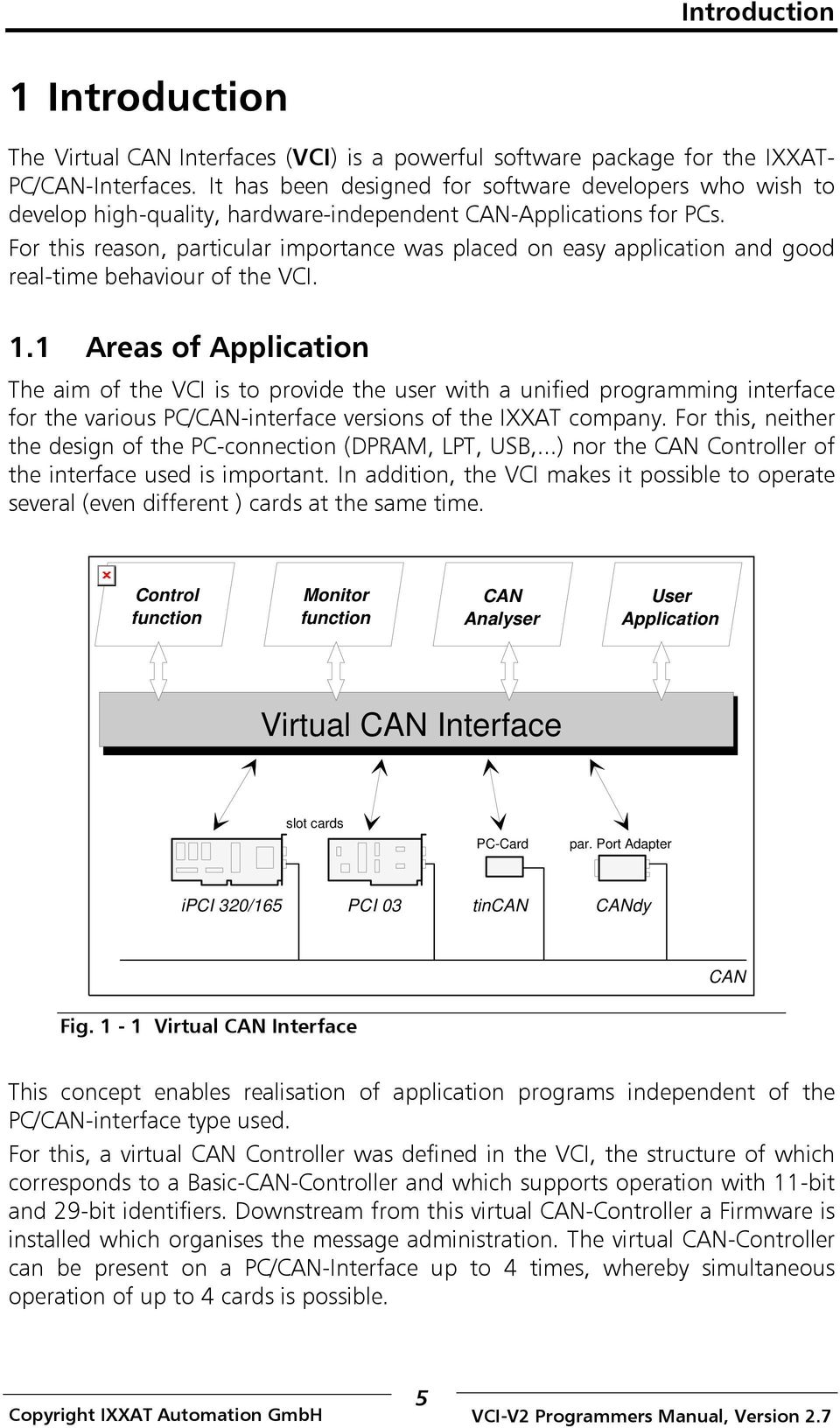
7 Introduction 1 Introduction The Virtual CAN Interfaces (VCI) is a powerful software package for the IXXAT- PC/CAN-Interfaces. It has been designed for software developers who wish to develop high-quality, hardware-independent CAN-Applications for PCs. For this reason, particular importance was placed on easy application and good real-time behaviour of the VCI. 1.1 Areas of Application The aim of the VCI is to provide the user with a unified programming interface for the various PC/CAN-interface versions of the IXXAT company. For this, neither the design of the PC-connection (DPRAM, LPT, USB,...) nor the CAN Controller of the interface used is important. In addition, the VCI makes it possible to operate several (even different ) cards at the same time. Control function Monitor function CAN Analyser User Application Virtual CAN Interface slot cards PC-Card par. Port Adapter ipci 320/165 PCI 03 tincan CANdy CAN Fig. 1-1 Virtual CAN Interface This concept enables realisation of application programs independent of the PC/CAN-interface type used. For this, a virtual CAN Controller was defined in the VCI, the structure of which corresponds to a Basic-CAN-Controller and which supports operation with 11-bit and 29-bit identifiers. Downstream from this virtual CAN-Controller a Firmware is installed which organises the message administration. The virtual CAN-Controller can be present on a PC/CAN-Interface up to 4 times, whereby simultaneous operation of up to 4 cards is possible. 5
8 Introduction Both intelligent PC/CAN-interfaces (with their own memory and CPU) and passive cards are supported by the VCI. Active PC/CAN-interface cards support the PC in the pre-processing of the CANmessages and in data management. This has a positive effect on the load of the processor of the PC. With passive cards the processor of the PC is loaded considerably more by the interrupt routine of the CAN-Controller and the message administration. On the other hand, passive PC/CAN-interface cards make possible a reasonably priced connection of a PC to a CAN-network. However, high demands are made on the real-time behaviour of the PC (under Windows only useful with low baud rates). 1.2 Notes on this Manual The aim of this manual is to explain the way of functioning of the VCI and its functions. This manual does not intend to describe the whole area of programming of CAN-applications nor to represent a reference for the functionality of individual CAN-Controllers. This manual requires knowledge of programming under MS-Windows (Multi- Threading, event-controlled processing). Before working with the VCI, it is absolutely necessary that you read through this manual completely at least once. In order to keep this documentation as short as possible, the information it contains is given to a great extent without redundancy. It is therefore recommended that you work through the manual several times, since important information is often overlooked on the first reading. In this connection we also strongly recommend studying the header files VCI.h. 1.3 Installation of the VCI For information on the installation of the PC/CAN-interface, please see the PC/CAN-interface hardware manual supplied. The procedure for the VCI-software installation is described in the "CAN- Driver VCI installation manual". 6

9 Introduction 1.4 Functional Scope of the VCI The VCI supports: Standard and Extended Protocol (11 and 29-bit-Identifier) Several CAN-Controllers per interface (if supported by the hardware) Simultaneous operation of up to four interfaces by one or more applications Baud rates of up to 1000 Kbaud Reception of messages via configurable receive queues (FIFO) with time marker Reception of messages via configurable receive buffers with receive counter. Several queues and buffers can be assigned to each CAN-Controller. Sending of messages (via configurable send queues) Queues can be polled or read per interrupt (Timeout or High water mark ) Automatic, configurable response to request messages (Remote frames) (only in 11 Bit Standard protocol) In addition, the VCI supplies statistic data to the CAN-Bus, to the CAN-Controller, via the data structures and the PC/CAN-interfaces. 1.5 Limitations Access to a PC/CAN-interface is only possible for one application. Therefore several applications cannot share one PC/CAN-interface. Depending on the CAN-Controller of the PC/CAN-interface used, there are limitations in the functional scope of the VCI: Philips 82C200: Intel 82527: No extended protocol possible No remote operation possible Philips SJA1000: No limitations In order to support the corresponding functionality, your application must select the corresponding CAN-Controller. Remote Buffers only possible in 11Bit Standard Mode 7

10 Introduction 1.6 Message Administration The VCI possesses its own message administration. In this message administration, both incoming and outgoing messages are administered in different structures. Intermediate storage of the received messages occurs in so-called Receive queues or in Receive buffers. In the case of a Queue, the messages are stored in order of the time of their occurrence including a time marker (FIFO-principle), whereby the messages can also have different identifiers. In contrast, a buffer contains only the last message received under a certain identifier (according to a current process diagram) as well as a counter for the number of the receive processes on this buffer. The messages to be sent are recorded in Transmit queues. These are then serviced by a microcontroller (only with intelligent PC/CAN-interfaces) or by an interrupt routine of the PC. In addition, so-called Remote buffers can be created, in which messages are entered which are not sent directly but only on request (Remote- Frame) by another node. The following section describes the elements provided by the VCI for the administration of the CAN-messages Receive buffers Receive buffers are created for each identifier to be received. They always contain the last data received under the selected identifier. This means that data which have not yet been accepted by the application are overwritten. For flow control with repeated reception, the Receive buffers are equipped with a Receive counter. Receive buffers are specifically checked by the application for the presence of new data and the data are then accepted. An event-controlled reading of Receive buffers is not possible, since Receive buffers generally come into use when the application has to check certain process data only sporadically and is only concerned with the most recent data in each case. The maximum configurable number of buffers (Receive and Remote buffers together) is 2048 per CAN-Controller Receive queues The use of Receive queues is recommended in particular for applications where all data are to be received which are transmitted under one or more identifiers and for which the application program is not able to react directly to the reception of a message. The application program can determine how many messages a queue can accept and which identifiers should be assigned to a queue. Several queues can be 8
11 Introduction created, so that pre-sorting can already be carried out by the VCI. All messages recorded in a Receive queue are provided with a time stamp. If due to the structure of the application program a regular polling of the Receive queue(s) is not useful or not possible, the application can be informed via a Callback-function. The time of informing can be configured and depends on two events of which one must occur to trigger the callback: A certain number of entries is present in a queue ("high water mark" is reached) After a certain amount of time has expired (Timeout function). The Call-back-function is called up from the Interrupt-thread of the VCI. This gives rise to several limitations: In the Call-back-function no time-critical calculations should be carried out, as otherwise CAN-messages may be lost. They are located in the Call-back-function in the context of the Interruptthreads. An attempt to access data from its application may fail for this reason. One way to uncouple Call-back from its application is to start an applicationthread for processing a queue. Incoming CAN-messages are signalised in their Call-back-function by the setting of an event. The application-thread waits for this event and carries out processing after the Event has been set. After the processing step it returns to wait mode. The maximum number of Receive queues which can be configured is 16 per CAN- Controller Transmit queues Messages (data and data requests) from the application are normally sent via Transmit queues. In this way, when making a request to send, the application does not need to wait until the CAN-Controller is ready to transmit. Servicing of the Transmit queue(s) is carried out by the microcontroller of the active PC/CANinterfaces or with passive PC/CAN-interfaces by the Interrupt routine of the PC. Several queues of different sizes (number of messages) and different priority can be created. The different priorities of the queues determine the order in which they are processed by the microcontroller. The maximum number of Transmit queues per CAN-Controller which can be configured is Remote buffers If data are to be kept available for requests by other nodes, they can be entered in so-called Remote buffers. If a request message is received (Remote frame) with appropriate identifier, the data are taken from the buffer and sent. The 9
12 Introduction application only needs to update the data in the buffer. Processing of a request message is carried out with highest priority, that is before the processing of the Transmit queues. Alternatively, request messages can also be received via a Receive queue. In this case the application initiates sending of the requested data itself by entering a corresponding message in a Transmit queue. The maximum number of buffers which can be configured (Receive and Remote buffers together) is 2048 per CAN-Controller Opening a PC-CAN Interface VCI_PrepareBoard and VCI_PrepareBoardMsg are called to open an IXXAT PC- CAN Interface. The interface board you want to open is identified by an indexnumber which is to be ascertained via one of four possible ways first: Manual selection of the interface in the Hardware Selection dialog (refer chapter 3.2.1). Query the attributes of the interface that is declared as Default in the IXXAT Interfaces Control Panel applet (refer chapter 3.2.6). Enumerate all installed IXXAT PC-CAN Interfaces (refer chapter 3.2.3). Search for an IXXAT PC-CAN Interface by means of specific board attributes (refer chapter 3.2.4). 10
13 2 Interface Description The VCI-user interface provides the user with a collection of functions for the PC which access PC/CAN-Interface and handle communication via CAN. The interface distinguishes four different classes of functions: functions for the control and configuration of the PC/CAN interface functions for checking and configuration of the CAN-Controller functions to receive messages functions to send messages Th functions are described in the following section. Example programs supplied show the uses of the functions. 2.1 Pre-defined Return Codes of the VCI In order to be able to support other PC/CAN-interface types in future, and as it is not possible to specify all errors and Return codes today which may occur in future implementations, all possible Return codes are described via the following Defines. Additional information (error string and further parameters) is provided by the Exception handler of the VCI (Call-back-function). 11

14 Define Value Error description VCI_OK 1 Successful, not further specified message for functions carried out correctly VCI_ERR 0 Standard error message, further specification provided by the Exception handler VCI_QUE_EMPTY 0 The Receive queue is empty, no messages can be read VCI_QUE_FULL 0 The Transmit queue is already full, no further entries can be made at the moment VCI_OLD 0 There are no new data in the Receive buffer, old data are read if applicable VCI_HWSW_ERR -1 Function could not be carried out due to hardware or software errors; check function of the PC/CAN-interface VCI_SUPP_ERR -2 Function is not supported in this form (support error); check your error with the implementation overview of your platform VCI_PARA_ERR -3 Parameter(s) transferred is/are faulty or outside the permitted range; check the parameters transferred VCI_RES_ERR -4 Resource error; during creation of a queue etc. the resource limits (memory, max. number of queues, etc.) has been exceeded; check your error with the implementation overview of your platform VCI_QUE_ERR -5 Receive queue overrun: One or more objects couldn't be inserted into the queue and were lost. The last inserted object was marked with the 'Receive-Queue-Overrun' bit. VCI_TX_ERR -6 It was not possible to send a message via CAN over a long period (several seconds), which indicates a missing device, missing bus terminator or wrong baud rate; check your CAN-connection and cabling If a 'CciReqData-Error' is signalled with a VCI_ERR as error string of the Exception handler, this means an error in communication between PC and PC/CANinterface. Possible errors are given in the following list: Value Significance 0 Command could not be transmitted to the PC/CAN-interface 1 An Error was returned from the PC/CAN-interface as a response and not an OK 2 The wrong response to the commando was returned 3 While waiting for the response, a Timeout has occurred 4 Response is too short (wrong length) 5 When handing off a command to the PC/CAN-interface, a Timeout has occurred 12

15 The errors listed here can normally be traced to installation problems, such as: Memory range of the PC/CAN-interface is not displayed correctly in the address space of the PC (error number 0,1 or 5). Interrupt of the PC/CAN-interface is not passed on correctly to the PC or is occupied by other plug-in cards (error number 3). Communication to the PC/CAN-interface (e.g. interfaces with LPT-interface) is interrupted. 2.2 Type Definitions of the Call-back Handler Call-back handlers are functions coded by the user and called up (in this case by the VCI) when certain events occur. In this case they are used for error display and error handling, processing of interrupt messages or for issuing test or initialisation protocols. In order that the VCI can recognise and carry out these Call-back handlers, these functions must correspond to the set type definitions and introduce them to the VCI via VCI_PrepareBoard. If, for example, an interrupt is triggered by a Receive queue, a corresponding function (Call-back handler) must be coded by the user. This function must be coded for each installed PC/CAN-interface which should trigger interrupts. The user decides whether to use the possibilities of Call-back-handling or to do without and just transfer VCI_PrepareBoard to a NULL-Pointer instead of to a function pointer Receive-Interrupt-Handler The queue messages (Timeout or "High water mark") received via the interrupt are transferred to this function, provided this was specified via the VCI_ConfigQueue. This Call-back handler is used for 2 different interrupt mechanisms: Transmission of messages (max. 13 messages simultaneously) Signal of a Receive queue for the application In the first case the messages are given to the Interrupt-Callbackfunction by parameter. This mode should be used only at low message rates. Within the Receive-Interrupt-Callbackfunction you should pay attention to the following points: Avoid time consuming calculations because the Interrupt-Thread is blocked while you are in the Callbackfunction and no more messages could be handled during this time. 13
16 Sometimes it could be difficult to access application data within the Receive- Interrupt-Callbackfunction because you are in the context of the Interrupt- Thread. In the second mechanism the call to the Callbackfunction is only a signal to the application (count = 0) and means that messages are in the receive queue that should be read using the VCI_ReadQueObj function. This could be used for example to set a worker thread in the running state (by setting an event) which could process the messages. Type definition: typedef void (*VCI_t_UsrRxIntHdlr) (UINT16 que_hdl, UINT16 count, VCI_CAN_OBJ far * p_obj); Parameter: Return values: que_hdl (in) Handle of the queue which has triggered the interrupt. count (in) Number of messages received. p_obj (in) FAR-Pointer on the received message(s) of type VCI_CAN_OBJ. none Exception-Handlers This function is always called up when an error has occurred in a system function. In this case this error is not only displayed via the Return value, but is also handed on to the Exception handler. Thus the user has two ways to handle errors, whereby the one via the Exception handler provides a clearer program code. Strings with a more exact error specification are transferred to the Exception handler which can be output in an error window or written in a file. These Null-terminated strings (without control character) with a max. length of 60 characters state the function name of the function in which the error has occurred and also the error is specified more precisely. For each PC/CAN-interface a separate Exception handler must be coded. Type definition: Parameter: typedef void (*VCI_t_UsrExcHdlr)(VCI_FUNC_NUM func_num, int err_code, UINT16 ext_err, char * s ); func_num (in) Type name from the list type VCI_FUNC_NUM, via which the function is specified in which the error has occurred. err_code (in) Standard-Error-Codes (VCI_SUPP_ERR, VCI_PARA_ERR,...) specified via defines. 14

17 Return values: ext_err (in) Further error specifications with Standard-Error-Code VCI_ERR (see below). s (in) Error string (max. 60 characters) stating the function name and further error specification. none Handler for String Output For the functions VCI_TestBoard or VCI_PrepareBoard it is possible to specify an output function via which a test or initialisation protocol can be output. Null-terminated strings (without control character) with a max. length of 60 characters are transferred to this function. Type definition: Parameter: Return values: typedef void (*VCI_t_PutS)(char * s); s (in) Error string (max. 60 characters) stating function name and further error specification. none 15

18 2.3 State diagram for Board Initialisation Load VCI-DLL VCI loaded VCI_Init VCI_Cancelboard VCI_PrepareBoard Hardware- Interface initialized VCI_ResetBoard VCI_InitCan VCI_ConfigQueue VCI_AssignRxQueObj CAN-Controller initialized and Reset-State VCI_SetAccMask VCI_StartCan VCI_ResetCan VCI_InitCan CAN-Controller started Fig. 2-1 State Diagram for Board Initialisation 16

19 2.4 Table of VCI functions In this table all necessary VCI functions are sorted by usage. For every VCI function the states are given in which a call is possible. (see state diagramm of VCI in chapter 2.3 ) VCI functions VCI State VCI-DLL loaded Board initialized Controller initialized and in Reset Queue/Buffe r created Controller started Remark VCI_Init x x x x x Should be used only for development!!! See description. VCI_Get_LibType x x x x x VCI_GetBrdTypeInfo x x x x x VCI_GetBrdNameByTyp e x x x x x VCI_GetBrdTypeByNam e VCI_Prepareboard VCI_PrepareboardMsg VCI2_PrepareBoard VCI2_PrepareBoardMsg x x x x x x Board handling VCI_ResetBoard x x x x VCI_CancelBoard x x x x VCI_ReadBoardInfo x x x x VCI_ReadBoardStatus x x x x VCI_ResetTimeStamp x x x x 17
20 VCI functions VCI State VCI-DLL loaded Board initialized Controller initialized and in Reset Queue/Buffe r created Controller started Remark CAN-controller handling VCI_ReadCanInfo x x x x VCI_ReadCanStatus x x x x VCI_InitCan x x x x VCI_SetAccMask x To set the akzeptance mask the CAN- Controller should be in reset mode! VCI_ResetCan x x x VCI_StartCan x x x Before starting the CAN controller all necessary initializations like creating of queues/buffers should have been done. Queue handling VCI_ConfigQueue x VCI_AssignRxQueObj x VCI_ReadQueObj x x VCI_ReadQueStatus x x VCI_TransmitObj x Buffer handling VCI_ConfigBuffer x VCI_ReConfigBuffer x VCI_ReadBufStatus x x VCI_ReadBufData x x 18

21 VCI functions VCI State VCI-DLL loaded Board initialized Controller initialized and in Reset Queue/Buffe r created Controller started Remark Remote Buffer handling VCI_RequestObj x VCI_UpdateBufObj x x 2.5 Initialisation of the VCI VCI_Init Function: Description: Return value: none void VCI_Init(void); Initialisation of the VCI-structures (without Board initialisation). Already initialised boards are replaced and logged off (all handles are discarded!). This function should only be used during the program development of VCI-applications. If during a test a VCIapplication has crashed and has left the VCI in an undefined state, the internal data structures can be replaced with this function. In this way the VCI can be set up again without having to reboot the computer. Note: Calling up the function VCI_Init() causes all handles of the VCI-applications currently running to become invalid. This can lead to crashes if at the time of the call-up a VCI-application has already initialised its board and then attempts to access it. Therefore: In release versions of a VCI-application, do not execute VCI-Init! 2.6 Functions for VCI Support Information These functions had formerly been used to get additional information about different PC/CAN interface types. They has been replaced by the functions from the XATxxReg.DLL (see chapter 3 ). 19
22 2.6.1 VCI_Get_LibType Note: This function is only still included for reasons of compatibility. It should no longer be used VCI_GetBrdNameByType Note: This function is only still included for reasons of compatibility. It should no longer be used VCI_GetBrdTypeByName Note: This function is only still included for reasons of compatibility. It should no longer be used. 2.7 Functions for Board Initialisation VCI_SearchBoard Note: This function is only still included for reasons of compatibility. It should no longer be used VCI_SetDownloadState Note: This function is only still included for reasons of compatibility. In the current version of the VCI, this function is without any action. It should therefore no longer be used VCI_PrepareBoard There are several different versions of the function VCI_PrepareBoard, which differ in the following properties: Parameter transfer according to VCI V1 or conform with VCI V2. The parameters for specification of the PC/CAN-interface must be known to the user for the VCI V1 version and explicitly specified. For the VCI V2 version, the parameters for specification of the PC/CANinterface are acquired via the XAT-registration functions (see Section 3). Use of a Call-back function or of a Message handler for the interruptcontrolled processing of messages received. (see Section 2.2 and Section 2.9.1). 20
23 Overview of the versions: Function VCI_PrepareBoard VCI2_PrepareBoard VCI_PrepareBoardMsg VCI2_PrepareBoardMsg Use VCI V1 with Call-back function VCI V2 with Call-back function VCI V1 with Message handler VCI V2 with Message handler Description: The function requests the use of a PC/CAN-interface from the VCI. This involves resetting the interface, Firmware download and start of the Firmware on intelligent interface as well as registration of the Call-back functions. The CAN- Controllers of the interface are set to Init-mode. A Handle is returned to the PC/CAN-interface as a Return value, under which the interface can be addressed. Handles are assigned as ascending numbers from zero onwards (0,1,2,...n). The function must be executed before the interface is accessed. Interfaces already logged in and thus occupied by a program can not be logged in again. (If the PC/CAN-interface is to be used by another application, the interface must first be released by the VCI_CancelBoard.) The Call-back handlers are also set by VCI_PrepareBoard. Put string for screen issue with PrepareBoard. Exception handler for error handling. Receive interrupt handler or Message handler for Interrupt operation, depending on version. For this, see type definitions Call-back handler VCI2_PrepareBoard (from VCI_V2) Function: int VCI2_PrepareBoard(VCI_BOARD_TYPE board_type, UINT16 board_index, char* s_addinfo, UINT8 b_addlength, VCI_t_PutS fp_puts, VCI_t_UsrIntHdlr fp_int_hdlr, VCI_t_UsrExHdlr fp_exc_hdlr); Description: see under Parameter: board_type (in) An integer value which marks the type of PC/CAN-interface used. Is only used for checking consistency, as the board is clearly defined by the parameter board index. 21
24 board_index (in) In the parameter board_index a unique index number is transferred, under which the PC/CAN-interface is registered with the system. Valid index numbers can be defined by the application via the registration functions (see Section 3). s_addinfo (in) Pointer to a buffer with maximum 256 bytes, which can accept additional information. This additional information is administered by the VCI_V2 and can be altered by the user in the hardware selection dialogue. If you no longer require this information, set this parameter to zero. At the moment this parameter is only used for special hardware. Standard IXXAT PC/CAN-interfaces do not use this additional information. b_addlength (in) Maximum length of the buffer for the additional information in s_addinfo. fp_puts (in) Call-back function for issue of error and status messages for Prepare (NULL -> no status issue). fp_int_hdlr (in) Function pointer to the Routine for processing the messages received. (NULL -> no interrupt processing) fp_exc_hdlr (in) Function pointer to the Exception handler for processing of the error which has occurred (NULL -> no Exception handler) Return value: >= 0 -> Board-Handle < 0 -> VCI-Return codes. 22
25 VCI_PrepareBoard Function: int VCI_PrepareBoard(VCI_BOARD_TYPE board_type, UINT16 location, UINT8 irq_num, VCI_t_PutS fp_puts, VCI_t_UsrIntHdlr fp_int_hdlr, VCI_t_UsrExHdlr fp_exc_hdlr); Description: see under Parameter: board_type (in) An integer value which marks the type of PC/CAN-interface used. The following card types are supported by the VCI V2.00: #define no. board type slot type VCI_IPCI165 0 ipc-i 165 ISA slot VCI_IPCI320 1 ipc-i 320 ISA slot VCI_CANDY 2 CANdy LPT port VCI_PCMCIA 3 tincan PCMCIA VCI_IPCI386 5 ipc-i 386 ISA slot VCI_IPCI165_PCI 6 ipc-i 165 PCI slot VCI_IPCI320_PCI 7 ipc-i 320 PCI slot VCI_CP350_PCI 8 ipc-i 165 PCI slot VCI_USB2CAN 10 USB-to-CAN USB VCI_CANDYLITE 11 CANdy lite LPT port VCI_CANANET 12 CAN@net TCP/IP (for using CAN@net call VCI2_PrepareBoard(Msg) ) VCI_BFCARD 13 byteflightcard PCMCIA VCI_PCI04_PCI 14 PC-I 04/PCI PCI slot VCI_USB2CAN_COMPACT 15 USB-to-CAN USB compact VCI_PASSIV 50 PC-I 03 and PC-I 04/104 ISA slot location (in) This parameter indicates the location of the PC/CAN-interface (in the following also referred to as card). Information differs according to card type (ISA, PCI,...): 23
26 card type ISA-cards LPT-Adapter (CANdy) PC-Card/ PCMCIA address type Segment address LPTnumber Slotnumber example D000 (HEX) Default value 1 for LPT1 2 for LPT2 0 for Slot 1 1 for Slot 2 PCI-cards PCI-Slot 0 for Slot 1 1 for Slot 2 Comment Must correspond to the jumper setting on the card Only LPT1 and LPT2 are supported The Slot number can be removed from the system control if necessary Numbering of the slots depends on the operating system and on the BIOS (see below) irq_num (in) The significance of this parameter is also determined by the card type. card type information example comment ISA-cards set IRQ-number 5 Must correspond to the setting on the card LPT-Adapter (CANdy) PC-Card/ PCMCIA PCI-cards IRQ-number used a value not equal to zero a value not equal to zero 7 for LPT1 5 for LPT2 IRQ-number used is determined by the VCI 1 IRQ-number used is determined by the VCI 1 IRQ-number used is determined by the VCI If you specify zero for the parameter irq_num no IRQ will be used and you have to drive your card in polling mode. For cards with automatic IRQ-detection you should give a nonzero value for this parameter. fp_puts (in) Call-back function for the issue of error and status messages with Prepare (NULL -> no status issue). fp_int_hdlr (in) Function pointer to the interrupt routine for processing of the messages received. (NULL -> no interrupt processing) fp_exc_hdlr (in) Function pointer to the Exception handler for processing of the 24
27 error which has occurred (NULL -> no Exception handler) Return value: >= 0 -> Board handle < 0 -> VCI-Return codes. Numbering of PCI-cards If only one PCI-card is installed, the slot number is always 0. If more than one PCIcard is installed, the individual cards are numbered by the operating system or BIOS. This is carried out differently by the operating systems Win9x and WinNT. For example, with 4 installed PC/CAN-interfaces (two ipc-i 165 PCI and two ipc-i 320 PCI), the following numbering results: Windows 9x Windows-NT Card Slot-No. Card Slot-No. ipc-i 320 PCI 0 ipc-i 320 PCI 0 ipc-i 320 PCI 1 ipc-i 165 PCI 1 ipc-i 165 PCI 0 ipc-i 320 PCI 2 ipc-i 165 PCI 1 ipc-i 165 PCI 3 With Windows 9x the order of the cards depends on the card type and the scanning order via the BIOS. The card can thus be clearly defined by the card type and the slot number. Under Windows NT the numbering is only determined by the BIOS-scanning. The slot number thus depends only on the slot of the card VCI2_PrepareBoardMsg (from VCI_V2) Function: int VCI2_PrepareBoardMsg (VCI_BOARD_TYPE board_type, UINT16 board_index, char *s_addinfo, UINT8 b_addlength, VCI_t_PutS fp_puts, UINT msg_rx_int_hdlr, VCI_t_UsrExcHdlr fp_exc_hdlr, HWND apl_handle); Description: see under By means of this function, a Windows Message-Identifier ('msg_int_hdlr') and a Windows-Handle ('apl_handle') are transferred instead of a Call-back-function for the Interrupt processing of the VCI-DLL. With the Windows Message, the following parameters are also transferred to the application which is referenced by the Windows Handle. 25
28 WPARAM count (Number of CAN-messages transferred together with the Message) LPARAM Pointer to transferred data 1. BYTE QueRef (indicates the queue which has triggered the interrupt) 2..n.BYTE CAN_OBJ (the number given by count of the CAN_OBj of type VCI_CAN_OBJ) Example.: void Int_Msg_handler(UINT16 WPARAM,UINT32 LPARAM) // number of messages is in wparam } UINT16 count = WPARAM; // get queuehandle UINT8 QueRef = *((UINT8*)LPARAM) // get pointer to first can message VCI_CAN OBJ* pobj = (VCI_CAN_OBJ*)(((UINT8*)LPARAM)+1); VCI_CAN OBJ DestObj[20]; // copy messages from queue to destination memcpy(destobj, pobj, count*sizeof(vci_can OBJ)); Parameter: board_type (in) an integer value which marks the type of the PC/CAN-interface used. Is only used for checking consistency, since the board is clearly defined by the parameter board index. board_index (in) In the parameter board_index, a unique index number is transferred, under which the PC/CAN-interface is registered with the system. Valid index numbers can be determined by the application via the registration functions (see Section 3). s_addinfo (in) Pointer to a buffer with maximum 256 bytes which can accept additional information. This additional information is administered by the VCI_V2 and can be altered by the user in the hardware selection dialogue. If you do not require this information, set this parameter to zero. At the moment this parameter is only used for special hardware. Standard IXXAT PC/CAN-interfaces do not use this additional information. 26
29 b_addlength (in) Maximum length of the buffer for the additional information in s_addinfo. fp_puts (in) Call-back function for the issue of error and status messages with Prepare (NULL -> no status issue). msg_rx_int_hdlr (in) ID of the Windows-message with which the reception of CANmessages is to be signalled to the application. Typically one userdefined message (WM_USER + Offset) is determined and transferred at this point. fp_exc_hdlr (in) Function pointer to the Exception handler for processing of the error which has occurred (NULL -> no Exception handler) apl_handle (in) Handle of the application to which the agreed Windows-message is to be sent. Return value: >= 0 -> Board-Handle < 0 -> VCI-Return codes VCI_PrepareBoardMsg Function: int VCI_PrepareBoardMsg ( VCI_BOARD_TYPE board_type, UINT16 location, UINT8 irq_num, VCI_t_PutS fp_puts, UINT msg_rx_int_hdlr, VCI_t_UsrExcHdlr fp_exc_hdlr, HWND apl_handle); Description: See description of the function VCI2_PrepareBoardMsg (0) Parameter: board_type (in) An integer value which marks the card type used. See description of the function VCI2_Prepareboard ( ). location (in) This parameter indicates the location of the card. See description of the function VCI_Prepareboard ( ). irq_num (in) Number of the Interrupts which the card uses. See description of the function VCI_Prepareboard ( ). fp_puts (in) Call-back function for the issue of error and status messages with Prepare (NULL -> no status issue). 27
30 msg_rx_int_hdlr (in) ID of the Windows-message with which the reception of CANmessages should be signalled to the application. Typically one user-defined message (WM_USER + Offset) is determined and transferred at this point. fp_exc_hdlr (in) Function pointer to the Exception handler for processing of the error which has occurred (NULL -> no Exception handler) apl_handle (in) Handle of the application to which the agreed Windows-message is to be sent. Return value: >= 0 -> Board-Handle < 0 -> VCI-Return codes VCI_PrepareBoardVisBas Unfortunately, the possibility to use Call-backs was again limited from Microsoft Visual Basic 6.0. Therefore you should not use this function under Visual Basic VCI_CancelBoard Function: int VCI_CancelBoard(UINT16 board_hdl); Description: Cancel board with VCI. This involves resetting the interface and the CAN Controller as well as uninstalling the interrupts used. The board handle thus becomes free again. Parameter: board_hdl (in) Handle of a board logged in previously. Return value: VCI-Return codes VCI_TestBoard Note:This function is only still included for reasons of compatibility. It should no longer be used VCI_ReadBoardInfo Function: int VCI_ReadBoardInfo(UINT16 board_hdl, VCI_BOARD_INFO * p_info); Description: Reading of the board information according to VCI_BOARD_INFO: 28
31 VCI_BOARD_INFO ~.hw_version ~.fw_version ~.dd_version ~.sw_version ~.can_num ~.time_stamp_res ~.timeout_res ~.mem_pool_size ~.irq_num ~.board_seg ~.serial_num ~str_hw_type Description Hardware version as HEX-value (e.g.: 0x0100 for V1.00) Firmware version as HEX-value Device-Driver version as HEX-value (only for PC card) Version number of PC-software as HEX-value Number of the CAN-Controllers supported by the board Smallest possible Time Stamp resolution in 100nsec Smallest possible Timeout resolution for the Receive queues Size of the memory pool for the creation of queues and buffers (In the VCI_V2 this value is set to 0, because it is not necessary any more) Interrupt number for the communication with the PC/CAN-interface Set Board-Address/Segment/Port number 16-character-string with the serial number of the board Null-terminated string with the hardware type The time information of the Time Stamp or Timeout resolution enable correct setting of these times. The function execution is optional and is only intended for specification of the PC/CAN-interface. Parameter: board_hdl (in) Handle of the board logged in previously. p_info (out) Pointer to the info data. Return value: VCI-Return codes VCI_ReadBoardStatus Function: int VCI_ReadBoardStatus(UINT16 board_hdl, VCI_BRD_STS * p_sts); Description: Reading of the board information according to VCI_BRD_STS: VCI_BRD_STS ~.sts Description Bit-coded information on board status 29
32 Dependent on the IXXAT PC/CAN-Interface you are working on the refectance of the given board status after calls to functions like VCI_StartCan and VCI_ResetCan can be delayed up to 100ms. During this time VCI_ReadBoardStatus may retrieve an obsolete status. Therefore use this function for status visualization in your application and not to verify the accomplishment of called VCI control functions. The individual bits of ~.sts have the following significance: Bit 0: RxQueue Overrun; an overrun has occurred in a configured Receive queue (queue was already full and a further message could not be entered.) Further information is given by VCI_ReadQueStatus and VCI_ReadQueObj. Bit 4: CAN0-Running Bit 5: CAN1-Running Bit 6: CAN2-Running Bit 7: CAN3-Running Status bit for the CAN-Controllers of the boards ( up to a maximum of 4 CAN-Controllers per board are supported by the VCI ). CAN-Controllers which have been initialised, started and which are working correctly are set to 1. If the CAN- Controller is in Bus-Off-status or Init-mode, or if a CAN- Data-Overrun or Remote queue-overrun occurred, the bit is set to 0. The exact cause must then be determined via VCI_ReadCanStatus. An overview of the status of the CAN-Controller can thus be obtained very quickly without having to read the CAN-Stati. VCI_BRD_STS Description ~.cpu_load Average CPU-load in % (0-100) Parameter: board_hdl (in) Handle of the board logged in previously. p_sts (out) Pointer to the status to be read. Return value: VCI-Return codes. 30
33 2.7.9 VCI_ResetBoard Function: int VCI_ResetBoard(UINT16 board_hdl ); Description: Reset of the interface (software and hardware). The board thus remains logged in, but the communication is interrupted. After this the board and the CAN-Controllers are initialised again. Parameter: board_hdl (in) Handle of the boards already logged in. Return value: VCI-Return codes. 2.8 Functions for CAN-Controller handling VCI_ReadCanInfo Function: int VCI_ReadCanInfo( UINT16 board_hdl, UINT8 can_num, VCI_CAN_INFO * p_info); Description: Reading of the type of CAN-Controller and of the set parameters according to VCI_CAN_INFO: VCI_CAN_INFO Description ~.can_type type of CAN-Controller according to VCI_CAN_TYPE ~.bt0 set value for the Bit Timing Register 0 ~.bt1 set value for the Bit Timing Register 1 ~.acc_code set value for the Acceptance-Code-Register ~.acc_mask set value for the Acceptance-Mask-Register Parameter: board_hdl (in) Handle of the board logged in previously. can_num (in) number of CAN-Controllers (0..3). p_info (out) Pointer to the info data. Return value: VCI-Return codes VCI_ReadCanStatus Function: int VCI_ReadCanStatus( UINT16 board_hdl, UINT8 can_num, VCI_CAN_STS * p_sts); Description: Reading of the status information of the given CAN-Controllers and of the assigned software according to VCI_CAN_STS: 31
34 VCI_CAN_STS ~.sts Description Bit-coded information to the CAN-Status (1 = true): Dependent on the IXXAT PC/CAN-Interface you are working on the refectance of the given CAN status after calls to functions like VCI_StartCan and VCI_ResetCan can be delayed up to 100ms. During this time VCI_ReadCanStatus may retrieve an obsolete status. Therefore use this function for status visualization in your application and not to verify the accomplishment of called VCI control functions. The individual bits of ~.sts have the following significance: Bit 0: not used, Bit 1: not used, Bit 2: RemoteQueueOverrun An overrun has occurred in the internal queue for the processing of the Remote requests, Bit 3: CAN-TX-Pending A send process is running. If this state continues without data being sent again, the CAN- Controller cannot deposit the data (line breakage or similar) Bit 4: CAN-Init-Mode - CAN is in Initialisation status and can be set to Running mode via VCI_StartCan, Bit 5: CAN-Data-Overrun An overrun of CAN-messages has occurred in the CAN-Controller (or in the software in proximity to the CAN-Controller). Bit 6: CAN-Error-Warning-Level - The CAN-Controller has reached the Error-Warning level due to faults on the bus. Bit 7: CAN-Bus-Off-Status, - The CAN-Controller has switched itself off from the bus due to bus faults. VCI_CAN_STS ~.bus_load Description Busload in percent. This feature is only supported for active CAN interfaces. Stuff bits are not considered here. The bits 4-7 are delivered directly from the CAN-Controllers. (For further information on these bits, please read the data sheets on the CAN-Controllers Phillips 82C200 or Intel 82527). If an error has occurred in the CAN-Controller (bits 2,5 and 7), this state can only be exited via the function VCI_ResetCan. 32
35 Parameter: board_hdl (in) Handle of the board logged in previously. can_num (in) Number of CAN-Controllers (0..n). p_sts (out) Pointer to the status data. Return value: VCI-Return codes VCI_InitCan Function: int VCI_InitCan( UINT16 board_hdl, UINT8 can_num, UINT8 bt0, UINT8 bt1, UINT8 mode); Description: Initialisation of the Timing-Register. The values correspond to those of Philips SJA For other Controllers, the values are converted accordingly. For this purpose, the given CAN-Controller is set to the state of Init-mode and must then be re-started via VCI_StartCan. Parameter: board_hdl (in) Handle of the board logged in previously. can_num (in) number of CAN-Controllers (0..3). bt0 (in) value for the Timing-Register 0. bt1 (in) value for the Timing-Register 1. mode (in) 11Bit-/29Bit-Mode (VCI_11B, VCI_29B). Return value: VCI-Return codes. The values for 'bt0' and 'bt1' for setting the usual transmission rates (with 16MHz clock frequency on the CAN-Controller) are given in the following table: 33
36 Transmission rate in kbit/s bt0 bt h 14h h 1Ch h 1Ch h 1Ch h 1Ch 50 09h 1Ch 20 18h 1Ch 10 31h 1Ch VCI_SetAccMask Function: int VCI_SetAccMask( UINT16 board_hdl, UINT8 can_num, UINT32 acc_code, UINT32 acc_mask ); Description: Setting of the Acceptance-Mask-Register of the CAN-Controllers for a global message-filtering in 11-bit- or 29-bit operation. (this Controller function may be replaced by software). The filter works via all identifier-bits. It is fully opened (0x0UL, 0x0UL) as long as this function is not executed. For this purpose, the given CAN- Controller is set to the Init-mode state and must then be restarted via VCI_StartCan. With the variables acc_code and acc_mask, individual CAN-IDs or whole ID-groups can be defined. Examples: Only the CAN-ID 100 is to be received: acc_code = 100 and acc_mask = 0xffffffff 0xffffffff -> all Bits of acc_code are relevant Parameter: The CAN-IDs are to be received: acc_code = 100 and acc_mask = 0xfffffffc 0xfffffffc -> all bits of acc_code are relevant except the lower two (00,01,10,11). board_hdl (in) Handle of the board logged in previously. can_num (in) number of CAN-Controllers (0..3). acc_code (in) value for the Acceptance-Code-Register 34
37 acc_mask (in) value for the Acceptance-Mask-Register (0 - don't care; 1 - relevant) Return value: VCI-Return codes VCI_ResetCan Function: int VCI_ResetCan( UINT16 board_hdl, UINT8 can_num ); Description: Reset of the CAN-Controllers and thus stop of communication via the given CAN-Controller. In addition, the status register of the CAN-Controllers is deleted and the queues and buffers allocated to this CAN-Controller are re-initialised via this function. The CAN-Controller does not lose its configuration, but can be put back into operation via VCI_StartCan. Parameter: board_hdl (in) Handle of the board logged in previously. can_num (in) number of CAN-Controllers (0..3). Return value: VCI-Return codes VCI_StartCan Function: int VCI_StartCan( UINT16 board_hdl, UINT8 can_num ); Description: Start of the given CAN-Controllers Parameter: board_hdl (in) Handle of the board logged in previously. can_num (in) number of CAN-Controllers (0..3). Return value: VCI-Return codes. 2.9 Functions for the Queue and Buffer Configuration VCI_ConfigQueue Function: Description: UINT16 VCI_ConfigQueue( UINT16 board_hdl, UINT8 can_num, UINT8 que_type, UINT16 que_size, UINT16 int_limit, UINT16 int_time, UINT16 ts_res, UINT16 * p_que_hdl); Creation of a Transmit or Receive queue. As a result, a handle is returned to the queue under which the queue can be addressed. Then, in the case of a Receive queue, all required CAN-messages are signalled with VCI_AssignRxQueObj. 35
38 For Receive queues there are 3 different ways of processing queue messages: Creation of a queue for polling operation via VCI_ReadQueObj. For this, the parameters int_limit and int_time are set to zero. Creation of a queue for the interrupt processing of alarm messages. For this, int_limit is set to 1 (max. 13 messages). The message or messages are transmitted directly to the Interrupt-Callback handler (transmitted in VCI_PrepareBoard ) which is called when the number of messages in the receive queue reaches or exceeds int_limit. It s also called if one or more messages are received but int_time is expired and int_limit ist not reached. 'VCI_ReadQueObj()' cannot be used here. This operating mode guarantees very short reaction times, but is not suitable for larger data rates due to relatively low effectiveness. The messges must be copied via the pointer cosinged to the Interrupt- Callback handler. Creation of a queue with Event operation. The Interrupt signal (Interrupt-Callback handler is called) can be used here to trigger the corresponding task under a Multitasking environment to poll the received message via VCI_ReadQueObj (The Interrupt-Callback handler itself does not provide the received message here). An interrupt is signaled when the number of message in the receive queue reaches or exceeds int_limit. It s also called if one or more messages are received but int_time is expired and int_limit ist not reached. For configuring the receive queue with event operation the int_limit has to be set to a value bigger than 13. This operating mode is the most effective and is therefore recommended for the reception of larger amounts of data with higher data rates. The Call-back handler is described in more detail in chapter
39 The user decides whether to use the possibilities of Call-backhandling or to do without and just transfer VCI_PrepareBoard to a NULL-Pointer instead of to a function pointer. With the parameters for the time information, the resolution supported by the interface must be observed. The CAN-Controller, which is assigned to the queue must be in Init-mode for the configuration of the queues! Parameter: board_hdl (in) Handle of the board logged in previously. can_num (in) CAN-number (0..3). que_type (in) Queue type (VCI_TX_QUE, VCI_RX_QUE). que_size (in) Size of the queue in CAN- messages (must be >= 20!) int_limit (in) Number of CAN-messages after which an Interrupt is triggered. 0 = Do not trigger an Interrupt. <=13 The messages received are passed up immediately with the Interrupt >13 The messages received must be read with the aid of the function 'VCI_ReadQueObj()'. For a transmit queue this parameter can be set to zero. int_time (in) Time in ms after which a receive queue interrupt is triggered, if 'int_limit' is not reached. According to the size of 'int_limit', the CAN- messages are transmitted directly with the Interrupt or have to be polled. If for a receive queue int_time is set to zero it s internally set to 500ms to prevent consuming much of CPU time. For configuration of a transmit queue this parameter is not considered and therefore it can be set to zero. ts_res (in) Required resolution in µs of the message-time-stamps for one Receive queue. For configuration of a transmit queue this parameter is not considered and therefore it can be set to zero. p_que_hdl (out) Handle of the queue. Return value: VCI-Return codes. 37
40 Example: Polling of a receive queue VCI_CAN_OBJ sobj; INT32 lres; UINT16 hrxque ; int main(int argc, char* argv[])... lres = VCI_ConfigQueue( hbrd, 0 // CAN 1, VCI_RX_QUE // receive queue, 100 // queue size = 100 can objects, 0 // no limit = polling mode, 0 // timeout not relevant, 100 // timestamp res. 100µsec, &hrxque); if ( VCI_OK == lres )... while (!_kbhit() ) lres = VCI_ReadQueObj(hBrd, hrxque, 1, &sobj); if ( 0 < lres ) printf( Id 0x%X received\n, sobj.id); } }... } } 38
41 Example: Interrupt processing of a receive queue INT32 lres; UINT16 hrxque; void VCI_CALLBACKATTR ReceiveCallback( UINT16 que_hdl, UINT16 count, VCI_CAN_OBJ FAR * p_obj) for (UINT16 i = 0; i < count; i++) printf( Id 0x%X received\n, p_obj[i].id); } } int main(int argc, char* argv[]) XAT_BoardCFG sconfig;... INT32 hbrd = VCI2_PrepareBoard( sconfig.board_type, sconfig.board_no, sconfig.sz_cardaddstring, strlen(sconfig.sz_cardaddstring), NULL, ReceiveCallback, NULL ); if ( 0 <= hbrd )... lres = VCI_ConfigQueue( hbrd, 0 // CAN 1, VCI_RX_QUE // receive queue, 100 // queue size = 100 can objects, 1 // interrupt mode, 100 // timeout 100msec, 100 // timestamp res. 100µsec, &hrxque); if ( VCI_OK == lres )... } } } 39
42 Example: Receive queue in event mode. #define NUMOFOBJ 50 INT32 lres; UINT16 hrxque; HANDLE hrxevent; void VCI_CALLBACKATTR ReceiveCallback( UINT16 que_hdl, UINT16 count, VCI_CAN_OBJ FAR * p_obj) SetEvent(hRxEvent); } int main(int argc, char* argv[]) XAT_BoardCFG sconfig;... INT32 hbrd = VCI2_PrepareBoard( sconfig.board_type, sconfig.board_no, sconfig.sz_cardaddstring, strlen(sconfig.sz_cardaddstring), NULL, ReceiveCallback, NULL ); if ( 0 <= hbrd )... lres = VCI_ConfigQueue( hbrd, 0 // CAN 1, VCI_RX_QUE // receive queue, 100 // queue size = 100 can objects, 14 // event mode, 100 // timeout 100msec, 100 // timestamp res. 100µsec, &hrxque); if ( VCI_OK == lres ) DWORD dwwaitres; VCI_CAN_OBJ asobj[numofobj]; INT32 lreadcount;... while (!_kbhit()) dwwaitres = WaitForSingleObject(hRxEvent, 1000); if (WAIT_OBJECT_0 == dwwaitres) do lreadcount = VCI_ReadQueObj(hBrd, hrxque, NUMOFOBJ, &sobj); for (INT32 i = 0; i<lreadcount; i++) printf( Id 0x%X received\n, sobj.id); } } while( 0 < lreadcount ) } } } } } 40
43 2.9.2 VCI_AssignRxQueObj Function: Description: int VCI_AssignRxQueObj(UINT16 board_hdl, UINT16 que_hdl, UINT8 mode, UINT32 id, UINT32 mask); Assignment / blocking of messages to the given Receive queue. Identifier groups are directly definable via the mask. Attention: In 29-bit-operation it is not possible to define an unlimited number of identifiers. Depending on hardware, different filter mechanisms are used. Therefore the number of the definable filters is limited. The use of id and mask is similarly explained in VCI_SetAccMask. The CAN-Controller to be assigned to the queue must be in Initmode for the configuration of the queue!! Parameter: board_hdl (in) Handle of the boards logged in previously. que_hdl (in) Queue-handle. mode (in) Release/blocking of the message(s) (VCI_ACCEPT, VCI_REJECT). id (in) Identifier of the message(s). mask (in) Mask for defining the relevant Identifier bits. (0 - don't care; 1 - relevant) Return value: VCI-Return codes VCI_ResetTimeStamp Function: int VCI_ResetTimeStamp( UINT16 board_hdl ); Description: Reset of the timers for the Time-Stamps of the Receive queues. Parameter: board_hdl (in) Handle of the boards logged in previously. Return value: VCI-Return codes VCI_ConfigBuffer Function: int VCI_ConfigBuffer( UINT16 board_hdl, UINT8 can_num, UINT8 type, UINT32 id, UINT16 * p_buf_hdl); 41
44 Description: Creation of a Receive or Remote buffer. Access to this buffer is via the returned handle. Handles are assigned as ascending numbers from zero onwards (0,1,2,...n). Parameter: board_hdl (in) Handle of the boards logged in previously. can_num (in) CAN-number (0..n). type (in) Receive or Remote buffer (VCI_RX_BUF, VCI_RMT_BUF). id (in) Identifier. p_buf_hdl (out) Handle to the buffer. Return value: VCI-Return codes VCI_ReConfigBuffer Function: Description: int VCI_ReConfigBuffer( UINT16 board_hdl, UINT16 buf_hdl, UINT8 type, UINT32 id); Alteration of the identifiers of a Receive or Remote buffer. Access to this buffer is via the Handle. Parameter: board_hdl (in) Handle of the boards logged in previously. buf_hdl (in) Buffer-Handle. type (in) Receive or Remote buffer (VCI_RX_BUF, VCI_RMT_BUF). id (in) Identifier. Return value: VCI-Return codes Receiving Messages VCI_ReadQueStatus Function: Description: Parameter: int VCI_ReadQueStatus(UINT16 board_hdl, UINT16 que_hdl); Reading of the status of the given queue. board_hdl (in) Handle of the boards logged in previously. 42
45 que_hdl (in) Handle of the queue. Return value: >0 Number of queue entries. =0 Queue empty (VCI_QUE_EMPTY), <0 VCI-Return codes VCI_ReadQueObj Function: int VCI_ReadQueObj( UINT16 board_hdl, UINT16 que_hdl, UINT16 count, VCI_CAN_OBJ * p_obj); Description: Reading of the first entry/entries of a Receive queue. The number of the entries to be read is given via count. However, only as many entries are read as are in the queue or are supported by the interface per read process. This means that the queue must be read until VCI_QUE_EMPTY is returned as Return value. If Bit7 (0x80 = Queue-Overrun) of the status byte in the message is set, no further message could be entered in the Receive queue after this message as it is already full. This means that messages has been lost. Parameter: board_hdl (in) Handle of the boards logged in previously. que_hdl (in) Handle of the queue. count (in) Maximum number of messages to be read (max = 13) p_obj (out) Pointer to the message(s) to be read. Return value: >0 Number of the queue entries read. =0 Queue empty (VCI_QUE_EMPTY). <0 VCI-Return codes VCI_ReadBufStatus Function: Description: Parameter: int VCI_ReadBufStatus( UINT16 board_hdl, UINT16 buf_hdl); Reading of the buffer status without altering it. The buffer status shows the number of Receive processes on this buffer since the last Read process. board_hdl (in) Handle of the boards logged in previously. buf_hdl (in) Buffer-handle. Return value: =0 VCI_OLD no new data received. 43
46 VCI_ReadBufData Function: Description: >0 Number, how often the data were received after the last Read process. <0 VCI-Return codes. int VCI_ReadBufData( UINT16 board_hdl, UINT16 buf_hdl, UINT8 * p_data, UINT8 * p_len); Reading of the buffer data and return of the buffer status. The status (number of the Receive processes since the last reading) is delivered as Return. If this value is added up, the absolute number of Receive processes since program start is obtained. Parameter: board_hdl (in) Handle of the boards logged in previously. buf_hdl (in) Buffer-Handle. p_data (out) Pointer to the data to be read. p_len (out) Pointer to the number of databytes. Return value: = 0 VCI_OLD no new data received. >0 Number, how often the data were received after the last Read process. <0 VCI-Return codes Sending Messages VCI_TransmitObj Function: int VCI_TransmitObj( UINT16 board_hdl, UINT16 que_hdl, UINT32 id, UINT8 len, UINT8 * p_data); Description: Sending of a CAN-message via the given Send queue. If VCI_QUE_FULL is returned, the given Send queue is full at the moment and the Send request must be repeated (later). If VCI_TX_ERR is returned, the CAN-Controller is not able to send messages. Possible Reasons are missing devices, missing bus terminators or wrong baud rate. Please check your CAN connector and cabeling. For invalid parameter values as an invalid identifier (>7FFh for 11-bit mode ; >1FFFFFFFh for 29-bit mode) the return value is 44
47 VCI_PARA_ERR. The VCI exception callback gives a detailed error description. Parameter: board_hdl (in) Handle of the board logged in previously. que_hdl (in) Queue handle. id (in) Identifier of the Send message. len (in) Number of the data bytes. p_data (in) Pointer to the Send data. Return value: VCI-Return codes VCI_RequestObj Function: Description: int VCI_RequestObj( UINT16 board_hdl, UINT16 que_hdl, UINT32 id, UINT8 len ); Sending of a request message (Remote frame) via the given Send queue. If VCI_QUE_FULL is returned, the given Send queue is full at the moment and the Send request must be repeated (later). If VCI_TX_ERR is returned, the CAN-Controller is not able to send messages. Possible Reasons are missing devices, missing bus terminators or wrong baud rate. Please check your CAN connector and cabeling. For invalid parameter values as an invalid identifier (>7FFh for 11-bit mode ; >1FFFFFFFh for 29-bit mode) the return value is VCI_PARA_ERR. The VCI exception callback gives a detailed error description. If the CAN controller does not support remote frames VCI_RequestObj returns VCI_SUPP_ERR. Parameter: board_hdl (in) Handle of the board logged in previously. que_hdl (in) Queue handle. id (in) Identifier of the Send message. len (in) Number of data bytes. Return value: VCI-Return codes. 45
48 VCI_UpdateBufObj Function: Description: int VCI_UpdateBufObj( UINT16 board_hdl, UINT16 buf_hdl, UINT8 len, UINT8 * p_data ); Update of data in a Remote buffer, which can be requested via the CAN-network by another CAN-Controller. Parameter: board_hdl (in) Handle of the board logged in previously. buf_hdl (in) Buffer handle. len (in) Number of the data bytes. p_data (in) Pointer to the data. Return value: VCI_OK, VCI_QUE_ERR, VCI_HWSW_ERR, VCI_SUPP_ERR, VCI_PARA_ERR Data Types Used For the exact specification of the data types used, please see File VCI.H. In the following section, the most important structures are explained VCI-CAN-Object Sending of CAN-messages via Transmit queues and reading of CAN-messages from Receive queues is carried out via the data type VCI_CAN_OBJ: VCI_CAN_OBJ ~.time_stamp ~.id ~.len Description Reception time stamp for Receive queue-messages. The resolution is prescribed the function VCI_ConfigQueue. Please note that independently of formatting of the time stamp after ( 2 ^ 32 * TimeStampResolution ) an overrun occurs ( > 12 hours). The time stamp can be reset via the function VCI_ResetTimeStamp. 11/29-bit-identifier of the CAN-message (always right-justified) Number of databytes of the CAN-message(0-8 bytes) ~.rtr 1= Remote-Request (data request message; the following databytes therefore have no significance 0 = Data frame (Data) ~.res Not used ~.a_data[8] 8-byte-array for the databytes of the message ~.sts Status of the message: 0 = OK; 0x80 = Queue-Overrun (After this message no further could be entered in the Receive queue -> data loss!) 46
49 VCI-Board Information Reading of the board information occurs via the structure VCI_BOARD_INFO: VCI_BOARD_INFO ~.hw_version ~.fw_version ~.dd_version ~.sw_version ~.can_num ~.time_stamp_res ~.timeout_res ~.mem_pool_size ~.irq_num ~.board_seg ~.serial_num ~.str_hw_type Description Hardware version as HEX-value (z. B: 0x0100 for V1.00) Firmware version as HEX-value Device-Driver version as HEX-value (only for PCMCIA-cards) Version number of the PC-software as HEX-value Number of CAN-Controllers supported by the board Smallest possible Time Stamp resolution in 100 nsec Smallest possible Timeout resolution for the Receive queues Size of the memory pools creating queues and buffers Interrupt number for communication with the PC/CAN-interface Set Board-Address/Segment/Port number 16-character-string with the serial number of the board Null-terminated string with the hardware type VCI-Board-Status Reading of the board status occurs via the structure VCI_BRD_STS: VCI_BRD_STS Description ~.sts Bit-coded information on board status: Bit 0: RxQueue Overrun; an overrun has occurred in a Receive queue (queue was already full and a further message could not be entered.) Further information via VCI_ReadQueStatus and VCI_ReadQueObj. Bit 4: CAN0-Running Bit 5: CAN1-Running Bit 6: CAN2-Running Bit 7: CAN3-Running Status-bit for the CAN-Controller of the board (a maximum of 4 CAN-Controllers per board are supported). CAN-Controllers which have been initialised, started and which are working correctly are set to 1. If the CAN-Controller is in Bus- Off-status or Init-mode, or if a CAN-Data-Overrun or Remote- Queue-Overrun occurred, the bit is set to 0. The exact cause must then be determined via VCI_ReadCanStatus. In this way an overview of the state of the CAN-Controller can be obtained very quickly without having to read CAN-Stati. ~.cpu_load average CPU-load in % (0-100) 47
50 VCI-CAN-Information Reading of the CAN-information occurs via the structure VCI_CAN_INFO: VCI_CAN_INFO Description ~.can_type Type of the CAN-Controllers according to VCI_CAN_TYPE ~.bt0 Set value for the Bit Timing Register 0 ~.bt1 Set value for the Bit Timing Register 1 ~.acc_code Set value for the Acceptance-Code-Register ~.acc_mask Set value for the Acceptance-Mask-Register VCI-CAN-Status Reading of the CAN-status occurs via the structure VCI_CAN_STS: VCI_CAN_STS ~.sts ~.bus_load Description Bit-coded information on the CAN-status (1 = true): Bit 0: not used, Bit 1: not used, Bit 2: Remote queue overrun An overrun has occurred in the internal queue for the processing of the Remote requests, Bit 3: CAN-TX-Pending A send process is running. If this state continues without data being sent again, the CAN- Controller cannot deposit the data (missing device), Bit 4: CAN-Init-Mode - CAN is in initialisation state and can be set to Running mode via VCI_StartCan, Bit 5: CAN-Data-Overrun An overrun of CAN-messages has occurred in the CAN-Controller (or in the software in proximity to the CAN- Controller), Bit 6: CAN-Error-Warning-Level - The CAN-Controller has reached the Error-Warning-level due to many faults on the bus Bit 7: CAN-Bus-Off-Status, - The CAN-Controller has switched off completely from the bus due to bus faults. The bits 4-7 are delivered directly from the CAN-Controllers. (For further information on these bits, please read the data sheets of the CAN-Controllers Phillips 82C200 or Intel 82527). If an error has occurred in the CAN-Controller (bits 2,5 and 7), this state can only be exited via the function VCI_ResetCan. Bus load in percent. This feature is only supported by active CAN interfaces. 48
51 Registration Functions (XATxxReg.DLL) 3 Registration Functions (XATxxReg.DLL) The VCI_V2 introduced the possibility to register PC/CAN-interfaces which can be addressed via the VCI, under a unique index number in the system. The VCI_V2 now provides an interface with the XATxxReg.DLL (xx stands for version number, e.g. 10) in order to access this registration information. The interface to this DLL is contained in the Header-file XATxxReg.h with the same name. For integration of the XATxxReg.DLL, the same notes apply as for the VCI-DLL in Section 4. In the following, only those functions of the XATxxReg.DLL are described which are necessary for a VCI-application in order to access information on the PC/CANinterfaces registered in the system. The functions provided cover the following areas: Listing (enumeration) of all registered PC/CAN-interfaces and the assigned parameters Search for a certain PC/CAN-interface Call-up of a hardware-selection dialogue Reading of the configuration of a PC/CAN-interface Selection/querying of a system-wide default-pc/can-interface 3.1 Type Definitions of the Call-back Handler The XATxxReg.DLL uses Call-back-mechanism in order to read out all available information on registered PC/CAN-interfaces Call-back to list the registered PC/CAN-interfaces The registered PC/CAN-interfaces are transferred to this function after call-up of the function XAT_EnumHwEntry. Typdefinition: typedef short (XATREG_CALLBACKATTR * ENUM_CALLBACK) ( int i_index, int hw_key, char * name, char * value, char * valuehex, void* vp_context); Parameter: i_index (in) Type of entry. 0 -> Hardware entry 1 -> Hardware parameter hw_key (in) Unique index number, under which the PC/CAN-interface is registered with the system. 49
52 Registration Functions (XATxxReg.DLL) name (in) For Hardware parameter: Name of the entry value (in) For Hardware-parameter: Value of the entry valuehex (in) For Hardware-parameter: Hex-value of the entry vp_context (in) Void* to the context, which was transferred in the function XAT_EnumHwEntry. Return value: none 3.2 Function Definitions XAT_SelectHardware Function: int XATREG_CALLATTR XAT_SelectHardware ( HWND hwndowner, XAT_BoardCFG* pconfig ); Description: Shows a dialogue for selection of the PC/CAN-interfaces. The configuration selected by the user is deposited in a structure indicated by the parameter pconfig. Parameter: hwndowner (in) Window-Handle of the parent window of the dialogue. Normally, the Handle of the main window of the application is transmitted here. pconfig (in/out) Pointer to a data structure in which the board configuration selected by the user is written. Return value: 0 -> User pressed CANCEL button 1 -> User pressed OK-Button -1 -> Error (use GetLastError()-function to retrieve extended error info ) 50
53 Registration Functions (XATxxReg.DLL) Example: XAT_BoardCFG sconfig; HRESULT hr; hr = XAT_SelectHardware( hwndparent, &sconfig ); if ( 1 == hr ) INT32 hbrd = VCI2_PrepareBoard( sconfig.board_type, sconfig.board_no, sconfig.sz_cardaddstring, strlen(sconfig.sz_cardaddstring),...);... } XAT_GetConfig Function: Description: HRESULT XATREG_CALLATTR XAT_GetConfig ( DWORD dw_key, XAT_BoardCFG* pconfig ); Reads the configuration of the PC/CAN-interface which is registered with the system under the unique index number dw_key. The configuration is deposited in the structure indicated by the pointer pconfig. Parameter: dw_key (in) Unique index number under which the PC/CAN-interface is registered with the system. pconfig (out) Pointer to a data structure in which retrieves the board configuration. Return value: ERROR_SUCCESS > success HRESULT errorcode otherwise Example: XAT_BoardCFG sconfig; hr = XAT_GetConfig( dwbrdkey // Unique board index that identifies // the board., &sconfig ); if ( ERROR_SUCCESS == hr ) INT32 hbrd = VCI2_PrepareBoard( sconfig.board_type, sconfig.board_no, sconfig.sz_cardaddstring, strlen(sconfig.sz_cardaddstring),...);... } 51
54 Registration Functions (XATxxReg.DLL) XAT_EnumHWEntry Function: HRESULT XATREG_CALLATTR XAT_EnumHwEntry ( ENUM_CALLBACK fp_callback, void * vp_context); Description: Enumerates all registered IXXAT PC/CAN-interfaces. For each entry the Call-back-function transferred in the parameter fp_callback is called up. Parameter: fp_callback (in) Pointer to the Call-back-function which is called up for each entry. vp_context (in) Optional context. Is passed on to the Call-back-function. Return value: ERROR_SUCCESS > success HRESULT errorcode otherwise Example: short EnumCallback ( int i_index, int i_hw_key, char* name, char* value, char* valuehex, void* vp_context) // callback for hardware entry? if ( 0 == i_index ) // get hardware configuration XAT_BoardCFG sconfig; if ( ERROR_SUCCESS == XAT_GetConfig(i_hw_key, &sconfig) ) // using the attributes of sconfig you may open the board // via VCI2_PrepareBoard function } } return 0; int main(int argc, char* argv[])... XAT_EnumHwEntry( EnumCallback, 0 );... } 52
55 Registration Functions (XATxxReg.DLL) XAT_FindHWEntry Function: Description: Parameter: HRESULT XATREG_CALLATTR XAT_FindHwEntry ( BYTE b_typ, DWORD * p_dw_key, int* p_i_boardtyp, char ca_entryname[255], DWORD dw_arg ); Search for a certain registered PC/CAN-interface. Several search options are supported which can be selected via parameter b_typ. b_typ (in) The Parameter b_typ decides on the type of search to be carried out: XATREG_FIND_BOARD_AT_RELATIVE_POSITION Serach for a board (it s unique index number) by the given board type and the board type related index (e.g. search for the second registered USB-to-CAN interface). XATREG_FIND_RELATIVE_BTYPE_POSITION Search for the board type related index of a board by the given uinque board index. XATREG_FIND_ADDRESS Serach for a board by it s given board address. This is reasonable only for ISA cards. XATREG_FIND_ENTRY_WITH_VALUE Search for a board by it s given board type and a board parameter / board parameter value combination (e.g. Search for the tincan with IRQ 15). The supported board type specific parameters are shown in the IXXAT Interfaces applet in the Control Panel. p_dw_key (in/out) XATREG_FIND_BOARD_AT_RELATIVE_POSITION: (out) Retrieves the unique index of the found board. XATREG_FIND_RELATIVE_BTYPE_POSITION (in) Unique index of the board which board type related index is wanted. XATREG_FIND_ADDRESS (out) Retrieves the unique index of the found board. XATREG_FIND_ENTRY_WITH_VALUE (out) Retrieves the unique index of the found board. p_i_boardtyp (in/out) XATREG_FIND_BOARD_AT_RELATIVE_POSITION: (in) Typ of the board to look for. 53
56 Registration Functions (XATxxReg.DLL) XATREG_FIND_RELATIVE_BTYPE_POSITION (in) Typ of the board to look for (out) Retrieves the board type related index of the found board. XATREG_FIND_ADDRESS (in) Typ of the board to look for. XATREG_FIND_ENTRY_WITH_VALUE (in) Typ of the board to look for. ca_entryname (in) This parameter is used for XATREG_FIND_ENTRY_WITH_VALUE and specifies the name of the parameter which value is consigned by dw_arg. dw_arg (in) XATREG_FIND_BOARD_AT_RELATIVE_POSITION: (in) Board type related index of the wanted board. XATREG_FIND_RELATIVE_BTYPE_POSITION Parameter is not relevant here. XATREG_FIND_ADDRESS (in) Address of the wanted board. XATREG_FIND_ENTRY_WITH_VALUE (in) Value of the board parameter which name is specified by ca_entryname. Return value: ERROR_SUCCESS > success HRESULT errorcode otherwise 54
57 Registration Functions (XATxxReg.DLL) Example for XATREG_FIND_BOARD_AT_RELATIVE_POSITION: Search for the second registered USB-to-CAN interface. DWORD dwbrdkey; DWORD dwbrdtype = VCI_USB2CAN; DWORD dwbrdtyperelatedindex = 1; // second USB-to-CAN wanted HRESULT hr = XAT_FindHwEntry( XATREG_FIND_BOARD_AT_RELATIVE_POSITION, &dwbrdkey, &dwbrdtype, NULL, dwbrdtyperelatedindex); if ( ERROR_SUCCESS == hr ) // dwbrdkey holds the unique board index now which can be used to // open the found board. XAT_BoardCFG sconfig; hr = XAT_GetConfig( dwbrdkey, &sconfig ); if ( ERROR_SUCCESS == hr ) INT32 hbrd = VCI2_PrepareBoard( sconfig.board_type, sconfig.board_no ),...);... } } Example for XATREG_FIND_RELATIVE_BTYPE_POSITION: Look for the index of the currently used USB-to-CAN interface. DWORD dwbrdtype = VCI_USB2CAN; DWORD dwbrdkey = 4; // Unique machine specific board index // e.g. out of XAT_SelectHardware HRESULT hr = XAT_FindHwEntry( XATREG_FIND_RELATIVE_BTYPE_POSITION, &dwbrdkey, &dwbrdtype, NULL, 0 ); if ( ERROR_SUCCESS == hr ) // dwbrdtype now holds the board type related index printf( "It's the %uth registered USB-to-CAN\n", dwbrdtype+1 ); } 55
58 Registration Functions (XATxxReg.DLL) Example for XATREG_FIND_ADDRESS: Search for the installed ipc-i 320 with address 0xD0000. DWORD dwbrdkey; DWORD dwbrdtype = VCI_IPCI320; DWORD dwbrdaddress = 0xD0000; HRESULT hr = XAT_FindHwEntry( XATREG_FIND_ADDRESS, &dwbrdkey, &dwbrdtype, NULL, dwbrdaddress ); if ( ERROR_SUCCESS == hr ) // dwbrdkey holds the unique board index now which can be used to // open the found board. } Example for XATREG_FIND_ENTRY_WITH_VALUE: Search for the installed tincan with IRQ 15. DWORD dwbrdkey; DWORD dwbrdtype = VCI_PCMCIA; char caentryname[255] = "IRQ"; DWORD dwentryvalue = 15; HRESULT hr = XAT_FindHwEntry( XATREG_FIND_ENTRY_WITH_VALUE, &dwbrdkey, &dwbrdtype, caentryname, dwentryvalue ); if ( ERROR_SUCCESS == hr ) // dwbrdkey holds the unique board index now which can be used to // open the found board. } XAT_SetDefaultHwEntry Function: Description: HRESULT XATREG_CALLATTR XAT_SetDefaultHwEntry ( DWORD dw_key ); Sets the default-hardware entry to the PC/CAN-interface with the index number dw_key. Parameter: dw_key (in/out) index number of the PC/CAN-interface. Return value: ERROR_SUCCESS > success HRESULT errorcode otherwise 56
59 Registration Functions (XATxxReg.DLL) XAT_GetDefaultHwEntry Function: Description: Parameter: HRESULT XATREG_CALLATTR XAT_GetDefaultHwEntry ( DWORD * p_dw_key ); Determines the default-hardware entry. p_dw_key (in/out) Pointer to a DWORD in which the index number of the PC/CANinterface is deposited. Return value: ERROR_SUCCESS > success HRESULT errorcode otherwise Example: DWORD dwbrdkey; XAT_BoardCFG sconfig; HRESULT hr; hr = XAT_GetDefaultHwEntry( &dwbrdkey ); if ( ERROR_SUCCESS == hr ) hr = XAT_GetConfig( dwbrdkey, &sconfig ); if ( ERROR_SUCCESS == hr ) INT32 hbrd = VCI2_PrepareBoard( sconfig.board_type, sconfig.board_no, sconfig.sz_cardaddstring, strlen(sconfig.sz_cardaddstring)...);... } } XAT_BoardCFG Reading of the information on registered PC/CAN-interfaces is done via the structure XAT_BoardCFG: XAT_BoardCFG ~.board_no ~.board_type ~.sz_brd_name[255] ~.sz_manufacturer[50] ~.sz_brd_info[50]; ~.sz_cardaddstring[255]; Description Unique index number type of the PC/CAN-interface Name Manufacturer additional information Card-specific information 57
60 Registration Functions (XATxxReg.DLL) HRESULT errorcodes The functions within XATxxReg.DLL are mainly based on the registry access functions from Microsoft. Because of this they the error codes are returned directly. You can use the Win32-API-function FormatMessage() to convert the error code to readable text. 58
61 Notes on Use of the VCI-DLLs 4 Notes on Use of the VCI-DLLs The Virtual CAN Interface for Windows is implemented as a Dynamic Link Library (DLL). the DLL is not integrated like a normal C-library but loaded at the run-time of the application and connected with it dynamically; the functions of the DLL are therefore located in their own compiled module and must be integrated in a certain way; integration is explained in Section 3.1. the function VCI_Init() should not be used under Windows in normal operation; however, for the development in an Interpreter environment, it can be helpful to reset the VCI explicitly with VCI_Init(); however, this should not apply to the release version of the application; there the VCI_CancelBoard must be used. See also the description of VCI_Init(). 4.1 Common Notes The installation of the VCI_V2 comes with Header-Files and examples for the following development systems: Visual C Borland C++ Builder 4 Delphi 5 It is possible to develop applications on top of VCI_V2 with other development systems. For this have a look at the documentation of your development system. For statically linking you need a import library suitable for your system. Most systems ship with little command-line tools to generate a import library from the function signatures of a DLL. Is it not possible to generate the import library you could in all cases load the VCI-DLL dynamically. Users of script languages and Visualisation-Software (e.g. Labview) should determine if the software supports invocation of COM-Objects, and use the VCIWrapper (see Chapter 0). Refer to our web page for performance data of the different types of IXXAT CAN-Interfaces. 4.2 Integration of the DLL in an Application Integration of the DLL can occur in different ways. Implizit Import via import library Dynamic Import The Header 'VCI2.H' contains the prototypes for the exportable functions. 59
62 Notes on Use of the VCI-DLLs Implicit Import During Linking The DLL can be integrated in a project file of the application by inserting the Import-Library. The Import-Library has the same name as the DLL with the file extension ".LIB". This contains the entries which the Linker uses to create a "Relocation Table". During the run-time, the addresses of the functions of the DLL are entered here. With this procedure, the library is loaded during the start of the application. The installation contains libraries for Microsoft Visual C++ 5.0, Microsoft Visual C and Borland C++ Builder. Import-libraries can also be created for other compilers by means of the Module-Definition-File (ending ".DEF") also contained in the installation. Please see the documentation of your development environment for the procedure Dynamic Import During the Run-time With the dynamic import, the DLL is not loaded at the start of the application but only when it is actually needed. After this, the DLL can similarly be closed again without ending the application at the same time. This import is done by hand in the application itself. For this, the Windows-API-functions LoadLibrary GetProcAdress FreeLibrary Are used. For more information, please see the documentation of the Windows- API. The following code fragment explains the procedure for dynamic loading: HINSTANCE hlibrary: FARPROC lpvci_prepareboard: hlibrary = LoadLibrary("VCI_11un6"); if (NULL!= hlibrary) lpvci_prepareboard = GetProcAddress(hLibrary, "VCI_PREPAREBOARD"); if (lpvci_prepareboard!= (FARPROC) NULL) *(lpvci_prepareboard) ( board_type, board_seg, irq_num, fp_puts, msg_int_hdlr, fp_exc_hdlr, apl_handle);... } FreeLibrary(hLibrary); } 60
63 Notes on Use of the VCI-DLLs 4.3 Notes for VisualBasic developers In former times the VCI has been available as a C-API, with some extensions for VisualBasic. VisualBasic has the ability to use functions within DLL s but there are some annoying traps: The VisualBasic debugger is not able to handle multithreading outside of COM-objects. Because the VCI is using some internal threads the VisualBasic- IDE could crash when you are within debug mode. Problems with the alignment of user defined data types could occur when you are calling a DLL-function. There is only a limited support of callback functions within VisualBasic. Even worse the callback support has been remove from Version 5.0 to Version 6.0 of VisualBasic. All these Problems can be avoided by using a COM-component which encapsulates access to the VCI-DLL. IXXAT Automation GmbH has already implemented such a VCIWrapper component. You could download the installation file of the VCIWrapper via IXXAT WWW- Server under The installation includes a users manual along with a simple VisualBasic example which demonstrates the usage of the VCIWrapper. 61
VCI - Virtual CAN Interface VCI-V2 Installation Manual
 Manual VCI - Virtual CAN Interface VCI-V2 Installation Manual Software Version 2.16 The expert for industrial and automotive communication IXXAT Headquarter US Sales Office IXXAT Automation GmbH IXXAT
CANnes PC CAN Interface Manual
 CANnes PC CAN Interface Manual Version: 1.21 October 1 st, 2004 D 20375 Hamburg, Germany Phone +49-40-51 48 06 0 FAX: +49-40-51 48 06 60 2 CANnes Card Manual V1.21 Version Version Date Author Comment 1.00
Hardware Manual CAN-IB130/PCIe CAN-IB230/PCIe PCIe/104 CAN Interface
 Hardware Manual CAN-IB130/PCIe CAN-IB230/PCIe PCIe/104 CAN Interface The expert for industrial and automotive communication IXXAT Headquarter US Sales Office IXXAT Automation GmbH IXXAT Inc. Leibnizstr.
PCAN-ISA. CAN Interface for ISA. User Manual
 PCAN-ISA CAN Interface for ISA User Manual Products taken into account Product Name Model Item Number PCAN-ISA Single Channel One CAN channel IPEH-002074 PCAN-ISA Dual Channel Two CAN channels IPEH-002075
CAN@net II Intelligent PC/CAN Interface. Manual
 CAN@net II Intelligent PC/CAN Interface Manual IXXAT Automation GmbH Leibnizstr. 15 D-88250 Weingarten Tel.: +49 (0)7 51 / 5 61 46-0 Fax: +49 (0)7 51 / 5 61 46-29 Internet: www.ixxat.de e-mail: [email protected]
VisorALARM-Manager Application Quick Guide. (Ver. 1.3) Dm 380-I. V:3.0
 VisorALARM-Manager Application Quick Guide. (Ver. 1.3) Dm 380-I. V:3.0 1. Installation Requirements 1.1. PC Pentium III processor or higher. Minimum RAM memory: 128 Mbytes Operating system: Windows XP
Software User Guide UG-461
 Software User Guide UG-461 One Technology Way P.O. Box 9106 Norwood, MA 02062-9106, U.S.A. Tel: 781.329.4700 Fax: 781.461.3113 www.analog.com ezlinx icoupler Isolated Interface Development Environment
Develop a Dallas 1-Wire Master Using the Z8F1680 Series of MCUs
 Develop a Dallas 1-Wire Master Using the Z8F1680 Series of MCUs AN033101-0412 Abstract This describes how to interface the Dallas 1-Wire bus with Zilog s Z8F1680 Series of MCUs as master devices. The Z8F0880,
MBP_MSTR: Modbus Plus Master 12
 Unity Pro MBP_MSTR 33002527 07/2011 MBP_MSTR: Modbus Plus Master 12 Introduction This chapter describes the MBP_MSTR block. What s in this Chapter? This chapter contains the following topics: Topic Page
APPLICATION PROGRAMMING INTERFACE
 APPLICATION PROGRAMMING INTERFACE Advanced Card Systems Ltd. Website: www.acs.com.hk Email: [email protected] Table of Contents 1.0. Introduction... 4 2.0.... 5 2.1. Overview... 5 2.2. Communication Speed...
PCAN-USB CAN Interface for USB. User Manual. Document version 2.3.2 (2015-09-03)
 PCAN-USB CAN Interface for USB User Manual Document version 2.3.2 (2015-09-03) Products taken into account Product Name Model Part Number PCAN-USB IPEH-002021 PCAN-USB opto-decoupled Galvanic isolation
SUDT AccessPort TM Advanced Terminal / Monitor / Debugger Version 1.37 User Manual
 SUDT AccessPort TM Advanced Terminal / Monitor / Debugger Version 1.37 User Manual Version 1.0 - January 20, 2015 CHANGE HISTORY Version Date Description of Changes 1.0 January 20, 2015 Initial Publication
SMTP-32 Library. Simple Mail Transfer Protocol Dynamic Link Library for Microsoft Windows. Version 5.2
 SMTP-32 Library Simple Mail Transfer Protocol Dynamic Link Library for Microsoft Windows Version 5.2 Copyright 1994-2003 by Distinct Corporation All rights reserved Table of Contents 1 Overview... 5 1.1
Modbus Communications for PanelView Terminals
 User Guide Modbus Communications for PanelView Terminals Introduction This document describes how to connect and configure communications for the Modbus versions of the PanelView terminals. This document
Remote Access Server - Dial-Out User s Guide
 Remote Access Server - Dial-Out User s Guide 95-2345-05 Copyrights IBM is the registered trademark of International Business Machines Corporation. Microsoft, MS-DOS and Windows are registered trademarks
Kepware Technologies Optimizing KEPServerEX V5 Projects
 Kepware Technologies Optimizing KEPServerEX V5 Projects September, 2010 Ref. 50.16 Kepware Technologies Table of Contents 1. Overview... 1 2. Factors that Affect Communication Speed... 1 2.1 Defining Bandwidth...
Release Notes OPC-Server V3 Alarm Event for High Availability
 Manual-No. 2CDC 125 027 K0201 Release Notes OPC-Server V3 Alarm Event for High Availability ABB STOTZ-KONTAKT GmbH, Eppelheimer Straße 82, 69123 Heidelberg, http://www.abb.de/stotz-kontakt Please read
Gigabit Ethernet Packet Capture. User s Guide
 Gigabit Ethernet Packet Capture User s Guide Copyrights Copyright 2008 CACE Technologies, Inc. All rights reserved. This document may not, in whole or part, be: copied; photocopied; reproduced; translated;
I.S. 1 remote I/O system Redundant coupling via PROFIBUS DP
 I.S. 1 remote I/O system Redundant coupling via PROFIBUS DP 1. Functions An I. S. 1 fieldstation can be equipped with a primary and a redundant central unit (), whereby each has its own independent PROFIBUS
Application Power Management for Mobility
 Application Power Management for Mobility White Paper March 20, 2002 Copyright 2002 Intel Corporation Contents 1. Introduction... 4 1.1. Overview... 4 1.2. Audience... 4 2. Application Power Management
DeviceNet Bus Software Help for Programming an Allen Bradley Control System
 FBP FieldBusPlug V7 DeviceNet Bus Software Help for Programming an Allen Bradley Control System DeviceNet Software Help for Programming an Allen Bradley Control System Contents Page General Purpose...
MetroPro Remote Access OMP-0476F. Zygo Corporation Laurel Brook Road P.O. Box 448 Middlefield, Connecticut 06455
 MetroPro Remote Access OMP-0476F Zygo Corporation Laurel Brook Road P.O. Box 448 Middlefield, Connecticut 06455 Telephone: (860) 347-8506 E-mail: [email protected] Website: www.zygo.com ZYGO CUSTOMER SUPPORT
Status Monitoring. Using Drivers by Seagull to Display Printer Status Information WHITE PAPER
 Status Monitoring Using Drivers by Seagull to Display Printer Status Information WHITE PAPER Contents Printer Communications 3 Drivers by Seagull 3 The Seagull Status Monitor 4 Important Benefits 4 Viewing
Modbus Protocol. PDF format version of the MODBUS Protocol. http://www.http://www.modicon.com/techpubs/toc7.html. The original was found at:
 Modbus Protocol PDF format version of the MODBUS Protocol The original was found at: http://www.http://www.modicon.com/techpubs/toc7.html (In case of any discrepancies, that version should be considered
Domains. Seminar on High Availability and Timeliness in Linux. Zhao, Xiaodong March 2003 Department of Computer Science University of Helsinki
 Domains Seminar on High Availability and Timeliness in Linux Zhao, Xiaodong March 2003 Department of Computer Science University of Helsinki 1 1. Introduction The Hardware Platform Interface (HPI) is developed
System Integration Software
 System Integration Software Release Notes for Version 6.0.5 1.0 Compatibility Currently, PC9000 is compatible with the following Radionics control/communicators: D7212, D7412, D7412G D9112, D9412 and D9412G
RS-485 Protocol Manual
 RS-485 Protocol Manual Revision: 1.0 January 11, 2000 RS-485 Protocol Guidelines and Description Page i Table of Contents 1.0 COMMUNICATIONS BUS OVERVIEW... 1 2.0 DESIGN GUIDELINES... 1 2.1 Hardware Design
Using NSM for Event Notification. Abstract. with DM3, R4, and Win32 Devices
 Using NSM for Event Notification with DM3, R4, and Win32 Devices Abstract This document explains why Native Synchronization Methods (NSM) is the best solution for controlling synchronization of DM3, R4,
Accurate Measurement of the Mains Electricity Frequency
 Accurate Measurement of the Mains Electricity Frequency Dogan Ibrahim Near East University, Faculty of Engineering, Lefkosa, TRNC [email protected] Abstract The frequency of the mains electricity supply
Accounting Manager. User Guide A31003-P1030-U114-2-7619
 Accounting Manager User Guide A31003-P1030-U114-2-7619 Our Quality and Environmental Management Systems are implemented according to the requirements of the ISO9001 and ISO14001 standards and are certified
CashFlow Programming Module CPM
 CashFlow Programming Module CPM Installation & User Guide GB REV G4 08/08/2006 Table of Content Table of Content... 2 CashFlow Programming Module (CPM)... 4 What is a CPM?... 4 CPM Identification... 4
Intel N440BX Server System Event Log (SEL) Error Messages
 Intel N440BX Server System Event Log (SEL) Error Messages Revision 1.00 5/11/98 Copyright 1998 Intel Corporation DISCLAIMERS Information in this document is provided in connection with Intel products.
Beam Loss Monitor Software Guide
 Version 1.0 Beam Loss Monitor Software Guide James Leaver 5th December 2008 1 Operating Procedure In order to run the Beam Loss Monitor software, the user should complete the following steps: 1. Open a
µtasker Document FTP Client
 Embedding it better... µtasker Document FTP Client utaskerftp_client.doc/1.01 Copyright 2012 M.J.Butcher Consulting Table of Contents 1. Introduction...3 2. FTP Log-In...4 3. FTP Operation Modes...4 4.
Appendix B RCS11 Remote Communications
 Appendix B RCS11 Remote Communications B.1 Host Computer Remote Communications Control and status messages are conveyed between the RCS11 and the host computer using packetized message blocks in accordance
Features Reference. About Unified Communication System. Before Using This Machine. Starting a Meeting. What You Can Do During the Meeting
 Features Reference About Unified Communication System Before Using This Machine Starting a Meeting What You Can Do During the Meeting Leaving a Meeting Managing Address Book Changing Network Configuration
Part Number 129777-01 Revision A, January 1996. 3500 Monitoring System Rack Configuration and Utilities Guide
 Part Number 129777-01 Revision A, January 1996 3500 Monitoring System Rack Configuration and Utilities Guide Copyright 1995 Bently Nevada Corporation All Rights Reserved. No part of this publication may
Micro800 Programmable Controllers: Getting Started with CIP Client Messaging
 Quick Start Micro800 Programmable Controllers: Getting Started with CIP Client Messaging Catalog Numbers Bulletin 2080-LC30, 2080-LC50 Important User Information Solid-state equipment has operational characteristics
C440GX+ System Event Log (SEL) Messages
 C440GX+ System Event Log (SEL) Messages Revision 0.40 4/15/99 Revision Information Revision Date Change 0.40 4/15/99 Changed BIOS Events 0C EF E7 20, 0C EF E7 21 to 0C EF E7 40, 0C EF E7 41 Disclaimers
DUKANE Intelligent Assembly Solutions
 PC Configuration Requirements: Configuration Requirements for ipc Operation The hardware and operating system of the PC must comply with a list of minimum requirements for proper operation with the ipc
friendlyway composer network services server
 HelpAndManual_illegal_keygen friendlyway composer network services server User manual Contents I Contents Welcome 1 Why composer network services? 2 Support 3 Introduction 4... 4 Getting started with
ARM Thumb Microcontrollers. Application Note. Software ISO 7816 I/O Line Implementation. Features. Introduction
 Software ISO 7816 I/O Line Implementation Features ISO 7816-3 compliant (direct convention) Byte reception and transmission with parity check Retransmission on error detection Automatic reception at the
Global Monitoring + Support
 Use HyperTerminal to access your Global Monitoring Units View and edit configuration settings View live data Download recorded data for use in Excel and other applications HyperTerminal is one of many
Microcontroller Based Low Cost Portable PC Mouse and Keyboard Tester
 Leonardo Journal of Sciences ISSN 1583-0233 Issue 20, January-June 2012 p. 31-36 Microcontroller Based Low Cost Portable PC Mouse and Keyboard Tester Ganesh Sunil NHIVEKAR *, and Ravidra Ramchandra MUDHOLKAR
Application Note. Introduction AN2471/D 3/2003. PC Master Software Communication Protocol Specification
 Application Note 3/2003 PC Master Software Communication Protocol Specification By Pavel Kania and Michal Hanak S 3 L Applications Engineerings MCSL Roznov pod Radhostem Introduction The purpose of this
EMS. EtherCAN CI. Ethernet/CAN Interface. User Manual THOMAS WÜNSCHE. Documentation for Ethernet/CAN interface EtherCAN CI version 2.1.
 Documentation for Ethernet/CAN interface version 2.1. Document version: V3.0 Documentation date: June 16th, 2007 This documentation is not valid for version 2.0 and earlier versions. No part of this document
Process Control and Automation using Modbus Protocol
 Process Control and Automation using Modbus Protocol Modbus is the fundamental network protocol used in most industrial applications today. It is universal, open and an easy to use protocol. Modbus has
Virtuozzo Virtualization SDK
 Virtuozzo Virtualization SDK Programmer's Guide February 18, 2016 Copyright 1999-2016 Parallels IP Holdings GmbH and its affiliates. All rights reserved. Parallels IP Holdings GmbH Vordergasse 59 8200
CIA405.lib. Contents. WAGO-I/O-PRO 32 Library
 Appendix A Additional Libraries WAGO-I/O-PRO 32 Library CIA405.lib Contents CIA405_GET_KERNEL_STATUS...3 CIA405_GET_LOCAL_NODE_ID...4 CIA405_RECV_EMY...5 CIA405_RECV_EMY_DEV...6 CIA405_GET_STATE...7 CIA405_SDO_READ21...8
TSX ETY 110 Module 8
 Module 8 Introduction Subject of this chapter What s in this Chapter? This chapter describes the implementation of a TSX ETY 110 module. This chapter contains the following sections: Section Topic Page
OfficeServ Link. User Guide. Version 2.1 June 2005
 OfficeServ Link User Guide Version 2.1 June 2005 OfficeServ Link Version 2.1 User Guide This manual should be read before the installation and operation of the OfficeServ Link Software. COPYRIGHT This
Keep it Simple Timing
 Keep it Simple Timing Support... 1 Introduction... 2 Turn On and Go... 3 Start Clock for Orienteering... 3 Pre Start Clock for Orienteering... 3 Real Time / Finish Clock... 3 Timer Clock... 4 Configuring
Single channel data transceiver module WIZ2-434
 Single channel data transceiver module WIZ2-434 Available models: WIZ2-434-RS: data input by RS232 (±12V) logic, 9-15V supply WIZ2-434-RSB: same as above, but in a plastic shell. The WIZ2-434-x modules
NEC Express5800 Series NEC ESMPRO AlertManager User's Guide
 NEC Express5800 Series NEC ESMPRO AlertManager User's Guide 7-2006 ONL-4152aN-COMMON-128-99-0606 PROPRIETARY NOTICE AND LIABILITY DISCLAIMER The information disclosed in this document, including all designs
PCAN-MicroMod Universal I/O Module with CAN Interface. User Manual. Document version 2.1.0 (2014-01-16)
 PCAN-MicroMod Universal I/O Module with CAN Interface User Manual Document version 2.1.0 (2014-01-16) Products taken into account Product Name Part number Model PCAN-MicroMod IPEH-002080 with firmware
Evaluating the Accuracy of Maxim Real-Time Clocks (RTCs)
 REAL-TIME CLOCKS Application Note 632: Aug 01, 2001 Evaluating the Accuracy of Maxim Real-Time Clocks (RTCs) This app note describes methods for measuring the accuracy of the Maxim Real-Time Clocks (RTCs)
Using the CoreSight ITM for debug and testing in RTX applications
 Using the CoreSight ITM for debug and testing in RTX applications Outline This document outlines a basic scheme for detecting runtime errors during development of an RTX application and an approach to
AC500. Software Description. Scalable PLC for Individual Automation. Installation of the AC500 Control Builder PS501
 Software Description AC500 Scalable PLC for Individual Automation Installation of the AC500 Control Builder PS501 CM572 PM581 DC532 AX522 Contents Installation of the AC500 Control Builder 1 Contents
How To Connect To A Ppanasonic Pbx On A Pc Or Mac Or Ipa (For A Pc) With A Usb Or Ipo (For Mac) With Pbq (For Pc) On A Usb (For Pb
 R KX-Series PBX TAPI Service Provider Installation Manual Revision: 4.0.0.1 October 2011 Introduction About TSP Panasonic TAPI Service Provider for TDA/TDE/NCP/NS Series PBX (Panasonic TSP) is a driver
7.7 Ethernet Communication (AFPX-COM5)
 7.7 Ethernet Communication (AFPX-COM5) 7.7.1 AFPX-COM5 Overview The communication cassette AFPX-COM5 has an Ethernet interface at the COM1 port and a 3-wire RS232C interface at the COM2 port. The Ethernet
EPSON Scan Server & EPSON TWAIN Pro Network
 EPSON Scan Server & EPSON TWAIN Pro Network EPSON Scan Server & EPSON TWAIN Pro Network SCANNER UTILITY PROGRAMS All rights reserved. No part of this publication may be reproduced, stored in a retrieval
Legal Notes. Regarding Trademarks. 2012 KYOCERA Document Solutions Inc.
 Legal Notes Unauthorized reproduction of all or part of this guide is prohibited. The information in this guide is subject to change without notice. We cannot be held liable for any problems arising from
MSF/DCF PC CLOCK CARD INSTALLATION AND CONNECTION DETAILS
 MSF/DCF PC CLOCK CARD INSTALLATION AND CONNECTION DETAILS Sonifex Ltd, 1999. All Rights Reserved Revision 2.00c, MSFDCF08, February, 1999 Sonifex Ltd, 61, Station Road, Irthlingborough, Northants., NN9
ETS4 Diagnostics. KNX Association
 ETS4 Diagnostics Table of Contents 1 Diagnostics and fault location... 3 2 Diagnostics: Individual addresses...... 4 2.1 Devices in Programming Mode... 4 2.2 Checking if an address exists and locating
DAS202Tools v1.0.0 for DAS202 Operating Manual
 DAS202Tools v1.0.0 for DAS202 Operating Manual DAT102Tools 1.0.0 Manual Table of context 2 Table of Contents 1 General Information... 3 2 PC... Configuration Requirements 3 3 Software Installation... 3
How to Obtain an OPC License--5. Creating a System Code 5 Entering an Authorization Code 6. Getting Started with SNMP Editor--7
 Contents Introduction--1 Product definition 1 Implementing SNMP 2 Integrating SNMP into the user interface 3 Components of OPC SNMP Gateway 4 How to Obtain an OPC License--5 Creating a System Code 5 Entering
Tenor SNMP Implementation
 Tenor SNMP Implementation 2005 Quintum Technologies, Inc. Tenor and Quintum are registered trademarks. PacketSaver, Quintum Technologies, Inc., Risk Free VoIP, VoIP Made Easy, TASQ, SelectNet, and SelectNet
Intel Simple Network Management Protocol (SNMP) Subagent v6.0
 Intel Simple Network Management Protocol (SNMP) Subagent v6.0 User Guide March 2013 ii Intel SNMP Subagent User s Guide Legal Information INFORMATION IN THIS DOCUMENT IS PROVIDED IN CONNECTION WITH INTEL
R&S AFQ100A, R&S AFQ100B I/Q Modulation Generator Supplement
 I/Q Modulation Generator Supplement The following description relates to the Operating Manuals, version 03 of R&S AFQ100A, and version 01 of R&S AFQ100B. It encloses the following topics: LXI features,
COMSPHERE 6700 SERIES NETWORK MANAGEMENT SYSTEM
 COMSPHERE 6700 SERIES NETWORK MANAGEMENT SYSTEM SECURITY MANAGER FEATURE SUPPLEMENT Document No. 6700-A2-GB41-30 February 1998 Copyright 1998 Paradyne Corporation. All rights reserved. Printed in U.S.A.
32 Transferring Projects and Data
 32 Transferring Projects and Data This Chapter explains how to transfer GP-Pro EX project files to the GP and how to transfer the project files stored on the GP to your PC. Please start by reading 32.1
Documentation. HiPath TAPI 120 V2.0 Installation and Configuration. Communication for the open minded. Administrator Documentation
 Documentation HiPath TAPI 120 V2.0 Installation and Configuration Administrator Documentation P31003-H3540-T120-7-76A9, 09/2010 Communication for the open minded Siemens Enterprise Communications www.siemens.com/open
NETWORK PRINT MONITOR User Guide
 NETWORK PRINT MONITOR User Guide Legal Notes Unauthorized reproduction of all or part of this guide is prohibited. The information in this guide is subject to change without notice. We cannot be held liable
AN141 SMBUS COMMUNICATION FOR SMALL FORM FACTOR DEVICE FAMILIES. 1. Introduction. 2. Overview of the SMBus Specification. 2.1.
 SMBUS COMMUNICATION FOR SMALL FORM FACTOR DEVICE FAMILIES 1. Introduction C8051F3xx and C8051F41x devices are equipped with an SMBus serial I/O peripheral that is compliant with both the System Management
TICO-EN. TiXML-Console TICO. User Manual V1.4.0.8
 TICO-EN TiXML-Console TICO User Manual V1.4.0.8 2008 Tixi.Com GmbH, Berlin Publication close: September 2008, v.1.4.0.8 This manual is protected by copyright. Any further sale is prohibited without the
Implementing, Managing, and Maintaining a Microsoft Windows Server 2003 Network Infrastructure
 Question Number (ID) : 1 (wmpmsp_mngnwi-121) You are an administrator for an organization that provides Internet connectivity to users from the corporate network. Several users complain that they cannot
How To Use The Correlog With The Cpl Powerpoint Powerpoint Cpl.Org Powerpoint.Org (Powerpoint) Powerpoint (Powerplst) And Powerpoint 2 (Powerstation) (Powerpoints) (Operations
 orrelog SQL Table Monitor Adapter Users Manual http://www.correlog.com mailto:[email protected] CorreLog, SQL Table Monitor Users Manual Copyright 2008-2015, CorreLog, Inc. All rights reserved. No part
SHARP Digital Signage Software Pro PN-SS05 OPERATION MANUAL
 SHARP Digital Signage Software Pro PN-SS05 Version 4.1 OPERATION MANUAL Contents Introduction... 2 Precautions on Use...2 Trademarks...2 How to Read this Manual...3 Definitions...3 Installing/Launching...
ProSafe Plus Switch Utility
 ProSafe Plus Switch Utility User Guide 350 East Plumeria Drive San Jose, CA 95134 USA September 2010 202-10524-03 v1.0 ProSafe Plus Switch Utility User Guide 2010 NETGEAR, Inc. All rights reserved. No
LDCDP 11999.GdW. L force Controls. Ä.GdWä. Software Manual. Industrial PC. WindowsR CE Thin Client. Operating system
 L force Controls Ä.GdWä LDCDP 11999.GdW Software Manual Industrial PC WindowsR CE Thin Client Operating system l Please read these instructions before you start working! Follow the enclosed safety instructions.
Getting Started with IntelleView POS Administrator Software
 Getting Started with IntelleView POS Administrator Software Administrator s Guide for Software Version 1.2 About this Guide This administrator s guide explains how to start using your IntelleView POS (IntelleView)
HiPath 3000/5000 HiPath TAPI 120 V2.0. Installation and Configuration
 HiPath 3000/5000 HiPath TAPI 120 V2.0 Nur für den internen Gebrauch tapi_120_entoc.fm Content Content 0 1 Introduction.......................................................... 1-1 1.1 What is HiPath
UC CubeSat Main MCU Software Requirements Specification
 UC CubeSat Main MCU Software Requirements Specification 23 November 2012 Adam Goodwin Table of Contents 1. Introduction... 3 2. Problem Statement and Scope... 3 3. Software Sequences... 4 3.1. Overall
Implementing SPI Master and Slave Functionality Using the Z8 Encore! F083A
 Application Note Implementing SPI Master and Slave Functionality Using the Z8 Encore! F083A AN026701-0308 Abstract This application note demonstrates a method of implementing the Serial Peripheral Interface
Gigabyte Management Console User s Guide (For ASPEED AST 2400 Chipset)
 Gigabyte Management Console User s Guide (For ASPEED AST 2400 Chipset) Version: 1.4 Table of Contents Using Your Gigabyte Management Console... 3 Gigabyte Management Console Key Features and Functions...
52-20-15 RMON, the New SNMP Remote Monitoring Standard Nathan J. Muller
 52-20-15 RMON, the New SNMP Remote Monitoring Standard Nathan J. Muller Payoff The Remote Monitoring (RMON) Management Information Base (MIB) is a set of object definitions that extend the capabilities
To perform Ethernet setup and communication verification, first perform RS232 setup and communication verification:
 PURPOSE Verify that communication is established for the following products programming option (488.2 compliant, SCPI only): DCS - M9C & DCS M130, DLM M9E & DLM-M9G & DLM M130, DHP - M9D, P series, SG,
Device configurator DRC200
 Operating manual 42/49-27 EN Engineer IT Device configurator DRC200 R&C Process Data Management Software Impressum Device configurator DRC200 Operating manual Document No. 42/49-27 EN Date of issue: 11.02
EPM2000 LabVIEW Building Applications Instructions
 EPM2000 LabVIEW Building Applications Instructions Copyright (C) 2000 Molectron Detector, Incorporated Introduction The EPM2000 LabVIEW VI library is a collection of 57 configuration VIs that allow the
User Guide Win7Zilla
 User Guide Win7Zilla Table of contents Section 1: Installation... 3 1.1 System Requirements... 3 1.2 Software Installation... 3 1.3 Uninstalling Win7Zilla software... 3 Section 2: Navigation... 4 2.1 Main
UniFinger Engine SDK Manual (sample) Version 3.0.0
 UniFinger Engine SDK Manual (sample) Version 3.0.0 Copyright (C) 2007 Suprema Inc. Table of Contents Table of Contents... 1 Chapter 1. Introduction... 2 Modules... 3 Products... 3 Licensing... 3 Supported
Serial Communications
 Serial Communications 1 Serial Communication Introduction Serial communication buses Asynchronous and synchronous communication UART block diagram UART clock requirements Programming the UARTs Operation
Custom Solutions Center. Users Guide. Low Cost OEM PackML Templates L02 Release. Version LC-1.0
 Users Guide Low Cost OEM PackML Templates L02 Release Version LC-1.0 Users Guide Low Cost OEM PackML Templates L02 Release: Part 1 - Overview Version LC-1.0 Content 1 Introduction...1 2 Low Cost PackML
PNSPO! Modbus Solution CP1H / CP1L / CJ1 / CJ2 / CS1. Version 2.05 6/18/2009
 PNSPO!! Modbus Solution CP1H / CP1L / CJ1 / CJ2 / CS1 Version 2.05 6/18/2009 Section 1. Overview The Omron CP1H and CP1L PLCs offer a built in function called Easy Modbus, that performs a Modbus RTU Master
Print/Scan System (U)
 Print/Scan System (U) KM-3035/4035/5035 Network Scanner Operation Guide ALWAYS read this Operation Guide thoroughly before use. After reading, maintain it in good condition and keep it
A High Resolution Performance Monitoring Software on the Pentium
 A High Resolution Performance Monitoring Software on the Pentium Ong Cheng Soon*, Fadhli Wong Mohd Hasan Wong**, Lai Weng Kin* * Software Lab, MIMOS Berhad [email protected], [email protected] ** Dept of Electrical
MTS Master Custom Communications Protocol APPLICATION NOTES
 MTS Master Custom Communications Protocol APPLICATION NOTES Rev. 0 12/6/94 Contents INTRODUCTION... 1 ACCOL TERMINAL ASSIGNMENTS... 1 MTS PROTOCOL SIGNAL LIST... 2 COMMUNICATIONS INTERFACE... 3 Line Parameter
KNX Gateway RGK02-5023E-01
 KNX Gateway RGK02-5023E-01 Table of contents Page 1 General Information 1.1 Technical data 5 1.2. Intended Use 6 1.3 Specifications 6 1.4 Compatibility 6 1.5 Scope of delivery 6 2 Information about the
How To Install A Scanner On A Computer With A Microsoft Scanner On Itunes Vista 2 (Windows) (Windows 2000) (Powerbook) (Macintosh) (Apple) (X86) (Ms7000) (Netbook
 MS6000 MKII / MS7000 MKII User s Guide Scanner Driver Software Ver.3.00 Scanner Driver (32bit) Ver.2.26 Scanner Driver (64bit) Ver.3.16 Contents 1 Getting Ready 1-1 1-1 Overview 1-1 1-2 System Requirements
User Manual Software for DSL Digital Speed Switch
 User Manual Software for DSL Digital Speed Switch Software version from 1.0.1 Baumer Hübner GmbH Max-Dohrn-Str. 2+4 D-10589 Berlin Phone +49 (0)30 690 03-0 Fax +49 (0)30 690 03-104 [email protected]