
Fleet & Convoy Management Using VANET
|
|
|
- Arline Hubbard
- 10 years ago
- Views:
Transcription
1 Journal of Computer Networks, 2013, Vol. 1, No. 1, 1-9 Available online at Science and Education Publishing DOI: /jcn Fleet & Convoy Management Using VANET Asim Rasheed *, Haleemah Zia, Farhan Hashmi, Umair Hadi, Warda Naim, Sana Ajmal National University of Sciences & Technology, NUST, Islamabad, Pakistan *Corresponding author: Received December 17, 2012; Revised February 06, 2013; Accepted March 27, 2013 Abstract In this paper, a Fleet/Convoy Management System, based on the GeoNet architecture for Vehicular Adhoc Network (VANET) is discussed and implemented. Fleet or convoy management is a special case of VANET, where nodes require communication to same type of other nodes as well as to backend server. Critical applications have been identified which are required for improving the load management and overall efficiency of such networks. The design is based on four major applications of location update, enabling vehicles to chat with each other using text and voice and providing emergency alarms through broadcast. The geographical locations of the nodes are continuously updated and displayed graphically on local dynamic maps. A test bed for the model has been developed, discussed and used for performance analysis. Keywords: vehicular ad-hoc network (VANET), fleet management, convoy management, test bed development, local dynamic map 1. Introduction Vehicular Ad-hoc Network (VANET) is an upcoming technology, widely being researched all over the world. It aims to revolutionize travelling at a very large scale through the implementation of road safety and management architectures [1]. The underlying concept is to convert each and every vehicle into a wireless communicating entity, hence increasing driver s perception of horizon beyond human eye s range. The most targeted and ultimate goal is to ensure safer travel by generating early warnings and timely response to the situations. However, to increase the market penetration, other classes of applications such as traffic control and provision of infotainment are also being considered [1]. These goals require backend Infrastructure connectivity to all nodes. The use of infrastructure may vary from architecture to architecture and from service to service. Currently a large number of countries are working on VANET architectures and their implementations, either individually or in collaboration with regional regulatory authorities and car manufacturers. However most of the development is still in research phase with very limited practical deployment. Research standardization agencies, such as Institute of Electrical and Electronic Engineering (IEEE), International Standard Organization (ISO) and European Telecom Standardization Institute (ETSI) have proposed different VANET architectures. Countries like Japan, USA and Brazil are working on the standards according to their own need and infrastructure layout. Researchers are in process to find more intelligent new services for VANET, such as involvement of pedestrians and amalgamation of trains in the communication architecture etc [2]. In this paper, we have discussed an implementation of VANET architecture, for large scale fleet operations and convoy management. Fleet and convoy management systems can be categorized under traffic control, load management and timely response to eventualities [3]. These services, if applied carefully, can not only enhance the overall efficiency of the network from vehicle management perspective, but can also improve the business model of these operators. We present a framework for building a VANET based Fleet/Convoy Management system and, as a proof of concept, discuss and provide results of a small scale implementation. We have also developed a test bed for the real-time implementation of the architecture according to available communication resources in Pakistan. Rest of the paper is framed as follows. Section-2 defines and elaborates existing VANET architectures. Section-3&4 defines the recent efforts for VANET standardization and their implementation. In Section-5, we have discussed peculiar environment of any fleet or a convoy network. In Section-6, we present our design and discuss the functionalities of a fleet / convoy management system. Section-7 explains the prototype development and the problems faced during implementation. In the end, we present our conclusions and discuss possible future enhancements. 2. Existing VANET Architectures The history of the use of radio and infrared communication for vehicle-to-roadside and vehicle-tovehicle communication is strongly tied to the evolution of Intelligent Transportation System (ITS) [1,2,4]. The basic concepts of vehicular automation to make road traffic safe and efficient, through the use of communication were introduced in The proposed idea, named Futurama, expected practical utilization within next two decades. In 2004, the term VANET was introduced during the first
2 Journal of Computer Networks 2 ACM International Workshop on Vehicular Ad Hoc Networks [5]. VANET offers traffic safety, traffic efficiency and value-added services [6] which involves different communication scenarios. The three basic scenario fields are supported by a number of application classes. For each of the class, three basic communication designs are as follows: Table 1. Comparison of Access Layer Interfaces European 5.9 GHz CEN DSRC ITS Wi-Fi Infrared WiMAX GSM/GPRS UMTS Standard CEN EN IEEE p a/b/g ISO21214 IEEE GMS 3GPP Antenna Rooftop Rooftop Rooftop Directed Rooftop MIMO Rooftop Rooftop ( ) Support for several GHz nm bands GHz ( ) User selects Frequency (MHz) Range (m) Data rates (kbps) Latency (ms) Setup time (s) Priority QoS RT support Transmission modes: Directed, One-or two-way, Broadcast Peer-topeer DL 500 UL ms 5-12 ms No Directed Two-way Broadcast No P2P 6000 UL=DL Implementation dependent Ad-hoc 4 QoS classes. No real-time support Access point coverage DL UL Implementation dependent Priority support No QoS or RT support Omni-directional Two-way Broadcast No P2P Requirements RSU None Access point Interference European 5.9 GHz ITS CEN DSRC Wi- Fi 5 GHz European 5.9 GHz ITS Traffic safety includes driver awareness applications, e.g. head way management, lane departure warning, speed management, traffic queue detection, and hazard warning, etc. Traffic efficiency includes adaptive electronic traffic signs, e.g. event detection and management. Similarly, it includes traffic efficiency through traffic flow optimization, e.g. incident detection and management, etc. Value-added services include service applications and high speed internet access, infotainment, location / route guidance and multimedia services etc The ITS Station Each node of VANET architecture contains an ITS station (respectively Vehicle Station, Roadside Station, Central Station and Personal Station). Along with local design, nodes also contain a gateway connecting the ITS station to out of VANET systems (respectively Vehicle Gateway, and Roadside Gateway). An ITS station comprises a number of ITS-specific functions and a set of devices implementing these functions. The communication function is supported by a mobile router in charge of communication with outside the vehicle whereas applications are supported by a number of other dedicated nodes (vehicle). A unique node may support both the communication functions and the applications for simple implementations IPv6 and VANET Using IP for the ITS brings a number of benefits, including the possibility to interoperability and global (typical 7 m) 1000 (2000) UL = DL Once set-up RT is supported. 8 priority levels. Directed Two-way Broadcast Peer-to-peer Directed antenna Sun, rain, snow Access point coverage max 50k DL max UL max Implementation dependent Handover Yes. Although QoS depends on proximity to access point Omni-directional Two-way Limited broadcast No P2P Base station coverage DL:60-80 UL:20-40 (GPRS) Handover No Omni-directional Two-way Broadcast Peer-topeer Omnidirectional Two-way No broadcast No P2P Base station coverage DL:384 UL:384 HSDPA:14400/ Hand-over Yes. Although QoS depends on proximity to base station. Omni-directional Twoway Limited broadcast No p2p Access point Base station Base station Depends on frequency Reserved frequencies Reserved frequencies connectivity [6,7]. Considering the following facts, all standardization agencies have considered the compulsory use of IPv6: The global connectivity support for all vehicles. IPv4 address depletion. Enhanced features supported by IPv6, e.g. network mobility, auto-configuration, etc Other Communications Technologies VANET can also use a wide range of other communication technologies [3,8,9,10], especially those already deployed / in-practice among different countries. On the one hand this approach offers great flexibility, however this creates interoperability issues. Table 1 discussed technical comparison of different access layer technologies being considered for VANET. Large scale variations, e.g. frequency management and QoS support, etc, clearly highlights interoperability issues Introduction to 5.9 GHz DSRC According to the Dedicated Short Range Communication (DSRC) Project [11], the United States Federal Communication Commission allocated 75MHz bandwidth of the 5.9GHz band to Dedicated Short-Range Communication in 1999 [12,13]. In 2001, the American Society for Testing and Materials (ASTM) selected IEEE a as the underlying radio technology for DSRC. In 2004, the IEEE started the work on the p amendment and Wireless Access in Vehicular Environments (WAVE) [14] based on the ASTM.

3 3 Journal of Computer Networks 3. Efforts for VANET Standardization and Implementation According to ITS Communication Architectures, VANET is based on vehicle to vehicle (V2V), vehicle to infrastructure (V2I) and vehicle to vehicle to infrastructure (V2V2I) communications. Efficient use of VANET can increases the response time for the driver, according to the quality and the reliability of information available to the driver about its environment, the other vehicles and road users. It also offers more detailed information about overall network, location of other vehicles and the road and weather conditions in the entire network. This information availability allows optimized use of road capacity. In addition, this information develops and enhances the functionality of the autonomous and independent ITS, driver assistance systems, traffic management systems, etc [1,2]. Figure 1. The comparison of all three architectures with the perspective of layers VANET research has taken considerable momentum in the last few years. Different applications and protocols for VANETs have been proposed and discussed in literature. According to IEEE Task Group P (WAVE) [14] standardization of vehicular communication is now being pushed by established work groups of major standardization bodies (e.g. ISO, IEEE, etc) and consortia such as, Car-to-Car Communication Consortium (C2C-CC) etc. The brief overview of the projects and organizations involved in the VANET architectures is as under Wireless Access in Vehicular Environment (WAVE) Wireless Access in Vehicular Environment was introduced by IEEE [13] and targets safety as well as infotainment applications [15]. WAVE architecture is quite simple in design, but lacks flexibility in nature. It is based on DSRC standard and uses single IEEE p wireless interface as the communication link for all kind of communication. It includes both V2V and V2I communication. This architecture defines data exchange between high speed node based onboard unit (OBU) and static road side unit (RSU). The DSRC Implementation Guide defines two types of WAVE messages, namely wave short message (WSM) for emergency messages and IPv6 based datagram for all other kind of applications. The former used for broadcast (emergency) applications while the latter for point to point communication such as toll collection, infotainment, etc Geographical Networking (GeoNet) / Car to Car Communication Consortium (C2C-CC) GeoNet [6] / C2C-CC [16] architecture is backed by European Union (EU) automobile industry and is developed under ETSI [17]. GeoNet specified and implemented the architecture design of VANET in coordination with ETSI, C2C-CC and industrial projects. This architecture is aimed to establish an open European industry standard, focused on development of active safety applications. The architecture is designed to be used for both safety and non safety applications, and for use with both the infrastructure based (e.g. V2I) and infrastructure less (V2V) communication modes [15]. GeoNet uses specific position based geographical addressing and routing algorithms for provision of multihop communication [6]. This project focused on amalgamation of geographical addressing with IPv6 for node access to roadside units. Beaconing service for vehicle movement is also provided by network layer. Along with beaconing, location service is also a main component of geographical routing. GeoNet is considered to be more flexible than WAVE with a slightly more complicated architecture. Unlike WAVE, safety applications can use different transport and network layer protocols along with C2C-CC. Similarly, non-safety applications can use C2CNet below IP stack along with traditional TCP/IP stack to access wireless multi-hop communications. From physical and MAC layer perspective, different short range wireless LAN technologies including IEEE p can be used for both V2V and V2I communication. These traditional wireless LAN technologies include IEEE a/b/g/n and other radio technologies e.g. GPRS or UMTS etc. This architecture introduced the concept of local dynamic map (LDM) [6] for VANET. LDM provides layered map structure for different VANET applications and services Communications, Air-interface, Long and Medium Range (CALM) The CALM architecture [18] was introduced by ISO and is available to member entities only. It is the most flexible but significantly complicated architecture. ISO CALM is designed to provide continuous V2V, V2I and vehicle to other interfaces (V2O) communication. Its concept is based on heterogeneous cooperative communication framework. For maximum flexibility, ISO CALM has kept the option open for use of any available access layer interface [15]. A few development projects like COOPERS [19] and SAFESPOT [20] have included the main concept of CALM. Figure 2. An example of a generic VANET layout
4 Journal of Computer Networks 4 4. Test Bed Implementation Projects The broad level comparison of all three architectures, i.e. WAVE, C2C and CALM, from different layers perspective is shown in Figure 1. We can observe that all three architectures have different approaches to address the transport layer, network layer and MAC layer issues. WAVE supports single MAC layer protocol, whereas other two architectures offer flexibility with support to variety of protocols and interfaces. Similarly, at network layer, CALM offers highest flexibility in comparison with other two architectures. However, WAVE design and implementation is the simplest amongst all. Basing on the design of three VANET architectures, different implementation projects were conducted in different countries. In addition to these architectures, few modifications were also tested under different projects. Summary of few completed projects is as under: 4.1. Cooperative Vehicle-Infrastructure Systems (CVIS) CVIS Project [21], aimed to design, develop and test the VANET technologies using CALM architecture. Project used precise positioning, local dynamic maps through a secure and open framework. The project gathered and integrated monitoring data from moving vehicles and others roadside units for validation of IPv6 amalgamation with CALM standard for continuous mobile communication. It also shared results with other standardization agencies for improve interoperability COMeSafety The COMeSafety Project [22], targeted different types of V2V and V2I issues for the provision of cooperative intelligent road transport systems. It also provided an open platform for integration of the interests of different public and private stakeholders COOPERS Co-operative Systems for Intelligent Road Safety (COOPERS) [19], targeted versatile and new applications for VANET architecture based on CALM. It also targeted co-operative traffic management between vehicle and infrastructure. In addition, it also targeted improvement of road side infrastructure and traffic control applications for efficient V2I communication SAFESPOT Based on CALM architecture, SAFESPOT [20], targeted road safety applications especially for accident scenarios. It used the slogan of smart vehicles on smart roads. It developed a safety margin assistant for early warning and timely awareness of the drivers. This concept is based on IEEE p for an intelligent cooperative system utilizing V2V and V2I communication Secure Vehicular Communication (SEVECOM) As the name suggests, SeVeCom project [23] targeted detailed implementation of security requirements for VANET. These requirements include the security and privacy of V2V and V2I communication. During the project, different possible attacks under VANET scenario were tested e.g. fake information, denial of service or identity cheating. Project also tested authentication, availability & privacy requirements. 5. Fleet / Convoy Environment Since 2000, many VANET implementation projects have been completed. However, use of VANET for some specific vehicle topology, such as fleet or convoy management is rarely implemented. Fleet refers to a group of vehicles belonging to a single transportation system, agency or any business group, but with vehicles moving independently and at far away locations from each other. Typical examples are car rental companies, taxicab companies, bus companies, police or military departments and cargo / mail delivery operators. Most of these operators are either running commercial business models or are based on public sector law enforcement agencies. A convoy network, on the other hand refers to a group of vehicles, traveling together for mutual support and protection, mostly organized for military / defense purposes. Figure 2 shows a generic lay out of the VANET scenario. According to fleet / convoy management, any node may be in range to other same kind of node and may or may not have a link to management server. Any node is required to be connected to management server, either directly or through RSU. Both fleet and convoy networks have their considerable peculiarities. These differences separate these types of road networks from general road traffic scenarios. VANET architectures designed for normal road movement may not fulfill all the requirements of these specialized network operators. In the cases of fleet management, the frequency of road movement and road presence is significantly high. For both models, i.e. commercial and law enforcement, timely arrival at destination is of high importance. Business economy demands reemployment of single vehicle to multiple sequential tasks. Resultantly delay in completion of one task ultimately affects many following tasks. The vehicles for both types of networks generally start off their journey from specific fixed points and then move towards different destinations following different schedules. Several vehicles that are part of the same fleet may converge at some specific distant locations during the journey. These converging points may include rest areas, management points or refueling services, etc. These converging points may be owned by the fleet / convoy operator itself or by other public or private service providers. Both Fleet and convoy networks involves two different type of road scenarios. In first case, vehicles move toward a predefined end destinations with rare change involved during move, e.g. bus service or cargo service. However, second case involves sudden change of destination or predefined path due to run time requirements, e.g. patrolling police or emergency response patrols.
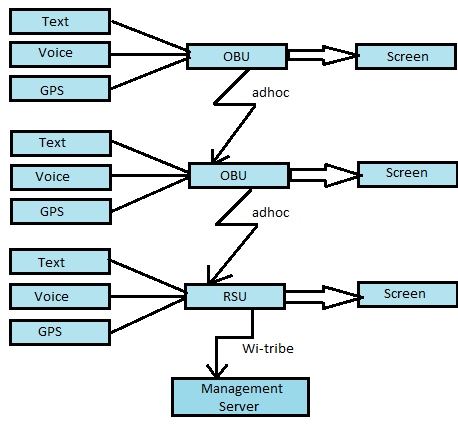
5 5 Journal of Computer Networks In such an environment, management of vehicles and their navigation would not be limited to the typical V2V communication scenario of VANET. Architectures based on simple road safety services and applications will require add-on services, involving a management server at the backend. For fleet based networks, the fleet nodes may be wide apart and out from communication range of other fleet nodes. In such cases, fleet nodes will be required to use a relaying entity for passage of critical information. The management server shall be responsible for relaying information amongst vehicles moving far away from each other. In addition to back link, the fleet nodes moving on the road may encounter presence of other fleet nodes at while crossing each other, in case of node halt or at convergence points etc. in such case, nodes will be required to share operator specific data to each other using V2V communication. Similarly for convoy nodes, most of the nodes will be involved in V2V communication scenario. However, back end connectivity to management server can be of extreme significance due to involvement of remote areas etc. Provision of back end link to each node may not be feasible or viable due to secrecy or other administrative requirements of the convoy. In such case, convoy nodes will also be involved for both V2V and direct / relay link to management server. 6. Test Bed Design Figure 3. Design Overview Considering the VANET architecture purely from fleet and convoy management perspective, we selected GeoNet as base line architecture. We dove tailed the overall design to make it simpler and generic according to ground needs. The concept of multi interface being used by CALM and GeoNet was considered as compulsion to provide backhaul link in the absence of large scale deployment of VANET. Resultantly, our nodes could communicate directly to management server over the internet using long range communication. V2V communication was made available using short range Wi-Fi links [9]. After detailed analysis of geometry and design requirements of fleet and convoy operators, we considered different services to be provided to the nodes. These services were considered over and above the road safety applications and services defined in the standard VANET designs, such as alarm for emergency brakes, accident alert etc. In the absence of a deployed architecture, a need was felt to provide route alerts, road and weather condition warnings, etc., through central server based on the concept of geographical tagging. Four applications were short listed as the bare minimum requirement to provide optimum efficiency to the fleet / convoy management system. The significance of four targeted services namely, text chat, voice chat, location updates and situational alerts, is explained subsequently Location & Situational Updates Any node equipped with VANET devices/software is the only source of data acquisition. The location and situational updates such as the node's own geographical location, weather and road condition updates can be obtained through onboard sensors. Collected data can subsequently be shared and disseminated to other nodes either through V2V or relay through management server. Hence, the said feature was considered as the basic necessity of any VANET based management system. Using LDM [6], each node as well as the management server can graphically observe the location of each node and other selected information. Location of each node acquired through GPS could be shared after a periodic interval through V2V communication and management server. The presence of each node location and other geographical based updates such as weather conditions in some specific area could help managers as well drivers to immediately respond to mobility scenarios. The facility could help the drivers to respond to eventualities, such as accidents, by approaching nearest nodes and vice versa Text Chat & Alert During the movement of a node away from other nodes and the management server, each node requires remote alerts. The easiest way to provide these alerts are interactive text messages and visual map alerts. The significance of both these alerts is their availability even if any driver missed them in the first instance. By using this service, the vehicles could share collected data through their onboard sensors and communicate with each other and with the management server accordingly. The shared data could be traffic-management related such as congestion, road blockage, broken road or bad weather warnings. Similarly, vehicle-management related information, such as need of fuel or any hookups etc can also be shared through same service 6.3. Emergency Alerts The emergency alert service such as accident alert allows affected driver to broadcast emergency message over the air through single touch at the console screen.
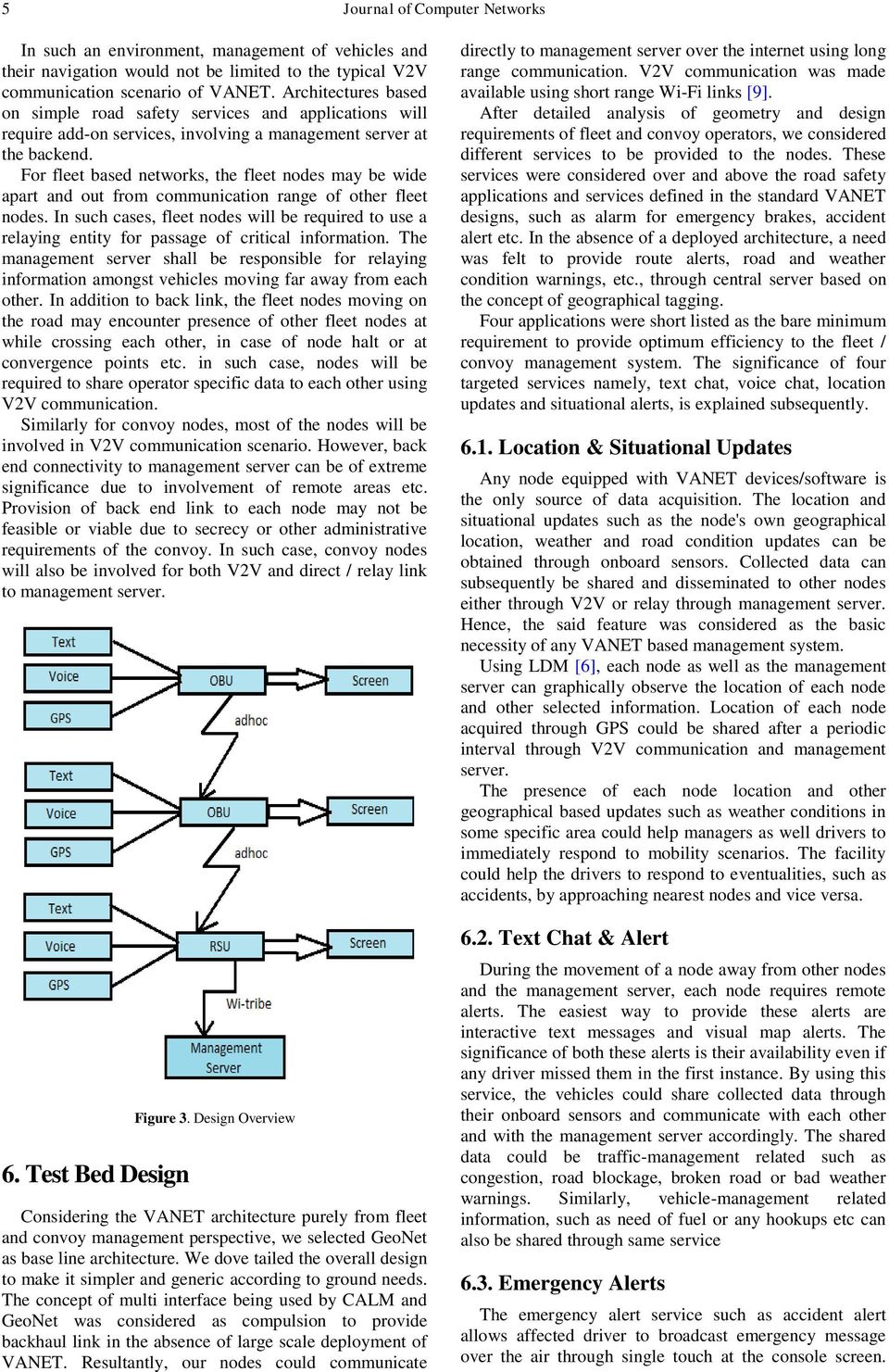
6 Journal of Computer Networks 6 The feature is an add-on to the text chat feature, where all relevant data such as node location, type of node, etc is shared with management server and all nearby nodes through automated procedure. Multiple emergency messages could be pre-programmed and disseminated among the users according to priority. The service allows efficient emergency response even to an ill trained or injured driver. Many other counter actions, such as information sharing to ambulance, police or other departments could also be linked according to type of message Voice Chat We considered the need of voice chat for an advanced user node, where situation demands higher degree of data sharing among nodes and management server. The basic purpose of text and voice chat is the same i.e. emergency alerts, providing utility and infotainment. However, sending a text message and then waiting for an acknowledgement may sometimes be inconvenient for the driver. Moreover, a situation where a driver needing a longer data link such as emergency health advice or advice in case of vehicle breakdown could be shared using voice chat. Figure 3 illustrates the basic design used for experimentation. We selected Wi-Fi for V2V communication and WiMAX for V2I (management server) communication. Although Wi-Fi has significantly short range of 100 meters, but it was selected only due to ease of availability and cost effectiveness. Our proposed design is not WiMAX or Wi-Fi dependent and any other available infrastructure could be used for both type of links such as P and HSDPA etc. The large scale deployment of WiMAX in Pakistan supported our design for backhaul connectivity. Considering the limited number of nodes and to provide ready state routing, we selected Optimized Link State Routing (OLSR) as network layer routing protocol. The OLSR has shown quite impressive results for limited node scenario in VANETS in comparison to other routing protocols [24]. 7. Prototype Development and Results The proposed design was implemented on ARM-11 and Intel ATOM boards in Linux environment. Each OBU was equipped with following:- Embedded Linux based ARM-11 / Intel ATOM mother boards. Backend application and database. Front end GUI applications build on JAVA for LDM and chatting service. A Global Positioning System (GPS) Dongle OLSRD daemon Wi-Fi interface for short range V2V & V2I communication WiMAX for long range V2I communication Touch screen based display The system was tested in two phases. In the first phase, the complete application (performing the mentioned four functions) was tested on three laptops. Two of these acted as OBU s and were made dynamic with respect to their location. The third machine was demonstrated as a management server and hence remained static in its position. Figure 4. Snapshot of Local Dynamic Map
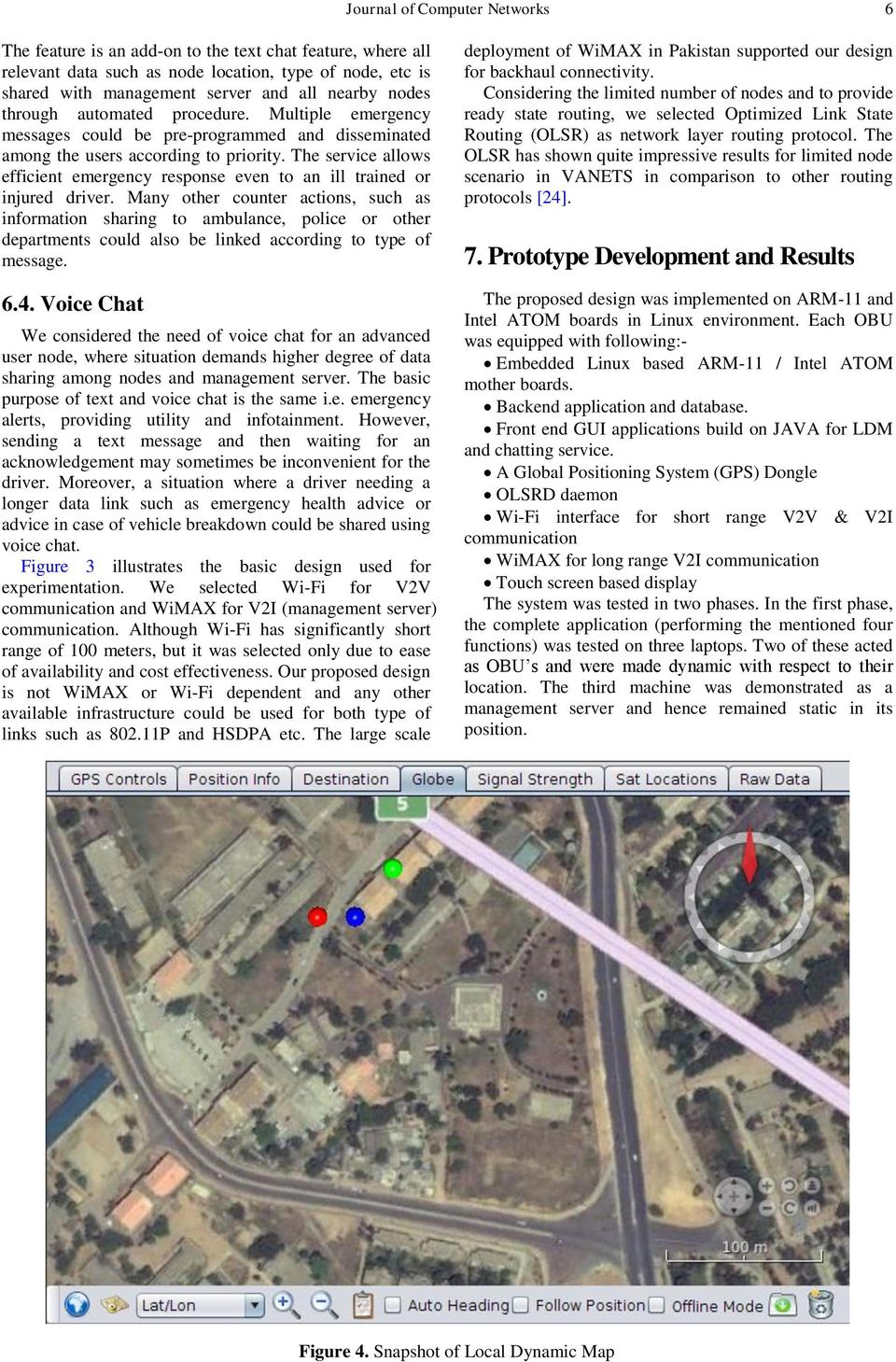
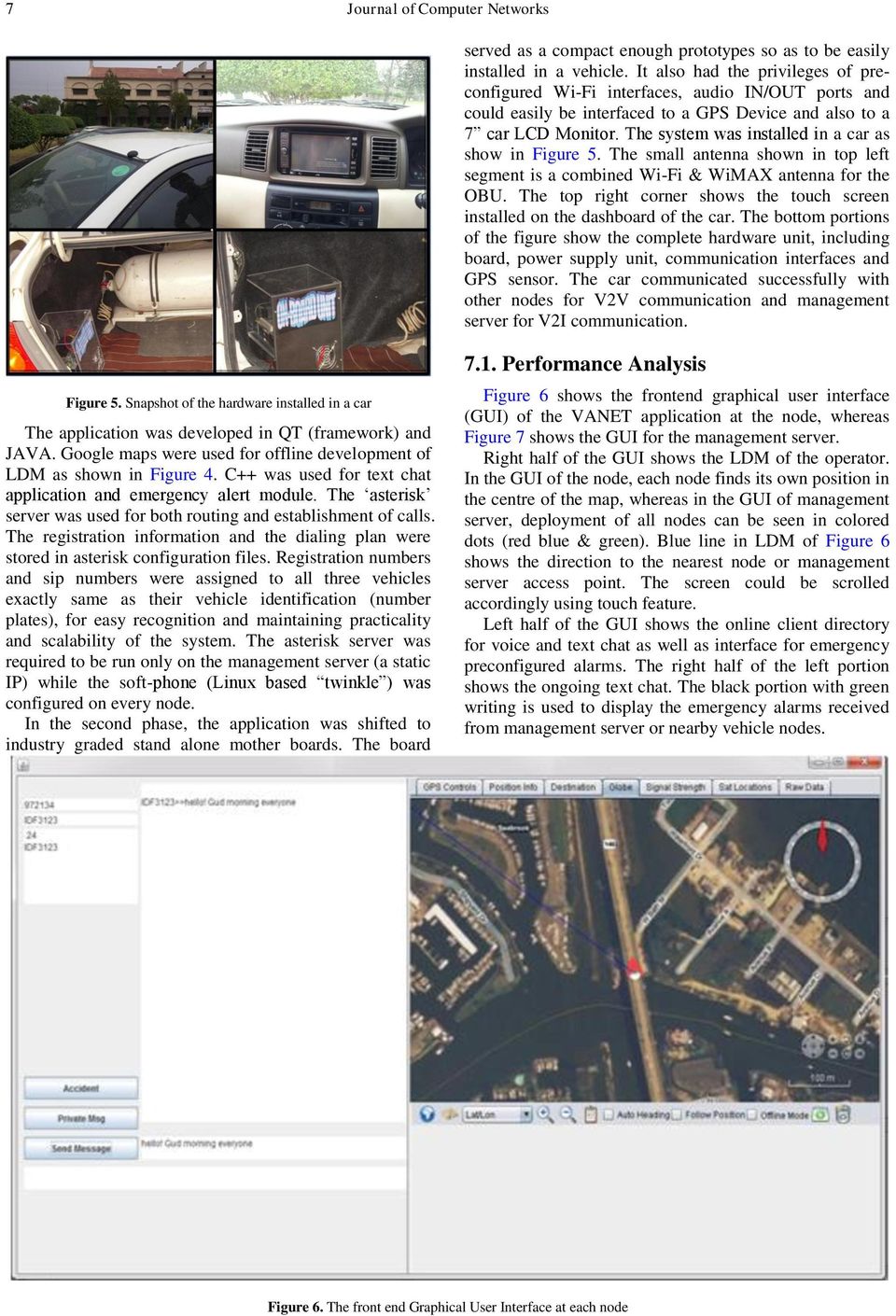
7 7 Journal of Computer Networks served as a compact enough prototypes so as to be easily installed in a vehicle. It also had the privileges of preconfigured Wi-Fi interfaces, audio IN/OUT ports and could easily be interfaced to a GPS Device and also to a 7 car LCD Monitor. The system was installed in a car as show in Figure 5. The small antenna shown in top left segment is a combined Wi-Fi & WiMAX antenna for the OBU. The top right corner shows the touch screen installed on the dashboard of the car. The bottom portions of the figure show the complete hardware unit, including board, power supply unit, communication interfaces and GPS sensor. The car communicated successfully with other nodes for V2V communication and management server for V2I communication. Figure 5. Snapshot of the hardware installed in a car The application was developed in QT (framework) and JAVA. Google maps were used for offline development of LDM as shown in Figure 4. C++ was used for text chat application and emergency alert module. The asterisk server was used for both routing and establishment of calls. The registration information and the dialing plan were stored in asterisk configuration files. Registration numbers and sip numbers were assigned to all three vehicles exactly same as their vehicle identification (number plates), for easy recognition and maintaining practicality and scalability of the system. The asterisk server was required to be run only on the management server (a static IP) while the soft-phone (Linux based twinkle ) was configured on every node. In the second phase, the application was shifted to industry graded stand alone mother boards. The board 7.1. Performance Analysis Figure 6 shows the frontend graphical user interface (GUI) of the VANET application at the node, whereas Figure 7 shows the GUI for the management server. Right half of the GUI shows the LDM of the operator. In the GUI of the node, each node finds its own position in the centre of the map, whereas in the GUI of management server, deployment of all nodes can be seen in colored dots (red blue & green). Blue line in LDM of Figure 6 shows the direction to the nearest node or management server access point. The screen could be scrolled accordingly using touch feature. Left half of the GUI shows the online client directory for voice and text chat as well as interface for emergency preconfigured alarms. The right half of the left portion shows the ongoing text chat. The black portion with green writing is used to display the emergency alarms received from management server or nearby vehicle nodes. Figure 6. The front end Graphical User Interface at each node
8 Journal of Computer Networks Performance Constraints The hardware independent development on two different types of mother boards made the design highly generic for implementation on any network. However, it was observed that development on ARM-11 board requires more expertise due to its peculiar nature. Due the unavailability of DSRC modules at reasonable budgets, Wi-Fi was used as the communication mode and its range was observed up to maximum of 150 meters. However for voice chat, quality of voice started degrading after around 70m. All nodes registered successfully with Asterisk and successful calls were established among all nodes using Wi-Fi and management server using WiMAX. Initially location updates were shared with the periodic delay of 3 seconds which could be reduced to 1 second according to type of network. Considering the maximum speed of 120 kmph, a node actual position may vary to an acceptable limit of 30 meters only. The variation is not significant as the application on the nodes does not involve accident avoidance scenario. The provision of emergency response and other local updates may well be coordinated in advance according to 30 meters error limit. 8. Conclusions Working under a typical VANET environment, the system was observed to be highly efficient for traffic load management and resource management. Communication to the management server was reliable (i.e. no data loss was observed) and efficient enough. The three node scenario was developed such that it is scalable enough to be extended to a number of nodes and additions and modifications in the functionality / application can be implemented in a generic manner. Figure 7. Graphical User Interface at the management server A lot of future enhancements are possible. Data ranges may be extended by replacing the Wi-Fi module with DSRC. Noise observed during voice chat may be reduced by implementing any echo-reduction and noise reduction algorithms in asterisk software. For constructing a better Fleet Management System, functionalities such as speed and fuel management may as well be implemented in future. References [1] Moez Jerbi, Sidi Mohammed Senouci, Mohammed Cherif, Yacine Ghamri Vehicular Communications Networks: Current Trends and Challenges Book Chapter in Next Generation Mobile Networks and Ubiquitous Computing IGI Global, [2] Jeffrey Miller Vehicle to Vehicle to Infrastructure (V2V2I) Intelligent Transportation System Architecture IEEE Intelligent Vehicles Symposium, [3] Jose Santa, Antonio Moragon and Antonio F. Gomez-Skarmet Experimental Evaluation of a Novel Vehicular Communication Paradigm Based on Cellular Networks 2008 IEEE Intelligent Vehicles Symposium Eindhoven University of Technology Eindhoven, The Netherlands, June 4-6, 2008 [4] Tamer Nadeem, Pravin Shankar, Liviu Iftode, A comparative study of data dissemination models for VANETs, in: Third Annual International Conference on Mobile and Ubiquitous Systems: Computing, Networking and Services, San Jose, [5] Böhm and M. Jonsson, Handover in IEEE p-based Delay- Sensitive Vehicle-to-Infrastructure Communication, Research Report IDE , School of Information Science, Computer and Electrical Engineering (IDE), Halmstad University, Sweden, [6] GeoNet. Final GeoNet Specification. GeoNet Deliverable D2.2, January [7] J. Choi, Y. Khaled, M. Tsukada, and T. Ernst. IPv6 support for VANET with geographical routing. In Proc. of the ITST, Pukhet, Thailand, 2008 [8] V. Gonzalez, A. L. Santos, C. Pinart, and F. Milagro, Experimental demonstration of the viability of IEEE b based inter-vehicle communications, in TridentCom 2008, March [9] Chien-Ming Chou, Chen-Yuan Li, Wei-Min Chien, and Kun-Chan Lan A Feasibility Study on Vehicle-to-Infrastructure

9 9 Journal of Computer Networks Communication: Wi-Fi vs. WiMAX. Mobile Data Management 2009: [10] Toshiya Okabe, Takayuki Shizuno, Tsutomu Kitamura, Wireless LAN access network system for moving vehicles, in: 10th IEEE Symposium on Computers and Communications (ISCC05), La Manga del Mar Menor, [11] DSRC The DSRC Project, [12] Hannes Hartenstein and Kenneth P Laberteaux, Ed VANET: Vehicular Applications and Inter-Networking Technologies John Wiley & Sons, Ltd [13] Task Group p, IEEE P802.11p: Wireless Access in Vehicular Environments (WAVE), draft standard ed., IEEE Computer Society, [14] Committee SCC32, IEEE P Standard for Wireless Access in Vehicular Environments (WAVE) - Multi-Channel Operation, draft standard ed., IEEE ITS Council, [15] Sajjad Akbar Mohammad, Asim Rasheed and Amir Qayyum, VANET Architectures and Protocol Stacks: A Survey Communication Technologies For Vehicles, Lecture Notes in Computer Science, 2011, Volume 6596/2011, [16] C2C Car2Car Communication Consortium, [17] ETSI. Intelligent Transport Systems (ITS); Vehicular Communications; GeoNetworking and Data Transport; Part 6: Transmission of IPv6 Packets over Geo-Networking Protocols. ETSI, December [18] TC204 WG16. Intelligent Transport Systems Communication for Land Mobiles (CALM) Architecture. ISO FDIS specification 21217, ISO, October ( [19] CO-OPerative SystEms for Intelligent Road Safety, 2006 ( [20] SAFESPOT Integrated Project, 2006 ( [21] CVIS Project for Intelligent Co-operative System, 2006 ( [22] European ITS Communication Architecture - Overall Framework - Proof of Concept Implementation. Draft Version 2.0, COMeSafety Specific Support Action, [23] SE-cure VE-hicle COM-munication, SEVECOM, 2006 ( [24] Imran Khan and Amir Qayyum, Performance evaluation of AODV and OLSR in highly fading vehicular ad hoc network environments 13th IEEE International Multi-topic Conference (2009).
![Communications (ISCC05), La Manga del Mar Menor, 2005. [11] DSRC The DSRC Project, http://www.leearmstrong.com/dsrc/dsrchomeset.](/docs-images/40/7408113/images/page_9.jpg "[12] Hannes Hartenstein and Kenneth P Laberteaux, Ed VANET: Vehicular Applications and Inter-Networking Technologies John Wiley & Sons, Ltd 2010. [13] Task Group p, IEEE P802.")
INTERNET FOR VANET NETWORK COMMUNICATIONS -FLEETNET-
 ABSTRACT INTERNET FOR VANET NETWORK COMMUNICATIONS -FLEETNET- Bahidja Boukenadil¹ ¹Department Of Telecommunication, Tlemcen University, Tlemcen,Algeria Now in the world, the exchange of information between
Automotive Communication via Mobile Broadband Networks
 Automotive Communication via Mobile Broadband Networks Dr. Joachim Sachs Ericsson Corporate Research, Aachen Contributors: René Rembarz, Mai-Anh Phan, Sabine Sories Where are we in telecommunications?
Car Connections. Johan Lukkien. System Architecture and Networking
 Car Connections Johan Lukkien System Architecture and Networking 1 Smart mobility, TU/e wide Cooperative Driving (platooning), A270: Helmond-Eindhoven, 2011 (Mechanical Engineering/TNO) Full electric:
Securing Wireless Access for Vehicular Environments (WAVE)
 Securing Wireless Access for Vehicular Environments (WAVE) May 7, 2009 CTST, New Orleans Tim Weil CISSP/CISA Security Architect ITS Engineering Booz Allen Hamilton 0 The concept of VII started upon the
CVIS Cooperation Vehicle Infrastructure Systems
 CVIS Cooperation Vehicle Infrastructure Systems Øyvind Kristiansen, Q-Free Fagmøte NVTF Østlandet 7. oktober 2009 Outline CVIS Project CVIS Architecture CVIS Applications CVIS PROJECT What can be improved?
Securing Wireless Access in Vehicular Environments (WAVE) Infrastructure and Operations Support Systems(OSS) Architecture
 IEEE GLOBECOM Design and Developers Forum Securing Wireless Access in Vehicular Environments (WAVE) Infrastructure and Operations Support Systems(OSS) Architecture Tim Weil CISSP, CISA Booz Allen Hamilton
Performance Evaluation of VANETs with Multiple Car Crashes in Different Traffic Conditions
 Performance Evaluation of VANETs with Multiple Car Crashes in Different Traffic Conditions Georgios Charalampopoulos 1,2 and Tasos Dagiuklas 1 1. Dept. of Computer Science, Hellenic Open University, Greece,
VEHICLE TRACKING SYSTEM USING GPS. 1 Student, ME (IT) Pursuing, SCOE, Vadgaon, Pune. 2 Asst. Professor, SCOE, Vadgaon, Pune
 VEHICLE TRACKING SYSTEM USING GPS Pooja P. Dehankar 1, 1 Student, ME (IT) Pursuing, SCOE, Vadgaon, Pune Prof. S. P. Potdar 2 2 Asst. Professor, SCOE, Vadgaon, Pune Abstract- Global Positioning System is
The Vision of Vehicle Infrastructure Integration (VII)
 The Vision of Vehicle Infrastructure Integration (VII) Ralph L. Robinson ITS Integration Office September, 2007 Cooperative Highways SAFETY MOBILITY Collision Avoidance Signal Control Emergency Alerts
Vehicular Cloud. Fan Zhang
 Vehicular Cloud Fan Zhang Outline VANET Cloud computing Vehicular cloud: motivation and concept Application scenarios Challenges: architecture/security Data forwarding Questions VANET Deliver timely information
CHAPTER 6. VOICE COMMUNICATION OVER HYBRID MANETs
 CHAPTER 6 VOICE COMMUNICATION OVER HYBRID MANETs Multimedia real-time session services such as voice and videoconferencing with Quality of Service support is challenging task on Mobile Ad hoc Network (MANETs).
Current and Future Trends in Hybrid Cellular and Sensor Networks
 2010-10-19 Current and Future Trends in Hybrid Cellular and Sensor Networks Yongjun Liu, Bin Zhen, Yong Xu, Hui Yang, Betty Zhao [email protected] www.huawei.com ETSI TC M2M Workshop 19-20 October
The Future of the Automobile Vehicle Safety Communications. Stanford University ME302 Luca Delgrossi, Ph.D. April 1, 2014
 The Future of the Automobile Vehicle Safety Communications Stanford University ME302 Luca Delgrossi, Ph.D. April 1, 2014 About your lecturer Luca Delgrossi, Ph. D. Born in Italy, I live in the US since
Cognitive radio for vehicular ad hoc networks (CR-VANETs): approaches and challenges
 Singh et al. EURASIP Journal on Wireless CommunicationsandNetworking 2014, 2014:49 REVIEW Open Access Cognitive radio for vehicular ad hoc networks (CR-VANETs): approaches and challenges Kamal Deep Singh
Municipal Mesh Network Design
 White Paper Municipal Mesh Network Design Author: Maen Artimy 1 Summary This document provides a wireless mesh network design for the downtown area of the Town of Wolfville, Nova Scotia. This design serves
Research Projects in the Mobile Computing and Networking (MCN) Lab
 Research Projects in the Mobile Computing and Networking (MCN) Lab Guohong Cao Department of Computer Science and Engineering The Pennsylvania State University http://www.cse.psu.edu/~gcao Mobile Computing
A Comparative Study between 802.11p and Mobile WiMAX-based V2I Communication Networks
 A Comparative Study between 82.11p and Mobile WiMAX-based V2I Communication Networks Ikbal Chammakhi Msadaa, Pasquale Cataldi and Fethi Filali EURECOM, Mobile Communications Department 694 Sophia-Antipolis,
An OSGi based HMI for networked vehicles. Telefónica I+D Miguel García Longarón
 June 10-11, 2008 Berlin, Germany An OSGi based HMI for networked vehicles Telefónica I+D Miguel García Longarón Networked Vehicle 2 Networked Vehicle! Tomorrow, the vehicles will be networked! Using Always
Technical Document on Vehicular Networks
 Technical Document on Vehicular Networks GDD-06-18 GENI: Global Environment for Network Innovations September 15, 2006 Status: Draft (Version 2.0) Note to the reader: this document is a work in progress
Quantifying the Performance Degradation of IPv6 for TCP in Windows and Linux Networking
 Quantifying the Performance Degradation of IPv6 for TCP in Windows and Linux Networking Burjiz Soorty School of Computing and Mathematical Sciences Auckland University of Technology Auckland, New Zealand
Wireless traffic Safety network between Cars. CoMoSeF TULEVAT TRENDIT AUTOJEN M2M KOMMUNIKAATIOSSA WISAFECAR JA COMOSEF PROJEKTIT
 TULEVAT TRENDIT AUTOJEN M2M KOMMUNIKAATIOSSA WISAFECAR JA COMOSEF PROJEKTIT WiSafeCar Particpants Mobisoft (Co-ordinator) Finnish Meteorological Institute VTT Infotripla Taipale Telematics Sunit University
Implementation of CVIS ITS Application in a Driving Simulator Environment Kenneth Sørensen, [email protected] SINTEF
 Denne artikel er publiceret i det elektroniske tidsskrift Artikler fra Trafikdage på Aalborg Universitet (Proceedings from the Annual Transport Conference at Aalborg University) ISSN 1603-9696 www.trafikdage.dk/artikelarkiv
Performance Evaluation of the IEEE 802.11p WAVE Communication Standard
 Performance Evaluation of the IEEE 8.p WAVE Communication Standard Stephan Eichler ([email protected]), Institute of Communication Networks, Technische Universität München Abstract In order to provide Dedicated
Vehicle Tracking System using GPRS
 Urban Transport XIII: Urban Transport and the Environment in the 21st Century 409 Vehicle Tracking System using GPRS S. Ikram 1 & F. T. Shah 2 1 Seidco Communication L.L.C, Abu Dhabi, UAE 2 COMSATS Institute
Designing and simulating a Car2X communication system using the example of an intelligent traffic sign
 Designing and simulating a Car2X communication system using the example of an intelligent traffic sign Master s Thesis to obtain the academic degree Master of Science Department of Computer Science Professorship
Performance Evaluation of AODV, OLSR Routing Protocol in VOIP Over Ad Hoc
 (International Journal of Computer Science & Management Studies) Vol. 17, Issue 01 Performance Evaluation of AODV, OLSR Routing Protocol in VOIP Over Ad Hoc Dr. Khalid Hamid Bilal Khartoum, Sudan [email protected]
Discovering Computers 2008. Chapter 9 Communications and Networks
 Discovering Computers 2008 Chapter 9 Communications and Networks Chapter 9 Objectives Discuss the the components required for for successful communications Identify various sending and receiving devices
Performance Analysis of Authentication Protocols in Vehicular Ad Hoc Networks (VANET)
 Performance Analysis of Authentication Protocols in Vehicular Ad Hoc Networks (VANET) Abdul Kalam Kunnel Aboobaker Technical Report RHUL MA 2010 02 31st March 2010 Department of Mathematics Royal Holloway,
HMS Industrial Networks
 HMS Industrial Networks Putting industrial applications on the cloud Whitepaper Best practices for managing and controlling industrial equipment remotely. HMS Industrial Networks AB Stationsgatan 37 30245
Towards Efficient Routing in Vehicular Ad Hoc Networks
 Towards Efficient Routing in Vehicular Ad Hoc Networks Moez Jerbi*, Sidi-Mohammed Senouci* and Yacine Ghamri-Doudane** *France Telecom R&D, Core Network Laboratories, Lannion, France **Networks and Multimedia
California PATH, University of California at Berkeley, Building 452, Richmond Field Station 1357 South 46 th Street, Richmond, CA 94804
 1. Report No. CA14-2146B 2. Government Accession No. 3. Recipient s Catalog No. 4. Title and Subtitle Executive Summary for the UC Berkeley, California PATH s Augmented Speed Enforcement Project 5. Report
Performance Evaluation of VoIP Services using Different CODECs over a UMTS Network
 Performance Evaluation of VoIP Services using Different CODECs over a UMTS Network Jianguo Cao School of Electrical and Computer Engineering RMIT University Melbourne, VIC 3000 Australia Email: [email protected]
Location Identification and Vehicle Tracking using VANET(VETRAC)
 Location Identification and Vehicle Tracking using VANET(VETRAC) Supervisor Name: Md. Mosaddik Hasan Assistant Professor Dept. of CSE MBSTU Md. Al-Amin Nipu CE-10031 Dept. of CSE MBSTU Abstract: Large
LoRaWAN. What is it? A technical overview of LoRa and LoRaWAN. Technical Marketing Workgroup 1.0
 LoRaWAN What is it? A technical overview of LoRa and LoRaWAN Technical Marketing Workgroup 1.0 November 2015 TABLE OF CONTENTS 1. INTRODUCTION... 3 What is LoRa?... 3 Long Range (LoRa )... 3 2. Where does
Wireless Technologies for the 450 MHz band
 Wireless Technologies for the 450 MHz band By CDG 450 Connectivity Special Interest Group (450 SIG) September 2013 1. Introduction Fast uptake of Machine- to Machine (M2M) applications and an installed
ENSC 427: Communication Networks. Analysis of Voice over IP performance on Wi-Fi networks
 ENSC 427: Communication Networks Spring 2010 OPNET Final Project Analysis of Voice over IP performance on Wi-Fi networks Group 14 members: Farzad Abasi ([email protected]) Ehsan Arman ([email protected]) http://www.sfu.ca/~faa6
Communications and Computer Networks
 SFWR 4C03: Computer Networks and Computer Security January 5-8 2004 Lecturer: Kartik Krishnan Lectures 1-3 Communications and Computer Networks The fundamental purpose of a communication system is the
Demystifying Wireless for Real-World Measurement Applications
 Proceedings of the IMAC-XXVIII February 1 4, 2010, Jacksonville, Florida USA 2010 Society for Experimental Mechanics Inc. Demystifying Wireless for Real-World Measurement Applications Kurt Veggeberg, Business,
NetComm Wireless NP920 Dual Band WiFi USB Adapter. User Guide
 NetComm Wireless NP920 Dual Band WiFi USB Adapter User Guide Contents Preface... 3 Important Safety Instructions... 3 Introduction... 4 Overview... 4 Features... 4 Package Contents... 5 Minimum System
Wireless Home Networks based on a Hierarchical Bluetooth Scatternet Architecture
 Wireless Home Networks based on a Hierarchical Bluetooth Scatternet Architecture W. Lilakiatsakun'. 2, A. Seneviratne' I School of Electrical Engineering and Telecommunication University of New South Wales,
CROSS LAYER BASED MULTIPATH ROUTING FOR LOAD BALANCING
 CHAPTER 6 CROSS LAYER BASED MULTIPATH ROUTING FOR LOAD BALANCING 6.1 INTRODUCTION The technical challenges in WMNs are load balancing, optimal routing, fairness, network auto-configuration and mobility
COMMUNICATIONS SYSTEMS USED FOR ITS
 COMMUNICATIONS SYSTEMS USED FOR ITS Index Purpose Description Technologies 1 of 5 Purpose The telecommunication system is the main element for the development of telematics in Transport field. It enables
LTE, WLAN, BLUETOOTHB
 LTE, WLAN, BLUETOOTHB AND Aditya K. Jagannatham FUTURE Indian Institute of Technology Kanpur Commonwealth of Learning Vancouver 4G LTE LTE (Long Term Evolution) is the 4G wireless cellular standard developed
Portable Wireless Mesh Networks: Competitive Differentiation
 Portable Wireless Mesh Networks: Competitive Differentiation Rajant Corporation s kinetic mesh networking solutions combine specialized command and control software with ruggedized, high-performance hardware.
Quality of Service Analysis of Video Conferencing over WiFi and Ethernet Networks
 ENSC 427: Communication Network Quality of Service Analysis of Video Conferencing over WiFi and Ethernet Networks Simon Fraser University - Spring 2012 Claire Liu Alan Fang Linda Zhao Team 3 csl12 at sfu.ca
A Low Cost Vehicle Monitoring System for Fixed Routes Using Global Positioning System (GPS)
 A Low Cost Vehicle Monitoring System for Fixed Routes Using Global Positioning System (GPS) Mark Darren Savuriar, Chandrasekharan Nataraj, Chitturi Venkatratnam, Sardar Ali School of Engineering Asia Pacific
Chapter 17: M2M-Based Metropolitan Platform for IMS-Enabled Road Traffic Management in IoT
 Chapter 17: M2M-Based Metropolitan Platform for IMS-Enabled Road Traffic Management in IoT Chih-Yuan Lee Department of CSIE National Taipei University 1 Outline Abstract Introduction Background System
Intelligent Transportation System for Vehicular Ad-Hoc Networks
 Intelligent Transportation System for Vehicular Ad-Hoc Networks T. Sujitha 1, S. Punitha Devi 2 1,2 Department of CSE, P.A College of Engineering and Technology, Coimbatore, Tamilnadu Abstract - Vehicular
How To Analyze The Security On An Ipa Wireless Sensor Network
 Throughput Analysis of WEP Security in Ad Hoc Sensor Networks Mohammad Saleh and Iyad Al Khatib iitc Stockholm, Sweden {mohsaleh, iyad}@iitc.se ABSTRACT This paper presents a performance investigation
A NIMS Smart Practice
 NIMS Smart Practice: 02-06 NIMS Integration Center, May 2006 www.fema.gov/emergency/nims 202-646-3850 A NIMS Smart Practice IN ALLEGANY COUNTY, MARYLAND: A MUNICIPAL WIRELESS NETWORK PROVIDING ENHANCED
INTELLIGENT TRANSPORT IN REAL TIME BUILDING CONFIDENCE, IMPROVING PERFORMANCE
 INTELLIGENT TRANSPORT IN REAL TIME BUILDING CONFIDENCE, IMPROVING PERFORMANCE ABOUT CONNEXIONZ THE SMART SOLUTION TO TRANSPORT MANAGEMENT S mart phones, smart grids, smart cars the list of smart technologies
Performance Analysis of VoIP Codecs over BE WiMAX Network
 Performance Analysis of VoIP Codecs over BE WiMAX Network Muhammad Imran Tariq, Muhammad Ajmal Azad, Razvan Beuran, Yoichi Shinoda Japan Advanced Institute of Science and Technology, Ishikawa, Japan National
Performance monitoring and analysis of wireless communication protocols for mobile devices
 Performance monitoring and analysis of wireless communication protocols for mobile devices Almudena Díaz, Pedro Merino, F. Javier Rivas Departamento de Lenguajes y Ciencias de la Computación, University
IJMIE Volume 2, Issue 7 ISSN: 2249-0558
 Evaluating Performance of Audio conferencing on Reactive Routing Protocols for MANET Alak Kumar Sarkar* Md. Ibrahim Abdullah* Md. Shamim Hossain* Ahsan-ul-Ambia* Abstract Mobile ad hoc network (MANET)
Cisco Positive Train Control: Enhancing End-to-End Rail Safety
 Solution Overview Cisco Positive Train Control: Enhancing End-to-End Rail Safety What You Will Learn Positive Train Control (PTC), one of many new safety measures mandated by the U.S. Federal Government,
Mobile Device Management Platform Operation Manual V1.4 RECODA
 Mobile Device Management Platform Operation Manual V1.4 Shenzhen Technologies Limited All rights reserved Contents 1. Overview... 4 2. Preparations for Installation... 5 3. Installation Guide... 6 3.1.
Wave Relay System and General Project Details
 Wave Relay System and General Project Details Wave Relay System Provides seamless multi-hop connectivity Operates at layer 2 of networking stack Seamless bridging Emulates a wired switch over the wireless
Modelling Quality of Service in IEEE 802.16 Networks
 1 Modelling Quality of Service in IEEE 802.16 Networks Giuseppe Iazeolla1, Pieter Kritzinger2 and Paolo Pileggi2 1 Software Engineering and System Performance Modelling Group University of Roma Tor Vergata,
AERONAUTICAL COMMUNICATIONS PANEL (ACP) ATN and IP
 AERONAUTICAL COMMUNICATIONS PANEL (ACP) Working Group I - 7 th Meeting Móntreal, Canada 2 6 June 2008 Agenda Item x : ATN and IP Information Paper Presented by Naoki Kanada Electronic Navigation Research
An IEEE 802.11 static mesh network design for isolated rural areas in developing regions
 An IEEE 802.11 static mesh network design for isolated rural areas in developing regions Javier Simó Pablo Osuna < [email protected]> Joaquín Seoane Andrés Martínez
HMS Industrial Networks. Putting industrial applications on the cloud
 HMS Industrial Networks Putting industrial applications on the cloud Whitepaper Best practices for managing and controlling industrial equipment remotely. HMS Industrial Networks Inc 35 E Wacker Drive,
Analysis of Effect of Handoff on Audio Streaming in VOIP Networks
 Beyond Limits... Volume: 2 Issue: 1 International Journal Of Advance Innovations, Thoughts & Ideas Analysis of Effect of Handoff on Audio Streaming in VOIP Networks Shivani Koul* [email protected]
Machine-to-Machine Technologies
 Machine-to-Machine Technologies Vision, Standards and Applications Mischa Dohler Coordinator of Research, CTTC Distinguished Lecturer, IEEE Editor-in-Chief, ETT BoD, Worldsensing Chair Professor, KCL (1
Call for Proposal: Internet-of-Things (IoT) for Intelligent Buildings and Transportation
 HKUST-MIT Research Alliance Consortium Call for Proposal: Internet-of-Things (IoT) for Intelligent Buildings and Transportation Lead Universities Participating Universities 1 The expansion of internet
Honeywell s OneWireless Network - The Building Blocks of Reliability Vibhor Tandon, Honeywell Process Solutions
 White Paper Honeywell s OneWireless Network - The Building Blocks of Reliability Vibhor Tandon, Honeywell Process Solutions Executive Summary User expectations for network availability and tolerance for
Channels of Delivery of Travel Information (Static and Dynamic On-Trip Information)
 Channels of Delivery of Travel Information (Static and Dynamic On-Trip Information) Index Purpose Description Relevance for Large Scale Events Options Technologies Impacts Integration potential Implementation
Introduction Chapter 1. Uses of Computer Networks
 Introduction Chapter 1 Uses of Computer Networks Network Hardware Network Software Reference Models Example Networks Network Standardization Metric Units Revised: August 2011 Uses of Computer Networks
Networking: Certified Wireless Network Administrator Wi Fi Engineering CWNA
 coursemonster.com/uk Networking: Certified Wireless Network Administrator Wi Fi Engineering CWNA View training dates» Overview This new market-leading course from us delivers the best in Wireless LAN training,
Product Information = = = www.anynode.de e-mail [email protected] phone +49 5363 8195-0
 07 2015 2 Efficient communication anynode is a Session Border Controller that is entirely a software based solution. It works as an interface for any number of SIP UAs for example, SIP phones and SIP PBXs,
Chapter 6 Telecommunications, Networks, and Wireless. Computing
 Chapter 6 Telecommunications, Networks, and Wireless Computing Essay Questions: 1. Define a hub, switch, and a router. 2. List the challenges associated with managing contemporary telecommunications and
Tactical Service Bus: The flexibility of service oriented architectures in constrained theater environments
 Tactical Bus: The flexibility of service oriented architectures in constrained theater environments Tactical Edge in NATO Context Tactical still very much under control of national forces: Zone of Operations
Goal We want to know. Introduction. What is VoIP? Carrier Grade VoIP. What is Meant by Carrier-Grade? What is Meant by VoIP? Why VoIP?
 Goal We want to know Introduction What is Meant by Carrier-Grade? What is Meant by VoIP? Why VoIP? VoIP Challenges 2 Carrier Grade VoIP Carrier grade Extremely high availability 99.999% reliability (high
Establishing How Many VoIP Calls a Wireless LAN Can Support Without Performance Degradation
 Establishing How Many VoIP Calls a Wireless LAN Can Support Without Performance Degradation ABSTRACT Ángel Cuevas Rumín Universidad Carlos III de Madrid Department of Telematic Engineering Ph.D Student
4. H.323 Components. VOIP, Version 1.6e T.O.P. BusinessInteractive GmbH Page 1 of 19
 4. H.323 Components VOIP, Version 1.6e T.O.P. BusinessInteractive GmbH Page 1 of 19 4.1 H.323 Terminals (1/2)...3 4.1 H.323 Terminals (2/2)...4 4.1.1 The software IP phone (1/2)...5 4.1.1 The software
LTE Performance and Analysis using Atoll Simulation
 IOSR Journal of Electrical and Electronics Engineering (IOSR-JEEE) e-issn: 2278-1676,p-ISSN: 2320-3331, Volume 9, Issue 6 Ver. III (Nov Dec. 2014), PP 68-72 LTE Performance and Analysis using Atoll Simulation
VOICE OVER IP AND NETWORK CONVERGENCE
 POZNAN UNIVE RSITY OF TE CHNOLOGY ACADE MIC JOURNALS No 80 Electrical Engineering 2014 Assaid O. SHAROUN* VOICE OVER IP AND NETWORK CONVERGENCE As the IP network was primarily designed to carry data, it
M2M ATDI services. M2M project development, Business model, Connectivity.
 M2M ATDI services M2M project development, Business model, Connectivity. Introduction Thanks to our leadership in Spectrum management, Prospective planning, Network deployment, ATDI was/is involved in
5. DEPLOYMENT ISSUES Having described the fundamentals of VoIP and underlying IP infrastructure, let s address deployment issues.
 5. DEPLOYMENT ISSUES Having described the fundamentals of VoIP and underlying IP infrastructure, let s address deployment issues. 5.1 LEGACY INTEGRATION In most cases, enterprises own legacy PBX systems,
IP Telephony (Voice over IP)
 (Voice over IP) Instructor Ai-Chun Pang, [email protected] Office Number: 417, New building of CSIE Textbook Carrier Grade Voice over IP, D. Collins, McGraw-Hill, Second Edition, 2003. Requirements
Region 10 Videoconference Network (R10VN)
 Region 10 Videoconference Network (R10VN) Network Considerations & Guidelines 1 What Causes A Poor Video Call? There are several factors that can affect a videoconference call. The two biggest culprits
MetroNet6 - Homeland Security IPv6 R&D over Wireless
 MetroNet6 - Homeland Security IPv6 R&D over Wireless By: George Usi, President, Sacramento Technology Group and Project Manager, California IPv6 Task Force [email protected] Acknowledgement Reference:
Elektrische Signalverarbeitung Dr. Fischer GmbH
 Elektrische Signalverarbeitung Dr. Fischer GmbH ISO CALM Lower Layers and FAST mode November 2006, Dallas Fichtenweg 9 - Asch D-89143 Blaubeuren Phone: +49-7344-9191-88 Fax: +49-7344-9191-23 E-Mail: [email protected]
Next Generation 802.11 Wireless Local Area Networks
 Next Generation 802.11 Wireless Local Area Networks This is a 2 day course technical course intended to give student a solid understanding of the emerging IEEE 802.11 standards, how it works including
10 Gigabit Ethernet: Scaling across LAN, MAN, WAN
 Arasan Chip Systems Inc. White Paper 10 Gigabit Ethernet: Scaling across LAN, MAN, WAN By Dennis McCarty March 2011 Overview Ethernet is one of the few protocols that has increased its bandwidth, while
3-12 Autonomous Access Control among Nodes in Sensor Networks with Security Policies
 3-12 Autonomous Access Control among Nodes in Sensor Networks with Security Policies This paper describes a new framework of policy control sensor networks. Sensor networks are shared by various applications,
An M2M-Based Interface Management Framework for Vehicles with Multiple Network Interfaces
 An M2M-Based Interface Management Framework for Vehicles with Multiple Network Interfaces Hong-Jong Jeong, Sungwon Lee, Dongkyun Kim and Yong-Geun Hong Abstract The Intelligent Transportation System (ITS)
Architecture of distributed network processors: specifics of application in information security systems
 Architecture of distributed network processors: specifics of application in information security systems V.Zaborovsky, Politechnical University, Sait-Petersburg, Russia [email protected] 1. Introduction Modern
VEHICULAR NETWORKS DEPLOYMENT VIEW: APPLICATIONS, DEPLOYMENT ARCHITECTURES AND SECURITY MEANS
 VEHICULAR NETWORKS DEPLOYMENT VIEW: APPLICATIONS, DEPLOYMENT ARCHITECTURES AND SECURITY MEANS Hassnaa Moustafa and Gilles Bourdon France Telecom R&D (Orange Labs) 38-40 rue du General Leclerc, 92794 Issy