
Designing for Diversity in Matching
|
|
|
- Austin Maxwell
- 10 years ago
- Views:
Transcription
1 Designing for Diversity in Matching Scott Duke Kominers Society of Fellows Harvard University Tayfun Sönmez Department of Economics Boston College July 25, 2013 Astract To encourage diversity, schools often reserve some slots for students of specific types. Students only care aout their school assignments and contractual terms like tuition, and hence are indifferent among slots within a school. Because these indifferences can e resolved in multiple ways, they present an opportunity for novel market design. We introduce a two-sided, many-to-one matching with contracts model in which agents with unit demand match to ranches, which may have multiple slots availale to accept contracts. Each slot has its own linear priority order over contracts; a ranch chooses contracts y filling its slots sequentially. We demonstrate that in these matching markets with slot-specific priorities, ranches choice functions may not satisfy the sustitutaility conditions typically crucial for matching with contracts. Despite this complication, we are ale to show that stale outcomes exist in this framework and can e found y a cumulative offer mechanism that is strategy-proof and respects unamiguous improvements in priority. Our results provide insight into the design of transparent affirmative action matching mechanisms. Additionally, they enale us to introduce a new market design application allocation of airline seat upgrades and show the value of a seemingly ad hoc administrative decision in the United States Military Academy s ranch-of-choice program. JEL classification: C78, D63, D78. Keywords: Market Design, Matching with Contracts, Staility, Strategy-Proofness, School Choice, Affirmative Action, Airline Seat Upgrades. The authors are deeply grateful to Parag Pathak for his comments and for providing access to data from the Chicago pulic school choice program. They appreciate the helpful suggestions of Samson Alva, Susan Athey, Gadi Barlevy, Marco Bassetto, Gary Becker, Eric Budish, Darrell Duffie, Steven Durlauf, Drew Fudenerg, Pingyang Gao, Edward Glaeser, Jason Hartline, John William Hatfield, Sam Hwang, Matthew Jackson, Sonia Jaffe, Fuhito Kojima, Ellen Dickstein Kominers, Jonathan Levin, Roert Lucas, Paul Milgrom, Roger Myerson, Yusuke Narita, Derek Neal, Alexandru Nichifor, Muriel Niederle, Michael Ostrovsky, Mallesh Pai, Philip Reny, Assaf Romm, Alvin Roth, Hugo Sonnenschein, Peter Troyan, Harald Uhlig, Utku Ünver, Alexander Westkamp, E. Glen Weyl, memers of the Inequality: Measurement, Interpretation, and Policy Working Group, and numerous seminar audiences. Kominers gratefully acknowledges the support of National Science Foundation grant CCF , an AMS Simons travel grant, and the Human Capital and Economic Opportunity Working Group sponsored y the Institute for New Economic Thinking, as well as the hospitality of the Harvard Program for Evolutionary Dynamics.

2 1 Introduction Mechanisms ased on the agent-proposing deferred acceptance algorithm of Gale and Shapley (1962) have een adopted widely in the design of centralized school choice programs. 1 Deferred acceptance, first proposed for school choice y Adulkadiroğlu and Sönmez (2003), is popular in practice ecause it is 1. stale, guaranteeing that no student ever envies a student with lower priority, and 2. dominant-strategy incentive compatile strategy-proof leveling the playing field y eliminating gains to strategic sophistication (Adulkadiroğlu et al. (2006); Pathak and Sönmez (2008)). 2 Many school districts (e.g., Chicago, Boston, and New York City) are concerned with issues of student diversity and have thus emedded affirmative action systems into their school choice programs. However, rendering deferred acceptance compatile with affirmative action requires modification of the algorithm. In this paper, we oserve that diversity, financial aid, or other concerns often cause agents priorities to vary across a given institution s slots. We argue that to effectively handle these slot-specific priority structures, market designers should go eyond the traditional deferred acceptance algorithm and use a more detailed design approach ased on the theory of manyto-one matching with contracts (Kelso and Crawford (1982); Hatfield and Milgrom (2005)). 3 1 These reforms include assignment of high school students in New York City in 2003 (Adulkadiroğlu et al. (2005, 2009)), assignment of K 12 students to pulic schools in Boston in 2005 (Adulkadiroğlu et al. (2005a)), assignment of high school students to selective enrollment schools in Chicago in 2009 (Pathak and Sönmez (2013)), and assignment of K 12 students to pulic schools in Denver in Perhaps most significantly, a version of deferred acceptance has een recently een adopted y all (more than 150) local authorities in England (Pathak and Sönmez (2013)). 2 Strategy-proofness is also useful ecause it enales the collection of true preference data for planning purposes. 3 Like our model, the Westkamp (forthcoming) model of matching with complex constraints allows priorities to vary across slots (see also Braun et al. (2012)). While Westkamp (forthcoming) allows more general forms of interaction across slots than we allow in the present work, Westkamp (forthcoming) does not allow the variation in match contract terms essential for applications like airline upgrade allocation (novel to this work) and cadet ranch matching (introduced y Sönmez and Switzer (2013) and Sönmez (2013)). 1

3 To make this case, we first illustrate the impacts of modified deferred acceptance implementations used in the Chicago and Boston school choice programs. Then, we develop a model of matching with slot-specific priorities, which emeds classical priority matching settings (e.g., Balinski and Sönmez (1999); Adulkadiroğlu and Sönmez (2003)), models of affirmative action (e.g., Kojima (2012); Hafalir et al. (2013)), and the cadet ranch matching framework (Sönmez and Switzer (2013); Sönmez (2013)), as well as a new market design prolem we introduce: airline seat upgrade allocation. 4 We advocate for a specific implementation of the cumulative offer mechanism, which generalizes agent-proposing deferred acceptance (Hatfield and Milgrom (2005); Hatfield and Kojima (2010)). Previous priority matching models have relied on the existence of agentoptimal stale outcomes to guarantee that this mechanism is strategy-proof. In markets with slot-specific priorities, however, agent-optimal stale outcomes may not exist. Nevertheless, as we show, the cumulative offer mechanism is still strategy-proof in such markets; this oservation is perhaps the most surprising theoretical contriution of our work. We show moreover that the cumulative offer mechanism has two other features essential for applications: the cumulative offer mechanism yields stale outcomes and respects unamiguous improvements of agent priority. 5 Our work demonstrates that the existence of a plausile mechanism for real-world manyto-one matching with contracts does not rely on the existence of agent-optimal stale outcomes. The existence of agent-optimal stale outcomes in our general model may depend on several factors, including the numer of different contractual arrangements agents and institutions may have, and the precedence order according to which institutions prioritize individual slots aove others. 6 4 The priority structure in our framework also generalizes the priority matching analog of leader-follower responsive preferences introduced in the study of matching markets with couples (Klaus and Klijn (2005); Hatfield and Kojima (2010)). 5 These conclusions allow us to re-derive several main results of the innovative Hafalir et al. (2013) approach to welfare-enhancing affirmative action. 6 As we show in an application of our model (Proposition 6), the United States Military Academy cadet ranch matching mechanism in a sense uses the unique precedence order under which the cumulative offer mechanism is agent-optimal. This is important ecause an agent-optimal stale mechanism removes all 2

4 Our paper also has a methodological contriution: In general, slot-specific priorities fail the sustitutaility condition that has so far een key in analysis of most two-sided matching with contracts models (Kelso and Crawford (1982); Hatfield and Milgrom (2005); see also Adachi (2000); Fleiner (2003); Echenique and Oviedo (2004)). 7 Moreover, slotspecific priorities may fail the unilateral sustitutaility condition of Hatfield and Kojima (2010) that has een central to the analysis of cadet ranch matching (Sönmez and Switzer (2013); Sönmez (2013)). Nevertheless, the priority structure in our model gives rise to a naturally associated one-to-one model of agent slot matching (with contracts). As the agent slot matching market is one-to-one, it trivially satisfies the Hatfield and Milgrom (2005) sustitutaility condition. It follows that the set of outcomes stale in the agent slot market (called slot-stale outcomes to avoid confusion) has an agent-optimal element. We show that each slot-stale outcome corresponds to a stale outcome 8 ; moreover, we show that the cumulative offer mechanism in the true matching market gives the outcome which corresponds to the agent-optimal slot-stale outcome in the agent slot matching market. These relationships are key to our main results. Finally, we note that the generality of our framework enales novel market design applications. We present one such application as an example: the design of mechanisms for the allocation of airline seat upgrades. In this setting, customers have preferences over upgrade acquisision channels elite status, cash, and reward points and airline seating classes have slot-specific priorities. Because there are multiple mediums of exchange, the airlines choice functions in general fail not only the sustitutaility condition ut also the milder unilateral sustitutaility condition. While these failures of sustitutaility place airline seat upgrade allocation outside the reach of the prior literature, our results show that upgrade allocation can indeed e conducted through matching with contracts in a manner that is fair, conflict of interest among agents in the context of stale assignment. 7 Thus, in particular, our model falls outside of the domain which Echenique (2012) has shown can e handled with only the Kelso and Crawford (1982) matching with salaries framework (see also Kominers (2012)). 8 The converse result is not true, in general there may e stale outcomes which are not associated to slot-stale outcomes. 3

5 strategy-proof, and (unamiguous-)improvement-respecting. The remainder of this paper is organized as follows. In Section 2, we discuss the Chicago and Boston school choice programs, illustrating the importance of careful design in markets with slot-specific priorities. We present our model of matching with slot-specific priorities in Section 3. Then, in Section 4, we introduce the agent slot matching market and derive key properties of the cumulative offer mechanism. In Section 5, we introduce our airline seat upgrade allocation application, revisit the affirmative action applications, and riefly discuss applications to cadet ranch matching. Section 6 concludes. Most proofs are presented in the Appendix. 2 Motivating Applications The mechanics of producing the assignment of students to school seats received little attention in the deates over school choice until Adulkadiroğlu and Sönmez (2003) showed important shortcomings of several mechanisms adopted y United States school districts. Of particular concern was the vulneraility of school choice to preference manipulation: while parents were allowed to express their preferences on paper, they were implicitly forced to play sophisticated admission games. Once this flaw ecame clear, several school districts adopted the (student-proposing) deferred acceptance mechanism, which was invented y Gale and Shapley (1962) and proposed as a school choice mechanism y Adulkadiroğlu and Sönmez (2003). 9 Deferred acceptance mechanisms have een successful in part ecause they are fully flexile regarding the choice of student priorities at schools. In particular, priority rankings may vary across schools; hence, students can e given the option of school choice while retaining some priority for their neighorhood schools. Thus, deferred acceptance mechanisms provide a natural opportunity for policymakers to alance the concerns of oth the proponents of school choice and the proponents of alternative, neighorhood assignment systems ased 9 This mechanism is often called the student-optimal stale mechanism. 4

6 on students home addresses. However, deferred acceptance mechanisms are designed under the assumption that student priorities are identical across a given school s seats. While this assumption is natural for some school choice applications, it fails in several important cases: admissions to selective high schools in Chicago; K 12 school admissions in Boston; and pulic high school admission in New York. We next descrie how the Chicago and Boston school choice matching prolems differ from the original school choice model of Adulkadiroğlu and Sönmez (2003), how policymakers in Chicago and Boston sought to transform their prolems into direct applications of the Adulkadiroğlu and Sönmez (2003) framework, and how these transformations lead to sutly different priority matching mechanisms. These oservations motivate the more general matching model with slot-specific priorities that we introduce in Section Affirmative Action at Chicago s Selective High Schools Since 2009, Chicago Pulic Schools (CPS) has admitted students to its selective enrollment high schools using an affirmative action plan ased on socio-economic status (SES) and a student allocation mechanism ased on deferred acceptance. 10 Under the current plan for assigning students to schools, the SES of each student is determined ased on home address; students are then divided into four roughly evenly sized tiers: 11 In 2009, 135,716 students living in 210 Tier 1 (lowest-ses) tracts had a median family income of $30,791, 10 CPS initially adopted a version of the Boston mechanism, ut immediately aandoned it in favor of deferred acceptance. Pathak and Sönmez (2013) have presented a detailed account of this midstream reform. 11 SES scores are uniform across census tracts, and are ased on median family income, average adult educational attainment, percentage of single-parent households, percentage of owner-occupied homes, and percentage of non-english speakers. 5

7 136,073 students living in 203 Tier 2 tracts had a median family income of $41,038, 136,378 students living in 226 Tier 3 tracts had a median family income of $54,232, and 136,275 students living in 235 Tier 4 (highest-ses) tracts had a median family income of $76,829. Students in Chicago who apply to selective enrollment high schools take an admissions test as part of their application, and this test is used to determine a composite score. 12 Students from high-ses tiers typically have higher composite scores, and CPS has set aside seats as reserved for low-ses students in order to prevent the elite schools from ecoming inaccessile to children from poorer neighorhoods. In order to implement this ojective, CPS adopted the following priority structure at each of the nine selective enrollment high schools for the school year: priority for 40% of the seats is determined y students composite scores, while for each of the four SES tiers t, 15% of the seats are set aside for Tier t students, with composite score determining relative priority among those students. Because these priorities over seats are not uniform within schools, the Adulkadiroğlu and Sönmez (2003) school choice model does not fully capture all aspects of the Chicago admissions prolem. In order to implement deferred acceptance despite this difficulty, the CPS matching algorithm reaks each selective enrollment high school into five hypothetical schools: The set S of seats at each school is partitioned into susets S = S o S 4 S 3 S 2 S 1. The seats in S o are open seats, for which students priorities are determined entirely y composite scores. Seats in S t are reserved for students of Tier t they give Tier t students 12 If two students have the same score, then the younger student is coded y CPS as having a higher composite score. 6

8 priority over other students, and use composite scores to rank students within Tier t. Each set of seats is viewed as a separate school within the CPS algorithm. Because seat priorities are uniform within each set S e, the set of hypothetical schools satisfies the Adulkadiroğlu and Sönmez (2003) requirement of uniform within-school priorities. However, CPS students i sumit preferences P i over schools, and are indifferent among seats at a given school B. That is, if we denote a contract representing that i holds a seat in S e y i; se, then any Tier t student i is indifferent among i; s o, i; s 4, i; s 3, i; s 2, and i; s 1, and prefers all these contracts to any contract of the form i; s e if (and only if) i prefers school to school (i.e. P i ). As the Adulkadiroğlu and Sönmez (2003) model requires that students have strict preferences over schools, the CPS matching algorithm must convert students true preferences P i into strict, extended preferences P i over the full set of hypothetical schools. In practice, CPS does this y assuming that i; s o P i i; s 4 P i i; s 3 P i i; s 2 P i i; s 1 for each student i and school. 13 That is, CPS assumes that students most prefer open seats, and then rank reserved seats. CPS thus picks for each student the (unique) preference ranking consistent with the student s sumitted preferences in which the open seats at each school are ranked immediately aove the reserved seats. With this transformation of preferences, the Chicago prolem finally fits within the standard school choice framework of Adulkadiroğlu and Sönmez (2003). Being an affirmative action plan, the priority structure in Chicago is designed so that students of lower SES tiers receive favorale treatment. What may e less clear is that the 13 As seats in S t are reserved for Tier t students, the only relevant part of this construction is the fact that i; s o P i i; s t for any Tier t student i. 7

9 transformation used in the CPS implementation specifically aids the students whose scores are low, relative to the (predominantly high-ses) students allocated open seats. To understand this effect, we consider a simple example in which there is only one school. The CPS matching algorithm first assigns the open seats and susequently assigns the reserved seats. Therefore (under the CPS plan), 40% of the seats are assigned to the students from any SES tier with highest composite scores, and the remaining 60% of seats are shared evenly among the four SES tiers. Hence, students in each tier have access to 15% of the seats plus some fraction of the open seats depending on their composite scores. In order to see how this treatment favors students of lower tiers, we consider an alternative mechanism in which reserved seats are allocated efore open competition seats. Under this counterfactual mechanism: First, the reserved seats are allocated to the students in each SES tier with the highest composite scores. Then, the students remaining unassigned are ranked according to their composite scores and admitted in descending order of score until all the open seats are filled. High-SES students composite scores dominate low-ses students scores throughout the relevant part of the score distriution the numer of Tier 4 students with score σ high enough to gain admission is larger than the numer of Tier 3 students with score σ, and so forth. In practice, this means that after the reserved seats are filled, high-ses students fill most (if not all) of the open seats. Indeed, once the highest-scoring students in each tier are removed, the score distriution of students vying for the last 40% of seats takes the lock form illustrated in Figure 1. Thus, the open seats first fill only with Tier 4 students, then fill with oth Tiers 4 and 3, and then fill with students from Tiers 4, 3, and 2. Only after that (if seats remain) do Tier 1 students gain access. The size of the score distriution locks and hence the size of the effect of switching to the counterfactual mechanism is an empirical question. Using data from the Chicago school choice admissions program, we now show that our intuition is accurate and 8
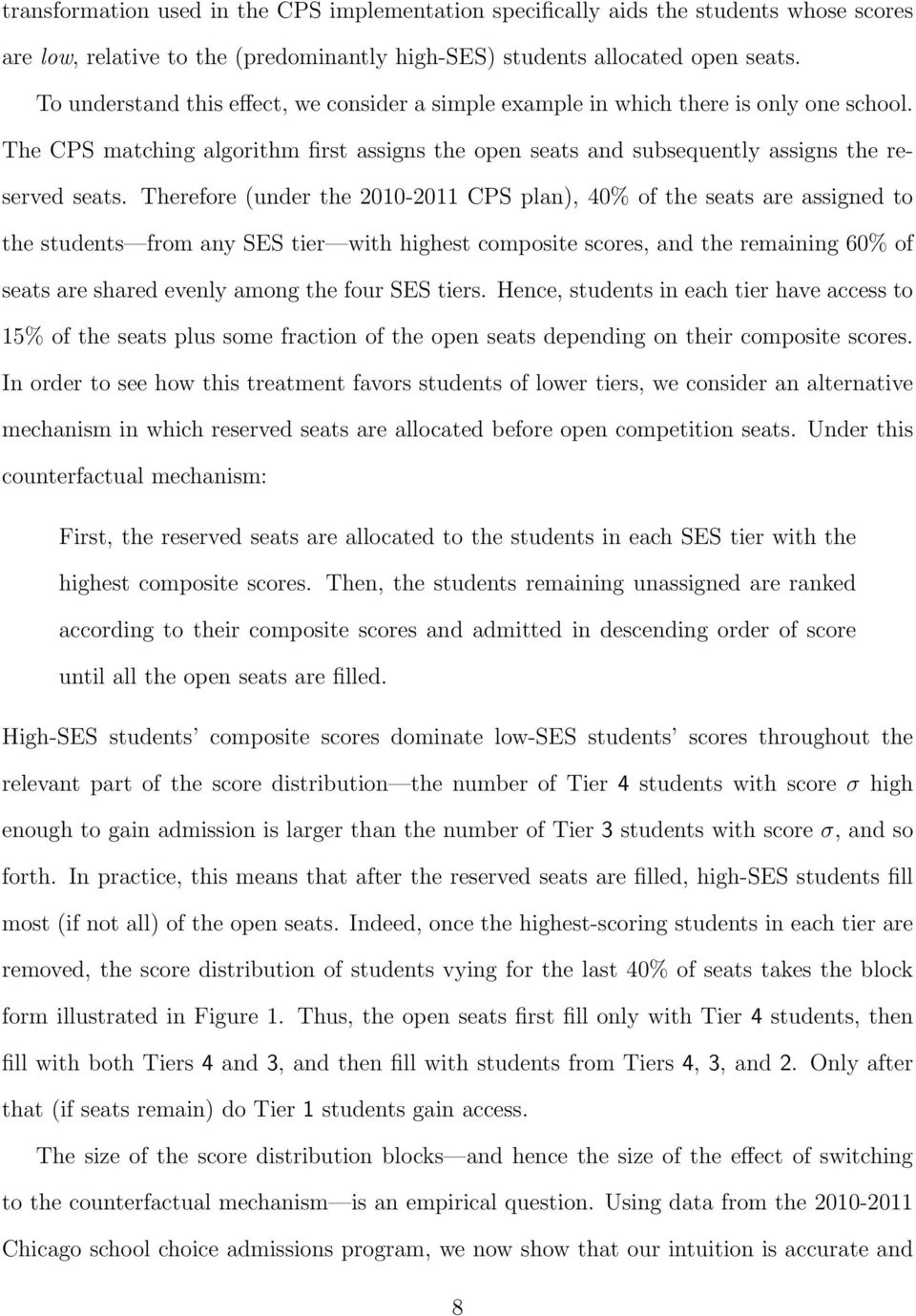
10 Tier 4 Tiers 4 and 3 Tiers 4, 3, and 2 Tiers 4, 3, 2, and 1 Figure 1: Top-scoring students in the truncated distriution come from Tier 4; the next-highest score lock consists only of students from Tiers 4 and 3, and so forth. Tier 4 Tier 3 Tier 2 Tier 1 Prefer Current Indifferent Prefer Counterfactual Tale 1: Comparison of individual student outcomes. that the magnitude of this effect is sustantial. 14 We compare the outcome of the Chicago match under two alternative scenarios: 1. First we consider the current system, in which all open seats are allocated efore reserved seats. 2. Second we consider the counterfactual in which all open seats are allocated after reserved seats. Of the 4270 seats allocated at nine selective high schools, 771 of them change hands etween the two scenarios what at first appears to e a minor decision in the implementation of the algorithm in fact impacts 18% of the seats at Chicago s selective high schools. Tale 1 shows that Tier 1 students unamiguously prefer the current mechanism; this confirms that the current implementation particularly enefits low-tier students. The effect is not uniform for all memers of higher SES tiers. Nevertheless, it is consistent with our simple example in terms of aggregate distriution: Of the 151 Tier 2 students who are affected, 108 prefer the current treatment and 43 prefer the counterfactual. 14 Our data set includes the quotas for the nine CPS elite pulic high schools, as well as students composite scores and sumitted rank-order lists. 9

11 Current Mechanism Effect of Switching (Open Slots First) (to fill Open Slots Last) Tier 4 Tier 3 Tier 2 Tier 1 Tier 4 Tier 3 Tier 2 Tier TOTAL Tale 2: Effect of mechanism change on student ody composition at each of the nine selective high schools. Of the 158 Tier 3 students who are affected, 50 prefer the current treatment and 108 prefer the counterfactual. And of the 287 Tier 4 students who are affected, 62 prefer the current treatment and 225 prefer the counterfactual. Tale 2 and Figure 2 show how the composition of admitted classes varies etween the current and counterfactual mechanisms. We oserve that Tier 1 students enefit from the current implementation at the expense of students in all three higher tiers. Perhaps surprisingly, most of the enefit appears to e at the expense of Tier 3 students. 15 Finally, Tale 3 compares the numer of students receiving seats under the counterfactual mechanism to the sizes of schools reserved seat locks. We see that switching to the counterfactual mechanism can in effect convert reserves into quotas: Consistent with the intuition of our informal, one-school example, Tier 1 students receive no open seats under the counterfactual mechanism at seven of the nine selective high schools. And again consistent with our example, we see that in four of the nine schools, even Tier 2 students receive no open seats under the counterfactual. 15 One reason for this might e the availaility of high quality outside options for some memers of Tier 4. 10

12 Current Counterfactual Tier 4 Tier 3 Tier 2 Tier 1 Figure 2: Effect of mechanism change on aggregate composition of selective high schools. Counterfactual Mechanism (Open Slots Last) Tier 4 Tier 3 Tier 2 Tier 1 Reserve/Tier Tale 3: Seat allocations under the counterfactual mechanism, in comparison to the 15% reserve. 11

13 2.2 K 12 Admissions in Boston Pulic Schools In the Boston school choice program, a student s priority for a given school depends on 1. whether the student has a siling at that school (siling priority), 2. whether the student lives within the ojectively determined walk-zone of that school (walk-zone priority), and 3. a random lottery numer, which is used to reak ties. Half of the seats at each school (50%) give students with walk-zone priority higher claims, while the other half are open, ranking students only on lottery numer (and thus giving no special advantage to students with walk-zone priority). This choice of priority structure is not aritrary it represents a delicate alance etween the interests of the school choice and neighorhood assignment advocates in Boston. Thus, as in the case of Chicago, Boston school choice priorities are not uniform across schools seats. And similarly to the Chicago mechanism, the BPS school choice algorithm treats each school as two hypothetical schools (each having half of the true capacity) one walk-zone half and one open half. To convert student preferences over true schools into preferences over hypothetical schools, BPS chooses the (unique) ranking consistent with the ranking of the original schools such that walk-zone seats are ranked aove open seats. Because of this implementation decision, the BPS school choice program systematically awards walk-zone seats to walk-zone students with lottery numers high enough to acquire non-walk-zone seats, in effect having those students give up their high lottery draws. This effect vitiates Boston s walk-zone priority policy: As we show in a follow-up paper (Dur et al. (2013)), the outcome of Boston s implementation of the seat split is nearly identical to the outcome under an alternative system in which there is no walk-zone priority at all (i.e. all seats are open ). We show moreover that this is a direct consequence of Boston s choice of seat ordering a reversal of the order, holding fixed the split produces a significant increase in assignment of students to their walk-zone schools. 12

14 2.3 Uncertainty Regarding Student Performance In practice, school choice programs priority structures arise through a political argaining process and may e adjusted to target specific outcomes. Indeed, CPS revised its priority structure slightly for the school year. 16 (BPS, y contrast, has maintained its split etween walk-zone and open seats since it first implemented deferred acceptance, despite increased political emphasis on walk-zone assignment (Menino (2012)).) Allowing for political argaining, we might expect policymakers to adjust the numer of reserved seats in reaction to the order in which seats are filled. Quota adjustment, however, in general cannot capture the full impact of the seat order on assignment outcomes. For instance, as the following stylized example illustrates, the choice of seat order affects the mechanism s ehavior in the presence of uncertainty regarding the distriution of student test scores. 17 Example 1. There are seven students, four of whom are of majority type, {M 1, M 2, M 3, M 4 }, and three of whom are of minority type, {m 1, m 2, m 3 }. Each student i has a test score σ i. The majority test score distriution is held fixed at σ M = (σ M1, σ M2, σ M3, σ M4 ) (10, 9, 6, 5). With proaility 1, minorities score well, and their test score profile is 2 σh m = (σm H 1, σm H 2, σm H 3 ) (8, 7, 4), inducing rank order M 1 M 2 m 1 m 2 M 3 M 4 m 3. With proaility 1 2, minorities score poorly, and have score profile σl m = (σ L m 1, σ L m 2, σ L m 3 ) (4, 3, 2), inducing rank-order M 1 M 2 M 3 M 4 m 1 m 2 m In the new priority structure, 5% of the seats are reserved for hand-picking y principals, the fraction of open seats is reduced to 28.5%, and the fraction of reserved seats for each SES tier is increased to %. 17 We thank Michael Ostrovsky for suggesting the structure of this example. 13

15 There is one school, with five seats availale. Some of the seats are open seats (s o ), and simply prioritize students according to test scores. Other seats are reserved for minorities (s m ), ranking minority students aove majority students and using test scores to reak ties within groups. First, we suppose that there are two reserved seats and (as in Boston) those seats are filled efore the open seats. Under the induced priority structure for either minority score profile realization two minority students (m 1 and m 2 ) are assigned to the reserved seats, and majority students (M 1, M 2, and M 3 ) receive the open seats (see Figure 1). σ = (σ M, σ H m) s m1 : m 1 m 2 m 3 s m2 : m 1 m 2 m 3 s o1 : M 1 M 2 m 1 m 2 M 3 M 4 s o2 : M 1 M 2 m 1 m 2 M 3 M 4 s o3 : M 1 M 2 m 1 m 2 M 3 M 4 σ = (σ M, σ L m) s m1 : m 1 m 2 m 3 s m2 : m 1 m 2 m 3 s o1 : M 1 M 2 M 3 M 4 m 1 m 2 s o2 : M 1 M 2 M 3 M 4 m 1 m 2 s o3 : M 1 M 2 M 3 M 4 m 1 m 2 Figure 1: Assignments under the two possile score realizations, in the case that the school fills two reserved seats efore filling the open seats. Now, we suppose instead that (as in Chicago) the reserved seats are filled after the open seats. If the school system seeks to assign the same expected numer of seats to minorities, then it must convert one reserved seat into an open seat. Under the new priority structure, minorities receive two open seats and one reserved seat when σm H is realized, and receive only the reserved seat when σm L is realized (see Figure 2). σ = (σ M, σ H m) s o1 : M 1 M 2 m 1 m 2 M 3 M 4 s o2 : M 1 M 2 m 1 m 2 M 3 M 4 s o3 : M 1 M 2 m 1 m 2 M 3 M 4 s o4 : M 1 M 2 m 1 m 2 M 3 M 4 s m1 : m 1 m 2 m 3 M 1 σ = (σ M, σ L m) s o1 : M 1 M 2 M 3 M 4 m 1 m 2 s o2 : M 1 M 2 M 3 M 4 m 1 m 2 s o3 : M 1 M 2 M 3 M 4 m 1 m 2 s o4 : M 1 M 2 M 3 M 4 m 1 m 2 s m1 : m 1 m 2 m 3 M 1 Figure 2: Assignments under the two possile score realizations, in the case that the school fills one reserved seat after filling the open seats. We thus see that it is not possile to choose the numer of reserved seats so as to always 14

16 achieve the same outcomes using the reserves-at-ottom policy as under the reserves-at-top policy with two reserved seats. Even holding fixed the expected numer of minorities admitted, the order in which slots are filled impacts the ehavior of the mechanism significantly: in the reserves-at-top treatment, the variance of the numer of minorities assigned seats is 0, while in the reserves-at-ottom treatment, it is ( 1 2 (32 ) + 1 ) 2 (12 ) (2) 2 = 5 4 = 1. The general model we provide in the remainder of this paper shows that any ordering of schools seats gives rise to a priority matching mechanism that is stale, strategy-proof, and improvement-respecting. Thus, the order in which seats are filled the order of precedence, in the sequel can e adjusted flexily according to policymakers market design goals. 3 Matching with Slot-Specific Priorities The applications descried in Section 2 motivate a richer school choice model than those considered in the literature one that accommodates slot-specific priorities at each school. School choice, however, is not the only application of matching theory that would enefit from such a generalization. Motivated y United States Army s recently introduced ranchfor-service program, Sönmez and Switzer (2013) and Sönmez (2013) have introduced and analyzed the Army s cadet-ranch matching prolem, under which cadets can increase their priorities at the ottom 25% of slots of each Army ranch, in exchange for idding three additional years of service commitment. Like in Chicago s and Boston s school choice programs, cadet ranch matching relies upon the possiility of priority variation across slots within ranches. Unlike school choice, however, each cadet can match with ranches under multiple contract terms. Thus, a fully general model must uild on the richer matching with contracts framework (Kelso and Crawford (1982); Hatfield and Milgrom (2005)), in order to go eyond the asic structure of school 15

17 choice and cover the Army s matching prolem. In addition to extending the aforementioned market design applications, the generality of our model allows us to introduce a new market design application airline seat upgrade allocation that is eyond the scope of earlier models in the literature (see Section 5.1). 3.1 Agents, Branches, Contracts, and Slots In a matching prolem with slot-specific priorities, there is a set of agents I, a set of ranches B, and a (finite) set of contracts X. 18 Each contract x X is etween an agent i(x) I and ranch (x) B. 19 We extend the notations i( ) and ( ) to sets of contracts y setting i(y ) y Y {i(y)} and (Y ) y Y {(y)}. For Y X, we denote Y i {y Y : i(y) = i}; analogously, we denote Y {y Y : (y) = }. Each agent i I has a (linear) preference order P i (with weak order R i ) over contracts in X i = {x X : i(x) = i}. For ease of notation, we assume that each i also ranks a null contract i which represents remaining unmatched (and hence is always availale), so that we may assume that i ranks all the contracts in X i. 20 We say that the contracts x X i for which i P i x are unacceptale to i. Each ranch B has a set S of slots; each slot can e assigned at most one contract in X {x X : (x) = }. Slots s S have (linear) priority orders Π s (with weak orders Γ s ) over contracts in X. For convenience, we use the convention that Y s Y for s S. As with agents, we assume that each slot s ranks a null contract s which represents remaining unassigned. 21 We set S B S. To simplify our exposition and notation in the sequel, we treat linear orders over contracts as interchangeale with orders over singleton contract sets. 18 Here, a ranch could represent a ranch of the military (as in cadet ranch matching), or a school (as in the Chicago and Boston examples). 19 A contract may have additional terms in addition to an agent and a ranch. For concreteness, X may e considered a suset of I B T for some set T of potential contract terms. 20 We use the convention that i P i x if x X \ X i. 21 As with agents, we use the convention that s Π s x if x X \ X s. 16

18 3.2 Choice and the Order of Precedence For any agent i I and Y X, we denote y max P iy the P i -maximal element of Y i, using the convention that max P iy = i if i P i y for all y Y i. Similarly, we denote y max ΠsY the Π s -maximal element of Y s, using the convention that max ΠsY = s if Πs s y for all y Y s. 22 Agents have unit demand, that is, they choose at most one contract from a set of contract offers. We assume also that agents always choose the maximal availale contract, so that the choice C i (Y ) of an agent i I from contract set Y X is defined y C i (Y ) max P iy. Meanwhile, ranches B may e assigned as many as q contracts from an offer set Y X one for each slot in S ut may hold no more than one contract with a given agent. We assume that for each B, the slots in S are ordered according to a (linear) order of precedence. We denote S {s 1,..., sq } with q S and the understanding that s l s l+1 unless otherwise noted. The interpretation of is that if s s then whenever possile ranch fills slot s efore filling s : First, slot s 1 is assigned the contract x1 which is Π s1 -maximal among contracts in Y. Then, slot s 2 is assigned the contract x2 which is Π s2 -maximal among contracts in the set Y \ Y i(x 1 ) of contracts in Y with agents other than i(x 1 ). This process continues in sequence, with each slot s l eing assigned the contract xl which is Π sl -maximal among contracts in the set Y \ Yi({x 1,...,x l 1 }). Formally, the choice (set) C (Y ) of a ranch B from Y is defined y the following algorithm: 1. Let H 0, and let V 1 Y. 22 Here, we use the notations P i and Π s ecause we will sometimes need to maximize over orders other than P i and Π s. 17
19 2. For each l = 1,..., q : (a) Let x l max Π s l V l e the Πsl -maximal contract in V l. () Set H l = Hl 1 {x l } and set V l+1 = V l \ Y i(x ). l 3. Set C (Y ) = H q. We say that a contract x Y is assigned to slot s l S in the computation of C (Y ) if {x} = H l \ Hl 1 in the running of the algorithm defining C (Y ) Staility An outcome is a set of contracts Y X. We restrict our attention throughout to ( feasile ) outcomes that contain at most one contract for each agent, i.e. Y X for which Y X i 1 for each i I. We follow the Gale and Shapley (1962) tradition in focusing on match outcomes that are stale in the sense that neither agents nor ranches wish to unilaterally walk away from their assignments, and agents and ranches cannot enefit y recontracting outside of the match. Formally, we say that an outcome Y is stale if it is 1. individually rational C i (Y ) = Y i for all i I and C (Y ) = Y for all B and 2. unlocked there does not exist a ranch B and locking set Z C (Y ) such that Z = C (Y Z) and Z i = C i (Y Z) for all i i(z). 23 If no contract x Y is assigned to slot s l S in the computation of C (Y ), then s l is assigned the null contract s l. 18
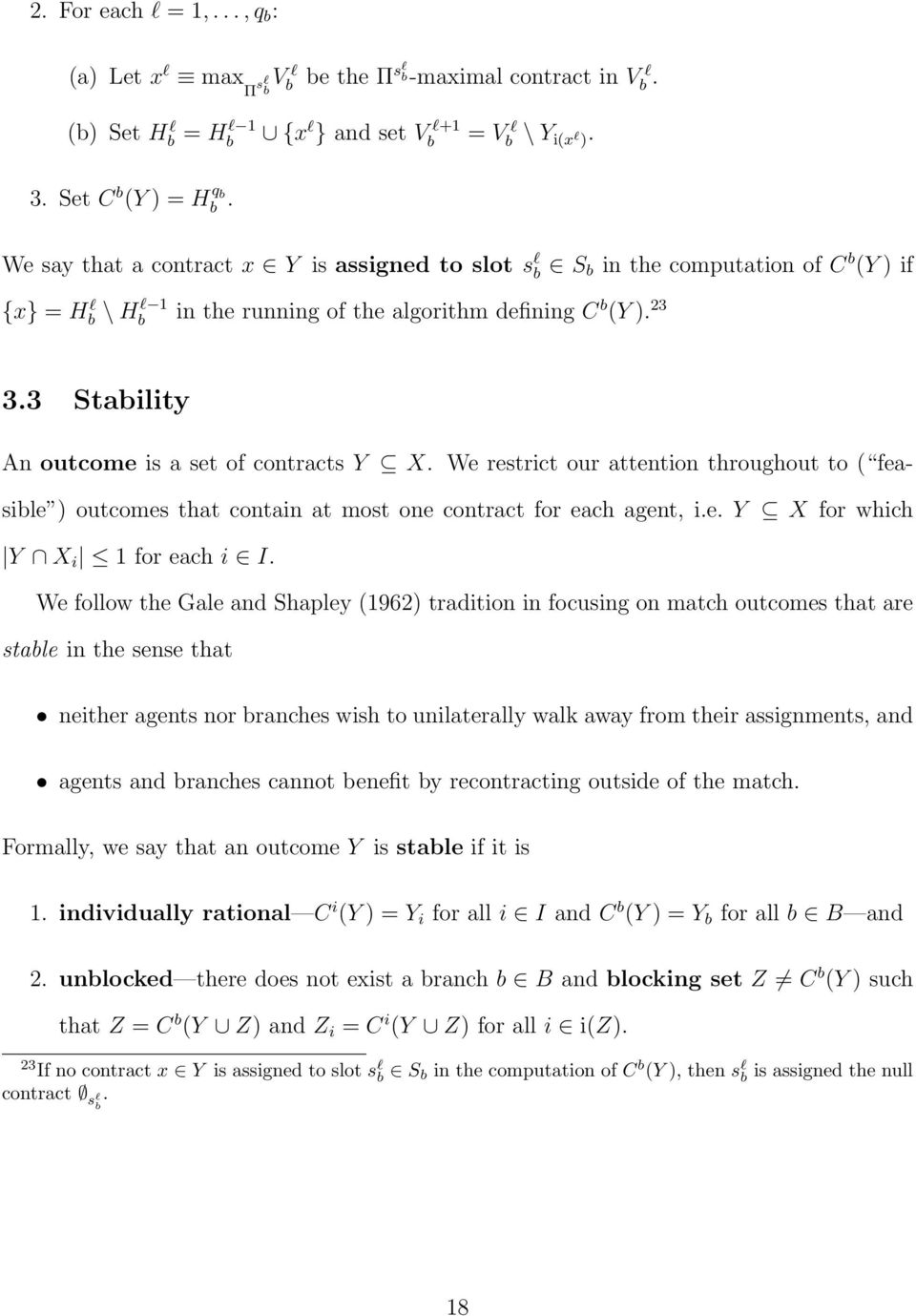
20 3.4 Conditions on the Structure of Branch Choice We now discuss the extent to which ranch choice functions satisfy the conditions that have een key to previous analyses of matching with contracts models. For the most part, our oservations are negative 24 ; thus, they help contextualize our results and illustrate some of the technical difficulties that arise in our general framework Sustitutaility Conditions Definition. A choice function C is sustitutale if for all z, z X and Y X, z / C (Y {z}) = z / C (Y {z, z }). Hatfield and Milgrom (2005) introduced this sustitutaility condition, which generalizes the earlier gross sustitutes condition of Kelso and Crawford (1982). Hatfield and Milgrom (2005) also showed that sustitutaility is sufficient to guarantee the existence of stale outcomes. 25 Choice function sustitutaility is necessary (in the maximal domain sense) for the guaranteed existence of stale outcomes in a variety of settings, including many-to-many matching with contracts (Hatfield and Kominers (2010)) and the Ostrovsky (2008) supply chain matching framework (Hatfield and Kominers (2012)). However, sustitutaility is not necessary for the guaranteed existence of stale outcomes in settings where agents have unit demand (Hatfield and Kojima (2008, 2010)). Indeed, as Hatfield and Kojima (2010) showed, the following condition weaker than sustitutaility suffices not only for the existence of 24 As we show, ranch choice functions in general fail oth the (Hatfield and Milgrom (2005)) sustitutaility and (Hatfield and Kojima (2010)) unilateral sustitutaility conditions, and need not satisfy the (Hatfield and Milgrom (2005)) law aggregate demand. 25 The analysis of Hatfield and Milgrom (2005) implicitly assumes irrelevance of rejected contracts, the requirement that z / C (Y {z}) = C (Y ) = C (Y {z}) for all B, Y X, and z X \ Y (Aygün and Sönmez (forthcoming)). This condition is naturally satisfied in most economic environments including ours. (The fact that all ranch choice functions in our setting satisfy the irrelevance of rejected contracts condition is immediate from the algorithm defining ranch choice see Lemma D.1 of Appendix D) 19

21 stale outcomes, ut also to guarantee that there is no conflict of interest among agents. 26 Definition. A choice function C is unilaterally sustitutale if z / C (Y {z}) = z / C (Y {z, z }) for all z, z X and Y X for which i(z) / i(y ) (i.e. no contract in Y is associated to agent i(z)). Unilateral sustitutaility is a powerful condition; it has een applied in the study of cadet ranch matching mechanisms (Sönmez and Switzer (2013); Sönmez (2013)). Although cadet ranch matching arises as a special case of our framework, the choice functions C which arise in markets with slot-specific priorities are not unilaterally sustitutale, in general. Our next example illustrates this fact; this also shows (a fortiori) that the ranch choice functions in our framework may e non-sustitutale. Example 2. Let X = {i 1, i 2, j 2 }, with B = {}, I = {i, j}, i(i 1 ) = i = i(i 2 ) and i(j 2 ) = j. 27 If has two slots, s 1 s 2, with priorities given y Π s1 : i1 s 1, Π s2 : i2 j 2 s 2, then C fails the unilateral sustitutaility condition: if we take z = j 2, z = i 1, and Y = {i 2 }, then z = j 2 / C ({i 2, j 2 }) = C (Y {z}), ut z = j 2 C ({i 1, i 2, j 2 }) = C (Y {z, z }), even though i(z) = i(j 2 ) = j / {i} = i({i 2 }) = i(y ). The choice functions C do ehave sustitutaly whenever each agent offers at most one contract to. 26 As in the work of Hatfield and Milgrom (2005), an irrelevance of rejected contracts condition (which is naturally satisfied in our setting see Footnote 25) is implicitly assumed throughout the work of Hatfield and Kojima (2010) (Aygün and Sönmez (2012)). 27 Clearly (in order for ( ) to e well-defined), we must have (i 1 ) = (i 2 ) = (j 2 ) =, as B = 1. 20
22 Definition. A choice function C is weakly sustitutale if z / C (Y {z}) = z / C (Y {z, z }) for any z, z X and Y X such that Y {z, z } = i(y {z, z }). (1) This weak sustitutaility condition, first introduced y Hatfield and Kojima (2008), is in general necessary (in the maximal domain sense) for the guaranteed existence of stale outcomes (Hatfield and Kojima (2008), Proposition 1). Proposition 1. Every ranch choice function C is weakly sustitutale. The choice functions C also satisfy the slightly stronger ilateral sustitutaility condition introduced y Hatfield and Kojima (2010). Definition. A choice function C is ilaterally sustitutale if z / C (Y {z}) = z / C (Y {z, z }) for all z, z X and Y X with i(z), i(z ) / i(y ). Proposition 2. Every choice function C is ilaterally sustitutale. In addition to illustrating some of the structure underlying the choice functions induced y slot-specific priorities, Proposition 1 is also useful in our proofs. Meanwhile, Proposition 2 is not used directly in the sequel as with Example 2, we present Proposition 2 only to illustrate the relationship etween our work and the conditions introduced in the prior literature Comining Proposition 2 with Theorem 1 of Hatfield and Kojima (2010) can e used to prove the existence of stale outcomes in our setting, although (as oserved in Footnote 26) this logic implicitly 21
23 3.4.2 The Law of Aggregate Demand A numer of structural results in two-sided matching theory rely on the following monotonicity condition introduced y Hatfield and Milgrom (2005). 29 Definition. A choice function C satisfies the Law of Aggregate Demand if Y Y = C (Y ) C (Y ). Unfortunately, as with the sustitutaility and unilateral sustitutaility conditions, the ranch choice functions in our framework may fail to satisfy the law of aggregate demand. Example 3. Let X = {i 1, i 2, j 1 }, with B = {}, I = {i, j}, i(i 1 ) = i = i(i 2 ) and i(j 1 ) = j. 30 If has two slots, s 1 s 2, with priorities given y Π s1 : i1 j 1 s 1, Π s2 : i2 s 2, then C does not satisfy the law aggregate demand: C ({i 2, j 1 }) = {i 2, j 1 } = 2 > 1 = {i 1 } = C ({i 1, i 2, j 1 }). 4 Main Theoretical Results We now develop our general theoretical results: In Section 4.1, we associate our original market to a (one-to-one) matching market in which slots, rather than ranches, compete for requires an irrelevance of rejected contracts condition (Aygün and Sönmez (2012)). However, as Hatfield and Kojima (2010) pointed out, the ilateral sustitutaility condition is not sufficient for the other key results necessary for matching market design, such as the existence of strategy-proof matching mechanisms. To otain these additional results in our framework, we draw upon structures present in our specific model (see Section 4.1); these structures give rise to a self-contained existence proof, which does not make use of the ilateral sustitutaility condition. 29 Alkan (2002) and Alkan and Gale (2003) introduced a related cardinal monotonocity condition. 30 Clearly (in order for ( ) to e well-defined), we must have (i 1 ) = (i 2 ) = (j 1 ) =, as B = 1. 22
24 contracts. Next, in Section 4.2, we introduce the cumulative offer process and use properties of the agent slot matching market to show that the cumulative offer process always identifies a stale outcome. We then show moreover, in Section 4.3, that the cumulative offer process selects the agent-optimal stale outcome if such an outcome exists and corresponds to a stale outcome in the agent slot matching market. Finally, in Section 4.4, we show that the mechanism which selects the cumulative offer process outcome is stale, strategy-proof, and improvement-respecting. 4.1 Associated Agent Slot Matching Market To associate a (one-to-one) agent slot matching market to our original market, we extend the contract set X to the set X defined y X { x; s : x X and s S (x) }. Slot priorities Π s over contracts in X exactly correspond to the priorities Π s over contracts in X: x; s Π s x ; s xπ s x ; s Πs x; s [ s Π s x or s s]. Meawhile, the preferences P i of i I over contracts in X respect the order P i, while using orders of precedence to reak ties among slots: x; s P i x ; s xp i x or [x = x and s (x) s ]; i P i x; s [ i P i x or i(x) i]. 23
25 These extended priorities Π s and preferences P i induce choice functions over X: C s (Ỹ ) max ΠsỸ ; C i (Ỹ ) max P iỹ. To avoid terminology confusion, we call a set Ỹ X a slot-outcome. It is clear that slot-outcomes Ỹ X correspond to outcomes Y X according to the natural projection ϖ : X X defined y ϖ(ỹ ) {x : x; s Ỹ for some s S (x)}. Our contract set restriction notation extends naturally to slot-outcomes Ỹ : Ỹ i { y; s Ỹ : i(y) = i}; Ỹ s { y; s Ỹ : s = s}. Definition. A slot-outcome Ỹ X is slot-stale if it is 1. individually rational for agents and slots C i (Ỹ ) = Ỹi for all i I and C s (Ỹ ) = Ỹ s for all s S and 2. not locked at any slot there does not exist a slot-lock z; s X such that z; s = C i(z) (Ỹ { z; s }) and z; s = C s (Ỹ { z; s }). By construction, slot-stale outcomes project (under ϖ) to stale outcomes. Lemma 1. If Ỹ X is slot-stale, then ϖ(ỹ ) is stale. Theorem 3 of Hatfield and Milgrom (2005) implies that one-to-one matching with contracts markets have stale outcomes. Comining this oservation with Lemma 1 shows that the set of stale outcomes is always nonempty in our framework. In the next section, we refine this oservation y focusing on the stale outcome associated to the slot-outcome of agent-optimal slot-stale mechanism for the agent slot market. 24
26 4.2 The Cumulative Offer Process We now introduce the cumulative offer process for matching with contracts (see Hatfield and Kojima (2010); Hatfield and Milgrom (2005); Kelso and Crawford (1982)), which generalizes the agent-proposing deferred acceptance algorithm of Gale and Shapley (1962). We provide an intuitive description of this algorithm here; a more technical statement is given in Appendix A. Definition. In the cumulative offer process, agents propose contracts to ranches in a sequence of steps l = 1, 2,...: Step 1. Some agent i 1 I proposes his most-preferred contract, x 1 X i 1. Branch (x 1 ) holds x 1 if x 1 C (x1) ({x 1 }), and rejects x 1 otherwise. Set A 2 (x 1 ) = {x 1 }, and set A 2 = for each (x 1 ); these are the sets of contracts availale to ranches at the eginning of Step 2. Step 2. Some agent i 2 I for whom no contract is currently held y any ranch proposes his most-preferred contract which has not yet een rejected, x 2 X i 2. Branch (x 2 ) holds the contracts in C (x2) (A 2 (x 2 ) {x2 }) and rejects all other contracts in A 2 (x 2 ) {x2 }; ranches (x 2 ) continue to hold all contracts they held at the end of Step 1. Set A 3 (x 2 ) = A2 (x 2 ) {x2 }, and set A 3 = A2 for each (x 2 ). Step l. Some agent i l I for whom no contract is currently held y any ranch proposes his most-preferred contract which has not yet een rejected, x l X i l. Branch (x l ) holds the contracts in C (xl) (A l (x l ) {xl }) and rejects all other contracts in A l (x l ) {xl }; ranches (x l ) continue to hold all contracts they held at the end of Step l 1. Set A l+1 (x l ) = Al (x l ) {xl }, and set A l+1 = A l for each (x l ). If at any time no agent is ale to propose a new contract that is, if all agents for whom no contracts are on hold have proposed all contracts they find acceptale 25
27 then the algorithm terminates. The outcome of the cumulative offer process is the set of contracts held y ranches at the end of the last step efore termination. In the cumulative offer process, agents propose contracts sequentially. Branches accumulate offers, choosing at each step (according to C ) a set of contracts to hold from the set of all previous offers. The process terminates when no agents wish to propose contracts. Note that we do not explicitly specify the order in which agents make proposals. This is ecause in our setting, the cumulative offer process outcome is in fact independent of the order of proposal. 31 An analogous order-independence result is known for settings where priorities induce unilaterally sustitutale ranch choice functions (Hatfield and Kojima (2010)). However, as we illustrated in Example 2, slot-specific priorities may not induce unilaterally sustitutale choice functions. Meanwhile, no order-independence result is known for the general class of ilaterally sustitutale choice functions. 32 Our first main result shows that the cumulative offer process outcome has a natural interpretation: it corresponds to the outcome of the agent-optimal slot-stale slot-outcome in the agent slot matching market. Theorem 1. The slot-outcome of the agent-optimal slot-stale mechanism in the agent slot matching market corresponds (under projection ϖ) to the outcome of the cumulative offer process. The proof of Theorem 1 proceeds in three steps. First, we show that the contracts held y each slot improve (with respect to slot priority order) over the course of the cumulative offer process. 33 This oservation implies that no contract held y a slot s S at some step of the cumulative offer process has higher priority than the contract s holds at the end 31 We make this statement concrete in Theorem B.1 of Appendix B. 32 Although Hatfield and Kojima (2010) state their cumulative offer process algorithm without attention to the proposal order, they only prove independence of the proposal order in the case of unilaterally sustitutale preferences. 33 Here, y the contract held y a slot s S in step l, we mean the contract assigned to s in the computation of C (A l+1 ). 26
28 of the process; it follows that the cumulative offer process outcome Y is the ϖ-projection of a slot-stale slot-outcome Ỹ. Then, we demonstrate that agents (weakly) prefer Ỹ to the agent-optimal slot-stale slot-outcome Z, which exists y Theorem 3 of Hatfield and Milgrom (2005). This implies that Ỹ = Z, proving Theorem 1 as ϖ(ỹ ) = Y. Our agent slot matching market construction is superficially similar to earlier work reducing many-to-one matching markets with responsive preferences to one-to-one matching markets. 34 This similarity is delusory, however. Our construction is used in showing existence and strategy-proofness, with most of the work done through the proof and application of Theorem 1, as just descried. The goal is not, as in the work of Roth and Sotomayor (1989), to otain an alternate characterization of the set of stale outcomes. Moreover, to the extent that we do provide a partial correspondence etween stale sets through Lemma 1, that correspondence is far more delicate than the one otained y Roth and Sotomayor (1989): it is not onto (see Example 4), and depends crucially on the explicit respect of slot-precedence in agents extended preferences. Theorem 1 implies that the cumulative offer process always terminates. 35 Moreover, it shows that the cumulative offer process outcome is stale and somewhat distinguished among stale outcomes. Theorem 2. The cumulative offer process produces an outcome which is stale. Moreover, for any slot-stale Z X, each agent (weakly) prefers the outcome of the cumulative offer process to ϖ( Z). Note that Theorem 2 shows only that agents weakly prefer the cumulative offer process outcome to any other stale outcome associated to a slot-stale slot-outcome. As not all stale outcomes are associated to slot-stale slot-outcomes, this need not imply that each agent 34 In the case of responsive preferences, Roth and Sotomayor (1989) showed that the stale outcomes in a many-to-one college admissions matching market (without contracts) correspond exactly to the set of stale outcomes in a one-to-one matching market otained y treating the seats at each college as separate individuals (who share the college s responsive preference order). 35 This fact can also e oserved directly, as the set X is finite and the full set of contracts availale, B A l, grows monotonically in l. 27
29 prefers the cumulative offer process outcome to all other stale outcomes; we demonstrate this explicitly in the next section. 4.3 Agent-Optimal Stale Outcomes We say that an outcome Y X Pareto dominates Y X if Y i R i Y i for all i I, and Y i P i Y i for at least one i I. A stale outcome Y X which Pareto dominates all other stale outcomes is called an agent-optimal stale outcome. 36 For general slot-specific priorities, agent-optimal stale outcomes need not exist, as the following example shows. Example 4. Let X = {i 0, i 1, j 0, j 1, k 0, k 1 }, with B = {}, I = {i, j, k} and i(h 0 ) = h = i(h 1 ) for each h I. 37 We suppose that h 0 P h h 1 P h h for each h I, and that has two slots, s 1 s 2, with slot priorities given y Π s1 : i1 j 1 k 1 i 0 j 0 k 0 s 1, Π s2 : i0 i 1 j 0 j 1 k 0 k 1 s 2. In this setting, the outcomes Y {j 1, i 0 } and Y {i 1, j 0 } are oth stale. However, Y i P i Y i while Y j P j Y j, so there is no agent-optimal stale outcome. Here, Y is associated to a slot-stale slot-outcome, ut Y is not. As we expect from Theorem 2, the cumulative offer process produces the former of these two outcomes, Y. Even when agent-optimal stale outcomes do exist, the cumulative offer process may not select them. To see this, we consider a modification of Example Example 5. Let X = {i 0, i 1, i, j 0, j 1, j, k 0, k 1 }, with B = {}, I = {i, j, k} and i(h 0 ) = i(h 1 ) = i(h ) = h for each h {i, j} and i(k 0 ) = k = i(k 1 ). 39 We suppose that h 0 P h h P h h 1 P h h 36 That is, an agent-optimal stale outcome is a stale outcome such that Y i R i Y i for any agent i I and stale outcome Y Y. 37 Clearly (in order for ( ) to e well-defined), we must have (h 0 ) = = (h 1 ) for each h I, as B = We thank Fuhito Kojima for this example. 39 Clearly (in order for ( ) to e well-defined), we must have (x) = for each x X, as B = 1. 28
30 for each h {i, j}, that k 0 P k k 1 P k k, and that has two slots, s 1 s 2, with slot priorities given y Π s1 : j1 k 1 i 0 j 0 k 0 s 1, Π s2 : i j i 0 i 1 j 0 j 1 k 0 k 1 s 2. In this setting, the outcome Y {j 1, i 0 } is the agent-optimal stale outcome. However, the outcome of the cumulative offer process is Y {j 1, i }, which is Pareto dominated y Y. Although the cumulative offer process does not always select agent-optimal stale outcomes, in general, it does find agent-optimal stale outcomes when they correspond to slotstale outcomes. This fact is a direct consequence of Theorem 2. Theorem 3. If an agent-optimal stale outcome exists and is the projection (under ϖ) of a slot-stale outcome, then it is the outcome of the cumulative offer process. 4.4 The Cumulative Offer Mechanism A mechanism consists of a strategy space S i for each agent i I, along with an outcome function ϕ Π : i I Si X that selects an outcome for each choice of agent strategies. We confine our attention to direct mechanisms, i.e. mechanisms for which the strategy spaces correspond to the preference domains: S i = P i, where P i denotes the set of all possile preference relations for agent i I. Such mechanisms are entirely determined y their outcome functions, hence in the sequel we identify mechanisms with their outcome functions and use the term mechanism ϕ Π to refer to the mechanism with outcome function ϕ Π and S i = P i (for all i I). All mechanisms we discuss implicitly depend on the priority profile under consideration; we often suppress the priority profile from the mechanism notation, writing ϕ instead of ϕ Π, if doing so will not introduce confusion. In this section, we analyze the cumulative offer mechanism (associated to slot priorities Π), which selects the outcome otained y running the cumulative offer process 29
31 (with respect to priorities Π and sumitted preferences). We denote this mechanism y Φ Π : i I Pi X Staility and Strategy-Proofness A mechanism ϕ is stale if it always selects an outcome stale with respect to slot priorities and input preferences. This condition dates ack to Gale and Shapley (1962) and has een the ackone of the matching market design literature. It captures the natural idea that a mechanism produces an outcome consistent with the policy ojectives reflected in the priority structure. We say that a mechanism ϕ is strategy-proof if truthful preference revelation is a dominant strategy for agents i I, i.e. there is no agent i I, preference profile P I j I Pj, and P i P i such that ϕ ( P i, P i) P i ϕ ( P i, P i). Similarly, we say that a mechanism ϕ is group strategy-proof if there is no set of agents I I, preference profile P I j I Pj, and P I P I such that ϕ ( P I, P I ) P i ϕ ( P I, P I ) for all i I. Strategyproofness conditions have een central to the recent revolution in school choice market design ecause they eliminate enefits of strategic sophistication and costly strategic ehavior, and enale the collection of true preference data (Adulkadiroğlu et al. (2006); Pathak and Sönmez (2008)). It follows immediately from Theorem 2 that the cumulative offer mechanism is stale. Meanwhile, Theorem 1 of Hatfield and Kojima (2009) implies that the agent-optimal slotstale mechanism is (group) strategy-proof in the agent slot matching market. Thus, we see that the cumulative offer mechanism is (group) strategy-proof, as any P I P I such that ϕ ( P I, P I ) P i ϕ ( P I, P I ) for all i I would give rise to a profitale manipulation ( P I P I ) of the agent-optimal slot-stale mechanism. These oservations are summarized in the following theorem. Theorem 4. The cumulative offer mechanism Φ Π is 1. stale and 30
32 2. (group) strategy-proof Respect for Unamiguous Improvements We say that priority profile Π is an unamiguous improvement over priority profile Π for i I if 1. for all x X i and y (X I\{i} { s }), if xπ s y, then x Π s y; and 2. for all y, z X I\{i}, yπ s z if and only if y Π s z. That is, Π is an unamiguous improvement over priority profile Π for i I if Π is otained from Π y increasing the priorities of some of i s contracts (at some slots) while leaving the relative priority orders of other agents contracts unchanged. We say that a mechanism ϕ respects unamiguous improvements for i if for any preference profile P I, (ϕ Π(P I )) i R i (ϕ Π (P I )) i whenever Π is an unamiguous improvement over Π for i. We say that ϕ respects unamiguous improvements if it respects unamiguous improvements for each agent i I. While present in the matching literature since the work of Balinski and Sönmez (1999), respect for unamiguous improvements has not een central to previous deates on realworld market design. 40 Nevertheless, respect for improvements is essential in settings like the airline seat upgrade application we introduce in Section 5.1 there, it implies that customers never want to decrease their frequent-flyer status levels. 41 Similarly, respect for unamiguous improvements is important in cadet ranch matching (see Section 5.3), where cadets can influence their priority rankings directly and may (in the asence of respect for 40 Respect for improvements is, however, of importance in the growing normative literature on school choice design. For example, Hatfield et al. (2012) have used this condition in analyzing how school choice mechanism selection can impact schools incentives for self-improvement. 41 Formally, for this claim we need the extremely natural assumption that an increase in the status of customer i, holding other customers status levels fixed, results in an unamiguous improvement in i s priority. 31
33 improvements) take perverse steps to lower their priorities. 42 Theorem 5. The cumulative offer mechanism Φ Π respects unamiguous improvements. Our proof of Theorem 5 makes use of the fact that the cumulative offer process outcome is independent of the contract proposal order. In particular, we focus on a proposal order in which i proposes contracts only when no other agent is ale to propose. This choice of proposal order guarantees that i is always the last agent to propose a contract in the running of the cumulative offer process (for any priority profile). As Π is an unamiguous improvement over Π for i, we can show that the last contract i proposes in the cumulative offer process with priority profile Π must also e proposed in the cumulative offer process with priority profile Π. This yields the desired result ecause it implies that i is at least as well off under the outcome of cumulative offer process with priority profile Π as under the cumulative offer process with priority profile Π. As an alternative to this approach to the proof of Theorem 5, we could instead show that the agent-optimal slot-stale mechanism for the agent slot matching market satisfies a condition analogous to respect of unamiguous improvements. Theorem 5 would then follow from Theorem As Sönmez (2013) has illustrated, the current ROTC cadet ranch matching mechanism rewards cadets who can lower their priorities to just elow the 50-th percentile mark. Evidence from Service Academy Forums (2012) suggests that cadets have figured this out, and may e adjusting their training and academic performance accordingly: 20% in the complete OML [order of merit list] might actually e 28% in the Active Duty OML, so make sure you make this mental conversion to the complete OML during your first three years. Or, just really screw up everything except for GPA, and get yourself into the 55% (from the top = 45%) where you get your choice of Branch... just kidding. But in all seriousness, why create a system of merit evaluation that takes a top 40% OML cadet and rewards him/her for purposely saotaging things to go DOWN in the OML to elow the 50% AD OML line[... ]? 43 A natural strengthening of our notion of an unamiguous improvement for i I would include the condition that i s preferred contracts (weakly) increase in priority formally, for all B, s S, and x, x (X i X ), if x Π s x and x Π s x, then xp i x. (2) As Theorem 5 shows that Φ Π respects unamiguous improvements, we see a fortiori that Φ Π respects unamiguous improvements that satisfy the additional condition (2). 32
34 5 Further Applications In this section, we present applications of our theoretical results to the design of airline seat upgrade mechanisms, affirmative action programs, and cadet ranch matching mechanisms. 5.1 Airline Seat Upgrades As the demand for airline seat upgrades has increased, airlines have egun providing multiple channels for otaining upgrades. The most common channels for upgrades are: 1. automatic upgrades through elite status, 2. upgrades purchased with cash payments, and 3. upgrades purchased with reward points (i.e. miles), possily together with some cash payments. Typically, not all availale upgrades in a given seat class can e otained through elite status or miles, as airline companies, under pressure to increase profits, often place a quota restriction on the numer of rewards-ased upgrades. Similarly, ecause of profit pressures, airline companies might prioritize upgrading through cash payment. Currently there is no unified market clearing system that allows customers to pursue upgrades via multiple upgrade channels. Instead, customers often need to pick one of the three channels status, cash, or miles when they decide to seek an upgrade. To make this point clear, we consider the at-the-gate upgrade process immediately efore a flight. A customer who is interested in an upgrade typically approaches the flight desk and inquires whether an upgrade is availale. If an upgrade is availale, those interested pursue upgrades through their preferred channels. Airline company personnel then determine the assignment of upgrades, considering factors including the composition of the set of customers interested in upgrades, those customers frequent-flyer statuses, and the company s imposed quota/reserve restrictions. 33
35 Now consider an elite status customer i whose first choice is a free automatic upgrade, ut who is willing to uy a cash upgrade as his second choice if he cannot receive a free upgrade. Under the current (standard) procedure it is not possile for customer i to express his preferences. Indicating willingness to uy the cash upgrade is essentially equivalent to giving up the possiility of a free elite status upgrade. Likewise a customer whose first choice is a miles upgrade and whose second choice is a cash upgrade is forced to pick only one of these options. The airline seat upgrade allocation prolem can e modeled as an application of our model in which the slot-specific priority structure gives the airlines the aility to implement a wide variety of allocation policies. The cumulative offer mechanism in this context offers airlines a convenient market clearing mechanism that allows customers to express their full preferences over different seating classes and types of upgrade. In this application ranches correspond to different seating classes (e.g., usiness class and first class) while a contract of a customer specifies a seating class and an upgrade channel (e.g., a usiness class seat otained through a payment of miles). This is a novel application of two-sided matching with contracts not covered y the earlier literature. To see this, we give a simple example in which the airline s choice function fails not only the sustitutaility condition ut also the milder unilateral sustitutaility condition the weakest condition in the literature that has enaled applications of matching with contracts thus far. 44 Example 6. There is a unique ranch, the usiness class, which has two upgrade slots availale. One of the slots, slot s 1, accepts only cash upgrades, while the second slot, s2 accepts oth miles and cash ut prioritizes cash. For each slot, ties etween customers are roken with respect to frequent flyer status, and etween the two slots the airline first tries to fill the less-permissive slot s 1 and then tries to fill slot s2 ; in our terminology slot s1 has higher precedence than slot s Note that this example is closely analogous to Example This way, if there is one cash-customer and one miles-customer, the cash-customer will not lock the 34
36 Consider two customers, i and j, with i having higher frequent-flyer status than j, and the following three contracts: {i $, i m, j m }, where i $ represents the cash upgrade contract for customer i and i m and j m respectively represent the mile upgrade contracts for customers i and j. Given the airline upgrade policy as descried, we have s 1 s 2, and Π s1 : i$ s 1, Π s2 : i$ i m j m s 2. Oserve that the resulting usiness class choice function C fails the unilateral sustitutaility condition (introduced on page 20): For z = j m, z = i $, and Y = {i m }, we have z = j m / {i m } = C ({i m, j m }) = C (Y {z}), while we have z = j m {i $, j m } = C ({i m, j m, i $ }) = C (Y {z, z }) even though i(z) = i(j m ) = j / {i} = i(i m ) = i(y ). Our discussion of airline seat allocation through matching with slot-specific priorities also illustrates how our framework could e used to implement the seat upgrade auctions several major airlines have egun implementing in the last year (McCartney (2013)). In this context, customers preferences could express preferences over potential ids within each upgrade channel (e.g., a id of $200 might e preferred to a id of points, which in turn is preferred to a id of $300); the cumulative offer mechanism then corresponds to an ascending auction for upgrades. Once again, in this application the airline choice functions may fail the unilateral sustitutaility condition. More generally, while we have presented the specific application of our framework to questions of airline seat upgrade allocation, the same approach can e used in any market airline from assigning oth upgrade seats. 35
37 where there are multiple mediums of exchange and slot-specific-priorities Affirmative Action Mechanisms We say that a matching prolem has agent types if the contract set X is a suset of I B T for some type set T, and for each i I, X i = {i} B {t} for some t T, so that each i is associated to exactly one type t. 47 For such a prolem, we identify agents with their types, writing t(i) for the unique type t T such that X i = {i} B {t}. For consistency with the prior literature on school choice, we ause notation slighly y writing i to denote, for each ranch B, the unique contract (i,, t(i)) (X i X ). Imposing agent type structure on our general model simplifies the ehavior of ranches choice functions. Proposition 3. In a matching prolem with slot-specific priorities and agent types, the ranch choice functions C are sustitutale and satisfy the law of aggregate demand. In settings with agent types, sustitutaility coincides with weak sustitutaility this conclusion otains whenever X i X 1 for all i I and B. Thus, Proposition 3 follows directly from Proposition 1. In the presence of agent types, the structure of the set of stale outcomes is also simplified: staility and slot-staility exactly correspond. 46 One possile structure for such a market is discussed y Peranson (2005) in the context of medical matching: A hospital may have multiple positions to fill, and prefer a alance etween clinical-specialty doctors and research-focused doctors (see Example 2 of Peranson (2005)). In this setting, a doctor capale of oth clinical and research work can sign either a clinical contract or a research contract; the hospital s preferences can e expressed using slot-specific structure in which some slots prioritize clinical contracts over research and others prioritize research contracts over clinical. Hospital preferences in this application are analogous to those of airlines in the prolem of upgrade allocation ( clinical and research are assignment channels akin to cash and miles ), and depending on the structure of hospital preferences, this application may also fail the unilateral sustitutaility condition. That said, ecause allocation of doctors to hospitals is a two-sided matching prolem (rather than a pure question of allocation under priorities), this application entails strategic concerns not analyzed in our framework. 47 Note that we may assusme without loss of generality that X i = {i} B {t}, as any case in which X i {i} B {t} can then e captured y assuming some contracts x {i} B {t} to e unacceptale to slots at their associated ranches (x). 36
38 Proposition 4. In a matching prolem with slot-specific priorities and agent types, every stale outcome is the projection of a slot-stale outcome. Comining Proposition 3 with Theorems 15, 3, and 4 of Hatfield and Milgrom (2005) shows that there exists an agent-optimal stale outcome in any matching prolem with slotspecific priorities and agent types. The following result then follows upon comining this oservation with Proposition 4 and our Theorems 3, 4, and 5. Corollary 1. In a matching prolem with slot-specific priorities and agent types, the cumulative offer mechanism Φ Π is an agent-optimal stale mechanism, which is (group) strategyproof and respects unamiguous improvements. As our discussion in Section 2.1 suggests, decreases in the precedence of slots that rank agents of type t highly can improve type-t agents cumulative offer outcomes. Unfortunately, while we elieve this comparative static should generally hold in reasonaly-sized marketplaces, it may fail in small markets Soft Minority Quotas in School Choice Many affirmative action programs impose quotas on majority agents. However, as Kojima (2012) showed, quota policies can have perverse effects: some quota-ased affirmative action policies hurt all minority students under any stale matching mechanism. Despite these discouraging oservations, Hafalir et al. (2013) recently introduced a novel approach to affirmative action, affirmative action with minority reserves, which compares favoraly to the more standard majority-quota policies. In the Hafalir et al. (2013) approach, certain slots at each school are reserved for minorities ut convert into regular slots if not claimed y minority students. Formally, the model of Hafalir et al. (2013) emeds into the framework of matching with slot-specific priorities and agent types as follows: The agents i I are students and the ranches B are 48 Example C.1 of Appendix C illustrates this fact. 37
39 schools. Each student i I as a strict linear preference order P i over schools, and is of either minority (m) or majority (M) type (i.e. t(i) {m, M} = T). Each school B has a strict linear tiereaker order π over students and a numer of slots q corresponding to its capacity. Under affirmative action with minority reserves, each school B has an associated minority reserve r m q such that prefers any minority applicant to any majority applicant if the numer of minority students admitted is elow r m (Hafalir et al. (2013)). This policy can e implemented y choosing slot-specific priorities Π such that 1. for all l r m, i Π sl i Πs l s l (a) t(i) = m and t(i ) = M, or () t(i) = t(i ) and iπ i ; 2. for all l > r m, i Π sl i Πs l s l iπ i. Under affirmative action with majority quotas, meanwhile, each school B has an associated majority quota q M q such that cannot admit more than q M majority applicants. This policy can e implemented y choosing slot-specific priorities Π such that 1. for all l < q q M, (a) iπ sl i Π sl s l t(i) = t(i ) = m and iπ i, and () s l Π sl i t(i) = M; 2. for all l q q M, iπsl i Π sl s l iπ i. With these oservations, we may derive two of the main results of Hafalir et al. (2013) as consequences of our general results for slot-specific priority structures. Proposition 5 (Hafalir et al. (2013)). 1. In the presence of affirmative action with minority reserves, the cumulative offer mechanism produces the student-optimal stale outcome and is (group) strategy-proof. 38
40 2. Given a vector q M of majority quotas, set r m = q q M for each B, and let Y e an outcome which is stale under the priorities Π induced y the quotas q M and tiereaker order profile π. Either: (a) Y is stale under the priorities Π induced y reserves r m and tiereakers π, or () there exists an outcome Z which is stale under priorities Π and Pareto dominates Y. Proof. Part 1 follows directly from Proposition 3. Part 2 also follows quickly: By Corollary 1, we know that (Φ Π (P I )) i R i Y i for each i I. Meanwhile, Π is an unamiguous (weak) improvement for each i I, hence (Φ Π(P I )) i R i (Φ Π (P I )) i for each i I, y Theorem 5. Thus, taking Z Φ Π(P I ) gives Z i = (Φ Π(P I )) i R i (Φ Π (P I )) i R i Y i, (3) for each i I. Now, if we have Y = Φ Π (P I ) = Φ Π(P I ) = Z, then Y is stale under the priorities Π. Otherwise, there is at least one i I for whom the identity (3) is strict. In that case, Z is stale under priorities Π and Pareto dominates Y Socioeconomic Affirmative Action in Chicago School Choice We now demonstrate that our framework emeds the real-world structure of the Chicago selective high school affirmative action program discussed in Section 2.1. Here, the agents i I and ranches B again correspond to students and schools. Each student i I has a strict linear preference order P i over schools, and there are four agent types representing the different SES tiers: T = {4, 3, 2, 1}. The top 40% of the q slots at shool B are open slots, assigned ased on a strict linear merit order π over students, which is determined y composite test scores and thus uniform across schools. The remaining 60% of the slots at each school B feature socioeconomic reserves: the first 15% of these slots are reserved for students i I of type 39
41 < l 40 q q 100 < l 55 q q 100 < l 70 q q < l 85 q q 100 < l 100q 100. Figure 3: Structure of slot priorities in the Chicago selective high school match. The top 40% of slots are open slots; the ottom 60% feature socioeconomic reserves for each of the four student types ({4, 3, 2, 1}). t(i) = 4; the next 15% are reserved for students i I of type t(i) = 3; and so forth. These priority structures are illustrated in Figure Formally, the set S of slots at school is partitioned into susets S = S o S 4 S 3 S 2 S 1, with S o 40 consisting of q 100 slots, and each set S t 15 consisting of q 100 slots. 50 The priorities of slots s S o are such that iπ s i Π s s iπ i. Meanwhile, the priorities of slots s S t are such that iπ s i Π s s iπ i whenever t(i) = t(i ) = t, and s Π s i whenever t(i) t. The order of precedence is such that s o s 4 s 3 s 2 s 1 (4) for all s o S o, s4 S 4, s3 S 3, s2 S 2, and s1 S Because all the slots in Chicago s selective high schools are overdemanded, all seats reserved for students of type t are claimed y students in type t, hence we may assume for expositional simplicity that slots s S t find students of types t t unacceptale. 50 We assume for simplicity that q is a multiple of 20, so that q, q Z. 51 As all slots s e S e have identical priorities, (4) suffices to specify the precedence order up to equivalence. 40
42 4 0 < l 15 q q 100 < l 30 q q 100 < l 45 q q < l 60 q q 100 < l 100q 100. Figure 4: Counterfactual slot priority structure for the Chicago selective high school match. Here, the top 60% of slots feature socioeconomic reserves, while the ottom 40% are open. Tales 1 3 show the effect of switching from the current precedence orders to the alternate orders, illustrated in Figure 4, in which open slots are filled after reserve slots. Formally, these counterfactual precedence orders are such that s 4 s 3 s 2 s 1 s o for all s o S o, s4 S 4, s3 S 3, s2 S 2, and s1 S 1. Our model suggests a natural precedence order which gives rise to priorities in etween the current CPS priority structure under which all open slots are filled first and the counterfactual structure discussed in Section 2.1 under which all open slots are filled last. Instead of filling all the open slots at once, CPS could alternate etween filling open slots and filling reserve slots, in proportion to the total numers of each slot type availale. For example, intermediate priorities could e designed so as to fill three open slots at each school, then one of each type of reserved slot at each school, then three more open slots, then four more reserved slots, and so forth. 52 This approach spreads the access to open slots evenly throughout the priority structure. Simulation results presented in Tale 4 show that student outcomes under the intermediate priorities are almost identical to those arising when all reserved slots are filled efore the open slots (the counterfactual discussed in Section 2.1). While this might at first seem sur- 52 When using this approach, every third lock of slots should have only two open slots, so as to maintain the overall 40%-15%-15%-15%-15% proportions in every lock of 20 slots. 41
43 Counterfactual Mechanism Effect of Switching (Open Slots Last) (to Intermediate Mechanism) Tier 4 Tier 3 Tier 2 Tier 1 Tier 4 Tier 3 Tier 2 Tier TOTAL Tale 4: Comparison etween the intermediate mechanism for CPS selective high school enrollment and the counterfactual discussed in Section 2.1, in which open slots are filled last. prising, it is in fact quite natural, given the distriution of CPS students test scores. As we pointed out in Section 2.1, high-ses students composite scores dominate low-ses students scores throughout the relevant part of the score distriution. As a result, high-ses students fill the first availale open slots, then the highest-scoring low-ses students receive the first reserved slots. Then, once again, the top of the truncated scoring distriution consists of high-ses students; these students take the next open slots. The highest-scoring low-ses students who remain unassigned then receive reserved slots, leaving even fewer low-ses students with high scores in the pool. This process produces an outcome very similar to that found when all reserved slots are filled efore the open slots. 5.3 Cadet Branch Matching The cadet ranch matching prolem studied y Sönmez and Switzer (2013) and Sönmez (2013) is a slot-specific priority matching prolem with contract set X = I B {t 0, t + }. Here, the agents i I correspond to cadets, who must e assigned to ranches of service B. Contracts with term t 0 represent standard service contracts; contracts with term t + represent the standard contract supplemented with a three-year service extension. Cadets are ranked according to a strict linear order of merit ranking π. The slots of each ranch B are partitioned into two sets, S 0 S and S + S, of sizes (1 λ)q and 42
44 λq, respectively. Slots s S 0 are regular slots, whose priority rankings follow the order of merit list exactly: for any B, s S 0, i i I, and t, t {t 0, t + }, (i,, t)π s (i,, t ) iπ i. Our results are independent of how regular slots relative priorities of contracts (i,, t) and (i,, t ) are chosen; for concreteness, we follow the military s convention of assuming that (i,, t 0 )Π s (i,, t + ) for all slots s S 0. Slots s S+ are ranch-of-choice ( idding ) slots, which give priority to t + contracts: for any B, s S +, and i i I, (i,, t + )Π s (i,, t 0 ), and (i,, t)π s (i,, t) iπ i for any t {t 0, t + }. In the settings of Sönmez and Switzer (2013) and Sönmez (2013), the ranch-of-choice slots have lowest precedence at each ranch. That is, the slots s, s S at ranch B follow a precedence order such that s S 0 and s S + = s s. (5) In our model, all precedence orders satisfying condition (5) are equivalent; hence, we identify the full class of such orders with a single precedence order. Sönmez and Switzer (2013) demonstrated that the ranch choice functions induced y precedence order are unilaterally sustitutale. This implies the existence of a cadetoptimal stale outcome, and allowed Sönmez and Switzer (2013) to propose the use of a 43
45 cadet-optimal stale mechanism for cadet ranch matching. 53 Our next result shows that the structure found y Sönmez and Switzer (2013) is unique to the specific precedence order the United States military selected: up to equivalence, is the only precedence order which guarantees the existence of cadet-optimal stale outcomes in general. Proposition 6. For any cadet ranch matching prolem precedence order for which there exists B, s S 0, and s S + such that s s, there exists a profile of cadet preferences under which no outcome stale with respect to the ranch choice functions C ( B) induced y the slot priorities Π s (s S) and precedence order is cadet-optimal. 6 Conclusion In this paper, we have studied slot-precedence, a feature of priority structure that is present in many real-world applications of matching theory ut has not een treated formally in the prior literature. As we have shown, the choice of precedence order has important distriutional implications, ut does not affect agents strategic incentives. Thus, attention to the precedence order provides market designers and policymakers an additional degree of freedom in the design of priority matching mechanisms. This additional flexiility is particularly useful for diversity-motivated designs, like affirmative action systems. Our work also has theoretical implications: We have shown that the existence of agentoptimal stale outcomes is not necessary for strategy-proof stale matching, and have reinforced and expanded the matching with contracts framework. Additionally, our general model allows us to address novel market design applications like the allocation of airline seat upgrades, clarifies the relationship etween existing models of affirmative action (Kojima (2012); Hafalir et al. (2013)), and illustrates special structure present in the Army s specific choice of priority structure for cadet ranch matching (Sönmez and Switzer (2013); Sönmez 53 In his discussion of market design for the ROTC cadet ranch match, Sönmez (2013) extended these results to the case in which more than two distinct contract terms are availale. 44
46 (2013)). Our model is not the most comprehensive priority matching framework possile, and some of our sustantive results may extend to more general settings. Nevertheless, our slotspecific priorities framework naturally emeds nearly all of the priority structures currently in application. 54 Our approach allows us to conduct comparative static exercises showing how slot precedence affects outcomes in real-world school choice programs. Precedence orders also induce attractive theoretical structure, which allows us to link our model to the simpler prolem of one-to-one agent slot matching. References Adulkadiroğlu, Atila and Tayfun Sönmez, School choice: A mechanism design approach, American Economic Review, 2003, 93, , Parag A. Pathak, Alvin E. Roth, and Tayfun Sönmez, The Boston pulic school match, American Economic Review, 2005, 95, ,,, and, Changing the Boston school choice mechanism: Strategy-proofness as equal access, Massachusetts Institute of Technology Working Paper.,, and, The New York City high school match, American Economic Review, 2005, 95, ,, and, Strategyproofness versus efficiency in matching with indifferences: Redesigning the NYC high school match, American Economic Review, 2009, 99 (5), Adachi, Hiroyuki, On a characterization of stale matchings, Economics Letters, 2000, 68, The priority structure of which we are aware that is not covered y our model is that used in the German university admission system (Westkamp (forthcoming); Braun et al. (2012)). 45
47 Alkan, Ahmet, A class of multipartner matching markets with a strong lattice structure, Economic Theory, 2002, 19, and David Gale, Stale schedule matching under revealed preference, Journal of Economic Theory, 2003, 112, Aygün, Orhan and Tayfun Sönmez, The importance of irrelevance of rejected contracts in matching under weakened sustitutes conditions, Boston College Working Paper. and, Matching with contracts: Comment, forthcoming. American Economic Review. Balinski, Michel and Tayfun Sönmez, A tale of two mechanisms: Student placement, Journal of Economic Theory, 1999, 84, Braun, Seastian, Nadja Dwenger, Dorothea Küler, and Alexander Westkamp, Implementing quotas in university admissions: An experimental analysis, Max Planck Institute for Tax Law and Pulic Finance Working Paper. Dur, Umut, Scott Duke Kominers, Parag A. Pathak, and Tayfun Sönmez, The demise of walk zones in Boston: Priorities vs. precedence in school choice, Boston College Working Paper. Echenique, Federico, Contracts vs. salaries in matching, American Economic Review, 2012, 102, and Jorge Oviedo, Core many-to-one matchings y fixed-point methods, Journal of Economic Theory, 2004, 115, Fleiner, Tamás, A fixed point approach to stale matchings and some applications, Mathematics of Operations Research, 2003, 28, Gale, David and Lloyd S. Shapley, College admissions and the staility of marriage, American Mathematical Monthly, 1962, 69,
48 Hafalir, Isa Emin, M. Bumin Yenmez, and Muhammed Ali Yildirim, Effective affirmative action in school choice, Theoretical Economics, 2013, 8, Hatfield, John William and Fuhito Kojima, Matching with contracts: Comment, American Economic Review, 2008, 98, and, Group incentive compatiility for matching with contracts, Games and Economic Behavior, 2009, 67, and, Sustitutes and staility for matching with contracts, Journal of Economic Theory, 2010, 145, and Paul Milgrom, Matching with contracts, American Economic Review, 2005, 95, and Scott Duke Kominers, Contract design and staility in matching markets, Mimeo, Harvard Business School. and, Matching in networks with ilateral contracts, American Economic Journal: Microeconomics, 2012, 4, , Fuhito Kojima, and Yusuke Narita, Promoting school competition through school choice: A market design approach, Stanford Graduate School of Business Working Paper. Kelso, Alexander S. and Vincent P. Crawford, Jo matching, coalition formation, and gross sustitutes, Econometrica, 1982, 50, Klaus, Bettina and Flip Klijn, Stale matchings and preferences of couples, Journal of Economic Theory, 2005, 121, Kojima, Fuhito, School choice: Impossiilities for affirmative action, Games and Economic Behavior, 2012, 75,
49 Kominers, Scott Duke, On the correspondence of contracts to salaries in (many-to-many) matching, Games and Economic Behavior, 2012, 75, McCartney, Scott, Flier auctions: Better seats, going once, going twice..., The Wall Street Journal, Menino, Thomas M., State of the city address, Documents/State of the City 2012 tcm pdf Ostrovsky, Michael, Staility in supply chain networks, American Economic Review, 2008, 98, Pathak, Parag A. and Tayfun Sönmez, Leveling the playing field: Sincere and sophisticated players in the Boston mechanism, American Economic Review, 2008, 98, and, School admissions reform in Chicago and England: Comparing mechanisms y their vulneraility to manipulation, American Economic Review, 2013, 103, Peranson, Elliott, Practical considerations in operating a match, Presented at the Jerusalem School in Economic Theory. Roth, Alvin E. and Marilda Sotomayor, The college admissions prolem revisited, Econometrica, 1989, 57, Service Academy Forums, How does ROTC cadet receive designated ranch?, Sönmez, Tayfun, Bidding for army career specialties: Improving the ROTC ranching mechanism, Journal of Political Economy, 2013, 121, and Toias B. Switzer, Matching with (ranch-of-choice) contracts at United States Military Academy, Econometrica, 2013, 81,
50 Westkamp, Alexander, An analysis of the German university admissions system, Economic Theory, forthcoming. A Formal Description of the Cumulative Offer Process The cumulative offer process associated to proposal order is the following algorithm: 1. Let l = 0. For each B, let D 0, and let A1. 2. For each l = 1, 2,...: (a) Let i e the l -maximal agent i I such that i / i( B D l 1 ) and max P i(x \ ( B A l )) i i that is, the agent highest in the proposal order who wants to propose a new contract if such an agent exists. (If no such agent exists, then proceed to Step 3, elow.) i. Let x max P i(x \ ( B A l )) i e i s most preferred contract that has not yet een proposed. ii. Let (x). Set D l = C (A l, set D l = Dl 1 and set A l+1 = A l. {x}) and set Al+1 = A l {x}. For each 3. Return the outcome Y ( B D l 1 ) ( ) = C (A l ) B consisting of contracts held y ranches at the point when no agent wants to propose additional contracts. Here, the sets D l 1 and A l denote the sets of contracts held y and availale to ranch at the eginning of cumulative offer process step l. We say that a contract z is rejected during the cumulative offer process if z A l (z) ut z / Dl 1 (z) for some l. 49
51 B Proofs Omitted from the Main Text Proof of Proposition 1 We prove the following auxilarly lemma which directly implies Proposition 1. Lemma B.1. Suppose that Y Y X, Y = i(y ), and Y = i(y ). Then, if y Y and y Y are the contracts assigned to s S in the computations of C (Y ) and C (Y ), respectively, we have y Γ s y. Proof. The hypotheses on Y and Y imply that Y i(x) = {x} for each x Y and that Y i(x ) = {x } for each x Y. With this oservation, the following claim follows quickly. Claim. Let V l l (Z) denote the set V defined in step l 1 of the computation of C (Z). Then, V l (Y ) V l (Y ). Proof. We proceed y induction. We have V 1 (Y ) = V 1 (Y ) a priori, so we assume that V l l (Y ) V (Y ) for all l < l + 1 for some l > 0. We now show that this hypothesis ( implies that V l+1 (Y ) V l+1 (Y ): Let x max s l Π V l ( V l (Y ) ) ; hence, x = max Π s l (Y ) ). If x V l (Y ), then clearly V l+1 (Y ) = (V l (Y )) \ Y i(x ) = (V l (Y )) \ {x } (V l (Y )) \ {x } = (V l (Y )) \ Y i(x ) = V l+1 (Y ) as desired. Otherwise, we have x / V (max l(y ), so that ( s l Π V l (Y ) )) x x. x V l (Y ) V l (Y ) \ {x }, we have As V l+1 (Y ) = (V l (Y )) \ Y i(x) = (V l (Y )) \ {x} (V l (Y )) \ {x } = (V l (Y )) \ Y i(x ) = V l+1 (Y ). The claim implies that ( ) ( ) max V l s l Π (Y ) Γ sl max V l s l Π (Y ) (6) 50
52 for all l; this shows the result. To see that Proposition 1 follows from Lemma B.1, we suppose that (1) holds for some z, z X and Y X, and note that (1) also implies that Y {z} = i(y {z}). (7) Now, given (7), we know that if z / C (Y {z}), then for each s S, the contract y assigned to s in the computation of C (Y {z}) must e higher-priority than z under Π s, that is, yπ s z. But then, it follows from (7) and Lemma B.1 that each such s must e assigned a contract y for which y Γ s yπ s z in the computation of C (Y {z, z }). Thus, we must have z / C (Y {z, z }). Hence, we see that each C is weakly sustitutale. Proof of Proposition 2 See Appendix D. Proof of Lemma 1 It is immediate that if ϖ(ỹ ) is not individually rational, then Ỹ is not individually rational for agents and slots. Thus, we need only consider the locking conditions. For Ỹ X, suppose that Z X is a set of contracts that locks ϖ(ỹ ). We fix some (Z), and oserve that there must e a contract z Z \ ϖ(ỹ ) for which there is some step l of the computation of C (ϖ(ỹ ) Z) such that Dl \ Dl 1 = {z}. (That is, there must exist a contract z Z \ ϖ(ỹ ) which is assigned to the highest-precedence slot, sl, among those slots which are assigned contracts in Z \ ϖ(ỹ ) during the computation of C (ϖ(ỹ ) Z).) We let x ϖ(ỹ ) e the (possily null) contract which is assigned to slot 51
53 s l in the computation of C (ϖ(ỹ )). It is clear that zπ sl x, y construction. Thus, we have z; s l Πs l x; s l. Meanwhile, we know that zp i(z) (ϖ(ỹ )) i(z) ecause Z locks ϖ(ỹ ). It follows that z; s l is a slot-lock for Ỹ. Thus, if Ỹ is not locked at any slot, then ϖ(ỹ ) is unlocked; the result follows. Proof of Theorem 1 We prove the following result, which is slightly more general than Theorem 1. Theorem B.1. For any proposal order, the slot-outcome of the agent-optimal slot-stale mehanism in the agent slot matching market corresponds (under projection ϖ) to the outcome of the cumulative offer process associated to proposal order. Proof. We suppress the dependence on, as doing so will not introduce confusion. We egin with a simple lemma which shows that slots assigned contracts improve (with respect to slot priorities) over the course of the cumulative offer process. Lemma B.2. Fix l and l with l < l, and let x l and x l, with (x l ) = = (x l ), e the contracts assigned to s S in the computations of C (A l+1 ) = D l and C (A l +1 ) = D l, respectively. Then, x l Γ s x l. Proof. The result follows immediately from Lemma B.1, as A l+1 A l +1 X y construction. We denote the outcome of the cumulative offer process y Y, and let Ỹ { y; s : y Y and s is assigned z in the computation of C (z) (Y )}. By construction, we have ϖ(ỹ ) = Y. Lemma B.3. The slot-outcome Ỹ is slot-stale. 52
54 Proof. We suppose that z; s slot-locks Ỹ, so that zp i(z) (ϖ(ỹ )) i(z) = Y i(z), (8) zπ s (ϖ(ỹ )) s = Y s. (9) Now, y (8) and the fact that Y is the cumulative offer process outcome, we know that z must e proposed in some step l of the cumulative offer process. We let l l e the first step of the cumulative offer process for which no slot s S (z) with s (z) s is assigned z in the computation of C (z) (A l+1 (z) ) = Dl (z). (Such a step l must exist since z / Y.) We let xl e the contract assigned to s in the computation of C (z) (A l+1 (z) ). Since xl z, we know that x l Π s z. But then, we know y Lemma B.2 that for each l l, the contract x l assigned to s in the computation of C (z) (A l +1 (z) ) has (weakly) higher Πs -priority than x l, and hence has (strictly) higher Π s -priority than z: x l Γ s x l Π s z. In particular, then, we must have Y s Π s z, contradicting (9). Thus, there cannot e a slot-contract z; s which slot-locks Ỹ. Now, we let Z e the agent-optimal slot-stale slot-outcome. (Such an outcome exists y Theorem 3 of Hatfield and Milgrom (2005).) Lemma B.4. For each agent i I, Ỹi R i Zi. Proof. It suffices to show that no contract z ϖ( Z) is ever rejected during the cumulative offer process. To see this, we suppose the contrary, and consider the first step l at which some contract z ϖ( Z) is rejected. We let s S (z) e the slot such that z; s Z, and let x z e the contract assigned to s in the computation of C (z) (A l+1 (z) ). Now, as z / C (z) (A l+1 (z) ) and x is assigned to s in the computation of C(z) (A l+1 (z) ), we know that xπ s z. Moreover, as z is the first contract in ϖ( Z) to e rejected, we know that xr i(x) (ϖ( Z)) i(x). We say that ecause x has these two properties, x supercedes z at s. If x (ϖ( Z)) i(x), then we must have xp i(x) (ϖ( Z)) i(x) and it follows immediately that x; s slot-locks Z. Meanwhile, if x = (ϖ( Z)) i(x), then there is some contract of the form 53
55 x; s Z, with s s. If s s, then once again x; s slot-locks Z, as x; s Π s z; s and x; s P i x; s y construction. Finally, if s s, then we let y e the contract assigned to s in the computation of C (x) (A l+1 (x) ). As s s and x is not assigned to s in the computation of C (x) (A l+1 (x) ), we must have yπs x. Moreover, as z is the first contract in ϖ( Z) to e rejected, we know that yr i(y) (ϖ( Z)) i(y). Using the same terminology as efore, we see that y supercedes x at s. Iterating these arguments, we see that either Z must e slot-locked, or there is an aritrarily long sequence s, s,... of slots (in S (z) ) at which contracts are superceded. The former possiility cannot occur ecause Z is slot-stale; the latter is impossile as well, ecause S is finite. Now, y Lemma B.3, we know that Ỹ is slot-stale; it then follows from Lemma B.4 that Ỹ must e the agent-optimal slot-stale slot-outcome. The theorem then follows directly, as ϖ(ỹ ) = Y. Proof of Theorem 2 The result follows immediately from Lemma 1 and Theorem 1, as the agent-proposing deferred acceptance algorithm in the agent slot matching market yields the agent-optimal slot-stale slot-outcome, y Theorem 3 of Hatfield and Milgrom (2005). Proof of Theorem 3 The result is an immediate consequence of Theorem 2: Suppose that there exists a slot-stale outcome Ỹ that corresponds (under ϖ) to an agent-optimal stale outcome Y = ϖ(ỹ ). By Theorem 2, the cumulative offer process produces an outcome Z that is stale. Moreover, for any slot-stale Z X, each agent (weakly) prefers Z to ϖ( Z). Thus, we see that we must have ZR i ϖ(ỹ ) = Y for each i I. If Z Y, then, we have ZP i ϖ(ỹ ) = Y for some i I, so that Z is stale and Pareto dominates Y a contradiction. 54
56 Proof of Theorem 4 Part 1 is immediate from Theorem 2. Meanwhile, for Part 2, we suppose that there is some set of agents I I and P I P I such that Φ Π ( P I, P I ) P i Φ Π ( P I, P I ) (10) for all i I. Now, if Z is the outcome of the agent-optimal slot-stale mechanism run on preferences ( P I, P I ) and Ỹ is the outcome of the agent-optimal slot-stale mechanism run on preferences ( P I, P I ), then we have Z P i Ỹ for all i I, as we have ϖ( Z) = Φ Π ( P I, P I ) P i Φ Π ( P I, P I ) = ϖ( Ỹ ) y (10) and Theorem B.1. But this implies that the agent-optimal slot-stale mechanism is not group strategy-proof (in the agent slot market), contradicting Theorem 1 of Hatfield and Kojima (2009). 55 Proof of Theorem 5 To see this, we fix an agent i and let Π e an unamiguous improvement over Π for i. We let e the proposal order used in computing Φ, and let e the alternative (uniquely defined) proposal order such that for all l, j l k j l k (for all j, k i) j l i (for all j i), that is, the order otained from y moving i to the ottom of each linear order l. 55 Theorem 1 of Hatfield and Kojima (2009) implies that the agent slot matching mechanism which selects the slot-outcome of the agent-optimal slot-stale mechanism is group strategy-proof for agents. To see this, it suffices to note that oth the sustitutaility condition and the law of aggregate demand hold automatically (for all preferences) in one-to-one matching markets like the agent slot matching market. 55
57 By Theorem B.1, the outcome Φ Π(P I ) is equal to that of the cumulative offer process associated to under priorities Π. Likewise, the outcome Φ Π (P I ) is equal to that of the cumulative offer process associated to under priorities Π. These oservations essentially prove the result: In any cumulative offer process associated to, agent i always proposes after all other agents are unwilling to propose new contracts. Hence, under priority structure Π, there is some contract x which i proposes in the last step efore the cumulative offer process associated to terminates. As Π is an unamiguous improvement over Π for i, we see that i proposes x in the cumulative offer process associated to, under priorities Π. 56 It follows that (Φ Π(P I )) i = xr i (Φ Π (P I )) i, as desired. Proof of Proposition 3 In any prolem with agent types, X i X = 1 for all i I and B. It follows immediately that in such a prolem, Y = i(y ) for all B and Y X. (11) The sustitutaility of each ranch choice function C in the presence of agent types then follows from Proposition 1, as weak sustitutaility is equivalent to sustitutaility under condition (11). Additionally, we see that in the presence of agent types, each choice function C satisfies the law of aggregate demand, as condition (11) and Lemma B.1 together show that for all l and Y Y, max Π s l V l (Y ) = s l whenever max Π sl V l (Y ) = s l ; hence, C (Y ) C (Y ). 56 In the cumulative offer process associated to, any contract x with i(x ) = i and x P i x is proposed efore x is proposed. Moreover, y our choice of, the process state at the time of the proposal of such a contract x is exactly the same under priorities Π as it is under priorities Π. Thus, such x must e rejected under priorities Π, as otherwise Π would not e an unamiguous improvement over Π for i. 56
58 Proof of Proposition 4 We suppose that Y X is stale and consider the set of slot-contracts Ỹ { y; s : y Y and s is assigned y in the computation of C (y) (Y ) }. Clearly, ϖ(ỹ ) = Y. Thus, the desired result follows directly from the following claim. Claim. The slot-outcome Ỹ is slot-stale. Proof. We suppose to the contrary that Ỹ is slot-locked, and let x; s e a slot-lock of Ỹ. We let y e the contract assigned to s in the computation of C (x) (Y ), and let z = Y i(x). As x; s slot-locks Ỹ, we have x; s Π s y; s = xπ s y. (12) If z = i(x) or (z) (x), the fact that x; s slot-locks Ỹ implies that x; s P i(x) z; s (for all s S (z) ) = xp i(x) z; hence {x} locks Y. If z i(x) and (z) = (x), then we must have z = x ecause i(z) = i(x) and the market has agent types. Thus, there is some slot s S (x) assigned x = z in the computation of C (x) (Y ). As x; s slot-locks Ỹ, we have x; s P i x; s ; hence s (x) s y construction of P i. But this, comined with (12), contradicts the construction of C (x), as it means that x should e assigned to s (or some higher-precedence slot) in the computation of C (x) (Y ), rather than s. 57
59 Proof of Proposition 6 We let B e some ranch for which, and let l e the minimal value such that s l S+ under. As, there are s S 0 and s S + such that s s. In particular, then, there must e some slot s S 0 for which sl s; we let l e such that s l -minimal such slot. is the We lael the cadets in I as i 1, i 2,... y the ranking π, so that i m π i m m m. We assume that (i m,, t 0 ) i m m < l P im = (i m,, t 0 ) (i m,, t + ) i m l m l (i m,, t 0 ) i m l < m. Claim. The outcomes Y {(i m,, t 0 ) : m < l} {(i m,, t + ) : l m < l } {(i m,, t 0 ) : l m S }, Y {(i m,, t 0 ) : m < l} {(i m,, t + ) : l < m l } {(i l,, t 0 )} {(i m,, t 0 ) : l < m S } are oth stale under the priorities Π and preferences P I. Proof. Clearly, oth Y and Y are individually rational. Thus, it suffices to show that each is unlocked. Now under Y, all cadets i m for whom m < l or m l hold their most-preferred contracts. Thus, any set locking Y must e a suset of Z {(i m,, t 0 ) : l m < l }. However, the contracts (i m,, t + ) are assigned to slots s m (l m < l ) in the computation of C (Y ), and (i m,, t + )Π sm (i,, t0 ) for all i I and m with l m < l. It follows that Y = C (Y Z) for any Z Z ; hence Y is unlocked, as desired. An analogous argument shows that Y is unlocked. 58
60 The result follows directly from the claim, since Y i l Pil Y il ut Y P il Y i l i l. C Example Omitted from the Main Text Example C.1. Let X = {i, i, i, i, i, i, j, j }, with B = {, }, I = {i, i, i, j}, i(h ) = h = i(h ) for each h I, and (h ) = for each h I and B. We suppose that there are two types of agents T = {i, j} and that t(i) = t(i ) = t(i ) = i, while t(j) = j. We suppose that agents have preferences P i : i i i, P i : i i, P i : i i P j : j j j. We suppose further that has two slots, s 1 s 2, with priorities given y Π s1 : i i i j s 1, Π s2 : i j i i s 2, and that has one slot, s 1, with priority order identical to Πs2, Π s1 : i j i i s 2. In this example, the cumulative offer process outcome is {i, j, i }. If the precedence of slots s 1 and s2 were reversed, however, the cumulative offer process outcome would e {i, i, j }; hence i is made worse off following a decrease in the precedence of a slot that favors agents of type i = t(i ). 59
61 D Proof of Proposition 2 We first prove a lemma which shows that ranch choice functions satisfy the irrelevance of rejected contracts property of Aygün and Sönmez (forthcoming, 2012). Lemma D.1. If z / C (Y {z, z }), for some z, z X and Y X, then C (Y {z, z }) = C (Y {z}). Proof. We suppose that z / C (Y {z, z }), and show the following claim. Claim. Let V l l (Z) denote the set V defined in step l 1 of the computation of C (Z). Then, V l (Y {z, z }) = V l (Y {z}) {z }. Proof. We proceed y induction. We have V 1 (Y {z, z }) = V 1 (Y {z}) {z } a priori, so we assume that V l (Y {z, z }) = V l (Y {z}) {z } for all l < l + 1 for some l > 0. We now show that this hypothesis implies that V l+1 (Y {z, z }) = V l+1 (Y {z}) {z }: Let ( x max s l Π V l (Y {z, z }) ). As z / C (Y {z, z }), we must have x z ; hence, x = max Π s l ( V l (Y {z, z }) \ {z } ) ( = max s l Π V l (Y {z}) ) (13) y the inductive hypothesis. It then follows that V l+1 (Y {z, z }) = V l (Y {z, z }) \ {x } = ( V l (Y {z}) {z } ) \ {x } = ( V l (Y {z}) \ {x } ) {z } = V l+1 (Y {z}) {z }, where the second equality follows from the inductive hypothesis, and the fourth equality follows from (13). This completes our induction. 60
62 The claim implies the desired result, as it shows that C (Y {z, z }) = (Y {z, z }) \ V q (Y {z, z }) = (Y {z, z }) \ (V q (Y {z}) {z }) = (Y {z}) \ (V q (Y {z})) = C (Y {z}). Now, we suppose that i(z), i(z ) / i(y ), and that z / C (Y {z}). Supposing that z C (Y {z, z }), we see y Lemma D.1 that z C (Y {z, z }). This implies immediately that i(z) i(z ), as no ranch ever selects two contracts with the same agent. Claim. For each l with 1 l q, let z l and y l e the contracts assigned to s l in the computation of C (Y {z, z }) and C (Y {z}), respectively. We have z l Γ sl y l. Proof. Let H l (Z) denote the set Hl defined in step l of the computation of C (Z). We proceed y doule induction: Clearly, either z 1 = max s 1 (Y {z, z Π }) = max s 1 Π (Y {z}) = y1 or z 1 = max Π s 1 (Y {z, z }) = z, so z 1 Γ sl y 1 and i(h 1 (Y {z, z })) i(h 1 (Y {z}) {z }). Thus, we suppose that z l Γ sl y l and i(h l (Y {z, z })) i(h l (Y {z}) {z }) for all l < l. We have z l = max Π s l y l = max Π s l ( V l (Y {z, z }) ) ( = max s l Π ( V l (Y {z}) ) = max Π s l (Y {z, z }) \ ( ( (Y {z}) \ ( Y i(h l 1 (Y {z,z })) Y i(h l 1 (Y {z})) )). )), Since i(z ) / i(y ) and i(z) i(z ), we have ( ( (Y {z}) \ Y i(h l 1 (Y {z})) )) ( ( = (Y {z}) \ ( ( (Y {z}) \ ( (Y {z, z }) \ Y i(h l 1 (Y {z}) {z }) Y i(h l 1 (Y {z,z })) )) ( Y i(h l 1 (Y {z,z })) )) )), (14) where the first inclusion follows from the hypothesis that i(h l 1 61 (Y {z, z })) i(h l 1 (Y
63 {z}) {z }). The inclusion (14) implies that z l Γ sl y l. This oservation completes the first part of the induction. Moreover, it quickly yields the second part. To see this, we oserve that if i(z l ) / i(h l 1 (Y {z})), then either z l = z or z l = y l, as z l Γ sl y l and i(z ) / i(y {z}). In either case, we have i(h l (Y {z, z })) i(h l (Y {z}) {z }). And finally, if i(z l ) i(h l 1 (Y {z})), then i(h l (Y {z, z })) = (i(h l 1 (Y {z, z })) {i(z l )}) (i(h l 1 (Y {z}) {z }) {i(z l )}) = (i(h l 1 (Y {z})) {i(z )} {i(z l )}) = (i(h l 1 (Y {z})) {i(z )}) (i(h l (Y {z})) {i(z )}) = (i(h l (Y {z}) {z })), so the induction is complete. 57 Now, if z / C (Y {z}), we know that for each s S, the contract y assigned to s in the computation of C (Y {z}) must e higher-priority than z under Π s, that is, yπ s z. The preceding claim then shows that each such s must e assigned a contract y in the computation of C (Y {z, z }) for which y Γ s yπ s z. Thus, we must have z / C (Y {z, z }), contradicting our supposition to the contrary. 57 Here, the first inclusion follows from the inductive hypothesis. 62
Designing for Diversity: Matching with Slot-Specific Priorities
 Designing for Diversity: Matching with Slot-Specific Priorities Scott Duke Kominers Becker Friedman Institute University of Chicago Tayfun Sönmez Department of Economics Boston College July 2, 2012 Astract
Matching with Waiting Times: The German Entry-Level Labor Market for Lawyers
 Matching with Waiting Times: The German Entry-Level Labor Market for Lawyers Philipp D. Dimakopoulos and C.-Philipp Heller Humboldt University Berlin 8th Matching in Practice Workshop, Lisbon, 2014 Dimakopoulos
Effective affirmative action in school choice
 Theoretical Economics 8 (2013), 325 363 1555-7561/20130325 Effective affirmative action in school choice Isa E. Hafalir Tepper School of Business, Carnegie Mellon University M. Bumin Yenmez Tepper School
Matching Markets: Theory and Practice
 Matching Markets: Theory and Practice Atila Abdulkadiroğlu Duke University Tayfun Sönmez Boston College 1 Introduction It has been almost half a century since David Gale and Lloyd Shapley published their
The Common Application and the DA Algorithm in School Assignment. Christopher Avery Cara Nickolaus Parag Pathak June, 2015
 The Common Application and the DA Algorithm in School Assignment Christopher Avery Cara Nickolaus Parag Pathak June, 2015 Overview and Motivation Many districts in the US now use matching algorithms to
Two-Sided Matching Theory
 Two-Sided Matching Theory M. Utku Ünver Boston College Introduction to the Theory of Two-Sided Matching To see which results are robust, we will look at some increasingly general models. Even before we
Investigación Operativa. The uniform rule in the division problem
 Boletín de Estadística e Investigación Operativa Vol. 27, No. 2, Junio 2011, pp. 102-112 Investigación Operativa The uniform rule in the division problem Gustavo Bergantiños Cid Dept. de Estadística e
The Role of Priorities in Assigning Indivisible Objects: A Characterization of Top Trading Cycles
 The Role of Priorities in Assigning Indivisible Objects: A Characterization of Top Trading Cycles Atila Abdulkadiroglu and Yeon-oo Che Duke University and Columbia University This version: November 2010
The Design of School Choice Systems in NYC and Boston: Game-Theoretic Issues
 The Design of School Choice Systems in NYC and Boston: Game-Theoretic Issues Alvin E. Roth joint work with Atila Abdulkadiroğlu, Parag Pathak, Tayfun Sönmez 1 Outline of today s class NYC Schools: design
Making Efficient School Assignment Fairer
 Making Efficient School Assignment Fairer Thayer Morrill November, 2013 Abstract Surprisingly, nearly every school district that utilizes a centralized assignment procedure makes a Pareto inefficient assignment.
Stock Options and Capital Structure
 y Richard D. MacMinn* and Frank H. Page** Revised March 996 *Department of Finance University of Texas Austin, Texas 52-47-4368 [email protected] **Department of Finance University of Alaama Tuscaloosa,
WHAT IS A BETTER PREDICTOR OF ACADEMIC SUCCESS IN AN MBA PROGRAM: WORK EXPERIENCE OR THE GMAT?
 WHAT IS A BETTER PREDICTOR OF ACADEMIC SUCCESS IN AN MBA PROGRAM: WORK EXPERIENCE OR THE GMAT? Michael H. Deis, School of Business, Clayton State University, Morrow, Georgia 3060, (678)466-4541, [email protected]
School Admissions Reform in Chicago and England: Comparing Mechanisms by their Vulnerability to Manipulation
 School Admissions Reform in Chicago and England: Comparing Mechanisms by their Vulnerability to Manipulation Parag A. Pathak Tayfun Sönmez This version: January 2011 Abstract In Fall 2009, officials from
A Theoretical Framework for Incorporating Scenarios into Operational Risk Modeling
 A Theoretical Framework for Incorporating Scenarios into Operational Risk Modeling Bakhodir A. Ergashev This Draft: January 31, 2011. First Draft: June 7, 2010 Astract In this paper, I introduce a theoretically
Expanding Choice in School Choice
 Expanding Choice in School Choice By Atila Abdulkadiroğlu, Yeon-Koo Che, and Yosuke Yasuda Gale-Shapley s deferred acceptance (henceforth DA) mechanism has emerged as a prominent candidate for placing
Online Appendix. A2 : Description of New York City High School Admissions
 Online Appendix This appendix provides supplementary material for Strategy-proofness versus Efficiency in Matching with Indifferences: Redesigning the NYC High School Match. The numbering of sections parallels
Age Based Preferences in Paired Kidney Exchange
 Age Based Preferences in Paired Kidney Exchange Antonio Nicolò Carmelo Rodríguez-Álvarez November 1, 2013 Abstract We consider a model of Paired Kidney Exchange (PKE) with feasibility constraints on the
The Student-Project Allocation Problem
 The Student-Project Allocation Problem David J. Abraham, Robert W. Irving, and David F. Manlove Department of Computing Science, University of Glasgow, Glasgow G12 8QQ, UK Email: {dabraham,rwi,davidm}@dcs.gla.ac.uk.
each college c i C has a capacity q i - the maximum number of students it will admit
 n colleges in a set C, m applicants in a set A, where m is much larger than n. each college c i C has a capacity q i - the maximum number of students it will admit each college c i has a strict order i
17.6.1 Introduction to Auction Design
 CS787: Advanced Algorithms Topic: Sponsored Search Auction Design Presenter(s): Nilay, Srikrishna, Taedong 17.6.1 Introduction to Auction Design The Internet, which started of as a research project in
Additional MBA Information. Business School Faculty of Management Sciences
 Additional MBA Information Business School Faculty of Management Sciences MBA Programme Welcome We would like to thank you for your enquiry aout our MBA Program. After sumission of your application, you
Minorities in Higher Education. 2010 2011 Supplement. Young M. Kim
 Minorities in Higher Education 2010 Twenty-FOURTH Status Report 2011 Supplement Young M. Kim Minorities in Higher Education 2010 Twenty-FOURTH Status Report 2011 Supplement Young M. Kim PROJECT COORDINATOR:
Gains from Trade. Christopher P. Chambers and Takashi Hayashi. March 25, 2013. Abstract
 Gains from Trade Christopher P. Chambers Takashi Hayashi March 25, 2013 Abstract In a market design context, we ask whether there exists a system of transfers regulations whereby gains from trade can always
CHAPTER 13 SIMPLE LINEAR REGRESSION. Opening Example. Simple Regression. Linear Regression
 Opening Example CHAPTER 13 SIMPLE LINEAR REGREION SIMPLE LINEAR REGREION! Simple Regression! Linear Regression Simple Regression Definition A regression model is a mathematical equation that descries the
Magnetometer Realignment: Theory and Implementation
 Magnetometer Realignment: heory and Implementation William Premerlani, Octoer 16, 011 Prolem A magnetometer that is separately mounted from its IMU partner needs to e carefully aligned with the IMU in
Monotone multi-armed bandit allocations
 JMLR: Workshop and Conference Proceedings 19 (2011) 829 833 24th Annual Conference on Learning Theory Monotone multi-armed bandit allocations Aleksandrs Slivkins Microsoft Research Silicon Valley, Mountain
Peer-to-Peer Filesharing and the Market for Digital Information Goods
 Peer-to-Peer Filesharing and the Market for Digital Information Goods Ramon Casadesus-Masanell Andres Hervas-Drane May 8, 2006 Astract Existing models of peer-to-peer (p2p) filesharing assume that individuals
Oligopoly Games under Asymmetric Costs and an Application to Energy Production
 Oligopoly Games under Asymmetric Costs and an Application to Energy Production Andrew Ledvina Ronnie Sircar First version: July 20; revised January 202 and March 202 Astract Oligopolies in which firms
Unraveling versus Unraveling: A Memo on Competitive Equilibriums and Trade in Insurance Markets
 Unraveling versus Unraveling: A Memo on Competitive Equilibriums and Trade in Insurance Markets Nathaniel Hendren January, 2014 Abstract Both Akerlof (1970) and Rothschild and Stiglitz (1976) show that
Software Reliability Measuring using Modified Maximum Likelihood Estimation and SPC
 Software Reliaility Measuring using Modified Maximum Likelihood Estimation and SPC Dr. R Satya Prasad Associate Prof, Dept. of CSE Acharya Nagarjuna University Guntur, INDIA K Ramchand H Rao Dept. of CSE
Mixed Oligopoly, Foreign Firms, and Location Choice
 Mixed Oligopoly, Foreign Firms, and Location Choice Noriaki Matsushima Graduate School of Business Administration, Koe University and Toshihiro Matsumura Institute of Social Science, University of Tokyo
We study strategic issues in the Gale-Shapley stable marriage model. In the first part
 Gale-Shapley Stable Marriage Problem Revisited: Strategic Issues and Applications Chung-Piaw Teo Jay Sethuraman Wee-Peng Tan Department of Decision Sciences, Faculty of Business Administration, National
Course Bidding at Business Schools
 Course Bidding at Business Schools Tayfun Sönmez M. Utku Ünver 1 Abstract Mechanisms that rely on course bidding are widely used at Business Schools in order to allocate seats at oversubscribed courses.
Probability, Mean and Median
 Proaility, Mean and Median In the last section, we considered (proaility) density functions. We went on to discuss their relationship with cumulative distriution functions. The goal of this section is
CPC/CPA Hybrid Bidding in a Second Price Auction
 CPC/CPA Hybrid Bidding in a Second Price Auction Benjamin Edelman Hoan Soo Lee Working Paper 09-074 Copyright 2008 by Benjamin Edelman and Hoan Soo Lee Working papers are in draft form. This working paper
Counting Primes whose Sum of Digits is Prime
 2 3 47 6 23 Journal of Integer Sequences, Vol. 5 (202), Article 2.2.2 Counting Primes whose Sum of Digits is Prime Glyn Harman Department of Mathematics Royal Holloway, University of London Egham Surrey
Housing Markets & Top Trading Cycles. Tayfun Sönmez. 16th Jerusalem Summer School in Economic Theory Matching, Auctions, and Market Design
 Housing Markets & Top Trading Cycles Tayfun Sönmez 16th Jerusalem Summer School in Economic Theory Matching, Auctions, and Market Design House Allocation Problems: A Collective Ownership Economy A house
Matching with Contracts
 Matching with Contracts By JOHN WILLIAM HATFIELD AND PAUL R. MILGROM* We develop a model of matching with contracts which incorporates, as special cases, the college admissions problem, the Kelso-Crawford
Outsourcing sustainability: a gametheoretic. Alvaro J. Mendoza & Robert T. Clemen. Environment Systems and Decisions Formerly The Environmentalist
 Outsourcing sustainaility: a gametheoretic modeling approach Alvaro J. Mendoza & Roert T. Clemen Environment Systems and Decisions Formerly The Environmentalist ISSN 2194-543 Volume 33 Numer 2 Environ
UML for e-commerce. Doug Rosenberg ICONIX Software Engineering, Inc. iconixsw.com. http://www.iconixsw
 UML for e-commerce Doug Rosenerg ICONIX Software Engineering, Inc. http://www.iconixsw iconixsw.com 1 Aout this weinar Based on ICONIX UML for e-commerce class http://www.iconixsw iconixsw.com/.com/umlecommerce.html
Stable matching: Theory, evidence, and practical design
 THE PRIZE IN ECONOMIC SCIENCES 2012 INFORMATION FOR THE PUBLIC Stable matching: Theory, evidence, and practical design This year s Prize to Lloyd Shapley and Alvin Roth extends from abstract theory developed
Real-time Targeted Influence Maximization for Online Advertisements
 Real-time Targeted Influence Maximization for Online Advertisements Yuchen Li Dongxiang Zhang ian-lee Tan Department of Computer Science School of Computing, National University of Singapore {liyuchen,zhangdo,tankl}@comp.nus.edu.sg
Performance Aggregation and Decentralized Contracting *
 Performance ggregation and Decentralized Contracting * Gerald. Feltham University of ritish Columia Sauder School of usiness [email protected] Christian Hofmann LMU Munich Munich School of Management [email protected]
Sharing Online Advertising Revenue with Consumers
 Sharing Online Advertising Revenue with Consumers Yiling Chen 2,, Arpita Ghosh 1, Preston McAfee 1, and David Pennock 1 1 Yahoo! Research. Email: arpita, mcafee, [email protected] 2 Harvard University.
How To Solve The Stable Roommates Problem
 THE ROOMMATES PROBLEM DISCUSSED NATHAN SCHULZ Abstract. The stable roommates problem as originally posed by Gale and Shapley [1] in 1962 involves a single set of even cardinality 2n, each member of which
Online Ad Auctions. By Hal R. Varian. Draft: February 16, 2009
 Online Ad Auctions By Hal R. Varian Draft: February 16, 2009 I describe how search engines sell ad space using an auction. I analyze advertiser behavior in this context using elementary price theory and
MASSACHUSETTS INSTITUTE OF TECHNOLOGY 6.436J/15.085J Fall 2008 Lecture 5 9/17/2008 RANDOM VARIABLES
 MASSACHUSETTS INSTITUTE OF TECHNOLOGY 6.436J/15.085J Fall 2008 Lecture 5 9/17/2008 RANDOM VARIABLES Contents 1. Random variables and measurable functions 2. Cumulative distribution functions 3. Discrete
Actuarial Present Values of Annuities under Stochastic Interest Rate
 Int. Journal of Math. Analysis, Vol. 7, 03, no. 59, 93-99 HIKARI Ltd, www.m-hikari.com http://d.doi.org/0.988/ijma.03.3033 Actuarial Present Values of Annuities under Stochastic Interest Rate Zhao Xia
Research Interests Quantitative Marketing Empirical Industrial Organization Consumer Search Digital Marketing Applied Theory
 Raluca Mihaela Ursu [email protected] - home.uchicago.edu/~rursu/ University of Chicago, Department of Economics 1126 East 59 th Street Chicago, IL 60637 Education Ph.D., Economics, University of Chicago,
Handout for three day Learning Curve Workshop
 Handout for three day Learning Curve Workshop Unit and Cumulative Average Formulations DAUMW (Credits to Professors Steve Malashevitz, Bo Williams, and prior faculty. Blame to Dr. Roland Kankey, [email protected])
Sharing Online Advertising Revenue with Consumers
 Sharing Online Advertising Revenue with Consumers Yiling Chen 2,, Arpita Ghosh 1, Preston McAfee 1, and David Pennock 1 1 Yahoo! Research. Email: arpita, mcafee, [email protected] 2 Harvard University.
Online Appendix: Bank Competition, Risk Taking and Their Consequences
 Online Appendix: Bank Competition, Risk Taking and Their Consequences Xiaochen (Alan) Feng Princeton University - Not for Pulication- This version: Novemer 2014 (Link to the most updated version) OA1.
Internet Advertising and the Generalized Second Price Auction:
 Internet Advertising and the Generalized Second Price Auction: Selling Billions of Dollars Worth of Keywords Ben Edelman, Harvard Michael Ostrovsky, Stanford GSB Michael Schwarz, Yahoo! Research A Few
Online Appendix Feedback Effects, Asymmetric Trading, and the Limits to Arbitrage
 Online Appendix Feedback Effects, Asymmetric Trading, and the Limits to Arbitrage Alex Edmans LBS, NBER, CEPR, and ECGI Itay Goldstein Wharton Wei Jiang Columbia May 8, 05 A Proofs of Propositions and
Two Algorithms for the Student-Project Allocation Problem
 Two Algorithms for the Student-Project Allocation Problem David J. Abraham 1, Robert W. Irving 2, and David F. Manlove 2 1 Computer Science Department, Carnegie-Mellon University, 5000 Forbes Ave, Pittsburgh
Equilibria and stability analysis of a branched metabolic network with feedback inhibition
 Equiliria and staility analysis of a ranched metaolic network with feedack inhiition Frédéric Grognard, Yacine Chitour, Georges Bastin To cite this version: Frédéric Grognard, Yacine Chitour, Georges Bastin.
Economic background of the Microsoft/Yahoo! case
 Economic background of the Microsoft/Yahoo! case Andrea Amelio and Dimitrios Magos ( 1 ) Introduction ( 1 ) This paper offers an economic background for the analysis conducted by the Commission during
Using group communication to support mobile augmented reality applications
 Using group communication to support moile augmented reality applications Niels Reijers, Raymond Cunningham, René Meier, Barara Hughes, Gregor Gaertner, Vinny Cahill Distriuted Systems Group Trinity College
11 Ideals. 11.1 Revisiting Z
 11 Ideals The presentation here is somewhat different than the text. In particular, the sections do not match up. We have seen issues with the failure of unique factorization already, e.g., Z[ 5] = O Q(
Moral Hazard. Itay Goldstein. Wharton School, University of Pennsylvania
 Moral Hazard Itay Goldstein Wharton School, University of Pennsylvania 1 Principal-Agent Problem Basic problem in corporate finance: separation of ownership and control: o The owners of the firm are typically
In this article, we go back to basics, but
 Asset Allocation and Asset Location Decisions Revisited WILLIAM REICHENSTEIN WILLIAM REICHENSTEIN holds the Pat and Thomas R. Powers Chair in Investment Management at the Hankamer School of Business at
THE FUNDAMENTAL THEOREM OF ARBITRAGE PRICING
 THE FUNDAMENTAL THEOREM OF ARBITRAGE PRICING 1. Introduction The Black-Scholes theory, which is the main subject of this course and its sequel, is based on the Efficient Market Hypothesis, that arbitrages
Market Power and Efficiency in Card Payment Systems: A Comment on Rochet and Tirole
 Market Power and Efficiency in Card Payment Systems: A Comment on Rochet and Tirole Luís M. B. Cabral New York University and CEPR November 2005 1 Introduction Beginning with their seminal 2002 paper,
4: SINGLE-PERIOD MARKET MODELS
 4: SINGLE-PERIOD MARKET MODELS Ben Goldys and Marek Rutkowski School of Mathematics and Statistics University of Sydney Semester 2, 2015 B. Goldys and M. Rutkowski (USydney) Slides 4: Single-Period Market
A Game Theoretical Framework on Intrusion Detection in Heterogeneous Networks Lin Chen, Member, IEEE, and Jean Leneutre
 IEEE TRANSACTIONS ON INFORMATION FORENSICS AND SECURITY, VOL 4, NO 2, JUNE 2009 165 A Game Theoretical Framework on Intrusion Detection in Heterogeneous Networks Lin Chen, Member, IEEE, and Jean Leneutre
Mechanisms for Fair Attribution
 Mechanisms for Fair Attribution Eric Balkanski Yaron Singer Abstract We propose a new framework for optimization under fairness constraints. The problems we consider model procurement where the goal is
Implementing an Effective Product Cost Management Program
 Implementing an Effective Product Cost Management Program Key Principles & Best Practices The enefits of a systematic product cost management program are significant, yet many manufacturers struggle to
On the Interaction and Competition among Internet Service Providers
 On the Interaction and Competition among Internet Service Providers Sam C.M. Lee John C.S. Lui + Abstract The current Internet architecture comprises of different privately owned Internet service providers
Chapter 7. Sealed-bid Auctions
 Chapter 7 Sealed-bid Auctions An auction is a procedure used for selling and buying items by offering them up for bid. Auctions are often used to sell objects that have a variable price (for example oil)