
Road Safety Plan 2010
|
|
|
- Kristopher Sharp
- 10 years ago
- Views:
Transcription
1 Road Safety Plan 2

2 Road Safety Plan C. A. Hudson, CBE Chief Executive St.Helens Council Town Hall Victoria Square St.Helens Merseyside WA HP December 2 St.Helens Council

3 This document has been produced in partnership between: Environmental Protection Department Chief Executive s Department For information regarding this document, please contact: George Houghton (744) Ros Thompson (744) Gillian Roberts (744)

4 Foreword In 29, 63 people were killed or seriously injured and 442 people were slightly injured in traffic accidents on the roads of St.Helens Borough. It is recognised that every accident which takes place has serious consequences, both for the individuals concerned and for the wider community: the grief, pain and suffering caused by loss of life or personal injuries, damage to vehicles and property, the costs of emergency service involvement and medical treatment. St.Helens Council, working closely with our partners on Merseyside, has continued in its efforts over the past year to reduce the number of casualties and the severity of injuries incurred, in response to the national targets which have been set by the Government and the regional targets of Merseyside s Local Transport Plan. There have been some notable achievements over the past 2 months, with the number of accidents and casualties continuing to fall, and being the lowest recorded for many years. Pedestrian and cyclist casualty figures have also fallen. However, there is still much work to be done, by building on the successes which have already been attained, in order to improve road safety in the Borough, particularly for our more vulnerable road-users, such as children and the elderly, pedestrians and motorcyclists. The Council has recently published its fourth Child Safety Audit document, to deal specifically with road safety issues affecting children in the Borough. By identifying the type of accidents which are happening, we are able to make sure that training and educational packages are targeted to those children who are most at risk of injury on our roads, to equip them with the skills they need to keep themselves safe. This Road Safety Plan describes the work which has been done in St.Helens in recent years in the field of road safety, measures the progress which has been made towards achieving targets, and sets out the policies and programmes which will be followed in the coming year. Road accidents have a devastating effect on the lives of everybody affected by them. As individuals, we must all take responsibility for improving safety on our roads, whether drivers, cyclists, passengers or pedestrians. On behalf of the Council, let me take this opportunity to assure you that we too will continue to play our part in reducing accidents in St.Helens Borough. Councillor Marie Rimmer, CBE Leader of St.Helens Council i

5 ii

6 Contents. Introduction and Background 3. National Framework and Targets 3.2 Outline of this Road Safety Plan 3.3 The Local Transport Plan for Merseyside 4.4 Co-ordination of Approach 5.5 Child Safety Audit 5 2. Road Safety Strategy for Merseyside 7 2. Targets Programme of Action Road Safety in Disadvantaged Areas 7 3. Accident and Casualty Trends 9 3. Data Sources and Limitations Accident and Casualty Statistics for National Targets User Group Trends 3 4. Schemes and Programmes 9 4. Engineering Measures Education, Training and Publicity Enforcement Joint Initiatives Partnership-Working 28 APPENDICES Local Safety Schemes 3 2 School Travel Plans 37 3 Pedestrian and Cycle Training 39 GLOSSARY 43

7 2

8 . Introduction and Background. National Framework and Targets Highway Authorities in England and Wales have a statutory duty to Prepare and carry out a programme of measures designed to promote road safety, and shall have power to make contributions to the cost of measures for promoting road safety taken by other authorities or bodies (Road Traffic Act 988, Sections 38 and 39). This legislation imposes an obligation on Highway Authorities to:- Carry out studies into road accidents; Take appropriate measures to prevent accidents on new roads; Take appropriate measures to reduce accidents on existing roads; Take appropriate measures to control, protect and assist the movement of traffic; Co-ordinate the dissemination of information and advice, and the provision of training to road-users. The publication of Tomorrow s Roads Safer for Everyone in March 2 outlined the Government s road safety strategy and put forward new casualty reduction targets to be achieved by 2. The previous casualty reduction target set in 987, to reduce total casualties by one-third by the year 2, was not achieved nationally, although this target was met for fatalities and serious injuries. The current targets are more specific in their objectives by requiring the following to be achieved by 2 compared with the average for : A 4% reduction in the number of people killed or seriously injured in road accidents; A 5% reduction in the number of children killed or seriously injured; and A % reduction in the slight casualty rate, expressed as the number of people slightly injured per million vehicle kilometres In April 29 the Department for Transport published A Safer Way, a consultation document setting out the vision, objectives and measures for improving road safety in Great Britain for the period beyond 2. The strategy put forward lays specific emphasis on a number of key challenges which need to be faced in the -year period to 22. The key challenges identified for the new strategy include the following: reducing the number of road deaths; reducing pedestrian and cyclist injuries; protecting children and young people; protecting motorcyclists; improving safety on rural roads; reducing poor road-user behaviour; reducing illegal and inappropriate speed. In October 27, the Government published details of Local Area Agreements that have been made with local authorities. These included a series of indicators on which local areas must report. Two of these indicators relate specifically to road safety issues, as follows: NI 47 People killed or seriously injured in road traffic accidents. NI 48 Children killed or seriously injured in road traffic accidents. Each year, the percentage change in the numbers of casualties compared to the previous year are reported, based on a 3-year rolling average..2 Outline of this Road Safety Plan The Road Safety Plan is a document which is produced annually in order to focus on the current situation within the Borough. It records the progress made by St.Helens Council towards achieving casualty reduction targets, and identifies action which will be taken to improve safety for different road-user groups. The costs, nationally and to the community, of road accidents continue to rise, imposing a social and economic burden. They hide the terrible personal tragedy and most often fail to indicate the total involvement of family, personnel and services. The average value of prevention per accident, by severity, is estimated to be: Fatal,876,83 Serious 25,7 Slight 22,23 Damage-Only Accidents,97 (Transport Analysis Guidance, April 29, Department for Transport) 3
9 At an average value of prevention per injury accident (including an allowance for damageonly accidents) of 2,966 the total value of prevention of injury accidents to the community of St.Helens in 29 was over 39 million pounds! The Council recognises that it should continue with its ongoing efforts to reduce the number of road accidents and casualties, and to achieve national and local targets, through education, training and publicity, both locally and in support of national campaigns, together with introducing engineering remedial measures at specific accident priority sites and on area-wide initiatives. It is acknowledged that co-operation and co-ordination between all accident reduction and prevention agencies is of paramount importance for any significant reduction in casualty figures. The Road Safety Plan sets out the following: National and countywide policies and targets which form the framework for road safety issues at the local level; Statistical background and analysis of accident and casualty data and trends; Monitoring of accident and casualty figures in relation to national and local targets; Details of Local Safety Schemes and other engineering works implemented and proposed; Recent developments and achievements in Education, Training and Publicity programmes; Action taken to improve safety for pedestrians, cyclists and motorcyclists; Programmes and measures to reduce casualties in areas of deprivation..3 The Local Transport Plan for Merseyside The need to improve road safety and reduce road accidents and casualties are issues which form a fundamental part of the integrated transport strategy for Merseyside as put forward in the Local Transport Plan (LTP) for Merseyside. The first LTP, covering the period 2/2 to 25/6, was published in July 2. The second LTP covers the period 26/7 to 2/, and aims to give Merseyside a safer, sustainable, efficient and integrated transport network, accessible to all. Progress towards casualty reduction targets is recorded in the associated LTP Progress Reports. In the LTP, it is recognised that the safety of people as they use the transport network is of paramount importance. Indeed safety is one of the four key themes in the LTP, reflecting the shared priorities for transport agreed between the Government and local authorities. As part of the LTP process, the five Highway Authorities and Police have worked together to produce a Road Safety Strategy for the whole area of Merseyside. The Strategy has two main themes: it seeks to continue to reduce child casualties, particularly in the more deprived areas, and it proposes additional programmes to tackle risks to young adults. Included within the Strategy is a Casualty Report which identifies newly arising local threats, and proposes additional areas where programmes and measures are required. In addition, the Strategy: Describes the nature and size of the problem of road casualties Sets local targets for casualty reduction in the context of national targets Provides a Plan of Action for the Partners and other Agencies Creates a framework for monitoring Identifies and encourages partnershipworking throughout the process. The policies and road safety issues contained within the LTP are described in greater detail in Section 2 of this Road Safety Plan. Consultation is currently underway on the Preferred Strategy for the third LTP. 4

10 .4 Co-ordination of Approach The Council is committed to improving road safety and reducing the number and severity of accidents occurring on roads within the Borough. A close working relationship has been developed between those sections of the Council which are responsible for determining policies, devising programmes and implementing schemes to achieve the overall objectives: the Development Planning Section of the Chief Executive s Department, responsible for developing policies within the Local Transport Plan framework; the Road Safety and Travel Awareness Team of the Chief Executive s Department, responsible for the Education, Training and Publicity function; the Traffic and UTC Section of the Environmental Protection Department, responsible for accident analysis work and design and implementation of engineering schemes. This co-ordinated approach within the Council ensures that the resources available are targeted effectively to areas where the greatest outcomes can be achieved in an integrated and coherent way. This level of co-ordination extends beyond the Council. Regular meetings of the St.Helens Joint Action Group (JAG) are held, bringing together representatives from a number of organisations with an interest in the road safety field. Under the auspices of the Merseyside Road Safety Partnership (MRSP) to whom it reports, the JAG is attended by officers from Merseyside Police, Merseyside Fire & Rescue Service and local bus operator Arriva, in addition to Council officers and MRSP representatives. Emphasis is placed on the sharing of knowledge and pooling of resources, with a view to ensuring that a co-ordinated approach is achieved towards casualty reduction. The work carried out by St.Helens JAG is described in more detail in Section Child Safety Audit The concept of carrying out Child Safety Audits was first introduced by the Government in Tomorrow s Roads Safer for Everyone, and the Child Road Safety Strategy 27 further emphasised the importance of addressing child safety issues. All local authorities should undertake a Child Safety Audit on a regular basis to identify and explore the road safety issues which affect children in their area. In the past, this work was carried out in St.Helens on an informal, ad hoc basis, however in 27 the Council produced its first Child Safety Audit document, and continues to update and publish the document on an annual basis. The document aims to complement the information provided in the Road Safety Plan by exploring in greater depth the road safety situation as it affects children in the Borough of St.Helens. The Child Safety Audit provides an analysis of traffic accidents which have resulted in injuries to children in recent years, and helps to identify the groups of children who are most at risk. The various educational packages, training programmes and publicity campaigns can then be targeted towards the most vulnerable children, to equip them with the knowledge and skills required as road-users, whether pedestrians, cyclists or passengers. Subsequent monitoring to measure the success of the various programmes will help to shape later years work. 5
11 6

12 2. Road Safety Strategy for Merseyside 2. Targets In 987, the local authorities in Merseyside supported Central Government s target for a reduction of one-third in the number of road casualties by the year 2 and achieved a decrease of this order with respect to the number of casualties killed and seriously injured. However, there was an accompanying increase of 5% in the number of casualties reporting minor injuries. This increase in slight injuries was entirely accounted for by a rise of almost 2% in one sector, namely, occupants of cars who reported injury in multi-vehicle collisions. Research by the Transport Research Laboratory, sponsored by the North West Regional Road Safety Group showed that there were parts of Merseyside and Greater Manchester which were particularly affected by increases in this kind of casualty, to a greater extent than elsewhere in the country. The apparent desire of some to make insurance claims to facilitate the award of compensation in lieu of the injury experienced may have had some effect in this sudden and significant increase in reported slight accidents. The national targets for 2 as detailed in Section. are even more challenging than those set previously. In the Casualty Report of the Road Safety Strategy for Merseyside, the national targets were reappraised in light of updated casualty statistics for the region. It was identified that there had been a marked reduction in the number of slight casualties recorded in Merseyside. It is believed that this change derived from a change in accident reporting levels rather than being indicative of an intrinsic reduction in risk. A few years ago, a further target relating specifically to accident reduction was set as part of the Council s Local Public Service Agreement, whereby a 5% reduction in fatal and serious accidents was to be achieved by 25/6 compared with the baseline years of 994 to 998. The Council implemented an ambitious speed reduction scheme along the length of the A58 East Lancashire Road in order to meet this target. The project is described in more detail in Section 4.. St.Helens Council has been rated Excellent in the Audit Commission s Comprehensive Performance Assessment (CPA) ranking. The Audit Commission has deemed that no Authority will be able to be ranked as excellent if it breaches any 2 of 5 performance indicators in the Environment Service, including poor performance on the BVPI for reducing KSI casualties. 2.2 Programme of Action The Road Safety Strategy for Merseyside identifies a Programme of Action, highlighting the interventions required by the various providers to tackle issues for target groups in order to achieve the required casualty reductions by 2. Direct action is required by the local authorities as Highway and Planning Authorities on a range of policy areas within the LTP, including the following: Accident analysis Education, Training and Publicity programmes Safety Audits of Routes to School Local Safety Schemes Speed Reduction Measures Urban Safety Management Safety Audit of all highway schemes Walking strategy Cycling strategy Motorcycling strategy Economic Regeneration and Travel to Work Plans School Travel Plans including Safer Routes Merseyside Road Safety Partnership (in cooperation with the Police). Merseyside Police have direct responsibility for: Operational traffic safety and accident scene management Data Collection and Analysis Targeted Enforcement. 2.3 Road Safety in Disadvantaged Areas There is strong evidence that people from disadvantaged communities are more likely to become road accident victims. Combinations of poor environment, living in highly trafficked areas and greater exposure to traffic increase risk. This is part of an overall health inequality 7

13 suffered by residents of poorer communities. For many years, accident analysis focused on large clusters of accidents (which led to single site action), or on different forms of repeating patterns (which led to mass and route action). Schemes identified in this way tended to be located on the major road network where vehicle and pedestrian flows are heaviest. The Merseyside Local Transport Plan gives special prominence to an additional theme that has emerged from more recent aspects of accident analysis: a higher risk to child pedestrians of road accidents in areas of deprivation. In the LTP the link to deprivation was made via the Pathways Areas. Analysis based on the Government s index of multiple deprivation, as used in the report of the Social Exclusion Unit, shows that 64 out of the 8 wards in Merseyside fall within the % most deprived wards in the country. In these wards live 55% of the child population of Merseyside. Over the five year base period , they suffered 7% of all serious or fatal pedestrian accidents in which children were injured. Investment measures to tackle this issue have been introduced into each District s Highways programmes in response to these findings, and from other detailed analysis. This has included methods of prioritisation for traffic calming and the introduction of a range of other safety measures in housing areas. Alongside the engineering schemes, there has been a focusing of the aims of Education, Training and Publicity to the deprivation agenda. Analysis of accident data has thrown light onto the nature of issues for young pedestrians. Boys are more at risk than girls; young children as pedestrians are more likely to use the local roads close to their home older children travel more widely, making increasing use of main roads; younger children are more likely to be hidden (masked) by parked cars. The increased risk on the way home from school and into the early evening has also been noted. Local analysis has been backed up by national advice in many areas of research. Through Area-Based Grant (ABG) funding and funding through the Merseyside Road Safety Partnership, a child pedestrian training scheme called Walk it Safer has been developed. Twenty schools that have at least % of their pupils living in Super Output Areas have received training in Years and 2 to assist them to be safer pedestrians. This course has provided a child pedestrian co-ordinator and seven casual instructors, taken from the community, to deliver the training. This funding has now ended and efforts will be made to continue training. Funding has been received through the ABG for the School Travel Advisor s post in the Borough. Her task is to increase the number of schools with School Travel Plans, with a view to all schools having operational plans by 2. Most importantly, it is necessary to reduce those travelling to school by car. This funding continues to March 2. Other problems have been identified by special surveys showing worrying levels of neglect in the use of seat belts in Merseyside. There is ample evidence that seat belt use is considerably lower in areas of multiple deprivation, particularly in respect of children in the rear seats of cars, with usage found to be as low as 4% outside schools in deprived areas. A lack of awareness of the high level of risk that this poses is believed to be at the heart of this. There is vigorous support for the seat belt campaigns across Merseyside to raise awareness of this issue. New laws came into force in 26 governing the use of child car restraints, and information is disseminated on a regular basis by the Road Safety and Travel Awareness Team to people who carry children in their cars. A service is also offered of checking car seats to ensure they are properly fitted and suitable for the children who are carried in the various types of seat. The focus on accident reduction in these programmes has brought about a concentration of resources in those areas where the problems are greatest. Since 999, over 7% of safetyrelated highway expenditure has taken place in wards within the % most deprived nationally. The need to address accidents in disadvantaged areas is reinforced in both the St.Helens Community Strategy and Local Area Agreement. 8
14 3. Accident and Casualty Trends 3. Data Sources and Limitations The Stats2 document published by the Department for Transport (DfT) entitled Instructions for the Completion of Road Accident Reports defines accidents which must be reported as: All road accidents involving human death or personal injury occurring on the highway, and notified to the Police within 3 days of occurrence, in which one or more vehicles are involved. The standardised report forms used by the Police to record accident details are known as Stats9, and the data recorded is validated before being submitted to the DfT. This information provides the basis for annual road accident and casualty statistics published by the DfT, and is supplied to local authorities, who use it to design and prioritise engineering schemes and to devise appropriate Education, Training and Publicity programmes. However, the accident records maintained by the Police do not necessarily provide the complete picture of the incidence of accidents within the area. In practice, it is reasonable to assume that all fatal accidents are recorded but information relating to serious, slight and damage-only accidents becomes increasingly unreliable as the severity of the accident decreases. It has been shown that a large number of accidents are never reported. Amongst those unlikely to be reported are accidents where the ambulance service does not attend the scene, accidents where no party felt sufficiently aggrieved to call the Police, accidents involving pedal cyclists, single vehicle accidents and accidents involving an offence. The records relating to personal injury accidents must not, therefore, be seen as being definitive but rather as a guide to the true situation. Local hospital records are a possible source of supplementary data concerning casualty details. The position regarding the reporting and recording of damage-only accidents is the least definite. Figures compiled by the Department for Transport indicate that as many as 7% of damage-only accidents go unreported, and the associated available accident data is, therefore, a highly unreliable indication of the true nature and number of this type of accident. The quality of accident data is important and in this respect there is considerable reliance on Police accuracy at the time of the incident, or when an accident is reported at a Police Station. Merseyside Police have recently introduced a new Road Traffic Collision Policy, which covers all aspects of investigating and recording collisions. The implementation of this policy throughout the Police Force will help to improve the accuracy of the available statistical information relating to personal injury accidents. The Council maintains a computerised accident database of all injury accidents reported to Merseyside Police, which is updated on a monthly basis. At sites where in-depth accident investigations are undertaken, a study of Police accident files has also proved invaluable in gaining an insight into the causes and specific details of individual accidents. To assist in the identification and understanding of accident trends, and to advise on potential solutions, the Merseyside Authorities have established a Joint Intelligence Unit with Merseyside Police. This Unit reports to the Merseyside Road Safety Partnership, the local authorities and Police group responsible for coordinating the Merseyside Road Safety Strategy. 9
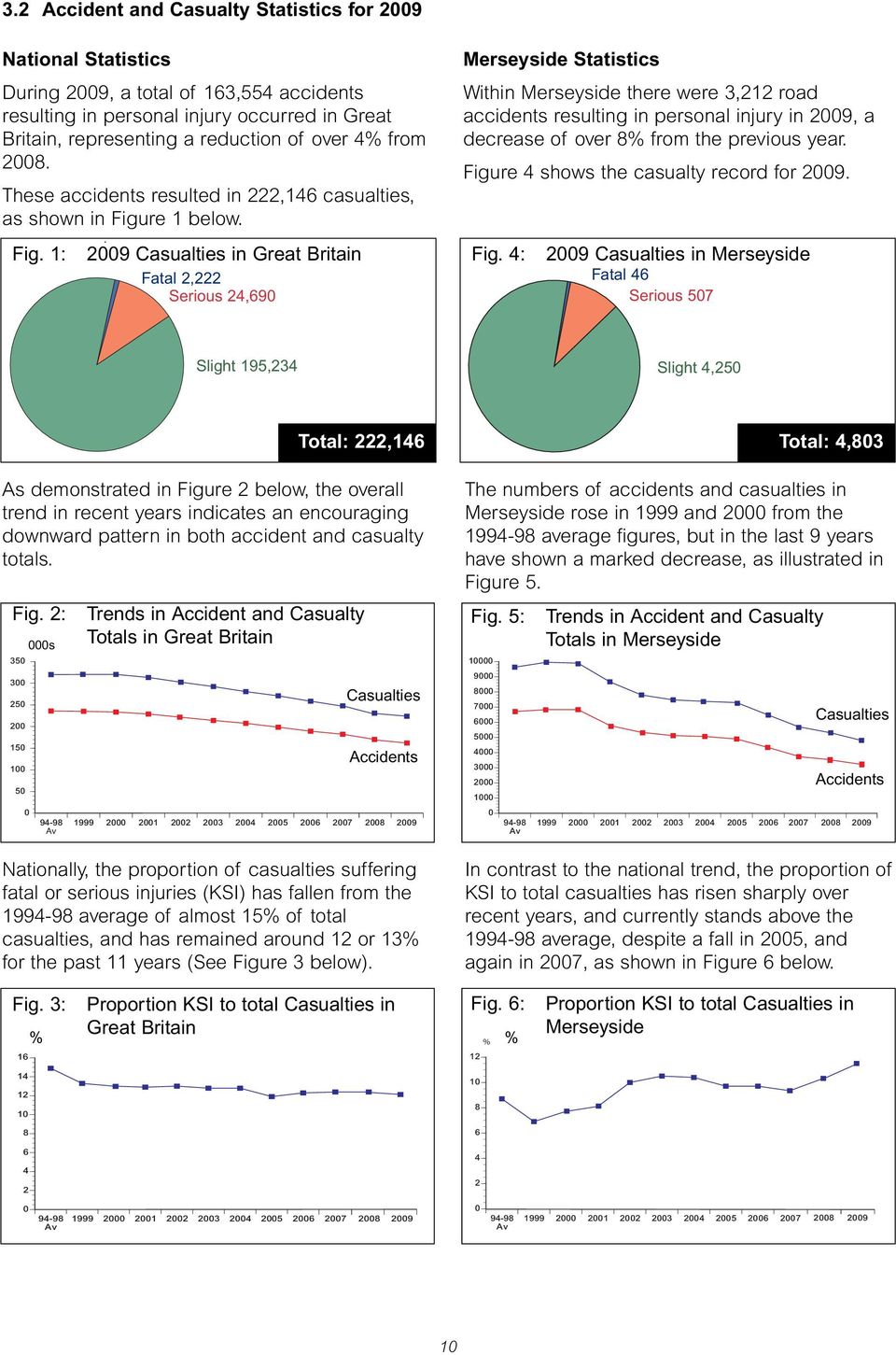
15 3.2 Accident and Casualty Statistics for 29 National Statistics During 29, a total of 63,554 accidents resulting in personal injury occurred in Great Britain, representing a reduction of over 4% from 28. These accidents resulted in 222,46 casualties, as shown in Figure below. Fig. : 29 Casualties in Great Britain Fatal 2,222 Serious 24,69 Merseyside Statistics Within Merseyside there were 3,22 road accidents resulting in personal injury in 29, a decrease of over 8% from the previous year. Figure 4 shows the casualty record for 29. Fig. 4: 29 Casualties in Merseyside Fatal 46 Serious 57 Slight 95,234 Slight 4,25 Total: 222,46 As demonstrated in Figure 2 below, the overall trend in recent years indicates an encouraging downward pattern in both accident and casualty totals. Fig. 2: s Av Trends in Accident and Casualty Totals in Great Britain Casualties Accidents Nationally, the proportion of casualties suffering fatal or serious injuries (KSI) has fallen from the average of almost 5% of total casualties, and has remained around 2 or 3% for the past years (See Figure 3 below). Total: 4,83 The numbers of accidents and casualties in Merseyside rose in 999 and 2 from the average figures, but in the last 9 years have shown a marked decrease, as illustrated in Figure 5. Fig. 5: Av Trends in Accident and Casualty Totals in Merseyside Casualties Accidents In contrast to the national trend, the proportion of KSI to total casualties has risen sharply over recent years, and currently stands above the average, despite a fall in 25, and again in 27, as shown in Figure 6 below. Fig. 3: Proportion KSI to total Casualties in Fig. 6: Great Britain % % 6 2 % Proportion KSI to total Casualties in Merseyside Av Av
16 St.Helens Accident and Casualty Data and Trends A total of 348 injury accidents were recorded in St.Helens in 29, representing a 9% decrease from the previous year. There were 8 fewer casualties, with a total of 55 recorded, of which 4 were fatal, 59 serious and 442 slight (See Figure 7 below). Fig. 7: 29 Casualties in St.Helens Fatal 4 Serious 59 Figure below provides a breakdown of 29 casualties into road-user groups. Recent trends within various user groups are explored in more detail in Section 3.4. Fig. : 29 Casualties in St.Helens by Road-User Adult Cyclists 4 Child Cyclists 7 Adult Pedestrians 37 Child Pedestrians 33 Motorcyclists 38 Slight 442 Total: 55 Accident and casualty figures remained fairly static for a few years, but with the decreases in the last 3 years, they are currently around 55% below the average figures for the five-year period , see Figure 8. Fig. 8: Av Trends in Accident and Casualty Totals in St.Helens Casualties Accidents Vehicle Passengers 4 Vehicle Drivers 235 Currently, much emphasis is placed on reducing danger for vulnerable road-users such as pedestrians, cyclists and motorcyclists in order to encourage more use of these modes of transport. Figure shows the casualty record for these road-user groups since the base figures of Fig. : Vulnerable User Trends in St.Helens % Pedestrians The proportion of fatal and seriously injured (KSI) has fluctuated in recent years, but at 2.5% for 29 is at its highest level in recent times Av Motorcyclists Cyclists Fig. 9: % Av Proportion KSI to total Casualties in St.Helens As can be seen from the diagram, there is a clear downward trend in pedestrian casualties over the time period, with the 29 figure of 7 representing a reduction of over 5% from the figure. Despite increases in motorcyclist casualties in 2 and again in 25, the overall trend in recent years is downwards. The number of cyclist casualties has fluctuated in the last few years, however 29 saw a fall of 6% from the previous year with 2 cyclists sustaining injuries, the lowest figure recorded in recent years. It is difficult to draw conclusions from these patterns, as little information is available relating

17 to comparative numbers of journeys by these modes of travel over the time period. It has been suggested that the perception of danger has led to a decrease in the number of journeys made on foot and by bicycle in recent years, particularly by children when travelling to and from school, and attempts are being made to reverse this trend through various means, including the development of School Travel Plans which leads to the Safer Routes to School Programme. Figure 2 below shows the overall pattern of child casualties in St.Helens. Fig. 2: Child Casualties in St.Helens Av Pedestrians Cyclists Other As can be seen from this chart, following an increase in the number of child casualties in 999 from the average, overall numbers have been decreasing in recent years, with figures for 29 showing another fall. The overall figure of 63 child casualties in 29 is the lowest recorded for many years. 3.3 National Targets In Tomorrow s Roads Safer for Everyone, the Government has set the following road safety targets to be achieved by 2, compared with the average for : A 4% reduction in the number of people killed or seriously injured in road accidents; A 5% reduction in the number of children killed or seriously injured; A % reduction in the slight casualty rate. Figures 3 to 5 demonstrate the progress made to date in attempting to achieve these targets within St.Helens Borough. 2 Fig. 3: Trend in KSI Casualties in St.Helens Av Fig. 4: Av Av Target Base Casualty Record Trend Required Target Trend in Child KSI Casualties in St.Helens Target Base Casualty Record Trend Required Target Fig. 5: Trend in Slight Casualties in St.Helens Target Base Casualty Record Trend Required Target 2

18 With the slight casualties and total KSI national targets, St.Helens is currently below, or close to, the trend required to meet the targets by the end of 2. However, the child KSI figure for the last 2 years has shown a disappointing increase which will make the target difficult to achieve. 3.4 User Group Trends Pedestrian Casualties - All ages During 29, a total of 7 pedestrians were injured on the roads in St.Helens Borough. As can be seen from Figure 6, although the total number of pedestrian casualties rose in 28 compared to the previous year, the trend over recent years is downwards. However, this may be indicative of a decline in pedestrian activity, and it is possible that the trend may start to rise again in future years, as people are encouraged to adopt a healthier lifestyle by walking rather than using the car, particularly for short journeys. Steps will be taken to improve safety for pedestrians through engineering measures, such as the installation of pedestrian crossing facilities and refuges, as well as schemes to reduce traffic speeds. Fig. 6: Pedestrian Casualties Fatal Serious Slight Total 3

19 Child Pedestrian Casualties As can be seen from Figure 7, the number of child pedestrians injured in the Borough increased in 24 and 25, however the 27 figure of 27 casualties was the lowest figure recorded in recent years, and although 28 showed a slight increase to 33, which was repeated in 29, the general trend is still downwards. Breaking down the child pedestrian figures into different age groups, as indicated in the table below, helps to provide further information as to where resources should be directed to target the most vulnerable groups. In general terms, comparatively few children in the pre-school age group suffer injuries as pedestrians, as they are likely to be accompanied by adults, whereas older children are more likely to become casualties as they gain greater freedom to travel independently. Road safety education and training in schools plays an important role in ensuring children are aware of the dangers facing them as pedestrians, and are able to deal with potential hazards when crossing the road. Fig. 7: Child Pedestrian Casualties Fatal Serious Slight Total Child Pedestrian Age Group years Fatal Serious Slight Total years Fatal Serious Slight Total years Fatal Serious Slight Total

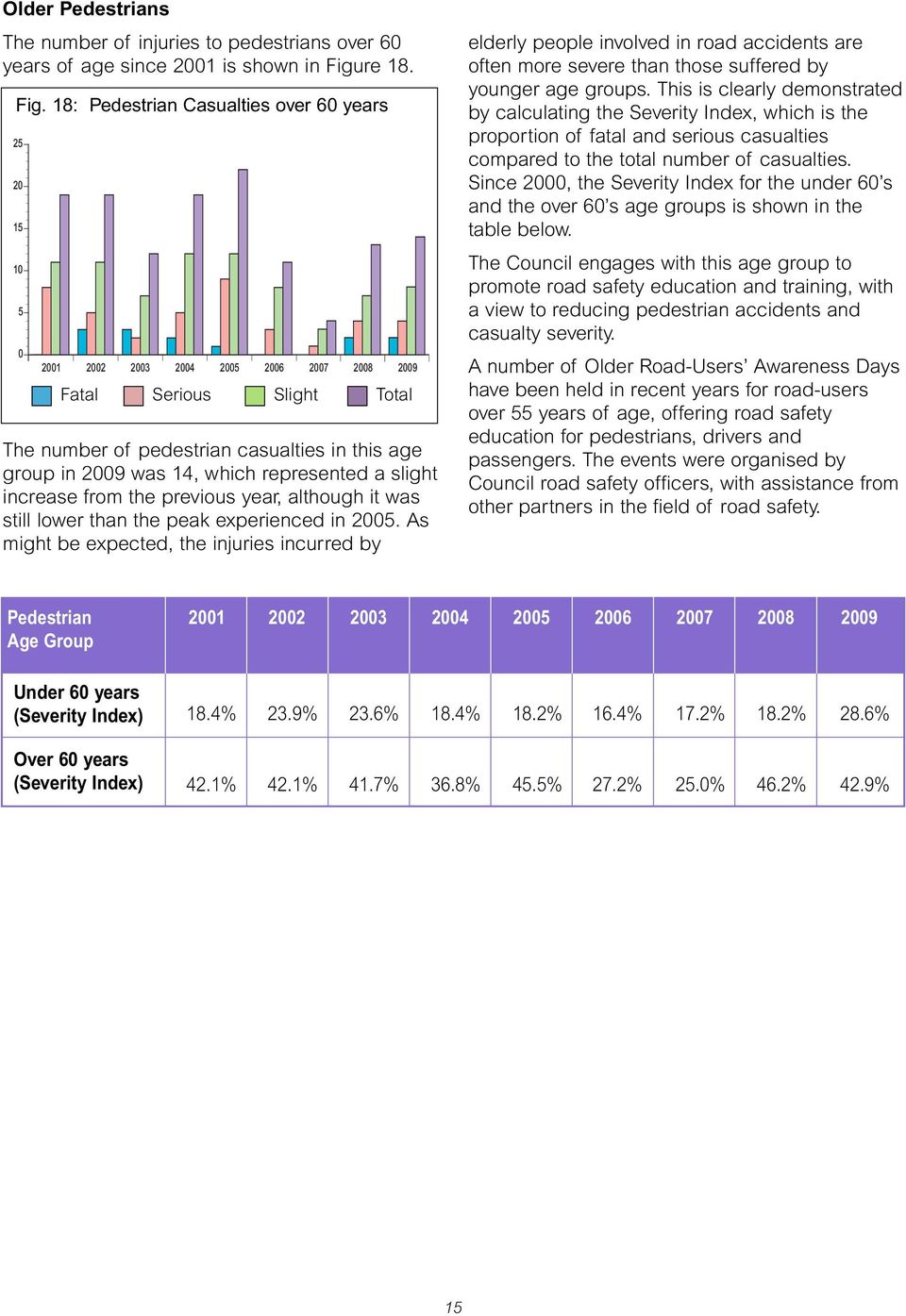
20 Older Pedestrians The number of injuries to pedestrians over 6 years of age since 2 is shown in Figure 8. Fig. 8: Pedestrian Casualties over 6 years Fatal Serious Slight Total The number of pedestrian casualties in this age group in 29 was 4, which represented a slight increase from the previous year, although it was still lower than the peak experienced in 25. As might be expected, the injuries incurred by elderly people involved in road accidents are often more severe than those suffered by younger age groups. This is clearly demonstrated by calculating the Severity Index, which is the proportion of fatal and serious casualties compared to the total number of casualties. Since 2, the Severity Index for the under 6 s and the over 6 s age groups is shown in the table below. The Council engages with this age group to promote road safety education and training, with a view to reducing pedestrian accidents and casualty severity. A number of Older Road-Users Awareness Days have been held in recent years for road-users over 55 years of age, offering road safety education for pedestrians, drivers and passengers. The events were organised by Council road safety officers, with assistance from other partners in the field of road safety. Pedestrian Age Group Under 6 years (Severity Index) 8.4% 23.9% 23.6% 8.4% 8.2% 6.4% 7.2% 8.2% 28.6% Over 6 years (Severity Index) 42.% 42.% 4.7% 36.8% 45.5% 27.2% 25.% 46.2% 42.9% 5
21 Adult Cyclist Casualties Fig. 9: Adult Cyclist Casualties Child Cyclist Casualties Fig. 2: Child Cyclist Casualties Fatal Serious Slight Total Fatal Serious Slight Total 26 saw the highest number of adult cyclists injured in road traffic accidents within the Borough for a number of years, with 3 casualties recorded. In the 3 years since then, the figures have fallen each year, with 4 casualties recorded in 29. As with pedestrians, cyclists are particularly vulnerable when involved in collisions with motorised vehicles, and are therefore more likely to sustain severe injuries. The provision of a network of cycle lanes and routes, both on and off the highway, can help to improve safety for cyclists, by reducing the potential for conflict with moving traffic. The number of child cyclist casualties has fluctuated over the years, with the figures of 6 and 7 recorded in 28 and 29 respectively, being the lowest in recent years. However, there are few figures available of comparative levels of cycle use during this period, so it is difficult to draw meaningful conclusions. As with child pedestrian casualty figures, it is useful to break cyclist casualties down into age groups to reflect the different educational levels, and to devise suitable training and educational programmes for the various groups. Cyclist Age years Fatal Serious Slight Total 5- years Fatal Serious Slight Total years Fatal Serious Slight Total
22 Motorcyclist Casualties Fig. 2: Motorcyclist Casualties Fatal Serious Slight Total As shown in the Figure above, motorcyclist casualties have been falling in recent years, and despite slight increases in 28 and 29, the overall trend continues to be downwards. A recent study of accidents involving motorcycles in St.Helens Borough revealed that these accidents are scattered geographically, rather than being concentrated at specific locations, with the age band of 6 to 3-year-old riders being most at risk. The most appropriate way of improving motorcyclist safety is, therefore, through educational and training programmes, and publicity campaigns, rather than through the introduction of engineering measures. Contact with local motorcyclist groups and partnershipworking with instructors and examiners is proving invaluable in reducing accidents involving this user group. 7
23 Young Drivers It takes time for newly qualified drivers to acquire the experience and develop the skills needed to cope with the often difficult and potentially hazardous conditions on today s roads. Consequently, studies have shown that younger car drivers are more likely to be involved in accidents than more mature drivers, with young male drivers being particularly at risk. The table below provides a breakdown, by age, of car drivers between the ages of 7 and 2 years who have been involved in personal injury accidents in St.Helens Borough over recent years. The table demonstrates that overall numbers in this category of road-user who were involved in accidents has fluctuated in the St.Helens Borough in recent years, however the last 3 years have been comparatively low, with only 7 drivers in this age group being involved in accidents in 29. Efforts will be concentrated towards training and publicity initiatives to improve safety for young car drivers, as well as closer working with motorist groups and driving instructors. Young drivers involved in accidents Driver Age Total Older Drivers It has been demonstrated that reaction times increase and eyesight worsens with age. Many drivers lose confidence as they grow older and voluntarily stop driving altogether, or drive less frequently and over shorter distances. When they reach 7, drivers must apply to the DVLA for a renewed licence, certifying that they are fit to drive, and must re-apply every 3 years thereafter. The table below shows the number of car drivers over 6 years of age who have been involved in injury accidents in St.Helens in recent years. As can be seen, the number of drivers over 6 involved in accidents increased in 27, the figure of 8 being the highest for a number of years, however in the following 2 years, the figures have fallen again, with only 59 drivers over 6 years of age being involved in accidents in 29. Older drivers involved in accidents Driver Age Total
24 4. Schemes and Programmes 4. Engineering Measures Local Safety Schemes In order to ensure that road safety benefits are maximised, it is essential that schemes are promoted that can demonstrate an acceptable rate of return. There are many locations where perceived danger or concern is high but safety problems cannot be established through recorded injury accident statistics. These locations are investigated as resources permit. However, most effort is concentrated at sites where evidence of injury accidents exists and these can be reduced. The Council produces annually a list of sites within the Borough having the highest number of injury accidents during the previous 3-year period. The current list entitled High Risk Sites for Accident Investigation is shown in Table. All sites appearing on this high risk list are subject to initial investigations to determine locations having easily identifiable problems which may be treated by low-cost measures. For example, sites having a high proportion of accidents occurring on wet road surfaces might benefit from resurfacing, surface dressing or specific anti-skid treatment. Similarly, high risk sites having a disproportionate number of accidents during the hours of darkness may benefit from an improvement in street lighting. A number of sites from the high risk list are selected annually for detailed investigation. Police files relating to individual accidents are studied where appropriate, and in-depth site investigations carried out prior to remedial schemes being designed. Implementation of any scheme depends upon the estimated cost of the proposed measures in relation to the total resources available, and the associated prioritisation of schemes. In addition to selecting individual sites for remedial action, attention is also given to identifying stretches of major roads which have experienced high accident rates, where route action treatment might provide an appropriate solution for reducing casualties. To supplement the High Risk Sites list mentioned above, a monitoring system for individual junctions and major routes (comprising A and B classified roads and local distributor routes) has been set up to help to identify locations having poor accident records where remedial action might be required. The figures are updated on a quarterly basis and highlight changes in the rate of accidents, casualties and KSI casualties occurring at each particular junction and on each stretch of road. Such a monitoring tool is invaluable in identifying trends, and provides an early warning of locations with emerging problems, where intervention may be necessary. Mass action treatment is a further way of reducing accidents, by applying one type of measure to a number of similar sites. In recent times, the Council has improved a number of pedestrian crossings each year by the application of antiskid surfacing on the approaches, thereby improving safety for pedestrians. Schemes which are introduced each year under the Local Safety Schemes Programme are monitored for a 3-year period to determine whether they have been successful in terms of reducing accidents. Details of schemes which have been introduced in recent years and are proposed for the current year are given in Appendix to this document. Although many factors can affect the accident rate at individual sites, one of the most significant is traffic flows. This is shown clearly by the fact that many of the sites on the high risk list are located on the A58 East Lancashire Road and the A57 Rainford Bypass, where heavy traffic flows are experienced. Both these roads have been the responsibility of the Highways Agency in recent times, however St.Helens Council assumed responsibility for these routes in April 24 when they were de-trunked. Future Local Safety Schemes funding is, therefore, likely to be spent on accident reduction measures on these roads. One such scheme, which was completed in 26, involved major improvements to the A58/Blindfoot Road and A58/Catchdale Moss Lane junctions. Both of these locations appeared on the table of High Risk Sites, having been the scene of numerous injury accidents over recent years. A funding contribution from the Highways Agency assisted in enabling significant improvements to be carried out at this location, and accidents have reduced considerably since the implementation of this scheme. Work completed in the financial year 27/8 included a scheme to reduce the speed limit on the A57 Rainford Bypass to 6mph, following the success of a similar scheme on the A58 East 9
25 Lancashire Road in 25, as detailed in the following section. During the current financial year (2/), a scheme is being undertaken jointly with the Highways Agency to reduce accidents at the M6/A58/A49 interchange at Haydock Island. The work involves reducing the speed limit at the junction itself, and on the approaches to it, in addition to lining and signage improvements. Local Public Service Agreement (LPSA) Schemes In 25, the Council received from Central Government an allocation of 963,, which was to be used to assist in meeting 2 specific LPSA targets across the whole of the Council s Departments. The Government wished to challenge the Council to achieve these targets, which were purposely set at a higher level than normal Departmental targets. In achieving all the corporate targets, the Council would then receive a substantial funding programme, in the region of 4million, to facilitate further improvements to their services. The LPSA targets set for the Environmental Protection Department related to two specific areas of service delivery, one for improving waste management services and the other relating to road safety. This road safety target was quite specific in that by 25/6 the number of road accidents resulting in Killed and Seriously Injured (KSI) casualties was to be reduced by 5% from the baseline years of 994 to 998, as opposed to the national target of 4%. In attempting to achieve this tough target, an assessment of all the road accidents in St.Helens was made, using the Council s accident database. From this analysis, it was clear that the East Lancashire Road (A58), which runs through St.Helens directly connecting Liverpool and Manchester, was identified as making a significant contribution to the number of accidents in St.Helens, particularly relating to severity. Further analysis indicated that whilst the length of this stretch of road accounted for only 2% of the local highway network, it was responsible for % of all accidents in the Borough. Indeed, within the list depicting the high risk sites identified in the Borough as having the worst number of casualties over a 3-year monitoring period, the A58 provided 5 of the sites on that list. The A58 had a derestricted speed limit, and detailed assessment indicated that for the majority of the accidents on this road, speed was one of the primary causations of accidents. The Council deemed it appropriate to submit this route as the primary scheme in which the LPSA target was to be achieved. It was clear that a reduction in the speed limit along the length of the A58, enforced by the use of speed cameras, would have a significant beneficial effect on the number of KSI casualties. A reduced speed limit of 6mph was introduced in January 25, and vehicle-activated signs were installed to encourage drivers travelling above that limit to slow down. From the total funds of 963, allocated by the Government, unsupported credit approval for 38, was allocated for this particular target. The Traffic Section managed this ambitious project, liaising with the Highways Agency, Police Authorities and Neighbouring Local Authorities in order to ensure a smooth delivery of this high profile scheme. The LPSA stretch target imposed on the Council for the year 25/6 was determined as 74 KSIs, a projected reduction from the average figure of 4 KSIs derived from the baseline years of 994 to 998. During the 2-month LPSA monitoring period, the Council successfully reduced the number of KSIs to 7, a reduction of 55%, thereby not only meeting but exceeding the Government s stretch target of 5%. Traffic Calming Schemes The Council has, in recent years, made some additional funding available specifically to install traffic calming measures within residential areas. The criteria used for site selection have included accident record, proximity to schools, vehicle speeds, and proportion of through traffic. Full consultation procedures have been carried out with residents, Emergency Services, Bus Operators, etc., before the details of each scheme have been finalised. Measures which have been installed include road humps, build-outs, narrowings, junction tables and speed cushions. Alternative types of traffic management controls, such as vehicle-activated signs and environmental measures to reduce traffic speeds, are currently being used with a view to expand their use within the Borough. This, allied with greater Police enforcement on selected routes within the local 2
26 Table : High Risk Sites for Accident Investigation (Based on 3-year Accident Record, ) Number of Injury Accidents Location Yr Yr 2 Yr 3 Total 3 Yr Slight Severity Serious Fatal In hours of darkness On wet road surface Involving pedestrians Involving pedal cyclists Status M6/A58/Lodge Lane IV M62/Warrington Road/Linkway/ IV Watkinson Way Linkway/Scorecross/Sherdley Road/ IV Burtonhead Road Kirkland Street/Boundary Road/ IV Lingholme Road A58/Rainford Road III Linkway West/Chalon Way/Canal Street I Linkway West/Westfield Street/ I Kirkland Street/King Street Linkway East/Parr Street/ I Peasley Cross Lane Gaskell Street/Sutton Road/Jackson Street IV A58/Liverpool Road IV Rainford Bypass/Pasture Lane I Prescot Road/Dunriding Lane I Broad Oak Road/Chancery Lane/ I Boardmans Lane Rainford Road/Dentons Green Lane/ III Kiln Lane Rainford Bypass/Mill Lane/St.Helens Road I St.Helens Road/Burrows Lane/ I St.James Road A58/Catchdale Moss Lane IV Rainford Bypass/Bushey Lane/Lodge Lane IV Status Codes I Detailed investigation work pending II Detailed investigation work in progress III Detailed investigation work completed IV Scheme implemented 2
27 highway network, appears to be having a positive benefit on road safety. Speed Limit Review In 26 the Department for Transport published Circular /26, Setting Local Speed Limits, which provided guidance to Local Authorities in setting speed limits on roads within their areas, and in developing route management strategies and speed management strategies as part of the overall strategy for improving road safety and reducing casualties. Local Authorities have been tasked with reviewing the speed limits on their A and B classified roads network, and implementing any necessary changes by 2 in accordance with the guidance provided. In addition, attention should be focused on the introduction of speed management measures, including setting an appropriate speed limit on those routes having the worst accident problems, or where there is widespread disregard for the current speed limit. To assist with the process of assessing the speed limit on roads within the Borough, St.Helens employed consultants to carry out a study of all A and B roads and other important local distributor routes, with a view to recommending changes to the speed limits where deemed appropriate and in accordance with the guidelines. Traffic volume and speed surveys were undertaken and accident statistics analysed. A full site assessment of each route was carried out, taking into consideration such factors as road function, geometry, environment, adjacent development and traffic composition. As a consequence of the review, a number of changes have been identified, and Traffic Regulation Orders for the amended speed limits are currently in the process of being implemented. These include the introduction of reduced speed limits on various roads where accidents relating to inappropriately high vehicle speeds have been experienced. The changes include new 5mph speed limits on stretches of the following roads: B523 Catchdale Moss Lane B524 Travers Entry and Bold Lane, new stretches of 4mph on the following roads: A58 Liverpool Road B523 Catchdale Moss Lane and Gillars Lane News Lane, and new stretches of 3mph on: B527 Billinge Road B549 Chester Lane A569 Clock Face Road. In addition, serious consideration is being given to reducing the speed limit, or altering the location of the speed limit interface, on a number of other roads, including Alder Lane, B527 Newton Road, A57 Warrington Road and A58 Liverpool Road. 4.2 Education, Training and Publicity The previous Government s White Paper A New Deal for Transport and the Road Safety Strategy, Tomorrow s Roads Safer for Everyone offered opportunities to all road safety practitioners to promote road safety initiatives to the whole community. The analysis and assessment of statistical data provided the platform for targetsetting and the designing and delivery of appropriate campaigns, schemes of work and support material for use with identified road-user groups. Road safety and travel awareness education, training and publicity are promoted in the most cost-effective and efficient manner, demonstrating the principles of Best Value. Working within the context of national and regional targets, aspects of road safety education, training and publicity are contained within the Corporate Safety Action Plan and Business Plan. The Government wants to make sure that every child has the chance to fulfil their potential and, under the Children Act 24, five outcomes were outlined under the heading Every Child Matters : Be healthy; Stay safe; Enjoy and achieve; Make a positive contribution; Achieve economic wellbeing. The Road Safety and Travel Awareness Team, together with other sections within St.Helens Council and other road safety practitioners, aim to fulfil these outcomes through education, training and publicity. Young people up to the age of nineteen can gain healthier lifestyles by walking and cycling. 22
28 Staying safe encompasses knowledge of road safety whilst walking, cycling, driving or riding, reducing chances of being injured or injuring others. Healthier children can enjoy recreation and achieve personal and social development by developing positive attitudes and behaviour to road safety. The Road Safety and Travel Awareness Team The Road Safety and Travel Awareness Team, as part of the Corporate and Community Safety Section located in the Chief Executive s Department, works at a strategic level with the Police, Education, Highways, Health Promotion, Economic Development and Community Safety. The core purpose of the team is to: Influence and co-ordinate the prevention and reduction of road casualties; Enable the efficient, safe and sustainable use of the road network. The Road Safety and Travel Awareness Team encompasses the wider issues of transport plans including School Travel Plans, pedestrian and cyclist training, fleet safety, driver training and risk management. Partnerships between neighbouring authorities within Merseyside and the North West provide an effective platform for the co-ordination of national issues. As well as working with children and in schools, the Road Safety and Travel Awareness Team considers helping vulnerable road-users as part of its remit. This includes horse riders, older road-users whether they are drivers, riders or pedestrians. As such, the team takes part with partners in road safety strategies and publicity and marketing events to promote safer driving, including information on the dangers of drinkdriving, driving using a mobile phone, inappropriate speed and the non-wearing of seat belts. Currently, the Road Safety and Travel Awareness Team employs three permanent Road Safety Officers and two temporary Assistant Road Safety Officers who act as advisors as well as direct service providers. Additionally, the Council secured ABG funding with matching Road Safety Partnership funding for Child Pedestrian Training Co-ordinators in order to produce a new pedestrian training programme called Walk It Safer, which commenced in schools in January 27. These posts have been funded until March 2. Continued funding will be required to enable the child pedestrian scheme to continue after that date. In addition, the Council has secured funding for a School Travel Advisor who is developing School Travel Plans. This post has been funded until March 2. Education The Road Safety and Travel Awareness Team currently employs one person working on a termtime only basis to deliver a programme of road safety education in schools. The Assistant Road Safety Officer also assists as part of their role in road safety. The Child Travel Awareness and Safety Officer has developed a programme of lessons to deliver to pre-school and primary-aged pupils. All lessons are linked to National Curriculum objectives and are generally delivered in the classroom to avoid disruption to the school timetable. The aim is to give pupils an opportunity to develop the skills and knowledge they have learned in school, and to apply it in useful real life situations. A typical example would be: Year Lesson National Curriculum Objective Nursery Holding hands and stopping at the kerb Foundation stepping-stone Reception Teddy Takes a Tumble/using your senses PSHE/Science Year Using your senses to stay safe Science Year 2 Writing instructions (the Green Cross Code) Literacy Year 3 Be safe, be seen Posters and design technology Year 4 Planning safer routes Geography Year 5 Risk-taking PSHE Year 6 Writing road safety leaflets/speed gun Literacy/Numeracy This list is not exhaustive and the programme can be tailored to meet each school s specific needs. 23
29 The Council also works in partnership with other agencies both within the private sector and charitable road safety organisations to deliver road safety education. During the course of the year, nursery sessions were delivered to a total of 29 children in both private and state sector nurseries. A range of road safety messages has been given to children from all year groups in primary schools. This year, this service has been provided either reactively following complaints from members of the public, or following invitation from the schools themselves. A total of 77 children were targeted by this method. The Road Safety and Travel Awareness Team participated in the Crucial Crew initiative. This is a multi-agency day for visiting schools, putting across safety messages from Merseyside Police, British Transport Police, Merseyside Fire & Rescue Service, Ranger Service and Home Safety, as well as the Road Safety Section. The theme this year was making a 999 call and what to do if there was somebody hurt in an accident. The Environmental Protection Department, in conjunction with Merseyside Police, showed how to make a 999 call and the other sections had interactive methods of dealing with casualities safely. Crucial Crew ran for two weeks with,94 children from schools in the Borough attending. An additional morning was added to the programme in order to include children from Special Schools. The whole programme is a very effective way to bring a range of messages about personal safety to Year 5 pupils as part of a network of national Crucial Crew events. Crucial Crew is now accredited by the Royal Society for the Prevention of Accidents. Secondary Education Programme The Council has developed road safety lessons for use with Key Stages 3 and 4. The aim is to deliver road safety education to more secondary schools. Funding has been obtained through the Merseyside Road Safety Partnership in order to offer pre-driver training in Secondary Schools throughout Merseyside. Suddenly from Nowhere is a programme designed for pre-drivers and riders to understand the consequences to others of distractions whilst driving or riding. Also, Road Safety Officers, together with Fire Safety Advocates, have engaged with young people at centres for excluded pupils. Special Schools A basic pedestrian training scheme has been offered to young people with special educational needs in Carmel College over the last four intakes. This is designed to assist with independent living. The Road Safety Officer, Education has linked with Adult and Community Learning, and has delivered road safety education to 52 families through their Literacy, Numeracy and Share programmes. The Share programme has five units linked to Every Child Matters, of which road safety comes under Keeping Children Safe. Training Forming part of the Council s Health and Safety Policies and Procedures Manual, the Council operates a two-part minibus training course which includes a theory and practical element. Both parts of the training must be completed prior to the individual being issued with a certificate of attendance, and refresher training must be taken every four years thereafter. Furthermore, the Road Safety and Travel Awareness Team is committed to the development of training packages for vulnerable groups including older drivers, pedestrians, cyclists and horse riders. The pedestrian and cycling training also works in conjunction with the School Travel Plans. Cycling Enabling is part of Target: Wellbeing, a regional programme funded by the National Lottery through the Big Lottery Fund and managed by Groundwork. Together with St.Helens Council s Healthy Living Team, the Road Safety Team delivers cycling for health programmes for those people either referred by their GPs or wishing to attend for themselves. This encourages gentle cycling to help with recovery and as a weight loss programme. Also, maintenance sessions are held throughout the Borough, through Cycling Solutions and TravelWise in order to offer basic training in repairing cycles. Work-Related Road Safety In St.Helens, the average number of work-related road accidents represents approximately 25% of the total number of accidents. The Road Safety and Travel Awareness Team is involved in offering advice and driver training to assist in reducing the casualties involved in road traffic accidents whilst at work. 24
30 A Safer Driving Manual has been developed for casual and essential drivers. As mentioned above, training for minibus drivers is ongoing. The training and assessment is carried out by an approved Driving Instructor. Future objectives are to offer theory and practical training to other at work drivers in the Local Authority and to arrange information days for small businesses in the Borough. Publicity In order to raise positive safety attitudes and awareness, the Council continues to design, implement and evaluate publicity campaigns and programmes. The Council subscribes to the Road Safety (GB) Publicity Strategy Calendar which complements the National Strategy promoted by the Department for Transport. Media Campaign Launches are organised in co-operation with the Police to ensure that a co-ordinated approach maximises effectiveness. The five Merseyside local authorities also work together to publicise road safety as a joint venture. Child Car Seats The Road Safety and Travel Awareness Team offer assistance by trained staff for the fitting and checking of child car seats for members of the public. This is a free service, which can be carried out at a mutually convenient location, e.g. client s house, town centre or school car park. Education is followed up by working with parents at playgroups, stay and play groups and also through Sure Start children centres. In schools, the story of Teddy Takes a Tumble is used to communicate to children the importance of wearing the appropriate seat belts. This book was prepared by Road Safety (GB) North West group, and has now been followed up with Teddy Takes a Walk. In 2 the Council participated in the national publicity campaign for child in-car safety through Road Safety GB. The Good Egg campaign was launched to inform people of the importance of using and fitting child car seats correctly. The Good Egg guide was distributed and car seats checked at two venues in St.Helens in September. Altogether, 4 seats were checked. It was found that some seats were incorrectly fitted and some parents did not have a suitable restraint for their small children. It is hoped to be able to repeat this annually. 4.3 Enforcement The enforcement of road traffic law in St.Helens is the responsibility of Merseyside Police, but a close relationship is maintained with St.Helens Council in its role as Highway Authority in order to ensure that resources are effectively targeted and a co-ordinated approach to road safety is achieved. Merseyside Police have produced a Casualty Reduction Strategy for the St.Helens Area in which its policies relating to road safety are set out, and specific measures are identified in order to reduce accidents and casualties in line with Government targets. Close monitoring is to be undertaken using a wide range of performance indicators to ensure that objectives are achieved. Specific local campaigns are carried out throughout the year, resulting in high levels of road-related enforcement, including arrests for drink/driving offences, disqualified driving, vehicles seizures and issuing of fixed penalty notices. In addition, the utilisation of Community Support Officers, along with members of the public, on the Community Speedwatch campaigns is helping to reduce vehicle speeds on specific routes identified by the Highway Authority. Speed surveys are carried out with the objective of sending warning letters to the registered keepers of vehicles which are recorded as exceeding the speed limit. Other routes are targeted for speed enforcement using mobile cameras. Enforcement-related issues and campaigns are described in greater detail in Section Joint Initiatives A number of current initiatives demonstrate the co-ordinated approach taken to road safety issues. These programmes involve close liaison between the officers involved in policy-making; education, training and publicity; and design and implementation, to ensure a successful service delivery. 25
31 School Travel Plans and Safer Routes to School Initiative Through ABG funding, the Road Safety and Travel Awareness Team has employed a temporary full-time School Travel Advisor to develop School Travel Plans. It is expected that this funding will be available to March 2 in order to attain the Government s goal of every school having a School Travel Plan, or at least working towards one, by 2. The School Travel Advisor works in partnership with the TravelWise group and with other members of the Road Safety Team to complement the development of pedestrian and cycle training skills of pupils. The Council, through School Travel Plans, is working hard to reduce congestion during the school run. The outcome will be a safer environment for the journey to school. It will also increase the opportunity for more physical activity, linking in with the Active St.Helens Strategy. The reduced number of vehicles used during the school run will also improve local air quality, linking in with sustainability principles and values of the St.Helens Community Plan. Comprehensive guidance on developing a plan which meets the Department for Transport and the Department for Children, Schools and Families criteria is given and, after the school and the governors have adopted their plan, the Engineering Division look at the engineering measures needed and possible alternative schemes. The Director of Children and Young People s Services and the Assistant Director (Engineering) then authorise the schemes to be put in place. Of the 74 schools within St.Helens Borough, 64 have adopted a School Travel Plan to date, with one further school currently working towards that status, as demonstrated in Figure 22 below. Details of the schools are provided in Appendix 2. Fig. 22: School Travel Plans Plan adopted 64 Schools not yet involved 9 Working towards plan No. of schools: 74 Pedestrian Safety A Pedestrian Strategy has been produced and approved by the Merseyside LTP partners which identifies a number of initiatives aimed at giving more emphasis to the needs of pedestrians, including addressing the issues of road safety. The Council has already begun to implement one of these new initiatives, the pedestrian audit of new planning applications, which ensures that new developments provide adequate and safe pedestrian routes. Following the adoption of the Pedestrian Strategy, it is proposed to undertake a pedestrian audit of as many pedestrian routes as possible, with priority being given to the most heavily used routes in the Borough. This will ensure that all road safety issues are identified and appropriate remedial measures prioritised for implementation in the future. In residential areas, the Council continues to reduce road traffic dangers to pedestrians through the introduction of traffic calming measures. At locations where vehicular/ pedestrian conflict is high, the Council continues to install new pedestrian crossings and upgrade existing crossing facilities. In addition, new pedestrian facilities at signalised junctions continue to be provided to enable pedestrians to cross safely at busy junctions. As described in previous paragraphs, the Council continues to install physical measures as part of the Safer Routes to School initiative which aims in part to address road safety issues for pedestrians. The Council s Road Safety and Travel Awareness Team undertakes a wide range of education, training and publicity programmes aimed at all age groups. Issues include crossing roads and using safer crossing places, crossing near to parked cars, junctions and the importance of wearing fluorescent and reflective clothing. Walk It Safer child pedestrian training is now into its third year and Level 2 is being delivered as well as Level. The number of pupils who have received the training to date is shown in Appendix 3. Evaluation of the scheme has shown that the children who have received training are more aware of road safety issues than those who have not had training. 26
32 Funding was available through ABG and Merseyside Road Safety Partnership for children to receive training. The ABG funding was withdrawn in July 2 and Partnership funding reduced by 5%. Further funding has been found to allow a reduced model of the scheme to continue until March 2. The scheme is aimed at primary school children in Years and 2. Walk It Safer is delivered on three levels as follows: How to find a safe place to cross the road and how to cross safely; How to cross the road near to parked cars if there is nowhere else to cross safely; How to deal with junctions. The sessions are in the classroom and also at the roadside. The children are reminded that they should cross the road with an adult and be holding hands whenever they are at the roadside. In order to support the practical sessions, the children complete worksheets in the classroom based upon the teachings at the roadside. These worksheets can then be taken home, to help reinforce and share their learning at home with their parents. St.Helens Council provides a school crossing patrol service to ensure that the journey to and from school for local children is as safe as possible. School Crossing Patrols are provided at locations where children are in danger from road traffic when crossing busy roads in the vicinity of school frontage, but could be anywhere on a direct route between residential areas and schools. Cyclist Safety One of the aims of Merseyside s Cycling Strategy is to improve the environment for cyclists, in order to make it safer for those who already cycle, and to encourage more people to participate in cycling, for both recreational and utility purposes. Within St.Helens, a study has been undertaken to determine the type and extent of measures that could be introduced to improve the environment for cyclists, taking into account the characteristics of the area and the various needs of all cyclists. The study concluded that the Council should target initiatives in three main areas: the creation of off-road cycle tracks, traffic calming of residential areas and the provision of on-road cycle measures. The study also highlighted the need to promote these three initiatives to specific target groups in order that novice cyclists or young children are not encouraged to cycle in an environment which is inappropriate for them with respect to road safety. This link between the type of cycle route and the level of cycling proficiency of the users is a key element in ensuring that increases in cycle use do not lead to a corresponding increase in cyclist casualties. The Council s annual Cycling Programme continues to fund schemes that create a safer environment in which to cycle. Some schemes are also specifically promoted at locations at which improvements are necessary to reduce the cyclist casualty rate. Schemes include: Construction of sections of the Borough s proposed network of off-road cycle tracks. These cycle routes are suitable for all cyclists to use; Provision of various types of on-road cycle measures such as cycle lanes and advanced stop lines which are situated primarily on the Borough s main roads and are, therefore, aimed at creating a safer environment for predominantly experienced cyclists. In parallel with the creation of a safer cycling environment for all, it is of equal importance to provide cycle training and promote road safety issues particularly relating to the wearing of correct clothing and cycle helmets. The Government, working with CTC which is a recognised national cycling organisation, have developed a National Cycling Strategy. Funding throughout Merseyside from the Local Transport Plan is now being used for a social enterprise company, Cycling Solutions, to deliver cycling training to children in Years 5 and 6. The National Cycling Strategy is a set of guidelines for cycling training in three levels: Level Basic Skills Training Off-road training Level 2 Introduction to on-road cycling Level 3 Advanced/adult training In 2, there have been 85 children trained to Level 2 standard, which is on-road training, and details of the schools involved are shown in Appendix 3. 27
33 4.5 Partnership-Working Considerable efforts have been made in recent years to improve the way that we attempt to take appropriate remedial action in order to progressively reduce the number and degree of severity of road collisions which result in personal injury, in line with the Government s 2 casualty reduction targets. New Co-ordinated Strategies Through the Merseyside Road Safety Partnership (MRSP), each local authority in the region, along with Merseyside Police and Merseyside Fire & Rescue Service, has collectively agreed various road safety strategies. These new strategies which relate to the use of engineering works, enforcement actions and education campaigns are now being actively pursued by each stakeholder. The enforcement operations carried out by Merseyside Police are now driven by a greater emphasis being placed on a pan-merseyside approach at one level and by assisting each individual local authority at another, via the establishment of Joint Action Groups (JAG) across the region, which report to the MRSP. Emphasis is placed on providing a greater level of research into the accident data provided through the Police Stats9 forms, to enable specific areas of concern or road-user groups to be more easily identified, allowing the most appropriate remedial action to be taken. Accident hotspots are identified to highlight specific locations where there appears to be a greater risk than normal. The research may also indicate specific time periods when accidents are occurring more frequently, or the type and age group of the road-users most at risk of injury, where appropriate enforcement action may greatly assist in the reduction of accidents. To assist this more intelligence-led approach in determining the causation of abnormal occurrences of personal injury accidents on Merseyside, a new Police-led Action Team has been formed and its work is based on the Police s National Intelligence Model (NIM). This new group comprises Police Officers, Data Analysts and supporting staff, including officers from the local authorities, and Fire & Rescue Service, and members are able to share the various types of accident data now made available. With this detailed information, the Police, in particular, can utilise their Traffic Management resources in a much better way, allowing a greater level of success to be attained. As Central Government treats Merseyside as a region in terms of achieving specific targets in accident reduction, it is important to understand that this intelligence-led research must identify the main problems within the region as a whole, as opposed to within each individual local authority area or each Police area, i.e. their Basic Command Units (BCU). Whilst the Government s casualty reduction targets for 2, mentioned in Section 2, have to be achieved by each stakeholder within their own respective area, the MRSP accepts that a greater level of Police resources is needed to target the areas within the region where the casualty numbers and degree of severity are greatest. Fortunately, St.Helens and its neighbouring Authority, Knowsley, have relatively fewer accidents and, through their own resources, are presently on course to achieve their respective targets, whereas Wirral, Liverpool and Sefton require further assistance to be provided through the MRSP. Although it presently appears to be good news for St.Helens and Knowsley, it is important that strong efforts are made to ensure that an unexpected rise in the numbers or degree of severity does not occur in the next few years, which will adversely affect the current trend in these two boroughs. St.Helens Joint Action Group When Joint Action Groups (JAGs) were initially established in Merseyside in 26, it was deemed appropriate for St.Helens and Knowsley authorities to combine into a single JAG, so that action could be taken to deal with common problems and cross-boundary issues. Meetings of this group were held on a regular basis for over a year, and some productive work was achieved, particularly in the education, training and publicity fields. However, since June 28, St.Helens has been holding its own individual JAG, so that the group s attention can be focused on identified problems within the Borough, and appropriate measures can be determined to deal with these specific issues. The group is attended by Council 28
34 road safety and engineering officers, representatives from Merseyside Police and Fire & Rescue Service, as well as personnel from Arriva, which operates many of the local bus services in St.Helens. The JAG uses intelligence-led research to determine local road safety strategies for Police enforcement, local authority engineering works, and education, training and publicity campaigns, with specific targets being agreed in order to ensure that each stakeholder actively achieves them. These targets are changed on a regular basis as a result of the continual reference to the latest research provided to the MRSP. A business plan has been drawn up to identify actions for the various JAG partners within identified areas of concern. The business plan is an evolving document, recording and reviewing the progress being made in the various activities of enforcement, engineering, education/training, communication and intelligence, as well as identifying future work to be carried out to achieve casualty reduction targets. Presentations from Merseyside Fire & Rescue Service and Arriva have been made at JAG meetings to highlight the work being undertaken by each organisation to improve safety and reduce the potential for accidents. While the individual stakeholders each have their own particular remits and targets relating to their specific organisations, all are committed to joining together to improve road safety within St.Helens Borough. Already, the benefits which can be achieved through exchanging ideas, sharing expertise and pooling resources are becoming apparent, and St.Helens JAG members will continue to build on this initial success by working together in the coming year. Wherever possible in future, joint initiatives and campaigns will be run in order to maximise the benefits and achieve the greatest possible impact. Speed Enforcement Another valuable resource, which is assisting Merseyside in its efforts to meet the Government 2 targets, is the body formerly known as the Merseyside Road Safety Camera Partnership (MRSCP). This Partnership comprises the five local authorities within Merseyside, the Highways Agency, Merseyside Police and HM Courts Service and manages the speed enforcement camera network on Merseyside. Following a change in the Department for Transport s funding process in April 27, the MRSCP now sits within the recently formed Merseyside Road Safety Partnership (MRSP), which has resulted from the restructuring of the former Merseyside Road Safety Planning Group (MRSPG). As the selection criteria for installing speed and red light cameras are mainly based on reducing the number of killed and seriously injured road casualties, the cameras are sited in the locations with the worst accident record. On Merseyside, the areas with the majority of cameras are in Liverpool North, Wirral and Sefton, with St.Helens and Knowsley having the least. Within St.Helens Borough, the relatively low accident rate in recent years has meant that no locations have met the qualifying criteria to justify the installation of fixed speed cameras. However, one location the A58 East Lancashire Road/A57 Carr Mill Road junction has two red light camera sites to deal with the red light running problem which has been experienced at this signalised junction, and other locations on the A58 are currently being assessed as potential sites for further red light cameras. As well as fixed speed cameras, the speed management strategy of the MRSP includes mobile speed enforcement, and this is carried out at locations which fall short of the main selection criteria. As part of the MRSP business plan for 27/8, a number of new mobile enforcement vehicles were deployed, which should also benefit St.Helens. A number of locations within St.Helens have been selected for this mobile enforcement, and other locations are to be continually monitored and reassessed for approval. Enforcement of the Law Another area of Police enforcement is dealing with the acknowledged fact that criminals make use of vehicles and the road network in order to commit 29
35 crime, travel to and from scenes of crime, convey firearms, drugs and stolen property and to interact with other criminals. It has been shown that people actively involved in criminal activity are the least likely to have fully taxed and insured vehicles and are, therefore, contributing to the anti-social use of vehicles. In addition, there are other drivers who are breaking the law by driving vehicles illegally, whether they are disqualified from driving, driving unregistered or stolen vehicles, or driving vehicles which are uninsured, untaxed or unroadworthy. On Merseyside, the use of specialised Police vehicles carrying Automatic Number Plate Recognition (ANPR) computerised equipment, which can interrogate a number of databases, mainly from the DVLA, Motor Insurers Bureau, other Police forces and bodies, has been very successful. This Police operation, codenamed TANGO, has been responsible for removing over ten thousand vehicles from the road network of Merseyside in recent times. Denying the criminals vehicles access onto the highway network provides other benefits to the community in terms of reducing crime and antisocial behaviour. In addition, St.Helens Council and Merseyside Police are working together in carrying out joint speed management campaigns in which a number of roads in St.Helens are selected for speed enforcement action. These routes are selected on the basis of their accident record, results of speed surveys and also take into account local public perception. The Police are able to carry out not only speed but other enforcement actions, for example, where the vehicle stopped is found to be untaxed, uninsured, stolen or has a disqualified driver. Such a co-ordinated approach of working with our partners appears to be providing significant improvements in terms of road safety, as well as creating a new and healthier respect for the use of the local highway network, particularly by those who wilfully disregard the law. 3
36 Appendix : Local Safety Schemes Local Safety Schemes 22/23 Site and description of Before Date Cost Monitoring Years After Percentage Remedial Work 3-year Completed 3-year reduction accident st 2nd 3rd accident in total total accidents Carr Mill Road May 2, % 4mph Speed Limit 23 Garswood Road 8 May 6, % Route Improvement 23 Mill Lane, Sutton 9 May 4, % Route Improvement 23 Ashcroft Street and Parr Stocks April 25, 7 3 -% Road 23 Route Improvement Warrington Road 8 June 3, 87% Route Improvement 23 Gores Lane 7 June 3, % Route Improvement 23 Liverpool Road June 3, 3 5 5% Route Improvement 23 Billinge Road 5 April 8, 3 4% Improvements at double bend 23 Bold Lane 2 May 8, 5% Improvements at bends 23 Average Reduction 43% Local Safety Schemes 23/24 Site and description of Before Date Cost Monitoring Years After Percentage Remedial Work 3-year Completed 3-year reduction accident st 2nd 3rd accident in total total accidents St.Helens Road/Portico Lane 8 July 5, 3 62% Signalisation of Junction 24 Junction Lane/Station Road/Helena 7 March 35, 2 7% Road 24 Junction Improvement Park Road/Pocket Nook Street 8 August 3, 3 62% Prohibition of Right Turn 24 Bushey Lane, Rainford and 4 February 5, % Borough Road 24 Anti-Skid Surfacing Average Reduction 74% 3
37 Local Safety Schemes 24/25 Site and description of Before Date Cost Monitoring Years After Percentage Remedial Work 3-year Completed 3-year reduction accident st 2nd 3rd accident in total total accidents A58 East Lancashire Road 47 March 45, % Reduced Speed Limit 25 Gaskell Street/Granville Street 3 March 3, 2 85% Junction Table 25 Dunriding Lane March 4, % Route Improvement 25 Jubits Lane 9 July 3, % Route Improvement 25 Rainhill Road 7 March 7, % Route Improvement 25 Burrows Lane and Billinge Road/ 5 March 22, 8% Newton Road 25 Anti-Skid Surfacing Average Reduction 46% Local Safety Schemes 25/26 Site and description of Before Date Cost Monitoring Years After Percentage Remedial Work 3-year Completed 3-year reduction accident st 2nd 3rd accident in total total accidents A58/Catchdale Moss Lane and 4 March, % A58/Blindfoot Road junctions 26 contribution Installation of roundabout and junction improvements Prescot Road/Lugsmore Lane 9 March 85, % Improvements to signalised junction 26 Leach Lane 4 November 35, 2 86% Traffic calming measures 25 Gorsey Lane 3 May 4, % Lighting and lining improvements 26 Lodge Lane 5 March, 4 5 Gateway feature and change in 26 speed limit Average Reduction 49% 32
38 Local Safety Schemes 26/27 Site and description of Before Date Cost Monitoring Years After Percentage Remedial Work 3-year Completed 3-year reduction accident st 2nd 3rd accident in total total accidents Burrows Lane Phase Reduction in speed limit, lining and signing improvements Linkway/Sherdley Road/ Burtonhead Road roundabout Lining improvements Millfield Lane Lining and signing improvements Kirkland Street/Albion Street Anti-skid surfacing and lining improvements Main Street/Upholland Road Anti-skid surfacing, lining and signing improvements May 27 March 27 May 27 March 27 March 27 4, 2,5 7,5 7,5 2, % 5% 83% % Average reduction 69% Local Safety Schemes 27/28 Site and description of Before Date Cost Monitoring Years After Percentage Remedial Work 3-year Completed 3-year reduction accident st 2nd 3rd accident in total total accidents Prescot Road/Boundary Road/ Borough Road Installation of traffic signals Newton Road/Waring Avenue Installation of mini-roundabout 6 6 July 28 November 27 8, 2, * * Simms Lane End crossroads Installation of mini-roundabout 8 March 28 2, * A57 Rainford Bypass Speed limit reduction (6mph) 4 March 28 23, 2 2* Common Road/Crow Lane West/ Crow Lane East Pedestrian facilities, lining and signing work 3 March 28 22, 6 6 2* Burrows Lane Phase 2 Anti-Skid Surfacing October 27, 3 3 * *Figure for partial year only 33
39 Local Safety Schemes 28/29 Site and description of Before Date Cost Monitoring Years After Percentage Remedial Work 3-year Completed 3-year reduction accident st 2nd 3rd accident in total total accidents Haresfinch Road/Woodlands Road Installation of mini-roundabout Clock Face Road/Leach Lane Installation of traffic signals Billinge Road/Rectory Road/ Spindle Hillock Raised junction, lining and signing Millbrook Lane/Chapel Lane/ Mill Brow Junction improvement Elton Head Road/Nutgrove Hall Drive Junction improvement with pedestrian refuges Standish Street/Pocket Nook Street Pedestrian refuge Burtonhead Road and Canal Street Route improvement Gores Lane and Burrows Lane Anti-Skid Surfacing Elephant Lane, Jubits Lane and Clock Face Road Anti-skid surfacing, lining and signing 7 March 45, * 29 7 March 45, * 29 4 March 25, * 29 4 March 5, * 29 5 March 5, * 29 3 March, * 29 March 2, 2 * 29 5 December 25, * 28 9 June 3, 4 * 29 *Figure for partial year only Local Safety Schemes 29/2 Site and description of Before Date Cost Monitoring Years After Percentage Remedial Work 3-year Completed 3-year reduction accident st 2nd 3rd accident in total total accidents Robins Lane and Station Road Pedestrian refuges, anti-skid surfacing, lining and signing Clock Face Road Pedestrian refuges, anti-skid surfacing, lining and signing Sutton Road/Gaskell Street/ Jackson Street Traffic signal enhancements 6 December 4, 2* December 6, * 29 7 March 5, * 2 *Figure for partial year only 34
40 Proposed Local Safety Schemes 2/2 Location 3-year accident total Proposed Remedial Measure Estimated Cost of Scheme Single Site Programme M6/A58/A49 intersection including Ashton Road and Lodge Lane Rainhill Stoops roundabout exit onto Watkinson Way 34 Speed limit reduction, lining and signing enhancements 5 Anti-skid surfacing and lining enhancements 3, 2, Route Action Programme Fleet Lane 2 Pedestrian refuges, lining and signing improvements 3, Warrington Road 2 Anti-skid and coloured surface treatments 4, Blackbrook Road 26 Work in connection with Congestion Corridor project, including lining and signing improvements Liverpool Road 3 Speed limit reduction, lining and signing enhancements Catchdale Moss Lane 3 Speed limit reduction, lining and signing enhancements 4,,, Reserve sum - sites to be determined 4, Total 22, 35
41 36
42 Appendix 2: School Travel Plans School Travel Plan Status as at November 2 Number and type of Schools in St.Helens Borough Nursery Primary Secondary Special Educational Needs Independent Pupil Referral Unit Independent SEN Non-maintained special Total Plans adopted March 24 Billinge Chapel End Community Primary Bleak Hill Primary Eccleston Mere Community Primary St.Aidan's CE Primary St.Bartholomew's Catholic Primary St.Teresa's Catholic Primary Sutton Manor Community Primary Plans adopted March 25 Ashurst Primary Blackbrook St.Mary's Catholic Primary Carr Mill Primary Cowley Language College Holy Cross Catholic Primary Merton Bank Primary Parish CE Primary Rainford CE Primary Rivington Primary Plans adopted March 26 Birchley St.Mary's Catholic Primary Lyme Community Primary Rectory CE Primary St.Mary's Catholic Infants' St.Peter's CE Primary St.Theresa's Catholic Primary Sutton Oak CE Primary Willow Tree Primary Schools with Adopted Plans Plans adopted March 27 Allanson Street Primary De La Salle Drama College Eccleston Lane Ends Legh Vale Oakdene Queens Park Rainford Brook Lodge Robins Lane Sherdley St.Mary & St.Thomas St.Mary s Catholic Junior St.Thomas of Canterbury Thatto Heath The District Plans adopted March 28 Haydock English Martyrs CP School Nutgrove Methodist Aided Community School Rainford High Technology College St.Ann s CE Primary School St.Austin s Catholic Primary School St.Cuthbert s Catholic Secondary School Plans adopted March 29 Grange Valley Primary School St.Anne s Catholic Primary School St.Augustine of Canterbury Catholic High School St.James CE Primary School Wargrave House Plans adopted March 2 Broad Oak Community Primary Corpus Christi Catholic Primary Eaves Primary Garswood Primary Haydock Sports College Mill Green Special School Newton High Newton Primary Penkford Special School Rainhill Nursery Rainhill Media Arts College St.Aelred s Technology College St.Julie s Catholic Primary Sutton High Sports College Schools Working towards Adopted Plans Holy Spirit Catholic Primary Total Number of Schools with Adopted Plans: 64 ( Nursery, 5 Primary, Secondary, 2 Special Educational Needs, Non-maintained SEN) 37
43 38
44 Appendix 3: Pedestrian and Cycle Training Walk It Safer - number of school pupils trained to date. Table : Pupils trained in the 29/2 academic year. Note: some schools only received Level training, as they were new to the scheme. School Number of Children Level Month Completed Number of Children Level 2 Month Completed Allanson Street 6 May- 52 Feb- Ashurst 3 Apr- 3 Mar- Broad Oak C 9 Apr- 26 Nov-9 Broad Oak C2 23 Jun- 23 Dec-9 Carr Mill 3 Jul- NA District C 3 Jul- NA District C2 3 Jul- NA Eaves 3 Jul- 3 Mar- Holy Cross 3 Jul- 3 May- Lyme 28 Jul- NA Merton Bank 2 May- 25 Oct-9 Newton C 3 Mar- 3 Nov-9 Newton C2 3 May- 3 Dec-9 Nutgrove 3 Mar- 3 Jun- Parish 3 May- 3 Jan- Queens Park 34 Jul- NA Rivington 3 Jul- NA Robins Lane 3 May- 3 Mar- St.Anne s 43 Jul- 42 Mar- St.Austin s 29 Nov-9 3 Dec-9 St.Mary & St.Thomas 3 Jul- NA St.James' 3 Jul- NA St.John Vianney 3 May- 3 Jul- St.Theresa's (Cannon Street) 3 Mar- 3 Jul- Sutton Manor 24 Nov-9 3 Jul- Sutton Oak 36 May- 4 Feb- Thatto Heath 76 May- 76 Mar- Willow Tree 3 May- 3 Jul- Eccleston Lane Ends 3 Mar- 35 Apr- Lansbury Bridge 34 Nov-9 35 Jul- Rainford Brook Lodge 25 Apr- 25 Jul- St.Teresa's (Devon Street) 3 May- 3 May- Mill Green 9 Mar-9 NA Totals
45 Table 2: Pupils trained (to date) in the 2/2 academic year undertaking the revised training scheme. School Allanson Street Broad Oak District Holy Cross Lyme Newton Parish St.James Total Number of Children: Level Month Completed Sept- Oct- Sept- Sept- Oct- Oct- Sept- Oct- 4
46 Table 3: Number of children achieving Level 2 cycle training, September 29 - July 2. Period: September - October 29 Period: January - February 2 Schools Numbers Garswood 22 Grange Valley 8 Holy Cross 8 Newton-le-Willows 9 Parish 9 St.Aidan s 23 St.Anne s 25 St.John Vianney St.Teresa s 7 The District 9 Total 7 Period: October - November 29 Schools Numbers Holy Cross 6 Oakdene 22 Robin s Lane 5 Sherdley 48 St.Austin s 8 St.Julie s 25 St.Peter s 32 Total 56 Period: November - December 29 Schools Numbers Chapel End 35 Lyme Eccleston Lane Ends 2 Thatto Heath 6 St.Theresa s 2 Nutgrove 2 Total 87 Schools St.Mary s Broad Oak St.Mary s & St.Thomas St.Theresa s Rivington Rectory Birchley St.Mary s St.James Total Period: February - April 2 Schools Merton Bank Allanson Street Sutton Manor Sutton Oak Willow Tree Ashurst Carr Mill Eaves Eccleston Mere Longton Lane St.Bartholomew s St.Ann s Total Period: April - May 2 Schools Bleak Hill Haydock English Martyrs Rainford Brook Lodge St.Peter & St.Paul s St.Thomas of Canterbury Total Numbers Numbers Numbers
47 Table 3: Number of children achieving Level 2 cycle training, September 29 - July 2. Period: May - June 2 Schools Blackbrook St.Mary s Holy Spirit Total Period: June - July 2 Schools Chapel End Corpus Christi Grange Valley Rainford C of E Thatto Heath Total Numbers Numbers Total numbers trained for September 29 - July 2 are 85 (achieved Level 2). 42
48 Glossary Accident: An accident involving personal injury on the public highway (including footway) in which a road vehicle is involved and which becomes known to the Police within 3 days of its occurrence. An accident may give rise to several casualties Adult: A person aged 6 years and over Cars: Includes taxis, estate cars, invalid tricycles, three and four-wheeled cars, minibuses and motor caravans, except where otherwise stated Casualty: A person killed or injured in an accident. Casualties are subdivided into: killed, seriously injured or slightly injured Child: A person under 6 years of age Darkness: From half an hour after sunset to half an hour before sunrise, i.e. lighting up time Daylight: All times other than darkness Drivers: Persons in control of vehicles other than pedal cycles, two-wheeled motor vehicles and ridden animals (see Riders) Fatal Accident: One in which at least one person is killed (but excluding confirmed suicides) or sustained injuries which cause death less than 3 days after the accident Motorcycles: Two-wheeled motor vehicles, including motorcycle combinations, which are neither mopeds nor motor scooters Passenger: Occupants of vehicles (other than the person in control who is the driver or rider), including pillion passenger Pedal Cycles: Includes tandems, tricycles and toy cycles ridden on the carriageway Pedal Cyclists: Riders of pedal cycles Pedestrians: Includes persons riding toy cycles on the footway, persons pushing bicycles, pushing or pulling other vehicles or operating pedestrian-controlled vehicles, those leading or herding animals, occupants of prams or wheelchairs, and people who alight safely from vehicles and are subsequently injured Riders: Persons in control of pedal cycles, powered two-wheeled vehicles or ridden animals. Other occupants of these vehicles are passengers Road Users: Pedestrians and vehicle riders, drivers and passengers Serious Accident: One in which at least one person is seriously injured but no person is killed Serious Injury: An injury for which a person is detained in hospital as an in-patient, or any of the following injuries, whether or not he or she is detained in hospital: fractures, concussion, internal injuries, crushings, severe cuts and lacerations, severe general shock requiring medical treatment, injuries causing death 3 or more days after the accident Slight Accident: One in which at least one person is slightly injured but no person is killed or seriously injured Slight Injury: An injury of a minor character such as a sprain, bruise or cut which is judged not to be severe, or slight shock requiring roadside attention Severity: Of an accident, the severity of the most severely injured casualty (either fatal, serious or slight). 43
49 44
50 St.Helens Council offers a translation and interpretation service covering foreign languages, British Sign Language, Braille and audio tape. For a translation of any St.Helens Council publication, please provide your name and address and the name of the language you require to the Contact Centre, quoting the title and/or reference number of the document. Contact Centre Wesley House, Corporation Street, St.Helens, Merseyside WA HF Tel: Fax: Minicom: [email protected]
51 Engineering 4th Floor Wesley House Corporation Street St.Helens Merseyside WA HF Tel: (744) Fax: (744) Minicom: (744) Rethinking Construction Healthy Schools Improving Accessibility 29-2 Homes for the Future 29-2 Raising economic prosperity through partnership 94G
Oxfordshire Local Transport Plan 2011-2030 Revised April 2012. Objective 3 Reduce casualties and the dangers associated with travel
 6. Road Safety Objective 3 Reduce casualties and the dangers associated with travel Road safety continues to be a core priority both nationally and locally reflecting the very high human and other costs
Welsh Fire and Rescue Services Road Safety Strategy 2015-2020
 All Wales Call Challenge Welsh Fire and Rescue Services Road Safety Strategy 2015-2020 GWASANAETH TÂN AC ACHUB Canolbarth a Gorllewin Cymru Mid and West Wales FIRE AND RESCUE SERVICE 2 Contents Executive
East Ayrshire Council Road Safety Plan
 East Ayrshire Council Road Safety Plan Foreword Road crashes are not inevitable - the deaths and injuries which occur each year need not happen. However, in order to reduce these incidents a major effort
Child Road Safety Audit for South Gloucestershire 2009-2011
 Child Road Safety Audit for South Gloucestershire 9 - August 9 Contents Page Foreword Executive Summary. Introduction. Review of the Action Plan. Summary of Casualty Statistics 9. Child Casualty Trends.
Reported Road Casualties Great Britain: 2013 Annual Report
 Reported Road Casualties Great Britain: 2013 Annual Report Focus on pedal cyclists Key findings The key findings from this article include: Pedal cyclist deaths have seen a long-term fall, but have fluctuated
1. The consultation seeks views on the vision, targets and measures for improving road safety in Great Britain for the period beyond 2010.
 Executive Summary 1. The consultation seeks views on the vision, targets and measures for improving road safety in Great Britain for the period beyond 2010. 2. We have made good progress in reducing road
Speed Limit Policy Isle of Wight Council
 APPENDIX C - 59 Speed Limit Policy Isle of Wight Council June 2009 Contents Section 1 Introduction 1.1 Links with the Local Transport Plan Section 2 Speed Limits on Urban Roads and Residential Areas 2.1
Review of 20 mph zones in London Boroughs. by D C Webster and R E Layfield. Published Project Report PPR243
 Review of 20 mph zones in London Boroughs by D C Webster and R E Layfield Published Project Report PPR243 Review of 20 mph zones in London Boroughs by D C Webster and R E Layfield PUBLISHED PROJECT REPORT
An analysis of collisions & casualties: 18 months pre and post launch Dorset County Council
 An analysis of collisions & casualties: 18 months pre and post launch Dorset County Council Completed by Michael Potter October 2011 [email protected] 1 Figures detailed in this report have been
Great Britain Road Safety - Plans, Targets and Measures
 A Safer Way: Consultation on making Britain s roads the safest in the world Response from: British Vehicle Rental and Leasing Association River Lodge Badminton Court Amersham BUCKS HP7 0DD Tel: +44 1494
SAFETY PROCESS. Martin Small
 SAFETY PROCESS Martin Small With a broad transport policy background including extensive work in the maritime sector, Martin Small has been working in road safety for five years, in a variety of roles
Cycle Strategy 2006 2011
 Cycle Strategy 2006 2011 TABLE OF CONTENTS 1 INTRODUCTION... 1 2 POLICY BACKGROUND... 2 3 BACKGROUND... 6 4 MAIN OBJECTIVES... 8 5 TARGETS... 9 6 THE CYCLE NETWORK... 10 7 CONCLUSION... 13 Appendix A:
Children and road safety: a guide for parents
 Child Safety Week Report Children and road safety: a guide for parents What are the facts? The number of children aged up to 19 years who are killed or seriously injured each year on Britain's roads has
Title. Pedal cyclist casualties, 2013
 Title SB 57/2014 2 July 2014 Pedal cyclist casualties, 2013 This Statistical Bulletin looks at pedal cyclist road traffic casualties in Wales. It looks both at all pedal cyclist casualties and at child
Road Safety Authority Provisional Review of Road Crashes 2013
 A review of 2013 fatal collision statistics December 31 st 2013 The following report summarises the main trends that have emerged in 2013. This has been prepared by the Road Safety Authority following
Reported road accidents involving young car drivers: Great Britain 2011
 Reported road accidents involving young car drivers: Great Britain 211 Road Accident Statistics Factsheet No. 1 August 212 Introduction This factsheet presents summary information relating to the casualties
road safety issues 2001 road toll for the WBOP/Tauranga Police area JULY 2002 Regional crash causes 1997 2001 Major road safety issues:
 WESTERN BAY OF PLENTY/TAURANGA POLICE AREA road safety issues JULY 22 The Land Transport Safety Authority (LTSA) has prepared this Road Safety Issues Report. It is based on reported crash data and trends
STAFFORDSHIRE COUNTY COUNCIL ROAD CASUALTY REVIEW
 223/9/213 STAFFORDSHIRE COUNTY COUNCIL ROAD CASUALTY REVIEW 212 STAFFORDSHIRE COUNTY COUNCIL ROAD CASUALTY REVIEW 212 Contents 1. Accident and Casualty Statistics 2. Introduction 3. Long Term Progress/Casualty
THE MOBILITY AND SAFETY OF OLDER DRIVERS IN BRITAIN. Mitchell, Christopher (Kit)
 THE MOBILITY AND SAFETY OF OLDER DRIVERS IN BRITAIN Mitchell, Christopher (Kit) Retired: 17 Tavistock Road, Fleet, Hampshire GU51 4EH, UK Email: [email protected] Abstract Most journeys by older
CHAPTER 1 Land Transport
 Section 1 Road Transport - PART I - Summary of the Present Situation 1 Road Traffic Accident Trends 1-1 Long-term trends fell to below 6,000 for the first time in 54 years since 1953 Number of road traffic
Young drivers where and when are they unsafe: analysis of road accidents in Great Britain 2000 2006
 Young drivers where and when are they unsafe: analysis of road accidents in Great Britain 2000 2006 Original research by Email: [email protected] August 2008 Copyright the IAM Motoring Trust Extracts
Regional Road Safety Strategy September 2004
 Regional Road Safety Strategy September 2004 Regional Road Safety Strategy September 2004 Cover photo courtesy of St Mark s Church School Executive Summary The vision of the Regional Road Safety Strategy
school transport: survey of good practice
 school transport: survey of good practice IMPROVING SERVICES SAFE WORKING TOGETHER SUSTAINABLE SCHOOL TRANSPORT: SURVEY OF GOOD PRACTICE 1 MVA Consultancy was commissioned to undertake a survey of good
NORTH EAST Regional Road Safety Resource
 NORTH EAST Regional Road Safety Resource Project Report: 1. Regional Overview of Pedal Cycle Accidents 2005 2007. Produced May 2008. Natalie Goodman Project is supported by the Department of Transport.
Reported Road Accident Statistics
 Reported Road Accident Statistics Standard Note: SN/SG/2198 Last updated: 24 October 2013 Author: Matthew Keep & Tom Rutherford Social and General Statistics Section This Note provides a range of data
Deaths/injuries in motor vehicle crashes per million hours spent travelling, July 2008 June 2012 (All ages) Mode of travel
 Cyclists CRASH STATISTICS FOR THE YEAR ENDED 31 DECEMBER 212 Prepared by the Ministry of Transport CRASH FACTSHEET November 213 Cyclists have a number of risk factors that do not affect car drivers. The
New Zealand all-age mandatory bicycle helmet law
 New Zealand all-age mandatory bicycle helmet law A public health and safety disaster New Zealand is one of only three countries in the world with national all-age mandatory bicycle helmet laws, the others
MOTORBIKE RIDERS AND CYCLISTS
 HSRC MOTORBIKE RIDERS AND CYCLISTS 113 8 MOTORBIKE RIDERS AND CYCLISTS 8.1 INTRODUCTION Motorbike and bicycle riders constitute only a small portion of road accident victims. In the RAF system only 1%
Community Motor Vehicle Collision Priority Setting Toolkit Part One
 Community Motor Vehicle Collision Priority Setting Toolkit Part One Table of Contents Introduction! 3 How to use this resource! 3 The Issue of Injury! 4 General information! 4 Motor Vehicle Collisions!
Bedford s Network Management Strategy (2011 2021) November 2010
 Bedford s Network Management Strategy (2011 2021) November 2010 Page 1 of 13 1. Introduction 1.1. The Bedford Borough Council Network Management Strategy has been developed to support local and national
Reported Road Casualties Great Britain: 2012. Annual Report
 Reported Road Casualties Great Britain: 2012 Annual Report DEPARTMENT FOR TRANSPORT SCOTTISH GOVERNMENT WELSH ASSEMBLY GOVERNMENT REPORTED ROAD CASUALTIES GREAT BRITAIN 2012 Published : September 2013
A Health and Wellbeing Strategy for Bexley Listening to you, working for you
 A Health and Wellbeing Strategy for Bexley Listening to you, working for you www.bexley.gov.uk Introduction FOREWORD Health and wellbeing is everybody s business, and our joint aim is to improve the health
The number of fatalities fell even further last year to below 6,000 for the first time in 54 years since 1953.
 1 Long-term trends The number of fatalities fell even further last year to below 6,000 for the first time in 54 years since 1953. Number of road traffic accidents, fatalities, and injuries Notes: 1. Source:
Environment Committee 11 January 2016
 Environment Committee 11 January 2016 Title Whole Life Costing of Footway Maintenance Treatments and Scheme Prioritisation Report of Wards Status Urgent Key Enclosures Commissioning Director, Environment
May 2015. The Right Direction. The Mayor s Strategy for improving transport safety, security and reliability in London 2015-2017 Executive Summary
 May 2015 The Right Direction The Mayor s Strategy for improving transport safety, security and reliability in London 2015-2017 Executive Summary Greater London Authority May 2015 Published by Greater London
Deploying Road Safety In Europe A New Approach for managing Road Safety
 ASECAP TOLL ROADS: A SAFE JOURNEY IN EUROPE Athens, 1 March 2011 Deploying Road Safety In Europe A New Approach for managing Road Safety By Dimitrios Tsamboulas Professor National Technical University
CONTENTS. References 12
 RESPONSE TO TRANSPORT COMMITTEE INQUIRY INTO CYCLING SAFETY 1 CONTENTS Why Britain has a cycling safety problem 3 Subjective safety 5 Safety by design 6 Separation of cycling and motorised traffic 7 Sustainable
The facts about road accidents and children
 A The AA Motoring Trust The facts about road accidents and children Around 5, children under the age of 16 die or are seriously injured on Britain s roads each year Nearly two in three road accidents happen
the Ministry of Transport is attributed as the source of the material
 Disclaimer All reasonable endeavours are made to ensure the accuracy of the information in this report. However, the information is provided without warranties of any kind including accuracy, completeness,
11. Monitoring. 11.1 Performance monitoring in LTP2
 178 11. Monitoring 11.1 Performance monitoring in LTP2 Performance against the suite of indicators adopted for LTP2 is shown in the following table. This shows progress between 2005/06 and 2009/10 (the
Legislation and Enforcement
 Legislation and Enforcement Legislation and Enforcement INTRODUCTION 6.1 To cultivate a considerate and responsible driving culture, enforcement and public education have to go hand-in-hand. Apart from
Walking or Cycling? Facts about Extent, Safety and Environmental Consequences
 Summary: TØI report 432/1999 Authors: Rune Elvik, Marika Kolbenstvedt, Ingunn Stangeby Oslo 1999, 54 pages Norwegian language Walking or Cycling? Facts about Extent, Safety and Environmental Consequences
Killed 2013 upper estimate Killed 2013 lower estimate Killed 2013 central estimate 700
 Statistical Release 12 February 2015 Estimates for reported road traffic accidents involving illegal alcohol levels: 2013 (second provisional) Self-reported drink and drug driving for 2013/14 Main findings
road safety issues 2001 road toll for the Bay of Plenty Police district JULY 2002 Regional crash causes 1997 2001 Major road safety issues:
 BAY OF PLENTY POLICE DISTRICT road safety issues JULY 22 The Land Transport Safety Authority (LTSA) has prepared this Road Safety Issues Report. It is based on reported crash data and trends for the 1997
CAMPAIGN ASSETS THINK CYCLIST STAKEHOLDER TOOLKIT
 STAKEHOLDER TOOLKIT INTRODUCTION The Department for Transport s campaign provides road safety information for road users. Our aim is to encourage safer behaviour to reduce the number of people killed and
Casualties in Greater London during 2013 June 2014
 Transport for London Surface Transport z Fact sheet Surface Planning Casualties in Greater London during 2013 June 2014 This fact sheet provides a summary and initial analysis of personal injury road traffic
Cycling Demonstration Towns Development of Benefit-Cost Ratios
 Cycling Demonstration Towns Development of Benefit-Cost Ratios Executive summary 1. In 2005, Cycling England launched a Cycling Demonstration Town programme to invest in measures to stimulate increased
Legislative Council Panel on Transport. Cycling Safety and Use of Safety Equipment for Cyclists
 LC Paper No. CB(1)1130/10-11(05) For Discussion 28 January 2011 Legislative Council Panel on Transport Cycling Safety and Use of Safety Equipment for Cyclists Purpose This paper briefs members on Government
Road fatalities in 2012. Road fatality: person killed in a traffic crash or deceased because of an injury within 30 days after the crash.
 Norway Source: IRTAD, Public Roads Administration Inhabitants Vehicles/1 000 inhabitants Road fatalities in 2012 Fatalities /100 000 inhabitants in 2012 5.0 million 703 145 2.9 1. Road safety data collection
How To Know If A Motorcyclist Is Safe
 Motorcyclists CRASH FACTSHEET November 2013 CRASH STATISTICS FOR THE YEAR ENDED 31 DECEMBER 2012 Prepared by the Ministry of Transport In 2012, 50 motorcyclists 1 died and a further 1,138 were injured
Child Safety Good Practice Guide: Good investments in unintentional child injury prevention and safety promotion.
 Child Safety Good Practice Guide: Good investments in unintentional child injury prevention and safety promotion Executive Summary Background The need for knowledge of what works is growing every day among
Analysis of Accidents by Older Drivers in Japan
 Analysis of Accidents by Older Drivers in Japan Kazumoto Morita 1, Michiaki Sekine 1 1 National Traffic Safety and Environment Laboratory, Japan Abstract Since Japan is a rapidly aging society, ensuring
How To Understand The Safety Of A Motorcycle
 Disclaimer All reasonable endeavours are made to ensure the accuracy of the information in this report. However, the information is provided without warranties of any kind including accuracy, completeness,
Trends and issues Lake Te Koutu walkway, Cambridge
 27 Trends and issues Lake Te Koutu walkway, Cambridge 3 Trends 3.1 Journey to work Over the past two to three decades there has been a significant increase in private vehicle ownership and usage and a
Level 2 Award in Safe Driving at Work
 Level 2 Award in Safe Driving at Work Student notes (sample) www.britsafe.org Membership Training Qualifications Audit and Consultancy Audit and Policy Consultancy and Opinion Policy Awards and Opinion
CAMPAIGN ASSETS THINK CYCLIST STAKEHOLDER TOOLKIT
 STAKEHOLDER TOOLKIT INTRODUCTION The Department for Transport s campaign provides road safety information for road users. Our aim is to encourage safer behaviour to reduce the number of people killed and
ROAD SAFETY GUIDELINES FOR TAH ROAD INFRASTRUCTURE SAFETY MANAGEMENT
 I. GENERAL ROAD SAFETY GUIDELINES FOR TAH ROAD INFRASTRUCTURE SAFETY MANAGEMENT ANNEX III B i. The setting up and implementing of appropriate management procedures is an essential tool for improving the
The characteristics of fatal road accidents during the end of year festive period
 The characteristics of fatal road accidents during the end of year festive period 1994-2003 March 2004 Traffic Management and Road Safety Unit Ministry of Public Infrastructure, Land Transport and Shipping
Contributory factors to road accidents
 Contributory factors to road accidents Jonathan Mosedale, Andrew Purdy and Eddie Clarkson, Transport Statistics: Road Safety, Department for Transport Introduction The STATS19 national system of collection
Reported Road Casualties Great Britain: 2013. Annual Report. File: 69282_Junctions_6_Sheet Client: TFL. Size: 450x300 Date: 15/10/13
 Reported Road Casualties Great Britain: 2013 Annual Report File: 69282_Junctions_6_Sheet Client: TFL Op: Steve AMV Job No: Publication: 6 Sheet Size: 450x300 Date: 15/10/13 Page:1 DEPARTMENT FOR TRANSPORT
STOP ROAD CARNAGE NOW!
 THE INSTITUTION OF ENGINEERS OF IRELAND STOP ROAD CARNAGE NOW! SUBMISSION TO MR SEAMUS BRENNAN TD MINISTER FOR TRANSPORT December 2002 STOP ROAD CARNAGE NOW IEI SUBMISSION ON ROAD SAFETY PG. 01 1. STOP
Demand for Long Distance Travel
 Demand for Long Distance Travel April 2011 Demand for long distance travel 1 Structure of this paper 1.1 This paper is structured as follows: Section 2 sets out past trends in the demand for long distance
TRANSPORTATION POLICY
 TRANSPORTATION POLICY Contents 1 NQS... 2 2 National Regulations... 2 3 Aim... 2 4 Related Policies... 2 5 Implementation... 2 6 General Transport Guidelines... 4 7 Guidelines for Seatbelts and Restraints...
NORTHERN IRELAND S ROAD SAFETY STRATEGY TO 2020
 NORTHERN IRELAND S ROAD SAFETY STRATEGY TO 2020 01 2020 VISION: DRIVING ROAD SAFETY FORWARD 02 03 Contents Forewords by Minister of the Environment, Minister for Regional Development and Chief Constable,
Pedal cyclist collisions and casualties in Greater London
 Transport for London Surface Transport Factsheet Better Routes and Places Directorate Topic Factsheet 211-1 September 211 Pedal cyclist collisions and casualties in Greater London This factsheet looks
Central London ongestion charging
 Transport for London Central London ongestion charging Impacts monitoring Fourth Annual Report, June 2006 Overview MAYOR OF LONDON Transport for London 2006 All rights reserved. Reproduction permitted
How to reduce road injuries through best-practice speed management : Learnings from Australia s experience
 How to reduce road injuries through best-practice speed management : Learnings from Australia s experience Associate Professor Jennie Oxley Monash University Accident Research Centre WRI Sao Paulo, 15
Pedestrian and Bicycle Crash Data Analysis: 2005-2010
 MICHIGAN DEPARTMENT OF TRANSPORTATION Pedestrian and Bicycle Crash Data Analysis: 2005-2010 FINAL REPORT Prepared by: T.Y. Lin International and Western Michigan University 4/3/2012 TABLE OF CONTENTS List
RESPONSE TO THE DEPARTMENT FOR TRANSPORT CONSULTATION PAPER CHANGES TO THE TREATMENT OF PENALTIES FOR CARELESS DRIVING AND OTHER MOTORING OFFENCES
 RESPONSE TO THE DEPARTMENT FOR TRANSPORT CONSULTATION PAPER CHANGES TO THE TREATMENT OF PENALTIES FOR CARELESS DRIVING AND OTHER MOTORING OFFENCES 4 SEPTEMBER 2012 Introduction This is the response of
Accident configurations and injuries for bicyclists based on the German In-Depth Accident Study. Chiara Orsi
 Accident configurations and injuries for bicyclists based on the German In-Depth Accident Study Chiara Orsi Centre of Study and Research on Road Safety University of Pavia State of the art Vulnerable road
A23 CHEQUERS ROUNDABOUT, HORLEY: PREDESTRIAN AND CYCLING CROSSING IMPROVEMENTS
 s A23 CHEQUERS ROUNDABOUT, HORLEY: PREDESTRIAN AND CYCLING CROSSING IMPROVEMENTS SURREY COUNTY COUNCIL S LOCAL COMMITTEE FOR REIGATE AND BANSTEAD 12 JANUARY 2004 KEY ISSUE To consider the conclusions of
Child Cycling Injury Prevention
 Child Cycling Injury Prevention Simone Randle Injury Prevention Advisor [email protected] Cycling fatalities, 2003-07 All child cyclist deaths: 12 deaths: 11 boys, 1 girl 7 deaths amongst boys 10-14
Safety In Numbers. Halving the risks of cycling
 Safety In Numbers Halving the risks of cycling Safety In Numbers There is good evidence to support the idea that cycling gets safer the more people do it. Yet despite this, many organisations are reluctant
Driving as a Public Health Problem.
 Driving as a Public Health Problem. Dr Nicola Christie (UCL),Dr Philip Edwards (LSHTM), Professor Judith Green (LSHTM), Dr Sarah Jones (Cardiff University), and Professor Lindsay Prior (QUB). 1. The Issues:
Pass Plus evaluation 06224 April 2009
 Pass Plus evaluation 06224 April 2009 CONFIDENTIALITY Please note that the copyright in the attached report is owned by TfL and the provision of information under Freedom of Information Act does not give
MISSOURI TRAFFIC SAFETY COMPENDIUM
 2010 MISSOURI TRAFFIC SAFETY COMPENDIUM MISSOURI STATE HIGHWAY PATROL STATISTICAL ANALYSIS CENTER 1510 East Elm Jefferson City, Missouri 65101 (573) 751-9000 CONTENTS PAGE EXECUTIVE SUMMARY INTRODUCTION...1
136 deaths in 2007 (Latest figures available) UK (129 in England) 2,458 serious injuries in 2007 in the UK source- National Office of Statistics
 Cycle facts to arm and protect DEATHS AND INJURIES Time: 136 deaths in 2007 (Latest figures available) UK (129 in England) 2,458 serious injuries in 2007 in the UK source- National Office of Statistics
How To Study The Effects Of Road Traf C On A Person'S Health
 ORIGINAL ARTICLE JUMMEC 2008:11(1) ROAD TRAFFIC INJURIES AMONG PATIENTS WHO ATTENDED THE ACCIDENT AND EMERGENCY UNIT OF THE UNIVERSITY OF MALAYA MEDICAL CENTRE, KUALA LUMPUR Moe H Department of Social
European New Car Assessment Program (EuroNCAP) and Crash Test Ratings of New Vehicles
 European New Car Assessment Program (EuroNCAP) and Crash Test Ratings of New Vehicles Car safety is now an important issue that many people consider when buying a new car. There are crash test standards
Q. How can we get (and keep) Britain cycling? A. Reducing risk of non-collision incidents will help make cycling more enjoyable.
 Evidence presented to All Party Parliamentary Cycling Group: 5th December 2012 Q. How can we get (and keep) Britain cycling? A. Reducing risk of non-collision incidents will help make cycling more enjoyable.
CYCLE SAFETY ACTION PLAN
 Transport for London CYCLE SAFETY ACTION PLAN MAYOR OF LONDON Transport for London Contents Foreword by Kulveer Ranger 3 Executive Summary 4 0 Chapter 1: Cycle safety the ambition 8 Chapter 2: Evidence
Traffic Collision Statistics Report
 Traffic Collision Statistics Report 2012 EXECUTIVE SUMMARY Executive Summary 2012 Traffic Collision Statistics Report Executive Summary Motor vehicle collisions resulting in a fatality, injury or property
Injury indicators: A validation tool. Road safety indicator specifications
 Injury indicators: A validation tool. Road safety indicator specifications Colin Cryer CHSS, University of Kent March 2002. The following gives the specifications of the indicators used in the project:
Road fatalities in 2012. Road fatality: any person killed immediately or dying within 30 days as a result of a road crash.
 Korea, KoRoad Inhabitants Vehicles/1 000 inhabitants Road fatalities in 2012 Fatalities /100 000 inhabitants in 2012 48.9 million 438 5 392 10.8 1. Road safety data collection Definitions: Road fatality: