
INCREMENTAL INNOVATION
|
|
|
- Harriet Hunt
- 10 years ago
- Views:
Transcription
1

2 RADICAL INNOVATION INCREMENTAL INNOVATION Improves Transforms the market, creates a whole new market what exists SALES AND MARKETING INNOVATION PRODUCT, SERVICE, AND USAGE INNOVATION The companies listed here typically employ a multidimensional approach to innovation. This table only highlights the type of innovation which is the focal point for each organisation. TECHNOLOGICAL INNOVATION PROCESS AND ORGANISATIONAL INNOVATION BUSINESS MODEL INNOVATION Simplicity and quality, at the right price Premium food brand, offbeat marketing, strong customer bonds Second-hand luxury fashion online marketplace Payment account opened at the local tobacconist Web and mobile applications for patients with chronic illnesses Oil-free fryer Smart devices for health tracking and management Smart tennis racket measures athletic performance Crowfunding 3D printing solutions Reengineering of A320 Hybrid powertrains for Patented industrial exploitation jetliner family (A320neo) cleaner, more efficient and of microalgae to produce more economical vehicles «molecules of interest» Automation and standardisation of automotive production equipment Creator of the online sale concept Digital magazine reader for smartphones and computers Innovative and flexible industrial food packaging solutions Payment solution created for online marketplaces, collaborative consumption and crowdfunding Industrial supplies distributor, unites customers and suppliers in transverse collaborative relationships Electronic mobile device reconditioning Vision Restoration Systems (VRS), retinal stimulation to restore sight Managerial innovation grounded on employee autonomy and open innovation Full-service sushi kiosks inside retail stores and high traffic service areas Long distance ridesharing service L énergie de bâtir SOCIAL INNOVATION Preventative health and well-being programs using Adapted Physical Activity (APA) Non-profit human resources recruitment and consulting, promoting equal opportunity and diversity. Promotes direct exchange between local producers and consumer communities Professionalisation through historical monument restoration

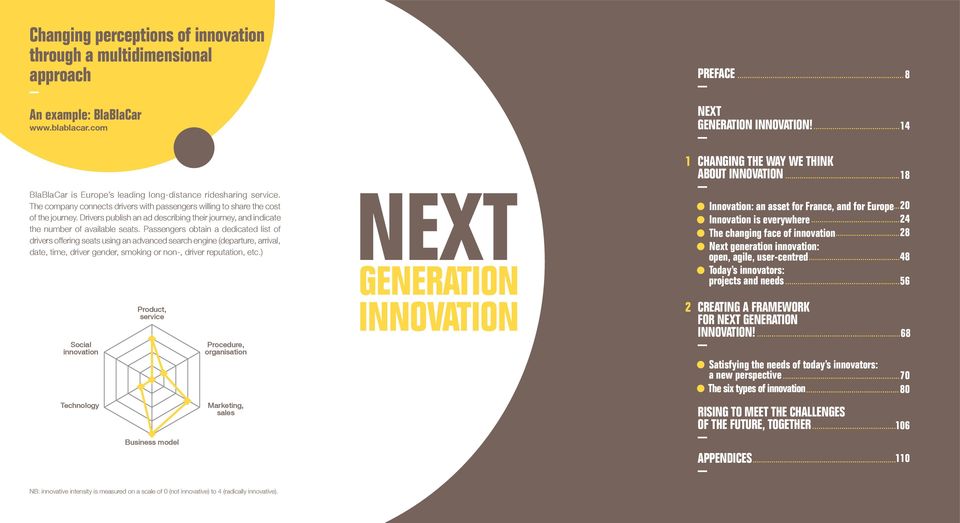
3 Changing perceptions of innovation through a multidimensional approach An example: BlaBlaCar PREFACE Next GENERATION INNOVATION! CHANGING THE WAY WE THINK ABOUT INNOVATION 18 BlaBlaCar is Europe s leading long-distance ridesharing service. The company connects drivers with passengers willing to share the cost of the journey. Drivers publish an ad describing their journey, and indicate the number of available seats. Passengers obtain a dedicated list of drivers offering seats using an advanced search engine (departure, arrival, date, time, driver gender, smoking or non-, driver reputation, etc.) Innovation: an asset for France, and for Europe Innovation is everywhere The changing face of innovation Next generation innovation: open, agile, user-centred Today s innovators: projects and needs Social innovation Product, service Procedure, organisation 2 CREATING A FRAMEWORK FOR NEXT GENERATION INNOVATION! Satisfying the needs of today s innovators: a new perspective The six types of innovation Technology Marketing, sales RISING TO MEET THE CHALLENGES OF THE FUTURE, TOGETHER 106 Business model APPENDICES 110 NB: innovative intensity is measured on a scale of 0 (not innovative) to 4 (radically innovative).
4 PREFACE

5 We must constantly rely on an active vanguard. There is never a consensus prior to innovation. Any transformative innovation is essentially a deviation. Edgar Morin, French sociologist and philosopher Innovation is crucial. As France confronts the considerable challenge of consolidating its position as a key player in the global economy, and as our businesses are up against ever-increasing competition, our competitiveness and growth are the two defining factors of our development. We need a major cultural shift that will enable innovation to play a decisive role in our country s economy. We must learn to be daring, and to accept risk, experimentation and creativity. Innovation often takes shortcuts, never goes the way it is planned, and requires multiple trials and errors before reaching success. Making innovation everyone s business from primary school to university, from factory floor to senior management, from civil service to private enterprise is a structural challenge for France s economy. I want to emphasise the central role of business in this paradigm shift. How can we ensure that innovation is not only the responsibility of R&D and marketing, but of every employee? How can we configure organisations capable of generating novel strategic options over and over again? NEXT GENERATION INNOVATION Bpifrance 12
6 For more than a decade, my company has worked to deploy real managerial innovation. We have profoundly changed our organization; we try to ensure that all employees are innovative actors. Our company is as agile as possible, and part of an ecosystem that fosters tomorrow s innovations. We have entirely dismantled our internal hierarchy, and granted a considerable measure of autonomy to our employees, including at our factories. There is no organisational chart; the company is organised by product, expert community and project. The primary role of our top executives is to focus on our 10-year business strategy, while giving more operational autonomy to employees. Employees actively participate in investment decisions, recruitment, salary policy and even long-term strategic reflection. The results of this managerial innovation have been extremely fruitful. We have fared better than our competitors during crisis after crisis. We have achieved 2-digit growth rates in a mature market. Our market share has gone up 5 points in the past 3 years. Our advice is simple: innovate! Make innovation the bedrock of your strategy, in service to your own company s growth, and to the competitiveness of our country. Carlos Verkaeren, President of the Poult Group NEXT GENERATION INNOVATION Bpifrance 14

7 next GENERATION INNOVATION

8 Bpifrance finances and supports businesses, with a particular focus on innovative projects. To more fully appreciate the existing scope of innovative potential, Bpifrance has joined forces with the Next Generation Internet Foundation (Fing), and assembled a group of entrepreneurs and key innovation stakeholders. Clusters, entrepreneurial networks, administrative regions, researchers, investors, and a dozen startups...many have responded to our call. Similar findings In the massive upheaval currently underway in innovation, traditionally distinct classifications have become intertwined: technological/non-technological, product/service/process, incremental/radical innovation... Digital technology is not the sole vector for innovation and growth: BlaBlaCar and Autolib provide innovative mobility services, while Sushi Daily has created 1500 jobs in four years by locating sushi kiosks inside existing supermarkets. At the same time, the needs of innovators have become increasingly diverse. Some companies need to invest heavily during the start-up phase, while others continually adjust their needs to support various stages of development. Some need financing for pre-planned R&D tasks, while others need it to build an initial user base that will support agile flexible, responsive product development. Changing the rules together The fruit of the collaboration between Bpifrance, Fing and the French innovation ecosystem is now in your hands. This book gives readers the big picture of next generation innovation, and the needs of the new generation of innovators. As a benchmark reference guide intended to help readers identify and analyse an innovative project (of any kind), the present work chooses not to classify projects using rigid categories, but rather organises project analysis around two common questions: What is new about the project? and how does it set the company apart from the competition? We would like to thank those who have contributed to the first edition of this work. This collective reference manual now belongs to every innovation actor in Europe; we hope that each of you will want to share and improve upon it, so that the range of possibilities it explores becomes even wider, and a common vision of innovation next generation innovation emerges! Paul-François Fournier, Bpifrance and Daniel Kaplan, FING It is time for us to ensure that a greater number of potentially transformative opportunities are not wasted, by finding novel ways for French and European innovation support schemes to foster innovations of all kinds. Bpifrance dedicates itself to this goal, starting with the development of appropriate financial tools. The book «Next Generation Innovation» positions Bpifrance squarely at the heart of a pivotal drive to transform innovation, innovation policies and support mechanisms. By transforming its own tools and criteria, Bpifrance wishes to be a catalyst for the emergence of new leaders and thus actively contribute to the economic future of our nation. NEXT GENERATION INNOVATION Bpifrance 18

9 1. CHANGING THE WAY WE THINK ABOUT INNOVATION

10 1.1 Innovation: an asset for France, and for Europe Innovation is crucial to the competitiveness of any business facing economic globalisation. Businesses that innovate export more than those who do not. They export to more countries. Their exports grow faster, and they are less susceptible to changing economic conditions. (1) Innovation is an essential source of job creation, enabling organisations beyond France s borders to engage with our pool of creative talent. (1) Source: Innovation, a major challenge for France (L innovation, un enjeu majeur pour la France), Jean-Luc Beylat and Bernard Tambourin, 2013, p. 33. NEXT GENERATION INNOVATION Bpifrance 22
11 Investing in innovation is not enough In the competitiveness race, France in Europe has a lot going for itself: a younger, better-educated population than the European average, high-calibre scientific research programs, economic and technology sectors with worldwide reach, solid civil infrastructure and public services...the list goes on. In addition in Europe, substantial public resources are devoted to research and innovation. Europe can become an attractive investment destination: the United Kingdom and France play a central role in terms of venture capital investment. To take advantage of our strengths, and build a better future, quantitative measures of investment is no longer enough: we have to change the way we think about innovation, and the methods we use to support it. NEXT GENERATION INNOVATION Bpifrance 24

12 1.2 Innovation is everywhere From a corporate and managerial perspective, (...) innovation is the culmination of a comprehensive process. R&D has to be integrated into a complex organisational approach alongside other concerns and processes. (1) Many of the innovations that have transformed markets over the past few years are not technological, in their essence, but rather use technology as a means to other ends. For example: social media networks and Twitter messages now an integral part of daily life for hundreds of thousands of people have created new forms of communication without using particularly advanced technologies, or producing significant technological innovation (at the end of 2013, Twitter held only 2 patents); (1) Source: A new vision for innovation (Pour une nouvelle vision de l innovation) Pascal Morand and Delphine Manceau (2009, p. 13). NEXT GENERATION INNOVATION Bpifrance 26

13 Zara has enjoyed stronger growth than any other fashion brand worldwide by renewing its inventory on a bi-weekly basis: no inventory replenishment, no country-specific product lineups; Such «agile» and «open» forms of innovation, affecting business models or company organisation, are increasing in importance. They even dominate certain sectors. This is the result of three very recent transformations: arpooling and car sharing are giving the public transport Digitisation: ideas and concepts first exist in digital form, sector a run for its money, based on nothing more than online community platforms tied to «reputation» systems (user reviews, money transfers); and microcredit loans have given millions around the world the chance to grow their businesses through a novel approach to credit distribution and repayment. Not a single one of these innovations relies on the creation or improvement of advanced technologies to create value, or to distinguish itself from its competitors. Yet these examples and many others do have one thing in common: national and European innovation systems would not have been able to support them, at least not their core activity! making them flexible and customisable, which facilitates not only dematerialisation, but also the association of products with services, and contributes to cycle acceleration. Data has also become a key economic asset. Interconnectivity: new ideas race across the globe, inspiring creative collaboration and reproduction. The line dividing amateurs from professionals is fading. Value chains are being constantly restructured, often around massive «platforms». The increased importance of «externalities»: mounting energy and climate concerns, newly recognised limitations to «traditional» forms of public intervention and a strong emphasis on corporate social and environmental responsibility These concerns demonstrate that the impact of innovation on employment, the environment and collective well-being must somehow be taken into account, and even considered as core concepts that underpin «social innovation». NEXT GENERATION INNOVATION Bpifrance 28

14 1.3 The changing face of innovation Up to now, our innovation systems analysis and dedicated support schemes have been intended essentially for technological innovations: until 2005, the OECD s Oslo Manual (1), which provides the foundations for most European innovation support programmes, was focused entirely on «technological product and process (TPP) innovation» (p. 7), defined as «implemented technologically new products and processes, and significant technological improvements in products and processes.» (p. 31) (1) Source: Oslo Manual: Guidelines for Collecting and Interpreting Innovation Data: Third Edition (OECD, 2005). NEXT GENERATION INNOVATION Bpifrance 30

15 Changing your methods is innovating! In its most recent edition (2005), the Oslo Manual (1) noticeably expands its definition of innovation: An innovation is the implementation of a new or significantly improved product (good or service), or process, a new marketing method, or a new organizational method in business practices, workplace organization or external relations. The OECD actually recognises two forms of «non-technological» innovation: organisational innovation, or «the implementation of a new organisational method in the firm s business practices, workplace organisation or external relations»; It focuses on the company how it develops, produces and manages its products and services both as an organisation, and in its relations with suppliers and partners; and marketing innovation, or «the implementation of a new marketing method involving significant changes in product design or packaging, product placement, product promotion or pricing». INNOVATING ALSO MEANS YOUR ORGANISATION (1) Source: Oslo Manual: Guidelines for Collecting and Interpreting Innovation Data: Third Edition (OECD, 2005). NEXT GENERATION INNOVATION Bpifrance 32

16 Case study The Poult Group Using managerial innovation to stand out in a crowded market The radical reorganization of the Poult Group (biscuit-maker for other brands, founded in 1883) began in The objective of this historic group was to engage, motivate, and empower every one of its employees toward the firm s innovation. Two levels of management were removed, rotating leadership was introduced in several departments, and an internal project incubator was created to promote «intrapreneurship»; the creation of Poult Academy, a corporate university, was this incubator s first success. Thanks to managerial innovation, the company now offers much higher value-added services to its clients: product codesign with customers for whom Poult was formerly a supplier (Auchan, Michel & Augustin...) open innovation between leading high-tech companies (e.g., nutraceuticals, with Pierre Fabre Laboratories) and Poult internal start-ups to develop new products, including the «smart biscuit» - a personalised nutrition supplement for patients in long-term care, which tracks data intended for healthcare professionals (compliance, absorption periods and frequency, etc.) via individually printed QR codes. In a challenging market, Poult nearly quadrupled in size between 2005 and 2012, and recaptured its former ranking as France s second-largest biscuit-maker. Their gains attracted a buyout by Qualium investment (A French Caisse des Dépôts subsidiary) in NEXT GENERATION INNOVATION Bpifrance 34

17 Case study Sushi Daily Added value, from within Sushi Daily launched its retail store and high-traffic area sushi bars in Its sushi is freshly prepared in front of customers, who pay for it along with their other purchases, enabling the hypermarket retail chain to systematically deduct a commission. Each in-store POS is independent, with the parent company as a shareholder. By 2014, there were over 250 Sushi Daily points of sale in 6 countries, and 1500 Sushi Daily employees. NEXT GENERATION INNOVATION Bpifrance 36
18 Daring to try a new business model is innovating! We are entering an era of intensive innovation (...). An era in which innovative competitors will come out of the woodwork. Intensive innovation distorts the «standard» laws of economics. It enables thinking that extends beyond market norms, and the surprise of unexpected value propositions. Armand Hatchuel, Professor, Mines ParisTech, in Les Echos (newspaper) According to The Economist (1) a majority (54%) of senior managers «favor[ ] new business models over new products and services as a source of future competitive advantage». According to the Boston Consulting Group (2009), business model innovators garner results far «superior» to product and process innovators (2). So there seems to be a new, potentially dominant form of innovation out there: business model innovation. What does it entail? A business model describes how your business makes money. Steve Blank, serial-entrepreneur and Silicon Valley opinion leader Despite the absence of any official definition, analyses converge: the business model describes how a company will earn money over time. More to the point, it reveals a company s developmental logic, and its strategies for value creation, capture and sharing. Value creation: the value propositions made to customers and users, and the way the company harnesses its expertise, and the expertise of others, to deliver this value. Value capture: revenue sources and structure. Shared value: company cost structure, «scalability» its ability to grow profitably and how value is to be distributed across a complex «value system» including shareholders, employees, suppliers and numerous other partners (e.g., distributors, providers, and application developers for platforms who create value from users, etc.). (1) Source: Business 2010: Embracing the Challenge of Change (Economist Intelligence Unit, 2005) as cited by Raphael Amit and Christoph Zott, Creating Value Through Business Model Innovation (MIT Sloan Management Review, 2012). (2) Source: Business Model Innovation (Zhenya Lindgardt, Martin Reeves, George Stalk and Michael S. Deimler, BCG, 2009). THE BUSINESS MODEL BUSINESS NEXT GENERATION INNOVATION Bpifrance 38
![Armand Hatchuel, Professor, Mines ParisTech, in Les Echos (newspaper) According to The Economist (1) a majority (54%) of senior managers «favor[ ] new business models over new products and services](/docs-images/44/733883/images/page_18.jpg "as a source of future competitive advantage». According to the Boston Consulting Group (2009), business model innovators garner results far «superior» to product and process innovators (2).")
19 Why is business model innovation becoming so crucial? A business model produces interdependencies that raise the barriers to entry for competitors, and the barriers to exit for clients: a social network is free for users, but appropriates their data; Xerox leases copiers, and sells services and consumables; Microsoft promotes Windows via programs that require its operating system, and vice versa... Business model innovation identifies new value sources within existing activities: Amazon.com sells cloud computing services; Apple depends on millions of developers for services it could never hope to produce by itself. The most «disruptive» innovations - to borrow Clayton Christensen s term are the ones that transform a market. These innovations are often developed by new entrants, typically have a unique business model, and usually focus on the bottom end of the market, first offering products of poorer quality than their established competitors: digital vs. chemically processed photography, MP3s vs. CDs, low-cost vs. high-tech... The real difference between these upstarts and entrenched market leaders can be found in their business models: novel cost structure and customer relations, a value network that fosters market expansion, etc. It is precisely because their (outdated) business model forms the backbone of their activity that old-school market operators have great difficulty responding to challengers (e.g., Kodak). New social solutionsare also innovations! Why has social innovation moved centre stage in the last decade? The main reason is that existing structures and policies have found it impossible to crack some of the most pressing issues of our times such as climate change, the worldwide epidemic of chronic disease, and widening inequality. Robin Murray, Julie Caulier-Grice and Geoff Mulgan, The Open Book of Social Innovation, Nesta/Young Foundation (2010, p.3) The impressive growth of microfinance highlights the evolution of a long-standing practice of social innovation. In line with the above authors, the European Commission equally defines social innovations as «new ideas (products, services and models) that simultaneously meet social needs (more effectively than alternatives) and create new social relationships or collaborations», adding that «these solutions are both social in their ends and their means» (1). According to this definition, how an innovative firm produces and distributes value is just as important as the innovations it introduces. On this basis, the EU now plans to support social innovation the same way that it supports commercial innovation. (1) Source: 1. Guide to Social Innovation (European Commission, 2013, p. 6). NEXT GENERATION INNOVATION Bpifrance 40
20 Case study The Food Assembly «Let s get together to buy the best food available, directly from local farmers and foodmakers.» The reason the EU, like France, supports social innovation(1) is because it expects social innovation to provide new answers to difficult problems that neither markets, nor public policy, have been able to address in a satisfactory manner.. Ashoka, an international network uniting more than 3,000 social entrepreneurs, describes its members as «changemakers». It has assigned social entrepreneurship with a sizeable task: Inspire, encourage, and facilitate new business co-creation that addresses societal issues at large scale, by tearing down the walls between sectors and equipping the younger generation with the skills needed to change the world.(2) The Food Assembly connects consumers with local producers of quality food products. The basic idea is to provide the tools that enable short distribution channels to scale up, and move to the next level. The system is based on the creation of pop-up markets, or Food Assemblies, hosted by an individual, a group of people, or an enterprise. These assemblies are facilitated by an online platform that connects local producers with platform subscribers wishing to buy their products. (1) see the Guide to Social Innovation (European Commission, 2013) (2) Ashoka s Changemakers (Transmediamix, n.d.,) NEXT GENERATION INNOVATION Bpifrance 42

21 So what does innovating look like, exactly? INNOVATION CATEGORIES, AS SUGGESTED IN A NEW VISION OF INNOVATION (POUR UNE NOUVELLE VISION DE L INNOVATION) by PASCAL MORAND and DELPHINE MANCEAU Practical innovations are typically multi-dimensional: the iphone is a new product that continues to generate new usages via the innovative itunes Store business model; BlaBlaCar enhances the experience of ridesharing while inventing its business model; the Food Assembly organizes large-scale direct purchase from producers, which supports local farmers (social innovation) and encourages the growth of its pop-up network/source of income (business model)... Categorising these dimensions of innovation use, process, organization, business, agile, open, social should not lead to isolated objectives; the categories should be accepted as a «suite» of modalities that each contribute to the coherence of any entrepreneurial project. SUPPLY INNOVATION (NEW PRODUCT OR SERVICE) USAGE Marketing and product lifecycle management are essential (e.g., rental bikes, electric cars, drinkable fruit purees) TECHNOLOGY R&D is crucial (e.g., electric bike, hybrid cars) USAGE AND TECHNOLOGY Design is important to ensure the technology is intuitive and easy to use, market analysis of usages is essential (e.g., Google self-driving car and Google glasses) PROCESS INNOVATION Newly organised work and production processes (e.g., Zara supply chain model) New processes based on new technologies (e.g., Sineo car wash) New job descriptions, new skills development (e.g., Egencia BtoB travel agent, any customised product) BUSINESS MODEL INNOVATION New pricing structure (e.g., low-cost airline companies, Airbnb flat rental) Redefines stakeholder roles and revenue distribution along the value chain (e.g., Apple ipod and itunes) Industry-wide reinvention, sector convergence (e.g., Google search engine, video on demand, digital cameras) NEXT GENERATION INNOVATION Bpifrance 44
22 The challenge: to recognise and support innovations of all kinds Following the OECD s publication of the 2005 Oslo Manual, «non-technological» innovation has been slowly gaining legitimacy within innovation support schemes. For example: the «Horizon 2020» EU Common Strategic Framework for Research and Innovation conjoins funding for research with funding for innovation, with the aim of developing «a coherent set of instruments, along the whole innovation chain starting from basic research, culminating in bringing innovative products and services to market, and also supporting non-technological innovation, for example in design and marketing»(1); in France, the Morand-Manceau (2009) and beylat- Tamborin (2013) reports agree that «innovation is not merely invention, and innovation is not only technological»(2); and the second round «Investments for the Future» call for proposals (01/2015), Bpifrance s recentlydeveloped French Tech funding program, as well as other regional innovation support schemes (e.g., PACAlabs, Pays de la Loire Territorial Innovation fund) explicitly include provisions for «non-technological» innovations. (1) Source : press release for the Green Paper debating the EU Framework funding for research and innovation: Horizon 2020 (2011). (2) Source: Innovation, a major challenge for France (L innovation, un enjeu majeur pour la France) (Jean-Luc Beylat and Bernard Tambourin, 2013, p. 33). NEXT GENERATION INNOVATION Bpifrance 46
23 Yet, despite the clarion call for a new vision from experts and stakeholders, interpretations of EU regulations governing innovation, and the mindset underlying public support schemes, remain narrowly focused on technological innovation. Marketing and organisational innovations are accepted as a bonus, but rarely as innovations in their own right. Innovation has changed. Public innovation schemes, and those who operate them, need to think big, and appreciate innovation in all its diversity and complexity. NEXT GENERATION INNOVATION Bpifrance 48
24 1.4 Next generation innovation: open, agile, user-centric Contemporary innovations also distinguish themselves in how they develop. Many kinds of innovations break away from the traditional «funnel» process that moves a company s products from research to concept to production. To innovate, be open Henry Chesbrough and Open Innovation. Chesbrough s theory of Open Innovation suggests that a firm should look in places other than R&D for the ideas and knowledge it needs to innovate (upstream), and should also make it easy for others to create economic value based on their innovations (downstream). By punching holes in the traditional funnel process which allows only a fraction of R&D concepts to make it through production he opens the floodgates to innovation. Internal knowledge and ideas Markets held by others (swarming, licensing, ecosystem) Our new markets Our current market Subsidiary and co-investment External knowledge and ideas Using third-party technologies NEXT GENERATION INNOVATION Bpifrance 50
25 Apple itunes, Google Android, Microsoft Windows and game console developers each owe their success to the applications built for their platforms, and hence do everything in their power to support developers, and facilitate the development process. Beyond these «seminal» examples, the core concept underlying open innovation, namely that companies can and should utilise external ideas and paths to market, as much as internal ones has also found a myriad of different applications: the open APIs (application programming interfaces) of Amazon.com, BlaBlaCar or Crédit Agricole (CAStore); crowdsourcing platforms (e.g., eyeka, idexlab, KissKissBankBank, Ulule); or even free and open-source, a label no longer restricted to software (e.g., Arduino microcontroller boards, the Tabby open hardware automobile). By following this approach, competitive advantage is not so much derived from intellectual property as it is from market traction. Case study LINAGORA An open source software platform to create tomorrow s virtual office! The LINAGORA OpenPaaS platform, a virtual office environment, aims to provide an industry-level solution to the collaborative usage demands emerging among public institutions and in big business. Linagora worked to modernize the messaging system at the Ministry of the Interior, and on the deployment of a new software environment for France s National Assembly. Beyond computer technology, OpenPaaS has fostered a number of usage and organisational innovations. This free and open-source, open-api software platform has also given rise to a growing community of innovators and developers seeking to create dedicated new services. Associating the virtue of an open innovation system with viral propagation lays the foundation for a new generation of ecosystem one that provides individuals and companies with a platform to develop the collaborative tools of the future, faster and more cheaply. NEXT GENERATION INNOVATION Bpifrance 52
26 To innovate, get agile! By extending to the entire innovation process to include the use of «agile» (or lean) IT development methodologies, innovators can reduce their development cycles, and thus minimize their risks and reduce initial capital expenditures. No more rigid business plans, no more striving for perfectionism. Agile development emphasises the continued deployment of successive versions of a product or service, alongside measurement and ongoing assessment of market returns. This can even lead the company to «pivot», or test new, fundamental assumptions about the product, the market and/or company strategy and growth drivers. For example: in 2005, Criteo was a film discovery service; in 2006 it evolved into an e-commerce product recommendation service; and in 2008, it became a pay-per-click advertising agency. This kind of approach is radically incompatible with the sets of pre-defined specifications or multi-year development plans that are still the status quo. A startup is an organization formed to search for a repeatable and scalable business model. (1) Steve Blank, Serial entrepreneur and Silicon Valley opinion leader (1) Source: web page, What s A Startup? First Principles (2010). NEXT GENERATION INNOVATION Bpifrance 54
27 To innovate, think «with» and «for» users Research by MIT s Eric von Hippel (1) has shown that in many markets (e.g., sports equipment, medical devices), the most significant innovations are often initiated by advanced or «lead» users, before being adopted and industrialized by startups or established firms. Even if this kind of bottom up innovating is nothing new, it is now an increasingly dominant component of product development, simply because digital technology, the Internet and Fab Labs have blurred the lines that once separated amateurs from professionals. Von Hippel invites companies to collaborate with lead users to develop methods for product co-creation. The typical «top-down» innovation process from R&D to market is simply reversed. The paradigm shift we have described here consumer prototyping and use, followed byfiltering for generality of demand by peers, followed by commercialization of generally desired innovations is growing stronger over time. The costs of consumer innovation are dropping due to better and cheaper design tools, better and cheaper Internet-based communication and group formation, and better and cheaper prototyping facilities. (1) See Eric von Hippel: le paradigme de l innovation par l utilisateur by Hubert Guillaud, Internet Actu (2012). Eric von Hippel, Jeroen P.J. De Jong and Susumu Ogawa, The Age of the Consumer-Innovator, MIT Sloan Management Review (2011, p. 34) NEXT GENERATION INNOVATION Bpifrance 56
28 1.5 Today s innovators: projects and needs Traditionally, the innovation ecosystem which includes public financing structures is very familiar with the needs of technological innovators, and has the tools in place to meet those needs. However, non-technological innovations have very different characteristics, and do not generate the same needs at the same junctures as technological innovations. New kinds of innovative products Innovation projects that usually do not rely heavily on advanced technology (but not always!) present three characteristics that distinguish them from projects based on technological innovations. NEXT GENERATION INNOVATION Bpifrance 58
29 Competitive differentiation based on usage, rather than performance, or pushing the definition of state of the art. A «non-technological» innovation doesn t necessarily seek to outperform what is already on the market: it might aim for the bottom of the pyramid (low cost), or appeal to a «niche», or just be quirky or offbeat (like the marketing and packaging for «kooky cookies» Michel et Augustin) Another consequence: competitive advantage can rarely be protected with a patent. Less capitalistic projects, at least initially. Projects with low technological intensity do not usually call for heavy investment in hardware, software and R&D. However, similar to technology-based projects, financing needs persist until budgets are balanced. The most basic need expressed by «non-technological» innovators focuses on human resources recruitment and funding, whether for employees, or external collaborators like designers, developers, managers, lawyers, recruiters At the beginning, many entrepreneurs augment their income by providing bespoke services (consulting, etc.). This has the disadvantage of diverting their attention away from the project at hand, which slows its progression, while it is likely that other, similar projects are emerging somewhere else in the world. Impact on key success factors: Base the project on an understanding of user needs and expectations, rather than on technology. Collaborate with lead users, if possible as early as the design phase. Integrate design expertise right from the start. Launch early, and get a feedback loop going as soon as possible. Always try to stay one step ahead of the competition. Impact on key success factors: Locate (and be able to pay) the right people at the right time. Locate operational resources often difficult to ascertain during the startup phase as and when necessary. NEXT GENERATION INNOVATION Bpifrance 60
30 «Agile» projects, supershort time to market In most cases, these projects do not go through protracted study and planning phases, but rather through short iterative cycles that work as closely with users as possible: prototypes are produced rapidly and immediately tested; «traction» (engagement with an expanding, viral community of users) is created as soon as possible; quick, modest, and continuous improvements are preferred over heavier, less frequent «versions»... The project is constantly in several stages at once: design, development, test, launch, operation and analysis. Impact on key success factors: Break down the project into smaller modules with short completion times: a few weeks at most. Prioritise speed of execution; do not hesitate to buy solutions that work, rather than develop them. Experiment quickly and continually, for example by simultaneously testing multiple versions of the same product («A/B testing»). Be able to «pivot» quickly, in response to user feedback. PRODUCE TEST MARKET NEXT GENERATION INNOVATION Bpifrance 62
31 ... The new needs of today s innovators Entrepreneurs seeking to accomplish more iterative, less predictable projects more closely aligned with the market express different needs to those whose innovations are mostly technological. First things first: people! Companies need staff, and talent. This is the top funding priority for most non-technological (and many technological) innovators: recruit (or subcontract) managers, marketers, engineers, technicians, web/mobile developers... The scarcity of these skills especially in the fields of web and mobile development means these hires come at a premium, and with a certain degree of risk; finance the outsourcing of «specialist» skills in design, communication, web marketing, law, finance...and recruitment, typically as subcontractors. NEXT GENERATION INNOVATION Bpifrance 64
32 Next comes financing the proof of concept, and each phase of business development. Entrepreneurs second priority after recruitment is to fund each stage in the iterative process. Here, marketing is inseparable from the design and development of the project: prototyping and early user testing: although these costs may be minimal, they are beyond the reach of some entrepreneurs; developing the first release and attracting first-time users/customers, which requires spending on marketing, communications and sales; and business development, locally or internationally. Finance iterative and flexible projects iteratively and flexibly Entrepreneurs want to focus on their projects, not push paper. Flexibility should be the order of the day when funding «agile» projects; as financing needs are difficult to measure during the startup phase, and emerge progressively, funding will have to be arranged as milestones are achieved. NEXT GENERATION INNOVATION Bpifrance 66
33 Case study Leetchi.com 3 phases, 3 financing needs Launched in 2009, Leetchi is Europe s leading online group payment service, where users collect money (in «money pots») for group gifts and events. Since 2013, it s growth has also relied on the development of MangoPay, a third-party payment system for online crowdfunding and collaborative consumption marketplaces. During its (6-month) pre-launch phase, Leetchi primarily needed financing to pay a developer to build the first release. Recruiting an additional developer would have enabled Leetchi to accelerate its time to market, and more effectively respond to early feedback from users. During the (12-month) launch phase, financing needs were still focused on salaries (2 developers), plus media relations and marketing in France. Again, understaffing curbed Leetchi s development potential. Bpifrance financed Leetchi s online payment system development. During the accelerated development and automation phase of the MangoPay payment system, financing needs were focused on marketing expenses and customer support for both B2C (Leetchi) and B2B (Mangopay) activities. By early 2014, Leetchi had gained more than 1.5 million users, and was anticipating 100 M in turnover for its services. The business now operates at a profit. NEXT GENERATION INNOVATION Bpifrance 68
34 2. CREATING A FRAMEWORK FOR NEXT GENERATION INNOVATION!
35 2.1 Meeting the needs of today s innovators: a new perspective Innovation is in flux, and so are the needs of today s innovators. How does this change the way we support them? Easy: it means we have to adjust our focus, and adapt our approach. Our focus needs readjustment so that we can learn to identify and analyse projects that are totally different from those that public and private funders at least in Europe are accustomed to. We need to broaden our approach to include support for projects whose development cycles, financing needs, risk profiles and/or valuation methods differ enormously from technology-oriented projects. Recalibrating what we consider to be innovation will enable support system to back projects that would simply never have been eligible before: sales and marketing innovation, service innovation, business model innovation and social innovation. NEXT GENERATION INNOVATION Bpifrance 72
36 What do we need to know? We believe that every innovative project should be approached with the same two questions in mind: What is new about the project, and what it affords to its customers, users and beneficiaries? Have potential customers, users and/or beneficiaries been clearly identified? Is its main innovative focus on end users (B2C), other businesses (B2B), or company employees (process or organizational innovation)? How does the project change users point of view: does it meet a new need, or solve a new problem? Does it significantly improve the way a particular need is met, or respond to a known issue? Does it offer a new experience, a new usage? Does it create a new category of need, usage or market? NEXT GENERATION INNOVATION Bpifrance 74
37 How does this innovation set the organisation apart from its competitors? Who are the project s (current and potential) competitors? What are their strengths and weaknesses? Is the proposed innovation likely to make a difference on the market: by providing the company with a significant competitive advantage? If so, through what factors (functionality, price, quality, image, increased ease of use, etc.)? by creating uncontested market space? These questions are essential. If the entrepreneur finds it difficult to respond, this may indicate the existence of a problem: has the project been fully formulated? Is it more of an invention (the design of a new technology or a new process without entrepreneurial vision) than an innovation (new products introduced to the market, or a new process put into practice, with industrial and/or commercial potential)? NEXT GENERATION INNOVATION Bpifrance 76
38 Getting clear about innovation type and intensity The present benchmark, derived from our research and presented in the following pages, aims to provide support for the detection and analysis of innovations within the context of the two questions previously raised. Project analysis aims to specify the innovative nature of a project in terms of its type and intensity. Radical innovation (or «disruption»): creates an entirely new, uncontested market, or revolutionises a market (or markets) completely. There is a «before» and an «after»; not only for the company, but also for its competitors. Example: the Apple iphone and App Store. Incremental innovation: improves what already exists, contributes to the competitiveness or profitability of a firm without any significant internal transformation. Example: the bagless vacuum cleaner. Innovation Intensity is measured on a scale between Innovation can take place within a single area, or across any number of the areas listed below Type of INNOVATION Product, service or usage innovation: improves existing products/services/usages or introduces new ones. Organisational or procedural innovation: changes how a firm, or its supply chain, is organised. Sales and Marketing innovation: alters product presentation, distribution, pricing, promotions, etc. Business model innovation: reorganises revenue and cost structures. Technological innovation: creates or integrates one (or more) new technologies. L intensité de l innovation pourra ainsi être évaluée en la mesurant sous l angle des différentes typologies décrites. Social innovation: meets social needs, in terms of its purpose, goals, and processes. NEXT GENERATION INNOVATION Bpifrance 78
39 Example analysis of innovative type and intensity: Compte Nickel (the Nickel Account) Social innovation Product, service Procedure, organisation With a minimal deposit, and zero conditions, a Compte Nickel provides users with a payment account, electronic banking details and a debit card. It takes only five minutes to open an account, using a single piece of ID. It allows withdrawals, deposits, wire transfers and direct debits, but does not provide customers with overdraft privileges nor checkbooks. Its extremely inexpensive operations rely entirely on the web, mobile technology, and the capacity to verify an account balance in real-time. This bank-less account (approved, however, by the Bank of France) is primarily intended for banks unwanted customers, or those who have been banned. Easy to open and close, a Compte Nickel can also meet specific needs: payment of shared expenses, online payments, international transactions, an account for one-time purchases, etc. Where is the innovation?... Product/Service/Usage: A bankless payment account, opened in five minutes at participating tobacconists, no conditions, no additional services. Process/Organisation: Opened from a tobacconist using an identity card (scanned by a «Nickel terminal»). Immediate issuance of bank card and details. Funds deposit online or via tobacconist. All other account management takes place entirely online. Technology Business model Innovation Intensity is measured on a scale between 0 and 4. Marketing, sales Marketing and Sales: Account opening and funds deposit at partner tobacconists. A non-stigmatizing marketing message to attract a socially excluded market segment: an «account for everyone», minus income or asset conditions. Social: The founders wished to address the social injustice of banking exclusion (one founder was himself excluded by a bank). A Compte Nickel has no income test. Opening an account does not require customers to divulge sensitive information pertaining to banking history or prior spending habits. Business Model: Very low, standardised rates (subscription, billing, deposit and withdrawal); no additional products: no overdrafts, no credit nor use of customers cash. Fees listed at < 50/year, depending on use. Another portion of revenue is derived from credit card payment commissions. Technological: Two patents: the Nickel Terminal, which allows identity document authentication using a basic scanner, and banking detail form generation via the tobacconist s point of sale (POS) printer. NEXT GENERATION INNOVATION Bpifrance 80
40 2.2 The Six Types of Innovation 1. Product, service, usage innovation Does the project introduce a new product or service, or a significant improvement in the nature of an existing product or service, its functionality, or the way it is used? What do we mean? This type of innovation primarily impacts clients and users relationships with the product or service: a new product or service satisfies a need, solves a problem or creates a new market; a product or service revision entails improvements to features, performance, ease of use, quality, appearance, etc.; a new usage for an existing product, service or technology enables clients/users to perform new functions that meet different needs, or provides clients/users with a different «experience». NEXT GENERATION INNOVATION Bpifrance 82
41 Where is the innovation? INCREMENTAL INNOVATION Improves what exists RADICAL INNOVATION Transforms the market, creates a whole new market Product, SERVICE, usage INNOVATION Does it change how an existing product is used? Does it affect client s/users experience of the product? Michel et Augustin * New flavours and original packaging Steelcase Ergonomic office chair adapted for users of new technologies Materne Fruit puree pouches Éditions volumiques Game combining the tangible and the digital GoPro Caméra Ultra portable for sports enthusiasts Blablacar * Long-distance rideshare service Velov / Velib Self-service bicycles leboncoin.fr E-commerce for individuals Does it satisfy an unmet need? Neodemia Business MOOCS Urban Potager Automated interior garden Ulule * Participatory finance Numa, «Cantines» «Third-space cafeteria» coworking space Micro-finance Compte Nickel * Bank-free payment account, opened in less than five minutes Sculpteo * (B2B) Online 3D printing service Does it solve a problem experienced by customers, users or beneficiaries? Dyson Bagless vacuum Seb «oil-free» fryer Ecocup * Sale and rental of custom cups Low cost medical devices (incubators, cardiac stimulators, prostheses, etc.) Ikea Flat-pack furniture Personalised, targeted gene therapies Does it potentially inspire a new need? Withings Smart devices to measure physiological parameters contributing to wellness/ health Arduino TM Open-source electronics platform that facilitates «smart» object development Twitter Microblogging tool The smartphone and associated app distribution platforms Social networks * Fiche descriptive consultable sur le site internet. NEXT GENERATION INNOVATION Bpifrance 84
42 2. Process and organisational innovation Organisational INNOVATION Does the innovation introduce a new design or production process, or unprecedented changes to the organization and management of the company, or in its process, logistics or supplier relations management? What do we mean? This type of innovation directly concerns the company and how it develops, produces and manages its products and services, both as an organization and in its relations with suppliers and partners: Managerial INNOVATION Procedural INNOVATION procedural or «process» innovation focuses on implementing technical tools (new machines, new technologies, new IT) to improve productivity (reduce costs and delays) and quality, make the company more responsive and production more customisable, reduce raw material consumption and waste, etc.; organisational innovation focuses on management systems (eg, JIT, 24/7, knowledge management, quality assurance, etc.), work organisation (work methods, organisational charts, collaborative work, outsourcing, etc.) and a company s external relations (relations with suppliers, logisticians, distributors, and other partners). Often, it complements process innovation (e.g., a new technique entails a reorganization) but may also occur alone; managerial innovation is a form of organisational innovation that focuses on how to distribute information, power and control within a firm. NEXT GENERATION INNOVATION Bpifrance 86
43 Where is the innovation? Does it introduce a new technical procedure? INCREMENTAL INNOVATION Improves what exists Sineo 100% eco-friendly car wash Suez Environnement New water filtration technologies Telesurgery Sculpteo * rapid 3D prototyping service Non-invasive surgery RADICAL INNOVATION Transforms the market, or creates a new market Flexible automation Process and organisational innovation Does it transform the design, production or logistics process? Egencia (Expedia subsidiary) Business travel optimisation OutilAcier Eco-friendly technical sales, distribution and industrial supply tool Zbis * Local micro-factory Telemedicine Cisco Fabless industrial company Zara Continual fashion collection renewal through integrated, flexible supply chain management Does it transform product lifecycle, materials and/or waste management? Stimergy * Cloud platform that earns profits from the heat generated by its servers Recommerce Solutions * Reconditioning of electronic mobile devices «Cradle to cradle» Circular, zero-waste economy Does it change business, labor, time or spatial organisation? BlueKiwi (bought by Atos) Professional social networking and coworking platform Convergys Call centre where employees choose their schedules («anywhere time») Happy.co.uk Self-organizing teams that elect their managers Does it change the relationship between the company and suppliers, distributors and other partners? Dassault Ingénierie uses concurrent engineering to design the Falcon 7 Sushi Daily * In-store, fresh sushi kiosks Bee Plane Open innovation airplane design OSVehicle Design and sales of «open hardware» automobile kits Does it transform business management? Seb Company FabLab Biscuits Poult * Repositioning through granting autonomy to employees * Fact sheet available on our website. NEXT GENERATION INNOVATION Bpifrance 88
44 3. Sales and marketing innovation Does the innovation change the way the product or service is presented, marketed, promoted or priced, or the customer relations dedicated to the product or service? What do we mean? This type of innovation concerns how the product or service is aimed at the market, and at its clients, customers or users: branding, positioning, marketing and promotion; packaging and presentation; sales and distribution methods, channels and forms pricing levels, models, degree of customisation; customer relations content, channels and quality. NEXT GENERATION INNOVATION Bpifrance 90
45 Where is the innovation? Does it suggest a new image, a new market positionning for the firm or its product? INCREMENTAL INNOVATION Improves what exists Jolis Mômes Health and beauty shop for 0-12 years Nailmatic 1 st ever automated nail varnish machine Michel et Augustin * Premium food brand, fun and offbeat marketing, strong customer relations Carrefour, Décathlon store brands RADICAL INNOVATION Transforms the market, or creates a new market SALES AND MARKETING INNOVATION Does it change how a product/service is promoted? Milka «The Last Square» emotional marketing campaign Ikea Enriched online catalogue that lets you visualize how a piece of furniture would fit in your home Fitle Virtual home dressing room (3D avatar) Netflix, Amazon Personalized recommendations Does it introduce novel packaging, or new product/service presentation? Amazon Autorip Download MP3 versions of CDs purchased Auchan Products sold in bulk, zero packaging Daddy The pink sugar box «goes green» (eco-packaging) ColaLife Antidiarrheal kit inserted in cola crates without loss of space, delivered to the poor OSVehicle Open source car kit Does it change how the product/service is sold: channels, networks, methods, etc.? Darty «Connected Store» equipped with interactive kiosks and tablets Sushi Daily * Supermarket sushi bar The Food Assembly * Group purchasing from local food producers Voyages-sncf.com «Trips with friends...» social commerce app Compte Nickel * Payment account opened at the local tobacconist Online commerce (since 1990) Does it propose a new pricing policy: price levels & range, pricing formulas, personalized prices, etc.? Orchestra Low-cost apparel by subscription Aviva, AXA «Pay as you drive» insurance with GPS device Freemium model (for video games, professional social networks, news, etc.) Deezer «music» option in mobile plans 20 minutes Free daily newspaper Does it change the relationship between the company and its customers: service channels, availability, interactions, etc.? Crédit Agricole Centre-Est Select and rate your bank advisor BandSquare Gig/concert crowdfunding «TrocHeures» Castorama Customer DIY-hours exchange Auchan «Drive», online shopping and personal pickup, self scanning * Fact sheet available on our website. NEXT GENERATION INNOVATION Bpifrance 92
46 4. BUSINESS MODEL INNOVATION Is the innovation based on a new cost or revenue structure, a new way of making money? Key partners Key activities What do we mean? The business model describes how the company makes its money and aims to increase profitable growth. It describes the value delivered to customers, the revenue and cost structures, and how the firm will manage future growth. It also describes how the company works with its «ecosystem» suppliers, partners, customers and other stakeholders. Business model innovation takes many forms, which can be broadly classified as follows: competition differentiation using novel cost structures and revenue streams (eg. low-cost); Supply Customer relations Clients new value creation from of company resources (e.g., reselling heat generated by a data center); Revenue new relationship definition between clients, suppliers, distributors, advisors and other partners to create value. Costs Channels Key resources NEXT GENERATION INNOVATION Bpifrance 94
47 Where is the innovation? Is business revenue or cost structure differentiated from competitors? INCREMENTAL INNOVATION Improves what exists EcoCup * Customisable glasses for event hire Salesforce Management software as a service (SaaS) Vente-privée.com Limited online promotions Modèles low cost Compte Nickel, BIC, Easyjet RADICAL INNOVATION Transforms the market, or creates a new market «Freebie marketing» a.k.a. «the razor and blades»/gilette model) Sell cut-price goods plus consumables Innovation de modèle d affaires Does it enhance the company s resource value, identify new sources of revenue, or penetrate new markets? Stimergy * Value-creation from heat generated by datacenter Amazon Web Services Value-creation from company information system 23andMe Personal DNA testing partly funded through data resale Open innovation ecosystems Does it raise barriers to entry for competitors and to exit for customers? Xerox Sells copies, not copiers (leased) Blablacar * Carpooling as a novel form of public transport Apple, itunes, Apple Store Link a device to a marketplace Does the company s success rely on customer and third party contributions to create value? Is it a «platform»? Leetchi * Commission earned for group gifts and «money pots» leboncoin.fr E-commerce between individuals Ulule * Crowdfunding Arduino TM Open source microcontroller cards Google, Facebook, etc. Free services financed by targeted advertising Apple and its Appstore Does it enable the firm s rapid expansion minus the usual hurdles? (recruitment, financial resources, etc.) The Food Assembly * Platform facilitating direct exchange between local food producers and collective customer «assemblies» OSVehicle Open source, customizable automobile; assembly by end users or small garages * Fact sheet available on our website. NEXT GENERATION INNOVATION Bpifrance 96
48 5. Technological Innovation Does the project rely on new technology development and/ or integration, or the significant advancement of existing technologies? What do we mean? Technological innovation creates or uses one or more new technology(gies) which, (when compared to existing technologies), affords users with: superior performance (function, capabilities, power, speed, ease of use, etc.); a better price-performance ratio (investment, use, energy consumption, etc.); or entirely new usages. Technological innovation may take the form of: new technology development; existing technology enhancement; an original combination of largely advanced technologies (e.g., bioinformatics). Technological innovations often emerge as a result of public and/or private R&D. However, most of these tech-driven innovations also require usage development, so that they can be adopted by users and customers effectively, and thus generate business and organisational success. Technological innovation must therefore be complemented by product/service, sales/marketing or business model innovation: a technological innovation with no practical application is not an innovation. NEXT GENERATION INNOVATION Bpifrance 98
49 Where is the innovation? INCREMENTAL INNOVATION Improves what exists RADICAL INNOVATION Transforms the market, or creates a new market TECHNOLOGIcal Innovation Does the innovation provide a significant improvement in performance over the state of the art? IRLynx * Advanced human activity sensing modules Surgivisio Surgimages* 3D imaging and integrated surgical navigation technologies Elvesys * «Lab on a chip» detects any virus or bacteria in a blood sample in less than 10 minutes Rhenovia Pharma * Timbre transdermique intelligent pour administrer des médicaments Does it improve an organisation s price-performance ratio (investment, operation)? Ergosup * Carbon free hydrogen production and storage FROV, filiale d ACSA Projet Fibre* Light, inexpensive, easy to deploy remotely operated submersible Adionics * Desalao* project: low cost, low-energy water desalination Wandercraft * Revolutionary exoskeleton for the disabled and elderly NawaTechnologies * Supercapacitor integration into vehicle structures and electrical systems Does the innovation solve a previously unsolvable problem, or, open up new possibilities? Snips * Predictive modeling of urban behaviour Biométhodes * Biorefining of non-food agricultural and forest harvest residue for biofuel and chemical compound production PhageX * Innovative intelligent antibiotics that eradicate targeted pathogenic bacteria while leaving intestinal flora intact Multiposting SmartSearch project*: database and BI applications integration to design a recruitment search engine New or improved technologies Technology integration * Round 1 winner, «Innovation 2030» Global Innovation Challenge (July 2014). NEXT GENERATION INNOVATION Bpifrance 100
50 6. Social innovation Does the project respond to poorly-satisfied, or unmet social needs? or create novel social relationships or collaborations? What do we mean? A social innovation should primarily be defined according to the Oslo manual definition: a product/service, process/organization, sales/marketing or business model innovation, with two extra dimensions: include a social and societal mandate in its purpose: respond to poorly or unmet social needs, usually in favour of disadvantaged or vulnerable populations: the excluded or poorly-housed, migrants, the elderly, children, etc.; address societal challenges by integrating economic, social, environmental and territorial dimensions: mobility, housing, social cohesion, energy, recycling, etc.; address systemic challenges by introducing structural changes that involve a large number of stakeholders. e.g., develop a circular economy; be «social» in practice, as much as in mandate. Specifically, social innovation: seeks to involve its users, beneficiaries and stakeholders during every stage of the project, from needs identification, to solutions, to impact assessment; seeks to share the economic value produced with all of society, not just concerned shareholders and entrepreneurs. A social innovation can be carried out by any organization, non-profit, or member of the social economy, or by a conventional company (corporation, Llc, etc.). NEXT GENERATION INNOVATION Bpifrance 102
51 Where is the innovation? INCREMENTAL INNOVATION Improves what exists RADICAL INNOVATION Transforms the market, or creates a new market SOCIAL Innovation Solar Ear Solar battery powered, digital hearing aids manufactured by the Brazilian deaf community Microfinance Does the innovation seek to respond to poorly met or unmet social needs? Voisin-Age Links people with their elderly neighbours, favors bartered exchange Compte Nickel * Payment account without a means test Simplon.co Free training for web/mobile developers La Tournée Home delivery of local merchant purchases by long-term unemployed persons Does it seek to address societal challenges? EasyLatrine Compost-producing public urinals that are easy to manufacture locally Siel Bleu * Preventative health and well-being programs using Adapted Physical Activity (APA) Recommerce Solutions * Workforce integration programme participants recondition used electronic mobile devices resold by telecoms incontrol (UK) Enable social assistance beneficiaries to manage their own budget Zbis * Local Fab Lab microfactory Does it address systemic challenges? The Food Assembly* Local, participatory, farm-to-table platform From Waste to Wow! Fashion pieces made from Milanese designer scraps Urban Farm Lease Developing urban agriculture in Brussels Mozaïk RH Successfully recruit younggraduates from diverse backgrounds Sol Violette Local currency to promote community Fair Trade Circular economies * Fact sheet available on our website. NEXT GENERATION INNOVATION Bpifrance 104
52 In addition, to qualify a social innovation project, it is important to ask some additional questions: Is the social and social mission part of the project s mandate (i.e., included in the company purpose statement and part of the business plan; subordination of other, purely economic objectives)? Will the economic value generated be captured by the company, or distributed (e.g., earnings reinvestment, profit and salary caps, intellectual property sharing, etc.)? Does the project involve its users, beneficiaries and stakeholders in several of its stages, from identifying the need to production? Does the project explicitly and rigorously measure its social and societal impact? To learn more about the various types of innovation, please refer to the definitions and sources listed in Appendix 2. NEXT GENERATION INNOVATION Bpifrance 106
53 RISING TO MEET THE CHALLENGES OF THE FUTURE, TOGETHER
54 What is new about the project, and how does its innovation set the organisation apart from its competitors? This «benchmark» reference manual is based on these two pivotal questions, which enable innovation supporters to broaden their focus, and thus more easily identify innovative projects, better understand projects that may have previously escaped their notice, and more appropriately support today s innovators. However, project analysis no matter the type of innovation does not stop there. Relevance is not everything: the project s success depends on the ability of innovators and their firms to seize opportunities and manage risk. Any business is, first of all, a human endeavour: team quality, organization, management and complementarity all make a huge difference. Every innovation is a bet on the future: entrepreneurs and innovation supporters alike must have the ability to assess the opportunities and conditions for success as accurately as possible, while at the same time be capable of identifying the unexpected, and responding as events unfold. Finally, an innovation is nothing without its clients or beneficiaries, and entrepreneurs must arrange to receive their feedback or even secure their participation as early and as often in the innovation lifecycle as possible. All these issues must be addressed by every single entrepreneur, investor and actor supporting innovation. They impact key success factor implementation, as well as project risk analysis. Public innovation support programmes have a mandate to encourage companies to take innovative «risks», and support entrepreneurs as well as they can on the path to success. By improving their current understanding of innovation, they can more fully play their part alongside entrepreneurs, private investors and entire innovation ecosystems. Encouraging innovation in all its forms: that s NEXT GENERATION INNOVATION Bpifrance 110
55 Appendices
56 1. Project analysis examples Find the following project analyses on our website: bpifrance.fr NEXT GENERATION INNOVATION Bpifrance 114
57 TYPE OF INNOVATION Project name Description PRODUCT, service, usage PROCESS, organisation Marketing, SALES Business Model TECHNOLOGICAL Social Bandsquare Where artists and fans create unique concert experiences together Biscuits Poult Managerial innovation based on employee autonomy and open innovation BlaBlaCar Community rideshare service Compte Nickel The first bankless payment account, available at tobacconists Cozy Cloud A «personal cloud» that enhances people s digital experience by giving them control over their own data. DMD Santé A platform to evaluate and recommend mobile health applications and smart devices Ecocup «From disposable to sustainable»: eco-friendly, customisable and reusable cups for events Iota Element Artisanal furniture integrated with high-tech (sound, internet, multimedia, etc.) The Food Assembly «Let s get together to buy the best food available, directly from local farmers and foodmakers» Leetchi «The perfect solution to collect money for group gifts and events» Michel et Augustin Premium and innovative food products, original marketing and strong customer bonds Recommerce Return and resale solutions for used mobile phones Sculpteo «Your 3D design turns into reality with 3D printing» Siel Bleu Preventative health and well-being programs using Adapted Physical Activity (APA) Stimergy Cloud services provider reduces costs by monetising the heat generated by its servers Sushi Daily Sushi bars located inside existing hypermarkets Ulule Crowdfunding platform Zbis Local shared microfactory in the Vendée NEXT GENERATION INNOVATION Bpifrance 116
58 2. To find out more: 1. Product, service, usage innovation Official definitions: OECD (Oslo Manual): «the introduction of a good or service that is new or significantly improved with respect to its characteristics or intended uses. This includes significant improvements in technical specifications, components and materials, incorporated software, user friendliness or other functional characteristics.» For further information: on product and service innovation categories: Rowley, J., Baregheh, A., & Sambrook, S. (2011). Towards an innovation-type mapping tool. Management Decision, 49 (1), (available via Google Scholar) on product innovation processes: Industrie Canada (2010). L état de la conception de produits: Le rapport canadien on design-driven innovation: Verganti, Roberto (2009). Design-driven Innovation. Boston: Harvard Business Press. NEXT GENERATION INNOVATION Bpifrance 118
59 2. Organisational and process innovation 3. Sales/marketing innovation Official definitions: OECD (Oslo Manual): Process: «the implementation of a new or significantly improved production or delivery method. This includes significant changes in techniques, equipment and/or software.» Organisation : «the implementation of a new organisational method in the firm s business practices, workplace organisation or external relations.» For further information: on the distinction between «process» and «product» innovation: Sheynkman, K. (2011). Process vs. product. Passionate Intensity (blog), innovation-process-vs-product/ Official definitions: OECD (Oslo Manual): «the implementation of a new marketing method involving significant changes in product design or packaging, product placement, product promotion or pricing.» For further information: The SCOPS awards (University Paris Dauphine - Credoc) locate and reward the best business innovations on an annual basis. See also an analysis by Credoc: Quelles innovations commerciales au regard des attentes des consommateurs? November the annual Dupont Packaging Awards; a reference manual: Meyronin, B. & Munos, A. (2012). Manager l innovation par le service. Paris: PUG. NEXT GENERATION INNOVATION Bpifrance 120
60 4. Business model innovation 5. Technological innovation No official definition of business model innovation exists. The «Business Model Canvas» is the tool most widely used to describe the components of a business model: the website of the concept s founder, Alexander Osterwalder : For further information: Amit, R., Zott, C., & Pearson, A. (2012). Creating value through business model innovation. MIT Sloan Management Review, 53. Christensen, C. (2013). The innovator s dilemma: when new technologies cause great firms to fail. Boston: Harvard Business Review Press. French government list of priorities regarding technological innovation the 34 roadmaps for The New Industrial France the 7 strategic ambitions of France s Innovation 2030 Commission: For further information: Callahan, J. (2008). Patterns of Technological Innovation. NEXT GENERATION INNOVATION Bpifrance 122
61 6. Social innovation Official definitions: European Commission: «Social innovations are new ideas (products, services and models) that simultaneously meet social needs (more effectively than alternatives) and create new social relationships or collaborations.» The EU definition adds that «these solutions are both social in their ends and in their means.» Conseil Supérieur de l Économie Sociale et Solidaire (the Higher Council for the Social and Solidarity Economy, CSESS) : «Social innovation consists of developing new answers to emerging or poorly met social needs by the current market and social policies, involving the participation and cooperation of stakeholders, including users. These innovations relate to both product or service, as well as modes of organization or distribution, in areas such as aging, child care, housing, health, the fight against poverty, exclusion and discrimination. [ ]» ; 1. Through their activities, the enterprise aims to provide support to people in situations of fragility either due to economic or social status, or due to personal circumstances, and specifically their health or need for social or medical support. These people may be employees, users, customers, members or beneficiaries of this enterprise. 2. The enterprise aims to fight against social exclusion and health, social, economic and cultural inequalities, and for civil education, including the public education system, and the preservation and development of social ties or of the maintenance and strengthening of territorial cohesion. 3. The enterprise contributes to sustainable development in economic, social, environmental and participatory dimensions, to energy resource transition and to international solidarity, provided that their activity is equally related to one of the objectives referred to in the first 2 points. France s Loi du 31 juillet 2014 (law passed 31/07/2014) relative to the social economy: «Companies whose corporate purpose is concerned primarily with at least one of the following three conditions are considered as pursuing a social utility within the meaning of this act»: NEXT GENERATION INNOVATION Bpifrance 124
62 For further information: The European Commission s Social Innovation Guide (2013); The European Social Innovation competition: Phills, J. A., Deiglmeier, K., & Miller, D. T. (2008). Rediscovering social innovation. Stanford Social Innovation Review, 6(4), A good article from the American point of view, which provides a definition of social innovation as «a new solution to a social problem, which is more effective, efficient, durable, and more just than existing solutions and whose value creation is intended for society as a whole rather than individuals in particular.» NEXT GENERATION INNOVATION Bpifrance 126
63 3. References and practical information Official publications Oslo manual: Guidelines for collecting and interpreting innovation data. (No. 4.) Statistical Office of the European Communities, Publications de l OCDE (2005). Guide to Social Innovation. European Commission (2013). Public sector reports «Innovation Union Scoreboard 2014.» European Commission (2014). Beylat, J-L & Tambourin, P. (2013). L innovation, un enjeu majeur pour la France. Ministères du Redressement productif et de la Recherche, La Documentation Française. Un principe et sept ambitions pour l innovation. The Commission for Innovation, presided over by Anne Lauvergeon, La Documentation Française (2013). Morand. P. & Manceau, D. (2009). Pour une nouvelle vision de l innovation. La Documentation Française. NEXT GENERATION INNOVATION Bpifrance 128
64 For reference Christensen, C. (2013). The innovator s dilemma: when new technologies cause great firms to fail. Boston: Harvard Business Review Press. Christensen, C., & Raynor, M. (2013). The innovator s solution: Creating and sustaining successful growth. Boston: Harvard Business Review Press. Kim, W. C., & Mauborgne, R. (2005). Blue ocean strategy: How to create uncontested market space and make competition irrelevant. Boston: Harvard Business Press. Von Hippel, E. (2009). Democratizing innovation: the evolving phenomenon of user innovation. International Journal of Innovation Science, 1 (1), Murray, R., Caulier-Grice, J., & Mulgan, G. (2010). The open book of social innovation. National Endowment for Science, Technology and the Art. Essential browsing Bpifrance : FING : Innovation Union, the European Commission website dedicated to innovation: The Innovation tab on the Ministry of Productive Recovery website (French): French innovation clusters: NEXT GENERATION INNOVATION Bpifrance 130
65 To contact Bpifrance bpifrance.fr Illustrations by Guillaume Lagane, graphic facilitator. Bpifrance 27-31, avenue du Général Leclerc Maisons-Alfort Cedex Tél. :
66 This book is created and published by Bpifrance in collaboration with the Internet Foundation New Generation (FING). Réf. :
All available Global Online MBA routes have a set of core modules required to be completed in order to achieve an MBA.
 All available Global Online MBA routes have a set of core modules required to be completed in order to achieve an MBA. Those modules are: Building High Performance Organisations Management and Organisational
Innovation in Business Models for Start-ups. Prof. Dr. Utz Dornberger in4in Workshop Rwanda, 2014
 Innovation in Business Models for Start-ups Prof. Dr. Utz Dornberger in4in Workshop Rwanda, 2014 Business idea Many existent enterprises have the goal to develop a new sui-generis product Almost every
All available Global Online MBA routes have a set of core modules required to be completed in order to achieve an MBA. Those modules are:
 All available Global Online MBA routes have a set of core modules required to be completed in order to achieve an MBA. Those modules are: Management and Organizational Change (P.4) Leading Strategic Decision
Selected Thesis Topics for BScBA students Bachelor s Thesis 2015-2016
 Selected Thesis Topics for BScBA students Bachelor s Thesis 2015-2016 Please use this list of the fields of International Business for thesis work and potential thesis topics when choosing and informing
CASE STUDY: IIS GIVES A GLOBAL BEAUTY AND FASHION COMPANY AN IT MAKE-OVER MISSION ACCOMPLISHED
 CASE STUDY: IIS GIVES A GLOBAL BEAUTY AND FASHION COMPANY AN IT MAKE-OVER MISSION ACCOMPLISHED IIS GIVES A GLOBAL BEAUTY AND FASHION COMPANY AN IT MAKE-OVER IIS is a long-time trusted resource to one of
Procurement must be more than just cost cutting
 Procurement must be more than just cost cutting In today s challenging environment, aggressive cost control has become a common theme in the pharmaceutical industry. It became fashionable later than in
Just-in-Time Marketing: Lessons from the Masters
 Just-in-Time Marketing: Lessons from the Masters Marketers have changed the way they engage consumers, but have their changes taken them all the way back to the factory floor where marketing is produced?
The butterfly effect. How smart technology is set to completely transform utilities
 How smart technology is set to completely transform utilities An era of unprecedented change Utility companies operate in one of the most complex, high profile, regulated and politically charged sectors.
A FUTURE IN THE CLOUD
 WELCOME TO THE FUTURE OF GLOBAL SOURCING Over the past decade, our work and relationships with business and IT leaders have offered us a unique perspective on the growing influence of technology on business,
How To Create A Successful Economy
 INTERNATIONAL IMP³ROVE ROUNDTABLE: FOSTERING COHESION WITH INNOVATION Düsseldorf, 25 November 2015 Christian SAUBLENS IN EUROPE, THE EU COMMISSION PROMOTES THE CONCEPT OF RESEARCH AND INNOVATION STRATEGIES
The Massachusetts Open Cloud (MOC)
 The Massachusetts Open Cloud (MOC) October 11, 2012 Abstract The Massachusetts open cloud is a new non-profit open public cloud that will be hosted (primarily) at the MGHPCC data center. Its mission is
How to Write a Business Plan
 How to Write a Business Plan Small Business Development Center (SBDC) A well-written comprehensive business plan forms the basis for the success of any business venture. The business plan is a written
Key Steps Before Talking to Venture Capitalists
 Key Steps Before Talking to Venture Capitalists Some entrepreneurs may not be familiar with raising institutional capital to grow their businesses. Expansion plans beyond common organic growth are typically
How To Manage Social Media Risk
 www.pwc.co.uk/riskassurance Social media governance Harnessing your social media opportunity June 2014 Social media allows organisations to engage with people directly, express their corporate personality
GETRONICS: A BALANCED CLOUD POSITION
 GETRONICS: A BALANCED CLOUD POSITION GETRONICS: A BALANCED CLOUD POSITION IN DISCUSSIONS WITH OUR CLIENTS, CLOUD STRATEGY IS REGULARLY TOP OF THE AGENDA. BUT CLOUD CAN BE A DILEMMA FOR SENIOR ENTERPRISE
Developing the edge or scaling the core through corporate venturing Internet of Things. Daan Witteveen
 Developing the edge or scaling the core through corporate venturing Internet of Things Daan Witteveen Global M2M Connections (billion) The Global IOT Market is expected to see a forecasted to grow at a
MANAGEMENT COURSES Student Learning Outcomes 1
 MANAGEMENT COURSES Student Learning Outcomes 1 MGT 202: Business Professions 1. Describe and use the elements of effective decision making research, assessment and consequence. 2. Apply elements of effective
THE CHANGING RETAIL WORLD The rise and challenges of omnichannel retailing
 THE CHANGING RETAIL WORLD The rise and challenges of omnichannel retailing WHITEPAPER 2015 CitiXsys. All Rights Reserved. Page: 1 PREFACE The world is constantly evolving and so are the habits of people
Introduction. 1. Superior broadband technology. 2. Economics of the legacy content distribution model. 3. Favorable regulatory status quo
 Finding Opportunity in Disruption: Driving a New Era of Value Growth in the Cable Industry Introduction The cable industry has generated impressive growth over the last half decade, building on its traditional
See what cloud can do for you.
 See what cloud can do for you. Uncomplicating cloud business Table of contents Introduction 3 Why cloud is relevant for your business? 4 What is changing? 4 Why organizations are moving to cloud 5 What
Data Center Network Evolution: Increase the Value of IT in Your Organization
 White Paper Data Center Network Evolution: Increase the Value of IT in Your Organization What You Will Learn New operating demands and technology trends are changing the role of IT and introducing new
Digital Strategy. Digital Strategy. 2015 CGI IT UK Ltd. Digital Innovation. Enablement Services
 Digital Strategy Digital Strategy Digital Innovation Enablement Services 2015 CGI IT UK Ltd. Contents Digital strategy overview Business drivers Anatomy of a solution Digital strategy in practice Delivery
BUSINESS PLAN OUTLINE
 I - BUISNESS PLAN OUTLINE INTRODUCTION TO THE BUSINESS PLAN & CONCEPT Before starting a new business or expanding an existing business, you should develop a Business Plan. The Business Plan will serve
Six Secrets to Simply Sell More Wine. Texas Wine & Grape Growers Association 2013 Annual Conference & Trade Show
 Six Secrets to Simply Sell More Wine Texas Wine & Grape Growers Association 2013 Annual Conference & Trade Show Case Study: WHY SELL MORE WINE? Facts Winery X was selling 3,000 cases per year, virtually
The firm. of the future. Accelerating sustainable progress. Your business technologists. Powering progress
 The firm of the future Accelerating sustainable progress Your business technologists. Powering progress At Atos we strive to create the firm of the future. We believe that bringing together people, technology
ELEFTHO : Supporting Business Incubators & technology parks.
 ELEFTHO : Supporting Business Incubators & technology parks. Region of Central Macedonia Task Page 1 of 14 Contents Description of policy... 3 Name of the policy... 3 Responsible body... 3 Implementation
Make the Leap from ecommerce to Omni- Channel
 Iaodesign/Shutterstock An ecommerce platform is the foundation for a successful Omni- Channel business model arvato Systems North America 6 East 32nd Street, New York, New York 10016 United States All
Transforming. Source & Deploy Solutions from Computacenter
 Transforming the IT Supply Chain Source & Deploy Solutions from Computacenter CONTENTS 03 04-05 06-07 08-09 10 Effecting change Standard practice EXPERIENCE CERTAINTY Centres of excellence Reaping the
Information Systems, Organizations, and Strategy
 Information Systems, Organizations, and Strategy VIDEO CASES Chapter 3 Case 1: National Basketball Association: Competing on Global Delivery with Akamai OS Streaming Case 2: IT and Geo-Mapping Help a Small
5. Funding Available for IP-Rich Businesses
 20 IP Finance Toolkit 5. Funding Available for IP-Rich Businesses Introduction As the Banking on IP? report notes; SMEs first port of call for finance is often a bank. Figures quoted in the report show
Msc(ECom&IComp) List of modules offered in 2015-2016
 Msc(ECom&IComp) List of modules offered in 2015-2016 (The below list is NOT finalized) ECOM6004. Legal aspects of I.T. and e-commerce This module provides an introduction to some of the main legal problems
An Insightful Analysis Report on APPLE,INC
 An Insightful Analysis Report on APPLE,INC Analysis Conducted by: Yiyan Wang & Xuequan Ma UConn SMF: 2014-2015 Prepared on: April 7 th, 2015 Executive Summary Apple Stock Price VS SP500 in 5 Years Business
THE 7 STEPS TO A SUCCESSFUL CRM IMPLEMENTATION DEPLOYING CRM IN THE NEW ERA OF CONNECTED CUSTOMERS
 THE NEW ERA OF ABOUT THE AUTHOR Paul Rogers is the Head of Customer Experience and CRM within HCL s Applications Division. Based in London, Paul is responsible for leading HCL s CRM consulting and technology
Successful Steps and Simple Ideas to Maximise your Direct Marketing Return On Investment
 Successful Steps and Simple Ideas to Maximise your Direct Marketing Return On Investment By German Sacristan, X1 Head of Marketing and Customer Experience, UK and author of The Digital & Direct Marketing
Selected Thesis Topics for BScBA students Bachelor s Thesis 2014-2015
 Selected Thesis Topics for BScBA students Bachelor s Thesis 2014-2015 Please use this list of the fields of International Business for thesis work and potential thesis topics when choosing and informing
decisions that are better-informed leading to long-term competitive advantage Business Intelligence solutions
 Business Intelligence solutions decisions that are better-informed leading to long-term competitive advantage Your business technologists. Powering progress Every organization generates vast amounts of
Mobility. Mobility is a major force. It s changing human culture and business on a global scale. And it s nowhere near achieving its full potential.
 Mobility arrow.com Mobility This year, the number of mobile devices is expected to exceed the world s population. Soon, smartphones will surpass PCs as the device of choice for Internet access. A startling
Alexander Nikov. 3. Information Systems and Organisational Issues. Learning Objectives. Verizon or AT&T: Which Company Has the Best Digital Strategy?
 INFO 1500 Introduction to IT Fundamentals Learning Objectives 3. Information Systems and Organisational Issues 1. Identify and describe important features of organizations that managers need to know about
IBM Enterprise Content Management Product Strategy
 White Paper July 2007 IBM Information Management software IBM Enterprise Content Management Product Strategy 2 IBM Innovation Enterprise Content Management (ECM) IBM Investment in ECM IBM ECM Vision Contents
IBM Perspective on Cloud Computing. The next big thing or another fad?
 IBM Perspective on Cloud Computing The next big thing or another fad? Table of contents 4 Potential benefits of cloud computing 4 Public and private clouds 5 Technology behind cloud computing 6 IBM leadership
Digital Strategy. How to create a successful business strategy for the digital world.
 Digital Strategy How to create a successful business strategy for the digital world. Digital Strategy Overview Every business today needs a digital strategy. Products and services need to be digitally
The Digital Business Era Is Here
 The Digital Business Era Is Here 5 keys to transforming your business for speed, agility and innovation The business world is changing dramatically. Customer and partner expectations are higher than they
AB Volvo, 405 08 Göteborg, Sweden. Ref No 953810003, August 2009. The Volvo Way
 AB Volvo, 405 08 Göteborg, Sweden Ref No 953810003, August 2009 The Volvo Way index Preface Our mission Customers first Customer focus Clear objectives Quality, safety, environmental care Continuous improvements
UITP COMMISSION ON BUSINESS AND HR MANAGEMENT MISSION, ROLE AND ACTIVITIES
 COMMISSION ON BUSINESS AND HR MANAGEMENT MISSION, ROLE AND ACTIVITIES Rio November 2014 Joe Kenny Chair of the Commission on BHRM [email protected] 1 AGENDA 1. Background & Work Framework 2. Observatory
smart systems and internet of things forecast
 Report Prospectus Market analysis on how networks of companies, customers, people and intelligent devices are driving the convergence of The Internet of Things and The Internet of People 2013-2018 smart
Silver Sponsor of the study. Digital Testing in Europe: Strategies, Challenges & Measuring Success
 Silver Sponsor of the study Digital Testing in Europe: Strategies, Challenges & Measuring Success Key Findings Digital having a major impact on the testing/qa function. More than three quarters of European
Marketing Plan Development 101: The Importance of Developing a Marketing Plan for Public Transit Agencies & Commuter Assistance Programs
 Marketing Plan Development 101: The Importance of Developing a Marketing Plan for Public Transit Agencies & Commuter Assistance Programs Mark Glein, PhD, Marketing Florida State University Marketing Plan
LARGE-SCALE DATA-DRIVEN DECISION- MAKING: THE NEXT REVOLUTION FOR TRADITIONAL INDUSTRIES
 LARGE-SCALE DATA-DRIVEN DECISION- MAKING: THE NEXT REVOLUTION FOR TRADITIONAL INDUSTRIES How new knowledge-extraction processes and mindsets derived from the Internet Giants technologies will disrupt and
2016 OUTLOOK: GLOBAL PAYMENTS
 December 2015 2016 OUTLOOK: GLOBAL PAYMENTS Disruption across the industry a global theme Around the world, new entrants (including start-ups and nontraditional players) are entering the payments industry.
A primer in Entrepreneurship. Chapter 3: Feasibility Analysis
 Chapter 3 Feasibilty Analysis Prof. Dr. Institute for Strategy and Business Economics Chapter 3: Feasibility Analysis Table of Contents A. What is feasibility analysis? C. Industry/Market Feasibility D.
Guidelines Business Plan
 Guidelines Business Plan and Innovation CTI Jurors evaluate business plans and provide feedback entrepreneurs in 9 areas and VCs in 4 areas Objectives Elements of evaluation Relevant for ranking 1 Jurors
INTERNATIONAL MASTER IN INDUSTRIAL
 POLITECNICO DI MILANO GRADUATE SCHOOL OF BUSINESS INTERNATIONAL MASTER IN INDUSTRIAL Management Courses Description A joint program with POLITECNICO DI MILANO SCHOOL OF MANAGEMENT First semester (Universidad
Transform your business with Inspired Marketing. 5 Things You Should Know About ExactTarget
 5 Things You Should Know About ExactTarget Transform your business with Inspired Marketing 5 Things You Should Know About ExactTarget 5 Things You Should Know About ExactTarget Transform your business
IT Tools for SMEs and Business Innovation
 Purpose This Quick Guide is one of a series of information products targeted at small to medium sized enterprises (SMEs). It is designed to help SMEs better understand, and take advantage of, new information
Quick Guide: Selecting ICT Tools for your Business
 Quick Guide: Selecting ICT Tools for your Business This Quick Guide is one of a series of information products targeted at small to medium sized businesses. It is designed to help businesses better understand,
TCS as a Digital Transformation Partner for European Customers
 TCS as a Digital Transformation Partner for European Customers December 2014 By Nicole Dufft, Independent Vice President - Digital Enterprise, PAC Germany TCS as a Digital Transformation Partner 2 1. INTRODUCTION
What s Trending in Analytics for the Consumer Packaged Goods Industry?
 What s Trending in Analytics for the Consumer Packaged Goods Industry? The 2014 Accenture CPG Analytics European Survey Shows How Executives Are Using Analytics, and Where They Expect to Get the Most Value
Business Model Designing the 9 blocks
 GRUPPO TELECOM ITALIA Catania, 28 Marzo 2014 Business Model Designing the 9 blocks The Open Innovation perspective Telecom Italia Head of Joint Open Lab WAVE @valdamico Agenda Business Model Innovation
ORGANIZED FOR BUSINESS: BUILDING A CONTEMPORARY IT OPERATING MODEL
 ORGANIZED FOR BUSINESS: BUILDING A CONTEMPORARY IT OPERATING MODEL Time is running out for the traditional, monopolistic IT model now that users have so many alternatives readily available. Today s enterprises
The authors provide the frameworks, analysis tools and route-maps to understand and action creating a marketdriven
 : How to build and lead a market-driven organisation Malcolm McDonald, Martin Christopher, Simon Knox & Adrian Payne FT/Prentice Hall, 2001 ISBN: 0273642499, 206 pages Theme of the Book Marketing is too
4. Strategy and Competitive Advantage. 4.1 Types of Strategy. 4.1.1 Cost Leadership Strategy
 4. Strategy and Competitive Advantage 4.1 Types of Strategy 4.1.1 Cost Leadership Strategy The goal of Cost Leadership Strategy is to offer products or services at the lowest cost in the industry. The
Industrial Automation. A Manufacturing Revolution in Automotive and Industrial Equipment
 Industrial Automation A Manufacturing Revolution in Automotive and Industrial Equipment 1 Automated production, integrated end-to-end: transparent, reliable, predictable and efficient. That s the promise
STRATEGIC POLICY FORUM ON DIGITAL ENTREPRENEURSHIP. Fuelling Digital Entrepreneurship in Europe. Background paper
 EUROPEAN COMMISSION ENTERPRISE AND INDUSTRY DIRECTORATE-GENERAL Service Industries Key Enabling Technologies and Digital Economy Introduction STRATEGIC POLICY FORUM ON DIGITAL ENTREPRENEURSHIP Fuelling
CHAPTER 11 INTERNATIONAL STRATEGY AND ORGANIZATION
 CHAPTER 11 INTERNATIONAL STRATEGY AND ORGANIZATION LEARNING OBJECTIVES: 1. Explain the stages of identification and analysis that precede strategy selection. 2. Identify the two international strategies
HYBRID CLOUD: A CATALYST TO DRIVING EFFICIENCIES AND MEETING THE DIGITAL ASPIRATIONS OF THE UK PUBLIC SECTOR
 HYBRID CLOUD: A CATALYST TO DRIVING EFFICIENCIES AND MEETING THE DIGITAL ASPIRATIONS OF THE UK PUBLIC SECTOR Public Sector Industry Report Contents 2 Executive Summary 5 3 Pressure to Meet 6 Key Findings
Co-operatives for Europe: Moving forward together
 Co-operatives for Europe: Moving forward together 3 In Finland, 75% of the population are members of a co-operative enterprise. In Belgium, when you enter a pharmacy, there is a 1 in 5 chance that you
At the Heart of Digital-Ready Business
 At the Heart of Digital-Ready Business Leading the Digital Change: A CIO Perspective A Mega Trend at the Helm of Innovation and Superior Customer Experience Abstract As growing digitization and evolving
Financing a New Venture
 Financing a New Venture A Canadian Innovation Centre How-To Guide 1 Financing a new venture New ventures require financing to fund growth Forms of financing include equity (personal, family & friends,
Improve the product lifecycle
 Improve the product lifecycle Vodafone M2M solutions for manufacturing m2m.vodafone.com Vodafone Power to you Vodafone M2M solutions for manufacturing What s facing manufacturers today? Whether you re
2015 North America Consumer Digital Banking Survey for Lenders. Mortgage Lending Shaped by the Customer
 2015 North America Consumer Digital Banking Survey for Lenders Mortgage Lending Shaped by the Customer Home mortgage lending in North America continues to be lucrative and highly competitive, even more
A strategic approach to fraud
 A strategic approach to fraud A continuous cycle of fraud risk management The risk of fraud is rising at an unprecedented rate. Today s tough economic climate is driving a surge in first party fraud for
Member of the Divisional Board Mercedes-Benz Cars, responsible for Marketing & Sales
 An interview with Ola Källenius Member of the Divisional Board Mercedes-Benz Cars, responsible for Marketing & Sales Where Digital Meets Physical: Mercedes-Benz and the Seamless Customer Experience Transform
HOW TO INFLUENCE. A study of what influences technology purchasing decisions in financial institutions
 HOW TO INFLUENCE FinTech BUYERS A study of what influences technology purchasing decisions in financial institutions Executive Summary Driven by shifting consumer behaviour, new market entrants and a raft
INFO1400. Define an organization and compare the technical definition of organizations with the behavioral definition.
 Chapter 3 INFO1400 Review Questions 1. Which features of organizations do managers need to know about to build and use information systems successfully? What is the impact of information systems on organizations?
Chapter 9 E-Commerce: Digital Markets, Digital Goods
 1 Chapter 9 E-Commerce: Digital Markets, Digital Goods LEARNING TRACK #: 2: BUILD BUSINESS PLAN There are lots of different ways to lay out a business plan. The sample
Assessing Viability and Feasibility of Business Ideas. Dr. Neeraj Pandey Assistant Professor LM Thapar School of Management
 Assessing Viability and Feasibility of Business Ideas Dr. Neeraj Pandey Assistant Professor LM Thapar School of Management WHY NEW VENTURES FAIL Lack of Objective Evaluation No Real Insight into the Market
EVP The foundation of a strong Employer Brand. HR Swiss Congress 2014, Bern
 HR Swiss Congress 2014, Bern Employer Branding in 1913 2 Influence your Employer Brand in the right direction ALL EMPLOYERS HAVE AN EMPLOYER BRAND. Even if employers don t actively control the brand, it
Ten Critical Questions to Ask a Manufacturing ERP Vendor
 Ten Critical Questions to Ask a Manufacturing ERP Vendor At a Glance: The ERP industry has earned such a poor reputation for delivery in the last 20 years that users have learned to live within a very
How To Develop Hydrogen Fuel Cells
 EXECUTIVE SUMMARY 7 Executive Summary Innovation in energy technology has widespread implications for OECD economies. Although the energy sector accounts for a small share of GDP, the pervasive use of
How To Learn Marketing Skills
 Table of Contents Professional Diploma in Digital Marketing Module 1: Introduction to Digital Marketing Module 2: Search Engine Marketing (SEO) Module 3: Search Engine Marketing (PPC) Module 4: Email Marketing
Delivering Transformation. Together. The challenges of the new customer experience. Delivering Transformation. Together.
 Delivering Transformation. Together. The challenges of the new customer experience Delivering Transformation. Together. Sopra Steria Consulting is the Consultancy activity of Sopra Steria Group. With 37,000
E-Commerce and European SMEs. The integration of SMEs in digital value chains. Digital Entrepreneurship
 E-Commerce and European SMEs From The integration of SMEs in digital value chains Towards Digital Entrepreneurship Michel Catinat Head of Unit DG Enterprise and Industry Key enabling technologies and Digital
Digital Customer Experience
 Digital Customer Experience Digital. Two steps ahead Digital. Two steps ahead Organizations are challenged to deliver a digital promise to their customers. The move to digital is led by customers who are
Digital Marketing Budgets Increase, Reflecting Focus on Customer Experience
 G00255396 Digital Marketing Budgets Increase, Reflecting Focus on Customer Experience Published: 9 January 2014 Analyst(s): Laura McLellan Gartner's Digital Marketing Spending Survey shows that digital
Competitive Advantage with Information Systems
 Competitive Advantage with Information Systems Reading: Laudon & Laudon chapter 3 Additional Reading: Brien & Marakas chapter 2 COMP 5131 1 Outline Competitive Advantage with Information Systems Porter
Challenges & Trends. Why NTT DATA?
 NTT DATA for Retail Challenges & Trends The current macroeconomic and social market, where recession continues, has changed the consumer s behavior inducing families to pay more attention to value for
Corporate Strategy 2015 2020
 168982 Corporate Strategy 2015 2020 Corporate Strategy 2015 2020 Our strategy recognises that better services to learners will benefit higher education providers; and that better services for higher education
Reinventing retail: What Businesses Need to. Walker Sands 2014 Future of Retail Study
 Reinventing retail: What Businesses Need to Know for 2014 Walker Sands 2014 Future of Retail Study Walker Sands 2014 Future of Retail Study examines changing trends and consumer behaviors in retail. Based