
Type SW3D5F-OLEX-E Excel Communication Support Tool Operating Manual
|
|
|
- Della Atkins
- 10 years ago
- Views:
Transcription
1 Type SW3D5F-OLEX-E Excel Communication Support Tool Operating Manual Mitsubishi Programmable Logic Controller

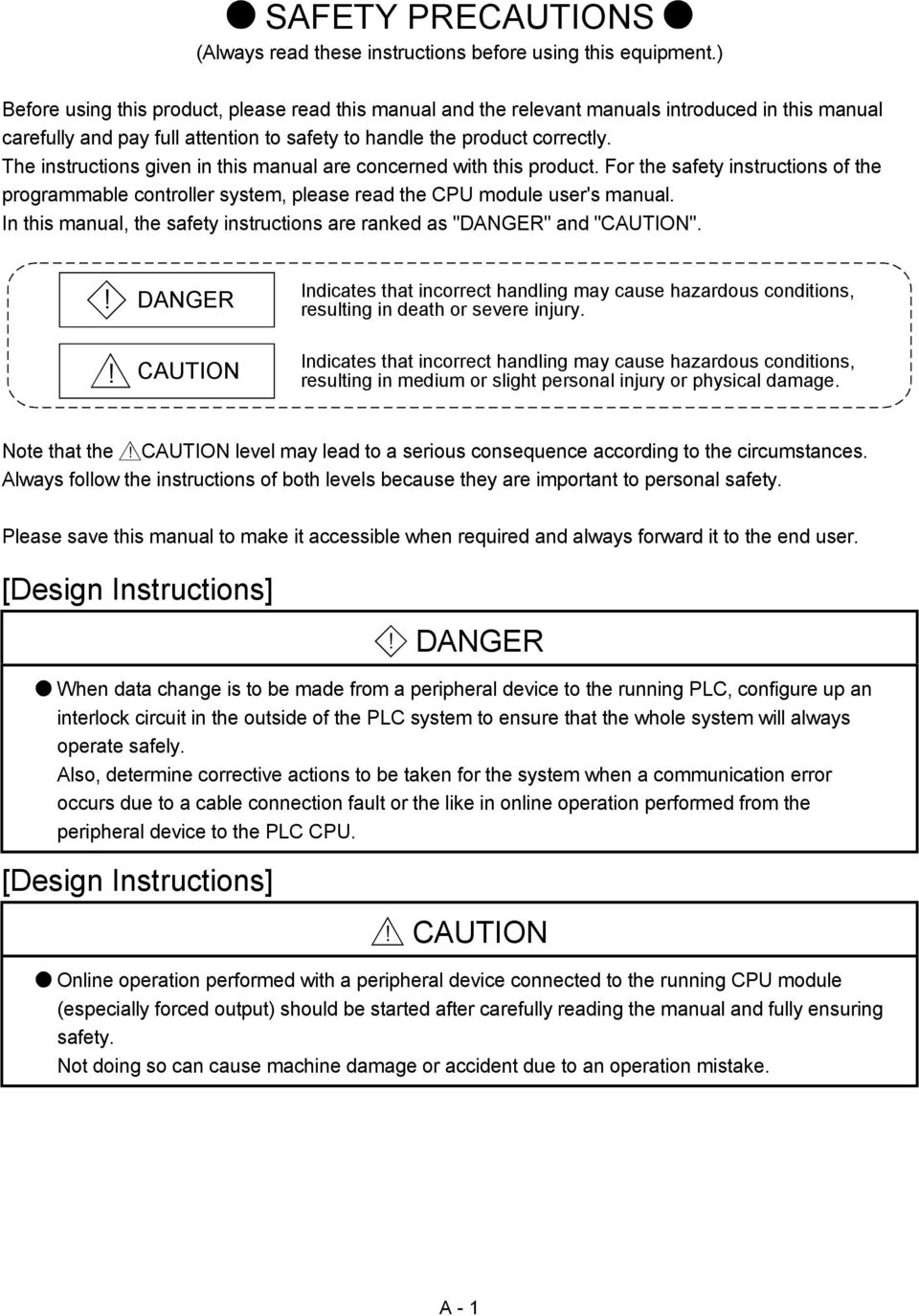
2 SAFETY PRECAUTIONS (Always read these instructions before using this equipment.) Before using this product, please read this manual and the relevant manuals introduced in this manual carefully and pay full attention to safety to handle the product correctly. The instructions given in this manual are concerned with this product. For the safety instructions of the programmable controller system, please read the CPU module user's manual. In this manual, the safety instructions are ranked as "DANGER" and "CAUTION".! DANGER Indicates that incorrect handling may cause hazardous conditions, resulting in death or severe injury.! CAUTION Indicates that incorrect handling may cause hazardous conditions, resulting in medium or slight personal injury or physical damage. Note that the! CAUTION level may lead to a serious consequence according to the circumstances. Always follow the instructions of both levels because they are important to personal safety. Please save this manual to make it accessible when required and always forward it to the end user. [Design Instructions]! DANGER When data change is to be made from a peripheral device to the running PLC, configure up an interlock circuit in the outside of the PLC system to ensure that the whole system will always operate safely. Also, determine corrective actions to be taken for the system when a communication error occurs due to a cable connection fault or the like in online operation performed from the peripheral device to the PLC CPU. [Design Instructions]! CAUTION Online operation performed with a peripheral device connected to the running CPU module (especially forced output) should be started after carefully reading the manual and fully ensuring safety. Not doing so can cause machine damage or accident due to an operation mistake. A - 1
3 REVISIONS The manual number is given on the bottom left of the back cover. Print Date Manual Number Revision Sep., 1999 IB (NA) A First edition Sep., 1999 IB (NA) B Correction Subsection , subsection Addition Operating Instructions (15), subsection , subsection , subsection , subsection , subsection , section 12.2, Appendix 3 Dec., 1999 IB (NA) C Addition Operating Instructions (1), About the Generic Terms and Abbreviations, Product Makeup, section 2.2, section 3.1, chapter 4, subsection , section 12.1 May, 2000 IB (NA) D Correction About Manuals, subsection , subsection , section 12.3, section 12.4 Addition Operating Instructions, About the Generic Terms and Abbreviations, section 12.2 Jun., 2000 IB (NA) E Correction Chapter 8, subsection Addition Operating Instructions, section 9.3, subsection , subsection , subsection , subsection , subsection , subsection , subsection , subsection , Appendix 1 Feb., 2002 IB (NA) F Correction Section 7.2, subsection , subsection , subsection , subsection , subsection Addition Operating Instructions Dec., 2003 IB (NA) G Correction Operating Instructions, About Manuals Japanese Manual Version IB G This manual confers no industrial property rights or any rights of any other kind, nor does it confer any patent licenses. Mitsubishi Electric Corporation cannot be held responsible for any problems involving industrial property rights which may occur as a result of using the contents noted in this manual MITSUBISHI ELECTRIC CORPORATION A - 2

4 Operating Instructions (1) Starting the Tag management process (a) OLEX will not operate if the Tag management process has not started. The Tag management process must start from the menu of OLEX. In the Tag management process of XMOP,OLEX does not operate. (b) If any communication problem has occurred between the Tag management process and OLEX, an error message as indicated below may appear. If such an error message or the like has appeared, restart the Tag management process. <Error message example> RPC server cannot be used. Remote procedure call failed, resulting in no execution. Restart the Tag management process in the following procedure. "OLEX stop" "Logoff/Restart" "Logon/Restart complete" "Tag management process start" (2) About Ethernet communication (a) When TCP/IP is used for Ethernet communication, there are the following restrictions. 1) During automatic execution, the write function (OLEXWrite) cannot be used in relation to the PLC CPUs of the same logical station number. 2) OLEX (Tag management process) and the other process (e.g. device monitor utility, user application) cannot have simultaneous access to the PLC CPUs of the same logical station number. (b) If the CPU goes down or the Ethernet module is reset during Ethernet communication, the communication loop will be cut off. In that case, restart the personal computer. (3) About errors that occur on OLEX Errors, which occur on OLEX, are registered to the error viewer. For details, refer to the error viewer. (4) About changing the sheet name After cell setting, do not change the sheet name. If you do so, we cannot guarantee the data. (5) About write during automatic execution During automatic execution, you cannot change cell values. When writing values, you should write sheet values in advance. An error will occur if a cell value is NULL (00H). You should write values to cells in advance. (6) When using Windows NT 4.0 When using Windows NT 4.0, OLEX may be installed and used only on the administrator's authority. (7) About computer link communication and CPU COM communication on Windows 95 On Windows 95, communication using the COM port, e.g. computer link communication or CPU COM communication, will cause a memory leak. Therefore, do not perform continuous operation. A - 3

5 (8) About simultaneous use of OLEX and GPPW When using GPPW and OLEX together on the same E71 module to make Ethernet communication, make the following settings. Set the protocol of the "Target" screen on the Ethernet utility of CSKP to "UDP/IP". Set SW2 of the communication status setting switches of the E71 module to "OFF (binary)". (9) About installation (a) When using SW3D5F-OLEX-E Install SW3D5F-OLEX-E after uninstalling SW2D5F-OLEX-E. (b) When using SW3D5F-OLEX-EV Install SW3D5F-OLEX-EV with SW2D5F-OLEX-E installed. Unless SW2D5F-OLEX-E has been installed, you cannot install SW3D5F- OLEX-EV. (10) About overwrite installation When performing overwrite installation, install the software in the folder where it had already been installed. (11) About the start menu When you have uninstalled OLEX, the item may remain in the start menu. In such a case, restart the personal computer. (12) About reinstallation after uninstalling CSKP If you uninstalled CSKP with OLEX installed and then you reinstalled CSKP, the communication setting information (information set with various utilities such as the computer link utility) will be lost. At this time, you must make communication settings again. (13) Restrictions on OLEX OLEX utilizes OLE automation to perform communication processing. That means restrictions on OLE automation are restrictions on OLEX. It has been reported that there are the following restrictions on Excel or an Excel macro during use of OLEX or user-created OLE automation. VBA: DoEvents must not be put in a For-Next loop. VBA: Incorporating [Analyzing tool-vba] will result in an error. VBA: Closing the book opened by automation will result in an error. VBA: Incorporating a virus detection add-in and executing the Quit method will result in an error. VBA: filefilter is ignored in the GetSaveAsFileName method VBA: When Excel97 is used, the methods and properties of the Application object and its derivative objects are ignored if they are set/used in the Workbook_Open event. Use the Auto_Open event when using the methods and properties of the Application object at the start of the Excel book. (14) About the number of licenses The number of licenses are set to OLEX. Installation decreases the number of licenses by 1. Conversely, uninstallation increases the number of licenses by 1. Therefore, when deleting OLEX, always uninstall it. Note that the number of licenses will not increase if the folder and files are deleted on Explorer or the like. A - 4

6 (15) Restriction of preservation function When the book file in which the ActiveX control and the form are inserted is continuously operated using both the following functions, this may result in memory storage. Make sure to shut down the personal computer regularly. 1. When using the preservation function of OLEX. 2. When using the book file by which the Save function is called on VBA. (16) When using the Tag management process in Ethernet TCP/IP communication If a communication error (error code: 102, 103) that a TCP connection is broken (e.g. CPU reset, open cable) occurs during execution of the Tag management process, communication is disabled because the Tag management process will not make a TCP connection again. If a communication error occurs during execution of the Tag management process, reload using the Tag setup utility or restart the Tag management process after communication has been restored. (17) About resume and other functions of the personal computer A communications error may occur if communications are made with the PLC CPU after setting the resume function, suspend setting, power-saving function or standby mode of the personal computer. Hence, any of the above functions should not be set for making communications with the PLC CPU. (18) Precautions for USB communication Connecting/disconnecting the USB cable, resetting the PLC CPU, or switching power OFF/ON frequently during communications with the PLC CPU can cause a communications error, from which recovery may not be made. If recovery cannot be made from the communications error, completely disconnect the USB cable once and reconnect it in more than five seconds. (Even after this operation, an error may occur at the initial communication, but communications will be made properly at the second time and later.) (19) Cell status during OLEX execution When a cell is in an input status (e.g. the cell has been double-clicked or the cursor is on the mathematical bar) during OLEX execution, OLEX cannot perform operation for Excel and you cannot draw in the cell or save or print a book, for example. Except when necessary, do not provide direct input to Excel during OLEX execution. (20) About changing the Excel type (a) The Excel type (Excel 97/2000) to be selected for OLEX installation should be the same as the one used to run OLEX. If Excel chosen is different from the one used to run OLEX, OLEX will not operate properly. (b) If you have changed the Excel type used to run OLEX, always uninstall OLEX and change the choice of Excel at the time of reinstallation. If you perform overwrite installation without uninstallation, OLEX will not operate properly. (21) Excel Preview To run OLEX, do not perform the preview setting. If OLEX is run while Excel is in Preview mode, i.e., "Page Break Preview", a memory leak will occur. A - 5

7 INTRODUCTION Thank you for choosing Type SW3D5F-OLEX-E Excel Communication Support Tool. Before using Type SW3D5F-OLEX-E Excel Communication Support Tool, please read this manual carefully to use the product to its optimum. A copy of this manual should be forwarded to the end user. CONTENTS Safety Precautions...A- 1 Revisions...A- 2 Operating Instructions...A- 3 About Manuals...A- 10 How to Use This Manual...A- 11 About the Generic Terms and Abbreviations...A- 12 Meanings and Definitions of the Terms...A- 13 Product Makeup...A OVERVIEW 1-1 to Features Menu List Utility List About Compatibility with the Existing Software SYSTEM CONFIGURATION 2-1 to System Configuration Operating Environment Usable PLC CPU INSTALLATION AND UNINSTALLATION 3-1 to Installation Icons Registered Uninstallation ADD-IN REGISTRATION 4-1 to FUNCTIONS OF OLEX 5-1 to Monitor Function Logging Function Alarm Function Comment Function OLEX Functions A - 6

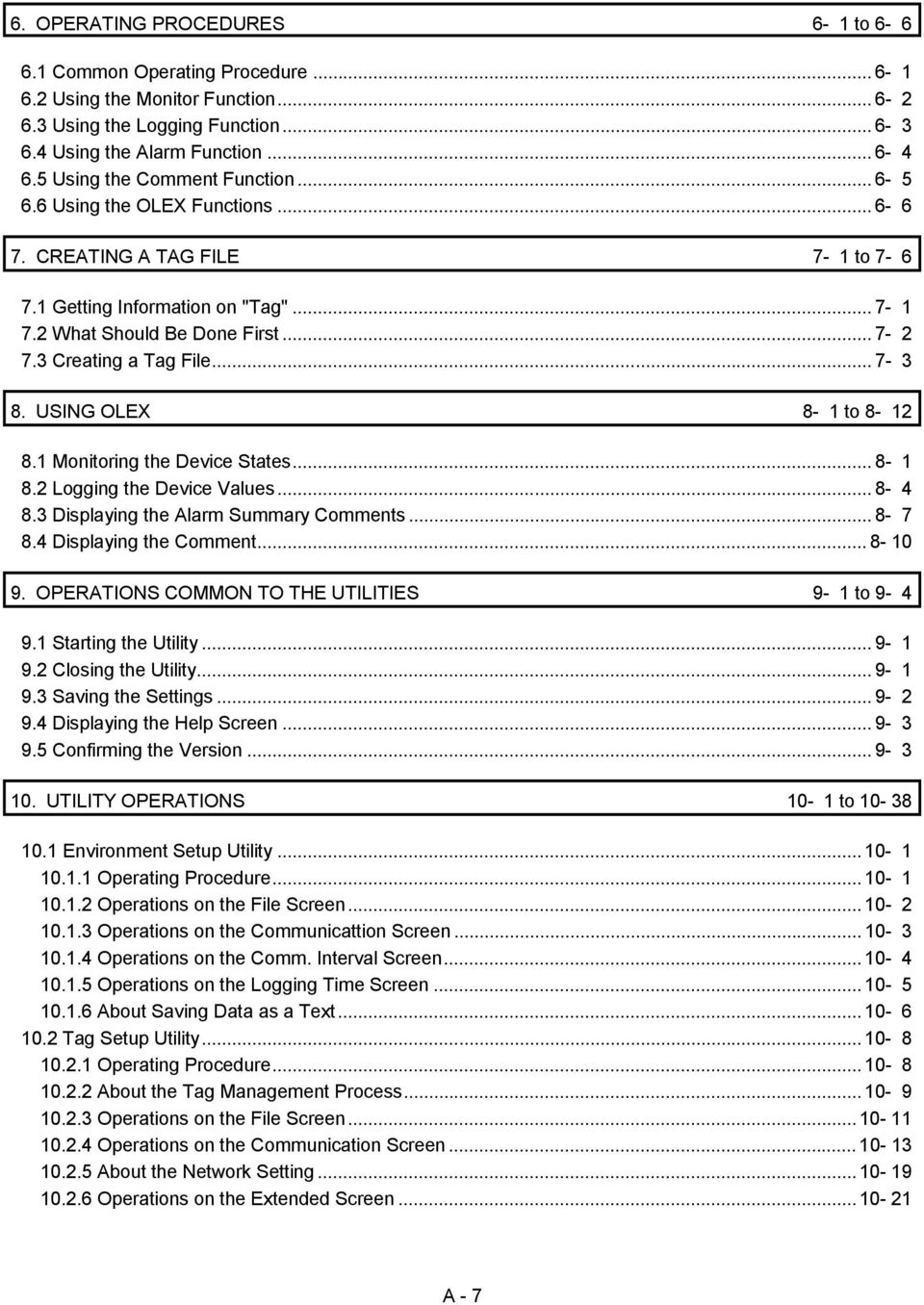
8 6. OPERATING PROCEDURES 6-1 to Common Operating Procedure Using the Monitor Function Using the Logging Function Using the Alarm Function Using the Comment Function Using the OLEX Functions CREATING A TAG FILE 7-1 to Getting Information on "Tag" What Should Be Done First Creating a Tag File USING OLEX 8-1 to Monitoring the Device States Logging the Device Values Displaying the Alarm Summary Comments Displaying the Comment OPERATIONS COMMON TO THE UTILITIES 9-1 to Starting the Utility Closing the Utility Saving the Settings Displaying the Help Screen Confirming the Version UTILITY OPERATIONS 10-1 to Environment Setup Utility Operating Procedure Operations on the File Screen Operations on the Communicattion Screen Operations on the Comm. Interval Screen Operations on the Logging Time Screen About Saving Data as a Text Tag Setup Utility Operating Procedure About the Tag Management Process Operations on the File Screen Operations on the Communication Screen About the Network Setting Operations on the Extended Screen A - 7
9 Operations on the Device Monitor Screen Operations on the List Screen Comment Setup Utility Operation Procedure Operations on the File Screen Operations on the Comment Screen Operations on the Comment List Screen Comment File Format Alarm Summary Setup Utility Operation Procedure Operations on the File Screen Operations on the Alarm Screen Operations on the Alarm List Screen Alarm Summary File Format HOW TO USE OLEX 11-1 to About Cell Setting Making Monitor Setting Making Logging Setting Making Alarm Setting Making Comment Setting Editing Cutting the Cell Area Set with OLEX Copying the Cell Area Set with OLEX Pasting the Cell Area Set with OLEX Deleting the Cell Area Set with OLEX Searching for the Cell Area Set with OLEX Making Communication Tests Making a Read Test Making a Write Test Setting Whether the Cell Area Is Made Valid or Invalid Setting/Releasing Automatic Start-Up Setting Automatic Start-Up Releasing Automatic Start-Up About Automatic Execution About the Status During Automatic Execution Stopping Automatic Execution Other Operations Making Setting to Save Collected Data Automatically Setting Automatic Printing Starting the Tag Setup Utility Displaying the Version Information A - 8

10 12. OLEX FUNCTIONS 12-1 to Setting References to Macro File Instructions for Use of the OLEX Functions OLEXRead OLEXWrite APPENDICES APP- 1 to APP- 3 APPENDIX 1 Specifications...APP- 1 APPENDIX 2 About the Automatic Save/Print Timing...APP- 1 APPENDIX 3 Tag Error Codes...APP- 3 A - 9
11 About Manuals The following manuals are also related to this product. In necessary, order them by quoting the details in the tables below. Related Manuals Manual Name Type SW3D5F-CSKP-E Basic Communication Support Tool Operating Manual This manual describes how to set up and use each utility for communication. (Packed with the product) Type SW3D5F-CSKP-E Basic Communication Support Tool Programming Manual Provides the programming procedure, detailed explanations, and error codes of the data link library. (Packed with the product) Type A70BDE-J71QLP23/A70BDE-J71QLP23GE/A70BDE-J71QBR13/A70BDE-J71QLR23 NET/10 Interface Board User s Manual (For SW3DNF-MNET10) Describes the features, specifications, part names and setting of the NET/10 board, and the installation, uninstallation and others of the driver. (Packed with the product) Type A80BDE-J61BT11 CC-Link System Master/Local Interface Board User s Manual (For SW4DNF-CCLINK) Describes the features, specifications, part names and setting of the CC-Link master board, and the installation, uninstallation and others of the driver. (Packed with the product) Type A80BDE-J61BT13 CC-Link Interface Board User s Manual (For SW4DNF-CCLINK) Describes the features, specifications, part names and setting of the CC-Link local board, and the installation, uninstallation and others of the driver. (Packed with the product) Type A80BDE-A2USH-S1 PLC CPU Board User s Manual (For SW1DNF-ANU-B) Describes the features, specifications, part names and setting of the CPU board, and the installation, uninstallation and others of the driver. (Packed with the product) Manual Number (Model Code) IB (1LMS50) IB (1LMS51) IB (13JL93) IB (13JR28) IB (13JR29) IB (13JR27) A - 10

12 How to Use This Manual "How to Use This Manual" is described by purposes of using OLEX. Refer to the following and use this manual. (1) To know the features (Section 1.1) Features are given in Section 1.1. (2) Menu and utility lists (Sections 1.2 and 1.3) The OLEX menu list is provided in Section 1.2 and the utility list in Section 1.3. (3) To know compatibility with the existing software (Section 1.4) Section 1.4 provides compatibility with the existing software. (4) To know the system configuration (Section 2.1) This section provides system configurations available by use of OLEX. (5) To know OLEX's operating environment and usable PLC CPUs (Sections 2.2 and 2.3) OLEX's operating environment is given in Section 2.2. Since usable PLC CPUs are the same as those of CSKP, refer to the CSKP Operating Manual. (6) To install or uninstall OLEX (Chapter 3) Read Chapter 3 which describes how to install and uninstall OLEX. (7) To make add-in registration to Excel (Chapter 4) Chapter 4 provides how to add OLEX into Excel. (8) To know the functions of OLEX (Chapter 5) Chapter 5 describes the functions of OLEX briefly. (9) To know the operation procedures of OLEX (Chapters 6 to 8) Chapter 6 provides the operation procedures of OLEX, Chapter 7 deals with the way of creating a tag file necessary to use OLEX, and Chapter 8 gives simple operation procedures for communication by actually using OLEX. (10) To know the operation methods of the utilities (Chapters 9 and 10) Chapter 9 provides operations common to the utilities, and Chapter 10 describes how to perform operation on a utility basis. Read these chapters when using the utilities. (11) To use OLEX (Chapters 11 and 12) Chapter 11 gives detailed explanations for use of OLEX, and Chapter 12 describes the OLEX functions. Read these chapters when using OLEX. (12) To know the accessible devices and ranges The CSKP Operating Manual provides the accessible devices and ranges. Refer to the CSKP Operating Manual. A - 11

13 About the Generic Terms and Abbreviations Unless otherwise specified, this manual uses the following generic terms and abbreviations to describe Type SW3D5F-OLEX-E Excel Communication Support Tool. Generic Term/Abbreviation Description OLEX Abbreviation of Type SW3D5F-OLEX-E Excel Communication Support Tool CSKP Abbreviation of Type SW2D5F-CSKP-E / SW3D5F-CSKP-E Basic Communication Support Tool Windows NT 4.0 Abbreviation of Microsoft Windows NT Workstation 4.0 Windows 95 Abbreviation of Microsoft Windows 95 Windows 98 Abbreviation of Microsoft Windows 98 Windows Generic Term of Microsoft Windows 95, Microsoft Windows 98 and Microsoft Windows NT Workstation 4.0 Excel Abbreviation of Microsoft Excel 97 and Excel 2000 Personal computer GPPW NET/10 board CC-Link board CPU board DOS/V-compatible personal computer of IBM PC/AT and its compatibles Abbreviation of GPP Function Software for Windows SW D5C-GPPW-E/SW D5F- GPPW-E Abbreviation of Type A70BDE-J71QLP23/A70BDE-J71QLP23GE/A70BDE- J71QBR13/A70BDE-J71QLR23 NET/10 interface board Abbreviation of Type A80BDE-J61BT11 CC-Link system master/local interface board and Type A80BDE-J61BT13 CC-Link interface board Abbreviation of Type A80BDE-A2USH-S1 PLU CPU board A - 12

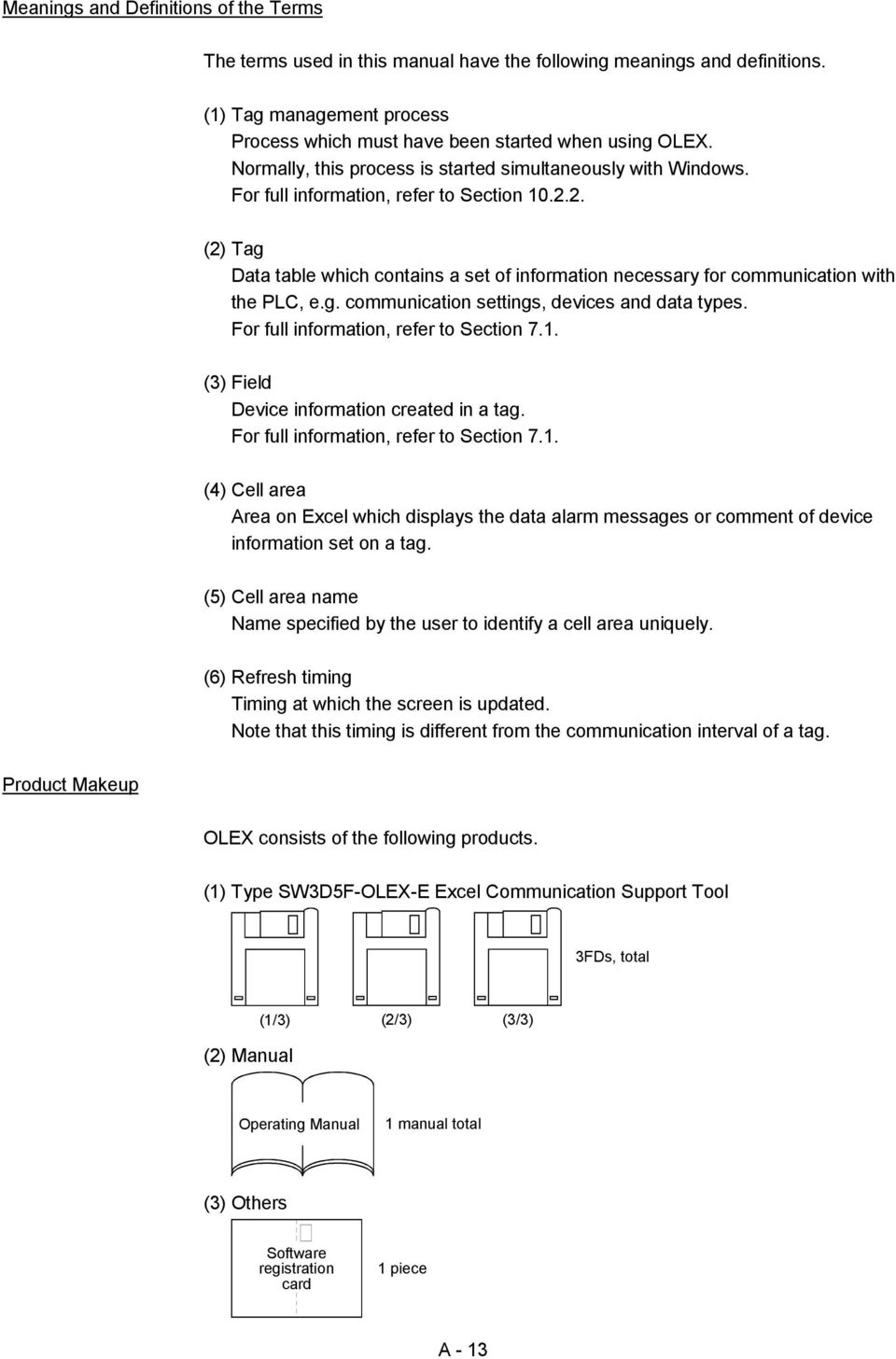
14 Meanings and Definitions of the Terms The terms used in this manual have the following meanings and definitions. (1) Tag management process Process which must have been started when using OLEX. Normally, this process is started simultaneously with Windows. For full information, refer to Section (2) Tag Data table which contains a set of information necessary for communication with the PLC, e.g. communication settings, devices and data types. For full information, refer to Section 7.1. (3) Field Device information created in a tag. For full information, refer to Section 7.1. (4) Cell area Area on Excel which displays the data alarm messages or comment of device information set on a tag. (5) Cell area name Name specified by the user to identify a cell area uniquely. (6) Refresh timing Timing at which the screen is updated. Note that this timing is different from the communication interval of a tag. Product Makeup OLEX consists of the following products. (1) Type SW3D5F-OLEX-E Excel Communication Support Tool 3FDs, total (1/3) (2/3) (3/3) (2) Manual Operating Manual 1 manual total (3) Others Software registration card 1 piece A - 13
15 MEMO A - 14

16 1. OVERVIEW 1. OVERVIEW Type SW3D5F-OLEX-E Excel Communication Support Tool is add-in software for use in Microsoft Corporation's spreadsheet software "Excel". OLEX utilizes OLE automation to perform communication processing. You can have direct access to data by simple operation without caring about the communication program of the PLC. To handle the data developed in worksheets, you can use the printing, graphing and other functions of Excel as they are. 1 Simplicity communication establishment! Hard disk Automatic saving Automatic printing Program-less! IMPORTANT CSKP is required to create applications with OLEX. When using the created execution file for monitoring, set the communication means with the CSKP utility. For details, refer to the CSKP Operating Manual. 1-1

17 1. OVERVIEW 1.1 Features OLEX has the following features. (1) High functions By simply connecting a personal computer with the PLC via a communication path supported by CSKP, you can transfer PLC data directly to/from an Excel worksheet. Namely, you can perform "program-less" operation. Personal computer Data read from PLC is displayed. Communication path (e.g. computer link communication, Ethernet communication) PLC 1-2

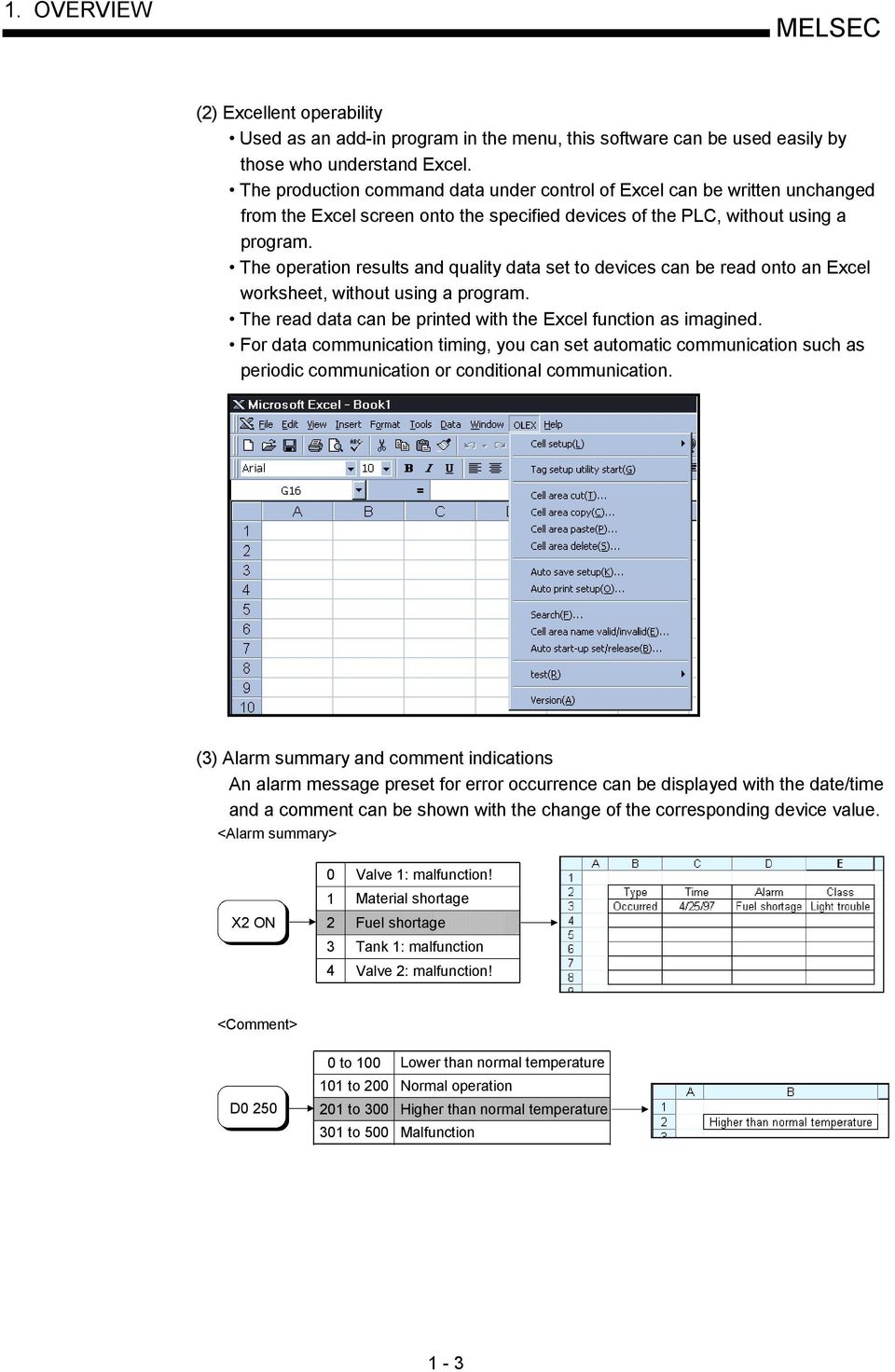
18 1. OVERVIEW (2) Excellent operability Used as an add-in program in the menu, this software can be used easily by those who understand Excel. The production command data under control of Excel can be written unchanged from the Excel screen onto the specified devices of the PLC, without using a program. The operation results and quality data set to devices can be read onto an Excel worksheet, without using a program. The read data can be printed with the Excel function as imagined. For data communication timing, you can set automatic communication such as periodic communication or conditional communication. (3) Alarm summary and comment indications An alarm message preset for error occurrence can be displayed with the date/time and a comment can be shown with the change of the corresponding device value. <Alarm summary> X2 ON Valve 1: malfunction! Material shortage Fuel shortage Tank 1: malfunction Valve 2: malfunction! <Comment> D to to to to 500 Lower than normal temperature Normal operation Higher than normal temperature Malfunction 1-3
19 1. OVERVIEW (4) Logging, automatic saving, printing You can make a daily/monthly report easily by using the logging function which accumulates data in more than one cell per collection timing and the function of saving/printing an Excel worksheet automatically at the set time. Hard disk Executed at specified intervals! Automatic saving Automatic printing Time 13: 30: 00 13: 35: 00 13: 40: 00 D0 D1 D Logging (5) Data can be transferred at any timing using the OLEX functions By using the OLEX functions as Excel macros, you can transfer the data of the specified cell area at any timing. <When OLEX function is set to button (Read)> Button click! Read Device values are read to the cell area specified with the OLEX function. 1-4

20 1. OVERVIEW (6) Simple communication using tags When OLEX merely uses a tag having such information as the device types and device numbers in the environment where the Tag management process is running, you can easily access the devices set to the tag. Set tags used on OLEX. Tag file Device type (W, D, X, etc.) Device number Data type (Short, Long, Char, Bit) Tag 1 Channel Field 1 Communication type (batch or random) Communication intervals Network setting Communication status (communication or no communication) Field n n=1000 (for batch communication) n= 256 (for random communication) Tag n (n=1 to 1000) Communication path (e.g. computer link communication, Ethernet communication) Access to PLC devices PLC 1-5

21 1. OVERVIEW 1.2 Menu List The following is the menu list of OLEX. Menu Monitor setup/revision Logging setup/revision Cell setup Alarm setup/revision Comment setup/revision Tag setup utility start Cell area cut Cell area copy Cell area paste Cell area delete Auto save setup Auto print setup Search Cell area name valid/invalid Auto start-up set/release Read test Test Write test Version Description Used to set/correct the cell area for read/write. Used to set/correct the cell area for logging. Used to set the cell area for using the alarm function. Used to set the cell area for using the comment function. Used to start the Tag setup utility. Used to cut the cell area set with OLEX. Used to copy the cell area set with OLEX. Used to paste the cell area set with OLEX. Used to delete the cell area set with OLEX. Used to set the automatic saving of a worksheet. Used to set the automatic printing of a worksheet. Used to search a cell area. Used to set the cell area made valid for automatic execution. Used to set or release the automatic start-up of an edit file. Used to make a communication test on the set read area. Used to make a communication test on the set write area. Used to display the version information of OLEX. POINT The numbers of cell area names that can be set with OLEX are as follows. (1) Monitor setting : 1000 (2) Logging setting : 100 (3) Alarm setting : 100 (4) Comment setting : Utility List The OLEX utilities are listed below. Utility Name Description Refer to Environment setup utility Used to set the environment when the Tag management process starts. Section 10.1 Tag setup utility Used to set the tag file used by the Tag management process. Section 10.2 Comment setup utility Used to set the comment file used for the comment function. Section 10.3 Alarm summary setup utility Used to set the alarm summary file used for the alarm function. Section
22 1. OVERVIEW 1.4 About Compatibility with the Existing Software The user programs and the Excel files for OLEX created using SW2D5F-OLEX-E can be used with SW3D5F-OLEX-E as they are. In addition, combinations with CSKP are as follows. SW2D5F-CSKP-E SW3D5F-CSKP-E SW2D5F-OLEX-E A 1 B or later 1 SW3D5F-OLEX-E : Usable, : Unusable 1 Indicates the software version. 1-7
23 1. OVERVIEW MEMO 1-8
24 2. SYSTEM CONFIGURATION 2. SYSTEM CONFIGURATION This chapter deals with the system configuration, operating environment and usable CPU. 2.1 System Configuration 2 The system configuration for OLEX is similar to that for CSKP. Refer to the CSKP Operating Manual. 2.2 Operating Environment The operating environment of OLEX is indicated below. Item Description Operating System Windows 95, Windows 98, Windows NT Workstation CPU Pentium 100MHz or more (multiprocessor incompatible) Display Resolution dots or more (recommended dots) Required memory capacity 32MB or more Hard disk free space 40MB or more Disk drive 3.5 inch (1.44MB) floppy disk drive Corresponding application Excel 97, Excel Service Pack 3 or higher is required for use of Windows NT Workstation Usable PLC CPU The PLC CPU usable with OLEX is the same as those with CSKP. Refer to the CSKP Operating Manual. 2-1
25 2. SYSTEM CONFIGURATION MEMO 2-2
26 3. INSTALLATION AND UNINSTALLATION 3. INSTALLATION AND UNINSTALLATION This chapter describes how to install and uninstall OLEX. 3.1 Installation This section describes how to install OLEX. POINTS (1) When using SW3D5F-OLEX-E Install SW3D5F-OLEX-E after uninstalling SW2D5F-OLEX-E. (2) When using SW3D5F-OLEX-EV Install SW3D5F-OLEX-EV with SW2D5F-OLEX-E installed. Unless SW2D5F-OLEX-E has been installed, you cannot install SW3D5F- OLEX-EV. (3) Installation decreases the number of licenses by one. (4) When the OS is Windows NT 4.0, log on as a user who has an administrator attribute. (5) Start installation after removing all applications included in Startup and restarting Windows. (6) CSKP must have been installed. (7) Make the first floppy disk write-enabled After powering on the personal computer, start Windows. 2. Choose [Start]-[Settings]-[Control Panel]. When the control panel has opened, choose "Add/Remove Programs". (To the next page) 3-1
27 3. INSTALLATION AND UNINSTALLATION (From the preceding page) 3. Click the "Install..." button. 4. When the left screen has appeared, insert the first floppy disk into the FDD and click the "Next>" button. 5. When the left screen has appeared, click the "Finish" button. If "SETUP.EXE" could not be found, click the "Browse..." button to find "SETUP.EXE" in the FDD. (To the next page) 3-2
28 3. INSTALLATION AND UNINSTALLATION (From the preceding page) 6. After a while, the screen as shown on the left will appear. Confirm the number of remaining licenses and click the "OK" button. When there is no licenses left, installation cannot be performed. The actual number of licenses is the number of licenses plus a spare license. 7. After making sure that all your running programs are closed, click the "OK" button. If your programs are running, close all running programs. 8. Confirm the instructions and click the "Next>" button. 9. Type your name and company name, and click the "Next>" button. (To the next page) 3-3
29 3. INSTALLATION AND UNINSTALLATION (From the preceding page) 10.Confirm your name and company name registered. If they are correct, click the "Yes" button. To change any name, click the "No" button. This returns to the preceding screen. 11.Enter the product ID and click the "Next>" button. The product ID is given in the "Software Registration Card" packed with the product. 12.Specify the installation destination folder. The destination folder of OLEX defaults to "C:\". To choose the default folder, click the "Next>" button. To change the destination folder, click the "Browse..." button and change the folder. (To the next page) 3-4
30 3. INSTALLATION AND UNINSTALLATION (From the preceding page) 13.Excel used with OLEX is selected and the button is clicked. 14.As installation starts, exchange the floppy disks in order according to the prompt. 15.As the left screen appears, confirm the message, and then click the "OK" button. 16.When the left dialog box appears, installation is complete. To restart, make sure that "Yes, I want to restart my computer now." is checked, and then click the "Finish" button. To restart later, check "No, I will restart my computer later." and then click the "Finish" button. The number of licenses decreases by 1 on completion of installation. POINT If installation failed at any point in the above procedure and uninstallation can be performed, uninstall the program. The number of licenses will decrease by 1 if you do not perform uninstallation. 3-5
31 3. INSTALLATION AND UNINSTALLATION 3.2 Icons Registered Installing OLEX registers the following icons in [Start]-[Programs]-[ APPLICATION]-[EXCEL COMMUNICATION SUPPORT (OLEX-E)]. (1) Tag management (a) Alarm summary setup utility Used to start the Alarm summary setup utility. (b) Comment setup utility Used to start the Comment setup utility. (c) Tag management process Used to start the Tag management process. (d) Tag setup utility Used to start the Tag setup utility. (e) Environment setup utility Used to start the Environment setup utility. (2) OLEX Help Used to show the Help screen of OLEX. 3-6
32 3. INSTALLATION AND UNINSTALLATION 3.3 Uninstallation This section provides how to uninstall OLEX. POINTS (1) Always uninstall the program from the control panel. Do not start installed "Uninstaller.exe" directly. (2) Uninstallation increases the number of licenses by 1. Therefore, always uninstall the program when deleting OLEX. The number of licenses will not return to the previous value if a folder or file is deleted by the user on Explorer or the like. (3) Make the first floppy disk write-enabled. 1. Choose the [Start]-[Settings]-[Control Panel] menu. 2. As the control panel appears, double-click "Add/Remove Programs". 3. Choose "SW3D5-OLEX-E and click the "Add/Remove..." button. (To the next page) 3-7
33 3. INSTALLATION AND UNINSTALLATION (From the preceding page) 4. As the left screen appears, insert the first floppy disk into the floppy disk drive and click the "GO UNINSTALL" button. 5. Clicking the "OK" button starts uninstallation. 6. If the left screen has appeared, click the "No to All" button. If you click the "Yes" or "Yes to All" button, the shared file of the software packages is removed and the other software packages may not start properly. 7. When uninstallation is completed, click the "OK" button. The number of licenses increases by 1 on completion of uninstallation. 3-8
34 4. ADD-IN REGISTRATION 4. ADD-IN REGISTRATION This chapter explains how to register add-ins of OLEX. Note that the Operating System and Excel have already been installed. The following procedure performs add-in registration using Excel. 1. Start the Tag management process. For full information, refer to Section Start Excel. 3. Choose [Tools]-[Add-Ins ] on the menu bar When the dialog box opens, click the "Browse..." button to open the "Browse" dialog box. (To the next page) 4-1
35 4. ADD-IN REGISTRATION (From the preceding page) 5. When using Excel 97, Choose "OLEX97.XLA" in C:\\OLEX\(default) and click the "OK" button. When using Excel 2000, Choose "OLEX2000.XLA" in C:\\OLEX\(default) and click the "OK" button. 6. As the left dialog box opens, make sure that "OLEX" has been added to Add-Ins available and checked, and click the "OK" button. 7. "OLEX" is added to the menu bar. 4-2
36 5. FUNCTIONS OF OLEX 5. FUNCTIONS OF OLEX This chapter describes the functions of OLEX. 5.1 Monitor Function With this function, the device data values set to a tag are displayed on an Excel sheet. Also, the Excel sheet data are written to devices according to the tag setting. When using the monitor function, making settings as in (1) and (2) displays data as in (3). (1) Tag setup utility setting Batch is specified. (Random may also be specified) 10 points are reserved in short (16 bits), beginning with device D30 (D30 to D39). 5 (2) OLEX setting Cell area (D6 to E11) Fields are displayed, starting with field No. 3 (D32). Data is displayed from top to bottom. (3) Display format When the settings made are as shown in (1) and (2), the data of D32 to D39 on tag "tag002" are stored. 5-1
37 5. FUNCTIONS OF OLEX 5.2 Logging Function With this function, the data gathered by the tag set for logging are displayed on an Excel sheet and accumulated in an Excel book. When using the logging function, making setting as in (1) and (2) displays data as in (3). (1) Tag setup utility setting Batch is specified. (Random may also be specified) D10 to D19 (10 points) specified. (2) OLEX setting Cell area (B5 to I16) Displayed in the left-end cell of the specified area. (3) Display format Older Newer Time appears. As the cell area is smaller than the number of fields, up to the fields acceptable on the screen (D10 to D16) appear. D17 to D19 are not displayed. POINT This function logs the data of all fields specified in the tag. However, there are the following restrictions. (1) If the number of cells is less than the number of fields, only the fields corresponding to the cells are displayed. (2) If the number of fields is less than the number of cells, only the specified fields are displayed and no fields appear in the extra cells. 5-2
38 5. FUNCTIONS OF OLEX 5.3 Alarm Function With this function, the alarm messages registered beforehand in the alarm summary file are displayed on an Excel sheet to create a failure history or the like when the bit devices set to the tag turn on. When using the alarm function, making setting as in (1) to (3) displays data as in (4). The alarm function shows alarm comments when the corresponding bit devices turn on. (1) Tag setup utility setting Batch is specified. (Random may also be specified) Y0 to Y15 specified. POINTS (1) The devices specified must be bit devices. (2) Make setting so that the number of alarm comments is equal to or greater than the number of devices. (2) Alarm summary setup utility setting Corresponding to Y0 to Y15 5-3
39 5. FUNCTIONS OF OLEX When the corresponding bit turns on, the alarm comment appears. Example: When Y0 turns on, "Over an upper limit - tank 1" appears. POINT The color setting made in the Alarm summary setup utility is invalid for OLEX. (3) OLEX setting Cell area (B3 to E13) Field No. 1 (Y0) corresponds to alarm No. 1. (4) Display format When the corresponding bit turns on, the alarm comment appears in the cell. The type shown is "Occurred" when the bit turns on, or "Restored" when the bit turns off. Newer Older 5-4
40 5. FUNCTIONS OF OLEX 5.4 Comment Function With this function, a comment registered in advance to a comment file is displayed on an Excel sheet according to the device data value set to a tag. When using the comment function, making setting as in (1) to (3) displays data as in (4). The comment function checks the data value of a single field to show the comment. (1) Tag setup utility setting Batch is specified. (Random may also be specified) D10 is specified as short. POINT Three device types are usable: Short, Long and Bit. (2) Comment setup utility setting A comment appears when the D10 value falls within this range. When the specified device falls within the range set to the Comment setup utility, the corresponding comment is displayed. Example: When D10 has changed to 50, "Temperature maintenance" appears. POINT The color setting made in the Comment setup utility is invalid for OLEX. 5-5
41 5. FUNCTIONS OF OLEX (3) OLEX setting Cell area (B3) The displayed comment changes with the value of field No. 1 (D10) (4) Display format The comment is displayed according to the change of the specified device value. 5.5 OLEX Functions By providing a function with the preset cell area name (cell area name of monitor setting or logging setting) as an argument using the setting function of OLEX, data can be read to the corresponding cell area or the data in the corresponding cell area can be written. Refer to Chapter 12 for full information. POINTS (1) The cell areas where data can be transferred with the OLEX functions are only the cell areas specified in the monitor setting and logging setting. Data cannot be transferred to/from the cell areas specified in the comment setting and alarm setting. (2) When OLEX is automatically executed in Ethernet communication, the read/write function cannot be executed. 5-6
42 6. OPERATING PROCEDURES 6. OPERATING PROCEDURES This chapter deals with the operating procedures of OLEX. 6.1 Common Operating Procedure The following flowchart provides a common operation procedure performed before using any function of OLEX. START When using a communication card, set the communication card. Refer to the corresponding communication card manual. Install CSKP. Refer to the CSKP Operating Manual. Install Excel. Install OLEX. Refer to Section 3.1. Set the communication path using the data link utility. Refer to the CSKP Operating Manual. Start the Environment setup utility and make setting. After setting, close the utility. Start the Tag setup utility and make setting. After setting, close the utility. Refer to Section 9.1, 9.2, Refer to Section 9.1, 9.2, Start the Tag management process. Refer to Section Start Excel. Register OLEX add-ins to Excel. Refer to Chapter 4. (To any of Sections 6.2 to 6.6) 6-1
43 6. OPERATING PROCEDURES 6.2 Using the Monitor Function The following flowchart gives an operating procedure performed when using the monitor function. Please read Section 6.1 before reading this section. (From Section 6.1) Select the cell area where the monitor function will be set, choose [OLEX]-[Cell setup]-[monitor setup/revision], and make setting. Refer to Section Choose [OLEX]-[test] and make test communication. Refer to Section Choose [OLEX]-[Cell area name valid/invalid] and make setting so that the set cell area is made valid. Refer to Section Save the sheet. Choose [OLEX]-[Auto start-up set/release] and make auto start-up valid. Refer to Section Log off or restart. Start thetag management process. Refer to Section END 6-2
44 6. OPERATING PROCEDURES 6.3 Using the Logging Function The following flowchart gives an operating procedure performed when using the logging function. Please read Section 6.1 before reading this section. (From Section 6.1) Select the cell area where the monitor function will be set, choose [OLEX]-[Cell setup]-[logging setup/revision], and make setting. Refer to Section Choose [OLEX]-[test] and make test communication. Refer to Section Choose [OLEX]-[Cell area name valid/invalid] and make setting so that the set cell area is made valid. Refer to Section 11.4 Save the sheet. Choose [OLEX]-[Auto start-up set/release] and make auto start-up valid. Refer to Section 11.5 Log off or restart. Start the Tag management process. Refer to Section END POINTS (1) When performing the logging function, create a tag as a log-specified tag dedicated to logging. (2) Set the tag collection intervals to 1 second or longer. 6-3
45 6. OPERATING PROCEDURES 6.4 Using the Alarm Function The following flowchart gives an operating procedure performed when using the alarm function. Please read Section 6.1 before reading this section. (From Section 6.1) Start the alarm summary setting utility and make setting. After setting, close the utility. Refer to Section 9.1, 9.2, Select the cell area where the monitor function will be set, choose [OLEX]-[Cell setup]-[alarm setup/revision], and make setting. Refer to Section Choose [OLEX]-[test] and make test communication. Refer to Section Choose [OLEX]-[Cell area name valid/invalid] and make setting so that the set cell area is made valid. Refer to Section 11.4 Save the sheet. Choose [OLEX]-[Auto start-up set/release] and make auto start-up valid. Refer to Section Log off or restart. Start the Tag management process. Refer to Section END POINT Setting of the cell area requires cells in four or more columns. Similarly, setting of two or more consecutive areas requires cells in four or more columns. 6-4
46 6. OPERATING PROCEDURES 6.5 Using the Comment Function The following flowchart gives an operating procedure performed when using the comment function. Please read Section 6.1 before reading this section. (From Section 6.1) Start the Comment setup utility and make setting. After setting, close the utility. Refer to Section 9.1, 9.2, Select the cell area where the monitor function will be set, choose [OLEX]-[Cell setup]-[comment setup/revision], and make setting. Refer to Section Choose [OLEX]-[test] and make test communication. Refer to Section Choose [OLEX]-[Cell area name valid/invalid] and make setting so that the set cell area is made valid. Refer to Section Save the sheet. Choose [OLEX]-[Auto start-up set/release] and make auto start-up valid. Refer to Section Log off or restart. Start the Tag management process. Refer to Section END POINT Set only one cell. 6-5
47 6. OPERATING PROCEDURES 6.6 Using the OLEX Functions The following flowchart gives an operating procedure performed when using the OLEX functions. Please read Section 6.1 before reading this section. (From Section 6.1) Make monitor or logging setting. Refer to Section , Set reference to the macro file. Refer to Section Using the OLEX functions, create macros. Assign the created macros to command buttons, etc. Call the macro. (Click the command button, for example.) END 6-6
48 7. CREATING A TAG FILE 7. CREATING A TAG FILE This chapter explains how to create a tag file which is utilized when using OLEX. 7.1 Getting Information on "Tag" A tag is a data table which contains a set of information necessary for communication with the PLC CPU, e.g. communication setting, devices and data types. By specifying a tag, OLEX can access devices defined in the tag. Create a tag file using the Tag setup utility Tag file Tag 1 Channel Communication type (batch or random) Device type (W, D, X, etc.) Device number Data type (Short, Long, Char, Bit) Communication intervals Network setting Communication status (communication or no communication) Field 1 Field n n=1000 (for batch communication) n= 256 (for random communication) Tag n (n=1 to 1000) Specify the field which contains the information of the device to be accessed! 7 OLEX Communication path (e.g. computer link communication, Ethernet communication) PLC Tag management process operates. Access to PLC devices POINT When using a tag, the Tag management process must be running. For full information, refer to Section
49 7. CREATING A TAG FILE 7.2 What Should Be Done First This section describes the operation to be preformed first when creating a tag file. Please read this section before creating the tag of any communication path. 1. Set the corresponding utility according to the communication form used (e.g. computer link, Ethernet). 2. Start the Environment setup utility. (Refer to Section 9.1.) 3. Open the "File" screen and set the tag file name used. When creating a new tag file, create a new tag within the "Tag setup utility" in advance. (Refer to Section 7.3) 4. Open the "Communication" screen and set channel names (aliases) to the communication channels used. The channel names set here are reflected on the Tag setup utility. 5. Open the "Comm. interval" screen and set communication interval names (aliases) to the communication intervals. The communication interval names set here are reflected on the Tag setup utility. 6. Save the data and close the Environment setup utility. (Refer to Section 9.2 and 9.3.) (To Section 7.3) 7-2
50 7. CREATING A TAG FILE 7.3 Creating a Tag File This section gives how to create a tag file when collecting the device information of the PLC CPU connected via a computer link module. Please read Section 7.2 before making setting in this section. Tag file name Specified devices Logical station number : C:\\USER\SAMPLE2.TAG : tag D0 to D15 (Short) (for 16 points) tag M100 (Bit), D200 (Long) : 0 (set on the computer link utility) RS-232C Personal computer PLC Connected to the computer link (serial communication) module. (1) Start the Tag setup utility. (Refer to Section 9.1.) (2) Open the "File" screen and specify the tag file name to be set. If you had created no tag files, click the "New" button and create a tag file. 7-3
51 7. CREATING A TAG FILE (3) Open the "Communication" screen, make setting as shown on the screen below, and click the "Tag update" button. (Set D0 to D15.) 1) 3) 5) 2) 4) 6) 1) The data set on the Environment setup utility are reflected here. Set the channel of the communication form used. Here, set the channel name of the computer link communication. 2) Set the Network No. and Station No.. Here, set the logical station number in the Sta. No. box. 3) Since only D devices are set, specify Batch here. When setting two or more devices, specify Random. 4) Set Short. 5) Set D0 in decimal. When specifying bit devices, set a multiple of 8 (a multiple of 16 for Ethernet communication). 6) Set 16 points. When specifying bit devices, set a multiple of
52 7. CREATING A TAG FILE (4) Click the "New tag..." button and create a new tag. Here, tag002 is created. (5) Make setting as shown on the screen below and click the "Field update" button. (Set M100.) 1) 3) 5) 2) 4) 1) The data set on the Environment setup utility is reflected here. Here, set the channel name of the computer link communication. 2) Set the logical station number in the Station No. box. Ignore the network number as it is not used. 3) Since two devices, M100 and D200, are specified, set Random. 4) Set Bit. 5) Set M100 in decimal. 7-5
53 7. CREATING A TAG FILE (6) Click the "Field add..." button. (7) Make setting as shown on the screen below and click the "Field update" button. (Set D200.) 2) 1) 1) Set Long. 2) Set D200 in decimal. (8) Click the "Tag update" button. (9) After clicking the "Save" button, click the "Exit" button to close the Tag setup utility. 7-6
54 8. USING OLEX 8. USING OLEX This chapter provides the procedure of actually accessing the PLC CPU using OLEX. POINT After cell setting, do not delete the sheet or change the sheet name. If you change it, we cannot guarantee the data. 8.1 Monitoring the Device States Perform the following procedure to actually monitor device states using OLEX. (Example) Devices to be monitored : D100 to D109 (Short) Fields used : 1 to 10 (D100 to D109) Cell settings : Device states will be displayed as shown below. (1) Create a tag. Refer to Chapter 7 and Section 10.2 and create a tag. Specifying "Ordinary" in the tag setting on the Tag setup utility enables fast data collection. (2) Start the Tag management process. Refer to Section and start the Tag management process. 8 (3) Start Excel. (4) Set the cell area to be monitored. Set the cell area (B5 to C9) you will monitor. 8-1
55 8. USING OLEX (5) Set the cell area name and set the communication mode, consecutive direction, etc. (a) Choose [OLEX]-[Cell setup]-[monitor setup/revision] in the menu and enter the cell area name. After typing the cell area name, click! Type any cell area name. (b) Set the tag name, field No., communication mode and consecutive direction, and click the "Register" button. Specify the tag. Choose Read this time. Choose Top Bottom this time. (6) Conduct a test. Choose [OLEX]-[test]-[Read test] in the menu, set the cell area name to be tested, and click the "Execute" button. At this time, make sure that the values of D100 to D109 are monitored correctly in the set area. Click! Choose the cell area name. (7) Make setting to monitor device states in the set cell area. Choose [OLEX]-[Cell area name valid/invalid] in the menu and make setting to make the set cell area valid. (Defaults to a checked (valid) status.) Check this to make it valid. 8-2
56 8. USING OLEX (8) Save the sheet. Save the set sheet. (9) Make setting to start monitoring. (a) Choose [OLEX]-[Auto start-up set/release] in the menu. Choose! (b) As the following dialog box appears, click the "OK" button. Click! (c) As the following dialog box appears, select the file for which monitor setting has been made, and click the "Open" button. (Here, select the file saved last.) Click! (d) As the following dialog box appears, click the "OK" button and then log off or restart. Click! (e) After completion of logon or restart, starting the Tag management process starts Excel automatically, opens the file for which automatic start-up setting has been made, and starts execution. 8-3
57 8. USING OLEX 8.2 Logging the Device Values Perform the following procedure to actually log device values using OLEX. (Example) Devices to be logged Cell settings : D100 to D104 (Short) : Device states will be displayed as shown below. (1) Create a tag. Refer to Chapter 7 and Section 10.2 and create a tag. Specifying "Ordinary" in the tag setting on the Tag setup utility enables fast data collection. POINT The tag used must be the one for which the communication intervals have been set to 1 second or longer and Logging (Extended) has been made. (2) Start the Tag management process. Refer to Section and start the Tag management process. (3) Start Excel. (4) Set the cell area to be logged. Set the cell area (B5 to G14) you will log. (5) Set the cell area name and set the communication mode, consecutive direction, etc. (a) Choose [OLEX]-[Cell setup]-[logging setup/revision] in the menu and enter the cell area name. Type any cell area name. After typing the cell area name, click! 8-4
58 8. USING OLEX (b) Set the tag name, the display option, and the display method used when the last part of the cell area is reached, and click the "Register" button. Specify the tag name. Check to display the date and time. Set the processing method used when the last part of the cell area is reached. (6) Conduct a test. Choose [OLEX]-[test]-[Read test] in the menu, set the cell area name to be tested, and click the "Execute" button. At this time, make sure that the date/time when the logging test was made and the values of D100 to D104 are logged correctly on the top line of the set area. Click! Choose the cell area name. (7) Make setting to monitor device states in the set cell area. Choose [OLEX]-[Cell area name valid/invalid] in the menu and make setting to make the set cell area valid. (Defaults to a checked (valid) status.) Check this to make it valid. 8-5
59 8. USING OLEX (8) Save the sheet. Save the set sheet. (9) Make setting to start logging. (a) Choose [OLEX]-[Auto start-up set/release] in the menu. Choose! (b) As the following dialog box appears, click the "OK" button. Click! (c) As the following dialog box appears, select the file for which logging setting has been made, and click the "Open" button. (Here, select the file saved last.) Click! (d) As the following dialog box appears, click the "OK" button and then log off or restart. Click! (e) After completion of logon or restart, starting the Tag management process starts Excel automatically, opens the file for which automatic start-up setting has been made, and starts execution. 8-6
60 8. USING OLEX 8.3 Displaying the Alarm Summary Comments Perform the following procedure to actually use the alarm summary function on OLEX. (Example) Bit devices to be used Cell settings : Y0 to Y8 : Alarm comments will be displayed in the following area. (1) Create a tag. Refer to Chapter 7 and Section 10.2 and create a tag. Always create a tag where bit devices are set. Specifying "Ordinary" in the tag setting on the Tag setup utility enables fast data collection. (2) Create an Alarm summary file. Create an Alarm summary file using the Alarm summary setup utility. Always set a larger number of alarm comments than the number of bit devices specified in the tag. Refer to Section 10.4 for the utility operations. (3) Start the Tag management process. Refer to Section and start the Tag management process. (4) Start Excel. (5) Set the cell area where alarm comments will be displayed. Set the cell area (C4 to F15) you will display alarm comments. 8-7
61 8. USING OLEX (6) Set the cell area name and set the communication mode, consecutive direction, etc. (a) Choose [OLEX]-[Cell setup]-[alarm setup/revision] in the menu and enter the cell area name. After typing the cell area name, click! Type any cell area name. (b) Set the Tag name, Field No. and Alarm summary file, and click the "Register" button. Specify the Tag name and Field number. Choose the Alarm summary file. (7) Make setting to display alarm comments in the set cell area. Choose [OLEX]-[Cell area name valid/invalid] in the menu and make setting to make the set cell area valid. (Defaults to a checked (valid) status.) Check this to make it valid. 8-8
62 8. USING OLEX (8) Save the sheet. Save the set sheet. (9) Make setting to start alarm comment display. (a) Choose [OLEX]-[Auto start-up set/release] in the menu. Choose! (b) As the following dialog box appears, click the "OK" button. Click! (c) As the following dialog box appears, select the file for which alarm setting has been made, and click the "Open" button. (Here, select the file saved last.) Click! (d) As the following dialog box appears, click the "OK" button and then log off or restart. Click! (e) After completion of logon or restart, starting the Tag management process starts Excel automatically, opens the file for which automatic start-up setting has been made, and starts execution. 8-9
63 8. USING OLEX 8.4 Displaying the Comment Perform the following procedure to actually use the comment function on OLEX. (Example) Device to be used Cell settings : D10 : A comment will be displayed in the following area. Set only one cell. (1) Create a tag. Refer to Chapter 7 and Section 10.2 and create a tag. Specifying "Ordinary" in the tag setting on the Tag setup utility enables fast data collection. (2) Create a comment file. Refer to Section 10.3 and create a comment file. (3) Start the Tag management process. Refer to Section and start the Tag management process. (4) Start Excel. (5) Set the cell area where a comment will be displayed. Set the cell area (B2) you will display a comment. (6) Set the cell area name and set the communication mode, consecutive direction, etc. (a) Choose [OLEX]-[Cell setup]-[comment setup/revision] in the menu and enter the cell area name. After typing the cell area name, click! Type any cell area name. 8-10
64 8. USING OLEX (b) Set the Tag name, Field No. and Comment file, and click the "Register" button. Specify the Tag name and Field number. Choose the comment file. (7) Make setting to display a comment in the set cell area. Choose [OLEX]-[Cell area name valid/invalid] in the menu and make setting to make the set cell area valid. (Defaults to a checked (valid) status.) Check this to make it valid. (8) Save the sheet. Save the set sheet. (9) Make setting to display a comment. (a) Choose [OLEX]-[Auto start-up set/release] in the menu. Choose! 8-11
65 8. USING OLEX (b) As the following dialog box appears, click the "OK" button. Click! (c) As the following dialog box appears, select the file for which comment setting has been made, and click the "Open" button. (Here, select the file saved last.) Click! (d) As the following dialog box appears, click the "OK" button and then log off or restart. Click! (e) After completion of logon or restart, starting the Tag management process starts Excel automatically, opens the file for which automatic start-up setting has been made, and starts execution. 8-12
66 9. OPERATIONS COMMON TO THE UTILITIES 9. OPERATIONS COMMON TO THE UTILITIES This chapter describes the operations common to the utilities. 9.1 Starting the Utility Any utility can be started by clicking the corresponding menu item among 1) to 5) shown below in the [Start]-[Programs]-[ APPLICATION]-[EXCEL COMMUNICATION SUPPORT (OLEX-E)]-[Tag Management] menu. 1) 2) 3) 4) 5) 1) Start the Alarm summary setup utility. 2) Start the Comment setup utility. 3) Start the Environment setup utility. 4) Start the Tag management process. (For details, refer to Section ) 5) Start the Tag setup utility. 9.2 Closing the Utility Any utility can be closed by clicking the "Exit" button at the bottom of the Utility screen. 9 Click! 9-1
67 9. OPERATIONS COMMON TO THE UTILITIES 9.3 Saving the Settings The settings made on the Utility can be saved by clicking the "Save" button at the bottom of the Utility screen. The settings will not be saved if you close the Utility without clicking the "Save" button. Click! POINT To reflect the utility settings on Excel during OLEX running, exit from OLEX and Tag management process once, then start the Tag management process and resume automatic execution. 9-2
68 9. OPERATIONS COMMON TO THE UTILITIES 9.4 Displaying the Help Screen The Utility help screen can be displayed by clicking the "Help" button at the bottom of the Utility screen. Click! 9.5 Confirming the Version The version of the Utility can be confirmed by clicking the "Version" tab. Click! 9-3
69 9. OPERATIONS COMMON TO THE UTILITIES MEMO 9-4
70 10. UTILITY OPERATIONS 10. UTILITY OPERATIONS This chapter describes how to operate and set the utilities Environment Setup Utility This section explains how to operate and set the Environment setup utility Operating Procedure This section provides the procedure of operating the Environment setup utility. START Set the tag file name on the File screen. Refer to Section Set the channel name to the used channel on the Communication screen. Refer to Section No Do you use the communication interval and communication interval name which are not default ones? Yes Make setting on the Comm. interval screen. Refer to Section No Do you set the logging time? Yes Make setting on the Logging time screen. Refer to Section END
71 10. UTILITY OPERATIONS Operations on the File Screen These operations include the setting of the tag file name to be read for execution of the Tag management process. 1) 2) 4) 5) 3) 1) Tag file name Set the tag file which the Tag management process will read. 2) "Browse" button Used to find the tag file to be set in 1). As the file setting dialog box opens, choose the tag file. 3) Start up file name Shows the application started simultaneously with the starting of the Tag management process. POINTS The book file for which OLEX will be automatically executed is only the one which has been set to automatic execution on OLEX. With this utility, you cannot register or delete files for OLEX. 4) "Add" button Used to set the application started simultaneously. You can set up to a total of 16 files. However, the files that may be set are only those having EXE, XLS and MDB extensions. Any other files cannot be started if set. 5) "Delete" button Choose the file name registered in 3) by clicking it, and click this button to delete the file selected in 3) and release automatic start-up. 10-2
72 10. UTILITY OPERATIONS Operations on the Communication Screen Set channel names relative to the Communication channels. (Up to 10 names) 1) 2) 1) Communication Channel Choose the communication channels relative to the channel names. 2) Channel Name Set only the channel names with which the user's desired names will be used. The user makes communication setting with the Tag setup utility on the basis of the channel names set. Setting example Ethernet CSKP Machining line 2 NET/10 (First) NET/10 (Second) NET/10 (Third) Assembly line 1 Machining line 1 Communication Channel Channel Name NET/10 (First) Assembly line 1 NET/10 (Second) Machining line 2 NET/10 (Third) Machining line
73 10. UTILITY OPERATIONS Operations on the Comm. Interval Screen You can attach any names to the Communication intervals and define them as the communication names. (Up to 30 names) 1) 2) 1) Comm. Interval Intervals can be set in 100ms increments. Hence, "5" sets the communication interval to 500ms. (The setting range is 1 to ) 2) Comm. Interval Name Set the user's desired names. The user makes communication setting with the Tag setup utility on the basis of the communication interval names set. 10-4
74 10. UTILITY OPERATIONS Operations on the Logging Time Screen Set the time zones when the logging operation of the Tag management process will be performed. You can set up to four zones. (On OLEX, set them when using the automatic printing or automatic saving function.) 1) 2) 3) 1) Start time Set the data logging operation-starting time of the Tag management process. Type the set time on a 24-hour basis. (Setting range: 0:00 to 23:59) 2) Stop time Set the data logging operation-ending time of the Tag management process. Type the set time on a 24-hour basis. (Setting range: 0:00 to 23:59) 3) Valid/invalid check box Set whether the set operation times are made valid or not. Check the box to make the set times valid. When the box is unchecked, the set times are invalid. POINTS (1) If the period between the Start time and the Stop time is longer than 24 hours, their settings cannot be made. (2) The settings on this screen are valid only when you have checked "Log within the operation time period" in Logging Setting within "Extended" on the Tag setup utility. For details, refer to Section (3). (3) If you have made the logging setting, the following folder is created but never delete it. Deleting it will disable proper logging. Alternatively, if you want to delete all log information or change the personal computer time, delete all files in the folder. <HD drive>-<user-defined folder>-<cskp>-<mti>-<logfile> 10-5
75 10. UTILITY OPERATIONS About Saving Data as a Text By clicking the "Text save" button at the bottom of the Environment setup utility, the settings made with the Environment setup utility can be saved as a text file. (1) Operation procedure Perform the following procedure to save the data of the setting in a text file. 1. Click the "Text save" button on the Environment setup utility. 2. As the left dialog box appears, set the saving place and file name and click the "Save" button. 10-6
76 10. UTILITY OPERATIONS (2) File data The data of the created text file will be described. 1) 2) [Tag File] C:\TAGFILE\sample.tag [Starting File] C:\SAMPLE.EXE 3) [Communication channel setting] Computer Link (COM1) = Channel 1 LLT = Logic 4) [Interval] 5 = 500msec 10 = 1sec 600 = 1min 5) [Logging time] 0Hr0Min - 0Hr0Min -> Invalid 0Hr0Min - 0Hr0Min -> Invalid 1) Indicates the data set to the tag file name on the "File" screen. 2) Indicates the data set to automatic start-up registration on the "File" screen. 3) Indicates the data set to the "Communication" screen. 4) Indicates the data set to the "Comm. interval" screen. 5) Indicates the data set to the "Logging time" screen. 10-7
77 10. UTILITY OPERATIONS 10.2 Tag Setup Utility This section provides how to operate and set the Tag setup utility Operating Procedure The following flowchart provides the operation procedure of the Tag setup utility. START Set the tag file name on the File screen. Refer to Section Set the tag on the Communication screen. Refer to Section No Do you monitor the device values set to the tag? Yes Make sure that the Tag management process is running and monitor devices on the Device monitor screen. Refer to Section No Do you confirm the set tags in a list? Yes Confirm the tags on the List screen. Refer to Section END 10-8
78 10. UTILITY OPERATIONS About the Tag Management Process The Tag management process is a process which provides a communication method using a tag on the basis of the information set with the Environment setup utility and the information of the tag file. When using a tag, the Tag management process must be running. (1) Starting method Click [Start]-[Programs]-[ APPLICATION]-[EXCEL COMMUNICATION SUPPORT (OLEX-E)]-[Tag management]-[tag management process]. POINT (1) Before starting the Tag management process, you need to create a tag file with the Tag setup utility and specify the tag file with the Environment setup utility. (2) When the Tag management process is running, the Tag setup utility communicates with the Tag management process. If the Tag setup utility is disabled from making normal communication due to forced exit from the Tag management process, for example, the following or similar error message may appear. If the error message has appeared, restart the Tag management process. <Error message example> RPC server cannot be used. Remote procedure call failed, resulting in no execution. (2) Ending method To close the Tag management process, force it to end. Alternatively, choose "Tag management process" on the task bar and press the "Alt" + "F4" keys. (3) Reloading procedure The Tag management process must be reloaded to reflect the modified/added tag file for use during execution of the Tag management process. 1) Stop the Tag management process. Open the "File" screen and click the "Stop " button. Click to stop. 2) Edit the tag file. 10-9
79 10. UTILITY OPERATIONS 3) Update the modified/added tag information. Open the "Communication" screen, modify/add tags and click the "Tag Update" button. 4) Click the "Save" button to save the information. 5) Reload the Tag management process. Click the "Reload" button to reload the Tag management process. Click to reload. 6) Execute the Tag management process. Click the "Execute" button to run the Tag management process. Click to execute
80 10. UTILITY OPERATIONS Operations on the File Screen Set the tag file to be saved, collection timing, and whether the Tag management process is run or stopped. 1) 2) 3) 4) 8) 9) 5) 6) 7) 1) Tag file name Specify the tag file name to be set. 2) "File read" button Used to find the tag file to be set in 1). As the file setting dialog box opens, choose the tag file. 3) "New" button Used to create a new tag file. As the file setting dialog box opens, set the name of a new tag file to be created. 4) Tag management process operating status Indicates the current status of the Tag management process. RUN... Indicates that the Tag management process is "running". STOP... Indicates that the Tag management process is "at a stop". NOT RUN... Indicates that the Tag management process is not started. 5) "Run" button Used to run the Tag management process. You cannot use this button to start the Tag management process. (This button cannot be selected when the Tag management process has not yet been started.) 10-11
81 10. UTILITY OPERATIONS 6) "Stop..." button Used to stop the Tag management process. You cannot use this button to end the Tag management process. (This button cannot be selected when the Tag management process has not yet been started.) 7) "Reload" button Used to reload the Tag management process. Note that this button may be selected only during the stop of the Tag management process. 8) "Ordinary" button Used to set all collection timings of the set tags to "Ordinary" in batch. Ordinary...Data is always collected independently of whether the application using the tags is active or inactive. 9) "Non-ordinary" button Used to set all collection timings of the set tags to "Non-ordinary" in batch. Non-ordinary...Data is collected only when the application using the tags is active. POINT The Tag management process has great influence on the processing speed of the personal computer. When using other application, it is recommended to stop the Tag management process
82 10. UTILITY OPERATIONS Operations on the Communication Screen Set the network, devices, etc. to the tag. 6) 8) 7) 1) 2) 3) 9) 4) 5) 10) 16) 11) 12) 13) 14) 17) 15) 1) Tag Name Choose the tag name to which the setting will be registered. 2) No. of tags Shows the number of tags registered currently. 3) Channel name Choose the channel name set with the Environment setup utility. (Refer to Section ) 4) Comm. period name Choose the communication interval name set with the Environment setup utility. (Refer to Section ) 5) Ordinary When this box is checked, data is always collected independently of whether the application using the tags is active or inactive. When this box is unchecked, data is collected only when the application using the tags is active
83 10. UTILITY OPERATIONS 6) Network To perform a communication, enter the logical station number and network settings. Refer to Section Logical Station Direct Station 7) Comm. status Set whether the communication of the set tag is valid or invalid. If you set Invalid, communication is not made. 8) Comm. type Specify "Batch" or "Random" as the way of access to the PLC. Batch...Choose this when accessing the specified points of a single device name. Random...Choose this when accessing one point of each of many device names
84 10. UTILITY OPERATIONS 9) Tag-related buttons "Tag Update"...Used to update the tag data set to the tag file. To save the data, click the "Save" button. "Tag name..."...used to create the tag name automatically or change it. The tag name created automatically is set as follows. (The default tag name is the automatically created tag name.) Device number Device name Station number Channel ID Example: When channel ID 1 is selected and W device No. 0 of the own station is specified Tag name: 1FFWD0000 "New tag..."...used to create a new tag. (Up to 32 characters) When entering a tag name, you cannot use the following characters. "\", "/", ":", " ", "?", """, "<", ">", " " "Tag copy"... Used to copy the tag currently being edited. "Tag delete"... Used to delete the tag currently being edited
85 10. UTILITY OPERATIONS 10)Device Device...Choose the type of the device used for communication. Network/Block No....You can enter data when you specify any of the following devices. Device Name L (Except L) ER EM ED Description Set the network No. of the specified device. Set the block No. of the specified device. Device No...Set the device No. of the specified device type. HEX, DEC, OCT...Specify the hexadecimal, decimal or octal when setting the extension No. or device No. HEX...Hexadecimal DEC...Decimal OCT...Octal POINTS (1) If you selected Batch in Communication Type and "Bit" in Data Type, specify the device number as a multiple of 8 (0, 8, 16,...) and the field count as a multiple of 16 (0, 16, 32,...). However, when using any of the following communications, specify the device number as a multiple of 16 (0, 16, 32,...). Computer Link (when using C24, UC24) Ethernet (when using E71 (TCP/IP)) CC-Link (access to own station RX, RY, SB) (2) Note that the following devices cannot be accessed if they are set to the "random communication tag" and "write tag" in CC-Link communication. CC-Link board-dedicated devices (RX, RY, RW, RBM, RAB) SB, SW (when CC-Link board is used) 11)Data type Determine the data type relative to the set device. 12)Char Specify the number of characters to reserve the number of device points. The number of characters is up to 40 characters. (Valid only when Char is selected in Data Type.) 10-16
86 10. UTILITY OPERATIONS 13)Selected (Field No.) Selected field No...This number appears when the communication type is Random. The field No. of the item currently selected in the field preview appears. Field count...this number appears when the communication type is Batch. Set the field count which reserves the devices in the unit specified in Data Type. Example: If Device = D, Device No. = 0, Data Type = Long, and field count = 3, devices of 32 bits are reserved as a single field since the data type is Long. D0 (16 bits) D1 (16 bits) D2 (16 bits) D3 (16 bits) D4 (16 bits) D5 (16 bits) Field No. 1 Field No. 2 Field No. 3 14)Comment Comment the tag. 15)Field preview Shows the field data set until now. Alternatively, clicking selects the field. (Appears only when "Random communication" is chosen in Communication Type.) 16)Field button (valid only when Random is selected in Communication Type) "Field update"... Used to register the current setting in the selected field. "Field ins..."... Used to insert a new field in a place preceding the currently selected field. "Field add..."... Used to create a new field in the last field. "Field del..."... Used to delete the currently selected field
87 10. UTILITY OPERATIONS 17)Extended... Used to show the dialog screen where logging setting and Hand shake are set. (Refer to Section ) (Setting example for random communication) For random communication with W100 (Short), D0 (Long) and ER0 (block No. 1) (Short) W100 setting D0 setting ER0 setting 1) Choose communication type "Random". 2) Choose device type "W" and type device number "100". 3) Click the "Field update" button. (Use the data type of default single precision.) 4) Click the "Field add" button. 5) Choose device type "D" and type "0" in Device No. 6) Choose data type "Long". 7) Click the "Field update" button. 8) Click the "Field add" button. 9) Choose device type "ER" and type "0" in Device No. 10) Type block No. "1". 11) Click the "Field update" button. (Use the data type of default single precision.) 12) Click the "Tag Update" button. 13) Click the "Save" button. (Setting example for batch communication) For batch communication with 10 points starting from W100 (Short) W100 setting 1) Choose communication type "Batch". 2) Choose device type "W" and type device number "100". 3) Type "10" in Field. 4) Click the "Tag Update" button. 5) Click the "Save" button
88 10. UTILITY OPERATIONS About the Network Setting The settings of "Network" on the "Communication" screen change with the communication path used as indicated below. POINTS To perform the Computer link, Ethernet, CPU COM, CPU USB or CC-Link G4 communication, set the network settings the same as those made on the "Target" screen within the CSKP. (1) Displayed network settings The settings displayed on the "Network setting" screen vary with each communication made within the CSKP and so forth. Logical Station Direct Station The following shows the station number specification methods applicable to each communication. Communication Computer link Ethernet CPU COM CPU USB NET/10 CC-Link CC-Link G4 CPU board Shared device LLT Station number specification method Logical Station Direct Station : Applicable, : N/A (2) Host setting When you choose Host in the network setting, the settings are as follows. Communication Computer link Ethernet CPU COM CPU USB NET/10 CC-Link CC-Link G4 CPU board Shared device LLT Not used. Description Access is made to the own personal computer. Not used. Access is made to the own personal computer (equivalent to A2USHCPU-S1). Access is made to the EM and ED devices of the own personal computer. Access is made to LLT on the own personal computer
89 10. UTILITY OPERATIONS Computer link Ethernet CPU COM CPU USB Communication (3) Other setting When you select Other in "Network Setting", the settings are as follows. Not used. Network number Description Station number Set the logical station number specified on the utility. CC-Link G4 NET/10 Set the network number. Set the station number. CC-Link Not used. Set the station number. CPU board Via NET/10 Set the network number. Set the station number. Shared device Via NET/10 Set the network number. Set the station number. LLT Not used. Not used. POINTS (1) The shared devices (EM, ED) may be set only on Windows NT4.0 using the shared device utility. They cannot be set on Windows 95 or Windows 98. However, the shared devices (EM, ED) on Windows NT4.0 can be accessed from Windows 95 or Windows 98. (2) To access the shared devices (EM, ED) of the other personal computer (other station), specify the channel of NET/10 which is used as a communication path. (3) Please set local station in LLT. Personal computer (Host) User application Personal computer (Other) User application EM,ED NET/10 EM,ED NET/10 Channel No. 9 Channel No. 51 to 54 Channel No. 9 Channel No. 51 to
90 10. UTILITY OPERATIONS Operations on the Extended Screen Set the Condition, Logging and Hand shake. POINT Note that the following devices cannot be accessed if they are set on the "Logging" screen and "Handshake" screen in CC-Link communication. CC-Link board-dedicated devices (RX, RY, RW, RBM, RAB) SB, SW (when CC-Link board is used) (1) Explanation of buttons The buttons function as follows. "OK"...Used to make the setting valid and return to the Communication Setting screen. "Cancel"...Used to make the setting invalid and return to the Communication Setting screen. "Help"...Used to display Help. (2) Condition Set the condition of signaling data collection. 1) 2) 3) 1) Condition Set the condition of collecting data. No Setting...The collection condition on this screen is not reflected. Flag ON...Data can be collected only when the specified bit device is ON. Flag OFF...Data can be collected only when the specified bit device is OFF
91 10. UTILITY OPERATIONS 2) Network setting Set the network No. and station No. of the device used as the collection condition. Object... Choose any of the following items in the combo box. Host... The device of the own station is set as the collection condition. Other... The device of the other station is set as the collection condition. Also, you can enter the network No.. According to Tag... The device of the station number whose setting was Updated on the communication setting screen is set as The collection condition. (Refer to Section ) Network No.... Specify the network No. (Valid only when Other Station is selected in Station Setting.) Station No.... Set the station number. (Valid only when Other Station is selected in Station Setting.) POINTS (1) Note that if you have specified "According to Tag" in Station Setting and then changed the station number in "Communication", that change is not reflected on the station setting of "Extended". (2) When setting "Other" in Station Setting (making transient communication), it is assumed that the communication speed will be affected greatly. Therefore, when specifying the station, we recommend you to specify "Host". 3) Device Device type...choose the type of the device used for communication. Network/Block No....You can enter data when you specify any of the following devices. Device Name L ER EM ED Description Set the network No. of the specified device. Set the block No. of the specified device. Device No....Set the device No. of the specified device type. HEX, DEC, OCT...Specify the hexadecimal, decimal or octal when setting the extension No. or device No. HEX...Hexadecimal DEC...Decimal OCT...Octal Bit Position...Set the bit used as the collection condition when you specified the word device
92 10. UTILITY OPERATIONS (3) Logging Set whether logging is specified or not. 1) 2) 3) 1) Logging Set whether logging is made or not. Enable... As soon as the Tag management process has started, data collection starts and log data is saved. Disable... Logging is not made. 2) No. of logs Set the number of log data to be collected. (1 to 10000) 3) Logging within the operation time period Data is collected according to the operation time set on the Environment setup utility. (Refer to Section ) POINTS (1) Set the communication interval to 1 second or longer in the tag to which logging setting is made. (2) When you have chosen Logging within the operation time period, the Tag management process will not operate if none of the logging settings of the Environment setting utility is valid. Always set the logging time. (3) When you exit from the Tag management process, the log file remains as <User-defined folder>-<cskp>-<mti>-<logfile>\tagname.log. When you have changed the personal computer time, delete the above file. (4) OLEX does not have the function to refer to a log file
93 10. UTILITY OPERATIONS (4) Hand shake Set the Hand shake data. 1) 2) 5) 3) 4) 6) 1) Hand-shake type Choose the way of handshaking. Bit...Hand shake is made in accordance with ON and OFF of bit devices. Operation sequence Request bit ON Data transfer Response bit ON Request bit OFF Response bit OFF Completion Word...Hand shake is performed according to the values stored into word devices. Operation sequence Request value stored into request word device Data transfer Response value stored into response word device 0 stored into request word device 0 stored into response word device Completion Unconditional... Data transfer is made without Hand shake. 2) Hand shake timing Set the timing of handshaking. 3) Time out interval Set the time-out period. (1 to 36000) Time-out is a period from "request device set" to "request device reset" for write, and a period from "response device set" to "response device reset" for read
94 10. UTILITY OPERATIONS 4) Network Set the network No. and station No. of the devices used for Hand shake. Choose any of the items in the Network Setting combo box. Host... The devices of the own station are set to Hand shake. Other... The devices of the other station are set to Hand shake. Also, you can enter the network No. According to tag... The devices of the station number set on the Communication setting screen are set to Hand shake. (Refer to Section ) Network No.... Specify the network No. (Valid only when Other Station is selected in Station Setting.) Station. No.... Set the station number. (Valid only when Other Station is selected in Station Setting.) 5) Request side Specify the device used as a request side flag. Set the device type, network/block No., device number, and HEX, DEC or OCT as in this section, (2), 3). Request value... Set the value written to the word device as a request value. (Valid only when the word device is selected in Handshake type.) 6) Response side Specify the device used as a response side flag. Set the device type, network/block No., device number, and HEX, DEC or OCT as in this section, (2), 3). Response value... Set the value written to the word device as a response value. (Valid only when the word device is selected in Handshake type.) POINTS (1) Note that if you have specified "According to tag" in Network Setting and then changed the station number in "Communication", that change is not reflected on the station setting of "Extended". (2) When setting "Other" in Network Setting (making transient communication), it is assumed that the communication speed will be affected greatly. Therefore, when specifying the station, we recommend you to specify "Host". (3) When the tag specified for handshake is specified to Logging for reading, the data collection of the other tag communicating at the same time will be affected extremely. (It will take longer time.) (4) Set the Hand shake time out interval so that the communication interval value is greater than the Hand shake time out value
95 10. UTILITY OPERATIONS (a) Hand shake timing Hand shake is made as shown in the following timing charts. 1) When data is written to Tag management process device memory Tag management process operation Request device Request device set Data write request 2 Response device confirmation Request device reset Response device PLC operation 1 Data write completion Request device confirmation Response device set 1 For PLC operation, a program must be written using the sequence ladder or data link library. 2 Request of OLEX to write data to device memory. Since the Tag management process makes this request actually, the Tag management process is on the request side. Request device confirmation Response device reset 2) When data is read from Tag management process device memory When time-out occurs, read data is discarded. Tag management process operation Request device Request device confirmation 3 Data read 2 Response device set Request device confirmation Response device reset Data transmission to OLEX Response device Data read request Request device set Response device confirmation Request device reset Response device confirmation PLC operation 1 1 For PLC operation, a program must be written using the sequence ladder or data link library. 2 The Tag management process reads the device memory data. It is not read unless the request device is set on OLEX. After reading data, the Tag management process sets the response device. 3 An error (-30) occurs if the request device has not been set for request device confirmation
96 10. UTILITY OPERATIONS Operations on the Device Monitor Screen Monitor devices based on the data of the tag file currently under control of the Tag management process. 1) 7) 2) 3) 4) 5) 3) 4) 5) 6) 1) Tag name Devices are monitored based on the data of the tag specified here. 2) Monitor and Stop buttons "Monitor": Used to start monitor. "Stop": Used to stop monitor. 3) Field No. Shows the field numbers being monitored. 4) Data type Shows the data types of the devices set to the fields. 5) Current value Shows the current device values. (When bit device is ON: " ") 6) Base Set the format of the data to be displayed. HEX... Hexadecimal display DEC... Decimal display 7) PageUp, PageDown buttons Used to scroll screen by screen if the fields take up more than one screen. If all the fields can be displayed on one screen, the PageUp and PageDown buttons do not appear. POINTS (1) Monitor stops when you change the screen (to the file setting, communication setting or other screen) by tab operation. (2) When monitoring the tag being edited, save the edited tag and restart the Tag management process
97 10. UTILITY OPERATIONS Operations on the List Screen List the data set to the tag file. 2) 3) 4) 1) 1) Setting display Tags registered to the tag file are listed. 2) Display option Check and display the items you want to display in addition to the data currently being shown. 3) "Sort..." button As the following dialog box opens, set the sort conditions (Two or more conditions may be set.) Note that priority is from top to bottom. Items not checked return to the initial states. Used to execute sorting (rearrangement) and return to the setting list screen. Priority is from top to bottom. Used to return to the setting list screen without executing sorting (rearrangement). POINTS (1) Sorting of character strings, such as comments, are made in ASCII code order. (Not in alphabetical order.) (2) Data in the sorted status cannot be saved in the tag file. 4) "Text save" button Used to save the currently displayed data in the specified text file. POINT Data is saved as a text in the sorted status
98 10. UTILITY OPERATIONS 10.3 Comment Setup Utility This section describes the operation and setting procedures of the Comment setup utility Operation Procedure The following flowchart provides the operation procedure of the Comment setup utility. START Set the comment file name on the File screen. Refer to Section Set comments on the Comment screen. Refer to Section No Do you confirm the set comments as a list? Yes Make setting on the Comment List screen. Refer to Section END 10-29
99 10. UTILITY OPERATIONS Operations on the File Screen Set the file where comments will be saved. 1) 2) 3) 1) Comment file name Specify the comment file name to be set. 2) "File read" button Used to find the comment file to be set in 1). As the file setting dialog box opens, set the comment file. 3) "New" button Used to create a new comment file. As the file setting dialog box opens, set a new comment file
100 10. UTILITY OPERATIONS Operations on the Comment Screen Set the definition, display range and character color of a comment. 1) 2) 5) 3) 4) 1) Comment No. Set the comment number where the comment definition, display range, character color and so on are saved. (Up to No. 1000) 2) Comment Describe the comment definition relative to the comment number. (Up to 40 characters) 3) Comment range Set the upper and lower limits of the device value for displaying the comment. The comment is displayed when the device value is within the setting range. When specifying one point, set the same value to the upper and lower limits. 4) Font color Since this setting does not concern the character color, you need not set the color. 5) Buttons "Update"...Used to update the definition of the comment currently being selected. "Insert"...Used to add a new comment in a place preceding the comment currently being selected. "Add"...Used to add a new comment in a place next to the last comment number. "Delete"...Used to delete the comment currently being selected
101 10. UTILITY OPERATIONS Operations on the Comment List Screen Show the set comments as a list. 2) 3) 1) 1) Setting display screen Shows the comments registered to the comment file as a list. 2) "Sort" button As the following dialog box opens, set the sort conditions (Two or more conditions may be set.) Note that priority is from top to bottom. Items not checked return to the initial states. Used to execute sorting (rearrangement) and return to the comment list screen. Priority is from top to bottom. Used to return to the comment list screen without executing sorting (rearrangement). POINTS (1) Sorting of character strings, such as comments, are made in character code order. (Not in alphabetical order.) (2) Data in the sorted status cannot be saved in the comment file. 3) "Text save" button Used to save the currently displayed data in the specified text file. When sorting has been executed, data is saved as a text in the sorted status
102 10. UTILITY OPERATIONS Comment File Format The comment file is saved in a text file in the following format. (Example). CMT CMT 00A 1, 1, 2, Waiting time, 0[Enter] 2, , , Battery warning, FFFFFF[Enter] 3, , , Line 1: stop, FF00[Enter] 4, 201, 201, Line 1: start, FF0000[Enter] 1) 2) 3) 4) 5) [Enter]... Line feed 1) Comment number 2) Lower limit 3) Upper limit 4) Comment character string 5) Color code (RGB code) POINTS (1) Settings should be separated by a comma (,). (2) The line starting with "//" is handled as a comment
103 10. UTILITY OPERATIONS 10.4 Alarm Summary Setup Utility This section describes the operation and setting procedures of the Alarm summary setup utility Operation Procedure The following flowchart provides the operation procedure of the Alarm summary setup utility. START Set the alarm summary file name on the File screen. Refer to Section Set alarms on the Alarm screen. Refer to Section No Do you confirm the set alarms as a list? Yes Make setting on the Alarm list screen. Refer to Section END 10-34
104 10. UTILITY OPERATIONS Operations on the File Screen Set the file where alarm summary information will be saved. 1) 2) 3) 1) Alarm summary file name Specify the file name where the data set with this utility will be saved. 2) "File read" button Used to find the alarm summary file to be set in 1). As the file setting dialog box opens, set the alarm summary file. 3) "New" button Used to create a new alarm summary file. As the file setting dialog box opens, set a new alarm summary file name
105 10. UTILITY OPERATIONS Operations on the Alarm Screen Set the definition, classification character strings and character colors of an alarm. 1) 2) 5) 3) 4) 1) Alarm No. Set the file name where the data set with this utility will be saved. (Up to No. 300) 2) Alarm Describe the definition of the alarm message relative to the alarm number. (Up to 40 characters) 3) Status selection Select the status which will be displayed simultaneously with the alarm definition. Set the data to be selected in Set Status. 4) Status registration Set the character strings and colors of the classifications to be displayed. Status...Set the character string of the classification to be displayed. (Up to 16 characters) Status (1 to 5) Color...You need not set this item. 5) Buttons "Update"...Used to update the data currently being selected. "Insert"...Used to insert a new alarm in a place preceding the alarm currently being selected. "Add"...Used to add a new alarm in a place next to the last alarm number. "Delete"...Used to delete the alarm summary currently being set
106 10. UTILITY OPERATIONS Operations on the Alarm List Screen Show the set alarms as a list. 2) 3) 1) 1) Setting display screen Shows the set alarm comments and alarm states as a list. 2) "Sort" button As the following dialog box opens, set the sort conditions (Two or more conditions may be set.) Note that priority is from top to bottom. Items not checked return to the initial states. Priority is from top to bottom. Used to execute sorting (rearrangement) and return to the comment list screen. Used to return to the comment list screen without executing sorting (rearrangement). POINTS (1) Sorting of character strings, such as comments, are made in ASCII code order. (Not in alphabetical order.) (2) Data in the sorted status cannot be saved in the alarm summary file. 3) "Text save" button Used to save the currently displayed data in the specified text file
107 10. UTILITY OPERATIONS Alarm Summary File Format The alarm summary file is saved in a text file in the following format. (Example) 1) 2) Line 1: ALM, 00A Line 2: Serious error, 0[Enter] Line 3: Serious error, FFFFFF[Enter] Line 4: Serious error, FF00[Enter] Line 5: Light troubles, FF0000[Enter] Line 6: Light troubles, FF[Enter] Line 7: 1, valve 1 malfunctions, 1[Enter] Line 8: 2, valve 2 malfunctions, 1[Enter] Line 9: 3, valve 3 malfunctions, 1[Enter] Status 1 to 5 3) 4) 5) 1) Status 2) Color code for status (RGB code) 3) Alarm number 4) Alarm comment character string 5) Status number POINT Settings should be separated by a comma (,)
108 11. HOW TO USE OLEX 11. HOW TO USE OLEX This chapter explains how to use OLEX About Cell Setting This section provides cell-setting methods. Cell setting includes four different methods: monitor setting, logging setting, alarm setting and comment setting. POINT Before starting the correction of cell area setting information, always stop automatic start-up. This correction cannot be made during automatic execution Making Monitor Setting This section describes the setting/editing of information (cell areas, tag name, etc.) required for the monitor function. POINT This function is designed to make setting or correction for monitoring. To make it valid actually, make setting in the Cell area name valid/invalid setup dialog. (Refer to Section 11.4.) 1. Select the area to be monitored and choose [OLEX]- [Cell setup]-[monitor setup/revision] on the menu bar. (To the next page) 2. As the left screen appears, type any cell area name and click the "OK" button. (You can set the name in up to 32 characters.) Clicking the "Cancel" button suspends the setting and closes the dialog. To make correction Do not enter the cell area name but click the "OK" button and choose the cell area name on the Monitor setup/revision screen POINT Maximums of the number of ranges of the cell of the monitor are 1,000 pieces. 11-1
109 11. HOW TO USE OLEX (From the preceding page) 3. Set the tag name, field number and so on and click the "Register" button. For more information, refer to the next page. POINT The cell area name should not be headed by ' (single quotation). If so, proper operation may not be performed. Example: 'ABCDE: Not allowed ABCDE: Allowed '01234: Not allowed 01234: Allowed 11-2
110 11. HOW TO USE OLEX (1) Monitor setup/revision Set the cell areas and items relative to the cell area name. Determines the setting. 1) 2) Deletes the monitor setting already made. 3) 4) Returns the current settings to defaults. 8) 5) 6) Closes the dialog. 7) Starts the Tag setup utility. 1) Cell area name Shows the set cell area name. To correct the cell area information already set, choose the corresponding cell area name. (Note that the current settings are lost.) POINT The set data will be lost if you change the cell area name before clicking the Register button. 2) Cell area Set the cell areas, e.g. "A1: C3, C4: E5". (You can set up to 16 areas.) Set the cell areas as shown below. Example: To set A1:E2, G1:H5, A4:E5 A B C D E F G H 1 1) 2 3 2) 4 3) 5 1) A1:E2 2) G1:H5 3) A4:E5 Specify in the order of 1), 2) and 3). POINTS (1) If you started "Monitor setup/revision" after choosing the cell areas, the cell areas have been entered in advance. (2) The maximum number of cell areas that may be set is 1000 points. (3) Choose cells within the area of row number and column number 256 (IV). If the cell selected exceeds the area of row number and column number 256 (IV) or is outside that area, the monitor function will not operate properly. 11-3
111 11. HOW TO USE OLEX 3) Tag name Choose the tag name set with the Tag setup utility. POINT If you change the tag name and the like on the Tag setup utility during Monitor setup/revision, they will not be reflected on the tag name list. To reflect the tag name changed on the Tag setup utility, close the Monitor setup/revision dialog once, and make Monitor setup/revision again. 4) Field No. Choose the field number of the tag set in 3). 5) Communication mode Select the operation for communication from Read and Write. 6) Consecutive direction Set the sequence in which data area stored. Top Bottom (cell areas: A1:E2, G1:H5, A4:E5) A B C D E F G H Cell area moving sequence 1) A1:E2 2) G1:H5 3) A4:E5 Left Right (cell areas: G1:H5, A1:E2, A4:E5) A B C D E F G H ) G1:H5 2) A1:E2 3) A4:E5 Bottom Top (cell areas: A1:E2, A4:E5, G1:H5) A B C D E F G H ) A1:E2 2) A4:E5 3) G1:H5 Right Left (cell areas: A4:E5, G1:H5, A1:E2) A B C D E F G H ) A4:E5 2) G1:H5 3) A1:E2 11-4
112 11. HOW TO USE OLEX 7) Refresh timing Set the intervals of transferring data. (1 to seconds) For read: Set the intervals of rereading. For write: Set the intervals of writing. 8) "List" button A "list" sheet is created to display the already set data. [OLEX button] menu Listing shows the [OLEX button] on the menu bar. Choose [OLEX button]-[exit] to end the listing. OLEX button toolbar Listing shows the "OLEX button" toolbar. Each button has the following function. Ends listing. Prints a list. Deletes the setting of the selected line. Returns to the Monitor setup/revision dialog box. 11-5
113 11. HOW TO USE OLEX Making Logging Setting This section describes the setting/editing of information (cell areas, tag name, etc.) required for the logging function. POINT (1) This function is designed to make setting or correction for logging. To make it valid actually, make setting in the Cell area name valid/invalid setup dialog. (Refer to Section 11.4.) (2) If a load occurs on Excel due to the number of logging point or logging interval, an error such as "log data fall" or "log data no display" may be registered in the error viewer. If so, make the following adjustments to prevent the error from occurring. Lengthen the logging interval. Reduce the number of logging point. Reduce the cell range in size (column, row). 1. Select the area to be logged and choose [OLEX]-[Cell setup]-[logging setup/revision] on the menu bar. 2. As the left screen appears, type any cell area name and click the "OK" button. (You can set the name in up to 32 characters.) Clicking the "Cancel" button suspends the setting and closes the dialog. To make correction Do not enter the cell area name but click the "OK" button and choose the cell area name on the Logging setup/revision screen. 3. Set the tag name, display option and so on and click the "Register" button. For more information, refer to the next page. POINT Maximums of the number of ranges of the cell of logging are 100 pieces. 11-6
114 11. HOW TO USE OLEX POINT The cell area name should not be headed by ' (single quotation). If so, proper operation may not be performed. Example: 'ABCDE: Not allowed ABCDE: Allowed '01234: Not allowed 01234: Allowed (1) Logging setup/revision Set the cell areas and items relative to the cell area name. Determines the setting. 1) 2) Deletes the logging setting already made. 3) 4) Returns the current settings to defaults. 6) Starts the Tag setup utility. 5) Closes the dialog. 1) Cell area name Shows the set cell area name. To correct the cell area information already set, choose the corresponding cell area name. (Note that the current settings are lost.) POINT (1) The set data will be lost if you change the cell area name before clicking the Register button. (2) After making the simple logging setting, do not change the date or time setting of the personal computer. If you have changed the date or time setting of the personal computer, the logging function will not operate properly. If you have changed it, restart the personal computer, delete the following file, and then restart OLEX. (Installation destination folder of CSKP)\CSKP\Mti\Logfile\ (tag name).log 11-7
115 11. HOW TO USE OLEX 2) Cell area Set the cell areas, e.g. "A1: C3, C4: E5". (You can set up to 16 areas.) Set the cell areas as shown below. Example: To set A1:E2, G1:H5, A4:E5 A B C D E F G H 1) A1:E ) 2) 2) G1:H5 3) A4:E5 3) Specify in the order of 1), 2) and 3). POINT (1) The maximum number of cell area lines that may be set is 2000 lines. (2) Choose cells within the area of row number and column number 256 (IV). If the cell selected exceeds the area of row number and column number 256 (IV) or is outside that area, the monitor function will not operate properly. 3) Tag name Choose the tag name set for logging with the Tag setup utility. POINTS (1) If you change the tag name and the like on the Tag setup utility during Logging setup/revision, they will not be reflected on the tag name list. To reflect the tag name changed on the Tag setup utility, close the Logging setup/revision dialog once, and make the Logging setup/revision again. (2) The tag set in Logging setup/revision should be the log-specified tag dedicated to logging. (3) Set the tag collection interval to 1 seconds or longer. (4) Setting values greater than the required to the numbers of fields and logs of the tag will put a load on the Tag management process. Set values required for display to the numbers of fields and logs. 4) Display option In the leftmost column of the logging data, set the date and time to be displayed when data is acquired. Only "Min." cannot be set at "Display option" section when "With time" is checked. Checking "Min." automatically checks "Hour". If only "Hour" is unchecked keeping "Min." checked, this automatically unchecks "Min.". The date and time display format is indicated below. 1997/03/28 Fri 13:30:56 Date Day of the week Sunday = Sun Monday = Mon Tuesday = Tue Wednesday = Wed Thursday = Thu Friday = Fri Saturday = Sat Time Hours only = 13 Seconds only = ::56 Hours+minutes = 13:30 Hours+seconds = 13::
116 11. HOW TO USE OLEX 5) Display option when reach to the end of cell area Set the action taken when the logging data has reached the last part of the cell area. Any of the following operations may be selected when the logging data exceeds the cell area. Scroll to previous First data Second data Second data Third data Third data Fourth data Fourth data Fifth data Fifth data Sixth data POINT When scrolling is specified, set the numbers of columns in the cell areas equal. If multiple cell areas are specified and the numbers of columns in the cell areas satisfy the following conditions: Number of columns in cell area X in setting order n-1 > number of columns in cell area Y in setting order n the cell area X is overwritten by the data of the number of columns in the cell area Y smaller in number of columns as a result of scrolling. Hence, the right end columns of the cell area X are blanked. Display from the top after clearing cell area First data Latest data Second data Third data Fourth data Fifth data Display from the top without clearing cell area First data Latest data Second data Second data Third data Third data Fourth data Fourth data Fifth data Fifth data Interrupt logging Note that if automatic saving or automatic printing is not done, logging is aborted and the latest data cannot be displayed. Resume after auto file save Logging starts after the file is saved automatically. When logging is resumed, the cell area is cleared and data is displayed from the beginning. Automatic saving is done at the timing set in Auto save setup. POINT Automatic saving is not executed if you did not click the "Auto save" check box on the Auto save setup screen. (Refer to Section ) 11-9
117 11. HOW TO USE OLEX Resume after auto sheet print Logging is resumed after the sheet of the current setting is printed. When logging is resumed, the cell area is cleared and data is displayed from the beginning. Automatic printing is done at the timing set in Auto print setup. POINT Automatic printing is not executed if you did not click the "Auto print" check box on the Auto print setup screen. (Refer to Section ) 6) "List" button A "list" sheet is created to display the already set data. [OLEX button] menu Listing shows the [OLEX button] on the menu bar. Choose [OLEX button]-[exit] to end the listing. OLEX button toolbar Listing shows the "OLEX button" toolbar. Each button has the following function. Ends listing. Prints a list. Deletes the setting of the selected line. POINTS (1) When there are two or more cell areas, logging is executed in the cell area setting order. Example: When the cell areas were set as "A4:E5, G1:H5, A1:E2" Returns to the Logging setup/revision dialog box. A B C D E F G H 3) 1) 1) A4:E5 2) G1:H5 3) A1:E2 (2) The refresh timing of logging is the same as the communication interval refresh timing of a tag. Refer to the communication interval set for each tag on the Tag setup utility )
118 11. HOW TO USE OLEX Making Alarm Setting This section describes the setting/editing of information (cell area, tag name, etc.) required for the alarm summary. POINTS (1) This function is designed to set or correct the alarm summary. To make it valid actually, make setting in the Cell area name valid/invalid setup dialog. (Refer to Section 11.4.) (2) When setting the cell area, four or more columns are always required. When setting two or more consecutive areas, four or more columns are also required similarly. 1. Select the area where the alarm summary will be displayed and choose [OLEX]-[Cell setup]-[alarm setup/revision] on the menu bar. 2. As the left screen appears, type any cell area name and click the OK button. (You can set the name in up to 32 characters.) Clicking the Cancel button suspends the setting and closes the dialog. To make correction Do not enter the cell area name but click the OK button and choose the cell area name on the Monitor setup/revision screen. 3. Set the tag name, field number and so on and click the "Register" button. For more information, refer to the next page. POINT 1)The cell area name should not be headed by ' (single quotation). If so, proper operation may not be performed. Example: 'ABCDE: Not allowed '01234: Not allowed ABCDE: Allowed 01234: Allowed 2) Maximums of the number of ranges of the cell of the alarm are 100 pieces
119 11. HOW TO USE OLEX (1) Alarm setup/revision Set the cell areas and items relative to the cell area name. Determines the setting. 1) 2) Deletes the alarm setting already made. 3) 4) 5) Returns the current settings to defaults. 8) Starts the Tag setup utility. 6) Starts the Alarm summary setup utility. 7) Closes the dialog. 1) Cell area name Shows the set cell area name. To correct the cell area information already set, choose the corresponding cell area name. (Note that the current settings are lost.) POINT The set data will be lost if you change the cell area name before clicking the Register button. 2) Cell area Set the cell area, e.g. "A1: C3". (You can set only one area.) Set the cell area as shown below. Example: To set A1:D A B C D E F G H Locates the Alarm summary file. POINT (1) The maximum number of cell area lines that may be set is 300 lines. (2) Four or more columns are required for the cell area. (3) Choose cells within the area of row number and column number 256 (IV). If the cell selected exceeds the area of row number and column number 256 (IV) or is outside that area, the monitor function will not operate properly
120 11. HOW TO USE OLEX 3) Tag name Choose the tag name set with the Tag setup utility. POINT If you change the tag name and the like on the Tag setup utility during Alarm setup/revision, they will not be reflected on the tag name list. To reflect the tag name changed on the Tag setup utility, close the Alarm setup/revision dialog once, and make Alarm setup/revision again. 4) Field No. Choose the field number of the tag set in 3). 5) Refresh timing Set the intervals of updating data. (1 to seconds) 6) Display option when rech to the end of cell area Set the action taken when the alarm summary has reached the last part of the cell area. Any of the following operations may be chosen when the alarm summary exceeds the cell area. Not interrupt (Default) Fifth data Fourth data Third data Second data First data Latest data Fifth data Fourth data Third data Second data Interrupt Note that if automatic saving or automatic printing is not done, the alarm summary function is interrupted and the latest data cannot be displayed. Resume after auto file save The file is saved automatically and the alarm summary is resumed. POINT Automatic saving is not executed if you did not click the "Auto save" check box on the Auto save setup screen. (Refer to Section ) Resume after auto sheet print... The alarm summary is resumed after the sheet of the current setting is printed. POINT Automatic printing is not executed if you did not click the "Auto print" check box on the Auto print setup screen. (Refer to Section ) When the alarm summary is resumed, the cell area is cleared and data is displayed from the beginning
121 11. HOW TO USE OLEX Display from the top after clearing of cell area Fifth data Fourth data Third data Second data First data Latest data 7) Alarm summary file name Specify the alarm file set on the Alarm summary setup utility. 8) "List" button A "list" sheet is created to display the already set data. [OLEX button] menu Listing shows the [OLEX button] on the menu bar. Choose [OLEX button]-[exit] to end the listing. OLEX button toolbar Listing shows the "OLEX button" toolbar. Each button has the following function. Ends listing. Prints a list. Deletes the setting of the selected line. Returns to the Alarm setup/revision dialog box. (2) Alarm display example The display image of the alarm summary is as follows. A B C D 1 Type Time Alarm Message Class 2 Restored 1997/03/28 Fri 11:55:00 Valve 3: malfunction Light trouble 3 Occurred 1997/03/28 Fri 11:49:50 Valve 3: malfunction Light trouble 4 Occurred 1997/03/28 Fri 11:49:10 Valve 2: malfunction Light trouble 5 Restored 1997/03/28 Fri 11:20:15 Valve 1: malfunction Serious error 6 Occurred 1997/03/28 Fri 11:05:01 Machine 5: malfunction Light trouble 7 Occurred 1997/03/28 Fri 10:25:21 Valve 1: malfunction Serious error Note: More recent alarms are displayed from top to bottom. Specified cell area 11-14
122 11. HOW TO USE OLEX Making Comment Setting This section describes the setting/editing of information (cell areas, tag name, etc.) required for the comment display function. POINT This function is designed to set or correct comments. To make it valid actually, make setting in the Cell area name valid/invalid setup dialog. (Refer to Section 11.4.) 1. Select the area where a comment will be displayed and choose [OLEX]-[Cell setup]-[comment setup/revision] on the menu bar. 2. As the left screen appears, type any cell area name and click the "OK" button. (You can set the name in up to 32 characters.) Clicking the "Cancel" button suspends the setting and closes the dialog. To make correction Do not enter the cell area name but click the "OK" button and choose the cell area name on the Comment setup/revision screen. 3. Set the tag name, field number and so on and click the "Register" button. For more information, refer to the next page. POINT 1) The cell area name should not be headed by ' (single quotation). If so, proper operation may not be performed. Example: 'ABCDE: Not allowed '01234: Not allowed ABCDE: Allowed 01234: Allowed 2) Maximums of the number of ranges of the cell of the commnet are 500 pieces
123 11. HOW TO USE OLEX (1) Comment setup/revision Set the cell area and items relative to the cell area name. 1) 2) Determines the setting. Deletes the comment setting already made. 3) 4) 5) 6) Returns the current settings to defaults. 7) Starts the Tag setup utility. Closes the dialog. Starts the Comment setup utility. Locates the comment file. 1) Cell area name Shows the set cell area name. To correct the cell area information already set, choose the corresponding cell area name. (Note that the current settings are lost.) POINT The set data will be lost if you change the cell area name before clicking the Register button. 2) Cell area Set the cell area for comment display. The cell area has only one cell. POINT Choose cells within the area of row number and column number 256 (IV). If the cell selected exceeds the area of row number and column number 256 (IV) or is outside that area, the monitor function will not operate properly. 3) Tag name Choose the tag name set with the Tag setup utility. POINT If you change the tag name and the like on the Tag setup utility during Comment setup/revision, they will not be reflected on the tag name list. To reflect the tag name changed on the Tag setup utility, close the Comment setup/revision dialog once, and make Comment setup/revision again
124 11. HOW TO USE OLEX 4) Field No. Choose the field number of the tag set in 3). 5) Refresh timing Set the intervals of updating data. (1 to seconds) 6) Comment file name Specify the comment file set with the Comment setup utility. 7) "List" button A "list" sheet is created to display the already set data. [OLEX button] menu Listing shows the [OLEX button] on the menu bar. Choose [OLEX button]-[exit] to end the listing. OLEX button toolbar Listing shows the "OLEX button" toolbar. Each button has the following function. Prints a list. Ends listing. Deletes the setting of the selected line. Returns to the Comment setup/revision dialog box. (2) Operation sequence A comment is displayed in the following sequence. Tag information Excel sheet Field No. Device A B 1 W0 1 Valve 1: malfunction 2 W1 2 3 W2 Comment file Data Value Comment 0-9 Valve 1: malfunction W0 value = 1 PLC Valve 2: malfunction Valve 3: malfunction Valve 4: malfunction 11-17
125 11. HOW TO USE OLEX 11.2 Editing POINT When editing the cell area, always stop automatic start-up. Editing cannot be done during automatic execution Cutting the Cell Area Set with OLEX Cut the cell area set with OLEX. 1. Choose [OLEX]-[Cell area cut] on the menu bar. 2. As the dialog box shown on the left appears, choose the sheet name and cell area name and click the "OK" button. Cell area cutting complete Copying the Cell Area Set with OLEX Copy the cell area set with OLEX. 1. Choose [OLEX]-[Cell area copy] on the menu bar. 2. As the dialog box shown on the left appears, choose the sheet name and cell area name and click the "OK" button. Cell area copying complete 11-18
126 11. HOW TO USE OLEX Pasting the Cell Area Set with OLEX Paste the cut/copied cell area to any sheet. Refer to Section for cutting the cell area, and to Section for copying. 1. Specify the cell area to be pasted. (May be omitted.) 2. Choose [OLEX]-[Cell area paste] on the menu bar. 3. As the dialog box shown on the left appears, set the sheet name, cell area name, etc. and click the "OK" button. For details, refer to the next page. Cell area pasting complete 11-19
127 11. HOW TO USE OLEX POINT The cell area of pasting destination to be set should be the same as the cell area cut or copied. Example: When copying and pasting 3 vertical 4 horizontal cells, specify "3 vertical 4 horizontal" cells similarly. (4 vertical 3 horizontal is not allowed.) (1) Cell area paste Set the cell area of paste destination. 1) 2) Determines the setting and closes the dialog. Discards the setting and closes the dialog. 3) 4) 1) Sheet name Choose the sheet name of paste destination. 2) Destination cell area Set the cell area of paste destination. (This cell area has been set if you have already selected the cell area.) 3) Destination cell area name Set any name to the cell area of paste destination. (You can set a name of up to 32 characters.) 4) Source cell area (Browse) Represents the cell area of paste source. (You cannot edit this.) 11-20
128 11. HOW TO USE OLEX Deleting the Cell Area Set with OLEX Delete the cell area set with OLEX. 1. Choose [OLEX]-[Cell area delete] on the menu bar. 2. As the dialog box shown on the left appears, set the sheet name and cell area name and click the "OK" button. Cell area deletion complete POINT The deleted cell area name information is lost
129 11. HOW TO USE OLEX Searching for the Cell Area Set with OLEX This function searches for the cell area name or tag name to which monitor, logging, alarm or comment setting has been made, and makes the corresponding cell area active. 1. Choose [OLEX]-[Search] on the menu bar. 2. As the dialog box shown on the left appears, set the sheet name, the name to be searched for, etc. and click the "Next" button. For details, refer to the next page. 3. When the name to be searched for is found, the corresponding area is highlighted
130 11. HOW TO USE OLEX (1) Search Set the name to be searched for. 1) 2) Closes the dialog. Executes search. 3) 1) Sheet name Set the sheet name to be searched for. 2) Search area Set the cell area name or tag name to be searched for. Use either of the searched name changing buttons to set the name to be searched for. 3) Searched name-changing buttons By clicking either button, set whether the cell area name or tag name is used to make search. "Cell name search" button... The cell area name is searched for. "Tag name search" button... The tag name is searched for. POINT (1) If the lines/columns of Excel are deleted or added, the cell area set with OLEX does not change. (2) When you chose [Format]-[Sheet]-[No display] in the Excel menu, the cell areas of the sheet hidden are not the target of search
131 11. HOW TO USE OLEX 11.3 Making Communication Tests POINTS (1) When conducting a cell area communication test, always stop automatic startup. Communication tests cannot be done during automatic execution. (2) If the Tag management process error (-13) occurs during test execution, do the test again Making a Read Test Specify the cell area name to which monitor or logging setting has been made, and conduct a read test. 1. Choose [OLEX]-[test]-[Read test] on the menu bar. 2. As the dialog box shown on the left appears, choose the cell area name and click the "Execute" button. Read test execution POINTS (1) When the read test is done on the cell area to which monitor setting has been made, read data appears in the set cell area. (2) When the read test is made on the cell area to which logging setting has been made, logged data appears in the top line of the set cell area. (3) Data is displayed according to the data type set with the Tag setup utility. (4) Bit data is displayed as follows. When the bit is ON TRUE When the bit is OFF FALSE 11-24
132 11. HOW TO USE OLEX Making a Write Test Specify the cell area name to which monitor setting has been made, and conduct a write test. 1. Choose [OLEX]-[test]-[Write test] on the menu bar. 2. As the dialog box shown on the left appears, choose the cell area name and click the "Execute" button. Write test execution POINTS (1) Numerals or characters must have been entered in the cell area where data will be written. If there is any blank cell that has no entry, the write test cannot be executed. (2) Data is displayed according to the data type set with the Tag setup utility. (3) Enter bit data as follows. When the bit is ON TRUE When the bit is OFF FALSE (4) Character string data written should be headed by ' (single quotation) as indicated below. Example: 'ABCDEF (5) Set values as decimal integers. When handling decimal points, it is recommended to create a program which multiplies values by 10 n on Excel and divides them by 10 n within the PLC. When values set have decimal points, OLEX discards all digits to the right of the decimal point before writing them
133 11. HOW TO USE OLEX 11.4 Setting Whether the Cell Area Is Made Valid or Invalid The cell area to which monitor, logging, alarm or comment setting has been made is set to an executable status. POINT When setting whether the cell area is made valid or invalid, always stop automatic start-up. This setting cannot be made during automatic execution. 1. Choose [OLEX]-[Cell area name valid/invalid] on the menu bar. 2. As the dialog box shown on the left appears, check the cell area name you will make valid, and click the "OK" button. For more information, refer to the next page. (Defaults to the checked (valid) status.) 11-26
134 11. HOW TO USE OLEX (1) Cell area name valid/invalid Set whether the set cell area is made valid or invalid. 1) Determines the setting and closes the dialog. Discards the setting and closes the dialog. 3) 2) 4) 1) Sheet name Set the sheet name where the cell area for valid/invalid setting exists. 2) Cell area name Shows all cell area names set to the specified sheet. Also, turning on the check box sets the corresponding cell area "valid". (Defaults to the checked (valid) status.) 3) "Valid all" button Sets all cell areas of the specified sheet "valid". 4) "Invalid all" button Sets all cell areas of the specified sheet "invalid"
135 11. HOW TO USE OLEX 11.5 Setting/Releasing Automatic Start-Up This section explains how to set/release automatic start-up of OLEX Setting Automatic Start-Up Set the automatic start-up of the OLEX function. 1. Choose [OLEX]-[Auto start-up set/release] on the menu bar. 2. As the dialog box shown on the left appears, click the "OK" button. 3. Choose the file name to which automatic start-up setting will be made. (To the next page) 11-28
136 11. HOW TO USE OLEX (From the preceding page) 4. After confirming the message, click the "OK" button to execute logoff or restart. After completion of logoff or restart, starting the Tag management process starts Excel automatically and starts access to the PLC CPU. Logoff/restart execution Tag management process start OLEX automatic execution start POINTS (1) Only the existing files may be registered for automatic start-up. To register the currently edited file for automatic start-up, you need to save it in advance. (2) Only one file may be set for automatic start-up. To make an automatic start-up with the other file, stop the started file once, set the corresponding file for automatic start-up again, and execute logoff or restart
137 11. HOW TO USE OLEX Releasing Automatic Start-Up Release the automatic start-up of started OLEX. 1. Choose [OLEX]-[Auto start-up set/release] on the menu bar. 2. As the dialog box shown on the left appears, click the "OK" button. OLEX automatic start-up release complete POINT If you have released automatic start-up by clicking the "OK" button, starting the Tag management process after logoff or restart will not start automatic execution
138 11. HOW TO USE OLEX 11.6 About Automatic Execution About the Status During Automatic Execution When you perform operations in the sequence of "Auto start-up setting", "Logoff/restart", "Logon/restart completion" and "Tag management process start", Excel will start in several seconds with OLEX in the automatic execution status as shown below. Example: When there is monitor setting registration in the cell area "B1: F8" of the "Sample.xls" file A monitor, logging, alarm summary or comment display is provided in automatically executed Excel according to the information set to one or more cell areas. If this display is not provided, an error definition and corrective action are registered to the error viewer. Remove the error according to the instructions. If you set automatic saving/printing, automatic saving/printing is performed at the specified timing. POINTS (1) During automatic execution, any menu other than "OLEX stop" cannot be selected and normal Excel operation cannot be performed. If you attempt to enter a value in any cell during automatic execution, an error takes place and is registered to the error viewer. To perform these operations, stop automatic execution. (2) During automatic execution, cell values cannot be changed. When writing values, enter them in the sheet in advance
139 11. HOW TO USE OLEX Stopping Automatic Execution Automatic execution may either be stopped by clicking the "OLEX stop" menu or by clicking the "OLEX stop" button. Choose Click POINTS (1) If you click the stop button, the automatic start-up setting is not released. When releasing the automatic start-up setting, refer to Section (2) To resume automatic execution after setting it once, perform operation in the following procedure. "Logoff/restart" "Logon/restart completion" "Tag management process start" (3) Before making logoff, always stop OLEX. (4) When "Show window contents while dragging" has not been checked in Visual settings within the "Plus!" tab on the Display Properties screen, moving the window of Excel during OLEX automatic execution may leave the after-image of the Excel window frame on the screen. (Only when Windows NT 4.0 is used) In this case, display the full screen to avoid moving Excel or check "Show window contents while dragging" in Visual settings within the "Plus!" tab on the Display Properties screen
140 11. HOW TO USE OLEX 11.7 Other Operations POINT Before making any settings described in this chapter, always stop automatic startup. Correction cannot be made during automatic execution Making Setting to Save Collected Data Automatically Make setting when saving a file automatically. When automatic saving is set during logging or alarm setting, a file is also saved according to this setting. 1. Choose [OLEX]-[Auto save setup] on the menu bar. 2. As the dialog box shown on the left appears, set each item and click the "OK" button. For details, refer to the next page
141 11. HOW TO USE OLEX (1) Auto save setup Set the timing of automatic saving. This box must be checked to perform automatic save. 1) 2) Determines the setting and closes the dialog. Discards the setting and closes the dialog. 5) 3) 4) 1) At refresh timing (Save timing) Executes automatic saving according to the refresh timing set to the cell area. Always set the selected cell area name valid. POINT Note that the refresh timing of the cell area to which logging setting has been made is the same as the communication interval of the tag. 2) At operation time period (Save timing) Executes automatic saving according to the starting and end times in "Logging time" set with the Environment setup utility. POINT If the starting and end times in "Logging time" have not been set, this error is registered to the error viewer. Interval By turning on the check box, the user can set the automatic saving interval to any time. (1 minute to 24 hours) Refer to Section 10.1 for the way of setting the Environment setup utility. 3) Not at operation time period (Save timing) Set the date and time when automatic save is to be executed
142 11. HOW TO USE OLEX 4) Saving directory name & file name Set the file name for automatic saving. (Extension XLS is added automatically.) Click the "Browse" button to locate the folder and file. POINT When the entire folder name and file name are not displayed, click the folder name and file name. The entire folder and file names are displayed. 5) Save method Set the way of saving. Date and time added to file name Adds the date and time to a place after the save destination file name. Example: When the save destination file name is "Book1.XLS" Book XLS April 8, '97 12 hours 16 minutes 35 seconds Name of an era of retention file name The name of an era added to the retention file name becomes two last Christian era digits. Therefore, 1999 year become 99, and 2000 year become 00. Sequential number added to file name Inserts a three-digit serial number in a place after the save destination file name. Example: When the save destination file name is "Sample.XLS" Sample001.XLS 3-digit serial number Always overwrite from the file 001 OLEX begins regardless of the presence of the same file name, automatic file saving begins from 001. The file will be overwritten from 001 when the file save exceeds 999. No overwrite, stop at the file 999 If the same file name exists, without overwriting, the next free number will be searched and saved. The same file name exists from 001 to 999 the automatic saving will be stopped. To resume automatic saving, 1. Change the file name and re-save data. 2. Delete the file. Overwrite save Overwrites the file set to the save destination file name. POINT If "OLEX stop" is made during automatic execution, data is saved independently of the save timing
143 11. HOW TO USE OLEX Setting Automatic Printing Make setting when printing the specified sheet automatically. When automatic printing is specified during logging or alarm setting, printing is also done according to this setting. 1. Choose [OLEX]-[Auto print setup] on the menu bar. 2. As the dialog box shown on the left appears, set each item and click the "OK" button. For details, refer to the next page
144 11. HOW TO USE OLEX (1) Auto print setup Set the timing of automatic printing. This box must be checked to perform automatic print. 1) 2) Determines the setting and closes the dialog. Discards the setting and closes the dialog. 4) 3) 1) At refresh timing (Print timing) Executes automatic printing according to the refresh timing set to the cell area. Always set the selected cell area name valid. POINT Note that the refresh timing of the cell area to which logging setting has been made is the same as the communication interval of the tag. 2) At operation time period (Print timing) Executes automatic printing according to the starting and end times in "Logging time" set with the Environment setup utility. POINT If the starting and end times in "Logging time" have not been set, this error is registered to the error viewer. Interval By turning on the check box, the user can set the automatic printing interval to any time. (1 minute to 24 hours) Refer to Section 10.1 for the way of setting the Environment setup utility. 3) Not at operation time period (Print timing) Set the date and time when automatic print is to be executed
145 11. HOW TO USE OLEX 4) Print area Set the area of printing. Entire book Prints the entire book. The sheets shown are all printed. Specified sheet Specify the sheets for printing. The specified sheets are printed independently of whether they are being displayed or not. POINTS (1) If "OLEX stop" is made during automatic execution, data is printed independently of the print timing. (2) When the print area is "Entire book", delete unnecessary sheets in advance
146 11. HOW TO USE OLEX Starting the Tag Setup Utility Start the Tag setup utility. Refer to Section 10.2 for the way of operating the Tag setup utility. 1. Choose [OLEX]-[Tag setup utility start] on the menu bar. 2. The Tag setup utility starts
147 11. HOW TO USE OLEX Displaying the Version Information Display the version information of OLEX. 1. Choose [OLEX]-[Version] on the menu bar. 2. The version information appears
148 12. OLEX FUNCTIONS 12. OLEX FUNCTIONS OLEX provides functions available for Visual Basic for Application. By providing functions with the preset cell area names as arguments using the setting functions of OLEX, data can be read to the corresponding cell areas and the data in the corresponding cell areas can be written. 12 POINT If OLEX is executed automatically in Ethernet communication, the read/write function cannot be executed Setting References to Macro File To use the OLEX functions in Excel, it is necessary to set references to the macro file to connect a calling file and the file, which includes functions to be called. The following procedure sets references to the macro file using Excel. 1. Choose [Tools]-[Macro]-[Visual Basic Editor] on the menu bar. 2. Choose the object being edited. (To the next page) 12-1
149 12. OLEX FUNCTIONS (From the preceding page) 3. Choose [Tools]-[References ] on the menu bar. 4. Choose "OLEX" in the Available References library file list in the "References" dialog box. If "OLEX" is not displayed in the list, click the "Browse..." button and add "OLEX97.XLA" or "OLEX2000.XLA". By default, "OLEX97.XLA" and "OLEX2000.XLA" is stored in C:\ \OLEX. 5. Click the "OLEX" check box. 6. Click the "OK" button. 12-2
150 12. OLEX FUNCTIONS 12.2 Instructions for Use of the OLEX Functions (1) OLEX saves five hidden sheets such as cell setting information. When editing sheets, for example, do not delete these sheets or change their names. In addition, do not change their settings. There are the following OLEX information setting sheets. (a) #OLEX#AUTO#SAVE#PRINT## (b) #OLEX#COMMENTDAT## (c) #OLEX#ALARMDAT## (d) #OLEX#LOGINGDAT## (e) #OLEX#MONITDAT## Do not delete nor change names. (2) Please reactivate Excel to open the object maintained in OLEX when the OLEX function makes an error and Excel became debug mode. 12-3
151 12. OLEX FUNCTIONS 12.3 OLEXRead The OLEXRead function is a cell area reading function included in the OLEX macro file. When you give an argument the cell area name to which monitor or logging setting has been made and call the function, values are displayed in the corresponding cell area. If errors occur, error codes appear in the cells. In that case, refer to the error list and remove the errors or make a read test to check the error definitions. (1) Syntax String [OLEX]. OLEXRead (cellname) (2) Argument String cellname Cell area name to be read (3) Makeup [OLEX] OLEXRead Cellname : File name (book name) where the function is registered : Function name : Specify the cell area name passed to the function. Specify a character string type variable. When specifying two or more cell names, separate them by a comma (,). You can specify up to 16 names. The cell area names you can specify are limited to the cell area names to which monitor setting has been made and the cell area names to which logging setting has been made. (4) Return value On normal termination, the function returns NULL (""). If an error occurs, the cell area name in error is enclosed by parentheses and returned. The return value is a string type character string. If two or more areas result in error, the cell area names resulting in error are returned consecutively, e.g. (Cell area name 1)(Cell area name 2). 12-4
152 12. OLEX FUNCTIONS (5) Example of use (a) The following example assumes that the cell area name "Monitor read 1" is passed to the OLEXRead function as an argument. result = [OLEX]. OLEXRead ("Monitor read 1") (b) Enter the following program into a subprocedure to execute the macro. Sub Test1 () result = [OLEX]. OLEXRead ("Monitor read 1") End Sub (c) The return value appears if an error occurs in the above example. MsgBox result "(Monitor read 1)" appears in the message box. (d) Two or more cell area names can be passed simultaneously as arguments. In this case, separate the cell area names by a comma (,). The following example assumes that the cell area names "Monitor read 1" and "Monitor read 2" are passed to the OLEXRead function as two arguments. Sub Test2 () result = [OLEX]. OLEXRead ("Monitor read 1","Monitor read 2") End Sub POINT Reading the logging cell area displays only one line of the latest data at the point when it was called. 12-5
153 12. OLEX FUNCTIONS (6) Explanation The cell area names in error are registered to the return value of the OLEXRead function, but the error codes and error definitions are not registered. The error codes and error definitions are displayed in the reading cell areas. Since the preset cell values and format may be cleared, execute the OLEXRead function after making sure that the cell format and values may be changed. Example 1: "B2: B4" area was given as an argument and resulted in error Example 2: "B2: B3, B5: B6" and "D2: D3, D5: 6" areas were given as arguments and "D2: D3, D5: 6" resulted in error (7) Instructions (a) An error may occur in the VBA of Excel 97 if you call the OLEX function from the event procedure of the ActiveX object, which is a newly added function to the VBA, e.g. a command button of the "control/tool box". In this case, first register the macro to the standard module sheet, and then assign the macro to the command button or the like of "Forms". Example: Assigning the macro, which calls the OLEX function to a command button 1) Register the macro to the standard module. Specify any procedure name. Sub OLEX_READ () result = [OLEX]. OLEXRead ("Monitor read 1") End Sub 2) Display the "Forms" toolbar (choose "Forms" from [View]- [Toolbars]), choose "Buttons", and paste it to the worksheet. As the "Assign Macro" dialog box appears at this time, assign the macro created. (b) If an error occurred in the VBA When an error occurs in the VBA, OLEX will not operate. After correcting the area in error, restart Excel. 12-6
154 12. OLEX FUNCTIONS 12.4 OLEXWrite The OLEXWrite function is a cell area writing function included in the OLEX macro file. When you give an argument the cell area name to which monitor setting has been made and call the function, values are written to the corresponding cell area. If errors occur, error codes appear in the cells. In that case, refer to the error list and remove the errors or make a write test to check the error definitions. (1) Syntax String [OLEX]. OLEXWrite (cellname) (2) Argument String cellname Cell area name where data will be written (3) Makeup [OLEX] OLEXWrite cellname : File name (book name) where the function is registered : Function name : Specify the cell area name passed to the function. Specify a character string type variable. When specifying two or more cell names, separate them by a comma (,). You can specify up to 16 names. The cell area names you can specify are limited to the cell area names to which monitor setting has been made. (4) Return value On normal termination, the function returns NULL (""). If an error occurs, the cell area name in error is enclosed by parentheses and returned. The return value is a string type character string. If two or more areas result in error, the cell area names resulting in error are returned consecutively, e.g. (Cell area name 1)(Cell area name 2). 12-7
155 12. OLEX FUNCTIONS (5) Example of use (a) The following example assumes that the cell area name "Monitor write 1" is passed to the OLEXWrite function as an argument. result = [OLEX]. OLEXWrite ("Monitor write 1") (b) Enter the following program into a subprocedure to execute the macro. Sub Test1 () result = [OLEX]. OLEXWrite ("Monitor write 1") End Sub (c) The return value appears if an error occurs in the above example. MsgBox result "(Monitor write 1)" appears in the message box. (d) Two or more cell area names can be passed simultaneously as arguments. In this case, separate the cell area names by a comma (,). The following example assumes that the cell area names "Monitor write 1" and "Monitor write 2" are passed to the OLEXWrite function as two arguments. Sub Test2 () result = [OLEX]. OLEXWrite ("Monitor write 1","Monitor write 2") End Sub 12-8
156 12. OLEX FUNCTIONS (6) Explanation The cell area names in error are registered to the return value of the OLEXWrite function, but the error codes and error definitions are not registered. The error codes and error definitions are displayed in the writing cell areas. Since the preset cell values and format may be cleared, execute the OLEXWrite function after making sure that the cell format and values may be changed. Example 1: "B2: B4" area was given as an argument and resulted in error Example 2: "B2: B3, B5: B6" and "D2: D3, D5: 6" areas were given as arguments and "D2: D3, D5: 6" resulted in error (7) Instructions (a) An error may occur in the VBA of Excel 97 if you call the OLEX function from the event procedure of the ActiveX object, which is a newly added function to the VBA, e.g. a command button of the "control/tool box". In this case, first register the macro to the standard module sheet, and then assign the macro to the command button or the like of "Forms". Example: Assigning the macro, which calls the OLEX function, to a command button 1) Register the macro to the standard module. Specify any procedure name. Sub OLEX_WRITE () result = [OLEX]. OLEXWrite ("Monitor write 1") End Sub 2) Display the "Forms" toolbar (choose "Forms" from [View]- [Toolbars]), choose "Buttons", and paste it to the worksheet. As the "Assign Macro" dialog box appears at this time, assign the macro created. (b) If an error occurred in the VBA When an error occurs in the VBA, OLEX will not operate. After correcting the area in error, restart Excel. 12-9
157 12. OLEX FUNCTIONS MEMO 12-10
158 APPENDICES APPENDICES APPENDIX 1 Specifications The following is the OLEX specifications. Item Number of Excel sheets Target area of cell Number of monitor cell areas Size of single monitor cell area Number of logging cell areas Number of logging times Number of comment cell areas Size of comment cell area Number of alarm cell areas Size of alarm cell area Description You can set up to 250 sheets. You can set within the area of rows and 256 columns. You can set up to 1000 areas. You can set up to 1000 points. You can set up to 100 areas. You can set up to 2000 lines and 256 columns. You can set up to 500 areas. You can set only 1 point. You can set up to 100 areas. You can set four or more columns and up to 300 lines. App. APPENDIX 2 About the Automatic Save/Print Timing When you have selected "At operation time period" as the automatic save/print timing, you have to specify the Start time and Stop time in "Logging time" set on the Environment setup utility. An error occurs if there are no settings of the Start time and Stop time in "Logging time". When you have turned on the interval designation check box, automatic save/print is performed automatically at the specified intervals between the Start time and Stop time. If OLEX is stopped before the Stop time in "Logging time", saving/printing is done at a stop. (1) The Start time is set to 9:00 and the Stop time to 12:00 (a) When OLEX is started at 8:30 8:30 9:00 12:00 OLEX start Save Save (b) When OLEX is started at 9:05 9:00 9:05 12:00 OLEX start Save Save (c) When OLEX is stopped at 11:50 8:30 9:00 11:50 12:00 OLEX start Save Save APP - 1
159 APPENDICES (2) The starting time is set to 9:00, the end time to 12:00, and the specified interval to 30 minutes (a) When OLEX is started at 8:30 8:30 9:00 9:30 10:00 10:30 11:00 11:30 12:00 OLEX start Save (b) When OLEX is started at 9:05 9:00 9:05 9:35 10:05 10:35 11:05 11:35 12:00 OLEX start Save Save (c) When OLEX is stopped at 11:50 11:50 8:30 9:00 9:30 10:00 10:30 11:00 11:30 12:00 OLEX start Save APP - 2
160 APPENDICES APPENDIX 3 Tag Error Codes The following table lists the error codes displayed when tags are used. Error Code Identifier Number Error Definition Corrective Action 1-1 Specified tag file is abnormal. Choose the tag file created using the Tag setup utility. 1-2 Failure to acquire shared memory. Memory for operation cannot be acquired due to memory shortage. Failure to acquire local memory. Execute after closing other running applications. 1-3 Memory for operation cannot be acquired due to memory shortage. 1-4 Failure to acquire resources. Since memory may be short, execute after closing Acquirement of resources failed. other running applications. 1-5 Tag name is wrong. Specify the tag name registered as a valid tag in the specified tag file. 1-6 Thread creation failed. Since memory may be short, execute after closing other running applications. 1-7 Registry contents are wrong. Registry information is corrupted. Reinstall software. 1-8 Timing of registration to user event is wrong. As the set user timing is 0, set a proper value. 1-9 Specified log timing is abnormal. In a log-specified tag, log collection cannot be done at the timing of less than 1 second. Correct the collection timing Collection condition is wrong. Set a correct collection condition Hand shake time out error Make setting to make Hand shake established Tag management process status is wrong. Make tag information correct Reload occurred in Tag management process. Perform reload-related processing since reload occurred in Tag management process Specified buffer size is wrong. Specify proper buffer size Tag not specified for logging was handled as a logged tag. Choose a log-specified tag Specified field number exceeds the number of tag fields. Specify a proper field number Number of fields is wrong. Specify a proper field number and number of read/write fields Number of read/write fields is wrong. Specify a proper number of read/write fields Event of a tag, which is not normally read, was awaited. Specify the tag normally read Specified tag is not normally collected. Specify the tag normally collected Error event occurred Data specified to wait for event is wrong Clock reading was attempted by specifying the CPU, which does not have the clock reading function. Specify the CPU having the clock function Log data saving failed. Free space of hard disk may be small. Increase the free space of hard disk Time-out occurred during clock data write. Check that the special devices used to write clock data are in write-ready status The effective time is not set. There is no effective time though logging is set according to the operating time belt. Please set the effective time in one Request device is not set. For Hand shake read, set the request device. APP - 3
161 Microsoft, Windows, Windows NT, Visual Basic and Visual C++ are registered trademarks of Microsoft Corporation in the United States and other countries. Pentium is a registered trademark of Intel Corporation in the United States and other countries. Other company and product names herein are either trademarks of registered trademarks of their respective owners.
162 Type SW3D5F-OLEX-E Excel Communication Support Tool Operating Manual MODEL MODEL CODE SW3D5F-OLEX-E-O-E 1LMS52 IB(NA) G(0312)MEE HEAD OFFICE : , OFFICE TOWER Z 14F HARUMI CHUO-KU ,JAPAN NAGOYA WORKS : 1-14, YADA-MINAMI 5-CHOME, HIGASHI-KU, NAGOYA, JAPAN When exported from Japan, this manual does not require application to the Ministry of Economy, Trade and Industry for service transaction permission. Specifications subject to change without notice.
Abbreviations and Terms in This Manual Section 2.1, 3.1.1, 4.1.1
 REVISIONS Print Date Manual Number Revision Feb., 2000 Jun., 2000 IB(NA)-0800093-A First edition IB(NA)-0800093-B Corrections The manual number is given on the bottom left of the back cover. Abbreviations
Installation Instruction STATISTICA Enterprise Small Business
 Installation Instruction STATISTICA Enterprise Small Business Notes: ❶ The installation of STATISTICA Enterprise Small Business entails two parts: a) a server installation, and b) workstation installations
SECTION 3 - INSTALLATION
 SECTION 3 - INTRODUCTION This section explains how to install the Strategic Enterprise Management Application Programming Interface (semapi) software and how to use the ICICONF.EXE program to configure
Software for Agilent Technologies Vector Series Network Analyzers
 Using the Software Software for Agilent Technologies Vector Series Network Analyzers Software Overview The IntuiLink Vector Series Network Analyzer (VNA) software offers a set of connectivity tools that
NEC Projector User Supportware 2 Software Utility Installation Guide
 NEC Projector User Supportware 2 Software Utility Installation Guide Image Express Utility 2.0 Desktop Control Utility 1.0 Ulead Photo Explorer 8.0 Viewer PPT Converter 2.0 PC Control Utility 3.0 To Our
STATISTICA VERSION 12 STATISTICA ENTERPRISE SMALL BUSINESS INSTALLATION INSTRUCTIONS
 STATISTICA VERSION 12 STATISTICA ENTERPRISE SMALL BUSINESS INSTALLATION INSTRUCTIONS Notes 1. The installation of STATISTICA Enterprise Small Business entails two parts: a) a server installation, and b)
WindO/I-NV2 Utility Pass-Through Tool
 B-1159(3) WindO/I-NV2 Utility Pass-Through Tool Instruction Manual Introduction This instruction manual explains the operation and handling of the WindO/I-NV2 Utility Pass-Through Tool. Before using the
EPSON Scan Server & EPSON TWAIN Pro Network
 EPSON Scan Server & EPSON TWAIN Pro Network EPSON Scan Server & EPSON TWAIN Pro Network SCANNER UTILITY PROGRAMS All rights reserved. No part of this publication may be reproduced, stored in a retrieval
Installing the Microsoft Network Driver Interface
 Installing the Microsoft Network Driver Interface Overview This guide explains how to install the PictureTel Live200 Microsoft Network Driver Interface (NDIS) software you have downloaded from PictureTel's
Meridian 1 Meridian 1 Attendant PC LAN Interface Installation Guide
 Meridian 1 Meridian 1 Attendant PC LAN Interface Installation Guide Document Number: P0874391 Document Release: Standard 1.00 Date: November 1997 Year Publish FCC TM 1997 All rights reserved Printed in
Features Reference. About Unified Communication System. Before Using This Machine. Starting a Meeting. What You Can Do During the Meeting
 Features Reference About Unified Communication System Before Using This Machine Starting a Meeting What You Can Do During the Meeting Leaving a Meeting Managing Address Book Changing Network Configuration
OfficeServ Link. User Guide. Version 2.1 June 2005
 OfficeServ Link User Guide Version 2.1 June 2005 OfficeServ Link Version 2.1 User Guide This manual should be read before the installation and operation of the OfficeServ Link Software. COPYRIGHT This
Handheld LPC Utility Software for Windows. Operation Manual
 Handheld LPC Utility Software for Windows MODEL S388-70 Operation Manual Read this manual carefully and understand the warnings described in this manual before operating the product. Keep this manual handy
Installation Instruction STATISTICA Enterprise Server
 Installation Instruction STATISTICA Enterprise Server Notes: ❶ The installation of STATISTICA Enterprise Server entails two parts: a) a server installation, and b) workstation installations on each of
STATISTICA VERSION 9 STATISTICA ENTERPRISE INSTALLATION INSTRUCTIONS FOR USE WITH TERMINAL SERVER
 Notes: STATISTICA VERSION 9 STATISTICA ENTERPRISE INSTALLATION INSTRUCTIONS FOR USE WITH TERMINAL SERVER 1. These instructions focus on installation on Windows Terminal Server (WTS), but are applicable
SoundLAB Software Download Software from the Bogen website: www.bogen.com/software
 SPLM DIGITAL SOUND PRESSURE LEVEL METER SoundLAB Software INSTALLATION & INSTRUCTION MANUAL Download Software from the Bogen website: www.bogen.com/software Specifications are subject to change without
Data Management Software. CL-S10w. Installation Guide
 Data Management Software CL-S10w Installation Guide Safety Warning Please read this manual and the instrument and computer manual carefully beforehand and use the software properly and safely. Official
Topaz Installation Sheet
 Topaz Installation Sheet P/N 460924001E ISS 08FEB12 Content Introduction... 3 Recommended minimum requirements... 3 Setup for Internet Explorer:... 4 Topaz installation... 10 Technical support... 14 Copyright
GUARD1 PLUS SE Administrator's Manual
 GUARD1 PLUS SE Administrator's Manual Version 4.4 30700 Bainbridge Road Solon, Ohio 44139 Phone 216-595-0890 Fax 216-595-0991 [email protected] www.guard1.com i 2010 TimeKeeping Systems, Inc. GUARD1 PLUS
CANON FAX L360 SOFTWARE MANUAL
 CANON FAX L360 SOFTWARE MANUAL Before You Begin the Installation: a Checklist 2 To ensure a smooth and successful installation, take some time before you begin to plan and prepare for the installation
Important Notes for WinConnect Server VS Software Installation:
 Important Notes for WinConnect Server VS Software Installation: 1. Only Windows Vista Business, Windows Vista Ultimate, Windows 7 Professional, Windows 7 Ultimate, Windows Server 2008 (32-bit & 64-bit),
How to read this guide
 How to read this guide The following shows the symbols used in this Quick start guide with descriptions and examples. Symbol Description Example P oint Reference Caution [ ] This symbol explains information
Overview of ServerView Windows Agent This chapter explains overview of ServerView Windows Agent, and system requirements.
 ServerView User s Guide (For Windows Agent) Areas Covered - Before Reading This Manual This section explains the notes for your safety and conventions used in this manual. Chapter 1 Overview of ServerView
CW Configurator Operating Manual -SW1DND-RCCPU-E
 CW Configurator Operating Manual -SW1DND-RCCPU-E SAFETY PRECAUTIONS (Read these precautions before using this product.) Before using this product, please read this manual and the relevant manuals carefully
Operating Instructions
 Operating Instructions (For Setting Up) Digital Imaging Systems Installation Overview Model No. DP-8060 / 8045 / 8035 Table of Contents Setting Your Machine Installation Overview General Installation Overview...
STATISTICA VERSION 11 CONCURRENT NETWORK LICENSE WITH BORROWING INSTALLATION INSTRUCTIONS
 data analysis data mining quality improvement web-based analytics Notes STATISTICA VERSION 11 CONCURRENT NETWORK LICENSE WITH BORROWING INSTALLATION INSTRUCTIONS 1. The installation of the Concurrent network
Manuals for This Product
 Installation Guide Manuals for This Product Manuals for this product have the following structure. Read the manual according to your purpose for using this product. Disc Guides with this symbol are PDF
EXPRESSCLUSTER X for Windows Quick Start Guide for Microsoft SQL Server 2014. Version 1
 EXPRESSCLUSTER X for Windows Quick Start Guide for Microsoft SQL Server 2014 Version 1 NEC EXPRESSCLUSTER X 3.x for Windows SQL Server 2014 Quick Start Guide Document Number ECX-MSSQL2014-QSG, Version
How To Use An Easymp Network Projector On A Computer Or Network Projection On A Network Or Network On A Pc Or Mac Or Ipnet On A Laptop Or Ipro Or Ipo On A Powerbook On A Microsoft Computer On A Mini
 EasyMP Network Projection Operation Guide Contents 2 Before Use Functions of EasyMP Network Projection....................... 5 Sharing the Projector....................................................
GE Healthcare Life Sciences UNICORN 5.31. Administration and Technical Manual
 GE Healthcare Life Sciences UNICORN 5.31 Administration and Technical Manual Table of Contents Table of Contents 1 Network setup... 1.1 Network terms and concepts... 1.2 Network environment... 1.3 UNICORN
MULTIFUNCTIONAL DIGITAL SYSTEMS. Operator's Manual for TWAIN Driver/File Downloader
 MULTIFUNCTIONAL DIGITAL SYSTEMS Operator's Manual for TWAIN Driver/File Downloader 2008 KYOCERA MITA Corporation All rights reserved Preface Thank you for purchasing KYOCERA MITA Multifunctional Digital
Quick Start Using DASYLab with your Measurement Computing USB device
 Quick Start Using DASYLab with your Measurement Computing USB device Thank you for purchasing a USB data acquisition device from Measurement Computing Corporation (MCC). This Quick Start document contains
GX-2009 Data Logger Management Program Operator s Manual
 GX-2009 Data Logger Management Program Operator s Manual Part Number: 71-0163RK Revision: C Released: 3/19/12 www.rkiinstruments.com Warranty RKI Instruments, Inc. warrants gas alarm equipment sold by
Chapter 1 Downloading Images to Your Computer (Windows)
 Software User Guide For the safe use of your camera, be sure to read the Safety Precautions thoroughly before use. Types of software installed on your computer varies depending on the method of installation
IXP120 Alarm Monitor Utility
 IXP120 Alarm Monitor Utility SOFTWARE MANUAL Scope of Document This document provides a brief overview of the Alarm Monitor Utility and its interaction with the IXP120 Software. Document Conventions We
Table of Contents. 1. Overview... 3. 1.1 Materials Required. 3 1.2 System Requirements. 3 1.3 User Mode 3. 2. Installation Instructions..
 Table of Contents 1. Overview..... 3 1.1 Materials Required. 3 1.2 System Requirements. 3 1.3 User Mode 3 2. Installation Instructions.. 4 2.1 Installing the On Call Diabetes Management Software. 4 2.2
Guide to Installing BBL Crystal MIND on Windows 7
 Guide to Installing BBL Crystal MIND on Windows 7 Introduction The BBL Crystal MIND software can not be directly installed on the Microsoft Windows 7 platform, however it can be installed and run via XP
Positioning Module Software Package
 Positioning Module Software Package Operating Manual Mitsubishi Programmable Logic Controller SW0D5C-QD75P-E SAFETY INSTRUCTIONS (Always read these instructions before using this equipment.) Before using
Point of Sale 2015 Enterprise. Installation Guide
 Point of Sale 2015 Enterprise Installation Guide Contents About this guide 3 System Requirements - Microsoft SQL Server 2008 R2 Express 3 System Requirements - POS Enterprise 2015 (Administrator) 3 System
Pre-Installation Checks Installation Creating Users and Quick Setup Usage Examples and Settings Appendix
 Standard Setup Guide 1 2 3 4 5 Pre-Installation Checks Installation Creating Users and Quick Setup Usage Examples and Settings Appendix Read this manual carefully before you use this product and keep it
Important Notes for WinConnect Server ES Software Installation:
 Important Notes for WinConnect Server ES Software Installation: 1. Only Windows 8/8.1 Enterprise, Windows 8/8.1 Professional (32-bit & 64-bit) or Windows Server 2012 (64-bit) or Windows Server 2012 Foundation
DIGITAL MULTIFUNCTIONAL SYSTEM
 MODEL: MX-M283N MX-M363N MX-M453N MX-M503N DIGITAL MULTIFUNCTIONAL SYSTEM Software Setup Guide BEFORE INSTALLING THE SOFTWARE SETUP IN A WINDOWS ENVIRONMENT SETUP IN A MACINTOSH ENVIRONMENT TROUBLESHOOTING
EasyMP Network Projection Operation Guide
 EasyMP Network Projection Operation Guide Contents 2 Before Use Functions of EasyMP Network Projection... 5 Sharing the Projector... 5 Various Screen Transfer Functions... 5 Installing the Software...
TECHNICAL BULLETIN. Checking the products and their versions that we have confirmed the operation on Windows 8 and Windows 8.1.
 [Issue No.] FA-A-0153-F [Page] 1/31 Thank you for your continued support of Mitsubishi integrated FA software MELSOFT series. This bulletin explains the precautions when installing the MELSOFT products
EasyMP Monitor Operation Guide Ver.4.40
 EasyMP Monitor Operation Guide Ver.4.40 2 Notations Used in This Guide The following table shows the symbols used in this manual, along with descriptions of what they mean. Caution q s Indicates procedures
STATISTICA VERSION 10 STATISTICA ENTERPRISE SERVER INSTALLATION INSTRUCTIONS
 Notes: STATISTICA VERSION 10 STATISTICA ENTERPRISE SERVER INSTALLATION INSTRUCTIONS 1. The installation of the STATISTICA Enterprise Server entails two parts: a) a server installation, and b) workstation
Installation Guide: Delta Module Manager Launcher
 Installation Guide: Delta Module Manager Launcher Overview... 2 Delta Module Manager Launcher... 2 Pre-Installation Considerations... 3 Hardware Requirements... 3 Software Requirements... 3 Virtualisation...
Ultra Thin Client TC-401 TC-402. Users s Guide
 Ultra Thin Client TC-401 TC-402 Users s Guide CONTENT 1. OVERVIEW... 3 1.1 HARDWARE SPECIFICATION... 3 1.2 SOFTWARE OVERVIEW... 4 1.3 HARDWARE OVERVIEW...5 1.4 NETWORK CONNECTION... 7 2. INSTALLING THE
NEC Express5800 Series NEC ESMPRO AlertManager User's Guide
 NEC Express5800 Series NEC ESMPRO AlertManager User's Guide 7-2006 ONL-4152aN-COMMON-128-99-0606 PROPRIETARY NOTICE AND LIABILITY DISCLAIMER The information disclosed in this document, including all designs
Lenovo IdeaCentre Q180 Series
 Machine type: 10087/3110 Lenovo IdeaCentre Q180 Series User Guide Version 1.0 2011.09 31500665 Important Safety Information Before using this manual, it is important that you read and understand all of
EasyMP Network Projection Operation Guide
 EasyMP Network Projection Operation Guide Contents 2 About EasyMP Network Projection Functions of EasyMP Network Projection....................... 5 Various Screen Transfer Functions.......................................
How To Use An Easymp Network Projection Software On A Projector On A Computer Or Computer
 EasyMP Network Projection Operation Guide Contents 2 Before Use Functions of EasyMP Network Projection....................... 5 Sharing the Projector....................................................
C R E A T E D 8 / 2 1 / 2 0 1 3. Recommended Settings for AVImark
 C R E A T E D 8 / 2 1 / 2 0 1 3 Recommended Settings for AVImark Introduction The following pages contain instructions for setting up AVImark. If you need assistance, please call our friendly technical
Sharp Remote Device Manager (SRDM) Server Software Setup Guide
 Sharp Remote Device Manager (SRDM) Server Software Setup Guide This Guide explains how to install the software which is required in order to use Sharp Remote Device Manager (SRDM). SRDM is a web-based
Magaya Software Installation Guide
 Magaya Software Installation Guide MAGAYA SOFTWARE INSTALLATION GUIDE INTRODUCTION Introduction This installation guide explains the system requirements for installing any Magaya software, the steps to
Administration guide. Host software WinCCU Installation. Complete gas volume and energy data management
 Administration guide Host software WinCCU Installation Complete gas volume and energy data management Contents 1 Introduction... 1 Safety first... 1 Warning... 1 Typographic conventions... 1 Product versioning...
Installation Instruction STATISTICA. Concurrent Network License with Borrowing Domain Based Registration
 Installation Instruction STATISTICA Concurrent Network License with Borrowing Domain Based Registration Notes: ❶ The installation of the Concurrent network version entails two parts: a) a server installation,
Operating Instructions
 Operating Instructions (For Setting up the Printer Driver and the Panasonic Document Management System) Digital Imaging Systems Model No. DP-800P / 800E / 806P Installation Table of Contents Installation
Client Program Installation Guide
 Siku Quanshu (Wenyuange Edition) Online Subscription Services Client Program Installation Guide 1. System Requirements The minimum requirements of the Siku Quanshu (Wenyuange Edition) Online Subscription
Phone: 800.894.0412 - Fax: 888.723.4773 - Web: www.ctiautomation.net - Email: [email protected]
 Safety Precautions Read and understand this specifications, instruction manual, installation manual and catalog to make proper use of the product. WARNING If critical situations that could lead to user
Operation Data Managing Software. PCWAY User s Manual ARCT1F392E-7. 2013.7 panasonic.net/id/pidsx/global
 Operation Data Managing Software PCWAY User s Manual ARCT1F392E-7 2013.7 panasonic.net/id/pidsx/global Safety Precautions Read and understand this specifications, instruction manual, installation manual
MULTIFUNCTIONAL DIGITAL SYSTEMS. Operator s Manual for Backup/Restore Utility
 MULTIFUNCTIONAL DIGITAL SYSTEMS Operator s Manual for Backup/Restore Utility 2009 KYOCERA MITA Corporation All rights reserved Preface Thank you for purchasing Multifunctional Digital Color Systems. Read
Network FAX Driver. Operation Guide
 Network FAX Driver Operation Guide About this Operation Guide This Operation Guide explains the settings for the Network FAX driver as well as the procedures that are required in order to use the Network
DataLINE Data Retrieval
 Container Refrigeration INSTALLATION GUIDE for DataLINE Data Retrieval 62 10628 Rev B INSTALLATION GUIDE CONTAINER REFRIGERATION UNIT DataLINE Data Retrieval CONTENTS Paragraph Number Page 1. Introduction...
PN-T321 LCD MONITOR. USB Flash Drive Media Tool OPERATION MANUAL
 PN-T321 LCD MONITOR USB Flash Drive Media Tool OPERATION MANUAL Contents Introduction...2 Installing/Uninstalling the Software...3 System Requirements...3 Installing the Software...3 Uninstalling...3 Using
User Manual. Onsight Management Suite Version 5.1. Another Innovation by Librestream
 User Manual Onsight Management Suite Version 5.1 Another Innovation by Librestream Doc #: 400075-06 May 2012 Information in this document is subject to change without notice. Reproduction in any manner
FileMaker Server 7. Administrator s Guide. For Windows and Mac OS
 FileMaker Server 7 Administrator s Guide For Windows and Mac OS 1994-2004, FileMaker, Inc. All Rights Reserved. FileMaker, Inc. 5201 Patrick Henry Drive Santa Clara, California 95054 FileMaker is a trademark
Installing S500 Power Monitor Software and LabVIEW Run-time Engine
 EigenLight S500 Power Monitor Software Manual Software Installation... 1 Installing S500 Power Monitor Software and LabVIEW Run-time Engine... 1 Install Drivers for Windows XP... 4 Install VISA run-time...
UFR II Driver Guide. UFR II Driver Ver. 2.20 ENG
 UFR II Driver Guide UFR II Driver Ver. 2.20 Please read this guide before operating this product. After you finish reading this guide, store it in a safe place for future reference. ENG 0 Ot UFR II Driver
UNICORN 7.0. Administration and Technical Manual
 UNICORN 7.0 Administration and Technical Manual Page intentionally left blank Table of Contents Table of Contents 1 Introduction... 1.1 Administrator functions overview... 1.2 Network terms and concepts...
Getting Started with. Ascent Capture Internet Server 5. 10300260-000 Revision A
 Ascent Capture Internet Server 5 Getting Started with Ascent Capture Internet Server 5 10300260-000 Revision A Copyright Copyright 2001 Kofax Image Products. All Rights Reserved. Printed in USA. The information
Keystone 600N5 SERVER and STAND-ALONE INSTALLATION INSTRUCTIONS
 The following instructions are required for installation of Best Access System s Keystone 600N5 (KS600N) network key control software for the server side. Please see the system requirements on the Keystone
Alarm Message C B A. Alarm Message's scroll direction. Scroll the currently triggered Alarms on all screens. C B A. Display alarms.
 19 Alarm This chapter explains how to display and manage "Alarms" in GP-Pro EX, and discusses the useful features of Alarms. Please start by reading "19.1 Settings Menu" (page 19-2) and then turn to the
VERITAS Backup Exec TM 10.0 for Windows Servers
 VERITAS Backup Exec TM 10.0 for Windows Servers Quick Installation Guide N134418 July 2004 Disclaimer The information contained in this publication is subject to change without notice. VERITAS Software
28 What s New in IGSS V9. Speaker Notes INSIGHT AND OVERVIEW
 28 What s New in IGSS V9 Speaker Notes INSIGHT AND OVERVIEW Contents of this lesson Topics: New IGSS Control Center Consolidated report system Redesigned Maintenance module Enhancement highlights Online
OPERATION MANUAL. MV-410RGB Layout Editor. Version 2.1- higher
 OPERATION MANUAL MV-410RGB Layout Editor Version 2.1- higher Table of Contents 1. Setup... 1 1-1. Overview... 1 1-2. System Requirements... 1 1-3. Operation Flow... 1 1-4. Installing MV-410RGB Layout
Caplio Utility for Windows
 Caplio Utility for Windows Operation Manual English To ensure correct use of the product, read this manual carefully before use. Keep the manual handy for future use. Introduction Thank you for purchasing
NS Project Merge Tool. Operation Manual
 NS Project Merge Tool Operation Manual Contents NS PROJECT MERGE TOOL... 1 OPERATION MANUAL... 1 SECTION 1 OVERVIEW... 3 1-1 WHAT IS NS PROJECT MERGE TOOL?... 3 1-2 NS-DESIGNER SYSTEM VERSION... 3 1-3
Legal Notes. Regarding Trademarks. Model supported by the KX printer driver. 2010 KYOCERA MITA Corporation
 Legal Notes Unauthorized reproduction of all or part of this guide is prohibited. The information in this guide is subject to change for improvement without notice. We cannot be held liable for any problems
Nortel Networks Call Center Reporting Set Up and Operation Guide
 Nortel Networks Call Center Reporting Set Up and Operation Guide www.nortelnetworks.com 2001 Nortel Networks P0919439 Issue 07 (24) Table of contents How to use this guide... 5 Introduction...5 How this
How To Install A Scanner On A Computer With A Microsoft Scanner On Itunes Vista 2 (Windows) (Windows 2000) (Powerbook) (Macintosh) (Apple) (X86) (Ms7000) (Netbook
 MS6000 MKII / MS7000 MKII User s Guide Scanner Driver Software Ver.3.00 Scanner Driver (32bit) Ver.2.26 Scanner Driver (64bit) Ver.3.16 Contents 1 Getting Ready 1-1 1-1 Overview 1-1 1-2 System Requirements
ESATA PCI CARD. User s Manual
 ESATA PCI CARD User s Manual Introduction... 3 System Requirements... 3 RAID Introduction... 3 BIOS Configuration Utility... 5 Configuring Arrays... 5 RAID Mode Definitions... 5 BIOS Configuration Utility...
Server & Workstation Installation of Client Profiles for Windows
 C ase Manag e m e n t by C l i e n t P rofiles Server & Workstation Installation of Client Profiles for Windows T E C H N O L O G Y F O R T H E B U S I N E S S O F L A W General Notes to Prepare for Installing
Central Controller G-50A/GB-50A Web Browser Operation Manual (For System Maintenance Engineer)
 Mitsubishi Electric Building Air-conditioner Control System Central Controller G-50A/GB-50A Web Browser Operation Manual (For System Maintenance Engineer) Contents 1 Introduction...1 1-1 Conventions Used
Welcome to MaxMobile. Introduction. System Requirements
 MaxMobile 10.5 for Windows Mobile Smartphone Welcome to MaxMobile Introduction MaxMobile 10.5 for Windows Mobile Smartphone provides you with a way to take your customer information on the road. You can
Inventory Tracking Software Operations Manual
 Version 4.1 Inventory Tracking Software Operations Manual Shipping Address: 7201 N. 98th St., Lincoln, NE 68507 Mailing Address: P.O. Box 29709, Lincoln, NE 68529 Toll Free: 800-278-4241 System Requirements
Kokii BatteryDAQ. BMS Software Manual. Battery Analyzer Battery DAS
 Kokii BatteryDAQ BMS Battery Analyzer Battery DAS Updated: October 2008 Caution: High Voltage Exists on Battery Power and Sampling Connectors! Please refer to device installation and operation manual for
DiskPulse DISK CHANGE MONITOR
 DiskPulse DISK CHANGE MONITOR User Manual Version 7.9 Oct 2015 www.diskpulse.com [email protected] 1 1 DiskPulse Overview...3 2 DiskPulse Product Versions...5 3 Using Desktop Product Version...6 3.1 Product
Print/Scan System (U)
 Print/Scan System (U) KM-3035/4035/5035 Network Scanner Operation Guide ALWAYS read this Operation Guide thoroughly before use. After reading, maintain it in good condition and keep it
Maintaining the Content Server
 CHAPTER 7 This chapter includes the following Content Server maintenance procedures: Backing Up the Content Server, page 7-1 Restoring Files, page 7-3 Upgrading the Content Server, page 7-5 Shutting Down
Maintenance Guide. Outpost Firewall 4.0. Personal Firewall Software from. Agnitum
 Maintenance Guide Outpost Firewall 4.0 Personal Firewall Software from Agnitum Abstract This document is intended to assist Outpost Firewall users in installing and maintaining Outpost Firewall and gets
Secure Perfect RAID Recovery Instructions
 Secure Perfect RAID Recovery Instructions Contents Overview Dell PowerEdge 2500 RAID Level 1 Recovery Instructions Overview NOTE If you possess a previous version of this document, you may notice changes
Installing Windows XP Professional
 CHAPTER 3 Installing Windows XP Professional After completing this chapter, you will be able to: Plan for an installation of Windows XP Professional. Use a CD to perform an attended installation of Windows
FANUC Open CNC. Setup procedure for Windows 95/NT 4.0
 Setup procedure for Windows 95/NT 4.0 1. Overview When Microsoft s operating system, Windows 95(both Japanese and English version) and Windows NT Workstation 4.0(both Japanese and English version), are
FAS Asset Accounting FAS CIP Accounting FAS Asset Inventory SQL Server Installation & Administration Guide Version 2011.1
 FAS Asset Accounting FAS CIP Accounting FAS Asset Inventory SQL Server Installation & Administration Guide Version 2011.1 2011 Sage Software, Inc. All rights reserved. Published by Sage 2325 Dulles Corner
Partner. Sage Pastel. Accounting. Installation Guide
 Sage Pastel Accounting Partner Installation Guide Sage Pastel: +27 11 304 3000 Sage Pastel Intl: +27 11 304 3400 www.pastel.co.za www.sagepastel.com [email protected] [email protected] Sage Pastel Accounting
Sage ERP MAS 90 Sage ERP MAS 200 Sage ERP MAS 200 SQL. Installation and System Administrator's Guide 4MASIN450-08
 Sage ERP MAS 90 Sage ERP MAS 200 Sage ERP MAS 200 SQL Installation and System Administrator's Guide 4MASIN450-08 2011 Sage Software, Inc. All rights reserved. Sage, the Sage logos and the Sage product
SAFETY PRECAUTIONS (Read these precautions before using this product.)
 SAFETY PRECAUTIONS (Read these precautions before using this product.) Before using this product, please read this manual and the relevant manuals carefully and pay full attention to safety to handle the
Sage 100 ERP. Installation and System Administrator s Guide
 Sage 100 ERP Installation and System Administrator s Guide This is a publication of Sage Software, Inc. Version 2014 Copyright 2013 Sage Software, Inc. All rights reserved. Sage, the Sage logos, and the