
ITEM 10 Information July 22, 2015
|
|
|
- Melvyn Gregory
- 10 years ago
- Views:
Transcription
1 ITEM 10 Information July 22, 2015 Briefing on the Transportation Planning Certification Review of the Metropolitan Transportation Planning Process for the Washington, DC-VA-MD Transportation Management Area Staff Recommendation: Issues: Background: Receive briefing None As required by federal regulations, the Federal Highway Administration (FHWA) and Federal Transit Administration (FTA) conducted a certification review of the transportation planning process for the Washington region on October 28-29, The Board will be briefed on the major findings in the summary report.

2

3

4

5 Washington, DC-VA-MD TMA Certification Review National Capital Region Transportation Planning Board (TPB) Fredericksburg Area Metropolitan Planning Organization (FAMPO) 2015 Based on this review and ongoing oversight by the Federal Highway Administration and the Federal Transit Administration, the transportation planning process carried out by the Transportation Planning Board for the National Capital Region Transportation Management Area is certified as meeting the requirements as described in 23 Code of Federal Register Part 450, Subpart C and 49 Code of Federal Register Part 613. A number of commendations have been made throughout this report to acknowledge successful practices as well as some recommendations that support continued enhancement of the planning process in this region.
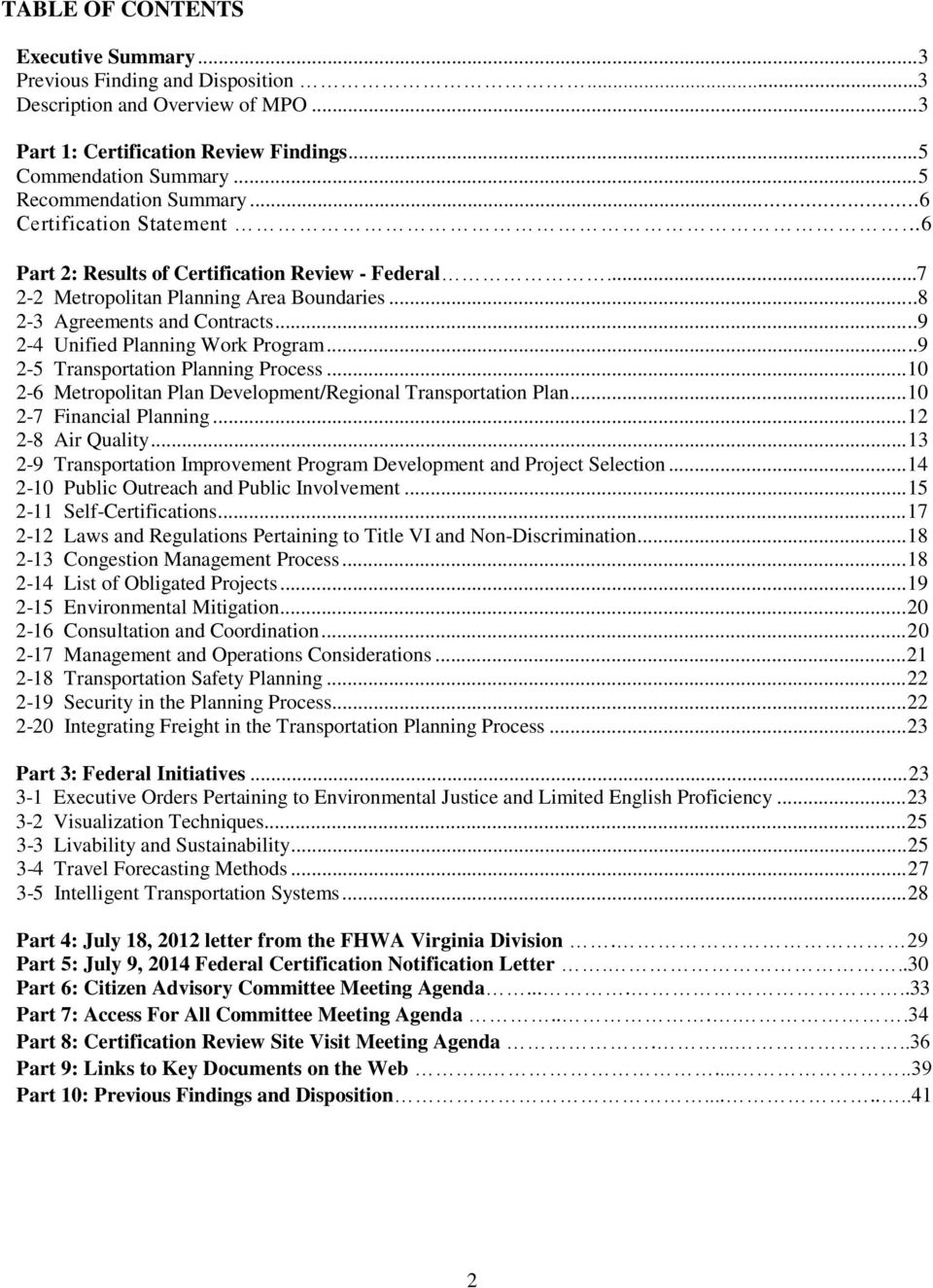
6 TABLE OF CONTENTS Executive Summary...3 Previous Finding and Disposition...3 Description and Overview of MPO...3 Part 1: Certification Review Findings...5 Commendation Summary...5 Recommendation Summary...6 Certification Statement...6 Part 2: Results of Certification Review - Federal Metropolitan Planning Area Boundaries Agreements and Contracts Unified Planning Work Program Transportation Planning Process Metropolitan Plan Development/Regional Transportation Plan Financial Planning Air Quality Transportation Improvement Program Development and Project Selection Public Outreach and Public Involvement Self-Certifications Laws and Regulations Pertaining to Title VI and Non-Discrimination Congestion Management Process List of Obligated Projects Environmental Mitigation Consultation and Coordination Management and Operations Considerations Transportation Safety Planning Security in the Planning Process Integrating Freight in the Transportation Planning Process...23 Part 3: Federal Initiatives Executive Orders Pertaining to Environmental Justice and Limited English Proficiency Visualization Techniques Livability and Sustainability Travel Forecasting Methods Intelligent Transportation Systems...28 Part 4: July 18, 2012 letter from the FHWA Virginia Division. 29 Part 5: July 9, 2014 Federal Certification Notification Letter...30 Part 6: Citizen Advisory Committee Meeting Agenda Part 7: Access For All Committee Meeting Agenda Part 8: Certification Review Site Visit Meeting Agenda Part 9: Links to Key Documents on the Web Part 10: Previous Findings and Disposition
7 EXECUTIVE SUMMARY Previous Certification Findings and Disposition The 2010 Certification Review for the Washington, DC-VA-MD Transportation Management Area (TMA) was conducted in April of The review found that the National Capital Region Transportation Planning Board s (TPB) planning process for the Transportation Management Area s (TMA) was consistent with the Federal planning requirements in 23 U.S.C. 134(i)(5) and 49 U.S.C The review included the Fredericksburg Area Metropolitan Planning Organization (FAMPO) because a small portion of the TMA extends into part of Stafford County, VA for which the FAMPO conducts the planning for as it relates to the National Capital Region TMA. The 2010 Certification Review was the first time Federal officials conducted and included a formal (though brief), review of the FAMPO planning and programming process in the TPB certification review. The final Certification Review Summary Report (June 27, 2011) included 7 commendations for TPB planning elements and 4 for FAMPO planning elements. The report had 11 recommendations for TPB planning activities and 3 for FAMPO planning activities. The report included 4 corrective actions for FAMPO. As required by the first action, FAMPO and the Virginia Commonwealth Transportation Board in June 2011 submitted a joint letter to FHWA confirming the FAMPO project selection process for RSTP and CMAQ projects. As required by the second action, FAMPO staff received Title VI training along with VDOT and TPB staff in July of As required by the third action, FAMPO has produced a Title VI plan which was adopted by the FAMPO Board in May of As required by the fourth action, FAMPO staffs have established a process for assessing the impacts of the investments in its plan and TIP on different socio-economic groups. A more detailed summary table of the implementation actions for the 11 recommendations for TPB planning activities, including the implementation actions for the 3 FAMPO recommendations and 4 FAMPO corrective actions, as well as the July 18, 2012 letter from the FHWA Virginia Division office, is located in Part 4 of this report. As a result of the 2010 certification, TPB was found conditionally meeting the requirements subject to the implementation of the corrective actions within 18 months. All recommendations and corrective actions have been implemented by TPB and FAMPO. Description and Overview of MPO The National Capital Region Transportation Planning Board (TPB) is the Federally-designated Metropolitan Planning Organization (MPO) for the metropolitan area, leading the comprehensive, cooperative, and continuing (3C) planning process in cooperation with the Fredericksburg Area Metropolitan Planning Organization (FAMPO), which is the designated MPO for a portion of the National Capital Region TMA in Virginia. Implementing agencies working in partnership with TPB and FAMPO in the planning process include the Departments of Transportation (DOTs) for the District of Columbia, the states of Maryland and Virginia, and area public transportation operators and authorities. The TPB was created in 1965 by the region's local and state governments to respond to Federal highway legislation in 1962 that required the establishment of a comprehensive, cooperative, and 3
8 continuing (3C) transportation planning process in every urbanized area in the United States. Federal Highway and transit legislation required the establishment of planning bodies, which later became known as Metropolitan Planning Organizations (MPOs), when it became clear that the construction of major transportation projects through and around urban areas needed to be coordinated with local and state jurisdictions. The TPB became associated with the Metropolitan Washington Council of Governments (COG) in COG was established in 1957 by local cities and counties to deal with regional concerns including growth, housing, environment, public health and safety - as well as transportation. Although the TPB is an independent body, its staff is provided by COG's Department of Transportation Planning. Established in 1992, the Fredericksburg Area Metropolitan Planning Organization (FAMPO) is the Federally-designated Metropolitan Planning Organization for the Fredericksburg urbanized area. Though the northern portion of Stafford County was incorporated into the National Capital Region TMA after the 2000 census, with the concurrence of the Federal Partners, FAMPO elected to expand its planning area boundaries to include the three jurisdictions of the Counties of Caroline, Stafford and Spotsylvania in their entirety. Although the FAMPO is an independent body, its staff is provided by the George Washington Regional Planning District Commission (GWRC). All of the local governments are members of the GWRC. While the GWRC serves as the lead technical staff for the MPO, some aspects of the technical transportation planning process (i.e. conformity, travel demand modeling, etc.) are performed and managed by VDOT or through contracts with consultants. Two key documents provide a framework for regional transportation policy in the Metropolitan Washington Region -- the TPB Vision and the Regional Transportation Priorities Plan. The TPB Vision was unanimously approved in October of 1998 by the Transportation Planning Board after an extensive public outreach effort that lasted three years. A host of objectives and strategies are included in the Vision to show how its eight primary goals can be reached. The Vision is not a plan with maps or lists of specific projects. It is fundamentally a framework to guide decision making. The various jurisdictions in the region are expected to pursue policies and projects that contribute to specific elements of the Vision. The goals, objectives and strategies in the Vision should be used to buttress arguments for or against new policies and projects. The Regional Transportation Priorities Plan, adopted by the TPB in January of 2014, is the other main element of the TPB s regional policy framework. It is meant to focus attention on a limited number of specific strategies with the greatest potential to advance regional goals rooted in the TPB Vision. The Priorities Plan was developed over the course of nearly three years with the help of technical analysis, stakeholder input, and public outreach. The Washington Region s population and employment are expected to grow over the coming decades. The planning area is forecasted to grow by over 1.6 million people and over 1.3 million jobs between 2010 and 2040, a 32% increase in population and nearly a 43% increase in employment. Forecasts indicate that by 2040, the region will include 6.7 million people and 4.4 million jobs. While the region as a whole is fast-growing, some areas are growing faster than others. Both the outer suburbs and inner suburbs are forecast to grow faster than the regional core. The result of this growth pattern is that the inner suburbs and regional core are expected to have the highest concentrations of jobs in 2040, while the majority of new residents are forecast to 4

9 live in denser population centers throughout the region. While the region grows to accommodate more jobs and more people and as jobs and households become increasingly further apart, greater demands will be placed on the transportation system. However, funding even for rehabilitation and maintenance will continue to remain in short supply. As a result, more cars will be squeezed onto roads and more people squeezed into buses and trains. The region is well known for proactively seeking innovative, multi-modal solutions to transportation issues and that approach will continue to serve the area well. For more information, including charts detailing growth and development trends, see: Part 1: Certification Review Findings Commendation Summary Review Area Metropolitan Plan Development/Regional Transportation Plan Section 2-6 Metropolitan Plan Development/Regional Transportation Plan Section 2-6 Metropolitan Plan Development/Regional Transportation Plan Section 2-6 Public Outreach and Public Involvement Section 2-10 Congestion Management Process Section 2-13 Commendation TPB is commended for the performance analysis of the Constrained Long-Range Transportation Plan (CLRP). Each year the plan is analyzed to see how it performs in a variety of ways relating to the region s goals. Significant effort by TPB has gone into the development of the Regional Transportation Priorities Plan (RTPP). Designed to advance regional goals for economic opportunity, environmental stewardship and quality of life, the RTPP highlights priorities that should be funded and included in the region s CLRP. TPB s Bicycle and Pedestrian Master Plan is commendable. The regional network of bike path and bike lanes, as well as new bicycle and pedestrian bridges, a pioneering bike sharing program, widespread adoption of Complete Streets policies, and significant progress incorporating bicycle and pedestrian facilities into larger transportation projects and new developments has allowed the Washington region to emerge as a national leader in bicycle and pedestrian planning. The Federal team commends FAMPO s efforts to evaluate their public participation efforts. An in-depth approach to successful evaluation of the effectiveness of the Public Participation Plan (PPP) requires continuous tracking of each outreach tool. FAMPO started evaluating the PPP to gauge its effectiveness and a thorough review is now conducted every three years. The Federal team commends the TPB for its well documented CMP. Also, TPB is commended for the data clearing house and data delivery efforts that provide the TPB partners the ability to track and evaluate congestion methods that support system capacity expansion. 5

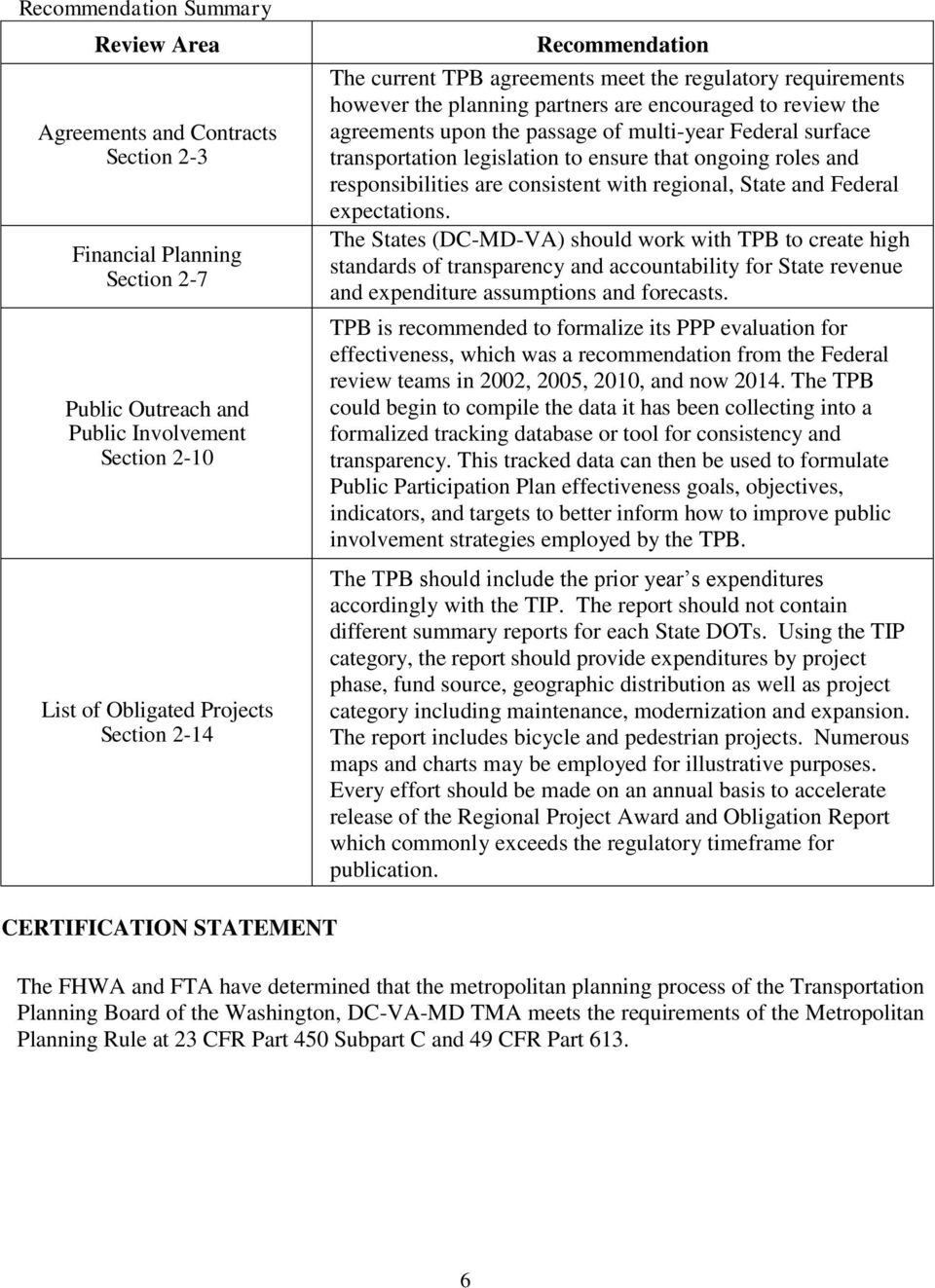
10 Recommendation Summary Review Area Agreements and Contracts Section 2-3 Financial Planning Section 2-7 Public Outreach and Public Involvement Section 2-10 List of Obligated Projects Section 2-14 Recommendation The current TPB agreements meet the regulatory requirements however the planning partners are encouraged to review the agreements upon the passage of multi-year Federal surface transportation legislation to ensure that ongoing roles and responsibilities are consistent with regional, State and Federal expectations. The States (DC-MD-VA) should work with TPB to create high standards of transparency and accountability for State revenue and expenditure assumptions and forecasts. TPB is recommended to formalize its PPP evaluation for effectiveness, which was a recommendation from the Federal review teams in 2002, 2005, 2010, and now The TPB could begin to compile the data it has been collecting into a formalized tracking database or tool for consistency and transparency. This tracked data can then be used to formulate Public Participation Plan effectiveness goals, objectives, indicators, and targets to better inform how to improve public involvement strategies employed by the TPB. The TPB should include the prior year s expenditures accordingly with the TIP. The report should not contain different summary reports for each State DOTs. Using the TIP category, the report should provide expenditures by project phase, fund source, geographic distribution as well as project category including maintenance, modernization and expansion. The report includes bicycle and pedestrian projects. Numerous maps and charts may be employed for illustrative purposes. Every effort should be made on an annual basis to accelerate release of the Regional Project Award and Obligation Report which commonly exceeds the regulatory timeframe for publication. CERTIFICATION STATEMENT The FHWA and FTA have determined that the metropolitan planning process of the Transportation Planning Board of the Washington, DC-VA-MD TMA meets the requirements of the Metropolitan Planning Rule at 23 CFR Part 450 Subpart C and 49 CFR Part
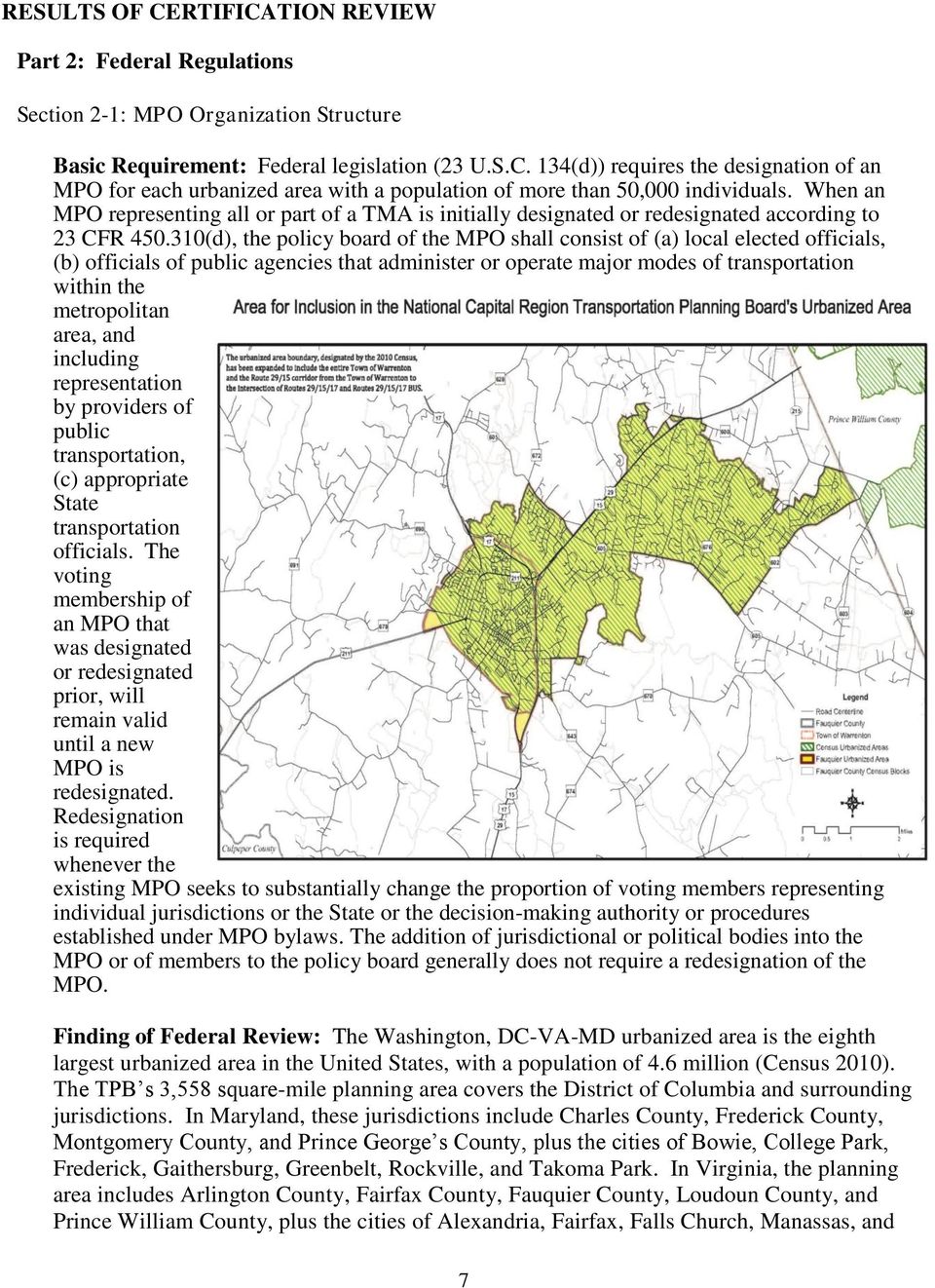
11 RESULTS OF CERTIFICATION REVIEW Part 2: Federal Regulations Section 2-1: MPO Organization Structure Basic Requirement: Federal legislation (23 U.S.C. 134(d)) requires the designation of an MPO for each urbanized area with a population of more than 50,000 individuals. When an MPO representing all or part of a TMA is initially designated or redesignated according to 23 CFR (d), the policy board of the MPO shall consist of (a) local elected officials, (b) officials of public agencies that administer or operate major modes of transportation within the metropolitan area, and including representation by providers of public transportation, (c) appropriate State transportation officials. The voting membership of an MPO that was designated or redesignated prior, will remain valid until a new MPO is redesignated. Redesignation is required whenever the existing MPO seeks to substantially change the proportion of voting members representing individual jurisdictions or the State or the decision-making authority or procedures established under MPO bylaws. The addition of jurisdictional or political bodies into the MPO or of members to the policy board generally does not require a redesignation of the MPO. Finding of Federal Review: The Washington, DC-VA-MD urbanized area is the eighth largest urbanized area in the United States, with a population of 4.6 million (Census 2010). The TPB s 3,558 square-mile planning area covers the District of Columbia and surrounding jurisdictions. In Maryland, these jurisdictions include Charles County, Frederick County, Montgomery County, and Prince George s County, plus the cities of Bowie, College Park, Frederick, Gaithersburg, Greenbelt, Rockville, and Takoma Park. In Virginia, the planning area includes Arlington County, Fairfax County, Fauquier County, Loudoun County, and Prince William County, plus the cities of Alexandria, Fairfax, Falls Church, Manassas, and 7
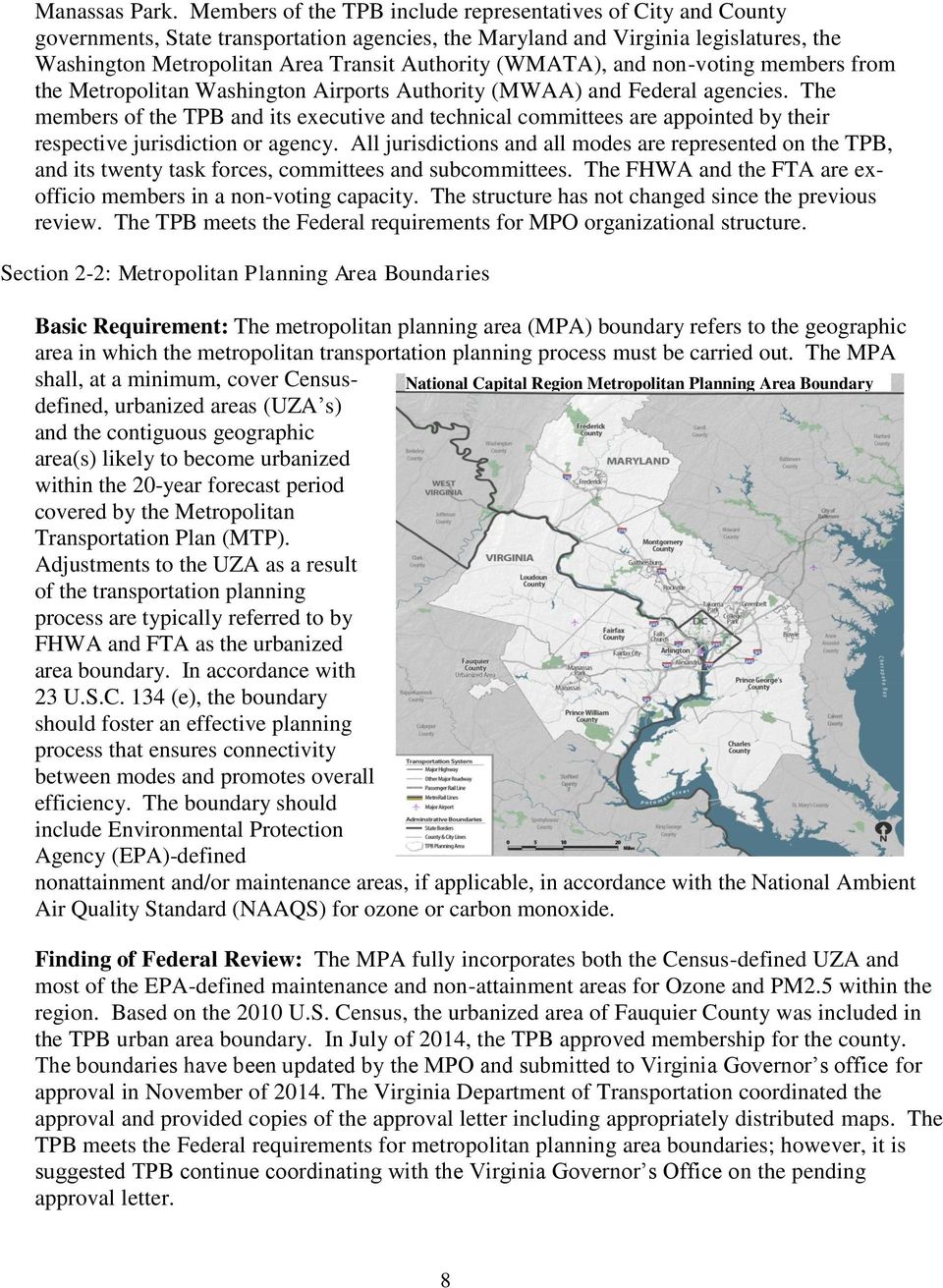
12 Manassas Park. Members of the TPB include representatives of City and County governments, State transportation agencies, the Maryland and Virginia legislatures, the Washington Metropolitan Area Transit Authority (WMATA), and non-voting members from the Metropolitan Washington Airports Authority (MWAA) and Federal agencies. The members of the TPB and its executive and technical committees are appointed by their respective jurisdiction or agency. All jurisdictions and all modes are represented on the TPB, and its twenty task forces, committees and subcommittees. The FHWA and the FTA are exofficio members in a non-voting capacity. The structure has not changed since the previous review. The TPB meets the Federal requirements for MPO organizational structure. Section 2-2: Metropolitan Planning Area Boundaries Basic Requirement: The metropolitan planning area (MPA) boundary refers to the geographic area in which the metropolitan transportation planning process must be carried out. The MPA shall, at a minimum, cover Censusdefined, urbanized areas (UZA s) and the contiguous geographic area(s) likely to become urbanized within the 20-year forecast period covered by the Metropolitan Transportation Plan (MTP). Adjustments to the UZA as a result of the transportation planning process are typically referred to by FHWA and FTA as the urbanized area boundary. In accordance with 23 U.S.C. 134 (e), the boundary should foster an effective planning process that ensures connectivity between modes and promotes overall efficiency. The boundary should include Environmental Protection Agency (EPA)-defined National Capital Region Metropolitan Planning Area Boundary nonattainment and/or maintenance areas, if applicable, in accordance with the National Ambient Air Quality Standard (NAAQS) for ozone or carbon monoxide. Finding of Federal Review: The MPA fully incorporates both the Census-defined UZA and most of the EPA-defined maintenance and non-attainment areas for Ozone and PM2.5 within the region. Based on the 2010 U.S. Census, the urbanized area of Fauquier County was included in the TPB urban area boundary. In July of 2014, the TPB approved membership for the county. The boundaries have been updated by the MPO and submitted to Virginia Governor s office for approval in November of The Virginia Department of Transportation coordinated the approval and provided copies of the approval letter including appropriately distributed maps. The TPB meets the Federal requirements for metropolitan planning area boundaries; however, it is suggested TPB continue coordinating with the Virginia Governor s Office on the pending approval letter. 8
13 Section 2-3: Agreements and Contracts Basic Requirement: In accordance with 23 U.S.C. 134 and 23 CFR , MPOs are required to establish relationships with the State and public transportation agencies under the cover of specified agreements between the parties to carry out a continuing, cooperative and comprehensive (3 C s) metropolitan planning process. The agreements must identify the mutual roles and responsibilities and procedures governing their cooperative efforts. These agreements must identify the designated agency for air quality planning under the Clean Air Act and address the responsibilities and situations arising from there being more than one MPO in a metropolitan area. Finding of Federal Review: The TPB has established relationships through agreements with the State DOTs (Maryland and Virginia), the District of Columbia DOT, and the regional transit operators: the Virginia Department of Rail and Public Transportation (DRPT), Northern Virginia Transportation Commission (NVTC), and WMATA: Memorandum of Understanding (MOU) establishing metropolitan transportation planning responsibilities for the National Capital Region, January 16, Agreement for the Support of Metropolitan Planning Organization Transportation Planning Process in the Washington Metropolitan Area, October 30, 2003; first Amendment September 17, Procedures for Revisions to the Constrained Long Range Plan (CLRP) and Transportation Improvement Program (TIP) for the National Capital Region, approved on January 16, Revised 2004 agreement between the TPB and Fredericksburg Area MPO (FAMPO) in Virginia. Schedule for Process Improvement / Recommendation: The current TPB agreements meet the regulatory requirements, however the planning partners are encouraged to review the agreements upon the passage of multi-year Federal surface transportation legislation to ensure that ongoing roles and responsibilities are consistent with regional, State and Federal expectations. Section 2-4: Unified Planning Work Program (UPWP) Basic Requirement: The MPOs are required to develop Unified Planning Work Programs (UPWPs) in TMAs to govern work programs for the expenditure of FHWA and FTA planning and research funds (23 CFR ). The UPWP must be developed in cooperation with the State and public transportation agencies and include the required elements. Finding of Federal Review: The TPB cooperatively develops an annual UPWP that describes all transportation planning activities utilizing Federal funding, including Title I Section 112 metropolitan planning funds, Title III Section 5303 metropolitan planning funds, and Federal Aviation Administration Continuing Airport System Planning (CASP) funds. It identifies state and local matching dollars for these Federal planning programs, as well as other closely related planning projects utilizing state and local funds. Signed into law on July 6, 2012, the 9
14 Moving Ahead for Progress in the 21st Century Act (MAP-21) established two new programs administered by the state DOTs to fund a variety of projects. The TPB now has an important supporting role in the planning and selection of the projects funded under the new FHWA Transportation Alternatives Program and the new FTA Section 5310 Enhanced Mobility Program. In addition to the changing Federal context, other factors that influence activities in this work plan are regional in scope, and the UPWP is adjusted annually to focus on new and emerging priorities. Each UPWP builds upon the previous UPWP, and is the result of close cooperation among the transportation agencies in the region. The UPWP is prepared with the involvement of these agencies, acting through the TPB, the TPB Technical Committee and its subcommittees. The UPWP details the planning activities that must be accomplished to address the annual planning requirements such as preparing the Transportation Improvement Program (TIP) and a Congestion Management Process (CMP). The current UPWP continues efforts to develop regional performance measures in coordination with the three state DOTs, WMATA and the local government public transportation operators and utilize those measures to address the MAP-21 planning regulations and performance management requirements for MPOs. The TPB meets the Federal requirements for development of the Unified Planning Work Program. Section 2-5: Transportation Planning Process Basic Requirement: The scope of the transportation planning process according to 23 CFR and defines the relationship of corridor and other subarea planning studies to the metropolitan planning process and National Environmental Policy Act requirements. The transportation planning process must also ensure participation by Federal lands management agencies and tribal governments in the development of products and programs in the planning process as per 23 CFR (c) (d) and (e). Finding of Federal Review: The planning factors identified in Federal legislation are identified throughout the planning process and products of the TPB. While the MAP-21 planning factors are not often referenced explicitly, the TPB has articulated these priorities throughout the planning process. The TPB continues to work to strengthen linkages between work elements of the UPWP to the planning factors. The TPB addresses the planning factors through the regional Vision, which incorporates the planning factors specified in the Safe, Accountable, Flexible, and Efficient Transportation Equity Act-A Legacy for Users (SAFETEA-LU), and remained unchanged under MAP-21. The Constrained Long-Range Plan (CLRP) project submission form requires the submitting agency to identify the planning factors supported by the project. The TPB continues to strengthen linkages between work elements of the UPWP to the planning factors. Section 2-6: Metropolitan Plan Development/Regional Transportation Plan Basic Requirement: In accordance with 23 CFR (a) The metropolitan transportation planning process shall include the development of a transportation plan addressing no less than a 20-year planning horizon the transportation plan shall include both long-range and short-range strategies/actions that lead to the development of a multimodal transportation system to facilitate the safe and efficient movement of people and goods in addressing current and future transportation demand. Finding of Federal Review: Each state has a long-range planning process that brings 10
15 together project recommendations from local governments, the state DOTs, WMATA, and other sources. The priorities established in these plans are the primary source of projects submitted for the region s long-range transportation plan, known as the CLRP. The TPB conducts a major update of the CLRP every four years, including an extensive review of future revenues and costs. The CLRP has a horizon of at least 20 years. The state DOTs each have methods for identifying short and long range projects needed to maintain the integrity of the transportation system, enhance safety, improve mobility or accessibility, and to meet current and future transportation demand. At the regional level, the TPB helps identify problems and needs by monitoring current travel conditions and forecasting future travel demand. TPB issues its Call for Projects which includes the region s goals and priorities. The state DOTs and WMATA, as the implementing agencies, then review their long-range plans and priority projects and compare those against future financial forecasts to determine which projects they will advance into the CLRP. An analysis of the latest proposed update of the region's CLRP details how well the future transportation system laid out in the plan is expected to meet the needs of area travelers in A Performance Analysis of the draft CLRP predicts some 4 million more trips each day in the region by a 24% increase over today. A majority of those new trips -- about 2.8 million -- are forecast to be made either by single drivers or by carpools, adding demand on roadways that are already heavily traveled and congested. About 372,000 new trips are expected to be made on the region's rail and bus transit systems, in some cases further straining crowded rail lines and stations, especially in the regional core. This performance analysis provides information to decision-makers and the public about how well the transportation investments that are currently planned and funded will meet the region's future transportation needs. The CLRP also includes a major update to the bicycle and pedestrian master plan. The plan identifies major bicycle and pedestrian projects the region wishes to carry out by 2040, and incorporates goals and performance indicators for walking and bicycling from the TPB Vision and the COG Region Forward 2050 plans. It identifies recommended practices likely to be effective in achieving those goals, and discusses trends in policy, mode share, and safety. The plan contains 659 funded and unfunded regional projects that would add more than 1600 new miles of bike paths, bicycle lanes, and other facilities to the region's transportation system. The total cost would be approximately $3 billion. The plan also shows the progress the region has made in the last four years. A total of 53 projects from the 2010 plan have been completed, adding 97 miles to the regional network of bike path and bike lanes, new bicycle and pedestrian bridges, a pioneering bike sharing program, widespread adoption of Complete Streets policies, and significant progress has been made incorporating bicycle and pedestrian facilities into larger transportation projects and new developments. Hence, the Washington region has emerged as a national leader in bicycle and pedestrian planning. In addition, the TPB s Regional Transportation Priorities Plan (RTPP) identifies strategies with the greatest potential to respond to the region s transportation challenges. Among other things, it calls for more efficient transportation connections between and within the region's Activity Centers, in order to allow more people to live and work within these centers and make fewer and shorter trips by automobile. In particular, the plan calls for concentrating 11

16 more future residential and job growth in Activity Centers and improving local circulation within the centers, by expanding bicycle and pedestrian infrastructure, providing more local bus services, and promoting better street connectivity. The TPB meets the Federal requirements for development of the long range metropolitan transportation plan. Commendation 1: TPB is commended for the performance analysis of the Constrained Long-Range Transportation Plan (CLRP). Each year the plan is analyzed to see how it performs in a variety of ways relating to the region s goals. Commendation 2: Significant effort has gone into the development of the TPB s Regional Transportation Priorities Plan (RTPP). Designed to advance regional goals for economic opportunity, environmental stewardship and quality of life, the RTPP highlights priorities that should be funded and included in the region s Constrained Long-Range Transportation Plan (CLRP). Commendation 3: TPB s Bicycle and Pedestrian Master Plan is commendable. The regional network of bike path and bike lanes, new bicycle and pedestrian bridges, a pioneering bike sharing program, widespread adoption of Complete Streets policies, and significant progress on incorporating bicycle and pedestrian facilities into larger transportation projects and new developments has allowed the Washington region to emerge as a national leader in bicycle and pedestrian planning. Section 2-7: Financial Planning Basic Requirement: The metropolitan planning statutes state that the long-range transportation plan and TIP (23 U.S.C. 134 (j) (2) (B)) must include a "financial plan" that "indicates resources from public and private sources that are reasonably expected to be available to carry out the program. Additionally, the Statewide Transportation Improvement Program (STIP) may include a similar financial plan (23 U.S.C. 135 (g)(5)(f)). The purpose of the financial plan is to demonstrate fiscal constraint. These requirements are implemented in transportation planning regulations for the metropolitan long-range transportation plan, TIP, and STIP. These regulations provide, in essence, that a long-range transportation plan and TIP can include only projects for which funding "can reasonably be expected to be available" [23 CFR (f)(10)(metropolitan long-range transportation plan), 23 CFR (h) (TIP), and 23 CFR (m)(STIP)]. In addition, the regulations provide that projects in air quality nonattainment and maintenance areas can be included in the first two years of the TIP and STIP only if funds are "available or committed" [23 CFR (h) and 23 CFR (m)]. Finally, the Clean Air Act's transportation conformity regulations specify that a conformity determination can only be made on a fiscally constrained long-range transportation plan and TIP [40 CFR ]. Finding of Federal Review: For the MPO s CLRP preparation, the overall revenue forecasts for the Virginia DOT, Maryland DOT, the District of Columbia DOT, WMATA, and the local jurisdictions are prepared under their own procedural requirements. The region 12

17 has expended significant effort in documenting fiscal constraint with the Plan and the TIP, and only projects for which funding can reasonably be expected to be available are included. New projects, in addition to previously proposed projects, are then reviewed to make sure they meet the financial constraint requirement as well as the region s air quality attainment goals. However, it is expected that TPB s regional process determine that there is a basis in current practice for funds to be expected and the funds expected must be consistent with past rates of historical growth. FHWA and FTA suggest additional improvements and refinements to the financial planning and fiscal constraint processes. TPB should continue to work closely with partners to develop and document revenue and expenditure assumptions and forecasts. In addition to the significant technical work associated with these efforts, it is anticipated that the financial plan will demand policy decisions to document the thresholds for safe and adequate maintenance of the system and to document proposed reasonably available revenue. These policy determinations are crucial as transportation needs continue to outpace available resources. These trade-offs are particularly important to consider as members also seek to advance systems to a state of good repair, incorporate system enhancements, and implement major capital projects. Schedule for Process Improvement / Recommendation: The States (DC-MD-VA) should work with TPB to create high standards of transparency and accountability for State revenue and expenditure assumptions and forecasts. Section 2-8: Air Quality Basic Requirement: For MPOs that the U.S. EPA classifies as air quality nonattainment or maintenance areas, many special requirements apply to the metropolitan planning process. Section 176 (c)(1) of the Clean Air Act Amendments of 1990 (CAAA) states: No metropolitan planning organization designated under section 134 of title 23, United States Code, shall give its approval to any project, program, or plan which does not conform to an implementation plan approved or promulgated under section 110. The Intermodal Surface Transportation Efficiency Act of 1991 includes provisions in response to the CAAA mandates. Finding of Federal Review: The National Capital Region s air quality conformity assessment is conducted for three non-attainment areas, each reflecting the appropriate EPA-designated geographical boundaries for: 8-Hour Ozone, Fine Particles and Carbon Monoxide respectively. The Fine Particles non-attainment area is identical to the MPO planning area. The 8-Hour Ozone non-attainment area includes the TPB planning area plus Calvert County (MD). The Carbon Monoxide (CO) non-attainment area consists of the District of Columbia, Arlington County (VA), City of Alexandria (VA), Montgomery County (MD) and Prince George s County (MD). MPO planning activities extend beyond the non-attainment area/planning area in the TPB modeled area. The Metropolitan Washington Air Quality Committee (MWAQC) has been the designated entity by the District of Columbia, Maryland and Virginia for preparation of the Washington region s state implementation plans (SIPs) for attainment of ozone and fine particulate matter (PM 2.5) standards and for maintenance of carbon monoxide standards. The MWAQC, which is administered by the Metropolitan Washington Council of Governments (MWCOG), has the same representation as the MWCOG Board plus the jurisdictions within the 13

18 nonattainment area that go beyond the planning area, such as air management and transportation directors from DC, Maryland and Virginia, members of the Maryland and Virginia General Assemblies, and the Chair of the TPB. The TPB s and MWAQC s roles and responsibilities with respect to air quality conformity and SIP development are described in the May 1998 document TPB Consultation Procedures. See the following link for more details: In summary, the TPB has the lead role in air quality conformity determinations and MWAQC has the lead role in SIP development. In addition to the Air Quality Conformity report, the TPB also annually produces a Performance Analysis of the Constrained Long Range Plan (CLRP), which contains several performance measures including mobile emissions projections for GHG. Since 2014, this analysis has been performed in parallel with the air quality conformity analysis in order to provide a broad range of performance measures of the CLRP and TIP prior to adoption by the TPB. This information is released for public comment, it is posted online and it is published in a brochure. Documentation of the plan and its performance is geared toward the general public, in order to most easily explain what it means for the region. The TPB meets the Federal requirements for air quality conformity. Section 2-9: Transportation Improvement Program (TIP) Development & Project Selection Basic Requirement: 23 CFR requires the MPO to develop a TIP in cooperation with the State and public transit operators. Specific requirements and conditions, as specified in the regulations, include, but are not limited to: An updated TIP covering a period of at least four years that is compatible with the STIP development and approval process; [23 CFR (a)] The TIP should identify all eligible Transportation Control Measure s (TCM) included in the SIP and give priority to eligible TCM s and projects included for the first two years which have funds available and committed; [23 CFR (i)] The TIP should include capital and non-capital surface transportation projects, bicycle and pedestrian facilities and other transportation enhancements; Federal Lands Highway projects and safety projects included in the State s Strategic Highway Safety 14

19 Plan. The TIP and STIP must include all regionally significant projects for which an FHWA or the FTA approval is required whether or not the projects are to be funded with Title 23 or Title 49 funds. In addition, all Federal and non-federally funded, regionally significant projects must be included in the TIP and STIP and consistent with the MTP for information purposes and air quality analysis in nonattainment and maintenance areas; [23 CFR (c),(d)] Procedures or agreements that distribute suballocated Surface Transportation Program funds or funds under 49 USC 5307 to individual jurisdictions or modes within the TMA by pre-determined percentages or formulas are inconsistent with the legislative provisions that require the MPO, in cooperation with the State and the public transportation operator, to develop a prioritized and financially constrained TIP and shall not be used unless they can clearly be shown to be based on considerations required to be addressed as part of the metropolitan transportation planning process [23 CFR (j)] Finding of Federal Review: The TPB issues a draft and final Call for Projects document that presents regional goals and priorities based upon the TPB Vision and the Federal Planning Factors for inclusion in the TIP. Because all of the Federal funds in this region go directly to the state DOTs and WMATA, the prioritization and selection of projects to be included in the 6-year TIP is largely done at the state and local levels. Each of the three DOTs in the region has its own state-mandated processes for funding capital projects. The DOTs compile lists of projects, including all eligible Transportation Control Measures (TCM) based on locally-identified priorities and a preliminary analysis of available funds. The TIP includes all regionally significant capital and non-capital surface transportation projects, bicycle and pedestrian facilities and other transportation enhancements, Federal Lands Highway projects and safety projects included in each of the states Strategic Highway Safety Plan. Projects submitted to the TPB for inclusion in the TIP are consistent with the CLRP, and are reviewed for fiscal constraint and included in the air quality conformity assessment, where necessary. The TPB meets the requirements for development of the transportation improvement program. Section 2-10: Public Outreach and Public Involvement Basic Requirement: The MPO is required, under 23 CFR , to engage in a metropolitan planning process that creates opportunities for public involvement, participation and consultation throughout the development of the MTP and the TIP and is also included in 23 CFR (f) (7) and (g) (1) (2), (i) and 23 CFR (b). Finding of Federal Review: The Public Participation Plan (PPP) articulates the TPB s commitment to provide transparent communications and engagement with the public and public agencies to support the regional transportation planning process, including the development of the CLRP and the TIP. The PPP provides an overall framework for participation in the TPB process. The background describes the historic context for the TPB's ongoing participation and outreach activities. The Participation Policy sets the TPB's goals for participation and outreach, and identifies activities for involvement. The Participation Strategy identifies different audience groups for participation and details approaches for reaching each 15
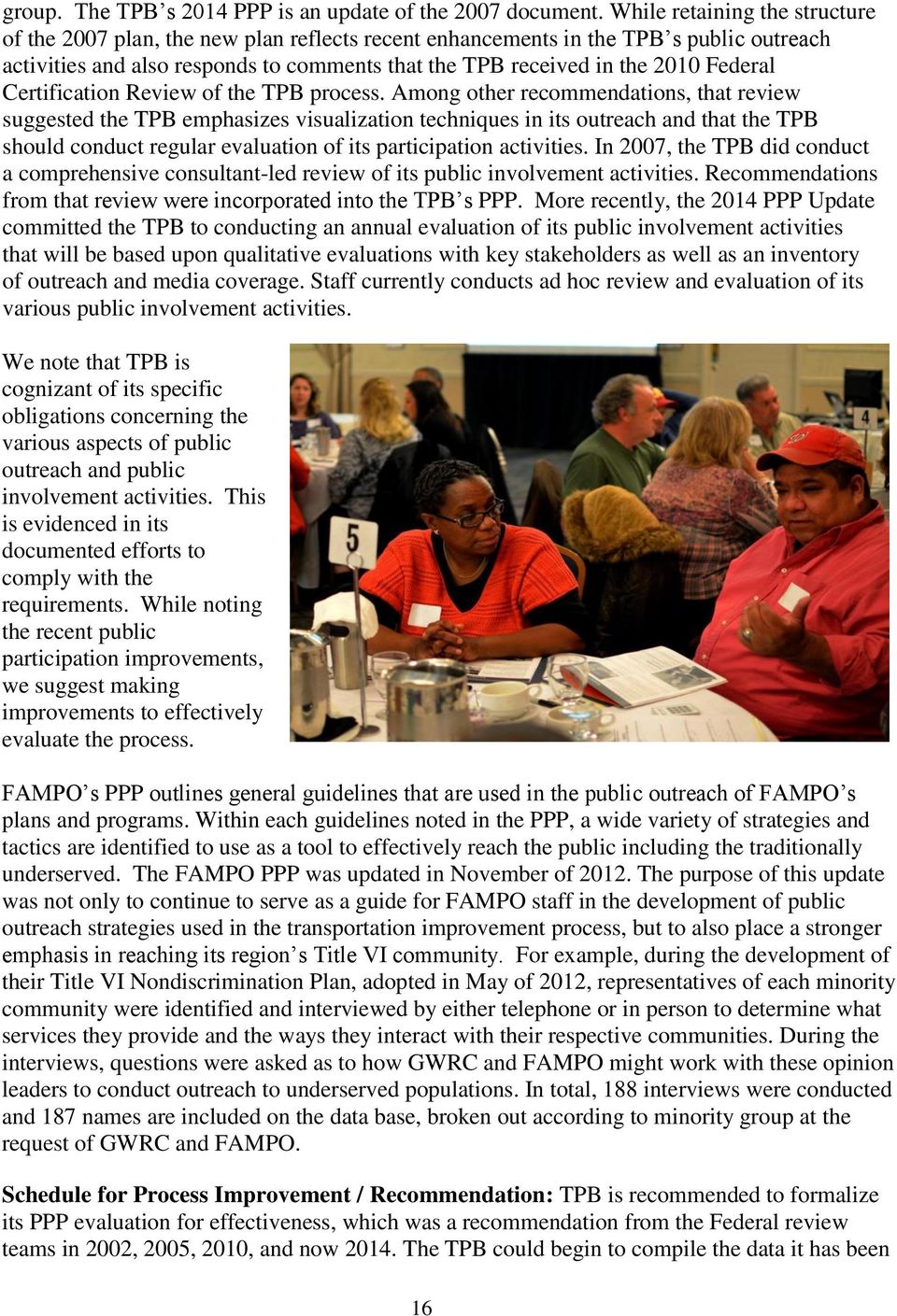
20 group. The TPB s 2014 PPP is an update of the 2007 document. While retaining the structure of the 2007 plan, the new plan reflects recent enhancements in the TPB s public outreach activities and also responds to comments that the TPB received in the 2010 Federal Certification Review of the TPB process. Among other recommendations, that review suggested the TPB emphasizes visualization techniques in its outreach and that the TPB should conduct regular evaluation of its participation activities. In 2007, the TPB did conduct a comprehensive consultant-led review of its public involvement activities. Recommendations from that review were incorporated into the TPB s PPP. More recently, the 2014 PPP Update committed the TPB to conducting an annual evaluation of its public involvement activities that will be based upon qualitative evaluations with key stakeholders as well as an inventory of outreach and media coverage. Staff currently conducts ad hoc review and evaluation of its various public involvement activities. We note that TPB is cognizant of its specific obligations concerning the various aspects of public outreach and public involvement activities. This is evidenced in its documented efforts to comply with the requirements. While noting the recent public participation improvements, we suggest making improvements to effectively evaluate the process. FAMPO s PPP outlines general guidelines that are used in the public outreach of FAMPO s plans and programs. Within each guidelines noted in the PPP, a wide variety of strategies and tactics are identified to use as a tool to effectively reach the public including the traditionally underserved. The FAMPO PPP was updated in November of The purpose of this update was not only to continue to serve as a guide for FAMPO staff in the development of public outreach strategies used in the transportation improvement process, but to also place a stronger emphasis in reaching its region s Title VI community. For example, during the development of their Title VI Nondiscrimination Plan, adopted in May of 2012, representatives of each minority community were identified and interviewed by either telephone or in person to determine what services they provide and the ways they interact with their respective communities. During the interviews, questions were asked as to how GWRC and FAMPO might work with these opinion leaders to conduct outreach to underserved populations. In total, 188 interviews were conducted and 187 names are included on the data base, broken out according to minority group at the request of GWRC and FAMPO. Schedule for Process Improvement / Recommendation: TPB is recommended to formalize its PPP evaluation for effectiveness, which was a recommendation from the Federal review teams in 2002, 2005, 2010, and now The TPB could begin to compile the data it has been 16
21 collecting into a formalized tracking database or tool for consistency and transparency. This tracked data can then be used to formulate Public Participation Plan effectiveness goals, objectives, indicators, and targets to better inform how to improve public involvement strategies employed by the TPB. Commendation: The Federal team commends FAMPO s efforts to evaluate their public participation efforts. An in-depth approach to successful evaluation of the effectiveness of the Public Participation Plan (PPP) requires continuous tracking of each outreach tool. FAMPO started evaluating their PPP to gauge the effectiveness and a thorough review is now conducted every three years. Section 2-11: Self-Certifications Basic Requirement: Self-certification of the metropolitan planning process, at least once every four years, is required under 23 CFR The State and the MPO shall certify to FHWA and FTA that the planning process is addressing the major issues facing the area and is conducted in accordance with all applicable requirements of 23 CFR and: 23 U.S.C. 134 and 49 U.S.C and Sections 174 and 176(c) and (d) of the Clean Air Act (if applicable) Title VI of the Civil Rights Act of 1964 and the Title VI assurance executed by each State 49 U.S.C. 5332, prohibiting discrimination on the basis of race, color, creed, national origin, sex, or age in employment or business opportunity Section 1101(b) of SAFETEA-LU and 49 CFR Part 26, regarding involvement of DBE in U.S. DOT-funded planning projects 23 CFR Part 230, regarding the implementation of an equal employment opportunity program on Federal and Federal-aid highway construction contracts ADA and U.S. DOT regulations governing transportation for people with disabilities [49 CFR Parts 27, 37, and 38] Older Americans Act as amended, prohibiting discrimination on the basis of age Section 324 of Title 23 U.S.C., regarding the prohibition of discrimination based on gender Section 504 of the Rehabilitation Act of 1973 and 49 CFR Part 27, regarding discrimination against individuals with disabilities All other applicable provisions of Federal law (e.g., while no longer specifically noted in a self-certification, prohibition of use of Federal funds for lobbying still applies and should be covered in all grant agreement documents (see 23 CFR ). A Certification Review by FTA and FHWA of the planning process in TMAs is required at least once every four years, in addition to the required self-certification by the MPO and State. Finding of Federal Review: The self-certification comprehensive documentation is collaboratively prepared by TPB and the DOTs staff, and addresses all MPO Federal planning regulations. The self-certification is provided to the DOTs for their review and signature. The documentation is then presented to the TPB, reviewed by the Board members, 17
22 adopted by resolution, and signed by the TPB chair as part of the CLRP annual update process. The self-certification document incorporates information on how the TPB has addressed recommendations from the most recent Federal Certification. The self-certification is published in the TIP, as required. From the 2010 review, TPB responded by adding an additional step to be taken by DDOT, MDOT and VDOT, which requires a metropolitan planning process review check list to document their procedures for certifying the TPB planning self-certification. The TPB meets the Federal requirements for self-certification of the metropolitan transportation planning process. Section 2-12: Laws and Regulations Pertaining to Title VI and Non-Discrimination General Basic Requirement: It has been the long-standing policy of U.S. DOT to actively ensure nondiscrimination under Title VI of the Civil Rights Act of Title VI states that no person in the United States shall, on the ground of race, color, or national origin, be excluded from participation in, be denied the benefits of, or be subjected to discrimination under any program or activity receiving Federal financial assistance Title VI bars intentional discrimination (i.e., disparate treatment) as well as disparate-impact discrimination stemming from neutral policy or practice that has the effect of a disparate impact on protected groups based on race, color, or national origin. The planning regulations [23 CFR (a)(3)] require the MPO to self-certify that the planning process... is being carried out in accordance with all applicable requirements of... Title VI of the Civil Rights Act of 1964, as amended (42 U.S.C. 2000d-1) and 49 CFR part 21. Finding of Federal Review: Following the 2010 Certification, TPB has continued to enhance the Title VI and non-discrimination policies. In November of 2012, MWCOG revised its Title VI Program which reiterates the policies and practices outlined in the Title VI Plan, and submitted the program to FTA Region 3. On November 9, 2012, in a letter from FTA Region 3, the FTA concurred with MWCOG s Title VI Program and stated that the program meets the requirements set out in the FTA s Title VI Circular, A. The TPB meets the requirements pertaining to Title VI and Non-Discrimination. Section 2-13: Congestion Management Process Basic Requirement: The State(s) and the MPO must develop a systematic approach for managing congestion through a process that provides for safe and effective integrated management and operation of the multimodal transportation system. The Congestion Management Process (CMP) applies to TMAs based on a cooperatively developed and implemented metropolitan-wide strategy of new and existing transportation facilities eligible for funding under 23 U.S.C. and title 49 U.S.C. Chapter 53 through the use of travel demand reduction and operational management strategies. (23 CFR (a)) Finding of Federal Review: The TPB addresses the requirements in a number of ways, including ongoing programs, corridor studies, and CMP analyses. TPB places significant importance on congestion management process strategies and investments. The TPB has incorporated four major components of the CMP into their CLRP including: Monitor and evaluate transportation system performance; Define and analyze strategies; Implement strategies and assess; and Compile project-specific congestion management information. 18
23 These components of the TPB CMP have led to the development of congestion-related mitigation programs and projects contained in the CLRP and TIP. The TPB CMP is also very well documented. The TPB has also implemented several strategies as a result of the CMP, including the promotion of local jurisdictions travel-demand management services, the encouragement of public transportation improvements and continued improvement with the TPB s Commuter Connections Program. Also, TPB s data clearing house and regional system data delivery program is available for use by partners to aid in developing coordinated regional bus service, traffic operations improvements, ridesharing, telecommuting incentives, and pricing strategies. In addition, a separate stand-alone report provides additional technical support information for TPB s stakeholders. The TPB is encouraged to work closely with the regional partners to continue the good work of the CMP and highlight the ways to continue to educate on the transportation challenges facing the region. The TPB is compliant with the requirements for a Congestion Management Process. Commendation: The Federal team commends the TPB for its well documented CMP, and for the data clearing house and data delivery efforts that provide the partners the ability to track and evaluate congestion methods that support system capacity expansion and other operational improvements. Section 2-14: List of Obligated Projects Basic Requirement: The MPO, transportation operators and the State must cooperatively develop a listing of projects for which Federal funds have been obligated in the previous year in accordance with 23 CFR The listing must include all Federally funded projects authorized or revised to increase obligations in the preceding program year and at a minimum, the following for each project: The amount of funds requested in the TIP Federal funding obligated during the preceding year Federal funding remaining and available for subsequent years Sufficient description to identify the project or phase Identification of the agencies responsible for carrying out the project or phase Finding of Federal Review: The TPB annually produces a Federal Funding Obligation Report based on the preceding Federal fiscal year. The report contains separate summaries for all 3 State DOTs and the expenditures by project phase are inconsistent, the funding source is not identified and understood across all projects in the region. There are no project categories for example including maintenance, modernization and/or expansion. TPB compiles a list of projects from the Annual Element that received Federal Funding. The listings of projects and financial data are provided by the transportation implementing agencies in the region, including the DDOT, MDOT, VDOT, and the WMATA. However, the prior years expenditures are not included, the information is provided in summary format per DOT, and the release of the report is often delinquent beyond when it is required. 19
24 Schedule for Process Improvement / Recommendation: The TPB should include the prior year s expenditures accordingly with the TIP. The report should not contain different summary reports for each State DOTs. Using the TIP category, the report should provide expenditures by project phase, fund source, geographic distribution as well as project category including maintenance, modernization and expansion. The report includes bicycle and pedestrian projects. Numerous maps and charts may be employed for illustrative purposes. Every effort should be made on an annual basis to accelerate release of the Regional Project Award and Obligation Report which commonly exceeds the regulatory timeframe for publication. Section 2-15: Environmental Mitigation Basic Requirement: The specific requirements for environmental mitigation are set forth in connection with the MTP in 23 CFR (f) (7). However, the basis for addressing environmental mitigation is detailed in sections addressing consultation: 23 CFR (a) (1) (2) (3) and (b) Interested parties, participation, consultation; 23 CFR (g) (1) (2), (i), and (j) Development and content of the metropolitan transportation plan. Finding of Federal Review: Environmental mitigation is the process of addressing damage to the environment caused by transportation or other public works projects. Actions taken to avoid or minimize environmental damage are considered the most preferable method of mitigation. Potential environmental mitigation activities may include: avoiding impacts altogether; minimizing a proposed activity/project size or its involvement; rectifying impacts (restoring temporary impacts); employing special features or operational management measures to reduce impacts; and compensating for environmental impacts by providing suitable, replacement or substitute environmental resources of equivalent or greater value, on or off-site. TPB s consultation efforts on the CLRP explored several regional strategies including large transportation projects that have regional significance as well as potential regional environmental impacts. However, project planning and funding for environmental mitigation comes from the state and local levels. Since implementation of environmental mitigation is done project-by-project by state and local transportation agencies, the involvement of the TPB in this field can be the most useful if it creates a foundation where the sum of the region s environmental mitigation efforts add up to the most effective and beneficial environmental outcome for the region as a whole. An example of an element of this foundation is the identification of best locations to concentrate mitigation projects. This effort involves cooperation and further direct consultation with environmental and transportation agencies at the local level. The TPB meets the requirements for environmental mitigation. Section 2-16: Consultation & Coordination Basic Requirement: The requirements for consultation in developing the MTP and TIP are set forth primarily in 23 CFR (b-e) Consultation also is addressed specifically in connection with the MTP in 23 CFR (g)(1)(2) and (f)(7) related to environmental mitigation (see also Transportation Planning Process topic area). The MPO should engage in a consultation that includes (1) comparison of the MTP with State conservation plans or maps, if available, or (2) comparison of the MTP with inventories of natural or historic resources, if 20
25 available. Finding of Federal Review: The TPB s transportation planning process encompasses multi-modal planning that is occurring at the local level. Local governments that impact transportation planning are part of the TPB process and these agencies belong to the TPB and COG committees, which engage in a number of activities that contribute to the regional planning process. The Plan and the TIP are developed with appropriate consultation and coordination with the variety of groups identified in Federal regulations including the three States, local, and non-government agencies associated with economic development, environmental protection, conservation, historic preservation, airport operations, and freight movements. The TPB is compliant for consultation and coordination. Section 2-17: Management and Operations Considerations Basic Requirement: Federal statute 23 U.S.C. 134 (h)(1)(g), requires the metropolitan planning process to include the consideration of projects and strategies that will promote efficient system management and operation; Federal statute 23 U.S.C. 134(i)(2)(D), which provides the basis for 23 CFR (f)(3), specifies that: Operational and management strategies to improve the performance of existing transportation facilities to relieve vehicular congestion and maximize the safety and mobility of people and goods; Additionally, 23 CFR (f)(10)(i) further requires that the financial plan for the MTP and per the 23 CFR (h), the financial plan for the TIP must include: For purposes of transportation system operations and maintenance, the financial plan shall contain system-level estimates of costs and revenue sources that are reasonably expected to be available to adequately operate and maintain Federal-aid highways and public transportation. Finding of Federal Review: The TPB expends significant effort to incorporate Management and Operations (M&O) considerations throughout the planning process. M&O encompasses the day-to-day actions and agency responses to the region's transportation system. Examples include routine activities such as reconstruction and maintenance, snow plowing and salting, providing real-time traveler information, and traffic signalization. Management of the transportation system in special circumstances is also important, such as traffic plans for special events, and also falls under the umbrella of M&O. TPB continues to focus on the evolving technology of ITS and the day-to-day activities of M&O, to allow TPB and the region's transportation operators and planners to have a greater opportunity of providing more efficient and effective solutions to the region's transportation problems. TPB's Management, Operations and Intelligent Transportation Systems Technical Subcommittee (MOITS) meets regularly to discuss coordination and ways in which transportation technology can improve congestion, safety, maintenance, and system efficiency. MOITS brings short-term operational needs into consideration as important input to the regional long-range transportation plan. In 2010 a strategic plan for the MOITS program was developed. The strategic plan identifies projects and actions that will support effective M&O in the region, and advises member agencies on management, operations, and technology deployments for meeting common regional goals and objectives. The TPB is compliant with the requirements for considering management and operations throughout the transportation planning process. 21
26 Section 2-18: Transportation Safety Planning Basic Requirement: 49 U.S.C requires MPOs to consider safety as one of eight planning factors. As stated in 23 CFR , the metropolitan transportation planning process provides for consideration and implementation of projects, strategies, and services that will increase the safety of the transportation system for motorized and non-motorized users. Finding of Federal Review: Transportation Safety is a critical component of the regional transportation plan, and it informs multiple elements of the plan. Crash reduction is integral to the Congestion Management Process, planning for Access for All, Bicycle and Pedestrian Planning, regional Bus Planning, Freight Planning, the TIP, and the Transportation-Land Use Connections (TLC) program. This section of the CLRP is the required Transportation Safety Element of the Regional Long-Range Plan, and is advised by the TPB s Transportation Safety Subcommittee. The TPB is compliant with the requirements for considering safety throughout the transportation planning process. Section 2-19: Security in the Planning Process Basic Requirement: Federal legislation has separated security as a stand-alone element of the planning process (both metropolitan 23 CFR (a)(3) and Statewide 23 CFR (a)(3) planning). The regulations also state that the degree and consideration of security should be based on the scale and complexity of many different local issues. Finding of Federal Review: The need for coordination among transportation agencies during incidents having multi-jurisdictional or regional impacts fostered creation of the Metropolitan Area Transportation Operations Coordination (MATOC) Program. The MATOC Program aims to advise agencies as they respond to major incidents, through improved technological data sharing systems, coordinated operating and notification procedures, and better availability of transportation information for the public. Part of the MATOC program is to provide for coordination among transportation agencies during incidents having multi-jurisdictional or regional impacts. Regionally, public safety and emergency management planning are addressed under the auspices of the Metropolitan Washington Council of Governments (MWCOG) Board of Directors and its group of public safety programs and committees. The MWCOG Board is advised by the National Capital Region Emergency Preparedness Council on regional preparedness planning matters, as well as by a number of specialized public safety committees in the Homeland Security Program. The TPB and its programs maintain liaison with the MWCOG programs, and provide technical transportation expertise as necessary. The Regional Emergency Coordination Plan discusses how the numerous Federal, state, and local agencies in the region should communicate and coordinate during emergencies. It builds from but does not replace the emergency response plans that individual jurisdictions must develop. Sections of the Regional Emergency Coordination Plan are designated as Regional Emergency Support Functions (RESFs) 1 through 16, following the Federal Emergency Management Agency's (FEMA's) naming convention. Some of the functional areas included are emergency management, law enforcement, fire, health, public outreach, and, transportation; the emergency transportation function referred to as RESF-1. The dedicated 22
27 RESF-1 Transportation Chapter in the Regional Emergency Coordination Plan addresses communication and coordination among regional jurisdictions and agencies concerning regional transportation issues and activities before, during and after a regional incident or emergency. The TPB is compliant with the requirements for increasing security of the transportation system. Section 2-20: Integrating Freight in the Transportation Planning Process Basic Requirement: 23 U.S.C. 134 (a) and 23 CFR (4), (a), (b), Metropolitan transportation planning section indicates that: It is in the national interest to encourage and promote the safe and efficient management, operation, and development of surface transportation systems that will serve the mobility needs of people and freight and foster economic growth and development within and between States and urbanized areas, while minimizing transportation related fuel consumption and air pollution through metropolitan and Statewide transportation planning processes identified in this chapter; and encourage the continued improvement and evolution of the metropolitan and Statewide transportation planning processes by MPOs, State departments of transportation, and public transit operators as guided by the planning factors identified in subsection (h) and section 135(d). Finding of Federal Review: The TPB recognizes the importance of freight planning and is commended for the resources and emphasis being dedicated to freight transportation issues. TPB staff with the advice and guidance of the TPB Freight Subcommittee is currently developing a new National Capital Region Freight Plan which will include a discussion of the importance of intermodal connectivity, as well as a review of the major facilities serving air, rail, and highway freight. The TPB meets the Federal requirements for integrating freight into the planning process. Part 3 Federal Initiatives Section 3-1: Executive Orders Pertaining to Environmental Justice and Limited English Proficiency Basic Requirement: Environmental Justice (EJ) Executive Order 12898, issued February 11, 1994, provides that each Federal agency shall make achieving Environmental Justice part of its mission by identifying and addressing, as appropriate, disproportionately high or adverse human health and environmental effects of its programs, policies, and activities on minority populations and low-income populations.... In compliance with this Executive Order, the U.S. DOT Order on Environmental Justice was issued on April 15, Furthermore, FHWA issued order number on December 2, 1998, entitled FHWA Actions to Address Environmental Justice in Minority Populations and Low-Income Populations to establish policies and procedures for the FHWA to use in complying with Executive Order The FTA Circular , Environmental Justice Policy Guidance for Federal Transit Administration Recipients was published on August 15, The planning regulations, at 23 CFR (a)(1)(vii), require that the needs of those traditionally underserved by existing transportation systems, such as low-income and/or minority households that may face challenges accessing employment and other 23
28 services, be sought out and considered. Limited English Proficiency (LEP) Executive Order 13166, issued August 11, 2000 directs Federal agencies to evaluate services provided to LEP persons. It requires these agencies to implement a system ensuring that LEP persons are able to meaningfully access the services without unduly burdening the fundamental mission of each Federal agency. Additionally, each Federal agency shall ensure that recipients of Federal financial assistance provide meaningful access to their LEP applicants and beneficiaries. Finding of Federal Review: The TPB has been proactive in ensuring that the planning process complies with the Title VI law, EJ and LEP guidance as detailed under the Public Participation section and in the Title VI Plan. The distribution of benefits and burdens as a result of proposed projects and programs in the CLRP, are identified and measured by an analysis of the accessibility to jobs for disadvantaged populations such as minority, lowincome and the disabled. Accessibility is measured in terms of the number of jobs accessible within 45 minutes by modes of transportation, and changes to this measure due to the 2010 CLRP. This investigation takes the accessibility analysis a step further by including an assessment of accessibility gains and losses across minority and transportation disadvantaged population groups. Specifically the assessment looks at how accessibility will change between 2010 and 2040 as a result of the implementation of the 2010 CLRP and assessing impacts of the CLRP on specific population groups. A gain in job accessibility between 2010 and 2040 is considered a benefit of the CLRP whereas a loss in job accessibility is considered a burden. The analysis has found that patterns of gains and losses in accessibility are similar across the general population as well as minority and disadvantaged population groups for travel by auto and by transit. The analysis uses the latest available Census data to identify the locations of different socioeconomic and minority populations and travel demand data on forecast travel times in The analysis is presented to the Access for All Advisory Committee for review and comments. See the following link for more details: mwcog.org/clrp/performance/ej/ejintro.asp. TPB acknowledges limitations of the analysis because the location of minority and disadvantaged groups in the year 2040 is not known. It is likely that changes in land-use, housing prices, and migration patterns will alter the demographic profile of the region over the next 30 years. Since is it impossible to predict where these changes will happen, the current geographic distributions are assumed to remain constant through Schedule for Process Improvement / Recommendation: While the TPB meets the Federal requirements of Executive Orders Pertaining to Environmental Justice and Limited English Proficiency, the TPB should identify additional tools and data for conducting benefits and burdens analysis on minority and low income populations. TPB could improve its current EJ analysis by including additional measures that go beyond accessibility by demographic profiles, and seek to fully illustrate the burdens and benefits of the transportation planning process and its programs and projects. For example, an EJ Analysis could consider financial investments in not just highway and transit improvements, but also improvements to bicycle and/or pedestrian infrastructure, the intensities of construction disturbances, air quality, 24
29 emissions or noise. Section 3-2: Visualization Techniques Basic Requirement: The requirements for the use of visualization techniques in metropolitan plans and TIPs can be found as part of 23 CFR Interested parties, participation and consultation. The specific section is 23 CFR (a)(1)(iii), and the reference reads as follows: The participation plan shall describe explicit procedures, strategies, and desired outcomes for:. Employing visualization techniques to describe metropolitan transportation plans and TIPs. Finding of Federal Review: The 2010 Federal Certification Review of the TPB called for the PPP to be amended in three specific ways: identify procedures, strategies and desired outcomes for the use of visualization techniques; develop a process for selecting an information delivery method that is appropriate to the needs of a project, activity, or audience, and the desired type of public engagement; and develop a process to review, evaluate, and improve current public engagement techniques and activities regularly or at certain intervals of time. The 2014 Update to the PPP specifically addressed all three of these recommendations. Specific visualization techniques have been employed in the TPB planning process and in planning documents to aid the public in understanding the regional transportation planning process. This includes the use of flowcharts, maps, graphs, pictures and renderings. Interactive visualization of the CLRP and TIP are available online using Google Earth software. A new visualization tool has been developed which was launched for the 2014 CLRP that allowed the public to view the projects in the CLRP and TIP in a more user-friendly format than Google Earth. The CLRP website and brochure includes visualization of highway and transit projects included in the plan through the use of static maps. Additional information can be found on their website: Mapping of Projects: Graphs: Google Earth: Section 3-3: Livability and Sustainability Basic Requirement: While current statute and transportation planning regulations do not make direct references to land use or livability planning, the transportation planning process is required to be coordinated with planned growth and similar activities, as those that exist within the region. In addition, MPOs and State DOTs must, when appropriate, consult with other agencies that have certain responsibilities for land and other resource management. The U.S. DOT, in partnership with HUD and EPA, has established, through the Partnership for Sustainable Communities, the following principles to guide the development of livabilitysupportive policies and legislation: Provide more transportation choices Promote equitable, affordable housing Enhance economic competitiveness Support existing communities Coordinate policies and leverage investment 25
30 Value communities and neighborhoods Finding of Federal Review: The TPB s Transportation Land Use Connection (TLC) program has been designed to provide support to local jurisdictions as they work through transportation challenges, and to share success stories and proven tools with local governments and agencies across the region, one of which is integrating land use and transportation planning at the community level. Some jurisdictions are working to promote more development closer to mass transit. Others are looking at ways to bring jobs, housing and shopping in closer proximity to reduce the need to drive everywhere. Still other places want to revitalize existing communities to make them more walkable and accessible for people without cars. The TLC Technical Assistance Program provides focused consultant assistance to local jurisdictions working on creative, forward-thinking and sustainable plans and projects. Through the program, the TPB provides communities with technical assistance to catalyze or enhance planning efforts. Any member jurisdiction of the TPB is eligible to apply for this program. Technical assistance may include a range of services, such as: Transit corridor and station area planning Transit demand and feasibility assessments Pedestrian and bicyclist safety and access studies Streetscape improvement plans Design guidelines and roadway standards Trail design Safe Routes to School planning Complete Streets policy guidance Transit-oriented development studies In addition to providing technical assistance, the TLC Program includes a Regional Peer Exchange Network and a web-based clearinghouse. Since 2012, the TLC Program has provided staff support for the project selection process for funding sub-allocated to the Washington metropolitan region under the federal Transportation Alternatives Program. For FAMPO, goals and policies related to livability and quality of life are based on community surveys. The findings and recommendations have been integrated in the goals and objectives of FAMPO s 2040 CLRP. These include: Ensure that all plans have a focus on the rich history and natural beauty of the area both 26
31 are reasons why residents think the George Washington Region is a good place to live. While some historic preservation is essential, it may not be absolutely essential to preserve all historic sites and battlefields. Focus development along I-95 and keep in mind that most respondents have a preference for centers, corridors and open spaces. Affordable housing is key aspect of a vibrant community. Respondents want a mix of different types of homes. Make sure that plans include bike/pedestrian trails. There is a slight preference for local and regional trails, but not much would be lost by just offering local trails. Ensure that there are adequate public parks in the Region preferably within walking distance to most residents. Retail space should be interspersed throughout the community. Respondents want retail space throughout the neighborhoods, in major activity centers and in smaller activity centers dispersed throughout the region. FHWA and FTA are encouraged by TPB s and FAMPO s work in this area. Section 3-4: Travel Forecasting Methods Basic Requirement: A Metropolitan Transportation Plan (MTP) requires credible forecasts of future demand for transportation services. These forecasts are frequently made using travel demand models, which use estimates of regional population, employment and land use to forecast person trips and vehicle trips by travel mode, route, and time period. The outputs of travel demand models are used both to evaluate the impacts of alternative transportation investments being considered in the MTP and to provide inputs for motor vehicle emissions models used for air quality conformity determinations that are needed in nonattainment and maintenance areas. Finding of Federal Review: The Travel Forecasting Subcommittee (TFS) is the designated oversight body of the TPB's models development program. This group is comprised of representatives from the state and local transportation agencies, consultants, and other interested parties. The TFS convenes every two months. TPB staff strives to promote consensus among stakeholders in the formulation of development activities. The TPB Technical Committee and the TPB are occasionally briefed on models development activities, particularly when milestone products (such as an updated model version) are completed. TPB staff has cultivated long-standing relationships with state and local planning agencies. Most of the agencies have a keen interest in using the most up-to-date travel model and inputs for their ongoing project planning studies. As an indicator of regional engagement, TPB staff has responded to over 60 external data requests either for the travel model or for travel model-related information during the last fiscal year (FY 2014). TPB staff understands the importance of considering stakeholder perspectives in the formulation of long-term models development plans. In addition, the TPB staff has been engaged in promoting the Association of Metropolitan Planning Organizations (AMPO) as a forum for promoting understanding between MPOs regarding the travel forecasting methods. A multiyear AMPO study was established through a multi-agency pooled-funding arrangement to examine what has been learned from those MPOs that have delved into the development of activity-based travel demand models (ABMs). The study ultimately focused on the 27
32 experiences of two MPOs. The study was completed in May of 2012 and proved to be useful for identifying the existing opportunities and challenges of ABMs. The TPB meets the requirement for continued travel models development process. Section 3-5: Intelligent Transportation Systems Basic Requirement: The FHWA Final Rule and FTA Policy on ITS Architecture and Standards, issued on January 8, 2001 and codified under 23 CFR Part 940 ITS Architecture and Standards, requires that all ITS projects funded by the Highway Trust Fund and the Mass Transit Account conform to the national ITS architecture, as well as to U.S. DOT adopted ITS standards. 23 CFR 940 states that: At the issuance date (January 8, 2001) of the Final Rule/Policy, regions and MPOs implementing ITS projects that have not advanced to final design by April 8, 2005, must have a regional ITS architecture in place. All other regions and MPOs not currently implementing ITS projects must develop a regional ITS architecture within four years from the date their first ITS project advances to final design All ITS projects funded by the Highway Trust Fund (including the Mass Transit Account), whether they are stand-alone projects or combined with non-its projects, must be consistent with the provisions laid out in 23 CFR 940. Major ITS projects should move forward based on a project-level architecture that clearly reflects consistency with the national ITS architecture. All projects shall be developed using a systems engineering process. Projects must use U.S. DOT-adopted ITS standards as appropriate. Compliance with the regional ITS architecture will be in accordance with U.S. DOT s oversight and Federal-aid procedures, similar to non-its projects. Finding of Federal Review: The Regional ITS Architecture provides technical guidance to the activities of the Management, Operations, and Intelligent Transportation Systems (MOITS) planning program, committees, and participating agencies. The Regional ITS Architecture is referenced in the Management, Operations, and Technology component of the CLRP, and is available on the Regional ITS Architecture portion of the TPB web site. The Regional ITS Architecture comprises information on regional-level multi-agency, interjurisdictional projects and programs, and wholly incorporates by reference the ITS Architectures of the States of Maryland and Virginia, the District of Columbia, and the WMATA for agency or jurisdictional projects. Major activities addressed by the Regional ITS Architecture are discussed at the MOITS Technical Subcommittee and are brought to the attention of the TPB as needed. The TPB meets the criteria of this section of regulation. CERTIFICATION STATEMENT The FHWA and FTA have determined that the metropolitan planning process of the Transportation Planning Board of the Washington, DC-VA-MD TMA meets the requirements of the Metropolitan Planning Rule at 23 CFR Part 450 Subpart C and 49 CFR Part
33 PART 4: 29
34 PART 5: 30
35 31
36 32
37 PART 6: AGENDA CITIZENS ADVISORY COMMITTEE (CAC) of the NATIONAL CAPITAL REGION TRANSPORTATION PLANNING BOARD (TPB) Tracy Hadden Loh, Chair Thursday, October 9, 2014, 6:00 8:00 pm Council of Governments, Training Center (Main Floor) 777 North Capitol Street, NE Washington, DC Dinner will be available at 5:30. The meeting will begin promptly at 6:00 p.m. 6:00 6:05 Introductions and New Business 6:05 7:00 Discussion with Federal Agency Representatives Regarding the TPB s Federal Certification Review Every three years, the Federal Highway Administration (FHWA) and the Federal Transit Administration (FTA) conduct a certification review of the federally mandated metropolitan transportation planning process at the TPB. As part of this review, representatives of the federal agencies have asked to meet with the CAC. 7:00 7:40 Discussion Regarding Activities to Integrate the RTPP in the Development of the CLRP and Other Regional Planning Work The Committee will have a chance to discuss issues that were raised at the TPB s September meeting regarding activities to integrate the Regional Transportation Priorities Plan in the annual development of the Constrained Long-Range Plan and other regional planning work at the TPB. 7:40 7:45 Discussion Regarding the CAC s July Resolutions Regarding Reauthorization of MAP-21 In July, the CAC approved a resolution which called for the formation of a TPB working group on reauthorization. The committee will discuss the status of this request. 7:45 7:55 Briefing on Upcoming TPB Agenda Kanti Srikanth, Director of COG s Department of Transportation Planning, will brief the committee on items on the TPB s upcoming agenda. 7:55 8:00 Other Business 33
38 PART 7: 34
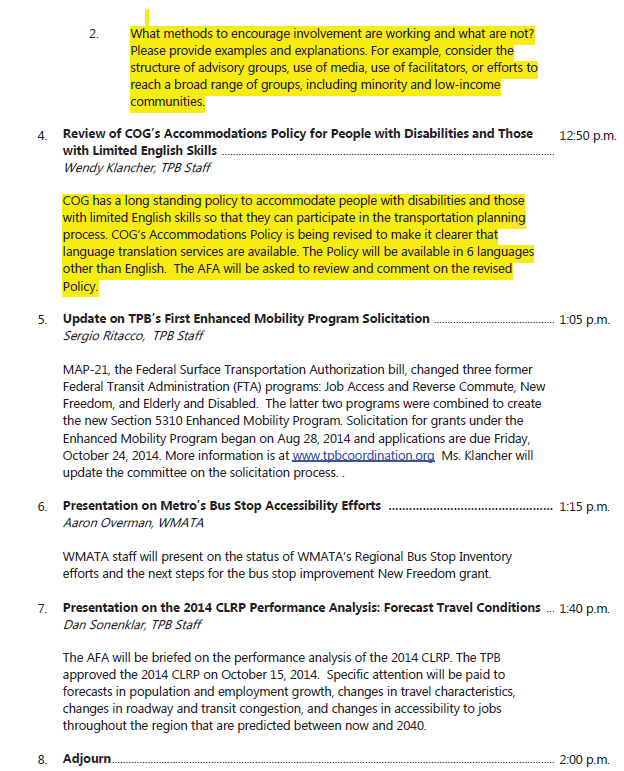
39 35
40 PART 8: Certification Review Site Visit Meeting Agenda Federal Certification Review of the Metropolitan Planning Process National Capital Region Transportation Planning Board (TPB) October 28-29, 2014 Metropolitan Washington Council of Governments, Washington, D.C Location: Ronald F. Kirby Training Center 777 North Capital Street, NE Washington, DC (202) October 28-29, Certification Review Format for all sessions: Each topic will be introduced by the Federal team with specific questions, followed by a five minute overview and update by TPB staff (and other local agencies identified by the Federal team). The Federal team will then lead the discussion involving all participating agencies: Participants: Members of the TPB's Technical Committee (representatives of all 22 member jurisdictions, State DOTs, Transit Agencies, Metropolitan Washington Airports Authority, National Park Service) Members of the TPB's Citizens Advisory Committee Staff I Members of the Fredericksburg Area Metropolitan Planning Organization Federal Review Team Members: FHWA/FTA Division, Regional and Headquarters staff Melissa Barlow - FTA DC Metro Office Candace Noonan - FTA Headquarters Sandra Jackson - FHWA DC Division Ivan Rucker- FHWA Virginia Division Kwame Arhin - FHWA Maryland Division Lindsay Donnellon - FHWA Maryland Division Egan Smith- FHWA HEP Office Headquarters 36
41 DAY 1 -Tuesday, October 28 9:00AM Federal Review Team Only Meeting 10:00 AM Introductions and Welcoming Remarks Federal team will provide overview of the Certification Process of the Transportation Planning Process. TPB staff will then provide an update and summary of major regional issues and priority planning activities, with discussion among all participating agencies. Federal Discussion Leader: Melissa Barlow, FTA DC Metro Office Sandra Jackson, FHWA DC Division Ivan Rucker, FHWA Virginia Division 1 Brief discussion of the Certification Process Summary of the Responses to 2010 Federal Certification and Findings Overview of recent/current major regional planning activities 11:30 AM Lunch 12:15 PM Review of the Transportation Planning Process Federal team leader will initiate a briefing by the TPB staff on topics encompassing the over-all planning process and the required elements of the Transportation Planning Process through these documents and activities, followed by discussion by all participating agencies. Federal Discussion Leader: Sandra Jackson, FHWA, D.C. Division Melissa Barlow, FTA DC Metro Office Kwame Arhin, FHWA Maryland Division Unified Planning Work Program, Self-Certification, Planning Agreements Long-Range Transportation Plan (CLRP) Transportation Improvement Program (TIP) and STIPs Fiscal Constraint I Financial Planning 2:45PM 3:00PM Break Review of the Transportation Planning Process (Continued) Federal Discussion Leader: Ivan Rucker, FHWA, Virginia Division Sandra Jackson, FHWA DC Division Regional Air Quality Conformity Analysis Travel Demand Forecasting Congestion Management Process 4:00PM Adjourn 37
42 DAY 2, Wednesday, October 29 8:30AM Additional Transportation Plan And Program Elements Federal Discussion Leader: Melissa Barlow FTA DC Metro Office Sandra Jackson FHWA, DC Division Land Use and Transit - Coordination and Planning Bicycle and Pedestrian Planning, Complete Streets and Green Streets Policies Freight Planning and Safety Activities 10:15 AM Break 10: 30 AM Public Involvement Process Federal Discussion Leader: Lindsay Donnellon FHWA Maryland Division Candace Noonan, FTA Headquarters Participation Plan and Public Involvement Coordinated Human Service Transportation Plan Title VI, Environmental Justice, Americans with Disabilities Act 11:30 AM Lunch 12:30 PM Metropolitan Transportation Systems Studies/Surveys for Plan Development Federal Discussion Leader: Sandra Jackson FHWA, DC Division Egan Smith, FHWA Headquarters Candace Noonan, FTA Headquarters Major New Planning Activities Performance Planning under MAP-21 Performance Analysis and Assessment of the Plan Target Setting and Performance Measures 2:00PM Follow-up to any subject area discussion including a general discussion. All participates are welcomed to give comments and /or remarks. 3:30PM Adjourn Meeting of Federal Review Team to prepare preliminary observations and close-out issues 38
43 PART 9: LINKS TO KEY TPB DOCUMENTS ON THE WEB Item Specific Location 2014 Plan mwcog.org/clrp 2014 Plan Brochure mwcog.org/clrp/resources/ (not published yet) FY TIP Air Quality Conformity Analysis of the 2014 Plan Public comments on the new Plan Financial Plan mwcog.org/clrp/projects/tip/fy1520.asp mwcog.org/clrp/resources/default.asp#air-quality-analysis mwcog.org/tpbcomment mwcog.org/clrp/resources/default.asp#financial-analysis TPB Vision and Relation to the Planning Factors Participation Plan COG Accommodations Policy FY2015 UPWP Coordinated Human Services Transportation Plan Congestion Management Process Annual Listing of Projects On-line CLRP & TIP Project Database Environmental Mitigation Discussion Visualization of the CLRP Freight Plan Bike and Pedestrian Plan mwcog.org/clrp/process/vision.asp mwcog.org/clrp/public/plan.asp mwcog.org/accommodations/ mwcog.org/transportation/activities/upwp/ mwcog.org/tpbcoordination/resources/coordinatedplan.as p mwcog.org/clrp/elements/cmp/default.asp mwcog.org/clrp/projects/tip/obligations.asp mwcog.org/clrp/projects/search.asp mwcog.org/clrp/elements/environment/ mwcog.org/clrp/projects/major.asp mwcog.org/store/item.asp?publication_id=381 mwcog.org/store/item.asp?publication_id=386 39
44 Safety Element COG Title VI Plan TPB Language Assistance Plan COG s Title VI Program and FTA Approval Scenario Study Transportation Land Use Connections (TLC) Program mwcog.org/clrp/elements/safety/ mwcog.org/store/item.asp?publication_id=383 mwcog.org/store/item.asp?publication_id=384 mwcog.org/publications/nondiscrimination.asp mwcog.org/clrp/elements/scenarios.asp mwcog.org/transportation/activities/tlc / 40
45 PART 10: Previous Findings and Disposition Recommendation Status Action Agreement 1 TPB should coordinate the planning process and products for the metropolitan area in accordance with the terms of the 2004 agreement with FAMPO and update the agreement if necessary to clearly define the agencies respective planning process roles and responsibilities, as described in the Agreements/ Certification discussion in the FAMPO section of this report. (See #12 recommendation for FAMPO.) Implemented In early FY 2012, the TPB and FAMPO processes and products were reviewed for coordination as specified in the 2004 agreement. TPB staff with FAMPO staff reviewed the CMP, UPWP, TIP and CLRP planning cycles and products and identified some coordination clarifications and updates. The following text was added to the UPWP to clarify the planning roles: Each year, the TPB Call for Projects document is transmitted to FAMPO requesting new and updated information on the projects located in the portion of Stafford County in the Washington DC TMA to be included in the update of the CLRP. FAMPO is also requested updated information on the Congestion Management System (CMS) for this portion of Stafford County. FAMPO transmits this information to TPB on the schedule included in the TPB Call for Projects document. Self Certification 2 The State DOTs should revisit their procedures for certifying the Federal metropolitan planning process to ensure their review and approval of the certifications are clearly defined and the DOT's basis for the certification is documented: for example, that Title VI and ADA requirements are being executed. Implemented On December 16, 2011, FAMPO transmitted the requested planning products for the portion of Stafford County for the 2012 CLRP amendment. DDOT, MDOT and VDOT reviewed their procedures for certifying the Federal metropolitan planning process to ensure their review and approval of the certifications are clearly defined and the DOT's basis for the certification is documented. They produced a metropolitan planning process review check list of the National Capital Region which documents their procedures for certifying TPB planning self- certification. 41
46 Recommendation Status Action Transportation Improvement Program 3 The TPB TIP should further clarify project Implemented TPB staff met with the DOT s staff to review documentation of states project selection processes. The selection and prioritization citing instances for TIP web site was updated to provide linkages to the project selection and prioritization processes at the which the TPB actually does prioritization and DOTs and transit agencies. selection. In addition, a narrative should be The Program Development Process and Project Development Process sections of the TIP describe the included to explain how TPB s role in the CLRP processes at the DOTs and WMATA and then move on to discussing Addressing Federal Requirements. and TIP selected projects improves the This portion of the TIP was restructured to explicitly discuss TPB actions in the project selection process: transportation system s performance and meets Reviewing project inputs for consistency with the Air Quality Conformity Analysis regional air quality goals and needs. The states Producing a financial summary of all funding sources proposed by an agency should work with TPB to create high standards of Bicycle and Pedestrian, Freight, and Regional Bus Subcommittees development of transparency and accountability for State project priority project lists for inclusion on the TIP selection and prioritization processes conducted as TIGER, JARC and New Freedom project development. part of the metropolitan planning process, including DOT decisions that are incorporated in the TIP. Transportation Improvement Program (Continued) 4 The states should work with TPB to enhance verification of the reasonableness of funding sources for TIP amendments, including a process to define reasonableness for different types of project amendments. TPB also should ensure that each jurisdiction provides adequate documentation to justify funding availability when requesting amendments. The TIP should demonstrate that estimates of system level revenues and costs are adequate for the DOTs to operate and maintain Federal-aid routes and public transportation systems. This documentation of available funding resources and O&M estimates can be amended into the TIP as soon as this information is available. Implemented All letters from DOTs or WMATA requesting an amendment now include language stating that the proposed funding is available and committed. This language will clarify if the funds are from additional, new monies, or if the funds are being diverted from another project. The Financial Plan for the FY TIP was expanded to include a table for each DOT and WMATA, showing estimated revenues from Federal, state, and local sources, and proposed commitments. The DOTs have documented their commitment of funding expected to be available to adequately operate and maintain the Federal-aid routes in the region and WMATA during the TIP six-year period. 42
47 Recommendation Status Action Financial Planning/Fiscal Constraint 5 TPB should increase the transparency of financial Implemented planning and fiscal constraint through improved documentation to make analysis and results more comprehensible to the public. Areas to address include: Organization of financial data and estimates to facilitate direct comparison of costs and revenues for projects and continuing and recurrent expenditures on operations, maintenance, and asset rehabilitation; Key assumptions (e.g., inflation, increases or shifts in allocations, fare increases, and population growth) affecting all projects, cost categories, and revenue sources; and Estimation methods and strategies for addressing projected financial shortfalls and policy trade-offs. Outreach/Public Participation 6 The Federal team recommends several actions that could enhance the TPB Public Participation Plan and practices: Convene the CAC, AFA, and the WMATA Riders Advisory Council together at reasonable intervals to share ideas, concerns, and ask questions of one another. Continue to convene all TPB and Committee members, similar to the May 26th, 2010 Conversation on Regional Transportation Priorities. Implemented The web page on the Financial Plan and fiscal constraint for the CLRP was revised to provide clearer and more concise descriptions of the financial analysis for the 2010 CLRP which was completed in October For the financial analysis of the 2014 CLRP, clear and concise descriptions were used to explain the data and key assumptions in presentations to the Technical Committee and TPB. The 2014 financial analysis will be finalized in November and the documentation will use non-technical language to describe the process and results. The financial information presents capital costs and revenues for major projects and on-going expenditures for operations, maintenance and system preservation. The key analysis parameters and estimating assumptions, including inflation rates and population growth are documented. The strategies and estimation methods for addressing projected financial shortfalls are presented. The TPB regularly seeks out both formal and informal opportunities for coordination among its advisory committees. Historically, there has been extensive informal coordination among the CAC, AFA, and WMATA Riders Advisory Council (RAC). The leaders of these committees have indicated that collaboration is most effective when it includes a specific purpose, and the current CAC chair is evaluating the most effective purpose for formal collaboration among these groups. A joint meeting was held in March 2012 between the AFA and the WMATA RAC. The membership for the WMATA Accessibility Advisory Committee (AAC) includes 2 AFA members. TPB staff and committee leadership will continue to seek out additional coordination opportunities. 43
48 Recommendation Status Action Outreach/Public Participation (Continued) 6 Limit the time that each AFA meeting spends discussing quality of service, to allow for time to provide productive feedback regarding transportation planning. Implemented AFA meeting agendas between 2011 and 2014 included a wide-variety of topics on transportation planning, such as the RTPP and the draft CLRP projects. The chair of the AFA, who is a TPB member, and AFA members requested agenda items on specific transit and paratransit services. AFA members have stated in surveys conducted in February 2009 and February 2011 that paratransit (MetroAccess) and transit for people with disabilities are the most important topics to include in future agendas. Consider conducting meetings at locations and times that may be more convenient to the general public. Seek opportunities to participate in community events, such as local fairs or open houses, to educate and inform the public of TPB activities as well as look for opportunities to link transportation issues to other prevalent issues (education, housing, employment, etc.). The TPB routinely engages with the public outside of traditional business hours, and in a variety of locations. In recent years, staff has made an effort to conduct outreach events outside the COG offices and during non-business hours. The TPB s Community Leadership Institute, for example, is conducted on evenings and weekends, and recently the sessions have taken place in venues throughout the region. In addition, the TPB has conducted a number of large deliberative forums on Saturdays. Staff regularly receive and accept invitations to speak at citizen meetings that occur throughout the region. Examples include the Action Committee for Transit, Suburban Maryland Transportation Alliance, Northern Virginia Transportation Alliance, and the Washington chapter of the Urban Land Institute. Responding to these ad hoc requests complements the TPB s institutionalized public engagement activities. 6 Explorer other methods and media to provide information to the public other than . Implemented The TPB uses a variety of media to inform citizens about key milestones and activities. TPB staff is regularly featured on local radio, television, and in printed and online news and podcasts to discuss specific programs or ongoing policy issues that affect the region. In addition, the TPB generates its own print and online media. The TPB Weekly Report, an online publication, provides brief, timely summaries of recent TPB research, analysis, outreach, and planning in the region to over 700 subscribers. The TPB News, a monthly newsletter is a record of the monthly TPB meeting, which is circulated to over a thousand subscribers via postal mail, as well as others through online channels including the TPB website and social media outlets. New items in these TPB-generated media reach a direct readership as well as an indirect audience, as items are often picked up by other media, including local newspapers, blogs, and radio talk shows. Thus, the TPB s multi-media approach can generate ripple effects throughout the region. 44
49 Recommendation Status Action Outreach/Public Participation (Continued) 6 Consider recording meetings and making them available over a public cable channel, and on websites, or hold online (Web 2.0) public meetings to allow folks to attend the meeting within a specified period of time of the actual meeting. TPB could also increase its use of newspaper columns, such as Doctor Gridlock. Implemented The TPB uses a multi-strategy approach to making its information and meetings accessible in a variety of ways. Part of this approach has been explained in the previous response. Other strategies include the following: The TPB will begin posting recordings of its meetings in October Staff is investigating options for live streaming and/or posting video recordings. The TPB has begun to more extensively use webinars to share information among its stakeholders and the public. The TPB and its work are frequently cited in the electronic and print media. As noted above, TPB officers and staff are frequent guests on television and radio. Doctor Gridlock has highlighted the TPB s work on a frequent basis, and has even conducted a live online chat with the TPB director. 6 Establish a Public-Involvement Management Team with Public Information Officers from each jurisdiction that coordinates among their agencies for transportation planning, programming, and operations activities. This would help to harmonize the individual public outreach efforts and increase media coverage of TPB s work. The Public Information Officers from the jurisdictions and agencies in the region address a host of topics in addition to transportation. It is judged that convening meetings of these busy officers to focus on transportation would not be very effective. As a way to provide centralized information on the public involvement opportunities throughout the region, the TPB developed an online clearinghouse, the Transportation Planning Information Hub, that serves as a one stop shop for obtaining information about transportation planning activities and decision-making processes. Gather information to evaluate the effectiveness of public outreach strategies. This could include: adding a column to public-speaking sign-in sheets that asks each commenter how they learned about the meeting, posting a small survey on the website each month, or sending a postcard survey asking about the process. Recommendation Outreach/Public Participation (Continued) TPB staff use a variety of means to evaluate the effectiveness of on-going public outreach strategies. For instance, TPB staff regularly holds After Action Reviews of major activities as a way to evaluate their effectiveness and determine ways to improve similar future endeavors. Such reviews have been conducted at the close of the CAC s annual term, at the end of each Community Leadership Institute, and after other major events. Staff also gathers evaluative information through focus group activities. The CAC has served as a focus group to provide feedback to TPB staff on efforts such as the TPB Weekly Report, and on methods to gain citizen feedback on the public acceptability of Value Pricing. The AFA has surveyed its members to ascertain the most efficient and effective ways support the committee needs. On an ongoing basis, TPB staff gathers information and evaluates the effectiveness of these and other public outreach methods. 45
50 6 Consider opportunities to involve college or high school students in the planning process: o Develop a CLI for students that could be held during the summer months, and perhaps be eligible for academic credit or recognition. o Consider expanding the CAC and AFA membership to include a student interested in transportation or urban planning. o Create an outreach program to young students using surveys, games, puzzles, and safety tips, or hold an annual poster contest for the cover page of a particular document, or as the screensaver of the TPB transportation webpage. o Engage high-school and/or college students interested in a career in communications by coordinating a Public Service Announcement Contest. The purpose would be to educate students about the role of the TPB and have them utilize their creativity to promote a specific transportation project or topic in 30-second TV spots. o Develop a blog to inform the public of current issues, discussions, and decisions. The tasks for meeting this recommendation should be included for review and approval in the next UPWP. Implemented A number of strategies are used to involve students in the regional planning process: Staff have established relationships with the planning departments of the University of Maryland, Virginia Polytechnic Institute and State University, and George Mason University. Staff members regularly serve as guest lecturers on regional planning. Through these relationships, planning students have been able to learn about and directly participate in TPB activities. For example, in the Fall of 2011 and Winter of 2012, planning students served as scribes in five large-scale deliberative forums that were held by the TPB to ascertain public opinions about value pricing. Twice in the past two years, TPB staff has worked to partner with organizations that host educational and planning-related programs with high school students. This approach was a part of a strategy to create and conduct a Community Leadership Institute for high school students. Each attempt was met with limited interest and a fair amount of challenges, including competing priorities for students, scheduling constraints with the academic calendar, and general lack of interest. For most of the past years, the TPB Citizens Advisory Committee has had an alternate member who is a student. An online clearinghouse, the Transportation Planning Information Hub, was developed to serve as a one stop shop web site for obtaining information about transportation planning activities and decision-making processes throughout the region. 7 TPB should develop and amend the Plan to include procedures, strategies and desired outcomes for the use of visualization techniques. Implemented In response to this recommendation, the 2014 Update to the Participation Plan identified a range of strategies and desired outcomes for the use of visualization techniques in public engagement. 46
51 Recommendation Status Action Outreach/Public Participation (Continued) 8 TPB should develop a formal process for selecting an information delivery method that is appropriate to the needs of a project, activity, or audience, and the desired type of public engagement. Implemented 9 TPB should develop a formal process to review, evaluate, and improve current public engagement techniques and activities regularly or at certain intervals of time. Title VI and Environmental Justice 10 TPB should provide a signed Standard Title VI Assurance, Title VI Plan/program/ method of administration with implementation, compliance, monitoring, enforcement and review procedures. Provide documented procedures regarding how Title VI training will be provided to or obtained by employees, recipients, sub recipients and other stakeholders. 11 TPB should seek and receive, and its affiliated Federal aid recipients must endeavor to provide, Title VI training and appropriate technical assistance pursuant to 23 CFR 200.9(b)(9). It is further recommended that VDOT especially, checks its Title VI questionnaire to TPB to make sure that the date they are sent out and the due date are sequential. Implemented Implemented Implemented In response to this recommendation, the 2014 Update to the Participation Plan identified the types of information sharing that should be used for different types of public involvement and outreach requirements. In response to this recommendation, the 2014 Update to the Participation Plan identified a system for an annual evaluation of the TPB s public involvement activities and identification of future activities. The signed assurance and Title VI plan have been provided. The procedures for training are documented in the Title VI Plan TPB and VDOT staff received this training in July COG conducts annual Title VI Nondiscrimination training for staff each year. 47
52 Recommendation Status Action Agreement (FAMPO) 12 TPB and FAMPO should coordinate their Implemented In early FY 2012, the TPB and FAMPO processes and products were reviewed for coordination as planning processes and planning products to align specified in the 2004 agreement. TPB staff with FAMPO staff reviewed the CMP, UPWP, TIP and with the current agreement, or revise the CLRP planning cycles and products and identified some coordination clarifications and updates. agreement to clearly define and reaffirm their respective planning process roles and The following text was added to the UPWP to clarify the planning roles: responsibilities. In addition, TPB and FAMPO Each year, the TPB Call for Projects document is transmitted to should consider an addendum to the existing FAMPO requesting new and updated information on the projects agreement that would provide clarification (where needed) of the roles and responsibilities of each located in the portion of Stafford County in the Washington DC MPO per CFR (f). (See #1 TMA to be included in the update of the CLRP. FAMPO is also recommendation.) requested updated information on the Congestion Management System (CMS) for this portion of Stafford County. FAMPO transmits this information to TPB on the schedule included in the TPB Call for Projects document. On December 16, 2011, FAMPO transmitted the requested planning products for the portion of Stafford County for the 2012 CLRP amendment. Outreach/Public Participation (FAMPO) 13 The Federal Team strongly recommends that FAMPO conduct a thorough review and update of the PPP, including all advisory committee structures and responsibilities. The update should include an evaluation of the PPP and TAG to determine their effectiveness in meeting the needs of the intended audiences (including low-income and minority populations). The tasks for meeting this recommendation should be included for review and approval in the next UPWP. Certification (FAMPO) 14 As part of the MPO Self-Certification process, the Federal Team recommends that FAMPO establish procedural guidance for verifying the process and implementation of self-certification. Implemented TPB staff has consulted with FAMPO staff on public participation plan update which is expected to be complete by September FAMPO included tasks on this recommendation in its FY 2013 UPWP. The TPB received documentation of FAMPO s updated Public Participation Plan in October Implemented Documentation received on FAMPO s Self-Certification process adopted in July
53 Corrective Action Status Action Agreement (FAMPO) 1 FHWA and FTA request that the FAMPO s RSTP and CMAQ project selection process be consistent with 23 U.S.C. section 134(j)(3)(5)(a) and 23 CFR (b). Please submit a joint letter signed by the FAMPO (MPO Chairperson/ representative) and State (CTB Chairperson/representative) confirming that the FAMPO project selection process for RSTP and CMAQ projects to be implemented utilizing 23 U.S.C. funds and/or funds under 49 U.S.C Chapter 53 is consistent with Federal regulation for the non-tma MPO. If the State delegated RSTP and/or CMAQ project selection responsibilities to the FAMPO, please provide clarification in the letter. The compliance deadline for this request is within 3 months following the release of the certification report. Implemented CTB and FAMPO letter provided by August 5, 2011 Title VI and Environmental Justice (FAMPO) 2 The MPO Title VI coordinator must acquire needed Title VI training and knowledge in implementing Title VI obligations. Implemented FAMPO, TPB and VDOT staff received training in July The MPO must establish a Tile VI/Nondiscrimination Plan. The Plan must include a public outreach and education plan; staff training plan; procedures for processing complaints; procedures for identifying and addressing Title VI/ Nondiscrimination issues; process for identifying and eliminating discrimination; process for review of programs and grant applications; and a process for collecting and analyzing statistical data (including LEP and EJ populations). The compliance deadline for this request is one year following the release of the certification report. Implemented Title VI plan adopted by FAMPO on May 22, Corrective Action Status Action 49
54 Agreement (FAMPO) 4 Within the Title VI/Nondiscrimination Plan, the Federal Team requests that the MPO have a documented process for assessing the distribution of impacts on different socioeconomic groups for the investments identified in the transportation plan and TIP. The compliance deadline is six months following the establishment and adoption of the MPO Title VI Plan. Implemented TPB received documentation on FAMPO methodology and analysis in the report Long Range Transportation Plan Equity Analysis dated May
REPORT ON CERTIFICATION THAT THE TRANSPORTATION PLANNING PROCESS COMPLIES WITH APPLICABLE FEDERAL LAWS AND REGULATIONS
 REPORT ON CERTIFICATION THAT THE TRANSPORTATION PLANNING PROCESS COMPLIES WITH APPLICABLE FEDERAL LAWS AND REGULATIONS 2014 Prepared by: Assistance by: Reviews: Lincoln City-Lancaster County Planning Department
Knoxville Regional Transportation Planning Organization. Certification Review Report. April 2012
 Knoxville Regional Transportation Planning Organization Certification Review Report April 2012 Federal Highway Administration Federal Transit Administration Tennessee Division Office Region 4 404 BNA Drive,
Transportation Planning Certification Review of the Metropolitan Transportation Planning Process for the Hartford Transportation Management Area
 Federal Highway Administration Federal Transit Administration Central Connecticut Region MPO Transportation Planning Certification Review of the Metropolitan Transportation Planning Process for the Hartford
TEXAS DEPARTMENT OF TRANSPORTATION
 TEXAS DEPARTMENT OF TRANSPORTATION S T A T E W I D E T R A N S P O R T A T I O N I M P R O V E M E N T P R O G R A M S T I P 2 015-201 8 ABILENE DISTRICT 2 0 1 5-2 0 1 8 T I P T R A N S I T I n i t i a
DELAWARE VALLEY REGIONAL PLANNING COMMISSION Fiscal Year 2016 Planning Work Program INTRODUCTION
 DELAWARE VALLEY REGIONAL PLANNING COMMISSION Fiscal Year 2016 Planning Work Program INTRODUCTION The Fiscal Year 2016 Planning Work Program for the Delaware Valley Regional Planning Commission incorporates
Summary of MAP-21 Matrix
 Summary of MAP-21 Matrix Overview On July 6, 2012, President Obama signed into law P.L. 112-141, the Moving Ahead for Progress in the 21st Century Act (MAP-21). Funding surface transportation programs
SURFACE TRANSPORTATION PROGRAM (STP) PROCEDURES FOR THE OKLAHOMA CITY URBANIZED AREA FUNDS
 SURFACE TRANSPORTATION PROGRAM (STP) PROCEDURES FOR THE OKLAHOMA CITY URBANIZED AREA FUNDS October 2015 Background The Surface Transportation Program (STP) was originally established as Section 133 of
Montana Business Process to Link Planning Studies and NEPA/MEPA Reviews
 Montana Business Process to Link Planning Studies and NEPA/MEPA Reviews Planning Project Development final report Montana Business Process to Link Planning Studies and NEPA/MEPA Reviews prepared for Montana
Examples of Transportation Plan Goals, Objectives and Performance Measures
 Examples of Transportation Plan Goals, Objectives and Performance Measures The next step in the Long Range Transportation Plan (LRTP) process is to develop goals, objectives, and performance measures.
Pedestrian & Bicycle Plan
 RAMSEY COMMUNITIES COUNTYWIDE Pedestrian & Bicycle Plan PRIMER: LEGAL FRAMEWORK PRIMER: LEGAL FRAMEWORK Walking and Biking for All e 2 CHAPTER 2: Walking and Biking for All This page intentionally left
A Presentation by the Project Managers: Rick Canizales Prince William County. Jana Lynott, AICP Northern Virginia Transportation Commission
 A Presentation by the Project Managers: Rick Canizales Prince William County & Jana Lynott, AICP Northern Virginia Transportation Commission for the: Public Open House and Hearing December 6, 2005 George
GUIDELINES FOR SACRAMENTO AREA COUNCIL OF GOVERNMENTS TRANSPORTATION DEMAND MANAGEMENT FUNDING PROGRAM Revised December 2009
 GUIDELINES FOR SACRAMENTO AREA COUNCIL OF GOVERNMENTS TRANSPORTATION DEMAND MANAGEMENT FUNDING PROGRAM Revised December 2009 INTRODUCTION In July 2002, the Sacramento Area Council of Governments (SACOG)
Chapter 5 Financial Plan
 The Safe, Accountable, Flexible, Efficient Transportation Equity Act: A Legacy for Users (SAFETEA_LU) requires that the MTP incorporate a financial plan for the planning period. The MTP is required to
5 Performance Measures
 5 Performance Measures This page left blank intentionally. 5 2 Moving Forward Monterey Bay 2035 Introduction The investments identified in the 2035 MTP/SCS are expected to result in significant benefits
2015 SOLICITATION FOR ENHANCED MOBILITY GRANT APPLICATIONS
 Item 6 Technical Committee MEMORANDUM TO: FROM: TPB Technical Committee Wendy Klancher, TPB Principal Planner Lynn Winchell-Mendy, TPB Planner SUBJECT: Status Report on the 2015 Solicitation for Section
GENERAL. This manual addresses five local programs that are funded under the current Highway Act:
 OVERVIEW The Local Public Agency Manual published by the Missouri Department of Transportation (MoDOT) is intended to be used as a guide for cities and counties that sponsor projects utilizing federal
Chapter VIII: Long-Term Outlook and the Financial Plan
 A. Long-Term Outlook Chapter VIII: Long-Term Outlook and the Financial Plan When examining the long-term outlook for transportation planning and programming over the foreseeable future, there are several
Implementation Strategy
 Implementation Strategy 6 The following implementation strategy defines strategic points of intervention for complete streets programming, including visioning, goal-setting, local agency plans, coordination
Wilmington Urban Area Metropolitan Planning Organization Surface Transportation Program Direct Attributable Project Submittal Guide Fiscal Year 2016
 Wilmington Urban Area Metropolitan Planning Organization Surface Transportation Program Direct Attributable Project Submittal Guide Fiscal Year 2016 Date of Release: September 14, 2015 Pre application
RPA 14/ATURA Surface Transportation Program (STP) APPLICATION FOR FUNDS
 RPA 14/ATURA Surface Transportation Program (STP) APPLICATION FOR FUNDS Please provide the following information when applying to RPA 14/ATURA for Surface Transportation Program (STP) funding for projects
Technical Report No. 1
 [TYPE THE COMPANY ADDRESS] [TYPE THE COMPANY ADDRESS] The Washington Metropolitan Area 2030 Economic Outlook: Standard Forecast Technical Report No. 1 By Stephen S. Fuller, Ph.D. Dwight Schar Faculty Chair
INDOT 2000-2025 Long Range Plan
 Chapter 9 INDOT 2000-2025 Long Range Plan Highway Needs Analysis Overview The statewide transportation planning process provides for the identification of highway needs through a comprehensive process
CHAPTER 4 SURFACE TRANSPORTATION PROGRAM (STP)
 Local Assistance Program Guidelines Chapter 4 CHAPTER 4 SURFACE TRANSPORTATION PROGRAM (STP) CONTENTS Section Subject Page Number 4.1 INTRODUCTION... 4-1 4.2 ELIGIBILITY CRITERIA... 4-1 General... 4-1
2010 MWCOG Electricity Consumption by Jurisdiction
 2010 MWCOG Electricity Consumption by Jurisdiction Jurisdiction DC TOTAL 254,257 11,538,622,434 Pepco Residential 226,272 1,891,782,070 Commercial 24,946 6,529,129,128 Government 3,039 3,117,711,236 Jurisdiction
PMO MANAGING DIRECTOR
 January 2014 Slavin Management Consultants Metropolitan Washington Council of Governments (COG) National Capital Region Homeland Security Program Management Office PMO MANAGING DIRECTOR COG invites your
Federal Guidelines for STP-U Funding
 MPC 5.f Attachment 1 STP-U Eligibility Guidelines Page 1 of 5 Federal Guidelines for STP-U Funding SURFACE TRANSPORTATION PROGRAM (STP) ELIGIBLE EXPENDITURES PERIOD AVAILABLE: FY + 3 Years FUND: Highway
South Carolina Multimodal Transportation Plan Vision, Goals, Objectives, and Performance Measures
 South Carolina Multimodal Transportation Plan Vision, Goals, Objectives, and Performance Measures Prepared for: Prepared by: June 2013 TABLE OF CONTENTS 1. Introduction... 1 1.1 Baseline Understanding...
REQUEST FOR PROPOSALS GENERAL PLANNING CONSULTANT SERVICES RFP #16-01 http://www.pinellascounty.org/mpo/gpcrfp.htm
 REQUEST FOR PROPOSALS GENERAL PLANNING CONSULTANT SERVICES RFP #16-01 http://www.pinellascounty.org/mpo/gpcrfp.htm 1. Purpose The Pinellas Planning Council (PPC) and Pinellas County Metropolitan Planning
Update on the Development of MAP 21 Performance Measures
 Update on the Development of MAP 21 Performance Measures TPB Technical Committee February 6, 2015 Eric Randall Department of Transportation Planning Item 9 MAP 21 Rulemaking National Goals Rulemaking Overview
STATE OF MONTANA MONTANA DEPARTMENT OF TRANSPORTATION JOB PROFILE Update Formal Review
 STATE OF MONTANA MONTANA DEPARTMENT OF TRANSPORTATION JOB PROFILE Update Formal Review 6/3/2013 Date Submitted SECTION I - Identification Working Title: Multimodal Planning Bureau Chief Department: Transportation
Performance-Based Planning and Programming
 Performance-Based Planning and Programming Matthew Hardy, Ph.D. Program Direction for Planning and Policy AASHTO September 17, 2013 2013 WVDOT/MPO/FHWA PLANNING CONFERENCE 1 Overview MAP-21 Requirements
Background and Goals for the Project
 City of Asheville, NC REQUEST FOR PROPOSALS Wilma Dykeman Riverway Environmental Analysis, Project Development, and Preliminary Design Submittal Address: Dan Baechtold, AICP City of Asheville Engineering
Regional Surface Transportation Program Policy and Allocation
 FY 2014-15 Regional Surface Transportation Program Policy and Allocation August 2015 Humboldt County Association of Governments 611 I Street, Suite B Eureka, CA 95501 Phone: 707.444.8208 www.hcaog.net
Chapter 8 Funding Considerations
 Chapter 8 Funding Considerations Expanding transit services into El Dorado Hills under any of the service alternatives has associated operating and capital costs. This chapter considers the funding sources
Program guidance that details the eligibility, criteria and application process. Ferry Boat Program. Ohio Department of Transportation
 Program guidance that details the eligibility, criteria and application process. Ferry Boat Program Ohio Department of Transportation TABLE OF CONTENTS Program Overview Program Administration.........2
Chapter 7 PURPOSE AND NEED MDT ENVIRONMENTAL MANUAL
 Chapter 7 PURPOSE AND NEED MDT ENVIRONMENTAL MANUAL October 2010 Table of Contents Section Page 7.1 OVERVIEW... 7-1 7.2 LAWS, REGULATIONS AND GUIDANCE... 7-2 7.2.1 40 CFR 1500 through 1508 CEQ Regulations...
Texas Freight Advisory Committee A PRIMER ON PUBLIC SECTOR FREIGHT PERFORMANCE MEASURES
 Texas Freight Advisory Committee A PRIMER ON PUBLIC SECTOR FREIGHT PERFORMANCE MEASURES October 1, 2013 A PRIMER ON PUBLIC SECTOR FREIGHT PERFORMANCE MEASURES How Do Performance Measures Assist the Public
AASHTO SCOPM MAP-21 Checklist
 AASHTO SCOPM MAP-21 Notice of Proposed Rule-Making Checklist (CMAQ) AASHTO SCOPM MAP-21 Checklist Performance Area CMAQ Document Overview MAP-21 legislation requires States and MPOs to: Establish performance
William M. Lyons Volpe Center/Office of the Secretary/USDOT
 Metropolitan Area Transportation Planning for Healthy Communities TRB Transportation Planning, Land Use, and Air Quality Conference Developing Healthy and Livable Communities William M. Lyons Volpe Center/Office
AIR QUALITY TECHNICAL MEMORANDUM
 AIR QUALITY TECHNICAL MEMORANDUM AIR QUALITY TECHNICAL MEMORANDUM GOLDEN GLADES INTERCHANGE PD&E STUDY Miami-Dade County, Florida Financial Management Number: 428358-1-22-01 Efficient Transportation Decision
El Paso Metropolitan Planning Organization JULY 17, 2015
 El Paso Metropolitan Planning Organization TRANSPORTATION POLICY BOARD AGENDA PROJECT SUMMARY JULY 17, 2015 AGENDA ITEM NO. 13: Report on Public Involvement on the Draft Federal Fiscal Year (FFY) 2016-2017
REFERENCE SERIES: Transportation in Connecticut ARTICLE NO. 02 Potential Federal-Aid Sources
 REFERENCE SERIES: Transportation in Connecticut ARTICLE NO. 02 Potential Federal-Aid Sources THIS DOCUMENT IS IN TEXT ONLY FORMAT - A FULLY FORMATTED DOCUMENT WITH GRAPHICS IS AVAILABLE AT THE CT DOT WEBSITE
Program Management and Recipient Coordination Plan
 Program Management and Recipient Coordination Plan for the Madison Urbanized Area s Section 5310 Enhanced Mobility of Seniors and Individuals with Disabilities Program Madison Area Transportation Planning
Transportation Improvement Program FY 2006-2008
 Transportation Improvement Program FY 2006-2008 Hidalgo County Metropolitan Planning Organization Adopted By Policy Committee: March 24, 2005 Public Meeting Date: March 1, 2005 Public Meeting Date: April
FINANCIAL PLAN. Any future earmarks are assumed to carry their own limitation and not reduce the regular limitation identified in these calculations.
 VII. FINANCIAL PLAN FHWA Funds The Federal Highway Administration (FHWA) funds are appropriated by Congress. FHWA funding levels are identified in the six-year Transportation Act. Each year, a federal
Iowa Smart Planning. Legislative Guide March 2011
 Iowa Smart Planning Legislative Guide March 2011 Rebuild Iowa Office Wallace State Office Building 529 East 9 th St Des Moines, IA 50319 515-242-5004 www.rio.iowa.gov Iowa Smart Planning Legislation The
8.0 NORTHEAST FLORIDA COORDINATED PROGRAM MANAGEMENT PLAN
 8.0 NORTHEAST FLORIDA COORDINATED PROGRAM MANAGEMENT PLAN 8.1 Introduction The primary objective of the Northeast Florida Coordinated Program Management Plan is to establish a process and procedures through
Performance Goals and Objectives:
 Online Briefing Winter 2011 2012 Purpose: The purpose of the Project is to examine and recommend ways of introducing higher passenger train speeds on the Empire Corridor and ways to improve reliability,
ENVIRONMENTAL PROTECTION AGENCY. 40 CFR Part 52. [EPA-R10-OAR-2015-0447; FRL-9933-43-Region 10]
![ENVIRONMENTAL PROTECTION AGENCY. 40 CFR Part 52. [EPA-R10-OAR-2015-0447; FRL-9933-43-Region 10]](/thumbs/24/2303642.jpg "ENVIRONMENTAL PROTECTION AGENCY. 40 CFR Part 52. [EPA-R10-OAR-2015-0447; FRL-9933-43-Region 10]") This document is scheduled to be published in the Federal Register on 09/08/2015 and available online at http://federalregister.gov/a/2015-21938, and on FDsys.gov 6560-50-P ENVIRONMENTAL PROTECTION AGENCY
This document is scheduled to be published in the Federal Register on 09/08/2015 and available online at http://federalregister.gov/a/2015-21938, and on FDsys.gov 6560-50-P ENVIRONMENTAL PROTECTION AGENCY
City of Rockville Regional Development Impacts: Transportation Capacity Analysis. June, 2013
 City of Rockville Regional Development Impacts: Transportation Capacity Analysis June, 2013 Purpose and Need Response to Council and Public Evaluate use of more advanced traffic analysis methodology and
Corridors & Other Initiatives. Future of Florida Virtual Seminar Series
 FDOT Up-Close: Future Corridors & Other Initiatives Future of Florida Virtual Seminar Series June 6, 2012 Today s Presenters Kathleen Neill Director, Office of Policy Planning Bob Romig State Transportation
Best Practices in Bicycle and Pedestrian Wayfinding in the Washington Region Survey Results
 Bike/Ped Subcommittee 03/20/07, Item 5 Best Practices in Bicycle and Pedestrian Wayfinding in the Washington Region Survey Results Michael J. Farrell COG/TPB 1 Background At the request of Jay Fisette,
The financial plan was prepared in conjunction with the Technical Working Group. Refer to Table 3-1: Funding and Implementation Plan.
 3 Financial Plan The purpose of the financial plan is to identify funding options that would be likely sources of money to advance recommendations made by this study. The Capitol Region Transportation
How To Plan A City Of Mason
 Transportation Master Plan (TMP) for the City of Madison: Draft Scope of Work Briefing for Madison Area TPB/MPO June 6, 2012 TMP: Overview/Purpose Help Create Walkable, Bikeable, Livable City - Strengthen
Chapter 9: Transportation
 Chapter 9: Transportation What is this chapter about? The goals and policies in this chapter convey the City s intent to: Create a coordinated, efficient, and more affordable multimodal transportation
Metropolitan Setting l
 Metropolitan Setting l GENERAL CHARACTERISTICS Los Angeles lies at the heart of one of the most complex metropolitan regions in the United States. As a major center of commerce, finance, and industry in
SOUTH CAROLINA DEPARTMENT OF TRANSPORTATION
 SOUTH CAROLINA DEPARTMENT OF TRANSPORTATION Introduction Methodology for Determining Federal Fiscal Years 2015 2017 (49 CFR Part 26 Section 26.45) PROPOSED DBE GOAL The South Carolina Department of Transportation,
Marion County Public Works
 Marion County Public Works Federally Funded Transportation Program Title VI Annual Accomplishment Report Fiscal Year 2014/15 Marion County Public Works Department Introduction The Marion County Department
----------------------------------------------------------------------------------------------------------- DATE: July 25, 2013
 MULTIMODAL TRANSPORTATION PLANNING MINUTES OF THE JEFFERSON-ORANGE-HARDIN REGIONAL TRANSPORTATION STUDY (JOHRTS) AREA TRANSPORTATION PLANNING COMMITTEE (TPC) -----------------------------------------------------------------------------------------------------------
Department of Defense INSTRUCTION
 Department of Defense INSTRUCTION NUMBER 4515.14 June 28, 2013 DA&M SUBJECT: Washington Local Commuting Area References: See Enclosure 1. PURPOSE. This instruction: a. Reissues DoD Directive (DoDD) 4515.14
Moving Ahead for Progress in the 21st Century. 2014 Performance Report
 MAP 21 Moving Ahead for Progress in the 21st Century 2014 Performance Report A report to Florida s Congressional Delegation March 2014 Overview: Because life is precious, FDOT has set the highway safety
Federal Highway Administration 1200 New Jersey Avenue, SE Washington, DC 20590 202-366-4000
 1 of 8 12/27/2013 8:21 AM U.S. Department of Transportation Federal Highway Administration 1200 New Jersey Avenue, SE Washington, DC 20590 202-366-4000 MAP-21 - Moving Ahead for Progress in the 21st Century
Department of Vehicle Services
 LOB #299: FUEL OPERATIONS Department of Vehicle Services Purpose The Fuel Operations LOB is responsible for fuel operations at 53 sites and administration of commercial fuel credit cards. Fuel operations
2012-2013 Transition from SAFETEA-LU to the new MAP-21 Federal Transportation Act
 C h a p t e r 9 - F i n a n c i a l P l a n a n d R e c o m m e n d a t i o n s f o r T r a n s p o r t a t i o n S y s t e m I m p r o v e m e n t P r o j e c t s A major component of the Plan (T2040)
Infrastructure and Growth Leadership Advisory Group Ideas and Approaches Survey
 Infrastructure and Growth Leadership Advisory Group Ideas and Approaches Survey In its second meeting, the Infrastructure and Growth Leadership Advisory Group expanded and refined the list of approaches/ideas