
2013 threat report Trends
|
|
|
- Dina Greer
- 10 years ago
- Views:
Transcription
1 2013 threat report Trends attack the security gap

2 Contents Introduction OUTSIDE IN... 4 X marks the spot ONCE A TARGET ALWAYS A TARGET... 8 OLD SCHOOL DRIVE-BYS WITH A TWIST Case Study 1: Global Financial Institution Case Study 2: Energy Company Case Study 3: Banking Industry BEST PRACTICES EMPLOYED BY TARGETED ORGANIZATIONS APT Conclusion End Notes

3 Introduction There is no such thing as perfect security. Advances in technology will always outpace our ability to effectively secure our networks from attackers. At Mandiant, we call this the Security Gap. There is no technical or legislative solution that can eliminate this gap. Security breaches are inevitable because determined attackers will always find a way through the gap. This sounds disparaging, but it is not new information. Seasoned security professionals have been aware of the security gap throughout their careers. While the problem is not going away any time soon, Mandiant saw companies make significant progress in their ability to Attack the Security Gap over the past year. In 2012, 37% of the organizations we responded to discovered the intrusion themselves, versus just 6% of the organizations we helped in We also saw more than a 40% improvement in the median time an attacker was present on a victim network down to 243 days from 416 days in We note, however, that this downward shift in the median was accompanied by a higher mean days of compromise. In other words, more organizations are doing a better job of proactively identifying problems, but there are still outliers who are compromised for several years before they detect they are compromised. In this M-Trends report, we present two different perspectives. First, a look at the tactics that the adversary is using to compromise organizations: the subversion of IT contractors, the extensive reconnaissance used by attackers, the persistent re-compromise of valuable targets, and strategic Web compromises. These four trends are about the business side of exploitation. We also provide an attacker s perspective on a compromise with an overview of the APT1 threat actor, and a link to over 3,000 technical indicators that Mandiant is providing to the community. Effectively attacking the security gap requires the best people, technology, and threat intelligence possible. It also requires collaboration and information sharing across our industry. It is our hope that the 2013 M-Trends and corresponding Web content can help your organization start to close this gap. 1
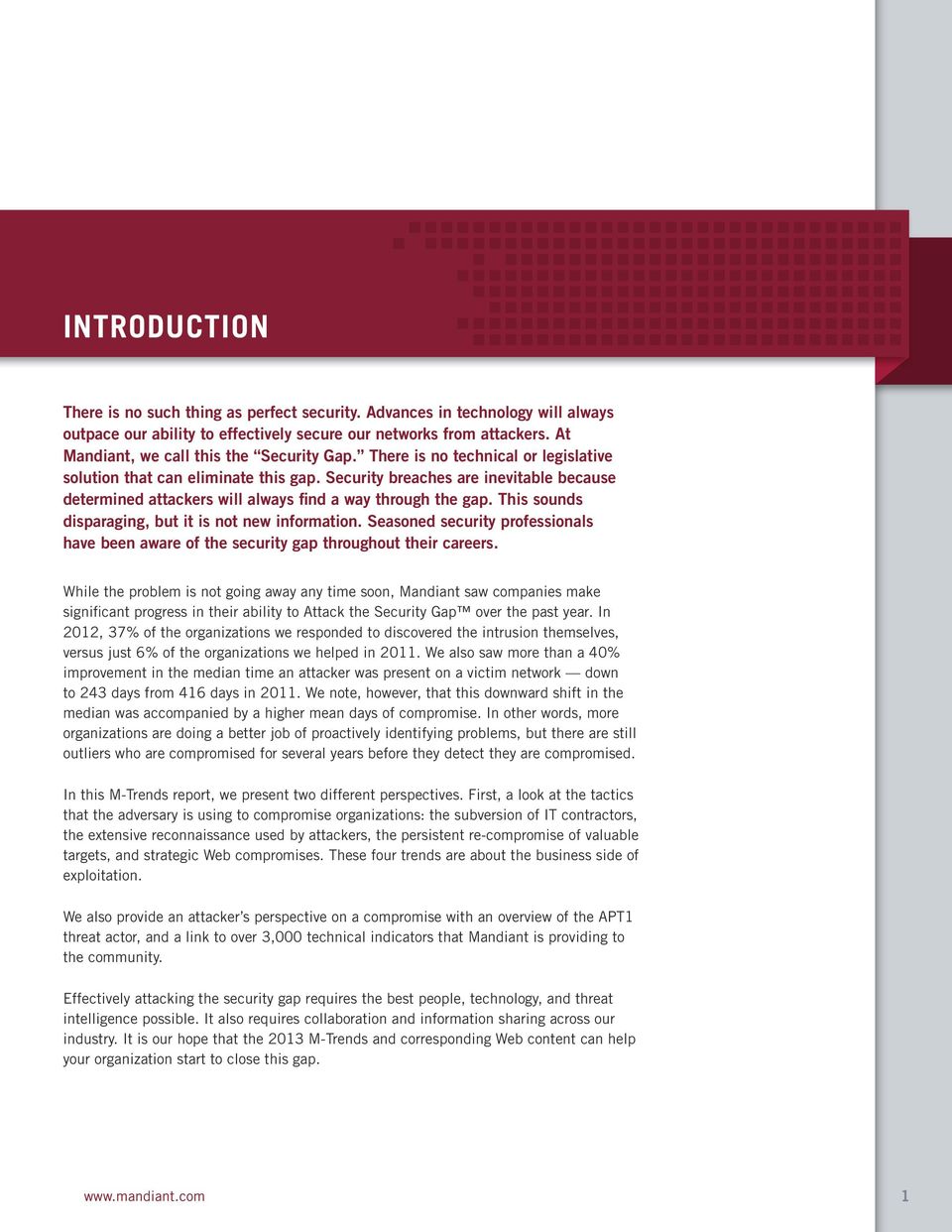
4 Victims By the Numbers Industries Being Targeted by Advanced Attackers 17% Aerospace & Defense Energy, Oil & Gas 14% Computer Hardware & Software 8% 11% Finance Media & Entertainment 7% Pharmaceuticals 4% 7% Legal & Consulting Services 6% Telecommunications In 2012 we noted an increase in attacker activity in several key areas: Media & Entertainment up from 2% to 7% Pharmaceuticals up from 1% to 4% Finance up from 7% to 11 % 25% Other How Compromises Are Being Detected? 37% of victims discovered the breach internally 63% of victims were notified by an external entity 2 Mandiant M-Trends attack the security gap
5 This M-Trends focuses on Mandiant s observations while responding to targeted attacks over the last year. During our investigations, we noted 4 trends. Time from Earliest Evidence of Compromise to Discovery of Compromise COMPROMISED 243 median number of days that the attackers were present on a victim network before detection 173 days less than in 2011 DETECTED Outside In Attackers are increasingly using outsourced service providers as a means to gain access to their victims. X marks the spot Attackers are using comprehensive network reconnaissance to help them navigate victims networks faster and more effectively. 3 Once a Target Always a Target Advanced Persistent Threat (APT) attackers 1 continue to target industries that are strategic to their growth including aerospace, computer software, high-tech manufacturing, and energy. 2% by a customer 4% by a business partner 15% by an outsourced sevice provider 42% by law enforcement HACKER 4 Old School Drivebys with a Twist Targeted attackers are adapting Internet drive-by attacks and stepping them up a notch to compromise victims and gain a foothold in their networks. 3

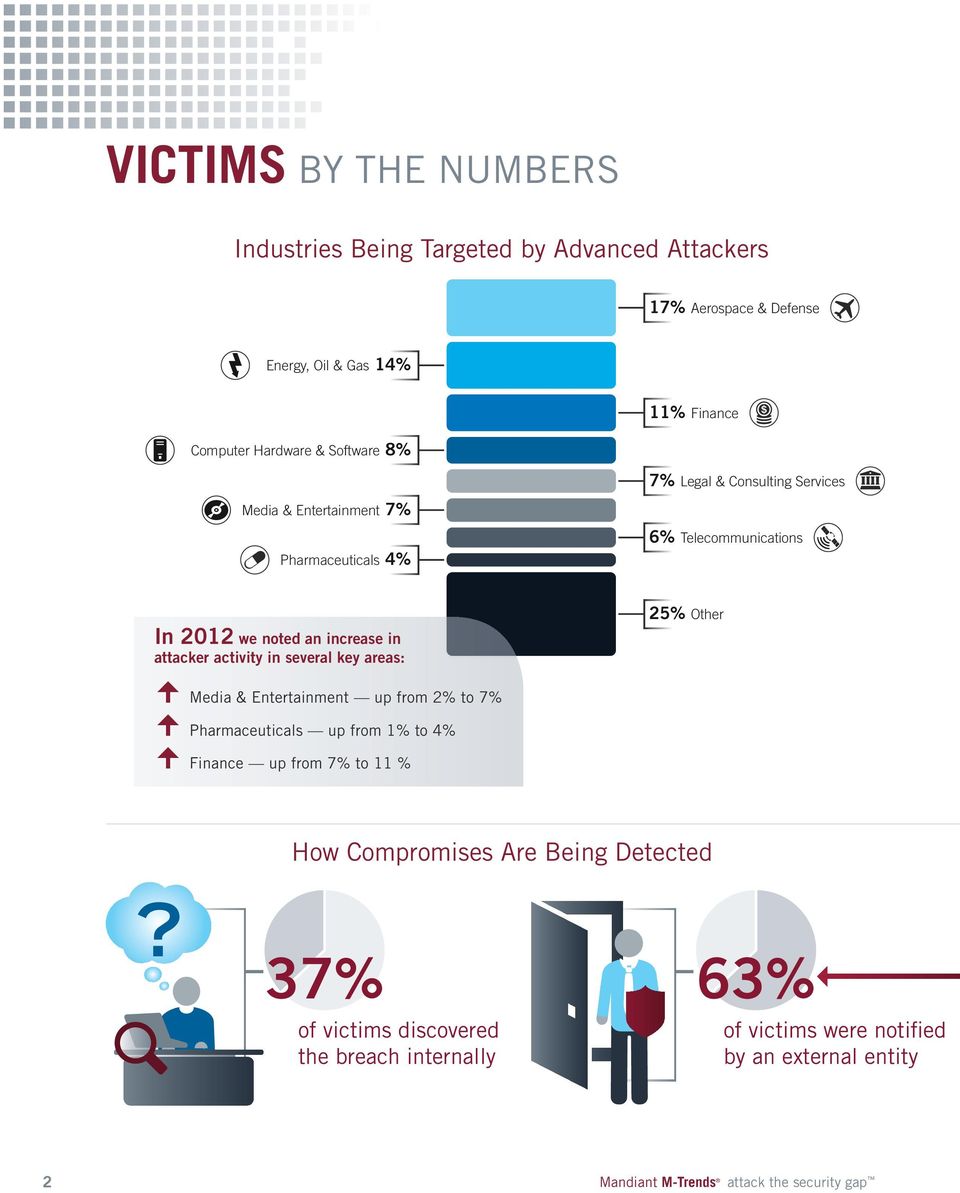
6 1 OUTSIDE IN Attackers are increasingly using outsourced service providers as a means to gain access to their victims. Outside vendors and business partners have access to organizations networks like never before. In 2012, companies spent $134 billion on outsourcing business processes such as finance, accounting, HR, and procurement. 2 Combine that with the estimated $252 billion organizations spent on IT outsourcing in and it adds up to a lot of organizations allowing outside vendors unfettered access to large portions of their networks. Advanced attack groups are increasingly taking advantage of outsourcing relationships to gain access to the organizations they are targeting. Advanced attack groups are increasingly taking advantage of outsourcing relationships to gain access to the organizations they are targeting. During our investigations in 2012, we found an increase in the number of outsourced and managed service providers who were compromised and used as a primary access point for attackers to gain entry to their victims networks. We have worked with clients who were both the compromised outsourced service provider and the compromised clients who employ these services. In many instances, the attackers initially gained access to the service provider solely as a means to find a way into their real target the client of the service provider. In those cases, we have seen the attackers compromise the first victim the outsourced service provider gather the intelligence they need to facilitate their compromise of the second victim, and then lay dormant at the first victim for months or even years, only accessing backdoors at those companies if they need to regain access to the second victim. In other cases, we have seen examples where contracted service providers have been the primary target. For example, during one of our investigations we found evidence that attackers gained access to a large defense contractor who, as part of their services portfolio, provided IT support and managed services for a number of smaller defense contractors. We found these attackers accessed the networks of the smaller companies through the connections they shared with the vendor. Meanwhile, other divisions of the service provider produced products and performed services which were of interest to the attackers who stole and other files related to these products and services. 4 Mandiant M-Trends attack the security gap
7 Compromise via Outsourced Service Provider (OSP) 1 OSP has access to client network through site-to-site VPN tunnel. Limited access restrictions are in place. 2 Outsource Serivce Provider Attacker compromises OSP. Client Network COMPROMISED 3 Attacker leverages site-to-site VPN tunnel and compromises client from OSP network. THE TAKEAWAY Your network is only as secure as your outsourced service provider. Make sure your organization understands the security posture of these providers, and apply as stringent policies to their access as you would to your own employees. 5

8 2 X marks the spot Attackers are using comprehensive network reconnaissance to help them navigate victims networks faster and more effectively. Attackers can steal the data they want faster when they know where to look for it. While basic reconnaissance of victim networks is nothing new, over the last year we have seen evidence of attackers expanding the type of reconnaissance activities they perform and utilizing more sophisticated tools and tactics to map victims networks. In addition to network mapping, we saw multiple instances where the first documents the attackers stole were related to network infrastructure, processing methodologies and payment card industry (PCI) audit data. The attackers also took various system administration guides to identify human targets and to further scope the victim networks. We have also seen instances where the attackers opened native Microsoft tools (such as dns.msc) to gather the reconnaissance data they needed. With this information in hand, the attackers identified network and system misconfigurations which they exploited to gain greater access within the victim network. In all of these cases, having intimate knowledge of the network topology allowed the attackers faster and more direct access to the areas of their victims networks that they were trying to compromise. In some instances, attackers sought entry to production environments where they stole intellectual property. In other cases, they were looking to identify network resources the victim shared with other organizations that were also on the attacker s target list. 6 Mandiant M-Trends attack the security gap
9 ITEMS ATTACKERS STEAL DURING THE RECONNAISSANCE PHASE OF AN INTRUSION Item Stolen How the Attackers Use Information Network Infrastructure Documentation Including Schematics and Configuration Files Understand firewall and other IDS configurations and where vulnerabilities that can be exploited exist. Organization Chart Establish individuals to target in spear-phishing campaigns or to target for and data theft. Systems Documentation Identify where targeted systems existing within a victim network. VPN Configuration Files Identify what VPN users have access to within a victim s network and target VPN credential data to steal. THE TAKEAWAY Information about your networks, systems, and organization provide a road map for attackers to quickly find what they are searching for. Apply the appropriate data classifications to such information and secure it accordingly. 7

10 3 ONCE A TARGET ALWAYS A TARGET Advanced Persistent Threat (APT) attackers continue to target industries that are strategic to their growth including aerospace, computer software, high-tech manufacturing, and energy. Mandiant once again observed a relationship between the strategic priorities of the People s Republic of China (PRC), the operations of PRC state-owned enterprises (SOEs), and data stolen through cyber intrusions from a wide variety of clients and industries. Attackers choose their targets for different reasons. Financially motivated attackers seek victims who they can easily can gain access to in order to steal money or credit/debit card numbers. Attackers conducting economic espionage, such as the APT, are motivated by economic gain and their victims are often directly correlated with their national interest. In 2012, Mandiant once again observed a relationship between the strategic priorities of the People s Republic of China (PRC), the operations of PRC state-owned enterprises (SOEs), and data stolen through cyber intrusions from a wide variety of clients and industries. Mandiant has also identified a larger number of situations where organizations that were initially compromised by the APT were repeatedly attacked once those organizations had eliminated the attackers from their network. Many of our investigations revealed a number of these organizations were targeted by more than one attack group, sometimes in succession. Of the clients Mandiant responded to in 2012, 38% of them were attacked again once the original incident was remediated. In economic espionage cases, we witnessed coordinated and continued APT activity against nearly all of the industries we work in. In particular, a large number of repeated attacks were lodged against companies in the aerospace, energy and pharmaceutical industries. Of the total cases we investigated in 2012, we saw attackers lodge over one thousand attempts to regain entry to former victims. 8 Mandiant M-Trends attack the security gap

11 Repeated Attacks by Industry, % Aerospace & Defense 17% Energy, Oil & Gas 15% Pharmaceuticals 11% Finance 4% Media & Entertainment 3% Computer Hardware & Software 2% Telecommunications 2% Legal & Consulting Services 13% Other THE TAKEAWAY Attackers with an objective of economic espionage have specific goals and will return until their mission is complete. Treat incident detection and response as a consistent business process not just something you do reactively. Constant vigilance and rapid response is necessary to keep an organization secure. 9

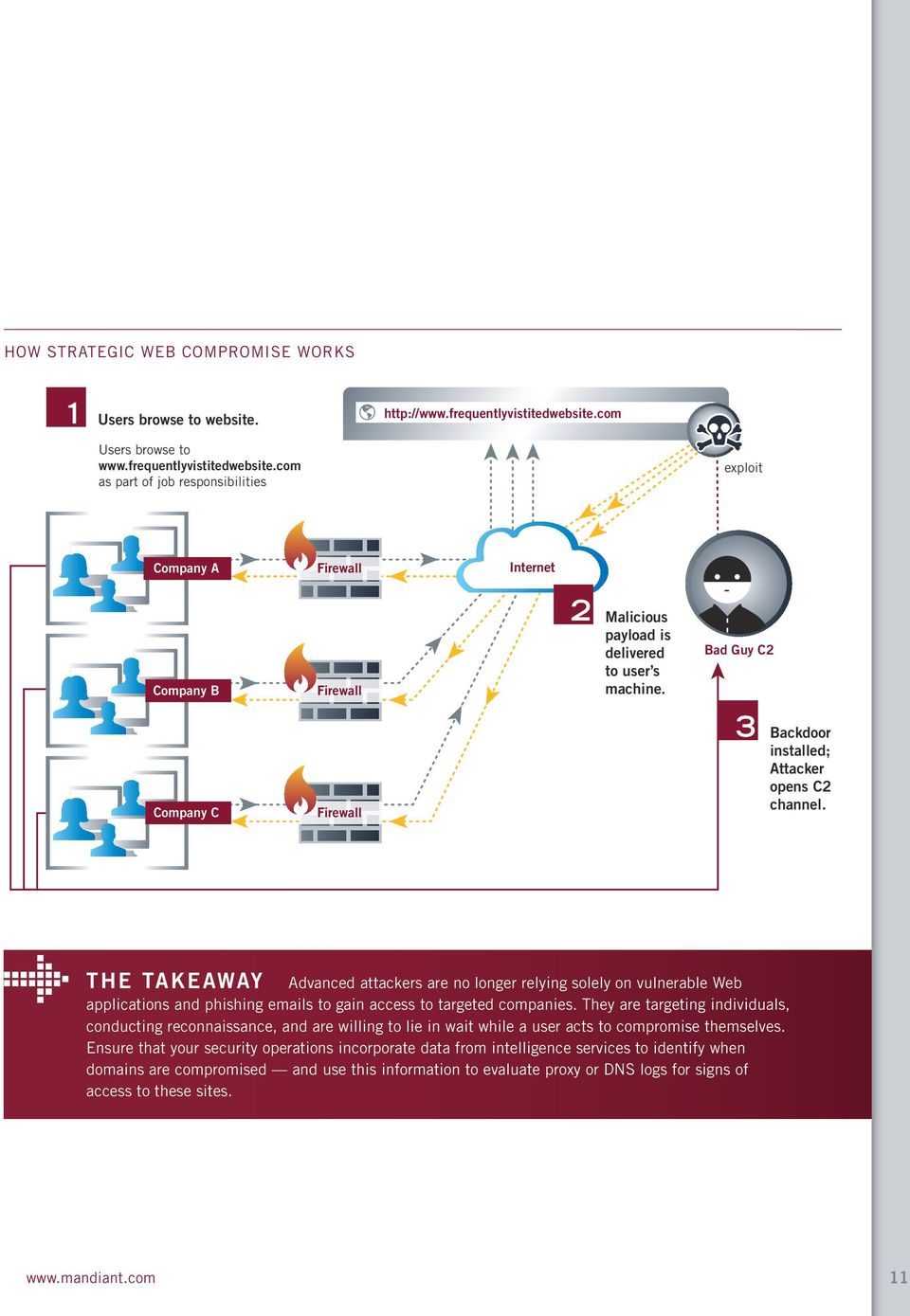
12 4 HACKER OLD SCHOOL DRIVE-BYS WITH A TWIST Targeted attackers are adapting Internet drive-by attacks and stepping them up a notch to compromise victims and gain a foothold in their networks. At Mandiant, we have seen attackers perpetrate strategic Web compromise 4 attacks as a means of gaining entry to a victim network. Unlike Web compromises of old, the cases Mandiant observed over the past year were far more targeted than typical Internet drive-by attacks. Attackers have long used spear phishing and other social engineering tactics to entice users to click on malicious files they receive via . They send the target a well-crafted with an attachment, the target clicks on the attachment, their machine becomes compromised, and the attacker gains access to the victim s network. As the use of this well-known technique has become more prevalent, technologies have been developed to combat these attacks and they continue to improve. In response, Mandiant has seen attackers shift tactics by placing exploits on websites they know are frequently browsed by users in targeted organizations. The targeted users travel to the compromised website as part of their daily operations and when they click on the compromised website, malware is installed on their machines. Once installed, the malware collects usernames, passwords, browser cookies and the computer name of the system being used. By using these strategic Web compromise attacks, the attacker is able to secure access to multiple individuals systems within several targeted companies without having to send a single ; effectively enabling the attacker to defeat anti-phishing technology. Exploiting Web servers used to be indicative of crimes of opportunity rather than targeted, pre-meditated attacks. However, in 2012, Mandiant witnessed compromised Web servers being used as an initial means of access by both criminal threat actors and attackers conducting economic espionage, such as the APT. 10 Mandiant M-Trends attack the security gap

13 How StRATEGIC Web Compromise works 1 Users browse to website. Users browse to as part of job responsibilities exploit Company A Firewall Internet Company B Firewall 2 Malicious payload is delivered to user s machine. Bad Guy C2 Company C Firewall 3 Backdoor installed; Attacker opens C2 channel. THE TAKEAWAY Advanced attackers are no longer relying solely on vulnerable Web applications and phishing s to gain access to targeted companies. They are targeting individuals, conducting reconnaissance, and are willing to lie in wait while a user acts to compromise themselves. Ensure that your security operations incorporate data from intelligence services to identify when domains are compromised and use this information to evaluate proxy or DNS logs for signs of access to these sites. 11
14 Case Study 1: Global Financial Institution TREND 2 Mandiant was contacted in early 2012 to investigate a suspected compromise at a global financial institution. In our experience, criminal intrusions are typically detected more quickly than corporate espionage intrusions because they involve the theft of credit/debit card numbers or money. In addition, the financial industry effectively uses a number of anti-fraud detection mechanisms. In this case, the client detected the compromise while reviewing IIS Web logs. Through review of the Web logs, the victim determined that an attacker had exploited a vulnerability within a Web application and created tools locally on the Web server. By the time the company discovered the breach, validated the presence of the tools and escalated the issue, it was too late to stop the attack. The attacker had already created multiple backdoors throughout the environment and was no longer accessing the victim network through the compromised Web server. The attackers stole a large amount of data related to network infrastructure, processing methodologies and systems documentation. The attackers stole a large amount of data related to network infrastructure, processing methodologies and systems documentation. From this information, they were able to gain a thorough understanding of the victim s network and its systems, including which access controls were in place and where critical data was stored. The attackers leveraged this knowledge to: Determine which users interacted regularly with important systems; Target these users to obtain their credentials; Establish which systems had unfettered access to the Internet; and Identify misconfigurations in the victim s network. This particular group of attackers took advantage of multiple vulnerabilities and misconfigurations to perpetrate this crime. Each vulnerability and misconfiguration appeared to present a small risk on its own. However, when grouped together they allowed the attacker to compromise the organization. The attacker took advantage of a vulnerable Web application to gain access to the DMZ and move laterally throughout the DMZ until they gained access to a database. Next, the attacker used the database connection to gain access to the internal environment and moved laterally through the environment gaining elevated privileges and performing reconnaissance. Ultimately, they identified a jump server that provided them access to the card processing environment. 12 Mandiant M-Trends attack the security gap

15 The card processing environment restricted outbound access to the Internet except where it was critical for business functionality. This hindered the attacker s attempts to steal data directly from the card processing environment. The attackers implemented a proxy infrastructure within the environment to route their connectivity from the Internet to the card processing environment and back so they could steal data. The attackers then configured their backdoors to communicate with specific C2 servers, but routed traffic through proxy utilities deployed on some compromised systems. The proxy utilities were configured to communicate with C2 servers that were often different from the destination address specified by the original backdoors. This caused some confusion during the investigation as to which C2 servers were actually being used. Analysis of the malware determined that a command line option specified whether the proxy utilities would send data to the pre-configured C2 servers or to the C2 servers specified by the backdoors. One of the backdoors the attacker used leveraged IPv4 DNS A records for C2 (the malware also had the ability to leverage IPv6 DNS AAAA records). The subdomains were automatically generated and random, which made them difficult to detect and block. This technique was stealthy because most companies do not monitor their DNS traffic. The attacker chose to leverage Windows Scheduled Tasks to maintain persistence for this malware, which was odd because it allowed for easy detection of the malware. Although the investigation was made more difficult because of the way the various pieces of malware worked together, Mandiant employed traditional investigative doctrine to determine where the attacker had deployed malware or had accessed systems. Once we felt we understood the compromise, we assisted the client with a remediation effort that removed the attacker s access from the environment, plugged the vulnerabilities the attacker leveraged to gain access, improved the client s visibility, and improved their security posture such that a future attack had a smaller chance of success. Attacker Placed Tunneling Malware on Compromised Server 1 Company restricted access from PCI environment to Internet. PCI Environment Internet 2 Firewall Attacker created backdoors from PCI environment to tunnel traffic to compromised server. COMPROMISED 3 Attacker used compromised server used as proxy. 4 Data theft proxied to Internet from compromised system. 13

16 Case Study 2: Energy Company TRENDS 1 In mid-2012, a global energy company requested that Mandiant perform a threat assessment of their network to identify if attackers were active within their IT environment. The company had reason to believe they were compromised and were looking to confirm if that was the case. If so, the company wanted to identify what data the attackers had stolen. 2 Over the course of multiple investigations related to this intrusion, Mandiant encountered three organizations compromised by the same attack groups. Two of these companies Company A and Company B had a partnership arrangement related to renewable energy projects they were jointly working on. The third organization Company O was an outsourced service provider who provided managed services to Company B, but who had no relationship to Company A. 3 As our investigation unfolded, we learned these attackers were determined to maintain access to Company B s network. When our investigation was complete, we determined the attackers had compromised both Company A and Company O in an attempt to gain access to Company B. HACKER 4 Due to the length of time the attackers were in Company B s network undetected nearly nine months we were unable to identify the initial attack vector. However, we did find evidence that Company O was compromised prior to Company B s compromise and believe that the attackers used Company O s access to Company B s network to compromise Company B. Once inside of Company B s network, the attackers used a combination of traditional backdoor malware, traffic redirectors and legitimate Windows mechanisms in conjunction with stolen user credentials to maintain access, move laterally through the network and access proprietary data. During this time, the attackers were actively stealing data from Company B. Prior to the attackers compromise of Company B, they also compromised a partner company, Company A. In Company A s network, the attackers performed reconnaissance activities viewing multiple files related to Company A s network topology, but they never stole any intellectual property. They installed multiple backdoors and then went dormant for approximately 13 months. 14 Mandiant M-Trends attack the security gap

17 Relationships Attacker is at two places: Company A and Company O Business partner of Company B Outsource service provider for Company B Company A Company B Company O COMPROMISED COMPROMISED Company O Company B Company A 1 Attacker uses Company O s access to Company B s network to compromise Company B. 2 Attackers have access to Company B s network for 8 months until Company B detects intrusion and remediates. 3 Attacker uses connection between Companies A and B to attempt to get access to Company B. COMPROMISED Company B Company O Company B 6 Company B detects attempt, 5 Attacker uses Company O s 4 Company B detects attempt, blocks it and notifies Company access to Company B s network to blocks it and notifies Company O they are compromised. try to recompromise Company B. A that they are compromised. Internet Company BX 7 Attackers compromise a website frequently visited by employees at Company B and recompromise two machines at Company B. 8 Company B detects and remediates compromise. 15

18 Once Company B detected the attackers, they contacted Mandiant and we worked with them to conduct an investigation of the incident and to perform remediation. Upon completion of Company B s remediation, the attackers used the backdoors and webshells they installed at Company A and attempted to leverage a network connection between Companies A and B to regain access to Company B s network. We identified the attempts to try and move from Company A into Company B and worked with Company B to block the attacker s access. At this time, Company B notified Company A that Company A was compromised and Company A took a series of steps to block the attacker from further access to its network. Once Company A started remediating their compromised devices, the attackers were effectively blocked from using the network connection between Companies A and B that they had previously leveraged for access to Company B. However, Company B s outsourced service provider, Company O, was still compromised. Because Company O provided outsourced information technology services to Company B, the attackers performed additional reconnaissance activities at Company O looking at and stealing files related to configuration changes Company B implemented during the remediation of their original incident. Armed with this information, they installed malware designed to circumvent new firewall controls Company B had put in place. Company B detected these attacks, blocked them and notified Company O that Company O was compromised. At this point the attackers had been removed from Company B and been detected and blocked from Company A and Company O. They were still determined to regain access to Company B. Even though their other avenues of entry had been shut down, they still had information about Company B knowledge of a website employees at Company B frequented as part of their work at the company. Using this information, the attackers compromised the website and posted a Java exploit on the site. Using this strategic Web compromise technique, the attackers successfully gained entry back into Company B. Company B quickly detected the compromise and remediated. 16 Mandiant M-Trends attack the security gap

19 Case Study 3: Banking Industry In late 2012, Mandiant worked with a bank investigating the theft of nearly $2 million dollars via a fraudulent wire transfer. The bank began investigating the incident after they discovered that unauthorized messages were being sent using a Web-based banking management application. The bank used the application to administer and manage accounts in an online application used by its customers. The customers used the online service to manage their monetary transactions including ACH and wire transfers. 4 TREND HACKER During their internal investigation, the bank identified and deleted a compromised banking management account. They also identified and reset passwords for compromised customer accounts and removed a compromised machine from its network. Mandiant was tasked with identifying whether the incident was ongoing and what the initial method of compromise was. The bank also needed to understand how the attackers were able to access the banking management application, determine the length of exposure and identify the total loss. We performed forensic analysis on the machine the bank had taken offline and established that it had been compromised by a Java vulnerability installed when the user visited a local news outlet s website. Once the user visited the website, they were unknowingly redirected to a malicious Web server hosting the Java exploit. The exploit installed a backdoor on the victim s system and harvested credentials from the user s browser. The installed malware also included functionality to steal browser cookies and certificates, transfer files in and out of the environment, execute arbitrary programs and implement a SOCKS5 proxy. The bank had IP whitelisting in place and access to the externally-hosted banking management application was restricted to the bank s external IP address. However, the attacker s use of a modified SOCKS5 proxy allowed them to tunnel traffic through the compromised system and to access the application. 17

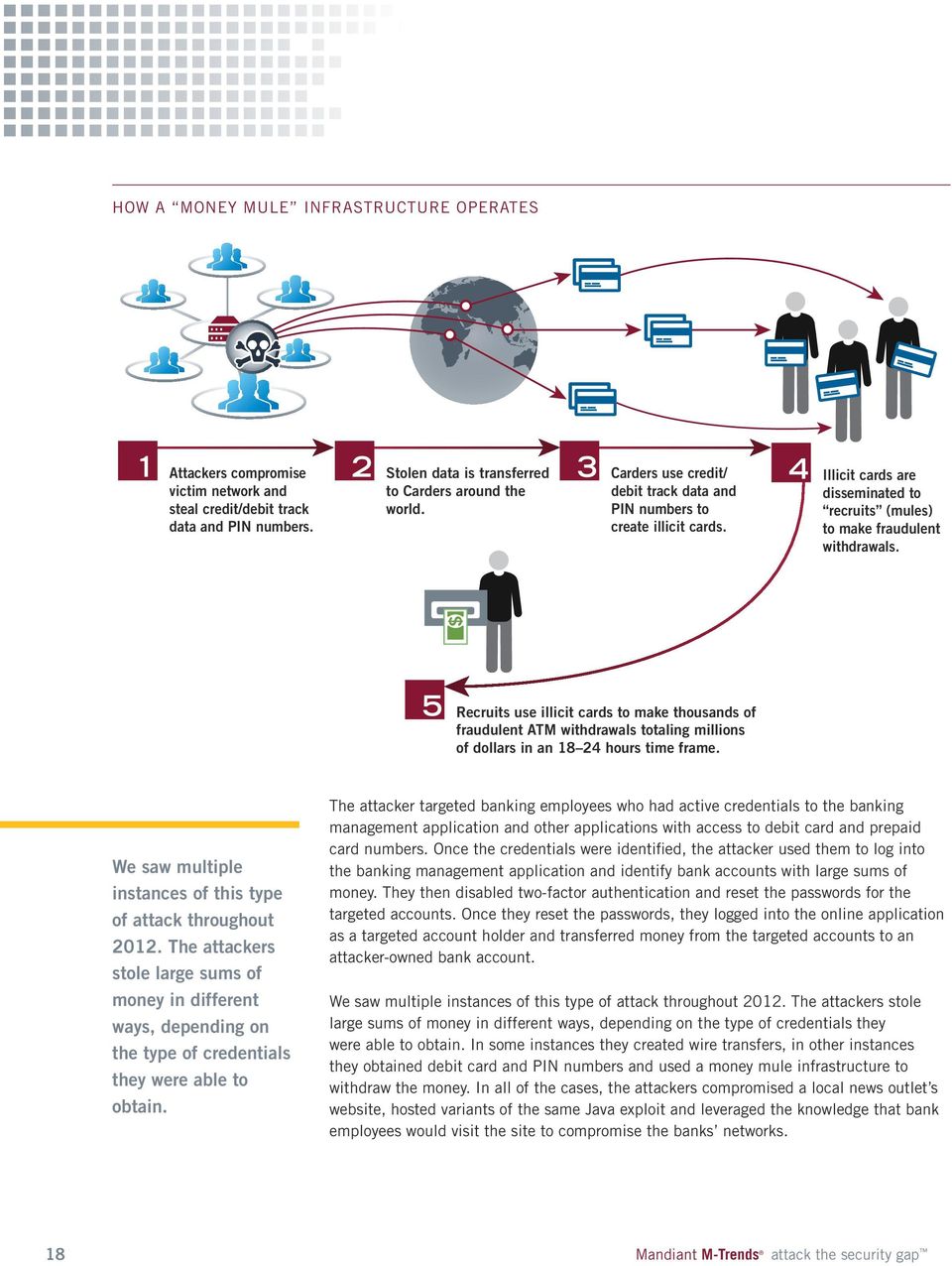
20 How a money Mule Infrastructure Operates 1 Attackers compromise victim network and steal credit/debit track data and PIN numbers. 2 Stolen data is transferred to Carders around the world. 3 Carders use credit/ debit track data and PIN numbers to create illicit cards. 4 Illicit cards are disseminated to recruits (mules) to make fraudulent withdrawals. 5 Recruits use illicit cards to make thousands of fraudulent ATM withdrawals totaling millions of dollars in an hours time frame. We saw multiple instances of this type of attack throughout The attackers stole large sums of money in different ways, depending on the type of credentials they were able to obtain. The attacker targeted banking employees who had active credentials to the banking management application and other applications with access to debit card and prepaid card numbers. Once the credentials were identified, the attacker used them to log into the banking management application and identify bank accounts with large sums of money. They then disabled two-factor authentication and reset the passwords for the targeted accounts. Once they reset the passwords, they logged into the online application as a targeted account holder and transferred money from the targeted accounts to an attacker-owned bank account. We saw multiple instances of this type of attack throughout The attackers stole large sums of money in different ways, depending on the type of credentials they were able to obtain. In some instances they created wire transfers, in other instances they obtained debit card and PIN numbers and used a money mule infrastructure to withdraw the money. In all of the cases, the attackers compromised a local news outlet s website, hosted variants of the same Java exploit and leveraged the knowledge that bank employees would visit the site to compromise the banks networks. 18 Mandiant M-Trends attack the security gap
21 BEST PRACTICES EMPLOYED BY TARGETED ORGANIZATIONS Over the years we have focused on how attackers shift and revise their tactics to maintain and regain access to targeted organizations. Organizations that successfully combat digital threats treat incident response as a continuous business process. They understand that intruders will eventually compromise the enterprise. Organizations win if they disrupt intruders before they can complete their missions. Top enterprises balance people, products, process, and partnerships to meet this goal. Below are four best practices we recommend to help these organizations better improve their security posture and attack the security gap. First, high-performing organizations 1 staff computer incident response teams (CIRTs) who successfully detect, respond to, and contain intruders. While bigger organizations have the budget and resources to build larger teams, even the smallest organizations hire at least one dedicated incident handler. The incident handler is responsible for hunting for intruders in the network. While the rest of the security or IT team plans for, and tries to resist compromise, the incident handler maintains eternal vigilance through detection and response operations. Second, successful organizations 2 equip their CIRTs with tools that collect and analyze data from the network, computer, and applications. Top-end CIRTs use network security monitoring methodologies to gather and interpret full content, extracted content, session, transaction, statistical, meta, and alert data from traffic on the wire. They use host-centric tools to sweep for Indicators of Compromise (IOCs) on all endpoints and perform live response actions on suspected victims. They aggregate and index log data from applications, fulfilling security, compliance, and IT duties. These analytics platforms facilitate hunting by integrating advanced algorithms and heuristics. Organizations rely on these tools to accelerate their incident responders, not replace them. Third, industry-leading CIRTs 3 understand that incident detection, response, and containment means attacking the security gap on a daily basis. Security incident response management is an active process that requires constant vigilance and well-understood roles and responsibilities. CIRTs work with management, IT, risk, legal, human resources, and other teams to define expectations for IR work and define key metrics for success. The best CIRTs count and classify incidents, then measure the time from detection to response. The best teams strive to complete these tasks in one hour or less. They only achieve this level of performance by having thorough incident response plans, backed by exercises and tools that manage the IR process. Fourth, top CIRTs partner with a 4 variety of parties for mutual benefit and defense. CIRTs work with industry peers and teams from similar industries to share threat data in machine readable format, such as OpenIOC. CIRTs contract with trusted vendors who supply actionable intelligence, including IOCs and more comprehensive threat reporting. These teams also enlist the help of third parties to periodically assess their networks to find intruders who may have evaded detection. These partner organizations use onsite threat assessment tools (network, host, and application) and cloud platforms to help organizations uncover hidden threats. CIRTs also participate in industry conferences and associations such as MIRcon and the Forum of Incident Response and Security Teams (FIRST). 19
22 APT1 Exposing One of China s Cyber Espionage Units The following pages include the executive summary to Mandiant s comprehensive report on the cyber espionage threat group APT1. The full report is available at Since 2004, Mandiant has investigated computer security breaches at hundreds of organizations around the world. The majority of these security breaches are attributed to advanced threat actors referred to as the Advanced Persistent Threat (APT). We first published details about the APT in our January 2010 M-Trends report. As we stated in the report, our position was that The Chinese government may authorize this activity, but there s no way to determine the extent of its involvement. Now, three years later, we have the evidence required to change our assessment. The details we have analyzed during hundreds of investigations convince us that the groups conducting these activities are based primarily in China and that the Chinese Government is aware of them. 5 Mandiant continues to track dozens of APT groups around the world; however, this report is focused on the most prolific of these groups. We refer to this group as APT1 and it is one of more than 20 APT groups with origins in China. APT1 is a single organization of operators that has conducted a cyber espionage campaign against a broad range of victims since at least From our observations, it is one of the most prolific cyber espionage groups in terms of the sheer quantity of information stolen. The scale and impact of APT1 s operations compelled us to write this report. The activity we have directly observed likely represents only a small fraction of the cyber espionage that APT1 has conducted. Though our visibility of APT1 s activities is incomplete, we have analyzed the group s intrusions against nearly 150 victims over seven years. From our unique vantage point responding to victims, we tracked APT1 back to four large networks in Shanghai, two of which are allocated directly to the Pudong New Area. We uncovered a substantial amount of APT1 s attack infrastructure, command and control, and modus operandi (tools, tactics, and procedures). In an effort to underscore there are actual individuals behind the keyboard, Mandiant is revealing three personas we have attributed to APT1. These operators, like soldiers, may merely be following orders given to them by others. Our analysis has led us to conclude that APT1 is likely government-sponsored and one of the most persistent of China s cyber threat actors. We believe that APT1 is able to wage such a long-running and extensive cyber espionage campaign in large part because it receives direct government support. In seeking to identify the organization behind this activity, our research found that People s Liberation Army (PLA s) Unit is similar to APT1 in its mission, capabilities, and resources. PLA Unit is also located in precisely the same area from which APT1 activity appears to originate. 20 Mandiant M-Trends attack the security gap
23 Key Findings APT1 is believed to be the 2nd Bureau of the People s Liberation Army (PLA) General Staff Department s (GSD) 3rd Department ( 总 参 三 部 二 局 ), which is most commonly known by its Military Unit Cover Designator (MUCD) as Unit (61398 部 队 ). The nature of Unit s work is considered by China to be a state secret; however, we believe it engages in harmful Computer Network Operations. Unit is partially situated on Datong Road ( 大 同 路 ) in Gaoqiaozhen ( 高 桥 镇 ), which is located in the Pudong New Area ( 浦 东 新 区 ) of Shanghai ( 上 海 ). The central building in this compound is a 130,663 square foot facility that is 12 stories high and was built in early We estimate that Unit is staffed by hundreds, and perhaps thousands of people based on the size of Unit s physical infrastructure. China Telecom provided special fiber optic communications infrastructure for the unit in the name of national defense. Unit requires its personnel to be trained in computer security and computer network operations and also requires its personnel to be proficient in the English language. Mandiant has traced APT1 s activity to four large networks in Shanghai, two of which serve the Pudong New Area where Unit is based. APT1 has systematically stolen hundreds of terabytes of data from at least 141 organizations, and has demonstrated the capability and intent to steal from dozens of organizations simultaneously. 6 Since 2006, Mandiant has observed APT1 compromise 141 companies spanning 20 major industries. APT1 has a well-defined attack methodology, honed over years and designed to steal large volumes of valuable intellectual property. Once APT1 has established access, they periodically revisit the victim s network over several months or years and steal broad categories of intellectual property, including technology blueprints, proprietary manufacturing processes, test results, business plans, pricing documents, partnership agreements, and s and contact lists from victim organizations leadership. APT1 uses some tools and techniques that we have not yet observed being used by other groups including two utilities designed to steal GETMAIL and MAPIGET. APT1 maintained access to victim networks for an average of 356 days. 7 The longest time period APT1 maintained access to a victim s network was 1,764 days, or four years and ten months. Once APT1 has established access, they periodically revisit the victim s network over several months or years and steal broad categories of intellectual property... Among other large-scale thefts of intellectual property, we have observed APT1 stealing 6.5 terabytes of compressed data from a single organization over a ten-month time period. In the first month of 2011, APT1 successfully compromised at least 17 new victims operating in 10 different industries. 21
24 APT1 focuses on compromising organizations across a broad range of industries in English-speaking countries. Of the 141 APT1 victims, 87% of them are headquartered in countries where English is the native language. The industries APT1 targets match industries that China has identified as strategic to their growth, including four of the seven strategic emerging industries that China identified in its 12th Five Year Plan. APT1 maintains an extensive infrastructure of computer systems around the world. APT1 controls thousands of systems in support of their computer intrusion activities. The industries APT1 targets match industries that China has identified as strategic to their growth, including four of the seven strategic emerging industries that China identified in its 12th Five Year Plan. In the last two years we have observed APT1 establish a minimum of 937 Command and Control (C2) servers hosted on 849 distinct IP addresses in 13 countries. The majority of these 849 unique IP addresses were registered to organizations in China (709), followed by the U.S. (109). In the last three years we have observed APT1 use fully qualified domain names (FQDNs) resolving to 988 unique IP addresses. Over a two-year period (January 2011 to January 2013) we confirmed 1,905 instances of APT1 actors logging into their attack infrastructure from 832 different IP addresses with Remote Desktop, a tool that provides a remote user with an interactive graphical interface to a system. In the last several years we have confirmed 2,551 FQDNs attributed to APT1. In over 97% of the 1,905 times Mandiant observed APT1 intruders connecting to their attack infrastructure, APT1 used IP addresses registered in Shanghai and systems set to use the Simplified Chinese language. In 1,849 of the 1,905 (97%) of the Remote Desktop sessions APT1 conducted under our observation, the APT1 operator s keyboard layout setting was Chinese (Simplified) US Keyboard. Microsoft s Remote Desktop client configures this setting automatically based on the selected language on the client system. Therefore, the APT1 attackers likely have their Microsoft operating system configured to display Simplified Chinese fonts. 817 of the 832 (98%) IP addresses logging into APT1 controlled systems using Remote Desktop resolved back to China. We observed 767 separate instances in which APT1 intruders used the HUC Packet Transmit Tool or HTRAN to communicate between 614 distinct routable IP addresses and their victims systems using their attack infrastructure. Of the 614 distinct IP addresses used for HTRAN communications: 614 of 614 (100%) were registered in China. 613 (99.8%) were registered to one of four Shanghai net blocks. 22 Mandiant M-Trends attack the security gap
25 The size of APT1 s infrastructure implies a large organization with at least dozens, but potentially hundreds of human operators. We conservatively estimate that APT1 s current attack infrastructure includes over 1,000 servers. Given the volume, duration and type of attack activity we have observed, APT1 operators would need to be directly supported by linguists, open source researchers, malware authors, industry experts who translate task requests from requestors to the operators, and people who then transmit stolen information to the requestors. APT1 would also need a sizable IT staff dedicated to acquiring and maintaining computer equipment, people who handle finances, facility management, and logistics (e.g., shipping). In an effort to underscore that there are actual individuals behind the keyboard, Mandiant is revealing three personas that are associated with APT1 activity. The first persona, UglyGorilla, has been active in computer network operations since October His activities include registering domains attributed to APT1 and authoring malware used in APT1 campaigns. UglyGorilla publicly expressed his interest in China s cyber troops in January The second persona, an actor we call DOTA, has registered dozens of accounts used to conduct social engineering and spear phishing attacks in support of APT1 campaigns. DOTA used a Shanghai phone number while registering these accounts. We have observed both the UglyGorilla persona and the DOTA persona using the same shared infrastructure, including FQDNs and IP ranges that we have attributed to APT1. The third persona, who uses the nickname SuperHard, is the creator or a significant contributor to the AURIGA and BANGAT malware families which we have observed APT1 and other APT groups use. SuperHard discloses his location to be the Pudong New Area of Shanghai. Mandiant is releasing more than 3,000 indicators to bolster defenses against APT1 operations. Specifically, Mandiant is providing the following: Digital delivery of over 3,000 APT1 indicators, such as domain names, IP addresses, and MD5 hashes of malware. Sample Indicators of Compromise (IOCs) and detailed descriptions of over 40 families of malware in APT1 s arsenal of digital weapons. Thirteen (13) X.509 encryption certificates used by APT1. A compilation of videos showing actual attacker sessions and their intrusion activities. Mandiant is releasing more than 3,000 indicators to bolster defenses against APT1 operations. The indicators are available at apt1. While existing customers of Mandiant s enterprise-level products, Mandiant Managed Defense and Mandiant Intelligent Response, have had prior access to these APT1 Indicators, we are also making them available for use with Redline, our free host-based investigative tool. Redline can be downloaded at redline. 23
26 APT1 By the Numbers Companies Targeted by Industry, Aerospace & Defense Computer Hardware & Software Legal & Consulting Services Telecommunications Energy, Oil & Gas Media & Entertainment 5 Pharmaceuticals 2 3 Finance 40 Other 3 Canada 6 Taiwan 4 Years 10 Months 2 Australia 2 Mexico 2 Norway 11 South Korea United States Belgium Denmark Indonesia India Singapore Longest time period Mandiant observed APT1 in a single victim s network APT1 Infrastructure: Location of 849 Servers 709 China 24 Mandiant M-Trends attack the security gap
27 For the full dossier of this threat actor, including over 3,000 indicators, visit: Victims Observed by Country, Norway 2 Canada 5 United Kingdom 1 Belgium 1 Japan 1 Luxemborg 1 France 3 Israel 115 United States 2 Switzerland 1 UAE 3 India 2 Taiwan 2 Singapore 1 South Africa 6.5 Terabytes over 10 months 1 TB 1 digital image 1,048,576 MB 5 MB equals Largest APT1 data theft from a single organization equals 6.5 TB equals 1,363,149 digital images 25
28 The sheer scale and duration of sustained attacks against such a wide set of industries from a singularly identified group based in China leaves little doubt about the organization behind APT1. We believe the totality of the evidence we provide in this document bolsters the claim that APT1 is Unit However, we admit there is one other unlikely possibility: A secret, resourced organization full of mainland Chinese speakers with direct access to Shanghai-based telecommunications infrastructure is engaged in a multi-year, enterprise scale computer espionage campaign right outside of Unit s gates, performing tasks similar to Unit s known mission. Why We Are Exposing APT1 The decision to publish a significant part of our intelligence about Unit was a painstaking one. What started as a what if discussion about our traditional nondisclosure policy quickly turned into the realization that the positive impact resulting from our decision to expose APT1 outweighed the risk to our ability to collect intelligence on this particular APT group. It is time to acknowledge the threat is originating in China, and we wanted to do our part to arm and prepare security professionals to combat that threat effectively. The issue of attribution has always been a missing link in publicly understanding the landscape of APT cyber espionage. Without establishing a solid connection to China, there will always be room for observers to dismiss APT actions as uncoordinated, solely criminal in nature, or peripheral to larger national security and global economic concerns. We hope that this report will lead to increased understanding and coordinated action in countering APT network breaches. At the same time, there are downsides to publishing all of this information publicly. Many of the techniques and technologies described in this report are vastly more effective when attackers are not aware of them. Additionally, publishing certain kinds of indicators dramatically shortens their lifespan. When Unit changes their techniques after reading this report, they will undoubtedly force us to work harder to continue tracking them with such accuracy. It is our sincere hope, however, that this report can temporarily increase the costs of Unit s operations and impede their progress in a meaningful way. We are acutely aware of the risk this report poses for us. We expect reprisals from China as well as an onslaught of criticism. 26 Mandiant M-Trends attack the security gap
29 Conclusion The adversary continues to evolve. That has not changed. Advanced attackers continue to routinely compromise organizations even those that have made large and sustained investments in security. As we noted last year, it is becoming harder to differentiate traditional APT attacks from attacks by criminal threat actors that adopt APT-style persistence mechanisms. The blurred line between the tactics used by these threat actors continued this past year. We saw the APT revert to older attack methods, such as drive by Web compromises, and revise them to circumvent the new technologies organizations are employing to thwart their efforts. We also saw advanced attackers change the way they approach victim companies. In several cases, we observed APT groups compromise outsourced service providers as a means to gain access to their victims. We have also seen attackers perform more comprehensive network reconnaissance to help them navigate the networks of their victims faster and more effectively. But targeted organizations are improving too. Over the past year we saw organizations improve their ability to identify their own compromises. Nevertheless, the median amount of time that attackers have access to a victim s network before they are identified is still more than eight months. One thing has not changed. Organizations will always have a security gap and determined attackers will always find a way through that gap. To attack that security gap organizations need smart people, visibility on both their networks and endpoints and threat intelligence that helps them find and stop the adversary. The way you respond when the inevitable happens is what will determine whether you become a headline or not. 27
30 End Notes 1 The Advanced Persistent Threat (APT) is a term used to describe a specific group of threat actors (multiple cells) that have been targeting the U.S. Government, Defense Industrial Base (DIB) and the financial, manufacturing and research industries for nearly a decade. Mandiant does not use this term in its diluted sense as a generic category of threats. As increased awareness of the APT blossomed from Google s public disclosure of the attacks in early 2010, and explosive marketing around Operation Aurora, organizations less familiar with the APT created a more diluted definition of the term APT, and changed its meaning to advanced and persistent threats. Mandiant considers the APT a type of targeted attack. The threat detection and response approaches we describe will combat both the APT and other types of targeted attacks. 2 Outsourcing Trends 2013: Increase Productivity with Business Process Outsourcing, Gartner 17 January, 2013, Ruby Jivan & Cathy Tornbohm. 3 Gartner, (2012). Gartner Says Worldwide IT Outsourcing Services Spending on Pace to Surpass $251 Billion in Retrieved from 4 Strategic Web compromise is a term coined by Steven Adair and Ned Moran of Shadowserver in their blog post Cyber Espionage & Strategic Web Compromises Trusted Websites Serving Dangerous Results, May 15, Our conclusions are based exclusively on unclassified, open source information derived from Mandiant observations. None of the information in this report involves access to or confirmation by classified intelligence. 6 We believe that the extensive activity we have directly observed represents only a small fraction of the cyber espionage that APT1 has conducted. Therefore, Mandiant is establishing the lower bounds of APT1 activities in this report. 7 This is based on 91 of the 141 victim organizations. In the remaining cases, APT1 activity is either ongoing or else we do not have visibility into the last known date of APT1 activity in the network. 28 Mandiant M-Trends attack the security gap
31 about mandiant Mandiant is the go-to company for the Fortune 500 and government agencies that want to protect their most valuable assets from advanced attack groups. Simply stated, we are the only information security company that can tell an organization when it has been compromised and to what extent its defenses have been violated. The majority of advanced targeted attacks proceed undetected and proliferate undefended. When attacks are successful, Mandiant s unique combination of human intelligence and technology leadership help organizations detect, respond to and contain them before attackers reach their objective. Our engineers and security consultants hold top government security clearances, have written 11 books and are regularly quoted by leading media organizations. Mandiant is headquartered in Alexandria, VA, with offices in New York, Los Angeles and San Francisco. To learn more about Mandiant visit read our blog, M-Unition, follow us on or Facebook at
32
WRITTEN TESTIMONY OF
 WRITTEN TESTIMONY OF KEVIN MANDIA CHIEF EXECUTIVE OFFICER MANDIANT CORPORATION BEFORE THE SUBCOMMITTEE ON CRIME AND TERRORISM JUDICIARY COMMITTEE UNITED STATES SENATE May 8, 2013 Introduction Thank you
Advanced Threat Protection with Dell SecureWorks Security Services
 Advanced Threat Protection with Dell SecureWorks Security Services Table of Contents Summary... 2 What are Advanced Threats?... 3 How do advanced threat actors operate?... 3 Addressing the Threat... 5
CyberArk Privileged Threat Analytics. Solution Brief
 CyberArk Privileged Threat Analytics Solution Brief Table of Contents The New Security Battleground: Inside Your Network...3 Privileged Account Security...3 CyberArk Privileged Threat Analytics : Detect
defending against advanced persistent threats: strategies for a new era of attacks agility made possible
 defending against advanced persistent threats: strategies for a new era of attacks agility made possible security threats as we know them are changing The traditional dangers IT security teams have been
The FBI Cyber Program. Bauer Advising Symposium //UNCLASSIFIED
 The FBI Cyber Program Bauer Advising Symposium October 11, 2012 Today s Agenda What is the threat? Who are the adversaries? How are they attacking you? What can the FBI do to help? What can you do to stop
SPEAR-PHISHING ATTACKS
 SPEAR-PHISHING ATTACKS WHY THEY ARE SUCCESSFUL AND HOW TO STOP THEM WHITE PAPER RECENTLY, THERE HAS BEEN A RAPID AND DRAMATIC SHIFT FROM BROAD SPAM ATTACKS TO TARGETED EMAIL-BASED-PHISHING CAMPAIGNS THAT
September 20, 2013 Senior IT Examiner Gene Lilienthal
 Cyber Crime September 20, 2013 Senior IT Examiner Gene Lilienthal The following presentation are views and opinions of the speaker and does not necessarily reflect the views of the Federal Reserve Bank
Addressing APTs and Modern Malware with Security Intelligence Date: September 2013 Author: Jon Oltsik, Senior Principal Analyst
 ESG Brief Addressing APTs and Modern Malware with Security Intelligence Date: September 2013 Author: Jon Oltsik, Senior Principal Analyst Abstract: APTs first came on the scene in 2010, creating a wave
Targeted Intrusion Remediation: Lessons From The Front Lines. Jim Aldridge
 Targeted Intrusion Remediation: Lessons From The Front Lines Jim Aldridge All information is derived from MANDIANT observations in non-classified environments. Information has beensanitized where necessary
Statement for the Record. Richard Bejtlich. Chief Security Strategist. FireEye, Inc. Before the. U.S. House of Representatives
 Statement for the Record Richard Bejtlich Chief Security Strategist FireEye, Inc. Before the U.S. House of Representatives Committee on Energy and Commerce Subcommittee on Oversight and Investigations
SPEAR PHISHING UNDERSTANDING THE THREAT
 SPEAR PHISHING UNDERSTANDING THE THREAT SEPTEMBER 2013 Due to an organisation s reliance on email and internet connectivity, there is no guaranteed way to stop a determined intruder from accessing a business
Advanced Threats: The New World Order
 Advanced Threats: The New World Order Gary Lau Technology Consulting Manager Greater China [email protected] 1 Agenda Change of Threat Landscape and Business Impact Case Sharing Korean Incidents EMC CIRC
Stay ahead of insiderthreats with predictive,intelligent security
 Stay ahead of insiderthreats with predictive,intelligent security Sarah Cucuz [email protected] IBM Security White Paper Executive Summary Stay ahead of insider threats with predictive, intelligent
RETHINKING CYBER SECURITY
 RETHINKING CYBER SECURITY Introduction Advanced Persistent Threats (APTs) and advanced malware have been plaguing IT professionals for over a decade. During that time, the traditional cyber security vendor
Content Security: Protect Your Network with Five Must-Haves
 White Paper Content Security: Protect Your Network with Five Must-Haves What You Will Learn The continually evolving threat landscape is what makes the discovery of threats more relevant than defense as
Cybersecurity Kill Chain. William F. Crowe, CISA, CISM, CRISC, CRMA September 2015 ISACA Jacksonville Chapter Meeting August 13, 2015
 Cybersecurity Kill Chain William F. Crowe, CISA, CISM, CRISC, CRMA September 2015 ISACA Jacksonville Chapter Meeting August 13, 2015 Who Am I? Over 20 years experience with 17 years in the financial industry
Sophisticated Indicators for the Modern Threat Landscape: An Introduction to OpenIOC
 WHITE PAPER Sophisticated Indicators for the Modern Threat Landscape: An Introduction to OpenIOC www.openioc.org OpenIOC 1 Table of Contents Introduction... 3 IOCs & OpenIOC... 4 IOC Functionality... 5
KEY STEPS FOLLOWING A DATA BREACH
 KEY STEPS FOLLOWING A DATA BREACH Introduction This document provides key recommended steps to be taken following the discovery of a data breach. The document does not constitute an exhaustive guideline,
WHITE PAPER. Attack the Attacker HOW A MANAGED SECURITY SERVICE IMPROVES EFFICIENCY AND SAVES COST
 WHITE PAPER Attack the Attacker HOW A MANAGED SECURITY SERVICE IMPROVES EFFICIENCY AND SAVES COST Table of Contents THE SECURITY MAZE... 3 THE CHALLENGE... 4 THE IMPORTANCE OF MONITORING.... 6 RAPID INCIDENT
WHITE PAPER Cloud-Based, Automated Breach Detection. The Seculert Platform
 WHITE PAPER Cloud-Based, Automated Breach Detection The Seculert Platform Table of Contents Introduction 3 Automatic Traffic Log Analysis 4 Elastic Sandbox 5 Botnet Interception 7 Speed and Precision 9
CYBER4SIGHT TM THREAT INTELLIGENCE SERVICES ANTICIPATORY AND ACTIONABLE INTELLIGENCE TO FIGHT ADVANCED CYBER THREATS
 CYBER4SIGHT TM THREAT INTELLIGENCE SERVICES ANTICIPATORY AND ACTIONABLE INTELLIGENCE TO FIGHT ADVANCED CYBER THREATS PREPARING FOR ADVANCED CYBER THREATS Cyber attacks are evolving faster than organizations
All Information is derived from Mandiant consulting in a non-classified environment.
 Disclaimer: All Information is derived from Mandiant consulting in a non-classified environment. Case Studies are representative of industry trends and have been derived from multiple client engagements.
Symantec Cyber Threat Analysis Program Program Overview. Symantec Cyber Threat Analysis Program Team
 Symantec Cyber Threat Analysis Program Symantec Cyber Threat Analysis Program Team White Paper: Symantec Security Intelligence Services Symantec Cyber Threat Analysis Program Contents Overview...............................................................................................
ENDPOINT SECURITY WHITE PAPER. Endpoint Security and Advanced Persistent Threats WWW.COMODO.COM
 WHITE PAPER Endpoint Security and Advanced Persistent Threats The Invisible Threat They re out there waiting. Sitting at their computers hoping for you to make a mistake. And you will. Because no one is
Who Drives Cybersecurity in Your Business? Milan Patel, K2 Intelligence. AIBA Quarterly Meeting September 10, 2015
 Who Drives Cybersecurity in Your Business? Milan Patel, K2 Intelligence AIBA Quarterly Meeting September 10, 2015 The Answer 2 Everyone The relationship between the board, C-suite, IT, and compliance leaders
Recommended Practice Case Study: Cross-Site Scripting. February 2007
 Recommended Practice Case Study: Cross-Site Scripting February 2007 iii ACKNOWLEDGEMENT This document was developed for the U.S. Department of Homeland Security to provide guidance for control system cyber
Privilege Gone Wild: The State of Privileged Account Management in 2015
 Privilege Gone Wild: The State of Privileged Account Management in 2015 March 2015 1 Table of Contents... 4 Survey Results... 5 1. Risk is Recognized, and Control is Viewed as a Cross-Functional Need...
Covert Operations: Kill Chain Actions using Security Analytics
 Covert Operations: Kill Chain Actions using Security Analytics Written by Aman Diwakar Twitter: https://twitter.com/ddos LinkedIn: http://www.linkedin.com/pub/aman-diwakar-ccie-cissp/5/217/4b7 In Special
PENETRATION TESTING GUIDE. www.tbgsecurity.com 1
 PENETRATION TESTING GUIDE www.tbgsecurity.com 1 Table of Contents What is a... 3 What is the difference between Ethical Hacking and other types of hackers and testing I ve heard about?... 3 How does a
The Advanced Cyber Attack Landscape
 The Advanced Cyber Attack Landscape FireEye, Inc. The Advanced Cyber Attack Landscape 1 Contents Executive Summary 3 Introduction 4 The Data Source for this Report 5 Finding 1 5 Malware has become a multinational
Cyber Security in Taiwan's Government Institutions: From APT To. Investigation Policies
 Cyber Security in Taiwan's Government Institutions: From APT To Investigation Policies Ching-Yu, Hung Investigation Bureau, Ministry of Justice, Taiwan, R.O.C. Abstract In this article, we introduce some
Phishing Activity Trends Report for the Month of December, 2007
 Phishing Activity Trends Report for the Month of December, 2007 Summarization of December Report Findings The total number of unique phishing reports submitted to APWG in December 2007 was 25,683, a decrease
Cyber4sight TM Threat. Anticipatory and Actionable Intelligence to Fight Advanced Cyber Threats
 Cyber4sight TM Threat Intelligence Services Anticipatory and Actionable Intelligence to Fight Advanced Cyber Threats Preparing for Advanced Cyber Threats Cyber attacks are evolving faster than organizations
Defending Against Data Beaches: Internal Controls for Cybersecurity
 Defending Against Data Beaches: Internal Controls for Cybersecurity Presented by: Michael Walter, Managing Director and Chris Manning, Associate Director Protiviti Atlanta Office Agenda Defining Cybersecurity
Seven Things To Consider When Evaluating Privileged Account Security Solutions
 Seven Things To Consider When Evaluating Privileged Account Security Solutions Contents Introduction 1 Seven questions to ask every privileged account security provider 4 1. Is the solution really secure?
Unknown threats in Sweden. Study publication August 27, 2014
 Unknown threats in Sweden Study publication August 27, 2014 Executive summary To many international organisations today, cyber attacks are no longer a matter of if but when. Recent cyber breaches at large
Enterprise Cybersecurity: Building an Effective Defense
 : Building an Effective Defense Chris Williams Scott Donaldson Abdul Aslam 1 About the Presenters Co Authors of Enterprise Cybersecurity: How to Implement a Successful Cyberdefense Program Against Advanced
Cloud Security Primer MALICIOUS NETWORK COMMUNICATIONS: WHAT ARE YOU OVERLOOKING?
 A Cloud Security Primer : WHAT ARE YOU OVERLOOKING? LEGAL DISCLAIMER The information provided herein is for general information and educational purposes only. It is not intended and should not be construed
Developing Secure Software in the Age of Advanced Persistent Threats
 Developing Secure Software in the Age of Advanced Persistent Threats ERIC BAIZE EMC Corporation DAVE MARTIN EMC Corporation Session ID: ASEC-201 Session Classification: Intermediate Our Job: Keep our Employer
WHITEPAPER. How a DNS Firewall Helps in the Battle against Advanced Persistent Threat and Similar Malware
 WHITEPAPER How a DNS Firewall Helps in the Battle against Advanced Persistent Threat and Similar Malware How a DNS Firewall Helps in the Battle against Advanced As more and more information becomes available
Security Threat Kill Chain What log data would you need to identify an APT and perform forensic analysis?
 Security Threat Kill Chain What log data would you need to identify an APT and perform forensic analysis? This paper presents a scenario in which an attacker attempts to hack into the internal network
IDENTITY & ACCESS. Privileged Identity Management. controlling access without compromising convenience
 IDENTITY & ACCESS Privileged Identity Management controlling access without compromising convenience Introduction According to a recent Ponemon Institute study, mistakes made by people Privilege abuse
ASSUMING A STATE OF COMPROMISE: EFFECTIVE DETECTION OF SECURITY BREACHES
 ASSUMING A STATE OF COMPROMISE: EFFECTIVE DETECTION OF SECURITY BREACHES Leonard Levy PricewaterhouseCoopers LLP Session ID: SEC-W03 Session Classification: Intermediate Agenda The opportunity Assuming
QUARTERLY REPORT 2015 INFOBLOX DNS THREAT INDEX POWERED BY
 QUARTERLY REPORT 2015 INFOBLOX DNS THREAT INDEX POWERED BY EXPLOIT KITS UP 75 PERCENT The Infoblox DNS Threat Index, powered by IID, stood at 122 in the third quarter of 2015, with exploit kits up 75 percent
NATIONAL CYBER SECURITY AWARENESS MONTH
 NATIONAL CYBER SECURITY AWARENESS MONTH Tip 1: Security is everyone s responsibility. Develop an awareness framework that challenges, educates and empowers your customers and employees to be part of the
Enterprise Cybersecurity: Building an Effective Defense
 Enterprise Cybersecurity: Building an Effective Defense Chris Williams Oct 29, 2015 14 Leidos 0224 1135 About the Presenter Chris Williams is an Enterprise Cybersecurity Architect at Leidos, Inc. He has
KASPERSKY SECURITY INTELLIGENCE SERVICES. EXPERT SERVICES. www.kaspersky.com
 KASPERSKY SECURITY INTELLIGENCE SERVICES. EXPERT SERVICES www.kaspersky.com EXPERT SERVICES Expert Services from Kaspersky Lab are exactly that the services of our in-house experts, many of them global
SIEM is only as good as the data it consumes
 SIEM is only as good as the data it consumes Key Themes The traditional Kill Chain model needs to be updated due to the new cyber landscape A new Kill Chain for detection of The Insider Threat needs to
Additional Security Considerations and Controls for Virtual Private Networks
 CYBER SECURITY OPERATIONS CENTRE APRIL 2013 (U) LEGAL NOTICE: THIS PUBLICATION HAS BEEN PRODUCED BY THE DEFENCE SIGNALS DIRECTORATE (DSD), ALSO KNOWN AS THE AUSTRALIAN SIGNALS DIRECTORATE (ASD). ALL REFERENCES
Cyber/IT Risk: Threat Intelligence Countering Advanced Adversaries Jeff Lunglhofer, Principal, Booz Allen. 14th Annual Risk Management Convention
 Cyber/IT Risk: Threat Intelligence Countering Advanced Adversaries Jeff Lunglhofer, Principal, Booz Allen 14th Annual Risk Management Convention New York, New York March 13, 2013 Today s Presentation 1)
Applying machine learning techniques to achieve resilient, accurate, high-speed malware detection
 White Paper: Applying machine learning techniques to achieve resilient, accurate, high-speed malware detection Prepared by: Northrop Grumman Corporation Information Systems Sector Cyber Solutions Division
The Hillstone and Trend Micro Joint Solution
 The Hillstone and Trend Micro Joint Solution Advanced Threat Defense Platform Overview Hillstone and Trend Micro offer a joint solution the Advanced Threat Defense Platform by integrating the industry
Combatting the Biggest Cyber Threats to the Financial Services Industry. A White Paper Presented by: Lockheed Martin Corporation
 Combatting the Biggest Cyber Threats to the Financial Services Industry A White Paper Presented by: Lockheed Martin Corporation Combatting the Biggest Cyber Threats to the Financial Services Industry Combatting
Preparing for a Cyber Attack PROTECT YOUR PEOPLE AND INFORMATION WITH SYMANTEC SECURITY SOLUTIONS
 Preparing for a Cyber Attack PROTECT YOUR PEOPLE AND INFORMATION WITH SYMANTEC SECURITY SOLUTIONS CONTENTS PAGE RECONNAISSANCE STAGE 4 INCURSION STAGE 5 DISCOVERY STAGE 6 CAPTURE STAGE 7 EXFILTRATION STAGE
Evaluating DMARC Effectiveness for the Financial Services Industry
 Evaluating DMARC Effectiveness for the Financial Services Industry by Robert Holmes General Manager, Email Fraud Protection Return Path Executive Summary Email spoofing steadily increases annually. DMARC
Best Practices for a BYOD World
 Face Today s Threats Head-On: Best Practices for a BYOD World Chris Vernon CISSP, VTSP Security Specialist Agenda Mobile Threats Overview 2013 State of Mobility Survey Canada BYOD Best Practices 2 Mobile
SECURITY REIMAGINED SPEAR PHISHING ATTACKS WHY THEY ARE SUCCESSFUL AND HOW TO STOP THEM. Why Automated Analysis Tools are not Created Equal
 WHITE PAPER SPEAR PHISHING ATTACKS WHY THEY ARE SUCCESSFUL AND HOW TO STOP THEM Why Automated Analysis Tools are not Created Equal SECURITY REIMAGINED CONTENTS Executive Summary...3 Introduction: The Rise
Table of Contents. Application Vulnerability Trends Report 2013. Introduction. 99% of Tested Applications Have Vulnerabilities
 Application Vulnerability Trends Report : 2013 Table of Contents 3 4 5 6 7 8 8 9 10 10 Introduction 99% of Tested Applications Have Vulnerabilities Cross Site Scripting Tops a Long List of Vulnerabilities
Targeted attacks: Tools and techniques
 Targeted attacks: Tools and techniques Performing «red-team» penetration tests Lessons learned Presented on 17/03/2014 For JSSI OSSIR 2014 By Renaud Feil Agenda Objective: Present tools techniques that
Perspectives on Cybersecurity in Healthcare June 2015
 SPONSORED BY Perspectives on Cybersecurity in Healthcare June 2015 Workgroup for Electronic Data Interchange 1984 Isaac Newton Square, Suite 304, Reston, VA. 20190 T: 202-618-8792/F: 202-684-7794 Copyright
Privilege Gone Wild: The State of Privileged Account Management in 2015
 Privilege Gone Wild: The State of Privileged Account Management in 2015 March 2015 1 Table of Contents... 4 Survey Results... 5 1. Risk is Recognized, and Control is Viewed as a Cross-Functional Need...
Leveraging innovative security solutions for government. Helping to protect government IT infrastructure, meet compliance demands and reduce costs
 IBM Global Technology Services Leveraging innovative security solutions for government. Helping to protect government IT infrastructure, meet compliance demands and reduce costs Achieving a secure government
Fighting Advanced Threats
 Fighting Advanced Threats With FortiOS 5 Introduction In recent years, cybercriminals have repeatedly demonstrated the ability to circumvent network security and cause significant damages to enterprises.
Managing IT Security with Penetration Testing
 Managing IT Security with Penetration Testing Introduction Adequately protecting an organization s information assets is a business imperative one that requires a comprehensive, structured approach to
Teradata and Protegrity High-Value Protection for High-Value Data
 Teradata and Protegrity High-Value Protection for High-Value Data 03.16 EB7178 DATA SECURITY Table of Contents 2 Data-Centric Security: Providing High-Value Protection for High-Value Data 3 Visibility:
10 Smart Ideas for. Keeping Data Safe. From Hackers
 0100101001001010010001010010101001010101001000000100101001010101010010101010010100 0100101001001010010001010010101001010101001000000100101001010101010010101010010100000 0100101001001010010001010010101001010101001000000100101001010101010010101010010100000
www.contextis.com Effective Log Management
 www.contextis.com About About Information Security has a client base including some of the world s most high profile blue chip companies and government organisations. Our strong track record is based above
DEPARTMENT OF DEFENSE 6000 DEFENSE PENTAGON WASHINGTON, D.C. 20301-6000
 DEPARTMENT OF DEFENSE 6000 DEFENSE PENTAGON WASHINGTON, D.C. 20301-6000 CHIEF INFORMATION OFFICER October 1, 2015 MEMORANDUM FOR SECRETARIES OF THE MILITARY DEPARTMENTS CHAIRMAN OF THE JOINT CHIEFS OF
Advanced Analytics For Real-Time Incident Response A REVIEW OF THREE KNOWN CASES AND THE IMPACT OF INVESTIGATIVE ANALYTICS
 Advanced Analytics For Real-Time Incident Response A REVIEW OF THREE KNOWN CASES AND THE IMPACT OF INVESTIGATIVE ANALYTICS Introduction Every year, cyber criminals become stronger and more sophisticated
How We're Getting Creamed
 ed Attacks How We're Getting Creamed By Ed Skoudis June 9, 2011 ed Attacks - 2011 Ed Skoudis 1 $ cut -f5 -d: /etc/passwd grep -i skoudis Ed Skoudis Started infosec career at Bellcore in 1996 working for
Spear Phishing Attacks Why They are Successful and How to Stop Them
 White Paper Spear Phishing Attacks Why They are Successful and How to Stop Them Combating the Attack of Choice for Cybercriminals White Paper Contents Executive Summary 3 Introduction: The Rise of Spear
Cyber - Security and Investigations. Ingrid Beierly August 18, 2008
 Cyber - Security and Investigations Ingrid Beierly August 18, 2008 Agenda Visa Cyber - Security and Investigations Today s Targets Recent Attack Patterns Hacking Statistics (removed) Top Merchant Vulnerabilities
IBM SECURITY QRADAR INCIDENT FORENSICS
 IBM SECURITY QRADAR INCIDENT FORENSICS DELIVERING CLARITY TO CYBER SECURITY INVESTIGATIONS Gyenese Péter Channel Sales Leader, CEE IBM Security Systems 12014 IBM Corporation Harsh realities for many enterprise
Trend Micro Incorporated Research Paper 2012. Adding Android and Mac OS X Malware to the APT Toolbox
 Trend Micro Incorporated Research Paper 2012 Adding Android and Mac OS X Malware to the APT Toolbox Contents Abstract... 1 Introduction... 1 Technical Analysis... 2 Remote Access Trojan Functionality...
Continuous Network Monitoring
 Continuous Network Monitoring Eliminate periodic assessment processes that expose security and compliance programs to failure Continuous Network Monitoring Continuous network monitoring and assessment
GOOD GUYS VS BAD GUYS: USING BIG DATA TO COUNTERACT ADVANCED THREATS. Joe Goldberg. Splunk. Session ID: SPO-W09 Session Classification: Intermediate
 GOOD GUYS VS BAD GUYS: USING BIG DATA TO COUNTERACT ADVANCED THREATS Joe Goldberg Splunk Session ID: SPO-W09 Session Classification: Intermediate About Me Joe Goldberg Current: Splunk - Security Evangelist
Securing Remote Vendor Access with Privileged Account Security
 Securing Remote Vendor Access with Privileged Account Security Table of Contents Introduction to privileged remote third-party access 3 Do you know who your remote vendors are? 3 The risk: unmanaged credentials
For more information on SQL injection, please refer to the Visa Data Security Alert, SQL Injection Attacks, available at www.visa.
 Global Partner Management Notice Subject: Visa Data Security Alert Malicious Software and Internet Protocol Addresses Dated: April 10, 2009 Announcement: The protection of account information is a responsibility
How Do Threat Actors Move Deeper Into Your Network?
 SECURITY IN CONTEXT LATERAL MOVEMENT: How Do Threat Actors Move Deeper Into Your Network? LEGAL DISCLAIMER The information provided herein is for general information and educational purposes only. It is
Getting real about cyber threats: where are you headed?
 Getting real about cyber threats: where are you headed? Energy, utilities and power generation companies that understand today s cyber threats will be in the best position to defeat them June 2011 At a
Comprehensive Advanced Threat Defense
 1 Comprehensive Advanced Threat Defense June 2014 PAGE 1 PAGE 1 1 INTRODUCTION The hot topic in the information security industry these days is Advanced Threat Defense (ATD). There are many definitions,
White paper. Phishing, Vishing and Smishing: Old Threats Present New Risks
 White paper Phishing, Vishing and Smishing: Old Threats Present New Risks How much do you really know about phishing, vishing and smishing? Phishing, vishing, and smishing are not new threats. They have
Security Intelligence Services. www.kaspersky.com
 Kaspersky Security Intelligence Services. Threat Intelligence Services www.kaspersky.com THREAT INTELLIGENCE SERVICES Tracking, analyzing, interpreting and mitigating constantly evolving IT security threats
Preempting Business Risk with RSA SIEM and CORE Security Predictive Security Intelligence Solutions
 Preempting Business Risk with RSA SIEM and CORE Security Predictive Security Intelligence Solutions CORE Security +1 617.399-6980 [email protected] www.coresecurity.com blog.coresecurity.com Preempting
Cyber Threat Intelligence Move to an intelligencedriven cybersecurity model
 Cyber Threat Intelligence Move to an intelligencedriven cybersecurity model Stéphane Hurtaud Partner Governance Risk & Compliance Deloitte Laurent De La Vaissière Director Governance Risk & Compliance
Middle Class Economics: Cybersecurity Updated August 7, 2015
 Middle Class Economics: Cybersecurity Updated August 7, 2015 The President's 2016 Budget is designed to bring middle class economics into the 21st Century. This Budget shows what we can do if we invest
Data- centric Security: A New Information Security Perimeter Date: March 2015 Author: Jon Oltsik, Senior Principal Analyst
 ESG Solution Showcase Data- centric Security: A New Information Security Perimeter Date: March 2015 Author: Jon Oltsik, Senior Principal Analyst Abstract: Information security practices are in the midst
The Symantec Approach to Defeating Advanced Threats
 WHITE PAPER: THE SYMANTEC APPROACH TO DEFEATING ADVANCED........... THREATS............................. The Symantec Approach to Defeating Advanced Threats Who should read this paper For security practioners
Advanced Persistent Threats
 Advanced Persistent Threats Craig Harwood Channel Manager SADC and Indian Ocean Islands 1 Agenda Introduction Today s Threat landscape What is an Advance persistent Threat How are these crimes perpetrated
Endpoint Threat Detection without the Pain
 WHITEPAPER Endpoint Threat Detection without the Pain Contents Motivated Adversaries, Too Many Alerts, Not Enough Actionable Information: Incident Response is Getting Harder... 1 A New Solution, with a