
CaseWare Data Store Administration Tool User Guide 2014
|
|
|
- Augustus Hampton
- 10 years ago
- Views:
Transcription
1 CaseWare Data Store Administration Tool User Guide 2014

2 Copyright and Trademark Notice Copyright CaseWare International Inc. ("CWI"). All Rights Reserved. Use, duplication, or disclosure by the United States Government is subject to the restrictions set forth in DFARS (1)(ii) and FAR Notice to U.S. Government End Users. This publication and the related computer software was developed exclusively at private expense and for the purposes of U.S. acquisition regulations the related computer software is "commercial computer software" subject to limited utilization ("Restricted Rights"). This publication may only be copied and otherwise used as permitted in the applicable license agreement and, subject to the express terms of such license, use of this publication is subject to the following terms and conditions: All copyright and other proprietary notices must be retained on every copy made. CWI has not conferred by implication, estoppel or otherwise any license or right under any patent, trademark or copyright of CWI or of any third party. This publication is provided as is without warranty or condition of any kind, either expressed or implied, including, but not limited to, the implied warranties of merchantability, fitness for a particular purpose, or non-infringement. This and related publications may include technical inaccuracies or typographical errors. Changes are periodically made to CWI publications and may be incorporated in new editions. CWI may improve or change its products described in any publication at any time without notice. CWI assumes no responsibility for and disclaims all liability for any errors or omissions in this publication or in other documents, which are referred to within or linked to this publication. Some jurisdictions do not allow the exclusion of implied warranties, so the above exclusion may not apply to you. Should you or any viewer of this publication respond with information, feedback, data, questions, comments, suggestions or the like regarding the content of any CWI publication, any such response shall be deemed not to be confidential and CWI shall be free to reproduce, use, disclose and distribute the response to others without limitation. You agree that CWI shall be free to use any ideas, concepts or techniques contained in your response for any purpose whatsoever including, but not limited to, developing, manufacturing and marketing products incorporating such ideas, concepts or techniques. This publication is distributed internationally and may contain references to CWI products, programs and services that have not been announced in your country. These references do not imply that CWI intends to announce such products, programs or services in your country. Product names, logos, designs, titles, words or phrases within this publication may be trademarks, service marks, or trade names of CWI or other entities and may be registered in certain jurisdictions. Chromium Embedded Framework - Copyright (c) Marshall A. Greenblatt. Portions Copyright (c) Google Inc. All rights reserved. Printed and bound in Canada. CaseWare International 469 King Street, 2nd Floor Toronto, Ontario, Canada M5V 1K4 Telephone: Fax: Website:

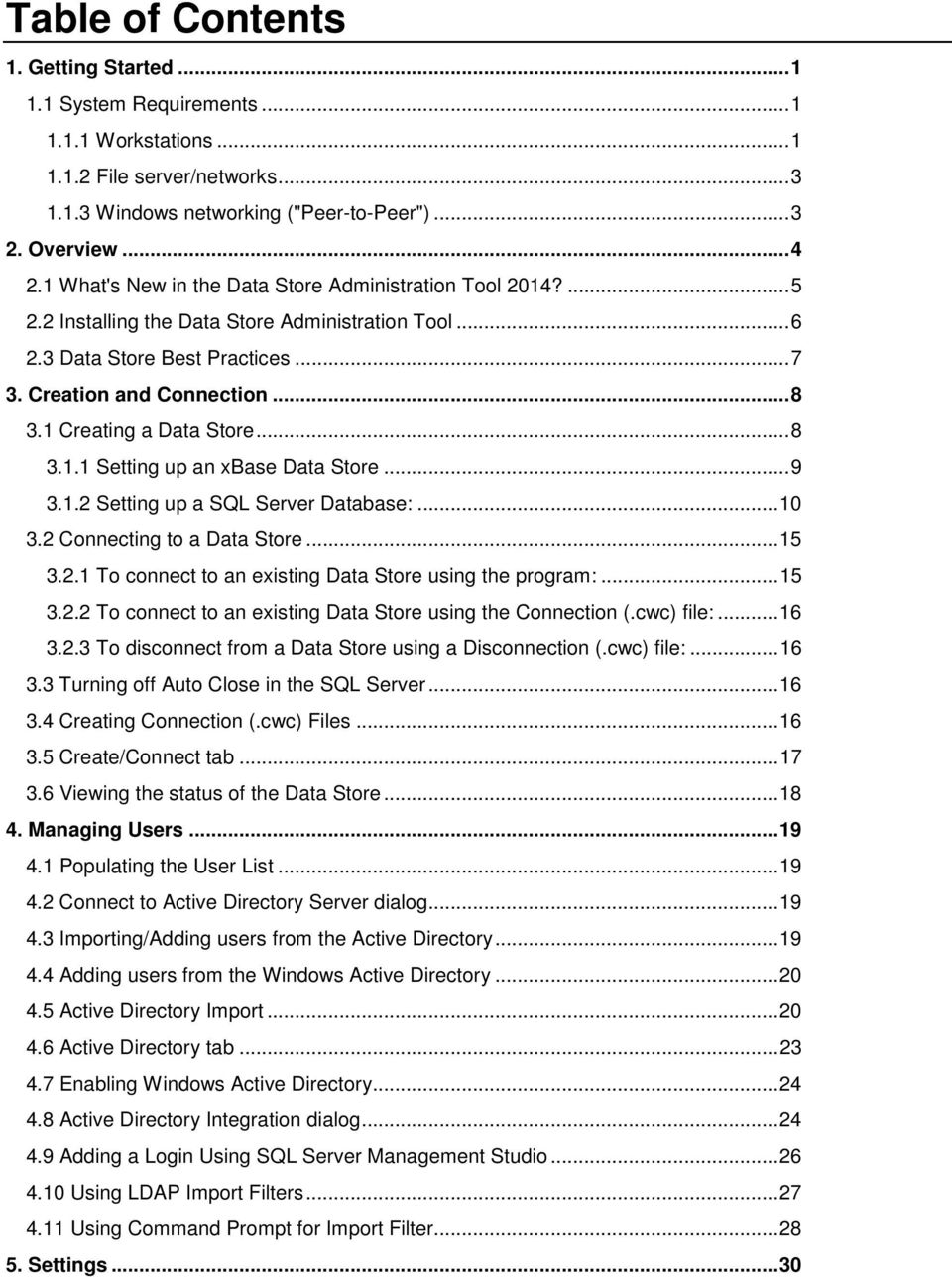
3 Table of Contents 1. Getting Started System Requirements Workstations File server/networks Windows networking ("Peer-to-Peer") Overview What's New in the Data Store Administration Tool 2014? Installing the Data Store Administration Tool Data Store Best Practices Creation and Connection Creating a Data Store Setting up an xbase Data Store Setting up a SQL Server Database: Connecting to a Data Store To connect to an existing Data Store using the program: To connect to an existing Data Store using the Connection (.cwc) file: To disconnect from a Data Store using a Disconnection (.cwc) file: Turning off Auto Close in the SQL Server Creating Connection (.cwc) Files Create/Connect tab Viewing the status of the Data Store Managing Users Populating the User List Connect to Active Directory Server dialog Importing/Adding users from the Active Directory Adding users from the Windows Active Directory Active Directory Import Active Directory tab Enabling Windows Active Directory Active Directory Integration dialog Adding a Login Using SQL Server Management Studio Using LDAP Import Filters Using Command Prompt for Import Filter Settings... 30
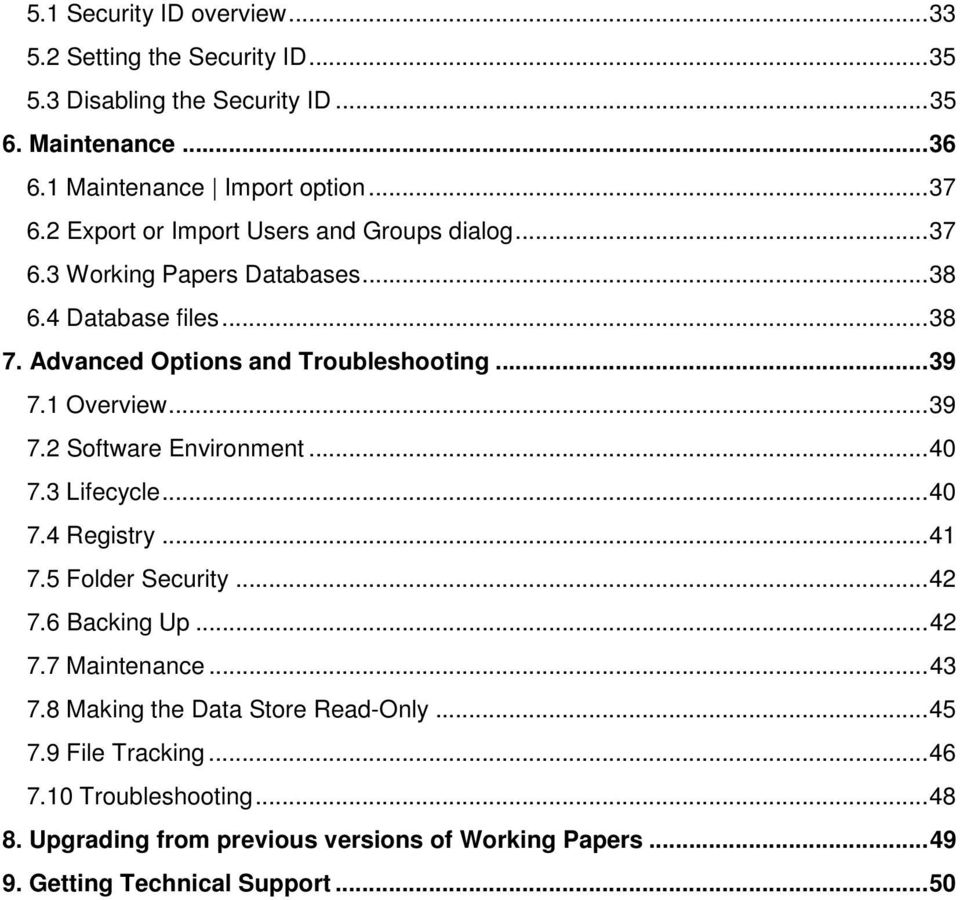
4 5.1 Security ID overview Setting the Security ID Disabling the Security ID Maintenance Maintenance Import option Export or Import Users and Groups dialog Working Papers Databases Database files Advanced Options and Troubleshooting Overview Software Environment Lifecycle Registry Folder Security Backing Up Maintenance Making the Data Store Read-Only File Tracking Troubleshooting Upgrading from previous versions of Working Papers Getting Technical Support... 50
5 1. Getting Started 1.1 System Requirements CaseWare Working Papers requires minimum machine and software requirements for: Workstations File server/networks Windows networking ("Peer-to-Peer") Workstations Operating systems Microsoft Windows 8 or higher Microsoft Windows 7 Professional Service Pack 1 or higher Note: See here for important information when sharing files hosted on Windows 7. Microsoft Windows Vista Service Pack 2 or higher Note: See here for important information when sharing files hosted on Windows Vista. Microsoft Windows XP Professional Service Pack 3 or higher* Hardware *On April 8, 2014, Microsoft will end their support for Windows XP and Office On that date, Windows XP and Office 2003 will no longer be supported for any CaseWare products. Please visit to view a list of supported Windows operating systems for our products. 1 GHz 32-bit (x86) or 64-bit (x64) processor Minimum 512 MB of system memory; 1,024MB or more recommended for improved performance. The Working Papers program requires 150 MB hard drive space. The size of open client files will vary depending on the features used and the size of documents managed. Working Papers has built-in compression that significantly reduces the size of compressed files. SVGA monitor capable of 256 colors and 800x600 resolution is required. A monitor with 1280x1024 resolution or higher is recommended. Dual monitors are supported. Internet access is required during the installation of Working Papers. Updates between releases are available as downloads from the CaseWare International Inc. website at A high-speed internet connection is recommended for downloading program updates. Copyright 2013 CaseWare International Inc. 1

6 Additional Components - Microsoft Office Microsoft Office 2013 (32-bit and 64-bit) Microsoft Office 2010 (32-bit and 64-bit) Microsoft Office 2007 Service Pack 3 or higher Microsoft Office 2003 Service Pack 3* *On April 8, 2014, Microsoft will end their support for Windows XP and Office On that date, Windows XP and Office 2003 will no longer be supported for any CaseWare products. Additional components - Other Microsoft Internet Explorer version 8.0 or higher Adobe Acrobat Reader version 11.0 or higher Security and permissions Installation requires local administrative rights to the workstation. Use of Working Papers requires read/write access to the program folder and any folders containing client files. SQL Server requirements for SQL Data Store The Working Papers Data Store can make use of a Microsoft SQL backend to store data. Working Papers 2014 (using a SQL Data Store) is compatible with the following SQL products: Microsoft SQL Server 2005 Microsoft SQL Server Express This is a free version of Microsoft SQL that the Data Store Admin tool will install (if required). The system requirements are as follows: Minimum 4 GB hard disk space per database Minimum 1 GB RAM 1 CPU - you can install and run SQL Server on multiprocessor machines, but only 1 CPU is used at any time. Microsoft SQL Server 2008 Microsoft SQL Server Express 2008 Microsoft MSDE 2000 This version has a limit of eight connections. Copyright 2013 CaseWare International Inc. 2

7 1.1.2 File server/networks A file server can be used to store Working Papers client files. Operating systems Microsoft Windows Server 2012 Microsoft Windows Server 2008 Note: See here for important information when sharing files hosted on Windows Server Microsoft Windows Server 2003 Service Pack 2 or higher Microsoft CIFS compatible networks like SAMBA on Linux Hardware Per file server/network operating system recommendations Windows networking ("Peer-to-Peer") In situations where a workstation is to be substituted for a true file server, we strongly recommend that the operating system for the workstation be Windows XP Professional (Service Pack 3 or higher). For Windows Vista or Windows 7 users, please refer to the CaseKnowledge article regarding file corruption when using a Windows Vista or Windows 7 workstation or Windows Server 2008 with Server Message Block (SMB2). Terminal services A Terminal or Citrix Server can host Working Papers program sessions for users. Requirements include: Notes Microsoft Windows Server 2012 with Terminal/Citrix Services Microsoft Windows Server 2008 with Terminal/Citrix Services Microsoft Windows Server 2003 with Terminal/Citrix Services Citrix MetaFrame XP, Presentation Server, XenApp 4.5 Server hardware configuration needs to be scaled (RAM, CPU) for the number of sessions to be hosted and the applications and templates used. For optimal performance, Working Papers client files should be stored on the Terminal/Citrix Server or connected to it via a high-speed network connection. Copyright 2013 CaseWare International Inc. 3

8 2. Overview Data such as users and file lists are automatically stored in the local computer the first time that CaseWare Working Papers is launched. This collection of data is contained in private storage, accessible only to the single user, and is referred to as the Personal Data Store. Important: Since the storage is private, there is no way to share user lists between computers if this configuration is used. Alternatively, a Data Store can be created and accessed on multiple machines. All users connected to the same Data Store have access to a common set of users, global groups, file list, Tracker settings, and store configuration information. Data Store Administration Tool is a part of the CaseWare Working Papers suite of products. The Data Store Administration Tool enables administrators to create, customize, and maintain Data Stores that will be accessed by multiple users. It is intended for use by an administrator with a fairly high level of IT experience. Deciding Whether to Use a Data Store Using a Data Store is necessary if one or more of the following hold true: You want the protection system on all computers in your firm to have access to a common list of users and global groups. You want Tracker on all computers in your firm to have access to a common list of accessed client files. You want to use the Active Directory features to populate the user list and to enable Windows authentication. You want to use the Security ID feature. Note: If you are upgrading from a previous version of Working Papers, please review the latest Data Store updates. Using the Data Store Administration Tool, you will be able to: Create a Data Store Connect to a Data Store Import users and groups Customize Data Stores Maintain the Data Store Copyright 2013 CaseWare International Inc. 4

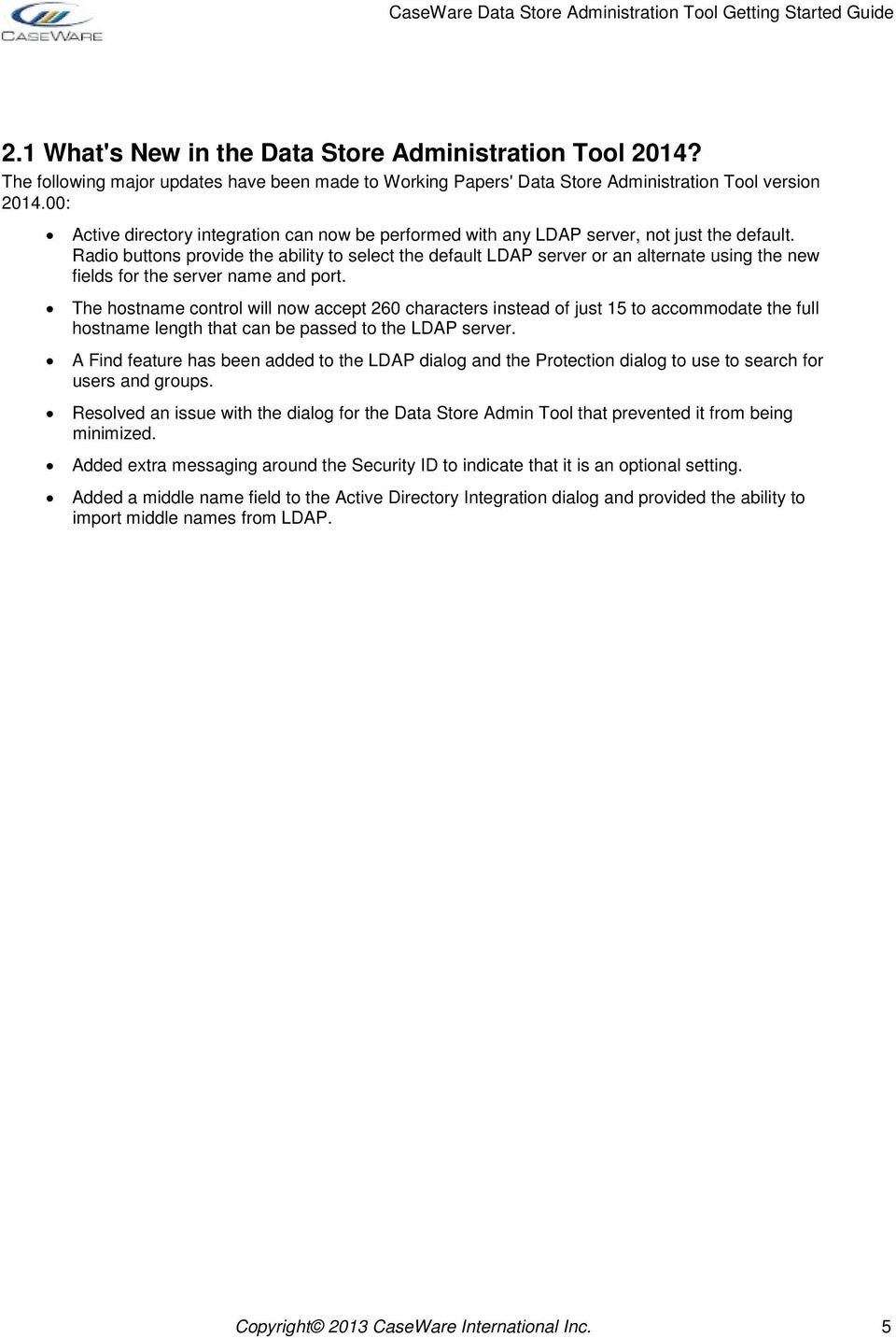
9 2.1 What's New in the Data Store Administration Tool 2014? The following major updates have been made to Working Papers' Data Store Administration Tool version : Active directory integration can now be performed with any LDAP server, not just the default. Radio buttons provide the ability to select the default LDAP server or an alternate using the new fields for the server name and port. The hostname control will now accept 260 characters instead of just 15 to accommodate the full hostname length that can be passed to the LDAP server. A Find feature has been added to the LDAP dialog and the Protection dialog to use to search for users and groups. Resolved an issue with the dialog for the Data Store Admin Tool that prevented it from being minimized. Added extra messaging around the Security ID to indicate that it is an optional setting. Added a middle name field to the Active Directory Integration dialog and provided the ability to import middle names from LDAP. Copyright 2013 CaseWare International Inc. 5
10 2.2 Installing the Data Store Administration Tool The Data Store Administration Tool is a component separate from Working Papers, which allows you to create, connect to, and customize Data Stores. It is intended for use by an administrator. The Data Store Administration Tool can be installed on a server or directly onto the administrator's workstation. If installed on the server, the administrator will have to physically log in to the server and run the program from there to perform the actions. A more convenient option is to install the program on his or her own workstation. However, if installing SQL Server or SQL Express Server, the SQL component must be installed on the server. 1. Launch the setup program for the Data Store Administration Tool. The Data Store Administration Tool InstallShield Wizard launches. 2. On the Welcome screen, click Next. 3. On the License Agreement screen, read the terms, and select the option to accept the terms and click Next. 4. On the Select Options screen, select the Install the Data Store Administration Tool option and/or Install Microsoft SQL Server 2005 Express. Note: Only install Microsoft SQL Server 2005 Express if you do not have an existing SQL server installed. If you are installing Microsoft SQL Server 2005 Express, please refer to the Microsoft website for system requirements. 5. Click Next. 6. Click Install. Copyright 2013 CaseWare International Inc. 6

11 2.3 Data Store Best Practices The best practices in this section all relate to the setup and configuration of the Working Papers Data Store. The Data Store should be set up using the Data Store Administration Tool for optimal performance. In the Settings tab of the Data Store Administration Tool, ensure that the Synchronization field is set to Only on program startup. The Track Engagement field, also in the Settings tab, controls how files are tracked by the Data Store. For these environments, either Track But Do Not Share with Firm or Disable Tracking should be selected in this field. The Track and Share with Firm setting should not be used unless you are using CaseWare Tracker and have a requirement to monitor the files other users are working on as this feature requires increased network bandwidth. Note: Working Papers will frequently ping the Data Store to check its connection status. If one ping fails, the program will stop pinging and the Data Store status icon will remain as a red cross (offline) until you manually reconnect or restart the program. Copyright 2013 CaseWare International Inc. 7

12 3. Creation and Connection 3.1 Creating a Data Store Prerequisites Before creating a Data Store, ensure that each person who will be attached to the Data Store has read, write, and delete permissions for the directory and server. Procedure 1. Launch the Data Store Administration Tool. 2. Click the Create/Connect tab. 3. Click Create. The Data Store Creation Wizard opens. 4. Specify the type of store you want to create (either xbase or SQL). Click Next. New xbase Data Store Recommended for smaller offices whose users will be connecting to the Data Store over a reliable fixed wire network. New SQL Data Store Recommended for large offices (more than 50 users) or for any office that has an existing Microsoft SQL Server. 5. Refer to Setting up an xbase Data Store or Setting up a SQL Server Database to continue. Copyright 2013 CaseWare International Inc. 8

13 3.1.1 Setting up an xbase Data Store 1. Type in or click Browse and navigate to the location where you want the data store to be saved. Click Next. To create a new xbase store, enter the folder where you want the store to be created. Either a drive mapped location (i.e., m:\companydata) or a UNC (i.e., \\sharedserver\store) may be used. It is important that all users who need to attach to the store have full rights (read/write/delete) to the network location. If a store already exists at the specified location or if the directory you specified cannot be created, an error message will appear. Important: Record the location of the newly created store. This location will be required later for other computers connecting to this Data Store. 2. Refer to step 6 of Setting up a SQL Server Database below to finish creating your xbase Data Store. Copyright 2013 CaseWare International Inc. 9

14 3.1.2 Setting up a SQL Server Database: 1. Select the SQL product being used to create the tables. The choices are: Microsoft SQL Server 2000 Microsoft SQL Server 2005 Microsoft SQL Server 2005 Express Microsoft SQL Server 2008 Microsoft SQL Server 2008 Express Microsoft SQL Server 2012 Microsoft SQL Server 2012 Express 2. Select or enter a server name. The drop-down list contains all available servers on the company network. Select the one on which the SQL databases to be used are located. 3. Enter a unique database name. This database name should indicate that this is a Working Papers database if possible and should follow your organization s standards for database names. Note: If you are using a SQL database, you must ensure that the Auto Close property for the database is set to False. See Turning off Auto Close in the SQL Server for more information. Copyright 2013 CaseWare International Inc. 10

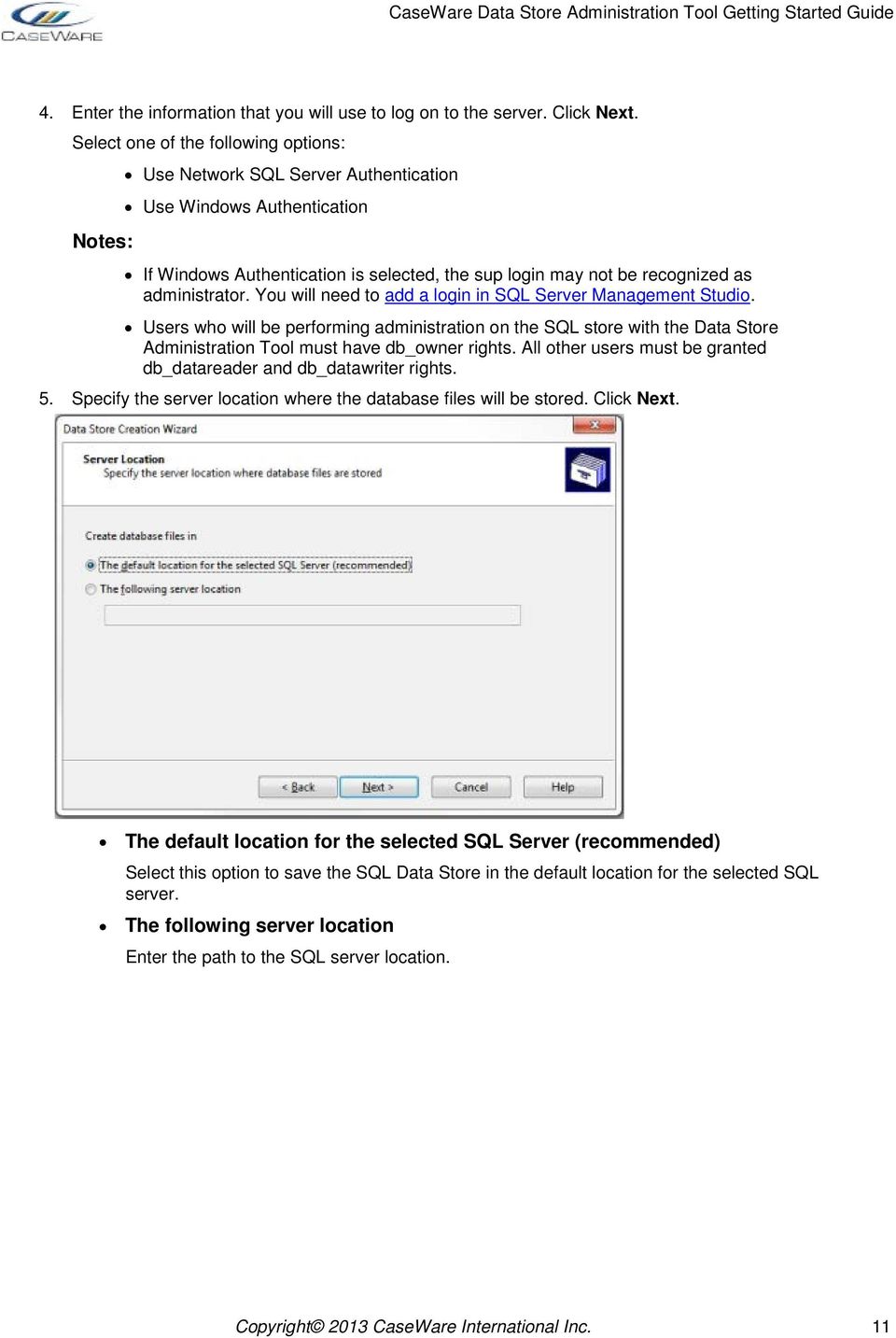
15 4. Enter the information that you will use to log on to the server. Click Next. Select one of the following options: Notes: Use Network SQL Server Authentication Use Windows Authentication If Windows Authentication is selected, the sup login may not be recognized as administrator. You will need to add a login in SQL Server Management Studio. Users who will be performing administration on the SQL store with the Data Store Administration Tool must have db_owner rights. All other users must be granted db_datareader and db_datawriter rights. 5. Specify the server location where the database files will be stored. Click Next. The default location for the selected SQL Server (recommended) Select this option to save the SQL Data Store in the default location for the selected SQL server. The following server location Enter the path to the SQL server location. Copyright 2013 CaseWare International Inc. 11
16 6. Choose to create a blank Data Store or Import from an existing Data Store. To create a new and empty Data Store, select Create a blank Data Store. To import data from an existing Data Store, select Import from existing Data Store. If you select the Import Users and Groups option, you must also provide the import location, the administrator user name, and password. Note: You can also import users from the EM database (Employee database) where all of your employee information can be safely stored. Import Users and Groups Select Import Users and Groups if applicable. See more... Import Location Provide the import location. Click Browse to navigate to a location. Administrator User Name/Password Provide the Administrator User Name and Password. Note: If you choose not to import Global Groups, references to those groups will be removed from the client files when opened. It is strongly recommended that you import Global Groups if they had previously been set up. Copyright 2013 CaseWare International Inc. 12

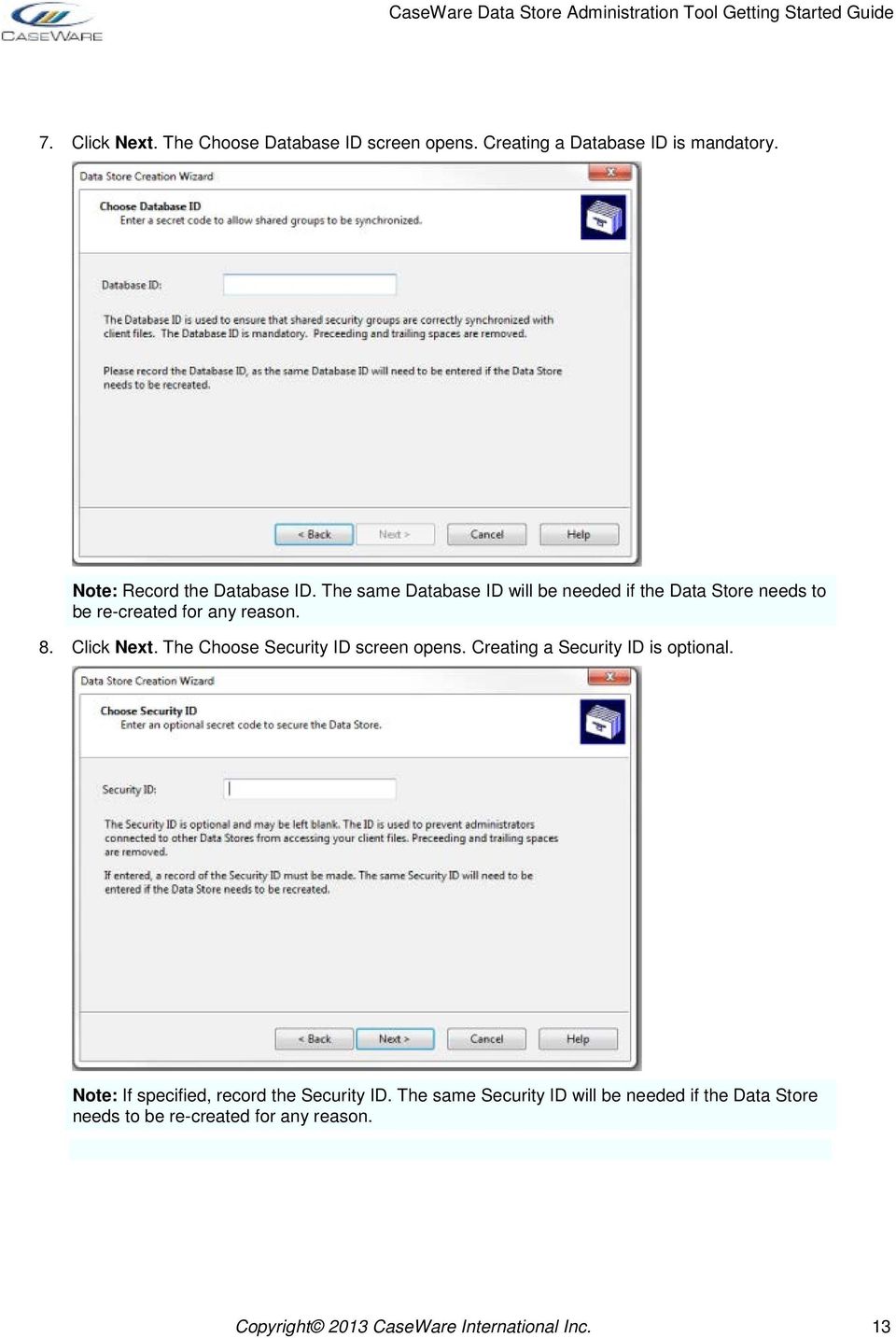
17 7. Click Next. The Choose Database ID screen opens. Creating a Database ID is mandatory. Note: Record the Database ID. The same Database ID will be needed if the Data Store needs to be re-created for any reason. 8. Click Next. The Choose Security ID screen opens. Creating a Security ID is optional. Note: If specified, record the Security ID. The same Security ID will be needed if the Data Store needs to be re-created for any reason. Copyright 2013 CaseWare International Inc. 13
18 9. Click Next. The Choose Connection File screen opens. Type in the location or click Browse and navigate to a location to save the connection (.cwc) file. For more information on connection files, please refer to Creating Connection Files. 10. Click Next. The Data Store Creation Wizard Complete screen opens. 11. Click Finish. Results All of the information regarding the newly created SQL or xbase Data Store, connection file, Database ID, and Security ID will be displayed. If you created an xbase Data Store a.cws file will be created in the location you specified,.cws files point to the location of the Data Store. If you created a SQL Data Store, a.cwc file will be created in the location you specified,.cwc files are connection files used to connect/disconnect other users to your Data Store. Copyright 2013 CaseWare International Inc. 14

19 3.2 Connecting to a Data Store Once the Data Store has been created, all computers that require access can be connected to the Data Store To connect to an existing Data Store using the program: 1. Launch the Data Store Administration Tool. 2. Click the Create/Connect option. You will see the currently connected Data Store and its state, all of which are read-only. If you are not connected to a Data Store, the Data Store field will read No store currently active. and the Status will be N/A. If you are connected to an xbase store, the location of the.cws file as well as its status will be shown. When connected to the store with no errors, the status will be Online. When unable to connect to the store (e.g. the store folder is deleted or moved), the status will be Offline. If you are connected to a SQL store, all SQL connection properties will be shown, along with the status. 3. Click Attach. The Data Store Connection Wizard opens. 4. Select whether you are connecting using the.cwc file, connecting to an xbase store, or connecting to a SQL store. Click Next. 5. Based on your previous selection, perform one of the following: a. If you are using an existing connection file (.cwc), enter the location of the.cwc file. b. If you are connecting to an xbase store, enter the location of the existing xbase Data Store (.cws file). c. If you are connecting to a SQL store, enter all SQL connection information. 6. Click Next. 7. Follow the instructions on the wizard to finish connecting to the Data Store. Copyright 2013 CaseWare International Inc. 15

20 3.2.2 To connect to an existing Data Store using the Connection (.cwc) file: Non-administrators can use the.cwc files created by administrators to connect to or disconnect from Data Stores. 1. Double-click the connection file created by the administrator. 2. Restart Working Papers by closing and re-opening the program. Note: Non-administrator users do not need to install SQL Server or SQL Express to connect to a SQL-based Data Store. The user should have access to the folder where the connection file resides To disconnect from a Data Store using a Disconnection (.cwc) file: 1. Double-click the disconnection file created by the administrator. 2. Restart Working Papers by closing and re-opening the program. Note: Ensure your SQL Server is configured to accept remote connections before connecting to a Data Store or else users may experience difficulty connecting to the store. To enable remote connections you need to run the SQL Server Configuration Manager tool (bundled with the SQL Server installation package) and in the section of SQL Server Network Configuration Protocols for 'Your SQL Instance Name', make sure TCP/IP is enabled. 3.3 Turning off Auto Close in the SQL Server When you create a Data Store in a SQL Server, you must set the Auto Close property for the SQL database to False. This ensures that the database does not unexpectedly go offline if no one is connected to it. 1. Launch Microsoft SQL Server Management Studio Express. 2. In the Databases folder, locate the database that you created for the Data Store. 3. Right-click the database folder and click Properties. 4. In the Select a page panel, click Options. 5. In the Automatic panel, click the drop-down beside Auto Close. Choose False. 6. Click OK. 3.4 Creating Connection (.cwc) Files The main purpose of.cwc files is to distribute the Data Store settings to users without administrator rights so that they can connect to or disconnect from a Data Store. The.cwc files can be sent to other users (i.e. non-administrators) who can then use the file to access the Data Store. To create a.cwc file to connect to a Data Store: Ensure you are currently attached to a Data Store. 1. Launch the Data Store Administration Tool. 2. Click the Create/Connect option. 3. Click Save. 4. Type in or click Browse and navigate to a location to save the.cwc file. Note: It is recommended that you name the.cwc file "Connection file.cwc" to distinguish it from a disconnecting.cwc file. Copyright 2013 CaseWare International Inc. 16

21 To create a.cwc file to disconnect from a Data Store: Ensure you are currently not attached to a Data Store. 1. Launch the Data Store Administration Tool. 2. Click the Create/Connect option. 3. Click Save. 4. Type in the location or click Browse and navigate to a location to save the.cwc file. Note: We recommend that you name the.cwc file "Disconnection file.cwc" to distinguish it from a connecting.cwc file. 3.5 Create/Connect tab This tab shows the currently connected store and its state, all of which are read-only. Notes: When not connected to a Data Store, the dialog will say No Data Store currently active and the status will show as N/A. If connected to an xbase store, then the location of the.cws file as well its status will be shown. When connected to the store with no errors the status will be Online. When unable to connect to the store, the status will be Offline (e.g. if the store folder is deleted or moved). If connected to a SQL store, all SQL connection properties will be shown, as well at the status. When status is either not connected or "N/A", then all options on all other options will be disabled. Copyright 2013 CaseWare International Inc. 17
22 Create Launches the Data Store Creation Wizard, which allows you to create a new xbase or SQL store. Attach/Detach If the Attach button is shown, then you are not currently connected to a store and this button will allow you to connect to an existing SQL or xbase store. If the Detach button is shown, then you are currently connected and this option will simply disconnect you from the store. Clicking Attach launches the Data Store Connection Wizard. Note: You can also connect to an existing data store by navigating to the.cwc file on your computer and double-clicking on it. Save Allows you to create a new connection (.cwc) file. Specify the location to save the.cwc file and click Save. 3.6 Viewing the status of the Data Store Access these options by right clicking the Data Store menu within Working Papers. Properties Shows the properties of the data store such as Tracker settings and Data Store information. Note: This information is the same as the properties shown when selecting Tools Options Data Store from within a client file or Options Data Store when a client file is not open. Refresh Now Forces the Personal Data Store and Data Store to synchronize. The Data Store icon will change to the synchronization icon for a short period of time and then change back. If not connected to a Data Store, this icon will be grayed out. Connect/Disconnect When connected to a Data Store that is online, selecting Disconnect will take the Data Store offline. If connected to a Data Store that is offline, selecting Connect will take the Data Store online. The online/offline state of the Data Store will be preserved when you exit and re-open Working Papers. If no Data Store exists, this option will be grayed out. Copyright 2013 CaseWare International Inc. 18
23 4. Managing Users 4.1 Populating the User List When the Data Store is first created, it contains one administrative user, SUP with the password sup (note lowercase on the password). Subsequent users can be imported in one of the following ways: Note: Active Directory import Maintenance Import option For legacy import from previous versions of Working Papers, please refer to Upgrading from previous versions of Working Papers. In general, a firm will do an Active Directory import, legacy user list import, or an import through the Maintenance option. It is not necessary to import a user list: users may instead be added manually as described in the Working Papers help topic "Creating a new user". 4.2 Connect to Active Directory Server dialog Administrators will populate the user list used in Working Papers based on their current list of network users. Authentication can be done automatically on opening a client file, based on the current logged in Windows User. Setting up Active Directory User Authentication and importing from Active Directory is done from Tools Options Data Store. When Working Papers cannot find the LDAP server, for example the computer is not connected to a domain or the LDAP server is located on a different domain, the Connect to Active Directory Server dialog opens. Complete the following information in order to connect to the LDAP server. Host name Type the name of the LDAP server. Port number Type the LDAP port number. 4.3 Importing/Adding users from the Active Directory Users contained in the Windows Active Directory can be imported into the Working Papers user list. In addition to the user name, extra information such as the user s last name will be brought in. Using this integration with Active Directory, you can use the same user list for logging in to Working Papers that is used to log in to Windows and your company network. This means a user can have one ID and password that logs him or her in to your firm's network and automatically authenticates the user when he or she logs in to Working Papers. User accounts added to Working Papers from the Active Directory have restrictions on what can be updated. The first name, last name, and designation fields are grayed out in Working Papers. Information in those fields can be changed only in the Windows Active Directory. After updating, re-import the updated user accounts. Copyright 2013 CaseWare International Inc. 19
24 Note: The Active Directory Import is available only if a Data Store is being used and if Active Directory Integration is turned on in the Administrator options dialog (Tools Options Data Store Administrator Options). The import can only be done from the default Active Directory server. It is possible to import from several Active Directory servers. However, the import for each server must be done from a computer which connects to that server by default. Users not assigned to global groups will not have protection rights. You must assign users to a global group with protection rights to enable protection. 4.4 Adding users from the Windows Active Directory User accounts added to Working Papers from the Active Directory have restrictions on what can be updated. The first name, last name, and designation fields are grayed out in Working Papers. Information in those fields can be changed only in the Windows Active Directory. After updating, re-import the updated user accounts. 1. Enable the Windows Active Directory if it's not already enabled. 2. Click Synchronize with Active Directory. 3. Scroll down the list and check the synchronize box beside each user to add from the Active Directory. 4. As applicable, enter a Default Password for New Users. 5. Select the check box beside Require user to change this password to require users to change the default password to a new one the first time they log in to Working Papers. 6. Click OK to process the additions. 7. Click OK to close the Data Store options. 4.5 Active Directory Import The Active Directory Import allows users contained in the Windows Active Directory to be imported into the Working Papers user list. In addition to the user name, additional information such as the user s last name and middle name will be brought in. A user can have one ID and password that logs him or her in to the firm's network and automatically authenticates the user when he or she logs in to Working Papers. The Data Store can manage users in conjunction with Windows using the LDAP protocol to check the user s login and workstation hostname for logins. In previous versions of Working Papers, the maximum length for the hostname was 15 characters. Since many complex hostnames were too long for this field to accommodate, hostnames up to 260 characters can now be handled when validating Active Directory logins. This change should be able to accommodate almost any required hostname during user login validation. Note: The import can only be done from the default Active Directory server. It is possible to import from several Active Directory servers. However, the import for each server must be done from a computer that connects to that server by default. If a Time-integrated Data Store is being used, users are imported as non-timekeepers for Time. If a user is to be designated as Timekeeper, the user must be explicitly set as such in the Staff dialog in Time Copyright 2013 CaseWare International Inc. 20
25 Prerequisites Assigning an Active Directory admin user may be useful in the event that you Allow Active Directory authenticated users only. To import users from the Active Directory to your Data Store: 1. Launch the Data Store Administration Tool. 2. Click the Active Directory option. You will be required to enter your administrator's login and password. 3. Specify the fields. For more information, see Active Directory. Copyright 2013 CaseWare International Inc. 21
26 4. Click Synchronize with Active Directory. The Active Directory Integration screen that appears should display all of the Active Directory users that can be integrated with the Data Store. Select the check box in the Synchronize column for any staff that will have access to Working Papers. 5. The Default Offline Password can also be set on the screen above. This password is shared for all logins and enables users to access the Data Store even if the Active Directory authentication is unavailable. Once you have selected all of the required users and filled in the Default Offline Password if required, click OK to continue. Note: By default Active Directory will never include disabled users in an LDAP import. Copyright 2013 CaseWare International Inc. 22
27 4.6 Active Directory tab When you are connected to a Data Store, you will need to log in before accessing the Active Directory tab. Enable Active Directory Integration Select this option to enable all other controls in the dialog. Active Directory must be connected to allow authentication If selected, authentication will not be allowed using cached credentials. If Active Directory is not available then users will not be able to log in. Allow Active Directory authenticated users only If selected, the Working Papers option Tools Change User will be disabled and only Active Directory users will be able to log in. If it is not selected then mixed types of users can log in. For more information on this option you can search the Working Papers help for, "Logging in as a different user". Default/Non-Default LDAP Server The default LDAP server that is set up in the Data Store tool is selected by default. To connect to a non-default LDAP server, specify the host name and port. Filter field The administration tool now provides a filter option when importing users with Active Directory Integration. You can specify expressions to filter based on built-in or custom user attributes and Windows group memberships. Wildcards are supported. For more information, see Using LDAP Import Filters. Synchronize with Active Directory Click this button to launch the Active Directory Integration dialog. Copyright 2013 CaseWare International Inc. 23
28 4.7 Enabling Windows Active Directory 1. Launch the Tools Options Data Store screen. 2. Click the Administrator Options button. 3. Click to check the box beside Enable Active Directory Integration. 4. Click OK to close the dialog. 4.8 Active Directory Integration dialog The Data Store can manage users in conjunction with Windows using the LDAP protocol to check the user s login and workstation hostname for logins. In previous versions of Working Papers, the maximum length for the hostname was 15 characters. Since many complex hostnames were too long for this field to accommodate, hostnames up to 260 characters can now be handled when validating Active Directory logins. This change should be able to accommodate almost any required hostname during user login validation. Note: If a Time-integrated Data Store is being used, users are imported as non-timekeepers for Time. If a user is to be designated as Timekeeper, the user must be explicitly set as such in the Staff dialog in Time. Default Offline Password Check to require a user to enter an offline password when he cannot be authenticated by Active Directory. Import user initials Check the box to import the users' initials. Import user middle name Check the box to import the users' middle name. Copyright 2013 CaseWare International Inc. 24
29 The following table describes each column in the dialog: Synchronize Select the Synchronize check box beside the Windows users who are to be imported as Working Papers users. Users who had previously been imported will automatically be selected for re-synchronization. This allows Working Papers to update the information for its users (synchronize the information) with the information stored in the Active Directory. Important: If the Synchronize check box is cleared for a user that had previously been imported from the Active Directory (that is, the user exists in the Active Directory user list and Working Papers' user list), the user is removed from the Working Papers' user list, but remains in the Windows Active Directory. Active Force Password Change Is Password Set? OU Path OU Common Name Last name Title Physical Delivery Office Name First Name Department Company Phone Number Cell Phone Account Name DN (Distinguished Name) Initials Middle Name To import the user as active, select the Active check box beside the user. If the check box is cleared, the user is imported as inactive. Only active users can be assigned to groups. Check the box to require users to change the default password to a new one the first time they log into Working Papers. This indicates whether a user has a password or not. Use this column to group and sort by users with or without passwords. The path to the organizational unit. The Active Directory organizational unit containing the users and computers managed by the logged in administrator. The common name (CN) of the user with an account in the Active Directory organizational unit. The last name of the user stored in the Windows Active Directory. The title of the user stored in the Windows Active Directory. The name of the user's office. The first name of the user. The department name of the user. The company name of the user The address of the user. The phone number of the user. The cell phone number of the user. The account name of the user A unique identifier for the user. The initials of the user. The middle name of the user. Copyright 2013 CaseWare International Inc. 25
30 LDAP Find In large organizations that use LDAP and Windows Active Directory to manage user access to Working Papers, it can be difficult to locate a particular user or other LDAP object or attribute due to the volume of data involved. Therefore, Working Papers includes a Find function when dealing with LDAP in the Protection and LDAP setup dialog boxes. This dialog box is available through the Ctrl+F hotkey combination in the Protection and LDAP setup dialog boxes. The Find what field is used to enter the search term. The Where field is used to filter the search for particular kinds of LDAP information such as: Anywhere User ID Group Description Actual Rate Plan Rate The Match field can be used to search on Any Text or the Whole Word used in the Find What field. The Match Case check box is used to match the character cases used in the search term(s). In the left pane of the Protection setup dialog box where Users and Global Groups information is contained, Ctrl+A can also be used now to select all entries. 4.9 Adding a Login Using SQL Server Management Studio When Windows Authentication is turned on you must login through the SQL server. If your login is not recognized you will not be able to login. You can add logins to SQL Server Management studio. This is useful when Windows Authentication is turned on for a SQL Data Store. Prerequisites Ensure SQL Server Management Studio is installed on your machine (bundled with the SQL Server installation package). Procedure 1. Launch SQL Server Management Studio. 2. Login using your credentials. Click Connect. 3. Navigate into the folders Security Logins. 4. In the Logins window, right-click and select New Login. 5. Specify all of the fields in the Login - New dialog. Click OK. Results Your login has been created. Reattempt logging into Data Store if you were having issues. Copyright 2013 CaseWare International Inc. 26
31 4.10 Using LDAP Import Filters You can use the filter field to customize your Active Directory Import. To use the filter field to customize your Active Directory Import, follow this procedure. Note: The filter field is available when Enable Active Directory Integration has been checked. Procedure 1. From the Data Store Administration Tool, click the Active Directory tab. Enter any credentials. 2. In the Filter field, enter a filter such as department=w* to retrieve all active users in a department that starts with the letter 'w'. 3. Click Synchronize with Active Directory. Results The Active Directory Integration dialog opens and all active users in a department that starts with the letter 'w' will be displayed. Filter examples: To retrieve users last modified between Jan. 01, 2013 and April 04, 2013 type: &(whenchanged>= z) (whenchanged<= z) To retrieve all active users in a department that starts with the letter 'w' type: (department=w*) To retrieve all active users from the LDAP server type: (!useraccountcontrol: :=2) To retrieve users in some Windows group membership type: (memberof=xxx) - where, xxx, represents the distinguished name of the Windows group Copyright 2013 CaseWare International Inc. 27
32 Filter parameters: Parameter Description -LDAP -DP -UI -MN -Filter -Host -Port -LU -LP -LD Perform LDAP import Default offline password Import user initials Import middle name (Optional) LDAP filter expression (Optional) LDAP host name (Optional) LDAP port number (Optional) User name (Optional) User password (Optional) Domain name 4.11 Using Command Prompt for Import Filter Follow this procedure to use command line parameters for your Active Directory Import instead of the filter field. Procedure 1. In your C: drive, navigate to the Windows System32 folders. 2. Navigate to cmd.exe. Right click and select Run as Administrator. 3. Enter cd \. Press ENTER. 4. Enter cd program files (x86). Press ENTER. Copyright 2013 CaseWare International Inc. 28
33 5. Enter cd "CaseWare Data Store Administration Tool". Press ENTER. 6. Type sharedstoreadmin.exe (followed by your customized filter). Press ENTER. Results The Data Store Administration Tool and the Active Directory Integration dialog opens to begin your import. Filter Example You can type SharedStoreAdmin.exe -U sup -P sup -LDAP (replace sup with your username/password) to perform an LDAP import. In this example, SharedStoreAdmin executes Data Store, -U and -P represent logging on with a username and password and -LDAP will perform an LDAP import. Note: If there is a space between parameters you must use quotation marks around the parameters. e.g. Instead of using SharedStoreAdmin -U sup -P sup -LDAP -filter (department=working papers), you must put quotation marks around 'working papers'. The correct syntax is SharedStoreAdmin -U sup -P sup -LDAP -FILTER (department="working papers"). Copyright 2013 CaseWare International Inc. 29
34 5. Settings When you are connected to a Data Store, you will need to log in before accessing the Settings tab. Use this tab to specify custom properties for your file information. Click the Settings tab to access these options. Database ID The Database ID is displayed for informational purposes only and may not be modified. This is set when the Data Store is created. The database ID provides a label for the global group database (including information such as the name, rates, security settings, and users) stored in the Data Store. It is set when the Data Store is created. The database ID ensures that global group information maintained in the Data Store is correctly synchronized with client files. When the user is connected to the Data Store, the database ID is written into the client file when it is first accessed. Therefore, the synchronization of global group information can only be performed if the database ID contained in the Data Store matches the ID contained in the client file. Note: The database ID for the Data Store cannot be changed once it is set. Copyright 2013 CaseWare International Inc. 30
35 Security ID If a value has already been set, this is a read-only field and cannot be edited. If it was blank and you enter a value, the field will become read-only. The security ID feature prevents unauthorized administrative access to a client file that has protection enabled. The security ID may be specified if not previously set. If previously set, it will be displayed for informational purposes only and may not be modified. As an administrator, you can prevent administrators of other Data Stores from having full access to client files by setting a security ID. The security ID adds another level of protection to the client file; however, you can choose not to set it and allow administrators of other Data Stores to have full administrative access to files. Important: The security ID feature does not affect non-administrators. It only serves to prevent unauthorized administrative access. Synchronization Select the frequency at which to synchronize the personal stores with the Data Store. You can choose to synchronize upon startup, every 5, 15, or 30 minutes. Track Engagement You can control whether client file access is recorded in the Data Store. The options selected here are then displayed in the Settings tab if you want to see the properties that have been set. The choices are: Disable Tracking If tracking files overburden your computer system s resources or there is no need to list all client files in Tracker, you can turn off file tracking and sharing by selecting Disable tracking. In this case, no file data is processed to either the personal or Data Stores. No record of client file access will be made in the Data Store. This is a shared setting that will be used by all users. An individual user may not override this option. Track But Do Not Share with Firm If you want files to be tracked by the Personal Data Store only, also select Track But Do Not Share with Firm. The file information is not shared with others attached to the Data Store. Each user will have access to the list of files he or she has accessed. This list will not be accessible to other users in the firm. This is a shared setting that will be used by all users. However, users have an option to override this choice in Working Papers and turn off file tracking altogether in the main Tools Options Data Store tab. Track and Share with Firm To track files, select Track and Share with Firm. Once selected, files are tracked and shared firm wide. Everyone attached to the same Data Store can view each other s file information using Tracker. All file access is recorded and the list of all users file accesses is available to all users. This is a shared setting that will be used by all users. However, users have an option to override this choice in Working Papers and turn off file tracking altogether or to view only their own engagements in the main Tools Options Data Store tab. Copyright 2013 CaseWare International Inc. 31
36 Note: Require log in for Tracker If this option is selected, users must log in to Tracker when it is opened. To ensure only users who are administrators can create shared views in Tracker, select the Require log in for Tracker check box. When Tracker is opened, the Log In dialog appears. If the Administrator check box is selected for the user logging in, then the user has administrative rights to create, copy, modify, or delete shared views. If the Administrator check box is cleared for the user, then only personal views can be created, copied, modified, or deleted. To permit all users to create, copy, modify, or delete shared views, clear the check box. If both the Enable Active Directory Integration check box and the Require log in for Tracker check box are selected, then the user is automatically logged in on opening Tracker. Perform log in after client files are uncompressed If this option is selected, the file will be uncompressed first before the login dialog shows. If you won't provide the correct login credential or simply cancel the login dialog, file will be left uncompressed If this option is cleared, the login dialog will show up before the file is uncompressed. If the login process does not proceed properly, file will be left compressed. Note: When converting a compressed 2009 file into a 2010 or higher version, or opening a previously compressed 2010 file, in both cases if the Perform log in after client files are uncompressed option is cleared when the files were compressed- opening these files will always require you to log in first regardless of your current DSAT setting. Use personal store image If this option is selected, a personal store image will be created and used. A personal store image is essentially an up-to-date copy of a fully synchronized personal store. Using a personal store image allows for the fast creation of a personal store for new users or for quick updating of personal stores for users already connected to a Data Store. A personal store image reduces the load on a Data Store server. Browse If you select the Use personal store image option, you will be prompted to enter the location of either an existing personal store image or the location of where you want the image to be created. It is important to enter a path that is accessible by all users who will need to access the image; a shared network location is ideal. Refresh From time to time, you may want to update the contents of an existing personal store image. For example, if the contents of a Data Store changes significantly, it is advantageous to create a new personal store image to allow both new users connecting to the Data Store and existing users to quickly receive a fresh synchronized copy of the Data Store. To update a personal store image, click Refresh. The first time you run Working Papers after a personal store image is created, you will receive a pop-up message stating that the program must be restarted to allow for synchronization of the personal store image. This message will appear only once. Copyright 2013 CaseWare International Inc. 32
37 5.1 Security ID overview The security ID feature prevents unauthorized administrative access to a client file that has protection enabled. As an administrator, you can prevent administrators of other Data Stores from having full access to client files by setting a security ID. The first time a client file is accessed, the security ID of the data store is written into the client file. This ID ensures that only administrators connected to the proper Data Store be granted full access to a particular file. The security ID adds another level of protection to the client file; however, you can choose not to set it and allow administrators of other Data Stores to have full administrative access to files. The Security ID is set using the Data Store Administration Tool. For more information, see Setting the Security ID. Important: The security ID feature does not affect non-administrators. It only serves to prevent unauthorized administrative access. When a Security ID is set Once a security ID is set, it is locked to that Data Store. When a client file is first opened by someone connected to the Data Store, the security ID of the Data Store is written into the client file. If a security ID is set, an administrator may log into a file only if the security ID of the data store matches the security ID of the client file. The security ID matching only occurs if a client file contains a security ID. If the IDs do not match, a message is displayed indicating that the security ID for the Data Store does not match the security ID of the client file. The Security ID feature can be disabled to allow administrators connected to a different data store to log into your files. Important: It is not required that the same Data Store that was active when a client file was first accessed be used when subsequently accessing the client file as an Administrator. It is only required that the Security ID remain the same. If the user list in the data store needs to be recreated for any reason, it is then only necessary to re-enter the same ID to have continued access to client files as an administrator. For this reason, it is important that a record of the security ID be made when creating a Data Store. Copyright 2013 CaseWare International Inc. 33
38 Copy Components and Security ID The Working Papers Copy Components function has the following limitations where security IDs are concerned when you are logged in as an administrator: Copy all components Copy some components to a new file Copy some components to an existing file The template is copied. The security ID is copied. The template is copied. The security ID is copied. The security ID is not copied. Note the following: Where the security ID is set in both the source and destination files, but they do not match, the template is not copied. To copy the template, log in as a nonadministrator with copy components rights. You need to log in to both files, so you need to have the appropriate rights for both files. You must also disable the security ID. If the source file does not have a security ID and the destination file does, the template is not copied. To copy the template, you can open the file while connected to the same Data Store as the destination file. Alternately you can use a non-administrator login with the appropriate rights. If copying from a protected file to an existing unprotected file, the security ID is not copied. Year End Close and Security ID If the source file is protected and has a security ID set, that security ID overwrites the security ID of the destination file. Copyright 2013 CaseWare International Inc. 34
39 5.2 Setting the Security ID To prevent unauthorized administrator access to files on a Data Store, an administrator can set a security ID. Important: You must keep a record of the security ID. If the user list in the Data Store needs to be recreated for any reason, the same ID must be entered to have continued access to client files as an administrator. To set the security ID when creating a Data Store with the Data Store Administration Tool: When creating a Data Store, enter a security ID in the Choose Security ID page of the Data Store Creation Wizard. 5.3 Disabling the Security ID When a security ID is set on the Data Store, client files linked to that Data Store cannot be opened by an administrator of a different Data Store. If you are an administrator of the Data Store, you can disable the security ID. By doing so, the protectionenabled client file can be opened by an administrator connected to a different Data Store. Once the security ID is disabled and an administrator of a different Data Store opens the client file, the following occurs: The Allow administrators connected to a different data store to log onto this file check box is cleared. The security ID of the new store is linked to the client file and can only be opened with the new Data Store. If no security ID exists in the new Data Store, the security ID is removed from the file. Note: The file is maintained under the original Data Store in the following circumstances: When a non-administrator connected to a different Data Store opens the client file. If the check box is cleared before the file has been opened by an administrator of a new store. To disable the Security ID: 1. From within a Working Papers client file select Tools Protection Protection Setup. The Users and Groups dialog opens. 2. Click the Setup button. The Setup Dialog opens. Note that you must be logged in as an administrator to access this tab. 3. Select the Allow administrators connected to a different Data Store to log onto this file check box. 4. Click OK. Copyright 2013 CaseWare International Inc. 35
40 6. Maintenance When you are connected to a Data Store, you will need to log in before accessing the Maintenance tab. Click the Maintenance tab to access these options. All options, except Resync, are disabled if any shared database is read-only. Upon successful completion of any of these operations, a message box will be generated indicating success. The following buttons are available for the Maintenance option: Resync Forces all users to resync their personal store. The user's Personal Data Store is automatically rebuilt the next time the user is online with the Data Store. Pack Packs the Data Store databases, which also forces a resync of all users. When users, global groups, or engagement file records are deleted, they are marked for deletion and are no longer displayed, but remain in the databases. Selecting Pack permanently removes these records from the Data Store databases. Note: If you select the Resync or Pack option, the Personal Data Store will not be resynced until you re-open Working Papers, click the Refresh button in the status bar, or select View Refresh. Repair Repairs the data store databases. Export Exports the users and groups database to the specified location. If you select this option, the Export Users and Groups dialog will open. Copyright 2013 CaseWare International Inc. 36
41 Import Imports users and groups databases from pre-existing Data Stores (Working Papers and lower). You can import old legacy user lists stored in a database file in the program directory. If you select this option, the Import Users and Groups dialog will open, allowing you to replace the existing list or merge an incoming user list with the existing list. Note: You can import EM databases. 6.1 Maintenance Import option You can also import users and groups using the Maintenance Import option within the Data Store Administration Tool. To import users and groups using the Maintenance Import option: 1. Launch the Data Store Administration Tool. 2. Click the Maintenance option. You will be required to enter your administrator login and password. 3. Select Import. The Import Users and Groups dialog opens. 4. Type in or click Browse to navigate to the folder containing the user/group database you would like to import. 5. Select Preserve passwords if you would like to retain the existing users passwords and not have them overwritten by new passwords. 6. Select whether to Merge the source and destination databases or Replace the user/group list in the destination entirely. 7. Click OK. 6.2 Export or Import Users and Groups dialog Access this dialog by clicking the Maintenance tab Export or Import. Export Users and Groups Type in the location or click Browse to navigate to the location where you would like to export the users and groups database. Copyright 2013 CaseWare International Inc. 37
42 Import Users and Groups Type in the location or click Browse to navigate to the folder containing the users and groups database you would like to import. Select Update Options: Merge source users and groups (new users and groups are added) Selecting this option will combine the original user list with the imported user list. The process will examine the incoming user names and either append them to the existing user list, or update the list of existing users. Note: This process will not delete existing records. Replace with source users and groups Selecting this option will replace the original user list with the imported user list. If the currently logged in user is not present in the import file, the current user's record will still remain in the database. Preserve passwords If importing, select this option to import the hash value of user passwords. 6.3 Working Papers Databases These are some of the key databases available in Working Papers: Trial Balance/ Financials (AM) Journal Entries Account Mapping Document Manager Employee Database (EM) For a complete listing of databases, see Database files. 6.4 Database files Files with the file name extension DBF are database files. DBF files store the data for the Working Papers client. For example, the AM.DBF file contains account information (i.e., account numbers, descriptions, ratio classes etc.) for a client's working trial balance. Note: Windows XP offline file support cannot be used with Working Papers as DBF files are not supported for offline synchronization. Copyright 2013 CaseWare International Inc. 38
43 7. Advanced Options and Troubleshooting 7.1 Overview This section is meant to provide you with detailed background knowledge for the CaseWare Working Papers Data Store; how it operates, its requirements and how to repair the Data Store if an error occurs. Note: This documentation contains information for all features of the Working Papers Data Store, some of which may not have been released for your specific region. It is important to note that in version 2009, the term "Shared Data Store" was replaced by "Data Store". The term "Personal Data Store" still refers to data such as users and file lists that are contained in private storage, accessible only to the single user. The Data Store is meant to be, for each user, a central location for certain types of information. Information that is stored in the Data Store comprises: Information Type Description File meta data Terminology Security users Security groups Shared settings Stores information about Working Papers files such as location, version information, compression state as well as meta data related to each file. Stores shared terminology for use in Working Papers. Stores list of users available for use in Working Papers security. Stores Global group information; group properties and user assignment to these groups. Stores Data Store configuration information. Ex. Database GUID, security ID, file tracking settings Local Settings Stores information about the state of the Personal Data Store such as the last time the store was synced and against which Data Store (Personal Data Store Only). Other than Local Settings, which is contained only in a Personal Data Store, the above information will be contained in both the Personal Data Store and the Data Store. If the user has specified a Data Store, then the information will be synchronized between the user's Personal Data Store and the Data Store. If multiple users connect to the same Data Store, then the information will be synchronized between all connected users. The Personal Data Store is contained within a folder called C:\Users\<user account name>\appdata\local\caseware. The files within this folder are stored as xbase database files. The Data Store is either contained in a SQL database if an SQL Data Store is being used or in a Data Store Windows folder if an xbase Store is being used. The table names are as follows: File(s) Personal Store Data Store (xbase) Data Store (SQL) File meta data files.dbf files.dbf TrackedFiles Terminology terms.dbf terms.dbf Terminology Security users users.dbf users.dbf Employees Security groups groups.dbf groups.dbf SecurityGroups Shared settings shprefs.dbf shprefs.dbf SharedSettings Local Settings prefs.dbf n/a n/a Addition file. Points to the location of the Data store. storeinfo.cws storeinfo.cws n/a Copyright 2013 CaseWare International Inc. 39
44 By default the Data Store always uses the Personal Data Store to retrieve any information because it should always contain accurate information due to synchronization (except when the Data Store is offline, in which case information will become stale as expected) and it is always guaranteed to be online. To ensure a correct and up-to-date list of client files, always manipulate a client file using Working Papers. For example, use File New or File Copy Components to create a new client file rather than copying the file through Windows Explorer. 7.2 Software Environment The following illustration shows two Data Stores running and both are connected to the same online Data Store. Store 1 is requesting information from the Data Store which will then retrieve it from the Personal Data Store (in most cases) because the Personal Data Store is always considered to be synchronized with the Data Store. Synchronization between the Personal Data Store and Data Store takes a variable amount of time depending on the size of the databases and how out-of-date the Personal Data Store is. Unlike all other operations the Data Store does not queue other requests (such as requesting an ICWCentralStoreFileInfo through the GetFileInformation() method) during synchronization, which means it is possible to request information that is not synchronized. 7.3 Lifecycle The order of events for the Data Store is as follows. The following assumes that the Data Store has already been set up and configured. For Data Store setup, please refer to DataStore.pdf in the CaseWare Data Store Administration Tool directory. 1. A CaseWare application (e.g. Working Papers, Tracker, etc.) is launched; this will automatically connect to the Data Store. 2. The Data Store will try to create the Personal Data Store if it does not already exist. 3. If anything goes wrong, the Data Store will put itself in the Disabled state ( ). To determine what is wrong, navigate to the Tools Options Data Store dialog. 4. If there is only a Personal Data Store and it was successfully created, the Data Store will enter the Enabled state ( ). Skip to 7. Copyright 2013 CaseWare International Inc. 40
45 5. If the Data Store is available then the Data Store will enter the Online state ( ) followed by the Synchronizing state ( ) and once synchronization is complete the Online state again. If the Data Store is not available then it will immediately enter the Offline state ( ). 6. The Data Store periodically monitors the availability of the Data Store (if specified) and if it changes, the current state of the Data Store will be modified. 7. Once all the applications using the Data Store are exited, all connections to the Data Store will be closed. 7.4 Registry The initialization of the Data Store is primarily controlled by the following registry key and its children (described later on): HKEY_CURRENT_USER\Software\CaseWare International\Data Store The Personal Data Store and Data Store settings are saved in the following registry keys, respectively: HKEY_CURRENT_USER\Software\CaseWare International\Data Store\Personal Store HKEY_CURRENT_USER\Software\CaseWare International\Data Store\Shared Store Each registry type can have the following values: Type Registry Values Description Personal Data Store Data Store (xbase) Data Store (SQL) Class COM Class Description Parameters PATH StorageType Database Name Password Product Type Server Name StorageType Use Windows Authentication Constant. Must have the value {ea56dd50-b33d-460c da507e4f11} {a55fcf6b b-86ad-8ca1e955e9c9} Personal Data Store The parameters used to create the Data Store. Typically this will be: C:\Users\<user account name>\appdata\local\caseware Path to the Data Store not including the Data Store\ part 2 (xbase) Name of the Data Store database on the SQL server Encrypted password to the SQL store Type of SQL server Name of SQL server 1 (SQL) 0 - use SQL authentication 1- use Windows authentication User Id Encrypted SQL user ID The standard procedure for users to connect to a Data Store is to use a connection file (.cwc). The connection file is described in the Data Store Administration Tool document. Copyright 2013 CaseWare International Inc. 41
46 However, some firms may want to have users connect to a Data store by pushing down the registry keys for the Data Store to each user. The recommended way to do this is to copy the registry keys from the administrator of the Data Store: 1. Launch the Data Store Administration Tool. Ensure that the administrator is pointing to a Data Store. Create a Data Store if required. 2. Run regedit.exe. Find the key HKEY_CURRENT_USER\Software\CaseWare International\Data Store\Shared Store. Right click on the key and select Export from the context menu. The resultant.reg file may be pushed down to users (for example in a windows login script). The Registry and Citrix This registry information is particularly useful for installations of the Data Store on a Citrix server. After installation of the software is complete, locate the top level branch of the registry HKEY_CURRENT_USER\Software\CaseWare International\Data Store. This can then be pushed to each user s registry through a login script or copied to the shadow directory. The CaseWare Best Practices for Citrix and Terminal Server guide for here should be consulted for all Citrix implementations of Working Papers. 7.5 Folder Security The Personal Data Stores and Data Stores always reside in a folder called "Data Store". Note that in Working Papers version 2008 and lower, the folder was named "Store". All users have a Personal Data Store usually located (although this can be different depending on the operating system) in the following folder: C:\Users\<user account name>\appdata\local\caseware For xbase Stores The Data Store should be placed in a location such as a network file server that is accessible to all users who will need to connect to it. All users using the Data Store must have sufficient permissions to create, read, and write to the Data Store folder. In addition, the parent folder must have sufficient permissions to allow the Data Store to create the Data Store s Data Store folder. For SQL Stores The SQL server must be accessible by all users who will be using the store. We recommend that the server be on the same Windows domain as users who will be accessing the store. If Windows Server Authentication is being used, the database administrator must grant access to all Windows domain users that will be connecting to the Data Store. 7.6 Backing Up It is recommended that you keep a regular backup (once a week) of the Data Store. The backup method depends on whether an xbase or an SQL Data Store is being used. For xbase stores, ideally the backup solution would obtain an exclusive lock on all the files in the Store folder to ensure that the database indexes and memo fields are consistent with the database. Working Papers and Tracker only open database files when needed (ie. when idle, no open connections to databases are maintained. However, in a large firm, it may be difficult to time the backup while no user is accessing the Data Store. For this reason, we recommend that the backup be timed to occur when it is unlikely that users will be actively accessing the store (at 3am for example). Copyright 2013 CaseWare International Inc. 42
47 For SQL stores, we recommend that the normally installed SQL administration tools (ex. SQL Server Management Studio) be used to perform the backup. Although it is possible to create a backup at any time using SQL, we recommend again to perform the backup it is unlikely that users will be actively accessing the store. Restoring The method for restoring from backup depends on the type of store involved. Restoring from an xbase backup simply requires all the files in the Store folder to be replaced by the backed up files. This can only be performed when no users are actively accessing the store. If it is suspected that the indexes are out of date, Data Store Maintenance application can be run (see next section). We recommend that the normally installed SQL administration tools (e.g. SQL Server Management Studio) be used to perform a restore of SQL Data Stores. See more... For more information, see Maintenance There are two tools that can be used for Data Store Maintenance; CWMaintenance.exe for Personal Data Stores and the CaseWare Data Store Administration Tool (SharedStoreAdmin.exe) for Data Stores. CWMaintenance.exe We recommend to run CWMaintenance.exe periodically to ensure the indexes are correct (for performance) and to pack the databases to remove deleted records and keep their sizes down. There are three operations that can be performed with CWMaintenance: Sync Personal Data Store from Data Store Forces the Personal Data Store to be immediately refreshed with all information in the Data Store. Pack Personal Data Store databases, will force a sync Ensures that unused records in the Personal Data Store are physically removed. This operation will also force a resync to occur. The Index operation Ensures that index files used to perform database lookups in the Personal Data Store are correct and up-to-date. CWMaintenance.exe accepts command line parameters to allow for automated maintenance of a Data Store; if these parameters are used, no interface is brought up and the operations proceed silently. The following two operations can be performed: CWMaintenance /r forces a personal store to be re-indexed. CWMaintenance /p forces a personal store to be packed Copyright 2013 CaseWare International Inc. 43
48 CaseWare Data Store Administration Tool There are five maintenance operations that can be performed on a Data Store. We recommend to perform the maintenance when it is unlikely that users will be actively accessing the store. The operations can be access in the Maintenance tab of the Data Store Administration Tool: Resync Forces all users to resync their Personal Data Stores with information stored in the Data Store the next time they run Working Papers or Tracker. Pack Ensures that unused information in the Data Store (i.e. records marked as deleted) are physically removed from the store. Repair Ensures that index files used for database lookups are correct. Export/Import The Export and Import functions are not actual repair methods. They are methods that allow for the import and export of users and group data. Their functions are described in the Data Store Administration Tool document. Copyright 2013 CaseWare International Inc. 44
49 7.8 Making the Data Store Read-Only Making the Data Store read-only has been found to prevent any corruption in an xbase Data Store. Setting a Data Store to read-only is not applicable to SQL stores. Prerequisites Ensure that everyone in the firm is not using the Data Store. Procedure 1. Navigate to the Data Store folder in the location the store was created. 2. Select all the files except the.cws,.bin and.clg files. 3. Right-click on one of the files and select Properties. 4. Select the Read-only check box and click OK. Results Making the Data Store read-only will have the following side effects since no data will be able to be written to the databases: File tracking will be partially disabled. For example, if a user creates a new client file on their hard drive they will be able to see it in Tracker, but other users connected to the same Data Store will not (unless they specifically open it on their computer). Users and groups will not be modifiable; adding, modifying, or deleting will not be possible. Assignment of users and groups to client files will still function correctly. Setting a Data Store to be read-only can also be performed using Windows Security. This can allow an administrator to retain full access and write to the Data Store (to create new users and groups for example) while write permission can be denied for normal users. Copyright 2013 CaseWare International Inc. 45
50 7.9 File Tracking File tracking refers to the Data Store s ability to collect metadata information about Working Papers engagement files. The collection and distribution of this data can be very network bandwidth intensive. For this reason, it may be desirable to not write this information to the Data Store or, if a firm does not use Tracker, to totally disable file tracking altogether. These options can be set in the settings tab of the Data Store Administration Tool: Disable Tracker No information about accessed Working Papers files is recorded. This setting is recommended if a firm does not use Tracker. Track But Do Not Share with Firm Each user's personal Working Papers file access is recorded locally on each machine. However, this information is not written to the Data Store eliminating network bandwidth. In Tracker, each user will be able to see the list of files he or she has accessed, but not the list of files other users have accessed. Track and Share with Firm Each user's personal Working Papers file access is recorded locally on each machine and to the Data Store; as such it is the most network intensive setting. In Tracker, each user will be able to see the list of files he or she has accessed as well as all files other users have accessed. Copyright 2013 CaseWare International Inc. 46
51 Each user may choose to lower the level of file tracking used. For example, if file tracking is set to Track But Do Not Share with Firm in the Data Store, the user may set file tracking to Disabled. This can be set in the Data Store tab of the Tools Options dialog in Working Papers. Note that it is not possible for a user to increase the level of file tracking that is set in the Data Store. For example, if file tracking is set to Track But Do Not Share with Firm, it is not possible for a user to track All Engagements (for all users). Firm Setting Disable Tracking Track but do not share with firm Track and Share and Firm User Setting Disabled My Engagements All Engagements File tracking disabled. N/A File tracking disabled. User s own files tracked but not written to the Data Store File tracking disabled User's own files tracked, but not written to the Data Store N/A N/A User's own files tracked and written to the Data Store Copyright 2013 CaseWare International Inc. 47
52 7.10 Troubleshooting This page provides documentation for issues and advisories that have been noted and have solutions. Virus Scanners PROBLEM It is possible that a virus scanner can cause problems when it tries to access the Data Store due to additional file locking issues. SOLUTION Corruption Therefore, we recommend, especially for large firms, to exclude the files contained within the Data Store folder from examination by the virus scanner. Note: The Data Store folder refers to the folder in the location where the store was created. PROBLEM Under some circumstances a firm s Data Store can become corrupted frequently, causing the Data Store to report errors. Frequent corruption is generally caused by having a large number of users connected to the same Data Store using a network with low bandwidth and/or frequent network losses (dropouts). SOLUTION The two general solutions are to limit the amount of bandwidth and disk access the Data Store has, or to make the Data Store read-only. To limit the bandwidth the Data Store uses please see the section Low Bandwidth. Low Bandwidth PROBLEM The Data Store performs poorly in low bandwidth environments. SOLUTION Disable File Tracking. Copyright 2013 CaseWare International Inc. 48
53 8. Upgrading from previous versions of Working Papers All administrative options for Data Stores (previously referred to as "Shared Data Store") are now performed using the new Data Store Administration Tool. In Working Papers, the Tools Options Data Store dialog simply displays the Data Store settings. When users first install Working Papers, the Data Store settings will remain blank until Working Papers is connected to a Data Store. Users can now select either an xbase Data Store (as used in Working Papers and prior) or a SQL Data Store. Data Stores from previous versions of Working Papers are not automatically converted. You can convert your Data Store to a newer version without losing any information when installing new versions. Note: Integration to Time using the Time-integrated Data Store functionality is disabled in Working Papers. Prior to upgrading everyone in the firm to the latest version of Working Papers, we recommend that one user (i.e., an administrator) upgrade existing Data Stores to the new Data Store. Upgrading Data Stores involves the following steps: Create a new Data Store Populate the User List Create connection files To upgrade everyone in the firm to use the new Data Store, distribute the connection files along with Working Papers. Note: Data Store Administration Tool is compatible with previous versions of Working Papers. Previous versions of Working Papers are also compatible with previous versions of the Data Store Administration Tool. Copyright 2013 CaseWare International Inc. 49
54 9. Getting Technical Support The CaseWare Support Network offers you a wide range of choices and access to high-quality, responsive technical support. Before contacting Technical Support, please consult the online Help and any other documentation included with this package as your first source to solve the problem. Be sure to also check the CaseWare website for the latest troubleshooting and technical information. If you are unable to find the solution, you can receive information about obtaining CaseWare Technical Support by contacting your nearest CaseWare distributor. What you need to tell us When you contact CaseWare Technical Support, you should be at your computer and have your documentation at hand. Be prepared to provide the following information: 1. Your Client Number. 2. The product version number, found by clicking the Help menu and selecting About. 3. The type of computer hardware you are using. 4. The software version number of MS-Windows. 5. The exact wording of any messages that appear on your screen. 6. A description of what happened and what you were doing when the problem occurred. 7. A description of how you tried to solve the problem. Contact us Comments and suggestions about our software and this manual are greatly appreciated. As a user of our products, you are in a unique position to provide ideas that have an impact on future releases of this and other products. You can contact our support teams in several ways to provide your comments. Contact information for CaseWare Support for your country can be found on our website at Copyright 2013 CaseWare International Inc. 50
CaseWare Time. CaseWare Cloud Integration Guide. For Time 2015 and CaseWare Cloud
 CaseWare Time CaseWare Cloud Integration Guide For Time 2015 and CaseWare Cloud Copyright and Trademark Notice Copyright. 2015 CaseWare International Inc. ( CWI ). All Rights Reserved. Use, duplication,
CaseWare Audit System. Getting Started Guide. For Audit System 15.0
 CaseWare Audit System Getting Started Guide For Audit System 15.0 Copyright and Trademark Notice Copyright. 2013 CaseWare International Inc. ( CWI ). All Rights Reserved. Use, duplication, or disclosure
User Manual. Onsight Management Suite Version 5.1. Another Innovation by Librestream
 User Manual Onsight Management Suite Version 5.1 Another Innovation by Librestream Doc #: 400075-06 May 2012 Information in this document is subject to change without notice. Reproduction in any manner
XenClient Enterprise Synchronizer Installation Guide
 XenClient Enterprise Synchronizer Installation Guide Version 5.1.0 March 26, 2014 Table of Contents About this Guide...3 Hardware, Software and Browser Requirements...3 BIOS Settings...4 Adding Hyper-V
VERSION NINE. Be A Better Auditor. You Have The Knowledge. We Have The Tools. INSTALLATION GUIDE
 VERSION NINE Be A Better Auditor. You Have The Knowledge. We Have The Tools. INSTALLATION GUIDE Copyright October 2012 (v9.0) CaseWare IDEA Inc. All rights reserved. This manual and the data files are
Quick Start Guide for VMware and Windows 7
 PROPALMS VDI Version 2.1 Quick Start Guide for VMware and Windows 7 Rev. 1.1 Published: JULY-2011 1999-2011 Propalms Ltd. All rights reserved. The information contained in this document represents the
formerly Help Desk Authority 9.1.3 Upgrade Guide
 formerly Help Desk Authority 9.1.3 Upgrade Guide 2 Contacting Quest Software Email: Mail: Web site: [email protected] Quest Software, Inc. World Headquarters 5 Polaris Way Aliso Viejo, CA 92656 USA www.quest.com
Quick Start Guide for Parallels Virtuozzo
 PROPALMS VDI Version 2.1 Quick Start Guide for Parallels Virtuozzo Rev. 1.1 Published: JULY-2011 1999-2011 Propalms Ltd. All rights reserved. The information contained in this document represents the current
INSTALL AND CONFIGURATION GUIDE. Atlas 5.1 for Microsoft Dynamics AX
 INSTALL AND CONFIGURATION GUIDE Atlas 5.1 for Microsoft Dynamics AX COPYRIGHT NOTICE Copyright 2012, Globe Software Pty Ltd, All rights reserved. Trademarks Dynamics AX, IntelliMorph, and X++ have been
Version 4.61 or Later. Copyright 2013 Interactive Financial Solutions, Inc. All Rights Reserved. ProviderPro Network Administration Guide.
 Version 4.61 or Later Copyright 2013 Interactive Financial Solutions, Inc. All Rights Reserved. ProviderPro Network Administration Guide. This manual, as well as the software described in it, is furnished
VERITAS Backup Exec 9.1 for Windows Servers Quick Installation Guide
 VERITAS Backup Exec 9.1 for Windows Servers Quick Installation Guide N109548 Disclaimer The information contained in this publication is subject to change without notice. VERITAS Software Corporation makes
Diamond II v2.3 Service Pack 4 Installation Manual
 Diamond II v2.3 Service Pack 4 Installation Manual P/N 460987001B ISS 26APR11 Copyright Disclaimer Trademarks and patents Intended use Software license agreement FCC compliance Certification and compliance
Veritas Cluster Server Database Agent for Microsoft SQL Configuration Guide
 Veritas Cluster Server Database Agent for Microsoft SQL Configuration Guide Windows 2000, Windows Server 2003 5.0 11293743 Veritas Cluster Server Database Agent for Microsoft SQL Configuration Guide Copyright
Upgrading from Call Center Reporting to Reporting for Contact Center. BCM Contact Center
 Upgrading from Call Center Reporting to Reporting for Contact Center BCM Contact Center Document Number: NN40010-400 Document Status: Standard Document Version: 02.00 Date: June 2006 Copyright Nortel Networks
Verizon Remote Access User Guide
 Version 17.12 Last Updated: August 2012 2012 Verizon. All Rights Reserved. The Verizon names and logos and all other names, logos, and slogans identifying Verizon s products and services are trademarks
SC-T35/SC-T45/SC-T46/SC-T47 ViewSonic Device Manager User Guide
 SC-T35/SC-T45/SC-T46/SC-T47 ViewSonic Device Manager User Guide Copyright and Trademark Statements 2014 ViewSonic Computer Corp. All rights reserved. This document contains proprietary information that
ilaw Installation Procedure
 ilaw Installation Procedure This guide will provide a reference for a full installation of ilaw Case Management Software. Contents ilaw Overview How ilaw works Installing ilaw Server on a PC Installing
Symantec Backup Exec TM 11d for Windows Servers. Quick Installation Guide
 Symantec Backup Exec TM 11d for Windows Servers Quick Installation Guide September 2006 Symantec Legal Notice Copyright 2006 Symantec Corporation. All rights reserved. Symantec, Backup Exec, and the Symantec
Table of Contents. CHAPTER 1 About This Guide... 9. CHAPTER 2 Introduction... 11. CHAPTER 3 Database Backup and Restoration... 15
 Table of Contents CHAPTER 1 About This Guide......................... 9 The Installation Guides....................................... 10 CHAPTER 2 Introduction............................ 11 Required
CA VPN Client. User Guide for Windows 1.0.2.2
 CA VPN Client User Guide for Windows 1.0.2.2 This Documentation, which includes embedded help systems and electronically distributed materials, (hereinafter referred to as the Documentation ) is for your
Best Practices for Citrix and Terminal Server
 Copyright and Trademark Notice Copyright. 2012 CaseWare International Inc. ( CWI ). All Rights Reserved. Use, duplication, or disclosure by the United States Government is subject to the restrictions set
WhatsUp Gold v16.1 Installation and Configuration Guide
 WhatsUp Gold v16.1 Installation and Configuration Guide Contents Installing and Configuring Ipswitch WhatsUp Gold v16.1 using WhatsUp Setup Installing WhatsUp Gold using WhatsUp Setup... 1 Security guidelines
WhatsUp Gold v16.2 Installation and Configuration Guide
 WhatsUp Gold v16.2 Installation and Configuration Guide Contents Installing and Configuring Ipswitch WhatsUp Gold v16.2 using WhatsUp Setup Installing WhatsUp Gold using WhatsUp Setup... 1 Security guidelines
User Document. Adobe Acrobat 7.0 for Microsoft Windows Group Policy Objects and Active Directory
 Adobe Acrobat 7.0 for Microsoft Windows Group Policy Objects and Active Directory Copyright 2005 Adobe Systems Incorporated. All rights reserved. NOTICE: All information contained herein is the property
Portions of this product were created using LEADTOOLS 1991-2009 LEAD Technologies, Inc. ALL RIGHTS RESERVED.
 Installation Guide Lenel OnGuard 2009 Installation Guide, product version 6.3. This guide is item number DOC-110, revision 1.038, May 2009 Copyright 1992-2009 Lenel Systems International, Inc. Information
QUANTIFY INSTALLATION GUIDE
 QUANTIFY INSTALLATION GUIDE Thank you for putting your trust in Avontus! This guide reviews the process of installing Quantify software. For Quantify system requirement information, please refer to the
intertrax Suite resource MGR Web
 intertrax Suite resource MGR Web Resource Management Installation Guide Version 4 2012 Copyright 2003-2012 by Salamander Technologies, Inc. Protected by US Patents 5,573,278; 5,596,652; 5,793,882; 6,761,312;
NETWRIX WINDOWS SERVER CHANGE REPORTER
 NETWRIX WINDOWS SERVER CHANGE REPORTER INSTALLATION AND CONFIGURATION GUIDE Product Version: 4.0 March 2013. Legal Notice The information in this publication is furnished for information use only, and
NTP Software File Auditor for Windows Edition
 NTP Software File Auditor for Windows Edition An NTP Software Installation Guide Abstract This guide provides a short introduction to installation and initial configuration of NTP Software File Auditor
GUARD1 PLUS SE Administrator's Manual
 GUARD1 PLUS SE Administrator's Manual Version 4.4 30700 Bainbridge Road Solon, Ohio 44139 Phone 216-595-0890 Fax 216-595-0991 [email protected] www.guard1.com i 2010 TimeKeeping Systems, Inc. GUARD1 PLUS
Dell Statistica 13.0. Statistica Enterprise Installation Instructions
 Dell Statistica 13.0 2015 Dell Inc. ALL RIGHTS RESERVED. This guide contains proprietary information protected by copyright. The software described in this guide is furnished under a software license or
User Guide. DocAve Lotus Notes Migrator for Microsoft Exchange 1.1. Using the DocAve Notes Migrator for Exchange to Perform a Basic Migration
 User Guide DocAve Lotus Notes Migrator for Microsoft Exchange 1.1 Using the DocAve Notes Migrator for Exchange to Perform a Basic Migration This document is intended for anyone wishing to familiarize themselves
How To Install Help Desk Premier
 Help Desk Premier Installation Guide 2012 BrightBox Solutions All rights reserved. Last Updated October, 2012 Help Desk Premier is a trademark of BrightBox Solutions. Help Desk Premier software and the
WhatsUp Gold v16.3 Installation and Configuration Guide
 WhatsUp Gold v16.3 Installation and Configuration Guide Contents Installing and Configuring WhatsUp Gold using WhatsUp Setup Installation Overview... 1 Overview... 1 Security considerations... 2 Standard
Dell MessageStats for Lync and the MessageStats Report Pack for Lync & OCS 7.3. User Guide
 Dell MessageStats for Lync and the MessageStats Report Pack for Lync & OCS 7.3 User Guide 2014 Dell Inc. ALL RIGHTS RESERVED. This guide contains proprietary information protected by copyright. The software
FAS Asset Accounting FAS CIP Accounting FAS Asset Inventory SQL Server Installation & Administration Guide Version 2011.1
 FAS Asset Accounting FAS CIP Accounting FAS Asset Inventory SQL Server Installation & Administration Guide Version 2011.1 2011 Sage Software, Inc. All rights reserved. Published by Sage 2325 Dulles Corner
Upgrading to Document Manager 2.7
 Upgrading to Document Manager 2.7 22 July 2013 Trademarks Document Manager and Document Manager Administration are trademarks of Document Logistix Ltd. TokOpen, TokAdmin, TokImport and TokExRef are registered
VERITAS Backup Exec TM 10.0 for Windows Servers
 VERITAS Backup Exec TM 10.0 for Windows Servers Quick Installation Guide N134418 July 2004 Disclaimer The information contained in this publication is subject to change without notice. VERITAS Software
Interworks. Interworks Cloud Platform Installation Guide
 Interworks Interworks Cloud Platform Installation Guide Published: March, 2014 This document contains information proprietary to Interworks and its receipt or possession does not convey any rights to reproduce,
HYPERION SYSTEM 9 N-TIER INSTALLATION GUIDE MASTER DATA MANAGEMENT RELEASE 9.2
 HYPERION SYSTEM 9 MASTER DATA MANAGEMENT RELEASE 9.2 N-TIER INSTALLATION GUIDE P/N: DM90192000 Copyright 2005-2006 Hyperion Solutions Corporation. All rights reserved. Hyperion, the Hyperion logo, and
Microsoft SQL Server 2014. Installation Guide
 Microsoft SQL Server 2014 Installation Guide Notices 2015 XMPie Inc. All rights reserved. U.S. Patents 6948115, 7406194, 7548338, 7757169 and pending patents. JP Patent 4406364B and pending patents. Microsoft
Lepide Event Log Manager. Users Help Manual. Lepide Event Log Manager. Lepide Software Private Limited. Page 1
 Users Help Manual Lepide Event Log Manager Lepide Software Private Limited. Page 1 Users Help Manual for Lepide Event Log Manager Lepide Software Private Limited, All Rights Reserved This User Guide and
Installation Guide v3.0
 Installation Guide v3.0 Shepherd TimeClock 4465 W. Gandy Blvd. Suite 800 Tampa, FL 33611 Phone: 813-882-8292 Fax: 813-839-7829 http://www.shepherdtimeclock.com The information contained in this document
Setting Up a Unisphere Management Station for the VNX Series P/N 300-011-796 Revision A01 January 5, 2010
 Setting Up a Unisphere Management Station for the VNX Series P/N 300-011-796 Revision A01 January 5, 2010 This document describes the different types of Unisphere management stations and tells how to install
Synchronizer Installation
 Synchronizer Installation Synchronizer Installation Synchronizer Installation This document provides instructions for installing Synchronizer. Synchronizer performs all the administrative tasks for XenClient
NSi Mobile Installation Guide. Version 6.2
 NSi Mobile Installation Guide Version 6.2 Revision History Version Date 1.0 October 2, 2012 2.0 September 18, 2013 2 CONTENTS TABLE OF CONTENTS PREFACE... 5 Purpose of this Document... 5 Version Compatibility...
CA Clarity Project & Portfolio Manager
 CA Clarity Project & Portfolio Manager Using CA Clarity PPM with Open Workbench and Microsoft Project v12.1.0 This documentation and any related computer software help programs (hereinafter referred to
Lepide Software. LepideAuditor for File Server [CONFIGURATION GUIDE] This guide informs How to configure settings for first time usage of the software
![Lepide Software. LepideAuditor for File Server [CONFIGURATION GUIDE] This guide informs How to configure settings for first time usage of the software](/thumbs/33/16328811.jpg "Lepide Software. LepideAuditor for File Server [CONFIGURATION GUIDE] This guide informs How to configure settings for first time usage of the software") Lepide Software LepideAuditor for File Server [CONFIGURATION GUIDE] This guide informs How to configure settings for first time usage of the software Lepide Software Private Limited, All Rights Reserved
Lepide Software LepideAuditor for File Server [CONFIGURATION GUIDE] This guide informs How to configure settings for first time usage of the software Lepide Software Private Limited, All Rights Reserved
Remote Management System
 RMS Copyright and Distribution Notice November 2009 Copyright 2009 ARTROMICK International, Inc. ALL RIGHTS RESERVED. Published 2009. Printed in the United States of America WARNING: ANY UNAUTHORIZED
Reporting for Contact Center Setup and Operations Guide. BCM Contact Center
 Reporting for Contact Center Setup and Operations Guide BCM Contact Center Document Number: NN40040-302 Document Status: Standard Document Version: 04.00 Part Code: N0060637 Date: June 2006 Copyright 2005
SMART Classroom Suite 2011
 SMART Classroom Suite 2011 Windows operating systems System administrator s guide Trademark notice SMART Board, SMART Classroom Suite, SMART Notebook, SMART Response, SMART Sync, SMART Document Camera,
About Recovery Manager for Active
 Dell Recovery Manager for Active Directory 8.6.1 May 30, 2014 These release notes provide information about the Dell Recovery Manager for Active Directory release. About Resolved issues Known issues System
Installation Instruction STATISTICA Enterprise Server
 Installation Instruction STATISTICA Enterprise Server Notes: ❶ The installation of STATISTICA Enterprise Server entails two parts: a) a server installation, and b) workstation installations on each of
Software Version 5.1 November, 2014. Xerox Device Agent User Guide
 Software Version 5.1 November, 2014 Xerox Device Agent User Guide 2014 Xerox Corporation. All rights reserved. Xerox and Xerox and Design are trademarks of Xerox Corporation in the United States and/or
Troubleshooting File and Printer Sharing in Microsoft Windows XP
 Operating System Troubleshooting File and Printer Sharing in Microsoft Windows XP Microsoft Corporation Published: November 2003 Updated: August 2004 Abstract File and printer sharing for Microsoft Windows
Enterprise Manager. Version 6.2. Installation Guide
 Enterprise Manager Version 6.2 Installation Guide Enterprise Manager 6.2 Installation Guide Document Number 680-028-014 Revision Date Description A August 2012 Initial release to support version 6.2.1
SQL Server 2008 R2 Express Installation for Windows 7 Professional, Vista Business Edition and XP Professional.
 SQL Server 2008 R2 Express Installation for Windows 7 Professional, Vista Business Edition and XP Professional. 33-40006-001 REV: B PCSC 3541 Challenger Street Torrance, CA 90503 Phone: (310) 303-3600
Universal Management Service 2015
 Universal Management Service 2015 UMS 2015 Help All rights reserved. No parts of this work may be reproduced in any form or by any means - graphic, electronic, or mechanical, including photocopying, recording,
Portions of this product were created using LEADTOOLS 1991-2010 LEAD Technologies, Inc. ALL RIGHTS RESERVED.
 Installation Guide Lenel OnGuard 2010 Installation Guide, product version 6.4. This guide is item number DOC-110, revision 1.045, May 2010 Copyright 1995-2010 Lenel Systems International, Inc. Information
ArcGIS 9. Installation Guide: Workgroup for Microsoft SQL Server Express
 ArcGIS 9 Installation Guide: Workgroup for Microsoft SQL Server Express Copyright 2006 ESRI All Rights Reserved. Printed in the United States of America. The information contained in this document is the
Embarcadero Performance Center 2.7 Installation Guide
 Embarcadero Performance Center 2.7 Installation Guide Copyright 1994-2009 Embarcadero Technologies, Inc. Embarcadero Technologies, Inc. 100 California Street, 12th Floor San Francisco, CA 94111 U.S.A.
Web Filter. SurfControl Web Filter 5.0 Installation Guide. www.surfcontrol.com. The World s #1 Web & E-mail Filtering Company
 Web Filter SurfControl Web Filter 5.0 Installation Guide www.surfcontrol.com The World s #1 Web & E-mail Filtering Company NOTICES NOTICES Copyright 2005 SurfControl plc. All rights reserved. No part
Introduction 1-1 Installing FAS 500 Asset Accounting the First Time 2-1 Installing FAS 500 Asset Accounting: Upgrading from a Prior Version 3-1
 Contents 1. Introduction 1-1 Supported Operating Environments................ 1-1 System Requirements............................. 1-2 Security Requirements........................ 1-3 Installing Server
Active Directory Management. Agent Deployment Guide
 Active Directory Management Agent Deployment Guide Document Revision Date: June 12, 2014 Active Directory Management Deployment Guide i Contents System Requirements...1 Hardware Requirements...1 Installation...3
Quick Install Guide. Lumension Endpoint Management and Security Suite 7.1
 Quick Install Guide Lumension Endpoint Management and Security Suite 7.1 Lumension Endpoint Management and Security Suite - 2 - Notices Version Information Lumension Endpoint Management and Security Suite
Sage Intelligence Financial Reporting for Sage ERP X3 Version 6.5 Installation Guide
 Sage Intelligence Financial Reporting for Sage ERP X3 Version 6.5 Installation Guide Table of Contents TABLE OF CONTENTS... 3 1.0 INTRODUCTION... 1 1.1 HOW TO USE THIS GUIDE... 1 1.2 TOPIC SUMMARY...
Bosch ReadykeyPRO Unlimited Installation Guide, product version 6.5. This guide is item number DOC-110-2-029, revision 2.029, May 2012.
 Bosch ReadykeyPRO Unlimited Installation Guide, product version 6.5. This guide is item number DOC-110-2-029, revision 2.029, May 2012. Copyright 1995-2012 Lenel Systems International, Inc. Information
Lepide Active Directory Self Service. Installation Guide. Lepide Active Directory Self Service Tool. Lepide Software Private Limited Page 1
 Installation Guide Lepide Active Directory Self Service Tool Lepide Software Private Limited Page 1 Lepide Software Private Limited, All Rights Reserved This User Guide and documentation is copyright of
How To Install Caarcserve Backup Patch Manager 27.3.2.2 (Carcserver) On A Pc Or Mac Or Mac (Or Mac)
 CA ARCserve Backup Patch Manager for Windows User Guide r16 This Documentation, which includes embedded help systems and electronically distributed materials, (hereinafter referred to as the Documentation
Enterprise Vault Installing and Configuring
 Enterprise Vault Installing and Configuring Enterprise Vault 6.0 Legal Notice Copyright 2005 Symantec Corporation. All rights reserved. Symantec, the Symantec Logo, VERITAS, the VERITAS Logo, and Enterprise
FileMaker Server 7. Administrator s Guide. For Windows and Mac OS
 FileMaker Server 7 Administrator s Guide For Windows and Mac OS 1994-2004, FileMaker, Inc. All Rights Reserved. FileMaker, Inc. 5201 Patrick Henry Drive Santa Clara, California 95054 FileMaker is a trademark
Adobe Acrobat 9 Deployment on Microsoft Windows Group Policy and the Active Directory service
 Adobe Acrobat 9 Deployment on Microsoft Windows Group Policy and the Active Directory service white paper TABLE OF CONTENTS 1. Document overview......... 1 2. References............. 1 3. Product overview..........
Issue Tracking Anywhere Installation Guide
 TM Issue Tracking Anywhere Installation Guide The leading developer of version control and issue tracking software Table of Contents Introduction...3 Installation Guide...3 Installation Prerequisites...3
SMART Sync 2011. Windows operating systems. System administrator s guide
 SMART Sync 2011 Windows operating systems System administrator s guide Trademark notice SMART Sync, smarttech and the SMART logo are trademarks or registered trademarks of SMART Technologies ULC in the
Backup Exec 15. Quick Installation Guide
 Backup Exec 15 Quick Installation Guide 21344987 Documentation version: 15 PN: 21344987 Legal Notice Copyright 2015 Symantec Corporation. All rights reserved. Symantec, the Symantec Logo, the Checkmark
Freshservice Discovery Probe User Guide
 Freshservice Discovery Probe User Guide 1. What is Freshservice Discovery Probe? 1.1 What details does Probe fetch? 1.2 How does Probe fetch the information? 2. What are the minimum system requirements
Keynote DeviceAnywhere/HP Application Lifecycle Management (HP ALM/QC) Integration Guide. TCE Automation 5.2
 Keynote DeviceAnywhere/HP Application Lifecycle Management (HP ALM/QC) Integration Guide TCE Automation 5.2 Copyright Copyright 2012 Keynote DeviceAnywhere. All Rights Reserved. August 2012. Notice 2012
Database Administration Guide
 Database Administration Guide 013008 2008 Blackbaud, Inc. This publication, or any part thereof, may not be reproduced or transmitted in any form or by any means, electronic, or mechanical, including photocopying,
FOR WINDOWS FILE SERVERS
 Quest ChangeAuditor FOR WINDOWS FILE SERVERS 5.1 User Guide Copyright Quest Software, Inc. 2010. All rights reserved. This guide contains proprietary information protected by copyright. The software described
Operating System Installation Guide
 Operating System Installation Guide This guide provides instructions on the following: Installing the Windows Server 2008 operating systems on page 1 Installing the Windows Small Business Server 2011 operating
Nexio Connectus with Nexio G-Scribe
 Nexio Connectus with Nexio G-Scribe 2.1.2 3/20/2014 Edition: A 2.1.2 Publication Information 2014 Imagine Communications. Proprietary and Confidential. Imagine Communications considers this document and
Xcalibur Global Version 1.2 Installation Guide Document Version 3.0
 Xcalibur Global Version 1.2 Installation Guide Document Version 3.0 December 2010 COPYRIGHT NOTICE TRADEMARKS 2010 Chip PC Inc., Chip PC (Israel) Ltd., Chip PC (UK) Ltd., Chip PC GmbH All rights reserved.
FireSIGHT User Agent Configuration Guide
 Version 2.2 August 20, 2015 THE SPECIFICATIONS AND INFORMATION REGARDING THE PRODUCTS IN THIS MANUAL ARE SUBJECT TO CHANGE WITHOUT NOTICE. ALL STATEMENTS, INFORMATION, AND RECOMMENDATIONS IN THIS MANUAL
Migrating TimeForce To A New Server
 Rev. 4/28/14 Migrating TimeForce To A New Server Table of Contents 1. Installation Prerequisites... 2 Required... 2 Recommended... 3 2. Update to a Migration Compatible Version... 3 Determine the Database
SOS SO S O n O lin n e lin e Bac Ba kup cku ck p u USER MANUAL
 SOS Online Backup USER MANUAL HOW TO INSTALL THE SOFTWARE 1. Download the software from the website: http://www.sosonlinebackup.com/download_the_software.htm 2. Click Run to install when promoted, or alternatively,
Synchronization Agent Configuration Guide
 SafeNet Authentication Service Synchronization Agent Configuration Guide 1 Document Information Document Part Number 007-012476-001, Revision A Release Date July 2014 Trademarks All intellectual property
Microsoft SQL Server 2008 R2 (64-bit) Standard Edition Installation Guide
 Microsoft SQL Server 2008 R2 (64-bit) Standard Edition Installation Guide Notices 2011 XMPie Inc. All rights reserved. U.S. Patents 6948115, 7406194, 7548338, 7757169 and pending patents. JP Patent 4406364B
STATISTICA VERSION 9 STATISTICA ENTERPRISE INSTALLATION INSTRUCTIONS FOR USE WITH TERMINAL SERVER
 Notes: STATISTICA VERSION 9 STATISTICA ENTERPRISE INSTALLATION INSTRUCTIONS FOR USE WITH TERMINAL SERVER 1. These instructions focus on installation on Windows Terminal Server (WTS), but are applicable
Install SQL Server 2014 Express Edition
 How To Install SQL Server 2014 Express Edition Updated: 2/4/2016 2016 Shelby Systems, Inc. All Rights Reserved Other brand and product names are trademarks or registered trademarks of the respective holders.
TIBCO Spotfire Metrics Prerequisites and Installation
 TIBCO Spotfire Metrics Prerequisites and Installation Software Release 6.0 November 2013 Two-Second Advantage 2 Important Information SOME TIBCO SOFTWARE EMBEDS OR BUNDLES OTHER TIBCO SOFTWARE. USE OF
Software Version 5.2 June 2015. Xerox Device Agent User Guide
 Software Version 5.2 June 2015 Xerox Device Agent User Guide 2015 Xerox Corporation. All rights reserved. Xerox, Xerox and Design and Phaser are trademarks of Xerox Corporation in the United States and/or
Acronis Backup & Recovery 11.5 Quick Start Guide
 Acronis Backup & Recovery 11.5 Quick Start Guide Applies to the following editions: Advanced Server for Windows Virtual Edition Advanced Server SBS Edition Advanced Workstation Server for Linux Server
Quick Start Guide 0514US
 Quick Start Guide Copyright Wasp Barcode Technologies 2014 No part of this publication may be reproduced or transmitted in any form or by any means without the written permission of Wasp Barcode Technologies.
Networking Best Practices Guide. Version 6.5
 Networking Best Practices Guide Version 6.5 Summer 2010 Copyright: 2010, CCH, a Wolters Kluwer business. All rights reserved. Material in this publication may not be reproduced or transmitted in any form
MRI Commercial. MRI Residential. CRE Manager. Windows Version 4.0 Installation Guide
 MRI Commercial MRI Residential CRE Manager Windows Version 4.0 Installation Guide Stock Number: IG40WIN March 2007 2007 Intuit Inc. Any unauthorized use or reproduction of this documentation is strictly
Active Directory Change Notifier Quick Start Guide
 Active Directory Change Notifier Quick Start Guide Software version 3.0 Mar 2014 Copyright 2014 CionSystems Inc., All Rights Reserved Page 1 2014 CionSystems Inc. ALL RIGHTS RESERVED. This guide may not
Setup and Configuration Guide for Pathways Mobile Estimating
 Setup and Configuration Guide for Pathways Mobile Estimating Setup and Configuration Guide for Pathways Mobile Estimating Copyright 2008 by CCC Information Services Inc. All rights reserved. No part of
EventTracker Enterprise v7.3 Installation Guide
 EventTracker Enterprise v7.3 Installation Guide Publication Date: Sep 11, 2012 EventTracker 8815 Centre Park Drive Columbia MD 21045 www.eventtracker.com Abstract This guide will help the users to install
LepideAuditor Suite for File Server. Installation and Configuration Guide
 LepideAuditor Suite for File Server Installation and Configuration Guide Table of Contents 1. Introduction... 4 2. Requirements and Prerequisites... 4 2.1 Basic System Requirements... 4 2.2 Supported Servers
CRM Migration Manager 3.1.1 for Microsoft Dynamics CRM. User Guide
 CRM Migration Manager 3.1.1 for Microsoft Dynamics CRM User Guide Revision D Issued July 2014 Table of Contents About CRM Migration Manager... 4 System Requirements... 5 Operating Systems... 5 Dynamics