
MSW Student Handbook
|
|
|
- Ellen Strickland
- 10 years ago
- Views:
Transcription
1 MSW Student Handbook Rena Harold, PhD Interim Director of the School of Social Work Marcia Lampen, PhD Director of the MSW Program Joan Reid Office Assistant for the Graduate Program

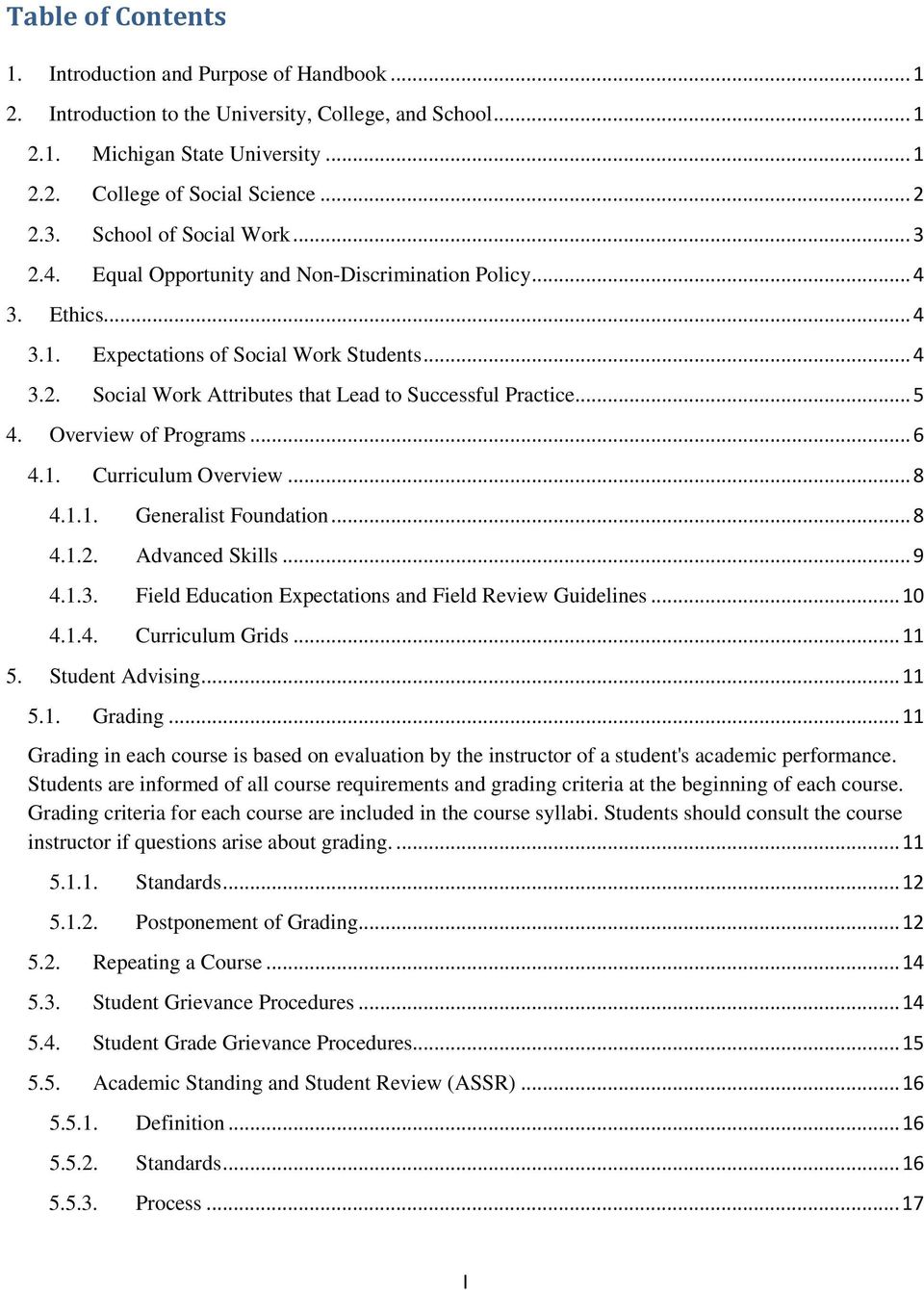
2 Table of Contents 1. Introduction and Purpose of Handbook Introduction to the University, College, and School Michigan State University College of Social Science School of Social Work Equal Opportunity and Non-Discrimination Policy Ethics Expectations of Social Work Students Social Work Attributes that Lead to Successful Practice Overview of Programs Curriculum Overview Generalist Foundation Advanced Skills Field Education Expectations and Field Review Guidelines Curriculum Grids Student Advising Grading Grading in each course is based on evaluation by the instructor of a student's academic performance. Students are informed of all course requirements and grading criteria at the beginning of each course. Grading criteria for each course are included in the course syllabi. Students should consult the course instructor if questions arise about grading Standards Postponement of Grading Repeating a Course Student Grievance Procedures Student Grade Grievance Procedures Academic Standing and Student Review (ASSR) Definition Standards Process I
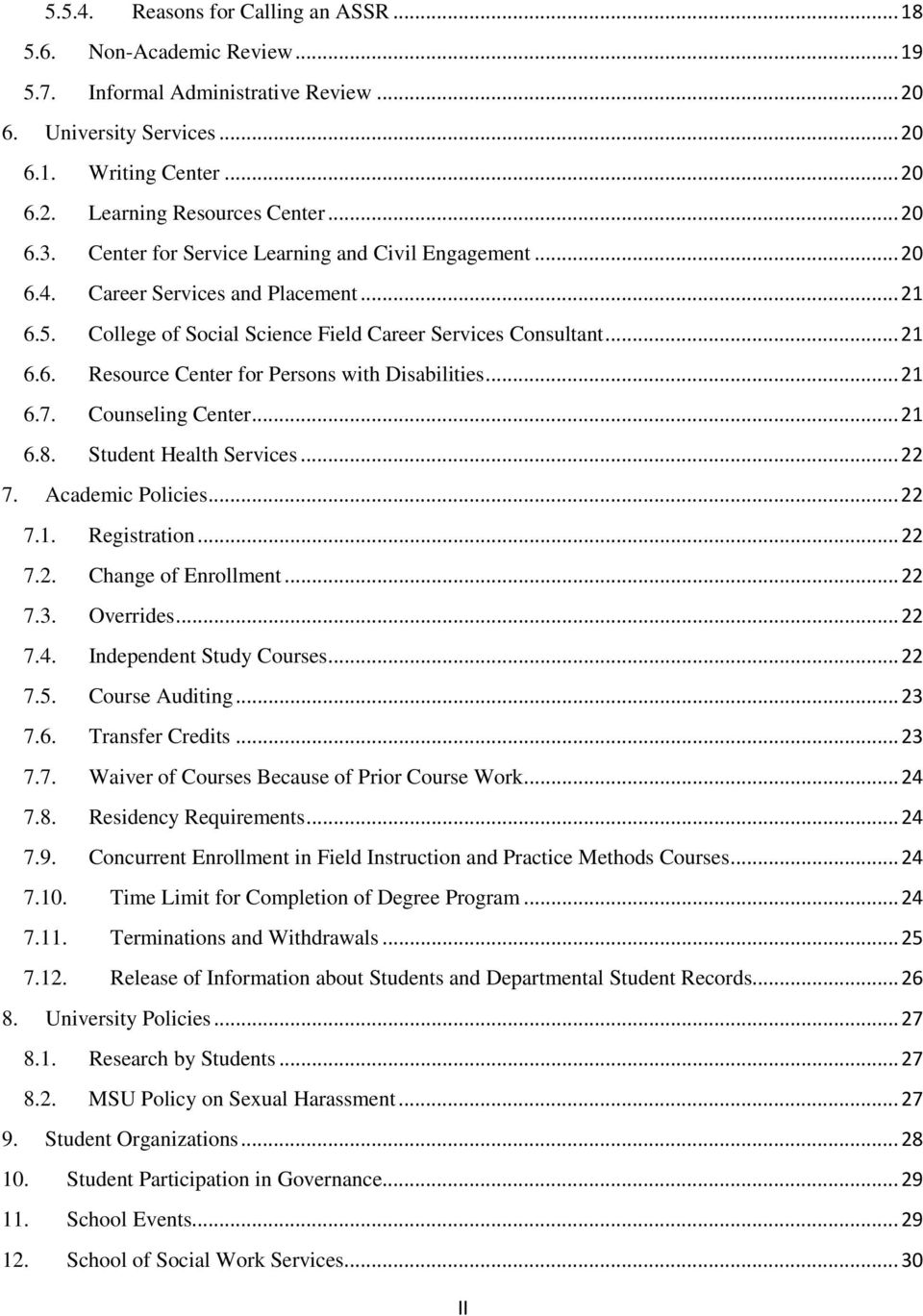
3 Reasons for Calling an ASSR Non-Academic Review Informal Administrative Review University Services Writing Center Learning Resources Center Center for Service Learning and Civil Engagement Career Services and Placement College of Social Science Field Career Services Consultant Resource Center for Persons with Disabilities Counseling Center Student Health Services Academic Policies Registration Change of Enrollment Overrides Independent Study Courses Course Auditing Transfer Credits Waiver of Courses Because of Prior Course Work Residency Requirements Concurrent Enrollment in Field Instruction and Practice Methods Courses Time Limit for Completion of Degree Program Terminations and Withdrawals Release of Information about Students and Departmental Student Records University Policies Research by Students MSU Policy on Sexual Harassment Student Organizations Student Participation in Governance School Events School of Social Work Services II
4 13. Graduation Certification for Graduation Graduation Ceremonies Career Counseling and Placement by Faculty and MSU Career Services Conclusion III

5 1. Introduction and Purpose of Handbook This MSW Student Handbook provides information about the School, the curriculum, and University policies that affect all members of the School s graduate student body. Any matriculated part-time or full-time student in the School's graduate programs (MSW or PhD) is a member of the School s graduate student body; and this includes students admitted to the School s fully accredited off-campus and Statewide Blended MSW programs. Familiarity with the contents of this Handbook is crucial for successful completion of your degree program. It describes resources available to you, your responsibilities as a graduate student of Social Work at MSU, and academic policies and procedures at the School and University levels. This Manual describes how students can participate in the academic affairs of the School, and how special situations students encounter should be resolved. The MSW Program Director and Graduate Advisors are responsible for assisting students with the procedures outlined in this Handbook; and the Director of the school is also available. Social workers have a profound impact on the lives of those they serve. Given that, successful social workers possess characteristics such as self-motivation, responsibility, diligence, conscientiousness, and innovation. We expect students to demonstrate possession of these qualities through their course work, field work, and interactions with faculty, staff and peers. Since problem-solving skills are also at the heart of social work, we strongly encourage students to think of possible actions and solutions to their situations and to be prepared to discuss them when meeting with faculty, staff and/or peers to address concerns. Students should also become familiar with other documents that contain information about the University, the College of Social Science, and the School of Social Work. These documents include Graduate Student Rights and Responsibilities, General Student Regulations, and Academic Freedom for Students at Michigan State University. These are found in Spartan Life published by the Office of Student Services ( The MSU Graduate School ( outlines University academic standards and regulations governing graduate students. 2. Introduction to the University, College, and School 2.1. Michigan State University Michigan State University (MSU) provides an excellent setting for social work education. MSU is a premier research-intensive, land-grant university where people matter. With its commitment to research, MSU creates and advances knowledge. As the nation s first land-grant university, MSU extends learning to actively serve Michigan, the nation and the international community. The East Lansing campus is rich in resources, beautiful, and located near the state s capitol, giving our students extraordinary access to the policy debate and policy formation processes. The student population is active and diverse. With its close ties to communities through the extension 1

6 service and distance education programs, MSU makes a significant contribution to the State of Michigan. This supportive context gives the School of Social Work a special and valued role in the University and a broad network of connections to university administration and other departments. There are over 500 student organizations on the East Lansing campus that emphasize a broad rang e of interests and issues including racial/ethnic, gender and gender identity, religious, international, musical, academic interest area, political, social service, volunteer, professional organizations and professional fraternities and sororities, and recreational and athletic groups. Many groups sponsor social events, speakers, films, cultural, recreational and entertainment events. The cultures of many different nations are brought to campus through a variety of events and programs. This provides opportunities for students to improve crosscultural communication skills and to learn about and experience cultures from different parts of the world, as well as the cultures of racial/ethnic, religious and sexual minorities. Also, M SU sends more students overseas than any other American university. As a Big Ten school, MSU competes in 12 men s varsity sports and 13 women s varsity sports, attract s national political and scientific speakers, and hosts world-class cultural entertainment. Michigan State University is an affirmative action, equal opportunity institution. MSU operates in accordance with the Americans with Disabilities Act College of Social Science The College is the largest and among the most diverse at MSU; more than 6,300 undergraduate and graduate students are enrolled in its 13 major disciplines. Nearly 400 tenured and tenure-stream faculty provide instructional, research, and outreach services within its eight departments, three schools, and six centers and institutes. The School of Social Work is part of the College of Social Science, along with other professional programs in criminal justice, human resources and labor relations and industrial relations, and urban and regional planning. The College also houses the disciplines of anthropology, economics, geography, global and area studies, history, human development and family studies, interdisciplinary studies in social science, political science, psychology, and sociology. It has four major research and outreach institutes: Center for Advanced Study of International Development (CASID), Center r for Global Change and Earth Observations (CGCEO), Institute for Public Policy and Social Research (IPPSR), Julian Samora Research Institute (JSRI) and The Center for Humane Arts, Letters, and Social Services Online (Matrix). In addition, the College offers special programs in applied developmental science, cognitive science and Chicano/Latino Studies. All graduates of the School become alumni of the College of Social Science, as well as the School of Social Work. The School draws upon the resources of the College for research partnerships, outreach activities, joint appointments, and guest speakers. 2

7 2.3. School of Social Work The School of Social Work includes students from many backgrounds in our academic programs at the baccalaureate, masters, and doctoral levels. The School's educational programs are fully accredited by the Council on Social Work Education. We take great pride in our programs, our graduates, and in our students. The School provides students with the knowledge, skills, and value base needed to become effective members of the professional social work community. Our students receive the education and training necessary to become highly skilled social work practitioners who will enrich the lives of those they serve and the communities in which they practice. School alumni are found throughout the state of Michigan, the nation, and in several foreign countries. They are practitioners, administrators, educators, researchers, and social work leaders. The entire School - faculty, administrators, support staff, current students - are pleased that you have chosen our master s degree program. We look forward to getting to know you and working with you as you progress through your academic program. Mission We are dedicated to educating students for competent, responsive and ethical social work practice. Our teaching, research and outreach seek to promote positive change and social justice for diverse communities, families, and individuals. Values These values of the School of Social Work are enduring beliefs shared by the faculty and contribute to the character of the MSU School of Social Work. We aim to display these values through all aspects of our program and our interactions inside and outside of the University. We are committed to EXCELLENCE in teaching, research and outreach. We advance our work through respectful and responsive COLLABORATION inside and outside of the University. We are committed to SOCIAL JUSTICE and positive social change. We promote diversity, equity and INCLUSION with regard to our programs and partnerships. We encourage high standards of professional LEADERSHIP and achievement by our faculty, students and graduates. We foster and support ACCESSIBILITY to our educational programs, research and faculty resources. 3

8 2.4. Equal Opportunity and Non-Discrimination Policy 3. Ethics The School of Social Work greatly values diversity and actively recruits persons of color, persons with special needs, women, and persons who have been disadvantaged. We encourage non-traditional students and work with them to achieve academic success. The University s Equal Opportunity and Non-Discrimination policy reads as follows: Michigan State University is committed to the principles of equal opportunity, nondiscrimination and affirmative action. University programs, activities and facilities are available to all without regard to race, color, gender, religion, national origin, political persuasion, sexual orientation, marital status, disability, height, weight, veteran status, age or familial status. The University is an Affirmative Action, Equal Opportunity Employer. Additional information about this policy can be found at Acts are prohibited under this policy if they (1) discriminate against any University community member(s) through inappropriate limitation of employment opportunity, access to University residential facilities, or participation in educational, athletic, social, cultural, or other University activities on the basis of age, color, gender, gender identity, disability status, height, marital status, national origin, political persuasion, race, religion, sexual orientation, veteran status or weight, or (2) harass any University community member(s) on the basis of age, color, gender, gender identity, disability status, height, marital status, national origin, political persuasion, race, religion, sexual orientation, veteran status, or weight Expectations of Social Work Students The School of Social Work conforms to the College of Social Science and University policies regarding students. The School s MSW Manual and the Code of Ethics of the National Association of Social Workers (NASW), the Michigan State University student handbook, and Spartan Life are available on the web. These documents describe student rights and responsibilities and should be read so that students understand the expectations placed upon them as well as their rights and obligations. Since they are enrolled in a professional School, in addition to the University and College expectations, students must conform to the NASW Code of Ethics and to be especially sensitive to the impact of their actions on clients, social work agencies and those who make up the School community, including student colleagues, staff and faculty. This adherence to the Code of Ethics is one of the ways we prepare our students for social work practice. 4
9 To maximize our students academic experiences and to optimize the learning environment in the School, certain standards of conduct must be observed by all students. First, honesty in the classroom and honesty with self, organizations and clients is expected. Second, respect for self, clients, organizations and members of the School community is expected, as well as an understanding of how one s behavior and attitude affects the work one does both inside the classroom and within a partner agency. Third, compliance with the expectations established by field instruction agencies is expected. Deliberate noncompliance is extremely serious and can result in sanctions leading to dismissal from the program. The curriculum of the School of Social Work is designed to meet the standards of the Council on Social Work Education which is the accrediting body for academic social work programs. Social Work students are expected to conform to the following regulations as well as all other University, College, and School rules and regulations Social Work Attributes that Lead to Successful Practice Perhaps more than any other profession, social workers are expected to have a special blend of personal and professional attributes that in combination create a powerful force for the betterment of our clients, agencies in which we work and society as a whole. As future members of the social work profession, social work students should be personally building these attributes. The set of attributes includes: Self-Awareness Social work students are willing to examine and change their behavior to be able to work effectively with others. Professional Commitment Social work students have a strong commitment to the goals and the ethical standards of the profession. They are committed to the essential values of social work: dignity and worth of every individual and his/her right to a just share of society s resources. Practice Knowledge Base The professional activities of social work students are grounded in relevant social, behavioral and biological science knowledge and research. This includes knowledge and skills in relationship building, data gathering, assessment, interventions, and evaluation of practice, research and advocacy. Empathy Social work students strive to comprehend the way of life and values of others. They are able to communicate this empathy and support to clients as a basis for productive professional relationships. Appreciation of Diversity Social work students appreciate the value of human diversity. They strive to appropriately serve all those in need of assistance, regardless of the person s age, class, race, ethnicity, religion, gender, gender identity, ability, sexual orientation and value system. 5
10 Interpersonal Skills Social work students demonstrate the interpersonal skills required to relate effectively to other students, faculty, staff, clients and other professionals. These skills include compassion, altruism, integrity, respect and consideration for others. Professional Behavior Social work students behave professionally by knowing and practicing within the scope of social work, adhering to the profession s code of ethics, respecting others, being punctual and dependable, prioritizing responsibilities, and completing assignments on time. Energy Social work students resist the undesirable effects of stress by using appropriate self-care and developing cooperative and facilitative relationships with instructors, staff, fellow students, and clients. 4. Overview of Programs The School has educational majors in Clinical Practice and Organizational and Community Leadership. So what is the difference between the Clinical (Micro) and Organization and Community Leadership (Macro) focus in Social Work? Macro practice has been defined as the practice of solving social problems and making change at the community, organizational, and societal levels using professionally guided interventions. It also emphasizes the importance of advocacy and social change efforts directed at large social systems/networks including efforts at the program, agency, system, community, regional, national and international levels. *Some examples of jobs that would be reflective of macro/ocl practice are: Administrator Community Educator Grant Writer Advocacy Director/Liaison/Representative Policy Analyst Resource Developer Program Evaluator/Manager/Coordinator/Officer Community Development Specialist Higher Education Program Coordinator In the Clinical (Micro) concentration, learning is focused on advanced theory, knowledge, values and skills for supporting positive change for individuals, families and small groups. It emphasizes the importance of advocacy and social change efforts directed at individuals/families/small groups not at the systems in which the participant(s) exists. *Some examples of jobs/areas that would be reflective of micro/clinical practice are: Individual/Group Therapist Private Practice Developmental Disabilities School Social Worker Mental Health Worker 6
11 Geriatric Social Worker Nursing Home/Residential Facility Juvenile Justice/Corrections Substance Abuse Social Worker in a Medical Setting The School also offers Certificate Programs which further prepare students for practice in specific fields, including: Clinical Social Work with Families School Social Work Gerontology Evidence Based Trauma Treatment Addictions Studies Infancy and Early Childhood Certifications are not required and students can choose either the customized MSW program (students construct their program based on their varied interests and needs or optional certification. Certifications will require an application process and numbers may be limited due to field education or course size constraints. Certifications will include: 1. required courses, 2. social work electives, or approved courses from other units across campus, 3. corresponding field placement 4. content that is often available (perhaps with necessary modifications) to all program sites. More information about the School and University Certificate programs can be found on the school website ( and also at the following online locations: Applicants to the REGULAR MSW PROGRAM can select part-time or full-time enrollment status. Part-time options require completion of the MSW program on either a three- or four-year plan of study, while fulltime students complete the program in two academic years. The ADVANCED STANDING MSW PROGRAM is open to applicants who have graduated from a Council on Social Work Education accredited social work baccalaureate program within the last six years. The full-time option allows for completion of requirements within one calendar year and the part-time program allows for two calendar years, with both options starting in the second half of the Summer semester and ending in the Spring semester. 7
12 Students must have sufficient flexibility in their personal and professional lives to commit to taking classes (with course loads usually exceeding the University's minimum credits for full- and part-time statuses) and being in field placement (with schedules of at least 16 hours per week each semester). The School of Social Work cannot grant academic credit for life or previous work experience in lieu of any course or field education Curriculum Overview The MSU program curriculum has two major sections: a generalist foundation and advanced skills educational content, both with field placements. Following is a description of these sections, as well as an overview of courses. For course descriptions, please visit Generalist Foundation The generalist foundation is comprised of courses that provide the grounding for all professional social work practice, regardless of setting, specialization or professional role. There are three content areas and five curriculum sequence areas required by the Council on Social Work Education that are integrated into our foundation courses. The three content areas are: 1. Values and Ethics 2. Diversity 3. Populations-at-Risk and Social and Economic Justice The five curriculum sequences are: 1. Human Behavior and the Social Environment 2. Social Welfare Policy and Services 3. Social Work Practice 4. Research 5. Field Education Core courses include: Introduction to Professional Social Work Practice (one day seminar for students without a BSW) SW 810 Theories of Groups, Organizations, and Communities in Social Work (3 credits) SW 811 Social Work Perspectives in Human Development (3 credits) SW 820 Social Welfare Policy and Services (3 credits) SW 829 Essential Research Tools for Social Work Practice (2 credits) SW 830 Applied Social Work Research: Experimental and Quasi-experimental Design (2 credits) SW 840 Generalist Social Work Practice Methods I (3 credits) SW 841 Generalist Social Work Practice Methods II (3 credits) SW 894A Social Work Field Instruction: Graduate Generalist Practice I (4 credits) SW 894B Social Work Field Instruction: Graduate Generalist Practice II (4 credits) 8
13 Total Credit Hours for Required Core Courses for the MSW Program: 27 Students also complete 6 credits in elective courses in social work or a related field. An elective is a course elected to take that is not specifically required for the degree. Electives give an opportunity to take courses in area of interest as well as to structure a concentration or complete a certificate requirement. If taking an elective outside of the School of Social Work you are encouraged to meet with the advisor for assistance and guidance in making selections Advanced Skills Building on the foundation knowledge and skills acquired in the generalist core courses are advanced-level courses designed to prepare our students for professional social work practice in either Clinical Social Work (micro-level interventions) or Organizational and Community Leadership (macro-level interventions). Advanced base courses include: SW 832 Applied Social Work Research: Survey and Field Design (2 credits) SW 845 Administration Skills for Social Work Practice (3 credits) SW 822 Topics in Policy Practice and Advocacy (3 credits) Total Credit Hours for Advanced Base Courses: Clinical Practice Concentration The clinical practice concentration prepares students to practice advanced skills in a variety of settings that focus on individuals, families, and small groups. Advanced clinical courses include: SW 843 Clinical Assessment and Diagnosis (2 credits) SW 850 Clinical Social Work Advanced Practice I (3 credits) SW 851 Clinical Social Work Advanced Practice II (3 credits) SW 894D Social Work Field Instruction: Clinical Practice I (4 credits) SW 894E Social Work Field Instruction: Clinical Practice II (4 credits) Total Credits for Clinical Practice Concentration: Organizational and Community Leadership Concentration The organizational and community leadership concentration prepares students to practice with advanced skills in policy making, community organizing, program planning, program implementation, and program evaluation. Advanced organizational and community leadership courses include: 9

14 SW 844 Essential Theories in Organizations and Communities Social Work Practice (2 credits) SW 863 Organizational and Community Social Work Advanced Practice I (3 credits) SW 864 Organizational and Community Social Work Advanced Practice II (3 credits) SW 894G Social Work Field Instruction: Organizational and Community Leadership I (4 credits) SW 894I Social Work Field Instruction: Organizational and Community Leadership II (4 credits) Total Credits for Organizational and Community Leadership Concentration: Field Education Expectations and Field Review Guidelines Within the MSW Program, students complete four semesters of field education for a total of 960 field hours. In the Advanced Standing Program students complete three semesters for a total of 600 field hours. The format is that students participate in field for sixteen hours per week, during the normal workday (8 a.m. - 5 p.m., Monday through Friday) for fifteen weeks during each of four semesters. All students must receive one hour per week of supervision by an MSW level field instructor. Ten hours of field seminar attended per semester are counted as field hours. Seminars are organized and facilitated by the field liaisons who are representatives of the School a nd are responsible for enriching, monitoring and evaluating the placement experiences of their assigned students. Social Work students must maintain acceptable academic standing including successful performance in their field placement and liaison group. The Field Review Guidelines describe the process used regarding field performance concerns. The Field Review might then be followed by the more formal Academic Standing and Student Review. It is the School s intention that these steps assist students to successfully meet field program requirements. 1. The Field Instructor will immediately notify the Liaison and the Liaison will notify the appropriate Field Director who will advise the Lead Field Coordinator of any performance difficulties. 2. An emergency liaison visit will be made to the agency with a meeting to include all involved parties. This must include but is not limited to the student, the field instructor and the liaison. 3. Performance problems that are not resolved a s a result of the above meeting will then be referred to the Field Education Coordinator, of the program in which the student is enrolled, and the Lead Field Coordinator for further attention. It is likely that an additional meeting (Field Review meeting) will be recommended involving some combination of the following: the student, the liaison, the Field Coordinator, the Lead Field Coordinator, relevant faculty members, the Graduate Advisor, the MSW Program Coordinator, and the Director of the School. Depending upon circumstances, the field instructor may or may not be present. The student may invite an individual s/he considers a helpful support in these circumstances. Should the student choose to invite 10
15 another individual to this meeting, it must be a person connected to the school in some way and must be approved by the person convening the Field Review. These meetings are not to be interpreted as disciplinary or adversarial. They are efforts to work with students to find ways to successfully accomplish field education goals. If this process is considered unsuccessful by the Lead Field Coordinator, a formal academic review will then be requested. In the event that a student s placement terminates during the semester (and the student is not re-placed), the student will not be allowed to remain enrolled in social work practice courses, i.e., SW 842B, SW840, SW 841, SW 850, SW 851, SW 863, or SW864, because concurrent enrollment is required for assignments. For further information concerning Field Education, please consult the Field Education Manual at Curriculum Grids 5. Student Advising See Appendices 1-9 Advising orients students to the profession and assists in assessing their aptitude and motivation for a career in social work. It also provides for early and periodic evaluation of student performance, guides students in their selection of areas of course work, and explores with students the selection of elective credits that best meet their educational needs and goals. Students in the School of Social Work are expected to make use of the Graduate Advisor. Advising in a professional school is an important activity that not only clarifies how to complete academic program requirements but also provides students with a forum to discuss a variety of professional topics such as career opportunities and career goals and aspirations. The Graduate Advisor provides guidance to students regarding the details of the academic requirements of the MSW program. There is a Graduate Advisor in each MSW program and the Advisor is available for those program students to discuss course selection, certificate programs, School of Social Work and MSU policies and procedures, concerns about course work, and issues affecting academic performance and professional and/or career-related advising Grading Grading in each course is based on evaluation by the instructor of a student's academic performance. Students are informed of all course requirements and grading criteria at the beginning of each course. Grading criteria for each course are included in the course syllabi. Students should consult the course instructor if questions arise about grading. 11
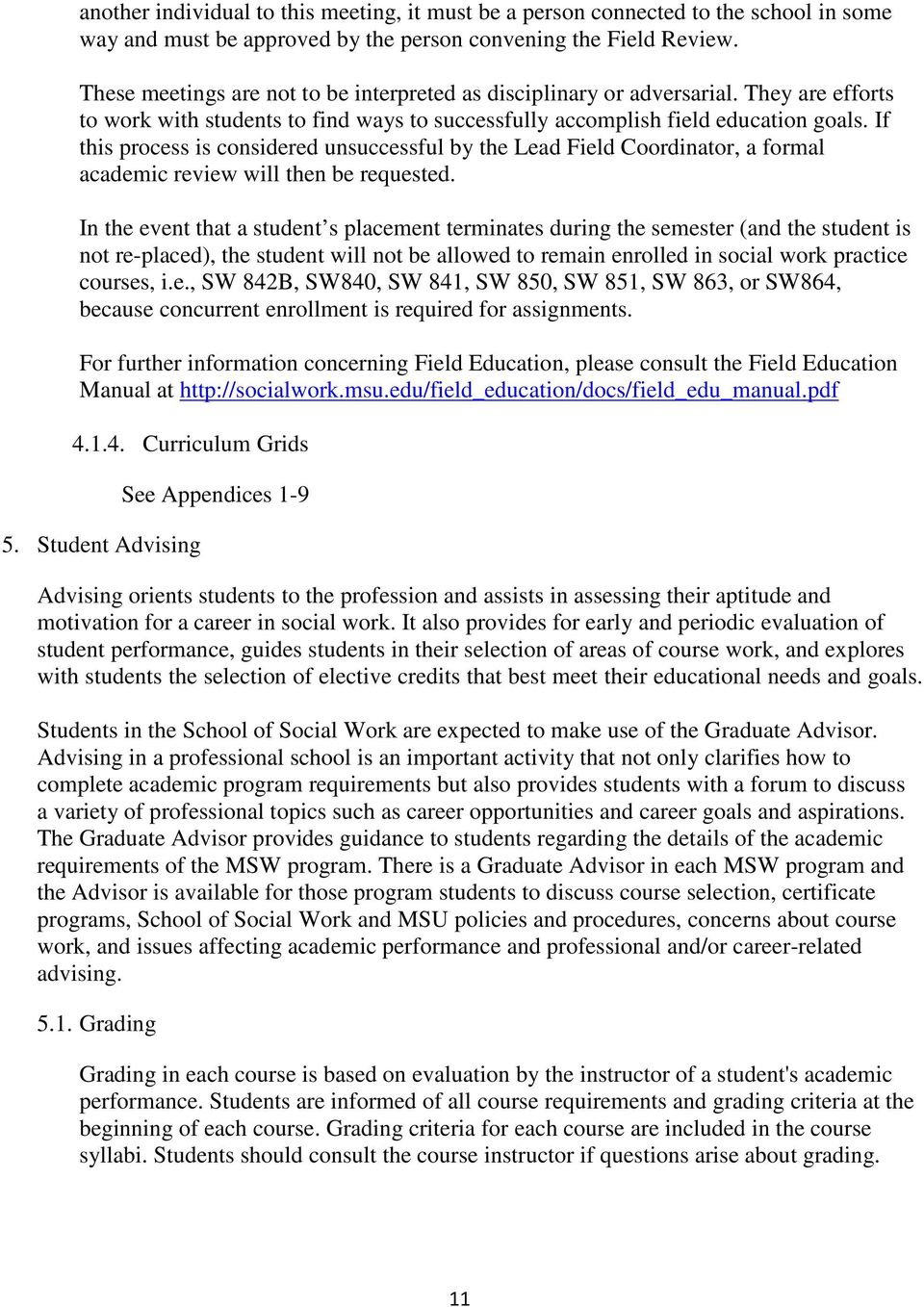
16 Standards Numbered grades equate to categories of performance. 4.0 Excellent 3.5 Good 3.0 Average 2.5 Below Average 2.0 Below Average 1.5 Failing/No Credit Given 1.0 Failing/No Credit Given 0.0 Failing/No Credit Given I Incomplete 1. Academic credit is awarded at the minimum level of 2.0 for graduate students. The minimum cumulative grade point average required for graduation is a 3.0 for graduate students. A graduate student who accumulates grades below 3.0 in more than two (2) semester courses of three or more credits each is removed from candidacy for the degree. All grades submitted by instructors are final and can only be changed through the Grade Grievance Procedure. 2. For a student in any of the programs, the accumulation of grades below 3.0 in more than two courses of three or more credits each removes the student from candidacy for the degree. In addition, the accumulation of grades below 3.0 in more than three courses of two credits will also remove students from degree candidacy. That is, an accumulation of more than 6 credits below a 3.0 will result in dismissal from the program. 3. Advanced Standing MSW students must receive grades of at least 3.0 in all courses. A grade below 3.0 can result in a student's dismissal from the Advanced Standing MSW Program and/or the MSW Program. 4. It is required that graduate students earn a grade of at least 3.0 in field education and practice methods courses Postponement of Grading When special or unusual circumstances occur, the instructor can postpone assignment of the student's final grade in a course by submitting an I-Incomplete or DF-Deferred in lieu of a grade. In the School of Social Work, incomplete or deferred grades received in foundation required courses must be removed prior to the student s enrollment in any required advanced courses I-Incomplete Grades I-Incomplete is given only when: 12
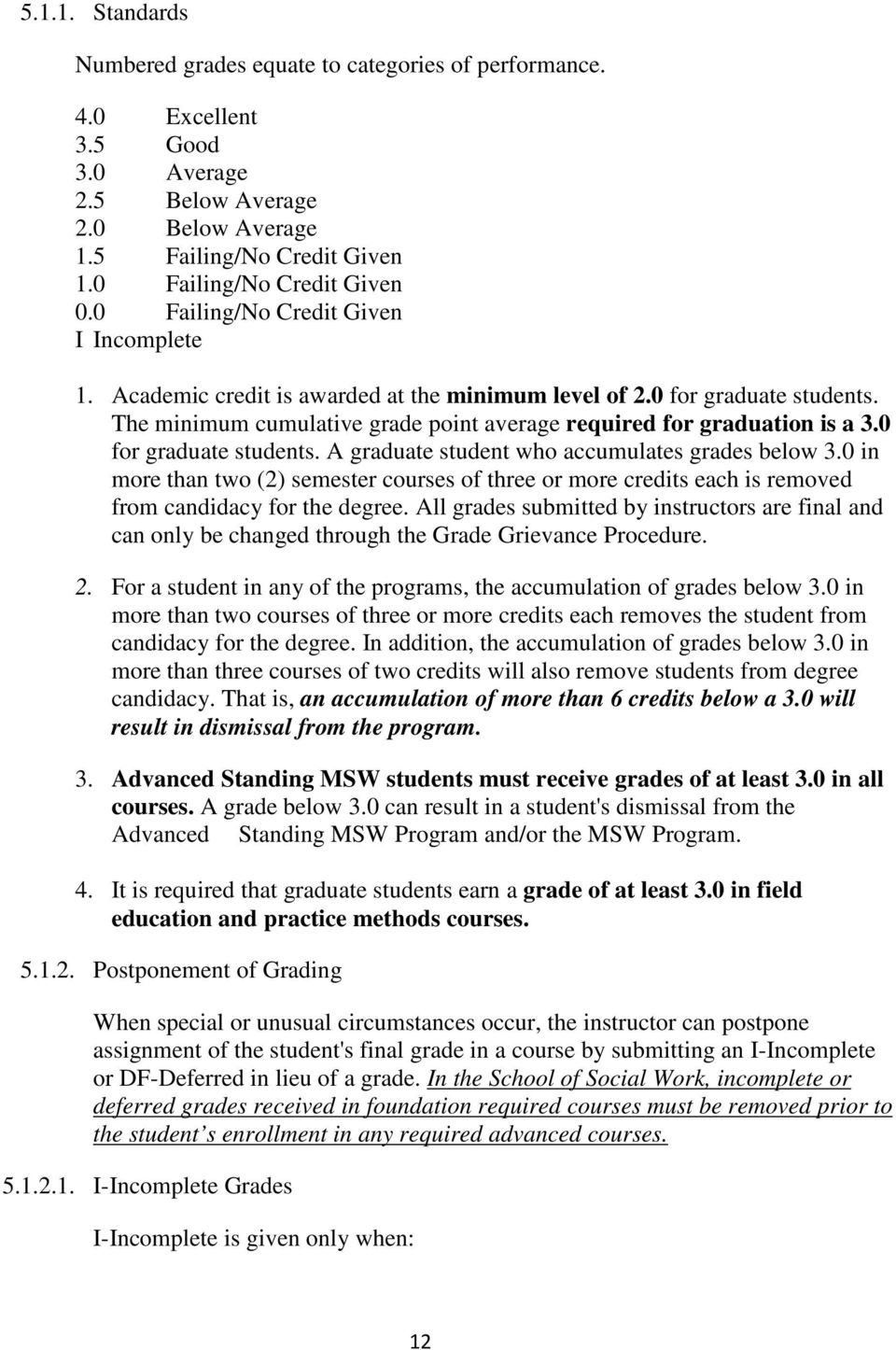
17 1. The student has successfully completed at least twelve (12) weeks of the semester and 75% of the course assignments, but is un able to complete course work and/or take the final examination because of documented illness or other compelling reasons, and 2. Has done satisfactory work in the course, and 3. In the instructor's judgment, the student can complete the required work without repeating the course. Examples of compelling reasons are: 1. Illness or injury that makes it impossible for the student to complete course work and is documented by a physician s written statement attesting to the serious nature of the condition, or 2. Illness or injury of a close relative for whom the student is responsible for providing daily care and documented by physician s written statement attesting to the serious nature of the condition. When these conditions are met, the instructor specifies what the student must do and by when it must be done to remove the I-Incomplete. However, all coursework and exams must be completed by the middle of the following semester to be considered as successful course completion. All required work must be completed and a grade must be reported to the Office of the Registrar no later than the middle of the student s next semester in attendance (summer session excluded) if that semester is within one calendar year following receipt of the I-Incomplete. An extension of time for completion of the required work can be approved by the College offering the course only by means of an Administrative Action form documenting physician-certified illness or other extraordinary circumstances such as those for which an initial I-Incomplete grade would be given. Such an extension could allow for completion as late as the end of the student's next semester in attendance. A student who does not register for MSU classes subsequent to the receipt of an I-Incomplete has one calendar year to complete the required work. It is the student s responsibility to complete the course work and submit it to the instructor, allowing adequate time for the instructor to grade the work and submit the grade to the Registrar. Failure to complete the required work by the due date will result in a grade of I-0.0. This grade then remains part of the student's academic record, and the course can be completed only by re-enrollment DF-Deferred Grades DF grading is used rarely and only in extraordinarily unusual circumstances. The required work must be completed and a grade reported within 6 months, with the option of a single six-month extension. If the required work is not completed within the time limit, the DF will become U-Unfinished and will be 13

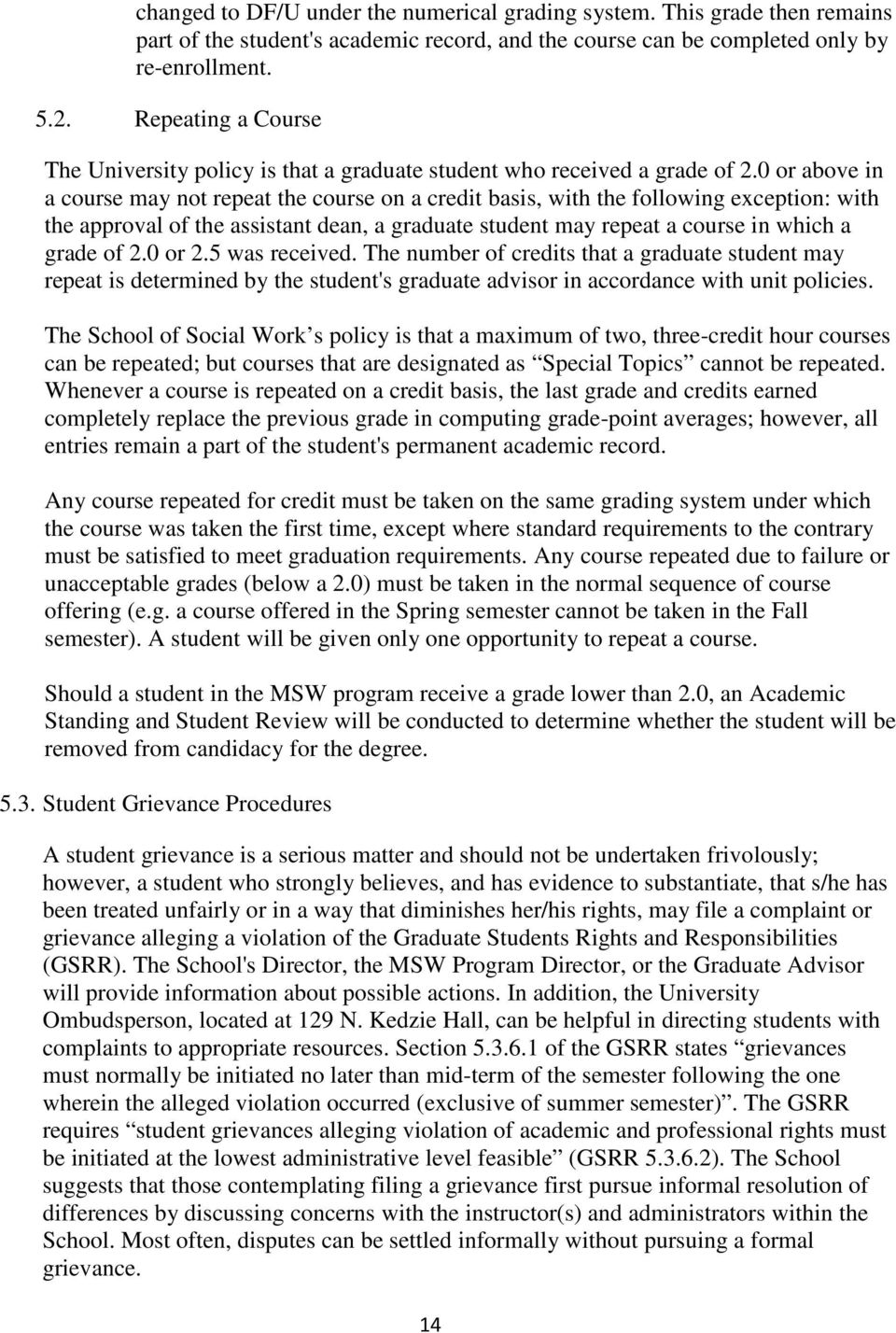
18 changed to DF/U under the numerical grading system. This grade then remains part of the student's academic record, and the course can be completed only by re-enrollment Repeating a Course The University policy is that a graduate student who received a grade of 2.0 or above in a course may not repeat the course on a credit basis, with the following exception: with the approval of the assistant dean, a graduate student may repeat a course in which a grade of 2.0 or 2.5 was received. The number of credits that a graduate student may repeat is determined by the student's graduate advisor in accordance with unit policies. The School of Social Work s policy is that a maximum of two, three-credit hour courses can be repeated; but courses that are designated as Special Topics cannot be repeated. Whenever a course is repeated on a credit basis, the last grade and credits earned completely replace the previous grade in computing grade-point averages; however, all entries remain a part of the student's permanent academic record. Any course repeated for credit must be taken on the same grading system under which the course was taken the first time, except where standard requirements to the contrary must be satisfied to meet graduation requirements. Any course repeated due to failure or unacceptable grades (below a 2.0) must be taken in the normal sequence of course offering (e.g. a course offered in the Spring semester cannot be taken in the Fall semester). A student will be given only one opportunity to repeat a course. Should a student in the MSW program receive a grade lower than 2.0, an Academic Standing and Student Review will be conducted to determine whether the student will be removed from candidacy for the degree Student Grievance Procedures A student grievance is a serious matter and should not be undertaken frivolously; however, a student who strongly believes, and has evidence to substantiate, that s/he has been treated unfairly or in a way that diminishes her/his rights, may file a complaint or grievance alleging a violation of the Graduate Students Rights and Responsibilities (GSRR). The School's Director, the MSW Program Director, or the Graduate Advisor will provide information about possible actions. In addition, the University Ombudsperson, located at 129 N. Kedzie Hall, can be helpful in directing students with complaints to appropriate resources. Section of the GSRR states grievances must normally be initiated no later than mid-term of the semester following the one wherein the alleged violation occurred (exclusive of summer semester). The GSRR requires student grievances alleging violation of academic and professional rights must be initiated at the lowest administrative level feasible (GSRR ). The School suggests that those contemplating filing a grievance first pursue informal resolution of differences by discussing concerns with the instructor(s) and administrators within the School. Most often, disputes can be settled informally without pursuing a formal grievance. 14
19 Procedures for graduate student grievances follow those described in Graduate Student Rights and Responsibilities, Michigan State University, Article 5. A hearing board will be established if a grievance is not satisfactorily resolved in conference between the student and instructor or administrator directly involved in the grievance, or with the Director of the School or a designated representative. The hearing board will be established and composed of the Director of the School or the MSW Program Director, one student and one faculty member of the School selected by the aggrieved student, and a student and one faculty member of the School appointed by the Director Student Grade Grievance Procedures The Graduate Student Rights and Responsibilities document establishes general rules for grade appeals for students. In such a hearing, the student has the burden of proof that her/his grade has been based on factors other than, or in addition to performance, such as race, sex, personal animosity or the like. Neither disappointment with a grade, hard work that was not rewarded, nor an instructor's very high standards constitute grounds for a viable grade grievance. As stated in GSRR 5.3.2, the grievant must put in writing what is believed was unfair and the remedy being sought. When the School receives those items in writing, a hearing board will be convened. Half the board will be composed of social work graduate students; the other half, faculty members. Since the Chair must be a faculty member, the Director will designate a faculty member to chair the hearing unless s/he has a real or perceived conflict of interest. No one on the board should have any immediate involvement with the course or the parties, nor have any conflict of interest, whether real or perceived. Each party will have access to any documents that constitute "evidence." Each party has a right to present whatever s/he considers to be relevant, to have supporting witnesses if s/he wishes, to question the other party and any witnesses, to rebut any "evidence," and to have counsel from within the University either for advisory purposes or to present the case on her/his behalf. A witness should be confined to her/his own recollection, not that of others. Procedurally, the grievant will make the first statement during the hearing, to be followed by the instructor. No interruptions are allowed during opening presentations. The Chair will direct questions by the parties and by the panel after the presentations. Panel members will be allowed to question the parties whenever they wish. This is an informal hearing. The panel will listen to the facts of the matter at hand. Additional information could be requested. The Chair will keep the discussion focused and assure that civility is maintained. Time limits are at the Chair's discretion. There will be a written record of the session that can be used in an appeal. Both parties will be asked to make brief closing statements if they wish to do so. Both parties, counsel and witnesses will then be excused and the panel will meet in executive session to deliberate. The panel's decision and written rationale will be distributed to the parties. This can be used in an appeal. Appeals must be justifiable. An appeal is a review of the record for procedural and due process issues. It is not a fresh hearing or an opportunity for introduction of new issues. 15

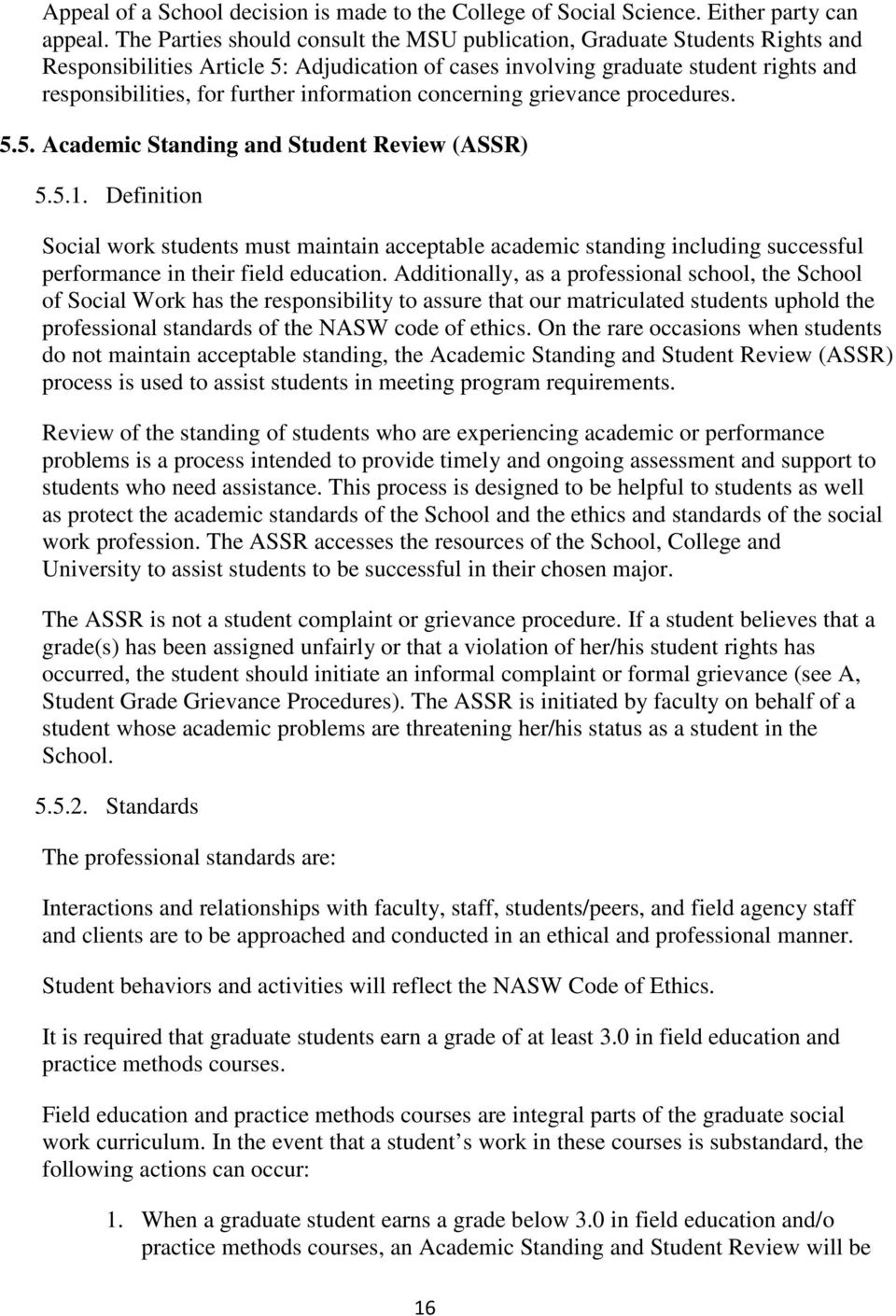
20 Appeal of a School decision is made to the College of Social Science. Either party can appeal. The Parties should consult the MSU publication, Graduate Students Rights and Responsibilities Article 5: Adjudication of cases involving graduate student rights and responsibilities, for further information concerning grievance procedures Academic Standing and Student Review (ASSR) Definition Social work students must maintain acceptable academic standing including successful performance in their field education. Additionally, as a professional school, the School of Social Work has the responsibility to assure that our matriculated students uphold the professional standards of the NASW code of ethics. On the rare occasions when students do not maintain acceptable standing, the Academic Standing and Student Review (ASSR) process is used to assist students in meeting program requirements. Review of the standing of students who are experiencing academic or performance problems is a process intended to provide timely and ongoing assessment and support to students who need assistance. This process is designed to be helpful to students as well as protect the academic standards of the School and the ethics and standards of the social work profession. The ASSR accesses the resources of the School, College and University to assist students to be successful in their chosen major. The ASSR is not a student complaint or grievance procedure. If a student believes that a grade(s) has been assigned unfairly or that a violation of her/his student rights has occurred, the student should initiate an informal complaint or formal grievance (see A, Student Grade Grievance Procedures). The ASSR is initiated by faculty on behalf of a student whose academic problems are threatening her/his status as a student in the School Standards The professional standards are: Interactions and relationships with faculty, staff, students/peers, and field agency staff and clients are to be approached and conducted in an ethical and professional manner. Student behaviors and activities will reflect the NASW Code of Ethics. It is required that graduate students earn a grade of at least 3.0 in field education and practice methods courses. Field education and practice methods courses are integral parts of the graduate social work curriculum. In the event that a student s work in these courses is substandard, the following actions can occur: 1. When a graduate student earns a grade below 3.0 in field education and/o practice methods courses, an Academic Standing and Student Review will be 16
21 held to review her/his academic standing and determine a course of action, which may include course repetition or dismissal from the program. If the grade of concern originates in Field Placement, a Field Review will be held prior to the ASSR. 2. Failure in field instruction and methods courses mandates that a student will not be allowed to continue in the program unless certain conditions are met. These conditions will be determined in an Academic Standing and Student Review. Below are a set of standards that could lead to a student s dismissal. 1. For a student in any of the programs, the accumulation of grades below 3.0 in more than two courses of three or more credits each removes the student from candidacy for the degree. In addition, the accumulation of grades below 3.0 in more than three courses of two credits will also remove students from degree candidacy. That is, an accumulation of more than 6 credits below a 3.0 will result in dismissal from the program. 2. An overall GPA below 3.0 in more than two consecutive semesters of three or more credits each removes the students from candidacy for the degree. 3. Advanced Standing MSW students must receive grades of at least 3.0 in all courses. A grade below 3.0 can result in a student's dismissal from the Advanced Standing MSW Program and/or the MSW Program Process The Director of the MSW Programs determines that an ASSR should be called based on information provided by the Graduate Office, Field Office or an individual instructor. The process is designed to be non-adversarial. The Director or designee will schedule and Chair the ASSR hearing board. The graduate advisor, classroom instructor, the faculty liaison and the Associate Director of Field Instruction if the situation involves a field education performance problem will constitute the hearing board. (Note: The agency-based field instructor cannot participate.) The student is expected to attend and can bring an "advocate-supporter" who must be someone from the University community, i.e. a faculty member or another student. The advocate-supporter will not have an active role in this proceeding, and is not allowed to participate verbally. If the student refuses to attend the ASSR, the hearing will still be held. After exploring the situation the participants make a recommendation(s) that will be reported to the Director of the School who could concur, modify or reject them. The student is able to appeal or dispute the recommendation to the Director. The recommendation will be formulated in a written report of the hearing submitted to the student and to the Director. The report and recommendation will be kept in a confidential file accessible only by the Graduate Advisor and Director of the MSW Programs. It will not be used in a reference 17
22 letter or any other similar document. The student can write one addendum to the report if s/he wishes which will be kept with the report and recommendation. It is the responsibility of the student to acknowledge receipt and understanding of the recommendations made at the ASSR; failure to follow them is cause for dismissal Reasons for Calling an ASSR An ASSR is called by the director of the MSW Programs to determine whether the student can complete the program given that specific remedies can be identified. The table below provides examples of events that trigger an ASSR, steps a student must take to rectify the situation, and consequences of not completing the steps. GSSR 5.5: Academic Dismissal and Academic Disciplinary Cases describes sanctions assessed for academic disciplinary cases. EXAMPLES OF PRECIPITATING EVENTS Student has not completed MSW Program prerequisites in the allotted time. Student s GPA falls below 3.0. Coordinator of MSW Programs must convene an ASSR. Student receives a second grade below a 3.0. Coordinator of the MSW Programs must convene an ASSR. Unsuccessful completion of field instruction or the accompanying methods course, generally graded as an "I" or a "DF" grade. It is required that graduate students earn a grade of at least a Pass or 3.0 in fieldwork and methods courses. Any student who does not earn a grade of a Pass or 3.0 or above in these courses in any semester will be asked to participate in an Academic Standing and Student Review (ASSR). In the opinion of a faculty member or members, a student is experiencing difficulty that threatens her/his academic progress. STUDENT S STEPS TO RECTIFY THE SITUATION Student must present a plan describing how s/he will complete the prerequisites during the next semester. The plan must be approved by the ASSR members. Student must present a plan describing how s/he will raise GPA during the next semester. The plan must be approved by the ASSR members. Depending on the results of the ASSR, student may be required to repeat the courses to attain a grade of 3.0 or above. Student must present a plan describing how s/he will complete course work within a specified time period. The plan must be approved by the ASSR members. If the student discovers that the plan cannot be implemented as agreed upon, the student must notify the Chair of the ASSR and present a new plan. Student must present a plan describing how academic performance will be improved within a specified time period. The plan must be approved by the ASSR members. The plan can include taking a leave of absence to attend to difficulties external to the program that are impeding the student s ability to successfully complete the program. The student must follow the plan and complete course work, attaining grades of 3.0 or above since this is required by the Graduate School for degree completion. CONSEQUENCES OF NOT COMPLETING STEPS Student will be dismissed from the program if the pre-requisites are not completed according to the agreed upon plan. Student will be dismissed from the program if the GPA is below 3.0 for second consecutive semester. If the student is required to repeat courses, s/he will be dismissed from the program if unable to raise grades to 3.0 or above. Student may be dismissed from the program. Student will be dismissed from the program. 18
23 Allegations of unethical conduct made by any student, or any faculty member, requires an ASSR. Appropriate actions beyond the School will be taken if indicated. If allegations are not substantiated, student will be able to remain in the program and must strictly adhere to the NASW Code of Ethics and MSU and School of Social standard. If allegations are substantiated, student will be dismissed from the program. Depending on the type of misconduct, appropriate authorities will be notified Non-Academic Review (NAR) Because ours is a professional program, social work students must demonstrate that they possess the qualities necessary to become social work practitioners in addition to successfully completing their academic work. Although it happens on rare occasions, there are times when faculty and/or field education staff members feel strongly that a particular student does not possess these qualities. In that event, a non-academic review is called to talk with the student about leaving the MSW program. Students wishing to return from a leave of absence also may be asked to participate in a non-academic review prior to enrolling for classes. Reasons for non-academic review: 1. Failure to meet generally accepted standards of professional conduct, personal integrity interpersonal skills or deportment required for professional practice, or inappropriate or disruptive behavior toward peers, faculty or staff at school or field education 2. Consistent failure to demonstrate effective interpersonal skills necessary for forming professional helping relationships such as acceptance of client differences, dealing with transference/counter-transference issues, and promoting and/or honoring client selfdetermination. 3. Criminal activity, as defined as charges and rulings of civil adjudication and or/criminal convictions while enrolled in the MSW program. The school reserves the right to suspend or dismiss any student whose criminal offense and conviction or civil adjudication is of a nature that is contrary to the NASW Code of Ethics, and/or when the conviction /adjudication prohibits the student from securing a field placement. Note: The application for licensure as a social worker asks questions about: felony conviction, misdemeanor conviction punishable by imprisonment for a maximum term of two years, misdemeanor conviction involving the illegal delivery, possession, or use of alcohol or a controlled substance, and treatment for substance abuse in the past two years. The Michigan Board of Licensing reviews applications for licensure and will decide about moral fitness; they may refuse to grant a social work license to the applicant. Should it be determined that a student meets any of the reasons, a non-academic review meeting will be called by the MSW Program Director. The meeting will be attended by the student, MSW Program Director, Graduate Advisor and other faculty who have voiced concerns about the student. The student can bring an advocate-supporter who must be someone from the University community. The advocate supporter will not have 19
24 an active part in this meeting. The student will be asked to speak about the concerns and to provide any evidence that would dispute the information that was provided to the MSW Program Director. The Director will make a determination about whether the student should be removed from candidacy and dismissed from the MSW program. Should the student disagree with the determination, s/he can present information to the Director of the School who will either uphold or overturn the determination. The Director s factual review will look at the information presented and the process used to make the determination Informal Administrative Review On occasions, the MSW Program Director or Graduate Advisor will call a meeting with students, faculty and administrators to informally attempt to resolve a specific student problem without invoking the formal ASSR process. These meetings are informal and are designed to promote informal resolution of issues. If the meeting does not produce a resolution or if the student does not meet the conditions set forth in the meeting, a more formal meeting will be called. 6. University Services 6.1. Writing Center Location: 300 Bessey Hall. Phone: Website: The Writing Center staff consults with writers at all levels of proficiency and at all stages of the composing process. Students can go to the Writing Center on their own or at the suggestion of a faculty member Learning Resources Center Location: 202 Bessey Hall Phone: Website: Staff is available to help with everything from understanding difficult texts and programming your graphing calculator to converting.wmv files for your ipod and making high-impact PowerPoint presentations Center for Service Learning and Civil Engagement Location: 27 Student Services Bldg. Phone: Website: 20
25 Provides active, service-focused, community-based, mutually beneficial, integrated learning opportunities for students, building and enhancing their commitment to academics, personal and professional development, and civic responsibility Career Services and Placement Location: 113 Student Services Bldg. Phone: Website: Assists students find part-time employment while in school and career placement services upon graduation. Provides workshops on resume writing, interviewing, and other related topics College of Social Science Field Career Services Consultant Location: 201C Berkey Hall Phone: Website: Career Services helps students to identify career options, design their personal career plan, develop job/internship search strategies, plan for graduate school and much more Resource Center for Persons with Disabilities Location: 120 Bessey Hall Phone: Website: Staff specialists are available to respond to mobility, visual, hearing, alternative learner, and other populations to facilitate their involvement in University activities. Other resources are available for students with special needs Counseling Center Location: 207 Student Services Bldg. Phone: Website: Students should feel free to contact the Counseling Center for personal concerns and crisis counseling. Professional counseling and psychological services are offered to assist with personal as well as career concerns. All services are confidential. Initial consultations are free of charge; all services are free to students carrying 1 or more credits in the semester they receive services. 21
26 6.8. Student Health Services Location: Olin Health Center Phone: Website: Primary medical care for both acute and chronic medical problems is available on a walk-in and appointment basis. Phone Information Nurse is available 24hrs/7days a week. 7. Academic Policies All students enrolled in the academic programs of the School of Social Work are held accountable to academic regulations specified by the School, the College of Social Science and by the University in effect at the time they are admitted. These regulations are printed in this manual, and in the University publications, Academic Programs and Graduate Studies Registration Students are provided with several resources they can use to assure that they are enrolling in courses that are appropriate given their status in the MSW program. This Manual describes the MSW curriculum and provides a table that describes the sequences in which courses should be taken. In addition, during Fall Orientation, students are given a grid that displays the sequence of courses and those that must be taken concurrently. Prior to course registration, students should consult the Graduate Advisor for the program in which the student is enrolled about their academic programs when they have questions about program requirements. Students should enroll as soon as possible for courses to assure that they get into the sections of courses they desire. Students should enroll for Spring Semester classes when they enroll for the Fall Semester. The School guarantees a seat for all required courses, but cannot guarantee that each student will get into the specific section s/he prefers. Before registration in the Spring, the Graduate Advisor will send out a reminder to the MSWLIST about registration for the following year s courses Change of Enrollment The process for changing enrollment is detailed at Overrides There is no guarantee that an override will be granted when the section is at its maximum capacity. Instructors make these decisions because the number of students in their sections has a strong impact on the class dynamics and the faculty member's resources Independent Study Courses Graduate students might have academic interests that cannot be pursued within the context of established courses. At Michigan State University, Independent Study is planned study, 22
27 highly individualized, not addressable through any other course format, proposed in writing by the student on a standard form, accepted for supervision by a faculty member, and approved by the student's academic advisor and the School at the beginning of the semester. (See Academic Programs) Independent study, in conjunction with the MSW degree, can only be done to fulfill elective credits. In consultation with their advisors, students can submit a proposal to complete an independent study project to a member of the School's faculty who has expertise in their area of interest. This proposal is submitted on an Independent Study Form available online at The faculty member who approves the Independent Study will approve projects and sign an Independent Study Form verifying their willingness to work with students. Students will present a copy of this form to the Graduate Programs Office Assistant who will issue an override for SW 890. Required courses cannot be taken as independent study. Students should keep this in mind when they are determining which courses to take in a given semester. The School does not offer every course each semester. The course schedule is predicated on students taking courses in sequence to complete their program. Students who choose not to take courses when they are offered will not be allowed to take required courses as independent study to graduate. They must wait until the required course is offered again Course Auditing The School of Social Work uses the University s policy pertaining to a Class Visitor. Students must negotiate this status with the instructor of record of the course, including attendance, assignments and other course requirements. It is the responsibility of the student, not the School of Social Work, to contact the Registrar s Office to enroll as a Class Visitor. The policy can be found at Transfer Credits A student who has completed graduate social work courses at other schools of social work accredited by the Council on Social Work Education can request to have credit for these courses evaluated by the school for transfer and application toward the two-year MSW degree requirements. Transfer students are not accepted into the Advanced Standing Program. After thorough evaluation, the maximum number of 26 credits could be transferred as specified by School and University policies. Twenty-six credits from another accredited MSW program can be transferred toward the 57 total credit hours required for the MSW degree. Transfer students must complete 31 credit hours toward their MSW degree at the MSU School of Social Work. Credits that have already been used to satisfy the requirements of another degree cannot be applied toward the MSW degree. Graduate social work courses completed satisfactorily as part of a related graduate degree program, where the degree has not been awarded, can be considered for application toward the MSW degree. The Graduate Advisor or the MSW Program Director will evaluate all requests for transfer credit whether for incoming transfer students or students currently enrolled in the MSW program who take courses at other universities. Decisions on the transferability of courses will be made by the MSW Program Director and/or the Graduate Advisors. Non-social work graduate courses from other departments at MSU or from other universities can be considered for transfer credit as electives. 23
28 Transfer credit will only be given for courses in which the student has received a grade of 3.0 or higher. The only exception to this policy is when courses are taken through the MSU College of Law. For those courses, transfer credit will be given when the students received a grade of 2.0 or higher. The School of Social Work cannot grant academic credit for life experience or previous work experience in lieu of any course or field instruction Waiver of Courses Because of Prior Course Work If graduate students feel they have completed courses elsewhere that could be deemed equivalent to required courses in their graduate program, they should submit course outlines/syllabi and official transcripts showing grades received. These must be presented for evaluation to the Graduate Advisor Residency Requirements The School of Social Work, the College of Social Science, and the University have residency requirements for graduation. 1. All MSW Students Students enrolled on a full-time basis in the MSW Program must complete residency requirements by completing a minimum of seven credits for two consecutive semesters. Parttime students complete the residency requirement in the year advanced practice methods and fieldwork courses are completed. Advanced Standing MSW students are required to complete all the requirements for the program in twelve continuous months from the time of entry into the program. 2. Off-Campus Students The School of Social Work has developed off-campus MSW programs in selected locations around the state. These programs are approved by the Council on Social Work Education. Therefore, residency requirements are met by completing the local program requirements Concurrent Enrollment in Field Instruction and Practice Methods Courses Students registering for field education courses MUST be enrolled concurrently in appropriate practice methods courses. Field courses cannot be taken without accompanying methods courses. These courses are open only to students admitted to the MSW programs. Part-time graduate students in the MSW Program cannot enroll in first-year field courses until other first year required courses are completed or have concurrent enrollment. For further information about field education requirements, consult The Field Education Manual at Time Limit for Completion of Degree Program Graduate students are responsible for monitoring their progress towards completion of degree requirements. They should consult with the Graduate Advisor for clarification. Students are 24
29 also provided with a program specific curriculum guide during orientation to assist in monitoring progress. The time limit for completion of the MSW degree is six calendar years from the date of enrollment in the first course included for degree certification Terminations and Withdrawals The following may require a student be terminated or withdraw from the MSW program: 1. Inability to raise the cumulative grade point average to a 3.0 after one semester of probation. 2. The accumulation of grades below 3.0 in more than two semester courses of three or more credits each. 3. The accumulation of grades below 3.0 in more than three courses of two credits each. 4. An accumulation of more than 6 credits below a Inability to successfully complete fieldwork and/or methods courses. 6. Behavior inconsistent with the NASW Code of Ethics. 7. Plagiarism or dishonesty. For more information, visit 8. Violations of law or School, College or University policies Students who wish to reapply to the MSW program after termination may do so only after a minimum of 12 months absence, and prior to that process must submit a written petition to the Director of the MSW program requesting this opportunity. This petition must include the following information: 1. Readiness to return 2. Plan for completing the program 3. Description of supports or changes that will allow for successful matriculation 4. Accommodations that may be needed to complete the program, and if needed arranged through the Resource Center for Persons with Disabilities (RCPD) on campus. The Director, based on the information provided, will make a determination of the student s suitability to reapply to the program. An interview with the student may also be required. If the student is allowed to reapply, the application materials submitted will be evaluated by the Admissions Committee based on the criteria outlined in their policies. 25
30 7.12. Release of Information about Students and Departmental Student Records All application materials of matriculated and non-matriculated students, except official transcripts and School and University applications, will be kept in a separate file accessible to the Graduate Advisor, the MSW Program Director and the Director of the School. It will either be destroyed upon graduation, or in the case of of non-matriculated students, will be kept for one academic year and then destroyed. The student's MSW program file will be available to MSW Program Director, the Graduate Advisors, and the Graduate Programs Office Assistant. In special circumstances when additional confidentially is required, student folders will be kept in the Director's office. The typical MSW Program student s departmental file has three sections that include the following information: 1. Grade reports and other pertinent information concerning grades such as notices from the Dean's Office about grade issues, administrative action forms, admissions information such as the acceptance letter from the School, Recommended Action Form, MSW Program Application Form, Graduate School Application form, and undergraduate and graduate school transcripts. 2. Field Education Information such as placement application and confirmations forms, learning agreement and Field Instructor's Assessment Reports. 3. Miscellaneous information pertaining to student's academic progress such as leave of absence requests, awards and fellowship forms. The School of Social Work adheres to the University s policies pertaining to access to and release of student academic records. Absent a need to know, the University generally does not release student information to third parties, including parents, without the student's permission. There are limited exceptions to these operating guidelines (such as health and safety emergencies), depending on the circumstances of a particular case. The following MSU websites provide detailed information regarding the University s policies on student records: student-records-at-michigan-state-university The release and disclosure of student records maintained by the University are, in large measure, governed by state and federal laws and by University policy. The Family Educational Rights and Privacy Act (FERPA) restricts the School and individual faculty members from releasing information concerning a student's academic record. See for more details. Students who want the School and/or individual faculty members to provide letters of reference or recommendation must complete, sign and return a release of information authorization to the faculty member from whom the reference is requested. Without a written release authorization, the School cannot provide letters of reference or recommendation. It can be amended and/or terminated at any time. The FERPA form to 26
31 request a reference can be found at 8. University Policies 8.1. Research by Students Guidelines for Research Involving Human Subjects Whenever students do research in classes that use human subjects, they must consult with their instructors to determine whether they must go through a review of their projects by the MSU Institutional Review Board (IRB). The mission of the IRB is as follows: Michigan State University is a state-supported land grant institution whose primary mission is the advancement of knowledge and education through programs in teaching, research and extension. Its Institutional Review Boards were established to advance the goal of conducting research with diligence and integrity. The purpose of the committees is to protect the rights, welfare and privacy of human subjects who participate in research conducted by students and/or faculty affiliated with MSU. To achieve this goal, the IRBs will: 1. Require all investigators be educated in the use of human subjects, 2. Review all proposed research involving human subjects prior to initiation of the research, 3. Approve, modify or disapprove research according to established criteria for protection of human subjects, and 4. Monitor approved research to ascertain that human subjects are indeed protected during the performance of the research. The processes of education, review and monitoring serve to ensure the safe and ethical conduct of research that will protect human subjects in an atmosphere of mutual trust and integrity in the pursuit of knowledge and human benefit. The investigators and members of the IRB will be guided by the ethical principles outlined in the Belmont Report and the federal requirements (45 CFR 46, 21 CFR 50, 21 CFR 56) Approved by UCRIHS, March 1, For more information visit MSU Policy on Sexual Harassment Sexual harassment is reprehensible and will not be tolerated at Michigan State University. Such behavior subverts the mission of the University and threatens the careers, educational experience, and well-being of students, faculty, and staff. The University s sexual harassment policy can be found at 27
32 9. Student Organizations 1. Graduate Student Advisory Committee (GradSAC) The purpose of GradSAC is to provide Social Work graduate students with opportunities to participate in the life of the School. All students admitted to one of the School's MSW programs are encouraged to participate in GradSAC activities. GradSAC sponsors activities that support the School's intellectual life. Leaders of GradSAC must be in good academic standing. 2. Students for Multi-Ethnic Community Action (SMCA) SMCA was formed to provide academic and social support, programming and networking opportunities related to the interest and issues of students of color. The organization provides a forum for students to exchange ideas and develop programs in the interest of people of color both on campus and within the community. All interested students are welcome. 3. Student Organization for Latino/a Social Workers (OLASW) OLASW is the only national, professional organization representing Latino social workers. It works to define and advance the Latino agenda within the social work profession in the United States and Puerto Rico. OLASW helps identify educational, economic and professional barriers that may affect Latino social work students. MSU students are active in the organization in Lansing and Michigan. 4. Triangle Coalition This organization seeks to eliminate discrimination based on sexual orientation, gender and gender identity through education and advocacy efforts, while promoting a climate of acceptance, and comfort in exploring lesbian, gay, bisexual, transgender, queer and questioning concerns at the School, College, University, and community levels. All students, faculty, staff and alumni are welcome. 5. Phi Alpha The purpose of the School's Beta Chapter of the national social work honor society is to recognize outstanding academic performance. Membership in Phi Alpha Honor Society is open to graduate students who have met the requirements of overall GPA of 3.5 or higher and a minimum of 27 credits completed in the social work curriculum. The Chapter sponsors two annual receptions to award membership certificates and honor new members. 6. Council of Graduate Students (COGS) COGS is the official governing body of all MSU graduate students. The objectives of COGS are to promote the academic, social, and economic aims of graduate and graduate-professional students; to establish effective communication among graduate and graduate professional students; and to create channels of communication with other student organizations and with the academic and administrative units of the University. 28
33 7. Other Organizations The College of Social Science and the University both recognize outstanding academic achievement. A University-wide Honors Convocation recognizes outstanding student performance. Other recognition is given by election to Mortar Board, Phi Kappa Phi, or Phi Beta Kappa, organizations that admit students based on academic excellence. The Graduate Advisor has information regarding membership criteria for these organizations. Eligible social work students are urged to accept invitations to these prestigious organizations. Spartan Life also gives information about student organizations on campus that offer students a broad array opportunities for extracurricular activities. 10. Student Participation in Governance The Graduate Student Advisory Committee (GradSAC) elects members to represent the views of their constituencies at School meetings and meetings of Standing Committees, to consult with the School's faculty, and to meet regularly with the Director. Students may be represented at regular school meetings by selected members of the student body. School meetings are open to all students majoring in social work who wish to attend without voting privileges. Names of students selected as student representatives to the School meetings will be given to the Director's secretary at the beginning of each semester. The Graduate Student Advisory Committee selects two students to be representatives at School meetings. Elected student representatives can suggest items for the agenda of School meetings by notification to the Director's secretary. Items must be in the Director's office by Monday noon of the week of the School meeting. Agenda items may be deferred at the discretion of the Director of the School when there is not ample time for complete discussion. 11. School Events 1. Fall New MSW Student Orientation The School hosts an all-day orientation during the first week of Fall Semester. An overview of the School is given as well as specific information regarding school services, procedures and advising. Attendance is required for all enrolled MSW students. 2. Professional Orientation Seminar Two day orientation for incoming graduate students who do not hold Bachelor s degree in Social Work (BSW). The seminar occurs at the beginning of the fall semester. 3. Advanced Standing Orientation The School hosts an orientation for students in early May. An overview of the School is given as well as specific information regarding AS curriculum, school services, policies, procedures and advising. 4. Career Development Day The School hosts a Career Development Day for graduating seniors and MSW students. The topics of the day include but are not limited to licensing, resume and cover letter writing, and interviewing techniques. This is usually held in February. 29
34 5. Field Instruction Orientation and Ongoing Seminars The School requires students to attend a field instruction orientation seminar and 10 hours each semester in ongoing seminars with their field liaison groups. 6. Martin Luther King, Jr. Celebration The School presents an annual program on the beliefs and teachings of Martin Luther King, Jr. and related diversity issues. All social work students, faculty, staff and alumni are invited to participate in this event. 7. Graduation The School organizes a Recognition Ceremony for graduates and their guests in the Spring of each year with help from the Graduate Student Advisory Committee. This has been a meaningful ceremony attended by most students. 12. School of Social Work Services 1. The School's Website Much information regarding the School of Social Work, its announcements, applications, Handbooks, courses, schedules, calendar, policies and procedures can be found on our website at 2. Schedule The School publishes a Schedule of Courses each semester that contains the most current version of the schedules. It is available on the School s web site at The most recent updates to the School's schedule will be posted here. 3. Bulletin Boards The School maintains bulletin boards in the corridors of the second floor of Baker Hall for information that is useful to students, such as notices of conferences, employment opportunities, School events and university activities. 4. MSU Addresses The University provides each student with a free account. The School and the University use these accounts to communicate with students. It is imperative that all Social Work students access their MSU accounts on a regular basis to receive information about school events, course offerings, course schedule changes, job and volunteer opportunities, and other important information. Students are responsible for all information sent to them by MSU Student Listserv The School has a listserv for our students. The listserv provides a venue for disseminating information about School events, reminders, and discussions of relevant topics. All new incoming MSW students are added to the MSW listserv. 30
35 13. Graduation 6. Lemoyne Snyder Computer Laboratory (521 Baker Hall) This computer lab is available to students of the School of Social Work. Hours of operation are posted in the computer lab. There are other computer labs around campus that are available to MSU students. Check for locations and hours of operation. 7. Employment Opportunities Professional social work vacancies are posted throughout the School and sent out on the MSW (current students) and SWJobs (graduated students) listservs. 8. Conference Room (221 Baker Hall) The Conference Room is used by faculty and students for various types of meetings. Students can schedule this room in the Main Office, 254 Baker Hall Certification for Graduation Responsibility for the certification rests with the Office of Graduate Programs. The certification process consists of an assessment of the student s academic record. The assessment ascertains whether the courses necessary to complete the program have been completed or will be completed the next semester and that the student s grade point average is sufficient to graduate. If the student has Incomplete (I) or Deferred (DF) grades, s/he will be asked about the plan for completing the work required in the courses within the necessary timeframe. The certification process is done at a specific point in time prior to completion of course and field education. It is based on the assumption that the student will earn a minimum of 3.0 in all outstanding classes and that all Incomplete (I) or Deferred (DF) grades will be cleared. If the student does not meet the program or degree requirements, certification will be rescinded and a degree will not be conferred. Graduation from the School of Social Work programs occurs when students meet their program requirements. For Advanced Standing Program students it is 39 semester credit hours and for Regular Program students it is 57 semester credit hours with a GPA of at least Graduation Ceremonies The University holds commencement ceremonies at the Breslin Center in May and December. Graduate students from all disciplines participate in this event. It is a traditional graduation ceremony open to all graduate students who are graduating from MSU that semester. Students finishing their requirements during the summer participate in the May ceremonies. In addition to the University-wide events, the School has its own Recognition Ceremony for graduates held on the morning of the graduate commencement, usually the Friday of finals week. The School ceremony celebrates our graduates and gives students and faculty a chance to meet for a final time as a group. It includes speeches by selected human service community members, faculty and students, a hooding ceremony and light refreshments. 31
36 14. Career Counseling and Placement by Faculty and MSU Career Services 15. Conclusion The faculty of the School of Social Work have broad career experiences in human services. Their experience is an invaluable resource to our students as they ponder their career and job options. Students are encouraged to seek out faculty members to gain additional insights into social work practice and careers. In addition, as faculty and staff learn of employment opportunities, students are notified through the MSW listserv. Early each spring semester (March), the School hosts a Career Development Day for graduating seniors and MSW students. The topics of the day include but are not limited to licensing, resume and cover letter writing, and interviewing techniques. The MSU Career Services and Placements Center is available to all MSU students. It is located in Room 113 Student Services and its web site is Career fairs are held throughout the academic year. The College of Social Science employs a field career consultant, Kristi Coleman at [email protected]. Social Work is an ethics-based profession. Appropriate use of self is the foundation upon which we build our professional skills at every level, BASW, MSW and PhD. We trust that the material presented in this Student Handbook helps you learn more about professional social work education and the expectations of faculty, staff and the community placed upon social work students and social work professionals. By its very nature, several sections of a student handbook describe policies and procedures for responding to difficulties students may encounter during their graduate education. However, the great majority of graduate students either do not experience academic difficulty and/or such matters are handled in a non-adversarial approach through joint problem solving. Throughout the students experience in Graduate School, their strengths and potential should be acknowledged. Graduate students are ultimately responsible for their educational experience and active engagement in learning is encouraged. 32
37 Appendices 1-9 MSW PROGRAM COURSE GRIDS 33
38
39
40
41 MSW Regular Program - East Lansing Three Year Part-Time Year 1 Courses Year 2 Courses Year 3 Courses Clinical Fall Fall Fall SW 810 (2 crs) Theories of Grp, SW 830 (2 crs) App SW Res: SW 850 (3 crs) Clin SW Pract I Org & Comm in SW Exp & Quasi-Exp Design SW 894D (4 crs) SW Fld Ed: SW 820 (3 crs) Soc Welf Pol & Serv SW 840 (3 crs) Gen SW Pract Clin Pract I Electives 1 Mthds I SW 845 (3 crs) Admin Skills for *Practice Seminar One day SW 894A (4 crs) SW Fld Ed: Grad SW Pract seminar in September. Gen Pract I Electives 1 Electives 1 Year 3 Courses OCP Fall SW (2 crs) Essen Theor in Org & Comm SW Pract SW 845 (3 crs) Admin Skills for SW Pract SW 863 (3 crs) Org & Comm SW Pract I SW 894G (4 crs) SW Fld Ed: Org & Comm Pract I Electives 1 Spring SW 811 (3 crs) SW Perspec in Hum Dev SW 829 (2 crs) Essen Res Tools For SW Pract Electives 1 Spring SW 832 (2 crs) App SW Res: Surv & Fld Design SW 841 (3 crs) Gen SW Pract Mthds II SW 894B (4 crs) SW Fld Ed: Grad Gen Pract II SW (2 crs) Clin Assessment & Diagnosis Electives 1 Spring SW 822 (3 crs) Topics in Pol Prac & Advocacy SW 851 (3 crs) Clin SW Pract II SW 894E (4 crs) SW Fld Ed: Clin Pract II Electives 1 Spring SW 822 (3 crs) Topics in Pol Prac & Advocacy SW 864 (3 crs) Org & Comm SW Pract II SW 894I (4 crs) SW Fld Ed: Org & Comm Pract II Electives Electives can be taken any semester throughout your program. You must complete a minimum of 6 elective credits. 2 SW 843 is online and required for the Clinical track ONLY. May be taken as an elective for OCP/L track. 3 SW 844 is online and required for OCP/L track. May be taken as an elective for Clinical track. *Practice Seminar attendance is required for all students who have not taken SW 800 or do not have a BSW from a CSWE accredited school. ( ) behind each course number equals the credit numbers for the course
42 MSW Regular Program - East Lansing Four Year Part-Time YEAR 1 COURSES YEAR 2 COURSES Year 3 Courses Year 4 Courses Clinical Fall SW 810 (2 crs) Theories of Grp, Org & Comm in SW SW 820 (3 crs) Soc Welf Pol & Serv Electives 1 *Practice Seminar One day seminar in September. Fall SW 830 (2 crs) App SW Res: Exp & Quasi-Exp Design SW 845 (3 crs) Admin Skills for SW Pract Electives 1 Fall SW 840 (3 crs) Gen SW Pract Mthds I SW 894A (4 crs) SW Fld Ed: Grad Gen Pract I Electives 1 Fall SW 850 (3 crs) Clin SW Pract I SW 894D (4 crs) SW Fld Ed: Clin Pract I Electives 1 Year 4 Courses OCP Fall SW (2 crs) Essen Theor in Org & Comm SW Pract SW (3 crs) Org & Comm SW Pract I SW 894G (4 crs) SW Fld Ed: Org & Comm Pract I Electives 1 Spring SW 811 (3 crs) SW Perspec in Hum Dev SW 829 (2 crs) Essen Res Tools For SW Pract Electives 1 Spring SW 822 (3 crs) Topics in Pol Prac & Advocacy SW 832 (2 crs) App SW Res: Surv & Fld Design Electives 1 Spring SW 841 (3 crs) Gen SW Pract Mthds II SW 894B (4 crs) SW Fld Ed: Grad Gen Pract II SW (2 crs) Clin Assessment & Diagnosis Electives 1 Spring SW 851 (3 crs) Clin SW Pract II SW 894E (4 crs) SW Fld Ed: Clin Pract II Electives 1 Spring SW 822 (3 crs) Topics in Pol Prac & Advocacy SW (3 crs) Org & Comm SW Pract II SW 894I (4 crs) SW Fld Ed: Org & Comm Pract II Electives 1 1 Electives can be taken any semester throughout your program. You must complete a minimum of 6 elective credits. 2 SW 863 and SW 864 Taught in East Lansing ONLY 3 SW 843 is is online and required for the Clinical track ONLY. May be taken as an elective for OCP/L track. 4 SW 844 is online and required for OCP/L track. May be taken as an elective for Clinical track. *Practice Seminar attendance is required for all students who have not taken SW 800 or do not have a BSW from a CSWE accredited school. ( ) behind each course number equals the credit numbers for the course
43
44 Statewide Blended Advanced Standing Clinical MSW Program Sequence of Courses Semester Year 1 Courses Year 2 Courses Summer SW 812B (2 crs) Int of Theory Policy Eval SW 843 (2 crs) Clin Assessment & Diagnosis (online) Elective(s) Summer Institute SW 842B (2 crs) Adv Gen Practice Mth SW 893B (2 crs) Fld Educ Adv Gen Prac Elective(s) Summer Institute Fall SW 830 (2 crs) SW Res Methods & Data Analysis (online) SW 845 (3 crs) Admin Skills for SW Pract (online) Elective(s) SW 850 (3 crs) Clin SW Pract I SW 894D (4 crs) SW Fld Ed: Clin Pract I Elective(s) Monthly Saturday Seminar Spring SW 822 (3 crs) Topics in Pol Prac & Advocacy (online) SW 832 (2 crs) App SW Res: Surv & Fld Design (online) Elective(s) SW 851 (3 crs) Clin SW Pract II SW 894E (4 crs) SW Fld Ed: Clin Pract II Elective(s) Monthly Saturday Seminar Note: Students in the STATEWIDE BLENDED ADVANCED STANDING CLINICAL MSW PROGRAM must complete six credit hours of electives in addition to all required courses. These courses may be completed in any of the semesters where noted in the table. Options will be discussed at the Summer Institute. ( ) behind each course number equals the credit numbers for the course.
45 Statewide Blended Regular Clinical MSW Program Sequence of Courses Semester Year 1 Courses Year 2 Courses Year 3 Courses Summer SW 801 (2 crs) Foundations of Social Work Practice SW 829 (2 crs) Essen Res Tools for SW Prac Summer Institute Elective(s) SW 830 (2 crs) App SW Res: Exp & Quasi-Exp Design SW 845 (3 crs) Admin Skills for SW Pract Field Orientation Seminar Summer Institute Elective(s) SW 822 (3 crs) Topics in Pol Prac & Advocacy SW 832 (2 crs) App SW Res: Surv & Fld Design Summer Institute Fall SW 810 (2 crs) Theories of Grp, Org & Comm in SW SW 820 (3 crs) Soc Welf Pol & Serv Elective(s) Monthly Saturday Seminar SW 840 (3 crs) Gen SW Pract Mthds I SW 843 (2 crs) Clin Assessment & Diagnosis (must be taken concurrently with SW 840) SW 894A (4 crs) SW Fld Ed: Grad Gen Pract I Elective(s) Monthly Saturday Seminar SW 850 (3 crs) Clin SW Pract I SW 894D (4 crs) SW Fld Ed: Clin Pract I Elective(s) Monthly Saturday Seminar Spring SW 811 (3 crs) SW Perspec in Hum Dev Elective(s) Monthly Saturday Seminar SW 841 (3 crs) Gen SW Pract Mthds II SW 894B (4 crs) SW Fld Ed: Grad Gen Pract II Elective(s) Monthly Saturday Seminar SW 851 (3 crs) Clin SW Pract II SW 894E (4 crs) SW Fld Ed: Clin Pract II Elective(s) Monthly Saturday Seminar Note: Students in the STATEWIDE BLENDED REGULAR CLINICAL MSW PROGRAM must complete four credit hours of electives in addition to all required courses. These courses may be completed in any of the semesters where noted in the table. Options will be discussed at the Summer Institute. ( ) behind each course number equals the credit numbers for the course.
46 Weekend MSW Program Sequence of Courses Semester Year 1 Courses Year 2 Courses Year 3 Courses Summer Orientation to Weekend MSW Program and Graduate School end of August (no credit) SW 822 (3 crs) Topics in Pol Prac & Advocacy (online) Elective(s) SW 844 (2 crs) Org & Cmty Theories SW Prac (online) Elective(s) Fall SW 810 (2 crs) Theories of Grp, Org & Comm in SW SW 820 (3 crs) Soc Welf Pol & Serv SW 891 (1 cr) Leadership Seminar Monthly Weekend Seminar SW 830 (2 crs) App SW Res: Exp & Quasi-Exp Design SW 840 (3 crs) Gen SW Pract Mthds I SW 894A (4 crs) SW Fld Ed: Grad Gen Pract I Monthly Weekend Seminar SW 832 (2 crs) App SW Res: Surv & Fld Design SW 863 (3 crs) Org and Comm Practice I SW 894G (4 crs) Fld Educ Org & Comm Pract I Monthly Weekend Seminar Spring SW 811 (3 crs) SW Perspec in Hum Dev SW 829 (2 crs) Essen Res Tools for SW Prac SW 891 (1 cr) Leadership Seminar Monthly Weekend Seminar SW 841 (3 crs) Gen SW Pract Mthds II SW 845 (3 crs) Admin Skills for SW Pract SW 894B (4 crs) SW Fld Ed: Grad Gen Pract II Monthly Weekend Seminar SW 864 (3 crs) Org and Comm Practice II SW 894I (4 crs) Fld Educ Org & Comm Pract II Elective(s) Monthly Weekend Seminar Note: Students in the WEEKEND MSW PROGRAM must complete four credit hours of electives in addition to all required courses. These courses may be completed in any of the semesters where noted in the table. Options will be discussed during the orientation. ( ) behind each course number equals the credit numbers for the course.
Adapted with permission from the University of Texas at Austin School of Social Work Standards for Social Work Education. Revised 10/12/2013.
 STANDARDS FOR SOCIAL WORK EDUCATION Adapted with permission from the University of Texas at Austin School of Social Work Standards for Social Work Education. Revised 10/12/2013. Criteria for Evaluating
Texas A&M University-Commerce Bachelor of Social Work (BSW) Student Handbook
 Texas A&M University-Commerce Bachelor of Social Work (BSW) Student Handbook Department of Social Work P. O. Box 3011 Commerce, TX 75429-3011 (903) 468-8100 www.tamu-commerce.edu/socialwork 1 Texas A&M
THIS POLICY APPLIES TO THE STUDENTS ENROLLED IN UNDERGRADUATE AND GRADUATE SOCIAL WORK PROGRAMS AT SALISBURY UNIVERSITY
 POLICY AND PROCEDURES CONCERNING TECHNICAL STANDARDS FOR ADMISSION, ACADEMIC MATRICULATION, AND GRADUATION IN THE SALISBURY UNIVERSITY SOCIAL WORK PROGRAM THIS POLICY APPLIES TO THE STUDENTS ENROLLED IN
BACCALAUREATE SOCIAL WORK PROGRAM STUDENT HANDBOOK XAVIER UNIVERSITY
 BACCALAUREATE SOCIAL WORK PROGRAM STUDENT HANDBOOK XAVIER UNIVERSITY This handbook contains current guidelines and policies of the University and the Department. The University and the Department reserve
How To Be A Social Worker
 Department of Social Work Standards of Professional and Ethical Behavior The Department of Social Work at the Metropolitan State University of Denver is mandated by the Council on Social Work Education
SOCIAL WORK, MASTER OF (M.S.W.) WITH A CONCENTRATION IN CLINICAL PRACTICE
 VCU 1 SOCIAL WORK, MASTER OF (M.S.W.) WITH A CONCENTRATION IN CLINICAL PRACTICE Program accreditation Council on Social Work Education Program goal The VCU School of Social Work offers a graduate professional
The University of Louisiana at Monroe
 i The University of Louisiana at Monroe Online Doctoral Program in Marriage and Family Therapy: Concentration in Creative Systemic Studies Doctor of Philosophy Degree Program Handbook Policies and Procedures
Western Kentucky University Master of Social Work Program Information
 Western Kentucky University Master of Social Work Program Information Dear Prospective Student, I am so pleased that you are considering pursuing the Master of Social Work degree at Western Kentucky University!
SOCIAL WORK, MASTER OF (M.S.W.) WITH A CONCENTRATION IN ADMINISTRATION, PLANNING AND POLICY PRACTICE
 VCU 1 SOCIAL WORK, MASTER OF (M.S.W.) WITH A CONCENTRATION IN ADMINISTRATION, PLANNING AND POLICY PRACTICE Program accreditation Council on Social Work Education Program goal The VCU School of Social Work
Widener Center for Social Work Education
 Widener Center for Social Work Education MSW FIELD EDUCATION INFORMATION The Council for Social Work Education has identified the field experience as the signature pedagogy in social work education. The
Graduate Handbook. School of Architecture 2014-2015. [email protected]. [email protected]. [email protected]
 School of Architecture 2014-2015 Graduate Handbook CONTACT: Graduate Program Director Ramesh Krishnamurti [email protected] Graduate Program Coordinator Darlene Covington-Davis [email protected] Graduate
NORTHERN MICHIGAN UNIVERSITY SCHOOL OF NURSING
 NORTHERN MICHIGAN UNIVERSITY SCHOOL OF NURSING Information Packet for the Baccalaureate Nursing Program RN to BSN Track www.nmu.edu/nursing/ Revised may 2014 km/tv University & Nursing Program Information
M.A. Counseling Psychology 2015 2016 Program Guidebook
 M.A. Counseling Psychology 2015 2016 Program Guidebook NOTE: 1) This guidebook is subject to change. If it does, students will be notified via email and will be provided with the revised version. 2) Policies
Council on Social Work Education. Curriculum Policy Statement for Baccalaureate Degree Programs in Social Work Education
 Council on Social Work Education Curriculum Policy Statement for Baccalaureate Degree Programs in Social Work Education B1.0 SCOPE AND INTENT OF THE CURRICULUM POLICY STATEMENT B1.1 This document sets
Department of Computer Science Academic Policies
 Department of Computer Science Academic Policies January 2012 This manual describes the academic policies for the Master of Science Degree in Computer Science, Master of Science Degree in Computer Information
NORTHERN MICHIGAN UNIVERSITY SCHOOL OF NURSING
 NORTHERN MICHIGAN UNIVERSITY SCHOOL OF NURSING Information Packet for the Baccalaureate Nursing Program RN to BSN Track www.nmu.edu/nursing/ Revised may 2015 MC/AS University & Nursing Program Information
National Standards. Council for Standards in Human Service Education. http://www.cshse.org 2013 (2010, 1980, 2005, 2009)
 Council for Standards in Human Service Education National Standards ASSOCIATE DEGREE IN HUMAN SERVICES http://www.cshse.org 2013 (2010, 1980, 2005, 2009) I. GENERAL PROGRAM CHARACTERISTICS A. Institutional
Department of Computer Science Academic Policies
 Department of Computer Science Academic Policies Version 4 August 2008 This manual describes the academic policies for the Master of Science Degree in Computer Science, Master of Science Degree in Computer
Educational Policy and Accreditation Standards
 Educational Policy and Accreditation Standards Copyright 2001, Council on Social Work Education, Inc. All rights reserved. Sections renumbered December 2001, released April 2002, corrected May 2002, July
UNDERGRADUATE SOCIAL WORK PROGRAM. Student Handbook & Field Education Manual
 UNDERGRADUATE SOCIAL WORK PROGRAM Student Handbook & Field Education Manual LEHMAN COLLEGE THE CITY UNIVERSITY OF NEW YORK DEPARTMENT OF SOCIAL WORK CARMAN HALL, ROOM B18 250 BEDFORD PARK BOULEVARD WEST
ADDENDUM 11/30/15 FAMILY NURSE PRACTITIONER PROGRAM POLICIES
 ADDENDUM 11/30/15 FAMILY NURSE PRACTITIONER PROGRAM POLICIES Family Nurse Practitioner students are responsible for review of and compliance with all published policies and procedures, in particular those
MASTER OF SOCIAL WORK PROGRAM. 2011-12 ADMISSION INFORMATION AND APPLICATION INSTRUCTIONS (To begin study in the 2012-13 Academic Year)
 MASTER OF SOCIAL WORK PROGRAM 2011-12 ADMISSION INFORMATION AND APPLICATION INSTRUCTIONS (To begin study in the 2012-13 Academic Year) Department of Social Work Minnesota State University, Mankato Mankato,
2. Educational Policy and Accreditation Standards
 2. Educational Policy and Accreditation Standards Preamble Social work practice promotes human well-being by strengthening opportunities, resources, and capacities of people in their environments and by
BACHELOR OF SOCIAL WORK Candidacy Application
 BACHELOR OF SOCIAL WORK Candidacy Application Procedure/Policy and Practice Social Work majors formally apply to the School of Social Work for admission to the program by completing the Bachelor of Social
National Standards. Council for Standards in Human Service Education. http://www.cshse.org 2013 (2010, 1980, 2005, 2009)
 Council for Standards in Human Service Education National Standards BACCALAUREATE DEGREE IN HUMAN SERVICES http://www.cshse.org 2013 (2010, 1980, 2005, 2009) I. GENERAL PROGRAM CHARACTERISTICS A. Institutional
Appendix A. Educational Policy and Accreditation Standards
 Appendix A Educational Policy and Accreditation Standards A new Educational Policy and Accreditation Standards has been approved by the CSWE Board of Directors in April 2008. Preamble Social work practice
Master of Arts in Psychology
 Master of Arts in Psychology Introduction This handbook describes the major milestones, program regulations and requirements that students will encounter as they complete the Master s program in Psychology
SCHOOL OF SOCIAL WORK MISSION SCHOOL OF SOCIAL WORK GOALS: Teaching:
 Southern University at New Orleans School of Social Work Master of Social Work Degree Program 6400 Press Drive, Room 211 New Science Building New Orleans, Louisiana 70126 (504) 286-5376 FAX (504) 286-5387
Henry B. Tippie School of Management Student Policies and Procedures Handbook Hong Kong MBA Program (HK MBA) The University of Iowa February 2015
 Henry B. Tippie School of Management Student Policies and Procedures Handbook Hong Kong MBA Program (HK MBA) The University of Iowa February 2015 108 John Pappajohn Business Building, Suite C300 Iowa City,
Appendix: Professional Standards for Social Work Students. Salem State University School of Social Work. These Standards include the following:
 Appendix: Professional Standards for Social Work Students Salem State University School of Social Work STANDARDS FOR SOCIAL WORK EDUCATION Professional Standards for Social Work Students These Standards
FIELD EDUCATION MANUAL
 Graduate Social Work FIELD EDUCATION MANUAL The University of Toledo College of Health and Human Services Department of Criminal Justice and Social Work Health and Human Services Bldg. MS # 119 Toledo,
Retention in the Athletic Training Major
 Retention in the Athletic Training Major To continue in the athletic training major, students must meet program academic, conduct, and technical standards, described in this section of the athletic training
Aurora University School of Social Work
 Aurora University School of Social Work MSW POLICY HANDBOOK Aurora Campus & George Williams Campus 2015-2016 Table of Contents CHAPTER 1: SCHOOL OF SOCIAL WORK 5 School Mission 5 Accreditation and Certification
Department of Teacher Education
 Department of Teacher Education Graduate Program Handbook This handbook provides information about graduate programs leading to a Masters of Arts in Education, Master of Arts in Special Education, and
Graduate Student HANDBOOK. Rehabilitation Counseling Program
 Graduate Student HANDBOOK Rehabilitation Counseling Program 2014-2015 Dear Rehabilitation Counseling Students, On behalf of the Rehabilitation Counseling faculty, staff, and second year students, I would
MASTER OF SOCIAL WORK
 MASTER OF SCHOOL OF Program Delivery The MSW Program accepts students as full-time or part-time students to begin in fall or spring semesters. Students entering with a degree other than the BSW must complete
UNIVERSITY OF SOUTH ALABAMA SOCIAL WORK PROGRAM BSW STUDENT HANDBOOK. Fall 2008 Revised 2011
 Revised 2011 UNIVERSITY OF SOUTH ALABAMA SOCIAL WORK PROGRAM BSW STUDENT HANDBOOK Fall 2008 Revised 2011 Department of Sociology, Anthropology, & Social Work by Michael R. Daley, Ph.D. LCSW PIP, ACSW and
How To Get A Grade At A College
 Page 1 of 21 (1) GRADING SYSTEM: ACHIEVEMENT AT COLUMBUS STATE COMMUNITY COLLEGE (CSCC) Letter grades based on student achievement will be assigned to students enrolled in individual degree-credit courses
Southern Illinois University At Carbondale
 Southern Illinois University At Carbondale School of Social Work Graduate Program Handbook of Field Instruction Dr. Mizan Miah, Director Judith McFadden Graduate Field Practicum Coordinator School of Social
ATLANTA METROPOLITAN COLLEGE Consolidated Alternative Dispute Resolution Policies and Processes
 ATLANTA METROPOLITAN COLLEGE Consolidated Alternative Dispute Resolution Policies and Processes Contents Policy and Purpose.....2 Process for Resolving Disputes..2 Informal Process.....3 Mediation Process...4
Program Assessment Summary Table 16: Masters in Social Work (MSW)
 Program Assessment Summary Table 16: Masters in Social Work (MSW) Term 2005-2007 Learning Outcomes Assessment Outcome/Goal Assessed Annual review of all outcomes both foundational year and concentration
Class: BBA 440 Human Resource Management; 3 credit hours
 Class: BBA 440 Human Resource Management; 3 credit hours Semester: Spring 2015 Day: Monday Time: 10:45am 12:15pm Dates: Jan 12 th May 4 th Location: PVCC M106 Class #: 1151-7545 Instructor: Brenda Forde
STUDENT HANDBOOK Master of Arts in Conflict Resolution
 STUDENT HANDBOOK Master of Arts in Conflict Resolution Mission Bethel University s School of Conflict Resolution (*licensed from The Institute for Conflict Resolution, LLC) educates and equips graduates
HANDBOOK FOR GRADUATE NURSING STUDENTS Supplement to the Ferris State University Code of Student Community Standards
 FERRIS STATE UNIVERSITY COLLEGE OF HEALTH PROFESSIONS SCHOOL OF NURSING HANDBOOK FOR GRADUATE NURSING STUDENTS Supplement to the Ferris State University Code of Student Community Standards JULY 2015 TABLE
HANDBOOK FOR GRADUATE NURSING STUDENTS Supplement to the Ferris State University Code of Student Community Standards
 FERRIS STATE UNIVERSITY COLLEGE OF HEALTH PROFESSIONS SCHOOL OF NURSING HANDBOOK FOR GRADUATE NURSING STUDENTS Supplement to the Ferris State University Code of Student Community Standards JULY 2012 TABLE
NORTH CAROLINA WESLEYAN COLLEGE POLICY ON GENDER DISCRIMINATION AND SEXUAL HARASSMENT
 NORTH CAROLINA WESLEYAN COLLEGE POLICY ON GENDER DISCRIMINATION AND SEXUAL HARASSMENT It is the policy of North Carolina Wesleyan college that unlawful gender discrimination in any form, including sexual
DEPARTMENT OF HUMAN RESOURCE DEVELOPMENT 435A Pawley Hall (248) 370-4109 Fax: (248) 370-4095 Internet: www2.oakland.edu/sehs/hrd
 SCHOOL OF EDUCATION AND HUMAN SERVICES 409 DEPARTMENT OF HUMAN RESOURCE DEVELOPMENT 435A Pawley Hall (248) 370-4109 Fax: (248) 370-4095 Internet: www2.oakland.edu/sehs/hrd Chairperson: Michael P. Long
Social Work Program School of Education and Human Studies
 Social Work Program School of Education and Human Studies Mission Statement The Social Work Program seeks to prepare students for entry level generalist social work practice with individuals, families,
Michigan State University Anti-Discrimination Policy/Relationship Violence & Sexual Misconduct Policy Student Conduct Review Panel Procedures
 Michigan State University Anti-Discrimination Policy/Relationship Violence & Sexual Misconduct Policy Student Conduct Review Panel Procedures Background The University prohibits acts of harassment and
MASTER S IN PROFESSIONAL COUNSELING 2007-2008
 MASTER S IN PROFESSIONAL COUNSELING 2007-2008 THE COUNSELING PROFESSION Professional mental health counselors facilitate the growth and development of individuals, families, and groups. The helping relationship
The University of Tennessee College of Social Work Ph.D. Program Fall 2015. Social Work 675 Teaching Methods in Social Work (2 credits)
 SWK 675 Fall 2015 The University of Tennessee College of Social Work Ph.D. Program Fall 2015 Social Work 675 Teaching Methods in Social Work (2 credits) Instructor: Matthew T. Theriot, Ph.D. Time: M 1:25-3:20pm
100 Graduate Faculty Handbook
 100 Graduate Faculty Handbook 101 Introduction Graduate education is an integral component of Armstrong Atlantic State University (herein Armstrong). Armstrong s graduate programs provide graduate education
DOCTORAL PROGRAM DEPARTMENT OF BIOLOGICAL SCIENCES TEXAS TECH UNIVERSITY Revised December 2013
 DOCTORAL PROGRAM DEPARTMENT OF BIOLOGICAL SCIENCES TEXAS TECH UNIVERSITY Revised December 2013 The Department of Biological Sciences offers doctoral degree programs in Biology and Zoology for students
MPH Program Policies and Procedures Manual
 MPH Program Policies and Procedures Manual Curriculum and Advising Academic Advising Academic advisors are appointed by the chairs, in consultation with the MPH Director Curriculum Decisions All changes
Florida Gulf Coast University General Graduate Academic Policies
 I. Graduate Admission Policies Florida Gulf Coast University General Graduate Academic Policies A. Graduate Admission Requirements Applicants to graduate degree programs or post-baccalaureate professional
How To Become A Social Worker
 Master of Social Work (08022) The Master of Social Work (MSW) degree program is fully accredited by the Council on Social Work Education (CSWE). MSW graduates are prepared to work in a wide range of practice
Field Education in the 2008 EPAS: Implications for the Field Director s Role Dean Pierce
 Field Education in the 2008 EPAS: Implications for the Field Director s Role Dean Pierce 2008 EPAS Curriculum Features The 2008 EPAS consists of four curriculum features: 1) program mission and goals;
Application for Admission
 Application for Admission www.socialwork.dom.edu APPLICATION GUIDELINES The Graduate School of Social Work This packet includes a number of sections which must be completed, and it is the applicant s
UNIVERSITY OF NORTH DAKOTA COLLEGE OF NURSING INFORMATION AND APPLICATION TO THE COLLEGE OF NURSING DISTANCE DELIVERY RN TO BSN PROGRAM
 UNIVERSITY OF NORTH DAKOTA COLLEGE OF NURSING INFORMATION AND APPLICATION TO THE COLLEGE OF NURSING DISTANCE DELIVERY RN TO BSN PROGRAM INTRODUCTION The RN/BSN Option is an upper division completion program
How To Become A Social Worker
 THE MID-TENNESSEE COLLABORATIVE MASTER OF SOCIAL WORK (MTC-MSW) PROGRAM The Mid-Tennessee Collaborative Master of Social Work (MTC-MSW) Program brings together three institutions of higher education in
Social Work Field Education: Overview
 Social Work Field Education: Overview As with all practice-based careers, social work requires its students to apply theory to direct and community practice with clients. Assimilation of theory occurs
The Masters of Arts Program in Politics The Wilf Family Department of Politics Graduate School of Arts & Science New York University.
 The Masters of Arts Program in Politics The Wilf Family Department of Politics Graduate School of Arts & Science New York University Student Handbook Last Revised August 2014 Welcome to the Wilf Family
SOCIAL WORK PROGRAM ADMISSION APPLICATION PACKET
 SOCIAL WORK PROGRAM ADMISSION APPLICATION PACKET GENERAL INFORMATION Attached you will find information regarding the application process for the Baccalaureate in Social Work (BSW) program at Lewis-Clark
Interdisciplinary Studies Doctorate. Graduate Student Handbook
 Interdisciplinary Studies Doctorate Graduate Student Handbook Graduate College April 2015 Introduction The Interdisciplinary Studies Doctorate at Western Michigan University is a unique degree that offers
Metropolitan State University of Denver Master of Social Work Program Field Evaluation
 Metropolitan State University of Denver Master of Social Work Program Evaluation Date: Agency/Program Task Supervisor Faculty Liaison Total Hours Completed To Date for this semester: s will not receive
Masters Program Handbook
 Masters Program Handbook Last Edited: November, 2014 Table of Contents I. Overview and VCU Graduate Bulletin 1 II. Mandatory Orientation 2 III. Registration 2 A. VCU e-services 2 B. Advising Requirements
MISSION STATEMENT CURRICULUM
 DEPARTMENT OF PSYCHOLOGY University of Oregon Undergraduate Handbook 2014-2015 1715 Franklin Boulevard, Eugene, OR 97403-1227 (541) 346-4921 Web Page : psychology.uoregon.edu MISSION STATEMENT The mission
Chatham University. Social Work Program Student Handbook
 Chatham University Social Work Program Student Handbook Revised September 2013 Introduction Welcome to the Social Work Program at Chatham! This book contains important information about requirements and
Graduate Programs. Bunce School of Education Emerson E. Evans School of Business College of Professional and Applied Studies
 Anniversary Hall 740.245.7167 office; 740.245.7175 fax Bob Evans Farms Hall 740.245.7167 office; 740.245.7175 fax 740.245.7352 office; 740.245.7123 fax Graduate Programs Bunce School of Education Emerson
SWSS 173/174: UNDERGRADUATE FIELD EXPERIENCE
 University of Vermont College of Education and Social Services Department of Social Work SWSS 173/174: UNDERGRADUATE FIELD EXPERIENCE 6 credits per semester for a total of 12 credits across the academic
Graduate Study in History
 Graduate Study in History Degrees and Options The History Program in the Department of History and Social Sciences at Pittsburg State University offers a graduate program leading to the MASTER OF ARTS
GRADUATE DEGREE REGULATIONS
 Graduate Regulations-Spring 2014 1 GRADUATE DEGREE REGULATIONS DEPARTMENT OF PSYCHOLOGY UNIVERSITY OF FLORIDA GRADUATE DEGREE REGULATIONS 1 I. GENERAL INFORMATION 2 A. Graduate Advisor/Supervisory Committee.
College of Social Justice and Human Service
 College of Social Justice and Human Service Graduate Programs The College of Social Justice and Human Service offers flexible programs leading to a range of master s, educational specialist, and doctoral
Radford University TEACHER EDUCATION PROGRAM
 Radford University TEACHER EDUCATION PROGRAM POLICIES AND PROCEDURES GOVERNING ADMISSION/READMISSION, FIELD PLACEMENT, RETENTION, and PROGRAM COMPLETION Students have a professional obligation to abide
Disciplinary Procedure
 Disciplinary Procedure Human Resources 1 Introduction The University is committed to supporting its staff in carrying out their responsibilities within an environment which encourages productive, safe
MASTER OF EDUCATION (M.Ed.) PROGRAMS
 MASTER OF EDUCATION (M.Ed.) PROGRAMS 1. M.ED. PROGRAM GRID..................... 90 2. MASTER OF EDUCATION (GENERAL)........ 90 a. Statement of Purpose.................... 90 b. Admission Requirements.................
Southern Illinois University Edwardsville Department of Social Work BSW Program: Frequently Asked Questions
 Southern Illinois University Edwardsville Department of Social Work BSW Program: Frequently Asked Questions NOTE: Beginning in Fall Semester, 2014 the SIUE Social Work Program will be initiating a new
NATIONAL CATHOLIC SCHOOL OF SOCIAL SERVICE Baccalaureate Study in Social Work Goals and Assessment of Student Learning Outcomes
 NATIONAL CATHOLIC SCHOOL OF SOCIAL SERVICE Baccalaureate Study in Social Work Goals and Assessment of Student Learning Outcomes In keeping with the social teachings and values of the Roman Catholic Church,
Z:\Committee\2015-16\PERSONNEL PANEL\2015-07-14\POLICIES\Discipline Procdure.doc
 DISCIPLINARY PROCEDURE 1. PURPOSE AND SCOPE This procedure is designed to help and encourage all council employees to achieve and maintain high standards of conduct whilst at work or representing the council.
DEPARTMENT OF NURSING C.W.POST CAMPUS LONG ISLAND UNIVERSITY UNDERGRADUATE STUDENT HANDBOOK
 DEPARTMENT OF NURSING C.W.POST CAMPUS LONG ISLAND UNIVERSITY UNDERGRADUATE STUDENT HANDBOOK C.W. POST CAMPUS DEPARTMENT OF NURSING UNDERGRADUATE STUDENT HANDBOOK TABLE OF CONTENTS MISSION STATEMENT FOR
M.A. Clinical Mental Health Counseling 2014-2015 Program Guidebook
 M.A. Clinical Mental Health Counseling 2014-2015 Program Guidebook NOTE: 1) This guidebook is subject to change. If it does, students will be notified via email and will be provided with the revised version.
Commission on Peer Review and Accreditation
 Commission on Peer Review and Accreditation Network of Schools of Public Policy, Affairs, and Administration ACCREDITATION STANDARDS For Master s degree programs Adopted October 16, 2009 at the NASPAA
Master of Science in Occupational Therapy
 Master of Science in Occupational Therapy Applicant Handbook (entering 202-20) Occupational Therapy: Living Life to Its Fullest Philadelphia University 420 Henry Avenue Philadelphia, PA 944-5497 25.95.29
Disciplinary Policy and Procedure
 Disciplinary Policy and Procedure Policy 1. Purpose of the policy and procedure Disciplinary rules are important for the running of the University so that everyone understands what is expected of them
COPPIN STATE COLLEGE REHABILITATION COUNSELING PROGRAM STUDENT HANDBOOK
 COPPIN STATE COLLEGE REHABILITATION COUNSELING PROGRAM STUDENT HANDBOOK Available in Alternative Formats 2500 West North Avenue, Baltimore, Maryland 21216-9978 (410) 951-3510 (Voice/TTY) * (410) 951-3511
SCHOOL SOCIAL WORKER EVALUATION SAMPLE EVIDENCES
 As School Social Workers, we often do not fit into typical district forms for employment or evaluation. As a result, teacher evaluation forms are often used to evaluate school social workers. The following
Master s in Educational Psychology. School Counseling Track
 Master s in Educational Psychology School Counseling Track Student Handbook Summer 2013 Table of Contents Introduction 3 TAMU School Counseling Mission 3 Student Contract 4 School Counseling Track Faculty
Master of Education in Educational Psychology With Elementary Licensure through the Urban Institute for Teacher Education 2015-2016
 University of Utah, College of Education Master of Education in Educational Psychology With Elementary Licensure through the Urban Institute for Teacher Education 2015-2016 Program Information is subject