
FIELD EDUCATION MANUAL
|
|
|
- Sherilyn Clark
- 10 years ago
- Views:
Transcription
1 Graduate Social Work FIELD EDUCATION MANUAL The University of Toledo College of Health and Human Services Department of Criminal Justice and Social Work Health and Human Services Bldg. MS # 119 Toledo, Ohio Dept. Phone: (419) Fax: (419) Martha Delgado MSW Field Director Phone: (419) [email protected] January 2012 The University of Toledo Graduate Social Work Field Education Manual
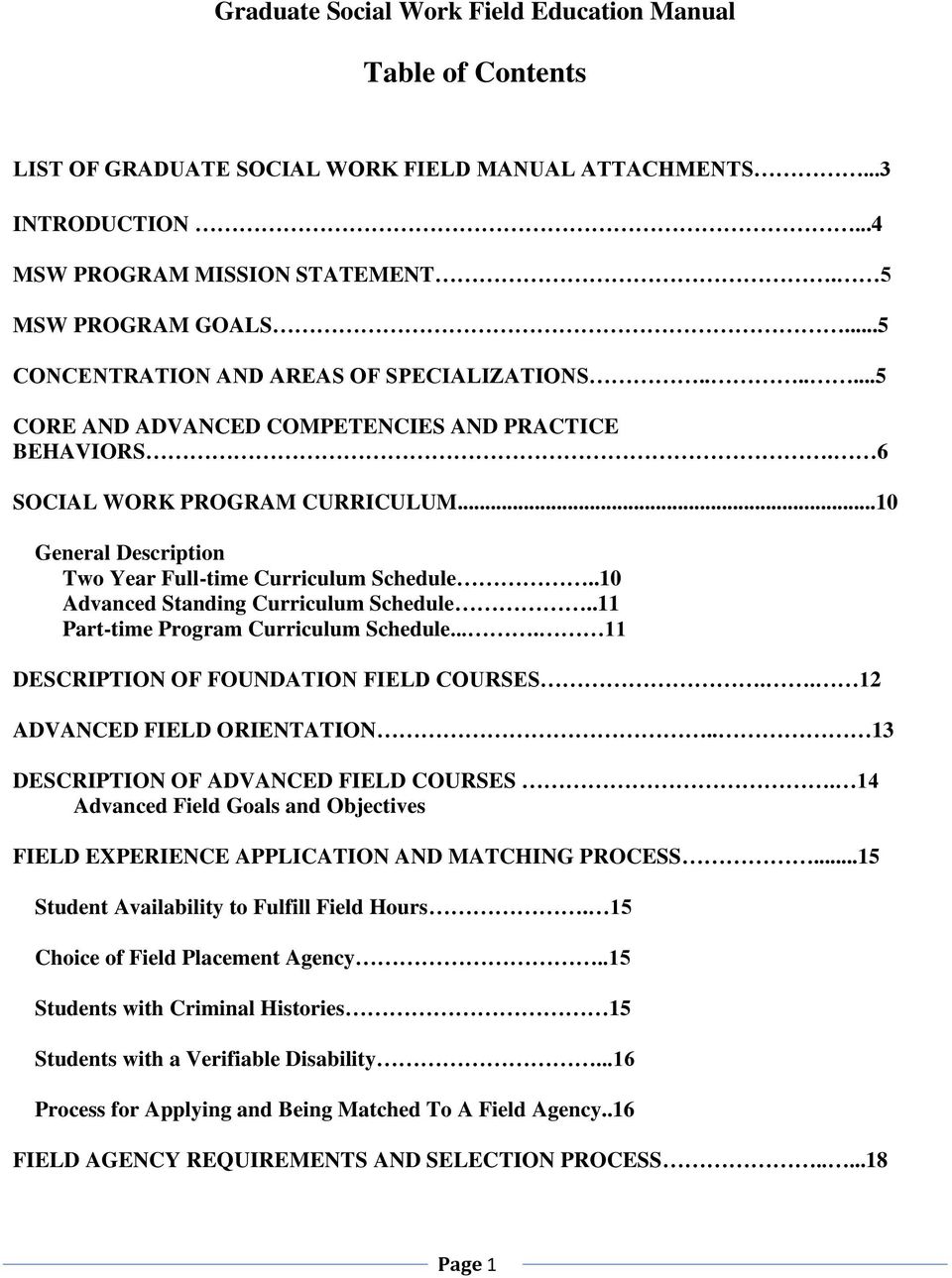
2 Graduate Social Work Field Education Manual Table of Contents LIST OF GRADUATE SOCIAL WORK FIELD MANUAL ATTACHMENTS...3 INTRODUCTION...4 MSW PROGRAM MISSION STATEMENT. 5 MSW PROGRAM GOALS...5 CONCENTRATION AND AREAS OF SPECIALIZATIONS CORE AND ADVANCED COMPETENCIES AND PRACTICE BEHAVIORS. 6 SOCIAL WORK PROGRAM CURRICULUM...10 General Description Two Year Full-time Curriculum Schedule..10 Advanced Standing Curriculum Schedule..11 Part-time Program Curriculum Schedule DESCRIPTION OF FOUNDATION FIELD COURSES.. 12 ADVANCED FIELD ORIENTATION.. 13 DESCRIPTION OF ADVANCED FIELD COURSES. 14 Advanced Field Goals and Objectives FIELD EXPERIENCE APPLICATION AND MATCHING PROCESS...15 Student Availability to Fulfill Field Hours. 15 Choice of Field Placement Agency..15 Students with Criminal Histories 15 Students with a Verifiable Disability...16 Process for Applying and Being Matched To A Field Agency..16 FIELD AGENCY REQUIREMENTS AND SELECTION PROCESS Page 1
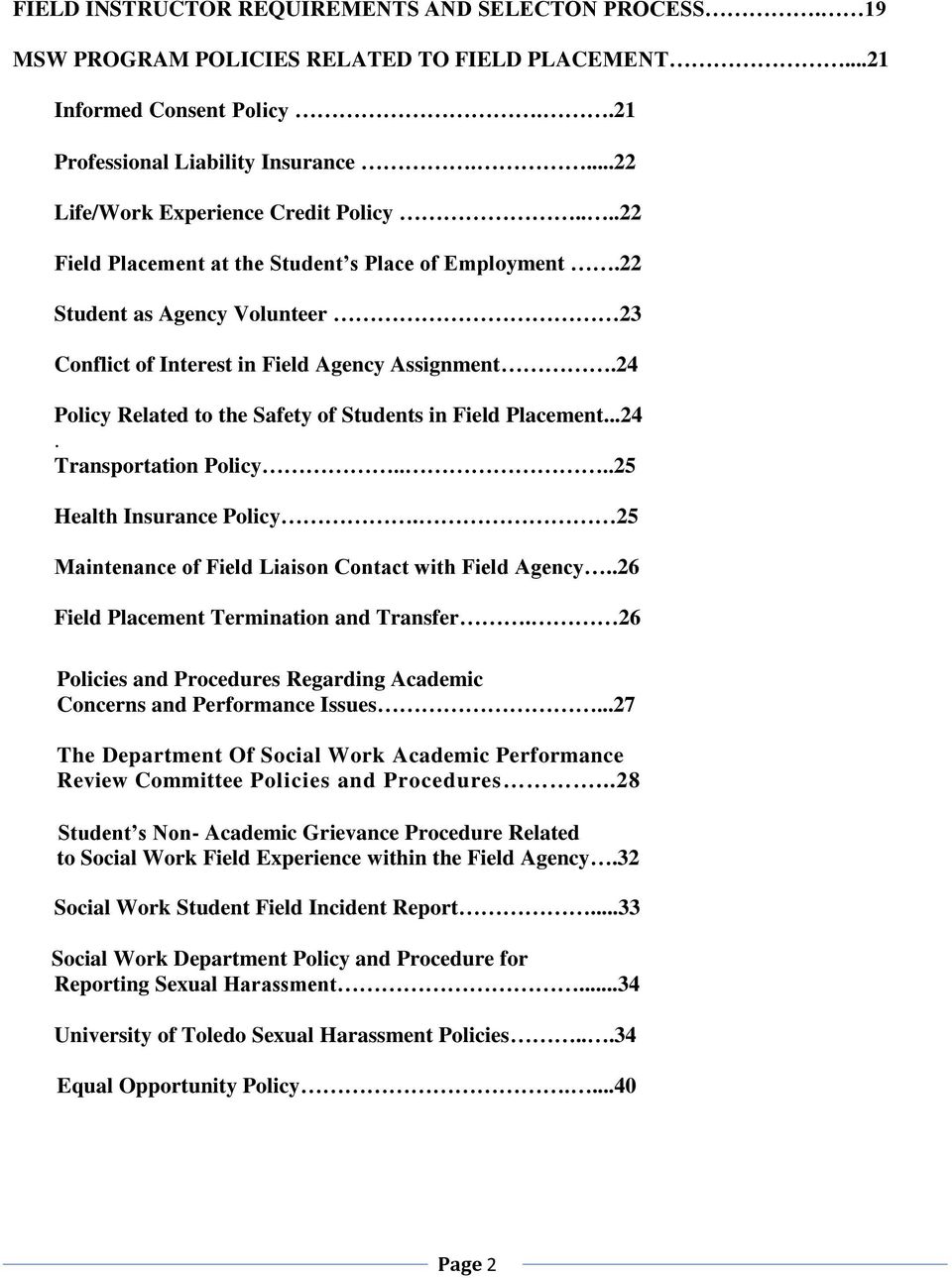
3 FIELD INSTRUCTOR REQUIREMENTS AND SELECTON PROCESS. 19 MSW PROGRAM POLICIES RELATED TO FIELD PLACEMENT...21 Informed Consent Policy..21 Professional Liability Insurance Life/Work Experience Credit Policy Field Placement at the Student s Place of Employment.22 Student as Agency Volunteer 23 Conflict of Interest in Field Agency Assignment.24 Policy Related to the Safety of Students in Field Placement Transportation Policy Health Insurance Policy. 25 Maintenance of Field Liaison Contact with Field Agency..26 Field Placement Termination and Transfer. 26 Policies and Procedures Regarding Academic Concerns and Performance Issues...27 The Department Of Social Work Academic Performance Review Committee Policies and Procedures...28 Student s Non- Academic Grievance Procedure Related to Social Work Field Experience within the Field Agency.32 Social Work Student Field Incident Report...33 Social Work Department Policy and Procedure for Reporting Sexual Harassment...34 University of Toledo Sexual Harassment Policies...34 Equal Opportunity Policy Page 2
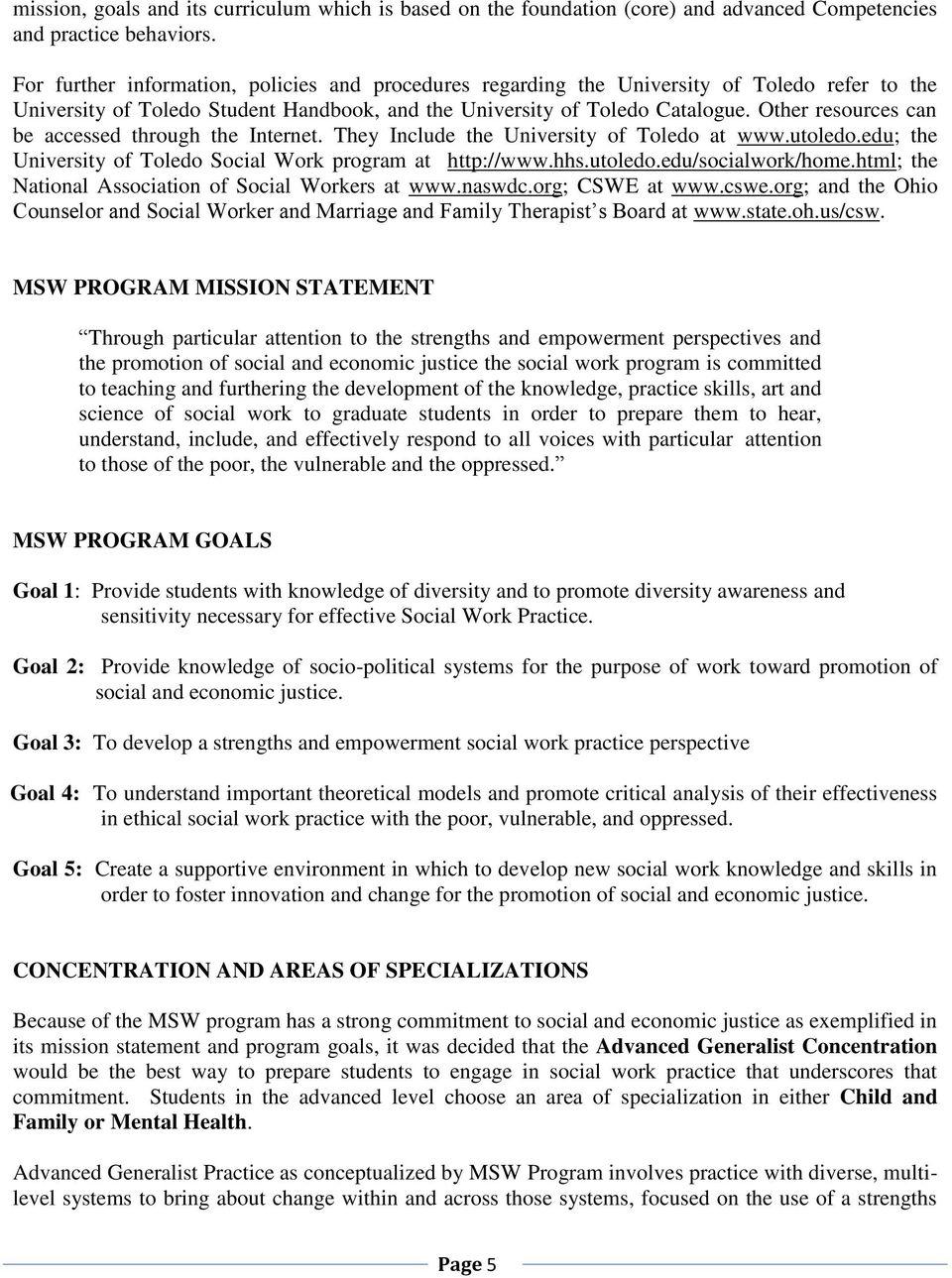
4 LIST OF GRADUATE SOCIAL WORK FIELD MANUAL ATTACHMENTS Advanced Field Placement Confirmation Form Advanced Field Placement Confirmation Alternative Plan Form Advanced Field Placement Education Plan and Evaluation Form Affiliation Agreement Form Field Activity Log Field Agency Registration Form Field Agency Safety Review Form Field Instructor Registration Form Field Instructor s Evaluation of the Field Experience Program Field Log Form Foundation Field Confirmation Form Foundation Field Placement Education Plan and Evaluation Form MSW Field Application Form A MSW Field Application Form B MSW Field Application Form Social Work Student Field Incident Report Form Student s Evaluation of The Field Agency Experience Page 3

5 INTRODUCTION The University of Toledo MSW is accredited by the Council on Social Work Education (CSWE), and therefore the MSW program s curricular content and educational context has been developed in accordance to the Council on Social Work Education (CSWE) 2008 Educational Policy and Accreditation Standards (EPAS). The EPAS can be accessed online at the CSWE website: With the introduction of the 2008 EPAS the social work curriculum structure changed from a goal and objective based curriculum to a curriculum driven by competencies and their corresponding practice behaviors. The EPAS identify 10 core competencies and suggest practice behaviors for the BSW and foundation level curriculum. Advanced level competencies and practice behaviors are determined by the individual MSW programs and are to be reflective of the program s mission and goals. According to CSWE Educational Policy 2.0 the Social Work Program s curriculum is to be a competency-based education which is an outcome performance approach to curriculum design. Competencies are measureable practice behaviors that are comprised of knowledge, values and skills. The goal of the outcome approach is to demonstrate the integration and application of the competencies in practice with individuals, families, groups, organizations, and communities. The University of Toledo MSW Program s practice concentration is that of Advanced Generalist with either a specialization in Child and Family or Mental Health. Those students admitted into the regular MSW program in the first year complete foundation level courses including foundation field and 10 foundation/core competencies. In the second year students complete advance level courses including advanced field and the advanced MSW competencies. The advanced level MSW student also completes a field practicum, in the student s area of specialization: Child and Family or Mental Health. Students who are admitted to the MSW program as advanced standing have completed a BSW degree and have mastered the core competencies in their BSW programs and thus are admitted directly into the advanced level courses. The current EPAS have also designated Field Education as the Signature Pedagogy. Educational Policy 2.3 states: Signature pedagogy represents the central form of instruction and learning in which a profession socializes its students to perform the role of practitioner. Professionals have pedagogical norms with which they connect and integrate theory and practice social work, the signature pedagogy is field education. The intent of field education is to connect the theoretical and conceptual contribution of the classroom with the practical world of the practice setting. It is a basic precept of social work education that the two interrelated components of curriculum classroom and field are of equal importance within the curriculum, and each contributes to the development of the requisite competencies of professional practice. Field education is systematically designed, supervised, coordinated, and evaluated based on criteria by which students demonstrate the achievement of program competencies. The purpose of this field manual is to provide graduate social work students, field instructors, and faculty with an understanding of the requirements of the Foundation and Advanced Field Experience and Integrative Seminar courses, the field application and placement evaluation process; and other policies and procedures necessary to successfully complete the field experience and seminar courses. The manual also provides information about the University of Toledo Master of Social Work Program s Page 4

6 mission, goals and its curriculum which is based on the foundation (core) and advanced Competencies and practice behaviors. For further information, policies and procedures regarding the University of Toledo refer to the University of Toledo Student Handbook, and the University of Toledo Catalogue. Other resources can be accessed through the Internet. They Include the University of Toledo at the University of Toledo Social Work program at the National Association of Social Workers at CSWE at and the Ohio Counselor and Social Worker and Marriage and Family Therapist s Board at MSW PROGRAM MISSION STATEMENT Through particular attention to the strengths and empowerment perspectives and the promotion of social and economic justice the social work program is committed to teaching and furthering the development of the knowledge, practice skills, art and science of social work to graduate students in order to prepare them to hear, understand, include, and effectively respond to all voices with particular attention to those of the poor, the vulnerable and the oppressed. MSW PROGRAM GOALS Goal 1: Provide students with knowledge of diversity and to promote diversity awareness and sensitivity necessary for effective Social Work Practice. Goal 2: Provide knowledge of socio-political systems for the purpose of work toward promotion of social and economic justice. Goal 3: To develop a strengths and empowerment social work practice perspective Goal 4: To understand important theoretical models and promote critical analysis of their effectiveness in ethical social work practice with the poor, vulnerable, and oppressed. Goal 5: Create a supportive environment in which to develop new social work knowledge and skills in order to foster innovation and change for the promotion of social and economic justice. CONCENTRATION AND AREAS OF SPECIALIZATIONS Because of the MSW program has a strong commitment to social and economic justice as exemplified in its mission statement and program goals, it was decided that the Advanced Generalist Concentration would be the best way to prepare students to engage in social work practice that underscores that commitment. Students in the advanced level choose an area of specialization in either Child and Family or Mental Health. Advanced Generalist Practice as conceptualized by MSW Program involves practice with diverse, multilevel systems to bring about change within and across those systems, focused on the use of a strengths Page 5
7 and empowerment model utilizing critical thinking, innovative and complex methods of assessment, intervention, and evaluation to improve the quality of life, while working to achieve the highest levels of social and economic justice. CORE AND ADVANCED COMPETENCIES AND PRACTICE BEHAVIORS The program s 10 core competencies and practice behaviors and the six advanced competencies and practice behaviors are directly linked to the mission and goals of MSW program. The advanced competencies and practice behaviors are the basis for the advanced curriculum that develops students into skilled and knowledgeable advanced generalist practitioners with a specialization in child and family or mental health. The 10 core competencies and practice behaviors are the basis for the foundation year curriculum and upon which the advanced curriculum is built. In fact the 10 th core competency; to engage, assess, intervene, and evaluate with individuals, families, groups, organizations, and communities is a bridge competency that is shared with the advanced level curriculum. Although the competency is the same for both the foundation and advanced levels, the practice behaviors for the advanced competencies are of more breadth and depth. The following is a chart of the program s foundation (core) and advanced competencies and practice behaviors. Foundation (Core) Competencies Identify as a professional social worker and conduct oneself accordingly. Foundation Practice Behaviors: 1. Advocate for client access to the services of social work 2. Practice personal reflection and self-correction to assure continual professional development 3. Attend to professional roles and boundaries 4. demonstrate professional demeanor in behavior, appearance, and communication 5. engage in career-long learning 6. Use supervision and consultation 2 Apply social work ethical principles to guide professional practice. Foundation Practice Behaviors: 1. Recognize and manage personal values in a way that allows professional values to guide practice 2. Make ethical decisions by applying standards of the National Association of Social Workers Code of Ethics and, as applicable, of the International Federation of Social Workers/International Association of Schools of Social Work Ethics in Social Work, Statement of Principles 3. Tolerate ambiguity in resolving ethical conflicts 4. Apply strategies of ethical reasoning to arrive at principled decisions 3 Apply critical thinking to inform and communicate professional judgments. Foundation Practice Behaviors: 1. Distinguish, appraise, and integrate multiple sources of knowledge, including research-based knowledge, and practice wisdom 2. Analyze models of assessment, prevention, intervention, and evaluation 3. Demonstrate effective oral and written communication in working with individuals, families, groups, organizations, communities, and colleagues. Page 6
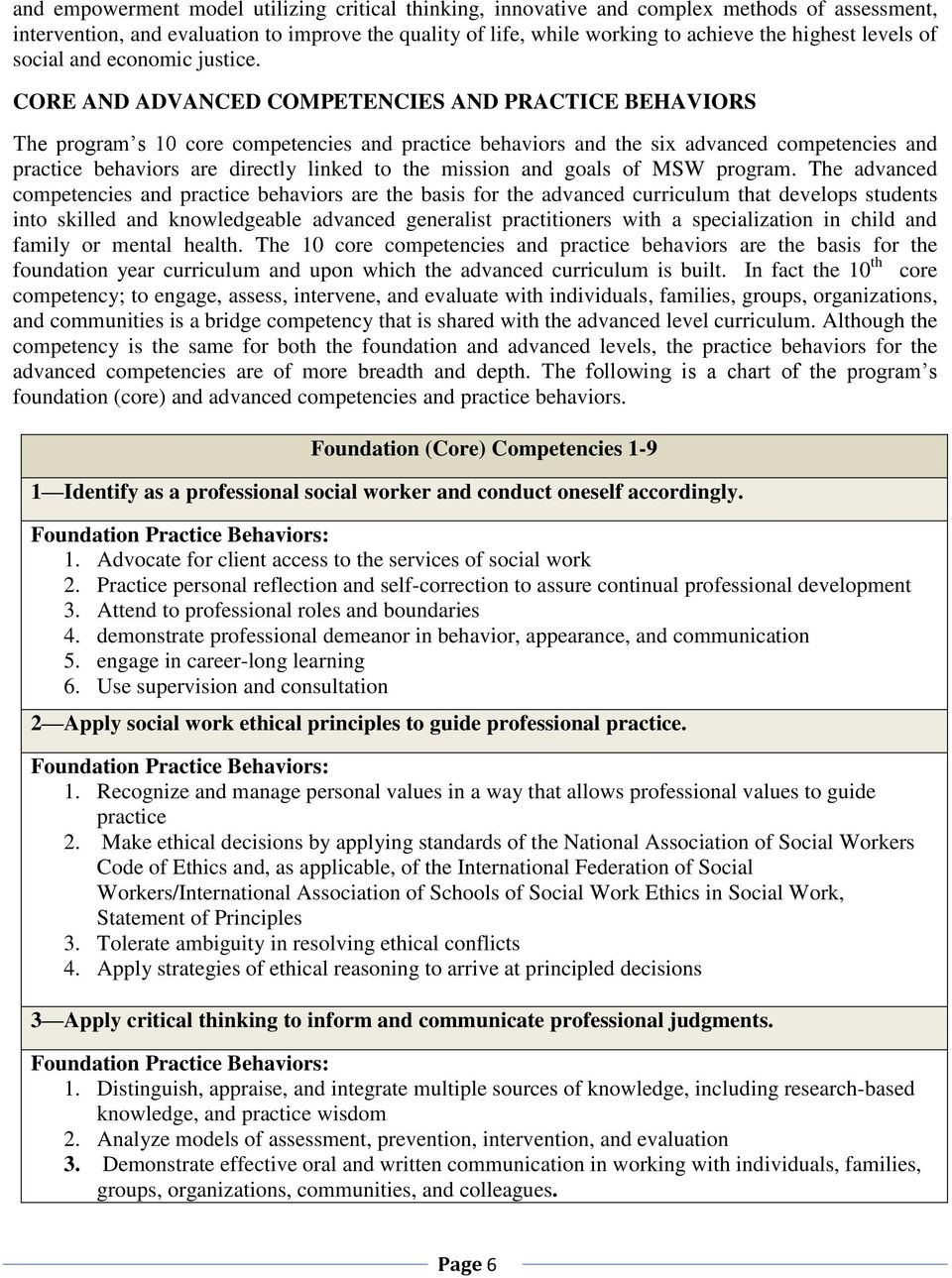
8 4 Engage diversity and difference in practice. Foundation Practice Behaviors: 1. Recognize the extent to which a culture s structures and values may oppress, marginalize, alienate, or create or enhance privilege and power 2. Gain sufficient self-awareness to eliminate the influence of personal biases and values in working with diverse groups 3. Recognize and communicate their understanding of the importance of difference in shaping life experiences; and 4. View themselves as learners and engage those with whom they work as informants 5 Advance human rights and social and economic justice. Foundation Practice Behaviors: 1. Understand the forms and mechanisms of oppression discrimination 2. Advocate for human rights and social and economic justice 3. Engage in practices that advance social and economic justice 6 Engage in research-informed practice and practice-informed research. Foundation Practice Behaviors: 1. Use practice experience to inform scientific inquiry and 2. Use research evidence to inform practice. 7 Apply knowledge of human behavior and the social environment. Foundation Practice Behaviors: 1. Utilize conceptual frameworks to guide the processes of assessment, intervention, and evaluation 2. Critique and apply knowledge to understand person and environment. 8 Engage in policy practice to advance social and economic well-being and to deliver effective social work services. Foundation Practice Behaviors: 1. Analyze, formulate, and advocate for policies that advance social well-being; and 2. Collaborate with colleagues and clients for effective policy action. 9 Respond to contexts that shape practice. Foundation Practice Behaviors: 1. Continuously discover, appraise, and attend to changing locales, populations, scientific and technological developments, and emerging societal trends to provide relevant services; and 2. Provide leadership in promoting sustainable changes in service delivery and practice to improve the quality of social services Foundation (Core) and Advanced Competencies 10(a)-(d) 10(a) (d) Engage, assess, intervene, and evaluate with individuals, families, groups, organizations, and communities. Page 7
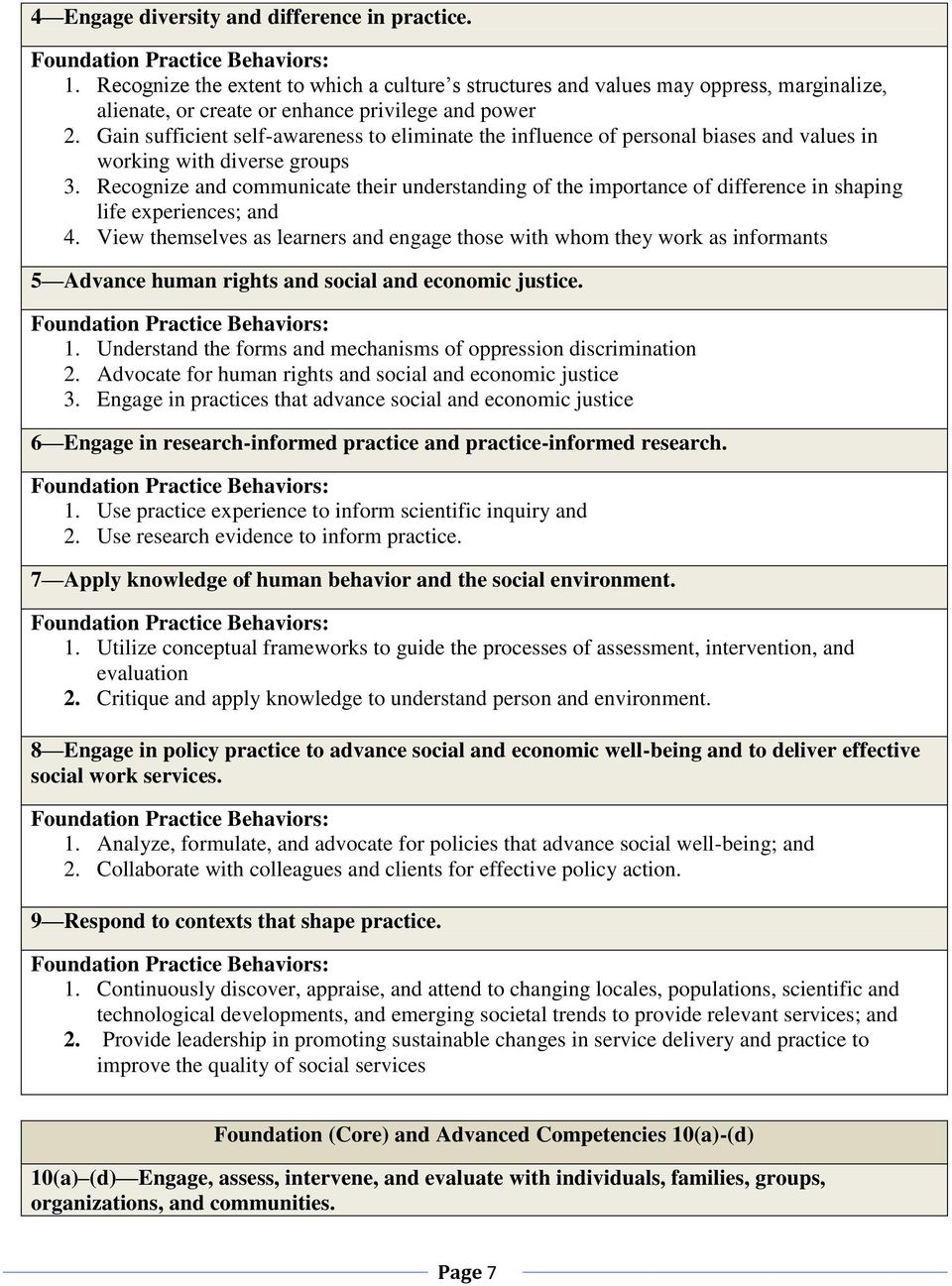
9 (These competencies (10(a) (d) apply to both the foundation (core) and advanced level competencies. However the Practice Behaviors listed under each competency are differentiated into Foundation level and the Advanced level Practice Behaviors) 10(a) Engagement Foundation Practice Behaviors: F 1. Substantively and affectively prepare for action with individuals, families, groups, organizations, and communities F 2. Use empathy an d other interpersonal skills F 3. Develop a mutually agreed-on focus of work and desired outcomes. Advanced Practice Behaviors: A 1. Develop informed and effective relationships with diverse client populations A 2. Exhibit self-awareness and positive use of self in the engagement process 10(b) Assessment Foundation Practice Behaviors: F 1. Collect, organize, and interpret client data; F 2. Assess client strengths and limitations; F 3. Develop mutually agreed-on intervention goals and objectives; and F 4. Select appropriate intervention strategies. Advanced Practice Behaviors: A 1. Demonstrate the ability to conduct accurate diagnostic assessments that reflect a recognition of strengths and an understanding of diversity A 2. Demonstrate knowledge of multiple assessment techniques used at various systems levels. 10(c) Intervention Foundation Practice Behaviors: F 1. Initiate actions to achieve organizational goals; F 2. Implement prevention interventions that enhance client capacities; F 3. Help clients resolve problems; F 4. Negotiate, mediate, and advocate for clients; and F 5. Facilitate transitions and endings. Advanced Practice Behaviors: A 1. Demonstrate knowledge of theoretical perspectives and paradigms related to intervention strategies for social work practice at various systems levels A 2. Apply multidimensional intervention strategies to address complex issues at various systems levels 10(d) Evaluation Foundation Practice Behaviors: Social Workers F 1. Critically analyze, monitor, and evaluate interventions. Advanced Practice Behaviors: Social Workers Page 8
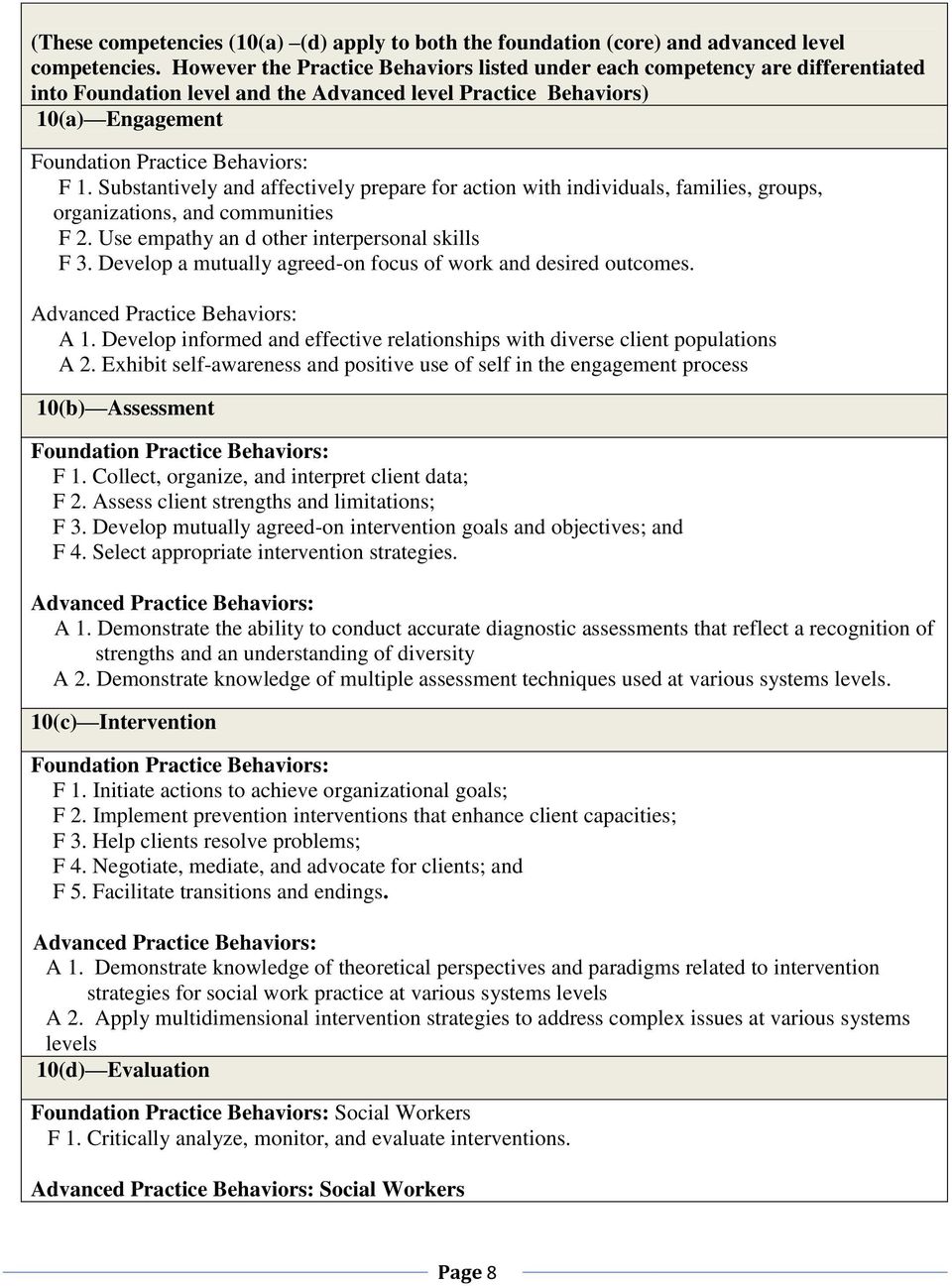
10 A 1. Identify and develop effective monitoring and evaluation strategies and tools for use at various systems levels A 2. Implement evaluation strategies at various systems levels A 3. Analyze and apply results of evaluations to inform practice. Advanced Competencies Apply knowledge and skills in the student s area of concentration Advanced Practice Behaviors: 1. Demonstrate knowledge of concentration area (Child and Family or Mental Health) population and service delivery systems. 2. Demonstrate assessment skills appropriate to client systems served in the concentration area. 3. Exhibit intervention skills appropriate to client systems served in the concentration area. 4. Recognize evidence-based and emerging intervention strategies appropriate for serving populations in the concentration area. 12. Engage in ethical practice in situations with competing values and interests Advanced Practice Behaviors: 1. Analyze ethical practice through the lens of social and economic justice 2. Demonstrate awareness of ethical dilemmas and competing values in practice settings 3. Exhibit ethical behaviors in practice 13. Exhibits advanced skills in the critical analysis of how the interaction of complex factors and multiple systems affect the client systems well being. Advanced Practice Behaviors: 1. Identify complex factors and their interactions at various system levels and their effects on clients lives 3. Critically analyze and assess the effects of such factors in client s lives. 3. Demonstrate how the assessment and analysis of such factors informs practice Integrate eco-systems, strengths perspective, and empowerment perspectives into advanced practice theories and interventions. Advanced Practice Behaviors: 1. Understand the eco-systems, strengths perspective, and empowerment perspectives in social work practice situations. 2. Utilize the ecosystems, strengths perspective, and empowerment perspective in the process of assessment, interventions, and evaluation. 3. Apply advanced practice theories that are relevant to particular client systems through the lens of ecosystems, strengths, and empowerment perspectives. 15. Demonstrate advanced knowledge and skills in social and economic justice. Advanced Practice Behaviors: Social Workers 1. Identify and assess social issues and situations creating social and economic injustice. 2. Demonstrate advanced knowledge of social change theories that advance social and economic justice across client systems 3. Analyze, formulate, and advocate for practices and policies that advance equal and equitable access to resources and opportunities Page 9
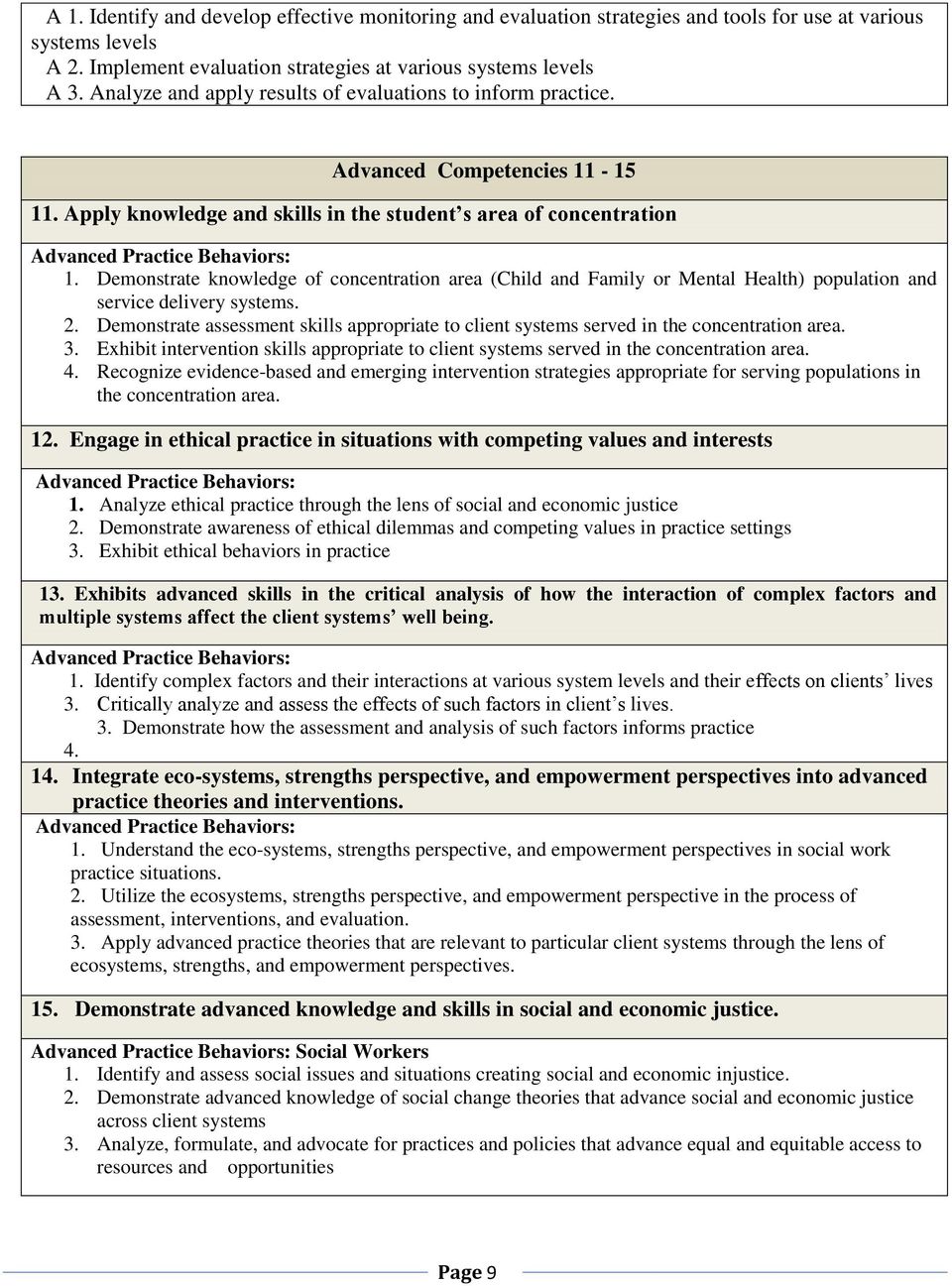
11 SOCIAL WORK PROGRAM CURRICULUM General Description Considering the strong focus on social and economic justice of the program s mission the MSW Program is based in an Advanced Generalist framework. Students take foundation courses during the first year of the program. In the second or advanced year of the program, students take advanced generalist course work as well as course work in an area of specialization. Specialization areas are Mental Health, and Child and Family. Students take course work in each of the curriculum areas of social work: practice, policy, human behavior in the social environment, research and field. Each of the curriculum areas are offered in both the foundation year and the advanced curriculum year. The advanced year curriculum builds from the foundation year. As in the foundation curriculum content on values and ethics, diversity and populations-at-risk and social and economic justice are found throughout the advanced year curriculum. The program views these three areas of content critical to our mission and the mission of the social work profession. Students are equipped with the advanced skills they need to practice at all system levels, understanding the environment in which people live in order to advance social and economic justice. Therefore, the program of study is as follows: Two Year Full-time Curriculum Schedule Fall Year 1 Spring Year 1 Social Work Practice I Social Work Practice II Micro Perspectives of HBSE Social Work Practice III Policy Issues and Analysis in Macro Social Work Perspectives of HBSE Social Work Social Work Research Methods Advanced Social Work Assessment and Analysis Foundation Field Experience Foundation Field Experience and Integrative Seminar I and Integrative Seminar II Fall Year 2 Spring Year 2 Advanced Generalist Practice I Advanced Generalist Practice II Research Elective* Advanced Generalist Practice III Field of Practice Practice** Field of Practice Policy*** Social Work Journal Review Seminar I Social Work Journal Review Seminar II Advanced Field Experience Advanced Field Experience and Integrative Seminar I and Integrative Seminar II *Students may choose between Research Methods for Micro Social Work Practice and Research Methods for Macro Social Work Practice **Students may choose between Social Work Practice in Mental Health and Social Work Practice with Children and Families Page 10
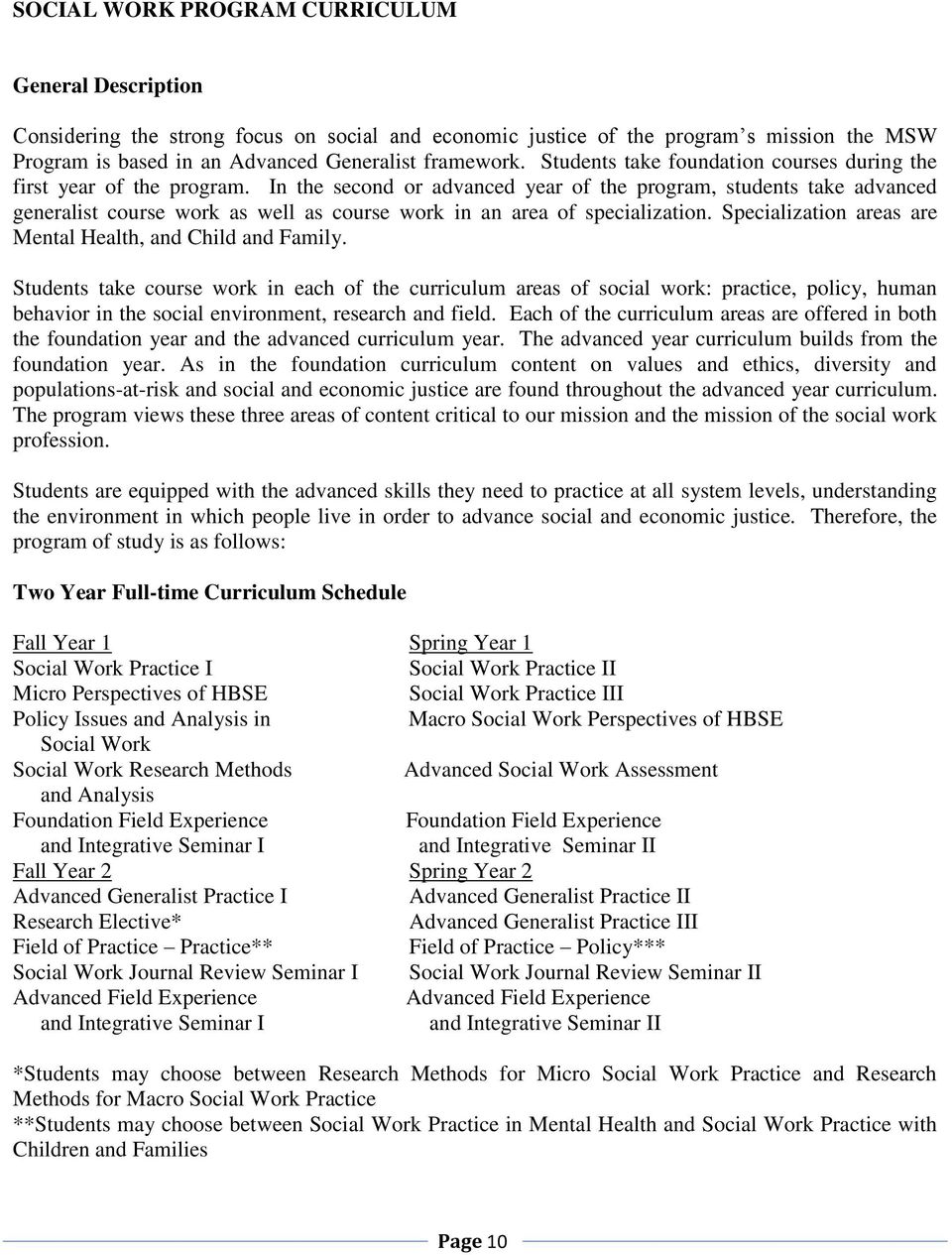
12 ***Students may choose between Social Work Policy Issues in Mental Health, and Social Work Policy Issues in Child and Family. Advanced Standing Curriculum Schedule Students applying to the program with a baccalaureate degree in social work from a CSWE accredited program may apply for advanced standing. This recognizes the likelihood that taking the foundation level classes will be repetitive of their undergraduate program. Advanced standing students will be required to take the Advanced Social Work Assessment class and all of the classes listed in the advanced year curriculum. Their curriculum plan will be as follows: Summer Advanced Social Work Assessment Fall Spring Advanced Generalist Practice I Advanced Generalist Practice II Research elective Advanced Generalist Practice III Field of Practice Practice** Field of Practice - Policy *** Social Work Journal Review Seminar I Social Work Journal Review Seminar II Advanced Field Experience and Advanced Field Experience and Integrative Seminar I Integrative Seminar II Part-time Program Curriculum Schedule It is expected that the program will serve a number of students who need to maintain their employment while going to school. For these students, the program will allow students to enroll in a part-time program. In order to insure the integration of course content with the field placement and the subsequent identification as an advanced generalist social work professional, students must complete the part-time program within four years. Students admitted to the part-time program must sign an agreement stating that they understand that most field placement agencies operate in standard daytime hours. Also if agencies provide evening and weekend services they may not have the required MSW level type of learning opportunities and qualified MSW field instructors to provide evening and weekend supervision. Therefore students entering the program as part-time students are not guaranteed an evening or weekend field placement. Therefore part-time students need to be flexible in the hours they have available during the day and weekdays in order to finish the program. The curriculum plan for students completing the MSW Program in three years is as follows: Fall Year 1 Spring Year 1 Micro Social Work Perspectives of HBSE Macro Social Work Perspectives of HBSE Social Work Practice I Social Work Practice II Summer Year 1 Social Work Research Methods and Analysis Fall Year 2 Spring Year 2 Policy Issues and Analysis in Social Work Social Work Practice III Page 11
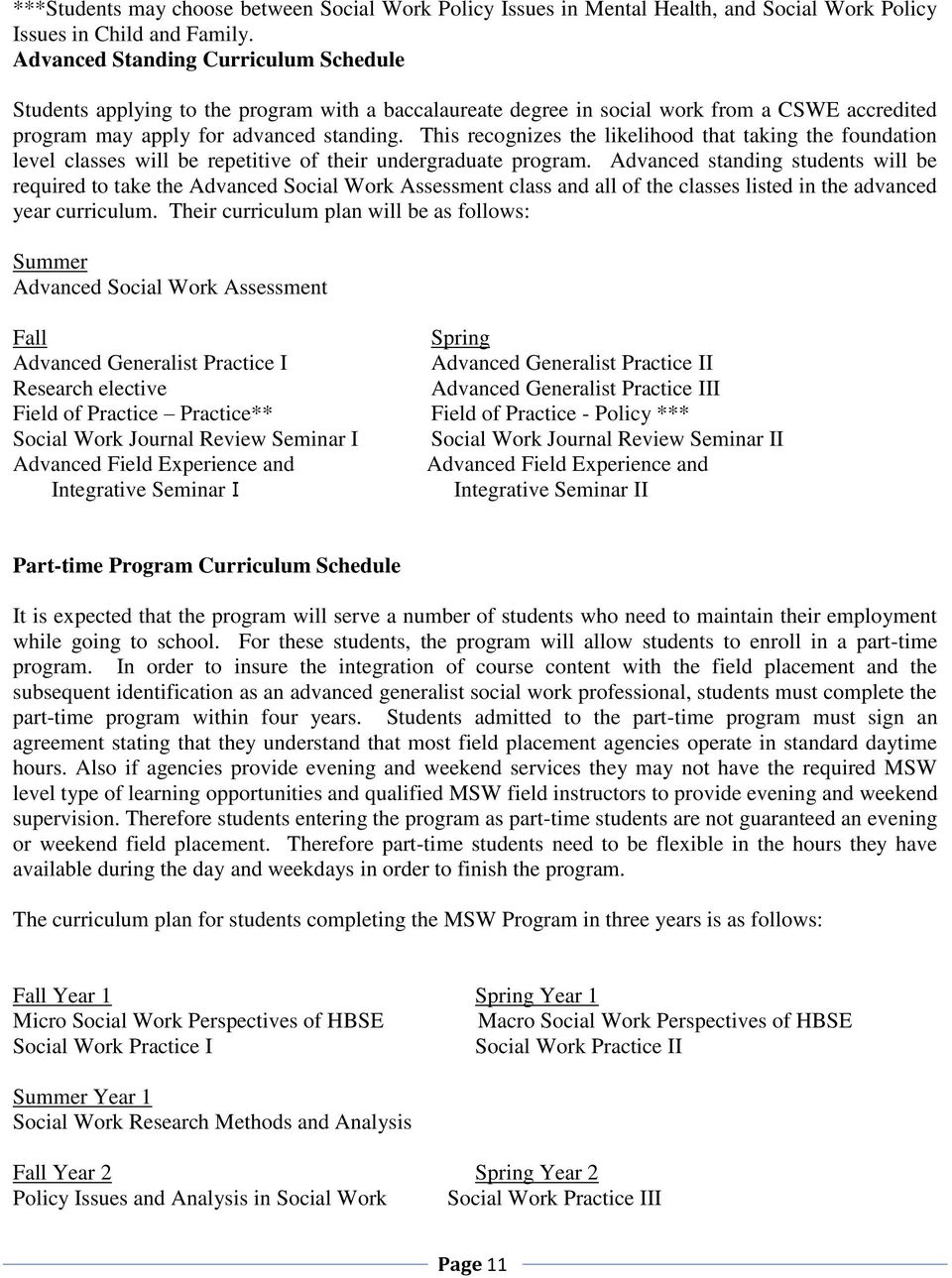
13 Foundation Field Experience and Integrative Seminar I Foundation Field Experience and Integrative Seminar II Summer Year 2 Advanced Social Work Assessment Fall Year 3 Spring Year 3 Advanced Generalist Practice I Advanced Generalist Practice II Research Elective Advanced Generalist Practice III Field of Practice - Practice ** Field of Practice - Policy *** Social Work Journal Review Seminar I Social Work Journal Review Seminar II Advanced Field Experience and Advanced Field Experience and Integrative Seminar I Integrative Seminar II The curriculum plan for students completing the part-time program in four years is as follows: Fall Year 1 Spring Year 1 Micro Social Work Perspectives of HBSE Macro Social Work Perspectives of HBSE Social Work Practice I Social Work Practice II Summer Year 1 Social Work Research Methods and Analysis Fall Year 2 Spring Year 2 Policy Issues and Analysis in Social Work Social Work Practice III Foundation Social Work Field Experience Foundation Social Work Field Experience and Integrative Seminar I and Integrative Seminar II Summer Year 2 Advanced Social Work Assessment Fall Year 3 Spring Year 3 Advanced Generalist Practice I Advanced Generalist Practice II Research elective* Advanced Generalist Practice III Fall Year 4 Spring Year 4 Field of Practice Practice** Field of Practice- Policy*** Social Work Journal Review Seminar I Social Work Journal Review Seminar II DESCRIPTION OF FOUNDATION FIELD COURSES The foundation field courses are SOCW 5900 Foundation Field Experience and Integrative Seminar I and SOCW 5910 Foundation Field Experience and Integrative Seminar II Page 12
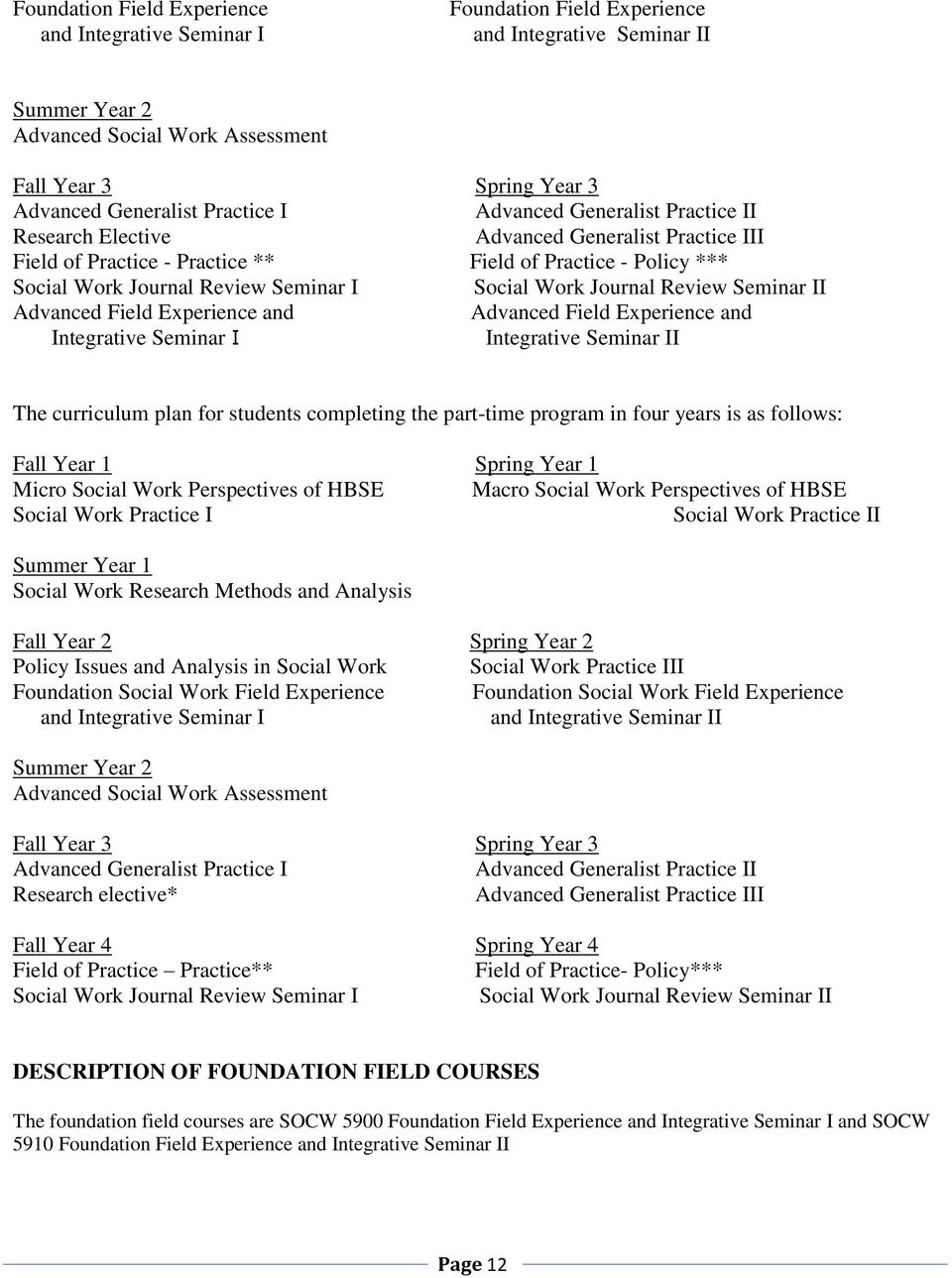
14 The foundation field courses provide the student a 400 hour internship in a field agency under the supervision of a qualified field instructor and a weekly 1.5 hour field seminar which is designed to facilitate the student s integration and mastery of content taught in the classroom. To be eligible for foundation field courses the foundation MSW student must have successfully completed or is concurrently taking Social Work Practice I, Micro Perspectives of HBSE, Social Policy Issues and Analysis, and Research Methods and Analysis. The student completes a field application process and on the basis of the application the field director assigns the student to a field agency under the supervision of qualified field instructor. Foundation Field Experience and Integrative Seminar I (foundation field I) and Foundation Field Experience and Integrative Seminar II (foundation field II) are taken sequentially in two consecutive semesters beginning in the fall semester. During the first five weeks of foundation field I the student attends a field seminar in which the student develops strategies for success with an emphasis on safety in the agency. The student is also given an overview of the field placement requirements, the program s missionand goals, and the core and advanced competencies of the MSW Social Work Program. In the field seminar the MSW Foundation Field Education Plan and Evaluation Form is a tool used by the student to develop a Field Education Plan to be implemented in the field agency. The Field Education Plan details the student s field goals, learning objectives and activities through which the student will master the foundation/core competencies and practice behaviors. The MSW Foundation Field Education Plan and Evaluation Form also includes an evaluation section of the student s performance which is to be completed by the field instructor at the end of each semester. The student begins a field placement during the 6 th week of foundation field I and continues to attend a weekly field seminar for a total of 1.5 hours per week and 16 field hours per week and an accumulated total of 160 field hours by the end of the fall semester. The field seminar instructor, who is also the student s field liaison, guides the student through the development of the Field Education Plan with the assistance of the student s field instructor. In the subsequent spring semester the foundation year student takes foundation field II. To be in eligible for foundation field II, the students must have successfully completed foundation field I with a B grade or better and successfully completed or is concurrently taking Social Work Practice II, Social Work Practice III, Macro Perspectives of HBSE, and Advanced Social Work Assessment. Part-time students may take Advanced Social Work Assessment during the summer of year two which is after completing the foundation field courses and before advanced field I course. In foundation field II the student continues placement in the same agency and attends a weekly field seminar which is taught by the same field instructor/field liaison as in foundation field I. The student completes 16 field hours per week for a total of 240 field hours during the spring semester. During the foundation field II the student is required to fulfill the terms of the Field Education Plan that was developed in. Foundation Field Experience and Integrative Seminar I. Toward the end of the fall and spring semesters the field instructor will complete an evaluation of student s field performance and share the results with the student before the field liaison agency visit. The field liaison agency visit will take place within the last four weeks of the semester and is to include the field liaison, the field instructor and the student. At the time of the field visit the field instructor will give a signed copy of the evaluation form to the field liaison and student s performance will be discussed. The discussion will be based on the results of the Field Placement Evaluation and the student s progress in fulfilling the terms of the Foundation Field Educational Plan. The field liaison will use the field visit to help determine the student s final grade. ADVANCED FIELD OREINTATION Page 13
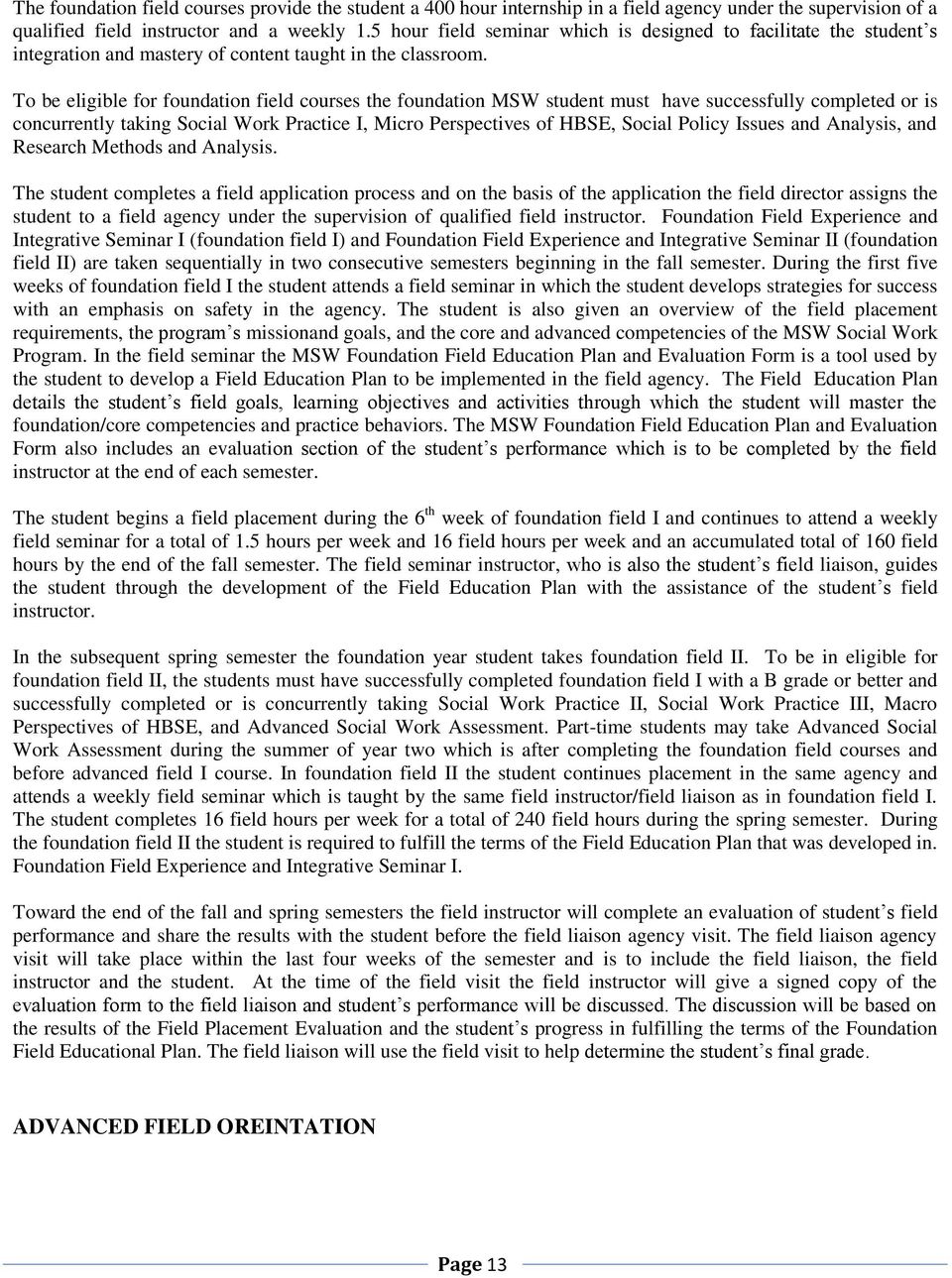
15 Prior to beginning the advanced field placement the student is required to attend an Advanced MSW Field Orientation. The orientation will be scheduled prior to the beginning of the semester in which the first advanced field courses is being taken. Students will be sent notices of the date(s) of the session(s). DESCRIPTION OF ADVANCED FIELD COURSES The advanced field courses are SOCW 6900 Advanced Field Experience and Integrative Seminar I and SOCW 6910 Advanced Field Experience and Integrative Seminar II The advanced field courses provide the student a 720 hour internship in a field agency under the supervision of a qualified field instructor and a weekly 1.5 hours field seminar. Both are designed to facilitate the student s integration and mastery of content taught in the classroom which includes the advanced level social work theory, the 6 advanced competencies and practice behaviors, and the broad and in-depth advanced generalist practice skills in the student s area of specialization. To be eligible for Advanced Field Experience and Integrative Seminar I (advanced field I) and Advanced Field Experience and Integrative Seminar II (advanced field II) the student must have been admitted to the MSW Program as Advanced Standing or must have successfully completed all the foundation level courses with a GPA of 3.0 with no more than one grade between a B- and a C and concurrently will take Advanced Generalist Practice I, Research Elective, Field of Practice Practice, and Social Work Journal Review Seminar I. The four year part-time student will have completed Advanced Generalist Practice I and Research elective prior to taking Advanced Field Experience and Integrative Seminar I (advanced field I). Advanced field I and advanced field II are to be taken sequentially in two consecutive semesters beginning in the fall semester. Students remain in the same course section and field agency for both semesters. The advanced field 1 and II course instructor is also the student s field liaison. Prior to beginning advanced field I the student must complete a field application and placement process in which the field director assigns the student to a field agency related to the student s area of specialization: Child and Family or Mental Health. The student is required to complete 360 field hours per semester. Thus the student is to complete 24 field hours per week to include 22.5 hours in the field agency and 1.5 hours in a field seminar on campus. During the fall semester advanced field I will be graded as a Pass/no credit course. In order to earn a Pass grade the student must earn an equivalent of a B or better. The student is given a letter grade for advanced field II and must earn a grade of B or better to pass. The Advanced MSW Field Education Plan and Evaluation Form is a tool used by the student to develop a Field Education Plan. The Field Education Plan details the student learning activities that will exhibit mastery of the Advanced Competencies the corresponding Behavior Practices. The Advanced MSW Field Education Plan and Evaluation Form also includes an evaluation section of the student s performance, which is to be completed by the field instructor at the end of each semester. The field instructor is to share the results with the student before the field liaison s agency visit. The field liaison s agency visit will take place within the last four weeks of the fall and spring semesters and Page 14
16 is to include the field liaison, the field instructor and the student. At the time of the field visit the field instructor will give a signed copy of the evaluation form to the field liaison and student s performance will be discussed. The discussion will be based on the results of the field instructor s evaluation of the student and the student s progress in fulfilling the terms of the Field Educational Plan. The field liaison will use the field visit to help determine the student s final grade. FIELD EXPERIENCE APPLICATION AND MATCHING PROCESS The foundation and the advanced standing field student must adhere to the following process in order to assure a timely assignment to a field agency. Please note that the Field Office staff will identify and make the initial agency contacts in the process of placing students. Under no circumstances should a student make any arrangements with a prospective field agency without prior discussion with and approval from the Field Director. Student Availability to Fulfill Field Hours In order to provide appropriate supervision and field experiences the majority of eligible agency placements require that the field student be available during weekday and daytime hours. Very few agencies have evening and /or weekend hours available in which the intern can master the social work program s field goals, and master the core and/or advanced competencies and practice behaviors, and which provide appropriate supervision. Therefore it is required that the foundation and advanced level field placement students arrange their schedules so that they will be available to fulfill the required field hours during weekdays and daytime hours. Choice of Field Placement Agency A solid effort will be made to place the foundation students in their area of interest, however, the student s choice of agency is not guaranteed. It is important to note that the MSW Social Work Program is dedicated to preparing the foundation student as a social work generalist practitioner as opposed to preparing the student as a specialist in one particular area. It is the Program s primary responsibility to match the foundation student with a field agency that is able to provide a generalist practice experience, appropriate supervision, and the opportunity to master the foundation field goals and core competencies and practice behaviors. Advanced placement students will be placed in an agency that is appropriate to their chosen area of specialization and that meets the requirements of Social Work Program supervision requirements and where the field goals and the advanced core competencies and practice behaviors can be mastered. The student may request a specific agency; however there is no guarantee that the student will be matched with that particular agency. It is of major importance that the student identifies and clarifies his/her interests and preferences in the application form. The field staff will then work toward placing the student in an agency that matches her/his interests, the requirements of the agency, and the requirements of the Social Work Program. Students with Criminal Histories Page 15
17 Students who have been convicted of a felony or a first-degree misdemeanor will encounter limited field placement opportunities. An increasing number of field agencies screen applicants for criminal records and do not accept interns who have a criminal record especially those agencies working with children, the aged, and other vulnerable populations. The Field Director inquires about criminal history through the application process. If a student has a criminal history it is recommended that at the time of entry into the Social Work Program the student discuss the circumstances with the MSW Social Work Program Director and again with the Field Director in the process of applying for field placement in order to determine the availability of an appropriate field agency. It may be possible that the student may not be able to secure a field placement because of the criminal history. The student with a criminal record is advised that such a record may also affect his/her eligibility for any licensure through the Ohio Counselor, Social Worker Board and Marriage and Family Therapists. Please refer to the Ohio Laws and Rules Governing the Practice of Counseling and Social Work in the Ohio Revised Code Rule # , Application of First Licensure. Graduates with criminal records are also limited in employment possibilities in social service agencies. Students with a Verifiable Disability Students who have a verifiable physical or mental disability and who need accommodations in their field placement should indicate this information in their Field Placement Application forms. The student requesting accommodations should register with the Office of Accessibility, which will work with the Social Work Field Staff in assessing the need for accommodations and in making arrangements for appropriate accommodations in the field agency. Requests for accommodations should be included in the field placement application forms. The student is welcome to contact the field director by phone, stop in during office hours, or make an appointment to discuss any concerns or questions regarding his/her field placement at anytime, but especially throughout the following steps of the application and matching processes. Process for Applying and Being Matched To a Field Agency: 1. Read the Graduate Social Work Field Education Manual which is available on University of Toledo Social Work Program Website at: The Graduate Social Work Field Education Manual contains the description, requirements, responsibilities, policies and procedures of the field placement program. The manual is to be used by the student, faculty and the field agency throughout student s field placement courses. The field application forms are available on the Social Work Program s website. Before completing the Field Placement Application Form the student is required to thoroughly read and understand the contents of the Graduate Field Manual. Within the application form the student is required to sign a statement of understanding certifying they have read, understand, and agree to comply with the terms as specified in the Graduate Social Work Field Education Manual. 2. Students are required to complete and sign the MSW Field Placement Application form. Regular/Foundation admitted students will complete the application at the time they are ready to enter foundation field and again when they are ready to enter advanced field. Page 16
18 3. In addition students admitted as regular status and who have completed a foundation field placement must also complete the MSW Field Application Form A. 4. Students requesting that their employment-site be considered for their field agency placement must complete MSW Field Placement Application form B. Please advise the field director of your intentions to complete this application for further advice and assistance. 5. Submit Field Placement Application forms to Field Director according to the following timelines: a. Regular and advanced standing students admitted full-time to the program are to complete and submit a field application to the MSW Field Director no later than two weeks after being notified of admission to the program. Prompt submission will facilitate timely and appropriate selection of a field agency for the student. b. Students who have been admitted to the program and have been taking social work classes and according to their Plan of Study are ready to begin foundation or advanced field courses are to submit their field application forms no later than the last Monday in February of the spring semester before they are to begin their Advanced Field Placement course the following fall semester. 6. The Field office staff will review all application forms and refer students to a field agency. Before the beginning the field placement course the field staff will give the prospective field student information necessary to contact the field agency to which he/she is being referred for an interview for possible placement in the agency. The field office staff may contact the student to obtain further information or clarification. Applications with any missing information will not be processed. The student will be notified of incomplete application forms. 7. Immediately set up agency interview. Upon receiving the field agency information and referral the student is contact the agency contact person and to set up a date and time for an interview with the agency contact person. The student is to advise the field office of the date and time of the interview. 8. Prepare for the agency interview. The interview is very important in finalizing the field placement assignment and should be handled like an employment interview. Thus the student should dress in appropriate professional attire and take a copy of his/her resume, and a projected schedule of his/her classes and work during the internship. It is highly recommended that the student make the necessary adjustment to his/her schedule to accommodate the internship requirements. The agency contact person and the student will determine together whether the student and agency is a suitable match. The student should be prepared to answer questions regarding his/her educational and career related experiences and goals, and why he/she might desire that field placement. The student should also be prepared with questions regarding the agency s expectations of the student and the type of learning experiences and opportunities that will be made available to the student. Some agencies require criminal record checks, health screens, etc. If these are required, the student must have results of any testing or record checks available to the agency according to its policies and procedures before the first day of classes in the fall semester. The student will be responsible for costs not covered by the agency. Page 17
19 If the student has a criminal record it is recommended that the student discuss these issues at the time of the interview. If the student has a verifiable disability and needs for the agency to provide reasonable accommodations the student should discuss this issue with the agency. The field staff will be available to work with the student and the agency. 9. Complete the Field Placement Confirmation Form. Before the end of the interview the agency representative is to complete the Field Placement Confirmation Form. This form is to be signed by the student and the field agency representative indicating whether or not both parties are in agreement of the field student and the agency match. 10. Submit the Field Placement Confirmation form to the Field Director. The placement is completed when the Field Director receives the Field Placement Confirmation form indicating that the student and the agency agree to the placement. The field contact person may mail the form to the Field Director or the student may return the form to the Field Director. 11. If mutual agreement is not reached the student will be assigned to a second agency and repeat steps 3 through 10 listed above. Please note that at this point the choices in agencies will be limited. If the student is not accepted by a second agency or the student does not accept a second agency match, the Field Director will meet with the student to discuss, assess, and try to resolve the situation. The Field Director may at that time decide to either try a third and last referral agency match or delay the entry into the field placement course for one year and will refer the situation to the Academic Performance Review Committee. If a one-year deferment occurs the student will be required to submit another application for field placement by the deadline for submitting field applications. 12. The student is required to have malpractice insurance as a prerequisite to beginning his/her field placement. This insurance generally is available at no cost through the University of Toledo. If this insurance through the University becomes unavailable students are required to purchase their own malpractice insurance through the National Association of Social Workers and proof of insurance is to be submitted to the Field Director before starting the internship. 13. Mandatory Advanced Field Orientation In order to properly prepare students for entry into their field placement and to understand the advanced field course requirements the advanced field students are required to attend an orientation session prior to beginning their field placement. The Orientation will be scheduled prior to the beginning of the semester in which the students begins their internship. Students will be sent notices of the dates of the orientation session(s). Student may not begin field placement if they have not attended this orientation session. FIELD AGENCY REQUIREMENTS AND SELECTION PROCESS Field agencies in which students are placed must be able to provide MSW foundation and advanced field students with structured learning opportunities where the intern can master the Social work Program s field goals, and the core and/or advanced competencies and practice behaviors appropriate to the students field courses; and where the advanced field students are able to practice in the student s area of Page 18
20 specialization. Supervision is to be provided by field instructors, who meet the criteria and qualifications set by the University of Toledo MSW Program. Overall the field agencies must provide services to client systems that are poor, and/or vulnerable, and/or oppressed. The agency s policies, program designs, and delivery of services must reflect social work ethics and values as well as be congruent with the Social Work Program s mission statement, program goals, curriculum objectives, and Field Placement Learning Goals and Objectives. The field agency must be agreeable to enter and abide by the terms in an Affiliation Agreement with the University of Toledo. The standard Affiliation Agreement template can be found in the Attachment Section of the Field Instruction Manual. The agency and the field instructors must also complete the appropriate registration forms that document information about the agency and its services and the field instructor s credentials. The Field Director is responsible for the identification, negotiation and approval of field agencies for the foundation and advanced field courses. Agencies who are interested in becoming field agencies may contact the Field Director to begin the process. The Field Director will review and discuss with the agency representative the requirements that are contained in the Graduate Social Work Field Education Manual and the terms of the Affiliation Agreement. If the Field Director and the agency representative agree that the agency would be an appropriate field agency they will precede with the next steps. The agency representative will be requested to: have four copies of the Affiliation Agreement signed by an authorized agency representative; to complete the Agency Registration Forms; and the identified field instructor(s) will be requested to complete a Field Instructor Registration Form. These documents are to be returned to the Field Director who will forward the signed Affiliation Agreements to the appropriate University representatives for their signatures. One signed Affiliation Agreement will be returned to the field agency and the Social Work Program and the University will retain the other three copies. The Field Director will also review for approval the completed agency and field instructor registration forms. Once all the completed and signed forms have been reviewed and approved by the Field Director the agency becomes a field agency. The agency will periodically be requested to update the registration forms to reflect any changes in field agency and field instructor information. Affiliation Agreements will only be renewed as required by the agency and the University policies. New Field Instructors will be invited orientation and annual enrichment Field Instructor training sessions. FIELD INSTRUCTOR REQUIREMENTS AND SELECTION PROCESS The social work field instructor is assigned by the field agency to which the student is placed. The field instructor must complete the Field Instructor Registration form and send it to the field director for review.the field instructor must meet the following minimum requirements in order to supervise master level social work students enrolled in the Foundation and Advanced Field Placement courses: 1. A Master s Degree in Social Work from a CSWE accredited program 2. A minimum of two years of social work experience in a social service agency post graduate degree. 3. The field instructor must agree to fulfill the following duties: A. Participate in new field instructor orientation and annual enrichment Field Instructor training sessions. Page 19
21 B. Provide student with agency orientation to include organizational structure, mission, policies and procedures. C. Insure that the student knows and understands his/her rights and responsibilities as an intern within the agency. D. Provide the student with specific and ongoing safety procedures related to personal health and safety risks encountered within the agency experience and assess the students understanding of safety matters and his/her ability to handle threatening situations in a mature and professional manner. E. With the student develop the field education plan to include appropriate learning activities and individual goals tailored to the student s learning needs and specific learning opportunities that the agency has available to the student in accordance and core and advanced competencies and practice behaviors. F. Provide a minimum of 1 hour per week of formal supervision. G. At the end of each semester complete the Field Placement Evaluation of Student form; participate in a meeting with the student and field liaison to discuss and review the student s performance and evaluation; and at the end of the fall semester consider revision of the field education in view of the student s strengths and learning needs. H. Provide role modeling and guidance to the student in comporting her/himself and practicing in an ethical manner in accordance with the NASW Code of Ethics. I. Notify the field liaison or field director of any concerns, problems or questions as soon as they become evident. J. Be familiar with and to abide by the requirements and policies in the University of Toledo Field Education Manual and participate in training students in accordance to the Social Work Program s Mission, Goals and Educational Objectives. On occasion an agency provides services that are in concert with the social work programs mission and goals but does not have a qualified MSW available to serve as field instructor. The agency however may have a seasoned social service professional who has a master s degree in a related profession and a minimum of 5 years experience in a social service agency; or the agency may have a seasoned State of Ohio Licensed Social Worker with a minimum of a bachelor s degree in social work or a related degree plus five years experience in a social service agency. These individuals will be interviewed by the field staff and may be approved as field instructors by the field director. In these cases the field liaison will work closely with the field instructor to monitor the quality of the supervision and assure that the student s field experience integrates a social work perspective and provides the student with adequate instruction to fulfill the requirements of the student s field education plan. Monitoring of these students by the field liaison is done in the weekly field seminars. In some situations the agency may also identify and make arrangements with a qualified MSW within or outside the agency to serve as a consultant to the field instructor. Page 20
22 There may also be opportunities for field placements in grass roots or social advocacy type organizations that provide unique services and/or advocacy to diverse and at risk populations that are not being addressed in the traditional human service agency and that are in direct harmony with the Social Work Program s mission. In these cases the field office will work with organization to identify a person within their organization to serve as field instructor and make arrangements for the field liaison, a faculty member, or another qualified MSW to work closely with the identified field instructor to assure that the student is given appropriate supervision and learning opportunities. All special arrangements must be reviewed and approved by the Field Director. Field instructors may assign students to work with task instructors on a day-to-day basis. The field instructor in these cases still meets with the student for weekly supervision and consults regularly with the task instructor and is responsible for the student s learning. MSW PROGRAM POLICIES RELATED TO FIELD PLACEMENT Informed Consent Policy Because social workers serve vulnerable people and have impact on the lives of their clients, it is critical to ensure that graduating students are competent to begin practice and meet professional and ethical standards. Field education is the natural bridge between the academic preparation of social work students and social work employment. A student's formation as a professional social worker is accomplished by bringing together an agency setting and field instructor with an academic program and a field liaison who as a team support, teach and mentor the student as they practice. Because this team of field liaison and field instructor is charged with promoting the professional growth and development of the student, the sharing of relevant information about the student and her/his progress is necessary for effective supervision. To this end, relevant information, written and oral, will be shared with involved parties i.e. student, field instructor, field liaison, faculty, and department chair, as appropriate. This information will be shared to protect clients as well as students and to facilitate the placement and learning process. Students, faculty, field liaison and field instructors will have knowledge of the policy before the placement process begins. Relevant information is defined as that which has a direct impact on field placement and the student s learning. Information is relevant when it affects student's work with clients, field instructors, agency staff or the learning process. Procedures: 1. The policy will be located in the Graduate Social Work Field Education Manual. It will be discussed in field seminars and field instructor orientations. 2. Appropriate self-disclosure and possible outcomes of sharing will be discussed with students in field seminars and/or during mandatory advanced student field orientation. 3. If concerns arise about a student during the placement interview process, the field director will discuss the concerns with the student including implications for future placements and social work as a profession. Page 21
23 Professional Liability Insurance Students enrolled in Foundation or Advanced Field Placement courses are required to have malpractice insurance as a prerequisite to beginning his/her field placement. The insurance generally is available at no cost through the University of Toledo. If this insurance through the University becomes unavailable students are required to purchase their own malpractice insurance through the National Association of Social Workers. The liability insurance is to cover all of the student's professional activities in the amount of One Million Dollars ($1,000,000.00) per incident, three Million Dollars ($3,000,000.00) aggregate. Upon request, the social work department will provide a declaration of coverage for each student indicating the type of coverage, the applicable dates, the amount of coverage, and the name of the insured to the student s field agency. Life/Work Experience Credit Policy The social work field experience is of central importance for the educational development of the social work student. However, life and work experience in and of itself is not considered field experience. The process by which the experience is gained is considered paramount within social work education. The key element of the field is the integration of course work, qualified supervision, and freedom to address concerns in a nurturing but academic environment. As a result, the social work program will not accept academic credit for past life work experience unless that experience is part of academic credit awarded by a social work program accredited by the Council on Social Work Education. Field Placement at the Student s Place of Employment Students requesting that their employment-site be considered for their field agency placement must complete MSW Field Application Form B; Request for MSW Field Placement at Place of Employment and submit it to the University of Toledo Social Work Department Field Director along with the Field Placement Application Form. Before the student submits the request form to the Field Director, the student is to review the completed form with the following agency persons and obtain their approval and signatures: the agency administrator who has the authority to approve the employee s internship within the agency the students employment supervisor the student s proposed agency field instructor. Upon receipt of the student s proposal the Social Work Field Director will review the student s request and then contact the appropriate agency representative to discuss the student s request. The Field Director will then make a decision to accept or not accept the request. MSW Field Application Form B: Request for MSW Field Placement at Place of Employment must contain and show proof that all requirements and elements listed below will be present at the time of the student s proposed internship at the place of employment. Page 22
24 1. The name, address and phone number of the agency where the student is requesting to complete the internship. 2. List the name and contact information of the agency representative with whom the Field Director can discuss the Request for MSW Field Placement at Place of Employment. 3. Proof that the student has been employed by the proposed field agency for a minimum of 12 continuous months just prior to the date the student is to begin his/her field placement at that agency and is in good standing. 4. Confirmation that the student s field placement hours will be separate and apart from the student s employment hours; that the student will spend no less than 4 hour blocks of time at the internship; and that the student will complete all his/her field hours at the official agency site(s) 5. Submission of the student s weekly work schedule that he/she will follow as an agency employee and a weekly intern schedule the student will follow as an intern at the agency. 6. Description of how the student will complete his/her required field hours in a department and/or program that is separate and apart from the department and/or program in which the student is working as an employee.. 7. Verification that students employment supervisor and the student s field agency instructor are to be different and not have shared supervision or evaluation responsibilities over the student in the student s employment position and the student s intern position. 8. Verification that the student will not provide services to the same client(s) that he/she is serving in the role of employee and in the role of student intern during the period of the internship. 9. A description and explanation of how internship experiences will be different and of a higher knowledge and practice skill level than those required by the student s regular employment position. And that the proposed activities, projects and documentation are in agreement with the University of Toledo Social Work Program s mission, goals and core and/or advanced field competencies and practice behaviors. 10. Proof that the field agency and field instructor meet the University of Toledo s MSW Program s eligibility requirements. 11. A statement that the student understands and accepts that the student is at risk of not completing the social work internship and may fail the field placement course if he/she terminated as an employee by agency and the agency also decides to discontinue the internship. Student as Agency Volunteer Student interns do not function in the same capacity as agency volunteers. They are expected to perform in a professional capacity. Therefore, it is imperative that the students responsibilities are clearly delineated and based on the field education plan that supervision is provided by the agency through the field instructor. In their internship capacity, students shall not render services apart from their educational value or perform tasks that are not routinely done by professional staff within the agency. Page 23
25 Students who choose to volunteer additional hours in the agency beyond those required of the field course and field education plan will be viewed during that time solely as an agency volunteers and their actions and activities as a volunteers shall be governed solely by the agency's policies and procedures. Conflict of Interest in Field Agency Assignment Students will not be assigned to field agencies in which the possibility of a conflict of interest may occur which may: negatively affect the student s learning opportunities; affect the objectivity of the evaluation process; or present any possible breach of confidentiality of any party involved. Such situations may include: the student or the student s immediate family member being a present or past client of the agency; a student s relative being an employee or a member of a governing arm of the agency. Students are responsible for informing the field director of any possible conflicts of interest. Student may inform the field director of the possible conflict of interest in the field placement application forms or by setting up an appointment with the field director to discuss the situation. Policy Related to the Safety of Students in Field Placement The Council on Social Work Education requires some of the educational objectives be achieved through student participation in a supervised internship in a social service agency. Social workers practice in child welfare, the mental health system, corrections, juvenile corrections, and a variety of other settings where there are personal health and safety risks. While the social work program will provide students with knowledge and skills to address potentially harmful situations, the students must accept personal responsibility for choosing a profession that carries some risk. In the classroom, the social work faculty will provide students with a basic, generic knowledge of safety issues related to client contacts and community travel. However, the field instructor must provide the students with specific agency safety procedures and instruct the students around issues specifically related to the population served. The field instructor must also assess the students understanding of safety matters and their ability to handle threatening situations in a mature and professional manner. At the beginning of the field placement, the field instructor shall provide instruction regarding agency policies regarding safety matters. This should include information on all emergency procedures both on and away from the agency premises. It is also the responsibility of the agency to advise the students of potential health risks in the work environment. The need for vaccinations, health screens, and physicals should be explained along with procedures to reduce the risk of exposure to communicable or infectious disease. The students are to be responsible for obtaining the agency required vaccinations, health screens, and physicals. The students are also responsible for the costs incurred which are not covered by the agency. On an ongoing basis, the field instructor will assist the students in developing skills to assess the potential dangers or interactions with clients and community members, to diffuse situations if possible, and to access appropriate assistance if it is unsafe to handle the situation alone. Students in the foundation field courses generally shall not make home visits alone within the first five weeks they are interning in the agency. Foundation level and advanced level students may make home visits alone if this is accepted agency practice and the following criteria are met: the client and family are known to the agency and pose minimal risk to the student's safety; the neighborhood surrounding the client's home is Page 24
26 deemed safe for travel during the hours of the scheduled visit; the student has demonstrated an understanding of safety procedures for community travel and for assessing the safety of a home environment; and the student has demonstrated the ability to use professional skills and judgment in the face of unanticipated events. The field instructor is to assess whether all of these criteria are met Students shall not be the driver when transporting clients. Transportation Policy Students must provide their own transportation to and from their field placement. As part of their field placement duties students may be required to use their personal automobiles for home visits and agency visits. Students may not transport clients. Students are responsible for providing adequate automobile insurance coverage to cover their use of their personal vehicle while performing field agency related duties and activities. If permitted by the field agency, students may use agency vehicles to perform duties related to their field experience but not to transport clients. Students, however, must follow the agency policies and procedures when using agency vehicles. The students are responsible to ascertain and verify that the agency has appropriate insurance coverage of the student and the agency vehicles when the student uses an agency vehicle to perform agency duties or activities during their field experience hours. Students are responsible for incurred costs related to parking and driving to and from the field placement agency, making home visits, and agency visits. Some agencies reimburse the costs some do not. The students are responsible for ascertaining whether the agency will cover the driving costs and to follow the appropriate agency procedures for reimbursement. Health Insurance Policy Payment for medical, hospital and emergency treatment, in the case of illness or injury, must be borne by the student. Students are encouraged to purchase health insurance coverage. Health insurance is available for purchase through the University of Toledo. Further information and an application may be obtained at the Student Medical Center. Maintenance of Field Liaison Contact with Field Education Setting The Field Director and/or the Field Liaison will provide current Field Agency Field Instructors with an electronic copy the intern s Field Experience and Integrated Field Seminar Syllabi at the beginning of each semester. The Field Instructor will also have access to the Graduate Social Work Field Education Manual which is located on the MSW Program website. The Field instructors will also be provided the phone number and address of the Field Liaison and Field Director. The Field Liaison will also maintain contact with the Field Instructor through the field student s Activity Logs. The field student is to submit weekly activity log to the field liaison in which the intern records his/her field hours and corresponding activities and match those activities to the goals in his/her field plan. The activity logs are to be reviewed and signed by the field instructor. The activity log contains a section for field instructor to include his/her comments about the intern to the field liaison. The Field Liaison will read, grade and provide written feedback to the student. The field liaison may deem it necessary to discuss the Page 25
27 concerns with the student first and guide the student in addressing the concern. The concern may necessitate communication with the field instructor to further discuss and resolve the concern. A minimum of one field visit per semester is required in which MSW intern, the field liaison and the field instructor meet to review the Field Placement Evaluation of Student form completed by the field instructor and student s progress in fulfilling the terms of the Field Placement Educational Plan. Additional field visits may be requested by the field liaison, the student or the field instructor to address any concerns. New Field Instructors are to be invited to participate in a New Field Instructor Training session. Also Field Instructor Training is provided to Field Instructors at least once in the academic year. A representation of Field Instructors is also to be included on the Social Work Program Advisory Board. Field Placement Termination and Transfer Termination and transfer of students from their assigned field agency are extremely rare and should only occur for compelling reasons. The field instructor may request the termination of a student from the agency whose performance is unsatisfactory or unethical; whose personal characteristics prevent desirable relationships with the agency; or whose health status is a detriment to the student s successful completion of the professional experience. The field instructor may also request a termination or transfer of the student if the field instructor or the agency no longer is able to provide the opportunities to meet the appropriate field placement learning objectives, or are not able to meet the terms of the Field Education Plan or of the Affiliation Agreement. A student may request a transfer to another field instructor or agency if the field instructor fails to meet the terms of the Field Education Plan, the Affiliation Agreement; on legal or ethical grounds, or can medically verify that his/her health status is a detriment to her/his successful completion of the professional experience. The field liaison or field director may initiate a change of field instructor or removal of a student from an agency for the same reasons a student or field instructor might request a termination or transfer. In addition, the field liaison may determine that a particular setting is currently not conducive to the student achieving the field goals and mastery of the core and/or advanced competencies and practice behaviors. Students may be terminated from field placement for a serious violation of confidentiality or other violations of the Social Work Code of Ethics. Before the field instructor or student requests a termination of the student from the agency or transfer of the student to a different field instructor they should attempt through conversation to resolve the problem or concern. The student and field instructor, together or separately, may at anytime consult with or seek advice from the field liaison in their efforts to reach a solution. The field liaison, the student, or the field instructor may request a three-way conference. As part of the resolution process the field instructor or the field liaison should document the issues, concerns, and suggested behavioral interventions needed for resolution and include a time frame set for attaining needed changes. If no solution is reached the field instructor or student is to submit to the field liaison a written request for termination or transfer of the student. The written request should include the reasons and describe the attempts that were made toward resolution. The field liaison will review the request and make a recommendation of action to the field director. The field director will make a final decision. The field liaison will advise all parties of the final decision. Page 26
28 The Field Director and /or the MSW Program Director reserve the right to immediately remove students from field placement who pose harm to clients or the agency and / or who have committed a serious ethical violation. The student s assignment to a field agency will automatically be terminated should he/she earns less than a B grade in the Foundation Field Experience and Integrative Seminar or Advanced Field Experience and Integrative Seminar. Please refer to the Evaluation section of each of the course syllabus. The student will not be reassigned to another agency. The student may be required to complete a remediation plan before being allowed to reapply for another field placement and before being permitted to register the next field course in the program curriculum course sequence. The reasons for the student s termination from the field agency may be of such a serious nature that the field director may request a review by the Academic Performance Review Committee (APRC) for further determination of the student s status within the Social Work Program. For further information and clarification please read the following Policies and Procedures Regarding Academic Concerns and Performance Issues and the APRC Policy and Procedures. Policies and Procedures Regarding Academic Concerns and Performance Issues The MSW Program adheres to the following policy regarding academic performance: 1. Students enrolled in the MSW Program are expected to earn a B or better in each class and maintain the required 3.0 GPA during the course of their studies. 2. If a student s GPA falls below 3.0 the student s advisor will refer the student to the Academic Performance Review Committee (APRC) to discuss any issues related to the student s grades and to secure a plan for success in subsequent semesters. 3. In all cases in which a student receives a grade of B- or lower, it is the responsibility of the instructor to inform the student s advisor of the grade. 4. If a student earns a B- in any course they will meet with their advisor to assess the situation and make a plan to address the identified problems. It is the student s responsibility to arrange a meeting time with their advisor to discuss the issues involved. 5. During the foundation year of the program (all 5000 level courses, excluding field) the student is allowed to receive a C in one course without having to repeat the course. In such cases, the instructor of the class in which the C is earned or the Program Director will inform the student s advisor of the grade and the advisor will meet with the student to develop a written plan to address any concerns regarding the student s academic performance. This plan may include the student meeting with the APRC. The advisor will place a hard copy of the written plan in the student s file in the social work office. 6. If a student earns a second C or any other grade less than a B- during the foundation year of their program the student will meet with the APRC to discuss issues related to their grade and will be required to complete a plan of remediation as recommended by the committee. As part of the plan of remediation, the student will be required to repeat one of the two courses in which they earned less than a B- as stipulated by the APRC. 7. If a student earns a grade lower than a B- in the second year of the program (in any 6000 level course) the student will be required to meet with the APRC to discuss issues related to the grade and will be required to repeat the course. Page 27
29 8. All courses needing to be repeated due to substandard academic performance must be repeated in the classroom, not by way of an independent arrangement with an instructor. 9. A course in which a student has earned a PR or an Incomplete will not be considered as a completed course. Students must complete the coursework necessary for their permanent grade to be considered to have successfully completed the course. If the course is a prerequisite for another course, that prerequisite is considered as not having been met until the final grade is submitted. 10. If a student accumulates two grades below B- within two consecutive semesters or if their GPA drops below 3.0 for two consecutive semesters they may be removed from the program for a minimum of one year or they may be required to fulfill a plan of remediation as developed by the APRC in order to continue in the program. 11. Students that are removed from the program may be given the option at the time of their removal to petition the APRC for readmission to the program following the specified period of removal from the program. Students being given this option will be given a detailed plan of remediation and will submit their completed remediation plan to the APRC at the time that they request readmission. For readmission to occur in such cases, the APRC must review and accept the student s completed remediation plan and must recommend readmission to the Master s Program Committee, who will in turn make the decision as to whether or not to readmit the student. The Department Of Social Work Academic Performance Review Committee Policies and Procedures Adopted by APRC, May 4, 2009 Social work education serves the function of assuring that competent persons enter the social work profession, and UT s Department of Social Work is committed to ensuring that students from our program are well-suited for the professional demands, roles, and responsibilities of social workers. In addition, the department wants to enhance the probability that students will succeed educationally and professionally. At times social work faculty, staff or students may have concerns about a particular student s performance in the BSW or MSW program concerns that raise questions about the student s ability to succeed academically or suitability for a career in social work. The Department of Social Work has established the Academic Performance Review Committee (APRC) to address these concerns. The following policies and procedures govern the functioning of the APRC. Definition of Academic Performance The Department of Social Work, like other professional education programs, defines academic performance as more than just the attainment of a particular grade. We agree with Cole and Lewis (2000) and the U.S. Supreme Court that professional behavior, especially in clinical and practice settings, is an academic requirement and therefore an educational component of professional preparation (p.214). Therefore, concerns about student performance and suitability may include problems with behavior in the classroom and field settings. Both grade-related and behavioral difficulties may signify students are in need of support or place students at risk of academic disciplinary action. Composition of the Academic Performance Review Committee The APRC consists of five to seven departmental faculty and staff members. The committee must include at least one field representative, one member of the BSW Committee, and one member of Page 28
30 the MSW Committee. Neither the department chair, department secretary, nor adjunct faculty may be members of the APRC. The committee will select a chairperson or co-chairs at the beginning of each academic year. If the Chair of the APRC initiates a request to bring a student before the APRC or there is another conflict of interest, another committee member will be designated as chair for the meeting in which the committee reviews that particular student. Note: Students are excluded from membership on the APRC to ensure the privacy of referred students. Referral to the Academic Performance Review Committee student may be referred to the APRC by any departmental faculty or staff member; in addition, a student may self-refer. If other concerned individuals, such as the student s agency field instructor or other students, present problems with a particular student to a department member, this member may decide to make a referral to the committee. Referrals must be made to the committee Chair using the APRC Referral Form. A Student Privacy and Confidentiality All procedures relating to the performance review shall be carried out in a manner that will protect the student's right to privacy consistent with federal and state privacy laws. Members of the committee and all other persons who appear at the review meeting are expected to observe the confidential nature of the information made available to them, as well as any discussion held during the meeting. Actions and recommendations of the committee are to be confidential and shared only with those persons involved with the student in an educational capacity or University personnel on a need-to-know basis. The faculty operates under the professional concept of a "circle of confidentiality," which means that departmental personnel and field instructors have a right and an obligation to exchange information about students. Such an exchange is necessary because student performance may impact the operation of any part of the program, the integrity of the program in meeting its goals and objectives, the student s potential for success, and the safety and well-being of UT and field agency personnel, other students, and agency clients. Procedures and Process Before the Meeting At the beginning of each semester, APRC members will meet to set that semester s standing meeting days and times. Standing meetings will be held every two weeks. Additional meetings may be scheduled throughout the semester to accommodate students schedules or address committee business. When a student is referred to the APRC, the committee Chair will schedule the student s review for the soonest available committee meeting. The Chair will notify the student in writing that a referral has been made and communicate with the student to confirm the date and time of the student s review. If the student s availability requires that the committee meet at a time other than their regularly scheduled meeting, the Chair is responsible for initiating the process of finding a time agreeable to both the student and committee members. Page 29
31 Prior to each committee meeting, the Chair shall notify committee members of the meeting s agenda, e.g., which students will be reviewed, policies to be discussed. If a student is to be reviewed, the Chair will forward a copy of the student s APRC Referral Form to all committee members. Attendance at the review meeting will be governed as follows. 1) The student whose performance will be reviewed is expected to attend the performance review meeting. If the student has been contacted and refuses to attend, the review will be conducted in her/his absence. Prior to the meeting date, the student is responsible for contacting the chair to confirm her/his intent to attend the meeting. The student may remain in the meeting until the point at which the committee begins its deliberations. 2) The student may invite one or more people to attend the committee meeting in a supportive capacity. It is the student's responsibility to notify the chair of the committee ahead of time regarding who she/he is inviting to attend. The student may invite their attorney. However, in academic disciplinary situations students do not have constitutional rights to legal counsel. If students wish to have attorneys present, the committee may permit such requests, but the professional capacity of the students attorneys is strictly advisory. They may not participate unless the committee gives permission (Cobb, Ramsdell, & Hunter, 2000, p. 240). 3) The student s MSW advisor will be invited to attend the meeting. Other persons who have significant knowledge of the problem or of the student's academic performance, such as the person who made the referral, also may be invited by the committee chair. The chair may invite additional administrative resources from within the institution, as appropriate. 4) The chair has the authority to limit the number of people who will be attending the review. During the Meeting APRC meetings are comprised of four parts: committee preparation, introduction, fact finding, and deliberations. 1) Committee Preparation. Prior to the meeting, committee members are expected to review any materials they have received about the student. Before the student and their guests enter the meeting, committee members will meet to orient themselves as a group to the student s situation. During this time, the committee Chair will designate a recorder from among the committee members. The recorder is responsible for completing the APRC Decision Page and reviewing it with committee members before the meeting is adjourned. After committee orientation and appointment of the recorder, the student and their guests will be invited into the meeting. 2) Introduction. The committee Chair will facilitate the introduction of everyone present at the meeting. S/he will describe to the student and any non-committee members who may be present the purpose of the meeting, the committee s strengths-based philosophy, and committee procedures, including confidentiality expectations. 3) Fact Finding. The Chair will facilitate the presentation of facts by the person who made the referral (if present), the student, and any other individuals who possess relevant information. The Chair also will moderate discussion of these facts. 4) Deliberation. The committee will analyze the facts as presented, reach a consensus regarding recommendations for a plan of action, and will discuss these recommendations with the student. When possible, these deliberations will take place with the student present. When necessary, the Page 30
32 student will be asked to momentarily remove themselves from the meeting while the committee deliberates, and will be asked back into the meeting to be informed of the committee s findings and recommendations. Possible Outcomes of Performance Review The APRC may make recommendations and requirements ranging from self-awareness exercises to expulsion from the social work major. Examples of these recommendations and requirements are: Specific self-awareness exercises Using the UT Writing Center Tutoring Mentoring Additional assessment, e.g. psychological, neurological, physiological Field placement reassignment Extended field placement hours Retaking one or more courses Completing an ethics course Mutually agreed upon counseling Alcohol and drug rehabilitation treatment Delaying continuation in the social work program for a set period of time. If this action is required, the student must appear before the committee to request readmission. At this time, the student must demonstrate that they have addressed the concerns that led to delayed continuation. Referral to the UT Student Judicial Board Permanent removal from UT s BSW or MSW Program The committee will establish a time frame for implementation, completion, and review of the plan. After the Meeting Within a prompt and reasonable time period, the committee Chair will forward to the student in writing the recommendations and actions taken by the committee. This letter will include a notice to the student that: they may send to the committee Chair their opinions about and reactions to the review process and the committee s recommendations and actions, and they may send information to the committee Chair at any time in the future to update the committee on their progress. A committee meeting will be held toward the end of both the Fall and Spring semesters to review the progress of any students who have been seen by the committee who are still enrolled at The University of Toledo. At least two weeks before the meeting, the committee Chair will send a message to all social work faculty and staff listing the students who will be reviewed and soliciting feedback about their performance. The Chair will also assure that messages are sent to each student being reviewed, offering them an opportunity to provide information in writing to the committee regarding their progress. As each student is being reviewed by the committee, a recorder will complete an APRC Follow-Up Form summarizing their progress. Page 31
33 The Chair will keep copies of all materials prepared for the committee in advance of the meeting and generated by the committee during and after the meeting. These materials will be stored in such a way that confidentiality is assured. The current Chair has the responsibility of passing committee records on to the next Chair. In addition to the committee records, selected documents pertaining to each student referred to the APRC will be maintained in the Department of Social Work. The following documents will be placed in the student s departmental file: A copy of the APRC Referral Form A copy of the letter to the student outlining the committee's recommendations and actions A copy of the student s written response, if applicable A copy of the APRC Follow-Up Form, if applicable Appeal Process Any student appearing before the APRC may appeal the committee s decisions. The first level of appeal is the Chair of the Department of Social Work. The student must submit their appeal in writing within six (6) weeks of the APRC meeting. The department Chair will review the appeal and respond in writing to the student within one month of receiving the student s appeal request. If the student wishes to appeal the department Chair s decision, they may submit an appeal in writing to the Dean of the College of Health Science and Human Service. Bibliography Cole, B. S., & Lewis, R. G. (2000). Court cases and judicial opinions related to gatekeeping in colleges, universities, and professional schools. In P. Gibbs & E. H. Blakely (Eds.), Gatekeeping in BSW programs (pp ). New York, NY: Columbia University Press. Student s Non-Academic Grievance Procedure Related to Social Work Field Experience within the Field Agency. Student non academic grievances related to field education experience will be handled within the Social Work Program according to the following procedures: 1. The student will be asked to speak directly with the person at the field agency with whom he/she has a grievance. If the person is not the student s field instructor, the student should consult with his/her field instructor who will inform the student of relevant and applicable agency policies and procedures. 2. If the student believes her/his rights still have been violated, the student should request that the field liaison schedule a meeting with the student, the field instructor, and the field liaison for further discussion. The student should document her/his grievance and should use the Social Work Student Field Incident Report form. The field liaison will document the results of the meeting and the decision made and send copies to all present at the meeting and to the field director. 3. If a satisfactory resolution does not come forth from that meeting the matter is brought by the field liaison to the field director for a decision. The field coordinator may meet with the student, field liaison and agency representative and may invite the Social Work Department Chair, particularly in the cases in which the field coordinator also acts as the field liaison. The field director will document the results of the meeting and his/her decision and send copies to all present at the meeting. Page 32
34 4. If the issue remains unsettled, a meeting of all parties is scheduled by the Field Director with the MSW Program Director, if not previously involved. The Social Work Program Director will document the results of the meeting and his/her decision and send copies to all present at the meeting. 5. If the issue is not satisfactorily resolved in steps 1-5 the student may bring the grievance to the Dean or the Associate Dean of the College. 6. Any grievances related to sexual harassment will be handled according to the University of Toledo Policy Against Sexual Harassment for students, faculty, staff, and other persons in the University community. Please refer to Field Education Manual to read The University of Toledo Policy Against Sexual Harassment and the Sexual Harassment Complaint Resolution Procedure. Social Work Student Field Incident Report A Social Work Student Incident Report form is to be completed by the student to document any critical incident in which the student was involved and which occurred during the student s internship hours or is directly related to the student s internship. These incidents may include but are not limited to physical injuries or threats, accidents, ethical violations and sexual harassment. The report will be reviewed by the field liaison, BSW field coordinator and/or the field director. The Incident Report Form serves to document the student s perception of the incident. Please refer to the Attachment Section of the Field Education Manual for a copy of the Social Work Student Incident Report form. Social Work Department Policy and Procedure for Reporting Sexual Harassment: The University s sexual harassment related policies are titled Sexual harassment and other forms of harassment. The definition of sexual harassment behavior is found in the Prohibited conduct section of the policy (These University policies and procedures are located in a later section in this field manual.) Social Work Field Program Policy: The sexual harassment of field experience students by any employee or associate of the field agency will not be tolerated. To ensure that students are placed in an agency that affords an environment conducive to learning and free of sexual harassment, field students along with their field instructors will complete the Field Agency Safety Review form which assesses the existence of an agency sexual harassment policy and the students understanding of the policy and the agency procedures for reporting sexual harassment. In consideration of the student s safety, well being and learning environment, it is strongly recommended that a student, who believes that he/she is experiencing sexual harassment at his/her field agency by an employee, or any associate of the field agency report the incident(s) to the social work field program. Social Work Field Program Reporting Procedure: A student who believes that he/she is experiencing sexual harassment at his/her field agency by an employee or any associate of the field agency should discuss the incident(s) with his/her field instructor, unless the field instructor is the alleged perpetrator. The student is to also discuss the incident with Page 33
35 his/her field liaison. The student will also complete an Incident Report Form and submit it to his/her field liaison who will submit a copy to the field director. The field liaison and student will review the completed Incident Report Form, assess with the student the student s safety, comfort at the agency, the learning environment, and together make a plan that would safeguard the student s safety, well-being and field learning. The field liaison will discuss the incident with the agency field instructor or appropriate agency representative. The field agency s harassment policy and procedures will be reviewed by the field liaison, student and field instructor and/or an appropriate agency representative. The field liaison will work with the student, the field instructor or appropriate agency representative to complete the steps required by the field agency s sexual harassment policy and procedures. A final written report from the agency will be requested for the student and the social work program. The student s safety, well being, learning and timely completion of the required field hours are of utmost importance and thus in the student s best interest it may be decided by the field liaison and field director that the student is to be moved away from the alleged perpetrator and make arrangements to intern in a different department within the field agency or be referred to a different field agency. The field liaison will prepare a final report to the field director as to the disposition of the sexual harassment incident by the agency and the resolution as to the student s field agency placement and status. The field director will report the sexual harassment complaint to the University of Toledo Assistant to the President for Institutional Diversity. University of Toledo Sexual Harassment Policies Name of Policy: Sexual harassment and other forms of harassment. Policy Number: Approving Officer: President Responsible Agent: Assistant to the President for Institutional Diversity Scope: All University of Toledo Campuses Effective date: December 1, 2007 (A) Policy statement The University of Toledo ( university ) is committed to high standards of professional conduct by all members of the university community, including faculty, students, residents, physicians, volunteers, employees, supervisors, managers and executive officers. (B) Purpose of policy The university is committed to maintaining an environment that is free from sexual harassment and other forms of harassment to enable all employees and students to perform to their highest level of potential. Harassment impedes the realization of the university s vision to become a leader among academic institutions and health science centers in education, service and research. The university is committed to creating an educational environment that facilitates the acquisition of both the knowledge and the interpersonal skills needed to provide effective, professional and compassionate care. The university is also committed to creating and maintaining a hostile free academic and working environment while at the same time protecting freedom of speech and preserving the widest possible dialogue within its instructional and research settings. (C) Standard of review Page 34
36 This policy shall be applied and interpreted in accordance with existing legal standards. Complaints of harassment on the basis of sex, race, color, national origin, religion, disability or handicap, age, veteran status, sexual orientation, gender identity and expression, political affiliation or any other unlawful basis, will be dealt with on a case by case basis taking into consideration the totality of the circumstances including the nature, frequency, intensity, severity, location, context, intent and duration of the questioned behavior. Although repeated incidents generally create a stronger claim for harassment, a severe incident, even if isolated, can be sufficient. For example, a single suggestion that academic, other educational, or employment rewards or reprisals will follow the granting or refusal of sexual favors, will constitute violation of the university s sexual harassment and other forms of harassment policy and grounds for action in accordance with the university s policies, procedures, bylaws, and applicable collective bargaining agreements. Furthermore, conduct forms the basis of a harassment claim if a reasonable person, in view of all the surrounding circumstances, would consider it sufficiently severe or pervasive to interfere unreasonably with academic, other educational, or employment performance or participation in a university activity or living environment. (D) Procedure (1) Sexual harassment Sexual harassment defined. Sexual harassment is defined as unwelcome sexual advances, requests for sexual favors, and other verbal or physical conduct of a sexual nature, when: (a) Submission to such conduct is made either implicitly or explicitly a term or condition of an individual's employment, or status in clinics, a class, an educational program, or activity; (b) Submission or rejections of such conduct by an individual is used as the basis for employment or educational decision affecting such individual; or (c) Such conduct has the purpose or effect of interfering with the individual s work or educational performance; of creating an intimidating, hostile, or offensive working, or learning environment; or of interfering with one s ability to participate in or benefit from a class or an educational program or activity. Responsibilities. All members of the university community are responsible for knowing the provisions of this policy, ensuring compliance with this policy, discouraging conduct prohibited by this policy, and cooperating with any investigation undertaken pursuant to this policy. Any member of this community who believes that he or she has received a report of harassment will remind the reporting person of the procedures set forth in this policy and encourage the reporting person to file a formal or informal (verbal) complaint as outlined in this policy. Prohibited conduct. Prohibited acts that constitute sexual harassment may take a variety of forms. Examples of the kinds of conduct that may constitute sexual harassment include, but are not limited to: (a) Physical touching or groping; (b) Unwelcome sexual propositions, invitations, solicitations, and flirtations; (c) Threats or insinuations that a person s employment, wages, promotion, clinical or classroom work or assignments, work or academic status, or other conditions of employment or education may be adversely affected by not submitting to sexual advances; (d) Unwelcome verbal expressions of a sexual nature, including graphic sexual commentaries about a person's body, dress, appearance, or sexual activities; the unwelcome use of sexually degrading language, jokes or innuendoes; unwelcome suggestive or insulting sounds or whistles; obscene telephone calls; (e) Sexually suggestive objects, pictures, videotapes, audio recordings or literature, placed in the work or educational environment, which may embarrass or offend individuals; Page 35
37 (f) A pattern of conduct, which can be subtle in nature, that has sexual overtones and is intended to create or has the effect of creating discomfort or humiliation to another; or (g) Remarks speculating about a person s sexual activities or sexual history, or remarks about one's own sexual activities or sexual history. Not all behavior with sexual connotations constitutes unlawful sexual harassment. Conduct must be sufficiently severe or pervasive to adversely affect an individual s employment or education, or to create a hostile or abusive employment or educational environment. This policy addresses intentional conduct. It also addresses conduct which results in negative effects even though such negative effects may not have been intended. Sexually-related conduct forms the basis of a sexual harassment claim if a reasonable person, in view of all the surrounding circumstances, would consider it sufficiently severe or pervasive to interfere unreasonably with academic or employment performance or participation in a university activity. Sexual harassment more often occurs when one person has actual or apparent power or authority over another; however, it may also occur between individuals of equal status or rank within the university community. Sexual harassment may occur between males and females and between persons of the same gender. The university does not wish to interfere with anyone s personal life. However, conduct away from the university community can still affect the university community. Accordingly, all of the definitions of harassment in this policy cover behavior during working hours and non-working hours including university sponsored programs, seminars, conferences, business trips or business related social events and conduct that occurs directly or indirectly via telephone or other electronic communication through the internal or external mail system (including ) and other written communication. Complaint procedure: Any person who believes that he or she has been subjected to sexual harassment by any employee, faculty member, student, patient, visitor or contractor may file a formal written complaint or informal (verbal) complaint. The complaint form can be obtained from the office of institutional diversity or may be obtained online at Completed complaints may be filed with the office of institutional diversity, department of human resources, office of student life, the office of faculty relations, or the office of student judicial affairs. The employee may ask to speak with either a female or male person at the university. All complaints received must immediately be reported and forwarded to the office of institutional diversity. All complaints shall be filed within three hundred (300) days of the harassment. Individuals should make every effort to file a complaint as soon as possible after the harassing behavior occurs. The procedures set forth below have been established to provide a prompt and equitable process for resolving complaints of unlawful harassment. Students alternatively may access the complaint process set forth in the student code of conduct of The University of Toledo policy manual. All complaints should be made promptly and resolved as quickly as possible. The complainant and the respondent should be kept apprised of the progress of the investigation as well as the ultimate outcome. The university will make every effort to accommodate parties who are unable to participate in a formal investigation because of physical incapacity or geographical location. Upon receiving a complaint, the assistant to the president for institutional diversity in conjunction with the vice president of administration, or their designee(s) will consider whether any action should be taken in the investigatory phase to protect the complainant from further harassment or retaliation including but not limited to, a change of job assignment or a change of class schedule. In making such a Page 36
38 determination, either the assistant to the president for institutional diversity or the vice president of administration or their designee(s) will consult the complainant to obtain his/her agreement. If the complainant is unwilling to consent to any change which is deemed appropriate, the assistant to the president for institutional diversity and the vice president of administration or their designee(s) may still take whatever actions they deem appropriate. In matters relating to or involving a complaint of unlawful harassment by one student against another, such a determination will be made by the assistant to the president for institutional diversity or their designee in conjunction with the vice president of student affairs. The purpose of an investigation is to gather and verify facts. Investigations will be conducted by a two or three-person team consisting of representatives from the office of institutional diversity, human resources or the office of the appropriate vice president or dean when necessary. When investigators are appointed, they will be assigned on a rotating basis to avoid any subjectivity pertaining to which investigators are chosen to investigate a particular allegation. Investigators will be selected who have no connection with the alleged conduct and will be selected by the office of institutional diversity. The investigation will begin within five (5) business days of receiving a complaint by the interviewing of the complainant. An interview will then be held with the person alleged to have engaged in the harassing conduct, hereinafter referred to as the respondent and at that time the respondent will be informed about the nature of the allegations, the prohibitions against retaliation and will be given a copy of this policy. In addition, those individuals who are known to have personal knowledge of the facts set forth in the complaint will be interviewed. Any documentation or other evidence presented by the complainant, the respondent or any other witness that is reasonably believed to be relevant to the allegation will also be considered. Nothing in this policy will preclude the university from investigating and taking action in connection with violation of these policies that are not the subject of the particular complaint being investigated. No complaints may be filed by one person on behalf of another person. Complainants or relevant witnesses who are interviewed may be accompanied by others who wish to support them. However, except for bargaining unit employees that may be entitled to union representation where the interview could result in the discipline of the bargaining unit employee based on the objective reasonable man standard, those individuals may not participate in the interview process. No person who files a complaint will suffer any form of discrimination, retaliation or reprisal as a result of filing a complaint. The university reserves the right to investigate any report of conduct which may constitute harassment whether written or verbal and regardless of when it is made in relation to the alleged conduct. The filing of a malicious or knowingly false report or complaint, however, is prohibited by this policy. Substance of complaints. A written complaint of sexual harassment will set forth the complaining party s name and, if applicable, his or her position, department, shift and immediate supervisor; a description of the alleged offense; the identity of the person responsible for the alleged offense; a list of persons who may have witnessed the alleged offense; a description of the date, time and place in which the alleged offense occurred; and a statement of the conciliatory remedial action which the complaining employee requests the university to take. In the event a formal written complaint is not submitted, the university reserves the right to take whatever steps are necessary to adequately investigate any informal verbal complaint it receives and to discipline accordingly. Additional considerations. Although the primary purpose of this policy is to address individual complaints of alleged sexual harassment, the university is committed to the broader purpose of Page 37
39 maintaining a work and academic environment free from sexual harassment. Consequently, the university reserves the right to take appropriate investigative and disciplinary action, even if the complaining party subsequently withdraws a complaint of alleged sexual harassment, or the complaining party requests that no formal disciplinary action be taken against the alleged offender. Report of the investigating team. The investigating team will prepare and submit written summaries to the assistant to the president for institutional diversity and a report will be written by the assistant to the president for institutional diversity or their designee. If the assistant to the president for institutional diversity has a conflict, the vice president of administration or their designee will write the report and undertake all associated duties. Findings. Immediately upon receipt of the report of the investigating team, the assistant to the president for institutional diversity or their designee will prepare and submit a written report. Prior to the completion of the report the assistant to the president for institutional diversity or their designee will discuss with the appropriate administrator(s), dean, department chairperson or vice president possible resolutions to the issues. If the respondent is an employee in a non-academic department, a copy of the report will be submitted to the vice president for administration and to the appropriate administrator. They will jointly decide the action to be taken, if any, within seven working days. If the respondent is a student, member of the faculty, or employee in an academic department, a copy of the report will be submitted to the appropriate vice president, department chairperson or dean and to the executive vice president and provost for academic affairs (main campus) or to the executive vice president and provost for health affairs and dean (health science campus). A joint decision on what action should be taken, if any, by the appropriate vice president, department chairperson or dean and the executive vice president and provost for academic affairs or the executive vice president and provost for health affairs and dean will be made within seven working days. Dependent upon the complexity of the allegations and the investigation, the timelines herein may be extended for a reasonable period of time. Corrective measures. If an allegation of sexual harassment is substantiated, appropriate corrective action will follow and steps will be taken to ensure the sexual harassment is stopped immediately. Corrective measures commensurate with the severity of the offense will be imposed in accordance with applicable university policies, procedures, bylaws and collective bargaining agreements and may include but are not limited to reprimand, suspension, or dismissal and/or expulsion from the university. The University uses a disciplinary system for this and other misconduct in which the extent of the disciplinary action taken depends on all the factors and circumstances available at the time the decision is made. The severity of the punishment will depend on the frequency and severity of the offense. Corrective action could include a requirement not to repeat or continue the harassing conduct, a reprimand, denial of a merit pay increase, reassignment or suspension. A finding of sexual harassment may be cause for the separation of the offending party from the university, in accordance with applicable and relevant university policies, procedures, bylaws and collective bargaining agreements. Every effort will be made to assure sanctions are appropriate for the findings. The complainant and the respondent will be notified of the final disposition of a formal complaint. Sanctions imposed will become a part of the employee s personnel records. Sanctions also may be imposed on any individual with a duty to act (under this policy and associated procedures) who fails to respond to a complaint of sexual harassment in a manner consistent with the provisions of this policy, as well as associated procedures, bylaws and applicable collective bargaining agreements. The complainant will be informed of the corrective measures taken. Page 38
40 In cases where the university cannot determine that sexual harassment has occurred, but as a result of its investigation determines that other policies have been violated, the university may impose discipline in accordance with other university policies, procedures, bylaws and applicable collective bargaining agreements. Confidentiality, respect and retaliation. The university will make every reasonable effort to consider all proceedings in a manner to protect the confidentiality of all parties to the extent it may be protected by law. Parties to the complaint should treat the matter under investigation with discretion and respect for the reputation of all parties involved. Anonymity and complete confidentiality cannot be guaranteed. All complainants should be advised that their identity may be disclosed to the respondent. The university and state and federal law prohibit retaliation against an individual for reporting sexual harassment, or for participating in an investigation. Retaliation is a serious violation that can subject the offender to sanctions independent of the merits of the sexual harassment allegation. False report prohibited. Any person who is found, after appropriate investigation, to have filed or reported a knowingly false or malicious complaint of sexual harassment will be subject to discipline, up to and including termination or expulsion. Discipline will be imposed in accordance with university policies, procedures, bylaws, and any applicable collective bargaining agreement. Notwithstanding the foregoing, no person will be disciplined or suffer reprisals of any kind as a consequence of filing a complaint in good faith, even if it is determined, after appropriate investigation, that the accused party did not engage in sexual harassment. A written record of all disciplinary action imposed as a result of an investigation conducted pursuant to this policy will be forwarded to the office of institutional diversity for statistical purposes. Public records and student educational records. All records created as a part of an investigation of a complaint of harassment will be maintained in the office of institutional diversity. Any records which are considered students educational records in accordance with the Family Educational Rights and Privacy Act will be maintained by the office of institutional diversity in a manner consistent with the provisions of the Family Educational Rights and Privacy Act and the Ohio Public Records Act. Training. The university will train supervisors to prevent sexual harassment and to correct promptly sexually harassing behavior. The university will train non-supervisory employees on the sexual harassment policy and the procedures to follow if they experience sexual harassment. The university will conduct specific training from time to time in departments where allegations of sexual harassment arise. The university will provide general sexual harassment training for employees and students. Reporting requirements. To assure university wide compliance with this policy and with federal and state law, the office of institutional diversity must be advised of all reported incidents of sexual harassment and their resolution. The office of institutional diversity will use this information to prepare annual statistical reports for the campus community on the incidence of sexual harassment. (2) Other forms of harassment Harassment defined. Harassment is defined as any verbal or physical action that is severe or sufficiently pervasive with respect to a certain class or group in that it alters the conditions of employment or learning and creates an abusive working or learning environment. Examples might include an extreme or repeated action with relation to one of the categories listed below that is objectively offensive, including one that demeans, ridicules, insults, offends, intimidates, threatens, is deemed unwelcome, injures another or is considered quid pro quo. Page 39
41 No person associated with the university may be subjected to harassment based upon: Age Color Sexual orientation Gender identity and expression Disability or handicap (physical or mental) National origin Race Religion Political affiliation Veteran status Complaint procedure. Any person who believes that he or she has been subjected to other forms of harassment by any employee, faculty member, student, patient, visitor or contractor may file a formal written complaint or make an informal complaint with the office of institutional diversity, department of human resources, office of faculty relations, office of student life, and office of student judicial affairs.. Complaints alleging other forms of harassment as identified above shall be processed, investigated and resolved in accordance with the provisions of this policy applicable to the processing, investigation and resolution to complaints of sexual harassment, set forth in section (D) above, as well as the standard of review set forth in section (C) above. Similarly, discipline may be imposed upon respondents found to have engaged in unlawful harassment, or those complainants having been found to have filed a knowingly false or malicious complaint of harassment. Discipline shall be imposed in accordance with applicable university policies, procedures, bylaws and collective bargaining agreements. Questions concerning this policy may be directed to the office of institutional diversity at , or, the office of human resources at Approved by: Lloyd A. Jacobs, M.D. President Date: January 11, 2008 Policies Superseded by This Policy: Former Health Science Campus policy Harassment, previous effective date November 21, 2005 Former Main Campus policy Unlawful Harassment, previous effective date December 15, 2004 Initial Effective Date: 12/1/07 Review/Revision Date: Next Review Date: 12/1/2010 Equal Opportunity Policy Policy Number: Approving Officer: President Responsible Agent: Assistant to the President for Institutional Diversity Scope: All University of Toledo Campuses Effective date: December 1, 2007 (A) Policy statement Page 40
42 The University of Toledo has declared a policy of providing equal opportunity in all policies and procedures affecting employment and education. In conjunction with the objectives of the policy and in accordance with the various local, state, and federal laws, rules and regulations, the university is committed to providing employment and educational opportunities without regard to race, color, religion, sex, age, national origin, sexual orientation, gender identity and expression, veteran status, the presence of a disability, familial status, political affiliation and participation in protected activities. The university commits to: (1) Recruit, hire train, promote, and compensate persons in all job titles, without regard to race, color, religion, sex, age, national origin, sexual orientation, gender identity and expression, veteran status, the presence of a disability, familial status, political affiliation and participation in protected activities. (2) Ensure that personnel actions such as progressive discipline, transfers, layoffs, return from layoff, university sponsored training and education, social and recreation programs, will be administered without regard to race, color, religion, sex, age, national origin, sexual orientation, gender identity and expression, veteran status, the presence of a disability, familial status, political affiliation and participation in protected activities. (3) Provide equal educational opportunities to all individuals desirous of such education who meet the statutory, regulatory and administrative requirements of the university and the state of Ohio. The qualifications for admission, educational assistance and financial assistance or any other student services shall be administered without regard to race, color, religion, sex, age, national origin, sexual orientation, gender identity and expression, veteran status, the presence of a disability, familial status, political affiliation and participation in protected activities. his policy is both a desire and obligation of the university when conducting all affairs. The assistant to the president for institutional diversity is responsible for the implementation of the university s affirmative action program and will report directly to the president. Any suggestions or problems regarding equal employment or equal educational opportunity should be directed to the assistant to the president for institutional diversity, room 3770 university hall, (419) (B) Reaffirmation of policy The University of Toledo reaffirms its policy of equal opportunity in employment and education as outlined in the equal opportunity policy statement on page two of this plan. The following statement appears on all publications, brochures and literature issued by the university to reiterate the university s commitment. The University of Toledo is committed to a policy of equal opportunity in education, employment, membership and contracts without regard to race, color, religion, sex, age, national origin, sexual orientation, gender identity and expression, veteran status, the presence of a disability, familial status, political affiliation and participation in protected activities. The University will take affirmative action as required by federal or state law. Approved by: Lloyd A. Jacobs, M.D. President Date: January 10, 2008 Policies Superseded by This Policy: Former Health Science Campus policy Equal Employment Opportunity/Affirmative Action, previous review date 07/01/03 Page 41
43 Former Main Campus policy Initial Effective Date: 12/1/07 Review/Revision Date: Next Review Date: 12/1/2010. Page 42
Field Education in the 2008 EPAS: Implications for the Field Director s Role Dean Pierce
 Field Education in the 2008 EPAS: Implications for the Field Director s Role Dean Pierce 2008 EPAS Curriculum Features The 2008 EPAS consists of four curriculum features: 1) program mission and goals;
Elizabethtown College Social Work Department 470 Student Evaluation Fall Semester
 Elizabethtown College Social Work Department 470 Student Evaluation Fall Semester Name of Student: Agency: Field Instructor: Year Semester This form is divided into categories which reflect the competencies,
Student Learning Outcomes
 Student Learning Outcomes The Student Learning Outcomes below are for the following programs: Bachelor of Social Work (BSW)/ Certificate in Case Management/Certificate in Family Life Education Bachelor
Council on Social Work Education Educational Policies and Standards (EPAS) Competencies, Practice Behaviors and Advanced Practice Behaviors
 Council on Social Work Education Educational Policies and Standards (EPAS) Competencies, Practice Behaviors and Advanced Practice Behaviors 2.1.1 Core Competency: Identify with social work profession a.
Students will achieve a rating of 3 or above on Field Evaluations by Field Instructors
 2012/2013 UNIT / DEPARTMENT / MAJOR: Social Work STATEMENT OF MISSION: The social work program mission is to prepare competent entry-level professional generalist social workers committed to promoting
ASSESSMENT OF STUDENT LEARNING OUTCOMES EASTERN WASHINGTON UNIVERSITY MASTERS OF SOCIAL WORK PROGRAM ACADEMIC YEAR 2013-2014
 ASSESSMENT OF STUDENT LEARNING OUTCOMES EASTERN WASHINGTON UNIVERSITY MASTERS OF SOCIAL WORK PROGRAM ACADEMIC YEAR 2013-2014 This form is used to assist the Commission On Accreditation (COA) in the evaluation
Advanced Placement Test (APT) and Generalist Practice Test (GPT)
 SOCIAL WORK PROGRAM BSW ASSESSMENT 2013-14 Social Work Program Assessment Plan The Social Work Program is accredited by the Council on Social Work Education (CSWE) and adheres to its accreditation standards
Part I Program SLO Assessment Report for Academic Year 2013-2014
 Degree/Certificate: Master of Social Work (MSW) Submitted by: Blake Beecher Date: 1-2-2015 Part I Program SLO Assessment Report for Academic Year 2013-2014 The EWU Masters of Social Work program is accredited
Program Assessment Summary Table 16: Masters in Social Work (MSW)
 Program Assessment Summary Table 16: Masters in Social Work (MSW) Term 2005-2007 Learning Outcomes Assessment Outcome/Goal Assessed Annual review of all outcomes both foundational year and concentration
Bloomsburg University Midterm and Final Competency Field Evaluation. Task Supervisor (if appropriate) :
 Bloomsburg University and Competency Field Evaluation BSW EVALUATION OF THE COMPETENCIES AND PRACTICE BEHAVIORS Student : Field Instructor : Task Supervisor (if appropriate) : _ Agency : University Faculty
Unit Plan for Assessing and Improving Student Learning in Degree Programs. Unit: Social Work Date: May 15, 2008 Unit Head Approval:
 Unit Plan for Assessing and Improving Student Learning in Degree Programs Unit: Social Work Date: May 15, 2008 Unit Head Approval: Section 1: Past Assessment Results MSW Program The School of Social Work
Social Work Program BSW Assessment 2013-15
 Social Work Program BSW Assessment 2013-15 Social Work Program Assessment Plan The Social Work Program is accredited by the Council on Social Work Education (CSWE) and adheres to its accreditation standards
Western Kentucky University Master of Social Work Program Information
 Western Kentucky University Master of Social Work Program Information Dear Prospective Student, I am so pleased that you are considering pursuing the Master of Social Work degree at Western Kentucky University!
FOUNDATION YEAR Student Evaluation
 FOUNDATION YEAR Student Evaluation I. Cover Sheet Student Name Home Phone Work Phone Cell Phone Email (Please Check) Full-time Part-time Field Instructor Work Phone Email Agency Cell Phone Site Address
FIELD EDUCATION MANUAL
 FIELD EDUCATION MANUAL For SOW4510: Social Work Field Instruction SOW5532: Foundation Field I SOW6535: Advanced Field I SOW6536: Advanced Field II 1100 University Parkway Building 85, Room 137 Pensacola,
Department of Social Work Florida Gulf Coast University. Generalist Practice Field Placement Learning Plan. Task Supervisor (if applicable):
 Department of Social Work Florida Gulf Coast University Generalist Practice Field Placement Learning Plan Student: Student Email: Agency: Agency Phone: Field Instructor: Faculty Liaison: Task Supervisor
Educational Policy and Accreditation Standards. Purpose: Social Work Practice, Education, and Educational Policy and Accreditation Standards
 Educational Policy and Accreditation Standards Purpose: Social Work Practice, Education, and Educational Policy and Accreditation Standards The purpose of the social work profession is to promote human
Educational Policy and Accreditation Standards. Purpose: Social Work Practice, Education, and Educational Policy and Accreditation Standards
 Educational Policy and Accreditation Standards Purpose: Social Work Practice, Education, and Educational Policy and Accreditation Standards The purpose of the social work profession is to promote human
SAMPLE BSW Learning Agreement
 Boise State University Social Work Program SAMPLE BSW Learning Agreement Student: Semester: Faculty Field Liaison: Agency: Agency Field Instructor: Agency Task Supervisor: (if applicable) Year: NOTE: This
Commission on Teacher Credentialing (CTC) and Council on Social Work Education Educational Policy Standards and Accreditation Standards (CSWE-EPAS)
 (CTC) and Educational Policy Standards and Accreditation Standards (CSWE-) Standards Crosswalk June 2013 An institution that is offering a nationally accredited Pupil Personnel Services: School Social
2013 Program Assessment Report
 SOCIAL WORK PROGRAM (Accredited by the Council on Social Work Education (CSWE)) 2013 Program Assessment Report Charles L. Vanderwell, MSW, LMSW, ACSW Professor Program Director 231 Valade Hall (517) 264-3962
Annual Goals for Social Work
 Annual Goals for Social Work 2010-2011 Description: Re-affirmation of Accreditation by the Council on Social Work Education i. Faculty will complete the self-study process in preparation for Reaffirmation
Bloomsburg University Social Work Program BSW Field Education Learning Agreement (All information needs to be completed)
 Bloomsburg University Social Work Program BSW Field Education Learning Agreement (All information needs to be completed) Student Name Address Agency Name Agency Address Agency Field Supervisor (FI) or
MASTER SYLLABUS FIELD WORK FOR SOCIAL WORKERS I FOUNDATION YEAR SOCIAL WORK 7998 SW 7998 (.5 credit hours)
 Professor First Last Name Office Hours Office #, Building Email address Phone number MASTER SYLLABUS FIELD WORK FOR SOCIAL WORKERS I FOUNDATION YEAR SOCIAL WORK 7998 SW 7998 (.5 credit hours) COURSE DESCRIPTION
University of Cincinnati School of Social Work Master of Social Work Program
 University of Cincinnati School of Social Work Master of Social Work Program Assessment of Student Learning Outcomes Academic Year 2014-15 July 31, 2015 1 Results for Assessment of Student Learning Outcomes
Social Work Program Outcomes
 1 Social Work Program Outcomes 2009 2010 2 The 2008 Educational Policy and Accreditation Standards (EPAS) identified by the Council on Social Work Education (CSWE) include a provision for assessment of
Social Work Field Education Core Competencies and Practice Behaviors
 Social Work Field Education Core Competencies and Practice Behaviors The School of Social Work Field Education Program addresses each of the Council on Social Work Education (CSWE) Core Competencies and
I. Prerequisites: AHS 300 or concurrent registration; SOWK 330; SOWK 341; SOWK 342; SOWK 410 or concurrent registration.
 School of Social Work Fort Collins, Colorado 80523-1586 (970) 491-6612 FAX: (970) 491-7280 Competencies: 2.1.1 Identify as a professional social worker and conduct oneself accordingly. 2.1.2 Apply social
School of Social Work
 MSW Core Curriculum for Generalist Practice St. Catherine University/University of St. Thomas Core and Advanced Competencies of the MSW Program The SCU/UST MSW curriculum prepares its graduates for advanced
Angelo State University Department of Psychology, Sociology, and Social Work SWK 4317: Social Work and Case Management
 Page 1 of 9 Angelo State University Department of Psychology, Sociology, and Social Work SWK 4317: Social Work and Case Management Course Dates, Time, and Location Fall Semester, 2011: August 22, 2011
New York University Silver School of Social Work Field Learning and Community Partnerships
 New York University Silver School of Social Work Field Learning and ommunity Partnerships Field Learning Evaluation: Professional Foundation (First Year) MID-YEAR EVALUATION FINAL EVALUATION Student Name:
Metropolitan State University of Denver Master of Social Work Program Field Evaluation
 Metropolitan State University of Denver Master of Social Work Program Evaluation Date: Agency/Program Task Supervisor Faculty Liaison Total Hours Completed To Date for this semester: s will not receive
UNION UNIVERSITY MASTER SOCIAL WORK PROGRAM ASSESSMENT OF STUDENT LEARNING OUTCOMES LAST COMPLETED ON SPRING 2014 Form AS4 (M)
 UNION UNIVERSITY MASTER SOCIAL WORK PROGRAM ASSESSMENT OF STUDENT LEARNING OUTCOMES LAST COMPLETED ON SPRING 2014 Form AS4 (M) Accreditation Standard 4.0.2 The program provides summary data and outcomes
Student Learning Contract [SAMPLE] 1. University of Wisconsin Oshkosh: Social Work Department
![Student Learning Contract [SAMPLE] 1. University of Wisconsin Oshkosh: Social Work Department](/thumbs/39/19865194.jpg "Student Learning Contract [SAMPLE] 1. University of Wisconsin Oshkosh: Social Work Department") Student Learning Contract [SAMPLE] 1 University of Wisconsin Oshkosh: Social Work Department STUDENT LEARNING CONTRACT Applied Generalist Practice I and II Semester Academic Year Student Name: SAMPLE Address:
Student Learning Contract [SAMPLE] 1 University of Wisconsin Oshkosh: Social Work Department STUDENT LEARNING CONTRACT Applied Generalist Practice I and II Semester Academic Year Student Name: SAMPLE Address:
Competencies & Practice Behaviors 1 University of Michigan School of Social Work
 The Council on Social Work Education (CSWE) has established core competencies for social work education that span the classroom and field in the 2008 Educational Policy and Accreditation Standards (EPAS).
Internship Handbook. Revised June, 2011 Number 1011-02
 Angelo State University College of Liberal and Fine Arts Department of Psychology, Sociology, and Social Work Social Work Program ASU Station #10907 San Angelo, Texas 76909-0709 (325) 942-2068 Internship
BSW LEARNING PLAN Western Illinois University
 Instructions: BSW LEARNING PLAN Western Illinois University The student and the field instructor discuss and enter agency activities (under the activity heading) the student will complete during the semester
DEPARTMENT OF SOCIAL WORK
 DEPARTMENT OF SOCIAL WORK Dear Social Work Field Student and Agency Supervisor: We are pleased to make available to you a copy of the UNA Field Instruction Manual for the Bachelor of Social Work degree.
Phone: 572-5536 Program Coordinator: Dr. Robert Kersting, ACSW, Ph.D., DCSW, MSW
 MSW Program Description As of September 2010, Westfield State University is working with the Council on Social Work Education (SCWE) for accreditation of the MSW program. Further details on CSWE accreditation
School of Social Work Assessment Plan. BSW and MSW Programs
 School of Social Work Assessment Plan BSW and MSW Programs The Illinois State University School of Social Work began re-developing the assessment plan for the BSW and MSW programs in 2009 as a team approach.
Practice Behaviors Educational Outcomes Method of Assessment Competencies 2.1.3 Analytical Reasoning
 Writing for : 205 Core Behaviors Educational Outcomes Method of Assessment Competencies 2.1.3 Analytical Reasoning Demonstrate ability to assess analytically and for clarity in communication work products
Angelo State University Department of Psychology, Sociology, and Social Work SWK 4371-020: Social Work Field Education I
 Page 1 of 22 Angelo State University Department of Psychology, Sociology, and Social Work SWK 4371-020: Social Work Field Education I Course Dates, Time, and Location Fall Semester, 2015: August 24, 2015
Master of Social Work Program STUDENT HANDBOOK
 Master of Social Work Program STUDENT HANDBOOK 2013-2014 Academic Year TABLE OF CONTENTS SECTION I: MU-SU MSW PROGRAM... 1 COLLABORATION... 1 ADVANCED GENERALIST... 1 SOCIAL WORK EDUCATION... 2 PROGRAM
Angelo State University Department of Psychology, Sociology, and Social Work SWK 4373: Social Work Practice III
 Page 1 of 10 Angelo State University Department of Psychology, Sociology, and Social Work SWK 4373: Social Work Practice III Course Dates, Time, and Location Spring Semester, 2016: January 19, 2016 to
Social Work Field Education - Page 2 of 21
 Page 1 of 21 Angelo State University Department of Psychology, Sociology, and Social Work SWK 4372-020: Social Work Field Education II (Social Work Internship II) Course Dates, Time, and Location Spring
The BYU- Idaho social Work program is Accredited by the Council on Social Work Education (CSWE).
 The BYU- Idaho social Work program is Accredited by the Council on Social Work Education (CSWE). The data presented below and the format are largely due to CSWE s requirements for accreditation. Program
SPRINGFIELD COLLEGE. School of Social Work. Field Practicum Manual Master of Social Work Program. Academic Year 2013 2014.
 SPRINGFIELD COLLEGE School of Social Work Field Practicum Manual Master of Social Work Program Academic Year 2013 2014 21 th Edition TABLE OF CONTENTS INTRODUCTION... 1 I. SPRINGFIELD COLLEGE SCHOOL OF
BACHELOR OF SOCIAL WORK
 1 IUSSW Field Manual 2011-2012 BACHELOR OF SOCIAL WORK FIELD MANUAL 2012-2014 for all students of the Indiana University School of Social Work (IUB, IUE, IUN, IUPUI, and IUSB Campuses) Giving Hope and
MACRO CONCENTRATION Student Integrative Learning Contract
 MACRO CONCENTRATION Student Integrative Learning Contract Student Name Home Phone Work Phone Cell Phone Email (Please Check) Full-time Part-time Field Instructor Work Phone Cell Phone Email Agency Site
On-Campus MSW Student Policy Manual
 CENTER FOR SOCIAL WORK EDUCATION On-Campus MSW Policy Manual CENTER FOR SOCIAL WORK EDUCATION 2015-2016 7.31.15 Administration Beth Barol, MSS, PhD, LSW Associate Dean, Director, and MSW Program Director
SAMPLE 1 ST YEAR LEARNING ACTIVITIES California State University, Los Angeles (CSULA)
 SAMPLE 1 ST YEAR LEARNING ACTIVITIES California State University, Los Angeles (CSULA) This document contains sample learning activities, designed to provide ideas for students as they complete their own
Master of Social Work Program Field Placement Manual
 Master of Social Work Program Field Placement Manual Department of Social Work College of Health and Human Services University of North Carolina at Charlotte 2014-2015 1 Department of Social Work Contacts
WAYNE STATE UNIVERSITY SCHOOL OF SOCIAL WORK. Master of Social Work (MSW) Field Education Syllabus CORE YEAR
 1 WAYNE STATE UNIVERSITY SCHOOL OF SOCIAL WORK Master of Social Work (MSW) Field Education Syllabus CORE YEAR SW 7998 Field Work for Social Workers I 1-10 cr. A minimum of 4 (four) credits are required
SWSS 173/174: UNDERGRADUATE FIELD EXPERIENCE
 University of Vermont College of Education and Social Services Department of Social Work SWSS 173/174: UNDERGRADUATE FIELD EXPERIENCE 6 credits per semester for a total of 12 credits across the academic
Commission on Accreditation Commission on Educational Policy for Baccalaureate and Master s Social Work Programs
 XX Commission on Accreditation Commission on Educational Policy 2015 Educational Policy and Accreditation Standards for Baccalaureate and Master s Social Work Programs 1 2015 Educational Policy and Accreditation
Connecticut State Colleges and Universities. CCSU Department of Social Work
 Connecticut State Colleges and Universities CCSU Department of Social Work Baccalaureate Social Work Program CSWE Self-Study for Reaffirmation Submitted July 2014 Volume 1: EPAS Narrative & Supporting
Asbury University Bachelor of Social Work Program End of Semester Field Evaluation Form
 Asbury University Bachelor of Social Work Program End of Semester Field Evaluation Form GENERAL INFORMATION Student Agency Faculty Field Professor Agency Field Supervisor Field Experience Beginning Date
How To Become A Social Worker
 THE MID-TENNESSEE COLLABORATIVE MASTER OF SOCIAL WORK (MTC-MSW) PROGRAM The Mid-Tennessee Collaborative Master of Social Work (MTC-MSW) Program brings together three institutions of higher education in
MASTER IN SOCIAL WORK PROGRAM (M.S.W.) FIELD MANUAL
 THE RICHARD STOCKTON COLLEGE OF NEW JERSEY MASTER IN SOCIAL WORK PROGRAM (M.S.W.) FIELD MANUAL FALL 2014 SPRING 2015 Revised 06-09-14 Page 1 Contents INTRODUCTION... 4 NOMENCLATURE... 5 THE RICHARD STOCKTON
Metropolitan State University of Denver Master of Social Work Program Field Evaluation
 Metropolitan State University of Denver Master of Social Work Program Evaluation Date: Agency/Program Task Supervisor Faculty Liaison Total Hours Completed To Date for this semester: s will not receive
Defiance College FIELD PLACEMENT APPLICATION. Name Student ID # Last First Middle. Local address
 Defiance College FIELD PLACEMENT APPLICATION Name Student ID # Last First Middle Local address Home address Street City State Zip Cell Phone number: Home phone: E-Mail Address Defiance College Email Address:
Department of Social Work. MSW MCMP Student Learning Agenda and Assessment
 Department of Social Work MSW MCMP Student Learning Agenda and Assessment Agency Field Instructor Name Licensure Task Supervisor (if applicable) Student Field Faculty Field Placement Duration Typical Weekly
Southern Illinois University At Carbondale
 Southern Illinois University At Carbondale School of Social Work Graduate Program Handbook of Field Instruction Dr. Mizan Miah, Director Judith McFadden Graduate Field Practicum Coordinator School of Social
Council on Social Work Education. Curriculum Policy Statement for Baccalaureate Degree Programs in Social Work Education
 Council on Social Work Education Curriculum Policy Statement for Baccalaureate Degree Programs in Social Work Education B1.0 SCOPE AND INTENT OF THE CURRICULUM POLICY STATEMENT B1.1 This document sets
Learning Contract and Evaluation Supplement
 Learning Contract and Evaluation Supplement The Council on Social Work Education created the ten Core Competencies for all social work students in accredited programs. As described in the 2008 Educational
NORTH CAROLINA AGRICULTURAL AND TECHNICAL STATE UNIVERSITY
 NORTH CAROLINA AGRICULTURAL AND TECHNICAL STATE UNIVERSITY Institutional Effectiveness Assessment and Improvement Report Department of Sociology and Social Work Bachelor of Social Work Degree (BSW) The
Master of Social Work Program Field Placement Manual
 Master of Social Work Program Field Placement Manual School of Social Work College of Health and Human Services University of North Carolina at Charlotte 2015-2016 1 School of Social Work Contacts School
MASTER OF SOCIAL WORK PROGRAM. 2011-12 ADMISSION INFORMATION AND APPLICATION INSTRUCTIONS (To begin study in the 2012-13 Academic Year)
 MASTER OF SOCIAL WORK PROGRAM 2011-12 ADMISSION INFORMATION AND APPLICATION INSTRUCTIONS (To begin study in the 2012-13 Academic Year) Department of Social Work Minnesota State University, Mankato Mankato,
Master of Social Work Program Field Placement Manual
 Master of Social Work Program Field Placement Manual Department of Social Work College of Health and Human Services University of North Carolina at Charlotte 2013-2014 For Full Time Students & Extended
UNDERGRADUATE SOCIAL WORK PROGRAM. Student Handbook & Field Education Manual
 UNDERGRADUATE SOCIAL WORK PROGRAM Student Handbook & Field Education Manual LEHMAN COLLEGE THE CITY UNIVERSITY OF NEW YORK DEPARTMENT OF SOCIAL WORK CARMAN HALL, ROOM B18 250 BEDFORD PARK BOULEVARD WEST
MSW Field Practicum Manual Academic Year 2014-2015 UNCP MSW CONCEPTUAL FRAMEWORK. Advanced Generalist Practice Autonomous Multi-Perspective Practice
 Department of Social Work MSW Field Practicum Manual Academic Year 2014-2015 UNCP MSW CONCEPTUAL FRAMEWORK Advanced Generalist Practice Autonomous Multi-Perspective Practice Lifelong Learning Continuous
FERRIS STATE UNIVERSITY SOCIAL WORK PROGRAM SOCIAL WORK MISSION, GOALS AND PRACTICE COMPETENCIES. Bachelor of Social Work.
 FERRIS STATE UNIVERSITY SOCIAL WORK PROGRAM SOCIAL WORK MISSION, GOALS AND PRACTICE COMPETENCIES Bachelor of Social Work Program Mission The mission of the Ferris State University Social Work Program is
FIELD EDUCATION PROGRAM OVERVIEW
 FIELD EDUCATION PROGRAM OVERVIEW TABLE OF CONTENTS Field Education Program. 2 Objectives of Field Education. 2 Junior Year Field Work. 3 Senior Year Field Work... 3 Core Year Field Work 4 Advanced Year
Master of Social Work Program
 Revised January 2014 School of Social Work Master of Social Work Program FIELD PRACTICUM HANDBOOK UMSL School of Social Work, Master of Social Work Program 121 Bellerive Hall One University Boulevard St
SOW 6531 and SOW 6536 Full-Time MSW Clinical Field Education and Seminar I and II
 University of Central Florida School of Social Work SOW 6531 and SOW 6536 Full-Time MSW Clinical Field Education and Seminar I and II Instructor: Shelley Hall Term: Spring 2014 Office: HPA 1, room 229
Widener Center for Social Work Education
 Widener Center for Social Work Education MSW FIELD EDUCATION INFORMATION The Council for Social Work Education has identified the field experience as the signature pedagogy in social work education. The
USF SCHOOL OF SOCIAL WORK FIELD PROGRAMS Field Instructor Training in a Box (updated July 2014)
 USF SCHOOL OF SOCIAL WORK FIELD PROGRAMS Field Instructor Training in a Box (updated July 2014) WELCOME! Welcome to the Field Program at the USF School of Social Work!! The purpose of this Training in
Angelo State University Department of Psychology, Sociology, and Social Work SWK 2307: Introduction to Social Work
 Page 1 of 8 Angelo State University Department of Psychology, Sociology, and Social Work SWK 2307: Introduction to Social Work Course Dates, Time, and Location Summer Session I, 2016: June 6, 2016 to July
Master of Social Work Program School of Social Work College of Health and Public Affairs University of Central Florida Student Handbook 2015-2016
 1 Master of Social Work Program School of Social Work College of Health and Public Affairs University of Central Florida Student Handbook 2015-2016 CONTENTS INTRODUCTION... 3 SCHOOL OF SOCIAL WORK MISSION
The University of Oklahoma Anne and Henry Zarrow School of Social Work
 The University of Oklahoma Anne and Henry Zarrow School of Social Work Field practicum manual 2013 FIELD PRACTICUM PROGRAM OVERVIEW... 4 Mission Statement... 5 The University of Oklahoma and the School
Social Work Program School of Education and Human Studies
 Social Work Program School of Education and Human Studies Mission Statement The Social Work Program seeks to prepare students for entry level generalist social work practice with individuals, families,
MASTER OF SOCIAL WORK Director: Sherry Edwards
 486 MASTER OF SOCIAL WORK Director: Sherry Edwards Program Description The mission of the Social Work Program at The University of North Carolina at Pembroke seeks to prepare students to become leaders
MASTER OF SOCIAL WORK PROGRAM DEPARTMENT OF SOCIAL WORK ST. CLOUD STATE UNIVERSITY
 MASTER OF SOCIAL WORK PROGRAM DEPARTMENT OF SOCIAL WORK ST. CLOUD STATE UNIVERSITY FIELD EDUCATION MANUAL 2013/2014 1 Table of Contents Introduction.. 3 MSW Program Faculty 3 Mission of the SCSU Department
Educational Policy and Accreditation Standards
 Educational Policy and Accreditation Standards Copyright 2001, Council on Social Work Education, Inc. All rights reserved. Sections renumbered December 2001, released April 2002, corrected May 2002, July
ADVANCED CONCENTRATION YEAR FIELD LEARNING EVALUATION. Student: Touro Field Liaison
 TOURO COLLEGE GRADUATE SCHOOL OF SOCIAL WORK DEPARTMENT OF FIELD EDUCATION 27 W. 23 RD STREET 5 TH FLR. NEW YORK, NY 10010 212-463-0400 EXT. 5502 FAX: 212-627-3693 ADVANCED CONCENTRATION YEAR FIELD LEARNING
2. Educational Policy and Accreditation Standards
 2. Educational Policy and Accreditation Standards Preamble Social work practice promotes human well-being by strengthening opportunities, resources, and capacities of people in their environments and by
School of Social Work MSW Field Internship Manual
 29. Field Manual School of Social Work MSW Field Internship Manual Brigham Young University 2014 2015 S:\SocialWork\Field\Manuals\MSW\2014_2015 MSW Field Internship Manual.docx Page 1 TABLE OF CONTENTS
Angelo State University Department of Psychology, Sociology, and Social Work SWK 3313: Social Work Practice II (Macro Social Work)
 Page 1 of 14 Angelo State University Department of Psychology, Sociology, and Social Work SWK 3313: Social Work Practice II (Macro Social Work) Course Dates, Time, and Location Spring Semester, 2016: January
Social Work (MSSW) www.utpa.edu/grad. A d m iss i o n Requirements Apply to the UTRGV Graduate College:
 The Master of Science in Social Work (MSSW) prepares graduates for advanced practice with Latino individuals and families, and groups or advanced practice with organizations and communities. Distance Education
M.A. Counseling Psychology 2015 2016 Program Guidebook
 M.A. Counseling Psychology 2015 2016 Program Guidebook NOTE: 1) This guidebook is subject to change. If it does, students will be notified via email and will be provided with the revised version. 2) Policies
Adapted with permission from the University of Texas at Austin School of Social Work Standards for Social Work Education. Revised 10/12/2013.
 STANDARDS FOR SOCIAL WORK EDUCATION Adapted with permission from the University of Texas at Austin School of Social Work Standards for Social Work Education. Revised 10/12/2013. Criteria for Evaluating
MSW Program Social Work Competencies
 MSW Program Social Work Competencies Reaffirmation Process in Accord with the New CSWE EPAS The Council on Social Work Education (CSWE) requires that MSW students meet various competencies and their related