
BA (Hons) in Business Administration
|
|
|
- Jonah Norris
- 10 years ago
- Views:
Transcription
1 1 BA (Hons) in Business Administration Course Handbook 2012/13 Definitive January 2011

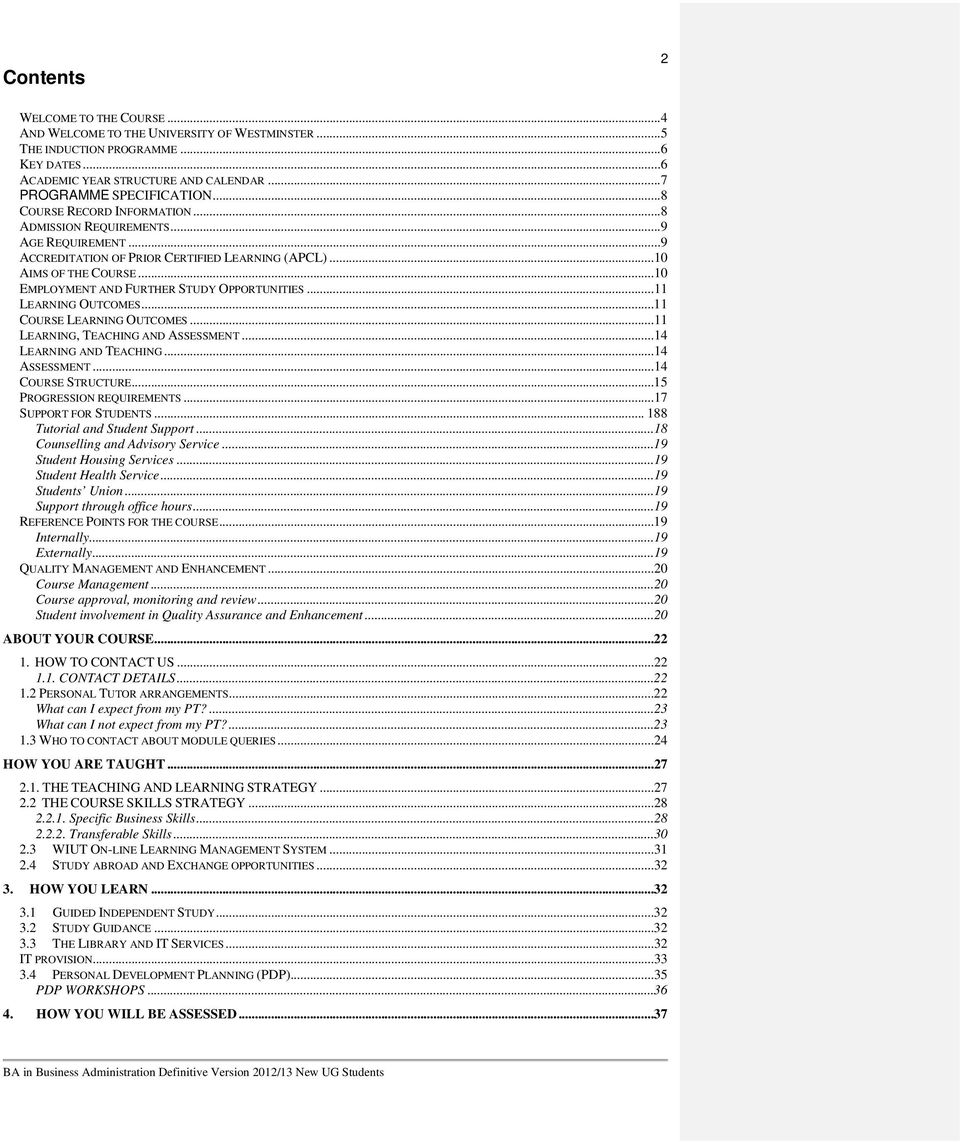
2 Contents 2 WELCOME TO THE COURSE... 4 AND WELCOME TO THE UNIVERSITY OF WESTMINSTER... 5 THE INDUCTION PROGRAMME... 6 KEY DATES... 6 ACADEMIC YEAR STRUCTURE AND CALENDAR... 7 PROGRAMME SPECIFICATION... 8 COURSE RECORD INFORMATION... 8 ADMISSION REQUIREMENTS... 9 AGE REQUIREMENT... 9 ACCREDITATION OF PRIOR CERTIFIED LEARNING (APCL) AIMS OF THE COURSE EMPLOYMENT AND FURTHER STUDY OPPORTUNITIES LEARNING OUTCOMES COURSE LEARNING OUTCOMES LEARNING, TEACHING AND ASSESSMENT LEARNING AND TEACHING ASSESSMENT COURSE STRUCTURE PROGRESSION REQUIREMENTS SUPPORT FOR STUDENTS Tutorial and Student Support Counselling and Advisory Service Student Housing Services Student Health Service Students Union Support through office hours REFERENCE POINTS FOR THE COURSE Internally Externally QUALITY MANAGEMENT AND ENHANCEMENT Course Management Course approval, monitoring and review Student involvement in Quality Assurance and Enhancement ABOUT YOUR COURSE HOW TO CONTACT US CONTACT DETAILS PERSONAL TUTOR ARRANGEMENTS What can I expect from my PT? What can I not expect from my PT? WHO TO CONTACT ABOUT MODULE QUERIES HOW YOU ARE TAUGHT THE TEACHING AND LEARNING STRATEGY THE COURSE SKILLS STRATEGY Specific Business Skills Transferable Skills WIUT ON-LINE LEARNING MANAGEMENT SYSTEM STUDY ABROAD AND EXCHANGE OPPORTUNITIES HOW YOU LEARN GUIDED INDEPENDENT STUDY STUDY GUIDANCE THE LIBRARY AND IT SERVICES IT PROVISION PERSONAL DEVELOPMENT PLANNING (PDP) PDP WORKSHOPS HOW YOU WILL BE ASSESSED... 37
3 3 4.1 THE ASSESSMENT STRATEGY FOR THE COURSE Working Together Cheating in exams or in-class tests GUIDANCE ON THE PROJECT/DISSERTATION MAKE YOUR VOICE HEARD THE COURSE COMMITTEE HOW COURSE REPRESENTATIVES WILL BE SELECTED FEEDBACK FROM THE COURSE COMMITTEE MODULE FEEDBACK QUESTIONNAIRES WHY COMPLETE THEM? STUDENT EXPERIENCE SURVEY WHAT TO DO IF THINGS GO WRONG MITIGATING CIRCUMSTANCES PENALTIES FOR LATE SUBMISSION OF COURSEWORK WHAT TO DO IF YOU FAIL SUSPENDING FROM THE COURSE WITHDRAWING FROM THE COURSE CHANGING COURSE COMPLAINTS PROCEDURE COURSE REGULATIONS HOW YOUR DEGREE IS CLASSIFIED INTERMEDIATE AWARDS BA (Hons) in Business Administration Diploma of Higher Education in Business Administration Certificate of Higher Education in Business Administration MAXIMUM PERIODS OF REGISTRATION EXCLUSION FROM THE PROGRAMME OF STUDY ON ACADEMIC GROUNDS YOUR RIGHTS AND RESPONSIBILITIES AS A STUDENT MODULE PROFORMAS SECTION 10: WESTMINSTER INTERNATIONAL UNIVERSITY IN TASHKENT APPENDIX 1. GLOSSARY OF COMMONLY USED REGULATORY TERMS (UNDERGRADUATE COURSES) Every effort is made to ensure that the information given in this Course Handbook is correct at the time of publication and that the course information given accurately describes the courses offered by the University. The University reserves the right to cancel, without prior notice, either a course, modules or specialisms within a course.

4 Welcome to the Course Welcome to Westminster International University in Tashkent (WIUT) and to the Bachelor of Arts (Honours) in Business Administration, a validated course of the University of Westminster, London. The purpose of this handbook is to explain to you the main details of the course. Some of the information may appear complex and daunting at first sight, but as you become used to the University and the course you will find it more useful. We want you to feel confident in the course and hope this handbook will help you understand how the course is structured, the assessment procedures, the course management and other vital aspects of your programme. It is important that you retain this handbook throughout your time at the University. The Course Handbook should be read in conjunction with the general WIUT booklet Essential Information: Undergraduate Students Guide which contains vital information on University regulations, procedures and facilities. Copies of this booklet should be available in the library. Being a student can be an enjoyable experience - despite all the pressures, it is a unique opportunity for you to discover your own strengths and to capitalise on them. This time will remain in your memories with warm thoughts and many friends you make here will stay with you for a long time. You will find that your colleagues on the course have varied backgrounds, abilities, hopes and aspirations. We hope you will gain useful life experiences and knowledge from the interaction with your fellow students as you progress in the course. For some of you, your aim at the end of the course will be to gain an interesting and worthwhile job, for others it will be to continue your studies to degree, masters or research level. The University provides many opportunities to help you both in your studies and in your personal development, but the final responsibility for learning rests with you. We strive to create an academic environment in which you are continually challenged and inspired to do your best possible work. We can only do that with your effort and ambition. It is a partnership between all of us - you, the lecturers and the University. So let us work together to achieve our aim and to make your time here an enjoyable and valuable experience. 4 Odilbek Kattaev Course Leader WIUT

5 And Welcome to the University of Westminster You are a student of both the Westminster International University and the University of Westminster. I would like to welcome you as a student of both Universities but in particular as an employee of the University of Westminster. WIUT and the University of Westminster are partners, WIUT is not a campus or branch of the University of Westminster, it is an independent Uzbekistan public university, the Rector being appointed by the President of the Republic of Uzbekistan. I am appointed by the Vice Chancellor of the University of Westminster to work in WIUT as the 1 st Deputy Rector (Academic). I have many colleagues in the University of Westminster who are responsible for ensuring you are able to progress your studies. In particular each course has a Liaison Tutor who you may meet at WIUT, they make regular visits to Tashkent, to ensure you are being treated fairly and to ensure WIUT is able to deliver to the standards expected. The University of Westminster is a public National University of the United Kingdom and its main campus is situated in London. The University of Westminster like all other UK Universities has the power to validate its awards in other countries such as Uzbekistan. You have been enrolled on such an award and will be allocated a student record number, a unique number, on the University of Westminster Student Record system. All your assessment results will be stored on this system and if you successfully pass all the requirements you will be able to graduate with a University of Westminster Award, at the appropriate level. This will be the same award as students who study in London. Staff employed by WIUT will teach you and you will be subject to the disciplinary rules and regulations of WIUT. For your academic studies the rules and regulations are those of the University of Westminster. In practice you should not notice any difference, all my colleagues at WIUT understand this relationship and give you advice if you are confused. You are however responsible for your own performance and learning, for your own discipline and behaviour, we are here to help and will do so if needed. I was appointed to work with my WIUT colleagues to help develop and build a unique and strong university. WIUT is still a young university but it has been able to offer high quality courses, built on a high standard of integrity and honesty that you will be expected to observe. It provides a unique experience in Uzbekistan and Central Asia, an Uzbekistan University offering International standards of education, built on the traditions, values and standards of UK education, and the particular expertise of the University of Westminster. I hope you will be proud to be a student of the University of Westminster as well as WIUT. I am proud to work at WIUT for the University of Westminster. 5 Alan P. France 1 st Deputy Rector (Academic)

6 6 The induction programme The induction programme is seen as an integral part of the learning process and will operate during the week prior to commencement of lectures in Semester 1. The main aim of induction programme is to introduce students to the University, to the Course, to the facilities that they will immediately make use of, and to the course structure. Responsibility for organising the Induction programme rests with the course leaders and the course team. The primary objective of the induction is to icebreak within the students groups and between the students and tutors. It will also help them to overcome language barrier students may have. Games, simulations and other exercises will be used to break the ice and help to build a team spirit. This programme is very important as some of the students will be entering direct into the degree programmes, whereas others will come from the foundation programme (Certificate of International Foundation Studies, level 3) and will therefore have a better understanding of the system and principles of WIUT. The induction programme gives you the opportunity to get settled in and familiarize yourself with the University and your course. Once lectures have started all of you will have busy time attending lectures and seminars as well as meeting the deadlines of various assignments. So induction is a good chance for you to get to know each other and make initial contact with your classmates. Key dates The normal duration of study for full-time bachelor students is three academic years. Each academic year lasts about 34 weeks and is divided into two semesters, the first running from September to February and the second running from February to June. Each semester normally consists of 13 teaching weeks followed by assessment weeks. In-course-work assignments are given to students normally in the beginning of modules. Each student should be aware of the deadlines for assignments. For this purpose students are advised to regularly visit the University Intranet and check their University s. To provide a broader support in learning, during academic year students are offered series of Personal Development Planning workshops organised by Faculty staff. Students are highly recommended attending these workshops in order to acquire necessary transferable skills. The dates of the trainings will be announced by your Personal Tutor. Academic year structure and calendar The normal duration of study for full-time bachelors students is three years. Each academic year lasts 34 weeks and is divided into two semesters as follows: Semester Dates 2012/2013 Semester 1: Enrolment/Induction week Monday, 24/09/2012 Friday, 28/09/2012 Teaching Weeks 1 13 Monday, 01/10/2012 Friday, 28/12/2012 New Year Holiday Monday, 31/12/2012 Friday, 04/01/2013 Assessment Week Monday, 07/01/2013 Friday, 11/01/ 2013 Semester 2: Teaching Weeks 1 13 Monday, 28/01/ Friday, 26/04/2013 (13 weeks) Assessment Weeks Monday, 29/04/2013 Friday, 10/05/2013 Assessment Board Weeks Tuesday, 04/06/2013 Thursday, 13/06/2013 Publication of Results Week commencing on 1July 2012

7 Semester 9: GIS Weeks Monday, 24/06/2013 Friday, 28/06/2013 Referral Exam weeks Referral CW deadlines Monday, 08/07/2013 Friday, 19/07/ Within this structure, a more detailed breakdown is issued every academic year, which contains dates for teaching weeks, GIS weeks and formal holiday breaks.

8 PROGRAMME SPECIFICATION 8 Course Record Information Name and level of final & intermediate Awards Awarding Body Location of Delivery Mode of Study UW Course Code BA (Hons) Business Administration BA Business Administration DipHE Business Administration CertHE Business Administration University of Westminster WIUT, Tashkent, Uzbekistan Full-time BAUSBAU JACS Code UCAS Code QAA Subject Benchmarking Group Professional Body Accreditation Business M University of Westminster Date of initial course approval/last review Sept 2003/ January 2007 Date of Programme Specification April 2010

9 Admission Requirements Entry requirements for the Bachelor of Arts (Honours) in Business Administration have been set in order to select potential students who have proven academic ability and are able to demonstrate a solid foundation of skills in both Mathematics and English. The admissions policy aims to attract and recruit motivated applicants across the full range of possible access routes. Students may have a background in any academic discipline. We encourage applications from students with disabilities. The admissions policy follows the equal opportunities policies of the University of Westminster. The over-riding principle upon which admission decisions are based is that applicants should be likely to benefit from, and succeed on, the course. Intending students will have to meet age, English language, Mathematics and general requirements: 9 Age Requirement Normally applicants will be at least 18 years old at the date of enrolment. For the purpose of this regulation the academic year runs from 1 st October to 30 th September English Language and Mathematics Requirement Applicants must: Have had their secondary educations through the medium of English and gained grade C or above in the equivalent of GCSE English; or Have an IELTS score of 6 with a minimum of 6 in the writing component or the equivalent score at TOEFL or other University of Westminster recognised English Test according to the WIUT/UoW conversion table; or Have successfully completed an appropriate International Foundation course and passed an Academic English Language module. Applicants must have an acceptable level of competence in Mathematics. This could be demonstrated by one of the following: A pass in an maths test approved by the University of Westminster; or Grade C or above in GCSE/ O Level Mathematics (or its equivalent); or A pass in Quantitative Methods on an appropriate Foundation course. General Requirements Applicants must have studied a broad range of subjects and have a school leaving certificate equivalent to GCSE/ O Level e.g the Uzbek Certificate of Secondary Education (Attestat) normally with an average of 70%. In addition applicants should satisfy at a minimum one of the following requirements, namely: Successfully completion of an appropriate International Foundation course which includes a pass on an English for Academic purposes module or equivalent; or Successful completion of the WIUT Lyceum s Attestat, and the WIUT International Foundation, course including the module English for Academic Purpose; Successful completion (an minimum of an average mark of 70%) of the first year of an appropriate degree course in a recognised Uzbek or similar university; or Two GCE A level passes (in any subject excluding mother tongue), plus three GCSE passes at grade C or above including English Language and Mathematics; or NC/ND or HNC/HND. (The range of academic disciplines studied is not hereby restricted, but certain vocational courses such
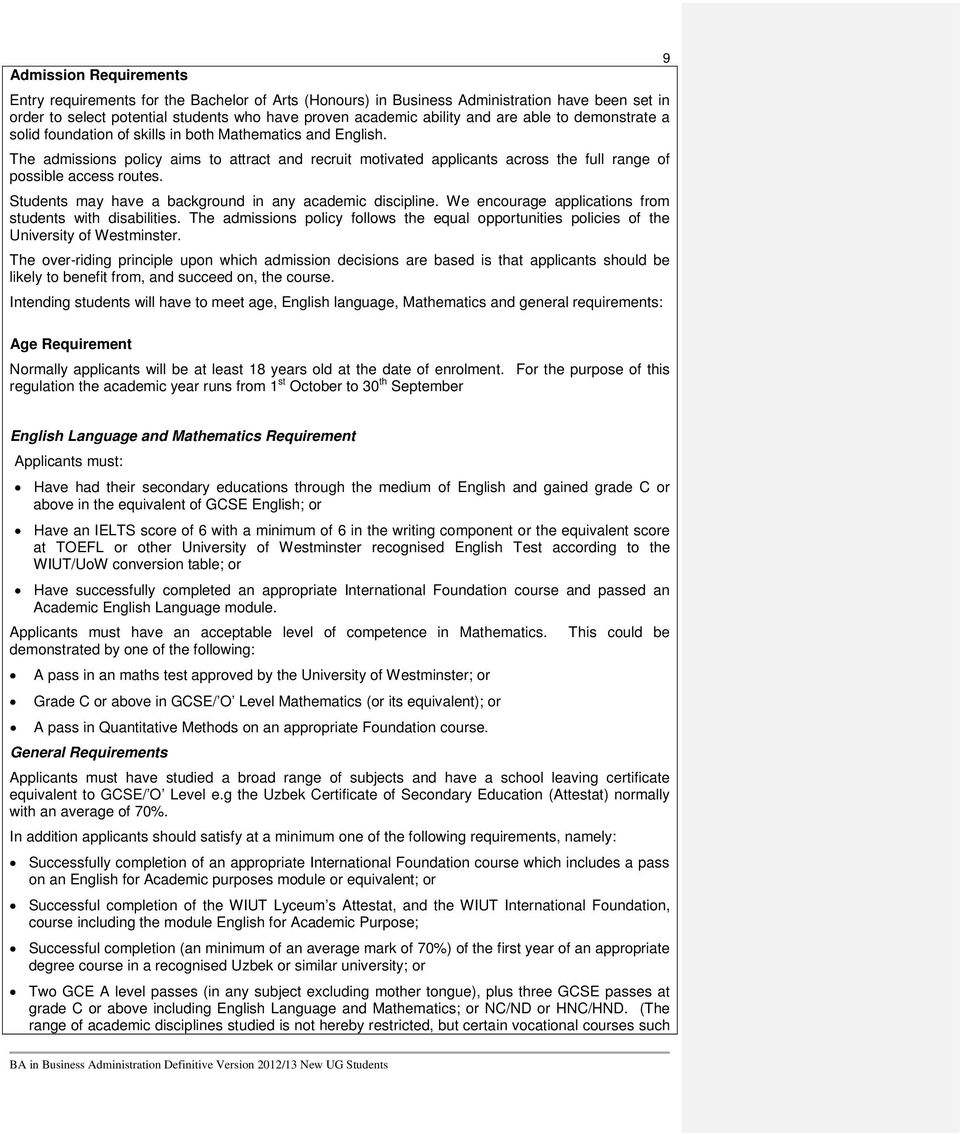
10 as City and Guilds would not satisfy the admissions requirements.); or An Advanced General National Vocational Qualification (GNVQ); or Any other equivalent qualification normally accepted as entry requirements (e.g. International Baccalaureate, etc). 10 Accreditation of Prior Certified Learning (APCL) If an applicant has certificate(s) or credits from previous undergraduate courses of internationally recognised universities they may refer to Accreditation of Prior Certified Learning (APCL) process approved by the University of Westminster and qualify for exemption from modules. Making a claim for APCL is an applicant s responsibility and s/he is recommended to contact the Course Leader or the Dean s Office for further advice. The overall programme aims are to produce technologically skilled professionals who can understand the business challenges of an enterprise and conceive and manage solutions, which are ICT dependent. This course is designed to produce graduates who will be able to integrate their ICT skills with their knowledge of business operations and environments to support an enterprise to achieve competitive advantage.. Aims of the Course The aim of the BA (Honours) in Business Administration course is to give students an education in the key areas of the discipline of business, providing understanding of underpinning theories, tools and techniques, fitting them to gain employment in a business environment or to proceed to further study. The aims of the course are: To produce graduates who understand the rapidly changing world of business and its role in the wider society To develop the knowledge, skills and capabilities graduates require to respond proactively to contemporary issues and the challenges of the business environment To equip graduates with the knowledge, understanding and academic skills to continue to postgraduate study To produce graduates who are confident in developing the personal and intellectual attributes necessary for success in employment To encourage students to reflect on the knowledge, values and assumptions that underpin their understanding of business and business management To encourage students to reflect on the impact of their own actions and that of others on the world of business and the wider society To provide students with the opportunity to specialize in a functional area of business within a broad-based business context To promote the practical skills of processing information, identifying and formulating problems, analysing business environments and applying business management skills To introduce, explain and apply the functions of the marketing, human resource, information management, and finance departments within a modern business environment.
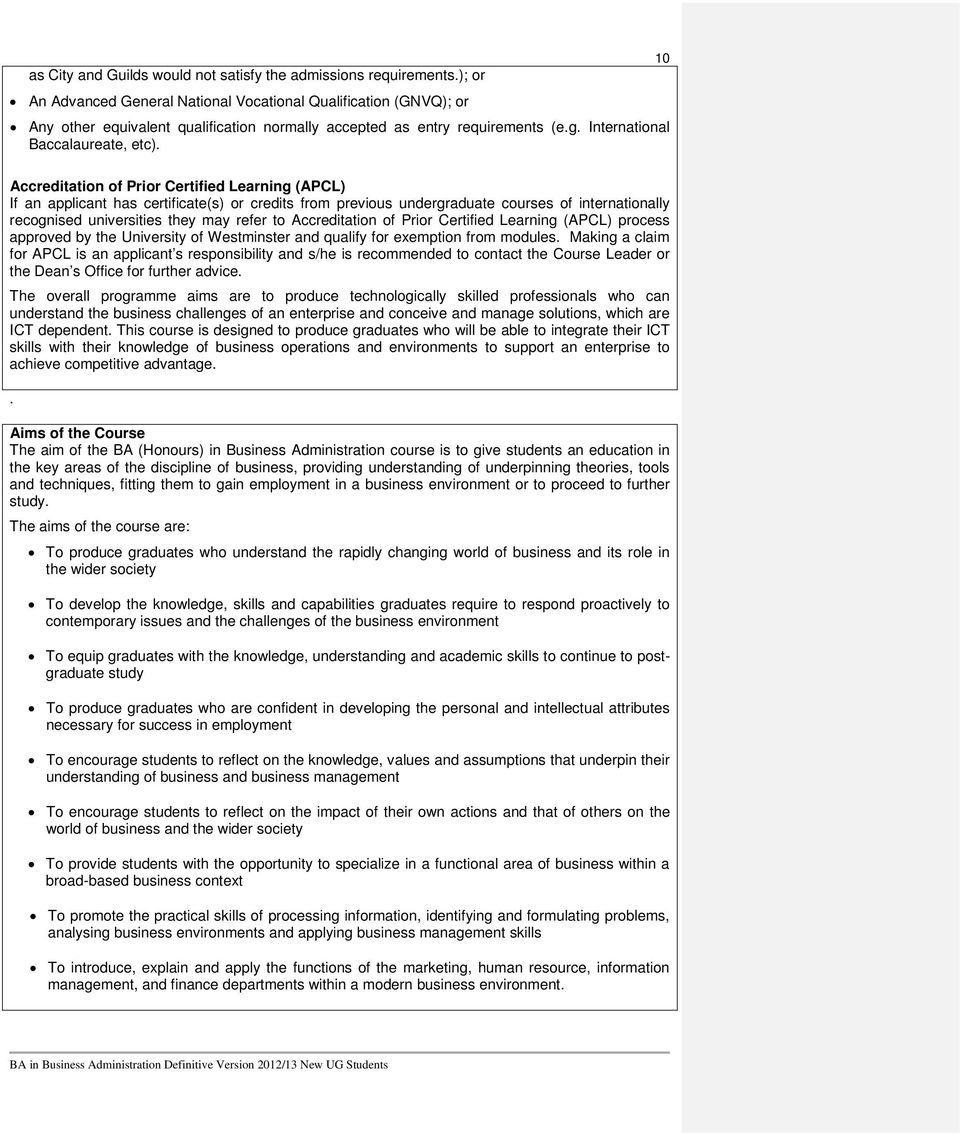
11 11 Employment and Further Study Opportunities The course is designed for those who wish to enter business-related employment or to continue into postgraduate education. Students completing the BA (Honours) in Business Administration will have enough knowledge and transferable skills to begin employment in both local and international companies operating in Uzbekistan, Central Asia and beyond. They should also have the confidence and knowledge to set up their own business if they wish. Learning Outcomes Learning outcomes are statements on what successful students have achieved as the result of learning. They are threshold statements of achievement and are linked to the knowledge, understanding and skills that a student will have gained on successfully completing a course. Course Learning Outcomes Learning outcomes are statements on what successful students have achieved as the result of learning. They are threshold statements of achievement and are linked to the knowledge, understanding and skills that a student will have gained on successfully completing a course. 1. Understand at a deep level theoretical, frameworks in business and apply them to real-world practice; 2. Critically evaluate business models and being able to measure them with the use of empirical methods in order to select an appropriate one; 3. Be able to prepare a research proposal on a chosen topic and make research within given time constraints; 4. Develop deep knowledge and expertise in the chosen areas of business; 5. Develop a range of skills which are subject-specific, but highly transferable. Level 4 Knowledge and understanding o To demonstrate a general knowledge and understanding of the core principles and concepts of business and their application in practice. o To possess working knowledge of the key core functional areas of business, namely accounting, marketing, human resources and information management. o To show an awareness of ethical issues in own studies and relate these to both their own personal values and the implications within a business context Specific skills o To describe and use personal and technological communication methods o To understand the impact of law on business relationship and show an awareness of ethical issues in relation to personal beliefs and values o To understand the underpinning principles and current practice of marketing and apply them to business problems o To understand and use common accounting systems and external financial reporting used in business o To understand the application of information systems to functional areas of business o To access, and utilise qualitative and quantitative information for effective use in solving
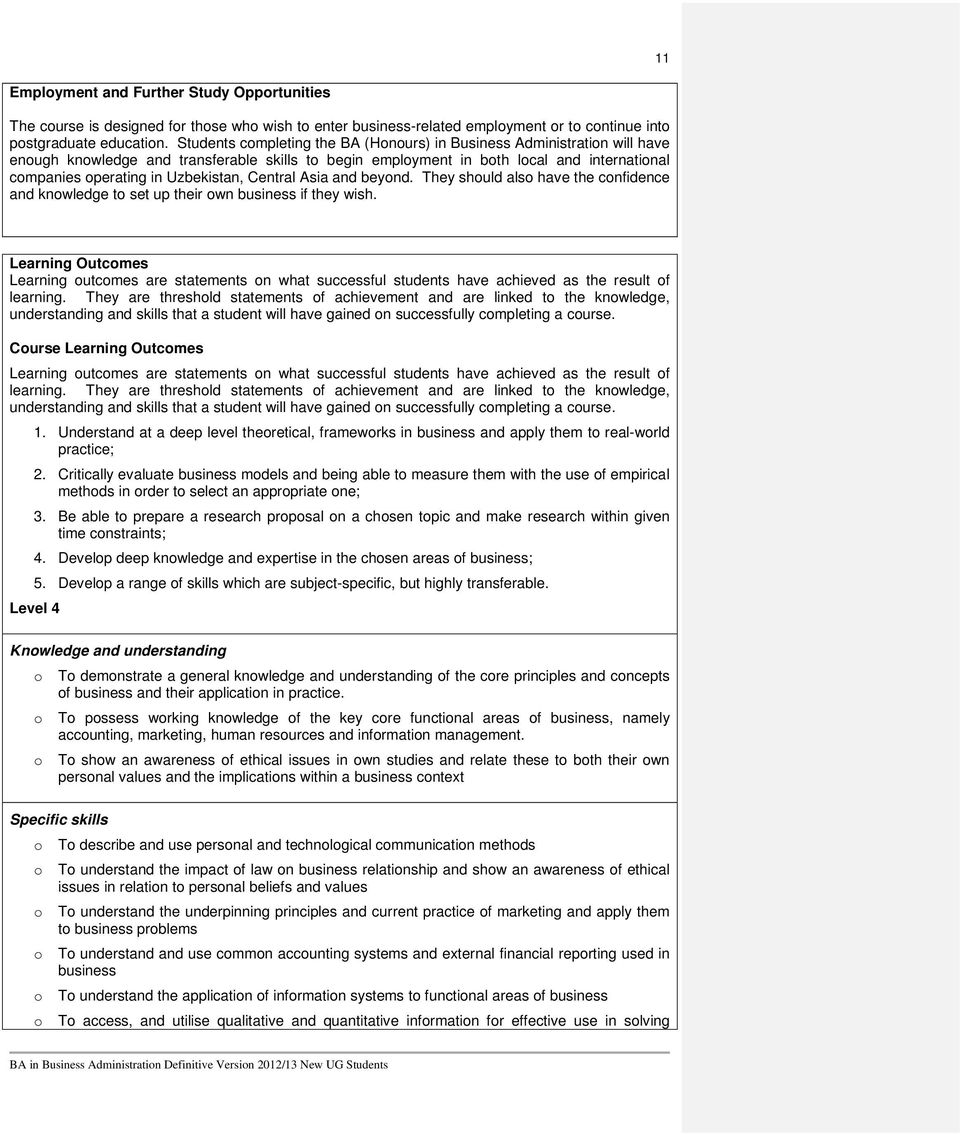
12 o business problems To understand the key aspects of the performance of people in organizations in relation to own experience 12 Key transferable skills/other attributes o Communication in writing through clear, relevant, interesting and accurate articulation o Taking responsibility for learning and working in an adaptable and flexible manner. o The production of work in appropriate word-processed format o Reflection on own learning and making use of feedback o The management of information and document exchanges by o Communication orally through clear, relevant, interesting and accurate articulation o Researching using the world wide web & electronic retrieval systems o Working co-operatively, constructively and effectively with others o Time management and personal development. Level 5 Knowledge and understanding Build on the Knowledge and Understanding achieved at level 4 o To be able to perform management research o To apply theory to integrated business practice o To evaluate the impact of business on the wider social environment in relation to more general ethical perspectives Specific skills o To critically examine the economic operations of markets for goods, services and resources and how this affects business activities o To critically examine the inter-relationships between market positioning and the management of operations to deliver value to customers within performance constraints o To equip students with the quantitative and qualitative techniques used in business management research o To provide students with a knowledge of valuation techniques, long-term investment and financial decisions o To introduce students to the practices of HR in modern organizations Key transferable skills/other attributes o Thinking creatively, imaginatively and in abstract terms o Reflection on own learning and making use of feedback o A development of working co-operatively, constructively and effectively with others Level 6 Knowledge and understanding

13 13 Build on the Knowledge and Understanding achieved at levels 4 and 5 o Business leadership and conceptualisations. o Business awareness and career planning. o Project definition, development, planning, implementation and evaluation. o Critique theoretical frameworks and apply to practice o Understand the importance of, and apply, personal, corporate and professional responsibility Specific skills o To possess a cross-cultural perspective on the operational and strategic position of organisations o To be able to critically examine contemporary issues influencing business thinking and behaviour o To be able to critically evaluate alternative policies and strategies a company may adopt to meet stakeholder needs within changing internal and external environments. Key transferable skills/other attributes o Working independently. o Providing motivation and leadership skills, relevant to an economy in transition. Key transferable skills/other attributes developed during the course Cognitive critically analyse theories, concepts and problems formulate a complex argument within a theoretical and contextual framework challenge received opinion and use own criteria and judgement CIT select and use most appropriate CIT tools for self-determined task Numeracy use quantitative information to verify and extend existing theory Research develop and implement own research strategy, working with a minimum of guidance critically review those aspects of current research relevant to self-determined research topic Decision-making evaluate options within the limitation of imperfect and incomplete information Communication engage in debate in a professional manner, using communication to persuade and convince Teamwork work effectively as a member of a team, negotiating in a professional manner and managing conflict continually reflect on the group process to improve group effectiveness

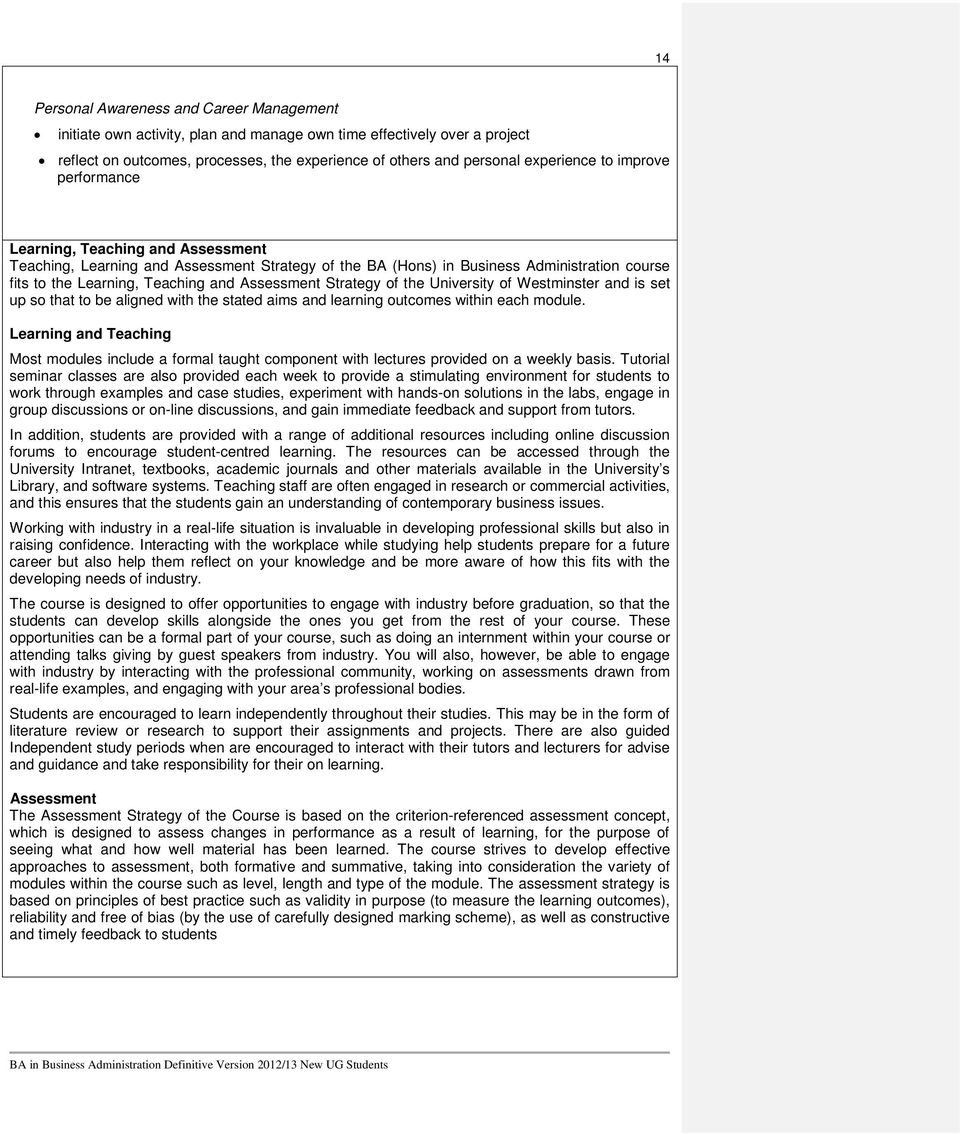
14 14 Personal Awareness and Career Management initiate own activity, plan and manage own time effectively over a project reflect on outcomes, processes, the experience of others and personal experience to improve performance Learning, Teaching and Assessment Teaching, Learning and Assessment Strategy of the BA (Hons) in Business Administration course fits to the Learning, Teaching and Assessment Strategy of the University of Westminster and is set up so that to be aligned with the stated aims and learning outcomes within each module. Learning and Teaching Most modules include a formal taught component with lectures provided on a weekly basis. Tutorial seminar classes are also provided each week to provide a stimulating environment for students to work through examples and case studies, experiment with hands-on solutions in the labs, engage in group discussions or on-line discussions, and gain immediate feedback and support from tutors. In addition, students are provided with a range of additional resources including online discussion forums to encourage student-centred learning. The resources can be accessed through the University Intranet, textbooks, academic journals and other materials available in the University s Library, and software systems. Teaching staff are often engaged in research or commercial activities, and this ensures that the students gain an understanding of contemporary business issues. Working with industry in a real-life situation is invaluable in developing professional skills but also in raising confidence. Interacting with the workplace while studying help students prepare for a future career but also help them reflect on your knowledge and be more aware of how this fits with the developing needs of industry. The course is designed to offer opportunities to engage with industry before graduation, so that the students can develop skills alongside the ones you get from the rest of your course. These opportunities can be a formal part of your course, such as doing an internment within your course or attending talks giving by guest speakers from industry. You will also, however, be able to engage with industry by interacting with the professional community, working on assessments drawn from real-life examples, and engaging with your area s professional bodies. Students are encouraged to learn independently throughout their studies. This may be in the form of literature review or research to support their assignments and projects. There are also guided Independent study periods when are encouraged to interact with their tutors and lecturers for advise and guidance and take responsibility for their on learning. Assessment The Assessment Strategy of the Course is based on the criterion-referenced assessment concept, which is designed to assess changes in performance as a result of learning, for the purpose of seeing what and how well material has been learned. The course strives to develop effective approaches to assessment, both formative and summative, taking into consideration the variety of modules within the course such as level, length and type of the module. The assessment strategy is based on principles of best practice such as validity in purpose (to measure the learning outcomes), reliability and free of bias (by the use of carefully designed marking scheme), as well as constructive and timely feedback to students
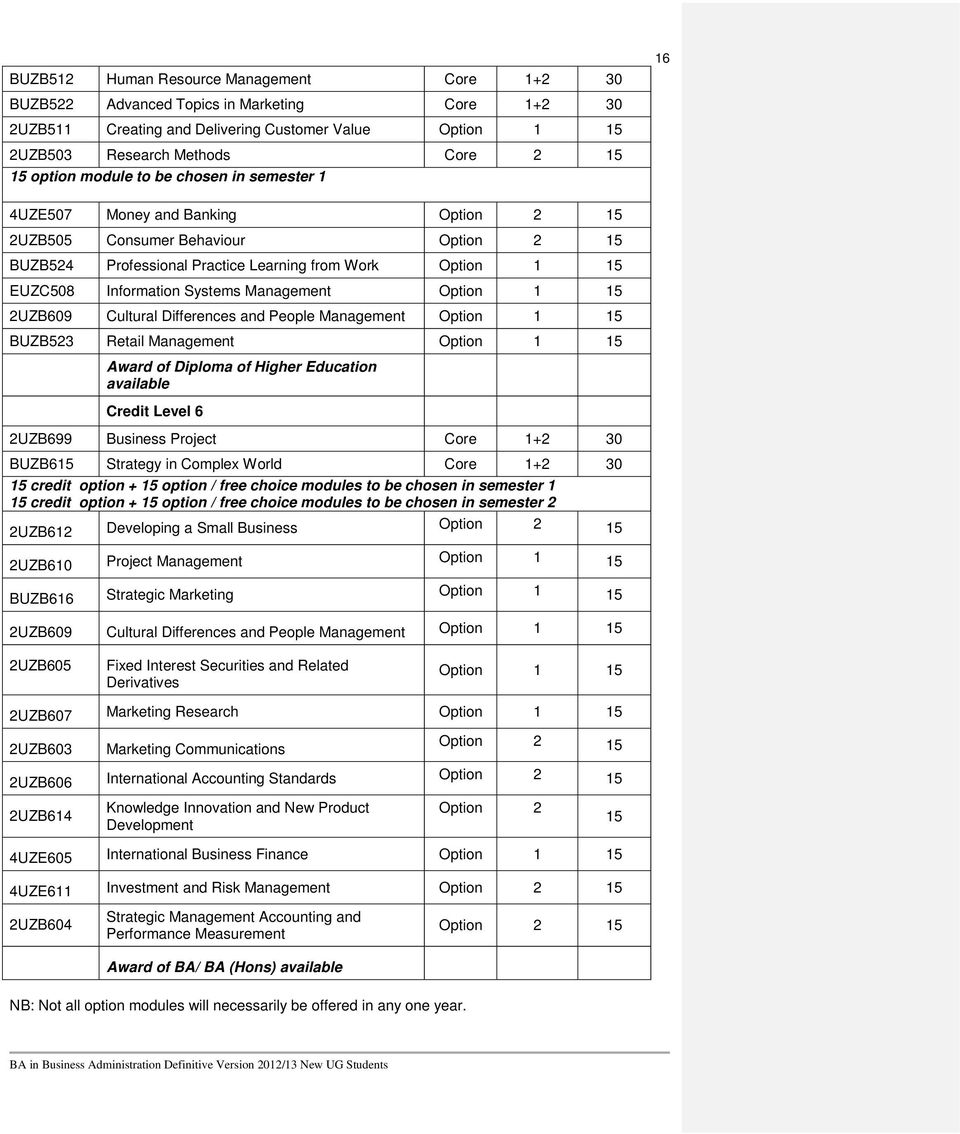
15 Course Structure This section shows the core and option modules available as part of the course and their credit value. Full-time Undergraduate students normally study 120 credits per year. The BA (Honours) Business Administration programme is based around the core constituents of a business environment, namely finance and accounting, marketing, management. BA (Hons) in Business Administration consists of three types of the modules: core, optional and free choice. All students must take core modules and full-time students study from 6 to 8 modules worth in total 120 credits per year. Types of the modules: Core. These are modules that must be undertaken by all students on the course. They provide the fundamental skills and knowledge on which to base your future careers and must be passed for the award of the degree. Option. These are modules that can be chosen from the course specific list of modules. These modules allow you to pick modules that best fit your own aspirations while still providing a cognate business studies-oriented curriculum. Free choice. A free choice module, of which you may take one at level 4, 5, and 6, may be chosen from other courses offered by WIUT. A free choice can be one of the listed option modules, but it usually is a module from one of the other course offered at the University. Free choices are subject to availability and the approval by the relevant module leader and your Course Leader. All modules on the course are worth 15 credits and some of them 30 credits. 15-credit modules should normally be completed in a single semester of study, while 30-credit modules should be completed within one academic year of study. 15 Code Module Title Status Semester Credits Credit Level 4 BUZB400 Environment of Business Core EUZC405 Data Analysis & Information Management in Core 1+2 Business 30 2UZB401 Organisational Behaviour Core UZB404 Business Communications Core UZB403 Fundamentals of Finance and Accounting Core credit option / free choice modules to be chosen in semester 2 2UZB409 Introduction to Web Publishing Option UZB407 Alternative Dispute Resolution Option UZE402 Free 2 Industrial Organization 1 Choice 15 Award of Certificate of Higher Education available Credit Level 5 BUZB500 Cost and Financial Management Core

16 BUZB512 Human Resource Management Core BUZB522 Advanced Topics in Marketing Core UZB511 Creating and Delivering Customer Value Option UZB503 Research Methods Core option module to be chosen in semester UZE507 Money and Banking Option UZB505 Consumer Behaviour Option 2 15 BUZB524 Professional Practice Learning from Work Option 1 15 EUZC508 Information Systems Management Option UZB609 Cultural Differences and People Management Option 1 15 BUZB523 Retail Management Option 1 15 Award of Diploma of Higher Education available Credit Level 6 2UZB699 Business Project Core BUZB615 Strategy in Complex World Core credit option + 15 option / free choice modules to be chosen in semester 1 15 credit option + 15 option / free choice modules to be chosen in semester 2 2UZB612 Developing a Small Business Option UZB610 Project Management Option 1 15 BUZB616 Strategic Marketing Option UZB609 Cultural Differences and People Management Option UZB605 Fixed Interest Securities and Related Derivatives Option UZB607 Marketing Research Option UZB603 Marketing Communications Option UZB606 International Accounting Standards Option UZB614 Knowledge Innovation and New Product Development Option 2 4UZE605 International Business Finance Option UZE611 Investment and Risk Management Option UZB604 Strategic Management Accounting and Performance Measurement Award of BA/ BA (Hons) available NB: Not all option modules will necessarily be offered in any one year. 15 Option 2 15
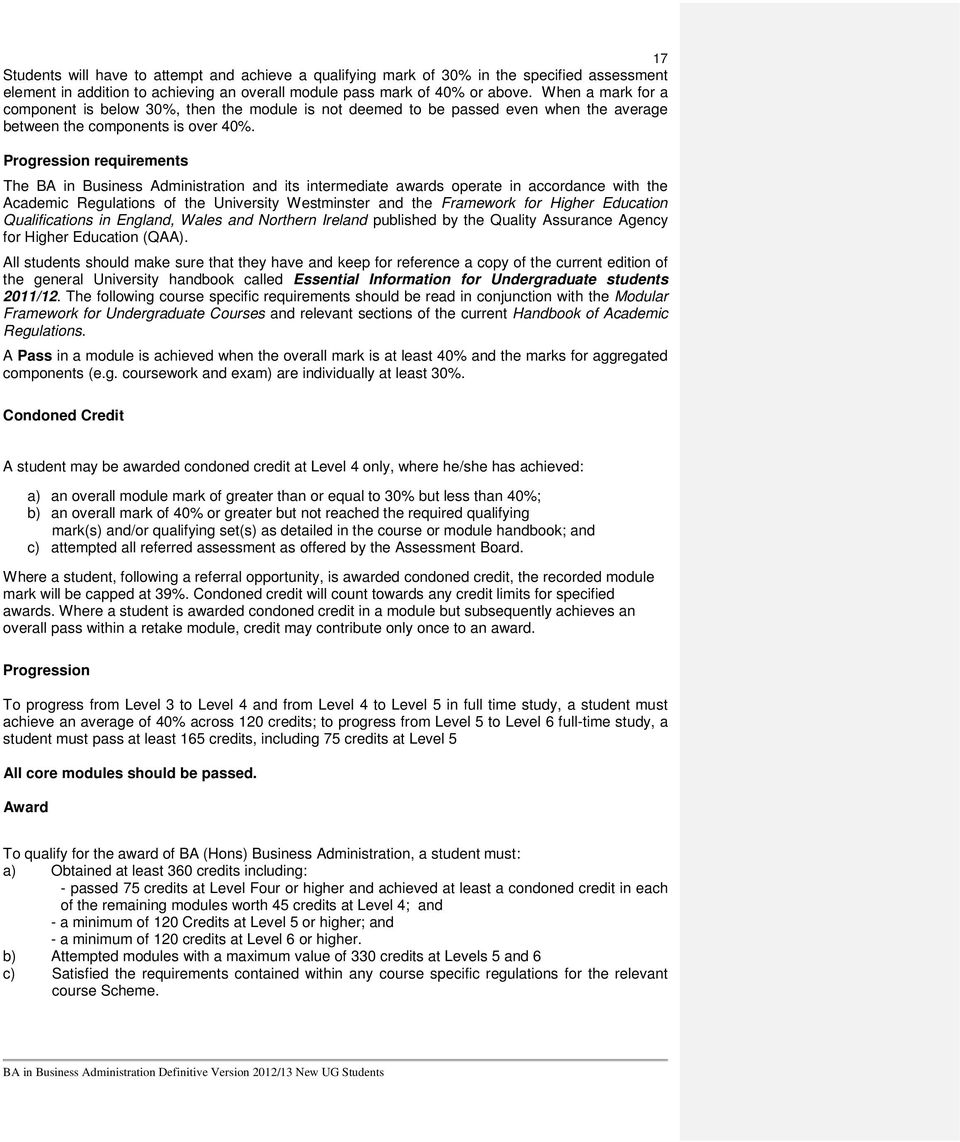
17 17 Students will have to attempt and achieve a qualifying mark of 30% in the specified assessment element in addition to achieving an overall module pass mark of 40% or above. When a mark for a component is below 30%, then the module is not deemed to be passed even when the average between the components is over 40%. Progression requirements The BA in Business Administration and its intermediate awards operate in accordance with the Academic Regulations of the University Westminster and the Framework for Higher Education Qualifications in England, Wales and Northern Ireland published by the Quality Assurance Agency for Higher Education (QAA). All students should make sure that they have and keep for reference a copy of the current edition of the general University handbook called Essential Information for Undergraduate students 2011/12. The following course specific requirements should be read in conjunction with the Modular Framework for Undergraduate Courses and relevant sections of the current Handbook of Academic Regulations. A Pass in a module is achieved when the overall mark is at least 40% and the marks for aggregated components (e.g. coursework and exam) are individually at least 30%. Condoned Credit A student may be awarded condoned credit at Level 4 only, where he/she has achieved: a) an overall module mark of greater than or equal to 30% but less than 40%; b) an overall mark of 40% or greater but not reached the required qualifying mark(s) and/or qualifying set(s) as detailed in the course or module handbook; and c) attempted all referred assessment as offered by the Assessment Board. Where a student, following a referral opportunity, is awarded condoned credit, the recorded module mark will be capped at 39%. Condoned credit will count towards any credit limits for specified awards. Where a student is awarded condoned credit in a module but subsequently achieves an overall pass within a retake module, credit may contribute only once to an award. Progression To progress from Level 3 to Level 4 and from Level 4 to Level 5 in full time study, a student must achieve an average of 40% across 120 credits; to progress from Level 5 to Level 6 full-time study, a student must pass at least 165 credits, including 75 credits at Level 5 All core modules should be passed. Award To qualify for the award of BA (Hons) Business Administration, a student must: a) Obtained at least 360 credits including: - passed 75 credits at Level Four or higher and achieved at least a condoned credit in each of the remaining modules worth 45 credits at Level 4; and - a minimum of 120 Credits at Level 5 or higher; and - a minimum of 120 credits at Level 6 or higher. b) Attempted modules with a maximum value of 330 credits at Levels 5 and 6 c) Satisfied the requirements contained within any course specific regulations for the relevant course Scheme.
18 18 The class of the Honours degree awarded is decided by two criteria: the average of the best 105 credits passed at Level 6 being in the range of the class to be awarded, and the average of the next best 105 credits passed at Levels 5 and 6 provided the next best 105 credits passed are no more than one classification below this. Support for Students On arrival, an induction programme will introduce students to the staff responsible for the course, the campus on which they will be studying, the Library and IT facilities and to the Campus Administration. Students will be provided with the Course Handbook, which provides detailed information about the course. Learning support includes the Library, which holds printed collections of books and journal subscriptions. Access to electronic resources such as WestLaw, SpringerLink, JSTOR, EBSCO, and BLACKWELL is also available. There are over 100 computers spread over four computer labs available for students use. The University uses a Virtual Learning Environment where students can access course materials and communicate with staff and other students via message boards. At University level, student services provide advice and guidance on accommodation, financial and legal matters, personal counselling, health and disability issues, and careers. The Social Development Department provides particular support for international students. The WIUT s Student Union also provides a range of facilities to support all students during their time at the University. Tutorial and Student Support All undergraduate students at the Westminster International University in Tashkent, in common with every student of the University of Westminster, have access to the University's student academic and personal support system for students. All students are allocated to a named individual who is their Personal Tutor.

19 There are the following University wide support services: 19 Counselling and Advisory Service Students are allocated an individual Personal Tutor at the start of semester one of the programme. Personal tutors are selected from amongst the course teaching team. Personal Tutors aim is to provide his/her tutees a quality counselling and advisory service whenever there is a need for this. Social Development team also provides counselling and advisory services for students., including, the career services, that give students a chance to look at a variety of opportunities, starting from an advice and assistance on building plans for the future career, and ending with getting a part-time employment to cover their own living expenses. Plus for those who are required to undertake military service the Social Development Team can also help. In addition, this department provides assistance for students coming from other regions of Uzbekistan as well as other countries with their passport and other related procedures. Student Housing Services Because of the vast diversity of students in terms of where they come from, the University offers accommodation for regional and international students. In addition to all the necessary conditions, the dormitory has Gym, where any student can spend his/her leisure time. Moreover, computer labs with an access to Internet offer the students a chance to continue their academic assignments offcampus. Student Health Service A Health Department is available on the University and provides the students an immediate point of help should there be a need for this. Professional staff of this department also offers students counselling of a medical type. Students Union The aim of the Union is to provide a range of essential services as well as assisting students in their sporting and social life. The Union gives help and advice on academic and personal matters and represents students on all University Committees, to organise sport, societies and entertainment. Support through office hours Given the favourable ratio of teacher to student, an advantage of studying at WIUT is that students have ample opportunity to work with the academic staff of university in one to one basis during office hours of Faculty staff. Office hours of each faculty staff involved in the academic delivery process are normally announced on the module web-site in the WIUT intranet and information boards as well as within in-course assessment instructions. Reference Points for the course Internally The BA (Honours) Business Administration programme draws upon the Mission Statement of the University of Westminster and its international remit. It seeks to establish the quality and good practice in teaching and learning that is articulated throughout the University's policies and to promulgate those practices abroad. Since the initial validation, the scholarly activities of the WIUT staff have built on and influenced the breadth of the curriculum on offer and have affected the teaching and learning methodologies which are shared across the two participating countries (UK and Uzbekistan). Externally The external reference points for the programme are the QAA subject benchmarks particularly the QAA Subject Benchmark Statement for General Business & Management and Computing.

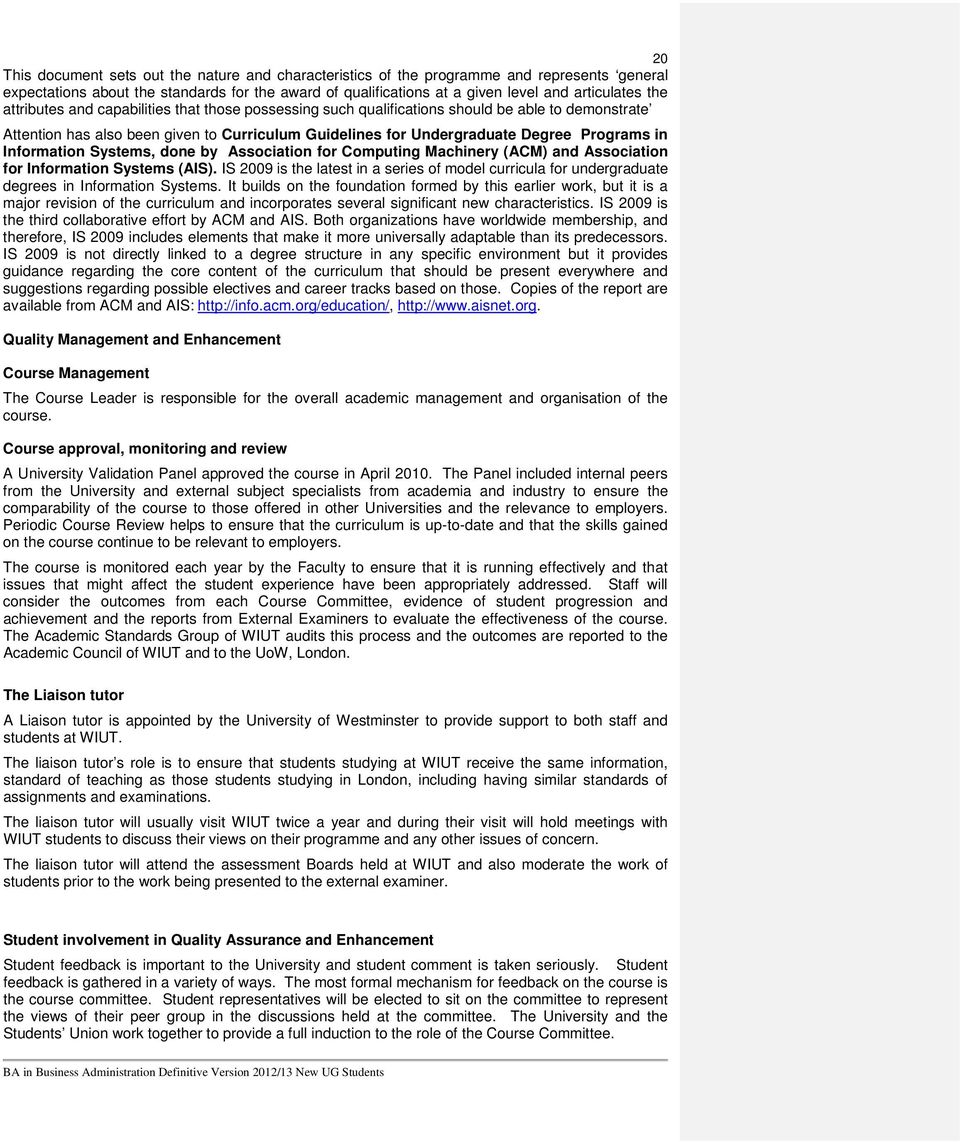
20 20 This document sets out the nature and characteristics of the programme and represents general expectations about the standards for the award of qualifications at a given level and articulates the attributes and capabilities that those possessing such qualifications should be able to demonstrate Attention has also been given to Curriculum Guidelines for Undergraduate Degree Programs in Information Systems, done by Association for Computing Machinery (ACM) and Association for Information Systems (AIS). IS 2009 is the latest in a series of model curricula for undergraduate degrees in Information Systems. It builds on the foundation formed by this earlier work, but it is a major revision of the curriculum and incorporates several significant new characteristics. IS 2009 is the third collaborative effort by ACM and AIS. Both organizations have worldwide membership, and therefore, IS 2009 includes elements that make it more universally adaptable than its predecessors. IS 2009 is not directly linked to a degree structure in any specific environment but it provides guidance regarding the core content of the curriculum that should be present everywhere and suggestions regarding possible electives and career tracks based on those. Copies of the report are available from ACM and AIS: Quality Management and Enhancement Course Management The Course Leader is responsible for the overall academic management and organisation of the course. Course approval, monitoring and review A University Validation Panel approved the course in April The Panel included internal peers from the University and external subject specialists from academia and industry to ensure the comparability of the course to those offered in other Universities and the relevance to employers. Periodic Course Review helps to ensure that the curriculum is up-to-date and that the skills gained on the course continue to be relevant to employers. The course is monitored each year by the Faculty to ensure that it is running effectively and that issues that might affect the student experience have been appropriately addressed. Staff will consider the outcomes from each Course Committee, evidence of student progression and achievement and the reports from External Examiners to evaluate the effectiveness of the course. The Academic Standards Group of WIUT audits this process and the outcomes are reported to the Academic Council of WIUT and to the UoW, London. The Liaison tutor A Liaison tutor is appointed by the University of Westminster to provide support to both staff and students at WIUT. The liaison tutor s role is to ensure that students studying at WIUT receive the same information, standard of teaching as those students studying in London, including having similar standards of assignments and examinations. The liaison tutor will usually visit WIUT twice a year and during their visit will hold meetings with WIUT students to discuss their views on their programme and any other issues of concern. The liaison tutor will attend the assessment Boards held at WIUT and also moderate the work of students prior to the work being presented to the external examiner. Student involvement in Quality Assurance and Enhancement Student feedback is important to the University and student comment is taken seriously. Student feedback is gathered in a variety of ways. The most formal mechanism for feedback on the course is the course committee. Student representatives will be elected to sit on the committee to represent the views of their peer group in the discussions held at the committee. The University and the Students Union work together to provide a full induction to the role of the Course Committee.
21 21 Course Committee Meetings are held normally 4 times a year - 2 meetings in each Semester according to the following schedule: Semester 1 Semester 2 CCM # 1 CCM # 2 CCM # 3 CCM # 4 TW 4 TW 11 TW 4 TW 11 Students are asked to complete a Module Feedback questionnaire at the end of each module. The feedback from this will inform the Module Leader on the effectiveness of the module and highlight areas that could be enhanced. The University also administers an annual Course Evaluation Questionnaire, which provides valuable feedback about a range of University services. Students meet with Review Panels when the periodic review of the course is conducted to provide oral feedback on their experience on the course. Student feedback from course Committees and the University s internal surveys are part of the Faculty quality assurance evidence base. For more information about this course: University web site: General queries: [email protected] Admission queries: [email protected] Please note This programme specification provides a concise summary of the main features of the course and the learning outcomes that a student might reasonably be expected to achieve and demonstrate if s/he takes full advantage of the learning opportunities that are provided. This specification should be read in conjunction with the Course Handbook provided to students and Module Handbooks which provide more detailed information on the specific learning outcomes, content, teaching, learning and assessment methods for each module.
22 22 ABOUT YOUR COURSE 1. HOW TO CONTACT US 1.1. CONTACT DETAILS Course Leader for academic year is Odilbek Kattaev. You can find Mamurjon during his office hours in room 217 or alternatively via appointment. His address is The Head of Westminster Business School The BA Business Administration programme is very similar to the BA Business Administration course within the Westminster Business School. The head of the Westminster Business School, has ultimate responsibility for this course. You will be undertaking your studies within the Faculty at the Westminster International University in Tashkent. The address of the Westminster Business School is: Westminster Business School, University of Westminster 35, Marylebone Road London NW1 5LS England UK Tel.: Fax (School Office) The Westminster Business School provides Business education at both undergraduate and postgraduate levels. The majority of its courses have been designed in close collaboration with the local business community. Liaison tutor A liaison tutor is appointed by the University of Westminster to provide support to both staff and students at WIUT. The liaison tutor s role is to ensure that students studying at WIUT receive the same information, standard of teaching as those students studying in London, including having similar standards of assignments and examinations. The liaison tutor will usually visit WIUT twice a year and during their visit will hold meetings with WIUT students to discuss their views on their programme and any other issues of concern. The liaison tutor will attend the assessment Boards held at WIUT and also oversees the moderation of the assessment of students work prior to the work being presented to the external examiner. For BA (Hons) Business Administration course the liaison tutor is David Banner. David normally sees the student course representatives on his visits to WIUT, at least 2 times per year and often more frequently. If you have any major concerns you can him on [email protected]. 1.2 Personal Tutor arrangements Personal Tutors (PT) are the first point of contact for a student seeking academic advice about their studies. Your tutor can help you to develop your full academic potential and give advice on academic and personal matters, which may affect your studies at WIUT.
23 23 Each student who attended the Course of International Foundation Studies [CIFS] became accustomed to the role of a personal tutor [PT]. In Levels 4, 5 and 6 you will continue to have a PT and as far as possible, you will have the same tutor for a period of 3 years. In Level 6, you will also have a Project Supervisor and this also will give you an opportunity to discuss personal issues related to your academic programme. You will have an opportunity to get to know your PT during the Induction Week when various activities will be held to familiarize students with their new academic year. Each PT should arrange a meeting at least once per semester where students have an opportunity to ask questions and to have an open forum for discussion. PT s may also meet individually with students. You should not wait until a meeting is called before bringing any concerns to the attention of your PT. Just contact them by and arrange a meeting or visit their room during office hours, which should be posted on the door. You should also refer to the PT grid for each Level which sets out the PT and PDP [Personal Development Plan] programme for the whole academic year. A PT may not know the answer to all your questions! However, they will be able to direct you to the person who can provide the answer perhaps the module leader, course leader or the Dean for example. If the question is related to a non-academic issue, you may be directed to the Social Department. WIUT presents you with an opportunity to receive advice on academic matters from a Student Academic Advisor. Academic Advisor is a member of the course team, who has in-depth knowledge of all regulations and policies of WIUT. Academic Advisors are the first point of contact for students seeking advice about studies, academic and personal matters, which may affect your study at WIUT. Academic Advisors provide confidential support service for all students. Usually there are more than one Academic Advisors you may consult with. Please contact your Course Leader or Student Academic Support (SAS) Coordinator to find out who your Academic Advisor is. For more information, please visit What can I expect from my PT? A Personal Tutor will: Monitor and support a student s progress through the course and keep a record of meetings held and action taken; Advise a student on a course of study; Assist with the development of study skills; Provide advice and support on personal matters which may affect a student s academic performance; Highlight problems in a timely manner and, jointly with the student, determine any necessary remedial action; Direct a student to the relevant internal and external support services where necessary; Prepare references when appropriate. What can I not expect from my PT? A personal tutor will not: Solve all student problems; Be able to give financial advice or advice relating to a student s contract but may direct a student to another support agency; Be able to give advice on personal matters that do not relate to academic performance; Give advice on health issues but will direct a student to a support agency;
24 24 Be constantly available. Students should make appointments by and refer to a PT s office hours posted on the office door. If the situation is urgent, students should telephone the PT s office or seek assistance from one of the other agencies outlined in the diagram above. For further information, please refer to the PT/PDP booklet. 1.3 Who to contact about module queries Module Leaders You are registered on a course and a set of modules. You will have a Course Leader who is responsible for the general management of the course and your programme of study. You will also study a range of modules, as approved by your Course Leader; each module has a Module Leader. If you have a query about a module you should contact the relevant Module Leader. However whilst studying on the module you may not be taught by the Module Leader so it may also be appropriate to contact your tutor who teaches you first. The list of Module Leaders can be founds at the Dean s office or on the intranet module page. Module Leaders are responsible for: The day to day administration of the module; Liaising with other lecturers on the module and integrating contributions from staff; The monitoring of students progress on the module and liaising with students tutors and the Course Leader as appropriate; Ensuring that the assessment of the module operates smoothly in collaboration with the Academic Registrars Office Dean s Office The Dean is responsible for the delivery of the courses and assuring their academic quality and standards at the University. The Dean s office deals with the operation of the Faculty functions, for example: staffing and staff professional development, academic programmes development and management, research and consultancy, academic quality assurance and enhancement, timetabling, academic requirements, etc. If you are not sure about an issue you can approach the Dean s Office or the Academic Registrar s office and they will direct you to the most appropriate office. 1.4 Academic Registry role, location and opening hours The Academic Registrar s Office deals with a range of responsibilities. The main areas for your studies would be for example, the formal registration of your studies, your student record and the information on you as a student, enquiries about the academic regulations and information on what happens if things go wrong plus it is the only office that will publish the results of assessments, details of deadlines and exam dates, etc. One of the most important functions of the Academic Registrar s office is the collection and registration of your coursework. It is the only and official point of collection for assessments. You will be given a deadline for each coursework and you must hand the assessment in on time to the Academic Registrar s Office. OPENING HOURS FOR STUDENTS To help provide a good service to students and for staff to complete all their duties the Academic Registrar s Office is open for students Monday to Friday at the following times MONDAY to FRIDAY MORNINGS: 10:00 am to 12:30 pm AFTERNOONS: 2:00 pm to 4:00 pm
25 25 EXCEPT WHEN THERE IS AN ASSESSMENT DEADLINE AND THE OFFICE IS OPEN UNTIL THE DEADLINE. 1.5 Information about where course information/news/events is posted All course related information/news/events will be posted in official notice board outside room 117 and course intranet Support for students with disabilities If you have a registered disability and need support you should contact the Social Development Department. 1.7 Support for International Students If you are an International Student then you must contact the Social Development Department to learn about services available for your stay in Uzbekistan. 1.8 WIUT Students Union Students Union is a unique WIUT authority, which lies between the students and the university administration and ensures that the university life conditions of students are optimized. The functioning power and the main rights of SU usually depend on the level of assertiveness, credibility, and activism shown by its executive. Officially, this is composed of: President; General Secretary; Project Manager; Events and Entertainment Executive; Information and Communication Executive; Welfare and Education Executive. Any WIUT student is eligible to occupy any of the above listed positions. All you have to do is to pick up an application form from the SU room (312) when the election period gets started (usually two and a half months before the end of academic year). Provided that 10 signatures for the person are collected he/she may be registered as a nominee for the respective position (it should be noted that the Project Manager position is not elected but appointed by university administration or SU members). The results are calculated by the independent representatives, Everything is done on fair, ethical, and objective grounds. After the SU has been formed, complete freedom and independence is in their hands to make some real changes in WIUT. Each member of the executive has its own program of activities or clubs but weekly SU meetings help to coordinate those activities and to set further targets. Some of the activities may include: separate commercial projects, sports events, cultural events, foreign languages courses, academic support, students academic development courses, relations with other universities, supervising the students representatives system or any kind of advices and guidance needed. The list of the activities is very long, and it usually depends on the creativity of the SU Executive or any of the WIUT students. You should not forget that every single student of Westminster International University in Tashkent is a member of Student Union and their contribution into its running may also make significant changes. There is no society that is currently run without the help of WIUT students who are not official members of the SU Executive but are members of different SU teams. That is what the SU is striving for: a team of enthusiastic, optimistic, and devoted students who are sacrificing their time for the sake of improving the students learning and leisure environment here at WIUT. However, in
26 26 exchange for the time and efforts spent all the active participants of SU get a priceless set of highly important skills, experiences and memories! Students Union - run by students for students! 1.9 Sports facilities The University offers a range of sports facilities to organise your social and free time. In the University sports club students can play active games such as football, basketball, volleyball, handball and badminton as well as attend a gym under the guidance of professional instructors. You should contact the Social Development department to register yourself to the sports club. To get a weekly schedule of sports activities visit:
27 27 HOW YOU ARE TAUGHT 2.1. THE TEACHING AND LEARNING STRATEGY Whilst there is a common teaching and learning strategy for WIUT this is interpreted individually by the separate course teams to ensure effective learning through the application of appropriate course specific teaching and learning methods. The teaching and learning strategy adopted for the BA (Hons) Business Administration is derived from that of the BA Business programme and has been designed to support the course philosophy and to develop reflective and effective thinking business managers for the future. It is achieved through the use of a wide range of teaching methods to assist you to effectively achieve particular learning outcomes. Students who have studied at other institutions in Uzbekistan may be used to a style of education that is more teacher-led. By adopting a very practical, student-centred approach, which is characteristic of courses at the University of Westminster, WIUT hopes to offer a different, more attractive and effective learning experience for students. You will be expected to further develop your independent learning skills through the modules on this course. Recognising that individuals learn in different ways and use different study techniques, the teaching and learning strategy adopted by the course team allows individuals to learn at their own pace in accordance with their preferred learning style. This will enable you to facilitate and maximise your own learning. In addition, recognising that students will be required to work in teams and groups as members of the labour force there is an emphasis in the teaching strategy on developing cooperative employment skills through the use of group work. As a student on this course you can expect to have knowledge presented to you in a variety of different ways. You may be expected to take notes during a lecture or participate in discussions during seminars and tutorials. You will be given opportunities to develop your communication skills through active participation in both group and individual presentations. Use of appropriate information technology will further enhance your employability skills. The variety of teaching methods used to facilitate learning may include: field work to promote observation and primary research skills desk research to collect, analyse and evaluate information guest speakers for receiving up-to-date information computer workshops to facilitate individual learning and use of ICT case study analysis to develop an ability to define and identify complex problems and apply appropriate knowledge and skills to their solutions individual research to promote independent learning group-work to encourage sensitivity to others; negotiate and manage conflict situation and recognise and support effective team roles simulations and role play to reflect the practical application of theory student led seminars to encourage effective debate, analysis, production of professional material and to develop communication skills Modules are designed to encourage you to take responsibility for your own learning and to develop practical and applied awareness of the challenges and issues of the contemporary business work. The exact model for delivery is dependent on the subject area, the level of the course and the module learning outcomes.
28 28 Delivery of most modules is supported by lecture notes which will be paper and/or electronic-based. The lecture notes will contain an outline of the key concepts introduced in the lecture and some key readings. Seminars/workshops encompass a range of business related activities and provide the opportunity for you to reflect on theory and its application to contemporary business practice. Where appropriate, you will be encouraged to work in groups, to test your own ideas against your peers in order to develop your own conceptual understanding. Such activities also help you to develop the skills of group and team work required in the world of business. Technological learning support will be provided wherever possible. In the Level 4 core module Data Analysis and Information Management, support for the development of key skills of quantitative data analysis by using various tools and methods. In Level Five, students increasingly take responsibility for their own learning. Formal lectures provide a basis from which individuals are expected to explore alternative strategies and analyse alternative solutions to business problems. An important element of Level Six study concerns the Business Project module which does not follow a formal lecturing pattern; instead, the student chooses a topic and is assigned a supervisor with whom a working plan is agreed and regular minutes arranged. Beyond that, the student works independently and the quality of the work depends on self-motivation and time-management as well as the ability to criticise, evaluate and synthesise. Each module, apart from year-long modules, is delivered over twelve teaching weeks with a weekly lecture outlining the key theoretical concepts followed by seminar activities for smaller groups which allow you the opportunity for individual reflection to explore the issues in more depth. The structure and the content of the seminar will vary across the course reflecting the learning outcomes of the module allowing for activity based learning and the development of student autonomy. The WIUT Business course differs from other business programmes delivered by local Uzbek Universities through the adoption of a more student centred teaching and learning policy as well as delivering a broader more internationally focused curriculum. Businesses increasingly operate with teams of specialists. They will require people who can communicate and interact effectively within a team, recognising and supporting leadership, being proactive in leadership, negotiating and managing conflict. While the Organisational Behaviour and Human Resource Management modules provide the concepts and models to handle change, the entire course is designed to provide practical exercises using group projects and simulations which prepare you for this new business environment. Leadership is developed in tutorials where the students are required to lead the discussions, make arguments, and defend claims. Increasingly, businesses will rely on people who can work independently and remotely, using technology to overcome the traditional constraints of location, time and national boundaries. The course is designed to provide in its delivery experiences that reflect not only the current world of work but also anticipate how it will develop. In summary, the teaching and learning strategy used will develop your intellectual abilities; your knowledge; your powers of creativity, powers of analysis and your transferable skills. On any individual module, a combination of teaching approaches will be used depending on the nature of the subject being taught, and the specified learning outcomes. 2.2 THE COURSE SKILLS STRATEGY Specific Business Skills Students are expected to attain certain learning outcomes the threshold statements of achievement which are linked to the knowledge, understanding and skills that a student will have gained on successfully completing a course.
29 In order to progress from Level 4 to Level 5, you should be able to: Knowledge and understanding To demonstrate a general knowledge and understanding of the core principles and concepts of business and their application in practice. To possess working knowledge of the key core functional areas of business, namely accounting, marketing, human resources and information management. To show an awareness of ethical issues in own studies and relate these to both their own personal values and the implications within a business context Specific skills To describe and use personal and technological communication methods To understand the impact of law on business relationship and show an awareness of ethical issues in relation to personal beliefs and values To understand the underpinning principles and current practice of marketing and apply them to business problems To understand and use common accounting systems and external financial reporting used in business To understand the application of information systems to functional areas of business To access, and utilise qualitative and quantitative information for effective use in solving business problems To understand the key aspects of the performance of people in organizations in relation to own experience 29 In order to progress from Level 5 to Level 6, you should be able to: Knowledge and understanding Build on the Knowledge and understanding achieved at level 4 To be able to perform management research To apply theory to integrated business practice To evaluate the impact of business on the wider social environment in relation to more general ethical perspectives Specific skills To critically examine the economic operations of markets for goods, services and resources and how this affects business activities To critically examine the inter-relationships between market positioning and the management of operations to deliver value to customers within performance constraints To equip students with the quantitative and qualitative techniques used in business management research To provide students with a knowledge of valuation techniques, long-term investment and financial decisions To introduce students to the practices of HR in modern organizations In order to progress from Level 5 to Level 6, you should be able to: Knowledge and understanding Build on the Knowledge and understanding achieved at levels 4 and 5
30 Business leadership and conceptualisations. Business awareness and career planning. Project definition, development, planning, implementation and evaluation. Critique theoretical frameworks and apply to practice Understand the importance of, and apply, personal, corporate and professional responsibility 30 Specific skills To possess a cross-cultural perspective on the operational and strategic position of organisations To be able to critically examine contemporary issues influencing business thinking and behaviour To be able to critically evaluate alternative policies and strategies a company may adopt to meet stakeholder needs within changing internal and external environments Transferable Skills In addition to specific business skills you will learn during your programme, you will have the opportunity to develop a range of skills, which are transferable to other contexts. Transferable skills enable you to perform a range of business related skills with awareness of the necessary techniques, their potential uses and hazards. You will develop a degree of self-reflection and begin to recognise your own strengths and weaknesses. Transferable skills also enable you to work within a relevant ethos and assist you to access and use a range of learning resources. Students need to develop key transferable skills as an integral part of their study in Higher Education, to enhance their flexibility, adaptability and autonomy in learning. The acquisition of generic skills and abilities helps students to learn effectively (promoting lifelong learning) to meet the demands of the graduate labour market. The Association of Graduate Recruiters has highlighted the five most recognised skill shortages amongst graduates as: communication skills; business awareness; ability to work as part of a team; leadership; problem solving. The Enterprise in Higher Education initiative funded by the (then) Department of Employment has also significantly promoted the need to devise ways of teaching and assessing transferable skills, in helping to prepare students for employment. While the development of generic skills and abilities must be an integral aspect of Higher Education courses it must remain highly visible to the students and it must be assessed. Key transferable skills and abilities encompass the general intellectual development of the individual. Use of a wide range of assessment formats enhances the visibility of these characteristics. Typically students are expected to demonstrate through coursework, tests, portfolio generation and examinations their ability to gather and assess information; organise and manipulate data;
31 think critically and evaluate their own performance; work collaboratively; self-manage; use numbers accurately and effectively; communicate effectively orally and in writing; use IT; conceptualise and problem solve. Students' employability should be enhanced by their increased awareness of their transferable skills and abilities. It is part of the Course Team s assessment strategy that the assessments of the course should encourage the development of students transferable skills. 31 Key transferable skills/other attributes for Level 4 Communication in writing through clear, relevant, interesting and accurate articulation Taking responsibility for learning and working in an adaptable and flexible manner. The production of work in appropriate word-processed format Reflection on own learning and making use of feedback The management of information and document exchanges by Communication orally through clear, relevant, interesting and accurate articulation Researching using the world wide web & electronic retrieval systems Working co-operatively, constructively and effectively with others Time management and personal development. Key transferable skills/other attributes for Level 5 Thinking creatively, imaginatively and in abstract terms Reflection on own learning and making use of feedback A development of working co-operatively, constructively and effectively with others Key transferable skills/other attributes to Level 6 Working independently. Providing motivation and leadership skills, relevant to an economy in transition. 2.3 WIUT On-line Learning Management System The university has developed its own version of a student on line support system to reflect the conditions in Uzbekistan and to provide a resource for students and staff, to interact and provide additional support for independent learning. The WIUT Intranet has been developed to enable students to access learning resources independently and remotely. Each module has an on line box that provides the facility for independent student exchange via a Module Blog, for the tutor to provide additional learning materials, lecture material, seminar and assessment material. You will find that module teams use the module box in different ways, but in most cases you will be able to get your assignments, receive feedback on assessments, review lecture materials and obtain
32 32 additional reference material that you would find useful in you studies. In addition the Library provides an on-line catalogue and e-journals that you can access. In addition the WIUT Student Record System is also available via the WIUT Intranet, both within the university and remotely. This stores all your assessment marks and you can review your profile. There are developments that are planned to further help you in your studies. The university has a multi-media studio and there are plans for interactive learning materials to be used for your learning. The University of Westminster has a similar on-line support system WIUT Internet, that provides similar learning support to students based in London 2.4 Study abroad and Exchange opportunities The University may have both outgoing students; those students who are initially enrolled on a University of Westminster course and who then seek an exchange with an overseas partner and incoming students; those students from a higher education institution outside of the University who have agreed their exchange through the Dean s office and studying normally on reciprocal basis implemented according to a bi-lateral partnership agreement or within Erasmus Mundus framework. The student exchanges are normally done with an approved University of Westminster Overseas Partner Institutions. Student exchange arrangements are governed by academic regulations stated in the Section 19 of Handbook of Academic Regulations How you learn 3.1 Guided Independent Study The organisation of Guided Independent Study weeks (GIS) is an important aspect of the learning and teaching strategy of the University. In each module you may have up to 3 weeks of GIS in each semester. A GIS week is not a period of time when students are left to work on their own without academic guidance. It is a part of academic delivery process which has a structured and planned approach to the organisation of the academic support in students learning, and which is organised as a out-of-class-teaching activities that help to integrate, reinforce and induce better understanding and deeper learning of students. During GIS weeks module teams can organise formative or summative assessments such as CW progress reports, presentations, in-class tests, intermediate revisions etc. 3.2 Study Guidance This course is based on student centred approach rather than teacher led: students are expected to develop as autonomous researchers and critical thinkers, to prepare them for their careers and lifelong learning. In addition to the taught modules within the course curricula the University offers the Personal Development Programme (PDP) consisting of academic guidance and a range of training sessions for students to develop their learning and other professional skills. To learn more about PDP refer to the Section 1.2 and 3.4. Attendance WIUT has an attendance policy, please refer to the Academic Registry office for details. You highly recommended to attend all lectures and seminars and if you are to be absent for more than 3 days to seek approval from the Course Leader and Dean.. Moreover the analysis shows very strong positive relationship between student s attendance and performance. 3.3 The Library and IT Services The Westminster International University in Tashkent has a Library that is part of the Learning Resource Centre (LRC). When you enrol you will be given a card, which acts as your University ID card and library card. New students should present their ID cards to a member of library staff at the library counter who will validate the ID card on the library system. This usually takes only a minute. The library has three main areas: Quiet study areas and Main Book Stock on the lower/ground floor
33 Group study area where you can work with fellow students, use your laptop, etc A reception, Reservation Desk, PC and enquires The library has a large collection of books, but it is impossible for the library to provide a lending copy of every book for every student when they want it; we have neither the funds nor the space to do this. Therefore students must be prepared to use reference copies in the library and it is important to allow time to reserve copies already out on loan. Students are advised to purchase their own copies of recommended core textbooks wherever possible. Books in heavy demand are purchased in multiple copies, some of which are designated for one week loan or less or for reference use only. The borrowing allocation is up to 5 books at a time. Fines and Sanctions The library operates a policy of charging a fine for the late return of a book. The Fine system is clearly stated and there are no exceptions. The system was introduced to improve the circulation of books and not to make money for the library. It is your responsibility to return the book on the due date. If all students did so then there are enough books for each student to borrow. And the library would not receive any money from fines. There are other sanctions for the misuse of the library and you must ensure you understand the regulations. The library currently subscribes to local periodicals, magazines and newspapers. The library is continually growing and actively pursues the addition to the library stock of both British and Uzbek orientated business publications. Opening Times The library is open 6 days a week in term time: Monday 9:00-20:00 Tuesday 9:00-20:00 Wednesday 9:00-20:00 Thursday 9:00-20:00 Friday 9:00-20:00 Saturday 9:00-19:00 Sunday Closed Guides to the use of the Information Resource Centre are available from the Library lending desk on the second floor. IT provision WIUT has over hundred desktop PCs available for student use. These PCs are to be found on the second floor of the building. Most of these machines are located in one of four computer classrooms: rooms 208, 209, 202 and 215. You can use these machines at any time between and provided that there is no timetabled class, taking place. Business Computing Students are provided with the separate laboratory in the room 2.15 with 17 computers with the following hardware specifications: CPU Intel Pentium GHZ BOX (L2 512kb /Socket 478) / Motherboards chipset Intel 845G chipset /Socket 478 / DDR PC MB RAM / 40 GB HDD ATA133 / CD-R(W) / FDD / GeForce 2 MX MB ATX Case DELL-250W / Mouse DELL/ Keyboard DELL. 33
34 All PCs have Internet access and office applications. Most area of the University is covered with Wi- Fi Internet access. The WIUT Help Desk is the first point of contact for many IT applications and services. Contacting the Help Desk There are multiple ways to get technical assistance from the WIUT Help Desk: By phone: or ext: 466 Visit the Help Desk room in 2nd floor for Face-to-Face IT Support Monday - Saturday 9 a.m. - 6 p.m., Saturday 10 a.m. - 4 p.m. Submit a Help Request via the [email protected] Helpdesk Policy WIUT Help Desk services only university hardware and software. Every student or staff must present his ID card before we take any action. WIUT Help Desk does not share University owned software or pirated software with students or staff. Any hardware or software upgrade is done under the supervision of the I.T. Manager. Under heavy and critical situations I.T. Manager sets the priorities and directly supervises the actions. University students or staff is not allowed to download or install pirated software. This policy is enforced by applying server side software. PC labs are open from 9:00 a.m. to 20:00 p.m. Help Desk Services Maintain PC labs, computer peripherals and other IT teaching facilities including the equipment of the Copy centre, provide timely and accurate service in distribution and receipt of notebooks, projectors and other equipment for teaching process, organize first hand prompt response to enquiries of staff and students re IT facilities (computers, copiers, computer peripherals, projectors and other equipment). Being present and visible in the Help Desk and available to users requiring technical assistance. Primary responsibility is user support and customer service. Responding to questions from callers; remotely assisting users with technology problems. Attending IT training sessions. Becoming familiar with available technology changes or problems. Wi-Fi Maintenance and troubleshooting. Maintaining students printing accounts. University computer maintenance and support. LRC Workstation Hardware/Copy Centre maintenance. Assisting and providing trainings to university personnel, Expertise in Office programs such as Word, Excel, Visio, Project, Outlook, Access. Set up and configure computers for new users and are typically responsible for any physical work relating to the computers such as repairing software or hardware issues and moving workstations to another location. Available software 34
35 35 University has four PC labs 202, 208, 209, 215(for BC students only) and the library PCs. All PCs in PC labs have core software installed on them, which includes: Operating System Windows XP Professional SP2 Adobe Reader Internet browsers Internet Explorer, Mozilla Firefox, Opera MS Office Package including a. Microsoft Access b. Microsoft Excel c. Microsoft Frontpage d. Microsoft Office Proofing Tools e. Microsoft Photo Editor f. Microsoft PowerPoint g. Microsoft Word Kaspersky Antivirus DeepBurner for write CD Windows Media Player DjViewer Print Manager Plus - Client K-Lite Codec Pack Macromedia Flash Plugin Macromedia Shockwave Plugin QuickTime Information Law system "PRAVO" Information Law system "Norma" Room 215 also includes (for BIS students only): Microsoft Visio Microsoft Visual Studio 2003 Professional Microsoft Visual Studio 2008 Express Edition Room 208 also includes: Microsoft Project Library PCs have an access to Library Information System OPAC and WebOPAC. You will also find a number of PCs in the Learning Resources Centre and these can be used anytime during the opening hours of the centre. In addition the Library Group Area has a wireless system where you can use a laptop. In order to use the University s computing resources you will need to have an account. An account will be created for you when you first enrol on your course and you will be shown how to use the computing facilities during Induction Week. Printing, copying, and computing help and advice is available from the copy centre (Room 204) and from the technician s room (Room 203). Access to the University of Westminster on-line resources As one of the requirements of the collaborative provision the University students have access to the University of Westminster, London, on-line resources. The University students are given personal accounts to use the University of Westminster intranet functions as well as services. 3.4 Personal Development Planning (PDP) During your course of study you can expect to develop a number of personal and transferable skills, which will help develop yourself, assist you in making the best use of your study and leisure time. The course team and PDP trainers and tutors team will help you to develop and enhance these skills which will benefit you in your future career. During the period of your course, WIUT will be further developing a programme to support the development of both your employability skills and your personal development planning.
36 36 There is a complex program aimed to help you develop and further enhance your personal and professional skills both yourself and with the help of our experienced members of staff. PDP WORKSHOPS These workshops will help you become a professional graduate and improve your performance as a student and future employee. Each workshop is aimed to develop a particular skill, as part of the requirements to meet the University Standards. Information on this will be provided during first weeks of each Semester. Skill Being Developed Learning Resources / Information Management Group working Workshop Search engines, libraries, online sources Reading habits, selecting appropriate material, critical reading Group working Problem Solving Problem Solving Self Evaluation Self evaluation Autonomy Motivation, self regulation Time management Goal setting Stress management Communication Self Expression Leadership Skills Diversity and conflict resolution PDP tutors PDP tutor is a member of your course team, who will help you create a year-long plan at the beginning of the first semester and help you reflect on it at the end of the second one. It is YOUR RESPONSIABILITY to contact your PDP tutor and arrange the meeting with him/her. For more information, please visit
37 37 PDP WORKBOOK A workbook for you to use throughout your Degree Course, which includes interesting articles on the skills, space for you to make year plans and write reflections on the workshops you attended and tools to track your progress from year to year. The copy of the workbook is available from your SAS Coordinator or online from INFORMATION RESOURCES More information on the skills, useful resources can be obtained from the My Personal Development Programme module, available on intranet (please visit Feedback on assessed work You will be given feedback on all formative assessments. The feedback which you will receive will allow you to reflect, revise and improve your skills and approaches for given tasks within assessments. You should carefully analyse the feedback given on your piece work, if you do not understand it, then you should seek clarifications from your tutors who gave you these comments. Understanding and reflecting on feedback is critical for your development. 4. How you will be assessed 4.1 The assessment strategy for the course The general principles governing assessment on the course are that a variety of assessment methods should be used to supplement formal examinations. The appropriate assessment method should be selected for the particular learning outcome being assessed. Coursework and in-module assessments should be considered part of the learning process, with appropriate and timely feedback being given. At the start of each module students will be given details, in writing, of the assessment scheme, the timetable against which each component of assessed work must be submitted, and details of when marked coursework will be returned to students. Because of the varying size of modules, it is not possible to specify a uniform period for the return of coursework, but normally this will be done promptly enough to enable you to make use of the feedback supplied with the assessment. The assessment strategy has been developed to support the course philosophy to develop effective, reflective, thinking business managers of the future. The aim is to provide you with the opportunity to demonstrate your capabilities in an accessible, structured manner within budget constraints. Assessment is perceived to be an integral part of the overall learning process. Combined with the teaching and learning strategy, it aims to promote initiative and creativity, critical thinking, structure of coherent arguments, evaluation, decision-making, professional communication skills, effective group work, personal reflection, time-management, the ability to meet deadlines, and ability to work under pressure. There can be a various assessment model for course modules but normally - in-module assessment and end-of-module assessment as per University regulations. The in-module element will normally entail you working continually on an assignment, but it may also take the form of a time-constrained test. In-module assignments will give the opportunity for personal reflection on your current attainment in order to improve your own performance; for continuous educational feedback from the module lecturer, seminar tutor or personal tutor; and allow you to chart your progress through the module.
38 38 The end-of-module assessment will normally be an individual submission and will provide a summative judgement of achievement. The module leader, in consultation with the module teaching team, sets all assessments for a module. All assessments are subject to a process of approval known as moderation, through which the University of Westminster ensures that assessments are appropriate for the level and learning outcomes of the module. Coursework and Exam Weightings for the Course Modules Status Module Title Credit Value Credit Level 4 Coursework % Exam % Core Environment of Business Core Fundamentals of Finance and Accounting Core Data Analysis & Information Management in Business Core Organisational Behaviour Core Business Communications Option Introduction to Web Publishing Credit Level 5 Core Cost and Financial Management Core Human Resource Management Core Advanced Topics in Marketing Core Research Methods Core Creating and Delivering Customer Value Option Money and Banking Option Consumer Behavior Option Professional Practice Learning from work Option Information Systems Management Option Cultural Differences and People Management Option Retail Management Credit Level 6 Core Business Project Core Strategy in Complex World Option Marketing Communications Option Developing a Small Business Option International Accounting Standards Option Project Management Option Knowledge Innovation and New Product Development Option Strategic Marketing
39 Status Module Title Credit Value Coursework % Exam % 39 Option International Business Finance Option Investment and Risk Management Option Strategic Management Accounting and Performance Measurement Option Cultural Differences and People Management Option Option Fixed Interest Securities and Related Derivatives Marketing Research Students will have to attempt and achieve at least 30% in the specified assessment component in addition to achieving an overall module pass mark of 40% or above to pass the module. When a mark for a component is below 30%, then the module is not deemed to have been passed even when the average between the components is over 40%.
40 Assessment process At the start of each semester your Module Leader should provide you with an assessment schedule. The assessment of a module usually consists of a number of components each of which must be completed to a satisfactory standard. The assessment schedule will describe each component in the following way: Brief description of the component Date set i.e. the date when the Module Leader will provide a detailed description of the task so that you can start it Deadline: date by which you must submit the work (or the date and time when you must attend an exam or test) Weighting the value of the component as a percentage of the overall module mark Feedback: the method by which the tutor will provide feedback on your performance (other than the mark) Results: date by which the marks for this component will be published The schedule will also tell you: How your work should be presented The rules for reassessment and deferral Rules concerning late submission of coursework How to notify us about extenuating circumstances How to contact the Module Leader Please remember that all coursework should be submitted to the University Registrar s Office where a record of its submission will be kept. Never submit your coursework directly to the lecturer. The Course Leader will be responsible for making sure that assessment schedules have been produced for each module. The Course Team will work together to make sure that assessment deadlines are spread across the semester so that you do not find yourself working on too many different assessments at any one time. The assessment schedule states a date by which each component must be set. On or before this date the Module Leader should provide a detailed description of the component. The component description will add to the information provided in the assessment schedule: A list of the learning outcomes assessed by the component A more detailed description of what you will need to do and what you will need to submit in order to succeed The assessment criteria that will determine your mark. The assessment criteria for each in-course assessment will relate to the specific module learning outcomes and will be provided with the assessment when handed out to help you to determine what is required and to know which specific learning objectives of the module are being assessed. The component description is checked by a second member of the Course Team, under the supervision of the Dean of Faculty, to ensure that it has been properly defined and is a fair assessment of appropriate standard, testing the learning outcomes of the module. 40 Marking and moderation All written work will be marked following the marking criteria published with the assessment. Your work will be marked by members of the Module Team under the co-ordination of the Module Leader.
41 41 The work will be marked according to the assessment criteria laid down in the component description. You will be provided with feedback that justifies your mark and suggests what you could have done to improve it. The Registrar s Office will select a sample of work according to University of Westminster regulations and this will be marked a second time by a different marker. The University of Westminster has the right to inspect and second mark any coursework, test or exam. Please note that the final approval of marks takes place at the end-of-academic year assessment board. The board will be attended by an external examiner from the United Kingdom. The external examiner will see all the marks and will be able to view any piece of work that you have submitted. This inspection by an independent person is the final guarantee of the integrity of your results. General Criteria for the Main Forms of Assessment The assessment criteria for each in-course assessment will relate to the specific module learning outcomes and will be provided with the assessment to allow you to determine exactly what is required and to know which specific learning objectives of the module are being assessed. This will promote the opportunity for you to achieve the maximum mark your ability allows and help to ensure consistency when several lecturers are marking work. The criteria are based on an evaluation of the quality and competence of student work in relation to the module s published learning outcomes. All written work will be marked following the marking criteria published with the assessment. Marking of all in-course assessment work is usually by one of the lecturers involved in the teaching for the module. This is sample second-marked at all Levels. The marker s comments and corrections will either be directly on the student s document and/or on a feedback sheet. The feedback sheets are designed to clearly articulate your performance in relation to the specific criteria for that assessment and to provide consistency when there is more than one marker involved in the module assessment. The importance of constructive feedback as part of learning is recognised and you will receive written feedback including: a summary of the strengths and weaknesses of your work a rationale for the mark awarded linked to the module learning outcomes and assessment criteria an indication of how you could have improved your work. It is important to you to find time to reflect on the comments so that you can improve your performance. Try not to be disheartened by a low mark just remember that you can always improve. In the case of examinations, the Module Leader produces a brief report analysing the main strengths and weaknesses of students responses and common errors. You should ask for a copy from the last semester so you can use this feedback to help you prepare for your examination. The table below is intended only as a general indication. The mark awarded for an individual piece of work will relate both to these generic criteria and to the specific assessment criteria set out in the module documentation. Where a mark is changed, either by an internal moderator or by an external examiner, a brief rationale for this should be given to you.
42 42 Assessment Criteria LEVEL No evidence to suggest that any learning has taken place beyond the most basic principles Makes no serious attempt to answer the question, and has little or no coherence. What little evidence exists to show that learning has taken place is interspersed with nonsense. Makes a limited attempt to answer the question but demonstrates a clear lack of understanding of the issues concerned. Misunderstandings and errors of fact are likely to outweigh correct or meaningful statements. There is unlikely to be any referencing. The poor quality of the writing may make it difficult to read. Attempts to answer the question but is only partly successful in doing so, with much irrelevant material included and much relevant material left out. Referencing is likely to be limited. It should show at least an emerging understanding of the issues, but is likely to include some fundamental misunderstandings and/or errors of fact. It may well lack structure and be poorly written. Makes a clear attempt to answer the question, but is likely to include material of doubtful relevance. It may well be based largely on a single text- book, or on lecture notes, but shows at least a basic understanding of the issues. There may be some significant misunderstandings or errors of fact. Structure may be confused and language clumsy. Is clearly focused on the question and demonstrates a general understanding of the major issues without significant misunderstandings or errors of fact. It may well demonstrate a degree of naivety and is likely to be largely descriptive in nature. It should be properly referenced, but may be based on a limited number of sources, principally text-books. It should have a coherent structure, but may have some clumsy expression. Demonstrates a detailed understanding of the major issues and at least a general awareness of problems and conflicting viewpoints. Reading is likely to go beyond basic textbooks, and should show at least an emerging ability to compare and contrast the arguments in different sources. It should be well-structured and wellwritten. Demonstrates a full understanding of the major issues and a full awareness of problems and conflicting viewpoints. It should include references to secondary as well as tertiary sources (journal articles, monographs etc.) and should demonstrate at least an emerging ability to evaluate and criticise sources. The quality of argument should demonstrate a degree of sophistication and elegance. Demonstrates a clear ability to evaluate and criticise sources and at least an emerging ability to apply original insight and thought to the issues under discussion. There should be at least a limited understanding of theoretical issues. If the analysis of primary data is included this should be conducted with at least a basic degree of competence. Demonstrates a clear ability to apply original insight and critical thought to the issues under discussion, and a clear understanding of the problems and limitations of the approaches developed. It should demonstrate a degree of sophistication in the way in which theory and practice are integrated. If the analysis of primary data is included this should be conducted with complete competence and with a degree of sophistication. Theoretically informed, with a high degree of originality and an effective integration of secondary and primary data. It should be capable of adaptation with a limited amount of effort either for publication (though not necessarily in a peer-reviewed journal) or for effective professional use (e.g. a marketing strategy that could actually be presented to the Board)
43 Assessment Criteria LEVEL Suitable for publication or effective professional use, as above, in its submitted form, without significant adaptation Suitable for publication as a significant article in a peer-reviewed journal, or as a highly innovative professional document A ground-breaking piece of research or exemplary professional document How and where to hand in work All written work must be word-processed and printed single-sided on A4 paper. The top sheet should state your registration number, together with the module title and marker s name. Where possible, assessments are marked anonymously (the marker will not know the identity of the student). Please do not put your name on any piece of assessed work. Some work, like presentations cannot be marked anonymously of course. Since it is important in business reports that an efficient and appropriate writing style is adopted, a limited word count will encourage such style and also serve to guide you on the amount of work expected. All assignments have deadlines, which must be met if the work is to be graded. All work must be submitted to the University Registrar s Office and never directly to your lecturer using the appropriate assessment submission form. It is vital that students retain a copy of all course work they hand in. Whilst every care is taken, it is inevitable, even in the best-regulated organisation that some instances of work being mislaid will occur. In such cases, you will be required to produce your copy for assessment. It is unfortunate but it must remain the responsibility of individual students to ensure that they have a copy of any work submitted. As an academic community, all students and staff at the University are expected to demonstrate the highest standards of academic conduct. The University s expectation is that all grades obtained by students must result form the student s own efforts to learn and develop. If carried out knowingly, cheating and plagiarism have the objectives of deceiving examiners and gaining an unfair advantage over other students. This is unethical. It also threatens the integrity of the assessment procedures and the value of the University s academic awards. While you are studying here your academic performance will be assessed on the basis of your own work. Anyone caught cheating in exams/in-class tests or through coursework assignments will be subject to formal investigation in accordance with Section 10 of the University of Westminster s Academic Regulations. It is your responsibility to ensure that you are not vulnerable to any allegation that you have breached the assessment regulations. Serious penalties are imposed on those who cheat. These may include failure in a module or an element of a module, suspension or exclusion from your course and withdrawal of academic credits awarded previously for modules, which have been passed. Typical breaches of assessment regulations are described below. 4.2 Cheating and plagiarism As an academic community, all students and staff at the University of Westminster are expected to demonstrate the highest standards of academic conduct. The University s expectation is that all grades obtained by students must result form the student s own efforts to learn and develop. If carried out knowingly, cheating and plagiarism have the objectives of deceiving examiners and gaining an unfair
44 44 advantage over other students. This is unethical. It also threatens the integrity of the assessment procedures and the value of the University s academic awards. While you are studying here your academic performance will be assessed on the basis of your own work. Anyone caught cheating in exams/in-class tests or through coursework assignments will be subject to formal investigation in accordance with Section 10 of the University of Westminster s Academic Regulations. It is your responsibility to ensure that you are not vulnerable to any allegation that you have breached the assessment regulations. Serious penalties are imposed on those who cheat. These may include failure in a module or an element of a module, suspension or exclusion from your course and withdrawal of academic credits awarded previously for modules, which have been passed. Typical breaches of assessment regulations are described below. Plagiarism/Academic Integrity When you submit work for individual assessment, the work must be your own. If you have included sections of text from other sources without referencing them correctly, then you may be accused of plagiarism. Plagiarism is defined as submission for assessment of material (written, visual or oral) originally produced by another person or persons, without acknowledgement, in such a way that the work could be assumed to be the student s own. Plagiarism may involve the unattributed use of another person s work, including: ideas, opinions, theory, facts, statistics, graphs, models, paintings, performance, computer code, drawings, quotations of another person s actual spoken or written words, or paraphrases of another person s spoken or written words. Plagiarism covers both direct copying and copying or paraphrasing with only minor adjustments. You must keep a careful record of all the sources you use, including all Internet material. It is your responsibility to ensure that you understand correct referencing practices. If you use text or data or drawings or designs or artefacts without properly acknowledging who produced the material, then you are likely to be accused of plagiarism. Here are some simple dos and don ts, to help you avoid plagiarism: Do Include references to all sources at the point where they appear in your text, either via a direct reference or foot note Always use quotation marks to indicate someone else s ideas Reference diagrams, tables and other forms of data Include full website references which make clear exactly which page you referenced, e.g. r/18/university-life-academic-cheating Do not! Rely on citing sources in your bibliography without making clear where they appear in your text Take parts of other people s sentences and incorporate them into your own writing without making clear that they are not your own words Assume that plagiarism only refers to written words in prose narrative Simply cite the top-level page and expect your tutors to search for your source:
45 45 Always check with your Module Leader or Course Leader if you are unsure about subject-specific conventions concerning referencing and attribution (e.g. in design-based and creative subjects where there may be particular expectations about referencing and/or copyright). You can access a helpful tutorial about plagiarism in WIUT Internet. After signing in the tutorial can be accessed from any page in WIUT Internet by clicking on the Skills Resources tab. Please consult the relevant Module Leader or your Course Leader if you need any further advice. Double-counting Students are also not permitted to re-present any assessment already submitted for one module as if for the first time assessment in another module. Double counting of assessed work is not normally allowed. If submitting work previously included in another assessment the student should attribute the section of text from the earlier work. This may be taken into account by the markers. Working Together Discussing ideas is part of academic life at University and you are allowed to exchange sources and references. However, you must recognise the distinction between sharing ideas, and collusion. This means that you must not work with others to the extent of exchanging written materials you have prepared, such as notes or drafts of assignments. If these types of materials are shared this will be regarded as an assessment offence for the person who lends the material as well as for the person who uses it. Your own work must be regarded as your own property and you should protect it. If you are working in a shared space, log off from the PC you are working on whenever you take a break so that others cannot access or copy your work; take care to destroy printed drafts or copies of work, rather than just discarding them; and, don t give your work to others on disk. If you are working on a group assignment make sure you understand the allocation of responsibilities between yourself and the other members of the group. Cheating in exams or in-class tests You must not communicate with other students during an exam or test. You must not take into the exam or test room any materials, notes or aids other than those officially authorised in the examination paper. If an invigilator observes you with any prohibited materials, notes or equipment, or observes you communicating with another student, your actions will be investigated in accordance with Section 10 of the University s Handbook of Academic Regulations. Students should also remember that the reproduction of material originally produced by another person, or persons, without acknowledgement, in such a way that the work could be assumed to be the student s own is not permitted; this includes work produced in examination conditions. Assessment Offence and Point System at WIUT Nature of offence Points awarded Minor offence: Talking during exam/test; minor plagiarism 1 Minor offence: Failing to comply with the instructions of invigilator, minor plagiarism - poor referencing, minor collaboration; 2 Major offence: Continuous talking during exam/test, major 3 plagiarism, copying from another students work, close collaboration, cheat sheets during exam; Serious offence: obtaining, or attempting to obtain, access to Referred to stage 3 examination papers prior to the start of the examination, being automatically party to any arrangements whereby a person other than the candidates fraudulently represents the candidate at an examination Each point corresponds with a certain penalty. When students accumulate points, a penalty is imposed accordingly.
46 46 Point awarded Penalty imposed 1 Official warning reg (b) 2 Capped mark at a pass for an assessment reg (c) 3 5 Zero for assignment any reassessment or re-attempt capped at a bare pass - reg (d) and (e) 6 8 Zero for module and the mark capped at a bare pass for any reassessment or re-attempt reg (f) 9 + Refer to stage 3 reg under For students registered on a degree course accumulated points shall remain on the students file until they have completed the award, which they have been registered for or offered by an Award Board. 4.3 Guidance on the project/dissertation In level 6, your final year, you will carry out work on the project. This is a particularly important module, not only because it is a double module taken over two semesters, but also is probably the most challenging, and hopefully interesting and rewarding, piece of work you will undertake at the university. The challenge is that you will have to work mainly on your own, building on the knowledge and skills you have developed over the previous two levels, and going into one topic very deeply. What should be interesting is that you get to choose the topic, and what is rewarding is producing an independent piece of work, which you can then use to impress future employers (and possibly get published). However, we don t leave you completely on your own! One member of staff, who has experience in the area you have chosen, will be your supervisor for the year which means they will give you advice, comment on your work and encourage you through the process, as well as assessing your work (along with one other colleague). After each of the three assessment stages you will get feedback and ideas on how to improve the work. Though it starts at level 6, you should already start thinking about what you want to specialise in, and what you might want to write your project on. The detailed information on the module will be provided in the Business Administration Course Project Module handbook. 4.4 Assessment Boards and the release of results The relevant Assessment Board must formally ratify all assessment marks, suggested referral opportunities, recommendations for conferment of an award or exclusion from a course. Any marks or grades released prior to the meeting of the Assessment Board have the status of provisional marks and are identified with an *. The University operates a two-tier system of Assessment Boards for undergraduate modular courses, comprising Subject Boards (for modules) and Conferment Boards (for awards). However, in some cases a single Assessment Board may combine the roles of Subject and Conferment Boards. Details of these Boards are set out in Section 14 of the University s Handbook of Academic Regulations. Each School Registry will publish its own calendar for submission of assessment marks and Assessment Boards. Provisional marks will be released on-line through SRSWeb throughout each semester and marked with a *. Confirmed results will then be released through SRSWeb once agreed by a Subject Board, and the * removed, rather than on a single University-wide date. Please note that if you have failed a module you need to re-check your results on or after the University publication of results day (westminster.ac.uk/university-calendar). If a Conferment Board has subsequently determined that a student should be excluded from their course on academic grounds, that decision will override any decision of a preceding Subject Board about reassessment in a module. 4.5 External Examiners
47 47 As part of its overall procedures for ensuring the quality of its provision, the University appoints External Examiners to its courses (or sometimes to groups of related courses or subject areas). Each Assessment Board as specified in the University of Westminster Academic Regulations will have at least one External Examiner from another University or Higher Education Institution in the UK appointed to it. Courses with a particular professional focus or which a Professional Statutory Body (PSB) accredits may also appoint External Examiners from the relevant PSB or industry, in order to ensure that assessment within the University meets their expectations. Results cannot be formally published to students unless the External Examiner(s) for their course confirm their agreement with the marks, as specified in the Handbook of Academic Regulations. For the BA (Hons) in Business Administration there is one External Examiner and he/she is appointed to the Business Administration Subject Board. The role of Subject Board External Examiners is to judge whether students have been fairly assessed in relation to the objectives and syllabuses of modules and have reached the required standard indicated by their final marks. External Examiners also attest that assessment regulations have been fairly applied ensuring parity of judgement for all students taking a module. The role of Conferment Board External Examiners is to ensure the fair and equitable application of the University's regulations on credit accumulation, and the course specific regulations for each award, in decisions on the award of qualifications and specific classifications of awards to students. This includes decisions on intermediate awards and decisions to exclude students from their course of study. 5. MAKE YOUR VOICE HEARD The University takes your views about your course and your experience as a student seriously. This section of the handbook provides information on how you can contribute to the quality assurance of the course and modules you are studying on. To help address any concerns you may have with the course and to help the university improve its services we would like you to make your voice heard. The following are the formal means by which you can voice your concerns. They are meant for concerns on the general conditions and course related issues, personal concerns should be addressed to your Personal Tutor, Course Leader, etc. Student feedback is obtained in a number of ways, both formal and informal. Staff/student relationships are characterised by a relaxed and informal approach. Students are encouraged (and show no reluctance) to approach Module and Course Leaders directly with comments and queries. If you have a general concern on an issue relating to the course you should contact your Course Representative first. The senior management is always pleased to see students but you must address any concerns you have to the appropriate person and please follow the procedures for more formal complaints. 5.1 The Course Committee The Course Leader is responsible for organising a Course Committee Meeting in semesters one and two of each academic year. The Course Committee is the forum for students and staff to present their views on the operation and development of the course. As a formal Committee within the University's Committee Structure, the Course Committee provides an important mechanism for the collection and consideration of student feedback. The Terms of Reference and Composition of Course Committees are set out below. Any alternative mechanism approved for student-staff consultation e.g. for part-time students, should accord with these Terms of Reference and Composition. Terms of Reference The Course Committee has responsibility for considering the effective management of the course, including enhancement of provision. The remit of the Course Committee covers the:
48 48 Academic welfare of students, and specifically the course induction and the Personal Tutor system; Student feedback comment on course operation, curriculum content, teaching, study skills, support, assessment, facilities, library and computing support and administrative support; Monitoring information/comment on previous year's course audits, operation of course academic standards, i.e. progress statistics' of students enrolled, progressing, graduating (and withdrawing); aggregated Module Feedback Questionnaire data; student survey outcomes (internal and the National Student Survey where appropriate); summaries of external examiners' reports; reports of University Review Panels and University Validation Panels or external bodies which accredit the course; Consultation on proposed changes to module content, assessment and/or course structure. The Course Committee minutes provide part of the evidence base for the annual monitoring exercise conducted each year by the School, and the periodic review of the course conducted by the University (normally every six years). Composition Elected student representatives, forming 40% - 50% of total membership, including representation from all modes of study and subject areas as far as possible Course Leader Dean of Faculty Full-time staff teaching the course, to include representatives of all major subject areas One member nominated by Information Systems & Library Services (ISLS) One member of administrative support staff nominated by the School Registry Manager. Total membership should not exceed 30. The quorum shall be 40% of the approved membership. Where the traditional model of face-to-face meetings is not considered to be the most appropriate mechanism to gather and respond to student feedback, Course Teams may present an alternative approach to a University Validation or Review Panel for consideration. Good practice in committee organisation indicates that: The Course Leader should organise a pre-meeting for all student representatives in advance of the first Course Committee meeting of the session, and provide copies of the previous year's Course Committee minutes; Agendas should be circulated one week ahead and put on course notice boards/ WIUT Internet sites to allow for items to be researched and responded to by inviting relevant parties to respond; Meetings should be held at least once each semester but preferably twice; A Secretary should be appointed from the School Registry Office and should be responsible for posting minutes and the associated actions and outcomes on the WIUT Internet site; Issues raised at the Course Committee should be reasonably representative of the student and/or staff group and not just of a minority;
49 49 Urgent practical problems (e.g. access to IT facilities or teaching rooms) are to be raised with the Course Leader and/or Head of Department in-between Course Committee meetings, rather than delayed; Issues raised at the meeting and decisions taken are recorded on an action list', and draft minutes or notes should be approved by the Chair and circulated within three weeks of the meeting and the list of actions reported back to the next meeting as Matters Arising'. 5.2 How Course Representatives will be selected Student representatives are elected by the relevant student groups to ensure that students from each level, mode and major subject area are represented. Elections take place within timetabled classes for core modules to encourage maximum participation. Elections will be held annually early in semester 1. All students are eligible to be a course representative and it can be a good experience if you are chosen. If you are interested in becoming a representative for your course and get elected, then you will receive an induction and some training. This is done in collaboration with the WIUT Student Union each year for all course representative. A course rep handbook is provided to each new course representative. In addition the Course Leader, Dean, Student Union executive and the Academic Registrars office can help with any concerns you may have as a course representative 5.3 Feedback from the Course Committee The outcomes of each Course Committee are documented in a set of minutes. The minutes are a formal record of the meetings they will be held in the Academic Registrar s office and be published directly following each meeting in a similar manner to the agendas. There are also opportunities for Course Representatives to seek informal advice on the outcomes from other course representatives and the course team as well as providing feedback of meetings to the student body either during lectures or electronically. It will be the responsibility of the Chair of the Committee to ensure that direction is given to the appropriate person or area for action or consideration on any aspects of the minutes. The actions noted by the Course Committee are produced as an Action Plan. These action plans are then progressed in the following way: A Course Leader (CL) is asked to organize a post CCM meeting with the other CLs and other relevant parties to prepare list of common problems; After that meeting the CLs prepare draft course action plans, and may raise at this point any concerns with the appropriate senior manager to resolve any issues; The CLs prepare a final version of action plan including any resolved issues and pass it to SU Welfare and Education secretary; The SU Welfare and Education secretary will pass the final action plan to course reps; Course reps pass this info to students. 5.4 Module Feedback Questionnaires why complete them? The University has a standard end-of-module student questionnaire as an additional means by which students can give feedback on the quality of academic process (teaching, assessment, etc.). The questionnaire is concerned with the quality of the teaching and learning process on each module. All modules are surveyed at the end of the semester. All students on the module are surveyed. The questionnaire is confidential and anonymous. The questionnaire is filled in on-line and its results are processed by computer software. Completion takes approximately ten minutes.
50 50 The results are used to address any concerns with particular modules, to assess the overall performance across all modules, they are also made available to the UoW liaison tutor and are used in the annual review of all courses. They are important and are used by staff and senior managers to help improve the delivery and outcomes of modules. Individual members of staff may also use their own questionnaires or methods of evaluation. These do not form part of the overall Quality Assurance system of the university and students are free to participate as they wish. 5.5 Student Experience Survey The Student Experience Survey is held once a year for all non-final year undergraduate and postgraduate students and will seek your opinions on: The teaching on your course Academic support Skills development and employability Learning resources Welfare resources and facilities Representation and social opportunities The results are made widely available within the University and used in the Annual Monitoring to identify any action they need to take to enhance the student experience as a result of the survey outcomes. 6. What to do if things go wrong 6.1 Mitigating circumstances If illness or other unforeseen circumstances unavoidably prevent you from completing your assessed work, or submitting it on time, you can submit an application for Mitigating Circumstances (MCs) to be taken into consideration. If your MC claim is accepted it will result in one of the following outcomes: Your original mark will be reinstated (for late work submitted up to 10 working days after the published deadlines): You will be offered an opportunity to sit the assessment without penalty at the next available opportunity as a Deferral (in cases where you have missed an assessment entirely). The University operates a fit-to-sit policy for assessment. This means that if you submit a piece of coursework or attend an exam or other time-limited assessment, you are deemed to have declared yourself fit to attempt the assessment and must accept the result of the assessment. If you have missed a significant part of your studies due to ill health or other personal problems, you must speak to your Course Leader and Personal Tutor, to discuss whether you should suspend studies or request deferrals either for the individual assessments, or entire modules. If you do so it is very important that you seek advice from a Student Advisor in the Counselling and Advice service, as suspension of studies may have a serious impact on your student funding. If you are taken ill during an examination, you must notify the invigilator of the reason for leaving the examination and you must go to your doctor, or an A&E unit (in more serious cases), to obtain a diagnosis, which you will need when you submit your MC claim. If you miss an assessment or submit work late, you should submit an application in writing using a Mitigating Circumstances claim form to the Academic Registrars Office, supported by original documentary evidence (e.g. a medical certificate), at the earliest available opportunity.
51 MC claims will be considered, when submitted, by at least two members of the Mitigating Circumstances Board. It is in your best interests to submit your claim as quickly as possible, normally within one month of the circumstances occurring, as you will receive a decision on your claim much earlier and will be in a better position to plan your studies for the remainder of the year. A claim of mitigating circumstances should be submitted as close as possible to the deadline of the piece of assessment in question (see Section 11 of the Handbook of Academic Regulations). A School Mitigating Circumstances Board will meet at least twice a year in order to review decisions made to ensure consistency. Please note that retrospective claims will not normally be considered, especially in cases where the claim is being made after the release of the results for the assessment in question. If you do submit an MC claim, you should not assume that it is necessarily going to be accepted; it is your responsibility to make sure that you complete all assessment requirements in a module as far as possible. It is very important that you read Section 11 of the Handbook of Academic Regulations, on Mitigating Circumstances, to find out what to do if you miss the deadline for any piece of work; in most cases it is crucial that you submit the work or participate in the assessment as soon as you possibly can. Late work will not normally be accepted if it is received more than ten working days after the original coursework deadline. If other students have already had their marked work returned, the same assignment cannot be marked once submitted late. Your MC claim will be considered and a decision made by at least two members of the Mitigating Circumstances Board. The Mitigating Circumstances Board s decision will normally be communicated to you by within five working days of the MC claim being submitted (please note during busy periods a response may be communicated up to ten days from the MC claim being submitted). It is your responsibility to obtain the outcome of your mitigating circumstances claim. This decision is later communicated to the Subject Board, which meets at the end of the year to formally ratify all of the results for your course. The University-wide criteria by which claims will be judged are standardised for reasons of fairness and these are published in detail in Section 11 of the Handbook of Academic Regulations, which you should read before submitting any claim. The criteria for acceptance or rejection of an MC claim reflect work-based standards of conduct and performance, and only those circumstances, which are demonstrably serious and likely to have affected your academic performance, will be considered Penalties for late submission of coursework The University operates a two-tier penalty system for late submission of coursework and in-module assessment. This regulation applies to all students registered for an award irrespective of their level of study. All University coursework deadlines are scheduled between Monday and Thursday inclusive. Where possible, the submission day will coincide with the day the module classes are normally taught. However, the University does not allow submission deadlines to be set for Fridays. If you submit your coursework late but within 24 hours or one working day of the specified deadline, 10% of the overall marks available for that element of assessment (i.e.10%) will be deducted, as a penalty for late submission, except for work which obtains a mark in the range 40 49%, in which case the mark will be capped at the pass mark (40%). If you submit your coursework more than 24 hours or more than one working day after the specified deadline you will be given a mark of zero for the work in question. Late work and any claim of Mitigating Circumstances relating to coursework must be submitted at the earliest opportunity to ensure as far as possible that the work can still be marked. You will normally have the right to submit coursework 10 working days after the original deadline. Once the work of other students has been marked and returned, late submissions of that same piece of work cannot be assessed.
52 6.3 What to do if you fail For details of University regulations and procedures in the case of failure in a module or element of a module, please refer to the Modular Framework for Undergraduate Courses, Section 17 in the Handbook of Academic Regulations. You should note that, the University has specific regulations pertaining to modules results and awards. For example, in order to be eligible for the award of an Honours Degree, the maximum number of credits that can be attempted at Credit Levels 5 and 6 is 330 credits. Therefore, if a student fails and does not pass any reassessed modules, that will take their number of credits at Credit Levels 5 and 6 over this limit, they will not be eligible for the award of BA (Hons) In Business Administration. 6.4 Suspending from the course The University allows a student to suspend from their course for a period of one academic year. If you think you need to suspend your studies you are advised to contact the School Registry and speak to a Student Adviser or the Students Union before making any final decision. You need to make yourself aware of any financial implications your decision might have and bear in mind the maximum periods of registration for the course. It is then your responsibility to: a. Discuss the suspension with your Course Leader or Personal Tutor b. Inform the Academic Registry of your decision in writing c. Contact the Course Leader and Academic Registry Office 6-8 time weeks prior to the enrolment period. Please see contact the School Registry for full details of the regulations on suspension, which gives information on liability for fees and implications for any deferred or referred assessments Withdrawing from the course If you decide to withdraw from the course please speak to your Course leader or a student advisor before making a final decision. Once you have decided to leave the course, it is your responsibility to inform the Academic Registry Office in writing of your decision. You should be aware that if you withdraw from the course you may be liable for the payment of the full tuition fee for that semester/academic year. 6.6 Changing course If you want to change your course for another within the University, you must discuss this request with both your current Course Leader. It is also recommended that you speak to a Academic Advisor. It is then your responsibility to ensure that you have obtained the full agreement from both your current and the new Course Leader and completed the standard form, which is available from the Academic Registrars office. This process must be completed before changing course. There is no guarantee that once you have been accepted onto one course at the University that you will be able to transfer to another. Please contact the Academic Registrars office for further information. 6.7 Complaints procedure The University is committed to providing a good quality service to students. However, it is acknowledged that there may be times when individuals may experience a quality of academic or service delivery which they feel falls short of the standard reasonable expected by the University. In such cases, you may feel that it is necessary to make a written submission setting out your concerns. You will find information on the procedure for making complaints on the universities intranet Academic Registrars Office
53 7 Course regulations 7.1 How your degree is classified The University normally determines the classification of undergraduate degree in accordance with the following mark and credit ranges: First: An average of 70% or above in the best 105 credits at Credit Level 6, with an average of 60% or above in the next best 105 credits at Credit Levels 5 and 6. Upper Second: An average of 60% or above in the best 105 credits at Credit Level 6, with an average of 50% or above in the next best 105 credits at Credit Levels 5 and 6. Lower Second: An average of 50% or above in the best 105 credits at Credit Level 6, with an average of 40% or above in the next best 105 credits at Credit Levels 5 and 6. Third: An average of 40% or above in the best 210 credits at Credit Levels 5 and 6. The University of Westminster Student Records System automatically calculates the recommended Degree classification of the report for the Conferment Board s. However, the final Degree classification agreed through the assessment process is a matter of academic judgement, following and consultation with the External Examiners for the course, as appropriate. 7.2 Intermediate awards Students who are unable or do not wish to complete the BA (Hons) Business Administration, may be eligible to claim an intermediate award as described below. If a student plans (for whatever reason) to leave the course for which they are registered and therefore wants to claim an intermediate award, they must notify the relevant Academic Registry office in writing. The University will then confer any intermediate award for which they are eligible at the next available opportunity. A student shall not normally be allowed to claim more than one award within the same undergraduate course scheme BA in Business Administration To be eligible for the award of an unclassified Degree, a student must have: a) obtained at least 300 credits including: - passed 75 credits at Level Four or higher and achieved at least condoned credit in each of the remaining modules worth 45 credits at Level 4; and - passed a minimum of 120 credits at Level 5 or higher; and - passed a minimum of 60 credits at Level 6 or higher. b) satisfied the requirements contained within any course specific regulations for the relevant course scheme c) The University may award: - a Non-Honours degree with Merit to a student whose marks average at least 60% across the best 150 credits passed at Credit Levels 5 and 6. - a Non-Honours degree with Distinction to a student whose marks average at least 70% across the best 150 credits at Credit Levels 5 and 6.
54 7.2.2 Diploma of Higher Education in Business Administration 54 To be eligible for the award of a Diploma of Higher Education, a student must have: a) obtained at least 240 credits including: - a minimum of 120 credits at Level 4 or higher, of which no more than 15 shall be condoned; and - passed a minimum of 120 credits at Level 5 or higher; and b) satisfied the requirements contained within any course specific regulations for the relevant course scheme c) The University may award: - a Diploma in Higher Education with Merit to a student whose marks average at least 60% across the best 105 credits at Credit Level 5 or higher. - a Diploma of Higher Education with Distinction to a student whose marks average at least 70% across the best 105 credits at Credit Level 5 or higher Certificate of Higher Education in Business Administration To qualify for the award of a Certificate of Higher Education, a student must have: a) passed at least 120 credits at Credit Level 4 or higher; and; b) satisfied the requirements contained within any course specific regulations for the relevant course scheme. c) The University may award: - a Certificate of Higher Education with Merit to a student whose marks average at least 60% across the best 105 credits; - a Certificate of Higher Education with Distinction to a student whose marks average at least 70% across the best 105 credits; 7.3 Maximum periods of registration The University normally expects a student to complete their award within the following maximum periods of registration (in years) including any period of suspension of studies. Full-time Study Part-time Study Cert HE 3 5 Dip HE 5 6 Degree 6 8 Honours degree 6 8 Degree/Honours degree including placement / year abroad 7 9 If a student is following a mixed mode programme of (part-time and full-time study) the maximum period of registration will apply as if they were studying part time.
55 7.4 Exclusion from the programme of study on academic grounds In certain circumstances, usually where students have failed a significant proportion of modules attempted, a student may be excluded from their course on academic grounds. Please refer to the Modular Framework for Undergraduate Courses published in the current Handbook of Academic Regulations for further details. This is available on the Academic Services Department website. 8. Your rights and responsibilities as a student You will be provided with a copy of the University s Essential Westminster student guide when you join the course. This includes information on your rights and responsibilities as a student of the University of Westminster and it is important that you make yourself aware of these rights and responsibilities. 55 The University s rules and regulations are published in the interests of fairness, consistency and transparency. Your signature on the enrolment form signifies that you undertake to abide by the University s regulations. It is therefore important that you take the time to read and understand them.
56 56 9. MODULE PROFORMAS This section contains module outlines for the modules comprising the BA (Hons) Business Administration: Level IV Environment of Business Business Communications Data Analysis and Information Management in Business Organisational Behaviour Fundamentals of Finance and Accounting Economics Mathematics for Economics Economics of Business Organization Contract Law Tort Law Core Core Core Core Core Free choice Free choice Free choice Free choice Free choice Legal Systems Introduction to Alternative Dispute Resolution Level V Cost and Financial Management Creating and Delivering Customer Value Advanced Topics in Marketing Human Resource Management Research Methods Money and Banking Consumer Behaviour Professional Practice Learning from Work Information Systems Management Cultural Differences and People Management Retail Management Managerial Economics International Trade Development Economics Web Design Network Operations Level VI Business Project Strategy in Complex World Developing a Small Business Project Management Strategic Marketing Free choice Option Core Option Core Core Core Option Option Option Option Option Option Free choice Free choice Free choice Free choice Free choice Core Core Option Option Option
57 57 Cultural Differences and People Management Fixed Interest Securities and Related Derivatives Marketing Research Marketing Communications International Accounting Standards Knowledge Innovation and New Product Development International Business Finance Investment and Risk Management Strategic Management Accounting and Performance Measurement Economics of Travel and Tourism Law of International Organizations International Banking and Financial Law Labour Law Mooting and Advocacy Option Option Option Option Option Option Option Option Option Free choice Free choice Free choice Free choice Free choice
58 58 Full Module Title: ENVIRONMENT OF BUSINESS Short Module Title: EB Module Code: BUZB400 Credit Level: 4 Credit Value: 30 Length: 2 Semesters School and Department: WIUT Module Leader(s): Gulnaz Bektemirova Host course: BA (Hons) Business Administration Extension: Status: Core Subject Board: BA (Hons) Business Administration Pre-requisites: None Co-requisites: None Assessment: Coursework 1, Individual Assignment 30%, Coursework 2, Individual Assignment 30%, Coursework 3, Individual Assignment 40% Special features: None Access restrictions: None Summary of Module content: This module is designed to give general knowledge and understanding of major forces shaping businesses today: market forces, legal and economic forces. MODULE AIMS The module provides students with an introduction to external factors from economics and law that greatly impact the way a business or organisation operates. It is designed not only to provide an elementary foundation of understanding of these external factors but also provides an opportunity to explore the fundamentals of marketing in the context of these external factors. LEARNING OUTCOMES On completion of this module, the successful student should be able to: 1. Describe how markets determine prices and the impacts that markets and market prices have on organisations in relation to their costs and competitive behaviour.
59 59 2. Describe the nature, role and significance of law and legal systems to business and organizations locally and globally. 3. Describe the marketing tools and techniques business and organisations used to help navigate economic and legal environments to be able to promote themselves. 4. To analyse a contextual situation and demonstrate their understanding of how market prices and legal restrictions determine a marketing activity or strategy of an organization. INDICATIVE SYLLABUS CONTENT The following topics may be covered and are not limited to: Competitive markets; determination of market prices. Imperfect competition monopoly and oligopoly. Markets for resources labour market; Market failure; govt. intervention in the market E.g. competition policy; regulation. Macro-economic environment: macroeconomic objectives; measuring national income; government polices relating to aggregate demand. Unemployment: causes and effects; Government policy. Inflation: causes & effects; Government policy. Balance of payments & exchange rates: impacts upon businesses. Government policy. Contract law, formation of contracts, contractual terms, void and voidable contracts, discharge and remedies. Property law, different types of property rights, grounds for establishment of property rights; Business organisations, nature, formation and operation of business organisations. Financial and management structure, dissolution of business organisations; Marketing as exchange; marketing mindset and concept; role of marketing in society. Outline of marketing planning process; The marketing environment; services, business-to-business and international marketing; contextual implications. Understanding of data collection, use, and research in marketing. TEACHING AND LEARNING METHODS Teaching will involve lectures that will provide the concepts, models and frameworks required to understand the subject; seminars and guided activities that will enable students to apply the theory and models to a variety of situations that may arise within the environment that the business us surrounded by. ASSESSMENT RATIONALE All three assessments will measure the students understanding of the concepts necessary for analysis of the business environment, and their ability to apply that knowledge and expertise to markets through an analysis of specific products and/or industries. The first two assessments will consist of the individual coursework, which will enable the students to demonstrate their skills and level of subject expertise they have mastered. The presentations within the last, third assessment component along with the paper based copy of the same coursework will give an opportunity to students to demonstrate their presentation skills along with their writing skills, and thus will create stimulus for improving those skills.
60 60 ASSESSMENT CRITERIA Correctness and accuracy of knowledge in terms of basic business law, general marketing principles and economic theories that effect business and organization operations.. ASSESSMENT METHODS AND WEIGHTING Assessment Description Weighting Learning Outcomes Student Time In-module individual coursework 1 In-module individual coursework 2 In-module individual coursework 3 Written assignment 30% 1 40 hours Case study 30% 2 40 hours TOTAL 40% 3, 4 50 hours Including: Written Assignment Presentation 30% 10% Please note that qualifying mark for all components is 30% INDICATIVE READING 1. Cook, M. & Farquharson, C. (2002) Business Economics - Strategy and Applications, Pitman, 2 nd. Edition, Pitman 2. Hornby, W. Gammie, & Wall, S. (2001) Business Economics, FT Prentice Hall, 2 nd Edition FT Prentice Hall 3. Sloman, J. & Sutcliffe, M. (2001) Economics for Business, 2 nd Edition FT Prentice Hall 4. McAleese, D. (2001) Economics for Business, 2 nd Edition FT Pearson 5. Worthington, I. Britton, C. & Rees, A. (2001) Economics for Business, FT Prentice Hall 6. Keenan D & Riches S., (2002) Business Law, England, Pearson Education Ltd; 7. Harris Ph., (2002) An Introduction to Business Law, 6th edition, London, Butterworths; 8. Brassington, F. & Pettit, S. (2003). Principles of Marketing, 3 rd ed., London: Pearson Education 9. Dibb, S., & Simkin, L. (2001). Marketing Briefs. A Revision and Study Guide. London: Butterworth-Heinemann 10. Kotler, P. & Armstrong, G. (1996). Principles of Marketing. 7 th ed. London: Pearson Education Web-sites: Date of Initial Validation: Date of CASG approved modifications: Date of revalidation/review: April 2010
61 61 Full Module Title: BUSINESS COMMUNICATIONS Short Module Title: Bus Comns Module Code: 2UZB404 Credit Level: 4 Credit Value: 15 Length: 1 Semester School and Department: WIUT Module Leader(s): Erkin Mukhammedov Host course: BA (Hons) Business Administration Extension: Status: Core Subject Board: BA (Hons) Business Administration Pre-requisites: None Co-requisites: None Assessment: Oral Task 40%, Portfolio 60% Special features: None Access restrictions: None Summary of Module content: The module introduces students to the way how verbal and non-verbal communication works between people in an organization. MODULE AIMS To give students an opportunity to communicate effectively in business. To give students an opportunity to select and use appropriate information for effective business communication. To enable students to reflect on their experience, competencies and attainments in order to compile a C.V. or other appropriate written tasks/documents. To give students experience in giving and receiving appropriate and constructive feedback on interpersonal behaviour LEARNING OUTCOMES On completion of this module, the student should be able to: 1. Identify, analyse and apply relevant methods of communication.
62 2. Produce a piece of written work relevant to business communications. 3. Become aware of obstacles and barriers to effective communications and strategies in problem solving. 4. Structure and present personal ideas in any format (i.e. via oral presentations, meetings, debates, etc) 5. Assess personal experiences, learning and transferable skills in order to construct a personal profile (CV, development plan, etc). 6. Develop necessary skills to be a successful interviewer/interviewee. 62 INDICATIVE SYLLABUS CONTENT Communication Process in organizations Identifying and assessing individual skills; describing work and learning experiences; preparing and presenting a C.V. and a development plan Conducting a successful interview Giving a talk Communication styles The processes and pitfalls of interpersonal communication. Nonverbal communication and cultural differences Communication in groups Problem Solving Business Etiquette Types of written communication TEACHING AND LEARNING METHODS Lectures, seminars/tutorials, formative tests and quizzes, interactive discussions and simulations. Lectures will introduce key concepts while tutorials will have a very practical focus, based on problem solving. Assessment Rationale: 1. The in-module assessment is designed to measure students ability to communicate orally and apply the concepts covered in the module. 2. The end of module portfolio evaluates students writing skills and comprehension of business tasks. Assessment criteria: Component 1 Content Consistent line of arguments Visual Aids Structure and signposting Fluency and clarity of delivery Audience awareness and body language
63 Component 2 Ability to communicate a message and be persuasive Use of appropriate tone and style according to the type of message Well written, well presented and well structured piece of writing 63 Assessment Methods and Weightings: Description Weighting Learning Outcomes Students will present their personal 40% LO 3,4 points of view and ideas on a specific Contribuitng Component 1 topic in oral format. They will prepare to LO1 necessary documents they will refer to during their speech. Student Time 20 hours Component 2 Students will prepare a written piece of work that is relevant to their career and development. 60% LO 2,5,6 Contribuitng to LO1 20 hours A mark of at least 30% is expected in each component. When a mark for a component is below 30%, then the module is not deemed to be passed even when the average between the components is over 40%. INDICATIVE READING 1. Barker, A. (2002), How to Manage Meetings, Kogan Page Ltd. 2. Barker, A. (2004), Improve your Communciation Skills, Kogan Page Ltd. 3. Bradbury, A. (2004), Successful Presentation Skills, Kogan Page Ltd. 4. Cottrell, S. (1999), The Study Skills Handbook, Palgrave 5. Hamilton, C. with Parker, C. (2001), 6 th edition, Communicating for Results, a Guide for Business & the Professions, Wadsworth 6. Hamilton, C. (2005), 7 th edition, Communicating for Results, a Guide for Business & the Professions, Wadsworth 7. Hartley, P. and Bruckman G. (2002), Business Communication, Routledge 8. Langford-Wood, N. and Salter, B. (2002), Critical Corporate Communications, Wiley 9. Lesikar, R.V. and Flatley, M.E. (2002), 9 th edition, Basic Business Communication, Tata McGraw Hill 10. Madura J., Introduction to Business, (2004), 3 rd edition, Mason: South-Western 11. Michelli, D. (2002), Assertiveness in a Week, Hodder and Stoughton 12. Mullins L., Management and Organisational Behaviour, 6 th edition (2002), Pearson Education Ltd. 13. Peel, M. and Lamb, J. (2002), Presentation in a Week, Hodder and Stoughton 14. Ribbens, G. and Thompson, R. (2002), Body Language in a Week, Hodder and Stoughton 15. Stanton, N. (1999). Mastering Communication, Macmillian Date of Initial Validation: July 2004 Date of CASG approved modifications:
64 Date of revalidation/review: April
65 65 Full Module Title: DATA ANALYSIS AND INFORMATION MANAGEMENT IN BUSINESS Short Module Title: Data Analysis and Information Management Module Code: EUZC405 Credit Level: 4 Credit Value: 30 Length: 2 Semesters School and Department: WIUT Module Leader(s): Jasurbek Yahshiev Extension: 431 Host course: BA (Hons) in Business Adminstration / BSc (Hons) in BIS Status: Core Subject Board: BA (Hons) in Business Adminstration / BSc (Hons) in BIS Pre-requisites: None Co-requisites: None Assessment: Coursework/Portfolio 100% Special features: None Access restrictions: None Summary of Module content: In the module students learn how to perform quantitative analysis of business data with computer applications as well as about basic concepts of information management and information systems and how they are used in business decision making process. Key words: Data analysis, descriptive statistics, computer applications, information systems. Module Aims: To foster confidence in students in their ability to harness the power of numerical and other information in a business context; To prepare students to understand the role data analysis and information systems play in the management of organisations; To develop in students a critical awareness of the limitations of data analysis; To provide the student with an understanding of the quantitative concepts, and to develop their competence in the application of mathematical techniques, relevant to the monitoring of the business environment and the management of the organisation;
66 66 To develop the competence of the student in the use of relevant computer software to analyse data and manage information; To provide the students with an understanding of how businesses can be seen as systems; To develop an understanding of how information is collected, synthesized and used by business; To prepare the students to appreciate the contribution of information systems to functional areas of business; To introduce the students to the basic concepts of relational databases; To provide that the students understand the concepts of information systems development and communication. Learning outcomes: On completion of this module, the student should be able to: 1. Identify and access the main internal and external sources of data and methods of data collection relevant to the business organisation; 2. Gather, filter and manipulate relevant data for presentation and quantitative analysis using computer applications; 3. Select and apply appropriate, simple modelling and forecasting methods as well as mathematical techniques in a range of commonly occurring business situations; 4. Interpret results in a business context ; 5. Communicate results in an appropriate format with regard to audience and desired effect using computer applications as appropriate; 6. Identify priorities and allocate tasks within a group; 7. Describe the nature and use of information systems in business, 8. Identify basic concepts of information system development 9. Demonstrate practical experience of implementing simple information system application Indicative syllabus content: Role of information in management; Sources of data, desk and field research, cost-benefit analysis of research, collection of data, survey methods; Normal Distribution Basic introduction and calculating normal probabilities Management statistics (averages and measures of variation); Modelling (bivariate correlation and regression); Forecasting (moving average time-series model); Planning (graphical solution of linear programming problems); Business mathematics (application of linear equations e.g. break-even, non-linear equations e.g. profit maximisation based on simple quadratics). Distinction between data and information and the principal ways in which data is codified; Sources of data in business
67 67 How information is collected in business, then synthesised and communicated. Value of information and protection of data Definition of an Information System; main hardware and software components of an IS; networks; security issues Basic system concepts and definitions including sub-systems, components, boundaries, networks, hard and soft systems, emergent properties and behaviour. Business systems as they operate in the main functional areas of business. Types of information systems. Practical and applied overview of basic information systems development including considerations of appropriate technologies such as databases and spreadsheets. Steps of systems development: the traditional waterfall model Contribution of modern technologies and networking to business information systems. Teaching and Learning Methods: The module will be delivered within two separate but inter-linked subject sections quantitative analysis of business data and information management in business environment. This will provide students an integrated approach to more thorough and in-depth understanding of the role of business data and information, data analysis and information management for business decision making. The first section will teach students on techniques of data analysis in business context and use of necessary computer applications for this purpose. The section will be taught using a problem-solving approach in order to emphasise how quantitative analysis techniques are relevant in the business and management environment. A spreadsheet will be used for quantitative analysis with the emphasis on interpretation but not on calculation. Students work with pre-prepared spreadsheet material to develop understanding of the underlying concepts, lectures which provide the underpinning knowledge required, practical tutorials in computer classes where students develop competence in the application of data analysis techniques to business problems, and seminars which allow students the opportunity to discuss the interpretation of their results. In the second section of the module a teaching focus will move from numerical techniques to information management concepts. The lectures are used to outline the main concepts of information systems and information management in business environment. In tutorials students will be given exercises where they are required to find solution to various information management problems using systems thinking. They incorporate element of real time information management, elements of systems design, database applications. MS Access software will be used to teach the basics of database development. The module will consist of weekly sessions of a mix lecture and workshops. Within teaching weeks Guided Independent Study weeks will be organised in order to involve students in additional activities to strengthen their independent learning and problem solving and group working skills. Assessment Rationale: The module will composed of 100% Portfolio which students have to produce thought the year and will be based on a practical case. To assess students ability to apply data analysis techniques in business context using computer applications and understanding of fundamental concepts of information systems in business environment. Part of the task can be done in groups which will require students to gather and analyse business data, and present findings in a business manner using appropriately computer software applications. Several draft submissions will be required for the students to get the feedback from the tutors so to demonstrate progress toward identified outcomes.
68 Assessment criteria: Numerical calculations will be judged for accuracy and approach and appropriate application of computer software. Presentation skills will be measured for content and effect. The assessment will assess the students understanding of the nature of IS in Business and their ability to develop simple applications for data using a simple database and a spreadsheet application (such as for example Access and Excel). 68 Assessment Methods and Weightings: Assessment Description Weighting Learning Outcomes CW/Portfolio Collection, analysis and inclass presentation of data. Create a simple IS application from a supplied data model. Interpretation of results in business context. Reflection of the work done. 100% 1-9 Please note that qualifying mark for all components is 30% Essential Reading 1. Business Information Systems: Analysis, Design and Practice (2008), Financial Times/ Prentice Hall; 6 edition 2. Morris, C. (2003) Quantitative Approaches in Business Studies, 6th edition, Pearson Education 3. Curwin, J. & Slater, R. (2002) Quantitative Methods for Business Decisions, 5th edition, Thomson 4. Swift, L. (2001) Quantitative Methods for Business, Management & Finance, Palgrave 5. Burton, G., Carrol, G. & Wall, S. (2002) Quantitative Methods for Business & Economics, 2nd edition Financial Times / Prentice Hall 6. Wisniewski, M. & Stead, R. (1996) Foundation Quantitative Methods for Business, Financial Times / Prentice Hall. 7. Thomas, R. (1997) Quantitative Methods for Business Studies, Financial Times / Prentice Hall 8. Bocij, P., Chaffey, D., Greasley, A. and Hickie, S. (2003) Business Information Systems,2 nd edition, Prentice Hall Further Reading 1. Bancroft, G. & Fletcher, M. (1998) Improve your Maths, McGraw-Addison-Wesley. 2. Chapman, M, & Wykes C. (1996) Plain Figures, HMSO 3. Parker, D. (1994) Tackling Coursework Assignments, Projects, Reports & Presentations, Letts Educational 4. Checkland, P. (1981) Systems thinking: Systems Practice, Wiley 5. Harry,M. (2001) Business Information: a systems approach, 3 rd edition, Prentice Hall 6. Waring, A. (2001) Practical Systems Thinking, Thomson
69 69 7. Richie, B., Marshall, D., Eardly, A. (1998) Information Systems in Business, Thompson Business Press. Date of Initial Validation: Dates of approved modifications: Date of re-validation/review:
70 70 Full Module Title: ORGANISATIONAL BEHAVIOUR Short Module Title: OB Module Code: 2UZB401 Credit Level: 4 Credit Value: 15 Length: 1 Semester School and Department: WIUT Module Leader(s): Elnora Mirzalieva Host course: BA (Hons) Business Administration Status: Core Subject Board: BA (Hons) Business Administration Pre-requisites: None Co-requisites: None Assessment: Coursework 50% / Final exam 50% Special features: None Access restrictions: None Extension: [email protected] Summary of Module content: This module will provide an insight into behaviour and interactions of individuals and groups within organisations and their overriding objectives and goals. Module Aims: To introduce the concept of OB (Organisational Behaviour) and its importance in managing people and organisations. To explore the theories and models applied to study of organisations and make it intelligible to students from a wide range of backgrounds. To stimulate wider interest in human aspect of organisations and its significance. Learning outcomes: On completion of this module, the student should be able to: 1. Define what OB is in individual, group and organisational level and how it contributes to understanding people and their behaviour in organisations. 2. Demonstrate an understanding of theory and research related to current issues and future trends in organizational behaviour. 3. Define individual needs, aspirations and motivation and the collective purpose of organisations; define organisational implications of individual differences, different personality and roles. 4. Explain what attitudes, values, stress, diversity, conflict management, power mean; Define the impact of new technology; Describe the impact of leadership and power in organisations.
71 71 5. Explain the role of human factors, organizational structure and organizational process related to each other. Indicative syllabus content: Studying organisations - Students will explore the various ways in which people and organisations have been studied. Individuals and social differences - The ways in which individuals differ will be described and related to social, cultural and demographic differences. Motivation, job satisfaction and performance will be studied comparatively to needs of individuals and groups. Groups, teams and leadership in an organisation - The importance of groups to people will be analysed and the development of groups and group roles will be discussed. Leadership in organisation - The development of leadership theories will be traced through trait, behavioural and contingency ideas of leadership and different leadership styles discussed. Structures in organizations - Formal and informal organizations in relation to the goals and objectives of each organization. Trends in Organizational behaviour: learning organizations, diversity. Context and processes governing organisations - Theories and models of these concepts will be reviewed. Concepts of conflict and change management described. The impact of culture examined. Organizational culture and change with specific examples Teaching and Learning Methods: Lectures, seminars/tutorials, formative tests and quizzes, endof-modules test, interactive discussions and simulations. Lectures will introduce key concepts while tutorials will have a very practical focus, based on problem solving. Assessment Rationale: The assessments are designed to measure the ability of students to reproduce and comprehend knowledge on the subject. Assessment criteria: Coursework Students are expected to produce a piece of written work, reflecting on theories and approaches as well as on their own practice. Final exam - Final exam will cover all the aspects of the module applied to a given case. Assessment Methods and Weightings: Assessment Description Weighting Learning Outcomes Student Time Coursework A words 50% 2, 3, 4 15 hours Examination Essay questions, short answer questions. 50% 1, 2, 3, 4, 5 2 ¼ hours Please note that qualifying mark for all components is 30% Sources: 1. Buchanan, D. & Huczynski, A. (2007) Organisational Behaviour: An Introductory Text, 6 th edition Longman Higher Education 2. Arnold, J. and Cooper, C.L. (1998) Work Psychology, FT Prentice Hall 3. Buchananan, D. & Huczynski, A. (1997), Organisational Behaviour, Student Workbook, 3rd edition, Harlow: Prentice Hall.
72 72 4. Brooks, I (2003) Organisational Behaviour, Individuals, Groups and Organisation FT Prentice Hall 5. HNC HND BTEC Business Course Book (2000), Organisations and Behaviour, London: BPP Publishing Limited 6. Greenberg, J. & Baron, R.A. (2000) Behaviour in Organisations Prentice Hall. 7. Grint, K. (1998) The Sociology of Work: An Introduction, Polity Press/Blackwell. 8. Mullins, L. (2002) Management and Organisational Behaviour, 6th edition, Harlow: Pearson Education Limited. 9. Preece, D. and Laurila, J. (2003) Technological Change and Organisational Action, Routledge. 10. Thornhill, Lewis, Millmore and Saunders (2000) Managing Change FT Prentice Hall 11. Robbins, S. (2001) Organizational Behaviour (9th Edition). Englewood Cliffs, NJ: Prentice-Ha Date of Initial Validation: Dates of approved modifications: Date of re-validation/review:
73 73 Full Module Title: FUNDAMENTALS OF FINANCE AND ACCOUNTING Short Module Title: FFA Module Code: 2UZB403 Credit Level: 4 Credit Value: 15 Length: 2 Semester School and Department: WIUT Module Leader(s): Ikrom Yakubov Host course: BA (Hons) Business Administration Status: Core Subject Board: BA (Hons) Business Administration Pre-requisites: None Co-requisites: None Assessment: Coursework 30%, Examination 70% Special features: BSc (Hons) Economics (core) Access restrictions: None Extension: Summary of Module content: The module will provide students with an introductory course in the fundamentals of finance and accounting. Module aims: The module aims to: To introduce students with a concept of the role of finance and financial markets and the need for financial intermediaries in an economy. Demonstrate the importance of the information system in financial accounting. Identify and appreciate the use of the accounting concepts in fundamental financial accounting. Develop an awareness and understanding of how financial statements are prepared through the accounting cycle process Interpret the link between the accounting standards, accounting concepts, the EU directives and GAAP. Explain the significance of the accounting standards, both UK and international in the preparation of accounting statements. Learning outcomes: On completion of this module, the successful student should be able to:
74 74 1. Understand the role of financial intermediaries and markets, and identify the nature and operation of financial institutions and markets. 2. Understand financial instruments, allowing for the impact of risk and time. 3. Understand the nature of the financial accounting information system. 4. Appreciate the significance of the accounting cycle process in the preparation of financial statements. 5. Prepare simple profit and loss accounts and balance sheets and appreciate the importance of the cash-flow statement. 6. Have the ability to define main terminology used in published annual accounts. 7. Summarize theories of accounting from a UK perspective and understand the importance of international accounting standards and international harmonization. Indicative syllabus content: Financial institutions and markets: functions of financial intermediaries; financial markets and their efficiency; evolution of financial institutions and markets. Types of financial assets: types of asset; assets and financial investment ratios; the time value of money; Accounting concepts and policies. Accounting cycle: journals, ledgers, adjustments, trial balance. The structure of published company accounts, the profit and loss account, the balance sheet and an initial understanding of the cash flow statement. Interpretation of the financial statements. An initial appreciation of the importance of the fundamental accounting standards. Teaching and learning methods: There will be twelve weekly lectures and twelve weekly seminars, amounting to thirty six contact hours. Lectures will be used to impart knowledge on financial concepts and the financial standards and how these underpin the preparation of the financial statements and provide students with sufficient understanding of accounting to stimulate interest in accounting as a career and / or to aid business planning and control. Seminars will reinforce accounting and finance theory by demonstrating how they are applied in preparing sections of the financial statements and how the concepts taught in the lecture are practically related to accounting by using a series of graded accounting exercises. Assessment criteria: There will be an in-class test for one and a quarter hours which will include multiple choice questions, a number of short questions requiring finance and accounting definitions and the preparation of the profit and loss account and the balance sheet.. This will demonstrate the student s understanding of the nature of financial information and allow them to demonstrate an awareness of accounting and finance theory and also be able to apply it in relation to financial accounting concepts and accounting standards.
75 75 The end of module examination for two and quarter hours will include a compulsory question needing the preparation of a profit and loss account and balance sheet and the answering of a number of short questions in finance and accounting, and some optional questions. In the end of module examination students need to illustrate a sound understanding of the fundamentals of finance and accounting. Assessment methods and weightings: Assessment Component Description Weighting Learning Outcomes Student time Coursework Coursework 30% 3, 4, 5, 6 - Examination Examination with set of 70% 1, 2, 4, 6, 7 2 ¼ hours questions Please note that qualifying mark for all components is 30% Sources: Essential reading Dyson JR Accounting for Non-Accounting Students (5 th edition) 2003 Prentice Hall Mishkin, FS & Eakins, SG (2003), Financial Markets and Institutions, International Edition, 4 th edition, Addison Wesley. Howells, P & Bain, K (2002), The Economics of Money, Banking and Finance, 2 nd edition, Financial Times, Prentice Hall. Howells, P & Bain, K (2000), Financial Markets and Institutions, 3 rd edition, Longman. Pilbeam, K (1998), Finance and Financial Markets, 2 nd edition, Macmillan Business. Further reading: Britton A & Waterson C Financial Accounting (3 rd edtion) 2003 Prentice Hall F Wood & A Sangster, Business Accounting 1, 9 th edition, 2002, FT Prentice Hall. Madura, J (2001), Financial Markets and Institutions, 5 th edition, South Western College Publishing. Miller, RL & Van Hoose, D, (2001), Money, Banking and Financial Markets, South Western College Publishing. Madura, J (2001), International Financial Management, 6 th edition, South Western College Publishing. Brealey, R & Myers, S (2003), Principles of Corporate Finance, International Edition, McGraw Hill Higher Education. Periodical references: Journal of Business Finance and Accounting Journal of Business Finance and Accounting European Finance Review The Investor s Chronicle Journal of Money, Banking and Finance
76 76 Web sites: The Financial Times The London Stock Exchange NYSE Bloomberg Datastream and Thompson Financial The London Stock Exchange ACCA CIMA Date of Initial Validation: Date of CASG approved modifications: Date of revalidation/review: April 2010
77 77 Full Module Title: INTRODUCTION TO WEB PUBLISHING Short Module Title: IWP Module Code: 2UZB409 Credit Level: 4 Credit Value: 15 Length: 2 Semester School and Department: WIUT Module Leader(s): Djakhongir Makhkamov Host course: BSc (Hons) in Business Information Systems Extension: Status: Option Subject Board: BSc (Hons) in Business Information Systems Pre-requisites: None Co-requisites: None Assessment: In-module individual assessment 60%, End-of-module exam 40% Special features: None Access restrictions: None Summary of Module content: The Internet and the World Wide Web have become key tools in the world of commerce and in the community. Web design and publishing have been and will continue to be fundamental to the success of the Internet. This module aims to give students an understanding of the technology that underpins the Internet, together with practical experience of designing and constructing a non-transactional website Module Aims: provide students with an understanding of Internet and World Wide Web technologies develop website design and construction skills through the use of appropriate and current web languages and tools. enable students to analyse and evaluate commercial website designs and functions provide students with an awareness of e-commerce business models and issues Learning Outcomes On completion of this module, the successful student should be able to: 1. discuss the elements of good website design. 2. develop a site plan and design strategy. 3. develop a site design and implementation plan. 4. construct, test and publish a functioning website using both hand coding and appropriate software tools. 5. select and use a website construction tool.
78 6. evaluate the design of commercial websites. 7. discuss the use of the Internet in e-commerce and its associated issues. Indicative syllabus content History of the Internet and the World Wide Web. Internet infrastructure and environment. Demographics of usage. Management and governance. Internet services. An overview of HTML and variants such as XHTML, website construction and publishing tools. Students will also be presented with an introduction to XML and CSS concepts. Website planning. Goals and objectives. Audience profiling. Design and construction strategies. Maintenance and monitoring. Navigation and site structures. Management of design and construction process. e-business models. e-business issues. Security and privacy. Political and cultural issues. Teaching and Learning methods Teaching methods will include lectures, discussions, and interactive tutorials. Seminars will focus on the development of web page construction and publishing skills. These will consist of tutorials in the use of more than one Web development tool and will help to prepare students for the in-module assessment. Assessment criteria The in-module assignment has been developed to test some of the learning outcomes of the module, to provide students with a chance to develop a rigorous and carefully developed piece of work, and to gain a first hand understanding of the issues involved in planning, designing and constructing a simple website. The end-of-module examination is designed to test their ability to retrieve, understand and apply theory to specific issues and problems, and to be able to conduct this analysis under a time constraint. 78 Assessment methods and weighting The precise learning outcomes assessed are listed below: Assessment Description Weighting Learning Outcomes Coursework Plan, design and 60% 2, 3, 4, 5, 6 construction of nontransactional website Examination Essay type questions 40% 1, 7 Please note that qualifying mark for all components is 30% SOURCES Essential Reading Ozz E. (2002) Foundations of e-commerce Prentice Hall Further Reading Castro, E.(2002) HTML and XHTML Peachpit Press Cato, J. (2002) User-centred Web Design Addison Wesley
79 79 Rosenfield, L. and Morville, P. (2002) Information Architecture for the World Wide Web O Reilly Other Resources Students will be provided with online module support. Students will also use a number of online research and assignment resources. Date of Initial Validation: Dates of approved modifications: Date of re-validation/review:
80 Full Module Title: INTRODUCTION TO ALTERNATIVE DISPUTE RESOLUTION 80 Short Module Title: ADR Module Code: 1UZB407 Credit Level: 4 Credit Value: 15 Length: 2 Semester School and Department: Westminster International University in Tashkent Module Leader(s): Carlos Martinez Host course: BA (Hons) in Commercial Law Extension: [email protected] Status: Option Subject Board: Law Pre-requisites: None Co-requisites: None Assessment: Coursework 70%, Presentation 30% Study Abroad: None Special features: available as a free choice module for non-law students Access restrictions: None Summary of Module content: This module aims to provide the student with an overview of how disputes can be managed as an alternative to the litigation system. In addition to the common mechanisms such as Mediation, Negotiation and Arbitration, students will be introduced to the very psychology and complexity of how disputes occur. This includes the variety of cultural approaches in resolving disputes. Disputes for the purpose of this module are classified under international disputes, domestic disputes and commercial disputes, where causes and factors will be discussed in the process. Due to the practical nature of the module, students have the opportunity to practice their dispute management skills throughout the course from the moment of first contact with the client through different ADR mechanisms until the client as no other alternative but to opt for the litigation process. Module aims: To introduce students to the range of dispute resolution methods available in society To introduce students to the strengths and weaknesses of dispute resolution in various legal contexts
81 81 To stimulate reflection on the roles of those engaged in disputes as parties, judges and representatives and of the ethical responsibilities of each to each other and to the legal system To develop writing and presentation skills To lay the foundations for independent learning Learning outcomes: On successful completion of this module students will be able to: Demonstrate a general knowledge and understanding of the dispute resolution Demonstrate knowledge and understanding of participants in processes of dispute resolution and the constraints upon them Demonstrate the use of legal research skills Select and employ legal materials in written presentation on the theme of dispute resolution. Use legal terminology with care and observe conventions regarding presentation and citation. Communicate in writing through clear, relevant, interesting and accurate articulation. Take responsibility for learning and working in an adaptable and flexible manner Produce work in appropriate word-processed format. Indicative syllabus content: Context and Significance: socio-legal research; anthropology of disputing; the changing nature of disputes and the changing roles of lawyers (judges and legal practitioners) in relation to disputes. The Nature of Disputes: cultural differences in disputing; the emergence and transformation of disputes. Mechanisms of Dispute Resolution: theories of adjudication (trial and arbitration) mediation, conciliation, negotiation and various hybrids. Principles: techniques of advocacy, negotiation and mediation; similarities and differences. Personnel: third party neutrals and representatives; ethical and other constraints or considerations. Applications: the role of adjudication in maintaining the rule of law; Dispute resolution in context. Teaching and learning methods: The module will be delivered via weekly lectures and seminars which will typically be in a workshop format. There will be directed reading, group work and presentation of papers. There will be some formative student presentations of work connected with the preparation of the research project to the group as a whole and opportunities for discussion of progress with tutors. The research project will cover the issues of application of different methods of dispute resolution. Through the module students will be introduced to a range of research strategies and methods used to understand legal phenomena. Assessment rationale: The research project requires students to undertake independent research and students will have the opportunity for a sustained piece of research using a range of resources and skills they have acquired in the first semester. The opportunity to present their work will provide an opportunity for the student to make and defend a case and to practice oral presentation skills under pressure. Assessment criteria: The coursework will be assessed on the basis that students demonstrate: Appropriate theoretical knowledge and understanding of the field of dispute resolution The ability to select, read and include appropriate secondary sources The capacity to discuss the issues raised by the question set The ability to adopt appropriate academic writing conventions, including notation system and bibliography The ability to communicate in clear written English The presentation will be assessed according to the extent to which students demonstrate: General knowledge and understanding of the theory and practice of the field of dispute resolution
82 An ability to present an oral case fluently, cogently and comprehensibly The capacity to respond to questions arising from the presentation To communicate their arguments in articulate and interesting manner To use legal terminology with care 82 Assessment methods and weightings: Coursework 70% Presentation 30% Please note that qualifying mark for all components is 30% Sources: Latest editions of: Boon, A & Levin, J, The Ethics and Conduct of Lawyers in England & Wales (Hart Publishing) Palmer, M and Roberts S., Dispute Processes: ADR and the Primary Forms of Decision Making (Butterworths) Reed L., Paulson J. and Blackaby N., Guide to ICSID Arbitration, Kluwer Law International Freeman M., Alternative Dispute Resolution, (University College London) Klein Fannie J., The improvement of the Administration of Justice, (American Bar Association) Griffith J.A.G., The politics of the Judiciary, (Fontana Press) Date of initial validation: Dates of CASQ approved modifications: Date of re-validation:
83 83 Full Module Title: COST AND FINANCIAL MANAGEMENT Short Module Title: CFM Module Code: BUZB500 Credit Level: 5 Credit Value: 30 Length: 2 Semesters School and Department: WIUT Module Leader(s): Nataliya Muzaffarova Host course: BA (Hons) Business Administration Status: Core Subject Board: BA (Hons) Business Administration Pre-requisites: None Co-requisites: None Extension: Assessment: Mid-module examination 50%, End-module examination 50% Special features: None Access restrictions: None Summary of Module content: The role of the module is to introduce students with management accounting and financial management as a decision support tool used to achieve organizational control and effectiveness within company. The module will provide students with a broad knowledge of valuation techniques, from both a domestic and an international perspective, and will introduce the notion of long-term investment and the financial decisions necessary for a management to effectively operate in a modern internationally oriented business. MODULE AIMS The module aims to: To introduce students to the concept of management accounting as a decision-support system within an organizational context; To show the role of accounting information in directing attention and problem solving, thereby achieving organizational control and effectiveness; To provide an appreciation of the role of Management Accounting in an international context Provide an awareness of the role of financial manager, and an understanding of corporate taxes, depreciation methods, financial institutions and instruments. Explain the concept of working capital and cash flow management. Analyze financial statements and evaluate forecasting methods; identify and apply valuation techniques to value financial instruments taking into consideration time value of money and the relationship between risk and return. Explain the importance of the cost of capital, and compare alternative methods of capital budgeting and cash flow estimation. Analyze the impact of a capital structure and dividend policy on the value of a firm.
84 84 Explain the forms of corporate restructuring and diversification methods to eliminate exchange rate risk. LEARNING OUTCOMES On completion of this module, the successful student should be able to: 1. Define management accounting within a broad organizational control context and appreciate the role of management accounting as an information supplier. 2. Evaluate the nature of costs and be able to identify and apply them in a variety of techniques. 3. Apply risk and uncertainty in short-term decision making 4. Apply budgetary techniques mechanism for feedback control and be able to construct a master budget. 5. Develop financial analytical skills, and value certain financial instruments allowing for risk and time factors; 6. Identify key elements of problems and choose appropriate methods of capital budgeting to supplement company s decisions on capital allocation; 7. Evaluate the significance of capital structure and the effect of corporate dividend policy on a firm s value. 8. Identify possible reasons for corporate restructuring, and understand the nature and types of additional risks to which a firm investing internationally may be exposed to. INDICATIVE SYLLABUS CONTENT 1. Management Accounting: Information that creates value 2. Accounting and Finance 3. Cost concepts and cost behaviour 4. Traditional cost management system. Job order costing vs. Process costing 5. Activity Based Cost Management System 6. Variable vs. Absorption costing 7. Cost functions in forecasting and planning. CVP Analysis 8. The budgeting process. Master Budget. 9. Flexible budgets, standard costing and variances analysis. 10. Management Accounting Information for short-term decision making. Process and pricing decisions 11. Motivating behavior in management accounting and control system 12. An Overview of Financial Management. Time Value of Money Annuities and Perpetuities 13. Valuing Stocks and Bonds Risk, return and capital budgeting. (payback, NPV, IRR etc) 15. Cost of Capital. 16. Capital Structure Determination. 17. Dividend Policy 18. Working capital management 19. Cash and Inventory management
85 20. Mergers, Acquisitions and Corporate Control. 21. International Financial Management 85 TEACHING AND LEARNING METHODS The module will be taught using a lecture/seminar format where a 1½ hour lecture will be followed by a 1½ hour seminar over a 26 week teaching period. Lectures will be used to: Impart the subject specific knowledge on financial concepts. Cover topics in a structured way, supported by the Module Leader s web page Seminars will be used to: Reinforce various financial concepts highlighted in the lectures by using a problem-based learning approach. Question exercises and mini-case scenarios, to be done in groups and individually, will be given out and will also be made available on the Module Leader s web page. ASSESSMENT RATIONALE The aim of the Mid-module Examination component is to test students overall knowledge gained throughout this module. Also, it tests the knowledge to meet first four learning outcomes of this module. Students should note the following: This is time-constrained examination and will last 2 hours 15 minutes Close book examination where you have to answer problem-solving part consisting of problem-questions and short essay questions. You will also see mini case studies with associated questions. There will be a revision session before the examination The purpose of the End-module Examination is to assess students individual ability to determine their wider knowledge to identify, interpret, analyze, evaluate and justify the optimum investment and financing strategies to a range of short questions and mini case scenarios. The examination format will be designed to mobilize possible modular exemptions from certain professional bodies. The examination is expected to test the last four learning outcomes set out above. ASSESSMENT METHODS AND WEIGHTINGS Assessment Description Weighting Mid-module Examination Time constrained examination Learning Outcomes Student Time 50% 1,2,3,4 2¼ hours End-module Examination Examination with compulsory and optional questions 50% 5,6,7,8, 2¼ hours Please note that qualifying mark for all components is 30% RESOURCES Books: Primary sources: 1. Horngren C. T., Datar S. M., Foster G. (12 th edn.) Cost Accounting, Pearson Education. 2. Atkinson, A., Banker, R., Kaplan, R.,Young, S. M. ( rd edn.) Management Accounting, Pearson Education.
86 86 3. James C.Van Horne and John M. Wachowicz (2001), Fundamentals of Financial Management, (11 th edition), Prentice Hall Secondary sources: 1. Arnold, J. & Turley, S. (1996 3rd edn.) Accounting for Management Decisions, Prentice Hall. 2. McLaney, E. J. ( th edn.) Business Finance Theory and Practice, Financial Times/Prentice Hall. 3. Arthur J.Keown, John W. Martin, William D. Petty and David F. Scott (2002), Financial Management: Principles and Applications, (9 th edition), Prentice Hall 4. Douglas R. Emery, John D. Finnerty and John D. Stowe (1998), Principles of Financial Management, Prentice Hall 5. Timothy J. Gallagher and Joseph D. Andrew (2003), Financial Management, (3 rd edition), Prentice Hall 6. Brealey R. & Myers S. (2003), Principles of Corporate Finance, (international edition), McGraw Hill Higher Education Journals: 1. Journal of Business Finance and Accounting, UK 2. Journal Taxation and Custom News, Uzbekistan 3. Journal of Business Finance and Accounting 4. European Finance Review 5. The Investor s Chronicle 6. Journal of Money, Banking and Finance Web sites: CIMA CIPA The Financial Times The London Stock Exchange NYSE Bloomberg Datastream and Thompson Financial Date of Initial Validation: Date of CASG approved modifications: Date of revalidation/review: April 2010
87 87 Full Module Title: CREATING AND DELIVERING CUSTOMER VALUE Short Module Title: CDCV Module Code: 2UZB511 Credit Level: 5 Credit Value: 15 Length: 1Semester School and Department: WIUT Module Leader(s): Habib Djalilov Host course: BA (Hons) Business Administration Status: Option Extension: Subject Board: BA (Hons) Business Administration Pre-requisites: Environment of Business Co-requisites: None Assessment: Group Assignment 40%, End-of-module exam 60% Special features: None Access restrictions: None Summary of Module content: The module will focus on the inter-relationships between a company s market position, the nature of its products and services and communications with customers, the design and management of its operations and the impact of marketing and operational decisions on its financial performance. The value chain will be a key concept driving students understanding. MODULE AIMS build on students earlier learning in the areas of Business Data Analysis, Marketing and introduction to accounting and Finance explore the inter-relationships between market positioning, products/services and operational decisions introduce students to key principles of operations management in relation to the production of goods and the delivery of services develop students awareness and understanding of the impact of operational and marketing decisions on a company s financial performance
88 LEARNING OUTCOMES On completion of this module, the successful student should be able to: 1. understand the concept of the value chain and its application for the creation and delivery of customer value. 2. compare and contrast the market positions of a range of companies within a given sector. 3. develop product/services appropriate to a company s market position. 4. describe and apply key concepts in operations management for the delivery of customer value. 5. understand the relationships between market positioning and operational decisions and the impact of these decisions on a company s financial performance. 6. apply personal and interpersonal skills appropriate to functioning as a team member and develop problem solving skills. 88 INDICATIVE SYLLABUS CONTENT The syllabus may include but not be limited to: New customers and building customer relationships. Market positioning & segmentation with reference to a given sector (price-based & differentiation strategies). Creating customer value - Product/services management - Product life cycles, managing the product mix (adapting, maintain and deleting), product positioning, International elements. Product/services Management Innovation, NPD strategy, NPD process, organisation for NPD. Pricing & financial decisions. The value chain and supply chain management. Process design (projects, batch production, mass production). Inventory management and just in time production. Quality management and the future of operations. Managing Marketing Logistics. TEACHING AND LEARNING METHODS Lectures will introduce the key topics/concepts/theories or ideas. Interactive workshops will allow students to work in groups and apply the concepts covered in the lectures and course reading with the use of cases, mini cases or simulation software. For the purpose of these workshops, students will be split into groups, each of which will be given a generic strategy (e.g. cost leadership, or differentiation) to follow. Pre preparation on topic areas may be required. ASSESSMENT RATIONALE Assessment is designed to test students understanding of key principles and their ability to apply concepts in the creation and delivery of customer value. Over the course of the module, groups will identify a market position, simulate the development of a portfolio of products/services, take decisions about product and process design, pricing and stock management and analyse the impact of their own and other groups decisions upon financial performance.
89 Assessment will be based on 40% coursework, and 60% end of module seen case study. The primary aim is to test students abilities to apply concepts rather than to assess specific knowledge. The coursework will include a reflective element 89 ASSESSMENT CRITERIA Staff will have regard to the indicative marking criteria published in Appendix 2 to the School s Assessment Strategy. Specifically, in relation to the learning outcomes for this module, students will be assessed on the following: the extent to which they demonstrate an understanding of the articulation between market positioning, product & portfolio design and process design. the ability to work as a group to develop a coherent business plan appropriate to a given market position. the ability to describe and apply key operational concepts, such as projects, batch production, mass production, just in time management, supply chain management and total quality management. the ability to use marketing and operational concepts to explain financial success and/or underperformance. ASSESSMENT METHODS & WEIGHTINGS In-module group course work: Business plan submitted as a group, setting out how the company intends to operate within its allocated market position, how it intends to design its product portfolio and production process. As part of the plan there will be a reflective element for students to analyse their performance (individually and as a group) in relation to the concepts covered in the module. End of module examination: An examination which will be seen as a case study. Students will be assessed on their ability to apply concepts to a given context. Assessment Description Weighting In-module: Group business plan 30% 40% Group Coursework Individual reflective element 10% End-of-module: Seen case study analysis (individual) 60% Examination Please note that qualifying mark for all components is 30% INDICATIVE READING Essential Reading 1. Brassington, F. & Pettit, S. (2003) Principles of Marketing. 3 rd edition, London, Prentice Hall 2. Christopher, M. (2000) Marketing Logistics, Butterworth Heinemann 3. Kotler, P. & Armstrong, G. (1996) Principles of Marketing. 7 th ed. London, Prentice Hall. 4. Slack et al (2002) Operations Management, 3rd ed. London, McGraw Hill. Further Reading Awad, E. (2002) Electronic Commerce: From Vision to Fulfilment. Prentice Hall. Bayles, D.L. (2000) E-Commerce Logistics and Fulfillment: Delivering the Goods Prentice Hall. Kotler, P. (2000) Marketing Management. 10 th ed. London, Prentice Hall. Krajewski, L. & Ritzman, L. (2001) Operations Management Strategy & Analysis. 6 th ed. London, Prentice Hall. Reid, D. & Sanders, N. (2002) Operations Management. London, John Wiley.
90 90 Reynolds, J. (2001) Logistics & Fulfillment for E-Business : A Practical Guide to Mastering Back Office Functions for Online Commerce. CMP Books. Schmidt R.A., & Wright, H. (1996) Financial Aspects of Marketing, Palgrave, NY Academic Journals Journal of Marketing Journal of Product and Brand Management Journal of Product Innovation Harvard Business Review Periodicals Marketing Business Marketing Week The Economist WWW References The Marketing Tools Directory Date of Initial Validation: March 2007 Date of CASG approved modifications: Date of revalidation/review: April 2010
91 91 Full Module Title: ADVANCED TOPICS IN MARKETING Short Module Title: ATM Module Code: BUZB522 Credit Level: 5 Credit Value: 30 Length: 2 Semesters School and Department: WIUT Module Leader(s): Zamira Qurbaniyazova Host course: BA (Hons) Business Administration Status: Core Subject Board: BA (Hons) Business Administration Pre-requisites: Environment of Business Co-requisites: None Extension: Assessment: Group Assignment 40%, Individual Assignment 30%, End-of-module Exam 30% Special features: None Access restrictions: None Summary of Module content: This module is designed to provide students with a comprehensive understanding of the field of marketing. The module is divided into several blocks. Each block, four to five weeks long, will be dedicated to exploration of a particular topic in marketing (e.g. Marketing Logistics, e-marketing, Global Marketing, and etc.). The purpose behind such structure is for students to (1) gain depth in important areas of marketing; (2) develop and refine their own research interests; (3) gain exposure to various scholars in marketing field and their research directions and styles. However, the unifying theme is how to become better marketers by synthesizing growing body of marketing knowledge. Students will be challenged to analyze cutting-edge developments in marketing and to build scenarios to prepare or respond to various situations. MODULE AIMS build on students earlier learning in the area of marketing explore the inter-relationships between marketing and other functional areas of business allow students to gain a comprehensive understanding of marketing equip students with practical knowledge to successfully manage firms and navigate challenging marketing environment LEARNING OUTCOMES On completion of this module, the successful student should be able to: 1. elaborate on importance and purpose of various aspects of marketing.
92 2. critically analyze marketing decisions of a range of companies in various fields. 3. understand and apply marketing strategies to succeed in today s dynamic markets. 4. think creatively to respond to various challenges in marketplace. 5. evaluate and appreciate growing number of marketing tools and approaches. 6. demonstrate communication and team-working skills through discussions, debate, presentations, and report writing. 92 INDICATIVE SYLLABUS CONTENT The syllabus may include but not be limited to: Marketing Management Practice. Business-to-Business Marketing. Customer Relationship Management. Global Marketing Strategy. Advances in Consumer Analysis. Product and Brand Management. Marketing Logistics. E-Marketing. Services Marketing. Organizational Design. Marketing Future casts. TEACHING AND LEARNING METHODS Intensive lectures will introduce key topics at the first half of blocks. The second half of blocks will be dedicated to workshops to cement theoretical knowledge and find ways of applying the theories to real-life situations. Cases, articles, videos, and guest lectures will be integrated into the blocks throughout the semester. Classroom discussions will continue on the intranet page of the course. At the closing of each block main ideas and findings will be summarized. Also, each block s relationship with other blocks will be explored and discussed. ASSESSMENT RATIONALE Assessment will be based on 40% Group Assignment, 30% Individual Assignment, 30% End-ofmodule exam. Group Project: The group assignment is to select a product or service that has been marketed in Uzbekistan and to re-introduce it in order to make it more successful or to introduce a product or service that exist in foreign countries but has not reached our market yet. Upon the completion of the project students are expected to submit a written report (up to 5000 words) and present the main findings to a panel consisting of teachers. Individual Assignment: The assignment is to write a series of three Marketing Literature Reviews (3 X1500-word reports) throughout the year.
93 93 Final Exam: The examination will be based on a case. The case could be chosen from among the cases we will have discussed in class or from cases that are similar to the aforementioned cases. Students will be assessed on their ability to apply concepts to a given context. ASSESSMENT METHODS AND WEIGHTINGS Assessment Description Weighting Learning Outcomes Student Time Group Project Group Project 40% 2, 3, 4, 5, 6 50 hours Individual assignment Examination Individual assignment 30% 1, 3, 5, 6 20 hours Final Exam Based on a Pre- Seen Case 30% 1, 2, 3, 4 Please note that qualifying mark for all components is 30% RECOMMENDED READING Laforet, Sylvie (2010) Managing Brands: a contemporary perspective. 1 st. UK: McGraw Hill. Kumar, Nirmalya (2004) Marketing as Strategy: Understanding the CEO s Agenda for Driving Growth and Innovation. Boston, Massachusetts, HBS Press. Lewis, Michael (2001) Next: The Future Just Happened. New York, NY, W.W. Norton & Company. Quelch, A. John. (2001) Cases in Strategic Marketing Management: Business Strategies in Muslim Countries. Upper Saddle River, New Jersey, Prentice Hall. Christopher, Martin & Peck, Helen (2003) Marketing Logistics. Burlington, MA, Elsevier. Albaum, Gerald et al (2002) International Marketing and Export Management. 4 th ed. Harlow, Essex, England, Pearson Education. Web sites: AMA The most popular marketing blog in the world Date of Initial Validation: April 2010 Date of CASG approved modifications: Date of revalidation/review:
94 94 Full Module Title: HUMAN RESOURCES MANAGEMENT Short Module Title: HRM Module Code: BUZB512 Credit Level: 5 Credit Value: 30 Length: 2 Semesters School and Department: WIUT Module Leader(s): Mukhammadfoik Bakhadirov Host course: BA (Hons) Business Administration Extension: Status: Core Subject Board: BA (Hons) Business Administration Pre-requisites: None Co-requisites: None Assessment: Group Work 40%, Individual work 30%, Examination 30% Special features: None Access restrictions: None Summary of Module content: This module is aimed to introduce students with practices of HR in modern organisations and to explain how firms gain sustainable competitive advantage through their employees. It focuses on an integration of theories and concepts related to the formulation and implementation of human resource strategies to support business strategies. Students analyze case studies, identify problems and their causes, and propose solutions both orally and in writing. MODULE AIMS To identify the benefits of integrating human resource planning and strategic planning. To explore the activities undertaken in managing the human resources of an organisation, from planning, recruitment and selection of employees through to employees leaving an organisation. To explore the principles and approaches underpinning remuneration policies and evaluate the strengths and weaknesses of different reward systems To identify the choices and constraints for organisations in managing performance and show how reward processes can be managed and contribute to achieving organisational objectives. To enable students critically evaluate the situation and apply learned knowledge in solving the real time problems in managing human resources in organisations.
95 95 To consider the future directions of personnel and human resources management in relation to the context of employment, for example - flatter organisations, flexible working, technology, globalisation, career paths. LEARNING OUTCOMES On completion of this module, the student should be able to: 1. Explain how firms gain sustainable competitive advantage through their employees. 2. Explain the interrelationships among planning, recruitment, training, performance evaluating, compensation, and employment law. 3. Apply learned concepts, principles, and theories in the field of human resources management when developing solutions to human resource management problems in complex real time situations. 4. Use basic statistical techniques to analyze human resources management issues. 5. Construct work rules, policies, and procedures within a functioning organization. 6. Learn the ways of establishing wages, salaries and the whole process of reward management, including methods of determining the relative value of a job. 7. Critically examine the use of assessment and appraisal in performance management and relate performance to compensation and employee development. 8. Critically examine the role of reward (both financial and non-financial) in achieving organisational outcomes. INDICATIVE SYLLABUS CONTENT The Role of Strategic Human Resources Management in achieving Organisational Objectives HR policies and procedures (including Health and Safety issues) Planning for organisational needs for human resources The processes and methods of recruitment and selection Managing performance: assessment, appraisal and reward Job evaluation: measuring the value of tasks and work to an organisation Pay structures and systems Delivering equity and fairness in rewards Contingent pay: motivating staff and rewarding contribution Exploration of the links between reward and theories of motivation (including individual and team reward) Performance management systems Evaluative and developmental aspects of performance appraisal Training and development Career planning Managing knowledge workers Change management and the role of HR in managing change TEACHING AND LEARNING METHODS Use of lectures, seminars/tutorials to convey the mandatory topics.
96 96 Use of real-time case studies in host organisations to promote application, analysis, and solution of organizational problems. Use of formative tests and quizzes, group work and presentation and end-of-modules tests, interactive discussions and simulations. Materials will be given out during the lectures and seminars, however it is highly recommended that the students bring resources to take notes as material presented is limited in its ability to capture all the salient points or critical analysis that may occur in the discussions in the seminars. ASSESSMENT RATIONALE Students will be assessed on the breadth, depth and understanding of theoretical knowledge and the ability to relate this to analysing and developing organisational practice. They will be expected to present their findings by persuasive and convincing arguments in an appropriate format. The coursework assignment will comprise an activity relating to a business situation. It will typically involve answering questions and/or preparing a report for senior management from a case study scenario relating to the reward system of an organisation. In a real time case study report, normally teams will need to find solutions to the existing HR problems of an assigned organisation. The examination, in time-constrained conditions, may be a seen case, essay/short questions or a combination reflecting and integrating work completed across the module covering learning outcomes 1-8. ASSESSMENT METHODS AND WEIGHTINGS Assessment Description Weighting Learning Outcomes Student Time Group Work Written assignment 40% 1,2,3,4 40 hours Individual work Written assignment 30% 5,6 20 hours Examination Essay questions, short answer questions covered throughout module. 30% ¼ Please note that qualifying mark for all components is 30% INDICATIVE READING Armstrong & Murlis (2000) Human Resource Management Further reading 1. Armstrong, M. & Murlis, H. (1998) Reward Management: A Handbook of Remuneration Strategy and Practice, Kogan Page 2. Cascio, W. F. (1999) Costing Human Resources Kent Publishing Co. 3. Buchanan, D. & Huczynski, A. (2000) Organisational Behaviour, 4 th edition Prentice-Hall 4. Torrington, D. & Hall, L. (2001) Human Resource Management FT Prentice-Hall 5. Bell, D. J. (1989) Planning Corporate Manpower, Longman 6. Herriot, P. (1989) Assessment and Selection in Organisations John Wiley
97 7. Lewis, C. (1986) Employee Selection Hutchinson 8. Storey, J. (2000) Human Resource Management Thomson Learning 97 Date of Initial Validation: Date of CASG approved modifications: Date of revalidation/review: April 2010
98 98 Full Module Title: RESEARCH METHODS Short Module Title: RM Module Code: 2UZB503 Credit Level: 5 Credit Value: 15 Length: 2 Semester School and Department: Faculty of Business Module Leader(s): Iroda Komilova Host course: BA (Hons) Business Administration Status: Core Subject Board: BA (Hons) Business Administration Extension: [email protected] Pre-requisites: Data Analysis and Information Management Co-requisites: None Assessment: Coursework 1: Group work with individual reflection elements 60%, Coursework 2: Individual work 40% Special features: None Access restrictions: Any other Research Methods module Summary of Module content: This module is designed to introduce the main aspects of business research. It provides an understanding of the philosophies which drive research, a capability in the main research methods and develops an analytical approach to research which will support students in all their studies in addition to providing an insight to prepare them for the Major Project in the final year. Business research is also an important management tool that exerts a major influence on policy and decision-making. MODULE AIMS provide students with an introduction to management research providing a bridge between philosophical and practical issues develop an awareness of the philosophical and political issues influencing research in a business context equip students with the quantitative and qualitative techniques used in business management research LEARNING OUTCOMES On completion of this module, the successful student should be able to: 1. Find, read and use research information to write a literature review using appropriate referencing. 2. Select a research question and develop a realistic methodology to produce relevant data addressing issues of reliability, validity and generalisation. 3. Develop and use research instruments to collect primary data
99 4. Analyse quantitative and qualitative data to communicate research findings in an appropriate academic format 5. Reflect on the group research experience, drawing lessons for further individual research and group projects. 6. Develop an individual research proposal for the level 6 project. 99 INDICATIVE SYLLABUS CONTENT The nature of business management research. Underlying research philosophies and the debate surrounding them. Ethical considerations in management research. Research design to address issues of validity, reliability and generalisation. Accessing and interpreting secondary data. Sampling methods. Research methods. Design of research instruments. Analysing qualitative data. Analysing quantitative data. Developing a research proposal. TEACHING AND LEARNING METHODS This module underpins the Major Project. It will be taught using the research process as a structure so continuously reflecting and supporting the coursework assessment activity. The module will consist of a weekly lecture which will introduce key concepts and issues related to the research process. For part of the assessment, students will be working in small learning groups. To facilitate the effectiveness of this teamwork, the students will work in these learning groups (task focus) during seminars working on their own project or particular cases applying the concepts introduced in the lectures. Learning groups will present their work in progress at regular intervals for peer review. Each student will maintain an individual reflective journal and will meet as a different group (reflection focus) at regular intervals to reflect on their learning. Computer workshops will allow individuals to practise the use of relevant software packages for data analysis. This range of learning methods will develop their key work skills of research, technology, communication, teamwork, self-management and reflection. Students will develop an emerging ability to critically evaluate evidence. ASSESSMENT RATIONALE The coursework component 1 is designed to test the students ability to develop, plan, implement and report on a piece of research into a business management issue. As a group activity, it assesses their ability to interact effectively to achieve team goals. Each group will work to a learning contract incorporating peer assessment. Specific aspects of work in progress will be submitted for assessment at regular intervals. This will be marked, critiqued and feedback given. Groups will be allowed to reflect on the feedback and to make revisions to their work in progress to improve subsequent performance but the initial mark will be recorded. This continuity of assessment and feedback encourages a positive future learning experience whilst assessing current performance.
100 100 The end-of-module components allow the individual to reflect on their learning and on their own performance and that of others in order to apply this learning and reflection on an individual basis. Students will also submit an outline research proposal for their Major Project. The feedback they receive will allow them to reflect, revise and improve their proposal for implementation in the Major Project module. This range of assessments tests the key transferable skills of: Bus Awareness Cognitive CIT Numeracy Research Decision-making Communication Team-work Personal & Career management ASSESSMENT CRITERIA Students will be assessed on: Group project including the following tasks: development, planning and implementation of a piece of research into a business management issue making effective use of research methods; oral presentation skills and Individual outline research proposal requires: coherence of articulation of nature of overall research; quality of reflection on links between proposed area of research and personal study programme; validity of proposal. ASSESSMENT METHODS AND WEIGHTINGS Assessment Description Weighting Learning Outcomes CW1: Group work CW2: Individual work Plan, design, implement & present self-determined research into a business issue. Outline research proposal for Major Project 60% % 5 Please note that qualifying mark for all components is 30% INDICATIVE READING Essential Reading Saunders, M., Lewis, P. and Thornhill, A. (2007) Research Methods for Business Students. (4 th ed) London: Pearson Education and earlier editions Further Reading 1. Easterby-Smith, M., Thorpe, P., & Lowe, A. (2002) Management Research- an introduction (2 nd edition). London: Sage Publications 2. Zikmund, W.G. (2003) Business Research Methods (7th ed) Ohio: South-Western
101 3. Grix, Jonathan (2004) The Foundations of Research, Basingstoke: Palgrave McMillan. 4. McQueen, Ron & Knussen, Christina (2002) Research Methods for Social Sciences: An Introduction, Harlow: Pearson Education 5. Bell, Judith (1999) Doing your research project: a guide for first-time researchers in education and social science (3rd edition) Maidenhead: OUP 6. Silverman, D (2000) Doing Qualitative Research: A Practical Handbook, Sage, London. 7. Bell, Judith & Opie, Clive (2002) Learning from Research. Getting more from your data, Buckingham: OUP 8. Denscombe, Martyn (2003) Good Research Guide for small-scale social research projects (2 nd ed), Maidenhead: Open University Press 9. Denscombe, Martyn (2002) Ground Rules for Good Research, Maidenhead: OUP. 10. Murray, Rowena (2002) How to write a thesis (2 nd ed) Maidenhead: OUP (Ref) 11. Blaxter, Loraine., Hughes, Christina & Tight, Malcolm (2001) How to Research. Maidenhead: OUP 12. Oliver, Paul (2003) Students Guide to Research Ethics, Maidenhead: OUP 101 Academic Journals Journal of Business Research Journal of Marketing Management Journal of Management Journal of Applied Accounting Research Date of Initial Validation: July 2004 Date of CASG approved modifications: Date of revalidation/review: May 2010
102 102 Full Module Title: CONSUMER BEHAVIOUR Short Module Title: CB Module Code: 2UZB505 Credit Level: 5 Credit Value: 15 Length: 2 Semester School and Department: WIUT Module Leader(s): Farhod Karimov Host course: BA (Hons) Business Administration Extension: Status: Option Subject Board: BA (Hons) Business Administration Pre-requisites: Environment of Business Co-requisites: None Assessment: Coursework 50%, End-of-module Exam 50% Special features: None Access restrictions: None Summary of Module content: Knowledge and practice of consumer behaviour: Individual, groups, family, social class, culture and sub-cultures, international. Focus on employability and transferable skills for marketing. MODULE AIMS provide comprehension of how consumers & buyers behave in different contexts, cultures, consumption and usage situations, both individually, within and across groups. enable students to analyse and apply consumer behaviour theory to marketing action in different contexts and usage situations. practice active learning, problem solving, and autonomy. to develop the ability to apply the marketing knowledge and transferable skills required for professional marketers. LEARNING OUTCOMES On completion of this module, the successful student should be able to:
103 analyse and understand consumer and organisational buyer behaviour in different contexts. 2. apply theories and concepts of consumer behaviour, decision-making and consumption to marketing problems and the human elements in marketing interactions. 3. use consumer behaviour theory to guide marketing problem solving and decision-making. INDICATIVE SYLLABUS CONTENT Approach is from a perspective of consumer behaviour as a foundation for marketing strategy and activities. The syllabus includes but may not be limited to: Introduction to consumer behaviour - Foundation for marketing strategy and decision-making; diversity of consumers and organisations in their cultural and sub-cultural contexts; markets; products and services; consumer decision-making models as a theoretical foundation and integration. The consumer as an individual - motivation and needs; personality; perception, perceived risk, learning; attitude formation and change; Consumers and communications in groups and processes - groups, reference groups, families; social class; culture, sub-culture, and cross-cultural behaviour; local, regional and international perspectives; influence; diffusion of innovation. Wider contexts - Non-profit and voluntary organisations, public policy, consumer protection, ethics. TEACHING AND LEARNING METHODS Three hours per week normally scheduled as lecture/seminar, but may take the form of plenary sessions to allow for student-centred, problem-based learning based on case studies, simulations, reflective practice, presentations or role-play exercises. ASSESSMENT RATIONALE In module assessment will be based on problem-based learning, with students selecting a marketing problem and analysing the solution using applied consumer behaviour theory. They role play marketers working in a learning team, analysing a marketing problem through: (1) analysis of industry context; (2) analysis of consumer behaviour theory as derived from academic literature; (3) application of theory to problem, in order to arrive at (4) marketing solutions and new perspectives, which are defensible. While students work collaboratively in learning teams and reflective sets, all marks are individual. ASSESSMENT CRITERIA Assessment criteria which are: (1) Subject based, knowledge of theory and literature in consumer and buyer behaviour; (2) Based on marketing problem-solving and application ability, and (3) Based on applied and transferable skills required to perform as developing professional marketers. ASSESSMENT METHODS AND WEIGHTINGS Components: 50% in module assessment, 50% end of module assessment. While students work in learning teams and reflective sets, all marks are individual. In module assessment methods may vary and may include, but are not limited to, presentations, role-play and experiential learning exercises and report writing, based on case studies, simulations, or videos.
104 Assessment Description Weighting Learning Outcomes In module assignments End of module assignment 2 pieces of work, 25% each 3000 word individual written report on solution to marketing problem in a consumer behaviour context Student Time 50% 1, 2 20 hours 50% 3 20 hours 104 Please note that qualifying mark for all components is 30% INDICATIVE READING Essential reading 1. Schiffman, L and Kanuk, (2000). Consumer Behaviour. (7 th ed.) Prentice-Hall, Pearson Learning: London 2. Pinker, S (2002) The Blank Slate: A Study of the Human Mind. London: Routledge 3. Foxall, F (2002). Consumer Psychology in Behaviour Perspective. Routledge: London Further reading 1. Arnould, E J., Price, L and Zinkhan, G. (2002) Consumers. International Edition. McGraw- Hill: London 2. Desmond, J (2003). Consuming Behaviour. Palgrave: Basingstoke, Hampshire 3. DuBlois, B (2000). Understanding the Consumer: A European Perspective. Prentice-Hall, Pearson Education: Upper Saddle River, New Jersey 4. East, R (2002). Consumer Behaviour: Advances and Applications in Marketing. Prentice- Hall, Pearson Education: Upper Saddle River, New Jersey 5. Kardes, F R. (2002). Consumer Behaviour and Managerial Decision-Making. 2 nd ed. Prentice-Hall, Pearson Education: Upper Saddle River, New Jersey 6. Solomon, M., Bamossy, G and Askegaard, S (2002). Consumer Behaviour: A European Perspective. Prentice-Hall, Pearson Education: Upper Saddle River, New Jersey Periodical references Journal of Consumer Research Journal of Personality and Social Psychology Journal of Business Research Journal of Applied Psychology Journal of Advertising Research Journal of Marketing Harvard Business Review WWW references The textbook and teaching materials: www. prenhall.com/schiffman Current research in marketing: Nijenrode Business Webserver: The Marketing Society:
105 Chartered Institute of Marketing: The Marketing Homework Page: The Marketing Tools Directory: Marketing Research Web Site Houghton-Mifflin Marketing Learning Centre: mifflin/ A.C.Neilsen Corporation: Additional references (software packages, CD-Rom, film, video, audio-tape) Consumer behaviour marketing simulations 105 Date of Initial Validation: July 2004 Date of CASG approved modifications: Date of revalidation/review: May 2010
106 Full Module Title: PROFESSOINAL PRACTISE LEARNING FROM WORK 106 Short Module Title: PPLW Module Code: BUZB524 Credit Level: 5 Credit Value: 15 Length: 1 Semester School and Department: WIUT Module Leader(s): Rowan Wagner Host course: BA (Hons) Business Administration Status: Option Subject Board: BA (Hons) Business Administration Pre-requisites: None Co-requisites: None Assessment: Portfolio 100% Special features: None Access restrictions: None Extension: [email protected] Summary of Module content: Students undertake part-time work of their choice which can be paid, unpaid equivalent to one day a week or 100 hours over the course of the module. Using a learning contract and a diary the students will keep a reflective learning log about their experiences at work and how these relate to their academic studies. MODULE AIMS 1. to develop or improve employability skills (including key skills) through work experience and reflection 2. to improve awareness of self reflection of self through self reflection and articulation 3. to develop an understanding of the world of work informed by literature 4. to develop career management skills through a Personal Development Plan LEARNING OUTCOMES On successful completion of this module students will be able to: 1. Reflect on evaluate their learning in key skills within an analytical framework 2. Self assess their development in key skills referring to objective evidence 3. Articulate what they have to offer an employer in writing and orally 4. Demonstrate an understanding of the world of work informed by the literature
107 107 INDICATIVE SYLLABUS CONTENT 1. Career development needs and career moves 2. how to write effectively 3. finding and applying for jobs 4. developing transferable skills 5. Organisational concepts and practices e.g. including induction, training performance appraisal, feedback, management style, and organisational structure, etc TEACHING AND LEARNING METHODS Workshops and group sessions using discussion, peer feedback, individual guidance, self assessment exercises and questionnaires and reflective writing plus twelve days (minimum) or equivalent work for an employer during the course of the module. ASSESSMENT RATIONALE The assessment is designed to enable the student to demonstrate their development in employability skills and their understanding of their learning and development within an analytical framework, and how organisations work, informed by literature. It then assesses the student s ability to put this into practice in the form of self-reflection and career planning. ASSESSMENT CRITERIA To achieve a pass in the module students should gain an overall mark of 40%. Marks awarded for: The appropriateness of the topic and the suitability of the proposed action plan to enable the student to achieve their aims. The appropriateness of the research methodology to enable the student to achieve the required result. The extent to which the student has presented the report in the required manner. The quality and logic of the report. The logicality of the conclusion and whether the recommendations are appropriate and relevant. The clarity of referencing. The relevance of the appendices. Assessment Methods and Weightings Assessment Description Weighting Learning Outcomes Student Time Portfolio A compilation of set material that reflects the work experience of the student and their critical analysis of the said situation ,2,3,4 40 Please note that qualifying mark for all components is 30% Sources Essential reading
108 Will be provided at the beginning of each term the module run but will include material on reflective writing, learning styles, personal planning and learning contracts. Date of Initial Validation: April 2010 Date of CASG approved modifications: Date of revalidation/review: 108
109 109 Full Module Title: RETAIL MANAGEMENT Short Module Title: RetM Module Code: BUZB523 Credit Level: 5 Credit Value: 15 Length: 1 Semester School and Department: WIUT Module Leader(s): Rowan Wagner Host course: BA (Hons) Business Administration Extension: [email protected] Status: Option Subject Board: BA (Hons) Business Administration Pre-requisites: None Co-requisites: None Assessment: Coursework 50%, Examination 50% Special features: None Access restrictions: None Summary of Module content: The overall aim of the module is to examine how the broad range of functional areas delivers the desired retail proposition to the customer applied to different retail types and retailers of different sizes. MODULE AIMS 1. to examine the range, scope and importance of each of the elements of the retail mix in providing customer satisfaction; 2. to identify how the company s strategic goals (stated as desired competitive positioning) are expressed at store level to attract and retain customers; 3. to examine in detail those elements of the retail mix that most obviously affect consumer choice; 4. to examine how organisational structure and processes affect implementation of strategy and management in different retail sectors and for different types and size of retailers; 5. to give students some flavour of the demands, pressures and excitement that comes from managing the interface with consumers, some indication of the specific roles and
110 110 responsibilities involved in retail management and the range of knowledge, skills and judgement needed to fulfil a management role in a retail organization LEARNING OUTCOMES On successful completion of this module students will be able to: 1. make recommendations about the strategic management of the elements of the retail mix at the operational level in different retail sectors and competitive situations; 2. identify the key factors that make the positioning real for consumers and produce cohesive plans for the store level management to effect the positioning; 3. produce detailed, actionable, merchandise, space usage, layout and design, and service offering specifications for a retail store; 4. identify how organisational structure and processes at all levels of the organisation facilitate cohesive management of elements of the retail mix in delivery of the positioning in store; 5. analyse the job content of differing roles in retail management and evaluate the suitability of their knowledge, skills and inclinations for a career in retailing. INDICATIVE SYLLABUS CONTENT 1. Turning strategy into action, positioning and the implementation of the retail mix; 2. Different types of retail organisation and outlets, structure, the dilemmas of centralisation and a place for SMEs; 3. Store location; 4. Merchandise management, range and range planning including category management, buying and supply chain management; 5. Space management; 6. Creating the ambience layout, display, atmospherics and communication; 7. Caring for the customer service, service levels and HR plans; 8. Security and systems, the role of IT in retailing; 9. Costs and contribution, record keeping and sources of profit. TEACHING AND LEARNING METHODS The weekly lecture indicates the breadth and scope of each topic, the theory involved, implementation at different levels of the organisation (if appropriate) and how the topic links with other topics and the strategy and positioning. Students prepare for the seminar on the topic, which takes place the following week. The weekly seminar offers students the opportunity to discuss and debate the topic with peers in analysis of their own store observations, scenarios and case studies. The seminar programme is designed to be supportive of the coursework, particularly preparation of the portfolio element. Students will have the opportunity to develop their work in consultation with peers and the tutor in the context of broader discussion of the topic. The final part of each seminar will provide students the opportunity to examine the topic s learning outcomes in relation to their own learning and the module learning outcomes in support of the Diary element of the coursework. ASSESSMENT RATIONALE Management of the elements of the retail mix at store level is the most critical constituent of retailing. The best way for students to acquire real understanding of what is involved is by doing it. Thus part of the assessment for this module is the development of detailed specifications for the in store
111 111 management of critical elements of the retail mix arranged into a portfolio of recommendations for a specified retail offering. ASSESSMENT CRITERIA Students will be assessed on: the depth and extent of their knowledge of relevant concepts the depth and extent of their knowledge of relevant reading and research their ability to apply such knowledge to Retail Management practices their ability to write clearly, effectively and concisely. ASSESSMENT METHODS AND WEIGTING Assessment Description Weighting Group work Exam Portfolio which includes individual learning diary and end of module self reflection Short essay type questions from material presented in the module Learning Outcomes Student Time 50% 2,3,5 40 hours 50% 1,4 2 ¼ hours Please note that qualifying mark for all components is 30% Sources Essential reading It is anticipated students will have access to one of the following: Andrew J Newman and Peter Cullen, (2002) Retailing: Environment and Operations,Thomson Learning; McGoldrick P, (2nd Ed 2002), Retail Marketing, edition, McGraw Hill; Further reading Michael Levy and Barton Weitz (4th ed, 2001) Retailing Management, McGraw Hill; Berman, B and Evans, J (2001) Retail Management a Strategic Approach, 7th ed Prentice Hall; Jay Diamond and Gerald Pinter, (6th ed 1996) Retailing, Prentice Hall; McGoldrick, P (1990) Retail Marketing, McGraw-Hill; Gilbert, D (1999) Retail Marketing Management, Financial Times Prentice Hall; Omar, O (1999) Retail Marketing, Financial Times Pitman; Periodical references Journal of Retailing; International Journal of Retail and Distribution Management; International Journal of Physical Distribution and Logistics Management; Retail Week; www references mww.temp.ox.ac.uk/marketspace
112 112 Date of Initial Validation: May 2010 Date of CASG approved modifications: Date of revalidation/review:
113 113 Full Module Title MONEY AND BANKING Short Module Title: MB Module Code: 4UZE507 Credit Level: 5 Credit Value: 15 Length: 2 Semester School and Department: WIUT Module Leader(s): Nurmukhammad Yusupov Host course: BSc (Hons) Economics Status: Option Subject Board: BA (Hons) Business Administration Pre-requisites: None Co-requisites: None Assessment: Individual Assignment 30%, End-of-module Exam 70% Special features: None Access restrictions: None Extension: [email protected] Summary of Module content: This module traces the development of the banking sector and analyses the role of banks within an economy. The banks approach to risk management is considered and functions of commercial, investment and international banks are comprehensively covered. The relation between the monetary authorities and the banking sector is explored and the justification for bank regulation is explained. The module will also consider the causes of banking crisis and how the banks manage their international exposures and the framework for country risk analysis. MODULE AIMS To explain the role of money in an economy. To analyze the role and functions of banks and within a domestic economy. To examine important aspects of international banking. To investigate the relationship between banks, the central bank To explore and analyze the main risks in banking and how banks manage these risks. LEARNING OUTCOMES On successful completion of this module, students will be able to: 1. Explain how a bank operates and manages its assets/liabilities in order to maximize profit.
114 Discuss the role and functions of banks in the financial system and within an economy as a whole. Recognizing the impact of economic environment on banks practices and services. 3. Derive the bank credit multiplier and explain the role of banks in the process of money creation. 4. Analyze the risks faced by banks and methods employed to deal with these risks. 5. Interpret and evaluate the impact of monetary policy on banks services and appreciate the importance of regulation on banks practices. INDICATIVE SYLLABUS CONTENT An Evolving Banking Institution: History; bank as a firm; bank as a financial intermediary; banks and the economy. The Principles of Bank Management: Asset and liability management; liquidity and capital adequacy; credit and interest rate risk management. Practice and Operation: Commercial, investment and international banking. The Role and Activities of the Central Banks: Central banks in Europe, US and Japan; supervision, regulation and interaction with the banking sector. Global Financial Crisis: Where did the international banks go wrong; country risk analysis and exposure management. TEACHING AND LEARNING METHODS Teaching and learning is achieved by lectures supported by seminar sessions. The normal pattern is one lecture (one hour and half) and one seminar (one hour and half) per week. The lectures are used to set out the key concepts extended by students independent reading and research. Seminars are to provide support and to enable students to gain a deeper insight into topics and develop analytical skills. Seminar classes are to facilitate student participation through group work or by presentation. ASSESSMENT RATIONAL The assessment consists of an in-course assignment and an end of module examination. The assignment is designed to evaluate students independent work achieved through minimum supervision and to assess their ability to apply formal learning to a specific development or an event. It also tests their capability to retrieve and analyze financial data and to undertake in depth research. The examination assesses the cognitive skills of students as well as the depth and breadth of learning. It also evaluates their ability perform under uncertainty and time constraint. ASSESSMENT CRITERIA The achievement of the module learning outcomes is measured through grades awarded to categories of learning and presentation. This applies to both the in-course assignment and the examination. High grades are awarded for ability to use theory in order to explain, apply and generalize; to illustrate a level of learning in excess of what has been taught; excellent presentation and structure. Low grades are awarded for the use of simple structures in a complex case; listing and rote level of learning; lack of analysis and application; poor presentation and structure.
115 115 ASSESSMENT METHODS AND WEIGHTINGS Assessment Description Weighting Learning Outcomes Student Time Assignment An essay requiring students to 30% 1, hours review and critically discuss the various issues affecting the banks. For example, identifying the main risks in banking and risk management techniques employed by banks to harness such risks Final Exam A time-constrained closed book examination. The examination tests the depths of learning of the subject matter, analytical and descriptive skills. 70% 3, 4, 5 2 ¼ hours INDICATIVE READING Essential reading 1. Jane E. Hughes & Scott B. MacDonald (2002), International Banking Text & Case, Addison Wesley 2. Stephen Valdez & Julian Wood (2003), An Introduction to Global Financial Markets, Palgrave Macmillan 3. S. Heffernan (1996), Modern Banking in Theory and Practice, Wiley Additional reading 1. J. Bessis (2001), Risk Management in Banking, Wiley 2. SX. Freixas & J. C. Rochet, Microeconomics of Banking, MIT Press 3. F. S. Mishkin (2003), The Economics of Money, Banking, and Financial Markets, Addison Wesley Periodical references Journal of Banks and Finance Journal of Money and Banking and Finance Applied Financial Economics The Banker Financial Times www. references (Federal Reserve Bank) Date of Initial Validation: July 2004 Date of CASG approved modifications: Date of revalidation/review: April 2010
116 116 Full Module Title: PROFESSOINAL PRACTISE LEARNING FROM WORK Short Module Title: PPLW Module Code: Credit Level: 5 Credit Value: 15 Length: 1 Semester School and Department: WIUT Module Leader(s): Rowan Wagner Host course: BA (Hons) Business Administration Status: Option Subject Board: BA (Hons) Business Administration Pre-requisites: None Co-requisites: None Assessment: Portfolio 100% Special features: None Access restrictions: None Extension: [email protected] Summary of Module content: Students undertake part-time work of their choice which can be paid, unpaid equivalent to one day a week or 100 hours over the course of the module. Using a learning contract and a diary the students will keep a reflective learning log about their experiences at work and how these relate to their academic studies. MODULE AIMS 1.5. to develop or improve employability skills (including key skills) through work experience and reflection 2.6. to improve awareness of self reflection of self through self reflection and articulation 3.7. to develop an understanding of the world of work informed by literature 4.8. to develop career management skills through a Personal Development Plan Formatted: Bullets and Numbering LEARNING OUTCOMES On successful completion of this module students will be able to: 1.5. Reflect on evaluate their learning in key skills within an analytical framework 2.6. Self assess their development in key skills referring to objective evidence 3.7. Articulate what they have to offer an employer in writing and orally 4.8. Demonstrate an understanding of the world of work informed by the literature Formatted: Bullets and Numbering
117 117 INDICATIVE SYLLABUS CONTENT 1.6. Career development needs and career moves 2.7. how to write effectively 3.8. finding and applying for jobs 4.9. developing transferable skills Organisational concepts and practices e.g. including induction, training performance appraisal, feedback, management style, and organisational structure, etc Formatted: Bullets and Numbering TEACHING AND LEARNING METHODS Workshops and group sessions using discussion, peer feedback, individual guidance, self assessment exercises and questionnaires and reflective writing plus twelve days (minimum) or equivalent work for an employer during the course of the module. ASSESSMENT RATIONALE The assessment is designed to enable the student to demonstrate their development in employability skills and their understanding of their learning and development within an analytical framework, and how organisations work, informed by literature. It then assesses the student s ability to put this into practice in the form of self-reflection and career planning. ASSESSMENT CRITERIA To achieve a pass in the module students should gain an overall mark of 40%. Marks awarded for: The appropriateness of the topic and the suitability of the proposed action plan to enable the student to achieve their aims. The appropriateness of the research methodology to enable the student to achieve the required result. The extent to which the student has presented the report in the required manner. The quality and logic of the report. The logicality of the conclusion and whether the recommendations are appropriate and relevant. The clarity of referencing. The relevance of the appendices. Assessment Methods and Weightings Assessment Description Weighting Learning Outcomes Student Time Portfolio A compilation of set material that reflects the work experience of the student and their critical analysis of the said situation ,2,3,4 40 Please note that qualifying mark for all components is 30% Sources
118 118 Essential reading Will be provided at the beginning of each term the module run but will include material on reflective writing, learning styles, personal planning and learning contracts. Date of Initial Validation: April 2010 Date of CASG approved modifications: Date of revalidation/review:
119 119 Full Module Title: INFORMATION SYSTEMS MANAGEMENT Short Module Title: ISM Module Code: EUZC508 Credit Level: 5 Credit Value: 15 Length: 1 Semester School and Department: WIUT Module Leader(s): Extension: Olga Yugay 432 Host course: BSc (Hons) in Business Information Systems [email protected] Status: Option Subject Board: BSc (Hons) in Business Information Systems Pre-requisites: 2UZB411 BIS /EUZC405 Data Analysis and Information Management in Business Co-requisites: None Assessment: Coursework 40 %, End-of-module exam 60% Special features: None Access restrictions: None Summary of Module content: The module will provide learning experience in information systems management profession to grasp the knowledge and skills in organisation and maintenance of IT services in contemporary business organisations. Module Aims: To provide an understanding of business organisations in terms of their types and structures, and the information systems needed to enable those business organisations to operate successfully within their environment. To raise awareness of current trends of the information technology and IT-enabled business applications; To foster an understanding of the key concepts of IT infrastructure and approaches for providing and managing this infrastructure; An understanding of the basics of business finance to manage IT services. An awareness of fundamental human resource issues arising in different businesses entities. Learning outcomes: Students should be able to: 1. Identify and describe different types of business organisations and information systems enabling business operations; 2. Understand and evaluate opportunities provided by various IT solutions to businesses; 3. Structure and plan the implementation of IT services and IT support to business enterprises;
120 4. Provide an understanding of financial accounting, planning and funding practice, 5. Evaluate IT service performance and the way it is supported by information systems; 6. Identify and apply fundamental human resource issues for managing various aspects of IT services and businesses. 7. Understanding of IT societal issues ethics and legal framework. 120 Indicative syllabus content: The Nature of Business Entities type of business entities and its environment Contemporary IT solutions, IT development trends and impact of technological advances on businesses and markets The Accounting Process and Interpretation of Financial Statements for effective IT service management - Accounting process and interpretation of operating statements and financial transactions; Analysis of financial transactions - capital and revenue, management reporting, recording fixed assets and depreciation; Analysis of profitability, gross and net profit, and evaluation of the financial performance of business entity; Financial planning for the supply of IT services IT service resourcing, costing and budgeting approaches; Capital funding of IT services time value of money, interest rates and cost of capital; Inventory management and stock valuation; Organising sales and marketing in IT services and business business models for IT services; Human resource management in IT services Recruitment, training, reward systems, motivation, staff performance appraisal and management. Societal aspects of IS management ethical and legal issues. Teaching and Learning Methods: The contact time of the module comprises at least 10 lectures and 10 tutorials each of 1½ to 2 hours duration. The emphasis is on students in-class and independent learning activity. Directed reading and individual research, using a range of module textbooks, commentary, IT vendor product information and additional sources. Invitation of guest speakers from the companies who can bring their practical professional experience in the management of IS services in real life companies and enterprises. Student presentations and group discussions on case studies with given tasks in tutorials will reinforce course material. Practical exercises to foster skills and personal abilities in IS specification. During Guided Independent Study weeks students will be provided with additional academic support in the form of out-of-class-teaching activities that help to integrate, reinforce and induce better understanding and deeper learning of students. Assessment Rationale: The in-course assessment will require students to make an individual research on a given case study, write a report individually and make an oral presentation highlighting research findings on business nature, IT service implications and its management practice in business entity. The coursework will also consist of accounting and financial planning tasks. Written report and oral
121 121 presentation will foster the student transferable skills in communication of their ideas/findings an important skill of successful managers - to convince stakeholders of the efficiency of a proposed IT service models. In the final assessment, an examination with a seen case, will have to demonstrate their problem solving and analytical skills in IT service/business resource planning and management Assessment criteria: Individual coursework assessment 40%; Final examination 60%. The coursework will require students to make individual research on a given case study and perform a set of tasks to demonstrate their knowledge and ability of recognising the nature of business and role of IT services in it as well as evaluate financial performance of the business and plan its IT services. Feedback on the coursework will be given in due time after submission, in order to insure that the students get comprehensive feedback to be guided in their learning. Also, students will be expected to make a presentation on their findings that illustrates application of knowledge, research skills, oral communication skills and demonstrate ability to work with a presentation package. Additionally, students will have to demonstrate an ability to answer a range of questions on the topic chosen. The final examination will assess students problem solving, research and analytical abilities relevant to the information systems management profession, in particular resource planning for adequate IS services and evaluation of financial performance of the given IT service/business. Assessment Methods and Weightings: Component Unit Weight Coursework End-of- Module- Examination Individual report (80%) with a presentation of results (20%) Time constrained assessment Learning Outcomes Description 40% 1, 2,3 An individual report in which a student will work on a given case to describe the business nature and impact of IS in business operations, structure and plan adequate IS services to the business case. In addition a student makes a presentation of CW findings. 25 hrs 60% 3, 4, 5, 6 Examination with a preseen case study examination 2 hrs 15 min Please note that qualifying mark for all components is 30% Sources: 1. K Pearlson, C Saunders, Managing and Using Information Systems, 4 th edition, Wiley 2. O Brien, James A., & Marakas, George M. (2008). Management Information Systems, 8th Edition. New York: McGraw-Hill. 3. Turban, E, McLean, E, & Wetherbe, J (2002), Information Technology for Management Transforming the Business in the Digital Economy (3rd Ed.), John Wiley & Sons, ISBN:
122 Beynon-Davis, P (2002), Information Systems An Introduction in Organisations, Palgrave Macmillan, ISBN: R. M. Stair and G. Reynolds, Principles of Information Systems: A Managerial Approach, Delmar Learning, 2007, ISBN J. O'Brien and G. Marakas. Enterprise information Systems, (13th edition). McGraw-Hill, X 7. D. Boddy, A. Boonstra, and G. Kennedy. Managing Information Systems: An Organisational Approach, (2nd Edition). Prentice Hall, ISBN Britton, A. & Waterson, C. (2003) Financial Accounting (3 rd edition) Prentice Hall 9. Atkinson, Banker, Kaplan & Young (2000) Management Accounting (3 rd Edition) Prentice Hall (Pearson Education 10. Maund, L. (2001) An Introduction to Human Resource Management theory and 11. practice Palgrave 12. Torrington, D., Hall, L. and Taylor, S. (2002) Human Resource Management, (5 th edition) Prentice Hall 13. Laudon, K C & Laudon, J P (2004) 14. Management Information Systems Managing the Digital Firm (8th Ed.), Pearson Education ISBN: B McNurlin, R.Sprague, T. Bui, Information Systems Management, 8 th edition, Date of Initial Validation: Dates of approved modifications: Date of re-validation/review:
123 123 Full Module Title: BUSINESS PROJECT Short Module Title: Project Module Code: 2UZB699 Credit Level: 6 Credit Value: 30 Length: 2 Semesters School and Department: WIUT Module Leader(s): Lobar Mukhamedova Host course: BA (Hons) Business Administration Extension: Status: Core Subject Board: BA (Hons) Business Administration Pre-requisites: 5 Level 5 modules including / 2UZB503 Management Research Methods Co-requisites: None Assessment: Final Project 100% Special features: None Access restrictions: Any other Level 6 Project module Summary of Module content: The Major Project allows a student to produce a substantial piece of research on a business issue of his or her own choosing. It provides evidence that a student has a clear ability to evaluate and criticise evidence with an emerging ability to apply original insight and thought to the issue under discussion. It also provides a demonstration of the development of selfmotivation and time-management skills. MODULE AIMS The module aims to give students the experience of carrying through a major piece of research, which will enable them to draw on the knowledge and skills gained throughout the course, demonstrating to potential employers their intellectual and practical capacities. LEARNING OUTCOMES On completion of this module, the successful student should be able to: 1. propose and plan a piece of research appropriate for the course to be carried out with minimal supervision 2. draw on relevant literature to analyse theories, debates and issues.
124 3. develop and justify an appropriate methodology for gathering data 4. critically evaluate progress and problems encountered within the research process 5. access, collect, and critically analyse data 6. to professionally debate the project orally and present findings in written form. 124 INDICATIVE SYLLABUS CONTENT Students will select their study area under one of the three following headings: Enterprise A project based on a contract with an employer, which sets out to analyse and solve a real world problem. Applied A project which draws on the theoretical content of the course and applies it to the practical analysis of a real world problems. Theoretical A project which develops in depth an aspect of one of the taught elements of the course. Criteria for Project Selection The topic chosen must: be of relevance to the course and module aims and objectives, in terms of subject matter and theoretical stance be sufficiently challenging, so as to stretch the student and enable him or her to reveal to a potential employer their capacity for research and their powers of reasoning be feasible, in that the information required for the project can be obtained without too high a cost either from published sources or from personal research contain some original material, either by way of information or by way of presentation of the arguments TEACHING AND LEARNING METHODS The Major Project is a self-determined, self-managed research project. Students will be assigned to a supervisor who will be responsible for assessing and giving feedback on work in progress (research proposal, progress report and poster), commenting on staged drafts, giving general guidance and co-assessing the final piece of work. ASSESSMENT RATIONALE The research process provides a valuable foundation for post-graduate study and for employment in terms of assessing: the student s ability to select and apply research methodology to a management problem; the student s ability to apply his or her own informed perspective, the development of selfmotivation, time-management skills, the ability to prioritise workloads, to work under stress, to meet deadlines and to prepare a cogent analysis based on clearly articulated evidence. The assessment strategy is driven by the module learning outcomes and provides both formative and summative assessment. The structured approach in the initial phase requiring the student to produce a Research Proposal, Progress Report and to present a poster acts as a catalyst for the student s personal time-management. The Research Proposal allows the student to reflect on the relevance and feasibility of the issue they proposed in the 2UZB503 Management Research Methods. The Progress Report provides an opportunity to reflect on their own progress and to receive feedback from the Supervisor on work in progress. The Poster Event allows the student to engage in discussion in a professional manner with other staff and students and so to receive
125 125 feedback from wider sources. The finished document provides evidence of the student s knowledge and ability when applying for a job or for further study. Two copies of the finished document are independently assessed by the Supervisor and a Comarker working to the assessment criteria, with a clear articulation of the basis of their agreed final mark. This range of assessments tests the key transferable skills of: Bus Awareness Cognitive CIT Numeracy Research Decision-making Communication Team-work Personal & Career management ASSESSMENT CRITERIA The assessment criteria for the Research Proposal are relevance of initial literature review clarity of exposition of research objectives validity and reliability of proposed methodology coherence of proposed research timetable appraisal of access and resource availability The assessment criteria for the Progress Report and Poster are: demonstration of the quality, range and relevance of the literature review validity and reliability of actual methodology undertaken and appropriateness of methodology still to be carried out critical self-evaluation of work undertaken ability to adapt plans to changing realities clarity of oral exposition of research objectives, methodology, and provisional results. Ability to clarify in response to questions Ability to respond to comments The assessment criteria for the finished document will be: critical analysis of a relevant body of theory, research and practice in the field ability to demonstrate a structured development of intellectual ideas preparation of a cogent analysis based on clearly articulated evidence coherence of conclusions and recommendations linked to analysis. technical issues of structure, referencing and presentation ASSESSMENT METHODS AND WEIGHTING
126 Changed to 100 % Neeed to review the table with Lobar Assessment Description Weighting Learning Outcomes 126 Research Proposal 10% 1-4, 6 Progress Report & Poster 20% Business Project Final Project 100 % 2-6 8,000 to 10,000 words (excluding references, bibliography and appendices) 70% NDICATIVE READING Essential Reading 1. Saunders, M., Lewis, P. and Thornhill, A. (2007) Research Methods for Business Students. (4th ed) London: Pearson Education and earlier editions Further Reading 1. Easterby-Smith, M., Thorpe, P., & Lowe, A. (2002) Management Research- an introduction (2nd edition). London: Sage Publications 2. Zikmund, W.G. (2003) Business Research Methods (7th ed) Ohio: South-Western 3. Grix, Jonathan (2004) The Foundations of Research, Basingstoke: Palgrave McMillan. 4. McQueen, Ron & Knussen, Christina (2002) Research Methods for Social Sciences: An Introduction, Harlow: Pearson Education 5. Bell, Judith (1999) Doing your research project: a guide for first-time researchers in education and social science (3rd edition) Maidenhead: OUP 6. Silverman, D (2000) Doing Qualitative Research: A Practical Handbook, Sage, London. 7. Bell, Judith & Opie, Clive (2002) Learning from Research. Getting more from your data, Buckingham: OUP 8. Denscombe, Martyn (2003) Good Research Guide for small-scale social research projects (2nd ed), Maidenhead: Open University Pres 9. Denscombe, Martyn (2002) Ground Rules for Good Research, Maidenhead: OUP. 10. Murray, Rowena (2002) How to write a thesis (2nd ed) Maidenhead: OUP (Ref) 11. Blaxter, Loraine., Hughes, Christina & Tight, Malcolm (2001) How to Research. Maidenhead: OUP Date of Initial Validation: July 2004 Date of CASG approved modifications: Date of revalidation/review: May 2010
127 127 Full Module Title: STRATEGY IN A COMPLEX WORLD Short Module Title: SiCW Module Code: BUZB615 Credit Level: 6 Credit Value: 30 Length: 2 Semesters School and Department: WIUT Module Leader(s): Odilbek Kattaev Host course: BA (Hons) Business Administration Extension: Status: Core Subject Board: BA (Hons) Business Administration Pre-requisites: None Co-requisites: None Assessment: Group work with presentations 40%, Individual Assignment 30%, End-of-module Examination 30% Special features: None Access restrictions: None Summary of Module content: Business strategy is how an organisation seeks to fulfil its objectives. An analysis of an organisation s external environment and its internal resources and competences leads on to an understanding both competitive and corporate strategies. Strategic options for the future are considered, and how to evaluate and implement these options. MODULE AIMS enable students to analyse the strategies of business organisations and assess how those strategies provide competitive advantage and allow organisations to add value to show how business strategies build on and integrate the business areas such as marketing, human resources, accounting, information management and economics to facilitate the application of the theory of business strategy to real world businesses though the analysis of case studies draw together information about important contemporary issues in business articulate balanced arguments focused around these important issues LEARNING OUTCOMES
128 On completion of this module, the successful student should be able to: 1. Articulate an issue or argument in the context of business and evaluate the strengths and weakness of such argument based upon background research of the issue. 2. To be able to recognize and analyze the contribution of group work as a means of developing teamwork and negotiation skills which unpins business strategy principles 3. Identify and analyse the main features of an organisation s external environment and assess their impact on its performance and strategy 4. Identify and evaluate an organisation s internal resources and competences and assess how these contribute to its competitive advantage 5. Identify and appraise an organisation s competitive and corporate strategies 6. Propose alternative strategic options for an organisation in the context of a strategic analysis, evaluate these different options, make recommendations and consider some key implementation issues that arise from these options using standard business strategy frameworks and tools. 7. Identify and evaluate moral and ethical issues and assess how they effect an organisations strategic view 128 INDICATIVE SYLLABUS CONTENT Basic concepts and concerns of business ethics Contemporary ethical dilemmas and examine their implications for business The process of determining business strategy; levels of strategy. Mission, objectives & goals; Role of stakeholders. Analysing the external environment: PEST analysis; industry structure; industry life cycle; strategic groups; segmentation. Globalisation: need for global integration versus local responsiveness; internationalisation strategies. Internal analysis: resources [tangible & intangible] and competences; value chain; impact of IT and Internet on value chain; innovation and knowledge; knowledge management and role of IT; corporate culture. Competitive strategy: Porter s model & strategy clock; Blue Ocean and other strategic model: sustainability of competitive advantage; resource-based view of competitive advantage, the role CSR in a competitive strategy Corporate strategy - strategies of multi-product, diversified corporations; Mergers, acquisition and alliances. Strategic options & their evaluation. Strategy implementation: organisational structures; resources, planning and control systems; managing change. TEACHING AND LEARNING METHODS Teaching will involve lectures that will provide the concepts, models and frameworks required to understand the subject; seminars and guided activities that will enable students to apply the theory and models to a variety of strategic issues and problems using written, video and online case studies, scenarios and case-in-point situations.
129 ASSESSMENT RATIONALE Both assessments will measure the ability of students to apply their understanding of the theory of business strategy to particular firms and industries through an analysis of case studies. The coursework assignment will be a group-based assessment that will also assess students abilities to interact effectively within a group, allocate tasks, receive and give ideas and produce a collective report. The time-constrained examination assessment will also test the students abilities to analyse a pres-seen case and use this analysis to answer questions under a time constraint 129 ASSESSMENT CRITERIA Both assessments will enable students to demonstrate achievement of the learning outcomes of the module and to apply these learning outcomes to a specific business situation. Within the group coursework 15 marks out 100 marks will be allocated for the contract, meeting note and team self evaluations which will allow for distinguishing individual contribute which may result in each group member receiving a different scores rather than an aggravate score for the group ASSESSMENT METHODS AND WEIGHTING Assessment Description Weighting Learning Outcomes Student Time Coursework 1: Group work assignment with presentation of results Coursework 2: Individual assignment End-of-module examination 2000 word written piece i.e. business brief, essay, report 2000 word business report on strategy assessment Essay questions, short answer questions based on a case study 40% hours 30% 5, 6 20 hours 30% 5, 6, 7 2 ¼ hours Please note that qualifying mark for all components is 30% INDICATIVE READING Recommended Reading David J Fritzsche (2004) Business Ethics: A Global and Managerial Perspective (2nd Edition) (McGraw-Hill/Irwin) Lisa H Newton & Maureen M Ford (2005) Taking Sides: Clashing Views in Business Ethics and Society (McGraw-Hill/Dushkin) Business Ethics Ethics World Ethics Resource Center Center for Business Ethics Ethics Resource Center
130 130 Johnson G & Scholes K (2005) Exploring Corporate Strategy (Text and Cases) 7th ed., Prentice Hall and earlier editions Bowman C (1998) Strategy in Practice, Prentice Hall De Wit B, Meyer R (1998) Strategy Process, Content, Context, 2nd Ed., International Thomson Business Press Grant R (2002) Contemporary Strategy Analysis, 4th Ed., Blackwell Haberberg A & Rieple A (2001) The Strategic Management of Organisations, FT Prentice Hall Hill C & Jones G (2001) Strategic Management: An Integrated Approach, 5th ed., Houghton and Mifflin Kay J (1993), Foundations of Corporate Success, Oxford University Press Lynch R (2000) Corporate Strategy, 2nd Ed., Financial Times/Pitman Mintzberg H & Ghosal S (2002) The Strategy Process Global Edition 4th Edition, Pearson Education Thompson AA & Strickland AJ (2001) Strategic Management Concepts and Cases, 12th Ed., McGraw-Hill Thompson JL (2001) Strategic Management, 4th Ed., Thomson Learning Date of Initial Validation: May 2010 Date of CASG approved modifications: Date of revalidation/review:
131 131 Full Module Title: CULTURAL DIFFERENCES AND PEOPLE MANAGEMENT Short Module Title: CDPM Module Code: 2UZB609 Credit Level: 6 Credit Value: 15 Length: 1Semester School and Department: WIUT Module Leader(s): Mukhamad Ali Abdusalomov Extension: Host course: BA (Hons) Business Administration Status: Option Subject Board: BA (Hons) Business Administration Pre-requisites: None Co-requisites: None Assessment: In-module individual essay 50%, End-of-module Exam 50% Special features: None Access restrictions: None Summary of Module content: A critical, theoretically-informed analysis of cultural differences and a reflection of the implication of these for working in organisations. The emphasis is on using organisational behaviour and associated social science research to define broad spectrums of cultural differences that have been found to exist. The module aims to encourage students to use their own personal experiences to understand the literature and thereby to cultivate reflective practice. MODULE AIMS start students on the path of examining their own cultural background and how this might have influenced perceptions and values consider and critically evaluate the major research findings on cultural differences and how they relate to organisations explore the implications of the research findings on cultural differences for various aspects of human resource management practices and policies.
132 132 LEARNING OUTCOMES On completion of this module, the successful student should be able to: 1. Articulate the importance of culture and of appreciating cultural differences. 2. Assess how their own culture may have influenced their values, beliefs and behaviours. 3. Evaluate the major models and research findings that have influenced our understanding of cross-cultural differences and how they impact on organisations and management. 4. Critically examine some of the implications of cultural differences for managing organisations, for example, in relation to HRM policies and practices, specifically for example, working in multicultural teams, designing management development programmes and preparing expatriates. 5. Critically examine some of the interactions between organisational and national cultures and the implications for, for example, mergers. BUSINESS AND MANAGEMENT CORE SKILLS COVERED Cognitive skills of critical thinking, analysis and synthesis. Effective communication, oral and in writing. Self awareness, openness and sensitivity to diversity in terms of people, cultures, business and management issues. INDICATIVE SYLLABUS CONTENT Exploring Culture and the implications for individual perception and organisational functioning Examining the research: Kluckhohn and Strodbeck and Hall, Hofstede, Laurent, and Trompenaars: their findings and implications, particularly for management styles and organisational structures and practices A critical evaluation of the literature on cultural differences Human Resource Management in global companies Forming, maintaining and working in Multicultural Teams Cultural Differences and Management Development: Different approaches Interacting spheres: organisational and national culture and Preparing Expatriates and the international manager. TEACHING AND LEARNING METHODS The teaching and learning strategy is designed to: develop a critical appreciation of the role of cultural differences in understanding behaviour in organisational contexts cultivate a theoretically-informed understanding of the cultural factors which shape the way we perceive and analyse events and situations in organisations develop an ability to use one s own personal experiences to reflect on cultural differences critically assess the importance of bearing in mind cultural differences when engaging in various HRM practices, for example, designing management development course, preparing expatriates
133 133 for assignments, encouraging different management styles in organisations, designing organisational structures. The teaching and learning methods include: Class sessions (11 x 3 hours) which will comprise brief overview lectures, to introduce key concepts, and class discussion of both personal experience, case studies and other literature to illustrate and evaluate application of concepts Individual private study to extend and deepen knowledge and understanding (includes reading week). ASSESSEMENT RATIONALE Assessment is designed to provide an opportunity for students to show the extent to which students have: acquired an understanding of the core concepts presented in the module developed a critical, theoretically-informed understanding of the role of cultural differences in behaviour in organisations acquired the ability to draw on personal experience to understand the core concepts presented. ASSESSMENT CRITERIA Students will be assessed on: the depth and extent of their knowledge of relevant concepts the depth and extent of their knowledge of relevant reading and research their ability to apply such knowledge to Human Resource Management practices their ability to write clearly, effectively and concisely. ASSESSMENT METHODS AND CRITERIA Assessment Description Weighting Learning Outcomes Student Time In-module individual coursework End-of-module An individual assignment of words, offering a critical and theoretically-informed analysis of the impact of cultural differences on organisations Unseen examination which will seek to ascertain students knowledge of the literature on cultural differences in the field of organisations and management 50% 1,2,3 15 hours 50% 3,4,5 2 ¼ hours Please note that qualifying mark for all components is 30% INDICATIVE READING Essential Reading Schneider. S.C. and J.L. Barsoux (2003) (2 nd edition) Managing Across Cultures, Prentice Hall: London.
134 Further Reading Helen Deresky (2004) International Management: Managing Across Borders and Cultures, 5 th edition 2. Richard R. Gesteland (2005) Cross-Cultural Business Behaviour: Negotiating, Selling, Sourcing and Managing Across Cultures 3. Malcolm Warner and Pat Joynt (2001) Managing Across Cultures: Issues and Perspectives 4. Adler, N.J. (1986) International Dimensions of Organizational Behaviour, PWS Kent Publishing Company: California. 5. Brown, A. (1995) Organisational Culture, Pitman Publishing: London. 6. Evans, P., Y. Doz and A. Laurent (1989) Human Resource Management in International Firms: Change, Globalization, Innovation, Macmillan Press: Basingstoke. 7. Gannon, M. and K.L. Newman (eds) (2001) Handbook of Cross-Cultural Management, Blackwell: Oxford. 8. Gannon, M.J. (2001) Understanding Global Cultures: Metaphorical Journeys Through Twenty-Three Nations, Sage Publications: London. 9. Hickson, D. (1997) (ed) Management in Western Europe: Society, Culture and Organisation in Twelve Nations, Penguin Press: London. 10. Hickson, D. J. and D.S. Pugh (1995) Management Worldwide: The Impact of Societal Culture on Organizations around the Globe, Penguin Press: London. 11. Hofstede, G. (1984) Culture s Consequences: International Differences in Work-Related Values, Sage: London. 12. Kluckhohn, F. and Strodtbeck, F. (1961) Variations in Value Orientations, Row, Peterson: Evanston. 13. Laurent, A. (1983) The Cultural Diversity of Western Concepts of Management, International Studies of Management and Organization, 13 (1-2), Lewis, R.D. (1996) When Cultures Collide: Managing successfully across Cultures, Nicolas Brealey Publishing. 15. Mead, R. (1994) International Management: Cross-Cultural Dimensions, Blackwell Publishers: Oxford. 16. Samovar, L. and R. Porter (1994) International Communication: A Reader, Wadsworth: Belmon, California. 17. Schein, E.H. (1992) Organizational Culture and Leadership, Jossey Bass: San Francisco 18. Triandis, H.C. (1994) Culture and Social Behaviour, McGraw-Hill: New York. 19. Trompenaars, F. and Hampden-Turner, C. (1997) Riding the Waves of Culture: Understanding Cultural Diversity in Business, Nicholas Brealey Publishing: London. Periodicals International Journal of Cross Cultural Management
135 Organisation Organisation Studies Harvard Business Review International Journal of Cross Cultural Management Management Today 135 Date of Initial Validation: July 2004 Date of CASG approved modifications: Date of revalidation/review: May 2010
136 136 Full Module Title: FIXED INTEREST SECURITIES AND RELATED DERIVATIVES Short Module Title: Securities and Derivatives Module Code: 2UZB605 Credit Level: 6 Credit Value: 15 Length: 1 Semester School and Department: WIUT Module Leader(s): Nurmukhammad Yusupov Host course: BA (Hons) Business Administration Extension: Status: Option Subject Board: BA (Hons) Business Administration Pre-requisites: Cost and Financial Management Co-requisites: None Assessment: Individual Assignment 30%, End-of-module Exam 70% Special features: None Access restrictions: None Summary of Module content: This module covers such topics as the form and the structure of fixed interest securities and related derivative instruments issued by government and corporations. It also broadly considers the European, American and Japanese Bond Markets. MODULE AIMS to develop knowledge and understanding of the form and the structure of the Government Gilts to develop knowledge and understanding of the form and the structure of the corporate Bonds to develop knowledge and understanding of the fixed interest related derivatives. LEARNING OUTCOMES On completion of this module, the successful student should be able to:
137 critically examine the nature, purpose and scope of government fixed interest securities & related derivatives. 2. critically examine the form and structure of fixed interest securities. 3. critically evaluate both static and dynamic methods for analysis and construction of fixed income securities. 4. assess the effect of economic, political and related factors on fixed income market. 5. critically examine the structure and workings of Eurobond market. INDICATIVE SYLLABUS CONTENT Introduction to fixed interest securities: Definition of a bond. Types of bonds. Government securities (Gilts). Corporate bonds. Eurobonds Nature, purpose and scope of government fixed interest Market Bond pricing: Characteristics of different types of bonds. The difference between clean and dirty bond prices and how to calculate them. How to calculate the prices of Strips Bond yields: Nominal yields. Yield to maturity Term structure of interest rates Fixed interest related derivatives: Call options. Put options. Convertibles Bond risk assessment and credit rating: Standard and Poor s. Moody s The effects of economic, political and related factors on fixed income market TEACHING AND LEARNING METHODS All modules instructions will be delivered through formal lectures and seminars in a twelve-week modular programme. A one hour lecture will be followed by a 1 hour 30 minutes seminar. Lectures will be used to deliver subject specific knowledge in a structured way. Seminars will provide the students with opportunities to work through a number of questions relating to, and discuss issues arising from the week s lecture. In some instances (in writing assignment) the use of Excel software will be necessary as an aid in the calculation of bond prices and graphical presentation of yield curves. ASSESSMENT RATIONALE Assessments are in the form of an individual coursework assignment and an end of module exam. The coursework assignment enables us to assess the students depths and breadth of the knowledge gained within the module covering a number of learning outcomes through a detailed analysis of the impact of the current economic, political and related on the Bond Market. A formal examination will provide us with the opportunity to objectively test students knowledge in a wide range of topics covered within the module. Additionally, the use of a formal exam as part of the overall assessment regime for this module may enable the students to obtain exemptions in an appropriate paper from certain professional bodies. ASSESSMENT CRITERIA A written piece of coursework (circa 2,000 words) will be set representing 30% of the total module mark. The coursework will be designed to assess the students knowledge and understanding of the impact of the current economic, political and related on the Bond Market.
138 138 There will also be a 2 hour 15 minutes end-of-module examination. The paper will be in two parts. Part A will contain a number of small questions which will account for approximately 50% of the total exam mark. In Part B, students will be required to answer a free choice of two out of three questions. The range of questions set will provide ample opportunity to test student s knowledge in a variety of topics and thus cover the whole range of learning outcomes identified for this module. ASSESSMENT METHODS AND WEIGHTING Assessment Description Learning outcomes Weighting Student Time In-module individual coursework 2000 word written assignment 1,2,3 30% 15 hours End-of-module Unseen written exam 1,2,3,4,5 70% 2 ¼ hours INDICATIVE READING Essential Reading Fabozzi F (2003) Bond Markets: Analysis and Strategies, (5 th Edition), Prentice Hall and earlier editions Further Reading 1. Choudhry M. (2002) Bond Market Securities. 2. Choudhry M (2001) Introduction to Bond Markets, (2nd Edition) Securities Institute Services. 3. Cohen M & Nick Watson, (2000) The Bond Bible, Prentice Hall Press. 4. Livingston M (1998) Bonds and Bond Derivatives, (1st Edition) Blackwell Publishers. 5. Lofthouse S (2001) Investment Management, (2nd Edition) John Widley & Sons Ltd. Periodicals Bank of England Quarterly Bulletin Financial Times The Economist Annual Debt Management Report from the UK Treasury Quarterly Gilt Review from the Debt Management Office Useful web-sites: HM Treasury Bank of England Debt Management Office London Stock Exchange Financial Services Authority LIFFE Yahoo Finance Bloomberg Securities Institute Bond Markets: Analysis and Strategies by Frank J. Fabozzi
139 Date of Initial Validation: July Date of CASG approved modifications Date of revalidation/review: May 2010
140 140 Full Module Title: PROJECT MANAGEMENT Short Module Title: PM Module Code: 2UZB610 Credit Level: 6 Credit Value: 15 Length: 1 Semester School and Department: WIUT Module Leader(s): Iroda Komilova Host course: BA (Hons) Business Administration Extension: [email protected] Status: Option Subject Board: BA (Hons) Business Administration Pre-requisites: None Co-requisites: None Assessment: Individual Assignment 50%, End of-module Exam 50% Special features: None Access restrictions: None Summary of Module content: Effective project management is fundamental to the success of projects in all areas of business. This module aims to provide students with an understanding of the theory that underpins modern project management practice, together with experience of applying techniques through individual and group work. The content of this module covers the common needs of projects in all areas of business, together with the specific needs of business systems projects. MODULE AIMS enable students to understand the need for and importance of project management provide students with an understanding of modern project management theory and practice develop team working skills develop an understanding of how to structure, organise and plan a small business project using available computer software in preparing Gantt chart and Network Diagrams LEARNING OUTCOMES On completion of this module, the successful student should be able to:
141 1. critically examine the need for project management techniques and roles. 2. plan, monitor and control a project. 3. manage a project budget. 4. evaluate the success of a project. 5. analyse and manage risk factors within a business project. 6. debate techniques for managing supplier and client relationships. 7. critically examine strategies for managing, developing and working within a team environment. INDICATIVE SYLLABUS CONTENT Managing change and project success/failure factors. Project organisation roles, responsibilities, structures. Project lifecycles and profiles. Project planning, estimation, scheduling and resourcing. Managing budgets. Controlling, monitoring and reporting progress. Issue management. Risk analysis and quality management. Managing clients and suppliers. Leadership, team roles, and the working environment. Project evaluation and auditing. TEACHING AND LEARNING METHODS Teaching methods will include lectures, discussions, tutorials and the use of case studies. Seminars will focus on the application of theory and techniques. These will be a mix of individual and group exercises, and will help to prepare students for the module assessment. ASSESSMENT RATIONALE The in-module assignment has been developed to test some of the learning outcomes of the module, to provide students with a chance to develop a rigorous and carefully developed piece of work, and to gain a first hand understanding of the issues involved in organising and planning a project. The end-of-module examination is designed to test their ability to retrieve, understand and apply project and change management theory to specific issues and problems and to be able to conduct this analysis under a time constraint. ASSESSMENT CRITERIA The precise learning outcomes assessed are listed in the assessment methods and weightings grid ASSESSMENT METHODS AND WEIGHTINGS 141 Assessment Description Weighting Learning Outcomes Student Time In-module individual coursework The development of project plans, organisation, controls and budgets for a business project. Or the evaluation of a real-world case study. 50% hours End-of-module Unseen examination 50% 1,4,6,7 2 ¼ hours
142 142 INDICATIVE READING Essential Reading Larson, E. and Grey, C. (2006) Project Management: The Managerial Progress, International edition, McGraw-Hill Further Reading 1. Lock, Dennis (2000) Project Management, seventh edition, Gower 2. Cadle J. and Yeates D. (2001) Project Management for Information Systems, Prentice Hall 3. Turner, Rodney (2003) People in Project Management, Gower 4. Walker, Anthony (2002) Project Management in Construction, Blackwell 5. Burke, R (2003) Project Management Planning and Control Techniques, Wiley 6. Mantel, S.(2005) Core Concepts: Project Management in Practice, Wiley 7. Meredith, S. and Mantel, S (2003) Project Management a Managerial Approach, Gower 8. Turner, R and Simister, S (2000) Gower Handbook of Project Management Journals 1. International Journal of Project Management 2. Journal of Project Management 3. PM Network The Learning Resource Centre provides access to a number of electronic journal collections you can go via the Online Source Resources Section ( Project Management Related websites 1. International Project Management Association (IPMA), 2. Project Management Institute (PMI), 3. Association for Project Managers (APM), 4. Project Management Wisdom, 5. Project Management Forum, 6. Project Management Today, 7. Project at Work, 8. Project Management Software Solutions, 9. RAMP Risk Analysis and Management Date of Initial Validation: September 2005 Date of CASG approved modifications Date of revalidation/review: April 2010
143 143 Full Module Title: STRATEGIC MARKETING Short Module Title: SM Module Code: BUZB616 Credit Level: 6 Credit Value: 15 Length: 1 Semester School and Department: WIUT Module Leader(s): Muhammad Babadjanov Host course: BA (Hons) Business Administration Extension: [email protected] Status: Option module Subject Board: BA (Hons) Business Administration Pre-requisites: Environment of Business Co-requisites: Assessment: Group Coursework 50%, Exam 50% Special features: Access restrictions: n/a Summary of Module content: The module will help students effectively and efficiently analyse the internal and external environments, and formulate and evaluate different marketing strategies within the business environment. It will cover branding issues and product life cycle management, as well as measurement of the marketing effectiveness. MODULE AIMS These are to provide students with a thorough grounding in the following: formulation of strategy and the constraints on and in this process; analytical frameworks used in devising and evaluating marketing strategies; the importance of brand content and product life cycle management ways of measuring the effectiveness of marketing; the relationship of marketing and business environment contemporary marketing issues. Students aptitude and critical thinking in terms of analysing companies positioning in a marketplace will be enhanced, as will their ability to respond to future challenges, recommending judicious use of integrated marketing communications. Students will develop their ability to apply marketing knowledge and skills in a management capacity in a business environment.
144 144 LEARNING OUTCOMES On completion of the module the student should be able to: 1. Grasp the relationship between business and marketing strategy and apply this to real organisations; 2. Comprehend and apply the essential analytical tools used in the creation, planning and implementation of marketing strategy, also evaluating its effectiveness. 3. Comprehend and critically appraise the role and place of marketing within an organisation, displaying awareness of the impact of culture on this role; 4. Critically establish the crucial role of brand content and product life cycle management in organisational success; 5. Identify and critically appraise developments that are likely to affect the way in which the marketing management process will be defined and conducted in the future. INDICATIVE SYLLABUS CONTENT The syllabus may include but not be limited to: External Marketing Environment Internal Marketing Environment Marketing Strategy Competitor Analysis Measuring performance (metrics) The relationship with Marketing Communication Branding and Product Life Cycle Management Contemporary trends in world markets TEACHING AND LEARNING METHODS The sessions will be a mixture of lectures, seminars and group discussions to communicate key concepts and techniques. Extensive discussion, case studies analysis and role playing will stimulate interest and develop analytical skills. ASSESSMENT RATIONALE The assessment consists of 50% continuous group assessment and 50% written examination. Normally, the in-course assignment is based on the analysis of a case study so that students can demonstrate their analytical ability, logical flow of ideas and appropriate use of marketing frameworks and then make an effective set of recommendations. The purpose of the exam is to test students knowledge of the presented/ covered material and to assess their ability to apply major marketing principles and offer solutions to companies within a particular environmental setting. Satisfactory performance in the assessment will demonstrate students ability in evaluating complex business situations and reflecting on the selection of marketing options available to an organisation. ASSESSMENT METHODS AND WEIGHTING
145 145 Assessment Description Weighting Learning Outcomes In-module group coursework End-of-module Student Time Case-study based group work 50% 1, 2, 3, 5 20 hours Exam based on pre-seen case study 50% 3, 4, 5 2 ¼ hours Recommended Text & Supplementary Reading For this module you will be expected to utilise a variety of resources. However, below is a list of key texts which cover many aspects of the modules. You will be given reading directions within the sessions. Marketing Analysis and Strategy Texts Core textbook Gilligan, C. and Wilson, R. (2004) Strategic marketing management: planning, implementation and control. Oxford, Butterworth -Heinemann Piercy N.F. (2002) Market-led Strategic Change, Elsevier Doyle, P. and Stern, P. (2006) Marketing Management and Strategy, Pearson. McDonald, M. Smith, B and Ward, K. (2005) Marketing Due Diligence, Butterworth-Heinemann Bradley, F. (2003) Strategic Marketing, Chichester, John Wiley & Sons. Doole, I. and Lowe, R. (2004) International marketing strategy: analysis, development and implementation. London, Thomson Learning General marketing text Dibb, S., Simpkin, L., Pride, W. and Ferrell, O. (2000) Marketing: Concepts & Strategies, Houghton Mifflin Kotler, P. Wong, Saunders, Armstrong(2004) Principles of Marketing, Pearson Kotler, P. and Keller, K. (2005) Marketing Management Pearson Specialist Texts Hart, S. Marketing Changes (2003) Thompson Trout, J. & Ries, A. (1997) Marketing Warfare, McGraw-Hill Date of Initial Validation: May 2010 Dates of approved modifications: Date of re-validation/review:
146 146 Full Module Title: MARKETING RESEARCH Short Module Title: MR Module Code: 2UZB607 Credit Level: 6 Credit Value: 15 Length: 1 Semester School and Department: WIUT Module Leader(s): Farhod Karimov Extension: Host course: BA (Hons) Business Administration Status: Option Subject Board: BA (Hons) Business Administration Pre-requisites: Environment of Business Co-requisites: None Assessment: Group Assignment 50%, End-of-module Exam 50% Special features: None Access restrictions: None Summary of Module content: The nature and role of marketing research- definition and evolution, importance of the marketing information system, types of research in use. Marketing research methodology - questionnaire design, secondary and primary data types, data collection methods, qualitative methods, sampling options, respondent classification, sources of error, analysis and interpretation of results, reporting and presenting findings. Latest developments. Marketing research applications - testing the marketing mix (price, product, promotion, distribution), new product development, advertising research, opinion polls, social research, business to business, international applications, customer and employee satisfaction studies. MODULE AIMS equip students with a methodological background enable students to collect, to use and to analyse marketing information for the purpose of improved decision making in marketing management LEARNING OUTCOMES On completion of this module, the successful student should be able to:
147 debate the role of quantitative and qualitative marketing research in marketing management and decision making. 2. critically evaluate a range of quantitative and qualitative research methodologies and techniques. 3. evaluate situations to reach consumer insight for competitive advantage 4. evaluate the role of information in marketing decision-making and in the organisation-wide information system. 5. plan, implement and evaluate a marketing research project. 6. apply facilitation skills in conducting qualitative research. 7. identify the complexities arising from managing marketing information within an international context. INDICATIVE SYLLABUS CONTENT Introduction Research design, Promotion Secondary data, Analysis and Reporting, Qualitative, Sampling, Price Questionnaires, Segmentation, Product. Place TEACHING AND LEARNING METHODS Weekly sessions of 3 hours. A mixture of lectures and seminar discussions using real life examples and case studies will be used to communicate key concepts and techniques. The module is based on student input of 150 hours. Throughout the course the importance of effective communications and full interpretation of information will be emphasised. Students are encouraged to use the Internet and other Digital media and facilities will be provided. ASSESSMENT RATIONALE In order to equip students with a methodological background, students are required to propose a suitable research solution for a marketing problem. By implementing this programme of research, students will understand the strengths and weaknesses of different techniques. This in turn will enable students to collect, to use and to analyse marketing information. In their future career, this experience will lead to improved decision making in marketing management situations. ASSESSMENT CRITERIA A balanced mix of group and individual work. This will help to develop key work skills and attitudes self management, the management and coordination of groups. The use of case study material and student selected subjects for assessments will require the demonstration of deep learning through application of learned material to quasi and real life issues. ASSESSMENT METHODS AND WEIGHTINGS Assessment Description Weighting Group assignment End-of-module Group project with critical evaluation of new product development process in real life case. Unseen written examination Learning outcomes which will be tested 50% 3,4,7 50% 1,2,5,6
148 148 INDICATIVE READING Essential reading 1. Naresh K. Malhotra (1996) Marketing Research an applied orientation, second edition, Prentice Hall 2. Churchill G. & Lacobucci D. (2002) Marketing Research methodological foundations, eight edition, Harcourt, Inc. 3. McDonald, C. & Vangelder P (1998) ESOMAR Handbook of Market & Opinion Research 4. Kent, R. (1999) Marketing Research: Measurement, Method and Application, Thomson 5. Wilson, A. (2003) Marketing Research. An Integrated Approach. FT Prentice Hall Further reading 1. Proctor T. (2003) Essentials of Marketing Research third edition, Prentice Hall 2. Aaker D., Kumar V., George D. (2003) Marketing Research seventh edition, John Wiley & Sons, Inc 3. Chisnall, P.M. (2001) Marketing Research, 6 th edition. McGraw Hill 4. McDonald, C. & King, S. (1996) Sampling the Universe: The growth, development and influence of Market Research in Britain since 1945, NTC 5. McGivern, Y. (2003) The Practice of Market & Social Research FT/Prentice Hall 6. Wright, L. & Crimp, M. (2000) The Marketing Research Process, 5 th edition. Prentice Hall 7. Zikmund, W. G. (1997) Exploring Marketing Research, 6 th edition Dryden Press 8. Advertising Association (2003) The Marketing Pocket Book. NTC (60, 000 facts on marketing) Online Marketing Journals WWW references Nigel Bradley's Web Pages Additional references MINTEL Various reports. Available on-line Date of Initial Validation: July 2004 Date of CASG approved modifications Date of revalidation/review: May 2010
149 149 Full Module Title: MARKETING COMMUNICATIONS Short Module Title: Marketing Communications Module Code: 2UZB603 Credit Level: 6 Credit Value: 15 Length: 2 Semester School and Department: WIUT Module Leader(s): Aziz Gapparov Host course: BA (Hons) Business Administration Extension: [email protected] Status: Option Subject Board: BA (Hons) Business Administration Pre-requisites: Environment of Business Co-requisites: None Assessment: In-module Individual and Group Assignment 40%, End-of-module Exam 60% Special features: None Access restrictions: None Summary of Module content: In a world where consumers are becoming more sophisticated and, technology changes the way in which we communicate, marketing communications is exciting, challenging and evolving. Marketing communications incorporates advertising, PR, sales promotion, direct and interactive marketing. The module gives the student the opportunity to participate in a role play of a marketing communications agency in delivering a solution to a client brief. In addition, it combines theoretical issues with practical applications in campaign planning. MODULE AIMS: provide students with an opportunity to explore the major means of communicating with stakeholders and markets integrate the role of marketing communications into an organisation s business and marketing strategies create an opportunity for students to participate in creating, planning implementing and evaluating a solution to a practical marketing communications problem
150 150 prepare students for a career in Marketing Communications and for further study of professional qualifications LEARNING OUTCOMES On completion of this module, the successful student should be able to: 1. assess the strategic role of marketing communications. 2. evaluate a range of marketing communications methods and techniques. 3. critically examine and apply appropriate theoretical concepts to practical marketing communications situations. 4. critically examine the roles of the marketing department and agencies. 5. develop and deliver an integrated marketing communications strategy. 6. apply research methods to evaluate the effectiveness of marketing communications. INDICATIVE SYLLABUS CONTENT The syllabus may include but not be limited to: Introduction to integrated marketing communications, communications process, target audiences, trends in marketing communications and the communications industry. Theoretical frameworks of the communications process, buyer behaviour and consumer decision making. Campaign planning and budgets targeting audiences, campaign strategies, planning, implementation, evaluation and setting the budget. Understanding media and creative strategies positioning, messages, visuals, copy, tone of voice. International marketing communications. The communications mix linking the mix to strategy, concepts of brand communication, and budgeting for communications. Advertising theory of advertising and how it works, message strategy, characteristics of advertising media e.g. TV, press, magazines, cinema, radio, and new media. Sales Promotion growth and importance of sales promotion, consumer and trade promotions, merchandising and POS. Direct marketing Acquisition and retention strategies and tactics, database management, customer relationship management (CRM), testing and evaluation of campaigns. Direct mail, internet, telemarketing, direct sales, catalogues, interactive marketing. PR and sponsorship corporate, internal, and crisis management. Integrating sponsorship into the marketing communications mix. Regulation an overview of the variety of legal regulations affecting marketing communications. TEACHING AND LEARNING METHODS Lectures will introduce key concepts and theories and give examples from industry. Seminars will be interactive involving class discussion, case analysis, reflective learning and presentations. In addition, time will be allocated for groups to participate in a role play of a marketing communications
151 151 agency which involves a competitive presentation of a solution to a client brief for a given marketing communications budget. Staff will act as facilitators rather than the traditional lecturer. ASSESSMENT RATIONALE Assessment is designed to test students understanding of key principles and concepts and their ability to apply them to given situations in line with Marketing Communications practice. This may be selected from the non- exhaustive examples below: A role play of an agency, which develops group skills, managing work, time management and the ability to synthesise and debate key issues and solutions as would happen in a business context. A group presentation aids this process and develops presentation skills and effective and concise communication skills. An individual report of the presentation develops skills in report writing and reflects the student s ability to demonstrate and apply learning outcomes ASSESSMENT CRITERIA The in-module assessment will assess student s knowledge of the academic and theoretical frameworks of the module within the context of Marketing Communications activities in the marketplace and a practical understanding and demonstration of the Marketing Communications process. The end-of-module assessment is biased towards the students more professional and practical understanding of Marketing Communications. ASSESSMENT METHODS AND WEIGHTINGS Assessment Description Weighting Learning Outcomes Student Time In-module individual assessment In-class test 40% 1,3 15 hours End-of-module coursework Teamwork based on casestudy Written report of marketing communications campaign 60% 2,4,5,6 30 hours SOURCES INDICATIVE READING Essential Reading 1. Clow. K, and Baack. D (2002) Integrated Advertising, Promotion, and Marketing Communication Prentice Hall 2. De Pelsmacker, P. Geuens, M., and Van Den Bergh, J. (2001) Marketing Communications, Prentice Hall, London 3. Fill C (1998) Marketing Communications, Prentice Hall, London 4. Kitchen, P. (1999) Integrated Marketing Communications - Principles and Practice 5. Pickton, D. and Broderick, A. (2001) Integrated Marketing Communications Prentice Hall 6. Smith, P. R. and Taylor, J. (2002) Marketing Communications, Kogan Page, London Further Reading
152 Christopher, M., Payne, A and Ballantyne, D., Relationship Marketing (2002), Butterworth Heinemann, Oxford 2. Chaffey, D. Mayer, R., Johnston, K. and Ellis-Chadwick, F. (2003), Internet Marketing, 2 nd edition Pearson Education, London 3. Gummesson, E. (2002), Total Relationship Marketing, 2 nd edition, Butterworth Heinemann, Oxford 4. Kolah, A. (2002), Essential Law for Marketers, Butterworth Heinemann, Oxford 5. McCorkell, G. (1997) Direct and Database Marketing, Kogan Page, London 6. O Malley, L., Patterson, M. and Evans, M. (1999) Exploring Direct Marketing, International Thomson Business Press, London 7. Smith, P.R. and Chaffey, D. (2002), emarketing excellence, Butterworth Heinemann, Oxford 8. Tapp, A. (2000) Principles of Direct & Database Marketing, 2 nd edition, Financial Times Publishing, London Academic Journals Journal of Marketing International Journal of Marketing Journal of Consumer Research Journal of interactive Marketing Journal of Targeting, Measurement and Analysis for Marketing Journal of Relationship Marketing Journal of Marketing Communications Websites Date of Initial Validation: July 2004 Date of CASG approved modifications Date of revalidation/review: May 2010
153 Delete The Module, It is cancelled 153 Full Module Title: COMTEMPORARY TRENDS IN PUBLIC SECTOR MANAGEMENT Short Module Title: PSM Module Code: 2UZB602 Credit Level: 6 Credit Value: 15 Length: 1 Semester School and Department: WIUT Module Leader(s): Host course: BA (Hons) Business Administration Extension: Status: Option Subject Board: BA (Hons) Business Administration Pre-requisites: None Co-requisites: None Assessment: Individual Assignment 50%, Pre-seen case study exam 50% Special features: None Access restrictions: None Summary of Module content: The module provides a critical comparative analysis of the changes and challenges affecting the way in which the public sector is managed. The focus will be on how the experience in developed countries may or may not be relevant for post-communist countries. MODULE AIMS Equip students with an understanding of the main changes taking place in how the public sector is managed Identify different tools and techniques for making sound policy decisions Explore the impact of different methods of combating corruption in the public sector Appreciate the notion of customer oriented service design Develop students knowledge on different types of decentralization Expose students to the current challenges of the budgeting process of transitional countries (particularly Uzbekistan) Introduce the students to the concept of good governance LEARNING OUTCOMES
154 On completion of this module, the student should be able to: 1. Identify important trends in Public Sector Management and evaluate the reasons for these changes and their impact; 2. Distinguish between various methods of combating corruption into the Public Sector 3. Evaluate the impact of decentralization on the public sector; distinguish between the practices used throughout the world and the extent to which they would be appropriate for Uzbekistan 4. Apply contemporary tools and techniques while making policy decisions; 5. Critically examine and evaluate the potential of e-government for transitional countries (particularly Uzbekistan) 154 SYNOPSIS OF CONTENT The nature of the public sector The shift from the traditional Public Administration model to the Public Sector Managament (or New Public Management) approach The public policy process The impact of decentralization Privatization from public good to private good, privatization in Uzbekistan; Public Private Partnership (PPP) Contracting out managing through contracts Audit inspection control mechanisms Public spending; budgeting managing public money; local government budgeting in Uzbekistan and inter-budgetary fiscal relations Fiscal policies Human resource management in the public sector Corruption methods of combating it Marketing public sector services; customer oriented service design E-government in Uzbekistan opportunities and obstacles; the digital divide and e- democracy. TEACHING AND LEARNING METHODS Teaching will involve a weekly lecture that will provide theory, best practice, problems and proposed solutions, and examples from different countries. The comparative analysis will be between UK and other CIS countries, particularly Uzbekistan; and between Uzbekistan and other CIS countries. Weekly tutorials will involve exercises that enable the student to apply the theory into practice. These will include readings, case studies from different countries, debates, short presentations and readings intended to develop the student s ability to solve difficult problems by applying knowledge gained during the lectures. ASSESSMENT RATIONALE The two equally weighted assessments (50% each) will be designed to measure the ability of students to critically compare developments in different countries and develop a reasoned argument about the direction of public sector management in Uzbekistan. The time constrained examination at the end of the semester will test the students abilities to analyze a pre-seen case and use this analysis to answer questions under time constraint.
155 The coursework assignment OR the seen case test will require students to demonstrate their abilities to analyze a case study problem and suggest suitable solutions using the public sector management concepts and theories learned. In the case of a coursework assignment, students will also be evaluated on their capability to conduct additional independent research on their own to obtain relevant data to support their analyses and recommendations. The end-of-module exam will consist of two sectionsassessment METHODS AND WEIGHTINGS Assessment Description Weighting Learning Outcomes Assignment A 2000 word report 50% 1,3,4 155 Examination Pre-seen case study exam 50% 1,2,5 Please note that qualifying mark for all components is 30% INDICATIVE READING 1. Bovaird, Tony & Loeffler, Elke (eds.) (2003) Public Management and Governance, London: Routledge. 2. Parsons, Wayne (1995) Public Policy: An Introduction to the Theory and Practice of Policy Analysis, 3. Hill, Michael (2004) The Public Policy Process London: Pearson Education 4. Flynn, Norman, (2002) Public Sector Management (4 th Edition) Pearson Education 5. Richards, David & Smith, Martin J. (2002) Governance and Public Policy in the UK, Oxford: Oxford University Press 6. World Development Report: The State in a Changing World World Bank Group World Bank Group, Oxford University Press Inc, USA 1997 Journals Journal of Public Administration Research and Theory Public Organization Review Public Choice Economics of Governance International Journal of Public Sector Management Public Administration and Management An Interactive Journal ( Administrative Theory & Praxis Internet resources (international organisations) World Bank: UNDP: USAID Development Experience Clearinghouse: Date of Initial Validation: July 2004 Date of CASG approved modifications
156 Date of revalidation/review: May
157 157 Full Module Title: STRATEGIC MANAGEMENT ACCOUNTING & PERFORMANCE MEASUREMENT Short Module Title: SMA&PM Module Code: 2UZB604 Credit Level: 6 Credit Value:15 Length: 2 Semester School and Department: WIUT Module Leader(s): Lai Chee Hun Host course: BA (Hons) Business Administration Extension: [email protected] Status: Option Subject Board: BA (Hons) Business Administration Pre-requisites: Cost and Financial Management Co-requisites: None Assessment: Individual coursework/ seen case study test 30%, End-of-module Exam 70% Special features: None Access restrictions: None Summary of Module content: The role of strategic management accounting in the provision of information to support the strategic planning, control and decision-making activities of organizations will be emphasized and applied. Students will also be exposed to recent developments that seek to incorporate performance measurement within the strategic management process. Module aims: The module aims to: discuss and integrate new developments in Strategic Management Accounting. evaluate and apply standard costing, variance analysis and alternative budgetary and control techniques. compare and contrast transfer pricing systems. interpret and evaluate the strategic performance of a quasi business unit and recommend appropriate financial and non-financial performance measures.
158 158 Learning outcomes: On completion of this module, the successful student should be able to: 1. evaluate and apply new techniques in Strategic Management Accounting. 2. critically examine standard costing and alternative budgetary process and systems, variance analysis and associated behavioural implications. 3. interpret and evaluate the impact of transfer pricing systems on divisional and organizational performance. 4. analyze and evaluate divisional performance and understand the significance of the relationship between financial and non-financial measures. Indicative syllabus content: New techniques in SMA: application and evaluation of Activity-Based Cost systems; Activity-Based Management; Just-In-Time (Kaizen) costing; Life-Cycle costing; and cost measures of quality. Standard costing and alternative budgetary systems: develop the standard cost of a product or service; impact of learning curve effects; calculate and analyze variances (both planning and operational); alternative budgetary and control techniques and behavioural implications. Transfer pricing: cost based pricing, dual pricing, negotiated prices, situations where there is no market or imperfect market for intermediate products, and international transfer pricing (tax aspects and remittance of funds). Performance measurement and evaluation: financial (ROI, RI, EVA) and non-financial indicators; measures for non-profit organizations; other models such as balanced scorecard; and performance incentives and rewards. Teaching and learning methods: The module will be taught using the lecture and seminar format: one and a half-hour lecture followed by one and a half-hour seminar over a 12 week teaching period. Lectures will be used to: impart the specific subject knowledge on SMA and Performance Evaluation strategies and concepts, and provide students with key opportunities to develop their critical thinking of the subject. Cover topics in a structured way. Seminars will reinforce various strategies and concepts highlighted in the lecture by using problembased learning approach. Exercises and mini-cases will be given out in advance. Students are encouraged to work in groups as well as making an attempt to answer the question individually. The benefits that you will achieve from working in groups include: (1) division of labour you can share research, reading, and note making, (2) greater opportunities for discussion of any difficulties you may be experiencing, (3) interchange of knowledge and skills with other members of your group, (4) joy of learning from and with others, (5) discussion of problems together, (6) testing each other, and (7) evaluation of each other s work. Assessment rationale: The module will be assessed by individual coursework OR a seen case test, and a final exam. The principal purpose of the individual coursework or seen case test assessment will be to assess students ability on achieving learning outcomes 1 and 2, which are set out above. In particular, they will be expected to demonstrate their ability to interpret, analyze and evaluate a given case and
159 159 relevant external information (both financial and non-financial) and to devise suitable recommendations on the case. In the seen case test, students will be required to answer 3 or 4 questions related to a case issued to them 7 days before the test. The purpose of the end-of-module examination is to assess a student s individual ability to interpret, analyse, evaluate and apply the SMA concepts and techniques via a mixture of short questions and mini-cases. The short-cases in the exam will predominantly focus on learning outcomes 2, 3 and 4. The exam questions will be prepared according to the requirements of the professional accounting bodies. Assessment criteria: The coursework assignment or the seen case test will require students to demonstrate their abilities to analyze a case study problem and suggest suitable solutions using the management accounting concepts and theories learned. In the case of a coursework assignment, students will also be evaluated on their capability to conduct additional independent research on their own to obtain relevant financial and non-financial data to support their analyses and recommendations. The end-of-module exam will consist of two sections. Section A (50 marks), which is compulsory, will consist of a mixture of short computational and discursive questions to test students ability to apply the fundamental knowledge of SMA and Performance Measurement concepts and techniques. This section will cover the entire syllabus. Section B (50 marks) will consist of three mini-case-based questions from which students will be required to answer two questions. This section will predominantly focus on learning outcomes 2, 3 and 4. The elective questions will focus on testing the students ability to analyze and evaluate quasibusiness decision making issues and their ability to devise optimal solutions. Assessment methods and weightings: The module will be assessed through two components: Assessment Description Weighting Learning outcomes Individual coursework assignment or seen case test Examination A management report based on analysis of data relating to a given company or a timeconstrained test requiring answers to 3 or 4 questions related to a case issued to students in advance Time-constrained closed examination consisting of about 8 compulsory short questions in Section A and 2 questions to be answered out of 3 in Section B Student time 30% hours / 90 minutes 70% 1 4 2¼ hours Please note that qualifying mark for all components is 30% Indicative Reading
160 Essential Reading Drury C, Management and Cost Accounting, 6 th edition, 2004, Thomson, Kaplan R & Atkinson A (1998) Advanced Management Accounting, (3 rd edition) Prentice Hall International Editions. Recommended Reading Horngren, Bhimani, Datar & Foster (2002) Management and Cost Accounting, (2 nd edition) FT Prentice Hall. Johnson H & Kaplan R (1987) Relevance Lost, the rise and fall of Management Accounting, HBS Press. Needles B & Crosson S (2002) Managerial Accounting, Houghton Mifflin Company. Wilson R & Chua W (1994) Managerial Accounting Methods and Meaning, (2 nd Edition) Chapman & Hall. Periodicals Journal of Business Finance and Accounting Management Accounting Journal Accounting & Business (published by Association of Chartered Certified Accountants) Web sites: ACCA CIMA Hemscott Interactive software learning aids: EQL Understand Management Accounting Date of Initial Validation: Date of CASG approved modifications: Date of revalidation/review: May
161 161 Full Module Title: INTERNATIONAL ACCOUNTING STANDARDS Short Module Title: IAS Module Code: 2UZB606 Credit Level: 6 Credit Value: 15 Length: 2 Semester School and Department: WIUT Module Leader(s): Ikhtiyor Khudoyorov Extension: [email protected] Host course: BA (Hons) Business Administration Status: Option Subject Board: BA (Hons) Business Administration Pre-requisites: Fundamental of Finance and Accounting Co-requisites: None Assessment: Individual Assignment 30%, End-of-module Exam 70% Special features: None Access restrictions: None Summary of Module content: The module will provide students with a broad knowledge of international accounting standards applied in the preparation of published accounts. The module builds upon the understanding developed in Fundamentals of Financial Accounting and gives emphasis on both the international accounting standards and the regulatory framework of accounting. MODULE AIMS to build upon the basic techniques learned in Accounting and Finance Fundamentals and to develop knowledge and understanding of more advanced financial accounting concepts and principles to provide students with underpinning knowledge of the statutory requirements for the preparation of non-group published financial statements demonstrate the importance of compliance with the IASC s framework for the presentation of the financial statements
162 162 provide an introduction to the essential financial accounting knowledge and principles necessary for auditors so that it forms part of the requisite knowledge for Advanced Financial Reporting. LEARNING OUTCOMES On completion of this module, the successful student should be able to: 1. critically examine the reasons for a statutory framework and the role of accounting standards. 2. demonstrate a detailed understanding of the differences between accruals accounting and cash flow accounting. 3. analyse and prepare non-group financial statements in compliance with the IASC s conceptual framework of accounting. 4. evaluate an auditor s role and comment upon aspects of legal liability and limited liability. INDICATIVE SYLLABUS CONTENT Advanced level of accounting principles, concepts and theory. The structure of the regulatory framework of accounting including EU directives and their impact on published company accounts. Apply accounting standards and IAS in the preparation of non-group financial statements which will include the profit and loss account, balance sheet, cash flow statements, statement of recognised gains and losses and the value added statement. The purpose, scope and statutory aspects of an external audit. Compare and contrast the responsibilities of auditors and directors in financial reporting. TEACHING AND LEARNING METHODS There will be weekly lectures and seminars comprising thirty six contact hours. Additionally a special workshop will be scheduled to guide students with their group assignment. Lectures will be used to impart subject specific knowledge on accounting principles and theory and give direction and structure to students learning. Seminars will reinforce the accounting theory and principles highlighted by using a series of developmental question bank exercises which will be done individually in class incorporating a positive and active approach between the seminar teacher and the class. ASSESSMENT RATIONALE The chosen assessment methods will be both formative and summative in nature and will emphasize the application of those accounting concepts and theories to practical work place situations. The purpose of the individual work is to test the students ability on learning outcomes 1 to 3. In particular they will be required to demonstrate a detailed understanding of the accounting standards and published financial statements by working in groups (maximum three members) having selected their company. The company will need to be approved by the module leader. In the end of module examination students will be required to demonstrate a sound individual knowledge of accounting principles, concepts and theory linked to the practical approach of correct treatment of transactions. An examination format is needed to allow students to apply for possible exemptions from certain professional bodies. The examination will test all four learning outcomes.
163 ASSESSMENT CRITERIA The assignment is a practical one and will be directly linked to particular IASC standards. Students will be required to critically examine differences between the accounting treatment under UK standards and current international accounting standards. The assignment will be linked to a set of published accounts of a company in the FTSE 250. Students will be required to work in very small groups. The end of module examination will be two and a quarter hours and will include a compulsory question from Section A (40 marks) and a choice of two questions from three in Section B (30 marks each). 163 ASSESSMENT METHODS AND WEIGHTING Assessment Description Weighting Learning Student Time Outcomes Written Strategic management report 30% 1, 2 & 4 1 ½ hours assignment Examination based on analysis of data Time-constrained two & a quarter hours examination consisting of compulsory multipart questions and/or short essay questions. 70% 1-4 2¼ hours Please note that qualifying mark for all components is 30% INDICATIVE READING Essential Reading Elliott B and Elliott J (2003) International Financial Accounting, Prentice Hall. Further Reading Blake J & Lunt H (2003) Accounting Standards, Prentice Hall. Periodicals Journal of Finance and Accounting European Finance Review Accountancy Age published VNU publication Web Sites: The Financial Times The London Stock Exchangewww.londonstockexchange.com ACCA CIMA IASC Interactive software learning aids: EQL: Interactive Financial Accounting tutor. Date of Initial Validation: July 2004 Date of CASG approved modifications Date of revalidation/review: May 2010
164 164 Full Module Title: DEVELOPING A SMALL BUSINESS Short Module Title: DSB Module Code: 2UZB612 Credit Level: 6 Credit Value: 15 Length: 2 Semester School and Department: WIUT Module Leader(s): Elnora Mirzalieva Extension: [email protected] Host course: BA (Hons) Business Administration Status: Option Subject Board: BA (Hons) Business Administration Pre-requisites: None Co-requisites: None Assessment: Coursework 1: Individual assignment - 30%; Coursework 2: Individual assignment 70% Special features: None Access restrictions: Closed to students not on BA (Hons) Business programme Summary of Module content: The module simulates practical business situations as would be experienced by people planning to set up their own business. Via research and the application of business theory in marketing, finance, operations and human resource management, students have the opportunity to undertake a business planning simulation in relation to a new business idea generated within the group. Students research the viability of a new business proposition using both primary and secondary methods in respect of market demand, competitive environment and financial feasibility, having first explored personal competences and likely sources of competitive advantage to select a suitable business idea. Individuals go on to prepare a full business plan, including detailed financial projections, operational marketing and resource plans for the proposed new business and presentation of this in a format suitable for presentation to a prospective lender/investor. MODULE AIMS: enable students, via an action-learning process, to identify and evaluate potential new business opportunities via a group-working project (in which tasks must be shared and allocated between group
165 165 members) simulating a typical business start-up situation, to enable students to apply theoretical frameworks, while developing practical skills in business planning equip participants with the capability to evaluate a new business idea rationally and dispassionately and to prepare a practical and workable plan for business start-up LEARNING OUTCOMES On completion of this module, the successful student should be able to: 1. make a reasoned decision as to the legal format to be selected for a new business venture. 2. apply marketing research theories to investigate the potential for a new business idea. 3. undertake primary and secondary research to establish the practical information in respect of location, costs, resources, competitive environment, customer preferences and the key legal/regulatory factors that would affect a new business. 4. evaluate break-even in terms of both volume and sales turnover and safety margin when operating at capacity. 5. calculate borrowing/financing requirements for a new business and the cost of provision. 6. prepare and present in suitable report format, a detailed business plan covering marketing, financial, operational and human resource aspects in which capital requirements, cash flows, profitability and break-even are presented, including some basic calculations for VAT and employee National Insurance payments. 7. Work in a simulated business start up situation. INDICATIVE SYLLABUS CONTENT Idea generation, review of team members personal skills and attributes, group decision making and work allocation. Primary and secondary research at a practical level appropriate to small business. Business planning, financial, market and operational analysis, and preparation of reports suitable for presentation to investors/lenders. TEACHING AND LEARNING METHODS Weekly sessions of 3 hours. Lectures covering relevant theory and seminars in conditions of group decision making and collaborative working, in which students plan and implement their own business research and undertake analysis covering the broad range of disciplines as applicable to a new startup business. Students confront information needs, set business objectives and determine appropriate strategies, in the same way that owner-managers would, in setting up new, real life businesses. The module is based on student input of 150 hours. There is heavy emphasis is on action learning with seminar sessions providing opportunities for tutorial advice. ASSESSMENT RATIONALE A research exercise requires student groups to apply theoretical concepts in questionnaire design and data analysis for primary research and to undertake secondary research, using on-line and published sources in obtaining information needed to assess the likely viability of a new business idea. Critical evaluation of the research findings then becomes part of the viability assessment. At this stage only very approximate financial calculations are required. Writing the business plan is an individual activity in which much of the preparatory work is again undertaken in groups, with heavy emphasis on team working and task allocation /resource sharing.- While, inevitably, there is a key requirement for costing, analysis and the preparation of the relevant
166 166 financial schedules (P&L, Cash Flow, Capital Plan, Break-even) the plan must show good situational analysis, appropriate objectives and a sound business strategy embracing all the key functional disciplines needed in a small firm. ASSESSMENT CRITERIA Identification and research to identify appropriate data. Effective presentation of findings and sound application of the information developed, in assessing likely business viability Presentation of a comprehensive business plan, in which it is clear how the proposed business will operate in the implementation of the strategies proposed by the writer. Clearly presented and logically sound analysis particularly in respect of marketing and financial aspects and with adequate coverage of operational, HR and basic legal/regulatory issues. ASSESSMENT METHODS AND WEIGHTINGS Assignment Description Weighting Learning Outcomes Student Time In module individual assignment Research project of no more than 2,000 words with analysis and presentation of findings culminating in a clearly expressed decision as to the likely viability of a business idea 30% 2,3,7 18 hours End of module individual assignment Individual presentation of a summary business plan report, using ideas and analysis undertaken both within group seminars and work outside classroom time Short-term plan report with Appendices 70% 1,2,3,4,5,6,7 18 hours Please note that qualifying mark for all components is 30% INDICATIVE READING Essential reading Burns, P. (2007) Entrepreneurship and Small Business, second edition, Palgrave Further reading 1. Barrow C (2006) Successful Entrepreneurs Guide, 2 nd edition, Kogan Page 2. Blackwell, E. (2004) How to Prepare a Business Plan, 4th Edition, Kogan Page 3. Barrow, C. (1998) The Essence of Small Business, 2nd Edition, Prentice Hall 4. Brown R. Barrow C. & Barrow P. (2001) The Business Plan Workbook 4th Edition, Kogan Page 5. Chisnall, P. (2001) Marketing Research 6th Edition, McGraw Hill 6. Hair, J.F. & Bush R.P. & Ortinau D.J. (2003) Marketing Research 6th Edition, McGraw Hill
167 7. Williams, S. (1999) Lloyds TSB Small Business Guide, Penguin 8. Advertising Association (2003) The Marketing Pocket Book, NT 167 Local sources of necessary practical business information Local borough/district councils High Street Banks Business Link (DTI) Enterprise Agencies Estate Agents Community sources: accountancy practices, insurance brokers, shop fitting contractors, etc Research sources Market reports from commercial organisations, such as: Mintel, Key Note, Euro-monitor, etc. (some may only be available at the British Library or the City Business Library) On- line sources Information specific to given business types may be found by searching on the major search engines: Yahoo, Excite, Metacrawler, etc. Date of Initial Validation: July 2006 Date of CASG approved modifications Date of revalidation/review: May 2010
168 168 Full Module Title: KNOWLEDGE INNOVATION AND NEW PRODUCT DEVELOPMENT Short Module Title: KINPD Module Code: 2UZB614 Credit Level: 6 Credit Value: 15 Length: 2 Semester School and Department: WIUT Module Leader(s): Habib Djalilov Host course: BA (Hons) Business Administration Extension: Status: Option Subject Board: BA (Hons) Business Administration Pre-requisites: Environment of Business Co-requisites: None Assessment: In-module group work 40%, Exam 60% Special features: None Access restrictions: None Summary of Module content: Knowledge management; organising for innovation; managing the creation of value; processes of new product and service development; innovation and development throughout the product/service life cycle; enhancing key work skills including managing teams, effective presentation, focussed report writing. MODULE AIMS equip students with a clear understanding of the links between the systematic acquisition of knowledge, development of organisational understanding and the creation of value enable students to recognise the necessity for the effective interaction of different business disciplines in order to successfully create customer and organisational value by product/service development set innovation and product development/management within the wider issues of organisation activity demonstrate the key similarities and differences in physical good and service development assist students in the further development and practicing of business skills including teamwork, presentation and report writing
169 169 LEARNING OUTCOMES On completion of this module, the successful student should be able to: 1. interact effectively within a team or group dealing with issues relating to innovation and product development. 2. discuss and explain a clear perspective on the cross-organisation nature of effective knowledge and innovation management. 3. critically evaluate the importance of a structured approach to the organisational capturing of knowledge as a precursor to effective innovation. 4. analyse a market need/want and select appropriate process(es) to successfully innovate novel solutions to fulfil that need/want. 5. debate the organisational issues which enable effective innovation and product development. INDICATIVE SYLLABUS CONTENT The syllabus may include but not be limited to: Knowledge the relationship of information, knowledge and competitive advantage; sources of knowledge; the collection and exploitation of knowledge; the learning organisation Innovation defining innovation; processes of innovation; fostering innovation New product development NPD models; NPD strategy; product as both goods and services ; pan organisation activity for NPD; managing the product life cycle; customer centred activity Service development specific challenges in developing and managing services; NPD in nonprofit environments Brand Development creating, developing extending and defending brands Contemporary issues impact of e-commerce; internationalisation of NPD and served markets TEACHING AND LEARNING METHODS Weekly sessions of 3 hours, split between lectures and seminars. Core learning materials will be provided in hard copy, on the web and/or Blackboard, as appropriate. lectures will introduce the key topics/concepts/theories and/or ideas. Where possible specialist and expert speakers will be invited to conduct part of lectures seminars will provide the opportunity to explore issues in greater depth and to make links between theory and a range of case study material some seminars may require the practising of group work and presentation skills ASSESSMENT RATIONALE Knowledge and innovation management requires teamwork. Therefore, group CW will challenge students to come up with various strategies and solutions together. Exam is needed to assess how much of this learning process each student has retained. The exam may be based on a case or combination of case analysis and short-answer questions. ASSESSMENT CRITERIA Presentation and report writing ability; knowledge of key concepts; ability to apply key concepts in a systematic and realistic way.
170 170 ASSESSMENT METHODS AND WEIGHTINGS Assessment Description Weighting In-module: Case Analysis 40% 40% Group CW Group presentation -formative Exam Pre-seen case and/or short-answer questions 60% The group presentation will be the outcome of a shared exercise leading to a formal presentation in a simulated work environment. It will test the students ability to function effectively as a new product development group and to prepare and execute a business presentation of a high standard. It is not assessed, but the project will not be marked if students fail to present on time. So, the presentation acts as an oral progress report and opportunity to receive feedback before deadline of CW submission. Exam is going to require students to apply acquired knowledge and skills to a specific case and/or answer some strategic short-answer questions. Please note that qualifying mark for all components is 30% INDICATIVE READING Essential Reading 1. Trott, P. (2002) Innovation Management & New Product Development. FT Prentice Hall 2. Tidd, Bessant (2005) Managing Innovation, 3rd edition, Wiley 3. Rainey (2005) Product Innovation, Cambridge University Further Reading 1. Ettlie (2006) Managing Innovation, 2 nd edition, Butterworth 2. Kapferer (2004) The New Strategic Brand Management, 3 rd edition, Kogan Page 3. Baker, M. & Hart, S. (1999) Product Strategy and Management. Prentice-Hall: London 4. Chernatony (2003) Creating Powerful Brands, 3 rd edition, Butterworth 5. Hart, S. (ed.) (1996) New Product Development: A Reader. The Dryden Press 6. Hollins, G, & Hollins, W, (1992) Total Design: Managing the Design Process in the Service Sector. Pitman: London 7. Hollins, W. & Hollins, G. (1999) Over the Horizon. Wiley: Chichester 8. Nonaka, I. & Takeuchi, H. (1995) The Knowledge Creating Company. Oxford Univ. Press 9. Senge, P. (1993) The Fifth Discipline: The art and practice of the learning organisation. Random House Business Books
171 Van Krogh, G. Ichijo, K. & Nonaka, I. (2000) Enabling Knowledge Creation. Oxford University Press 11. Wilson, C. (1996) Superior product development: managing the process for innovative products. Blackwell Business Academic Journals Design Management Journal Harvard Business Review Industrial Marketing Management International Journal of Innovation Management International Journal of New Product Development and Innovation Management International Journal of Service Industry Management Journal of Marketing Journal of Marketing Management Journal of Product Innovation Management Journal of Services Marketing Periodicals Marketing Business Marketing Week Internet Resources Product Development and Management Association - Center for Innovation in Product Development Product Development Benchmarking Organisation Center for Business Innovation 3M s web site good innovation stories Date of Initial Validation: March 2007 Date of CASG approved modifications Date of revalidation/review: May 2010
172 172 Full Module Title: INVESTMENT AND RISK MANAGEMENT Short Module Title: IRM Module Code: 4UZE611 Credit Level: 6 Credit Value: 15 Length: 2 Semester School and Department: WIUT Module Leader(s): Jahongir Nigmatov Host course: BSc (Hons) Economics and Finance Status: Option Subject Board: Economics and Finance Extension: [email protected] Pre-requisites: Cost and Financial Management or equivalent Co-requisites: None Assessment: Group coursework 30%, Examination 70% Special features: BSc (Hons) Economics (core) Access restrictions: None Summary of Module content: Investment and Risk Management is designed for students interested in finance to improve their skills at analyzing investments and associated with it risks and to advance their knowledge of finance theory and application. This module particularly examines in depth the investment decision and how it is evaluated, the impact of uncertainty on the investment decision and various approaches to measure risk. The CAPM, APT and SVA models are examined and applied in real cases. Module Aims This module extends and enhances the Financial Management studied at level 5. The objectives of this course include the ability to analyze and value different investment projects under risk and uncertainty. Particular attention will be paid to the use of different portfolio theories and the use of discount rate under different degrees of risk. Learning Outcomes On successful completion of this module students should be able to: 1. Understand the investment appraisal methods and their applications. 2. Understand the investment risk and return and relationship between investments. 3. Assess investment project with different degrees of risk. 4. Use different models to assess multiple investment projects under risk and uncertainty. Indicative syllabus content
173 The scope and purpose of Investment and Risk Management: 1. Investment decisions and strategies. Project appraisal. Investment strategy and process. 2. Investment Risk and Return. Expected net present value, attitudes to risk, and measurement of risk. 3. Relationships between investments: portfolio theory. Portfolio analysis, portfolio analysis, where risk and return differ. Different degrees of correlation. Portfolios with more than two components. 4. Setting the risk premium. CAPM, Arbitrage Pricing Theory, Shareholder Value Analysis. 173 Teaching and Learning Methods The module will be taught by a combination of lectures and seminars. The lecture provides an overall summary of the key material for each topic, while the seminar takes the form of exercises and group discussions based on questions and case studies. The lecture introduces a particular topic and the seminar aims to reinforce and extend understanding through the use of questions and cases and by examining any issues that might arise. Assessment rationale The module will be assessed by coursework and examination. The coursework consists of an assignment that tests students grasp of key concepts and issues and enables feedback on progress in time for remedial action if required. The examination provides a more general assessment of students knowledge by testing their ability to analyse microeconomic behaviour and its applications. Assessment criteria In the coursework students will be expected to demonstrate an understanding of key microeconomic concepts and to show their ability to employ these in support of a particular argument or case. They should also demonstrate an appreciation of microeconomic relationships and be able to use relevant economic reasoning. In the examination students will be expected to write under time constraints and to show an understanding of microeconomic analysis and its applications by answering specific questions using appropriate analysis and reasoning. Assessment Methods and Weightings Assessment Description Weighting Learning outcomes Group Coursework Examination A 2000 word essay requiring financial skills and explanation of a particular case using relevant data and analysis A time-constrained closed-book examination consisting of one compulsory question plus a choice of two from approximately five questions requiring essaytype answers Student time 30% 1,2,3,4 20 hours 70% 1,2,3, hours Please note that qualifying mark for all components is 30% Sources
174 Essential reading: 1. Corporate Finance and Investment. Decision and Strategies. Richard Pike and Bill Neale. Prentice Hall, Project Portfolio Management: A Practical Guide to Selecting Projects, Managing Portfolios, and Maximizing Benefits. Harvey A. Levine. 2005, Jossey-Bass. 3. Investment Analysis and Portfolio Management. Frank K. Reilly, Keith C. Brown.8 th edition, Thomson Learning Periodical references: Journal of Finance ; Journal of Financial and Quantitative Analysis; WWW references: Date of Initial Validation: Date of CASG approved modifications: Date of revalidation/review: May
175 175 Full Module Title: INTERNATIONAL BUSINESS FINANCE Short Module Title: IBF Module Code: 4UZE605 Credit Level: 6 Credit Value: 15 Length: 1 Semester School and Department: WIUT Module Leader(s): Muzaffar Ahunov Host course: BSc (Hons) Economics & Finance Status: Option Subject Board: Economics Pre-requisites: Cost and Financial Management Co-requisites: None Assessment: Coursework 40%, Examination 60% Special features: None Access restrictions: None Extension: Summary of Module content: This module is designed to extend students knowledge and understanding of the financial issues facing managers and firms involved in the international transfer of assets, goods and services. It will also address the theories of the foreign exchange market, the management of foreign exchange risk, and investment and financing decisions in international capital markets. MODULE AIMS It aims to equip students with a good understanding of the theories of foreign exchange markets, with particular emphasis on forward, futures, and option contracts, and the primary tools for hedging and speculating in the foreign exchange market. To enable students to have a critical awareness of the theories of exchange rate determination, and the ability to compare and assess the significance of the behavior of exchange rates, starting with an overview of exchange rate models, and expanding on empirical regularities. To develop the ability to analyse effectiveness of hedging strategies, economic versus accounting exposure, and rationale for systematic hedging of exchange risk. To give a thorough understanding of international investments: portfolio investments, international taxation, and capital budgeting, financing of foreign operations, including equity and debt funding. LEARNING OUTCOMES: On completing this module students should be able to:
176 Understand the reasons for capital movement across the world and various forms of foreign investment. 2. Demonstrate knowledge of international monetary relations and exchange rate dynamics, necessary to analyse and manage foreign exchange risk 3. Identify and evaluate exchange rate risks facing domestic and multinational companies 4. Apply and evaluate alternative methods for managing foreign exchange risks, present it to a specialist or non-specialist audience 5. Analyse and evaluate different methods of investment and financing decisions and portfolio diversification 6. Structure and present a piece of written work on new developments in global financial markets and carry out research on related issues. INDICATIVE SYLLABUS CONTENT 1. The FX Market: Introduction to the monetary system, spot and forward rates, futures and options 2. Exchange Rates: Exchange rate determination, forecasting exchange rates 3. Managing FX Risk: Accounting exposure, economic exposure, managing exposure 4. Investment Decisions: Portfolio investment, international taxation, international portfolio theory and diversification 5. Financing Decisions: Raising capital, International trade finance TEACHING AND LEARNING METHODS The basic pattern will be a one and a half hour lecture followed by one and a half hour seminar per week. Lectures will deal with theoretical concepts and their application in real world situations. Seminars will include an analysis of the latest developments within the international financial markets related to the theoretical concepts covered in the lectures. This may take the form of group discussions around seminar questions using real world examples. ASSESSMENT RATIONALE The module will be assessed by both course work and examination. The rationale for the first method of assessment is to give students an opportunity to carry out an in-depth study of a topic using current theoretical models in their analysis, while providing a critical evaluation of the subject matter. The second assessment method is designed to train students to apply their knowledge through dealing with a range of issues within a given time. This might include finding a solution to a specific problem, making a recommendation under certain condition, undertaking a critical comparison of two or three cases and providing a strategy proposal. ASSESSMENT CRITERIA For the coursework, marks will be awarded according to: Ability to produce a correct and comprehensive piece of analysis. Ability to compare various theoretical models on a given issue in a clearly written format. Use of a wide range of sources and proper acknowledgment of them. For the examination, ability to demonstrate a comprehensive understanding of subject under question. use of good structure and analysis.
177 clarity of discussion and delivery. 177 ASSESSMENT METHODS AND WEIGHTINGS Assessment Description Weighting Learning Outcomes Student Time Assignment 1 Students will prepare a written piece of work that is related to international business finance. The 40% 1,3,4,5 30 hours Examination task may vary from year to year. The examination is designed to evaluate the students ability to use their knowledge to deal with a number of complex international financial problems, within a given time and within a controlled environment. 60% 1,2,3,4,6 2 hours plus revision time Please note that qualifying mark for all components is 30% SOURCES Essential reading Eiteman, D.K., A. Stonehill & M. H. Moffett, Multinational Business Finance, Tenth edition, Pearson Addison Wesley, 2004 Pilbeam, K., International Finance, third edition, Palgrave Macmillan, 2006 Buckley, A., Multinational Finance, fourth edition, Prentice Hall, 2000 Further reading Copeland L. Exchange rates and International Finance, Fourth edition, Pearson Education Limited, 2005 Valdez S. with J. Wood, An Introduction to Global Financial Markets, Palgrave 4 th Edition Shapiro A., Multinational Financial Management, Allyn and Bacon, INC., 1982 Periodical references Journal of Finance BIS Annual report (Bank for International Settlements,) various issues IMF Annual Reports World Bank Global Development Finance IMF Staff Paper World Bank Annual Reports Date of initial Validation: July 2004 Dates of CASG approved modifications: N/A Date of re-validation/review: April 2010
178 Section 10 WESTMINSTER INTERNATIONAL UNIVERSITY IN TASHKENT Westminster International University in Tashkent (WIUT) was established in 2002 by Presidential decree and is a fully accredited Public University of Uzbekistan. It has a partnership with the University of Westminster (UK) a Public University of the UK established by Royal Charter. The two universities have had a contract, since 2002 for the validation and support of the development and delivery of the University of Westminster degrees at WIUT. This contract has been renewed on 3 occasions and for the purposes of this course handbook the current contract is from As part of the contract this course has been validated by the University of Westminster to be of the same standard and quality as of a similar course delivered in London. As such all students of this course are registered on the University Student Record system and their academic performance and behaviour is governed by the regulations of the University of Westminster. Each student will have a unique University of Westminster student identification number as well as a unique WIUT student identification number. The following links will help you to find out more information about the University and how it can support you through your studies and also about what rights and responsibilities you have as a student at the University of Westminster. 178 Careers Development Centre (CDC) This service can help you plan your future by providing quality information, advice and guidance on the options to consider when you leave the University. Information is also available on vacation work, part-time work during your studies, courses and opportunities for voluntary service. You may use the service at any stage but we would advise you to make contact early in your course. Full details of all vacancies advertised by CDC are available on the website. For further information please go to Student Housing Services While studying at Westminster International University in Tashkent, students can either stay in their own private accommodation or apply to live in the University Hall of Residence. There are approximately 130 places in the Hall and international students will be given priority. However, students will need to apply as soon as possible on receiving confirmation of a place at WIUT. They may reserve a room by ing to [email protected]. The WIUT Hall of Residence offers basic hostel accommodation. It is located within about 20 minutes traveling time of the University by public transport. The Hall is a nine-storey building with a wide range of facilities including a computer lab, kitchen (for you to do your own cooking!), gym for fitness activities and a health room on the ground floor. The first and second floors consist of flats for teachers. The other floors are reserved for students. Each floor consists of ten twin rooms and one twin room for disabled students and a shared kitchen with dining area. Each two rooms have a shared shower, toilet and washbasin. As residents, students will be required to have their own towels, cutlery and crockery and to keep your room and communal areas clean and tidy. Hall Services will provide bedding and are responsible for cleaning some communal areas. A Hall warden and nurse staff the Hall during the day and a Security Guard is on duty 24 hours a day. Student Health Services The health and well-being of staff/students is great importance and the University aims to ensure a healthy and safe working environment for all. A range of services are provided which are designed to prevent or minimize the risk of illness or injury occurring. These include ensuring that good quality advice and support is available so that the health of staff is not adversely affected by the work they
179 179 do, as well as providing rehabilitation opportunities for employees who do experience illness or disability, enabling them to recover and return to work. The service aims to promote and maintain the health and well being of staff and is concerned with the effects of work on health. It provides: Regular health checks for anyone General health checks and advice for anyone Immediate treatment for some types of sickness or injury at work Information on specialist agencies for personal and social problems Advice and help for those returning to work following temporary or permanent disability, surgery or long-term ill health. APPENDIX 2 GLOSSARY OF COMMONLY USED REGULATORY TERMS (Undergraduate courses) All students should make sure that they access, for reference, a copy of the current edition of the Handbook of Academic Regulations. The following glossary should be read in conjunction with Section 17, the Modular Framework for Undergraduate Courses. The full text of all academic regulations may be read on-line at the Academic Registrar s homepage at: westminster.ac.uk/academic-regulations Attempt To register for a module and not withdraw from that module or course by the specified deadlines. Critically, if a student decides to withdraw from a module or their course but does not complete the necessary notification forms by the due date they will be deemed to have failed the module ie to have used up one attempt and the associated modular credits. Therefore, particular care should be taken to ensure that a Change of Module Registration form is completed before the published deadline, and/or that written notification of withdrawal from the course is provided before the Subject Board meets to consider the results of the module for that semester. Pass The overall pass mark for all undergraduate level modules is 40%; with at least 30% in the final assessment and any qualifying marks and/or sets achieved. Qualifying marks and/or sets will be stated in the module syllabus and/or award specific regulations and students should be notified of these requirements within two weeks of the start of the module. A module may include both coursework and examination elements of assessment. The validated Course Handbook and the detailed module guidance must specify the type of assessment for each module and the weighting of these elements. Qualifying Mark(s) for Assessment The minimum mark required in any element of assessment, or group of assessments known as a set. A qualifying mark is required in addition to achieving the module pass requirements (see Pass above). Condoned Credit The term Condoned Credit relates solely to undergraduate modules at Levels 3 and 4 and can only be awarded to a student who has met the referral threshold (see Refer/Referral/Referred) and attempted all of the referral assessments offered to them by an Assessment Board. A result of Condoned Credit means that although the student has failed the module overall they have broadly achieved the learning outcomes for the module such that the academic credits can be counted towards the total needed for an academic award within the course scheme in which they are registered. These credits are defined formally as Condoned Credits, and the module can fulfil the
180 180 pre-requisite requirements of a module at the next level, except where course specific regulations require the pre-requisited module to be passed. Undergraduate modular course regulations allow the equivalent of modules worth no more than 45 credits at Levels 3 and 4 to be Condoned for the purposes of progression and to count towards an Honours degree. However some course specific regulations state that certain modules (e.g. cores) must be passed with an overall mark of at least 40% to meet course specific regulations. Modules for which a condoned result is recorded will remain on a student s profile and transcript. Fail If the overall module mark is less than or equal to 39% the student has failed the module even if some elements of assessment reached or exceeded the pass mark. (See the Modular Framework for Undergraduate Courses in the Handbook of Academic Regulations for details on action in the case of failure.) Refer/Referral/Referred If a student fails to achieve an overall pass in a module and/or failed to achieve the qualifying mark/set within a module, as detailed in the module handbook, a Subject Board may decide, at its discretion, to allow the student to be referred (to resubmit coursework or resit exams for part or all of the module) provided that they have achieved an overall module mark of greater than or equal to 30%. The Subject Board will specify the date for referred work in accordance with the approved University Calendar: westminster.ac.uk/university-calendar. A student will not normally be referred in a part of the module assessment in which they have already achieved the pass mark. Any student who is offered a referral(s) but who does not take up the offer will retain the fail mark originally recorded, will not be eligible for a condoned credit and therefore required to retake the module. The overall mark for any module successfully completed following a referral will be capped at the pass mark (40% for undergraduate modules) irrespective of the actual mark the student achieves. The term refer is used on student transcripts and profiles to indicate that a Subject Board has agreed to offer the student the opportunity of a referral (reassessment) in a module. Retake Where a student has failed a module, the Subject Board may permit the student to retake the module. Retaking a module means to study the module again with attendance and payment of the module fee. The student must re-register for the module and complete all assessments (e.g. all coursework, practicals, in-class tests, critical reviews of studio work, examinations or other form of assessment requirements). This applies regardless of the marks the student achieved in any element of assessment at the first attempt. The overall module mark for a successfully completed retake module be capped at the pass mark (40%) irrespective of the marks achieved. Modules may be attempted only twice (ie a first attempt and a subsequent retake). For the purposes of counting the number of credits that have been attempted towards the award of an Honours degree, a student must not have attempted more than 330 credits at Credit Levels 5 and 6 (Modular Framework for Undergraduate Courses). A first attempt of any module will count as an attempt, and a retake will count as a further separate attempt. However a referral following failure at the first attempt does not count as a further separate attempt. For example, if a student is referred in a 15 credit module following failure at the first attempt, then the first attempt and the referral will count as 15 credits attempted (in total). If a student then retakes a 15 credit module following failure in that module at the first attempt, the first attempt and the re-retake shall together count as 30 credits attempted (irrespective of any referrals).
181 Differences between Refer (Referred/Referral) and Retake A student being referred in a module would not normally need to repeat components of the assessment for the module that had already been passed. A student retaking a module must complete the full assessment requirements irrespective of marks achieved at the first attempt in individual components of the assessment. 181 A student being referred in a module would only be required to undertake assessment offered to them by an Assessment Board and would not have to pay the module fee again. A student retaking a module would have to repeat the whole module with attendance and would have to pay the full module fee again. A referral does not count as a further separate attempt for the regulations governing the maximum number of credits that can be attempted for an Honours degree (330 credits at Credit Levels 5 and 6, Modular Framework for Undergraduate Courses). A retake does count as a further attempt for these purposes. A module being referred in the following academic year will not count towards the number of credits being attempted in any one session in terms of the overall number of credits for which a full-time or part-time student may register in any academic session (i.e. 135 credits for full-time and 90 credits for part-time students at undergraduate level). A module being retaken (with attendance) in the following session will be counted in this way. Deferral This term is used on student transcripts and profiles to indicate that a student has been granted permission for a late assessment by a given date (this will usually be as a result of a successful outcome of a student's Mitigating Circumstances submission). In the case of a deferred assessment, the student will be awarded the actual mark achieved (i.e. there is no penalty and the mark is not capped). Deferral coursework and examination opportunities are detailed in the Academic Calendar: westminster.ac.uk/university-calendar. For further details please contact your School Registry. Pre-requisite Students may have to have achieved a condoned credit at Level 4 or pass a certain module before they can study another. In this case the first module is defined as pre-requisite for the second module. Unless the course specific regulations require a pass in the pre-requisited module, a condoned result will suffice. Co-requisite Modules may be linked in such a way that a student is required to attempt one module at the same time as another, in which case the two modules are defined as co-requisites for each other. Dis-requisites (or restricted) Modules may be linked in such a way that registration for a particular module may not be permitted if a student is currently studying or has previously studied a module with a similar syllabus which has been designated as a dis-requisite, or which has approved access restrictions. Student Module Profile Students can access a student module profile via SRSWeb. This shows the module(s) for which they are registered, module results for modules which they have attempted and re-assessment opportunities, where applicable; as well as results for previous academic sessions. Notes to accompany this are available via SRSWeb. Notes to accompany this are available from School Registry Transcript A transcript is issued upon completion of a course. It is the University s formal record of achievement of modules passed or condoned, percentage marks and total number of credits awarded to a
182 182 student. It also confirms the level, title and classification of the final award. Students can request a transcript either to give to an employer, or an admissions tutor for a programme of further study, or for the purposes of credit transfer.
BSc (Honours) in Business Information Systems. Course Handbook 2012/13
 BSc (Honours) in Business Information Systems Course Handbook 2012/13 Definitive January 2011 Contents Welcome to the Course 6 The induction programme 8 Key dates 8 PROGRAMME SPECIFICATION 9 Course Record
BA (Hons) in Business Administration
 1 BA (Hons) in Business Administration Course Handbook 2013/14 Definitive October 2013 Contents 2 WELCOME TO THE COURSE... 5 AND WELCOME TO THE UNIVERSITY OF WESTMINSTER... 6 THE ORIENTATION PROGRAMME...
In line with the QAA criminology benchmark statements on learning outcome thresholds the programme aims to:
 Course Record Information Name and Level of final and Intermediate Awards Awarding Body Location of Delivery Mode of Study UW Course Code JACS Code UCAS Code QAA Subject Benchmarking Group Professional
PROGRAMME SPECIFICATION. Course Record Information Name and level of final & intermediate Awards
 PROGRAMME SPECIFICATION Course Record Information Name and level of final & intermediate Awards Awarding Body Location of Delivery Mode of Study UW Course Code JACS Code UCAS Code QAA Subject Benchmarking
School (Netherlands); Molde University College (Norway); ICN (France) Full-time; part-time (approved but not operational)
 University of Westminster MSc in Supply Chain Logistics and Management Programme Specification Course Record Information Name and level of final & intermediate Awards Awarding Body Location of Delivery
PROGRAMME SPECIFICATION
 PROGRAMME SPECIFICATION Course Record Information Name and level of final award Intermediate awards Awarding body Status of awarding body / institution Location of Delivery Mode of Study Language of delivery
Course/programme leader: Tina Cartwright (from Sept 2014)
 PROGRAMME SPECIFICATION Course record information Name and level of final award: Name and level of intermediate awards: Awarding body/institution: Status of awarding body/institution: Location of delivery:
PROGRAMME SPECIFICATION COURSE TITLE: MSc Advanced Accounting
 PROGRAMME SPECIFICATION COURSE TITLE: MSc Advanced Accounting PLEASE NOTE. This specification provides a concise summary of the main features of the course and the learning outcomes that a typical student
Part one: Programme Specification
 Part one: Programme Specification Course record information Name and level of final award: Name and level of intermediate awards: Awarding body/institution: Status of awarding body/institution: Location
University of Westminster
 University of Westminster Programme Specification - Course Record Information Name and level of final & intermediate awards Awarding Body Location of Delivery Mode of Delivery Certificate/Foundation Degree
Programme Specification. Course record information. Admissions requirements. Aims of the course
 Programme Specification Course record information Name and level of final award: Postgraduate Diploma in Professional Practice in Architecture Awarding body/institution: University of Westminster Status
PROGRAMME SPECIFICATION. Course record information
 PROGRAMME SPECIFICATION Course record information Name and level of final award: Name and level of intermediate awards: Awarding body/institution: Status of awarding body/institution: Location of delivery:
Admissions Requirements Standard qualifications for admission to the course are one of the following:
 PROGRAMME SPECIFICATION PROGRAMME SPECIFICATION Course record information Name and level of final award: Name and level of intermediate awards: Awarding body/institution: Status of awarding body/institution:
Programme Specification and Curriculum Map for MSci Sports Informatics & Data Analytics
 Programme Specification and Curriculum Map for MSci Sports Informatics & Data Analytics 1. Programme title MSci in Sports Informatics & Data Analytics 2. Awarding institution Middlesex University 3. Teaching
BA Hons Sports Business, Sponsorship and Advertising. Design, Media & ManagementDesign, Media & Management
 PROGRAMME SPECIFICATION This Programme Specification is correct as of the date indicated; however, minor amendments may be made throughout the year and will be incorporated in the annual updating process.
Programme Specification. MSc Accounting. Valid from: September 2014 Faculty of Business
 Programme Specification MSc Accounting Valid from: September 2014 Faculty of Business 1 SECTION 1: GENERAL INFORMATION Awarding body: Teaching institution and location: Final award: Programme title: Interim
Programme Specification MSc Finance and Accounting
 Programme Specification MSc Finance and Accounting 1 Course Record Information 1.1 Awarding body: 1.2 Location of delivery: 1.3 Name & level of final & intermediate awards: 1,4 Programme title: 1.5 UW
PROGRAMME SPECIFICATION
 PROGRAMME SPECIFICATION Bachelor of Arts Honours (SW) in Business Studies Awarding institution Teaching institution UCAS Code JACS Code Programme Duration Language of Programme Liverpool John Moores University
Bachelor of Arts (Honours) in
 Faculty of Business Computing and Law Bachelor of Arts (Honours) in Banking and Finance (Top-up) Programme Specification Valid from September 2012 JACS code N310 N300 N342 Programme code N3N1 Valid for
Programme Specification
 Hertfordshire Business School Title of Programme: Programme Code: MSc Marketing BSMSCMK Programme Specification This programme specification is relevant to students entering: 01 September 2015 Associate
UNIVERSITY OF ULSTER: COLERAINE PROGRAMME SPECIFICATION. COURSE TITLE: B.Sc. (HONS) SOCIAL PSYCHOLOGY/ B.Sc. (HONS) SOCIAL PSYCHOLOGY with DPP
 25 UNIVERSITY OF ULSTER: COLERAINE PROGRAMME SPECIFICATION COURSE TITLE: B.Sc. (HONS) SOCIAL PSYCHOLOGY/ B.Sc. (HONS) SOCIAL PSYCHOLOGY with DPP PLEASE NOTE: This specification provides a concise summary
PROGRAMME SPECIFICATION
 PROGRAMME SPECIFICATION Bachelor of Arts with Honours (SW) in Marketing Awarding institution Teaching institution UCAS Code JACS Code Programme Duration Language of Programme Liverpool John Moores University
Programme Specification and Curriculum Map for MSc Electronic Security and Digital Forensics
 Programme Specification and Curriculum Map for MSc Electronic Security and Digital Forensics 1. Programme title Electronic Security and Digital Forensics 2. Awarding institution Middlesex University 3.
Early Childhood Education and Care
 Early Childhood Education and Care Final award BA Honours Intermediate awards available Cert HE, Dip HE, BA UCAS code 1L89 Details of professional body accreditation N/A Relevant QAA Benchmark statements
Programme Specification
 Programme Specification Course record information Name and level of final award: MSc Cyber Security and Forensics Name and level of intermediate awards: Postgraduate Diploma in Cyber Security and Forensics
New Cavendish Street. Business Studies. n/a
 PROGRAMME SPECIFICATION Course Record Information Name and level of final & intermediate Awards MA Music Business Management Postgraduate Certificate in Music Business Management Postgraduate Diploma in
MSc Logistics and Supply Chain Management
 MSc Logistics and Supply Chain Management Programme Specification Primary Purpose: Course management, monitoring and quality assurance. Secondary Purpose: Detailed information for students, staff and employers.
PROGRAMME SPECIFICATION
 PROGRAMME SPECIFICATION Course Record Information Name and level of final & intermediate Awards Awarding Body Location of Delivery MSc Project Management PG Diploma Project Management PG Certificate Project
Programme Specification: MSc Electronic Commerce
 Programme Specification: MSc Electronic Commerce 1. Awarding institution Middlesex University 2. Teaching institution Middlesex University 3. Programme accredited by 4. Final qualification MSc 5. Programme
All LJMU programmes are delivered and assessed in English
 PROGRAMME SPECIFICATION Bachelor of Arts with Honours in Business Management Awarding institution Teaching institution UCAS Code JACS Code Programme Duration Language of Programme Subject benchmark statement
Programme Specification
 Hertfordshire Business School Title of Programme: MA Human Resource Management Course Codes: BSHRMT MA Human Resource Management BSHRMTPGD PG Diploma in Human Resource Management BSHRMTPGC PG Certificate
Recognised Body. English. http://www.westminster.ac.uk/courses/subjects/tourismand-events/undergraduate-courses
 Part one: Programme Specification Course record information Name and level of final award: BA (Honours) Tourism Planning and Management BA (Honours) Tourism with Business BA (Honours) Tourism and Events
BA (Hons) American Sports Business Management. Design, Media & ManagementDesign, Media & Management. Applied Management & LawApplied Management & Law
 PROGRAMME SPECIFICATION This Programme Specification is correct as of the date indicated; however, minor amendments may be made throughout the year and will be incorporated in the annual updating process.
Programme Specification. Computer Networks and Security with Foundation. Creative Technologies Academic Group. Division and/or Faculty/Institute:
 Programme Specification BSc (Hons) Computer Networks and Security with Foundation Awarding Institution: Teaching Institution: Division and/or Faculty/Institute: Professional accreditation Final award(s):
Design, Media & ManagementDesign, Media & Management. Applied Management & LawApplied Management & Law
 PROGRAMME SPECIFICATION This Programme Specification is correct as of the date indicated; however, minor amendments may be made throughout the year and will be incorporated in the annual updating process.
All LJMU programmes are delivered and assessed in English. Psychology
 PROGRAMME SPECIFICATION Bachelor of Science with Honours in Applied Sport Psychology Awarding institution Teaching institution UCAS Code JACS Code Programme Duration Language of Programme Subject benchmark
Programme Specification May 2012
 Faculty of Business Computing and Law Programme Specification May 2012 MSc Accounting and Finance Valid from September 2012 JACS code N400/N300 Programme code Valid for delivery at University of Derby
Programme Specification for MSc Applied Sports Performance Analysis
 PROGRAMME SPECIFICATION Postgraduate Courses Programme Specification for MSc Applied 1. Awarding institution/body University of Worcester 2. Teaching institution University of Worcester 3. Programme accredited
BSc Hons Property Investment, Appraisal and Development F/T 6793
 PROGRAMME SPECIFICATION PROGRAMME TITLE: BSc Hons Property Investment, Appraisal and Development F/T 6793 BSc Hons Property Investment, Appraisal and Development with Diploma in Professional Practice F/T
Programme Specification
 Programme Specification Title: Accountancy and Finance Final Award: Bachelor of Arts with Honours (BA (Hons)) With Exit Awards at: Certificate of Higher Education (CertHE) Diploma of Higher Education (DipHE)
Psychology, Early Childhood Studies, Counselling Date specification last up-dated May 2014
 Child Psychology Final award Intermediate awards available UCAS code Details of professional body accreditation BSc (Hons) Cert. HE, DipHE, BSc C823 British Psychological Society Relevant QAA Benchmark
CONSTRUCTION STUDIES UNDERGRADUATE PROGRAMME. BSc(Hons) Construction Management PROGRAMME SPECIFICATION. Updated June 2012
 CONSTRUCTION STUDIES UNDERGRADUATE PROGRAMME BSc(Hons) Construction Management PROGRAMME SPECIFICATION Updated June 2012 PROGRAMME SPECIFICATION Course Record Information Name and level of final & intermediate
Programme Specification
 College of Business BSc (Hons) Logistics Management (Top-Up) Programme Specification Commencing September 2014 JACS code N100 Programme Code UN1AW Valid for delivery at University of Derby Kedleston Road
Programme Specification and Curriculum Map for BSc Honours Computing, Graphics and Games
 Programme Specification and Curriculum Map for BSc Honours Computing, Graphics and Games 1. Programme title BSc Honours Computing, Graphics and Games 2. Awarding institution Middlesex University 3. Teaching
Section 1: Programme Specification 1. Award - BA (Hons)
 Section 1: Programme Specification 1. Award - BA (Hons) 2. Route Marketing and Finance / Marketing and Finance (Professional Placement) 3. Awarding Institution/Body University of Chichester 4. Teaching
Henley Business School. Henley Business School at Univ of Reading. Henley Business School Board of Studies for
 BA Accounting and Business For students entering Part 1 in 2014/5 Awarding Institution: Teaching Institution: Relevant QAA subject Benchmarking group(s): Faculty: Programme length: Date of specification:
Programme Specification
 Programme Specification This Programme Specification is correct as of the date given below however, minor amendments may be made throughout the year and will be incorporated in the annual updating process.
Henley Business School. Henley Business School at Univ of Reading. Henley Business School Board of Studies for
 BA Accounting and Business For students entering Part 1 in 2012/3 Awarding Institution: Teaching Institution: Relevant QAA subject Benchmarking group(s): Faculty: Programme length: Date of specification:
B1.2 PROGRAMME SPECIFICATION. COURSE TITLE: MSc SPORT MANAGEMENT
 B1.2 PROGRAMME SPECIFICATION COURSE TITLE: MSc SPORT MANAGEMENT PLEASE NOTE: This specification provides a concise summary of the main features of the course and the learning outcomes that a typical student
BA (Hons) Business Administration
 BA (Hons) Business Administration (level 6 only) Programme Specification for Bulgaria Primary Purpose: Course management, monitoring and quality assurance. Secondary Purpose: Detailed information for students,
MEng Engineering Management
 MEng Engineering Management PROGRAMME SPECIFICATION COURSE TITLES: MEng Engineering Management with DPP (6614) BEng Hons Engineering Management with DPP (Exit Award) AB Engineering Management with or without
Post-graduate Programmes in Construction. Chartered Institute of Building; Royal Institution of Chartered Surveyors
 MSc Construction Management (full-time) For students entering in 2014/5 Awarding Institution: Teaching Institution: Relevant QAA subject Benchmarking group(s): Faculty: Programme length: Date of specification:
MSc Construction Project Management
 MSc Construction Project Management Programme Specification Primary Purpose: Course management, monitoring and quality assurance. Secondary Purpose: Detailed information for students, staff and employers.
BSc (Honours) Multimedia Computing and Animation BSc (Honours) Multimedia Computing and Animation with Foundation. Programme Specification 2011/12
 BSc (Honours) Multimedia Computing and Animation BSc (Honours) Multimedia Computing and Animation with Foundation Programme Specification 2011/12 PROGRAMME SPECIFICATION Course Record Information Name
Foundation Degree (Arts) International Hospitality Management
 Foundation Degree (Arts) International Programme Specification Programme Code: 2C44 Programme valid from September 2014 Valid for delivery at: University of Derby Derby College (from September 2015) CONTENTS
Arts, Humanities and Social Science Faculty
 MA in Public Policy (full-time) For students entering in 2014/5 Awarding Institution: Teaching Institution: Relevant QAA subject Benchmarking group(s): Faculty: Programme length: Date of specification:
Programme Specification. MRes Developmental Psychology. Valid from: September 2012 Faculty of Health & Life Sciences
 Programme Specification MRes Developmental Psychology Valid from: September 2012 Faculty of Health & Life Sciences SECTION 1: GENERAL INFORMATION Awarding body: Teaching institution and location: Final
PROGRAMME SPECIFICATION MSc Psychology
 PROGRAMME SPECIFICATION MSc Psychology 1. Awarding institution/body University of Worcester 2. Teaching institution University of Worcester 3. Programme accredited by British Psychological Society 4. Final
Mode of Study The MPH course will be delivered full-time and part-time on campus at the Kedleston Road site
 PROGRAMME SPECIFICATION DOCUMENT SECTION ONE: GENERAL INFORMATION Programme Title/ Subject Title: Master of Public Health Award title and Interim awards: Postgraduate Certificate in Public Health Postgraduate
Full time 2 years Part time 3 years
 Programme Specification Programme Title: HND Computer Networks and Security Awarding Institution: Teaching Institution: Division and/or Faculty/Institute: Professional accreditation Final award(s): Interim
Plymouth University. Faculty of Arts. School of Architecture, Design and Environment. Programme Specification
 Plymouth University Faculty of Arts School of Architecture, Design and Environment Programme Specification BSc (Hons) Construction Management and the Environment Approved by Minor change 12/11/14 1 1.
Oxford Brookes University Faculty of Business / Abingdon & Witney College
 Programme Specification Foundation Degree (Arts) Business, Management and Communications Valid from: September 2014 Oxford Brookes University Faculty of Business / Abingdon & Witney College 1 SECTION 1:
Develop an entrepreneurial approach to working supported by autonomous thinking and accountability.
 COURSE SPECIFICATION COURSE TITLE: BSc (Hons) Culinary Arts Management PLEASE NOTE: This specification provides a concise summary on the main features of the course and the learning outcomes that a typical
LOUGHBOROUGH UNIVERSITY. Programme Specification. International Financial and Political Relations
 LOUGHBOROUGH UNIVERSITY Programme Specification MSc in International Financial and Political Relations Please note: This specification provides a concise summary of the main features of the programme and
Henley Business School at Univ of Reading. Henley Business School Board of Studies for
 BSc in Accounting and Finance For students entering Part 1 in 2014/5 Awarding Institution: Teaching Institution: Relevant QAA subject Benchmarking group(s): Faculty: Programme length: Date of specification:
Programme Specification 2015/16
 Programme Specification 2015/16 1. Awarding body University of Surrey 2. Teaching institution (if different) N/A 3. Final award BSc (Hons) 4. Programme title/route/pathway International Events Management
Construction Management
 Construction Management *Please note that this programme specification is currently being revalidated and will be updated by end of July 2014. Final award BSc (Hons) Intermediate awards available Cert
AWARDING INSTITUTION/BODY:
 B1: Programme Specification PROGRAMME TITLE: MSc in Applied Sport and Exercise Psychology/MSc Sport and Exercise Psychology (with PgDiploma exit award) PLEASE NOTE. This specification provides a concise
Programme Specification and Curriculum Map for BA (Hons) International Business
 Programme Specification and Curriculum Map for BA (Hons) International Business 1. Programme title BA (Hons) International Business 2. Awarding institution Middlesex University 3. Teaching institution
Programme Duration Full-Time: 3 Years, Part-Time: 5 Years, Sandwich Thick: 4 Years. All LJMU programmes are delivered and assessed in English
 PROGRAMME SPECIFICATION Bachelor of Arts with Honours in Events Management Awarding institution Teaching institution UCAS Code JACS Code Liverpool John Moores University LIVERPOOL JOHN MOORES UNIVERSITY
Nottingham Trent University Course Specification
 Nottingham Trent University Course Specification Basic Course Information 1. Awarding Institution: Nottingham Trent University 2. School/Campus: Nottingham Business School /City Campus 3. Final Award,
UNIVERSITY OF ULSTER PROGRAMME SPECIFICATION COURSE / SUBJECT TITLE: BSC HONS PUBLIC RELATIONS / PUBLIC RELATIONS (MINOR)
 UNIVERSITY OF ULSTER PROGRAMME SPECIFICATION COURSE / SUBJECT TITLE: BSC HONS PUBLIC RELATIONS / PUBLIC RELATIONS (MINOR) PLEASE NOTE: This specification provides a concise summary of the main features
PROGRAMME SPECIFICATION
 PROGRAMME SPECIFICATION Course record information Name and level of final award: Name and level of intermediate awards: The BSc (Hons) Computer Science is a B.Sc. BSc (Hons) Computer Science with Industrial
COURSE OR HONOURS SUBJECT TITLE: BSc Hons Information Technologies with/without DPP/DPP(I)/DIAS with CertHE and AB exit awards (FT)
 UNIVERSITY OF ULSTER PROGRAMME SPECIFICATION COURSE OR HONOURS SUBJECT TITLE: BSc Hons Information Technologies with/without DPP/DPP(I)/DIAS with CertHE and AB exit awards (FT) BSc Hons Information Technologies
BA Management and Business (3 year) For students entering Part 1 in 2011/2. Henley Business School at Univ of Reading
 BA Management and Business (3 year) For students entering Part 1 in 2011/2 Awarding Institution: Teaching Institution: Relevant QAA subject Benchmarking group(s): Faculty: Programme length: Date of specification:
Programme Specification. MSc Supply Chain Improvement
 College of Business Programme Specification MSc Supply Chain Improvement Valid from September 2012 JACS code Programme code Valid for delivery at N100, N200 MN1AL University of Derby (Kedleston Road and
Programme Specification BA (Hons) International Tourism and Hospitality Management (level 3 top-up) From 2013 entry
 1. Awarding Institution York St John University 2. Teaching Institution York St John University 3. Delivery locations (if different to Teaching Institution) 4. Programme(s) Accredited by (professional/statutory
PROGRAMME SPECIFICATION University Certificate Psychology. Valid from September 2012. Faculty of Education, Health and Sciences -1 -
 Faculty of Education, Health and Sciences PROGRAMME SPECIFICATION University Certificate Valid from September 2012-1 - www.derby.ac.uk/ehs CONTENTS SECTION ONE: GENERAL INFORMATION... 1 SECTION TWO: OVERVIEW
UNIVERSITY OF EAST LONDON. POSTGRADUATE PROGRAMME SPECIFICATION MRes Clinical research. Final award Intermediate awards available N/A.
 UNIVERSITY OF EAST LONDON POSTGRADUATE PROGRAMME SPECIFICATION MRes Clinical research Final award Intermediate awards available MRes PGCert. Mode of delivery Details of professional body accreditation
Programme Specification for Computer Systems Engineering (Software Systems) MSc
 Programme Specification for Computer Systems Engineering (Software Systems) MSc This programme is only recruiting at Linton Education Group, Malaysia and FTMS, Malaysia. Recruitment to this programme at
Henley Business School at Univ of Reading. Post-Experience Postgraduate Programmes
 MBA (full-time) For students entering in 2014/5 Awarding Institution: Teaching Institution: Relevant QAA subject Benchmarking group(s): Faculty: Programme length: Date of specification: Programme Director:
Name and level of intermediate awards: Postgraduate Diploma in Investment and Risk. Status of awarding body/institution:
 Part one: Programme Specification Course record information Name and level of final award: MSc The MSc in Investment and Risk Finance (MScIRF) degree is a Level 7 award that is Bologna FQ-- EHEA second
Programme Specification
 Programme Specification Title: Accounting Final Award: Master of Science (MSc) With Exit Awards at: Postgraduate Certificate (PG Cert) Postgraduate Diploma (PG Dip) Master of Science (MSc) To be delivered
Regent. http://www.westminster.ac.uk
 PROGRAMME SPECIFICATION Course record information Name and level of final award: BSc (Hons) Psychology Name and level of intermediate awards: Awarding body/institution: Status of awarding body/institution:
COURSE SUBJECT TITLE: MASTER OF SCIENCE IN INTERNATIONAL BUSINESS
 B1.1 UNIVERSITY OF ULSTER PROGRAMME SPECIFICATION COURSE SUBJECT TITLE: MASTER OF SCIENCE IN INTERNATIONAL BUSINESS PLEASE NOTE: This specification provides a concise summary of the main features of the
Section 1: Programme Specification 1. Award - BA (Hons)
 Section 1: Programme Specification 1. Award - BA (Hons) 2. Route Business Studies and Human Resource Management / Business Studies and Human Resource Management (Professional Placement) 3. Awarding Institution/Body
Sports Management. Profile. The summary - programme advertising leaflet
 Sports Management Final award Intermediate awards available UCAS code Details of professional body accreditation Relevant QAA Benchmark statements Date specification last updated MSc Postgraduate Diploma;
1. Awarding Institution: Imperial College London. 2. Teaching Institution: Imperial College London
 Programme Specification for the MSc in Mathematics and Finance PLEASE NOTE. This specification provides a concise summary of the main features of the programme and the learning outcomes that a typical
A. Knowledge and Understanding of:... 3 B. Cognitive (Intellectual or Thinking) Skills, able to:... 4
 [BA (Hons) Human Resource Management (Informatics) Programme Specification Primary Purpose: Course management, monitoring and quality assurance. Secondary Purpose: Detailed information for students, staff
PROGRAMME SPECIFICATION
 PROGRAMME SPECIFICATION Course record information Name and level of final award: Name and level of intermediate awards: Awarding body/institution: Teaching Institution: Status of awarding body/institution:
Development. G450 Multimedia Computing Science. Part time: COM5014
 Programme Specification Programme Title: HND Computing and Website Development Awarding Institution: Teaching Institution: Division and/or Faculty/Institute: Professional accreditation Final award(s):
BEng Hons Engineering Management
 BEng Hons Engineering Management PROGRAMME SPECIFICATION COURSE TITLES: BEng Hons Engineering Management with DPP (3262) AB Engineering Management with or without DPP (Exit Award) Certificate of Higher
PROGRAMME SPECIFICATION
 PROGRAMME SPECIFICATION 4.1 Course Record Information Name and level of final & intermediate Awards Awarding Body Location of Delivery Mode of Study MSc in Advanced Software Engineering Postgraduate Diploma