
DS1921G Thermochron ibutton
|
|
|
- Liliana Golden
- 10 years ago
- Views:
Transcription
1 Thermochron ibutton SPECIAL FEATURES Digital thermometer measures temperature in 0.5 C increments Accuracy ±1 C from -30 C to +70 C. See EC table for accuracy specification Built-in real-time clock (RTC) and timer has accuracy of 2 minutes per month per month from 0 C to 45 C Automatically wakes up and measures temperature at user-programmable intervals from 1 to 255 minutes Logs up to 2048 consecutive temperature measurements in protected nonvolatile (V) random access memory Records a long-term temperature histogram with 2.0 C resolution Programmable temperature-high and temperature-low alarm trip points Records up to 24 time stamps and durations when temperature leaves the range specified by the trip points 512 bytes of general-purpose read/write V random access memory Communicates to host with a single digital signal at 15.4kbits or 125kbits per second using 1-Wire protocol COMMO ibutton FEATURES Digital identification and information by momentary contact Unique, factory-lasered and tested 64-bit registration number (8-bit family code + 48-bit serial number + 8-bit CRC tester) assures absolute traceability because no two parts are alike Multidrop controller for 1-Wire net Chip-based data carrier compactly stores information Data can be accessed while affixed to object Button shape is self-aligning with cup-shaped probes Durable stainless-steel case engraved with registration number withstands harsh environments Easily affixed with self-stick adhesive backing, latched by its flange, or locked with a ring pressed onto its rim Presence detector acknowledges when reader first applies voltage Meets UL#913 (4th Edit.). Intrinsically Safe Apparatus: approved under Entity Concept for use in Class I, Division 1, Group A, B, C and D Locations (application pending) F5 MICROCA IO GD FBC52B 1-Wire Thermochron All dimensions are shown in millimeters ORDERIG IFORMATIO -F5-40 C to +85 C F5 ibutton EXAMPLES OF ACCESSORIES DS9096P DS9101 DS9093RA DS9093A DS9092 Self-Stick Adhesive Pad Multi-Purpose Clip Mounting Lock Ring Snap-In Fob ibutton Probe 1-Wire, Microcan, and ibutton are registered trademarks of Dallas Semiconductor 1 of

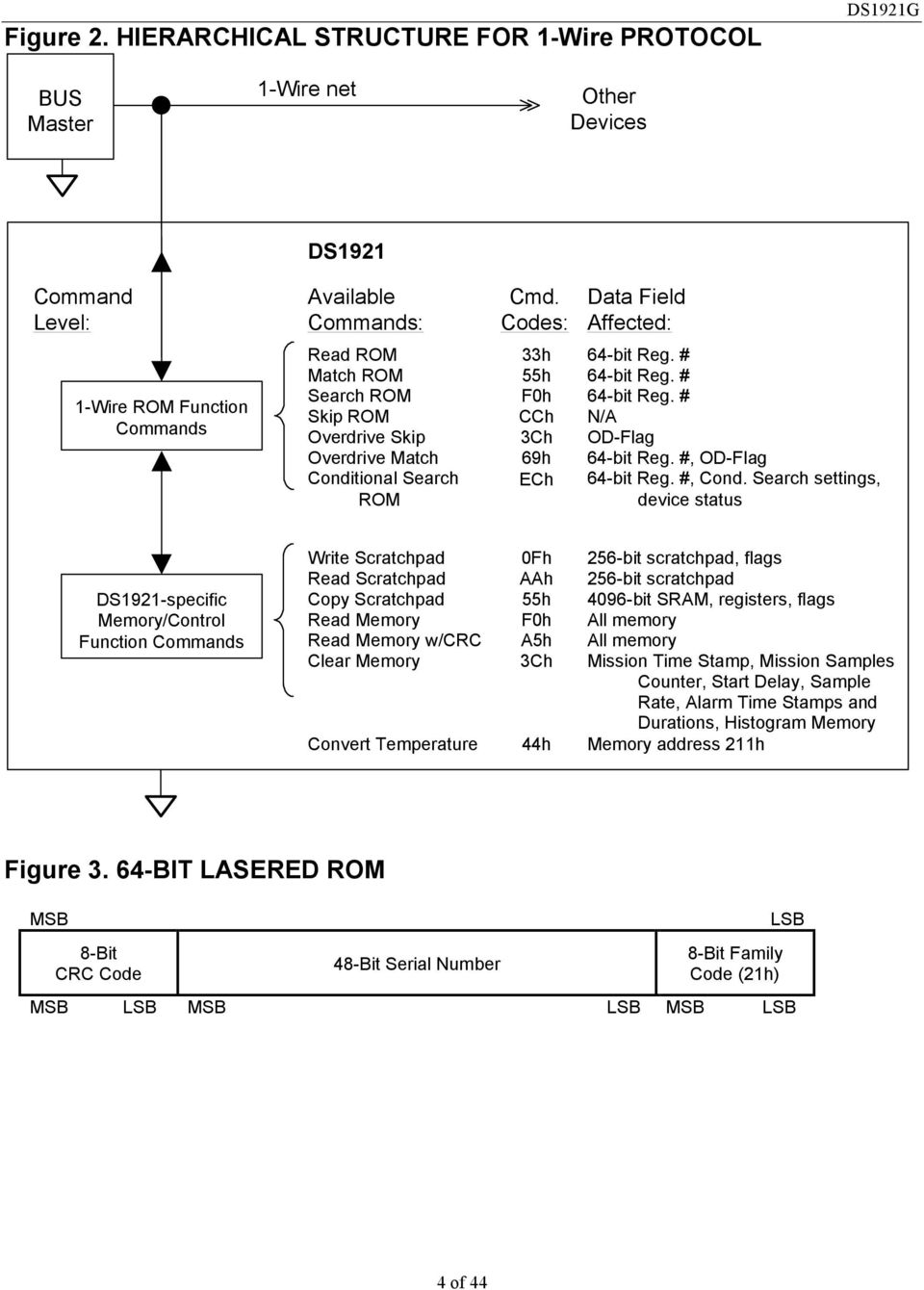
2 ibutton DESCRIPTIO The Thermochron ibutton is a rugged, self-sufficient system that measures temperature and records the result in a protected memory section. The recording is done at a user-defined rate, both as a direct storage of temperature values as well as in the form of a histogram. Up to 2048 temperature values taken at equidistant intervals ranging from 1 to 255 minutes can be stored. The histogram provides 63 data bins with a resolution of 2.0 C. If the temperature leaves a user-programmable range, the will also record when this happened, for how long the temperature stayed outside the permitted range, and if the temperature was too high or too low. An additional 512 bytes of read/write V memory allow storing information pertaining to the object to which the is associated. Data is transferred serially via the 1-Wire protocol, which requires only a single data lead and a ground return. Every is factory-lasered with a guaranteed unique electrically readable 64-bit registration number that allows for absolute traceability. The durable stainless steel package is highly resistant to environmental hazards such as dirt, moisture, and shock. Accessories permit the to be mounted on almost any object, including containers, pallets, and bags. APPLICATIO The Thermochron ibutton is an ideal device to monitor the temperature of any object it is attached to or shipped with, such as perishable goods or containers of temperature sensitive chemicals. The read/write V memory can store an electronic copy of shipping information, date of manufacture and other important data written as clear as well as encrypted files. OVERVIEW The block diagram in Figure 1 shows the relationships between the major control and memory sections of the. The device has seven main data components: 64-bit lasered ROM, 2) 256-bit scratchpad, 3) 4096-bit general-purpose SRAM, 4) 256-bit register page of timekeeping, control, and counter registers, 5) 96 bytes of alarm time stamp and duration logging memory, 6) 126 bytes of histogram memory, and 7) 2048 bytes of data-logging memory. Except for the ROM and the scratchpad, all other memory is arranged in a single linear address space. All memory reserved for logging purposes, counter registers and several other registers are read-only for the user. The timekeeping and control registers are write-protected while the device is programmed for a mission. The hierarchical structure of the 1-Wire protocol is shown in Figure 2. The bus master must first provide one of the seven ROM function commands: Read ROM, 2) Match ROM, 3) Search ROM, 4) Conditional Search ROM, 5) Skip ROM, 6) Overdrive-Skip ROM or 7) Overdrive-Match ROM. Upon completion of an Overdrive ROM command byte executed at standard speed, the device will enter Overdrive mode, where all subsequent communication occurs at a higher speed. The protocol required for these ROM function commands is described in Figure 13. After a ROM function command is successfully executed, the memory functions become accessible and the master may provide any one of the seven available commands. The protocol for these memory function commands is described in Figure 10. All data is read and written least significant bit first. 2 of 44

3 Figure 1. BLOCK DIAGRAM 1-Wire Port IO ROM Function Control 64-Bit Lasered ROM Parasite Powered Circuitry Memory Function Control 256-Bit Scratchpad General-Purpose SRAM kHz Oscillator Internal Timekeeping & Control Reg. & Counters Register Page Alarm Time Stamp and Duration Logging Memory Temperature Core 3V Lithium Control Logic Histogram Memory Datalog Memory PARASITE POWER The block diagram (Figure shows the parasite-powered circuitry. This circuitry steals power whenever the IO input is high. IO will provide sufficient power as long as the specified timing and voltage requirements are met. The advantages of parasite power are two-fold: by parasiting off this input, lithium is conserved, and 2) if the lithium is exhausted for any reason, the ROM may still be read normally. 64-BIT LASERED ROM Each contains a unique ROM code that is 64 bits long. The first 8 bits are a 1-Wire family code. The next 48 bits are a unique serial number. The last eight bits are a CRC of the first 56 bits. See Figure 3 for details. The 1-Wire CRC is generated using a polynomial generator consisting of a shift register and XOR gates as shown in Figure 4. The polynomial is X 8 + X 5 + X Additional information about the Dallas 1-Wire Cyclic Redundancy Check is available in Application ote 27 and in the Book of DS19xx ibutton Standards. The shift register bits are initialized to 0. Then starting with the least significant bit of the family code, one bit at a time is shifted in. After the eighth bit of the family code has been entered, then the serial number is entered. After the 48 th bit of the serial number has been entered, the shift register contains the CRC value. Shifting in the eight bits of CRC returns the shift register to all 0s. 3 of 44

4 Figure 2. HIERARCHICAL STRUCTURE FOR 1-Wire PROTOCOL BUS Master 1-Wire net Other Devices DS1921 Command Level: Available Commands: Cmd. Codes: Data Field Affected: 1-Wire ROM Function Commands Read ROM Match ROM Search ROM Skip ROM Overdrive Skip Overdrive Match Conditional Search ROM 33h 55h F0h CCh 3Ch 69h ECh 64-bit Reg. # 64-bit Reg. # 64-bit Reg. # /A OD-Flag 64-bit Reg. #, OD-Flag 64-bit Reg. #, Cond. Search settings, device status DS1921-specific Memory/Control Function Commands Write Scratchpad Read Scratchpad Copy Scratchpad Read Memory Read Memory w/crc Clear Memory Convert Temperature 0Fh AAh 55h F0h A5h 3Ch 44h 256-bit scratchpad, flags 256-bit scratchpad 4096-bit SRAM, registers, flags All memory All memory Mission Time Stamp, Mission Samples Counter, Start Delay, Sample Rate, Alarm Time Stamps and Durations, Histogram Memory Memory address 211h Figure BIT LASERED ROM MSB 8-Bit CRC Code 48-Bit Serial umber 8-Bit Family Code (21h) MSB LSB MSB LSB MSB LSB LSB 4 of 44
5 Figure 4. 1-Wire CRC GEERATOR Polynomial = X 8 + X 5 + X st 2 nd 3 rd 4 th 5 th 6 th 7 th 8 th X 0 X 1 X 2 X 3 X 4 X 5 X 6 X 7 X 8 IPUT DATA MEMOR The memory map of the is shown in Figure 5. The 4096-bit general-purpose SRAM make up pages 0 through 15. The timekeeping, control, and counter registers fill page 16, called Register Page (see Figure 6). Pages 17 to 19 are assigned to storing the alarm time stamps and durations. The temperature histogram bins begin at page 64 and use up to four pages. The temperature logging memory covers pages 128 to 191. Memory pages 20 to 63, 68 to 127, and 192 to 255 are reserved for future extensions. The scratchpad is an additional page that acts as a buffer when writing to the SRAM memory or the register page. The memory pages 17 and higher are read-only for the user. They are written to or erased solely under supervision of the on-chip control logic. Figure 5. MEMOR MAP 32-Byte Intermediate Storage Scratchpad ADDRESS 0000h to 01FFh 0200h to 021Fh 0220h to 027Fh 0280h to 07FFh 0800h to 087Fh 0880h to 0FFFh 1000h to 17FFh 1800h to 1FFFh General-Purpose SRAM (16 Pages) Pages 0 to Byte Register Page Page 16 Alarm Time Stamps and Durations Pages 17 to 19 (Reserved for Future Extensions) Pages 20 to 63 Temperature Histogram Memory Pages 64 to 67 (Reserved for Future Extensions) Pages 68 to 127 Datalog Memory (64 Pages) Pages 128 to 191 (Reserved for Future Extensions) Pages 192 to of 44

6 Figure 6. REGISTER PAGE MAP ADDR b7 b6 b5 b4 b3 b2 b1 b0 Function Access* 0200h 0 10 Seconds Single Seconds 0201h 0 10 Minutes Single Minutes Real- 0202h 0 12/24 20h. 10h. Time Single Hours AM/PM Clock R/W; R/W** 0203h Day of Week Registers 0204h Date Single Date 0205h CET m. Single Months 0206h 10 ears Single ears 0207h MS 10 Seconds Alarm Single Seconds Alarm Real- 0208h MM 10 Minutes Alarm Single Minutes Alarm Time 0209h MH 12/24 10ha. A/P 10h. alm. Single Hours Alarm Clock Alarm R/W; R/W** 020Ah MD Day of Week Alarm Registers 020Bh Temperature Low Alarm Threshold Temp. R/W; R/W** 020Ch Temperature High Alarm Threshold Alarms 020Dh umber of Minutes Between Temperature Conversions Sample R/W; R** Rate 020Eh EOSC EMCLR 0 EM RO TLS THS TAS Control R/W; R/W** 020Fh (no function, reads 00h) (/A) R; R** 0210h (no function, reads 00h) (/A) R; R** 0211h Temperature Read Out (Forced Conversion) Temp. R; R** 0212h Low Byte Start R/W; R/W** 0213h High Byte Delay 0214h TCB MEMCLR MIP SIP 0 TLF THF TAF Status R/W; R/W 0215h Minutes 0216h Hours Mission 0217h Date Time R; R 0218h Month Stamp 0219h ear 021Ah Low Byte Mission 021Bh Center Byte Samples R; R 021Ch High Byte Counter 021Dh Low Byte Device 021Eh Center Byte Samples R; R 021Fh High Byte Counter *The first entry in column ACCESS is valid between missions. The second entry shows the applicable access mode while a mission is in progress. **While a mission is in progress, these addresses can be read. The first attempt to write to these registers (even read-only ones), however, will end the mission and overwrite selected writeable registers. TIMEKEEPIG The RTC/alarm and calendar information is accessed by reading/writing the appropriate bytes in the register page, address 200h to 206h. ote that some bits are set to 0. These bits will always read 0 regardless of how they are written. The contents of the time, calendar, and alarm registers are in the Binary-Coded Decimal (BCD) format. 6 of 44
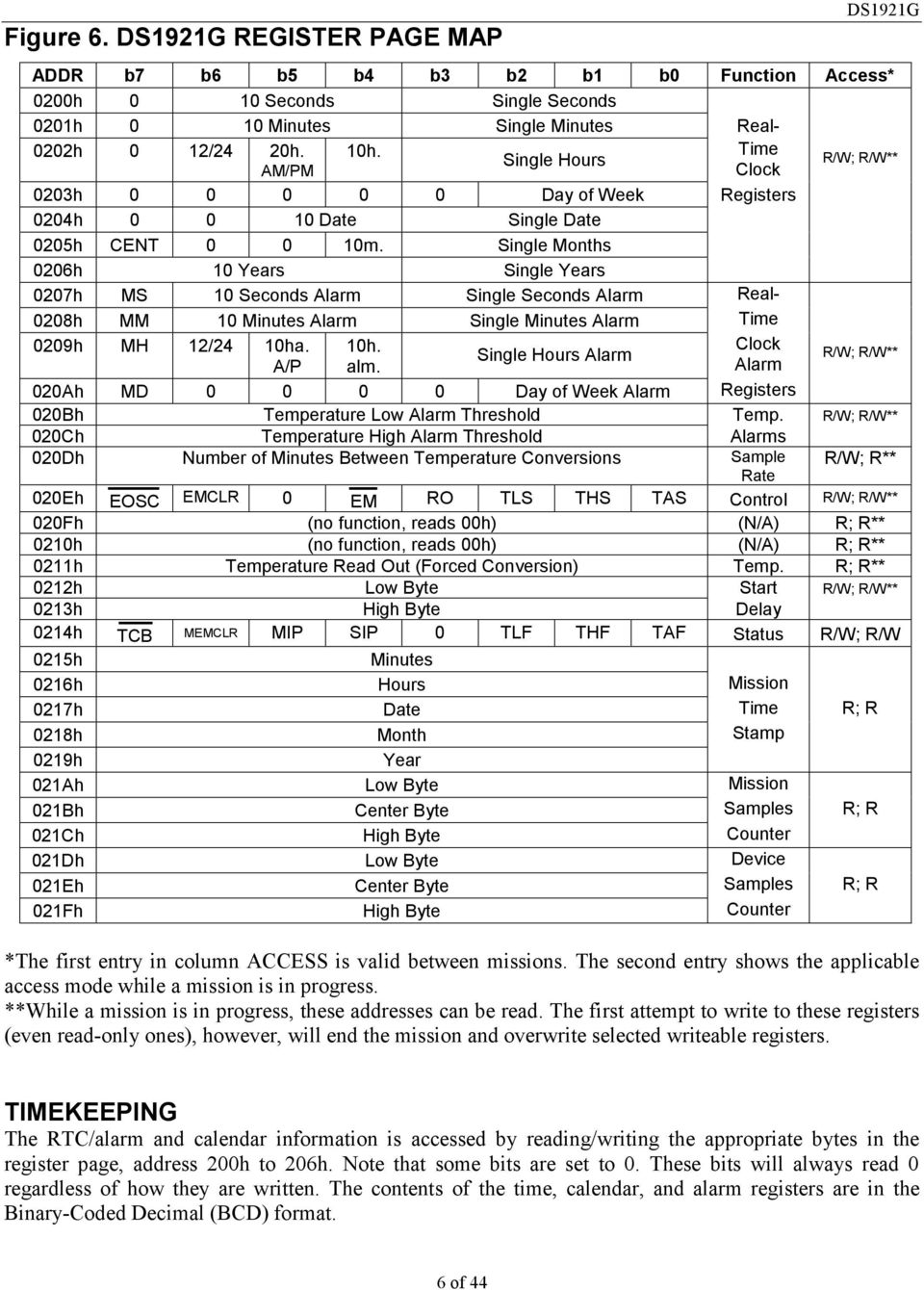
7 RTC and RTC Alarm Register Bitmap ADDR b7 b6 b5 b4 b3 b2 b1 b0 0200h 0 10 Seconds Single Seconds 0201h 0 10 Minutes Single Minutes 0202h 0 12/24 20h. 10h. AM/PM Single Hours 0203h Day of Week 0204h Date Single Date 0205h CET m. Single Months 0206h 10 ears Single ears 0207h MS 10 Seconds Alarm Single Seconds Alarm 0208h MM 10 Minutes Alarm Single Minutes Alarm 0209h MH 12/24 10ha. A/P 10h. alm. Single Hours Alarm 020Ah MD Day of Week Alarm RTC/Calendar The RTC of the can run in either 12-hour or 24-hour mode. Bit 6 of the Hours Register (address 202h) is defined as the 12- or 24-hour mode select bit. When high, the 12-hour mode is selected. In the 12-hour mode, bit 5 is the AM/PM bit with logic 1 being PM. In the 24-hour mode, bit 5 is the 20- hour bit (20 to 23 hours). To distinguish between the days of the week the includes a counter with a range from 1 to 7. The assignment of counter value to the day of week is arbitrary. Typically, the number 1 is assigned to a Sunday (U.S. standard) or to a Monday (European standard). The calendar logic is designed to automatically compensate for leap years. For every year value that is either 00 or a multiple of 4 the device will add a 29 th of February. This will work correctly up to (but not including) the year The is 2K-compliant. Bit 7 (CET) of the Months Register at address 205h serves as a century flag. When the ear Register rolls over from 99 to 00 the century flag will toggle. It is recommended to write the century bit to a 1 when setting the RTC to a time/date between the years 2000 and RTC Alarms The also contains a RTC alarm function. The alarm registers are located in registers 207h to 20Ah. The most significant bit of each of the alarm registers is a mask bit. When all of the mask bits are logic 0, an alarm will occur once per week when the values stored in timekeeping registers 200h to 203h match the values stored in the time of day alarm registers. Any alarm will set the Timer Alarm Flag (TAF) in the device's Status Register (address 214h). The bus master may set the Search Conditions in the Control Register (address 20Eh) to identify devices with timer alarms by means of the Conditional Search function (see ROM Function Commands). 7 of 44

8 RTC Alarm Control ALARM REGISTER MASK BITS (Bit 7 of 207h to 20Ah) MS MM MH MD Alarm once per second Alarm when seconds match (once per minute) Alarm when minutes and seconds match (once every hour) Alarm when hours, minutes and seconds match (once every day) Alarm when day, hours, minutes, and seconds match (once every week). Temperature Conversion The measures temperatures with a resolution of 0.5 C. Temperature values are represented in a single byte as an unsigned binary number, which translates into a theoretical range of 128 C. The range, however, has been limited to values from (00h) through (FAh). The codes 01h to F9h are considered valid temperature readings. If a temperature conversion yields a temperature that is out-of-range, it will be recorded as 00h (if too low) or FAh (if too high). Since out-of-range results are accumulated in histogram bins 0 and 62 (see section Temperature Logging and Histogram) the data in these bins is of limited value. For this reason the specified temperature range of the is considered to begin at code 04h and end at code F7h, which corresponds to histogram bins 1 to 61. With T[7..0] representing the decimal equivalent of a temperature reading, the temperature value is calculated as ( C) = T[7 0] / This equation is valid for converting temperature readings stored in the datalog memory as well as for data read from the forced temperature conversion readout Register (address 211h). To specify the high or low temperature alarm thresholds, this equation needs to be resolved to T[7 0] = 2 * ( C) A value of 23 C, for example, thus translates into 126 decimal or 7Eh. This corresponds to the binary patterns , which could be written to a Temperature Alarm Register (address 020Bh and 020Ch, respectively). Temperature Alarm Register Map ADDR b7 b6 b5 b4 b3 b2 b1 b0 020Bh Temperature Low Alarm Threshold 020Ch Temperature High Alarm Threshold 8 of 44

9 Sample Rate The content of the Sample Rate Register (address 020Dh) determines how many minutes the temperature conversions are apart from each other during a mission. The sample rate may be any value from 1 to 255, coded as an unsigned 8-bit binary number. If the memory has been cleared (Status Register bit MEMCLR = and a mission is enabled (Status Register bit EM = 0), writing a non-zero value to the Sample Rate Register will start a mission. For a full description of the correct sequence of steps to start a temperaturelogging mission see sections Missioning or Missioning Example. Sample Rate Register Map ADDR b7 b6 b5 b4 b3 b2 b1 b0 020Dh Sample Rate Control Register The is set up for its operation by writing appropriate data to its special function registers that are located in the register page. Several functions that are controlled by a single bit only are combined into a single byte called Control Register (address 20Eh). This register can be read and written. If the device is programmed for a mission, writing to the Control Register will end the mission and change the register contents. Control Register Bitmap ADDR b7 b6 b5 b4 b3 b2 b1 b0 020Eh EOSC EMCLR 0 EM RO TLS THS TAS The functional assignments of the individual bits are explained in the table below. Bit 5 has no function. It always reads 0 and cannot be written to 1. Control Register Details BIT DESCRIPTIO BIT(S) DEFIITIO EOSC: Enable Oscillator b7 This bit controls the crystal oscillator of the RTC. When set to logic 0, the oscillator will start operation. When written to logic 1, the oscillator will stop and the device is in a low-power data retention mode. This bit must be 0 for normal operation. The RTC must have advanced at least 1 second before a mission start will be accepted. EMCLR: Memory Clear Enable b6 This bit needs to be set to logic 1 to enable the Clear Memory function, which is invoked as a memory function command. The Time-Stamp, Histogram Memory as well as the Mission Time Stamp, Mission Samples Counter, Mission Start Delay and Sample Rate will be cleared only if the Clear Memory command is issued with the next access to the device. The EMCLR bit will return to 0 as the next memory function command is executed. EM: Enable Mission b4 This bit controls whether the will begin a mission as soon as the sample rate is written. To enable the device for a mission, this bit must be 0. RO: Rollover Enable/Disable b3 This bit controls whether the temperature logging memory is overwritten with new data or whether data logging is stopped once the memory is filled with data during a mission. Setting this bit to a 1 enables the rollover and data logging continues at the beginning overwriting previously collected data. Clearing this bit to 0 disables the rollover and no further temperature values will be stored in the temperature logging memory once it is filled with data. This will not stop the mission. The device will continue measuring temperatures and updating the histogram and alarm time stamps and durations. 9 of 44

10 BIT DESCRIPTIO BIT(S) DEFIITIO TLS: Temperature Low Alarm Search b2 If this bit is 1, the device will respond to a Conditional Search command if during a mission the temperature has reached or is lower than the Low Temperature Threshold stored at address 020Bh. THS: Temperature High Alarm Search b1 If this bit is 1, the device will respond to a Conditional Search command if during a mission the temperature has reached or is higher than the High Temperature Threshold stored at address 020Ch. TAS: Timer Alarm Search b0 If this bit is 1, the device will respond to a Conditional Search command if during a mission a timer alarm has occurred. Since a timer alarm cannot be disabled, the TAF flag usually reads 1 during a mission. Therefore it may be advisable to set the TAS bit to a 0, in most cases. Mission Start Delay Counter The content of the Mission Start Delay Counter determines how many minutes the device will wait before starting the logging process. The mission start delay value is stored as unsigned 16-bit integer number at addresses 212h (low byte) and 213h (high byte). The maximum delay is minutes, equivalent to 45 days, 12 hours, and 15 minutes. For a typical mission, the Mission Start Delay is 0. If a mission is too long for a single to store all temperature readings at the selected sample rate, one can use several devices, staggering the Mission Start Delay to record the full period. In this case, the RO bit in the control register (address 020Eh) must be set to 0 to prevent overwriting of the recorded temperature log after the datalog memory is full. See Mission Start and Logging Process description and flow chart for details. Status Register The Status Register holds device status information and alarm flags. The register is located at address 214h. Writing to this register will not necessarily end a mission. Status Register Bitmap ADDR b7 b6 b5 b4 b3 b2 b1 b0 0214h TCB MEMCLR MIP SIP 0 TLF THF TAF The functional assignments of the individual bits are explained in the table below. The bits MIP, TLF, THF and TAF can only be written to 0. All other bits are read-only. Bit 3 has no function. Status Register Details BIT DESCRIPTIO BIT(S) DEFIITIO TCB: Temperature Core Busy b7 If this bit reads 0 the is currently performing a temperature conversion, either self-initiated because of a mission being in progress or initiated by a command when a mission is not in progress. The TCB bit goes low just before a conversion starts and returns to high just after the result is latched into the readout register at address 0211h. MEMCLR: Memory Cleared b6 If this bit reads 1, the memory pages 17 and higher (alarm time stamps/durations, temperature histogram, excluding datalog memory), as well as the Mission Time Stamp, Mission Samples Counter, Mission Start Delay and Sample Rate have been cleared to 0 from executing a Clear Memory function command. The MEMCLR bit will return to 0 as soon as writing a non-0 value to the Sample Rate Register starts a new mission, provided that the EM bit is also 0. The memory has to be cleared in order for a mission to start. 10 of 44

11 BIT DESCRIPTIO BIT(S) DEFIITIO MIP: Mission in Progress b5 If this bit reads 1 the has been set up for a mission and this mission is still in progress. A mission is started if the EM bit of the Control Register (address 20Eh) is 0 and a non-zero value is written to the Sample Rate Register, address 20Dh. The MIP bit returns from logic 1 to logic 0 when a mission is ended. A mission will end with the first write attempt (Copy Scratchpad command) to any register in the address range of 200h to 213h. Alternatively, a mission can be ended by directly writing to the Status Register and setting the MIP bit to 0. The MIP bit cannot be set to 1 by writing to the status register. SIP: Sample in Progress b4 If this bit reads 1 the is currently performing a temperature conversion as part of a mission in progress. The mission samples occur on the seconds rollover from 59 to 00. The SIP bit will change from 0 to 1 approximately 250ms before the actual temperature conversion begins allowing the circuitry of the chip to wake-up. A temperature conversion including a wake-up phase takes maximum 875ms. During this time read accesses to the memory pages 17 and higher are permissible but may reveal invalid data. TLF: Temperature Low Flag THF: Temperature High Flag b2 b1 Logic 1 in the Temperature Low Flag bit indicates that a temperature measurement during a mission revealed a temperature equal to or lower than the value in the Temperature Low Threshold Register. The Temperature Low Flag can be cleared at any time by writing this bit to 0. This flag must be cleared before starting a new mission. Logic 1 in the Temperature High Flag bit indicates that a temperature measurement during a mission revealed a temperature equal to or higher than the value in the Temperature High Threshold Register. The Temperature High Flag can be cleared at any time by writing this bit to 0. This flag must be cleared before starting a new mission. TAF: Timer Alarm Flag b0 If this bit reads 1, a RTC alarm has occurred (see TIMEKEEPIG section for details). The Timer Alarm Flag can be cleared at any time by writing this bit to logic 0. Since the timer alarm cannot be disabled, the TAF flag usually reads 1 during a mission. This flag should be cleared before starting a new mission. Mission Time Stamp The Mission Time Stamp indicates the time and date of the first temperature conversion of a mission. Subsequent temperature conversions will take place as many minutes apart from each other as specified by the value in the Sample Rate Register. Mission samples occur on minute boundaries. Mission Time Stamp Register Bitmap ADDR b7 b6 b5 b4 b3 b2 b1 b0 0215h 0 10 Minutes Single Minutes 0216h 0 12/24 20h. 10h. Single Hours AM/PM 0217h Date Single Date 0218h m. Single Months 0219h 10 ears Single ears Mission Samples Counter The Mission Samples Counter indicates how many temperature measurements have taken place during the current mission in progress (if MIP = or during the latest mission (if MIP = 0). The value is stored as an unsigned 24-bit integer number. This counter is reset through the Clear Memory command. 11 of 44

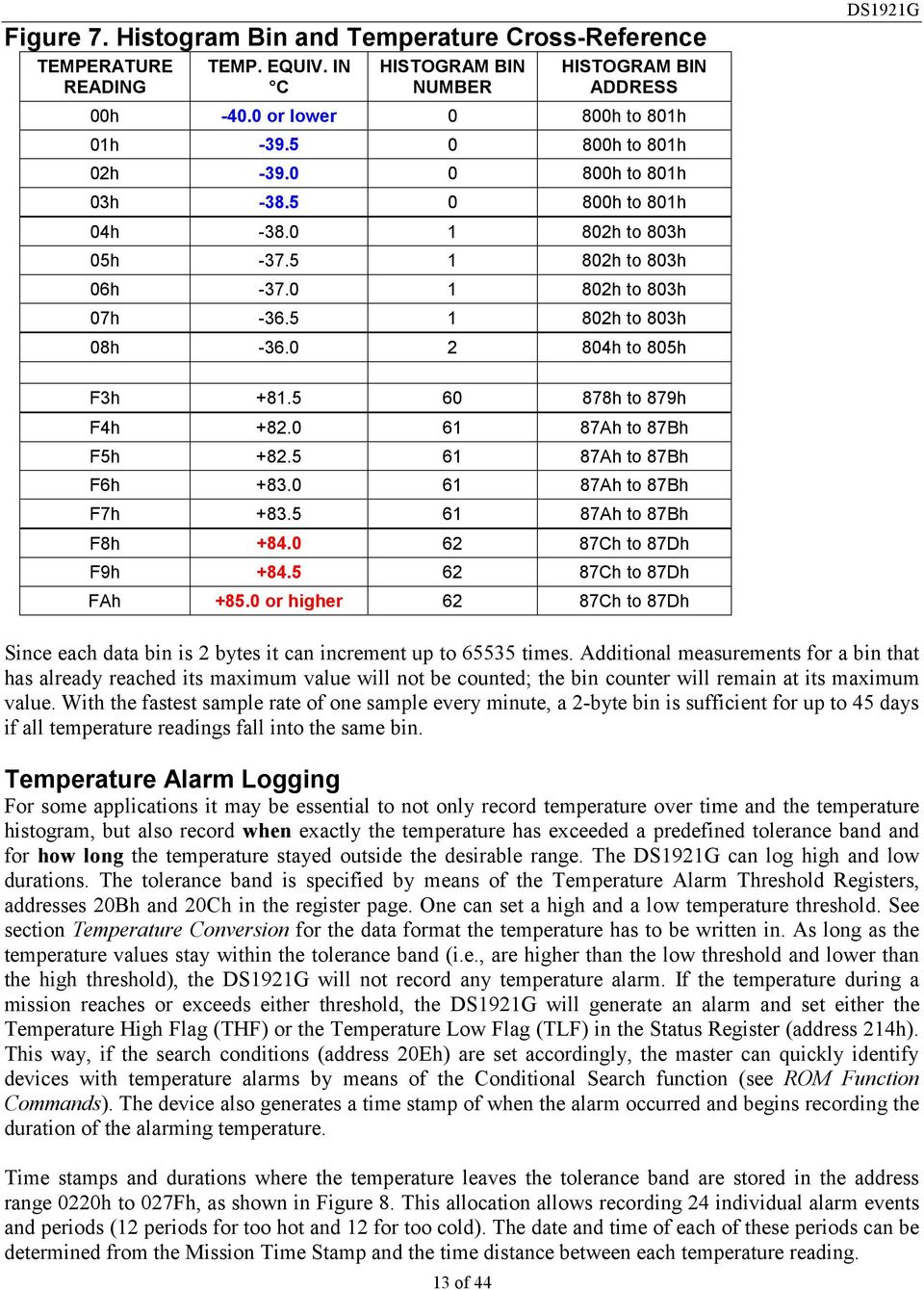
12 Mission Samples Counter Register Map ADDR b7 b6 b5 b4 b3 b2 b1 b0 021Ah Low Byte 021Bh Center Byte 021Ch High Byte Device Samples Counter The Device Samples Counter indicates how many temperature measurements have taken place since the device was assembled at the factory. The value is stored as an unsigned 24-bit integer number. The maximum number that can be represented in this format is , which is higher than the expected lifetime of the ibutton. This counter cannot be reset under software control. Device Samples Counter Register Map ADDR b7 b6 b5 b4 b3 b2 b1 b0 021Dh Low Byte 021Eh Center Byte 021Fh High Byte Temperature Logging and Histogram Once setup for a mission, the logs the temperature measurements simultaneously byte after byte in the datalog memory as well as in histogram form in the histogram memory. The datalog memory is able to store 2048 temperature values measured at equidistant time points. The first temperature value of a mission is written to address location 1000h of the datalog memory, the second value to address location 1001h and so on. Knowing the starting time point (Mission Time Stamp), the interval between temperature measurements, the Mission Samples Counter, and the rollover setting, one can reconstruct the time and date of each measurement stored in the datalog. There are two alternatives to the way the will behave after the 2048 bytes of datalog memory is filled with data. With rollover disabled (RO = 0), the device will fill the datalog memory with the first 2048 mission samples. Additional mission samples are not logged in the datalog, but the histogram, and temperature alarm ram continue to update. With rollover enabled (RO =, the datalog will wrap around, and overwrite previous data starting at 1000h for the every 2049 th mission sample. In this mode the device stores the last 2048 mission samples. For the temperature histogram, the provides 63 bins that begin at memory address 0800h. Each bin consists of a 16-bit, non-rolling-over binary counter that is incremented each time a temperature value acquired during a mission falls into the range of the bin. The least significant byte of each bin is stored at the lower address. Bin 0 begins at memory address 0800h, bin 1 at 0802h, and so on up to 087Ch for bin 62, as shown in Figure 7. The number of the bin to be updated after a temperature conversion is determined by cutting off the two least significant bits of the binary temperature value. Out of range values are range locked and counted as 00h or FAh. 12 of 44

13 Figure 7. Histogram Bin and Temperature Cross-Reference TEMPERATURE READIG TEMP. EQUIV. I C HISTOGRAM BI UMBER HISTOGRAM BI ADDRESS 00h or lower 0 800h to 801h 01h h to 801h 02h h to 801h 03h h to 801h 04h h to 803h 05h h to 803h 06h h to 803h 07h h to 803h 08h h to 805h F3h h to 879h F4h Ah to 87Bh F5h Ah to 87Bh F6h Ah to 87Bh F7h Ah to 87Bh F8h Ch to 87Dh F9h Ch to 87Dh FAh or higher 62 87Ch to 87Dh Since each data bin is 2 bytes it can increment up to times. Additional measurements for a bin that has already reached its maximum value will not be counted; the bin counter will remain at its maximum value. With the fastest sample rate of one sample every minute, a 2-byte bin is sufficient for up to 45 days if all temperature readings fall into the same bin. Temperature Alarm Logging For some applications it may be essential to not only record temperature over time and the temperature histogram, but also record when exactly the temperature has exceeded a predefined tolerance band and for how long the temperature stayed outside the desirable range. The can log high and low durations. The tolerance band is specified by means of the Temperature Alarm Threshold Registers, addresses 20Bh and 20Ch in the register page. One can set a high and a low temperature threshold. See section Temperature Conversion for the data format the temperature has to be written in. As long as the temperature values stay within the tolerance band (i.e., are higher than the low threshold and lower than the high threshold), the will not record any temperature alarm. If the temperature during a mission reaches or exceeds either threshold, the will generate an alarm and set either the Temperature High Flag (THF) or the Temperature Low Flag (TLF) in the Status Register (address 214h). This way, if the search conditions (address 20Eh) are set accordingly, the master can quickly identify devices with temperature alarms by means of the Conditional Search function (see ROM Function Commands). The device also generates a time stamp of when the alarm occurred and begins recording the duration of the alarming temperature. Time stamps and durations where the temperature leaves the tolerance band are stored in the address range 0220h to 027Fh, as shown in Figure 8. This allocation allows recording 24 individual alarm events and periods (12 periods for too hot and 12 for too cold). The date and time of each of these periods can be determined from the Mission Time Stamp and the time distance between each temperature reading. 13 of 44
14 Figure 8. Alarm Time Stamps and Durations Address Map ADDRESS DESCRIPTIO ALARM EVET 0220h Mission Samples Counter Low Byte 0221h Mission Samples Counter Center Byte Low Alarm h 0223h Mission Samples Counter High Byte Alarm Duration Counter 0224h to 0227h Alarm Time Stamp and Duration Low Alarm h to 024Fh Alarm Time Stamp and Durations Low Alarms 3 to h Mission Samples Counter Low Byte 0251h Mission Samples Counter Center Byte High Alarm h 0253h Mission Samples Counter High Byte Alarm Duration Counter 0254h to 0257h Alarm Time Stamp and Duration High Alarm h to 027Fh Alarm Time Stamp and Durations High Alarms 3 to 12 The alarm time stamp is a copy of the Mission Samples Counter when the alarm first occurred. The least significant byte is stored at the lower address. One address higher than the time stamp the maintains a 1-byte duration counter that stores the number of samples the temperature was found to be beyond the threshold. If this counter has reached its limit after 255 consecutive temperature readings and the temperature has not yet returned to within the tolerance band, the device will issue another time stamp at the next higher alarm location and open another counter to record the duration. If the temperature returns to normal before the counter has reached its limit, the duration counter of the particular time stamp will not increment any further. Should the temperature again cross this threshold, it will be recorded at the next available alarm location. This algorithm is implemented for the low as well as for the high temperature threshold. MISSIOIG The typical task of the is recording the temperature of a temperature-sensitive object. Before the device can perform this function, it needs to be configured. This procedure is called missioning. First of all, needs to have its RTC set to valid time and date. This reference time may be UTC (also called GMT, Greenwich Mean Time) or any other time standard that was chosen for the application. The clock must be running (EOSC = 0) for at least one second. Setting a RTC alarm is optional. The memory assigned to storing alarm time stamps and durations, temperature histogram, as well as the Mission Time Stamp, Mission Samples Counter, Mission Start Delay and Sample Rate must be cleared using the Memory Clear command. In case there were temperature alarms in the previous mission, the TLF and THF flags need to be cleared manually. To enable the device for a mission, the EM flag must be set to 0. These are general settings that have to be made regardless of the type of object to be monitored and the duration of the mission. ext, the low temperature and high temperature thresholds to specify the temperature tolerance band must be defined. How to convert a temperature value into the binary code to be written to the threshold registers is described under Temperature Conversion earlier in this document. 14 of 44

15 The state of the Search Condition bits in the Control Register does not affect the mission. If multiple devices are connected to form a 1-Wire net, the setting of the search condition will enable devices to participate in the conditional search if certain events such as timer or temperature alarm have occurred. Details on the search conditions are found in the section ROM Function Commands later in this document and in the Control Register description. The setting of the RO bit (rollover enable) and sample rate depends on the duration of the mission and the monitoring requirements. If the most recent temperature history is important, the rollover should be enabled (RO =. Otherwise, one should estimate the duration of the mission in minutes and divide the number by 2048 to calculate the value of the sample rate (number of minutes between temperature conversions). If the estimated duration of a mission is 10 days (= minutes) for example, then the 2048-byte capacity of the datalog memory would be sufficient to store a new value every 7 minutes. If the datalog memory of the is not large enough to store all temperature readings, one can use several devices and set the Mission Start Delay to values that make the second device start recording as soon as the memory of the first device is full, and so on. The RO-bit needs to be set to 0 to disable rollover that would otherwise overwrite the recorded temperature log. After the RO bit and the Mission Start Delay are set, the Sample Rate Register is the last element of data that is written. The sample rate may be any value from 1 to 255, coded as an unsigned 8-bit binary number. As soon as the sample rate is written, the will set the MIP flag and clear the MEMCLR flag. After as many minutes as specified by the Mission Start Delay are over, the device will wait for the next minute boundary, then wake up, copy the current time and date to the Mission Time Stamp Register, and make the first temperature conversion of the mission. This increments both the Mission Samples Counter and Device Samples Counter. All subsequent temperature measurements are taken on minute boundaries specified by the value in the Sample Rate Register. One may read the memory of the to watch the mission as it progresses. Care should be taken to avoid memory access conflicts. See section Memory Access Conflicts for details. MEMOR/COTROL FUCTIO COMMADS The Memory/Control Function Flow Chart (Figure 10) describes the protocols necessary for accessing the memory and the special function registers of the. An example on how to use these and other functions to set up the for a mission is included at the end of this document, preceding the Electrical Characteristics section. The communication between master and takes place either at regular speed (default, OD = 0) or at Overdrive Speed (OD =. If not explicitly set into the Overdrive Mode, the assumes regular speed. Internal memory access during a mission has priority over external access through the 1-Wire interface. This can affect the Read Memory commands described below. See section Memory Access Conflicts for details. ADDRESS REGISTERS AD TRASFER STATUS Because of the serial data transfer, the employs three address registers, called TA1, TA2, and E/S (Figure 9). Registers TA1 and TA2 must be loaded with the target address to which the data will be written or from which data will be sent to the master upon a Read command. Register E/S acts like a byte counter and transfer status register. It is used to verify data integrity with Write commands. Therefore, the master only has read access to this register. The lower 5 bits of the E/S Register indicate the address of the last byte that has been written to the scratchpad. This address is called Ending Offset. Bit 5 of the E/S Register, called PF or partial byte flag, is set if the number of data bits sent by the master is not an integer multiple of 8. Bit 6 is always a 0. ote that the lowest 5 bits of the target address also determine the address within the scratchpad, where intermediate storage of data will begin. This address is called byte offset. If the target address for a Write command is 13Ch, for example, then the scratchpad will store 15 of 44

16 incoming data beginning at the byte offset 1Ch and will be full after only 4 bytes. The corresponding ending offset in this example is 1Fh. For best economy of speed and efficiency, the target address for writing should point to the beginning of a new page, (i.e., the byte offset will be 0). Thus, the full 32-byte capacity of the scratchpad is available, resulting also in the ending offset of 1Fh. However, it is possible to write 1 or several contiguous bytes somewhere within a page. The ending offset together with the Partial and Overflow Flag is mainly a means to support the master checking the data integrity after a Write command. The highest valued bit of the E/S Register, called AA or Authorization Accepted, indicates that a valid copy command for the scratchpad has been received and executed. Writing data to the scratchpad clears this flag. Figure 9. ADDRESS REGISTERS Bit # Target Address (TA T7 T6 T5 T4 T3 T2 T1 T0 Target Address (TA2) T15 T14 T13 T12 T11 T10 T9 T8 Ending Address with Data Status (E/S) (Read Only) AA 0 PF E4 E3 E2 E1 E0 WRITIG WITH VERIFICATIO To write data to the, the scratchpad has to be used as intermediate storage. First the master issues the Write Scratchpad command to specify the desired target address, followed by the data to be written to the scratchpad. In the next step, the master sends the Read Scratchpad command to read the scratchpad and to verify data integrity. As preamble to the scratchpad data, the sends the requested target address TA1 and TA2 and the contents of the E/S Register. If the PF flag is set, data did not arrive correctly in the scratchpad. The master does not need to continue reading; it can start a new trial to write data to the scratchpad. Similarly, a set AA flag indicates that the Write command was not recognized by the device. If everything went correctly, both flags are cleared and the ending offset indicates the address of the last byte written to the scratchpad. ow the master can continue verifying every data bit. After the master has verified the data, it has to send the Copy Scratchpad command. This command must be followed exactly by the data of the three address registers TA1, TA2 and E/S as the master has read them verifying the scratchpad. As soon as the has received these bytes, it will copy the data to the requested location beginning at the target address. Write Scratchpad Command [0Fh] After issuing the Write Scratchpad command, the master must first provide the 2-byte target address, followed by the data to be written to the scratchpad. The data will be written to the scratchpad starting at the byte offset (T4:T0). The ending offset (E4:E0) will be the byte offset at which the master stops writing data. Only full data bytes are accepted. If the last data byte is incomplete, its content will be ignored and the partial byte flag (PF) will be set. When executing the Write Scratchpad command, the CRC generator inside the (see Figure 16) calculates a CRC of the entire data stream, starting at the command code and ending at the last data byte sent by the master. This CRC is generated using the CRC16 polynomial by first clearing the CRC 16 of 44

17 generator and then shifting in the command code (0Fh) of the Write Scratchpad command, the Target Addresses TA1 and TA2 as supplied by the master and all the data bytes. The master may end the Write Scratchpad command at any time. However, if the ending offset is 11111b, the master may send 16 read time slots and will receive an inverted CRC16 generated by the. The range 200h to 213h of the register page is protected during a mission. See Figure 6, Register Page Map, for the access type of the individual registers between and during missions. Read Scratchpad Command [AAh] This command is used to verify scratchpad data and target address. After issuing the Read Scratchpad command, the master begins reading. The first 2 bytes will be the target address. The next byte will be the ending offset/data status byte (E/S) followed by the scratchpad data beginning at the byte offset (T4:T0), as shown in Figure 9. Regardless of the actual ending offset, the master may read data until the end of the scratchpad after which it will receive an inverted CRC16 of the command code, Target Addresses TA1 and TA2, the E/S byte, and the scratchpad data starting at the target address. After the CRC is read, the bus master will read logical 1s from the until a reset pulse is issued. Copy Scratchpad [55h] This command is used to copy data from the scratchpad to the writable memory sections. Applying Copy Scratchpad to the Sample Rate Register can start a mission provided that several preconditions are met. See Mission Start and Logging Process description and the flow chart in Figure 11 for details. After issuing the Copy Scratchpad command, the master must provide a 3-byte authorization pattern, which can be obtained by reading the scratchpad for verification. This pattern must exactly match the data contained in the three address registers (TA1, TA2, E/S, in that order). If the pattern matches, the AA (Authorization Accepted) flag will be set and the copy will begin. A pattern of alternating 1s and 0s will be transmitted after the data has been copied until the master issues a reset pulse. While the copy is in progress any attempt to reset the part will be ignored. Copy typically takes 2µs per byte. The data to be copied is determined by the three address registers. The scratchpad data from the beginning offset through the ending offset will be copied, starting at the target address. Anywhere from 1 to 32 bytes may be copied to memory with this command. The AA flag will remain at logic 1 until it is cleared by the next Write Scratchpad command. ote that Copy Scratchpad when applied to the address range 200h to 213h during a mission will end the mission. Read Memory [F0h] The Read Memory command may be used to read the entire memory. After issuing the command, the master must provide the 2-byte target address. After the 2 bytes, the master reads data beginning from the target address and may continue until the end of memory, at which point logic 0s will be read. It is important to realize that the target address registers will contain the address provided. The ending offset/data status byte is unaffected. The hardware of the provides a means to accomplish error-free writing to the memory section. To safeguard data in the 1-Wire environment when reading and to simultaneously speed up data transfers, it is recommended to packetize data into data packets of the size of one memory page each. Such a packet would typically store a 16-bit CRC with each page of data to ensure rapid, error-free data transfers that eliminate having to read a page multiple times to verify whether if the received data is correct. (See Application ote 114 for the recommended file structure.) 17 of 44

18 Figure MEMOR/COTROL FUCTIO FLOW CHART Master TX Memory or Control Fkt. Command From ROM Functions Flow Chart (Figure 13) 0FH Write Scratchpad AAH Read Scratchpad To Figure 10 2 nd Part DS1921 sets EMCLR = 0 DS1921 sets EMCLR = 0 Master TX TA1 (T7:T0), TA2 (T15:T8) DS1921 sets Scratchpad Offset = (T4:T0) and Clears (PF, AA) Master TX Data Byte to Scratchpad Offset DS1921 sets (E4:E0) = Scratchpad Offset Master RX TA1 (T7:T0), TA2 (T15:T8) Master RX Ending Offset with Data Status (E/S) DS1921 sets Scratchpad Offset = (T4:T0) Master RX Data Byte from Scratchpad Offset DS1921 Increments Scratchpad Offset Master TX Reset? Scratchpad Offset = 11111b? Master TX Reset? Master RX CRC16 of Command, Address, Data Partial Byte Written? DS1921 Increments Scratchpad Offset PF = 1 Master TX Reset? Scratchpad Offset = 11111b? Master RX CRC16 of Command, Address Data, E/S Byte, and Data Starting at the Target Address Master TX Reset? Master TX Reset? Master RX "1"s Master RX "1"s To ROM Functions Flow Chart (Figure 13) From Figure 10 2 nd Part 18 of 44

19 Figure MEMOR/COTROL FUCTIO FLOW CHART From Figure 10 1 st Part 55H Copy Scratchpad F0H Read Memory To Figure 10 3 rd Part DS1921 sets EMCLR = 0 DS1921 sets EMCLR = 0 Master TX TA1 (T7:T0), TA2 (T15:T8) Master TX E/S Byte Master TX TA1 (T7:T0), TA2 (T15:T8) DS1921 sets Memory Address = (T15:T0) Authorization Code Match? AA = 1 DS1921 Copies Scratchpad Data to Memory DS1921 Increments Address Counter Master RX Data Byte from Memory Address Master TX Reset? Master RX "1"s Copying Finished Master RX "1"s Master TX Reset? End of Memory? Master RX "0"s DS1921 TX "0" Master TX Reset? DS1921 TX "1" Master TX Reset? To Figure 10 1 st Part From Figure 10 3 rd Part 19 of 44

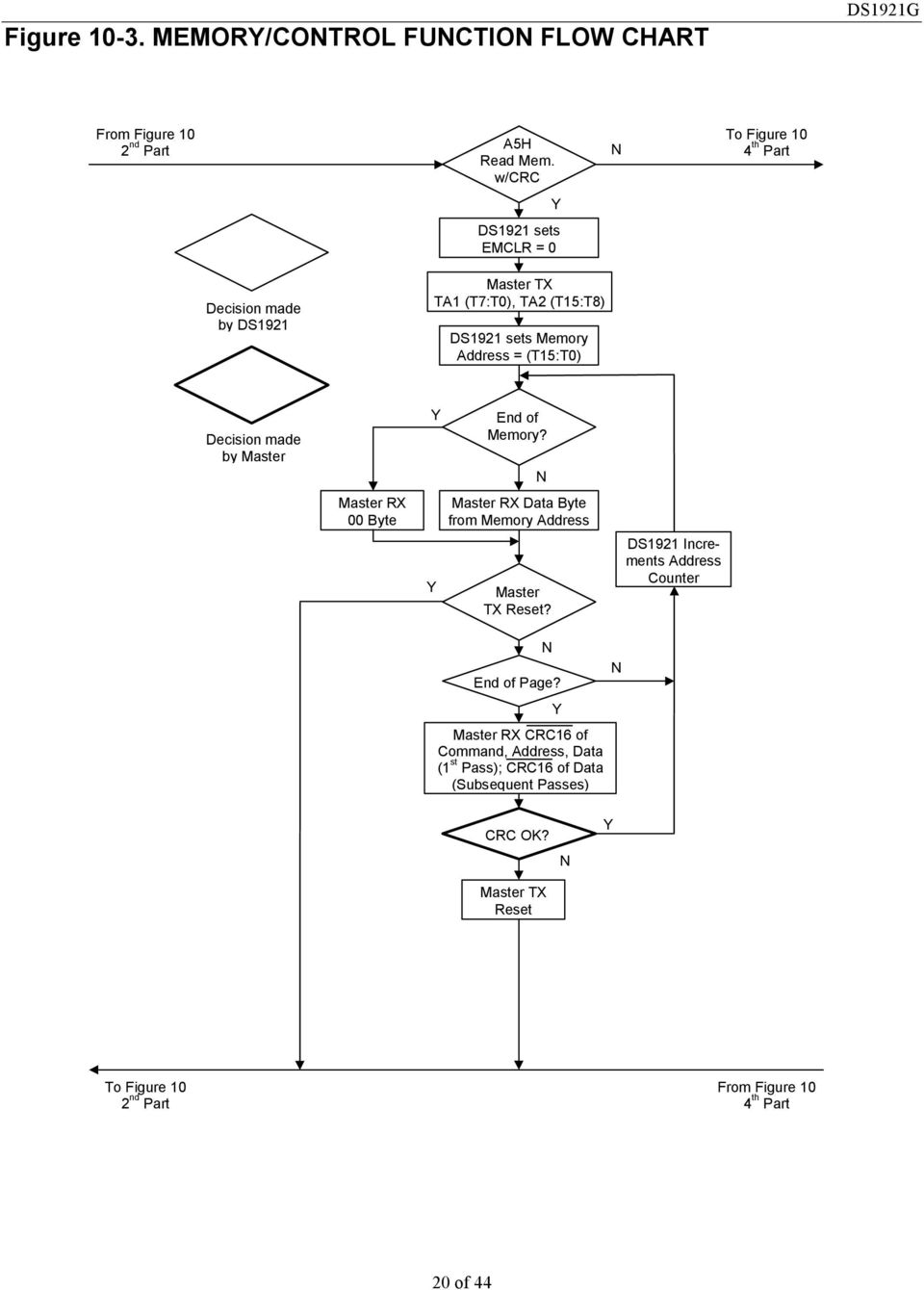
20 Figure MEMOR/COTROL FUCTIO FLOW CHART From Figure 10 2 nd Part A5H Read Mem. w/crc To Figure 10 4 th Part DS1921 sets EMCLR = 0 Decision made by DS1921 Master TX TA1 (T7:T0), TA2 (T15:T8) DS1921 sets Memory Address = (T15:T0) Decision made by Master End of Memory? Master RX 00 Byte Master RX Data Byte from Memory Address Master TX Reset? DS1921 Increments Address Counter End of Page? Master RX CRC16 of Command, Address, Data (1 st Pass); CRC16 of Data (Subsequent Passes) CRC OK? Master TX Reset To Figure 10 2 nd Part From Figure 10 4 th Part 20 of 44
21 Figure MEMOR/COTROL FUCTIO FLOW CHART From Figure 10 3 rd Part 3CH Clear Memory 44H Convert Temp. EMCLR = 1? DS1921 sets EMCLR = 0 DS1921 clears Mission Time Stamp, Mission Samples Counter, Mission Start Delay, Sample Rate Register Mission in Progress? Temperature Conversion Process DS1921 clears Alarm Time Stamps and Durations DS1921 sets TCB\ = 0 DS1921 clears Histogram Memory DS1921 sets MEMCLR = 1 DS1921 Starts Temperature Conversion Process DS1921 Performs a Temp. Conversion DS1921 copies Result to Address 0211h DS1921 sets EMCLR = 0 DS1921 sets TCB\ = 1 Master TX Reset? Master TX Reset? End of Process Master TX Reset? To Figure 10 3 rd Part 21 of 44
22 Read Memory with CRC [A5h] The Read Memory with CRC command is used to read memory data that cannot be packetized, such as the register page and the data recorded by the device during a mission. The command works essentially the same way as the simple Read Memory, except for the 16-bit CRC that the generates and transmits following the last data byte of a memory page. After having sent the command code of the Read Memory with CRC command, the bus master sends a 2- byte address (TA1 = T7:T0, TA2 = T15:T8) that indicates a starting byte location. With the subsequent read data time slots the master receives data from the starting at the initial address and continuing until the end of a 32-byte page is reached. At that point the bus master will send 16 additional read data time slots and receive an inverted 16-bit CRC. With subsequent read data time slots the master will receive data starting at the beginning of the next page followed again by the inverted CRC for that page. This sequence will continue until the bus master resets the device. With the initial pass through the Read Memory with CRC flow, the 16-bit CRC value is the result of shifting the command byte into the cleared CRC generator followed by the 2 address bytes and the contents of the data memory. Subsequent passes through the Read Memory with CRC flow will generate a 16-bit CRC that is the result of clearing the CRC generator and then shifting in the contents of the data memory page. After the 16-bit CRC of the last page is read, the bus master will receive logical 0s from the and inverted CRC16s at page boundaries until a reset pulse is issued. The Read Memory with CRC command sequence can be ended at any point by issuing a reset pulse. Clear Memory [3Ch] The Clear Memory command is used to clear the Sample Rate, Mission Start Delay, Mission Time Stamp, and Mission Samples Counter in the register page and the Temperature Alarm Memory and the Temperature Histogram Memory. These memory areas must be cleared for the device to be set up for another mission. The Clear Memory command does not clear the datalog memory or the temperature and timer alarm flags in the Status Register. The RTC oscillator must be on and have counted at least 1 second, before issuing the command. For the Clear Memory command to function the EMCLR bit in Control Register must be set to 1, and the Clear Memory command must be issued with the very next access to the device s memory functions. Issuing any other memory function command will reset the EMCLR bit. The Clear Memory process takes 500µs. When the command is completed the MEMCLR bit in the Status Register will read 1 and the EMCLR bit will be 0. Convert Temperature [44h] If a mission is not in progress (MIP = 0) the Convert Temperature command can be issued to measure the current temperature of the device. The result of the temperature conversion will be found at memory address 211h in the register page. This command takes maximum 90ms to complete. During this time the device remains fully accessible for memory/control and ROM function commands. 22 of 44
23 Mission Start and Logging Process The does not use a special command to start a mission. Instead, a mission is started by writing a non-zero value to the Sample Rate Register using the Copy Scratchpad command. As shown in Figure 11, a new mission can only be started if the previous mission has been stopped (MIP = 0), the memory is cleared (MEMCLR = and the mission is enabled (EM = 0). If the new sample rate is different from zero, the value will be copied to the sample rate register. At the same time the MIP bit will be set and the MEMCLR bit will be cleared to indicate that the device is on a mission. ext the Mission Start Delay counter will start decrementing every minute until it is down to 0. ow the will wait until the next minute boundary and start the logging process, which as its first action copies the applicable RTC registers to the Mission Time Stamp. Figure 11. MISSIO START AD LOGGIG PROCESS The Mission Start Process is invoked when the Copy Scratchpad function is used to set a new sample rate by writing to the Sample Rate Register at address 020Dh. One minute after the start delay countdown is over, the Logging Process begins and the Mission Start Process ends. Mission Start Process Logging Process MIP = 1? EM = 0? DS1921 Sets MIP = 0 DS1921 Copies RTC to Mission Time Stamp DS1921 sets Datalog Address = 1000h MEMCLR = 1 ew Sample Rate = 0? DS1921 Copies new Sample Rate from Scratchpad to Sample Rate Register DS1921 sets MIP = 1; MEMCLR = 0 Start Delay Counter = 0? MIP = 1? DS1921 Waits Until ext Minute Boundary DS1921 Decrements Start Delay Counter DS1921 Waits Until ext Minute Boundary DS1921 Logging Process End of Process Datalog Address = 1800h? DS1921 Stores Temp. at Datalog Address DS1921 Increments Datalog Address DS1921 Waits One Sample Period DS1921 Measures Temperature DS1921 Updates Histogram, Device Samples Counter, Mission Samples Counter and Alarm, if applicable RO = 1? MIP = 1? End of Process DS1921 Stores Temp. at Datalog Address DS1921 Increments lower 11 bits of Datalog Address 23 of 44
24 24 of 44 Stop Mission The does not have a special command to stop a mission. A mission can be stopped at any time by writing to any address in the range of 0200h to 0213h or by writing the MIP bit of the Status Register at address 0214h to 0. Either approach involves the use of the Copy Scratchpad command. There is no need for the Mission Start Delay to expire before a mission can be stopped (see Figure 1. MEMOR ACCESS COFLICTS While a mission is in progress, periodically a temperature sample is taken and stored in the datalog, histogram, and potentially alarm memory. This "internal activity" has priority over a Read Memory or Read Memory with CRC access to these pages. If a conflict occurs, the data read may be invalid, even if the CRC value matches the data. To ensure that the data read is valid, it is recommended to first read the SIP bit of the Status Register. If the SIP bit is set, delay reading the datalog, histogram, and alarm memory until SIP is 0. The interference is more likely to be seen with a high sample rate (1 sample every minute). Since all mission samples occur on the seconds rollover (59 to 00), memory conflicts can be avoided by first reading the RTC seconds counter. For example, if it takes two seconds to read the datalog, then avoid starting the memory read if the seconds counter is 58, 59 or 00. Alternatively, one can read the affected memory section twice and accept the data only if both readings match. In any case, when writing driver software, it is important to know about the possibility of interference and to take measures to work around it. 1-WIRE BUS SSTEM The 1-Wire bus is a system that has a single bus master and one or more slaves. In all instances the is a slave device. The bus master is typically a microcontroller. The discussion of this bus system is broken down into three topics: hardware configuration, transaction sequence, and 1-Wire signaling (signal types and timing). The 1-Wire protocol defines bus transactions in terms of the bus state during specific time slots that are initiated on the falling edge of sync pulses from the bus master. For a more detailed protocol description, refer to Chapter 4 of the Book of DS19xx ibutton Standards. HARDWARE COFIGURATIO The 1-Wire bus has only a single line by definition; it is important that each device on the bus be able to drive it at the appropriate time. To facilitate this, each device attached to the 1-Wire bus must have open drain or tri-state outputs. The 1-Wire port of the is open-drain with an internal circuit equivalent to that shown in Figure 12. A multidrop bus consists of a 1-Wire bus with multiple slaves attached. At standard speed the 1-Wire bus has a maximum data rate of 16.3kbits per second. The speed can be boosted to 142kbits per second by activating the Overdrive mode. The is not guaranteed to be fully compliant to the ibutton Standard. Its maximum data rate in standard speed mode is 15.4kbits per second and 125kbits per second in Overdrive. The value of the pullup resistor primarily depends on the network size and load conditions. The requires a pullup resistor of maximum 2.2k at any speed. The idle state for the 1-Wire bus is high. If for any reason a transaction needs to be suspended, the bus must be left in the idle state if the transaction is to resume. If this does not occur and the bus is left low for more than 16µs (Overdrive speed) or more than 120µs (standard speed), one or more devices on the bus may be reset. ote that the does not quite meet the full 16µs maximum low time of the normal 1-Wire bus Overdrive timing. With the the bus must be left low for no longer than 15µs at Overdrive speed to ensure that no on the 1-Wire bus performs a reset. The will communicate properly when used in conjunction with a DS2480B or DS Wire driver and adapters that are based on these driver chips.
25 Figure 12. HARDWARE COFIGURATIO BUS MASTER V PUP DS Wire PORT R PUP RX DATA RX TX RX = RECEIVE 5 µa Typ. TX Open Drain Port Pin TX = TRASMIT 100 MOSFET TRASACTIO SEQUECE The protocol for accessing the via the 1-Wire port is as follows: Initialization ROM Function Command Memory/Control Function Command Transaction/Data IITIALIZATIO All transactions on the 1-Wire bus begin with an initialization sequence. The initialization sequence consists of a reset pulse transmitted by the bus master followed by presence pulse(s) transmitted by the slave(s). The presence pulse lets the bus master know that the is on the bus and is ready to operate. For more details, see the 1-Wire Signaling section. ROM FUCTIO COMMADS Once the bus master has detected a presence, it can issue one of the seven ROM function commands. All ROM function commands are eight bits long. A list of these commands follows (refer to flowchart in Figure 13). Read ROM [33h] This command allows the bus master to read the 's 8-bit family code, unique 48-bit serial number and 8-bit CRC. This command can only be used if there is a single slave on the bus. If more than one slave is present on the bus, a data collision will occur when all slaves try to transmit at the same time (open drain will produce a wired-ad result). The resultant family code and 48-bit serial number will result in a mismatch of the CRC. Match ROM [55h] The Match ROM command, followed by a 64-bit ROM sequence, allows the bus master to address a specific on a multidrop bus. Only the that exactly matches the 64-bit ROM sequence will respond to the following memory function command. All other slaves will wait for a reset pulse. This command can be used with a single or multiple devices on the bus. 25 of 44
26 Search ROM [F0h] When a system is initially brought up, the bus master might not know the number of devices on the 1- Wire bus or their registration numbers. By taking advantage of the wired-ad property of the bus, the master can use a process of elimination to identify the registration numbers of all slave devices. For each bit of the registration number, starting with the least significant bit, the bus master issues a triplet of time slots. On the first slot, each slave device participating in the search outputs the true value of its registration number bit. On the second slot, each slave device participating in the search outputs the complemented value of its registration number bit. On the third slot, the master writes the true value of the bit to be selected. All slave devices that do not match the bit written by the master stop participating in the search. If both of the read bits are zero, the master knows that slave devices exist with both states of the bit. By choosing which state to write, the bus master branches in the romcode tree. After one complete pass, the bus master knows the registration number of a single device. Additional passes identify the registration numbers of the remaining devices. Refer to App ote 187: 1-Wire Search Algorithm for a detailed discussion, including an example. Conditional Search [ECh] The Conditional Search ROM command operates similarly to the Search ROM command except that only devices fulfilling the specified condition will participate in the search. The condition is specified by the bit functions TAS, THS, and TLS in the Control Register, address 20Eh. The Conditional Search ROM provides an efficient means for the bus master to determine devices on a multidrop system that have to signal an important event, such as a temperature leaving the tolerance band. After each pass of the conditional search that successfully determined the 64-bit ROM code for a specific device on the multidrop bus, that particular device can be individually accessed as if a Match ROM had been issued, since all other devices will have dropped out of the search process and will be waiting for a reset pulse. For the conditional search, one can select any combination of the three search conditions by writing the associated bit to a logical 1. These bits correspond directly to the flags in the Status Register of the device. If the flag in the status register reads 1 and the corresponding bit in the Control Register is a logical 1 too, the device will respond to the Conditional Search command. If more than one bit search condition is selected, the first event occurring will make the device respond to the Conditional Search command. Skip ROM [CCh] This command can save time in a single-drop bus system by allowing the bus master to access the memory functions without providing the 64-bit ROM code. If more than one slave is present on the bus and, for example, a Read command is issued following the Skip ROM command, data collision will occur on the bus as multiple slaves transmit simultaneously (open drain pulldowns will produce a wired-ad result). 26 of 44
27 Figure ROM FUCTIOS FLOW CHART From Memory/Control Functions Flow Chart (Figure 10) Master TX Reset Pulse Short Reset Pulse? OD = 0 From Figure 13 2 nd Part DS1921 TX Presence Pulse 2) Master TX ROM Function Command 33H Read ROM? 55H Match ROM? F0H Search ROM? ECH Cond. Search ROM? To Figure 13 2 nd Part Cond. Met? DS1921 TX Family Code 1 Byte Master TX Bit 0 DS1921 TX Bit 0 DS1921 TX Bit 0 Master TX Bit 0 DS1921 TX Bit 0 DS1921 TX Bit 0 Master TX Bit 0 Bit 0 Match? Bit 0 Match? Bit 0 Match? DS1921 TX Serial umber 6 Bytes Master TX Bit 1 DS1921 TX Bit 1 DS1921 TX Bit 1 Master TX Bit 1 DS1921 TX Bit 1 DS1921 TX Bit 1 Master TX Bit 1 Bit 1 Match? Bit 1 Match? Bit 1 Match? DS1921 TX CRC Byte Master TX Bit 63 DS1921 TX Bit 63 DS1921 TX Bit 63 Master TX Bit 63 DS1921 TX Bit 63 DS1921 TX Bit 63 Master TX Bit 63 Bit 63 Match? Bit 63 Match? Bit 63 Match? To Figure 13 2 nd Part To be transmitted or received at Overdrive speed if OD = 1. 2) The Presence Pulse will be short if OD = 1. To Memory/Control Functions Flow Chart (Figure 10) From Figure 13 2 nd Part 27 of 44
28 Figure ROM FUCTIOS FLOW CHART To Figure 13 1 st Part From Figure 13 1 st Part CCH Skip ROM? 3CH Overdrive Skip ROM? 69H Overdrive Match? OD = 1 OD = 1 Master TX Bit 0 3) Bit 0 Match? Master TX Bit 1 3) Master TX Reset Pulse? Bit 1 Match? Master TX Bit 63 3) From Figure 13 1 st Part Bit 63 Match? To Figure 13 1 st Part 3) Always to be transmitted at Overdrive speed. 28 of 44
29 Overdrive Skip ROM [3Ch] On a single-drop bus this command can save time by allowing the bus master to access the memory/control functions without providing the 64-bit ROM code. Unlike the normal Skip ROM command, the Overdrive Skip ROM sets the in the Overdrive mode (OD =. All communication following this command has to occur at Overdrive speed until a reset pulse of minimum 480µs duration resets all devices on the bus to standard speed (OD = 0). When issued on a multidrop bus this command will set all Overdrive-supporting devices into Overdrive mode. To subsequently address a specific Overdrive-supporting device, a reset pulse at Overdrive speed has to be issued followed by a Match ROM or Search ROM command sequence. This will speed up the time for the search process. If more than one slave supporting Overdrive is present on the bus and the Overdrive Skip ROM command is followed by a Read command, data collision will occur on the bus as multiple slaves transmit simultaneously (open drain pulldowns will produce a wired-ad result). Overdrive Match ROM [69h] The Overdrive Match ROM command followed by a 64-bit ROM sequence transmitted at Overdrive Speed allows the bus master to address a specific on a multidrop bus and to simultaneously set it in Overdrive mode. Only the that exactly matches the 64-bit ROM sequence will respond to the subsequent memory/control function command. Slaves already in Overdrive mode from a previous Overdrive Skip or successful Overdrive Match command will remain in Overdrive mode. All overdrivecapable slaves will return to standard speed at the next Reset Pulse of minimum 480µs duration. The Overdrive Match ROM command can be used with a single or multiple devices on the bus. 1-WIRE SIGALIG The requires strict protocols to ensure data integrity. The protocol consists of four types of signaling on one line: Reset Sequence with Reset Pulse and Presence Pulse, Write 0, Write 1, and Read Data. Except for the presence pulse the bus master initiates all these signals. The can communicate at two different speeds: standard speed and Overdrive speed. If not explicitly set into the Overdrive mode, the will communicate at standard speed. While in Overdrive Mode the fast timing applies to all waveforms. To get from idle to active, the voltage on the 1-Wire line needs to fall from V PUP below the threshold V TL. To get from active to idle, the voltage needs to rise from V ILMAX past the threshold V TH. The time it takes for the voltage to make this rise is seen in Figure 14 as and its duration depends on the pullup resistor (R PUP ) used and capacitance of the 1-Wire network attached. The voltage V ILMAX is relevant for the when determining a logical level, but not for triggering any events. The initialization sequence required to begin any communication with the is shown in Figure 14. A Reset Pulse followed by a Presence Pulse indicates the is ready to receive data, given the correct ROM and memory function command. If the bus master uses slew-rate control on the falling edge, it must pull down the line for t RSTL + t F to compensate for the edge. A t RSTL duration of 480µs or longer will exit the Overdrive Mode returning the device to standard speed. If the is in Overdrive Mode and t RSTL is no longer than 80µs, the device will remain in Overdrive Mode. 29 of 44
30 Figure 14. IITIALIZATIO PROCEDURE (RESET AD PRESECE PULSES) MASTER TX RESET PULSE MASTER RX PRESECE PULSE V PUP V IHMASTER V TH t MSP V TL V ILMAX 0V t F t RSTL t PDH t REC t PDL t RSTH RESISTOR MASTER After the bus master has released the line it goes into receive mode (RX). ow, the 1-Wire bus is pulled to V PUP via the pullup resistor or, in case of a DS2480B driver, by active circuitry. When the threshold V TH is crossed, the waits for t PDH and then transmits a Presence Pulse by pulling the line low for t PDL. To detect a presence pulse, the master must test the logical state of the 1-Wire line at t MSP. The t RSTH window must be at least the sum of t PDHMAX, t PDLMAX, and t RECMI. Immediately after t RSTH is expired, the is ready for data communication. In a mixed population network, t RSTH should be extended to minimum 480µs at standard speed and 48µs at Overdrive speed to accommodate other 1- Wire devices. Read/Write Time Slots Data communication with the takes place in time slots that carry a single bit each. Write time slots transport data from bus master to slave. Read time-slots transfer data from slave to master. The definitions of the write and read time slots are illustrated in Figure 15. All communication begins with the master pulling the data line low. As the voltage on the 1-Wire line falls below the threshold V TL, the starts its internal timing generator that determines when the data line will be sampled during a write time slot and how long data will be valid during a read time slot. Master to Slave For a write-one time slot, the voltage on the data line must have crossed the V TH threshold after the write-one low time t W1LMAX is expired. For a write-zero time slot, the voltage on the data line must stay below the V TH threshold until the write-zero low time t W0LMI is expired. The voltage on the data line should not exceed V ILMAX during the entire t W0L or t W1L window. After the V TH threshold has been crossed, the needs a recovery time t REC before it is ready for the next time slot. 30 of 44
31 Figure 15. READ/WRITE TIMIG DIAGRAM Write-One Time Slot V PUP V IHMASTER V TH t W1L V TL V ILMAX 0V tf t SLOT RESISTOR MASTER Write-Zero Time Slot V PUP V IHMASTER V TH t W0L V TL V ILMAX 0V t F t SLOT t REC RESISTOR MASTER Read-Data Time Slot V PUP V IHMASTER V TH V TL V ILMAX 0V t F t RL t MSR Master Sampling Window t SLOT t REC RESISTOR MASTER Slave to Master A read-data time slot begins like a write-one time slot. The voltage on the data line must remain below V TL until the read low time t RL is expired. During the t RL window, when responding with a 0, the will start pulling the data line low; its internal timing generator determines when this pulldown ends and the voltage starts rising again. When responding with a 1, the will not hold the data line low at all, and the voltage starts rising as soon as t RL is over. The sum of t RL + (rise rime) on one side and the internal timing generator of the on the other side define the master sampling window (t MSRMI to t MSRMAX ) in which the master must perform a read from the data line. For most reliable communication, t RL should be as short as permissible and the master should read close to but no later than t MSRMAX. After reading from the data line, the master must wait until t SLOT is expired. This guarantees sufficient recovery time t REC for the to get ready for the next time slot. 31 of 44
32 CRC GEERATIO With the there are two different types of Cyclic Redundancy Checks (CRCs). One CRC is an 8-bit type and is stored in the most significant byte of the 64-bit ROM. The bus master can compute a CRC value from the first 56 bits of the 64-bit ROM and compare it to the value stored within the to determine if the ROM data has been received error-free. The equivalent polynomial function of this CRC is X 8 + X 5 + X This 8-bit CRC is received in the true (non-inverted) form. It is computed at the factory and lasered into the ROM. The other CRC is a 16-bit type, generated according to the standardized CRC16-polynomial function X 16 + X 15 + X This CRC is used for error detection when reading data memory using the Read Memory with CRC command and for fast verification of a data transfer when writing to or reading from the scratchpad. In contrast to the 8-bit CRC, the 16-bit CRC is always communicated in the inverted form. A CRC-generator inside the chip (Figure 16) will calculate a new 16-bit CRC as shown in the command flow chart of Figure 10. The bus master compares the CRC value read from the device to the one it calculates from the data and decides whether to continue with an operation or to reread the portion of the data with the CRC error. With the initial pass through the Read Memory with CRC flow chart, the 16-bit CRC value is the result of shifting the command byte into the cleared CRC generator, followed by the 2 address bytes and the data bytes. Subsequent passes through the Read Memory with CRC flow chart will generate a 16-bit CRC that is the result of clearing the CRC generator and then shifting in the data bytes. With the Write Scratchpad command the CRC is generated by first clearing the CRC generator and then shifting in the command code, the Target Addresses TA1 and TA2 and all the data bytes. The will transmit this CRC only if the data bytes written to the scratchpad include scratchpad ending offset 11111b. The data may start at any location within the scratchpad. With the Read Scratchpad command the CRC is generated by first clearing the CRC generator and then shifting in the command code, the Target Addresses TA1 and TA2, the E/S byte, and the scratchpad data starting at the target address. The will transmit this CRC only if the reading continues through the end of the scratchpad, regardless of the actual ending offset. For more information on generating CRC values see Application ote 27 or the Book of DS19xx ibutton Standards. 32 of 44
33 Figure 16. CRC-16 HARDWARE DESCRIPTIO AD POLOMIAL Polynomial = X 16 + X 15 + X st 2 nd 3 rd 4 th 5 th 6 th 7 th 8 th X 0 X 1 X 2 X 3 X 4 X 5 X 6 X 7 9 th 10 th 11 th 12 th 13 th 14 th 15 th 16 th X 8 X 9 X 10 X 11 X 12 X 13 X 14 X 15 X 16 IPUT DATA CRC OUTPUT Command-Specific 1-Wire Communication Protocol Legend Symbol Description RST 1-Wire Reset Pulse generated by master PD 1-Wire Presence Pulse generated by slave Select Command and data to satisfy the ROM function protocol (Skip ROM, Search ROM, etc.) WS Command "Write Scratchpad" RS Command "Read Scratchpad" CPS Command "Copy Scratchpad" RM Command "Read Memory" RMC Command "Read Memory with CRC" CM Command "Clear Memory" CT Command "Convert Temperature" TA Target Address TA1, TA2 TA-E/S Target Address TA1, TA2 with E/S byte <data to EOS> Transfer of as many data bytes as are needed to reach the scratchpad offset 1Fh <data to EOP> Transfer of as many data bytes as are needed to reach the end of a memory page <data to EOM> Transfer of as many data bytes as are needed to reach the end of the datalog memory <00 to EOP> Transfer of as many 00h bytes as are needed to reach a memory page boundary <32 bytes> Transfer of 32 bytes <data> Transfer of an undetermined amount of data CRC16\ Transfer of an inverted CRC16 FF loop Indefinite loop where the master reads FFh bytes AA loop Indefinite loop where the master reads AAh bytes 00 loop Indefinite loop where the master reads 00h bytes 33 of 44
34 Command-Specific 1-Wire Communication Protocol Color Codes Master to slave Slave to master Write Scratchpad, reaching the end of the Scratchpad RST PD Select WS TA <data to EOS> CRC16\ FF loop Write Scratchpad, not reaching the end of the Scratchpad RST PD Select WS TA <data> RST PD Read Scratchpad RST PD Select RS TA-E/S <data to EOS> CRC16\ FF loop Copy Scratchpad (success) RST PD Select CPS TA-E/S AA loop Copy Scratchpad (invalid TA-E/S) RST PD Select CPS TA-E/S FF loop Read Memory (success) RST PD Select RM TA <data to EOM> 00 loop Read Memory (invalid address) RST PD Select RM TA 00 loop Reading reserved pages 20 through 63 or 68 through 127 or pages 192 and higher (beyond datalog memory) will result in 00h bytes. Read Memory with CRC (success) RST PD Select RMC TA <data to EOP> CRC16\ <32 bytes> CRC16\ The "32 bytes" are either valid page data or 00h bytes when reading reserved Loop pages 20 through 63 or 68 through 127 or pages 192 and higher (beyond datalog memory). 34 of 44
35 Read Memory with CRC (invalid address) RST PD Select RMC TA <00 to EOP> CRC16\ <32 bytes> CRC16\ The "32 bytes" are all 00h. Loop Clear Memory RST PD Select CM FF loop To verify success, read the Status Register at address 0214h. If MEMCLR is 1, the command was executed successfully. Convert Temperature RST PD Select CT FF loop To read the result and to verify success, read the addresses 0211h (result) and the Device Samples Counter at address 021Dh to 021Fh. If the count has incremented, the command was executed successfully. 35 of 44
36 MISSIO EXAMPLE: PREPARE AD START A EW MISSIO Assumption: The previous mission has come to an end. To end an ongoing mission write the MIP bit in the Status Register to 0. The preparation of a for a mission including the start of the mission requires up to four steps: Step 1: set the RTC (if it needs to be adjusted) Step 2: clear the data of the previous mission Step 3: set the search condition and mission start delay, clear alarm flags Step 4: set the temperature alarms and write the sample rate to start the mission STEP 1 Let the actual time be 15:30:00 hours on Monday, the 1 st of April in This results in the following data to be written to the RTC registers: Address: 200h 201h 202h 203h 204h 205h 206h Data: 00h 30h 15h 01h 81h 04h 02h With only a single connected to the bus master, the communication of step 1 is as follows: MASTER MODE DATA (LSB FIRST) COMMETS TX (Reset) Reset pulse (480µs to 960µs) RX (Presence) Presence pulse TX CCh Issue Skip ROM command TX 0Fh Issue Write Scratchpad command TX 00h TA1, beginning offset = 00h TX 02h TA2, address = 0200h TX <7 data bytes> Write 7 bytes of data to scratchpad TX (Reset) Reset pulse RX (Presence) Presence pulse TX CCh Issue Skip ROM command TX AAh Issue Read Scratchpad command RX 00h Read TA1, beginning offset = 00h RX 02h Read TA2, address = 0200h RX 06h Read E/S, ending offset = 6h, flags = 0h RX <7 data bytes> Read scratchpad data and verify TX (Reset) Reset pulse RX (Presence) Presence pulse TX CCh Issue Skip ROM command TX 55h Issue Copy Scratchpad command TX 00h TA1 TX 02h TA2 (AUTHORIZATIO CODE) TX 06h E/S TX (Reset) Reset pulse RX (Presence) Presence pulse 36 of 44
37 STEP 2 Set the EMCLR bit to 1, enable the RTC and then execute the Clear Memory command. The RTC oscillator must be stable before the Clear Memory command is issued. Wait 500 µs after issuing the Clear Memory command before proceeding to Step 3. This results in the following data to be written to the Status Register: Address: Data: 20Eh 40h With only a single connected to the bus master, the communication of step 2 is as follows: MASTER MODE DATA (LSB FIRST) COMMETS TX (Reset) Reset pulse (480µs to 960µs) RX (Presence) Presence pulse TX CCh Issue Skip ROM command TX 0Fh Issue Write Scratchpad command TX 0Eh TA1, beginning offset = 0Eh TX 02h TA2, address = 020Eh TX 40h Write status byte to scratchpad TX (Reset) Reset pulse RX (Presence) Presence pulse TX CCh Issue Skip ROM command TX AAh Issue Read Scratchpad command RX 0Eh Read TA1, beginning offset = 0Eh RX 02h Read TA2, address = 020Eh RX 0Eh Read E/S, ending offset = 0Eh, flags = 0h RX 40h Read scratchpad data and verify TX (Reset) Reset pulse RX (Presence) Presence pulse TX CCh Issue Skip ROM command TX 55h Issue Copy Scratchpad command TX 0Eh TA1 TX 02h TA2 (AUTHORIZATIO CODE) TX 0Eh E/S TX (Reset) Reset pulse RX (Presence) Presence pulse TX CCh Issue Skip ROM command TX 3Ch Issue Clear Memory command TX (Reset) Reset pulse RX (Presence) Presence pulse 37 of 44
38 STEP 3 In this example, the rollover is disabled and the search condition is set for a high temperature only. The mission is to start with a delay of 90 (005Ah) minutes and the alarm flags TLF, THF, and TAF are cleared. This results in the following data to be written to the special function registers: Address: 20Eh 20Fh 210h 211h 212h 213h 214h Data: 02h 00h* 00h* 00h* 5Ah 00h 00h * Writing through address locations 20Fh to 211h is faster than accessing the Mission Start Delay Register in a separate cycle. The write attempt has no effect on the contents of these registers. With only a single connected to the bus master, the communication of step 3 is as follows: MASTER MODE DATA (LSB FIRST) COMMETS TX (Reset) Reset Pulse (480µs to 960µs) RX (Presence) Presence pulse TX CCh Issue Skip ROM command TX 0Fh Issue Write Scratchpad command TX 0Eh TA1, beginning offset = 0Eh TX 02h TA2, address = 020Eh TX <7 data bytes> Write 7 bytes of data to scratchpad TX (Reset) Reset pulse RX (Presence) Presence pulse TX CCh Issue Skip ROM command TX AAh Issue Read Scratchpad command RX 0Eh Read TA1, beginning offset = 0Eh RX 02h Read TA2, address = 020Eh RX 14h Read E/S, ending offset = 14h, flags = 0h RX <7 data bytes> Read scratchpad data and verify TX (Reset) Reset pulse RX (Presence) Presence pulse TX CCh Issue Skip ROM command TX 55h Issue Copy Scratchpad command TX 0Eh TA1 TX 02h TA2 (AUTHORIZATIO CODE) TX 13h E/S TX (Reset) Reset pulse RX (Presence) Presence pulse 38 of 44
39 STEP 4 In this example, the temperature alarms are set to -5 C for the low temperature threshold and 0 C for the high temperature threshold. The sample rate is once every 10 minutes, allowing the mission to last up to 14 days. This results in the following data to be written to the special function registers: Address: 20Bh 20Ch 20Dh Data: 46h 50h 0Ah With only a single connected to the bus master, the communication of step 4 is as follows: MASTER MODE DATA (LSB FIRST) COMMETS TX (Reset) Reset pulse (480µs to 960µs) RX (Presence) Presence pulse TX CCh Issue Skip ROM command TX 0Fh Issue Write Scratchpad command TX 0Bh TA1, beginning offset = 0Bh TX 02h TA2, address = 020Bh TX <3 data bytes> Write 3 bytes of data to scratchpad TX (Reset) Reset pulse RX (Presence) Presence pulse TX CCh Issue Skip ROM command TX AAh Issue Read Scratchpad command RX 0Bh Read TA1, beginning offset = 0Bh RX 02h Read TA2, address = 020Bh RX 0Dh Read E/S, ending offset = 0Dh, flags = 0h RX <3 data bytes> Read scratchpad data and verify TX (Reset) Reset pulse RX (Presence) Presence pulse TX CCh Issue Skip ROM command TX 55h Issue Copy Scratchpad command TX 0Bh TA1 TX 02h TA2 (AUTHORIZATIO CODE) TX 0Dh E/S TX (Reset) Reset pulse RX (Presence) Presence pulse If step 4 was successful, the MIP bit in the Status Register will be 1, the MEMCLR bit will be 0, and the mission start delay will be counting down. 39 of 44
40 PHSICAL SPECIFICATIO Size See mechanical drawing Weight 3.3g Safety Meets UL#913 (4 th Edit.); Intrinsically Safe Apparatus, approval under Entity Concept for use in Class I, Division 1, Group A, B, C, and D Locations (application pending) ABSOLUTE MAXIMUM RATIGS* IO Voltage to GD -0.5V, +6V IO Sink Current 20mA Temperature Range -40 C to +85 C** Storage Temperature Range -40 C to +50 C** * This is a stress rating only and functional operation of the device at these or any other conditions above those indicated in the operation sections of this specification is not implied. Exposure to absolute maximum rating conditions for extended periods of time may affect reliability. ** Storage or operation above 50 C significantly reduces battery life. ELECTRICAL CHARACTERISTICS (V PUP = 2.8V to 5.25V, T A = -40 C to +85 C) PARAMETER SMBOL CODITIOS MI TP MAX UITS OTES IO pin general data 1-Wire Pullup Resistance R PUP 2.2 k 1, 2 Input Capacitance C IO pf 3, 16 Input Load Current I L IO pin at V PUP 10 µa 4 High-to-Low V PUP > 4.5V , 6, 7, Switching Threshold V TL V 16 Input Low Voltage V IL 0.30 V 1, 5, 8 Low-to-High V PUP > 4.5V , 6, 9, V Switching Threshold TH V Output low voltage at 4mA V OL 0.4 V 5, 10 Standard Speed, R PUP = 2.2k Overdrive Speed, Recovery Time t REC R PUP = 2.2k Overdrive Speed, 5 2 µs 1, 16 directly prior to reset 5 pulse; R PUP = 2.2k Timeslot Duration t SLOT Standard Speed 65 Overdrive Speed 8 µs 1, of 44
41 PARAMETER SMBOL CODITIOS MI TP MAX UITS OTES IO pin, 1-Wire Reset, Presence detect cycle Standard Speed, V PUP > 4.5V Reset Low Time t RSTL µs 1, 15 Standard Speed Overdrive Speed Presence Detect High Standard Speed t Time PDH Overdrive Speed Presence Detect Low Standard Speed t Time PDL Overdrive Speed Presence Detect Standard Speed t Sample Time MSP Overdrive Speed IO pin, 1-Wire Write Write-0 Low Time t W0L Standard Speed Overdrive Speed 6 15 Write-1 Low Time t W1L Standard Speed Overdrive Speed IO pin, 1-Wire Read Read Low Time t RL Standard Speed Overdrive Speed Standard Speed t RL + 15 Read Sample Time t MSR Overdrive Speed t RL + 2 µs 15 µs 15 µs 1, 16 µs 1, 15 µs 1, 11 µs 1, 12 µs 1, 12 Real Time Clock Frequency Deviation F -5 C to +46 C PPM Temperature Converter Tempcore Operating Range T TC C Conversion Time t COV ms Thermal Response Time Constant RESP 130 s 13 Conversion Error umber of Conversions -40 C to <-30 C C to +70 C >+70 C to +85 C of 44 C 17, 18 COV (see graphs) , 16 OTES System Requirement. 2) Maximum allowable pullup resistance is a function of the number of 1-Wire devices in the system and 1-Wire recovery times. The specified value here applies to systems with only one device and with the minimum 1-Wire recovery times. For more heavily loaded systems, an active pullup such as that found in the DS2480B may be required. 3) Capacitance on IO could be 800pF when power is first applied. If a 2.2k resistor is used to pull up the data line, 2.5µs after V PUP has been applied the parasite capacitor will not affect normal communication. 4) Input load is to ground. 5) All voltages are referenced to ground. 6) V TL, V TH are a function of the internal supply voltage.
42 7) Voltage below which, during a falling edge on IO, a logic 0 is detected. 8) The voltage on IO needs to be less or equal to V ILMAX whenever the master drives the line low. 9) Voltage above which, during a rising edge on IO, a logic 1 is detected. 10) The I-V characteristic is linear for voltages less than 1V. 1 represents the time required for the pullup circuitry to pull the voltage on IO up from V IL to V TH. 12) represents the time required for the pullup circuitry to pull the voltage on IO up from V IL to the input high threshold of the bus master. 13) This number was derived from a test conducted by Cemagref in Antony, France, in July of Test Report o. E42 14) The number of temperature conversions (= Samples) possible with the built-in energy source depends on the operating and storage temperature of the device. When not in use for a mission, the RTC oscillator should be turned off and device should be stored at a temperature not exceeding 25 C. Under this condition the shelf life time is 10 years minimum. 15) Highlighted numbers are not in compliance with the published ibutton standards. See comparison table below. 16) These values are derived from simulation across process, voltage, and temperature and are not production tested. 17) Total accuracy is plus 0.25 C quantization due to the 0.5 C digital resolution of the device. 18) WARIG: ot for use as the sole method of measuring or tracking temperature and/or humidity in products and articles that could affect the health or safety of persons, plants, animals, or other living organisms, including but not limited to foods, beverages, pharmaceuticals, medications, blood and blood products, organs, flammable, and combustible products. User shall assure that redundant (or other primary) methods of testing and determining the handling methods, quality, and fitness of the articles and products should be implemented. Temperature and/or humidity tracking with this product, where the health or safety of the aforementioned persons or things could be adversely affected, is only recommended when supplemental or redundant information sources are used. Data logger products are 100% tested and calibrated at time of manufacture by Dallas Semiconductor/Maxim to ensure that they meet all data sheet parameters, including temperature accuracy. User shall be responsible for proper use and storage of this product. As with any sensor-based product, user shall also be responsible for occasionally rechecking the temperature accuracy of the product to ensure it is still operating properly. Standard Values Values Parameter Standard Speed Overdrive Speed Standard Speed Overdrive Speed ame min max min max min max min max t SLOT (incl. t REC ) 61µs (undef.) 7µs (undef.) 65µs (undef.) 8µs (undef.) t RSTL 480µs (undef.) 48µs 80µs 540µs 640µs 48µs 80µs t PDH 15µs 60µs 2µs 6µs 15µs 60µs 1.1µs 6µs t PDL 60µs 240µs 8µs 24µs 60µs 270µs 7.5µs 24µs t W0L 60µs 120µs 6µs 16µs 60µs 120µs 6µs 15µs Intentional change, longer recovery time between time slots. 42 of 44
43 RTC Deviation vs Temperature Lower Limit Upper Limit 4 RTC Deviation (Minutes/Month) Temperature ( C) Minimum Product Lifetime vs Temperature at Different Sample Rates Every Minute Every 3 Min. Every 10 Min. o Samples Osc. Off Min. Product Lifetime (years) Temperature ( C) 43 of 44
44 Minimum Product Lifetime vs Sample Rate at Different Temperatures -40 C -20 C 15 C 40 C 45 C 50 C 55 C 60 C 70 C 85 C Minimum Product Lifetime (years) Minutes between Samples Accuracy Limits Upper Limit Lower Limit Accuracy in C Temperature in C 44 of 44
DS1990A-F5. Serial Number ibutton TM
 www.dalsemi.com SPECIAL FEATURES Upgrade of DS1990 allows multiple Serial Number ibuttons to reside on a common bus Unique 48 bit serial number Low-cost electronic key for access control 8-bit CRC for
DS1990A Serial Number ibutton
 Serial umber ibutton www.maxim-ic.com GEERAL DESCRIPTIO The DS1990A Serial umber ibutton is a rugged data carrier that serves as an electronic registration number for automatic identification. Data is
DS18B20 Programmable Resolution 1-Wire Digital Thermometer
 www.dalsemi.com FEATURES Unique 1-Wire interface requires only one port pin for communication Multidrop capability simplifies distributed temperature sensing applications Requires no external components
DS1621 Digital Thermometer and Thermostat
 Digital Thermometer and Thermostat www.dalsemi.com FEATURES Temperature measurements require no external components Measures temperatures from 55 C to +125 C in 0.5 C increments. Fahrenheit equivalent
PACKAGE OUTLINE DALLAS DS2434 DS2434 GND. PR 35 PACKAGE See Mech. Drawings Section
 PRELIMINARY DS2434 Battery Identification Chip FEATURES Provides unique ID number to battery packs PACKAGE OUTLINE Eliminates thermistors by sensing battery temperature on chip DALLAS DS2434 1 2 3 256
DS1621 Digital Thermometer and Thermostat
 www.maxim-ic.com FEATURES Temperature measurements require no external components Measures temperatures from -55 C to +125 C in 0.5 C increments. Fahrenheit equivalent is -67 F to 257 F in 0.9 F increments
DS1821 Programmable Digital Thermostat and Thermometer
 ma www.maxim-ic.com FEATURES Requires no external components Unique 1-Wire interface requires only one port pin for communication Operates over a -55 C to +125 C (67 F to +257 F) temperature range Functions
DS18B20-PAR 1-Wire Parasite-Power Digital Thermometer
 www.maxim-ic.com FEATURES Unique 1-Wire interface requires only one port pin for communication Derives power from data line ( parasite power ) does not need a local power supply Multi-drop capability simplifies
DS1721 2-Wire Digital Thermometer and Thermostat
 www.dalsemi.com FEATURES Temperature measurements require no external components with ±1 C accuracy Measures temperatures from -55 C to +125 C; Fahrenheit equivalent is -67 F to +257 F Temperature resolution
1 Wire TM Digital Thermometer
 DS1820 1 Wire TM Digital Thermometer FEATURES Unique 1 Wire TM interface requires only one port pin for communication Multidrop capability simplifies distributed temperature sensing applications Requires
DS1307ZN. 64 x 8 Serial Real-Time Clock
 DS137 64 x 8 Serial Real-Time Clock www.maxim-ic.com FEATURES Real-time clock (RTC) counts seconds, minutes, hours, date of the month, month, day of the week, and year with leap-year compensation valid
DS1678 Real-Time Event Recorder
 DS1678 Real-Time Event Recorder www.maxim-ic.com GENERAL DESCRIPTION The DS1678 real-time clock (RTC) event recorder records the time and date of a nonperiodic, asynchronous event each time the INT pin
DS2401 Silicon Serial Number
 19-5860; Rev 3/15 Silicon Serial Number BENEFITS AND FEATURES Guaranteed Unique 64-Bit ROM ID Chip for Absolute Traceability o Unique, Factory-Lasered and Tested 64-Bit Registration Number (8-Bit Family
Autoclave Temperature Logger with 8KB Data-Log Memory Developer Guide
 General Description The ibutton autoclave temperature logger (DS1922F*) is a rugged, self-sufficient solution ideal for the extreme heat and humidity of autoclave applications. Temperature data is recorded
Develop a Dallas 1-Wire Master Using the Z8F1680 Series of MCUs
 Develop a Dallas 1-Wire Master Using the Z8F1680 Series of MCUs AN033101-0412 Abstract This describes how to interface the Dallas 1-Wire bus with Zilog s Z8F1680 Series of MCUs as master devices. The Z8F0880,
DS1386/DS1386P RAMified Watchdog Timekeeper
 DS1386/DS1386P RAMified Watchdog Timekeeper www.maxim-ic.com GENERAL DESCRIPTION The DS1386 is a nonvolatile static RAM with a full-function real-time clock (RTC), alarm, watchdog timer, and interval timer
Section 29. Real-Time Clock and Calendar (RTCC)
 Section 29. Real-Time Clock and Calendar (RTCC) HIGHLIGHTS This section of the manual contains the following topics: 29.1 Introduction... 29-2 29.2 Status and Control Registers... 29-3 29.3 Modes of Operation...
W25Q80, W25Q16, W25Q32 8M-BIT, 16M-BIT AND 32M-BIT SERIAL FLASH MEMORY WITH DUAL AND QUAD SPI
 8M-BIT, 16M-BIT AND 32M-BIT SERIAL FLASH MEMORY WITH DUAL AND QUAD SPI - 1 - Preliminary - Revision B Table of Contents 1. GENERAL DESCRIPTION... 5 2. FEATURES... 5 3. PIN CONFIGURATION SOIC 208-MIL...
DS18B20 Programmable Resolution 1-Wire Digital Thermometer
 www.maxim-ic.com FEATURES Unique 1-Wire interface requires only one port pin for communication Each device has a unique 64-bit serial code stored in an onboard ROM Multidrop capability simplifies distributed
8051 hardware summary
 8051 hardware summary 8051 block diagram 8051 pinouts + 5V ports port 0 port 1 port 2 port 3 : dual-purpose (general-purpose, external memory address and data) : dedicated (interfacing to external devices)
RAM & ROM Based Digital Design. ECE 152A Winter 2012
 RAM & ROM Based Digital Design ECE 152A Winter 212 Reading Assignment Brown and Vranesic 1 Digital System Design 1.1 Building Block Circuits 1.1.3 Static Random Access Memory (SRAM) 1.1.4 SRAM Blocks in
Flash Microcontroller. Memory Organization. Memory Organization
 The information presented in this chapter is collected from the Microcontroller Architectural Overview, AT89C51, AT89LV51, AT89C52, AT89LV52, AT89C2051, and AT89C1051 data sheets of this book. The material
DS12887. Real Time Clock FEATURES PIN ASSIGNMENT PIN DESCRIPTION
 DS12887 Real Time Clock FEATURES Drop in replacement for IBM AT computer clock/ calendar Pin compatible with the MC146818B and DS1287 Totally nonvolatile with over 10 years of operation in the absence
64 x 8, Serial, I 2 C Real-Time Clock
 DS1307 64 x 8, Serial, I 2 C Real-Time Clock GENERAL DESCRIPTION The DS1307 serial real-time clock (RTC) is a lowpower, full binary-coded decimal (BCD) clock/calendar plus 56 bytes of NV SRAM. Address
71M6521 Energy Meter IC. Real Time Clock Compensation. The Challenge. The RTC in the 71M6521D/F. Theory of Operation APPLICATION NOTE
 71M6521 Energy Meter IC A Maxim Integrated Products Brand APPLICATION NOTE AN_6521_035 MAY 2007 This document describes how to use software to compensate the real time clock (RTC) in Teridian meter chips.
Single 2.5V - 3.6V or 2.7V - 3.6V supply Atmel RapidS serial interface: 66MHz maximum clock frequency. SPI compatible modes 0 and 3
 32Mb, 2.5V or 2.7V Atmel ataflash ATASHEET Features Single 2.5V - 3.6V or 2.7V - 3.6V supply Atmel RapidS serial interface: 66MHz maximum clock frequency SPI compatible modes 0 and 3 User configurable
8-Bit Flash Microcontroller for Smart Cards. AT89SCXXXXA Summary. Features. Description. Complete datasheet available under NDA
 Features Compatible with MCS-51 products On-chip Flash Program Memory Endurance: 1,000 Write/Erase Cycles On-chip EEPROM Data Memory Endurance: 100,000 Write/Erase Cycles 512 x 8-bit RAM ISO 7816 I/O Port
Site Master S251B Antenna and Cable Analyzer
 Site Master S251B Antenna and Cable Analyzer Programming Manual Hand-Held Tester For Antennas, Transmission Lines And Other RF Components WARRANTY The Anritsu product(s) listed on the title page is (are)
M25P05-A. 512-Kbit, serial flash memory, 50 MHz SPI bus interface. Features
 512-Kbit, serial flash memory, 50 MHz SPI bus interface Features 512 Kbits of flash memory Page program (up to 256 bytes) in 1.4 ms (typical) Sector erase (256 Kbits) in 0.65 s (typical) Bulk erase (512
AN_6521_035 APRIL 2009
 71M6521 Energy Meter IC A Maxim Integrated Products Brand APPLICATION NOTE AN_6521_035 APRIL 2009 This document describes how to use software to compensate the real time clock (RTC) in Teridian meter chips.
2. Terminal arrangement. Default (PV display) (SV display) Communication protocol selection Selects the Communication protocol. Modbus ASCII mode:
 COMMUNICATION INSTRUCTION MANUAL TEMPERATURE CONTROLLER KT4, KT8 and KT9 No.KTC1E6 2009.05 To prevent accidents arising from the misuse of this controller, please ensure the operator receives this manual.
DS12885, DS12885Q, DS12885T. Real Time Clock FEATURES PIN ASSIGNMENT
 DS12885, DS12885Q, DS12885T Real Time Clock FEATURES Drop in replacement for IBM AT computer clock/calendar Pin configuration closely matches MC146818B and DS1285 Counts seconds, minutes, hours, days,
Serial Communications
 Serial Communications 1 Serial Communication Introduction Serial communication buses Asynchronous and synchronous communication UART block diagram UART clock requirements Programming the UARTs Operation
High-Stability Time Adjustment with Real-Time Clock Module
 High-Stability Time Adjustment with Real-Time Clock Module An explanation of an Epson real-time clock module with sub-second time adjustment function [Preface] In recent years, it has become simple to
13-1. This chapter explains how to use different objects.
 13-1 13.Objects This chapter explains how to use different objects. 13.1. Bit Lamp... 13-3 13.2. Word Lamp... 13-5 13.3. Set Bit... 13-9 13.4. Set Word... 13-11 13.5. Function Key... 13-18 13.6. Toggle
DS1302 Trickle-Charge Timekeeping Chip
 DS1302 Trickle-Charge Timekeeping Chip BENEFITS AND FEATURES Completely Manages All Timekeeping Functio o Real-Time Clock Counts Seconds, Minutes, Hours, Date of the Month, Month, Day of the Week, and
Monitoring of Intravenous Drip Rate
 Monitoring of Intravenous Drip Rate Vidyadhar V. Kamble, Prem C. Pandey, Chandrashekar P. Gadgil, and Dinesh S. Choudhary Abstract A drip rate meter, for monitoring intravenous infusion, is developed using
Ethernet. Customer Provided Equipment Configuring the Ethernet port.
 Installing the RDSP-3000A-NIST Master Clock. Ethernet Connect the RJ-45 connector to a TCP/IP network. Equipment The following equipment comes with the clock system: RDSP-3000A-NIST Master Clock Module.
Implementation Guide. SAS Serial Protocol. for. Montana Department of Justice Gambling Control Division. October 22, 2012. Version 1.4.
 Implementation Guide for SAS Serial Protocol Montana Department of Justice Gambling Control Division October 22, 2012 Version 1.4.1 Montana SAS Implementation Guide Page 2 Table of Contents 1 Introduction...
Technical Support Bulletin Nr.18 Modbus Tips
 Technical Support Bulletin Nr.18 Modbus Tips Contents! Definitions! Implemented commands! Examples of commands or frames! Calculating the logical area! Reading a signed variable! Example of commands supported
Modbus RTU Communications RX/WX and MRX/MWX
 15 Modbus RTU Communications RX/WX and MRX/MWX In This Chapter.... Network Slave Operation Network Master Operation: RX / WX Network Master Operation: DL06 MRX / MWX 5 2 D0 Modbus Network Slave Operation
CAM-VGA100 User Manual
 CAM-VGA100 User Manual Release Note: 1. Jan 28, 2004 official released v1.0 2. Feb 24, 2004 official released v1.1 Fix the definition of verify code Fix the bug of unable jump to power save mode Fix the
UMBC. ISA is the oldest of all these and today s computers still have a ISA bus interface. in form of an ISA slot (connection) on the main board.
 Bus Interfaces Different types of buses: ISA (Industry Standard Architecture) EISA (Extended ISA) VESA (Video Electronics Standards Association, VL Bus) PCI (Periheral Component Interconnect) USB (Universal
DS18B20 Programmable Resolution 1-Wire Digital Thermometer
 Programmable Resolution 1-Wire Digital Thermometer DESCRIPTIO The DS18B20 digital thermometer provides 9-bit to 12-bit Celsius temperature measurements and has an alarm function with nonvolatile userprogrammable
NTE2053 Integrated Circuit 8 Bit MPU Compatible A/D Converter
 NTE2053 Integrated Circuit 8 Bit MPU Compatible A/D Converter Description: The NTE2053 is a CMOS 8 bit successive approximation Analog to Digital converter in a 20 Lead DIP type package which uses a differential
USB-500 Series Stand-Alone, Low-Cost Data Loggers
 Stand-Alone, Low-Cost Data Loggers Features Stand-alone, remote data loggers Measure temperature, humidity, voltage, or current 1 or 2 channels Low cost, small size Battery powered Software Included, easy-to-use
LENORD. +BAUER... automates motion. Fieldbus connection absolute encoders CANopen. Reference. Communication profile DS-301 Device profile DS-406
 Fieldbus connection absolute encoders CANopen Communication profile DS-30 Device profile DS-406 LENORD +BAUER... automates motion. Reference D-0R-xCO (.) Right to technical changes and errors reserved.
Data. Figure 1. General Packet Structure
 FIFO MODE, DIRECT MODE, AND PACKET HANDLER OPERATION FOR EZRADIOPRO 1. Introduction This application note discusses the differences between FIFO mode and direct mode of operation of the EZRadioPRO family
INTEGRATED CIRCUITS I CODE SLI. Smart Label IC SL2 ICS20. Functional Specification. Product Specification Revision 3.1 Public. Philips Semiconductors
 INTEGRATED CIRCUITS I CODE SLI Smart Label IC SL2 ICS20 Product Specification Revision 3.1 February July 2005 2001 Public Philips Semiconductors CONTENTS 1 FEATURES...4 1.1 I CODE SLI RF Interface (ISO/IEC
1 Gbit, 2 Gbit, 4 Gbit, 3 V SLC NAND Flash For Embedded
 1 Gbit, 2 Gbit, 4 Gbit, 3 V SLC NAND Flash For Embedded Distinctive Characteristics Density 1 Gbit / 2 Gbit / 4 Gbit Architecture Input / Output Bus Width: 8-bits / 16-bits Page Size: x8 = 2112 (2048 +
ABRIDGED DATA SHEET EVALUATION KIT AVAILABLE
 EVALUATION KIT AVAILABLE General Description DeepCoverM embedded security solutions cloak sensitive data under multiple layers of advanced physical security to provide the most secure key storage possible.
National CR16C Family On-Chip Emulation. Contents. Technical Notes V9.11.75
 _ V9.11.75 Technical Notes National CR16C Family On-Chip Emulation Contents Contents... 1 1 Introduction... 2 2 Emulation options... 3 2.1 Hardware Options... 3 2.2 Initialization Sequence... 4 2.3 JTAG
Section 14. Compare/Capture/PWM (CCP)
 M Section 14. Compare/Capture/PWM (CCP) HIGHLIGHTS This section of the manual contains the following major topics: 14.1 Introduction...14-2 14.2 Control Register...14-3 14.3 Capture Mode...14-4 14.4 Compare
DS2438EVKIT+ Smart Battery Monitor Evaluation Kit
 19-4829; Rev 1; 8/09 www.maxim-ic.com DS2438EVKIT+ Smart Battery Monitor Evaluation Kit FEATURES Demonstrates the Capabilities of the DS2438 Smart Battery Monitor, Including: Temperature Measurement Voltage
SD Specifications Part A2 SD Host Controller Simplified Specification
 SD Specifications Part A2 SD Host Controller Simplified Specification Version 2.00 February 8, 2007 Technical Committee SD Association Revision History Date Version Changes compared to previous issue April
Technical Note. Micron NAND Flash Controller via Xilinx Spartan -3 FPGA. Overview. TN-29-06: NAND Flash Controller on Spartan-3 Overview
 Technical Note TN-29-06: NAND Flash Controller on Spartan-3 Overview Micron NAND Flash Controller via Xilinx Spartan -3 FPGA Overview As mobile product capabilities continue to expand, so does the demand
NortechCommander Software Operating Manual MAN-00004 R6
 NortechCommander Software Operating Manual MAN-00004 R6 If the equipment described herein bears the symbol, the said equipment complies with the applicable European Union Directive and Standards mentioned
S4000TH HART. HART Communication Manual
 HART Communication Manual The information and technical data disclosed in this document may be used and disseminated only for the purposes and to the extent specifically authorized in writing by General
Evaluating the Accuracy of Maxim Real-Time Clocks (RTCs)
 REAL-TIME CLOCKS Application Note 632: Aug 01, 2001 Evaluating the Accuracy of Maxim Real-Time Clocks (RTCs) This app note describes methods for measuring the accuracy of the Maxim Real-Time Clocks (RTCs)
Application Note 120 Communicating Through the 1-Wire Master
 www.dalsemi.com Application Note 120 Communicating Through the 1-Wire Master INTRODUCTION The DS1WM 1-Wire Master was created to facilitate host CPU communication with devices over a 1-Wire bus without
CHAPTER 11: Flip Flops
 CHAPTER 11: Flip Flops In this chapter, you will be building the part of the circuit that controls the command sequencing. The required circuit must operate the counter and the memory chip. When the teach
HT1632C 32 8 &24 16 LED Driver
 328 &216 LED Driver Features Operating voltage: 2.V~5.5V Multiple LED display 32 ROW /8 COM and 2 ROW & 16 COM Integrated display RAM select 32 ROW & 8 COM for 6 display RAM, or select 2 ROW & 16 COM for
Modbus Communications for PanelView Terminals
 User Guide Modbus Communications for PanelView Terminals Introduction This document describes how to connect and configure communications for the Modbus versions of the PanelView terminals. This document
How To Set The Sensor On A Powerpoint 3.5 (Powerpoint) On A Blackberry 2.5A (Powerplant) On An Iphone Or Ipad (Powerplant) On The Blackberry 3.2 (
 VMBGPOD Touch panel with Oled display for VELBUS system 1 Binairy format: bits Description
Z-Wave Gas Reader. Product Manual NQ-9121-EU. From your Z-wave network directly to the cloud! DESCRIPTION
 Product Manual NQ-9121-EU Z-Wave Gas Reader From your Z-wave network directly to the cloud! DESCRIPTION The NorthQ Gas Reader is a small device based on the Z-Wave wireless standard-ideal for home automation.
Serial port interface for microcontroller embedded into integrated power meter
 Serial port interface for microcontroller embedded into integrated power meter Mr. Borisav Jovanović, Prof. dr. Predrag Petković, Prof. dr. Milunka Damnjanović, Faculty of Electronic Engineering Nis, Serbia
DP8570A DP8570A Timer Clock Peripheral (TCP)
 DP8570A DP8570A Timer Clock Peripheral (TCP) Literature Number: SNAS557 DP8570A Timer Clock Peripheral (TCP) General Description The DP8570A is intended for use in microprocessor based systems where information
DS1220Y 16k Nonvolatile SRAM
 19-5579; Rev 10/10 NOT RECOENDED FOR NEW DESIGNS 16k Nonvolatile SRAM www.maxim-ic.com FEATURES 10 years minimum data retention in the absence of external power Data is automatically protected during power
MF1 IC S50. 1. General description. Functional specification. 1.1 Contactless Energy and Data Transfer. 1.2 Anticollision. Energy
 Rev. 5.2 15 January 2007 Product data sheet 001052 PUBLIC 1. General description NXP has developed the Mifare to be used in contactess smart cards according to ISO/IEC 14443A. The communication layer (
EnDat 2.2 Bidirectional Interface for Position Encoders
 Technical Information EnDat 2.2 Bidirectional Interface for Position Encoders Digital drive systems and feedback loops with position s for measured value acquisition require fast data transfer with high
ROC Protocol Specifications Manual
 Part Number D301053X012 June 2015 ROC Protocol Specifications Manual Remote Automation Solutions ROC Protocol Specifications Manual Revision Tracking Sheet June 2015 This manual may be revised periodically
MTS Master Custom Communications Protocol APPLICATION NOTES
 MTS Master Custom Communications Protocol APPLICATION NOTES Rev. 0 12/6/94 Contents INTRODUCTION... 1 ACCOL TERMINAL ASSIGNMENTS... 1 MTS PROTOCOL SIGNAL LIST... 2 COMMUNICATIONS INTERFACE... 3 Line Parameter
FM75 Low-Voltage Two-Wire Digital Temperature Sensor with Thermal Alarm
 Low-Voltage Two-Wire Digital Temperature Sensor with Thermal Alarm Features User Configurable to 9, 10, 11 or 12-bit Resolution Precision Calibrated to ±1 C, 0 C to 100 C Typical Temperature Range: -40
COMPUTER HARDWARE. Input- Output and Communication Memory Systems
 COMPUTER HARDWARE Input- Output and Communication Memory Systems Computer I/O I/O devices commonly found in Computer systems Keyboards Displays Printers Magnetic Drives Compact disk read only memory (CD-ROM)
M25P40 3V 4Mb Serial Flash Embedded Memory
 Features M25P40 3V 4Mb Serial Flash Embedded Memory Features SPI bus-compatible serial interface 4Mb Flash memory 75 MHz clock frequency (maximum) 2.3V to 3.6V single supply voltage Page program (up to
MICROPROCESSOR. Exclusive for IACE Students www.iace.co.in iacehyd.blogspot.in Ph: 9700077455/422 Page 1
 MICROPROCESSOR A microprocessor incorporates the functions of a computer s central processing unit (CPU) on a single Integrated (IC), or at most a few integrated circuit. It is a multipurpose, programmable
The Programming Interface
 : In-System Programming Features Program any AVR MCU In-System Reprogram both data Flash and parameter EEPROM memories Eliminate sockets Simple -wire SPI programming interface Introduction In-System programming
Asset/Data-Management Tags Deliver Information Wherever It Is Needed
 Asset/Data-Management Tags Deliver Information Wherever It Is Needed Computer Chip-Based Electronic Tags Attach Easily and Are Extremely Durable Maintenance Records Safety Inspections Route Compliance
ON-GUARD. Guard Management System. Table of contents : Introduction Page 2. Programming Guide Page 5. Frequently asked questions Page 25 - 1 -
 ON-GUARD Guard Management System Table of contents : Introduction Page 2 Programming Guide Page 5 Frequently asked questions Page 25-1 - Introduction On Guard tm is designed to exceed all the requirements
isppac-powr1220at8 I 2 C Hardware Verification Utility User s Guide
 November 2005 Introduction Application Note AN6067 The isppac -POWR1220AT8 device from Lattice is a full-featured second-generation Power Manager chip. As part of its feature set, this device supports
Freescale Semiconductor, Inc. Product Brief Integrated Portable System Processor DragonBall ΤΜ
 nc. Order this document by MC68328/D Microprocessor and Memory Technologies Group MC68328 MC68328V Product Brief Integrated Portable System Processor DragonBall ΤΜ As the portable consumer market grows
Process Control and Automation using Modbus Protocol
 Process Control and Automation using Modbus Protocol Modbus is the fundamental network protocol used in most industrial applications today. It is universal, open and an easy to use protocol. Modbus has
DS9490R/DS9490B USB to 1-Wire/iButton Adapters
 9-488; Rev 6/ FEATURES High-Speed Mbps Universal Serial Bus (USB) Interface Supports Standard and Overdrive -Wire Communication Slew-Rate-Controlled -Wire Timing and Active Pullup for Improved -Wire Network
USB-500/600 Series Low-Cost Data Loggers and Accessories
 Low-Cost Data Loggers and Accessories Features Stand-alone, remote data loggers and portable logger assistant Measure temperature, humidity, voltage, current, or event/state change 1 or 2 channels Low
Old Company Name in Catalogs and Other Documents
 To our customers, Old Company Name in Catalogs and Other Documents On April 1 st, 2010, NEC Electronics Corporation merged with Renesas Technology Corporation, and Renesas Electronics Corporation took
Programming Interface. for. Bus Master IDE Controller. Revision 1.0
 Programming Interface for Bus Master IDE Controller Revision 1.0 5/16/94 Until this specification is ratified, it is solely owned and maintained by: Brad Hosler, Intel Corporation [email protected] (please
8-bit Microcontroller. Application Note. AVR134: Real-Time Clock (RTC) using the Asynchronous Timer. Features. Theory of Operation.
 AVR134: Real-Time Clock (RTC) using the Asynchronous Timer Features Real-Time Clock with Very Low Power Consumption (4µA @ 3.3V) Very Low Cost Solution Adjustable Prescaler to Adjust Precision Counts Time,
Modbus Protocol. PDF format version of the MODBUS Protocol. http://www.http://www.modicon.com/techpubs/toc7.html. The original was found at:
 Modbus Protocol PDF format version of the MODBUS Protocol The original was found at: http://www.http://www.modicon.com/techpubs/toc7.html (In case of any discrepancies, that version should be considered
Application Note. Introduction AN2471/D 3/2003. PC Master Software Communication Protocol Specification
 Application Note 3/2003 PC Master Software Communication Protocol Specification By Pavel Kania and Michal Hanak S 3 L Applications Engineerings MCSL Roznov pod Radhostem Introduction The purpose of this
1.Eastron SDM220Modbus Smart Meter Modbus Protocol Implementation V1.0
 1.Eastron SDM220Modbus Smart Meter Modbus Protocol Implementation V1.0 1.1 Modbus Protocol Overview This section provides basic information for interfacing the Eastron Smart meter to a Modbus Protocol
CAT28C64B F R E E. 64K-Bit CMOS PARALLEL EEPROM L E A D FEATURES DESCRIPTION BLOCK DIAGRAM
 64K-Bit CMOS PARALLEL EEPROM FEATURES Fast read access times: 90/120/150ns Low power CMOS dissipation: Active: 25 ma max. Standby: 100 µa max. Simple write operation: On-chip address and data latches Self-timed
GETTING STARTED WITH LABVIEW POINT-BY-POINT VIS
 USER GUIDE GETTING STARTED WITH LABVIEW POINT-BY-POINT VIS Contents Using the LabVIEW Point-By-Point VI Libraries... 2 Initializing Point-By-Point VIs... 3 Frequently Asked Questions... 5 What Are the
Features INSTRUCTION DECODER CONTROL LOGIC AND CLOCK GENERATORS COMPARATOR AND WRITE ENABLE EEPROM ARRAY READ/WRITE AMPS 16
 July 2000 FM9346 (MICROWIRE Bus Interface) 1024- Serial EEPROM General Description FM9346 is a 1024-bit CMOS non-volatile EEPROM organized as 64 x 16-bit array. This device features MICROWIRE interface
USB-500 Series Low-Cost Data Loggers and Accessories
 Low-Cost Data Loggers and Accessories Features Stand-alone, remote data loggers and portable logger assistant Measure temperature, humidity, voltage, current, or event/state change 1 or 2 channels Low
1 Overview. T10/03-176 revision 9
 Date: October 22, 2003 To: T10 Committee (SCSI) From: George Penokie (IBM/Tivoli) Subject: End-to-End Data Protection 1 Overview Any inconsistencies between this section and the remaining sections in the
AC-115 Compact Networked Single Door Controller. Installation and User Manual
 AC-115 Compact Networked Single Controller Installation and User Manual December 2007 Table of Contents Table of Contents 1. Introduction...5 1.1 Key Features... 6 1.2 Technical Specifications... 7 2.
Fiber Optic Monitor and Control Evaluation Kit
 Rev 0; 05/04 Fiber Optic Monitor and Control Evaluation Kit General Description The fiber optic monitor and control evaluation kit (EV kit) provides a hardware and software interface for evaluating the
Computer Network. Interconnected collection of autonomous computers that are able to exchange information
 Introduction Computer Network. Interconnected collection of autonomous computers that are able to exchange information No master/slave relationship between the computers in the network Data Communications.
AXI Performance Monitor v5.0
 AXI Performance Monitor v5.0 LogiCORE IP Product Guide Vivado Design Suite Table of Contents IP Facts Chapter 1: Overview Advanced Mode...................................................................
SL2 ICS53/SL2 ICS54. 1. General description I CODE SLI-S/I CODE SLI-S HC. 1.1 Anticollision. 1.2 Contactless energy and data transfer
 Rev. 3.0 14 March 2007 Product data sheet 113730 1. General description The IC is a dedicated chip for smart label applications with the need for a higher security level, larger memory and/or a product