
Normative document Web Guidelines for Quality Mark drempelvrij.nl
|
|
|
- Godwin McKenzie
- 10 years ago
- Views:
Transcription
1 Normative document Web Guidelines for Quality Mark drempelvrij.nl Success criteria for the Web Guidelines, including W3C's Web Content Accessibility Guidelines version 1.0, priority 1 & 2 Version 1.0 July 20 th 2007 Status of this document, contact information July 20 th 2007 this document is accepted by the Board of the Foundation Quality Mark drempelvrij.nl Authors: Eric Velleman (Bartiméus Accessibility) Stephen Hay (Cinnamon Interactive) Raph de Rooij (ICTU/Overheid heeft Antwoord ) Please send comments about this document to: [email protected] Telephone: +31 (0) The guidelines used in this document are taken directly from the Web Guidelines of the Dutch Government 1 and the W3C Web Content Accessibility Guidelines 1.0 priority 1 & 2. Copyright W3C: Appendix B provides the W3C document license for the referenced W3C work in this document - please read the foreword. See Appendix C for the document license. See Appendix D for the W3C document license regarding guidelines and checkpoints from the Web Content Accessibility Guidelines. Keywords: Web Guidelines, Webrichtlijnen, Web Accessibility, drempelvrij.nl, normative document, Web Content Accessibility Guidelines, WCAG, Certification, Label, Mark, eaccessibility. 1 Normative document Web Guidelines 2007, Utrecht, drempelvrij.nl Foundation 1

2 Table of contents Foreword... 3 Scope... 5 Model for web interface quality...5 References... 6 General terms and definitions... 7 General considerations... 8 Target group... 8 Sampling... 8 Conformance... 8 Web Guidelines and W3C's Web Content Accessibility Guidelines... 8 Revisions and future developments... 8 Structure of this document... 8 Checkpoints Provide equivalent alternatives to auditory and visual content Don't rely on color alone Use markup and style sheets and do so properly Clarify natural language usage Create tables that transform gracefully Ensure that pages featuring new technologies transform gracefully Ensure user control of time-sensitive content changes Ensure direct accessibility of embedded user interfaces Design for device-independence Use interim solutions Use W3C technologies and guidelines Provide context and orientation information Provide clear navigation mechanisms Ensure that documents are clear and simple Forms Appendix A: Reference table for Web Guidelines and checkpoints Appendix B: Relationship between checkpoints in this document, WCAG guideline sets and Web Guidelines Appendix C: Document license Appendix D: W3C Document license Appendix E: WCAG checkpoints regarding tables and frames Appendix F: Document history Normative document Web Guidelines 2007, Utrecht, drempelvrij.nl Foundation 2

3 Foreword The objective of this document is to provide better and/or objective measurability for the Web Guidelines, for web designers, evaluators and developers. This is achieved by delivering information about the object of the specific checkpoints, (high level) measurable success criteria (conformance requirements), definitions and examples. This document is also intended to be used as the basis for a web quality mark. The aim of the Web Guidelines is to increase the quality of websites, including accessibility. With regard to the accessibility aspect, this document offers a harmonized interpretation of W3C's Web Content Accessibility Guidelines version 1.0, priority 1 and 2. The Web Guidelines may exceed the requirements as set forth in WCAG 1.0. Where this occurs, the checkpoint and/or success criterion is marked and a note is added. Furthermore, each checkpoint contains a section 'Conformance with the Web Content Accessibility Guidelines 1.0'. See chapter 'General considerations' under 'Web Guidelines and W3C's Web Content Accessibility Guidelines' for the relation between the Web Guidelines and WCAG 2.0. The Web Guidelines are developed as a procurement tool for website owners. They should not only lead to better accessibility, but also better quality and sustainability of a website and therefore have a positive effect on the total cost of ownership. A document describing a method for evaluation and sampling is separately available. An online tool for automated evaluation of the Web Guidelines including many quality aspects related to accessibility is available on the Web Guidelines website 2. Not all Web Guidelines can be tested reliably through a fully automated procedure. Manual inspection by qualified personnel and according to a normative document remains necessary to cover all Web Guidelines. Many of them relate to the checkpoints of WCAG 1.0 for priority 1 and 2. This document is based on best practice in the Netherlands and involves stakeholders, including users of websites and professionals who develop, design, maintain and/or evaluate web content. Parties that have helped in the making of this document or have served as an observer or reviewer: Gerrit Berkouwer (Ministerie van VWS - Ministry of Health, Welfare and Sport); Gerard Copinga (Stichting Bartiméus Accessibility - Bartiméus Accessibility Foundation); Don Crowley (Cinnamon Interactive); Ferry den Dopper (XS Check); Paul Francissen (Overheid heeft Antwoord ); Marijke van Grafhorst (Stichting Waarmerk drempelvrij.nl - Foundation Quality Mark drempelvrij.nl); Yvette Hoitink (Nationaal Archief National Archives); Roel van Houten (Viziris - Federation for the Interests of the Visually Impaired and the Blind); Gerard Kruijff (Qualityhouse); Colin Meerveld (Stichting Bartiméus Accessibility - Bartiméus Accessibility Foundation); Matt Poelmans (Stichting Waarmerk drempelvrij.nl - Foundation Quality Mark drempelvrij.nl) Jan Sjoerd Poorta (Stichting Bartiméus Accessibility -Bartiméus Accessibility Foundation); Imke Vrijling (Ministerie van BZK - Ministry of the Interior and Kingdom Relations); Koen Willems; De Nederlandse Thuiswinkel Organisatie - The Dutch Home Shopping organization; VNO- NCW -Confederation of Dutch Industry and Employers; also on behalf of MKB -Small and Medium Enterprices; EPN/Platform voor Informatiesamenleving Platform for Information society; ICT-office; Ministerie van Binnenlandse Zaken en Koninkrijkrelaties -Ministry of the Interior and Kingdom Relations; Ministerie van Volksgezondheid Welzijn en Sport - Ministry of Health, Welfare and Sport; Stichting Bartiméus Accessibility - Bartiméus Accessibility 2 Normative document Web Guidelines 2007, Utrecht, drempelvrij.nl Foundation 3

4 Foundation; Chronisch zieken en Gehandicapten Raad - Dutch Council of the Chronically Ill and the Disabled; ;FvO - Federation of organizations of people with intellectual disabilities and their parents; Seniorweb; Viziris - Federation for the Interests of the Visually Impaired and the Blind. Part of the materials presented in this document are annotations of W3C documents. In particular, we are targeting the following two documents: W3C Web Content Accessibility Guidelines 1.0, W3C Techniques for Web Content Accessibility Guidelines 1.0, and other Techniques documents linked to in this document. According to the Intellectual Rights FAQ from W3C 3, the use of W3C guidelines falls under an annotation... that does not require the copying and modification of the document being annotated. 4 Therefore, all references to guidelines and checkpoints are duly quoted, and the URL to the original document is included. W3C is not responsible for any content of this document, including but not limited to the content not found at the original URL, and the annotations in this document are non-normative. Please read Appendix D for the W3C document license information and Appendix C for the document license for this document Normative document Web Guidelines 2007, Utrecht, drempelvrij.nl Foundation 4
5 Scope The goal of this document is to clarify the Web Guidelines as developed by the Dutch Government. The guidelines aim to be in conformance with the W3C WCAG 1.0 priority 1 and 2 checkpoints. Where the Web Guidelines exceed WCAG 1.0 guidelines, success criteria for WCAG conformance are included for reference purposes. Only priority 3 checkpoints that have a corresponding Web Guideline fall within the scope; the other WCAG 1.0 priority 3 checkpoints are not part of this document. This document has been produced within the scope of the Dutch Quality Mark 'Barrier Free' (drempelvrij.nl) and is intended as a normative document providing more clarification and unequivocal interpretation of the Web Guidelines. This document provides checkpoint by checkpoint guidance for web designers, developers and evaluators who want to take into account the quality of websites. Accessibility is a key quality aspect, ensuring that everyone can use the information and services that are being made available on the internet. Whilst recognizing that some people who develop and/or evaluate websites will need more extensive and detailed lists of requirements for testing, this document provides a clarification of the existing Web Guidelines as to promote a more harmonized interpretation. This document applies to all web content and web-based products intended for all kinds of use, including search engines, browsers (and operating systems) with adequate standards support and assistive technologies (example: braille displays for the blind). This document is limited to product certification and does not include person and process certification. This document is a general guidance document. This document was commissioned by the Netherlands' Ministry of the Interior and Kingdom Relations and has been approved by the Dutch Norm committee drempelvrij.nl. The document has been approved by the drempelvrij.nl Foundation, consisting of members representing all stakeholders in the Netherlands and by the Ministry. The last approved version of this document can be found at: Model for web interface quality The Web Guidelines are more than a guideline for the accessibility of websites. They are a model for web interface quality based on common web standards, including W3C's accessibility guidelines. They cater to the needs of website owners whose goal is to reach the widest possible audience (for commercial, legal or other reasons), by maximizing findability of information and services, sustainability and re-use, and by reducing the complexity that is characteristic for the previous generation of web interface designs. Case studies indicate that this approach not only guarantees the accessibility of a website, it also reduces the total cost of ownership. When the Web Guidelines were developed, the primary objective was to improve the quality of websites by developing a procurement instrument for websites. This was achieved by providing a comprehensive reference, in combination with tooling to support the procurement process. All WCAG 1.0 priority 1 and 2 checkpoints are integrated in the Web Guidelines. This normative document is set up in a manner that makes verification of this claim as easy as possible. This is achieved by using the WCAG guidelines as titles for the chapters in this document, by using exactly the same phrase for the checkpoints, by maintaining the same sequence and by providing reference to WCAG in every checkpoint. Normative document Web Guidelines 2007, Utrecht, drempelvrij.nl Foundation 5
6 References The following referenced documents are indispensable for the application of this document. For dated references, only the cited edition applies. For undated references, the latest edition of the referenced document (including any amendments) applies: (June 2003 version) (version 1.2) (Cen/Cenelec Guide 6) Throughout this Web Guidelines document, references are being made to the WCAG 2.0 draft and its supporting documents (such as "Understanding WCAG 2.0"). Please note that the versions used for these references are in Working Draft stage and could change in the final version of these documents. Normative document Web Guidelines 2007, Utrecht, drempelvrij.nl Foundation 6

7 General terms and definitions Most definitions have been added to the checkpoints to which they apply. This further clarifies the document while reading. In general, for the purpose of this document, the following terms and definitions can be defined in general: W3C: The World Wide Web Consortium (W3C) is a consortium that provides internationally accepted standards for the Web in the form of recommendations. More information can be found at: WAI: The Web Accessibility Initiative is part of the W3C and responsible for accessibility of the W3C recommendations. More information about WAI can be found at WCAG: The Web Content Accessibility Guidelines provide guidelines for the accessibility of web content for people with disabilities. Version 1.0 was produced in 1999; Web Guidelines The Web Guidelines are a model for web interface quality based on common web standards, including W3C's accessibility guidelines. Primary objective was improvement of the procurement by government organizations in the Netherlands. This was achieved by providing a comprehensive reference, in combination with tooling to support the procurement process. Website 5 : Coherent collection of interlinked Web resources (for example, Webpages or Webservices) that is located on one or several computers connected to the Internet, and that can usually be accessed through the same domain specification part of a URL. 5 Definition taken from: ISO/DIS : Ergonomics of human-system interaction - Part 151: Guidance on World Wide Web user interfaces Normative document Web Guidelines 2007, Utrecht, drempelvrij.nl Foundation 7

8 General considerations Target group The primary target audience for this normative document consists of professional evaluators of websites. The secondary target audience is defined as policy makers and managers who want to use the Web Guidelines as a basis for procurement. The tertiary target audience is defined as web designers and developers who want to validate their websites against a quality model. Sampling Sampling is described in a separate document. Conformance In order to make a valid claim for conformance with the Web Guidelines, webpages must (to a certain level) satisfy all success criteria, for all checkpoints. More information about the conformance levels is described in a separate document. Claims of conformance to this normative document must always refer to the version of the normative document that was used for inspection. Over time, older versions of this normative document may be declared deprecated. Web Guidelines and W3C's Web Content Accessibility Guidelines The Web Guidelines are a model for the quality of websites. Accessibility for people with a disability is regarded as an important quality aspect, hence the inclusion of the Web Content Accessibility Guidelines (WCAG) as a core specification. Being a quality model instead of an accessibility model, the Web Guidelines are not developed as a replacement or competitor of WCAG (version 1.0 or version 2.0 draft). In April 2006, the Netherlands' parliament explicitly stated the importance of accessible public websites for all users. Therefore they requested the government to align its Web Guidelines with the accessibility guidelines that are formulated by the international World Wide Web Consortium (W3C) at present, and its guidelines to be developed in the future. In order to comply with the parliament's request, WCAG 1.0 was used in the Web Guidelines in the absence of a formal status of WCAG 2.0. Besides alignment with WCAG 1.0, the Netherlands' parliament has requested that the Web Guidelines should follow future guidelines developed by W3C. Revisions and future developments When the technologies that are commonly used on the internet lead to changes in the formal specifications that the Web Guidelines are based on, a process to adapt this normative document shall be started. Structure of this document The next section is structured around 15 chapters. The chapters describe general design and quality principles. For each chapter, one or more checkpoints are defined. The document focuses on evaluators of websites. Therefore, the way the checkpoints are organized and numbered differs from the Web Guidelines. This document follows the W3C WCAG 1.0 chapters, guidelines and checkpoints. This structure also benefits the secondary Normative document Web Guidelines 2007, Utrecht, drempelvrij.nl Foundation 8

9 target group: policy makers and managers. By meticulously following a recommendation that is globally used for legislation and in policy documents (such as the Riga Ministerial Declaration on e-inclusion, June 2006), it should be easier to obtain proof of conformance. A reference table for Web Guidelines and the checkpoints in this normative document is provided in Appendix A. For each checkpoint we provide a general description and required success criteria and definitions in the context of the checkpoint. This information is necessary for unequivocal interpretation and understanding of the guidelines for evaluation and benchmarking. Also examples and references are provided. The structure is: Chapter o Checkpoint o o Required success criteria o o o o o Table showing to which sets of guidelines the checkpoint applies Appendix A contains a reference table for Web Guidelines and checkpoints. Appendix B contains an overview of the checkpoints and the sets of guidelines to which they apply Normative document Web Guidelines 2007, Utrecht, drempelvrij.nl Foundation 9

10 Checkpoints 1. Provide equivalent alternatives to auditory and visual content Checkpoint 1.1 Provide a text equivalent for every non-text element. The text equivalent should serve the same function as the non-text element and convey the same information as the author intended for the non-text content. The quality of information in the text equivalent depends on the functionality of the non-text element in the context. The text equivalent should present all intended information or achieve the same function as the non-text element. This means that non-text content that can be expressed in words has a text equivalent explicitly associated with it. If the non-text element is not expressed in words, the text equivalent should be descriptive. Non-text content that can be expressed in words has a text-equivalent explicitly associated with it. Non-text content that is not expressed in words has a descriptive text label or a text description provided as its text-equivalent No d-links are used * *: This is a Web Guidelines only success criterion. It exceeds WCAG 1.0 conformance; see below for details. text equivalent: serves the same function as the non-text content was intended to serve. communicates the same information as the non-text content was intended to convey. may contain structured content or metadata. non-text element: Non-text elements include, but are not limited to, images. They are also text in raster images, image map regions, animations (e.g., animated GIFs), ASCII art, images used as list bullets, spacers, graphical buttons, sounds (played with or without user interaction), stand-alone audio files, audio tracks of video, and video. Scripts, applets, and programmatic objects are not covered in this definition and are addressed in another checkpoint. R-pd.1.2 Build websites according to the 'layered construction' principle. R-pd.7.1 The alt (alternative) attribute should be used on every img (image) and area element and should be provided with an effective alternative text. R-pd.7.2 Do not use an alt attribute to display tooltips. R-pd.7.3 Do not use d-links on government websites. Use of the longdesc (long description) attribute is preferred if the alternative text on the alt attribute is inadequate for understanding the information in the image. R-pd.7.4 Images placed in a link should have a non-empty alternative text to enable visitors who do not see the image to follow the link. R-pd.7.5 When using image maps, indicate an effective alternative text for both the img element and each area element by means of the alt attribute. R-pd.2.9 Build a website that conforms to the Web Content Accessibility Guidelines (WCAG 1.0) of the W3C. Normative document Web Guidelines 2007, Utrecht, drempelvrij.nl Foundation 10

11 The title of this checkpoint is identical to WCAG 1.0 checkpoint 1.1 ("WCAG Provide a text equivalent for every non-text element") [priority 1] (See and the techniques in R-pd.7.3 ("Do not use d-links") exceeds WCAG conformance Example of video An internet site on working in Paris shows a video of a taxi, a bus and 5 cars stopping for a traffic light whilst a pedestrian crosses the road. The pedestrian continues its journey on the sidewalk and the cars start moving again. The site should provide the user with a description of the video saying that it is a video giving an impression of traffic in a street in Paris (depending on the video content and the intended message). See also checkpoint 1.3 and 1.4. Example of data chart A chart shows the amount of sweets sold in the first quarter of the year compared to the first quarter of the last year. The results are clearly lower this year. The text equivalent says "less sweets sold in first quarter". A separate link takes you to a page with a more detailed description, if also provided by the chart (i.e. exact figures, and so on). Checkpoint 1.1 applies to / included in Normative document Web Guidelines 2007, Utrecht, drempelvrij.nl Foundation 11
12 Checkpoint 1.2 Provide redundant text links for each active region of a server-side image map. Server-side image maps (those using the ismap attribute in the img element) usually don't or can't provide any textual information about the links that are coded within them. In this case providing a redundant text link for each active region is a solution to make the links understandable to screen readers and to provide a means of interaction. One of the following applies: Redundant text links are provided for each active region of a server-side image map If it is not possible to provide text links i.e. due to information overload, a text equivalent has been offered that provides the same function as the non-text element and conveys the same information as the author intended for the non-text content. Active region: Region that is clickable or otherwise offers interactive possibilities. R-pd.2.9 Build a website that conforms to the Web Content Accessibility Guidelines (WCAG 1.0) of the W3C. The title of this checkpoint is identical to WCAG 1.0 checkpoint 1.2 ("Provide redundant text links for each active region of a server-side image map.") [priority 1] (See and the techniques in Example of a roadmap to a company Many organizations provide a roadmap that quickly gives an impression of the route to their offices. This can be a server side image map that is difficult to describe for people who are blind. In that case, the best practice is to provide a textual route description on the same page or on a separate page. Checkpoint 1.2 applies to / included in Normative document Web Guidelines 2007, Utrecht, drempelvrij.nl Foundation 12

13 Checkpoint 1.3 Until user agents can automatically read aloud the text equivalent of a visual track, provide an auditory description of the important information of the visual track of a multimedia presentation. An audio description of a multimedia clip's visual track is provided to convey important information, such as scenery, movement, charts, graphs, and so on, which is otherwise lost if the user cannot see the screen. For persons who are blind or visually impaired, these audio descriptions are necessary if the user is to fully understand any video- or animation-based presentation. One of the following applies: A user agent can automatically read aloud the text equivalent of a visual track and in that way provide an equivalent audio description of the important information of the visual track of a multimedia presentation; An audio description is provided of all significant visual information in scenes, actions, and events that cannot be perceived from the sound track alone to the extent possible, given the constraints posed by the existing audio track and limitations on freezing the audio visual program to insert additional audio description. Significant visual information Information necessary for the understanding of the scene, action or event, which cannot be perceived from the sound track alone. R-pd.2.9 Build a website that conforms to the Web Content Accessibility Guidelines (WCAG 1.0) of the W3C. The title of this checkpoint is identical to WCAG 1.0 checkpoint 1.3 ("Until user agents can automatically read aloud the text equivalent of a visual track, provide an auditory description of the important information of the visual track of a multimedia presentation.") [priority 1] (See and the techniques in A movie clip with audio description A video clip shows a princess kissing a frog. The audio description says "A green frog sits on a lily pad in a small pond. A princess approaches. She leans over and quickly kisses the frog". Funny animation A funny animation shows a clay figure suddenly coming to life and attacking the person filming him. There is no sound except background music. Explain what's happening on the screen using a synchronized audio description. Rebroadcasting existing, accessible materials If content is rebroadcast from another medium or resource that complies to broadcast requirements for accessibility (independent of these guidelines), the rebroadcast meets the checkpoint if it complies with the other guidelines. Note: accessibility features in one medium should be preserved or transformed into equivalent technologies in the new medium. Normative document Web Guidelines 2007, Utrecht, drempelvrij.nl Foundation 13

14 Checkpoint 1.3 applies to / included in Normative document Web Guidelines 2007, Utrecht, drempelvrij.nl Foundation 14

15 Checkpoint 1.4 For any time-based multimedia presentation (e.g., a movie or animation), synchronize equivalent alternatives (e.g., captions or auditory descriptions of the visual track) with the presentation. A time-based presentation can include any form of multimedia, such as a movie, animation or slide show. Equivalent alternatives to these types of presentations are captions (which provide access to audio tracks) and audio descriptions (which provide access to visual tracks). The need to provide a synchronized textual transcript for any audio or video track is described in Checkpoint 1.1 and the need to provide a synchronized textual description of the video track is described in Checkpoint 1.3. A separate textual transcript that must be read after the fact, does not provide an equivalent experience. For people who are not able to display these files, textual transcripts are provided. All of the following apply: Audio descriptions are provided of all information in scenes, actions, and events that cannot be perceived from the sound track alone; All significant dialogue and sounds are captioned, except if the Web content is real-time and audio-only and not time-sensitive and not interactive, then a transcript or other nonaudio equivalent is sufficient; s and captions are synchronized with the events they represent. Time-dependent presentation: A presentation that is composed of synchronized audio and visual tracks (e.g., a movie), OR requires the user to respond interactively at specific times in the presentation. Media equivalents: Media equivalents present essential audio information visually (captions) and essential video information auditory (audio descriptions). Captions: Text transcript for the audio track of a video presentation that is synchronized with the video and audio tracks. Captions are generally rendered visually by being superimposed over the video, which benefits people who are deaf and hard-of-hearing, and anyone who cannot hear the audio (e.g., when in a crowded room). 6 The text presented and synchronized with multimedia to provide not only the speech, but also sound effects and sometimes speaker identification. 7 8 Audio descriptions: Is either a prerecorded human voice or a synthesized voice (recorded or generated on the fly). The audio description is added to the audio track and synchronized with the audio track of the presentation, usually during natural pauses in the audio track. Audio description describe Note: In some countries, the term "subtitle" is used to refer to dialogue only and "captions" is used as the term for dialogue plus sounds and speaker identification. In other countries, subtitle (or its translation) is used to refer to both Note 1: Audio descriptions of video provide information about actions, characters, scene changes, and on-screen text. 10 Note 2: In standard audio description, narration is added during existing pauses in dialogue. (See also Extended audio descriptions.) Normative document Web Guidelines 2007, Utrecht, drempelvrij.nl Foundation 15

16 important visual details that cannot be understood from the main soundtrack alone They include information about actions, body language, graphics, and scene changes. 12 R-pd.2.9 Build a website that conforms to the Web Content Accessibility Guidelines (WCAG 1.0) of the W3C. The title of this checkpoint is identical to WCAG 1.0 checkpoint 1.4 ("For any time-based multimedia presentation (e.g., a movie or animation), synchronize equivalent alternatives (e.g., captions or auditory descriptions of the visual track) with the presentation.") [priority 1] (See and the techniques in Real-time video with audio If the Web content is real-time video with audio, real-time captions are provided unless the content is a music program that is primarily non-vocal. Webcam If the Web content is real-time non-interactive video, like a Web cam, an equivalent is provided that conforms to checkpoint 1.1 Rebroadcasting existing accessible materials If an audio or video presentation requires a user to respond interactively at specific times in the presentation, a time-synchronized equivalent (audio, visual and/or text) presentation is provided. Exception: if content is rebroadcast from another medium or resource that complies to broadcast requirements for accessibility (independent of these guidelines), the rebroadcast meets the checkpoint if it complies with the other guidelines. Note: accessibility features in one medium should be preserved or transformed into equivalent technologies in the new medium. A movie clip with audio description and captions A video clip shows a princess kissing a frog. The frog makes a sound meaning that he doesn't like to be kissed. The audio description says "a princess giving a frog a kiss ". When the frog makes a sound, the caption says "frog makes disapproving sound". Funny animation A funny animation shows a clay figure suddenly coming to life and attacking the person filming him. There is no sound except background music. No captions are necessary. Provide a text description as required by checkpoint 1.1 Checkpoint 1.4 applies to / included in Normative document Web Guidelines 2007, Utrecht, drempelvrij.nl Foundation 16
17 2. Don't rely on color alone. Checkpoint 2.1 Ensure that all information conveyed with color is also available without color, for example from context or markup. If you use color as the only means to convey information, indicating a response or distinguishing a visual element or a function, then ensure that it is also available without color, for example from context or markup. All information conveyed with color is also available without the perception of color Color coding has not been used as the only means for conveying information, indicating a response or distinguishing a visual element Links are easy to distinguish from other text* Color is used in a consistent manner whenever indicating meaning* *: This is a Web Guidelines only success criterion. It exceeds WCAG 1.0 conformance; see below for details. Color coding Using one or more colors to convey information, indicate a response or distinguish a visual element or a function. R-pd.1.2 Build websites according to the 'layered construction' principle. R-pd.8.8 Links must be easy to distinguish from other text. R-pd.10.1 Make sure that the meaning of communicative elements is not expressed only through color. R-pd.10.2 Be consistent with color use when indicating meaning. R-pd.2.9 Build a website that conforms to the Web Content Accessibility Guidelines (WCAG 1.0) of the W3C. The title of this checkpoint is identical to WCAG 1.0 checkpoint 2.1 ("Ensure that all information conveyed with color is also available without color, for example from context or markup.") [priority 1] (See and the techniques in Example of red-green color to convey information An internet site is telling the user to go ahead if a sign is green and to go back if it is red. The information should also be provided by a text saying "go ahead" or "go back". Example of color coding After filling out a form and pressing the send button, the same page reappears prompting you to also fill out the fields that are marked in red. Also add the following: "please also fill out this field:" Color mapping of parties* A map of Belgium shows French-speaking areas in one color and Dutch-/Flemish- speaking areas in another. Add text information into the map and legend that helps determine the areas in which a language is spoken. *: This belongs to a Web Guidelines only success criterion. It exceeds WCAG 1.0 conformance; see the 'Conformance' section of this checkpoint for details. Checkpoint 2.1 applies to / included in Normative document Web Guidelines 2007, Utrecht, drempelvrij.nl Foundation 17

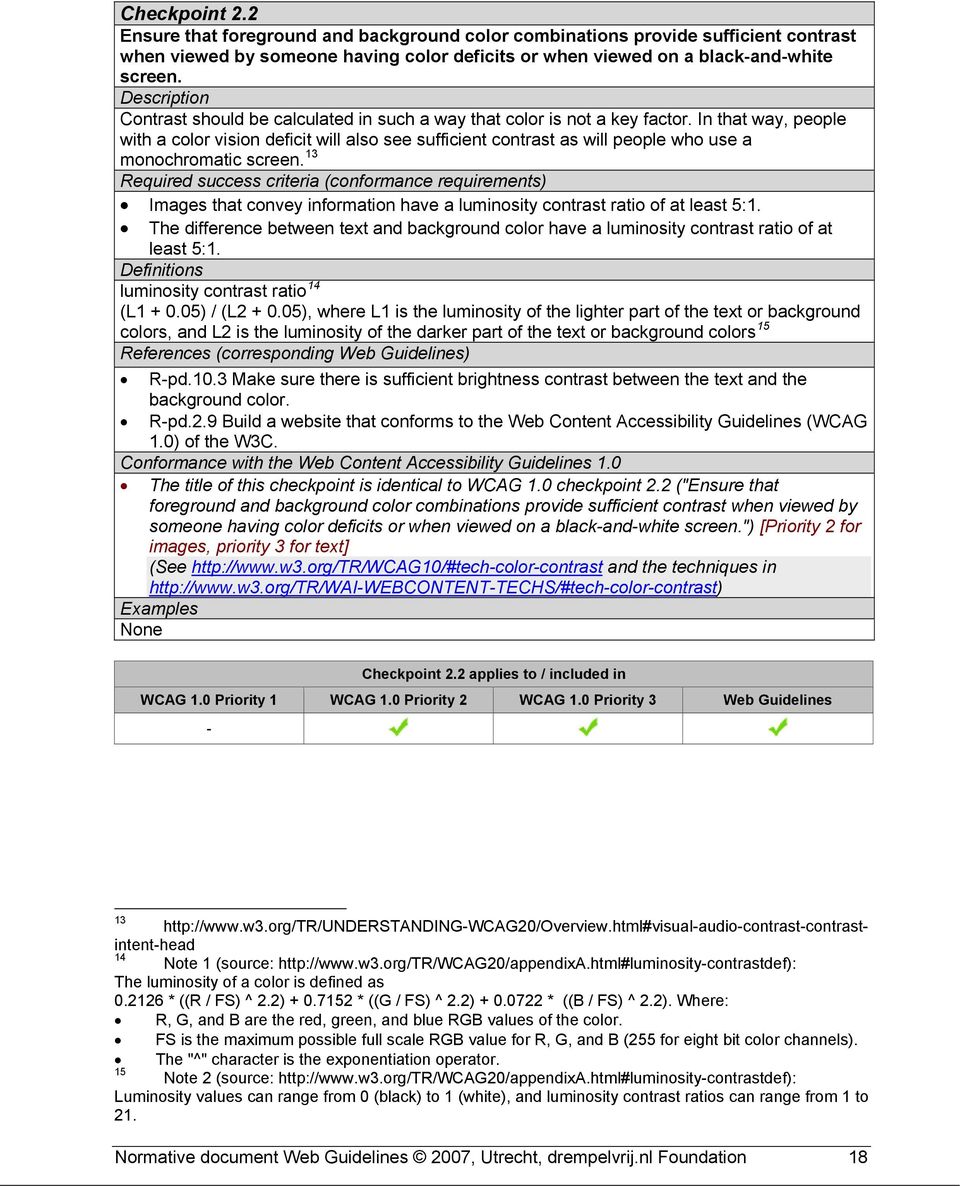
18 Checkpoint 2.2 Ensure that foreground and background color combinations provide sufficient contrast when viewed by someone having color deficits or when viewed on a black-and-white screen. Contrast should be calculated in such a way that color is not a key factor. In that way, people with a color vision deficit will also see sufficient contrast as will people who use a monochromatic screen. 13 Images that convey information have a luminosity contrast ratio of at least 5:1. The difference between text and background color have a luminosity contrast ratio of at least 5:1. luminosity contrast ratio 14 (L ) / (L ), where L1 is the luminosity of the lighter part of the text or background colors, and L2 is the luminosity of the darker part of the text or background colors 15 R-pd.10.3 Make sure there is sufficient brightness contrast between the text and the background color. R-pd.2.9 Build a website that conforms to the Web Content Accessibility Guidelines (WCAG 1.0) of the W3C. The title of this checkpoint is identical to WCAG 1.0 checkpoint 2.2 ("Ensure that foreground and background color combinations provide sufficient contrast when viewed by someone having color deficits or when viewed on a black-and-white screen.") [Priority 2 for images, priority 3 for text] (See and the techniques in Checkpoint 2.2 applies to / included in Note 1 (source: The luminosity of a color is defined as * ((R / FS) ^ 2.2) * ((G / FS) ^ 2.2) * ((B / FS) ^ 2.2). Where: R, G, and B are the red, green, and blue RGB values of the color. FS is the maximum possible full scale RGB value for R, G, and B (255 for eight bit color channels). The "^" character is the exponentiation operator. 15 Note 2 (source: Luminosity values can range from 0 (black) to 1 (white), and luminosity contrast ratios can range from 1 to 21. Normative document Web Guidelines 2007, Utrecht, drempelvrij.nl Foundation 18
19 3. Use markup and style sheets and do so properly Checkpoint 3.1 When an appropriate mark-up language exists, use mark-up rather than images to convey information. The aim of this checkpoint is to find inappropriate use of images that convey information while there is markup available to do so. For images that convey information, usually an appropriate markup language exists. This criterion enforces the use of these more accessible techniques. Images that can automatically be generated from informative data should not be used instead an appropriate mark-up language should be used. Can be automatically generated from informative data: If the presentation of information (extracted from the data) can be programmatically determined. R-pd.2.9 Build a website that conforms to the Web Content Accessibility Guidelines (WCAG 1.0) of the W3C. The title of this checkpoint is identical to WCAG 1.0 checkpoint 3.1 ("When an appropriate mark-up language exists, use mark-up rather than images to convey information.") [priority 2] (See and the techniques in Mathematical equations Use MathML to mark up mathematical equations. As long as MathML is not supported by all browsers, a fall-back image can be used additionally. Checkpoint 3.1 applies to / included in - Normative document Web Guidelines 2007, Utrecht, drempelvrij.nl Foundation 19

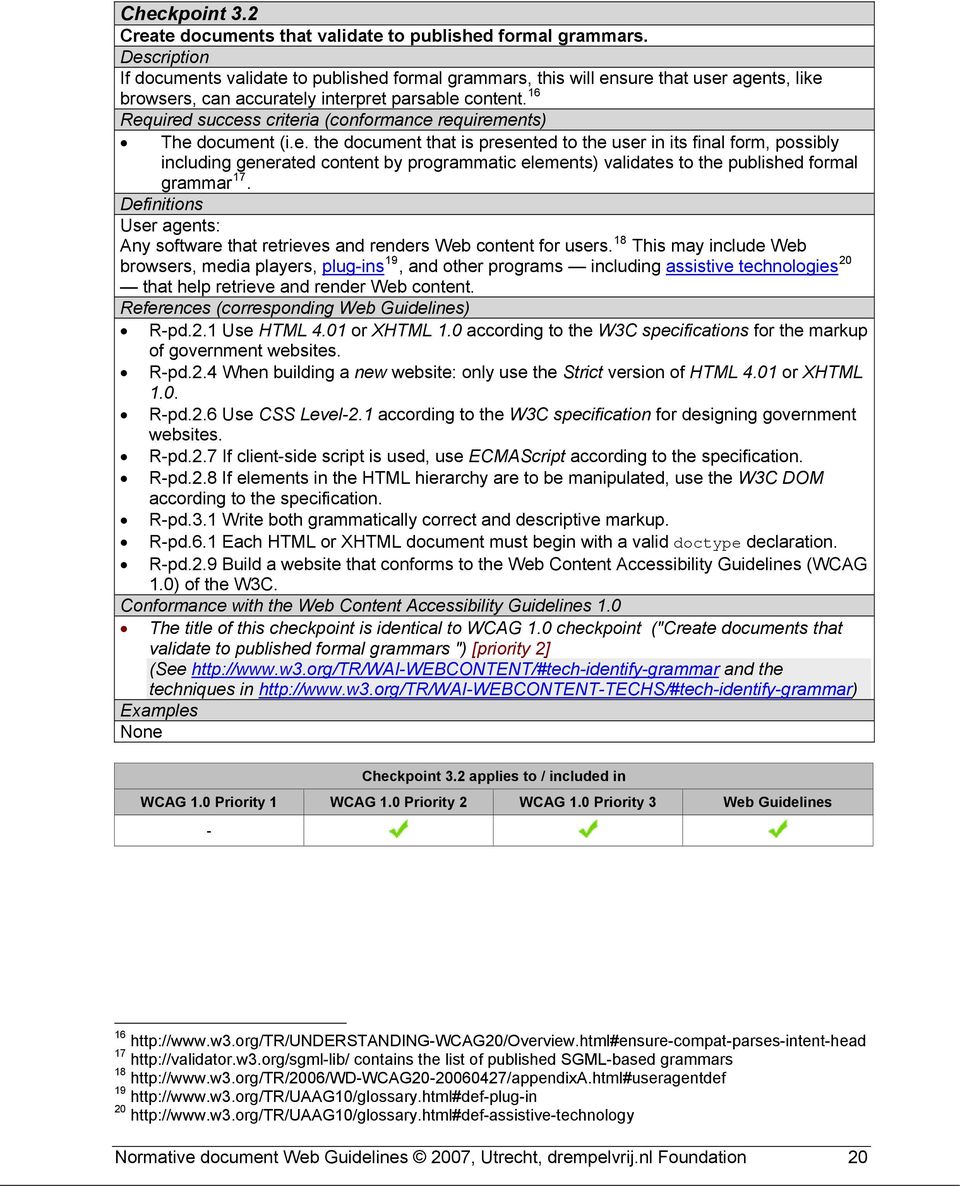
20 Checkpoint 3.2 Create documents that validate to published formal grammars. If documents validate to published formal grammars, this will ensure that user agents, like browsers, can accurately interpret parsable content. 16 The document (i.e. the document that is presented to the user in its final form, possibly including generated content by programmatic elements) validates to the published formal grammar 17. User agents: Any software that retrieves and renders Web content for users. 18 This may include Web browsers, media players, plug-ins 19, and other programs including assistive technologies 20 that help retrieve and render Web content. R-pd.2.1 Use HTML 4.01 or XHTML 1.0 according to the W3C specifications for the markup of government websites. R-pd.2.4 When building a new website: only use the Strict version of HTML 4.01 or XHTML 1.0. R-pd.2.6 Use CSS Level-2.1 according to the W3C specification for designing government websites. R-pd.2.7 If client-side script is used, use ECMAScript according to the specification. R-pd.2.8 If elements in the HTML hierarchy are to be manipulated, use the W3C DOM according to the specification. R-pd.3.1 Write both grammatically correct and descriptive markup. R-pd.6.1 Each HTML or XHTML document must begin with a valid doctype declaration. R-pd.2.9 Build a website that conforms to the Web Content Accessibility Guidelines (WCAG 1.0) of the W3C. The title of this checkpoint is identical to WCAG 1.0 checkpoint ("Create documents that validate to published formal grammars ") [priority 2] (See and the techniques in Checkpoint 3.2 applies to / included in contains the list of published SGML-based grammars Normative document Web Guidelines 2007, Utrecht, drempelvrij.nl Foundation 20
21 Checkpoint 3.3 Use style sheets to control layout and presentation. The aim of this checkpoint is to enable a user agent to provide an alternative presentation of content while preserving the reading order needed to perceive meaning. 21 Only stylesheets have been used to control layout and presentation. No inline style has been used.* *: This is a Web Guidelines only success criterion. It exceeds WCAG 1.0 conformance; see below for details. Presentation Rendering of the content and structure in a form that can be perceived by the user 22 R-pd.1.1 Keep structure and design separate as much as possible: use HTML or XHTML for the structure of the site and CSS for its design. R-pd.9.1 CSS should be placed in linked files and not mixed with the HTML source code. R-pd.2.9 Build a website that conforms to the Web Content Accessibility Guidelines (WCAG 1.0) of the W3C. The title of this checkpoint is identical to WCAG 1.0 checkpoint 3.3 ("Use style sheets to control layout and presentation") [priority 2] (See and the techniques in Positioning information on a page CSS is used to position a navigation bar, the main story on a page and/or a side story and so on. Presentation of fonts The CSS 'font' property is used instead of the HTML font element to control font styles. Semantic use of HTML elements HTML elements, such as headers (h1, h2, etc.) are used to describe document structure, and not for their default size or appearance. Size and appearance of elements is defined through the use of CSS. WCAG 1.0 Priority 1 Checkpoint 3.3 applies to / included in WCAG 1.0 Priority 2 WCAG 1.0 Priority 3 Web Guidelines Normative document Web Guidelines 2007, Utrecht, drempelvrij.nl Foundation 21
22 Checkpoint 3.4 Use relative rather than absolute units in markup language attribute values and style sheet property values. Documents using relative units are resizable and therefore more easily viewed on smaller screens and by people with low vision. The values of the units used in mark-up language attributes and/or style sheet properties are relative rather than absolute, unless the physical characteristics of the output medium, such as print media, are known. Relative units Relative units support scalability and are rezisable. are em, %, larger, smaller, and so on, as opposed to absolute units (pt, cm, and so on.) R-pd.2.9 Build a website that conforms to the Web Content Accessibility Guidelines (WCAG 1.0) of the W3C. The title of this checkpoint is identical to WCAG 1.0 checkpoint 3.4 ("Use relative rather than absolute units in markup language attribute values and style sheet property values.") [priority 2] (See and the techniques in Use relative units to set font sizes. Use h1 {font-size: 2em} rather than h1 {font-size:12pt } Checkpoint 3.4 applies to / included in - Normative document Web Guidelines 2007, Utrecht, drempelvrij.nl Foundation 22
23 Checkpoint 3.5 Use header elements to convey document structure and use them according to specification. By using correct header elements in a document, the structure can be easily extracted from a document. For many people a simple query of the headers of a page can provide a quick overview of the content. This checkpoint not only ensures that the header element is used, but that it is used in the correct order too. All of the following apply: Header elements have been used to provide header information Header elements have been used in the correct order, starting with heading 1 (h1) * No header levels are skipped* A caption element or heading markup is used to provide a heading above a table.* *: This is a Web Guidelines only success criterion. It exceeds WCAG 1.0 conformance; see below for details. R-pd.3.2 Use markup for headings that express the hierarchy of information on the page. R-pd.3.3 Do not skip any levels in the hierarchy of headings in the markup R-pd.11.7 Use the caption element or heading markup to provide a heading above a table. R-pd.2.9 Build a website that conforms to the Web Content Accessibility Guidelines (WCAG 1.0) of the W3C. The title of this checkpoint is identical to WCAG 1.0 checkpoint 3.5 ("Use header elements to convey document structure and use them according to specification.") [priority 2] (See and the techniques in Header in document In HTML, use H2 to indicate a subsection of H1. Do not use headers for font effects. Semantic use of HTML elements HTML elements, such as headers (h1, h2, etc.) are used to describe document structure, and not for their default size or appearance. Size and appearance of elements is defined through the use of CSS. Do not use <p class="header1"> </p>, <em> or <strong> to indicate headings.* *: This is a Web Guidelines only success criterion. It exceeds WCAG 1.0 conformance Checkpoint 3.5 applies to / included in - Normative document Web Guidelines 2007, Utrecht, drempelvrij.nl Foundation 23
24 Checkpoint 3.6 Mark up lists and list items properly. Encode list structure and list items properly. The HTML list elements dl, ul, and ol should only be used to create lists, not for formatting effects, such as indentation. List structure and list items have been marked up properly. They have only been used to create lists, not for formatting effects such as indentation. ol is used for ordered lists, i.e. all lists where mutual order is of any importance dl is used for definition lists, i.e. lists where per item, the first term give meaning to the following text. ul is used for other (unordered) lists R-pd.3.13 Use ol (ordered list) and ul (unordered list) elements to indicate lists. R-pd.3.14 Use the dl (definition list), the dt (definition term) and dd (definition data) elements to indicate lists with definitions. R-pd.2.9 Build a website that conforms to the Web Content Accessibility Guidelines (WCAG 1.0) of the W3C. The title of this checkpoint is identical to WCAG 1.0 checkpoint 3.6 ("Mark up lists and list items properly") [priority 2] (See and the techniques in Unordered lists A web page contains a recipe, with a list of necessary ingredients. This list is not dependent on the list order, so an unordered list is used. Ordered lists A web page gives a list of steps for filing an insurance claim. The order of these steps is essential, so an ordered list is used. Definition lists A glossary page contains a list of definition terms and their respective definitions, marked up as a definition list. Checkpoint 3.6 applies to / included in - Normative document Web Guidelines 2007, Utrecht, drempelvrij.nl Foundation 24
25 Checkpoint 3.7 Mark up quotations. Do not use quotation markup for formatting effects such as indentation. The use of quotation markup makes it possible for user agents to determine quotations and possibly render them differently to the user. Hence, the aim of this checkpoint is to make sure that quotation elements have indeed been used to markup quotations and that they have not been misused to produce formatting effects. The following is true (if applicable): Quotations that appear in block form (example: a whole paragraph) have appropriate quotation markup (e.g. the blockquote and cite elements 23 ) When applicable, quotation marks are used for shorter quotations, instead of the q (quotation) element.* Quotation markup has only been used for quotations and not for other formatting effects. The cite element has been used for reference/citation of other sources (e.g. persons and titles).* *: This is a Web Guidelines only success criterion. It exceeds WCAG 1.0 conformance; see below for details. Quotation A passage referred to, repeated, or adduced R-pd.3.10 Use the cite element for references to people and titles. R-pd.3.11 Avoid using the q (quotation) element. R-pd.3.12 Use the blockquote element to indicate (long) quotations. R-pd.2.9 Build a website that conforms to the Web Content Accessibility Guidelines (WCAG 1.0) of the W3C. The title of this checkpoint is identical to WCAG 1.0 checkpoint 3.7 ("Mark up quotations. Do not use quotation markup for formatting effects such as indentation.") [priority 2] (See and the techniques in 23 The q element is not widely supported yet. Until it is, adding quotation marks manually will have to be continued. The "lang" attribute of the q element is expected to cause the language-specific quotation symbols or rules to be applied during the rendering of the quote. To the best of our knowledge, this feature is not supported by any browser yet. Normative document Web Guidelines 2007, Utrecht, drempelvrij.nl Foundation 25
26 References to people or titles of books and other publications can be made using the cite element. As a standard feature graphic browsers display cite markup in italics. Example of use of cite mark-up:* As mentioned in <cite>the Willemse report</cite>, Accessibility is important. Example of blockquote markup: <blockquote cite=" <p>all this will not be finished in the first hundred days. Nor will it be finished in the first thousand days, nor in the life of this administration, nor even perhaps in our lifetime on this planet. But let us begin. </p> </blockquote> *: This belongs to a Web Guidelines only success criterion. It exceeds WCAG 1.0 conformance; see the Conformance' section of this checkpoint for details. Checkpoint 3.7 applies to / included in - Normative document Web Guidelines 2007, Utrecht, drempelvrij.nl Foundation 26
27 Checkpoint 3.8 Use the p (paragraph) element to indicate paragraphs. Do not use the br (linebreak) element to separate paragraphs.* *: This is a Web Guidelines only checkpoint. It exceeds WCAG 1.0 conformance; see below for details. Paragraphs are sections of text that often concern a single subject. Paragraphs usually appear as blocks of text, separated by a blank line. Although there is mark-up for producing blank lines, the br element, it is better to use mark-up that indicates paragraphs: the p (paragraph) element. New lines linebreaks or carriage returns can be achieved by using the br (linebreak) element. br mark-up should not be used for paragraphs. However, there are plenty of applications for this element, such as separating lines in a poem or visually creating subparagraphs. The p element has been used for the mark-up of paragraphs The br element has not been used to separate paragraphs. Subparagraphs: Subparagraphs are generally pieces of text that do not deviate from the subject of the paragraph in which they appear, but do need to be distinguished, e.g. because the perspective on the information changes, a different part of the subject is addressed or because the author wants to add an explanation. R-pd.3.4 Use the p (paragraph) element to indicate paragraphs. Do not use the br (linebreak) element to separate paragraphs. This checkpoint exceeds WCAG 1.0 conformance. There is no corresponding WCAG 1.0 checkpoint. Example of application of p markup (HTML) <p> The municipal executive will make a decision on the proposal on Monday. In the meantime, Jansen & Zn. will look around for other business premises. </p> Checkpoint 3.8 applies to / included in Normative document Web Guidelines 2007, Utrecht, drempelvrij.nl Foundation 27
28 Checkpoint 3.9 Use the em (emphasis) and strong elements to indicate emphasis.* *: This is a Web Guidelines only checkpoint. It exceeds WCAG 1.0 conformance; see below for details. Words that require emphasis are often written in italics or bold type. There are two obvious elements in HTML for this visual effect: the i (italics) element and the b (bold) element. However, these elements do not correspond to marking importance in the text. A selection marked in italics such as, <i>important!</i>, does not say much except that the text is in italics, and not that the text is emphasized. Two meaningful elements provide a better alternative: the em (emphasis) element and the strong element. Use these elements if a text requires emphasis, <em>important!</em> or strong emphasis, <strong>very important!</strong>. Besides the fact that a graphic browser will automatically display this text in italics and bold, a speech browser can read this text with emphasis. The em and strong elements are used to indicate emphasis 24. em and strong elements are not used to indicate headings Text containing (intended) emphasis has appropriate mark-up R-pd.3.5 Use the em (emphasis) and strong elements to indicate emphasis. This checkpoint exceeds WCAG 1.0 conformance. There is no corresponding WCAG 1.0 checkpoint. <strong>attention!</strong> Please send your form <em>before</em> October 31! Checkpoint 3.9 applies to / included in Only text fragments can have emphasis. A rule of thumb is not to emphasise more then one sentence at a time. Normative document Web Guidelines 2007, Utrecht, drempelvrij.nl Foundation 28
29 Checkpoint 3.10 Use the dfn (definition) element to indicate terms that are defined elsewhere in a definition list.* *: This is a Web Guidelines only checkpoint. It exceeds WCAG 1.0 conformance; see below for details. Terms that are eligible for inclusion in a definition list or glossary elsewhere on the page or website can be formatted with the dfn (definition) element. Marked definition terms can subsequently be made visible by means of CSS (Cascading Style Sheets). Terms that are defined elsewhere in a definition list, use the dfn element R-pd.3.7 Use the dfn (definition) element to indicate terms that are defined elsewhere in a definition list. This checkpoint exceeds WCAG 1.0 conformance. There is no corresponding WCAG 1.0 checkpoint. dfn markup (HTML):The <dfn>37e Form</dfn> must be filled in and sent before December 31. Checkpoint 3.10 applies to / included in Normative document Web Guidelines 2007, Utrecht, drempelvrij.nl Foundation 29
30 Checkpoint 3.11 Use the ins (insertion) and del (deletion) elements to indicate regular changes in the content of a page.* *: This is a Web Guidelines only checkpoint. It exceeds WCAG 1.0 conformance; see below for details. If the information on a page is changed regularly and it is important that these changes are visible as such, use the ins (insert) element for additions and the del (deletion) element for deletions. If applicable, the datetime attribute can be applied to this markup to give, for example, search-engine spiders an indication of the modification date. Of course it remains essential for such a modification date to be visible to visitors; therefore it should at least be written out in the text in full. The value of the datetime attribute has the following format: YYYY-MM-DDThh:mm:ssTZD, where the T forms the separation between date and time and TZD stands for Time Zone Designator. In the case of the Netherlands this time code is +01:00. Appropriate mark-up (i.e. with the ins en del elements) is used for the indication of regular changes in the content of a page. R-pd.3.8 Use the ins (insertion) and del (deletion) elements to indicate regular changes in the content of a page. This checkpoint exceeds WCAG 1.0 conformance. There is no corresponding WCAG 1.0 checkpoint. (Optional) Fully written out modification date (HTML) <del>bouwgroep Zaanstra</del> <ins datetime=" t12:26:00+01:00">siemens Bouw</ins> has been brought in for the realisation of this project. (Last modified on 18 May 2004) Checkpoint 3.11 applies to / included in Normative document Web Guidelines 2007, Utrecht, drempelvrij.nl Foundation 30
31 Checkpoint 3.12 Avoid using the sup (superscript) and sub (subscript) element if possible.* *: This is a Web Guidelines only checkpoint. It exceeds WCAG 1.0 conformance; see below for details. Superscript and subscript are font styles that make text appear above or below the line, respectively. Use of markup like the sup (superscript) element and sub (subscript) element is comparable to use of the i (italics) element for emphasis. Use of sup and sub markup should be avoided if possible. Superscript and subscript are often visible in mathematical and chemical notation, but also occur in references to footnotes, the notation of square or cubic metres and abbreviations of ordinal numbers. In the case of a reference to a footnote, use (descriptive) markup as in the example below. CSS can then be used to change the appearance of this notation so that it displayes as a superscript 1. (Keyboard) characters are available for a superscript 2 and 3 e.g. in notation for square or cubic metres. Please use these characters instead of HTML markup. The corresponding HTML character references are ² (²) and ³ (³). In the case of abbreviations of ordinal numbers, such as first and second, write them out in full as much as possible. If the abbreviated version has to be used after all unavoidable for large numbers use sup markup. The use of sup and sub mark-up is not used unless it is unavoidable. Unavoidable: The use of sup and sub is unavoidable if the text loses its meaning when style sheets are turned off.. R-pd.3.9 Avoid using the sup (superscript) and sub (subscript) element if possible. This checkpoint exceeds WCAG 1.0 conformance. There is no corresponding WCAG 1.0 checkpoint. Use of sup and sub should be avoided wherever possible. References to footnotes can be marked up as links, which can be styled using CSS: According to the Willemse report<a href="#note1" class="footnote">1</a> WCAG 1.0 Priority 1 Checkpoint 3.12 applies to / included in WCAG 1.0 Priority 2 WCAG 1.0 Priority 3 Web Guidelines Normative document Web Guidelines 2007, Utrecht, drempelvrij.nl Foundation 31
32 4. Clarify natural language usage Checkpoint 4.1 Clearly identify changes in the natural language of a document's text and any text equivalents (e.g., captions). All the document's text or text equivalents (e.g., captions, alt attributes) in a page that contain changes in the natural language, should contain a clear identification of this change in natural language. Phrases from various languages, acronyms and abbreviations are often interspersed in writing. When these phrases are identified, a speech synthesizer can voice text with the appropriate accent and pronunciation. When they are not identified, the speech synthesizer will use the default accent and pronunciation of the language on the remainder of the page, which can make the phrase unintelligible. Extracts or fragments of text occurring within the content that are written in a language other than the natural language of the content as a whole, are identified using the lang attribute, including specification of the language of the extract or fragment. Note: If a page uses a single word or a (company or product) name in a different language than the base language of the page, it is not obligatory to indicate this in the code. Natural languages: Languages used by humans to communicate, including spoken, written, and signed languages R-pd.15.7 Indicate language variations in the content of pages in the markup. R-pd.2.9 Build a website that conforms to the Web Content Accessibility Guidelines (WCAG 1.0) of the W3C. The title of this checkpoint is identical to WCAG 1.0 checkpoint 4.1 ("Clearly identify changes in the natural language of a document's text and any text equivalents (e.g., captions).") [priority 1] (See and the techniques in Other languages If the French sentence for "le train est a la gare" would be pronounced by a speech synthesizer that uses English as its primary language, the resulting pronunciation can be difficult to understand. By identifying the language, the speech synthesizer can pronounce the words in French. In HTML, use the lang attribute to accomplish this. Checkpoint 4.1 applies to / included in Normative document Web Guidelines 2007, Utrecht, drempelvrij.nl Foundation 32
33 Checkpoint 4.2 Specify the expansion of each abbreviation or acronym in a document where it first occurs. Abbreviations can be marked with the abbr (abbreviation) element. It is accepted practice to only mark an abbreviation in full the first time it occurs in a text. A simple abbr element will suffice each subsequent time that abbreviation appears on the same page. Do not simply use this markup for every single abbreviation; it can be assumed that programs that read the web page are familiar with common abbreviations. Use abbr markup if confusion could arise concerning the meaning of an abbreviation, if the abbreviation plays a very important role in the text or if the abbreviation is not listed in the dictionary. An abbr element is used for an abbreviation if any of the following is true: o Confusion could arise concerning its meaning.* o It is not listed in the dictionary.* The first time the abbreviation occurs in the document a title attribute is provided. *: This is a Web Guidelines only success criterion. It exceeds WCAG 1.0 conformance; see below for details. Abbreviation A shortened form of a word or phrase Acronym A word formed from the initial letters from other words R-pd.3.6 Use the abbr (abbreviation) element for an abbreviation 25 if confusion could arise concerning its meaning, if the abbreviation plays a very important role in the text or if the abbreviation is not listed in the Dutch dictionary. 26 * *: This Web Guideline partly exceeds WCAG 1.0 conformance. Specify the expansion of each abbreviation or acronym in a document where it first occurs. [priority 3] (See and the techniques in NATO is an acronym, and can as such also be marked with the abbr element. WWF is an abbreviation, because it can not be pronounced as a word. Example of first appearance of an abbreviation on a page (HTML): <abbr title= World Wide Web Consortium >W3C</abbr> Checkpoint 4.2 applies to / included in There is an alternative to the abbr element that is visually supported by Microsoft Internet Explorer: the acronym element. However,acronym was removed from draft versions of XHTML (as of May 2007). If the decision is made to mark abbreviations, it is best to use the abbr element. 26 The word 'Dutch' is language specific and will be revised in the next version of the Web Guidelines. Normative document Web Guidelines 2007, Utrecht, drempelvrij.nl Foundation 33
34 Checkpoint 4.3 Identify the primary natural language of a document. Web developers must specify the base language in the mark-up. On a page, the base language needs to be specified only once: in the html element, using the lang attribute. It s very important for screenreaders to know the base language. Screen readers can adapt their pronunciation to the language that is specified. When the language is not specified the program will have to guess, or will request the user to specify the language. An other advantage is that Search-engine spiders recognize the language in which the content on a page is written. Some search engines let visitors filter the search results by their preferred language. Search engines can guess the language on a page when this is not indicated in de mark-up (domain name, words in the content), but this may lead to Dutch pages being recognized as German. Also, spell checks and automated translations produce better results. In future versions of XHTML, the lang attribute will be replaced by the xml:lang attribute. In XHTML 1.0, the lang attribute is still available for compatibility with systems that do not understand XHTML. For compatibility with browsers that do not understand XHTML, you may also additionally use the lang attribute. The primary natural language of a document is specified In case of an HTML page the lang attribute is used In case of an XHTML page at least the xml:lang attribute is used 27. R-pd.15.6 Specify the base language of a page in the markup. R-pd.2.9 Build a website that conforms to the Web Content Accessibility Guidelines (WCAG 1.0) of the W3C. The title of this checkpoint is identical to WCAG 1.0 checkpoint 4.3 ("Identify the primary natural language of a document.") [priority 3] In HTML set the lang attribute on the html element. In XML, use xml:lang. And in XHTML use both attributes. Server operators should configure servers to take advantage of HTTP content negotiation mechanisms ([RFC2068], section 14.13) so that clients can automatically retrieve documents of the preferred language. WCAG 1.0 Priority 1 Checkpoint 4.3 applies to / included in WCAG 1.0 Priority 2 WCAG 1.0 Priority 3 Web Guidelines For compatibility with browsers that do not understand XHTML, you may also additionally use the lang attribute. Normative document Web Guidelines 2007, Utrecht, drempelvrij.nl Foundation 34
35 Checkpoint 4.4 The visitor should have the option of choosing between languages on every page of the site.* *: This is a Web Guidelines only checkpoint. It exceeds WCAG 1.0 conformance; see below for details. The visitor will not always get to the site via the home page. Resulting pages from search engines and links in the visitor's Favorites (bookmarks) or browser history mean that visitors can enter at any page of the site. If a website is multilingual it is possible to choose a language on every page. R-pd.15.1 The visitor should have the option of choosing between languages on every page of the site. This checkpoint exceeds WCAG 1.0 conformance. There is no corresponding WCAG 1.0 checkpoint. A site is available in Dutch, English and German. Near the main site navigation, three textual links are clearly available, each in their respective language: Nederlands, English, Deutsch. Being part of the main navigation, the links are available on every page of the site. HTML Example: <ul> <li><a href= /nederlands/ hreflang= nl lang= nl >Nederlands</a><li> <li><a href= /english/ hreflang= en >English</a><li> <li><a href= /deutsch/ hreflang= de lang= de >Deutsch</a><li> </ul> Checkpoint 4.4 applies to / included in Normative document Web Guidelines 2007, Utrecht, drempelvrij.nl Foundation 35
36 Checkpoint 4.5 Use fully written out (textual) links to the language versions.* *: This is a Web Guidelines only checkpoint. It exceeds WCAG 1.0 conformance; see below for details. Abbreviations for the languages, such as NL, EN or DE will be unknown to many visitors. Textual links to language versions are fully written out. If there are more than three language versions and space is limited, abbreviations may be used. In that case, the abbreviation contains a title attribute in which the language is fully written out. R-pd.15.3 Use fully written out (textual) links to the language versions. This checkpoint exceeds WCAG 1.0 conformance. There is no corresponding WCAG 1.0 checkpoint. A site is available in Dutch, English and German. Near the main site navigation, three textual links are clearly available, each in their respective language: Nederlands, English, Deutsch. Being part of the main navigation, the links are available on every page of the site. WCAG 1.0 Priority 1 Checkpoint 4.5 applies to / included in WCAG 1.0 Priority 2 WCAG 1.0 Priority 3 Web Guidelines Normative document Web Guidelines 2007, Utrecht, drempelvrij.nl Foundation 36
37 Checkpoint 4.6 Write links to language versions in their corresponding languages.* *: This is a Web Guidelines only checkpoint. It exceeds WCAG 1.0 conformance; see below for details. Instead of links such as English, French and German, use English, Français and Deutsch. This makes them understandable for visitors who have a preference for one of these languages. Textual links to the language version are written in their corresponding language. R-pd.15.4 Write links to language versions in their corresponding languages. This checkpoint exceeds WCAG 1.0 conformance. There is no corresponding WCAG 1.0 checkpoint. A site is available in Dutch, English and German. Near the main site navigation, three textual links are clearly available, each in their respective language: Nederlands, English, Deutsch. Being part of the main navigation, the links are available on every page of the site. Checkpoint 4.6 applies to / included in Normative document Web Guidelines 2007, Utrecht, drempelvrij.nl Foundation 37
38 Checkpoint 4.7 Do not use associations with nationalities for language choice.* *: This is a Web Guidelines only checkpoint. It exceeds WCAG 1.0 conformance; see below for details. Associations such as images of flags or texts such as 'the Netherlands', 'Great Britain' or 'Germany' can lead to confusion about the geographical orientation of the website and can even be interpreted as insulting. If a website provides two different target groups, one Dutch and one international, with different information, it has preference to make this distinction clear using a reference to nationality rather then language. Instead of Nederlands and English, links should subsequently be named Nederlandse bezoekers and International visitors or Foreign visitors. There are no associations with nationalities for language choice. R-pd.15.5 Do not use associations with nationalities for language choice. This checkpoint exceeds WCAG 1.0 conformance. There is no corresponding WCAG 1.0 checkpoint. A site is available in Dutch, English and German. Near the main site navigation, three textual links are clearly available, each in their respective language: Nederlands, English, Deutsch. Being part of the main navigation, the links are available on every page of the site. Another site for an international event offers information about specific activities for specific nationalities. The links to these are associated to the nationalities, but this relates to the target group, and not specifically the language. In this case, it would be better to combine the two: "Nederlandse ambtenaren", "American government employees". WCAG 1.0 Priority 1 Checkpoint 4.7 applies to / included in WCAG 1.0 Priority 2 WCAG 1.0 Priority 3 Web Guidelines Normative document Web Guidelines 2007, Utrecht, drempelvrij.nl Foundation 38
39 Checkpoint 4.8 Links for language choice should have a clear and consistent place in the navigation of the site.* *: This is a Web Guidelines only checkpoint. It exceeds WCAG 1.0 conformance; see below for details. Visitors should not have to search for links on language choice; as soon as visitors have decided that they prefer a different language, following the link to a language version of their choice will be their only concern at that moment. In order to be clear, such links should, however not dominate the impression rendered by the site. Insert the links close to the main navigation; the main navigation is usually already clearly present and associated links will therefore be presented clearly as well. Links for language choice have a clear and consistent place in the navigation of the site. R-pd.15.2 Links for language choice should have a clear and consistent place in the navigation of the site. This checkpoint exceeds WCAG 1.0 conformance. There is no corresponding WCAG 1.0 checkpoint. A site is available in Dutch, English and German. Near the main site navigation, three textual links are clearly available, each in their respective language: Nederlands, English, Deutsch. Being part of the main navigation, the links are available on every page of the site, in the same position on each page. Checkpoint 4.8 applies to / included in Normative document Web Guidelines 2007, Utrecht, drempelvrij.nl Foundation 39
40 5. Create tables that transform gracefully Checkpoint 5.1 For data tables, identify row and column headers. If data is presented in a tabular format, then use the appropriate element provided in the recommendation and its supporting elements and attributes to identify row and column headers. This makes it possible for users of assistive technology to link information in a table cell to the row and column header. (in HTML this means using the th attribute for rows and/or columns) In a data table, column and/or row headers have been identified Data table: A table structuring data information. The horizontal and/or vertical position of the information gives meaning to the content that is represented in the data table. R-pd.11.2 Use the th (table header) to describe a column or row in a table with relational information. R-pd.2.9 Build a website that conforms to the Web Content Accessibility Guidelines (WCAG 1.0) of the W3C. The title of this checkpoint is identical to WCAG 1.0 checkpoint 5.1 ("For data tables, identify row and column headers.") [priority 1] (See Table with data A concert website provides a table with the following information for about 200 musicians and performers: name, website, music genre, latest album, number of copies sold. These items will normally be found on the top or left side of the table, and comprise the "table header". They should be marked up using the <th> (as opposed to the <td>) element. Checkpoint 5.1 applies to / included in Normative document Web Guidelines 2007, Utrecht, drempelvrij.nl Foundation 40
41 Checkpoint 5.2 For data tables that have two or more logical levels of row or column headers, use markup to associate data cells and header cells. Some data tables have more than one logical levels of row or column headers. This means that a data table has a structural division beyond those implicit in the rows and columns. In data tables that have structural divisions beyond those implicit in the rows and columns, appropriate markup has been used to identify those divisions. R-pd.11.3 Group rows with only th (table header) cells with the thead (table head) element. Group the rest of the table with the tbody (table body) element. R-pd.11.4 Use the scope attribute to associate table labels (th cells) with columns or rows. R-pd.11.5 Use the header and id elements to associate table labels (th cells) with individual cells in complex tables. R-pd.2.9 Build a website that conforms to the Web Content Accessibility Guidelines (WCAG 1.0) of the W3C. The title of this checkpoint is identical to WCAG 1.0 checkpoint 5.2 ("For data tables that have two or more logical levels of row or column headers, use markup to associate data cells and header cells.") [priority 1] (See and the techniques in Train fares Train fares are presented in more than one logical level of column headers. The table shows two columns, "weekdays" and "weekend". Each present two more columns showing "first class" and "second class". The rows offer different prices depending on the specific ticket (elderly, students, and so on). The table presents results for normal trains, fast trains and slow trains. Proper use of the scope and/or the header and id attributes (often more useful in complex tables) will properly associate the data cells with the header cells. This will, for example, allow a blind user to associate the data cell " 25" with a "normal train, second class, on a weekday". WCAG 1.0 Priority 1 Checkpoint 5.2 applies to / included in WCAG 1.0 Priority 2 WCAG 1.0 Priority 3 Web Guidelines Normative document Web Guidelines 2007, Utrecht, drempelvrij.nl Foundation 41
42 Checkpoint 5.3 Do not use tables for layout.* *: This is a Web Guidelines only checkpoint. It exceeds WCAG 1.0 conformance; see below for details. Use of the table element for layout is an example of 'misuse' of a structural element for presentation purposes. Doing so can easily lead to complications, especially for blind people, people who are listening to content, or people who want to print a page (often, pages using tables for layout don't fit on the paper when printed in portrait mode). Compared with , browser support of CSS is adequate, deprecating the use of tables for layout. WCAG adds that if tables are used, the linearized content should preserve the correct intended reading order. Tables are not used for layout.** **: Please refer below for the - less stringent - WCAG success criteria for checkpoints 5.3 and 5.4. R-pd.11.1 Use tables to display relational information and do not use them for layout. R-pd.11.8 When modifying an existing website: use CSS for the presentation and layout of web pages, and avoid using tables for layout. *** R-pd.11.9 When using tables for layout: do not use more than one table and use CSS for the design of this table as much as possible. *** R-pd When using tables for layout: do not apply any accessibility mark-up. *** R-pd.2.9 Build a website that conforms to the Web Content Accessibility Guidelines (WCAG 1.0) of the W3C. ***: R-pd.11.1 supersedes R-pd.11.8, R-pd.11.9 and R-pd This checkpoint exceeds WCAG conformance; in the title of this checkpoint, the exception provided in WCAG is left out ("Do not use tables for layout unless the table makes sense when linearized. Otherwise, if the table does not make sense, provide an alternative equivalent (which may be a linearized version)") [priority 2] **** This checkpoint exceeds WCAG conformance ("If a table is used for layout, do not use any structural mark-up for the purpose of visual formatting") [priority 2] **** ****: Please refer below for the - less stringent - WCAG success criteria for checkpoints 5.3 and 5.4. Column layout When a column layout is used for high resolution graphical displays, a page is linearized when CSS (stylesheet) is switched off. WCAG 1.0 Priority 1 Checkpoint 5.3 applies to / included in WCAG 1.0 Priority 2 WCAG 1.0 Priority 3 Web Guidelines - exceeds WCAG 1.0* exceeds WCAG 1.0* **: Please refer below for the - less stringent WCAG 1.0 success criteria for checkpoint 5.3. Normative document Web Guidelines 2007, Utrecht, drempelvrij.nl Foundation 42
43 Less stringent WCAG 1.0 requirements for tables for layout The Web guidelines on tables are stricter than WCAG. For reference purposes, requirements for the corresponding WCAG 1.0 checkpoints 5.3 and 5.4 are included in this document. Checkpoint 5.3 WCAG 1.0, priority 2 Do not use tables for layout unless the table makes sense when linearized. Otherwise, if the table does not make sense, provide an alternative equivalent (which may be a linearized version). Note: For the Web Guidelines, tables may not be used for layout. This WCAG checkpoint can be marked as not applicable when conformance to the Web Guidelines is required. For blind people or people who are listening to content in a layout table, the content is linearized by their user agent or text to speech tool. This alternative presentation preserves the reading order in the code, this should be the correct, intended reading order. The information in the layout table is still presented in the correct reading order when linearized; (if the table does not make sense when linearized) An alternative equivalent has been provided. Checkpoint 5.3 WCAG 1.0, priority 1 applies to / included in - Checkpoint 5.4 WCAG 1.0, priority 2 If a table is used for layout, do not use any structural mark-up for the purpose of visual formatting Note: For the Web Guidelines, tables may not be used for layout. This WCAG checkpoint can be marked as not applicable when conformance to the Web Guidelines is required. In layout tables, the use of structural markup for visual formatting can be disturbing when user agents use this information to then render the table as a datatable. For Visual formatting, always use Style Sheets. The layout table does not use structural mark-up for visual formatting Visual formatting The result of the user agent processing the document tree for visual media Checkpoint 5.4 WCAG 1.0, priority 1 applies to / included in - Normative document Web Guidelines 2007, Utrecht, drempelvrij.nl Foundation 43
44 Checkpoint 5.5 Provide summaries for tables. Provide a summary. Summaries are very useful for non-visual readers. A summary can describe the contents of a table within the context of the document. If no caption is provided, it is critical to provide a summary. A table caption describes the nature of the table. 28 A summary has been provided 29 The caption element is used within a table element * The caption element describes the nature of the table * A caption may not always be necessary: If a caption is not provided, there should be a title attribute on the table element to describe the nature of the table in a few words *. 30 *: This checkpoint may exceed WCAG 1.0 conformance. R-pd.11.7 Use the caption element or heading markup to provide a heading above a table. R-pd.2.9 Build a website that conforms to the Web Content Accessibility Guidelines (WCAG 1.0) of the W3C. The title of this checkpoint is identical to WCAG 1.0 checkpoint 5.5 ("Provide summaries for tables") [priority 3] Checkpoint 5.5 applies to / included in Summary can be provided through the "summary" attribute. More information in the W3C HTML tech pages (see other footnotes on this page) 30 Normative document Web Guidelines 2007, Utrecht, drempelvrij.nl Foundation 44
45 Checkpoint 5.6 Provide abbreviations for header labels. Sometimes, table labels can become quite long, such as 'Work in the Randstad conurbation and surrounding area'. It can be confusing for a user if this label is presented by the screen reader or Braille display for every cell associated with it. th cells can be given the abbr attribute, attaching an abbreviated version of the label can be attached. An abbreviation attribute is provided for table headers of more than 25 characters. R-pd.11.6 Provide abbreviations for table labels (th cells) by means of the abbr (abbreviation) attribute if the content of the table label is so long that repetition in a speech browser could cause irritation. R-pd.2.9 Build a website that conforms to the Web Content Accessibility Guidelines (WCAG 1.0) of the W3C. The title of this checkpoint is identical to WCAG 1.0 checkpoint 5.6 ("Provide abbreviations for header labels.") [priority 3] Checkpoint 5.6 applies to / included in - - Normative document Web Guidelines 2007, Utrecht, drempelvrij.nl Foundation 45
46 6. Ensure that pages featuring new technologies transform gracefully Checkpoint 6.1 Organize documents so they may be read without style sheets. When an HTML document is rendered without associated style sheets, it must still be possible to read the document. If style sheets are not supported or for any reason not rendered or visible, documents are organized in such a way that users are able to access, read and use all of the documents content and functionality and in a logical order. The document is organized in such a way that users are able to access, read and use all of the documents content and functionality if rendered without associated style sheet(s) and in a logical order. Decorative images are inserted (as much as possible) via CSS* *: This is a Web Guidelines only success criterion. It exceeds WCAG 1.0 conformance; see below for details. Style sheet: Definition of style sheet: a document linked to a webpage or embedded in a webpage, describing the layout, transformation and/or visualization of a documents contents. R-pd.1.3 Do not make the function of the website dependent on optional technology, such as CSS and client-side script: optional technology should complement the information on the site and its use, and should not interfere with access to it if this technology is not supported. R-pd.7.6 Decorative images should be inserted via CSS as much as possible. Informative images should be inserted via HTML. R-pd.9.2 Pages should remain usable if a web browser does not support CSS. R-pd.2.9 Build a website that conforms to the Web Content Accessibility Guidelines (WCAG 1.0) of the W3C. The title of this checkpoint is identical to WCAG 1.0 checkpoint 6.1 ("Organize documents so they may be read without style sheets.") [priority 1] (See and the techniques in R-pd.7.6 ("Decorative images should be inserted via CSS as much as possible") exceeds WCAG conformance Old or text-only browser The user utilizes a text only browser like lynx. This browser does not render style sheets. The information on the page and the functionality should still be available for the user. This can mostly be accomplished easily by structuring the page and the code according to the specified W3C recommendations. WCAG 1.0 Priority 1 Checkpoint 6.1 applies to / included in WCAG 1.0 Priority 2 WCAG 1.0 Priority 3 Web Guidelines Normative document Web Guidelines 2007, Utrecht, drempelvrij.nl Foundation 46
47 Checkpoint 6.2 Ensure that equivalents for dynamic content are updated when the dynamic content changes. Accessible equivalents should be updated as soon as the dynamic content they are equivalent to changes. It is important to consider this when choosing the technique to put information on a page. I.e. dynamic frame names could be more difficult to change than dynamic image names. Equivalents for dynamic content (which requires a text alternative) are updated when the dynamic content changes Dynamic content: Content which changes with or without user interaction and with or without interference of the author. R-pd.1.2 Build websites according to the 'layered construction' principle. R-pd.1.3 Do not make the function of the website dependent on optional technology, such as CSS and client-side script: optional technology should complement the information on the site and its use, and should not interfere with access to it if this technology is not supported. R-pd.2.9 Build a website that conforms to the Web Content Accessibility Guidelines (WCAG 1.0) of the W3C. The title of this checkpoint is identical to WCAG 1.0 checkpoint 6.2 ("Ensure that equivalents for dynamic content are updated when the dynamic content changes.") [priority 1] (See and the techniques in A ticker on a site A site contains a dynamic image representing the NASDAQ index. The image is refreshed every time you refresh the page. The index number changes in order to show the latest figure. The equivalent should provide the same updated information. This can be accomplished using different techniques so that the figure of the index is presented in the alt attribute or the updated information in the graph is described in a separate file. Frame with dynamic information A website offers a random page of the site in a separate frame on the front page every time the page is refreshed. This should lead people to pages that are not frequently visited. The title of the frame should identify the content of the page as dynamic or it should change when the information changes. Dynamic pages A website is dynamically generated when a person uses certain profile settings. The page consists of different frames that are dynamically generated. The titles of the frames should represent their content. Checkpoint 6.2 applies to / included in Normative document Web Guidelines 2007, Utrecht, drempelvrij.nl Foundation 47
48 Checkpoint 6.3 Ensure that pages are usable when scripts, applets, or other programmatic objects are turned off or not supported. If this is not possible, provide equivalent information on an alternative accessible page. Content developers must ensure that pages are accessible with scripts, applets or other programmatic objects turned off or in browsers that don't support them. This includes links that use scripting. Technologies used for presentation and user interface support accessibility (as recommended by W3C) or alternate versions of the content are provided that do support accessibility. Pages are usable when scripts, applets or other programmatic objects are turned off or are not supported. (If previous is not possible:) an alternative accessible page/equivalent providing equivalent information has been provided and is linked directly from the inaccessible page. R-pd.1.2 Build websites according to the 'layered construction' principle. R-pd.1.3 Do not make the function of the website dependent on optional technology, such as CSS and client-side script: optional technology should complement the information on the site and its use, and should not interfere with access to it if this technology is not supported. R-pd.8.5 When using client-side script in combination with a link: make the script functionality an expansion of the basic functionality of the link. R-pd.8.6 When using client-side script in combination with a link: if the link does not lead to anything, do not confront the visitor without support for client-side script with a non-working link. R-pd.8.7 When using client-side script in combination with a link: if necessary, use clientside script as an expansion of server-side functions. R-pd.13.5 Do not use client-side script or forms as the only way of accessing information on the site. R-pd.13.6 Do not confront a visitor with a non-working form if optional technologies such as CSS or client-side script are not supported by the browser. R-pd.14.1 Do not use client-side script for essential functionality on web pages, unless any lack of support for these scripts is sufficiently compensated by HTML alternatives and/or server-side script. R-pd.2.9 Build a website that conforms to the Web Content Accessibility Guidelines (WCAG 1.0) of the W3C. The title of this checkpoint is identical to WCAG 1.0 checkpoint 6.3 ("Ensure that pages are usable when scripts, applets, or other programmatic objects are turned off or not supported. If this is not possible, provide equivalent information on an alternative accessible page.") [priority 1] (See and the techniques in Normative document Web Guidelines 2007, Utrecht, drempelvrij.nl Foundation 48
49 Calculator A page on a tax services website contains a script that emulates a calculator that performs calculations necessary to advance on the page. Provide an alternative for input of the calculations or provide a different W3C technology that does provide an accessible alternative. JavaScript links A website provides links in the form of JavaScript. If a user is not using scripts, then they won't be able to use links since the browser can't create the link content. Provide equivalents for links that use "JavaScript" for the URL, or use the principle of progressive enhancement, whereby JavaScript links replace normal links only in JavaScript supporting browsers. This can be done by providing a "noscript" alternative. Script or form-based navigation A JavaScript or other form-based navigation menu should not be the only way to navigate a site. For example, a site containing a drop-down navigational menu which depends on the use of an HTML-form or Javascript should be a supplement to, or built as an expansion on basic link-based navigation. This link-based navigation will always be available to all users, regardless of script and form support. Checkpoint 6.3 applies to / included in Normative document Web Guidelines 2007, Utrecht, drempelvrij.nl Foundation 49
50 Checkpoint 6.4 For scripts and applets, ensure that event handlers are input device-independent. Most people use a mouse and keyboard to operate the computer and interact with web pages. However, people with a visual disability are not always able to use the mouse. Other people cannot use the keyboard and have to use other input devices like speech, sip and puff, onscreen input, eyetrackers, and so on. Interaction with the site should not depend on specific input-devices but should be input device-independent. Only input device-independent event handlers are used for scripts and applets. R-pd.1.2 Build websites according to the 'layered construction' principle. R-pd.1.3 Do not make the function of the website dependent on optional technology, such as CSS and client-side script: optional technology should complement the information on the site and its use, and should not interfere with access to it if this technology is not supported. R-pd.2.9 Build a website that conforms to the Web Content Accessibility Guidelines (WCAG 1.0) of the W3C. The title of this checkpoint is identical to WCAG 1.0 checkpoint 6.4 ("For scripts and applets, ensure that event handlers are input device-independent.") [priority 2] (See and the techniques in Checkpoint 6.4 applies to / included in - Normative document Web Guidelines 2007, Utrecht, drempelvrij.nl Foundation 50
51 Checkpoint 6.5 Ensure that dynamic content is accessible or provide an alternative presentation or page. The aim of this checkpoint is to ensure that an accessible version of all content is available. Authors may use inaccessible technologies or formats on their websites, but they must also provide all of the information and functionality in an accessible form that is easily obtained. Note that this is a fallback option and is not preferable to making the content itself accessible. 31 Dynamic content is accessible, or an accessible alternative presentation or page is provided. Dynamic content: Content that changes with or without a users interaction and with or without interference of the author. Alternative presentation or page Presentation or page that provides all of the same information and functionality and that is as up to date as any non-conformant content R-pd.2.9 Build a website that conforms to the Web Content Accessibility Guidelines (WCAG 1.0) of the W3C. The title of this checkpoint is identical to WCAG 1.0 checkpoint 6.5 ("Ensure that dynamic content is accessible or provide an alternative presentation or page.") [priority 2] (See and the techniques in On a website for used cars, the list of models changes automatically when the make of the car is selected. When client-side script is not available, a submit button is available with which the list of models can be retrieved after the make is selected. Checkpoint 6.5 applies to / included in intent-head Normative document Web Guidelines 2007, Utrecht, drempelvrij.nl Foundation 51
52 7. Ensure user control of time-sensitive content changes Checkpoint 7.1 Until user agents allow users to control flickering, avoid causing the screen to flicker. This checkpoint is related to people with photosensitive epilepsy who can have seizures triggered by flickering or flashing in the 3 to 49 flashes per second (Hertz) range with a peak sensitivity at 20 flashes per second. Users should be warned in advance and be able to control the flickering. Also individuals with distractibility problems may not be able to focus on page content with flickering occurring in the same visual field. At least one of the following is true: The page(s) contain(s) no content that causes the screen to flicker in the range of 3 to 49 Hz. (If flickering is unavoidable) The user is warned of the flickering before they go to the page, and a full equivalent version of the content without flickering is provided. (If flickering is unavoidable) The user can control flickering. Flickering (photosensitive epilepsy): Seizures can be triggered by flickering or flashing in the 3 to 49 flashes per second (Hertz) range with a peak sensitivity at 20 flashes per second. R-pd.2.9 Build a website that conforms to the Web Content Accessibility Guidelines (WCAG 1.0) of the W3C. The title of this checkpoint is identical to WCAG 1.0 checkpoint 7.1 ("Until user agents allow users to control flickering, avoid causing the screen to flicker.") [priority 1] (See and the techniques in Science pages A science page about photosensitivity uses flickering to explain the case to students. Before you enter the page, there is a warning indicating that the page contains flickering that can cause photosensitive epilepsy. Also there is a message is delivered proposing a way to control the flickering. WCAG 1.0 Priority 1 Checkpoint 7.1 applies to / included in WCAG 1.0 Priority 2 WCAG 1.0 Priority 3 Web Guidelines Normative document Web Guidelines 2007, Utrecht, drempelvrij.nl Foundation 52
53 Checkpoint 7.2 Until user agents allow users to control blinking, avoid causing content to blink (i.e., change presentation at a regular rate, such as turning on and off). This checkpoint is to avoid distracting users during their interaction with a website. Certain people with attention deficit disorders, find blinking content distracting, making it difficult for them to concentrate on other parts of the website. Blinking in the form of commercial advertising, is found on many pages, and is meant to attract the attention of the visitor of the page. 32 There is no blinking unless a mechanism to stop/control the blinking is provided (by user agent). Blinking: Turning on and off between 0.5 and 3 times per second. 33 R-pd.2.9 Build a website that conforms to the Web Content Accessibility Guidelines (WCAG 1.0) of the W3C. The title of this checkpoint is identical to WCAG 1.0 checkpoint 7.2 ("Until user agents allow users to control blinking, avoid causing content to blink (i.e., change presentation at a regular rate, such as turning on and off).") [priority 2] (See and the techniques in Attract attention Make use of the em and strong elements to attract attention instead of making content blink. Checkpoint 7.2 applies to / included in Normative document Web Guidelines 2007, Utrecht, drempelvrij.nl Foundation 53
54 Checkpoint 7.3 Until user agents allow users to freeze moving content, avoid movement in pages. Sometimes content is moving, advancing or updating at a rate that a user cannot read and/or understand. When a page includes moving content, provide a mechanism within a script or applet to allow users to freeze motion or updates. Using style sheets with scripting to create movement allows users to turn off or override the effect with greater ease. There is no moving content unless a mechanism is provided to freeze the moving content. Movement: Time related/dependent (dis)placement of content. R-pd.2.9 Build a website that conforms to the Web Content Accessibility Guidelines (WCAG 1.0) of the W3C. The title of this checkpoint is identical to WCAG 1.0 checkpoint 7.3 ("Until user agents allow users to freeze moving content, avoid movement in pages.") [priority 2] (See and the techniques in WCAG 1.0 Priority 1 Checkpoint 7.3 applies to / included in WCAG 1.0 Priority 2 WCAG 1.0 Priority 3 Web Guidelines Normative document Web Guidelines 2007, Utrecht, drempelvrij.nl Foundation 54
55 Checkpoint 7.4 Until user agents provide the ability to stop the refresh, do not create periodically autorefreshing pages. This checkpoint means to ensure that people with disabilities are given adequate time to interact with a webpage whenever possible. Certain people with disabilities such as blindness, dexterity impairments, and cognitive limitations may require more time to perform tasks such as filling out on-line forms. If Web functions are time-dependent, it will be difficult for some users to perform the required action before a timeout occurs. 34 Pages do not periodically auto-refresh (unless user agents provide the ability to stop the refresh). Auto-refresh Pages that refresh without a users interaction, i.e. not upon a user request. R-pd.2.9 Build a website that conforms to the Web Content Accessibility Guidelines (WCAG 1.0) of the W3C. The title of this checkpoint is identical to WCAG 1.0 checkpoint 7.4 ("Until user agents provide the ability to stop the refresh, do not create periodically auto-refreshing pages.") [priority 2] (See and the techniques in Autorefresh in a page In HTML, do not use auto-refresh with "HTTP-EQUIV=refresh" until user agents allow users to turn off the feature. If necessary or desired, instead provide the auto-refresh option in an alternative page that provides the same content and functionality but does not require the user to refresh the page to receive the latest refreshed content. Checkpoint 7.4 applies to / included in Normative document Web Guidelines 2007, Utrecht, drempelvrij.nl Foundation 55
56 Checkpoint 7.5 Until user agents provide the ability to stop auto-redirect, do not use mark-up to redirect pages automatically. Instead, configure the server to perform redirects. To auto-redirect a user to a different location or context once he is on a page, can cause potential confusion. Therefore, pages should not auto-redirect a user to a different context if the user cannot stop this action in user agents. A better option is to perform the auto-redirect on the server or to ask the user to click a certain link to redirect to another context. The following applies 35 : Pages do not auto-redirect, unless the means are provided to stop/control the auto-redirect. Changes of context are initiated only by user request. Automatic redirections during interaction with forms are avoided.* *: This is a Web Guidelines only success criterion. It exceeds WCAG 1.0 conformance; see below for details. Auto-redirect Web pages that are redirected client-side, but without user interaction, i.e. not upon a user request. R-pd.4.5 Automatic redirection should be carried out by the server if possible. R-pd.13.4 Avoid automatic redirection during interaction with forms. R-pd.2.9 Build a website that conforms to the Web Content Accessibility Guidelines (WCAG 1.0) of the W3C. The title of this checkpoint is identical to WCAG 1.0 checkpoint 7.5 ("Until user agents provide the ability to stop auto-redirect, do not use mark-up to redirect pages automatically. Instead, configure the server to perform redirects.") [priority 2] (See and the techniques in Server redirect Instead of using HTML redirects, use server redirects such as in PHP: header("location: Automatic redirection in forms Allow users who are filling out a form to submit the form on their own, instead of redirecting automatically according to a choice made in, for example, a drop-down menu. Adding a submit button to such forms enables the visitor to determine when he wants to be redirected. Checkpoint 7.5 applies to / included in - 35 applies to client-side redirects Normative document Web Guidelines 2007, Utrecht, drempelvrij.nl Foundation 56
57 8. Ensure direct accessibility of embedded user interfaces Checkpoint 8.1 Make programmatic elements such as scripts and applets directly accessible or compatible with assistive technologies Assistive Technologies must be able to gather information about programmatic elements used in a webpage. If these elements are not accessible, provide an alternative and accessible solution or page. Programmatic elements are directly accessible or compatible with assistive technologies. They contain an accessible solution on the same page or are made accessible on a separate page. R-pd.2.9 Build a website that conforms to the Web Content Accessibility Guidelines (WCAG 1.0) of the W3C. The title of this checkpoint is identical to WCAG 1.0 checkpoint 8.1 ("Make programmatic elements such as scripts and applets directly accessible or compatible with assistive technologies.") [Priority 1 if functionality is important and not presented elsewhere, otherwise Priority 2] (See and the techniques in An interactive Flash movie provides video clips and responses to user input. The information provided is also available in HTML with Script support, but the experience is not as rich. The Flash movie provides text alternatives, keyboard support, appropriate tab order, captions, and so on. This makes it directly accessible so users can directly access the richer content at their own discretion, instead of the accessible alternative. Checkpoint 8.1 applies to / included in conditional Normative document Web Guidelines 2007, Utrecht, drempelvrij.nl Foundation 57
58 9. Design for device-independence Checkpoint 9.1 Provide client-side image maps instead of server-side image maps except where the regions cannot be defined with an available geometric shape. A client-side image map offers the possibility to provide equivalents for the content and the functionality contained in the image map. Only if regions cannot be defined using an available geometric shape, provide a server-side image map. The following are true if a server-side image map has been used: The information could not have been provided in the form of a client-side image map The regions could not have been defined using an available geometric shape There is an equivalent offering the same content and functionality Available geometric shape: A shape that can be defined in a program to form a link or provide other forms of interaction. At the moment almost any shape can be defined in most authoring programs. R-pd.2.9 Build a website that conforms to the Web Content Accessibility Guidelines (WCAG 1.0) of the W3C. The title of this checkpoint is identical to WCAG 1.0 checkpoint 9.1 ("Provide client-side image maps instead of server-side image maps except where the regions cannot be defined with an available geometric shape.") [priority 1] (See and the techniques in Online mapping A website offers the possibility to plot a route between two cities. The result is rendered as an interactive map where every point on the map has a server-side coordinate and where you can zoom in and out, scroll, and so on. By adding a text describing the route you can provide an equivalent to the map. Checkpoint 9.1 applies to / included in Normative document Web Guidelines 2007, Utrecht, drempelvrij.nl Foundation 58
59 Checkpoint 9.2 Ensure that any element that has its own interface can be operated in a deviceindependent manner. Some websites offer pages where elements have their own interface like games or interactive elearning modules, mostly using proprietary technology. Make sure that this element can also be operated in a device independent manner. The following applies: All elements that have their own interface can be operated in a device independent manner. R-pd.1.3 Do not make the function of the website dependent on optional technology, such as CSS and client-side script: optional technology should complement the information on the site and its use, and should not interfere with access to it if this technology is not supported. R-pd.2.9 Build a website that conforms to the Web Content Accessibility Guidelines (WCAG 1.0) of the W3C. The title of this checkpoint is identical to WCAG 1.0 checkpoint 9.2 ("Ensure that any element that has its own interface can be operated in a device-independent manner.") [priority 2] (See and the techniques in Checkpoint 9.2 applies to / included in - Normative document Web Guidelines 2007, Utrecht, drempelvrij.nl Foundation 59
60 Checkpoint 9.3 For scripts, specify logical event handlers rather than device-dependent event handlers. An event-handler invokes a script when a certain event occurs (e.g, the mouse moves, a key is pressed, the document is loaded, and so on). In HTML 4.0, event handlers are attached to elements via event handler attributes (the attributes beginning with 'on', as in onkeyup). What happens when an event occurs depends on the script the page author has created. Some produce purely decorative effects such as highlighting an image or changing the color of an element's text. Others produce much more substantial effects, such as carrying out a calculation, or providing important information to the user. For scripts, logical event handlers have been specified; No device-dependent event handlers have been used for scripts ; (If they have been used) there are also logical event handlers specified. Logical event handlers Event handlers that do not depend on devices for etc. Device-dependent event R-pd.1.3 Do not make the function of the website dependent on optional technology, such as CSS and client-side script: optional technology should complement the information on the site and its use, and should not interfere with access to it if this technology is not supported. R-pd.2.9 Build a website that conforms to the Web Content Accessibility Guidelines (WCAG 1.0) of the W3C. The title of this checkpoint is identical to WCAG 1.0 checkpoint 9.3 ("For scripts, specify logical event handlers rather than device-dependent event handlers.") [priority 2] (See and the techniques in Use application-level event triggers rather than user interaction-level triggers. In HTML 4.0 (and xhtml 1.0), application-level event attributes are onfocus, onblur (the opposite of onfocus), and onselect. Note that these attributes are designed to be device-independent, but are implemented as keyboard specific events in current browsers. Otherwise, if you must use device-dependent attributes, provide redundant input mechanisms (i.e., specify two handlers for the same element): Use onmousedown with onkeydown. Use onmouseup with onkeyup Use onclick with onkeypress * Note that there is no keyboard equivalent to double-clicking (ondblclick) in HTML 4.0. Checkpoint 9.3 applies to / included in - Normative document Web Guidelines 2007, Utrecht, drempelvrij.nl Foundation 60
61 Checkpoint 9.4 Create a logical tab order through links, form controls, and objects. The tabindex attribute offers web developers the option to suggest a different order for visitors who use the keyboard. As a standard feature, links that occur towards the top of the source code of the web document will occur first in the order of links. Links further down in the document, such as main navigation, can be triggered to occur earlier by means of the tabindex attribute. A logical tab order is provided for links, form controls and objects. R-pd.8.9 Provide a logical order for the links on the page. Use the tabindex attribute to deviate from the standard tab order of links if this order is inadequate for correct use of the page by keyboard users. The title of this checkpoint is identical to WCAG 1.0 checkpoint 9.4 ("Create a logical tab order through links, form controls, and objects.") [priority 3] Checkpoint applies to / included in - - Normative document Web Guidelines 2007, Utrecht, drempelvrij.nl Foundation 61
62 Checkpoint 9.5 Avoid using the accesskey attribute. If the decision is nevertheless made to apply this attribute, only use it on links that remain unchanged throughout the site (e.g. main navigation) and limit the shortcut key combinations to numbers. * *: This checkpoint may exceed WCAG 1.0 conformance; see below for details. Keyboard shorts are a good principle, but their use is hampered by three major limitations in practice: There is no standard for shortcut key combinations used on websites. Shortcut key combinations clash with the standard shortcut key combinations in the web browser and the operating system. The number of key combinations that can be used in practice is very limited. One of the following is true The accesskey attribute is not used, or The accesskey attribute is only used on links that remain unchanged throughout the site and only numbers are used for the shortcut key combinations. R-pd.8.11 Avoid using the accesskey attribute. If the decision is nevertheless made to apply this attribute, only use it on links that remain unchanged throughout the site (e.g. main navigation) and limit the shortcut key combinations to numbers. This checkpoint exceeds WCAG conformance ('Provide keyboard shortcuts to important links (including those in client-side image maps), form controls, and groups of form controls.') [priority 3] WCAG 1.0 Priority 1 Checkpoint 9.5 applies to / included in WCAG 1.0 Priority 2 WCAG 1.0 Priority 3 Web Guidelines - - Different WCAG 1.0 requirement for use of the accesskey attribute The Web guidelines on the use of the accesskey attribute are differ from WCAG checkpoint 9.5. Since this is a WCAG 1.0 priority 3 checkpoint and this normative document aims to conform with WCAG 1.0 priority 1 and 2, a reference to the requirements for the corresponding WCAG 1.0 checkpoints 9.5 is not available in this document. However, the second success criterion ('The accesskey attribute is only used on links that remain unchanged throughout the site and only numbers are used for the shortcut key combinations.') aims to be in conformance with WCAG 1.0 checkpoint 9.5. Normative document Web Guidelines 2007, Utrecht, drempelvrij.nl Foundation 62
63 Checkpoint 9.6 In the event that important information is provided through a closed standard, the same information should also be provided through an open standard. *: This is a Web Guidelines only checkpoint. It exceeds WCAG 1.0 conformance; see below for details. Compatibility of information is important in the development of websites. The use of open standards ensures improved communication between the sender and recipient of information. It is advisable to make as much use as possible of open standards to promote the interoperability of information. When developing websites, the will to use open standards is important. Nevertheless, there are less well-known open standards that are also used less intensively. For practical reasons, it is understandable that there may be a desire to offer information via frequently used formats that are not open (such as Word and Excel). When information is considered important, open standards are used instead of standards that do not fall under the definition of an open standard. The alternative for a non open standard has to convey the same information. When a non open standard is used without an alternative (because it is not considered 'important information'), the accessibility features are used that are available in the non open standard. 'Open' ICT standards for interoperability of information systems (or the capacity to exchange data between ICT systems). An 'open standard' is understood to be a standard that complies with the following requirements: The standards are adopted on the basis of an open decision-making procedure (consensus or majority decision, and so on.). The administration of the standard is done by a not-for-profit organization with a completely open admissions policy. The standards are published. The cost for use of the standard is low and does not constitute a barrier to access the standard. Any intellectual property rights underlying an open standard are made available royalty-free. There are no restrictive conditions on the re-use of a standard. Important information provided through a closed standard: Information necessary for the understanding of the message and functionality intended to be conveyed by the author and which cannot be accessed through the other information provided via the website, using open standards. R-pd.5.1 In the event that important information is provided through a closed standard, the same information should also be provided through an open standard. This checkpoint exceeds WCAG 1.0 conformance. There is no corresponding WCAG 1.0 checkpoint. Normative document Web Guidelines 2007, Utrecht, drempelvrij.nl Foundation 63
64 The information in Microsoft Word format, should also be available as an open standard, such as HTML. One example of an open standard is the XML standard. XML stands for Extensible Markup Language and is administered by the W3C. This non-profit organization administers most internet standards, together with IETF. The specifications for XML can be obtained free of charge from the W3C website. There are also forums in which the new version of XML is discussed. Any organization can become a member of W3C. No restrictions are placed on the use of XML. Example for the third success criterion (When a non open standard is used without an alternative[ ]): When a version of the PDF format is used that does not qualify as 'open standard', the PDF document has the correct reading order, a logical structure and uses 'tagged PDF'. WCAG 1.0 Priority 1 Checkpoint 9.6 applies to / included in WCAG 1.0 Priority 2 WCAG 1.0 Priority 3 Web Guidelines Normative document Web Guidelines 2007, Utrecht, drempelvrij.nl Foundation 64
65 Checkpoint 9.7 Specify the UTF-8 character set for web pages.* *: This is a Web Guidelines only checkpoint. It exceeds WCAG 1.0 conformance; see below for details. The UTF-8 character set from the Unicode family of character sets has the most extensive repertoire and combines most character sets (Western and Eastern scripts, and symbols) into a single set. The server should provide information to the user agent know which character encoding has been used. The most straightforward way for a server to inform the user agent about the character encoding of the document is to use the "charset" parameter of the "Content-Type". Some servers don't allow a "charset" parameter to be sent. Therefore, user agents must not assume any default value for the "charset" parameter. Originally, the Content-type header was the only way of specifying a character set. Enabling different character sets to be used on individual pages requires changes to the settings on the server. Due to the time-consuming nature of this process, the decision was made to apply the meta element for this purpose; it lets web developers indicate a character set in the web page themselves. All of the following items are true: The UTF-8 character set is specified, both in the http-headers and in the meta element. Character encoding is specified by the http-headers. In the HTML code, character encoding is specified in the meta element. In the HTML code, the meta element is the first child of the head element. Character set: A code that pairs a sequence of characters (letters, numbers and symbols) from a given set with a sequence of natural numbers, octets or electrical pulses, in order to facilitate the storage of text in computers and the transmission of text through telecommunication networks. HTTP headers: A record sent by clients and servers communicating with each other via the HTTP protocol. The header is a stream of text that may be sent without any content following it or with the content that it describes. There are headers specific to requests and to responses and others that are used for both client and server to describe or query the content or environment. Content-Type: A Content-Type describe the data contained in the body fully enough that the receiving user agent can pick an appropriate agent or mechanism to present the data to the user, or otherwise deal with the data in an appropriate manner. R-pd.16.1 Specify the character set for web pages. R-pd.16.2 Specify the UTF-8 character set. R-pd.16.3 Also specify the character set by means of HTTP headers, if possible. R-pd.16.4 Use (at least) the meta element to specify the character set and place this element as high as possible in the head section of the markup. This checkpoint exceeds WCAG 1.0 conformance. There is no corresponding WCAG 1.0 checkpoint. Normative document Web Guidelines 2007, Utrecht, drempelvrij.nl Foundation 65
66 The UTF-8 character set is specified by HTTP header: "Content-type: text/html; charset=utf-8" and in the meta element (HTML): <meta http-equiv="content-type" value="text/html; charset=utf-8">. Web developers who use server-side scripts, such as PHP, have the advantage that these scripts can often generate HTTP headers themselves, regardless of the server settings. PHP for creating a Content-type header: <?php header("content-type: text/html; charset=utf-8");?> Checkpoint 9.7 applies to / included in Normative document Web Guidelines 2007, Utrecht, drempelvrij.nl Foundation 66
67 10. Use interim solutions Checkpoint 10.1 Until user agents allow users to turn off spawned windows, do not cause pop-ups or other windows to appear and do not change the current window without informing the user. For some users the automatic launching of content in new or other windows, like pop-up windows can cause potential confusion. Web content should therefore give users full control over these possible changes of context by informing the user that the current window is changed and content is appearing in a new or other window. No pop-ups or other windows appear unless one of the following apply: The means are provided to stop/control this. The content warns the user that activating the element spawns a new window and the location of the link contains useful information that may be necessary during an important uninterruptible process. The changes of context are initiated only by user request. R-pd.8.14 Links on government websites should not automatically open new windows without warning. R-pd.8.15 Do not open any new windows automatically, unless the location of the link contains useful information that may be necessary during an important uninterruptible process. R-pd.8.22 Do not automatically open links to downloadable files in a new window. R-pd.2.9 Build a website that conforms to the Web Content Accessibility Guidelines (WCAG 1.0) of the W3C. The title of this checkpoint is identical to WCAG 1.0 checkpoint 10.1 ("Until user agents allow users to turn off spawned windows, do not cause pop-ups or other windows to appear and do not change the current window without informing the user.") [priority 2] (See and the techniques in Popup In some cases you may want to open a page in a new window. Inform the user of this fact by adding this in a message in the content of the page where the element is activated: "this page opens in a new window" or "opens in a popup window". This may be implemented in several ways, for example by using the title attribute in an a element and adding a visual icon or other differentiation. Example of useful information during an important uninterruptible process: providing help, for instance through a help screen, during the filling of a web form. Checkpoint 10.1 applies to / included in - Normative document Web Guidelines 2007, Utrecht, drempelvrij.nl Foundation 67
68 Checkpoint 10.2 Until user agents support explicit associations between labels and form controls, for all form controls with implicitly associated labels, ensure that the label is properly positioned. By associating labels with form controls and at the same time properly positioning the labels, screen readers can present these together and render them to braille and/or to speech. This way, the purpose of form controls is clear. All form controls have (at least) implicitly associated labels, i.e. the labels and controls are properly positioned. R-pd.2.9 Build a website that conforms to the Web Content Accessibility Guidelines (WCAG 1.0) of the W3C. The title of this checkpoint is identical to WCAG 1.0 checkpoint 10.2 ("Until user agents support explicit associations between labels and form controls, for all form controls with implicitly associated labels, ensure that the label is properly positioned.") [priority 2] (See and the techniques in Checkpoint 10.2 applies to / included in - Normative document Web Guidelines 2007, Utrecht, drempelvrij.nl Foundation 68
69 11. Use W3C technologies and guidelines. Checkpoint 11.1 Use W3C technologies when they are available and appropriate for a task and use the latest versions when supported. The World Wide Web Consortium is responsible for a large number of technologies for the web. These technologies are produced mostly in working groups following a strict methodology and quality control cycle. W3C and the Working Groups work on the basis of a consensus model. The technologies are therefore made together with all relevant stakeholders. The aim of this checkpoint is that W3C technologies are used wherever possible. The following apply: HTML 4.01 (or higher) or XHTML 1.0 (or higher) is used according to the specifications CSS 2.1 (or higher) is used according to the specification DOM is used according to the specification The latest version of W3C technologies are used when available and appropriate R-pd.2.1 Use HTML 4.01 or XHTML 1.0 according to the W3C specifications for the markup of government websites. R-pd.2.6 Use CSS Level-2.1 according to the W3C specification for designing government websites. R-pd.2.8 If elements in the HTML hierarchy are to be manipulated, use the W3C DOM according to the specification. R-pd.2.9 Build a website that conforms to the Web Content Accessibility Guidelines (WCAG 1.0) of the W3C. The title of this checkpoint is identical to WCAG 1.0 checkpoint 11.1 ("Use W3C technologies when they are available and appropriate for a task and use the latest versions when supported.") [priority 2] (See and the techniques in Mathematical formulas Instead of displaying mathematical formulas in images, code them in the latest version of MathML or other appropriate W3C technology. Using (X)HTML For web pages, use HTML 4.01 (or higher) or XHTML 1.0 (or higher) for structurally marking up the content. Using CSS For web pages, use the latest version of CSS for the layout and presentation. Using DOM For web pages, use the Document Object Model for scripting or otherwise manipulating HTML elements. Checkpoint 11.1 applies to / included in - Normative document Web Guidelines 2007, Utrecht, drempelvrij.nl Foundation 69
70 Checkpoint 11.2 Avoid deprecated features of W3C technologies. Use of deprecated elements - referred to in the relevant specifications as deprecated - is strongly discouraged. These elements are part of the standard, although most are not meaningful markup and violate the principle of separation of structure and design. No deprecated features have been used 36 R-pd.2.2 Do not use any markup which is referred to as deprecated (outmoded) in the W3C specifications R-pd.2.9 Build a website that conforms to the Web Content Accessibility Guidelines (WCAG 1.0) of the W3C. The title of this checkpoint is identical to WCAG 1.0 checkpoint 11.2 ("Avoid deprecated features of W3C technologies.") [priority 2] (See and the techniques in Note: R-pd.2.2 ("Do not use any markup which is referred to as deprecated (outmoded) in the W3C specifications") exceeds WCAG conformance Example In HTML, do not use the deprecated font element; use style sheets instead (e.g., the font property in CSS). Checkpoint 11.2 applies to / included in - [11.3 is the number of a W3C WCAG 1.0 priority 3 checkpoint for which no corresponding Web Guidelines exist. Therefore, the number 11.3 is not used for a checkpoint in this document.] 36 This success criterion exceeds WCAG1.0 conformance. For WCAG states that deprecated features of W3C technologies should be avoided. Normative document Web Guidelines 2007, Utrecht, drempelvrij.nl Foundation 70
71 Checkpoint 11.4 If, after best efforts, you cannot create an accessible page, provide a link to an alternative page that uses W3C technologies, is accessible, has equivalent information (or functionality), and is updated as often as the inaccessible (original) page. After best efforts it can be impossible to create an accessible page. In that case, you should link to an equivalent page that offers the same information and functionality. This checkpoint refers to one page and not to entire websites. Equivalent pages should be checked for best efforts and possibilities to create an accessible page. If it is not possible to create an accessible page, a link is provided to an alternative page. The follow is true: W3C technologies are used Accessibility is guaranteed Information and functionality are equivalent to the inaccessible (original) page The page is updated as often as the inaccessible (original) page Best efforts Indicate in the document what best efforts have been undertaken to make the page accessible R-pd.2.9 Build a website that conforms to the Web Content Accessibility Guidelines (WCAG 1.0) of the W3C. The title of this checkpoint is identical to WCAG 1.0 checkpoint 11.4 ("If, after best efforts, you cannot create an accessible page, provide a link to an alternative page that uses W3C technologies, is accessible, has equivalent information (or functionality), and is updated as often as the inaccessible (original) page.") [priority 1] (See and the techniques in Checkpoint 11.4 applies to / included in Normative document Web Guidelines 2007, Utrecht, drempelvrij.nl Foundation 71
72 Checkpoint 11.5 When modifying an existing website: only use the Transitional version of HTML 4.01 or XHTML 1.0 if it is not possible or desirable to use the Strict version.* *: This is a Web Guidelines only checkpoint. It exceeds WCAG 1.0 conformance; see below for details. The Transitional version is the simple version of HTML 4.01 and is superbly suited to modification of and making additions to existing websites. This version offers the web developer a great deal of freedom and does not impose any restrictions in relation to specific design principles. Following the Transitional version may therefore seem an attractive option, but its use is discouraged for the following reasons. The Transitional version is less structural than the Strict version The Transitional version allows constructions of which the use is discouraged. include opening new windows by means of the target attribute and the use of frames and iframes. The Transitional version is literally a 'transitional version' - a transition from a chaotic to a more structured way of building websites. The Strict version is used. The Transitional version may have been used but only when modifying the existing website to a strict version is not possible or undesirable Not possible or undesirable: If with best efforts the solution is still objectionable or not sufficient (possibly due to infeasibility of implementing it, or due to unrecoverable loss of information/functionality conveyed). Existing website: A website that has been built (before 30 June 2006, the date on which the Netherlands' Council of Ministers agreed to the 'Central Government Website Quality Act'), and since then has been modified, i.e. modifications based on the code of a former website. R-pd.2.3 When modifying an existing website: only use the Transitional version of HTML 4.01 or XHTML 1.0 if it is not possible or desirable to use the Strict version. This checkpoint exceeds WCAG 1.0 conformance. There is no corresponding WCAG 1.0 checkpoint. The Strict variants of (X)HTML (as opposed to the Transitional variants) encourage syntactically and structurally correct markup, and should be used whenever possible. Possible exceptions might include the use of essential, but complex, transactional software which makes the use of Strict (X)HTML impossible. Sufficient examples of this are rare, and in most cases, the use of Strict (X)HTML should be enforced. WCAG 1.0 Priority 1 Checkpoint 11.5 applies to / included in WCAG 1.0 Priority 2 WCAG 1.0 Priority 3 Web Guidelines Normative document Web Guidelines 2007, Utrecht, drempelvrij.nl Foundation 72
73 Checkpoint 11.6 When building a new website: only use the Strict version of HTML 4.01 or XHTML 1.0.* *: This is a Web Guidelines only checkpoint. It exceeds WCAG 1.0 conformance; see below for details. The Strict version is recommended, in particular for new government websites. There are a number of advantages to using this version. Strict is more structural; web developers should be more specific in using markup in terms of determining the content precisely. The Strict version is largely devoid of markup that only serves visual effects purposes. Web developers are stimulated to use CSS for visual effects. The Strict version is largely devoid of markup that can be harmful for the usability and accessibility of sites. For example, markup for frames, iframes and new windows has been removed from Strict. The Strict version of HTML 4.01 or XHTML 1.0 has been used in a valid way. New website: A website that has been built from scratch (since 30 June 2006, the date on which the Netherlands' Council of Ministers agreed to the 'Central Government Website Quality Act'), i.e. not based on the markup of a former website. R-pd.2.4 When building a new website: only use the Strict version of HTML 4.01 or XHTML 1.0. This checkpoint exceeds WCAG 1.0 conformance. There is no corresponding WCAG 1.0 checkpoint. WCAG 1.0 Priority 1 Checkpoint 11.6 applies to / included in WCAG 1.0 Priority 2 WCAG 1.0 Priority 3 Web Guidelines Normative document Web Guidelines 2007, Utrecht, drempelvrij.nl Foundation 73
74 12. Provide context and orientation information Checkpoint 12.1 Do not use frames.* *: This is a Web Guidelines only checkpoint. It exceeds WCAG 1.0 conformance; see below for details. Use of frames or iframes code is not allowed in the Web Guidelines. The following is true: The Frameset version of HTML 4.01 or XHTML 1.0 is not used The frameset, frame and/or iframe elements are not used; not in the code and not in script. R-pd.2.5 Do not use frames on government websites. Therefore, also do not use the Frameset version of HTML 4.01 or XHTML 1.0. R-pd.12.1 Do not use frames on government websites. This applies to regular frames in framesets as well as iframes. This checkpoint exceeds WCAG 1.0 checkpoint 12.1 conformance ("Title each frame to facilitate frame identification and navigation.") [priority 1] ** This checkpoint exceeds WCAG 1.0 checkpoint 12.2 conformance ("Describe the purpose of frames and how frames relate to each other if it is not obvious by frame titles alone.") [priority 2] ** **: Please refer below for the - less stringent WCAG 1.0 success criteria for checkpoints 12.1 and Checkpoint 12.1 applies to / included in (exceeds WCAG 1.0)* (exceeds WCAG 1.0)* (exceeds WCAG 1.0)* **: Please refer below for the - less stringent WCAG 1.0 success criteria for checkpoint Normative document Web Guidelines 2007, Utrecht, drempelvrij.nl Foundation 74
75 Less stringent WCAG 1.0 requirements for frames The Web Guidelines on frames are stricter than WCAG. For reference purposes, requirements for the corresponding WCAG 1.0 checkpoints 12.1 and 12.2 are included in this document. Checkpoint 12.1 WCAG 1.0, priority 1 Title each frame to facilitate frame identification and navigation Note: For the Web Guidelines, frames may not be used. This WCAG checkpoint can be marked as not applicable when conformance to the Web Guidelines is required. Websites can consist of one or more frames with information displayed in them. Users can ask for an overview of the frames for navigational purposes. This requires frames to be clearly identified to facilitate identification and navigation by using the title attribute. The following is true: The title attribute of the frame elements have been used to describe the contents of each frame. The page displayed in the frame is provided with a title that describes its contents The longdesc attribute of the frame element has been used to describe the purpose of the frames and how the frames relate to each other if it is not obvious by frame titles alone. Frames on an Amusement park website An amusement park offers two frames on her site. One frame is titled frame1 and offers an overview of the menu items. The other frame is titled frame2 and offers the content. The frames should be named menu instead of frame1 and content instead of frame2. WCAG 1.0 Priority 1 Checkpoint 12.1 WCAG 1.0, priority 1 applies to / included in WCAG 1.0 Priority 2 WCAG 1.0 Priority 3 Web Guidelines Normative document Web Guidelines 2007, Utrecht, drempelvrij.nl Foundation 75
76 Checkpoint 12.2 WCAG 1.0, priority 2 Describe the purpose of frames and how frames relate to each other if it is not obvious by frame titles alone. Note: For the Web Guidelines, frames may not be used. This WCAG checkpoint can be marked as not applicable when conformance to the Web Guidelines is required. Sometimes the frame title is not enough to describe the purpose of a frame or how frames relate to each other. In that case, it is possible to provide extra information on a frame. A longer description can provide extra information to the frame. The frame titles provide an effective description of the content that they represent; (If the frame titles do not provide an effective description) The purpose of and/or the relation between the frames is described separately. Effective Sufficiently, unequivocal, necessary. Checkpoint 12.2 WCAG 1.0, priority 2 applies to / included in - Normative document Web Guidelines 2007, Utrecht, drempelvrij.nl Foundation 76
77 Checkpoint 12.3 Divide large blocks of information into more manageable groups where natural and appropriate. For certain users it is difficult to read large blocks of information on the internet. To make the information more manageable, the information can be divided into smaller and more manageable blocks of information. Also in forms, it is possible to group different blocks together to provide clearer structure and overview. Large blocks of information have been divided into more manageable groups R-pd.13.3 Apply grouping of input fields by means of the fieldset element. R-pd.2.9 Build a website that conforms to the Web Content Accessibility Guidelines (WCAG 1.0) of the W3C. The title of this checkpoint is identical to WCAG 1.0 checkpoint 12.3 ("Divide large blocks of information into more manageable groups where natural and appropriate.") [priority 2] (See Using forms on you site In HTML, use optgroup to group option elements inside a select; group form controls with fieldset and legend; use nested lists where appropriate; use headings to structure documents, and so on. Grouping input fields In large, complex forms, input fields and their labels can often be arranged in groups, such as "Personal Details" or "Your comments". Grouping input fields makes a form more accessible and more conveniently arranged. Apply this grouping by means of the fieldset element: the <fieldset></fieldset> tags are placed around a collection of input fields, labels and texts. In graphical browsers the fieldset sections are often displayed as boxes. The appearance can be modified using CSS (Cascading Style Sheets). Visitors with special browsers, such as screen readers, can jump from one fieldset section to another; and thus complete complex forms more easily. Checkpoint 12.3 applies to / included in - Normative document Web Guidelines 2007, Utrecht, drempelvrij.nl Foundation 77
78 Checkpoint 12.4 Associate labels explicitly with their controls. When a label is explicitly associated, a user-agent can use this to provide extra information on request. The label is explicitly associated with the control. R-pd.13.1 Use the label element to explicitly associate text with an input field in a form. R-pd.11.3 Group rows with only th (table header) cells with the thead (table head) element. Group the rest of the table with the tbody (table body) element. R-pd.2.9 Build a website that conforms to the Web Content Accessibility Guidelines (WCAG 1.0) of the W3C. The title of this checkpoint is identical to WCAG 1.0 checkpoint 12.4 ("Associate labels explicitly with their controls.") [priority 2] (See Associating text with an input field A form contains a field for the input of a user's telephone number. The field has an associated label, which reads Telephone number. Checkpoint 12.4 applies to / included in - Normative document Web Guidelines 2007, Utrecht, drempelvrij.nl Foundation 78
79 Checkpoint 12.5 Put the content of the page in the HTML source code in order of importance. * *: This is a Web Guidelines only checkpoint. It exceeds WCAG 1.0 conformance; see below for details. When setting up the content of a page, it is advisable to place the content in order of importance in the HTML. This means important content first and the least important content (such as navigation) at the bottom of the page. Placing content on the page displayed is done using CSS; the visual layout need not be the same as the structure. Structuring the content in this way increases the traceability, accessibility and usability of the information. The content of the page in the HTML source code is in order of importance. R-pd.6.2 Put the content of the page in the HTML source code in order of importance. This checkpoint exceeds WCAG 1.0 conformance. There is no corresponding WCAG 1.0 checkpoint. Checkpoint 12.5 applies to / included in Normative document Web Guidelines 2007, Utrecht, drempelvrij.nl Foundation 79
80 13. Provide clear navigation mechanisms Checkpoint 13.1 Clearly identify the target of each link. To help users understand the purpose or target of a hyperlink on a page, make clear what the target of a link is in the link text, so they can decide whether they want to follow the link or not. The target of each link is unequivocal (as opposed to e.g. click here, more... and so on.) When read out of context, the target of a link (text content and the corresponding title and/or alt attribute) is predictable. Target of a link The text content and value of the title attribute of a link or, when an image or client side image map is used, the value of the alt attribute. R-pd.8.1 Do not describe the mechanism behind following a link. R-pd.8.2 Write clear, descriptive text for links. R-pd.8.3 Use the minimum amount of text needed to understand where the link leads. R-pd.8.4 Provide sufficient information on the destination of a link to prevent unpleasant surprises for the visitor. R-pd.2.9 Build a website that conforms to the Web Content Accessibility Guidelines (WCAG 1.0) of the W3C. The title of this checkpoint is identical to WCAG 1.0 checkpoint 13.1 ("Clearly identify the target of each link.") [priority 2] (See and the techniques in Click here "Click here" is not a good link text. It is too general and does not clearly identify the target of a link. Instead of "click here", the text should give more information like "more information about accessibility". Additional information Additionally to the clear link text, the target of a link can be clarified extra by adding information in the link title (using the title attribute) in HTML. Checkpoint 13.1 applies to / included in - Normative document Web Guidelines 2007, Utrecht, drempelvrij.nl Foundation 80
81 Checkpoint 13.2 Provide metadata to add semantic information to pages and sites. User agents can use metadata to provide more semantic information about a page or the information on the page to the user or to a search engine. The following apply: The title element has been used. Metadata have been added to the page and site to add semantic information (using either RDF, or using meta or link elements). id and class attributes are meaningful.* *: This is a Web Guidelines only success criterion. It exceeds WCAG 1.0 conformance; see below for details. Meaningful Having meaning, function or purpose within the context and its purpose R-pd.3.15 Give meaningful names to id and class attributes. R-pd.2.9 Build a website that conforms to the Web Content Accessibility Guidelines (WCAG 1.0) of the W3C. The title of this checkpoint is identical to WCAG 1.0 checkpoint 13.2 ("Provide metadata to add semantic information to pages and sites.") [priority 2] (See and the techniques in R-pd.3.15 ("Give meaningful names to id and class attributes") exceeds WCAG conformance. Example of metadata used at (the Dutch ministry of Health) <link rel="schema.dc" href=" /> <link rel="schema.dcterms" href=" /> <link rel="schema.overheid" href=" /> <link rel="schema.thc" href=" /> <meta name="dc.creator" scheme="thc.departementsnamen" content="ministerie van Volksgezondheid, Welzijn en Sport (VWS)" /> <meta name="dc.type" scheme="thc.type" content="nieuwsbericht" /> <meta name="dc.title" content="ministerie van Volksgezondheid, Welzijn en Sport " /> <meta name="dc.language" scheme="dcterms.rfc3066" content="nl-nl" /> <meta name="dcterms.issued" scheme="dcterms.w3cdtf" content=" t13:36:01" /> <meta name="dcterms.available" scheme="dcterms.w3cdtf" content=" t13:36:01" /> <meta name="overheid.category" scheme="thc.taxonomiebeleidsagenda" content="zorg en gezondheid Overig" /> <meta name="overheid.organizationtype" content="ministerie" /> Checkpoint 13.2 applies to / included in - Normative document Web Guidelines 2007, Utrecht, drempelvrij.nl Foundation 81
82 Checkpoint 13.3 Provide information about the general layout of a site (e.g., a site map or table of contents). To facilitate easy location of content there is not one ideal solution. Many users prefer different techniques to locate content in an easy way. By providing information about the general layout of the website like a site map or a table of contents, users can locate content in a manner that best suits their needs. The site offers a site map and/or table of contents that gives information about the general layout of the site. R-pd.8.13 On pages with numerous topics, provide a page index at the top of the page, with links to navigate to the different topics. R-pd Give visitors the option of finding information in alternative ways. For example, by providing a sitemap, search functions, or by means of a request by , letter or telephone. R-pd.2.9 Build a website that conforms to the Web Content Accessibility Guidelines (WCAG 1.0) of the W3C. The title of this checkpoint is identical to WCAG 1.0 checkpoint 13.3 ("Provide information about the general layout of a site (e.g., a site map or table of contents).") [priority 2] (See and the techniques in Sitemap The site map of a website offering an online book offers all the sections and subsections and includes sections from the site (if available) like Help, Contact, About, Homepage and so on. Checkpoint 13.3 applies to / included in - Normative document Web Guidelines 2007, Utrecht, drempelvrij.nl Foundation 82
83 Checkpoint 13.4 Use navigation mechanisms in a consistent manner. Websites provide better ways of interacting if they provide consistent order, presentation and layout of navigation mechanisms to their users. Specifically if a user needs to locate information or functionality more than once. Users can then mostly interact faster with websites because they are offered consistent visual or textual clues for the representation of repeated content. The following apply: The use of and interaction with navigation elements on the pages is consistent throughout the site; The order of repeated content is consistent. There are options to skip long lists of links.* On pages with numerous topics, a page index at the top of the page, with links to navigate to the different topics is provided.* *: This success criterion exceeds WCAG 1.0 conformance; see below for details. Consistent Legible, coherent, retaining the navigation structure. R-pd.8.12 Give blind visitors additional options to skip long lists of links. R-pd.8.13 On pages with numerous topics, provide a page index at the top of the page, with links to navigate to the different topics. R-pd.2.9 Build a website that conforms to the Web Content Accessibility Guidelines (WCAG 1.0) of the W3C. The title of this checkpoint is identical to WCAG 1.0 checkpoint 13.4 ("Use navigation mechanisms in a consistent manner.") [priority 2] (See and the techniques in Page index On pages with numerous topics, provide a visible index list at the top of the page, with links to jump to the various topics on the page.* *: This is a Web Guidelines only success criterion. It exceeds WCAG 1.0 conformance; see below for details. Checkpoint 13.4 applies to / included in - [13.5 to are the numbers of W3C WCAG 1.0 priority 3 checkpoints for which no corresponding Web Guidelines exist. Therefore, the numbers 13.5 and are not used for checkpoints in this document.] Normative document Web Guidelines 2007, Utrecht, drempelvrij.nl Foundation 83
84 Checkpoint Use the minimum amount of text needed to understand where the link leads. * *: This is a Web Guidelines only checkpoint. It exceeds WCAG 1.0 conformance; see below for details. There is nothing wrong with using longer pieces of text for links. However, make sure that the link text does not become too long. Try to link the minimum amount of text needed to understand where the link leads. The best effort made for using the minimum amount of link-text necessary to provide the information about the target of the link. R-pd.8.3 Use the minimum amount of text needed to understand where the link leads. This checkpoint exceeds WCAG 1.0 conformance. There is no corresponding WCAG 1.0 checkpoint. Checkpoint applies to / included in Normative document Web Guidelines 2007, Utrecht, drempelvrij.nl Foundation 84
85 Checkpoint Do not make it impossible to tab to links. Do not remove the focus rectangle surrounding a link or the possibility of focusing on a link. * *: This is a Web Guidelines only checkpoint. It exceeds WCAG 1.0 conformance; see below for details. Some web visitors with a mobility impairment have great difficulty using a mouse. Therefore they must rely on the use of a keyboard or another device that enables them to jump from one link to another. Because nowadays you can use the tab key in many modern browsers to jump, this is also sometimes referred to as tabbing. When someone clicks a link or tabs to it, this link is focused. In graphic browsers this is often indicated by a colored or dotted rectangle around the link (focus rectangle). Some web developers are not aware of the use of this visual hint, which is essential for some visitors. Instead they find it annoying and want to remove it by means of client-side scripts or CSS. Tabbing functionality must not be disabled (i.e. should be available). The focus must not be removed (i.e. should be perceivable). R-pd.8.10 Do not make it impossible to tab to links. Do not remove the focus rectangle surrounding a link or the possibility of focusing on a link. This checkpoint exceeds WCAG 1.0 conformance. There is no corresponding WCAG 1.0 checkpoint. Removal of focus rectangle When someone clicks a link or tabs to it, this link is "focused". In graphical browsers this is often indicated by a colored or dotted rectangle around the link (focus rectangle). Some web developers are not aware of the use of this visual hint, which is essential for some visitors. Instead they find it annoying and want to remove it by means of client-side scripts or CSS. Removal of visual focus hints is not acceptable. In CSS, a:link:focus can be used to emphasize the focus, for example to make the behavior similar to a :hover effect. Checkpoint applies to / included in Normative document Web Guidelines 2007, Utrecht, drempelvrij.nl Foundation 85
86 Checkpoint Links to addresses: the address to which the message is addressed must be visible in the link text. * *: This is a Web Guidelines only checkpoint. It exceeds WCAG 1.0 conformance; see below for details. The address to which the message will be sent, must be visible in the link text, for the following reasons: Sometimes visitors are unable to send a message from their own program because they are using a computer in, for example, a public library or a school, where these programs have not been installed on the computers or have not been set up for individual users. Many web users use (online) services, such as Hotmail or Yahoo Mail. Often these do not work through programs, but through a website in the browser. Some browsers and programs simply do not understand the mailto protocol. Such visitors will want to write down the address or copy it so that they can send a message at a later stage, or in a different way. Visitors for whom an link does work, have the advantage that it becomes clear to them that the link is an link and that following it will open their program. The link-text of a link to an address must contain the address. R-pd.8.16 Links to addresses: the address to which the message is addressed must be visible in the link text. This checkpoint exceeds WCAG 1.0 conformance. There is no corresponding WCAG 1.0 checkpoint. WCAG 1.0 Priority 1 Checkpoint applies to / included in WCAG 1.0 Priority 2 WCAG 1.0 Priority 3 Web Guidelines Normative document Web Guidelines 2007, Utrecht, drempelvrij.nl Foundation 86
87 Checkpoint Links to addresses: the URL in the href attribute of a link to an address may only contain the mailto protocol and an address. * *: This is a Web Guidelines only checkpoint. It exceeds WCAG 1.0 conformance; see below for details. The URL in the href attribute of the link may only contain the mailto protocol and an e- mail address. Additional parameters behind the address e.g. for manipulating the subject line or the text of the message are incompatible with many programs. Web developers who want to manipulate the content or the appearance of messages sent by visitors should avoid using an link: these links are only capable of setting up a blank message to the addressee. A form on the website does give web developers the option of modifying the content and design of the message. The href attribute of a link to an address consists exclusively of the mailto protocol and the address. R-pd.8.17 Links to addresses: the URL in the href attribute of a link to an address may only contain the mailto protocol and an address. This checkpoint exceeds WCAG 1.0 conformance. There is no corresponding WCAG 1.0 checkpoint. An incorrect link (HTML) <a href="mailto:[email protected]?subject=reactie"...> Checkpoint applies to / included in Normative document Web Guidelines 2007, Utrecht, drempelvrij.nl Foundation 87
88 Checkpoint Do not apply any technical measures to the website to hide an address from spam robots.* *: This is a Web Guidelines only checkpoint. It exceeds WCAG 1.0 conformance; see below for details. Unfortunately it is a common occurrence: addresses placed on websites soon begin receiving unsolicited messages because the senders of this spam have found the addresses and added them to their address databases. These addresses are often harvested by spam robots, programs that scour the Web in a similar way to search-engine spiders looking for addresses. Because these are automatic systems, there are always tricks which web developers can use to outsmart spam robots. There are methods to encode addresses on websites to make them invisible to most spam robots. However, these methods can potentially make the address inaccessible to legitimate visitors. Moreover the methods are temporary in nature, because spam robots also improve. It is recommended that no technical measures be taken on the website to hide an address from spam robots. Spam should be dealt with through the legal system or by means of filters on mail servers and the computers of the recipients of this ; not at the expense of visitors to the site. No technical measures have been applied to make addresses invisible or totally unusable for human users with low functionality viewers. Low functionality viewer: A software product (typically a browser) that has no support for 'optional technologies' such as CSS and client-side script R-pd.8.18 Do not apply any technical measures to the website to hide an address from spam robots. R-pd.1.3 Do not make the function of the website dependent on optional technology, such as CSS and client-side script: optional technology should complement the information on the site and its use, and should not interfere with access to it if this technology is not supported. This checkpoint exceeds WCAG 1.0 conformance. There is no corresponding WCAG 1.0 checkpoint. Example of a technical spam prevention technique (bad example, not permitted): <script type="text/javascript"> var username = "name"; var domainname = "government.gov"; var linktext = username + "@" + domainname; document.write("<a href=" + "mail" + "to:" + linktext + ">" + linktext + "<" + "/a>"); </script> Example of a non-technical spam prevention technique (not conflicting with this checkpoint): name[at]government.gov This non-technical measure is considered acceptable. It is also not a problem when a string like <span class="converttomailaddress">name[at]government.gov</span> is converted to a working address, using a progressive enhancement technique such as DOM manipulation. Normative document Web Guidelines 2007, Utrecht, drempelvrij.nl Foundation 88
89 WCAG 1.0 Priority 1 Checkpoint applies to / included in WCAG 1.0 Priority 2 WCAG 1.0 Priority 3 Web Guidelines Normative document Web Guidelines 2007, Utrecht, drempelvrij.nl Foundation 89
90 Checkpoint Be extremely cautious when publishing addresses of visitors to the website. Inform the visitor of which information will be published on the site, or do not publish the visitor's address. * *: This is a Web Guidelines only checkpoint. It exceeds WCAG 1.0 conformance; see below for details. Extreme caution should be used when publishing addresses of visitors to the site. For example in a guest book, where visitors can leave their comments. Inform the visitor on which data will be published on the site and what the possible consequences are, or else do not publish the visitor's address. Visitors highly value respect for their privacy highly. In the Netherlands, transparency of what happens to a visitor's personal data is required in accordance with the Personal Data Protection Act. A contact form is a good alternative to an address on a website. Unless the visitor is well informed and there is a strong necessity to publish the address of the visitor, the address of the visitor on the website is not published. R-pd.8.19 Be extremely cautious when publishing addresses of visitors to the website. Inform the visitor of which information will be published on the site, or do not publish the visitor's address. This checkpoint exceeds WCAG 1.0 conformance. There is no corresponding WCAG 1.0 checkpoint. WCAG 1.0 Priority 1 Checkpoint applies to / included in WCAG 1.0 Priority 2 WCAG 1.0 Priority 3 Web Guidelines Normative document Web Guidelines 2007, Utrecht, drempelvrij.nl Foundation 90
91 Checkpoint When presenting downloadable files, inform the visitor how to download and then use them. * *: This is a Web Guidelines only checkpoint. It exceeds WCAG 1.0 conformance; see below for details. Web developers and content managers can inform the visitor of the following, along with the link to the file. The content of the file. The file type. Possibly with suggestions for opening this type of file. The file size. Possibly with an indication of the download time. For example: "2 minutes with a 56k modem". Date added or date modified, if it concerns a file whose content is changed or supplemented regularly. For example: an address list. Sufficient information is provided about how to download presented files and how to use them. R-pd.8.20 When presenting downloadable files, inform the visitor how to download and then use them. This checkpoint exceeds WCAG 1.0 conformance. There is no corresponding WCAG 1.0 checkpoint. An example of an informative download link: Download the <a href="/meetings/report pdf" type="application/pdf">meeting report of 17 February 2004</a> (PDF-format, 140Kb) PDF files can be opened using the free <a href=" Reader</a>. Checkpoint applies to / included in Normative document Web Guidelines 2007, Utrecht, drempelvrij.nl Foundation 91
92 Checkpoint Serve files with the correct MIME type.* *: This is a Web Guidelines only checkpoint. It exceeds WCAG 1.0 conformance; see below for details. Files of different types are downloaded and opened in different ways, on different systems and by visitors with different requirements. In short, the web developer can only guess as to how the file on this website will be downloaded and then opened. It is better for web developers to concentrate on making the file available as correctly and completely as possible. The MIME (Multipurpose Internet Mail Extensions) type of a file defines what type of file it is. Based on this, browsers decide what to do during and after downloading the file. The user can instruct the browser what to do with files of a particular type. Files are served with the correct MIME type. R-pd.8.21 Serve files with the correct MIME type. R-pd.8.23 Do not intentionally serve downloadable files with an unknown or incorrect MIME type to force the browser to do something. This checkpoint exceeds WCAG 1.0 conformance. There is no corresponding WCAG 1.0 checkpoint. If a PDF file is downloaded and the web server provides the correct MIME type for it (application/pdf), the browser can for instance decide to open this file in the Adobe PDF plugin, in the browser window, after downloading. If this plugin is not available, the file is downloaded and then opened in a separate program (e.g. Adobe Reader). Or the browser does not recognize the MIME type and asks the user to intervene. The way files with various MIME types are downloaded can easily be influenced using a technique called content disposition. Please refer to for more information. Checkpoint applies to / included in Normative document Web Guidelines 2007, Utrecht, drempelvrij.nl Foundation 92
93 Checkpoint Use a unique, descriptive title for each page. * *: This is a Web Guidelines only checkpoint. It exceeds WCAG 1.0 conformance; see below for details. The title of a page must describe the content of the page and be placed in the title element in the markup. Every page on a site has a unique value within the title and h1 element. R-pd.18.1 Use a unique, descriptive title for each page. This checkpoint exceeds WCAG 1.0 conformance. There is no corresponding WCAG 1.0 checkpoint. Example of incorrect use: all pages on a website use the logo for the h1 header. A query such as provides a quick overview on the use of the title element on a website. WCAG 1.0 Priority 1 Checkpoint applies to / included in WCAG 1.0 Priority 2 WCAG 1.0 Priority 3 Web Guidelines Normative document Web Guidelines 2007, Utrecht, drempelvrij.nl Foundation 93
94 14. Ensure that documents are clear and simple Checkpoint 14.1 Use the clearest and simplest language appropriate for a site's content. Determine the intended target audience and the content of the site and check if the language for the content addressing this target audience is appropriate. The targeted audience should be able to understand the content. The content has been reviewed, taking into account the following strategies for evaluating the complexity of the content, applying them as appropriate for the intended audience: The pages use vocabulary which is widely used by members of the intended audience The length and complexity of sentences are consistent with recommended best practices for the intended audience, such as those found in current textbooks about writing in the audience's field or discipline The document uses page design, graphics, color, fonts, animations, video, or audio to clarify complex text as necessary Non-text content Includes images, text in raster images, image map regions, animations (e.g., animated GIFs), applets and programmatic objects, ASCII art, scripts, images used as list bullets, spacers, graphical buttons, sounds (played with or without user interaction), stand-alone audio files, audio tracks of video, and video. R-pd.22.1 Use language that the visitor understands: limit the use of jargon, difficult terms and abbreviations. R-pd.2.9 Build a website that conforms to the Web Content Accessibility Guidelines (WCAG 1.0) of the W3C. The title of this checkpoint is identical to WCAG 1.0 checkpoint 14.1 ("Use the clearest and simplest language appropriate for a site's content.") [priority 1] (See and the techniques in Checkpoint 14.1 applies to / included in [14.2 and 14.3 are the numbers of W3C WCAG 1.0 priority 3 checkpoints for which no corresponding Web Guidelines exist. Therefore, the numbers 14.2 and 14.3 are not used for checkpoints in this document.] Normative document Web Guidelines 2007, Utrecht, drempelvrij.nl Foundation 94
95 Checkpoint 14.4 Provide mechanisms that help to resolve site-related problems for visitors. * *: This is a Web Guidelines only checkpoint. It exceeds WCAG 1.0 conformance; see below for details. Contingency design is the overcoming and prevention of error scenarios. These are situations in which visitors to the website encounter problems, such as a Not Found page. The idea behind contingency design is that there is no such thing as a perfect site - no matter how thoroughly it is tested. There is always a chance that visitors will encounter problems, either through their own actions, or an error on the site. Contingency design offers visitors assistance in solving such problems. Allowing an alternate path of resolution (e.g. support) can help convert a visitor who would otherwise abandon the site. Plus, it provides you with valuable information on how to improve your site. Smart search technology can be very helpful for finding the right information. It doesn t matter if you search query is singular or plural the smart search technology will provide both search results. This also applies for similar search terms and spelling errors. If visitors gets stuck (e.g. they get an error page) there is an escape route. If an error occurs, information is provided how the error can be corrected Whenever applicable, information is provided to help with the most common errors. When filling a form, the user is able to correct the error immediately. The site has an option to report errors. R-pd.22.2 Give visitors an escape route : possibilities to continue if they get stuck. Escape routes include useful links, being able to use the back button, a search function, and being able to correct input errors immediately. R-pd.22.3 Don't make visitors guess: provide information on how they can correct errors they have made. Take into account the most common errors. R-pd.22.4 Make modified error pages for errors such as dead links (404 Not Found) where the visitor is given options for continuing within the site. R-pd.22.5 In the event of an error message as a result of sending a form, give the visitor the option of correcting the error in the form immediately and don't make him be dependent on the use of the back button. R-pd.22.6 When implementing a search engine on the website: use smart search technology that takes into account spelling errors, similar search terms, terms in singular or plural form, and so on. R-pd.22.7 Provide a well-organized list of the most relevant search results. If too many search results are provided, it takes visitors too long to find the desired information. Give visitors the option of entering search criteria, or sorting the search results. R-pd.22.8 Give visitors the option of reporting errors on the site. R-pd.22.9 Use colors, icons and textual explanations to draw the visitor's attention to an error message and explain the problem. This checkpoint exceeds WCAG 1.0 conformance. There is no corresponding WCAG 1.0 checkpoint. Errorpage If an error occurs on a page, provide information on how the error can be corrected. Pages should provide an escape route instead of an 'error 404 not found' message. Also the pages can use color and/or provide an icon to bring attention to an error and/or provide a textual explanation of the error. Normative document Web Guidelines 2007, Utrecht, drempelvrij.nl Foundation 95
96 On the non-existing information is provided how the error can be corrected. Do not use Error 404 Page not found but rather We're sorry. The page you requested could not be found. If you typed the URL yourself, please check that the spelling is correct. If you clicked a link to get here, there may be a problem with the link. (...) If you still cannot find the information you are looking for, please contact us for assistance using the contact information provided below. (...). If a message is rejected because it is too long, make sure you tell visitors what the maximum number of characters is. If the username "janewilson" is taken, inform customers that "janewilson5" is available. The less your customers have to guess, the happier they'll be. In the event that a visitor to the site has forgotten to fill in a required field, indicate the field in question. A user sends a form, but forgets to fill in an address, which the form requires. Instead of simply presenting this message and forcing the user to go back to the form herself, redisplay the same (partially filled-in) form with the errors clearly highlighted. The site has a link entitled "give us your feedback" on every page of the site, which leads to a feedback form. Search engine When a search engine is used her are some tips: A clear explanation and tips if a search term entered does not produce any results; The search criteria can be expanded if the search term entered does not produce any results; The search form is small in size and easy to use; functions with detailed forms - such as advanced search are provided as an alternative method; Spelling errors, punctuation marks (hyphens, full stops, and so on.), synonyms, abbreviations and plural and singular forms of terms are anticipated; A well-organized list of the most relevant search results is provided; Search results can be sorted, filtered or refined. Checkpoint 14.4 applies to / included in Normative document Web Guidelines 2007, Utrecht, drempelvrij.nl Foundation 96
97 Checkpoint 14.5 Create unique, unchanging URL s.* *: This is a Web Guidelines only checkpoint. It exceeds WCAG 1.0 conformance; see below for details. Updating links once the location of a page has changed often is not enough; visitors have saved the page in their Favorites or found the URL using a search engine. Ensuring that URLs never need to be updated will avoid this problem. Should a page nevertheless have to be moved, make sure that it is well redirected. Dynamically generated URL s still direct to the same content if the content is modified or added. Web developers who build systems such as these should take account of the fact that dynamically generated URLs must also be accessible at all times. If the functioning of the site depends on sessions, returning visitors following the link from their Favorites will not be able to request the page, as this identity is no longer valid. In addition, it will not be possible for other sites to link to this page, including search engines, for the same reason. Many search-engine spiders will not even index URLs that contain sessions, owing to the anticipated problems. In exceptional cases, a system will be dependent on identification of the visitor, for example to remain logged in to a CMS. Identification is an integral part of this and not requiring this forms a threat to the security of the system. Note that alternatives can be thought up for access to secured sites, such as HTTP authentication. Ensure that there is redirection to the new location when moving information. Sometimes it is unavoidable: a page is relocated and links to this location updated. There will then be visitors who try to find the page via the original URL. This will lead to an error message. It is a helpful gesture to guide these visitors to the page they were looking for. It is often possible, by studying the log files of the web server, to find out how often a relocated page has produced an error message (404, Not Found) and which URL is followed. Web developers are advised to redirect URLs that are often requested but not found to the new locations. When there is no need to inform a visitor that a requested URL is unavailable, automated redirection is appropriate. When the visitor must be informed, show a page with directions and a normal link to the new location of the requested page. The URLs of the website are unequivocal and not subject to any changes. URL s permanently refer to the same source. Session information in a URL is not necessary to visit pages on a web site; The preferred methods for identification of the visitor, are HTTP authentication or cookies. If information is moved, the server automatic redirects to the new location if the user does not need to be informed. Otherwise, a link with the new location is provided. (Note: for delayed automated redirection, refer to checkpoint 7.5) R-pd.4.1 Create unique, unchanging URL s R-pd.4.2 Dynamically generated URL s should continue to refer to the same content if content is changed or added. R-pd.4.3 Avoid using sessions in URL s. R-pd.4.4 Provide redirection to the new location if information is moved. This checkpoint exceeds WCAG 1.0 conformance. There is no corresponding WCAG 1.0 checkpoint. Normative document Web Guidelines 2007, Utrecht, drempelvrij.nl Foundation 97
98 Ensure that dynamically generated URLs still direct to the same content, even if the content is modified or added. A notification of the change of address should also be available on the page, e.g. "The information on this page was previously available at (...) location. You have been redirected to (...). This is the new location. If you have bookmarked this page, you may want to replace your current bookmark with the following address: (...) A new website shows a link to the latest news messages on the home page. Each item has its own unique URL which may look like: Then something goes wrong; the content manager adds a new message to the home page via the CMS (Content Management System) and as a result, all links shift by one digit. The same message now has the URL When a visitor follows this link, the response from the database is correct. However, when the previous URL was bookmarked or indexed by a search engine, the correct message can no longer be reached unambiguously. Web developers who build systems such as in the example must take into consideration that dynamically generated URLs must be reachable at all times. A convenient method for automated redirection is creating a script on the server (for example PHP or ASP) that will be redirected to in case a page does not exist on the requested URL. This script evaluates which outdated URL it is and automatically redirects the visitor to the correct URL. Checkpoint 14.5 applies to / included in Normative document Web Guidelines 2007, Utrecht, drempelvrij.nl Foundation 98
99 Checkpoint 14.6 URL s are readable and recognizable. * *: This is a Web Guidelines only checkpoint. It exceeds WCAG 1.0 conformance; see below for details. Friendly URL s have the following benefits. They can be easily reproduced and thereby are more easily linkable by content managers and web developers. They can be more easily remembered by visitors. Search-engine spiders have less trouble indexing this type of URL and in most cases will even rank them higher. Indexing URLs with Query Strings, on the other hand, is difficult for search-engine spiders and many therefore also limit the indexation of such links. Concrete, clear naming is important when setting up a structure. In addition, it must be possible to expand this. The structure is a reflection of the information architecture of the website. If a website is built that shows information from a database and dynamically generates URLs, a legible directory structure must be taken into account. This structure may not be physically present, but it is presented in the URLs. Exclusively friendly, legible and recognizable URL s have been used. A legible 37, expandable directory structure has been used. A friendly, legible, recognizable URL A URL that can be remembered, can be accounted for and that makes a logical impression. R-pd.4.6 Use friendly URL s that are readable and recognizable. R-pd.4.7 Set up a readable, expandable directory structure. This checkpoint exceeds WCAG 1.0 conformance. There is no corresponding WCAG 1.0 checkpoint. The examples below show some examples of links. Each example provides information about a gaming mouse with the name the diamondback. /products/mice/gameawfekjr3dj67hrr7759arj/awfekjr3dj hrr9?id= If visitors are searching for the diamondback gaming mouse, this is not a friendly, legible and recognizable URL. Also it does not provide a legible, expandable directory structure. Better would be to use: /products/mice/gaming/diamondback/ /products/mice/gaming/the-diamondback/ /products/mice/gaming/diamondback/information/ /smartifsite.html?id=57171 This example using a CMS does not use more than one number sequence and does not make it longer than 6 digits. Checkpoint 14.6 applies to / included in The directory structure has to be legible for the intended user. i.e. in the language the user understand. If it is not possible to use the language due to limitations of URI, use the language convention (e.g.: transliteration) Normative document Web Guidelines 2007, Utrecht, drempelvrij.nl Foundation 99
100 Checkpoint 14.7 Write short, concise text, in which the main message is mentioned at the top of the page. * *: This is a Web Guidelines only checkpoint. It exceeds WCAG 1.0 conformance; see below for details. Use an introduction in which the main message is put across. Or a summary at the top of the text. Try to experience the text as if you are a visitor to the site yourself: a brief glance at the title and introduction to a text must be enough to know what a text is about. There is a short, concise text with the main message at the top of the page. R-pd.18.2 Write short, concise text, in which the main message is mentioned at the top of the page. This checkpoint exceeds WCAG 1.0 conformance. There is no corresponding WCAG 1.0 checkpoint. Checkpoint 14.7 applies to / included in Normative document Web Guidelines 2007, Utrecht, drempelvrij.nl Foundation 100
101 15. Forms Checkpoint 15.1 If a visitor has to provide personal data, let him know what will be done with this data, e.g. in the form of a privacy statement. * *: This is a Web Guidelines only checkpoint. It exceeds WCAG 1.0 conformance; see below for details. Visitors highly value respect for their privacy and this is required by the personal Data Protection Act. Information on what will be done with personal data is provided. Personal data: Any information relating to an identified or identifiable natural person. R-pd.13.8 If a visitor has to provide personal data, let him know what will be done with this data, e.g. in the form of a privacy statement. This checkpoint exceeds WCAG 1.0 conformance. There is no corresponding WCAG 1.0 checkpoint. A privacy statement is offered to the user on a form page, and a few highlights about how personal information will be used are communicated to the user, so that the user can make an informed choice on whether he or she is willing to provide this information. Checkpoint 15.1 applies to / included in Normative document Web Guidelines 2007, Utrecht, drempelvrij.nl Foundation 101
102 Checkpoint 15.2 Do not ask a visitor to provide more information by means of a form than necessary for the purpose of the form. Keep forms as short as possible and limit the mandatory completion of form fields. * *: This is a Web Guidelines only checkpoint. It exceeds WCAG 1.0 conformance; see below for details. Some principals are tempted to find out everything about their visitors. Visitors will rarely be willing to provide such personal information without a good reason. Forms only ask a visitor to provide information that is necessary for the purpose of the form. Forms are as short as possible R-pd.13.9 Do not ask a visitor to provide more information by means of a form than necessary for the purpose of the form. Keep forms as short as possible and limit the mandatory completion of form fields. This checkpoint exceeds WCAG 1.0 conformance. There is no corresponding WCAG 1.0 checkpoint. A visitor would like to subscribe to an newsletter. Because the distribution of this newsletter is automated, only the address and perhaps the name of the visitor should be required. Requiring more information than is absolutely necessary for the explicitly stated purpose of this form, such as age, sex, or residential address, would be in violation of this guideline. Age would be valid if, for example, there are different newsletters available for different age groups. However, the reason for requesting this information should be provided to users. Checkpoint 15.2 applies to / included in Normative document Web Guidelines 2007, Utrecht, drempelvrij.nl Foundation 102
103 Checkpoint 15.3 Indicate which fields are mandatory and which are optional. * *: This is a Web Guidelines only checkpoint. It exceeds WCAG 1.0 conformance; see below for details. When field are indicated to be mandatory or optional, visitors do not have to guess which fields are mandatory to submit a form. It is indicated which fields are mandatory and which optional. R-pd Indicate which fields are mandatory and which are optional. This checkpoint exceeds WCAG 1.0 conformance. There is no corresponding WCAG 1.0 checkpoint. A visitor fills in a form, under the impression that no fields are required. She opts to leave the address field blank. Upon sending the form, the user receives an error message, informing her that she has neglected to fill in her address. This is in violation of the guideline. The visitor should have been clearly informed beforehand that the address was required. WCAG 1.0 Priority 1 Checkpoint 15.3 applies to / included in WCAG 1.0 Priority 2 WCAG 1.0 Priority 3 Web Guidelines Normative document Web Guidelines 2007, Utrecht, drempelvrij.nl Foundation 103
104 Checkpoint 15.4 Provide alternative contact options, such as address details, telephone number or e mail addresses, if available. * *: This is a Web Guidelines only checkpoint. It exceeds WCAG 1.0 conformance; see below for details. Visitors prefer to have a choice. Furthermore, a wide range of contact options benefits communication between visitors and website owners. More than one contact option is available. R-pd Provide alternative contact options, such as address details, telephone number or addresses, if available. This checkpoint exceeds WCAG 1.0 conformance. There is no corresponding WCAG 1.0 checkpoint. A visitor prefers to call an organization, rather than filling out a contact form. The telephone number of the organization is listed as one of several contact options on the contact page. Checkpoint 15.4 applies to / included in Normative document Web Guidelines 2007, Utrecht, drempelvrij.nl Foundation 104
105 Checkpoint 15.5 Let the visitor know what will be done with the form when it is sent. * *: This is a Web Guidelines only checkpoint. It exceeds WCAG 1.0 conformance; see below for details. Indicate when the visitor can expect a reply or which number the visitor can phone to make inquiries about the processing of the form can be very helpful. Information is provided about what will be done with the form. R-pd Let the visitor know what will be done with the form when it is sent. This checkpoint exceeds WCAG 1.0 conformance. There is no corresponding WCAG 1.0 checkpoint. A visitor has successfully filled in and sent a contact form. The visitor is sent to a page informing him or her that the form was sent successfully, and that he or she can expect an confirmation within 24 hours. Contact information is provided in case the visitor has any questions, or if said confirmation does not arrive as expected. WCAG 1.0 Priority 1 Checkpoint 15.5 applies to / included in WCAG 1.0 Priority 2 WCAG 1.0 Priority 3 Web Guidelines Normative document Web Guidelines 2007, Utrecht, drempelvrij.nl Foundation 105
106 Checkpoint 15.6 Give the visitor the option of saving his reply. * *: This is a Web Guidelines only checkpoint. It exceeds WCAG 1.0 conformance; see below for details. An option to save a reply can be very helpful. A visitor is able to view his reply at some other point. There is an option to save a reply R-pd Give the visitor the option of saving his reply. This checkpoint exceeds WCAG 1.0 conformance. There is no corresponding WCAG 1.0 checkpoint. Display a summary of the reply sent, so that the visitor can print it. Or automatically send a copy of the reply to the address entered by the visitor. When it is necessary that the visitor has to authorize a contribution (a reply on a forum, for example), the contribution is automatically sent to the visitor. After authorization, the visitor can save (or delete) the received message. Checkpoint 15.6 applies to / included in Normative document Web Guidelines 2007, Utrecht, drempelvrij.nl Foundation 106
107 Checkpoint 15.7 Once the visitor has completed and sent the form, send him confirmation that his message has been received by the recipient (autoreply). * *: This is a Web Guidelines only checkpoint. It exceeds WCAG 1.0 conformance; see below for details. If confirmation has been received by the recipient, he or she knows that sending the form worked and that his reply is being processed. (The technique for this concerns configuration of the recipient's server, not the functionality of the form) A conformation message is send. R-pd Once the visitor has completed and sent the form, confirmation that his message has been received by the recipient (autoreply). This checkpoint exceeds WCAG 1.0 conformance. There is no corresponding WCAG 1.0 checkpoint. Confirmation of receipt, which is the subject of this guideline, should not be confused with confirmation of transfer/sent message, which is a functionality of the form itself. See example for R-pd (checkpoint 15.5). Checkpoint 15.7 applies to / included in Normative document Web Guidelines 2007, Utrecht, drempelvrij.nl Foundation 107
108 Checkpoint 15.8 Before displaying complex forms, give the visitor an impression of the size of the form. * *: This is a Web Guidelines only checkpoint. It exceeds WCAG 1.0 conformance; see below for details. By giving an impression of the size of the form a visitor does not have to guess the amount of time it will take him to submit a complex form. In case of a complex form, the visitors receive an idea of the size of the form. R-pd Before displaying complex forms, give the visitor an impression of the size of the form. This checkpoint exceeds WCAG 1.0 conformance. There is no corresponding WCAG 1.0 checkpoint. A visitor is informed that it will take approximately 15 minutes to complete the form. Checkpoint 15.8 applies to / included in Normative document Web Guidelines 2007, Utrecht, drempelvrij.nl Foundation 108
109 Checkpoint 15.9 List documents which the visitor might need while completing the form beforehand. * *: This is a Web Guidelines only checkpoint. It exceeds WCAG 1.0 conformance; see below for details. It is annoying for a visitor to have to go and look for information halfway through completing a form. When documents are required to complete a form, this information is given beforehand. R-pd List documents which the visitor might need while completing the form beforehand. This checkpoint exceeds WCAG 1.0 conformance. There is no corresponding WCAG 1.0 checkpoint. Tax details or proof of identity; it is annoying for a visitor to have to go and look for such information halfway through completing the form. Checkpoint 15.9 applies to / included in Normative document Web Guidelines 2007, Utrecht, drempelvrij.nl Foundation 109
110 Checkpoint Provide forms with instructions for the visitor if necessary, particularly for the applicable input fields. * *: This is a Web Guidelines only checkpoint. It exceeds WCAG 1.0 conformance; see below for details. Form controls have different validations. Most of them are obvious such as a name field. However there are situations when this is not so obvious such as a password field. A visitor needs instructions what kind of password he may use. When applicable, a form has instructions on how to use it. R-pd Provide forms with instructions for the visitor if necessary, particularly for the applicable input fields. This checkpoint exceeds WCAG 1.0 conformance. There is no corresponding WCAG 1.0 checkpoint. A visitor is asked to enter a preferred password. Below the field, instructions are given for creating a password: "(Passwords should between 8 and 12 characters, and may consist of numbers and letters.)" Do not provide more information than necessary. Additional assistance can be offered via a link to more information. Checkpoint applies to / included in Normative document Web Guidelines 2007, Utrecht, drempelvrij.nl Foundation 110
111 Checkpoint Do not add any reset buttons to forms. * *: This is a Web Guidelines only checkpoint. It exceeds WCAG 1.0 conformance; see below for details. Not all visitors understand the function of the button. Moreover, they are rarely useful. Visitors may mistake a reset button for a submit button and therefore lose all the information they just entered on the form! Usually the best solution is to omit a reset button. There is no reset button available for forms. R-pd Do not add any reset buttons to forms. This checkpoint exceeds WCAG 1.0 conformance. There is no corresponding WCAG 1.0 checkpoint. This guideline refers to the reset function, not the name of the button. "Clear form" would not be permitted either. Checkpoint applies to / included in Normative document Web Guidelines 2007, Utrecht, drempelvrij.nl Foundation 111
112 Checkpoint Use CSS sparingly for input fields and form buttons. * *: This is a Web Guidelines only checkpoint. It exceeds WCAG 1.0 conformance; see below for details. Input fields may not be recognized by users if they are decorated with CSS. CSS is sparingly used for input fields. I.e. The input fields are recognizable as such. R-pd.13.7 Use CSS sparingly for input fields and form buttons. This checkpoint exceeds WCAG 1.0 conformance. There is no corresponding WCAG 1.0 checkpoint. Checkpoint applies to / included in Normative document Web Guidelines 2007, Utrecht, drempelvrij.nl Foundation 112
113 Checkpoint Use the tabindex attribute to deviate from the standard tab order on form fields if this order is inadequate for correct use of the form by keyboard users. * *: This is a Web Guidelines only checkpoint. It exceeds WCAG 1.0 conformance; see below for details. Use the tabindex attribute as little as possible: the order of the input fields in the HTML source code determine the standard tab order. This order is usually adequate. Use the tabindex attribute to deviate from this standard order. If the tab-order of a form is inadequate the tab-order is changed. R-pd.13.2 Use the tabindex attribute to deviate from the standard tab order on form fields if this order is inadequate for correct use of the form by keyboard users. This checkpoint exceeds WCAG 1.0 conformance. There is no corresponding WCAG 1.0 checkpoint. Checkpoint applies to / included in Normative document Web Guidelines 2007, Utrecht, drempelvrij.nl Foundation 113
114 Appendix A: Reference table for Web Guidelines and checkpoints This table provides an overview of the checkpoints where Web Guidelines are referenced. Guideline In checkpoint R-pd.1.1 Keep structure and design separate as much as possible: use 3.3 HTML or XHTML for the structure of the site and CSS for its design. R-pd.1.2 Build websites according to the layered construction principle. 1.1, 2.1, 6.2, 6.3, 6.4 R-pd.1.3 Do not make the function of the website dependent on optional technology, such as CSS and client-side script: optional 6.1, 6.2, 6.3, 6.4, 9.2, 9.3, technology should complement the information on the site and its use, and should not interfere with access to it if this technology is not supported. R-pd.2.1 Use HTML 4.01 or XHTML 1.0 according to the W3C 3.2, 11.1 specifications for the markup of government websites. R-pd.2.2 Do not use any markup which is referred to as deprecated 11.2 (outmoded) in the W3C specifications. R-pd.2.3 When modifying an existing website: only use the Transitional 11.5 version of HTML 4.01 or XHTML 1.0 if it is not possible or desirable to use the Strict version. R-pd.2.4 When building a new website: only use the Strict version of 3.2, 11.6 HTML 4.01 or XHTML 1.0. R-pd.2.5 Do not use frames on government websites. Therefore, also do 12.1 not use the Frameset version of HTML 4.01 or XHTML 1.0. R-pd.2.6 Use CSS Level-2.1 according to the W3C specification for 3.2, 11.1 designing government websites. R-pd.2.7 If client-side script is used, use ECMAScript according to the 3.2 specification. R-pd.2.8 If elements in the HTML hierarchy are to be manipulated, use the 3.2, 11.1 R-pd.2.9 W3C DOM according to the specification. Build a website that conforms to the Web Content Accessibility Guidelines (WCAG 1.0) of the W3C. R-pd.3.1 Write both grammatically correct and descriptive markup. 3.2 R-pd.3.2 Use markup for headings that express the hierarchy of 3.5 information on the page. 1.1, 1.2, 1.3, 1.4, 2.1, 3.1, 3.2, 3.3, 3.4, 3.6, 3.7, 4.1, 4.3, 5.1, 5.2, 5.3, 5.4, 5.5, 5.6, 6.1, 6.2, 6.3, 6.4, 6.5, 7.1, 7.2, 7.3, 7.4, 7.5, 8.1, 9.1, 9.2, 9.3, 10.1, 10.2, 11.1, 11.2, 11.4, 12.1, 12.2, 13.1, 13.2, 13.3, 13.4, 14.1 Normative document Web Guidelines 2007, Utrecht, drempelvrij.nl Foundation 114
115 Guideline In checkpoint R-pd.3.3 Do not skip any levels in the hierarchy of headings in the 3.5 markup. R-pd.3.4 Use the p (paragraph) element to indicate paragraphs. Do not 3.8 use the br (linebreak) element to separate paragraphs. R-pd.3.5 Use the em (emphasis) and strong elements to indicate 3.9 emphasis. R-pd.3.6 Use the abbr (abbreviation) element for an abbreviation if 4.2 confusion could arise concerning its meaning, if the abbreviation plays a very important role in the text or if the abbreviation is not listed in the Dutch dictionary. R-pd.3.7 Use the dfn (definition) element to indicate terms that are 3.10 defined elsewhere in a definition list. R-pd.3.8 Use the ins (insertion) and del (deletion) elements to indicate 3.11 regular changes in the content of a page. R-pd.3.9 Avoid using the sup (superscript) and sub (subscript) element if 3.12 possible. R-pd.3.10 Use the cite element for references to people and titles. 3.7 R-pd.3.11 Avoid using the q (quotation) element. 3.7 R-pd.3.12 Use the blockquote element to indicate (long) quotations. 3.7 R-pd.3.13 Use ol (ordered list) and ul (unordered list) elements to indicate 3.6 lists. R-pd.3.14 Use the dl (definition list), the dt (definition term) and dd 3.6 (definition data) elements to indicate lists with definitions. R-pd.3.15 Give meaningful names to id and class attributes R-pd.4.1 Create unique, unchanging URL s R-pd.4.2 Dynamically generated URL s should continue to refer to the 14.5 same content if content is changed or added. R-pd.4.3 Avoid using sessions in URL s R-pd.4.4 Provide redirection to the new location if information is moved R-pd.4.5 Automatic redirection should be carried by the server if possible. 7.5 R-pd.4.6 Use friendly URL s that are readable and recognizable R-pd.4.7 Set up a readable, expandable directory structure R-pd.5.1 In the event that important information is provided through a 9.6 closed standard, the same information should also be provided through an open standard. R-pd.6.1 Each HTML or XHTML document must begin with a valid 3.2 doctype declaration. R-pd.6.2 Put the content of the page in the HTML source code in order of 12.5 importance. R-pd.7.1 The alt (alternative) attribute should be used on every img 1.1 (image) and area element and should be provided with an effective alternative text. R-pd.7.2 Do not use an alt attribute to display tooltips. 1.1 R-pd.7.3 Do not use d-links on government websites. Use of the 1.1 longdesc (long description) attribute is preferred if the alternative text on the alt attribute is inadequate for understanding the information in the image. R-pd.7.4 Images placed in a link should have a non-empty alternative text 1.1 to enable visitors who do not see the image to follow the link. R-pd.7.5 When using image maps, indicate an effective alternative text for both the img element and each area element by means of the alt attribute. 1.1 Normative document Web Guidelines 2007, Utrecht, drempelvrij.nl Foundation 115
116 Guideline In checkpoint R-pd.7.6 Decorative images should be inserted via CSS as much as 6.1 possible. Informative images should be inserted via HTML. R-pd.7.7 Applying CSS Image Replacement techniques to essential 6.1 information is not recommended. R-pd.8.1 Do not describe the mechanism behind following a link R-pd.8.2 Write clear, descriptive text for links R-pd.8.3 Use the minimum amount of text needed to understand where 13.1, the link leads. R-pd.8.4 Provide sufficient information on the destination of a link to 13.1 prevent unpleasant surprises for the visitor. R-pd.8.5 When using client-side script in combination with a link: make the 6.3 script functionality an expansion of the basic functionality of the link. R-pd.8.6 When using client-side script in combination with a link: if the link 6.3 does not lead to anything, do not confront the visitor without support for client-side script with a non-working link. R-pd.8.7 When using client-side script in combination with a link: if 6.3 necessary, use client-side script as an expansion of server-side functions. R-pd.8.8 Links must be easy to distinguish from other text. 2.1 R-pd.8.9 Provide a logical order for the links on the page. Use the 9.4 tabindex attribute to deviate from the standard tab order for links if this order is inadequate for correct use of the page by keyboard users. R-pd.8.10 Do not make it impossible to tab to links. Do not remove the focus rectangle surrounding a link or the possibility of focusing on a link. R-pd.8.11 Avoid using the accesskey attribute. If the decision is 9.5 nevertheless made to apply this attribute, only use it on links that remain unchanged throughout the site (e.g. main navigation) and limit the shortcut key combinations to numbers. R-pd.8.12 Give blind visitors additional options to skip long lists of links R-pd.8.13 At the top of pages with many topics, provide a page index with 13.3, 13.4 links to navigate to the different topics. R-pd.8.14 Links on government websites should not automatically open 10.1 new windows without warning. R-pd.8.15 Do not open any new windows automatically, unless the location 10.1 of the link contains useful information that may be necessary during an important uninterruptible process. R-pd.8.16 Links to addresses: the address to which the message is addressed must be visible in the link text. R-pd.8.17 Links to addresses: the URL in the href attribute of a link to an address may only contain the mailto protocol and an address. R-pd.8.18 Do not apply any technical measures to the website to hide an e mail address from spam robots. R-pd.8.19 Be extremely cautious when publishing addresses of visitors to the website. Inform the visitor of which information will be published on the site, or do not publish the visitor's address. R-pd.8.20 When presenting downloadable files, inform the visitor how to download and then use them. R-pd.8.21 Serve files with the correct MIME type Normative document Web Guidelines 2007, Utrecht, drempelvrij.nl Foundation 116
117 Guideline In checkpoint R-pd.8.22 Do not automatically open links to downloadable files in a new 10.1 window. R-pd.8.23 Do not intentionally serve downloadable files with an unknown or incorrect MIME type to force the browser to do something. R-pd.9.1 CSS should be placed in linked files and not mixed with the 3.3 HTML source code. R-pd.9.2 Pages should remain usable if a web browser does not support 6.1 CSS. R-pd.10.1 Make sure that the meaning of communicative elements is not 2.1 expressed only through color. R-pd.10.2 Be consistent with color use when indicating meaning. 2.1 R-pd.10.3 Make sure there is sufficient brightness contrast between the text 2.2 and the background color. R-pd.11.1 Use tables to display relational information and do not use them 5.3 for layout. R-pd.11.2 Use the th (table header) to describe a column or row in a table 5.1 with relational information. R-pd.11.3 Group rows with only th (table header) cells with the thead (table 5.2, 12.4 head) element. Group the rest of the table with the tbody (table body) element. R-pd.11.4 Use the scope attribute to associate table labels (th cells) with 5.2 columns or rows. R-pd.11.5 Use the header and id elements to associate table labels (th 5.2 cells) with individual cells in complex tables. R-pd.11.6 Provide abbreviations for table labels (th cells) by means of the 5.6 abbr (abbreviation) attribute if the content of the table label is so long that repetition in a speech browser could cause irritation. R-pd.11.7 Use the caption element or heading markup to provide a 3.5, 5.5 heading above a table. R-pd.11.8 When modifying an existing website: use CSS for the 5.3 presentation and layout of web pages, and avoid using tables for layout. R-pd.11.9 When using tables for layout: do not use more than one table 5.3 and use CSS for the design of this table as much as possible. R-pd When using tables for layout: do not apply any accessibility 5.3 markup. R-pd.12.1 Do not use frames on government websites. This applies to 12.1 regular frames in framesets as well as iframes. R-pd.13.1 Use the label element to explicitly associate text with an input 12.4 field in a form. R-pd.13.2 Use the tabindex attribute to deviate from the standard tab order on form fields if this order is inadequate for correct use of the form by keyboard users. R-pd.13.3 Apply grouping of input fields by means of the fieldset 12.3 element. R-pd.13.4 Avoid automatic redirection during interaction with forms. 6.3, 13.4 R-pd.13.5 Do not use client-side script or forms as the only way of 6.3 accessing information on the site. R-pd.13.6 Do not confront a visitor with a non-working form if optional 6.3 technologies such as CSS or client-side script are not supported by the browser. R-pd.13.7 Use CSS sparingly for input fields and form buttons R-pd.13.8 If a visitor has to provide personal data, let him know what will be 15.1 Normative document Web Guidelines 2007, Utrecht, drempelvrij.nl Foundation 117
118 Guideline In checkpoint done with this data, e.g. in the form of a privacy statement. R-pd.13.9 Do not ask a visitor to provide more information by means of a 15.2 form than necessary for the purpose of the form. Keep forms as short as possible and limit the mandatory completion of form fields. R-pd Indicate which fields are mandatory and which are optional R-pd Provide alternative contact options, such as address details, 15.4 telephone number or addresses, if available. R-pd Let the visitor know what will be done with the form when it is 15.5 sent. R-pd Give the visitor the option of saving his reply R-pd Once the visitor has completed and sent the form, send him 15.7 confirmation that his message has been received by the recipient (autoreply). R-pd Before displaying complex forms, give the visitor an impression 15.8 of the size of the form. R-pd List documents which the visitor might need while completing the 15.9 form beforehand. R-pd Provide forms with instructions for the visitor if necessary, particularly for the applicable input fields. R-pd Do not add any reset buttons to forms R-pd.14.1 Do not use client-side script for essential functionality on web 6.3 pages, unless any lack of support for these scripts is sufficiently compensated by HTML alternatives and/or server-side script. R-pd.15.1 The visitor should have the option of choosing between 4.4 languages on every page of the site. R-pd.15.2 Links for language choice should have a clear and consistent 4.8 place in the navigation of the site. R-pd.15.3 Use fully written out (textual) links to the language versions. 4.5 R-pd.15.4 Write links to language versions in their corresponding 4.6 languages. R-pd.15.5 Do not use associations with nationalities for language choice. 4.7 R-pd.15.6 Specify the base language of a page in the markup. 4.3 R-pd.15.7 Indicate language variations in the content of pages in the 4.1 markup. R-pd.16.1 Specify the character set for web pages.* 9.7 R-pd.16.2 Specify the UTF-8 character set. 9.7 R-pd.16.3 Also specify the character set by means of HTTP headers, if 9.7 possible. R-pd.16.4 Use (at least) the meta element to specify the character set and 9.7 place this element as high as possible in the head section of the markup. R-pd.18.1 Use a unique, descriptive title for each page R-pd.18.2 Write short, concise text, in which the main message is 14.7 mentioned at the top of the page. R-pd.22.1 Use language that the visitor understands: limit the use of jargon, 14.1 difficult terms and abbreviations. R-pd.22.2 Give visitors an escape route : possibilities to continue if they get 14.4 stuck. Escape routes include useful links, being able to use the back button, a search function, and being able to correct input errors immediately. R-pd.22.3 Don't make visitors guess: provide information on how they can correct errors they have made. Take into account the most 14.4 Normative document Web Guidelines 2007, Utrecht, drempelvrij.nl Foundation 118
119 Guideline In checkpoint common errors. R-pd.22.4 Make modified error pages for errors such as dead links ( Not Found) where the visitor is given options for continuing within the site. R-pd.22.5 In the event of an error message as a result of sending a form, 14.4 give the visitor the option of correcting the error in the form immediately and don't make him be dependent on the use of the back button. R-pd.22.6 When implementing a search engine on the website: use smart 14.4 search technology that takes into account spelling errors, similar search terms, terms in singular or plural form, etc. R-pd.22.7 Provide a well-organized list of the most relevant search results If too many search results are provided, it takes visitors too long to find the desired information. Give visitors the option of entering search criteria, or sorting the search results. R-pd.22.8 Give visitors the option of reporting errors on the site R-pd.22.9 Use colors, icons and textual explanations to draw the visitor's 14.4 attention to an error message and explain the problem. R-pd Give visitors the option of finding information in alternative ways For example, by providing a sitemap, search functions, or by means of a request by , letter or telephone. Normative document Web Guidelines 2007, Utrecht, drempelvrij.nl Foundation 119
120 Appendix B: Relationship between checkpoints in this document, WCAG guideline sets and Web Guidelines This table shows the checkpoints presented in this document and the sets of guidelines to which they apply. A checkmark denotes that the checkpoint in a given row applies to the set in a given column. A - means that the checkpoint does not apply. A 'X' denotes that the checkpoint is not in conformance with the set of guidelines in a given column. This table can be used to discover which checkpoints are necessary to conform to a given set. Locate the column of the desired set of guidelines (e.g. WCAG 1.0 Priority 2). Each checkmark in this column indicates that the checkpoint on that row applies to the set. Note: The WCAG 1.0 priority 3 set in this table is not complete. Checkpoint Applies to / included in Normative document Web Guidelines 2007, Utrecht, drempelvrij.nl Foundation 120
121 Checkpoint Applies to / included in exceeds WCAG 1.0 (see next table) exceeds WCAG 1.0 (see next table) conditional exceeds WCAG 1.0 exceeds WCAG 1.0 exceeds WCAG 1.0 (see next table) (see next table) (see next table) Normative document Web Guidelines 2007, Utrecht, drempelvrij.nl Foundation 121
122 Checkpoint Applies to / included in The Web guidelines on tables and frames are stricter than WCAG. For reference purposes, the corresponding WCAG 1.0 checkpoints 5.3, 5.4, 12.1 and 12.2 are included in this document. Normative document Web Guidelines 2007, Utrecht, drempelvrij.nl Foundation 122
123 Checkpoint Applies to / included in 5.3 WCAG WCAG WCAG WCAG Normative document Web Guidelines 2007, Utrecht, drempelvrij.nl Foundation 123
124 Appendix C: Document license Copyright 2007 [License based upon the W3C document license 38. NOTICE: of the documents referenced in this document from the World Wide Web Consortium or its Web Accessibility Initiative are subject to the conditions of this license.] This document in various forms is provided by the copyright holders under the following license. By using and/or copying this document, or the document from which this statement is linked, you (the licensee) agree that you have read, understood, and will comply with the following terms and conditions: Permission to copy, and distribute the contents of this document, or the document from which this statement is linked, in any medium for any purpose and without fee or royalty is hereby granted, provided that you include the following on ALL copies of the document, or portions thereof, that you use: 1. A link or URL to the original document. 2. The pre-existing copyright notice of the original author, or if it doesn't exist, a notice (hypertext is preferred, but a textual representation is permitted) of the form: "Copyright [$date-of-document] drempelvrij.nl Foundation, (Normative document for the Webguidelines) [$version number]. All Rights Reserved. " 3. If it exists, the STATUS of the document. When space permits, inclusion of the full text of this NOTICE should be provided. We request that authorship attribution be provided in any software, documents, or other items or products that you create pursuant to the implementation of the contents of this document, or any portion thereof. No right to create modifications or derivatives of this document or the document from which this statement is linked is granted pursuant to this license. However, if additional requirements (only with prior written consent) are satisfied, the right to create modifications or derivatives is sometimes granted by the copyrightholder to individuals complying with those requirements. THIS DOCUMENT IS PROVIDED "AS IS," AND COPYRIGHT HOLDERS MAKE NO REPRESENTATIONS OR WARRANTIES, EXPRESS OR IMPLIED, INCLUDING, BUT NOT LIMITED TO, WARRANTIES OF MERCHANTABILITY, FITNESS FOR A PARTICULAR PURPOSE, NON-INFRINGEMENT, OR TITLE; THAT THE CONTENTS OF THE DOCUMENT ARE SUITABLE FOR ANY PURPOSE; NOR THAT THE IMPLEMENTATION OF SUCH CONTENTS WILL NOT INFRINGE ANY THIRD PARTY PATENTS, COPYRIGHTS, TRADEMARKS OR OTHER RIGHTS. COPYRIGHT HOLDERS WILL NOT BE LIABLE FOR ANY DIRECT, INDIRECT, SPECIAL OR CONSEQUENTIAL DAMAGES ARISING OUT OF ANY USE OF THE DOCUMENT OR THE PERFORMANCE OR IMPLEMENTATION OF THE CONTENTS THEREOF. The name and trademarks of copyright holders may NOT be used in advertising or publicity pertaining to this document or its contents without specific, written prior permission. Title to copyright in this document will at all times remain with copyright holders Normative document Web Guidelines 2007, Utrecht, drempelvrij.nl Foundation 124
125 Conformance with this document can only be claimed by organizations with prior written permission from the copyrightholder. This formulation of drempelvrij.nl notice and license became active on March 9th Questions about this notice can be directed to Last revised $Id: 9 th March 2007 Normative document Web Guidelines 2007, Utrecht, drempelvrij.nl Foundation 125
126 Appendix D: W3C Document license Public documents on the W3C site are provided by the copyright holders under the following license. By using and/or copying this document, or the W3C document from which this statement is linked, you (the licensee) agree that you have read, understood, and will comply with the following terms and conditions: Permission to copy, and distribute the contents of this document, or the W3C document from which this statement is linked, in any medium for any purpose and without fee or royalty is hereby granted, provided that you include the following on ALL copies of the document, or portions thereof, that you use: 4. A link or URL to the original W3C document. 5. The pre-existing copyright notice of the original author, or if it doesn't exist, a notice (hypertext is preferred, but a textual representation is permitted) of the form: "Copyright [$date-of-document] World Wide Web Consortium, (Massachusetts Institute of Technology, European Research Consortium for Informatics and Mathematics, Keio University). All Rights Reserved If it exists, the STATUS of the W3C document. When space permits, inclusion of the full text of this NOTICE should be provided. We request that authorship attribution be provided in any software, documents, or other items or products that you create pursuant to the implementation of the contents of this document, or any portion thereof. No right to create modifications or derivatives of W3C documents is granted pursuant to this license. However, if additional requirements (documented in the Copyright FAQ) are satisfied, the right to create modifications or derivatives is sometimes granted by the W3C to individuals complying with those requirements. THIS DOCUMENT IS PROVIDED "AS IS," AND COPYRIGHT HOLDERS MAKE NO REPRESENTATIONS OR WARRANTIES, EXPRESS OR IMPLIED, INCLUDING, BUT NOT LIMITED TO, WARRANTIES OF MERCHANTABILITY, FITNESS FOR A PARTICULAR PURPOSE, NON-INFRINGEMENT, OR TITLE; THAT THE CONTENTS OF THE DOCUMENT ARE SUITABLE FOR ANY PURPOSE; NOR THAT THE IMPLEMENTATION OF SUCH CONTENTS WILL NOT INFRINGE ANY THIRD PARTY PATENTS, COPYRIGHTS, TRADEMARKS OR OTHER RIGHTS. COPYRIGHT HOLDERS WILL NOT BE LIABLE FOR ANY DIRECT, INDIRECT, SPECIAL OR CONSEQUENTIAL DAMAGES ARISING OUT OF ANY USE OF THE DOCUMENT OR THE PERFORMANCE OR IMPLEMENTATION OF THE CONTENTS THEREOF. The name and trademarks of copyright holders may NOT be used in advertising or publicity pertaining to this document or its contents without specific, written prior permission. Title to copyright in this document will at all times remain with copyright holders. Normative document Web Guidelines 2007, Utrecht, drempelvrij.nl Foundation 126
127 This formulation of W3C's notice and license became active on December This version removes the copyright ownership notice such that this license can be used with materials other than those owned by the W3C, moves information on style sheets, DTDs, and schemas to the Copyright FAQ, reflects that ERCIM is now a host of the W3C, includes references to this specific dated version of the license, and removes the ambiguous grant of "use". See the older formulation for the policy prior to this date. Please see our Copyright FAQ for common questions about using materials from our site, such as the translating or annotating specifications. Other questions about this notice can be directed to [email protected]. Joseph Reagle [email protected] Last revised $Id: copyright-documents html,v /07/06 16:02:49 slesch Exp $ Normative document Web Guidelines 2007, Utrecht, drempelvrij.nl Foundation 127
128 Appendix E: WCAG checkpoints regarding tables and frames The Web Guidelines regarding the use of tables for layout and the use of frames are more stringent than is expressed in WCAG. Tables for layout and frames are regarded as techniques that add to the complexity of web interfaces, and can easily lead to accessibility issues when not applied meticulously. When WCAG 1.0 was introduced in May 1999, support for CSS by web browsers was at a level that made style sheets an inadequate alternative for tables for layout and frames. Nowadays, CSS support is at a level that makes the use of style sheets the preferred alternative for tables and frames. For the purpose of completeness, the descriptions, required success criteria, definitions and examples of WCAG checkpoints 5.3, 5.4, 12.1 and 12.2 are given in the document for organizations wishing to evaluate for lower level conformance with the W3C WCAG 1.0 guidelines for priority 1 and 2. Normative document Web Guidelines 2007, Utrecht, drempelvrij.nl Foundation 128
129 Appendix F: Document history Below you can find more detail of the history of the document before the public review in 2007: DOCUMENT HISTORY Version Version date Responsible T1.4 v Accessibility Foundation First version T1.4 v Eric Velleman Changed 4.1 examples section to match changed interpretation of checkpoint and added versioning information to document T1.4 v Eric Velleman Added first version draft of priority 2 checkpoint interpretation T1.4 v Eric Velleman Added descriptions, definitions and success criteria T1.4 v Eric Velleman Added Web Guidelines and changes due to comments from working group T1.4 v Eric Velleman Changes to introduction and guidelines T1.4 v Eric Velleman Changed chapters and introduction after discussion and with working group T1.4 v Stephen Hay Some text corrections. Added web guideline-specific examples T1.4 v Eric Velleman Addition of 41 checkpoints and place of section on international agreements. T1.4 v Eric Velleman Small changes added and sent to working group for editing T1.4 v Eric Velleman Changes required after meeting only first part T1.4 v Eric Velleman, Raph de Rooij Change of layout and structure of guidelines. Changes in sections, added numbering, license, copyright T1.4 v Eric Velleman Prio 1 and 2 in the document and prio 3 checkpoints relevant for web guidelines T1.4 v Raph de Rooij, Paul Francissen, Imke Vrijling Changed the title of the document, authors, footer, Scope, General terms and definitions, General considerations and Structure of this document. Added mapping (appendix A). Various small changes under Checkpoints. Changed order of appendices. Added various comments. T1.4 v Raph de Rooij Integrated checkpoints 9.5, 9.6, 9.7 and 9.8 / Integrated checkpoints 14.4 to and / Integrated checkpoints to / Integrated checkpoints and Added information about missing checkpoint numbers T1.4 v Eric Velleman Final edits from editor and translator T1.4 v Eric Velleman, Raph de Rooij T1.4 v Stephen Hay, Raph de Rooij Added full URL of links in footnotes, checkpoint addition and mapping in reference table Various corrections, edits and examples Normative document Web Guidelines 2007, Utrecht, drempelvrij.nl Foundation 129
HSU Accessibility Checkpoints Explained
 HSU Accessibility Checkpoints Explained Sources: http://bobby.watchfire.com/bobby/html/en/index.jsp EASI Barrier-free Web Design Workshop (version 4) Paciello, Michael G. WEB Accessibility for People with
WCAG 2.0 Checklist. Perceivable Web content is made available to the senses - sight, hearing, and/or touch. Recommendations
 WCAG 2.0 Checklist Perceivable Web content is made available to the senses - sight, hearing, and/or touch Guideline 1.1 Text Alternatives: Provide text alternatives for any non-text content Success Criteria
vcenter Operations Manager Administration 5.0 Online Help VPAT
 Administration 5.0 Online Help VPAT Product Name: Administration 5.0 Online Help VPAT Since the VPAT must be comprehensive, all Section 508 issues on all pages must be corrected to sustain compliance.
Serena Software Voluntary Product Accessibility Report. Summary Table
 Serena Software Voluntary Product Accessibility Report Date: October 22, 2015 Name of Product: Serena Business Manager Contact for more Information (name/phone/email): Dave Easter / [email protected]
WESTERN KENTUCKY UNIVERSITY. Web Accessibility. Objective
 WESTERN KENTUCKY UNIVERSITY Web Accessibility Objective This document includes research on policies and procedures, how many employees working on ADA Compliance, audit procedures, and tracking content
July 2012 Version 1.0. Section 508 Compliance Test Process for Microsoft Word Documents
 July 2012 Version 1.0 Section 508 Compliance Test Process for Microsoft Word Documents Contents DHS Section 508 MS Word Test and Reporting Process... 2 DHS Section 508 Compliance Tests for MS Word... 6
VPAT. Voluntary Product Accessibility Template. Version 1.5. Summary Table VPAT. Voluntary Product Accessibility Template. Supporting Features
 Version 1.5 Date: Nov 5, 2014 Name of Product: Axway Sentinel Web Dashboard 4.1.0 Contact for more Information (name/phone/email): Axway Federal 877-564-7700 http://www.axwayfederal.com/contact/ Summary
Section 1194.21 Software Applications and Operating Systems - Detail Voluntary Product Accessibility VPSX. Level of Support & Supporting Features
 Section 1194.21 Software Applications and Operating Systems - Detail Voluntary Product Accessibility VPSX (a) When software is designed to run on a system that has a keyboard, product functions shall be
Developing accessible portals and portlets with IBM WebSphere Portal
 Developing accessible portals and portlets with IBM WebSphere Portal Level: Introductory IBM Human Ability and Accessibility Center Austin, Texas February, 2006 Copyright International Business Machines
Web Development. Owen Sacco. ICS2205/ICS2230 Web Intelligence
 Web Development Owen Sacco ICS2205/ICS2230 Web Intelligence Introduction Client-Side scripting involves using programming technologies to build web pages and applications that are run on the client (i.e.
Summary Table for SolarWinds Web Help Desk
 Date: February 10 th, 2015 Name of Product: (WHD) Contact for more Information: http://www.solarwinds.com/support/ Summary Table for Section 1194.21 Software Applications with. See section 1194.21 below.
Blackboard Web Community Manager WCAG 2.0 Support Statement February 2016
 Blackboard Web Community Manager WCAG 2.0 Support Statement February 2016 Blackboard February 2016 Page 1 of 20 Overview The following Support Statement provides an evaluation of accessibility support
Voluntary Product Accessibility Report
 Voluntary Product Accessibility Report Compliance and Remediation Statement for Section 508 of the US Rehabilitation Act for OpenText Content Server 10.5 October 23, 2013 TOGETHER, WE ARE THE CONTENT EXPERTS
WCAG 2.0 Checklist (Detailed)
 WCAG 2.0 Checklist (Detailed) For a complete listing of the WCAG (Web Content Accessibility Guidelines) 2.0, visit: http://www.w3.org/tr/2008/rec WCAG20 20081211. Perceivable - web content is made available
Echo360 Voluntary Product Accessibility Template
 Echo360 Voluntary Product Accessibility Template Version 1.0 April 1, 2015 Contact for more Information: Jason Aubrey, [email protected] Introduction Echo360 is committed to ensuring that our platform
Summary Table for SolarWinds Web Help Desk
 Date: February 25, 2013 Name of Product: SolarWinds Web Help Desk Contact for more Information: http://www.solarwinds.com/support/ Summary Table for Voluntary Product Accessibility Template (VPAT) Remarks
Voluntary Product Accessibility Template Blackboard Learn Release 9.1 April 2014 (Published April 30, 2014)
 Voluntary Product Accessibility Template Blackboard Learn Release 9.1 April 2014 (Published April 30, 2014) Contents: Introduction Key Improvements VPAT Section 1194.21: Software Applications and Operating
3.3 Web Content Policies and Guidelines
 3.3 Web Content Policies and Guidelines POLICY: This policy exists to ensure the integrity of the Gordon College website and serves as a guide to publishing information to the web. Standards and Accessibility:
SRCSB General Web Development Policy Guidelines Jun. 2010
 This document outlines the conventions that must be followed when composing and publishing HTML documents on the Santa Rosa District Schools World Wide Web server. In most cases, these conventions also
Voluntary Product Accessibility Template (VPAT)
 Voluntary Product Accessibility Template (VPAT) Name of Product Date January 8 2016 Engineering Village (EV for short) Completed by Contact for More Information Heather Singleton Heather Singleton User
icohere Products and Section 508 Standards Voluntary Product Accessibility Template (VPAT )
 icohere Products and Section 508 Standards Voluntary Product Accessibility Template (VPAT ) icohere and the Twenty-First Century Communications and Video Accessibility Act of 2010 (CVAA) The webcast portion
Web Accessibility Report
 Web Accessibility Report AnnArborCIL.org Divye Bokdia Introduction AnnArborcil.org is an accessible website with AAA conformance. Team of four Michigan students (refer team section) and a staff member
Voluntary Product Accessibility Template (VPAT)
 Voluntary Product Accessibility Template (VPAT) Date: 2013 Name of Product: Pivot Product website: https://pivot.cos.com/ Contact for more Information: http://pivot.cos.com/helpdesk NOTE: All sections
Web Content Accessibility Guidelines 2.0 Checklist
 Updated: November 17, 2015 Product: Contact: Website: Source: Color Check: Disability Services Management System [email protected] http://www.accessiblelearning.com http://webaim.org/standards/wcag/checklist
Universal Design and Ethical Practices for Designing. Bryan Ayres, M.Ed., ATP, Director Technology & Curriculum Access Center Easter Seals Arkansas
 Universal Design and Ethical Practices for Designing i Accessible Web Environments Bryan Ayres, M.Ed., ATP, Director Technology & Curriculum Access Center Easter Seals Arkansas Contact information Technology
Supporting Features. Supports with Exceptions. Supports with Exceptions. Supports
 Voluntary Product Accessibility Template (VPAT) Date: April 1, 2008 Name of Product: Kyocera FS-1100 (Desktop Laser Printer) Contact for more Information: [email protected] Section 1194.21
Web Accessibility means that a website is accessible if everyone, regardless of ability, can access the website and retrieve all the information
 Web Accessibility Web Accessibility means that a website is accessible if everyone, regardless of ability, can access the website and retrieve all the information available using any web browser on any
Web Authoring CSS. www.fetac.ie. Module Descriptor
 The Further Education and Training Awards Council (FETAC) was set up as a statutory body on 11 June 2001 by the Minister for Education and Science. Under the Qualifications (Education & Training) Act,
Web Development I & II*
 Web Development I & II* Career Cluster Information Technology Course Code 10161 Prerequisite(s) Computer Applications Introduction to Information Technology (recommended) Computer Information Technology
VPAT Voluntary Product Accessibility Template Version 1.3
 ADA COMPLIANCE 1. Does database support ADA compliant browsers? Yes X No If no, does the database make any accommodations in its visual display for visually impaired users? Yes No 2. Voluntary Product
Intelledox Designer WCA G 2.0
 Intelledox Designer WCA G 2.0 Best Practice Guide Intelledox Designer WCAG 2.0 Best Practice Guide Version 1.0 Copyright 2011 Intelledox Pty Ltd All rights reserved. Intelledox Pty Ltd owns the Intelledox
Website Accessibility Under Title II of the ADA
 Chapter 5 Website Accessibility Under Title II of the ADA In this chapter, you will learn how the nondiscrimination requirements of Title II of 1 the ADA apply to state and local government websites. Chapter
SECTION 508 COMPLIANCE
 SECTION 508 COMPLIANCE Section 508 requires that Federal Departments and Agencies provide Electronic and Information Technology (EIT) that s accessible to people with disabilities. The purpose of this
VPAT. Voluntary Product Accessibility Template. Version 1.3
 Version 1.3 EXHIBIT The purpose of the Voluntary Product Accessibility Template, or VPAT, is to assist Federal contracting officials and other buyers in making preliminary assessments regarding the availability
UNIVERSAL DESIGN OF DISTANCE LEARNING
 UNIVERSAL DESIGN OF DISTANCE LEARNING Sheryl Burgstahler, Ph.D. University of Washington Distance learning has been around for a long time. For hundreds of years instructors have taught students across
Information and Communications Standard. Making your website more accessible
 Information and Communications Standard Making your website more accessible Web accessibility benefits millions of users with disabilities, but it also benefits people without disabilities, like people
COMPLIANCE MATRIX of GIGW
 COMPLIANCE MATRIX of GIGW Sl. No. Guide Lines 1.Government of India Identifiers Compliance 1 Association to Government is demonstrated by the use of Emblem/Logo, prominently displayed on the homepage of
WEB DEVELOPMENT IA & IB (893 & 894)
 DESCRIPTION Web Development is a course designed to guide students in a project-based environment in the development of up-to-date concepts and skills that are used in the development of today s websites.
Chapter 10: Multimedia and the Web
 Understanding Computers Today and Tomorrow 12 th Edition Chapter 10: Multimedia and the Web Learning Objectives Define Web-based multimedia and list some advantages and disadvantages of using multimedia.
Summary Table Voluntary Product Accessibility Template
 Voluntary Product Accessibility Template (VPAT) Name of Product: imagerunner ADVANCE C5255/C5250/C5240/C5235 Date: May 27, 2012 Note: This document was prepared based on normal walk-up functionality. It
Course Information Course Number: IWT 1229 Course Name: Web Development and Design Foundation
 Course Information Course Number: IWT 1229 Course Name: Web Development and Design Foundation Credit-By-Assessment (CBA) Competency List Written Assessment Competency List Introduction to the Internet
Outline. CIW Web Design Specialist. Course Content
 CIW Web Design Specialist Description The Web Design Specialist course (formerly titled Design Methodology and Technology) teaches you how to design and publish Web sites. General topics include Web Site
Web Authoring. www.fetac.ie. Module Descriptor
 The Further Education and Training Awards Council (FETAC) was set up as a statutory body on 11 June 2001 by the Minister for Education and Science. Under the Qualifications (Education & Training) Act,
Xerox DocuMate 3125 Document Scanner
 Xerox DocuMate 3125 Document Scanner Voluntary Product Accessibility Template (VPAT) Submitted by Visioneer, Inc., November 30, 2011 Date: 11/30/2011 Name of Product: Xerox DocuMate 3125 Contact for more
Lesson 1 Quiz. 3. The Internet is which type of medium? a. Passive b. Broadcast c. One-to-one d. Electronic print
 Lesson 1 Quiz 1. Which technology trend in Web development can be defined as a group of XMLbased technologies that enable computers using different operating systems and software to easily exchange information
State of Nevada. Ektron Content Management System (CMS) Basic Training Guide
 State of Nevada Ektron Content Management System (CMS) Basic Training Guide December 8, 2015 Table of Contents Logging In and Navigating to Your Website Folders... 1 Metadata What it is, How it Works...
Ten Simple Steps Toward Universal Design of Online Courses
 Ten Simple Steps Toward Universal Design of Online Courses Implementing the principles of universal design in online learning means anticipating the diversity of students that may enroll in your course
Using Parasoft SOAtest to Verify Section 508 and WAI WCAG Web Accessibility Requirements
 Using Parasoft to Verify Section 508 and WAI WCAG Web Accessibility Requirements Introduction According to a 2007 CDC survey, 12% of the United States population has some type of disability. Although some
WCAG 2.0 for Designers: Beyond Screen Readers and Captions
 WCAG 2.0 for Designers: Beyond Screen Readers and Captions Loretta Guarino Reid 1 and Andi Snow-Weaver 2, 1 Google, Inc 1600 Amphitheatre Pkwy Mountain View, CA 94043 [email protected] 2 IBM 11501
We automatically generate the HTML for this as seen below. Provide the above components for the teaser.txt file.
 Creative Specs Gmail Sponsored Promotions Overview The GSP creative asset will be a ZIP folder, containing four components: 1. Teaser text file 2. Teaser logo image 3. HTML file with the fully expanded
Section 508 Compliance and Online Course Content. Agenda. What is Section 508? 508, 504 and ADA. USG Resource
 Contents Section 508 Compliance and Online Course Content... 2 Agenda... 2 What is Section 508?... 2 508, 504 and ADA... 2 USG Resource... 2 Complaints and Lawsuits... 3 Higher Education Lawsuits and Civil
How To Create Your Own Create the Good Do-It-Yourself Project Guide
 How To Create Your Own Do-It-Yourself Project Guide All the information you need to create and submit your do-it-yourself service project www.createthegood.org Table of Contents Page About Do-It-Yourself
Accessibility Guidelines Bell.ca Special Needs. Cesart April 2006
 Cesart April 2006 Created by: Dominic Ricard & Loïc Nunes Effective Date: April 2006 TABLE OF CONTENTS 1 Introduction...4 2 Target Audience...5 3 Copy Decks...5 3.1 Document structure... 5 3.1.1 Headings/titles...
Web Design Specialist
 UKWDA Training: CIW Web Design Series Web Design Specialist Course Description CIW Web Design Specialist is for those who want to develop the skills to specialise in website design and builds upon existing
Creating a Resume Webpage with
 Creating a Resume Webpage with 6 Cascading Style Sheet Code In this chapter, we will learn the following to World Class CAD standards: Using a Storyboard to Create a Resume Webpage Starting a HTML Resume
Module 6 Web Page Concept and Design: Getting a Web Page Up and Running
 Module 6 Web Page Concept and Design: Getting a Web Page Up and Running Lesson 3 Creating Web Pages Using HTML UNESCO EIPICT M6. LESSON 3 1 Rationale Librarians need to learn how to plan, design and create
MadCap Software. Import Guide. Flare 11
 MadCap Software Import Guide Flare 11 Copyright 2015 MadCap Software. All rights reserved. Information in this document is subject to change without notice. The software described in this document is furnished
HTML, CSS, XML, and XSL
 APPENDIX C HTML, CSS, XML, and XSL T his appendix is a very brief introduction to two markup languages and their style counterparts. The appendix is intended to give a high-level introduction to these
VPAT Voluntary Product Accessibility Template
 Applies to the following products and features: Utelogy U-Control o Includes Configurator, Monitor, and Dashboard Utelogy U-Manage Utelogy U-Help Summary Table Section 1194.21 Software Applications and
Adobe Dreamweaver Exam Objectives
 Adobe Dreamweaver audience needs for a website. 1.2 Identify webpage content that is relevant to the website purpose and appropriate for the target audience. 1.3 Demonstrate knowledge of standard copyright
Guidance Notes for Teachers of Candidates with Special Requirements: Cambridge English Writing Papers
 Guidance Notes for Teachers of Candidates with Special Requirements: Cambridge English Writing Papers Please read through the following information about Braille and Modified Large Print versions of Cambridge
VPAT Summary. VPAT Details. Section 1194.22 Web-based Internet information and applications - Detail
 Date: October 8, 2014 Name of Product: System x3755 M3 VPAT Summary Criteria Status Remarks and Explanations Section 1194.21 Software Applications and Operating Systems Section 1194.22 Web-based Internet
TABLE OF CONTENTS. Guide to Preparation of Procurement Specifications for Accessible Websites
 Guide to Preparation of Procurement Specifications for ccessible Websites TBLE OF CONTENTS 1. Introduction... 2 2. bout this Guide... 3 2.1 Basis of the Guide... 3 2.2 Using the Guide... 3 2.3 Structure
Contents. Downloading the Data Files... 2. Centering Page Elements... 6
 Creating a Web Page Using HTML Part 1: Creating the Basic Structure of the Web Site INFORMATION TECHNOLOGY SERVICES California State University, Los Angeles Version 2.0 Winter 2010 Contents Introduction...
BASICS OF WEB DESIGN CHAPTER 2 HTML BASICS KEY CONCEPTS COPYRIGHT 2013 TERRY ANN MORRIS, ED.D
 BASICS OF WEB DESIGN CHAPTER 2 HTML BASICS KEY CONCEPTS COPYRIGHT 2013 TERRY ANN MORRIS, ED.D 1 LEARNING OUTCOMES Describe the anatomy of a web page Format the body of a web page with block-level elements
How To Use Dreamweaver With Your Computer Or Your Computer (Or Your Computer) Or Your Phone Or Tablet (Or A Computer)
 ITS Training Introduction to Web Development with Dreamweaver In this Workshop In this workshop you will be introduced to HTML basics and using Dreamweaver to create and edit web files. You will learn
In this topic we discuss a number of design decisions you can make to help ensure your course is accessible to all users.
 Accessible Course Design As a course designer you hold a pivotal role in ensuring that Learning Environment is accessible to all users, regardless of their learning needs. It is your content that students
Voluntary Product Accessibility Template (VPAT) Policy & Information
 Voluntary Product Accessibility Template (VPAT) Policy & Information What is a VPAT? A VPAT is a vendor-generated statement (using the required template) that provides relevant information on how a vendor
CONTENTM WEBSITE MANAGEMENT SYSTEM. Getting Started Guide
 CONTENTM WEBSITE MANAGEMENT SYSTEM Getting Started Guide Table of Contents CONTENTM WEBSITE MANAGEMENT SYSTEM... 1 GETTING TO KNOW YOUR SITE...5 PAGE STRUCTURE...5 Templates...5 Menus...5 Content Areas...5
What is a web site? The Basic Framework. Why Should I Choose the Web Site Category?
 What is a web site? A History Day web site is a computer-based representation of your research and argument that incorporates both textual and non-textual content (e.g. images, songs, interviews, videos,
Section A: CURRICULUM, INSTRUCTIONAL DESIGN AND STUDENT ASSESSMENT
 This document is designed to assist in determining the quality and effectiveness of online courses. It is based on the Southern Regional Educational Board s Essential Principles of Quality and has been
CMS Basic Training. Getting Started
 The (Content Management System), was designed to allow most people in an organization to contribute to or edit their website(s). Utilizing a set of templates and stylesheets, users can add or edit information
BS 8878:2010 - A Summary
 BS 8878:2010 - A Summary December 2010 Table of Contents Introduction... 4 Background... 4 What is BS 8878?... 4 BS 8878 and the law... 5 Who is BS 8878 for?... 6 Key concepts... 6 Web products... 6 Degree
WEB DEVELOPMENT POLICIES & PROCEDURES
 WEB DEVELOPMENT POLICIES & PROCEDURES Last Updated July 2014 TABLE OF CONTENTS Introduction... 3 Roles and Responsibilities... 4 Webmaster... 4 Web Advisory Group... 4 Content Owners... 4 Content Designee(s)...
Message from Marketing & Creative Services
 Web Style Guide September 2013 Message from Marketing & Creative Services 2 Campus Community Members: The University of West Florida web presence is one of the most valuable assets we have as an institution.
Learning Web Design. Third Edition. A Beginner's Guide to (X)HTML, Style Sheets, and Web Graphics. Jennifer Niederst Robbins
 Learning Web Design Third Edition A Beginner's Guide to (X)HTML, Style Sheets, and Web Graphics Jennifer Niederst Robbins O'REILLY Beijing- Cambridge Farnham Koln Paris Sebastopol -Taipei -Tokyo CONTENTS
Accessibility in e-learning. Accessible Content Authoring Practices
 Accessibility in e-learning Accessible Content Authoring Practices JUNE 2014 Contents Introduction... 3 Visual Content... 3 Images and Alt... 3 Image Maps and Alt... 4 Meaningless Images and Alt... 4 Images
Unit Title: Content Management System Website Creation
 Unit Credit Value: 7 Unit Level: Three Unit Guided Learning Hours: 36 Ofqual Unit Reference Number: H/503/9327 Unit Review Date: 31/12/2016 Unit Sector: 15.3 Business Management Unit Summary This unit
SAULT COLLEGE OF APPLIED ARTS AND TECHNOLOGY SAULT STE. MARIE, ONTARIO COURSE OUTLINE
 SAULT COLLEGE OF APPLIED ARTS AND TECHNOLOGY SAULT STE. MARIE, ONTARIO COURSE OUTLINE COURSE TITLE: Introduction to Web Development CODE NO. : SEMESTER: 1 PROGRAM: AUTHOR: IT Studies Dennis Ochoski DATE:
Proposal for Web Content Management System (CMS)
 Web Steering Committee Proposal for Web Content Management System (CMS) May 9, 2007 Web Steering Committee Tracy Collingwood Christine Davis Mantai Michael Jabot Michael Jackino Zachary Kwarta Aaron Marshall
Introduction to Web Development
 Introduction to Web Development Week 2 - HTML, CSS and PHP Dr. Paul Talaga 487 Rhodes [email protected] ACM Lecture Series University of Cincinnati, OH October 16, 2012 1 / 1 HTML Syntax For Example:
VPAT. Voluntary Product Accessibility Template. Version 1.3
 VPAT Version 1.3 The purpose of the Voluntary Product Accessibility Template, or VPAT, is to assist Federal contracting officials and other buyers in making preliminary assessments regarding the availability
NOVA COLLEGE-WIDE COURSE CONTENT SUMMARY ITE 115 - INTRODUCTION TO COMPUTER APPLICATIONS & CONCEPTS (3 CR.)
 Revised 5/2010 NOVA COLLEGE-WIDE COURSE CONTENT SUMMARY ITE 115 - INTRODUCTION TO COMPUTER APPLICATIONS & CONCEPTS (3 CR.) Course Description Covers computer concepts and Internet skills and uses a software